The Freeman
Saturday, February 1, 1908
Indianapolis, Indiana
Page text (machine-generated)
THE FREEMAN
AND ETHIOPIA SHALL STRETCH FORTH HER HAND
A NATIONAL ILLUSTRATED COLORED NEWSPAPER
VOLUME XXI
NUMBER 5
THOMPSON'S REVIEW
HUGHES BOOM THE CENTER OF POLITICAL INTEREST
OHIO IS NOW CERTAIN FOR TAFT
Negro Must Be Governed By
Sober Deliberation--Recorder
Dancy at Race Conference at
Columbus, S. C.
(Staff Correspondence.)
Washington, D. C., January 29.—And now the Hughes boom moves athwart the horizon. The declaration of Governor Charles Evans Hughes, of New York, that he is "willing," brings him into serious consideration as a candidate for the presidency. His previous reticence had made his candidacy almost a negligible quantity, and the referees of the political game were almost ready to count him out. His appearance on the scene in his new guise occasions no surprise, for the moment it became known that he had carried new York for the governorship, and the only man on the ticket to win in a hard-fought campaign, his personality took on a national interest, and his availability for 1908 was an open question for debate. Any man of any party who can carry New York, with its thirty-nine electoral votes in reach, is sure of a "look-in" on the presidential futurity. So, the Hughes boom is with us, and it is being subjected to a searching examination by the veterans of the track. Will it last through the wear-and-tear of the next four or five months? What will be its effect on the standing of the other factors in the contest? These are the problems that are pressing for solution since last week's announcement. Much will depend upon the Governor's promised speech for the 31st, which will have been delivered when this letter meets the eyes of our readers, and the climax of Act I will have been reached. Then what will the plot unfold? Wait!
***
It is the opinion of the seasoned politicians here that the event, which has been made so much of by the papers eager for a new sensation, will make little or no difference in the standing of the other men in the race. New York had not been committed definitely, although it was pretty generally understood that Taft would get a goodly slice of the delegation of the Empire State, in the absence of any "favorite son." The generous action of the latter in declining to have his friends make any contest for delegates there, and conceding the 78 votes to Hughes, is proving to be a big feather in the cap of the War Secretary. The spirit of Mr. Taft's letter to Chairman Parsons was of the best, and is evoking widespread approval. In the language of the Washington Evening Star, "It represents good taste, good feeling and good politics." Granting that, as the battle stands, is the field against Taft, the latter loses nothing by the Hughes entry, and the net result is one more addition to the favorite son class. Allowing New York to Hughes, Pennsylvania to Knox to Indiana, to Fairhaven, to Cannon, Wisconsin to LaPollette, and probably Iowa to Shaw, the turn on the delegations from the South, the Far West and New England. There will doubtless be many divided delegations, and the next few weeks will see same highly exciting developments in scientific campaigning by the brightest intellects in the world. Ohio is certain now for Taft, and it is admitted that Foraker has no chance for the nomination. The senator is a strong fighter, but has never yet been known to imperil the success of his party by showing bitterness over matters of a personal character after the issue had been fought to a finish. The evidence of cordial feeling between Foraker and Taft presages a satisfactory adjustment of all differences in the not distant future. The White House is making no direct statement this week, but it is reported that the President had not changed his opinion that Taft will remain in the lead and be nominated on the first ballot at Chicago in Congress, the sentiment is decidedly favorable to the War Secretary, and a straw vote the other day gave him a safe margin over all competitors. The colored papers, for the most part, are giving him excellent notices. His candid expression in New York touch-
INDIANAPOLIS, IND. SATURDAY, FEBRUARY 1, 1908.
INDIANAPOLIS
FEB 1 1908
PUBLIC LIBRARY
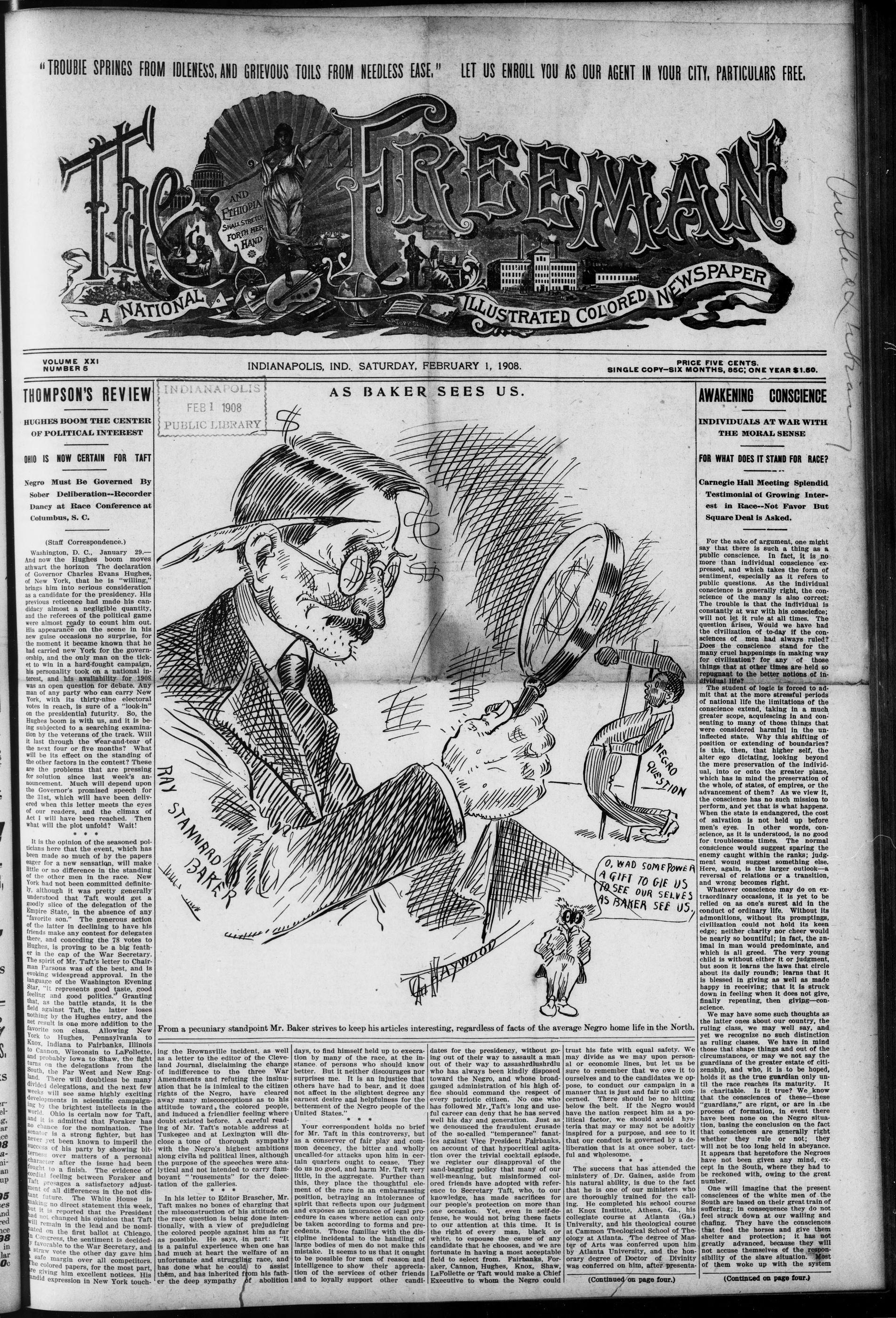
AS BAKER SEES US.
RAY STANNARD BAKER
NEGRO QUESTION
O, WAD SOME POWER
A GIFT TO GIE US
TO SEE OUR SELVES
AS BAKER SEE US.
ing the Brownsville incident, as well as a letter to the editor of the Cleveland Journal, disclaiming the charge of indifference to the three War Amendments and refuting the insinuation that he is inimical to the citizen rights of the Negro, have cleared away many misconceptions as to his attitude toward, the colored people, and induced a friendlier feeling where doubt existed before. A careful reading of Mr. Taft's notable address at Tuskegee and at Lexington will disclose a tone of thorough sympathy with the Negro's highest ambitions along civila nd political lines, although the purpose of the speeches were analytical and not intended to carry flamboyant "routsements" for the delegation of the galleries.
In his letter to Editor Brascher, Mr. Taft makes no bones of charging that the misconstruction of his attitude on the race question is being done intentionally, with a view of prejudicing the colored people against him as far as possible. He says, in part: "It is a painful experience when one has had much at heart the welfare of an unfortunate and struggling race, and has done what he could to assist them, and has inherited from his father the deep sympathy of abolition days, to find himself held up to execration by many of the race, at the instance of persons who should know better. But it neither discourages nor surprises me. It is an injustice that others have had to bear, and it does not affect in the slightest degree any earnest desire and helpfulness for the betterment of the Negro people of the United States."
Your correspondent holds no brief for Mr. Taft in this controversy, but as a conserver of fair play and common decency, the bitter and wholly uncalled-for attacks upon him in certain quarters ought to cease. They do us no good, and harm Mr. Taft very little, in the aggregate. Further than this, they place the thoughtful element of the race in an embarrassing position, betraying an intolerance of spirit that reflects upon our judgment and exposes an ignorance of legal procedure in cases where action can only be taken according to forms and precedents. Those familiar with the discipline incidental to the handling of large bodies of men do not make this mistake. It seems to us that it ought to be possible for men of reason and intelligence to show their appreciation of the services of other friends and to loyally support other candi dates for the presidency, without going out of their way to assault a man out of their way to assashrdlushdrdu who has always been kindly disposed toward the Negro, and whose broadgauged administration of his high office should command the respect of every patriotic citizen. No one who has followed Mr. Taft's long and useful career can deny that he has served well his day and generation. Just as we denounced the fraudulent crusade of the so-called "temperance" fanatics against Vice President Fairbanks, on account of that hypocritical agitation over the trivial cocktail episode, we register our disapproval of the sand-bagging policy that many of our well-meaning, but misinformed colored friends have adopted with reference to Secretary Taft, who, to our knowledge, has made sacrifices for our people's protection on more than one occasion. Yet, even in self-deference, he would not bring these facts to our attention at this time. It is the right of every man, black or white, to espouse the cause of any candidate that he chooses, and we are fortunate in having a most acceptable field to select from. Fairbanks, Foraker, Cannon, Hughes, Knox, Shaw, LaFollette or Taft would make a Chief Executive to whom the Negro could trust his fate with equal safety. We may divide as we may upon personal or economic lines, but let us be sure to remember that we owe it to ourselves and to the candidates we oppose, to conduct our campaign in a manner that is just and fair to all concerned. There should be no hitting below the belt. If the Negro would have the nation respect him as a political factor, we should avoid hysteria that may or may not be adroitly inspired for a purpose, and see to it that our conduct is governed by a de liberation that is at once sober, tactful and wholesome.
The success that has attended the ministry of Dr. Gaines, aside from his natural ability, is due to the fact that he is one of our ministers who are thoroughly trained for the calling. He completed his school courses at Knox Institute, Athens, Ga., his collegiate course at Atlanta (Ga. University, and his theological course at Cammon Theological School of Theology at Atlanta. The degree of Master of Arts was conferred upon him by Atlanta University, and the honourary degree of Doctor of Divinity was conferred on him, after presenta
days, to find himself held up to execration by many of the race, at the instance of persons who should know better. But it neither discourages nor surprises me. It is an injustice that others have had to bear, and it does not affect in the slightest degree any earnest desire and helpfulness for the betterment of the Negro people of the United States."
* * * *
Your correspondent holds no brief for Mr. Taft in this controversy, but as a conserver of fair play and common decency, the bitter and wholly uncalled-for attacks upon him in certain quarters ought to cease. They do us no good, and harm Mr. Taft very little, in the aggregate. Further than this, they place the thoughtful element of the race in an embarrassing position, betraying an intolerance of spirit that reflects upon our judgment and exposes an ignorance of legal procedure in cases where action can only be taken according to forms and precedents. Those familiar with the discipline incidental to the handling of large bodies of men do not make this mistake. It seems to us that it ought to be possible for men of reason and intelligence to show their appreciation of the services of other friends and to loyally support other candi-
dates for the presidency, without going out of their way to assault a man out of their way to assashrdhrudshrudl who has always been kindly disposed toward the Negro, and whose broad-gauged administration of his high office should command the respect of every patriotic citizen. No one who has followed Mr. Taft's long and useful career can deny that he has served well his day and generation. Just as we denounced the fraudulent crusade of the so-called "temperance" fanatics against Vice President Fairbanks, on account of that hypocritical agitation over the trivial cocktail episode, we register our disapproval of the sand-bagging policy that many of our well-meaning, but misinformed colored friends have adopted with reference to Secretary Taft, who, to our knowledge, has made sacrifices for our people's protection on more than one occasion. Yet, even in self-defense, he would not bring these facts to our attention at this time. It is the right of every man, black or white, to espouse the cause of any candidate that he chooses, and we are fortunate in having a most acceptable field to select from. Fairbanks, Foraker, Cannon, Hughes, Knox, Shaw, LaFollette or Taft would make a Chief Executive to whom the Negro could
PRICE FIVE CENTS.
SINGLE COPY-SIX MONTHS, 85C; ONE YEAR $1.60.
trust his fate with equal safety. We may divide as we may upon personal or economic lines, but let us be sure to remember that we owe it to ourselves and to the candidates we oppose, to conduct our campaign in a manner that is just and fair to all concerned. There should be no hitting below the belt. If the Negro would have the nation respect him as a political factor, we should avoid hysteria that may or may not be adoity inspired for a purpose, and see to it that our conduct is governed by a deliberation that is at once sober, tactful and wholesome.
* * *
The success that has attended the ministry of Dr. Gaines, aside from his natural ability, is due to the fact that he is one of our ministers who are thoroughly trained for the calling. He completed his school course at Knox Institute, Athens, Ga., his collegiate course at Atlanta (Ga.) University, and his theological course at Camton Theological School of Theology at Atlanta. The degree of Master of Arts was conferred upon him by Atlanta University, and the honorary degree of Doctor of Divinity was conferred on him, after presenta-
(Continued on page four.)
INDIVIDUALS AT WAR WITH THE MORAL SENSE
Carnegie Hall Meeting Splendid Testimonial of Growing Interest in Race--Not Favor But Square Deal is Asked.
For the sake of argument, one might say that there is such a thing as a public conscience. In fact, it is no more than individual conscience expressed, and which takes the form of sentiment, especially as it refers to public questions. As the individual conscience is generally right, the conscience of the many is also correct: The trouble is that the individual is constantly at war with his conscience; will not let it rule at all times. The question arises. Would we have had the civilization of to-day if the consciences of men had always ruled? Does the conscience stand for the many cruel happenings in making way for civilization? for any of those things that at other times are held so repugnant to the better notions of individual life?
The student of logic is forced to admit that at the more stressful periods of national life the limitations of the conscience extend, taking in a much greater scope, acquiescing in and consenting to many of those things that were considered harmful in the uninflected state. Why this shifting of position or extending of boundaries? Is this, then, that higher self, the alter ego dictating, looking beyond the mere preservation of the individual, into or onto the greater plane, which has in mind the preservation of the whole, of states, of empires, or the advancement of them? As we view it, the conscience has no such mission to perform, and yet that is what happens. When the state is endangered, the cost of salvation is not held up before men's eyes. In other words, conscience, as it is understood, is no good for troublesome times. The normal conscience would suggest sparing the enemy caught within the ranks; judgment would suggest something else. Here, again, is the larger outlook—a reversal of relations or a transition, and wrong becomes right.
Whatever conscience may do on extraordinary occasions, it is yet to be relied on as one's surest aid in the conduct of ordinary life. Without its admonitions, without its promptings, civilization could not hold its keen edge; neither charity nor cheer would be nearly so bountiful; in fact, the animal in man would predominate, and which is all greed. The very young child is without either it or judgment, but soon it learns the laws that circle about its daily rounds; learns that it is blessed in giving as well as made happy in receiving; that it is struck down in feeling when it does not give, finally repenting, then giving—conscience.
We may have some such thoughts as the latter ones about our country, the ruling class, we may well say, and yet we recognize no such distinction as ruling classes. We have in mind those that shape things and out of the circumstances, or may we not say the guardians of the greater estate of citizenship, and who, it is to be hoped, holds it as the true guardian only until the race reaches its maturity. It is charitable. Is it true? We know that the consciences of these—these "guardians," are right, or are in the process of formation, in event there have been none on the Negro situation, basing the conclusion on the fact that consciences are generally right whether they rule or not; they will not be too long held in abeyance. It appears that heretofore the Negroes have not been given any mind, except in the South, where they had to be reckoned with, owing to the great number.
One will imagine that the present consciences of the white men of the South are based on their great train of suffering; in consequence they do not feel struck down at our wailing and chafing. They have the consciences that feed the horses and give them shelter and protection; it has not greatly advanced, because they will not accuse themselves of the responsibility of the slave situation. Most of them woke up with the system
(Continued on page four.)
IN THE WOMAN'S WORLD.
BY "DOROTHY"
This column is devoted to the interests of all women and their organizations also. Address all communications to Dorothy. The Freeman Indianapolis, Ind.
THOUGHTS FOR THE WEEK.
Behavior is a mirror in which every one shows his image.
* * * *
No sooner is a temple built to God but the devil builds a chapel hard by.
* * * *
In all cases of heartache, the application of another one's disappointment draws out the pain and allays the irritation.
* * * *
Beauty is valuable or worthless according as you invest the property to the best advantage.
* * * *
Let Fortune do her worst, whatever she makes us lose, as long as she never makes us lose our honesty and our independence.
* * * *
When you rise in the morning, form a resolution to make the day a happy one to a fellow creature.
DOWN ON THE BOYS.
In the old days of New England a boy was looked upon as a thing to be kept down, says the Junior Eagle. There were many laws enacted with reference to him alone, and we give some of them here:
"If a boy shall sing or whistle on the Lord's day, it is a fine of 6 cents.
"If a boy shall throw a stone and break a window, it is a fine of 9 cents.
"If a boy shall chase a girl, it is a fine of 6 cents.
"If a boy shall go to sleep in church, it is a fine of 3 cents and the warden may cane him.
"If a boy shall throw stones at a neighbor's dog, it is a fine of 5 cents and his father shall whip him.
"If a boy laughs in public school, his teacher may take his coat off and administer thirteen hard blows.
"If a boy steals apples or other fruit, his parents must pay twice the value thereof, and he may be sent to the common jail for two days."
300 HAIRDRESSING STYLES.
French Expert Distressed Because
New York Women Use Only 20.
Concluding a study of hairdressing in the theaters, at the opera, in the restaurants and in the streets of New York, in which he has spent four weeks, George Gourdeau, president of the Association of Hairdressers of Paris, declared he is of the opinion that the styles of hairdressing used by the women in New York are too monotonous. "There are 300 separate and distinct fashions of dressing the hair," said Mr. Gourdeau, "but in New York the women seem to confine themselves to twenty at the most. "They have the advantage in stature and in physical beauty over their European cousins, and if they would only show more individuality in their hairdressing they would be the most beautiful body of women the world has ever seen."
BOSTON YOUNG LADIES FORM CLUB.
Twelve young ladies of the exclusive set of Boston have formed a club. The members are the daughters of the "Booklovers" and their friends. The officers are Miss Constance Ridley, president; Miss Narka Lee, secretary; Miss Edith Terry, treasurer.
RESPECT FOR NEGRO WOMEN
How can we expect members of the opposite race to give our women the respect that is rightfully theirs when so many men of our race fail in that particular? When editors of our different papers persist in referring to our women as a "Negress," what more can we expect of white people and their publications? An editor of Indianapolis gives a front-page article concerning a colored woman whom he calls a "Negress." This man has a wife and children and is considered one who is interested in the uplifting of his race, yet he stoops to use this degrading term. If a woman is so low as to deserve such, then she is too low to be taken into account. There is no cause for our papers to name the nationality of those whose names appear in their columns unless they are white, for it is reasonable that papers issued in the behalf of the Negro race will always refer to their own.
If the women would refer to them as a "burley Negro," they would be highly incensed over the matter, but still they are so careless of their women.
Many of them (who are supposed to be of the best) will join white men in slighting remarks about their own women, while nearly any common white man will resent any remark made about a white woman in their hearing.
Boys must be taught from babyhood to respect their mothers and their sisters and there will be no complaint when they grow to be men.
To whom shall we appeal for protection from some Negro publications? What man will come to our rescue?
CARNEGIE MEDAL AWARDED.
Mrs. George A. Grant of Groton, R. I., whose husband was killed in saving the lives of two white men, residing at Providence, by stopping
a runaway team last summer, has been given a silver medal and $25 per month for herself and $5 to each of her four children until they reach the age of 16 years. The medal and money were granted by the Carnegie Hero Fund Commission at their fourth annual meeting.
W. C. T. U. FOR INDIANAPOLIS.
A number of ladies met last week at the home of Mrs. M. A. Clark and organized a W. C. T. U. for work among our people. Meeting was also held at the Flanner Guild last Tuesday.
A class in dressmaking will be organized at Flanner Guild Monday, under the direction of Mrs. M. A. Clark.
The ladies of the A. M. E. Church of Troy, N. Y., had charge of the exercises on Sunday recently, giving an excellent program. The sum of $19 was realized.
The Woman's Improvement Club of Indianapolis observed their first guest of the season January 30 at the home of Mrs. Hulda Webb. The club has travel for its study this season and Capt. J. B. Thomas will give his observations in the Philippine islands some time in the near future.
Kissing under the mistletoe is a relic of Scandinavian mythology. Prince Loki hated Balder, the Apollo of the North. Everything "that springs from the fire, air, earth and water" had given its promise, under oath, not to hurt Balder, except the mistletoe, which was deemed too insignificant to be asked. Prince Loki made an arrow of mistletoe which he gave to blind Hoeder to shoot, and the latter did so, with a fatal result, killing Balder, who was later returned to life, at the request of the gods. The mistletoe was then given to the Goddess of Love to keep, and every one who passed under a spray, branch or wreath of it received a kiss to show that it was the emblem of love, not of death. Some authorities allege that kissing under the mistletoe is a survival of the Saturnalia of the ancients.
BROOKFIELD, MO.
The Rev. Lewis is carrying on revival meetings at the Zion Baptist Church. The Rev. Pankey of Fayette, Mo., preached a masterly sermon on January 25. When in Brookfield, Mo., don't forget to visit Shannon's restaurant on the South Side. Meals served at all hours.
Rienzi, Miss.
The first business men you'll chance to meet are William White and sons, owning a livery, sale and feed stable, with twelve or fifteen head of fine stock and all the latest vehicles. They also have a grocery store, carrying a full line of supplies. Leadbutler is the leading blacksmith and owns nice property. Mrs. Mary Taylor has a nice restaurant, and Williams, Conwell and others have nice property in town. Just one mile from town Mrs. McGaha, a widow, owns a farm of 400 acres. She has two sons teaching near their home.
Jacksonville, Ill.
Miss Hattie Dean Brown, a young singer of Chicago, is booked for an engagement at the A. M. E. Church the last of this month.
Miss Hallie L. Brown will give a recital in the city the first of next month, for the benefit of the colored women's new club home.
Mr. Robert Gibbons has opened a restaurant at 220 N. Adams street, where members of his race may be accommodated at all hours.
Rev. Earnest Hall, of Bloomington, was in the city recently and participated in the exercises Wednesday evening at the Baptist Church, the
A. E. H.
The most wonderful massage healer of the Pacific Coast, her skillful powers are untold. Cures Rheumatism. Kidney troubles. Female weakness. St. Vitus dances, etc. Will answer any and all questions by mail. 700 Bruch St. Oakland, Cal.
THE FREEMAN. AN ILLUSTRATED COLORED NEWSPAPER
If weak, worn-out, nervous, cannot sleep; have indigestion, headache, neuralgia or periodic pains, it is because your nerves are weak. It is the lack of nerve force that makes the stomach, heart, lungs, etc., work imperfectly—become sick. Dr. Miles' Nervine cures the sick when it restores nerve strength, and puts the power behind the organs to do their work.
"Almost three years I suffered from nervousness, indigestion, and palpitation of the heart. I could not eat or drink without suffering. I was without suffering. I was in a bad condition. My doctor did not seem to do me any good. I had tried to do my best, but much hope of any of them doing my any good. Dr. Miles' Nervine was suggested by a friend. I got relief deep in my heart. I felt like a new person. It not relieved my heart and nerves, but has invigorated my whole system. I am very grateful because since I have been in this condition absolutely to return of my old trouble." MRS. HOWARD FORD, 60 Summit Ave. Worst, Mass. Dr. Miles' Nervine is sold by your doctor. I guarantee that the first bottle will benefit. If it fails, he will refund your money. Miles Medical Co. Filkhard Ind
"Good Leather Goods"
ROMADKA'S
SANTAL-MIDY
Standard remedy for Gleet,
Gonorrhoea and Runnings
IN 48 HOURS. Cures Kid-
ney and Bladder Troubles.
MIDY
Hadley Bros.,
DRUGGISTS.
755-757 Indiana Avenue.
Near St. Clair St. Indianapolis.
? 134 West Market Street.
Miss Luella E. Hibbitts,
NOTARY PUBLIC.
Your work along this line will be
greatly appreciated.
Call and see her at 536 Indiana Ave
(With C. M. C. Willis.)
event being a jubilee celebration and burning of the mortgage on the church.
* * *
Mr. Aobt. Davis, Miss Rhoda Shaw, Josie Conway, Foda Harrison, Mattie Watsona nd Ula Irving were on the sick list during the week.
* * *
Mrs. Ivan Harper entertained the Philharmonic Art Club at her residence recently. Mrs. Edward Burris was the guest of the club.
* * *
Mrs. Robt. Gibbons entertained the Autumn Leaf Club recently at her residence. A short program was rendered after which refreshments were served.
CORINTH. MISS.
Many of our folks are seen in the business world. Hays, Renfro Williams and one or two others are in the grocery business with fair success. There are three barber shops doing a living business. Many own their own homes. There are two schools, one public and one private; seven churches. Mrs. Pelton is in the millinery business; W. F. Street has a nice cafe; Mrs. E. B. Mayfield has the best lodging house in town, and Mr. Woods is the real estate man. All our people within a radius of ten miles are doing fairly well, and many own their farms. Among them are Sam Hoyle K. S. Cromwell and Mrs. Hale.
WENASOGA, TENN.
This town is the home of W. W. Floyd, ex-compassioner for Tennessee to the Jamestown Exposition and now with the I. C. Telegraph Company in Louisiana.
POCAHONTAS, TENN.
In this town you will meet John Pore, a farmer with 336 acres, thirteen head of cattle, nine horses, forty hogs and fourteen children.
At Middleton, Tenn., many of our people in the country own nice farms.
Mr. John Grace will act as The Freeman agent. W. B. G.
Just before turning the reins of government over to Governor E. F. Noel on January 21, Governor Vardaman of Mississippi granted twenty-six pardons to prisoners in the penitentiary. Eight of the twenty-six were white men; the other eighteen were colored men.
---
Smothers Hotel
Meals at all hours. Bath with shower.
Mrs. Anna C. Bowman, Prop'ss,
515-515½ INDIANA AVENUE.
Newport Hotel
W. T. CURTIS, Prop.
2821 2828 MARKET STREET?
CAFE
2821 Market St.
In three Squares of Union Station,
BELL, Bomont 65
KINLOCH, C-1199
ST. LOUIS, MISSOURI.
The Place to Go When in
BOSTON.
POWHATTAN RUFFIN, Prest
REGINALD RUFFIN, Treas.
Established 1882
NEW SAVOY OYSTER BAY
Special attention paid to telephone orders. Oysters on half shell or any style. Twenty-five years experience as chef cook. LUCKY STEVE. Been
JAS. N. SHELTON. LUCAS B WILLIS
Phones—New 3058,
Old, Main, 4694.
Shelton & Willis,
(Licensed Embalmers)
FUNERAL DIRECTORS
AND EMBALMERS
Best Service. Lady Attendant.
Lowest Prices.
418 Indiana Ave. Open all Night
EVERY LADY READ THIS.
Years ago, when I was a sufferer, an old nurse told me of a wonderful cure for Leurcorhea. Displacement, Painful Periods, Uterine and Ovarian troubles. It cured me in one month. It is a simple, harmless lotion that can be prepared by any one having the recipe. I will send it FREE to every suffering sister who writes to me. I have nothing to sell. This is a case of woman an helping woman. *I send it FREE.* **Address** Mrs. A. B. HUDHUR. South Bend, Ind.
MRS. WHITTEN.
Millinery
Special sale all next week of
Tailored and Dress Hats.
We also do exclusive
ORDER WORK.
Give us a call; we will convince you; our
time is entirely yours.
335-337 Indiana Avenue.
Attention Colored Elks
We have on hand a stock of
beautiful rings emblematic of
the order. Call and see them.
STRENG & LUX,
JEWELERS
206 Indiana Ave., Indianapolis, Ind.
SHIEL BLOCK.
Bar-Keeper's Friend
Metal Polish
AN INFALLIBLE
UP-TO-DATE
ARTICLE
USED BY
MOREN
PEOPLE
THAN ALL OTHER
METAL POLISHES!
COMBINED
PEO W. HOFFMAN & MFG.
INDIANAPOLIS, IN
One Found Boxes 25 cts., at Druggists
and Dealers
TAYLOR'S ELECTRIC COMB!
Made of Solid Brass, highly polished and fully nickel plated. Retains heat much longer than cast iron. It is indeed the handiest and simplest straightener ever introduced to the people.
Sent postpaid on receipt of 50c.
HAIR SWITCHES
Bangs and Wigs of every description. Most complete line of Hair foods in this country for colored people. Send stamp for catalogue. T.W. TAYLOR, Howell, Mich.
PURITAN LAUNDRY
Newest and Best
First-Class Colored Help
Always Wanted.
Cut Rate Grocery
And Meat Market. A fine line of fresh fruit, vegetables, groceries, meats, oysters, fish and game. Poultry dressed while you wait.
J. B. DOOLITTLE,
Old Phone. 754 Indiana Ave
KARSTADT DYE-WORKS
Indiana's Best and Most Modern Dyeing and Cleaning Establishment.
218 N. ILLINOIS ST.
and 205 INDIANA AVE.
Phone New. 2582; Old main 3888
PRESSING PARLOR.
FORD'S HAIR POMADE
West Chester. Pa. Mc. 39. 18. 36.
I had typhoid fever, my hair all came out.
I used three bottles of water, and now my hair is nine inches long and very thick and good your pomade did my hair one seeing how are anxious for it. My hair is an example to over for it. My hair is an example to over for it. Yours respectfully, ELLY JEFF.
Colvert, Tex. Mc. 39. 18. 36.
I have asked one bottle of your pomade and my hair is all straight, soft and black as silk. I will be without it. Rhoa EUWARA
Prairie
July 15, 1988
Gentlemen: When I left your pomade my head was so hard I could not move, now my hair has grown thicker than my own head and I have been using it only by myself.
Gentlemen: I have used your pomade and have found it to do more than it do. It stops the hair from falling on and breaking off, and cleans the scalp so soft, pliable and glossy.
I have seen the original letters and testify to the gentleness of the statue.
ELWOOD KNOX, Manager, The Freeman.
FORD'S HAIR POMADE, formerly known as "OZONIZED OX straightens Kinky or Curly Hair," can be put up in any style with its length, and is the only safe preparation. It makes Kinky Hair Straight, as shown above. Its use makes the most stubborn, early hair soft, pliable and easy to comb. These results may be obtained by pouring 2 bottles are usually sufficient for the year. Use the FOMADE Pomade in sanddruff, relieves itching, invigorates the hair from falling out or breaking off, and preserves the life and vigor. Being elegantly perfumed and harmless, gentlemen and children. FORD'S HAIR POMADE, formerly known as OX MARROW, been made and sold continuously since about 1888, and the lace ONX MARROW is made by the United States Patent Office in 1874. Ford's, as its use makes the hair STRAIGHT, is remembered that FORD'S HAIR POMADE is put up only in 50c, only in Chicago and by us. The genuine has the signature, Charles Foy package. Refuse all others. Full directions with every bottle. Price of drongles and decor. Artist or dealer cannot supply you, he can from his jobber or wholesaler dealer. One bottle, postpile three bottles, or $2.50 for six bottles, paid. We postage and to all points in U. S. A. When ordering send postal or express money on name of this paper. Write your name and address plainly to
Atlanta, Ga., June 1908.
have found it to do more than it is recommended to
king off, and cleans the scalp and makes the hair
to the genuineness of the statements.
Manager, The Freeman.
known as "OZONIZED OX MARROW," so
can be put up in any style desired consistent
known to us that makes Kinky or Curly
takes the most stubborn, harsh, kinky or
ab. These results may be obtained from one
ent for a year. The use of PORDS HAIR
believes itching, invigorates the socal, stops the
grow, and by nourishing the roots, gives the new
of harmless, it is a toilet necessity for ladies.
POMADE, formerly known as "OZONIZED
ly since about 1888, and the label, "OZONIZED
States Patent Office in 1874. Be sure to get
30°F and PLIABLE. Beware of imitations.
DE is put up only in 50c. size, and is made
with the signature, Charles Ford. Prest. on each
day of the year, the price only 50c. Sold by
other cannot supply you, be can get it for you
as 50c. for one bottle, postpaid, or $1.40 for
a paid. We pay postage and express charges
and postal or express money order, and mention
ress plainly to
Gentlemen: I have used your pomade and have found it to do more than it is recommended to do. It stops the hair from falling out and breaking off, and cleans the scalp and makes the hair soft, pliable and glossy.
I have seen the original letters and testify to the genuineness of the statements.
ELWOOD C. KNOX, Manager, The Freeman.
FORD'S HAIR POMADE, formerly known as up in any style, has RARROW, so straightens Kinky or Curly Hair that it can be used to make RARROW. "So with its length, and is the only safe preparation known to us that make RARROW" curly or curly straightens, is shown above. It uses makes the most stubborn, harsh, kind or early to be made and easy to comb. These results may be obtained from the treatment; it is usually sufficient for a year. The use of FORD'S HAIR POMADE removes and prevents dandruff, relieves itching, in�irgates the scalp, stops the hair from falling out or breaking off, makes it grow, and by nourishing the roots, gives it new life and vigor.
Being elegantly perfumed and harmless, it is a toilet necessity for each gender and the hair. HAIR POMADE, formerly known as "Ozonized OX MARROW," has been made and sold coming from 1986, and the label, "Ozonized OX MARROW," was registered in the United States Patent Office. The name "Ozonized Ford" is its use makes the hair STRAIGHT. SOFT and PLIABLE.
Be sure to get it from the FORD'S HAIR POMADE is put up only in 50c. size, and it is made only in Chicago. The genuine has the signature, Charles Ford. Prest. on a package. Refuse all others. Full of the very bottle. Price only 50c. Sold by druglists and dealers. In your druglist or dealer can be supply to the cost. It is for you from his jobber or wholesale dealer, or send us 50c, for one bottle, postpaid, to you for a share of the cost of $2.50 for six bottles, express paid. We pay postage and express charges for all the cost of $1.50. When ordering send postal or express money order, and mention name of this paper. Write your name and address plainly to:
THE OZONIZED OX MARROW CO.
158 E. Kinzile St., Chicago, Ill.
(None genuine without my signature. Agents Vanted everywhere.)
Atlanta, Ga., June 6, 1980.
Charles Ford, Red
Buy
Buy it
when you can get the
most for your money.
COAL
YAWGER COAL COMP
Always
on the
Square
Four Big Yards
Both Phones
Private Exchanges.
Old Main 397;
New 4119
ALL GOODS SOLD BY
PINK'S Cut Rate Pharma
Comply in every way with the
PURE FOOD LAW
We Lead, Others Try to Follow.
PINK'S PHARMA
550 Indiana Ave., Southeast Corner West
buy it
can get the
your money.
2,000 lbs.
to the
Ton
AL
AL COMPANY
Big Yards
Phones
Exchanges.
New 4119
N S O L D B Y
State Pharmacy
way with the
OD LAW.
Try to Follow.
H AR M A C Y,
East Corner West Street.
Buy
Buy it
when you can get the
most for your money.
2,000 lbs.
to the
Ton
COAL
YAWGER COAL COMPANY
Always
on the
Square
Four Big Yards
Both Phones
Private Exchanges.
Old Main 397;
New 4119
Now
ALL GOODS SOLD BY PINK'S Cut Rate Pharmacy Comply in every way with the PURE FOOD LAW. We Lead, Others Try to Follow. PINK'S PHARMACY, 550 Indiana Ave., Southeast Corner West Street.
Old Phone, Main, 1248.
We Want Your Trad Indiana Laundry Com
We Want Your Trade. na Laundry Company Pressing and and Work A SPECIALTY.
2922 Northwestern Avenue
$3.00 16x19
LIFESIZE PORTRAIT FREE
to advertise our work. All we ask of you is to
have it framed and hang it up, so your neigh
bors can see it. A limited number made only.
Indianapolis Portrait Co.,
(Incorporated.)
839% MASSACHUSETTS AVE.
Medical Hall Pharmacy
Shiel Block, 202 N. Illinois St., Cor. Ind. Ave.
Makes a specialty of Compounding Medicines. Our work is reliable and costs no more than elsewhere. Palmer's "Skin Success" Ointment, Soap and Blood Purifier. Ox Marrow Pomade.
Pharmacy,
Minis St., Cor. Ind. Ave.
Medicines. Our work is reliable and
Mr.'s "Skin Success" Ointment, Soap and
e.
OPE MRS. L. L. ROBERTS.
Medical Hall Pharmacy
Medical Hall Pharmacy
Shiel Block, 202 N. Illinois St., Cor. Ind. Ave.
Makes a specialty of Compounding Medicines. Our work is reliable and costs no more than elsewhere. Palmer's "Skin Success" Ointment, Soap and Blood Purifier. Ox Marrow Pomade.
4 years ago my hair was only a finger length and my temple were bald half way up my head.
4 years ago my hair just covered my shoulders.
actually grown and the further fact that they
tong to sell their goods (saying that "theirs are
We advise you to use only "PORO" Hair
that the name "PORO" is on every box, not
A.M. POPE. BEWARE OF IMITA-
BIMARKET ST.. ST. LOUIS MO.
LLPHONE, BOMONT 8109.
largely by persons whose own hair we have actually grown and the furth have very frequently mentioned us when trying to sell their goods (saying same" or "just as good.") or refer to "PORO." We advise you to use our Grower, (the oldest and best of its kind) See that the name "PORO" is genuine without it. Prepared only by MRS. A.M. POPE. BEWARE TIONS. Call, or Address Mail to
MRS. A. M. POPE-TURNBO,
2228 MARKET ST. ST.
BELL PHONE, BOMON
largely by persons whose own hair we have actually grown and the further fact that that have very frequently mentioned us when trying to sell their goods (saying that they have very good hair) is that the name "PORO" is Hair Grower, the oldest and best of its kind) See that the name "PORO" is on every box, genuine without it. Prepared only by MRS. A. M. POPE. BEWARE OF IMITA TIONS. Call, or Address Mall to MRS. A. M. POPE-TURNBO. MARKET ST. ST. LOUIS MO. BELL PHONE-BOMONT 8109.
Key West, Fla. Aug. 18, 2004
I used only one compliment to pomade and my hair has stopped breaking off. It has greatly improved. When I started using this wonderful preparation my hair was seven inches long and made it look less or more. Yours truly
334 Southard St.
MINNIE FOASTER.
Brookhaven, Miss., Aug. 13, 1898.
Gentlemen: I must confess I never tried any preparation so excellent for the hair. My hair was turning gray and was rather deadly but since I have been using your hair pomade my hair has turned black like it was when I was a girl and it has a lively, glossy color.
```markdown
```
New Phone 16114, K.
EUGENE ARNOLD, Solicitor.
R. E. WELLS, Proprieto
The Original Hair Growers.
We Grew Our Hair
Now Let us Grow
Yours With
When we first began our wonderful work of growing lengths, and all conditions of hair, even to the growing bead, many serious scorned the idea that such a thing was possible; but we hundreds, rapidly achieving success. The proof of the value of being imitated
The Fighting Chance.
By ROBERT W. CHAMBERS.
Copyright, 1906, by the Curtis Publishing Company.
Copyright, 1906, by Robert W. Chambers.
[CONTINUED.]
CHAPTER TWO
HOUSE of native stone built into and among weather scarred rocks, one massive wing butting scaward, others nosing north and south among cedars and entorpping ledges, the whole silver gray mass of masonry reddening under a westering sun, every dormer, every leaded diamond pane afame--this was Shotover as Slward first beheld it.
As the phaeton drew up under a pillared porte cochere one or two servants appeared. A rather imposing specimen bowed them through the doors into the hall, where in a wide chimney place the embers of a drift wood fire glimmered like a heap of dusty jewels. Bars of sunlight slanted on wall and rug, on stone floor and carved staircase, on the bronze foliations of the railed gallery above, where, in the golden gloom through a high window, sun tipped treetops against a sky of azure stirred like burnished foliage in a tapestry.
“There is nobody here, of course,” observed Miss Landis to Siward as they halted in front of the fireplace. “The season opens today in this country, you see”—she shrugged her pretty shoulders—“and the women who don't shoot make the first field luncheon a function.”
She turned, nodded her adieu, then, over her shoulder casually. "If you haven't an appointment with the sandman before dinner you may find me in the guarroom."
"I'll be there in about three minutes," he said. "And what about this dog?" looking down at the Sagamore pup, who stood before him wagging, attentive, always the gentleman to the tips of his toes.
Miss Landis laughed. "Take him to your room if you like. Dogs have the run of the house."
So he followed a servant to the floor above, where a smiling and very ornamental maid preceded him through a corridor and into that heavy wing of the house which fronted the sea.
"Tea is served in the gunroom, sir," said the pretty maid and disappeared to give place to a melancholy and silent young man, who turned on the bath, laid out fresh ralment and, whispering "Scotch or Irish, sir?" presently effaced himself.
Before he quenched his own thirst Sward filled a bowl and set it on the floor, and it seemed as though the dog would never finish gulping and slabbering in the limpid ice water.
"It's the salt air, my boy," commented the young man, gravely refilling his own glass as though accepting the creux on his own account.
Then man and beast completed abutions and grooming and filed out through the wide corridor, around the gallery and down the broad stairway to the gunroom, an oaken vaulted place illuminated by the sun, where mellow lights sparkled on glass cased rows of fowling pieces and rifles, on the polished auteurs of shaggy moose heads.
Miss Landis sat curled up in a cushioned corner under the open casement panes offering herself a cup of tea. She looked up, nodding invitation. He found a place beside her. A servant whispered, "Scotch or Irish, sir?" then set the crystal paraphernalia at his elbow.
He said something about the salt sir casually. The girl gazed meditatively at space.
The sound of wheels on the gravel outside aroused her from a silence which had become a brown study, and so Siward presently she said. "Here endeth our first rendezvous." "Then let us arrange another immediately," he said, stirring the ice in his glass.
The girl considered him with speculative eyes. "I shouldn't exactly know what to do with you for the next hour if I didn't abandon you." "Why bother to do anything with me? Why even give yourself the trouble of deserting me? That solves the problem."
"I really don't mean that you are a problem to me, Mr. Siward," she said, amused. "I mean that I am going to give again."
"I see."
"No, you don't see at all. There's a telegram. I'm not driving for pleasure."
she had not meant that either, and it annoyed her that she had expressed herself in such terms. As a matter of fact, at the telegraphed request of Mr. carrier she was going to Black Felis pressing to meet his train from the cakes and drive him back to Shotover. the drive, therefore, was, of course, a drive for pleasure.
"I see," repeated Siward amiably.
"Perhaps you do," she observed, rising to her graceful height. He was on her feet at once, so carelessly, so good unmerely acquiescent that without any reason at all she hesitated.
"I had meant to show you about—
the cliffs, the kennels and stables. I'm sorry," she concluded, lingering. "I'm awfully sorry," he rejoined without meaning anything in particular. That was the trouble—whatever he said apparently meant so much. With the agreeable sensation of being regretted she leisurely gloved herself, then walked through the gunroom and hall. Siward strolling beside her. The dog followed them as they turned toward the door and passed out across the terraced veranda to the driveway, where a tandem cart was drawn up, faultlessly appointed. Quarrier's mania was tandem. She thought it rather nice of her to remember this.
She inspected the ensemble without visible interest for a few moments. The wind freshened from the sea, fluttering her veil, and she turned toward the east to face it. In the golden splendor of declining day the white sails of yachts crowded landward on the last leg before beating westward into Blue harbor. A small white cruiser steaming south left a mile long stratum of rose tinted smoke hanging parallel to the horizon's plane. The westering sun struck sparks from her bright work.
They had turned their backs to the tandem. The grooms looked after them, standing motionless at the horses' heads.
"Mr. Siward, this is too fine to miss," she said. "I will walk as far as the headland with you. Please smoke if you care to."
The breeze blown conversation became fragmentary, veering as capriciously as the purple wind flaws that spread across the shoals. But always to her question or comment she found in his response the charm of freshness, of quick intelligence or of a humorous and idle perversity which stimulates without demanding.
Once, glancing back at the house where the T cart and horses stood, she said that she had better return, or perhaps she only thought she said it, for he made no response that time, and a few moments later they reached the headland, and the Atlantic lay below, flowing azure from horizon to horizon under a universe of depthless blue. And for a long while neither spoke.
With her the spell endured until conscience began to stir. Then she awoke, unasy, as always, under the shadow of restraint or pressure until her eyes fell on him and lingered.
A subtle change had come into his face. Its leanness struck her for the first time—that and an utter detachment from his surroundings, a somber oblivion to everything and to her.
How curiously had his face altered! How shadowy it had grown, effacing the charm of youth in it!
The slight amusement with which she had become conscious of her own personal exclusion grew to an interest tinged with curiosity.
The interest continued, but when his silence became irksome to her she said so very frankly. His absent eyes, still clouded, met hers unsmiling.
"I was thinking of men I knew—for example, a man who through generations has inherited every impulse and desire that he should not harbor; a man with intellect enough to be aware of it, with decency enough to desire decency. What chance has he with the storms which have been brewing for him even before he opened his eyes on earth? Is that a square deal?"
The troubled concentration of her face was reflected now in his own. The wind came whipping and flicking at them from league wide tossing wastes. The steady thunder of the sea accented the silence.
Turning to the sea, he had become engrossed in his own thoughts again, and again she was first curious, then impatient, at the ease with which he excluded her. She remembered, too, that the cart was waiting; that she had scarcely time now to make the train.
She stood irresolute, inert, disinclined to bestir herself. An inborn aptitude for drifting, which threatened to become a talent for indecision, had always alternated in her with sudden impulsive conclusions and when her pride was involved in decisions which sometimes scarcely withstood the analysis of reason.
Physically healthy, mentally unawakened, sentimentally incredulous, totally ignorant of any master passion and conventionally drilled, her beauty and sweet temper had carried her easily on the frothy crest of her first season over the eligible and ineligible alike, leaving her at Lenox a rather tired and breathless girl in love with pleasure and the world which treated her so well.
The death of her mother abroad had made little impression upon her, her uncle, Major Belwether, having cared for her since her father's death, when she was ten years old. So, although the scandal of her mother's self exile had been in a measure condoned by a tardy marriage to the man for whom she had left everything, her daughter had grown up ignorant of any particular feeling for a mother she could scarcely remember.
However, she wore black and went nowhere for the second winter, during which time she learned a great deal concerning the unconventional proclivities of the women of her race and family, enough to impress her so seriously that on an exaggerated impulse she had come to one of her characteristic decisions.
That decision was to break the unsavory record at the first justifiable opportunity, and the opportunity came in the shape of Quarrier—as though wedlock were actually the sanctuary which an alarmed nation pretends it to be!
Now, approaching the threshold of a third and last season and having put away her almost meaningless mourning, there had stolen into her sense of security something irksome in the
THE FREEMAN. AN ILLUSTRATED COLORED NEWSPAPER.
promise she had made to give Quarrier a definite answer before winter. Perhaps it had been the lack of interest in the people at Shotover, perhaps a mental review of her ancestors' capricious records, perhaps a characteristic impulse that had directed a telegram to Quarrier after a midnight confab with Grace Ferrall. However it may have been, she had summoned him. And now he was on his way to get his answer, the best whip, the most eagerly discussed and one of the wealthiest unmarried men in America. Lingering irresolutely, considering with idle eyes the shadows lengthening across the sun shot moorland, the sound of Siward's even voice aroused her from a meditation bordering on lassitude.
She answered vaguely. He spoke again, all the agreeable, gentle, humorous charm dominant once more, releasing her from the growing tension of her own thoughts, absolving her from the duty of immediate decision.
"I feel curiously lazy," she said, "perhaps from our long drive." She seated herself on the turf. "Talk to me, Mr. Sieward, in that lazy way of yours."
M. M. M.
What he had to say proved inconsequent enough, an irrelevant suggestion concerning the training of field dogs. The conversation veered again to confusion.
"Talk to me. Mr. Si- conve ward." veered ward the mystery of heredity.
"Do you mean, Mr. Slward, that heredity is an excuse for moral weakness?" she asked.
"I don't know. Those inheriting nothing of evil say it is no excuse."
"It is no excuse."
"You speak with authority," he said.
"With more than you are aware of," she murmured, not meaning to say it.
She stood up impulsively, her fresh face turned to the distant house, her rounded young figure poised in relief against the sky.
"Inherited or not, idleness, procrastination, my bestsetting sins. Can't you suggest the remedy, Mr. Slward?"
"But they are only the thieves of Time, and we kill the poor old gentleman."
"Leagued assassins," she repeated pensively.
Her gown had caught on the cliff briers. He knelt to release it, she looking down, noting an ugly tear in the fabric.
"Payment for my iniquities—the first installment," she said, still looking down over his shoulder and watching his efforts to release her. "Thank you, Mr. Slward. I think we ought to start, don't you?"
He straightened up, smiling, awaiting her further pleasure. Her pleasure being capricious, she seated herself again, saying: "What I meant to say was this: Evils that spring from heredity are no excuse for misconduct in people of our sort. Environment, not heredity, counts. And it's our business, who have every chance in the world, to make good."
He looked down, amused at the plquant incongruity of voice and vernacular.
"What time is it?" she asked irrelevantly.
He glanced at his watch. She turned her eyes toward the level sun, conscious and a little conscience stricken that it was too late for her to drive to Black Fells Crossing unless she started at once.
It grew stiller. The wind went down with the sun.
Doubtless he had forgotten to tell her the time. She had almost forgotten that she had asked him. With the silence of sunset a languor, the indolence of content, crept over her. She saw him close his watch with the absentminded air which she already associated with him, and she let the question go from sheer disinclination for the effort of repetition—let the projected drive go—acquiescent, content that matters shape themselves without any interference from her. The sense of ease, of physical well being, invaded her with an agreeable relaxation as though tension somewhere had slackened.
The conversation drifted illogically. Sometimes he stirred her to amusement, even a hushed laughter. Sometimes she smilingly agreed with his views. Sometimes she let them go uncriticised or, intent on her own ideas, shook her small head in amused disapproval. The stillness over all, the deepening mellow light, the blessed indolence of the young world and their few years in it—youth—that was perhaps the key to it all, after all.
"Tomorrow," she mused aloud, knees cradled in her clasped fingers—"tomorrow they'll shoot, with great circumstance and fuss, a few native wood-cock—there's no flight yet from the north—a few grouse, fewer snipe, a stray duck or two. Others will drive motor cars over bad roads. Others will ride, sail, golf—anything to kill the eternal enemy. You know the majority of the people here or coming, don't you?" "Who are they?" She began, "The Leroy Mortimers?" "Oh, yes." "Lord Alderdene and Captain Voucher and the Page twins and Marion?" "Yes." "Rena Bonnesdel, the Tassel girl, Agatha Caithness, Mrs. Vendennning—all sorts, all sets." And, with an effort, "If I'm to drive I should like to—to know what time it is."
He informed her, and she, too indolent to pretend surprise and finding reproach easier, told him that he had no business to permit her to forget.
His smiling serenity under the rebuke aroused in her a slight resentment, as though he had taken something for granted.
Besides, she had grown uneasy. She had wired Quarrier, saying she would meet him and drive him over. He had replied at once, naming his train. He was an exact man and expected method and precision in others. She didn't exactly know how it might affect him if his reasonable demand was unsatisfied. She did not know him very well yet.
And, thinking of him now, she again made up her mind to give him the answer which he now had every reason to expect from her. This decision appeared to lubricate her conscience. It ran more smoothly now, emitting fewer creaks.
"You say that you know Mr. Quarrier?" she began thoughtfully.
"I hope you will like him, Mr. Siward."
"I do not think he likes me, Miss Landis. He has reasons not to."
She looked up, suddenly remembering: "Oh--since that scrape? What has Mr. Quarrier to do?" She did not finish the sentence. A troubled silence followed. She was trying to remember the details—something she had paid small attention to at the time; something so foreign to her, so distant from her comprehension, that it had not touched her closely enough for her to remember exactly what this young man might have done to forfeit the good will of Howard Quarrier.
She looked at Siward. It was impossible that anything very bad could come from such a man. And, pursuing her reasoning aloud: "It couldn't have been very awful." she argued; "something foolish about an actress, was it not? And that could not concern Mr. Quarrier."
"I thought you did know; I thought you—remembered—while you were driving me over from the station—that I was dropped from my club."
She flushed up. "Oh, but what had Mr. Quarrier to do with that?"
"He is a governor of that club."
"You mean that Mr. Quarrier had you—dropped?"
"What else could he do? A man who is idiot enough to risk making his own club notorious must take the consequences, and they say I took that risk. Therefore Mr. Quarrier, Major Belwether—all the governors did their duty. I—I naturally concluded that no governor of the Patroons club feels very kindly toward me."
Miss Landis sat very still, her small head bent, a flush still brightening her fair face.
She recalled a few of the details now—the scandal—something of the story. Which particular actress it was she could not remember, but some men who had dined too freely had made the wager, and this boy sitting beside her had accepted it and won it by bringing into the sacred precincts of the Patroons club a foolish girl disguised in a man's evening dress.
That was bad enough. That somebody promptly discovered it was worse, but worst of all was the publicity, the club's name smirched, the young man expelled from one of the best two clubs in the metropolis.
To read of such things in the columns of a daily paper had meant little to her except to repel her. To hear it mentioned among people of her own sort had left her incurious and indifferent, but now she saw it in a new light, with the young man who had figured in it seated beside her. Did such men as he—such attractive, well bred, amusing men as he—do that sort of thing?
"Is that the kind of man you are, Mr. Siward?" she said impulsively.
"It appears that I was. I don't know what I am or may be."
"The pity of it!" she said, still swayed by impulse. "Why did you didn't you know—realize what you were doing—bringing discredit on your own club?"
"I was in no condition to know, Miss Landis."
The crude brutality of the expression might merely have hurt or disgusted her had she been less intelligent, nor, as it was, did she fully understand why he chose to use it unless that he meant it in self punishment.
"It's rather shameful!" she said hotly.
"Yes," he assented; "it's a bad beginning."
"A beginning! Do you mean to go on?"
He did not reply. His head was partly turned from her. She sat silent for awhile. The dog had returned to lie at Siward's feet, his brown eyes tirelessly watching the man he had chosen for his friend, and the man, without turning his eyes, dropped one hand on the dog's head, caressing the silky ears.
Some sentimentalist had once said that no man who cared for animals could be wholly bad. Inexperience inclined her to believe it. Then, too, she had that inclination for overlooking offenses committed against precept which appears to be one of those edifying human traits peculiar to neither sex and common to both. Besides, her knowledge of such matters was as vague as her mind was healthy and body wholesome. Men who dined in cautiously were not remarkable for their rarity. The actress habit, being incomprehensible to her, meant nothing, and she said innocently: "It is not for such things that we drop men, Mr. Slward. You know that, of course." "For what do you drop men?" "For falsehood, deception, any dishonesty."
"And you don't drop a man when you read in the papers that one of the best two clubs in town has expelled him?" She gave him a troubled glance, and,
nailery, "But you are still a member of the other, are you not?" Then, hardening, "It was common, common, thoroughly disgraceful and incomprehensible!" And with every word uttered insensibly warming in her heart toward him whom she was chastening: "It was not even bad. It was worse than being simply bad. It was stupid!" He nodded, one hand slowly caressing the dog's head where it lay across his knees. She watched him a moment, hesitated, then, smiling a little, "So now I know the worst about you, do I not?" she concluded. He did not answer. She waited, the smile still curving her red mouth. Had she been too severe? she wondered, "You may help me to my feet," she said sweetly. She was very young.
He rose at once, holding out his hands to aid her in that pleasantly impersonal manner so suited to him, and now they stood together in the purple dusk of the uplands—two people young enough to take one another seriously. They walked for awhile, subdued, soberly picking their path through the dusk. After a few moments she began to feel doubtful, a little uneasy, partly from a reaction which was natural, partly because she was not at all sure what either Quarrier or Major Bel-wether would think of the terms she was already on with Slward. Suppose they objected? She had never thwarted either of these gentlemen. Besides, she already had a temporary interest in Slward—the interest that women always cherish, quite unconsciously, for the man whose shortcomings they have consented to overlook.
As they crossed the headland through the deepening dusk the acetylene lamps on a cluster of motor cars spread a blinding light across the scrub. The windows of Shotover House were brilliantly illuminated.
"Our shooting party has returned," she said.
They crossed the drive through the white glare of the motor lamps. People were passing—grooms with dogs and guns and fuffy bunches of game birds; several women in motor costumes, veils afoat; a man or two in shooting tweeds or khaki.
As they entered the hall together she turned to him, an indefinable smile curving her lips; then, with a little nod, friendly and sweet, she left him standing at the open door of the gunroom.
(Continued next week.)
Negro Organizers Wanted
Negro Organizers Wanted
GREATEST Protective and Beneficial Order ever started. Over 50,000 members, men and women. Helps get equal opportunities with other people. HIGHER WAGES, LESS TOIL and IMPROVED CONDITIONS generally. NO RACE DISCRIMINATION. $100 at death; $25 to each male member at death; $45 at death. MANY OTHER BENEFITS. Membership open to all laboring people alike. LEADING COLORED MEN AND WOMEN DEPUTIES WANTED IN EACH LOCALITY. Of women in MICHIGAN JAY AND PLEASANT WORK. Write at once for full particulars, enclosing 10c for postage. I-L-U GRAND LODGE, 115 I-L-U BLDG., DAYTON, OHIO.
The Eureka Comb
It is an assured fact that there is now on the market, a COMB, Scientifically made of Hardened and Highly Polished Metals, Copper and Brass, with a soft, flexible scalp and hair. A phenomena, 'lough its working ability, bringing the crimpy his hair and silky its face causes a damp with, a permanent care causes a ruff, a fall falling, making natural strait hair, light in weight and airy in appearant. The best hair for a crimpy his hair, Copper and Brass and Copper are friendly to born. The EUREKA COMB Guaranteed. Why not order today? Directions go with every comb. Price, £19.99. Copper and Brass and Copper are friendly to born. The EUREKA COMB Guaranteed. Why not order today? Directions go with every comb. Price, £19.99. Copper and Brass and Copper are friendly to born. The EUREKA COMB CO., Chattanooga, Tenn.
SCHWANKHAUS PHARMACY,
SCHWANKHAUS PHARMACY,
CUT PRICE DRUGGIST,
and prescription specialist. Bottom prices on
all soils, toilet articles, cigars and candies.
Special agents for Palmer's Skin Success
Soap, Ointment and Blood Success. 19c
Our Cough Cure, guaranteed to cure, per both
our Witch Hazel Jelly. 16c
Our Witch Tablet, guaranteed to cure, per
box. 18c
Wines and Liquors for medicinal uses.
Our fountain always open with hot and cold
drinks.
OLD. MAIN.
716 Call Phones NEW.
817
We deliver promptly to all parts of the city.
ILLINOIS and ST. CLAIR STS.
The most elegant preparation in the world for chapped hands, face and lips, or any roughness of the skin. It removes sun-burn, tan, freckles, itpeps and leaves the skin and smooth. It is not sticky or greasy, gloves can be worn immediately after using. Ladies pronounce it perfection. Gentlemen will find it excellent to use after shaving. It is far superior to glycerine, cannibal les, cold cream, vaseline, etc.
JOHN W. HAWTHORNE,
48 NORTH SENATE AVE.
INDIANA ELECTROTYPE CO.
DESIGNERS, ENGRAVERS.
ELECTROTYPES
23 West Pearl Street
INDIANAPOLIS
Both Phones
1870
COOKS
Waiters and Cooks
Prefer our Make
Jackets and Linen
because they have found them
satisfactory.
Write for Complete Catalogue FREE
giving full instructions
to order.
Marcus Ruben, Inc.,
300 State St., CHICAGO, ILL.
TRADE MARK
LITHOLIN
RECYCL
Cleaned Instantly
With a wipe, not a wash, and are as
good as new. Money, time and trouble
saved.
Litholin Waterproofed
Linen Cuffs & Collars.
Not celluloid, not rubber. They real-
ize the dream of the economist and the
well dressed man. Never wilt or crack.
Cost little but save much. In all the
latest styles.
Cuffs, per pair, 500.
If not in stock at your shirt store, remit to us, stating size, style, and how many and we will mail to your address, postpaid. Catalogue, with cuts of styles, sent free on request.
* THE BERBERO COMPANY
Dpt. 45 Waverly Place, New York
A MINUTE OF YOUR TIME, PLEASE.
The Holidays are coming.
You want a new Suit.
Don't put it off any longer.
As an inducement for your trade we are selling all suitings that sold all season up to 30.00 for
An early call from you would be appreciated by the
Deutsch
Tailoring Company
41
S. ILLINOIS ST.
THE MAGIC SHAMPOO
HAIR DRIER
A Lady's Hair improves her
beauty and strength. It
complete without a Sham-
poo Hair Drier, that will
utilize hair and give
it a natural appearance. The
1907 LATEST IMPROVED Model
is designed in weight and more
perfect in color. Send her
it today. Prepaid by mail. $1.00
Advertisement.
MAGIC SHAMPOO DRIER MFG. COMPANY
45 Century Bldg.
Minneapolis, Minn.
To Honest People!
T
313 Terminal Traction Bld'g
Open Mondays 8 p.m. Saturdays 9 p.m.
The Freeman can be found at the
Mt. Vernon House, Norfolk, Va., L. W.
Bright, proprietor.
THE FREEMAN
PUBLISHED EVERY SATURDAY
At 225 Indiana Avenue,
INDIANAPOLIS, INDIANA.
SUBSCRIPTION RATES:
Any part of the United States one year, postage paid.....$1.50
Six Months.....$8.80
Three Months.....$6.00
Foreign Countries, including Canada, $1 extra.
Send money by express money order, post office money order or registered letter.
Agents wanted in every town and city not now occupied, and liberal inducements will be given to the same. Send for our extraordinary inducements.
ADVERTISING RATES:
Five cents per line. Base of measure—solid paper on inch. 270 cents in a column. Special position 25 cents additional. ENG advertisement inserted on first page. Special rates on standing professional and business space. Reasonable discount for long time and space. Resale rates 10c per line. Special rates on "write ups."
Entered at the postoffice at Indianapolis, Ind., as second class matter.
New Phone 2880.
GEORGE L. KNOX,
Publisher and Managing Editor.
ELWOOD C. KNOX,
Business Manager.
SATURDAY, FEB. 1, 1908.
It appears that the evolution of Hughes was all right.
Ray Stannard Baker deals in dark spots; he must have been born in the dark of the moon.
Another nest of "crappers" disturbed. "Craps shot at your peril," is the way it reads.
Kind hearts are more than coronets, or something like that. Evidently our millionaire heiresses don't think that way.
We would kindly advise Mr. Ray Stannard Baker that Indianapolis Negroes stand up with the best that comes along.
Mr. Dennis, the colored man, who will run for nomination for township trustee in Richmond, Ind., is handicapped by his name.
If the Negroes had not got in the constitution when they did, they would not have made it. The black balls would have persistently shown up. Whatever the motive of those making the provisions, it was fortunate that it happened when it did.
The Negroes have opportunity to engage in every known business. No country in the world is so favorable to their growth and prosperity. They may live in communities by themselves or mix with others and while mixing may yet be a distinct community to themselves.
We congratulate the Indianapolis News for the splendid group of the likenesses of the members of the miner's convention, now in session in Indianapolis. It extends the total width of two pages, a thousand faces being seen, the most of which are easily recognized. It is a triumph also of the photographer.
Our own candidate, Vice President Fairbanks, is not saying a great deal; his claims to the great office of President is based on the distinguished part he has taken in governmental affairs since he has been before the people. He has not only served the State and country well; he has held himself in such a position that he is without opposition from any portion of the country.
Walter H. Dennis is the colored man who will stand among nine other candidates for township trustee in the city of Richmond. Mr. Dennis has been editor of a local paper and is of influence. He counts on the loyalty of the greater part of the four-hundred colored voters. If the other nine candidates stick, Dennis ought to show up in the running. He thinks his chances of selection are good, owing to the large number of candidates.
The Southwestern Christian advocate is of the opinion that the Negroes were enfranchised as a means of reconstructing the union. The view is held by many. The view is also held that they were enfranchised in order to secure them in the rights of citizenship and in such a way that they could never be defeated. Perhaps both views were entertained, and since the immediate object was enfranchisement, the thing easily obtained.
Evidently, Ray Stannard Baker fell in poor hands on reaching Indianapolis. He insists that he is following the color line, jolting down things as he sees them. He manages to see what he cares to see; he is not restricted by his subject. Why don't he see more things? Use more of his line? Mr. Baker will not be blamed for writing articles that sell, but he should not endeavor to hoodwink us all. Let him tell what he's up to, and not further delude the poor Negroes, whom he insists are 'so deluded.
Judge W. R. Hammond, of Atlanta, Ga., in addressing the recent Negro educational and convention in that city, said many things which will be held truly a reflex of the Southern white people on the situation. He admits that his side also feels the weight of the conflict and that the issues must be squarely met. He gave out much good plain helpful advice which the colored people should think very much about. The race has its solid south to break up as well as the Republican party, and it is by far more importance that the race should do so. It is a good sign when such men as Judge Hammond speaks
so clearly and fairly the duties of each race.
Getting a touch of the real thing along the line of winter. The coal man is having an inning; he hopes to make up for lost time. Well, there is no chance for complaint about the kind of winter; if it had been more lenient we would have been frightened, thinking about judgment day and the rest of it. Already, the old-time folks had begun to quote about the "time" is nigh at hand, when the winter would not be known from the summer except by the budding of the trees. Some said it meant much sickness and death if the weather continued as it was a few days ago. It proves the discontent of the human mind.
RAY STANNARD BAKER'S OBSER VATION ON "COLORED INDIANAPOLIS.
Ray Stannard Baker, a white man, has gained some notoriety, owing to his observations of the Negro race which have appeared in his contributions to the American Magazine—for some time. It appears that he has traveled extensively in the South with the expressed purpose of investigating the Negro race in all of its relation to the white people. He gives it out as his purpose to give his impressions without color or blas, a thing it is believed by many, he has done. At another time the Freeman insisted that the writer was artful in the arrangement of his matter, and with some thought of being fair. But it is very evident that the intention is not to help the Negroes in the estimation of those that know very little about them. His string of facts are not very often illuminated by a better class of facts, which he could have as readily secured as those he did.
It will not be denied that Mr. Baker sets out facts, but as said; it is more or less a string of ugly facts, and which could have been given with fairly the same certainty as if he had not gone to the great trouble to get his information first-handed. It seems that the writer has a method in his "madness," and that is with the view of still more embittering the relation between the races, and by setting out more forebly the mean conditions, as if these mean conditions were justified in existing, owing to the awful short-comings of the Negroes.
In referring to Indianapolis in his last article he shows none too much regard for the city and yet less for the colored people. Says he: "Two classes of colored people come North; the worthless, ignorant, semi-criminal sort, who find in the intermittent, high-paid labor in the North, accompanied by the glittering excitations of city life, just the conditions they love best." Then he adds as a sort of illustration: "Two or three years ago the Governor of Arkansas, Jeff Davis, pardoned a Negro on condition that he would go to Boston and stay there! This is all on an Indianapolis, but little relevancy it bears; and after which he follows with his brief "secondly." "The other class is composed of self-respecting, hard-working people, who are really seeking better conditions of life, a better chance for their children." His continual reference to the "promise land" does not infer confidence in the good intent. He asks what do the Negroes from the South find there? He answers by saying, "In the first place they find in Indianapolis the alley home. And sure enclosed they do. But he should have stated do not have homes in the allays. Those reading that statement, not knowing that the true conditions were different, would believe that at least 20,000 out of a population of about 30,000 lived in the rear. In fact, not more than 2,000 or 3,000 people so live. There are a few chapenements in the alleys; many of the homes there, however, are models of comfort and convenience, being in the rear of the homes of well-to-do white people, having baths, gas as well as it is that "You don' have to carry yo' water; yo' just turn a handle," that he speaks about. As convenient as these are, they are not he homes in the main for colored people. They live on most of the streets that individuals of ordinary circumstances live on. Many of them own their homes and will not be known from the homes of the white people by conditions either inside or out. Many yet live in rented homes, subletting to tenants and roomers; most of these will not be thought the homes of Negroes according to the way colored people are generally represented.
The one illustration, "inside a Negro tenement in Indianapolis," is simply a picture, that's all; it does not stand for a thing, since it is not representative of a given phase; it is merely an incident of the life of the poorer Negroes. Here again the impression would obtain that the home was fairly ideal, and while it is not a scene of abject squallor, yet is is hovelish aspect, and as said before, is simply a picture of the home of Negroes in humble circumstances. Mr. Baker evidently went out of his way to find it. Squareness would at least insist on a picture of the average home, of which there are thousands in Indianapolis.
Some other conditions are fairly stated. Says he: "It is true that the workingman can get higher wages," and the servant girl gets better wages, and that the cost of living is correspondingly greater. He said that, "in the South many Negro families of the poorer sort, are greatly assisted by baskets of food brought from the white man's kitchen, and the gift of cast-off clothes and shoes, to say nothing of tobacco, and even money," but it was not very graciously said, even when contrasting the situation with the North with its scientific charities and on which the most destitute only could depend. In was, in the sense of castigation, of a situation which the beneficiaries could not control. And if it were not for the thoughtful white folk, who look out for the old, worn-out Negroes, where would they go? They had neither time nor opportunity for saving for a rainy day; they should be most mercifully dealt with. It will not be understood that Mr. Baker has not said good things
THE FREEMAN. AN ILLUSTRATED COLORED NEWSPAPER
of the Negroes; they, however, were killed off by the malignancy noted in the bad. In fact, there was but little wholesome, unrestricted good throughout the article; studiously inflammatory is the way one is impressed, in the sense of attempting to justify present conditions and also in the sense of carrying the news to those parts where certain conditions do not prevail. Thus when he speaks of one of the first white men with whom he talks, saying: "I suppose sooner or later we shall have to adopt some reof the restructions of the South," owing to the great number of Negroes in Indianapolis, it did not savor of good intent or fair intent. Indeed, he could hear much more; many more men saying even worse things. He might also report some things the Negroes had to say to even up. Our city, like others, is not different to other localities where Negroes are. The racial evil is here as it is elsewhere. And while it is not expected that every one coming along is going to pat us on the back, yet when men rush to public print they should give the average situation in all of its phases. This average situation will not interfere with the subject, "Color Line in the North." The best that may be said of the article is that it is a methis is said, then it can be truly said lange of indifferently arranged statements that bespeak the lower condition of the Negro race, so phrased as to make the conditions appear general and apparently for the object of justifying present racial relations.
GOVERNOR HUGHES ENTERS FOR
THE PRESIDENCY
Governor Hughes, of New York, has at last consented to stand for nomination as President on the Republican ticket. He still further demonstrated the manner of man he is by taking his time, not permitting himself to be "stamped" as his friends would have it. The Governor has not done things according to the well known programs, producing no little consternation among his friends at first, but after all, it s seems that he is "right side up with care," as it concerns the State of New York and those that are guided by the fortunes of that State.
Mr. Hughes is considered a particularly brainy man, whatever may be his presidential qualifications. His negative way of doing things is telling. He is void of the immediate attracting qualities, appearing one that grows with time, relying on it and his own chosen way to present him to the American people. He has done things differently to what was expected of him, yet it served to push him up higher in the estimation of even the politicians who it may be presumed, "admired his nerve," at least. He impresses one as if he desired to be Governor Hughes of New York and very true to the individual. The State of New York knows best his worth. In making him a candidate, it says to the country that it has the utmost confidence in him, and deems him in every way worthy of standing for the greatest office within the gift of the nation.
A FAIR EXCHANGE IS NO ROBBERY.
It would be all right if some of our countrymen would go, or could go, to Europe and marry some of their titled women; it would be a sort of reciprocity. As it is Europe gets the best of it—keeps the titles at home and the money to boot; and what's more, a fine lot of American women. If the American men should take on some of those high-bred dames, perhaps their titles would be submerged to the plain mesdame that distinguishes all of the women of the land. In view of the precious store set by the titles, the plebeianizing of a single one would indeed be a calamity from the viewpoint of those that so value them. And yet we love to speak of nature's noblemen, congratulating ourselves on the vastness of the quantity and the supremacy of the quality, when the leading maids of the land are just dying for a duke. Of course there are the thousands staying right along at home, marrying those of their choice, rich or poor, taking their chances, getting a rounded experience of life, but the list of the top-notchers who tell their coin by the millions as a monk his beads, is great and growing. We Simon pure Americans—the democratic portion, and who are moneyless, usually, are none too fond of the situation. But at that we are compelled to admit that generally the country is weak on titles. As many blue books of hearaldry and genealogical tree agencies are known in America as England, indicative of the great hope of landing in the King's row or very near it. Great hard-fisted millionaries noted for the talent of keeping money—but let mi lord arrive; it is presto! change—the mi lord gets the change and very much of the bank account. It's a great day for titled men in our country.
The country has been pretty thoroughly worked, but the supply is not nenarily exhausted; it is the hope of the American men or else everything in America would be packed off to Europe, while nothing comes this way. Talking about kind hearts or more than coronets. We have plenty kind-hearted fellows that wouldn't mind being endowed by these millions. Then, too, it upsets the theory of love ruling; it don't seem to do it, where it ought to do it. The example should be at the top. Of course, it is all a matter of grand life as pictured in novels, pictured on the stage, a devotion to forms that obtain in the countries to which America in the greater part feels attached. Only recently a novel would go that did not deal with the English or other nobility. The same could be said of the plays; if the count did not show up, it was not much of piece. So the thing has been bred in, and it's only within recent years that things at ohme were considered worthy of being spoken of. Novelist are now dealing with purely American subjects, the stage likewise and it may not be long before there is enough romance and glamour about our affairs to hold attention to this side. Perhaps it is all that is needed—age, and story—to give our marble palaces a go. It will be then, too, when to be a citizen of
the Republic will be equal to the nobility of other nations. Rome had such a citizenship at one day, when it was the proudest distinction to be known as a Roman. We need some of the elixer very soon that the American women of means be saved to the country, or at least an exchange that will make up the loss.
Last Saturday night the police disturbed another nest of "crappers." They weren't white birds this time. The little affair came off on Indiana avenue which is more or less known for such happenings. The officers made a "gum shoe" saeak; besides they disguised themselves by wearing old clothes and caps, passed unchallenged by the unsuspecting outpost, right up into the thick of the business. What was done, what to do, a glance told them both—the "crappers." Over one of the exits was simply a poster; exit after exit was made here, much after the manner of the hoop acts of bygone days. The last man was not successful in making his getaway. His feet remained; the officer knew that if he would have-his man, that he would have to act quickly. So he pretended to take a crack at them; it was enough. There were other means of escape; they were in great demand. The officers had to be up and doing in order to save the few that they coralled—six in all.
The policemen are not a bit partial in making these raids. They have been stumbling right along on nests of white men engaged in the fascinating game as well as Negroes. In fact, they have been much more successful in gathering in the whites, who think more of their bones; at least they don't take to flight like the colored men do. The reason perhaps is, that money for fines is not so readily forthcoming as it concerns the colored men; being quite different with white men. And if one has no money in such an emergency it spells workhouse big and proper.
THOMPSON'S WEEKLY REVIEW
(Continued from first page.)
tion of the thesis by Wilberforce University. Aside from his scholastic training, Dr. Gaines has a preferred claim upon the consideration of his brethren for the editorship of the connectional spokesman by virtue of a splendid record as editorial writer on a number of standard publications and his practical knowledge of the printing trade—a highly essential qualification for any up-to-date newspaper man. The energetic young Baltimorean has our congratulations upon his excellent prospects. It is our candid opinion that he will make a worthy successor to such brilliant and scholarly sentiment-moulders as Editors H. T. Johnson, who will probably receive higher honors at the hands of his connection this year.
R. W. THOMPSON
AWAKENING CONSCIENCE.
(Continued from first page.)
fastened about them as tentacles of an octopus, their homes filled with men of bondage; they had conscience accordingly. To this ugly condition must be added the ravages of war—the decimation of the inhabitants, the confiscation of properties. Add to this the revolution of race relation; the proud masters of baronial estates—America's natural aristocracy. How now? Oh, yes, it is plain enough what it is all about. Viewing the question from their side, we will also be considerate, since custom ingrained, fixed by the ages, will not give way in a single day.
In citing these happenings it is because we sometimes forget to consider the source of the trouble. We reckon without the other fellow's feeling, when there is cause to consider his side. If we were more inclined to listen to the deep philanthropy of the situation, it is fair to say there would be a better understanding. This philanthropy is in the nature of former conditions cited, where centuries fixed custom, and fortunes, and notions, all to be set against in one day. It is something to think about. And then to think that these, the last, and the least responsible, should suffer most. Nor is it altogether improbable that some such views are entertained by thoughtful Negroes, but the majority have no such thoughts, hence the apparently never-ending war.
It will be believed, however, that the proper conscience, that which considers man as he is, considering his human attributes, as well as the animal, is awakening or asserting itself in the Negroes' behalf. In the North there has been more or less anxiety concerning the Negro; even in the South there is a growing feeling that seems but a prelude to what is to be, and what is so needful, if the Negroes are to be an incorporate mass, rather than a separate and distinct body of people. Socially, such a condition is not the expected, but civilly the Negro is expected in benefiting under every law that is common. The growing list of those that feel that the civil trend at the present time is against the Negroes is greatly regarded in the best light possible, and also as answering the demands of the conscience, private or public.
The Carnegie Hall meeting in New York last week was a splendid testimonial to the growing interest in the race. Those people great in their spheres, voiced the sentiments of multitudes behind them. The Negroes can well take hope in knowing that such strong people are standing out in the clear, and not without some little risk as to popularity. Yet, as we view it, there can be but very little ill that can befall one for standing for the laws of the land. It is all that is asked; not favoritism, not paternalism, but a square deal, equals before the law. This much is expected of the South, and we feel that it will be a thing of the future, even there. It is to be expected by the law of developing conscience, or its begetting, and which in the end will be right.
Some Day when Dreams Come True.
HONEST EFFORT IS GLORY.
Each true deed is worship; it is prayer,
And carries its own answer unaware;
Yes, they whose feet upon good errands run
Are friends of God, with Michael of the Sun;
Yes, each accomplished service of the day
Paves for the feet of God a lordlier way.
The souls that love and labor through all wrong,
They clasp his hand and make the circle strong;
They lay the deep foundation stone by stone,
And build into eternity God's throne.
—Edwin Markham.
* * *
Hughes, like one Bargis, is "will-in'."
* * *
The chronic kicker is an "undesirable citizen."
A national dinner in honor of Auditor Ralph W. Tyler is about due.
* * * *
From now on, there will be much solicitude for the "dear Negro."
* * * *
A hot contest and doubtful pluralities mean a fat season for the colored voters.
* * * *
Charles W. Anderson deserved every bit of what he got in New York on the 30th.
* * * *
Will Editor T. Thomas Fortune re-enter New York journalism for the purpose of responding to an encore of his historic stunt of '88?
* * * *
Constructive work on your part counts for more in the long run in promoting your welfare than piling up trouble for the other fellow.
State's rights would be considered in a more tolerant vein if they were invoked for any other purpose than keeping the black man down.
* * *
Vigor of speech does not necessarily call for denunciation, nor does manhood consist mainly of violent vociferation far from the scene of battle.
* * *
The trouble about being a Washington correspondent is that the best things to write about are matters that must be held in the "strictest confidence."
A miscreant in Philadelphia has been given thirty days in jail for hugging a pretty girl. It makes all the difference in the world what girl a fellow hugs.
A race pow-wow is called to meet in Philadelphia April 7. If soberness of speech and conservatism of action are the watchwords of the assembly, the men who have issued the call will get the nation's attentive
Some Day when D
By R. W.
Prohibition will really prohibit.
The tariff will be revised downward.
Tom Logan will be a star in his own right.
Prof. W. H. Ferris will find a steady job.
The two wings of the Elks will flap together.
West Point will be graced by a colored cadet.
Women will learn to keep one another's secrets.
Washington will have another Negro bank.
Gilchrist Stewart will climb onto the bandwagon.
Annanias will have no modern rivals in the pulpit, society or business.
Governor P. B. S. Pinchback will write his "Memoirs of Reconstruction."
Dr. A. M. Curtis will open a National Negro Sanitarium in Washington.
Tom Diron and John Temple Graves will attempt to reply to Kelly Miller.
Some of Indiana's brilliant colored statesmen will break into national politics.
Prof. DuBois will eat another Boston dinner and reappear in public life.
"Phil" Waters will forsake the strenuous life of politics and join the ministry.
Reputable race papers will turn down "the correspondent with the hammer."
Ernest Hogan will beat Walter Wellman to the North Pole in his airship.
Colored theaters will flourish in Washington, Louisville, Cincinnati, Baltimore and Richmond.
Lawyer Scipio A. Jones will be made an assistant district attorney for the State of Arkansas.
Mrs. Moses Moore (Marion Smart) will return to the stage, that she once so beautiously adorned.
The "Big Four"—Register Vernon, Auditor Tyler, Justice Terrell and Recorder Dancy—will make the welkin ring, and their mellifluous notes
ear. Sanity is as essential to helpful agitation as to any other cause where large results are sought.
* * * *
Persons who are nervous and to whom excitement is dangerous should avoid Norfolk and Philadelphia in May, Chicago in June, and New York and Atlantic City in September.
* * * *
No regret is expressed by the colored press over the declination of the office of commissioner of internal revenue by one Pearl Wight, a lil- white Louisianian. Mr. Capers has been filling the bill nicely for several months and our people are satisfied to have him continue to hold on.
Japan, in contending with the nations of the earth that her people are as good as anybody else and should not be pronounced as undesirable immigrants, sets an example in race pride by which the Negro should not fail to profit. Only those who respect themselves are respected by others.
* * * *
The Cleveland Gazette, noting with alarm that the $1.50-per-plate dinner tendered Prof. DuBois and the executive committee of the Niagara movement of Ohio's metropolis was given by the so-called "Burton Negroes," throws out a hint that "Dr. Booker T. Washington has captured the Niagara movement, bag and baggage." It looks as if the Atlanta educator's erstwhile compatriots do not intend that he shall be permitted to eat his pate de fole gras anywhere in peace.
The Boston Guardian has a most unhappy faculty for falling out with its friends, because they refuse to share with its editor the narrow groove in which he elects to place himself. Within the past few months Editor Trotter has banished from the inner sanctuary of his favor some of his ablest lieutenants, such as Prof. DuBois, L. M. Hershaw, Clement G. Morgan, W. H. Ferris and Prof. Kelly Miller. Because of the defection of these brilliant lights from the Niagara procession, the movement has practically gone to pieces. Pin-head leadership will ruin any enterprise, good or bad.
* * *
In lining up for Taft, the decent folks of Oklahoma give tangible evidence of their gratitude for his strong fight against the ratification of that "Jim Crow" constitution.
The passing of George Dixon and Jockey "Pike" Barnes within a few days of each other—both of the same age, both having made fortunes and spent them recklessly, both dying penniless—brings home to all of us the lesson that in time of prosperity it is well to lay aside something for the "rainy day" that is sure to come in its season. And again, a fight or a race between the huskiest athlete and John Barleycorn is a "100-to-one shot" against the man in the case.
reams Come True.
Thompson.
will convince the masses that their interests are in wise, safe and patriotic hands.
J. W. Lyons will be stumping the pivotal States of the North for William Howard Taft for President.
West Virginia will send S. W. Starks as a full-fledged delegate to a Republican national convention.
Senator J. B. Foraker will place William H. Taft in nomination for President at the Chicago convention.
Dr. W. H. Heard, ex-minister to Liberia, will beat Rev. Jay Albert Johnson for that African bishopric.
Charles W. Anderson will head the New York delegation to the Republican national convention.
Ira T. Bryant, the next secretary of the A. M. E. Sunday School Union, will be picking out a nice solitaire diamond ring for reasons best known to himself.
The Episcopalians will designate a colored priest as a suffragan bishop and the M. E. Church will elect a colored bishop for service on this continent.
* * * *
The National Medical Association will break away from the illogical and unnecessary precedent of electing as president a doctor of the city which has just entertained the organization.
* * * *
The winner of the championship of the new Colored Baseball League will be entitled to a chance at the "World Series" with the winners of the National and American League pennants.
* * * *
Booker T. Washington will be given due credit for some of the good things he does for the race and for his many utterances in the heart of the South in defense of the civil rights of his people.
Another Negro will be chosen to serve as temporary chairman of a Republican national convention and bring a reminder that John R. Lynch is yet in the flesh as paymaster in the army.
Our fraternities will not only "take care of the sick and bury the dead," but will invest their funds in live business enterprises, build halls, theaters and homes, and promote the civic welfare of the race.
William Monroe Trotter will support Secretary Taft for President in preference to the nominee of the party controlled by tillman, Vardam, Jeff Davis, Tom Dixon, Tom Watson, Tom Heflin and Tom Norwood.
```markdown
```
THE STAGE
Mr. and Mrs. Sterling of Sterling's Jubilee Singers were callers at The Freeman office last Saturday.
Sadie Mears, formerly a member of the "Smart Set" company, is visiting her relatives in New York and sends regards to all friends.
The Dixie Theatre, at Memphis, Tenn., under the management of Louis N. Williams, opened January 13, and is meeting with much success.
Madame Essie Lewis just closed a successful season as prima donna of "Honolulu Coon" and "Boyd's Big Sensation," making quite a decided hit. Regards to profession.
Major Daniels, baritone, formerly o. this city, and Electro Page Perry, the soprano soloist of the Sterling Jubilee Singers, were in the city Saturday en route to Gosport, Ind.
It is rumored that the well-known soprano singer, Ella Anderson, has left the "Oyster Man" for reasons unknown. She had been playing two parts very successfully. Miss Anderson severed her connection at Boston, Mass.
Billy Arnte, principal comedian and stage manager of Marshall's Old Plantation Comedy Company, has gone to Tampa, Fla., where he will begin rehearsals for the spring show which will open up April 4. He sends regards to the Beechums and Prof. Lowery and band.
John Jackson of the "Shoo-Fly Regiment" company is another young actor who may surprise us in another season by showing up in a part that is said to be rather difficult. Mr. Jackson is a splendid dancer and senior singer, but so far as knowing how to look and talk a part, we can not say a thing about. We'll just wait.
Brown and Brown, tenor and carapoist, are in the city this week, having cancelled their engagement at Lafayette on account of the arising complications of the management of the house in that city and the vaudeville association. They open Sunday at Evansville with a long Eastern tour to follow.
Miss Bessie Gillam, a member of the profession, and Milton F. Fogg, son of a prominent family of St. Paul, were married at St. Paul, Minn. January 19, at the Fogg residence. Among those present were Mrs. S. Tudas, Mrs. M. Mason, Andy Cumbes, Raleigh W. Thompson, Jake Johnson, the father, brother and sisters of the groom.
Miss Mamie Emerson, the well-known actress, whose reputation is linked with the Filipino act, has gone to Europe at the head of the "Sunny South" company on a long tour, playground in the best vaudeville houses of the principal cities of Europe and Asia. The "Sunny South" company has a membership of ten and will spend a year and a half across theaters.
The Dunmore's have just closed a successful season with the Forepaugh and Sells Brothers Circus and have been to Baraboo, Wis., attending to business for the coming season and are now resting at Mrs. Dunmore's home for a few weeks. They have received many offers for the coming season, but as yet have not accepted any of them. Regards to Tom Loan, Tom Cross and all friends in out of the profession.
A CORRECTION.
In last week's issue the item concerning the elegant Clark's Auditoun at Columbus, in referring to the seating capacity the figures would have read 700 instead of 100, and Mr. Thomas Howard, the efficient manager, is manager also of the People's Band.
THE VAUDEVILLE SITUATION.
It is reported that at this time Chicago is crowded with idle acts, and many acts have offered their services at reduced figures to avoid using idle. The conditions are attributed to the poor business in the smaller towns, and the chief sufferers are the small artists who depend on that time. The change may not come until spring.
IN AN INDIANA TOWN
what's the name of this hotel?" need Mrs. Mollie Dill, as she and umberbill Williams of the Cole and sunson show paused at the desk to sit in an Indiana town not long ago.
The clerk was a nice-looking young man with a cute curl in the middle of forehead and wanted to be ready.
Well it used to be called the Central," he replied, "but Cau Day, who was here last season, it was it the Limit.' You can tell what you like."
heretta Jones, the "Black
man," and her troupe of colored
dancers, dancers and comedians, on-
ened at the Imperial yesterday afternoon with a most pleasing and diversified entertainment, exploiting not only some good character work, comic songs and variety turns, but also presenting in a creditable manner some gems from grand opera. A condensed version of "The Bohemian Girl" was the piece chosen. Mme. Jones rendered some of the choice bits in a manner which left no surprise at the popular comparison between her and the famous Adelina. The first of the two acts is taken up with "The Prince of Bongaboo," a show that puts real significance in that much-abused term, musical comedy. The comedy and much of the music of this piece is furnished by "Tutt" Whitney, as "Lucky Bill," who impersonates the Prince. This artist is extremely funny as the ignorant moke and has an abundance of really witty lines and rag-time songs. In the vaudeville portion is a good slack wire stunt by Mack Allen, a monologue by Andy Pelleron and some fancy hoop rolling by "The Great English." The show also contains a capable chorus.—St. Louis Globe-Democrat.
THE FAMOUS BILLY KERSANDS
MINSTRELS.
We have just been informed of a rumor being current that this show was stranded. This is a mistaken rumor thus far. In this we give a few outlines of the cause of said rumor. All the managerial staff prepared and eloped all the receipts and route for the season, a very grand overlook on their part, as the season has been good and is yet good with an outlook for better. The show could not move, as it had no contracts to work on. As every one knows, you must have a white representative through this section of country. Hence came the crash and we were compelled to lay off until a new manager or pilot could be found, but the show has been held together by that grand old minstrel king Billy Kersands.
Not a man or member of said company was allowed to lose anything but their time during said lay off, which seemed indefinite, as we were in a poor section of country to find a good managerial crew. The wires were kept busy until a very competent man with ability and vigor, also advance staff with him, Manager Bert Andruz, came and we moved the next day after his arrival to Clarksdale, Miss., and played to an overwhelming business.
All the people lost during the lay oc was their time. Mr. Kersands found it best to take the show himself, although he does not care to be bothered with it. Our new manager is a showman and a hustler, and is very much enthused over the happening. He laugs heartily and says it's an "ill wind that blows nobody good."
THE LINCOLN THEATRE, KNOX-
VILLE, TENN.
The Tennessee Minstrels held the boards last week, under the direction of Robert B. Joplin, stage manager. We packed them to the doors at each performance. The first part sitting was full dress, with Sank Simms and Sam Gardner extreme ends; Ed Howard and Geo. Lewis, second end; Mr. Robert Joplin held the middle chair down with ease. Halle Dean sang "Find Another Place to Build Your Nest" in a pleasing way, while Geo. Lewis got his with "Just a Little Bit More." Blanch Simms made them all like "Hezekiah Lee." Then Ed Howard told "The Art of Picking a Fowl." Then Nettie Howard eased "Daniel" to them. Up jumped Sam Gardner with his "Home, Home, Home," Sounds Good to me," and he put it on some. Mabelle Brown sang "Miss Georgia." R. B. Joplin mopped up singing "Asleep in the Deep," and the way Sank Simms handed out "Give My Regards to Broadway," which closed the first part, had the house wild.
Miss Brown opened the oloo with "Always the Same in Dixie," followed by the Howards, versatile sketch artists; the Rain Girls, Misses Brown, Simms and Dean; "Old Man Quartette," Simms, Gardner, Howard and Lewis. The finale was "The Clam Peddler." "Nuf sed." This is the swellest vaudeville house in the South.
Mr. and Mrs. Edward L. Howard, late of A. D. McPhee's U. T. Co. Company after closing a successful season of thirty-seven weeks have joined Robert B. Joplin's string of stars at the Lincoln Theatre, Knoxville, Tenn
PEKIN NOTES.
"Punk Willis," a facial comedy in three acts, with plenty of good music, opens Sunday, February 2, for a two-weeks' run. The production is under the steady hand of Mr. J. Ed Green with the musical arrangements by James T. Brymm and H. Lawrence Freeman.
* * * *
Harrison Stewart will sing his new song hit, "Just Can't Stand Prosperity" in the next show.
* * * *
Miss Olivia Lang, a former member of the Pekin Stock Company, after a year in vaudeville has returned to the Pekin.
* * * *
Mr. J. Ras Jones, who has been seriously ill for the past two weeks, anticipates appearing in the next production.
* * * *
Mat Marshall is still the popular "Matt" around the Pekin.
* * * *
Miss Madeline Cooper after a two
weeks' rest is again to be seen with the "Pekin Ponies."
J. Ed Green and Marion A. Brooks have about completed a new book, and though no one has seen it yet, it is safe to predict that it will be a "hummer."
Jerry Mills, Jr., of Toronto, Canada, is paying his father, Mr. 1erry Mills, a visit.
ALBERTA CHRISTY.
Whitney and the able assistance of Will Cooke and Homer Tutt. The Troubadours have reached a state of excellence that places them on an equal footing with the very best colored companies. There were many who saw the Troubadours while in St. Louis who say the performance was the most satisfactory of any colored company yet playing St. Louis for the season 1907-08.
The Troubadours had the honor of entertaining the entire "Smart Set"
COLE AND JOHNSON'S SHOO-FLY REGIMENT.
Well, it is a decided fact that the big ball will come off in Cleveland, Ohio, when the company appears there the week of March 15. Mr. Harry Williams has already got the advance notices and has warned the ladies and gentlemen in the company to get ready—"brush up dem dress suits and come clean." Now it is Edgar Connor running wild. I trust he will take his time. Remember, something strange has already happened. Edgar must have been out all night at the Pekin in Chicago. What he will do in St. Louis, who knows?
While in Dayton, Ohio, Captain Young, the only Negro captain in the United States army, came down from Wilberforce University to see Cole and Johnson and have a hearty handshake. The result was that Cole and Johnson took a flying visit to Xenia, Ohio, Sunday, January 19, when they visited Wilberforce University and had dinner with Captain Young, and quite an enjoyable time was had during the day.
It's better to apologize than to act other—wise. Moral: Think twice before you strike out—Hamlet.
While playing in Louisville, Ky., Bob Cole of Cole and Johnson was standing on the corner of Twelfth and Walnut streets when a real colored salvation army came along. Bob Cole has an abiding faith that all woman are good women; if by chance they are not, it is not their fault. So when his pessimistic partner, J. Rosamond Johnson, chortled at him for buying "The War Cry," and added that "none of the bunch are any good." Bob promptly flew all to pieces. "I'll tell you what I'll do," said Rosamond to his partner, "tonight we'll stand in front of Tom Cole's place and when the Salvation Army holds its services I'll prove to you that the guitar is not on the level."
So Tuesday night on their way to the theatre they made a bet of a new hat. Just then the army came around the corner and stopped at the same old stand, Twelfth and Walnut, where it was tunefully present, and at a moment Rosamond, the faithless one, thought was opportune, he slipped up to the guitar player, tucked a five-dollar bill into her hand and whispered: "Where will you meet me tonight after the show?"
Quick as a flash she dropped the bill into the tambourine, seized a bunch of guitar strings, struck a preliminary chord and sang out: "We Shall Meet on the Golden Shore."
Mr. C. W. Barnes will be very much at home in St. Louis next week, as he will stop with one of his old college chums, Harry Richardson.
Miss Mamie Butler received some more notice from the Louisville Times January 27. Too bad we haven't about fifty more Mamie Butlers in the show business.
Certain party was dining after the show Monday night in Louisville, Ky., at the Pekin. No. I never saw any wine. What's the trouble? Andrew Tribble seems to be a little quiet this week. Perhaps he has something up his sleeve.
ALLEN AND TRIBBLE MAY GO
INTO VAUDEVJ.LE.
Rumor has it that Andrew Tribble and Irvin Allen are to rejoin hands and go into vaudeville next season.
Now if it be true that Messrs. Tribble and Allen will enter vaudeville next season, it is safe to say that they will be a great success, judging by their past record. Heretofore the two gentlemen have had a very small opportunity to show how much they could do, so hampered have they been by the parts given them; but what they have been given to do they have made good in a large way. Everybody has laughed heartily at Tribble's "Ophelia" and Allen's "Napoleon" time and again during a performance of the "Shoo-Fly Regiment." This season Allen has raised them one better by showing marked ability in the part of "Ephraim Grundle," an old man character on an up-to-date scale in the play of "A Black Politician." Several times he has scored hits in the leading role, Mr. Dudley's part, as "Hezekiah Doo," which is considered a very stiff proposition. Mr. Allen, as it will be seen, is a very careful actor, especially when it comes to the pains of "making up" and reading his lines. He is also active upon the stage, being splendid in the art of grotesque dancing and tumbling.
Mr. Andrew Tribbles is the best impersonator of the pickaninnie girl on the American stage today. His "Ophelia" is the newest and funniest character that has been given the theatrical world in some time. Tribbles has got out of it what I think few others, if any, will ever be able to produce. Here is part that would shine on any stage and any kind of show business if given to Tribbles to take care of.
What strikes one so forcibly is the youthfulness of these two actors and the few seasons of experience they have had. Hardly before their first season had expired upon the stage they were known as a great success. Only a couple of seasons ago they were not known, and today they are talked of everywhere. What will they do in a couple of more seasons?
CHARLES D. MARSHAL.
BLACK PATTI TROUBADOURS IN
ST. LOUIS, MO.
The performance of the Black Patti Troubadours at the Imperial, St. Louis, was an artistic triumph, through the uniting efforts of Tutt
Whitney and the able assistance of Will Cooke and Homer Tutt. The Troubadours have reached a state of excellence that places them on an equal footing with the very best colored companies. There were many who saw the Troubadours while in St. Louis who say the performance was the most satisfactory of any colored company yet playing St. Louis for the season 1907-08.
The Troubadours had the honor of entertaining the entire "Smart Set" company at the Monday matinee at the Imperial. The inimitable S. H. Dudley occupied a box with Tom Logan, his stage manager and understudy. Both expressed themselves as being well pleased with the performance. Others occupying box seats were: Mrs. Dudley, Jennie Pearl, Madame Tyler, Jennie Hillman, Jimmy Europe, Frank Montgomery, Wm. Ramsey, Geo. McClain, Irene Tasker and last but in no wise least, J. E. Conerford, the genial manager of the "Smart Set" company.
Tutt Whitney wishes to state that S. H. Dudley is a decidedly better comedian than a pool player. All lovers of the game who have more time than money will do well to hunt up S. H. Madame Patti is singing with all her old-time vigor. For power and beauty her voice is still unexcelled. Tutt Whitney took the audience by storm, and all St. Louis is singing "In the Sweet Bye and Bye." Homer Tutt is the coming "straight man," so says S. H. Dudley, and he knows a performance when he sees one. Nobody enjoyed meeting the "Smart Set" company like Chas. Bougia. Don't ask why.
The "Smart Set" is fortunate in having so competent a musical director as Jimmy Europe. He is modest and intelligent. Mr. Whitney would like to meet him oftener. "Buttercup" Locals danced her way to the hearts of the public. The Great English, hoop controller; King & Bailey, comedians; Queen Dora, dancer, were big favorites. Will Cooke as Sir Enery sent the audiences into convulsions of laughter. Sara Venable is singing better than ever, so her friends of the "Smart Set" say. Emma Baynard and her "Lady of Quality" were a decided hit.
CLARKSVILLE, TENN.
Our city has been stirred up over the discovery of a very dangerous plot to burn up one of our tobacco firms, Hays & Sorrie, proprietors. Two Negroes, Walter Watkins and Tony Allen, were found near the factory and were killed by one of the guards last Tuesday night on account of the charge. The white and colored people get along in Clarksville all right and we trust that the good citizens of both races will see that our little city maintains its reputation.
Our people have been progressing very well here. We have three colored contractors as follows: Messrs. C. Robard, A. Robard and M. Dunlop, building contractors. We have two shoemakers, Messrs. C. Wilcox and William Proctor; four city moving cars owned by Dabney, Dixon, Dardon & Barksdall; six hacks owne dby Jas. Broughnough, William Parrish, Wm. Weeeee, Geo. Hestor, J. Farley, and N. Dixon; two colored Masonic lodges; two Odd Fellows lodges; one K. of P. lodge; seven churches, St. Paul's, St. Peter's, A. M. E. Wesley Chapter; M. E. Fifth Ward, St. John, M. Olivet, and First Baptist, three Methodist and four Baptist, having 4,000 members.
Miss Nanie Smith and Mr. Antonio Stoner were married on the 26th, the comrades of Messrs. Ben and George Hudson giving them an old stage party at Steele & White's barber shop on the 22d, which was enjoyed by all present.
George Perryman, James Beasley and John Oakley are ill.
Large nicely furnished rooms with bath and good board for prosessional people. Address Mrs. Emma A. French, 2209 E. 33d St., Cleveland, O.
ROUTE.
McCabe's Georgia Troubadours—Webster
City, City, Feb. 2; Fort Dodge, City,
City, Feb. 2; Fremont, City, Feb.
3; Plant City, 4; Lakeland, 5; Barton,
6; Orlando, 7; St. Augustine, 8.
Plant City, 8.
Black Pattf Troubadours—St. Joseph
Mo. Feb. 2; 3; Leavenworth, Kan. 4;
Atchison, 5; Topeka, 6; Clinton, Mo.
7; Childress, 5; Smart Set Company—Chicago, Ill.
Jan. 25 to Feb. 5; South Bend, Ind., 6;
Adrian, Mich.
The Buttons—Scranton, Pa., Feb. 3 to 8.
Cole and Johnson—Week of Feb. 2, St.
Louis, Mo.
Billy Kersands Minstrels—Dalton, Ga.
Feb. 4; Chattanooga, 5; Rome, 7; At-
lanta, 8; Monroe, 10.
THE FREEMAN POSTOFFICE
Jones, Simon.
Jones, John L.
Levard, W. S.—5.
Logan, Robert.
Miller, W.B.
Montrose & Douglass.
Moore, Ben.
Morrison, James.
McDade, George.
McCamon, J. H.
Martin, Jack.
Migr, Anton.—2.
Mgr, Honolulu
Minstrels.
Adams, J. E.
Allen, A. G.
Brown, Frank B.
Bennett, Fred.—2
Burton, Earl.
Banhaonan, H. J.
Bristol, Walter.
Brown, Robert.
Carral, Wm. P.
Carson, Jno. W.—3
Copeland, Andrew
2-
Chills, Walter.—4
Crawford, Ida
Cack, Crossy, Harry.
Crosby, Frank.
Cox, J. W.
Walmer, Wm.
Dudley, E. B.
Earthquake, Billy.
Ford, Morin P.
Forbye, Percy.
Given, G. W.
Guenes.—2
Guens, Gus.
Hayner, Lincoln, C.
in Dixie
Powell, Chance,
Quinn, Andrew,
Ridley, Henry,
Rotker, John.
Rowan, George W.
la.
Remaker, Happy
Beaureguard
Scottis, The.
Tobias, John H.—3.
Quinn, Andrew.
Simmons, J. W.
Singleton, John C.
Stafford, Willie.
Stafford, Chas.—2.
Santana, Charles.
Tolliver, Charlie.
Thompson, Frank.
Turner, J. C.
Jay, W.
Thomas, George.
Williams, John.
Washington, Albert,
Williams, J. H.
Wilson, Griffin B.
Missle.
Holey, Savoy.
Hegerson, Joseph.
Hamilton, Chas. L.
Hamilton, Geo. W.
Hammond, W. H.
Hilman, Al.
Kerber, Kenny.
Holey, R. G.
Hughey, Dallas.
Henderson, Lee.
Kersands, Billy.
Kirkpatrick, Sidney
Johnson, Ray.
LETTER LIST.
Maddox, Mrs. Sella
Mckinzie, Mrs. Clara
Pines, Mrs. Augusta
Winston, Mrs. M.
Winston, Mrs. M.
Black, Mrs. M.
Edwards, Mrs. Alice.
Johnson, Mary.
Johnson, Mrs. Lucila
The Hoosier Comedians, Authors, Composers and Vocalists,
S. Tutt Whitney,
Principal Comedian and Stage Mgr. Black Patti Co.
Straight Man and Character Artist,
Introducing their Latest Song Hits as sung by the
FAMOUS BLACK PATTI,
"Good Night My Honey, Good Night Marie," "O Come to Me," "In the Sweet
Bye and Bye," "The Lady of Quality," and others.
18c| SPECIAL OFFER for 30 DAYS. | 18c
"The ISLAND of BY and BY"
From WILLIAMS & WALKER Musical Sevation,
Send for Catalogue | ABYSSINIA. | of New Hits
Published by Gotham-Attucks Musical Company.
50 W 29th Street, N. Y.
Principal Comedian With
W. A. MAHARA'S MINSTRELS
"A Hit To-night, To-morrow Night, Last Night and
Every Night," Singing His Own Composition.
"I Ain't as Foolish as I Look to Be."
The Writer of
"Because I'm Lonesome."
Address The Freeman.
Bob Kelly,
Al. F. Watts,
Harry Reed,
Carita Day,
Lawrence Deas,
Craig Williams,
Muriel Ringgold.
Ella Anderson,
And the
The Greatest Singing
CHORUS
In the World.
HURTIG & SEAMON,
Managers.
Watch this space each week.
THE
"HOLTON"
BAND INSTRUMENTS
Are Used by the Best Colored Musicians in Preference
to Any Other.
Mr. P. G. Lowery is considered one of
the best colored cornet soloists in the
world. He is also one of the most effe-
tive bandmates, being connected with
the Wallace-Hagenebock show the past
season. He himself used the "New Pro-
portion" and has his band al-
most the Hoolot out. "Holton"
instruments. His opinion of our instruments
is worth reading:
BEDFORD, IND., Sept. 1.
Frank Holton, Chicago, Ill.
Dear Friend:--After thoroughly testing the qualities of your "New Proportion" cornet you sent me, I found a corner for all lines, of business. I have played all the standard makes, but for both business work and solo. I find the "New Proportion" cornet THE cornet. I cheerfully recommend it to anyone who wants the best.
Cornet Solost and Bandmaster.
"Holton" instruments are sold for
cash or on line. We allow a
week's trial before the deal is closed,
so there is absolutely no risk in purchasing
the Holton's instruments.
that is coming to be universally used
and all up-to-date musicians should find
out about them. Our catalogue and
other literature free on request.
FRANK HOLTON CO.,
169-171 Gladys Ave. - Chicago, Ill.
DIVORCE.
Henry Wilson
vs.
Mattie Wilson.
State of Indiana, Marion County, ss:
in the
Circuit Court of Marion County,
in the State of Indiana.
No. 169-171.
Complaint Divorce.
DIVORCE.
Henry State of Indiana, Marion County, ss: Wilson in the Circuit Court of Marion County, Mattie in the State of Indiana, Wilson. No. 15,85. Complaint Divorce. BE IT KNOWN. That on the 27th day of January, 1908, the above named plaintiff by his attorney, filed in the office of the Clerk of the State of Indiana, in the state of Indiana, his complaint against the above named defendant, Mattie-Wilson and the said plaintiff having also filed in said clerk office the affidavit of a competent person, showing the nature of the complaint. No. 15,85. president of the state of Indiana and a cause is for divorce, and that the abovevant defendant is a necessary party thereto, whereas said plaintiff having by endorsement filed a complaint, appear in said court, and answer or thereto on the 29th day of March, 1908.
NOW THEREFORE, by order of se
sident of the filing and pendency of said
against her, and that unless she a
and answer or demur thereto at ti
said cause on the 20th day of
the same being the 22d judicial
of said court, to be begun and be]
House in the city of Indianapo
Monday in the district. Iow, said
the nations and things therein
alleged, will be heard and do
absence. LEONARD ]
Jas. T. V. HILL, Attorney
8½ N. Del. St.
WANTED
A. B.
Performers, Musicians, both Ladies and Gentlemen for my Three Shows,
A Rabbit's Foot Co.,
Funny Folks Comedy,
HARRISON BROS. MINSTREL.
All three shows under canvas, traveling in my own cars. Tickets advanced to right parties. Address
PAT CHAPPELLE,
Owner and General Manager of all three Shows. 1054 W. Church St., Jacksonville, Fla.
P. S. Minstrel Show under canvas for rent
THE SMART SET PRESENTING S. H. DUDLEY
IN THE
Black Politician.
Note the following exception
strong cast this season:
MISS JENNIE PEARL,
as Palora.
MADAM ROSA LEE TYI
as Flosse Conn.
MRS. ALBERTA O. DU
as Mrs. Grindle
JAMES BURF
as Walker Ties, the
Promote
TOM LC
as Remus Borelan
lous Candida
IRVIN
also a Ce
M
JO'
as Maj. J
ER,
DLEY,
IS.
Theatrica
OGAN,
d. an Unscrupu-
te for Mayor.
ALLEN,
candidate for the
ayorality.
IN SMITH,
jackson, a War Relic.
Under White Management.
Robert B. Joplin. (col.) Stage Director.
pen 52 Weeks per Year.
Teams and Chorus Girls
wanted at all times.
SPORTING GOSSIP of the WEEK.
NOTED JOCKEY DEAD.
COLUMBUS, O.—Shelby Barnes,
37, known to the turf world as
"Pike" Barnes, died last Monday
night, January 6, at 9 o'clock, at his
home, 2672 Findlay avenue, following
an attack of pneumonia.
In his prime Barnes was known as
one of the greatest riders in the
country, and during his ten years on
the turf earned more than $100,000,
not a cent of which is now left.
He was a good fellow, but he died
penniless.
Barnes was born at Beaver Dam, Ky., and first attracted attention when 14 years old. At that time, under the tutelage of Robert Tucker, he sprang immediately into the limelight and remained one of the turf's stars for a decade, when that bain of all jockeys, increasing weight, ended his career.
When his contract with Tucker expired, he went under contract to Lucky Baldwin, Marcus Daily and J. B. Haggins.
Perhaps his most notable victory was the winning of the Brooklyn Handicap with Tenny in 1891. Previous to that he won the Futurity in 1888 with Proctor Knott, an event which netted the horse's owner $40.900. Sir Mathews and Ferenzo were other horses he rode to numerous victories.
For the last ten years, or since his retirement from the turf, Barnes has made Columbus his home. He is survived by a wife, a brother, Frank Barnes, of this city, and a sister, Josephine Barnes, of Beaver Dam, Ky.
HARRISON TELLS ABOUT THE SQUEEZE PLAY.
Much Light Thrown on Famous Play of the Day.
Webber Harrison, the well-known colored ball player of Lima, O., has the following claim to register about the squeeze play:
"The sporting editors of different papers seem to be having some trouble finding out who was the originator of the famous squeeze play. Some claim Arthur Irwin, others say George Stellings. I notice one in the Chicago Record-Herald today claiming that Jack Chesbro and Willie Keeler discovered it. For myself, I do not know who first invented it, but one thing I do know, that as far back as 1899 Bud Fowler, the colored veteran, who was manager of an independent team at Columbus, Ohio, first called my attention to the play at Canton, Ohio, where we were playing a series of games with the Canton team during the month of May, 1899. Fowler told me that the Cuban X Glants were the first team to spring the pay.
"In the spring of 1902 I played a short engagement with the Columbia Giants of Chicago, under the management of Grant (Home Run) Johnson. The squeeze was one of Johnson's favorite plays. The runner on third was to give the batter signal when he intended to start for the plate. If on the first ball pitched, he made a motion with his right foot, if on the second ball, a motion with his right foot. We were continually drilled to learn this play. At that time we were playing exhibition games with American Association teams, and they ran away from us so badly that we never attempted to try it in a game while I was with the club. I never heard Johnson say where he first saw the play, but Fowler claims it originated in the East. I have read so much concerning the play that I thought these facts might prove interesting."
MORGAN WANTS MATCH WITH
BLACKBURN AGAIN.
Welterweight Not Satisfied With One Attempt.
Jack Morgan, welterweight pugilist, is not much in the limelight these days. He works every day at the National Starch Company works and all the time his desire to meet Jack Blackburn in a second bout is growing. Morgan went to Philadelphia on Christmas day to engage in a six-round bout with Blackburn and was beaten in the third round largely as the result of a misunderstanding. His seconds started to push a chair into the ring before the end of the round, with the result that he dropped his hands and started for his corner. Blackburn, who thought he was starting a shift, countered with terrific force on Morgan's nose, breaking a small artery. Morgan bled so freely that it was necessary to stop the hostilities. He is not satisfied that Blackburn is his master and it is his intention to seek another match within the next few weeks. Manager Bob Deady of the Philadelphia Industrial Club, which staged the last bout, has promised him another trial.
Prior to his unfortunate bout with Blackburn, Morgan was the talk of boxing fans throughout the Central West, and he was generally conceded to possess high class. Now, however, he is back among the unknowns. He intends to regain his lost prestige, however, according to his own statements. Morgan said he would quit the ring the first time he received a fair licking, and he assents that the statement still holds good.
OLD-TIMER TELLS ABOUT NEW PUGS.
Says Present-Day Fighters Are Not Fighting Machines.
"We never had such a lot of poor fighters in the history of the game before," said the old-timer recently.
"Give us some of the old-timers who knew no color line and who never squabbled over a pound or two. Give us some Terry McGoverns, Frank Ernes, Bob Fitzsimmons, George Lavignes and 'Kid' Carters. There were no colored fight-
ers when they were good' that held the white boys at bay as they do now.
"There are four colored fighters in the game today that have the whites simply scared to death, and the only reason is that no good white boy will go and meet them.
"Terry McGovern knocked George Dixon sky high when George was dropping them like toy dolls.
"Frank Erne gave Joe Gans the greatest licking of his career when Joe was a top notcher.
"Kid' Carter belted Joe Walcott so hard in the stomach in the go at 'Frisco that Joe saw flocks of chickens and squabs floating through the air for an hour afterward.
"Kid' Lavigne outfought and outgamed Walcott when he was in his prime.
"Jim Corbett, a mere beginner, went sixty-one rounds with Peter Jackson when the latter had all the whites scared behind the color line.
"Why can't we have some of those fellows now? There's Gans with no one to question his right; Jack Blackburn is licking wetters and middleweights; Sam Langford agreed to beat Ketchell and Thomas on the same night, and Johnson has the heavies jumping hurdles to keep out of his way."
Some of the above statements are true, but it is a well-known fact that George Dixon and Peter Jackson were in the down-and-out list when they met with defeat. Jack Johnson is also being side-tracked, and when he becomes old and weak some young chap will put him into dreamland.
GREAT ENGLISH COLORED HEAVY
AFTER BURNS.
If Tommy Burns is remaining across the the pond to dodge Jack Johnson, has has only found himself pursued by another colored fighter on that side. From Paris comes the news that Tommy Burns has put up the bars that separate the black pasture from the white and is now willing to take on no colored man excepting "Lil" Arthur Johnson. And if Sam McVey, the husky Bakersfield Negro now bidding for the championship honors across the pond, can be believed, he is the one responsible for Tommy's sudden change of mind. McVey appears to be the whole show in affairs pugilistic in Paris and since his sojourn there has gathered much influential support. He has felled all the available heavyweight timber and is now reaching out into the Isles of England and Ireland.
"Telegraph immediately if you will accept a meeting with Sam McVey in Paris in one month. If so, I will be in London to-morrow to arrange for the purse." This is the wire Burns received to-day in London.
Fleeing from one black cloud and running pell mell into another apparently took Tommy by surprise. This is what he sent in reply:
"Only colored man I will fight is Johnson, but I will meet any white man at your club if purse is satisfactory."
McVey claims to be the champion heavyweight of Europe, and on the night of December 28 Jack Scales of England, who had disputed the colored man's title, attempted to vanquish him before a club in Paris, but without success.
GREAT FOOTBALL PLAYER
HEARD FROM.
Sporting Editor The Freeman:
I am pleased to see in your paper an up-to-date sporting page; also glad to see progress the colored league is making. I think if you get a good start with honest, capable managers, it is bound to be a success. * * * I would join as either player or umpire if you knew of a strong team.
Yours truly,
ROBERT W. MARSHALL,
University of Minnesota.
John B. Taylor, Jr., the great colored spinner, is matched with Hillman for a run in the near future. It is said that Hillman is a good finisher and from that fact his friends think that he may have a possible chance with Taylor.
POOL AND BILLIARD TOURNA-ment.
George White Takes First Honors.
On Tuesday and Wednesday nights of last week sporting men in a large number enjoyed one of the best pool and billiard tournaments that ever occurred in the city of Indianapolis. Tuesday night proved a nerve racking one for each player in both games, for it ended in a very undecided way. Wednesday night far excelled the other so far as the players were concerned, for it seemed that on that night the best playing was done. George White, the champion, scored heavily from start to finish in pool as well as billiards. He was a walk-away in pool, winning the contest. In the billiard contest Mr. Sipio Williams, the well-known sportsman and producer of Jack Blackburn, was asked to take part as referee and it was a credit to have him, as he was strictly honest and used good judgment by bringing into play the book of rules at every little hitch, which kept down all argument.
Mr. Williams awarded Mr. George White first honors on the first 100 balls, the prize being a handsome gold watch. The tournament was held at Kline's pool and billiard hall in West Tenth street.
MAKE WAR ON LELAND GIANTS.
Accused of Stealing Players by Independents.
CHICAGO, Ill.—Special—At a meeting of the Independent League held at Judge Melville's office in the Unity Building several nights ago, further war talk was resumed to the effect that Manager W. S. Peters of the colored Union Glants had raised capital to build a park in the colored center of population on the South Side, which would affect the Leland
THE FREEMAN. AN ILLUSTRATED COLORED NEWSPAPER.
Giants materially. The Leland Giants, in addition, are claimed to be an outlaw team among the colored clubs of the country, on account of harboring players from some of the Eastern clubs who had taken advance money from other managers, and on account of such outlawry was unable to play many of the big colored nines in the country.
SULLIVAN AFTER ATTELL.
Brooklyn Tommy Offers to Stop Abe in Twenty-Five Rounds.
ST. LOUIS, Mo.—Special.—Brooklyn Tommy Sullivan, boxing instructor of the Missouri Athletic Club of St. Louis, is still hot after a fight with Abe Attell.
"Iinasmuch as I am the only man that decisively defeated Abe Attell and again stand willing to meet him under conditions that any boxer would only be too glad to jump at. I feel it my duty to state that Attell has been four-flushing and is really afraid to meet me. Through my manager, John Quinn, I stand ready to make this proposition to meet the 'Frisco boy: I will meet him at 126 pounds (ringside) for a $1,000 side bet, and if I fail to stop him within twenty-five rounds I will give the above purse to any charitable institution that you or anybody else names."
LELAND GIANTS OPEN SPRING
PRACTICE.
Will Tour South Until April 15.
The "Leland Giants," the famous baseball team, left last Monday, under the management of Andrew (Rube) Foster, for an extensive trip South, for the spring practice, and
9
T
JACK BLACKBURN.
The much talked of Indianapolis boxer.
most of their time will be spent in Cuba until April 15, when they will return home and on April 18 a public reception will be accorded them at their rink. 5324 State street.
GREATEST TEAMS TO PLAY HERE
Spring Schedule Best in History.
Some few days ago President Watkins of the Indianapolis (white) professional baseball club announced that complete arrangements for the spring schedule were made. On looking over the schedule one can see that the cream of baseball wonders will be among those to participate in the thirteen games. The spring schedule will be opened by the Philadelphia Athletics and will be closed by the Chicago Cubs.
Spring Schedule.
Thursday and Friday, March 26 and 27—Indians vs. Philadelphia Athletics, at Washington Park.
Sunday, March 29—Indians at Terre Haute.
Tuesday, April 14—Open.
Wednesday, April 15—First game of 1908 American Association season.
(Paste this in your hat.)
TUSKEGEE PLAYS BASKET BALL.
TUSKEGEE. Ala.—Special.—The first girls' basket ball game of the
term at Tuskegee Institute was played in the gymnasium of the academic building, January 18, by teams of the middle and senior classes, resulting in the seniors' victory. It was interesting to all, as judged by the excitement created.
LATONIA DROPS HANDICAP.
$10,000 Feature Does Not Prove to Be Success.
CINCINNATI, O.—Special. —The $10,000 Queen City Handicap has been temporarily shelved by the Latonia Jockey Club and it will not be renewed this year. It fell short of its purpose in the two years that it was tried. It did not prove itself a drawing card either as to horses or as to the public. The same crowd was there as would have come to see a parade of $400 purses decided. In the future when racing in the West rests on a solid footing the Queen City Handicap will be revived with a greater value than 1 that. It is expected that when this time arrives it will be easy to obtain a field of high-class horses as contenders, which will draw a large crowd to see it run. Latonia is the track on which J. Lee, the noted Negro jockey, won most of the big stakes last season. It is expected that he will again ride during the coming season on this track on some very attractive mounts.
GANS BACK IN RING.
NEW YORK CITY.—Special.—Joe Gans was in the city last week and while here dropped into the den of a newspaper friend, who stated that Gans was dressed very modest, showing not a sign of a single diamond upon his person. "I want to say," began Gans, after
ELEVEN H
Steam H
Five Min
Hotel
Table De
Additional
Accomme
Hotel
Head
Thirty-w
BR
Hotel
Steam heat,
HOTE
S
headqu
Only 10 minu
Center
sitting down, "that I'm back in the ring. I've changed my mind about giving up that championship. I thought for a while that I'd have to sit back and take it easy because there wasn't any one for me to fight, but I see that McFarland is coming up and Nelson has beaten somebody and wants to fight me again. So here I am."
"Are you tired of resting?" was asked.
"Yes, sir," said Gans. "I thought I'd like it, but I find the game a little better. I'd rather fight than lay off, if there is only somebody for me to fight. Jeffries and I have the same trouble."
ATTEMPT TO MATCH GANS AND GARDNER.
An attempt is being made to get Joe Gans and Jimmy Gardner to fight at 'Frisco at some future date. Gans recently knocked out his opponent in a benefit show at Baltimore and seems to be in condition, and Gardner has been fighting in his old-time form this winter. Sports are making much game over such an idea, yet the promoters seem very serious about the matter.
BLACKBURN EASY WINNER.
Has Better of Jack Bonner in Six-
Round Bout.
PHILADELPHIA, Pa.—With an advantage of fully twenty pounds in weight, Jack Bonner made a poor showing against Jack Blackburn Jan. 17. In the first two rounds Blackburn fought carefully, but thereafter he was always the master and had Bonner in a bad way at the end of the sixth round.
WEAK MAN RECEIPT FREE.
Any man who suffers with nervous debility, loss of natural power, wack, buck, falling memory or deficient manhood, brought on by excesses, dissipation, unnatural drains or the follicles of youth, may care himself at home with a simple prescription that I will gladly send, five in plain sealed envelope, to any man who will write for it. A.E. Robinson, 3831 Luck Building, Detroit, Mich.
Nicelle
OLIVE OIL
Has Been
Proven
Superior
To all Other
BRAND
TESTED BY THE
United States CHEMISTRY
Bureau of
At Your GROCERS
OR WRITE
NICELLE OLIVE OIL CO
New York City.
HOTEL
THE PLACE TO COME
CAFE W
FOR LADIES AND GENTLEMEN
FOR TOURISTS and OUT OF TOWNS
mended to the most fastidious.
235 West 85th Street
HOTEL SCOTT
ELEVEN HANDSOMELY FURNISHED
FRESH LINEN PRO
Steam Heat, Electric Light
PRICES RE
Five Minutes Ride to Heart of
AMOS SCOTT
Corner 12th and Pine S
Hotel Rudolf The
TRAVELING
To be found anyw
Table DeHote Dinners.
Additional Extension now under Con
Accommodate Fifty.
528 and 528½ and
Hotel Allen, A
Headquarters for Sport
Thirty-eight Handsomely Furnished
BENJAMIN ALLEN, Proprietor
Atlantic CITY
Hotel Scott--Ro
BUFFET IN G
HARRY S. SCOT
Steam heat, Electric light, Hot and
ATLANTIC CITY
HOTEL MARSHALL
table. EXCELLENT SERVICE.
Steam Heat, Gas and Electric
headquarters FOR THE THE
Only 10 minute trip from Business
Center of New York City.
J. L. MARSH
THE GRANT LITERARY CLUB-
Entertainment of Gent
CALL AND
WM. H. HARDY
165 PLEASANT STREET BO
THE PO
RATHS
A Resort of 328 W. FORTY-FIRST STREET
Percy Brown, Proprietor
STRANGERS will miss a
SPECIAL ATTENTION GIVEN TO BE
IN ALL ITS
Hotel Allen.
508 S. Seventeenth Street.
Philadelphia, Pa.
Phones=Keystone: Race 5410 D
Balt. Spurse: 6488 D
GR
Handsomely appointed rooms for Permanent a
FOR LADIES AND GENTLEMEN.
STEAM HEAT, ELECTRIC LIGHTS, Telephone and Messenger Services,
FOR TOURISTS and OUT OF TOWN PEOPLE this establishment is recommended to the most fastidious. BARRON D. WILKINS, Proprietor.
235 West 35th Street, New York City.
HOTEL SCOTT and BUFFET.
ELEVEN HANDSOMELY FURNISHED ROOMS.
FRESH LINEN PROVIDED EACH ROOM EVERY DAY.
Steam Heat, Electric Light, Gas, Hot and Cold Baths.
PRICES REASONABLE.
Five Minutes Ride to Heart of Shopping District and Theaters.
AMOS SCOTT PROPRIETOR,
Corner 12th and Pine Streets, Philadelphia, Pa.
Table DeHote Dinners. FAMILY COOKING A Specialty. Additional Extension now under Construction which, when completed, will Accommodate Fifty. JASPER EVANS, Proprietor. 528 and 528 $ and 530 S, 16th Street, Philadelphia, Pa.
Hotel Scott--Rooms Reserved by Wire.
15 Elegantly Furnished Rooms.
BUFFET IN CONNECTION.
HARRY S. SCOTT, Proprietor.
Steam heat, Electric light, Hot and Cold Baths. 15 N. Illinois Avenue.
ATLANTIC CITY, NEW JERSEY.
HOTEL MARSHALL A Hostelry of Modern Equipment for the Comfort and Convenience of the Travelling Table. EXCELLENT SERVICE. FINEST OF HOME COOKING.
Steam Heat, Gas and Electric Lights. Hot and Cold Baths.
headquarters FOR THE THEATRICAL and PROFESSIONAL PEOPLE.
Only 10 minutes' drive from Business
Center of New York City.
Ala Carte Restaurant open all night.
127-129 W. 58d St., New York City.
J. L. MARSHALL, Proprietor.
THE GRANT LITERARY CLUB--FIRST-CLASS IN EVERY DETAIL. Devoted to the Entertainment of Gentlemen when in Boston. CALL AND SEE ME. WM. H. HARDY, President. 165 PLEASANT STREET BOSTON. MASSACHUSETTS.
THE POPULAR RATHSKELLER
A Resort of Amusement.
823 W. FORTY-FIRST STREET. NEW YORK CITY. N. Y.
Percy Brown, Proprietor.
STRANGERS will miss a treat if they fail to look me up.
Hotel Allen.
506 S. Seventeenth Street.
Philadelphia, Pa.
Phoenix - Keystone, Race A.D.
Bell, Sputure, 648 D.
Handsomely appointed rooms for Permanent and Transient Guests with Modern ambiance
Empire Hotel.
9 R. Kentucky Avenue,
Atlantic City, N. J.
Telephone Atlantic Coast 1081.
GREEN & WILD
GREEN & WILD
```markdown
```
HOTEL MOUN
(EUROPE)
New and handsomely appointed with all m
mements. Service and cuisine the best. Thirty-two
for ladies. Hot and cold baths. Steam heat and
cation only a few minutes ride to the central po
hotel in America. Rates consistent.
L. W. BRIGHT Prop.,
A. B. MEY
Handles only Pure
CO
Seven Yards in A
HOTEL MOUNT VERNON
HOTEL MOUNT VERNON
New and handsomely appointed with all modern improvements. Buffet and Cafe attachments. Service and cuisine the best. Thirty-two elegantly furnished rooms. Lounging partitions for ladies. Hot and cold baths. Steam heat and electric lights. Rooms reserved by wire. Location only a few minutes ride to the central portion of the city. The only fire proof colored hotel in America. Rates consistent.
L. W BRIGHT Prop., 353 Queen St., Norfolk, Va.
A. B. MEYER & CO.,
Handles only Pure Jackson, Linton
COAL.
Seven Yards in All Parts of City.
Main Office 17-19 North Pennsylvania St.
Headquarters for Sports and Athletic People, Thirty-eight Handsomely Furnished Rooms for Out of Town Guests. BENJAMIN ALLEN. Proprietor. Artic and Kentucky Avenues, Atlantic City, N. J.
SPECIAL ATTENTION GIVEN TO BANQUETS, RECEPTIONS, CATERING IN ALL ITS BRANCHES.
The McKinley House, 489-491 Mo.Ave., N.W. Washington, D.C. Seven squares from Penn. Depot.
Newly renovated. Newly furnished. Under new management. Strictly first class. Elegantly furnished rooms. Rates: Rooms with board, $1 to $2 per day; rooms without board, 50t to $1.50 per day. Our dining room unequaled. Meals at all hours. Hot and cold baths. When in Washington, stop at the McKinley House. J. H. ELLIS, Prop.
The Stage.
THEODORE PANKEY,
"The Lieutenant Dixon" in "The Shoo Fly Regiment."
Among the young actors achieving distinction is Theodore Pankey, seen in this city, Indianapolis, last week, with Cole & Johnson, in the role of "Lieutenant Dixon." His work here proved him easily the ranking juvenile actor of the Negro stage. Mr.
[Image of a man standing with arms crossed, wearing a dark hat and a long coat].
US
THEODORE PANKEY,
As Lieutenant Dixon, in the Shoo-Fly Regiment.
Pankey was first seen in the "Octo-
moons" in 1898, where he took singing
parts. He however, did not meet
with success. With the view of be-
coming more proficient in the art of
singing, he went to Boston, where
he took lessons in vocal culture, after
which he ventured again, made appli-
cation, but was turned down. He
was finally hired as a chorus man, but
was soon let out, because he could
not trod the boards in proper style;
his walking was unstagey, he was told.
This time he vowed that he was not
out for the business. He was dis-
couraged, felt hopeless, like so many
that knock at the Thespian gates.
the stage, and handsom
glare of the lights. Lik-
ity, he prefers that thou
do the judging and talk
His work as "Lieut
talks for itself. The m
ed individual would be
supreme military bea
one of the leading w
Hartford, Conn., said
ence could be noticed
movement of "Lieutem
that of the latest gra
Point. The writer wa-
man, whoso opinion was
spect. All doubts abo
are gone and to-day h
On reflection, his father's cotton field came before him, where he had often gathered its products, had followed the plow, and had done the many other things incident to farm life. He had also took a turn at hotel life; tried his luck as a jockey, which he concluded to quit after a severe fall. He was at his wits' end. His future along the lines he had hoped to make his way in the world was looking very dark. He picked up courage once more, however, made one more resolve to be what he wanted to be. He concluded to call on Mr. Theodore Drury, the well-known conductor of grand opera in New York, for the purpose of further cultivating his voice. Mr. Drury soon discovered in him a singer of ability and also an individual of a business turn. During the pursuance of his musical education he became Mr. Drury's manager, in which capacity he remained for three years. In the meanwhile George Walker, of the Williams & Walker aggregation, met Mr. Pankey and was favorably impressed with his singing. Not long afterwards he joined the Williams & Walker people, and remained with them for four seasons, taking the part of messenger boy. He went abroad with that company in 1903, at which time it was playing "In Dahomey," and with great success.
At this time the cakewalking rage had reached Europe. Pankey took part and soon covered himself full of glory along that line; he appeared before King Edward and the illustrious set of England, always winning great applause and the most favorable mention. His reputation now established as a man of the footlights, he was in demand. After the termination of his engagement with Messrs. Williams & Walker, he joined Earnest Hogan's company, taking the part of "catastrophe" the mule, making a hit that rivaled that of the stars themselves. It was this imitation mule that compelled the Dudley people to go one better by putting on the real thing—a donkey noted for its humbleness.
Mr. Pankey had enjoyed the acquaintance and friendship of Messrs. Cole and Johnson, who very much regarded his work. When they concluded to get together their now famous organization he was assigned the
---
very important role of "Lieutenant Dixon," of the Fifty-fourth Regiment, U. S. A. Many thought he would not be able to make good, basing their judgment on the somewhat minor parts he has previously appeared in. The managers, however, had confidence, and would not heed the gratitudous advice. The consequence is that in him the race has the best juvenile actor that has graced the stage. He is modest appearing, good looking off
EN
the stage, and handsome when in the glare of the lights. Like those of ability, he prefers that the other fellow do the judging and talking.
His work as "Lieutenant Dixon" talks for itself. The most disinterested individual would be struck by his supreme military bearing. In fact, one of the leading white papers of Hartford, Conn., said that no difference could be noticed between the movement of "Lieutenant Dixon" and that of the latest graduate of West Point. The writer was a military man, whose opinion was worthy of respect. All doubts about his ability are gone, and to-day he has reached the first class of his profession, and is fairly at the head of the class. Not only are his movements as music; his voice is clear, high pitched and good to hear. He looks his part, seems to feel it when he rings forth the word of duty to his men off for the war. The incident, the moment, the man—the situation is supreme. All along "Lieutenant Dixon" was every inch a lieutenant, looking worthy of command, looking worthy of being obeyed. His allusions and reference to the flag were patriotic and zealous, and in fact the part in which he figured was as stirring as if of reality. His well-trained voice also told as a singer, and which is of that clear, bell-like quality that never fails to win admiration.
Cole & Johnson deserve great credit for the high-class show and for their determination to build up the business, making it worthy to be classed with other professions, and, one might also say, for having the foresight in placing Mr. Pankey where he belongs, having come up from the depths—from denial, disdain—until he has reached the acme of his profession.
WILLIAM HALLBACK'S PREPARA
TIONS TO BECOME A STAR.
By Sylvester Russell.
When actors do all the talking and a critic doesn't get any chance to edge in a word while in the dressing room or even at dinner when invited to dine, then what's the use? What's the use of interviewing an actor who gives out his answers ahead of the questions. That's William Hallback. We had hardly met on Independence street, opposite the Central depot, at Shamokin, a big coal town of the coal country, before Mr. Hallback had asked me to dinner and talked me from dinner into the theatre to see the show at half-past two. The family theatre was cozy and warm and I would have to wait till half-past four. Mr. Hallback, you know, draws the lines with opening a show and insists on coming out late in the afternoon or evening among the headliners. He had cancelled the Keith circuit, he said, because he and Mrs. Hallback were ushered on the stage at tea-time—half-past six. Hallback
---
is a very good comedian. His buck dancing in clog shoes is full of variety and the fun which goes with the exercise is decidedly clever. He has a full tenor voice of natural sweetness, a rare thing for a comedian. His wife is a contralto singer of pleasing personality. I was later dragged into the dressing room where I discovered that Mrs. a Hilback was making a new stage dress, a real gem, one that would be better suited to go on in at Keith's at 9 p. m. Hallback is a good actor and we all know they will forgive good actors at Keith's and they must let him go on next time, say about half-past eight.
THE "OLD PLANTATION" SHOW.
The "Old Plantation" show, with Cole Younger and Nichols' Carnival, has been drawing immense crowds throughout Texas, and everybody is pleased. The performers are rare artists along their respective lines. Kid Nichols, the dancing comedian, is good. Simon Jones as "Aunt Diah" comes in for many applauses; also Jack Ward as "Uncle Eph," Mrs. Nettie Timmons is an excellent dancer and draws many applauses
Mr. Hallback is a good talker. He described his tribulations while in comedy. His pride, he said, was often humiliated and hurt by being kept in the background in the Smart Set Company. He told how he had taught the chorus people of the Black Patti Troubadours to dance difficult steps for J. Ed Green, then their stage manager, and how Manager Voelckel admired his work.
After making a name in comedy Mr. Hallback entered daveville with Mr. Parquette, whom he speaks of as a good comedian and a good man to get along with. They only separated because Mr. Hallback chose to do a comedy sketch with his wife. If there be no serious haul back, through indiscretion of any thoughtless, rash act, Mr. Hallback has a great future in store, and expects in time to become a comedy star. He writes all his own songs any everything he says and does on the stage is original. He borrows from nobody. Others borrow from him. His little book drama, "A Hot Coon from Mississippi," which I so unmercifully scored a few seasons ago he says, is only a copyright synopsis of a comedy he has written by that name. He showed me the manuscript which is two inches thick and the copyrights of all his new songs. Everything is nearing completion for his stellar illumination like a star that studs the sky. His heart is now yearning for the time when he, like others can be seen at the head of his own organization as a real star of royal practical apprenticeship.
ANNA COOK, SOPRANO, WITH
COLE & JOHNSON.
Anna Cook, or Anna Cook Pankey, has won an enviable name as a singer. She has a beautiful, sweet soprano, which has become known as the Melba voice. It was Will Marion Cook, the well-known musician and composer, who discovered her, when she was quite a little girl. He happened to be passing her home in Chicago when he heard those sweet, peculiarly sweet, tones for which she has become so well known. An irresistible desire seized him to go in and hear more of the singer, to see her. He satisfied himself that she was a find, and at once tried to engage her as a singer for his company. Her mother objected at the time, thinking she was too young. Later on, however, she consented to allow Miss Cook to go. After a short engagement with Cook's company, she was engaged by Williams and Walker, where she remained for five years, giving the highest satisfaction to the managers and to the public. Following this engagement was the one with Ernest Hogan, at which time she went to Europe. In the meanwhile Cupid was active, and Miss Cook lost heart to the well-known Theodore Pankey, now taking the part of "Lieutenant Dixon" in the "Shoo Fly Regiment," by Cole & Johnson. They were married in an English church in the city of London.
Miss Cook owes much of her musical
THE MUSICIAN
THE MUSICIAN
MRS. ANNA COOK-PANKEY,
Leading Soprano with the Shoo-Fly Regiment.
education to the talented J. Rosamond
Johnson. She is prized very highly
in her present company, Cole & Johnson's, and is commended for her beautiful voice everywhere she goes. The famous critic, Amie Leslie, considers her the greatest prima donna in musical comedy, and refers to her as the woman with the beautiful voice.
Brothers are the cor
Indianapolis Freema
Two-Step, the Educat
Two-Step, Viola Anr
their latest coon song
You See You Can't
Get a Job and Go to
will be featured by
Stephens.
THE "OLD PLANTATION" SHOW.
The "Old Plantation" show, with Cole Younger and Nichols' Carnival, has been drawing immense crowds throughout Texas, and everybody is pleased. The performers are rare artists along their respective lines. Kid Nichols, the dancing comedian, is good. Simon Jones as "Aunt Dinah" comes in for many applauses; also Jack Ward as "Uncle Eph," Mrs. Nettie Timmons is an excellent dancer and draws many applauses from her audience. Hamp Harper and Will Timmons, leaders of the orchestra and band, are real artists. Other members of the band who deserve special mention are Jas. Walbury, Jim Shaw, Sammie Tatnel. Willie Wilson makes many pleasing hits on the stage, and captures his audience. Chas. Smith, an excellent comedian, and the laudable stage manager, deserves much credit for his excellent management. Mrs. Marie Tatnal is an excellent vocalist. Mr. Lew Nichols, the owner and manager of the entire carnival, carries quite a number of other fine productions. Among those that deserve special mention are the Roman Coliseum, Electric Theater, Girl from Dixie, and Mysterious Edna. Mr. Nichols is an excellent gentleman and carries the best wishes of his many friends.
JACKSON, MISS.
Billy Kersand, original minstrel, was with us January 17 at the America Theater, which is owned and managed by colored people. He came unexpectedly, but was greeted by a full house.
W. Henri Thomas, the New York playwright and producer, announces that he has finished a new play for Madame De Knight, and that next season he will present Miss M. A. Clark in Alexander Dumas' celebrated French drama, "Camille."
Miss Hallie Quinn Brown, the race's talented elocutionist, has concluded a very successful tour of Pittsburg and Western Pennsylvania. Miss Brown is president of the Ohio Federation of Colored Women's Clubs and always draws large audiences of the strongest constructive workers in the various communities she visits.
J. Edward Green, director of amusements at the Pekin Theater, Chicago, called "The Bronze Belasco," is a native of New Albany, Ind., a town that has been the residence of several men and women who have won national fame in various lines of useful endeavor.
* * * *
Sylvester Russell's Review says: "Miss Margaret Scott has returned to the vaudeville stage. She once achieved considerable notice over the Keith circuit."
* * * *
The Shelton family is at present stopping in Scranton, Pa., and would like to hear from friends in the profession. Address 422 Moir Court.
PRESCOTT, ARIZ.
Spikes, Stephens & Spikes musical tria has just returne dfrom Los Angeles, where they purchased an elegant set of novelty instruments, and their musical act is entitled "The Act Most Beautiful," which is Spikes Brothers' original idea. Spikes
THE MONKEY
Brothers are the composers of The Indianapolis Freeman March and Two-Step, the Educators March and Two-Step, Viola Anna Walzes and their latest coon song entitled "When You See You Can't Make It Easy, Get a Job and Go to Work," which will be featured by Miss Precious Stephens.
The Difference.
Tennyson could take a worthless sheet of paper, write a poem on it and make it worth $65,000—that's genius. Vanderbilt can write a few words on a sheet of paper and make it worth $5,000,000—that's capital. The United States can take an ounce and a quarter of gold and stamp upon it an "Eagle Bird" and make it worth $20—that's money. A mechanic can take material worth $5 and make it into watch springs worth $1,000—that's skill. A merchant can take an article worth 75 cents and sell it for $1—that's business. A lady can purchase a 75-cent hat, but she prefers one for $27—that's foolishness. A ditch digger works ten hours a day and handles several tons of earth for $3—that's labor. The party that hands this to you could write a check for $50,000,000, but it wouldn't be worth a continental—that's rough. But any one, no matter what his occupation may be, can get the finest work done in the city by sending their bundle to
A PAYING INVESTMENT. THE METROPOLITAN MERCANTILE AND REALTY COMPANY
A PAYING INVESTMENT. THE METROPOLITAN MERCANTILE AND REALTY COMPANY
Offers the Safest and most Profitable Investment of any of the Stock Corporations.
Capital Stock $1,000,000.
Stock $25.00 Per Share Over 8,000 Stockholders.
OPERATING IN TWENTY-ONE STATES.
Principal Securities are Improved Real Estate in the Leading Cities.
Stock bought for $100 in 1906 is worth $500 t-day. Why? It combines Banking, Merchant-
disc., Insurance and Real Estate. Truly up-to-date and Progressive.
Seven Per Cent Dividends Paid Annually.
A few hundred shares on the market. Subscribe at once.
The Metropolitan Mercantile and Realty Company,
46th Street and 8th Avenue, New York City.
I Would Rather Heal the Nations than to be Their Almighty Earthly Ruler.
The great WONDER OIL relieves Headache, Toothache, Stomache, Earache, Spraina, Bruises, Chilblains, Frosted Feet, Lumbago, Diacrina, Diacrina, Cholera Morbus, Catarrch, Burns, Dearness, Cuts, Scalds, Dizziness, Neuralgia, Dysentery and Cramps. Price **25** Cents.
WHITE WONDER SOAP for Dandruff, Ring Worms, Dry Tetrery, Failing Hair, Milk Crust, Infection from Borns, and the diseases of the scalp. Price **10** Cents.
The Wonderful NEW LIFE EXTRACT from Borns, Herpes, Hairg, Dermatitis, Skin lesions, Leaves, Weeds, and Barks, for all Blood Diseases, Liver and Kidney Difficulties, Stomach Troubles, Dyspepsia, Biliousness, Syphilis, Scrofa, Erysipelas, Catarrch, Chronic Rheumatism. Removes Germs of all kinds from the system. General Debilitation of man and womanhood. Guaranteed under the FOOD and DRUGS ACT. June 30, 1900. Guaranty No. 4702. Price **$1,000**.
Keystone Phone 5875 Main. T. B. DONALDSON, 1221 Pine Street, Philadelphia, Pa
*Write for Illustrated Booklet containing Indorsements and Photographs of SIX HUNDRED persons cured
New Phone 641
Frank W. Flanner. Chas. J. Buchanan.
FUNERAL DIRECTORS,
320 N. Illinois St., Indianapolis, Ind.
Proprietors Indianapolis Crematory.
D. P. STIRK & CO., ESTABLISHED 1878.
Artificial Limbs and Braces,
Abdominal Supporters and Crutche
Trusses Made and Adjusted in Bad Cases.
Work Guaranteed. 208 N. EAST STREET Indianapolis, Ind.
Lady Attendant.
Old Phone Main 2485
New Phone 3670
Take East Michigan Street Car to N. East and Ohio Streets
MORE ORDERS TAKEN.
A 10 Days' Opportunity—We are selling $35 and $38 Suits at $25. Mention The Freeman. New Phone 663.
HOOSIER POET
Club Room Londres,
10 Cent Cigar.
We deliver goods direct to consumers and pay all express charges.
Give us a Trial Order.
John Rauch Cigar Co. - Indianapolis, Ind.
Cotton's, Colts or Constitution?
Cure yourself without drugs. Get my lessons and you will keep health, save doctor bills and your pocket book. Ten lessons $15 or one on any subject or disease $2. I don't care what your trouble is, you will cure yourself after you get my lessons.
Write for particulars with stamp for answer.
Subscribe for The Freeman.
Subscribe for The Freeman.
90
Q
G. W. Frierson & Co, from Nashville, Tenn., have opened a Funeral Parlor 633 Indiana Avenue, between California and West Streets.
now at your service. Prices below all competitors. Fifteen years in Nashville; ten years in Louisville, Ky. Phone 3227.
```markdown
```
Store 206 Indiana Ave.
NEW PHONE 2561.
The Ayes Bulletin THE REDFERN CORSET
For Empire Gowns.
It fills the bill, helps to the uttermost to the development of the long, straight lines, now demanded by the fashionable modiste. See Miss McCauley and if possible enjoy a free fitting at her hands of one of these splendid spring models. 3d floor.
Domestic Dress Cottons.
American indigo calico, usually sold for 8c, repriced.....6c
Yard-wide, the very best, light and dark color percale, usually selling ror 15c, repriced.....13c
Genuine Amoskeag and other standard makes of apron ginghams, often sold for 8c and 10c, now offered at.....6c
Blue and white check apron ginghams, usually sold for 7c, repriced.....5c
The best light shirting calico, usually sold for 7c, repriced.....6c
-Basement.
L. S. Ayres & Co.,
Indiana's Greatest Distributors of
Dry Goods.
CITY AND SOCIETY.
Mrs. Maria Spears is improving at the City Hospital.
If you want the Best Photos, go to Bennetts, 36 E. Wash. St.
School shoes, the kind that wear, Big 4 Shoe Store, 352 W. Washington St.
Mrs. Fannie Nailor was hostess to the Progressive club last week.
J. K. Donnell will be the speaker at Flanner Guild tomorrow, subject, "That Young Man."
Horace D. Slatter, of Hopkinsville, general newspaper correspondent is spending a few days in the city.
Mrs. Henry Hopkins returned Tuesday from a ten days visit with relatives and friends in Louisville, Ky.
If you want the Best Photos, go to Bennetts, 36 E. Washington street.
The Y. C. W. P. A. vesper service will be held at the Jones Tabernacle church tomorrow afternoon at 4:30 p. m.
Eureka Court No. 28, I. O. O. C. are holding their meetings at Realty Hall the first and third Wednesdays of each week.
School shoes the kind that wear, Big 4 Shoe Store, 325 W. Washington St.
Mrs. John Starling, of 427 West Vermont street who has been suffering with pneumonia for nearly a month, is much improved.
Woodbine Perfume, Oh! how fragrant exquisite, enchanting, bewitching. Only at Blodau's Drug Store.
James Duncan, of Roanoke street, died last Sunday night. The funeral services occured at Bethel A. M. E. church Tuesday afternoon.
The Rev. Charles Hunter will occupy the pulpit at Allen Chapel tomorrow morning at 3 p. m. There will be communion services. Sermon by Rev. G. H. Shaffer.
The Rev. Simon Turner, of Dayton, O., who assisted Rev. Bailey, pastor of Simpson chapel M. E. church in his revival meeting, returned home Wednesday after a successful meeting.
P. W. Chavers, of Columbus, O., editor of the Ohio Standard World, is in the city looking into the conditions of the Negroes of Indianapolis, and gathering statistics for a history of the Negro race, which he is writing.
Capt. D. Jones and Lieut. J. W. Marshall of Nonrovia company No. 11 of Jeffersonville, was in the city this week on official business for the U. R. K. of P. Capt. Jones was elected Major of the 1st battalion of the 2nd regiment. Dr. I. L. Thomas, Baltimore, Md., field secretary of Board of Home Missions and church extension of M. E. church, lectured to an appreciative audience at Simpson Chapel Monday night, subject, "Little Things for a Great Purpose."
"Phone your wants to us. We call for and deliver prescriptions. Anything ordered by 'phone will be selected as carefully as if you called in person. No extra charges, Gauld's Pharmacy, New 1178; Old, Main 4032.
There was a grand musical and sacred concert given at the Metropolitan Baptist church last Sunday evening. The following program was rendered; Song, Metropolitan choir; invocation and scripture, Rev. L. R. Mitchell, acting pastor; solo, Mr. G. Davis; solo, Mrs. N. Lewis; address, Hon. Geo. L. Knox; paper, Mrs. Lillian Booker; solo, Miss Carrie Miller; address, Mrs. Minnie Scott; song, choir.
W. H. Anderson, of Evansville, lec
Advance Spring Style SUITS Now on Display. S. L. KISER & CO., Washington and Delaware Sts.
tured on Negro Criminality, at Siloho Baptist church, Wednesday night and the pastor of the church, Dr. Patton introduced George L. Knox to preside over the meeting. Dr. Anderson's lecture, which was highly appreciated, was one the whole city should have heard. He dealt largely with statistics concerning criminality of the Negro. The doctor will be welcomed again so that the people of Indianapolis might hear his lecture.
Cam Uptograf, colored, will stand for the nomination for Sheriff of Fayette County Connersville, on the Republican ticket.
The Ladies Exchange has passed into the hands of Crubbs and Pope; it will be known as the New Exchange. A full line of confections and backery goods always on hand.
Dies Kneeling In Prayer
Mr. Henry Bootsman, an old soldier of this city, died Sunday at high noon while on his knees in prayer. The funeral was held at Second Baptist church Tuesday afternoon.
THE PARKER HOUSE
The old reliable Parker House as usual is in the lead. When visiting in Indianapolis bear in mind that your visit is not complete until you have visited that hotel. If you have no relatives or friends in the city it is the place for you. Special arrangements for the arrical people. After party suppers prepared for on short notice. Regular meals and by card. Good sleeping rooms, bath, etc. J, W. Holiman, prop., 317-321 W. Michigan, New phone 4972.
Bishop Grant in the City.
Bishop Grant preached an able sermon to a large audience at Bethel A. M. E. church Sunday morning. His theme was "Seeking," and his hearers were very much impressed. The Bishop after preaching his sermon received into the church 20 members. The Bishop also preached in New York last week and after preaching took in 22 members into the church there, and in the evening took in 20 members at Brooklyn. George L. Knox and Thomas E. Taylor, General Secretary of the Y. M. C. A., called to his home, 3379 Pennsylvania street and talked on political questions and happenings in New York. The Bishop lefo Monday for Franklin to preach in the white M. E. church and left Tuesday for St. Lodis to speak.
Y. M. C. A. NOTES
Judge Roby, of the Appelate Court, will be the speaker on Sunday afternoon at the "Monster Meeting," and this announcement is expected to draw one of the largest audiences of the season, as Judge Roby is a fearless and forceful speaker to men. These meetings have become a strong factor in the lives of men in Indianapolis and many interesting things occur in regards to it. The following is a sample: A man came to the "Monsfer Meeting" six Sundays ago because he heard so much talk about it. He has been coming ever since. Last Sunday he joined a church. There are others just like him, and he says "I just can't keep away." The singing at the meeting is enjoyed by all as is also the music rendered by the orchestra. The doors open just as the program begins, promptly at 3 p. m. Dr. Oscar Wilson will address the Bible Study club on Tuesday at 8 p. m., subject, "One of our social evils." Literary club every Thursday evening at 8 p. m.
For Mrs. William Snowden
One of the handsome social events of the season was the luncheon given by Mrs. Archie Greathouse, Wednesday, in honor of Mrs. Wil.iam Snowden of Rogers Park, Chicago. The guest were received by Mrs. B.E. Cummings, Mrs. George Worthington and Mrs. B.F. Morgan. The hostess, the guest of honor and the receivers were seated in the dining room where there was a large basket of flowers with festoons of smilax. The other guest were seated at small tables upon which were smilax and candelabra decorations. An elaborate menu consisting of grape fruit, fried chicken, peas, creamed potato balls, hot rolls, asaparagus salad wafers, ice cream, cake and coffee was served. The guest were Mrs. William Snowden of Chicago, Mrs. B.E. Cummings, Mrs. B. J. Morgan, Mrs. George Worthington, Mrs. D. W. Heston, Mrs. E. Kiger, Mrs. L. M. Hagood, Mrs. J. Buvers, Mrs. E. Davis, Mrs. C. Nunn, Mrs. Alexander, Mrs. Nannie Wright, Mrs. Crossen, Mrs. Absom, Mrs. Henderson, Mrs. N. Jones, Mrs. Harry Jones, Mrs. Fergerson, Mrs. Minor, Mrs. Laura Gaines, Mrs. R. C. Taylor, Mrs. Henry Rudd and Mrs. Major Gardiner.
KOKOMO. IND.
J. Walter Smith, head waiter at the New Francis, has succeeded in placing a crew of colored waiters in that hotel. Under his direction they are giving satisfactory service to the traveling public.
FLORENCE. A.A.
Mr. J. M. Leach and Miss M. E. Abernathy, both of Florence, were married this week. The guests.
THE FREEMAN AN ILLUSTRATED COLORED NEWSPAPER
Don't Wear
A Truss
Brooks' Appliance is a new scientific discovery with automatic air cushioning that parts together and blends them as you would a broken limb. It absolutely and comfortably and always light and cool and conforms to every movement of the body without breaking.
Brooks' Appliance is a new scientific discovery with automatic air chambers that draws the broken parts together and binds them as you would a broken limb. It absolutely holds firmly and comfortably and never slips; allure light, and cool and conform to the body movement of the body chasing or hurting. I make it to your measure and send it to you on a strict guarantee of satisfaction or money refunded and I have put my price so low that any body, rich or poor, can buy it. However, if it doesn't satisfy you, you send it back to me and I will refund your money. The banks or any responsible citizen in Marshall will tell you that is the way I do business—always absolutely on the square and I have sold to thousands of people. It is necessary for me to have I use no salves, no harness, no lies, no fakes. I just give you a straight business deal at a reasonable price.
C. E. BROoks, 6972 Brooks Business, Mich.
On Friday night the Burrell Normal College gave its monthly rhetorical. Although it was very cold there was a tremendous attendance. Among the features of the evening was the tableau by the senior members of the school. Mr. J. Tanner Golphin, the noted elocutionist, appeared in a scene from Shakespear's Richard the Third, by special request of Mr. White and the pupils. Mr. White, the principal, is doing fine work with the institution, hoping in another term to enlarge the scholarship to three or four hundred.
On Tuesday night Mr. J. Tanner Golphin, the noted elocutionist, appeared at the St. Marks Baptist Church in scenes from Shakespeare and Robert Louis Stevenson's "Dr. Jekyl and Mr. Hyde." Although it was raining, a nice audience greeted the young elocutionist with applause at every move. Mr. golphin appears here Tuesday, February 4, in a farewell recital, assisted by T. Charles Rapiera, coming footlight favorite. The scenes will be taken from Shakespeare's "Othello."
The anniversary of the Congregational Church is at hand, so we are expecting great times in our little city.
The St. Paul A. M. E. Sunday School elected officers for the year last Sunday, Miss Reeder being elected secretary for the coming year. Miss Reeder is fast becoming one of the most popular young ladies of this section.
Rev. L. J. Green, pastor of the St. Mark's Baptist Church, has taken up a collection for the sufferers of Armenia Sunday.
PADUCAH, KY.
Rev. Reed has moved to his home on Washington street. Mrs. Deremey has returned home from Springfield, Ohio, where she went with the remains of Mrs. Murethers. Mrs. Mallie Hanka of Cairo is visiting Mrs. Laura Thomas in Husband street. Miss Birdie Byers entertained the Cosmopolitan Club at her home in South Fifth street. Our schools are progressing nicely under the combined management of Professors G. W. Jackson and T. D. Hilbs. The new skating rink, under the management of Mr. J. A. Matin, Sr., will be opened to the public Jan. 28. D. D. Turner has joined the ranks of the Benedicts. Mr. W. B. Martin, one of our leading colored barbers here, has been selected as the president of the barbers' local union in this city.
The young ladies of the city will tender a leap year social complimentary to the young men January 31. Particulars in our next issue.
JACKSONVILLE, F. ILL.
Rev. Henry Harvey, of Hannibal, Mo., has been conducting a very helpful revival meeting at the Second Christian Church.
Mrs. Clara Edwards, who is ill at Passarant Hospital, does not seem to improve much.
The Lend a Hand Sewing Circle of the Bethel A. M. E. Church met recently with Mrs. Carrie Burton on Anna street.
Mrs. Luvina Hyatt delightfully entertained at an excellent dinner recently. Miss Nellie M. Early, Rev. Henry Harvey of Hannibal, Mo., and Rev. E. M. Harlis.
Miss Tildy Smith is now living on South Mauraisterre street.
Miss Elizabeth Branum and son are visiting at the home of Miss Branum's mother on East Washington street.
W. M. Moxley left recently for Louisiana, Mo., where he is having his eyes treated.
Mrs. Alice Early, who fell a few weeks ago, does not seem to improve much.
Miss Alberta O'Leary is doing some excellent high school work.
The little children of Mrs. William Jones of South West street are ill. Mrs. William Blue is getting along nicely. The revival meeting is progressing nicely at the Second Christian Church. Rev. Harvey is a very able pastor. Mrs. Nora Baker Gaines of Petersburg, Ill., was the guest of Mrs. Jacob Davis recently on West Richard street. Mrs. W. M. Triplett and Miss Gussie Triplett were on the sick list last week. Born to Mr. and Mrs. Milton Black, a son. Mr. Vincent Sims has a position at the Pacific Hotel. Mrs. Elizabeth Damons of Marion street, has been taken to the Passarant Hospital. Born to Mr. and Mrs. Thomas Glass recently, a fine son. Mrs. Eugene Hayden left recently for Louisiana, Mo., on account of the serious illness f her mother.
W. M. Triplett received a telegram recently announcing the death of his father-in-law at Carrollton, Miss. Mary-Bernice Blandis of Kearns.
Mrs. French Bland of Keokuk, Ia..
J. A. CONKEY
Cut Price Drugs and School Supplies.
PRESCRIPTION SPECIALIST.
Sole Agent for the famous "Kink Straightener"
Hair Pomade. Price 80 cents.
Co . St. Clair St., and Senate Ave
SCHNEIDERMAN'S STEAM DYE HOUSE,
601 N. ILLINOIS. ST.,
Cor. Penn, and Ft. Wayne Ave. Indianapolis.
First Class Dyeing, Cleaning, Repairing
of Ladies and Gents' Clothing. All work
guaranteed. Suits made to order. Prices
reasonable.
New Phone 5751.
Old. Main. 4346.
CLASSIFIED COLUMN
School Shoes. the kind that wear. Big 4 Shoe Store. 332 W. Washington street.
School shoes, the kind that wear.. Big 4 Shoe Store, 332 W. Washington street.
The genuine Carter's Rheumatic Remedy sent by mail on receipt of price 60 cts (stamp) Has cured others; will cure you. Address R.P. Blodan, druggest, Indianapolis, Ind.
MISCELLANEOUS
Furnished rooms for rent 524 North West street.
Call at 609 1-2 North West street and see Dr Langston's Dental and Manicuring Parlors.
School shoes, the kind that wear. Big 4 Shoe Store, 352 W. Washington street.
Bennett Bros.: Transfer, Coal, Kindling, Flour, and Feed, 417 Indiana Avenue, New Phone 2977.
Dr. Langston, the dentist at 609 1-2 North West street makes a specialty of good plates, crowns, bridges, repairs and regulating children's teeth.
Wanted—Organizers for the United Order of Woodmen, incorporated. Good commissions. B. F. Johnson, Nat'l Chief, 517 York street, Louisville, Ky.
For Sale—Two great books, 106 funny stories and jokes. The complete Fortune Teller and Dream Book, 64 pages each, both for 20c Agents wanted. B. F. Johnson Co., 517 York street, Louisville, Ky.
Wanted -Young men or ladies to take charge of a business for the coming season. Will not a fortune in two years. Four weeks will give you the sheep-skin and certificate of appointment, underwritten by an incorporation of $300,000. Particulars free. C.B. Amos, Cuthbert, Ga.
Wanted-Every colored lady and gentleman to write us for large samples of Stra-Ko Hair Tonic, the best hair dressing used with comb and brush only, no pressing, and Croce Face Cream, made especially for our race. Send ten two cent stamps to cover packing and postage. Agents wanted everywhere. The Burton Toilet Goods Co., St. Joseph, Mich.
A rare chance for the colored man. Alabama farm, 118 acres, in Cullman county, two miles from Hancovee. Twenty-eight acres tillable, five in pasture, ninety in woodland. A fine fruit orchard, varieties; two good 4-room houses, out buildings for each; two good wells of water; good soil, can raise anything; good schools and churches; can sell all truck raised. Bargain at $1,600 cash if taken at once. Talk it over with me. C.B. Amos, Cuthbert, Ga.
Coal, Wood, Kindling.
Kentucky Black Jack Coal
— Basket or Ton. —
Renihan Coal and Ice Co.,
New Phone 4637. 523 Indiana Ave.
WHILE IN LITTLE ROCK, ARK.
Morgan will entertain you with SPECIALS. Pool and Billiards Annexed.
C. R. JORDAN, Headquarters for transients.
was royally entertained Sunday at the home of Mrs. erome Rollins on South Church street. She was also entertained by Miss Bertha Duncan at the home of Mrs. Pauline Moores Thursday night.
Miss Alice Rollins returned home from Quincy, Ill., after an extended visit.
Trinidad, Colo., Special.—Rev. Alex Wagner, pastor of the African Methodist church, was publicly horsehorsewhipped in the presence of a large crowd at the Santa Fe depot at noon, Wednesday, January 16, by J. H. Patton, a member of Wagner's congregation. Patton rained vicious blows on the preacher's head and shoulders and only desisted when he felt satisfied, as no one interfered. During the Sunday evening services at the colored church there was not a woman present, and it is said that Wagner made the remark that the "women of the congregation were probably walking the streets with other men." When this alleged remark reached the ears of the women, it raised a protest which led to the horsewhipping. The colored people are much excited over the affair and more trouble is expected. Wagner recently came here from Phoenix, Ariz.
Write for information concerning College Heights.
Notice of Application.
State of Indiana, Marion county, ss:
In the Marion county Circuit Court.
In the matter of the petition of Solomon Kobrinsky for change of name.
Notice is hereby given that I have applied to the Marion Circuit Court, of said county and state, to have my name changed from Solomon Kobrinsky to that of Solomon Koby, and that application will be presented to and heard by said court, at the first day of the April term. 1908. Dated this 22d day of January. 1908. 1-25 d-3. SOLOMON KOBRINSKY.
Life Size Pictures of
Paul Lawrence Dunbar, without frame ... 250
Frederick Donglass ... 250
Abraham Lincoln ... 500
Pallas Wendy ... 500
Booker T. Washington ... 250
Crispus Attucks ... 250
King Monelik of Abyssinia ... 250
Ransel by W. S. Henry, 42 Indiana avi-
nationapolis, Ind. Agents wanted everywhre.
Write today.
How to Use the GAS RANGE And Save Gas.
Mrs. D. A. Hawkins will be in the main office of the Gas Company, 49 South Pennsylvania street, each day from February 1st to 11th, to advise and assist the company's patrons who desire to know the latest methods of economizing time and gas in cooking with the Gas Range.
Demonstrations and Instructions will be given morning and afternoon. No charge.
The Indianapolis Gas Co.
45 South Pennsylvania Street.
MONEY TO LOAN
The Borrowing Question.
Nobody questions the fact that it row money. The only question isifying you on every point and figures to offer. You'll find the reliable firm. Loans on furniture, pianos, horse line. Any sum, any time, most pocket book. Intending borrow a deal; all others should bear us later. A good enough reference we've been established nineteen.
Indianapolis Mortgage
210 Unity Building.
Old. Main, 541-TELE
Boys, Girls, Go
Send for 24 of our Jewelry Novelties us $2.40 when sold; and we will send ROYAL MANUFACTURER
605-607 E. English St.,
..SKAY
Every E
DAN
Tuesday and Thursday
The Mascott
VOTE
John Mc
For Commissioner Second
questions the fact that it is often very convenient. The only question is, which company? You can on every point and have some interesting offer. You'll find the "Indianapolis" a real on furniture, pianos, horses, carriages, wagons, sum, any time, most any size payments in. Intending borrowers should see us be brothers should bear us in mind—they may good enough reference for most people is the established nineteen years.
Indianapolis Mortgage and Loan Unity Building. - 147 E. Marks Old. Main, 541—TELEPHONES—New, 1419.
Girls, Gold Watch of our Jewelry Novelties. Sell them at 10 cents, then sold; and we will send you the watch.
GAL MANUFACTURING English St., - - - Wid
...SKATING... Every Evening DANCING
Friday and Thursday, 10 to 12
Mascott Skating
Nobody questions the fact that it is often very convenient to borrow money. The only question is, which company? We are satisfying you on every point and have some interesting facts and figures to offer. You'll find the "Indianapolis" a reasonable and reliable firm.
Loans on furniture, pianos, horses, carriages, wagons, etc., is our line. Any sum, any time, most any size payments to suit your pocket book. Intending borrowers should see us before closing a deal; all others should bear us in mind—they may need money later. A good enough reference for most people is the fact that we've been established nineteen years.
Indianapolis Mortgage and Loan Co.
210 Unity Building. - 147 E. Market St.
Old Main. 541-TELEPHONES-New. 1419.
Boys, Girls, Gold Watch Free
Send for 24 of our Jewelry Novelties. Sell them at 10 cents each. Send us $2.40 when sold; and we will send you the watch.
ROYAL MANUFACTURING CO.,
605-607 E. English St., Wichita, Kansas
Tuesday and Thursday, 10 to 12 p.m. The Mascott Skating Rink.
VOTE FOR
Commissioner Second District, Marion Co
For Commissioner Second District, Marion County.
ROBERT'S RED LINAMENT.
The best rub medicine in
the land for rheumatism,
sore feet, weak back, pains
and aches. Manufactured
only by
ROBERT HATCH,
517 Indiana Avenue,
Indianapolis. Price 50 Cents.
Jas, H. Grubbs. T. J. Pope.
GRUBBS & POPE,
The New Exchange,
Formerly the Ladies' Exchange. Full line of confectioneries and sodas, also bakery goods. Cafe department. Ladies and gentlemen invited to call in. Sunday dinners. Music.
534 Indiana Avenue.
IN THE LEAD.
Open Day and Night-
Private Dining Room in Connection.
C. Raines. 416 Indiana Ave.
Boys and girls can earn more than what it requires to keep them in school books and clothes by selling The Freeman every Saturday.
THE GRAND
Stock Ta
Now for bargains in Clocks, S
THE BRAND LEAD 338-340 E.W.
Now for bargains in Cloaks, Suits, Skirts, Blankets, Comforts, Sheets and many other bargains too numerous to mention for this limited space.
often very convenient to bor- which company? We are sat- have some interesting facts and "Indianapolis" a reasonable and carriages, wagons, etc., is our many size payments to suit your s should see us before closing in mind—they may need money for most people is the fact thatears.
uge and Loan Co.,
147 E. Market St.
HONES-New, 1419.
Old Watch Free
Sell them at 10 cents each. Send you the watch.
ACTURING CO.,
Wichita, Kansas.
TING..
Evening.
CING
day, 10 to 12 p. m.
Skating Rink.
Gregor!
District, Marion County.
Look for the
RED SIGN.
Attend the
GREAT OVERSTOCK SALE
At the
OLD GRANGER STORE
336 W. Wash. St.
THREE GREAT PAMPHLETS
In Defense of the Race.
BY PROF. KELLY MILLER,
Howard University, Washington, D.C.
1. "As to the Leopard's Spots," (open letter to Thomas Dixon.
2. "An Appeal to Reason," (open letter to John Temple Graves.
3. "Roosevelt and the Negro." (Discussion of the Brownsville issue.
Price 10 cents each, the three for a quarter. Circulation over sixty thousand. Agents wanted. Commission 4c per copy. Address the author.
LEADER
338-340 E.WASH.ST.