The Freeman
Saturday, February 29, 1908
Indianapolis, Indiana
Page text (machine-generated)
THE FREEMAN
A NATIONAL
ILLUSTRATED COLORED NEWSPAPER
VOLUME XXI
NUMBER 9
THOMPSON'S REVIEW
JOINT COUNCIL OF BISHOPS HAS CLOSED SESSION
The Senator's Position in the Brownsville Affair Gives Him Prestige--National Leaders in Behalf of John R. Lynch.
WASHINGTON, D. C., Feb. 26. The Joint Council of Bishops has come and gone. It was a great meeting. The brains, energy, wisdom and leadership of the race was here in force. The best the race had in men of ability, character, thought and achievements was shown with a brilliance, constancy and dignity that could not fail to leave its impress upon the people of this community. It is not easy to attract general attention in Washington, because the citizens here are so accustomed to the presence of those who sit in the seats of the might, that only those of exceptional personality or extraordinary reputation arrest more than momentary notice in the hurly-burly of the passing throng. The Methodist Bishops, however, made everybody " sit up and take notice," both for who they are and what they did—age, more than that, they inspired respect and confidence for what they have done and for what they stand. Washington does not extend the glad hand in the same way that the so-called hospitable communities one visits in the South and West. Few chickens are fried for the brethren of the cloth, and oftimes the best linen and chine are not brought forth from the closet, as is the custom down where we were born; but these folks are brainy folks, and they out you the welcome of pausing from their mental convulsions, dropping their dusty tomes, and banking their fires of intellectual long enough to give the distinguished visitor the inspiration of their lofty presence, and to allow the message from the nation to sink deep into the inner recesses of their gray matter, to be transformed eventually into workable convictions and tangible deeds done in the body. The evolution of throbbing thought from the platform to the cultured consciousness of the Washington audience may be slow, but if the thought is worth anything and throbs hard and persistent enough, it will accomplish greater results right here than anywhere else under God's canopy.
In a word, the Bishops got the ear of the town to a greater extent than any other body has done since the Religious Congress some years ago. That universal attention was commanded is shown by the amount of discussion that their proceedings aroused. In Washington, when no one cares anything about you, they don't discuss you, not eve nthink it worth while to misrepresent you. The Bishops Council was reported as saying all kinds of things and doing much that escaped the argus eye of the recording secretary, as well as the vision of the Recording Angel. No one accused them of doing other than good things, but there was wide divergence of opinion as to the purport and effect of some utterances, and it seemed impossible for the reporters themselves to agree as to the accuracy of what they say was said by the eniment prelates. Be that as it may, it it was a great meeting and the amount of good that will flow out of it can not be estimated at this time. Although some of the Bishops and their friends deprecated the prominence to politics, the Negroes are so worked up about their citizenship that they are in no humor to respect the niceties that other races insist upon who have no question of civic status to worry them. Although the supporters of certain candidates for the presidency made more noise than the friends of some others, it was apparent to keen observers that there was not a man now mentioned for the presidency who did not have some admiries among the members of the council. Senator Foraker's name evoked great applause on his record in the Brownville case, and the gratitude of the race for this timely service was expressed early, often and emphatically—and no one said them may. Vice President Fairbanks was a warm favorite, so was Governor Hughes, and
INDIANAPOLIS, IND. SATURDAY, FEBRUARY 29, 1908.
Cannon, Knox, La Follette, and Taft and Roosevelt were not without earnest and appreciative followers, even if they made small demonstration. The chief deduction from the debate on the presidential situation is that Senator Foraker is the favorite candidate because of the acuteness of the race problem and a feeling that it would be the rankest ingratitude for the Negroes to desert him as long as he is in the field; but, back of all that, is a disposition to find a second choice who is likely to win, and to whom they may mass their votes when Foraker drops out. Again, there is a disposition to occupy such a point of vantage that it can not be said that the whites are able to nominate a candidate without being under some obligation to the Negro vote. Farther back than all that was noticed the cold reception the Bishops gave the radicals who threatened to "bolt" the Chicago nominee, in the event the choice fell to anyone favored by the administration. Nobody places any credence in such extreme talk, for it is as plain as the nose on a Hebrew's face that any Republican who stands a ghost of a show to be nominated offers the Negro a better chance for his "white alley" than the cleanest Democrat under the sun. It was stated in conference that the body might as well admit that the Negro would be divested of every right and privilege that the Democrats could strip him of, if they ever control the nation, and the strongest Northern Democrat could not withstand the power in the party that Tillman, Vardaman, Davis, Hoke Smith and that stripe would wield.
The conservatives declined to encourage discussion of the presidential issue on several grounds: (1) To attempt to choke off expression of feeling, when emotions were at fever heat, would be considered as ingratitude to Foraker; (2) such action would be misconstrued by their constituents in their districts, and give color to the charge that they had "sold out" to the administration; (3) it would provoke an ugly state of mind in the council that would mitigate against the passage of harmonious articles of federation and render null and void the purposes for which the Bishops were called together, the ecclesiastical phase being, in their judgment, the paramount issue before them; (4) deeming it wiser to remain silent, rather than provoke angry argument, and feeling that no harm would be done to allow the radical speakers to have the right of way. Whether or not there is force in these conclusions the fact remains that more than one of the Bishops were compelled to dispute the accuracy of the statements attributed to them, condemning the administration, while others openly praised President Roosevelt for the many good things he had done for the race prior to the Brownsville episode. Whatever may have been the views or preferences of individual Bishops, it is noteworthy that the address to the country, which must be accepted as the official voice of the great body, did not touch personal politics nor concern itself about candidates. It stuck to the vital principle of equality of rights and appealed to the national authorities for redress, rather than to political parties, as such, which was fully in keeping with the dignity and representative character of the council. It was not the intention of anybody to force an expression out of the organization as an organization, to advance any particular political movement, the plan may be set down as a failure, for all statements as to candidates were given out as individuals, not as the sentiment of the body, and might just as well been mailed from Kamchatke, as far as the council as a council is concerned.
Mrs. W. Sidney Pittman (nee Miss Portia Marshall Washington), one of the race's most accomplished pianists, who was educated in the best conservatories of France and Germany, will make her initial appearance before a Washington audience in May, in connection with a musical recital at the Metropolitan A. M. E. Church, under the direction of Mr. Clarence Cameron White. Mrs. Pittman is a valuable acquisition to the musical life of the national capital. Her appearance will be looked forward to with deep interest.
The national leaders here, Auditor Tyler, Register Vernon, Recorder Dancy and Justice Terrrell, are interesting themselves in the case of Maj. John R. Lynch, paymaster in the regular army, stationed at Manila, P. I., who has been ordered before the retiring board because of failure to take the riding test prescribed by the War Department. As he is so near
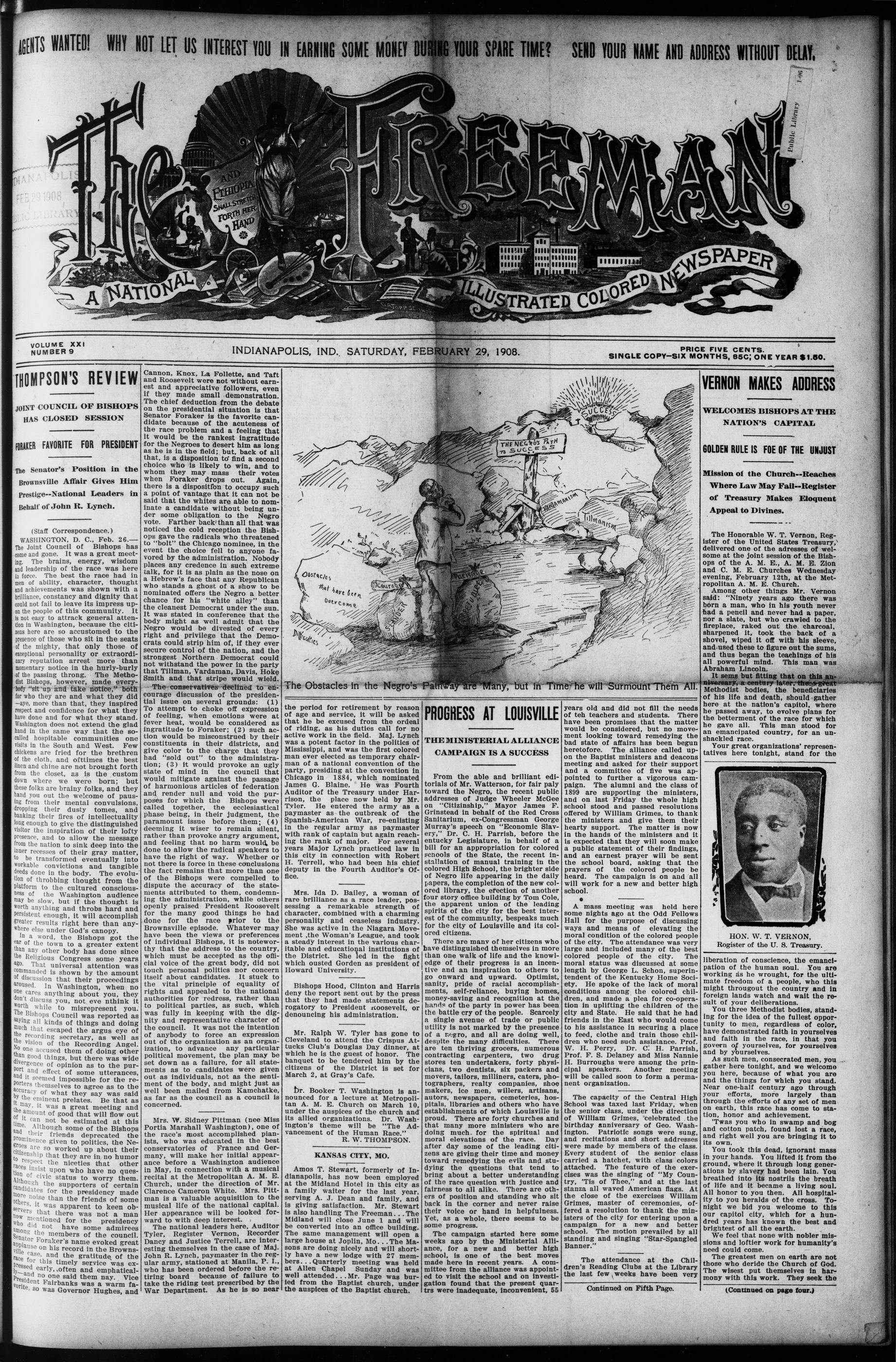
THE NEGRO'S PATH TO SUCCESS
The Obstacles in the Negro's Pathway are Many, but in Time, he will Surmount Them All
Obstacles that have been overcome
Difficulties
the period for retirement by reason of age and service, it will be asked that he be excused from the ordeal of riding, as his duties call for no active work in the field. Maj. Lynch was a potent factor in the politics of Mississippi, and was the first colored man ever elected as temporary chairman of a national convention of the party, presiding at the convention in Chicago in 1884, which nominated James G. Blaine. He was Fourth Auditor of the Treasury under Harrison, the place now held by Mr. Tyler. He entered the army as a paymaster as the outbreak of the Spanish-American War, re-enlisting in the regular army as paymaster with rank of captain but again reaching the rank of major. For several years Major Lynch practiced law in this city in connection with Robert H. Terrell, who had been his chief deputy in the Fourth Auditor's Office.
PROGRESS AT LOUISVILLE
THE MINISTERIAL ALLIANCE CAMPAIGN IS A SUCCESS
From the able and brilliant editorials of Mr. Watterson, for fair pity toward the Negro, the recent public addresses of Judge Wheeler McGee on "Citizenship," Mayor James F. Grinstead in behalf of the Red Cross Sanitarium, ex-Congressman George Murray's speech on "Economic Slavery." Dr. C. H. Parrish, before the entucky Legislature, in behalf of a bill for an appropriation for colored schools of the State, the recent installation of manual training in the colored High School, the brighter side of Negro life appearing in the daily years old and did not fill the needs of ten teachers and students. There have been promises that the matter would be considered, but no movement looking toward remedying the bad state of affairs has been begun heretofore. The alliance called upon the Baptist ministers and deacons meeting and asked for their support and a committee of five was appointed to further a vigorous campaign. The alumni and the class of 1899 are supporting the ministers, and on last Friday the whole high school stood and passed resolutions offered by William Grimes, to thank the ministers and give them their hearty support. The matter is now in the hands of the ministers and it is expected that they will soon make a public statement of their findings, and an earnest prayer will be sent the school board, asking that the prayers of the colored people be heard. The campaign is on and all
Mrs. Ida D. Bailey, a woman of rare brilliance as a race leader, possessing a remarkable strength of character, combined with a charming personality and ceaseless industry. She was active in the Niagara Movement, the Woman's League, and took a steady interest in the various charitable and educational institutions of the District. She led in the fight which ousted Gorden as president of Howard University.
Bishops Hood, Clinton and Harris deny the report sent out by the press that they had made statements derogatory to President Roosevelt, or denouncing his administration.
Mr. Ralph W. Tyler has gone to Cleveland to attend the Crispus Attucks Club's Douglas Day dinner, at which he is the guest of honor. The banquet to be tendered him by the citizens of the District is set for March 2, at Gray's Cafe.
Dr. Booker T. Washington is announced for a lecture at Metropolitan A. M. E. Church on March 10, under the auspices of the church and its allied organizations. Dr. Washington's theme will be "The Advancement of the Human Race."
KANSAS CITY, MO
Amos T. Stewart, formerly of Indianapolis, has now been employed at the Midland Hotel in this city as a family waiter for the last year, serving A. J. Dean and family, and is giving satisfaction. Mr. Stewart is also handling The Freeman. The Midland will close June 1 and will be converted into an office building. The same management will open a large house at Joplin, Mo. The Masons are doing nicely and will shortly have a new lodge with 27 members. Quarterly meeting was held at Allen Chapel Sunday and was well attended. Mr. Page was buried from the Baptist church, under the auspices of the Baptist church.
PROGRESS AT LOUISVILLE
THE MINISTERIAL ALLIANCE CAMPAIGN IS A SUCCESS
From the able and brilliant editorials of Mr. Watterson, for fair pally toward the Negro, the recent public addresses of Judge Wheeler McGee on "Citizenship," Mayor James F. Grinstead in behalf of the Red Cross Sanitarium, ex-Congressman George Murray's speech on "Economic Slavery." Dr. C. H. Parrish, before the entucky Legislature, in behalf of a bill for an appropriation for colored schools of the State, the recent installation of manual training in the colored High School, the brighter side of Negro life appearing in the daily papers, the completion of the new colored library, the erection of another four story office building by Tom Cole, the apparent union of the leading spirits of the city for the best interest of the community, bespeaks much for the city of Louisville and its colored citizens.
There are many of her citizens who have distinguished themselves in more than one walk of life and the knowledge of their progress is an incentive and an inspiration to others to go onward and upward. Optimist, sanity, pride of racial accomplishments, self-reliance, buying homes, money-saving and recognition at the hands of the party in power has been the battle cry of the people. Scarcely a single avenue of trade or public utility is not marked by the presence of a negro, and all are doing well, despite the many difficulties. There are ten thriving grocers, numerous contracting carpenters, two drug stores ten undertakers, forty physicians, two dentists, six packers and movers, tailors, milliners, caters, photographers, realty companies, shoe makers, ice men, willers, artisans, autors, newspapers, cemeteries, hospitals, libraries and others who have establishments of which Louisville is proud. There are forty churches and that many more ministers who are doing much for the spiritual and moral elevations of the race. Day after day some of the leading citizens are giving their time and money toward remedying the evils and studying the questions that tend to bring about a better understanding of the race question with justice and fairness to all alike. There are others of position and standing who sit back in the corner and never raise their voice or hand in helpfulness. Yet, as a whole, there seems to be some progress.
The campaign started here some weeks ago by the Ministerial Alliance, for a new and better high school, is one of the best moves made here in recent years. A committee from the alliance was appointed to visit the school and on investigation found that the present quartz were inadequate, inconvenient. 55
PRICE FIVE CENTS.
SINGLE COPY-SIX MONTHS, 85C; ONE YEAR $1.80.
years old and did not fill the needs of teh teachers and students. There have been promises that the matter would be considered, but no movement looking toward remedying the bad state of affairs has been begun heretofore. The alliance called upon the Baptist ministers and deacons meeting and asked for their support and a committee of five was appointed to further a vigorous campaign. The alumni and the class of 1899 are supporting the ministers, and on last Friday the whole high school stood and passed resolutions offered by William Grimes, to thank the ministers and give them their hearty support. The matter is now in the hands of the ministers and it is expected that they will soon make a public statement of their findings, and an earnest prayer will be sent the school board, asking that the prayers of the colored people be heard. The campaign is on and all will work for a new and better high school.
A mass meeting was held here some nights ago at the Odd Fellows Hall for the purpose of discussing ways and means of elevating the moral condition of the colored people of the city. The attendance was very large and included many of the best colored people of the city. The moral status was discussed at some length by George L. Schon, superintendent of the Kentucky Home Society. He spoke of the lack of moral conditions among the colored children, and made a plea for co-operation in uplifting the children of the city and State. He said that he had friends in the East who would come to his assistance in securing a place to feed, clothe and train those children who need such assistance. Prof. W. H. Perry, Dr. C. H. Parrish, Prof. F. S. Delaney and Miss Nannie H. Burroughs were among the principal speakers. Another meeting will be called soon to form a permanent organization.
The capacity of the Central High School was taxed last Friday, when the senior class, under the direction of William Grimes, celebrated the birthday anniversary of Geo. Washington. Patriotic songs were sung, and recitations and short addresses were made by members of the class. Every student of the senior class carried a hatchet, with class colors attached. The feature of the exercises was the singing of "My Country, 'Tis of Thee," and at the last stanza all waved American flags. At the close of the exercises William Grimes, master of ceremonies, offered a resolution to thank the ministers of the city for entering upon a campaign for a new and better school. The motion prevailed by all standing and singing "Star-Spangled Banner."
The attendance at the Children's Reading Clubs at the Library the last few weeks have been very
Continued on Fifth Page.
VERNON MAKES ADDRESS
WELCOMES BISHOPS AT THE NATION'S CAPITAL
Mission of the Church--Reaches Where Law May Fail--Reglster of Treasury Makes Eloquent Appeal to Divines.
The Honorable W. T. Vernon, Register of the United States Treasury, delivered one of the addresses of welcome at the joint session of the Bishops of the A. M. E., A. M. E. Zlon and C. M. E. Churches Wednesday evening, February 12th, at the Metropolitan A. M. E. Church.
Among other things Mr. Vernon said: "Ninety years ago there was born a man, who in his youth never had a pencil and never had a paper, nor a slate, but who crawled to the fireplace, raked out the charcoal, sharpened it, took the back of a shovel, wiped it off with his sleeve, and used these to figure out the sums, and thus began the teachings of his all powerful mind. This man was Abraham Lincoln.
It seems but fitting that on this anniversary, a century later, these great Methodist bodies, the beneficiaries of his life and death, should gather here at the nation's capitol, where he passed away, to evolve plans for the betterment of the race for which he gave all. This man stood for an emancipated country, for an unshackled race.
Your great organizations' representatives here tonight, stand for the
HON. W. T. VERNON,
Register of the U. S. Treasury.
liberation of conscience, the emancipation of the human soul. You are working as he wrought, for the ultimate freedom of a people, who this might throughout the country and in foreign lands watch and wait the result of your deliberations.
You three Methodist bodies, standing for the idea of the fullest opportunity to men, regardless of color, have demonstrated faith in yourselves and faith in the race, in that you govern of yourselves, for yourselves and by yourselves.
As such men, consecrated men, you gather here tonight, and we welcome you here, because of what you are and the things for which you stand. Near one-half century ago through your efforts, more largely than through the efforts of any set of men on earth, this race has come to station, honor and achievement.
"Twas you who in swamp and bog and cotton patch, found lost a race, and right well you are bringing it to its own.
You took this dead, ignorant mass in your hands. You lifted it from the ground, where it through long generations by slavery had been lain. You breathed into its nostrils the breath of life and it became a living soul. All honor to you then. All hospitality to you heralds of the cross.
Tonight we bid you welcome to this our capitol city, which for a hundred years has known the best and brightest of all the earth.
We feel that none with nobler missions and loftier work for humanity's need could come.
The greatest men on earth are not those who deride the Church of God. The wisest put themselves in harmony with this work. They seek the
(Continued on page four.)
IN THE WOMAN'S WORLD.
BY "DOROTHY"
This column is devoted to the interests of all women and their organizations also. Address all communications to Dorothy, The Freeman Indianapolis, Ind.
By Richard P. Davis.
Some people seek pleasures,
And some people seek wealth;
Then some are seeking hidden treasures.
And others are seeking health.
We find all of this in our daily course of life,
Whatever thing you may be seeking
Will cause you toil and strife.
Some of the seekers are seeking knowledge,
Which is a great and useful thing,
While the treasure seekers are striving
A fortune home to bring.
But hold a moment, my eager seekers,
Stop for a while and think
That there are greater things for you to seek
Before you get too near the eternal brink.
You seek the Heavenly Father's love,
For that is the greatest home of them all,
With Him who reigns in Heaven above.
BACHELORS SUCCUMBING
TO LEAP YEAR GIRLS.
The leap year girl will seemingly cause the disbandment of the Loganport Bachelor Club, which has been in existence for the last six years. It started with a membership of thirty young men who were eligible to marry, but who preferred a life of single blessedness rather than be the "meal ticket" for some designing girl. The membership on January 1, 1908, was twenty-five. Today it is only twenty.
Since New Year's day, the first day that girls were permitted to use the preagrative that leap year gives them, five members have taken withdrawal cards from the club, and have either become benedicts or will be married. The president of the club recently asked for a withdrawal card and tendered his resignation, stating that he was going to Laura, Ill., to accept a position. Asked whether he is going to marry, he laughingly evaded the question, but stated that he is prepared to give the banquet which each member must give on leaving the club to get married. Another who resigned was Alford Guthrie, who has capitulated to the charms of a pretty Logansport girl and will soon apply for a marriage license.
The Ten O'Clock Club.
Bachelor clubs have sprung up in almost every small town, but as a rule they are organized in a spirit of fun and their life is short. The Logansport club, however, is no joke. It has been in existence for six years and successfully weathered one leap year, but seemingly it is about to be disrupted. It was organized at the time the "Ten O'Clock Club" came into existence. This club was an organization of girls formed by a young stenographer, who has since gone on the stage. Members permitted their male escorts to remain only until 10 o'clock. When the clock on the mantel struck the hour of 10, the Ten O'Clock Club girl said: "Here's your hat; what's your hurry?" and escorted her friend to the door. Failure to do this meant a fine and dismissal from the club, The Ten O'Clock Club started here and it was a short time until similar clubs sprang up in almost every small city in the country.
Organized in Retaliation
Organized in Retention.
Logansport youths tired of this 10 o'clock stunt, and retaliatory measures were planned. They decided that they would not call at all, and so thirty of them formed the Logansport Bachelor Club. Rooms were obtained and rules were adopted. Members caught going three times with the same girl were fined. The Ten O'Clock Club long ago passed out of existence and if the remaining members of the Bachelor Club do not resist the smiles and advances of the 1908 leap year girl better than the others have done, the Bachelor Club will soon be only a memory.
THE KANSAS CLUBS.
The regular parents' meeting at Topeka, Kans., was held last week at the kindergarten rooms. Mrs. Fred Roundtree read a very able paper on "The Power of Example in the Home," which was well discussed.
The Fleurdeles Club at Topeka, Kans., held its regular meeting last week with Mrs. Floyd, 325 Taylor street. The topic for discussion was "How to Educate Negroes to Patronize Race Enterprises."
The Sierra Leone Club at Lawrence met with Mrs. J. H. Young. The address was made by Rev. J. M. Brown, subject "Woman's Opportunity."
SPONSORS FORM A SOCIETY.
Women Who Named War Vessels in New National Organization.
The Society of Sponsors for the United States Navy was formally organized at Washington by the adoption of a constitution and by laws and the election of officers. The society, as its name indicates, is composed of woman who have acted as sponsors for American warships. The following officers were elected: President, Miss Mary Campbell, of Birmingham u. Ala.; first vice president, Miss Annie eith Frazier, daughter of Senator Frazier of Tennessee; second vice president, Miss Minnie Conrad, of Montana; secretary, Mrs. John G. South, of Frankfort, Ky.
2
daughter of former Governor Bradley, and treasurer, Miss Ida May Schieren, of Minnesota. The principal objects of the society are to engage in benevolent work and to take an interest in the development of the navy. Washington was selected as the permanent meeting place of the society, and annual sessions will be held in January or February. Last week the sponsors attended the army and navy reception at the White House.
A COMPLETE EDUCATION.
A girl's education is most incomplete unless she has learned:
To sew.
To cook.
To mend.
To be gentle.
To value time.
To dress neatly.
To keep a secret.
To avoid idleness.
To be self-reliant.
To darn stockings.
To respect old age.
To make good bread.
To keep a house tidy.
To be above gossiping.
To make home happy.
To control her temper.
To take care of the sick.
To take care of the baby.
To sweep down cobwebs.
To marry a man for his worth.
To read the very best of books.
To take plenty of active exercise.
To be a helpmate to her husband.
To keep clear of trashy literature.
To be light-heated and fleet-footed.
To be a womanly woman under all circumstances.
DOING THINGS WELL.
This duty of doing one's proper work well, and taking care that every product of one's labor shall be genuinely what it pretends to be, is not only left out of morals in popular speech, it is very little insisted on by public teachers, at least in the only effective way — by tracing the continuous effects of ill-done work.
PROPER LENGTH OF SLEEVES
No woman with a liking for short sleeves need feel troubled lest long sleeves are to usurp the field next season. More long sleeves are being made for many a day, but short ones are also popular and are coming in the handsomest gowns of all classes except strict tailor-mades. The spring and summer traveling suit will have long sleeves, as it should always have had, but the other summer run-around and house frocks will be in order with short ones.
HER COLLARS DO NOT TEAR.
One bright woman has solved that problem which vexes every feminine who pins her linen collar across the front. The objection to this trim and highly approved finish is that hand-embroidered collars are not cast iron, and pins that will not tear a tauntly-stretched and starched collar have not been invented.
Upon removing a new collar and perceiving it pierced with holes, she buttonholed these rents into ornamental eyelets. Now she avers that her collar no longer tears, and, moreover, that it is pinned straight with much less vexation of soul than hitherto.
META WARRICK, SCULPTRESS.
Miss Warrick is the sculptress of the group at the Jamestown Exposition depicting the progress and development of the Negro race since the first Negroes were landed at Jamestown in 1619. This group has been highly praised, though it was executed with such haste that it can hardly be fairly compared with her other works. She has had the distinguished honor of two examples of her work in the Paris Salon in one year. She delights in the horrible, the tragic and the grotesque. As a student her best piece was a head of Medusa, and among her most famous pieces is "The Thief on the Cross." She has not yet attempted a bust of Senator Tillman or the Rev. Thos. Dixon.
KAISER AFRAID OF CATS.
"The Kaiser's departure from England did not cause Queen Alexandra and her daughters to shed tears, of that I'm very sure," said an English woman who is spending the winter in New York. "You know the Queen and her daughters
SEEKING.
are immensely fond of cats. All during the visit of the German Emperor every one of their pets had to be banished from Windsor Castle. The Kaiser is as much afraid of cats as the average woman is of a mouse. He has a most painful antipathy for the entire feline race. One small kitten within a mile of him is enough to upset his nerves. Therefore all the mousers and all the Queen's adorable fluffy Persians had to be gathered up and placed in other quarters until the end of the imperial visit."
The Mite Missionary Society at Leavenworth holds their meetings every Monday afternoon.
Miss Nannie H. Burroughs delivered an address at the First Baptist Church at Danville, Ky., last week.
posted on the Negro doings by reading The Freeman. Five cents per copy. G. Washington Bruce, agent, 153 Alken street, Waxahachee, Tex.
BERNICK, LA.
The new hall of the St. John Lodge No. 11, F. and A. M., of Morgan City, La., was dedicated by the Queen of the West Chapter No. 7, Order of Eastern Star, Monday night, February 17, 1908, and it is one of the finest colored halls in St. Mary parish. There was a large crowd in attendance. Dainty refreshments were served by the ladies of the chapter. Committee on arrangements: Mrs. Gertrude Batiste, Misses Maggie E. Ryan, Orphea Hines, Lizetta Mills, Rebecca McGee, Bertha Kyles, Comora Harris, Messrs. Oliver Ryan, Sumpter Williams, Carter White,
Rev. Lena Mason, the well-known evangelist, is holding a series of meetings at Philadelphia. Over 500 converts has been the result of her labors.
Mrs. B. B. Craig, late of Prairie View State Normal College, Texas, delivered an address before the Omaha Historical Associatoin at St. John's A. M. E. Church at Omaha Feb. 18. Her subject was "Domestic Science and Art as a New Calling for Women."
The Rescue Home in connection with the Guild is opened at the cottage west of the Guild, 878 Colton street, Indianapolis. The management will be glad to receive anything one may wish to give. Aid us in making the home comfortable.
The sufferer from casual indigestion will often find relief from allowing a charcoal tablet to dissolve slowly in the mouth. If after a heavy dinner a pinch of salt is placed on the tongue and kept there until it is entirely dissolved, no discomforts will be felt from overeating.
The Woman's Trade Union League of Chicago supplies medical consultation and advice to working girls who are members of trade unions for 10 cents a year. The league has announced the appointment of Dr. Rachel S. Karros of Hull House as its staff physician. Dr. Karros has set aside portions of three days in each week for these consultations and will give special attention to diseases which are the result of occupations followed by women.
Very often the fashionable ladies of Turkey have their costumes made like an elaborate opera cloak, and wear veils that are nothing more than transparent net. When they reach this extreme and they are seen by the dreaded spy, these ladies are reported to the Sultan. At once an order is issued that no one is to wear anything but the old-fashioned "Terlja," and a veil through which the face can not be discerned. This order is obeyed for about a year, when, by degrees, they begin wearing thinner veils—London Telegraph.
Please allow me space in your valuable paper to give the readers of The Freeman an inkling of our little city of about 3,000 inhabitants and seven flourishing churches and a school that employs four teachers, which verifies the fact that divine and intelligent light goes almost parallel. But the thing that interests the people of my town and county most at this time is to impress upon the minds of our people as a whole the importance of having their names placed upon the registration book that they might be able to help defeat the ratification of Governor Hoke Smith's disfranchisement bill, which will destroy, if passed, 75 per cent of the legal voters of Georgia, but with such men leading the van as Hon. J. M. Barnes, W. H. Johnson, B. J. Davis, and with such intelligent divines as Bishop Turner and W. J. White we hope to give the disfranchisement scheme such a blow until it will be settled once for all time.
The question of our manhood rights and in the language of him who nerved the thirteen colonies to strike a blow for liberty, we won't have to fight our battle alone, but with such eminent men as Judge Emory Speer on the bench of the United States court appealing to the public conscience as did His Honor during the session of the United States court in the city of Augusta, who say in part that he was aware of the progress the colored people had made since the days of reconstruction, which verifies the fact of their habits of thrift and industry, and any people who have made the progress the colored race has made should not only be encouraged in every way possible by the white man but they should enjoy every right guaranteed by the constitution of these United States, and with such men as Judge Speer and W. H. Fleming, our ex-Congressman, championing the cause of right and justice, we have only to do our duty and leave the results with God.
J. S. THOMAS.
WAXAHACHEE, TEX.
The banquet that was to be given by the Daughters of Tabor last Saturday night was postponed on account of the weather...T. H. Henderson is one of our leading farmers of Ellis county. He owns about 250 acres of valuable land worth about $80.00 per acre...Rev. Berison, P. E., of the C. M. E. Church, held his first quarterly conference here this week...Will Fowler says The Freeman is the paper for him. Mr. Lillard Porter also...The fire last Sunday night destroyed the Negro skating rink. The fire also slightly damaged the property of Francis Drake, which is located near the rink...Mrs. Lucrecia McNeise of Little Rock is in the city visiting her sister, Mrs. Lee Richardson, on Coats street...You should read The Freeman each week...Mrs. Martha Beager is in Dallas for a while...Bill Bailey spent a few days in Ft. Worth and Dallas last week...Clide Henderson is on the sick list...Read and keep
posted on the Negro doings by reading The Freeman. Five cents per copy. G. Washington Bruce, agent, 129 Alken street, Waxahache, Tex.
BERNICK. LA.
The new hall of the St. John Lodge No. 11, F. and A. M., of Morgan City, La., was dedicated by the Queen of the West Chapter No. 7, Order of Eastern Star, Monday night, February 17, 1908, and it is one of the finest colored halls in St. Mary parish. There was a large crowd in attendance. Dainty refreshments were served by the ladies of the chapter. Committee on arrangements: Mrs. Gerritude Batiste, Misses Maggie E. Ryan, Orphea Hines, Lizetta Mills, Rebecca McGee, Bertha Kyles, Comora Harris, Messrs. Oliver Ryan, Sumpter Williams, Carter White, James Kyles, Mrs. M. Roberson, secretary, Mrs. E. Mills, treasurer, Mrs. J. Ducy, W. M., Mr. J. Thomas, W. P.
For The Freeman each week see Joe W. Ryan, and secure a copy.
INDIANA'S Best and Most Modern Dyeing and Clean ing Establishment.
218 N. ILLINOIS ST.
and 205 INDIANA AVE.
Phone New. 2532; Old main 3888
PRESSING PARLOR.
134 West Market Street.
PURITAN LAUNDRY
Newest and Best
First-Class Colored Help
Always Wanted.
526 Indiana Ave. New Phone 3894.
SCHWANKHAUS PHARMACY,
CUT PRICE DRUGGIST,
and prescription specialist. Bottom prices on
all soaps, toilet articles, cigars and candies.
Special agents for Palmer's Skin. Success
Soap, Ointment and Blood Success. 19c
Our Cough Cure, guaranteed to cure, per
bottle, only. 19c
Our Witch Hazel Jelly. 15c
Our Oat Tablet, guaranteed to cure, per
box. 18c
Wines and Liquors for medicinal uses.
Our fountain always open with hot and cold
drinks.
OLD, MAIN.
716 Call Phones NEW.
817
We deliver promptly to all parts of the city
ILINOIS and ST. CLAIR STS.
FUNERAL DIRECTORS.
A. H. H.
G. W. Frierson & Co., from Nashville, Tenn., have opened a Funeral Parlor 632 Indiana Avenue, between California and West Streets. Polite attention and prompt service. Calls answered day and night Lady Attendant. Are
now at your service. Prices below all competitors. Fifteen years in Nashville; ten years in Louisville Ky. Phone 3227.
PAWNBROKER.
We loan money on
DIAMONDS,
WATCHES,
JEWELRY
and all articles of value at lowest rates.
Ertel's Loan Office,
209 Massachusetts Avenue, Private
office 108 E Ohio Street.
New Phone 1790
EVERY LADY READ THIS.
Years ago, when I was a sufferer, an old nurse told me of a wonderful care for Leurcorhea, Displacement, Painful Periods, Uterine and Ovarian troubles. It cured me in one month. It is a simple, harmless lotion that can be prepared by any one having the recipe. I will send it FREE to every suffering sister who writes to me. I have nothing to sell. This is a case of woman helping woman. I send it FREE. Address Mrs. A. B. Hudnur, South Bend, Ind.
MRS. WRITTEN,
Millinery
Special sale all next week of
Tailored and Dress Hats.
We also do exclusive
ORDER WORK.
Give us a call; we will convince you; our time is entirely yours.
TAYLOR'S ELECTRIC COMB!
Made of Solid Brass, highly polished and fully nickel plated. Retains heat much longer than cast iron. It is indeed the handiest and simplest straightener ever introduced to the people.
Sent postpaid on receipt of 50c.
HAIR SWITCHES
Bangs and Wigs of
every description. Most complete line of hair
foods in this country for colored people. Send
transfer catalogue. T.W. TAYLOR, Howell, Mitch.
JAS. N. SHELTON. LUCAS B WILLIS
Phones—New 3056.
Old, Martin, 4694.
Shelton & Willis,
(Licensed Embalmers)
FUNERAL DIRECTORS
AND EMBALMERS
Best Service. Lady Attendant.
Lowest Prices.
418 Indiana Ave. Open all Night.
FORD'S HAIR POMADE
MARR.
I used only one bottle of your perfume and my hair has stopped breaking off and has greatly improved. I will prepare my hair was seven inches long and my preparation my hair was more or less. Big Southern St.
MINNIE FOASTER.
West Chester Pa., Mch. 30, 783
I had typhoid my hair all mine
I used three bottles of water, one now and now
hair is nine inches long and very nice
straight. Most one seeing they too are
good for it. My hair is an exam and every one
Yours respectfully.
Brookhaven, Miss., Aug. 13, 1888.
Gentleman: I must confess I never tried any preparation so excellent for the hair. My hair was turning gray and was rather deadly but since I have been using your hair pomade my hair has turned black like it was when I was a girl and it has a liveliness. C. L. ROBERTS.
```markdown
```
Gentlemen: I have used your pomade and have found it to do more than it is recommended do. It stops the hair from falling out and breaking off, and cleans the scalp and makes the soft, pliable and glossy.
I have seen the original letters and testify to the genuineness of the statements.
ELWOOD C. KNOX, Manager, The Freeman.
FORD'S HAIR POMADE, formerly known as "OZONIZED OX MARROW." is straightenkly Hair or Curly Hair that it can be put up in any style design, consistent with the only safe preparation known to us that makes Kinky Hair Straight, and the most stubborn, harsh Kinky Hair Straight, the most stiff, hard, harsh, curly hair soft, pliable and easy to comb. These are retained from the treatment; 2 to 4 bottles are usually sufficient for a year. The use of Ford's Hair Pomade removes and prevents dandruff, relieves itching, invigorates the skin, gives the hair from hairfall, helps to nourish the roots, gives the life and vigor. Being elegantly perfumed and harmless, the toilet necessary for a gentleman and children. Ford's Hair POMADE, formerly known as "OZONIZED OX Marrow has been made and sold continuously since about 1888, and the patent office in 1874. Be sure to use Ford's, as its use makes the hair STRAIGHT. Ford's, as its use makes the hair STRAIGHT, is put up only in Chicago and by us. The genuine has the signature, Charles Ford, and is made only in Chicago and by us. The genuine has the signature, Charles Ford, and is made only in Chicago and by us. You will find full directions with every bottle. Price only 85¢ for each bottle. You can supply you, he can get it for drummers and dealers, or send us 50¢, or $1.40 three bottles, or $2.50 for six bottles, express paid. We pay postage and express charges to all points in U. S. A. When ordering postal or express money order, and mention name of this paper. Write your name and address plainly to
THE OZONIZED OX MARROW CO.
153 E. Kinzie St., Chicago, Ill.
(None genuine without my signature. Agents Wanted everywhere.)
ALL GOODS SOLD BY
PINK'S Cut Rate Pharmacy
Comply in every way with the
PURE FOOD LAW.
We Lead, Others Try to Follow.
PINK'S PHARMACY,
550 Indiana Ave., Southeast Corner West Street.
ALL GOODS SOLD BY PINK'S Cut Rate Pharmacy Comply in every way with the PURE FOOD LAW. We Lead, Others Try to Follow. PINK'S PHARMACY, 550 Indiana Ave., Southeast Corner West Street.
New Phone 16114, K.
New Phone 16114, K.
Old Phone, Main, 1248
We Want Your Trade.
Indiana Laundry Company
Pressing and Work
A SPECIALTY.
EUGENE ARNOLD, Solicitor. 2922 Northwestern Avenue
CIGAR BANDS AS PREMIUMS.
For a limited time we will give 25 beautiful cigar bands with each purchase
25c or more. Now is the time to get handsome decorations without cost. We
also have a nice line of dishes for mounting them. Our line of Drugs, Sundries
and Toilet Articles is large and select. Trade with us and you will not regret it.
McKee's Medical Hall Pharmacy,
For a limited time we will give 25 beautiful cigar bands with each purchase 25c or more. Now is the time to get handsome decorations without cost. We also have a nice line of dishes for mounting them. Our line of Drugs, Sundries and Toilet Articles is large and select. Trade with us and you will not regret McKee's Medical Hall Pharmacy, In the Shiel Block. Illinois Street and Indiana Avenue
The Original Hair Growers.
MRS A. M. POPE MRS. L. L. ROBERTS.
We Grew Our Hair
Now Let us Grow
Yours With
When we first began our wonderful work of growing our hands, in lengths, and all conditions of hair, even to the growing of hair on bald pieces of the skin, we had the idea that such a thing was possible; but we never had hundreds, rapidly schicken success. The proof of the value of our work is that we can grow hair.
4 years ago my hair just covered my shoulders.
have grown the hair for
hundreds, rapidly achieve
ing success. The proficiency of the
value of our work is that
we are being imitated and
argely by persons whose own hair we have actually grown and the further fact that they
have very frequently mentioned us when trying to sell their goods (saying that "the hairs are
same" or "just as good.") or refer to "PORO." We advise you to use only "PORO."
Grower, the oldest and best of its kind) See that the name "PORO" is on every box of
genuine without it. Prepared only by MRS. A. M. POPE. BEWARE OF IMITI
IONS, Call, or Address Mail to
MRS. A. M. POPE-TURNBO,
2223 MARKET ST. ST. LOUIS MO.
BELL PHONE, BOMONT 3109.
is largely by persons whose own hair we have actually grown and the further fact that they have very frequently mentioned in when trying to sell their goods (saying that those who have had their hair cut by a professional hair grower, the oldest and best of its kind) See that the name "PORO" is on every best genuine without it. Prepared only by MRS. A. M. POPE, BEWARE OF IMITIONS. Call, or Address Mall to MRS. A. M. POPE-TURNBO, MARKET ST. ST. LOUIS NO. BELL PHONE BOMONT 3109
GREATEST Protective and Beneficial Order ever started. Over 50,000 members, men and women. Helps EQUAL OPPORTUNITIES for less to and IMPROVED CONDITIONS generally. NO RACE DISCIMINATION. At death; $25 to each male member; wife's death; $10 at child's; OTHER BENEFITS. Membership to all laboring people alike. DEFENSE MEN AND WOMEN DEFENSE MEN AND WOMEN LOCALITY Work after hours. LIBERAL PAND PLEASANT WORK. Write once for full particulars, enclosing for postage. I-L-U GRAND LOCK. I-L-U BLDG., DAYTON, OH
at prices below competition. Will be pleased to show you the selection.
The Eureka Com
It is an assured feet that there is now on the market, a COMB, Scientifically Made of Hematite and Highly Polished Metals. Copper Bands are associated together, conducts an infinitive coercive scab and hair. A phenomena. It works well in ablution, bringing the scum straight and in appearance, causing a rapid growth, a benefit cure for dandruff, stopping the falling, making natural straight hair straight, and gives in appearance. The best dryer. No other metals so suitable for the Brass and Copper are friendly to EUREKA COMB Guaranteed. Why may you complete $1.50, by P. O. or Express Money to EUREKA COMB CO., Chattanooga, Tenn.
BLOOD,
---
Don't Wear A Truss
Brooks' Appliance is a new scientific air coupons that draws the broken parts together and binds them as you would a broken limb. It absolutely holds firmly and comfortably and never always light and cool and conforms to every movement of the body without chasing or hurting. I make
Brooks' Appliance is a smart, automatic discovery with automatic fons that draws the broken parts together and binds them as you would a broken limb. It absolutely holds firmly and comfortably and hard, always light and cool and conforms to every movement of the body without chating or hurting. I make your measure and send it to you on a strict guarantee of satisfaction. I don't that anybody, rich or poor, can wear it—and if it doesn't satisfy you, you back it to you. I will refund your money, make it or any response, and if you want it I do business—always aboundable way for the past five years. Remember, you save, no harms, no lies, no fakes. I just have straight business deal at a reasonable price.
8527 Brooks Bldg., Marshall, Mich.
In Defense of the Race.
BY PROF. KELLY MILLER,
Howard University, Washington, D.C.
1 "As to the Leopard's Spots,
open letter to Thomas Dixon.)
Price 10 cents each, the three for a quarter. Circulation over sixty thousand. Agents wanted. Commission 10 per copy. Address the author.
Hadley Bros.,
DRUGGISTS.
755-757 Indiana Avenue.
Near St. Clair St. Indianapolis.
$3.00 16x19
LIFESIZE.PORTRAIT FREE.
writes our work. All we ask of you is to
attempt to hang it up, so your neigh-
ers can see it. A limited number made only.
indianapolis Portrait Co.,
(Incorporated.)
900% MASSACHUSETTS AVE.
839% MASSACHUSETTS AVE.
H. L. Sanders,
Established 1889.
Heade
Wai
Cook
Bark
Den
Headquarters for Waiters and Cooks' Jackets, Barber Coats, Dentists' Office
Store 206 Indiana Ave.
NEW PHONE 2561.
Cut Rate Grocery
And Meat Market. A fine line of fresh fruit, vegetables, groceries, meats, oysters, fish and game. Poultry dressed while you wait.
J. B. DOOLITTLE,
M Phone. 754 Indiana Ave
The Fighting Chance.
By ROBERT W. CHAMBERS.
Copyright, 1908, by the Curtis Publishing Company.
Copyright, 1908, by Robert W. Chambers.
[CONTINUED.]
CHAPTER FOUR
BREAKFAST at Shotover, except
for the luxurious sluggards to
whom trays were sent, was
served in the English fashion,
any other method or compromise being
impossible.
Ferrall appeared to be a normal man, energetically devoted to his business, his pleasures, his friends and comfortably in love with his wife. And if some considered his vigor in business to be lacking in mercy, that vigor was always exercised within the law. He never transgressed the rules of war, but his headlong energy sometimes inked him close to the dead line. He had already breakfasted when the earliest risers entered the morning room to saunter about the sideboards and investigate the simmering contents of silver covered dishes on the warmers.
The fragrance of coffee was pleasantly perceptible. Men in conventional shooting attire roamed about the room, selected what they cared for and carried it to the table. Mrs. Mortimer was there consuming peaches that matched her complexion. Marion Page, always more congruent in field costume and belted jacket than in anything else, and always, like her own hunters, minutely groomed, was preparing a breakfast for her own consumption with the leisurely precision characteristic of her whether in the saddle, on the box or grassing her grace of any covey that ever flushed. Captain Voucher and Lord Alderden discussed prospects between bites, at-
tentive to the monosyllabic opinions of Miss Page. Her twin brothers, Gordon and Willis, shyly consuming catmeal, listened respectfully and waited on their sister at the slightest lifting of her thinly arched eyebrows. Into this company sauntered Slward apparently no worse for wear, for as yet the enemy had set upon him no proprietary insignia save a rather becoming pallor and faint bluish shadows under the eyes. He strolled about, exchanging amiable greetings, and presently selected a chilled grape fruit as his breakfast. Oppose him Mortimer, breakfasting upon his own dreadful bracer of an apple soaked in port, raised his heavy inflamed eyes with a significant leer at the ice grape fruit. Slward glanced out through the leaded casements into the brilliant September sunshine.
Outside he could see Major Belwether, pink skinned, snowy chop whiskers brushed rabbit fashion, very voluble with Sylvia Landis, who listened absently, head partly averted. Quarrier in tweeds and galters, his morning elgar delicately balanced in his gloved fingers, strolled near enough to be within earshot, and when Sylvia's inattention to Major Belwether's observations became marked to the verge of rudeness he came forward and spoke. But whatever it was that he said appeared to change her passive inattention to quiet displeasure, for, as Slward rose from the table, he saw her turn on her heel and walk slowly toward a group of dogs presided over by some kennel men and gamekeepers,
She was talking to the head gamekeeper when he emerged, from the
from the house, but she saw him on the terrace and gave him a bright of greeting, so close to an invitation that he descended the stone steps and crossed the dew lawn.
WILL WOKE
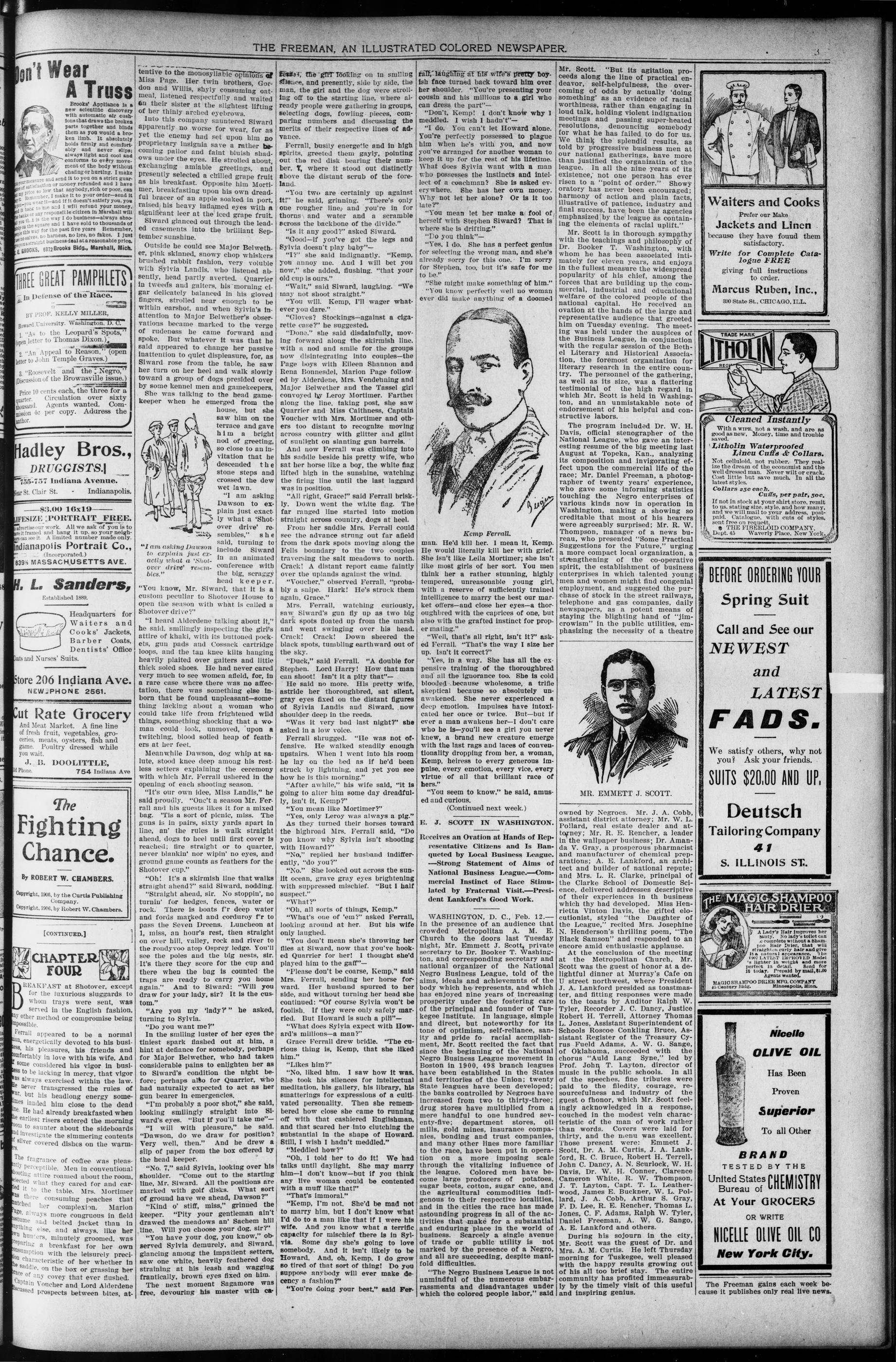
"I am asking Dawson to explain just exactly what a 'Shot-over drive' resembles," she said, turning to include Sivard in an animated conference with the big, scraggly head keeper.
"I am asking Dawson to explain just exactly what a 'Shotover drive' resembles."
sad, turning to include Sieward in an animated conference with the big, scraggly head keeper.
"You know, Mr. Sieward, that it is a custom peculiar to Shotover House to open the season with what is called a Shotover drive"
"I heard Alderdene talking about it," he said, smilingly inspecting the girl's attire of khaki, with its buttoned pockets, gun pads and Cossack cartridge loops, and the tan knee kilts hanging heavily plaited over gaiters and little thick soled shoes. He had never cared very much to see women afield, for, in a rare case where there was no affection, there was something else inborn that he found unpleasant—something lacking about a woman who could take life from frightened wild things, something shocking that a woman could look, unmoved, upon a twitching, blood solled heap of feathers at her feet.
Meanwhile Dawson, dog whip at salute, stood knee deep among his restless setters explaining the ceremony with which Mr. Ferrall ushered in the opening of each shooting season.
"It's our own idea, Miss Landis," he said proudly. "Onc't a season Mr. Ferrall and his guests like it for a mixed bag. "Tis a sort of picnic, miss. The guns is in pairs, sixty yards apart in line, an' the rules is walk straight ahead, dogs to heel until first cover is reached; fire straight or to quarter, never blankin' nor wipin' no eyes, and ground game counts as feathers for the Shotover cup."
"Oh! It's a skirmish line that walks straight ahead?" said Siward, nodding. "Straight ahead, sir. No stoppin', no turnin' for hedges, fences, water or rock. There is boats fr deep water and fords marked and corduroy fr to pass the Seven Dreens. Luncheon at 1, miss, an hour's rest, then straight on over hill, valley, rock and river to the rondyvoo atop Osprey ledge. You'll see the poles and the big nests, sir. It's there they score for the cup and there when the bag is counted the traps are ready to carry you home again." And to Siward: "Will you draw for your lady, sir? It is the custom."
"Are you my lady?' he asked, turning to Sylvia.
"Do you want me?"
In the smiling luster of her eyes the tiniest spark fushed out at him, a hint at defiance for somebody, perhaps for Major Belwether, who had taken considerable pains to enlighten her as to Slward's condition the night before; perhaps also for Quarrier, who had naturally expected to act as her gun bearer in emergencies.
"I'm probably a poor shot," she said, looking smilingly straight into Slward's eyes. "But if you'll take me"
"No. 7," said Sylvia, looking over his shoulder. "Come out to the starting line, Mr. Siward. All the positions are marked with golf disks. What sort of ground have we ahead, Dawson?" "Kind o' stiff, miss," grinned the keeper. "Pity your gentleman ain't drawn the meadows an' Sachem hill line. Will you choose your dog, sir?" "You have your dog, you know," observed Sylvia demurely, and Siward, glancing among the impatient setters, saw one white, heavily feathered dog strraining at his leash and wagging frantically, brown eyes fixed on him. The next moment Sagamore was free decoupling his master with ca
THE FREEMAN. AN ILLUSTRATED COLORED NEWSPAPER
Easter, the girl looking on in smiling silence, and presently, side by side, the man, the girl and the dog were strolling off to the starting line, where already people were gathering in groups, selecting dogs, fowling pieces, comparing numbers and discussing the merits of their respective lines of advance.
Ferrall, busily energetic and in high spirits, greeted them gaily, pointing out the red disk bearing their number, where it stood out distinctly above the distant scrub of the foreland.
"You two are certainly up against it!" he said, grinning. "There's only one rougher line, and you're in for thorns, and water and a scramble across the backbone of the divide."
"Is it any good?" asked Siward.
"Good- if you've got the legs and Sylvia doesn't play baby"—
"IY" she said indignantly. "Kemp, you annoy me. And I will bet you now," she added, flushing. "that your old cup is ours." "Walt," said Siward, laughing. "We may not shoot straight."
"You will. Kemp, I'll wager whatever you dare."
"Gloves? Stockings—against a cigarette case?" he suggested.
"Done." she said disdainfully, moving forward along the skimnish line, with a nod and smile for the groups now disintegrating into couples—the Page boys with Eileen Shannon and Rena Bonnesdel, Marion Page followed by Alderdene, Mrs. Vendeneing and Major Belwether and the Tassel girl conveyed by Leroy Mortimer. Farther along the line, taking post, she saw Quarrier and Miss Calthness, Captain Voucher with Mrs. Mortimer and others too distant to recognize moving across country with glitter and glint of sunlight on slanting gun barrels.
And now Ferrall was climbing into his saddle beside his pretty wife, who sat her horse like a boy, the white flag lifted high in the sunshine, watching the firing line until the last laggard was in position.
"All right, Grace!" said Ferrall briskly. Down went the white flag. The far ranged line started into motion straight across country, dogs at heel. From her saddle Mrs. Ferrall could see the advance strung out far afield from the dark spots moving along the Fells boundary to the two couples traversing the salt meadows to north. Crack! A distant report came faintly over the uplands against the wind. "Voucher," observed Ferrall, "probably a snipe. Hark! He's struck them again, Grace." Mrs. Ferrall, watching curiously, saw Siward's gun fly up as two big dark spots floated up from the marsh and went swinging over his head. Crack! Crack! Down sheered the black spots, tumbling earthward out of the sky. "Duck," said Ferrall. "A double for Stephen. Lord Harry! How that man can shoot! Isn't it a city that?"—
He said no more. His pretty wife, astride her thoroughbred, sat silent, gray eyes fixed on the distant figures of Sylvia Landis and Siward, now shoulder deep in the reeds.
"Was it very bad last night?" she asked in a low voice.
Ferrall shrugged. "He was not offensive. He walked steadily enough upstairs. When I went into his room he lay on the bed as if he'd been struck by lightning, and yet you see how he is this morning."
"After awhile," his wife said, "it is going to alter him some day dreadfully, isn't it, Kemp?"
"You mean like Mortimer?"
"Yes, only Leroy was always a pig."
As they turned their horses toward the highroad Mrs. Ferrall said, "Do you know why Sylvia isn't shooting with Howard?"
"No," replied her husband indifferently, "do you?"
"No." She looked out across the sunlit ocean, grave gray eyes brightening with suppressed mischief. "But I half suspect."
"What?"
"Oh, all sorts of things, Kemp."
"What's one of 'em?" asked Ferrall, looking around at her. But his wife only laughed.
"You don't mean she's throwing her files at Siward, now that you've hooked Quarrier for her! I thought she'd played him to the gaff"
"Please don't be coarse, Kemp," said Mrs. Ferrall, sending her horse forward. Her husband spurred to her side, and without turning her head she continued: "Of course Sylvia won't be foolish. If they were only safely married. But Howard is such a pill"
"What does Sylvia expect with Howard's millions—a man?"
Grace Ferrall drew bridle. "The curious thing is, Kemp, that she liked him."
"Likes him?"
"No, liked him. I saw how it was. She took his silences for intellectual meditation, his gallery, his library, his smatterings for expressions of a cultivated personality. Then she remembered how close she came to running off with that cashiered Englishman, and that scared her into clutching the substantial in the shape of Howard. Still, I wish I hadn't meddled."
"Medded how?"
"Oh, I told her to do it! We had talks until daylight. She may marry him—I don't know—but if you think any live woman could be contented with a muff like that!"
"That's immoral."
"Kemp, I'm not. She'd be mad not to marry him, but I don't know what I'd do to a man like that if I were his wife. And you know what a terrific capacity for mischief there is in Sylvia. Some day she's going to love somebody. And it isn't likely to be Howard. And, oh, Kemp, I do grow so tired of that sort of thing! Do you suppose anybody will ever make decency a fashion?"
"You're doing your best," said Fer-
talk, laughing at his wife's pretty boyish face turned back toward him over her shoulder. "You're presenting your cousin and his millions to a girl who can dress the part"—
"Don't, Kemp! I don't know why I maddled. I wish I hadn't"—
"I do. You can't let Howard alone. You're perfectly possessed to plague him when he's with you, and now you've arranged for another woman to keep it up for the rest of his lifetime. What does Sylvia want with a man who possesses the instincts and intellect of a coachman? She is asked everywhere. She has her own money. Why not let her alone? Or is it too late?"
"You mean let her make a fool of herself with Stephen Silward? That is where she is drifting."
"Do you think?"—
"Yes, I do. She has a perfect genius for selecting the wrong man, and she's already sorry for this one. I'm sorry for Stephen, too, but it's safe for me to be."
"She might make something of him."
"You know perfectly well no woman ever did make anything of a doomed
Bergin
Kemp Ferrall.
man. He'd kill her. I mean it, Kemp.
He would literally kill her with grief.
She isn't like Leila Mortimer; she isn't like most girls of her sort. You men think her a rather stunning, highly tempered, unreasonable young girl with a reserve of sufficiently trained intelligence to marry the best our market offers—and close her eyes—a thoroughbred with the caprices of one, but also with the grafted instinct for proper mating.
"Well, that's all right, isn't it?" asked Ferrall. "That's the way I size her up. Isn't it correct?"
"Yes, in a way. She has all the expensive training of the thoroughbred and all the ignorance too. She is cold blooded because wholesome, a trifle skeptical because so absolutely unawakened. She never experienced a deep emotion. Impulses have intoxicated her once or twice. But—but if ever a man awakens her—I don't care who he is—you'll see a girl you never knew, a brand new creature emerge with the last rags and laces of conventionally dropping from her, a woman, Kemp, heiress to every generous impulse, every emotion, every vice, every virtue of all that brilliant race of hers."
"You seem to know," he said, amused and curious.
(Continued next week.)
E. J. SCOTT IN WASHINGTON.
Receives an Ovation at Hands of Representative Citizens and Is Banqueted by Local Business League.—Strong Statement of Aims of National Business League.—Commercial Instinct of Race Stimulated by Fraternal Visit.—President Lankford's Good Work.
WASHINGTON, D. C., Feb. 12. In the presence of an audience that crowded Metropolitan A. M. E. Church to the doors last Tuesday night, Mr. Emmett J. Scott, private secretary to Dr. Booker T. Washington, and corresponding secretary and national organizer of the National Negro Business League, told of the aims, ideals and achievements of the body which he represents, and which has enjoyed nine years of increasing prosperity under the fostering care of the principal and founder of Tuskegee Institute. In language, simple and direct, but noteworthy for its tone of optimism, self-reliance, sanity and pride for racial accomplishment, Mr. Scott recited the fact that since the beginning of the National Negro Business League movement in Boston in 1900, 498 branch leagues have been established in the States and territories of the Union; twenty State leagues have been developed; the banks controlled by Negroes have increased from two to thirty-three; drug stores have multiplied from a mere handful to one hundred seventy-five; department stores, oil mills, gold mines, insurance companies, bonding and trust companies, and many other lines more familiar to the race, have been put in operation on a more imposing scale through the vitalizing influence of the league. Colored men have become large producers of potatoes, sugar beets, cotton, sugar cane, and the agricultural commodities indigenous to their respective localities, and in the cities the race has made astounding progress in all of the activities that make for a substantial and enduring place in the world of business. Scarcely a single avenue of trade or public utility is not marked by the presence of a Negro, and all are succeeding, despite manifold difficulties.
"The Negro Business League is not unmindful of the numerous embarrassments and disadvantages under which the colored people labor," said
Mr. Scott. "But its agitation proceeds along the line of practical endeavor, self-helpfulness, the overcoming of odds by actually doing something' as an evidence of racial worthiness, rather than engaging in loud talk, holding violent indignation meetings and passing super-heated resolutions, denouncing somebody for what he has failed to do for us. We think the splendid results, as told by progressive business men at our national gatherings, have more than justified the organizatin of the league. In all the nine years of its existence; not one person has ever risen to a "point of order." Showy oratory has never been encouraged; harmony of action and plain facts, illustrative of patience, industry and final success, have been the agencies emphasized by the league as containing the elements of racial uplift."
Mr. Scott is in thorough sympathy with the teachings and philosophy of Dr. Booker T. Washington, with whom he has been associated intimately for eleven years, and enjoys in the fullest measure the widespread popularity of his chief, among the forces that are building up the commercial, industrial and educational welfare of the colored people of the national capital. He received an ovation at the hands of the large and representative audience that greeted him on Tuesday evening. The meeting was held under the auspices of the Business League, in conjunction with the regular session of the Bethel Literary and Historical Association, the foremost organization for literary research in the entire country. The personnel of the gathering, as well as its size, was a fattering testimonial of the high regard in which Mr. Scott is held in Washington, and an unmistakable note of endorsement of his helpful and constructive labors.
The program included Dr. W. H. Davis, official stenographer of the National League, who gave an interesting resume of the big meeting last August at Topeka, Kan., analyzing its composition and invigorating effect upon the commercial life of the race; Mr. Daniel Freeman, a photographer of twenty years' experience, who gave some informing statistics touching the Negro enterprises of various kinds now in operation in Washington, making a showing so creditable that most of his hearers were agreeably surprised; Mr. R. W. Thompson, manager of a news bureau, who presented "Some Practical Suggestions for the Future," urging a more compact local organization, a strengthening of the co-operative spirit, the establishment of business enterprises in which talented young men and women might find congenial employment, and suggested the purchase of stock in the street railways, telephone and gas companies, daily newspapers, as a potent means of staying the blighting hand of "jim-crowism" in the public utilities, emphasizing the necessity of a theatre
MR. EMMETT J. SCOTT.
owned by Negroes. Mr. J. A. Cobb, assistant district attorney; Mr. W. L. Pollard, real estate dealer and attorney; Mr. R. E. Rencher, a leader in the wallpaper business; Dr. Amanda V. Gray, a prosperous pharmacist and manufacturer of chemical preparations; A. E. Lankford, an architect and builder of national repute; and Mrs. L. R. Clarke, principal of the Clarke School of Domestic Science, delivered addresses descriptive of their experiences in the business which they had developed. Miss Henrietta Vinton Davis, the gifted elocutionist, styled "the Daughter of the League," recited Mrs. Josephine N. Henderson's thrilling poem, "The Black Samson" and responded to an encore amid enthusiastic applause.
At the conclusion of the meeting at the Metropolitan Church, Mr. Scott was the guest of honor at a delightful dinner at Murray's Cafe on U street northwest, where President J. A. Lankford presided as toastmaster, and fitting responses were made to the toasts by Auditor Ralph W. Tyler, Recorder J. C. Dancy, Justice Robert H. Terrell, Attorney Thomas L. Jones, Assistant Superintendent of Schools Roscoe Conkling Bruce, Assistant Register of the Treasury Cyrus Fueld Adams, A. W. G. Sange, of Oklahoma, succeeded with the chorus "Auld Lang Syne," led by Prof. John T. Layton, director of music in the public schools. In all of the speeches, fine tributes were paid to the filedity, courage, resourcefulness and industry of the guest o fhonor, which Mr. Scott feelingly acknowledged in a response, couched in the modest vein characteristic of the man of work rather than words. Covers were laid for thirty, and the menu was excellent. Those present were: Emmett J. Scott, Dr. A. M. Curtis, J. A. Lankford, R. C. Bruce, Robert H. Terrell, John C. Dancy, N. Scurlock, W. H. Davis, Dr. W. H. Conner, Clarence Cameron White, R. W. Thompson, J. T. Layton, Capt. T. L. Leatherwood, James E. Buckner, W. L. Pollard, J. A. Cobb, Arthur S. Gray, D. F. Lee, R. E. Rencher, Thomas L. Jones, C. F. Adams, Ralph W. Tyler, Daniel Freeman, A. W. G. Sango, A. E. Lankford and others.
During his sojourn in the city, Mr. Scott was the guest of Dr. and Mrs. A. M. Curtis. He left Thursday morning for Tuskegee, well pleased with the happy results growing out of his all too brief stay. The entire community has profited immeasurably by the timely visit of this useful and inspiring genius.
TUXEDO
Waiters and Cooks
Prefer our Make.
Jackets and Linen
because they have found them
satisfactory.
Write for Complete Catalogue FREE
giving full instructions
to order.
Marcus Ruben, Inc.,
800 State St., CHICAGO, ILL.
TRADE MARK
LITHOLIN
REGISTER
Cleaned Instantly
With a wipe, not a wash, and are as
good as new. Money, time and trouble
saved.
Litholin Waterproofed
Lineu Cuffs & Collars.
Not celluloid, not rubber. They real-
ize the dream of the economist and the
well dressed man. Never wilt or crack.
Cost little but save much. In all the
largest styles.
Collars are cush
Cuffs, per pair, soc.
If not in stock at your shirt store, remit to us, stating size, style, and how many, and we will mail to your address, postpaid. Catalogue, with cuts of styles, sent free on request.
THE FIBERLOID COMPANY.
Dept. 45. Waverly Place, New York
BEFORE ORDERING YOUR
Spring Suit
Call and See our
NEWEST
and
LATEST
FADS.
We satisfy others, why not you? Ask your friends.
SUITS $20,00 AND UP.
Deutsch
Tailoring Company
41
S. ILLINOIS ST.
THE MAGIC SHAMPOO
HAIR DRIER
A Lady's Hair improves her
skin by 100%. It is
complete without a Sham-
poo Hair Drier, that will
wash and condition hair and
is a natural appearance. The
1907 LATEST IMPROVED Model
Hair Drier in weight and more
perfect in detail. Send for
it today. Prepaid by mail. $1.00
Agents wanted.
MAGIC SHAMPOO DRIER COMPANY
43 Century Bldg.
Minneapolis, Minn.
Nicelle
OLIVE OIL
Has Been
Proven
Superior
To all Other
BRAND
TESTED BY THE
United States CHEMISTRY
Bureau of
At Your GROCERS
OR WRITE
NICELLE OLIVE OIL CO
New York City.
The Freeman gains each week because it publishes only real live news.
A NATIONAL ILLUSTRATED
COLORED NEWSPAPER.
PUBLISHED EVERY SATURDAY
At 225 Indiana Avenue,
INDIANAPOLIS, INDIANA.
SUBSCRIPT RATES:
Any part of the United States one
year, postage paid. $1.50
Six Months. .85
Three Months. .00
Foreign Countries, including Canada, $1 extra.
Post money by express money order, post-
office money order or registered letter.
Agents wanted in every town and city not now occupied, and liberal inducements will be given to the same. Send for our extraordinary inducements.
ADVERTISING RATES:
Five cents per line. Base of measure—solid agate, 14 lines to an inch. 270 lines in a column. 10 lines per inch. Additional additional advertisement inserted on first page. Special rates on standing professional and business cards. Reasonable discount for long time and business cards. Reasonable discount 10 cents per line. Special rates on "write ups."
Entered at the postoffice at Indianapolis, Ind., as second class matter.
New Phone 2880.
GEORGE L. KNOX,
Publisher and Managing Editor.
ELWOOD C. KNOX,
Business Manager.
SATURDAY, FEB. 29, 1908.
Viglance will also mean the best conducting of the individual.
General Stoessel was about as successful as the other fellows.
Elsewhere in this publication will be seen a letter by Mr. Taft, explaining where he is at on the Negro question.
The wheels of the water wagon are heard rumbling. If the saloon men have been living real close to the law they ought not be frightened.
It is expected that Mr. Cortelyou will rescind the order, if one has been issued, prohibiting services to colored employees of the Treasury Department in the care of that department.
Governor Hughes, of New York, speaking of George Washington, said: "If the spirit of Washington could permeate our public and private life, we should neither need nor seek governmental panacea."
Good, wise, cautious, cool, conservative leadership is in demand. It is not given all to be political seers. Much more ability is required in our race treading than is required for piloting the white people.
It is plain that Senator J. B. Foraker is the favorite for the Presidency among the leading colored men. Vice President Fairbanks is also held in great esteem, and who perhaps is in the lead, as their second choice.
Mr. Washington has said nearly all of it in the above. He advocates what is a matter of system with the white people, who are as careful in studying the soils, the rotation of crop theories, fertilization, as they are in other pursuits and sciences.
One of the possibilities of the near future is a gigantic cotton seed oil mill in the State of Mississippi, and by Negro capital, Mr. Chas, Banks, cashier of the Mound Bayou Bank, is at the head of the movement, a fact that goes a great way towards insuring a successful outcome.
Before the conclusion of the recent Negro conference at Tuskegee, Secretary Wilson, of the Agricultural Department, distributed nearly three thousand packages of garden seeds among the farmers as an encouragement for a diversity of crops, having in mind their own food supply.
A son of Frederick Douglass was recently refused service in the lunch room of the Treasury Department at Washington. What do you think about it? The colored waiter failed to respond when called on; it is very likely he had his orders. It is said that it is Mr. Douglass' intention to lay the matter before Secretary Cortelyou.
Rev. Dr. Hammonds, in his address on Frederick Douglass, took occasion to speak of higher education for Negroes; he thought they should go as high as they found it possible to go. He had also respect for the education of industrialism, but does not want the race to feel fettered and proscribed in aspiration—seeking all that other men seek.
The coming of Mr. Bryan to Indianapolis gave great hope to the local Democrats, who were convinced that he was as popular, even more popular, than ever. Democratic politicians throughout the State are looking up, coming out for the greater offices on the strength of the supposed Bryan wave. It is up to the Republicans to trot out their best.
The graft business, recently discovered in the court house is being probed by the grand jury, consequently there is some wailing and grashing of teeth among the erstwhile grafters. The Republican leaders are in for rigorous investigation, and wisely enough, since they are facing a very important election. They see the necessity of coming clean.
The Republicans of Indiana will more than likely get wise owing to the Bryan wace. Doubtless there was much curiosity to see the man so everlastingly talked about, but it was not all curiosity. There is a growing interest in Mr. Bryan; it may mean that he will win out next November, but it is plain that he is very much in evidence, most genuinely so.
The ruling passion strong in death theory was exemplified by a man of Columbus, Mo., who requested that a monument of whisky jugs be erected
to his memory. In the twenty years of his drinking career he had nearly filled a barn of those "remains"—jugs, and it is these that he requested to be placed high to his memory. It is these that he requested to be piled high to his memory. It is said that he lived very much alone—whisky became his fetish. He wanted the emblems associated with his hereafter.
The larger number of the bishops of the Washington Conference expressed personal preference for Senator J. B. Foraker of Ohio for Governor. A few were in favor of any candidate excepting Mr. Taft. The loyalty to Senator J. B. Foraker is natural enough, growing out of the stand he took for the Negroes. The Senator's chances are by no means promising, but the loyalty shown him under the circumstances is altogether praiseworthy. The tendency to follow convictions instead of bandwagons appears the dawn of the new day, a condition so much needed to give character of the political phase.
The masses of our people will remain on the farms engaged in agriculture; it is our imperative duty to see that such methods of farming are adopted as will enable us to produce more per acre on the farms, and at the same time build up the soil. We would urge the planting of more corn, grass, peas, oats, potatoes, etc., along with cotton raising; the cultivation of better gardens, the raising of more live stock and poultry the farmers should make an effort to change the crops on their land from year to year. We would urge the use of improved farming implements, and that our farmers organize themselves into county farmers' institutes, local Negro conferences, and agricultural associations. The benefit to be derived from such organizations if properly managed, is obvious.—Booker T. Washington, at the Recent Negro Conference in Tuskegee.
Vice President Fairbanks is free from any faction, his record is clear, and without a blemish, standing out as brilliant as the sun at noon on a clear July day. His views on all public questions and the great stand which he has always taken for wise legislation, has made him the admired diplomat of the country. When dealing with national issues he has no peer, his sound business-like principles on all monetary legislation are well founded, and these backed up by the confidence of the financial powers, not a single dissenting voice has even been heard. The people consider him a safe man, one not easily to take to every pipe-dream of enthusiasm.—The Kentucky Reporter.
The Kentucky bank strikes it about right. Mr. Fairbanks is coutious and careful in public life, and has so impressed the country. When the Chicago Convention gets down to real business, his great virtues will be brought out, proving the kind of man that can safely be entrusted with directing the nation's affairs for the next four years.
The table shawing the strength of the Negro vote in a number of States recently seen in the New York Times was a very interesting compilation, The object was to show what the Negroes could do in a national election owing to their voting strength. The table was set forth owing to what that publication feels to be a disaffection among the Negroes, showing what might happen if they were not satisfied with the choice of the National Republican Convention for President. The third term movement for President Roosevelt subsequent to the Negro soldiers' affair, would doubtless have menaced the success of the Republican party. Yet politics is politics and much of the roughness of things would have smoothed away before the ubiquitous spell-binders in the good old days of the campaign. Their position, however, was not trifling, nor was it to be trifled with. The Negroes were for the one time were unanimously mad, whatever might have subsequently happened. Secretary of War Taft is yet heir to some of this feeling and in event of his nomination he will have to set up o'nights to fix things aright.
Mr. Hearst's new party—just born—has been named the National party. In speaking for his organization he said: "I plead for a permanent party, harmoniously and wholly committed to the principles of Washington, Jefferson, Jackson and Lincoln. It goes without saying that Mr. Hearst has an excellent line of ideals, since each had qualities for government that have ever kept them before the people since their day. However, if he means to incorporate all of their views or the more prominent along government lines he will have indeed a pretty kettle of fish. Jefferson is appreciated for his pure democracy; but he and George Washington were far from one on the greater questions of that day. Jackson is admired for his zeal, and to no small extent, for his stubbornness. Much of the same qualities ran through Washington and Lincoln. Mr. Hearst, drawing on the best each represented, should get a party that would have very recommendable qualities. The need of a new party is not apparent to us, but if Mr. Heart and his co-workers see it that way, then perhaps reason for their faith, and perchance may stumble to success.
REV. DR. E. W. S. HAMMONDS ON
FREDERICK DOUGLASS.
With one voice the people speak of the masterly address by Rev. Dr. E. W. S. Hammond at Tomilinson Hall last Sunday, the occasion being in memory of Frederick Douglass, and under the auspices of the colored Y. M. C. A. A. Dr. Hammond's contribution of respect to Frederick Douglass, the Great Negro abolitionist, was a most distinguished effort. The speaker dealt with all phases of his life, from the cradle to the grave, and about which he swung much interesting history of the time, which was so eventful, so full of those happenings of that most picturesque era in the annals of American history—at once beautiful and diabolical. The speaker was resourceful and did not fail to draw upon himself, to exert his talent as a painter of expressions, his
years nearly insults"—requested. It plied that they be the emitter.
mishops the ex-Sen-Gov of any The gift as an orator, presenting the late lamented sage of Anticostia as it seldom falls men to be presented. It would be a travesty here to attempt to retell what was said of Fredrick Douglass by Dr. E. W. S. Hammonds. Suffice it to say, he built up a greater respect for the great and distinguished dead. Some for the first time heard of his struggle up through slavery to a diplomat representing his country abroad. Children heard for the first time the name Douglass in the sense of association with his activities; it heretofore having been as an unintelligible memory that meant scarcely more than nothing.
ers so contemn their own laws, or those, at least, of the lawmakers before them, they will not succeed in inspiring the respect of a large part of the present or prospective citizens. The very success of our conglomerate people is owing to the quality of assimilation. Our country was made to order—in a latter day—after either countries had declared their forms, and for the special purpose of caring for the fragments, the resless ones, of the ends of the earth, who, looking up, fixed their faces in that of God, the sign of the allegiance of superiority—to all others—equality of rights of opportunity.
great are tittle greet to ingrecucre No! Br. New ten having cre
The same may also be said of many good people to whom Douglass was no more than a myth. The speaker left his audience clear and decided as to who and what Frederick Douglass was. In the meanwhile an uplift was received, a greater stock of race glory was added, and above all, a nation's debt of gratitude was paid
A LETTER FROM MR. TAFT, STATING HIS POSITION ON THE NEGRO QUESTION.
There has been considerable doubt as to where Secretary W. H. Taft stands on the Negro question. Many have insisted that he is opposed to the Negroes along the line of the elective franchise. Apparently Mr. Taft has heard from these, who he feels are doing him an injustice in misstating him.
The following letter from Mr. Taft to Nahum Daniel Brascher, of the Cleveland Journal, will make it plain as to where he stands on the important question of the elective franchise, and further bespeaks his regards for the Negroes:
War Department, Washington.
My Dear Sir—I beg to acknowledge the receipt of your letter of January 11th, together with enclosure from the Cleveland Journal.
My attitude toward the Negro and the war amendments—the 13th, 14th and 15th—I stated fully in my Tuskegee speech and also in my Lexington speech. The Lexington speech removes, I hope, some misconceptions that seem to have arisen in respect to my view of the 15th amendment, but I do not suppose that those who are seeking to use the race issue against me will cease to misconstrue my attitude or to arouse as much prejudice against me as possible. It is a painful experience when one has had much at heart the welfare of an unfortunate and struggling race, and has done what he could to assist them, and has inherited from his father the deep sympathy of abolition days, to find himself held up to execution by many of the race at the instance of persons who should know better. But it neither discourages nor surprises me. It is an injustice that others have had to bear, and it does not affect in the slightest degree my earnest and hopefulness for a betterment of the Negro people of the United States, and makes me especially grateful to one, having your influence and standing in the race, for the position which you have taken.
am, sir, with respect,
Sincerely yours,
WM. H. TAFT.
THE CIVIL HOROSCOPE.
Patrick Henry, you are right when you say that vigilance is the price of liberty, and again, that it is little by little that he liberties of the people are stolen. On Washington's birthday in the Houseof F Representatives, time was found to attempt the passing of a separate coach bill to apply to the street car service of Washington, D. C. The measure was promptly voted down, and we are forced to say without our special vigilance, but owing to the vigilance of our friends, who happily, were of either party. It would appear that Washington's birthday should suggest larger liberty, and in keeping with his life and character which were pre-eminently for peace—war if needs be, according to his disposition to secure the desired end, yet through it all peace was the end and aim. Mr. Washington was a part of the system of his day; he held slaves, but he did not appear in love with the situation, and as we understand it, monumitted his black people in his last hours. It is evidence that he felt the unjust relation, feeling it more and more until he could bear it no longer.
The calm severity of his nature, his resignation to the higher law in the end, was not at all compatible with the flort to curtail the liberties of freedmen. Washington fought that he himself might enjoy the greatest liberty of the individual, deeming himself not less than other men, nor those whom he fought. The good old Washington spirit might have at least pervaded on his birthday, when men, more than apt, are again inquiring after the quality of the man. In fact, the good old Washington spirit should pervade every day.
"Jim Crow" cars ought to be quite unfashionable by this time, unless we have in mind the changing of our form of government—from Democracy to that of the few—the recognition of classes and peoples, benefiting more or less under the laws that are supposed to be common, reserving supreme rights to the "elect." The Negroes are not only the subjects. They however, are the present and immediate "beneficiaries" of special legislation, and which seems in store for the dark peoples of the earth; its no dream. No wonder an impending conflict is scented. If the rate of going is kept; how can it be avoided? Japan is doing its best to keep its people at home, shoving back what promises to be a dreadful convulsion, and it is to be hoped, thereby averting entirely. But we know the temper of the islanders; they also know and understand our country, but they hate to think of what might be. We hate to think of what could happen; demonstrating Christian qualities that we do not always attribute to "pagans." He loves his country best who would see it living, religiously living up to every law. Mr. Bumble, Chas. Dickens' Mr. Bumble, declared that the law was an ass. If the law-mak
ers so contemn their own laws, or those, at least, of the lawmakers before them, they will not succeed in inspiring the respect of a large part of the present or prospective citizens. The very success of our conglomerate people is owing to the quality of assimilation. Our country was made to order—in a latter day—after either countries had declared their forms, and for the special purpose of caring for the fragments, the resless ones, of the ends of the earth, who, looking up, fixed their faces in that of God, the sign of the allegiance of superiority—to all others—equality of rights, of opportunity.
Do men purposely seek to array ten million Negroes against the interests of the country? It becomes the wise man to be patient, to wait, to see if men are bent on confiscating the liberty of other men, and where all law runs in the common interest. The opinion has been that there are millions who have not bowed to "BaaI" who have taken no part in the Negroes' political emasculation or the curtailing of civil privileges, and who when the crux of untoward circumstances press too sore and hard, will rise up and save again.
Bnt we are not so sanguine. Time fixes custom. One point gained leads to another assault. Further and further the deadly line is extending; it is now Maryland, next it may be Washington, next it may be still further north until much of the priceless heritage of the great war may be wrested away—little by little—viewing the Negro question from the aspects presented it is no wonder that the bishops are apprehensive, protesting as much against the trend of affairs as against actual happenings.
WILLIAM JENNINGS BRYAN.
The coming of so distinguished an individual as William Jennings Bryan naturally threw the city in a ferment, most especially the politicians. Either party is improved politically, with the years. Mr. Bryan is not more popular with the masses than he was the year of his first nomination; it is with the classes that he has so improved, if we may refer to them as such. In other words, those of money, and those having notions along lines of political economy, felt that he has lapped off much of what has been called his political heresies, making a more recommendable Bryan than the Bryan of a few years ago. But at that, it is extremely doubtful if there yet is sufficient confidence in the Democratic party to win it the support necessary to put Mr. Bryan in office.
The democrats seem also to take hope because of the money stress; dull periods, heretofore, were considered "assets" of the Democratic party; it is the one thing that begot the unusual lack of confidence, since a papnic was an actual happening during the Democratic incumbency. Besides, that fact is the scarcity of available men for high places in the Democratic ranks, a thing so totally different with the Republicans, who are top-heavy with men capable of serving in any capacity, and held to be so by the people. A panic, whether made to order, or coming as the natural growth of inflated conditions, precipitated during the rule of the Republican party, has knocked the former theory awry; that panics were heir to any certain party. If such were the case, out of a kind of man-made fate, rather than because of downright incompetence, it would be calamitous to our form of government, shutting off forever the hope of competition which is held as good a thing for the country as it is for trade. Poor times are never welcome; even the Democrats should not be unduly elated because they happened without their regime; but the true patriot will be pleased to know that if they must come as a part in the regulation of human affairs, that they are not tre adjuncts of an individual or set of individuals.
Mr. Bryan and the Democratic party doubtless rave seen a rise in their stock of political hope because they can no longer be called the advanced agents of times of depression. They will feel to go in the fight freed of that incubus, which so frighten men. They are indeed too frightful to be toyed with, conjured up, invoked to hamper and embarrass. One will imagine that enough issues will spring to the surface to engage the wits of the "statesmen" of the stump without predicting disaster in such and such event. It remains to be seen what the Democrats will do since there has been a cancellation of panics.
In all of the years Mr. Bryan has been before the public, he has had but precious little to say concerning the Negroes; this, in view of the political and civil hardships they are undergoing, have undergone. Owing to this neutral attitude, the Negroes have not been disposed towards him excepting when they felt that the President threw them down in the Negro soldiers' affair. They were so incensed with the party and Mr. Roosevelt, particularly, at that time, that even Mr. Bryan looked good to them in view of Mr. Roosevelt's candidacy, which was quite formidable at that time.
More recently the Negroes have become more reconciled to the party, manifesting no opposition to any of the proposed candidates excepting it be Mr. Taft, who is held a party to the President's order of dismissal. However, the very violent opposition to the Secretary of War is subsiding; but by no means has it disappeared, nor will it give away totally under any circumstances. Under the improving conditions, Mr. Bryan and his party have not the hope of making inroads on the Negro vote that they had a few months ago. The past unpleasantness, however, has greatly reduced the horror entertained for the Democratic party and which is considered a good thing, and right in accord with the views of many Negroes and white men, regardless of party, who feel and insist that the political and civil interests of the country will best be served by a breaking up of the erstwhile political solidity on the part of the Negroes.
But there is the solid South, yet solid and frigid, showing no disposition to break up in the interest of the Republican party; and why? Simply because of the Negro. Its activities are as much devoted to keeping Ne-
groes out of political power as they are devoted otherwise; this disposition is so glaring, so patent, that Negroes would be less than men to have to do with it, unless it meant the bringing about of a more ideal political relation. The Negro North takes his cue from the Negro South, hence opposing the Democratic party in the North as it is opposed in the South. It is not too much to say that Mr. Bryan has also appreciated with the Negroes, notwithstanding he has uttered no peculiar message in their behalf. He has the reputation for standing for the masses, the wageman; it creates an interest in him that is not confined of race.
THE CONFERENCE OF BISHOPS.
It will be taken for granted that the recent conference of Methodist bishops on the political situation was in agreement with the wishes of the great body of people they represent. The bishops, we do not think, are deceived concerning the temper of those they labor with, those that they are in touch with, and moreover, those that are influenced by them, and, as by no other set of men. In fact, the Negro preacher, bishop or otherwise, Methodist or Baptist, is of great influence with those he has most to do, the white preacher, or bishop has not the same influence along political lines, and simply because there is not the necessity. The Negroes have in the past largely depended on the pulpit for guidance in all directions, much more so than at the present time, yet it is of force politically to-day,a nd considered so by those that have the shaping of political things.
The bishops are chosen with much aforethought, according to their wisdom, their judgment, prudence, and the rest of it, that make for intelligent and dependable leadership as viewed by those having the making within their power. Confidence is imposed in them, a nd as a rule, they mesure up to what is expected of them—a good, godly set of men that are not easily moved to anger. So when we see them taking concerted action, as they did last week in Washington City, it is time to give some thought to what it is all about.
Of course, the unfortunate Brownville affair loomed up again. The administration was assailed, chiefly the President, owing to the dismissal of the Negro soldiers. President Roosevelt is held directly responsible for the condition of the Negro troops. The bishops did not forget to place the blame where they felt it belonged. The further object was to serve notice on the coming convention at Chicago that he nomination of Secretary of War Taft would not be viewed with pleasure by them. Really, it is understood to be the sense of the conference that the convention must not nominate Mr. Taft, or if it does, opposition on part of the Negro voters may be expected. Mr. Taft is not only held as a party to the President's order; he is accused of being opposed to the civil rights of Negroes.
In reference to Mr. Taft, it is said that he has recently been trying to make good by saying pleasing things in reference to the race. The bishops however, seem to have no knowledge of Mr. Taft's supposed change of front, or if so, it is likely that they maintain that the harm done can not be expected excepting through the surrendering of his claims to preferment or that other alternative, defeat at the polls.
We have all along maintained that the Negro troops did not appear to be getting a square deal. Where the fault was, was quite beyond our detection, concluding from the known ill feeling in the section where the soldiers were stationed, that complicated conditions could arise, and which could not readily be straightened out. As a leading journal of the race, knowing what leadership means, we have felt it a duty to proceed with that caution, and that tact consonant with leadership. In view of this we have held it imprudent to violently assail the head of the government, until it had been demonstrated time and time again that the head of the government was determinedly opposed to the progress of the Negroes, and in which event the most open and notorious rebellion should be instituted, with the hope driving opposition to civil sanity.
We have the utmost respect for those distinguished bodies of churchmen, the bishops of the A. M. E, the A. M. E. Zion and the C. M. E. churches, who, as said before, are of undoubted influence. We hold with them in insisting that all the light possible be turned on the Negro soldiers' affair with the view of restoring unguilty men to their former relations. This, under the rule of crime and punishment, ascertained crime and its befitting punishment; not a drag-net operation that enmeshes all that the few do not escape. We have felt that the President acted according to evidence and vigorous utterances in connection with the case, and which, after all, is the Roosevelt style, as subsequent events have proved. Mr. Roosevelt is not regarded for his vigor, but he has won the reputation of being honest. It is to be hoped that he is not simply dishonest towards Negroes. Men have said that the president was simply playing politics. We will think very much and very long before coming to such an ugly conclusion.
The bishops, and other leaders, note very plainly that the drift of things civil and political, are not in the Negroes' favor at this time. One will say that, that tendency is noted and for that very reason the bishops at Washington took their stand. But it is not a move on the Negroes from a particular source. Maryland, last week, passed a disfranchising measure so-called, but really a voters' qualification law, disfranchising in intent, of course. So it is not a narrow question, to be viewed from some particular angle. Those in Maryland passing the law are not the friends of the civil progress of the Negroes, nor are they Republicans. If we are wise we will not make a political upper and neither mill stones of the two parties, where the result will be a crushing. Some good politics is needed to save
from such a condition. We would have our friends in a mood to join hands at the needed time.
(Continued from first page.)
spirit of the Master. Said Webster: 'Where have the life given waters of civilization ever sprang up, save in the track of the Christian ministry. I contend that no litterty efforts, no adjudications nor constitutional discussions, nothing that has ever been done or said in favor of the great interest of universal man, has done this country more credit at home or abroad than our body of clergymen.'
Barren indeed are the efforts for governmental uplift, social regeneration, idealization of humanity without the propagation of those moral themes, whose basic principles are in Holy Writ.
The rectifications of humanity's life must be the result of the growth of sentiment, the fructification of these words, always beautiful, "Andl, if I be lifted up from the earth, will draw all men unto me."
Through all the years of man's upward progress, there has been no darkness not pierced by a ray of religious hope. No persecution could stifle the cry of the Church. The power of the Church in hovel and in mansion, on civilization's outskirt, and midst that fierce light which beats around the throne, has helped the forward march of civilization till this glorious day.
The uplifted faces of those who played at Plymouth; the invocation of Harvard's President at Bunker Hill; the faith in God as exemplified in the Declaration of Independence and ramifying all our American life demonstrate to the world and convince us that without Him we are nothing; without the Church of God we are lost.
The Golden Rule has ever been the foe of the unjust. It shot the bateries of slavery, and when in full force, will cause all men of the American Republic to say: "Verily, all we are brethren."
Our jails and penal institutions will decrease in proportion as your work is appreciated and as men believe in your mission.
Repressive laws may in a measure restrain the criminally inclined, but no law can lift the soul from the quagmire of low thoughts and vicious aims. This must be done by your great churches, and by doing this you render very effective, the work of the lawmaker, and give stability to our American institutions.
The highest form of civic virtue will be practiced by all elements, when with the intelligent conception of law there is a righteous regard for this law. Our law makers with vision searching out divine law, will carefully nourish those fundamental principles of American jurisprudence, guaranteeing justice from the finite which points upward to the infinite
The wars' alarms of this splendid century are the result of the inequalities in governmental status and disregard of that international justice which the powers owe to weaker States.
Insurrection revolution and work of the regicide are the result of the unequal application of just laws or the passage and enforcement of laws that are unjust. Force can not forever compel unwilling submission to law. These problems in State will be settled only when settled right. Those ideals which point the way to better things for Empires and Republics can be preached for by you.
To eliminate your work and worth from the world today is to leave all barren; to invite the demolition of the whole fabric.
Social unrest, discontent, outlawry and a wreck of civilization's accomplishment would be necessary consequences, should the Christ light and life be forgotten. With such a mission; with such god works, your lives endeavor, you honor us by coming, and we are indebted to you for an opportunity to welcome you.
Work so great as yours which seeks for the right, can but have conflict with wrong, and this conflict no doubt causes enguish and heartache. But from days of the Master until now, his followers have known suffering.
With a conscience void of offense and approving, great work can you do for us while here. Will you not by your deliberations, by your sanity and by the work of great unselfish hearts, stretch forth the rod, that the sea outstretched before us may become dry ground, that this race may pass over to the promised land!
Will you not speak with voice to be heard throughout the nation, and still the tempest raging about our people? On a pedestal so lofty we place you that none can doubt the loftines of your motives in coming here.
The twenty-five bishops of the colored Methodist denominations with touch not, or handle not the unclean thing.
This great "city of magnificent distances," with more Negroes than and city in the world; this home of the Negroes, sent from their States to join the natives in their splendid opportunity offered here welcomes you tonight.
This great Government of which we are an humble representative, welcomes the leaders of millions of citizens.
It bids you welcome and thanks you for coming, for from the same we shall be benefited and blessed.
Bishop Abraham Grant and Dr. H. B. Parks were guests of Register Vernon during the Council. The Register also entertained the Bishops and General Officers of the church at the home.
Don't forget that College Heights is an established fact; it is not mentioned on paper. The beautiful addition to Guthrie is already platted, and with an eye single to the many advantages of modern cities. Oklahoma is strongly in favor at this time, and Guthrie the capital, is the particular center of attraction. College Heights adjoins Guthrie. As Guthrie, so is College Heights. Get in on the ground there. You take no chances.
THE STAGE
W. A. Mahara's Minstrels are now touring Texas.
Will you contribute to the Florence Harper Artificial Limb Fund?
Clarence Powell sends regards to J. Ed Green and Sylvester Russell.
Le Roy Bland is appearing at the Lyric Theatre, Grand Rapids, Mich., this week.
Abbie Mitchell Cook is a valuable member of Williams and Walker's "Bandana Land."
Stetson's N. T. C. Company showed to crowded houses at Colorado Springs, Colo., last week.
A company of amateur performers of Kansas City, Mo., conducted a successful show at Sedalia, Mo., last week.
The Bradfords, who are rated as one of the best colored dancing acts in America, are pleasing Eastern audiences.
The Vaughners, in their singing and dancing act, were well received at the Empire at Colorado Springs last week.
Hallie I. Brown, the elocutionist, assisted by local talent, appeared at Ward's Chapel A. M. E. Church, Cairo, Ill., recently.
The Hartford (Conn.) Music Study Club, of which J. W. Liliard is president, is progressing nicely. At the last meeting Mrs. F. L. Rose read an interesting paper on "Meldelssohn."
W. A. Bruce and wife send regards to all of their professional friends. They are in McAster, Okla., with their cousin, G. A. Bruce. They would like to hear from Al Strander.
Harry Brown, singing and dancing comedian, is now in Europe, playing a return engagement, and is featuring his latest composition, "Dinner's Ready in the Dining Room."
The mother of W. A. Bruce, late of the Rufus Rastus Company, died at Chattanooga, Tenn., January 14. Mr. Bruce is now located at McAlesser, Okla., and sends regards to the profession.
Theodore Drury will present Gould's grand opera "Faust" in Jordan Hall, New England Conservatory of Music, at Boston, May 12. Dr. C. G. Steward is assisting Mr. Drury in the management.
Billy Bradley of Bradley, Miller and Freeman, sends regards to P. G. Lowery and others in and out of the profession. Miss Daisy Miller wishes to hear from Miss Goldie Chappell, Miss Helen Davis. Home address, 2720 State street, Chicago.
The great Ferdon's medicine company No. 2 are playing the city of San Bernardino, Cal. The boys are doing fine and send regards to the profession. The great Ferdon's medicine company No. 1 are playing at the People's Theatre in Los Angeles, Cal. Pearl Moppin wishes to be remembered to all friends.
The Blind Boone Concert Company continues to meet with success throughout the West. The staff is as follows: Blind Boone, pianist; John Lange, manager; Mrs. John Lange, secretary; Mrs. J. W. Boone, treasurer; Miss Sadie Roburt, assistant treasurer; Miss Emma Smith, soprano.
Allen Moore, alias Chintz Moore, the Texas human bed bug and monologue and comedian, formerly of the knockabout team of Moore and Carter, is now in Tampa, Fla., No. 1213 F avenue, rehearsing a new act with his late wife, Mrs. Ella Moore, of Knoxville, Tenn., and is now open for any engagement, traveling or park or theatre. Regards to the profession.
M. W. Walker is now in Oklahoma representing the People's Industrial Insurance Company of Little Rock and he and Fletcher will hit them pretty big this season with their new sketch "Society Squabble." They open about April 1 with Ford S. Millican of New York City. Millican's hand and orchestra this season will be a feature, and a special effort is being made to secure a goodly number of talented musicians and specialty people. They eat and sleep on the car this year, and with the present roster will get money and fame as the year progresses.
The business manager of the team of Brown and Brown, singers and cartoonists, authorized us to say in last week's issue that Frank Fowler Brown, the singer, was compelled to retire from the stage on account of ill health. Mr. Brown was in the city Sunday and informs us that he is in perfect health and that the dissolution of the team was due strictly to business disagreements, and not the failure of health. The Hoosier tenor will no doubt finish the season with some company. He left Monday to spend some time with his wife, Bessie Oliver Brown, at Louisville.
Robert C. White, of the Coney iS-
land Minstrels, says while he was at Jamestown Exposition with his show the "Darktown Swells" he had a week off before the opening of the exposition and a date to fill in Portsmouth, Va., at Codd's auditorium on the night of the fight between young Peter Jackson of Baltimore and Ed Butts of Norfolk, Va. The show was started at 8:15 p. m., but owing to inconvenience of the arena and the management of the auditorium, the time of the show was lost until after 12 o'clock, when the fight started. After Peter Jackson whipped Butts in three rounds, the show started at 3 a. m.
A. B.
The subject of this article made his first appearance on the stage of life at Clarksville, Tenn., and while his advent was not accompanied by "thunder sheets, glass crashes, nor biff notes," a pair of lusty lungs furnished ample opposition to offset any such effects had there been any.
Early in life Irvin displayed an uncontrollable desire to chirp, and to this day, many of the old-timers will laughingly refer to Irvin as the juvenile with a voice "like a hog jammed in a gate!"
Much to the delight of the neighbors who enjoyed a morning nap, Irvin was carried to Plattville, Wis., where he continued to sing himself into disfavor among his new acquaintances, until one bright day Mahara's Minstrels happened in the town, and when it was learned that Irvin was to leave with the troupe, a hearty "Amen" went up from the thirteen hundred citizens, and the curfew bell rang as it never rang before as Irvin and his two by four satchel and plug hat steamed out of the station.
He was next seen with the Eaton Stock Company, then with Young Bros, U. T. C. Co., where he played "Tom" two seasons. Later on he doubled with versatile Andy Tribble (from Indianapolis, of course), and for eighteen months this pair were the laughing hits of the Pekin Theatre, Chicago.
An offer to join Cole and Johnson's "Shoo-Fly Regiment" company was accepted, and in the creation of one of the "Bode of Education" Mr. Allen was seen to good advantage. He is at present a valuable member of the Smart Set company and is getting an abundance of comedy out of the part of "Mr. Grindle." While he refuses to divulge his plans for the coming season, it is whispered that he and Tribble have an offer to head their own show. NAG JL MOT.
NOTES FROM COLE & JOHNSON'S "SHOO-FLY REGIMENT."
The Cole and Johnson company appeared at the Grand Opera House in St. Louis, Mo., Sunday, February 2, to one of the largest houses of the season, and the business continued on the upward path, which was S. R. O. at every performance during the week.
St. Louis has proven a real stamping ground with Cole and Johnson company financially and socially. Before the end of the week the children in the street were crying Cole and Johnson. They always deliver the goods.
There was always something doing in St. Louis among the members after the performances at night. Talk about supper parties and the like; well, every one had a finger in the pie.
The Oriental Club entertained the company Friday evening, Feb. 7th, and it was among the best ever. Among those present of the Shoo Fly regiment were Messrs. Cole and Johnson, Sam Lucas, Harry Williams, Theo, Pankey, Arthur Talbert, Wm. Francisco, Henry Grant, Edgar Connor, Frank De Lyons, Andrew Tribble, John Wesley Jonkins, Arthur Ray, Misses Mamie Butler, Daisy Brown, Pearl Taylor, Besie Simms, Mrs. Bessie Tribble, Misses Lulu Coleman, Leona Marshall and Lewis Mitchell. Everybody had a jolly good time and never will forget the genial manager, Mr. Segil.
J. Arthur Freeman, the famous tenor of St. Louis, called to see Cole and Johnson and pronounced the show what everybody says—the first real step in elevating the Negro profession.
Miss Lulu Colman is ill with la gripe at the Newport hotel, St. Louis, where she has been confined since leaving E. St. Louis.
Joe Porter met with a painful ac-
cident in Decatur, Ill. While on the way to the car he was fortunate to step in a hot water tank which is used to heat the cars while in the sheds. Mr. Porter suffered a great deal and had to be taken to the hospital in Peru, Ind.
George Brown has been suffering with a very bad cold, but is much improved. Ask George for the remedy. He told Cole and Johnson.
Overheard in Cole and Johnson's dressing room—Daisy Brown: Uncle Bob, did, you see the write-up I got in the papers? Bob Cole: Yes, Daisy it was very nice. Daisy Brown: Well you watch me next season and I'll have notices three times that big. Bob Cole: What show are you going with next season? Daisy Brown: Why, Cole and Johnson, who do you "speak."
RECEIPT THAT CURES WEAK MEN—FREE.
Send Name and Address Today—You Can Have it Free and be Strong and Vigorous.
I have in my possession a prescription for nervous debility, lack of vigor, weakened manhood, failing memory and lameness, on by excesses, unnatural drains or the follies of youth, that has cured so many worn and nervous men right in their own homes—without any additional help or medicine—that I think every man who wishes to regain his many power and virility, quickly and quietly, should have a copy. So. I have determined to send a copy of the prescription, free of charge, in a plain
Miss Mollie Dill gets her letter every day from Louisville, and there is where Mollie wears that wont come off.
After the last performance in Springfield, Ill. Phillip Robson, the manager of the company, called everybody together as the curtain went down, stating he was sorry to have a member in the company that didn't act exactly right. Everybody wondered who it was when he called poor little Edgar Connor to task. Yes, the tears actually came in Edgar's eyes. Mr. Robson told Edgar it grieved him painfully to have to get after him for not doing right. He then handed him a beautiful gold watch, which was a gift from Cole and ohson, and a gold charm from himself. Well, there is the time you should have seen Edgar. Well over two thousand people have seen the watch up to this writing, and Edgar is the happiest little fellow north of Jacksonville, Fla.
In speaking of schools of acting I really cannot see where there is a beter one outside of the Empire Theatre Stock Company in New York City, than Cole and Johnson's Shoo Fly Regiment. Among the big school of fifty-three people who came here in the kindergarten and have graduated are Andrew Tribble, Henry Grant, Arthur Talbert, Arthur Ray, Fannie Wise. Now think back and when you see the shoo Fly Regiment use your own judgment when they come out and do their lines.
Yes there is many more here who will be graduated if they will only realize that they have a future before them and study and take an interest in their work as the above. Ask Theo. Pankey, he should know. They call Joe Gans the old master. Well, I should term Bob Cole the old professor when it comes to stage craft.
Arthur Ray is another example for to look upon. Under Mr. Cole's tutoring he has developed wonderfully in the past, and Arthur can do Napoleon as good as anybody, bar none.
Daisy Brown is another little girl who has her heart and soul in her work. Daisy went to see Anna Held in St. Louis and now her ambition is to be the black Anna Held. Now don't steal this title girls, as it is original with Daisy.
Andrew Tribble is another who can be mentioned right on out. Yes he was clever at the Pekin in Chicago but see him doing Ophelia in the Shoo Fly Regiment.
Wm. Phelps had his colleges colors on in FT. Wayne, Ind. I don't know of any real sure enough college there. But Wm. might have had a hunch.
Miss Pearl Taylor always waits after the sow for somebody who has acquired a new watch lately.
Miss Bessie Simms the girl with waly hair, expects a great big time in Cleveland, Ohio.
Sam Lucas and Jno. Jenkins, as the bode of education, continue to make good in their respective parts. Two good parts—two good old gentlemen.
Miss Manie Butler and Miss Belle Morgan are still the same old pals of yore. I really can't say how long, but let us hope.
John Jackson has a post card habit. He isn't particular; he has his photo taken in every town where he meets a new lady friend.
Edgar Connor and Daisy Brown are going over their limit. It isn't nothing for them to take three and four encores on their song—"Susanna." Yes, Bob Cole has promised to send them to dancing school this summer.
Miss Ethel James don't make quite as much noise since leaving Chicago. Yes she is changing costumes twice in the last act, as she is working with Bob Cole in his song, say Siss.
Another of the Cole and Johnson school I can mention as an example for the young colored actor; that is Mr. Arthur Talbort who is palying the part of professor. Mr. Talbert takes a great weal of interest in his work and studies the little details. It is the small things one should nurse in this business, that is if you want to raise to the top. I really believe Mr. Talbert capable of doing serious rolls—time will tell so, watch the Cole and Johnson school.
C. W. Barnes can tell you all the railroads, villages, rivers, mountains, hills and water tanks—no I don't know if he was with the Merry Minstrels or not.
Miss Oriena Howard spends her idle moments making fancy pillow cases. You can ask her what she intends doing with them after they are finished—a live wire.
The members of the company are in receipt of invitations to the reception tendered Harry Williams and Cole and Johnson to be held in Cleveland, Ohio, March 17th.
Mr. Ed Harris and wife, formerly of Williams and Walker, the Smart Set and Octoroons, entertained some of the members of Cole and Johnson while in Toledo, Ohio.
Miss Ethel James, Miss Oriena Howard, Mr. Arthur Talbert and Clarence W. Logan resided with Mr. and Mrs. Harris in Toledo. Yes Ed is a real politician now, not like the one he did with Williams and Walker.
Messrs. Cole and Johnson are busy writing their new production for next season, and I mean it will be new. It will go about ninety degrees above the Shoo Fly Regment and that is going some.
PITTSBURG, PA.
The First Regiment K. of P. Band
RECEIPT THAT CURES WEAK MEN-FREE.
RECEIPT THAT CURES WEAK MEN-FREE.
Send Name and Address Today You Can Have it Free and be Strong and Vigorous.
I have in my possession a prescription for nervous debility, lack of vigor, weakened manhood, falling memory and lame back, brought about by the lack of vitality of many of youth, that has cured many worm and nervous men right in their own homes—without any additional help or medicine—that I think have been prescribed to many power and vitality, muscular and quietly have a copy. So, I have determined to send a copy of the prescription. free of charge, in a physical ordinary sealed envelope, to any man who has been treated by this prescription comes from a physician who has made a special study of men, and I am convinced that the surrest-acting combination for manhood and vigor-failure ever put together. I think I owe it to my fellow man to send them a copy in confidence, so that any man, who has been treated by this prescription, repeated failures may stop drugging himself with harmful patent medicines, secure what I believe, is the quickest-acting, restorative, up-take, and even moreover ever developed, and so,精心 himself at home to quickly. Just drop me a line like this: Mr. A. E. Robinson, 3831 Luck Building, Detroit, Mich., will send you a copy of this splendid receipt, plain, ordinary sealed envelope, free of charge.
entertained the members of the Smart Set Company with a concert Sunday, Feb. 23. Among the exceptionally meritorious selections rendered by the band under the guidance of Prof. P. G. Lowery's baton were: "Poet and Peasant"; "Trombone Smiles," Mr. B. B. Mitchell, soloist; cornet solo by P. G. Lowery, and "Yours Truly," a march. There is more art, more true music, more devotion, more intelligence of action than has been displayed by any colored band in the United States, bar none, and Prof. Lowery is to be complimented upon the high rank of attainment which his band now occupies. To add rest to the entertainment a special selection was played and was (mis)directed by S. H. Dudley, and the way he fanned the air gesticulated and Delsartarized would have been sufficient cause for Creatore to turn green with envy.
P. S.—I have just been informed that the "special selection" as directed (?) by Mr. Dudley was composed in an unguarded moment by J. Reese Europe and was written in D. Moll—at least Dudley demolished every chair and music rack within his reach. NAGOE MOT.
STARR THEATRE
"Who are we boys and girls of C. C. Gee's? This company is constantly keepink the house in an uproar with laughter and applause with their new act entitled, "On the Isle of Crockidle." David Short, better known as "Crockidle", is doing everything in his power to make this act a grand success. He is assisted by Prof. Hoffman, of Indianapolis, Ind. by the piano, who plays the show to the standard, and Miss Elnora Wilburn is taking from one to three encores nightly, singing, "Tickle Me Baby," and Walter Dean is singing with success, "Summer Time," and "Dolly Dear," with his same good baritone voice. Miss Della Delaney is holding the house spell-bound to singing "Gay Lunetta" and "A Coon With a Pedigree." Chas. Price is making a hit singing "Take Your Time." Miss Etta Gray is singing with success "I Wish My Home Was in Virginia." Mr. L. B. Morgan is making a hit singing "Honey Boy" and his musical selections are something grand. "Crockidile," the world's coming comedian, takes the house by storm and causes the audience to sway in their seats in his new comedy act entitled "On the Isle of Crockidile," and singing "Somebody Has Lied Just Because He Can't Sing Love Me and the World is Mine." Pet Collins is making a hit with the company with his new song "Sweet Heart Good Bye." Mr. Fiddler and Shelton has just closed a week's engagement at the Gayetey Theatre here and was entertained nightly after their performance by the entire company and was much pleased with the entire show. C. C. Gee and David Short, better known as Crockidile, and company sends regards to S. H. Dudley and Fiddler and Shelton.
House Staff; C. C. Gee, Prop.; Sharper Burton, Stage Mgr.; Wm. Hoffman, Musical Director; Edward Bradford, House Officer; Lovey Joe, Usher; Wm. Dorsey, Usher; P. Langford, Electrician; Rosa Short, Wardrobe Mistress.
LINCOLN THEATRE, KNOXVILLE
TENNESSEE.
Robert B. Joplin, our stage manager, presented for the first half of the week "A Female' Minstrel," which took the audience off their feet. The first part was a dream and the costumes were something grand to behold.
R. B. Joplin, conversationalist; Blanch Simms and Mabel Brown held down the extreme ends, while Nettie Howard and Hallie Dean covered the second ends; Ed Howard, Sam Gardner, Sank Simms and Geo. Lewis filled the vocal circle. Ed Howard sang "Mississippi Mamie"; Miss Dean sang "If My Babe Could See Me Now" in a pleasing way; "That's How I Love You, Mamie"; went big by Sam Gardner, Nettie Howard sang "Hannah" O. K. Then Sank Simms handed out "Absinthe Frappe" to the merry. Geo. Lewis sang "She Was a Good Old Lady"; and he sang it, followed by Blanch Simms singing "I Don't Get My Money That Way"; she mopped, that's all. Then R. B. Joplin sang "In the Evening by the Moonlight, Dear Louise," in a rich tenor voice that pleased them all. All that Mabel Brown said was "Give Me Shelter, Grub and Spending Change," and say she got it. Finale by the Lincoln Quartet, Geo. Lewis, first tenor; Sank Simms, second tenor, R. B. Joplin, baritone; E. L. Howard, basso. They brought down the house and were forced to respond to several encores. How's that?
The olio was opened by "The Centers," that comedy sketch team from Dallas. Tex., who never fail to hold
WANTED!
Leader for Dixie Minstrels.
One doubling cornet and violin preferred. Wire address as per route:
Danville, Va., March 2; Winston Salem, N. C., 3; Mt.
Airy, 4; Greensboro, S. C., 5; Chester, 6; Athens, Ga., 7.
The Hoosier Comedians, Authors, Composers and Vocalists.
"Good Night My Honey, Good Night Marie," "O Come to Me," "In the Sweet Bye and Bye," "The Lady of Quality," and others.
their own. They are more than making good, and their acts are screamers. They were followed by Sam Gardner, that funny little comedian from St. Louis, Mo., who was also received heartily. Then came the Merry Howards, that versatile sketch team. Nuf sed. R. B. Joplin is sending them out howling with his funny afterpiece "The Doctor Shop." Last half of the week, "The City Sharps and Country Flats." G. C. Center, "country flat"; R. B. Joplin, Ed Howard, G. M. Lewis, S. G. Gardner and Sank Simms, Hallie Dean, Blanch Simms, Mabel Brown, Annie Center and Nettle Brown, all "city sharps." The Merry Howards had on another sketch. Sank Simms did a monologue. Sam Gardner and Mabel Brown were there with the sketchpiece too. The closing bill was "Ginger's Birthday."
WANTED
Performers, Musicians, both Ladies and Gentlemen for my Three Shows.
A Rabbit's Foot Co., Funny Folks Comedy,
AND
HARRISON BROS., MINSTREL.
All three shows under canvas, traveling in my own cars. Tickets advanced to right parties. Address
PAT CHAPPELLE,
Owner and General Manager of all three
The members of the entire company say hello to everybody.
JACKSON, MISS.
There seems to be trouble brewing between the administration forces and the Foraker faction of the Republican party of Mississippi. There seems to be a split between the Republicans of the State. The Foraker section of the party, which is led by a small number of Negroes, intend to hold a rump convention and elect delegates to the national convention. This seems like two delegations from Mississippi. It remains to be seen which body will be recognized by the convention at Chicago June 16, 1908. . . Black Patti Troubadours made a return trip to Jackson to play at the American Theatre February 13, but was disappointed on account of a big rain storm.
PROGRESS AT LOUISVILLE
(Continued from first page.)
large. Fifty children were crowded in one room last week at the old branch eager to hear stories told by the assistant librarian, Mrs. Rachel Harris. The report of the past month shows that the number of books issued have been greater than previous months, and the attendance has been none the less than other months. A number of law, theology and medicine books have been recently added. There is much anxiety among the people as to the time of the opening of the new building at Tenth and Chestnut streets. Miss Elizabeth Finney, a graduate of the Central High School, is on probation at the library to become an assistant. Miss Finney is a worthy young woman and has all the qualities to make an ideal assistant. A number of her friends are pushing her cause and many think that she will be the one elected.
The Achilles Whist Club was entertained last Friday night at the beautiful home of Miss Pearl White, on West Magazine street. After the whist the four couples were invited to the dining room, where a sumptuous dinner was prepared by the hostess. Among those present were Misses Elizabeth Finney, Ida Clark, Eva Calbert, Pearl White, Messrs. James R. Harris, S. O. Johnson, John T. Clark and ye scribe.
It is gratifying news to the citizens of this city as well as the entire country to know that Mr. J. C. Jackson of Lexington, Ky., and member of the executive committee of the National Negro Business Men's League, was awarded the contract to haul the United States mail from the trains to the postoffice, over several white men. Mr. Jackson is one of the most substantial citizens of the State and is a politician of some recognition. He owns one of the largest undertaker's and livery establishments in the State, regardless of color.
The Kentucky Standard, a live and energetic newspaper of this city, with Miss Julia Young as its editor, has come out unreservedly for Mr. Chas. W. Fairbanks for President. It speaks in neighborly terms of the brother adjoining us, and, by the way, a good many of the Kentuckians are lining up for the distinguished Vice President.
A new real estate company has opened its doors in the office of the Douglass Building. It is known as the Southern Real Estate Company. They buy you property in the city or in the State of Oklahoma. They furnish transportation for those wishing to buy out in Oklahoma. For further information call at Douglass Building, 736 West Walnut street, room 12.
George Slaughter is handling between three and four hundred copies of The Freeman in this city weekly. Give him your order for the week, month or year. Leave news at the Douglass Drug Store, 726 West Walnut street.
CARY B. LEWIS.
WANTED
Performers, Musicians, both Ladies and Gentlemen for my Three Shows. A Rabbit's Foot Co., Funny Folks Comedy,
All three shows under canvas, traveling in my own cars. Tickets advanced to right parties. Address
PAT CHAPPELLE,
Owner and General Manager of all three Shows, 1054 W. Church St., Jacksonville, Fla.
P. S. Minstrel Show under canvas for rent.
THE SMART SET PRESENTING S. H. DUDLEY
IN THE
Black Politician.
Note the following exceptionally
strong cast this season:
MISS JENNIE PEARL,
as Palora.
MADAM ROSA LEE TYLER,
as Flossie Conn.
MRS. ALBERTA O. DUDLEY,
as Mrs. Grindle.
JAMES BURRIS,
as Walker Ties, the Theatrica
Promoter.
TOM LOGAN,
as Remus Boreland, an Unscrupu-
lous Candidate for Mayor.
IRVIN ALLEN,
also a Candidate for the
Mayorality.
WILL CARRINGTON
as Maj. Jackson, a War Relic.
Exclusively Colored
..Lincoln Theatre..
Under White Management.
Open 52 Weeks per Year.
First Class Sketch Teams
and Chorus Girls want-
ed at all times.
ADDRESS
E. P. Grant, Manager,
Box 534, Knoxville, Tenn.
WANTED
A Soprano Singer, also one woman who can sing coon songs and dance. Both must be real fair. Salary $5.00 a night. Send photo, will be returned. Address
M. E. TAYLOR, - RAWHIDE, NEV.
ROUTE.
W. A. MAHARA'S MINSTRELLS—Gallavest, Tex., March 1; 2; Bay City, 3; Wharton, 4; Victoria, 5; Beeville, 6; Santonia, 7.
WM. McCABE'S GEORGIA TROUBA-
DOURS- Guthrie Center, Ia. March 2;
Michigan Port, Portage, Mich.
COLE & JOHNSON- Port, Michigan.
March 2; Flint, 3; Owensport, 4;
Grand Rapids, 5, 6, 7.
DIXIE DRIE MINSTRELS-Danville,
Va. March 6; Muston Salon, 3;
Mt. Alry, 4; Greensboro, N. C., 6;
Chester, S. C., 4; Athens, G.,
7.
BLACK PATTI TROUBADE-Tampa,
Pla. March 2; Plant City, 3;
Lakehead, 4; Bartow, 5; Orland, 6;
Palatka, 7.
THE BRITTINES-Week of March 2, New
ork City, N. Y.
SMITH & COMPANY-Camden, N. J.
SMITH & COMPANY-Wilmington, D. 5.
THE FREEMAN POSTOFFICE
Gentlemen's List
Burton, Earl. Johnson, Roy.
Chark, H. Quall. J. C. Freemont.
Carter, Paul. Johnson, Wm.
Carter, Paul. Kersands, Billy.
Carral, Wm. P. Langford, Kid.
Dunsmore, S. T. Pamplin, Jno.
Dudley, E. B. Robert Brown.
Duris, Watt. Roy Pope.
Hampton, H. Santana, Charles.
Errand, Billy. Quinn, Andrew.
Henderson, R. O. Whitten, Viney.
Henderson, Lee.
Ladies' List
Butler, Maud. King, Maud.
The Stage.
(Dedicated to Miss Henrietta Vinton Davis.)
Break away, dark rainy clouds,
Bid your dull trovatores move
Calmly I watched at the window,
Watching the dreary, dizzling
Until at last a thunder came.
Moving back frm the window,
Laughingly then, I thought, "Thunder couldn't hurt my so,
Slowly I paused and waited a
"For skiddishness itself is natt
Besides, to be frightened, is no
By a sudden clap of thunder.
As soon as thunder would come
Then, seated again at the wind
"Rain, rain, go away; come ag
But it didn't. It rained and ra
My ankles and my whole body
And oh!—my elbow pain me
"I'm troubled with rheumatism
The clouds began to clear away
Then lightning came—well, a
I ran like running in a race
To hide into the darkest place.
Upstairs I fled, into the bed!
To bury my wretched head.
And then when the sun had con
I thought the thunder shower r
But no—it vexed me so—
To think the rain would never
"Never read or sing," they say
"When thunder or lightning re
But what can a poor soul find
When clouds of darkness shad
Lonely I whiled the hours away
Wishing that April was only M
Wishing that Faith to me would
"Heaven will hear you if you p
Wishing that some kind angel
Would ask the Creator to send
In token of sunshine from abo
Then I waited and waited—my
I walked the floor and pranced
Scolding the Master—such wie
As the devil himself could never
Just then the clouds parted;
Still I could see the lingering n
Drizzle upon the window pane.
Gradually the darkness would
%s the sunlight would fill my I
Suddenly the rain all ceased,
And all the foolish fears release
And life was once more comfort
The horrors of that dreadful day
The lightning and the thunder
But, we will pray?—now seems
Men ought to pray; but faint,
Break away, dark rainy clouds, and haste asunder!
Bid your dull trovatores move on!—into the land of wonder.
Calmly I watched at the window pane,
Watching the dreary, drizzling rain,
Until at last a thunder came. "Twas a heavy clash! It struck a tree!
Moving back frm the window, my soul was free.
Laughingly then, I thought, "Well, now!"
"Thunder couldn't hurt my soul anyhow."
Slowly I paused and waited a while;
"For skiddishness itself is nature's own child."
Besides, to be frightened, is not a wonder,
By a sudden clap of thunder.
As soon as thunder would come, I'd pray.
Then, seated again at the window, I'd say:
"Rain, rain, go away; come again some other day."
But it didn't. It rained and rained,
My ankles and my whole body pained.
And oh!—my elbow pained me so.
"I'm troubled with rheumatism, you know."
The clouds began to clear away;
Then lightning came—well, say!
I ran like running in a race
To hide into the darkest place.
Upstairs I fled, into the bed!—
To bury my wretched head.
And then when the sun had come at last,
I thought the thunder shower had pass'd.
But no—it vexed me so—
To think the rain would never go.
"Never read or sing," they say.
"When thunder or lightning round you play";
But what can a poor soul find to do
When clouds of darkness shadow you?
Lonely I whiled the hours away,
Wishing that April was only May;
Wishing that Faith to me would say:
"Heaven will hear you if you pray."
Wishing that some kind angel dove
Would ask the Creator to send his love,
In token of sunshine from above.
Then I waited and waited—my patience gave out,
I walked the floor and pranced about,
Scolding the Master—such wicked sin
As the devil himself could never begin!
Just then the clouds parted;
Still I could see the lingering rain
Drizzle upon the window pane.
Gradually the darkness would disappear
Ms the sunlight would fill my heart with cheer.
Suddenly the rain all ceased,
And all the foolish fears released,
And life was once more comfort.
The horrors of that dreadful day I always will remember,
The lightning and the thunder claps were like unto December.
But, will we pray?—now seems to be the question of the hour;
Men ought to pray; but faint, instead, when in a thunder shower.
POSITION AND PLACE WHERE COLORED ACTORS ACTUALLY FIGURE.
By Sylvester Russell.
The position and the place in past and present traditions, where colored actors actually figure, the solution of problems affecting the future, and not grand overtures of actor literature, is what the people want to know. The expressions of actors on different topics in relation to the profession have not and will not crown history's pages. The very first thought of an actor who writes is that of himself. He is encumbered by his own vanity, and secondly he likes to shape things in favor of his own clique and turn everything over that way. Proper information regarding the colored profession cannot, therefore, be ascertained by the actors who write. Like in the white profession, actors of the colored race who are highly educated and superior in ability and practical knowledge do not write at all. They rather feel it beneath their qualified dignity to lower their standard of artistic excellence to wrestle with problems at cheap rates that will work out themselves or could best be handled by any experienced critic or handy man in newspaperdom. Colored actors in America figure in a very unique position, as do the whites, on account of curious features of racial history that people would like to see upon the stage, genuine. Here we go back to slavery, that painted picture of the past; so ponderous and pathetic; so grim in the sight of present day presentments, and so perplexing to the desires of white actors who must imitate the Negro to make a living, and the dearth of white critics who say that white actors are more realistic than Negroes, just to make things go. Slavesy brought singing and dancing into play as a refreshing pastime. Its original two-step music of broken time played without tultion to undeveloped buck and wing dancing by the slaves, created the music now called "rag-time." Of the pathetic side of slavery this same instance, only of torture, gave us the slavonic and jubilee melodies from which the American folk-lore was extracted, in sentimental songs and harmony, which is slowly being further developed into the classical. Then, after slavery, came genuine minstrelsy. Colored minstrels were crowded out by white actors who blackened up their faces to imitate them. The George Primroses of the East became rich, but in the latent struggle Billy Kersands, of dusky hue, race developed lips, and with no education, became at least moderately rich also. Then came the era of comedy. When comedy had almost driven comic opera out of existence, there had to be a change all around. Modern time had asserted itself. The decline of minstrelsy to an extent that favored comedy had driven the big Negro minstrel comedian to his wits ends. The great Negro actors of New York tried Hamlet and Othello, but the time for the Negro in drama had not arrived, so J. A. Arncaux, Benj. Ford and Hurle Bavardo in a Shakespearean repertoire failed and their colored stock company, which had run two weeks at the old Cosmopolitan Theatre on Broadway, New York, had to close.
Then Sam Lucas essayed the original Uncle Tom in Boston and later with the Hyer Sisters he gave to America the first comedy-drama, in the West, by colored players, entitled "In and Out of Bondage." These efforts demonstrated that the Negro in classic drama is even more serious
6
and haste asunder!
on!—into the land of wonder.
w pane,
rain,
Twas a heavy clash! It struck a tree!
my soul was free.
Well, now!"
al anyhow."
while;
are's own child."
at a wonder,
I'd pray.
now, I'd say:
main some other day."
mined,
expained.
so.
i, you know."
!
me at last,
had pass'd.
go.
bound you play";
to do
now you?
ay,
ay;
d say:
gray."
dove
his love,
we.
patience gave out,
about,
kicked sin
er begin!
disappear
heart with cheer.
ed,
t.
ay I always will remember,
claps were like unto December.
to be the question of the hour;
instead, when in a thunder shower.
than the white man. This fact will be apparent fifty years hence when the black man in serious drama will be accepted. When high-class vaudeville asserted itself and sought headliners Mme. Sissieretta Jones (Black Patti) was the first colored exploit furnished by B. F. Keith after her return from Europe, where she had sung before royalty. She also sang for Mrs. Astor for $1,000. By this time John W. Isham, a white manager, and Fred J. Piper, a colored singer, had organized Isham's OctoRoons with Madam Flower and Fred J. Piper as the stars, in a grand finale of standard grand opera. This new venture drew crowded houses in variety theatres, where they played, but white people at first walked out when the opera came on. When Mr. Isham organized "Oriental America" with Sidney Woodward, the Boston tenor, as the star, the audiences in first-class theatres remained seated throughout the performance. Mr. Isham afterwards took the troupe to Europe.
By this time Managers Voeelckel and Nolan had discovered that colored people in opera had been received and at once signed Black Patti, the greatest singer of her race, for a number of years in a similar concoction of comedy and opera.
Bob Cole and Billy Johnson were featured in Black Patti's Troubadours for a time, but these two comedians were quick to see the point and with the assistance of Jesse A. Shipp, Tom Brown and Bob A Kelly, they organized a company of their own to produce the first all-Negro musical comedy on the boards, entitled "A Trip to Coontown." By this time Williams and Walker had made their first distinguished hit in vaudeville at Koster and Biof's Music Hall, New York. Black Patti's company had for its trump card the next season a Kentucky comedian of minstrel fame known as Ernest Hogan, entered vaudeville the next season as a headliner. At this period Williams and Walker, through the efforts of Frank Mallory, organized a cakewalking monstrosity, which was afterwards developed into a comedy which they at first called "A Lucky Coon," then "Policy Players." They stranded, but under the new management of Hurtig and Seaman, they were very successful. Their next comedy was a play by Jesse A. Shipp, a particularly bright and scholarly actor and playwright, entitled "Sons of Ham," in which Williams and Walker next starred. This was followed by the comedy "In Dahomey," book by Jesse A. Shipp, lyrics by Paul Laurence Dunbar, and music by Will Marion Cook. The company, still under the management of Hurtig and Seamon, went to Europe, where they appeared before King Edward of England. About this time Bob Cole and Billy Johnson had dissolved partnership and Mr. Cole with his new partner J. Rosamond Johnson, a singer and composer, entered vaudeville as headliners both in America and Europe.
About this time Gus Hill had also organized a colored troupe called the Smart Set in "Southern Enchantment" with Ernest Hogan and Billy McClain as featured stars—on their return from Australia, where they had been producing a repertoire of comedy. Later, Tom McIntosh succeeded Mr. Hogan and John Bailey succeeded Mr. McClain, who went to Europe. At Tom McIntosh's death S. H. Dudley, a progressive comedian of the younger school, succeeded him as the heavily featured star of Gus Hill's Smart Set company, and made good. On the return of Williams and Walker from Europe they withdrew from the Hurtig and Seamon management after a law suit. Hur-
---
tig and Seamon determined to have a big colored attraction on the road, secured Ernest Hogan, whom they starred as the first single-handed, full-fledged colored star on record, at the head of a colored musical comedy organization.
The comedy "Rufus Rastus" was by J. Ed Green and Mr. Hogan, with ensemble and other music by H. Lawrence Freeman, a classical composer, and the greatest Negro composer in the world. Mr. Freeman conducted the Hogan orchestra for a season and then retired to write and arrange music for the Pekin Theatre of Chicago and to complete his grand opera "The Octoroon," which is to be submitted to Manager Oscar Hammerstein for a chance production at the Manhattan Opera House in New York.
Regiment" have presented a better side to the stage picture of a black soldier, who is braver and more loyal to his country than any playwright who ever lived.
Stetson's Uncle Tom's Cabin company, managed by Mr. Klibble, a white man who understands the colored people, and the subordinate class of treatment which ires them, is now handling a better class of colored performers than could have been procured in former years, in the second-class element, so there can be no excuse in these days for the assertion of unpopular managers who say that colored performers cannot be handled. We are teaching them to be ladies and gentlemen in the proper sense, all of which has been heartfully indorsed by every manager of quality in the profession. The
Williams and Walker had now engaged in a sumptuous production of "Abyssinia," a melo-dramatic musical comedy by Jesse A. Shipp, lyrics by Alex Rogers and with music by Will Marion Cooke. The production which took place at the new Majestic Theatre, was the finest play ever produced by colored actors and in scenic splendor compared in every way with any comedy on the boards in New York that season. It was unfortunate for Messrs. Williams and Walker at that time that they had signed with a new and unpopular manager and that the play was compelled to be produced in a theatre that was new and practically unknown. The critics of the New York American and the Sun wrongfully condemned the play, practically saying that it was too much like a white man's production. This I deny. I have always contended that "Abyssinia" was a play of the Negro race and should have succeeded on its progressive merits. The public had never seen it in all its original beauty, because, after the first week, a cruel manager* had ordered it chopped to pieces, and it may be said that the two popular stars had even furnished ample comedy in its original production.
Following that season Bob Cole and Rosamond Johnson produced "The Shoo-Fly Regiment," a military musical comedy by Robert Cole, lyrics by James W. Johnson and with music by Rosamond Johnson. The Pekin Stock Company, which had been running a year in Chicago at the Pekin, the first legitimate colored theatre in America, built and owned by Robert T. Motts, a colored man, made its first appearance in New York at Hurtig and Seamon's Music Hall Theatre last August, 1907, in "Captain Rufus" and "The Husband," staged by J. Ed Green and with music by H. Lawrence Freeman and Joe Jordah. Two new comedies have been produced this season, "In Bandana Land" with Williams and Walker as the stars, and "The Oyster Man" with Ernest Hogan. The latter play was written by Lyles and Miller, two young students of Fiske University.
This makes a brief review of the stellar attractions of the new era in which colored actors have figured. Vaudeville has also presented good colored acts too numerous to mention; among the worthy being Irving Jones, comedian; Meredith Sisters, Harry Kraton, now the greatest hoop controller in his native land; the Ladies' Creole Quartet, Lucretia Knox, Sarah Byrd Green, Alice Mackey and Georgia Harvey, now in Europe; Anderson and Goines, the Prampins, the Parquette Trio, Hodges and Launchmere and Jolly John Larkins. Besides the place where these actors all figure there are other problems which places them in a position which I feel able to comment upon in relation to white actor orders and managers of theatres.
Colored actors have never had any grievances against the first-class vaudeville managers and it will be another generation before any organization of the kind will be needed, and colored actors will take no part in any future break that may occur between white actors and managers. Their position will be neutral.
There are things in the profession today which add insult to injury. Take the song writers for instance. The colored composers obliterate the word "nigger" from rag-time song manuscripts; a few unmindful white song writers still use the word and one or two publishers still accept it. The words "Mick," "Dago," "Shenee" and "Nigger" should be entirely excluded from song manuscripts and the plays of small town repertoire companies. If we hold that the stage teaches good morals, we must admit that this sort of slang used before the very class of ignorant and prejudiced people whom we are striving to teach, add poison to the situation. And now, last of all, we call the attention of managers to the permitting of plays which openly incite race prejudice. Anything seen upon the stage which tends to injure any race of people is, I avow indeed, hurtful to the country, and managers who control the theaters should try to keep human feeling in touch with their own conscience. There should be an effort made at once to curtail some of the literature now permitted upon the stage.
The recent installation of white people, in black face, as slaves in some of the Uncle Tom's Cabin companies, and the dissatisfaction expressed by people in country towns, who expect to see colored singers and dancers and realistic pictures of former slave life presented in this immortal historic play, is a good demonstration of what a recent race hatred breeding play has done to rob the public of the good side of what they should see of the Negro in a true picture of the South. We all pretend to be so very intiellilignant, but our intelligence is so much overstated that the North accepts of a play that poisons th minds of ignorant whites against a black race of people for whom white philanthropists meet yearly in New York at Carnegie Hall, to aid and encourage. The North applauds the lynching of a black soldier in uniform for a deed that no black man in uniform has ever been known to commit.
The North tolerates a play that the South would not accept of at any price, even from a man who was born within its borders. If this is not a text, we pride ourselves that Cole and Johnson in the "Shoof Fly"
Regiment" have presented a better side to the stage picture of a black soldier, who is braver and more loyal to his country than any playwright who ever lived
Stetson's Uncle Tom's Cabin company, managed by Mr. Kibble, a white man who understands the colored people, and the subordinate class of treatment which ires them, is now handling a better class of colored performers than could have been procured in former years, in the second-class element, so there can be no excuse in these days for the assertion of unpopular managers who say that colored performers cannot be handled. We are teaching them to be ladies and gentlemen in the proper sense, all of which has been heartily indorsed by every manager of quality in the profession. The New York Clipper is the most authentic and reliable theatrical weekly published in America today, maintaining the same qualified standard of dignity as in the days gone by, cannot be too highly praised for the stand it has taken in treating all races, colors and creeds alike, as performers, knowing that the interests of one performer is as good as another, misleading none, but giving them all a square deal according to its policy so faithfully upheld by Manager Albert J. Borie and the uniform system of the Frank Queen Publishing Company in the interests of tehgreat American theatrical profession and to the satisfaction of all the entire universe at large.
SPORT
VERDICT TO PACKEY;
BRITON OUTCLASSED.
McFarland Beats Welch by a Wide Margin in Milwaukee Bout.
MILWAUKEE, Wis., Feb. 21. — Packey McFarland swept another opponent from his path on his scramble to the top of the lightweight ladder tonight when he defeated Freddie Welsh, lightweight champion of England, in ten rounds, getting a well-earned decision. Though the Britisher showed his usual cleverness and speed, he was no match for the shifty stocky ladies. Packey fought at top speed every inch of the way, and at several stages it looked as though the bout would end by the O. K. route. He tried hard for a sleep producer all the way, and in the tenth went at his man as though possessed. The little Briton hung on, however, and stayed off a finishing blow until the bell.
The stomach was Welsh's vulnerable spot, and most of Mac's blows were directed at that point. Several times his right jolts had the English youth in distress and in the fourth one of this variety put the foreigner down for a count of four. Welsh claimed that the blow was a foul, but those about the ringside and the referee differed with him.
One Round to Welsh
One round to Welsh.
Welsh's best round was the eighth when he cut a deep gash over McFarland's left eye. The blow brought the clayet in streams. It looked as though Welsh brought the blood by butting. He followed the Nelson tactics almost entirely in this round and accomplished almost as much with his head as with his hands.
Mac showed surprising form, his hitting being harder and his cleverness more pronounced than in any battle he has fought here before. Welsh put up a plucky fight, but was no match for the Chicagoan.
In the semi-windup Steve Kinney of Milwaukee won a decision over Eddie Kenney of Chicago. The fight was slow all the way. In the second bout Eddie Greenwald outpointed Marty Kane of Brooklyn, giving him a hard drubbing. In the curtain raises Ed Nieder of Milwaukee stopped Sailor Thompson, another local boy, in two hands.
1958
STILL WAITING.
AN WONDER
IS BURNS
IS EVER
COMIN'
HOME
UNCLE
TOM
JOHNSON
OH LOOK
WHO'S
HERE
WHAT IT'S
LITTLE ATHUR
GOSSIP OF THE BOXERS.
Jimmy Barry, the Chicago light-heavyweight who recently had the better of Larry Temple in a twelve-round bout before the Armory Athletic Club of Boston, now wants a battle with Jack O'Brien or Tommy Burns.
Jim Barry is going great guns out in Los Angeles since he beat Sam Langford and Larry Temple and wants to bet Al Kaufman as much as $2,500 that he can beat him. Barry is willing to fight winner take all and give Kaufman his own referee. That's sliding some for James.
Billy Papke and Hugo Kelly will get together for their second meeting March 16 at Milwaukee. This was determined upon Wednesday at a meeting between Managers Jones
Table DeHote Dinners. FAMILY COOKING A Specialty
Additional Extension now under Construction which, when completed, will
Accommodate Fifty.
JASPER EVANS, Proprietor.
528 and 528 $ and 530 S, 16th Street, Philadelphia, Pa.
HOTEL MOUNT VERNON
HOTEL MOUNT VERNON
(EUROPEAN)
New and handsomely appointed with all modern improvements. Buffet and Cafe attaches service and cuisine the best. City two elegantly furnished rooms. Lounging patio for ladies. City two beautiful baths. City two central reception only a few minutes ride to the central portion of the city. The only fire proof cafe.
and Ferretti. The men will battle for a percentage of the receipts, the weight conditions being 158 pounds ringside.
Harry Lewis, the Philadelphia welterweight, has been matched to fight Jimmy Gardner of Lowell, Mass., for the world's welterweight title at San Francisco, Cal., on March 17. The fight will take place at Jim Coffroth's Mission street arena on the afternoon of St. Patrick's day. The men have agreed to weigh in at 142 pounds and the battle is booked for twenty rounds.
Frenchmen Object to Strenuous American Game.
PARIS, Feb. 19.—Sam McVey, an American Negro boxer, wants to arrange a bout with Johnson here. He says he has abandoned the hope of meeting Burns, because the latter demands so much, win or lose, that there is no profit for the other. Frank Erne boxes Curley Watson February 29. Police regulation of boxing bouts is likely hereafter, as some of them have been too gladiatorial.
BARRY BESTS TEMPLE
Almost Stops Chicagoan in Second, However.
BOSTON, Feb. 19.—Jim Barry of Chicago was nearly sent into dreamland in the second round of his bout last night with Larry Temple of New York before the Armory A. A., but he revived, and gave Temple such a fearful beating that the latter quit in the twelfth round. He claimed that Barry had struck him foul, but no one saw it. It looked like a terrific left into the stomach, a place that must have been very sore, because of several score other blows Barry had put in the same place.
Barry made a great hit with the 2,000 spectators who saw the bout. He was as quick as a cat and had a powerful punch in each hand. The Chicagoan must htve outweighed Temple by thirty pounds and he towere da head over his opponent.
JAKE KILRAIN TELLS ABOUT CHAMPIONS.
NEW YORK.—Jake Kilrain, the famous old-time prizefighter, who earned $250,000 at the game and who has just filed a petition in bankruptcy, explains whyistic champions go broke. He says: "There never was a good prizefighter who was a good saver or investor. True it is that I had thousands. Yet I never owned real estate, a bond or a share of stock in my life. I once kept a bank account for six months at a stretch.
"Gambling, 'touches' from broken friends and high life breaks most champions.
"A fighter to be popular must act a 'good fellow.' That will break a man in a short time, no matter what his earning capacity may be.
"I would rather fight fifty rounds today than go through the bankruptcy court, but that process is popular among fighters now."
When John L. Sullivan was asked for his views he said:
"Mitt artists often find themselves without a dollar, chiefly because of whisky, gambling fast life and getting skinned by crooked managers." Sullivan won $1,000,000 as champion of the world, and he ought to know. He has been broke a dozen times since his defeat by James J. Corbett.
Frank Killen, the veteran pitcher, may umpire in the Eastern League next year.
Jimmy Callahan, manager of the Logan Squares, Chicago, is said to be after Cobb.
Joseph N. Pew of Pittsburg has been elected to the captaincy of the Cornell track team.
There will be no bonuses distributed among the Tigers this year. Straight salaries will prevail.
Another George Davis has broken into baseball. He is George H., and he has signed with Louisville.
P. M. Otman of Chicago has bought the four-year-old colt Baron Operator. He paid $1,200 for the animal.
Umpire Connolly believes that Addie Joss and Cy Young are the two easiest pitchers in the world to work with.
The University of Michigan will play only seven football games next fall. This was announced when it was declared that the Wolverines would not tackle Brown. The ath-
BOXING TOO BLOODY.
ODDS AND ENDS.
Bar-Keeper's Friend
Metal Polish
AN INFALLIBLE
UP-TO-DATE
ARTICLE
USED BY
MORE
PEOPLE
THAN OTHER
METAL POLISHES
COMBINED
One Pound Boxes 25 cts., at Druggists
and Dealers
SANTAL-MIDY
Standard remedy for Gleet,
Gonorrhoea and Runnings
IN 48 HOURS. Cures Kid-
ney and Bladder Troubles.
letic association does not want to
carry football independence too far.
Eight catchers are on Chicago
Americans' reserve list, but only
three of them will hold down a job
in fast company.
The Philadelphia outfield next
year will be chosen from Mages, Mo-
Cormick, Titus, Osborne, Clements
and Thomas.
Catcher Al Shaw has signed his
White Sox contract. Camiskey announces that all his men are now in the fold.
Five expert women ski riders who recently came from Norway have entered the ski tournament at Chippewa Falls, Wis., Sunday.
"I'm no cheap guy," said Jack Warhop, when asked to sign to pitch for Detroit at $1,500. Warhop was getting $400 last summer.
Artie Hofman has had a talk with President Murphy of the Cubs, and it is announced that he will sign. This leaves Pfeister as the only Cubs holdout.
Fred Glade insists that when a ball player has to work in the spring series and fall series, as well as the season, it makes him tired of the game.
Umpire Bob Emslie's wig saved his life at London, Ont., Tuesday night. While he was curling a crowbar fell on him, but the wig protected his head.
Fielder Jones has signed his contract and this sets at rest all doubles that he would lead the White Sox this year. Jones says that he is satisfied with his contract.
With the signing of Jiggs Donnuehue, President Comiskey of the White Sox filled the sacks on his infield, leaving only Fred Parent to hit for the vacant shortstop position.
Yale has decided to confer the degree of master of arts on Walter Camp, its athletic adviser. The request for permission to make the motion to award the degree came from a Harvard graduate.
Hal Chase displayed versatility at Monterey recently when he played three positions. Hal opened up at first base, then pitched some, and finished the game catching. There is no position on a club that Hal can not play.
H. A. Wright of San Francisco has entered the national amateur basketball tournament which is to be held soon at the Chicago Athletic Association. Wright is one of the most brilliant amateur billiardists in the country and two years ago he captured the prize for the high run.
The Freeman is on sale in Omaha at 1313 East Dodge street at the life tennessee barber shop. Harry Thomas, manager and owner.
8
Women who know give their neckwear most careful consideration. Pretty "neck fancies" are here, and what opportunities for indulging!
The new styles in those little bows that form such a pretty finish to the attire are temptingly pretty. Dainty net bows with lace insertion, others of all lace, some embroidered with colored edges and dots, many of plaid silk or plain two-toned effects, all at.....25c
Fluffy jabots of lace and mull in styles as sample or as elaborate as you could wish, each.....50c
New mull ties in white, light blue, lavender and pink or white, embroidered in colors.....25c
Narrow mull ties in white with delicate designs, embroidered by hand; at.....40c
—Main floor, center aisle.
L. S. Ayres & Co.,
Indiana's Greatest Distributors of Dry Goods.
CITY AND SOCIETY.
Miss Mattie Steele is ill at St. Vincent's Hospital.
Born to Mr. and Mrs. George Ferguson last week, a boy.
S. Morris Minor, of Milwaukee, Wis., was in the city this week.
Mrs. Ada Goens continues very ill at her home, 545 W. Fifteenth street.
Dr. H. W. Armstead will be the speaker at Flanner Guild tomorrow.
Bishop C. H. Phillips, of the C. M. E. church was in the city this week.
The Vigilantes club will meet Monday night with Ray Davis, in Fayette street.
Dr. W. Roger Russell, the dentist, formerly of this city, is now located at Topeka, Kan.
Prof. Theodore Kakaza, a native African will lecture at Allen Chapel Wednesday night.
The Woman's club will meet Monday afternoon with Mrs. Millie Davis, in Martindale avenue.
Miss Willa Hart entertained a few friends Wednesday evening at her home in North Capitol avenue.
Rev. Beckam, the National Home Field Missionary worker, was in the city this week on business.
The George Washington birthday entertainment at Simpson Chapel last week was a grand success.
Miss Alice Harvey, of Chicago will come in a few days to be the guest of her sister, Mrs. G. L. Knox.
"The Scheme of Sir Rogers" will be presented at Masonic Hall next Friday night. Mrs. Sadie Dungey is the author.
The Mary Campbell Mite Missionary Society will meet Wednesday, March 4, with Mrs. T. E. Booth, 1119 N. West street.
Rev. Rufus S. Stout, of Little Rock, Ark., general secretary church extension department C. M. E. church is in the city in the interest of the local church.
At the Douglass Memorial last Sunday Dr. Joshua Stansfield, Rev. Rufus S. Stout and Bishop Vincent were among the number occupying seats on the platform.
Mrs. Hattie Williams and daughter, Helen, of Connerville, who have been guests of Mrs. Charles H. Stewart, 614 W. Eleventh street, returned to their home last Monday.
Dr. E. W. S. Hammond, A. M., D. D., LL. D., dean of Braden Bible Training school of Walden University, Nashville, Tenn., was a caller at The Freeman office Monday.
Miss Lulu Hanley, one of the teachers in the Cynthiana, Ky., schools, arrived in the city yesterday to be the guest of Mrs. Wm. S. Henderson, 1626 Muskingum street.
Webb Hurt, formerly of this city, and now a resident of New York was here this week on account of the death of his mother. Mr. Hurt returned to New York Wednesday night.
Myrtle G. Ferguson, District Young People's Secretary, of Rushville, Ind., is the guest of Presiding Elder D. E. Skelton and family in Agnes street. Miss Ferguson delivered an interesting address at Simpson Chapel on "Home Mission Work."
Quarterly meeting Sunday at Simpson Chapel. Dr. G. H. Shaffer will preach the sacramental sermon at 3 p.m. Quarterly conference Monday night at 7 o'clock. Love feast Tuesday
Advance Spring Style SUITS
Now on Display.
S. L. KISER & CO.,
Washington and Delaware Sts.
evening at 8 o'clock. A cordial invitation is extended to all. Rev. J. S. Bailey, pastor.
Quarterly meeting at Jones Tabernacle A. M. E. Zion church Sunday, March 1st. Meeting at 11 a.m., 2:30 and 7:30 p.m. Revival services will begin Sunday evening, conducted by Dr. B. Spillman, of Falmouth, Ky. All Christians, irrespective of denomination, are cordially invited.
The Indianapolis Aesculapian Medical Society met Wednesday evening in the parlors of the Y. M. C. A. Dr. H. L. Hummons read a paper on "The Opsonic Therapy," and Dr. J. H. Ward upon "Vital Statistics of the Negro in Indianapolis." Both papers were discussed by each member of the society. At the next meeting Dr. C. R. Atkins will read a paper. The society meets the third Wednesday in each month.
Y. M. C. A. NOTES
Next Sunday will be a banner Sunday in the history of the "Monster Meeting," when Rev. Harry G. Hill, pastor of the Third Christian church, will be the speaker, taking as his subject, "The Ordinary Man or the Hero in Overalls." Dr. Hill is an exceptionally strong speaker, with years of ex-
REV: HARRY G. HILL.
perience on the lecture platform. In addition to Dr. Hill, the Kings Guard Quartette and the male chorus from the Third Christian church will render several selection. All men are invited to be out on time. Bethel church is the place. The program commences at 3 p. m. Geo. L. Knox taught the bible class last Tuesday evening, subject, "Little Things."
DR. HAMMOND'S VISIT IN THIS CITY
Dr. E. W. S. Hammonds made a very able address at the Douglass Memorial last Sunday under the auspices of the Y, M. C. A., and surely "made the clock strike twelve." At night he preached to a large and appreciative audience at Simpson Chapel.
On Monday night he delivered a sermon at the same church, which was followed by a reception. Monday, Dr. Hammonds was the guest of honor at luncheon at the Parker House. The other guests were Thomas E. Taylor Douglass Carter, Rev. J. S. Bailey, James N. Shelton, Edward Perkins and George L. Knox. At dinner on the same day, he was entertained by Presiding Elder D. E. Skelton, and Rev. J. S. Bailey and G. L. Knox were among the guests. Dr. Hammonds left Tuesday morning for his home at Nashville.
Business Locals
Woodbine Perfume, Oh! how fragrant exquisite, enchanting, bewitching. Only at Blodau's Drug Store. 'Phone your wants to us. We call for and deliver prescriptions. Anything ordered by 'phone will be selected as carefully as if you called in person. No extra charges, Gauld's Pharmacy, New 1178; Old, Main 4032.
THE PARKER HOUSE.
The old reliable Parker House as usual is in the lead. When visiting in Indianapolis bear in mind that your visit is not complete until you have visited that hotel. If you have no relatives or friends in the city it is the place for you. Special arrangements for the theatrical people. After party suppers prepared for on short notice. Regular meals and by card. Good sleeping rooms, bath, etc. J, W. Holiman, prop., 317-321 W. Michigan, New 'phone 4972.
GREENVILLE, TEX
Lagrippie and pneumonia are raging in this city... Uncle Joe Daniels, one of the pioneer settlers, died Sunday. He was over 100 years old... Mrs. Ella Spencer continues ill... Mrs. Mariah Hisbon and daughter Leta are at home again from San Angelo...60Our public school is doing nicely...J. W. Craddock and Mrs. Emma Williams have opened a cafe at 218 North Johnson street. Polite treatment to all; also The Freeman can be found there every Sunday; the best colored paper published; try one; 5 cents per copy or 20 cents per month. The grand opening at Craddock & Williams's Cafe was enjoyed by all as the best for the new year...Mrs. Octavia Holmes passed through the city Monday enroute home...The leap year entertainment at the Christian Church Saturday night was a grand affair...Miss Abbie Winn of Dallas is visiting relatives in the city.
THE FREEMAN AN ILLUSTRATED COLORED NEWSPAPER
ROYAL ATTACKETIC CLUB
POOL ROOM.
CIGARS &
TOBACCO
Manager Virgil Shepherd, the "Black Oil King," and Kid Harper,
Champion 127 Boxer of Indiana.
ARTIFICIAL LIMB FOR FLORENCE HARPER.
Subscriptions to Be Taken by The Freeman.
Florence Harper, the eight-year-old girl, and the third child of Mr. and Mrs. Harry Harper in East Sixteenth street, Indianapolis, had the misfortune to lose her left limb above the knee five years ago when a baby girl of three years she was caught between a large stone and a wagon, crushing the limb so badly that it was necessary to amputate it. The years have gone on and the little girl uses a crutch, which is now having a bad effect on her shoulder, and physicians say that she will also have curvature of the spine if she is not relieved of the wearing of the
FLORENCE HARPER.
crutch. Many times have the family attempted to accumulate sufficient money to purchase the artificial member, but as many times has the little amount been taken for daily needs. The father is industrious and manages to support the family, and the mother lends her assistance whenever she can.
The little girl in her present condition is hindered from attending school regularly, thereby retarding her education, the possession of which will be her only means of self-support when she grows older. She is very anxious to attend school and is fond of music. The condition of this child is a constant worry to her parents. Florence is a bright child and realizes that she is hindered by the loss of her limb.
The firm of D. P. Stirk & Co. of this city have offered to make of the best material, an artificial limb, guaranteed to be perfect in every respect, lengthening the same as Florence grows older, for $75.00. On the receipt of $25.00 the leg will be commenced.
The Freeman asks that its readers and all persons interested will subscribe even if only a small amount. Each person contributing will be given a receipt for same and name and amount published in The Freeman each week. The amount will be deposited by The Freeman and will be known as "The Florence Harper Artificial Limb Fund." When the first amount is raised ($25.00) it will be paid to D. P. Stirk & Co. to begin work at once. Persons living in the city who can not find it convenient to send or call at the office, can call the office, New phone 2880, leaving name and address, and we will send our representative, Daneva Donnell, to see you.
We ask that you contribute to this worthy cause, helping an unfortunate child to be able to help herself, and to be of service in some way to humanity if only by being able to support herself when she grows to womanhood, and not a poor crippled invalid and a constant charity charge. At this time we are pleased to announce the following subscriptions: Mrs. Ella Settles ..... $0.50
Hugh Rice ..... 1.00
OKLAHOMA CITY, OKLA.
For hotels, restaurants and cafes Oklahoma City leads the Southwest. Here the colored hotel men find employment in the departments where
ROYAL ATTRACTIVE CLUB
POOL ROOM.
Manager Virgil Shepherd, the "T
Champion 127 B
Virgil Shepherd, known as the "Back Oil King," and manager of Kid Harper, the 127 pound champion boxer of Indiana, will give $25 to any colored boy who can stay 6 rounds with Harper. There are several promising boys who are anxious to take a chance and there will be something doing at the Royal Athletic club at an early date.
Much interest is being shown in the pool contest to be held at the Royal Athletic club at 309 Indiana avenue,
J. A. CONKEY
Cut Price Drugs and School Supplies.
PRESCRIPTION SPECIALIST.
Sole Agent for the famous "Kink Straightener"
Hair Pomade. Price 50 cents.
Co. St. Clair St., and Senate Ave
SCHNEIDERMAN'S STEAM DYE HOUSE,
601 N. ILLINOIS. ST.,
Cor. Penn. and Ft. Wayne Ave. Indianapolis.
First Class Dyeing, Cleaning, Repairing
of Ladies and Gents' Clothing. All work
guaranteed. Suits made to order. Prices
reasonable.
New Phone 5751. Old. Main. 4346.
CLASSIFIED COLUMN
FOR SALE.
The genuine Carter's Rheumatic Remedy
sent by mail on receipt of price 50 cts (stamps)
Has cured others; will cure you. Address R.P.
Biodan, druggest. Indianapolis. Ind.
MISCELLANEOUS
For Sale- 8-room house, 1421 N. Senate Ave. cheap if sold quick. Hodge, 536 Indiana Ave.
Call at 609 1-2 North West street and see Dr Langston's Dental and Manicuring Parlors.
Situation Wanted—Clerk and Stenographer. Experience. Can furnish reference. Address Miss Sayde Ogle, Somerset, O.
Bennett Bros. Transfer, Coal, Kindling, Flour, and Feed, 417 Indiana Avenue, New Phone 2977.
Dr. Langston, the dentist at 609 1-2 North West street makes a specialty of good plates, crowns, bridges, repairs and regulating children's teeth.
Would like to hear from some lady who would consider marriage with gentleman age 30, well able to support wife. Christian lady preferred, E. A. Jones, 1018 Brooklyn Ave., Algiers, La.
Would like to correspond with some lady between the ages of 18 and 30 years; any height not exceeding 5 feet 6 inches. Now girls this is leap year. Address W. W., 26 N. Creed Street, Terre Haute, Ind.
Wanted—Every colored lady and gentleman to write us for large samples of Stra-Ko Hair Tonic, the best hair dressing used with comb and brush only, no pressing, and Creed Face Cream, made especially for our race. Send ten two cent stamps to cover packing and postage. Agents wanted everywhere. The Burton Toilet Goods Co. St. Joseph, Mich.
colored help can be used. At the Lee Huckins, owned by the Huckins family, we have a colored chef and crew. The chef, Mr. L. W. Wells, is one of the best in the business, a good, genial Christian gentleman and a hard worker for our people. At the Lee Ed Williams is head waiter. A better fellow one never meets; this is his third year in charge. His reputation speaks for itself. Mr. Williams will have room for about 30 first-class waiters in a few days, as the Lee Annex will have been completed. It is a magnificent seventy-story building, the finest in the Southwest. The Savoy Cafe, the finest within 500 miles of Oklahoma City, employs colored help exclusively. The service is reputed to be one of the best in the country, under the supervision of John Smith, head waiter, and a crew of experts at the business. This is a place where any colored waiter of experience can have a chance. Among the crew of the Savoy you will notice most eastern men: W. Oden, H. Winslet, G. Stewart, F. Stewart, A. Bentley, H. Dickens, H. Henderson, Jas. Young, E. Watson, S. Balley, F. Matthews and W. Williams of New Orleans, La. Don't fail to drop in and have a look in the Savoy dining room when in Oklahoma City. The Grand Avenue has also installed colored help. Everybody has heard of the Threadgill, Oklahoma City's oldest hotel. The crews of all of our hotels must be commended for their good discipline. Now you will notice that we lead the Southwest with our hotels.
The College Heights Investment proposition should not be overlooked by our women. Take advantage of the opportunity to buy a home, or to invest in this as a money-maker. Several women have already bought homes and others should follow the example. It costs but a postal to learn the particulars. Write to day and learn the the advantages.
CIGARS &
OBACCO
Black Oil King," and Kid Harper,
Boxer of Indiana.
commencing March 10th and continuing to the 22d. The following well known players have been matched: Henry Ross and Otto Richardson, Carl Moore and Foster (white), George White and George Morris, (white), Herbert Corburn and Silas Denham; (white), Different teams will play one game each night.
Mng. Shepherd will also give $10 to any one defeating Herbert Corburn (colored champion of Indiana), or Silas Denham (white champion), five out of eight games of bank pool.
$2.00 will place in your kitchen A "PERFECT"
with 16-inch baking and broiling ovens. The balance may be paid at $2.00 a month. This offer is made now to relieve the early spring rush. Connections Free. The Indianapolis Gas Co. 45 South Pennsylvania Street.
UNITED STATES DEPOSITORY
Capital . . . . . $ 500,000.00
Surplus and Profits . $220,000.00
Resources
FRANK D. STALNAKER,
President,
HIRAM W. MOORE,
Cashier,
Transact a General Banking B
Courteous
SAFE DEPOSIT
Attend t
Clean-u
now going
OldGran
336-338 W.
Attend the Final Clean-up Sale, now going on at the OldGranger Store 336-338 W. Washington St.
IN THE LEAD.
Cafe, Restaurant, Oyster Bay.
Open Day and Night-
Private Dining Room in Connection.
C. Raines. 416 Indiana Ave.
USE KIERNAN CONE PILE CURE
50¢ 50¢
MOST SUCCESSFUL REMEDY
SEND FOR BOOKLET-FREE
DR. L. J. KIERNAN, HAVERSTRAW, N.Y.
VOTE FOR
Peter T. Travers
For Township Trustee
At Republican Primaries.
A. Rouse & Co.
Merchant Tailors,
5 South Illinois Street.
Don't order your Spring and Summer Suitings until you see our elegant spring and summer fabrics. We have the latest and largest line. Our $17.00 and $18.00 Tailor Made Suits are far superior to any $25.00 Tailor Made Suits in the city. We have one price to all, and are strictly made. All suitings guaranteed.
COLORED PUBLISHERS MEET.
Association Elects Officers at Its Annual Session.
The annual meeting and election of the Colored Publisher' and Printers' Association of Philadelphia, Pa., was held February 16 at 610 South Seventeenth street. The following officers were elected for the ensuing year: G. Harold Smith, president; A. Ricnard Fauntelroy, vice president; R. A. King, secretary; Benjamin Franklin Graves, treasurer; Wade Fitzhugh, sergeant-at-arms; L. P. Smyth, marshal; Charles Lanhan, steward; G. Harold Smith, K. D. Ferebee, S. B. Gardner, E. C. Heller, John White, B. F. Graves, Wade Fitzhugh, Jacob Holland, William E. Smith and W. W. Bailey, executive committee.
The following were elected to honorary membership: C. J. Perry, J. C. Asbury, James McGirt, John Clinton, Jr., A. B. Caldwell and R. Hampton White.
$6,400,000.00
CERS:
ANDREW SMITH,
Vice-President.
G. F. PATTerson,
Ass't Cashier.
business. Your Account Solicited.
Treatment.
BOXES FOR RENT.
the Final
up Sale,
g on at the
ger Store
Washington St.
VOTE FOR
Dr. D. A. Brown
FOR TRUSTEE
Of Center Township.
Coal, Wood, Kindlings
We sell the famous
Kentucky Black Jack Coal
— Basket or Ton. —
Renihan Coal and Ice Co.
New Phone 4637. 523 Indiana Ave.
Loaned on Diamonds, Watches,
Jewelry, Gems, Revolvers and
all articles of value, at
203 Ind. Ave., - Shiel Blk
INDIANA ELECTROTYPE CO.
DESIGNERS, ENGRAVERS,
ELECTROTYPES
23 West Pearl
Street
INDIANAAPOLIS
Both
Phones
1890
Newport Hotel
W. T. CURTIS, Prop
2321 2823 MARKLT STREET
CAFE
2821 Market St.
23:30 market st.
In three Squares of Union Station,
BELL, Bomont 65
PHONES
KINLOCH, C-1199
ST. LOUIS, MISSOURI.
THE
GRAND-LEADER
E. OPPENHEIM.
338-340 E. WASH. ST.
Skirts for Ladies, of Panama
knee plaited style, in brown, blue
and black, regular $3 values, sale
price.....$1.89
Skirts for Ladies, of Sicilian
cloth, plaited style, with two folds
of the material, in all leading
shades, regular $5.00 values, sale
price.....$3.99
Suits for Ladies, of Panama
satin lined jackets, silk brass
trimmed, circular gored skirts, in
Copenhagen brown, navy and
leading Spring shades, regular
$21.75 values, sale price.....$14.78
Suits for Ladies, of medium
light stripe worsteads, plaited
skirts, regular $14.75 values, sale
price.....$9.78
We invite your inspection to Corset Department.