The Freeman
Saturday, September 26, 1908
Indianapolis, Indiana
Page text (machine-generated)
THE FREEMAN IS READ BY MORE THAN 100,000 ENERGETIC AND PROGRESSIVE AFRO-AMERICANS EACH WEEK. ARE YOU ONE OF THEM? IF NOT, WHY?
AND ETHIOPIA SHALL STRETCH FORTH HER HAND
A NATIONAL ILLUSTRATED COLORED NEWSPAPER
INDIANAPOLIS
SEP 25 1908
BLIC LIBRARY
VOLUME XXI
NUMBER 39
IOWA ANNUAL CONFERENCE
ENTERTAINED BY THE GOOD
PEOPLE OF KEOKUK.
SOME STRONG MEN IN ITS PERSONNEL.
Always Something New and Thrilling in these Yearly Gatherings of Distinguished Christian Gentlemen.
have since 1813 A. M. E. Annual Conferences have been meeting. There is no annual event more regular nor common, and yet there are many who will take a look into the very heart of the thing. I have been attending conferences without intermission for a quarter of a century and yet always find it interesting. Last week I spent a few days as a visitor at the Iowa A. M. E. Conference in session at Keokuk, Iowa, a city of about fifteen miles north of the Mississippi river, two hundred miles north of St. Louis. The A. M. E. Church is a splendid brick edifice and located in a quiet and highly respectable residence in the city. The churches are located in the slums, near mallroads or off in some quarter of the community colonized by our people. The Keokuk church is so located that every people neatly dressed as they pass to and from church. When the church is hidden in a colored settlement the white people sadly see it or the attendant as a knowledge of the race as they see it during the wk days. The fact is that in refinement of dress and home life our people are familiar with the classes of the white people, but the usual occupations open to the colored man are such that during the wk he is in disguise, he is himself on Sunday as he walks with his wife and children in church. The churches in residential neighborhoods and to make the white people familiar with the sight of our religious element is to create in each church a series of ties and bonds of sympathy and respect.
I was ordained elder in the Iowa Conference over twenty years ago, and have always regarded it as my home conference. I went to New York in 1894. The passing years have made many changes in the history of the church, and I have always been a spirit of that, the traditions live, the spirits of the departed are present for such men as the sainted Trevan, Malone, Jacobs, Reed and a long list of others, although dead, yet they speak to the living from customs which they help to initiate, and they have a very great chance of being their live in every town of the conference work and are felt in every proceeding. There is a staunch and stalwart corp of the old guards, among whom are Thomas, Mcdowell, Wade, Lacky, Phillips, Higgins and others; strong men who have stood forms and who have wrought well into their own way of being the new men, for the Iowa conference quickly makes a brother one of itself; no man can long be in it and be odd and strange. Dr. Gaines, Dr. Roberts, Dr. Brooks, the courty-graves and Wilson, the onward moving of the world, a host of others are now with the foremost of the world, and the traditions and to feel the full spirit of the conference as it was a quarter of a century ago. Dr. Gaines is the striking figure. There is about him something of the time, something of the old heroic days. He has been a great great great great men and men, and has been a great great men and men, taking shape and form in the midst of even struggles and severe hardships. Dr. Roberts has won his way into the hearts of all by his masterly work as pastor of the Great Qulnu Chapel.
In our ministry there are two classes of the new, as relates to careers, one class plants itself in one conference and stays there to the end; the class goes over the connection as they may be called by the bishops from time to time.
He记 it hinted that Dr. Brooks is to confer an important charge in another conference, his mark and he is destined to reach the front—he is cut out for metropolitan success of the Rev. H. S. Graves, the president of St. Paul. He marks him as a man who will be called for when, as often happens, an emergency arises in some of our great churches and the hour demands a certain type of a man not know of any great churches in the pastorate of the would not fit.
There is the dignified Dr. Wilson. There is the keen of mind, sturdy of speech, independent in spirit, progressive and know our great Connection, and know all who sit in the seats of the ministry, and the right from these ranks of my old colleagues. I could pick a full dozen of men we are destined for high place and great work.
Much of the spirit of hope, perservative aspiration and determination to characterize the men of the church, due to the methods of the church. He has been at his best. He does not treat any of the brethren with suspicion; he does not grumble when by doubt; he does not make up his mind wink at spite work. He is to be duped wink at spite work. He simply sizes up each individual deals justly with him. The brethren and all the long year before work loyalty and do their best in the confidence that no envious brother, or a whistle-blower, destroy them with a whistle-sweeping blow. Shaffer gives each man his day in the effect of such methods is whole, long and breeds many men. But the difference between great abilities is more mark than that because manners. The base of two mounts be wide apart, and the towering peaks men as they become great. Each of
our bishops towers far above the average
our bishops towers far above the average
from his fellow bishops.
Bishop Shaffer has the rare and superb gift of fearless sincerity. About him is no dilettantism, but sincerity is the dominant trait. He is a stonemason. In the conference report on education Dr. Graves made mention of the fact that the bishop helped to lay the stone foundation for one of the main building builder. It is strenuous work to handle great stones, it is delicate work to make true corners. It inspires young men when he touches the rough tussles that have marked the advance of the church. The day of the trowel to the day of the Episcopal gavel. It has half-hour talk with some of the Old Guard about the days when Bishop Brown led the hosts. Bishop Brown and a noble host have passed from earth. They have gone beyond the barricade of the world into the infinite, but their deeds live; their works live after them. I must close by coming back to things that I have and say that the financial reports of the conference showed an increase over last year.
J. M. HENDERSON, M. D.
KANSAS CITY, MO.
Ben Walton has returned from his visit to Tyler, Tex. He is an old waiter at the Baltimore, and has come home to stay. Mr. E. Tate, of Little Rock, Ark., and Miss Fannie White, of Monroe, La., were united in matrimony last Sunday evening, at the home of Mr. M. E. Vaughan, 1822 East Tenth Street. Mr. Tate is a waiter at the Baltimore Hotel...Miss Mattie White is visiting Excelor Springs for her health...The Royal Rosters of the Baltimore Hotel gave their opening ball on September 16. Bob Thomas, better known as "Uncle Tom," was floor manager...G. H. Montgomery, of the Baltimore Hotel, entertained a host of friends at the Dunbar Hotel last evening with a whistle party and luncheon. Guests: Mr. and Miss Thomas, of Hot Springs, Ark.; Mrs. Sam Price, city; Miss E. Moss, city; Miss Earse Dorsey, Kansas City, Kansas; Mr. and Miss Green, Kansas City, Kansas...Mr. and Mrs. Kid are now running the Court House Hotel...Miss Mary Green, a teacher of Douglas High School, has returned from her vacation at Little Rock, Ark., and has resumed her duties at the school...Mrs. J. O. Marshall is visiting friends in Indianapolis, Ind.
FLINT, MICH.
According to invitation, the members of the A. M. E. Church and their friends met at the parsonage on the evening of Fri. the 18th, to welcome the Rev. B. Beckins and the Rev. J. daughter on their return by the conference, the reverend gentleman having ministered so acceptably, to this church during the past week, to the most capacity, to the most capacity. Refreshments were served by the ladies, who left nothing undone to render the festivities of the evening dedicated to the mistress of ceremonies, in her usual happy vein, stated the object of the meeting, and in response to "Our Guest," Rev. Becks spoke eloquent terms of the apology for the misdeeds of himself and family and of the kind treatment accorded them by the members and friends. He assured every one that, rely on God, he looked hopefully forward to the future with encouraging prospects. Prof. A. Cockfield responded to the "A. M. E. Church and its encouragement for the members," J. T. Roberts spoke on "Our Duty" and Mrs. Geo. A. Toyer on "The Bible." Now came the encouragement for the members. The well is now rent, and it exposes to view a beautiful large Bible in the hand of Mrs. Toyer, who, in well-chosen words, conveyed the message of the presentation of the Bible. The church of Flint by Mr. and Mrs. M. S. Elmore, of this city. All viewed the Bible and were delighted with it. In the proper character, the Bible character, "Presented to the A. M. E. Church, Flint, Mich., by Mr. and Mrs. M. S. Elmore, Flint, Sept. 15. 1908." It was addressed by Mrs. O. J. Linney, of this city, by Mrs. J. O. Linney that the beautiful volume presented by Hon. M. S. Elmore and wife were accepted and that the unanimous thanks of the congregation be presented to Mrs. J. Linney as a committee to convey our message of deep gratitude to Mr. and Mrs. Elmore, assuring them that the earliest health, peace and prosperity will attend them, wherever they may be.
MONTGOMERY W VA
Mrs. M. A. Thomas was visiting friends in Charleston last week. .Rev. V. Harriday returned Monday from Point Pleasant. .Mrs. H. R. Halley, who has been visiting Charleston for the past week, Beatrice Holmes and Angel Buster, of Hanley, were the guests of Mrs. Nannie Hardy. .Hon. James M. Ellis was in town on business in Charleston, to be out, after two weeks' illness. .Misses Nellie M. Lewis, Lola Lavender and Marie Shepton left last week for Bluefield, where they will be visiting. .Misses H. H. Rucker of Mount Carbon, are the guests of Mr. and Mrs. G. W. Scott. .Miss Lula A. Branham was a business visitor in Charleston last week, returned Tuesday from Richmond and other points in Virginia.
CLARKSVILLE, TENN.
Special to THE FREEMAN
There is much enthusiasm shown among our people here in regard to the fond hopes in the near future. Since our people have been barred from ever the title of a mayor, we have had something of their own, and now have plans on foot for the building of an opera house or amusement hall, and in every the business of the city is shown. The Twentieth Century Concert Band is making rapid progress with J. P. Steele as its teacher. Mrs. Malina Edmonds, of Louisville, is the principal musician. S. B. Randolph, in Ninth street, Mrs. Barbara Rucker, of St. Louis, Mo. is visiting Mr. and Mrs. Louis Ferguson, in second street. Jas. Reems, George Dixon, in third street, spent last Sunday in Honkilyskay, Ky., with friends.
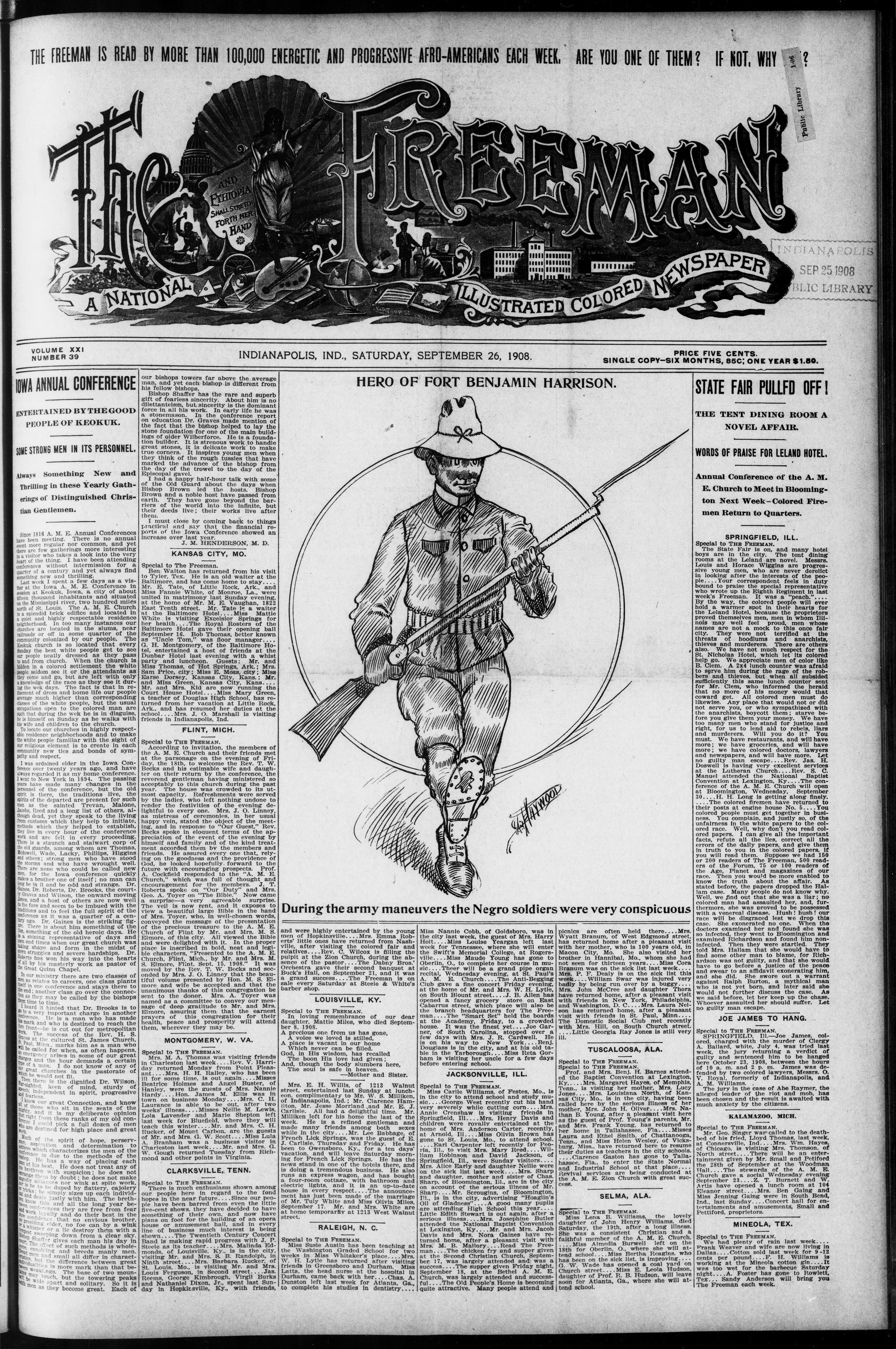
HERO OF FORT BENJAMIN HARRISON.
During the army maneuvers the Negro soldiers were very conspicuous
and were highly entertained by the young men of Hopkinsville...Mrs. Emma Roberts' little ones have returned from Nashville and have colored fair, and relatives...Rev C. Witlow is filling the pulpit at the Zion Church, during the absence of the pastor...The Dabny Bros.' Orchestra gave their second banquet at Buck's Hall, on September 21, and it was sale every Saturday at Steele & White's barber shop.
Miss Nannie Cobb, of Goldsboro, was in the city last week, the guest of Mrs. Harry Holt...Miss Louise Yeargan left last week in Tennessee, where she will enter the Swift's Mommie College at Rogersville...Miss Maude Young has gone to Olinel, O., to complete her course in music. There will be a grand pipe organ recital, Wednesday evening, at St. Paul's A. M. E. Church...The Anti-Begging Jubilee at a second course in the home of the Mrs. W. H. Lyle, pienices are often held there...Mrs. Wyatt Branum, of West Edmond street, has returned home after a pleasant visit with her mother, who is 100 years old, at Moorcock City. She also visited her brother in Hannibal, Mo., whom she had not seen for thirteen years...Miss Cora Branum on the sick list last week...Mrs. P. F. Dealy is on the sick list this week. William Swar is injured very badly, Mrs. Swar also visited her Mrs. John McCree and daughter, Thora
LOUISVILLE, KY.
Special to THE FREEMAN
Special to THE FREEMAN.
A membrane of our dear daughter, Mattie Miles, who died September 8, 1908.
A precious one from us has gone.
A voice we loved is stilled.
A place is vacant in our home
Of which we have a large
God, in His wisdom, has recalled
The boon His love had given;
And, though the body slumbers here,
The soul is safe in heaven.
—Mother and Sister.
Mrs. E. H. Willis, of 1213 Walnut street, entertained last Sunday at lunch, complimentary, to Mr. J. C. Milliken, of Milwaukee, and Mr. Clive Hilton, Mr. Jesse Morrland and Mr. E. J. Carlisle. All had a delightful time. Mr. Milliken left for his home the last of the week. He is a refined gentleman and man of character, while in the city...Mr. Lee Babbage, French Lick Springs, was the guest of E. J. Carlisle, Thursday and Friday. He has been to Wenowbsor, Ky., for a ten days' vacation, and is working for French Lick Springs. He has the news stand in one of the hotels there, and is doing a tremendous business. He also runs an express wagon, and has bought a large apartment and an airroom and electric lights, and it is an house in every respect. The announcement has just been made of the marriage of Mr. Tuly White and Miss Olivia Miles, September 17. Mr. and Mrs. White are now temporarily at 1213 West Walnut street.
RALEIGH, N. C.
Special to THE FREEMAN.
Miss Susie Austin has been teaching at the Washington Graded School for two weeks in Miss Whitaker's place...Mrs. W. H. Lyle has returned after visiting friends in Greensboro and Durham. Miss Latta, the head nurse at the hospital in Durham, came back with her...Chas. A. Dunston last week for Atlanta, Ga., to complete his studies in dentistry...
Miss Nannle Cobb, of Goldsboro, was in the city last week, the guest of Mrs. Harry Holt. . . Miss Louse Yeargan left last week, the guest of the Swift's Memorial College, at Rogersville. . . Miss Muse Young has gone to Oberlin, O., to complete her course in music, and to attend the recital, Wednesday evening, at St. Paul's A. M. E. Church. . . The Anti-Begging Club gave a fine concert Friday evening, at St. Paul's A. M. E. Church, on South Blount street. . . J. B. Allen has opened a fancy grocery store on East Cabarus street, which place will also be occupied by the prosaic man. . . The "Smart Set" held the boards at the Academy, Friday, to a crowded house. It was the finest yet. . . Joe Garner, of the prosaic proline, was with Mrs. Y. Cardwell. He is on his way to New York. . . BenJ. Douglass is in the city, and at his old tattoo. . . Miss Reta Gorham is visiting her uncle for a few days before entering school.
JACKSONVILLE. ILL.
Special to THE FREEMAN
Miss Carlie Williams, of Festes, Mo., is in the city to attend school and study music. . . George West recently cut his hand in a car accident. Annie Crenshaw is visiting friends in Springfield, Ill. . . Mrs. Henry Davis and children were rovally entertained at the home of Mrs. Anderson Carter, recently, and Mrs. Robert Carson, gone to St. Louis, Mo., to attend school. . . Earl Carpenter left recently for Pooria, Ill., to visit Mrs. Mary Reed, Wilmington, N.J., and Springfield, Ill., were Sunday visitors. . . Mrs. Alice Early and daughter Nellie were on the sick list last week. . . Mrs. Sharp and daughter, mother and sister of Chas. B. Sharp, on account of the serious illness of Mr. Sharp. . . Mr. ScroUGins, of Bloomington, Ill., is in the city, advertising "Hogan's pupils are attending High School" this year. Little Edith Stewart is out again, after a serious illness. . . Mrs. Josephine Butler attended the National Baptist Convention in Springfield, Ill., and Mrs. Davis and Mrs. Nora Gaines have returned home, after a pleasant visit with Mrs. M. B. Mallory. . . Read The Free-ess Book, at the Second Christian Church, September 17, was largely attended and was a success. . . The supper given Friday night, September 18, at the Bethel A. M. Church, was successful. . . The Old People's Home is becoming quite attractive. Many people attend and
PRICE FIVE CENTS.
SINGLE COPY-SIX MONTHS, 85C; ONE YEAR $1.80.
plencies are often held there...Mrs. Wyatt Branum, of West Edgmond street, has returned home after a pleasant visit to Macon City, Mo. She also visited her brother in Hannibal, Mo., whom she had not seen for thirteen years...Miss Cora Branum was on the sick list last week. P. Mrs. Branum took the sick week...William Swar was injured very badly by being run over by a buggy...Mrs. John McCree and daughter Thora were with friends in New York, Philadelphia, and Washington, D. C. Mrs. Laura Nelson has returned home, after a pleasant visit to Macon City, Mo. The Domestic Social Club met recently with Mrs. Hill, on South Church street...Little Georgia Ray Jones is still very
TUSCALOOSA. ALA.
Special to THE FREEMAN.
Special to THE FREEMAN.
Prof, and Mrs. Benj. H. Barnes attended the Baptist Convention at Lexington, Ky. .. Mrs. Margaret Hayes, of Memphis, Tenn. is visiting her mother, Mrs. Lucy Jones, of Memphis, so she City, Mo., is in the city, having been called here by the serious illness of her mother, Mrs. John H. Oliver.....Mrs. Nathan B. Young, after a pleasant visit here, is visiting her mother, Mrs. Frank Young, has returned to her home in Tallahassee, Fla. .. Misses Laura and Ethel Smith, of Chattanooga, Tenn., and Miss Helen Wesley, of Vicksburg, has returned to their duties as teachers in the city schools. .. Clarence Gaston has gone to Tallahassee, Fla. to enter the State Normal and Industrial School at that place. Revival services are being conducted at M. E. Zion Church with great success.
SELMA. ALA
Miss Lena B. Williams, the lovely daughter of John Henry Williams, died Saturday, the 19th, after a long illness. She was a consistent Christian and a faithful member of the Church. Chris Burwell left on the 18th for Oberlin, O. where she will attend school. . . Miss Bertha Reagins, who has been on the sick list, is improving. . . G. W. Wade has opened a coal building on the Hudson, daughter of Prof. R. B. Hudson, will leave soon for Atlanta, GA., where she will attend school.
STATE FAIR PULLFD OFF!
THE TENT DINING ROOM A NOVEL AFFAIR.
WORDS OF PRAISE FOR LELAND HOTEL
Annual Conference of the A. M. E. Church to Meet in Bloomington Next Week-Colored Firemen Return to Quarters.
The State Fair is on, and many hotel boys are in the city. The tent dining rooms at the Leland are novel. Messrs. Louis and Horace Wiggins are progressors, who are in the city, and are in looking after the interests of the people....Your correspondent feels in duty bound to praise the special representative who has been the High Regiment in last week's Freeze. In the city, men whose names are not a mock to this once fair city. They were not terrified at the threats of hoodrums and anarchists, but were not more aware of the others. We have not much respect for the St. Nicholas Hotel, which let its colored help go. We appreciate men of color like B. Clem. A 224 lunch counter was afraid of them, and we have been in the same ways as this, and thieves, but when all subdued sufficiently this same lunch counter sent for Mr. Clem, who informed the herald that no more of his money would that be paid to the men who were in the same likewise. Any place that would not or did not serve you, or who sympathized with the anarchists, boycott them; starve before you give them your money. We have no more of the money we have. We have no more of the money we have. We have no newspapers, and will have more; we have groceries, and will have money. We have no money. Let us guilty man escape.... Rev. Jas. D. Dosswell is having very excellent services in the city. We have no more of the National Convention at Lexington, Ky....The conference of the A. M. E. Church will open at Bloomington, Wednesday, September 1984. The meeting will be held at 11 a.m. on the 1st. The colored firemen have returned to their posts in the city house. No... You colored people must get together in business. You complain, and justly so, of the fact that the General of the City is not a man of the kind. You will read them. Suppose we had 150 or 200 readers of The Freeman, 500 readers of the Forum, 75 or 100 readers of the Journal, and 100 readers of the Journal. Then you would be more enabled to know the truth about the affair. As stated before, the papers dropped the Hall lam case. Many people do not know why. You are not a man who is not a man who is not guilty, and that she would have to go before a justice of the peace and be a man. And you are not a man who is not yet born, and later said she would not further discuss the case. As we have been doing, you have the chance of never being assaulted. Whoever assaulted her should be...no guilty man escape.
JOE JAMES TO HANG
Special to THE FREEMAN.
SPRINGFIELD, Ill.—Joe James, colored, charged with the murder of Cleryg A. Ballard, white, July 10, was acquitted by jury returning a verdict of guilty and sentenced him to be hanged here October 23, 1908, between the hours of 10 a. m. and 2 p. m. James was determined and lawyers, Messrs. O. V. Royal, formerly of Indianapolis, and A. M. Williams.
The jury in the case of Abe Raymer, the alleged leader of the riot and mob, has been acquitted by the citizens with much anxiety by the citizens.
KALAMAZOO, MICH.
Special to The Times
Greg. Singles, FAMILY called to the deathbed of his fried, Lloyd Thomas, last week, at Connerville, Ind., Mrs. Wm. Hayes, at North Park, Calif., and North Street, ...There will be an entertainment given by Mr. Small and Pettiford the 28th of September at the Woodman Church gave a social Wednesday evening September 23...Z. T. Burnett and W. Eleanor street, ...Mrs. Ben Gaing and Miss Jenning Gaing were in South Bend, Ind., last Sunday ...Concert hall for enquiries, amusements, Small and Pettiford, proprietors
MINFOLA. TEX.
Special to THE FREEMAN.
We had plenty of rain last week.... Frank Weaver and wife are now living in Dallas....Cotton sold last week for 9-12 cents per pound....F. H. Williams is working at the Mineola cotton gin. It is night. too. A. Foster has gone to Rowlett, Tex....Sandy Anderson will bring you the Freeman each week.
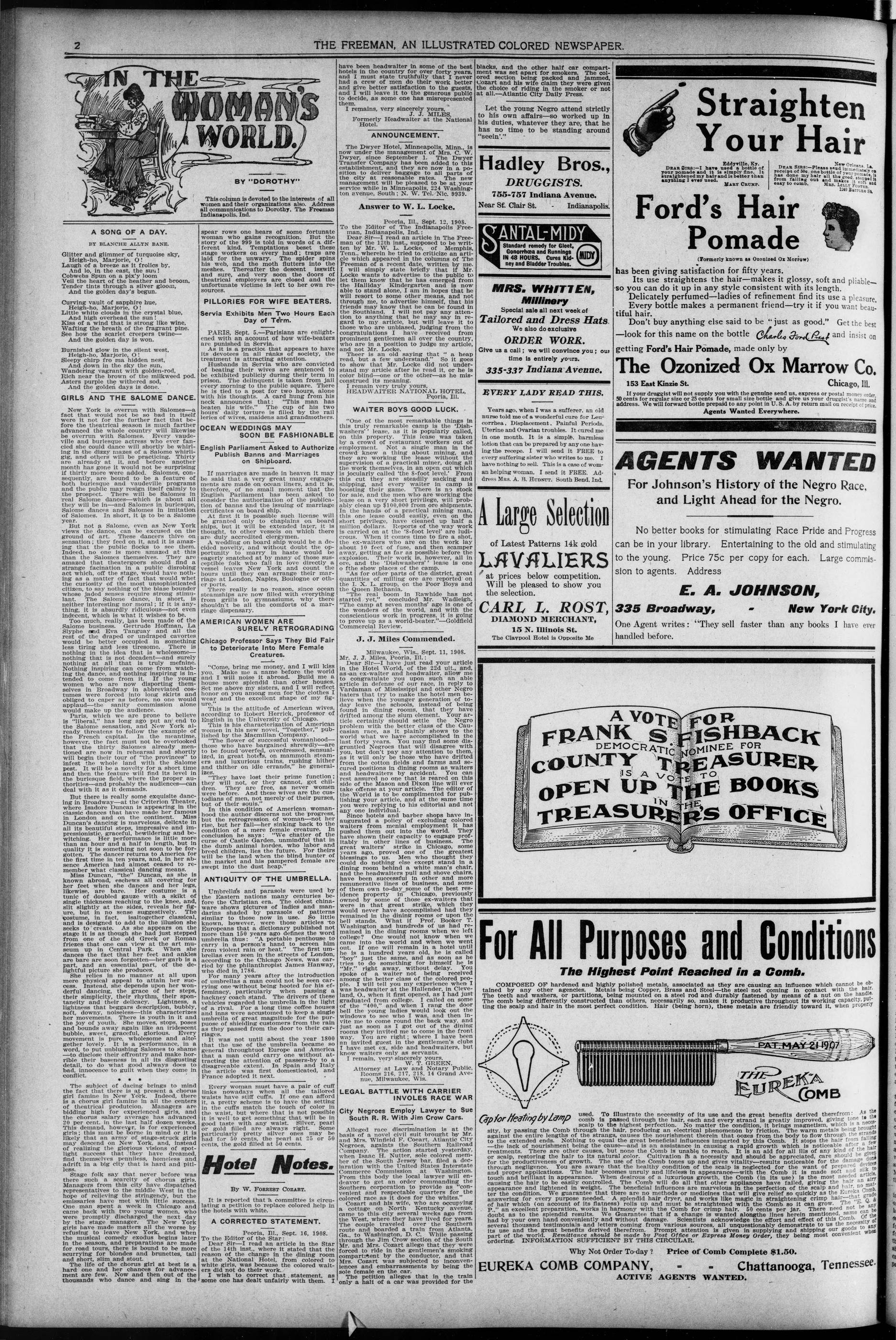
IN THE WOMAN'S WORLD.
BY "DOROTHY"
This column is devoted to the interests of all women and their organizations also. Address all communications to Dorothy. The Freeman Indianapolis, Ind.
A SONG OF A DAY.
Glitter and glimmer of turquoise sky,
Heigh-ho, Marjorie, O!
Laugh of a breeze as it frolics by,
Marmalade the sun!
Cobwebs Spun on a pixy loom
Vell the heart of the heather and broom,
Tender tints through a silver gloom,
And the golden day's begun.
Curving vault of sapphire hue,
Heigh-ho, Marjorie, O!
Little white clouds in the crystal blue,
And high overhead the sun!
Knife a wind that is strong like wine,
Waffering the fragrant pine.
See how the scarlet creepers twine—
And the golden day is won.
And down in the sky the sun,
Wandering vagrant with golden-rod,
Rich near the brown of the milkweed pod
Ashleigh's nest,
And the golden days is done.
GIRLS AND THE SALOME DANCE.
New York is overrun with Salomes—a fact that would not be so bad in itself were it not for the further fact that be they advanced the who, country will likewise be overrun with Salomes. Every vaudeville and burlesque actress who ever fancied she could dance will shortly be whirling in the dizzy mazes of Salomes. The public are already at it, and before another month has gone it would not be surprising if thirty more were added. Salomes, consequently, are bound to be a feature of the public and the public may resign itself calmly to the prospect. There will be Salomes in real Salome dances—which is about all they will be in—and Salomes in burlesque, Salome dances and Salomes in imitation Salomes. In short, it is to be a Salome year.
But not a Salome, even as New York views the dance, can be excused on the ground of art. The ancients, too, may be the feet it, it is amazing that the public flocks to see them. Indeed, no one is more amazed at this than the Salomes themselves, and are the ones who should be the strange fascination in a public disrobing act which, off the stage, would have nothing as a matter of fact that would whet their attention. The blase bounder, citizen, to say nothing of the blase bounder whose jaded senses require strong stimulant. The Salome dance, in short, is a strange dance, and nothing of that thing, it is absurd ridiculous—not even indecent, which is what it wishes to be.
Too much, really, has been made of the Salome business. Gertrude Hoffman, La lyfe the actress, the anguish and the rage of the draped garments and cavorts would be better occupied in something less tiring and less tiresome. There is nothing in the idea that is wholesome—nothing not deceased and sure—but at all that is trulyNothing. Nothing inspiring can come from watching the dance, and nothing inspiring is intended to come from it. If the young Salome is to be inspired, she selfs in Broadway in abbreviated costumes were forced into long skirts and obliged to cape as before, no one would applaud in sanity commission alone would make a movie. Paris, which we are prone to believe is "liberal," has long ago put an end to the Salome sensation, and New York allys threatens to follow. In the French capital, in the meantime, the fact must not be overlooked that the thirty Salomes already mentioned are now in rehearsal and shortly will be in theaters to infest the whole land with the Salome pest. It will be a novelty for a short time and then the feature will find its level in the burlesque field, where the proper audience—can deal with it as it demands.
But there is really some exquisite dancing in Broadway—at the Criterion Theater, where Isadore Duncan is appearing in the Broadway musical *The Lion in London and on the continent*. Miss Duncan's dancing is marvelous, delicate in all its beautiful steps, impressive and immanent, and is always watchable. Her performance is little more than an hour and a half in length, but in quality it is something not soon to be forgettable. Her classical dancing means, she is the first time in ten years, and, in her absence America had almost ceased to remember what classical dancing means. She is known abroad, eschews all covering for her feet when she dances and her legs, likewise, are bare. Her costume is a simple, modest dress, a single thickness reaching to the knee, and, slit slightly at the sides, reveals her figure, but in no sense suggestively. The dress is simple, and is designed to add to the illusion she seeks to create. As she appears on the stage it is as though she had just stepped from one of the old Greek or Roman costumes, and is seated up in Central Park. When she dances the fact that her feet and ankles are bare are soon forgotten—her garb is a light, bright, dazzling, of the dazzling light picture she produces.
She relies in no manner at all upon mere physical appeal to attain her success. Instead, she depends upon her successful effort. Because she stops their simplicity, their rhythm, their spontaneity and their delicacy. Lightness, a lightness that beggars description, bubbly, soft, downy, noteless—this characterizes her success. She is the joy of youth. She moves, stops, poses and bounds away again like an iridescent bubble, sweet, graceful, glorious. Every movement is pure wholesome and an advenience to love. She is as illusive as science, to put unbelling Salomes to shame—to disclose their effrontry and make horrible their baseness in all its disgusting detail, to do what good always does to incite obedience to guilt when they come in conflict.
The subject of dacing brings to mind the fact that there is at present a chorus girl in a chorus girl famine in all the centers of the theatrical production. Managers are bidding high for experienced girls, and the chorus salary average has advanced to $12,000 per year. This demand, however, is for experienced girls; this must be borne in mind or it is likely that an army of stage-struck girls will be recruited by Yale University of realizing the glorious visions of spotlight success that they have dreamed, find themselves penniless, homeless and adrift in a big city that is hard and pitiless. Stage folk say that never before was there such a scarcity of chorus girls, one man spent two years representing to the middle West in the hope of relieving the stringency, but the emissaries have met with little success, the one man spent two years Chicago and two young New Yorkers were promptly discharged the next day by the stage manager. The New York girls have made me aware by the worse of the musical comedy exodus begins later in the season, and preparations are made for road tours, there is bound to be more brunettes, tall and short, slim and stout.
The life of the chorus girl at best is a hard one and her chances for advancement are few. Now and then out of the thousands who dance and sing in the
spear rows one hears of some fortunate woman who gains recognition. But the story of the 999 is told in words of a different stage workers on every hand; traps are laid for the unwary. The spider spins his web, and the moth flutters into the meshes. Thereafter the descent isswift and sure, and very soon the doors of the employers are closed and the fortunate victim is left to her own resources.
PILLORIES FOR WIFE BEATERS.
Servia Exhibits Men Two Hours Each Day of Term.
PARIS, Sept. 5. —Parisians are enlight-
ented by how wife-beaters
are published in Service.
As it is a practice that appears to have its devotees in all ranks of society, the treatment is attracting attention. Husbands in Servia who are convicted of murder are oftenenced to be exhibited publicly during their term in prison. The delinquent is taken from jail every morning to the public square. There he is tied to a post for two hours, alone with his thoughts. A card hung from his neck announces that: "This man has been convicted of murder." The card hours daily torture is filled by the rail lines of wives, maidens and grandmothers.
OCEAN WEDDINGS MAY
SOON BE FASHIONABLE
English Parliament Asked to Authorize Publish Banns and Marriages on Shipboard.
If marriages are made in heaven it may be said that a very great many engagements are made on ocean liners, and it is, therefore, of no small moment that the authorizes the authorization of the publication of banns and the issuing of marriage certificates on board ship. At first it is possible, each license will be issued to a captain, a captainship on board ships, but it will be extended later, it is thought, to other vessels on which there are duly accredited clergymen. A wedding on board ship would be a decision made in the opportunity to marry in haste would be eagerly snatched at by many of those susceptible folk who fall in love directly a vessel leaves New York and count the hours until they can arrange their marriages. London, Naples, Bologne or other ports. There really is no reason, since ocean steamships are now filled with everything from gymnasiums, why there shouldn't be all the comforts of a marriage dispensary.
AMERICAN WOMEN ARE SURELY RETROGRADING
Chicago Professor Says They Bid Fail to Deteriorate Here Female
"Come, bring me money, and I will kiss you. Make me a name before the world. I will be a teacher in a house more splendid than other houses. Set me above my sisters, and I will reflect honor on you among men for the clothes I wear and the excellent shape of my fig. This is the attitude of American wives, of American men, of English in the University of Chicago.
This is his characterization of American women in his new novel, "Together," published by the Macmillan Company, whose wife is a womanhood—those who have bargained shrewdly—to be found overfed, overdressed, sensualized, in great hotels, on mammoth steamers and luxurious trains, rushing hither and hither on idle errands," he generalizes.
"They have lost their prime function; they will not, or they cannot get children; they are not cared for; were before. And these wives are the custodians of men, not merely of their purses, but of their souls.
The author of American womanhood the author discerns not the progress, but the retrogression of woman—not her rise, but her fall—her sinking back to the condition of a mere female creature. In the course of Castle Garden, unmindful that in the dumb animal hordes, who labor and breed children, lies the future. For theirs, the market and the market and her pampered female swept into the dust heap."
ANTIQUITY OF THE UMBRELLA.
Umbrellas and parasols were used by the Eastern nations many centuries before the Christian era. The oldest chinaware shows diagrams of umbrellas designed by parasols of patterns similar to those now in use. So little known, however, were those articles to Europeans that a dictionary published not only umbrellas but umbrella thus: "A portable penthouse to carry in a person's hand to screen him from violent rain or heat." The first umbrellas ever seen were umbrella thus: "The Chicago News, was carried by the philanthropist James Hanway, who died in 1786. For many years after the introduction of umbrellas could not be seen carrying one without being booted for his effeminacy, particularly when passing a hackney coach stand. The drivers of these vehicles regarded the umbrella in the houses and inns were accustomed to keep a single umbrella of great magnitude for the purpose of shielding customers from the rain as they passed from the door to their car
It was not until about the year 1800 that the use of the umbrella became so popular. It was not until about 1800 that a man could carry one without attracting the attention of passers-by to a disagreeable extent. In Spain and Italy the article was first domesticated, and France adopted it next.
Every woman must have a pair of cuffs that are tightened to the tailored waist have stiff cuffs. If one can afford it, a pretty scheme is to have the setting in the cuffs match the touch of color in the waist, but where that is not possible it is well to get something that will be in good taste with any waist. Silver, pearl or gold filled are always right. Some particularly pretty silver ones may be had for 50 cents, the pearl at 25 or 50 cents, the gold filled at 50 cents.
Hotel Notes.
It is reported that a committee iscircum-
literating to replace colored help in
the hotels with white
A CORRECTED STATEMENT.
Pecoria, Ill., Sept. 16, 1908.
To the Editor of the Star:
Dear Shi—I read an article in the Star of the 14th inst., where it stated that the reason she was in the dining room was the Nationals' Hotel. White girls, was because the colored waiters did not do their work. I read an article, statement, as some one has dealt unfairly with them. I
have been headwaiter in some of the best hotels in the country for over forty years, and I must state truthfully that I never had a crew of men do their work better and give better satisfaction to the guests, and I will leave it to the generous public to decide, as some one has misrepresented them.
blacks, and the other half car compartment was set against the smokers. The colored section being packed and jammed, Cozart and his wife claim they were given the choice of riding in the smoker or not at all—Atlantic City Daily Press.
ANNOUNCEMENT.
The Dwyer Hotel, Minneapolis, Minn., is now under the management of Mrs. C. W. Dwyer, since September 1. The Dwyer Hotel is now under the management establishment, and they are now in a position to deliver baggage to all parts of the city at reasonable rates. The new Dwyer Hotel is now in service while in Minneapolis, 224 Washington avenue, South; N. W. Tel. Nt. 9339.
Answer to W. L. Locke.
Peoria, Ill., Sept. 12, 1908.
To the Editor of The Indianapolis Freeman, Indianapolis, Ind.:
The article in the Freeman of the 12th class, supposed to be written by Mr. W. L. Locke, of Memphis, Tenn., wherein he tried to criticize an article which appeared in the columns of the Freeman of a recent date, written by me. Locke wants to advertise to the public to let them know that he has emerged from the Halliday Kindergarten and is now able to stand alone, I am in hopes that he will resort to some other means, and not be brought to the attention of friends may know that he can be found in the Southland. I will not pay any attention to anything that he may say in regard to my article, but will leave it to me to comment on the congratulations I have received from prominent gentlemen all over the country, who are in a position to judge my article, and not Mr. Locke. I am saying that "a heap read, but a few understand." So it goes to show that Mr. Locke did not understand my article after he read it, or he is color blind—one or the other—as he misconstrued its meaning.
I remain very truly yours,
HEADWAITER NATIONAL HOTEL,
Peoria, Ill.
WAITER BOYS GOOD LUCK.
"One of the most remarkable things in this truly remarkable camp is the "Dishwashers" lease, as it is popularly called, on this property. This lease was taken by a crowd of restaurant workers out of the crowd knew a thing about mining, and they are working the lease without the supervision of a practical miner, doing all the work themselves, in an open cut which they use to mine. This cut they are steadily sacking and shipping, and every waiter in camp is boosting their game. There is no stock for sale, and the men who are working the lease on a very short privilege, will probably be able to mine. In the hands of a practical mining man, this one lease could easily, even on the short privilege, have cleaned up half a million dollars. Reports of the way work was done in the mine cross. When it comes time to fire a shot, the ex-walters who are on the work lay about 10 feet of fuse, and then scamper away, getting as far as possible before the explosion. If they were however, all in the crowd and the "Dishwashers" lease is one of the show places of the camp.
"As for other parts of the district, great quantities of milling ore are reported on the Poor Boys and the Queen Bethania. The real boom in Rawhale has not stalled, but the camp at seven months' age is one of the wonders of the world, and with the conscientious work in progress, it is going well." - Goldfield Commercial Review.
J. J. Miles Commended.
Milwaukee, Wis., Sept. 11, 1908.
Mr. J. J. Miles, Peoria, Ill.
Mr. J. J. Miles, Peoria, IL.
Dear J. H. Miles, just read your article in *Dear Dear*, have just read your article in *The World* of the wizard of Utt, and, as an ex-waiter and headwaiter, allow me to congratulate you upon such an able article in defense of our race, in reply to Vardaman of Mississippi and other Negro leaders in the world, to live when the younger generation of today leave the schools, instead of being found in dining rooms, that they have drifted among the slum element. Your art certainly is a problem with the better class of the Caucasian race, as it plainly shows to the world what we have accomplished in the last forty years. You may find some dislike of your art, but you, but don't pay any attention to them, as it will only be those who have drifted from the cotton fields and farms and secured positions in dining rooms as waiters and headwaiters, and you, but that is reared on this side of the Mason and Dixon line will ever take offense at your article. The editor of the World is to be complimented for publishing your article, and at the same time to his editorial and not any one individual.
remain, very sincerely yours, W. T. GREEN
Attorney at Law and WILKEN, Public,
41 Grand Avenue,
Milwaukee, Wis.
LEGAL BATTLE WITH CARRIER
INVOLES RACE WAR
City Negroes Employ Lawyer to Sue South R. R. With Jim Crow Cars.
Alleged race discrimination is at the basis of a novel civil suit brought by Mr. and Mrs. Wintlehill, the attorneys of the Southern Railroad Company. The action started yesterday, when Isaac H. Nutter, sole colored member of the South Jersey bar, filed a case against the Southern Commerce Commission at Washington. From this body the local lawyer will endeavor to get an order commanding the Southern corporation to provide as conspicuous evidence of the colored race as it does for the whites." Cozart and his wife, who are occupying a cottage on North Kentucky avenue, were arrested in the West, where they have lived for years. The couple traveled over the Southern route and boarded a train from Atlanta, Ga., to Washington, where they were passing through the West section of the city. Mr. and Mrs. Cozart allege that they were forced to ride in the gentlemen's smoking compartment by the conductor, and that they were subjected to inconveniences and embarrassments by being the sole female on the car.
The petition alleges that in the train only a half of a car was provided for the
A VOTE FOR
FRANK S. FISHBACK
DEMOCRATIC NOMINEE FOR
COUNTY TREASURER
IS A VOTE TO
OPEN UP THE BOOKS
IN THE
TREASURER'S OFFICE
For All Purposes and Conditions
COMPOSED OF hardened and highly polished metals, associated as they are causing an influence which cannot be obtained by any other agencies. Metals being Copper, Brass and Steel—the steel not coming in contact with the hair. The teeth and washers, or partitions, being mounted on a steel rod and durably fastened by means of a nut on the handle. The comb being differently constructed than others, necessarily so, makes it productive throughout its working capacity, putting the scalp and hair in the most perfect condition. Hair (being horn), these metals are friendly toward it, when properly
PAT. MAY 21 1907
THE EUREKA COMB
blacks, and the other half car compartment was set apart for smokers. The colored section being packed and jammed, toward and like wife in claim they were given the choice of riding in the smoker or not at all.—Atlantic City Daily Press.
Let the young Negro attend strictly to his own affairs—so worked up in his duties, whatever they are, that he has no time to be standing around "seein."
Hadley Bros.,
DRUGGISTS.
755-757 Indiana Avenue.
Near St. Clair St. Indianapolis.
SANTAL-MIDY
Standard remedy for Gleet,
Gonorrhoea and Runnings
IN 48 HOURS. Cures Kid-
ney and Bladder Troubles.
MIDY
MRS. WHITTEN,
Millinery
Special sale all next week of
Tailored and Dress Hats.
We also do exclusive
ORDER WORK.
Give us a call; we will convince you; our
time is entirely yours.
335-337 Indiana Avenue.
EVERY LADY READ THIS.
Years ago, when I was a sufferer, an old nurse told me of a wonderful cure for Lourcorhea, Displacement, Painful Periods, Uterine and Ovarian trombites. It cured me in one month. It is a simple, harmless lotion that can be prepared by any one having the recipe. I will send it FREE to every suffering sister who writes to me. I have nothing to sell. This is a case of woman helping woman. I send it FREE. Address Mas. A. B. HUNGR. South Bend. Ind.
A Large Selection
of Latest Patterns 14k gold
at prices below competition. Will be pleased to show you the selection.
CARL L. ROST,
DIAMOND MERCHANT,
15 N. Illinois St.
The Claypool Hotel is Opposite Me
Eddyville, N.Y.
Dram Grass, I have
your pomade and it is simply fine.
It straightens my hair and is better than
anything I ever used. MARY CRUNK
Ford's Hair Pomade
has been giving satisfaction for fifty years. Its use straightens the hair—makes it so you can do it up in any style consistent with Delicately perfumed—ladies of refinement Every bottle makes a permanent friend-tiful hair. Don't buy anything else said to be "just look for this name on the bottle Charles getting Ford's Hair Pomade, made only by The Ozonized Ox
Its use straightens the hair—makes it glossy, soft and pliable so you can do it up in any style consistent with its length.
Delicately perfumed—ladies of refinement find its use a pleasure. Every bottle makes a permanent friend—try it if you want beautiful hair.
Don't buy anything else said to be "just as good." Get the book—look for this name on the bottle Charlie Ford Press and insist getting Ford's Hair Pomade, made only by The Ozonized Ox Marrow Co. 153 East Kinzie St. Chicago, IL
If your druggist will not supply you with the genuine send us, express or postal money of 50 cents for regular size or 25 cents for small size bottle and give us your druggist's name address. We will forward bottle prepaid to any point in U.S.A. by return mail on receipt of agents Wanted Everywhere.
AGENTS WANTED
For Johnson's History of the Negro Race, and Light Ahead for the Negro.
No better books for stimulating Race Pride and Progress can be in your library. Entertaining to the old and stimulating to the young. Price 75c per copy for each. Large commission to agents. Address
Its use straightens the hair—makes it glossy, soft and pliable—so you can do it up in any style consistent with its length. Delicately perfumed—ladies of refinement find its use a pleasure. Every bottle makes a permanent friend—try it if you want beautiful hair. Don't buy anything else said to be "just as good." Get the best—look for this name on the bottle Charlie Ford Peak and insist on getting Ford's Hair Pomade, made only by
The Ozonized Ox Marrow $ \mathrm{C o}. $
153 East Kinzie St. Chicago, ill.
If your druggist will not supply you with the genuine send us, express or postal money order, 50 cents for regular size or 25 cents for small size bottle and give us your druggist's name and address. We will forward bottle prepaid to any point in U.S.A. by return mail on receipt of price.
Agents Wanted Everywhere.
AGENTS WANTED
For Johnson's History of the Negro Race, and Light Ahead for the Negro.
No better books for stimulating Race Pride and Progress can be in your library. Entertaining to the old and stimulating to the young. Price 75c per copy for each. Large commission to agents. Address
335 Broadway, New York City One Agent writes: "They sell faster than any books I have handled before.
One Agent writes: "They sell faster than any books I have ever handled before.
Straighten Your Hair
New Orleans La.
DEAR SIRS: -Please take one receipt of SIRS, one bottle of water, one cup of ice, from falling out and make it popped from falling out and make it easy to eub.
Miss. LILLY FOSTER.
(Formerly known as Ozonized Ox Morrow)
mars.
Is it glossy, soft and pliable—
ent with its length.
Element find its use a pleasure,
end—try it if you want beau-
"just as good." Get the best
Charles Ford Peat and insist on
by
Marrow Co.
WANTED
of the Negro Race,
for the Negro.
Race Pride and Progress
g to the old and stimulating
for each. Large commis-
E. A. JOHNSON.
New York City. than any books I have ever
```markdown
```
Chicago, Ill.
RECEIPT THAT CURES WEAK MEN--FREE.
Send Name and Address Today-
You Can Have it Free and be
Strong and Vigorous.
I have in my possession a prescription for nervous debility, lack of vigor, weakened mood, failing memory and lame back, brought on by excesses, unnatural drains or the follies of youth, that has cured so many worn and nervous men right in their own homes—without any additional help or medicine—that I think every man who wishes to regain his manly power and virility, quickly and quietly, should have a copy. So, I have determined to send a copy of the prescription, free of charge, in a plain, ordinary sealed envelope, to any man
This prescription comes from a physician who has made a special study of men, and I am convinced it is the surest action manhood and vigor-failure to put together. If I think we it to my follow man to send them a copy, they are so shocked that they answer anyway that is weak and discouraged with bad贮藏s may stop drugging himself with harmful patent medicines, secure what I believe in building a communication system in building TOUCHING remedy ever quickly. So cure himself at home quietly and quickly. Just drop me a line like this: Mr. A. E. Robinson, your doctor, and you a copy of this splendid envelope, free of charge, in a plain ordinary sealed envelope, free of charge.
Money to Loan!
The Borrowing Question.
Nobody questions the fact that it is often very convenient to borrow money. The only question is which company. We are satisfying you every point and have some interesting facts and figures to offer. You'll find the "Indianapolis" a reasonable and reliable firm. Loans on furniture, planes, horses, carriages, wagons, etc. is our line. Any sum, any time, most any size payments to suit your pocket book. Intended borrowers should see us before closing a deal; all others should bear us in mind—they may need money later. A good second reference for most people is the fact that we've been established nineteen years.
20 Unity Bldg. 147 E. Market St.
Old, Main, 541-Phones-New, 1419.
Box 424.
JAMES QUAIL'S RESTAURANT
230 Indiana Avenue,
For First Class Meals.
Sandwiches of all kinds. Open
at all hours.
Want to know how to become best
informed with the leading topics of the
dairy? Well, subscribe for The Freeman
at $1.50 the year.
The
Fighting
Chance.
By ROBERT W. CHAMBERS.
Copyright, 1806, by the Curtis Publishing
Company.
Copyright, 1806, by Robert W. Chambers.
[CONTINUED.]
But first of all and most important of all he had to deal with Beverly Plank. And he was going to do it in a manner that Plank could not have foreseen. He was going to stop Plank where he stood, and to do this he was deliberately using his knowledge of the man and paying Plank the compliment of counting on his sense of honor to defeat him. For he had suddenly found the opportunity to defend himself. He had discovered the joint in Plank's old fashioned armor—the armor of the old paladins, who placed a woman's honor or before all else in the world. Now, through his creature, Mortimer, he could menace Plank with a threat to involve him and Lella in a vile publicity. Plank must sign the truce or face with Lella an action for damages and divorce.
First of all he went to the Lenox club and dressed. Then he dined sparingly and alone. The motor car was waiting when he came out ready to run down to the great Hotel Corona, whether the Japanese steward had conducted Mortimer. Mortimer had dined heavily, but his disorganized physical condition was such that it had scarcely affected him at all.
Again Quarrier went over patiently and carefully the very simple part he had reserved for Mortimer that evening, explaining exactly what to say to Lella and what to say to Plank in case of insolent interruption. Then he told Mortimer to be ready at 9 o'clock, turned on his heel with a curt word to the Japanese, descended to the street, entered his motor car again and sped away to the Hotel Santa Regina.
Miss Caitlinne was at home, came the message in exchange for his cards for Agatha and Mrs. Vendenning. He entered the gilded elevator, stepped out on the sixth floor into a tiny, roco-co, public reception room. Nobody was there besides himself. Agatha's maid came presently, and he turned and followed her into the large and very handsome parlor belonging to the suit which Agatha was occupying with Mrs. Vendenning for the few days that they were to stop in town.
"Hello," she said serenely, sauntering in, her long, pale hands bracketed on her narrow hips, her lips disclosing her teeth in a smile so like that nervous muscular recession which passed for a smile on Quarrier's visage that for one moment he recognized it and thought she was mocking it. But she strolled up to him, meeting his eye calmly, and lifted her slim neck, lips passive under his impetuous kiss.
---
"Is Mrs. Vendenning out?" he asked, laying his hands on the bare shoulders of the tall, pallid girl—tall as he and as pallid.
"No, Mrs. Ven. is in, Howard."
"Now? You mean she is coming in to interrupt"—
"Oh, no! She isn't fond of you, Howard."
"You said"— he began almost angrily, but she laid her fingers across his lips.
"I said a very foolish thing, Howard. I said that I'd manage to dispense with Mrs. Ven. this evening."
"You mean that you couldn't manage it?"
"Not at all. I could easily have managed it. But—I didn't care to."
She looked at him calmly at close range as he held her embraced, lifted her arms and with slender white fingers patted her hair into place where his arm around her head had disarranged it, watching him all the while out of her pale, haunted eyes.
"You promised me," he said, "that you"—
"Oh, Howard! Do men still believe in promises?"
Quarrier's face had color enough now. His voice, too, had lost its passionless, monotonous precision. Whatever was in the man of emotion was astir. His impatient voice, his lack of poise, the almost human lack of caution in his speech betrayed him in a new and interesting light.
"Look here, Agatha! How long is this going to last? Are you trying to make a fool of me? What is the matter? Is there anything wrong?"
"Wrong? Oh, dear, no! How could there be anything wrong between you and me"—
"Agatha, what is the matter? Look here! Let's settle this thing now and settle it one way or the other! I won't stand it! I-I can't! Did you ever misunderstand me? Did I give you any chance to? Were you ignorant of what that meant?" with a gesture toward the splendid crescent of fashing gems, scintillating where the low lace bodice met the silky luster of her skin. "Did you misinterpret the collar or the sudden change of fortune in your own family's concernus? Answer me, Agatha, once for all. But you need not answer, after all. I know you have never misunderstood me!"
"I misunderstood nothing," she said. "You are quite right."
"Then what are you going to do?" "Do?" she said in slow surprise. "What am I to do. Howard?"
"You have said that you loved me." "I said the truth, I think."
"How long are you going to keep me at arm's length?" he asked violently.
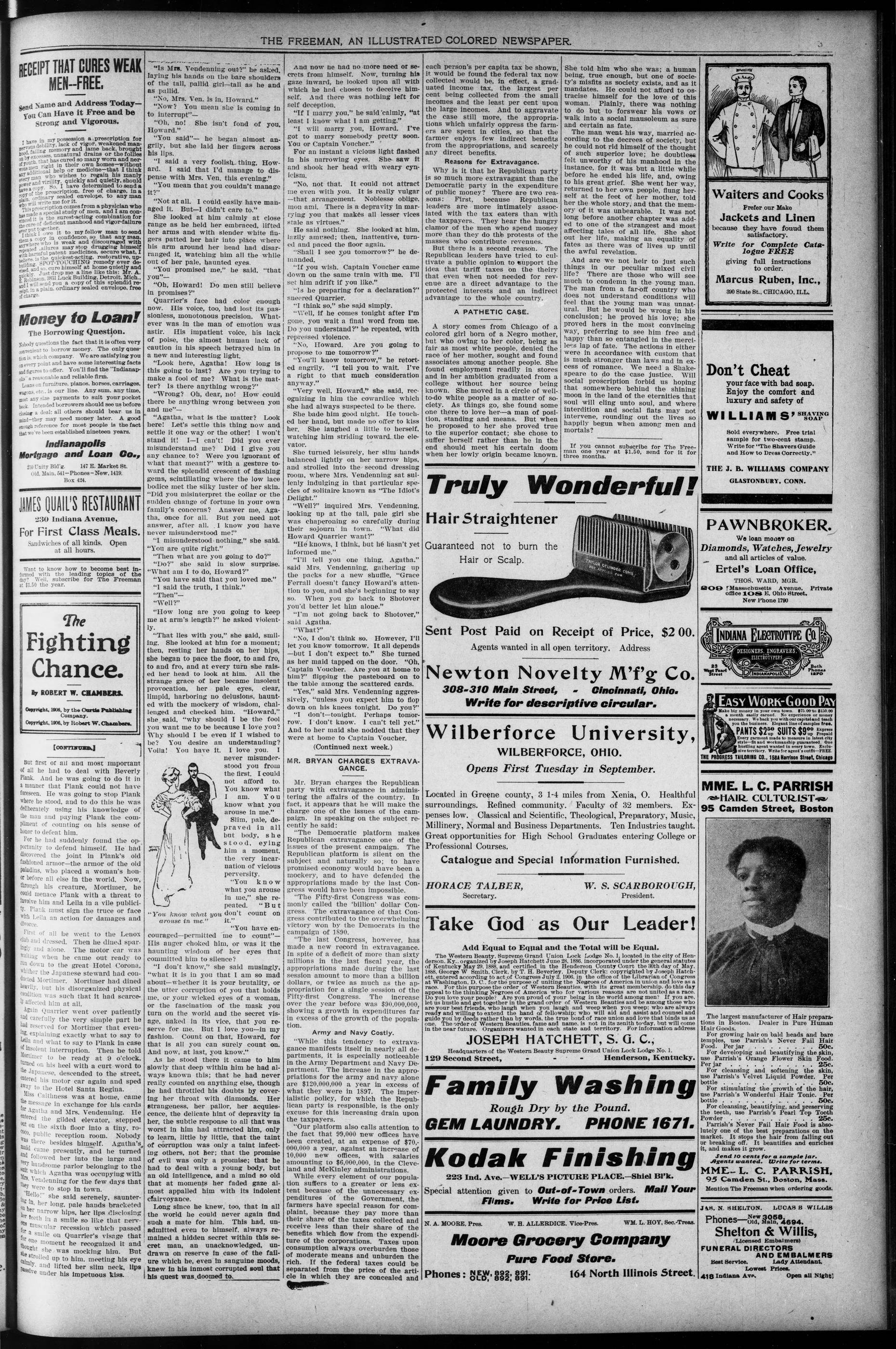
"That lies with you," she said, smiling. She looked at him for a moment; then, resting her hands on her hips, she began to pace the floor, to and fro, to and fro, and at every turn she raised her head to look at him. All the strange grace of her became insolent provocation, her pale eyes, clear, limpid, harboring no delusions, haunted with the mockery of wisdom, challenged and checked him. "Howard," she said, "why should I be the fool you want me to be because I love you? Why should I be even if I wished to be? You desire an understanding? Voja! You have it. I love you. I
never misunderstood you from the first. I could not afford to. You know what I am. You know what you arouse in me."
MILLIE
JONES
Slim, pale, deprived in all but body, she stood, eying him a moment, the very incarnation of vicious perversity.
"You know what you arouse in me," she repeated.
"But don't count on it."
"You know what you arouse in me."
"You have encouraged—permitted me to count"—His anger choked him, or was it the haunting wisdom of her eyes that committed him to silence?
"I don't know," she said musingly, "what it is in you that I am so mad about—whether it is your brutality, or the utter corruption of you that holds me, or your wicked eyes of a woman, or the fascination of the mask you turn on the world and the secret visage, naked in its vice, that you reserve for me. But I love you—in my fashion. Count on that, Howard, for that is all you can surely count on. And now, at last, you know."
As he stood there it came to him slowly that deep within him he had always known this; that he had never really counted on anything else, though he had throttled his doubts by covering her throat with diamonds. Her strangeness, her pallor, her acquiescence, the delicate hint of deprivation in her, the subtle response to all that was worst in him had attracted him, only to learn, little by little, that the taint of corruption was only a taint infecting others, not her; that the promise of evil was only a promise; that he had to deal with a young body, but an old intelligence, and a mind so old that at moments her faded gaze almost appalled him with its indolent fairyvariance.
Long since he knew, too, that in all the world he could never again find such a mate for him. This had, unadmitted even to himself, always remained a hidden secret within this secret man, an unacknowledged, undrawn on reserve in case of the failure which he, even in sanguine moods, knew in his most corrupted soul that his guest was doomed to.
THE FREEMAN. AN ILLUSTRATED COLORED NEWSPAPER
And now he had no more need or secrets from himself. Now, turning his gaze inward, he looked upon all with which he had chosen to deceive himself. And there was nothing left for self deception.
"If I marry you," he said calmly, "at least I know what I am getting."
"I will marry you, Howard. I've got to marry somebody pretty soon. You or Captain Voucher."
For an instant a vicious light flashed in his narrowing eyes. She saw it and shook her head with weary cynicism.
"No, not that. It could not attract me even with you. It is really vulgar—that arrangement. Noblesse oblige, mon ami. There is a deprivation in marrying you that makes all lesser vices stale as virtues."
He said nothing. She looked at him, lazily amused; then, inattentive, turned and paced the floor again.
"Shall I see you tomorrow?" he demanded.
"If you wish, Captain Voucher came down on the same train with me. I'll set him adrift if you like."
"Is he preparing for a declaration?" sneered Quarrier.
"I think so." she said simply.
"Well, if he comes tonight after I'm gone, you wait a final word from me. Do you understand?" he repeated, with repressed violence.
"No. Howard. Are you going to propose to me tomorrow?"
"You'll know tomorrow," he retorted angrily. "I tell you to wait. I've a right to that much consideration anyway."
"Very well, Howard," she said, recognizing in him the cowardice which she had always suspected to be there. She bade him good night. He touched her hand, but made no offer to kiss her. She laughed a little to herself, watching him striding toward the elevator.
She turned leisurely, her slim hands balanced lightly on her narrow hips, and strolled into the second dressing room, where Mrs. Vendenning sat sullyenly indulging in that particular species of solitaire known as "The Idiot's Delight."
"Well?" inquired Mrs. Vendenning, looking up at the tall, pale girl she was chaperoning so carefully during their sojourn in town. "What did Howard Quarrier want?"
"He knows, I think, but he hasn't yet informed me."
"I'll tell you one thing, Agatha," said Mrs. Vendenning, gathering up the packs for a new shuffle. "Grace Ferrall doesn't fancy Howard's attention to you, and she's beginning to say so. When you go back to Shotover you'd better let him alone."
"I'm not going back to Shotover," said Agatha.
"What?"
"No, I don't think so. However, I'll let you know tomorrow. It all depends—but I don't expect to." She turned as her maid tapped on the door. "Oh, Captain Voucher. Are you at home to him?" flipping the pasteboard on to the table among the scattered cards.
"Yes," said Mrs. Vendenning aggressively, "unless you expect him to flop down on his knees tonight. Do you?" "I don't—tonight. Perhaps tomorrow. I don't know. I can't tell yet." And to her maid she nodded that they were at home to Captain Voucher. (Continued next week.)
MR. BRYAN CHARGES EXTRAVAGANCE.
Mr. Bryan charges the Republican party with extravagance in administering the affairs of the country. In fact, it appears that he will make the charge one of the issues of the campaign. In speaking on the subject recently he said:
"The Democratic platform makes Republican extravagance one of the issues of the present campaign. The Republican platform is silent on the subject and naturally so; to have promised economy would have been a mockery, and to have defended the appropriations made by the last Congress would have been impossible.
"The Fifty-first Congress was commonly called the 'billion' dollar Congress. The extravagance of that Congress contributed to the overwhelming victory won by the Democrats in the campaign of 1890.
"The last Congress, however, has made a new record in extravagance. In spite of a deficit of more than sixty millions in the last fiscal year, the appropriations made during the last session amount to more than a billion dollars, or twice as much as the appropriation for a single session of the Fifty-first Congress. The increase over the year before was $90,000,000, showing a growth in expenditures far in excess of the growth of the population.
Army and Navy Costly.
"While this tendency to extravagance manifests itself in nearly all departments, it is especially noticeable in the Army Department and Navy Department. The increase in the appropriations for the army and navy alone are $120,000,000 a year in excess of what they were in 1897. The imperialistic policy, for which the Republican party is responsible, is the only excuse for this increasing drain upon the taxpayers.
"Our platform also calls attention to the fact that 99,000 new offices have been created, at an expense of $70,000,000 a year, against an increase of 10,000 new offices, with salaries amounting to $6,000,000, in the Cleveland and McKinley administrations.
While every element of our population suffers to a greater or less extent because of the unnecessary expenditures of the Government, the farmers have special reason for complaint, because they pay more than their share of the taxes collected and receive less than their share of the benefits which flow from the expenditure of the corporations. Taxes upon consumption always overburden those of moderate means and unburden the rich. If the federal taxes could be separated from the price of the article in which they are concealed and
Truly Wonderful!
Hair Straightener
Guaranteed not to burn the
Hair or Scalp.
TAYLOR CYLINDER COMS
WET APPLIES FOR
Sent Post Paid on Receipt of Price, $2 00.
Agents wanted in all open territory. Address
Newton Novelty M'f'g Co. 308-310 Main Street, - Cincinnati, Ohio. Write for descriptive circular.
Opens First Tuesday in September.
Located in Greene county, 3 1-4 miles from Xenia, O. Healthful surroundings. Refined community. Faculty of 32 members. Expenses low. Classical and Scientific, Theological, Preparatory, Music, Millinery, Normal and Business Departments. Ten Industries taught. Great opportunities for High School Graduates entering College or Professional Courses. Catalogue and Special Information Furnished.
Take God as Our Leader!
Add Equal to Equal and the Total will be Equal.
The Western Beauty Supreme Grand Union Lock Lodge No.1, located in the city of Henderson, Ky. is organized by Joseph Hatchett June 23, 1888, incorporated under the general statutes of Kentucky May 28, 1888, and certified in the Henderson County Court the 20th day of May, 1888, George W Smith, Clerk, by T. H. Beverley, Deputy Clerk: copyrighted by Joseph Hatchett, entered according to act of Congress July 2, 1906 in the office of the Librarian of Congress at Washington, D.C., for the purpose of uniting the Negroes of America in union and love as a race. For the same reason there was no other place to do this de-appeal to the thinking Natives of America who, for various reasons are not united as a race. Do you love your people? Are you proud of your being in the world among men? If you are, let us hustle and get together in the grand order of Western Beauties and be among those who are your best friends, who laugh when you laugh and weep when you weep; who are always ready and willing to extend the hand of the worship of the people who are always ready and willing to extend the hand of the worship of the people who are always ready and willing to extend the hand of the byards, the bond of race union and love that binds us as one. The order of Western Beauties, fame and name, is not in its zenith to-day, but will come in the near future. Organizers wanted in each state and territory. For information address
Headquarters of the Western Beauty Supreme Grand Union Lock Lodge No.1.
129 Second Street, - - - - Henderson, Kentucky.
each person's per capita tax be shown, it would be found the federal tax now collected would be, in effect, a graduated income tax, the largest per cent being collected from the small incomes and the least per cent upon the large incomes. And to aggravate the case still more, the appropriations which unfairly oppress the farmers are spent in cities, so that the farmer enjoys few indirect benefits from the appropriations, and scarcely any direct benefits.
Reasons for Extravagance.
Why is it that he Republican party is so much more extravagant than the Democratic party in the expenditure of public money? There are two reasons: First, because Republican leaders are more intimately associated with the tax eaters than with the taxpayers. They hear the hungry clamor of the men who spend money more than they do the protests of the masses who contribute revenues. But there is a second reason. The Republican leaders have tried to cultivate a public opinion to support the idea that tariff taxes on the theiary that even when not needed for revenue are a direct advantage to the protected interests and an indirect advantage to the whole country.
A PATHETIC CASE.
A story comes from Chicago of a colored girl born of a Negro mother, but who owing to her color, being as fair as most white people, denied the race of her mother, sought and found associates among another people. She found employment readily in stores and in her ambition graduated from a college without her source being known. She moved in a circle of well-to-do white people as a matter of society. As things go, she found some one there to love her—a man of position, standing and means. But when he proposed to her she proved true to the superior contact; she chose to suffer herself rather than he in the end should meet his certain doom when her lowly origin became known.
Truly We
Hair Straightener
Guaranteed not to burn the
Hair or Scalp.
Sent Post Paid on R
Agents wanted in all o
Newton Nov
308-310 Main Street,
Write for des
Wilberforce
WILBERFO
Opens First Tues
Located in Greene county, 3 1-4
surroundings. Refined community
penses low. Classical and Scientific
Millinery, Normal and Business Do
Great opportunities for High School
Professional Courses.
Catalogue and Special
HORACE TALBER,
Secretary.
Take God as
Add Equal to Equal and
The Western Beauty. Supreme Grand Uni-
derson. Ky., organized by Joseph Hatchett June
of Kentucky May 29, 1818 and certified in the
Bureau of War and Peace by H. Bevere
ett. entered according to act of Congress July
at Washington, D. C. for the purpose of uniting
race. For this purpose the order of Western B
kind you by deeds rather than by words, the to
Do you love your people? Are you proud of
let us hustle and get together in the grand or
are your best friends, who laugh when you la-
ready and willing to extend the hand of fellow
to you by deeds rather than by words, the to
one. The order of Western Beauties, fame and
She told him who she was; a human being, true enough, but one of society's misfits as society exists, and as it mandates. He could not afford to ostracise himself for the love of this woman. Plainly, there was nothing to do but to forswear his vows or walk into a social mausoleum as sure and certain as fate.
The man went his way, married according to the decrees of society, but he could not rid himself of the thought of such superior love; he doubtless felt unworthy of his manhood in the instance, for it was but a little while before he ended his life, and, owing to his great grief. She went her way, returned to her own people, flung herself at the feet of her mother, told her the whole story, and that the memory of it was unbearable. It was not long before another chapter was added to one of the strangest and most affecting tales of all life. She shot out her life, making an equality of fates as there was of lives up until the awful revelation.
And are we not heir to just such things in our peculiar mixed civil life? There are those who will see much to condemn in the young man. The man from a far-off country who does not understand conditions will feel that the young man was unnatural. But he would be wrong in his conclusion; he proved his love; she proved hers in the most convincing way, preferring to see him free and happy than so entangled in the merciless lap of fate. The actions in either were in accordance with custom that is much stronger than laws and in excess of romance. We need a Shakespeare to do the case justice. Will social proscription forbid us hoping that somewhere behind the shining moon in the land of the eternities that soul will cling unto soul, and where interdition and social flats may not intervene, rounding out the lives so happily begun when among men and mortals?
If you cannot subscribe for The Free-
mental at $1.50, send for it for
three months.
Wonderful!
receipt of Price, $200.
open territory. Address
Delty M'f'g Co.
- Cincinnati, Ohio.
Scriptive circular.
University,
ORCE, OHIO.
day in September.
miles from Xenia, O. Healthful
y. Faculty of 32 members. Exc.
c, Theological, Preparatory, Music,
departments. Ten Industries taught.
cool Graduates entering College or
Information Furnished.
W. S. SCARBOROUGH
President.
Our Leader!
the Total will be Equal.
In Lock Lodge No. 1, located in the city of Hen-
28, 1886, incorporated under the general statutes
Henry County Court on the 30th day of May.
Dewey Cask, corporation by the will of
1906, in the office of the Librarian of Congress
the Negroes of America in union and love as a
beauties, with its great membership, do this day
for various russians are not united as a race.
our being in the world among men! If you are
of Western Beauties and be among those who
high and weep when you weep; who are always
ship; who will aid and assist counsel and
us bond of race union and love that blinds us as
COOKS
Waiters and Cooks
Prefer our Make
Jackets and Linen
because they have found them
satisfactory.
Write for Complete Catalogue FREE
giving full instructions
to order.
Marcus Ruben, Inc.,
390 State St., CHICAGO, ILL.
Don't Cheat your face with bad soap. Enjoy the comfort and luxury and safety of
Sold everywhere. Free trial sample for two-cent stamp. Write for "The Shavers Guide and How to Dress Correctly."
THE J. B. WILLIAMS COMPANY
GLASTONBURY, CONN.
PAWNBROKER.
We loan money on
Diamonds, Watches, Jewelry
and all articles of value.
Ertel's Loan Office,
THOS. WARD, MGR.
209 Massachusetts Avenue. Private
office 108 E. Ohio Street.
New Phone 1790
INDIANA ELECTROTYPE CO.
DESIGNERS. ENGRAVERS.
ELECTROTYPEERS
23 Wega Pearl
Street
INDIANAPOLIS
Josh
Phones
1870
EASY WORK-GOOD PAY
Make big money in your own town. $75 00 to $120.00
a mouth easy earned. No experience required.
Work in the business and you the business. Elegant line of samples free.
PANTS $25.00 SUITS $99.00
Express your style. Every garment made to measure in latest city
style. Fit and workmanship guaranteed. One of the best
sales territory. Write for agent -牢固 - FREE.
THE PROGRESS TALORING CO., 1584 Harrison Street, Chicago
MME. L. C. PARRISH HAIR CULTURIST 95 Camden Street. Boston
Mary C.
The largest manufacturer of Hair preparations in Boston. Dealer in Pure Human Hair Goods.
For growing hair on bald heads and bare temples, use Parrish's Never Fail Hair Fungus. Per jar.
For developing and beautifying the skin, use Parrish's Orange Flower Skin Food. Per jar.
25c.
For cleansing and softening the skin, use Parrish's Velvet Liquid Powder. Per bottle
50c.
For stimulating the growth of the hair, and Parrish's Wonderful Hair Tonic bottle
50c.
For cleansing, beautifying, and preserving the teeth, use Parrish's Pearl Top Tooth Powder
25c.
Parrish's Never Fail Hair Food is absolutely one of the best preparations on the market. It stops the hair from falling out and beautifies and enriches it, and makes it grow.
Send 10 cents for a sample jar.
Agents wanted. Write for terms.
MME-L. C. PARRISH,
95 Camden St., Boston, Mass.
Mention The Freeman when ordering goods.
JAS, N. SHELTON. LUCAS B WILLIS
Phones—New 3058
Old, Main, 4694.
Shelton & Willis,
(Licensed Embalmers)
FUNERAL DIRECTORS
AND EMBALMERS
Best Service. Lady Attendant.
Lowest Prices.
418 Indiana Ave. Open all Night]
---
PUBLISHED EVERY SATURDAY
At 225 Indiana Avenue,
INDIANAPOLIS, INDIANA.
Any part of the United States one year. postage paid.....$1.50
Six Months.....85
Three Months.....60
Foreign Countries, including Canada, $1 extra.
Send money by express money order, post-office money order or registered letter.
Agents wanted in every town and city not now occupied, and liberal inducements will be given to the same. Send for our extraordinary inducements.
ADVERTISING RATES:
Five cents per line. Base of measure—solid Agate, 14 lines to an in. $273 lines in a column. Advertisement inserted in the back. Advertisement inserted on first page. Special rates on standing professional and business space. Account for long time and space. Reading notices 106 per line. Special rates on "write ups." Entered at the postoffice at Indianapolis, Ind., as second class matter.
New Phone 2880.
GEORGE L. KNOX,
Publisher and Managing Editor.
ELWOOD C. KNOX,
Business Manager.
SATURDAY, SEPT. 26,1908.
Indianapolis is at present storm center of the long-expected temperance wave.
If the colored voter sees where he can help himself by voting any other ticket than he does he should not hesitate in doing so.
A county local option law is the expected or some other kind of local option measure according to the programs of either party.
Battling Nelson feels to be called on to write a book of his life. Gans will have inspired the book, and indeed it will not be complete without satisfactory reference to his great battles with the black boy.
It is evident that the show is a little big for the one Mr. Hitchcock to handle. He will receive some "auxiliary" accord to Mr. Taft, or some auxiliary or something like that. Some god fat checks would facilitate matters.
Joe Gans will not be able to abide by his ring-side decision, when he said he would never fight again. His business affairs are badly mixed—a $22,000 mortgage on a $30,000 notel. Joe will not be able to sit down for awhile.
Good long time since we've heard from Jupiter Pluvius or whatever you call him. The poet has it that the wind that blows is best, blow it east or blow it west. But impatient, short-sighted mortals can't always see things that way.
The Grand Lodge of U. B. F. and S. M. T. recently met in its twenty-eighth annual session in the city of Fort Worth, Tex. A great program was rendered, which included speeches by noted individuals and singing by soloists of ability.
The band of colored musicians of the "In Old Kentucky Company," paused long enough in front of The Freeman office last Tuesday morning to play a tune. It was highly enjoyed. The band is expected at any time it cares to come around.
What's the mater with our distinguished friend Foraker? Has he been disqualified? The race will regret to learn of circumstances that, in any way, makes less his usefulness. Perhaps the whole matter is of the trade of politics and will righten at the proper time.
Mr. Bryan makes the charge that he is running against both President Roosevelt and Candidate W. H. Taft. He is not very far wrong. But there is nothing unusual about the condition. Really, it concedes Mr. Roosevelt something—influence at any rate. And besides, the President is expected to stand by his man to the finish.
The long-promised temperance wave has at last struck Indiana, landing a broadside right on the heart of the state. Indianapolis is assailed as she never was before—at the capitol—where the local optionists seem to have the call. Either party has flirted with the temperance people and it looks as if one or both will have to make good.
The Negroes will think a long while before they fight the liquor interests. The race is largely dependent on them. Sentiment is sufficient to maintain respectability, but with us it can not go much further. The race is supported by the porters, waiters, bellmen, butlers, whose positions, in the main, are made lucrative because of the interests. It is not a desire, but a necessity, that it is so situated.
The Eighth Illinois broke camp last Sunday morning. The troops proved a feature of the encampment at Fort Harrison. The company is distinguished in that it is the only state military organization of Negroes in the country. The conduct of the men during their ten days' stay was exemplary. As soldiers performing the requirements they stood with the foremost companies, excelling in some instances.
There are hundreds of laborers whose work is in no way associated with the liquor interests. But take the young, progressive-appearing Negroes, and where do you find them? They make more in a day than a laboring man does in a week, very often. They keep up the race appearance; they patronize the doctors, lawyers, pay the preachers. What would the
well-to-do barbers, who run shops for colored people, do without this class? What would the colored tailors do?
Some little attention is being paid to country life by Negroes in the North. This phase of life is being advocated not as a specialty, but because of the opportunity. No vocation is so open to the race as that of agriculture, and yet it is put down with a oneness that is simply remarkable. Every race has a right to contribute its quota to every calling, taking advantage of all opportunities as they are presented. Earnest engaged, taking life seriously in all that pertains to the industrial side.
The best environed Negro community in the United States is to be found in Baltimore. On Druid Hill avenue are the houses of the more successful Negroes, and the houses of the less successful are on the tributary streets and avenues. This Negro community has within the past year suppressed thirteen of the forty-two saloons of the neighborhood, and has thus raised its own moral tone. In doing that, the Negroes secured the help of the white citizens by, first, a careful study of conditions, and, second, a presentation of facts by charts and plans, based on the records of the police and health departments. This action on the part of the Negro leaders in this community explains in large measure the attitude of the City Council in its welcome to the league.—The Outlook.
Druid Hill avenue and its vicinity have long since been well known throughout the country. It is greatly to the credit of a community that boast of so many of the better homes that it had the courage to suppress the uglier phases of a condition with which it was very much burdened. One cannot think of forty-two saloons in a community without being appalled by the load under which it struggled for years. Thirteen is not a great reduction, but presumably the places shut out were the resorts and dives which are run in the name of saloon and which are so injurious to that business.
LOUIS REIBOLD DEAD.
The death of Louis Reibold was one of the regrettable happenings of the recent past. Mr. Reibold was a noted hotel keeper, formerly of Dayton, O., from which place he came to Indianapolis. He assumed the management of the old Bates House, one of the famous hostelries of the country. He was a genius at the business of hotel keeping; scarcely less so was his mother, who personally supervised the very important culinary department and kept a sharp outlook over things generally. Under the spell of the two everything prospered, and it was not long before the old Bates, which had greatly run down, was again attracting the attention of the traveling public.
Reibold seemed to have the touch of Midas; everything he put his hands to succeeded. This touch was no more than his insight for the business; he seemed to know what the public appreciated. He was for excellence, elegance, comfort and was busy from morning until night bringing about his dream of a hotel. He began his work of reform the day he entered. His eyes lighted on the office chairs, ordering them scrubbed, insisting that it was better than the paint come off than the dirt remain. Scrub the chairs! he insisted. He put up with the cahirs until he saw prosperity coming his way. His reform was general. He was here and there, apparently everywhere at the same time. No thing was too trifling for him to note; no thing was too great for him to consider. It was a long cry from scrubbing office chairs to marble steps, yet he entertained either notion and with no great interval between.
His swift, soft, gliding motion was known to all. He was a psychologist of the business; knew that eternal vigilance was economy. So when the wrong-doer was on the verge the footfall of the proprietor deterred. And even when he was not present in person the fact of his probable appearance had the effect intended. His aged mother was scarcely less vigilant. She was always present; neither were noisy, demonstrative. In fact they did not talk—they were as a sphinx whose great and masterful presence inspired respect. They were the most polished people, discharging one so genteelly that he would scarcely know that it was done.
Not only did he care for excellence and comfort by way of housing the guests; the table spread was a daily banquet; he purchased the best to be had. He was nothing with "fuss and feathers" here as marked his course in every other department. His idea was richness in quality, allowing that to stand for profusion; he was not great on variety.
The colored men who worked for him give him the greatest praise; nor was he indulgent; he wanted tasks performed, and if one did not perform them he quietly let them out. He had nothing of the second mate on a steamboat about him; he merely rubbed his hands and suggested and smiled and seemingly half inclined to bow—the employee had to do the rest or else he would be absent the next pay day.
Mr. Reibold's methods won for him largely; he amassed a fortune out of the business, finally returning to Dayton, where he invested his earnings in good real estate. He died in that city.
COL. JOHN R. MARSHALL.
Col. John R. Marshall is the only Negro wearing the high mark of distinction. Since the beginning of the Eighth Regiment, as the National Guards were formerly known, he has been its efficient head. It was through his efforts mainly that the organization was called into existence. The colonel, however, does not fail to heap praise on the late lamented Governor Tanner, of Illinois, who did all in his power to put the company on the field during the recent Spanish-American war.
The nine months' service by the troops was mainly garrison duty. It proved a very opportune time for Col. Marshall, however, who, in his line of duty, found himself at various times at the head of provinces where he ad-
THE FREEMAN, AN ILLUSTRATED COLORED NEWSPAPER
COL. JNO. R. MARSHALL. Of the Eighth Illinois Regiment
ministered the municipal affairs with signal success. Company, officers and commander acquitted themselves with distinction, winning this meritorious mention from the general officers in charge. What was said of the regiment, of the commander has been said ever since in all of the affairs which they have taken part. They have made a reputation, and which every man seeks to preserve, even to increase.
On coming home from the war the regiment was disbanded. Under the then existing laws of Illinois it was impossible to bring about a reorganization. There could be no more new companies unless special provision be made by the Legislature of the State. Major Marshall and his men set about the desideratum, working all together with a right good will, finally accomplishing what they set out to do—succeeding in having the State make a place for the Eighth Regiment, which became, according to the laws, the Eighth Infantry of the National Guard of the State of Illinois. At this time, with the new organization, Maj. Marshall became Col. Marshall, a well deserved promotion, as his men testify. It was again that the distinguished Tanner, who is spoken of so lovingly by the men, did all he could in giving the boys what they wanted. "God bless Governor Tanner," was the way it was put when one referred to his ceaseless endeavor in behalf of the men.
Col. Marshall is easily a dignified man, inspiring those with respect who come in his presence. On the field, as noted at the encampment, one forgets the term Negro as applied generally, in contradistinction, when he enters the tent of the commander. The literary man will think of Othello, the war man, who knew real war, who say Grant and Sherman and Lee and Sheridan and the rest of them, will think of these, while the historian will think of Napoleon and the ghostly set that have fled the mortal plains. The colonel is idolized by his men. This great love is a portion of the pact of the organization, weided together by that soft influence, which in the operation outbids refined steel, it stands practically as one in all of its actions, and which stands for Colonel John R. Marshall.
COUNTY LOCAL OPTION.
Indiana has been threatened for the last three or four years with an inundation by the great temperance wave that has been sweeping over the middle West and the South in the recent past. Every ingenuity and "device" have ben resorted to in order to stay the impending, but it would not stay stayed; and like ravages delayed in their course are more ferocious in the attack because of the impeded progress. It is more and more apparent that great movements are beyond the ordinary control of men, and like men they must have vent. One will here think of superstition and such like; it is not necessarily that, but the thought of reformation, change; men tire of the old way as they do of their clothes; men tire of vice and immorality as the woman tires of last year's fashion, becoming positively painful to them if they must endure for another season. They do not will the condition; it just comes, of spontaneity, and no law will cope with the disposition—a change is the remedy—a psychological thing that men are not prepared to explain. Some claim to feel the coming of great events, great changes; feel to be prophetically inspired, if not divinely, but the fact of the matter is that they have simply ben influenced by the law in this case, which says, "coming events cast their shadows before them." What they think to know off-handed is but the reading of the signs of the times—the desires and notions.
The temperance people are at the bat and they will play ball. The Republican party, by the platform of principles, announced at the last state convention declared for county local option. This was in compliance with the popular demand, and by the way a great advance over other conventions, which, for the most discreetly, let the liquor business alone. It has been touched on at times in a very gingerly manner, but with prediction for the temperance side. The Democrats have ben of more liberal policy. Either party, however, have been careful not to too deeply wound the feeling of the liquor people and the liberal element, and which liberal element is
not always to be associated with the low and vicious. It believes that the individual is monitor of his own action, and so long as his individual acts do not run counter to the laws intended to keep man within his bounds, the individual is all right. This includes the covenants of civilized society which are not enacted into law.
The aforesaid temperance wave had a salutary effect on either party. Either is committed to some notion of local option. But the Republicans are in control. The Legislature is Republican. A Republican governor called the extra session of the Legislature, an enactment of a county local option law being one of the chief purposes. That the wave is on is attested by the immense temperance lobby that attend the session, and who, from all indications, are going to set up with the doughy opponents until they are driven to cover. The enthusiasm of these, who, for the most part, must look after their own expenses is significant. Political movements are generally featured by some interests when they break out in such violent form. Not so with the temperance cause; and that's what makes it so feared when things begin to come its way.
Bad government along the line of liquor selling has had much to do with the wave; the condition has given impetus to the movement. Salon men have been too careless of the laws. This carelessness has brought them conspicuously in front. The happenings are published in the newspapers. This negligence is of the much smaller number, but it is in the name of saloon, and the whole business is looked on as very bad. Indianapolis has never been open and notorious in the sense of open and notorious as known in other cities. Sunday closing has been observed, not absolutely, but observed. The front doors are not open at all anywhere and the back doors when open are known by only a few who diligently seek them. Perhaps the salon is not a blessing anywhere; it has not proven a curse in Indianapolis. Incidentally, it contributes to the makeup of the criminal list; incidentally, weak men are won from virtue, but as a whole the saloon in Indianapolis is about as decent and respectable as they are elsewhere.
We of the Negro race will not find much to complain of from the saloon side. With whatever viciousness the opponents seek to characterize it, the colored people can not too greatly share in the abuse. If things were otherwise, as they are found with the white people where only the very, very few are dependent on the liquor interests for a livelihood, it would be different. With the Negroes the saloon means support. They are forced to cut very much of the sentiment out. Nor is this a reflection on a race, which must as yet catch, where catch, can, in the mater of employment. Really, all the "smart" money by colored men is made by those that are in some way identified with the liquor traffic. This has in mind the great army of middle class Negroes, those who are not of the profession, and who are not common laborers. They make by far the largest element. They are porters, waiters, bellmen, messengers, butlers; these in turn take care of the barbers and the tailors and the restaurants. We need not stop there: the doctor, even the Negro pulpit is indirectly supported by this liberal element that gives as it is given unto it. The army of ice men is not to be forgotten. The race is restricted and unconsciously so by much of the high moral element who view the saloon as a stench in the nostril. It is not a prayer-meeting by any means, yet it brings salvation to a lowly race which finds its employment in places more or less related to it or dependent on it.
COLORED YOUTH. COME SOUTH.
Prairie View State Normal and Industrial College, a school for Negro youths established and maintained by the State of Texas. E. L. Blackshear, A. M. Principal; C. W. Luckie, A. B. Treasurer. Located at Prairie View, Waller County, Texas. On main line Houston & Texas Central Railway. Educate your children in the South, the land of the black man's opportunity, offering superior inducements of labor, homes, mild climate, cheaper living and business enterprise. Full normal and industrial courses, agricultural building, well equipped shops, library and laboratories; new
Better Grade Better Made
HOWARD,
The Popular Price Tailor.
Another lot of new
Fall and Winter Novelties
have arrived from the foremost European mills of the world. Sixty separate and distinct colorings in Scotches, Fancy Worsteds and plain blue Serges, which will follow the trend of fashion without going to extremes.
Call and See Me.
HOWARD
Main Floor Traction Terminal Bld.
Vote For
Frank B. Ross,
Democratic Nominee
For Judge of Probate Court.
Ferger's Drug Store No. 3,
Indiana Avenue and Michigan Street.
Prescriptions Our Specialty.
Agent for TAYLOR'S CYLINDER COMB, a 20th Century invention. Great aid to Colored People.
Barbers, We Want Your Orders.
Our Special Razor.
Price Only 72 CENTS.
White bone handle half concaved, 4-8 or 5-8 blade. Postage 3c.
Our Special Shears.
Price Only 62 CENTS.
7½ inch French pattern. Postage 3c.
Our Amber Petrolatum will straighten any hair. 5 pound can 85c.
Write for Our New Fall Catalog.
KRAUT & DOHNAL,
169 S. Clark St., Chicago, Illinois.
buildings, electric lights, water system, sanitary sewer system.. Industrial courses in Wheelwrighting, Blacksmith, Carpentry, Steam Laundering, Practical Steam Engine, Dynamo and Boiler Work, Horseshoeing, Mechanical Drawing, Cabinet-making, Steel and Wood Lathe and Turn Work, Tailoring, Shoemaking, Poultry Farming, Truck Farming, Broom and Mattress Making, Dairying, Stock Feeding and General Agriculture. Normal Courses, History, Economics, Mathematics, Pedagogy, Physics, Chemistry, Natural History and Scientific Agriculture.
Prepares for teaching, for the trades or for business. Courses in music and accounting. Faculty of twenty-five trained, experienced instructors, graduates of leading colleges. Surroundings healthful and beautiful; expenses reasonable. Thirtieth annual session opens September 9, 1908.
For catalogues and application blanks address W. O. ROLLINS, Secretary.
HUMPHREY, ARK.
Special to THE FREEMAN.
Mrs. M. Adams, the successful market lady, was shopping Saturday....Rev. G. W. Johnson, the grand old gospel hero, is down at Swan Lake this week, assisting Rev. S. L. Thomas in revival. He reports four converts the first week....Mrs. Julia Maberry, of Stuttgart, was the guest of Mrs. Sinclair, Sunday....The Arkansas County Teachers' Normal was conducted by Prof. Hibbler, of Brinkley, this week, at Dewitt....Our people at this place are beginning to see the importance of reading their own race journals....You will find The Freeman for sale at M.T. Toms' book store, near the Cotton Belt depot.
P
which not only gives that refined, smooth, glossy apples, but also really, really, at the same time invigorating and refreshing the scalp wonderfully. It softens the fibres of the skin to make it kinky or matted condition which prevents one from feeling it. It is a test fashionable styles. MARVELOUS HAIR BEAUTIFIER It is a toilet necessities for ladies and gentlemen for it actually does remove curls, kinks, etc. and, as a result, it will be easy to coamh. We prep all charge products and will send them to our office or en-ough to last a long time - for only 1. QUALITY purity and satisfaction guaranteed, or money back. LINCOLN MANUFACTURING CO., AURORA HL
CORAOPOLIS, PA
Special to THE FREEMAN.
Mrs. Bowyer, in Second avenue where has been very ill, is improving... Mrs. Mary Robinson is also improving... Mr. Lovel Mason is able to be out again... Mr. John Bowman is quite ill... Mr. H. Willis is able to serve for several months, is improving... Miss Douglas is at Hairy's Herry attentive.
...Mrs. Dora B. Hill, who has bestowed
honored guest of Rev. and Mrs. V. L.
Stott, has returned her home at New
September 30 for Johnstown, Pa.
for the annual conference. The Lycium
of the St. Paul A. M. E. Zion Church had an
evening, Friday evening, and was discussed by Mr. John Chandler and
Mr. Arthur Winston.
THE STAGE
tury and the romantic of the early seventeenth century. If one can imagine one's self a living character in the one period or a makeover in the morning to find him or her a new look, the period, he would have a good line on the text and material used in the building of "The Road to Yesterday." George Arline (1730-1793) the architect of Jack Greatorex and Reformed Jack. Miss Mathilde Choate, as Black Malena, lacks finish in her work and is only in spots. Keneim Paulet, as Lord Orangevon, was a good "bold, bad villain."
English's.
"A Stubborn Cinderella," a rattling good musical comedy, played a three nights' engagement at English's Opera House to celebrate the opening of a elaborate investiture, costumes and scenic effects won applause from the audiences at the rise of each curtain. Unlike most musical comedies, there are no bad points to the show, but the brilliant ones. "When You First Kiss the Last Girl You Love" was perhaps the biggest individual song hit, and is still being performed today. The nurses were "I am in Love with All the Girls I Know" and "Love Me Just Because."
The Empire.
Patrons of the Empire have a distinct treat before them for next week, when Sam T. Jack's Own Company, the peer of Sam T. Jack's burial businesses, will commence engagements in this city. The name of Sam T. Jack's Own Company is known far and wide, and it stands without a rival in its line of business. The company are known as music of sound judgments, lavish in their expenditures in catering to the public and thoroughly up-to-date. For this season the Sam T. Jack's Own Company has been made better than ever. The company have been gathered together from Europe and America, regardless of expense, while the most gorgeous costumes have been made for this season. fourteen distinct sets of dresses being worn by the princess and chorus of twenty-two beautiful women.
The first piece on the program is a skit on the opera, "The Merry Widow," and is entitled "The Merry Widow Kiddo and the Merry Widow Kiddo," the program is devoted to the burlesque, "The Merry Widow of Loney Park," from the pens of Messrs. Barney Gervard and Gampers. The two pans are filled with funny lines and situations, plenty of dainty music, grand marches, pleasing dances and everything that could please an audience. The two pans are filled with a hit, which is a burlesque on "Three Weeks," by Eleanor Glyn, the Englishwoman who created a sensation with her book of views on America and its people, all Europe is talking, and which is the rage of New York. will be seen here for the first time on any stare, in the number given by May. The original production of "The Belle of Mayfair," in London. In the olo will be found the three Armstrongs, bicycle riders; Armstrong and Lawrence, Lawrence and Harvey, the sketch team; Harry Fink, the Hebrew comedian; the three musical Stewarts, and the famous series of living tautettes Realies "direct from Paris," which twelve beautiful women take part.
Everything is ablaze as usual along "Dahomian Stroll." This continuous street fair has taken place in the people's been out if you haven't taken a stroll from Twenty-seventh street as far up as Thirty-fifth street. The Pekin and the five-cent store are the best place to buy change of the weather will mean look different around here.
The Pekin, as usual, is heading all these little houses in the way of amusement. How this house can keep up such bills has the oldest inhabitants in the Wise and Milton, displayed in the electric sign. This is a big act, and is worthy of all the advance notices it has received. There are three girls in the Wise and Milton, an act like it. The act is original. It is a question as to whether any of the pirates could steal it if they wanted to. Their task is to steal it. Miss Milton has an easy carriage in her talk, which is evidence that she can hold her own in anybody's company. She is dainty and easy to handle. Miss Milton has the ordinary roughhoused acts that have appeared in this house. Mr. Wise, dressed in the height of fashion, gets as much comedy out of his part as any of the artists. Their Indian finish, with their own drop, gives one the feeling that he is on a real Indian reservation. The general summing up of this act puts it away beyond and along this line.
The Johnson's, in their singing and dancing act, live up to the type. These people are singers and dancers and an emotional voice. The act was a little stringy and slow in parts. This is not a full stage act. It is a one and two and rapid-fire order. But these Johnson's are entertaining, and ought to Rice and Rice, a German act on the bill, hold the record for holding the stage. The gentlemen, they hate them, hate them, and then make you like them. This act on the big circuit, as a rule, is used to hold the stage while it is being set for a big act, but these comedians hold the stage long enough to
In Tim Owesley's travesty on military life, the four comedians, Owesley, Williams, Stevens and four others, "Officials of the Charleston Blues," Owesley stuck out just a little bit. His song, "I Led the Soldiers," was a very good one. The introductions are hardly worth mentioning. Oma Crosby and Lotte Grady's songs were very bad. The chorus of this house is sadly in need of drilling and singing and one seems know when to pick up a chorus or drop it.
The Grand is the premier house, following the Pekin band in a bill, but no heads or tails as to what was on the inside from what was advertised on the outside. The outside bills Simms had section of the city. On the inside no one appeared but Simms—no Lemley. Simms did excellently single-handed. This house enjoys the highest down town status in the Majestic has down town its. Its patrons are loyal and will support anything that the management offers; but the house is advertised on the outside. There was no apology for Lemley not being there, and no substitute.
The Dunbar, the house of trouble, has changed its management again, perhaps for better and perhaps for worse. This house goes on record as having more managers than any other city, and fire and theft are the only time. John J. Marshall, the old comedian, has taken the house; if he can't make it go, the house will have to go for the better. He opened up with what he called "The Tennessee Minstrels," a country affair; yet they did better than many of the crack concerns around the building. Fort worth cases were out of the ordinary, and will do better later on.
The Royal, the house with a checkered life, has a good show one time and a bad show the next time; it has on its bad spell now. It offered about four acts, and all of them would not make it but bill was two inconsequences—a male doing a female
Pearl Moppin is with A. G. Allen's min-
strels.
Chris Smith, the song writer, is the new
partner of George W. Cooper, formerly of
Cooper & Tobinson.
Johnson and Dean, who have been soo-
king his big in Europe for several seasons,
will sail October 3 for America.
Nathan Biven's "Linda Green" song is
being sung with great success by Wm.
Pennell and company with "In Old Kent-
ucky" also.
Williams and Stevens, two clever fellows,
have signed with Robt. T. Mott's
Theater Stock Company, at Chil-
go for the season.
Wm. Pennell and Roy Pope, members of
"In Old Kentucky," were FREEMAN
callers. Pennell says hello to P. G. Low-
ery, Jim Burris and Jim Reed.
Alongo Bosan, a member of Henderson
Smith's big act, "Ten Dark Knights," is
visiting friends in Indianapolis. He re-
ports the act a big success with excellent
The Eaglestons are in their second week in Dubuque, Ia., with a white stock company, and are well received with their musical act. The engagement is indefinite. References to all friends.
Al Anderson and Jay Goines, the politic colored comedians, report meeting with Eugene Clark in the last ovation "Late Hours." Act is represented by Mr. P. F. Nash.
Eugene Clark's Comedy Company, en route with the Howe's Great London Virginia, and are now in old Virginia, going to New York. Clark is a good business everywhere. Eugene Clark sends regards to all friends and Miss Hicks sends regards to all friends. Mr. Clark wishes to hear from Joe Clark, his son, Robert Clark.
The "Whangdoodle Band," which is a feature of the play "In Old Kentucky," which was at the Park Theater the first three days of the week, is made up of scores of the "old yellow bridge" on Indiana avenue, some years ago, John Powell organized a band of colored musicians to play at a political rally. The comedy make-up of the musicians matures later, the management of "In Old Kentucky" advertised for such a band and engaged the "Whangdooodles" upon their answering the advertisement. John Powell, the leader, is looked upon as back Sousa.
Notes from Marshall's Old Plantation Shows...We are still in North Carolina and everybody is happy. Ever Porter, who is in the show, doing fine work, singing with success, 'Take Your Time.' Isam Johnson is the son, Buddy Kid of the show, *The Gavin Show*. Gavin is holding his own on the end. Coot Hagler is singing with success, "Things am Com-ing to Hagler," his hit wife, *I Want a Little Loving Now and Then*. Our troup is composed of the following comedians: Isam Johnson, Luke Gavin, Fosse Ingle, Ingram, Palke, Tillman, Gavin, Fosse, Ingle, Palke, Tillman, Porter Porter, stage manager, and Henry J. Clark, property boy. Lady performers. Blancie Russell, M. B. M. B. F. Steven is doing fine with the band.
with the band
Barnum and Bailey's Circus could not offer more full-fledged amusement than will be handed out to the Park Theater patrons for six mattresses and nights, complete with a three-day course and three days of the week, commencing with a matinee Thursday, "The Smart Set," one of the real big shows, with all the trimming to make it a success, will be held on Friday, the 10th of the week following come Williams and Walker, the two boys who have made the whole world laugh, including Carrie Nation and old John D. Rockefeller, and that company will come clean on all the latest jokes, songs and gags, and it is safe to predict that there will be an epidemic on that disease called "naughtiness." The theater finds out our audience is catching on and to attend some of the performances on the dates stated.
The following program is being rendered by the Big Family Show and Twentieth Century Entertainers, en route with choreographer & Rowe's Side Show: "Opening Chorus," by the Company (Cohn-Harris, publishers); "Eliel Levy's Virginia Song," Margie Turer (F. A. Mills, publisher); "Brother Out Checks for Rain," Perry Gantt (Cohn-Harris, publisher); "Mr. Ragtime," Lagretta Henderson (Cohn-Harris, publishers); "Who? Me? I'm Not the Man," R. O. Henderson (F. Mills, publisher); "Wem de Sam in Company," (J. H. Henderson, Company, publisher); "Bon Bon Buddle," Wm. Gotham-Attucks, publishers); "Bahy Doll," Rosie Collins (Harry von Tinkle), Big Aigrette (J. Alonzo Turner, Jacobs, publisher). Tambo, Alonzo Turner, Perry Gantt, conversational, Miss Iettu Hattt;resses R. O. Henderson, Wm. Nash. Ex-tense A. F. Adams, business manster; W. H. Collins, orchestra leader; R. O. Henderson, amusement director.
SHOWS OF THE WEEK
In Old Kentucky," with its band of folks, "thoroughbred horses, Kentucky jumps, full jumps, etc., held forth at the Park and was the most famous was only fair. The most popular part of the show was the stunts pulled by the second act by the colored boys' pickaninny Band. Their sweats and dance were their most popular was easily the "big noise" of the his. His dancing would go in vaudeville. His work was the hit of the show. Not a stunner, but a beautiful-footed ponymets was "borrowed" but every new was new and distinctly novel.
The Grand
The Grand bill this week was "topiary with musical acts, there being however of them. Sameness and monotony, proving averted by them, all three movies made by Mabelle Adams' offering was the bulk of the musical numbers. Johnny McCoy and his "College Girls" went big. A run of classic comic opera could be built around the musical numbers. The musical numbers were good and the acts possess P. Rogers, of the team of Rogers and Hoyes, has a voice that is a broadmusician. Gallett's monkeys were a screamer" for the little folks.
Majestic.
The Road to Yesterday," last season's greatest success, based on the theory of rehearsing, was presented to delighted audiences right before the show how far a gifted playwright may burden the human imagination without burning the tendons of reason. It is certainly romantic Fantasy. The romance is certainly interwoven, blending adequately the prosleader
CHICAGO SHOW SHOP.
THE FREEMAN, AN ILLUSTRATED COLORED NEWSPAPER
REIBS
BAND
WILLIAM H. REID'S BAND AND CONCERT COMPANY.
WITH BARNUM & BAILEY CIRCUS
WILLIAM H. REID, SOLE OWNER
AND MANAGER.
Reading from left to right:
(1) S. W. Clark; (2) Wm. H. Reid;
(3) J. Vinnie; (4) J. Rash; (5) E. N.
Colling; (6) O. Hurdle; (7) F. I. Dixon;
(8) W. E. Madison; (9) T. Scott; (10)
C. Quetta; (11) Wm. Robinson; (12) M.
Crosby; (13) G. Halmington.
impersonation and a female doing a male
imitation. The pair ought to be put
on the hook gang. The male impersonator
looked the part with a fine wardrobe, but no song. Anybody can sing "Love Me and the World Is Mine."
The Lincoln is the home of "Rags."
That is the name of an act this house has
run so successfully or that he has
made many, but "Rags" is still making his rhymes on the audiences.
THE ROYAL THEATER.
At Memphis, Tenn., Miss Alice McQuillier, the pianist, is still pleasing the patrons of the theater. She brings the house down when she plays that sweet waltz, fronted by the fingerboard friends in and out of the profession. We have had very favorable weather, and are doing S. R. O. business nightly. Our three soubrettes, Miss Ida Gardner, Miss Mamie Chester and Miss Alice Ramsey, are make-up artists, and we have some in the Back Way, for He's Gone Out the Front." Sam Russell, our trick buck and wing dancer, is scoring a big hit and sends Briggs a smile. He is filled with Briggs. The company was entertained by Floyd Hurt Friday evening last, September 11, and all of the delicacies of the season were served. The whole company sends regards. The company was from J. W. Anderson and Susie Beavers. Write. Leggins and Briggs have composed a late song, which will soon be published and sent to all performers. Title. When We Meet. To hear of the death of Tom Logan. His mourners have our sincere sympathy.
MAHARA'S MINSTRELS.
W. A. Maharas Big Minstrel Carnival, now en route to the coast, is playing nightly to S. R. O. under their big air dome theater. We have been playing through Mississippi and the North, with continued success. Prominent in the cast are: Clever Billy Young, interlocutor, who holds his audience spell-bound with his amazing elicitation. Ed Wilson, that funny, at times funny, The Outcry, the song lift, "I Ain't so Foolish as I Look to Be," Happy Henry Coe, who must be remembered for his originality, is a great favorite with his audiences, singing "Someone Like You," The Outcry, the song lift, "Johnson, our sweet-voiced tenor ballad," is singing "Dreaming, Love, of You," Owing to illness, Bessie Labelle, our prima donna baritone, has gone home for recreation. She has our sweet-voiced tenor for a return.
Dela Watkins, the little girl with the silver "voice," is holding her own singing "Because I'm Lonesome." Arceola "because I'm Lonesome," is holding her own singing "The Sunbeam Sunbeam," is getting her nighly singing one of Sole and Johnson's songs, "Hug, Sugar Babe." Susie Anderson, our son, is taking several encores nightly with her singing and dancing. Almeda Hutchinson, our soprano, is prominent in the choir. Young, our efficient interlocutor and general straight man, is too well known in the profession for his refined class of musicians in the choir. He has composed several catchy songs this season, which will be published by some of the big Eastern houses soon. He sends regards to the general professor. Clarence Lee, our basso, with his Indian maids, singing "Big Chief Battle Axe" is a great guitarist. Billy Belford is "unclevist," is sending them away screaming. James Osburn, band leader, excites applause from listeners at his concerts. J. W. Anderson, oratorioist, is sending them away screaming. Louise Johnson, our lady trap drummer and pianist, creates much notice with her efficient work. He always sends regards to friends in and out of the profession.
THE FERDON SHOW NO.2.
The members of the company gave a dance at Henaril Hall, Chico, Cal., on September 17. We heard that Frank Castry bought a monster E flat tuba, but don’t forget the monster mom. The members of the company were all glad to hear from Pearl Moppins a few days ago. Mr. Venerable has bought a new trombone. Wonder if he will play a solo once in a while? We had amateur night the 14th. Bert Johnson, colored, told us he had old friends read The Freeman, and if they do they know where to write.
A FEW LINES FROM A "BOY FROM HOME."
Victoria, B. C., Sept. 14, 1908.
Friend Wood:
This leaves me in the best of health, and I may find you as fortunate, also your illustrious father. We are doing a swell business up here, and enjoying fine weather. I see in the papers that the Indianapolis team is the most prominent Association. Bully for old Pimpamolls? Say, "Wood," I was around to the office when I was home, but you were not in. I must compliment you on the swell appearance. The Freemans' new home, Finch and dandy. Heard from Fiddler and Shelton laterly.
Well, be good, and let me hear from you when you have time.
I am, as ever, respectfully.
FRED W. SIMPSON,
Bandmaster P. & P. Minstrels.
N. B.—We have a troupe of five Arabs closing the show now, and they are hot,
PEKIN NOTES.
Business continues good in spite of the hot weather, and we look for a big improvement as soon as the weather gets cooler. Juani, the Salome dancer, has eschewed the traditional dance he will keep the dance on indefinitely. Williams and Stevens pleased everybody in their sketch, "Dr. Doo Doo." Billy Earthquake well deserves his name, as he brought the show every performer with his book and work. This is Professor Rogers' third week, and he has proved quite a box office attraction. Vaudeville will be largely represented in this show, and the featured acts will be found on every week's This week Wise and Milton head the bill in their new sketch, entitled, "A Study in Redskin." They have special scenery for this act. Roberts will be seen for this role at the threesome white act. They are clever comedians
[Image of a man in a suit with a tie].
and parody singers. The two Johnson's also make their first appearance. A one-act military travesty, headed by Tim McGee, opposes the Twin Company, is the offering for this week's bill. Miss Anna St. Clair has joined the stock company, and the chorus will be led by the band of several other ladies. Our future bookings come some of the biggest acts in vaudalee. Mallory Brothers and Brooks, their first appearance in three years, will be seen at this house shortly. The are old favorites, Chicago, and will receive a warm welcome.
AT THE DREAMLAND THEATER.
LOUISVILLE, Ky—Frank Hendon, the boy who writes the songs he sings, and M. W. Chenault, the versatile comedian, have not almost everybody using that fad—hang get-back, in the Shaking That Song, in the Jackson is in the Shaking that song of that title, and when asked by a well-known business man to explain its meaning, said: "You know there always has been and always will be two sides to that song. You know that there is far as a conversation is concerned, and you know we will always agree with one side, and sometimes agree with both, but still we are inclined to agree with one side and not with the other. The snake, of course. Now, don't think for a moment that there is any harm in saying those words, because there isn't. The people have reversed the meaning. The side that they do not agree with is the side that you do. You don't understand why you don't understand the meaning. Of course, you've heard me sing the song, but remember I've revised it, and I'll admit that it is in accordance with the understanding of the majority. So kindly from the front, I Ain't Shaking That Side' is all right."
FROM PATTON'S NEWSTAND.
KANSAS CITY, Mo., Sept. 23.—The Dunbar Theater, Kansas City, Mo., will close its stock company September 26, opening on the 28th with vaudeville and the Broadway show, Banks and Glass, who have been heading the stock company, will continue on the vaudeville bill, changing their act every week. These two clever comedians will be the stars of every one of the Dunbar patrons hope to see them same day head of their own company. Mr. Banks is no doubt a genius in comedy and Mr. Glass seems to know just what it takes to bring comedy from him. Mr. Banks will be the place of amusement for colored people west of Chicago, and its manager, Mr. Leon H. Gordon, is sparring no expense make. One of the pretiest places of its kind is the Dunbar Theater, week of September 14 was "Judge Sneeze," a two-act comedy by Messrs. Banks and Glass, and was liked so well that it was continued during the week of the 27. The McKinney, contortionist and hand balancing; Boldredge and Rice, trick dancers; Hanlock and Bailey, high-class vocalists; Banks and Glass, in their act entitled Talking to a Fool," and the Dunbar-billed Mr. Glass would like to hear from Shortie Lewis and John Toliver.
GIANTS AND ALL PROFESIONALS.
LOUISVILLE, Ky.—The Glants and the
All Professionals played a great game
Sunday, Sanford holding the Professionals
and the Glants. The game was Woods' (of the Glants) hitting
and fielding. Jim Shawler played at first
and put up a good game. They play again
next Sunday. The score:
RHE
Lou. Glants.....0 0 0 1 1 1 1 0 0 *-3 9 0
All Prof......0 0 0 1 0 0 0 0 0 -0 2 2 0
Sanford and Coleman; Somers
and Yance.
LELANDS PROFIT BY ERRORS:
Spaldings Play Poorly in Field and Lose by 3-to-6 Score.
CHICAGO, Ill., September 21—The Leland Giants defeated the Soilders by the score of 6 to 3, in an eight-liming game at Auburn Park, being called on account of darkness. Bess pitched a fine game for the Giants but eight errors made behind him. The score:
Giants. R. H. O. A. E.
Winston, l. f. 1 2 2 0
Harris, 2b 1 1 3 2 0
Hill, g. 1 1 3 2 0
Payne, r. f. 2 3 1 0
Booker, c. 0 1 3 3 0
Moore, 1b 0 1 3 3 0
Bowman, p. 0 0 1 2 0
Talbert, 3b 1 0 2 0
Wright, s. s. 0 0 5 3 1
Totals 6 11 24 11 3
Spaldings. R. H. O. A. E.
Quley, f. f. 1 0 0 0
Graber, r. f. 0 2 2 0
Staton, s. s. 0 1 3 1 2
Hill, 2b 0 1 1 1 2
Bickerman, c. 0 0 4 3 1
Bickerman, b. 1 0 7 1 3
Wakeley, c. f. 0 2 0 0 2
Saxe, 3b 0 0 3 2 0
Bates, p. 1 1 0 4 0
Totals 3 8 21 12 8
Leland Giants. 0 1 0 1 0 4 • 6
Spaldings. 0 0 1 2 0 0 3
Two-base hits—Graber, Hill. Three-base hits—Graber, Hill. Three-base hits—Graber, Hill to Burton to Staten. Struck out—By Bowman, 3; by Bates, 2. Bases on balls—Off Bowman, 2; off Bates, 3. Umpire—Koechow. Time: 2:00.
UNION GIANTS DOWN WEST ENDS.
CHICAGO, ILL., Sept. 21.—The Union
Giants defeated the West Ends by the
score of 6 to 2, at West End Park, the
season, in a bailing out game for ten safe hits. Toney and Prior got seven hits between them. The score:
U. Giants. R. H. O. A. E.
Towson, s. s. 2 4 1 1 0
Ramsey, l. f. 1 0 2 0 0
Prior, 3b. 2 3 2 6 0
Washington, c. 0 2 5 0 1
Robinson, 1b. 0 10 1 0
Vant, p. 0 0 2 0
Prime, c. f. 0 3 0 1
Young, 2b. 0 1 4 1 1
Green, r. f. 1 0 0 0 3
Totals. 6 10 27 11 3
W. Ends. R. H. O. A. E.
Black, 3b. 1 1 2 4 0
Saints, s. s. 0 2 4 1
Campion, r. f. 0 2 1 1 0
Glendon, l. f. 1 0 2 0 0
WANTED!
Immediately, a few more performers and musicians. Can place good tuba player, also alto who can double. Will advance ticket to right parties. Address Pat Chappelle, Mgr. Rabbit's Foot Co., as per route: Kingston, N. C., Sept. 23; Beaufort, 24; New Born, 25; Goldsboro, 26; Wilson, Emilyfield, 26; Punt, 27. Write on wipe
Vaudeville acts intending to play in Chicago or stopping off here, send me your photo
tos etc. Can book them from three days to six weeks. All kinds of colored novel
Geo. Jaberg Music Co., Publishers, 115 W. SEVENTH STREET CINCINNATI. Musicians, keep your eyes open for Anderson's B. & O. Hits. Performers, for Song Hits. WANTED!
Rich Palm Minstrels
A few more A No. 1 Colored Minstrel Performers. Those doubling brass preferred. Must be ladies and gentlemen and good dressers on and off stage. All performers eat and sleep on car. Show opens about Oct. 10, carrying 30 people and 14-piece Band, under direction of B. F. Reynolds. Don't wire, but state all in first letter. Address Rich Palm Minstrels, Eau Claire, Wis., until Sept. 30, then Keokuk, Iowa.
If you are interested in politics you can't afford to miss hearing
S. H. DUDLEY, The Black Politician!
He will deliver a series on the Third Candidacy of "William" And the Smart Set Comedians will look after Judge Taft's Fight. If you wish to keep posted on politics, see
LELANDS BEAT RIVER FORESTS
Win Out in Batting Rally by the Score of 7 to 5.
CHICAGO, Ill., September 20.—A batting rally in the eighth inning, which produced five runs, gave the Leland Giants over the River Forests yesterday, at River Forest, by four errors of 5. Percy Skillin pitched great ball outside of this inning, when errors helped in the scoring, while Foster pitched fine ball, and miserable support. Winston alone making three errors in left field. The score.
Giants. R. H. O. A. E.
Winston, 1 f. 1 0 3 0 3
Harris, 2b 1 0 3 0 3
Hill, c. 1 1 1 4 0 1
Payne, r. f 0 0 0 0 0
Moore, 1b 0 0 8 0 0
Poster, 0 3 2 0 1
Talbert, 3b 0 3 2 1 3
Wright, s. s 2 1 2 0 2
Struthers, c. 1 1 5 1 0
Booker, c. 1 1 5 1 0
Totals 7 9 27 8 7
River For. R. H. O. A. E.
A Hage, 3b 1 0 1 1 1
Hawkins, 2b 0 4 1 1 0
White, 1 1 6 1 1
Bourgeois, c. f 1 0 3 0 0
Hassett, f. 1 1 2 1 0
Ebert, s. s 0 1 1 3 0
Hage, f. 1 1 2 0 0
Goldblum, p. 0 1 8 1 0
Skillin, p. 0 0 0 1 0
Totals 1 4 7 0 1 0
Totals ..... 5 4 27 9 9
Totals Giants ..... 5 4 27 9 2
River Forests ..... 3 0 1 0 1 0 0 0 1
Two-base hit- Talbert. Three-base hits
Goldenberg. Ebert to White. Struck out-
By Foster. 6; by Skillin. 5. Bases on balls
Foster, 2; off Skillin. 2. Umpire-Myers
WIN OVER THE WALDORFS.
CINCINNATI, Q.—The Louisville, Ky., Unions defeated the Waldorfos Sunday, 7-7. The Tigers defeated the Dayton, 7-4. Arthur Patterson, the well-known West End letter carrier of Louisville, played second base for the Unions. His team added greatly to the success of the Unions.
SHELBYVILLE, IND.
Special to THE FREEMAN
Misses Artie Curtis and Fay Johnson have returned to Muncie...Miss Mattie Hodge has gone to Leavenworth, Kans., the best college home town. Miss Jekegan was in the city Friday and Saturday...Rev. Geo. Zigler, of Covington, Ky., was in the city Thursday...Miss Blanche Grissom gave a party in honor of Misses Jekegan and Mrs. Jekegan. Mrs. John Curtly and Mrs. John Duke were in Cincinnati, Sunday...Rev. Jones, of the Second Baptist Church, is in Lexington, Ky., this week...Mr. Bert Bosan, of the Second Baptist Church, is Shirley Owens, of Indianapolis, spent Sunday in our city...Mr. Chas, Robinson spent Monday and Tuesday in Martinsville.
Remember, we are publishing one of the best weekly newspapers in the country for those who like fresh news matter, timely editorials, interesting stage news, and the best of sporting gossip of the week.
ROUTE
Black Patti Troubadours—South Boston, Va., Sept. 28; Danville, 29; Winston-Salem, N. C., 30; Mt. Aery, Oct. 1; Greensboro, 2; Concord, 3.
S. T. Dunmore, with Ringling Bros. Circ-
Memphis, Tenn., Sept. 28; Dyers-
ville, Tenn., Sept. 28; Hopkins-
ville, Oct. 1; Nashville, Tenn., *i*; Bowling
Green, Ky., *3*.
P. G. Lowery's Enterprise, with Wallace-
Hagenbeck Circus—Mayfield, Ky., Sept.
12; Caldwell, Ky., *0*; Du Quoin,
Caldwell, Ky., *1*; Pana, *2*; Paxton,
Harry Brown and Hodges—Bijou Theater,
Winnipeg, Can., week of Sept. 28.
Riverhead—Scranton, Pa., week of
Sept. 28.
Richard and Pringle's Famous Minstrels,
Holland and Filkins, managers—Seattle,
Wash, week of Sept. 28.
Craig and Johnson—Cleveland, O., week of
Sept. 28.
THE FREEMAN POSTOFFICE
Notice—Persons whose names appear in the following list will kindly send for them a letter to the office and then returned to writer or dead-letter office. It would prevent delay if all performers would send route from time to time and letter could be forwarded at the office.
Gentlemen's List.
Bruce, W. A.
Carter, Paul.
Clark, Prof. H. I.
Garman, Nelle.
Garman, Nelle.
Drakers, Alfred.
Hill, C. C.
Henderson, Katie.
Henderson, Shelton.
Horne, W. L.
James & Moody.
Jones, Don.
Jones, Don.
Johnson, Roy—2
ordan, Paul.
Kersands, Arthur.
Kersands, Billy.
Levard, Wm. A—2
McDaniel, Mance.
Malone, William.
Moppins, Pearl.
Mayfield, Wm. H.
McMullen, W. L.
Garman, Pope.
Pope, Roy.
Prince, Arthur.
Radelfich, Lummie—2
Rocke, Bruce.
Scott, Buddle.
St. Clair, Harry.
Talber, Jno.
Jones, Don.
Viney, Whitten.
Vassar, M. B.
Walker, Wm. 4
Kersands, Robert C.
Williams, Geo. A.
Wilkerson, George.
Williams, Geo. A.
Willis, Isaac.
Ladies' List.
Alexander, Adae Lee.
Crosby, Miss Oma.
Mitchell, Mitchell.
Crosby, Goldy.
Coming Soon
A RABBIT'S FOOT COMEDY,
The greatest Negro show
of them all.
A Continued Success.
Watch and wait for the Big Comedy
PAT CHAPPELLE,
Box 702, Jacksonville, Fla.
AT LIBERTY
Violin and Clarinet player with the best goods. Address D. TURNER,
1025 Charlotte St., Kansas City, Mo.
TED!
ans. Can place good tuba player, also alto who
es. Address Pat Chappelle, Mgr. Rabbit's Foot
fort. 24; New Bern, 25; Goldsboro, 26; Wilson.
INDIANA AVE.
Bits of History of the Thoroughfare Mostly Used by the Race, and a Word of the Historic "Yellow Bridge."
Haven't heard of Indiana avenue figuring in any of the up-to-date fiction—in the last, best six most popular sellers. It may be because we have no Charles Dickens to do the long drawn-out business. But in this day and time a Dickens would not flourish long as a writer. The public is looking for something exceedingly snappish; it wants to jump into media res—in the thick of things at once. It has no patience with the story that leads gradually into the fray. The Dickens tales were written for an age of leisure, full of information, long on description—delineation. But, once through the preliminaries, they are as exacting and interesting as a well-done drama or tragedy of the stage today. England is much better known to the student of Dickens than to most of those who have had foot on the soil, having no knowledge of him. America has never had a Dickens in all of its history, and presumably because it has always been in a hurry. Perhaps that class of writers is yet to come when gold loses some of its importance, and when we have places that are older and therefore more interesting, and moreover because of the history attaching such places.
When the time comes, if it ever comes, Indiana avenue will come in for consideration. Perhaps the story may not be built about an "Old Curiosity Shop," and yet they are there; about the Yellow Bridge, which leads into those parts that would have delighted the English novelist. Right over where nature is void of artifice—where the individual is seen first handed from his Maker. One thing at a time, however; the future novelist of the Dickens order may weave his spell about the bridge which is no longer yellow in fact, but so by memory and tradition, and the writer would add to his story in calling it so.
One will not think of this bridge without thinking of the conglomerate "citizenry" that "infest" it daily. Here are Negroes and Jews, Dutch and Irish, Hunyak and Greek, Japanese and Chinese, and various other nationalities, whose homes are about or their callings, making a very Babel of nations, but of which there seems no aware. Here is remarkable homogeneity—oneness, if you please. The various peoples fraternize to some extent—to the extent of buying and selling, not much further, excepting on election day, when the poor man is king and brother, as Dr. Holmes would have it. Nothing is too good on election day—hacks, carriages, automobiles may be seen hurrying and scurrying to the respective voting places, conveying their cargoes of the suddenly appreciated. In fact, the stock of the common man begins to boom about six weeks before the election; it is at a premium on that day, falling with a dull thud the day following.
Yellow Bridge is not without political history. It long ago was a hustings—a free tramping ground for all comers, much like the Tomlinson Hall. Memorable scenes have been "enacted" there. Some years ago the Negroes were more enamored of the Republican party; they were fanatics, putting considerable more zeal into politics than into religion. It was dangerous for a colored man to think Democracy. Better a millstone about the neck and sink into the flood beneath the bridge. Who remembers John Mahorney, pioneer Democrat, a man of intelligence? He was among the first Negroes of the town; but as sure as election times came John Mahorney was in for it. His home was assaulted with the most ancient of eggs, rocks, missiles of every kind. He was a most abused man! Justice yet cries out in his behalf. This same fanaticism which so readily turned to indifference did the work—irresponsible as a mob and none the less in pillaging and plundering a man of his manhood right. He stood on the hustings, on the Yellow Bridge, where the great pole reared and the anvil on anvil bombed away—in the very midst of patriotism as it were. Yes, and the old flag floated. But when Mahorney went to talking about his conviction he was made to know and understand that he had to tell them in a hurry or else he would have to go to the hospital for repairs. He was here assailed, as at his home, with shouts of derision and hoots and by more substantial things. One can not but think of him today; he was the only real martyr the race has ever had in Indianapolis.
Mahorney had a prosperous business; he was a manufacturer of hair goods. His business went to pieces; he lost his property, which, if he had been able to retain, would have been very valuable today. He was never sufficiently rewarded by the Democrats for the flights he made. He was of high morals, of splendid bearing, and totally "white" excepting in color. He and the class that mobbed him were as far apart as the poles. They did not know, could not know, and did not care to know. Mahorney moved to the beautiful suburb of Irvington, and while we are by no means sure of what actuated him, we may say that he became sick and tired of the assaults of his own people and sought comfort and quiet of the classic Irvington. He educated his two children at Butler College. He further improved their education by a trip to Europe. His son, a handsome man of parts, did not live long enough to enjoy his education. His daughter was proficient in German; taught that language in the public schools of Indianapolis. More recently she has taught elsewhere.
The famous old bridge has many more secrets to give up. Later on the new stock of Democracy—Manning,
Hill and others—have made speeches there with their hats in their hands. Those speeches by no means were the longest on record. Those who came to hear took the will for the deed and were only too glad to read in the next morning's papers that the speakers escaped with their lives.
But a Dickens would treat of the vicinity from a sociological standpoint, finally picking out some types—a Raffles, or some gilded rogue who had his stowaway in some dark upstairs room, reached by a ricKEY stairway from the back side of the house, and where he slept the livelong day, coming out at night to p l lyhis "trade." Or perhaps he would seize on some black-eyed Jewess or Negress, follow their fates, real or imaginary, weaving about them a spell that binds—a Little Nell or Doritt, beautiful in humility, humble devotion, love and that general regard for the aged, the helpless, the blind. He would make them capable of that other love which passeth the understanding, answering the cry of the human heart which at some age pleads for kindred association, answering in turn the law of heaven set up from the very beginning in the human heart. "Thus through the dark and somewhat Hogarth gloom would be dashes of bright lights so well known to the artist and which gives relief to the too somber tone. More regular.
WILL ENGAGE IN FINANCE.
Charles W. Fillmore, of Washington, D. C., thinks the race has not had the opportunity to invest the surplus money "as advantageously and safely as it is entitled to." He feels that his experience and his knowledge of financial matters justifies a confidence in him. Mr. Fillmore offers the following to the public:
"I have had it impressed upon me strongly lately that the moneyed institutions, firms and individuals of the race in few cases have the opportunities and chances to invest their surplus funds, as advantageously and safely as they are entitled to. So, after a most careful study and investigation of this subject, I have decided to resign my position in the Treasury Department of the United States and give all my time and energies for the purpose of helping the investors of my race.
"I have made arrangement with Messrs. J. F. Pierson, Jr., & Company, bankers, of New York, and members of the New York Stock Exchange, for this purpose. They have promised to give me all the advantages and facilities at their disposal. They are at all times in the best possible position to give their customers the best gilt edge investment, such as Government and municipal bonds, first mortgage railroad bonds, and all the best railroad and industrial stocks.
"Their commission is only $ \frac{1}{4} $ of 1 per cent, so all my clients will get their investments at the very best ruling prices, without paying any fancy commissions. They are also in a position to invest funds in the best New York City mortgages, both guaranteed and others more speculative. They will act as a depository, representatives and fiscal agents and bankers, etc., allowing ruling rates of interest of deposits or lending money of their clients either on time or call, receiving the best gilt edge stocks and bonds as collateral.
"I find all these advantages have never been offered the business people of my race by a house of the standing of the one I will be associated with, and I sincerely hope I may hear from you with a promise of your help, co-operation and business when you are prepared to give any."
This is a new departure, but which must be entered into, in view of a rounded race, knowing business in all of its relations. We readily agree with Mr. Fillmore that the race has but very little knowledge along the lines of finance. Stocks and bonds are unknown quantities, so to speak. In fact, but very few common people have expert knowledge on financial matters. The colored people are rapidly accumulating property, money in the bank, and in many ways there are visible evidences of their prosperity. The fine art of industrialism is just what Mr. Fillmore speaks of, the banking business, dealing in stocks and bonds of all descriptions. To be informed as to the money market, the valuation of great properties and concerns, the earning capacity of their shares, is an education in itself. When to buy, what to buy, how to buy, are things of vast importance, and such information must be acquired before one dares set up in "Wall street." It says very much for Mr. Fillmore in that he is informed and posted in the intricate business. The surplus money of the colored, like that of any people, seeks investment.
STRANDED EVANGELISTS
ABROAD.
This piece of information was recently seen in circulation: "Four colored evangelists from this country who went to England, have struck hard times and are to be deported because they have become public charges." Well, what in the world did they go there for? Who did they hope to convert, anyhow? We do not mean to say that there's discrimination in it, and yet why shouldn't we say so? However, that is not quite the point. They should have known that that state, "rock-ribbed and ancient," has been pretty thoroughly worked. The great Salvation Army began its career in England, and those people don't leave very much opportunity of improvement. In fact, the evangelist "business" calls for considerable tact, possibly more than was possessed by the quartet of worthies from the States.
They were hampered from the very
beginning; they were off on color. Now some one will say, what difference does that make? Don't know. But don't it? "Well, I guess it does." They naturally would have had the color condition to overcome. The Caucasian is possessed with the idea that it isn't quite time for "Africa" to turn missionary, at least to Caucasia. The persistent inquisitive will say: Well, don't you think they could stand some missionary work? Oh, yes; but they won't stand for very much of it from that source. Just to think what a long "distance" they had to go before they could present their story with the probability of it being appreciated. How far? They had to get their audiences in sympathy with their nationality—that's sometimes a long life's job. After the mutual understanding on the score of race, then comes the tactics to win souls.
makes out-and-out statements that hit hard, even to those of his own party. Trusts have enjoyed heretofore an undisturbed peace because Republicans have not had the nerve to attack them. Mr. Roosevelt squared himself with the common folk when he gave the monopolized an uppercut. Mr. Taft followed suit, standing up for the Roosevelt policies, thus ingratiating himself in favor of the many. His judicial temperament and training, added to his splendid collegiate education, serve him well; he makes some of the best speeches delivered by public men of today.
Mr. Hughes, of New York, the tac-turn, will be remembered by the student of political literature by the very excellent speech he made a few days ago in Ohio. Those at all acquainted with the school life of Mr. Hughes
We are not all acquainted with the intellectual makeup of these "innocence" abroad. We were very much tempted to substitute "ignorance" where we have "innocence," but perhaps better relations will be preserved by allowing the original to go through unamended. The point is that after the Salvation Army and the other "crusaders" had passed by that the unconverted portion, more than likely, was a hard set and which would yield but little to any kind of men. And it stands to reason that it was this class with which they would have to deal. It is not at all likely that they would attempt the greater churches with their fixed methods of conduct. At any rate, the Englishman is not an excitable being; he is one of the toughest propositions on the globe; he is doughty, determined and thinks much more than he speaks. And yet this is what the four went up against. It is a wonder that they got off with merely deportation.
THE LATE JOEL CHANDLER HARRIS.
Aent the death of Joel Chandler Harris, known as Unele Remus, the following is noted:
"The author of the famous "Uclem Remus" tales, Joel Chandler Harris, was born in middle Georgia in a backwoods county, in 1848. In the strictest sense of the word he was a selfmade man. Beyond a few weeks in the schools of the village of Eatonton, Ga., he enjoyed little opportunity to gain an education, but, at the age of twelve, he entered the employment of Colonel Turner, a rich old gentleman, who was then publishing a small newspaper, a weekly, called the Countryman. The publisher and the boy apparently had many traits in common, and certainly strong likings for each other. The lad did not find his position a hard one to fill, but he was always a willing worker. During his leisure he read in his employer's library, and began at once to write.
"His first efforts were for the Countryman, and were sent in anonymously, but when Colonel Turner praised them he avowed himself as the writer.
"Harris remained in the office of the Countryman until he was nearly eighteen years of age, when he thought of seeking a wider field. He found employment in Macon, New Orleans and Savannah. In the latter city he was an editorial writer on the Savannah Morning News, then under the management of W. W. Thompson, author of "Major Jones's Courtship,
Went to the Constitution.
"In 1876 he became a member of the editorial staff of the Atlanta Constitution. Shortly afterward Sam W. Small, the writer of the 'Old Si' sketches in the Constitution, resigned, and as the carticles had been very popular, Harris was asked to try his pen at something in that line. He was timid in the undertaking at first. In his childhood in Eatonton he had spent night after night listening to the wonderful folk-lore of the Negroes, and as he had never seen them in print he decided to write the "Uncle Remus' sketches. They attracted attention everywhere, and were extensively copied. In 1883 he published 'Nights with Uncle Remus'; in 1884, 'Mingo and Other Sketches in Black and White'; in 1887, 'Free Joe and Other Georgia Sketches.' Of all his works, 'Blue Dave,' published in 1888, was his pet.
"The success of his writings and the high praise from the great London reviews was something that he could not understand. He never considered himself in any other light than merely the reporter of stories told him when he was a boy."
THE ERA OF GREAT SPEECH
MAKING.
These are the days of notable speechmaking. The oldest citizens cannot remember when before such a vast amount of political literature circulated. The campaign openers have been nothing less. Never before were so many excellent speeches set before the American people. The new order of speech rules today, where men are saying things and not trying not to say anything. President Roosevelt set the ball rolling in his masterly speeches where he dealt with questions in a close-up way, and in such a special way as to invite attack by the conventionalist. Viewed in relation to the manner of speeches we used to hear uttered with the view of making no enemies, the President was radical; but the nation, it seemed, appreciated the style, which, while learned enough, were written so that the plain citizen understood them. Mr. Roosevelt is a purposeful man, and perhaps not more so than others similarly placed, but he bristles all over with resolves, and one cannot help but get the impression by everything he does.
Perhaps Mr. Bryan was the forerunner of Mr. Roosevelt in his full-purposed speeches. He struck it rich when he attacked the existing policies of government, whether by design or chance. It appears the nature of the man to start something, and also the nature of the masses to look for the new, or a change through which they hope to better their condition. Mr. Bryan has not won the most coveted distinction, but he won himself from comparative obscurity to one of the few first men of the land. Mr. Taft is of the same order as the President and Mr. Bryan, in that he
makes out-and-out statements that hit hard, even to those of his own party. Trusts have enjoyed heretofore an undisturbed peace because Republicans have not had the nerve to attack them. Mr. Roosevelt squared himself with the common folk when he gave the monopolized an uppercourt. Mr. Taft followed suit, standing up for the Roosevelt policies, thus ingratiating himself in favor of the many. His judicial temperament and training, added to his splendid collegiate education, serve him well; he makes some of the best speeches delivered by public men of today.
For Representative, who stands for equal privileges to all and no discriminating legislation.
A Square Deal to All
Jacob Woessner,
For Sheriff Marion County.
I pledge myself to an honest enforcement of the law as applies to the office, fair treatment to every citizen, special privileges to none.
Mr. Hughes, of New York, the taciturn, will be remembered by the student of political literature by the very excellent speech he made a few days ago in Ohio. Those at all acquainted with the school life of Mr. Hughes will remember its brilliance; how with what ease he climbed over every one else, taking everything before him—scholarships, prizes and such like. The public has long awaited his coming; it was not satisfied with the bits of speech reported from New York; it wanted to hear from Mr. Hughes in full. He has answered every expectation and is generously conceded as having made the master effort of the day.
The good of the people Shall be my first consideration at all times. James E. Berry, For Assessor Center Township. Your support is respectfully solicited.
SOME ADMONITION.
Let the Negroes be humble, meek,
conceding in disposition, showing that
they could prove good masters. The
meek shall inherit the earth—a goodly
portion of it.
* * *
Let industry be in evidence. Set the
little ones a-going, doing something;
that they become imbued with the richer notions of life and not surfeited with the idea of too fine lives.
If elected I promise to select a committee of colored ladies from the different churches in the city to act as sponsors for worthy colored citizens entitled to the charity of the county, and shall act according to their reports.
Let the preachers talk up things to keep the young Negro men off of the street corners—out of sight until six o'clock, like the great majority, and that the sporting idea take, at least, second place.
Vote For
ADOLPH SEIDENSTICKER
Democratic Nominee for the Legislature.
Election November 3d.
Let the Negro learn that he is not secure until he has something in his own right. If defeated, knocked down, get up and run again; it's the white man's way.
* * *
Let the Negroes be whole men, doing whatever is in sight that is good and right. Be free in mind, even if circumstance is nasty and mean. Know no law excepting that acknowledged by all right-thinking men.
Hon. Merle N. A. Walker,
Republican Nominee for Probate Judge.
Election November 3, 1908.
***
Let Negroes be just, be honorable as such things go, bowing to iron fate as all men do, even the best men in one way or another. Bear in mind that the intent is strength when right; persistent right is the sun. Men are gods when good and virtuous, as the world concedes virtue to be. Your battles will be fought on earth—if not, then in the skies—when you comply with the requirements.
For County Commissioner 2d District. Candidate on Prohibition Ticket. When elected will clean out grafters in court house and save the tax payers thou sands of dollars. This can be done only by putting an honest man in power.
LINCOLN
HAIR POMADE
MAKES KINKY HAIR SOFT SPONGEWORK KEEPS HAIR FROM BREAK OFF
LINCOLN HAIR POMADE
KEEP SOAPFresh ZINKY HAIR SOME HAIR GROW UP LONG SO THAT YOU CAN PUT IT UP IN THE LASTF STYLE OR SHORT AND KINKY
WHICH WOULD YOU RATHER BROWN YOUR HAIR-SOFT AND LONG SO THAT YOU CAN PUT IT UP IN THE LASTF STYLE OR SHORT AND KINKY
Carl Von Hake,
The People's Popular Candidate for
Commissioner 2d District.
Your vote solicited on the merits of an honest business career
in Marion County.
A WOMAN'S JUST
PRIDE IS HER
HAIR.
I submit my past administration in office as recommendation for your future support. Elliott R. Hooton, Candidate for Prosecutor Marion County.
HAIR.
To straighten out that kinky, curly hair, putting it in the most perfect condition to be combed into any shape, just try a bottle of LINCOLN HAIR POMADE. There is no other preparation on earth to equal LINCOLN HAIR POMADE in producing soft, beautiful hair. Lincoln Hair Pomade is a natural hair cleanser—a natural promoter of growth and naturally reduces the hair to a straight and combable condition; but also supplies the hair with a silky sheen and gloss. No matter how rough or heavy your hair is now, no matter how hard or curly it may be, the use of Lincoln Hair Pomade will give you hair that can well be the envy of others. Lincoln Hair Pomade is the only highly recommended preparation for this purpose on the market.
Vote For Henry C. Cox
As his fitness will warrant your support. He is a reasonable and capable man, and the people will have a square deal with him.
Hon. Lawson M. Harvey,
REPUBLICAN NOMINEE
Judge Superior Court Room 4. Election Nov. 3d.
It is Lincoln Hair Pomade you want, so refuse weak and inferior substitutes. Do not take anything that is claimed to be just as good, but insist on getting the genuine.
PRICE 15 CENTS.
Manufactured by
THE LINCOLN POMADE COMPANY,
NORFOLK, VA., U. S. A.
"WHO IS MIKE?" Mike L. Jefferson, Republican Nominee for Township Assessor Election November 3, 1908.
Agents wanted everywhere. Write for particulars, your dealer does not need 20 cars or 30 feet to THE LINCOLN POMADE CO. Dealer. We will send you a bottle to return mail.
New Parker House
Pliny W. Bartholomew. Candidate for Judge of Superior Court, room 5, on Democratic ticket; former Judge room 3. Record approved by the people.
EUROPEAN AND AMERICAN PLAN.
Under New Management.
Service up-to-date. Special party rates.
Good sleeping rooms, bath, etc.
FRANK C. DUERSON, PROP.,
317-321 W. Michigan St.
Old Phone, Main, 4105.
For State Senator.
The Popular Candidate of the People.
Will follow the dictates of his own conscience if elected.
VOTE FOR
HENRY L. KLAUSMAN,
REPUBLICAN NOMINEE
Surveyor Marion County. Election November 3d.
George W. Stubbs,
Republican nominee for
Judge of Juvenile Court.
The Mob Cure
The Most Effective Remedy is for the Members of the Race to Keep Busy, thus Cheating of Mob of its Prey.
Volumes have been written by white men, by Negroes, discussing the mob and its cure. Through those written by white men, in the main, has run a vein of sentiment that suggested limitations for the Negroes, looking at them as from at a distance, viewing them as a sort of tolerated people rather than those who are to partake of all the conditions incident to general American life. The quality of restraint noted, we think, is to some extent unconsciously uttered. That is to say that these newspaper and magazine writers think they are absolutely in dealing with the race question. This much, however, should be conceded them: they are as fair as conditions warrant, and which conditions are of their own making, based of course on history, tradition, setting up in them a sort of artificial instinct that refuses that cordiality otherwise down.
snow.
This seems a very severe stricture, yet it will stand the tests. And, severe as it is, it may further be said that if the white race—and we include writers and all—were faithful to what is admitted to be right and proper as it concerns the Negroes, they could very well afford to forego further consideration. The object is not to hold in light esteem the work of the journals by white men when urging and insisting on better treatment of the Negroes. They do very much in this respect, and without them to speak out, to urge justice, Negro life in this country would hardly be worth the while. What's the necessity of the argument it all is being done that is possible under the conditions? Simply to show that the thing of assimilation in the sense of complete association, is not to be expected. The idea is foreign to the minds of those whom we choose to call our best friends. They don't entertain such notions.
It means this much, that that notion is out of the problem, since no man of the other race entertains it, and that race is a necessary party to the contract. It will be foolish to insist on more than is conceded in theory, so it is plain that the Negroes must accept the furthermost limitations conceded by the great majority of the good and influential and work out their salvation within the confines. If the furtherest limitations fail to admit social assimilation in its best sense, we must accept it as no arbitrary ruling, but in accordance with the present mind of the great majority, wrong or right, and which limitations will uplift and extend as it is given them to see the necessity for uplifting and extending.
The analysis here may be considered too fine, amounting to a fanciful theory. Far from it, the condition is faithfully stated, and not only is it not fanciful, but it is of extreme importance that it is known and recognized. If the circle of one's activities is definitely known, what to do to best develop within the proscribed limitations will easily follow. Heretofore the Negroes have contended for an unlabelled place in the affairs of the country, basing their contention on the spirit of the general laws of the land, on the unwritten laws between man and man, as it is generally understood, and moreover because of the examples about them. That they have not met their expectations has been said, is being said, in fact is what makes the problem.
The further object is to show the futility of making direct assault on confines so studiously marked, and also to show that it is a plain duty to move with circumspection along the lines of the least resistance, with the hope of widening the scope of activity. Direct assault is a poor policy in most places, failing generally, when alone depended on. There is a way, a solution to all problems, and which when discovered will make the mob as "useless" as the fifth wheel to a wagon. There is a work to be done right in the race. It fairly has all the conditions for success, and until it avails itself of the opportunities, verily exhausting them, it will have no great cause to quarrel with fate, it is only "fated," if we may say such a thing, in its relation to others. The beautiful dream of assimilation may be dispelled, but the right thinking man or woman, Negro man or woman, will feel ashamed to know that he concedes inferiority of his race and kind by externally seeking alliances. This does not mean that fusion of whatsoever kind should not be encouraged at the proper moment; it does mean that there should be mutuality in the seeking business. If conditions are not ripe for this mutuality, they should be so cultivated.
We state again that the mob would be a useless quantity in the civil life of the country if the Negroes would do the utmost within the limitations. We always indict the mob; it is right that we do, but in our qualer moment it won't hurt to examine the race. The Negroes are a lowly people, lofty enough in notions concerning fine lives, grand living, and this to some extent is a saving condition, but by no means the end and aim of life. Conditions are not ripe for mutual interchange; the solicitation is practically from our side alone—the Negro side—presenting the heretofore unheard of condition of everything to take and nothing to give. Here will appear a stricture on the race; not necessarily so. The fact is stated, but not for the purpose of deriding the race. We, of the race, are too often found preaching big about rights denied—another fact, all right. But behind rights denied are some causes, and which are touched on sometimes by a conscience-restricted, thoughtful Negro writer who at last is forced to acknowledge what is. These causes, occasionally admitted where they should be, removed, would at least make the best possible condition.
The foregoing appears an amazingly
long preamble for the illumination of so short a story, and which may be briefly summed up in the following proposition: That the Negroes are not making the most of their opportunities. Fine-spun speeches of what the mob did and the exhortation of the American people to be good will mean nothing if idleness and indifference continue, not to speak of the other extremes—the sometimes pomp and vanity, and this compound all shotted through with ignorance and vice. The vice complained of by the Negro when he would be righteous and speak is not nearly so hurting as indulence and impudence, the things now so noted. These things reduced, cut out, and with every man busy, a mob will be an impossibility. We will starve out the mob if we are wise by denying it those things on which it thrives. Indeed, if every Negro man and boy, woman and girl, would find means to be busy, indulence, impudence and vice would be defeated, thus cheating the mob of its ailment. It is a simple thing to do. The way to do it is to do it. Keep busy by keeping busy. No time should be lost in decorating street corners; keep on going should be the word, stopping no longer than any other ordinarily busy man. In the main the condition maintains, but at that our race sends up the much larger per cent to the streets, to the loafing places. Some offer as an excuse that others are doing just about the same as the Negroes. They forget that it is not the white people that are on trial.
A NEGRO CITY.
"Situated in the northwest corner of St. Clair County, IL., within a half hour's trolley ride of St. Louis, Mo., is a prosperous, growing town, governed solely by Negroes and populated almost exclusively by members of that race who believe that a higher degree of civilization is attainable for them through isolation from the whites. It bears the pretentious name of Brooklyn, and is just a span from the great national stock yards, that hive of human industry where the inhabitants find profitable employment while building up their community to greater proportions."—Iverson B. Summers.
Of the 1,900 inhabitants, the writer says that no more than fifty are white people. These live in peace with the colored people. The writer says:
"There is never any race riot or even discord, but they have no voice in the municipal government other than to walk up to the polls each succeeding year and cast their ballots for chosen leaders. Only once in the history of Brooklyn, 'tis said, a white man ever chosen to town office. That was several years ago, when an unpopular Negro was nominated to represent his ward. The citizens banded together and elected his opponent by an overwhelming majority. * * *
"The Council meets in regular sessions and drafts ordinances in proper form to suit existing conditions. Civic improvement ideas have recently been taken up with a great deal of enthusiasm and will probably be incorporated into town laws to insure more systematic consummation. * * * *
"Strange conditions exist here. The relative proportions of school buildings as regards the races, invariably characteristic in other towns, are exactly reversed. The educational abode of the Brooklyn Negro is an imposing brick building, two stories in height, surmounted by cupola and flagstaff, and attended daily by 150 to 200 children. It was built in the fall of 1878 at a cost of $5,000 and christened in memory of Elijah Lovejoy, a martyr for the race. Three teachers are required and the work in all departments is considered thorough.
"Time was, in the early history of Brooklyn, when the half dozen white families then living there sent their children to the Negro school, but there arose objections to the commingling of the colors, it is said, not from the whites, as is usually the case under such conditions, but from the Negroes themselves. The Board of Education was appealed to, and it erected a separate building, a small frame structure, which it permitted the occupants to name 'The Sherman School,' where the 'invaders' might find instruction at the hands of one of their own race for their offspring. It now has an average daily attendance of twenty.
"Two principal business streets, lined with well-kept shops owned by prosperous Negroes, mark the merchandising avenues of the place. The town, covering an area of nearly two miles square, is laid off in blocks that are filled with little houses, many of them tidy homes provided with lawns and gardens. It is said that a majority of the citizens own their property, and they apparently vie with one another in adding to its value. The streets are graded and the sidewalks before every building are maintained at public expense, a system differing from that observed in most municipalities. * * *
"The chief public structure, costing $5,000, is the City Hall, a somewhat pretentious two-story frame building that serves for many purposes. It occupies a conspicuous corner and is surmounted by a 1,000-pound fire gong, which calls out the citizens when their services are needed to assist the volunteer fire department. The lower floor of the building is divided into a handsomely appointed council chamber, office of the mayor and headquarters of the chief of police, where the latter resides with his family and transacts official business. The second story is a large public hall, where dramatic and social functions are held, features which are by no means of minor importance in the community. Back of the hall building are the two fire stations, in which are kept ready for immediate use three hose reels
and other modern equipment of like character that cost the town $1,500. A system of fire alarm boxes connects the stations and arouses Chief Daniel Lucas and his twelve volunteers to speedy action when needed. The water supply is adequate, the service being obtained from East St. Louis, three miles distant. Hydrants are plentiful, and there has never been a serious loss of property by fire within the recent history of the town. The department chief draws a stipulated salary and his men are allowed $1.50 each for every fire.
tainties; it ought to become a second nature to the poor and dependent; a disposition, answering to the demand of the curiosity in trying to attain to all things. The race has abandoned itself to the thought of letting it go, since one will be a long time dead when dead, and because the struggle is fierce. The test is in being equal to the emergency—not throwing down at the feet of difficulty. And after all, it is the mites that make the great sums. Cents make the dollars. We are too often discouraged because we can not see the pros-
"Notwithstanding that there are eight saloons in the place, each of which pays an annual revenue of $500 into the treasury, the morals of the town do not appear to be seriously affected by their presence, so perfect is the police control. There are no restrictions as to the opening or closing hours, but they are held under complete subjection and summarily deprived of license at the first justifiable charge of disorderly conduct."
THE PURCHASABLE VOTE.
So Springfield pleads guilty to the charges that in that city are professional politicians who scramble in the fith of partisan politics to buy and sell Negro votes on election day, thus teaching the purchasable Negro to ignore law and to place a mean value upon citizenship. It has been well said that there are other cities in the same class, including Indianapolis. True enough, it but partially tells the story, however. Many things conspire to make the conditions at Springfield or any other city with a large colored population. But as to the phase noted, it is a fact that far too many Negroes value their votes in dollars and cents. It is also a fact that the white man with election money has taught them to look for price. But at that it should not be understood that the bulk of the Negroes look for consideration on election day. And in justice to a good per cent of those that do, it may be said that they are influenced to indifference because of their situation as members of the Negro race. They feel that they are generally denied, not themselves particularly, but the race to which they belong; not rated at their political value when it comes to the distributing of offices, awarding whatever is under a sort of protest that almost renders it valueless. Many other things are noted by the way of sidetracking; they are set down consciously or unconsciously, begetting the spirit of "getting it while 'tis passing."
White men, after it is all over, rail at the mean condition. But at every election they back to their "hog and hominy" and seem to be but very little disturbed about either the moral or civil aspects. If they are really in earnest about reforms, why not cut out the business of buying and selling? But then they say the election would go wrong. Well, would that be a calamity? It would indeed be a calamity if all the governing genius were concentrated amid a particular set of men, and most especially municipal affairs, which the Democrats have administered with success. If the man on the fence were let alone he might come down of his own accord, but as long as a premium is put on his "station" he finds it a paying business and doubtless will stay there until the opportune moment.
There is no excuse for paying for votes. Men of today, when selected as candidates for office, are selected owing to their fitness, integrity and ability. So if the election doesn't go "my" way, it will go the other man's way, and the thing despised will be defeated. There is a tendency to cut out certain means of assistance—individuals, newspapers, who do render service, but by no means so effectual nor so direct as that of those called off of the fence at $2 per. In fact, part of the system is to reserve until the needy day. As the elections are now conducted some such program is necessary. Both parties have those that are sympathetic enough, but who they must "see," all the same, on election day. They look to them, look for them, and yet complain that they must look to them, look for them, as if there were compulsion in the matter.
Looking at the selection of officers to direct government, to administer the hews in a far-away way, as taught by political economists and theorists, as read about in the books, it is a somewhat solemn business. The great conventions opening with prayer has the form at least. It cannot be seen why obligations shouldn't fall on the lesser organizations, compelling them to stand for those transactions that can stand the glare of the day. If this were ruet, there would be no professional politicians who scramble in the filth of partisan politics to buy and sell Negro votes.
LOOKING OUT FOR A RAINY DAY
Winter is just around the corner, to use a familiar expression. A few more days, and then for the stern realities of the other half of the year, and which none seems to think any too well of. But it is the poor, and the masses are poor, regardless of the "confusion" of wealth seen about us, who will have to make many a turn if they manage to pull through without serious suffering. The few days of grace left will not permit very much, yet something may be done toward defeating a too rigorous winter. The reflection is meant mostly for the colored people, who are great at spending their substance in riotous living—just as the prodigal son, who spent because it was his to spend. There are many more prodigal sons, not necessarily confined to the colored people, who, as a whole, are not so able to control their longings for the good things and the good times of life as others.
It is somewhat unfortunate that they choose to copy so closely after the very well-to-do; this has in view the limited means. Nothing is too good for one individual as above another, yet the extent of the indulgence in those good things must be regulated by the ability to indulge in them. A sort of stolicism must be taken on as a resistance against temptation, an indifference to some extent to those things beyond the ordinary reach, the reach of the individual purse, thus saving to the future with its uncer-
tainties; it ought to become a second nature to the poor and dependent; a disposition, answering to the demand of the curiosity in trying to attain to all things.
The race has abandoned itself to the thought of letting it go, since one will be a long time dead when dead, and because the struggle is fierce. The test is in being equal to the emergency—not throwing down at the feet of difficulty. And after all, it is the mites that make the great sums. Cents make the dollars. We are too often discouraged because we can not see the prospects of automobiles, houses and lots on tomorrow. The most favored of today began at the beginning, saving the pennies, the nickels, the dimes and by careful management were able to make them serve for the purpose of foundation to their fortunes. We think we are poor, and by contrast with all of the wealth we see about us, are so; but not so measured by the poor of other lands, who, as poor as they are, somehow manage to exist. We are relatively poor only and not absolutely so. We may cut off much, can 'cut off much if we had it today and yet exist.
Saving for the winter includes that other idea of saving for the winter of life. Failing in the one thing, in the lesser instance will not be very inspiring for the greater future with its possible greater demands, when one truly will not be able to work. The habit of saving and having, most essential for the individual prosperity and happiness must be cultivated or the penalty will be inflicted. A prodigal people spending their all will not win the admiration of the thoughtful, and moreover prodigality is subversive, destructive of financial hope, whether nation or individual.
The story is a good stretch from saving for the approaching winter. Mr. Herbert Spencer would say the ideas are correlated. We feel the same way about them. Not much chance to save now, one will say, yet a ton of coal may be purchased with the money that will be foolishly spent in the next few days, and besides, if the brakes are applied one may get the habit. Habit is a principle, and which may not only rule the particular individual; he may pass it on and on until many have the light. If the one only is saved, yet it is as the world to him. Get the habit, for the night cometh when no man worketh.
URGING REGISTRATION.
"It is claimed by our enemies that the Negro cares so little for the privilege of voting that he will not even register. When we find that of about 13.00 eligible Negro men in St. Louis that only 5,000 are registered at the last election, it lends color to these accusations."—St. Louis Palladium.
The foregoing statements were made at a meeting of the leading Negroes of St. Louis for the purpose of urging the colored men to register. The Negroes wheresoever should take advantage of their voting opportunity; they are wise when they do this in such a way as to avoid the appearance of agitation. It is urged that the right to vote when not practiced will be forfeited. It is true, under certain conditions, and perhaps the peculiar race conditions present the probability at its best. It is essential, as it is seen, for the race to conduct itself in such a way that it becomes a part of what might be called the dispensing powers—those that feel to issue limitations. A people are not in their place in society when they live in fear of some political force, forces, factor or factors that feel to hold a lease on their liberty, permitting no sense of security. To get in better touch is the thing, so that Negroes will not be talked to at a distance, and most especially concerning their civil rights. It may be set down as a principle governing the progress of the race, that according as the things of dispensing providences are less in evidence, Negro liberty will be less in jeopardy. If the Negroes are a part of them they need have no fear of their civil or political future.
We can't quite agree with the idea of agitating for what is a part of the fundamental laws of the land; indeed it looks as an acknowledgment of some inferior place in the political and civil life of the nation, and which acknowledgment helps to establish the thing in the minds of men. And yet Negroes are to act in some way to maintain what of their own is "conceded" and to contend for that denied, and in such a way as not to confess that they are politically outdone. How will it be done? It is the question. It will not be done by a species of agitation often notes. If men will not register it is not an alarming fact unless in through the failure there comes abuses and peculiar wrongs. This fear, as we see it, should not be uppermost. When the race is in the right relation to general society it will not be uppermost. The voting privilege is not a special weapon of defense, yet sometimes it is so used. It is for representative government—delegated authority, where the ideas of the majority are enacted into ruling principles, and which are intended for the general promotion of the country; and still these ideas are supervised by higher laws, prohibiting them exceeding such and such limitation, preserving against the ncroachment on a special people. Failing to note these things is a surrender to a sentiment set up that is not lawful—a concession that some want to hear of.
Somehow the race must get to the place where the voting privilege is appreciated for the same reason for which it is appreciated elsewhere. We may as well set it down, also, that if the race feels to depend on the ballot for a peculiar protection that it will depend on a slender reed. General protection is the word; it must come about or general denial will be instead.
Our nominee measures well up to the expectations of his party and friends in discussing the questions which constitute issues between the Republican and Democratic parties in this country. Mr. Taft met every issue in a plain and manly way; he left no doubt as to how he stands on any policy of public welfare affecting the rights of any class of citizens. He stands out boldly for the enforcement of the law and the protection of the rights of every class of citizens.—The Atlanta Independent.
LEVINSON'S 2 Big $2 HatStores
Hous cleaning time is here.
And the creeks are getting clear.
This is merely to remind you that we are headquarters for house-cleaning requisites, such as Sponges, Paints, Varnishes, Furniture Polishes, Borax, Moth Balls, Roach and Bug Eradicators, Ammonia, etc.
The Best Goods at the Lowest Prices.
Pink's Cut Rate Pharmacy
550 INDIANA AVENUE,
New, 4135. TELEPHONES, Old, Main, 4342.
We also carry a complete line of Fishing Tackle and Base Ball Goods.
Try Celery-Vesce
For that Headache, also Neuralgia, Nerve and Stomach Trouble. HARMLESS, PLEASANT AS CREAM SODA. Sold by All Druggists. Indianapolis, Indiana.
BEST IN THE WORLD!PRICE, $100
Taylor's "Electric" Comb Straightener,
and Shampoo Dryer Price $100.
FOR BEST RESULTS
It not only meets every requirement of the
Dryer, but also promotes a favourable growth of the hair.
T. W. TATLOR, Hercules, Hickory
259
Northwestern Base Ball Park
Best colored Base Ball Team in the United States will meet all "comers." Write early for dates GOOD colored or white teams solicited. If you are not "right." don't write.
462 W. 15TH STREET, RAN BUTLER, INDIANAPOLIS, IND.
THE PICKWILL BUFFET,
736-738 Indiana Avenue.
Fine Liquors & Cigars, Billiards & Pool.
Restaurant in connection. Meals at all hours.
Edw. Pickens, Prop. Richard Wright, Mgr.
Your Patronage is Respectfully Solicited. Give us a call.
Kidneys and Bladder. At All Bars. John E. & Frank Walter, PROPRIETORS OF
All Orders Promptly Attended To. Telephone 209. 810-812-814 Clay St., Louisville, Ky.
SHANK
STORAGE PACHING AND MOVING
Prints 2000
350 E WASHINGTON ST.
BEST P
Taylor's Electric Comb Straightener
and Shampoo Dryer twice a year.
FOR BEST RESULTS
It does not meet every requirement of the
Dryer, but also promotes a lucrative growth of the hair.
T. W. TAYLOR, Hawaii, HI.
Northwestern
RAN BUTLER, M
Best colored Base Ball Team in the United States
GOOD colored or white teams solicite
462 W. 15TH STREET,
RAN I
THE PICKWILL
736-738 Indiana Ave
Fine Liquors & Cigars, Bld.
Restaurant in connection. Meals
Edw. Pickens, Prop. Richard
Your Patronage is Respectfully Solicited
Bouvier's Origi
BEST F
Kidneys and Black
John E. & F
PROPRIET
Clay St. ICE FO
All Orders Promptly Atten
810-812-814 Clay St.
THE UNITY BAR
J. W. NAPIER, Prop.
A full line of Foreign and Domestic
Wines, Liquors, Tobaccos and Cigars.
Cold Beer always on tap.
822 W. North St. Indianapolis.
Klee & Coleman,
MANUFACTURERS OF
Mineral Waters, Ginger Ale and
Seltzer Water.
Portable Fountains Charged on Short Notice.
M. R. STYERS, Mgr.
421-423 S. Delaware St. Both Phones 730
The New Savoy Bar
AND CAFE
First class line of Wines. Liquors. Cigars and Tobacco. Headquarters of the I.B.P. O. Elks WILLIAM ROBERTS, Prop.
Scip Williams. Mgr. Frank Whitney. Mixer. 440 Indiana Ave. New Phone 5286.
Robert Graves,
Saloon and Pool Room
Choice Wines, Liquors and Cigars. Wet
goods of all kinds. Cool Beer always
on tap. Give us a call.
764 W. North St., Indianapolis,
Abyssinia Buffet.
Choice Wines, Liquors, Cigars and Tobacco.
Cold Home Beer always on tap.
G. H. TAYLOR, Prop.,
325-329 Indiana Ave., - Indianapolis.
Old Phone, Main. 0208
Boys Exchange Buffet
A full line of Wines, Liquors and Cigars always on hand. Business Lunch. Good service and courteous treatment to all. When out for a good time, stop in.
Brutus Owens, Prop..
433 Indiana Ave. Indianapolis, Ind.
Best facilities for packing, transferring, storing or shipping furniture and household effects.
SHANK,
339 E. Wash. St. Phones 2028.
IN THE WORLD! PRICE, $100
Base Ball Park
Manager and Owner.
dates will meet all "comers." Write early for dates.
written. If you are not "right," don't write.
BUTLER,
INDIANAPOLIS, IND.
PETER HENRY
Final Buchu Gin
FOR THE
adder. At All Bars.
Frank Walter,
RETORS OF
Brewery,
FOR SALE
ended To. Telephone 209.
t., - Louisville, Ky.
Bar-Keeper's Friend
Metal Polish
AN INFALLIBLE
UP-TO-DATE
ARTICLE
USED BY
MORE
PEOPLE
THAN ALL OTHER
METAL POLISHES
COMBINED
GEEOW HOFFMAN, MFG.
INDIANAPOLIS, IN.
One Found Boxes 25 cts., at Druggists
and Dealers
SAINT CLAIR HALL,
Bar and Pool Room.
Choice Wines and Liquors. Fine Cigars and
Tobacco a Specialty. Courteous treatment.
Hindel's Buffets,
551 Indiana Ave.
Choice Foreign and Domestic Wines,
Liquors and Cigars.
Hindel Brothers.
HAIR SWITCHES
Bangs and Wigs of
every description. Most complete line of Hair
Goods in this country for colored people. Send
stamp for catalogue. T.W. TAYLOR. Howell. Mich.
The La Sola Bar,
740 Indiana Avenue.
Foreign and Domestic Liquors, Wines, Cigars
and Tobacco. Courteous treatment to all.
MY PRICES ARE RIGHT.
Wm. Davis, Prop., Indianapolis.
---
As ever broadcloth is the favored material for dressy suits. The new shades are at their best in this material as a visit to the dress goods counters will reveal. Among them:
Chiffon broadcloth, a fine, firm, lustrous cloth in a great range of staple and new colorings, 50 inches wide, at ... $1.50
Chiffon broadcloth, a fine imported German cloth, rich and reliable—we've carried it for years. The color range complete, 52 inches wide, a yard ... $2.00
Another quality of chiffon broadcloth, in every new shade, 54 inches wide, a yard ... $3.00
Novelty tailoring serge, a pretty novelty this, heavy, reverse weave serge in dark rich colors with thread lines in bright contrast, 50 inches wide, exceptional value at, a yard ... $1.25
2d floor, east aisle.
L. S. Ayres & Co.,
Indiana's Greatest Distributors of
Dry Goods.
CITY AND SOCIETY.
Mr. and Mrs. W. T. Gale Sundayayed at Ft. Thomas, Ky.
George Frazier was in the city from Chicago this week.
Sunday will be Rally Day for Simpson Chapel E. Church.
Mary S. Simpson continues quite ill at her home in Winnerville avenue.
Mrs. W. T. Gale has returned from a three weeks' visit in Ohio with her father.
Walter Marshall, of Chicago, was called to the city last week by the serious illness of his mother.
Rev H. Howell Harris, of the First Baptist Church of St. Louis, Mo., was in the city last week.
Rev Harvestraw, of New York, will deliver a special address to men at St. Phillips Mission Sunday at 4 o'clock.
Mrs. Emma Smith and daughter Mable, of Chicago, were guests of her sister, Mrs. Susle Thompson last week.
Jas H. Brooks, of Chicago, was a FREE-MEMBER of Mrs. Brooks was with the First Regiment of Illinois.
Mrs. Winburn, of Ft. Wayne, Ind., was the guest of her sister, Mrs. M. E. Phillips, in Martindale avenue, last week.
Rev H. J. Callis, of Jones Tabernacle, in Martindale avenue sermon at Simpson Chapel last Sunday afternoon. Same was highly appreciated
Mr. W. M. Bell spent several days in Chicago visiting his sister, Mrs. Julia M. Burke, the Marianne M. Milne, proprietor of the Oriental Club in Milwaukee, Thomas E. Taylor, secretary of the Y. M. C. A., and Geo. L. Knox, of the FREEMAN, were col. Marshall's guests at dinner last Friday at Ft. Benjamin Harrison. He Hawkins and Wm. Grant, proprietors of the Imperial Porsons, at 1017 Jackson street, Louisville, Ky., were in the city last week on business. Mr. and Mrs. John King entertained the Nathaniel Indianapolis, of which Philmer Eves, the popular advertising manager of the Indianapolis Gas Company, is a member.
The entertainment that was to be given by the board of managers of the Rescue Mission, the Flint Fire Department, 22 has been postponed until September 30. Woman's meeting will be held Sunday at 4:30 p. m.
Hons. J. F. Young, W. E. Henderson and Col. T. V. Hill presided overed lawyers at a memorial meeting of the Marlon County Bar Association, held in the Circuit Court in memory of the life William Irwin, on Friday, September 18.
The Diamond Choral Study will give its first recital Wednesday evening, September 30, at Mt. Parian Baptist Church, corner Senate avenue and levent街处. Some selections. Come everybody. Don't miss it. The treat of your life for good music. W. T. Vernon, Register of Treasurer, passed through the city last Tuesday morning, en route to Chicago. It is a mission to turn women into mission, perhaps looking after his appointments for speeches during the campaign. James J. Turner, formerly of Indianapolis, but now living in Providence, R. L. issued September 19 on the steamship Manhattan, will remain until the middle of October, when he will return to the states and make a trip to California. Rev. Dr. Geo. L. Davis, of Philadelphia, was in the city a few days this week visiting the churches. Rev. Davis, formerly of the city area, received his early training; later on he went to Lincoln University of Pennsylvania, where he finished his schooling and took his degree. He has resided in Philadelphia since, where he is an important charge. Rev. Davis is a Baptist.
DIES SUDDENLY.
George M. Chadwell, the only colored supervisor in the Indianapolis schools, schools, died suddenly Wednesday afternoon at Fairview Park, where he had gone with a party of friends to play tennis. He was the owner of the McCoy school and was married.
DEATH CLAIMS MRS. AGNES MILLER.
Mrs. Agnes Miller, age 85 years, wife of James Miller, died Saturday morning, September 19, at her late residence, 426 West 12th street. She left a husband a granddaughter, Mrs. Emma Hopkins, and two grandsons, James Davis in New York and James B. Hopkins in New York. Memorial services were held Monday at 2 p.m. from Simpson's Chapel.
SOLDIER DIES AT POST.
Thomas Price, aged 46, quartermaster
sergeant for Company E, Eighth Illinois,
living at Chicago, was the first soldier to
die at the post hospital at Ft. Benjamin
Brown, where he died on Saturday by
Bright's disease. The body was sent to
Chicago for burial.
Y. M. C. A. NOTES.
On next Sunday at 3 p. m., in the Auditorium of the association building, the Colored M. M. Church, the Red Sunday. This marks the opening of the session of Bible classes. A special program will be rendered including the Colored Y. M. C. A. Orchestra, a male chorus of the Red Sunday, the D. F. White and others. All men are invited to this meeting and a good attendance is looked for. On the following Sunday at 8:30 p., the Study. Club will meet for organization.
FALL STYLES SUIT'S WALISTS MILLINERY. Popular prices. No Charge for Alterations KISER'S, Washington and Delaware Streets
and to this all men are invited to come and join. There is no fee connected with this club. "Life Problems" will be the course for all men interested in the direction of Rev. D. F. White, pastor of the Witherspoon United Presbyterian Church. This is hoped to be one of the best classes ever held in the association. The class will meet for the opening of the season. This class is limited on account of the size of the floor and all who are going into this department are requested to join on Monday evening at 8 p. m. sharp.
EMANCIPATION DAY.
Emancipation Day was observed last Tuesday evening, September 22, at Tomilson Hall. Speeches were made by J. Milton Turner, of St. Louis, J. C. Napier, of St. Louis, and James Williams, of Rushville, Ind. J. Milton Turner is well known throughout the country, having been at one time United States Minister to Liberia; later on he was engaged in settling Indian claims in the land of the Cherokee nation, one of the brilliant Negroes of America. As a speaker he stands among the most eloquent regardless of color. His speech was highly enjoyed by the audience. He was the president of the Penny Savings Bank of Nashville. He is also of wide reputation, standing among the leading men of the race. He is a valuable assistant to Mr. Booker T. Washington in his Business League movement. Mr. Williams is an educator, one of the leading Negro orators of the state and noted for his progressiveness. The speakers did not forget to advise the colored voters to cling to the Republic of Texas. Mr. Taft, the friend of the colored race.
WHITRIDGE "THE CANDY."
Ex-St. Paul Hurler Stops the Hard Hitting A. B. C.'s in the First Game with the Reserves.
By J. D. H
More than 1,200 fans assembled at Northwestern Park Sunday afternoon to witness the first game of a series of five games, two 2 oclock, and long before the conclusion of the preliminary or curtain raiser between the "Shamrocks" (white) and the Northern Giants" (colored), the reserve side was in practice for over-flow attendance was well filled. Intense interest was manifested on all sides. When the two major attractions were played, the practice applause accorded each made the "rooters" for both were about equally divided. In fact, many of the "money-changers" found themselves in a quandary of choice even up until the sound of the gong.
Captain Merida sent in Higgsbee, his famous southpaw, while Manager Quisher choose A Whitledge to do slab duty. Everyone back in their seats and the battle was on.
The Reserves were first at bat. Groan after Groan belched forth from the throats of admirals and serfs. "We before the first hit in session was our Bobbles and some clean-cut" swatting sewed up the game in favor of the Reserves. When the dust from the heels of the Bobbles came into contact with they had sent four men across the rubber
The Brewers came back gamely and managed to tally twice in their half of the frame. Officer Cousy was a rugged scene on basketball. Costly was a rugged scene and a persistent and unmerciful walloping of pitcher Higsbee were the features. At no time were the Reserves in danger. It was an Widretride after the first spasm. "Goddamn," Gordon said, exact position in individual hailing from somewhere, essayed the roll of one of the umpires. Of all the "punk" decisions ever uttered on a baseball field, he exact position in content with calling Pierce's foul in the second "safe" at which time third baseman Allen of the A. B. C.'s stopped the ball two feet outside of third base line and delayed his throw to first two seconds, holding it until he stepped it, whereupon a blind man could have seen it was a foul, this joke of an amuled tried his hand again in the fourth, when he came to the Reserves made for home and was rewarded by Gordon, only to be called safe by his "red-headed umpils." This deal was so uncompromisingly "raw" that the colored brewers swamped the field, and looked as though the game would break up in a row. Finally, however, his "umpilts" reversed his decision, which retumed the side. It was well that he did, as he was been written on the contest, right at the end of the game.
It might be wise to mention just here that Manager Quisser would do well to have his players be tactical behind the bat. This "gag" of his sticking his hand in front of the batter's hand would be played to be played any good. It is also possible that if he keeps it up he is liable to pull his "hunch-hooks" back some time minus the rest of the game. He wants and is paying its money for is to see the contests played on their merits and may the best team win. The final score
A. B. C.'s.
Granger, r. f.
Davis, l. f.
Bullard, t. b.
Hutchinson, s. s.
Merida, 2d b.
Board, 1st b.
Gordon, c.
Heron, c. f.
Higbee, p.
Totals
Reserves.
Caller, 3d b.
Davis, l. f.
Pierce, 2d b.
Bauman, s. s.
Lotshot, r. f.
Pooley, c.
Pierson, 1st b.
Barnes, c. f.
Whitridge, p.
Totals
A. B. C.'s.
Granger, r. f.
Davis, l. f.
Bullard, t. b.
Hutchinson, s. s.
Merida, 2d b.
Board, 1st b.
Gordon, c.
Heron, c. f.
Higbee, p.
Totals
Reserves.
Caller, 3d b.
Davis, l. f.
Pierce, 2d b.
Bauman, s. s.
Lotshot, r. f.
Pooley, c.
Pierson, 1st b.
Barnes, c. f.
Whitridge, p.
Totals
15 13 27 10 4
A. B. C.'s.
0 0 0 0 1 0 2 0 3 2 8
Reserves
4 1 1 0 3 0 5 0 1 1 5
Bases on balls—Off Higbee, 4; off Whitridge, 5; Struck by—BJ, 2; Whitridge, 5; Hit by—pitcher—Merida, 10; Lotshaw, Pierson. Two-base hits—Cullen, 2; Pierson. Three-base hits—Barnes. Home runs—Baumann, 2; Hutchinson. Stolen bases—Allen, 2; Merida. Umpires—Goodman and Adams. Time—2:10. At-
NOTES OF THE GAME.
Well, only one game has been played anyhow.
Lockshaw's muff in right in the first was costly for the Reserves.
Davis made a great running catch of Whitridge's foul drive in the seventh.
Herron's one-handed catch of Whitridge's long fly in the fifth was of the circus.
Catcher Dooley's dirty tactics behind the bat caused considerable comment among the spectators.
The dreaded Quisser can not do any more than Whitridge did. That is some consolation.
If the warm-up" both teams looked fondable, and it was difficult for the money-changers to select a choice.
Bauman's home run in the first was timely, as two men were on bases. The swatt was simply heart rendering.
Lockshaw's three-bagger in the third was a big bunch of luck. Herron got unhanded, but the ball bounded on his gloved hand.
Board had several chances to "bring home the bacon," but his batting optic must have had a clot of mud in it. He "fanned four times."
Uncle "Rube" Washington made all the runs around first, but to no avail.
It was "The Lost Cause."
Goodwin's decision of Pierce's hit in the second was rank. Todd stopped the ball two feet outside third-base line, but Goodwin hit it. It is sad to relate, but little Granger is in too fast company with the A. B. C.s. his misjudgment of Barne's fly in the fifth was costly and inexusable. The reserve corner in left-field for the outfield was Barne, the exclusion of the preliminary between the "Shamrocks" (white) and the "Northern Giants" (colored). "Red" Goodwin, although called a fair umpire, was certainly rotten Sunday, and the exclusion of Barne in the fourth, calling Cullen safe in
THE FREEMAN AN ILLUSTRATED COLORED NEWSPAPER
14 years' experience in this city.
Room 107 New Odd Fellows Bld.
The genuine Carter's Rheumatic Remedy sent by mail on receipt of price 50 cts (stamps) has cured others; will cure you. Address R.P. Blodan, druggest. Indianapolis, Ind.
FOR SALE—A Lecture Combination Moving Picture Machine. Cost $75, for $50. Also various sets of slides at one-third off, if taken at once. J. B. Kopp. Bloomington, Ill.
MISCELLANEOUS
Bennett Bros.: Transfer, Coal, Kindling, Flour, and Feed, 417 Indiana Avenue, New Phone 2977.
WANTED-A good coon and o'possum dog. Must be good barker at tree. Abraham Schmoel, Star Route R.F.D., Williamsport, Pa.
Hair Vim makes the Hair Grow. Reliable agents wanted. No money required. Liberal commission. Write today. Columbia Chemical Co. Newport News, Va.
Young professional man wants to communicate with a young lady of refinement. Catholic preferred. Object matrimony. Mark, room 23, 355 Broadway, New York City.
Four or five good printers are needed at once at the Tuskegee Normal and Industrial Institute, Tuskegee, Ala. For information apply to the Principal, Dr. Booker T. Washington, or R. R. Taylor, Director of Industries.
his dive for home, came near breaking up the game in a riot. Even the white patrons to the game were a unit, in their threes, that they were not out for much wrangling he changed his decision, retiring the runner, and the game proceeded.
That first was a comedy of errors. With each pass he was Higgs, and his Higgs, with the terrific bombardment tale out to Higgshe told a plaintive tale. Four runs were scored.
Huggs's homer in the eighth was clean cut, and the catch, either. Todd was sent around ahead. Jim was the one eight spot in the fracs so far as the A. B. C.'s were concerned.
Hats off to Manager Butter for having the weeds cut in the field. Now if the weeds were cut in over the infield about 5 minutes before each game everybody would be happy.
The ninth looked as though it was going to be another of those famous rallies made so often in the past, eight places, so often men "on" Whitridge and forced two runs leaving the bases still full. If Board or any of the rest would have netted in all, the would have netted in all, the forced runs, six tallies, making in all eleven runs, and as only one man was out might have sent Whitridge to the coulds. Such things have been known to occur.
POLITICAL JOTTINGS.
The good of the people will be the first consideration of Jas. E. Berry. Mr. Berry is thoroughly capable to take care of all the duties of the office of assessor. The position is difficult to take and calls for man of Mr. Berry's caliber.
Superior Court. Room 5, could not be presided over by a more experienced jurist than Mr. Berry. Having served the people well and faithfully in the same capacity before, he stands eminently qualified to fill the bill again.
The Senate of the State of Indiana was never graced by a broader-minded or fairer man than Salem D. Clark will add to it in the event of his election this fall. He will be the first to liberal government and those things which redound to the good of the common people.
Elliot R. Hooton is fast gaining in popularity with both parties. He has passed through the crucible and came forth unsheathed. His irrebroachable integrity in serving all alike and according to the law as prescribed by the statutes has about fitted it, with all thinking classes, that he is "The Fellow."
Jacob Woesner, "The Old Reliable," will certainly prove a thorn in the side of all "graft" promoters. He stands for a squatter in the city, and for common people. Mr. Woesner means to see to that every man is treated alike. There will be no "big" and "little" fellows in the conduct of his office. All will look alike to Uncle Jacob.
No young man, perhaps, on the Democratic legislative ticket is more generally known as a "city man." He is Charles F. Maas. Having built up a large and well-established business in the manufacture of washing machines, he stands vitally interested in the commercial business and what would depend upon to use wise and careful judgment in the execution of his official duties.
Mr. Carl Hake, the popular candidate for commissioner of the Second district, is back in the city after several weeks' vacation in the West. The office he seeks is one of vast importance to the city. He requests that the citizens who desire to receive the spending of people's money in honest and canable hands.
A more fitting design of a good intent and purpose could not have been selected because of the importance of the candidacy of Mr. Fronch. Fishback elsewhere in this issue. The people who want this policy as need just surpass policy as the size canmizes. Mr. Fishback is a clean man, and, if elected, means to carry out the "open book" method throughout his administra-
FRANK B. ROSS.
It is with pleasure that we announce to the colored voters the candidacy of Mr. Frank B. Ross for judge of the Probate Court. Mr. Ross is a young man favorable to the Republican administration of Indianapolis. It has been the policy of this paper to put forth only clean and reliable people for office in this campaign. In indorsing Mr. Ross we are not dealing with an abstract proposition, but down quantity for probity and uprightness.
Special to THE FREEMAN.
Mrs. P. H. Reedy died suddenly at her home week. Week a host of friends and relatives to mourn her untimely demise. Deceased was the wife of Prof. P. H. Reedy, to whom we extend our heartfelt sympathy.
Business Locals
Woodbine Perfume, Oh! how fragrant exquisite, enchanting, bewitching. Only at Blodau's Drug Store.
'Phone your wants to us. We call for and deliver prescriptions. Anything ordered by 'phone will be selected as carefully as if you called in person. No extra charges, Gauld's Pharmacy, New 1178: Old, Main 4032.
Alexander Harrison, 431 Arch street is agent for Madame Parrish's preparations and hair goods and always has a large supply on hand.
Own Your Own Home
Start Today. We will show you the way. Why pay rent? We are offering large lots North-east, close in, at one-half the price that all adjoining property has been sold, on the easy terms of $1.00 per week, on which we will arrange to build 4, 5 and 6 room cottages and let you pay for them like rent.
Baltimore, Hillside. Brouse and Keystone. 25th to 28th Sts.
TAKE COLUMBIA AVE. CAR to 25th and Martindale, and walk east to our large red and white sign on addition. Or take Brightwood car to 19th St. and walk north on Hillside ave. to addition.
All lots 41 feet wide. Abstract showing clear title with each purchase. No interest and no taxes.
Come out Sunday afternoon and let us show you what we have.
SPECIAL NOTICE—Cut out this ad, and bring it with you, or to our office, and it will be good for two dollars ($2.00). This offer good for 10 days only.
Suit Bargains.
Suits for Women, of stripe broadcloths, 32 inch jackets with stripe Venetian linings, circular or plaited skirts with one wide fold of the cloth; regular $12.75 values, sale price.....$7.98
Suits for Women, of all wool check broadcloth, 32 inch jackets full satin lined, circular gored skirts, trimmed in one 6 inch fold of the cloth; regular $14.75 values, sale price.....$9.95
Suits for Women, of all wool broadcloths, 34 inch jackets, satin lined, edged in satin bands, circular gored skirts, trimmed in one fold, edged in satin colors blue, brown and black; up to $16.75 values, sale price.$10.95
FREE ALTERATIONS
On Suits and Skirts.
Meadow Brook
BUTTER
IS ABSOLUTELY PURE
With hot biscuits it produces
what George Ade calls a
"Gastronomic Symphony"
American Dairy Co.
Distributors for Indiana. Phone 3457.
All kinds of Fresh and Salt Fish, Oysters and Dressed Poultry, Eggs. Your trade is solicited. 506 INDIANA AVE. Market Stall 566.
J. WALTER HODGE,
REAL ESTATE,
Fire, Accident and Health Insurance. See me for bargains if you are looking for a home or investment. Cash or easy payments.
BOTH PHONES 1173.
536 Indiana Ave., Indianapolis, Ind.
Everything up-to-date and at reasonable prices. Both Phones.
106 N. Fourth Street. Terre Haute, Ind.
IN THE LEAD.
Cafe, Restaurant, Oyster Bay.
Open Day and Night-
Private Dining Room in Connection.
C. Raines. 416 Indiana Ave.
JOHN L. BARDMAKER
MEAT MARKET
Fresh and Salt Meats.
N. E. COR. NORTH AND WEST STREETS.
We render our Lard. Phone, Main. 4830.
Ladies' and Gentlemen's Garments
Cleaned. Dyed and Pressed.
First Class Work Guaranteed.
311 Indiana Avenue.
Free to Barbers.
Kraut and Dohnal, Chicago's oldest supply house, 169 So. Clark street have issued their fall catalogue and reference book. This book contains 256 pages and is very interesting, not only because it shows a complete line of supplies at the lowest prices but it also contains more than 50 pages of sporting political and shop talks. A copy will be sent to any barber upon request.
Own Y
Start Today. We will
North-east, close in, at one-half
of $1.00 per week, on which
for them like rent.
Baltimore,
Hillside.
Brouse and
Keystone.
25th to
28th Sts.
All lots 41 feet wide. Abstract show
Come out Sunday af
De W
New Phone, 805.
SPECIAL NOTICE—Cut o
dollars ($2.00). This offer good for 1
WARM ROOMS
In Chilly Weather.
VULCAN
Blue Flame
GasHeater
Three Cents an Hour for Heat.
PRICE
$3.25 The Indianapolis
Gas Company.
THE JOHN B. STETSON
A 10c Cigar of Quality.
GET BEHIND ONE. SCHOMBERG'S LATEST OFFERING.
C., H. & D. R. R., Sunday, Sept. 27th.
ROUND TRIP.
CONNERSVILLE..... 75c
RUSVILLE..... 50c
Realville and Connorsville tickets good going
and returning on all trains (regular or special)
of Sunday for which sold.
ROUND TRIP.
DECATUR..... $1.50
DUME..... $1.20
BLOOMINGDALE..... $1.00
Special train leaves 7 a. m. Returning leaves
Decatur 6:30 p. m.
Big Four Excursions,
SUNDAY, SEPT. 27th,
$1.75 Cincinnati and Return $1.75
Special Train Leaves 7:00 a.m.
TRADE MARK BEGINS DAILY OFF GREAT WEST COMPANY
WARM
In G
V
Ga
Three Cents
PRICE
$3.25
Capital N
UNITED STAT
Capital . . .
Surplus and F
Resources . . .
OR
FRANK D. STALNAKER,
President,
GWYNN
Transact a General Banking
Courtec
SAFE DEPOSI
TUDOR
AT GREA
Finest Bouquet.
THE JOHN
A 10c Cig
GET BEHIND ONE. SC
C., H. & D. R. R.,
WALK-OVER SHOES FallStyles
Our Men's and Women's Shoes are all Union Made and Stamped. 28 NORTH PENNSYLVANIA ST.
ROOMS
Chilly Weather.
ULCAN
Blue Flame
Gas Heater
An Hour for Heat.
The Indianapolis
Gas Company.
National Bank
TES DEPOSITORY
- - - $ 500,000.00
Profits - $220,000.00
FICERS:
ANDREW SMITH,
Vice-President,
F. PATTERSON,
Cashier.
Business. Your Account Solicited.
Us Treatment.
BOXES FOR RENT.
WHISKEY!
HOUSE'S.
Finest Flavor.
B. STETSON
ear of Quality.
HOMBERG'S LATEST OFFERING.
Sunday, Sept. 27th.
ROUND TRIP.
5c DECATUR $1.50
0c BUME $1.25
ing BLOOMINGDALE $1.00
al) Special train leaves 7 a. m. Returning leaves
Decatur 6:30 p. m.
Excursions,
SEPT. 27th,
i and Return $1.75
in Leaves 7:00 a. m.
n Home
rent? We are offering large lots
arty has been sold, on the easy terms
d 6 room cottages and let you pay
TAKE
COLUMBIA AVE. CAR
to 25th and Martindale, and walk
east to our large
red and white sign
on addition. Or take
Brightwood car to
19th St. and walk
north on Hillside ave.
to addition.
to interest and no taxes.
CH.
now you what we have.
any,
ng.
Old, Main, 4249.
to our office, and it will be good for two