The Freeman
Saturday, January 2, 1909
Indianapolis, Indiana
Page text (machine-generated)
THE FREEMAN
A NATIONAL
ILLUSTRATED COLORED NEWSPAPER
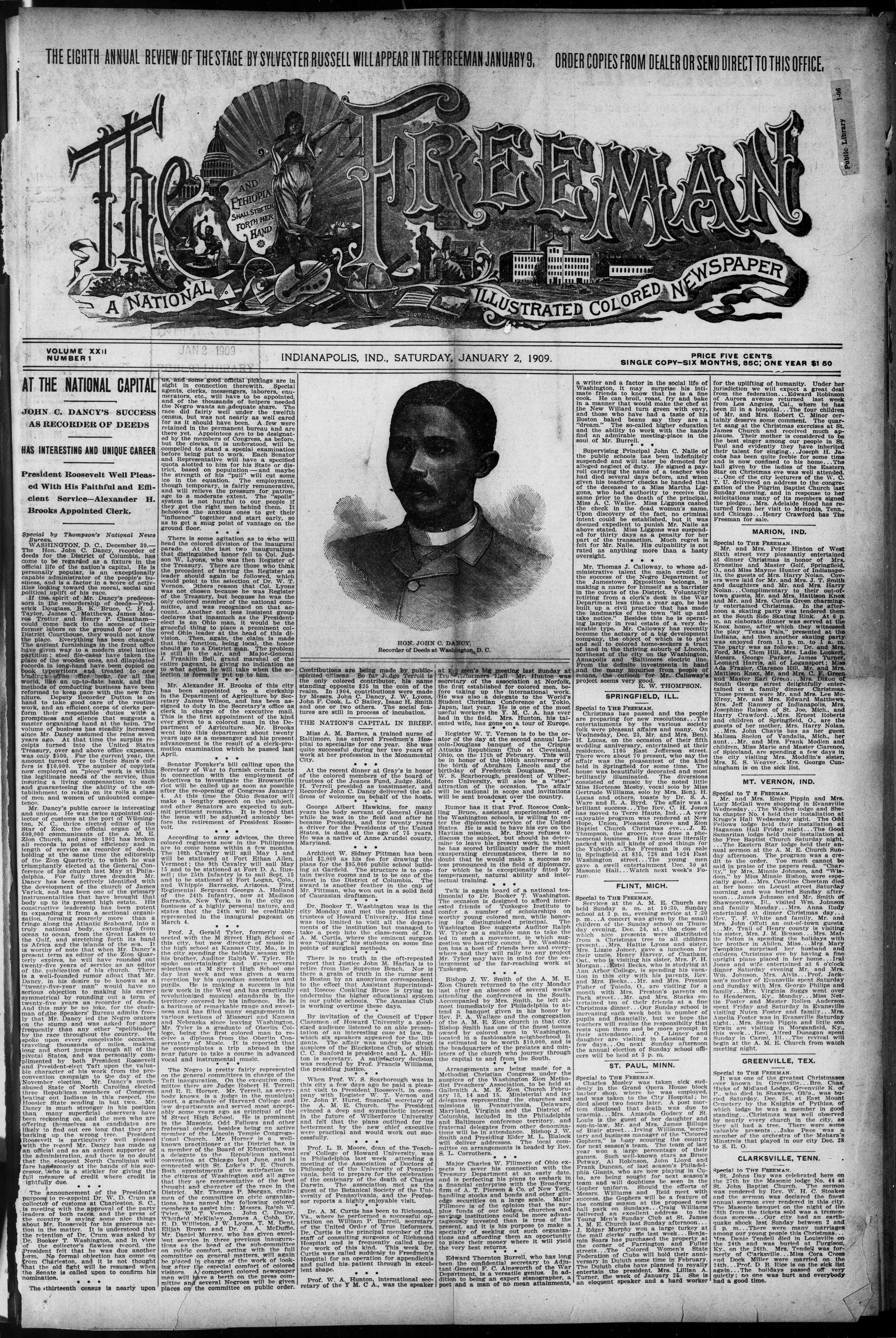
JOHN C. DANCY'S SUCCESS AS RECORDER OF DEEDS
President Roosevelt Well Please- With His Faithful and Efficient Service—Alexander H. Brooks Appointed Clerk.
Special by Thompson's National News Bureau.
WASHINGTON, D. C., December 30.—The Hon. John C. Dancy, recorder of deeds for the District of Columbia, has come to be regarded as a fixture in the official life of the nation's capital. He is personally popular, is an exceptionally capable administrator of the people's business, and is a factor in a score of activ- itively supporting the moral, social and political uplift of his race.
If the spirit of Mr. Dancy's predecessors in the recordership of deeds—Fred-James, Jaggias, Jaggias, Taylor, Jenkins, C. Matthew James, Trotter and Henry P. Cheatham—could come back to the scene of their former labors on the ground floor of the building, but the place. Everything has been changed. The ancient furnishings in the front office have given way to a modern steel lattice partition; steel file-cases have taken the place; the records in long-hand have been copied on book typewriters and treated to new bindings. The office looks, for all the world, like an up-to-date bank, and the reformed office has been copied with the new furniture. Deputy Recorder Dutton is on hand to take good care of the routine work, and an efficient corps of clerks performs promptness and silence that suggests a master organizing hand at the helm. The volume of business has steadily increased since Mr. Dancy assumed the reins seven years ago, and the records turned into the United States Treasury, over and above office expenses, was only $500. For the current year, the amount turned over to Uncle Sam's coffees was $100,000, now employed on "piece" work is within the legitimate needs of the service, thus insuring a living compensation to each and guaranteeing the ability of the establishment to retain on its roils a class of men and women of undoubted competence.
The announcement of the President's purpose to re-appoint Dr. W. D. Crum as collector of customs at Charleston, S. C., is meeting with the approval of the party leaders of both races, and presides over the party meeting, some more about Mr. Roosevelt for his generous action in the matter. It is understood that the retention of Dr. Crum was asked by Dr. Booker T. Washington, and in view of the collector's recent record, the President felt that he was due another term. No formal objection has come on from Charleston, and it is not thought that the old fight will be resumed when the Senate is called upon to confirm his nomination. The thirteenth census is nearly upon
us, and some good official pickles are in sight in connection therewith. Special agents, clerks, messengers, laborers, enumerators, etc., will have to be appointed, and of the thousands of helpers needed in the race did fairly well under the twelfth census, but was not nearly as well cared for as it should have been. A few were retained in the permanent bureau and are there yet. Appointees are to be designate more than once, but the clerks, it is understood, will be compelled to stand a special examination before being put to work. Each Senator and representative will have a specified number of men for him or for State trict, based on population—and maybe the strength of his "pull" will cut some ice in the equation. The employment, though temporary, is fairly remunerative, and the managers must age to a moderate extent. The "spoils" system is not hurtful to our people if they get the right men behind them. It behooves the anxious ones to get their together and start early, so as to get a mug point of vantage on the ground floor.
There is some agitation as to who will head the colored division of the inaugural parade. At the last two inaugurations that distinguished honor fell to Col. Judy Warren. There was then Register the Treasury. There we think the precedent of having the Register as leader should again be followed, which would point to the selection of Dr. W. T. Warren. There was not chosen because he was Register of the Treasury, but because he was the only colored member of the national committee, and was recognized on that account. Warren declared that inasmuch as the President-elect is an Ohio man, it would be the graceful thing to place a prominent colored Ohio leader at the head of this department. He declared that the function, being local, the honor should go to a District man. The problem is still in the air, and Major-General Warren is an entire pageant, is giving no indication to what action he will take when the selection is formally put up to him.
Mr. Alexander H. Brooks of this city has been appointed to a clerkship in the Department of Agriculture by Secretary James Wilson, and has been assigned to duty in the Secretary's office as a clerk to the executive mail. This is the first appointment ever given to a colored man in the Department of Agriculture. Mr. Brooks went into this department about twenty years ago as a messenger and his present appointment is the result of a clerk-promotion examination which he passed last April.
---
Senator Forner's bill calling upon the Secretary of War to furnish certain facts in connection with the employment of the military investigator the military riot will be called up as soon as possible after the re-opening of Congress January this time the Ohio Senator will make a right to the Senate and other Senators are expected to submit pertinent remarks. It is hoped that issue will be adjusted amicably before the retirement of President Roosevelt.
---
According to army advices, the three colored regiments now in the Philippines are to come home within a few months, are to be stationed in the Philippines, will be stationed at Fort Ethan Allen, Vermont; the 9th Cavalry will sail May 15 and to be stationed at Fort D. A. Russell; the 25th Infantry is to sail Sept. 15 and to be stationed at Fort San Antonio and Whipple Barracks, Arizona. First Regimental Sergeant George A. Holland of the 24th Infantry, now at Madison, Wisconsin, will be stationed in the business of a highly personal nature, and states that the 24th will be creditably represented in the inaugural pageant on March 4.
Prof. J. Gerald Tyler, formerly connected with the M Street High School of this city, but now director of music in the city spending the holiday season with his brother, Auditor Ralph W. Tyler. He spoke entertainingly and gave several selected stories. Street High School last week was given a work reception by his quidam associates and purrls. He is making a success in his new work in the West and has practically revolutionized his standby record covered by his team. He is a baritone of remarkable range and sweetness and has filled many engagements in various sections of Missouri and Kansas. Mr. Tyler is a graduate of Oberlin College, being the first colored man to receive a diploma from the Oberlin Convent. He contemplates a trip abroad in the near future to take a course in advanced vocal and instrumental music.
The Negro is pretty fairly represented on the general committees in charge of the Taft inauguration. On the executive committee there are Judge Robert H. Terrell and Judge Robert H. Terrell, both body knows is a judge in the municipal court, a graduate of Harvard College and law departments and served most acceptable some years ago as principal of M. St. John's School. He prominent in the Masonic, Odd Fellows and other fraternal orders, besides being an active member of the Lincoln Temple Congregational Church, Mr. Morrison, some years ago as principal of the District bar, is a member of the Board of Education, was a delegate to the Republican national convention at Chicago last June and is connected with St. Louis. On the committee at District bar, he gives satisfaction to the citizens of Washington and all agree that they are representative of the best thought and character of the race in the District. Mr. Thomas P. Morgan, chair of the Mckinney organization, has named the following colored members to assist him: Messrs. Rabb W. Tyler, W. T. Vernon, John C. Dancy, Mr. McKinney, John C. Dancy, Dr. W. Willis, J. W. Lions, T. M. Dent, Elijah Brown and Dr. J. A. McDuffie, Mr. Daniel Murray, who has given excellent service in three previous inaugurations as the head of the sub-committee on general matters, will again be placed in charge of the work of looking after the especial comfort of colored visitors. A competent colored newspaper will be placed in committee on general matters, will again be placed in charge of the work of looking after the especial comfort of colored visitors. A competent colored newspaper will be placed in committee on general matters and several Negroes will be given places on the committee on public order.
INDIANAPOLIS, IND., SATURDAY, JANUARY 2, 1909
HON. JOHN C. DANCY,
Recorder of Deeds at Washington, D. C.
Contributions are being made by public-spirited citizens. So far Judge Terrell is the only colored contributor, his name standing opposite $25 in the coin of the realm. In 1904, contributions were made by John F. Cook, L. C Bath, Isaac H. Strom, and one or two others. The social features are still in process of incubation.
THE NATION'S CAPITAL IN BRIEF.
Miss A. M. Barnes, a trained nurse of Baltimore, has entered Freedman's Hospital to specialize for one year. She was quite successful during her two years of work at her profession in the Monumental City.
---
At the recent dinner at Gray's in honor of the colored members of the board of trustees of the Jeanes Fund, Judge Robt. President of the board toastmaster, and Recorder Danny Daney the address of welcome on behalf of the hosts.
George Albert Hawkins, for many years the body servant of General Grant while he was in the field and after he became President, and for twenty years a driver for the Presidents of the United States dean at age of 75 years. He was a naval officer of Anne Arundel county, Maryland.
Architect W. Sidney Pittman has been paid $2,000 as his fee for drawing the plans for the $5,000 public school building at Garfield. The structure is to contain twelve rooms and is to be one of the buildings of the university award is another feather in the cap of Mr. Pittman, who won out in a solid field of Caucasian draftsmen.
Dr. Booker T. Washington was in the city Monday and met the president and trustees of Howard University. His time was too limited to visit all the departments of the university to take a peep into the class-room of Dr. A. M. Curtis, where the eminent surgeon was "quizzing" his students on some fine points of surgical methods.
There is no truth in the oft-repeated report that Justice John M. Harlan is to be given the truth in the rumor seat is a graft of truth in the rumor seat to Boston by an anonymous correspondent to the effect that Assistant Superintendent Roscoe Conkling Bruce is trying to establish a system in our public schools. The Ananias Club is working overtime these days.
By invitation of the Council of Upper Classmen of Howard University a good-sized audience listened to an able presentation of an interesting case at law in the University, and to the legislators. The affair was under the direct auspices of the Blackstone Club, of which C. C. Sanford is president and L. A. Hinton is secretary. A satisfactory decision was ordered by W. of Francis Williams, the presiding justice.
When Prof. W. S. Scarborough was in this city a few years ago he paid a pleasant visit with President Ursula with Register W. T. Vernon and Dr. John F. Hurst, financial secretary of the A. M. E. Church. The President evinced a deep and sympathetic interest in the plans and felt that the plans outlined for its betterment by the new chief executive were practical and would work out successfully.
Prof. L. B. Moore, dean of the Teachers' College of Howard University, was in Philadelphia last week attending a meeting of the Association of Doctors of Pennsylvania, held to prepare for the celebration of the centenary of the death of Charles Darwin. The association met as the guest of the Botanical Society of the University of Pennsylvania, and the Professor reports a highly enjoyable visit.
Dr. A. M. Curtis has been to Richmond, Va., where he performed a successful opener of the United Order of True Reformers. Dr. Curtis is the principal member of the staff of consulting surgeons of Richmond Hospital and is frequently called there to attend the funeral of Dr. Curtis was called suddenly to Freedmen's Hospital for an operation for appendicitis and pulled his patient through in excellent shape.
Prof. W. A. Hunton, international secretary of the Y. M. C. A. was the speaker
at the men's big meeting last Sunday at Tru-Informers Hall. Mr. Hunton was secretary of the association at Norfolk, and he was also the executive fore taking up the international work. He was also a delegate to the World's Student Christian Conference at Tokio, Japan, a year ago. He is one of the most worked on the Y. Y. in the field. Mrs. Hunton, his talented wife, has gone on a tour of Europe.
Register W. T. Vernon is to be the orator of the day at the second annual Lincoln-Douglass banquet of the Crispus Attucks Republican Club at Cleveland, Ohio. He is to be the host of the 100th anniversary of the birth of Abraham Lincoln and the birthday of Frederick Douglass. Prof. W. S. Scarborough, president of Wilberforce University, will be the attraction of the occasion. The affair will be national in scope and invitations will be sent broadcast over the country.
Rumor has it that Prof. Roscoe Conkling Bruce, assistant superintendent of the Washington schools, is willing to enlist the help of the National Guard States. He is said to have his eye on the Haytian mission. Mr. Bruce refuses to discuss the subject, but should he determine the facts, he has scored brilliantly under the most exasperating circumstances, there is no doubt that he would make a success no less pronounced in the field of diplomacy, for which he is exceptionally fitted by natural ability and intellectual training.
Major Charles W. Fillmore of Ohio expects to sever his connection with the Treasury Department at an early date, and is perfecting his plans to embark in a financial enterprise with the help of the Co. of New York, handling stocks and bonds and other gilt-edge securities on a large scale. Major Fillmore is of the opinion that the surplus funds of our lodges, churches and institutions will be more advantageous invested than is true of the present, and it is his purpose to make a specialty of seeking out such organizations and affording them an opportunity to place their money where it will yield the very best returns.
David Thornton Burrell, who has long been the confidential secretary to Adjunct General F. C. Alnsworth of the Treasury Department, has been being an expert stenographer, a poet, and a man of no mean attainments,
PRICE FIVE CENTS
SINGLE COPY-SIX MONTHS, 85C; ONE YEAR $1.50
a writer and a factor in the social life of Washington, it may surprise his intimidation, and he may surprise his intimidation. He can broil, roast, fry and bake in a manner that would make the chef at the New Willard turn green with envy, and those who have had a taste of his favorite baked beans, "dream." The so-called higher education and the ability to work with the hands find an admirable meeting-place in the soul of Mr. Burrell.
Supervising Principal John C. Nalle of the public schools has been indefinitely alleged neglect of duty. He signed a payroll carrying the name of a teacher who had died several days before, and when above stated, are logged in the deceased to a Miss Martha Ligons, who had authority to receive the same prior to the death of the principal. Miss A. C. Wheel Miss Ligons was the check in the dead woman's name. Upon discovery of the fact, no criminal intent could be established, but it was deemed expedient to punish Mr. Nalle as a detainer. Miss Ligons was for thirty days as a penalty for her part of the transaction. Much regret is felt for Mr. Nalle. His culpability is not needed anything more than a hasty oversight.
for the uplifting of humanity. Under the jurisdiction we will expect a human federation...Edward Roblin of Aurora awaits return to Los Angeles, Cal., where he been ill in a hospital...The four child of Mr. and Mrs. Robert C. Minor C. O'Neill, a singer among our people in Paul and Ireland, have joined their talent for singing...Joseph H. Cohes has been quite feeble for some time, but above stated, are logged in the deceased to a Miss Martha Ligons, who had authority to receive the same prior to the death of the principal. Miss A. C. Wheel Miss Ligons was the check in the dead woman's name. Upon discovery of the fact, no criminal intent could be established, but it was deemed expedient to punish Mr. Nalle as a detainer. Miss Ligons was for thirty days as a penalty for her part of the transaction. Much regret is felt for Mr. Nalle. His culpability is not needed anything more than a hasty oversight.
MARION, IND.
Special to THE FREEMAN.
Mr. and Mrs. Peter Hinton of W. Sixth street very pleasant entertain
Mr. Thomas J. Calloway, to whose administrative talent the main credit for the success of the Negro Department of Education, has made a name for himself as a barrister in the courts of the District. Voluntarily retiring from a clerk's desk in the War Department, he built up a civil practice that has made the landmarks of the town "sit up and take notice." Besides this he is operative in an interest in the civil-servile type. Mr. Calloway has recently become the actuary of a big development company, the object of which is to plat and sell to colorado home-seekers. In addition to his interest in the northeast of the city on the Washington, Annapolis and Baltimore electric line. From the definite investments in hand, he has become a friend of people of reans, the outlook for Mr. Calloway's project seems very good.
Special to THE FREEMAN.
Christmas has passed and the people are preparing for new resolutions. The entertainments by the various society folk were please and affectionate. On Saturday, 23 Mr. Benson, Mrs. B.H. Lucas, on the occasion of their fifth wedding anniversary, entertained at their residence, 1105 East Jefferson street. There were about 70 present, who say the family is pleased to have the children in Springfield for some time. The house was beautifully decorated and most brilliantly illuminated. The diversions consisted of music by the noted little composer, the playwright Gertrude Williams, solo by Mrs. Benj. H. Lucas and others, toasts by Dr. S. A. Ware and R. A. Byrd. The affair was a brilliant success. The Rev. G. H. Jones enjoyable program was rendered at New Hope, Union, Pleasant Grove and Zion Baptist Church Christmas eve. J. E. H. Jones an eminent business. His store was literally packed with all kinds of good things for the Yuletide. The Freeman is on sale in Springfield at 815, 728 and 1024 East Washington street. The young men a spell entertainment bac. 30 at Masonic Hall. Watch next week's Forum.
FLINT. MICH.
Special to THE FREEMAN.
Special events at the A. M. E. Church are held Sunday a.m. at 10:30, Sunday school at 3 p. m., evening service at 7:30 p. m., A concert was given by the small driveway of the Sunday school day evening. Dec. 4, at the close of which nice presents were distributed from a Christmas tree to all children in Mrs. Hattie's class, sister Mrs. Lizzie John gave a luncheon their uncle, Henry Harvey, of Chatham, Out. who is visiting his sister, Mrs. P. H. Morgan, Estel Becks who is studying at institution in this city with his parents, Rev. and Mrs. Becks. Mr. and Mrs. Preston Fisher of Toledo, O., are visiting for a month with Mrs. Preston's parents on a certainted ten of their friends at a fine Christmas dinner. Our Sunday school is increasing each week both in number of pupils and financially, but we hope the rest rests upon them, as appropriate rests upon them and be more prompt in their attendance. J. O. Linney and daughter are visiting in Lansing for a few days, and we hope a afternoon annual election of Sunday school officers will be held at 3 p. m.
ST. PAUL. MINN.
Special to THE FREEMAN
Charles of the Grand Opera House block suddenly appeared in the "New Yorker" taken slick barber shop, where he was employed, and was taken to the City Hospital; he died about two hours later. A post mortem disclosed that death was due to uraemia....Mrs. Amanda Godsey of St. Louis is the guest of her daughter and son-in-law, Mr. and Mrs. James Billings of Blair street....Irving Williams, secretary and business manager of the "Gophers," is busy scouring the country for next season. The team of last year, two large percentage of their names. Such well-known stars as Bruce Petway, Al Robinson, John Lloyd and Frank Duncan, of last season's Philadelphia Giants, who are now playing in Cuba, are being sought for next season's team and will doubtless be seen in the Gopher uniform. Should the efforts of Messrs. Williams and Reid meet with success, the Gophers will be a follower of the coming season at the proposed new hall park. Spenddays....Craig Williams delivered an excellent address to the young Men's Sunday Club at St. James A. M. E. Church last Sunday afternoon....J. Edgar Murphy won a large turkey at the mall clerks' raffle last week....Benjamin Sears has purchased the property at the corner of Farrington and Fuller streets....The Colored Women's State Federation of Clubs will take their varsity in Duluth the same time in February. The Duluth club has planned to royally entertain the president, Mrs. Lillian A. T. T. the week of January 26. She is an eloquent speaker and a hard worker.
for the uplifting of humanity. Under her jurisdiction we will expect a great deal from the federation...Edward Robinson or Aurora avenue returned last week from the University of Chicago, who been ill in a hospital...The four children of Mr. and Mrs. Robert C. Minor certainly deserve some comment. The quartet sang at the Christmas exercises at St. Paul and performed a piano plaque. Their mother is considered to be the best singer among our people in St. Paul and evidently they have inherited talent or singing...Joseph H. Jacobs has been a teacher and is now confined to his home...The ball given by the ladies of the Eastern Star on Christmas eve was well attended. One of the city lecturers of the W. C. T. University of Chicago, the gation of the Pilgrim Baptist Church last Sunday morning, and in response to her solicitations many of her signatures signed the pledge...Mrs. Adelia Hood has resigned from the University to Memphis, Tenn., and Chicago...Henry Crawford has The Freeman for sale.
MARION. IND.
Mr. and Mrs. Peter Hinton of West Sixth street very pleasantly entertained at dinner Christmas in honor of Mrs. Ernestine and Master Golf. Springfield, Miss. Miss Jillian Van Damm, the guests of Mrs. Harry Nolan. Covers were laid for Mr. and Mrs. J. T. Smith and daughters and Mr. and Mrs. Harry Nolan. The town guests, Mr. and Mrs. Hattison Knox and Mr. and Mrs. Curtis Green charmingly entertained Christmas. In the afterpart Mrs. Nolan was enjoyed from 11 p. to 1 a. The party was as follows: Dr. and Mrs. Ford, Clem Hill, Mrs. Ladle Luckert, Mrs. Jillian Van Damm, Leonard Harris, all of Logansport, Miss Ada Frazier, Clarence Hill, Mr. and Mrs. Mattison Knox, Mr. and Mrs. C. F. Green and Master Earl Green... Mrs. Dixon of the academy trained at a family dinner. Christmas. Those present were Mr. and Mrs. Lee McElroy, Mr. and Mrs. Edward Matthews, Jeff Ramsey of Indianapolis, Mrs. Jeff Ramsey of Indianapolis, Mrs. Harry Crawford... Mrs. Ernest Roberts and children of Springfield, O., are the guests of her mother, Mrs. Harry Nolan. Mrs. John Chave has as a mall guest Malihe Crawford, as a Mich aunt... Mr. and Mrs. Modlen and children, Miss Marie and Master Clarence, of Spiceland, are spending a few days in the city. Mrs. George Cunningham is on the sick list.
MT. VERNON. IND.
Mr. and Mrs. Emile Pippin and Mrs. Lucy McGall were shopping in Evansville Wednesday...The Walden lodge and Shea chapter No. 4 held their installation at the Tree Preserve Church Saturday night. Fellows lodge held their installation at Hagaman Hall Friday night...The Good Samaritan lodge held their installation at the Tree Preserve Church Saturday night. East Side Church held the final sermon at the A. M. E. Church Sunday afternoon. The program was a credit to the order. Too much cannot be said in praise of papers read by Mrs. Minnie Bishop and "Wisdom," by Miss Minnie Bishop, were especially good. Mrs. Caroline Cheetam died at her home on Locust street Saturday noon. James Johnson and Mr. Smith of Shaweetown, Il., visited Wm. Johnson and family Monday...Mrs. Anna Rudy entertained at dinner Christmas day...Mr. John Oftford an out-of-town guests.
...Mr. Trail of Henry county is visiting his sister, Mrs. J. M. Benson...Mrs. Matte Felton is spending the holidays with her brother in Auburn. Miss. Mrs. Mary Felton is spending the holidays with children Christmas eve by having a fine upright piano placed in her home...Ira Jones and wife entertained at 6 o'clock dinner Saturday evening, Mr. and Mrs. Felton are spending the holidays son's mother of Evansville spent Saturday and Sunday with Mrs. George Philips and family...Mrs. Virginia Suggs went over to Henderson, Ky., Monday...Miss Nettie Foster and Master Rollen Anderson visited Nuten Foster and family...Mrs. Amelia Foster was in Evansville Saturday night...Mrs. Sarah Pippin and little son Erwin are visiting in Morganfield, Ky., Sunday...Mrs. Jack Duganan and Danagun will visit in Carroll, Ill. The revolt will begin at the A. M. E. Church will watch meeting night.
GREENVILLE, TEX.
Special to THE FREEMAN.
It was one of the greatest Christmas musics ever known in Greenville...Bro. Chas.
It was one of the most well observed P., who died in Shawnee, OKa., was buried Saturday, Dec. 26, at East Mount Cemetery by the Knights of Pythias, of which odigea he was a member in good health. Chas was also observed by nearly every church in the city, as they all had a tree. There were some valuable presents...Jake Pace was a member of the orchestra of the Maharashtra that played in our city Dec. 28 to S. R. O.
CLARKSVILLE, TENN.
St. John Day was celebrated here on the 27th by the Masonic lodge No. 44 at St. John Baptist Church. The sermon on the 27th was delivered by the sermon was declared the finest annual sermon ever rendered in this city. The Masonic banquet on the night of the 27th was a dous success...Our city had an earthquake shock last Sunday between 2 and 3 p. m...There were many marriages on the 27th...Mrs. Dane Tendell died in Louisville on the 24th and was buried at Furgison, Ky. on the 25th. Mrs. Tendell was forlorn...Mrs. Dane Tendell and Dock Miller were married on the 24th...Prof. D. B. Rice is on the sick list again...The holidays passed off very well...The on the was hurt and everybody had a good time.
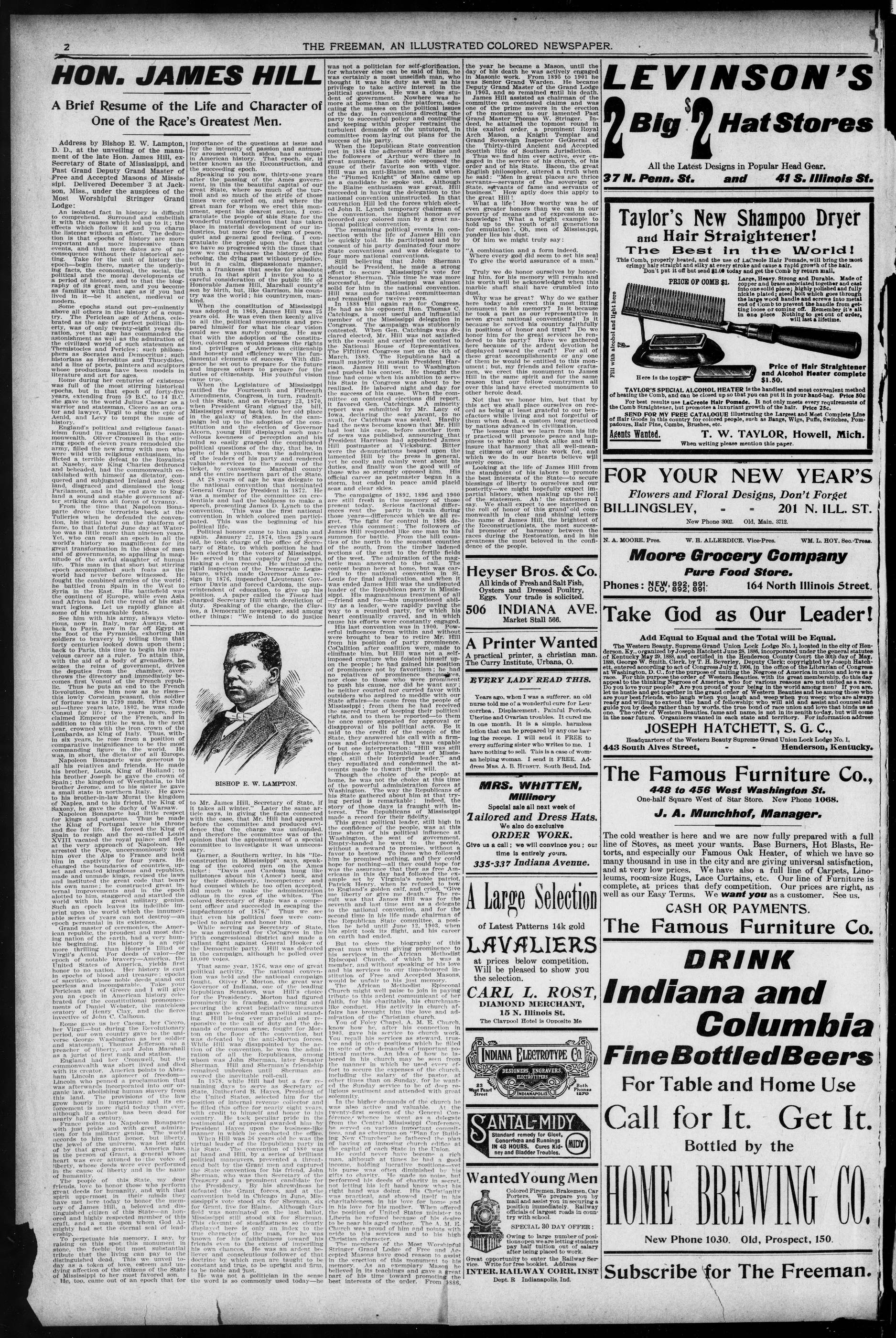
HON. JAMES HILL
A Brief Resume of the Life and Character of One of the Race's Greatest Men.
Address by Bishop E. W. Lampton, D. D., at the unveiling of the manumment of the late Hon. James Hill, ex-Secretary of State of Mississippi, and Past Grand Deputy Grand Master of Free and Accepted Masons of Mississippi. Delivered December 3 at Jackson, Miss., under the auspices of the Most Worshipful Stringer Grand Lodge:
An isolated fact in history is difficult to comprehend. Surround and embellish it with the causes which led up to it; the effects which follow it and you charm the listener without an effort. The deduction is that epochs of history are more important and more impressive than events, and that mere dates are of no consequence without their historical setting. Take for the unit of history the epoch—begin there, master the underlying facts, the economical, the social, the political and the moral developments of a period of history, and to that the biography of its great men, and you become as familiar with that age as if you had lived in it—be it ancient, medieval or modern.
Some epochs stand out pre-eminently above all others in the history of a country, and are distinguished as the age of perfect political liberty, was of only twenty-eight years duration, yet that age has commanded the astonishment as well as the admiration of the people. He states that *Themistocles and Pericles;* *bishops as Socrates and Democritus;* *historylars as Heroditus and Thucydides, and a line of poets, painters and sculptors in literature and art for ages.*
Home during her centuries of existence was full of the most stirring historical events, extending from 59 B.C. to 14 B.C. she gave to the world Julius Caesar as a warrior and statesman, Cicero as an orator and lawyer, Virgil to sing the epic of *Aeneas* and Levy to tempt the muse of history.
England's political and religious fanatism found its realization in the comparison of the military and the warring epoch of eleven years remodeled the army, filled the new army with men who were wild with religious enthusiasm, inflicted a terrible defeat to the Royalists and beheaded, had the commonwealth established with himself as dictator, conquered and subjugated Ireland and Scotland, disgraced and dismissed the long reign of King Henry VII, land a sound and stable government after striking down all forms of tyranny. From the time that Napoleon Bonaparte conquered and defeated Tulleries when he defended the convention, his initial bony on the platform of fame, to that fateful June day at Waterloo, he was a man of life. Yet, who can recall an epoch in all the world's history so magnificent for its great transformation in the ideas of men and of governments, so appalling in magnificence, so tragic in life. This man in that short but stirring epoch accomplished such feats as the world and never before, witnessed his defeat in Spain, the world he battled from Spain in the West to Syria in the East. His battlefield was the continent of Europe, while even Asia and Africa had been the battlefield of his stalwart forces. Let us rapidly glance at some of his remarkable feats.
See him with his army, always victorious, now in Italy, now Austria, now back to Paris, now in far off Egypt at the head of the army, now soldiers to bravery by telling them that forty centuries looked down upon them; back to Paris, this time to begin his marvelous career as a ruler. To attain this, with the aid of a body of grenadiers he set forth to the deputies from the chamber, overthrows the directory and immediately becomes first Vonsul of the French republic, who he puts an enmity on the French Revolutionist himself as he rises this lowly Corsican peasant, this soldier of fortune was in 1799 made. First Consul—three years late, 1802, he was made a member of the claimed Emperor of the French and in addition to this title he was, in the next year, crowned with the iron crown of the Lombards, as King of Italy. Thus, within six years, he rose from a position of commanding figure to a commanding figure in the world. He was, in short, the dictator of all Europe.
Napoleon Bonaparte was generous to all his relatives and friends. He made his brother Joseph he gave the crown of Spain; the kingdom of Westphalia, to his brother Jerome, and to his sister he gave the crown of France; to his brother-in-law Murat the kingdom of Naples, and to his friend, the King of Saxony, he gave the duchy of Warsaw. Napoleon Bonaparte was a collector for his monuments. Thus he made the King of Portugal leave his throne and flee for life. He forced the King of XVIII vacated the royal palace and fled at the very approach of Napoleon. He arrested the Pope, unceremoniously took him over to France to be crowned, and in impunity for years. He changed the boundaries of countries, upset and created kingdoms and republics, and instituted the great code that bears his own name; he constructed great internal improvements and an army that started the world with his great military genius. Such an epoch leaves its indefible imprint upon the world which the immerer-ton an epoch perennial in its existence.
Grand master of ceremonies, the American republic, the proudest and most daring nation in the world, marveling in the mining. Its history is an epic more thrilling than Homer's Iliad or Virgil's Acenid. For deeds of valor—for epoch of notable bravery—America, the United States, the British, the French and the nation. Her history is cast in epics of blood and treasure; epics of sacrifice, whose noble deeds stand out peerless and incomparable, and I will give you an epoch in American history celebrated for the constitutional pronouncements of Daniel Webster, the matchless oratory of Henry Clay, and the fierce invective of John C. Calvin. I will give you a gavel as her Caesar, her Cicero, her Virgil—but during the Revolutionary period, our own country gave to the universe George Washington as her soldier and statesman; Thomas Jefferson as a saint as a jurist of first rank and as a jurist of first rank and
England had her Cromwell, but the commonwealth was short lived and died with him. Lincoln as apioner of freedom—Lincoln who penned a proclamation that was afterwards incorporated into our organic law, abolishing the provisions of the law grow hourly in importance and its enforcement is more rigid today than ever, although its author has been dead for more than a century. France points to Napoleon Bonaparte with just pride and with great admiration for his military genius. The worst of these crimes is the bribery, the jewel of the universe, was lost sight of by that great general. America has, in the person of Grant, a general whose inhumanity was ever more liberty, whose deeds were ever performed in the cause of liberty and in the name of humanity. Of all of this State, my dear friends, love to honor those who perform great deeds for humanity, and with that spirit uppermost in their minds they have met here and here. Hill, a beloved and distinguished citizen of this State—an honored and highly respected member of this craft, and a man upon whom God Almighty had set the eternal seal of lead-
To perpetuate his memory, I say, by raising the feeble but most substantial tribute that the living can pay to the distinguisher dead, I have a deep love of love, esteem and undying affection of the citizens of the State of Mississippi to her most favored son, or to her most beloved sister.
importance of the questions at issue and for the intensity of passion and animosity in American history. That epoch, sir, is better known as the Reconstruction, and the succeeding epoch, speaking of war, thirty-one years after passing of the Ames government, in this the beautiful capital of our great State, where so much of the turmoil and so much of the strife of those great men of transformation in place in many development of our industries, but more for the reign of peace, quiet and general good feeling, I congratulate the people of this State for the transformation in place in many development of our industries, but more for the reign of peace, quiet and general good feeling, I congratulate the people upon the act that made us the nation that now we can rehearse the history of the echoing, the dying past without prejudice, but in a calm, dispassionate manner, in a manner that seeks for absolute truth. In that spirit we seek for careful consideration of the public life of Honorable James Hill, Marshall county's son by birth, but, like Garrison, his country as the world; his countryman, mankind.
When the constitution of Mississippi was adopted in 1869, James Hill was 25 years old. He was even then keenly alive and able to speak. He pared himself for what his clear vision could see was surely coming. He saw that with the adoption of the constitution, colored men would possess the rights to vote, to be president, to hold office, honesty and efficiency were the damnual elements of success. With diligence he set out to prepare for the future and impress others to prepare for the future of citizenship. His youthful vision came true.
When the Legislature of Mississippi ratified the Fourteenth and Fifteenth Amendments, Congress in turn, readmit the State's Constitution, and when President Grant signed the bill, Mississippi swung back into her old place in the galaxy of States. In the camp of the Republican party, the constitution and the election of Governor Alcorn, young Hill displayed such marvelous keenness of perception and his mind so easily grasped the complicated nature of the state, and spite of his youth, won the admiration of the leaders of his party and rendered valuable services to the success of the State. He was an ardent and the entire northern part of the State. At 28 years of age he was delegate to the national convention that nominated General Grant for President in 1872. He was a strong advocate of the credentials and had the boldness to make a speech, presenting James D. Lynch to the convention. This was the first national convention in which colored men participated. It was the beginning of his political life.
Political honors came to him again and again. January 22, 1874, then 29 years old, he took charge of the office of Secretary of State, and he was elected by the voters of Mississippi. He served in that capacity four years, making a clean record. He withstood the rigid inspection of the Democratic Legislature in 1875, and signed in 1876, impeached Lieutenant Governor Davis and forced Cardoza, the superintendent of education, to give up his position. A paper called the *Times* had charged Secretary William de wredelection of Speaker of the House of Congress, a Democratic newspaper, said among other things: "We intend to do justice
BISHOP E. W. LAMPTON
to Mr. James Hill, Secretary of State, if it takes all winter." Later the same article says, in giving the facts connected with the impeachment of Hill, before the committee and produced evidence that the charge was unfounded, and therefore the committee was of the opinion that the appointment of a special committee to investigate it was unnecessary. Garner, a Southern writer, in his "Reconstruction in Mississippi" says, speakestheir testimony in the impeachment ticket: "Davis and Cardoza hung like millstones about his (Ames)' neck, and held his dishonesty, in the often accepted, did much to make the administration odious in the eyes of the whites. The competent officer and succeeded in escaping the impachments of 1876." Thus we see that even his political foes were compelled to admire and honor him. The impeachment of Hill, of State, he was nominated for CoCressgrant in the Fifth congressional district and made a vallant fight against General Hooker of the Democratic party. Hill was defeated in the nomination, although he polled over 10,000 votes.
That same year, 1876, was one of great political activity. The national convention was held and the national campaign was organized. P. M. Hayes, Governor of Indiana, one of the leading Republican Senators, was Hill's choice for the Presidency. Morton had figured prominently in advocating and during the great debate that gave the colored man political standing. Hill being ever grateful and responsive to the call of duty and the deed of duty, he was on the floor of the convention, on the floor of the convention, but was defeated by the anti-Morton forces. While Hill was disappointed by the action of the convention until the ratification of the Republicans, among whom was John Sherman, later Senator Sherman. Hill and Sherman's friendship remained unbroken until Sherman answered the question in 1878, while Hill had but a few remaining days to serve as Secretary of State, Rutherford B. Hayes, President of United States, selected him for the position of United States secretary, he filled this office for nearly eight years, with credit to himself and honor to his country. He took peculiar pride in the success of the President Hayes upon the business-like manner in which he conducted the office.
When Hill was 36 years old he was the virtual leader of the Republican party in New York and at hand and Hill, by a series of brilliant political maneuvers, prevented a threatened bolt by the Grant men and captured the State convention for his friend, John. John was a strong supporter of Treasury and a prominent candidate for the Presidency. By his shrewdness he defeated the Grant forces, and at the convention held in Chicago in June, Missippi he descended to the Grant for Grant, five for Blaine. Although Garfield was nominated on the last ballot, Mississippi still stood six for Sherman. His descent of steadfastness so clearly disrupted the convention was the true character of the man, for he was known for his faithfulness toward his friends even to the extent of impolling the president and consecrating follower of that doctrine by which men are taught to be constant and true, to be upright and firm, to be noble and just. In the politician in the sense the word is so commonly used today—he
was not a politician for self-glorification, for whatever else can be said of him, he was certainly a most unselfish man, who thought it was his duty as well as his privilege to take active interest in the political questions. He was a close student of government. Nowhere was he more at home than on the platform, educating the masses on the political issues of the day. In conventions directing the party to successful policy and controlling and keeping within proper restraint the turmoil demanded, the unrested National Committee room laying out plans for the success of his party.
the year he became a Mason, until the day of his death he was actively engaged in Masonic work. From 1895 to 1901 he was Senior Grand Warden. He became Deputy Grand Master of the Grand Lodge in 1903, and so remained until his death. In Hill gestated as chairman of the committee on contested claims and was one of the prime movers in the erection of the monument to our lamented Past Grand Master Thomas W. Stringer. Indeed, he attained the topmost round in the coxed javelin. A prominent Real Arch Mason, a Knight Templar and Grand Sovereign Inspector Geeral of
When the Republican State convention met in 1884 the adherents of Blaine and followers. Each side espoused the cause of their favorite son with vigor. Hill was an anti-Blaine man, and when the "Plumed Knight" of Maine came up and a candidate he spoke out. Although the Blaine was great, Hill succeeded in having the delegation to the national convention uninstructed. In that convention Hill led the forces which elected John R. Lynch temporary chairman of the convention. He accorded any colored man by a great national political convention. The remaining political events in connection with the state convention were held by John H. Hertford and by consent of his party dominated four more State conventions and was delegate to four more national conventions. He predeceased his John Sherman should be receiving his John Sherman should be secure Mississippi's vote for Senator Sherman. This time he was more successful for Mississippi was almost solid for him in the national convention. He was appointed committeeman and remained for twelve years.
In 1888 Hill again ran for Congress. He had as his opponent Hon. Thomas C. Crawford, a member of the Mississippi delegation in Congress. The campaign was stubbornly contested. When Gen. Catchings was declared elected, Mr. Hill was not satisfied with the results and the National House of Representatives. The Fifthfirst Congress met on the 4th of March, 1889. The Republicans had a ruler, James Hill, who was Washington and pushed his contest. He thought the time had come when his ambition to serve his State in Congress was about to be over. James Hill was Washington and declared the success of his cause. When the committee on contested elections did report, it favored Gen. Catchings. A minority of the members of the Iowa declaring the seat vacant, to no avail, for Catchings was seated. Hardly had the news been known that Mr. Hill was the president of news was published, announcing that President Harrison had appointed James Hill postmaster at Vicksburg, Blitter were the demunciations heaped upon the president. He was not yet he coolly and calmly went about his duties, and finally won the good will of those who so strongly opposed him. His official career as postmaster began in a peace and clear skies.
The campaigns of 1892, 1896 and 1900 are still fresh in the memory of those present today. Serious factional differences have arisen between the two those years—differences which we all regret. The fight for control in 1896 deserves this comment: The followers of James T. McCormick responded to the man to his submission for the presidency. From the man to the seacoast counties of the south, from the timber ladened sections of the east, to the fertile fields of the north, from the migration to the magnetic man answered question, the contest began here at home, but was carried to the national convention in St. Louis for final adulation, and when it was concluded, the leader of the Republican party in Mississippi. His magnanimous treatment of all
It is as a leader, were rapidly paving the way to a reunited party, for which his heart continually craved, and in which cause his efforts were constantly engaged.
His last convention was in 1960. Powerful influences from within and without were brought to bear to retire Mr. Hill from his position of party promenade. CoCalition after coalition were, made to eliminate him, but Hill was not a self-imposed creature who foisted himself upon the people; he had gained his position of prominence not by favoritism; he had no relatives who were the prophets of the times, nor to those who were prominent to push his cause, nor did he want any; he neither courted nor curried favor with outsiders who aspired to meddle with our State affairs—he came from the people of Mississippi; from them he had received the sacred trust of keeping their political rights, and to them he reported—to them he once more appealed for approval or disapproval of his political acts. Be it said to the credit of the people of the State, they answered his call with a firmness and decisiveness that was capable of but one interpretation: "Hill was still the choice of the Republicans of Mississippi, still their interpid leader," and they repudiated and condemned the attempts made to thwart their will.
Though the choice of the people at home, he was not the choice at this time of the powerful administration forces at home, but he was the one whose State gathered about him at that trying period is remarkable; indeed, the story of those days is fraught with interest. The Republicans of Mississippi made a record for their fidelity, still high in the confidence of the people, was at this time shorn of his political influence at Washington, the seat of government. Empty-handed he went to the people, and he was a favorite favor to bestow. To those who followed him he promised nothing, and they could hope for nothing—all they could hope for was the assurance that they as free Amoricans would be with such a sample set by Virginia's noble patriot, Patrick Henry, when he refused to bow to England's golden caft, and cried, "Give liberty or give me mine," suitably. Hill was for the seventh and last time sent as a delegate to the national convention, and for the second time in his life made chairman of the Republican State committee, a position he held from June 12, 1809 when his spirit took its flight, and his career on earth had ended.
But to close the biography of this great man without giving prominence to his services in the African Methodist Episcopal Church in the city of New York and without speaking of his aides and his services to our time-honored institution of Free and Accepted Masons, would be unfair to his just memory. His church might well pale to join in paying tribute to this ardent communicant of her faith, for his charitable, his churchman-like conduct. His activity in church affairs has been the life and adamant of the Christian Church. You of Foley Chapel, A. M. E. Church, know how he, after his connection in 1903, gave his service to church work. He has been the keeper of the tee and in other positions which he filled in spite of the demands of important political matters. An idea of how he labored in his church may be seen from his letter to the church fort to secure the expenses of the church, including the salary of the pastor at other times than on Sunday, for he wanted the Sunday service to be of deep reenactment and attended with great solemnity.
In the higher demands of the church he was also active and valuable. At the twenty-first session of the General Conference from the Central Mississippi Conference he served on various important committees, and as chairman on "Plan for Building New Churches" he fathered the plan to build a church. At the capital of each State in the Union, He could never have become a rich man, although at times he had a good income, holding lucrative positions—wet his purse was often diminished by his gift of money, and he performed his deeds of charity in secret, not letting his left hand know what his right hand was doing. His Christianity was practical, and showed itself in his work. He was a man in love for his mother. When offered the position of United States minister to Liberia he refused because of his desire to be near his aged mother. The A. M. E. Church was proud of him and points with his deeds and to his high Christian character.
The members of the Most Worshipful Stringer Grand Lodge of Free and Accord in the erection of this monument to his memory. As an exemplary Mason he believed in its teachings and gave a great gift to promoting the best interests of the order.
the year he became a Mason, until the day of his death he was actively engaged in Masonic work. From 1895 to 1901 he was Deputy Grand Master of the Grand Lodge in 1903, and so remained until his death. James Hill assisted as chairman of the committee of contested claims and of the prosecution in the execution of the monument to our lamented Past Grand Master Thomas W. Stringer. Indeed, he attained the topmost "round in the history of the monastery" in Arch Mason, a Knight Templar and Grand Sovereign Inspector GeGeral of the Thirty-third Ancient and Accepted Scottish Rite Southern Institution. Thus we find his active involvement engaged in the service of his church, of his order and of his State. Bacon, the great English philosopher, uttered a truth when servants—servants of the sovereign or State, servants of fame and servants of business". How aptly does this apply to What a life! How worthy was he of even greater honors than we can in our poverty of means and of expressions acknowledge! What a bright example to the truth of the monastery for emulation! Oh, men of Mississippi, yonder lies his dust.
Of him we might truly say:
"A combination and a form indeed.
Where every god did seem to set his seal
To give the world assurance of a man."
Truly we do honor ourselves by honoring him, for his memory will remain and his worth will be acknowledged when this marble shaft shall have crumbled into dust.
Why was he great? Why do we gather here today and erect this most fitting monument to his memory? Is it because he took a part as our representative in seven great national conventions, in which he has faithfully in positions of honor and trust? Do we honor him for the great services he rendered to his party? Have we gathered together in this country displayed toward the craft? For all of these great accomplishments or any one of them he would be entitled to this monument; but my friends and acquaintances will have monument to James Hill in the same spirit and for the same reason that our fellow countrymen all over this land have erected monuments to heroic dead.
Not by honor him, but that by act we shall place ourselves on record as being at least grateful to our benefactors while living and not forgetful of them when dead, a custom long practiced in our country.
The lessons that we learn from his life if practiced will promote peace and happiness to white and black alike and will help us to understand the citizens of our State work for, and which we do in our hearts believe will surely come.
The life of James Hill from the standpoint of his laborers to promote the best interests of the State—to secure blessings of liberty to ourselves and our posterity—we might hopefully expect imposition of the laws of the statesmen. Ah! the statesmen I say. We shall expect to see inscribed on the roll of honor of his grand old comrade, the name of James Hill, the name of James Hill, the brightest of the Reconstructionists, the most successful promoter of harmony between the people during the Restoration, and in his presence the most beloved in the confidence of the people.
Heyser Bros. & Co.
All kinds of Fresh and Salt Fish,
Oysters and Dressed Poultry,
Eggs. Your trade is solicited.
506 INDIANA AVE.
Market Stall 566.
A Printer Wanted
A practical printer, a christian man.
The Curry Institute, Urbana, O.
EVERY LADY READ THIS.
Years ago, when I was a sufferer, an old nurse told me of a wonderful cure for Leurcorrhea. Displacement, Painful Periods, Uterine and Ovarian troubles. I cured me in one month. It is a simple, harmless lotion that can be prepared by any one having the recope. I will send it FREE to every suffering sister who writes to me. I have nothing to sell. This is a case of woman helping woman. I send it FREE. Address Miss. A. B. Humbert. South Bend, Ind.
MRS. WHITTEN, Millinery
Special sale all next week of
Tailored and Dress Hats.
We also do exclusive
ORDER WORK.
Give us a call; we will convince you; our
time is entirely yours.
335-337 Indiana Avenue.
A Large Selection
of Latest Patterns 14k gold
LAVALIERS
at prices below competition.
Will be pleased to show you
the selection.
CARL L. ROST,
DIAMOND MERCHANT,
15 N. Illinois St.
The Claypool Hotel is Opposite Me
INDIANA ELECTROTYPE CO.
DESIGNERS, ENGRAVERS,
ELECTROTYPES
23 West Pearl
Street
INDIANA POLIS
Both
Phones
1270
SANTAL-MIDY
Standard remedy for Gleet,
Gonorrhea and Runnings
IN 48 HOURS. Cures Kid-
ney and Bladder Troubles.
MIDY
WantedYoung Men
Colored Firemen, Brakemen, Car
mail and assist you in securing
a position immediately. Railway
road, largest roads in country
with school.
Colored Firemen, Brakemen, Car
Porsons. We prepare you, by
mail and assist you in securing a
position immediately. Railway
officials of largest roads in country
with school.
SPECIAL 30 DAY OFFER:
Owing to large number of posi-
tions open we are letting students
pay half tuition out of salary
after being placed to work.
Great opportunity to enter the Railway
Service. Write for free booklet. Address
INTER.RAILWAY CORR.INST
Dept. R Indianapolis, Ind.
LEVINSON'S 2 Big $2 Hat Stores All the Latest Designs in Popular Head Gear. 37 N. Penn. St. and 41 S. Illinois St.
Large, Heavy. Strong and Durable. Made of copper and brass associated together and cast into one solid piece; highly polished and fully nickle plate; steel bolt which goes through the large wood handles and screws into metal handles. Notched for secure loose or coming off. Remember it's all in one piece. Nothing to get out of order, will last a lifetime.
Price of Hair Shampoo and Alcohol Heating $1.50.
IS THE TOP PIECE SPECIAL ALCOHOL HEATER is the handiest and most convenient comb, and can be closed up so that you can put it in your hand. It brightens, but promotes a luxuriant growth of the hair. Price 2.00 results use LaCreole Hair Pomade. It not only meets every need, but promotes a luxuriant growth of the hair. Price 2.00 in this country for colored people, such as Bange, Wigs, Puffs, Wins, Combs, Brushes, etc.
T. W. TAYLOR, Howe
When writing please mention this paper.
YOUR NEW YEAR
Lovers and Floral Designs, Don't Forget
HGSLEY, - - - 201 N.
New Phone 3002. Old, Main. 3712.
W. H. ALLERDICE, Vice-Pres. WM. L.
Moore Grocery Company
Pure Food Store.
NEW, 892, 891.
LLO, 892, 891.
164 North Illinois
God as Our Lord
And Equal to Equal and the Total will be Equal.
Beauty, Supreme Grand Union Lock Lodge No. 1, located in organized by Joseph Hatchett June 28, 1886, incorporated under the Smith, Clerk, by T. H. Beverley, Deputy Clerk; copyrighted to be of Congress July 29, 1800, in the office of the Library of Western Beaches, fame and name, is not of American origin, purpose the order of Western Beaches, with its great members making Negroes of America who for various reasons are not people. Are you proud of your being in the world among people together in the grand order of Western Beaches and beaches, who laugh when you laugh and weep when you weep to extend the hand of fellowship; who will aid and assist rather than by words, the true bond of race union and love of Western Beaches, fame and name, is not of American origin. Organizers wanted in each state and territory. For in
JOSEPH HATCHETT, S. G. C.
Partners of the Western Beauty Supreme Grand Union Lock Lodge Street,
Henderson
Famous Furniture
448 to 456 West Washington Street
Chalf Square West of Star Store. New Phone 100
TAYLOR'S SPECIAL ALCOHOL HEATER is the handiest and most convenient method of heating the Comb, and can be closed up so that you can put it in your hand-bag. Price 50c For best results use LaCrete Hair Pomade. It not only meets every requirements of the Comb Straightener, but promotes a luxurious growth of the hair. Price 25c.
Flowers and Floral Designs, Don't Forget BILLINGSLEY, 201 N. ILL. ST.
Add Equal to Equal and the Total will be Equal.
The Western Beauty, Supreme Grand Union Lock Lodge No.1, located in the city of Henderson, Ky., organized by Joseph Hatchett June 28, 1988, incorporated under the general statutes of Kentucky May 29, 1988, and certified in the Henderson County Court the 30th day of May. Mr. Hatchett, entered according to act of Congress July 2, 1900, in the office of the Librarian of Congress at Washington, D.C. for the purpose of uniting the Negroes of America in union and love as a group. He appeals to the thinking Negroes of America, who for various reasons are not united as a race. Do you love your people? Are you proud of your being in the world among men? If you are, let us husk and get together in the grand order of Western Beauties and be among those who are united in love. Do you love your people? Are you ready and willing to extend the hand of fellowship; who will aid and assist counsel and guide you by deeds rather than by words, the true bond of race union and love that binds us as a group? Organizers wanted in each state a name to be given in the near future. Organizers wanted in each territory for information
Headquarters of the Western Beauty Supreme Grand Union Lock Lodge No. 1.
443 South Alves Street, - - - Henderson, Kentucky.
The Famous Furniture Co.,
448 to 456 West Washington St.
One-half Square West of Star Store. New Phone 1068.
J. A. Munchhof, Manager.ather is here and we are now fully prepared, as meet your wants. Base Burners, He specially our Famous Oak Heater, of which and in use in the city and are giving universal low prices. We have also a full line of C size Rugs, Lace Curtains, etc. Our line of prices that defy competition. Our prices Easy Terms. We want you as a customer
are now fully prepared with a few
fits. Base Burners, Hot Blasts, I
Oak Heater, of which we have
and are giving universal satisfaction
also a full line of Carpets, Lin-
ains, etc. Our line of Furniture
intention. Our prices are right,
int you as a customer. See us.
The cold weather is here and we are now fully prepared with a full line of Stoves, as meet your wants. Base Burners, Hot Blasts, Retorts, and especially our Famous Oak Heater, of which we have so many thousand in use in the city and are giving universal satisfaction, and at very low prices. We have also a full line of Carpets, Linoleums, room-size Rugs, Lace Curtains, etc. Our line of Furniture is complete, at prices that defy competition. Our prices are right, as well as our Easy Terms. We want you as a customer. See us.
CASH OR PAYMENTS.
The Famous Furniture Co.
DRINK
Indiana and
Furniture Co INK and
The Famous Furniture Co.
DRINK
Indiana and
Columbia
FineBottledBeers
For Table and Home Use
Call for It. Get It.
Bottled by the
HOME BREWING CO.
New Phone 1030. Old, Prospect, 150.
Subscribe for The Freeman.
DOVE BRAND
BEST IN THE WORLD
This Brand of Goods
Is handled in the most up-to-date
Hotels, Buffets and Cates
IN AMERICA.
THE J. C. ROTH P'K'G CO.,
Cincinnati, Ohio.
JAS. N. SHELTON. LUCAS B WILLIS
Phones—New 3058,
Old, Main, 4694.
Shelton & Willis,
(Licensed Embalmers)
FUNERAL DIRECTORS
AND EMBALMERS
Best Service.
Lady Attendant
Lowest Prices.
418 Indiana Ave.
Open all Night
Ba-Keeper's Friend
Metal Polish
AN
INFALLIBLE
UP-TO-DATE
ARTICLE
USED BY
MORE
PEOPLE
THAN ANOTHER
METAL POLISHES
COMBINED
GROW HOPPING AT MFG.
INDIAN POLISHING
One-pound boxes 25 cents at druggists
and dealers.
DRUGGISTS.
7 5-757 Indiana Avenue.
Near St. Clair St. Indianapolis.
MME. L. C. PARRISH
HAIR CULTURIST
95 Camden Street. Boston
P. E.
The largest manufacturer of Hair preparations in Boston, Dealer in Pure Human Hair Goods.
For growing hair on bald heads and bare temples, use Parrish's Never Fail Hair Food. Per jar
For developing and beautifying the skin, use Parrish's Orange Flower Skin Food. Per jar
For cleansing and softening the skin, use Parrish's Velvet Liquid Powder. Per bottle
For stimulating the growth of the hair, use Parrish's Wonderful Hair Tonic. Per bottle
For cleansing, beautifying, and preserving the teeth, use Parrish's Pearl Top Tooth Powder
Parrish's Never Fail Hair Food is absolutely one of the best preparations on the market. It stops the hair from falling out or breaking off. It beautifies and enriches it, and makes it grow.
Send 10 cents for a sample jar.
Agents wanted. Write for terms.
MME. L. C. PARRISH,
95 Camden St., Boston, Mass.
Mention The Freeman when ordering goods.
Burton Jewelry Co.
HAS
Ready Money
to loan on all articles of value
Watches, Jewelry and Diamonds
RATES REASONABLE
58 Monument Place
(OLD STAR BUILDING)
PAWNBROKER.
We loan money on
Diamonds, Watches, Jewelry
and all articles of value.
Ertel's Loan Office,
THOS. WARD, MGR.
209 Massachusetts Avenue. Private
office 108 E. Ohio Street.
New Phone 1790
Race Gleanings
A new colored drug store was opened in Chicago November 1, with Messrs. Miller and Jenkins as proprietors.
It is stated that the Negro people have 30,000 teachers, 16,000 preachers, 1,700 physicians, 1,000 lawyers, and 400 journalists and literary men.
The State of Tennessee has granted a charter to the Pythian Bank and Trust Company of Shelby County. The capital stock is $25,000 and the headquarters will be in Memphis.
What is said to be the finest Negro officiating in the United States is located in the halls of the State, and is owned by the Grand United Order of Odd Fellows. It was built and furnished at a cost of $155,000.
Miss Eva Ross of Washington, D. C., has opened a drug store in that city; is thoroughly complete and up-to-date in every appointment. Miss Ross was formed a kindergarten teacher, but gave up the work to enter his business.
Wichita, Kansas, has a large colored population, which is prosperous and well satisfied. His language is different kinds of business pursued, while most of them own their own homes, which in many instances are quite beautiful.
Hard times is seemingly an unknown quantity to the average Negro farmer of Texas; for, according to the Texas Freeporters, for instance, and into Houston last week with many large cotton and large quantities of country produce, such as dressed hogs, sweet potatoes, butter, chickens, eggs, etc.
Allensworth, Cal., is a new Negro town already surveyed. It is now being populated and being built up by a Negro business man, and the gold, Gold Allensworth, the town is named. The site of the new town is on the main line of the Santa Fe Railroad and seven miles wide where the railroad halfway between Los Angeles and San Francisco, and is one of the most fertile parts of the San Joaquin Valley.
According to the Washington City Bee, the local Negro Business League is arranging for a banquet of the Negro business men, to take place sometime during the holiday season, and hope that this banquet will be one of the largest and most representative of its kind that has ever taken place in the city. The banquet will be held and other banquets contemplated, is for the purpose of bringing the larger business men in closer touch with each other, and is president of the local Negro Business League.
MINEOLA. TEX.
SPECIAL FREEMAN
Ms. Nancy Cherry married from Dallas on the 22nd with her son, who was shot in July....Charlie Brown was married to Miss Frances Davis, on the 22nd of last month....The daughter of Louisa Brooks has a fine girl and is doing well....Dave is a graduate of A. Davis. It is on the Sabine bottom....A. Davis is with us again, after a long visit in the West....William Mallory was in town the 24th of last month. He is a native of Virginia. Andrew Session is from Virginia. Org Griffin is 24th of last Denali and others were with us Christmas....The Christmas tree was very good and all enjoyed themselves....Richard Price passed through on the 25th, en route to Tyler, his home....Rev. R. B. Francis had been a guest last week....When you want a first-class newspaper see Sandy Anderson.
DALLAS. TEX
Special to THE FREEMAN
Let every colored man pay his poll tax, is the slogan of the law and order clubs of city. In the last year, the Bản Bóka, Okla., visited her mother, Mrs. Mollo, Morris, on Cochran street, during the holidays. Mrs. Fannie Parks, of this city, spent the holidays in Marlin. Mrs. Volks, of Marlin, was a family member, and was on Cochran street, during the holidays, and was the recipient of many social courtesies. ... Cupid overdid himself in the way of unions during the holiday. In the fall of 1937 he was made a beat as one of Chas. D. Best and Mrs. Hester Handol, on Cochran street, Rev. M. E. Mayne officiating; Leon Helm and Adele, who was a在外友, were made to be the son of Chas. D. Best and Mrs. Hester Handol, on Cochran street, Rev. M. E. Mayne officiating. They were the happy recipients of congratulations from their family friends and well wishers in this day of happy life.
Mr. Ed Wilburton and Miss Mary Howard were joined in the holy bonds of matrimony at their new home, 331 Juliett street, in the presence of over 350 guests of both. Mr. W. H. S. S. and Mr. H. S. S. were the only people who were active members. The house was randomly decorated appropriate to the occasion and was announced by the soft touch of the pianist seated in the spacious east parlor, and the soft notes of music told the many guests that the bride party was so happy. Ed Welch is in advance with the license, bore them to the Rev. Dr. Jackson who was stationed in the hall between the parlor and living room, followed by the p弹, broوaded silk gown and pearl ornaments, and a bouquet of flowers suspended by a ribbon at her side, followed by the groom. The bride was stressed in a gown and a hand-undered silk gown and bridal veil. The ornaments were a diamond cluster at her throat. She carried a bouquet of bride's roses, and approached the altar on the arm of the groom. Grimlin, the son of the son, was performed. Then, there were the happy recipients of over $200 worth of useful articles, suitable for every department of their home. Members of the family were of the old ornaments of the sanctuary had charge of the refreshments. The orchestra rendered several splendid selections in the hall until the handsomely gowned women and the groom were to be a part for their home at a late hour. Mr. and Mrs. Wilburton are at home to their many friends at 331 Juliett street. Mrs. Belle Nelson visited in Whitefield, the home of the Maynard's son's spent the holidays in Muskogee, I. T. the guests of her mother-in-law, Mrs. F. P. Mayes... . Gabe Denson is here from St. John's at an absence from the city several years... Mrs. Maggie Tyler of McKinney, was the honored guest to Christmas dinner at the home of her son George Jones and the public office. In the morning of the 10th Springs, Ark. and Mrs. Emma Joshua, of this city, were married at the residence of the bride's parents, on Cochran and Buford streets. Wednesdays were the first to be a raffles office.
The present news and subscription for The Freeman, at 190 Main street, while in Dallas. Mr. and Mrs. Wm. Howard spent several hours here in the city. The daughter's wedding. Mrs. Mollie Lyons visited at Muskogee. I. T. this week.
PRESIDENT ROOSEVELT'S LAST
MESSAGE.
Mr. Roosevelt's message and the opening of Congress this week were the ruling features of political happenings. The message is considerably briefer than others sent to Congress from time to time. In it the President seemed to be studious in this; selecting and dealing at length with those questions which he deemed of the greater importance. The paper bears evidence of the best and deepest thought—Roosevelt thought, one will say when not en rapport with him. Discarding the thing of dislikes and likes the message is the fruit of meditation, care, preparation—the handiwork and the intellect of political economical scholarship.
The President's literary style has always been readable; filled with pungent expressions, yeasty paragraphs—that making the whole thing go has been the rule. The merits of his style is not wholly in 'efficacious', stirling expressions; he gives evidence of desiring to be understood by all. What he has had to say has not been masqed by learned expressions. His vast popularity came to him in part
opened
ers. Mil-
le have
owing to the fact that he stood as the great commoner in practice rather than in theory. In short, his messages were written for the American people; he submitted himself to the judgment of the people through them. The rest is known.
the administration of political power is scattered among a variety of men who work in secret, whose very names are unknown to the common people. It is not in peril from any man who derives authority from the people, who exercises it in sight of the people, and
The message before the country is the last of a series, and in our judgment the very best. Those topics on which he wrote were treated in such a wise as to give the impression that they were to be monuments, and of course, according to the Roosevelt school of reasoning. There is something of a Washington's farewell message ring about s one of his admonitions and conclusions. Regardless of his warm spirit, his warmth of utterance, one will search long before finding a political economical heretical assertion, if he finds one at all. Not only are his advice and conclusions sane conservative, but they, in their rich and ample treatment will become the unconscious part, if not the conscious part, of the political student's fund of information, and things of reference for the political economist. For instance, he says:
"To permit every lawles capitalist, every law-defying corporation, to take any action, no matter how iniquitous, in the effort to secure an improper profit and to build up privilege, would be ruinous to the republic and would mark the abandonment of the effort to secure in the industrial world the spirit of democratic fair-dealing. On the other hand, to attack these wrongs in that spirit of demagogy which can see wrong only when committed by the man of wealth, and is dumb and blind in the presence of wrong committed against men of property or by men of no property, is exactly as evil as corrupty to defend the wrong-doing of men of wealth. The war we wage must be waged against misconduct, against wrongdoing wherever it is found, and we must stand heartily for the rights of every decent man, whether he be a man of great wealth or a man who earns his livelihood as a wageworker or a tiller of the soil."
A business principle is uttered, and which concerns the latter-day combines, concerning which there has been but little precedence. Here was the occasion for the greater onslaught of the President; not because he introduced innovations, but because he stood for the theory and law rather than the common practice. Yet with all that, he insists that capital combinations were not to be attacked by demagogy, simply because men have wealth or do from wealthy combinations. That the President's should air the common practice is what caused the stir. Gold is timid—also according to the erstwhile Bryan logis—a coward. It will not stand for a menace. The principle, however, if safe, does not deal out fear to those that want to do the proper thing.
He again calls attention to the notion of government regulation of railways by the Interstate Commerce Commission. This is not a new idea in American politics. The President has given the situation emphasis, more clearly defined the work of the Commission. In other words, he has given the Commission something to do, and along the lines for which it was created. It is notable that the Commission has picked up considerable courage during the present administration. Speaking to the point the President says:
"I believe that the more far-sighted corporations are themselves coming to recognize the unwisdom of the violent hostility they have displayed during the last few years to regulation and control by the national government of combinations engaged in interstate business. The truth is that we who believe in this movement of asserting and exercising a genuine control, in the public interest, over these great corporations have to contend against two sets of enemies, who, though nominally opposed to one another, are really allies in preventing a proper solution of the problem.
There are, first, the big corporation men, and the extreme individualists among business men, who genuinely believe in utterly unregulated business—that is, in the reign of plutocracy; and, second, the men who, being blind to the economic movements of the day, believe in a movement of repression rather than or regulation of corporations, and who denounce both the power of the railroads and the exercise of the Federal power which alone can really control the railroads."
This condition is coming about and generally as they concern public utilities, the stage of supervision has come if not that dream state condition of public ownership. The idea of public ownership is not a dream in European countries. Our Mr. Bryan came back from Europe inoculated with the theory of government ownership, but America was not prepared for such an unusual departure. Perhaps it will never be. The notions on this side in most cases as they concern most things are totally different and according to the makeup of the people and institutions, will remain so, at least for a great many years. But supervision is in the air and doubtless will obtain as with national banks. The President has always declared along this line and is sustained by precedent and sentiment.
Here follows a vital Roosevelt doctrine in reference to the danger to democracy:
"We no more believe in that empiricism which demands absolutely unrestrained individualism than we do in that empiricism which clamors for a deadening socialism which would destroy all individual initiative and would ruin the country with a completeness that not even an unrestrained individualism itself could achieve. The danger to American democracy lies not in the least in the concentration of administrative power in responsible and accountable hands. It lies in having *e*e power insufficiently concentrated, so that no one can be held responsible to the people for its use. Concentrated power is palpable, visible, responsible, easily reached, quickly held to account.
Power scattered through many administrators, many legislators, many men who work behind and through legislators and administrators, is impalpable, is unseen, is responsible, can not be reached, can not be held to account. Democracy is in peril wherever
the administration of political power is scattered among a variety of men who work in secret, whose very names are unknown to the common people. It is not in peril from any man who derives authority from the people, who exercises it in sight of the people, and who is from time to time compelled to give an account of its exercise to the people."
Doubtless the President was standing up for his administration and also for himself. He is not stranger to the fact that he was accused of too much "concentration." too much power in the White House, tending as the opposing views had it, toward imperialism, monarchy and the rest of it. It is generally thought by his partisans and foes that his strenuosity added to his personal views, were cause for some uneasiness. The President makes it plain that individualism rightly directed is desirable and in the interest of the promotion of the political state and human society. He relies on the people as indices of this condition, seemingly feeling justified that he, his administration, were endorsed at the polls without coercion—just in the ordinary way.
Mr. Roosevelt makes no special reference to the Negroes. Many Negroes hope for such recognition, but when it is done it is special. The past references were made out of sympathy for the civil condition, yet in the meanwhile they were a contributions to the very thing prayed against. The President is aware of the conditions; he is also aware that whatever he might say might as well be unsaid so far as the effect is concerned. We, the Negroes, however, feel pleased over such mention; think it something of respect. Really, it helps to make permanent a condition—through the law of custom—the recognition of race distinction in high places.
The message stands for tax on inherited fortunes, thus more equally sharing the burdens of taxation with the poor man. This mode of taxation is not new; it has passed the experimental stage in European countries. Beyond the easy mode of filling the treasury, there is a sort of justice that men feel to be. The President had a good word to say for the wage worker, paying especial attention to the "disabling" phase in the pursuits of industry.
The message has largely to do with the judges, commending the judiciary of the country as a whole, yet offering a word of advice as to further effectiveness.
The President called attention to most of the other features of general government, through it all showing solicitous care and regard for every interest. The message is distinctly a Roosevelt production, told in the peculiar, yet taking Roosevelt style—most happy in expression and thoroughly understandable. It will be classed among the great papers in the years to come because it so pre-eminently reflects the present age. It is rich in suggestion, showing mastery of detail—the head of every department, and rightly so, since history will look to Roosevelt—it will know only Roosevelt of the Roosevelt administration.
THE PANAMA CANAL
Mr. Taft is manifesting concern about the Panama Canal project. He said that his administration would be held responsible for the result of the undertaking if it failed, ensequently will give the matter his best attention before he takes up the reins of government. The work is vast, so vast that those who have not visited the scene can have but a bait idea of what is in hand. And it is that very thing—the unthinkable greatness that causes the feeling of uneasiness as to the final outcome.
Expert engineers, men who have done some of the profound things of the day, are none too sanguine about the feasibility of the scheme. Their doubts, however, will not deter those having the work immediately in hand. Some allowance will be made for the differences of opinions in view of the fact that the work when successfully accomplished will be the greatest feat of civil engineering known to the world, brining lasting glory to those that marked the path and carved out the rocks, stained the floods and the rest of it. No one knows this better than the onlooking engineers and who are not "building" the canal. We, naturally, are impressed for the moment by their opinions, yet the project will not be arrested on that account. Those in charge have faith in what they are doing. If not, they should have. Or, as it has been stated, if they have lost faith in the plan and at the same time see where there can be improvement, it would be wiser to throw down and follow the plan that now appears the better one.
We do not know how a sea level canal appeals to those otherwise than engineers, but the ordinary thoughtful individual, we think, prefers to think of a canal on this principle. And really the majority of the consulting engineers, it is said, were of that opinion. Experience, ephras, was in favor of the locks of which the disquieting rumors are heard. It will not be thought, however, that these men do not know what they are doing or that they did not count the cost in money and ingenuity. To them the problem, more than likely, appeared equally difficult. Time will tell as to their judgment.
Mr. Taft and the well-wishers of the canal do not want it to fail; they do not want the probability of its success questioned. No undertaking of such magnitude should cause the least doubt as to its success. When De Lesseks undertook the work his success was not for a moment doubted. He came to Paris flushed with the success of the Suez. Money poured forth from all sources; every one, the rich, the poor say the new world in twain as they had just seen Asia and Africa severed. The story is told of wasted millions in trying to do what we Americans are now doing. Much of the doubt entertained today is due to the failure of the brilliant De Lesseps. A few decades since only, but within in that time, men have come up by leaps and bounds. The Alps have been pierced, rivers have been tunneled beneath their beds, bridges that were erstwhile visionary have become realization.
not to speak of those towering skyscrapers that suggest the Tower of Babel. These and a thousand other things mark the advance of man. Logically, he has a greater "right" to undertake colossal enterprises than the men of De Lessep's day, and with greater assurance of success. Then, too, the little spasm of uneasiness wasa helped some by the agitation about what went with the money. The accusation of a great steal coming from high sources contributed to the disquiet concerning the outcome of the undertaking. The effect was natural enough—the inference being that men were more interested in the swag than in the canal, consequently the canal had not received the best attention.
Happily for the canal and all concerned the accusation has not stuck. It is to be hoped that the charge of inefficiency of the work will be found as groundless, and that the work will progress until the gigantic enterprise standsa world feature, as those in charge have thought it out. The solicitude of the President-elect is assuring to the manner of man he is. Notonly his administration to be, is interested; he, as a good American citizen, does not want to see millions wasted on what would be characterized as t stupendous piece of folly in the event of failure, or the good name of the country jeoparded by what would be the modern Quixotism.
"STRIKING UP A BARGAIN."
It is said that the Democratic party of Louisville has agreed to put Negroes on the police force and in the fire department in large numbers in exchange for Negro votes next November, and it is also said that the Democratic party will give many other offices to the colored brother for his vote.
The colored brother will do a wise thing in striking a "bargain with the Democrats. Perhaps he should not agree to the proposals merely for the sake of the jobs in view. Under the circumstances, and which are about the same for colored men everywhere, the proposals stand for very much more than the delivery of so many jobs. Viewing the report as true, the Democrats have concluded to do what the Republicans have not had the courage to do when in power. Obviously enough the Democrats would be the gainer in that the greater positions would go to the white men of the party. But this is not different to what is known with Republicans, and under more favorable circumstances. The proposal is decidedly in favor of the Negroes and promises more than the fishes and loaves.
As we view it, coming from the Democratic side, the Republicans will also make a bid, and between the two the Negroes of that city will find themselves of the fire department, of the police department and in various capacities as is known in other cites where the Negro and white populations are in similar proportions. Aside from the financial phase, the broader spirit is to be noted; more sympathy for a class of citizens which is so often outlawed by the practices of communities, and by those in municipal control, as well as by the citizens who really have no reason to be above the law—those who make the laws, or those who serve the laws.
Recent decisions, laws, practices in some parts have not been very assuring to the Negroes' civil standing, Sentiment, the unwritten laws, have prevailed. It has undone the Negroes in instances; and as it prevails and operates in opposition, just so will the things opposed suffer. The admission of colored men to the common benefits of their citizenship will tend to modify intense opposing sentiment, or perhaps change it altogether, thus enabling Negroes to enjoy what is commonly allotted.
The question today with the Negro is how to increase his citizenship. If it can be done by joining with other parties it is the thing to do. It is clearly up to the race to care for itself. The jobs desired as they are do not measure up to the general good will of men. To be sought by either party shows appreciation, enhancing the value of citizenship, the proof of the improved valuation is by just such means as proposed by the Louisville Democrats, carrying with it the idea of being voted for as well as voting.
LIST OF PUBLICATIONS OF THE COMMITTEE OF TWELVE.
Any one may obtain a copy of these publications now in print by writing to the Secretary of the Committee of Twelve, Hugh M. Browne, Cheyney, Pa., and enclosing for each publication desired a two-cent paper wrapper addressed to himself, or copies of Voting Ade in
*To the Colored Men of Voting Age in Alabama.
Can the South Solve the Negro Prob-
lem? Carl Schurz
Why Disfriscalement is Bad. Archi-
hald H. Grimke.
bald H. Grimke.
*Instructions to Maryland
Voters.
*What a Colored Man Should Do to
Vote.
Garrison Centenary Leaflet.
Slavery and the Race Problem in the
South. Hon. Wmi. Fleming.
The Atlanta Riot. Rial Stannard Baker.
The Negro in America. Andrew Carnegie.
Articles now in press:
Negro Self-Help in Education. R. R.
Wright, Jr.
Negro Self-Help in Hospital Work,
George C. Hall, M. D.
Some Successful Negro Business Men.
Business Co-operation Between White
and Negro Men in Helena, Ark.
In round numbers the circulation of
the above articles has reached 100,000.
*Out of print.
COOKS
Waiters and Cooks
Prefer our Make
Jackets and Linen
because they have found them satisfactory.
Write for Complete Catalogue FREE
giving full instructions to order.
Marcus Ruben, Inc.,
880 State St., CHICAGO, ILL.
Don't Cheat
your face with bad soap.
Enjoy the comfort and
luxury and safety of
WILLIAMS' SHAVING
SOAP
Sold everywhere. Free trial
sample for two-cent stamp.
Write for "The Shavers Guide
and How to Dress Correctly."
THE J. B. WILLIAMS COMPANY
GLASTONBURY, CONN.
HAZEL,
Extreme Fashionable Tailor.
Taste in Dress
is to be commanded. We have spent both time and money in trying to provide the best and highest effects in Strictly Up-to-date Tailoring. Come let us show you the result.
333—INDIANA AVE.—335
New Phone 4631.
Money to Loan!
The Borrowing Question.
Nobody questions the fact that it is often very convenient to borrow money. The only question is, which company. We are satisfying you on every point and have some interesting facts and figures to offer. You'll find the "Indianapolis" a reasonable and reliable firm.
Loans on furniture, planes, horses, carriages, wagons, etc., are our line. Any sum, any time, most any size payments to suit your pocket book. Intended borrowers should see us before closing a deal; all others should bear us in mind—they may need money later. A good enough reference for most people is the fact that we've been established nineteen years.
210 Uity Bld'g. 147 E. Market St.
Old, Main. 54. Photos - New, 1419.
149
ARE YOU IN NEED OF
on Watches, Diamonds,
Jewelry and all Valuables
251 W. Washington St.
(OPPORITE STATE HOUSE)
KARSTADT BROS. DYE WORKS
Indiana's Best and Most Modern
Dyeing and Cleaning Works.
Main office 1405 N. Illinois street. Branches 240
Virginia Ave. 218 N. Ill St. 205 Indiana Ave.
INDIANAPOLIS, IND.
J. A. NISBET
UNDERTAKER AND EMBALMER.
Everything up-to-date and at reasonable
prices. Both Phones.
108 N. Fourth Street. Terre Haute, Ind
Jas. W. Williams
726 W. Walnut St. Louisville, Ky
Home 'Phone' 8633
George E. Conrad,
New Phone 5588 Old. Main. 2988.
812 N. West St., Indianapolis, Ind.
THE FREEMAN AT BALTIMORE.
Special to THE FREEMAN.
The Freeman can be secured at any time at 602 South Entan, or Camden Station baggage room. Harry M. Cubbins, representative.
A NATIONAL ILLUSTRATED
COLORED NEWSPAPER.
PUBLISHED EVERY SATURDAY
At 225 Indiana Avenue,
INDIANAPOLIS, INDIANA.
SUBSCRIPTION RATES:
40 Any part of the United States one
year, postage paid.....$1.50
Six Months.....$5
Three Months.....$0
Foreign Countries, including Canada, $1 extra.
Send money by express money order, post-
office money order or registered letter.
Agents wanted in every town and city not now occupied, and liberal inducements will be given to the same. Send for our extraordinary inducements.
ADVERTISING RATES:
Five cents per line. Base of measure—solid
agate, 14 to an in. in. p. 273 in a column.
Special position 25 per cent. additional. **No**
investment required on first page. Special
rates on standing professional and business
cards. Reasonable discount for long time and
space. Reading notices 10c per line. Special
rates on "write ups."
Entered at the postoffice at Indianapolis
Ind., as second class matter.
All matter should be addressed to
THE FREEMAN PUBLISHING COMPANY,
INDIANAPOLIS, INDIANA,
New Phone 2880.
GEORGE L. KNOX,
Publisher and Managing Editor.
ELWOOD C. KNOX,
Business Manager.
SATURDAY, JAN. 2, 1909.
The food preserving people will be permitted to put in a tiny bit of benzoate of soda—not enough to hurt.
President Roosevelt has ordered Negro bandmasters for the Negro regiments when qualified. That's not so bad.
The minimum of restriction and the maximum of welcome is the "dope" for the new White Australia. "Colored" races may merely visit.
The report that Booker T. Washington secured the appointment of Crum is being denied. Mr. Washington could not afford the distinction as great as it may appear.
Since everybody has volunteered to help President-elect Taft construct his Cabinet, permit us to offer the suggestion that in Mr. William Loeb, Jr., the efficient secretary to President Roosevelt, he will find some mighty well-seasoned Cabinet timber.
Private Secretary Emmett J. Scott, with his usual good sense, is not content to bask in the reflected glory of his distinguished chieftain, Dr. Booker T. Washington. He has gone out and got a goodly allowance of the "limelight" on his own hook.
Mr. Carnegie gives it out that profit shaving concerns are things of the future. He pointed to instances of success in the past and which concerns are yet in satisfactory operation. He gives out his views in interest of the laborer and in the interest of harmony between capital and labor. When capital and labor are one, the situation is ideal, he insists.
Special attention is called to our Washington letter, which leads our first page week after week. In this issue of The Freeman, Mr. R. W. Thompson, our very capable and observant staff correspondent, in noting the unique career of Recorder John C. Dancy, contributes the first of a series of pen-pictures of men prominent in the public eye at the nation's capital.
Abraham Lincoln, martyred President, deliverer of men, when shall we see his likes again? His fame has filled all the land—all the lands. His influence has run the world around, bidding desponding man look up as summer rain bids drooping corn revive. He loved hsi country dearly—that he gave up his life. No man hath greater love than this. Then with Guonod—"We'uns love him, too."
A bunch of 104 Chinese students was presented to President Roosevelt last Monday. He was delighted to see them; told them that he hoped they would continue to come.
He spoke of the friendly relations existing between the two countries and told them they could help to make the ties still more binding. The students all expressed their pleasure at their hearty reception.
There has very recently been formed in the Island of Porto Rico a Porto Rico-Tuskegee alumni fraternity. This organization is composed of Porto Rican graduates of Tuskegee Institute, Mr. Eugenio LeCompte, '03, being the first president. The idea of the fraternity is to spread the "Tuskegee idea" throughout the island. We are very glad to hear of this activity among the Porto Rican graduates. Student.
Let every Negro resolve to take one or more Negro publications and pay for them. The thing of "respectable employment is talked about when much of the support going to Negro publications is from white people. The colored people want to get more earnest in such things. Putting method where it counts most. A newspaper is of trifling cost, yet when this cost takes care of the business. Let The Freeman be among your publications.
The Jews today celebrate the feast of the Passover, an event which marked their deliverance from the Egyptian Bondage, which was before Christ, and there has not been or will there ever be any restraint to stop the celebration of this sacred day—The Colorado Times.
The above is set forth is a reminder
that we are not to forget Abraham Lincoln within the short period of forty-five years.
The effort to have colored men as bandmasters in the four Negro regiments of the United States Army seems to have borne fruit. An order to that effect was issued some time ago by the President, and is being complied with. Two of the regiments in consequence have colored men as head musicians, and it is only a question of time when the others also have them. Mr. Roosevelt acted promptly in th ematter, on the application of Emmett J. Scott of Tuskegee. He expressed himself as desirous of having colored men fill the positions when qualified.
For some unexplained reason, Lawyer Walter M. Farmer, who held some kind of a clerkship during the recent campaign in the office of the Speakers' Bureau of the Republican headquarters in Chicago, has not satisfied the public as to his connection with the Oberlin meeting of the Niagara Movement, at which the Republican administration was denounced and Bryan was endorsed. Did Lawyer Farmer vote for the adoption of such a resolution—or did he not?
The spirit of the times is undoubtedly in favor of a qualified suffrage. Wherever the voting privilege is now granted, it is almost invariably coupled with some condition aiming to give advantage to the intelligent and thrifty. If the suffrage question could be so nicely adjusted in the Southland that restrictions would weigh equally heavy upon both races, might it not be perfectly safe to assert that constitutions honestly revised "place a premium upon thrift, industry and the ownership of property"?
We think the suggestion that Dr. Booker T. Washington has named as chief marshal of the colored division of the inaugural pageant a highly fitting one. Who would be more acceptable to the Negro masses of the country? Who is closer to President-elect Taft? What other part could he play in the great national function at the capital on that day? Since the affair is non-partisan, non-political—the tribute of a united Republic to its chosen Chief Executive—why should it not be proper for Dr. Washington to head the Negro colonels on the 4th of March?
Ernest Hogan thinks that the church does not care very much for the stage. Somehow or another the church and the stage became estranged years ago. Perhaps they were never together from the beginning. But is not believed that the hostility of the past exists today. True enough, actors are not found in Amen corners. They are appreciated at church services. The church and stage were popularly supposed to stand for the extremes of life, when, in fact, the stage is quite as uplifting worldly. This has in mind the better class of plays and which are written as books—in order to tell the world.
We would like to see ten thousand Negro farmers take the Negro Farm Review. It is cheap enough and good enough—The Bantis Vanguard.
The Negro Farm Review is a new one on us. It goes without saying that in this progressive age a well edited farm journal is essential to the farmer who wishes to be in touch with the times. A publication by Negroes will answer the purpose quite as well, provided the managers are wide awake, securing the best information, competing in some sense with publications by white men. Such a journal needs support, since it will genuinely answer its call. We hope it abundant success.
As The Freeman understands it, there are now two vacancies in the office of bandmaster in the Negro regiments—one in the 9th Cavalry, by retirement of Gung'l, and the other in the 24th Infantry, by transfer of Thompson. The 25th has a colored leader in the person of Albert Williams, and the white leader of the 10th Cavalry—one Tyrrrell—was permitted to re-enlist not long ago by special arrangement, on the ground that there was "no colored musician available." The competent colored musicians of the country should not let these places get by them by failing to bring their merits to the attention of the War Department. The two positions now open—with a third in prospect—are worth going after.
Most of us are prepared to make our usual vows at the beginning of the New Year. Some will be kept the year around by the grimly determined. Others will soon become lax—the pledges will go to where all the pledges have gone. It is said that h—1 is paved with broken resolutions. Figuratively, it must be so, if broken resolutions lead to crime and criminals. Man is finite—weak. Great big men and women are children in the thing of pledge-making.
The drunkard swears off, and, seemingly for what? To get a keener appetite. It is pity to see great, strong men in the coils—of anything that means degradation and misery for them. Yet yearly we have the spiritual confessional where men throw down their sins. If they would only allow them to stay there the total world would be sweeter and saner. The children of men would feel the beneficent influence, being blessed in the essential things of earth, health and plenty—with more insuring prospects of the future when done with this life.
Colored men fail to make much headway in business because the business is not sufficiently capitalized. Time and time again joint organizations, stock companies have been suggested where many men of small means could unite their money, making it sufficient in amount to carry on business. The idea in most instances has been met with cold reception. Efforts have been made, however, along the line. Generally they were incapably managed, consequently failing. At this late day more should know about business. There ought to be competent men in every community both capable and honest, and into
arham god of when as to regi- Army order the time beingiments when as ques- also whose hands the enterprises should be intrusted. Heretofore the thought has been that there would be nothing to divide in the event many were concerned. The thought did not seem to occur that numbers meant more work- ing capital, hence increasing the volume of business, and as to some kinds of concerns means more consumers assured consumers. Further more, employment of the kind expected could be had for many. Opportunity still exists for united efforts along numerous branches of industrialism.
this splendid result did not come eas- lily, notwithstanding the plainly evi- dent sympathy of the White House and the Secretary of War. The con- tention of Mr. Scott was couched in diplomatic terms, but his firm language and indefatigable watchfulness of every turn in the tide, indicated that he was "out for blood," and that nothing short of a clean-cut victory would satisfy*him. The original order of Secretary Taft to place Negro musicians at the head of the Negro regiments as rapidly as places became
Information has it that motion for a new trial in the case of Abraham Raymer, alleged leader of the race riot mobs on the nights of August 14 and 15, recently was overruled in the Sangamon Circuit Court, and Raymer was sentenced to thirty days in jail and to pay a fine of $25 and costs on conviction of petit larceny. Raymer's attorneys will not appeal to the Supreme Court, it is said.
What relation the charge of petit larceny has with that of "alleged leader of the race riot mobs" is unknown to us. It, however, stands to reason by the association in the above paragraph that the charge grew out of the circumstances. If so, it appears that this punishment is the first. The indirection proves how difficult it is to convict members of the mob. And really, one or two or three should not be held blameable. One or two or three do not constitute a mob. It is common to insist that examples should be made of men. In some instances, yes. But a multitude afamed will not be traceable to one man. It would be better that all escape than make a scape goat of a single individual. Te many should not be permitted to hide behind a single individual. If they are bold enough to commit deeds in the open they should be courageous enough to take their medicine. Members of the Springfield mob are known by the hundreds. As they less guilty?
EFFECTIVE AND FAR-REACHING WORK OF THE COMMITTEE OF TWELVE.
Growing out of the meeting held in Carnegie Hall, a number of years ago, a Committee of Twelve authorized by that body has been at work ever since the Carnegie Hall meeting. It is constantly doing something to better the condition of the Negro race. The Committee of Twelve is now engaged in the distribution of one hundred thousand copies of Secretary Taff's recent speech at the North Carolina Society dinner, New York City. It also has in press a publication showing the progress of the Negro in Jackson, Miss., which will be widely distributed very soon. Those who wish these important publications can address Mr. Hugh M. Brown, Cheyney, Pa., and they will be sent with no cost, except that stamps are asked to defray postage.
CONCERNING THE APPOINTMENT OF CRUM.
That Booker T. Washington has many strong friends in the South is evident from the following, recently appearing in the News and Courier: Richard Carroll, of Columbia, told the News and Courier correspondent that Booker T. Washington had nothing to do either with Crum's appointment or his reappointment as the Collector of the Port of Charleston—that statements charging him with influencing President Roosevelt in the matter were erroneous, and that another colored man of prominence and standing was responsible for the appointment. Carroll believes that because of certain publications in which Washington is charged with Crum's appointment, the former may get a cold reception when he goes to Charleston to lecture next month. He does not wish to give the name of the man who is responsible for the appointment, but would probably do so to protect Washington.
It is very plain that Mr. Carroll does not want Mr. Washington to reap injury owing to the appointment, and most especially since he had no part in it. Any other Negro securing the appointment would have cause to feel proud. The advertisement of the fact would help him. It is quite different with Mr. Washington, who is dependent on the general public for the favors he receives. The appointment of Crum was most bitterly opposed at Charleston, in South Carolina. In fact, the whole section became more or less interested, and in spite of the years that have passed it refuses to get used to it. Mr. Carroll and other friends of Mr. Washington's are very broughtiful when they seek to preserve him from the wrath of the South which would be exhibited toward him if it were generally thought that he was securing the appointment of men who are distasteful to it.
MR. SCOTT'S WORK FOR NEGRO BANDMASTERS.
Mr. Emmett J. Scott is entitled to a unanimous vote of thanks from the race for his strong, intelligent, persistent and successful efforts in behalf of the skilled Negro musicians of the land. He took the initiative in laying before the War Department the unanswerable argument that the four Eegro regimental bands in the United States Army should be led by chief musicians of their own race, and brought Secretary Taft to his way of thinking. When the officials lower down began to find excuses for not elevating colored musicians to the posts planned for them by the head of the War Department, Mr. Scott, undismayed, carried his plaint to a higher source, and put a "crimp" in the red-tapishness of the subordinate obstructionists by securing, through Secretary Loeb, a peremptory order from the President himself, directing that colored chief musicians be provided for the Negro regiments as rapidly as vacancies should occur, and to hasten the effect of his order, he clinched the matter by adding that the present white bandmasters leading Negro regiments be transferred to white regiments as soon as openings could be made for them.
The correspondence between Mr. Scott and Secretary Loeb, which has been given to the public, shows that
this splendid result did not come easily, notwithstanding the plainly evident sympathy of the White House and the Secretary of War. The contention of Mr. Scott was concluded in diplomatic terms, but his firm language and indefatigable watchfulness of every turn in the tide, indicated that he was "out for blood," and that nothing short of a clean-cut victory would satisfy* him. The original order of Secretary Taft to place Negro musicians at the head of the Negro regiments as rapidly as places became available was issued January 26, 1907, but it was June 17, 1908, before a single place could be made "available." White musicians in Negro regiments wanted to hold their jobs, and were re-elisted, largely on the plea that "competent Negro bandmasters could not be procured." The War Department officials took the ground also that a "vacancy" was not legally created by the expiration of the white chief musician's term of enlistment, but only when such officer failed to re-elist or was retired by the Department. At this rate, Mr. Scott perceived that with "vacancies" as rare as hen's teeth and the excuse of "no colored available" when the white man wanted to re-elist a colored chief musician would come just about in time to see the millennium.
The aggressive young Tuskgeean "got busy" with the White House. After managing to squeeze in Elbert Williams as bandmaster of the 25th Infantry in June, Mr. Scott took notice that two white musicians were permitted to re-list as bandmasters of Negro regiments, and the attention of Secretary Loeb was promptly called to the apparent evasion of the spirit, if not the letter of the ruling of the War Department. The upshot of the whole proceeding was the issuance on November 18 of the President's explicit order that existing white bandmasters in charge of Negro regiments be transferred to vacancies in white regiments and their places be supplied by Negro chief musicians at the earliest possible moment.
This order is too plain to be misunderstood and it offers no technicality behind which anyone can hide to keep Negro musicians from their own, except, perhaps, the claim that the colored men who apply are not competent; but we won't hunt trouble until trouble hunts us, in this regard. We shall await developments with both eyes open.
Mr. Scott's brave and manly fight has opened a new and fruitful field of endeavor to the progressive Afro-American, and he cannot be praised too highly for unselfishly pausing amid his many strenuous duties, to "put an anchor to windward," as it were, for the encouragement of the talented young men of his race, whose opportunities have been all too limited in the past. In affording us this inspiring outlook for the new year, President Roosevelt, Secretary Loeb, Judge Taft and Mr. Scott all come in for a liberal shrae of the Negro people's gratitude.
CELEBRATING IN MEMORY OF LINCOLN.
September or January will do, just so we remember the immortal emancipation. In the years gone by there was a tendency to get away from the fact of slavery. Abraham Lincoln, the civil war and the rest of it were "neglected to the limbo of forgotten things." The thoughtful had begun to fear for his memory, feeling that in the rush to get on and with the disposition to put the past behind in order to get on, that a "sacrilege" might be committed through willful neglect. In more recent years a decided change has been noted. And we are sorry to admit that the change has not been so much of the natural promptings of the heart as it has been due to a pressure from without, and which is becoming more and more noticeable. This will be construed as a reflection or a restriction on the race; it is all of that—reflection or restriction, and fully justified by what has been, or has not been. The idea is to do what we can in forcing more respect for past beneficial agencies.
To pursue the case a trifle further; there have been those who had it that Lincoln was not such a friend of the Negroes after all, and that he did what he did because he had to. The question will not be argued here; suffice to say that he was a benefactor, whether of chance or design. A homely saying is, that we should not look a gift horse in the mouth. Perhaps Mr. Lincoln's administration did not set out with the direct intent of freeing the Negroes. But, like every other happening in every other administration previous or subsequent, it was responsible for what happened. Had it been a calamity, a panic or anything else it would have been chargeable. Those unmuzzled individuals and short-sighted, to boot, "had ought to" muzzle up and put on glasses.
We can not add to the glory of Lincoln, likewise his detractors can not do injury. As Bulwer Lytton would say, he carved out an empire for himself which the praises of men can not widen nor can their condemnation make less. His services to the Negro are incalculable, his services to the country are incalculable, his services to humanity are incalculable. If we are wise we will not stop to analyze the whereas and the wherefores, but chime in the mighty chorus of him who stands with the few liberators of all times. Mr. Lincoln did not come to the presidency with any set program; he and his party were for the obstruction of slavery. They came knowing that its death knell was to be sounded, but did not suspect it nearly so soon. The skeptical should be convinced and know that it is party policies that count—its platform of principles—and that when these are asserted it is the duty of the opposition to get busy. It was demonstrated
Then take the life of Lincoln Iowa before he was called from the wilds of Illinois. He was found battling on humanity's side. He chose to support that party which had small voice in governmental affairs, but big with potentialities, and because in the cause of right. All the time, at any time, in Congress, out of Congress, Mr. Lincoln stood for a free soil. In truth, he was more interested in free
soil than the Negroes. Incidentally he believed them human, had compassion for them out of his great nature, but he was not enamored of them. He at no time was associated with the liberation movements, excepting as his party declared. His vote in Congress was on the Negro's side, assuring that when forced to choose he was consistent.
As the years go by, leaving in accentuation their generations of mankind, it is becoming more and more evident that Mr. Lincoln was one of the evenest tempered, mildest mannered men that ever graced a "ruler" chair. He only, it appears, was fitted for the work that fell to him, for the ordeal he underwent in accomplishing it. Ever on the defensive, his opposers froced him to be aggressive. He came to the presidency as an Isaiah might have, might have prophesied as sheep to the shamble—"opening not his mouth." Once when in the bitterness of despair he was known to have asked of himself: Abraham Lincoln are you a dog? He also would have had the cup pass from him. But if destiny has any part in human affairs, Abraham Lincoln was its child. It may not be generally known that he insisted from his youth up that he would be President some day. It seems strange. Yet when we think that most ambitious youth declare at least to themselves the same, it is not so strange after all, excepting the fact that it was Abraham Lincoln, so modest, so retiring, so devoid of the ego who said it. He had but few declarations to give out concerning himself, then to think that he announced that he would be President some day—there are things and ways past finding out.
Lincoln spent his time in preparation; he depended largely on himself for information—his schooling; he was his own teacher and had no fool for a scholar. He was a Saul in all respects, towering with men of the schools above men by his rare good sense and splendid udgment. Speaking of the village preacher in his "Deserted Village," Goldsmith has it, that those who came to scoff remained to pray. Thus when our Lincoln came, taunts and gibes followed him. The press, whether friend or foe, bubbled forth in merriment at the lean, lank, gawky son of the wilderness that had come to "court." But that same destiny, or whatever influence, or his godlike mein and disposition soon put to rout the gainayers and scoffers. It became apparent that a worthy successor of Washington, Adams, Jefferson was at the front of American affairs. His wisdom, wit, philosophy were ready, first handed, from a master mind. The "rude, muncue, ungainly" was rich in the requirements of his office. He saw men as from an eminence, a distinction soon learned. Every day added unto him; his country plunged in war, he was yet the idol, and when the ballots of the second election were counted he again was the Abon Ben Adhem—his name leading all the rest.
He fell at his post as it were; most dartlydeed, but a glorious finale of the work he was "sent" to do. One can not help recall the death of the One greater who was spared until His mission was ended. The parallelism of the foremost two is indeed striking. Without the beautiful story of the cross we would not see nearly so much in Jesus Christ. That he fell in the cause is the evidence that counts. It appeals to men—He gave his life. The Negro race can feel proud that the memory of Abraham Lincoln is entwined about their establishment. The total world lauds him, placing him second to none of the sons of men saving One—he who wore the impress of divinity. So much civil life and liberty never sprang up before at the behest of one man. The influence of the act ran the world around—bidding despondent man lift up as water the drooping plants. The world lamented his passing; it loved him for his virtue. His physical defects, whatever they may have been, were at last beautiful neath the halo of civil consecration. His death the last stanza of the poem of his life was the most awful and beautiful climax.
THE CHURCH AND THE STAGE.
Ernest Hogan, the well-known colored comedian, sets out some good thoughts in a recent article in his brief discussion of the church and the stage. He can't quite understand just why the preacher has a warm reception for every other class of people excepting stage people. Mr. Hogan says:
"The church goes after the drunkard, the gambler and so on, but for some reason it has a tendency to shun the prominent Negro of the stage, who has opened a field and is doing much to lessen race prejudice and who gives to hundreds employment. There are many places in the United States today where the preacher will get up and admonish the members for attending a theatrical performance which has in every respect been clean and instructive."
The theater is better than it was, perhaps, wen it got its indifferent reputation. Mr. Hogan states it about right, the preachers, at least, of our congregation do not take on over the show people. The preacher of today, however, is not so hide-bound as those just before him. When he wars on the stage he does so because his predecessors did so, and because it is a sort of church prerogative to do so, brought about custom. Many
ONE OF THE BEST Read What Others Say.
Please find enclosed cheque for payment of my advertisement in advance from December 19th. I continue this advertisement because so far as my business is concerned, I regard "The Freeman" as one of the very best advertising mediums in the country. It has greatly increased my business in nearly every State and Territory in the Union. I feel that every dollar spent in advertising in your paper is well spent.
95 Camden Street, Boston, Mass.
Manager of The Freeman;—
The Eureka Comb
It is an assured fact that there is now on the market a combination significantly Made of Hardened and Highly Polished Moisture Brass, associated together, conducts an influence over the scalp and hair. A phenomena, through its working ability, bringing the crimp hair straight and silky appearance, No other method is available for the hair, No other method is available for the hair, making natural straight hair, light in weight and airy in appearance. The best hair complements, curves, or of Extraordinary Merit, the Brass and Copper are friendly to horn.
EUREKA COMB Guaranteed. Why not order today to have go with every comb. Price complete $1.99 by H.O. of Extraordinary Merit. EUREKA COMB CO. Chattanooga, Tenn.
of the new men, we dare say, would be extremely glad to doff the yoke of custom and take on more latitude. Some of them wouldn't mind seeing a nice, clean show such as Mr. Hogan has generally presented. Some wouldn't mind seeing the graces of that bronzed fairy, Aida Overton Walker. Art in its best sense, according to those who know, is akin to religion.
At the dedication of the A. M. E. Church some years ago, in the days of the Rev. Clay, it was agreed by the trustees that the upper portion of the church should be used only for religious purposes—consecrated, as it were. About this time some young women and men, mostly of the church, were preparing for an entertainment, thinking that it would be permitted in the upstairs auditorium as usual. The Rev. Clay had just paid the old debt of the church, and in his exuberance of zeal and prayerful thankfulness at the "feat" was foremost in insisting against the invasion. There was nothing wrong in preserving the church inviolate; the abruptness of it all was what hurt. The concert was on, and the basement idea was not entertained. In the dilemma the good Bishop Brown, now deceased, appeared in the city just about that time. It was decided to appeal to him as court of the last resort. The plea was made that an entertainment of the nature of all music would not reflect on the church even in its ruling to permit nothing but Christian worship. The bishop, without hesitation, held that music—singing and on instruments—were to the glory and honor of God. Much of the music was sacred, as most of the master compositions are, and also solos.
The stage is not so near the church as a sacred concert, yet when there are exhibited the talents developed to the fullest, it seems in accord with the notion of Him who gave the talents. They are to be developed as those given by the lord of the vineyard. The stake presents very much that might be seen and admired by all. This has in mind the presentations that mean to be clean.
We think Mr. Hogan's class would be accepted at the church today. Really, the theatrical people, if known, would be an attraction. In many communities Mr. Hogan would be paid the greatest respect. And were he to contribute from a half dollar or up, the minister would call the members' attention to what Brother Hogan had done. The newer Negroes have a tendency to overdo the thing. A week or so ago when the Smart Set company were in Indianapolis they were invited to dinner. Why, the girls and boys for miles around knew about it, and gathered to see the diners—go in and come out just as the New Yorkers do to see a fashionable church wedding at high noon or some other hour. The dinner was all right, but it was not necessary for the town to turn out en masse, and in a most respectful sense. This is indicative, however, of what's taking place most everywhere. These people are the church in the future church—the rest is plain.
Indeed, Mr. Hogan hasn't very much to complain of, unless he is guided by the past. Today the Negro actor is it; he has carte blanche and justly entitled to it when conducting himself as other men. The preacher nowadays would make a "fuss" over Hogan or Alda Overton Walker or Black Patti, not to speak of that inimitable Williams, of Williams and Walker. And as to Walker he would be assigned to the choir, teacher in the Sunday-school and other duties that fell within the scope of his versatility. Dudley would be made a class leader. Johnson, of Cole and Johnson, would be pianist, organist and some times soloist. Bob Cole would be used once per year as Santa Claus. Others would be seized on by the pastors of today. It is the tendency.
PERU, IND.
Johnny Leverett, son of J. P. Leverett is visiting with his father during the holidays. L. S. Still at Cincinnati will extend her trip to Lexington, Ky.
KALAMAZOO, MICH.
Special to THE FREEMAN
M. O., is visiting
Mr. and Mrs. John Harris.
Miss Grace
Bowlin gave a Christmas tree party
and Mrs. John Harris.
Miss Grace
Bowlin gave a Christmas tree party
and Mrs. McHugh are visiting Miss C. Jones.
Mr. and Mrs. Jones entertained friends
at Christmas dinner. David
Wagner
The chapter of the Eastern Star gave a
supper Tuesday evening, Dec. 29.
Mr. and Mrs. Bowlin is very ill. W. W.
was in Battle Creek on business last week.
MME. L. C. PARRISH.
THE STAGE
A CHRISTMAS CALL.
See here! See here! I send you greetings of the year; I think you be hard, And money scare, Cause people are stingy. —SYLVESTER RUSSELL.
Williams and Stevens are the feature act at the Crystal Theatre this week at Milwaukee, Wis.
J. B. Norton, the stage manager of A. G. Allen's Minstrels, had to leave the show on account of illness, and would like to hear from all friends at 406 Pearl street, Greenwood, Miss.
Madam Mae Fisher, composer of a number of good songs that are now being directed and produced of the Lincoln Theatre, Chicago, using the Fisher stock company.
Chiluz Moore and wife are still in the "big city" New Orleans not doing anything at present. Would like to hear something. Regard all, all. Joe Miller, Wise Wise, Wise. Ch. McKenzie, write: 1000 Grip street.
Bailey Taylor ("Red") of the Abyssinian Buffalo, Indianapolis, entertained at dinner last week at the Parker theater of Saturday and Dudley at Smart Set. Mr. Taylor will feature next season the song "I Am Your Doctor; Poke Out Your Tongue." _____
Billie Butler, the trap drummer, is now located at the Fulton Theatre, Pittsburgh, PA. He plays with the bunch, Frank Mahara's bunch, S. T. Dunnore and all friends in and out of the profession. Would be pleased to hear from all friends. Permanent address, The
RESOLUTIONS FOR NEW YEAR.
Act on the stage not off
2. Be modest in bearing and speech.
3. Speak English, not "Tenderloin."
4. Be earnest in your acting.
5. Be earnest with your earnings.
The period of the average actor's earning power is brief.
6. Know a great deal about your own profession and as much as you can about everyone.
7. Don't accept success as too personal. Hamlets and Juliet have come and gone. Don't ascribe failure to bad luck. "Luck" as Lowell says, "is the prerogative, the reward of valiant souls."
8. So be toilous, and lucky.
9. Be brave to art, and above all, be true to yourselves.
THE PROFESSION IN MILWAUKEE.
I had the pleasure of meeting the excellent team of Williams and Stevens, whose not is the feature at the Vaudette Theatre. Danny Dixx and Minstrels in Charlestown, Ill., and found all well and business. They were entertained with a smoker at the home of Mrs. N. Reed, 188 Sixth street, Wednesday night at the Cream City Band and Orchestra. Chas. Williams pulls the house with his comedy, while Augustus Stevens keeps the audience in a spell with his female impersonations on the big stage. P. J. Cooper is rehearsing a big act for vaudeville, numbering ten people and consisting of a little of everything. Messrs. Williams and Stevens had the
VENDOME THEATRE CO.
The Vendome Theatre Co. at Hamilton,
0 0 playing to packed houses every
night.
The Clarks are scoring a big hit with "The Roll Call Upon the Golden Shore." The Star Orchestra is with us. Miss Watkins is sending them away, scouring with her singing and dancing, down in Jungle Town," a baboon sociality.
Uncle Joe Clark sends regards to his brother Eugene Clark. Please write.
Billy Watkins is still holding the audience spellbound singing "Hello, Howdy, Goodbye" and "He Didn't Ask, He Didn't Say." Samuel Clark is still setting them crazy with his "Hot Tamale Man" song and dance. Robert Clark is "some old man." Robert Clark is a company sends regards to all friends.
FOREIGN STAGE NOTES.
El. E. and Mamie Holman are in St. Petersburg, Russia, doing fine.
Henry Williams and Lady Lore are in St. Petersburg meeting with much success.
The Washingtons, Dan and Minnie, present their big dancing and singing act at the E. F. Mosey, Russia, the oldest music hall in that country, last month. They are now in Germany. They send regards to J. Harry Jackson, P. G. Lowery and all their Indianapolis, New York and St. Louis friends.
Ollie Burgess is a big success at the La Scala, Moscow.
Walker and May, Charlie and Ida, America's premier colored comedians and dancers, continue to delight audiences "across the pond." It will be remembered that Mr. Walker is the great blinded Freeman in in receipt of a beautiful cover for their post card with their likeness therem.
DANDY DIXIE MINSTRELS.
business is above the average for holidays. Everybody is happy and has a pleasant smile from one pay day to an end, and the "ghost" never walks on cruisers. The Dundies were greeted with a swell social function at Jacksonville, Ill., given the famous musical artists Messrs. Hall, being crowded to capacity, mostly ladies of Jacksonville's smart set. We were convinced that the Mallory brothers, who still lovers of the profession, have a warm heart for their profession and professional people by the overtures and advantages they made to faithful H. S. Wooten, who made successes from them which were of an admirable to Wooten, and helped by their charges that they were still in Walter Lee, our own cometist, has purchased a beautiful comet and will no more be called "The Sharp Broken Bucken" but the "Gold Bucket."
we will always remember Jacksonville's smart set
"WELL DAHOMEY."
Dehomey is in the same old place on State street, between 26th and 35th. This is the famous Stroll and it is the one best place to see everybody and everything. The roundup of the year has worked wonders in it and many changes have been made. There has been plenty of business and some of the houses have made money; others had a hard time of their actions has not been taken advantage.
of very much, except by a very few. The colored acts have grown stale and the white acts have invaded the troubled shores and are doing very well. The bill age, but the houses were packed last night. If things don't charge in the way of offering bills, there will be a big falling off in business. Williams & Walker unquestionably the card every time they come to town.
NEW ORLEANS (LA.) STAGE
HAPPENINGS,
THE PEKIN is leading this week by a small margin over the Grand. The Pekin offers W. H. Thomas in "A Congo King." This is the Congo gon's second adventure, and the play; yet there are some good spots in it. Lotte Grady outshines the others so far that the play should be called "The Congo Queen." The chorus was good in with one exceptionally good alto soloist, and the rest of the bill was just fair.
THE GRAND offered a fairly good bill but was not up to its standard, and one of its drawbacks was the absence of Miss Josephine DeVance, the regular house soprano. This was her third week and had just settled down to do some real work. But sickness cannot be helped. The other members on the bill got by; that's all.
THE WASHINGTON offered "The Nashville Student by the stock company. It is hard to find a place to start in, as it looked like the burden of Jerry Barnes. Mr. Barnes is a clever comedian and often the opportunity ever offer itself to Mr. Barnes to get into some big company the public will get chance to see a good comedian.
THE MONOGRAM opened again with plenty of excitement and is now a ten-cent house with Tom Thumb stage. It goes on a good show every day, a good attendance. Miss Lizzie Hart is the future card, but she has a severe cold and is not herself. This young lady is about worked down and should take a long needed rest.
THE LINCOLN is still in the fighting line and Willie Ingalls has charge of the oneway bus. She thinks of that? And Wild Man Morris, the booking agent, will put from twenty to thirty people on the stage at once. At this point hard to say what's going to happen next.
THE ROYAL has turned down the gas once more. This house uses pop-ups agers had everybody up in the air; but the mystery solved itself. Last night no lights meant no show.
The malming bug is kicking up dust around here. Glass for glass and Banks got into trouble. Christmas day the news electrician is out for trouble. The Pekin electrician is out for trouble. His lot will be from dear old Kentucky.
The Dewey Ald and Pleasure Club is one of the most popular clubs of this city. It was organized March 14, 1904, and has neat and cozy club rooms at 1660 Gripper Street. The club gave a grand ball last week at the Masonic-Old Fellows' Hall, which was a grand success. The officers are: Wm. P. Johnson, president; Wm. Financial Vice president; S. Pearl Secretary; Wm. Jackson recording secretary; J. Wilson, treasurer.
Louis Gorham, the popular tenor and member of the renowned St. James choir, is making a concert at Straight University, with prospects to embark in business soon.
John H. Lewis, the black-face minstrel, who has become quite a favorite, expects to open Lincoln Park this summer. He sends regards to his friends of the "profess." His address is 128 South Roman street.
J. C. Rhodes, the boy comedian and ventrilquist, is making a hit in his new sketch "The Boy and the Barrell." He has dates. Address 228 South Johnson street.
The Kenner & Lewis Amusement Co. has just returned from a successful tour of Brookhaven, Jackson, Miss., Hammond, La., Magnolia, Miss., McCumb City, Miss., where they done well under the management of L. C. Quinn.
Mrs. W. J. Nickerson, the popular and cultured wife of Prof. W. J. Nickerson, president of the College Theatre, taught a daughter of Col. James Lester the noted Government official, G. A. R. man, and politician, died recently. She was a noted musician, gifted as violinist, pianist, etc. Her loss will be felt for her talents and standing in the community.
FRANK MAHARA MINSTRELS.
We have just returned from a trip to the Black Hills and Dec. 29 finds us in Iowa, our home State. We have been in the employ of Mr. Mahara for the past four years, gave the company an excellent spread Christmas eye. G. Clark and Robert Freeman had charge of the affair and a good time was enjoyed by all. Whist was the prevailing game and toasts were said and everyone in town, in we we small town, had long life, health and happiness to Will Lee and the Freeman. The following was our Christmas pro
The following was our Christmas program:
All persons were seated at the tables in couples:
Mr. and Mrs. S. Edwards, Mr. and Mrs.
D. and Mrs. H. H. O. Clark, Mr. and Mrs. Ed Ellott, Mr. and Mrs. James Harris, Mr. and Mrs. W. B. Williams, Mr. and Mrs. Robt. Freeman, Messrs.
E. Frye N. Kincail, A. Hughes, C. Skillman, H. Hull, Geo. Wilkerson, E. Hughes
Music—"Rock of Agre" or Agre brass quartet
or bass quartet; also on bass; Jas
Harris, baritone; H. Hull, tuba
to attend the affair.
Supper was prepared by Mrs. Leah
Cook and Mrs. Lella Freeman.
The following dishes were on the menu: Radishes, pickles, olives, celery, turkey with oyster dressing, cranberry sauce, maccaroni, potatoes, pumpkin pike, mince pear, oranges, bananas, coffee, tea, milk, potatoes, cigars and cigarettes, nuts and raisins.
THE NEW YEAR'S CREDENTIALS
Fondly and fervently we hope that the present new year will bring some fruition. The colored profession does not know that its chief purveyors be the only ones who are all gone wrong; they may not know it until the Eighth Annual Review, which is to appear next week is presented. After the review we must enter time for reflection to faint or enter into mourning. The revolution of time has presented its credentials. The errors of the big ones must be corrected. The sentiment and the defects of productions must be regulated according to the basis of the "legitimate standard." The work of the new year will depend more on the coming review and be admitted that the coming review will be a little mite severe, but the public and sensible actors have all learned the traditional criticism seriously, and if others do there will not be any actor retaliation accepted hereafter by The Freeman management, published as short as possible, or criticized by The Freeman responsible for opinions expressed by the efficiency of
the writer. We are migrating to a pretty state of tin toy quality when traditional criticism cannot be expressed without red-opacity, and hence the suitability of the soup house only in the most exacting judgment of the managing editor's waste-basket or in the soup house of a common grade of actors, known as duckers and preachers, village artesans to duck the issues just for the sake of the empty beating of a few proud hearts that throb within. The longing of some performers to work in the soup house are paid by the people as servants of butfoonery, to amuse them, is a dread desire, and more especially when they climb the trunk of their own tree of limited knowledge, without seeing themselves as others seek them
He, however the condition that both he and his friend go to jail in the event of future trouble, has a friend, a part he portrays cleverly. His numerous tilts with his protege afford much fun, owing to the genuine humor. Before one ripple of laughter of the audience subsisted another was on. Both Dalley and Mills showed up to advantage in this perhaps the best remembered part of the show.
Darwin Boreland," by Ed Green, was that of artist with his work well in hand. He was the opposing candidate for mayor of Marco. Boreland's tactics were somewhat illuminous. Green acted the part thoroughly knowing how to evict villain. Playwright and stage manager
There is no limit to the work and zeal of an actor's life. Just when he imagines he is on the topmost bough of a tail, sienna-colored leaves are lowered to the ground and his head reduced to a normal size in proportion. What then? Has he not to begin again to climb right over? All his zeal must be used to climb up a tree, ever climbing up a tree, not knowing whether it bears any fruit or not. He is always amazed at a windfall; just what his luck will be depends upon the strength of the tree. He is as a reward for his work. If his reward is based upon economy and his act is a drawing card, this and stability of character will carry him to success, provided he is sure appearance of flattery and criticism.
New York, one would expect, from the terrible splurge of hollow-ground notions that have been presented by the new unsuspected page of journalism, should have reliable credentials. But no; what actors want to know they will have sense enough to look for; they will know where to find despite the dummy cline of exactness with which they know reality and the truth. Moreover, they will meet with desirable information, a thing they are loath to admit, and the whole compartment must come from the West. The only other compartment that is vaudeville performers with big reputation must come to get booked up, but it is not the main center of the colored prose and comedy in the city, and are the main centers of the country. With the critic of all critics located in Chicago and the national newspaper of greater circulation published at Indianapolis, that city is the only city where the artists are indisputable. To add to that we have the Pekin Theater, the only recognized successful colored stock company house in America and in this adventure we must have a playwright, a playwright, musicians and producers. Another advantage to the profession will be that all traveling companies of recognition are in this city, and the actors, great and small, are in charge to be reviewed and treated as though they were living without subjugation to disqualification simply because New York is the capital of the United States, and so far away that no actor, except a big imaginative star is able to pay to get a puff from the new, serene press of a hungry, thrirsty Gotham publication, the best of the city's newspapers, necessarily and henceforth come from the West. We will try the contest for a season and see if a wholesome central location of journalism is not better than a location of loitering to avoid rubbage from the lonely tribe of a flooded city.
THE SMART PEOPLE
IN INDIANAPOLIS
S. H. Dudley as the Black Politician.
Theatre-goers of this city were thrown
fifteen or twenty days ago when the bill-
ing was up.
SHERMAN
SHERMAN H. DUDLEY
boards and the newspapers announced that the "Smart Set," presenting "The Black Politician," would be an attraction at the Park Theatre during the holidays. The well-known company played Dec. 24 to 26, including matinees; was greeted by large, appreciative audiences, many of whom had seen the show in the two preceding seasons and yet hugely enjoyed this season's presentation.
The show impressed all, whether the casual observer or the veteran theatre-goer, as brisk; it was swift in movement, apparently due to the well-trained players who fitted their parts as cogs of a wheel, carrying them out with admirable precision. There was something doing from the tap of the bell for curtains up. The introduction was a pace-setter, full of stunts that made a good impression at once.
As usual with such plays, there is somewhat of a plot, just enough, just strong enough to hold through while the crevices and in some instances assisting materially in showing up the drama phase. "The Black Politician" is singularly fortunate in this respect; the greater portion of the presentation, seemingly designed to be notwithstanding the loose and desultory way it appears at first blush. The play represents a contest for the mayoralty of Marco, a Negro town. Both contestants, "Eprahim Grindle," by Irving Allen, is an excellent piece of work. Grindle is one of the candidates for mayor. He types a class of fine old aristocrat Negro men, the Black Politician. His friends having been disappointed in securing a manager for his campaign that had the required astuteness, chance blew the Black Politician away, way, way. He was accepted at the last resort. After a meeting between Grindle and the Black Politician, which was of the rough house order, they got their heads together. The coming together was cleverer than the Black Politician of other days who had accentuated the friendship mostly by getting him in jail.
---
He, however, consents to act, but under the condition that both he and his friend go to jail in the event of future trouble. "Walker Tires," Jerry Mills, is the friend, who is portrayed by numerous flirts his previous affair afford, owing to the genuine humor. Before one ripple of laughter of the audience subsided another was on. Both Dudley and Mills showed up to advantage in the steps the best remembered part of the show. "Remus Boreland," by Ed Eden, was that of artist with his work well in hand. He was the opposing candidate for mayor. Boreland tactics we somewhat villainized him, thoroughly — proving a very acceptable villain. Playwright and stage manager that he is, he had a fine conception of his part, what is more, the ability to make good
"Hezekiah Doo," better known as S. H. Dudley, the Black Politician, is very well adapted for his part. He is dubbed the preacher, the mediator, and for his class work, which he does in the sort, the title is generally conceded him. The Black Politician is not rowdy rough, but just a common Negro, one you would normally try to break out at any place and at any time in song or in dance. His replies—sorties of wit—are without apparent effort, such as would be expected of that man. We know that he is to them. It is this naturalness that makes Dudley go big. What he says or does is humorous—funny, because it is, and not because it is Dudley. Reputation that helps some; but he delivers the goods.
In taking hold of Grindle's campaign, the Black Politician started in a little green—going with the momentum furiously and with friend aid and success. He stumbled along in the time frame of the running of the candidates' horses, when it was discovered that his man's horse had no jockey. Right here the Black Politician threw himself into the water, and the horse was right the right time in the right place, dramatically exclaimed that he would ride the horse, saying also that he had found out a thing or two which he thought rather than a thing or two which he thought rather when the erstwhile jockey, the Black Politician, plunged in on the stage on the back of a real horse. He had won the race, which good service contributed to his success, and which he admired to eventuate in the selection of his man or mayor—a thing which happened.
The chastisement of his mule for kicking the horse he was ride and for its bad behavior was a feature of the show.
As a whole the show averages up with the other well-known Negro combinations. The character is different, owing to which difference of opinions have been expressed about the singing was good—the work. The singing was good, too strong in leading sopranos, according to what Indianapolis has been used to. consequently the individual singing did not work and complemented the work. The work was Glenn as Miss Mexico was notably good. Her dancing—skirt and high kicking—was a very pleasing phase. "Love Me Like I Like to Be A Kid," was likingly sung by Miss Glenn. It had dash唱 the quintet, the young woman—and made a hit with the audience. "Hezekiah duet," Dudley and Glenn, was well rendered. Wm. Glenn showed the quintet, the young woman to good effect in the song "I Love My Heart." Dudley was called back "indefinitely" in his "Old Black Crow," his "Right Church But the Wing Pet" was great.
The civil war relic, good—he was amusing. He was punctilous as to the song. He was tritle "disheveled" in his garments; he was whole on war talk how
H. DUDLEY.
ever, being ready at the slightest opportunity to-expatiate on the "ge-lorious" war, the Battle of Manasas and the rest of it.
Alberta Ormes was good as "Samantha Grindle." "Seph Kott," sheriff, by Matt Johnson, was well characterized; he conception a sheriff according to the popular concern—worthy of tying a hangman's noose. The drill of the Smart Set company was of difficult military evolution—the redefinition of costuming wa s distinct feature of the sheriff. Others taking a more or less prominent part were Jennie Pearl, Tillie Cottman, Palsy, Mitchell, Ella Jones, Florence Bettle, Ella Zozo, Jacqueline Lizzie Carrington, Marble Dore, Hurd Teskar, Dora Weaver, Marie Walker, Mand Hudson, Jennie Hillman, Rosetta Fattie, Mattinslow, Louisa Baird was the last season for the Black Politician. After the three years' presentation he thinks the public wants something else. He be content with a comedian anything that he may be written along the lines of his work. Mr. Dudley promises the public the best thing that ever happened for next season. He was written at the piano and at times wielded the baton. Brymm is efficient in either capacity, pianist or as a wielder of the stick. The sight of him inspires confidence, and then he is enthused. Everything stares off under under Mr. Brymm and stares in order.
"COON" SONGS MUST GO.
"Coon" songs after the great damage they have done to the American colored man, are now dying out. Although "rag" time melody may live forever, the world "coon" "wigger" and darkey are now being omitted by song writers. Usually some ficticious name as "Sam Johnson" and "Linda Lue" are used in the lines of poetry instead of the word "coon" which is very offensive to the colored race and
Colored acts laying off in Chicago or near by, send me your open time. Can give from one to six weeks work. Colored acts of all descriptions send me your open time.
Marion A. Brooks, Grand Theatre, State & 31st Sts., Chicago.
All Performers, when in Cincinnati,
Please take notice that lowen M. Lawson, the Cincinnati song writer, is now located in private professional headquarters, at the Nunn & Kincaid Company, 430 West Fifth Street.
CHARLIE H. McKENZIE "SOME" CONTORTIONIST Florida Blossoms. Season '08.
makes the hair raise on their heads when they hear it. There is a great difference in composers of 20 years ago to the later day poets. The authors who wrote "Suwanee River," "Old Black Joe" and others like those, songs that will live forever, never used bad words, slang, etc. Nowadays the composers have no respect for good people, no thought of elevating, careless of hurting good innocent people's, they rush their horrible junk on the market for sale. Out for graft, they use slang hurried-up poetry—anything that will sell quickly. The colored writers not knowing the harm they were doing, took a stick to break their own heads, by writing "coon" songs. The old authors seemed to write with a good sympathetic feeling toward the race and the more popular their songs, he more sympathy we got. If we only had such writers now?
The first "coon" song was composed by a little insignificant, sawed off and hammered down west India, bango player by the name of Chas. O'Brien, in San Francisco in 1892. He sang on an excursion boat and passed the hat. A white man, a music publisher heard him sing, invited to the store and he arrived a rigged up a song called "Mah Angel. It was published and played by all the bands and sang everywhere, being a new wrinkle in the way of music. Bert A. Williams was at that time singing for the price of chill and beans at a side show on Market Street, San Francisco. He heard this new song, gave it the name of "Dora. Then," and claimed himself the author. O'Brien used William's publishers and it went to court. The judge declared it vulgar song because in it were the word "coon." But he decided that both parties could have the authority to publish and sell the song. Bert Williams sent his song east and O'Brien stood his ground and sold them like hot cakes. Soon after, Ernest Hogan got some white man to publish "All Coons Look Alike." The music was catchy, the words were amusing, and the title page disgusting in their attempt to portray a typical Southern Negro.
Two thirds of the white people today don't know that colored men write songs. Its easy to make them heed that Gussie Dawson, the best pop poet writers this country ever produced, was a Negro. White composers now seeing that there were money in coon songs, they wrote them and they discovered that it didn't require education, talent, refinement or anything that was really good to write a "coon" song, to use words in the words and a chorus of anything bad they could say about the Negro in a humorous way. Tune to the words of the words and use the word "coon" as often as possible, and their fortune was made provided the song became popular. "Never was a coon song," or said Sara Orpheum Circuit, the song was "shelved" or "pigeon holed." There are as many "coon songs published today and lying on the ground," as there are drops of water on arny day. It used to cost $40.00 to publish a song, now they have dwindled down to $2.00, with a royalty of three cents per copy to
Within the last five years the more trash put into a song the better it sold, even if it only lasted a month. Four and a half years of the song was the most "cold" songs. Every song of Southern melody or ragtime was titled a "coon song." Williams & Walker are a great deal to be called by the band. The band is a "coon" upon our race. They met a white man in San Francisco by the name of McConnell who put them on the cigarette. The band never went out of the press, or to attract the attention of the public they branded themselves as "the two real coons." Their names accompanied the word "South" and the name of the band was the North East Song has now changed his name. He is now more human, but a "coon." His new nickname was "potted in Orange" type without quotation marks. Williams & Walker and Ernest Hogan were not old enough then to know the harm they had brought on the whole race. It was not a new thing to be said to be the way he received, and the white people needed the laugh on the ignorant and the largest amount of money they made in the speculations. Vocal and sound. The two are the two of the two of the two of the two of the two at the proceedings and laughed as heartily on hearing a "coon" song as the whites. But where the rub came is when the colored man was washed off. The red, blue, and blue of the whole race raising up in arms and protesting against such slang used in songs and such horrible caricatures in the title pages. All Coons look like to me.
Within the last few years I notice the colored writers have cut out the word "coon" their people and the latest agony is "If the Man in the Moon Were a Coon." Songs as well as now without the word "coon," as they did when they were chuckling at the man of any pride, whether educated or not, becomes grossly insulted when called a "coon." Yet he can't go to a theatre nor listen to a phonogram of a man of any pride, "coon." The name "coon" in a song, we understand, is only meant as an assumed name, just to amuse or to cause laughter while you are heartbroken. "Coon" is so other than "coon" that don't stop there. A show goes to a country town—some low down, loud-mouth "coon shouter" sings "Coon, Coon, Coon," so other than "coon" in which an emphasis on the word "coon." Then the people, especially the children, are educated that a colored man is a "coon." What was meant for a man of another color, but when the people were afraid to call a black man a "coon." Or they may have wanted to show him some respect by shaking his head, but when he thinks it's all right and he won't mind, because it's all in fun and it's in the songs. In this way and many other ways too numerous to mention, to mention the Negro and cause his white brethren, especially the young generation, to have a bad opinion of good Negroes as well as bad Negroes. Just imagine Booker T. Washington or some of our worthy bishops or other great men of our race walking on the street, educate the Race," and they hear a lot of trashy boys singing, as soon as they see the colored man, "Coon, Coon, Coon" or "Bill Simmons" or anything that comes to mind, a way of insulting the gentleman of color.
Dr. Talmadge was outspoken in denouncing nicknames in print. In fact, great men never allowed such slang as "darkey," and usually the word "darkey" was used. They had more respect for the race. History says that mankind is the highest of animals and that Adam named the human being "a coon." Congress called a called a "coon." Congress called the American Negro "colored" to distinguish them from the genuine African. If Congress had given us the name "coon" the slang shinged it, the word "coon," called us "colored" just to be contrary and insulting. A song writer once told me that he objected to using the word "coon" in his poetry but he had to because it was offensive. It's only one syllable and easier to articulate than the word Negro or colored. Now, then, if the
law had in the beginning made it a penalty for any compositor to set up in type and play, and plays, and had demanded or enforced respect for the race there would be less prejudice, and being able to between races, but. But the will would a spade will be called a spade. Certain slane and nicknames should be abolished, and the same—as it did to abolish slavery.
The inhabitants of Butte, Mont., are most all Irish. Two years ago a burlesque show came there and posted lithographs of the band's company was arrested, the house closed and bills torn down and the show had to leave town. Four years ago a bill was introduced in the Pennsylvania Legislature that it but it didn't pass. The voters against it were bought up by the Associated Press. Ireland might have been free today only because the songs they published against England, touch the heart? They bring laughter and tears, sympathy or ill feeling, especially when the writer gets personal or intimate about whose feelings he may hurt. Abraham Lincoln once wrote a harsh letter to a man and after considering how the man might feel over it, he threw the letter in his mouth. Every composer who writes a song with the word "coon" in it should do the same.
LOGANSPORT IND.
Special to THE FREEMAN.
Orville Turner of Ft. Wayne spent a few days in the city last week visiting his father... The children rendered a very neat play Christmas eve at Bethel. All who assisted carried out their parts will be with credit. We are pleased to see the children of our nieces and active part. They were under Mrs. J. Craven, Mrs. Janet Jones and Mrs. G. Brook. Mrs. Frank Carter is spending the week in Chicago. Mrs. Henry Harris is spending a couple of days in Marion guest of Mrs. Morgan. Bethel Church has a city well crowded Sunday evening to hear the choir friends'�e. The hope of the World," and the congregation, from all appearances, seemed to be well pleased. Mr. and Mrs. Chavis of Kokomo spent Christmas in the city the guest of Mrs. Chavis's mother and daughter. Mrs. Elwood Winfield and The M. W. Evans was immunized at City and Dorothy Johnson at dianne last Sunday. Mrs. J. L. Craven is suffering with a severe cold, but it is hoped that she will be better in a few days. Mr. and Mrs. Bowen have gone to Piqua, O.C. the couple of weeks. Miss L. Moss of Peru spent Sunday in the city guest of Miss Celia I Parker. The Bacholors Club gives a dance Wednesday night at G. A. R. Hall.
CORAOPOLIS, PA.
Special to THE FREEMAN.
Rush Bawmien returned Sunday from a visit to his sister, Mrs. Miner Johnson... Leonard Jeanner was badly burned at his house. Bawmien returned from Cleveland... Mayo Satton and Wille Kitchen have returned home from Canada... The Mount Baptist Church held his baptism on Sunday. Boyd Theo held his baptism at Misses Boyd, Helen Robinson and Caroline Johnson... O. J. Douglas, our candidate for counsellor, and a company have visited the New Hope Baptist Avenue. The New Hope Baptist Literary is getting along fine under the presidency of Carl Quall... Mr. and Mrs. John Flood, the pastor of the Glemmon Pitsburgh and Mrs. Albert Johnson Sunday... Mr. and Mrs. Daniel Johnson gave a Christmas dinner in honor of her granddaughter Amon the Glemmon Pitsburgh. Among the guests Mr. and Mrs. Albert Douglas and Mr. and Mrs. Albert Johnson and Mr. and Mrs. John Flood and many other friends of Pittsburg. Among the guests Mr. and Mrs. Olive Baptist Church were fine with many compliments to the teacher.
PETER
Geo. B. Rhone, well known in the profession as a Violinist and Promonist ofExceptional intelligence, and wife. Mabel De Heareh Rhone, closed with Jesse L. Laskey's Big Musical Wardrobe. The 14 Black Hussars at Proctors 12th St. Theatre, N. Y. city, last spring are now at Set Co. leading S. H. Dudley'sfamousJaw Bone Band, of which Brother Dudley is very proud. The Smart Set spent their Xmas in Indianapolis. Ind. playing the Park Theatre: Cinnamati to follow. Regards to friends. in and out of the 1resferon.
LABORING MEN'S BENEVOLENT ASSOCIATION NO.1,
is now in first class order for all traveling minstrels or opera troupes, with all necessary lights and equipment. Stage 18x26; two dressing rooms 10x18. House is located in center of town with a business surrounding and seats 750. Verret & Dorsey, Mgrs., P. O Box 207, Plaquemine, La.
is now idle; would like engagement about Jan. 1st. Address
W. E. WILSON,
209 Third Street. Burlington, Ia.
The greatest Negro show of them all.
A Continued Success.
Watch and wait for the Big Comedy
PAT CHAPPELLE,
Box 702,
Jacksonville, Fla.
AS TO NEGRO BANDMASTERS
Activity of Emmett J. Scott to Secure Negro Bandmasters for the Four Regular Regiments.
WASHINGTON. D. C., December 21—The fight for Negro bandmasters for the four regiments in the United States Army during the Civil War, November 18, at which time President Roosevelt issued an order behind which no technical cannage can go to keep worthy and capable black men from succeeding the white regiments, are now bandmasters in colored regiments. The letter files of the War Department show that Mr. Taft, as Secretary of War, ordered, upon application of Emmett J. Scott of Tuskegee, Ala., directing that black men be appointed to these four places as bandmasters. The corps found to take the places. After eighteen months, or more, two of the regiments still had white bandmasters. The corps president Roosevelt acted promptly when he determined that while the letter of the former order was being followed, its spirit was not altogether being resisted. Mr. Scott, under date of October 16, 1908, wrote Mr. William Loeb JR., the secretary of the President, as follows: "Mr. Loeb JR. long ago," said Mr. Loeb JR. Taft, with the approval of the President, as I understand it, issued an order to the effect that in the future no white man would be allowed to serve as a bandmaster in colored regiments.
"The chief musician of the Tenth Cavalry, Fort McKinley, P. I. it is reported, the Tenth Cavalry last August and as the chief musician. The chief musician of the Twenty-fourth Infantry has not so far been reported. I understand manals though I understand he is at present on furough. It is not possible for both of these places to be filled by the appointment of suitable colored men, thus carrying out in letter and in spirit the order issued by Secretary, of which you are of course well advised." "Yours truly,
(Signed) "EMMETT J. Scott." To this a reply was sent by Mr. Loeb which led to another communication from Mr. Scott, as follows:
NOVEMBER 16, 1908.
"Hon William Loeb,
Secretary to the President,
Washington, D. C.
"My DEAR MAR. LOBE—I am very much
appreciated. I really reply
you have had sent to me in respite
to my letter of some days ago.
From the operer
issued by the Secretary of War, under
date of January 16, 1907, a copy of which
EMMETT J. SCOTT.
Secretary to Booker T. Washington.
was sent to me at the time by Mr. Taft,
is not what I expected with respect to the
enlistment of bandmasters in colored reg-
iments.
"I cordially appreciate, however, the injustice of interpreting the order in such a way as to discharge a man from a position of authority, and to maintain the position of bandmaster is one of the high positions in the Army which I believe the colored people are now able to fill satisfactorily, and I am, of course, like many others, anxious that Negro officers should be allowed to shall have the opportunity which was opened to them by order of the Secretary of War, above referred to. "This, Mr. Loeb, explains my interest in the matter and my excuse for troubling you and the President, as I have been doing.
"Yours very truly, (Signed) "EMMETT
Immediately upon receipt of this complaint, the notes were sent from the White House.
"NOVEMBER 18, 1908.
"My Dear Mr. Scott."
"Your letter of the 16th instant has been received, and I enclose herewith a copy of a supplemental order which the department has just sent to the War Department in the matter of colored band-masters. "Very truly yours, (signature) WM. LOBE, JR. "Secretary to the President, "Mr. Emmett J. Scott,
"MR. Emmett J. Scott,
Tuskegee Institute, Alabama."
"NOVEMBER 18, 1908.
"To the Secretary of War."
"Wherever there is a vacancy for bandmaster in a white regiment, transfer a white bandmaster from a colored regiment to it and assign it to bandmaster colored man. This is carry out the spirit of the order I have already issued. As soon as it can be done without injustice, I wish all the colored regiments supplied with colored bandmasters.
"TheODORE ROOSEVELT.
The Negro people owe for every recognition which has come to them during all of the forty years since the Civil War, and it is only to put on record the success steps that have been taken open to the door of hope in United States Army that this correspondence is submitted. The Negro people owe thanks for this additional proof of an earnest desire to open new opportunities for them. More new positions have been offered to Negroes under Mr Roosevelt than under any former national administration.
NEGROES PROSPEROUS ON MAN
HATTAN ISLAND.
The New York Tribune, in a recent article, spoke at length and most commendingly of the Negroes of Manhattan Island, saying:
"About ten years ago the number of Negroes who owned or controlled under lease properties on Manhattan Island could be quickly counted. Now there are from 150 to 200 such owners of realty here, and their ranks are being rapidly enlarged. Reports have been sent broadcast throughout the country setting forth the many profitable investments to be made here by the purchase of flathouses and store properties entirely rented and managed by Negro people, and they have elicited a ready response from Negro investors.
"C. H. Lockwood, a Negro, has bought for about $34,000 a flathouse at 164th street and Brook avenue. He is now one of the largest owners of tenements for Negroes in the greater city. The reality holdings of J. C. Thomas, another Negro, represent fifteen flathouses, the total value of which is conservatively estimated to be about $300,000. Some of his properties are free and clear, and two of his houses in the Pennsylvania tunnel terminal section are said to be worth
more than $50,000 apiece. There was a report recently that he had had an offer of $100,000 for one of the houses.
"Mr. Thomas entered the market as a buyer in a small way. As one of the Negro districts of the city occupied a large area of the section which is now known as the midtown tunnel zone, he naturally was led to purchase property there first because of its rental power being higher than in other similar sections of the city. Other Negroes also became buyers of properties there long before the plans of the Pennsylvania Railroad for building at 33d street and Seventh avenue a tunnel terminal station to occupy many blocks were made public. The plans of the Pennsylvania railroad resulted in a movement to change the character of the neighborhood by replacing rows of old-fashioned flathouses with modern loft buildings and hotels for transient guests. Owing to that movement values in the section rose rapidly, and prodigious sums were realized from small investments.
"M. L. Frazier, a Negro lawyer, is al sonumbered among the largest owners of flathouses for Negroes in the greater city. It is said he owns about ten houses in various sections. William H. Smith, a Negro caterer, owns four flathouses, which prove a most profitable investment, and Joseph H. Bruce, another Negro, has large real estate holdings. Then there is Philip A. Payton, Jr., who for over eight years has been prominent as a real estate broker and investor in Manhattan properties.
"The principal Negro district of the city is between 133d and 136th streets and Fifth and Seventh avenues, and that Negro investor has got his firmest foothold and where he is most active. There are some apartment houses there where the rentals average $50 a month for each suite of rooms.
COLORED GIRL HELD SLAVE
The colored people of Seattle are considerably worked up over what they construe to be the enslavement of a little colored girl nine years of age. Nora McPherson, the girl, is at the home of Mr. and Mrs. Samuel Sizer, white. Mr. Sizer is a lumberman and apparently in good circumstances. He says that the girl was given to him by her father when he lived in North Carolina. She went with his family to Florida, thence to Seattle, their present home.
The Dorcas Club, a colored charity organization, learned of the girl, and decided to make investigation. Finding that she did not attend school, the club concluded that she was denied the privilege, and thought she was being held against her will at the lumberman's home. The club made complaint to the court. When Mr. Slizer appeared, he said that the child was in his keeping, but declined to answer any questions as to how it came in his possession. He finally told the judge that he was willing to show his papers for the girl to him, but would not do so to any representatives of the Dorcas Society.
Mr. Sizer resented the interference on the part of the club, the women of which, he says, called at his home and upbraided his wife for holding the child in bondage, denying it schooling and association with other colored children. He put a good face on the affair, insisting that the child was taught at home and that he had privilege to teach it there. As for association Mr. Sizer said that the child acted of her own free will; it did not care for association. The judge, however, was not thoroughly satisfied; he took the matter under advisement.
Without any inclination to meddle in the affairs of Mr. Sizer or those of the Dorcas Club, yet it appears to us that Mr. Sizer, the white man, has the better of the situation. This has in mind the truthfulness of his statements. The Dorcas Club doubtless was actuated by the best of motives. In its investigation it seems that they struck on a proper character in Mr. Sizer, bearing in mind his statements. The club, as we see it, will be commended for its interest if not for its zeal. The lumberman was not known to have had such good intentions toward the child beforehand. It required the vigilance of the club to bring the facts to light.
The colored publication of that section speaks of Mr. Sizer as a rebel, with the view, of course, of establishing the greater probability of the relation charged. We think this very unwise, since it reflects on a great class of citizens who are the makeup of our Southern States, and with whom the Negroes have most to do. The reflection is not because called rebel, but, by inference the class is held to be fit for the sort of thing thing that the colored people of Seattle think Mr. Sizer guilty of. If it turns out that the white man does all he says, treating the child with care and consideration, it will place those who have been unduly aggressive in an ugly situation.
Again, a child of nine years will not be so securely tucked away that it cannot let it be known about its condition, unless it is devoid of average intelligence. It hardly seems reasonable that Mr. Sizer would care to be "infested" with a child devoid of average intelligence in the interest of his own household. We hope for the good of the child that Mr. Sizer states the truth in the matter—that it is not being denied teaching, association or any thing that belongs to the ordinary girl of her age. We hope to hear of little Nora being pleasantly situated in a Christian home, where prayers are said at least on Sunday.
NEGROES JOIN IN WHITE
PLAGUE FIGHT.
One of the greater movements of the day is the campaign against tuberculosis. The devastation by death in the Negro ranks by consumption and other phases of lung troubles has increased at an alarming rate within recent years. Up until a few years ago very little attention was paid the matter, many going so far as to deny that the ravages were nearly so frightful as pictured. Individuals in high places did not care to have the facts advertised, holding, often, that the charge was made as a reflection on the race, having in mind the lack of its hardihood. These colored men
are was had an houses. market of the apied a is now one, he thought they were conferring a favor on the race in trying to keep back the facts. Really they were not aware of the facts. But, when insurance companies began to put up their rates, and when the tell-tale statistics of health boards became generally known, there was no getting around the facts. in; they begin to think they are it. These high and hard conditions are meant to pass a push of white citizens which is thought have a better culture, albeit, deficient in other requirements—educational, property and such like. The philosophy of the situation may call for such treatment.
It will not be said in truth that the Negroes are predisposed to pulmonary trouble. Their history when in bondage was the same as other races when cared for properly. The master was informed along health rules; he saw to it that the Negroes were properly clothed as to warmth. It was supremely to his interest to do so. He insisted on the keeping of proper hours. And until this day it is the delight of the older class to speak of how they broke out of quarters, walked for miles and miles to attend a dance, and then walked back before the old "massa" knew anything about it. Of course this condition did not prevail generally. Vigilance on the master's part was against it. Had they been less so, pulmonary troubles would have been just as great as they are today.
The Negro Congress on Tuberculosis met this week in Tuskegee. It took up the many phases of treating the disease, promising to wage a war to the finish.
Coincident with this meeting in Tuskegee is a determined effort on the part of the white population of the South to stamp out tuberculosis. Preparations are being made in Florida for a "ninety-day campaign," to commence immediately after Christmas, which is expected to reach every man, woman and child in the state with the message that consumption can be cured and that it should be prevented. Immediately after the campaign in Florida, a systemized attack will be commenced on the disease in Georgia. In Tennessee the warfare against tuberculosis has become in many counties a political issue, and plans for drastic legislation affecting this disease are being prepared. The three departments of Health, Agriculture and Education have united for the fight on the white plague. "Health days" and weeks are being observed throughout the South for the purpose of instructing the school children about tuberculosis.
WHAT MR. TAFT SAID.
The President-elect in his recent speech had the following to say: "That in all Southern States it is possible, by election laws prescribing proper qualifications for the suffrage, which square with the fifteenth amendment, and which shall be equally administered as between the black and white races, to prevent entirely the possibility of a domination of Southern State, county or municipal governments by an ignorant electorate, white or black."
"It is possible by election laws prescribing proper qualification for the suffrage," etc. The inference is that the President-elect means that the constitutions of the Southern States square with the fifteenth amendment of the general Constitution; he, however, does not say so in direct language. The uncertainty of his meaning has called for expressions by prominent Negroes. Among them Bishop Walters, who thinks that Mr. Taft is holding out inducements to the South at the expense of the Negroes. Bishop Walters puts the most construction on the utterance when it would be quite as safe to maintain the other view. From his comment it will be seen that he holds that Mr. Taft meant that the present constitution of the Southern States were efficacious in securing equality of suffrage for whites and blacks, and thus indorsing them. It will, however, be observed that his language when strictly construed does not convey that impression. We are of the opinion that Mr. Taft did wish to make the impression, however, that in their rights when "prescribing proper qualifications for the suffrage," and more than likely he wished it to be known that what had been done the Southern States were actink with along the line squared with the fifteenth amendment, his indifferent way of saying the thing to the contrary, notwithstanding.
Mr. Taft's position, or supposed position, is a new version. At Lexington, Ky., it will be remembered that he fully covered the situation. And as a law proposition, we must admit that the States, by authority of the Constitution, have a right to regulate the elective franchise. Ae we view it, Mr. Taft advanced nothing beyond the cold proposition. He said at that time that his unbiased expressions on the situation would insure him criticism from either side. As it concerns the Negroes he has not been disappointed.
The language of Mr. Taft's recent declaration is unassailable, whatever he means. The intent is something else. And right here is a parallel to the constitutions in question. They are unassailable in their forms, since they square with the fifteenth amendment—prescribing qualifications for the suffrage, and which applies equally from all appearance. The intent is hidden in the spiritual something, which, while sometimes contemplated, can of evil be successfully evaded. It is not plain how the States can be compelled to adhere to more than the letter of the law, especially when evil intents are denied.
We know that the Negroes are cut out of the voting privilege, and by the very instruments meant for relief. The Constitution makers say that the intent is not mischievous—that they are boosting up citizenship, or that they are preparing men for the high and responsible duties of electors, and that when the probationary period has been served that they will be duly entered on the rolls of the State as citizens in all the term implies. This is the expressed intent through the laws and tests, and by the individuals. Is it the understood intent?
Most Negroes, we think, would be content if they thought they were earnestly and honestly serving a waiting period, and along with other men in similar condition. But there's the rub. Other men in similar condition; most of them get by. The fact is the one thing that reflects on the advertised intentions. Negroes grow skeptical when grandfather clauses, revolutionary war clauses are rung
Grand Prize
St. Louis Exposition,
1904.
Highest Honors
Paris Exposition,
1900.
BEER drinkers are the happiest people in the world. As a rule they are healthy, humane and wholesome. Whiskey drinkers are morose, irritable and at times vicious and their nerves run riot continually. Whiskey excites, intoxicates and afterwards irritates. Beer—that is, good beer, such as Duesseldorfer—refreshes and demands no payment from the nerves. If people would only drink beer; if they would make up their minds to ignore the rye, the bourbon and the wines, and drink only that which contains the strength and tonic properties of nature, the newspapers would have less misery and crime to record, and the "evils of intemperance" would be a dead and forgotten issue.
LOCAL DISTRIBUTER
Indianapolis Brewing Co
BREWERS & BOTTLERS
INDIANAPOLIS, IND.
in; they begin to think they are it. These high and hard conditions are meant to pass a push of white citizens which is thought have a better culture, albeit, deficient in other requirements—educational, property and such like. The philosophy of the situation may call for such treatment, at least from the white man's viewpoint. Nor all of this is so vicious, provided the intent is good and survives until the Negroes averages up better with the white man in all respects.
The uglier phase of the situation is that having once been invested with all that go to make up citizenship, this important phase is now lost—"a backward step"—words which so poorly fit our time. It is evident that supreme courts and presidents have no sure control over the situation. The appeal to them, under the condition—race versus race—and it is virtually that which will not avail much. The appeal is from Caesar to Caesar, and there is no efficacy. Colored men have made the mistake of seeing the courts — the authorities — divorced from the people, as things set apart to grind out justice. It is so when the court and people are in touch, when the authorities are clothed with power by the people, since we have government for and by the people. Armies are unpopular when used to enforce conduct in a republic; the genius of a republican government eliminates them from the program for such purposes. We have had proof of the fact. And yet some of us insist that force should be resorted to in matters of this kind. The race must come up by some other method. That it must take its time is now more evident than ever. It is a sorry situation, yet, if the price be paid, the thing desired will be of greater value. If the test of the constitutions are really meant to bring up the citizens, then those that fail even of an effort should tarry at the threshold. Mr. Taft is wise to the situation—sees nothing beyond the judicial aspect. And until there is better feeling it is fortunate that supreme courts and presidents can do something bearing the semblance of right and duty, if in the meanwhile an intenser antagonism is allayed that threatened hostility to the breaking point.
BISHOP WALTER'S ON MR. TAFT'S RECENT SPEECH.
I look on Mr. Taft's recent speech in New York City as a direct indorsement of the disfranchisement movement. It is all very well to talk of dividing the solid South, but it should not be done at the expense of the black man. If the right to vote was determined by mental qualifications, what chance would the colored man have in actual practice? He might be the mental superior many times over of the man who sat in judgment upon him, but in the South, with Southern men to determine the point, he would have no chance. I feel on the whole that Mr. Taft's policy, as outlined in
Family Clubs Take Notice.
We Desire to Quote you on All Groceries.
Our record with colored clubs in the city stands for itself. Our prices are the lowest to be had. Call and see us and be convinced.
Standard Tea & Grocery Co., Main Store Cor. Wash. and New Jersey Sts.
his speech, puts the colored race in jeopardy of losing what they have fought so long and so hard to 'maintain."—Bishop Alexander Walters.
Bishop Walters evidently sees no hope from the incoming administration along the line of the so-called disfrancisement movement.
The following comment is observed:
"President Frost, of Berea, Ky., College, says that the "Jim Crow" section of that institution will be located on a tract of land covering about 200 acres accessible by railroad, the buildings being entirely new and convenient. The present board of Berea will be in control, with a new board to be composed of both races to be subsequently appointed. The faculty will be mixed and the instruction will be entirely normal and industrial for the present. The school (not college) will be religious but undenominational, with the several denominations represented on the board and in the faculty. The canvass for the $50,000 to be raised in Kentucky is now in progress, and our people have already subscribed $7,000 of this sum."
It strikes us that the criticism is unkind, coming from a Negro publication. The "Jim Crow" section is not a necessity as much as it may be desired. It appears that the school has been asked for by Negroes; it also appears that it has been granted on conditions. The fact that the Negroes have raised $7,00 of the re-
Remember, we are publishing one of the best weekly newspapers in the country for those who like fresh news matter, for those who want to stage news, items important to women and the best of sporting gossip of the week.
MILITARY LAMP
BUY THIS LAMP FOR A
ChristmasPresent
Only $1.50.
Remember we handle Gas Lights, Oil
Lamps, Tin, Wood and Granite ware.
Call and see in our new place.
F. P. Smith & Co.
50 Monument Place
SPORTING GOSSIP of the WEEK.
Nelson has promised to meet Welch in February.
Fifty business and professional men of Los Angeles are planning to eradicate gambling.
Jefferson A. C. was making arrangements for a Burns-Ketchell bout. Since Burns has been defeated the bout has been declared off.
Jack Johnson boxed with a boxing kangaroo at his training quarters, says an exchange in starting his story of the black heavyweight's workout for the day.
The Sydney papers are simply filled these days with stories of the heavies who met on the 26th for the heavyweight championship of the world.
Johnson boxing kangaroos is something on the mind of Bob Fitzsimmons wrestling with his lion. Young Corbett tumbled with his pony, and Kid McCoy shadow boxing with his dog, the dog at Marlboro on Hudson. You never can tell these fighters will do next.
Bill McGovenn, brother of Terry, was a surprise to Young Pierce, the clever Germannut featherweight, whom he met in a windup at a club. McGovenn was in fine shape and jumped right at Pierce from the first just as his famous brother Terry used to do when in his prime, and the way he danced with Pierce. Pierce had the advantage in height and reach, and by his great cleverness offset the Brooklyn lad, but had to extend himself to the limit and go faster than he could. McGovenn was in great shape at the end and said he could have twenty rounds just as fast.
Alfred Shrubb, the English long-distance champion runner, has accepted the challenge to meet Tom Longboat, the Canadian champion in Madison Square Garden, New York. This additional Marathon race, called, is arranged for the night of January 15, 2014. The Indian suggests that the runners post a forfeit of $2,000 each, and expressed the hope that the four-cornered long-distance Marathon, at ten, fifteen and twenty miles respectively. Whatever be the result of the Shrubb-Longboat contest, it is said that the four-cornered long-distance contest between Muncho, Longboat, Shrubb and Hayes will be held soon thereafter.
JEFFRIES PROPOSES TO MATCH
MECARLAND AND NELSON.
Fighters Will Weigh 133 Pounds Each
CIRCAGO, IL—Packey McFarland vs. Battling Nelson. This is the match Jas. J Jeffries has in mind for a February game. He will be the champion, not to give out this information so soon, but misled by reports that have reached him in mind for a February game. The champion made known his wants. Jeffries today wired and asked if Packey could do 133 pounds ringside, a weight Nelson demands for all title matches. Jeffries said he would have been able to believe that Packey has outgrown the lightweight class, and the report that somehow reached Los Angeles went as far as to say that Packey has to Gilmore, who has successfully piloted him to the position he now holds in pugilistic circles, said: "I will do 133 pounds ringside as easy today as he could six months ago, but we are not making ringside for anybody except a champion. We are ready to permit a champion to take the game to Gilmore. He is ready to fight. Packey will do 133 ringside or any weight and at any time. As for fighting him, I have given my answer long ago. We will agree to take him on at any time, the sooner the
SAM LANGFARD MAKES SHORT
WORK OF JIM FLYNN.
Langford Outclasses His Opponent— Bout Ended After Two Minutes of Fighting.
Special to THE FREEMAN.
SAN FRANCISCO, Cal.—Sam Langford, the colored middleweight making his debut with a vengeance and incidentally made short shift of Jim Flynn of Pueblo, Colo. Langford knocked out his man in the first round after only two minutes of fights and presented that Flynn did not have a chance. Langford lost no time in getting into action. No sooner had the men shaken off the ground than the fight after the Pueblo fireman, hammer and tongs. He swung a hard right to the body and a moment later scored with his left hand. Flynn rushed to close quarters, but found no shelter. Langford followed his advantage by sending his right and left to the FREEMAN. FIVE
After two minutes of fighting Langford fainted with his right. Like a flash he brought his left flush. To the fireman's aid, he rushed over the house. Flynn dropped as if hit with a log, his face turned purple and burned on his back till the pain from the burn was gone. Of ten was rolled off, but Flynn was too far gone to even hear the count. He was insoluble for five minutes.
Langford was a 3 to 1 favorite in the betting.
GOSSIP ON THE BURNS-JOHNSON
BOUT.
Joe Gans predicted the fight to last fifteen rounds. Good guesses, Joe.
Johnson can lick three men like Burns, Jack will certainly embarrass Tommy." This is what Bob Fitzsimmons said of Johnson. Fitz ought to know the power of Johnson's slugs, as July 17, 1907, gave him a chance to know it.
Johnies wanted Burns to win, of course, but not to his surprise Johnson skiddaddied the Canadian.
Battling Nelson terms Johnson the same kind of a fighter that Gans is—a sexy, quick and heady pupil of rare ability.
There were 20,000 of the 50,000 estimated attendance before the fight who saw Johnson slaughter Burns.
Jack was six and one-half inches taller and fifteen pounds heavier than Burns.
Burns had the longer reach, but he couldn't use it.
A peculiar thing about the fight was Burns favorite among the fans, but Johnson among the fighters. Who are the better judges?
The light drew pugilistic enthusiasts from all over the big island.
Burns certainly dodged Johnson before they were mittened, but the French-Canada proved to be a failure as a dodger in the troop.
For four rounds Johnson pounded his opponent with savage cruelty. Burns was woken up and bleeding and weakening weakly when he the black man's tireless lists began. Burns took the count of eight four times in the battle.
No lightning like Johnson's was ever shown on the waters. Australians understood why Python could not stand up for two rounds and had to bat on Burns at 7 to 4, and then sat by offering 2 to 1 on Johnson's prospective losses in watching the attack of the dusky champion. He no longer appeared to move, but he made slow move and heavy footwork. No heavywound.
of Corbett, ever rivaled his skill as a boxer.
When seen at his training quarters before the fight Tommy Burns said the win or lose, it would be his last appearance in the ring, because his wife wants him to retire. As Burns has plenty of money he can an easy matter for him. Burns intimated that he would retire in Australia for the rest of his life. He said he liked the country very much.
Measurements of the Men.
Burns. Johnson.
12 inches. Forearm. 13 inches.
5 ft 1/2 in. Height. 6 ft 1/2 in.
13 1/4 in. Biceps. 14 1/4 in.
16 in. Neck. 14 1/4 in.
40 1/2 in. Chest. 43 1/4 in.
12 in. Alast. 33 in.
28 in. Hips. 37 in.
23 in. Thigh. 22 1/4 in.
15 1/4 in. Calf. 16 in.
180 lbs. Weight. 195 lbs.
74 1/2 in. Reach. 72 1/4 in.
Johnson was born in Galveston, Texas, in 1878, and began his ring career in 1901. He is 6 feet 1 1/4 inches in height and weight at the ringside close to 190 pounds.
Burns was born in Hanover, Canada, in 1881, and started fighting when he was 10 years old. He is 5 feet 7 1/4 inches in height and weighs trained for battle about 175 pounds.
Upon learning of the result of the fight, Joe Corbett said he and I love with Johnson, and the result bears out my prediction. There is no doubt that he will hold for a long time the heavyweight championship, for I do not think that is appropriate on the best heim. He has cleverness equal to the best Corbett ever showed, and besides, he is a giant in stature and as quick as a flash."
James J. Jeffries evidenced no surprise when the news reached him that Johnson won from Burns. He thought he would have had his hands both tied," was his characteristic comment on the result. "Burns had no right to fight Johnson for the heavyweight title, but he did not expect the other result, but I did not expect the fight to go so far." he added. When he was asked about the probability of bringing the title between Johnson and the winner of the coming Kaufmann-Barry fight, Jeffries said his club would make an immediate decision, but he said that it would doubtless take some time to decide what could be done about it. He said an offer would be cabled to Johnson at once, and that it would be a surprise if Kaufmann would consent to fight the colored man, both of them having inclinations toward the title, so far as Johnson is concerned, at least.
JOHNSON'S RECORD SINCE 1903.
Feb. 5, 1903—Denver Ed Martin, won.
Los Angeles, twenty rounds.
Los Angeles, twenty rounds.
Dec. 2—Joe Jeannette, no decision, Phila-
delia, six rounds.
June 18—Charlie Haghey, won, Gloucester, one round.
Sept. 20—Joe Jeannette, no decision, Philadelphia, six rounds.
Nov. 14—Wilcoffs, won, Lancaster, Pa., six rounds.
Feb. 19, 1907—Peter Felix, knockout, Sydney, New South Wales, one round.
March 4—J. Lang, knockout, Melbourne, two rounds.
July 17—Bob Fitzsimmons, knockout, Philadelphia, two rounds.
Nov. 2—Jim Flynn, knockout, San Francisco, eleven rounds.
June, 1908—Al McNamara, won, Plymouth, four rounds.
July 31—Ben Taylor, knockout, Plymouth, eight rounds.
Dec. 25—Tommy Burns, won, Sydney, New South Wales, fourteen rounds.
Johnson, during his ring career, has fought 64 battles and 22 of his opponents have gone down to defeat by the knockout route. Prominent among those who have been put to sleep by the big champion are Jack Jeffries, a brother of the former heavyweight champion, who was knocked out by Johnson at Los Angeles in 1902 in five rounds; and Bob Fitzsimmons, who, in Philadelphia in 1907, was unable to withstand Johnson's shifty work but two rounds. He has lost but two fights—one a twenty-round decision to Marvin Hart, and the other on a foul to Joe Jeannette.
Johnson has won three fights from Sam McVey, who is now creating a big sensation in Paris France, and fought six fights with Joe Jeannette, who is also going abroad.
PREJUDICE Vs. DESIRE.
Stanley Ketchell Would Like to Fight Johnson, But He Has Drawn the Color Line.
Grand Rapids, Mich.-Stanley Ketchell, middleweight champion of the world, who is now an aspirant for heavyweight bona fide, told me of the Burns-Johnson fight: "I cannot say now whether I will meet Johnson or not. I realize that he is a clever boxer, and that I will have to at least some what closer in height to clear some what closer in height. I have always said I would draw the color line. I had expected to meet Burns in San Francisco, but when I met Johnson the title remains entirely with my manager, Joe O'Connor. If he can fix it up for me to meet Johnson, it is perfectly satisfactory to me although I cannot compare more favorably with him in height and weight.
The outcome of the fight was a surprise to me, as I had figured that Burns would
NELSON T OFIGHT ONCE MORE.
NEW YORK—I will fight, but one more fight in defense of the champion-
Battling Nelson has spoken. "I realize that I have fought many and many a hard battle for my honors, took more thumpings than ever, any man did in the world to gain a title, and I deserve a rest. I have made a lot of money out of
THE FREEMAN. AN ILLUSTRATED COLORED NEWSPAPER
JACK USES
HIS LEFT TO
GAUGE HIS
DISTANCE
AND THEN
CHOPS HIS
RIGHT
OVER
the game, but I earned every penny of it honestly, my final battle which I intend to engage in is this: There are four men who are clamoring for a chance at me, and I believe them to be the foremost lightweight in the team. They must be McFarland and Welch. This is what they will have to do. Say Murphy and Thompson are matched. They must go 45 rounds. There must not be a better man. McFarland and Welch must then go through the same process. Must not be any hitch here, either. Then the win will have to go 45 rounds with the winner of the last. The I will meet the winner."
JOHN L. DOESN'T THINK JACK
JOHNSON CAN ASSUME TITLE
OF CHAMPION.
Burns Was Not a Champion in the First Place.
ST. PAUL, Mimm—John L. Sullivan was not surprised over the outcome of the game. "The Burns-Johnson fight came out very much as I had predicted," said Sullivan. "Even with his victory over the Giants, Burns never was the champion prize-fighter of the world—the Negro can't assume the title, for the present-day asses can only be styled prize-fighters boxing matches, when paired mitts are used. I can't see where Johnson will be given the opportunity to opinion of the general American public. I believe the American public is fast losing interest in the many art of self-defense, two or three fights in this country after his return, and it will be only a question of time until he runs up against a better opponent in case unless a man goes out of the game."
WHAT THE FIGHTERS SAID.
"I will win. I know that Johnson is a clever boxer, but I will show him before the fight is over that I am gamer than he, and I expect to knock him out."
Burns after the fight:
"I did the best I could and fought hard, Johnson was too big and his reach too good, you put him in the fight, the fight won the battle for him. In the fight been allowed to go on in the I might have had a chance, but I am willing to acknowledge that that was in bad shape and I had to top up with through with the fighting game now forever. I would like to fight Johnson again, I would like to watch for months for the chance. He will of course, go after the easy money now."
Johnson before the fight:
"I will beat Tommy. He's a good one, but not in my class. Bet your money on me, have confidence in myself; that's what I need. I was used with a grin that meant "muff sed."
Johnson after the fight:
"It was even easier than I expected. I chased him and I was able to get him down, which, when I did,
JACK USES
HIS LEFT TO
GAUGE HIS
DISTANCE
AND THEN
CHOPS HIS
RIGHT
OVER
ly got him in the ring. I guess all my friends will now believe that everything was true. I was a Burns away earlier in the battle, but I knew I had him whipped after the first round and simply played with him. I am now ready to fight anyone who aspires to be a Burns.
FIGHT FEATURES.
Winner—Jack Johnson.
Loser—Tommy Burns.
Betting—2 to 1 against Johnson.
Estimated Attendance—20,000.
Referee—Hugh McIntosh.
He was a Wayward World's championship.
How Bets Go—Johnson's win counts for a knockout.
Where Fought—Sydney, Australia.
Where Runner Purse—$30,000.
Johnson's End—$5,000.
Number of Rounds Scheduled—20.
Number of Rounds Fought—14.
JACK JOHNSON IS FIRST NEGRO
HEAVYWEIGHT CHAMPION
SYDNEY, N. S. W., December 27.—For the first time in the history of pugilism a Negro holds the title of heavyweight champion, the premier honors in the fighting yesterday. Today Burus is a sorry sight. His eyes are almost closed, his face is covered, and even its size, his body bears evidence of heavy punishment inflicted upon him by the Negro. Johnson, on the other hand, hardly shows any marks of punishment and was never a champion.
By his victory Johnson's prediction that he was Burns' master at all stages proved true. The Negro who chased the former titleholder half way around the country finally compelled to accept a small proportion of the purse in order to meet the Canadian. Burns eluded the Negro time and again went from England to France, but the man who shrouded himself with the mantel which James J. Jeffries cast aside when he retired from the ring was finally corroded, but not until the Negro who did Burns sign articles of agreement. Not only was Burns decisively beaten, but he was practically eliminated from the game. The title Burns has been meeting easy marks. He easily put away Bill Squires, Gunner Moir, Bill Lang and Jim Roche, and not until he met the Negro did the French-Canadian face a man worthy of his prow
And Johnson showed Burns up. From the tap of the gong, calling the men to the middle of the ring, the Negro went at his man. He manned a play with a mouse. He shimmed the French-Canadian jabbed him, made a quick get-away and then with the cleverness of a Corbett and the punishing powers of a Fitzsimmons, he began to put Mow after his pendants, body, face and head. He knocked him down in the first round and after that although Burns fought gamely, he was no match for the Negro. Johnson's fighting was a revelation to the Australians. Burns had been made favorites in the batting, but after the knockdown in the first round the men who had gambled on the Canadian wanted to hedge. In a word, Johnson made Burns look like a movie. He practically hit to ribbons, and only when the police forced the referee to stop the fight after the beginning of the fourteenth round was the punishment ended
and the fight given to Johnson.
It was the largest crowd that ever witnessed a prize fight. When the fight startled there were 30,000 persons inside the building and coussand clamoring to get in. The gift it is said amounted to $150,000. The articles of agreement called for Burns to receive $30,000, win, lose or draw, while Johnson's end was $5,000, but he has annexed the title of heavyweight champion, which itself will more than make up for his small end of the purse.
JACK JOHNSON UNMERCIFULLY
SLAUGHTERS TOMMY BURNS
IN A ONE-SIDED BATTLE.
Police Stopped Fight in Fourteenth Round—Burns Poor Defender of Heavyweigh Title—He Takes Count of Eight in First Round.
Though Badly Beaten, Burns Gets Big End of Purse—Black Man Now Heavyweight Champion.
Special to THE FREEMAN.
SYDNEY, N. S. W.—Dopesters who made the spread that Jack Johnson wore a yellow jacket lay down, and do a hundred other things to fight with Tommy Burns, are now speechless. In what was scheduled to be a 20-round fight, Johnson was awarded the world in the fourteen round. Jack went in on Burns in the first to the last round of the fight and hammered the Canadian interfered in the fourteen round, which probably saved Burns from being savagely beaten in helplessness, and at the same time Referee McIntosh immediately interrupted the entire fourteen rounds the "Texas Steer" showed more knowledge of the game than Burns, and the Canadian consequently was forced to take all that was
The fight was witnessed by 20,000 persons, who composed the most enthusiastic crowd that ever witnessed a prize fight in the tournament. It was for a purse of $35,000, of which Tommy Johnson $30,000 and Johnson $5,000. Jack's share of the purse was just a little more than the amount to cover his training expenses. The tombstone of the tombstone was carved as a result of the side side box, which heavily posted upon himself. The ring was 24 feet square and was surrounded by seats and was in the center of a large arena. The sponsor, as expected, was Johnson, as well as receiving the end of the money bag, was favorite over Johnson 7 to 4 when he stepped into the ring. A day or two before the fight Johnson was 40 when he stepped into before the end of the scrap Johnson was favorite 2 to 1, which showed the confidence of the fans in Jack defeating the white champion. When the fighters come on ring, he was given a howling welcome. Both fighters panied by five seconds each. The mill was delayed some time by Burns' wearing and refusing to remove bandages which he wore into the ring. Jack insisted that he should not be sentenced to do this after a little bulldoading. The black boy dictated this time.
The two contestants stepped to the market and bought pictures. Tommy is to get the lion's share of the money on the pictures too. He is to be the crazy to view them and see how the black boy did it. After the fighters received the prize, who was also promoter of the battle?
W
boys began to fight.
Johnson started the bout by sending some sharp jabs and unprecipitous to Burns, and with a clean stinger Jack sent the Canadian to the floor to hear Referee Bill Burns arise. Burns felt a hard swing to his head, which sent him silly for a second or two, and he jumped back to protect himself from a steaming right, which he knocked out. Burns looked to have fought a dozen rounds. It seemed to be Jack's intention to dazzle the white man in the first of the fight so as to have him run.
When the gong sounded for the second round the fans heard Jack tell Burns to "come on"; Burns did so, just in time to get a pretty one on the chin and take the verbal body blows and a few to the face, and went to his corner bleeding from the nose and mouth. Burns began the third with a right to Johnson's head, which he then took over the black man's face. In the fourth and fifth round they mixed it. Jack took several blows from Burns in the sixth, but greeted them with smiles. Tommy had no choice but to help Johnson in the opponent in the seventh and they exchanged a few blows; then Jack thumped Tommy several times on the head, body and in the ribs and sent him to the floor for a few seconds. Jack had the eighth, and Tommy had the ninth. Tommy; swing your right," yelled Johnson to Burns as the ninth round began. There was not much fighting with the gloves, but the fighters kept busy swapping them in Burns' babs; the poor had was sick
The tenth ended with both tired. The eleventh and twelfth gave the "Texas Steer" the advantage over the white man, the thirteenth Johnson plane on Burns' back, and he missed early on the fight. Tommy, bleeding profusely, was covered with blood and was hammered without pity by awful swings and jabs. Slow and swollen about the face, Tommy was hit by the knee and was saved only by the sweet music of the gong. Referee McIntosh went to Burns corner to talk over the fight with him, Burns weary, but Tommy was still hitting and but the black battering ram had been too much for him. The police attempted to stop the fight, but McIntosh told them not to interrupt, as Burns said he was all right. Fourteenth Johnson sprang on Burns like a Nubian lion on a Roman gladiator. Tommy tried to dodge the swings of Jack, who looked to have just begun fighting. A right to the fight was given, but he eased up and Jack then took Burns for a toy. Before the round was ended the police stopped the fight and the referee declared Johnson the winner. Jack Johnson is the only Negro who even won the heavyweight championship title.
JACK JOHNSON HAS THE CHANCE OF HIS LIFE TO MAKE A FORTUNE.
Has Several Challenges—Jeffries May
Fight Him.
Now that Jack Johnson has defeated Tommy Burns and is now heavyweight champion of the world, he may rest assured that he will not have to worry about getting fights. He's got enough of trying to get a crack at Burns, before
facing the Canadian in the ring, and now others must make the try. He is champion and he must dictate, though Jack was not the man from whom he seized the title. The sports are beginning to see now why Burns held off Johnson so long ago, making a match with him. He was afraid of being bankrupt him, as he was in the pugilistic game for cash and cash only. This did not take well with a lot of the sporting world, because Burns love for the dollar was causing him to the demands of the people. It is true that he was in the game for the money; it was his livelihood, just as it is of humankind. The fighter of class is somewhat obligated to the demands of the people; this Burns seemed to ignore. He says he will now retire. Had he fought Johnson before his several fights, the would have probably failed to clinch him. He was looking ahead of his nose.
Johnson now has the chance of his life to make a fortune. Already several challenges have been offered to him. If he plays Tommy's scheming, he'll give knockouts to some out of his class and take in some loose money. Jack has it more than Burns. The latter in several instances has been able to take three or four of his fights, while Johnson's color will bring many battles. Prejudice is so great against a black man that there are many rights that there are many rights to a monster would take a chance, be it ever so desperate, to grasp the title from Johnson, to be the best of Jeffries, who once declared he would not fight a battle, is considering a go with Johnson. Prejudice, that's all. But to say less, less of this creeping serpent, it brings good humor. Johnson deserves recognition and will get it. He is the most wonderful fighter of the day, regardless of what the goose-eyed man does. He is a giant in size and in knowledge of the fistic art, as perfect as any. Although he has lost fights to success, he continues to fight not light the Jack Johnson of today with the idea of defeating the champion.
WILL THEY GET PAY?
That an individual is innocent until proven guilty is the high conception of the thing. The law, as underquired $50,000 is proof that some are satisfied.
stood, is as much interested in making men innocent as it is to make men guilty. The somewhat popular notion is not quite that way. Nowadays, to be apprehended is too often confounded with guilt—compelling the accused to extricate himself. The Brownsville affair wears some such aspect. Clearly it is the duty of the court to find an individual guilty by indisputable evidence. The principle does not apply so close up in army affairs, where discipline is essential at any cost, dismissing a man or regiment being a party of it for the good of the army. One may see some injustice here, but surely a commander is not going to keep a mutinous army or a sea captain a mutinous crew simply because he can not affix guilt with certainty. We concede the commander such large powers, knowing, that the thing desired—discipline—in the best sense can not come without the show of universal authority. As to the abuse of the same the commander or captain will answer to those just above him—the people in some cases.
Many have tried to see too close a relation between the ordinary law courts and the military authority. As we understand it, an individual is yet subject to the civil courts when committing a crime, after the military authorities have done their utmost. If such is true, it shows plainly that the relation of the two courts are not identical. This much, we feel, should be said out of respect for the President, who, as we have said so often, has acted on his best judgment as to his rights in the case and as to the punishment meted out. Regardless of this he is aware of the fact that at least some of the men—he says very few, if any, were innocent—were innocent. He entertains doubt; it is in the favor of the accused always. This would be the rule in the common courts. Special and peculiar courts are not very much different in their manner of prosecution or inquiry. It is to be hoped that the President will not have the very few suffer, since it wrongs the individual, regardless of the discipling intent.
In making a plea for the reinstatement of the men, nothing is denied the executive. Mr. Roosevelt is not guilty of making mistakes, whatever may be said of his strenuosity. He gives evidence of being impetuous; not so suave as some other men might be—yet, withal, based on the written laws and rules of guidance. Really, a reinstatement otherwise than through the President would be a dangerous precedent. This has in
BUCHUGIN
For Sale at all Bars
mind the known hostility of the races. We believe that the President has in mind the restoration of the men, as innocent men, granting all that go with innocent men.
We think the men are not interested in seeing the President placed in the attitude of being wrong. We want the country to see the case in its true light, showing the impossibility of all of the men being complicated and placing the worst construction on it. We are satisfied that they will not appreciate the lone favor of being permitted to return to the army. The best evidence of a complete restoration will be when it is accomplished by all of the conditions that tend toward completion.
It is not any trouble for us to give you any information concerning our advertisement rates.
RECEIPT THAT CURES WEAK MEN-FREE.
Send Name and Address Today- You Can Have it Free and be Strong and Vigorous.
I have in my possession a prescription for nervous debility, lack of vigor, weakened manhood, memory and fame back, brought about by years of youth, that has cured so many worm and nervous men right in their own homes—without any additional help or medicine—that I think I have a special prescription for power and virility, quickly and quietly, should have a copy. So, I have determined to send a copy of the prescription, free of charge, in a man who will write me for it. This prescription comes from a physician who has made a special study of men, and I am convinced it is the surest-acting combination for manhood and vigor-failure ever put together. I think I owe it to my fellow man to send them a copy in confidence, so that any man who has a special prescription repeated, failures may stop drugging himself with harmful patent medicines, secure what I believe, is restoring, restorative, upbuilding, SPORTTOUCHING, and so, cure himself at home quietly and quickly. Just drop me a line like this: Mr. A. E. Robinson, 881l Ull Building, Detroit, Mich., will send you a copy of this splendid receipt, plain, ordinary sealed envelope, free of charge.
The New Savoy Bar
First class line of Wines, Liquors, Cigars and Tobacco. Headquarters of the I. B. P. O. Elks WILLIAM ROBERTS, Prop. Scip Williams, Mgr. Frank Whitney, Mixer. 440 Indiana Ave. New Phone 5286.
Choice Wines, Liquors, Cigars and Tobacco.
Cold Home Beer always on tap.
G. H. TAYLOR, Prop.,
825-329 Indiana Ave., - Indianapolis.
Old Phone, Main. 6208
SAINT CLAIR HALL,
Bar and Pool Room.
Choice Wines and Liquors. Fine Cigars and Tobacco a Specialty. Courteous treatment.
W. T. GIBBS, Prop.,
776-770 Indiana Ave. - Old Phone, Main. 8888.
Boys Exchange Buffet
A full line of Wines, Liquors and Cigars always on hand. Business Lunch. Good service and courteous treatment to all When out for a good time, stop in.
Brutus Owens, Prop,
433 Indiana Ave. Indianapolis, Ind.
The La Sola Bar,
740 Indiana Avenue.
Foreign and Domestic Liquors, Wines, Cigars and Tobacco. Courteous treatment to all.
MY PRICES ARE RIGHT.
Wm. Davis, Prop., Indianapolis.
nous; night written really, than be a s in
Hindel's Buffets,
551 Indiana Ave.
Choice Foreign and Domestic Wines,
Liquors and Cigars.
Hindel Brothers.
UVIER
HU GIN
neys and Blader.
DRINK
OLD CHARTER
A high-class Whiskey, Bottled in Bond.
Served at all first-class Bars.
WRIGHT & TAYLOR, Dist. Louisville, Ky
WHISKEY!
ATHOUSE'S.
Finest Flavor.
Frank Walter,
RIETORS OF
Brewery,
一
Every suit in the extensive assortment is distinctive, every one is of a fashionable material, in a desirable color.
Every suit is made well, finished nicely and up to the Ayres standard in every way
Every suit is bargain-priced as follows:
A large assortment of the season's choice styles, in plain tailored and hipless models, plain cloths and nobby mixtures, worth $25.00, sale price ..... $19.50
Some of the prettiest suits of the season are in this group of plain broadcloths and imported novelties, in the new shapes worth $100.00 to $85.00 ..... $69.50
Suits usually priced up to $150.00
sale price.....$79.50
Third Floor.
L. S. Ayres & Co.,
Indiana's Greatest Distributors of
Dry Goods.
CITY AND SOCIETY.
Mr. A. Oliver of Terre Haute, Ind., was in the city last week.
Mrs. Ida Coleman-Logan of Louisville was in the city Tuesday.
Miss Olivia Chavis went to Chicago Thursday to visit friends.
A. S. Hodge of Shelbyville is spending several days in the city.
Mrs. C. A. Webb spent Christmas visiting friends at Carrollton, Ky.
Mrs. Mattle Haygood Hill will return to her home at Chicago tomorrow.
Mrs. Emanuel E. Phillips has for her
William Nichols of Greencastle.
guest William
Mrs. Lucas Willis entertained the Topaz Cluster Club yesterday afternoon.
Mrs. Florida Jones Crutcher of Milwaukee is spending the holidays in this city.
Orestus Hood of the public schools of East St. Louis spent Christmas in the city.
Miss Myrtle Tolliver of Cincinnati spent the week with Mrs. Salille Brown in this city.
The Wistaria Club was entertained Tuesday at the home of Mrs. Katherine Armistead.
The Woman's Improvement Club will meet on Thursday with Mrs. Clara Browne in Paca street.
The "simultaneous" revival meetings will begin in the city churches at the close of the week of prayer.
George Malone, wife and baby of Logansport spent Christmas as the guests of Mrs. Mary Locklear.
The Woman's Club will meet Monday afternoon with Mrs. Willie Richardson of 16th street.
Miss Lillian Morris entertained a company of young people at her home in Fifteenth Street Monday night.
Mr. and Mrs. Ray Davis are spending the holidays in this city. Mrs. Davis was formerly Miss Addie Willis.
Mr. Leslie Shores and bride of Lexington, Mrs. Willis, and Mrs. A. H. Henderson during Christmas.
Mr. James Shelton, who is undergoing treatment at Dr. Ward's Santarium, is pronounced on the read to recovery.
Claud Blacklock of Boston, Mass, spent the days at the Teachers' Association and friends last week.
Mr. and Mrs. Grant Johnson of Lexington, Ky., spent Christmas in the city the guests of Dr. and Mrs. H. L. Hummous.
Mr. George Brannard of Keokup, Iowa, spent the holidays with relatives and friends at Lebanon, Ind., and Indianapolis.
Mrs. Susan West of Lawrence, Kan., who is visiting Mrs. Ella Curren, went to Marion during the week to visit another sister.
Mr. Bertha Smith Brown, a former resident of the city, now a resident of New York, is visiting her grandmother and her uncle, Tom Smith.
J. A. Hodge, R. A. Roberts of New Albany and E. Jackson of Terre Haute Missouri, and R. A. Roberts of the Teachers' Association this week.
Mr. M. Littlejohn, Mr. D. C. Adams and Rev. M. Jackson of Louisville, Ky., were the guests of Mr. James Hampton from the street a few days during the holidays.
Theodore Cable, who is spending the holidays with his parents in this city, won a $150 scholarship at the close of the term from Exeter Academy, where he is attending school.
The school will give a reception at Masonic Hall January 15. The officers are: Thomas Simms, president; Joseph Timberlake, vice president; Jeff Porter, secretary; Charles Chavis, treasurer. Jacks, Jackson & Bland, enterprising young men, have engaged in the real estate and brokerage business at 3591-2 Indiana avenue. They invite the public to call and see them or telephone. New Public Hall.
The Interdenominational Meeting of Colored Ministers will hold its regular monthly session next Tuesday morning at 10:30 at the Colored Y. M. C. A. The L. Herod will be installed as president.
The marriage of Mr. James Cushberry and Miss Letta Watson took place at the home of the bride in Martindale avenue Christmas eve. The Rev. R. D. Cohen, street. They will live in Yonkers street.
Stewart Hedgepath of Company E, 8th Illinois Regiment, of Chicago, was the first man to serve in North Missouri street during Christmas. Several social functions were given in his honor while here.
Miss Fannie Black entertained a party of 100 people on West North street last Sunday afternoon in honor of Master Morris Taylor and Maude Morris of Louisville, who are the guests of Dr. marshall Lotus Club gave the third of its enjoyable hops at Masonic Hall Monday evening. More than 100 couples were invited to the prettiest in the city, was made more brilliant in its appearance by the many
The Assurance
That my reduced expenses gives you a reduction on your purchases is an inducement for trading with me.
J. P. Mullally, Diamonds and Jewelry. 28 Monument Place
handsomely gowned women and gentlemen in full evening dress. There were a number of out-of-town guests in attendance. Jackson Bros. orchestra furnished the music. Dancing continued until a late hour.
The pastors of the city will meet with the McColl Bible Class at the Colored Y. M. C. A. from 8 to 9 the first Sunday morning. The faculty-diverse men who meet there every Sunday morning and spend an hour in Bible study.
A party of five relatives of Mrs. S. A. Furnish spent Christmas with her. They were from Louisville and they were from Wilhelm Morris and Maude Taylor, mother and sister, Chancellor Morris, a brother, Master Morris Taylor and Maude Morris, nephew and niece.
The Baptist Ministers' Alliance, at their next meeting, Corinthian Baptist Church next at 11 a. m., will have as the order of the day a continuation of the subject "The Church—The Mystery of God," which was introduced by Rev. C. McColl in a Bible reading last Monday morning.
Mrs. Fannie Buckner, wife of Robert Buckner, died Christmas day at her home, 350 Lafayette Place, after, after lingering illness. Her funeral was held at Simmons Funeral Home, 1000 W. 11th Street, Monday. She leaves a husband and daughter, Mrs. Julia Cantrell. She was a member of the American Doves and of St. Mary's Temple. She was 52 years of age.
Booker T. Washington and private secretary were the city's guests for several days during the week. The board of directors of the Y. M. C. A. gave an elaborate dinner for Mr. Washington at the home of W. A. C. Cantrell. She was Thursday evening. He spoke to several large audiences during his stay. Dr. S. A. Furniss entertained in honor of Mr. Washington at dinner Wednesday evening. One of the most prestigious affairs of the season at the Bachelors' hop, given at Old Fellows Hall Friday evening of last week. The attendance was, as is usual with that of this club's assemblies, made up of the city's top officers, who are out in large numbers, many out-of-town people were among the guests. Ices and punch were served freely throughout the evening. Dainty Christmas souvenirs were given each guest. Dancing continued until a late
A NARROW ESCAPE.
Roy Locklear, a well-known young man, met with a serious accident during the week and narrowly escaped the loss of a limb or perhaps being killed outright. He attends a school and stands at the crossing of Indiana avenue and the Big Four Railway when the cars moved and his foot was caught in the bumper. Several toes were crushed, he became incapacitated and he. Is at Dr. Ward's Sanitarius and is reported to be doing well.
THE YOUNG COLORED WOMEN'S PROTECTIVE ASSOCIATION.
Miss Dayse Deane Walker, president of the Young Colored Women's Protective Association, after an extended trip through Japan, has been the first to once more at home. Miss Walker has visited the greater number of associations supported for the benefit of the colored girl, and a greater number of work being done. She has many new plans for the develop-
MISS DAYSE DEANE WALKER.
ment of the home work and hopes to make it measure up to the standard of the office. The vesper services will begin soon and a series of concerts in which some of the best performers will star, is the premier of the near future. All members of the association are urged to be present Monday night at the office, the institution of officers and organization of new clubs.
DEATH NOTICE.
The death of Mrs. Mildred Waddell occurred at her home in New York Christmas day. Mrs. Waddell is the daughter of the late William Waddell of this city, Chicago papers please copy.
INFORMATION WANTED.
Concerning James Johnson, 12 years, wore gray sweater, with high red collar and cuffs, blue blouse pants, brown coat, green stockings, cap, as in Indianapolis, 701 South Madison street, Johnson, 701 South Madison street, Muncie, Ind., or Chief of Police, Indianapolis
IN HONOR OF MISS WARD.
Dr. and Mrs. J. H. Ward entertained to a large company of young people at their home in Indiana avenue Monday evening and invited Mrs. J. H. Ward, this being her first party. Miss Ward was assisted in receiving her guests by Misses Mayne Locklear and Maureen Moss. The house was tastily decorated with antique furniture for which Robert Douglas' orchestra furnished the music. Many handsome dresses were worn. Dainty refreshments were served. The punch bowl was in a maroon Marion Seltion and Eva May Milligan.
ENTERTAINS THE TOPAZ.
Mrs. Elizabeth Gee, who is temporarily making her home in the city, was the hostess last Wednesday for her home, 1215 North Senate avenue, for an elaborate dinner at the Paz Cluster Club, of which she is a member, and of Miss Alice Thomas of French Lick, who is the guest of Mrs. James Martin, and a number of invited guests. The house was profusely decorated with holly entwined the stair railing and it was also heavily banked in clusters over the arches and about the grill work of the doors. The handsome gowns worn by the guests were of much comment. An elaborate menu was served in six courses, the last of which was dainty baskets made of ice cream in which were served fresh strawberries. The prizes were handsome cut glass articles.
MISS THORNTON'S "DEBUT"
One of the pretty events of the week was the "debut" party given in honor of Miss Adelaide Tomson, by her mother, Miss Elizabeth Bright, and by her friend, 533 Bright street, last Tuesday evening. There were over fifty of the city's representative young people in attendance, among whom were the four forming from out of town to city; Thousands Lick; Mick Ithigene Ilicole, Cole, Antonio, Tex; Miss Idelle Love, Muskogee, I. T; Miss Ruth Pettiford, Franklin, Ind; Todd Waxley, Xavier; The house was easily decorated with Christmas colors. The table in the dining room held a mound of holly and red immortelles and ferns, while suspended Christmas bell from the ribbon large Christmas bell from the corner of the table, and stretched to the corner of the table, and
gentle- were a
urnished until a
at which were placed cut glass candel-
abra, with red wax tapers. Two guess-
ing contests were featured of the
The first was a "hollyberry con-
test." Miss Myrtle Broadie won first
prize, which was value of driving's
Skatcher." The prize for the second
box of fine stationery, was won by Miss
Ada Morris. Miss Thornton was the re-
sult of several firsts of the occa-
cion. Elegant refreshments were
served. The favors were Christmas caps.
THE GRAND LEADER
GOPPENHEIMS
338-340E.WASH.ST.
Cloak Sale!
THE KNIFE AND FORK CLUB.
An organization, unique in character, was inaugurated in Indianapolis during the recent engagement of the Smart Set. The new way and Green were entertained by club attends J. D. Howard, 405 South Muskingum street. Discussions of the theatrical evolution and construction of stage craft were the principal topics. Mr. Dudley was the principal author of the book were coined to a brief resume if his career in "stickdoom," backed up by a very scholarly review of the Negro "in stock" by J. Ed Green. The club is composed of Ray Moreles, E. C. Knox, J. D. Howard, J. A. Jaxon and Archie Greathouse. The membership cannot be changed unless a member dies. The purpose of the club is the entertainment of out-of-town of the theatrical or commercial prominence.
Y. M. C. A. NOTES.
The regular activities of the association will resume after the close of the holiday season on next week. The winter term of night school and day school will begin on the second and third months' tuition is offered to all men who wish to join. The gymnasium classes, which are conducted on Monday and Friday evenings, will also start on that date. The first day of school is every Tuesday at 7:30 p. m. and is open to all boys from 12 to 17 years of age. The Wednesday night class, which is taking up the "Life Problems, and is being taught by Rev. D. F. White, is of great interest to the men. The McColl Bible Class, which meets on Sunday mornings, keeps up in attendance and interest. Next Sunday morning the city passions are taught by Rev. D. F. White. McColl is the teacher. All Bible work in the association is open to men free of charge.
Commencing Monday, January 4, and continuing for ten days during the special revival service in the city, a Union Passion room is set up for the rooms each day beginning promptly at 12:15 p. m., and running to 4:25 p. m. A fifteen-minute talk will be given each day by some pastor. Monday Rev. D. F. White, and Williams; Wednesday Rev. D. F. White, and so on each day. The public is invited.
"Overcomers" will be the unique subject of a strong address to be delivered Sunday at the "Monster Meeting," which will be held at McColl, president of the National Colored Anti-Saloon League of America, will be the speaker of the day. A rare treat is in store for all who turn out, and the managers, the monster, will present. The large audience will be present. The orchestra is making special preparation for the occasion and promptly at 3 p. m. the program begins. All men are invited. This is the great men's meeting conducted by men for men. When men, let us build up that which is our own.
INFORMATION WANTED.
Any information of the whereabouts of Marian Sharp. Sam, John and Melvina are her sons and daughter, who were owned by Susan Sharp (white), and lived at Petersburg, Va. My name is Rachel Sharp, and I live at 100 Bufford street, Petersburg, Va. The formation of every one in helping me to find my people through The Freeman.
THE PARKER HOUSE.
My Dear—I write you again, and as usual from the Parker House, the well-known hotel conductor by Mr. Duerson, we have once met and joined them set were here, and, by the way, a most congenial lot of folks. As it is always in the best we could until the rush was over, yet we enjoyed it; It gave us variety, and you know we need that so much. You know we will be here, and the room will be reserved for you. As to the meals, leave that to Mr. Duerson. Mr. Dudley would say, just call him. He so generously public generally. Don't forget the address.
A FREE HOMESTEAD
One hundred acres, mineral, coal, agriculture or timber land, located in nearly all of the states South, West and Southwest of Florida and in North Dakota and southeastern Missouri; absolutely free; $250,000 furnished each applicant to defray the expenses of moving, building and improving the premises. Total expenses $75,00, including attorney fee, cost of filing application, recording the transaction, and other gifts; xakra gifts for exsailors, soldiers, seamen and marines (if living, if dead, for their relatives) of the army, navy or marine corps; cost of taxes, pay required. Owe a house of our own on government land. State location desired and send stamp for full particulars. Address D. AUGUSTUS WRIGHT,
J. ED GREEN ENTERTAINS.
During the recent engagement of the "Smart Set" in Indianapolis, J. Ed Green, the well-known playwright and performer, touring this season with the "Smart Set," entertained at dinner the Freeman staff and several others at the home of his sister, Miss Jennette Green. The affair was ultra fashionable in detail. The menu consisted of a good old-fashioned New England Christmas dinner, and was thoroughly enjoyed by all present. Aside from the Freeman staff many guests were present too numerous to mention who were a unit in their expressions of praise for their entertainment.
A UNIQUE SCHEME.
The custom of some progressive colored citizens here of late to club together and buy their groceries and general supplies for their homes in a body is proving one of the greatest saving schemes to the consumer put forth in recent years. For instance, it has come to us that the Standard Tea and Grocery Co. has provided a club of families who sought him out to buy their provisions collectively, with prices that saved them more than one-half on each article purchased. The amount of the order placed with him was several hundred dollars, and by his advantages with the wholesale dealers he was enabled to save them nearly 50 per cent. on each article purchased and make a sufficient profit to interest him in the solicitation of further deals along the same line. If you are interested in the proposition, all you have to do is to call up the Standard Tea and Grocery Co., and they will take pleasure in telling you how to organize, that you may be able to take advantage of this wonderful chance to save you one-half the price on all groceries and supplies. Get together and tell your neighbors about it. All you have to do is to get five or six interested in the scheme, and then submit your membership to Mr. Jackson, of the aforesaid firm, and he will do the rest.
The Eighth Annual Review of the Stage, by Sylvester Russell, will appear in The Freeman January 9. Order copies from your newsdealer or send direct to this office.
Ladies' and Misses' cloaks beautiful line of fine materials in black and colors, all new and up-to-date styles nicely trimmed.
Regular $25.00 $14,75
Cloaks for...
Regular $17.50 $9,75
Cloaks for...
Regular $10.00 $5,98
Cloaks for...
Regular $6.50 $3,98
Cloaks for..
CLASSIFIED COLUMN
The genuine Carter's Rheumatic Remedy sent by mail on receipt of price 50 cts (stamps) has cured others: cure you. Address R.P. Blood. druggest. Indianapolis Ind.
FOR RENT
Three and four room flats; new building; modern improvements; eight and nine dollars, to desirable colored tenants. Morales, Jaxon & Bland 339% Indiana Ave.
MISCELLANEOUS
WANTED - Colored agents; Good pay. Chowing Card Co., Indianapolis Ind.
Bennett Bros.: Transfer, Coal, Kindling, Flour, and Feed, 417 Indiana Avenue, New Phone 2977.
Have you rooms, furnished or unfurnished to rent? If so, list them with Morales, Jaxon and Bland, 339% Indiana Ave. No charge for listing-25c if we rent them. Telephone 4117.
WANTED - To know the whereabouts of John W. Moseley, his Post Office Box was 193 Dyersburg, Tenn. Address Sandy Anderson, Mineola, Tex.
WANTED - Stenographer with machine, desirous of opening Public Stenographic Bureau, willing to exchange services for office rent. Apply Morales, Jaxon and Bland, 339% Indiana Avenue.
Mrs. Arabell Derry will begin a class in embroidery work at 324 Indiana Ave., January 4th. All who wish to take lessons in this fancy sewing should enroll their names at once call at 508 W. Michigan St or 324 Indiana Ave.
A PRIVATE TIP
We will mail it sealed to any person of either sex, who is married or expects to marry, and can keep a secret: sure and harmless: try it 25 cents in silver brings it. Address Pittman Chemical Co., 728 5th Ave., East, Duluth, Minn.
Remember the folks at home by having THE FREEMAN sent to their address one year. Special reduction until Jan. 1. $1 for 52 issues. Send your orders today.
IN THE LEAD.
Cafe, Restaurant, Oyster Bay.
Open Day and Night-
Private Dining Room in Connection.
C. Raines. 416 Indiana Ave.
Straighten Your Hair
DEAR SIRS: I have used only one bottle of
your pomade and now I would not be without it,
for it makes my hair soft and straight and
easy to comb and starts a new growth.
Team
(Formerly known as Ozonized Ox Marrow)
Fifty years of success has proved its merits. The skin is soft, glossy, kinky or curly-hair straight, soft and glossy and easy to comb, and arrange in layers that are consistent with the scalp. Removes and protects itself, invigorates the scalp, stops the hair from falling out or breaking.
Removes and prevents dandruff, invigorates the scalp, stops the hair from falling out or breaking off and gives it new life and vigor.
Absolutely harmless—used with splendid results even on the youngest children.
Lelieately perfumed, its use is a pleasure, as ladies of refinement everywhere declare.
Ford's Hair Ponsade has imitators. Don't buy anything else alleged to be "just as good." If you want the best results, buy the best Ponsade—it will pay on, Look for this name
Charles Ford Peck
on every package.
If your druggist cannot supply you with the genuine, we will send you
One bottle regular size for $5.50
Three bottles $1.40
Six $2.50
One bottle, small $0.25
We pay postage and express charges to all points in U.S. When ordering send Postal or Express Money Order. All offers are shipped promptly on receipt of price. Address
The Ozonized Ox Marrow Co.,
153 East Kinzie St.
FORD'S HAIR POMADE is made only in Chicago by the above firm.
Business Locals.
Seaton the Hatter, 29 N. Pennsylvania street, sells the Stetson Hats.
Woodbine Perfume, Oh! how fragrant exquisite, enchanting, bewitching. Only at Blodau's Drug Store.
'Phone your wants to us. We call for and deliver prescriptions. Anything ordered by 'phone will be selected as carefully as if you called in person. No extra charges. Gaudl's Pharmacy, New 1178: Old, Main 4032.
TRADE MARK REG U.S. PAT OFF
G10 E NZ11 H COMPANY
PAT. 1899
Readers of the "FREEMAN" who
Gas Office on Monday, January
"FAIRGRIEV
Free of charge.
The Indiana
45 South Per
Delays are
Insure your property against
strong companies, promi
H. C. TUTTLE
200 North De
Family
Rough Dry b
GEM LAUNDRY.
COMFORT AN
PAT. 1897
Who
Like
To
“FREEMAN” who use a Gas Range on Monday, January 4th, and get a new
ERGRIEVE” TOAST charge. Given with the co
Indianapolis Ga
45 South Pennsylvania St
s are Danger
your property against loss by FIRE. Voting companies, prompt and fair adjustment.
TUTTLE & BROTH
200 North Delaware Street.
Daily Wash
Rough Dry by the Pound.
UNDRY. PHON
COMFORT AND ECONOM
PAT. 1899 Who Likes Toast
Readers of the "FREEMAN" who use a Gas Range may go to the Gas Office on Monday, January 4th, and get a new
Free of charge. Given with the compliments of
The Indianapolis Gas Co. 45 South Pennsylvania St.
Insure your property against loss by FIRE. We have strong companies, prompt and fair adjustments. H. C. TUTTLE & BROTHER, 200 North Delaware Street.
V
MORE AND BETTER RUBBER, STRONG,
NON-RUSTING, UNBREAKABLE PARTS,
ENDS AND BUTTON-HOLES THAT WONT
BREAK OR PULL OUT, ENABLE US TO
POSITIVELY GUARANTEE THAT
BULL DOG S
OUTWEAR THREE
ILL DOG SUSPENDE WEAR THREE ORDINARY KI
BULL DOG SUSPENDERS
OUTWEAR THREE ORDINARY KINDS
MADE LIGHT AND HEAVY
WEIGHT (EXTRA LONG, IF
DESIRED), IN A VARIETY OF
NEAT, PLEASING STYLES
50
BEST SUSPENDER VA
HEWES &
LARGEST SUSPENDER, BELT AND
DEPT. LINCOLN
50 CENTS
DISPENDER VALUE WE EVER
NEWES & POTTER
BEST SUSPENDER, BELT AND GARTER MAKERS IN THE WOR
EPT. LINCOLN ST., BOSTON, MA
L. T. MONTGOMERY
(Successor to BARNEY L BREHM)
Cor. St. Clair and West Sts.
Prescriptions a Specialty
Drugs and Drug Sundries, Toilet Articles
Cigars and Tobaccos
Your Trade Solicited.
ABEL BROS.
(SUCCESSORS TO JONES & ABEL)
UNDERTAKER
423 West Ohio Street
Calls answered day or night New phone, 2481
Best service. Chapel for funerals
J. WALTER HODGE
REAL ESTATE,
Fire, Accident and Health Insurance. See me for bargains if you are looking for a home or investment. Cash or easy payments.
Charles H. Cook
First Class Work Guaranteed.
134 West New York Street.
```markdown
```
Our Men's and Women's Shoes are all Union Made and Stamped. 28 NORTH PENNSYLVANIA ST.
Who Likes Toast
who use a Gas Range may go to the
ry 4th, and get a new
VE" TOASTER
Given with the compliments of
Capolis Gas Co.
Pennsylvania St.
The Dangerous
against loss by FIRE. We have
ompt and fair adjustments.
E & BROTHER,
Delaware Street.
Washing
by the Pound.
Y. PHONE 1671.
AND ECONOMY
SUSPENDERS EEE ORDINARY KINDS
CENTS
VALUE WE EVER OFFERED
& POTTER
AND GARTER MAKERS IN THE WORLD.
OLN ST., BOSTON, MASS.
George A. Nicholson,
Wholesale and retail dealer in all kinds of Fresh and Smoked Fish. Oysters. Turtles. Frogs and Sea Food. Market stalls 351-352.
Store 230 Ind. Ave. Indianapolis
New Phone 1153. Old. Main. 290.
Fresh and Salt Meats.
N. E. COR. NORTH AND WEST STREETS.
We render our Lard. Phone. Main. 4960.
Cor. Ill. St. and Ind. Ave.
J. F. McLEAY, Prop
DO YOU KNOW
that you can save from 75 to 100 per cent on all household goods bought of
WILLIAM H. BARON
dealer in new and second hand goods. It costs you nothing to inspect my stock. Always something on hand that is the very thing you need.
Special bargains to young marri'd couples.
Tires put on Gocartis. 333 Indiana Ave. 223 West Vermont street.