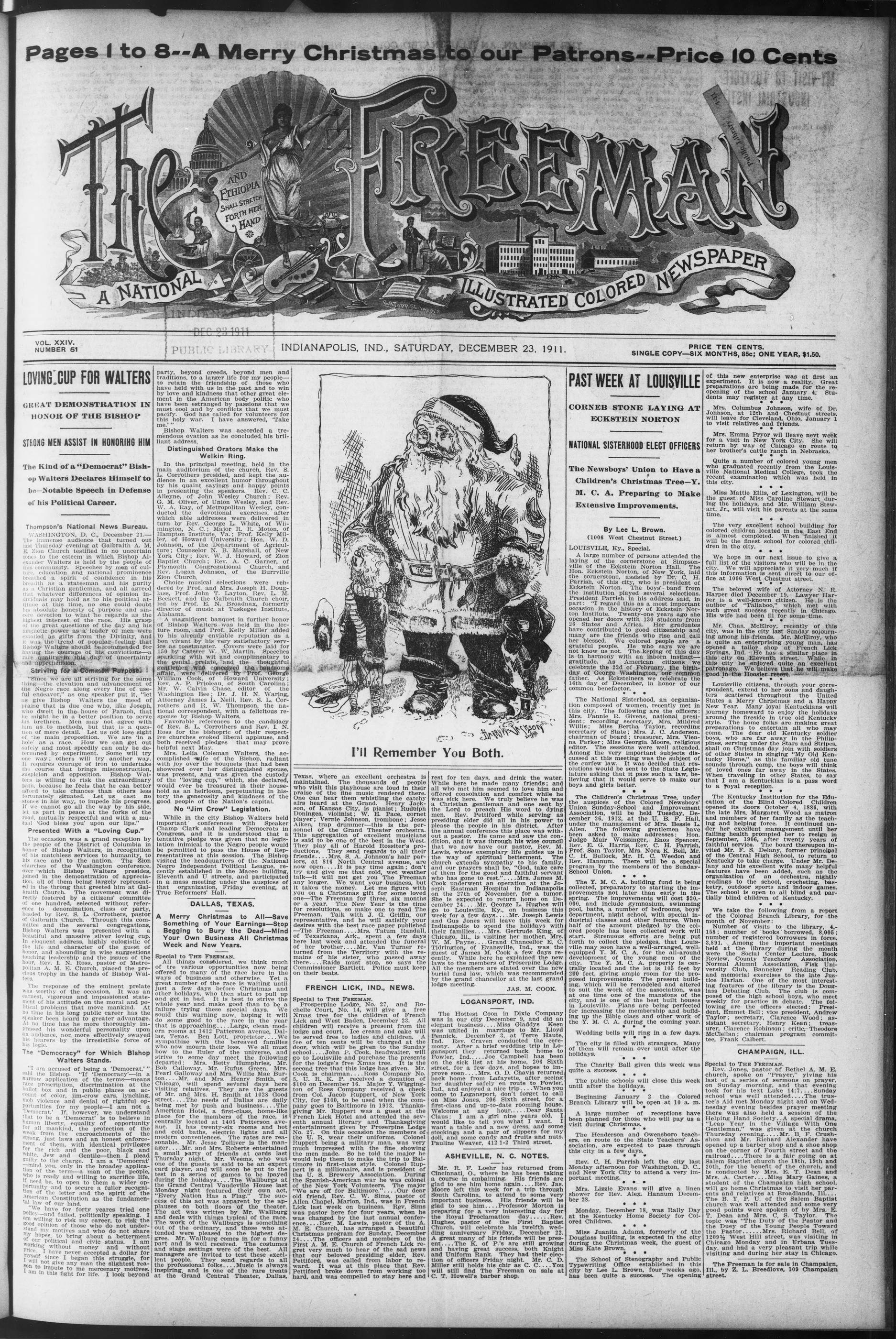
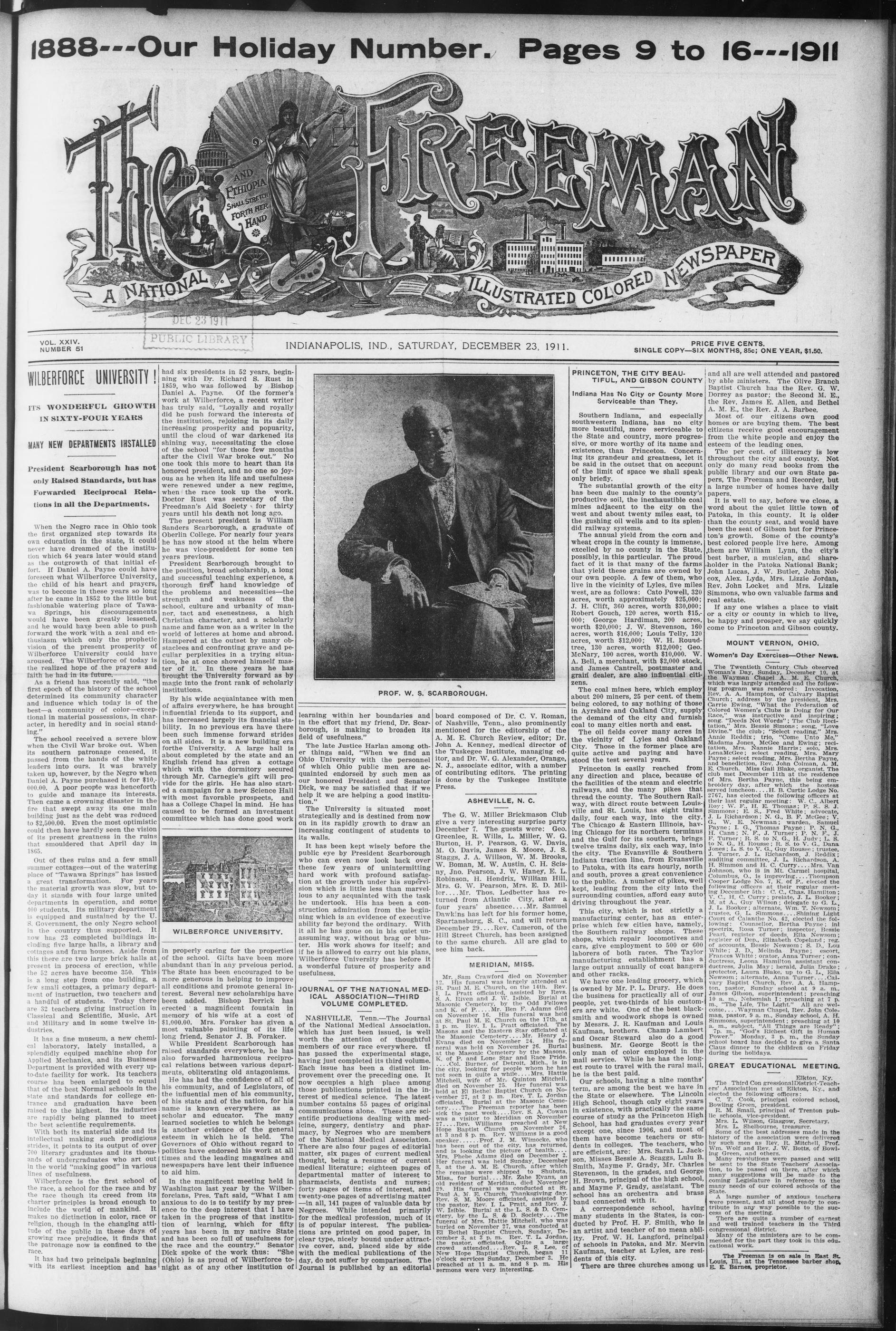
The Freeman
Saturday, December 23, 1911
Indianapolis, Indiana
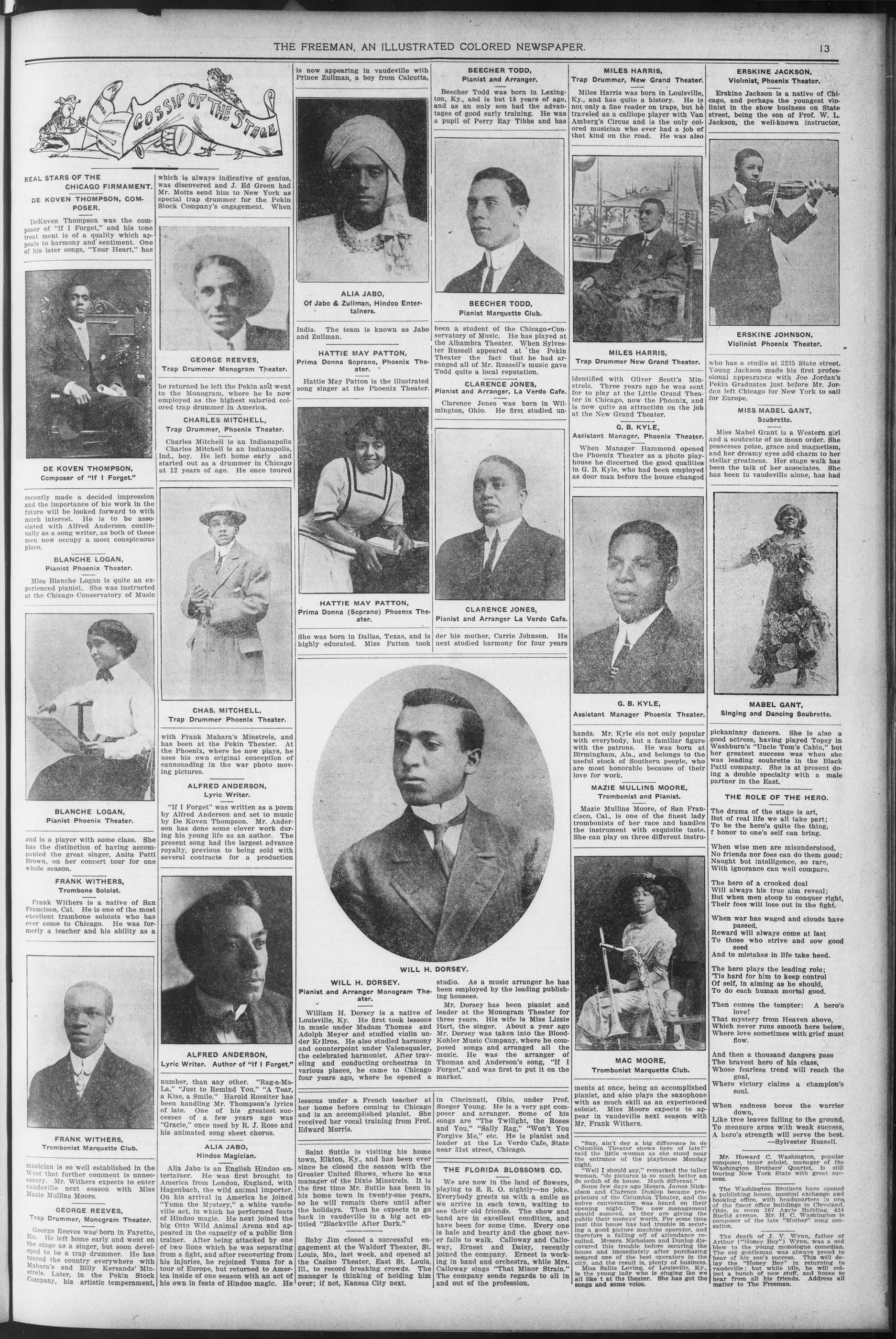
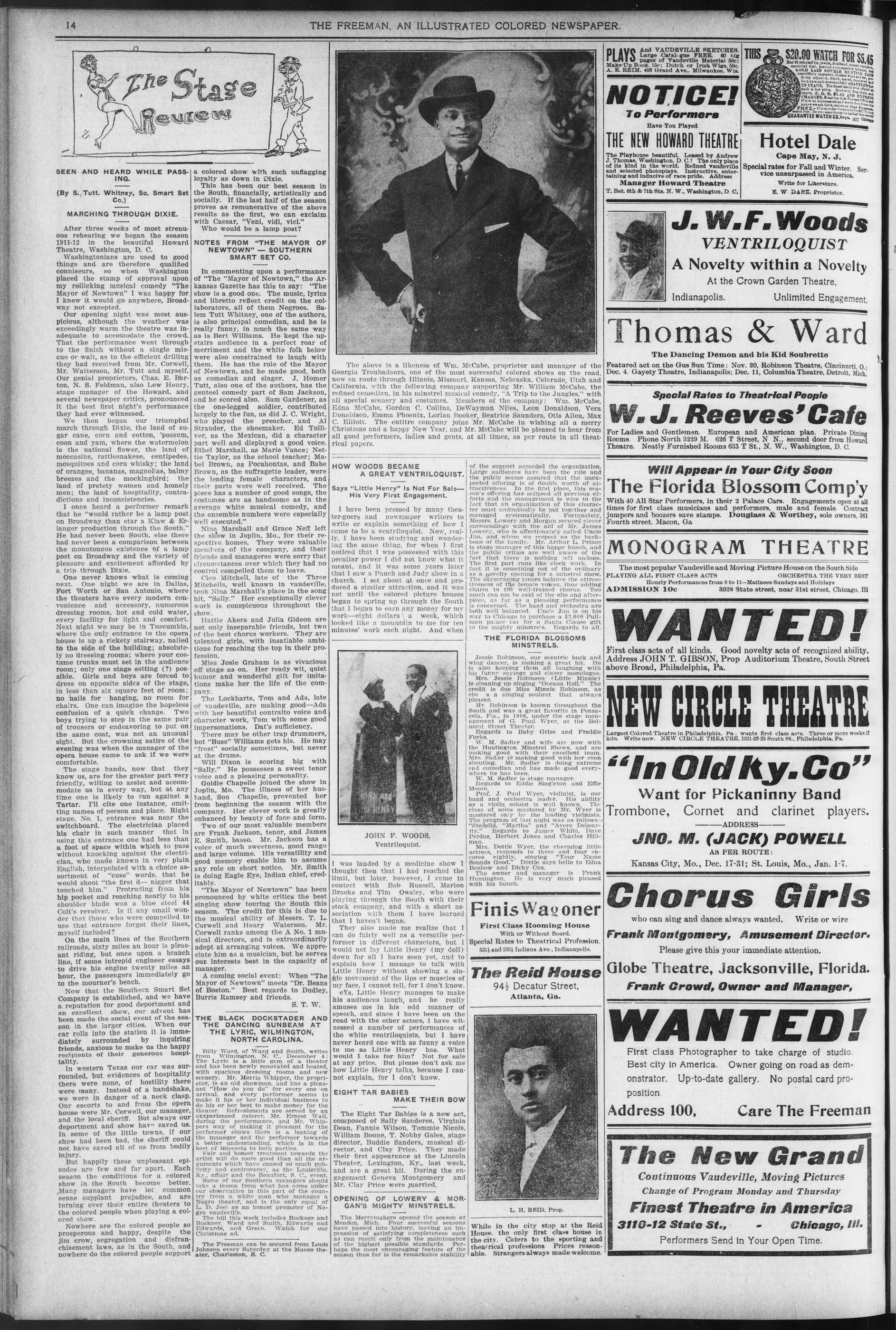
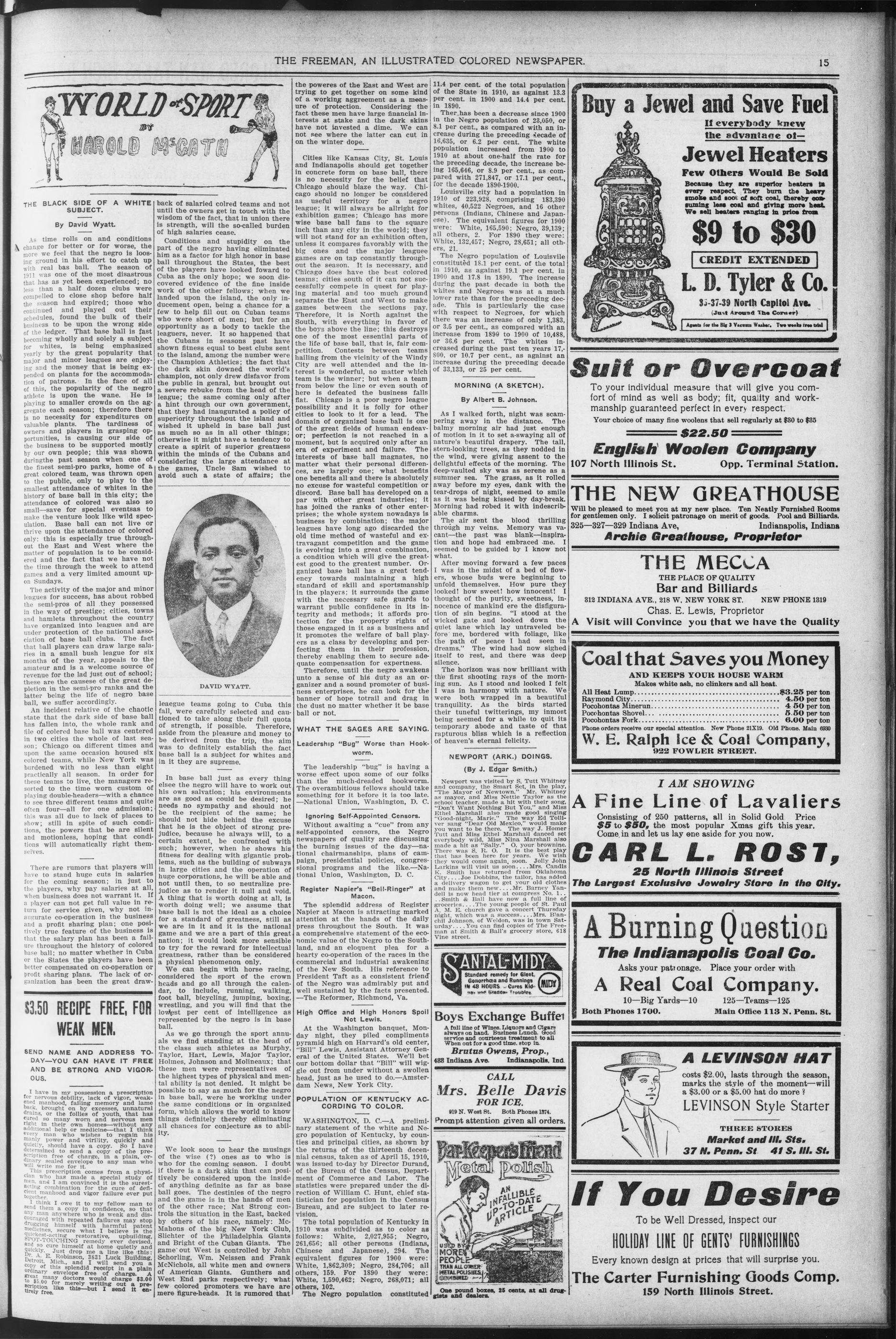
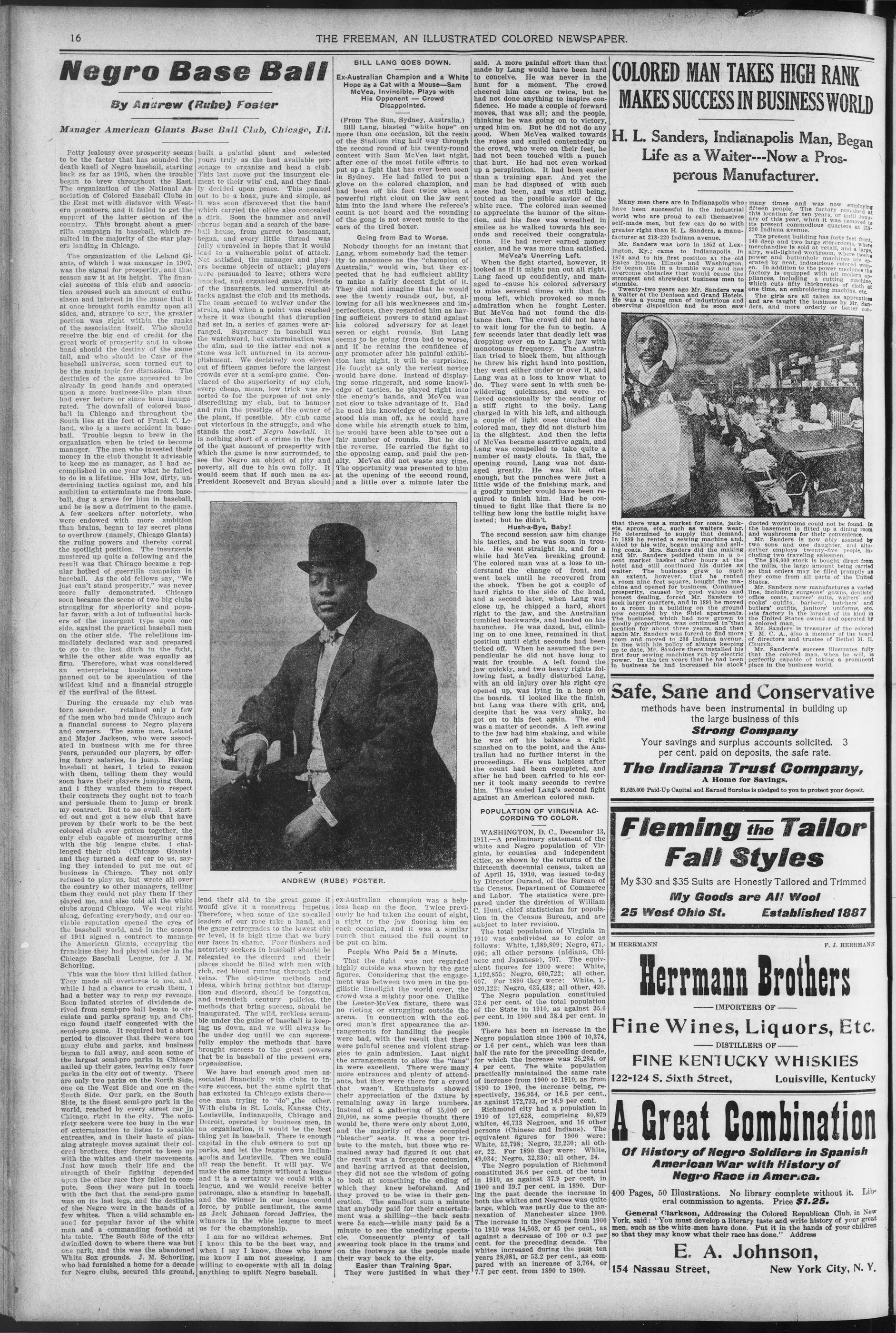
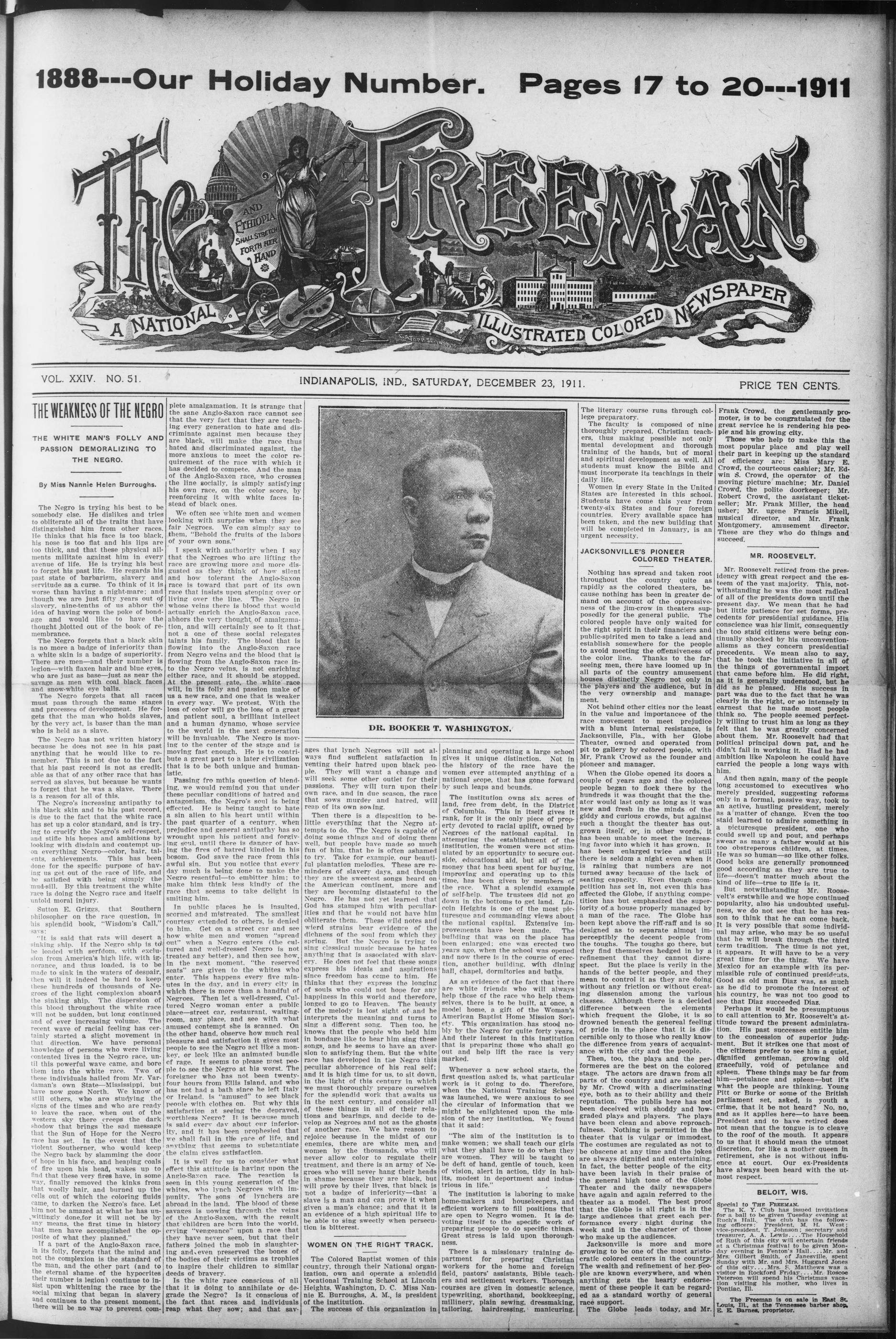
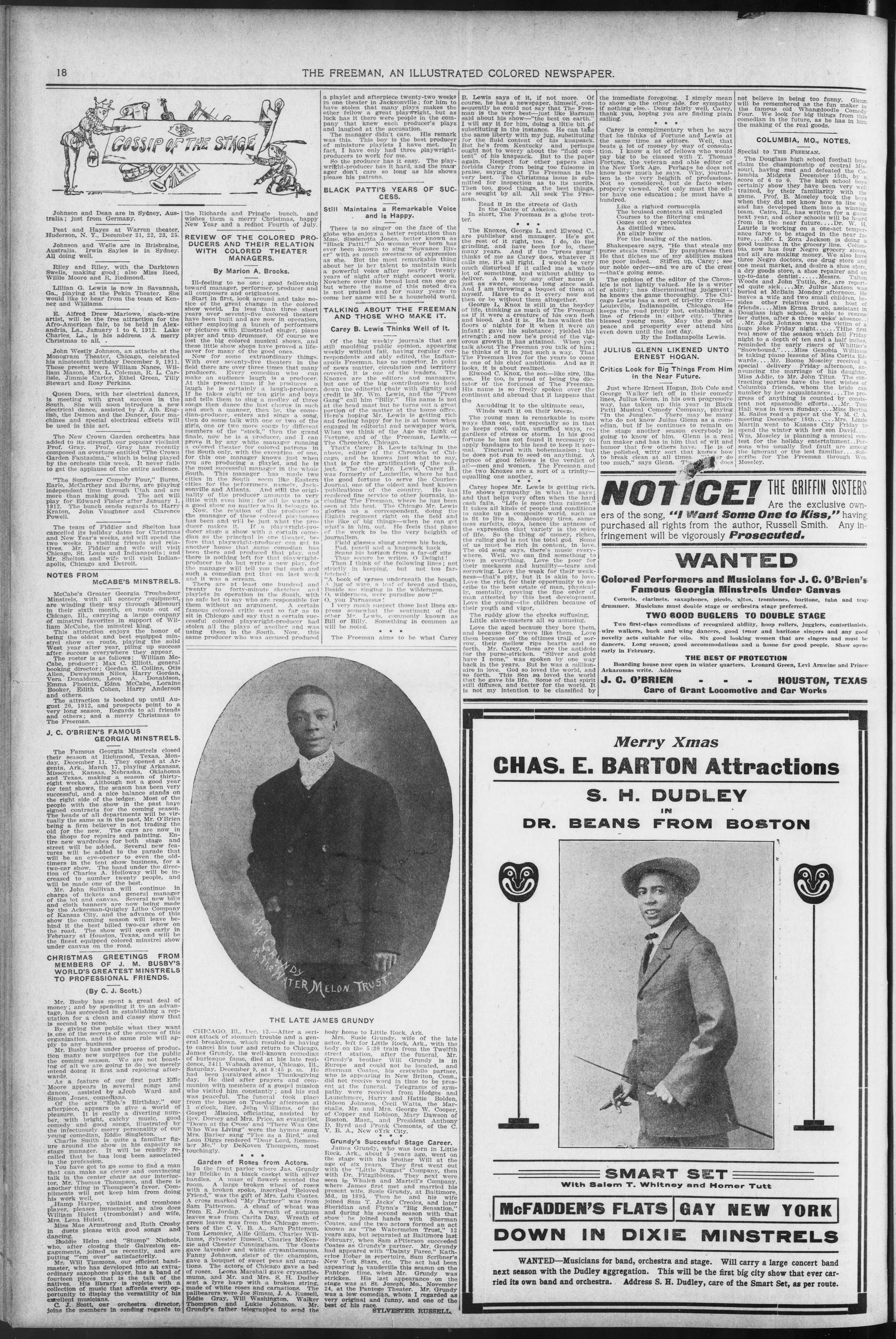
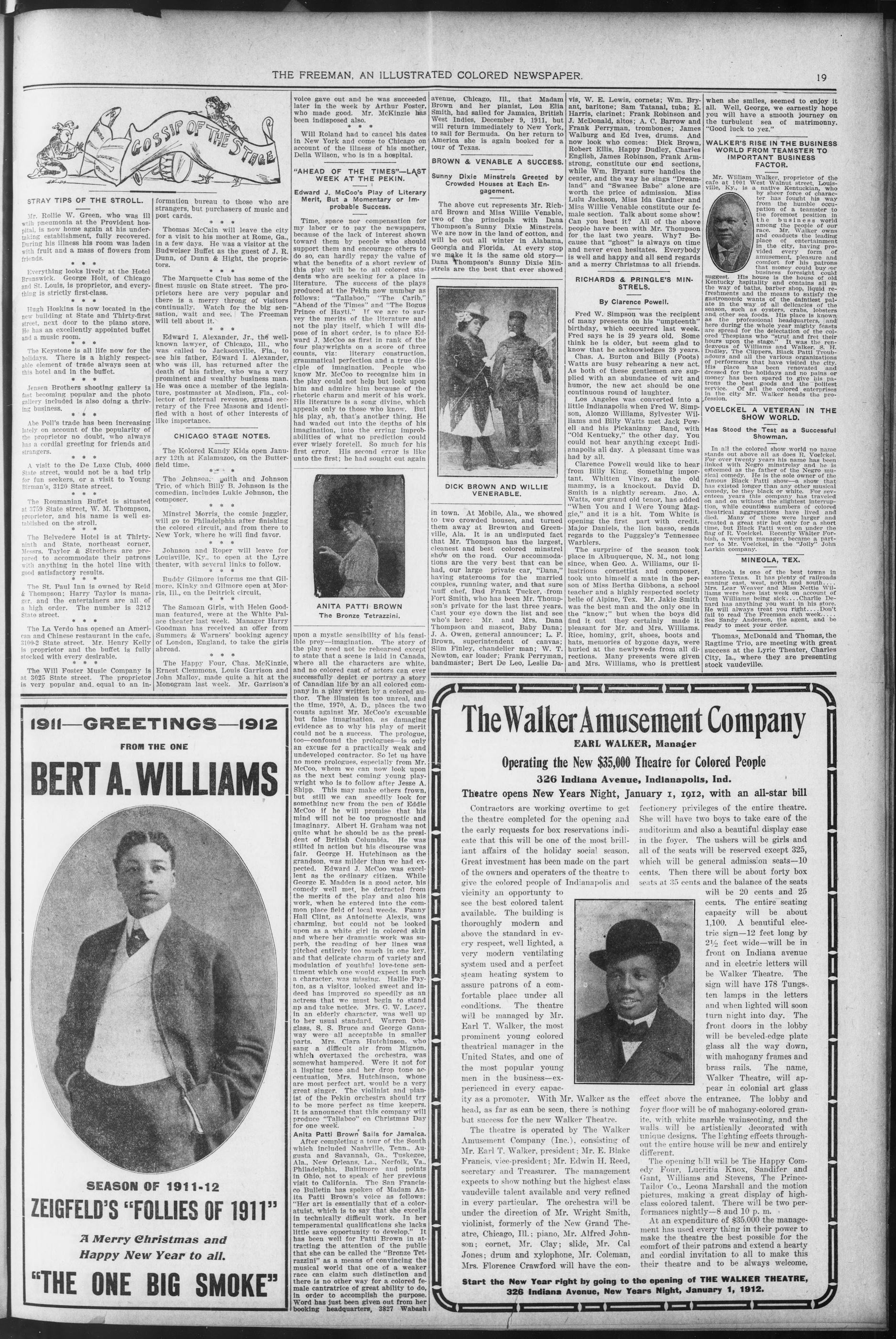
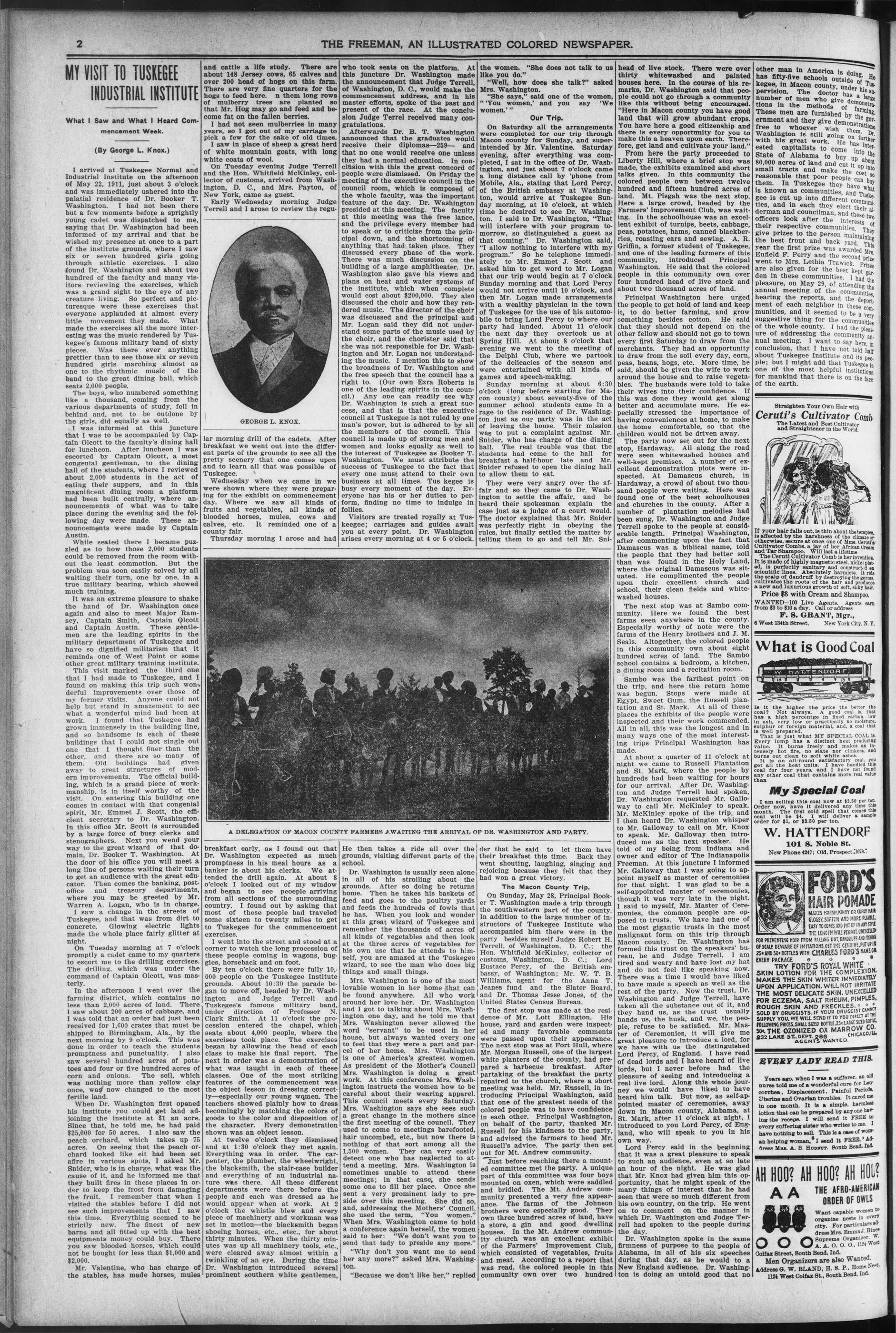
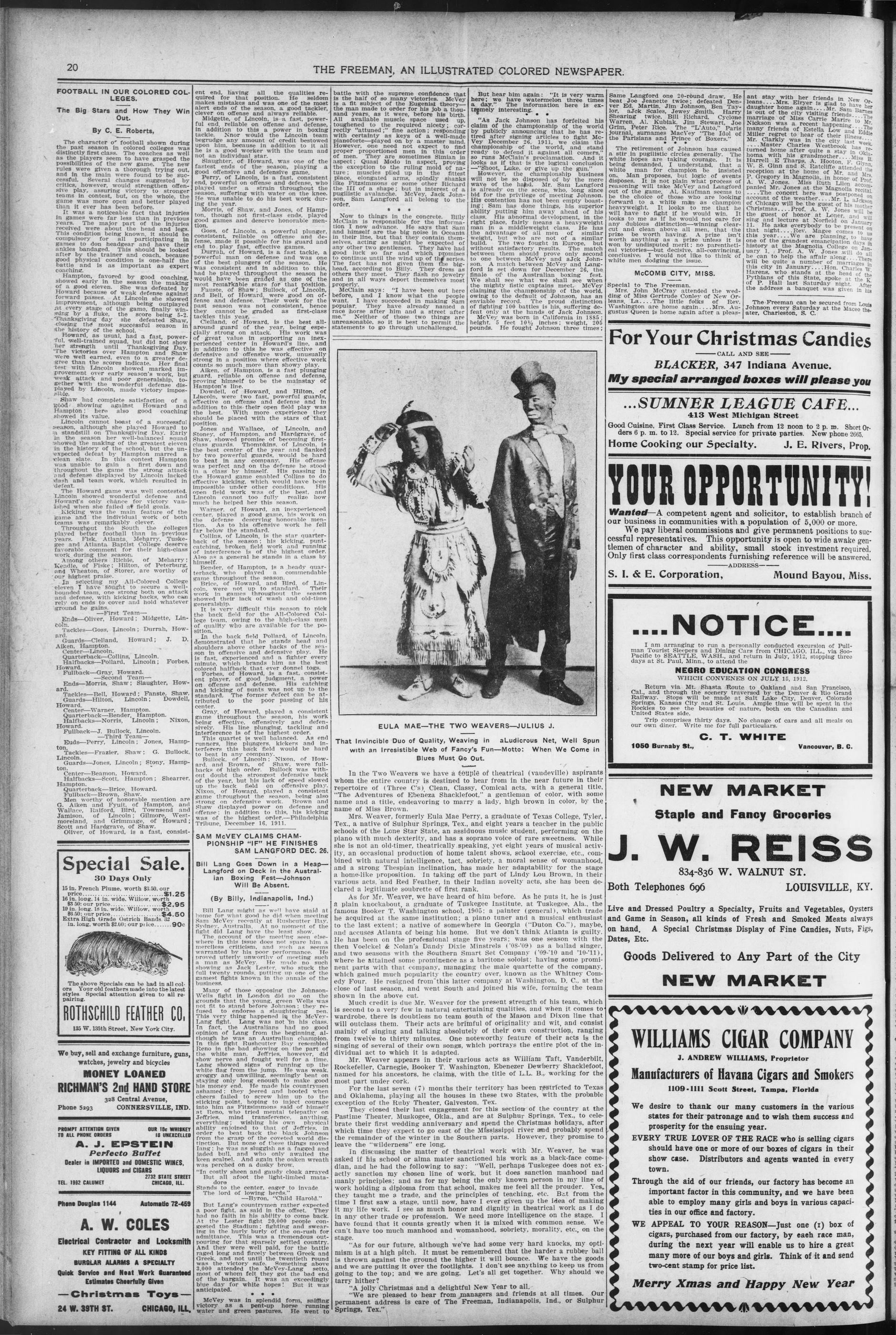
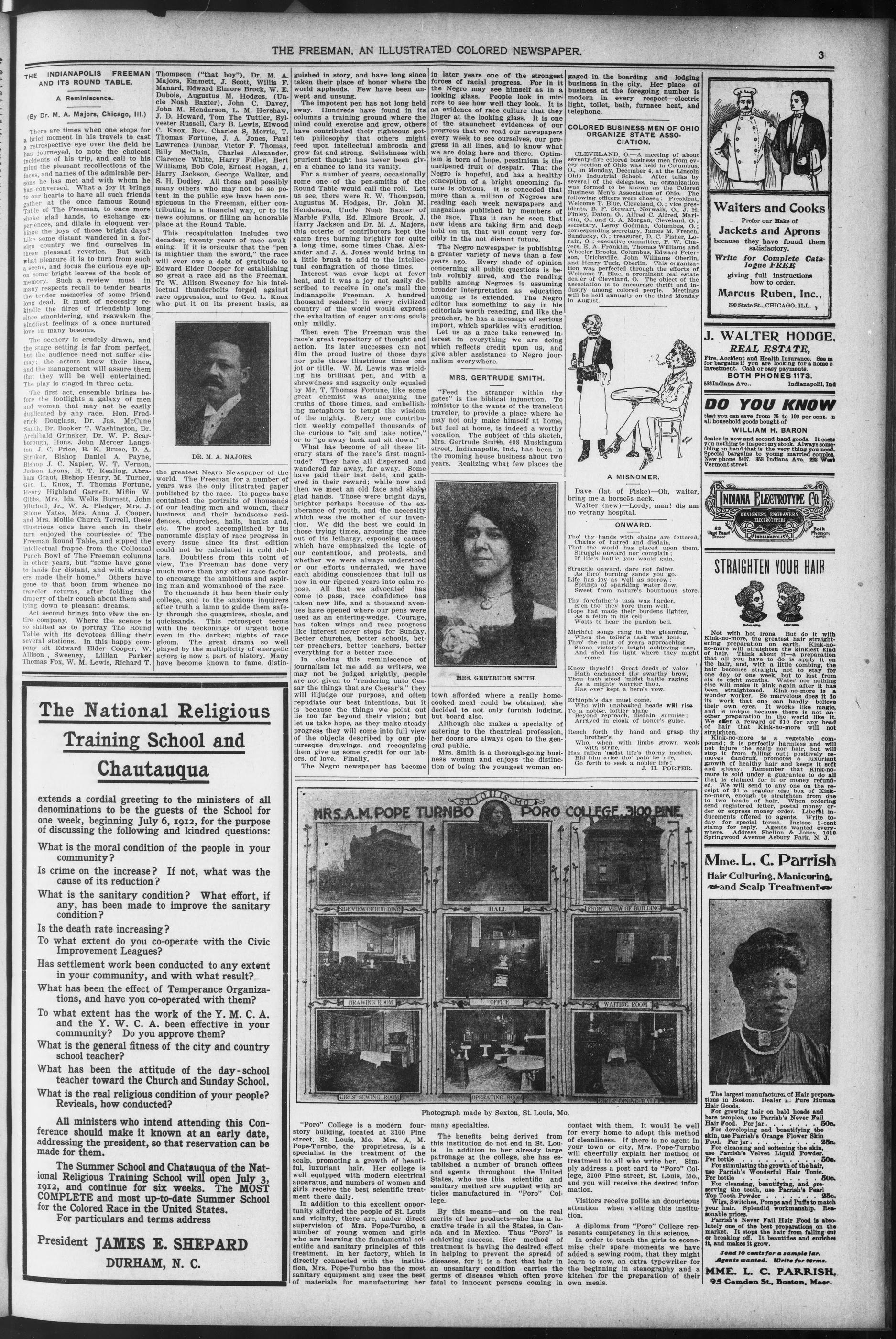
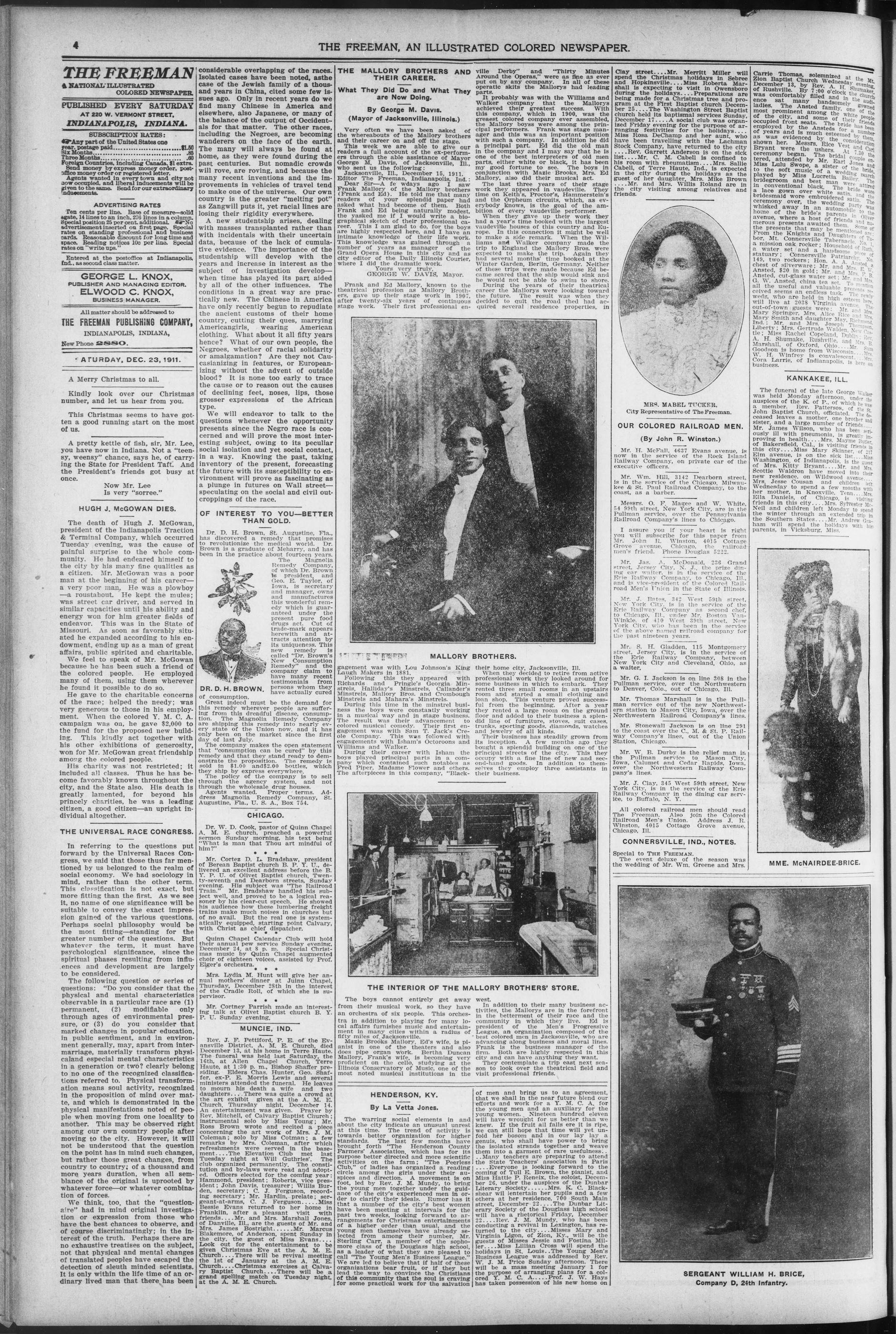
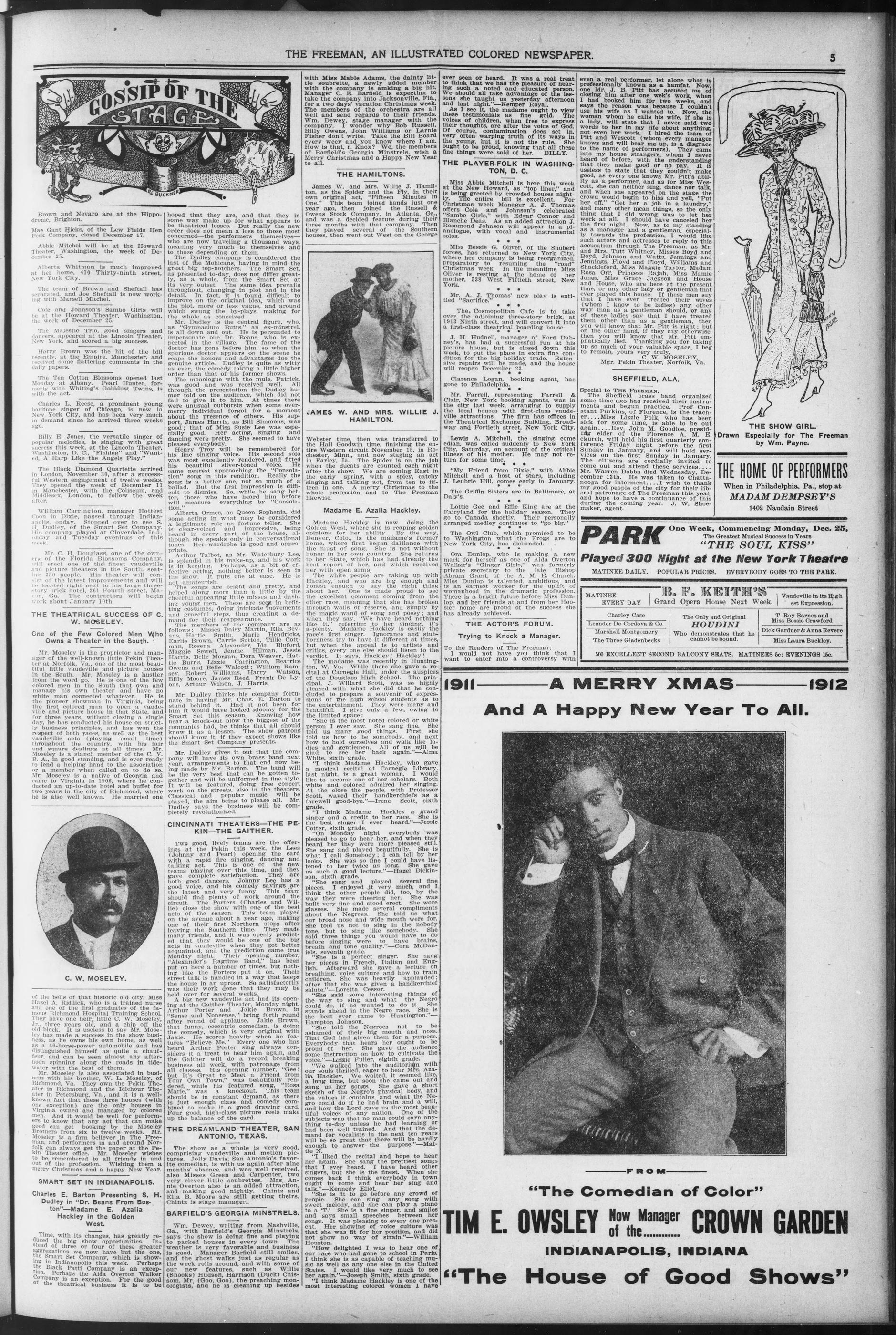
Page text (machine-generated)
Pages 1 to 8--A Merry Christmas to our Patrons--Price 10 Cents
THE FREEMAN
A NATIONAL
ILLUSTRATED COLORED NEWSPAPER
VOL. XXIV.
NUMBER 51
LOVING CUP FOR WALTERS
GREAT DEMONSTRATION IN
HONOR OF THE BISHOP
STRONG MEN ASSIST IN HONORIHG HIM
The Kind of a "Democrat" Bishop Walters Declares Himself to be Notable Speech in Defense of his Political Career.
Thompson's National News Bureau.
WASHINGTON, D. C., December 21.—The immense audience that turned out last Thursday evening at Galbraith A. M. E. Zion Church testified in no uncertain tones to the esteem in which Bishop Alphonso Zion was held in this community. Speeches by men of culture, education and national prominence breathed a spirit of confidence in his leadership. He was a Christian gentleman, and all agreed that whatever differences of opinion individuals may hold as to his political attitude at this time, no one could doubt his views. He was a devotion to what he regards as the highest interest of the race. His grasp of the great questions of the day and his magnetic power as a leader of men were evident. It was the trend of popular feeling that Bishop Walters should be recommended for having the courage of his convictions—a characteristic day of uncertainty and misperception.
Striving for a Common Purpose.
"Since we are all striving for the same thing—the elevation and advancement of the Negro race along every line of useful endeavor," as one speaker put it, "let us give Bishop Walters the meed of praise that is due one who, like Joseph, who dwelt in the house of Parahad, thatahad, his brethren, thatahad, his brethren. Men may not agree with him as to methods, but that is a question of mere detail. Let us not lose sight of the main proposition. We are in a safe and most speedily and most safely and most speedily can only be determined by experiment. Some will try one way; others will try another way. It requires courage of iron to undertake course that brings misconstruction, sustains misconstruction, sustains willing to risk the extraordinary path, because he feels that he can better afford to take chances than others less fortunately situated. Let us cast no stones in his way, to impede his progress, since he will not be able to let us part in peace at the forks of the road, mutually respectful and with a mutual "God bless you" upon our lips."
Presented With a "Loving Cup."
The occasion was a grand reception by the people of the District of Columbia in honor of Bishop Walters, in recognition of his matchless services to humanity, to the people of the United States and to churches of the Washington conference over which Bishop Walters presides, joined in the demonstration of appreciation, all of them being largely represented by the congregation of the Braith Church. The movement was directly fostered by a citizens' committee of one hundred, selected without reference to denomination, class or party, led by the Rev. L. A. Church of Galbraith Church. Through this committee and the several congregations, Bishop Walters was presented with a beautiful and massive silver loving cup. In eloquent address, highly eulogistic of his service, he expressed his honor, and abounding in wise suggestions touching leadership and the issues of the hour, Rev. I. N. Ross, pastor of Metropolitan A. M. E. Church, placed the prettiest trophy in the hands of Bishop Walters.
The response of the eminent prelate was worthy of the occasion. It was an earnest, vigorous and impassioned statement of his attitude on the moral and political issues of the day, no time in his long public career has the speaker been heard to greater advantage. At no time has he more thoroughly impressed his wonderful personality upon an audience, nor more effectively swayed his by the irresistible force of his logic.
The "Democracy" for Which Blshop Walters Stands.
"I am accused of being a 'Democrat,'" said the Bishop. "If 'Democracy'—in a narrow application of the terms—means proscription, discrimination at the ballot box, the use of the count of color, jim-crow cars, lynching, mob violence and denial of rightful opportunities for my people—I am not a Democrat. If, however, we understand the to be an 'Democrat' is to believe in humanity, the power of the law for all mankind, the protection of the weak from the encroachments of the strong, just laws and an honest enforcement of them, with identical privileges for the richest and the poorest white, Jew and Gentile—when I plead guilty to the charge. I am a 'Democrat'—mind you, only in the broader application of the term—a man of the people, who study and willing to sacrifice life, if need be, to secure opportunity and to secure a fuller recognition of the letter and the spirit of the American Constitution as the fundamental our land. "We have forty years tried one policy—and failed, politically speaking. I am willing to risk my career, to risk the good opinion of those who do not underwrite my motives and who do not share my views about a betterment of our political and social status working without money and without price. I have never accepted a dollar for since I began this struggle, for I will not accept any man the slightest reason to impute to me the reason I am in this fight for life. I look beyond
party, beyond creeds, beyond men and traditions, to a larger life for my people—to retain the friendship of those who have held with us in the past and to win by love and kindness that other great elephants of America body, politic have been estranged by passions that we must cool and by conflicts that we must pacify. God has called for volunteers for this holy war. I have answered, 'Take me.' Bishop Walters was accorded a tremendous ovation as he concluded his brilliant address.
Distinguished Orators Make the Welkin Ring.
Favorable references to the candidacy of Rev. S. L. Corrothers and Rev. I. N. Corrothers, two of the five live churches evoked liberal applause, and both received pledges that may prove helpful next. First, the Coleman Walters, the accomplished wife of the Bishop, radiant with joy over the bouquets that had been showered over her distinguished spouse, wrote in a letter to the Bishop of the "loving cup," which, she declared, would ever be treasured in their household as an heirloom, perpetuating in history the generosity and kindness of the church.
No "Jim Crow" Legislation.
While in the city Bishop Walters held important conferences with Speaker Champ Clark and leading Democrats in the city, he also presented a tentative pledge was given that no legislation inimical to the Negro people would be permitted to pass the House of Representatives at this session. The Bishop was also a member of the Negro Independent Political League, recently established in the Maceo building, Eleventh and U streets, and participated in a meeting under the auspices of that organization on Friday evening, at True Reformers' Hall.
DALLAS. TEXAS.
A Merry Christmas to All—Save Something of Your Earnings—Stop Begging to Bury the Dead—Mind Your Own Business All Christmas Week and New Years.
Special to THE FREEMAN
Jill Rowe and Yvonne Ruth
FRENCH LICK. IND. NEWS.
Special to THE FREEMAN.
Prosperpine Lodge, No. 27, and Rochelle Court, No. 14, will give a free Xmas tree for the children of French Lick and West Baden, December 23. All children will receive a present at the court and count, and cake will be served free to ladies and children. A fee of ten cents will be charged at the door, which will be given to the Sunday school. The children will go to Louisville and purchase the presents for the lodge's free Xmas tree. It is the second tree that this lodge has given. Mr. Cook is chairman... Ross Company No. 100 on December 16. Major Y. Wigginum of Ross Company received a check from Col. Jacob Ruppert, of New York City, for $100, to be used when the company sends a gift to the giving Mr. Ruppert was a guest at the French Lick Hotel and attended the seventh annual literary and Thanksgiving entertainment given by Prosperpine Lodge. The U. R. wear their uniforms. Colonel Ruppert being a military man, was very much impressed with the fine showing the men made. So he told the major he would be given a gift to the timore in first-class style. Colonel Ruppert is a millionaire, and is president of the U. S. Brewery Association. During the Spanish-American war he was colonel "We are off for Baltimore"... "Our dear old friend, Rev. C. W. Sims, pastor of Allen Chapel, Marion, Ind., was in French Lick last week on business. Rev. Sims was pastor of the office by the last annual conference... Rev. M. Lewis, pastor of the A. M. E. Church, has arranged a beautiful Christmas program for Sunday, December 16. First A. M. Church of French Lick regret very much to hear of the sad news that our beloved presiding elder, Rev. Pettiford, was called from labor to re-verify the office... Rev. Pettiford broke down from working too hard, and was compelled to stay here and
rest for ten days, and drink the water. While here he made many friends; and all who met him seemed to love him and offended consolation and comfort while he held a Christian gentleman and one sent by the Lord to preach His word to dying men. Rev. Pettiford will serve as a pastor in his district, please the people in his district. After the annual conference this place was without a pastor. He came and saw the condition, and it was through his wise council Lewis, whose exemplary life guides us in the way of spiritual betterment. The church extends sympathy to his family, and our prayers shall be "God, take care who has gone to rest."...Mrs. James M. Cook underwent an operation at the Joseph Eustman Hospital in Indianapolis the 27th of November, for a tumor. She will be in hospital for September 24...Mr. George L. Hughes will go to Louisville, Ky., on business this week for a few days. Mr. Joseph Lewis Jones will be his week for Indianapolis, spend the holiday with their families. ...Mr. Gertrude King, of Chicago, Ill., is visiting her mother, Mrs. W. M. Payne. ...Grand Chancellor E. C. M. Payne. ...Guest of James M. Cook a few days recently. While here he explained the new laws to the members of Proserpine Lodge. All the members are elated over the new law, which was recommended by the grand chancellor at the last grand lodge meeting.
JAS. M. COOK.
LOGANSPORT, IND.
ASHEVILLE. N. C. NOTES.
Mr. R. F. Loehr has returned from Cincinnati, O. where he has been taking a course in embalming. His friends are glad to see him home again... Rev. Jas. Moore left this week for a trip through some important business. His friends will be glad to see him... Professor Morton is preparing for a very interesting day for the Royal Proclamation day... Rev. Hughes, pastor of the First Baptist Church, will be celebrating anniversary Friday, December 22. A great many of his friends will be present... The K. of P.'s are still growing and having great success, both Knight and Uniform Rank. They had their election of officers Friday night. Mr. C. D. Wheeler, pastor of C. C. You will still find the Freeman on sale at C. T. Howell's barber shop.
PAST WEEK AT LOUISVILLE
CORNEB STONE LAYING AT ECKSTEIN NORTON
NATIONAL SISTERHOOD ELECT OFFICERS
The Newsboys' Union to Have a Children's Christmas Tree-Y. M. C. A. Preparing to Make Extensive Improvements.
. . .
The Children's Christmas Tree, under the auspices of the Colored Newbys' Union Sunday-School and Improvement Association, be held Tuesday, December 11, 1912, at the H. W. Fell under the management of Mrs. Bessie L. Allen. The following gentlemen have been asked to make addresses: Hon Judge Muir H. cissinger, Enos Spencer, C. H. W. Fell, M. A. H. Prof. Sam Taylor, Mrs. Nora K. Bell, Mr. C. H. Bullock, Mr. H. C. Weedon and Rev. Hannum. There will be a special program by the members of the Sunday-School Union.
The Y. M. C. A. building fund is being collected, preparatory to starting the implemency spring. The improvements will cost $20,000, and include gymnasium, swimming pool, baths, a number of bedrooms, boys' department, night school, with special industrial classes and other features. When hired, people has been collected work will start. Strenuous efforts are being put forth to collect the pledges, that Louisville may soon have a well-arranged, well-educated people in the management of the young men of the city. The Y. M. C. A. property is centrally located and the lot is 105 feet by 200 feet, giving ample room for the pro-gram, which will be remodeled and altered to suit the work of the association, was at one time one of the mansions of the city. It is one of the best buildings, Plans are being perfected for increasing the membership and building up the Bible class and other work of the Y. M. C. A. during the coming year.
Wedding bells will ring in a few days.
The city is filled with strangers. Many of them will remain over until after the holidays.
The Charity Ball given this week was quite a success.
The public schools will close this week until after the holidays.
Beginning January 2 the Colored Branch Library will be open at 10 a. m.
A large number of receptions have been planned for those who will pay us a visit during Christmas.
The Henderson and Owensboro teachers, en route to the State Teachers' Association, are expected to pass through this city in a few days.
Rev. C. H. Parrish will the city last Monday afternoon for Washington, D. C., and New York City to attend a very important meeting.
Mrs. Lizzie Evans will give a linen shower for Rev. Alex Hannum December 28.
Monday, December 18, was Rally Day at the Kentucky Home Society for Colored Children.
Miss Juanita Adams, formerly of the Duguese School, is expected in the city during the Christmas week, the guest of Miss Kate Brown.
The School of Stenography and Public Typewriting Office, established in its city Juquita, I. Brown four weeks ago, has been quite a success. The opening
of this new enterprise was at first an experiment. It is now a reality. Great preparations are being made for the reopening of the school January 4. Students may register at any time.
Mrs. Columbus Johnson, wife of Dr. Johnson, at 12th and Chestnut streets, will leave for Cleveland, Ohio, January 1 to visit relatives and friends.
Mrs. Emma Pryor will leave nevt week for a visit in New York City. She will return by way of Chicago en route to her brother's cattle ranch in Nebraska.
Quite a number of colored young men who graduated recently from the Louisville National Medical College, took the recent examination which was held in this city.
Miss Mattie Els, of Lexington, will be the guest of Miss Caroline Stewart during the holidays, and Mr. William Stewart, Jr., will visit his parents at the same time.
The very excellent school building for colored children located in the East End almost completed. When finished it will be the finest school for colored children in the city.
We hope in our next issue to give a full list of the visitors who will be in the city. We will answer it very much this information is sent direct to our office at 1006 West Chestnut street.
The beloved wife of Attorney N. R. Harper died December 9, Layne Harper is a well-known citizen. He is the author of "Tallaboob," which met with such great success recently in Chicago. His wife had been ill for some time.
Mr. Chas, McElroy, recently of this city, was in the city last Sunday sojourning among his friends. Mr. McElroy, who is quite an enterprising young man, has opportunities in Springs, Ind. He has a similar place in this city on Eleventh street. While in this city he enjoyed quite an excellent patronage. We believe that he will make good in the Hoosier court.
Louisville citizens, through your correspondent, extend to her sons and daughters of the United States a Merry Christmas and a New Year. Many loyal Kentuckians will journey homeward to enjoy the holidays around the fireside in true old Kentucky style. Home folks are making great opportunities during the day join with soldiers of other States. We come. The old Kentucky soldier boys, who are far away in the Philippines, serving under the Stars and Stripes, home folks day join with soldiers of other States. My Old Kentucky Home," as this familiar old tune sounds through camp, the boys will think or loved ones far away in the States. We meet other States, to say that I am a Kentuckian is a pass word to a royal reception.
The Kentucky Institution for the Educated opened its doors October 4, 1886 with the late Mrs. Margaret Wood as matron and members of her family as the teaching and helping force. It continued under an excellent management until her failing health in September, 1906, after twenty years of faithful service. The board thereupon invited Mr. F. S. Delany, former principal of Kentucky to take charge. Under Delany and his excellent wife many helpful features have been added, such as the organization of a school orchestra, nightly basketball, outdoor sports and basketball. The school is open to all blind and partially blind children of Kentucky.
. . .
We take the following from a report of the Colored Branch Library, for the month of November:
1. 4,158; number of books borrowed, 8,005; number of registered borrowers in force, 3,891. Among the important meetings held at the library during the month of November, the School for Teachers Review, County Teachers Association, Normal Alumni Association, Fisk University Club, Banneker Reading Club, and memorial exercises to the late Juscelin De La Salle. Among the features of the library is the Douglass Debating Club. The club is composed of the high school boys, who meet weekly in the library. The officers are elected: President, Emmet Bell; vice president, Andrew Taylor; secretary, Clarence Wood; assistant secretary, Henry Kean; treasurer, Arlene Lesson; critic, Theodore McClairnan; program committee, Frank Calbert.
CHAMPAIGN. ILL.
Special to THE FREEMAN
Rev. Jones, pastor of Bethel A. M. E. church, spoke on "Prayer," giving his last of a series of sermons on prayer, on Sunday morning, and that evening school was well attended. The teacher's Aid met Monday night and on Wednesday evening besides prayer meeting there was also held a session of the Helping Hand Society. A special drama, "Gentleman," was given at the church Thursday evening. Mr. B. F. Crushshon and Mr. Richard Alexander have opened up a barber shop and a shoe shop on the corner of the church and he there is a fair going on in Salem Baptist church the 18th, 19th and 20th, for the benefit of the church, and is conducted by Mrs. E. T. Dean and the student of the Champaign high school, will go home Christmas to visit her parents and relatives at Broadlands, Ill. The B. Y. P. U. of the Salem Baptist church was well attended and some very well attended. Mrs. E. T. Dean and Mrs. C. S. Taylor. The topic was "The Duty of the Pastor and the Duey of the Young People Toward the Pastor. . . . Mrs. Richard Bell of the Chicago Monday and in Urbana Tuesday, and had a very pleasant trip while visiting and during her stay in Chicago.
The Freeman is for sale in Champaign, Ill. by Z. L. Breedlove, 109 Champaign street
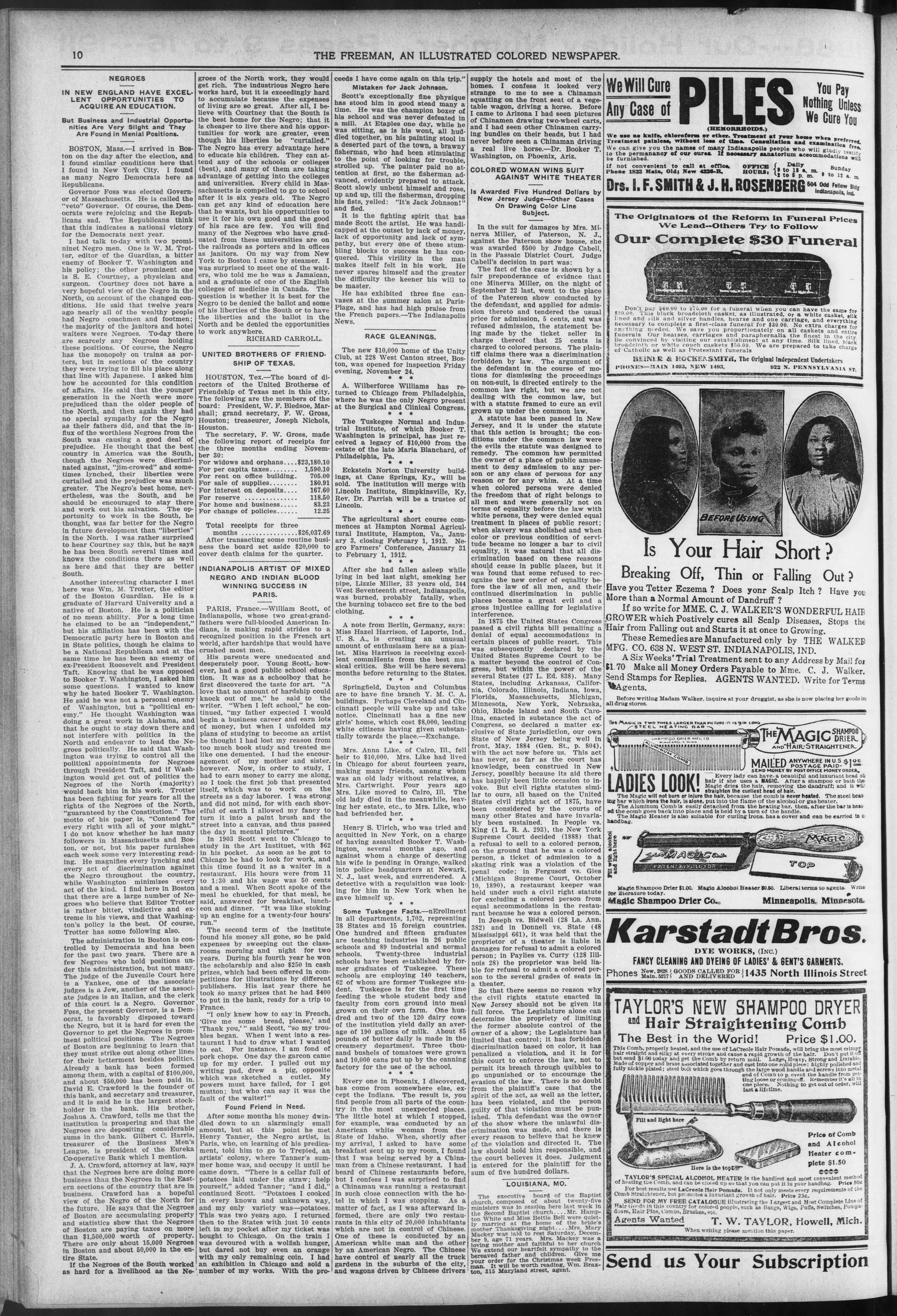
10
NEGROES
IN NEW ENGLAND HAVE EXCELLENT OPPORTUNITIES TO ACQUIRE AN EDUCATION.
But Business and Industrial Opportunities Are Very Slight and They Are Found in Menial Positions.
BOSTON, Mass.—I arrived in Boston on the day after the election, and I found similar conditions here that I found in New York City. I found as many Negro Democrats here as Republicans.
Governor Foss was elected Governor of Massachusetts. He is called the "veto" Governor. Of course, the Democrats were rejoicing and the Republicans sad. The Republicans think that this indicates a national victory for the Democrats next year.
I had talk to-day with two prominet Negro men. One is W. M. Trotter, editor of the Guardian, a bitter enemy of Booker T. Washington and his policy; the other prominent one is S. E. Courtney, a physician and surgeon. Courtney does not have a very hopeful view of the Negro in the North, on account of the changed conditions. He said that twelve years ago nearly all of the wealthy people had Negro coachmen and footmen; the majority of the janitors and hotel waiters were Negroes. To-day there are scarcely any Negroes holding these positions. Of course, the Negro has the monopoly on trains as porters, but in sections of the country they were trying to fill his place along that line with Japanese. I asked him how he accounted for this condition of affairs. He said that the younger generation in the North were more prejudiced than the older people of the North, and then again they had no special sympathy for the Negro as their fathers did, and that the influx of the worthless Negroes from the South was causing a good deal of prejudice. He thought that the best country in America was the South, though the Negroes were discriminated against, "jim-crowed" and sometimes lynched, their liberties were curtailed and the prejudice was much greater. The Negro's best home, nevertheless, was the South, and he should be encouraged to stay there and work out his salvation. The opportunity to work in the South, he thought, was far better for the Negro in future development than "liberties" in the North. I was rather surprised to hear Courtney say this, but he says he has been South several times and knows the conditions there as well as here and that they are better South.
Another interesting character I meet here was Wm. M. Trotter, the editor of the Boston Guardian. He is a graduate of Harvard University and a native of Boston. He is a politician of no mean ability. For a long time he claimed to be an "independent," but his affiliation has been with the Democratic party here in Boston and in State politics, though he claims to be a National Republican and at the same time he has been an enemy of ex-President Roosevelt and President Taft. Knowing that he was opposed to Booker T. Washington, I asked him some questions. I wanted to know why he hated Booker T. Washington. He said he was not a personal enemy of Washington, but a "political enemy." He thought Washington was doing a great work in Alabama, and that he ought to stay down there and the north and endeavor to lead the Negroes politically. He said that Washington was trying to control all the political appointments for Negroes through President Taft, and if Washington would get out of politics the Negroes of the North (majority) would back him in his work. Trotter has been fighting for years for all the rights of the Negroes of the North, "guaranteed by the Constitution." The motto of his paper is, "Contend for every right with all of your might." I do not know whether he has many followers in Massachusetts and Boston, or not, but his paper furnishes each week some very interesting reading. He magnifies every lynching and every act of discrimination against the Negro throughout the country, while Washington minimizes every act of the kind. I find here in Boston that there are a large number of Negroes who believe that Editor Trotter is rather bitter, vindictive and extreme in his views, and that Washington's policy is the best. Of course, Trotter has some following also.
The administration in Boston is controlled by Democrats and has been for the past two years. There are a few Negroes who hold positions under this administration, but not many. The judge of the Juvenile Court here is a Yankee, one of the associate judges is a Jew, another of the associate judges is an Italian, and the clerk of this court is a Negro. Governor Foss, the present Governor, is a Democrat, is favorably disposed toward the Negro, but it is hard for even the Governor to get the Negroes in prominent political positions. The Negroes of Boston are beginning to learn that they must strike out along other lines for their betterment besides politics. Already a bank has been formed among them, with a capital of $100,000, and about $50,000 has been paid in. David E. Crawford is the founder of this bank, and secretary and treasurer, and it is said he is the largest stockholder in the bank. His brother, Joshua A. Crawford, tells me that the institution is prospering and that the Negroes are depositing considerable sums in the bank. Gilbert C. Harris, treasurer of the Business Men's League, is president of the Eureka Co-operative Bank which I mention.
J. A. Crawford, attorney at law, says that the Negroes here are doing more business than the Negroes in the Eastern sections of the country that are in business. Crawford has a hopeful view of the Negro of the North for the future. He says that the Negroes of Boston are accumulating property and statistics show that the Negroes of Boston are paying taxes on more than $1,500,000 worth of property. There are only about 15,000 Negroes in Boston and about 50,000 in the entire State. If the Negroes of the South worked as hard for a livelihood as the Ne-
groes of the North work, they would get rich. The industrious Negro here works hard, but it is exceedingly hard to accumulate because the expenses of living are so great. After all, I believe with Courtney that the South is the best home for the Negro; that it is cheaper to live there and his opportunities for work are greater, even though his liberties be "curalled." The Negro has every advantage here to educate his children. They can attend any of the schools or colleges (best), and many of them are taking advantage of getting into the colleges and universities. Every child in Massachusetts is compelled to go to school after it is six years old. The Negro can get any kind of education here that he wants, but his opportunities to use it for his own good and the good of his race are few. You will find many of the Negroes who have graduated from these universities are on the railroads as porters and in offices as janitors. On my way from New York to Boston I came by steamer. I was surprised to meet one of the waiters, who told me he was a Jamaican, and a graduate of one of the English colleges of medicine in Canada. The question is whether it is best for the Negro to be denied the ballot and some of his liberties of the South or to have the liberties and the ballot in the North and be denied the opportunities to work anywhere.
RICHARD CARROLL
UNITED BROTHERS OF FRIENDSHIP OF TEXAS.
HOUSTON, Tex.—The board of directors of the United Brotherse of Friendship of Texas met in this city. The following are the members of the board: President, W. F. Bledsoe, Marshall; grand secretary, F. W. Gross, Houston; treasurer, Joseph Nichols, Houston.
The secretary, F. W. Gross, made the following report of receipts for the three months ending November 30:
For widows and orphans.....$23,180.10
For per capita taxes.....1,590.10
For rent on office building.....705.00
For sale of supplies.....180.91
For interest on deposits.....167.60
For reserve.....118.50
For home and business.....83.23
For change of policies.....12.25
Total receipts for three
months ..... $26,037.69
After transacting some routine business the board set aside $20,000 to cover death claims for the quarter.
INDIANAPOLIS ARTIST OF MIXED NEGRO AND INDIAN BLOOD WINNING SUCCESS IN PARIS.
PARIS, France.—William Scott, of Indianapolis, whose two great-grand-fathers were full-blooded American Indians, is making rapid strides to a recognized position in the French art world, after hardships that would have crushed most men.
His parents were uneducated and desperately poor. Young Scott, however, had a good public school education. It was as a schoolboy that he first discovered the taste for art. "A love that no amount of hardship could knock out of me," he said to the writer. "When I left school," he continued, "my father expected I would begin a business career and earn lots of money, but when I unfolded my plans of studying to become an artist he thought I had lost my reason from too much book study and treated me like one demented. I had the encouragement of my mother and sister, however. Now, in order to study, I had to earn money to carry me along, so I took the first job that presented itself, which was to work on the streets as a day laborer. I was strong and did not mind, for with each shovelful of earth I allowed my fancy to turn it into a paint brush and the street into a canvas, and thus passed the day in mental pictures."
In 1903 Scott went to Chicago to study in the Art Institut, with $62 in his pocket. As soon as he got to Chicago he had to look for work, and this time found it as a waiter in a restaurant. His hours were from 11 to 1:30 and his wage was 50 cents and a meal. When Scott spoke of the meal he chuckled, for that meal, he said, answered for breakfast, luncheon and dinner. "It was like stoking up an engine for a twenty-four hours' run."
The second term of the institute found his money all gone, so he paid expenses by sweeping out the classrooms morning and night for two years. During his fourth year he won the scholarship and also $250 in cash prizes, which had been offered in competitions for illustrations by different publishers. His last year there he took so many prizes that he had $400 to put in the bank, ready for a trip to France.
"I only knew how to say in French, 'Give me some bread, please,' and 'Thank you,'" said Scott, "so my troubles began. When I went into a restaurant I had to draw what I wanted to eat. For instance, I am fond of pork chops. One day the garcon came up for my order. I pulled out my writing pad, drew a pig, opposite which was sketched a cutlet. My powers must have failed, for I got mutton; but who can say it was the fault of the waiter!"
Found Friend in Need.
After some months his money dwindled down to an alarmingly small amount, but at this point he met he Henry Tanner, the Negro artist, in Paris, who, on learning of his predication, told him to go to Trepied, an artists' colony, where Tanner's summer home was, and occupy it until he came down. "There is a cellar full of potatoes laid under the straw; help yourself," added Tanner; "and I did," continued Scott. "Potatoes I cooked in every known and unknown way, and my only variety was—potatoes. This was two years ago. I returned then to the States with just 10 cents left in my pocket after my ticket was bought to Chicago. On the train I was devoured with a wolfish hunger, but dared not buy even an orange with my only remaining coin. I had an exhibition in Chicago and sold a number of my works. With the pro-
THE FREEMAN. AN ILLUSTRATED COLORED NEWSPAPER.
ceeds I have come again on this trip.'
Mistaken for Jack Johnson.
Scott's exceptionally fine physique has stood him in good stead many a time. He was the champion boxer of his school and was never defeated in a mill. At Etaples one day, while he was sitting, as is his wont, all huddled together, on his painting stool in a deserted part of the town, a brawny fisherman, who had been stimulating to the point of looking for trouble, strolled up. The painter paid no attention at first, so the fisherman advanced, evidently prepared to attack. Scott slowly unbent himself and rose, up and up, till the fisherman, dropping his fists, yelled: "It's Jack Johnson!" and fled.
It is the fighting spirit that has made Scott the artist. He was handicapped at the outset by lack of money, lack of opportunity and lack of sympathy, but every one of these stumbling blocks to success he has conquered. This virility in the man makes itself felt in his work. He never spares himself and the greater the difficulty the keener his will to be master.
He has exhibited three fine canvases at the summer salon at Paris-Plage, and has had high praise from the French papers.-The Indianapolis News.
RACE GLEANINGS
The new $10,000 home of the Unity
Club, at 228 West Canton street, Boston,
was opened for inspection Friday
evening, November 24.
* * * *
A. Wilberforce Williams has returned
to Chicago from Philadelphia,
where he was the only Negro present
at the Surgical and Clinical Congress.
* * * *
The Tuskegee Normal and Industrial
Institute, of which Booker T.
Washington is principal, has just
received a legacy of $10,000 from the
estate of the late Maria Blanchard,
of Philadelphia, Pa.
* * * *
Eckstein Norton University buildings,
at Cane Springs, Ky., will be
sold. The institution will merge with
Lincoln Institute, Simpkinsville, Ky.
Rev. Dr. Parrish will be a trustee of
Lincoln.
---
The agricultural short course commences at Hampton Normal Agricultural Institute, Hampton, Va., January 3, closing February 1, 1912. Negro Farmers' Conference, January 31 to February 1, 1912.
* * * *
After she had fallen asleep while lying in bed last night, smoking her pipe, Lizzie Miller, 33 years old, 344 West Seventeenth street, Indianapolis, was burned, probably fatally, when the burning tobacco set fire to the bed clothing.
* * * *
A note from Berlin, Germany, says: Miss Hazel Harrison, of Laporte, Ind., U. S. A., is creating an unusual amount of enthusiasm here as a pianist. Miss Harrison is receiving excellent commHents from the best musical critics. She will be here several months before returning to the States.
Springfield, Dayton and Columbus are to have fine branch Y. M. C. A. buildings. Perhaps Cleveland and Cincinnati people will wake up and take notice. Cincinnati has a fine new girl's home, which cost $8,000, leading white citizens having given substantially towards the place.—Exchange.
Mrs. Anna Like, of Cairo, Ill., fell heir to $10,000. Mrs. Like had lived in Chicago for about fourteen years, making many friends, among whom was an old lady without relatives, a Mrs. Cartwright. Four years ago Mrs. Like moved to Cairo, Ill. The old lady died in the meanwhile, leaving her estate, etc., to Mrs. Like, who had befriended her.
Henry S. Ulrich, who was tried and acquitted in New York, on a charge of having assaulted Booker T. Washington, several months ago, and against whom a charge of deserting his wife is pending in Orange, walked into police headquarters at Newark, N. J., last week, and surrendered. A detective with a requisition was looking for him in New York when he gave himself up.
Some Tuskegee Facts.—nEnrollment in all departments, 1,702, represnting 38 States and 15 foreign countries. One hundred and fifteen graduates are teaching industries in 26 public schools and 89 industrial and normal schools. Twenty-three industrial schools have been established by former graduates of Tuskegee. These schools are employing 140 teachers, 62 of whom are former Tuskegee student. Tuskegee is for the first time feeding the whole student body and faculty from corn ground into meal grown on their own farm. One hundred and two of the 120 dairy cows of the institution yield daily an average of 190 gallons of milk. About 85 pounds of butter daily is made in the creamery department. Three thousand bushels of tomatoes were grown and 10,000 cans put up by the canning factory for the use of the school.
Every one in Phoenix, I discovered, has come from somewhere else, except the Indians. The result is, you find people from all parts of the country in the most unexpected places. The little hotel at which I stopped, for example, was conducted by an American white woman from the State of Idaho. When, shortly after my arrival, I asked to have some breakfast sent up to my room, I found that I was being served by a Chinaman from a Chinese restaurant. I had heard of Chinese restaurants before, but I confess I was surprised to find a Chinaman was running a restaurant in such close connection with the hotel in which I was stopping. As a matter of fact, as I was afterward informed, there are only two restaurants in this city of 20,000 inhabitants which are not in control of Chinese. One of these is conducted by an American white man and the other by an American Negro. The Chinese have control of nearly all the truck gardens in the suburbs of the city, and wagons driven by Chinese drivers
supply the hotels and most of the homes. I confess it looked very strange to me to see a Chinaman squatting on the front seat of a vegetable wagon, driving a horse. Before I came to Arizona I had seen pictures of Chinamen drawing two-wheel carts, and I had seen other Chinamen carrying bundles on their heads, but I had never before seen a Chinaman driving a real live horse—Dr. Booker T. Washington, on Phoenix, Ariz.
We use no knife, chloroform or other. Treatment at your home when preferred. Treatment painless, without loss of time. Consultation and examination. We can give you the names of many Indianapolis people who will gladiate testimony. We can manage of our cures. If necessary sanatorium accommodations will be furnished.
COLORED WOMAN WINS SUIT AGAINST WHITE THEATER Is Awarded Five Hundred Dollars by New Jersey Judge—Other Cases On Drawing Color Line Subject
The Originators of the Reform in Funeral Prices We Lead-Others Try to Follow
In the suit for damages by Mrs. Minerva Miller, of Paterson, N. J., against the Paterson show house, she was awarded $500 by Judge Cabell, in the Passaic District Court. Judge Cabell's decision in part was:
```markdown
```
The fact of the case is shown by a fair preponderance of evidence that one Minerva Miller, on the night of September 22 last, went to the place of the Paterson show conducted by the defendant, and applied for admission thereto and tendered the usual price for admission, 5 cents, and was refused admission, the statement being made by the ticket seller in charge thereof that 25 cents is charged to colored persons. The plaintiff claims there was a discrimination forbidden by law. The argument of the defendant in the course of motions for dismissing the proceedings on non-suit, is directed entirely to the common law right, but we are not dealing with the common law, but with a statute framed to cure an evil grown up under the common law.
Don't pay $60.00 to $75.00 for a funeral when you can have the same for $30.00. This black broadcloth casket, as illustrated, or a white casket, silk casket, and silver handles, hearse and one carriage, and everything necessary to commemorate your funeral for $90.00. We charge for anything needed. We save you proportionately on all caskets funerals. Our hearses, carriages and paraphernalla the finest in the city. Be convinced by visiting our establishment at any time. Silk lined, black broadcloth or white couch caskets $50.00. We are prepared to take charge of Catholic as well as Protestant funerals.
HEINER & ROCKENSMITH, The Original Independent Undertakers
PHONES-MAIN 1493, NEW 1493. 922 N. PENNSYLVANIA ST.
BEFORE USING
A statute has been passed in New Jersey, and it is under the statute that this action is brought; the conditions under the common law were the evils the statute was designed to remedy. The common law permitted the owner of a place of public amusement to deny admission to any person or any class of persons for any reason or for any whim. At a time when colored persons were denied the freedom that of right belongs to all men and were generally not on terms of equality before the law with white persons, they were denied equal treatment in places of public resort; when slavery was abolished and when color or previous condition of servitude became no longer a bar to civil equality, it was natural that all discrimination based on these reasons should cease in public places, but it was found that some refused to recognize the new order of equality before the law of all men, and their continued discrimination in public places became a great evil and a gross injustice calling for legislative interference.
Have you Tetter Eczema ? Does yonr Scalp Itch ? Have you More than a Normal Amount of Dandruff ? If so write for MME. C. J. WALKER'S WONDERFUL HAIR GROWER which Postively cures all Scalp Diseases, Stops the Hair from Falling out and Starts it at once to Growing.
In 1875 the United States Congress passed a civil rights bill penalizing a denial of equal accommodationz in certain places of public resort. This was subsequently declared by the United States Supreme Court to be a matter beyond the control of Congress, within the power of the several States (27 L. Ed. 838). Many States, including Arkansas, California, Colorado, Illinois, Indiana, Iowa, Florida, Massachusetts, Michigan, Minnesota, New York, Nebraska, Ohio, Rhode Island and South Carolina, enacted in substance the act of Congress, so declared a matter exclusive of State jurisdiction, our own State of New Jersey being well in front, May, 1884 (Gen. St. p. 804), with the act now before us. This act has never, as far as the court has knowledge, been construed in New Jersey, possibly because it aid there has happily been little occasion to invoke. But civil rights statutes similar to ours, all based on the United States civil rights act of 1875, have been considered by the courts of many other States and have invariably been sustained. In People vs. King (1 L. R. A. 293), the New York Supreme Court decided (1888) that a refusal to sell to a colored person, a ticket of admission to a skating rink was a violation of the penal code: in Ferguson vs. Gies (Michigan Supreme Court, October 18, 1890), a restaurant keeper was held under such a civil right statute for excluding a colored person from equal accommodations in the restaurant because he was a colored person.
These Remedies are Manufactured only by THE WALKEE MFG. CO. 658 N. WEST ST. INDIANAPOLIS, IND.
A Six Weeks' Trial Treatment sent to any Address by Mail for $1.70 Make all Money Orders Payable to Mme. C. J. Walker. Send Stamps for Replies. AGENTS WANTED. Write for Terms Agents.
Before writing Madam Walker, inquire at your druggist, as she is now placing her goods in all drug stores.
THE MAGIC SHAMPOO DRIER AND HAIR-STRAIGHTENER
MAILED ANYWHERE IN U.S. $1.00 POSTAGE PAID SEND MONEY BY POST OFFICE MONEY ORDER.
LADIES LOOK!
Every lady can have a beautiful and luxurious head of hair if she uses a MAGIC. After a shampoo or bath the Magic dries the hair, removing the dandruff; and it will straighten the coolest head of hair.
The Magic will not burn or injure the hair, because the comb is never heated. The steel heating bar which irons the hair, is alone, put into the flame of the alcohol or gas heater.
The Aluminum Comb is easily detached from the heating bar, then, after the bar is heated the comb goes back into place and is held by a turn of the handle.
The Magic Heater is also suitable for curling irons, has a cover and can be carried in a handbag.
Fill with alcohol and light here
Magic Shampoo Drier $1.00. Magic Alcohol Heater $0.50. Liberal terms to agents. Write for literature today.
Magic Shampoo Drier Co.
Minneapolis, Minnesota
In Joseph vs. Bidwell (28 La. Ann. 382) and in Donnell vs. State (48 Mississippi 661), it was held that the proprietor of a theater is liable in damages for refusal to admit a colored person; in Payles vs. Curry (128 Illinois 28) the proprietor was held liable for refusal to admit a colored person to the several grades of seats in a theater.
DYE WORKS, (INC.)
FANCY CLEANING AND DYEING OF LADIES' & GENT'S GARMENTS.
Phones New, 2828 GOODS CALLED FOR 1435 North Illinois Street
Main, 5217 AND DELIVERED
So that there seems no reason why the civil rights statute enacted in New Jersey should not be given its full force. The Legislature alone can determine the propriety of limiting the former absolute control of the owner of a show; the Legislature has limited that control; it has forbidden discrimination based on color, it has penalized a violation, and it is for this court to enforce the law, not to permit its breach through quibbles to go unpunished or to encourage the evasion of the law. There is no doubt from the plaintiff's case that the spirit of the act, as well as the letter, has been violated, and the person guilty of that violation must be punished. This defendant was the owner of the show where the unlawful discrimination was made, and there is every reason to believe that he knew of the violation and directed it. The law should hold him responsible, and the court believes it does. Judgment is entered for the plaintiff for the sum of five hundred dollars.
TAYLOR'S NEW SHAMPOO DRYER and Hair Straightening Comb The Best in the World! Price $1.00.
This Comb, properly heated, and the use of LaCroole Hair Pomade, will bring the most crimpy hair straight and silky at every stroke and cause a rapid growth of the hair. Don't put it off but send $1.00 today and get the Comb by return mail. Large, Heavy, Strong and Durable. Made of copper and brass associated together and cast into one solid piece; highly polished and fully nickel plated; steel bolt which goes through the large wood handle and access into metal end of Comb to p. event the handle from getting loose or coming off. Remember it's all in one piece. Nothing to get out of order, will last a lifetime.
Fill and light here
Here is the top
Price of Comb and Alcohol Heater complete $1.50
TAYLOR'S SPECIAL ALCOHOL HEATER is the handiest and most convenient method of heating the Comb, and can be closed up so that you can put it in your handbag. Price 50c For best results use LaCrete Hair Pomade. It not only meets every requirements of the Comb Straightener, but promotes a hair growth of hair. Price 23c.
LOUISIANA, MO.
The executive board of the Baptist church, composed of about twenty-five ministers was in session here last week in the Second Baptist church. Mr. Hampton, the pastor, Bell Lawrence, married at the home of the bride's mother Thanksgiving night...Mrs. Mary Mackey was laid to rest Saturday, December 9, age 84, and we extend our heartfelt to her church We extend our heartfelt sympathy to the bereaved father and children. Give me your order for the Christmas week Freeman, our pastor, Wm. Brax-315 Maryland street, agent.
zo INSURE “A MERRY CHRIST-
as” AND “A HAPPY NEW.
YEAR" THE FREEMAN
WOULD LIKE TO SEE
Negroes. Stan gs: te el
aay sabe
peace among the so-called “race
leaders. eres
spilywhite republicanism forced to
the rear.
see
Longer terms for our schools in the
rural districts.
sae
Harmony in the National Negro
press Association,
eee
More first-class colored combina-
tions on the Toad.
J.C. Asbury return to the “regular”
oid Fellows’ fold,
a ate
Advance notice of the plans of one
‘jeddy" Roosevelt.
fe aas
Negroes in the artillery wing of the
United States Army.
ees
Metropolitan newspayers throw
away their “hammers.”
The National Baptist Convention
reduced to a workable size.
\ Negro newspaper in every Negro
family in the United States,
eee
‘The vagrant law enforced against
shiftless whites and blacks alike.
vee
The date of the President's inugu-
ration changed to the 30th of April.
see
\ {wll Christmas stocking for all
the little ones—and the big ones, too.
aoa
More State Negro Business
Leagues and more active local
leagues. oe
President Taft given fuli eredit for
the good things he has done for the
Negro race.
moses
Liberal suffrage laws for the South
where intelligence and property count
father than color,
wes
\ record breaking attendance at the
Tuskegee Negro Farmers’ Conference,
January 17 and_18,
eae
Four Bishops elected by the A. M
Fr, and the A. M. E. Zion church af
their general conferences next May.
“a
All of our press bureaus free to give
the news of the day, without interfer
ence or miseonstruction of motives.
ee
Abolition of the cotor line in hotels
restaurants, theaters and other places
for the accommodation of the orderl:
public.
sae
State Negro Press Associations or
ganized where there the number ©
colored journals render such bodie
possible,
sae
Competent colored ball player
given p chance in the clubs of th
National and American basebal
leagues,
see
Colored delegates to the republica
national convention elected in som
of the northern states, as well as i
‘the South.
sae
‘The republicans join with th
democrats in passing the new “se!
vice pension bill, and thus take it ot
of polities.
eee
‘The labor unions learn that it is 1
their interest to give the Mack worl
man an equal chance in the strugs
Tor existence.
Fair pley for all who exercise th
reht of American citizens in choo
ing their partner for the politic:
waltz of 1912.
sae
Pre credit given Secretary of tk
Treasury MacVeagh for his genero
ity in dealing ont promotions to d
serving colored men and women.
‘The newspaper feuds In New Yor!
Washington, Chicago and elsewhet
diseouraged—so easy to be fair an
square on every proposition or issu
Caveasian preachers inveighing ¢
strongly against the dangers growir
out of unpunished lynehings
against the dangers growing out «
loose divorce laws.
The offices of editor and busine:
manager of the A, M. E. Publishir
House and the Odd Fellows’ Journ
separated, and competent men put
charge of each branch of the work.
ees
rvery colored minister in the lar
ke part in the “Ministerial Confe
ence,” ealled by Dr. James E. She
ard to meet in July at the Nation
Yelicious Training School at Durhai
NG
see
More attention paid to such frien
of the Negro as Julius Rosenwald, A
drew Carnegie and Wilbur P. Thi
‘eld, and less to such foes as B
villman, Jim Vardaman, Hoke Smi
nd Cole Blease.
kip aN NL hs,
The Negro masses encouraged to
emain on the farms or in the smaller
communities of the South and West,
ther than to migrate to the great
ities, where temptation, merciless
ompetition and <a them.
WITH THE “FOURTH ESTATE.”
Another new paper for Washington
alked of
None of those threatened Negro
dailies" fs yet in sight. |
The convention of the Western
Press Association, at Topeka, Kans.,
was a gratifying success,
ties
It is pleasing to note the return of
THE FREEMAN, AN ILLUSTRATED COLORED NEWSPAPER.
Steet ak acai ee ee
ir staff of the
tndahapelts Feeenaas
~
Miss san Adams and W. H.
Shackelford are associate editors of
the Young Allenite, Ira T. Bryant's
model Sunday school paper, at Nash
ville, Tenn,
a ee.
Many of our journals are preparing
to issue special editions for the holi
days, From the fervid announce
ments, some unusually rich specimons
may be looked for,
we. €
Col. Roscoe Conkling Simmons, for
‘merly editor of the New York ‘Age
has concluded a successful lecture
tour of Virginia. His new journal i:
to be launched at an early date,
see
James C. Waters, Jr., and W. Pres
ton Bayless, two writers of force an¢
brilliance, are contributing some ver;
excellent editorials and special mat
ter to the Clarion, published at
Clarksburg, W. Va., by Lawyer T. L
Higgins.
‘The newspaper men of the nation’s
ig OER ae eet cS.) ig eS
etd 2 Aes aS SRNR
St ee OM a Shirt YS ese
rise ek es
oe. : ‘
ieee ee ea
Sealants. Way
i ee ma
ae hie Wage oa he
eee”: ef ars oS
Sa i aA
ee : ae
ad Saree}
= i BaP :
SOLS eah ek nae r
ee Sekt NG aN
(ER ree Rs
S caacea garage ee Acme tren ew
ARR CSS Cie Reese annie
gee CT Ce eam
| CER pened RS
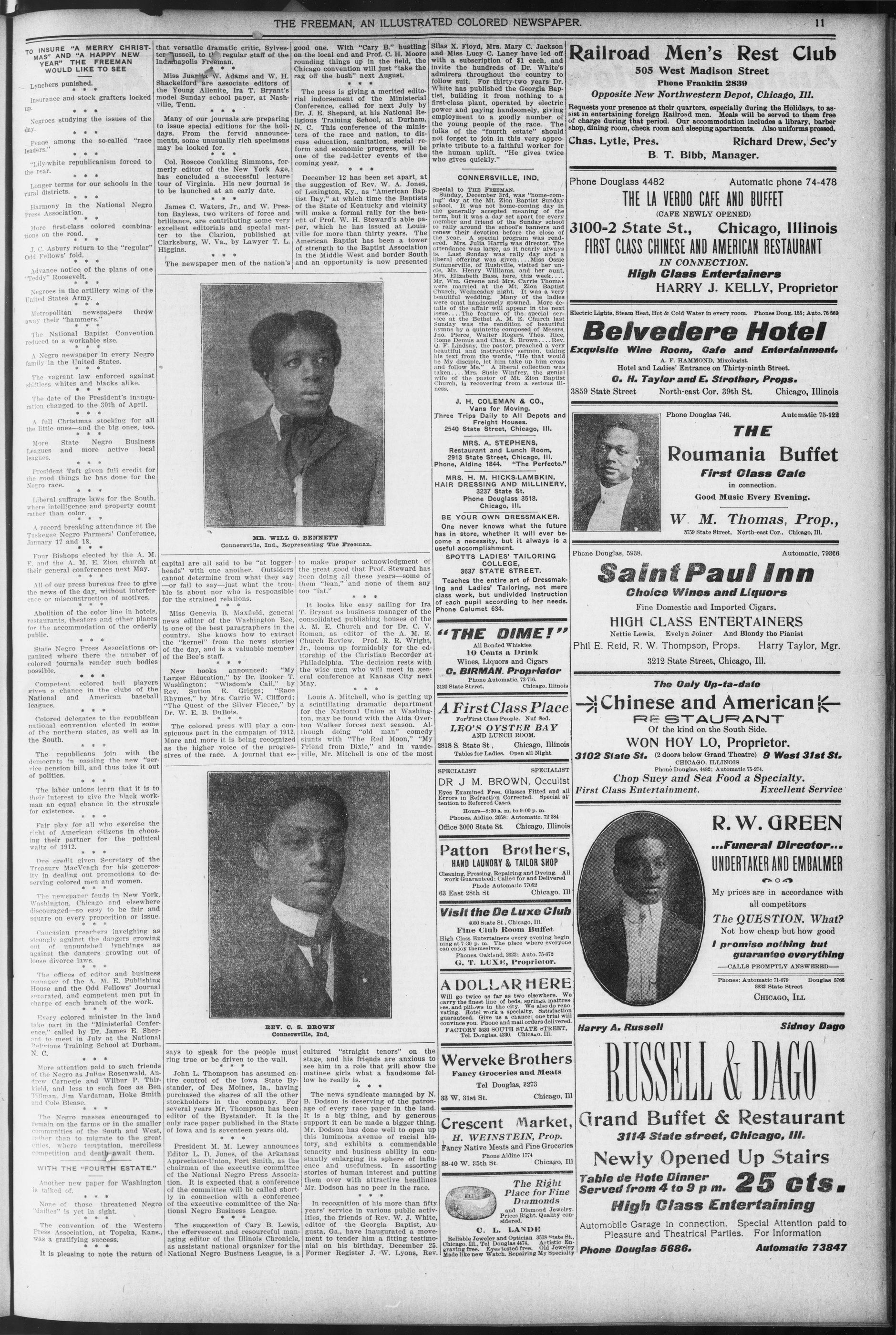
x ‘MR. WILL G. BENNETT
Gonnersville, Ind, Representing The Freeman.
capital are all said to be “at logger-
heads” with one another. Outsiders
cannot determine from what they say
—or fail to say—just what the trou-
ble is about nor who is responsible
for the strained relations.
Miss Genevia B. Maxfield, general
news editor of the Washington Bee,
is one of the best paragraphers in the
country. She knows how to extract
the “kernel” from the news stories
of the day, and is a valuable member
of the Bee's staff.
see
New books announced: “M3
Larger Education,” by Dr. Booker T
Washington; “Wisdom’s Cail,” by
Rey. Sutton E. Griggs; “Race
Rhymes,” by Mrs. Carrie W. Clifford:
“The Quest of the Silver Flecce,” b3
Dr. W. E. B. DuBois.
‘The colored press will play a con
spicuous part in the campaign of 1912
More and more it is being recognize:
as the higher voice of the progres
sives of the race. A journal that es
at ; eee
eee ee
ren rene Y ho NOR pee
Peat < ata Bae
haa sea eas
Ayer Fe oe ee AG ra
Eebare OG 8 Se: Baal hs
Rn Re dee pool Ras re we)
eee ce os oS
ORCA gS re oss PMR i oo
ees ee eee
co i ae
SSS ERS aN a) Meare ie 2 AL
Sea i een
AER Sareea teat ae ais arr &
ek oe a a Pie <i
Ca red XN i Ma
Reese sat og o
iS SS aes os
BEY. ©, 8. BROWN
ee
says to speak for the people must
ya TIME tue oF be driven to the wall
8 cere
ne John L. Thompson has assumed en-
-| tire control of the Iowa State By-
nj stander, of Des Moines, Ia., having
th} purchased the shares of all the other
stockholders in the company. For
several years Mr, Thompson has been
to| editor of the Bystander. It is the
er| only race paper published in the State
st, | of Jowa and is seventeen years old.
at aes
s8| President M. M. Lewey announces
| Editor L. D, Jones, of the Arkansas
| Appreciator-Union, Fort Smith, as the
' |chairman of the executive committee
jot the National Negro Press Associa
on| tion, It is expected that a conference
of the committee will be called short
ly in connection with a conference
ro| of the executive committee of the Na-
| tional Negro Business League.
nae
a ‘The suggestion of Cary B. Lewis
s.,| the effervescent and resourceful man.
aging editor of the Ulinois Chronicle
as assistant national organizer for the
of | National Negro Business League, is :
good one. With “Cary B.” hustling
on the local end and Prot. C. H. Moore
rounding things up in the field, the
Chicago convention will just ‘take the
rag off the bush” next August.
ne
‘The press is giving a merited edito-
rial indorsement of the Ministerial
Conference, called for next July by
Dr. J. E. Shepard, at his National Re-
ligious Training Sehool, at Durham,
IN. C. This conference ‘of the minis:
ters of the race and nation, to dis-
cuss education, sanitation, social re
form and economic progress, will be
one of the red-letter events of the
coming year.
sae
December 12 has been set apart, at
the suggestion of Rev. W. A. Jones,
of Lexington, Ky., as “American Bap
tist Day,” at which time the Baptists
of the State of Kentucky and vicinity
will make a formal rally for the ben
| efit of Prof, W. H. Steward’s able pa
|per, which he has issued at Louis
| ville for more than thirty years. The
| American Baptist has been a towel
of strength to the Baptist Association
in the Middle West and border Soutt
} and an opportunity is now presented
to make proper acknowledgment of
the great good that Prof. Steward has
peen doing all these years—some of
them “lean,” and none of them any
too “fat.”
eae
It looks like easy sailing for Ira
'T. Bryant as business manager of the
consolidated publishing houses of the
A. M. E, Church and for Dr. ©. V.
Roman, as editor of the A. M. E.
‘Church Review. Prof. R. R. Wright,
‘Jr. looms up formidably for the ed-
itorship of the Christian Recorder at
Philadelphia, ‘The decision rests with
‘the wise men who will meet in gen-
eral conference at Kansas City next
May.
| Louis A. Mitchell, who is getting up
a scintillating dramatic department
\for the National Union at Washing.
|ton, may be found with the Aida Over
ton Walker forces next season. Al
ea doing “old man” comeds
|stunts with “The Red Moon,” “My
| Friend from Dixie,” and in vaude
| ville, Mr. Mitchell is one of the most
st} cultured “straight tenors” on the
stage, and his friends are anxious to
see him in a role that will show the
n-| matinee girls what a Pearce) fel-
y-| low he really is.
ce a
er| The news syndicate managed by N.
or| B. Dodson is deserving of the patron-
enjage of every race paper in the land.
ne|It is a big thing, and by generous
te| support it can be made a bigger thing.
Mr. Dodson has done well to open up
this luminous avenue of racial _his-
es|tory, and exhibits a commendable
na fenaclty and business ability in con
he|Stantly enlarging its sphere of infu.
eo|ence and usefulness. In assorting
ja-| Stories of human interest and putting
e¢|them over with attractive headlines
rt. Mr. Dodson has no peer in the race,
S see
‘a-| In recognition of his more than fifty
years’ service in various public activ
ities, the friends of Rev. W. J. White
is,|editor of the Georgia Baptist, Au
un-| gusta, Ga., have inaugurated a move
le,| ment to tender him a fitting testimo
he| nial on his birthday, December 25
-a| Former Register J. W. Lyons, Rev
Spi gan a He si. ar
Silas X. Floyd, Mrs. Mary C. Jackson
and Miss Lucy C. Laney have led off
with a subscription of $1 each, and
invite the hundreds of Dr. White's
admirers throughout the country to
follow suit. For thirty-two years Dr.
White has published the Georgia Bap-
tist, building it from nothing to a
first-class plant, operated by electric
power and paying handsomely, giving
employment to a goodly number of
the young people of the race. The
folks of the “fourth estate” should
not forget to join in this very appro:
priate tribute to a faithful worker for
the human uplift. “He gives twice
who gives quickly.”
CONNERSVILLE, IND,
Special to THs PESeMan,
Sunday, December rd, was ‘“home-com-
ing” day ‘at the Mt. Zion Baptist Sunday
school. It was not home-coming day. in
the generally accepted meaning of. the
term, but it was a day set apart for every
member and friend of the Sunday school
to rally around the school's banners and
renew ‘their devotion before the close of
the Year. A special program was. rend-
ered. Mrs. Julia Harris was director. ‘The
attendance was large, as it nearly always
is. Last Sunday was rally day anda
liberal offering ‘was given... .Miss. Ossie
Summerville, of Rushville, visited her un-
cle, Mr. Henry Williams, and her aunt,
Mrs, Bilzabeth Bass, here, this week...
Mr, Wm. Greene and Mrs. Carrie ‘Thomas
were married at the Mt, Zion Baptist
Chureh, Wednesday night.” It was avery
beautiful wedding. “Many of “the ‘iadies
were omst handsomely gowned. More de-
{alls of the affair will appear in the next
issue.,..'The. feature of the special ‘ser-
vice at’ the Bethel “A. °M, E, Chureh last
Sunday ‘was. the rendition” of beautiful
hymns by a quintette composed of Messrs,
Jno. Plerce, "Walter Rogers. ‘Thos. ice,
Home Demis and Chas, S. Brown... .Rev.
QcF, Lindsay, the pastor, preached a'very
Seautiful and’ instructive isermon,, taking
his text from the words, “Ie that would
be My disciple, let him take up him cross
nd follow Me." A liberal collection was
taken....Mrs. Susie Winfrey, the. genial
wife of’ the pastor of Mt. Zion. Baptist
Church, is Tetovering from a’ serious Il
J. H. COLEMAN @& Co.
Vans for Moving.
Three Trips Daily to All Depots and
Freight Houses.
2540 State Street, Chicago, Il.
MRS. A. STEPHENS,
Restaurant and Lunch Room,
2918 State Street, Chicago, III.
Phone, Aldine 1844, | “The Perfecto.”
MRS. H. M. HICKS-LAMBKIN,
HAIR DRESSING AND MILLINERY,
3237 State St.
Phone Douglass 3518.
Chicago, Nl.
BE YOUR OWN DRESSMAKER.
One never knows what the future
has in store, whether it will ever be-
come a necessity, but it always is a
useful accomplishment.
SPOTTS LADIES’ TAILORING
COLLEGE,
3637 STATE STREET.
Teaches the entire art of Dressmak-
ing and Ladies’ Tailoring, not mere
class work, but undivided Instruction
of each pupil according to her needs
Phone Calumet 634.
“THE OIME!’’
‘All Bonded Whishlos
10 Cents a Drink
Wines, Liquors and Cigars
GC. BIRMAN. Proprietor
Phono Automatic, 76,
sum stato sterol Chlengo.Ditaols
ee
A First Class Place
For'First Class People. Nuf Sed.
LEO’S OYSTER BAY |
ND TUNCH ROOM.
2818 S. State St, Chicago, Mlinois
Fabled Soe Ualioh. Ovens Wiehe
ee ee ees
SPECIALIST SPECIALIST
DR J M. BROWN, Occulist
Tyee Hxamined Pree, Glassos Pitted and all
ree, Beaming’ Tree Gocrocted ‘Special at
ane aed ce
Been eink mu toon
Phoves, Aiding 2058" Automatic, 7284
Office 8000 State St. | Chicago, Illinois
a ee
Patton Brothers,
HAND LAUNDRY & TAILOR SHOP
Cleaning, Pressing. Repairing and Dyeing. All
So rene ere nea Betivered
Phode Automate 7st
63 East 28th 3t Chicago, 1
Visit the De Luxe Club
a0 Sat 5, Chicago,
Fine Club Room Buffet
lah Chins metervatnst ety gvastan Sei
Eee
‘Phones Oak, 202; Anto, T5472
G. T. LUX®#, Proprietor.
—_—_—_—_—_—
A DOLLAR HERE
Will go twice as far as two elsewhere. We
eee ee ree ee apne tose
oe ee ee ee
serad as tee Siaty ‘uae
tne, Borel wort» aaa: custetal wll
‘convince you. Phone and mail orders delivered.
LOIORY 96m SOUTH STATE STREET,
Roe ma Ora Citacoc nt
—_—_—_—_———
Werveke Brothers
Fancy Groceries and Meats
Tel Douglas, 8273
83 W. Bist St. Chicago, 1
Crescent Market,
H. WEINSTEIN, Prop.
Fancy Native Meats and Fine Groceries
‘Phone Aldine 177
38-40 W. 85th St. Chicago, I]
j The Right
2B, Place for Fine
bax \ "Diamonds
CS J ond, Diamond Jewelry.
cs ice ity con:
sidered. Pete
©. L. LANDE
Reliable Jeweler and Optician 3518 State St..
Chicago. Iil,, Tel Douglas 474, Artistic En-
graving tres, yes ested treo. Old Jewelry
‘Made like new Watch. Repairing My Specialty
ee ey ee er ee a Ree
Railroad Men’s Rest Club
505 West Madison Street
Phone Franklin 2839
Opposite New Northwestern Depot, Chicago, Il.
Requests your presence at their quarters, especially during the Holidays, to as-
sist in entertaining foreign Railroad men. Meals will be served to them free
of charge during that period. Our accommodation includes a library, barber
shop, dining room, check room and sleeping apartments. Also uniforms pressed,
Chas. Lytle, Pres. Richard Drew, Sec’y
B. T. Bibb, Manager.
EEE ee
Phone Douglass 4482 Automatic phone 74-478
THE LA VERDO CAFE AND BUFFET
(CAFE NEWLY OPENED)
3100-2 State St., Chicago, Illinois
FIRST CLASS CHINESE AND AMERICAN RESTAURANT
IN CONNECTION.
High Class Entertainers
HARRY J. KELLY, Proprietor
Electric Lights, Steam Heat, Hot & Cold Water in every room. Phones Doug. 155; Auto. 76 569
Exquisite Wine Room, Gafe and Entertainment.
A. F. HAMMOND, Mixologist.
Hotel and Ladies’ Entrance on Thirty-ninth Street.
G. H. Taylor and E. Strother, Props.
3859 State Street North-east Cor. 39th St. Chicago, Illinois
ee eee
Gia) Phone Donglas 746. Automatic 75-122
ae THE
ere ‘
G22 =. Roumania Buffet
% % a
eee, food First Class Cafe
2 ee in connection.
tek Good Music Every Evening.
| i W. M. Thomas, Prop.,
& 3759 State Street, North-east Cor., Chicago, Ill.
Sa
a Rees
are.
oe te Ss ‘
a ae
Phone Douglas, 5938. Automatic, 79866
a
Saint Paul inn
Choice Wines and Liquors
Fine Domestic and Imported Cigars.
HIGH CLASS ENTERTAINERS
Nettie Lewis, Evelyn Joiner And Blondy the Pianist
Phil E. Reid, R. W. Thompson, Props. Harry Taylor, Mgr.
8212 State Street, Chicago, Ill.
The Only Up-ta-date
1 q 1 4
—}Chinese and American —
Re STAURANT
Of the kind on the South Side.
WON HOY LO, Proprietor.
3102 State St, (2 doors below Grand Theatre) 9 West 31st St.
_ CHICAGO, TLLINOTS
Phon’ Douglas, 4482; Automatic 75274.
Chop Suey and Sea Food a Specialty.
First Class Entertainment. Excellent Service
iii R.W.GREEN
hi ‘ eg =) .-.Funeral Director...
fj ow
fo ee) UNDERTAKER AND EMBALMER
i a i oon
i om My prices are in accordance with
i all competitors
re ! The QUESTION. What?
\ ee Not how cheap but how good
\ ioe ] 1 promise nothing but
\ bs y guarantee everything
ie Y/ cats prompriy answanxp—
sae Phouos: Automatic 71079 Douglas 608
NS. 8832 State Streot
Lees Cmcaco, Inn
Harry A. Russell BR Sidney Dayo
Grand Buffet & Restaurant
3114 State street, Chicago, Il.
Newly Opened Up Stairs
Table de Hote Dinner
scrvedirom#ited i mm, 25 ets,
High Glass Entertaining
ena Garage in connection. Special Attention paid to
Pleasure and Theatrical Parties. For Information
| Phone Douglas 5686. Automatic 73847
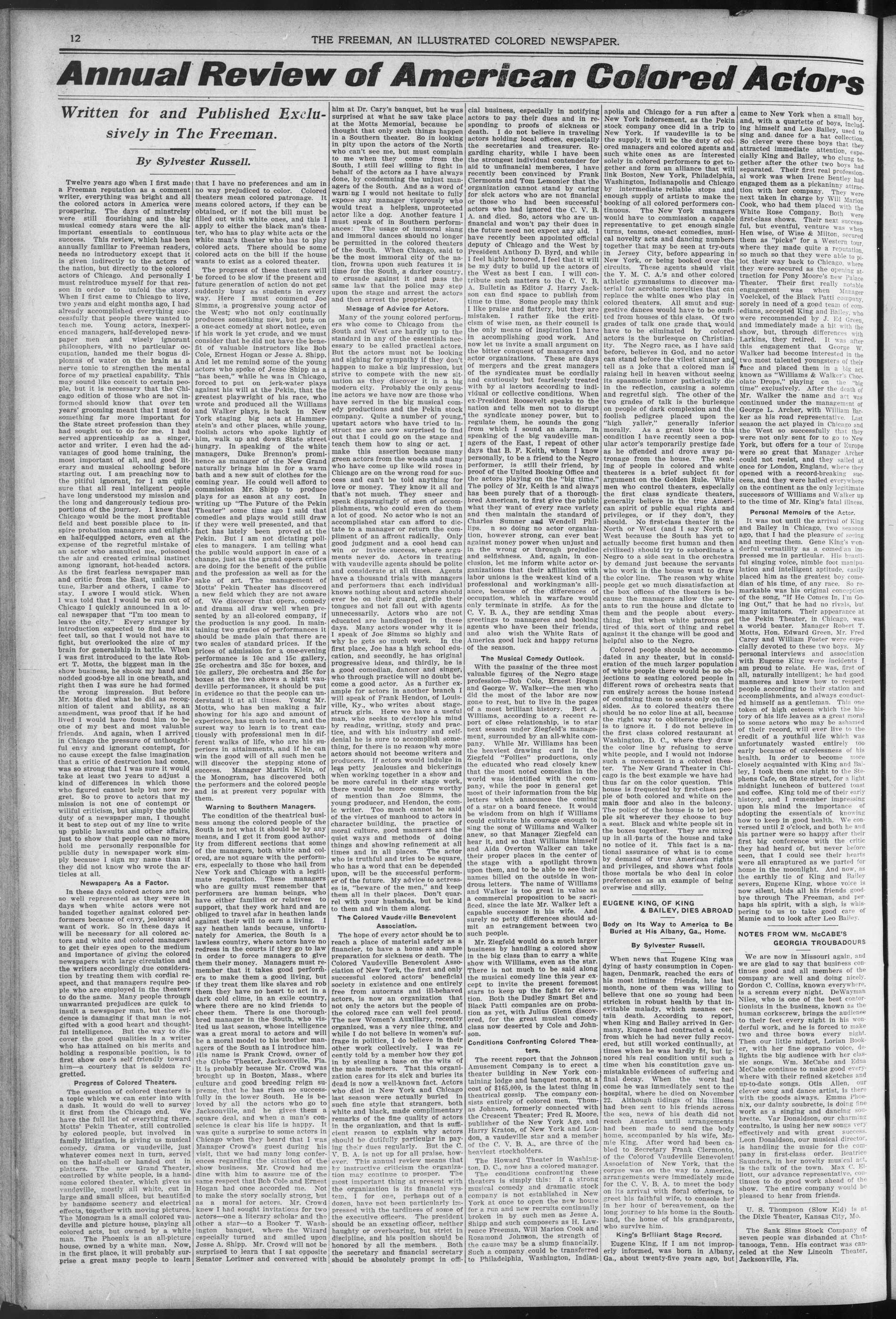
Annual Review of American Colored Actors
Written for and Published Exclusively in The Freeman.
By Sylvester Russell.
Twelve years ago when I first made a Freeman reputation as a comment writer, everything was bright and all the colored actors in America were prospering. The days of minstrelsy were still flourishing and the big musical comedy stars were the all-important essentials to continuous success. This review, which has been annually familiar to Freeman readers, needs no introductory except that it is given indirectly to the actors of the nation, but directly to the colored actors of Chicago. And personally I must reintroduce myself for that reason in order to unfold the story. When I first came to Chicago to live, two years and eight months ago, I had already accomplished everything successfully that people there wanted to teach me. Young actors, inexperienced managers, half-developed newspaper men and wisely ignorant philosophers, with no particular occupation, handed me their bogus diplomas of water on the brain as a nerve tonic to strengthen the mental force of my practical capability. This may sound like conceit to certain people, but it is necessary that the Chicago edition of those who are not informed should know that over ten years' grooming meant that I must do something far more important for the State street profession than they had sought out to do for me. I had served apprenticeship as a singer, actor and writer. I even had the advantages of good home training, the most important of all, and good literary and musical schooling before starting out. I am preaching now to the pitiful ignorant, for I am quite sure that all real intelligent people have long understood my mission and the long and dangerously tedious proportions of the journey. I knew that Chicago would be the most profitable field and best possible place to inspire probation managers and enlighten half-equipped actors, even at the expense of the regretful mistake of an actor who assaulted me, poisoned the air and created criminal instinct among ignorant, hot-headed actors. As the first fearless newspaper man and critic from the East, unlike Fortune, Barber and others, I came to stay. I swore I would stick. When I was told that I would be run out of Chicago I quickly announced in a local newspaper that "I'm too mean to leave the city." Every stranger by introduction expected to find me six feet tall, so that I would not have to fight, but overlooked the size of my brain for generalship in battle. When I was first introduced to the late Robert T. Motts, the biggest man in the show business, he shook my hand and nodded good-bye all in one breath, and right then I was sure he had formed the wrong impression. But before Mr. Motts died what he did as recognition of talent and ability, as an amendment, was proof that if he had lived I would have found him to be one of my best and most valuable friends. And again, when I arrived in Chicago the pressure of unthoughtful envy and ignorant contempt, for no cause except the false imagination that a critic of destruction had come, was so strong that I was sure it would take at least two years to adjust a kind of differences in which those who figured cannot help but now regret. So to prove to actors that my mission is not one of contempt or willful criticism, but simply the public duty of a newspaper man, I thought it best to step out of my line to write up public lawsuits and other affairs, just to show that people can no more hold me personally responsible for public duty in newspaper work simply because I sign my name than if they did not know who wrote the articles at all.
Newspapers As a Factor.
In these days colored actors are not so well represented as they were in days when white actors were not banded together against colored performers because of envy, jealousy and want of work. So in these days it will be necessary for all colored actors and white and colored managers to get their eyes open to the medium and importance of giving the colored newspapers with large circulation and the writers accordingly due consideration by treating them with cordial respect, and that managers require people who are employed in the theaters to do the same. Many people through unwarranted prejudices are quick to insult a newspaper man, but the evidence is damaging if that man is not gifted with a good heart and thoughtful intelligence. But the way to discover the good qualities in a writer who has attained on his merits and holding a responsible position, is to first show one's self friendly toward him—a courtesy that is seldom regretted.
Progress of Colored Theaters.
The question of colored theaters is a topic which we can enter into with a dash. It would do well to survey it first from the Chicago end. We have the full list of everything there. Motts' Pekin Theater, still controlled by colored people, but involved in family litigation, is giving us musical comedy, drama or vaudeville, just whatever comes next in turn, served on the half-shell or handed out in platters. The new Grand Theater, controlled by white people, is a handsome colored theater, which gives us vaudeville, mostly all white, cut in large and small slices, but beautified by handsome scenery and electrical effects, together with moving pictures. The Monogram is a small colored vaudeville and picture house, playing all colored acts, but owned by a white man. The Phoenix is an all-picture house, owned by a white man. Now, in the first place, it will probably surprise a great many people to learn
12
that I have no preferences and am in no way prejudiced to color. Colored theaters mean colored patronage. It means colored actors, if they can be obtained, or if not the bill must be filled out with white ones, and this I apply to either the black man's theater, who has to play white acts or the white man's theater who has to play colored acts. There should be some colored acts on the bill if the house wants to exist as a colored theater.
The progress of these theaters will be forced to be slow if the present and future generation of action do not get suddenly busy as students in every way. Here I must command Joe Simms, a progressive young actor of the West; who not only continually produces something new, but puts on a one-act comedy at short notice, even if his work is yet crude, and we must consider that he did not have the benefit of valuable instructors like Bob Cole, Ernest Hogan or Jesse A. Shipp. And let me remind some of the young actors who spoke of Jesse Shipp as a "has been," while he was in Chicago forced to put on jerk-water plays against his will at the Pekin, that the greatest playwright of his race, who wrote and produced all the Williams and Walker plays, is back in New York staging big acts at Hammerstein's and other places, while young foolish actors who spoke lightly of him, walk up and down State street hungry. In speaking of the white managers, Duke Brennon's prominence as manager of the New Grand naturally brings him in for a warm bath and a new suit of clothes for the coming year. He could well afford to commission Mr. Shipp to produce plays for as eason at any cost. In writing up "The Future of the Pekin Theater" some time ago I said that comedies and plays would still draw if they were well presented, and that fact has lately been证按ed to the Pekin. But I am not证按ing policies to managers. I am telling what the public would in case of a change, just as the grand opera critics are doing for the benefit of the public and the profession as well as for the sake of art. The management of Motts' Pekin Theater has discovered a new field which they are not aware of. We discover that opera, comedy and drama all draw well when presented by an all-colored company, if the production is any good. In maintaining two grades of performances it should be made plain that there are two scales of standard prices. If the prices of admission for a one-evening performance is 10c and 15c gallery, 25c orchestra and 35c for boxes, and 10c gallery, 20c orchestra and 25c for boxes at the two shows a night vaudeville performances, it should be put in evidence so that the people can understand it at all times. Young Mr. Motts, who has ben making a fair showing for his age and amount of experience, has much to learn, and the surest way to learn is to treat cautiously with professional men in different walks of life, who are his superiors in attainments, and if he can win the good will of all such men he will discover the stepping stone of success. Manager Martin Klein, of the Monogram, has discovered both the performers and the colored people and is at present very popular with them.
Warning to Southern Managers.
Warning to Southern Managers.
The condition of the theatrical business among the colored people of the South is not what it should be by any means, and I get it from good authority from different sections that some of the managers, both white and colored, are not square with the performers, especially to those who hail from New York and Chicago with a legitimate reputation. These managers who are guilty must remember that performers are human beings, who have either families or relatives to support, that they work hard and are obliged to travel afar in heathen lands against their will to earn a living. I say heathen lands because, unfortunately for America, the South is a lawless country, where actors have no redress in the courts if they go to law in order to force managers to give them their money. Managers must remember that it takes good performers to make them a good living, but if they treat them like slaves and rob them they have no heart to act in a dark cold clime, in an exile country, where there are no kind friends to cheer them. There is one thoroughbred manager in the South, who visited us last season, whose intelligence was a great moral to actors and will be a moral model to his brother managers of the South as I introduce him. His name is Frank Crowd, owner of the Globe Theater, Jacksonville, Fla. It is probably because Mr. Crowd was brought up in Boston, Mass., where culture and good breeding reign supreme, that he has risen so successfully in the lower South. He is beowed by all the actors who he gives them a square deal, and when a man's conscience is clear his life is happy. It was quite a surprise to some actors in Chicago when they heard that I was Manager Crowd's guest during his visit, that we had many long conferences regarding the situation of the show business. Mr. Crowd had me dine with him to assure me of the same respect that Bob Cole and Ernest Hogan had once accorded me. Not to make the story socially strong, but as a moral for actors, Mr. Crowd knew I had sought invitations for two actors—one a literary scholar and the other a star—to a Booker T. Washington banquet, where the Wizard especially turned and smiled upon Jesse A. Shipp. Mr. Crowd will not be surprised to learn that I sat opposite Senator Lorimer and conversed with
THE FREEMAN, AN ILLUSTRATED COLORED NEWSPAPER
him at Dr. Cary's banquet, but he was surprised at what he saw take place at the Motts Memorial, because he thought that only such things happen in a Southern theater. So in looking in pity upon the actors of the North who can't see me, but must complain to me when they come from the South, I still feel willing to fight in behalf of the actors as I have always done, by condemning the unjust managers of the South. And as a word of warning I would not hesitate to fully expose any manager vigorously who would treat a helpless, unprotected actor like a dog. Another feature I must speak of in Southern performances: The usage of immoral slang and immoral dances should no longer be permitted in the colored theaters of the South. When Chicago, said to be the most immoral city of the nation, frowns upon such features it is time for the South, a darker country, to crusade against it and pass the same law that the police may step upon the stage and arrest the actors and then arrest the proprietor.
Message of Advice for Actors.
Many of the young colored performers who come to Chicago from the South and West are hardly up to the standard in any of the essentials necessary to be called practical actors. But the actors must not be looking and sighing for sympathy if they don't happen to make a big impression, but strive to compete with the new situation as they discover it in a big modern city. Probably the only genuine actors we have now are those who have served in the big musical comedy productions and the Pekin stock company. Quite a number of young, upstart actors who have tried to instruct me are now surprised to find out that I could go on the stage and teach them how to sing or act. I make this assertion because many green actors from the woods and many who have come up like wild roses in Chicago are on the wrong road for success and can't be told anything for love or money. They know it all and that's not much. They sneer and speak disparagingly of men of accomplishments, who could even do them a lot of good. No actor who is not an accomplished star can afford to dictate to a manager or return the compliment of an affront radically. Only good judgment and a cool head can win or invite success, where arguments never do. Actors in treating with vaudeville agents should be polite and vaudeville at all times. Agents have a thousand trials with managers and performers that each individual knows nothing about and actors should ever be on their guard, girdle their tongues and not fall out with their unnecessarily. Actors who are not are handicapped in these days. Many actors wonder why it is I speak of Joe Simms so highly and why he gets so much work. In the first place, Joe has a high school education, and secondly, he has original progressive ideas, and thirdly, he is a good comedian, dancer and singer, who through practice will no doubt become a good actor. As a further example for actors in another branch I will speak of Frank Hendon, of Louisville, Ky., who writes about stage-struck girls. Here we have a useful man, who seeks to develop his mind by reading, writing, study and practice, and with his industry and self-denial he is sure to accomplish something, for there is no reason why more actors should not become writers and producers. If actors would indulge in less petty jealousies and bickerings when working together in a show and be more careful in their stage work, there would be more comers worthy of mention than Joe Simms, the young producer, and Hendon, the comic writer. Too much cannot be said of the virtues of manhood to actors in character building, the practice of moral culture, good manners and the quiet ways and methods of doing things and showing refinement at all times and in all places. The actor who is truthful and tries to be square, who has a word that can be depended upon, will be the successful performer of the future. My advice to actresses is, "beware of the men," and keep them all in their places. Don't quarrel with your husbands, but be kind to them and win them along.
The Colored Vaudeville Benevolent Association.
The hope of every actor should be to reach a place of material safety as a financier, to have a home and ample preparation for sickness or death. The Colored Vaudeville Benevolent Association of New York, the first and only successful colored actors' beneficial society in existence and one entirely free from autocrats and ill-behaved actors, is now an organization that not only the actors but the people of the colored race can well feel proud. The new Women's Auxiliary, recently organized, was a very nice thing, and while I do not believe in women's suffrage in politics, I do believe in their other work collectively. I was recently told by a member how they got in by stealing a base on the wits of the male members. That this organization cares for its sick and buries its dead is now a well-known fact. Actors who died in New York and Chicago last season were actually buried. In such fine style that strangers, both white and black, made complimentary remarks of the fine quality of actors in the organization, and that is sufficient reason to explain why actors should be dutifully particular in paying their dues regularly. But the C. V. B. is not up for all praise, however. This annual review means that by instructive criticism the organization may continue to prosper. The most important thing at present with the organization is its financial system. I for one, perhaps out of a dozen, have not been particularly impressed with the tardiness of some of the executive officers. The president should be an exacting officer, neither haughty or overbearing, but strict in discipline, and his position should be honored by all the members. Both the secretary and financial secretary should be absolutely prompt in offi-
cial business, especially in notifying actors to pay their dues and in responding to proofs of sickness or death. I do not believe in traveling actors holding local offices, especially the secretaries and treasurer. Regarding charity, while I have been the strongest individual contender for aid to unfinancial members, I have recently been convinced by Frank Clermonts and Tom Lemonier that the organization cannot stand by caring for sick actors who are not financial or those who had been successful actors who had ignored the C. V. B. A. and died. So, actors who are unfinancial and won't pay their dues in the future need not expect any aid. I have recently been appointed official deputy of Chicago and the West by President Anthony D. Byrd, and while I feel highly honored, I feel that it will be my duty to build up the actors of the West as best I can. I will contribute such matters to the C. V. B. A. Bulletin as Editor J. Harry Jackson can find space to publish from time to time. Some people may think I like praise and flattery, but they are mistaken. I rather like the criticism of wise men, as their council is the only means of inspiration I have in accomplishing a good work. And let us invite a small argument on the bitter conquest of managers and actor organizations. These are days of mergers and the great managers of the syndicates must be cordially and cautiously but fearlessly treated with by al factors according to individual or collective conditions. When ex-President Roosevelt speaks to the nation and tells men not to disrupt the syndicate money power, but to regulate them, he sounds the gong from which I sound an alarm. In speaking of the big vaudeville managers of the East, I repeat of other days that B. F. Keith, whom I know personally, to be a friend to the Negro performer, is still their friend, by proof of the United Booking Office and the actors playing on the "big time." The policy of Mr. Keith is and always has been purely that of a thoroughbred American, to first give the public what they want of every race variety and then maintain the standard of Charles Sumner and Wendell Phillips. n so doing no actor organization, however strong, can ever beat against money power when unjust and in the wrong or through prejudice and selfishness. And, again, in conclusion, let me inform white actor organizations that their affiliation with labor unions is the weakest kind of a professional and workingman's alliance, because of the differences of occupation, which in warfare would only terminate in strife. As for the C. V. B. A., they are sending Xmas greetings to managers and booking agents who have been their friends, and also wish the White Rats of America good luck and happy returns of the season.
The Musical Comedy Outlook.
With the passing of the three most valuable figures of the Negro stage profession—Bob Cole, Ernest Hogan and George W. Walker—the men who did the most of the labor are now gone to rest, but to live in the pages of a most brilliant history. Bert A. Williams, according to a recent report of close relationship, is to star next season under Ziegfeld's management, surrounded by an all-white company. While Mr. Williams has been the heaviest drawing card in the Ziegfeld "Follies" productions, only the educated who read closely knew that the most noted comedian in the world was identified with the company, while the poor in general get most of their information from the big letters which announce the coming of a star on a board fence. It would be wisdom from on high if Williams could cultivate his courage enough to sing the song of Williams and Walker anew, so that Manager Ziegfeld can hear it, and so that Williams himself and Aida Overton Walker can take their proper places in the center of the stage with a spotlight thrown upon them, and to be able to see their names billed on the outside in wondrous letters. The name of Williams and Walker is too great in value as a commercial proposition to be sacrificed, since the late Mr. Walker left a capable successor in his wife. And surely no petty differences should admit an estrangement between two such people.
Mr. Ziegfeld would do a much larger business by handling a colored show in the big class than to carry a white show with Williams, even as the star. There is not much to be said along the musical comedy line this year except to invite the present foremost stars to keep up the fight for elevation. Both the Dudley Smart Set and Black Patti companies are on probation as yet, with Julius Glenn discovered, for the great musical comedy class now deserted by Cole and Johnson.
Conditions Confronting Colored Theaters
The recent report that the Johnson Amusement Company is to erect a theater building in New York containing lodge and banquet rooms, at a cost of $165,000, is the latest thing in theatrical gossip. The company consists entirely of colored men. Thomas Johnson, formerly connected with the Crescent Theater; Fred R. Moore, publisher of the New York Age, and Harry Kraton, of New York and London, a vaudeville star and a member of the C. V. B. A., are three of the heaviest stockholders.
The Howard Theater in Washington. D. C., now has a colored manager. The conditions confronting these theaters is simply this: If a strong musical comedy and dramatic stock company is not established in New York at once to open the new house for a run and new recruits continually broken in by such men as Jesse A. Shipp and such composers as H. Lawrence Freeman, Will Marion Cook and Rosamond Johnson, the strength of the cause may be a slump financially. Such a company could be transferred to Philadelphia, Washington, Indian-
apolis and Chicago for a run after a New York indorsement, as the Pekin stock company once did in a trip to New York. If vaudeville is to be the supply, it will be the duty of colored managers and colored agents and such white ones as are interested solely in colored performers to get together and form an alliance that will link Boston, New York, Philadelphia, Washington, Indianapolis and Chicago by intermediate reliable stops and enough supply of artists to make the booking of all colored performers continuous. The New York managers would have to commission a capable representative to get enough single turns, teams, one-act comedies, musical novelty acts and dancing numbers together that may be seen at try-outs in Jersey City, before appearing in New York, or being booked over the circuits. These agents should visit the Y. M. C. A.'s and other colored athletic gymnasiums to discover material for acrobatic novelties that can replace the white ones who play in colored theaters. All smit and suggestive dances would have to be omitted from houses of this class. Of two grades of talk one grade that would have to be eliminated by colored actors is the burlesque on Christianity. The Negro race, as I have said before, believes in God, and no actor can stand before the vilest sinner and tell as a joke that a colored man is raising hell in heaven without seeing its spasmodic humor pathetically die in the reflection, causing a solemn and regretful sigh. The other of the two grades of talk is the burlesque on people of dark complexion and the foolish pedigree placed upon the "high yaller," generally inferior morally. As a great blow to this condition I have recently seen a popular actor's temporarily prestige fade as he offended and drove away patronage from the house. The seating of people in colored and white theaters is a brief subject fit for argument on the Golden Rule. White men who control theaters, especially the first class syndicate theaters, generally believe in the true American spirit of public equal rights and privileges, or if they don't, they should. No first-class theater in the North or West (and I say North or West because the South has yet to actually become first human and then civilized) should try to subordinate a Negro to a side seat in the orchestra by demand just because the servants who work in the house want to draw the color line. The reason why white people get so much dissatisfaction at the box offices of the theaters is because the managers allow the servants to run the house and dictate to them and the people about everything. But when white patrons get tired of this sort of thing and rebel against it the change will be good and helpful also to the Negro.
Colored people should be accommodated in any theater, but in consideration of the much larger population of white people there would be no objections to seating colored people in different rows of orchestra seats that run entirely across the house instead of confining them to seats only on the sides. As to colored theaters there should be no color line at all, because the right way to obliterate prejudice is to ignore it. I do not believe in the first class colored restaurant at Washington, D. C., where they draw the color line by refusing to serve white people, and I would not indorse such a movement in a colored theater. The New Grand Theater in Chicago is the best example we have had thus far on the color question. This house is frequented by first-class people of both colored and white on the main floor and also in the balcony. The policy of the house is to let people sit wherever they choose to buy a seat. Black and white people sit in the boxes together. They are mixed up in all parts of the house and take no notice of it. This fact is a national assurance of what is to come by demand of true American rights and privileges, and shows what fools those mortals be who deal in color preferences as an example of being overwise and silly.
EUGENE KING, OF KING
& BAILEY, DIES ABROAD
Body on Its Way to America to Be Buried at His Albany, Ga., Home.
By Sylvester Russell.
When news that Eugene King was dying of hasty consumption in Copenhagen, Denmark, reached the ears of his most intimate friends, late last month, none of them was willing to believe that one so young had been stricken in robust health by that inevitable malady, which means certain death. According to report, when King and Bailey arrived in Germany, Eugene had contracted a cold, from which he had never fully recovered, but still worked continually, at times when he was hardly fit, but ignored his real condition until such a time when his constitution gave unmistakable evidences of suffering and final decay. When the worst had come he was immediately sent to the hospital, where he died on November 22. Although tidings of his illness had been sent to his friends across the sea, news of his death did not reach America until arrangements had been made to send the body home, accompanied by his wife, Mamie King. After word had been cabled to Secretary Frank Clermontof of the Colored Vaudeville Benevolent Association of New York, that the corpse was on the way to America, arrangements were immediately made for the C. V. B. A. to meet the body on its arrival with floral offerings, to greet his faithful wife, to console her in her hour of bereavement, on the long journey to his home in the South land, the home of his grandparents who survive him.
King's Brilliant Stage Record.
Eugene King, if I am not improperly informed, was born in Albany, Ga., about twenty-five years ago, but
came to New York when a small boy, and, with a quartette of boys, including himself and Leo Bailey, used to sing and dance for a hat collection. So clever were these boys that they attracted immediate attention, especially King and Bailey, who clung together after the other two boys had separated. Their first real professional work was when Irene Bentley had engaged them as a pickaninny attraction with her company. They were next taken in charge by Will Marion Cook, who had placed with the White Rose Company. Both were first-class shows. Their next successful, but eventful, venture was when Hen wise, of Wise & Milton, secured them as "pickers" for a Western tour, where they made quite a reputation, so much so that they were able to pilot their way back to Chicago, where they were secured as the opening attraction for Pony Moore's new attraction Theater. Their first really notable engagement was when Manager Voeelckel, of the Black Patti company, sorely in need of a good team of comedians, accepted King and Bailey, who were recommended by J. Ed Green, and immediately made a hit with the show, but, through differences with Larkins, they retired. It was after this engagement that George W. Walker had become interested in the two most talented youngsters of their face and placed them in a big act known as "Williams & Walker's Chocolate Drops," playing on the "big time" exclusively. After the death of Mr. Walker the name and act was continued under the management of George L. Archer, with William Barker as his road representative. Last season the act played in Chicago and the West so successfully that they were not only sent for to go to New York, but offers for a tour of Europe were so great that Manager Archer could not resist, and they sailed at once for London, England, where they opened with a record-breaking success, and they were hailed everywhere on the continent as the only legitimate successors of Williams and Walker up to the time of Mr. King's fatal illness.
Personal Memoirs of the Actor
It was not until the arrival of King and Bailey in Chicago, two seasons ago, that I had the pleasure of seeing and meeting them. Gene King's wonderful versatility as a comedian impressed me in particular. His beautiful singing voice, nimble foot manipulation and intelligent aptitude, easily placed him as the greatest boy comedian of his time, of any race. So remarkable was his original conception of the song, "If He Comes In, I'm Going Out," that he had no rivals, but many imitators. Their appearance at the Pekin Theater, in Chicago, was a world beater. Manager Robert T. Motts, Hon. Edward Green, Mr. Fred Carey and William Foster were especially devoted to these two boys. My personal interviews and association with Eugene King were incidents I am proud to relate. He was, first of all, naturally intelligent; he had good manners and knew how to respect people according to their station and accomplishments, and always conducted himself as a gentleman. This one token of high esteem which the history of his life leaves as a great moral to some actors who may be ashamed of their record, will live live to the credit of a youthful life which was unfortunately wasted entirely too early because of carelessness of his health. In order to become more closely acquainted with King and Bailey, I took them one night to the Stephens Cafe, on State street, for a midnight luncheon of buttered toast and coffee. King told me of their early history, and I remember impressing upon his mind the importance of adopting the essentials of knowing how to keep in good health. We conversed until 2 o'clock, and both he and his partner were so happy after their first big conference with the critic they had heard of, but never before seen, that I could see their hearts were all enraptured as we parted for home in the moonlight. And now, as the earthly tie of King and Bailey severs, Eugene King, whose voice is now silent, bids all his friends goodbye through The Freeman, and per haps his spirit, with a sigh, is whispering to us to take good care of Mamie and to look after Leo Bailey.
NOTES FROM WM. McCABE'S
GEORGIA TROUBADOURS
We are now in Missouri again, and we are glad to say that business continues good and all members of the company are well and doing nicely. Gordon C. Collins, known everywhere, is a scream every night. DeWayman Niles, who is one of the best contortionists in the business, known as the human corkscrew, brings the audience to their feet every night in his wonderful work, and he is forced to make two and three bows every night. Then our little midget, Lorian Booker, with her fine soprano voice, delights the big audience with her classic songs. Wm. McCabe and Edna McCabe continue to make good everywhere with their refined sketches and up-to-date songs. Otis Allen, our clever song and dance artist, is there with the goods always. Emma Phoenix, our dainty soubrette, is doing fine work as a singing and dancing soubrette. Var Donaldson, our charming contrato, is using her new songs very effectively and with great success Leon Donaldson, our musical director, is handling the music for the company in first-class order. Beatrice Saunders, in her novelty musical act, is the talk of the town. Max C. Elliot, our advance representative, continues to do good work ahead of the show. The entire company would be pleased to hear from friends.
U. S. Thompson (Slow Kid) is at the Dixie Theater, Kansas City, Mo.
The Sank Sims Stock Company of seven people was disbanded at Chattanooga, Tenn. His contract was canceled at the New Lincoln Theater, Jacksonville, Fla.
GOSSIP OF THE STAGE
DeKoven Thompson was the composer of "If I Forget," and his tone treat ment is of a quality which appeals to harmony and sentiment. One of his later songs, "Your Heart," has
[Name]
DE KOVEN THOMPSON,
Composer of "If I Forget."
recently made a decided impression and the importance of his work in the future will be looked forward to with much interest. He is to be associated with Alfred Anderson continually as a song writer, as both of these men now occupy a most conspicuous place.
Miss Blanche Logan is quite an experienced pianist. She was instructed at the Chicago Conservatory of Music
J
BLANCHE LOGAN,
Pianist Phoenix Theater.
and is a player with some class. She has the distinction of having accompanied the great singer, Anita Patti Brown, on her concert tour for one whole season.
FRANK WITHERS,
Trombone Soloist.
Frank Witthers is a native of San Francisco, Cal. He is one of the most excellent trambone soloists who has ever come to Chicago. He was formerly a teacher and his ability as a
[Name]
FRANK WITHERS,
Trombonist Marquette Club.
musician is so well established in the
West that further comment is unnecessary.
Mr. Withers expects to enter
vaudeville next season with Miss
Mazie Mullins Moore.
George Reeves was born in Fayette, Mo. He left home early and went on the stage as a singer, but soon developed to be a trap drummer. He has toured the country everywhere with Mahara's and Billy Kersands' Minstrels. Later, in the Pekin Stock Company, his artistic temperament,
which is always indicative of genius, was discovered and J. Ed Green had Mr. Motts send him to New York as special trap drummer for the Pekin Stock Company's engagement. When
GEORGE REEVES,
Trap Drummer Monogram Theater.
he returned he left the Pekin and went
to the Monogram, where he is now
employed as the highest salaried colo-
ored trap drummer in America.
Charles Mitchell is an Indianapolis Charles Mitchell is an Indianapolis, Ind., boy. He left home early and started out as a drummer in Chicago at 12 years of age. He once toured
[Name]
CHAS. MITCHELL,
Trap Drummer Phoenix Theater.
with Frank Mahara's Minstrels, and has been at the Pekin Theater. At the Phoenix, where he now plays, he uses his own original conception of cannonading in the war photo moving pictures.
ALFRED ANDERSON,
Lyric Writer.
"If I Forget" was written as a poem by Alfred Anderson and set to music by De Koven Thompson. Mr. Anderson has done some clever work during his young life as an author. The present song had the largest advance royalty, previous to being sold with several contracts for a production
A. H.
ALFRED ANDERSON,
Lyric Writer. Author of "If I Forget."
number, than any other. "Rag-a-Ma-
La," "Just to Remind You." "A Tear,
a Kiss, a Smile." Harold Rossiter has
been handling Mr. Thompson's lyrics
of late. One of his greatest suc-
cesses of a few years ago was
"Gracie," once used by R. J. Rose and
his animated song sheet chorus.
ALIA JABO,
Hindoo Magician.
Alia Jabo is an English Hindoo entertainer. He was first brought to America from London, England, with Hagenbach, the wild animal importer. On his arrival in America he joined "Yuma the Mystery," a white vaudeville act, in which he performed feats of Hindoo magic. He next joined the big Otto Wild Animal Arena and appeared in the capacity of a public lion trainer. After being attacked by one of two lions which he was separating from a fight, and after recovering from his injuries, he rejoined Yuma for a tour of Europe, but returned to America inside of one season with an act of his own in feats of Hindoo magic. He
THE FREEMAN. AN ILLUSTRATED COLORED NEWSPAPER
is now appearing in vaudeville with Prince Zullman, a boy from Calcutta,
[Image of a man wearing a turban and a long necklace].
ALIA JABO,
Of Jabo & Zullman, Hindoo Enter-
tainers.
India. The team is known as Jabo
and Zullman.
HATTIE MAY PATTON,
Prima Donna Soprano, Phoenix The-
ater.
Hattie May Patton is the illustrated
song singer at the Phoenix Theater.
A. E.
HATTIE MAY PATTON,
Prima Donna (Soprano) Phoenix Theater.
She was born in Dallas, Texas, and is highly educated. Miss Patton took
WILL H.
WILL H. DORSEY.
Pianist and Arranger Monogram Theater.
William H. Dorsey is a native of Louisville, Ky. He first took lessons in music under Madam Thomas and Adolph Meyer and studied violin under Kellros. He also studied harmony and counterpoint under Valensqualer, the celebrated harmonist. After traveling and conducting orchestras in various places, he came to Chicago four years ago, where he opened a
lessons under a French teacher at her home before coming to Chicago and is an accomplished pianist. She received her vocal training from Prof. Edward Morris.
Saint Suttle is visiting his home town, Elkton, Ky., and has been ever since he closed the season with the Greater United Shows, where he was manager of the Dixie Minstrels. It is the first time Mr. Suttle has been in his home town in twenty-one years, so he will remain there until after the holidays. Then he expects to go back in vaudeville in a big act entitled "Blackville After Dark."
Baby Jim closed a successful engagement at the Waldorf Theater, St. Louis, Mo., last week, and opened at the Casino Theater, East St. Louis, Ill., to record breaking crowds. The manager is thinking of holding him over; if not, Kansas City next.
BEECHER TODD, Pianist and Arranger.
Beecher Todd was born in Lexington, Ky., and is but 18 years of age, and as an only son had the advantages of good early training. He was a pupil of Perry Ray Tibbs and has
BEECHER TODD,
Pianist Marquette Club.
been a student of the Chicago Conservatory of Music. He has played at the Alhambra Theater. When Sylvester Russell appeared at the Pekin Theater the fact that he had arranged all of Mr. Russell's music gave Todd quite a local reputation.
Clarence Jones was born in Wilmington, Ohio. He first studied un-
[Name]
CLARENCE JONES,
Pianist and Arranger La Verdo Cafe.
der his mother, Carrie Johnson. He next studied harmony for four years
DORSEY.
studio. As a music arranger he has been employed by the leading publishing housees.
Mr. Dorsey has been pianist and leader at the Monogram Theater for three years. His wife is Miss Lizzie Hart, the singer. About a year ago Mr. Dorsey was taken into the Blood-Kohler Music Company, where he composed songs and arranged all the music. He was the arranger of Thomas and Anderson's song, "If I Forget," and was first to put it on the market.
in Cincinnati, Ohio, under Prof. Sueger Young. He is a very apt composer and arranger. Some of his songs are "The Twilight, the Roses and You," "Sally Rag," "Won't You Forgive Me," etc. He is pianist and leader at the La Verdo Cafe, State near 31st street, Chicago.
THE FLORIDA BLOSSOMS CO.
We are now in the land of flowers, playing to S. R. O. nightly- no joke. Everybody greets us with a smile as we arrive in each town, waiting to see their old friends. The show and band are in excellent condition, and have been for some time. Every one is hale and hearty and the ghost never fails to walk. Calloway and Calloway, Ernest and Daisy, recently joined the company. Ernest is working in band and orchestra, while Mrs. Calloway sings "That Minor Strain." The company sends regards to all in and out of the profession.
Miles Harris was born in Louisville, Ky., and has quite a history. He is not only a fine reader on traps, but he traveled as a calliope player with Van Amberg's Circus and is the only colored musician who ever had a job of that kind on the road. He was also
[Picture of a man seated in a chair, wearing a suit and tie, with a background of a painting of a cityscape.]
MILES HARRIS,
Trap Drummer New Grand Theater.
identified with Oliver Scott's Minstrels. Three years ago he was sent for to play at the Little Grand Theater in Chicago, now the Phoenix, and is now quite an attraction on the job at the New Grand Theater.
When Manager Hammond opened the Phoenix Theater as a photo playhouse he discerned the good qualities in G. B. Kyle, who had been employed as door man before the house changed
[Name]
G. B. KYLE,
Assistant Manager Phoenix Theater.
hands. Mr. Kyle eis not only popular with everybody, but a familiar figure with the patrons. He was born at Birmingham, Ala., and belongs to the useful stock of Southern people, who are most honorable because of their love for work.
MAZIE MULLINS MOORE,
Trombonist and Pianist.
Mazie Mullins Moore, of San Francisco, Cal., is one of the finest lady trombonists of her race and handles the instrument with exquisite taste. She can play on three different instru
A. B.
MAC MOORE,
Trombonist Marquette Club.
ments at once, being an accomplished pianist, and also plays the saxophone with as much skill as an experienced soloist. Miss Moore expects to appear in vaudeville next season with Mr. Frank Withers.
"Say, ain't dy a big difference in de Columbo Theater shows here of late," said the little boy as he sat near the entrance of the playroom Monday night.
"Well I should say," remarked the taller woman, "de pictures is so much better an de ordab of de house, much different. Nikolson, the movie ago, Messrs. James Nikolson and Clarence Dunlap became proprietors of the Columbia Theater, and the above conversation was heard on their opening night. The new management this trouble before securing the public their moneys' worth. For some time past this house has had trouble in securing a good picture machine operator, and therefore a falling off of attendance resulted. Messrs. Nicholson and Dunlap closed the house and immediately after purchasing secured one of the best operators in the city, and the result is, plenty of business.
Miss Sallie Loving, of Louisville, Ky,
is the young lady who is singing like we
all like t at the theater. She has got the
songs and some voice.
13
Erskine Jackson is a native of Chicago, and perhaps the youngest violinist in the show business on State street, being the son of Prof. W. L. Jackson, the well-known instructor.
THE MUSICIAN
who has a studio at 2335 State street. Young Jackson made his first professional appearance with Joe Jordan's Pekin Graduates just before Mr. Jordan left Chicago for New York to sail for Europe.
MISS MABEL GANT,
Soubrette.
Miss Mabel Grant is a Western girl and a soubrette of no mean order. She possesses poise, grace and magnetism, and her dreamy eyes add charm to her stellar greatness. Her stage walk has been the talk of her associates. She has been in vaudeville alone, has had
XEMITA
C. 1910
MABEL GANT,
Singing and Dancing Soubrette.
pickaninny dancers. She is also a
good actress, having played Topsy in
Washburn's "Uncle Tom's Cabin," but
her greatest success was when she
was leading soubrette in the Black
Patti company. She is at present doing
a double specialty with a male
partner in the East.
THE ROLE OF THE HERO.
The drama of the stage is art,
But of real life we all take part;
To be the hero's quite the thing,
f honor to one's self can bring.
When wise men are misunderstood,
No friends nor foes can do them good;
Naught but intelligence, so rare,
With ignorance can well compare.
The hero of a crooked deal
Will always his true aim reveal;
But when men stoop to conquer right,
Their foes will lose out in the fight.
When war has waged and clouds have
passed,
Reward will always come at last
To those who strive and sow good
seed
And to mistakes in life take heed.
The hero plays the leading role;
'Tis hard for him to keep control
Of self, in aiming as he should,
To do each human mortal good.
Then comes the tempter: A hero's love!
That mystery from Heaven above,
Which never runs smooth here below,
Where love sometimes with grief must flow.
And then a thousand dangers pass
The bravest hero of his class,
Whose fortune will be bestowed.
Whose fearless trend will reach the goal,
Where victory claims a champion's soul.
When sadness bores the warrier down,
Like tree leaves falling to the ground,
To measure arms with weak success,
A hero's strength will serve the best.
—Sylvester Russell.
Mr. Howard C. Washington, popular composer, tenor soloist, manager of the Washington Brothers' Quartet, is still touring New York State with great success.
The Washington Brothers have opened a publishing house, musical exchange and booking office, with headquarters in one of the finest office buildings in Cleveland, Ohio. In room 207 Azyle Building, 424 Euclid avenue. Mr. H. C. Washington is composer of the late "Mother" song sensation.
the death of J. V. Wynn, father of Arthur ("Honey Boy") Wynn, was a sad blow to the young monologue comedian, the old gentleman was always proud to have his name in the play the "Honey Boy" in returning to vaudeville; but while idle, he will collect a bunch of new stuff, and hopes to reaffirm all his friends. Address all matter to the Freeman.
| B0° Stage o.
euiew is
14
rT
SEEN AND HEARD WHILE PASS-
ING.
(By S. Tutt. Whitney, So. Smart Set
Co.)
MARCHING THROUGH DIXIE.
After three weeks of most strenu-
‘ous rehearing we began the season
1911-12 in the beautiful Howard
‘Theatre, Washington, D. C.
Washingtonians are used to good
things and are therefore qualified
comniseurs, so when Washington
placed the stamp of approval upon
my rollicking musical comedy “The
Mayor of Newtown” I was happy for
I knew it would go anywhere, Broad-
way not excepted.
Our opening night was most aus-
Picious, although the weather was
exceedingly warm the theatre was in-
adequate to accomodate the crowd.
‘That the performance went through
to the finish without a single mis-
cue or wait, as to the efficient drilling
they had received from Mr. Corwell,
Mr, Watterson, Mr. Tutt and myself.
Our genial proprietors, Chas. E. Bar-
ton, N. S. Feldman, also Lew Henry,
stage manager of the Howard, and
several newspaper critics, pronounced
it the best first night's performance
they had ever witnessed.
We then began our triumphal
march through Dixie, the land of su-
gar cane, corn and cotton, ‘possum,
coon and yam, where the watermelon
is the national flower, the land of
moceasins, rattlesnakese, centipedes,
mosquitoes and corn whisky; the land
of oranges, bananas, magnolias, balmy
breezes and the mockingbird; the
land of pretety women and homely
men; the land of hospitality, contra-
dictions and inconsistencies.
I once heard a performer remark
that he “would rather be a lamp post
on Broadway than star a Klaw & Er-
langer production through the South.”
He had never been South, else there
had never been a comparison between
the monotonous existence of a lamp
post on Broadway and the variety of
pleasure and excitement afforded by
a trip. through Dixie.
One never knows what is coming
next. One night we are in Dallas,
Fort Worth or San Antonio, where
the theaters have every modern con-
venience and accessory, numerous
dressing rooms, hot and cold water,
every facility for light and comfort.
Next night we may be in Tuscumbia,
where the only entrance to the opera
house is up a rickety stairway, nailed
to the side of the building; absolute-
ly no Uressing rooms; where your cos-
tume trunks must set in the audience
room; only one stage setting (?) pos-
sible. Girls and boys are forced to
dress on opposite sides of the stage,
in less than six square feet of room;
no ‘hails for hanging, no room for
chairs. One can imagine the hopeless
confusion of a quick change. Two
boys trying to step in the same pair
of trousers or endeavoring to put on
the same coat, was not an unusual
sight. But the crowning satire of the
evening was when the manager of the
‘opera house came to ask if we were
comfortable.
‘The stage hands, now that they
know us, are for the greater part very
friendly, willing to assist and accom-
modate us in every way, but at any
time one is likely to run against a
Tartar. T'll cite one instance, omit-
ting names of person and place. Right
stage, No. 1, entrance was near the
switchboard. The electrician placed
his chair in such manner that in
using this entrance one had less than
a foot of space within which to pass
without knocking against the electri-
cian, who made known in very plain
English, interpolated with a choice as-
sortment of “cuss” words, that he
would shoot “the first d— nigger that
touched him.” Protruding from his
hip pocket and reaching nearly to his
shoulder blade was a blue steel 44
Colt’s revolver. Is it any small won-
der thet those who were compelled to
use that entrance forgot their lines,
myself included?
On the main lines of the Southern
railroads, sixty miles an hour is pleas:
ant riding, but once upon a branch
line, if some intrepid engineer essays
to drive his engine twenty miles an
hour, the passengers immediately go
to the mourner’s bench.
Now that the Southern Smart Set
Company is established, and we have
‘a reputation for good deportment and
an excellent show, our advent has
‘been made the social event of the sea
son in the larger cities. When our
ear rolls into the station it is imme
diately surrounded by _ inquiring
friends, anxious to make us the happy
recipients of their generous hospl
tality.
In western Texas our car was sur
rounded, but evidences of hospitality
there were none, of hostility there
were many. Instead of a handshake
we were in danger of a neck clasp
Our escorts to and from the opers
house were Mr. Corwell, our manager
and the local sheriff. But always out
deportment and show hav saved us
In some of the little towns, if ow
show had been bad, the sheriff could
not have saved all of us from bodils
injury.
But happily these unpleasant epi
sodes are few and far apart, Each
season the conditions for a colore¢
show in the South become better
Many managers have let commor
sense supplant prejudice, and are
turning over their entire theaters te
REPS CYOr COME ents ee
n
a colored show with such unflagging
loyalty as down in Dixie.
This has been our best season in
the South, financially, artistically and
‘socially. If the last half of the season
‘Proves as remunerative of the above
‘results as the first, we can exclaim
with Caesar, “Veni, vidi, viel.”
Who would be a lamp post?
NOTES FROM “THE MAYOR OF
NEWTOWN” — SOUTHERN
SMART SET CO.
In commenting upon a performance
of “The “Mayor of Newtown,” the Ar-
kansas Gazette has this to say: “The
show is a good one. The music, lyrics
and libretto reflect credit on the col-
laborators, all of them Negroes. Sa-
lem Tutt Whitney, one of the authors,
is also principal comedian, and he is
really funny, in much the same way
as is Bert Williams. He kept the up-
stairs audience in a perfect roar of
merriment and the white folk below
were also constrained to laugh with
them. He has the role of the Mayor
of Newtown, and he made good, both
as comedian and singer. J, Homer
Tutt, also one of the authors, has the
genteel comedy part of Sam Jackson,
and he scored also. Sam Gardener, as
the onelegged soldier, contributed
largely to the fun, as did J. C. Wright,
who played the preacher, and Al
Strauder, the shoemaker. Ed Toili-
ver, as the Mexican, did a character
part well and displayed a good voice.
Ethel Marshall, as Marie Vance; Net-
tie Taylor, as the school teacher; Ma-
bel Brown, as Pocahontas, and Babe
Brown, as the suffragette leader, were
the leading female characters, and.
their parts were well received. The
piece has a number of good songs, the
costumes are as handsome as in the.
average white musical comedy, and
the ensemble numbers were especially
well executed.”
Nina Marshall and Grace Neff left
the show in Joplin, Mo., for their re-
spective homes. They were valuable
members of the company, and their
friends and managerse were sorry that
cireumstances over which they had no}
control compelled them to leave.
Cleo Mitchell, late of the Three
Mitchells, well known in vaudeville,
took Nina Marshall's place in the song
hit, “Sally.” Her exceptionally clever
work is conspicuous throughout the
show.
| Hattie Akers and Julia Gideon are,
‘not only inseparable friends, but two.
‘of the best chorus workers. ‘They are
‘talented girls, with insatiable ambi-
tions for reaching the top in their pro-
fession.
Miss Josie Graham is as vivacious
off stage as on. Her ready wit, quiet
humor and wonderful gift for imita-
tions make her the life of the com-
pany.
| The Lockharts, Tom and Ada, late
of vaudeville, are making good—Ada
with her beautiful contralto voice and
character work, Tom with some good
impersonations. Dat’s sufficiency.
‘There may be other trap drummers,
put “Buss” Williams gets his. He may
“frost” socially sometimes, but never
at the drums.
Will Dixon is scoring big with
“gally.” He possesses a sweet tenor
voice and a pleasing personality.
Goldie Chapelle joined the show in
Joplin, Mo. The illness of her hus-
band, Son Chapelle, prevented her
from beginning the season with the
company. Her clever work is greatly
enhanced by beauty of face and form.
Two of our most valuable members
are Frank Jackson, tenor, and James
KE. Smith, basso. Mr. Jackson has a
voice of much sweetness, good range
and large volume. His versatility and
good memory enable him to assume
any role on short notice. Mr. Smith
is doing Eagle Bye, Indian chief, cred-
itably.
“The Mayor of Newtown” has been
pronounced by white critics the best
singing show touring the South this
season, The credit for this is due to
the musical ability of Messrs. T. L.
Corwell and Henry Waterson. Mr.
Corwell ranks among the A No. 1 mu-
sical directors, and is extraordinarily
adept at arranging voices. We appre-
ciate him as a musician, but he serves
our interests best in the capacity of
manager.
A coming social event: When “The
Mayor of Newtown” meets “Dr. Beans
of Boston.” Best regards to Dudley,
Burris Ramsey and friends.
8. T. W.
THE BLACK DOCKSTADER AND
THE DANCING SUNBEAM AT
THE LYRIC, WILMINGTON,
NORTH CAROLINA.
Billy Ward, of Ward and Smith, writes
from * Wilmington, “N.C. December 4:
‘The Lyric is a little gem of a. theater
and has been newly renovated and heated,
with spacious dressing rooms and new
scenery. Mr. Morris Whipper, the propri-
etor, isan old showman, and has a pleas-
ant "How do you do” for every one ‘on
arrival, and every performer seems to
make it his or her individual business to
do his or her best to make money for the
theater. Refreshments are served by an
exxperienced caterer, Mr. Ernest Wall,
during the performance, and Mr. Whip:
pers way of making it’ pleasant ‘for the
performer shows there is a leaning of
the manager and the performer towards
a better understanding, which Is in. the
best of interests to oth martes
Falr and honest treatment towards the
artist will do more good than all the ar-
guments witich have caused so much pub-
Heity and controversy, as the Louisville,
Ky,, affair and the Beaufort, 8. C., event,
Some of our Southern managers shoutld
take a lesson from what hus come under
our observation in this part of the coun-
try from a white man who manages a
Negro theater, and is the only equal of
L. D, Joel as ‘an honest promoter of Ne-
gro, vaudeville,
The bill this week Includes Buckner and
Buckner, Ward and Smith, Edwards and
Edwards, and Green. Watch for. our
Christmas ad.
The Freeman_can be secured from Louis
Johnson every Saturday at the Maceo the-
ater, Charleston, S.C.
THE FREEMAN, AN ILLUSTRATED COLORED NEWSPAPER.
Cae >» es
we ty. ae - Me Pea
E> ‘> rt tC sali 2s i: 1 Be
: bi ¥
H ~~ ‘S
The above is a likeness of Wm. McCabe, proprietor and manager of the
Georgia Troubadours, one of the most successful colored shows on the road,
now cn route through Ilinois, Missouri, Kansas, Nebraska, Colorado, Utah and
California, with the following company supporting Mr. William McCabe, the
refined comedian, in his minstrel musical comedy, “A Trip to the Jungles,” with
all special scenery and costumes. Members of the company: Wm. McCabe,
Edna McCabe, Gordon C. Collins, DeWayman Niles, Leon Donaldson, Vera
Donaldson, Emma Phoenix, Lorian Booker, Beatrice Saunders, Otis Allen, Max
C, Elliott. The entitre company joins Mr. McCabe in wishing all a merry
Christmas and a happy New Year, and Mr, MeCabe will be pleased to hear from
all good performers, ladies and gents, at all times, as per route in all theat:
rical papers.
HOW WOODS BECAME lor the support accorded the organization
large audlences have been the rule an
A GREAT VENTRILOQUIST. | ie “public seems assured. that the unex-
— pected offering is of double worth of at
Says “Little Henry” Is Not For Sale—| {tactivencts "in the iivat piace: this sea
; son's offering has ‘eclipsed alt previous ef
His Very First: Engagement. forts and the management is wise to the
— fet that an orgunization ‘of this charac-
T have been pressed by many thea-| ter must angoubtediy be put tometer and
ter-goers and newspaper writers to| MinaKed systematically, Wortunately,
write or explain something of how I| sucroundings with the aid. of sis James
came to be a ventriloquist. Now, real-| Lowery, wh is altectionate'y eallea Unie
: ae wonder. | Jim and wham Wwe respect ae the back:
ly, 1 have been studying and wonder-| tons of the family. Mev Arthur . Princs
ing the same thing, for when I first | j¢ stage manager of this happy bunch, and
noticed that I was possessed with this Hee TUR: ae are ve ee oF the
peculiar power I did not know what it| fact that there is nothing eft undone.
meant, and it was some years later| fact it is something out Of the ordinary
that I saw a Punch and Judy show in a] as a govelty opening for a minstrel show.
church. I set about at once and pro-y the skyseriping ionrs balan the atte
duced a similar attraction, and it wwas| thar So ee
not until the colored picture houses | sues can ue be said se a olio one after-
began to spring up through the South| pies, as far ast) pleasing performance
that I began to earn any money for my | oth well balanced. nets dint ie on his
work—eight dollars \ a week, which | way to Chicago to purchase a $3,000 ea
looked like a mountdin to me for ten| mn palace car for a Santa Clause gift
OE occ och aah. And when | to the mighty mingtre's Regards to ‘all
, By
i ae |
a. i :
he eee
i eee
Rae
I was landed by a medicine show I
thought then that I had reached the
limit, but later, however, 1 came in
contact with Bob Russell, Marion
Brooks and Tim Owsley, who were
playing through the South with their
stock company, and with a short as
sociation with’ them I have learned
that I haven't begun.
‘They also made me realize that I
can do fairly well as a versatile per-
former in different characters, but I
would not lay Little Henry (my doll)
down for all I have seen yet, and to
explain how I manage to talk with
Little Henry without showing a sin-
gle movement of the lips or muscles of
my face, I cannot tell, for I don’t know.
eYs, Little Henry manages to make
his audiences laugh, and he really
amuses me in his odd manner of
speech, and since I have been on the
road with the other actors, I have wit-
hessed a number of performances of
the white ventriloguists, but I have
never heard one with as funny a yoice
to me as Little Henry has, What
would I take for him? Not for sale
at any price. But please don’t ask me
how Little Henry talks, because I can-
not explain, for I don’t know.
EIGHT TAR BABIES
MAKE THEIR BOW
The Hight Tar Babies is a new act,
composed of Sally Sanderes, Virginia
Dean, Fannie Wilson, Tommie Nicols,
William Boone, T. Nobby Gales, stage
director, Buddie Sanders, musical di-
rector, and Clay Price. They made
their first appearance at the Lincoln
‘Theater, Lexington, Ky., last week,
and are a great hit. During the en-
gagement Geneva Montgomery and
‘Mr. Clay Price were married.
OPENING OF LOWERY & MOR-
GAN’S MIGHTY MINSTRELS.
‘The Merrymakers opened the season at
Mendon, “Mich. Four successful seasons
have passed into history, leaving an. tm-
pression of satisfying completeness. such
as can result only from the maintenance
of the highest possible standards. Per-
haps the most encouraging feature of the
season thus far Ja the femarkable stability
of the support accorded the organization.
Large audiences have been the rule and
the public seems assured that the unex-
pected offering is of double worth of at-
tractivencss, In the fltst place, this sea-
son’s offering has eclipsed all previous ef-
forts and the management is wise to. the
fact that an organization of this charac-
ter must undoubtedly be put together and
managed systematically, _ Fortunately,
Messrs, Lowery and Morgin secured clever
surroundings with the aid of Mr. James
Lowers, who is affectionately called Uncle
Jim, atid whom we respect as the back-
bone of the family. Mr. Arthur L, Prines
ig stage manager of this happy bunch, and
the public critics are well aware of the
fact that there is nothing left undone,
‘The first part runs like clock work. In
fact it is something out of the ordinary
as a novelty opening for a minstrel show.
‘The skyscraping tenors balance the attrac-
tiveness of the female voices, thus adding
charm. to ti well-trained chorus. . ‘Too
much can not be said of the olio and after-
piece, as far as a pleasing performance
is concerned. ‘The band and orchestra are
both well balanced. Une'e Jim is on his
way to Chicago to purchase a $2,000 Pull-
man palace car for a Santa Clause gift
to the mighty minstrels, Regards to all.
THE FLORIDA BLOSSOMS
MINSTRELS.
Jessie Robinson, our ecentrie buck and
wing dancer, is making a great hit. Ho
is also Keeping them all laughing” with
his funny sayings and classy monologue.
Mrs. Jessie Robinson (Little. Minnie)
is cleaning up singing “Oceana Roll.” ‘The
credit is due Miss Minnie Robinson, as
she ga singing soubret’ that always
please.
Mr. Robinson is known throughout the
South and was a great favorite in Pensa-
cola, Fia., in 1908, under the stage man-
agement of G. Paul Wyer, at the Bel-
mont Street Theater.
Regards to Baby Grise and Freddie
Forks.
W.-M. Sadler and wife are now with
the Huntington Minstrel Shows, and are
muking good with’ their excellent. team,
Mrs. Sadier 19 making good with her coon
shouting. Mr, Sadler’ Is doing extreme
end comedian and has made good every-
Where he has been,
W. M. Sadler is stage manager.
qregeras to Eddie Singieton and Eme
Prof. J. Paul Wyer, violinist, is our
band and orchestra leader. His ability
as a violin soloist is well known, The
Class of solos mastered by Mr. Wyer is
mastered oniy by the leading violinists,
‘The program of last night was as follows:
“Stedelld, “Martha” and “Avere Debear-
ity." Regards to James White, Dave
Perdue, Herbert Jones and Charles Hill-
man.
Mrs. Dottie Wyer, the charming little
actress, responds to’ three and. four, en-
cores ‘nightly, singing “Your Name
Sounds Good.” Dottie says hello to dna
Benbow and Dicky Cox.
‘The owner and manager is Frank
Huntington. He is very much pleased
‘with his bunch.
.*@
Finis Wagoner
First Class Rooming House
With or Without Bosra
Special Rates to Theatrical Profession.
6314 and 533) Indiana Ave., Indianapolis.
—————— EEE
The Reid House
944 Decatur Street,
Atlanta, Ga.
oe eg
E ecg |
Pn, i aa |
a:
Se Fag |
> ae lea |
hie ‘ e
ee |
ea :
aos 5 =|
ae ee Sie
‘saehaees BES)
aR e pawn bie |
Bavcer iP) Pee |
(eee pier a
L. H, REID, Prop.
While in the city stop at the Reid
House. the only first class house in
the city. Caters to the sporting and
theatrical professions Prices reason-
able. Strangers always made welcome.
| J. W.F.Wood:
J) J. W.F. Woods
Ss §) A Novelty within a Novelty
Pues BY At the Crown Garden Theatre,
a oa
2} 58) Indianapolis. Unlimited Engagement,
nz
thomas & Ward
The Dancing Demon and his Kid Soubrette
Featured act on the Gus Sun Time: Nov. 20, Robinson Theatre, Cincinnrti, 0;
Dee, 4. Gayety Theatre, Indianapolis; Dec. 11, Columbia Theatre, Detroit, Mich’
Special Rates to Theatrical People
W,. J. Reeves’ Cafe
For Ladies and Gentlemen. European and American plan. Private Dining
Rooms. Phone North 3229 M. 626 T Street, N N., second door from Howard
Theatre. Neatly Furnished Rooms 635 T St., N. W., Washington, D. C.
Will Appear in Your City Soon
The Florida Blossom Comp’y
With 40 All Star Performers, in their 2 Palace Cars. Engagements open at all
times for first class musicians and performers, male and female. Contract
jumpers and boozers save stamps. Douglass & Worthey, sole owners, 381
Fourth street, Macon, Ga
EEE EEE EEE
‘Tho most popular Vaudeville and Moving Picture Honseon the South Sido
PLAYING ALL FIRST CLASS ACTS ORCHESTRA THE VERY BEST
Hourly Performances from 8 to I1—Matinees Suadays and Holidays
ADMISSION 10c 8028 State street, near 3ist street, Chicago, I
First class acts of all kinds, Good novelty acts of recognized ability.
Address JOHN T, GIBSON, Prop Auditorium Theatre, South Street
above Broad, Philadelphia, Pa.
Largest Colored Theatro in Philedeiphia, Pa, wante fret clase acta. ‘Three oF more weeksit
Teor W Eto now, NEW CINOLE Tabarieg, Her sb6 South Se. Philadelphia, Pa
“In Old ky.Go”
in ‘y-Co
Want for Pickaninny Band
Trombone, Cornet and clarinet players.
——ADDRESS—-——_
JNO. M1. (JACK) POWELL
AS PER ROUTE:
| Kansas City, Mo., Dec. 17-31; St. Louis, Mo., Jan. 1-7.
Chorus Girls
who can sing and dance always wanted. Write or wire
Frank Montgomery, Amusement Director.
| Please give this your immediate attention,
Globe Theatre, Jacksonville, Florida.
Frank Growd, Owner and Manager,
WANTED!
First class Photographer to take charge of studio.
Best city in America. Owner going on road as dem-
onstrator. Up-to-date gallery. No postal card pro-
position.
Address 100, Care The Freeman
Continuous Vaudeville, Moving Pictures
Change of Program Monday and Thursday
Finest Theatre in America
3110-12 State St., - Chicago, Iii.
Performers Send in Your Open Time.
And VAUDEVILLE SKETCHES.
PLAYS fates Sontag e ht! ae
MakeUp Bit tbe Dettk or iets Wien ee
ALE REIM, 463 Grand Ave. Milwaukos, Wis,
To Performers
Have You Played
‘The Playhouse beautiful. Leased by Andrew
Siwonas Wentinwron,D. Gi ihe slr
cicke Reese teecame
taining and Inductive of race pride. Address
Manager Howard Theatre
1, Bot th & Tth Sta, N. W., Washington, D.C,
—
dy J. W..
ee VEN
| A Novelty
ee
7 a ee At the ¢
2) 53) Indianapolis.
THIS ey $20.00 WATCH FoR 5,45
BURA Aeris ssi
Gee ites Shes
BP tuieaniit wats caiine name
—_—_—S—__
Hotel Dale
Cape May, N. J.
Se aa es
= ana
“Snes
8 BY Prat
(PeneLe oreere )
\AJ GUY LW OY Ba dU fy
;
THE BLACK SIDE OF A WHITE) back of salaried colred teams and x
SUBJECT. until the owners get in touch with t
— wisdom of the fact, that in union the
By David Wyatt. is strength, will the so-called burd
As time rolls on and conditions
change for better or for worse, the
more we feel that the negro is loos-
ine ground in his effort to catch up
with real bas ball, The season of
yell was one of the most disastrous
that has as yet been experienced; no
jess than a half dozen clubs were
compelled to close shop before halt
the season had expired; those who
continued and played’ out their
scleiules, found the bulk of their
jusiness to be upon the wrong side
of the ledger. ‘That base ball is fast
hecoming wholly and solely a subject
for whites, is being emphasized
yearly by the great popularity that
major and minor leagues are enjoy-
ng and the money that is being ex-
pended on plants for the accommoda-|
tion of patrons. Tn the face of all
of this, the popularity of the seero
athlete is upon the wane. He is
playing to smaller crowds on the ag-
gregate each season; therefore there
js no necessity for expenditures on
valuable plants. The tardiness of
owners and players in grasping op-
portunities, is causing our side of
the business to be supported mostly
by our own people; this was shown
duringthe past season when one of
the finest semi-pro parks, home of a
great colored team, was thrown open
to the public, only to play to the
smallest attendance of whites in the
history of base ball in this city; the
attendance of colored was also so
small—save for special eventsas to
make the venture look like wild spec-
ulation. Base ball ean not live or
thrive upon the attendance of colored
only: this is especially true through-
out the East and West where the
matter of population is to be consid-
ered and the fact that we have not
the time through the week to attend
games and a very limited amount up-
on Sundays.
‘The activity of the major and minor
Weagues for success, has about robbed
the semi-pros of all they possessed
in the way of prestige; cities, towns
and hamlets throughout the country
have organized into leagues and are
under protection of the national asso-
ciation of base ball clubs. The fact
that ball players can draw large sala-
ries in a small bush league for six
months of the year, appeals to the
amateur and is a welcome source of
revenue for the lad just out of school;
these are the causese of the great de-
pletion in the semi-pro ranks and the
latter being the life of negro base
ball, we suffer accordingly.
‘An incident relative of the chaotic
state that the dark side of base ball
has fallen into, the whole rank and
file of colered base ball was centered
in two cities the whole of last sea-
son; Chicago oa different times and
upon the same occasion housed six
colored teams, while New York was
burdened with no less than eight
practically all season. In order for
these teams to live, the managers re-
sorted to the time worn custom of
playing double-headers—with a chance
to see three different teams and quite
often four—all for one admission;
this was all due to lack of places to
show; still in spite of such condi-
tions, the powers that be are silent
and ‘motionless, hoping that condi-
tions will automatically right them-
‘There are rumors that players will
have to stand huge cuts in salaries
for the coming season; in just to
the players, why pay salaries at all,
when business does not warrant it. If
# player can not get full value in re-
turn for service given, why not in-
aveurate co-operation in the business
and a profit sharing plan; one posi-
tively true feature of the business is
that the salary plan has been a fail-
ure throughout the history of colored
base ball; no matter whether in Cuba
or the States the players have been
better compensated on co-operation or
profit sharing plans. The lack of or-
ecnonization has been the great draw-
$3.50 RECIPE FREE, FOR
WEAK MEN,
SEND NAME AND ADDRESS TO-
DAY—YOU CAN HAVE IT FREE
AND BE STRONG AND VIGOR-
Aue
FRO aantitee tock nectar ene
for nervous debuts tack of vigor weak
fi i ling Stor a
fic, eee oa ea iat
Grains, or the follies of youth, that has
sel a ety en ea eet
SE GME’ ot hat Senet a
iil Rly SP Mneeiee tear at
ney tan ene Siero tea hl
manly power and virility, quickly and
Quietly, should have a copy. So I have
Sccrnine) Ws aa SSBF of ae
Sane hee ofthat Sith, Po
dinary sealed serene to any man who
Ta pre gitemee trom a pha
(ian who has made a special study of
men an 1a Sacha a ie ete!
wie canola feeds Mu cae
Sestnantond as igor Malte see'ou
Tk ome 1 to my fellow ment
seit sing? Sadho a
any man anywhere who is weak’ and dis-
Souraged with repeated failures may stop
foe tine ath are
ein aera what P'coue FOE
Soca alle pcre" epbaate
Soe TOCetind an" apa euilng
sn cues HSA SE nS St
uickly, Just drop me a line like ‘this:
Be A. E, Robinson, 3831 Luck Building,
“roit, Mich, and T will send you a
suet, tls Splendid reeefpt in a plain
erdinary envelope free ‘of charge. A
a ar
so See hs
moe §
fiuhtion like ‘this—but I send it “en-
back of salaried colred teams and not
until the owners get in touch with the
wisdom of the fact, that in union there
is strength, will the so-called burden
of high salaries cease.
Conditions and stupidity on the
part of the negro having eliminated
him as a factor for high honor in base
ball throughout the States, the best
of the players have looked foward to
Cuba as the only hope; we soon dis-
covered evidence of the fine inside
work of the other fellows; when we
landed upon the island, the only in-
ducement open, being a chance for a
few to help fill out on Cuban teams
who were short of men; but for an
opportunity as a body to tackle the
leaguers, never. It so happened that
the Cubans in seasons past have
shown fitness equal to best clubs sent
to the island, among the number were
the Champion Athletics; the fact that
the dark skin downed the world’s
champion, not only drew disfavor from
the public in genral, but brought out
a severe rebuke from the head of the
league; the same coming only after
a hint through our own government,
that they had inaugurated a policy of
superiority throughout the island and
wished it upheld in base ball just
as much so as in all other things;
otherwise it might have a tendency to
create a spirit of superior greatness
within the minds of the Cubans and
considering the large attendance at
the games, Uncle Sam wished to
avoid such a state of affairs; the
P
{Ps
>
Ene as
ee
MAES Miata cenit Ree
fall, were carefully selected and cau-
‘tioned to take along their full quota
of strength, if possible. Therefore,
aside from the pleasure and money to
be derived from the trip, the aim
was to definitely establish the fact
‘base ball is a subject for whites and
‘in it they are supreme,
| In base ball just as every thing
‘elsee the negro will have to work out
‘his own salvation; his environments
are as good as could be desired; he
needs no sympathy and should’ not
‘be the recipient of the same; he
‘should not hide behind the excuse
that he is the object of strong pre-
judice, because he always will, to a
certain extent, be confronted with
‘such; however, when he shows his
fitness for dealing with gigantic prob-
lems, such as the building of subways
in large cities and the operation of
huge corporations, he will be able and
not until then, to so neutralize pre-
judice as to render it null and void.
A thing that is worth doing at all, is
worth doing well; we assume that
base ball is not the ideal as a choice
for a standard of greatness, still as
we are in it and it is the’ national
game and we are a part of this great
nation; it would look more sensible
to try for the reward for intellectual
greatness, rather than be considered
a physical phenomenon only.
We can begin with horse racing,
considered the sport of the crown
heads and go all through the calen-
dar, to include, running, walking,
foot ball, bicycling, jumping, boxing,
wrestling, and you will find that the
lowest per cent of intelligence as
represented by the negro is in base
ball,
AS we go through the sport annu-
als we find standing at the head of
the class such athletes as Murphy,
Taylor, Hart, Lewis, Major Taylor,
Holmes, Johnson and Molineaux; that
these men were representatives of
the highest types of physical and men-
tal ability is not denied. It might be
possible to say as much for the negro
in base ball, were he working under
the same conditions or in organized
form, which allows the world to know
things definitely thereby eliminating
all chances for conjecture as to abil-
ity.
We look soon to hear the musings
of the wise (2) ones as to who is
who for the coming season. I doubt
if there is a dark skin that can posi-
tively be considered upon the inside
of anything definite as far as base
ball goes. ‘The destinies of the negro
ee ee Tae OO ee ee
THE FREEMAN, AN ILLUSTRATED COLORED NEWSPAPER.
ure of protection. Considering the
fact these men have large financial in-
terests at stake and the dark skins
have not invested a dime, We can
not see where the latter can cut in
on the winter dope.
Cities like Kansas City, St. Louis
and Indianapolis should get together
in conerete form on base ball, there
is no necessity for the belief that
Chicago should blaze the way. Chi-
cago should no longer be considered
as useful territory for a negro
league; it will always be allright for
exhibition games; Chicago has more
wise base ball fans to the square
inch than any city in the world; they
will not stand for an exhibition often,
unless it compares favorably with the
big ones and the major leaguee
games are on tap constantly through-
out the season. It is necessary, and
Chicago does have the best colored
teams; cities south of it can not sue-
cessfully compete in quest for play-
ing material and too much ground
separate the East and West to make
games between the sections pay.
Therefore, it is North against the
South, with everything in favor of
the boys above the line; this destroys
one of the most essential parts of
the life of base ball, that is, fair com-
petition. Contests between teams
hailing from the vicinity of the Windy
City are well attended and the in-
terest is wonderful, no matter which
team is the winner; but when a team
from below the line or even south of
here is defeated the business falls
flat. Chicago is a poor negro league
possibility and it is folly for other
cities to look to it for a lead. The
domain of organized base ball is one
of the great fields of human endeav-
or; perfection is not reached in a
moment, but is acquired only after an
era of experiment and failure, The
interests of base ball magnates, no
matter what their personal differen-
ces, are largely one; what benefits
one benefits all and there is absolutely
no excuse for wasteful competition or
discord. Base ball has developed on a
par with other great industries; it
has joined the ranks of other enter-
prises; the whole system nowadays is
business by combination; the major
leagues have long ago discarded the
old time method of wasteful and ex
travagant competition and the game
is evolving into a great combination,
a condition which will give the great.
est good to the greatest number. Or-
ganized base ball has a great tend-
ency towards maintaining a high
standard of skill and sportsmanship
in the players; it surrounds the game
with the necessary safe guards tc
warrant public confidence in its in
tegrity and methods; it affords pro-
tection for the property rights of
those engaged in it as a business and
it promotes the welfare of ball play:
ers as a elass by developing and per
fecting them in their profession.
thereby enabling them to secure ade-
quate compensation for expertness.
‘Therefore, until the negro awakens
unto a sense of his duty as an or.
ganizer and a sound promoter of busi.
ness enterprises, he can look for the
banner of hope totrail and drag in
the dust no matter whether it be base
bal) oe aot:
WHAT THE SAGES ARE SAYING
Leadership “Bug” Worse than Hook
worm.
The leadership “bug” is having a
worse effect upon some of our folks
than the much-dreaded hookworm.
‘The overambitious fellows should take
something for it before it is too late.
—National Union, Washington, D. C.
Ignoring Self-Appointed Censors.
Without awaiting a “cue” from any
self-appointed censors, the Negro
newspapers of quality are discussing
the burning issues of the day—na
tional chairmanships, plans of cam:
paign, presidential policies, congres
sional programs and the like—Na-
tional Union, Washington, D. C.
Register Napier’s “Bell-Ringer” at
Macon.
The splendid address of Register
Napier at Macon is attracting marked
attention at the hands of the daily
press throughout the South. It was
a comprehensive statement of the eco.
nomic value of the Negro to the South:
land, and an eloquent plea for a
hearty co-operation of the races in the
commercial and industrial awakening
of the New South. His reference to
President Taft as a consistent friend
of the Negro was admirably put and
well sustained by the facts presented,
—The Reformer, Richmond, Va.
High Office and High Honors Spoil
Not Lewis.
At the Washington banquet, Mon
day night, they piled compliments
pyramid high on Harvard’s old center,
“Bill” Lewis, Assistant Attorney Gen.
eral of the United States. We'll bet
our bottom dollar that “Bill” will wig.
gle out from under without a swollen
head, just as he used to do—Amster.
dam News, New York City.
POPULATION OF KENTUCKY AC.
CORDING TO COLOR.
WASHINGTON, D. C.—A prelimi
nary statement of the white and Ne
gro population of Kentucky, by coun-
ties and principal cities, as shown by
the returns of the thirteenth decen-
nial census, taken as of April 15, 1910,
was issued to-day by Director Durand,
of the Bureau of the Census, Depart
ment of Commerce and Labor. The
statistics were prepared under the di
rection of William C. Hunt, chief sta.
tistician for population in the Census
Bureau, and are subject to later re
vision.
|. The total population of Kentucky in
1910 was subdivided as to color as
follows: White, 2,027,955; Negro,
261,658; all other persons (Indians,
Chinese and Japanese), 294. The
equivalent figures for 1900 were:
White, 1,862,309; Negro, 284,706; all
others, 159. For 1890 they were:
White, 1,590,462; Negro, 268,071; all
others, 102,
‘The Negro population constituted
15
114 per cent. of the total population
of the State in 1910, as against 13.3
per cent. in 1900 and 14.4 per cent.
in_1890,
‘Ther.has been a decrease since 1900
in the Negro population of 23,050, o1
8.1 per cent., as compared with an in
crease during the preceding decade of
16,635, or 6.2 per cent. The white
population increased from 1900 to
1910 at about one-half the rate for
the preceding decade, the increase be-
ing 165,646, or 8.9 per cent, as com:
pared with 271,847, or 17.1 per cent.
for the decade 1890-1900,
Louisville city had a population in
1910 of 223,928, comprising 183,390
whites, 40,522 Negroes, and 16 other
persons (Indians, Chinese and Japan.
ese). The equivalent figures for 1900
were: White, 165,590; Negro, 89,139;
all others, 2. For 1890 they were:
White, 132,457; Negro, 28,651; all oth-
ers, 21,
The Negro population of Louisyile
constitutéd 18.1 per cent, of the total
in 1910, as against 19.1 per cent. in
1900 and 17.8 in 1890. The increase
during the past decade in both the
whites and Negroes was at a much
lower rate than for the preceding dec-
ade. This is particularly the case
with respect to Negroes, for which
there was an inerease of only 1,383,
or 3.5 per cent., as compared with an
increase from 1899 to 1900 of 10,488,
or 36.6 per cent. The whites in-
creased during the past ten years 17,-
800, or 10.7 per cent., as against an
increase during the preceding decade
of 33,133, or 25 per cent.
I ET) rere fas dee se eee oe re
Buy a Jewel and Save Fuel
3 Ifeverybody knew
A) the advaniace ot—
28 Jewel Heaters
(SIO Few Others Would Be Sold
Fragen Because they are superior heaters i
Ae every respect, ‘They burn the heary
I Pant rege nan meer:
[ss laaees ‘We sell heaters ranging in price from
ers §$9 to $30
gee
fevcsg L. D. Tyler & Co.
KGa Mists cela |
ie << Greece
ys
Suit or Gvercoat
To your individual measure that will give you com-
fort of mind as well as body; fit, quality and work-
manship guaranteed perfect in every respect.
| Your choice of many fine woolens that sell regularly at $80 to $85
| = $22.50 =
_ English Woolen Company
107 North Illinois St. Opp. Terminal Station.
MORNING (A SKETCH).
By Albert B. Johnson.
As I walked forth, night was scam-
pering away in the distance. The
balmy morning air had just enough
of motion in it to set a-swaying all of
nature's beautiful drapery. The tall,
stern-looking trees, as they nodded in
the wind, were giving assent to the
delightful effects of the morning. The
deep-vaulted sky was as serene as a
summer sea. The grass, as it rolled
away before my eyes, dank with the
teardrops of night, seemed to smile
as it was being kissed by day-break
Morning had robed it with indescrib-
able charms.
The air sent the blood thrilling
through my veins. Memory was va:
cant—the past was blank—inspira
tion and hope had embraced me. 1
seemed to be guided by I know not
what.
After moving forward a few paces
I was in the midst of a bed of flow:
ers, whose buds were beginning tc
unfold themselves. How pure they
looked! how sweet! how innocent! 1
thought of the purity, sweetness, in
nocence of mankind ere the disfigura
tion of sin begins. “I stood at the
wicked gate and looked down the
quiet lane which lay untraveled be:
fore me, bordered with foliage, like
the path of peace I had seen in
dreams.” The wind had now sighed
itself to rest, and there was deer
silence.
The horizon was now brilliant with
the first shooting rays of the morn
ing sun. As I stood and looked I fel
I was in harmony with nature. We
were both wrapped in a beautiful
tranquility. As the birds startet
their tuneful twitterings, my inmost
being seemed for a while to quit its
temporary abode and taste of thal
rapturous bliss which is a reflection
of heaven’s eternal felicity.
THE NEW GREATHOUSE
Pill be pleased to meet you at my new place. . Ten Neatly Furnished Rooms
for gentlemen only. I solicit patronage on merit of goods, Pool and Billiards,
325—327—329 Indiana Ave, Indianapolis, Indiana
Archie Greathouse, Proprietor
es
THE MECVA
THE PLACE OF QUALITY
Bar and Billiards
812 INDIANA AVE., 218 W, NEW YORK ST, | NEW PHONE 1819
Chas. E. Lewis, Proprietor
A Visit will Convince you that we have the Quality
Coal that Saves you Money
AND KEEPS YOUR HOUSE WARM
Makes white ash, no clinkers and all heat.
All Heat Lump...........ccseceeeeeececeeeeenseeeeeseee+-BB.25 per ton
Raymond City...........sc.ccssccesesscncccesececceescece 4080 per ton
Pocohontas Minerun..........-6..sseseeseeseseesseseeees 4650 per ton
Pocohontas Shovel... .......4.ssesseeeeseseseeeseeeeeeees &.50 per ton
Pocohontas Fork...........0escseeeeeeseeeseeesecesereeess GOO por ton
Phone orders receive our special attention. New Phone 21X19. Old Phone, Main 6930
W. E. Ralph ice & Coal Company,
922 FOWLER STREET.
NEWPORT (ARK.) DOINGS
(By J. Edgar Smith.)
_ I AM SHOWING
A Fine Line of Lavaliers
Consisting of 250 patterns, all in Solid Gold Price
$5 to $50, the most popular Xmas gift this year.
Come in and let us lay one aside for you now.
CARL L. ROST,
25 North Illinois Street
The Largest Exclusive Jewelry Store In the City.
Newport was visited by S. Tutt Whitney
and company, the Smart Set, in the play,
“the Mayor of Newtown.” "Mr. Whitney
as mayor, and Miss Nettie Tayior as the
School teacher, made a hit with their song,
“Don't Want Nothing But You,"" and Miss
Ethel Marshall also. made g0od_ singing
“Good-night, Marie.” "The way Ed Tolll-
ver sang "Dear Old Mexico,” would make
you want to be there. ‘The way J. Homer
‘Putt and Miss Wthel Marshall danced set
everybody wild, Miss Nina Marshall also
made a hit as “Sally.” 0, your brownine,
‘There was S, R. 0.” It is the best play
that has been here for years. We wish
they would come again, soon. Jolly, John
Larkins will visit us sdon....Mrs. Candis
K. Smith has returned from Oklahoma
City... Joe Dobbins, the tailor, has added
a delivery wagon to get_your ‘old clothes
and make them new... .Mr. Barney Yan-
dell is now head tier at compress No. 1. ,
“Smith & Ball have now a full line of
groceries....The young people of St. Paul
A. M. 1, church gave a concert Thursday
night, which was a success....Mrs. Blan-
chil Johnson, of Weldon, was in town Sat-
urday....You can find copies of ‘The Free-
man at Smith & Ball's grocery store, 618
wine street,
A Burning Question
The Indianapolis Goal Co.
Asks your patronage. Place your order with
A Real Coal Company.
10—Big Yards—10 125—Teams—125
Both Phones 1700. Main Office 118 N. Penn. St.
eas ‘Standard remedy for Glest j
Govorriae aod Runnings
449 HOURS. = Cures Kid> i
non we Grader Troublen | Ned
Boys Exchange Buffet
{A fall line of Wines, Liquors and Cigars
diways on band. Business Lunch. Good
tervice and courteous treatment to all
‘When ont for a good time. stop in.
Brutus Owens, Prop.,
488 Indiana Ave. Indianapolis, Ind.
ct A LEVINSON HAT
_— costs $2.00, lasts through the season,
"2 marks the style of the moment—will
\ es a $3.00 or a $5.00 hat do more ?
LEVINSON Style Starter
7 n ec. THREE STORES
ON | Market and lil. Sts.
37. Penn. St’ 41S. Ul. Ste
CALL
Mrs. Belle Davis
FOR ICE.
s10N. West St. Both Phones 1874
Prompt attention given all orders.
Parkeepers Hiend
Vio Polish
SD —— 2
1B
| FF iii :
Nya tt ae
iC pe gee
IQ aM Kee
i) Fe He
Gea
PEOPLE” Sate retie 8 =
|| ran nucomen: ge Bee:
fenctoasi Be
{consmy ~-| Pasa
Sth oe, eee, Se Pee ee eS eS ee Se a
If You Desire
To be Well Dressed, inspect our
HOLIDAY LINE OF GENTS’ FURNISHINGS
Every known design at prices that will surprise you.
The Carter Furnishing Goods Comp.
159 North Illinois Street.
One
® Dound boxes, 25 cents, at all drug-
Negro Base Ball
By Andrew (Rube) Foster
Manager American Giants Base Ball Club, Chicago, Ill.
Petty jealousy over prosperity seems to be the factor that has sounded the death knell of Negro baseball, starting back as far as 1905, when the trouble began to brew throughout the East. The organization of the National Association of Colored Baseball Clubs in the East met with disfavor with Western promoers, and it failed to get the support of the latter section of the country. This brought about a guerilla campaign in baseball, which resulted in the majority of the star players landing in Chicago.
built a palatial plant and selected yours truly as the best available personage to organize and head a club. This last move put the insurgent element to their wits' end, and they finally decided upon peace. This panned out to be a hoax, pure and simple, as it was soon discovered that the hand which carried the olive also concealed a dirk. Soon the hammer and anvil chorus began and a search of the baseball house, from garret to basement, began, and every little thread was fully unraveled in hopes that it would
The organization of the Leland Giants, of which I was manager in 1907, was the signal for prosperity, and that season saw it at its height. The financial success of this club and association aroused such an amount of enthusiasm and interest in the game that it at once brought forth enmity upon all sides, and, strange to say, the greater portion was right within the ranks of the association itself. Who should receive the big end of credit for the great work of prosperity and in whose hand should the destiny of the game fall, and who should be Czar of the baseball universe, soon turned out to be the main topic for discussion. The destinies of the game appeared to be already in good hands and operated upon a more business-like plan than had ever before or since been inaugurated. The downfall of colored baseball in Chicago and throughout the South lies at the feet of Frank C. Leland, who is a mere accident in baseball. Trouble began to brew in the organization when he tried to become manager. The men who invested their money in the club thought it advisable to keep me as manager, as I had accomplished in one year what he failed in a lifetime. His low, dirty, undermining tactics against me, and his ambition to exterminate me from baseball, dug a grave for him in baseball, and he is now a detriment to the game. A few seekers after notoriety, who were endowed with more ambition than brains, began to lay secret plans to overthrow (namely, Chicago Giants) the ruling powers and thereby corral the spotlight position. The insurgents mustered up quite a following and the result was that Chicago became a regular hotbed of guerrilla campaign in baseball. As the old fellows said, "We just can't stand prosperity," was never more fully demonstrated. Chicago soon became the scene of two big clubs struggling for superiority and popular favor, with a lot of influential backers of the insurgent type upon one side, against the practical baseball men on the other side. The rebellious immediately declared war and prepared to go to the last ditch in the fight, while the other side was equally as firm. Therefore, what was considered an enterprising business venture panned out to be speculation of the wildest kind and a financial struggle of the survival of the fittest.
During the crusade my club was torn asunder, retained only a few of the men who had made Chicago such a financial success to Negro players and owners. The same men, Leland and Major Jackson, who were associated in business with me for three years, persuaded our players, by offering fancy salaries, to jump. Having baseball at heart, I tried to reason with them, telling them they would soon have their players jumping them, and if they wanted them to respect their contracts they ought not to teach and persuade them to jump or break my contract. But to no avail. I started out and got a new club that have proven by their work to be the best colored club ever gotten together, the only club capable of measuring arms with the big league clubs. I challenged their club (Chicago Giants) and they turned a deaf ear to us, saying they intended to put me out of business in Chicago. They not only refused to play us, but wrote all over the country to other managers, telling them they could not play them if they played me, and also told all the white clubs around Chicago. We went right along, defeating everybody, and our savable reputation opened the eyes of the baseball world, and in the season of 1911 signed a contract to manage the American Giants, occupying the franchise they had played under in the Chicago Baseball League, for J. M. Schorling.
This was the blow that killed father. They made all overtures to me, and, while I had a chance to crush them, I had a better way to reap my revenge. Soon inflated stories of dividends derived from semi-pro ball began to circulate and parks sprang up, and Chicago found itself congested with the semi-pro game. It required but a short period to discover that there were too many clubs and parks, and business began to fall away, and soon some of the largest semi-pro parks in Chicago nailed up their gates, leaving only four parks in the city out of twenty. There are only two parks on the North Side, one on the West Side and one on the South Side. Our park, on the South Side, is the finest semi-pro park in the world, reached by every street car in Chicago, right in the city. The notoriously seekers were too busy in the war of extermination to listen to sensible entreaties, and in their haste of planning strategic moves against their colored brothers, they forgot to keep up with the whites and their movements. Just how much their life and the strength of their fighting depended upon the other race they failed to compute. Soon they were put in touch with the fact that the semi-pro game was on its last legs, and the destinies of the Negro were in the hands of a few whites. Then a wild schamble ensured for popular favor of the white man and a commanding foothold at his table. The South Side of the city dwindled down to where there was but one park, and this was the abandoned White Sox grounds. J. M. Schorling, who had furnished a home for a decade for Negro clubs, secured this ground,
16
built a palatial plant, and selected yours truly as the best available personage to organize and head a club. This last move put the insurgent element to their wits' end, and they finally decided upon peace. This panned out to be a hoax, pure and simple, as it was soon discovered that the hand which carried the olive also concealed a dirk. Soon the hammer and anvil cherus began and a search of the baseball house, from garret to basement, began, and every little thread was fully unravelled in hopes that it would lead to a vulnerable point of attack. Not satisfied, the manager and players became objects of attack; players were persuaded to leave; others were knocked, and organized gangs, friends of the insurgents, led unmereful attacks against the club and its methods. The team seemed to waiver under the strain, and when a point was reached where it was thought that disruption had set in, a series of games were arranged. Supremacy in baseball was the watchword, but extermination was the aim, and to the end not a stone was left unturned in its accomplishment. We decisively won eleven out of fifteen games before the largest crowds ever at a semi-pro game. Convinced of the superiority of my club, convinced the superiority of not only discrediting my club, but to hamper and ruin the prestige of the owner of the plant, if possible. My club came out victorious in the struggle, and who stands the cost? Negro baseball. It is nothing short of a crime in the face of the vast amount of prosperity with which the game is now surrounded, to see the Negro an object of pity and poverty, all due to his own folly. It would seem that if such men as ex-President Roosevelt and Bryan should
THE FOLLOWING PHOTO IS A PHOTO OF A MAN WHO WAS A FOLLOWER OF THE REVOLUTIONARY WARS. HE WAS A MASTER OF THE ART OF PHOTOGRAPHY.
lend their aid to the great game it would give it a monstrous impetus. Therefore, when some of the so-called leaders of our race take a hand, and the game retrogrades to the lowest ebb or level, it is high time that we bury our faces in shame. Four flushrers and notoriously seekers in baseball should be relegated to the discard and their places should be filled with men with rich, red blood running through their veins. The old-time methods and ideas, which bring nothing but disruption and discord, should be forgotten, and twentieth century policies, the methods that bring success, should be inaugurated. The wild, reckless scramble under the guise of baseball is keeping us down, and we will always be the under dog until we can successfully employ the methods that have brought success to the great powers that be in baseball of the present era, organization.
We have had enough good men associated financially with clubs to insure success, but the same spirit that has exsisted in Chicago exists there—one man trying to “do” the other. With clubs in St. Louis, Kansas City, Louisville, Indianapolis, Chicago and Detroit, operated by business men, in an organization, it would be the best thing yet in baseball. There is enough capital in the club owners to put up parks, and let the league own Indianapolis and Louisville. Then we could all reap the benefit. It will pay. We make the same jumps without a league and it is a certainty we could with a league, and we would receive better patronage, also a standing in baseball, and the winner in our league could force, by public sentiment, the same as Jack Johnson forced Jeffries, the winners in the white league to meet us for the championship.
I am for no wildcat schemes. But I know this to be the best way, and when I say I know, those who know me know I am not guessing. I am willing to co-operate with all in doing anything to uplift Negro baseball.
ANDREW (RUBE) FOSTER.
THE FREEMAN. AN ILLUSTRATED COLORED NEWSPAPER
BILL LANG GOES DOWN.
Ex-Australian Champion and a White Hope as a Cat with a Mouse—Sam McVea, Invincible, Plays with His Opponent — Crowd Disappointed.
(From The Sun, Sydney, Australia.)
Bill Lang, blasted "white hope" on more than one occasion, bit the resin of the Stadium ring half way through the second round of his twenty-round contest with Sam McVea last night, after one of the most fateful efforts to put up a fight that has ever been seen in Sydney. He had failed to put a glove on the colored champion, and had been off his feet twice when a powerful right clout on the jaw sent him into the land where the referee's count is not heard and the sounding of the gong is not sweet music to the ears of the tired boxer.
Going from Bad to Worse.
Nobody thought for an instant that Lang, whom somebody had the temerity to announce as the "champion of Australia," would win, but they expected that he had sufficient ability to make a fairly decent fight of it. They did not imagine that he would see the twenty rounds out, but, allowing for all his weaknesses and imperfections, they regarded him as having sufficient powers to stand against his colored adversary for at least seven or eight rounds. But Lang seems to be going from bad to worse, and if he retains the confidence of any promoter after his painful exhibition last night, it will be surprising. He fought as only the veriest novice would have done. Instead of displaying some ringcraft, and some knowledge of tactics, he played right into the enemy's hands, and McVea was not slow to take advantage of it. Had he used his knowledge of boxing, and stood his man off, as he could have done while his strength stuck to him, he would have been able to see out a fair number of rounds. But he did the reverse. He carried the fight to the opposing camp, and paid the penalty. McVea did not waste any time. The opportunity was presented to him at the opening of the second round, and a little over a minute later the
THE BEST MAN IN THE WORLD
ex-Australian champion was a helpless heap on the floor. Twice previously he had taken the count of eight, a right to the jaw flooring him on each occasion, and it was a similar punch that caused the full count to be put on him.
People Who Paid 5s a Minute.
People Who Paid 5s a Minute.
That the fight was not regarded highly outside was shown by the gate figures. Considering that the engagement was between two men in the pugilistic limelight the world over, the crowd was a mighty poor one. Unlike the Lester-McVea fixture, there was no rioting or struggling outside the arena. In connection with the colored man's first appearance the arrangements for handling the people were bad, with the result that there were painful scenes and violent struggles to gain admission. Last night the arrangements to allow the "fans" in were excellent. There were many more entrances and plenty of attendants, but they were there for a crowd that wasn't. Enthusiasts showed their appreciation of the fixture by remaining away in large numbers. Instead of a gathering of 15,000 or 20,000, as some people thought there would be, there were only about 3,000, and the majority of these occupied "bleacher" seats. It was a poor tribute to the match, but those who remained away had figured it out that the result was a foregone conclusion, and having arrived at that decision, they did not see the wisdom of going to look at something the ending of which they knew beforehand. And they proved to be wise in their generation. The smallest sum a minute that anybody paid for their entertainment was a shilling—the back seats were 5s each—while many paid 5s a minute to see the unedifying spectacle. Consequently plenty of tall swearing took place in the trams and on the footways as the people made their way back to the city.
Easier than Training Spar. They were justified in what they
COLORED MAN TAKES HIGH RANK MAKES SUCCESS IN BUSINESS WORLD
H. L. Sanders, Indianapolis Man, Began Life as a Waiter----Now a Prosperous Manufacturer.
Many men there are in Indianapolis who have been successful in the industrial world who are proud to call themselves self-made men, but few can do so with greater right than H. L. Sanders, a manufacturer at 218-220 Indiana avenue.
Mr. Sanders was born in 1852 at Lexington, Ky.; came to Indianapolis in 1874 and to his first position at the old Bates House, Illinois and Washington. He began life in a humble way and has overcome obstacles that would cause the strongest and shrewdest business men to stumble.
Twenty-two years ago Mr. Sanders was a waiter at the Denison and Grand Hotels. He was a pioneer in observing disposition and he soon saw
[Portrait of a man]
M. A. M.
that there was a market for coats, jackets, aprons, etc., such as waiters wear. He determined to supply that demand. He marketed to the business, alided by his wife, began making and selling coats. Mrs. Sanders did the making and Mr. Sanders peddled them in a 5-cent market basket after his duties as waiter. The business grew to such an extent, however, that he rented a room nine feet square, bought the maid and opened for business. Continued prosperity was brought by good honest dealing, forced Mr. Sanders to seek larger quarters, and in 1891 he moved to a room in a building on the ground floor of the business. The business, which had now grown, goodly proportions, was continued in that location for about three years, and then again Mr. Sanders was forced to move to a new location. In line with his policy of always keeping up to date, Mr. Sanders there installed his first four sewing machines run by electric power. In business he had increased his stock
Safe, Sane and
methods have been insu
the large bus
Strong C
Your savings and surplus
per cent. paid on de
The Indiana Tr
A Home for
$1,525,000 Paid-Up Capital and Earned Surplus
Fleming
Fall S
My $30 and $35 Suits are H
My Goods a
25 West Ohio St.
Safe, Sane and Conservative
methods have been instrumental in building up
the large business of this
Strong Company
Your savings and surplus accounts solicited. 3
per cent. paid on deposits, the safe rate.
The Indiana Trust Company,
A Home for Savings.
$1,525,000 Paid-Up Capital and Earned Surplus is pledged to you to protect your deposit.
Fleming the Tailor
Fall Styles
My $30 and $35 Suits are Honestly Tailored and Trimmed
My Goods are All Wool
25 West Ohio St. Established 1887
M HERRMANN
Herrmann
IMPORT
Fine Wines,
DISTILL
FINE KENTUCKY WHISKIES 122-124 S. Sixth Street, Louisville, Kentucky
Of History of Negro Soldiers in Spanish American War with History of Negro Race in America. 400 Pages, 50 Illustrations. No library complete without it. Liberal commission to agents. Price $1.25.
General Clarkson, Addressing the Colored Republican Club, in New York, said: "You must develop a literary taste and write history of your great men, such as the white men have done. Put it in the hands of your children so that they may know what their race has done." Address
154 Nassau Street, New York City, N. Y.
said. A more painful effort than that made by Lang would have been hard to conceive. He was never in the hunt for a moment. The crowd cheered him once or twice, but he had not done anything to inspire confidence. He made a couple of forward moves, that was all; and the people, thinking he was going on to victory, urged him on. But he did not do any good. When McVea walked towards the ropes and smiled contentedly on the crowd, who were on their feet, he had not been touched with a punch that hurt. He had not even worked up a perspiration. It had been easier than a training spar. And yet the man he had disposed of with such ease had been, and was still being, touted as the possible savior of the white race. The colored man seemed to appreciate the humor of the situation, and his face was wreathed in smiles as he walked towards his seconds and received their congratulations. He had never earned money easier, and he was more than satisfied.
McVea's Unnering Left.
When the fight started, however, it looked as if it might pan out all right. Lang faced up confidently, and managed to cause his colored adversary to miss several times with that famous left, which provoked so much admiration when he fought Lester. But McVea had not found the distance then. The crowd did not have to wait long for that fun to begin. A few seconds later that deadly left was dropping over on to Lang's jaw with monotonous frequency. The Australian tried to block them, but although he threw his right hand into position, they went either under or over it, and Lang was at a loss to know what to do. They were sent in with such bewildering quickness, and were relieved occasionally by the sending of a stiff right to the body. Lang charged in with his left, and although a couple of light ones touched the colored man, they did not disturb him in the slightest. And then the lefts of McVea became assertive again, and Lang was compelled to take quite a number of nasty clouts. In that, the opening round, Lang was not damaged greatly. He was hit often enough, but the punches were just a little wide of the finishing mark, and a goodly number would have been required to finish him. Had he continued to fight like that there is no telling how long the battle might have lasted; but he didn't.
Hush-a-Bye, Baby!
The second session saw him change his tactics, and he was soon in trouble. He went straight in, and for a while had McVea breaking ground. The colored man was at a loss to understand the change of front, and went back until he recovered from the shock. Then he got a couple of hard rights to the side of the head, and a second later, when Lang was close up, he chipped a hard, short right to the jaw, and the Australian tumbled backwards, and landed on his haunches. He was dazed, but, climbing on to one knee, remained in that position until eight seconds had been ticked off. When he assumed the perpendicular he did not have long to wait for trouble. A left found the jaw quickly, and two heavy rights following fast, a badly disturbed Lang, with an old injury over his right eye opened up, was lying in a heap on the boards. If looked like the finish, but Lang was there with grit, and, despite that he was very shaky, he got on to his feet again. The end was a matter of seconds. A left swing to the jaw had him shaking, and while he was off his balance a right smashed on to the point, and the Australian had no further interest in the proceedings. He was helpless after the count had been completed, and after he had been carried to his corner it took many seconds to revive him. Thus ended Lang's second fight against an American colored man.
POPULATION OF VIRGINIA AC CORDING TO COLOR.
WASHINGTON, D. C., December 13, 1911.—A preliminary statement of the white and Negro population of Virginia, by counties and independent cities, as shown by the returns of the thirteenth decennial census, taken as of April 15, 1910, was issued to-day by Director Durand, of the Bureau of the Census, Department of Commerce and Labor. The statistics were prepared under the direction of William C. Hunt, chief statistician for population in the Census Bureau, and are subject to later revision.
The total population of Virginia in 1910 was subdivided as to color as follows: White, 1,389,809; Negro, 671,096; all other persons (nldians, Chinese and Japanese), 707. The equivalent figures for 1900 were: White, 1,192,855; Negro, 660,722; all other, 1,020,122; Negro, 635,438; all other, 420. The Negro population constituted 32.6 per cent. of the total population of the State in 1910, as against 35.6 per cent. in 1900 and 38.4 per cent. in 1890.
There has been an increase in the Negro population since 1900 of 10,374, or 1.6 per cent., which was less than half the rate for the preceding decade, for which the increase was 25,284, or 4 per cent. The white population practically maintained the same rate of increase from 1900 to 1910, as from 1890 to 1900, the increase being, respectively, 196,954, or 16.5 per cent., as against 172,733, or 16.9 per cent.
Richmond city had a population in 1910 of 127,628, comprising 80,879 whites, 46,733 Negroes, and 16 other persons (Chinese and Indians). The equivalent figures for 1900 were: White, 52,798; Negro, 32,230; all other, 22. For 1890 they were: White, 49,034; Negro, 32,330; all other, 24.
The Negro population of Richmond constituted 36.6 per cent. of the total in 1910, as against 37.9 per cent. in 1900 and 39.7 per cent. in 1890. During the past decade the increase in both the whites and Negroes was quite large, which was partly due to the annexation of Manchester since 1900. The increase in the Negroes from 1900 to 1910 was 14,503, or 45 per cent., as against a decrease of 100 or 0.3 per cent. for the preceding decade. The whites increased during the past ten years 28,081, or 53.2 per cent., as compared with an increase of 3,764, or 7.7 per cent. from 1890 to 1900.
many times and was now employing fifteen people. The factory remained at this location for ten years, or until January 1950, when it was removed to its present commodious quarters at 215-220 Indiana avenue. The present building has forty feet front, 140 deep and two large storerooms, where they sold it by retail and, a large, ally-like facility, where there were power and buttonhole machines operated by neat, industrious colored men. In addition to the power machines the en. in addition to the power machines the modern appliances, including a cutting machine, which cuts fifty thicknesses of dovetail one time, an embroidering machine, etc.
The girls are all taken as apprentices and
using the training by Mr. Sanders,
and more, above.
BETTER CONF.
duced workrooms could not be found. In the basement is fitted up a dining room and washrooms or their convenience. Mr. Sanders is its owner, and by two sons and one daughter, and altogether employs twenty-five people, including two travelling salesmen. They are directed in direct from the mills, the large amount being carried so that orders may be filled promptly as they come from all parts of the United States. Mr. Sanders now manufactures a varied line, including surgeons' gowns, dentists' office coats, nurses' suits, waiters' and cooks' outfits, barbers', butchers' and butlers' outfits, janitors' uniforms, etc. They own the largest of its kind in the United States owned and operated by a colored man.
Mr. Sanders is treasurer of the colored Y. A., also a member of the board of directors and trustee of Bethel M. E. Church.
Mr. Sanders's success illustrates fully that the colored man, when he will, is perfectly suited to a prominent place in the business world.
All Conservative
instrumental in building up
business of this
Company
is accounts solicited. 3
deposits, the safe rate.
Trust Company,
or Savings.
This is pledged to you to protect your deposit.
the Tailor
Styles
Onestly Tailored and Trimmed
Are All Wool
Established 1887
F. J. HERRMANN
Brothers
ERS OF
Liquors, Etc.
ERS OF
Neko LB soe
GGN, [GOSSIP Ge Tale STAGE
yy Soy aR ay,
18
Johnson and Dean are in Sydney, Aus-|
tralia; just from Germany.
‘Peat and Hayes at Warren theater,
Huderson, N. Y., December 21, 22, 23, 25.
Johnson and Wella are in Brisbraine,
Australia. “Irwin ‘Sayles is' in’ Sydney.
All doing well.
Riley and Riley, with the Darktown
Swells, making good; also Miss Reed,
Willie’ Moore sna", Tiedmond.
Lillian G. Lewis is now in Savannah,
Ga,, playing at the Pekin Theater. She
Woiild like to hear from the team of Ken=
her and Williams.
EH. Alfrea Drew Marlowe, slack-wire
artist, will be the free attraction for the
Afro-American fair, to be held in Alex- |
andria, La., January 1 to 6, 1912. Lake
Charles, La, is his address. A merry
Christmas to all. -
John Westly Johnson, an attache at the
Monogram ‘Theater, Chicago, celebrated
his nineteenth birthday December 9, 1911.
‘Those present were William Nance, Wile
iam Mason, Mrs, L, Coleman, R. Le Cat=
Uisle, Jimmio Carter, Mthel Green, ‘Tilly
Stewart and Rosy Perkins.
Queen Dora, with ber electrical dances,
tg meeting with great success In the
South, She Will soon introduce anew
Slectrical dance, assisted by J. Alb. Eng-
fish, the Demon’ and the Dancer, four max
chiries and special eleetrieal eftects will
be used in this act.
‘The New Crown Garden orchestra has
adied to its strength our popular violinist
Prof. Gray. Prot, Gray has. recently
composed an overture entitled “The Crawn
Garden Fantasima,” which 1s being played
by the orcheste this week. It never falls
De Gat the: applause of the eutire audienes,
“The Sunflower Comedy Four,” Burns,
Earle, McCarthey and Burns, are playing
independent time through Utah and are
more than making good. ‘The act will
Play for Edward Wisher after January 1,
7912. ‘The bunch sends regards to Harry:
Kraton, John Vaughner and Clarence
Powell.
The team of Fiddler and Shelton has
cancelled its holiday dates for Christmas
And New Year's weeks, and will spend the
fwo weeks In visiting friends and reia-
tives. Mr. Fiddler and wife will visit
Chieago, Si. Louis and Indianapolis; and
Mr, Shelton and wife will visit Indlan-
apolis, Chicago and Detroit.
NOTES FROM
McCABE’S MINSTRELS.
McCabe's Greater Georgia, Troubadour
Minstrels, with all scenery equipment,
are winding their way through Missouri
in thelr sixth month, en, route out of
Chicago, Ill, carrying a large company
Of minstrel ‘favorites in support of Wil-
Mam MeCabe, the minstrel king,
‘This attraction enjoys the ‘honor of
being the oldest and best equipped min-
strel show en route, playing the solid
‘West year after year, piling up success
after Success everywhere they appear.
‘The roster is as follows: William Me-
Gabe, producer; Max C. Elliott, general
ooking director; Gordan C. Collins, Otis
Allen, ‘Dewayman (Niles, Harry Gérdan,
Vera’ Donaldson, Leon A.” Donaldson,
Emma Phoenix, Edna McCabe, Loraine
Booker, Edith Cohen, Harry “Anderson
and others.
The. attraction is booked up until Au-
gust 20, 1912, and prospects point to a
Tong seagon, Regards to all friends
and others; and a merry Christmas to
‘The Freeman.
J, C. O'BRIEN’S FAMOUS
GEORGIA MINSTRELS.
The Famous Georgia Minstrels closed
their season at Richmond, ‘Texas, Mon-
day, December 11. They ‘opened ‘at Ar-
Renin, Ark, March 17, playing Arkansas
issourl, Kansas, Nebraska, Oklahoma
and ‘Texas, making a season of thirty-
eight weeks." Although not a good year
for tent shows, the season has been very
suecessful, and a nice balance stands on
the right ‘side of the ledger. Most of the
people with the show in the past have
Rigned contracts for the coming season.
‘he heads of all departments will be vir-
tually the same as in the past, Mr. O'Brien
being a firm believer in not trading the
old for the new, The cars are now in
the Shops for repairs and painting. En-
tire new wardrobes for both stage and
street will be added. Several new fea-
tures will be added to the parade that
will bean eye-opener to even. the old-
timers in the tent show business, for a
two-car show. ‘The band under the direc-
tion of Charles A. Holloway will be in-
creased to. number twenty people, and
will be made one of the best.
‘Mr, John Sullivan will continue _ in
charge of tickets and general manager
Of the lot and canvas. Several new bills
{and cloth banners are now being made
By tho “Ackerman-Quigiey Litho Company
of Kansas City, and the advance of this
Show the coming season will leave be-
hind it the best billed two-car show on
the road. ‘The show will open early in
February at Houston, Texas, and will be
the finest equipped colored minstrel show
under canvas on the road.
CHRISTMAS GREETINGS FROM
MEMBERS OF J. M. BUSBY'S
WORLD'S GREATEST MINSTRELS
TO PROFESSIONAL FRIENDS.
(By C. J. Scott.)
Mr, Busby has spent @ great deal of
monty Punt’ by spending it oan advan:
Tagehas succeeded in establishing a rep:
tiStion fora clean and classy show tha
qe second to. none. :
Hygivme the public what they want
ts the SE Me secrets of the success of this
Sgisiaation, ‘and the. same rule will
Pig to-any business.
St? uiisby has under process of produc.
tiot'many new: surprises for the public
Hon imag season, We. are not boast
the coming, eke going to doz we merely
EOE Going’ ie asst ‘and rejoicing after
wards.
ara. feature of our first_part ie
Moore “appears. in. several” songs and
Aaness, “assisted by aeob Ward anc
Simon Jones, comedians.
Te eacts sinnh's Birthday.” our
afrpiece, appears to give a. world ol
Please.” Ite is really a diverting. num
BIER bright catchy | music, “good
per odie nd goed ‘songs, illustrated bs
RENAFectuousis merry personallty Of ott
$e ae comedian, isddie Singleton,
UNE ie Sith te quite a familiar fs
pre anid the: show in is capacity a
Tree gunmager, “It will be readily” re
Sth That he has long been” associated
{nthe profession.
‘Yee Rave Rot to go some to find a man
tac wan make as ‘lever and convineing
{RE eine center chair’ as our: Interiuc
{3K ote “Thomas Thompson, and there is
IoSener thing in Thompson's favor. “Com
Pimentel not keep tim from doin
ig work yell
uaimp. Farber, violinist and trombone
Paver. ‘pleases immensely, as also does
Villa Ptiutett (trombonist) and. wite
Mrs Wena Hulett.
Mis“ Mae Armstrong and, Ruth Crosbs
in guets pleaze ‘with good songe and
dancing.
Soddie Helm, and, “Stomp” Nichols
whe tier Nelosing “their Galveston en:
Tascments, joined’ us recently, and ar
Pulling “eri over” satisfactorily.
‘St Swi wimmons, our eflelent band-
master, who has developed into an extra-
ordinary saxophone player, has a band of
fourteen pieces that. ta the talk of
natives. rary ‘is “replete. with. a
anaes & Bins is Comat
J. Scott, orchestra director
Y Seott, our
joins ad "members in sending regards to
the Richards and Pringle bunch, and
wishes them a merry Christmas, happy
New Year and a redhot Fourth of July.
REVIEW OF THE COLORED PRO-
DUCERS AND THEIR RELATION
WITH COLORED THEATER
MANAGERS.
By Marion A. Brooks.
SSeaee GLEE DAPRIETIOn SoUm ae oan
toward manager, performer. producer an
ail composers and originators
eiptart in Gree took around and take no-
tice of the gréat ‘change. in the colored
show’ world. “In. tess than’ three short
Years over’ seventyciive colored theaters
have been built and are now in operation,
either employing a bunch of "performers
or pictures with illustrated singer, piano
player and trap drummer. Of course we
ost the big colored. musical shows, and
these little show shops have proved i life:
iver for many of the good” ones:
Xow for some’ ‘extrnordinary” things
With over seventy-five theaters in. the
field there are over three times that many
producers. Every comedian who can
Mnake an audience Taugh isa ‘producer
At this present time if’ he jronuces
laugh he is certainly ‘a laugheprodacer
I'he takes eight or ten girls and. boys
and ‘tells. them to sing a madiey of three
Songs then dance the last chorus in such
and such a manner, then ‘he, ‘the "come:
Gian-producer, enters ‘and sings a ‘Some
then do some tai with one or Iwo of the
Biris, one of two more songs by different
members of the “stock,” then the nnd
finale, now. he is a producer, and eam
prove it by any white. manager: running
Restored theater for eolotd patrons, th
the South onty, with the exception ‘of one
for ‘this ‘one manager knows hist” when
you are producing a flaylet, and he ts
ine most Hnccesaful manager in the whol
South, This manager has. made. two
cities’ inthe Souths seem. lke. Hastern
elties for the peforrmers. mimeles dace
Sonvitte and Atlanta, "And ‘still the ovis
hallty ofthe producer amounts to. very
litte’ with even him: for ail he wants
Aigood show no mutter who it heres to
Row, “the relation of the producer: to
the manager of these rolored pis house
has been and ‘wil be. just what the pro.
Gicer “makes It. fen pluyaright-pro:
Queer stage a show ‘with a esetain come
dian a& the prinelpal inane theater. be
fore, that playwrishteproducer ea wet. t
Another house that sume comedian’ ‘has
heen there and produced, that play. tnd
there is nothing Weft for. tht pin weight
Producer to do but write ew plas £0
fhe manager will tell you that suet" and
Such" a comedian put that ‘on last werk
Snel it was a. serentn
There are at least one hundred and
twenty’ fo" fortveminute. sketches an
Dlaylets_ in operation inthe South, with
ho safe bet to say who are responsible fo
them. without “an argument. "A certain
famous colored critic went so. far ast
sit in Chicago and say that a certain suc-
cessful colored playwright-producer had
Stolen all the plavs of another and wis
using ‘them’ inthe ‘South. Now. this
Arne prooiea wiht was necined protues
Li ne
7 Hi Se a a a
foes ae
Ae eas ay a
/ Bee : -
bee: Seah
| eR
(2 Saal
Lae
eS a ~
| 7 .
‘ae
ee
‘ae a
eee
ee 1 : 3
US ane
THE LATE JAMES GRUNDY
CHICAGO, ML, Dec. 12.—After a seri-
ous atinek of stoinneh’ trouble na See
Peeters net one tates
a aera eee nae
Suusee Gundy the Woll'ceoes coed
de mcrne tue Mer ea Gee ae
See attire ote eas
[ren RM a ater
ee ee
ae er ea era tre, nee
Prtsios eh mniers See tone ie
Ce inter teerony aa
We een ie eee a aes
Rees te Gaus oaerniaaan es gieoraaditee
Se se ta Token tue er bs
Bonet tne oneal neces ie
eee ee ie
RO ree ene
Who Was Living” were the hymns sung.
Ae ats ae oe an as
Tan eet eer eect ea eee
a ee tere ae amiaiar bet
ey
Garden of Roses from Actors.
Se atid tine ears eee van ccines
ips ties ah ee eae eC pe
Meee mae aaeee certains
Tene ai te een nena
Dan a trots wa inartinen Shatoeee
Bint ys chagn hemes toate
ae
oe er ae er oe
Pe oa a eae Crate
Tae oe COI Oe
Foo TES Alot
fee en ey ea een eee
ors Lernonier, Nine’ Gttint Gnaiee wi
ascii meer
ee Siemens ec
ios neater and Wile etree
Rees seer iner oe ae nanan
Ee Be
Roce ca ae ce onic ay ees
of roses, Leona Marshall gave crysanthe-
mums, and Mr. and Mrs. S, H. Dudley
Er ere ie eal ne
Pe ae ia at age ae
‘Pelbearars. were Joe Simsm, J. A. Russell,
ae, Gray, Wil, Washiniion,” Walker
eampenn goo. | Lukie | Johnson. Mr.
THE FREEMAN, AN ILLUSTRATED COLORED NEWSPAPER.
a playlet and atterpiece twenty-two weeks|B. Lewis says of it, if not more. Of| the imr
invone theater in Jacksonville; for him to| course, he has a newspaper, himself, con-| to show
Nave stolen that many plays makes the | sequently he could not say that The Tree-| {f notht
other ‘fellow ‘a great playwright, but as|man is the very best—Just. like iarmum | thank
luck has It there were people in the com-| sald about bis show—"the best on earth.” | sailing.
any “that whew, "euch producer's plays] T will say it for him, doing a tle bit ot
dnd laughed at the accusation. substituting in the instance. He can tate] Cares
"The manager didn't care. His remark | the same liberty with my jug, substituting | that he
mx [was this. This ‘boy is the best producer | for the fluld content of” his knapsack | the. say
ee miniature: piaviets, X have, met. in| But he's trom “Kentucky and, pernaps | Beats 4
fact" have. only’ had three ‘playwright- | ought not fo worry about the “did. con-| tion.
producers to work for me. tent” of his knapsack. But to the paper | pay” bis
So the producer has it easy. The play-| again.” Respect’ for other papers. also | Fortune
wrikhtproducer has it hard, and the marr | forbids Carey from’ belng too. fulsome. in| the Net
ager don't care so long as his shows| praise, saying that ‘The Freeman is. the | know h
Dlease his patrons Very best. ‘The ‘Christmas. issue is sub- | ism Is
oo pulled “for inspection “as "to its ‘merits | Nat's
7 .| Then’ too, good things, the best things, | proper!
bee [BLACK PATTIS YEARS OF SUC.) Tm, Spot ney mr tunes | ore
CESS. man. hundre
— Read it_in the streets of Gath ts
Still Maintains a Remarkable Voice In the Gates of Askelon. y
and 4 In short, The Freeman Is & globe trot-
. and is Happy: C
happy ter. ie
“soly. ae £88
:] phere is no singer on the face of the| ES aS A
lobe tho enfovs ¢ better repitation than |, 7M, Knones, George La and Eipood C.|
PRO-| ine, Sianeresia, Jones. bevtor known aa) ro Qublisber, and manager, | Hes gol
TON | “Black Patil” “No woinan, ever born has | Minding, ‘and hive’ boon for to, these] Shak
ER [exer bean Known to sing “Suwance Tv] ern veare Rad’ atthe press’ gene” | purse
er” with as much sweetness of expression | thinks of me as Carey does, whatever it| He tha
as she, But the most remarkable thing | cals me, it’s all right. 1 would be very | Me poo
about her is her talent to maintain such | tyen “disturbed. if it called me_awhale | Our nel
a powerful volce after | nearly twenty ioe o¢ something, and without. ability to |—that’s
Youre of night after night concert work. | flyer. "A ‘rose’ by any, other name is| ‘The ¢
wahip| Nowhere over this road land can ane £0] ICE, ated Sor eont oe tied | oie
sand | but seer tty Ra rot tans’ years, to) AGE am throwing a boavet of them at| o¢ abil
sn and for many, years 10) myself. Have to do it every now and| he kno
kena eome het name willbe a Hovsehold Word | henge ng wihote them, Shogeher cago 1
plored eas deorge La Knox is stili-in. the heydey' | Loutsvi
short| TALKING ABOUT THE FREEMAN or iife hinking as much of ine kveeman | Keapo 1
eaters | 2s It it'were a. creature of is own flesh | fine
ration, | AND THOSE WHO MAKE IT- [land blood. "ana itis. He has walked the | blessed
mers ; Moors o' nights for it when it were an | peace
iano | Carey B. Lewis Thinks Well of It. fi | ee eee een ot yucre an} peace
Of the big weekly journals that are
ait moniding, Tule, pinion. appearing
Ba eeariee, eaenaree eet
Serr eiang ti eat tes eae
Dott ia as eee pa
Se ate caraceeend teat
Roeser tae eae
un ae
Si aas oF ae ue nicht nto
BE tea sake Secie ok pale oa
eae era ey nea
SM EAA Ha ha ae i
ee ea eects are ere
st crocs area a ie eetdag
ee gia Wenn nae a tices
See oe UR al sere
Seer cant aie Lar eee a
Fortune, and of the Freeman, Lewis.—
Fee te atte
cet, eet walking ta
Sa Fite aa teat! oF ae sae
fae Mie ate oti Scenes
Pera nea tor a auaeiel ekere We
Tet orks eae are ae
Fea eee oe ast ad ea es
Stato Sa tone te, Ls
Banna tetas te ceca oe
eee canteens aera nee
[Seon nt his best. ‘The Chicago Mr. Lewis
Gent Races ene ee tie Sak ae
HL SE Ua sites nat ae tl
Late nate eee aaly teal pas
[irises noes, (oe eet ante
Sonate
TA enna nang soromie ack,
[eee steers Teen
THe AEE of ule EalbooP HET no
ae in keeping, but not too far-
[adele Settee Ge erueaas
as
Bev or ins Sateen
eu eS aa i
Se naa tases eo aarti
body home to Little Rock, Ark.
Mrs. ‘Susie Grundy: ‘wife ot the. late
actor, leit for Little Hock Ark, with ae
body on the 580 trait trom: tie Twelteh
strest station, after. the faneral Mir
Grundy’s" brother Will Grundy. is “tn
Europe and could not, be located, ata
Sherman “Goates, his orstwhiie: Surtees,
ho is appearing: in New Briton. Conse,
Bid not Teeeive Word in time to be pres:
ent atthe funeral.” ‘Telegrams of kyme
pathy. were received from Hodges and
Taunchmere, Harry and Hattie Bolden
Giaeon “Jonnson, Cecil Watts, the Start
halle, Mr. and’ Mrs, George W. Cooper
Of Copper and Robison, Mary Dawecr at
Boston, Mass, “and ‘President Anthony
Dr Byrd and franie Clemonta, of thee
¥. "A, “New oF, Chy.
Grundy’s Successful Stage Career.
James Grunds, who was born in Litile
Rock. Ark, about 8 veurs ago, went on
the stage with. his’ Brother Wil at tha
ge Of six" years.) They frat wont gat
With ‘the "Little Nugget” Company then
With ‘Dr, Fitzsibbons They ext’ were
Seen in Whalen and ‘Martell's Compas,
Where James first met and. married hie
Present wite, Susie Grundy at Baltimore
May tn 1885, ‘Then he and: ‘hist wis
joined Sam T. Jacks’ Creoles, and later
Sheridian and Flynn's “Big ‘Sensation,”
and. during his ‘second season with: that
Show’ he. joined hands “with “Sherman
Contes, ‘and. the ‘two actors formed air act
Known’ as “The Watermelon. ‘rust? S3
Years ago, but separated at Baltimore last
Februars, when Sam aPiterson. succeeded
Coates ai Grunav's partner. Mr. Grusgy
ad appeared with “Dainty Paves." Rate
erine ober in repertoire, Sam Seribner's
New York Starn ete. ‘The act had been
Appearing jn vaudeville this season on the
Pantege time, when Mr. Grundy was
stricken. “His_ last appearanes ‘on “the
Rage was at St. Joseph, Mo. November
24, at the Pantege Theater. Mr. Grundy
was a low comedian, whom I regarded as
aon and funny, and one of the
bent POs eet Hite.
Merry Xmas
.
CHAS. E. BARTON Attractions
Ss. H. DUDLEY
IN :
DR. BEANS FROM BOSTON
— ae
ere
SSS == SMART SET ———
With Salem T. Whitney and Homer Tutt
McFADDEN’S FLATS|GAY NEW YORK
DOWN IN DIXIE MINSTRELS |
AE ee
WANTED—Musicians for band, orchestra and stage. Will carry a large concert band
next season with the Dudley aggregation. This will be the first big city show that ever car-
ried its own band and orchestra. Address S. H. Dudley, care of the Smart Set, as per route.
j
B. Lewis says of it, if not more. Of
course, he has a newspaper, himself, con-
sequently he could not say that The Free-
nan is the very best, just like Barnum
said about his show—“the best on earth.”
I will say At for him, dolng'a, ite bit o¢
‘substituting In the instance. He can take
the same liberty with my jug, substituting
for the fluid content’ of” his. knapsack.
But he's from Kentucky and,” perhaps
‘ought not to worry about the “fluid con-
tent” of his knapsack. But to the paper
again. Respect for other papers also
forbids Carey from being too fulsome. in
praise, saying that The Freeman is the
very best. ‘The Christmas issue is. sub-
multted for inspection as. to its merits,
‘Then too, good things, the best things,
are sought by all. “All seek The Free=
man,
Read it in the streets of Gath
In the Gates of Askelon.
telt Shorty The Freeman tsa globe trot-
er.
‘The Knoxes, George L. and Elwood C.,
are publisher’ and. manager. He's got
the rest of it right, too. I do, do. the
grinding, and have’ been for fo, these
Tmany years. And if the “press’ gang”
thinks ‘of me as Carey does, whatever it
calls me, it’s all right. I would be very
much disturbed if it called me a whole
lot of something, and without ability to
deliver. A rose’ by any other name 1s
just a8 sweet, someone long since. sald.
And Lam throwing a boquet of them at
inyself. Have to do it every now. and
then or be without them altogether.
George L, Knox is still in the heydey
of life, thinking as much of ‘The Freeman
as if it were a creature of hig own flesh
and blood. “And itis. He has walked the
floors o' nights for it when it were an
infant; gave his substance; yielded his
strength; and now he's proud of the vig-
orous growth it has attained. When you
talk about The Freeman you ‘talk of him:
he thinks of it in just such a way. That
‘The Freeman lives for the years to come
is one of his chief ambitions. And as it
looks, It ts about realized.
Elwood C. Knox, the son—like sire, like
son. He too, is proud of being the’ dic-
tator of the’ fortunes of ‘The Freeman.
His name js so freely spoken over the
continent and abroad that it happens that
the
Ascudding it to the ultimate seas,
Winds waft it on their breeze,
‘The young man is remarkable in more
ways than one, but especially so in that
he keeps cool, ‘calm, unruffled ways, re-
gardless of stress or, storm. In his good
fortune he has not found it necessary to
apply bandages to his head to keep It hor
mal. ‘Tinetured with bohemianism ; but
he does not run to seed on anything. A
prince of good fellows is the verdict of
all—men_and women, The Freeman and
the two Knoxes are a sort of a trinlty—
equalling one another, |
Carey hopes Mr. Lewis is getting rich.
He shows sympathy in what he ‘says;
and that helps very often when the hard
cash fails, "Life is more than raiment.”
It takes ail kinds of people and conditions
fo make up @ composite world, such as
is fit to live In. Monotony. tires, same-
hess surfelts, cloys, hence the apiness of
the expression that variety is the spice
of life. So the thing of money, riches,
the ruling god Is not the total god. "Some
of us must. be rich In content, in ‘love,
‘The old song says, there's music every-
where.” Well, we can find something to
love in everything, Love the poor’ for
thelr meekness and humility—tears and
sorrowing. Love the weak for their weak-
hess—that's pity, but it is akin to love.
Love the rich for their opportunity to as-
cribe to. the best estate of man, physical.
I, "mentally, “proving the fine order ‘of
man attested by this best development,
Love the young—the children because of
their youth and vigor,
‘The ruddy glow the cheeks suffusing,
Little slave-masters all so amusing,
Love the aged because they bore them,
and because they were like them. Love
them because of the oftimes trail of sor-
row, their mellow rips hearts and. so
forth, Mr. Carey, these are the antidote
for the purse-stricken, “Silver and gold
have I none,” was spoken by one way
back in the years. But he was a million.
aire in love, God_so loved the world, and
So forth. ‘This Son so loved the world
that he gave his life. “Some of that spirit
still diffuses, and better for the world. Tt
is not my intention to be classified ' by
| FLEE it gain sirens
NO IGE! Are the exclusive own-
ers of the song, “4 Want Some One to Kiss,”’ having
purchased all rights from the author, Russell Smith. Any in
fringement will be vigorously Prosecuted.
|
WANTED
Colored Performers and Musicians for J. C. 0’Brien’s
Famous Georgia Minstrels Under Canvas
Cornets, clarinets, saxaphones, plcolo, altos, trombones, baritone, tuba and tra
Grummer. Musiclans must double stage or orchestra stage preferred.
TWO 600D BUGLERS TO DOUBLE STAGE
Two first-class comedians of recognized ability, hoop rollers, Jugglers, contorttoniats
wire walkers, buck and wing dancers, good tenor and baritone singers and any zoo
novelty acts suitable for olfo. Six good looking women that are singers and must be
dancers. Long season, good accommodations and a home for good people, Show opens
early in February.
THE BEST OF PROTECTION
Boarding house now open in winter quarters, Leonard Green, Levi Arnwine and Prince
Arkazumas write. Address
J. C. O'BRIEN - - - HOUSTON, TEXAS
Care of Grant Locomotive and Car Works
the immediate foregoing. I simply mean
fo show up the other side. for sympathy
if nothing else... Doing fairly well, Carey,
thank you, hoping you are finding plain
sailing. ee
Carey is complimentary when he says
that he thinks of Fortune and Lewis at
the same time as editors. Well, that
beats @ lot of money by way of eénsola-
tion. I know a lot of fellows who would
pay big to be classed with T. ‘Thomas
Fortune, the veteran and able ‘editor of
the New York Age. Perhaps he does not
know how much he says. Why, journal-
ism Is the very helghth of professions.
Not So considered, but de facto when
properly viewed. Not only must the edi-
tor have one education; he must have a
hundred.
Like a righted cornucopia
‘The bruised contents all mangled
Courses to the filtering end
Oozes out or percolates
As distilled wines,
An elixir brew.
For the healing of the nation.
Shakespeare says, “He that steals my
purse steals trash.” By paraphrase then
He that filches me of my abilities makes
me poor indeed. Stiffen up, Carey; see
our noble order—and we are of the crest
that's going some.
‘The opinion of the editor of the Chron-
fcle ts not lightly valued. He is a writer
of ability ; has discriminating judgment ;
he knows the game thoroughly,” The Chi-
cago Lewis has a sort of tricelty circuit—
Louisville, Indianapolis, Chicago, He
Keeps the! road pretty hot, establishing a
line of friends’ in’ either city. Thrice
blessed young man. May the gods of
‘peace and prosperity ever attend him
even down until the last day.
By the Indianapolis Lewis.
JULIUS GLENN LIKENED UNTO
ERNEST HOGAN.
Critics Look for Big Things From Him
in the Near Future.
Just where Emest Hogan, Bob Cole and
George Waiker left off In’ thelr. comedy
Tines, ullus Gienn, in his own progressive
way, has taken "up. thig year" in. Black
Patt, Afusteat Comedy Company,” playing
Hin the Jungies." ‘There. mas’ be mans
who do not know Jullus Glenn as a com
tdlan,, but if he continues to” remain or
tite’ stage another season, everybody I
going to know of him. Glenn {sa rea
fon maker and has in him that of wit anc
humor that Tew others haves He iso
the potished, ‘witty sort, that knows how
{ovbreake cléan at ait Umes: “awger a
{oo much,” says Glenn. Tipqiiitilll does
not believe in being too funny. Glew
Will be remembered ‘as the fun inaier
The famous “old Whangdosde "aes
Fob. Wa, tage for le tines eo
comedian in the future, as he has in i
the making of the real goods,"
COLUMBIA, MO., NOTES.
Se afer le neagsal acamaeecgRigc
‘The Douglass high school football toys
claim the ‘championship ‘of Sentral Si
sourl, having met and” defeated thet
Tumbia "Midgets Deceinber 1sth. ‘bs
feore,‘of co 6, he high, seo "ho:
Certainly show they have been very.)
trained, by. thelr familiarity With "vy
game. ” Prof, (B. Moseley: tole the’ bins
When’ they dia not know how ‘to line
End nan developed, them nto. win
fenm. Gator tik has written, for os
ext year, ‘ahd oiner schools Will be fri
from, in ‘the near future.s.¢Dr. Wy
Laurie is working ona one-act tem:
amee farce" tg be staged, In the nea \.-
fare, Mr. I, Zora Jackson. i doin a
ood business in the: grocery line: “Coho.
Bin new has four ‘Neweo: grocery Gini.
and all'are making money.We aise hiss
three Negro doctors, one drug stove tn
fone meat market, and desire a shoo sis
2'dry goods store, shoe repairer an!)
Up-tordate dentiats wv -sMesste. Tans
Woods and Sohn Tuitie, Stare men:
ea quite: sie." Mrs Jeitus” Mateon ys
Buried at “Medain Sionday afternoon. Yi
eaves a wife and ¢wo stall children,
Sides. ‘otliers relatives and ‘a. he ar
friends... "Sise Hrma Bruce, aasiscert ip
Douglass’ high’ school, Te able to sean
her duties, ‘after @ thee weeks bstnct
2M. Jack Johnson, was the vicuie sy a
Auge’ joke Briday night...) Tihs ret
eal-snow of the season whieh fell Fri.s
night to. deptit of temand a halt inden
fefninded® cha early rgars ge Wl:
‘Showbound.®. "Mise “Genobla, “Wills:
is taking plano’ iéssons of Mies Conteh
Wards. = Mire" Boong Moseley” fecetvet
Special “delivery iridaye afternoun, ss
Rouncing the marriage Of is, da lgitcr,
Miss Addie, to'Mr. doh ‘itus. ‘The css
Tracting ‘parties have tho Dest wishes
Columbia” friends, whom the. Dride. oir
umber by her aequaineances:../ The jr
Gress’ of anything 48 counted’ by colts
tent’ not spasmodic. efforts... Str "ts
Hall was in town Sunday. «yates Berth
M Salles read a paper at ie We Mc. s
Meeting Decembet Sth: sre ~Airs Tih
Martins went to. Kansas “City tidy
Spend the winter with her son Davi
Win, Moseley is planning @ musical c
test’ for the. holiday entertatnment. cr
Sone ‘who usually. find. fault are aigee
tie ignorant or the lest familiar,
Seng forthe Preeman tiveugh’ Wn
eee
GOSSIP OF THE STAGE
1911—GREETINGS—1912
FROM THE ONE
BERT A. WILLIAMS
SEASON OF 1911-12
ZEIGFELD'S "FOLLIES OF 1911"
A Merry Christmas and
Happy New Year to all.
"THE ONE BIG SMOKE"
STRAY TIPS OF THE STROLL.
Mr. Rollie W. Green, who was ill with pneumonia at the Provident hospital, is now home again at his undertaking establishment, fully recovered. During his illness his room was laden with fruit and a mass of flowers from friends.
```markdown
```
Everything looks lively at the Hotel Brunswick. George Holt, of Chicago and St. Louis, is proprietor, and everything is strictly first-class.
* * *
Hugh Hoskins is now located in the new building at State and Thirty-first street, next door to the piano store. He has an excellently appointed buffet and a music room.
* * *
The Keystone is all life now for the holidays. There is a highly respectable element of trade always seen at this hotel and in the buffet.
***
Jensen Brothers shooting gallery is fast becoming popular and the photo gallery included is also doing a thriving business.
* * *
Abe Poll's trade has been increasing lately on account of the popularity of the proprietor no doubt, who always has a cordial greeting for friends and strangers.
承 承 承
A visit to the De Luxe Club, 4000 State street, would not be a bad trip for fun seekers, or a visit to Young Birman's, 3120 State street.
***
The Roumanian Buffet is situated at 3759 State street, W. M. Thompson, proprietor, and his name is well established on the stroll.
* * *
The Belvedere Hotel is at Thirty-ninth and State, northeast corner, Messrs. Taylor & Strothers are prepared to accommodate their patrons with anything in the hotel line with good satisfactory results.
* * *
The St. Paul Inn is owned by Reid & Thompson; Harry Taylor is manager, and the entertainers are all of a high order. The number is 3212 State street.
* * *
The La Verdo has opened an American and Chinese restaurant in the cafe, 3100-2 State street. Mr. Henry Kelly is proprietor and the buffet is fully stocked with every desirable.
* * *
The Will Foster Music Company is at 3025 State street. The proprietor is very popular and equal to an in-
formation bureau to those who are
strangers, but purchases of music and
post cards.
* * *
Thomas McCain will leave the city
for a visit to his mother at Rome, Ga,
in a few days. He was a visitor at the
Budweiser Buffet as the guest of J. R.
Dunn, of Dunn & Hight, the proprietors.
***
The Marquette Club has some of the finest music on State street. The proprietors here are very popular and there is a merry throng of visitors continually. Watch for the big sensation, wait and see. The Freeman will tell about it.
```markdown
```
Edward I. Alexander, Jr., the well-known lawyer, of Chicago, Ill., who was called to Jacksonville, Fla., to see his father, Edward I. Alexander, who was ill, has returned after the death of his father, who was a very prominent and wealthy business man. He was once a member of the legislature, postmaster at Madison, Fla., collector of internal revenue, grand secretary of the Free Masons and identified with a host of other interests of like importance.
CHICAGO STAGE NOTES.
The Kolored Kandy Kids open January 12th at Kalamazoo, on the Butterfield time.
* * * *
The Johnson, Smith and Johnson Tric, of which Billy B. Johnson is the comedian, includes Lukie Johnson, the composer.
* * * *
Minstrel Morris, the comic juggler, will go to Philadelphia after finishing the colored circuit, and from there to New York, where he will find favor.
* * * *
Johnson and Roper will leave for Louisville, Ky., to open at the Lyre theater, with several links to follow.
* * * *
Buddy Gilmore informs me that Gilmore, Kinky and Gilmore open at Morris, Ill., on the Deitrick circuit.
The Samoan Girls, with Helen Goodman featured, were at the White Palace theater last week. Manager Harry Goodman has received an offer from Summers & Warners' booking agency of London, England, to take the girls abroad.
* * *
The Happy Four, Chas. McKinzie, Ernest Clemons, Louis Garrison and John Malloy, made quite a hit at the Monogram last week. Mr. Garrison's
THE FREEMAN. AN ILLUSTRATED COLORED NEWSPAPER
voice gave out and he was succeeded later in the week by Arthur Foster, who made good. Mr. McKinzie has been indisposed also.
* * * *
Will Roland had to cancel his dates in New York and come to Chicago on account of the illness of his mother, Della Wilson, who is in a hospital.
"AHEAD OF THE TIMES"—LAST WEEK AT THE PIKEN.
Edward J. McCoo's Play of Literary Merit, But a Momentary or Improbable Success.
Time, space nor compensation for my labor or to pay the newspapers, because of the lack of interest shown toward them by people who should support them and encourage others to do so, can hardly repay the value of what the benefits of a short review of this play will be to all colored students who are seeking for a place in literature. The success of the plays produced at the Pekin now number as follows: "Tallaboo," "The Carib," "Ahead of the Times" and "The Bogus Prince of Hayti." If we are to survey the merits of the literature and not the play itself, which I will dispose of in short order, is to place Edward J. McCoo as first in rank of the four playwrights on a score of three counts, viz: literary construction, grammatical perfection and a true discipline of imagination. People who know Mr. McCoo to recognize him in the play could not help but look upon him and admire him because of the rhetoric charm and merit of his work. His literature is a song divine, which appeals only to those who know. But his play, ah, that's another thing. He had waded out into the depths of his imagination, into the erring improbabilities of what no prediction could ever wisely foretell. So much for his first error. His second error is like into the first; he had sought out again
ANITA PATTI BROWN
The Bronze Tetrazzini
upon a mystic sensibility of his feasible prey—imagination. The story of the play need not be rehearsed except to state that a scene is laid in Canada, where all the characters are white, and no colored cast of actors can ever successfully depict or portray a story of Canadian life by an all colored company in a play written by a colored author. The illusion is too unreal, and the time, 1970, A. D., places the two counts against Mr. McCoo's excusable but false imagination, as damaging evidence as to why his play of merit could not be a success. The prologue, too—confound the prologues—is only an excuse for a practically weak and undeveloped contractor. So let us have no more prologues, especially from Mr. McCoo, whom we can now look upon as the next best coming young playwright who is to follow after Jesse A. Shipp. This may make others frown, but still we can speedily look for something new from the pen of Eddie McCoo if he will promise that his mind will not be too prognostic and imaginary. Albert H. Graham was not quite what he should be as the president of British Columbia. He was stilted in action but his discourse was fair. George H. Hutchinson as the grandson, was milder than we had expected. Edward J. McCoo was excellent as the ordinary citizen. While George E. Madden is a good actor, his comedy well met, he detached from the merits of the play and also his work, when he entered into the common place of weeds. Fanny Hall Clint, as Antoinette Alexis, was charming, but could not be looked upon as a white girl in colored skin and where her dramatic work was superb, the reading of her lines was pitched entirely too much in one key, and that delicate charm of variety and modulation of youthful love-tone sentiment which one would expect in such a character, was missing. Halle Payton, as a visitor, looked sweet and indeed has improved so speedily as an actress that we must begin to stand up and take notice. Mrs. G. W. Lacey, in an elderly character, was well up to her usual standard. Warren Douglass, S. S. Bruce and George Ganaway were all acceptable in smaller parts. Mrs. Clara Hutchinson, who sang a difficult air from Mignon, which overtaxed the orchestra, was somewhat hampered. Were it not for a lisping tone and her drop tone accentuation, Mrs. Hutchinson, whose are most perfect art, would be a very great singer. The violinist and pianist of the Pekin orchestra should try to be more perfect as time keepers. It is announced that this company will produce "Tallabo" on Christmas Day for one week.
Anita Patti Brown Sails for Jamaica.
After completing a tour of the South which included Nashville, Tenn., Augusta and Savannah, Ga., Tuskegee, Ala., New Orleans, La., Norfolk, Va., Philadelphia, Baltimore and points in Ohio, not to speak of her previous visit to California. The San Francisco Bulletin has spoken of Madam Anita Patti Brown's voice as follows: "Her art is essentially that of a coloratist, which is to say that she excels in technically difficult work. In her temperamental qualifications she lacks little save opportunity to develop." It has been well for Patti Brown in attracting the attention of the public that she can be called the "Bronze Tetrazzini" as a means of convincing the musical world that one of a weaker race can claim such distinction and there is no other way for a colored female cantatrice of great ability to do, in order to accomplish the purpose. Word has just been given out from her booking headquarters 3827 Wabash
vis, W. E. Lewis, cornets; Wm. Bryant, baritone; Sam Tatanal, tuba; EHarris, clarinet; Frank Robinson and J. McDonald, altos; A. C. Barrow and Frank Perryman, trombones; James Walburg and Ed Ives, drums. And now look who comes: Dick Brown, Robert Ellis, Happy Dudley, Charles English, James Robinson, Frank Armstrong, constitute our end sections, while Wm. Bryant sure handles the center, and the way he hs sings "Dreamland" and "Swanee Babe" alone are worth the price of admission. Miss Lulu Jackson, Miss Ida Gardner and Miss Willie Venable constitute our female section. Talk about some show! Can you beat it? All of the above people have been with Mr. Thompson for the last two years. Why? Because that "ghost" is always on time and never even hesitates. Everybody is well and happy and all send regards and a merry Christmas to all friends.
RICHARDS & PRINGLE'S MIN- STRELS.
Fred W. Simpson was the recipient of many presents on his "umptteenth" birthday, which occurred last week. Fred says he is 39 years old. Some think he is older, but seem glad to know that he acknowledges 39 years. Chas. A. Burton and Billy (Foots) Watts are busy rehearing a new act. As both of these gentlemen are supplied with an abundance of wit and humor, the new act should be one continuous round of laughter. Los Angeles was converted into a little Indianapolis when Fred W. Simpson, Alonzo Williams, Sylvester Williams and Billy Watts met Jack Powell and his Pickaninny Band, with "Old Kentucky," the other day. You could not hear anything except Indianapolis all day. A pleasant time was had by all.
Clarence Powell would like to hear from Billy King. Something important. Whitten Viney, as the old mammy, is a knockout, David D. Smith is a nightly scream. Jno. A. Watts, our grand old tenor, has added "When You and I Were Young Maggie," and it is a hit. Tom White is opening the first part with credit. Major Daniels, the lion basso, sends regards to the Puggsley's Tennessee Warblers.
The surprise of the season took place in Albuquerque, N. M., not long since, when Geo. A. Williams, our illustrious cornetist and composer, took unto himself a mate in the person of Miss Bertha Gibbons, a school teacher and a highly respected society belle of Alpine, Tex. Mr. Jakie Smith was the best man and the only one in the "know;" but when the boys did find it out they certainly made it pleasant for Mr. and Mrs. Williams. Rice, hominy, grit, shoes, boots and hats, memories of bygone days, were hurled at the newlyweds from all directions. Many presents were given and Mrs. Williams, who is prettiest
TheWalkerAmusementCompany EARL WALKER. Manager
Theatre opens New Years Night, January 1, 1912, with an all-star bill Contractors are working overtime to get the theatre completed for the opening and the early requests for box reservations indicate that this will be one of the most brilliant affairs of the holiday social season. Great investment has been made on the part of the owners and operators of the theatre to give the colored people of Indianapolis and fectionery privileges of the entire theatre. She will have two boys to take care of the auditorium and also a beautiful display case in the foyer. The ushers will be girls and all of the seats will be reserved except 325, which will be general admission seats—10 cents. Then there will be about forty box seats at 35 cents and the balance of the seats
D
ity as a promoter. With Mr. Walker as the head, as far as can be seen, there is nothing but success for the new Walker Theatre. The theatre is operated by The Walker Amusement Company (Inc.), consisting of Mr. Earl T. Walker, president; Mr. E. Blake Francis, vice-president; Mr. Edwin H. Reed, secretary and Treasurer. The management expects to show nothing but the highest class vaudeville talent available and very refined in every particular. The orchestra will be under the direction of Mr. Wright Smith, violinist, formerly of the New Grand Theatre, Chicago, Ill.; piano, Mr. Alfred Johnson; cornet, Mr. Clay; slide, Mr. Cal Jones; drum and xylophone, Mr. Coleman, Mrs. Florence Crawford will have the con-
Start the New Year right by going to the opening of THE WALKER THEATRE, 326 Indiana Avenue. New Years Night, January 1, 1912.
avenue, Chicago, Ill., that Madam Brown and her pianist, Lou Elia Smith, had sailed for Jamaica, British West Indies, December 9, 1911, but will return immediately to New York, to sail for Bermuda. On her return to America she is again booked for a tour of Texas.
BROWN & VENABLE A SUCCESS
Sunny Dixie Minstrels Greeted by Crowded Houses at Each Engagement.
The above cut represents Mr. Richard Brown and Miss Willie Venable, two of the principals with Dana Thompson's Sunny Dixie Minstrels. We are now in the land of cotton, and will be out all winter in Alabama, Georgia and Florida. At every stop we make it is the same old story—Dana Thompson's Sunny Dixie Minstrels are the best that, ever, showed
THE MUSICAL
DICK BROWN AND WILLIE VENERABLE.
in town. At Mobile, Ala., we showed to two crowded houses, and turned them away at Brewton and Greenville, Ala. It is an undisputed fact that Mr. Thompson has the largest, cleanest and best colored minstrel show on the road. Our accommodations are the very best that can be had, our large private car, "Dana," having staterooms for the married couples, running water, and that sure 'nuff chef, Dad Frank Tucker, from Fort Smith, who has been Mr. Thompson's private for the last three years. Cast your eye down the list and see who's here: Mr. and Mrs. Dana Thompson and mascot, Baby Dana; J. A. Owen, general announcer; L. F. Brown, superintendent of canvas; Slim Finley, chandelier man; W. T. Newton, car loader; Frank Perryman, bandmaster; Bert De Leo, Leslie Da
vicinity an opportunity to see the best colored talent available. The building is thoroughly modern and above the standard in every respect, well lighted, a very modern ventilating system used and a perfect steam heating system to assure patrons of a comfortable place under all conditions. The theatre will be managed by Mr. Earl T. Walker, the most prominent young colored theatrical manager in the United States, and one of the most popular young men in the business—experienced in every capac-
fectionery privileges of the entire theatre. She will have two boys to take care of the auditorium and also a beautiful display case in the foyer. The ushers will be girls and all of the seats will be reserved except 325, which will be general admission seats—10 cents. Then there will be about forty box seats at 35 cents and the balance of the seats
effect above the entrance. The lobby and foyer floor will be of mahogany-colored granite, with white marble waincoting, and the walls will be artistically decorated with unique designs. The lighting effects throughout the entire house will be new and entirely different.
The opening bill will be The Happy Comedy Four, Lucritia Knox, Sandifer and Gant, Williams and Stevens, The Prince-Tailor Co., Leona Marshall and the motion pictures, making a great display of high-class colored talent. There will be two performances nightly—8 and 10 p. m.
At an expenditure of $35,000 the management has used every thing in their power to make the theatre the best possible for the comfort of their patrons and extend a hearty and cordial invitation to all to make this their theatre and to be always welcome.
By Clarence Powell.
19
when she smiles, seemed to enjoy it all. Well, George, we earnestly hope you will have a smooth journey on the turbulent sea of matrimonny. "Good luck to vex."
WALKER'S RISE IN THE BUSINESS WORLD FROM TEAMSTER TO IMPORTANT BUSINESS FACTOR.
Mr. William Walker, proprietor of the cafe at 1001 West Walnut street, Louisville, Ky., is a native Kentuckian, who sheer force of character has fought his way from the occupation of a teamster to the foremost position in the business world among the people of our race. Mr. Walker owns and conducts place of entertainment in the city, having provided every form of amusement, pleasure and comfort for his patrons that money could buy or harden.
```markdown
```
suggest. His house is the house or old Kentucky hospitality and contains all in the way of baths, barber shop, liquid refreshments and the means to satisfy the economic wants of the daintest palate of the city. The season, such as oysters, crabs, lobsters and other sea foods. His place is known as the professional headquarters, and here during the whole year mighty feasts of the Thespians who were hours upon the stage." It was the rendezvous of Williams and Walker, S. H. D胡ley, The Clippers, Black Patti Troubles of the various organizations of performers the city. His place has been renovated and dressed for the holidays and no pains or money has been spared to give his patrons the best goods and the politest service. Of all the colored enterprises city Mr. Walker heads the profession.
VOELCKEL A VETERAN IN THE
SHOW WORLD.
Has Stood the Test as a Successful Showman.
In all the colored show world no name stands out above all as does R. Voelckel. For over twenty years his name has been known as the "father of musical comedy. He is the sole owner of the famous Black Patti show—a show that has existed longer than any other musical comedy. He is the creator of tenteen years this company has traveled on and on without the slightest interruption, while countless numbers of colored theatrical aggregations have lived and been created a great stir but only for a short time, but Black Patti went on under the flag of R. Voelckel. Recently Walter Forbish, a western manager, became a part of the black Patti, in the "Jolly" John Larkin company.
MINEOLA. TEX.
Mineola is one of the best towns in eastern Texas. It has plenty of railroads and highways with hard roads. Mrs. Lear Weaver and Miss Nettle Williams were here last week on account of Tom Williams being sick. Charlie DeVries was here his stone. He will always treat you right. It won't fail to read the Freeman each week. See Sandy Anderson, the agent, and be ready to meet your order.
Thomas, McDonald and Thomas, the Ragtime Trio, are meeting with great success at the Lyric Theater, Charles City, Ia., where they are presenting stock vaudeville.
will be 20 cents and 25 cents. The entire seating capacity will be about 1,100. A beautiful electric sign—12 feet long by $ 2 \frac{1}{2} $ feet wide—will be in front on Indiana avenue and in electric letters will be Walker Theatre. The sign will have 178 Tungsten lamps in the letters and when lighted will soon turn night into day. The front doors in the lobby will be beveled-edge plate glass all the way down, with mahogany frames and brass rails. The name, Walker Theatre, will appear in colonial art glass
2
MY VISIT TO TUSKEGEE INDUSTRIAL INSTITUTE
What I Saw and What I Heard Com
mentence Week.
(By George L. Knox.)
I arrived at Tuskegee Normal and Industrial Institute on the afternoon of May 22, 1911, just about 3 o'clock and was immediately ushered into the palatial residence of Dr. Booker T. Washington. I had not been there but a few moments before a sprightly young cadet was dispatched to me, saying that Dr. Washington had been informed of my arrival and that he wished my presence at once to a part of the institute grounds, where I saw six or seven hundred girls going through athletic exercises. I also found Dr. Washington and about two hundred of the faculty and many visitors reviewing the exercises, which was a grand sight to the eye of any creature living. So perfect and picturesque were these exercises that everyone applauded at almost every little movement they made. What made the exercises all the more interesting was the music rendered by Tuskegee's famous military band of sixty pieces. Was there ever anything prettier than to see those six or seven hundred girls marching almost as one to the rhythmic music of the band to the great dining hall, which seats 2,000 people.
The boys, who numbered something like a thousand, coming from the various departments of study, fell in behind and, not to be outdone by the girls, did equally as well.
I was informed at this juncture that I was to be accompanied by Captain Olcott to the faculty's dining hall for luncheon. After luncheon I was escorted by Captain Olcott, a most congenial gentleman, to the dining hall of the students, where I reviewed about 2,000 students in the act of eating their suppers, and in this magnificent dining room a platform had been built centrally, where announcements of what was to take place during the evening and the following day were made. These announcements were made by Captain Austin.
While seated there I became puzzled as to how those 2,000 students could be removed from the room without the least commotion. But the problem was soon easily solved by all waiting their turn, one by one, in a true military bearing, which showed much training.
It was an extreme pleasure to shake the hand of Dr. Washington once again and also to meet Major Ramsey, Captain Smith, Captain Olcott and Captain Austin. These gentlemen are the leading spirits in the military department of Tuskegee and have so dignified militarism that it reminds one of West Point or some other great military training institute.
This visit marked the third one that I had made to Tuskegee, and I found on making this trip such wonderful improvements over those of my former visits. Anyone could not help but stand in amazement to see what a wonderful mind had been at work. I found that Tuskegee had grown immensely in the building line, and so handsome is each of these buildings that I could not single out one that I thought finer than the other, and there are so many of them. Old buildings had given away to great structures of modern improvements. The official building, which is a grand piece of workmanship, is in itself worthy of the visit. On entering this building one comes in contact with that congenial spirit, Mr. Emmet J. Scott, the efficient secretary to Dr. Washington. In this office Mr. Scott is surrounded by a large force of busy clerks and stenographers. Next you wend your way to the great wizard of that domain, Dr. Booker T. Washington. At the door of his office you will meet a long line of persons waiting their turn to get an audience with the great educator. Then comes the banking, post-office and treasury departments, where you may be greeted by Mr. Warren A. Logan, who is in charge. I saw a change in the streets of Tuskegee, and that was from dirt to concrete. Glowing electric lights made the whole place fairly glitter at night.
On Tuesday morning at 7 o'clock promptly a cadet came to my quarters to escort me to the drilling exercises. The drilling, which was under the command of Captain Olcott, was masterly.
In the afternoon I went over the farming district, which contains no less than 2,000 acres of land. There I saw about 200 acres of cabbage, and I was told that an order had just been received for 1,600 crates that must be shipped to Birmingham, Ala., by the next morning by 9 o'clock. This was done in order to teach the students promptness and punctuality. I also saw several hundred acres of potatoes and four or five hundred acres of corn and onions. The soil, which was nothing more than yellow clay once, was now changed to the most fertile land.
When Dr. Washington first opened his institute you could get land adjoining the institute at $1 an acre, Since that, he told me, he had paid $25,000 for 50 acres. I also saw the peach orchard, which takes up 75 acres. On seeing that the peach orchard looked like it had been set afire in various spots, I asked Mr. Snider, who is in charge, what was the cause of it, and he informed me that they built fires in these places in order to keep the frost from damaging the fruit. I remember that when I visited the stables before I did not see such improvements that I saw this time. Everything seemed to be strictly new. The finest of new barns and all fitted up with the best equipments money could buy. There you saw blooded horses, which could not be bought for less than $1,000 and $2,000.
Mr. Valentine, who has charge of the stables, has made horses, mules
THE TRAINING
A DELEGATION OF MACON COUNTY FARMERS AWAITING THE ARRIVAL OF DR. WASHINGTON AND PARTY.
and cattle a life study. There are about 148 Jersey cows, 65 calves and over 200 head of hogs on this farm. There are very fine quarters for the hogs to feed here. in them long rows of mulberry trees are planted so that Mr. Hog may go and feed and become fat on the fallen berries. I had not seen mulberries in many years, so I got out of my carriage to pick a few for the sake of old times. I saw in place of sheep a great herd of white mountain goats, with long white coats of wool. On Tuesday evening Judge Terrell and the Hon. Whitfield McKinley, collector of customs, arrived from Washington, D. C., and Mrs. Payton, of New York, came as guest. Early Wednesday morning Judge Terrell and I arose to review the regu-
GEORGE L. KNOX
GEORGE L. KNOX.
lar morning drill of the cadets. After breakfast we went out into the different parts of the grounds to see all the pretty scenery that one comes upon and to learn all that was possible of Tuskegee.
Wednesday when we came in we were shown where they were preparing for the exhibit on commencement day. Where we saw all kinds of fruits and vegetables, all kinds of blooded horses, mules, cows and calves, etc. It reminded one of a county fair.
Thursday morning I arose and had
A DELEGATION OF MACON COUN
breakfast early, as I found out that Dr. Washington expected as much promptness in his meal hours as a banker is about his clerks. We attended the drill again. At about 8 o'clock I looked out of my window and began to see people arriving from all sections of the surrounding country. I found out by asking that most of these people had traveled some sixteen to twenty miles to get to Tuskegee for the commencement exercises. I went into the street and stood at a corner to watch the long procession of these people coming in wagons, buggies, horseback and on foot.
By ten o'clock there were fully 10,000 people on the Tuskegee Institute grounds. About 10:30 the parade began to move off, headed by Dr. Washington and Judge Terrell and Tuskegee's famous military band, under direction of Professor N. Clark Smith. At 11 o'clock the procession entered the chapel, which seats about 4,000 people, where the exercises took place. The exercises began by allowing the head of each class to make his final report. The next in order was a demonstration of what was taught in each of these classes. One of the most striking features of the commencement was the object lesson in dressing correctly—especially our young women. The teachers showed plainly how to dress becomingly by matching the colors of goods to the color and disposition of the character. Every demonstration shown was an object lesson.
At twelve o'clock they dismissed and at 1:30 o'clock they met again. Everything was in order. The carpenter, the plumber, the wheelwright, the blacksmith, the stair-case builder and everything of an industrial nature was there. All these different departments were there before the people and each was dressed as he would appear when at work. At 2 o'clock the whistle blew and every piece of machinery and workman was set in motion—the blacksmith began shoeing horses, etc., etc., for about thirty minutes. When the thirty minutes was up all machinery tools, etc., were cleared away almost within a twinkling of an eye. During the time Dr. Washington introduced several prominent southern white gentlemen,
he are and farm. r the rows and be many
who took seats on the platform. At this juncture Dr. Washington made the announcement that Judge Terrell, of Washington, D. C., would make the commencement address, and in his master efforts, spoke of the past and present of the race. At the conclusion Judge Terrel received many congratulations.
the women. "She does not talk to us like you do." "Well, how does she talk?" asked Mrs. Washington. "She says," said one of the women, "You women,' and you say 'We women.'" Our Trip.
head thirth hous mar ple like "He land
Afterwards Dr. B. T. Washington announced that the graduates would receive their diplomas—259—and that no one would receive one unless they had a normal education. In conclusion with this the great concord of people were dismissed. On Friday the meeting of the executive council in the council room, which is composed of the whole faculty, was the important feature of the day. Dr. Washington presided at this meeting. The faculty at this meeting was the free lance, and the privilege every member had to speak or to criticize from the principal down, and the shortcoming of anything that had taken place. They discussed every phase of the work. There was much discussion on the building of a large amphitheater. Dr. Washington also gave his views and plans on heat and water systems of the institute, which when complete would cost about $200,000. They also discussed the choir and how they rendered music. The director of the choir was discussed and the principal and Mr. Logan said they did not understand some parts of the music used by the choir, and the chorister said that she was not responsible for Dr. Washington and Mr. Logan not understanding the music. I mention this to show the broadness of Dr. Washington and the free speech that the council has a right to. (Our own Ezra Roberts is one of the leading spirits in the council.) Any one can readily see why Dr. Washington is such a great success, and that that the executive council at Tuskegee is not ruled by one man's power, but is adhered to by all the members of the council. This council is made up of strong men and women and looks equally as well to the interest of Tuskegee as Booker T. Washington. We must attribute the success of Tuskegee to the fact that every one must attend to their own business at all times. Tuskegee is busy every moment of the day. Everyone has his or her duties to perform, finding no time to indulge in follies.
Visitors are treated royally at Tuskegee; carriages and guides await you at every point. Dr. Washington arises every morning at 4 or 5 o'clock.
TY FARMERS AWAITING THE ARRIVAL
He then takes a ride all over the grounds, visiting different parts of the school.
Dr. Washington is usually seen alone in all of his strolling about the grounds. After so doing he returns home. Then he takes his baskets of feed and goes to the poultry yards and feeds the hundreds of fowls that he has. When you look and wonder at this great wizard of Tuskegee and remember the thousands of acres of all kinds of vegetables and then look at the three acres of vegetables for his own use that he attends to himself, you are amazed at the Tuskegee wizard, to see the man who does big things and small things.
Mrs. Washington is one of the most lovable women in her home that can be found anywhere. All who work around her love her. Dr. Washington and I got to talking about Mrs. Washington one day, and he told me that Mrs. Washington never allowed the word "servant" to be used in her house, but always wanted every one to feel that they were a part and parcel of her home. Mrs. Washington is one of America's greatest women. As president of the Mother's Council Mrs. Washington is doing a great work. At this conference Mrs. Washington instructs the women how to be careful about their wearing apparel. This council meets every Saturday. Mrs. Washington says she sees such a great change in the mothers since the first meeting of the council. They used to come to meetings barefooted, hair uncombed, etc., but now there is nothing of that sort among all the 1,500 women. They can very easily detect one who has neglected to attend a meeting. Mrs. Washington is sometimes unable to attend these meetings; in that case, she sends some one to fill her place. Once she sent a very prominent lady to preside over this meeting. She did so, and, addressing the Mothers' Council, she used the term, "You women." When Mrs. Washington came to hold a conference again herself, the women said to her: "We don't want you to send that lady to preside any more."
"Why don't you want me to send her any more?" asked Mrs. Washington.
"Because we don't like her," replied
the women. "She does not talk to us like you do." "Well, how does she talk?" asked Mrs. Washington. "She says," said one of the women, "You women,' and you say 'We women.'"
Our Trip.
On Saturday all the arrangements were completed for our trip through Macon county for Sunday, and superintended by Mr. Valentine. Saturday evening, after everything was completed, I sat in the office of Dr. Washington, and just about 7 o'clock came a long distance call by 'phone from Mobile, Ala., stating that Lord Percy, of the British embassy at Washington, would arrive at Tuskegee Sunday morning, at 10 o'clock, at which time he desired to see Dr. Washington. I said to Dr. Washington, "That will interfere with your program to tomorrow, so distinguished a guest as that coming." Dr. Washington said, "I allow nothing to interfere with my program." So he telephone immediately to Mr. Emmet J. Scott and asked him to get word to Mr. Logan that our trip would begin at 7 o'clock Sunday morning and that Lord Percy would not arrive until 10 o'clock, and then Mr. Logan made arrangements with a wealthy physician in the town of Tuskegee for the use of his automobile to bring Lord Percy to where our party had landed. About 11 o'clock the next day they overtook us at Spring Hill. At about 8 o'clock that evening we went to the meeting of the Delphi Club, where we partook of the delicacies of the season and were entertained with all kinds of games and speech-making.
Sunday morning at about 6:30 o'clock (long before starting for Mason county) about seventy-five of the summer school students came in a rage to the residence of Dr. Washington just as our party was in the act of leaving the house. Their mission was to put a complaint against Mr. Snider, who has charge of the dining hall. The real trouble was that the students had come to the table for breakfast a half-hour late and Mr. Snider refused to open the dining hall to allow them to eat.
They were very angry over the affair and so they came to Dr. Washington to settle the affair, and he heard their spokesman explain the case just as a judge of a court would. The doctor explained that Mr. Snider was perfectly right in obeying the rules, but finally settled the matter by telling them to go and tell Mr. Sni-
OF DR. WASHINGTON AND PARTY.
der that he said to let them have their breakfast this time. Back they went shouting, laughing, singing and rejoicing because they felt that they had won a great victory.
The Macon County Trip.
On Sunday, May 28, Principal Booker T. Washington made a trip through the southwestern part of the county. In addition to the large number of instructors of Tuskegee Institute who accompanied him there were in the party besides myself Judge Robert H. Terrell, of Washington, D. C.; the Hon. Whitfield McKinley, collector of customs, Washington, D. C.; Lord Eustace Percy, of the British embassy, of Washington; Mr. W. T. B. Williams, agent for the Anna T. Jeanes fund and the Slater Board, and Dr. Thomas Jesse Jones, of the United States Census Bureau.
The first stop was made at the residence of Mr. Lott Ellington. His house, yard and garden were inspected and many favorable comments were passed upon their appearance. The next stop was at Fort Hull, where Mr. Morgan Russell, one of the largest white planters of the county, had prepared a barbecue breakfast. After partaking of the breakfast the party repaired to the church, where a short meeting was held. Mr. Russell, in introducing Principal Washington, said that one of the greatest needs of the colored people was to have confidence in each other. Principal Washington, on behalf of the party, thanked Mr. Russell for his kindness to the party, and advised the farmers to heed Mr. Russell's advice. The party then set out for Mt. Andrew community.
Just before reaching there a mounted committee met the party. A unique part of this committee was four boys mounted on oxen, which were saddled and bridled. The Mt. Andrew community presented a very fine appearance. The farms of the Johnson brothers were especially good. They own three hundred acres of land, have a store, a gin and good dwelling houses. In the Mt. Andrew community church was an excellent exhibit of the Farmers' Improvement Club, which consisted of vegetables, fruits and meat. According to a report that was read, the colored people in this community own over two hundred
head of live stock. There were over thirty whitewashed and painted houses here. In the course of his remarks, Dr. Washington said that people could not go through a community like this without being encouraged. "Here in Macon county you have good land that will grow abundant crops. You have here a good citizenship and there is every opportunity for you to make this a heaven upon earth. Therefore, get land and cultivate your land."
From here the party proceeded to Liberty Hill, where a brief stop was made, the exhibits examined and short talks given. In this community the colored people own between twelve hundred and fifteen hundred acres of land. Mt. Pisgah was the next stop. Here a large crowd, headed by the Farmers' Improvement Club, was waiting. In the schoolhouse was an excellent exhibit of turnips, beets, cabbage, peas, potatoes, hams, canned blackberries, roasting ears and sewing. A. R. Griffin, a former student of Tuskegee, and one of the leading farmers of this community, introduced Principal Washington. He said that the colored people in this community own over four hundred head of live stock and about two thousand acres of land.
Principal Washington here urged the people to get hold of land and keep it, to do better farming, and grow something besides cotton. He said that they should not depend on the other fellow and should not go to town every first Saturday to draw from the merchants. They had an opportunity to draw from the soil every day, corn, peas, beans, hogs, etc. More time, he said, should be given the wife to work around the house and to raise vegetables. The husbands were told to take their wives into their confidence. If this was done they would get along better and accumulate more. He especially stressed the importance of having conveniences at home, to make the home comfortable, so that the children would not be driven away.
The party now set out for the next stop, Hardaway. All along the road were seen whitewashed houses and well-kept premises. A number of excellent demonstration plots were inspected. At Damascus church, in Hardaway, a crowd of about two thousand people were waiting. Here was found one of the best schoolhouses and churches in the county. After a number of plantation melodies had been sung, Dr. Washington and Judge Terrell spoke to the people at considerable length. Principal Washington, after commenting upon the fact that Damascus was a biblical name, told the people that they had better soil than was found in the Holy Land, where the original Damascus was situated. He complimented the people upon their excellent church and school, their clean fields and whitewashed houses.
The next stop was at Sambo community. Here we found the best farms seen anywhere in the county. Especially worthy of note were the farms of the Henry brothers and J. M. Seals. Altogether, the colored people in this community own about eight hundred acres of land. The Sambo school contains a bedroom, a kitchen, a dining room and a recitation room.
Sambo was the farthest point on the trip, and here the return home was begun. Stops were made at Egypt, Sweet Gum, the Russell plantation and St. Mark. At all of these places the exhibits of the people were inspected and their work commended. All in all, this was the longest and in many ways one of the most interesting trips Principal Washington has made.
At about a quarter of 11 o'clock at night we came to Russell Plantation and St. Mark, where the people by hundreds had been waiting for hours for our arrival. After Dr. Washington and Judge Terrell had spoken, Dr. Washington requested Mr. Galloway to call Mr. McKinley to speak. Mr. McKinley spoke of the trip, and I then heard Dr. Washington whisper to Mr. Galloway to call on Mr. Knox to speak. Mr. Galloway then introduced me as the next speaker. He told of my being from Indiana and owner and editor of The Indianapolis Freeman. At this juncture I informed Mr. Galloway that I was going to appoint myself as master of ceremonies for that night. I was glad to be a self-appointed master of ceremonies, though it was very late in the night. I said to myself, Mr. Master of Ceremonies, the common people are opposed to trusts. We have had one of the most gigantic trusts in the most malignant form on this trip through Macon county. Dr. Washington has formed this trust on the speakers' bureau, he and Judge Terrell. I am tired and weary and have lost my hat and do not feel like speaking now. There was a time I would have liked to have made a speech as well as the rest of the party. Now the trust, Dr. Washington and Judge Terrell, have taken all the substance out of it, and they hand us, as the trust usually hands us, the husk, and we, the people, refuse to be satisfied. Mr. Master of Ceremonies, it will give me great pleasure to introduce a lord, for we have with us the distinguished Lord Percy, of England. I have read of dead lords and I have heard of live lords, but I never before had the pleasure of seeing and introducing a real lord. Along this whole journey we would have liked to have heard him talk. But now, as self-appointed master of ceremonies, away down in Macon county, Alabama, at St. Mark, after 11 o'clock at night, I introduced to you Lord Percy, of England, who will speak to you in his own way.
Lord Percy said in the beginning that it was a great pleasure to speak to such an audience, even at so late an hour of the night. He was glad that Mr. Knox had given him this opportunity, that he might speak of the many things of interest that he had seen that were so much different from his own country, on the trip. He went on to comment on the manner in which Dr. Washington and Judge Terrell had spoken to the people during the day.
Dr. Washington spoke in the same firmness of purpose to the people of Alabama, in all of his six speeches during that day, as he would to a New England audience. Dr. Washington is doing an untold good that no
other man in America is doing. He has fifty-five schools outside of Tuskegee, in Macon county, under his supervision. The doctor has a large number of men who give demonstrations in the methods of farming. These men are furnished by the government and they give demonstrations free to whoever wish them. Dr. Washington is still going on farther with his great work. He has interested capitalists to come into the State of Alabama to buy up about 80,000 acres of land and cut it up into small tracts and make the cost so reasonable that poor people can buy them. In Tuskegee they have what is known as communities, and Tuskegee is cut up into different communities, and in each they elect their alderman and councilman, and these two officers look after the interests of their respective communities. They give prizes to the person maintaining the best front and back yard. This year the first prize was awarded Mrs. Enfield F. Perry and the second prize went to Mrs. Lethia Trawick. Prizes are also given for the best kept garden in these communities. I had the pleasure, on May 29, of attending the annual meeting of the communities, hearing the reports, and the deportment of each neighbor in these communities, and it seemed to be a very suggestive thing for the communities of the whole county. I had the pleasure of addressing the community annual meeting. I want to say here, in conclusion, that I have not told half about Tuskegee Institute and its people; but I might add that Tuskegee is one of the most helpful institutions for mankind that there is on the face of the earth.
If your hair falls out, is thin about the temples, is affected by the harshness of the climate or otherwise, secure at once one of Mme. Cerdal's Cultivator Combs a line of hair, African Cream and Tar Shampoo. Will last a lifetime.
Tam and Shampoo
WANTED - 100 Life
agents' agents
from $3 to $10 a day. Call or
address
F. S. GRANT, Mgr,
6 West 131th Street. New York City, N.Y.
W HATTENDORF
Is it the higher the price the better the heat? No, higher is better. We have freely stated coal and heat has a high percentage in fixed carbon, heat in ash, very low or practically no moisture, heat in silicate material, and, a coal that is well prepared.
That is just what MY SPECIAL COAL is. Every lump has a distinct heat producing capacity. We can densely hot fire, no state nor clinkers, and burns out clean to soft white ashes. We can densely fire, and satisfactorily, you get all the heat units. I handled this coal for four years, and I have not found any other coal that contains more real value
My Special Coal
I am selling this coal now at $3.50 per ton.
Order now, have it delivered any time this month.
The first cold spell that comes the coal will be delivered a sample for $3 or $5.90 per ton.
101 S. Noble St.
New Phone 4247; Old. Prospect.1785.
FORD'S
HAIR POMA-
MAKES MARSH, MINNY OR CURRY
GLOSSY, SOFTER AND MORE PLUS
EASY TO GAMB AND PUT IN ANY
THE HEALTH MUNICIPAL PERMIT ENTER
HAIR POMADE
MAKES HARSH, KINNY OR CURRY HAIR
GLOSSY SOFTER AND MORE PLUMBLE.
EASY TO CUMB AND PUT UP IN ANY STYLE
THE LENGTH WILL PERMIT UNEXCELLED
FOR PREVENTING HAIR FROM FALLING OUT, DROUGHING AND FURGING OF SCALP DEVEAR OF INITIATIONS GET THE GENIUS, UP IN 25 AND 50 BOTTLES WITH CHARLES FORD'S NAME ON EVERY PACKAGE
TRY FORD'S ROYAL WHITE
SKIN LOTION FOR THE COMPLEXION.
MAKES THE SKIN WHITER IMmediately
UPON APPLICATION. WILL NOT IRRITATE
THE MOST DELICATE SKIN, UNEXCELLED
FOR ECZEMA, SALT RHEUM, PIMPLES,
ROUGH SKIN AND FRECKLES.
SOLD BY DRUGGISTS. IF YOUR DRUGGIST CANNOT
SUPPLY YOU, WE SEND TO YOU DIRECT AT
FOLLOWING PRICES, SMALL SIZED BOTTLE 25 LAKE SIZED BOTTLE
50 THE OZONIZED OX MARROW 232 LAKE ST. DEPT. 288 CHICAGO, IL
EVERY LADY READ THIS.
Years ago, when I was a sufferer, an old nurse told me of a wonderful cure for Leurcorhea, Displacement, Painful Periods, Uterine and Ovarian troubles. It cured me in one month. It is a simple, harmless lotion that can be prepared by any one having the recope. I will send it FREE to every suffering sister who writes to me. I have nothing to sell. This is a case of woman helping me. I send it FREE. Address Mas. A. B. Hupker. South Bend. Ind.
AH HOO? AH HOO? AH HOO?
AA THE AFRO-AMERICAN
ORDER OF OWLS
HAPPY BIRTHDAY
Want capable women to organize nests in every city. For particular addresses Mrs. Emma J. Hines Supreme Organizer, W. A.A. O. O. O. 1124 West Colfax Street, South Bend, Ind.
Men Organizers are also Wanted.
Address G. W. BLAND, H. S. P. Home Nest 1124 Wide Colfax St., South Bend, Ind.
20
FOOTBALL IN OUR COLORED COL LEGES.
The Big Stars and How They Win Out.
By C. E. Roberts,
The character of football shown during the past season in colored colleges was dismayed by the players seem to have grasped the possibilities of the new game. The new rules were given a thorough trying out, and in the main were found to be successful, changes suggested by critics, however, would strengthen offensive play, assuring victory to stronger teams in contest, but, on the whole, the game was more open and better played than ever has been before. A war was ever fought, injuries in games were far less than in previous years. The major part of the injuries received were about the head and legs. Condition being known, it should be compared with conditions in games to games to headgear and have their ankles bandaged. This should be looked after by the trainer and coach, because good physical condition is one-half the battle and is as important as expert coaching.
Hampton, favored by good coaching showed early in the season the making of a good eleven. She was defeated by good because of the ease against forward passes. At Lincoln showed improvement, although being outplayed at every stage of the game, finally winning by a fluke, the score being 5-2 against defeated Shaw, closing the most successful season in the history of the school.
Howard, as usual, had a fast, powerful, well-trained squad, but did not show her strength until Thanksgiving Day. The team at Lincoln and Shaw were well earned, even to a degree than the scores indicate. Her final test with Lincoln showed marked improvement over early season's work, but with the poor generality, together with the poor defense displayed by Lincoln, made victory impossible.
Shaw had complete satisfaction of a good season against Howard and Hampton; here also good coaching showed its value.
Lincoln cannot boast of a successful season, although she played Howard to a standstill on Thanksgiving Day. Early in the season, Lincoln showed the making of the greatest eleven in the history of the school, but the unexpected defeat by Hampton marred a clean slate. In this contest Hampton topped the team throughout the game the strong attack and defense displayed by Lincoln lacked dash and team work, which resulted in defeat. Lincoln game was well contested. Lincoln showed wonderful defense and Howard's only chance for victory vanished when she failed at field goals. Kicking was the main feature of the game, and the team of both teams was remarkably clever. Throughout the South the colleges played better football than in previous years. Fisk, Atlanta Mehary, Tuskegee and College deserve favorable comment for their high-class work during the season. Among others Richie, of Mehary; Kendle, of Fisk; Hilton, of Peterburg, and Storer, are worthy of and the highest praise.
In selecting my All-Colored College eleven I have sought to secure a well-bounded team, one strong both on attack and defense, with kicking backs, who can rely on end drives and hold whatever ground he gains.
—First Team—
Ends—Oliver, Howard; Midgette, Lincoln.
coin.
Duckles—Goss, Lincoln; Durrah, Howard.
Guards—Celland, Howard; J. D.
Alken, Hampton.
Center—Lincoln.
Quarterback—Collins, Lincoln.
Halfbacks—Pollard, Lincoln; Forbes
Howard.
Fullback—Gray, Howard.
Second Team—
Ends—Morris, Shaw; Slaughter, Howard.
Tackles—Bell, Howard; Fanste, Shaw.
Guards—Hilton, Lincoln; Dowdell, Howard.
Center—Warner, Hampton.
Quarterback—Bender, Hampton.
Halfbacks—Norris, Lincoln; Nixon, Howard.
Fullback—J. Bullock, Lincoln.
—Third Team—
Euds—Perry, Lincoln; Jones, Hampton.
Tackles—Frazier, Shaw; G. Bullock Lincoln.
Guards—Jones, Lincoln; Stony, Hampton.
Center—Beamon, Howard.
Halfbacks—Scott, Hampton; Shearer, Hampton.
Quarterback—Brice, Howard.
Fullback—Brown, Shaw.
Marcus Perry, who mentions are G. Aiken and Fyruit, of Hampton, and Wallace, Rafford, Bird, Townsend and amisson of Gilmour, Gilore, Westmorland, and Grimnage, of Howard, Scott and Hardgrace, of Shaw.
Oliver, of Howard, is a fast, consist-
Special Sale.
15 in. French Plume, worth $5.50, our price. $1.25
18 in. long, 14 in. wide, Willow, worth $3.50, our price. $2.95
19 in. long, 18 in. wide, Willow, worth $6.50, our price. $4.50
Extra High Grade Ostrich Gains 32 in. long, worth $2.60; our price. 90c
The above Specials can be had in all colors. Your old feathers made into the latest styles. Special attention to all repairing.
125 W. 135th Street, New York City.
We buy, sell and exchange furniture, guns, watches, jewelry and bicycles
328 Central Avenue,
Phone 5293 CONNERSVILLE, IND.
PROMPT ATTENTION GIVEN OUR 10c WHISKEY
TO ALL PHONE ORDERS IS UNEXCELLED
TEL. 1992 CALUMET
2732 STATE STREET
CHICAGO, ILL.
Phone Douglas 1144 Automatic 72-459
A. W. COLES
Electrical Contractor and Locksmith
KEY FITTING OF ALL KINDS
BURGLAR ALARMS A SPECIALTY
Quick Service and Neat Work Guaranteed
Estimates Cheerfully Given
—Christmas Toys—
24 W. 39TH ST. CHICAGO, ILL.
ent end, having all the qualities required for that position. He seldom plays in the offense, once the team's alert ends of the season, a good tackler, clever on offense and always reliable. Midgret, of Lincoln, is a fast, powerful and reliable on offense and defense, in addition to the team tackle. Nnor would the Lincoln team begrudge any amount of credit bestowed upon him, because in addition to it all the fastest ends of the season, playing a good offense and defense, Perry, of Lincoln, is a fast, consistent end, powerful on offense and defense, who played under a strain throughout the season with water on the knee. He was unable to do his best work during the year. Morris, of Shaw, and Jones, of Hampton, though not first-class ends, played good games and deserve honorable mention.
Goss, of Lincoln, a powerful plunger, consistent, reliable on offense and defense, made it possible for his guard and defense play effective. His effective play, of Lincoln, is a fast tackle, a powerful man on defense and was one of the best plungers of the season. He would have played throughout the season he would have been graded as one of the most remarkable stars for that position. Fauste, of Shaw; Bullock, of Lincoln, and Howard, were good work for the fence and defense play for the past season was not consistent, hence they cannot be graded as first-class tackles this year. Wellland, of Howard is the best all-around guard of the year, being especially strong on attack. His work was of great value in supporting an inexperienced center in Howard's line, and in addition to this he was effective on defense and defense in a position where effective work counts so much more than showy play. Alken, of Hampton, is a fast plunging guard, reliable on offense and defense, made it possible to be the mainstay of Hampton's line.
Dowdell, of Howard, and Hilton, of Lincoln, were two fast, powerful guards, effective on offense and defense and in the best of the best. With more experience they should be placed with the stars of that position. And Wallace, of Lincoln, and Stoney, of Hampton, and Hardgraf, of Shaw, showed promise of becoming first-class guards. Thompkins, of Lincoln, is the best center of the year and flanked by Stoney, of Hampton, and Hardgraf, to beat in any company. His offense was perfect and on the defense he stood in a class by himself. His passing in the Howard game entailed. Collins to doffen the ball and would be impossible under other conditions. His open field work was of the best, and Lincoln cannot too fully realize how much he helped her this season. He experienced center, played a good game, his work on the defense deserving honorable mention. As to his offensive work he fell far below the standard. He was the star quarterback of the season; his kicking, puncatch, broken field work and running of interference is of the highest order. So as a general he stands in a class by him.
Bender, of Hampton, is a heady quarterback, who played a commendable game throughout the season. He scored 11 points and Bird, of Lincoln, were not up to standard. Their work in games throughout the season showed their lack of wash and old-time generalship. They difficult this season to pick the back field for the All-Colored College team, owing to the high-class men of quality who are available for the position. They back field Pollard, of Lincoln, demonstrated that he stands head and shoulders above other backs of the season in offensive and defensive play. He is fast, experienced and a fighter every minute, but he is the most best college halfback that ever domestico togs. Forbes, of Howard, is a fast, consistent player, of good judgment, a power on offense and defense. His catching and kicking of punts was not up to the standards. The former passer defended the tributor to the poor passing of his center. Gray, of Howard, played a consistent game throughout the season, his work being effective, thematically defensible. His play is the tough tackling and interference is of the highest order.
This quartet is well balanced. As end runners, line plungers, kickers and interfees this back field would be hard to touch in the back field. Bulkol of Lincoln: Nixon, of Howard, and Brown, of Shaw, were full-backs of high order. Bulkol was without doubt the strongest defensive back in the league and sprinted up the back field on offensive play. Nixon, of Howard, played a consistent game throughout the season, being also strong on defensive work. Brown and Shaw displayed power on defense and use of the back field. Bulkol was of the highest order—Philadelphia Tribune, December 16, 1911.
SAM McVEY CLAIMS CHAM
PIONSHIP "IF" HE FINISHES
SAM LANGFORD DEC. 26
Bill Lang Goes Down in a Heap-
Langford on Deck in the Australian
Boxing Fest—Johnson
Will Be Absent.
(By Billy, Indianapolis, Ind.)
Bill Lang might as well have staid at home for what good he did when meeting Sam McVey recently at Rushcutter Bay, San Francisco, no moment of the fight did Lang have the chance. The account of the meeting seen elsewhere in this issue does not spare him a merless criticism, and such as seems to prove utterly unworthy of meeting such a man as McVey. He made no such showing as Jack Lester, who stuck the full twenty rounds, putting up one of the rights known in the annals of the business.
"In costly sheen and gaudy clark arrayed. But afoot the light-limbed mata-tor to Stands the center, eager to invade. The lord of lowing herds." —Byron, "Child Harold." But Lang's countrymen rather expected a poor fight, as sold in the offset. They no failure in his ability to come back. At the jester 20. To the guest 20. To the gestured the Stadium; fighting and swearing in the hurly burly of the on-rush for admittance. This was a tremendous outpouring for that sparsely settled country. And they were well armed for the battles raged long and fiercely between Greek and Greek, and not until the twentythle round was the victory safe. Something above McVey-Lang setto, most of whom felt they were at the end of the bargain. It was an exceedingly blue day for white hopes! But it was anticipated. McVey was in splendid form, sniffing victory as a pent-up horse running water and green pastures. He went to
THE FREEMAN, AN ILLUSTRATED COLORED NEWSPAPER
THE CITY OF WASHINGTON
That Invincible Duo of Quality, Weaving in a Ludicrous Net, Well Spun with an Irresistible Web of Fancy's Fun—Motto: When We Come in Blues Must Go Out.
In the Two Weavers we have a couple of theatrical (vaudeville) aspirants whom the entire country is destined to hear from in the near future in their repertoire of (Three C's) Clean, Classy, Comical acts, with a general title, "The Adventures of Ebeneza Shacklefoot," a gentleman of color, with some name and a title, endeavoring to marry a lady, high brown in color, by the name of Miss Brown.
Mrs. Weaver, formerly Eula Mae Perry, a graduate of Texas College, Tyler, Tex., a native of Sulphur Springs, Tex., and eight years a teacher in the public schools of the Lone Star State, an assiduous music student, performing on the piano with much dexterity, and has a soprano voice of rare sweetness. While she is not an old-timer, theatrically speaking, yet eight years of musical activity, an occasional production of home talent shows, school exercise, etc., combined with natural intelligence, tact, sobriety, a moral sense of womanhood, and a strong Thespian inclination, has made her adaptability for the stage a home-like proposition. In taking off the part of Lindy Lou Brown, in their various acts, and Red Feather, in their Indian novelty acts, she has been declared a legitimate soubrette of first rank.
As for Mr. Weaver, we have heard of him before. As he puts it, he is just a plain knockabout, a graduate of Tuskegee Institute, at Tuskegee, Ala., the famous Booker T. Washington school, 1905; a painter (general), which trade he acquired at the same institution; a piano tuner and a musical enthusiast to the last extent; a native of somewhere in Georgia ("Duton Co."), maybe, and accuses Atlanta of being his home. But we don't think Atlanta is guilty. He has been on the professional stage five years; was one season with the then Voelckel and Nolan's Dandy Dixie Minstrels ('08-09) as a ballad singer, and two seasons with the Southern Smart Set Company ('09-10 and '10-11), where he attained some prominence as a baritone soloist; having some prominent parts with that company, managing the male quartette of the company, which gained much popularity the country over, known as the Whitney Comedy Four. He resigned from this latter company at Washington, D. C., at the close of last season, and went South and joined his wife, forming the team shown in the above cut.
Much credit is due Mr. Weaver for the present strength of his team, which is second to a very few in natural entertaining qualities, and when it comes to wardrobe, there is doubtless no team south of the Mason and Dixon line that will outclass them. Their acts are brimful of originality and wit, and consist mainly of singing and talking absolutely of their own construction, ranging from twelve to thirty minutes. One noteworthy feature of their acts is the singing of several of their own songs, which portrays the entire plot of the individual act to which it is adapted.
Mr. Weaver appears in their various acts as William Taft, Vanderbilt, Rockefeller, Carnegie, Booker T. Washington, Ebeneser Dewbake, Shacklefoot, named for his ancestors, he claims, with the title of L.L. B. working for the most part under cork.
For the last seven (7) months their territory has been restricted to Texas and Oklahoma, playing all the houses in these two States, with the probable exception of the Ruby Theater, Galveston, Tex.
They closed their last engagement for this section of the country at the Pastime Theater, Muskogee, Okla., and are at Sulphur Springs, Tex., to celebrate their first wedding anniversary and spend the Christmas holidays, after which time they expect to go east of the Mississippi river and probably spend the remainder of the winter in the Southern parts. However, they promise to leave the "wilderness" are long.
In discussing the matter of theatrical work with Mr. Weaver, he was asked if his school or alma mater sanctioned his work as a black-face comedian, and he had the following to say: "Well, perhaps Tuskegee does not exactly sanction my chosen line of work, but it does sanction manhood and manly principles; and as for my being the only known person in my line of work holding a diploma from that school, makes me feel all the prouder. Yes, they taught me a trade, and the principles of teaching, etc. But from the time I first saw a stage, until now, have I ever given up the idea of making it my life work. I see as much honor and dignity in the theatrical work as I do in any other trade or profession. We need more intelligence on the stage. I have found that it counts greatly when it is mixed with common sense. We can't have too much manhood and womanhood, sobriety, morality, etc., on the stage.
"As for our future, although we've had some very hard knocks, my optimism is at a high pitch. It must be remembered that the harder a rubber ball is thrown against the ground the higher it will bounce. We have the goods and we are putting it over the footlights. I don't see anything to keep us from going to the top; and we are going. Let's all get together. Why should we tarry hither?"
"A jolly Christmas and a delightful New Year to all.
"A jolly Christmas and a delightful New Year to all.
"We are pleased to hear from managers and friends at all times. Our permanent address is care of The Freeman, Indianapolis, Ind., or Sulphur Springs, Tex."
battle with the supreme confidence that is the half of so many victories. McVey is a fit subject of the Eugenist theory—one of the most important for his job thousand years, as it were. All available muscle space used up, toughened to the required nicety; correctly "attuned," fine action; responding correctly; as keys of a well-made pianoforte. However, one need not expect to end proper proportioned men in this order of men. They are sometimes Simlan in their Questi. Mode in aspect, proving the exception to the rule of the nature; muscles piled up in the fittest place, elongated arms, spindly shanks like Fitzsimmons or some other Richard II of a shape; but in interest of a pugilistic anarchie. McVey, Jack Johnson, Sam Langford all belong to the order.
Now to things in the concrete. Billy McClain is responsible for the information I now advance. He says that Sam and himself are the big noise in Oceania and himself but that they contain themselves, adding to the noise in any other two gentlemen. They have had good luck so far and which promises to continue until the wind up of the series. The fact has not given them the big-head, according to Billy. They dress as they meet. They flash no jewelry and in all ways deport themselves most properly.
McClain says: "I have been out here before, and I know what the people are accustomed to do in a popular. They have already named a race horse after him and a street after me. Neither of those two things are statements so good to go through unchallenged.
But hear him again: "It is very warm here; we have watermelon three times a day." The information here is extremely interesting.
"As Jack Johnson has forfeited his claim of the championship of the world by publicity announcing that he has reclaimed the title, Mr. Vey December 28, 1911, we claim the championship of the world, and stand ready to defend it against all comers" so runs McClain's proclamation. And it runs the logical conclusion — "Shoot Lake, take it."
However, the championship business will not be so disposed of by the mere wave of the hand. Mr. Sam Langford is already on the scene, who, long since for the privilege of meeting Johnson. His team has been working on improving; Sam has done things, his superior ability putting him away ahead of his class. His abnormal development, in the right place, fairly means a heavyweight man in a middleweight class. He has been able to put on a weight, but who are not of a similar build. The two fought in Europe, but without satisfactory results. The match between them should prove only second to none. A match between McVey and Langford is set down for December 26, the finale of the Australian boxing fest. We shall see what we shall see when the mighty five captains meet. McVey is the champion, the champion to the default of Johnson, an enviable record. The proud distinction of fighting 100 battles is his, suffering defeat only at the hands of Jack Johnson. McVey was born in California in 1885; belated.
Mcvey was born in California in 1885; he
hit the ground in three pounds. He fought Johnson three times.
Same Langford one 20-round draw, he beat Joe Jeanette twice; defeated Denver Ed. Martin, Jim Johnson, Ben Tayney, John McCarthy, mary McCarthy, Shearring twice, Bill Richard, Cyrus Warren, Al. Kublak, Jim Stewart, Joe Grim, Peter Rice. The "L'Auto," Paris journal, surnames MacVey "The Idol of the Paristans and Prince of Boxers." The retirement of Johnson has caused a stir in pugilistic circles generally. The white hopes are taking courage. It is being demanded. I understand, that a male protagonist, on man, proposes, but logic of events disposes. It is not plain what process of reasoning will take McVey and Langford out of the game. Al Kaufman seems to have a plan to forward to a white man as champion heavyweight. It looks to me that he will have to fight if he would win. It looks to me as if he would not care for any dubious distinction—wining clear, winning clear, winning clear—prize be worth having. A prize isn't worth anything as a prize unless it is won by undisputed merit: no parenthetical conclusion, no convincing, conclusive. I would not like to think of white men dodging the issue.
McCOMB CITY, MISS
Mrs. John McCray attended the wedding of Miss Gertrude Conley of New Orleans. The little folks of Mrs. Rev. James Conley, Mrs. Rev. gustus Queen is home again after a plea.
For Your Christmas
CALL A
BLACKER, 347
My special arranged
...SUMNER LE
413 West Mif
Good Cuisine, First Class Service. Luders 6 p. m. to 12. Special service for Home Cooking our Specialists
YOUR OPPO
Wanted—A competent agent and our business in communities with a
We pay liberal commissions and cessful representatives. This oppo
tlemen of character and ability,
Only first class correspondents fur-
ADD
S. I. & E. Corporation,
...NOT
I am arranging to run a person
man Tourist Sleepers and Dining C
Pacific to SEATTLE, WASH., and d
days at St. Paul, Minn., to attend the
NEGRO EDUCAT
WHICH CONVENE
Return via Mt. Shasta Rout
Cal., and through the scenery trave
Railway. Stops will be made at
Springs, Kansas City and St. Louis
Rockies to see the beauties of re
United States side.
Trip comprises thirty days. N
our own diner. Write me for full
C. T.
For Your Christmas Candies
BLACKER, 347 Indiana Avenue
special arranged boxes will place
UMNER LEAGUE CAFE
413 West Michigan Street
First Class Service. Lunch from 12 noon to 2 p.m.
to 12. Special service for private parties. New
making our Specialty. J. E. Riv
OR OPPORTUNITY
A competent agent and solicitor, to establish
in communities with a population of 5,000,
liberal commissions and give permanent pos-
tentatives. This opportunity is open to wide
character and ability, small stock investm-
ess correspondents furnishing reference will
ADDRESS
Good Cuisine, First Class Service. Lunch from 12 noon to 2 p.m. Short Orders 6 p.m. to 12. Special service for private parties. New phone 2665. Home Cooking our Specialty. J. E. Rivers. Prop.
YOUR OPPORTUNITY!
Wanted-A competent agent and solicitor, to establish branch of our business in communities with a population of 5,000 or more. We pay liberal commissions and give permanent positions to successful representatives. This opportunity is open to wide awake gentlemen of character and ability, small stock investment required. Only first class correspondents furnishing reference will be answered.
. NOTICE.
arranging to run a personally conducted excursion
Christ Sleepers and Dining Cars from CHICAGO, ILL.
SEATTLE, WASH., and return in July, 1912, stopp
t. Paul, Minn., to attend the
NEGRO EDUCATION CONGRESS
WHICH CONVENES ON JULY 15, 1912.
turn via Mt. Shasta Route to Oakland and San F
through the scenery traversed by the Denver & R
Stops will be made at Salt Lake City, Denver,
Kansas City and St. Louis. Ample time will be spe
to see the beauties of nature, both on the Cana
ates side.
comprises thirty days. No change of cars and all
diner. Write me for full particulars.
C. T. WHITE
Bernaby St., Vancouvie
NEW MARKET
Staple and Fancy Groceries
W. REIS
....NOTICE....
I am arranging to run a personally conducted excursion of Pullman Tourist Sleepers and Dining Cars from CHICAGO, ILL., via Soo-Pacific to SEATTLE, WASH., and return in July, 1912, stopping three days at St. Paul, Minn., to attend the
Return via Mt. Shasta Route to Oakland and San Francisco, Cal., and through the scenery traversed by the Denver & Rio Grand Railway. Stops will be made at Salt Lake City, Denver, Colorado Springs, Kansas City and St. Louis. Ample time will be spent in the Rockies to see the beauties of nature, both on the Canadian and United States side.
Trip comprises thirty days. No change of cars and all meals on our own diner. Write me for full particulars.
C. T. WHITE
1050 Burnaby St., Vancouver, B. C.
NEW MARKET
Staple and Fancy Groceries
J. W. REISS
Staple and Fancy Groceries
J. W. REISS
834-836 W. WALNUT ST.
Both Telephones 696 LOUISVILLE, KY.
Live and Dressed Poultry a Specialty, Fruits and Vegetables, Oysters and Game in Season, all kinds of Fresh and Smoked Meats always on hand. A Special Christmas Display of Fine Candies, Nuts, Figs, Dates, Etc.
Goods Delivered to Any Part of the City
Both Telephones 696
Live and Dressed Poultry a Special and Game in Season, all kinds of on hand. A Special Christmas D Dates, Etc.
Goods Delivered to A
Live and Dressed Poultry a Specialty, Fruits and Vegetables, Oysters and Game in Season, all kinds of Fresh and Smoked Meats always on hand. A Special Christmas Display of Fine Candies, Nuts, Figs, Dates, Etc.
Goods Delivered to Any Part of the City
NEW MARKET
WILLIAMS CIGAR COMPANY
WILLIAMS CIGAR COMP
WILLIAMS CIGAR COMPANY
J. ANDREW WILLIAMS. Proprietor
We desire to thank our many customers in the states for their patronage and to wish them sur prosperity for the ensuing year.
EVERY TRUE LOVER OF THE RACE who is selling should have one or more of our boxes of cigars show case. Distributors and agents wanted town.
Through the aid of our friends, our factory has be important factor in this community, and we have able to employ many girls and boys in various ties in our office and factory.
WE APPEAL TO YOUR REASON—Just one (m) cigars, purchased from our factory, by eaeh r
quire to thank our many customers in the states for their patronage and to wish them success for the ensuing year.
TRUE LOVER OF THE RACE who is selling could have one or more of our boxes of cigars in new case. Distributors and agents wanted in own.
In the aid of our friends, our factory has be- important factor in this community, and we have to employ many girls and boys in various jobs in our office and factory.
PEAAL TO YOUR REASON—Just one (1) cars, purchased from our factory, by eaeh ra
We desire to thank our many customers in the various states for their patronage and to wish them success and prosperity for the ensuing year.
EVERY TRUE LOVER OF THE RACE who is selling cigars should have one or more of our boxes of cigars in their show case. Distributors and agents wanted in every town.
Through the aid of our friends, our factory has become an important factor in this community, and we have been able to employ many girls and boys in various capacities in our office and factory.
WE APPEAL TO YOUR REASON—Just one (1) box of cigars, purchased from our factory, by eaeh race man, during the next year will enable us to hire a great many more of our boys and girls. Think of it and send two-cent stamp for price list.
Merry Xmas and Happy New Year
---
Special to The Freeman
ant stay with her friends in New Orleans.....Mrs. Elryer is glad to have her friends. Mr. Sam Barnes is out of the city visiting friends. The marriage of Miss Carrie Marin to Mr. Nickson was a recent happening. The many friends of Estella Low and Eddie were near of their illness. Mr. Clarkly was a week away. Master Charles Westbrook has returned home after quite a stay in Oklahoma with his grandmother. Miss B. Hirrell E. B. Hirrell, W. S. Glinn and S. Rattilec attended the reception at the home of Mr. and Mr. Gregory in Magnolia, in honor of Prof. A. Lillen accompanied Mr. Jones at the Magnolia.
...The concert here was postponed on
the date of the weather...Mr. L. Jackson
of Chicago will be the mother of
Christmas...Prof. A. W. Jones, who
is the guest of honor at Loner, and who
sing and lecture at Norfield on January
3rd. Mrs. Magnolia College be present on
that night...Rev. Magene, who is
this year...We are planning, to hear
one of the grandest emancipation days in
the history of the Magnolia College on
January 1, Prof. J. Willis, who will
he can to help the affair along...There
will be quite a number of marriages in
the city this year...Charles W. Harens,
who stands at the head of the Pythians of this State, spoke at the K.
of P. Hall last Saturday night. After
the address a banquet was given in his
The Freeman can be secured from Louis
Johnson every Saturday at the Macao theater,
Charleston, S. C.
Christmas Candies
AND SEE
Indiana Avenue.
boxes will please you
RAGUE CAFE...
Michigan Street
branch from 12 noon to 2 p. m. Short Or-
der private parties. New phone 2665.
ty. J. E. Rivers, Prop.
ORTUNITY!
and solicitor, to establish branch of
a population of 5,000 or more.
and give permanent positions to suc-
turunity is open to wide awake gen-
small stock investment required.
finishing reference will be answered.
Mound Bayou, Miss.
TICE.....
nationally conducted excursion of Pull-
cars from CHICAGO. ILL., via Scoo-
return in July, 1912, stopping three
eion CONGRESS
ON JULY 15, 1912.
to Oakland and San Francisco,
versed by the Denver & Rio Grand
Salt Lake City, Denver, Colorado.
Ample time will be spent in the
nature, both on the Canadian and
to change of cars and all meals on
particulars.
WHITE
MARKET
ncy Groceries
REISS
LOUISVILLE, KY. City, Fruits and Vegetables, Oysters Fresh and Smoked Meats always Display of Fine Candies, Nuts, Figs, Any Part of the City
GAR COMPANY
many customers in the various and to wish them success and year.
THE RACE who is selling cigars of our boxes of cigars in their and agents wanted in every
dns, our factory has become an community, and we have been girls and boys in various capaci-
EASON—Just one (1) box of factory, by eaeh race man,
CALL AND SEE
Vancouver, B. C.
---
Thompson ("that boy"), Dr. M. A. Majors, Emmett, J. Scott, Willis F. Manard, Edward Elmore Brock, W. E. Dubois, Augustus M. Hodges, (Uncle Noah Baxter), M. C. Davey, John M. Henderson, L. M. Hershaw, J. D. Howard, Tom The Tuttler, Sylvester Russell, Cary B. Lewis, Elwood C. Knox, Rev. Charles S, Morris, T. Thomas Fortune, J. A. Jones, Paul Lawrence Dunbar, Victor F. Thomas, Billy McClain, Charles Alexander, Clarence White, Harry Fidler, Bert Williams, Bob Cole, Ernest Hogan, J. Harry Jackson, George Walker, and S. H. Dudley. All these and possibly many others who may not be so potent in the public eye have been conspicuous in the Freeman, either contributing in a financial way, or to its news columns, or filling an honorable place at the Round Table.
This recapitulation includes two decades; twenty years of race awakening. If it is oracular that the "pen is mightier than the sword," the race will ever owe a debt of gratitude to Edward Elder Cooper for establishing so great a race aid as the Freeman. To W. Allison Sweeney for his intellectual thunderbolts forged against race oppression, and to Geo. L. Knox who put it on its present basis, as
PETER H. HARRIS
the greatest Negro Newspaper of the world. The Freeman for a number of years was the only illustrated paper published by the race. Its pages have contained the portraits of thousands of our leading men and women, their business, and their handsome residences, churches, halls, banks and, etc. The good accomplished by its panoramic display of race progress in every issue since its first edition could not be calculated in cold dollars. Doubtless from this point of view, The Freeman has done very much more than any other race factor to encourage the ambition and aspiring man and womanhood of the race.
To thousands it has been their only college, and to the anxious inquirers after truth a lamp to guide them safely through the quagmires, shoals, and quicksands. This retrospect teems with the beckonings of urgent hope even in the darkest nights of race gloom. The great drama so well played by the multiplicity of energetic actors is now a part of history. Many have become known to fame, distin-
General Religious
School and
Tatauqua
g to the ministers of all
guests of the School for
July 6, 1912, for the purpose
g and kindred questions:
on of the people in your
? If not, what was the
condition? What effort, if
to improve the sanitary
ing?
co-operate with the Civic
s?
a conducted to any extent
and with what result?
of Temperance Organiza-
co-operated with them?
work of the Y. M. C. A.
A. been effective in your
to approve them?
s of the city and country
attitude of the day-school
church and Sunday School.
condition of your people?
related?
attend attending this Con-
known at an early date,
so that reservation can be
and Chatauqua of the Nat-
School will open July 3,
six weeks. The MOST
to-date Summer School
the United States.
The National Religious Training School and Chautauqua
extends a cordial greeting to the ministers of all denominations to be the guests of the School for one week, beginning July 6, 1912, for the purpose of discussing the following and kindred questions:
What is the moral condition of the people in your community?
Is crime on the increase? If not, what was the cause of its reduction?
What is the sanitary condition? What effort, if any, has been made to improve the sanitary condition?
To what extent do you co-operate with the Civic Improvement Leagues?
Has settlement work been conducted to any extent in your community, and with what result?
What has been the effect of Temperance Organizations, and have you co-operated with them?
To what extent has the work of the Y. M. C. A. and the Y. W. C. A. been effective in your community? Do you approve them?
What is the general fitness of the city and country school teacher?
What has been the attitude of the day-school teacher toward the Church and Sunday School.
What is the real religious condition of your people?
Revieals, how conducted?
All ministers who intend attending this Conference should make it known at an early date, addressing the president, so that reservation can be made for them.
The Summer School and Chatauqua of the National Religious Training School will open July 3, 1912, and continue for six weeks. The MOST COMPLETE and most up-to-date Summer School for the Colored Race in the United States.
For particulars and terms address
E. SHEPARD
M, N. C.
President JAMES E. SHEPARD DURHAM, N. C.
THE INDIANAPOLIS FREEMAN
AND ITS ROUND TABLE.
(By Dr. M. A. Majors, Chicago, III.)
There are times when one stops for a brief moment in his travels to cast a retrospective eye over the field he has journeyed, to note the choicest incidents of his trip, and call to his mind the pleasant recollections of the faces, and names of the admirable persons he has met and with whom he has conversed. What a joy it brings to our hearts to have all such friends gather at the once famous Round Table of The Freeman, to once more shake glad hands, to exchange experiences, and dilate in eloquent verbiage the joys of those bright days? Like some distant wandered in a foreign country we find ourselves in these pleasant reveries. But with what pleasure it is to turn from such a scene, and focus the curious eye upon some bright leaves of the book of memory. Such a review must in many respects recall to tender hearts the tender memories of some friend long dead. It must of necessity rekindle the fires of friendship long since smouldering, and reawaken the kindiest feelings of a once nurtured love in many bosoms.
The scenery is crudely drawn, and the stage setting is far from perfect, but the audience need not suffer dismay; the actors know their lines, and the management will assure them that they will be well entertained. The play is staged in three acts.
The first act, ensemble brings before the footlights a galaxy of men and women that may not be easily duplicated by any race. Hon. Frederick Douglass, Dr. Jas. McCune Smith, Dr. Booker T. Washington, Dr. Archibald Grinser, Dr. W. P. Scarborough, Hons. John Mercer Langston, J. C. Price, B. K. Bruce, D. A. Strucker, Bishop Daniel A. Payne, Bishop J. C. Napier, W. T. Vernon, Judson Lyons, H. T. Kealing, Abraham Graut, Bishop Henry, M. Turner, Geo. L. Knox, T. Thomas Fortune, Henry Highland Garnett, Miflin W. Gibbs, Mrs. Ida Wells Burnett, John Mitchell, Jr., W. A. Pledger, Mrs. J. Silone Yates, Mrs. Anna J. Cooper, and Mrs. Mollie Church Terrell, these illustrious ones have each in their turn enjoyed the courtesies of The Freeman Round Table, and sipped the intellectual frappe from the Colossal Punch Bowl of The Freeman columns in other years, but "some have gone to lands far distant, and with strangers made their home." Others have gone to that boon from whence no traveler returns, after folding the drapery of their couch about them and lying down to pleasant dreams.
Act second brings into view the entire company. Where the science is so shifted as to portray The Round Table with its devotees filling their several stations. In this happy company sit Edward Elder Cooper, W. Allison, Sweeney, Lillian Parker Thomas Fox, W. M. Lewis, Richard T.
Is the death rate increasing?
DR. M. A. MAJORS
THE FREEMAN. AN ILLUSTRATED COLORED NEWSPAPER
NRS.A.M.POPE TURNBO PORO COLLEGE, 3100 PINE.
SIDE VIEW OF BUILDING
HALL
FRONT VIEW OF BUILDING
DRAWING ROOM
OFFICE
WAITING ROOM
GIRLS SEWING ROOM
OPERATING ROOM
GIRLS DINING WALL
gulished in story, and have long since taken their place of honor where the world applauds. Few have been unwept and unsung. The impotent pen has not long held sway. Hundreds have found in its columns a training ground where the mind could exercise and grow, others have contributed their righteous gotten philosophy that others might feed upon intellectual ambrosia and grow fat and strong. Selfishness with prurient thought has never been given a chance to land its vanity.
For a number of years, occasionally some one of the pen-smiths of the Round Table would call the roll. Let us see, there were R. W. Thompson, Augustus M. Hodges, Dr. John M. Henderson, Uncle Noah Baxter of Marble Falls, Ed. Elmore Brook, J. Harry Jackson and Dr. M. A. Majors, this coterie of contributors kept the camp fires burning brightly for quite a long time, some times Chas. Alexander and J. A. Jones would bring in a little brush to add to the intellectual confagration of those times.
Interest was ever kept at fever heat, and it was a joy not easily described to receive in one's mail the Indianapolis Freeman. A hundred thousand readers! in every civilized country of the world would express the exhalation of eager anxious souls only mildly.
Then even The Freeman was the race's great repository of thought and action. Its later successes can not dim the proud lustre of those days nor pale those illustrious times one jot or title. W. M. Lewis was wielding his brilliant pen, and with a shrewdness and sagacity only equaled by Mr. T. Thomas Fortune, like some great chemist was analyzing the truths of those times, and embellishing metaphors to tempt the wisdom of the mighty. Every one contribution weekly compelled thousands of the curious to "sit and take notice," or to "go away back and sit down."
What has become of all these literary stars of the race's first magnitude? They have all dispersed and wandered far away, far away. Some have paid their last debt, and gathered in their reward; while now and then we meet an old face and shake glad hands. Those were bright days, brighter perhaps because of the exuberance of youth, and the necessity which was the mother of our invention. We did the best we could in those trying times, arousing the race out of its lethargy, espousing causes which have emphasized the logic of our contentious, and protests, and whether we were always understood or our efforts underrated, we have each abiding consciences that lull us now in our ripened years into calm repose. All that we advocated has come to pass, race confidence has taken new life, and a thousand avenues have opened where our pens were used as an entering-wedge. Courage, has taken wings and race progress like interest never stops for Sunday. Better churches, better schools, better preachers, better teachers, better everything for a better race.
In closing this reminiscence of journalism let me add, as writers, we may not be judged arightly, people are not given to "rendering unto Ceasar the things that are Caesar's," they will illjudge our purpose, and often repudiate our best intentions, but it is because the things we point out lie too far beyond their vision; but let us take hope, as they make steady progress they will come into full view of the objects described by our picturesque drawings, and recognizing them give us some credit for our labors. of love. Finally.
The Negro newspaper has become
NRS.A.M. POPE T
SIDE VIEW OF BUILDING
DRAWING ROOM
GIRLS SEWING ROOM
"Poro" College is a modern four-story building, located at 3100 Pine Street, St. Louis, Mo. Mrs. A. M. Pope-Turnbo, the proprietress, is a specialist in the treatment of the scalp, promoting a growth of beautiful, luxuriant hair. Her college is well equipped with modern electrical apparatus, and numbers of women and girls receive the best scientific treatment there daily.
In addition to this excellent opportunity afforded the people of St. Louis and vicinity, there are, under direct supervision of Mrs. Pope-Turnbo, a number of young women and girls who are learning the fundamental scientific and sanitary principles of this treatment. In her factory, which is directly connected with the institution, Mrs. Pope-Turnbo has the most sanitary equipment and uses the best of materials for manufacturing her
---
in later years one of the strongest forces of racial progress. For in it the Negro may see himself as in a looking glass. People look in mirrors to see how well they look. It is an evidence of race culture that they linger at the looking glass. It is one of the staunchest evidences of our progress that we read our newspapers every week to see ourselves, our progress in all lines, and to know what we are doing here and there. Optimism is born of hope, pessimism is the unripened fruit of despair. That the Negro is hopeful, and has a healthy conception of a bright oncoming future is obvious. It is conceded that more than a million of Negroes are reading each week newspapers and magazines published by members of the race. Thus it can be seen that new ideas are taking firm and deep hold on us, that will count very forcibly in the not distant future.
The Negro newspaper is publishing a greater variety of news than a few years ago. Every shade of opinion concerning all public questions is beinb volubly aired, and the reading public among Negroes is assuming broader interpretation as education among us is extended. The Negro editor has something to say in his editorials worth reading, and like the preacher, he has a message of serious import, which sparkles with erudition. Let us as a race take renewed interest in everything we are doing which reflects credit upon us, and give abler assistance to Negro journalism everywhere.
MRS. GERTRUDE SMITH.
"Feed the stranger within thy gates" is the biblical injunction. To minister to the wants of the transient traveler, to provide a place where he may not only make himself at home, but feel at home, is indeed a worthy vocation. The subject of this sketch, Mrs. Gertrude Smith, 408 Muskungum street, Indianapolis, Ind., has been in the rooming house business about two years. Realizing what few places the
M. H.
MRS. GERTRUDE SMITH.
town afforded where a really home-cooked meal could be obtained, she decided to not only furnish lodging, but board also.
Although she makes a specialty of eating to the theatrical profession, her doors are always open to the general public.
Mrs. Smith is a thorough-going business woman and enjoys the distinction of being the youngest woman en-
ST. JOHN MO.
TURNBO PORO
HALL
OFFICE
OPERATING ROOM
Photograph made by Sexton, St. Louis, Mo many specialties.
The benefits being derived from this institution do not end in St. Louis. In addition to her already large patronage at the college, she has established a number of branch offices and agents throughout the United States, who use this scientific and sanitary method are supplied with articles manufactured in "Poro" College.
By this means—and on the real merits of her products—she has a lucrative trade in all the States, in Canada and in Mexico. Thus "Poro" is achieving success. Her method of treatment is having the desired effect in helping to prevent the spread of diseases, for it is a fact that hair in an unsanitary condition carries the germs of diseases which often prove fatal to innocent persons coming in
---
gaged in the boarding and lodging business in the city. Her place of business at the foregoing number is modern in every respect—electric light, toilet, bath, furnace heat, and telephone.
COLORED BUSINESS MEN OF OHIO ORGANIZE STATE ASSOCIATION
CLEVELAND, O.—A meeting of about seventy-five colored business men from every section of Ohio was held in Columbus, O., on Monday, December 4, at the Lincoln Ohio Industrial School. After talks by all of the delegates, an organization was formed to represent business men's Association of Ohio. The following officers were chosen: President, Welcome T. Blue, Cleveland, O.; vice presidents, B. F. Stewart, Norwalk, O. J. H. Finley, Daton, O. Alfred C. Alfred, Marilyn, Daton, O. Alfred, Cleveland, O.; secretary, Leroy Godman, Corinthian, O.; corresponding secretary, James M. French, Sanducky, O.; treasurer, D. C. Fisher, Lorain, O.; executive committee, P. W. Chars, E. A. Franklin, Thomas Williams and C. A. Franklin, Columbus, Edward Peterson, Ulrichsville, John, Henry Tuck, Oberlin. This organization was perfected through the efforts of Welcome T. Blue, a prominent real estate dealer of Cleveland, O. The object of the association is to encourage thrift and inculcate colored people. Meetings will be held annually on the third Monday in August.
A MISNOMER.
Dave (lat of Fiske)—Oh, waiter,
bring me a horse's neck.
Waiter (new)—Lordy, man! dis am
no vetrany hospital.
ONWARD
Tho' thy hands with chains are fettered,
Chains of hatred and disdain.
That the world has placed upon them,
Struggle onward nor complain;
If life's battle you would gain.
Struggle onward, dare not falter,
As thro' burning sands you go.
Life has joy as well as sorrow;
Spreads of sparring water flow,
Sweet from nature's bountiful store.
Thy forefather's task was harder,
Ben tho' they bore them well.
Honor his sparring wardens lighter,
As a felon in his cell
Waits to hear the pardon bell.
Mirthful songs rang in the glooming,
When the toiler's task was done.
Thro' the mist of years approaching
Shone victory's bright achieving sun,
And shed his light where they might come.
Know thyself! Great deeds of valor
Hath enchanced thy swarthy brow,
Thou hath stood midst battle raging
As a dark warrior
Has ever kept a hero's vow.
Reach forth thy hand and grasp thy brother's.
Who, when with limbs grown weak with strife.
Has fallen 'mistet life's thorny meshes,
Go forth to seek a noble life!
'Must we be a noble life?'
COLLEGE. 3100 PINE.
FRONT VIEW OF BUILDING
WAITING ROOM
GIRLS' DINING HALL
contact with them. It would be well for every home to adopt this method of cleanliness. If there is no agent in your town or city, Mrs. Pope-Turnbo will cheerfully explain her method of treatment to all who write her. Simply address a post card to "Poro" College, 3100 Pine street, St. Louis, Mo., and you will receive the desired information.
Visitors receive polite an dourteous attention when visiting this institution.
A diploma from "Poro" College represents competency in this science.
In order to teach the girls to economize their spare moments we have added a sewing room, that they might learn to sew, an extra typewriter for the beginning in stenography and a kitchen for the preparation of their own meals.
---
3
COOK
Waiters and Cooks
Prefer our Make of
Jackets and Aprons
because they have found them
satisfactory.
Write for Complete Catalogue FREE
giving full instructions
how to order.
Marcus Ruben, Inc.,
800 State St., CHICAGO, ILL.
Fire. Accident and Health Insurance. See m
home a home o
investment. Cash or easy payments.
BOTH PHONES 1173.
586 Indiana Ave., Indianapolis, Ind
dealer in new and second hand goods. It costs
you nothing to inspect my stock. Always some-
what on hand that is the very thing you need.
Special bargains to young married couples.
New phone 5407. 858 Indiana Ave. 223 West
Vermont street.
INDIANA ELECTROTYPE CO.
DESIGNERS, ENGRAVERS
ELECTROTYPEERS
83
West Pearl
Street
INDIANAPOLIS
STRAIGHTEN YOUR HAIR
Not with hot irons. But do it with Kink-no-more, the greatest hair straightening preparation on earth. Kink-no-more will straighten the kninkest of hair. Think about it—a preparation that all you have to do is apply it on the hair, and, with a little combing, the hair becomes straight, not to stay on one day or one night, but to last from six to eight months. Water nor nothing else will make it kink again after it has been straightened. Kink-no-more is a kind wonder with so marvelous does its work that one on hardly believes their own eyes. It works like magic, and is unique because there is not another preparation in the world like it. We earn a reward of $10 for any head of hair that Kink-no-more will not straighten.
Kink-no-more is a vegetable compound; it is perfectly harmless and will stop it from scald not heat; it will move dandruff, promotes a luxurious growth of healthy hair and keeps it soft and glossy. Remember that Kink-no-more also offers a guarantee to do that is claimed for it and for me. We will send to any one on the receipt of $1 a regular size box of Kink-no-more, enough to straighten from one end to the other. We send registered letter, postal money or express money order. Liberal inocuments offered to agents. Write today for special terms. Inclose 2-cent bills for every where. Address Shelton & Jones 1010 Springwood Avenue Asbury Park, N. J.
Mme. L. C. Parrish Hair Culturing, Manicuring and Scalp Treatment
M. E. H.
The largest manufacture of Hair preparation. Dealer 1. Pure Human Hair Goods.
For cleaning and softening the skin, use both's Velvet Liquid Powder For bottle
For stimulating the growth of the hair,
and Irish's Wonderful Hair Tonic
Per bottle.
For cleansing, beautifying, and pre-
treatment use Parrish's Pearl
Tooth Powder
Power
Wigs, wittches, Pomps and Puffs to match your hair. Splendid workmanship. Reasonable price.
Parishir's Never Fail Hair Food is absolutely one of the best preparations on the market. It stops the hair from falling out or breaking off. It beautifies and enriches it, and makes it grow.
MME. L. C. PARRISH
95 Camden St. Boston, Mass.
4
@ NATIONAL ILLUSTRATED
COLORED NEWSPAPER,
——————
PUBLISHED EVERY SATURDAY
AT 220 W. VERMONT STREET,
INDIANAPOLIS, INDIANA.
eo ang FU ECRIPTION BATES:
"Any part of the United States one
Three Montag eee eo
Foreign Countries, ‘incinding Satin St ‘extra,
‘money py express money order, Dost:
office money order oF rogistered letter.
‘Agente wanted im Overy twa and. clty not
aow oconplod, and liberal inducements willbe
yen thesame. Send for our extraordinary
ADVERTISING RATES
Ten cents per line. Base of meusure—solid
agate, Hflines to an inch, 278 lines in a column.
eee eens es
Fates on standing’ professional and’ business
Sands. “Rensonabls discount for long timo and
Space. Heading notices luo per line. Spectal
Fates on “write ups.”
Entered at the postoffice at Indiana
fnd.,as second class mation =
GEORGE L. KNOX,
PUBLISHER AND MANAGING EDITOR.
ELWOOD C. KNOX,
BUSINESS MANAGER.
‘All matter should be addressed to
THE FREEMAN PUBLISHING COMPANY,
INDIANAPOLIS, INDIANA,
New Phone 2SSO.
*« ATURDAY, DEC. 23, 1911.
A Merry Christmas to all.
Kindly look over our Christmas
number, and let us hear from you.
This Christmas seems to have got-
ten a good running start on the most
of us.
A pretty kettle of fish, sir, Mr. Lee,
you have now in Indiana. Not a “teen-
sy, weensy” chance, says he, of carry-
ing the State for President Taft. And
the President's friends got busy at
once.
Now Mr. Lee
Is very “sorree.”
HUGH J, McGOWAN DIES.
The death of Hugh J. McGowan,
president of the Indianapolis Traction
& Terminal Company, which occurred
Tuesday evening, was the cause of
painful surprise to the whole com-
munity. He had endeared himself to
the city by his many fine qualities as
a citizen. Mr. MeGowan was a poor
man at the beginning of his career—
a very poor man, He was a plowboy
—a roustahout, “He kept the mules;
was street car driver, and served in
similar capacities until his ability and
energy won for him gfeater fields of
endeavor. This was in the State of
Missouri. As soon as favorably situ-
ated he expanded according to his en-
dowment, ending up as a man of great
affairs, public spirited and charitable.
‘We feel to speak of Mr. McGowan
because he has been such a friend of
the colored people. He employed
many of them, using them wherever
he found it possible to do so.
He gave to the charitable concerns
of the race; helped the needy; was
very generous to those in his employ-
ment. When the colored Y. M. ©. A.
campaign was on, he gave $2,000 to
the fund for the proposed new build-
ing. This kindly act together with
his other exhibitions of generosity,
won for Mr. McGowan great friendship
amorg the colored people.
His charity was’ not restricted; it
included all classes. Thus he has’ be-
come favorably known throughout the
city, and the State also. His death is
greatly lamented, for beyond his
prineely charities, he was a leading
citizen, a good citizen—an upright in-
dividual altogether.
THE UNIVERSAL RACE CONGRESS.
In referring to the questions put
forward by the Universal Races Con-
gress, we said that those thus far men-
tioned by us belonged to the realm of
social economy. We had sociology in
mind, rather than the other term.
This classification is not exact, but
more fitting than the first. As we see
it, no name of one significance will be
suitable to convey the exact impres-
sion gained of the various questions.
Perhaps social philosophy would be
the most fitting—standing for the
greater number of the questions. But
whatever the term, it must have
psychological significance, since the
spiritual phases resulting from influ-
ences and development are largely
to be considered.
The following question or series of
questions: “Do you consider that the
physical and mental characteristics
observable in a particular race are (1)
permanent, (2) modifiable only
through ages of environmental pres-
sure, or (3) do you consider that
marked changes in popular education,
in public sentiment, and in environ-
ment generally, may, apart from inter-
marriage, materially transform physi-
caland especial mental characteristics
in a generation or two? clearly belong
to no one of the recognized classifica-
tions referred to. Physical transform-
ation means soul activity, recognized
in the proposition of mind over mat-
te, and which is demonstrated in the
physical manifestations noted of peo-
ple when moving from one locality to
another. This may be observed right
among our own country people after
moving to the city. However, it will
not be understood that the question
on the point has in mind such changes,
but rather those great changes, from
country to country; of a thousand and
more years duration, when all sem-
blance of the original is uprooted by
whatever force—or whatever combina-
tion of forces. .
We think, too, that the “question-
aire” had in mind original investiga-
tion or expression from those who
have the best chances to observe, and
of course discriminatingly; in the in-
terest of the truth. Perhaps there are
no exhaustive treatises on the subject,
not that physical and mental changes
of translated peoples have escaped the
detection of sleuth minded scientists.
It is only within the life time of an or-
dinary lived man that there has been
ae Ant CVOTDIRE OF SNS TROCR.
Isolated cases have been noted, asthe
ease of the Jewish family of a thous-
and years in China, cited some few is-
sues ago. Only in recent years do we
find many Chinese in America and
elsewhere, also Japanese, or many of
the balance of the output of Occident-
als for that matter. The other races,
including the Negroes, are becoming
wanderers on the face of the earth.
The many will always be found at
home, as they were found during the
past centuries. But nomadic crowds
will rove, are roving, and because the
many recent inventions and the im-
provements in vehicles of travel tend
to make one of the universe. Our own
country is the greater “melting pot”
as Zangwill puts it, yet racial lines are
losing their rigidity everywhere.
A new studentship arises, dealing
with masses transplanted rather than
with incidentals with their uncertain
data, because of the lack of cumula-
tive evidence. The importance of the
studentship will develop with the
years and increase in interest as the
subject of investigation develop—
when time has played its part aided
by all of the other influences. The
conditions in a great way are prac-
tically new. The Chinese in America
have only recently begun to repudiate
the ancient customs of their home
country, cutting their ques, marrying
Americangirls, wearing " American
clothing. What about it all fifty years
hence? What of our own people, the
Negroes, whether of racial solidarity
or amalgamation? Are they not Cau-
casianizing in features, or European-
izing without the advent of outside
blood? It is none too early to trace
the cause or to reason out the causes
of declining feet, noses, lips, those
grosser expressions of the African
type.
We will endeavor to talk to the
questions whenever the opportunity
presents since the Negro race is con-
cerned and will prove the most inter-
esting subject, owing to its peculiar
social isolation and yet social contact,
in a way. Knowing the past, taking
inventory of the present, forecasting
the future with its susceptibility to en-
vironment will prove as fascinating as
a plunge in futures on Wall street—
speculating on the social and civil out:
‘eroppings of the race.
OF INTEREST TO YOU—BETTER
THAN GOLD.
Dr. D. H. Brown, St. Augustine, Fa,
has discovered a remedy that promises
to revolutionize ‘the medical world. Dr.
Brown 1s a graduate of Meharry, and has
been in the practice about fourteen years.
a aera eee
Remedy Company,
of which Dr. Brown
Ys president, and
Geo. E. Taylor, of
Towa, is_ secretary
and manager, owns
and manufactures
this wonderful rem-
edy which is guar-
anteed under the
present pure food
drugs act. Cut of
trade-maric appears
herewith and at-
tracts attention by
its uniqueness. ‘This
new remedy is
called “Dr. Brown's
New Consumption
Remedy” and the
company claim to
have many’ recent
testimonials from
persons whom they
have actually cured
; Remedy Company,
. of which Dr. Brown
is “president, anc
= Geo. E. Taylor, 0
Towa, is secretars
. and inanager, own:
and "manufactures
this wonderful rem
eay whieh Is guar
Anteed Under’ the
oon present pure. food
SS. drugs act. Cut of
on trade-matic appears
Pex. Rerewith and” at
Be tracts attention by
CSREES of its uniqueness. This
“a tog new “remedy fs
wifes called “Dr. Brown's
Bis, New | Consumption
|. MSSeWIY Remeay” and the
SEE /AAGk! company claim ‘to
“RY BYE? have “many” recent
rere festimonints “from
persons whom they
DR. D. H- BROWN, have actually cured
of consumption.
Great indeed must be the demand for
this remedy. wherever ‘people ‘are suffer-
Ing from this dreadful ‘disense, consump-
tion. "The "Magnolia Temedy’ Company
are shipping this ‘remedy into nearly’ ev-
ery State of the Union now, and it has
only been ‘on the market since the first
day of last July.
‘The company makes the open statement
that “consumption can be cured” by. this
remedy and that they stand ready to dem-
Gnateate the proposition, ‘The remedy te
Soid th ‘81.00 andS2.00 bottles, whieh
they ship by express everywhere
The polley of the company Is to sell
through’ the ‘agency “system, ‘and not
through the wholesale drum houses.
‘Agents wanted. Proper terms. Ad-
gress "Magnolia Remedy. Company, “St
Augustine, Pla, U.S.A, Box Tad.
CHICAGO.
Dr. W. D. Cook, pastor of Quinn Chapel
A, M. E, church, preached a powerful
Sermon Sunday morning. hls “text being
What is man that hou art minatul of
Mr. Cortez D. L. Bradshaw, president
of ‘Berean Baptist church B.-P. ¥. Ui, des
livered-an excellent address betore the B.
YEP. Ur of ollvet Baptist church, ‘Pwen:
ty-sevenity and Dearborn stpeets, Sunday
evening. Hs subject was. The" Raliroad
Tain" Mr Bradshaw bandied his eub-
fect Well, and proved to bea logieal rea:
toner by is eltar-eut speech” He showed
his audience how these’ lumbering. freight
trains ‘maite much noises In churches. but
of no avail. But the real one is system-
atically equipped, starting point Calvary,
with Christ as chloe algpatcher.
wuinn Chapel Calendar Club will ol
qua tin Dew Gerviee’ Syniay enim
December 24,"ae é p.m, Special Christ
‘hag "musle. by" Quifn “Chapel “augmented
choir of eighteen voices, assisted by Prof.
Elger's orchestra. |.
Mrs. Lydia M. “Hunt ‘will give her an-
nual mothers’ dinner. st guinn Chapel
Thursday, ‘December 28th inthe interest
ot the ‘Cradle Holl, of which the In sus
Pervisor. oo:
Mr. Cortney Parrish made an interest
ing) talle at Olivet Baptist church B.¥
P. U. Sunday evening,
MUNCIE, IND.
Rev. J. F. Pettiford, P. E. of the Ev-
ansville District, A. M. E. Church, died
December 13; at his nome ta Serre Haute
TEs Ranceal "wee hold tint sotertag ts
eth, "at Alien Chapel" Church. ‘err
Haute, at 1:30 p. m., Bishop Shaffer pre-
Hing, “Elders Chas, Hunter, Geos shat
fen Germ Moris Levit "asd aero
riliisters attended the funeral’ "tte loaves
te mourn hie death a wife’ ana “tes
Snughters, 2 There was cult. a itd ts
thovare exible given at the Anas
Church, ‘Thurstay™ “niet, ‘eccmber i
Ae Shtertainiorat wes atten” Prater by
Rey. Mitchell, of Calvary Baptist Church
instrumental’ solo by" iss "Young's Ate
Hose ‘Brown, wrote and relia" plea
concerning tho art work of hire” JM
Goleman’® solo. by Mise Cotman’ ote
auaths ‘bp are’ Goleman atier wi
Seen wee cover ie Wee
fects athe Hlcyation Giuk set ik
Tuesday night at Will Guthries’. The
club organised. permanently. "The consti
fallow and by-laws Were read and adopt
ea. "Oticere ciectaa Tor tne colon some
Hammond presidents Roberts, vite ee
ident Johin Davis: treaserers Wille Ber
den esceelary C.F permiacn tess
ing’ secretary Mr. Hiaraine prolate oor
geotstenas CJ fetus ain
Eick Svar stuuet her kis
Prankiin, after “a. pleasagt “visit with
friends....Mr. and Mrs. Marshall Jones,
Gr Ducvilig UL.ate tes gues of Me oat
Sirs James Bosteiane, eee Maren
Miubsiole of Aateron sont Baty i
tho city. the. guest of aims Sense”.
Look out for the entertainment to be
given, Christnas Eve atthe A. A,
eh 1 Thore. will be revival’ mesting
the ist ‘of January at "iho a. "Art ae
ry ‘Baptist Church: There, wit bea
2 orghureh .- There” wi bea
grand spelling match on Tuesd night,
at the A. M. E. Church. ay,
ee
SSS
aces.| THE MALLORY BROTHERS AND ville Derby. and “Thirty | Minutes | Clay,
eT round the Operas,” were as fine as ever | spend
oe ee See cheaSY ie Saline Macht |S
ww is-| What They Did Do and What They Suis" ested eed te ee tal
owe: are Now Doing. It probably was with the Williams and | being 1
2 ae Walker “company “that the — Mallorys | gram |
an By George M. Davis. achieved their greatest success. — With | ber 25
ay of this company, which in 1900, was the | church
jent-| (Mayor of Jacksonville, Illinois.) _greaest colored company ever ‘assembled, | Decem
res the Mallory boyss were among the prin: | ized 1"
aces, ‘Very often we have been asked of cipal performers. Frank was stage man- | rangini
ming|the whereabouts of the Mallory brothers ager and this was an important position | Miss I
arth, |and thelr career on and off the stage, with such a company. In addition he did| have t
an at|_ this week we are able to give our # principal part Ha did’ the old man | Stock
d at! readers a full account of the ex-portooe, in the company and I may say that he 1s|~..-Re
g the|ers through the able assistance of Mayor One of the best Interpreters of old men | ist...
Swds| George ‘BM. Davis, of Jacksonville. “fi, parts, either white or black, it has been | his ‘roo
Who went us the followings Imy good fortune. to see. "The boys. in| Cabell,
e the|"Wacksonvilie, Tk, December 15, 1911, conjunction with Mazie Brooks, Mrs. Ed! in’ the
> im.| Baltor ‘The Freenian, Indianapoits, Ina.: Mallory, also did thelr musical act. | guest <
tend| Dear Sir—A' fe wdays “ago I ‘saw The last three years of thelr stage|... Mi
Frank Mallory of the Mallory brothers work they appeared in vaudeville. They|the ci
own | (Frank and Ed). He told me that many time on Keith's, Proctor’s, Hammerstein's | friends
pot”| readers of your splendid paper had and the Orpheum circuits, which, as ev-
s are|asked what had become of them. Both erybody Knows, is the goal of the am-
Frank and Ed being naturally modest, bition of every vaudeville performer.
the vasked me if 1 would write a bio. | When they ‘gave up thelr work. they
aling| graphical sketch of their professional ca- had a year's time booked with the largest
‘than| feer, ‘This Tam glad to do, for the boys vaudeville houses of this country and iu
phan | are highly: respected here, and 1 have an rope. In this connection it might be well
tain |intimate knowledge of thelr lite work. to make a'side remark. When the. Wil-
mula-|This knowledge was gained through a liams and Walker company ‘made the
f the |mumber of years as manager of the trip to England the Mallory Bros. were
Grand Opera House in this elty ‘and‘as expected to make the trip. Again they 2
the] city editor of the Daily Tilinols Courier, had several months’ time booked at the p
s the | where I did the dramatic work. Winter Garden, Berlin, Germany. Neither | [Age
lop— Yours very truly, Of these trips were made because Fd be-| /ies
GEORGE W. DAVIS, Mayor. came scared that the ship would sink and eae
nided ee he would not be able to swim to shore. | [go
The|, Frank and Ed Mallory, known to the During the years of their theatrical i 3
prac. | theatrical” profession as ‘Mallory. Broth- career ‘the Maliorys. were looking toward | ie
ers, gave up their stage work In 1907, the future. The result was when they| (Zags
erica|after twenty-six years of continuous decided to quit the road thed had ac-| (gue
diate | stage work. ‘Their first professional en- quired several residence properties, in] \Eewe
EER spo cna y
is Lo Be
ee ee ene
: a Cae @. eat ROCs ig
wow Cae ae oe 5
Book et ee Sa ae Mas SARE: a
Sele ke ae oe eet. G
hiictal aa i Ga a
Soules tate: ie Aamecsy aes
So ue
oe es) | ae e
Mescisoe, : aes
ee Pee AL f Mpc j
Sire a: SR ee
Soe a Ae.
see eae hs
Ce eee | ae ;
cee ee bs Siaees mS o 3
IES eee corer oe;
on ee A es. 2
coe ae ae tear
© oh SS CRS coolel te 12085 Oe aman acer Nat|
RODE TAN PS Sammon oc He)
Se ee Nae A
eC re Ce ees
PAS cong Se ee EARN ee Oe et a
[NOTES Sa ate ne ohne a eS
AS en a ae oe Eee er ane, So ean
MALLORY BROTHERS.
gagement was with Lou Johnson's King
Laugh Makers in 188i. :
Following this they appeared with
Richards and | Pringles Georgia. Min-
strels, Halliday's Minstrels, Callander's
Minstrels, Mallory Bros, and Crombough
Minstrels’ and Mahara’s. Minstrels.
During this time in the minstrel busi-
ness the boys were constantly working
in a musical way and in stage business.
The result was their advancement — to
colored musical comedy. Their first _en-
gagement was with Sam T. Jack's Cre-
ole Company. This was followed with
engagements with Tsham’s Octoroons and
Williams and Walker,
During their career with Isham the
boys played principal parts in a. com-
pany which contained Such. notables as
Fred Piper, Madame Flower and others,
The afterpieces in this company, “Black-
oO SSS er
i ees v) Se aieer 2 .
Net aes =. Lt bas aE 4
we na eae a
i iy ce. ey, zz
ae i mn F pat ER
p - me : Br i EZ x - a
eg i ae ae
as ki, hata cnt = al 5 a
Ae ia ce
a em VS s
age 4 a ioe A she ae s Be
Paes eae i as
THE INTERIOR OF THE MALLORY BROTHERS’ STORE,
The boys cannot entirely get away
from their musical work, so they have
an orchestra of six people. ‘This orches-
tra in addition to playing for many 1o-
cal affairs furnishes music and entertain-
ment in many cities within a radius. of
fifty miles of Jacksonville.
Mazie Brooks Mallory, Ed's wife, is pi-
anist in one of the theaters and also
Qoes pipe organ work." Bertha’ Duncan
Mallory, Frank's wife, is becoming very
Proficient on the cello, studying at the
Tilinois Conservatory of Music, one of the
most noted musical institutions in the
‘The warring social elements in and
about the city indicate an unusual unrest
at this time. ‘The trend of activity. is
towards. better organization for higher
standards. The last few months have
brought forth “The Henderson County
Farmers’ Association, which has for its
purpose better directed and more scientific
activities on the farm; “The Peerless
Club,” of ladies has organized a reading
circle among the girls under their au-
spices and direction. A movement is on
foot, led by Rev. J. M. Mundy, to bring
the ‘young men toxether under’ the guld-
ance of the city’s experienced men in or-
der to clarity their ideals. Rumor has it
that a number of the city’s best women
have been meeting at intervals for the
past two weeks, looking forward to ar-
rangements for Christmas entertainments
of a higher order than usual, and. the
young men themselves have already se-
lected from among their number, Mr.
Sterling Carr, a member of the sopho-
more class of the Douglass high school,
as a leader of what they are pleased t9
call “The Young Men's Business League.”
We are led to believe that if half of these
organizations bear fruit, or if they but
lead the way to convince the Christians
of this community that the soul is craving
for some practical work for the salvation
Se) rr es ee
HENDERSON, KY.
By La Vetta Jones.
ville Derby” and “Thirty Minutes
Around the Operas,” were as fine as ever
put on by any company. In all of these
operatic skits the Mallorys had leading
PeTe probably was with the Williams and
Walker company that the Mallorys
achieved their greatest success. With
this company, which in 1900, was. the
greaest colored company ever ‘assembled,
the Mallory boyss were among the prin
cipal performers. Frank was stage man-
ager and this was an important position
with such a company. In addition he did
a principal part. Ea did the old man
in the company and I may say that he is
one of the best interpreters of old men
parts, either white or black, it has been
my good fortune to see. "The boys in
conjunction with Mazie Brooks. Mrs. Ed
Mallory, also did their musical act.
‘The jast three years of their stage
work they appeared in vaudeville. ‘They
time on Keith's, Proctor’s, Hammerstein's
and the Orpheum circuits, which, as ev-
erybody knows, is the goal of the am-
bition of every: vaudeville performer.
When they gave up their work they
had a year's time booked with the largest
vaudeville houses of this country and u-
rope. In this connection It might be well
to make a side remark. When the Wil-
Hams and Walker company made the
trip to England the Mallory Bros. were
expected to make the trip. Again they
had several months’ time booked at the
Winter Garden, Berlin, Germany. Neither
of these trips were made because Bd be-
came scared that the ship would sink and
he would not be able to swim to shore,
During the years of thelr theatrical
career the Mallorys were looking toward
the future, ‘The result was when. they
Gecided to quit the road thed had ac-
“quired several residence properties, in
OTTIen they Secon notite te
When they decided to retire from active
professional work they looked around for
some business in which to embark. They
rented three small rooms in an upstairs
room and started a small clothing and
loan shop. “This venture proved success-
ful from the beginning. After a year
they rented a large room on the ground
floor and added to their business a splen-
did line of furniture, stoves, suit eases,
trunks, sporting Rods. diamonds, watches
and jewelry of all kinds.
‘Their business has steadily grown from
its inception. A few months ago they
bought a splendid building on one of the
principal streets of the city. This. they
occupy with a fine line of new and sec-
ond-hand goods. In’ addition. to” them-
selves they employ three assistants in
their tainted,
‘west.
In addition to their many business ac-
tivities, the Maliorys are in the forefront
in the betterment of their race and the
community in which they live. Ed is
president of the | Men's Progressive
gue, an organization composed of the
vest colored ‘men In Jacksonville, who are
advancing along business and moral lines.
Frank is the business manager of the
firm. Both are highly respected in this
city and can have anything they want.
‘They contemplate a trip east next sea-
son to look over the theatrical field and
Visit professional friends.
of men and bring us to an agreement,
that we shail in the near future blend our
efforts and work for a Y. M. C. A. for
the young men and an auxiliary for the
young women. Nineteen hundred eleven
will have wrought for us better than we
knew. If the fruit ail fails ere it is ripe,
we can still hope that time will yet un-
fold her bosom and in our lay lay a
genuis, who shall have power to bring
the Isolated strands together and weave
them into a garment of rare usefulness. .
-.Many, teachers are preparing to attend
tiie State Teachers’ association in Paris
«...Everyone Js looking forward to the
éoming of Tull B. Brown, the pianist, and
Miss Hattie P. Reneix, the soloist, Décem-
ber 26, under the auspices of the Dunbar
Literaty Society......Mrs. KC. Black-
shear wil lentertain “her pupils and a few
others at her residence, 700 South Main
Street, December 22....The Dunbar Lit-
erary Society of the Douglass high school
Will have a rhetorical Friday, December
22... Rev. J. M. Mundy, who has been
conducting a revival in Léxington, has re-
turned to the city,...Misses Mary and
Virginia Ligon, of Zion, Ky., will be the
guests of Misses Jessie’ and ‘Fostina Mil-
ler....Miss Lillian Cross will spend. the
holidays in St, Louis. The Young Men's
Business League was addressed by Rev.
W. J. M. Price Sunday afternoon. There
wii!’ be @ mass meeting January 1 for
the purpose of arranging plans for a col-
ored ¥. M. C. A...,.Prof. J. W. Hays
has taken possession of his new home on.
Sed the hbeag ne ee ane
spend_the tmas_ holidays ree
and “Hopkinsville....Miss. Roberta Mar-
shall is expecting ‘to visit in Owensboro
during the holidays... Preparations are
being made for a Christmas tree and pro-
gram at the First Baptist church Decem-
ber 25....The Washington Street Baptist
chureh ‘held its baptismal services Sunday,
December 17....A social club was organ:
ized Friday evening for the purpose of ar-
Tanging festivities for the holidays. --.
Miss Rosa DeChamp and her aunt, who
have been travelling with the Lachman
Stock Company, have returned to the city
...,-Rev. Garrett Anderson is on the sick
list. .Mr. C. M. Cabell is confined to
his ‘room with rheumatism. ...Mrs. Salle
Cabell, of Terre Haute, Ind.. ‘is expected
in the city during the holidays as the
guest of her daughter, Mrs. Mike Brown
;-..Mr. and Mrs, Willis Roland are in
ihe’ elty’ visiting among relatives and
iene
[
ag
Ree te re
Bee 3 \
FRRRCO NEG, Saar
Bee res if
ge OE
se
\ is Pat Bs ed
MRS. MABEL TUCKER,
City Reproventative ot The Freeman,
OUR COLORED RAILROAD MEN.
(By John R. Winston.)
Mr. Hf, McFall, 4637 Evans avenue, i
now in the service of the Tock Tatane
Ratiway Companss on private ear of the
ery comren
Mr. Wm. Hill, 3142 Dearborn street,
fs in the service ‘of the Chicago, Milwau-
kee & St. Paul Railroad Company, to the
coast, as a barber.
Messrs. 0. F. Magee and W. White,
54 goth street, New York City, are in the
Pullman’ service, over the Pennsylvania
Railroad Company's lines to Chicago.
I assure you if your heart is right
you will subscribe for this paper from
Xr. John R. Winston, 4015, Cottaze
Grove” avenue, Chicago, ‘the. railroad
men's friend, Phone Douglas 5222.
Mr, Jas. A, McDonald, 226 Grand
strect, Jersey Gity, Nu J, the prize din-
ing ear watter, Is in thé serviee of the
Brie Raflway Company, to Chieago, Ti,
and is vice-president of the Coloret Rail:
road Men’s Union In the State of Iilinois,
Mr J. Bates, 342 West Soth street,
New York City. is in the service of the
Erle Ttailway “Company as second chef,
to Chieago, TL, under Mr. Boston Van?
Winkle, of 410° West 39th street, New
York City, who has been in. the Servies
ef the above named rellroad company for
the past nineteen years.
Mr. S. H. Gladden, 115, Montgomery,
street, Jersey City, is in the service of
the Erie Railway Company, between
New York City and Cleveland, Ohio, as
a walter,
‘Mr. G. I. Jackson is on line 208 In the
Pullman service, over the Northwestern
to Denver, Colo., out of Chicago, I.
Mr. Thomas Marshall is in the Pull-
man ‘service out of ‘the new Northwest
ern station to Mason City, Towa, over the
Northwestern Railroad Company's lines,
Mr. Stonewall Jackson is on Wne 291
to the coast over the C., M. & St. P, Rail-
way Company's lines, “out of the Union
Station, Chicago. 1
Mr. W. B. Durby is the relief man in
the Puliman service to "Mason City,
Towa, Calumet and Cedar Rapids, Towa,
over’ the Northwestern Railway Com:
Pany’s lines.
Mr. J, Clay, 345 West 59th street, New
‘York City, is’ in ‘the service of thé Erie
Railway Company in the dining car serv-
fee, to Buffalo, N. ¥.
All colored railroad men should read
‘The Freeman. Also join the Colored
Railroad Men's Union.” Address J. R.
Winston, 4015 Cottage Grove avenue,
Chieago, Mil.
CONNERSVILLE, IND., NOTES.
Special to THe FREEMAN.
‘The event deluxe of the season was
the wedding of Mr. Wm, Greene and Mrs.
Bed, a ARR
Poa it es #
Ces Ba fhe
eae 4 & ees a
ts Wee ea ae 2
al a he
Pee Me i Bs ei):
Bee EE ear
eae. ¢g —e
Re ee Bw emi fo: 7
ieee erates =e
fer ees ee eee S. -
magi ie Primer deel 3222
eee: ame tea
ces | So an
Oo : eS
er ; we
pra
ee aa
ES ee SER eee
Bree id ae he Pee RON Seep
Pes ee ee
SERGEANT WILLIAM H. BRICE,
Company D, 24th Infantry.
Pie.
Zion Baptist Chur wees, at the any
Beeman, Spee Netanya
An HL, Sh
of Rushville.” By 7:00 o'ciock Summaker
Was comfortably’ fled ‘and nites
ae Mh MANY, _qbandaomely “'s,audk
Most “promedt anon WS
int__among’ the’ 9
off the vclty. and. sone (ef {2° Deni
Oceupled front seats. The pride, eras
gpployed bythe “Ansteds or ts be
of years and is much estcemea’y,unber
fas “was evidenced by “the hI em
ghown her. Messrs, Rice Ves siti
Bryant were the tishers, 4! {t Can
ceremony’ began” Tho’ Brida sil te
fered, ‘attended by Mr. ‘Earl jyDle em
Miss Lulu Swope, a sister of 1)” bree
to. the soft music ‘of a weilt te
Played by Mise Lucretia’ quis, St
bridegroom and’ best “man ‘yer, ya
Jn conventional black. "he" i, tte
glace. Rown over white sayT% Wore
Bridesmaid wore ‘embrotfere tf
ceremony over, the wedding “aii Tie
whisked away "in an" automo, Ye
Rome “of “the bride's parent. i: (the
avenue, where a host office
merous presents awaited thom gl! Mi
the presents that may be Ineniios i ot
From. the Knights and Dauhtcg 3”
bor, Mt. Connersville ‘Taher ST!
& mission oak rocker; Houschoi sc,
@ water set and a handsome. J,
statuary; “Connersville Pattiar)
149, "two. rockers; Hon, Ang, 8
chest of silverware: Mr. and win i,
Ansted, $20 in gold; Mr. ‘ana Sins
Ansted, cut-glass water set! Mrs y®
G. W. ‘Ansted, china tea soi, 0,
all te useful and valuable pe.”
ceived seems an endless task.) yp)
weds, who are held in high estein,"t"
Will live at 2033 Virginia avin. 'S:
gut-of-town guests were: Ate)
Mary Springer, Mrs" Alice itive <7)
Mary Smith and daughter May. no
Ind.; Mr. and Mra Josephs i
Liberty ; Ars. Gertrude Wallen, Non
tie; Miss Rachel Copeland, tht
AH. Shumake, Rushville. ind. sic
Marshall, of Oxford, Ohio. oe"
Goodson ‘ts home from Wisconsin.)
W. H. Winfrey Is convateccn.
Gora Larrie, of Indianapolis, Is hr!
business.
KANKAKEE, ILL,
The funeral of the tate George \aiun
was held Monday afternoon, und-r
auspices of the K. of P.. of whieh hs ce
@ member, | Rev. Patterson, of {fet
John Baptist Church, officiated. ty s&
ceased leaves a mother, one brother (oy
sister, and a large number of friends
Mr. James Wilson, who has. been si
ously ill with pneumonia, is. greatly i
proving in health.....Mrs” Mayine inate
of Bakersfield, Cal, is visiting frien.
this clty....Miss Mary Skinner ot 27
Elm, avenue, is on the sick list." yi
Washington. of Indianapolis, {s the sist
of Mrs. Kitty Bryant....Mr and “ifs
Scottie Waldron have ‘moved inty tap
hew residence, on Wildwood avenis
Mrs, Jesse Cousan and childten ij
Wednesday to spend a few. months wit
her mother, in Knoxville, Tenn... Mr
Ella Daniels, of Chicago, is. visitne
friends in this city... Mrs, ‘Sytvester Me.
Neil and children Yeti Monday to spend
the winter throush an extended ti In
the Southern States....Mr. Andrew Gur
ham will spend the ‘holidays with his
parents, in Vicksburg, Miss
| . 2
grate .
| ae
| goes oe
| goer,
& 4 : ae ts
ses i
Se Ps
ai ge
A
hie )
a 4
oy 3 va
# pi
"ae
MME. McNAIRDEE-BRICE.
GOSSIP OF THE STAGE
Brown and Nevaro are at the Hippodrome, Brighton.
Mae Gant Hicks, of the Lew Fields Hen Peck Company, closed December 17.
Abbie Mitchel will be at the Howard Theater, Washington, the week of December 25.
hoped that they are, and that they some way make up for what appears be the theater losses. But really the no order does not mean a loss to those more concerned—the performers themselves who are now traveling a thousand way meaning very much to themselves and to those depending on them.
The Duplessy company is considered
Alberta Whitman is much improved at her home, 410 thirty-ninth street, New York City.
The team of Brown and Sheftall has separated, and Joe Sheftall is now working with Marsell Mitchel.
Cole and Johnson's Sambo Girls will be at the Howard Theater, Washington, the week of December 25.
The Majestic Trio, good singers and dancers, appeared at the Lincoln Theater, New York, and scored a big success.
Harry Brown was the hit of the bill recently, at the Empire, Manchester, and received some flattering comments in the daily papers.
The Ten Cotton Blossoms opened last Monday at Albany, Pearl Hunter, formerly with Whiting's Golddust Twins, is with the act.
Charles L. Reese, a prominent young baritone singer of Chicago, is now in New York City, and has been very much叮嘱 since he arrived three weeks ago.
Billy E. Jones, the versatile singer of popular melodies, is singing with great success this week, at the Lincoln Theater, Washington, D.C., "Fishing" and "Wanted, A Harp Like the Angels Play."
The Black Diamond Quartette arrived in London, November 30, after a successful Western engagement of twelve weeks. The opened the week of December 11 in Manchester, with the Coliseum, and Middlesex, London to follow the week after.
William Carrington, manager Hottest Coon in Dixie, passed through Indianapolis, onday, Stopped over to see S. H. Dudley, of the Smart Set Company. His company played at Cloverdale, Ird. onday and Tuesday evenings of this week.
Mr. C. H. Douglass, one of the owners of the Florida Blossoms Company, played with the 331 Fourth street, Madison Ga. The contractors will begin work about January 10th.
THE THEATRICAL SUCCESS OF C. W. MOSELEY.
One of the Few Colored Men Who Owns a Theater in the South.
Mr. Moseley is the proprietor and manager of the well-known little Pekin Theater at Norfolk, Va., one of the most beautiful vaudeville and picture houses in the South. He came from the word go. He is one of the few colored men in the South that own and manage his own theater and have no other business. He is the pioneer showman in Virginia, being the first colored man to open a vaudeville and picture house in that State, and for three years, without closing a single business principle, he business principles, and has won the respect of both races, as well as the best vaudeville acts (playing small time) and the best business principles, and has square dealings at all times. Mr. Moseley is a stanch member of the C. V. B. A., in good standing, and is ever ready to join the company or a member when called on to do so. Mr. Moseley is a native of Georgia and came to Virginia in 1906, where he conducted up-to-date both hotel and barter, for years. He is also well known. He married one
C. W. MOSELEY.
of the bells of that historic old city, Miss Hazel A. Riddick, who is a trained nurse and one of the first graduates of the faculty. They have one heir, little C. W. Moseley, Jr., three years old, and a chip off the old block. It is useless to say Mr. Moseley has made success in the show business as he ownes own the roads in tidewater as a 40-horse-power automobile and has distinguished himself as quite a chauffeur, and can be seen almost any afternoon spinning along the roads in tidewater. TheyPodin Theater in Richmond, the Idle Theater in Petersburg, Va., and it is a well-known fact that these three houses (with one exception) are the only houses in the city and manage and manage men, and it would be better for performers to know that any act that can make good can get booked by the Moseley Brothers from six to twelve in the Fredman, and performers in and around Norfolk can always get the paper at the Pekin Theater office. Mr. Moseley wishes to be out of the profession. Wishing them a merry Christmas and a happy New Year.
SMART SET IN INDIANAPOLIS.
Time, with its changes, has greatly reduced the big show opportunities. In addition, three or four of these greater aggregation sets are available, one, the Smart Set Company, which is showing in Indianapolis this week. Perhaps the Black Patti Company is an excepter. Perhaps the Aida Overton Walker Company is an excepter. For the good of the theatrical experience,
The monologue with the mule, Patrick, was good and was received well. All through the presentation the Dudley child failed to give it to him. At times there were unusual outbursts when some overmerry individual forgot for a moment about the presence of Mrs. Hill. His supper was good; that of Bill Simmons good; that of Miss Susie Lee was especially good. Her acting, singing, and dancing were pretty. She seemed to have pleased everybody. Henry will be remembered for his singing voice. His second solo was most excellently rendered, and fitted his beautiful silver-toned voice. He came nearest approaching the "Consolation song in his rendition of Renaissance not so much of a ballad. But the first impression is difficult to dismiss. So, while he sang better, those who have heard him before will measure everything by "Consolation."
Alberta Ormes, as Queen Sophenia, did some acting in what may be considered a legitimate role as Fortune teller. She heard in every part of the house, although she speaks only in conversational tones. Her wardrobe is good and appropriate. Mur Talbot, as Mr. Waterbury Lee, is splendid in his make-up, and his work is in keeping. Perhaps, as a bit of effective acting, nothing better is seen in the house, but nuts one at ease. He is noIMAGEurish.
The songs are bright and pretty, and helped along more than a little by the cheerful appearing and the kindness of his voice. These are seen in beffting costumes, doing intricate movements and graceful steps, thus creating a demand for their reappearance as follows: Misses Daisy Martin, Ella Beavans, Smith, Marie, Hendricks, Earle Brown, Carrie Sutton, Tilly Cottman, Rosena Wander, Yenan Hillman, Jessie Harris, Belle Morgan, Dora Weaver, Batte Burns, Lizzie Carrington, Beatrice Owens and Belle Walcott; William Ramsey, Robert Walcott; Watson, Mary James; Seed, Frank De Loyns, Arthur Wilson, J. Harris
Mr. Dudley thinks his company fortunate in having Mr. Chas. E. Barton to stand behind it. Had it not been the Smart Set that glammed the Smart Set this season. Knowing how near a knock-out blow the biggest of the companies had, he thinks that all should know it. He knows that others should know it, if they expect shows like the Smart Set Company presents.
Mr. Dudley gives it out that the company will have its own brass band next year, arrangements to that end now being made by Mr. Barton. The band will be the very same as it has gotten to be, will be formed in the future. It will be featured, doing free concert work on the streets, also in the theaters. Classical and popular music will be played to please all. Mr. Dudley says the business will be completely revolutionized.
CINCINNATI THEATERS—THE PE
KIN—THE GAITHER.
A big new vaudeville act had its opening at the Gaither Theater, Monday night, when the band played "Sense and Nonsense," bring forth round after round of applause. Jakie Brown, that funny, eccentric comedian, is doing the comedy, which is very original with its wit and humor. He features "Believe Me." Every one who has heard Arthur Porter sings always considers it a treat to hear him again, and the Gaither will do a record breaking performance of his own. All classs. His opening number, "Gee! but It's Great to Meet a Friend from Your Own Town," was beautifully renamed "Marie," was a knockout. This team should be in constant demand, as there is just enough class and comedy combined to make it a good drawing card. The band's reels make up the balance of the card.
THE DREAMLAND THEATER, SAN
ANTONIO, TEXAS.
The show as a whole is very good, comprising vaudeville and motion pictures. Jolly Davis, San Antonio's favorite comedian, is with us again after nine months' absence, and was well received, also Misses Green and Carpenter, two very clever little women in added attraction and making good nightly. Chintz and Ella B. Moore are still getting theirs. Chintz is stage manager.
BARFIELD'S GEORGIA MINSTRELS
Wm. Dewey, writing from Nashville, Ga., with Barfield's Georgia Minstrels, says the show is doing fine and playing to packed houses in every town. The music is good. Manager Barfield still smiles, and the ghost walks just as regular as the week rolls around, and with some of our new features, such as Willie Wagstaff, the music of Dickinson, Mr. (Goo, Goo), the preaching musicologists, and he is cleaning up besides
THE FREEMAN, AN ILLUSTRATED COLORED NEWSPAPER
with Miss Mable Adams, the dainty little soubrette, a newly added member with the company is amaking a big hit. Wm. Dewey, stage manager with the company, take the company into Jacksonville, Fla., for a two days' vacation Christmas week. The members of the orchestra are all well and send regards to their friends. Wm. Dewey, stage manager with the company, Billy Owens, John Williams or Larkle Fisher don't write. Take the Bill Board every wee and you know where I am. How is that, r. Knox? We, the members of Barfield's Georgia Minstrels, wish a Christmas and a Happy New Year to all.
THE HAMILTONS.
James W. and Mrs. Willie J. Hamilton, as the Spider and the Fly, in their own original act. "Fifteen Minutes in the team team," he teamed up a year ago, the joined the Russell & Owens Stock Company, in Atlanta, Ga., and was a decided feature during their three months with the company in Southern houses, then went out West on the George
JAMES W. AND MRS. WILLIE J.
HAMILTON.
Webster time, then was transferred to the Hall Goodwin time, finishing the entire Western circuit November 15, in Rochester, Minn., and now staging an act at the University of Chicago when the ducats are counted each night after the show. We are coming East in the early spring, with a spicy, catchy singing and talk act, from ten to fifteen in. A merry Christmas to the professional and to The Freeman likewise.
Madame E. Azalia Hackley.
Madame Hackley is now doing the Golden West, where she is reaping golden apples. Colo., her hometown, Denver, Colo., is the madame's former home, where first began dalliance with the must of song. She is not without honor in her own country. She returns home to her hometown, and which best report of her, and which receives her with open arms. The white people are taking up with her and who are big enough, honest enough to think of it, thing about her. One is made proud to see the excellent comment coming from the other race, meaning that she has broken the record of being the most important the magic wand of song and poesy; and when they say, "We have heard nothing like it," referring to her singing, It's not hard to believe that she is the race's first singer. Ignorance and stubbornness try to have it different at times, but when the appeal is to artists and to the curdlet, it says Hackley! Hackley!
The madame was recently in Huntington, W. Va. While there she gave a recital at Carnegie Hall, under the auspices of the Douglass Little School. I was William Scoffield, so highly pleased with what she did that he concluded to prepare a souvenir of expressions of the high school students as to the entertainment. They were many and only a few, owing to the limited space:
"She is the most noted colored or white person I ever saw. She sang fine. She told us many good things. First, she told us how to hold ourselves and walk like ladies and gentlemen. All of us will be glad to see her back again." - Alma White, sixth grade. Hackley, who gave a musical recital at Carnegie Library, last night, is a great woman. I would like to become one of her scholars. Both white and colored admired her singing. At the close people, with Professor Scoffield, uninterrupted, farewell good-by." - The Scott, sixth grade.
"I think Madame Hackley a grand singer and a credit to her race. She is the older ever heard." - Jessie after sixth grade.
"On Monday night everybody was pleased to go to hear her, and when they heard her they were more pleased to hear. I said they were more affectionate. What I call Somebody; I can tell her by her looks. She was so fine I could have listened to her twice as long. She gave us such a good lecture."—Hazel Dickinson. "She sang and played several fine pieces. I enjoyed it very much, and I think the other people did, too, by the way they were cheering her. She was so happy. She was glazed. She made several compliments about the Negroes. She told us what our broad nose and wide mouth were for. She told us not to sing in the nobody tone, but to sing like somebody. She told us not to do before singing were to have brains, breath and tone quality."—Cora McDaniels, seventh grade. She was a French singer. She sang her pieces in French, Italian and English. Afterward she gave a lecture on breathing, voice culture and how to train children. She was heavily applauded; after that she was given a handkerchief
"She said some interesting things of the way to sing and what the Negro could do. If he wanted to do it. She stood in the Nestro room. She is best ever done at Huntington." Hampton Johnson. "She told the Negroes not to be ashamed of their big mouth and nose, for purpose. Everybody that hears her ought to be proud of her. She gave the audience some instruction on how to cultivate the voice." - Lizzie Fuller, eighth grade. "She told the Negroes with our souls that led, eager to hear Mrs. Azla Hackley. We waited, it seemed like, a long time, but soon she came out and sang us her songs. She gave a short message to her players. The values it contains, and what the Negro could do if he had brain and a will, and how the Lord gave us the most beautiful voices of any nation. Do you think anything to-day unless he had learning or had been well trained. And that the demand for vocalists in the next ten years will be so great that there will be hardly enough to answer the purpose." -Mat
"I liked the recital and hope to hear her again. She sang the prettiest songs that I ever heard. I have heard other singers, but she is the finest. When she comes out everybody in town ought to come and hear her sing and talk."—Kennedy Elliot.
"She is fit to go before any crowd of people. She can sing any song with sweet melody, and she can play a piano to a T. She is a fine singer, and smiles when she sees her performance on songs. It was pleasing to every one present. Her showing of voice culture was that she was fit for her position, and did not show no way of strain."—William Houston. He delighted I was to hear one of our race who had gone to school in Paris. I think she is as capable of teaching music as well as any one else in the United States. I would like very much to see her again."—Joseph Smith, sixth grade.
"I think Madame Hackley is one of the most interesting colored women I have
THE LIFE OF JOHN B. HARRIS
ever seen or heard. It was a real treat to think that we had the pleasure of hearing such a noted and educated person, which should have been one of the lessons she taught us yesterday afternoon and last night."—Kemper Royal.
As I see it, the madame ought to view the dumplins as fine gold. The voices of the minions are as fine gold. Their thoughts, as after the voice of God, Of course, contamination does set in. Very often warping truth of its ways in the mind, as she said. She ought to be proud, knowing that the fine things were sald of her. BILLY.
THE PLAYER-FOLK IN WASHINGTON, D. C.
Miss Abbie Mitchell is here this week at the New Howard, as "top liner," and is being greeted by crowded houses nightly for the entire night. For Christmas week Manager Excellent. For Cole and Johnson's celebrated "Sambo Girls," with Edgar Connor and Janice Deas. As an added attraction J. Johnson will appear in a pianologue, with local and instrumental solos.
Miss Bessie G. Oliver of the Shubert forces, has returned to New York City, where her company is being reorganized, preparatory to resuming the "road" Christmas. In the meantime Miss Oliver is resting in the home of her mother, 333 West Fliffith street, New York.
Mr. A. J. Thomas' new play is entitled "Sacrifice."
The Cosmopolitan Cafe is to take over the adjoining three-story brick at 1913 Ninth street, and will convert it into a first-class theatrical boarding house.
J. H. Hudnell, manager of Ford Dabney's, has had a successful run at his house, which is closed down this week, to the play in extra fine condition for the big holiday trade. Extensive repairs will be made, and the house will reopen December 23.
Clarence Logan, booking agent, has gone to Philadelphia.
Mr. Farrell, representing Farrell & Clair, New York bookings agent, was in the city last week, arranging to supply the local houses with first-class vaudeville and fraternity furs has office in the Theatrical Exchange Building, Broadway and Fortieth street, New York City.
Lewis A. Mitchell, the singing comedian, was called suddenly to New York City, Saturday, on account of the critical illness of his mother. He may not return for some time.
"My Friend from Dixie," with Able Mitchell and a host of stars, including J. Leubrie Hill, comes early in January.
The Griffin Sisters are in Baltimore, at Daly's.
Lottie Gee and Effie King are at the Fairland for the holiday season. They go to Canada shortly. Their personally arranged medley continues to "go big."
The Owl Club, which promised to be to Washington what the Frogs are to New York City, has disbanded.
Ora Dunlop, who is making a new mark for herself as of Aida Overton was formerly a hunger striker who formerly private secretary to the late Abram Grant, of the A. M. E. Church, Miss Dunlop is talented, ambitious, and career marketed by a woman in the dramatic profession. There is a bright future before Miss Dunlop, and her friends at and from her Hoosier home are proud of the success she has already achieved.
THE ACTOR'S FORUM.
Trying to Knock a Manager.
To the Readers of The Freeman: that I would
would hate, but that I wish
enjoy, but a contrary, withness.
Played 300 Night at the New York Theatre
MATINEE DAILY. POPULAR PRICES. EVERYBODY GOES TO THE PARK.
B. F. KEITH'S
Grand Opera House Next Week.
Vaudeville in its High est Expression.
MATINEE
EVERY DAY
Charley Case
Leander De Cordova & Co.
Marshall Montgomery
The Three Gladenbecks
The Only and Original
HOUDINI
Who demonstrates that he cannot be bound.
T. Roy Barnes and
Miss Bessie Crawford
Dick Gardner and Anna Revere
Miss Laura Buckley.
500 EXCELLENT SECOND BALCONY SEATS. MATINEES 5c: EVENINGS 15c.
C. W. MOSELEY,
Mgr. Pekin Theater, Norfolk, Va.
SHEFFIELD, ALA.
Special to THE FREEMAN
The Sheffield brass band organized some time ago has received their instruments and begun practice. Prof Constant Purkins, of Florence, is the teacher of the brass band who has been sick for some time, is able to again...Rev, John M. Goodoole, presidige elder of the Florence A. M. E. church, will hold his first quarterly conference day might before the first Sunday in January. The citizens are cordially invited to come out and attend these services.... Bobbs died Wednesday, December 18th. Bobbs foraorg for宴...I wish to thank my good people of the city for their liberal patronage of The Freeman this year. I hope to have a continuance of this during the coming year. J. W. Shoemaker, agent.
5
HENRY
PRINE
THE SHOW GIRL. Drawn Especially for The Freeman by Wm. Payne.
When in Philadelphia, Pa., stop at
MADAM DEMPSEY'S
1402 Naudain Street
GOSSIP OF THE
STAGE
R.C. BUCKNER
6
GREAT COLORED SONG WRITERS AND THEIR SONGS
How They Have Helped the American to Be Recognized in the Musical World.
By Juli Jones, Jr.
From time to time magazines and Sunday papers give a very large space to learned writers on subjects such as syncopated music, the music that has started the whole musical world to talking. Some of the writers and authorities on music have been frank enough to attribute the success of many writers who have reached fame in America to what they have stolen from original Negro hymns. This is a great tribute to the Negro, but we fail to see where they give credit to the few great individual Negro writers, such men as James Bland, Sam Lucas, Bob Cole, Rosamond Johnson, Christ Smith, Will Marion Cook, Joe Jordon, Gussie L. Davis, Ernest Hogan, Williams and Walker, and lots of others. We cannot include S. Coleridge Taylor in the above list, as he is claimed by the English and has been educated above popular song writing.
The above writers have achieved the distinction of writing songs that have been sung the world over. There are no two writers that have the same method of writing. Only three of the lot could be classed as musicians. They are Rosamond Johnson, Will Marion Cook and Joe Jordon. Sam Lucas could not read or play. Jim Bland and Gusise L. Davis could play a little and read a very little. Christ Smith can play, but cannot read. Bert Williams, Ernest Hogan and George Walker could not read or play the piano from an American point. James Bland stands next to Stephen Foster as a writer. Cole and Johnson will have to be rated second to James Bland as national writers. Gussie L. Davis has gone down in history as America's greatest ballad writer and will take his place beside Paul Dresser. Sam Lucas fills in the space as the first colored popular ballad writer.
Will Marlon Cook cannot be styled as a popular writer, yet he made the world sit up and take keen interest at his first attempt, "Clorinda," a little real Negro comic opera, that had more distinct musical hits than the great "Erminie."
n starting down the line we first have Sam Lucas, who gave the world "Grandfather's Clock Was Too Tall for the Shelf." This song was sung all over America. Mr. Lucas sold the words to audiences that heard the song for 50 cents a set. Then the musical world's eyes were opened by a Cincinnati boy, Gussie L. Davis, whom many thought was a girl or woman. His fame jumped after he gave the singers of this country "The Lighthouse by the Sea" and "By the Maple on the Hill." Mr. Davis kept up his good work with "Baggage Coach Ahead" and "Send Back the Picture and the Wedding Ring," the song that made the New York World draw the color line in its Golden Song Writing Contest," during the popularity of Mr. Davis' first two songs.
James Bland, of Washington, stood the whole of America on its feet at that wonderful strain, "Carry Me Back to Old Virginia." This song came near wringing the laurels away from Stephen Foster, the writer of "Swanee River." Some critic went so far as to say that "Carry Me Back to Old Virginia" was original; that "Swanee River" was a stolen air. Race and color gave Stephen Foster the benefit; but we note to-day in the catalogue of Oliver Ditson that "Carry Me Back to Old Virginia" is listed as one of the world's greatest songs, by James Bland.
We next find Cole and Johnson as two of America's greatest song writers, from their popular airs, of which they are credited with having over a hundred. The most famous was "Under the Bamboo Tree." Their names will go down in history or will be the war cry when this country goes to war again, with the song, "The Old Flag Never Touched the Ground." This song is considered by good authorities as being a better patriotic song than "Rally Round the Flag, Boys," "The Old Flag" will be the camp song when this country goes to war again. "The Old Flag" was taught in all of the public schools for a while, until the press began to speak about "Bamboo Tree," and mentioned that Cole and Johnson were colored writers. This race prejudice is only momentary; all will be forgotten when war springs up again.
Will Marion Cook, whom every one considers erratic, eccentric and very high-tempered, wears the medal as the first educated writer the race can boast of. He can write a whole show that will stand the inspection of the critical musical world. Mr. Cook was the master of all the music that Williams and Walker made their great hits with.
Joe Jordon takes a very peculiar spot as one of America's great colored writers, but stands out when it comes to gems of music. He is contrary to the rule of musical scholars. It is a rule at Leipsiic, Germany, that all students must have at least a high school education to take a course in harmony, must be examined for the same or they can't learn harmony. In Jordon's case he would have had the door shut in his face in disgrace, as he only had a grammar school education. Not knowing or caring for such high education in music, or even dreaming that he would ever reach the high perch in the musical world,
he started where he could, with a cheap violin. After getting along fairly well with it, he took up piano, cornet, trombone, drums, etc., and stands out to-day as the best all-around player of different instruments of the race, and is considered a master in harmony. He wrote and arranged the "Bueclayn Waltz" and "Nappy Lee" at the age of seventeen, and was the organizer and conductor of the famous Pekin Orchestra.
Christ Smith is not considered from an intellectual, musical standpoint, yet he has given America one hundred of its biggest song hits, and is a real musical genius. He first came into prominence by writing "Good-morning, Carrie." After that "He's a Cousin of Mine," "It's Hard to Love Somebody When They Love Somebody Else," "Fishing," "The Monkey Rag," and so many more that there is not room to print them. Chris Smith to-day is considered the best short song writer of the age.
In making up the list we must not forget Ernest Hogan, who wrote some good songs, including the song that was most distasteful to all well-thinking colored men; that was "All Coons Look Allike." Yet this song, with all of its unpleasantness, found a popular demand and made its writer famous.
As to Williams and Walker, the two greatest comedians, they do not rank high as song writers, yet no article would be complete unless their names were mentioned. Their act and two of their songs should be classed as the third chapter of Negro success in ragtime and coon songs, as their two songs, "Dora Dean" and "You Ain't
by Billy Evans
JULI JONES JR
So Warm," went a long ways toward putting the colored singers and dancers to the front, including themselves. The origin of ragtime and coon songs has taken up as much space as the race problem. Every writer has a different view and backs it up with a good argument. The Negro has figured in all of them. To write intelligently on the subject one would have to have a lot of outside information. Ragtime really came from the Mobile buck, combined with the banjo. The tap of the feet and the stop time on the banjo formed some kind of a combination that sounded like a thousand different taps were going on at the same time. The biggest asset was they kept good time. The success of the Mobile buck found its way to the river cities on the Ohio and Mississippi rivers, when steamboats held sway in this country and hauled all the freight and passengers that traveled north and south. Some time along in the early eighties a triple combination of song, walk and dance by the name of "Coon Jine Baby, Coon Jine," sprang up amongst the ronstabouts on the many boats and spread like wildfire. The song and dance found its way into the levee resorts, where all prosperous houses had old hand-me-down square pianos with a half dozen broken keys; yet these instruments were considered jewels in those days, as it only required a few keys to play the "Coon Jine." This is where the original ragtime started from—the quick action of the right-hand fingers playing the "Coon Jine." Some claimed St. Louis as the father town for ragtime; some claimed Louisville, Ky. Anyway, St. Louis turned out the first and best players. Following the "Coon Jine Baby" was "Ta-a ra to Boom de ya." This song was put on the stage by May Irwin and Lottie Collins.
In supporting "Coon Jine Baby, Coon Jine," and "Ta-a ra Boom de ya," the writer is not overlooking "Mary's Run Off with a Coon" and "Sleeping on a Corncob Bed." They were coon songs, but not rragtime coon songs, and were not filled with the ginger of ragtime. Coon songs have always been popular, as all of Stephen Foster's songs were coon songs, but did not carry the triple syncaped time that has upset the musical world.
The credit for the popularity of the ragtime has been given to first one then another. To be plain and to the point, Edward Harrigan, of Harrigan and Hart, was the first to present Broadway, New York, in the middle eighties, with a good, live ragtime coon song, a song by the name of "Crow, Crow," in his play, "Pete." "Crow, Crow," did not have the sting that many songs have had since, but it was a good example. Dave Braham, the leader of the Grand Opera Orchestra, New York, set the music to "Crow, Crow." There was a very little improvement on Mr. Braham's style of music for a long time, as the
THE FREEMAN. AN ILLUSTRATED COLORED NEWSPAPER
A MERRY XMAS TO THE PROFESSION
cultured musician could not read ragtime or play it. This was a big holdback to ragtime. Some leaders refused to allow their men even to try to play ragtime. At last the real ragtime song came to the front in "Mr. Johnson, Turn Me Loose," by Ben Harney, a white boy, who lived among Negroes in St. Louis, Mo. It was arranged by Carl Hoffman, a white man, the leader of the Olympia Theater Orchestra, Chicago. Mr. Hoffman's arrangement was the key to arrange ragtime so any orchestra could play it. Ben Harney, the writer of "Mr. Johnson, Turn Me Loose," was readily hustled out of the Negro concert hall where he was playing and learned the Negro's secret of how to play ragtime; put it on the vaudville stage, headlining all bills as the only white man that could play ragtime on a piano. Mr. Harney was a tremendous hit everywhere he appeared. From good authority we are told there were fifty colored player players in St. Louis that were better players than Ben Harney. At that time the vaudville door was not open to the colored man. With May Irwin singing "Mr. Johnson, Turn Me Loose," and Ben Harney playing ragtime on the stage, the country went ragtime wild.
Our great band master, John Phil Sousa, when leading the Marine Band in Washington, D. C., added a lot of fame to ragtime when he wore the "High School Cadets" march. This march was well filled with ragtime. Up to this time only a few son gs could be arranged in ragtime. One Wm. Tyers, a colored arranger, perhaps the first colored arranger of ragtime, came on the scene who could arrange or take down any song in ragtime. For a time he had every publishing house in New York at his mercy, as he was the only arranger in the city who could put out ragtime that any orchestra or band could handle. His arrangement of "Georgia Camp Meeting" stormed the country. The band leaders of this country denounced ragtime for a while. The audience fainted it so bad that plenty of times would raise up in their seats and openly demand it to be played. The leaders would put on a selection from Wagner instead.
Mr. John Philip Sousa broke the chains on his first tour of the country. He always put on a rag number as his third selection. The air of it would set the crowd wild. Ragtime music had its final and first test in the early 90's. Some of the great music critics in New York were very outspoken about the craze and put it at the doors of the common people, that the high cultured, refined people detested such trash. Contrary to this there was a big demand for ragtime music from the patrons of the Metropolitan Opera House at Sunday night concerts which were given weekly for the benefit of the orchestra and a few solo singers who belonged to the grand opera company, as their salaries were not up to the standard.
The Metropolitan Grand Opera or
chestra, composed of 120 musicians,
was under the direction of Seidel, the
A MERRY X
ALL GLITTERING NEW
I
IN THREE ACTS
By
J. ED. GREEN
And
W. A. COOKE
A. H.
---
BLACK PATTI SHOW
A.
SISSIERETTA JONES, THE ORIGINAL "BLACK PATTI"
Whose marvelous voice and lyric triumphs are unparalleled. The most popular Prima Donna in the world with the people of all nations and all races. Countless millions in every part of civilization have been her. She was the first woman to be Duke of Cambridge and other members of the Royal Family of England have honored her with their distinguished patronage. Was also present at several White House functions at Washington.
Shows may come, Shows may go, but the "BLACK PATTI" Show goes on forever
greatest of all German conductors, and from time to time letters fell before his eyes asking for one or two fast, catchy numbers of the popular order occasionally, naming some certain piece, which was a rag or very near a rag. Mr. Seidel was very much opposed to ragtime, yet he knew he must do something to please the 8,000 or 9,000 people that attended his Sunday night concerts, so he took the matter up with the manager, who suggested having 9,000 cards printed, present one to every patron who bought a ticket for the Sunday night concert and as him to sign his name. If they wanted the great Metropolitan Opera House Orchestra to play a rag selection, just sign the card.
The latter part of the week Mr. Seidel dropped by the box office to see how the cards were working. After looking into the box office, without asking one question, remarked to the ticket-seller: "I see those cards are just where I left them, my boy. My patrons don't care for ragtime. Just a few loose-minded people who don't know anything about music good or bad. Just come here to see and be seen." After he had finished the ticket-seller said, "Yes, you are right. The cards are where you left them, but I am sorry to say every one has been filled." And he asked him around to examine them. After a short thought Mr. Seidel said, "They shall have ragtime." And they got ragtime. One selection broke up the show. After so many encores they were ashamed to have them play the same thing over again.
After the concert Mr. Seidel lecumen and told them that in the future they would have to put in some time on ragtime music, that the public wanted it; also that the public paid their salary and not musical critics.
Every Sunday night from that night there was plenty of ragtime melody to be heard at the Metropolitan Opera House. The press and weeklies throughout the world commented on the great Metropolitan Orchestra playing ragtime Negro music. Some went so far as to call them 'coon airs. Music professors all over the world declared it was an outrage for the public to force such on the masters of art like Mr. Seidel, to make the greatest orchestra in the world play ragtime. The critics who have been so harsh on the Negro about his lack of helping supply the world with something besides trouble would do well to look up the music end of literature. They will find that the Negro has cultivated the only thing that the American can boast of being better than the old world has ever been able to produce. There have been thousands of songs written by Negro writers that rightly belong in this article that never will be mentioned; also there are hundreds of writers the world will never hear of because they have no way of producing their music. The colored song writers of this country have been robbed out of enough melody inside of the last 25 years that, if one should put a commercial value on it, would amount to millions of dollars. None of the great colored writers have been
able to live off the royalty of their music.
Gussie L. Davis did not make any money out of his many big hits. James Bland sold "Carry Me Back to Virginia" for a little or nothing. It is readily noticeable that every publisher that has handled or published colored writers' music has built large buildings from one or two rooms. The colored song writers of America have proven that when given a chance, they are by far better song writers than their white brothers. They will some day come into their rights. "The Old Flag Never Touched the Ground" and "Carry Me Back to Old Virginia" will be sung a thousand years from now.
Keep Your Eyes on the
Georgia Black and Tans in conjunction
Always room for First-class
THIS SHOW NEVER
THOSE THAT CAN D
WANTED NOW—One or two go
Two Cornet players
One Clarinet player
One Trombone player
Georgia Black and Tans in conjunction with Bryant's Famous Minstrels
Always room for First-class Performers and Musicians
THIS SHOW NEVER CLOSES-A HOME FOR
THOSE THAT CAN DELIVER THE GOODS
WANTED NOW-One or two good females with specialties.
Two Cornet players-one to handle Orchestra.
One Clarinet player for B. & O.
One Trombone player for B. & O.
EDWARD H. GRU
THE PRO
: NOW BOOKING 17TH SE
EDWARD H. GRUZARD, Columbus, Ga.
MUNCIE, IND.
PERMANENT ADDRESS
Gernell is sick and unable to report for her paper.
POPULAR HITS
SHEET MUSIC
15c per Copy
By Mail
Land of Harmony
Fishing
Monkey Rag
Honey Man
Lovie Dear
Bill from Louisville
Mysterious Rag
Alexander's Rag-time Band
Rag-time Violin
Oh! You Beautiful Doll
I Want a Girl
Piano Man
If I Forget
Railroad Rag
When I Woke up this Morning
I Love you Babe way down in
my Heart
Oh! Mr. Dream Man
You're Alright in Younger
Days
Lord! Have Mercy on a Married
Man
Let me Know the day Before
Gee! But It's Great to Meet a
Friend From You: Home
Town
What did I say that for?
THE WM. FOSTER MUSIC COMPANY
3025 State Street
Chicago
Junction with Bryant's Famous Minstrels
class Performers and Musicians
VER CLOSES—A HOME FOR
MAN DELIVER THE GOODS
two good females with specialties.
layers—one to handle Orchestra.
player for B. & O.
player for B. & O.
GRUZARD, Columbus, Ga.
PROFESSION
H SEASON—1912-13
THE DANCE OF THE NIGHT
MUSIC BY WILL MARION COOKE Best Colored Show on Earth
Hall
---
IN THE FIELD OF SPORT.
BY HAROLD C. MCGATH.
PRIZE FIGHTING AND PRIZE FIGHTERS.
As a Fighter the Negro Has Reigned Supreme for Many Years—He Has Claimed Recognition in the Face of All Opposition—Negro Manhood Vindicated.
or the Negro. Thousands of dollars have been made by holding these exhibitions and only the advent of this unconquerable galaxy of black stars has wrecked this source of revenue. No wonder the call for a white hop has been sent out.
It is peculiar what reasoning a pro
By J. M. Batchman.
The Negro has been a determining factor in every branch of American sports in which he has engaged for a number of years, and regardless of every attempt to place him in the background by means of the color line or with the process of elimination, his claim to recognition as a top notcher still stands undisputed. It has made little difference to the Negro what sort of competition he has been called on to meet; his achievement as an athlete has been of the highest order and usually of the kind which has defied successful denial of his ability to shine as a star. In football, baseball, running, putting the shot, swimming, jumping and boxing his record has stood out in bold relief, both as to the character of what he has been able to do and his conduct in competition as a gentleman. He is as easily a loser as he is a winner and with odds against him has gone on winning victory after victory and placing his race in an enviable position in every contest involving perfectly developed manhood.
In no sport, in which the Negro has taken part, has he had a better record than in that of boxing. From the time of Peter Jackson down to Johnson, Langford, Jeannette and McVea, he has been in a class almost to himself and every attempt to throw him in disfavor and belittle his ability has met with the prompt disproval of the sporting public. Corbett, in his many purported reviews of pugilism, has tried in vain to make it appear that the Negro lacked the staying qualities of some white man who has graced the ring, or else has wanted proficiency in the finer points of the game some of them possessed; however, when the records of contests won and lost are gone over, the Negro has more than enough to his credit to lay claim to championship after championship.
In all that the race has done for the uplift of this branch of American sport, the campaign to eliminate the Negro as a contender has gone steadily on and first one excuse after another has been made as a reason for making prize fights illegal in the various States of the Union. When Fitzsimmons and Corbett met in that memorable battle at Carson City, no noise was made about the contest being brutal or that it was something which was degrading the morals of the country. That was a time when the Negro had developed mainly little men and the heavyweights were confined almost solely to the white race; but as soon as Johnson knocked out Jeffries at Reno—for knockout it was—steps were immediately taken to suppress the fight pictures and keep the public from witnessing the spectacle of a Negro triumph, even in pugilism, over a white man. Back of this agitation any casual observer of events can see the demand for white supremacy in every matter affecting the races. There seemed to lurk a fear that the Negro all over the land would feel his ability to meet the white man on an equal footing, but no amount of suppression of what transpires on such occasions can stifle that inherent knowledge of manhood which every Negro knows is within him. It has been common knowledge that attempts at intimidation all over this country have been made through the hope that a superiority in numbers would have the effect of making the Negro feel his inability to stand up as a man and by force make his (demands heard: however this may be, he claims with every proof on his side, that he is fully able to cope with every show of force if given a square deal, and the only reason why he is not given this chance—a man's chance—is because the weaker race of the two must depend on numbers and not on real elements of manhood.
In his claim for supremacy for prizefighting, the Negro presented Peter Jackson as his first serious contender for a championship. In the annals of the game it is generally conceded Peter was on a par with the other great boxers of his day. He was the Negro's first good heavyweight and so great was his prowess that all of the good white men of his class were not anxious to compete with him. I have often wondered what would have been the effect if more Negro athletes had taken to the game. In the present arrangement—a few Negroes trying to make a living at fighting—he has caused a complete panic; hope, white hope is the distressing cry and the little recreation of donning the gloves is almost broken up. The Negro is pretty much in the position in which Hannibal found himself when he wept because there were no more worlds for him to conquer. His sterling representatives, Johnson, Langford, Jeannette and McVey stand without a peer and there are absolutely no men of their class who can hope to make a reputable showing with any of them. It must be a little grating on the nerves of those white men who have been promoters and have looked on boxing from a financial standpoint, to have the business wrecked because the state of the public conscience is so warped that a clean contest between a Negro and a white man has no drawing power where the betting odds would by all process of reasoning fay
or the Negro. Thousands of dollars have been made by holding these exhibitions and only the advent of this unconquerable galaxy of black stars has wrecked this source of revenue. No wonder the call for a white hope has been sent out.
It is peculiar what reasoning a prejudiced mind does. In the time of Dixon there was no more popular idol of the game than he. There were hundreds of sporting men in the country who would wage their last dollar on the little Chocolate's chances against any of the good little men of his time; not only that, George Dixon had friends by the score and the accident of color played little part in his success. During the days when his star had waned the sporting element of the city of New York gave benefits for him and did many things to help the little fellow get on in the world. Joe Gans was another good little man who was accorded excellent treatment; he however saw his best days before the color line had gained any appreciable hold in the public in prize fighting; he lived however to see the time when he too had to fight against odds, and the pound of flesh which Nelson demanded in Nevada had much to do with his eventual downfall. These men did as much to the Negro of their peculiar profession respected as perhaps any of the fighters who have gained any degree of prominence with the people. Their going out was a sad blow to the race when it came, and had they lasted until the present time the Negro would be supreme in every class in which contenders for the titles are and simple and with an effective punch in either hand was a man feared by all classes of fighters from the heavy weight down, and none of them dared to give away weight to him. Denver Ed Martin, Scott Crosby, and many others were well up among the top notchers. Many of the Negro's good men failed of more notice because they were denied a chance to prove their real worth. That they were good, however, was proven by the fact that matches were so hard for some of them to get with men of recognized ability.
One thing which must demand attention, is the fact so many of the Negro's best fighters were compelled time after time to give away weight and fight men out of their class. This was especially true of Dixon, Gans and Waleott. Even Langford of present day fame stands ready to meet all classes and all comers. The admitted supremacy of the Negro in the ring is more and more pronounced every day. With the crop of good white fighters practically exhausted, the only prospect for deciding the issue of championships seems to be possible by having the several good colored men fight it out among themselves.
The press has taken an unusually active part in trying to push the Negro out of the limelight. For two years the papers have been devoting column after column to Jack Johnson and magnifying whatever little thing the champion may do into some act against the public safety. They would have us believe Jack is utterly lacking in common sense, and if not that, only seeking notoriety to the detriment of his race. Johnson is like most mortal men; he takes a certain amount of pride in having the people know he is still on deck, ready to defend his title, and if a few tin police of the metropolitan cities which he visits to take up a little newspaper space at his expense he cannot help it. Some of these fellows never had their names in print until they saw Johnson's big touring car and grasped the opportunity of securing a Carnegie medal by arresting the champion without the necessity of risking a few weeks in some convenient hospital. Those who know Johnson know he is far above the average man which the ring has supplied. If he is to be made the scapegoat of every little cheap newspaper reporter it is because he is black and a member of a race which most people of other races take a delight in looking down upon. It is a fact Jim Corbett is the only fighter who has had sense enough to do his own press work, but I have seen him play the bully and bulldoze men because he thought every fellow he saw was afraid of him. The papers, however, take great pride in referring to him as an ex-bank clerk and a man of polished manners. Gentleman Jim is his nom-de-plume, and whatever Corbett does or says is usually heralded as the proper thing at the right time.
It will be interesting to note the future events in the ring. History is being made rapidly, and if the game is to survive it will be with the Negro on top and race prejudice in the background. It will be as impossible to convince white men as well as colored men that the Negro cannot hold his own in this game. He has had such brilliant success in the years that have gone by and the sport has proven so productive of revenue that, come what may, he will be a serious problem with which to reckon. Prize-fighting will not be conducted without reference to his claims. It is not an easy matter to deny an athlete has the goods when the game is one in which it is demanded that each contender must stand on his own particular merits. If the rules which govern boxing were of a kind that syndicates could corner all the talent, as in baseball, the colored man of promise would stand no show in marketing his ability, but what followers of the prize ring demand on all occasions is a rattling good fight, in which the man who can do the boxing and deliver
the most effective blows will be declared the winner. Whatever may be said for or against the game, it is one in which it will be impossible for many years to come to so mold public sentiment as to make it unprofitable from any angle. I hope the future will produce a white hope in which white men can have confidence so Jack Johnson can again prove the claim that he is the most marvelous heavyweight which the world has ever produced.
much greater the white man's powers were than the black man's. The writer takes his view from the stand that the public, or rather the rifferent officials, from State Governors on down, have taken against showing Johnson and Jeffries fight pictures. This uproar didn't confine itself to the Southern States, but every State in Omerica, Canada and England. These same level-headed kickers would readily welcome the contest that would surely show Johnson
CAN JACK JOHNSON COME BACK?
Has the Champion Stayed Away From the Game Too Long or Has Age Overtaken Him?
By Will Foster.
Jack Johnson has the whole fistic world up a tree and has had them up there for some time. Jack has worked the press for all it is worth, has worked the public out of more cold dollars than any fighter in the history of the game, not excepting the great John L. Reverse circumstances has made the great black warrior the most polished notoriously manufacturer of all public men. All countries, all nations, look the same to Jack. Everything has come his way since the day that James Jeffries said he would fight. Everything came to pass just as Jack had dreamed. He conquered the world; the world acknowledged it. There was no one to fight when his fighting blood was hot. But today there's a different story, with a thousand question marks behind them. Three that stand out: Can Jack come back? Has Jack stayed away from the game so long that he has lost his real action? Has are undertaken him? In taking a careful look over the matter from press notes and past history of big great men of the ring, Jack Johnson is no exception. Johnson has passed his day when he says he will not fight again. He can't and win from a real good young man that has the real goods and properly handled. This man may be among the white hopes. It takes a long time as a rule to develop a real heavyweight champion. By the time one is ready for Johnson Jack will show some gray hairs.
There has been some talk of Johnson and Langford match. I fail to notice where any fair-minded, good judge has offered an opinion that Lankford and Johnson would be a real contest. It has been said that Lankford would give him a hard fight—that would be about all—if Johnson was in any kind of condition. Stanley Ketchel gave the world a good line on a little man fighting Johnson. Yet Lankford is without a slight doubt the best little man that ever donned a pair of gloves. He has been managed worse than any fighter in the game. As far as Lankford is concerned, he could never whip Johnson.
Joe Jennette has been named by some few writers as a possibility. Jennette has never shown championship form and never will, as he is nothing more than a first-class second-rater. He could give a first-class man a hard tussle. Looking over the field of whites, there's not much to them. Jim Flynn and Al Kaufman are the only ones that have shown anything worth while. They will have to be classed with McYey Lankford and Jennette.
To close the first chapter of this article it can be said that Johnson will never fight again. At the present time there's no one to fight. Last of all, when a good man does show up he will be too old to fight or get into condition. If Johnson is a wise man he will read a short passage of past great men. Peter Jackson laid off too long. He aged and got stale. John L. Sulivan laid off too long. James Jeffries laid off too long. The above three men were all as good in their day as Jack Johnson in his. When they fell they fell easily. Yet every one of them was a favorite with the public, and in the betting we note that all of these world beaters lost their crown after they had passed the thirty-three-year mark. The press continually prints news about some fighter living so high and dissipating. It makes no difference how a prize-fighter lives. He has a life of endurance—the thirty-three-year limit. The different writers should look into the early days of a fighter. They will find that to be a fighter one must be used to hardship. We have had very few fighters that lived inside of the bounds of good resolutions in their youthful days. A prize-fighter is a prize-fighter. It makes little or no difference how he lives, he has numbered days in the ring. The same applies to a race horse, or a trotter, or a baseball player. They all have their days and limit of endurance. It makes no difference; they must step down and out when strength, speed and youth fades away. The ring has two exceptions in the way of living the gay white way—George Godfrey and Chas Mitchell. The two men are credited with living a moderate life, abstained from all bad habits, yet they both themselves useless as far as the sing is concerned shortly after they had passed the thirty-three-year mark. Every winter every fan has something to say about Jack Johnson's high life, the way he spends his money. Let Johnson alone. That's what he made his money for. Every man generally does the same. But the one big thing far-sighted thinkers are pondering over: With all of Jack Johnson's cleverness, in and out of the ring, can he do what of the late champions could do—retire undefeated? Will the same press writers that made him champion, also made Jim Jeffries fight, hound Johnson until he will have to come out and fight? Will these writers work up such sentiment that money will be no object? The world knows money is the master. Let's look at the matter from the white man's view of it the world over. Should a real good white man show up inside three years in this country or Europe that the best judges say can lick Johnson—knock him cold—the fight would be pulled off in Washington, D. C., in front of the Capitol. Diplomatic invitations would be sent to every government under the sun. It would be a greater feast than the coronation of King George. The moving pictures of the event would be shown in every church, Sunday-school and day school on the globe, to the savages in Africa, to show how
much greater the white man's powers were than the black man's. The writer takes his view from the stand that the public, or rather the rifferent officials, from State Governors on down, have taken against showing Johnson and Jeffries fight pictures. This uproar didn't confine itself to the Southern States, but every State in Omerica, Canada and England. These same level-headed kickers would readily welcome the contest that would surely show Johnson beaten helpless on their front lawn. Let us hope that no man shows up in time to make this nation disgrace itself in a way that will last for a hundred years afterwards. Let us hope that Jack Johnson means what he says and sticks to it. But can he outbattle the press and dollars combined? We welcome you, Jack Johnson, no matter what's been said of you. In your profession you are an honor to any race. Your cleverness in handling your matters has startled the whole world. You have done what no other man in his profession has been able to do. That's to discard the master manager. Let the blacks of this world give Jack Johnson one good wish.
AL KAUFMAN FOR WHITE
CHAMPION HEAVYWIGHT
SPORT.
CHICAGO, Ill.—Monday Robinson, better known as Kid Monday, the boxing and wrestling instructor and manager of the Douglass Center Athletic Club of Chicago, is meant to great success with his wrestling in Winston-Salem and now person who wishes to learn the art of self-defense or to increase or reduce weight can call at the club. 2819 State University, in Winston-Salem, has 15 years' experience, been a pugilist himself, champion welterweight of Kansas, has trained Vincent and is now trainer at a white athletic club in Chicago.
Although Hussane Eli, the Turkish champion, was to meet Illa Vincent at the Pekin last Friday, he failed to show up. John Berg, the Iowa giant, was once the champion of the state but defeated in twelve minutes. Vincent also threw three white men in thirty minutes.
Sampson, who has wrestled with Goth, announced from the stage that he could throw Vincent twice in twenty minutes. Leone Litchinstein, the referee, offered to put up the money ($200) if they would throw the referee. Sampson then reversed his decision.
EVANSVILLE MAROONS
ARE ORGANIZED
A new baseball club has been organized in Evansville, Ind., under the name of the Evansville Maroons. The team will be managed by James A. Newton, a Basketball Coach. James Newton's B. club Manager Newton is now ready to hear from all good ball players, and would like to hear from a good catcher and two pitchers. James Brown is president of the Basketball team, manager and booking agent; Robert Ford, secretary; 624 Upper Fifth street.
W. T. STOBALL
Expressing and Moving
COAL and ICE
Storage Goods for Sale
VAUDEVILLE SKETCHES AND MONOLOGUES
Also plays for stock companies written to order. Get a new line of talk. Have two monologues ready for use—all brand new—both for $1.00. Address
56 Davis Ave. --- Mobile, Ala.
The Firm That SHINES
GREEN'S
CELEBRATED
SHOE OK POLISH
The lifeof leather
MANUFACTURED BY
C.H. GREEN & Co.
3122 STATE ST.
CHICAGO, ILL
Dealers in
Porters' Supplies, Brushes,
Dobbers, Shoe Laces and
Polish of all kinds
ALSO
Green's O K Metal and Bar Polish
SEED FOR PRICE LIST
Burton Jewelry Co
HAS
Ready Money
to loan on all articles of value. Watches, Jewelry and Diamond RATES REASONABLE 58 MONUMENT PLACE. (ORD STAR BUILDING)
NOBLEST TYPE OF THE AFRICAN RACE
GREATEST GENERAL OF HISTORY
TOUSSAINT L'OUVERTURE
WONDERFUL SECRET AT LAST REVEALED
By a Sconon of the Illustrious L'Ouverture Family
His dying message, a most remarkable story, is contained in a wonderful
Book, entitled "THE LOADSTONE, MOTHER OF MAGNETISM."
SENT ABSOLUTELY FREE
Two Loadstones, Instead of One—The L'Ouverture Family
Secret.
The Secret of Personal Magnetism, Its Marvellous and Mysterious Force,
Which Gives Wonderful Mental and Physical Strength, Luok,
Success and Power, Removes Evil Influences, all Revealed at Last.
GOOD LUCK HAPPINESS LOVE RICHES
POWER INFLUENCE HONOR
SUCCESS
IS IT your desire to have that strange, mysterious power that charms and facinates men and women, shape their thoughts, control their destinies, and make you supreme master of every situat on. Do you wish to know the secrets of Magnetism? Learn how to win the friendship and love of others, gratify your ambitions, increase your income, dispense worry and trouble, banish domestic unhappiness, and develop a wonderful magnetic will-power that will enable you to overcome all obstacles to your success?
Our Book: "THE LOADSTONE, MOTHER OF MAGNETISM"—FREE—it contains wonderful sayings of the greatest scientists, philosophers, scholars and writers of ancient and modern times. It is a scientific treatise on THE LOADSTONE, based upon years of study and experience of this wonderful MAGNET which learned men claim, controls the destiny of man.
Sir William Gilbert, Physician and Scientist to Queen Elizabeth of England, says: "Two Loadstones possess more power and retain their magnetism longer when kept together."
We have just issued 9,000 copies of a new illustrated book entitled: "THE LOADSTONE MOTHER OF MAGNETISM." We propose to give those 9,000 copies away absolutely FREE to interested persons, in order to show the starting possibilities of this great magnetic stone. We want you to have a copy FREE! then tell your friends to send for one at the regular price of $1.00. Remember it will cost you nothing, if sent for NOW. Write for it to-day.
MAGNETIC MINERAL CO., 2083 Lexington Ave.
Drawer 11
New York City, U.S.A.
Phone: Aldine 874
First-class Accommodations for Actors
THE PRINCE HOUSE
H. M. PRINCE, of Prince Trio, Prop.
Neatly Furnished Rooms—Steam Heat, Hot and Cold Water
3306 Wabash Avenue
CHICAGO, ILLINOIS
Hotel Brunswick
GEO. W. HOLT, Prop.
Buffet, Pool and Billiards
Phone Aldine 2653
3004 State Street CHICAGO
Keystone Hotel
J. L. FRY, Prop.
Phone 1360 Douglas
3022 State St.
Jensen Bro
First-Class Photos
Postals 3 ft
SHOOTING
3 Shots
2952 State St.
Phones: Calumet 3603
Automatic 73-260
Bottled Goods a Specialty
St.
Un Brothers S
class Photos and Enlarge
Postals 3 for 25 cents
BOOTING GALLERY
3 Shots 5 Cents
St.
Bottled Goods a Specialty
Willia
Jensen Brothers Studio First-Class Photos and Enlargements Postals 3 for 25 cents SHOOTING GALLERY 3 Shots 5 Cents
ABE POLL'S BUFFET
ABE POLL, Prop.
2724 State Street
Imported Liquors and Cigars CHICAGO
Charles H. Cook,
PANTATORIUM
Ladies' and Gentlemen's Garments
Cleaned, Dyed and Pressed.
First Class Work Guaranteed
184 West New York Street.
Hadley Bros..
DRUGGISTS.
Nelson's Hair Dressing. Nelson's Scalp Cleane
755-757 Indiana Avenue.
Near St. Clair St. Indianapolis
Read The Freeman.
---
Hers Studio
and Enlargements
for 25 cents
GALLERY
5 Cents
Chicago
Williams' Shaving Soap
is one of the tools
of the Barber's
Trade.
THE J. B. WILLIAMS CO.,
Glastonbury, Conn.
N. N. SHELTON. LUCAS B WILLIS
Phones—New 3058
Old, Main, 4694.
Shelton & Willis,
(Licensed Embalmers)
FUNERAL DIRECTORS
AND EMBALMERS
Best Service. Lady Attendant.
Lowest Prices.
18 Indiana Ave. Open all Night
7
Chicago
Chicago
8
Every day brings new people to our silk counter. Never before have patrons of this store so fully realized the reductions we actually make during this sale.
Turkish Satins, 36 inches wide, heavy, rich, double faced tailoring satin, in the latest colorings, regular price $5 00, this sale $3 89 a yard
Double Faced Turkish Satin, very soft and heavy, with reverse side in bright colors, regularly selling for $3 50, this sale $1.98 a yard.
New Taffetas, yard wide, soft, shimmering taffetas in the latest colorings, $1.50 qurliity, at $1.19 a yard.
—Second floor, east aisle.
CITY AND VICINITY
Miss Eva Phillips is visiting in Anderson, Ind.
J. B. Cowan is in St. Louis this week on business.
Miss Alice Reed is improving at the city hospital.
The Sunday school of Flanner Guild is increasing rapidly.
Mrs. Flemm Brown left Tuesday for Lexington, Ky., for the holidays.
Messrs. Roscoe Brown and Walter Cowan spent Sunday in Cincinnati.
Mrs. A. H. Henderson left Friday morning for New York City, indefinitely.
Mrs. Charles Elliott, of Peru, Ind., in the city to remain during the holidays.
Misses Elva and Jennie Murphy, of Decatur, Ill., are in the city for the holidays.
Messrs Thomas Mitchell and John Broadle, of Columbus, O., spent last Sunday here.
Miss Willard Webber will spend Christmas with Mrs. Clara B. Adams in Paris, H.
Katie JVnce, of Louisville, Ky., is the host of Miss Ella Rowe, in Alvord street.
Mr. and Mrs. William Bell have as their guest, Mr. and Mrs. RoyDavis, of Columbus, O.
Mr. Amanda King entertained at which Mrs. Roy Davis, Tuesday afternoon
Mrs. Kate Eastern, who has been visiting Mrs. Charles Brown, returned to her home in Chicago, Sunday.
Flanner Guild will observe Christmas by visiting provisions and clothing to needy families.
Mr. G. W, Bridgewater, a well-known chef of Fort Wayne, Ind., spent Tuesday and Wednesday in this city.
Mrs. Lella Walker Robinson, of Pittsburgh, Pa., visiting Madame C. J. Walker in North Carolina, was the The mothers' Counsel of the Flanner Guild will not meet any more until the first Tuesday in the new year.
Miss Nelle Burgin, of Lancaster, Ky., passed through here this week en route to Chicago as her future home.
Pa. was entertained by Miss Emma Wallace, in West Twelfth street, Thursday afternoon.
During their stay in Fort Wayne, Ind,
Mr. and Mrs. S. H. Dudley were royally
entertained by Mr. G. W. Bridgewater.
Special service and confirmation will be held at St. Phillip's church, by Bishop
Ford and Fannahan, 4 o'clock.
Mr. Percy Fox, a well-known barrion of this city, and Miss Auretta Simpson,
were married November 2nd, at Madison,
Ind.
Mr. James G. Waldon, son of Mr. and
Mrs. W. Waldon, in Toledo street,
spend the hours here Sunday, en route
to St. Louis.
Captain Robert Genus, accompanied by
Dr. White, the dentist, will go to Chicago, to spend the holidays with his son,
Robert Genus, Jr.
The ladies' board of the Flanner
Guild will meet the first and third Monday
after Easter, on a month instead of
every Monday afternoon.
Miss Candace Huffman, a school teacher of Washington, D. C., will be the guest of her brother, Dr. Howard Huffman during the holidays.
Miss Herbert Webber, the popular stenographer, Freeman, is spending
the holidays with her brother, Mrs. Annie E. Webber, in Chicago.
The White Rose and Blue Ribbon Club will meet with Mrs. James Harris, in Bristol street, next Thursday afternoon. Around the street, next Thursday afternoon, Mr. Guy L. Brown, who came to the city several weeks ago, has assumed a position as chef in the Bernard flats, and will soon take up cater work.
A bath, for the accommodation of the neighborhood, is being put in at the kitchen, where guests were brought to the Guild, Monday.
There will be interesting services at Jones' Tabernacle, North and Blackford streets, at 11 a. and 7:45 p. m., December 25th. All are invited.
Mr. and Mrs. John King have issued a letter of thanks to his daughter, Miss Ethel King, to Mr. John
FEVER DESTROYED HER HAIR
Two years ago I had fever which took out all my hair, I used your Pomade and now have a nice head of hair, long and thick. I owe it to your Pomade, writes Mrs. L. Garrett, 3619 Dearborn St. Chicago, Ill.
Ford's Hair Pomade is the old time tried remedy for harsh and unruly hair, that has been giving satisfaction for over fifty years. Ford's Royal White Skin Lotion is a highly antiseptic, non-irritant skin remedy. It makes the skin whiter immediately upon application.
Ask your druggist about these remedies. Be sure and get Ford's, manufactured by the Ozonized Ox Marrow Company, Chicago, Ill.
For sale by Ferger's drug store, Vaughna Bros. drug store, Phk's Pharmacy, Eureka drug store, Hadley Bres. druggists, Robt. P. Bliodan, James H. Noe, Graves Pharmacy, Geraldine Phar-
Man, of Chicago, to take place at their beautiful home in Brightwood, Christmas day.
Mr. anl Mrs. Peter Dent and Mr. and Mrs. Eugene Cheatam were called to Danville, Ky., on account of the death of Mrs. Hattie Baker entertained at luncheon Tuesday afternoon in honor of Mrs. Gertrude Davis, of Paris, Ky. Sixteen invited guests participated.
Miss Hattie Williams, daughter of Mr. and Mrs. Taylor Williams, in West Vermont street, who died in Dayton, O., when she was 80. Miss Hattie Hill, of Oklahoma City, is here to remain the rest of the winter with her sister, Mrs. Amanda Starke, who has been in poor health for several months.
Mr. and Mrs. Reed Brown of Boston, Miss, passed through route to their first of two back routes to their home after a tour of several months in the Southland.
The East End Needle Club was entertained at the Flanner Guild Friday afternoon, December 22 by the president, Mrs. Larry Brown, and the matron, Mrs. Virginia Emory.
The Regina Embroidery Club was entertained by Miss Julia Morton, at the home of Mrs. Lewis, in North Senate avenue, and a daunty repast was served on the floor. The dance given by the Lotus Club at Masonic hall Monday evening, was largely attended. The grand march was led by Mr. Percy Fox and Miss Ruth Higgs, and the ladies were beautifully attired. Mrs. Emma Page entertained at whilst last Friday in honor of Miss Jessie Wrenmiller, Miss Ruth Higgs, Greenfield, Ind., Sunday, after a delightful visit with the Misses Slaters, in West Eleventh street.
Rev. W. H. Hill, Th. D., of Pittsburg, Pa., is in the city. He will preach at the barnacle church Sunday morning, and will call in the city for a few weeks, doing evangelistic work. He will then go west.
An entertainment will be given on Monday night, December 25th, by the neighborhood children at Flanner Guild, beautiful hatata is being arranged by Mrs. Peterson. Come see Canta Claus clap a slippery cake.
Miss Bessie Coleman, kindergarten teacher at the kindergarten with a Christmas party Thursday, December 21. A beautiful girl, she lives with presents for each of the children.
PHILLIPS CHAPEL COLORED M. E.
CHURCH.
J. L. Thompson, the pastor, will preach the Christmas sermon at 10 o'clock. The church will be open on Monday. Christmas tree and program Monday night. Special class Wednesday night.
SIMPSON CHAPEL, M. E. CHURCH
Rev. H. W. Tate, D. D., Pastor.
At 11 a. m., m. Christmas sermon. At 7:30 p. m., m. special program, "Christmas Angels," to be rendered by the Sunday-class, Tuesday night, December 26. Watch meeting Sunday night, December 14 at which time revival services will start.
MRS. SUSIE CRAIG KNOX
Here is seen an excellent likeness of Mrs. Susie Craig Knox, wife of Elmer Craig, Mrs. Chicago, Indianapolis only within recent years, but she was in plenty of time to capture the heart of the gay society, to visit Mrs. Knox was formerly of Versailles, Ky., where her family was of prominence and importance. Years ago they conceived to go Chicago, but then little Miss Craig was about their lives. She had the advantage of the good schools of Chicago, where she acquitted herself in common and high schools. She has not the art of incintration, but has not followed the lines closely. However, she sings and plays the piano
A.
MRS. ELWOOD C. KNOX.
when the notion takes her. She prefers to shine in the home. There she is as delightful as anything shining bright and as clean as the fabeled Spotless Town. When necessary she can prepare the best kind of things to shine in the home. She is a member huston Episcopal proud of the ability that he keeps a constant flow of friends coming to enjoy what she prepares. Mrs. Knox has leisure, consenting to personally look after Woody friends, as a member huston Episcopal. The triably inclined, helping the needy—the little poor, the old and poor—thus proving a great hurt and proper spirit. She is a member huston Episcopal Church and consistent in her Christianity.
PENNY SAVINGS BANK, OF DALLAS, TEXAS.
Unincorporated—Capital Stock
$25,000.
We do a general banking business,
make loans on first-class security, pay
per cent, on time deposits and savings
compounds. We soilicit your business.
Stock for sale.
NOTICE FOR THE BENEFIT OF YOUNG PEOPLE.
The late lamented Abe Lincoln and his Cabinet, which issued the Emancipation Proclamation January 1, 1863, is the title of a picture 12x14 inches, with the proclamation at the bottom. Every one in America should have one; $1.00 per dozen; express prepaid. They can be sold for 25c each. It will be money for you and information for the young. Yours. D. J. BROWN. 910 Foreman St., Gainesville, Tex. P. S.-You can have them on hand by January 1, 1912.
Y. M. C. A. NOTES.
Much interest is being aroused in the "Monster Meeting" to be held next Sunday at which time Mr. T. L. Scott, chairman of the Committee of One Hundred the Monster Forward Movement, will address the meeting on the subject "The Layman's Opportunity". Invitations have been extended to the various passages citywide to the monster churches to be present and also to take seats themselves on the platform at this meeting. This subject is such a timely one when it is considered that the monster churches are aroused at this time through the Men and Religion Forward Movement, and the address of Mr. Scott on Sunday is expected to draw a large number of men to hear from the K. of P. ball at Senate anyone
THE FREEMAN, AN ILLUSTRATED COLORED NEWSPAPER.
and Walnut street, the doors of which will be thrown open at 3 o'clock, just as the program begins. The men are urged to come in the reception room from which they will march into the hall. One of the features of the program will be that the men will learn a new song and sing it in the reception room. "The solosist of the occasion will be Miss Grace Barber and Mr. Jno. Carcon. The Colored Y. M. C. A. band will render the following program beginning March—"Vallonia.....Will J. Nicholson Serenade—"The Lovers". Geo. D. Barnard Trombone Solo—"If I Only Had a drum." Girlbirbin.....Cra. Pestalosa Waln...Girlbirbin.....Cra. Pestalosa March—"Signal Corps".....Mackie-Beyer Serenade—"Goodnight, Sweetheart" (By request). The beautiful serenade entitled "Goodnight, All men are invited and are played and sang, and which was enjoyed by the men so much the last time the band played, will be repeated by request on Sunday. All men are invited and are simply of they desire to get a good seat. The basketball tournament has started and every Monday and Thursday evening a league game is played on the gym floor. No invitation. No charge of admission is made.
All boys from twelve to sixteen are invited to join the Boy's Bible Class, which department has membership. The rate of membership in the senior department for full privileges, including bath and gym, is still two dollars. All men should take advantage of this at the school.
THE BALL OF THE SEASON.
An Entertainment That Everybody Will Attend.
Indications point to a capacity attendance to witness the beautiful exhibition of the folk and fancy dances given uninterrupted time at Tomlinson Hall, December 26. Much interest is centered in the Hindu dancers. In this class is one solo dancer whose singing and costume will be sure to please. There are still many reserved seats, which may be secured by calling Mrs. Hirsch, who has been spared to make the entertainment exceed anything ever attempted by our people, and it is hoped that the citizens will show their appreciation by filling the hall. The entire program follows.
. Dutch Clog.
. Hindu Dance.
. Spanish Dance
. Minuet.
BETHEL CHURCH.
Program of Services to be Held on Sunday.
The following program will be observed at Bethel church, on West Vermont street, on Sunday, December 25th. 10:45 a. m.;
Processional, "Onward Christian Soldiers" (S. Baring Gold) Choir.
Hymn, "Oy to the world, the Lord has Chosen," Choir congregation.
Invocation by the pastor.
Anthem, "Blessed be the Lord God of Israel" (Caleb Semper) choir.
Software Anthem, "Inflammatus," (Rossini) rs. T. A. Smythe and chorus.
Hymn, "While Shepherds Watched Their Flocks," choir and congregation.
Sermon by Dr. T. A. Smythe, subject:
"The Hero's Hero."
Offerty.
Anthem: "He shall reign forever," (J.
J. Colin Hall) chair.
Anthem: "Halleujah Chorus," (Handel's
Messiah) chair.
Benediction and recessional
Anthem, "O, Sing to God," (Chas. Gou-nod) choir.
Scripture lesson.
Anthem, duet and chorus, "The Lord is my light," (C. A. Miles) choir.
Cornet Solo, Professor Austin.
Sermon.
Offertory.
Hallebala Chorus.
Benediction and recessional.
Monday night Sunday school cantata entitled "Santa's Surprise."
AT THE KENTUCKY CAPITAL.
A Secret Council of Prominent Citizens Meets—Progress of B. F. Sayre—Bazaar at Odd Fellows' Hall—Moonlight Dance Given by Pythian Junior Military Cadets—Marriage Announced—Personal Uplift
(By Hardin Tolbert, 425 Washington Street. Old Phone 654.)
Frankfort (Ky.) Special
The best citizens of this city came together in a mass meeting, and discussed the welfare of the youth in general. The city announced as yet, but will be brought to light later on through this paper. It was one of the most technical assembly of the city, and the plans are being laid upon a firm foundation. This is supposed to be one of the largest, record breaking, industrial upifts that was ever put before the people of Louisville. It will not say much, but there will be a large outbreak of success and we will be glad to look the metropolis in the face. We will look with surprise and see what progress 4,000 people can make by all working together. Louisville, with your great number of colored citizens, what are you doing? What are the results of this secret meeting we will extend a welcome invitation to you to follow us in the next year. We are going to use a sample that will be suitable for any city to follow along all progressive lines.
The hints that were announced concerning the marriage of certain persons in the city caused the majority of these women to decide that they would announce their weddings one by one, or two at a time. The first one is Mr. Harvey Tolbert, of Indianapolis, and Miss Lillian Ellis, of this city.
Mr. Sydney Page left for Louisville, after a few months' visit in the city.
Miss Lottie Voolridge and Mr. William Wheeler were happily united in marriage by Rev. W. H. Gordon.
The H. Lofting Club, No. 23, met on Mero street, Friday night.
A large crowd attended the Freeman and Collins Minstrels, at the Odd Fellows' Hall.
A large crowd attended the masked ball at Versailles, Ky.
Mr. Augustus is very ill with stomch trouble.
Mr. B. F. Sayre, one of the most progressive business men of the city, an artistic shoemaker, who is located on Ann street, opposite the depot, for thirty years and has the patronage of the best of people, both white and colored. He ranks among the high and progressive white men. He has a modern shoe shop, with Fleming and his wife, a machine that cost, with a modern outfit shop, over $15,000. Mr. Sayre started in business with a last and hammer and a few pieces of leather. He has built a museum of residence on Tern Hill, and has been thoughtful of his family. He sent his son to Wilberforce College. Mr. Junus Sayre, the son, is now the artistic director of the Theater, Chicago, written by Mr. Douglass. Mr. B. F. Sayre is just as prominent in religious work.
Mr. Henry Bush, a licensed chauffeur, has to be stepping into fame with that
..Pre-Inventory Sale..
$1.50
Jack Johnson smile and cleverness to all men the same. Mr. Bush had the honor that was not conferred on any other Negro in Kentucky. He led the parade and directed President Bush and party from Capitol's reception to the new Capitol, to the unveiling of the Lincoln statue. He also had a similar honor in leading the parade at the largest inauguration that was ever given a Governor. That Governor, Governor James. McCreeary and Governor James. McCreeary are among those progressive colored men that can stand prosperity. He has received many compliments, but none of them changes his mind. He is the same polite man today as he was yesterday; that is one of the chief causes of his progress.
Miss Annie C. M. Juniper, one of the most brilliant literary students of the Normal Institute, will enter Wilberforce next year and specialize along these lines. Miss Juniper has written many poems, and has written the best critics of the country, and one of the famous ones among them is "Hall and Farewell," a follows:
Lo! Twelve comes thrilling on the midnight air;
A requiem—yes, the dying year is dead.
Its records written, be they foul or fair;
Its mysteries solved and all its riddles held.
The New Year came with swift, yet stealthy tread;
No footfall reached the anxious listening ear,
As through the portals he so swiftly sped,
But now his firm, majestic tread we held.
And so the years go, ever speeding by,
And changes come, more strong than laps of years.
The past is gone; why comes the deep-seated sign?
Why is the eye bedimmed with unshred tears?
It once was ours; we drunk, aye drained the cup,
Quaming with eager lips its happiness,
Nor ever dreamed, so soon we must give up
Those joys that came our daily life to bless.
Shall all the ties be severed that have been
Friend unite friend, and very soul to soul?
Shall some Lethean waters there be found.
That every torn and wounded heart shall roll
In deep forgetfulness, assuaging pain,
Healing all wounds and leaving not a wound
Or shall the ties, the wounds, the scars remain?
Shall we be there our future bless to mar?
The oracles are dumb with bated breath,
We silent stand, awaiting some reply.
It comes not, nor can come until kind
Shall touch our hearts and bid the clouds roll by.
Enough, for when life's fateful strife is o'er.
When earthly joys and pains are laid aside.
When we look back from yonder distant shore.
And understand, we shall be satisfied.
Miss Annie Ayeir and Mr. Corrallus were united in marriage, December 20, at the First Baptist Church, Lawrenceburg, Ky.
Mr. Murray Campbell, of Lexington, was the guest of the city.
Mrs. Eliza Baker, of Muncie, Ind., arrived in the city, to be the guest of Mrs. Josephine McCone.
Rev. Chas. Marshall spent a day in Louisville on business.
Miss Effie Simms, of Falmouth, Ky., left for her home to visit her parents.
Miss Eva Haden and Messrs. William Fields and J. Murry were the guests of Miss Bessle Cox.
Miss Laura Allen, of Lawrenceburg, Ky., after a few months' illness, is able to be up.
Mr. Howard Morton arrived in the city of Chicago, to be the guest of his parents.
Messrs. J. B. Williams, of Louisville, David Buford and Green Coms, of Lexington, Ky., were the hosts of Miss Katie Alley, of Chicago.
The Capital Social Club met and elected the following officers: President, G. W. Smith; vice president, Robert Hall; secretary, S. D. Henry; assistant secretary, W. F. Simpson; treasurer, J. L. Henry; business manager, L. H. Smith.
Mrs. Mary L. Webster, a popular young lady in the society circle, who lives on the corner of Clinton street and Longlane avenue, is from one of the most affluent areas of the city and date people. Mrs. Webster lost her husband over a year ago, who left her a considerable amount of money. She is an excellent manager of business affairs, and has been a successful business person all her needs. She is a neatly dressed young lady, and the appearance of a pretty artificial doll, and, above all, she is just as sweet in her disposition as she is pretty. Mrs. Webster is known as the dressing queen of the West End.
This county will send a large delegation to the State Teachers' Association in Paris, Ky., the last week in this month. The University will welcome and the graduate of the Normal Institute, and has held many prominent positions in the State, and for years taught in the institute of which he is a graduate, and has served in the United States revenue service.
Twenty dollars in gold will be given away in prizes at the bazaar at the Odd Fellows' Hall, on the corner of Clinton and Washington streets, where will he be a big bargain at the Country Store. There will be a letter at the postoffice; cal land get it. A most delightful supper will be served at the Capital, the safe, of the homes at the fashioned book will be at the head of the cooking department. Prize given away to the lady who sells the most tickets over seventy-five. The prize will be $10. Are you a businessman or a selling tickets may do so by applying at Brooks & Norman's grocery, under Odd Fellows' Hall. Committee: Wyatt Beatty, Jr., T. L. Brooks, Isaac Miller, James King, Charles Slaughter, Flem Nelson, Brandam Graves and John
A.A.O.O.O.
H.E.S.
H.S.V.P.
H.S.L.
H.S.T.
H.S.P.P.
SUPREME NEST OF AFRO-AMERI
CAN ORDER OF ORIOLES, FOR-
MERLY AFRO-AMERICAN
ORDER OF OWLS.
Owing to the many inquiries having been received at the office of the supreme court for the season we have for changing the name of the office, we have answered these inquiries as follows: We know the experience of other orders of insurance, and a similar name of an existing order has always been one of turmoil, strife and litigation. Similar or like names always have been used in the history of livery of mall, and inasmuch as our mall will become very important as soon as the business of insurance is instituted, it mutually assures us of a domestically owned mall, and domestics we claim the name to one that will eliminate all possibility of a delay and confusion, and, furthermore and more important, that the contents of no one mall will be opened to persons opening them through mistake, as would be the case if we used the name toodge the case we exist. Again, found that we need to establish nests in many States the laws and insurance companies would object, if not forbid, to install our nests and enterprises. This was almost universally true.
Again, we found, after several years of ever-working nests, that we were being constantly more or less, with the white Order of Owls, which at different places are having more or less trouble, and in some place are trying to organize a good, clean, safe
The image provided does not contain any text. It appears to be a blank or empty space.
COL. EDWARD F. MITCHELL
In the Uniform Rank of the Knights of Pythias there is no better known officer throughout the country than Col. Edward F. Mitchell, of 1313 Washington and its neapolitan empire. Col. Mitchell is in a alder camp in Minn. General Jackson's staff and the general
The Business Club gave a grand entertainment Saturday evening the 15th... The Morris Beneficial Club met at the home of Mr. and Mrs. John McKinney... Mrs.' M. Lewis is on the sick list... Mr. Henry Fitch and Miss Hotel Williams were in Murphy, Ohio, II, last week, visiting friends... Miss P. Hester is on the sick list with a touch of la gripe... Mrs. Ella Cooper is on the sick list... Mr. Sy Campbell of Springfield, Ill, has opened up a saloon here. II, Mr. K. Will
CENTRALIA, IL
Special to THE FREEMAN.
and honest fraternal order for the benefit of our race, and we do not want to start out with any incumbencies that are not ours, but that mistaken or some other order with a bad reputation or some unfortunate burden connected with it. Axia, I prefer the name of this bird of the light, noted for its beauty and perfect home, built by its own efforts, over that of a bird that prefers the darkness and lives upon the dead, and intelligence nor industry to build its home, but depends upon defective trees and the dark recesses of nature to supply it. The name of A ro-American Orphaned Bird, not only euphonious, but also independent, and furnishing us an absolutely different identity from all others, freeing us from any confusion and possibility of misunderstanding, but the locating of our members. You may rest assured that the supreme officers would not have taken upon themselves the burden of making a change of complete life by the means of experience and months of study.
We ask your hearty co-operation in the future as you have given it in the past. We ask you to consider the possibility of a doubt in a very few years the name of the Afro-American friend of Priests will represent the idea that has ever been organized for our people.
Sincerely and fraternally yours in A.
A. O. O. O.
G. W. BLAND, H. S. P.
A Merry Christmas and Happy New
Year to all.
C.
counts him as one of his most valuable men. During the National Encampment of the Uniform Rank at Indianapolis, Mr. Mitchell was a very conscientious character. Correction after comment was passed on his military bearing and his excellent knowledge of military tactics of the Pythian army.
son was aroused early Saturday morning by a band of serenaders, and when he went to the door he was presented with a pair of gloves, but O, that sleep he missed...Mr. A. Brown, of Springfield, Ill., has come home to see his mother, Mrs. Brown...Mrs. M. Porter and Miss D. Claybrook are quite busy making evening calls—of course making arrangements for the holidays.
Mr. E. L. Farrington, 3515 Wabash avenue, is in the passenger service of the Chicago, Great Western Railway Company, as a train man. On trains Nos. 1 and 2 to Minneapolis.
---
1888---Our Holiday Number. Pages 9 to 16----1911
THE FREEMAN
A NATIONAL
ILLUSTRATED COLORED NEWSPAPER
DEC 23 1911
VOL. XXIV.
NUMBER 51
WILBERFORCE UNIVERSITY
WILBERFORCE UNIVERSITY
ITS WONDERFUL GROWTH IN SIXTY-FOUR YEARS
MANY NEW DEPARTMENTS IHSTALLED
President Scarborough has not only Raised Standards, but has Forwarded Reciprocal Relations in all the Departments.
When the Negro race in Ohio took the first organized step towards its own education in the state, it could never have dreamed of the institution which 64 years later would stand as the outgrowth of that initial effort. If Daniel A. Payne could have foreseen what Wilberforce University, the child of his heart and prayers, was to become in these years so long after he came in 1852 to the little but fashionable watering place of Tawawa Springs, his discouragements would have been greatly lessened, and he would have been able to push forward the work with a zeal and enthusiasm which only the prophetic vision of the present prosperity of Wilberforce University could have aroused. The Wilberforce of today is the realized hope of the prayers and faith he had in its future.
As a friend has recently said, "the first epoch of the history of the school determined its community character and influence which today is of the best—a community of color—exceptional in material possessions, in character, in heredity and in social standing."
The school received a severe blow when the Civil War broke out. When its southern patronage ceased, it passed from the hands of the white leaders into ours. It was bravely taken up, however, by the Negro when Daniel A. Payne purchased it for $10,000.00. A poor people was henceforth to guide and manage its interests. Then came a crowning disaster in the fire that swept away its one main building just as the debt was reduced to $2,500.00. Even the most optimistic could then have hardly seen the vision of its present greatness in the ruins that smouldered that April day in 1865.
Out of the ruins and a few small summer cottages—out of the watering place of "Tawawa Springs" has issued a great transformation. For years the material growth was slow, but today it stands with four large united departments in operation, and some 400 students. Its military department is equipped and sustained by the U.S. Government, the only Negro school in the country thus supported. It now has 23 completed buildings including five large halls, a library and cottages and farm houses. Aside from this there are two large brick halls at present in process of erection, while the 52 acres have become 350. This is a long step from one building, a few small cottages, a primary department of instruction, two teachers and a handful of students. Today there are 32 teachers giving instruction in Classical and Scientific, Music, Art and Military and in some twelve industries.
It has a fine museum, a new chemical laboratory, lately installed, a splendidly equipped machine shop for Applied Mechanics, and its Business Department is provided with every up-to-date facility for work. Its teachers course has been enlarged to equal that of the best Normal schools in the state and standards for college entrance and graduation have been raised to the highest. Its industries are rapidly being planned to meet the best scientific requirements. With both its material side and its intellectual making such prodigious strides, it points to its output of over 700 literary graduates and its thousands of undergraduates who art out in the world "making good" in various lines of usefulness.
Wilberforce is the first school of the race, a school for the race and by the race though its creed from its charter principles is broad enough to include the world of mankind. It makes no distinction in color, race or religion, though in the changing attitude of the public in these days of growing race prejudice, it finds that the patronage now is confined to the race. It has had two principals beginning with its earliest inception and has
had six presidents in 52 years, beginning with Dr. Richard S. Rust in 1859, who was followed by Bishop Daniel A. Payne. Of the former's work at Wilberforce, a recent writer has truly said, "Loyally and royally did he push forward the interests of the institution, reloicing in its daily increasing prosperity and popularity, until the cloud of war darkened its shining way, necessitating the close of the school "for those few months after the Civil War broke out." No one took this more to heart than its honored president, and no one so joyous as he when its life and usefulness were renewed under a new regime, when the race took up the work. Doctor Rust was secretary of the Freedman's Aid Society for thirty years until his death not long ago.
The present president is William Sanders Scarborough, a graduate of Oberlin College. For nearly four years he has now stood at the helm where he was vice-president for some ten years previous.
President Scarborough brought to the position, broad scholarship, a long and successful teaching experience, a thorough first hand knowledge of the problems and necessities—the strength and weakness of the school, culture and urbanity of manner, tact and eanestness, a high Christian character, and a scholarly name and fame won as a writer in the world of letters at home and abroad. Hampered at the outset by many obstacles and confronting grave and peculiar perplexities in a trying situation, he at once showed himself master of it. In these years he has brought the University forward as by magic into the front rank of scholarly institutions.
By his wide acquaintance with men of affairs everywhere, he has brought influential friends to its support, and has increased largely its financial stability. In no previous era have there been such immense forward strides on all sides. It is a new building era forthe University. A large hall is about completed by the state and an English friend has given a cottage which with the dormitory secured through Mr. Carnegie's gift will provide for the girls. He has also started a campaign for a new Science Hall with most favorable prospects, and has a College Chapel in mind. He has caused to be formed an investment committee which has done good work
WILBERFORCE UNIVERSITY.
in properly caring for the properties of the school. Gifts have been more abundant than in any previous period. The State has been encouraged to be more generous in helping to improve all conditions and promote general interest. Several new scholarships have been added. Bishop Derrick has erected a magnificent fountain in memory of his wife at a cost of $1,000.00. Mrs. Foraker has given a most valuable painting of its life long friend, Senator J. B. Foraker. While President Scarborough has raised standards everywhere, he has also forwarded harmonious reciprocal relations between various departments, obliterating old antagonisms.
He has had the confidence of all of his community, and of Legislators, of the influential men of his community, of his state and of the nation, for his name is known everywhere as a scholar and educator. The many learned societies to which he belongs is another evidence of the general esteem in which he is held. The Governors of Ohio without regard to politics have endorsed his work at all times and the leading magazines and newspapers have lent their influence to aid him.
In the magnificent meeting held in Washington last year by the Wilberforcians, Pres. Taft said, "What I am anxious to do is to testify by my presence to the deep interest that I have taken in the progress of that institution of learning, which for fifty years has been in my native State and has been so full of usefulness for the race and the country." Senator Dick spoke of the work thus: "She (Ohio) is as proud of Wilberforce tonight as of any other institution of
INDIANAPOLIS, IND., SATURDAY, DECEMBER 23, 1911
M. H.
PROF. W. S. SCARBOROUGH.
learning within her boundaries and in the effort that my friend, Dr. Scarborough, is making to broaden its field of usefulness."
The late Justice Harlan among other things said, "When we find an Ohio University with the personnel of which Ohio public men are acquainted endorsed by such men as our honored President and Senator Dick, we may be satisfied that if we help it we are helping a good institution."
The University is situated most strategically and is destined from now on in its rapidly growth to draw an increasing contingent of students to its walls.
It has been kept wisely before the public eye by President Scarborough who can even now look back over these few years of unintermitting hard work with profound satisfaction at the growth under his supervision which is little less than marvellous to any acquainted with the task he undertook. His has been a construction admiration from the beginning which is an evidence of executive ability far beyond the ordinary. With it all he has gone on in his quiet assuming way, without brag or bluster. His work shows for itself; and if he is allowed to carry out his plans, Wilberforce University has before it a wonderful future of prosperity and usefulness.
JOURNAL OF THE NATIONAL MEDICAL ASSOCIATION—THIRD VOLUME COMPLETED.
NASHVILLE, Tenn.—The Journal of the National Medical Association, which has just been issued, is well worth the attention of thoughtful members of our race everywhere. If has passed the experimental stage, having just completed its third volume. Each issue has been a distinct improvement over the preceding one. It now occupies a high place among those publications printed in the interest of medical science. The latest number contains 55 pages of original communications alone. These are scientific productions dealing with medicine, surgery, dentistry and pharmacy, by Negroes who are members of the National Medical Association. There are also four pages of editorial matter, six pages of current medical thought, being a resume of current medical literature; eighteen pages of departmental matter of interest to pharmacists, dentists and nurses; forty pages of items of interest, and twenty-one pages of advertising matter—in all, 141 pages of valuable data by Negroes. While intended primarily for the medical profession, much of it is of popular interest. The publications are printed on good paper, in clear type, nicely bound under attractive cover, and, placed side by side with the medical publications of the day, do not suffer by comparison. The Journal is published by an editorial
board composed of Dr. C. V. Roman, of Nashville, Tenn., also prominently mentioned for the editorship of the A. M. E. Church Review, editor; Dr. John A. Kenney, medical director of the Tuskegee Institute, managing editor, and Dr. W. G. Alexander, Orange, N. J., associate editor, with a number of contributing editors. The printing is done by the Tuskegee Institute Press.
The G. W. Miller Brickmason Club give a very interesting surprise party December 7. The guests were: Geo. Greenlee, R. Wills, L. Miller, W. G. Burton, H. P. Pearson, G. W. Davis, M. O. Davis, James S. Moore, J. S. Staggs, J. A. Willson, W. M. Brooks, W. Boman, M. W. Austin, C. H. Scisny, Jno. Pearson, J. W. Haney, E. L. Robinson, H. Hendrix, William Hill, Mrs. G. W. Pearson, Mrs. E. D. Miller..Mr. Thos, Ledbetter has returned from Atlantic City, after a four years' absence.....Mr. Samuel Dawkins has left for his former home, Spartansburg, S. C., and will return December 29.....Rev. Cameron, of the Hill Street Church, has been assigned to the same church. All are glad to see him back.
ASHEVILLE, N. C.
MERIDIAN. MISS.
PRICE FIVE CENTS.
SINGLE COPY—SIX MONTHS, 85c; ONE YEAR, $1.50.
PRINCETON, THE CITY BEAUTIFUL, AND GIBSON COUNTY
Indiana Has No City or County More Serviceable than They.
Southern Indiana, and especially southwestern Indiana, has no city more beautiful, more serviceable to the State and country, more progressive, or more worthy of its name and existence, than Princeton. Concerning its grandeur and greatness, let it be said in the outset that on account of the limit of space we shall speak only briefly.
The substantial growth of the city has been due mainly to the county's productive soil, the inexhaustible coal mines adjacent to the city on the west and about twenty miles east, to the gushing oil wells and to its splendid railway systems.
The annual yield from the corn and wheat crops in the county is immense, excelled by no county in the State, possibly, in this particular. The proud fact of it is that many of the farms that yield these grains are owned by our own people. A few of them, who live in the vicinity of Lyles, five miles west, are as follows: Cato Powell, 320 acres, worth approximately $25,000; J. H. Clift, 360 acres, worth $30,000; Robert Gouch, 120 acres, worth $15,000; George Hardiman, 200 acres, worth $20,000; J. W. Stevenson, 160 acres, worth $16,000; Louis Telly, 120 acres, worth $12,000; W. H. Roundtree, 130 acres, worth $12,000; Geo. McNary, 100 acres, worth $10,000. W. A. Bell, a merchant, with $2,000 stock, and James Cantrell, postmaster and graft dealer, are also influential citizens.
The coal mines here, which employ about 200 miners, 25 per cent. of them being colored, to say nothing of those in Ayrshire and Oakland City, supply the demand of the city and furnish coal to many cities north and east. The oil fields cover many acres in the vicinity of Lyles and Oakland City. Those in the former place are quite active and paying and have stood the test several years.
Princeton is easily reached from any direction and place, because of the facilities of the steam and electric railways, and the many pikes that thread the county. The Southern Railway, with direct route between Louisville and St. Louis, has eight trains daily, four each way, into the city. The Chicago & Eastern Illinois, having Chicago for its northern terminus and the Gulf for its southern, brings twelve trains daily, six each way, into the city. The Evansville & Southern Indiana traction line, from Evansville to Patoka, with its cars hourly, north and south, proves a great convenience to the public. A number of pikes, well kept, leading from the city into the surrounding counties, afford easy auto driving throughout the year.
This city, which is not strictly a manufacturing center, has an enterprise which few cities have, namely, the Southern railway shops. These shops, which repair locomotives and cars, give employment to 500 or 600 laborers of both races. The Taylor manufacturing establishment has a large output annually of coat hangers and other racks.
We have one leading grocery, which is owned by Mr. P. L. Drury. He does the business for practically all of our people, yet two-thirds of his customers are white. One of the best blacksmith and woodwork shops is owned by Messrs. J. R. Kaufman and Louis Kaufman, brothers. Champ Lambert and Oscar Steward also do a good business. Mr. George Scott is the only man of color employed in the mail service. While he has the longest route to travel with the rural mail, he is the best paid.
Our schools, having a nine months' term, are among the best we have in the State or elsewhere. The Lincoln High School, though only eight years in existence, with practically the same course of study as the Princeton High School, has had graduates every year except one, since 1906, and most of them have become teachers or students in colleges. The teachers, who are efficient, are: Mrs. Sarah L. Jackson, Misses Bessie A. Scaggs, Lulu B. Smith, Mayme F. Grady, Mr. Charles Stevenson, in the grades, and George H. Brown, principal of the high school, and Mayme F. Grady, assistant. The school has an orchestra and brass band connected with it.
A correspondence school, having many students in the States, is conducted by Prof. H. F. Smith, who is an artist and teacher of no mean ability. Prof. W. H. Langford, principal of schools in Patoka, and Mr. Mervin Kaufman, teacher at Lyles, are residents of this city.
There are three churches among us
and all are well attended and pastored by able ministers. The Olive Branch Baptist Church has the Rev. G. W. Dorsey as pastor; the Second M. E., the Rev. James E. Allen, and Bethel A. M. E., the Rev. J. A. Barbee. Most of our citizens own good homes or are buying them. The best citizens receive good encouragement from the white people and enjoy the esteem of the leading ones. The per cent. of illiteracy is low throughout the city and county. Not only do many read books from the public library and our own State papers, The Freeman and Recorder, but a large number of homes have daily papers.
It is well to say, before we close, a word about the quiet little town of Patoka, in this county. It is older than the county seat, and would have been the seat of Gibson but for Princeton's growth. Some of the county's best colored people live here. Among them are William Lynn, the city's best barber, a musician, and shareholder in the Patoka National Bank; John Lucas, J. W. Butler, John Nolcox, Alex. Lyda, Mrs. Lizzie Jordan, Rev. John Locket and Mrs. Lizzie Simmons, who own valuable farms and real estate.
If any one wishes a place to visit or a city or county in which to live, be happy and prosper, we say quickly come to Princeton and Gibson county.
MOUNT VERNON, OHIO.
Women's Day Exercises-Other News.
GREAT EDUCATIONAL MEETING
Elkton, Ky.
The Third Con gressionalDistrict-Teachers' Association met at Elkton, Ky., and elected the following officers:
C. T. Cook, principal colored school, Bowling Green, president.
R. M. Small, principal of Trenton public schools, vice-president.
Mrs. L. Wilson, Glasgow, Secretary,
Mrs. L. Shelburne, treasurer.
Some of the best addresses made in the
hills of Glasgow were delivered by
such men as Rev. R. Mitchell, Prof.
Wm. Wolf and Rev. J. W. Botts, of Bowling
Green, and others.
Many teachers were passed and will
be sent to the State Teachers' Association,
to be passed on there, after which
many suggestions will be made to
the coming Legislature in reference to
the many needs of our colored schools of the
A large number of anxious teachers
were present, and all stood ready to
contribute in any way possible to the
success of the meeting.
There are quite a number of earnest
and well trained teachers in the Third
congressional district.
The ministers are to be commended for the part they took in this educational work.
The Freeman is on sale in East St.
Louis, I. at the Tennessee barber shop,
E. I. Barnes, proprietor.