The Recorder
Saturday, May 19, 1900
Indianapolis, Indiana
Page text (machine-generated)
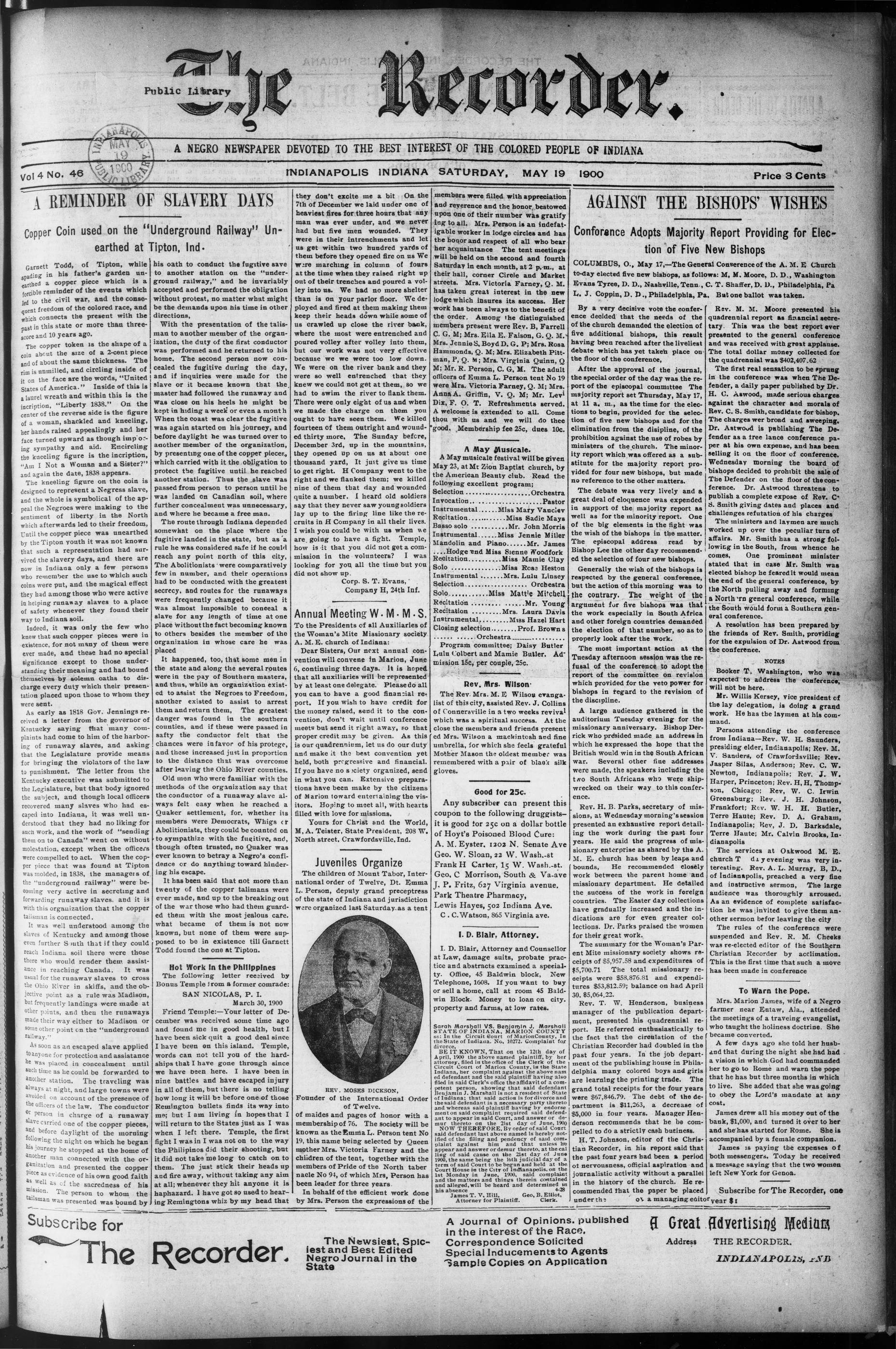
A REMINDER OF SLAVERY DAYS
earthed at Tipton. Ind.
Garnett Todd, of Tipton, while spading in his father's garden unearthed a copper piece which is a forcible reminder of the events which led to the civil war, and the consequent freedom of the colored race, and which connects the present with the past in this state or more than three-score and 10 years ago.
The copper token is the shape of a coin about the size of a 2-cent piece and of about the same thickness. The rim is unmilled, and circling inside of it on the face are the words, "United States of America." Inside of this is a laurel wreath and within this is the inscription, "Liberty 1838." On the center of the reverse side is the figure of a woman, shackled and kneeling, her hands raised appealingly and her face turned upward as though imporing sympathy and aid. Encircling the kneeling figure is the inscription, "Am I Not a Woman and a Sister?" and again the face, 1838 appears.
The kneeling figure on the coin is designed to represent a Negress slave, and the whole is symbolical of the appeal the Negroes were making to the sentiment of liberty in the North which afterwards led to their freedom. Until the copper piece was unearthed by the Tipton youth it was not known that such a representation had survived the slavery days, and there are now in Indiana only a few persons who remember the use to which such coins were put, and the magical effect they had among those who were active in helping runaway slaves to a place of safety whenever they found their way to Indiana soil.
Indeed, it was only the few who knew that such copper pieces were in existence, for not many of them were ever made, and these had no special significance except to those understanding their meaning and had bound themselves by solemn oaths to discharge every duty which their presentation placed upon those to whom they were sent.
As early as 1818 Gov. Jennings received a letter from the governor of Kentucky saying that many complaints had come to him of the harboring of runaway slaves, and asking that the Legislature provide means for bringing the violators of the law to punishment. The letter from the Kentucky executive was submitted to the Legislature, but that body ignored the subject, and though local officers recovered many slaves who had escaped into Indiana, it was well understood that they had no liking for such work, and the work of "sending them on to Canada" went on without molestation, except when the officers were compelled to act. When the copper piece that was found at Tipton was molded, in 1838, the managers of the "underground railway" were becoming very active in secreting and forwarding runaway slaves, and it is with this organization that the copper tailsman is connected.
It was well understood among the slaves of Kentucky and among those even further South that if they could reach Indiana soil there were those there who would render them assistance in reaching Canada. It was usual for the runaway slaves to cross the Ohio River in skiffs, and the objective point as a rule was Madison, but frequently landings were made at other points, and then the runaways made their way either to Madison or some other point on the "underground railway."
As soon as an escaped slave applied to anyone for protection and assistance he was placed in concealment until such time as he could be forwarded to another station. The traveling was always at night, and large towns were avoided on account of the presence of the officers of the law. The conductor or person in charge of a runaway slave carried one of the copper pieces, and before daylight of the morning following the night on which he began his journey he stopped at the home of another man connected with the organization and presented the copper piece as evidence of his own good faith as well as of the sacredness of his mission. The person to whom the tailsman was presented was bound by
Vol 4 No. 46
Public Library RECORDE A NEGRO NEWSPAPER DEVOTED TO THE BEST INTEREST OF THE COLORED PEOPLE OF INDIANA
his oath to conduct the fugitive save to another station on the "underground railway," and he invariably accepted and performed the obligation without protest, no matter what might be the demands upon his time in other directions.
With the presentation of the talisman to another member of the organization, the duty of the first conductor was performed and he returned to his home. The second person now concealed the fugitive during the day, and if inquiries were made for the slave or it became known that the master had followed the runaway and was close on his heels he might be kept in hiding a week or even a month. When the coast was clear the fugitive was again started on his journey, and before daylight he was turned over to another member of the organization, by presenting one of the copper pieces, which carried with it the obligation to protect the fugitive until he reached another station. Thus the slave was passed from person to person until he was landed on Canadian soil, where further concealment was unnecessary, and where he became a free man.
The route through Indiana depended somewhat on the place where the fugitive landed in the state, but as a rule he was considered safe if he could reach any point north of this city. The Abolitionists were comparatively few in number, and their operations had to be conducted with the greatest secrecy, and routes for the runaways were frequently changed because it was almost impossible to coneal a slave for any length of time at one place without the fact becoming known to others besides the member of the organization in whose care he was placed
It happened, too, that some men in the state and along the several routes were in the pay of Southern masters, and thus, while an organization existed to assist the Negroes to Freedom, another existed to assist to arrest them and return them. The greatest danger was found in the southern counties, and if these were passed in safety the conductor felt that the chances were in favor of his protege, and these increased just in proportion to the distance that was overcome after leaving the Ohio River counties.
Old men who were familiar with the methods of the organization say that the conductor of a runaway slave always felt easy when he reached a Quaker settlement, for, whether its members were Democrats, Whigs or Abolitionists, they could be counted on to sympathize with the fugitive, and, though often trusted, no Quaker was ever known to betray a Negro's confidence or do anything toward hindering his escape.
It has been said that not more than twenty of the copper tailmans were ever made, and up to the breaking out of the war those who had them guarded them with the most jealous care, what became of them is not now known, but none of them were supposed to be in existence till Garnett Todd found the one at Tipton.
Hot Work in the Phillippines
The following letter received by
Bonus Temple from a former comrade:
Friend Temple:—Your letter of December was received some time ago and found me in good health, but I have been sick quit a good deal since I have been on this island. Temple, words can not tell you of the hardships that I have gone through since we have been here. I have been in nine battles and have escaped injury in all of them, but there is no telling how long it will be before one of those Remington bullets finds its way into me; but I am living in hopes that I will return to the States just as I was when I left there. Temple, the first fight I was in was not on to the way the Philipinos did their shooting, but it did not take me long to catch on to them. The just stick their heads up and fire away, without taking any aim at all; whenever they hit anyone it is haphazard. I have got so used to hearing Remington whiz by my head that
they don't excite me a bit. On the 7th of December we laid under one of heaviest fires for three hours that any man was ever under, and we never had but five men wounded. They were in their intrenchments and let us get within two hundred yards of them before they opened fire on us We were marching in column of fours at the time when they raised right up out of their trenches and poured a volley into us. We had no more shelter than is on your parlor floor. We deployed and fired at them making them keep their heads down while some of us crawled up close the river bank, where the most were entrenched and poured volley after volley into them, but our work was not very effective because we were too low down. We were on the river bank and they were so well entrenched that they knew we could not get at them, so we had to swim the river to flank them. There were only eight of us and when we made the charge on them you ought to have seen them. We killed fourteen of them outright and wounded thirty more. The Sunday before, December 3rd, up in the mountains, they opened up on us at about one thousand yard. It just give us time to get right. H Company went to the right and we flanked them; we killed nine of them that day and wounded quite a number. I heard old soldiers say that they never saw young soldiers lay up to the firing line like the recruits in H Company in all their lives. I wish you could be with us when we are going to have a fight. Temple, how is it that you did not get a commission in the volunteers? I was looking for you all the time but you did not show up.
Corp. S. T: Evans,
Company H, 24th Inf.
Annual Meeting W. M. M. S.
To the Presidents of all Auxiliaries of
the Woman's Mite Missionary society
A. M. E. church of Indiana:
Dear Sisters, Our next annual convention will convene in Marion, June 6, continuing three days. It is hoped that all auxiliaries will be represented by at least one delegate. Please do all you can to have a good financial report. If you wish to have credit for the money raised, send it to the convention, don't wait until conference meets but send it right away, so that proper credit may be given. As this is our quadrennium, let us do our duty and make it the best convention yet held, both progressive and financial. If you have no society organized, send in what you can. Extensive preparations have been made by the citizens of Marion toward entertaining the visitors. Hoping to meet all, with hearts filled with love for missions.
Yours for Christ and the World, M, A, Teister, State President, 208 W. North street, Crawfordsville, Ind.
Juveniles Organize
The children of Mount Tabor, International order of Twelve, Dt. Emma L. Person, deputy grand preceptress of the state of Indiana and jurisdiction were organized last Saturday as a tent
REV. MOSES DICKSON.
of maidens and pages of honor with a membership of 76. The society will be known as the Emma L. Person tent No 19, this name being selected by Queen mother Mrs. Victoria Farney and the children of the tent, together with the members of Pride of the North taber nacle No 94, of which Mrs. Person has been leader for three years. In behalf of the efficient work done by Mrs. Person the expressions of the
The Newsiest, Spiciest and Best Edited Negro Journal in the State
A Journal of Opinions. published in the interest of the Race. Correspondence Solicited Special Inducements to Agents Sample Copies on Application
members were filled with appreciation and reverence and the honor, bestowed upon one of their number was gratifying to all. Mrs. Person is an indefatigable worker in lodge circles and has the honor and respect of all who bear her acquaintance. The tent meetings will be held on the second and fourth Saturday in each month, at 2 p.m., at their hall, corner Circle and Market streets. Mrs. Victoria Farney, Q. M. has taken great interest in the new lodge which insures its success. Her work has been always to the benefit of the order. Among the distinguished members present were Rev. B, Farrell C. G. M; Mrs. Ella E. Faison, Q. G. M. Mrs. Jennie S. Boyd D, G. P; Mrs. Rosa Hammonds, Q. M; Mrs. Elizabeth Pittman, P, Q. M; Mrs. Virginia Quinn, Q. M; Mr. R. Person, C. G. M. The adult officers of Emma L. Person tent No 19 were Mrs. Victoria Farney, Q. M; Mrs. Anna A. Griffin, V. Q. M; Mr. Lev1 Dix, F. O. T. Refreshments served. A welcome is extended to all. Come thou with us and we will do thee good. Membership fee 25c, dues 10c.
A May Musicale.
A May musicale festival will be given May 23, at Mt Zion Baptist church, by the American Beauty club. Read the following excellent program;
Selection ..... Orchestra
Invocation ..... Pastor
Instrumental ..... Miss Mary Vancleu
Recitation ..... Miss Sadie Mays
Basso solo ..... Mr. John Morris
Instrumental ..... Miss Jennie Miller
Mandolin and Piano ..... Mr. James
... Hodge and Miss Sienne Woodfork
Recitation ..... Miss Mamie Clay
Solo ..... Miss Ros Heston
Instrumental ..... Mrs. Lulu Linsey
Selection ..... Orchestra
Solo ..... Miss Mattie Mitchell
Recitation ..... Mr. Young
Recitation ..... Mrs. Laura Davis
Instrumental ..... Miss Hazel Hart
Closing selection .. Prof. Brown s
... Orchestra
Program committee; Daisy Butler
Lulu Colbert and Mamie Butler. Ad-
mission 15c, per couple, 25c.
Rev. Mrs. Wilson:
The Rev. Mrs. M. E Wilson evangalist of this city, assisted Rev. J. Collins of Connerville in a two weeks revival which was a spiritual success. At the close the members and friends present ed Mrs. Wilson a mackintosh and fine umbrella, for which she feels grateful Mother Mason the oldest member was remembered with a pair of black silk gloves.
Good for 25c.
Any subscriber can present this coupon to the following druggist—it is good for 25c on a dollar bottle of Hoyt's Poisoned Blood Cure: A. M. Eyster, 1202 N. Senate Ave Geo. W. Sloan, 22 W. Wash.-st Frank H Carter, 15 W. Wash.-st. Geo. C Morrison, South & Va-ave J. P. Fritz, 627 Virginia avenue. Park Theatre Pharmacy, Lewis Hayes, 502 Indiana Ave. C. C. Watson, 865 Virginia ave.
I. D. Blair. Attorney.
I. D. Blair, Attorney and Counsellor at Law, damage suits, probate practice and abstracts examined a specialty. Office, 45 Baldwin block, New Telephone, 1608. If you want to buy or sell a home, call at room 45 Baldwin Block. Money to loan on city, property and farms, at low rates.
Sarah Marshall VS. Benjamin J. Marshall STATE OF INDIANA, MARION COUNTY ss: In the Circuit Court of Marion County, in the State of Indiana. No. 10272. Complaint for
BE IT KNOWN, That on the 12th day of April, 1900 the above named plaintiff, by her attorney, filed in the office of the Clerk of the Circuit Court of Marion County, in the State Indiana, her complaint against the above named defendant and the said plaintiff having also filed in said Clerk's office the affidavit of a competent person, showing that said defendant Benjamin J. Marshall is not a resident of State of Indiana; that said action is for divorce and the said defendant is a necessary party thereto and whereas said plaintiff having by endorsement on said complaint required said defendant to appear in said Court, and answer or demur thereto on the 21st day of June, 1900.
NOW THEREFORE, By order of said Court said defendant last above named is hereby notified of the filing and pendency of said complaint against him and that unless the appear and answer or demur thereto, at the filing of said cause on the 21st day of June 1900, the same being the 10th judicial day of a term of said Court to be begun and held at the Court House in the City of Indianapolis, on the 1st Monday in June, 1900, said complaint and the matters and things therein contained and alleged, will be heard and determined in his absence.
James T. V. Hill, Geo. B. Elliot,
Attorney for Plaintiff.
AGAINST THE BISHOPS' WISHES
Conforence Adopts Majority Report Providing for Election of Five New Bishops
COLUMBUS, O., May 17.—The General Conserence of the A. M. E Church to-day elected five new bishops, as follows: M, M. Moore, D. D., Washington, Evans Tyree, D. D., Nashville, Tenn., C. T. Shaffer, D. D., Philadelphia, Pa. L. J. Coppin, D. D., Philadelphia, Pa. But one ballot was taken.
By a very decisive vote the conference decided that the needs of the of the church demanded the election of five additional bishops, this result having been reached after the liveliest debate which has yet taken place on the floor of the conference.
Rev. M. M. Moore presented his quadrennial report as financial secretary. This was the best report ever presented to the general conference and was received with great applause. The total dollar money collected for the quadrennial was $402,407.62.
After the approval of the journal, the special order of the day was the report of the episcopal committee The majority report set Thursday, May 17, at 11 a. m., as the time for the elections to begin, provided for the selection of five new bishops and for the elimination from the discipline, of the prohibition against the use of robes by ministers of the church. The minority report which was offered as a substitute for the majority report provided for four new bishops, but made no reference to the other matters.
The debate was very lively and a great deal of eloquence was expended in support of the majority report as well as for the minority report. One of the big elements in the fight was the wish of the bishops in the matter. The episcopal address read by Bishop Lee the other day recommended the selection of four new bishops. Generally the wish of the bishops is respected by the general conference, but the action of this morning was to the contrary. The weight of the argument for five bishops was that the work especially in South Africa and other foreign countries demanded the election of that number, so as to properly look after the work.
The most important action at the Tuesday afternoon session was the refusal of the conference to adopt the report of the committee on revision which provided for the veto power for bishops in regard to the revision of the discipline.
A large audience gathered in the auditorium Tuesday evening for the missionary anniversary. Bishop Derrick who presided made an address in which he expressed the hope that the British would win in the South African war. Several other fine addresses were made, the speakers including the two South Africans who were shipwrecked on their way to this conference.
Rev. H. B. Parks, secretary of missions, at Wednesday morning's session presented an exhaustive report detailing the work during the past four years. He said the progress of missionary enterprise as shared by the A. M. E. church has been by leaps and bounds. He recommended closely work between the parent home and missionary department. He detailed the success of the work in foreign countries. The Easter day collections have gradually increased and the indications are for even greater collections. Dr. Parks praised the women for their great work.
The summary for the Woman's Parent Mite missionary society shows receipts of $5,957.58 and expenditures of $5,700.71. The total missionary receipts were $58,876.81 and expenditures $33,812.59; balance on had April 30. $5,064.22.
Rev. T. W. Henderson, business manager of the publication department, presented his quadrennial report. He referred enthusiastically to the fact that the circulation of the Christian Recorder had doubled in the past four years. In the job department of the publishing house in Philadelphia many colored boys and girls are learning the printing trade. The grand total receipts for the four years were $67,846.79. The debt of the department is $11,263, a decrease of $5,000 in four years. Manager Henderson recommends that he be compelled to do a strictly cash business.
H. T. Johnson, editor of the Christian Recorder, in his report said that the past four years had been a period of nervousness, official aspiration and journalistic activity without a parallel in the history of the church. He recommended that the paper be placed under the supervision of a managing edit
Price 3 Cents
BISHOPS' WISHES
Report Providing for Elec-
New Bishops
Rural Conference of the A. M. E Church
News: M, M. Moore, D. D., Washington
C. T. Shaffer, D. D., Philadelphia, Pa.
But one ballot was taken.
Rev. M. M. Moore presented his quadrennial report as financial secretary. This was the best report ever presented to the general conference and was received with great applause. The total dollar money collected for the quadrennial was $402,407.62
The first real sensation to be sprung in the conference was when The Defender, a daily paper published by Dr. H. C. Aswood, made serious charges against the character and morals of Rev. C. S. Smith, candidate for bishop. The charges wered broad and sweeping. Dr. Astwood is publishing The Defender as a free lance conference paper at his own expense, and has been selling it on the floor of conference. Wednesday morning the board of bishops decided to prohibit the sale of The Defender on the floor of the conference. Dr. Astwood threatens to publish a complete expose of Rev. C. S. Smith giving dates and places and challenges refutation of his charges.
The ministers and laymen are much worked up over the peculiar turn of affairs. Mr. Smith has a strong following in the South, from whence he comes. One prominent minister stated that in case Mr. Smith was elected bishop he feared it would mean the end of the general conference, by the North pulling away and forming a Northrn general conference, while the South would form a Southern general conference. A resolution has been prepared by the friends of Rev. Smith, providing for the expulsion of Dr. Astwood from the conference.
NOTES
Booker T. Washington, who was expected to address the conference, will not be here.
Mr. Willis Kersey, vice president of the lay delegation, is doing a grand work. He has the laymen at his command.
Persons attending the conference from Indiana—Rev. W. H. Saunders, presiding elder, Indianapolis; Rev. M. V. Sanders, of Crawfordsville; Rev. Jasper Silas, Anderson; Rev. C. W. Newton, Indianapolis; Rev. J. W. Harper, Princeton; Rev. H, H, Thompson, Chicago; Rev. W. C. Irwin Greensburg; Rev. J. H. Johnson, Frankfort; Rev. W. H. H. Butler, Terre Haute; Rev. D. A. Graham, Indianapolis; Rev. J. D. Barksdale, Terre Haute; Mr. Calvin Brooks, Indianapolis
The services at Oakwood M. E. church T day evening was very interesting. Rev. A. L. Murray, B. D., of Indianapolis, preached a very fine and instructive sermon. The large audience was thoroughly aroused. As an evidence of complete satisfaction he was invited to give them another sermon before leaving the city. The rules of the conference were suspended and Rev. R. M. Cheeks was re-elected editor of the Southern Christian Recorder by acclimation. This is the first time that such a move has been made in conference
To Warn the Pope.
Mrs. Marion James, wife of a Negro farmer near Entaw, Ala., attended the meetings of a traveing evangelist, who taught the holiness doctrine. She became converted.
A few days ago she told her husband that during the night she had had a vision in which God had commanded her to go to Rome and warn the pope that he has but three months in which to live. She added that she was going to obey the Lord's mandate at any cost.
James drew all his money out of the bank, $1,000, and turned it over to her and she has started for Rome. She is accompanied by a female companion.
James is paying the expenses of both messengers. Today he received a message saying that the two women left New York for Genoa.
Advertising Medium
THE RECORDER.
INDIANAPOLIS, AND
"I was hunting," said Capt. "Jack" Harris, an old Indian fighter, 'near the Colorado line when I ran across a grizzly bear and two fat cubs. The old bear was lying on a ledge in the shade, while the cubs were playing and tumbling about in the gully of a little dredel up stream just below her. A grizzly with cubs is a mighty good thing to let alone, unless a man is one of a well-armed party, and as the bear hadn't seen me, I was content to let it go at that and keep out of her way. So I turned and went up the side of the valley. I hadn't gone but a short distance when, looking back, I saw a drove of about 100 peccaries coming down the valley. Now, every hunter knows what it means to disturb peccaries. He must kill off the last one or he is a dead man. And the drove will keep up the chase until they have run down or starved out the man or animal they are after. The course the drove were taking would bring them less than a hundred yards below me and right past the old bear and her cubs, but the wind was blowing from the opposite direction, and from the ledge on which she was lying the old bear couldn't see the peccaries coming. Pretty soon the drove reached the top of a little decline, in plain sight of the cubs and came swinging down with that fast little trot which eats up the miles amazingly, and which they can keep up for hours and days, as many a reckless hunter has found out to his grief. The fiercest, strongest grizzly in America would have hurried to get out of the path of those pigs, but the cubs didn't know enough to appreciate their danger. The instant they sighted the enemy, both cubs started for them on the run. The cubs each picked out a peccary and pounced on it, but, instead of stammpeding, the peccaries simply piled over each other in their eagerness to have a share in tearing to pieces the two foolish cubs.
When the cubs attacked the drove the noise aroused the old grizzly. She hesitated just for a second, for, old huntress that she was, she knew what it meant to tackle these peccaries. Then one of the cubs made a dying effort to crawl from under the drove toward its fierce old mother. The old bear saw the last struggle and started forward. The pigs saw her coming, and went for her on the run. The grizzly was an unusually large one, and, frenzied at the fate of her cubs, she looked the incarnation of hate. Her big jaws were open, her eyes glaring. the bristling hair on her head and body was standing on end; altogether she was the personification of demonic fighting ability as she rushed at the peccaries. For the first few seconds the peccaries surged over her. Then the old mother's tremendous fighting ability showed itself. One sweep of her right front paw cleared a little space in front of her, incidentally smashing in the head of an unlucky peccary as if it had been caught under a trip hammer. Then she made the slashing blows, first with one paw and with the other. The mere force of the blows was enough to smash in a peccary's ribs, or break his back, and besides this the claws at the end of the paws, made slashing cuts four or five inches deep. I saw one pig nudge in between the swinging paws and spring right for the grizzly's head. That was the end of the peccary, for the big jaws opened and when they closed for the peccary almost in two. I wasn't but a few seconds before the old bear had things pretty well cleared up in front of her, but in the meantime the drove had been tearing fur and flesh to ribbons on her side and back. As soon as a space was cleared in front the old grizzly changed her tactics, and shaking off the peccaries as if they had been clinging insects rose upon her hind legs. She had a peccary in her paws as she went up, but after one squeeze it was a dead peccary. Then the grizzly dropped down on her four paws again, gave a bound, was clear of her enemies, and started off on a clumsy but rapid gallop for the place where the cubs had met their deaths. I thought the old bear was trying to escape, and, while I haven't much love for grizzlies, I wished the old lady good luck because of the plucky fight she had put up. But I misunderstood the workings of her mind. Love for her cubs had first led her to fight, and it was lingering hope that she might in some way aid her offsprings that caused her desperate attempt to shake herself free from the drove. Up the little bill she galloped until she reached the place where the cubs had met their fate. Only splashes of blood and little bits of fur and flesh were left of the frac tubs. The grizzly knew that the scattered bits of fur were the remains of her pets, and paying no attention to the fast following peccaries nosed about and smelt of the pieces. Then she felt that her last hope was gone, and giving a growl, which was a good deal of a groan, again faced the foe. As the drove approached the bear rose upon her hind feet, and then, as the line of vicious pigs reached her dropped down. She caught a peccary under each of her front paws as she fell and grabbed another in her big jaws. The grizzly wasn't idle for the tenth of a second, but swung her big front paws right and left, and, grabbing the peccaries, shook them as a dog does a rat and tossed them over the heads of the drove to lie twisting and dying on the outskirts of the big fight. Suddenly three or four big peccaries happened to spring at the grizzly from the same side at the same instant. The old fighter was evidently weakened by the loss of blood, for she staggered and fell over. The enemy thought she was done for, and in they rushed. They didn't appreciate the straying powers of the bear. Two or three were gathered in a deadly hug in her front paws, her hind legs ripped open their skins as if tearing gloves, and her jaws went through skin, flesh and bone whenever she fastened them on one of her enemies. The grizzly was making a desperate rally, and while on her back seemed better able to bring into play her superb fighting qualities. All I could see for the next
few seconds was a confused mass of grunting, raging peacaries, with glimpses underneath of a fighting bundle of blood-stained brown fur, with teeth and claws working at their utmost capacity. Peccary after peccary rolled out of the fight. There was a last heave, the struggling mass began to part, and the big grizzly, one mass of blood and dirt and wounds, struggled to her feet, disposed of two or three of the more pertinaculous of her enemies by slashing blows with her front paws, and for the second time in the fight was free.
"Old hunters say that it seems as if an angry grizzly will fight after it is dead, and this bear had been in a state of frenzy since she smelled the bits of fur which had once been her cubs. The peccaries were apparently doubtful whether to continue the fight, but the grizzly settled the matter by making a charge on the drove. Both sides went at it afresh. The grizzly had a little better of the charge, crushing the peccaries beneath her paws, and trying hard to fight her way through the drove. They piled on her, however, and forced her down. Over on her back rolled the grizzly, fighting desperately; again she swept herself clear of her enemies and rose to her feet. One eye had been torn out in the last struggle, but blinded and staggering, the old bear was still eager. An old tusker of a peccary charged and was caught by the big paws, while the blinded bear tore at his entrails with her teeth. Then the drove came in for the last charge, and, still striking and biting, the grizzly was overborne. The tusks and teeth of the peccaries tore her on all sides as she went down. She made one last effort, swept a paw around, throwing a dying peccary outside the circle of her foes, and then rolled over on her side dead. After the drove had gone I counted the bodies of over fifty peccaries on the ground."
—New York Sun.
The Small Boy's Verdict.
This is a story which Representative Eddy, of Minnesota, tells on himself, Mr. Eddy not only enjoys the situation when the laugh is turned against him, but has a sense of humor which leads him to start the laugh sometimes himself.
"In making the campaign in my district one year," said Mr. Eddy. "I took along as an attraction a veteran of the war of 1812 and of the civil war, who was a famous hand at beating the drum. He was a drummer from away back and could arouse a whole township. Drum music is an incendiary kind of thing, anyhow, and the old captain's drumming was particularly stirring.
"Well, one night, after the Captain's drum had given the usual overture, I commenced my speech to the populace which had been lured to the scene by his drum. I noticed at the foot of the rostrum, the same being a big dry goods box, a bright-eyed little fellow of about twelve years, who sat through the speech, following me with great attention. It pleased me very much. Any fool can interest an audience of adults, but it takes a genius to hold a child.
"So, after the speaking I went down and spoke to the little fellow, and after shaking hands with him I asked him how he liked my speech.
"Oh, it will do, he said, 'but if I was you I would keep the Captain adrummin' all the time.'"—Washington Star.
Managing a Woman.
He was a sawed-off looking little colored man, and as he ambled down Eleventh street in the direction of the Star office he mumbled violently to himself and made two or three passes with his clenched hand, as if delivering a knockout blow. The performance was a rather peculiar one, and a Star reporter who was passing inquired: "Uncle Fred, what's the trouble?"
"No trubble but dat nasty-temper'd wife uv mine?" was the quick answer. "She's wukking up here wid er nice leddy on Sixteenth street, an' Ise bin wukking dere fur two or three days myself. Dis morning, jess case I walked out'n de house fer er few minutes, she 'cused me uv habin' er bottle round de corner somewhat.
"I said, 'Now, Liza, you knows I'se not dat kind uv er man when I wuk-king wud fust-class white folks, as dese airp air.' But she jess wouldn't listen to all dis and called me a lair, Dat's sumthin' I wont take off a man—let alone a no-count nigger woman; but es I was in de whitefolk' house I said nuffin' 'ecept to tell her I' see her about all dat. She jess kept right on till de missus come in an' asked her what jumpin' on me fur."
"Well, uncle," he was advised, "you can't afford to have trouble with the women."
"Sumtimes yer caln't," he answered.
"But de bess way ter handle wimmin uv dat kind is ter slap de slide uv dere jaw off dem when dey git to talkin' ter yer dat way."—Washington Star.
He Knew Something About Battle.
They were discussing the war, of course, and criticising our generals in that free-and-easy fashion peculiar to the irresponsible and ignorant.
"Buller's to blame," said the local plumber. "Why didn't he go snap at 'em an smash 'em?"
"It was White's fault," replied the baker. "He should have attacked in the rear."
"In my opinion," sagely put in the tailor, "everybody's to blame."
"Bah! What do you fellows know about war?" demanded the little man in the corner. "You should leave such questions to men like Roberts, Kitchener and me."
"You" reared the others.
"Certainly," was the calm response. "Roberts and Kitchener are tacticians; so am I. Anyhow, I've been married three times and have been rate collector ten years, and I'm still alive."—Tit-Bits.
An Ap. logy.
Porum—I'm awfully sorry I could not attend your reception last week.
It was very kind of you to invite me.
Mrs. Frankly—How careless of me.
I was sure I had crossed your name off my list.—Chicago News.
THE RECORDER. INDIANAPOLIS. INDIANA
INDIANA'S MULE BELT.
Lightning From a Clear Sky—Smallpox at Reform School Two Men and a Horse Killed by Lightning-Aged Farmer Shoots Himself-State Notes.
Indiana's "Mule Belt"
Evansville correspondence Chicago Record: Indiana has long been known to possess a gas belt, a coal belt and a stone belt, but few knew that it has the unique distinction of having a "mule belt." It has been truthfully said that you can hard together all the mules in the districts of Congressmen Faris, Overstreet, Landis, Steele, Cromer, Crumpacker, Brick and Robinson and still Hemeney of the First district, would be able to give to the sight Congressmen named above a few hundred mules before they would have as many as he. Last year there were 48,956 mules in Indiana and nearly one-third of them belonged to the First district and to the two counties just north of it. The following shows the number of mules represented by Congressman Hemeney alone: Pike county, 742; Gibson county, 1,866; Spencer county, 1,953; Warrick county, 2,275; Vanderburg county, 2,569; Posey county, 2,488; total, 11,843. There are forty-two counties north of the national road, which runs through Richmond and Indianapolis, and yet these counties had credited to them last year but 7,554 mules. This amount is nearly 4,000 less than the number of the long-eared brutes to be found in the six counties of the First district. In the fifty-six counties of the Fifth, Sixth, Seventh, Eighth, Ninth, Tenth, Eleventh, Twelfth and Thirteenth Congressional districts there are but 14,790 mules—almost 200 less than in these eight counties of the "pocket" district. In the one small county of Pike there are considerably more mules than can be found in the two north tiers of Indiana counties.
Lightpulse From a Clear Sky
Kokomo special: Sunday afternoon, John Stevens, a well-known farmer, who lived some distance north of town, was struck by lightning. He was driving through the streets of the city when a bolt of lightning struck him, knocking him senseless and instantly killing his two horses. For some time it was believed
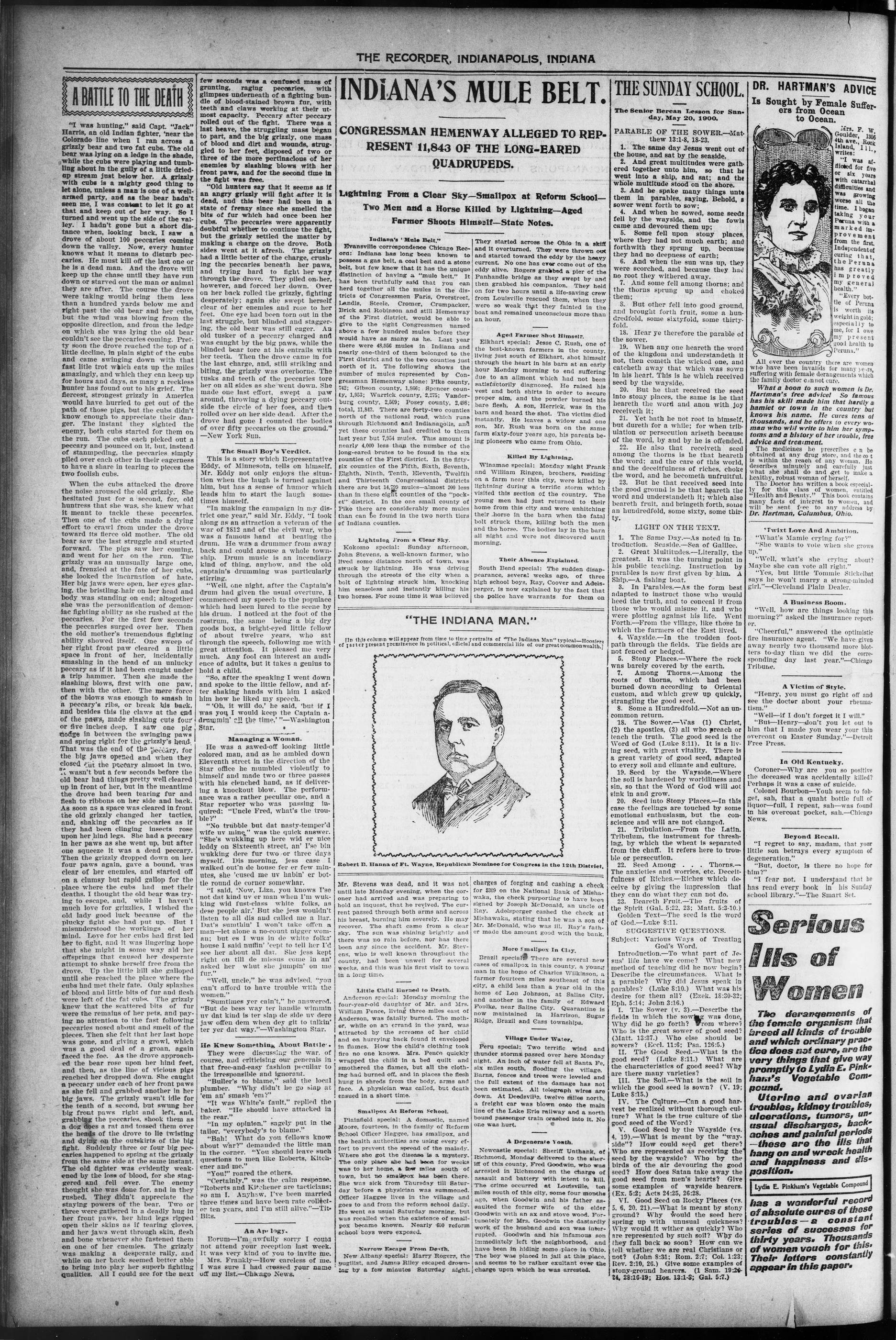
"THE INDIANA MAN."
In this column will appear from time to time of justice present prominence in political, official
Robert B. Hanna of Ft. Wayne, Republican
[In this column will appear from time to time portraits of "The Indiana Man" typical—Hoosiers of past present prominence in political, official and commercial life of our great commonwealth.]
```markdown
```
Robert B. Hanna of Ft. Wayne, Republican Nominee for Congress in the 12th District,
Mr. Stevens was dead, and it was not until late Monday evening, when the coroner had arrived and was preparing to hold an inquest, that he reyed. The current passed through both arms and across his breast, burning him severely. He may recover. The shaft came from a clear sky. The sun was shining brightly and there was no rain before, nor has there been any since the accident. Mr. Stevens, who is well known throughout the county, had been unwell for several weeks, and this was his first visit to town in a long time.
charges of forging and cashing a check for $309 on the National Bank of Mishawaka, the check purporting to have been signed by Joseph McDonald, an uncle of Ray. Adelsperger cashed the check at Mishawaka, stating that he was a son of Mr. McDonald, who was ill. Ray's father made the amount good with the bank.
More Smallpox In Clay.
Brazil special There are several new cases of smallpox in this county, a young man in the home of Charles Wilkinson, a
Little Child Burned to Death
Anderson special: Monday morning the four-year-old daughter of Mr. and Mrs. William Pence, living three miles east of Anderson, was fatally burned. The mother, while on an errand in the yard, was attracted by the screams of her child and on hurrying back found it enveloped in flames. How the child's clothing took fire no one knows. Mrs. Pence quickly wrapped the child in a bed quilt and smothered the flames, but all the clothing had burned off, and in places the flesh hung in shreds from the body, arms and face. A physician was called, but death ensued in a short time.
Smallpox At Reform School.
Plainfield special: A domestic, named Moore, fourteen, in the family of Reform School Officer Haggee, has smallpox, and the health authorities are using every effort to prevent the spread of the malady. Where she got the disease is a mystery. The only place she had been for weeks was to her home, a few miles south of town, but no smallpox has been there. She was sick from Thursday till Saturday before a physician was summoned. Officer Haggee lives in the village and goes to and from the reform school daily. He went as usual Saturday morning, but was recalled when the existence of smallpox became known. Nearly 600 reform school boys were exposed.
Narrow Escape From Death
New Albany special: Harry Rogers, the pugilist, and James Riley escaped drowning by a few minutes Saturday night.
They started across the Ohio in a shift and it overturned. They were thrown out and started toward the eddy by the heavy current. No one has ever come out of the eddy alive. Rogers grabbed a pier of the Panhandle bridge as they swept by and then grabbed his companion. They held on for two hours until a life-saving crew from Louisville rescued them, when they were so weak that they fainted in the boat and remained unconscious more than an hour.
Aged Farmer Shot Himself
Elkhart special: Jesse C. Rush, one of the best-known farmers in the county, living just south of Elkhart, shot himself through the heart in his barn at an early hour Monday morning to end suffering due to an allion which had not been satisfactorily diagnosed. He raised his vest and both shirts in order to secure proper aim, and the powder burned his bare flesh. A son, Herrick, was in the barn and heard the shot. The victim died instantly. He leaves a widow and one son. Mr. Rush was born on the same farm sixty-four years ago, his parents being pioneers who came from Ohio.
Killed By Lightning.
Winnamae special: Monday night Frank and William Ringen, brothers, residing on a farm near this city, were killed by lightning during a terrific storm which visited this section of the country. The young men had just returned to their home from this city and were unhitching their horse in the barn when the fatal bolt struck them, killing both the men and the horse. The bodies lay in the barn all night and were not discovered until morning.
Their Absence Explained.
South Bend special: The sudden disappearance, several weeks ago, of three high school boys, Ray, Coover and Adelperger, is now explained by the fact that the police have warrants for them on
portraits of "The Indiana Man" typical—Hoosiers and commercial life of our great commonwealth.]
Nominee for Congress in the 12th District.
charges of forging and cashing a check for $209 on the National Bank of Mishawaka, the check purporting to have been signed by Joseph McDonald, an uncle Ray. Adelserger cashed the check at Mishawaka, stating that he was a son of Mr. McDonald, who was ill. Ray's father made the amount good with the bank
More Smallpox In Clay
Brazil special. There are several new cases of smallpox in this county, a young man in the home of Charles Wilkinson, a farmer fourteen miles southeast of this city, a child less than a year old in the home of Lon Johnson, at Saline City, and another in the family of Edward Foulke, near Saline City. Quarantine is now maintained in Harrison, Sugar Ridge, Brazil and Cass townships.
Village Under Water
Peru special: Two terrific wind and thunder storms passed over here Monday night. An inch of water fell at Santa Fe, six miles south, flooding the village. Barns, fences and trees were leveled and the full extent of the damage has not been estimated. All telegraph wires are down. At Deedsville, twelve miles north, a freight car was blown onto the main line of the Lake Erie railway and a north bound passenger train crashed into it. No one was hurt.
A Degenerate Youth
Newcastle special: Sheriff Unthank, of Richmond, Monday delivered to the sheriff of this county, Fred Goodwin, who was arrested in Richmond on the charge of assault and battery with intent to kill. The crime occurred at Louisville, ten miles south of this city, some four months ago, when Goodwin and his father assaulted the former wife of the elder Goodwin with an ax and stove wood. Fortunately for Mrs. Goodwin the dastardly work of the husband and son was interrupted. Goodwin and his infamous son immediately left the neighborhood, and have been in hiding some place in Ohio. The boy was placed in jail at this place, and seems to be rather exultant over the charge upon which he was arrested.
THE SUNDAY SCHOOL.
The Senior Berean Lesson for Sunday, May 20, 1900.
PARABLE OF THE SOWER.—Mathew 13:1-8, 18-23.
1. The same day Jesus went out of the house, and sat by the seaside.
2. And great multitudes were gathered together unto him, so that he went into a ship, and sat; and the whole multitude stood on the shore.
3. And he spake many things unto them in parables, saying, Behold, a sower went forth to sow;
4. And when he sowed, some seeds fell by the wayside, and the fowls came and devoured them up;
5. Some fell upon stony places, where they had not much earth; and forthwith they sprung up, because they had no deepness of earth;
6. And when the sun was up, they were scorched, and because they had no root they withered away.
7. And some fell among thorns; and the thorns sprung up and choked them.
8. But other fell into good ground, and brought forth fruit, some a hundredfold, some sixtyfold, some thirty-fold.
18. Hear ye therefore the parable of the sower.
19. When any one hearth the word of the kingdom and understandeth it not, then cometh the wicked one, and catcheth away that which was sown in his heart. This is he which received seed by the wayside.
20. But he that received the seed into stony places, the same is he that hearth the word and anon with joy receiveth it;
21. Yet hath he not root in himself, but dureth for a while; for when tribulation or persecution ariseth because of the word, by and by he is offended.
22. He also that receiveth seed among the thorns is he that hearth the word; and the care of this world, and the deceitfulness of riches, choke the word, and he becometh unfruitful.
23. But he that received seed into the good ground is he that hearth the word and understandeth it; which also beareth fruit, and bringeth forth, some an hundredfold, some sixty, some thirty.
LIGHT ON THE TENT
1. The Same Day.—As noted in Introduction. Seaside.—Sea of Gallilee.
2. Great Multitudes.—Literally, the greatest. It was the turning point in his public teaching. Instruction by parables is now first given by him. A Ship.—A fishing boat.
3. In Parables.—As the form best adapted to instruct those who would heed the truth, and to conceal it from those who would misuse it, and who were plotting against his life. Went Forth.—From the village, like those in which the farmers of the East lived.
4. Wayside.—In the trodden footpath through the fields. The fields are not fenced or hedged.
5. Stony Places.—Where the rock was barely covered by the earth.
6. Among Thorns.—Among the roots of thorns, which had been burned down according to Oriental custom, and which grew up quickly, strangling the good seed.
7. Some a Hundredfold.—Not an uncommon return.
18. The Sower.—Was (1) Christ,
(2) the apostles, (3) all who preach or
teach the truth. The good seed is the
Word of God (Luke 8:11). It is a living
seed, with great vitality. There is
a great variety of good seed, adapted
to every soil and climate and culture.
19. Seed by the Wayside.—Where
the soil is hardened by worldliness and
sin, so that the Word of God will not
sink in and grow.
20. Seed into Stony Places.—In this
case the feelings are touched by some
emotional enthusiasm, but the conscience
and will are not changed.
21. Tribulation.—From the Latin.
Tribulum, the instrument for threshing,
by which the wheat is separated
from the chaff. It refers here to trouble
or persecution.
22. Seed Among . . . Thorns.—The anxieties and worries, etc. Decentfulness of Riches.—Riches which deceive by giving the impression that
they can do what they can not do.
23. Beareth Fruit.—The fruits of the Spirit (Gal. 5:22; 23; Matt. 5:3-10). Golden Text—The seed is the word of God.—Luke 8:11.
SUGGESTIVE QUESTIONS.
Subject: Various Ways of Treating God's Word.
Introduction.—To what part of Jesus' life have we come? What new method of teaching did he now begin? Describe the circumstances. What is a parable? Why did Jesus speak in parables? (Luke 8:10). What was his desire for them all? (Ezek. 18:30-32; Eph. 5:14; John 3:16).
I. The Sower (v. 3).—Describe the fields in which the sowing was done, Why did he go forth? From where? Who is the great sower of good seed? (Matt. 13:37). Who else should be sowers? (Eccl. 11:6; Psa. 126:5).
II. The Good Seed.—What is the good seed? (Luke 8:16). What are the characteristics of good seed? Why are there many varieties?
III. The Soil.—What is the soil in which the good seed is sown? (V. 19; Luke 8:15).
IV. The Culture.—Can a good harvest be realized without thorough culture? What is the true culture of the good seed of the Word?
V. Good Seed by the Wayside (vs. 4. 19).—What is meant by the "wayside"? How could seed get there? Who are represented as receiving the seed by the wayside? Who by the birds of the air devouring the good seed? How does Satan take away the good seed from men's hearts? Give some examples of wayside hearers. Ex. 5:2. Acts 24:25. 26:28.
VI. Good Seed on Rocky Places (vs.
5, 6, 20, 21). What is meant by stony
ground? Why would the seed here
spring up with unusual quickness?
Why would it wither as quickly? Who
are represented by such soil? Why do
they fall back so soon? How can we
tell whether we are real Christians
or not? (John 8:31; Rom. 2:7; Col. 1:23;
Rev. 2:10, 26). Give some examples of
stony-ground hearers. (1 Sam. 19:26
24. 28:16; Hos. 13:1-8; Gal. 5:7)
Is Sought by Female Sufferers from Ocean to Ocean.
1
Iars. F. W. Goulder, 184th ave. Rock Island, 111, writes: "I was afflicted for five years with catarral difficulties and was growing worse all the time. I began taking peruana with peruana marked in progress from the first. Independent of curing that, the Peruana has greatly im proved my general health."
"Every botte of Peruna is worth its weight in gold; especially to me, for I owe my present good health to Peruna."
All over the country there are women who have been invalids for many years, suffering with female derangements which the family doctor cannot cure.
What a boon to such women is Dr. Hartman's free advice! So famous has his skill made him that hardly a hamlet or town in the country but knows his name. He cures tens of thousands, and he offers to every woman who will write to him her symptoms and a history of her trouble, free advice and treament.
The medicines he prescribes can be obtained at any drug store, and the coe is within the reach of any woman. He describes himself and usually just what she shall do and get to make a healthy, robust woman of herself.
The Doctor has written a book especially for this class of women, entitled "Health and Beauty." This book contains many facts of interest to women, and will be sent free to any address by Dr. Hartman, Columbus, Ohio.
'Twixt Love And Ambition.
"What's Mamie crying for?"
"She wants to vote when she grows up."
"Well, what's she crying about? Maybe she can vote all right."
"Yes, but little Tomnie Stickelbatt says he won't marry a strong-minded girl."—Cleveland Plain Dealer.
A Business Boom.
"Well, how are things looking this morning?" asked the insurance reporter.
"Cheerful," answered the optimistic fire insurance agent. "We have given away nearly two thousand more blotters to-day than we did the corresponding day last year."—Chicago Tribune.
A Victim of Style.
"Henry, you must go right off and see the doctor about your rheumatism."
"Well—if I don't forget it I will."
"But—Henry—don't you let out to him that I made you wear your thin overcoat on Easter Sunday."—Detroit Free Press.
In Old Kentueky
Coroner—Why are you so positive the deceased was accidentally killed? Perhaps it was a case of suicide.
Colonel Bourbon—Youth seem to foget, sah, that a quaint bottle full of liquor—full, I repeat, sah—was found in his overcoat pocket, sah—Chicago News.
Beyond Recall.
"I regret to say, madam, that your little son betrays every symptom of degeneration."
"But, doctor, is there no hope for him?"
"I fear not. I understand that he has read every book in his Sunday school library."—The Smart Set.
Serious
Ills of
Women
The derangements of the female organism that breed all kinds of trouble and which ordinary practice does not cure, are the very things that give way promptly to Lydia E. Pinkham's Vegetable Compound.
Uterine and ovarian troubles, kidney troubles, ulcerations, tumors, unusual discharges, backaches and painful periods—these are the ills that hang on and wreck health and happiness and disposition.
has a wonderful record of absolute cures of these troubles - a constant series of successes for thirty years. Thousands of women vouch for this. Their letters constantly appear in this paper.
56TH CONGRESS.
Practically the entire session of the Senate Wednesday was devoted to the section of the naval appropriation bill relating to armor and armament. The debate largely hinged on the proposition that the government should erect an armor plant of its own. Senator Tillman presented an amendment limiting the price to be paid for armor to $300 per ton and providing also that the government should erect a plant of its own. Senators Tillman, Money and Chandler advocated the erection of a plant, while Mr. Hale supported the committee amendment providing for a plant in the contingency that armor could not be procured for $445 per ton. The Senate again went into secret session to discuss the mysterious projectile with which the Navy Department has been experimented on armor plate.
The House Thursday, by the very narrow margin of two votes unseated Mr. Crawford, of North Carolina, a Democrat, and seated in his place Mr. Pearson, of North Carolina. He is the third Democrat to be seated by the present House. The minority resolution declaring the sitting member entitled to the seat was defeated by one vote. Mr. Jack, a Pennsylvania Republican, voted with the Democrats on both roll calls. On the first vote fifteen Republicans were absent and unpaired, and on the second twelve were absent and unpaired.
In the Senate Thursday the case involving the seat of Mr. Clark, of Montana, was postponed until next Tuesday. Mr. Chandler gave notice that at that time he would insist that the case be continuously considered to the exclusion of all other business. Mr. Sewall, of New Jersey, announced that he should object to that. Mr. Gallinger, of New Hampshire, addressed the Senate at length on his resolution, declaring that present prosperity of the country is due to the policy of protection as embodied in the Dingley tariff law.
In the House Friday Representative Bromwell, of Ohio, introduced a resolution directing the Secretary of War to investigate the alleged Cuban postal fraud.
In the Senate Friday Senator Bacon introduced a resolution directing the committee on Cuban relations to investigate and report to the Senate as early as practicable regarding the moneys received and exported from the island of Cuba by, through and under the officials and the representatives of the United States, both civil and military, from the date of the occupation of Cuba by the military forces of the United States until and including the 30th day of April, 1900. During the discussion of the naval appropriation bill Senator Lodge delivered a sensational speech in which he referred to a war with Germany as a possible event. He advised a big fleet to enable the United States to enforce the Monroe doctrine and called attention to the increase in the German navy as a menace to this country.
By a close vote the Senate Saturday rejected the proposition to erect, without reference to the price at which the government could secure armor plate for its warships, an armor-plate factory. The vote upon the direct proposition was 22 to 24 and subsidiary amendments were rejected by about the same vote. When the committee's proposition was about to be voted upon a filibuster was organized, the quorum of the Senate was broken, and the question is still in the air.
The House Monday passed the general deficiency appropriation bill. The deficiency bill carried $3,829,621, and was passed substantially without amendment. The general debate was devoted principally to political topics, the feature being a severe arraignment of the administration by Mr. De Armond, of Missouri. Mr. Cortzis had read aletter from a native Porto Rican enthusiastically indorsing the action of Congress in passing the Porto Rican tariff law. Mr. De Armond ridiculed it, and described the ecstacy with which the native population must have received the news that they were to be governed by "carpet-baggers who," he said, "would take everything portable and nail down everything they could not carry away."
After a discussion lasting five full days, the Senate Monday passed the naval appropriation bill. Practically four days were devoted to consideration of the armor plate proposition, which was agreed to finally as reported by the committee, with the exception that the Secretary of the Navy is authorized to make contracts only for such armor as may be needed from time to time. The Secretary of the Navy is authorized to procure armor of the best quality at $45 per ton; but if he be unable to obtain it at that price, he is then authorized to pay $45 per ton for the armor for the battleships Maine, Ohio and Missouri and proceed to erect an armor factory to cost not to exceed $40,000,000. one-half of which amount is made immediately available.
When the session of the House opened Tuesday Mr. Gillett, of Massachusetts, asked unanimous consent to consider the Senate bill to reincorporate the American National Red Cross, Mr. Bally, of Texas, in unmistakable terms, announced his objection. The Red Cross, he said, was an excellent charitable organization, but the bill violated sound principles of government. He also objected when Mr. Overstreet, of Indiana, tried for unanimous consent to consider a Senate bill for the retirement as first sergeants of the four survivors of the Lady Franklin Bay relief expedition. Mr. Overstreet said General Greely had been rewarded with a brigadier generalship, but the other four survivors, being enlisted men, had been dismissed from the service for disability. The House then tools up the Military Academy bill, but chiefly discussed policies.
in the Senate Tuesday at 12:30, just as routine business was concluded, Mr. Clark, of Montana, arose and addressed the chair on a question of personal privilege. He attrained the committee for its report against his retention of his seat in the Senate and after a review of what he termed the "learsay" evidence on which that report was based, he swept the Senate with surprise by reading his letter of resignation now in the hands of the Governor of Montana. In conclusion Mr. Clark thanked his many friends, both Republicans and Democrats, for their expressions of sympathy. When the Senate renamed business Mr. Ross called up his bill "regulating appointment to and removals from civil offices in outlying dependencies of the United States" and addressed the Senate upon it.
having called for a vote on his bill, Senator Scott, of West Virginia, moved to postpone the bill indefinitely. The motion was lost—10 to 35. It was noted that in calling the roll the clerk omitted the name of Mr. Clark, of Montana, indicating that so far as the Senate is concerned his resignation is an accepted fact. Mr. Mason addressed the Senate in a humorous vein in opposition to the bill. The Senate at 5:30 p. m. adjourned.
PEACE PROPOSALS
TERMS ON WHICH AGUINALDO WOULD SURRENDER.
Senor Buencamino Sends a Draft of a Proposed Peace Platform Which Would be Satisfactory to Filipinos.
Manila, May 12: 11:20 p. m.: Senor Buencamino, at one time a member of the so-called Filipino republican Cabinet, who was recently liberated by General Otis, announces that he has become reconciled to American society and that he will devote his influence to bring about peace. He has sent a proposed peace platform for the national Filipino party to the insurgent leaders in Manila and to the Filipino generals, including Aguinaldo, in the field.
This platform declares that it is impossible for the Filipinos to exist as a nation without the protection of the United States, and that consequently they must recognize American sovereignty and strive to attain, under a constitution, the utmost liberty possible. Continuing, Senior Buencamino argues that the Filipinos are incapable of self-government. He says:
"In our independent government the predominant notes were abuses and immoralities, the offspring and the inherited vices of Spain, by which the Filipino regime was rendered odious to our own people.
"Therefore, he contends, American control is necessary to prevent civil strife. He recommends to the national Filipino party the adoption of a program embodying the following features:
1. Recognition of the sovereignty of the United States, cessation of hostilities and co-operation of the present Filipinos in the prosecution of bandits who continue depredations in the name of independence.
"2. A request for a declaration by the United States government guaranteeing to the Filipinos personal liberties and rights under a legislation.
"3. A Filipino representative delegation to present to the American Congress and public the desires of the Filipinos respecting political status.
"4. The application of a part of the public funds to the maintenance of hospitals for sick and wounded Filipino soldiers and for the establishment of schools.
"5. The transfer of the insurgent funds to the American treasury.
"6. The establishment of a permanent system of Filipino representatives to the civil commission.
"7. The exclusion of friars from the administration of the parishes.
"8. If the civil commission will guarantee protection of the Filipinos, leaving the determination of our future political status to the United States Congress, Aguinaldo will come in, will order a cessation of hostilities and will direct the surrender of arms.
"Your forceful sovereignty throughout the islands is unmistakable. We now crave your justice and your humanitarian, lenient policy. General Gits has done much to render feasible and possible the application of the peace project upon which I am now working. To-day in Manila we see public funds expended for the benefit of the people, in the construction of markets and bridges, in schools, in police force. You have made a good mc riage law. You have established systems of municipal government and criminal procedure more liberal and just than were contemplated by the Filipino constitution.
"These facts attest your good faith, and our trust in the American people is as strong as ever."
SHORTAGE NOW $75,000.
Later Returns May Increase Amount of Neely's Embezzlement
Havana cable: As a result of the postal frauds the Department already admits a shortage of $75,000 and further investigation shows that after last July each month's receipts were about $12,000 below the average of the previous month. About the same time Director of Posts Rathbone ordered the destruction of $411,000 worth of stamps owing to a new issue, which work was left to C. F. W. Neely and his assistants. The theory now is that these stamps were not destroyed, but were sent out with the new ones. The Havana receipts were about $13,000 a month, but the other offices of the island showed the surprisingly small total of $3,000 to $4,000. The receipts for the first week in May indicate a total of $40,000 for the month. The theory that others than Neely were involved is generally accepted, though not enough evidence to warrant arrests has been secured. The appointment of Corydon Rich, who holds the power of attorney to fill Neely's place as chief financial agent of the Havana postoffice, has been suspended. Colonel Burton's investigation shows that Neely kept scarcely any accounts. The government has taken control of all of Neely's property in Cuba.
THE MARKETS
INDIANAPOLIS.
WHEAT, No. 2 red..... .71½%
CORN, No. 1 white..... .40½%
OATS, No. 2 white..... .27
HAY ..... 13.00 @ 13.50
POULTRY—Hens ..... .07
Cocks ..... .04
Hen turkeys ..... .08
Butter ..... .08 @ .12
Eggs, fresh ..... .10½%
Wool ..... .18 @ .25
Hides ..... .08 @ .09
CATTLE—Prime steers ..... 5.25 @ 5.70
HOGS—Heavies ..... 5.25 @ 5.20
Roughs ..... 4.40 @ 4.90
SHEEP—Good to choice ..... 4.00 @ 5.00
Good to choice lambs ..... 6.00 @ 8.00
CHICAGO
WHEAT, No. 2 red..... .71
CORN, No. 2 ..... .39½%
OATS, No. 2 white..... .24
---
THE RECORDER, INDIANAPOLIS, INDIANA
THE HOUSEHOLD.
Softly comes the memory flowing,
Softly as the zephyr blowing
Liquid.
I am the bake!
And I think 'mid business cares
Of the luscious shortcake squares
Mother'd bake.
With the rolling pin before her
And a hot range to assure her,
She would start:
And she'd have the pastry heaping,
With the giant berries peeping
For the heart.
I can see the syrup dripping
And a luscious berry slipping
From beneath:
And the paste was golden yellow
And the berries made a fellow
Bite his teeth.
But I'll never taste her equal;
No, there'll never be a sequel
To her brand.
To her brand;
For I board and I am getting
Shortcake with one berry setting.
Full of sand.
SUMMER FINERY.
Pretty Accessories to be Worn With
Warm Weather Gowns.
Among the pretty things that are being displayed now in the stores for wear with summer gowns are wide sashes of lace or net with borders and edges of all-over lace. Adjustable collars and revers of lace and insertion—usually of "val" and Swiss insertions are also among the novelties. Some of these collars are cut like a deep sailor collar in the back and end in front with long revers. Others are rounded and are ended with a sailor's knot. Still another kind—and these can be worn over cloth Eton jackets as well as with wash dresses—are cut like a rolling coat collar.
Another dainty accessory to the summer girl's wardrobe is the vest or front—or whatever it may be called—of lace and insertion that is to take the place of silk waists, with Eton jackets, on very warm days. The vest is sleeveless and buttons down the back. Stripes of insertion and lace, or of ribbon and insertion, form both the front and the stock collar with which it is finished.
Judging from the number of finished plique creations on the counters—plain stocks, stocks with turnover collars of white or colored dimities, stocks finished with square bows of white mull or of colored Japanese cotton crepe, stocks finished with four-in-hand ties, with puff or teck ties—the stiff linen collar is to find a strong rival this season in the unstarched plique stock. Among the prettiest of these shirt-waist accessories are those in which the four-in-hand tie is formed of some soft mercerized cotton—pink, blue, lavender or other light shade—homestitched at the ends and accordion plaited to the required width. Striped cotton crepe—in gray and white, pink and white, and other shades, makes up very effectively into long "puff" ties.
Those who prefer the long tie instead of the ready-to-wear stock have a great variety of pretty things from which to choose. One of the novelties is the polka-dotted silk tie with Persian border—and with the central portion of the tie, the part which forms the adjustable stock, showing the Persian design also. Very dainty silk ties for wear on dressy occasions are shown in white crepe with polka-dotted hemstitched ends, and in white silk and in the light pastel shades, with Persian borders, and with long fringed ends.
Embroidered mull ties are the newest things in wash ties. Some are finished with hemstitched ends, with bands of embroidery inserted. Others have rounded ends finished with Irish point embroidery. Still others show a bit of color—usually light blue or pink—in the appliqued and embroidered ends.
Among the newest adjustable collars are those of white satin covered with heavy embroidery. The collars curve upward toward the back, but not sharply enough to form "ears" on the side. A graceful finish is given by the graduated ruffle of the embroidery, which is edged with narrow black velvet. Another of French design is of white tucked silk bound at the top and bottom with pale blue. Falling over each side are stitched V-shaped pieces of the white silk.
The latest fancy in silk petticoats is to have the skirt match in shade the waist or some part of the outer costume. In addition to the flouencing and accordion plaiting which still is a marked feature of the decorations of these rustling garments, narrow ribbons, applied and stitched in straight rows, in scallops or in any other way that suits the fancy of the designer, are much in evidence. This was noticeable in one of the new lavender skirts that was finished with a deep accordion plaited flounce of the silk; the distance being edged with a very fluffy ruffle of the material. Very narrow white ribbon applied in triple scallops on the accordion plaited flounce formed the extra trimming. In another lavender skirt the accordion plaited ruffle was edged with a deep rushing of silk of a darker shade.
One model that was made up very effectively in yellow taffeta showed in place of the accordion plaited flounce a deep flounce formed of blas tucks, separated by strips of black lace insertion, and edged with a ruffle of narrow black lace. The same model was equally attractive when made up entirely in black. Still another variant of the usual model was of an exquisite shade of pink. The place of the accordion plaited ruffle in this was taken by a deep shell-shaped flounce, applued in white. All of the skirts followed the prevailing fashions—fit
ting closely over the hips and flaring from the knee down.
Babies' Needs.
The spring is the season of growth for all nature. The flowering plants begin to start into activity, the birds and animals of all kinds are in the best physical condition, other things being equal. This is the season when the baby should be expected to grow most vigorously and rejoice with mature over the season of promise. If the little one has been shut in by colds during the winter it is desirable that it be taken out as soon as the winds of March have been laid by the mild airs of April. The life-giving sum of the period of the vernal equinox is what all young people as well as the young foxes and the young birds need to make them grow healthy and healthy. Take the baby out in the middle of the day every day that it is possible to do so. As soon as it can go out every day it is time to wean it or make any change in its diet which must be made before in its diet. It is not safe to make such a change in the warm weather, because the little one is especially liable to disturbances of its digestive organs in the summer months, and no extra burden must be laid on it at this season. A well-known authority on the subject says: "When two or three teeth are through, if the child is well, it is time to begin the gradual weaning of the little one." This process should always be gradual. Overfeeding does more harm than anything else. Nurse a baby that is a month or two old every two hours. After the child is three months old extend the period between its nursing to three hours. When the child is six months old it should be fed five times in the 24 hours. If it is thirsty between its feeding periods, give it a little cold water or barley water. Prepare the barley water by putting a teaspoonful of ground barley in half a cup of boiling water and letting it simmer for 15 minutes. Strain it and let it become cold.
One of the best authorities on the subject advocates the following diet for children who are brought up on artificial food: For babies under six months of age prepare barley water and weaken it with half as much boiled milk, adding a lump of sugar. Put this food when strained in a bottle and give it to the child in this way. When the baby is six months old give it half boiled milk and half barley water. Add a few grains of salt and the sugar. When babies are very costive use oatmeal in place of barley. When the mother has only half enough milk to feed her child alternate nursing with feeding it barley water and milk. More children probably have been killed by overfeeding than from any other cause. This is the most ordinary cause of summer complaint, as well as hot, impure air. Very few children suffer from teethif they are properly and systematically fed. Mothers do not always know that a small amount of common salt should always be added to a cow's milk when it is fed to a child. Cow's milk, when compared with mother's milk, is deficient in salt and sugar; hence a child brought up on artificial food needs a certain amount of sugar as well as salt added to its milk. The nursing child should have neither.
Little children should have as much pure air and as much rest and quiet as they will take. Wake a child, if it is positively necessary to do so, as gently as possible. It is generally better to allow any sleep to come to a natural close. A person with a loud, rough voice and manner is not fit to come near a little child.—New York Tribune.
Good to Know.
If you heat your knife slightly you can cut hot bread or cake as smoothly as if it were cold.
Soda is an excellent article for cleaning tinware. Apply with a damp cloth and rub dry.
Neuralgia may very often be speedily relieved by applying a cloth saturated with essence of peppermint to the seat of pain.
Pails and tubs may be kept from warping by painting them with glycerine.
A too rapid boiling ruins the flavor of any sauce. It must boll up once, but should never do more than simmer afterwards.
Don't think water should be added to spinach to cook it. It is a mistake.
Don't fall to add a drop or two of manila flavoring to a pot of chocolate. It is a great improvement.
Don't close the oven door with a bang when cake is baking; the jar has spoiled many a fine loaf.
Don't wonder that corn beef is tough if put into hot water first, nor that it is too salty if the water is not changed at least three times while boiling.
"Floral Bower" Bedroom.
The flower room has not been overdone apparently, for orders are pouring in to decorators for those fresh, fair summary apartments and the ingenuity of the furnishers is taxed sorely to find some novelty to introduce into the bowery kools for which they have created a demand by artistic papers and painted furniture. When the flower-room scheme first came into being roses, forget-me-nots and chrysanthemums were the stock flowers. Then original maidens with favorite flowers and indulgent mamas ordered their dressing tables, bureau, etc, of white eylamel, curly birch and birdseye maple to be decorated with sprays of blossoms, bunches of violets, clusters of corn flowers, daisies, buttercups, even dandelions, and one woman had a set of white wood painted with exquisite purple orchids. Pond lilies made beautiful another set of white bedroom
furniture and scarlet popies painted on a background of curly birch, made a brilliant showing for a room whose woodwork and hangings are of dull soft green. Wall paper, floor coverings, window hangings, chintz and cretonne for furniture coverings can all be obtained in the same colors and designs in these artistic days. In any case the flower is repeated in all the fittings" of the pretty room. Dimity curtains of whites with colored flowers are charming for cottage windows and owing to the skill with which they are made manage to look quiet without being garish or too highly colored.
In Paragraphs.
The ready-made underwear displayed in the stores this spring is most attractive. The patterns are very stylish and the embroideries exquisite. The prices, too, are reasonable, so that oftentimes it hardly pays one to have them made.
Soft grays and purple are appropriate for women of 60. Trimmings of lace and even a little applique on the skirt is worn, but all trimming should be laid on flat.
A charming little frock for a child is made with a deep empire yoke, and ruffles of embroidery over the shoulders. The skirt has three small tucks and a ruffle.
COAL FAMINE
In rance Affords a Market For American Products.
The coal famine imminent in France affords an opportunity for American coal of all grades in these markets, says the Cincinnati Enquirer.
The coal famine that has existed in France and a large part of Europe during the present winter and the consequent high price of all kinds of fuel have called very general attention to the coal supply of the world. The situation is supposed to be due to the war in the Transvaal and the strikes in the French coal districts. It could also be attributed to the unexampled activity in the channels of manufacture, which one and all rest upon coal as their foundation and have been steadily increasing their consumption for the past decade. The governments of several European nations have been asked to take prompt action in the direction of protecting their mines.
The annual coal output of France is about two-thirds of its consumption. The railroads in France consume annually about 4,500,000 tons; the metallurgical establishments, 6,000,000 tons; the mining industry, 3,000,000 tons—over half the output. It is asserted, but not authoritatively, that France can greatly augment her output of coal. The more general opinion is that the country will have to look for her coal supply to the United States and other lands, where there are rich mines yet untouched.
Did the Egyptians Play Chess?
But the Egyptians Play Chess!
On what ground it is asserted that the ancient Egyptians were acquainted with the game of chess? All the evidence is the other way. That a game was played on a board something after the manner of our draughts is certain; but chess can hardly be played unless the pieces used are of various shapes, and no such pieces from ancient Egypt appear to be known. Birch states that "the set of each player was alike, but distinct from that of his opponent." (Wilkinson's "Manners and Customs of the Ancient Egyptians," ed. Birch, ii., 55, note.) This statement is borne out by the illustrations on pp. 57, 59 and 60 of the same work, as also by the actual pieces with which the game was played, some fine specimens of which may be seen at the British museum.
Reference is made to an engraving of "this game" (that is, chess,) in the Art Journal, but the pieces there figured accord exactly with Birch's description, and the writer of the article in which the illustration occurs considered that the game represented was one resembling draughts. If, as stated, one of the objects shows two infants swathed, nothing further is needed to prove that they are not "of ancient Egyptian origin." The idea of swathing an infant would have appeared ridiculous in ancient Egypt, where princesses even went naked for several years of childhood. Probably this is one of the not very rare cases where a strange object of unknown origin is attributed to that land of stange objects—ancient Egypt.
Needs of the Senate.
The Secretary of the United States Senate paid out some astonishing sums for the personal gratification of Senators in less than two months of last year.
He subscribed for all the leading magazines and newspapers for each Senator that cares to read them, and paid $100 each to the fourteen Senators who do not indulge in the luxury, as a commutation for the periodicals they might have had if they had wanted them.
He paid $900 for the telegrams of Senators and $200 for engraving and printing their personal visiting cards. He furnished hair brushes to all but the fourteen who do not read, and who seem to think that brushing the hair is an indulgence savoring on aristocracy. To the less wild and free, the luxury lovers, he furnished a large quantity of expensive toilet soap, besides cologne waters, quinine and calomel pills, soda mints and five gallons of witch hazel—for the laving of unspecified brushes.
The United States Government is great and rich. It can afford to suffer this sort of petty speculation. But can "Senatorial dignity" afford to practice it?—New York World.
Notwithstanding the difficulties and dangers attending a trip of from 1,200 to 1,400 miles over snow and ice in the most inclement season of the year, no less than 700 people left Dawson for Nome between December 4, 1899, and March 1, 1900.
The imports of crude rubber to this country have in the last thirty years increased 421 per cent.
Do·You·Know
THAT
THAT
THE RECORDER
Is Prepared to do all kinds of Job Printing on short notice? We can make anything from a Bill Head, Letter Head, Minutes, Dodgers, Tickets, Business Cards, Visiting Cards, Book or Newspaper, In fact, everything in Job Printing We make a specialty of first-class Job Printing If you want anything done and are too busy to call, drop us a postal or call telephone 561.
If You Want any kind of Printing done let us know.
If you have anything to advertise send it to The Recorder.
If you have a house to rent,
If you have a room to let,
If you want a situation,
If you want to sell anything,
If you want anything,
Advertise in THE RECORDER
We Want your subscription,
your advertisement,
We want you to buy the paper.
We want a large number of
Newsboys to sell the paper,
We don't want much but we
want to give you the best for your
money.
Send Us your news,
word what your
church is doing.
Send us what your lodge in doing,
Send us what your club is doing,
Send us word what you are doing, and we will be glad to publish it.
We Want your trade,
your patronage
We want your encouragement;
We want your co-operation;
We want you to assist us in making The Recorder what it really is,
the greatest, the most newsy, and
the best Negro journal in the State
If You Want to know any more,
call or address
The Recorder,.
INDIANAPOLIS, IND.
A Negro Newspaper.
PUBLISHED EVERY SATURDAY AT
INDIANAPOLIS, INDIANA.
SUBSCRIPTION RATES;
One Year. $1.00
Six Months. 50
Three Months. 25
Subscriptions may be sent by postoffice
money order, or registered letter.
All communications for publication should
be accompanied with the name of the writer—
not necessarily for publication but as a guarantee
of good faith. ®
We solicit news, contributions, opinions and
in fact all matter affecting the Race. We will
not pay for any matter, however, unless it is
ordered by us. All matter intended for publication
must reach this office not later than Wednesday
of each week to insure insertion
in the current issue.
ADVERTISING RATES
Will be furnished on Application.
Entered at the Postoffice as second-class
matter.
All letters, Communications and Business
matters should be addressed to
THE RECORDER, 122 W New York street.
Geo. P. STEWART, Publisher
SATURDAY, MAY 19, 1900
EDITORIAL
COUNTY TICKET.
For Prosecutor—John C. Ruckles
haus.
For Treasurer—Armin C. Koehne
For Sheriff—Eugene Saulcy.
For Commissioner, First District—
John McGaughey.
For Commissioner, Third District—
Thomas Spafford.
For County Assessor—Marion Eaton
For Coroner—Dr. Alembert W. Bray-
ton.
For Surveyor—James Nelson.
STILL HARPING
The Montgomery Conference has met, and after cussing and discussing the Negro at length, has adjourned and gone the way of all evil. This conference, which was called ostensibly for the "promotion of the study of race conditions and problems in the South." soon converted itself into a society for the condemnation of the Negro. We are indebted to the conference, however, for some particularly bright gems of thought, more or less original and decidedly striking. For instance, Lex-Secretary of the Navy Herbert, who started the ball to rolling, declared that, whereas during the days of slavery, when the Negro had no education, assaults upon white women by Negroes was unheard of, the present state of affairs, when such charges are of daily occurrence, is the result of the "expenditure of millions on Negro education," therefore the system is a failure and should be abandoned. Following the same line of reasoning the ex-secretary would inevitably arrive at the conclusion that banking is a failure because a few bankers have succeeded in pocketing the depositors' money; he could produce like evidence to show that every institution in the country should be abolished; or he might go farther and cite a few conspicuous irregularities in high official circles as an evidence of the incapacity of the present form of government. The cry of Negro assault on white women is a much-abused, over-worked subterfuge, which is rapidly outgrowing its usefulness and should be given a well earned rest. The Southern whites lynch the blacks just out of pure cussedness. The charge of assault and the consequent punishment were unheard of in slavery days because the Negro as a chattle had a marketable value, and the master would not countenance the wanton distroying of his property.
The M. E. church, in general conference at Chicago, has failed to take advantage of the opportunity to place itself on record as a follower of its own doctrine, Amid great enthusiasm a report was adopted declaring the equality of all men within the pale of the church, and as a guarantee of sincerity proposed the election of a col-
ored man to the bishopric. This spirit of fellowship and good will towards all men ran so high that in the balloting for new bishops, Dr. W. E, Bowen, the colored candidate, the President of Gammon Theological Seminary and a man eminently fitted for the high office, actually received the second highest number of votes on the first ballot. This had a sobering effect upon the conference, and as the balloting proceeded this enthusiasm and spirit of equality began to wane, and the conference finally decided that although theoretically a Negro bishop was alright, a Negro bishop in reality—well, that's different.
THE man who can't give an off-hand solution of the race problem is a rare specimen.
IF Aggie would stop running long enough he might get some valuable pointers on self-government.
THE spirit of patriotism should prevent the Kansas City convention from adopting a 16 to 1 plank on the Fourth of July.
AFTER a few more object lessons on the mismanagement of public affairs it is hoped that the Cubans will be capable of self-government
The Populists have opened the show and Mr. Bryan, the celebrated political acrobat, awaits the action of Kansas City convention before beginning his original hippodrome performance.
THE RACE LEADER
The race leader always worries;
How he frets and fumes and flurries
Unresigned.
To a race whose share of trouble
Grows until it's nearly double
In his mind.
His brain he always taxes;
Keeping the politicians' axes
Oa the grind.
Personally undertaking
Each advance the race is making
In his mind.
Ways to give the whole race money
And to make our future sunny
He will find
Regulating sages; preachers,
Giving pointers to the teachers
He will discourse (but without action)
Willkommen blind
'Till you're blind.
If you put him on his mettle
The race proble he will settle
In his mind.
He has talked with such presistence
That he'll go from this existence
Unspirited.
Unrepined.
But postityn will thank him,
With the great men it will rank him
In his mind.
Right Sort of Reciprocity.
It is true that as the chairman of the Ways and Means Committee and the author of the "McKinley bill" of 1890, Major McKinley did at that time report and doubtless favor a "reciprocity" clause, but the reciprocity which he favored in 1890 was a very different article from that incorporated in the present law. The "reciprocity" of 1890 was a manly notice to all nations that if they did not treat us falsely we would raise the duties on certain of their products. There was no proposal to lower our duties in any case. By the McKinley bill raw sugar, molasses, coffee, tea and hides were upon the free list, our sugar growers being compensated by a bounty on production, but the President was empowered, whenever satisfied that countries exporting those articles were imposing on United States products duties which under the circumstances were unfair, to promptly impose a "reciprocial" duty on those articles imported from such country. That is not a bad kind of reciprocity, and it is the only kind which Mr. McKinley advocated when in Congress.
It may be good policy to encourage the building and operation of fast ocean liners, like the "St. Paul." "New York," etc., which can be taken into the service of the Government during a war and converted into cruisers, but such ships should not be encouraged to the prejudice of the freighters, upon which the extension of our ocean commerce depends. If congress can be made to see the matter in its true proportions the shipping bill may be made one of the most popular Protective measures ever passed by that body. There is no reason why our industry on the sea should not be protected as well as our industry on the land.-Minneapolis Tribune.
Consul Warner, at Leipzig, Germany, reports to the State Department that a number of Saxony textile manufacturers declare that they cannot sell their goods in this country with the present competition here unless they remove their plants to Uncle Sam's domain. Smoke always tells where there is fire.
THE RECORDER, INDIANAPOLIS, INDIANA
What Astonishes Europe.
That which is now astonishing Europe is not that we are a people capable of great achievements in war; the Revolution and the Civil War had taught that. Not that we are quick to adapt scientific principles to mechanical uses; the telegraph, the telephone, the "stern wheel boats" on our shallow rivers. Whitney's cotton gin and Howe's sewing machine have taught that. What Europe is wondering at is that the now manifest purpose of our occupation of the Hawaiian and Philippine islands is commercial development. "Europe," as Mr. Weilerssee in a recent article intended for French consumption says, "had thought that the United States is an agricultural nation." Surely the wish was father to the thought.
We certainly are a great agricultural nation; indeed, we are more greatly agricultural than any other nation, and we continue to grow more and more agricultural; but we are not exclusively agricultural. Europe hoped that we would be so and remain so. The European theory was that if European manufactures were shipped to the United States and sold there more cheaply than home made goods of like quality could be manufactured, there would be no American efforts toward production of manufactures.
The American policy prevented the realization of the European idea. Our statesmen saw the injury to our agriculture by limitation of its market to a small home demand and to a foreign demand that would become less yearly, as Europe exploited its wheat, sugar and cotton growing colonies by the profits of its sales to us of manufactured goods; injury, also, to our wage earning class by limitation of the demand for labor to the fields and plantations. Tariffs on imports stimulated home production of manufactures, increased the demand for free labor and raised the rate of its compensation, created competition for the sale of home made goods, and thus lowered their price, until it came to pass that American carpets and cloth were sold more cheaply in the United States than European goods of like quality are in Europe. The same is true of iron, steel and tinware and of silk. And as our manufactures increased our agriculture increased.
We are, and are likely to remain, the greatest of all agricultural nations. We now are second, and seem likely to be the first, among the manufacturing nations. The American policy has proved itself to be the true policy.
Prosperity.
In the great State of New York fourteen months ago more than a quarter of the working people were unemployed and seeking work from day to day to enable them to procure the necessities of life. Within the ensuing ten months the unemployed numbered less than five in every hundred, and, at the present time the percent is "incalculably small," probably less than 2 per cent. But these statistics do not tell the entire story. The fact must be remembered that the report of the New York Labor Bureau covers only ten months of the year 1899, from Jan. 1 to Nov. 1. In the early months of 1898, and during the previous two years or more the depression was far greater. The process of recovery from the awful stagnation and prostration incident to the anti-Protection policy of the Wilson-Gorman act had commenced, and some progress toward the restoration of industrial prosperity had already been made previous to January 1, 1899. The full measure of the happy results of the Dingley act can be known only by comparing present conditions with those existing at the period when industrial prostration under the Wilson-Gorman act was most complete. That period is not covered by the report from which the above is quoted.
It is safe to say that if the statistics covered the entire country the improvement shown would be equally marked in many States, probably in all of those having important manufacturing industries. We are quite assured that Pennsylvania makes as good a showing as New York. Industrial prosperity has reached high water mark in nearly every community, and only in localities where a vast excess of unskilled labor abounds are there idle hands seeking employment without being able to find it. These localities are few now and the number is diminishing from week to week.
All that is needed to insure still more rapid progress and bewildering development in the Southern States is the construction of the Nicaragua Canal and the stimulation of trade, not only with Asia, via Nicaragua, but also with the South and Central American republics. The building of the canal seems assured. The stimulation of sea going trade will come in time if the policy of the present administration in reference to the merchant marine is put into effect.
Bryan says that the United States is at the parting of the ways. That was true in 1896. In November of that year the nation chose its road and is not in the least disposed to regret the decision.—Pontiac (ill.) "Sentinel."
A Missouri hen is said to have laid an egg with the initials of William Jennings Bryan on the shell, and his followers look upon it as a good omen for next November. But the hems have no vote.
The Boston "Herald" seems to think that McKinley and Bliss would be a rather more unctuous ticket than Bryan and Hogg. -Saratoga
AROUND THE CHURCHES
Rev. C. W. Newton, pastor.
ALLEN+CHAPEL A. M. E. CHURCH
(Broadway, between tenth & Eleventh St.)
Rev. A. L. Murray, B. D. - pastor
Two accessions last Sunday.
Rev. Saunders of Crawfordsville
preached two very interesting sermons
last Sunday.
On the sick list; Miss Gertie Brown
and Mrs Emma Curry,
Mr. J. A. Shepherd and Miss Letitia
Bess were joined in wedlock Wednesday
evening by Rev. J. L. Craven.
Rev. M. V. Saunders is in Columbus
O., attending the General Conference.
Rev. J. L. Craven of St Paul Temple
will preach to-morrow, morning
and evening.
OLIVET BAPSTIST CHURCH
[Cor, Prospect and McKernan Sts.]
R. D. Leonard, Pastor.
Services last Sunday were well attended, preaching morning and night by the pastor. Sunday is communion day, preaching in the morning by the pastor. The afternoon service will be postprened on account of the annual sermon to the U. B. F., until evening Everybody is cordially invited to be present.
The Tom Thumb wedding given by the Sylphite club last Friday evening was a grand affair.
Tuesday evening May 22, a lawn fete will be given at the residence of Rev. Leonard, 1543 Pleasant st. A good time is assured to all.
The Ministerial alliance met at our church Monday and the session was very profitable. The church extend an invitation to come again.
Regular prayer meeting Thursday evening. The members of the American Protective league are requested to be present. The marriage of Mr. Washington Holloway and Miss Sophia Wilson was solemnized last Wednesday evening at the residence of Mr. and Mrs. Perkins 2123 Lexington avenue. A number of intimate friends were present.
FREE BAPTIST CHURCH
(former Kensington Hospital and Newport Sts)
R.v. William Craven - Pastor
The ordinance of baptism was conducted Sunday by the pastor. Services were successful both spiritually and financially.
Rey. Craven was ill Monday but re-covered sufficiently to leave for Saint Louis, Tuesday.
Sister Harriet Dodge is improving,
Bro. Patterson is still at the City Hospital.
The Rainbow club will give a mask social at the Haughville reading room Germania street, this evening.
The pulpit will be occupied Sunday morning bo Bro. Major Turner and in the evening by Bro. Benj. McIntosh.
Sunday-school at 2 p. m.
CORINTHIAN BAPTIST CHURCH
Corner North and Spring Streets.
The pastor preached two excellent sermons Sunday. At the morning services the church was crowded and a hearty welcome was given our beloved pastor, who returns greatly benefited from his trip. At the close of the services in the evening, the rally report was made and the sum of $212.28 was reported, with more yet to be heard from. This amount pays our entire indebtedness and leaves a small surplus. Thanks to our many friends and members.
At the morning services Sunday Mr. Henri Sharpe will sing a solo.
The choir will sing at Tomlinson Hall Sunday afternoon.
The sacred cantata "Jeptha and his Dasaughter" will be presented June 12. Our sick members are improving.
SECOND BAPTIST CHURCH,
(In West Michigan St.)
Rev. J. W. Carr Pastor
Rev. W. A. Bowren preached an excellent sermon at 11 a.m. It was enjoyed by the members. Rev. Bowren who is a graduate of the State University of Louisville, Ky., is most assuredly destined to be a great preacher. Simplicity characterizes his language to the extent that the most illiterate
can follow his train of thought. Indeed we are very proud to class him as one of our number. At 8 p. m. Miss Burnett of the American Protective league delivered a lecture. We highly commend Miss Burnett in her ardent labor and feel that such lectures are essential to the race. Tomorrow at 10:45 a. m. Dr. Carr wishes to meet every member of the church. Remember that it is exceedingly warm and as the pastor has just recovered from a serious illness, he hopes that all will be on time, so that the services will not be unnecessarily long. The text and subject "The Rose of Sharon" and at 8 p. m. "The Beatitudes of Christ." We trust that all members and presidents of Christian bands will be present without fail,
SIMPSON CHAPEL M. E. CHURCH
Cor. Howard and 11th Streets)
Read The Recorder
Rev. Lewis, of Anderson, preached excellent sermon Sunday morning and evening. Quile a large audience was present.
The K. P band concert last Thursday was well attended and the program was of a high order.
The Epworth League tendered Dr. Birch a reception at the church Thursday evening. It was a pleasant affair. A penny social will be given at the church Saturday afternoon for the benefit of the Junior league. Let your children come.
The M. E. conference in session in Chicago, has our pastor Rev. Gilliam on seven committees
Members are urged to attend Class.
9th Presbyterian Church Michigan st., bet. Capitol avenue and Illinois st
* Services at the church will be conducted Sunday by the Rev. J. E. Harper of Cincinnati, O. Rev. Harper has under consideration a call to that church. Special song services will be held in the evening. The Misses Hart assisted by others will take part.
The Progress of the Church.
Twelve months ago most of the churches in the city were giving church prizes, in the form of silver sets, gold watches, wheels, etc., the person selling the highest amount of tickets winning the prize or stakes offered. The wise pastors and churches being convinced that church prizes had the very spirit and principle of gambling in them, and by fostering or encouraging this evil, they were sowing the seeds of gambling and immorality in the hearts of young and old, and saping the spiritual life from the church, causing the church to lose its Christian dignity and Christian influence in the world. The wise churches have raised up in their might and put this serpent in the guise of church prizes out of their midst, the result being that these churches have raised more money for the purpose of debt paying and rebuilding in the past ten months than in the preceding two years and the spiritual condition has improved. Some of the seemingly ignorant congregations still permit this gambling evil within their sacred walls. The plain duty of the general presbytery, Conferences and Associations is to prohibit by law this great evil. When this is done the dignity and Christian power will be greater, and the church will receive more money for the support of the gospel of Christ.
WILLIAM HARVEY.
Prosperity stories have taken the place of calamity crookings in Kansas, and Mr. Bryan is wondering what he can do to regain his former hold upon the ears of those who no longer find him interesting. The story is told of an old farmer who, at the point of a shotgun, compelled a creditor to accept payment of a note before it fell due. "Why did he do that?" some one asked the narrator, "Oh, he wanted to stop the interest," was the reply. John W. Breldenthal, the State Bank Commissioner, tells of a banker out in the short grass country who wrote a letter asking if there was any law that would compel him to receive money for deposit in his bank. "I wrote him," said Breldenthal, that if he had more money than he knew what to do with, I knew of no law in Kansas that would compel him to take more. You see, they were paying their taxes, and the County Treasurer wanted to make a depository out of his bank, but he would be mandamused before he would submit to it."
All this looks bad for the political party and candidate who hope to win by reviving the Free-Silver issues of the Chicago platform.
Subscribe for The Recorder and keep posted on the leading topics of the day. 25c for 3 months
NO OPENING.
Country Doctors Should Keep Away From New York.
Dr. Shrady, one of the famous New York physicians, evidently thinks the successful country doctor should not go to New York, judging from his advice on this subject in Success:
"The medical profession is one of the very hardest in which to get a foothold in New York. It is rare that an out-of-town doctor succeeds in establishing himself here. I have seen some most tragic failures. A few years ago a celebrated doctor from a New England town got a place on the staff of one of the city colleges to lecture on a small stipend. He brought his family to the city, and his wife soon became very popular in society, but he could get no practice. He got deeper and deeper into debt, and one day he committed suicide. Soon after, a popular physician from a New Jersey town came into my office, and said he had a notion to come to the city and cast his lot in with the rest of us. He had seen a vacant house on Madison avenue, and thought he could buy it for $30,000. I told him it would cost him $100,000. I also told him about the tragedy mentioned above and others. He did not come.
"No; a country doctor can do nothing in New York. The conditions are altogether different. "There everybody knows him, knows his horse and trap, and they see him every day. There he is a standing advertisement. Here the only place he can put his name is on the window or on the door, and it might stay there till doomsday and no one ever know anything about him. But, if he comes here at first, and is willing to work and wait, he stands a chance. If he has not enough money, however, to pay his expenses for the first five years, there is danger that he will drift into quackery, the patent nostrum business, or criminal practice; and once there, the odds are against his ever becoming a reputable physician.
I can think of no condition in our life more discouraging than that of a doctor in a great city without money, without friends, with nothing to show for himself but his sign on his door and his sheepskin on his office wall."
AMERICAN MACARONI.
The Industry May be Supplied Soon By Wheat From Texas.
The Bureau of Foreign Commerce has received a letter from Mr. James B. Simpson, of Dallas, Texas, in regard to the wheat which was sent to France to be tested as to its fitness for use in the manufacture of macaroni and similar edible pastes. Mr. Simpson says in part: "It has been demonstrated beyond question that all Northern Texas is perfectly adapted to the growth of the hard, glutinous wheats now in such great demand in France and Italy. The grain I transmitted through your kindness to Consul Covert, of Lyons, upon analysis shows the value of this hard wheat to Texas. With the port of Galveston now open, giving us easy access to Marseilles, this wheat is calculated to revolutionize production here.
"But the difficulty lies in this: Our farmers here, through negligence, have mixed the hard and the starry wheats, and we find it almost impossible to obtain the pure hard grain. I did the best I could in sending Consul Covert the two bushels for analysis, and in sending five bushels at your request to the Paris Exposition, but all had some grains of soft wheat in it. If the farmers here could obtain the Taganrog hard wheat for seed it would be but a few years before Texas would control the French and Italian markets in this hard wheat."
Poor English Telephone Service.
In the matter of telephones England is probably worse served than any civilized country in the world. Switzerland and Sweden can give her points. A telephone monopoly was created, which has worked badly. Quarrels of all kinds with the local authorities have arisen as the wayleaves. I know a factory, six miles from the Marble Arch, which has, owing to this cause, been vainly applying for the telephone. The other day I wished to send a message to a friend in a very busy little town fifteen miles from London. The place did not appear in the telephone directory. Yet in Sweden or Switzerland the smallest village is on the telephone. As for the prices charged by the company, they are extortionate. Parliament has considered the situation, but as party government is mainly concerned with making laws which are not wanted and neglecting all that concludes to real progress, no adequate measures have been taken to right the system.-National Review.
A Soøreign Balm.
Sleep is a sovereign balm for those who suffer from weak eyes. It is advisable to retire early and avoid the painful evening lights. Ten hours' sleep for delicate eyes is better than eight. Never read when lying down. Many a tedious case of weak sight has been traced to the pernicious habit of reading in bed after retiring for the night. Any middle-aged person, a good authority tells us, can look back to the days when near sight and weak sight among boys and girls were quite rare. It was not the fashion then to teach little children everything, including drawing, music and all the languages except English. Nor was it then supposed that a sufficient amount of bodily exercise would neutralize the effect of an excessive amount of brain work.
FROM OUR CORRESPONDENTS,
News, Incidents, Social * and * Personal Activities
---
Jeffersonville Items
Rev. Sissle presiding elder of Indianapolis, preached at Wesley Chapel Sunday morning.
The bazaar at Bethel church given by Anna Martin was quite successful.
Mrs. W. H. Rollins of North Vernon, is visiting friends in Jeffersonville this week.
The May fair at Wesley Chapel begins this week
The funeral of Mrs. Susie Grey-nee McClellan took place at Indiana ave. Baptist church; Rev. J. L. Thomas officiating.
Edward McClellan, Indianapolis attended the funeral of his sister, Mrs. Susie Grey.
The grand rally at Bethel Sunday was a success. The four clubs under the leadership of Misses Susie Williams, Anna Martin, Fannie Johnson and Mrs. R. McDaniel realized $43.31.
The "old maids convention" given by Mrs. J. L. Thomas will take place May 25.
Miss Sophia Wilson of this city was married to Mr. W. Holloway of Indianapolis, last Wednesday. The United Sisters and Brothers of Friendship will have their annual sermon at the armory next Sunday evening, preached by Rev. Manuel of New Albany. Richard Parks was the guest of friends at Rushville Sunday.
Crawfordsville Notes.
Mr. and Mrs. Wickliff Smith of Danville, Ill., spent Sunday in the city.
Rev. M. V. Saunders and Mr. Zace Williams as delegate are attending the general conference at Columbus, O.
Rev. Joseph Russell of Waveland preached at the A. M. E. church Sunday. He delivered two powerful sermons.
Miss Pearl Boone is slowly recovering from a paralytic stroke of the eye
Bloomington News
Quarterly meeting at the A. M. E. church last Sunday was a success in every way. Rev. Mrs. M. E. Wilson of Indianapolis, preached two splendid sermons. Rev. Johnson, pastor of the M. E. church, delivered the sacramental discourse at 3 p.m. The reports at the quarterly conference show that the work is progressing. Rev. Bush of Maryland has located in the city. He expects to engage in business.
Rev. Chase M. D., fourteen years a missionary in Africa, in the interest of the Baptist church, is in city. He preached at the Second Baptist church Sunday; lectured at the M. E. church on Wednesday night.
Mesdames Lizzie Prophet and Eva M. Taylor are preparing the children to render the May Queen an excellent entertainment on 31.
P. D. Evans visited Indianapolis this week.
The trustees of Bethel church are arranging for a grand rally on 27.
Vincennes Doings.
There will be an entertainment by school No. 8. at the highschool auditorium Friday night.
The public schools of the city will give a picnic next week at Ft. Knox.
Mrs. Francis White and daughters, Hattie and Blanche are going on a two weeks' visit Monday.
Last Sunday was rally day at
Bethel. Rev. Barksdale of Evansville, preached both the morning and afternoon. Hon. C. B. Kessinger addressed the Lyceum; we will give full report in the next issue. Gurley Brewer left for Pittsburg Pa., on the 9. Mrs. James Christian was called to Princeton by the serious illness of her sister, Mrs. Lucy Thornton. The calico carnival given by the Invincibles, Mrs. Ellen Goins, captain, at A. M. E. church Thursday evening, was a success.
Rev. Jones and wife returned from Evansville, Wednesday night, about two thousand people heard the Odd Fellows' annual sermon by Rev. Jones last Sunday week. On Monday evening the 7, the lodges in connection with the Household of Ruth, tendered Rev. Jones a banquet that was unsurpassed by any social event in colored circles
Mitchell Items.
Miss Carrie Nichols is visiting in Louisville.
Miss Neal Finley visited her brother at Orleans last week.
Mrs. Eliza Raine visited in Bedford last Sunday.
Commodore Terrell of Bloomington, and Miss Alice Finley of Bedford, visited their parents last Sunday.
Mrs. Violet Coffer and Mary Crain were in Paoli last Sunday.
Charles Reed and family visited in Paoli last Sunday.
Rev. Moorman of Bedford preached at Bethel A. M. E. church last Sunday.
The Living vine society met at the home of Mrs. Bettie Lewis last Friday evening; as it was the regular monthly meeting there was much business transacted, after which dainty refreshmeuts were served. A delightful evening was spent by all present. Rev. Y. C. Terrell pastor, of the Second Baptist church, read a very strong paper on the demands of an "educated ministry" last Wednesday evening before the almmi association at the University, Louisville of which he is a graduate.
Wabash' Liners.
Rev. B. J. Coleman will leave for Columbus, O., Wednesday to attend the conference.
The ladies of the Methodist church will give a social Tuesday evening.
Edward Gaskins was the guest of his sister, Mrs. Jeunie Brown, Sunday.
Misses Cathrine Coleman and Mattie Harris spent Sunday at Indianapolis visiting Miss Lizzie Bybee.
Mrs. B J. Coleman has been on the sick list for the past weeh.
Miss Maggie Brown is visiting at Fort Wayne.
Kokomo News
The G. U. O. O. F. held their anniversary Sunday a grand time was had. A parade with Blue lodge and Household of Ruth in line after which Rev. T. G. Hardeman delivered a masterful sermon,
Rev. E. E. Gregory of this city,
and Rev. J. H. Fisher of Peru, assisted at the Odd Fellows' sermon Sunday.
messrs. Johnson and Steyenson of Peru, were in the city Sunday.
Mrs. Barnette of Fairmont was in the city last Sunday.
Miss Hattie Goff of Noblesville, was in the city Sunday. She was entertained at the home of Mrs. Emma Hines by several lady friends
THE RECORDER, INDIANAPOLIS, INDIANA
The rally at the Methodist church was a success in every particular. $171.24 was raised by the six clubs the captians of which deserve great credit for their good work.
Hanover Pickings.
Baptizing took place Sunday at the A. M. E. church.
Rev. E. M. Brown preached an interesting sermon Sunday morning at the Methodist church.
Willie Haskin left today for Indianapolis, where he will wait on a telegraph operator on Michigan st., Hattie Johnson is on the sick list near town.
Rev. Scott Ward of Madison preached two able sermons at the A. M. E. church.
There will be an entertainment given at the Methodist church on Thursday night.
Seymour Sights.
Quarterly meeting at the A. M. E. church Sunday, Presiding Elder C. C. Townsend will be present. Mrs. Arenia Payne has gone to Noblesville to see her uncle who is very sick. Mr. and Mrs. Henry Weaver have gone to Lyles to visit relatives jerry Mitchell has returned from Indianapolis. Mrs. Tellis B. Carter of Shelbyville is visiting her parents, Mr. and Mrs. A. A. Goens of W. Tipton street.
REV. C. E. ALLEN,
Miss Lula Goens has returned from Indiaauapolis where she has been staying with her aunt, Mrs. Major Gardner.
Mrs Elma White went to Crothersville, Sunday to visited her parents.
The public school No. 4, closed Friday evening.
Mr. William Dixon who had a fight Saturday was placed on the street to work and ran away Monday evening.
There will be a rally at Second Baptist church tomorrow.
Charlestown Musings
Miss Stone and friends of Louisville, were the guests of Mrs. Mariah Stone.
Miss M. S. Brown a school teacher of Louisville, was the guest of Mrs. Francis Smith, Saturday.
Hiram Caldwell and Miss Cora Paris were married recently.
Miss S. Evans is the guest of Miss Susan Smith.
Mrs. Henry Brown and Fred Smith are on the sick list.
The closing exercises of the public school will be held at the A. M. E. church Wednesday night.
Benjamin Harrison is all smiles since last Sunday.
Anderson Dots.
Miss Minnie Stafford of New Castle, visited friends in the city last week.
A party was given by Misses Edell Owens and Francis Griffin at the home of Miss Owens in Locust street.
Rev. James Everton preached at
Second Baptist church last Sunday Rev. Everton lives at Indianapolis. The H. and F. M. of Second Baptist church, gave a social Thursday evening. Mr. Jack Martin is here as the guest of his daughters, Mesdames James Collins and Beckey Hogan. Prof William Collins of Indianapolis, has located in this city. The Odd Fellows and Household of Ruth lodges will go to New Castle Sunday to attend, Odd Fellows thanksgiving services. May fair at Allen Chapel was a financial success.
Flower fair is going on at Sec ond M. E. church.
Rushville Notes.
Mrs. Woolfalk was on the sick list last week.
Mrs. Pearl Currie of Shelbyville is visiting Mrs. Minnie Wilson.
Miss Amanda Rogers of Indianapolis visited her brother Henry last week.
Rev. Johnson and wife spent a few days in Shelbyville.
The ladies of Diamond City Tabernacle gave a lawn fete at Mrs. Nellie Hedgpeth Suturday.
Miss Clara Bradford is ill this week.
Isidore Means, Mrs. Turner and Clarence Duerson are on the sick list.
Dublin News
Mrs: L. E. Robbins of Omaha, Neb., who has been with her sister for a year, on account of her poor health, is improving
Mrs, Retta Curry and children returned to their home at Greenfield Wednesday afternoon.
George Artist of Richmond, was visiting relatives and friends Monday.
Joseph Hoosier of New Castle was calling on friends Sunday.
Rev. Collins and family returned from Connersville, Wednesday.
Shelbyvile Notes.
Miss Clara Dudley spent Monday at Indianapolis.
Miss Bertha Reed was the guest of her parents Sunday.
Miss Mamie Johnson and Robert Reed visited Franklin, Tuesday.
Quite a number of city people were in Indianapolis Wednesday.
Rev. Clark went to Rushville last Saturday to preach for Rev. Johnson.
There was a May fair given at Second Baptist church this week Much success is reported.
Rev. Ziegler of Nashville, Tenn., was the guest of Mrs. Lizzie Dudley and family. While in the city he preached for Rev. T. R. Fletcher, Sunday morning.
William Hines and Daniel Ramsey have purchased property on W. Washington ave; Charles and Robeat Yates have purchased property on E. Elizabeth street.
Chester Grissom went to Indianapolis Tuesday where he will remain a few weeks. He will probably make that city his future home.
Frank Reed has been beautifying his residence in 222 E. Mechanic street.
Miss M. F. Cass who has been at Lafayette was brought home by her mother Monday.
LaFayette Notes
Messrs, Geo. C. Porter, P. L. Easterly and A. N. Scott of Logansport, attended the Masonic lodge in this city last Tuesday and were well pleased with the degree work
Joseph Taylor and Sallie Shears were married last week. They will reside in the city for the present,
Mesdames Amanda Vaughn, Fannie Tucker and Miss Johnson of Indianapolis were among the visitors in the city last Sunday.
The Second Baptist church closed a very successful week of fair last week. The financial
committee are covered with smiles. Our last weeks letter failed to reach the press owing the absence of the Recorder man from the city. On this account we failed to report the very interesting services of the G. U. O. O. F. annual thanksgiving services. The sermon was ably delivered by the Rev, G. H. White and the program was spicy an interesting throughout. The various branches of the order paraded the streets headed by the electric band. Miss Clara Trail teacher, in the Lincoln school is our lastest subscriber.
John the youngest son of Mr. and Mss. J. Seals, died last Tuesday afternoon of hasty consumption. Mrs. Franc Barbour, Wm. Hearn and Mrs Holmes are on the sick list James H. Wilson, Esq., of Fowler, was in the city this week Mrs. Mary Cass of Shelbyville left for home with her sick daughter, Miss M. F. Cass last Monday afternoon.
Frankfort Notes
Revs. J. W. Harper and J. Johnson left last Sunday for Columbus O., to attend the general conference
Mrs. Maud Harper has returned to Tuscola, Ill., after a few weeks' visit among relatives and friends.
Mr. Berton Cummings and wife of Indianapolis have moved to this city,
J. D. Kersey is on the sick list.
Miss Minnie Valentine has been on the sick list.
Richard Harper spent last Sunday in Kokomo.
Kalamazoo, Mich.
Mrs. Sarah Booth is very sick
There was a grand rally for the purpose of raising the church out of debt. A program was rendered, consisting of solos by Miss Mattie and W. F. Cousins; essays by Miss Hattie Powers and Sarah Roberts.
The pastor's noble efforts were rewarded with a neat sum.
The concert at Second Baptist Wednesday evening was a success.
Rev. Wayen now reside on E. Kalamazoo ave.
Rev. Lyons of Battle Creek was in the city Sunday to assist Rev. B. Roberts of the A. M. E. church
Miss Dungill of South Haven, Mitch., is visiting her aunt who is very sick, Mrs. L. Cousin. Edward Cousins and Miss Ella Alford were married Thursday evening by Rev. K. Warren,
Benton Harbor, Mich., Notes
Mrs. Brown and son who have been visiting relatives in Kalamazoo, passed through here en route to her home in St. Paul, Minn., she was the guest of Mrs. Sidney White.
Rev, Kelly is here from Indianapolis visiting his sister, Mrs. Robert.
Rev. Wm. Saunders held his 3rd quarterly meeting at the Methodist church which was a success spiritually and financially, Rev. H, L Haywood delivering the sacra mental sermon.
Mr. Edward Saunders of Indianapolis a traveling salesman is in the city taking orders for gents' furnishing goods.
Wm' Ellis is here to spend the summer. He is from Galveston. Tex
A surprise party was given Rev. J. W. Saunders on the 14 in honor of his 37th birthday.
The ladies are buisy as usual at this time housecleaning and remodeling.
Mrs, Hattie Cravin is on the sick list.
South Bend News
Jasper Sanders who has been sick for several weeks, is improving slowly. John and Webster James spent Sunday and Monday in Chicago. The reception for Miss Helen Lee will be given Tuesday evening
the 22, at the home of her parents, 333 North Walnut street.
Crease Stewart went to Benton Harber last waek.
Horace Hays has gone back to Cass county Mich.. to live.
Mr. and Mrs. Abraham Brown are the happy parents of a baby girl
The Odd Fellows will give a grand calendar social at the Occidental club room, Wednesday evening, the 30, at which time a program will be rendered by some of the best talent.
Lee Walden spent Sunday with friends in Verlinia, Mich.
Mrs. Frank Johnson's purse containing $5 60 was stolen from her on the train severals days ago. She was coming home from Chicago.
Rev. J. K. Hart is spending the week in Indianapolis.
Rev. G. D. Smith, pastor of the Mt. Zion Baptist Church will preach his farewell sermon Sunday night after which he will take his departure for Lorraine, Ohio.
Irvin Grady died Tuesday night at his father's home in Union st. He was 28 years of age.
Edinburg Notes.
Harry Watton, of Indianpolis, was in the city last week as the guest of Miss Virgia Ramsey. On the sick list: Mrs. Susie Dixon, Misses Susie Miller, Sallie Simms.
Marlon Flashes.
I believe it right and proper to give honor to him whom honor is due. Then in view of the fact that we are so abley represented in the U, S. government in the person of Mr. Noah Burden who has been in the post office department here for more than ten years. And are also represented in the county government by that young man of noble character J. Will Burden in the county treasurer's office. And in the city government, that grand young man--this upright, honest and faithful gentleman, Wm. O. Pettiford whom we all delight to honor. And right here I must not fail to mention the fact that we are also represented in the two leading professions, each by a man who seem to be making his way toward the front. While one young and gay and the other bald and gray we are just what you what you need and have both come to stay. This is a progressive age. We today are educating and preparing our boys to take our places when we drop out of the way. Fellow citizens I look forward to the day when we as citizens of this city, county and State will obtain all the recognition we are entitled to as citizens of this commonwealth,
Now our time is limited. I must tell you that we are here tonight representing the colored citizens of Marion to do honor to one of our noble citizens, in the person Wm. O. Pettiford in doing this we show to the public that we are not blind to the fact that it is an honor to the race to have such a man as this as our representative on the police force of this city and that we as citizens greatly appreciate his five years faithful services in this capacity. And today stands a sober honest, upright gentleman without one mark or blemish against his official or private character, mayors, chiefs, of the police force and patrolmen have come and gone yet this grand young man stands as a monument to the Afro-American race of this city. And I will say here long may he stand.
mr. Wm. O. Pettiford in the name and on the behalf of the colored citizens of marion I now take great pleasure in presenting to you this shield. We do this in appreciation of your more than five years of faithful service as our representative on the police force of this city, in serving the city you have served us and now we want to show you how well we appreciate you service. May you ever wear this shield in kind remembrance of the colored people of marion, and while you stand as a monument of true manly virtues, may this gold shield ever shine on your breast as a beacon light to guide young men to virtue honesty and integrity.
A GLIMPSE OF THE SPLENDORS OF HEAVEN.
All Earthly Grandeur Pales Into the Insignificance When Compared With the GloriesAwaiting the Redeemed—Dr. Talmage's Sermon.
In this discourse Dr. Talmage lifts the curtain from eternal felicities and in an unusual way treats of the heavenly world; text, I Corinthians ii, 9, "Eye hath not seen nor ear beard, neither have entered into the heart of man, the things which God hath pre-
In this diu
Dr. Talmag
the curtain
eternal fe
and in an
un way trie
the ho
world; text
inthians
"Eye hath
seen nor
heard,
have entered
the heart o
the things
God hath
paired for them that love blim."
The city of Corinth has been called "the Paris of antiquity." Indeed, for splendor the world holds no such wonder to-day. It stood on an isthmus washed by two seas, the one sea bringing the commerce of Europe, the other sea bringing the commerce of Asia. From her wharfs, in the construction of which whole kingdoms had been absorbed, war galleys with three banks of oars pushed out and confounded the navy yards of all the world. Huge handed machinery such as modern invention can not equal lifted ships from the sea on one side and transported them on trucks across the isthmus and set them down in the sea on the other side.
Oh, it was not to rustics who had never seen anything grand that Paul uttered this text. They had heard the best music that had come from the best instruments in all the world; they had heard songs floating from morning porticoes and melting in evening groves; they had passed their whole lives among pictures and sculpture and architecture and Corinthian brass which had been molded and shaped until there was no charlot wheel in which it had not sped, and no tower in which it had not glittered, and no gateway that it had not adorned.
I first remark that we can get no idea of the health of heaven. When you were a child and you went out in the morning, how you bounded along the read or street. You had never felt sorrow or sickness. Perhaps later you felt a glow in your cheek and a spring in your step and an exuberance of spirits and a clearness of eye that made you thank God you were permitted to live. The nerves were harp strings, and the sunlight was a doxology, and the rustling leaves were the rustling of the robes of a great crowd rising up to praise the Lord. You thought that you knew what it was to be well, but there is no perfect health on earth. The diseases of past generations came down to us. The airs that now float upon earth are not like those which floated above paradise. They are charged with impurities and distempers. The most elastic and robust 'health of earth, compared with that which those experience before whom the gates have been opened, is nothing but sickness and emaciation. For everlasting years to have neither ache nor pain nor weakness nor fatigue: "Eye hath not seen it, ear hath not heard it."
I remark further that we can in this world get no just idea of the splendors of heaven. John tries to describe them. He says "the twelve gates are twelve pearls" and that "the foundations of the wall are garnished with all manner of precious stones." As we stand looking through the telescope of St. John we see a blaze of amethyst and pearl and emerald and sardonyx and chrysoprasus and sapphire, a mountain of light, a cataract of color, a sea of glass and a city like the sun. John bids us look again, and we see thrones —thrones of the prophets, thrones of the patriarchs, thrones of the angels, thrones of the apostles, thrones of the martyrts, thorne of Jesus, throne of God. And we turn round to see the glory, and it is thrones, thrones, thrones!
John bids us look again and see the great procession of the redeemed passing. Jesus, on a white horse, leads the unarch, and all the armies of heaven follow on white horses. Infinite cavalcade passing, passing; empires pressing into line; ages following ages; dispensation tramping after dispensation; glory in the track of glory: Europe, Asia, Africa, North and South America pressing into lines; islands of the sea shoulder to shoulder; generations before the flood following generations after the flood, and as Jesus rises at the head of that great host and waves his sword in signal of victory all crowns are lifted and all ensigns swung out and all chimes rung and all halluelsulah chanted, and some cry, "Glory to God most high!" and some, "Hosanna to the son of David!" and some, "Worthy is the Lamb that was slain!" till all exclamations of endearment and homage in the vocabulary of heaven are exhausted and there comes up surge after surge of "Amen! Amen! and Amen!" Eye hath not seen it, ear hath not heard it." Skim from the summer waters the brightest sparkles, and you will get no idea of the sheen of the everlasting sen. File up the splendors of earthly cities, and they would not make a stepping stone by which you might mount to the city of God. Every house is a palace; every step is a triumph; every covering of the head a coronation: every meal is a banquet; every stroke from the tower is a welding bell; every day is a jubilee, every hour a rapture and every moment an ecstasy. "Eye hath not seen it, ear hath not heard it."
I remark further we can no idea of the reunions of heaven. If you have ever been across the seas and met a friend, or even an acquaintance, in some strange land, you remember how your blood thrilled, and how glad you were to see him. What will be our joy, after we have passed the seas of death, to meet in the bright city of the Lord those from whom we have long been separated. After we have been away from our friends ten or fifteen years and we come upon them we see how differently they look. Their hair has turned, and wrinkles have come in their faces, and we say, "How you have changed?" But, oh, when we
stand before the throne, all cares gone from the face, all marks of sorrow disappeared, and feeling the joy of that blessed land, methinks we will say to each other, with an exultation we can not now imagine, "How you have changed!"
In this world we only meet to part. It is goodbye, goodbye; fardwells floating in the air. We hear it at the rail car window and at the steamboat wharf—goodbye. Children lisp it and old answers it. Sometimes we say it in a light way—"goodbye"—and sometimes with anguish in which the soul breaks down. Goodby! Ah that is the word that ends the thanksgiving banquets! That is the word that comes in to close the Christmas chant. Goodbye, goodbye! But not so in heaven. Welcomes in the air, welcomes at the gates, welcomes at the house of many mansions, but no goodbye.
A little child's mother had died, and they comforted her. They said, "Your mother has gone to heaven. Don't cry!" And the next day they went to the graveyard and they laid the body of the mother down into the ground, and the little girl came up to the verge of the grave, and looking down, said, "Is this heaven?" We have no idea what heaven is. It is the grave here, it is darkness here, but there is merry-making yonder. Methinks when a soul arrives some angel takes it around to show it the wonders of that blessed place. The usher angel says to the newly arrived, "These are the martyrs that perished at Piedmont; these were torn to pieces at the inquisition; this is the throne of the great Jehovah; this is Jesus," "I am going to see Jesus," said a dying boy; "I am going to see Jesus." The missionary said, "You are sure you will see him?" "Oh, yes; that's what I want to go to heaven for." "But," said the missionary, "suppose Jesus should go away from heaven—what then?" "I should follow him," said the dying boy. "But if Jesus went down to hell—what then?" The dying boy thought for a moment and then said, "Where Jesus is there can be no hell!" Oh, to stand in his presence! It now. Our loved ones seem so far away. When we are in trouble and lonesome, they don't seem to come to us. We go on to the banks of the Jordan and call across to them, but they do not seem to hear. We say, "Is it well with the child, is it well with the loved ones?" and we listen to hear if any voice come back over the waters. None, none! Unbelief says, "They are dead, and they are annihilated," but, blessed be God, we have a Bible that tells us different. We open it, and we find they are neither dead nor annihilated, that they were never so much alive as now, that they are only waiting for our coming and that we shall join them on the other side of the river. Oh, glorious reunion, we can not grasp it now! "Eye hath not seen nor ear heard, neither have entered into the heart of man, the things which God hath prepared for them that love him."
What a place of explanation it will be! I see every day profound mysteries of providence. There is no question we ask oftener than why? There are hundreds of graves in Greenwood and Laurel Hill that need to be explained. Hospitals for the blind and lame, alms for the idiotic and insane, almshouses for the destitute and a world of pain and misfortune that demand more than human solution. God will clear it all up. In the light that pours from the throne no dark mystery can use. Things now utterly inscrutable will be illuminated as plainly as though the answer were written on the jasper wall or sounded in the temple anthem. Bartimeus will thank God that he was blind, and Joseph that he was cast into the pit, and Daniel that he demeaned with the lions, and Paul that he was humbpacked, and David that he was driven from Jerusalem, and that invalid that for twenty years he could not lift his head from the pillow and that widow that she had such hard work to earn break for her children. The song will be all the grander for earth's weeping eyes and aching heads and exhausted hands and scourged backs and martyred agonies. But we can get no idea of that anthem here. We appreciate the power of secular music, but do we appreciate the power of sacred song? There is nothing more inspiring to me than a whole congregation lifted on the wave of holy melody. When we sing some of those dear old psalms and tunes, they rouse all the memories of the past. Why, some of them were cradle songs in our father's house. They are all sparkling with the morning dew of a thousand Christian Sabbaths. They were sung by brothers and sisters gone now, by aged voices that were aged and broken in the music, voices none the less sweet because they did tremble and break.
When I hear these old songs sung it seems as if all the old country meeting houses joined in the chorus and city church and sailor's bethel and western cabins until the whole continent lifts the doxology and the scepters of eternity beat time in the music. Away then with your starveling tunes that chill the devotions of the sanctuary and make the people sit silent when Jesus is marching on to victory. When generals come back from victorious wars, do we not cheer them and shout, "Huzza, huzza?" and when Jesus passes along in the conquest of the earth, shall we not have for him one loud, ringing cheer?
All hail the power of Jesus' name!
Let angels prostrate fall.
Bring forth the royal diadem
And crown him Lord of all.
But, my friends, if music on earth is so sweet, what will it be in heaven? They all know the tune there. All the best singers of all the ages will join it, choirs of white robed children, choirs of patriarchs, choirs of apostles. Morning stars clapping their cymbals. Harpers with their harps. Great anthems of God roll on, roll on, other empires joining the harmony till the thrones are all full and the nations all saved. Anthem shall touch anthem, chorus join chorus, and all the sweet sounds of earth and heaven be poured into the ear of Christ. David of the harp will be the Gabriel of the trumpet will be there. Germany, redeemed, will pour its deep, base voice
THE RECORDER, INDIANAFOLIS, INDIANA
into the song, and Africa will add to the music with her matchless voices. I wish we could anticipate that song. I wish in our closing hymn to-day we might catch an echo that slips from the gates. Who knows but that when the heavenly door opens to-day to let some soul through there may come forth the strain of the jubilant voices until we catch it? Oh, that as the song drops down from heaven it might meet half way a song coming up from the earth!
They rise for the doxology, all the multitude of the blessed. Let us rise with them, and so at this hour the joys of the church on earth and the joys of the church in heaven will mingle their chalices, and the dark apparel of our mourning will seem to whiten into the spotless raiment of the skies. God grant that through the mercy of our Lord Jesus we may all get there!
THE CANNIBAL TREE.
A Strange Native of Australia Which Is Said to Destroy Human Prey.
Mrs. Ellis Rowan, of Melbourne, Australia, who is at present in New York and who has traveled more extensively in the cannibal country than any other European woman, has told recently of the existence in Australia of a forest tree which is perhaps one of the most wonderful plants of nature. t will hold in its center and devour the body of a man as readily as our insectivorous wild flowers trap the insects on which they partly subsist. The tree is called the cannibal tree.
As Mrs. Rowan describes it, its appearance may be imagined to resemble a mammoth pineapple, which often reaches to the height of 11 feet. Its foliage is composed of a series of broad, board-like leaves, growing in a fringe at its apex. Instead, however, of standing erect, as does the little green turt at the top of a pineapple, these leaves droop over and hang to the ground. In the largest specimens they are often from 15 to 20 feet long, and strong enough to bear the weight of a man. Hidden under these curious leaves is to be found a peculiar growth of speal-like formation, arranged in a circle, and which perform the same function for the plant as do pistils for flowers. They can not, however, abide to be touched.
Among the natives of Australia there is a tradition that in the old days of the anti-podean wilds this tree was worshipped under the name of the "Devil's Tree." Its wrath was thought to be greatly dreaded. As soon as its huge green leaves began to rise restlessly up and down its worshipers interpreted the sign as meaning that a sacrilege must be made to appease its anger. One among their number was therefore chosen, stripped of his rament and driven by shouting crowds up one of the leaves to the apex. All went wel with the victim until the instant that he stepped into the center of the plant and on the so-called pistils, when the broad-like leaves would fly together and clutch and squeeze out the lfe of the intruder. By early travelers in Australia it is affirmed that the tree would then hold its prey until every particle of his flesh had fallen from his bones, after which the leaves would relax their hold and the gaint skeleton fall heedlessly to the ground. In this way did its worshipers seek to avert disaster and to still the demon spirit among them.
The tree's present name and its uncanny actions remind us that the cannibals of Northern Australia have also a playful way of scattering the bones of a victim after one of their feasts.—St. Louis Globe-Democrat.
Mislaying a Railroad Ticket---Holland.
While standing on the platform at Middleburgh in that early morning I found I had lost or mislaid, as it proved, my ticket, value 6d. After the usual ineffectual search, turning out pockets, etc., it seemed shorter to tender the amount, tout bonnement, and go one's way. But by this time the officials had gathered, and were whispering ominously. The "headman," or head man, put back tae coin loftily, and said in his jargon: "Have to pay plenty more." What did he mean? But it seems that to lose a ticket on a Dutch line is high crime—a presumption that you are fraudulently trying to travel without paying your fare, and it is punishable by fine. On this occasion it was fixed at 5s. A large sum. There was no help for it, so paid it was. Later in the day it was, of course, found. I returned to get "back my money." I found it hard to, get into the station, but here was a door with "Head of Station" inscribed. We rang, the door was opened; here was a fine stair and all the signs of a private dwelling. Presently came down a gentlemanly old gentleman in uniform, the real head, who received us good-naturedly, took the ticket, and led the way to the platform, where he met our other friend, whom he directed to refund, and so the incident closed.
A Modern Improvement
"We took milk of the same milkman for ten years."
"Why did you change?"
"We found out the new man had a filter attached to his pump."—Cleveland Plain Dealer.
PLENTY RIGHT AT HOME.
"Goln" to the lecture? they asked him.
"They say that it's out of sight."
A backwoods printer, who expected a gang of lynchers to come for him about midnight, took himself to the cellar, leaving a pet grizzly bear in his bed. The lynchers, who didn't bring any lights, made a plucky attempt to get him out and lynch him, but gave up after three of them had lost an eye a-piece, two had their thumbs chewed off and the other six had lost a deal of skin. That printer now has a tremendous reputation as a fighter.
TheGreatestofSpringMedicines
The 87 bottles of HOYT'S POISONED BLOOD CURE sold in March gave such universal satis- faction that Mr. Morrison has already SOLD IN APRIL. 94 BOTTLES OF THIS MEDICINE, and only SEVEN OF ALL OTHERS COMBINED, while H. C. Raffensperger, the druggist right across the street, SELLS FROM THREE TO SIX BOTTLES IN AN EVENING: and J. P. Fritz, two squares south, SELLS AS MANY AS TEN BOTTLES IN A DAY
REPUTATION AT HOME.
Eddie, the seven-year old son of Mrs. H. Armstead, 605 Cincinnati street, was vaccinated February 99 and afterwards broke out in a mass of running sores, and remained so while under the local physician's treatment. His suffering was intense, and the vaccinated mark failed to heal. He started taking HOYT'S POISONED BLOOD CURE about. August 15 and immediately grew healthier and stronger. To this medicine alone little Eddie Armstead owes his life.
"I suffered untold agony with female weakness, and physicians said an operation would have to be performed. I can now do six washings a week after using HOYT'S POI·ONED BLOOD CURE. I belong to Ames' church and many ladies' societies, and never miss an opportunity to recommend this valuable medicine," Mrs. Sheets, 914 Charles street.
A clean sweep of all impurities follows the use of . . .
ALL DRUGGISTS
I have good Ripans Tabulies with so much satisfaction that I can cheerfully recommend them. Have been troubled for about three years with what I called silious attacks coming on regularly and that it was caused by bad teeth, of which I had several. I had the teeth extracted, but the attack was not serious. Ripans Tabulies in all the papers but had no faith in them, but about six weeks since a friend induced me to try them. Have taken but two of the tablets, and have had no recurrence of the attacks. Have been sentimental for anything before, but the great amount of good which I believe has been done by Ripans Tabulies induces me to add more to the satisfaction you doubled in your possession now.
A. T. DEWITZ
R.I.P.A.N.S
The modern stand-
ard Family Medi-
cine: Cures the
common every-day
ill of humanity.
TRADE
R.I.P.A.N.S.
MARK
---
Tabules regularly. She keeps a few cartons Ripans Tabules in the house and says she will not be without them. The heartburn and sleeplessness have disappeared with the indigestion which was formerly so great a burden for her. Our whole family take the Tabules regularly, especially after a hearty meal. My mother is fifty years of age and is enjoying the best of health and spirits; also eats hearty meals, an impossibility before she took Ripans Tabules.
Antos H. Blatxkn.
A new style packet containing ten RIPANS TABULES packed in a paper carton (without glass) is now for sale at some drug stores—for FIVY CENTRE. This low-prized sort is intended for the poor and the economical. One dozen of the five-cent cartons (130 tablets) can be had by mail by sending for-weight cents to the RIPANS CENTRAL COMPANY. No. 10 Spruce Street, New York—or a single carton (ten RAP徐) will be sent for five cents. RIPANS TABULES may also be had of some grocer, general storekeepers, news agents and as some liquor stores and barber shops. They hand the mail, face-to-face and revolving life. One gives relief.
American Mutual Aid Association
BEFORE AFTER
OZONIO King of all hairdressings
An honest remedy OZONIO
Money refunded if dissatisfied.
Positively straightens knotty, nappy, kinky-
troblemshes, refractory hair. Cures baldness
dandruff and all itching, running, scalp, hum
baldness, and itching. RERO soft, fine and beautiful
an April morn. Price $5 cents a box. Four
boxes do the work. OZONO cannot fail.
Also one bottle kinky refiner guaranteed to
treatment and send with one dollar and we will
send you immediately; Four boxes of OZONO,
also one bottle kinky refiner guaranteed to
treatment and send with one dollar and we will
also one bottle "Skin Food" cares all skin diseases,
removes wrinkles, freckles, moth patch,
eases itching, removes all odors arising from the human
body, cures chilblains, sore throat etc. This
grand offer is made to introduce honest goods,
and we will accept OZONO. Register your letters to
protect them and your name and address
BOSTON CHEMICAL CO. RICHMOND W
$ ^{ \dagger } $ON CHEMICAL CO., RICHMOND, VA
No. 411, N twenty-third street.
I want to inform you, in words of highest praise, of the benefit Ripans Tabules. Ripans Tabules. I am a professional nurse and in this profession a clear bead is always needed. Ripans Tabules does it. Ripans Tabules does it. I found myself completely run down. Acting on the advice of Mr. Geo. Bow-Arve, Jersey City, I took Ripans Tabules with grand results.
Miss Bessie Wendman.
Mother was troubled with heartburn and sleeplessness, caused by indigestion, for a good many years. One day she found herself in the paper indorsing Ripans Tables. She determined to give them a trial, was greatly impressed, and now takes the
"I am sixty years of age, and for a year suffered with headache and nervousness all the time. When I commented to take HOYT'S POISONED BLOOD CURE I could not do a half day's work, and I shook like an aspen. Two bottles made me feel better than I had for years," Mrs. Sallie Ferguson 335 W. 18th street.
Wm. J. Kennedy, 1902 Holloway avenue, had poisoned blood, the result of inhaling the air in a glue factory. Six bottles of HOYT'S POISONED BLOOD CURE relieved his system of every particle of the poison
Mary Moler, 915 E. St. Clair, says "Both of my little girls suffered for years with Eczema. Physicians treated with no benefit, and HOYT'S POISONED BLOOD CURE cured both cases completely. I am now taking it for Eczema myself."
Hoyt's Poisoned Blood Cure
I have seen a great summer from constipation and I have been wearing my feet and legs and abdomen were blossomed so I could not wear shoes on my feet and only a loose dress. I saw Ripans Tables advertised in our store and I bought them. He had taken them about three weeks and there is such a change! I am not constipated any more and I owe it all to Ripans Tables. I am thirty-five and I have a household duties and nursing my sick husband. He has had the dropsy and I am trying Ripans Tables for him. He feels some better but it will be a little more difficult long. You may use my letter and name as you like.
MRS. MARY GORMAN CLARK
I have been suffering from headaches over since I was a little girl. I could never ride in a
Reading some of the testimonials in favor of Ripans Tables, I fried them. Ripans Tables not only relieved but actually cured my youngster, and he was so happy with good condition and he never complains of his stomach. He is now a red, chubby-faced boy. This wonderful change I attribute to Ripans Tables. I am astounded that they will benefit any one (from adults to old age) if taken care of in testimonials. E. W. Fatson.
THE NEW YORK
CLIPPER
Contains a Reliable Record
of all the Events in the
THEATRICAL WORLD
AND THE
WORLD OF SPORTS.
PUBLISHED WEEKLY.
54.00 A YEAR. SINGLE COPY, 10cct.
For Sale by all Newsdealers.
SAMPLE COPY FREE.
Address: NEW YORK CLIPPER
NEW YORK.
I could never ride in a car or go into a crowded place without getting a headache and sick up a sore throat. I ripped Ripans Tebules from an aunt of nine who was taking them for cataract and found such relief from their use she advised me to take them too, and I stomach. I had about last October, and will say they have completely cured my headaches. I am twenty-nine years old. I cannot use this testimonial to use this testimonial.
Mrs J. E. Browne
My seven old-year boy suffered with pains in his head, constipation and complained of his headache and eat like children of his age do and what he did eat did not agree with of a salmon color.
Geo, Gibson, 2016 Hovey street suffered with constipation, which produced serious nervousness. He was unable to even ride in a buggy, but is now able to work—the first time since last July—the result of taking HOYT'S POISONED BLOOD CURE.
Mrs E. C'commons, 824 West street, says: "I have suffered with entarrah so long that it left big lumps on my head the size of marbles. After taking one bottle of HOYT'S POISONED BLOOD CURE the lumps entirely disappeared."
Mrs. Nancy Hinkle, 533 Patterson street, says: "My little girl had inflammatory rheumatism of the most severe kind. One bottle of HOYT'S POISONED BLOOD CURE did more to relieve hor than anything else I ever tried."
50c and $1 PER BOTTLE
WONDERFUL DISCOVERY Curly Hair Made Straight By
Curly Hair Made Straight By
TAKEN FROM LIFE:
BEFORE AND AFTER TREATMENT.
OZONIZED OX MARROW
This wonderful hair pomade is the only late preparation in the world that makes kink hair prevent the hair from falling out and make it grow. Grows over 40 years and used by thousands of people. It was the first preparation ever sold by the Original Ozonized Ox Marrow. Get the Original Ozonized Ox Marrow, and beautiful and beautiful. A toilet necessarily for ladies gentlemen. Elegantly perfumed. The greatest gift you can buy is a hair pomade you use can straighten your own hair home most economical. It is not possible for anybody to produce a preparation equal to it. Fully available. You can send us $1.49 Postal or Express Money for 3 buttons express paid. Write your name to us $1.49. OZONIZED OX MARROW CO., 76 Wabash Ave., Chicago, Ill.
For sale by Lewis C. Hayes, Drug gist, 602 Indiana ave. Indianapolis.
A GREAT NEWSPAPER.
It has always been claimed for The Chicago Tribune that it would in all probability, pass with the highest average in any competitive examination among the newspapers of the United States, in excellence in all departments of journalism.
"Under date of May 2, 1899, the Omanah World-Herald, editorially swearing in the names of the five best newspapers in this country, points out that a newspaper in another country, The World-Herald gives lists under five general headings, distinguished especially for excellence, mentioning in all some twenty.
THE FOLLOWING ARE THE HEADINGS:
(1) Most and best news, foreign and domestic, present attractively.
(2) Best possible presentation of the news.
(3) Pygraphical appearance.
(4) Classification of news by design.
(5) Editorials.
The Chicago Tribune in the United States, which the World-Herald considers worthy of mention under four different heads." -From the October Paint Trade
Practically all high-class intelligent newspaper readers, comprising the best and middle classes in Chicago and vicinity, read The Chicago Tribune. A great majority of them read no other morning newspaper. The Chicago Tribune prints more advertising year in and year cut than any newspaper in the West.
60 YEARS'
EXPERIENCE
PATENTS
TRADE MARKS
DESIGNS
COPYRIGHTS & C.
Anyone sending a sketch and description
quickly ascertain our opinion, and other
ascertainties in a preliminary, portable. Commu-
nication strings confidential. Handbook for
patentmen. Four months of payment.
Patents taken through Munn & Co. receive
special notice, without charge, in the
Scientific American.
A handsomely illustrated weekly. Largest cie-
lation of the patenting journal. Terms,
months, $1. Sold by all new subscribers.
MUNN & Co. 3618 broadway, New York
Brentwood Office, 60 F St., Washington, D. C.
BROWN'S SWIFT AND SURE CURE
Bread pans should never be heated before putting in the bread, or the loaf will have a raw, doughy taste when baked.
Westfield, Mass., Nov. 27, 1899.
The Genesee Pure Food Co., Le Roy,
N. Y.:
Gentlemen — Having used your GRAIN-O for the past three months I thought I would write and let you know how much good it has done me. When I was away on my vacation last summer the people I visited asked me to try some GRAIN-O, and I drank some, but I didn't like it at all, but the more I drank it the better I liked it, and now I wouldn't drink anything else. I never weighed over 106 pounds and last winter I was down to 103 pounds, and now I weigh just 120, and I never felt better in my life. It gives me an awful appetite, and makes me strong. It is doing me more good than anything I ever took, and I would recommend it to everybody.
EVERY Farmer and Poultry Raiser should not fail to examine the
It is hard to convince the father of twins that two heads are better than one.
Mrs. Winslow's Soothing Syrup for children teething, softens the gums, reduces inflammation kills pain, cares Wind cold. 50 per bottle.
Reformation is often on being tired of doing the wrong thing.
W. L. DOUGLAS
$3 & 3.50 SHOES UNION MADE.
Worth $4 to $6 compared with other makers.
Indorsed by over 1,000,000 wearers.
The genuine have W. L. Douglas' name and price stamped on bottom. Take note, buttress them as good. Your dealer should keep them—if not, we will send a pair of pants and a coat extra for carriage. State kind of leather, size, and width, plain or cap toe. Cat. free.
W. L. DOUGLAS SHOE CO., Brockton, Mass.
CANCER Cured by a new method of treatment, based upon the GERMTHEORY. It effectually destroys Cancer, wipes the Germs from the blood and renovates the entire system. Write for full particulars. Address.
THE Bacterological Cancer Cur-
121 Capitol Ave. N., Indianapolis, Ind.
DROPSY NEW DISCOVERY; gires
quick relief, cures worser
cure. Box of treatment FREE.
DR. H. H. Green's boa. Box S. Atlanta. Gn
AGENTS WANTED Launces or teen-
er wounds. Write to-day for $0.00 per day easily
made. Write to-day for particulars. Address
BUY A PACKAGE OF FRIENDS' OAT
This only shows a few of the premiums.
We have many more.
BUY A PACKAGE OF FRIENDS' OATS AND FIND HOW TO OBTAIN Valuable Premiums Free.
```markdown
```
```markdown
```
You can be well and happy by taking BROWN'S SWIFT AND SURE CURE. We challenge the world to produce its equal for the cure of Rheumatism Gout, Lumbago, all Kidney Diseases and Impurities of the Blood. We have made miraculous cures of Rheumatism; cases of forty-five years' standing and pronounced by the best physicians as inportable.
Will positively cure the worst cases of these dread diseases and is sold upon the following guarantee: Send us $ for six bottles of our Swift and Sure Cure. If, after taking according to directions you have not been benefited, or do not feel satisfied with the results, write us and we will cheerfully refund the money. It is not up in pint bottles, $1, three for $2 or six for $5. Ask your druggist or address.
BROWN REMEDY CO.,
Lock Box 5, Knightstown, Ind.
A NEW TRAIN EAST!
The "New York and Boston Limited" VIA BIG FOUR
NEW YORK CENTRAL TO
EASTERN CITIES,
(Effective April 29 1900.)
Lv. Indianaapolis 2:40 p. m.
Lv. Baltimore 6:00 p. m.
Lv. Martins 6:50 p. m.
Lv. Galveston 7:30 p. m.
Lv. Crestline 7:40 p. m.
Lv. Shawne 8:00 p. m.
Lv. Cleveland, O. 9:35 p. m.
Lv. New York 2:55 p. m.
Lv. Boston 4:50 p. m.
Kalebocker Special still runs on the
air for Tickets via Big Four Route.
L.M. BRONSON, Ass't Gen'l Pass, Agt, End'ps
WARREN J. LYNCH, Gen. Pass, Agt, Clin.
CHICAGO
MONON ROUTE
BROOKLYN TRANSPORT & GRIESVILLE RAILWAY
Four Trains to Chicago Daily.
From Monon 47th Street Station, Chicago is but five minutes ride by street car to Union Stock Yards.
Indianapolis.
Whittington Woven
Fence Wence 600 feet per and all other heights in proportion; fencing is made of the best galvanized wire and all heights from 5 inches to 5 feet. A Portable MARKS FENCE, Fitting very reasonable within reach of everybody Capacity single machine 300 rods in 10 hours Write for the firm and all the territory desired to cover which is sold on easy terms, stroll and examine same.
ESTINGTON, FACTORY 103 West South St. Indiana,polis, Ind.
PATENTS, TRADE MARKS, DESIGNS and COPYRIGHTS.
Anyone sending a Rough Sketch Model or opinion of their invention, will receive an 80% discount. 29 years of experience in patan s and patent s. S. BLACK 106 W. South St. Indianapolis, Ind.
Long Dis. Fence 2300.
Send for
Free Catalog
of
Indianapolis, Ind. The best house in the state.
Seals, Stencils, Rubber Stamps.
PISO SECURE FOR
GURRS WHERE ALL ELSE FAILS.
Best Cough syrup. Tastes Good. Use
in time. Sold by drugstores.
CONSUMPTION
L.N.U. INDIANAPOLIS NO. 20 1900
Light Cold Plated Belt Buckle.
Gold Plated Brooches.
Sterling Silver Hearts.
Sterling Silver Show Horn.
Sterling Silver Nail File.
Sterling Silver Eraser.
Sterling Silver Darning Ball.
Sterling Silver Hair Curler.
Sterling Silver Button Hook.
ANGUID
How are the children this spring?
Complaining a good deal of headache, can't study as well as usual, easily fall asleep, and are tired all the time? And how is it with yourself? Is your strength slipping away? Do you tremble easily, are your nerves all unstrung, do you feel dull and sleepy, and have you lost all ambition?
That's being Poisoning
needs a good spring medicine; a medicine ampurities from the system, strengthen the back the old force and vigor to the most Sarsaparilla is just such a medicine; a contains the choicest and most valuable in-sparilla accurately and carefully made, and has shown is perfect in every way.
It's AYER'S
Sparilla made under the personal supervision of a graduate in pharmacy, a graduate in my, and a graduate in medicine."
1.00 a bottle. All Druggists.
ment that Ayer's Sarsaparilla and Pills have saved my life and spring. I have kept them in the house for the A. N. HART, Duffalo, N. Y., March 29, 1900.
That's Spring Poisoning
Nearly every one needs a good spring medicine; a medicine that will remove impurities from the system, strengthen the digestion, and bring back the old force and vigor to the nerves. A perfect Sarsaparilla is just such a medicine; a Sarsaparilla that contains the choiceest and most valuable ingredients; a Sarsaparilla accurately and carefully made, and one that experience has shown is perfect in every way.
"The only Sarsaparilla made under the personal supervision of three graduates: a graduate in pharmacy, a graduate in chemistry, and a graduate in medicine."
"I am perfectly confident that Ayer's Sameparilla and Pills have saved my life by taking them every fall and spring. I have kept them in the house for the past twenty years." - EVA I. H. HART, Buffalo, N. Y., March 29, 1900.
NOW TO OBTAIN Valuable Premiums Free.
ung People and Children.
MBS. GEO. R. BROWN
FRIENDS FEEDS
MILK GRADE
ROLLED
OATS
OATS
THE RECORDER, INDIANAPOLIS, INDIANA
Free Homestands in Western Canada
Write for copy of Western Canada and British Columbia pamphlets, which contain useful and accurate information for those seeking new homes.
For pamphlets and further information address J. Francis Lee, General Agent, Pass, Dept., Can. Pac. Ry., 228 S. Clark street, Chicago.
Family Trees.
First Chicken—Me father came from Shanghai.
Second Chicken—Huh! that's nothing. Me mother was an oil stove from Paris.—Frank Leslie's.
If a painting is not a work of art, it is a work of art to sell it.
Reward of Gintments for Catrhin That Contain Mercury
as mercury will surely degrade the sense of smell and completely derange the whole system when entering it through the mucous surfaces. Such articles should never be used except on prescriptions from legitimate in Ploeckle, as the大帝 they will do is ten fold to the good you can possibly derive from them. Hall's Catrhin Cure, manufactured by F. J. Cheney & Co., Toledo, O., contains no tannins. It is taken internally, acting directly upon the blood and mucous surfaces of the system. In buying Hall's Catrhin Cure, you sure get the genuine. It is taken directly upon the blood, Ohio, by F. J. Cheney & Co. Testimonial free.
Sold by Druggists, price 75c. per bottle.
Hall's Family Pills are the best.
Hunger may sharpen the wits, but it
puts a rough edge on the temper.
Ask Your Dealer for Allen's Foot-Ease.
A powder to shake into your shoes. It rests
the feet. Cures Corns, Bunlons, Swollen, Sore,
Hot, Cullows, Aching, Sweating feet and
ingrowing Nails. Allen's Foot-Ease makes
new or tight shoes easy. Sold by all druggists
and shoe stores. 25c. Sample mailed FREE.
Address Allen S. Olmsted, Le Roy, N. Y.
Every time a farewell actress makes a
farewell tour she usually does fare well.
To Cure a Cold in One Do
A coquette answers a man with her eyes before he has asked her anything.
I do not believe Piso's Cure for Consumption has an equal for coughs and colds. John F. Boyer, Trinity Springs, Ind., Feb. 15, 1900.
Man was made to mourn, and woman was made to see that he does it.
THE ROUND TRADE MARKS ARE VALUABLE. A Complete Premium List sent on application to
MUSCATINE, IOWA.
Aluminum Combs.
Silver Napkin Rings.
Sterling Silver Coffee Spoons.
Sterling Silver Cream Ladle.
Sterling Silver Sugar Spoon.
Sterling Silver Bon-bon Spoon
Sterling Silver Olive Spoon.
They write about the "dear old farm" in yards and yards of verse;
I know of not a subject now that could be any worse.
What is this "dear old farm," pray tell, which poets e'er embrace.
This wayback, lifeless, out-of-date, old-fashioned hum-drum place?
The "dear old farm," they sing and sing in ballads full of fire;
The "dear old farm," the echo comes from off Parnassas' lyre;
The "dear old farm," the dreamer sighs, and every day is writ
A thousand lines of tender verse in loving praise of it.
I've lived upon the "dear old farm," and I can hardly see
Why poets should be lauding it to such a high degree;
There's nothing there but miles of woods, where birds sing all the day,
And pastures on the sunny slopes where little lambkins play;
There's nothing there but miles of space where breezes sweet and mild
Float over from the meadow lands with flowers growing wild;
There's nothing but a river there, reflecting nature's face,
A winding stream of no account, a gleam of liquid space.
There's nothing there but fields of corn, and rye and rolling wheat,
With music of the droning bees who sip the honey sweet;
There's nothing there but orchards full of fruit trees bending low.
And lanes where lovers seek the shade till evening's afterglow;
There's nothing there but rest and peace, where old age looks behind.
Across the years of honest toll with well-contented mind.
And so I can not understand what poets see to charm
Them into writing yards of verse about the "dear old farm."
A General Panic
A Denver woman's club decided the past winter to assimilate knowledge on the subject of chemistry and engaged an authority to deliver a course of lectures. At a recent gathering he was illustrating his remarks with experiments. All went well until he paused a moment and then said: "I am sorry, but I must ask those ladies who use face powder containing bismuth to leave the room, as during my next experiment the gases I will set free have a peculiar affinity for bismuth and turn it purple." Whereupon the entire audience save three courageous sisters rose and fled in hot haste.
More Difficult.
"Isn't it strange," remarked the novelist, "that so many of our rich people allow their children to grow up to be so utterly worthless?" "Oh, I don't know," replied the cynic, "when people get rich they're too busy looking after their ancestors to bother much about their posterity." —Philadelphia Press.
A HORSE LAUGH.
So they got an equine big and stout
its helpless hulk to haul.
The automobile hung its head,
its hapless plight to see.
And to its shamefaced self it said,
"This is a horse on me."
—Elliott's Magazine.
Worked for Nothing
Waggs—Dr. Puller, the dentist, actually works for nothing." Daggs—No! Waggs—Yes, he does—he pulled the wrong tooth for me and said he would not charge anything for it.—Ohio State Journal.
Pain is not without its alleviations. It may be violent and frequent, but it is seldom both violent and long continued; and its pauses and intermissions become positive pleasures. It has power of shedding a satisfaction over intervals of ease, which I believe, few enjoyments exceed.—Paley.
Our sorrow is the inverted image of our nobleness. The depth of our despair measures what capability and height of claim we have to hope. Black smoke of Tophet, filling all your universe, it can yet by true heart-energy become flame and brilliancy of heaven. Courage!—Carlyle.
The Presbyterian Board of Home Missions comes out with a clear balance sheet, carrying no debt to the next fiscal year. The Board of Foreign Missions is behind, but hopes to pull out.
Merchants, manufacturers and professional men in Chicago who employ boys are combining to refuse applications for work from all lads under sixteen who confess to the cigarette habit.
London is to have a religious daily as a regular institution. A. E. Clarke, of Winbleton, is to be the editor. The paper is to be sold for half a penny and will be called the New Daily.
The electric locomotive, while slow to make its appearance on the railroads of this country, is finding much use on the "industrial" railways of manufacturing establishments.
The Omaha Bee says that gratifying reports come from most of the Omaha churches relative to the improved financial condition based upon increased membership and attendance.
A report of the membership of the Boston Young Men's Christian Union, issued April 1, shows 5.554 members, the largest in the history of the union for nearly fifty years.
Eleven millions of men are said to belong to the great Chinese Society of Boxers.
His patroltic admirers presented Dewey with a brown-stone front; but what Dewey really desired was a white house.—Atlanta Constitution.
Proposed Alliance With England.
If the United States and England should form an alliance there would be little chance for enemies to overcome us. When men and women keep up their health with Hostetter's Stomach Bitterns, there is little chance of attacks from disease, as it steadies the nerves and increases the appetite. Try it.
Try wrapping a baked potato in a napkin as soon as it is done and pressing slightly until it bursts open, and it will be sure to be mealy.
THE LETTER WAS GENUINE AND
CONTAINED FACTS.
A Former American Settled in Western Canada Flooded with Inquiries.
A short time since a letter appeared in these columns signed by Mr. W. H. Kinkade, of Alameda, Assiniboia, Western Canada, which caused that gentleman to receive a great many inquiries, most of them anxious to know if the letter was genuine. To a large number of the Inquiries answers were sent, but it was impossible to reply to all. We take pleasure in submitting to our readers a specimen of replies sent by Mr. Kinkade:
"Yes, the letter dated Dec. 22, 1880, supposed to have been written by me, which you saw in your local papers, was genuine and contained facts. I will say of the information received from the Canadian Government agents prior to coming here I did not find a single untrue statement. The Canadian Government is honorable, and its agents dare not misrepresent this country, or they would lose their jobs. There is quite a bit of land for homesteading yet, a very little close to market, but mainly from six to twenty miles from stations. The country hereabouts is a prairie, nearly level, slightly rolling; not a rough country by any means. Homestead entries cost $10; on land that has been cancelled there is a $5 cancellation fee extra, and in some cases an inspection fee of $5; and where the former occupant has made any substantial improvements there are small amounts to pay for improvements. This is a poor place for a poor man, unless he has brains and muscle and 'git and grit,' but with these requisites he can succeed. The population of this part of Assinibola has doubled during the past two years. There has been as much prairie broken the past two years as was already broken previous to 1898. C. P. R. land (odd sections) joining homestead land sells at $3 per acre. Improved quarters within four to five miles of town sell at $1,000 this spring. This is not a garden of Eden at all. No man need think he can come here and get rich in a short time without much labor; but if he will work and be saving he can soon be an independent farmer tilling his own soil and getting good returns for his labor.
"We burn coal, which costs us $1.85 per load at the mines, which are twenty miles southwest of us.
"People with stock and machinery should come in May, so as to have all June to break in. Those who expect to work for wages for the first year or two should come by the end of July to work through harvest and threshing, and then go to the coal fields and work all winter, and by the spring he could be ready to improve homestead.
"A quarter section of railway land sells at $3 per acre. The interest is all figured up, and a man has about $71 to pay cash, and if he breaks at least ten acres first by making season his $21 interest for the first year is thrown off, and the second fall following purchase he has $60 to pay, and then $60 to pay for eight more falls, which makes a total of $611 the quarter costs him, including all interest. Paying for a quarter of land that way is like keeping a life insurance policy paid, only it does not take so long to do it. By a man home-steading one quarter and buying another quarter gives him a chance to have a $20-acre farm all his own and have it paid for in ten years, and after that he is sure of an easy living if he is any good at all.
("Signed) W. H. KINKADE"
A Starter.
Fond Mother—You say Mr. Willing objects to my presence in the parlor when he calls?
Daughter—Yes, mamma.
Fond Mother—I wonder why?
Daughter—I'm sure I don't know—unless it is because he loves me for myself alone.—Chicago News.
No Serious Troubles
"You don't seem to take life very seriously," said the acquaintance.
"No," answered Miss Cayenne; "there is no reason why I should. I don't play golf or whist."—Washington Star.
A Blood Trouble
Is that tired feeling—blood lacks vitality and richness, and hence you feel like a laggard all day and can't get rested at night. Hood's Sarsaparilla will cure you because it will restore to the blood the qualities it needs to nourish, strengthen and sustain the muscles, nerves and organs of the body. It gives sweet, refreshing sleep and imparts new life and vigor.
Felt Tired—"In the spring I would have no appetite and would feel tired and without ambition. Took Hood's Sarsaparilla in small doses, increasing as I grew stronger. That tirel feeling left me and I felt better in every way." W. E. Baker, Box 96, Milford, Ohio.
Remember
Hood's Sarsaparilla
Is the Best Medicine Money Can Buy.
Prepared by C. I. Hood & Co., Lowell, Mass. Sold by all drugstores. Price $1.
1900
There is every good reason why
St. Jacobs Oil
should cure
RHEUMATISM
NEURALGIA
LUMBAGO
SCIATICA
for the rest of the century. One par-amount reason is—it does cure.
SURELY AND PROMPTLY
LABASTINE is the original and only durable wall coating, entirely different from a kalsine coat, and is used in white or fourteen beautiful tints by adding cold water.
ADIES naturally prefer ALABASTINE for walls and ceilings, because it is pure, clean, durable. Put up in dry powder form, in five-pound packages, with full directions.
LL kalsinemines are cheap, temprature-controlled, whitening, chalks, clays, etc, and stuck on walls with decaying animal glue. ALABASTINE is not a kalsinemine.
EWARE of the dealer who says he can sell you the 'same "something just as good." He is not posted or is trying to deceive you.
ND IN OFFERING something he has bought cheap and tries to sell on ALABASTINE's desire to damage you will suffer by a kalsinemine on your walls.
A
ENISHIRE dealers will not buy
selling and consumers by using
in infringement. Alabastine Co.
taking to mix with cold water.
S
HE INTERIOR WALLS of every church and school should be coated only with pure, durable coatings. Guarded guards health. Hundreds of tons used yearly for this work.
N BUYING ALABASTINE, when buying cheap kalsomines under different names. Insist on having our goods in packages, and properly labeled.
USURANCE OF THE OBJECT is offered by ALABASTINE. It can be used on plastered walls, wood ceilings, brick or canvases. It does not rub or scale off.
N
STABLISHED in favor. Shun
Chang, a graduate of
or drugstret for tint card.
Write us for interesting book-
CO
Grand Rapids, Mich.
Changed Conditions.
Father—That man should be an example to you, my son. He entered a store as office boy and worked himself up until in a few years he owned the business.
Son—He could never do that in these days, pa, when they have cash registers.—Judge.
They Always Belong Elsewhere:
Jinks—There’s one good thing about spoiled children.
Binks—What’s that?
Jinks—One never has them in one’s own house.—New York Weekly.
Monotony.
Tutor—You know, of course, that in Christian countries such as ours a man is only allowed one wife. Now, what is that state of things called?
BLUES IN THE BLOOD Happiness and Good Feeling Killed by Lazy Liver.
Constipation Breeds Intestinal Microbes That
Poison the Blood—Depressing Effect on
the Sensitive Brain Tissue.
Don't let your liver get out of order.
If you do, bright lights will be dark, de-
pression will be high, and one
first chit hit of the blues after another.
one first-class kit of the blues after another.
It is the poison that remains in your body instead of being expelled from the body that irritates the delicate brain tissue, makes your head ache, makes you despondent. Lazy liver causes constipation and makes you move slowly; depresses the vital energy. There's an easy way to avoid it. If you don't take our advice. Make your liver lively, keep your bowels moving naturally and make your stomach feel full from food. Ask taking Cascarets Candy Cathartic, the ideal laxative. Never fall. We want you to believe what we say. It's the truth, backed by an absolute guarantee.
Cascarets fail to please when you use them. Cascarets do not, what we say they do, that proves their merit. For a trifle, 10c, 25c or 50c a box at your own driggers' or mallored for price. Write for booklet. "Lighten the ills of Humanity," and free sample, mailed for the asking. Adress Sterling Remedy Co, Chicago Montrose, IL.
This is the CASCAETE tablet. Every tablet of the only genuine Cascarets bears the magic letters. Look at the tables, observe you buy, imitate, imitations and substitutes.
CCC
ICE IS ASSURED
If you take up your
home, add the
ada, the land of plenty,
illustrated pamphlets,
giving experiences of
experiences of
conservation
conservation in growing
wheat, reports of de-
legates, etc., and full in-
formation.
FARMS
WESTERN
CANADA
FREE
If you take up your homes in Western Canada, the land of plenty, illustrated pamphlets, of the farmers who have become wealthy in growing wheat, reports of deligates, etc., and full information on application to the Superintendent of Immigration, Department of Interior, Ottawa, Canada.
Write to F. Pedley, Supt. Immigration, Ottawa,
Canada, or the undersigned, who will mail you
satases, pamphlets, etc., free. E. T. Holmes, Indian-
apolis, Ind., Agent for Government of Canada.
PERSONAL MENTION
PERSONAL MENTION
Miss Adilina Banks, will here Sunday
euc. for Lonpon, -- Ky.
Mrs. Cora Evaus, who has been ill sometime, is able to be out again.
Mr. and Mrs. Izra Winslow have removed to Detroit, Mich.
For Rent—Unfurnish room; inquire at 1335 Alvord street.
Read The Recorder for the news-the paper of the people.
Mrs V. clay gave a gave a Neck tie socla last Monday evening at her home 430 Toledo Street.
The U. B. of F and S, M. T. will give a picnic June 21 at the Fair Grounds.
Mr. and Mrs Robert Philpott and daughters, visited Mrs Tomkins and family, at Greenwood Sunday.
Mr. H. J. Bennett, 701 W. 18 street was called to (inclinnati O., last mondav. His mother is very sick.
The K. P. band concert given at Mt. Zion Baptist church, Friday evening was largely attended.
The Original Star Colery-Seltzer Co. offers good inducement to lady agents in every county in the State. Write at once for an agency.
Wm. Johnson of Kokomo, paid this office a pleasant visit one day this week.
Read the advertisement of the Star Celery-Seltzer Co., on page 8. Their goods have merit in them. Agents wanted.
The Occasia club of Jones Tabernacle have prepared an excellent program for the entertainment Tuesday evening May 22. Admission 10c.
Mrs W. Martin and daughter Elizabeth, have returned from Clarmont Ind. where they were visiting Mrs. Martin's parents.
A surprise party was tendered to nice Miss Pearl Kelly at her parents palatial residence in Fayette street, last Wednesday evening.
Mis Sollie Holsey, 638 Superior st., has left for Boston, New York and other places.
Mrs. Minnie Stuard 732 Centre street gave a supper tuesday night in honor of Miss Julia Mc Campinb of Chicago.
The Reception that was given at Walters Chapel, May, 15 in honor of the R. v R. P Christian was a grand success.
Mrs. N. Johnson, of 428 Toledo street, was highly treated last Monday evening by the sweet Carols of the Y. P. A. Jubilee choir of Bethel church.
Quite a number of visitors were in the city this week attending the G. A. R. encampment.
Recommend The Recorder to you friends, 3 months, 25c.
Call on L. C. Hayes, 502 Indiana-av for a bottle of Hoyt's Poisoned Blood Cure.
Mrs. Vaughn and Mrs. Wm. Tucker visited friends at Lafayette Sunday
Mrs. Jennie Jackson of Cincinnati will be the guest of Mrs. A. H. Hend, person in California st., Sunday.
Mrs. Lillie Fisher entertained in honor of Mrs. Ethel Sweeney of Chicago at her home in W. Walnut st.
Mrs. A. C. Richardson after a pleasant visit with friends and relative at Louisville, returned home Monday;
John Morin of Pittsburg, is the guest of Mrs. W. N. Curry in Fayette street.
Mrs. and Mrs. R. Byron Shelton have gone to housekeeping of 1107 N. Missouri street.
The Topaz Cluster met Friday afternoon with Mrs. D. Johnson in North Senate ave.
Many friends of Harry Bass have received invitations to the graduating exercises of the Connersville high school, Thursday, 24. of which he is a member
The Progressive club gave a handkerchief shower in hen r of Miss Angie Brooks, in Roanoke st, Thursday evening. She was its former president.
Wanted Agents. A liberal commission paid. Call at Hart Medicine Go. 234 W. Vermont street.
NO MEDICINE EVER MADE SUCH RAPID STRIDS in the people as HOYT'S POISONED BLOOD CURE within the past year — the proof is in the great deman for it. Geo. C. Morrison druggist South and Virg. Ave. sold $110. worth of HOYT'S POISONED BLOOD CURE in the month of April and only 99. worth of all others combined.
Mrs. Geo. P. Stewart and Miss Effe Stewart. 524 Bright street gave a dinner Friday in honor of Misses Dora Hawkins and Lida Stewart of Washington, Ind.
The testimonial given Prof. Sager Wednesday evening at Bethel church was attended by about 200 people who greatly enjoyed the program presented
The members of the Marion County Baptist Union are notified that there will be no meeting at the Second Baptist church Sunday afternoon. Mrs. Anna Griffin, president; Mrs. Mattle Griggsby secretary.
The memorial sermon to the G. A R post No. 70, will be preached by Rev
Stokes at the Second Baptist church, the fourth Sunday in May.
Mr. and Mrs. James O. Green will celebrate their nineteenth wedding anniversary with a reception to their friends, Saturday evening, May 26.
HOYT'S POISONED BLOOD CURE has gained world renown within the past year as a successful blood purifier.
Mr. Chas Rogers of Cincinnati, is in the city visiting his brother, Will on the South-Side.
The Juvenile lodges of U. B. F and S. M. T. will give a grand carnival at the U. B. F. hall, Court and Delaware streets, next Thursday evenidg. Admission 10 cen's. All are invited.
Mrs. Lucy Thompson and Miss Astie Grant and Mrs. Lucy Thompson visited relatives in Cincinnati tunday.
Mtss Cora Warren and Mrs. Nannie Burns, of 834 and 831 Adelaide st., respectively, left last Sunday for Cincinnati to visit friends and relatives. They will be gone some time.
The Indianapolis Maudolin Club, serenaded Mr. and Mrs. A. Cyrus Boyd in honor of Mrs. A. M. Washington of Spokane. Washington. Mrs. A. M. Washington left for Chicago.
Mrs. Robert Moody entertained a number of friends Monday evening in honor of her sister, Mrs. Will Sweeny of Chicago, at the home of Mrs. Geo P. Stewart, in Bright street.
BEWARE OF FRAUDS—Scalpers who buy HOYT'S POISONED BLOOD CURE for $1 of other retail druggists, and sell it for 85 cts. are liable to tamper with the medicine. There is only one price to the genuine HOYT'S POISONED BLOOD CURE $0 cents and $1, per bottle.
Choruses from The Grand Opera's, Ermina and Bohemian Girl at The May Musical at Bethel May 24.
Norbert Landgraf, Merchant Tailor, Designer and Maker of Ladies' Gowns, 123 N. Penn. street. Established 1873.
THE MERIT of HOYT POISONE BLOOD CURE cannot be question, as no mopicie ever made so many wonderful cures in Indianapolis in the same length of time as this wonderful blood purifier. At all drugglers 50 cents and $1. per bottle.
IT IS ALL A MISTAKE for you to think that plimpes, humors and skin eruptions are incurable. Do not delay a single day—relief is at your nearest dreg store in HOYT'S POISONED BLOOD CURE. There is no mistake in trying this wonderful blood purifier.
Mrs. Charner Hawkins and Missas Dora Hawkins and Lida—Stewart of Washington, Ind., were the guests of friends this week. They return home to-day.
Mrs. Will Fisher in W. Walnut stave a reception Wednesday evening, for her niece Mrs. Ethel Sweeney of Chicago, Mrs. Sweeney returned home Thursday morning, accompanied by Little Zenobia Fisher.
Mi's Carrie Beck entertained the Woman's Club, Monday afternoon.
Refresments were warmly served, the table being decorateb in Sprinf vegetables. The Club will be received next Monday afternoon, at Mrs. N. H. Mitchell, 806 S. New persey streets.
The Recorder acknowledges the following visitors this week; Attorney O W. Mitchem of Marion, Ind., Mr. A Price of South Bend, Ind., Mr. G. W. Franklin, is a leading funeral director, and Rev R. J. Buckner pastor Wiley M. E. church, of Chattanooog, Tenn.
Have you never noticed medicine manufacturers ads? You very seldom find a cure with in a thousand miles of your home. This is not the case with the manufacturers of HOYT'S POISONED BIOOD CURE.
Miss Mamie Garrettie entertained a number of friends in honor of Mrs. Ethel Sweeney of Chicago, at her sister, Mrs T. L Long's home at Edinburg. Those present were Misses Carrie May Howard, Carrie Parker, Mrs. Rhoda Moody, Messrs. Will and Charlie Mitchell. An elegant supper was served. They were accompanied home by Mr Branch Garrett.
Ed McClelland returned Tuesday from Jeffersonville, where he attended the funeral of his sister, Mrs. Susie Gray.
Mrs. Tillman Long of Edinburg, and Mrs. Metzer of Franklin, are the guests of Mrs. Martin and daughter, Miss Mamie Garrett in Brooker st.
Henry Franklin is confined to his home in N. Missouri st., with sprained back.
SPRING IS HERE, and now is the time to take HOY'S POISONED BLOOD CURE.
Job Carpenter—Chairs caned and repaired. Prices reasonable, 885 Rhode Island street.
Mrs. Emma Doke a stewardess of Allen Chapel, died last Wednesday.
Mrs. Lizzie Davis was the hostess at a dinner given at Wood and Jones' cafe Sunday evening the 12, in honor of Miss Satia Bess who married to Mr. J. A. Shepherd of Terre Haute. Wednesday Evening. After dinner the party was entertained with music at Miss Marle Keller's home in 14th st.
A CUT PRICE DRUGGIST cannot handle HOYT'S POISONED BLOOD CURE. Many of them have tried to persuade customers to take other blood purifiers stating that there had been so many complaints brought in that they would not handle it etc. These same druggists urge other retailers to buy for them: Do not call on a cut-rate druggist for HOYT'S POISONED BLOOD CURE—the medicine is worth its weight in gold.
A Grand May fair at Shiloh Baptist church, the week of May 28. Season ticket 35 cents, the public is invited.
THE RECORDER, INDIANAPOLIS, INDIANA
Meets the first and third Thursday nights in each month at its hall, northeast corner of Delaware and Ohio streets. Ladies are cordially invited to become members of said Tabernacle. Give us your petition. Mrs. Emma L. Person, High Priestess, residence 919 N. California street, Mrs. Anna A. Griffin, Chief Recorder, 1111 Favette street
435 Indiana Avenue.
Office hours: 8 to 10: 1 to 3; 6 to 8 p. m
daily and Sunday.
NEW YORK STORE
Established in 1853
Sole Agents Butterick Patterns.
$10.00
Tailor Made Suits
$5.00
Special Tailored Suits that have the proper swing, snap and smartness. They come in the Eton tight fitting and fly front Jackets with box plaited skirts in both colors and black.
Second Floor.
PETTIS DRY GOODS CO.
W. A. BIRCH,
DENTIST
134 W. New York Street.
50 YEARS' EXPERIENCE.
PATENTS
TRADE MARKS,
DESIGNS,
COPYRIGHTS & C.
Anyone sending a sketch and description any
quickly ascertain, free, whether an invention is
probably patentable. Communications strictly
confidential. Office agency for securing patent
in America. We have a Washington office.
Patents taken through Munn & Co. receive
special notice in the
SCIENTIFIC AMERICAN,
beautiful illustrated, latest circulation of
any scientific journal, weekly term 80th year,
ELSE six months. Specimen copies and HAND
BOOK ON PATENTS sent free. Address
MUNN & CO.
Subscribe for The Recorder and keep posted on the leading topics of the day. 25c for 3 months
LEWIS C. HAYES
502 and 504 Indiana Avenue THE BEST Ice Cream Soda in "Bucktown. Sole Agent in the city for Ozonized Ox Marrow
R. STATON & M. BRIDGES First Class Bicycle Repairing and Work Promptly Delivered. All work guaranteed and neatly done.
I work guaranteed and neatly done
Give us a call and you'll call again.
1229 N. Missouri street.
DICK MILLER. 340 Indiana Avenue CIGARS and Tobacco
CONFECTIONERY
Fruits, Bread, Cakes and Pies. Ice
Cream by the pint, quart or gallon.
Milk and Cream
Books, Periodicals and Newspapers.
Subscribe for The Recorder, one year $1
General House Cleaning
Carpets Rugs and Hard Wood Floors
Cleaned
CARPET LAVING A SPECIALTY
1211 Lewis St Indianapolis
EDW, BREWER
CONTRACTOR
AND
BUILDER.
Shop, 1721 Alvord Street.
333 International
Pride of the North
Meets the first and third Thur
hall, northeast corner of Delaws
cordially invited to become memb
your petition. Mrs. Emma L. Per
THE MACEDONIA
415 Indiana Ave.
Ice Cream and Confectionery Parlor
Ice Cream Soda, only pure fruit used. Fine home-made Candies and Cakes.
Good Service.
Miss Henrietta Davis, Prop.
Opening to-day. Music and flowers. You are invited.
OFFICE HOURS: 8 to 10 A.M.
2 to 4 P.M.
7 to 8 P.M.
DR J. H. BALLARD
1454 Hill Avenue
Residence 1203 Woodruff Place
Phone.
Old, 2 rings on 26350. New 2680
C. M. C. WILLIS
Funeral Director
Old and New Phones 1173
536 Indiana Ave
Indianapolis, Ind
I am now receiving SPRING
STOCK, for the Spring and I extend an invitation to my many friends and the Public, to call and inspect the same : : : : : : CLEANING, DYEING, REPAIRING D. L. Nesbitt, Merchant Tailor. 405 Indiana av
FREE GOLD
Gold Mining Company. desires to correspond with investors and others who can place a limited amount of treasury stock in one of the most promising free gold mines in Eastern Oregon. Mine will surely pay Dividends this year. Lots of other Mines to invest in also, Address. Cole & Wooten Agents. Vancouver Barracks, Wash. 31-4
OPEN FOR BUSINESS
CORNER NORTH & CALIFORNIA STREETS.
Ice Cream and Soda Water
Parlors
Cream by the pint, quart, or gallon, delivered to any part of the city. Special attention given to Parties, Church and public entertainments,
David J. Kinney,
. 313 Indiana Avenue
Bicycle repairing, enameling, nickel plating.
Sundries of all kinds
Work Guaranteed, Called for and delivered.
DON'T have your wall paper cleaned until you have consulted
The Busy Bee
Wall Paper Cleaners.
Don't think your paper is too old or dirty to be cleaned. We make a speciality of cleaning Wall paper. Carpets taken up, renovated and relaid.
Old Paper Removed.
We Guarantee Satisfactory Work
R. P. Booth, Mn'gr.
Office 618 Orderer, New Phone 2770
Office 618 Ogden-st New Phone, 2770
general paper removed from wall and
general repairing done to excellent
work and reasonable prices keep us
busy.
I HAVE MADE
a very careful test of the Original Ozonized Ox Marrow among our colored students and found it a most excellent hair tonic. It is just the thing to make the hair soft, yielding and shiny. You can express at once. Found enclosed Postal Order. Yours truly, J. M. Hoffman, Professor of Agricultural Biology, State A. & M. College, Orangeburg, S. C.
If your dealer cannot supply you with the genuine Original Ozonized Ox Marrow (copyrighted) you can express at once in a dress dep. E. THE OZONIZED OX MARROW CO., 16 Wabash Avenue, Chicago, Ill.
Order of Twelve 777
A. Tabernacle No. 94
Sunday nights in each month at its
are and Ohio streets. Ladies are
ers of said Tabernacle, Give us
son, High Priestess, residence 9 19
A. Griffin, Chief Recorder, 1111
We take the lead in Novelties of Rubber and Linen Collars. Our fine line of Neckties for Spring has commenced to move at 15c, 25c and 50c.
Our swell line of Shirts are up to date, with detachable collars and cuffs; price 50c, 75c and $1.00.
We have just received a big line of Suspenders and underwear. We are right in line. Give us a Call.
We will treat you right
H. L.
206 Indiana Ave
LADIE
a much better
SKIRTS
We show everything
We Sell on Easy
WEEKLY
Men's and Boy's
Clothing.
Trunks
C
332-
LADIES SUITS
a much better line than we have ever shown before SKIRTS see the new skirts made with overskirt and accordeon plaited, with aplique. We show everything that is new in Skirts and Waists. We Sell on Easy .....
Grant H. Clay
Go where your wor-
sure to receive the
I make $2.50 and $2.50
them. They are good,
When you employ Dr Clay a
experience. (Reference, 14 y
Grant H. Clay
108 Nor
Re-opened and Ready to
The People'
537 Bright St [Cor. Nor
We have a Complete and En-
Meats
Pressed Chickens a Specialty
Orders deli
Grant H. Clay, M. D., Dentist
are your work is Wanted, and you
receive the BEST OF SERVICE
$2.50 and $3.00 sets of teeth--if you
they are good, but not the best. Gas or
employ Dr. Clay as a Dentist. you get the benefit
e. (Reference, 14 years with New York Dental Co.
H. Clay, M. D., Dent
108 North Illinois Street.
and Ready for Business
People's Grocery S
ht St [Cor. North] R. S. Street, L
Complete and Entirely New Stock of Groceries
Meats and Vegetables
ckens a Specialty Ask for C
Orders delivered to any part of the city
Go where your work is Wanted. and you are sure to receive the BEST OF SERVICE.
I make $2.50 and $3.00 sets of teeth--if you want them. They are good, but not the best. Gas or Air given When you employ Dr. Clay as a Dentist, you get the benefit of 14 years experience. (Reference, 14 years with New York Dental Co.)
Grant H. Clay, M. D.; Dentist.
108 North Illinois Street.
Re-opened and Ready for Business The People's Grocery Store
637 Bright St [Cor. North] R. S. Street, Manager We have a Complete and Entirely New Stock of Groceries, Provisions, Meats and Vegetables
[Illustration of a man with a mustache and a hat, surrounded by radiating rays.]
THE MICROCOP
and by thus purifying the blood, it
Billionnesm and Typhoid, and is pro-
priated in the patient. Without causing pains and
moving all the secretions it relieves
the blood, and in this way it prevent
the blood, and in this way it prevent
By cleansing the blood it remo-
Neuralgia, Loss of Vitality and Necu-
duced by imperfect action of the
Medicine, slike for both old and you
we are told by learnt
age in which we live, we exhaust the
overwork, both mental and physical
We eat too-much or too little, too fa-
digest and assimilate, and we HATE
with all the numerous "numerous" that fills
finally compounded by an expert che-
nior, which a daily supply of new, pure,
is retained, will surely cause
DISEASE or some other form of Nervous Dis
THE MICROBES AND MICROSCOPIC GERMS purify the blood, it prevents and cures Malaria Chills, Agnivirus and Typhoid, and is pronounced one of the best Household Toxin and Kidney Troubles, including Indigestion, Rheumatism, and Seizures. We have secretions that it relieves the Lungs by eliminating murid mucus in this way it prevents and cures COLDS, COUGH, CATARRH AND CONSUMPTION Loss of Vitality and Nervous Weakness and all the long list of perfect action of the digestive and secretory organs and fissureless Compound, entirely free from any deleterious drug, a free for both old and young. It is guaranteed to give complete results in the treatment of Nervous Weakness by learned scientists, and in order to meet the demands of the we live, we exhaust the supply of the Vias Vista, or Electro-mental and physical, and have been pronounced the most effective and our food fad.
and by thus purifying the blood, it prevents and cures Malarial Chills, Agnes and Feveres, Bilionsness and Typhoid, and is pronounced one of the best Household Tonics in all cases of Stomach, Liver and Kidney Troubles, including Indigestion, Rheumatism and pation. Without causing pain and ripening, it works gently on the Bowels, and by restoring the Lymph, it eliminates morbid mucus matter from the blood, and in this way it prevents and cures
COLDS, COUGHS, CATARRH AND CONSUMPTION
By cleansing the blood it removes the cause, and specially cures the Sick Headache, Neuralgia, Troubles and all pains of alliments induced by imperfect action of the digestive and secretory organs and functions As prompt and peerless Compound, entirely free from any deleterious drug, and as a Family Medicine, slike for both old and young, it is guaranteed to give complete satisfaction.
We are told by learned scientists, and in order to meet the demands of the busy, bustling age in which we live, we exhaust the supply of the Vis Vista, or Electroviolent forces overwork, both mental and physical, and have been pronounced "A Nation of Dyspeptias." We eat too much or too little, too fast or too great a variety; to our fajis to properly digest and assimilate nutrients.
NERVOUS EXHAUSTION, INSOMNIA AND INSANITY
With all the numerous "ills that flesh is heir to." The Lightning Specific has been carefully compounded by an expert chemist, and is designed to aid in charging. Physical Delays are often dangerous; any disorder may reach a stage in which it becomes incurable, but if you take
BRIGHTS DISEASE, NEURALGIA OR RHEUMATISM.
or some other disease, with a great variety of the most fearful Mental Maladies, with which our Insane Hospitals are crowded to overflowing. Delays are often dangerous; any disorder may reach a stage in which it becomes incurable, but if you take
BRISTGHT DISEASE, NEURALGIA OR RHEUMATISM.
or some other disease, with a great variety of the most fearful Mental Maladies, with which our Insane Hospitals are crowded to overflowing. Delays are often dangerous; any disorder may reach a stage in which it becomes incurable, but if you take
286 Eden Place, North of Robe is Park Church, on Hudson Ave. Indianapolis, HENRY HUDER, DRUGGIST, cor. Pennsylvania and Washington Sts., general agent
```markdown
```
M. D., Dentist,
Is Wanted, and you are
BEST OF SERVICE.
10 sets of teeth--if you want
not the best. Gas or Air given
Dentist, you get the benefit of 14 years
with New York Dental Co.)
M. D., Dentist.
Illinois Street.
Business
Grocery Store
R. S. Street, Manager
New Stock of Groceries, Provisions,
Vegetables
Ask for Cash Stamps
to any part of the city
The Oliver Lightning Specific
This gentle laxative, aperient or mild cathartic is a purely vegetable compound. It contains pepsin, a peculiar organic substance required by the stomach to aid digestion, with podophyllum, or extract of mandrake, a remedy without a rival as a liver regulator. It readily assists in the assimilation of food, and therefore it never fails to increase the nerve force, giving tone and energy to the entire system. The specific destroys
DIMICROSCOPIC GERMS
ts and curses Malarial Chills, Agues and Fever, and one of the best Household infections of all causes. It works gently on the Bowels, and by re-ring by eliminating morbid mucus matter from the ARTH AND CONSUMPTION
cause, and specially curses the Sick Headache, Weakness and all the long list of ailments and secretory organs and functions. As a result, it is guaranteed to give complete satisfaction
ELECTRICITY IS LIFE"
order to meet the demands of the busy, bustling life of the City Vista, or of Electo-violent forces have been pronounced "A Nation of Dysphoria