The Recorder
Saturday, June 16, 1900
Indianapolis, Indiana
Page text (machine-generated)
INDIANAPOLIS
PUBLIC LIBRARY
JUN
16
1900
Vol 4 No. 50
The Recorder
A Representative Paper Read by 20,000 Afro-Americans each week Subscription price
One Year $1.00
Will be sent to any address in the United States on receipt of subscription price
Agents Wanted.
BROKEN BRIC-A BRACS
Mr. Major, the famous cement mah, of New York, explains some very interesting facts about Major's Cement.
The multitudes who use this standard article know that it is many hundred per cent, better than other cements for which similar claims are made, but a great many do not know the reason why. The simple reason is that Mr. Major uses the best materials ever discovered and other manufacturers do not use them, be cause they are too expensive and do not allow large profits. Mr. Major tells us that one of the elements of his cement costs $3.75 a pound and another costs $2.65 a gallon, while a large share of the so-called cements and liquid glue upon the market are nothing more than sixteen cent glue, dissolved in water or citric acid and, in some cases altered slightly in color and odor by the addition of cheap and useless materials.
Major's cement retails at fifteen cents and twenty-five cents a bottle, and when a dealer tries to sell a substitute you can depend upon it that his only object is to make larger profit
The profit on Major's cement is as much as any dealer ought to make on any cement. And this is doubly true in View of the fact that each dealer gets his share of the benefit as Mr Major's advertising, which now amounts to over $5000 a month, throughout the country.
Established in 1876.
Insist on having Major's. Don't accept any offhand advice from a druggist.
If you are at all handy (and you will be likely to find that you are a good deal more so than you imagine) you can repair your rubber boots and family shoes, and any other rubber and leather articles, with Major's Rubber Cement and Major's Leather Cement.
And you will be surprised at how many dollars a years you will save.
If your druggist can't supply you, it will be forwarded by mail; either kind. Fr ee of post age.
REPUBLICAN CONVENTION
On Tuesday, June 19, about 20,000 loyal and enthusiastic Republicans will gather in Philadelphia. They will proceed, in the deliberate manner of all large bodies, to nominate candidates for president and vice president. Only about 900 of those present will be authorized delegates. As many more will be alternates. A hundred or so will serve as officers of the convention. The other 18,000 will stand around, talk a great deal, shout whenever there is opportunity and add to the general picturesqueness and importance of the affair. This will be the twelfth national convention held by the Republican party. The first one was held in Philadelphia, as this one will be. That was in 1856, when John C. Fremont was nom-
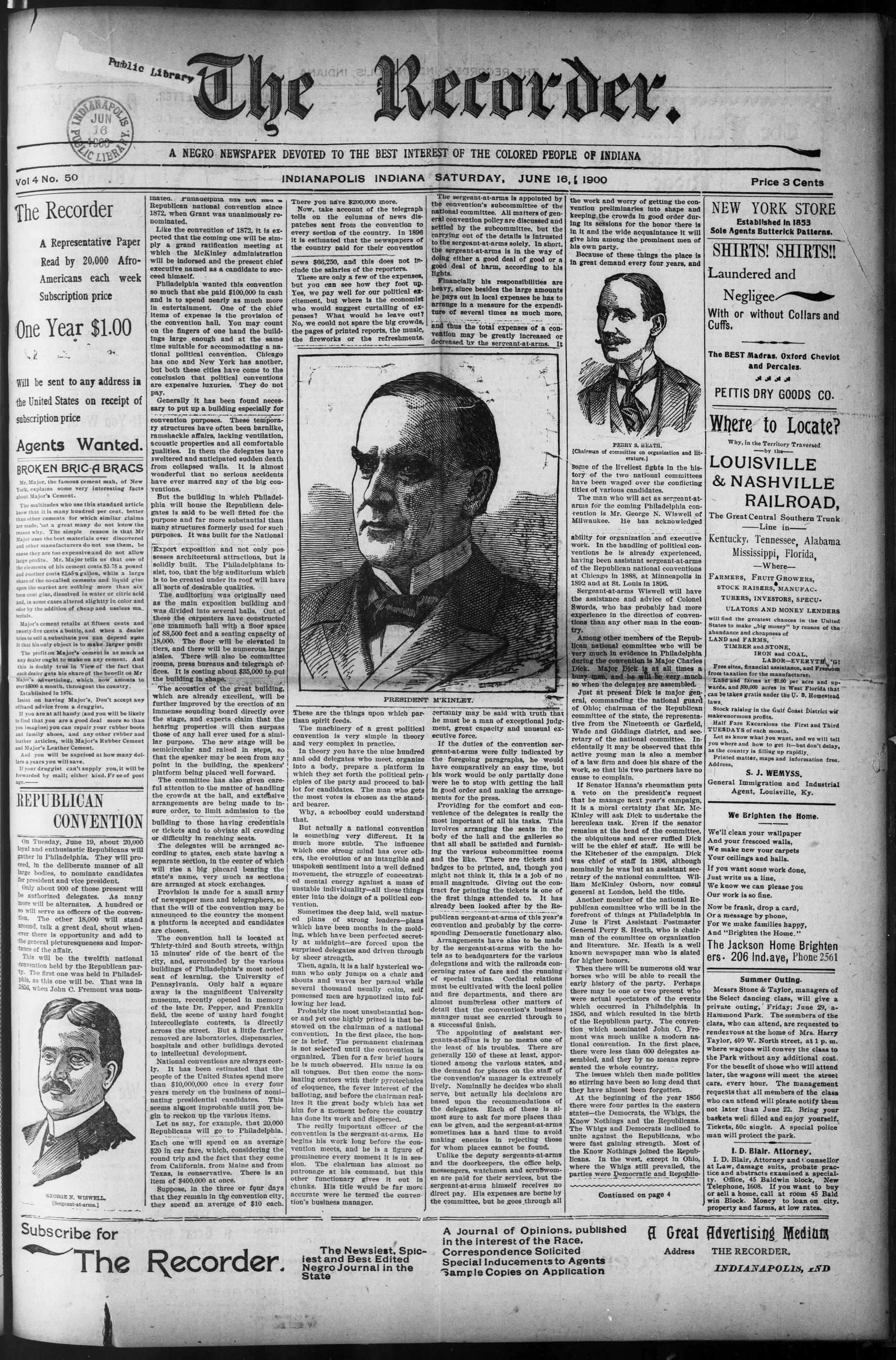
GEORGE N. WISWELL.
A NEGRO NEWSPAPER DEVOTED TO THE BEST INTEREST OF THE COLORED PEOPLE OF INDIANA
inated. Finnadepima has not made Republican national convention since 1872, when Grant was unanimously renominated.
Like the convention of 1872, it is expected that the coming one will be simply a grand ratification meeting at which the McKinley administration will be indorsed and the present chief executive named as a candidate to succeed himself.
Philadelphia wanted this convention so much that she paid $100,000 in cash and is to spend nearly as much more in entertainment. One of the chief items of expense is the provision of the convention hall. You may count on the fingers of one hand the buildings large enough and at the same time suitable for accommodating a national political convention. Chicago has one and New York has another, but both these cities have come to the conclusion that political conventions are expensive luxuries. They do not pay.
Generally it has been found necessary to put up a building especially for convention purposes. These temporary structures have often been barnlike, ramshackle affairs, lacking ventilation, acoustic properties and all comfortable qualities. In them the delegates have swetered and anticipated sudden death from collapsed walls. It is almost wonderful that no serious accidents have ever marred any of the big conventions. But the building in which Philadelphia will house the Republican delegates is said to be well fitted for the purpose and far more substantial than many structures formerly used for such purposes. It was built for the National Export exposition and not only possesses architectural attractions, but is solidly built. The Philadelphians insist, too, that the big auditorium which is to be created under its roof will have all sorts of desirable qualities.
The auditorium was originally used as the main exposition building and was divided into several halls. Out of these the carpenters have constructed one mammoth hall with a floor space of 88,500 feet and a seating capacity of 18,000. The floor will be elevated in tiers, and there will be numerous large aisles. There will also be committee rooms, press bureaus and telegraph offices. It is costing about $25,000 to put the building in shape.
The acoustics of the great building, which are already excellent, will be further improved by the erection of an immense sounding board directly over the stage, and experts claim that the hearing properties will then surpass those of any hall ever used for a similar purpose. The new stage will be semicircular and raised in steps, so that the speaker may be seen from any point in the building, the speakers' platform being placed well forward.
The committee has also given careful attention to the matter of handling the crowds at the hall, and extensive arrangements are being made to insure order, to limit admission to the building to those having credentials or tickets and to obviate all crowding or difficulty in reaching seats. The delegates will be arranged according to states, each state having a separate section, in the center of which will rise a big placard bearing the state's name, very much as sections are arranged at stock exchanges. Provision is made for a small army of newspaper men and telegraphers, so that the will of the convention may be announced to the country the moment a platform is accepted and candidates are chosen.
The convention hall is located at Thirty-third and South streets, within 15 minutes' ride of the heart of the city, and, surrounded by the various buildings of Philadelphia's most noted seat of learning, the University of Pennsylvania. Only half a square away is the magnificent University museum, recently opened in memory of the late Dr. Pepper, and Franklin field, the scene of many hard fought intercollegiate contests, is directly across the street. But a little farther removed are laboratories, dispensaries, hospitals and other buildings devoted to intellectual development.
National conventions are always costly. It has been estimated that the people of the United States spend more than $10,000,000 once in every four years merely on the business of nominating presidential candidates. This seems almost improbable until you begin to reckon up the various items.
Let us say, for example, that 20,000 Republicans will go to Philadelphia.
Each one will spend on an average $20 in car fare, which, considering the round trip and the fact that they come from California, from Maine and from Texas, is conservative. There is an item of $400,000 at once.
Suppose, in the three or four days that they remain in the convention city, they spend an average of $10 each.
There you have $200,000 more.
Now, take account of the telegraph tolls on the columns of news dispatches sent from the convention to every section of the country. In 1896 it is estimated that the newspapers of the country paid for their convention
news $66,250, and this does not include the salaries of the reporters.
These are only a few of the expenses, but you can see how they foot up. Yes, we pay well for our political excitement, but where is the economist who would suggest curtailing of expenses? What would he leave out?
No, we could not spare the big crowds, the pages of printed reports, the music, the fireworks or the refreshments.
M. J. SMITH
PRESIDENT M'KINLEY.
These are the things upon which partisan spirit feeds.
The machinery of a great political convention is very simple in theory and very complex in practice.
In theory you have the nine hundred and odd delegates who meet, organize into a body, prepare a platform in which they set forth the political principles of the party and proceed to ballot for candidates. The man who gets the most votes is chosen as the standard bearer.
Why, a schoolboy could understand that.
But actually a national convention is something very different. It is much more subtle. The influence which one strong mind has over others, the evolution of an intangible and unspoken sentiment into a well defined movement, the struggle of concentrated mental energy against a mass of unstable individuality—all these things enter into the doings of a political convention.
Sometimes the deep laid, well matured plans of strong leaders—plans which have been months in the molding, which have been perfected secretly at midnight—are forced upon the surprised delegates and driven through by sheer strength.
Then, again, it is a half hysterical woman who only jumps on a chair and shouts and waves her parasol while several thousand usually calm, self possessed men are hypnotized into following her lead.
Probably the most unsubstantial honor and yet one highly prized is that bestowed on the chairman of a national convention. In the first place, the honor is brief. The permanent chairman is not selected until the convention is organized. Then for a few brief hours he is much observed. His name is on all tongues. But then come the nominating orators with their proteotechnics of eloquence, the fever interest of the balloting, and before the chairman realizes it the great body which has set him for a moment before the country has done its work and dispersed.
The really important officer of the convention is the sergeant-at-arms. He begins his work long before the convention meets, and he is a figure of prominence every moment it is in session. The chairman has almost no patronage at his command, but this other functionary gives it out in chunks. His title would be far more accurate were he termed the convention's business manager.
The Newsiest, Spiciest and Best Edited Negro Journal in the State
There you have $200,000 more.
The sergeant-at-arms is appointed by the convention's subcommittee of the national committee. All matters of general convention policy are discussed and settled by the subcommittee, but the carrying out of the details is intrusted to the sergeant-at-arms solely. In short, the sergeant-at-arms is in the way of doing either a good deal of good or a good deal of harm, according to his lights. Financially his responsibilities are heavy, since besides the large amounts he pays out in local expenses he has to arrange in a measure for the expenditure of several times as much more, and thus the total expenses of a convention may be greatly increased or decreased by the sergeant-at-arms. It
W. SMITH
certainly may be said with truth that he must be a man of exceptional judgment, great capacity and unusual executive force. If the duties of the convention sergeant-at-arms were fully indicated by the foregoing paragraphs, he would have comparatively an easy time, but his work would be only partially done were he to stop with getting the hall in good order and making the arrangements for the press.
Providing for the comfort and convenience of the delegates is really the most important of all his tasks. This involves arranging the seats in the body of the hall and the galleries so that all shall be satisfied and furnishing the various subcommittee rooms and the like. There are tickets and badges to be printed, and, though you might not think it, this is a job of no small magnitude. Giving out the contract for printing the tickets is one of the first things attended to. It has already been looked after by the Republican sergeant-at-arms of this year's convention and probably by the corresponding Democratic functionary also.
Arrangements have also to be made by the sergeant-at-arms with the hotels as to headquarters for the various delegations and with the railroads concerning rates of fare and the running of special trains. Cordial relations must be cultivated with the local police and fire departments, and there are almost numberless other matters of detail that the convention's business manager must see carried through to a successful finish.
The appointing of assistant sergeants-at-arms is by no means one of the least of his troubles. There are generally 150 of these at least, apportioned among the various states, and the demand for places on the staff of the convention's manager is extremely lively. Nominally he decides who shall serve, but actually his decisions are based upon the recommendations of the delegates. Each of these is almost sure to ask for more places than can be given, and the sergeant-at-arms sometimes has a hard time to avoid making enemies in rejecting those for whom places cannot be found. Unlike the deputy sergeants-at-arms and the doorkeepers, the office help, messengers, watchmen and scrubwomen are paid for their services, but the sergeant-at-arms himself receives no direct pay. His expenses are borne by the committee, but he goes through all
A Journal of Opinion in the interest of the Rail Correspondence Solicitor Special Inducements to Sample Copies on App
A Journal of Opinions, published in the interest of the Race. Correspondence Solicited Special Inducements to Agents Sample Copies on Application
the work and worry of getting the convention preliminaries into shape and keeping the crowds in good order during its sessions for the honor there is in it and the wide acquaintance it will give him among the prominent men of his own party. Because of these things the place is in great demand every four years, and
PERRY S. HEATH.
[Chairman of committee on organization and literature.]
some of the liveliest fights in the history of the two national committees have been waged over the conflicting titles of various candidates.
The man who will act as sergeant-at-arms for the coming Philadelphia convention is Mr. George N. Wiswell of Milwaukee. He has acknowledged ability for organization and executive work. In the handling of political conventions he is already experienced, having been assistant sergeant-at-arms of the Republican national conventions at Chicago in 1888, at Minneapolis in 1892 and at St. Louis in 1896.
Sergeant-at-arms Wiswell will have the assistance and advice of Colonel Swords, who has probably had more experience in the direction of conventions than any other man in the country.
Among other members of the Republican national committee who will be very much in evidence in Philadelphia during the convention is Major Charles Dick. Major Dick is at all times a busy man, and he will be very much so when the delegates are assembled.
Just at present Dick is major general, commanding the national guard of Ohio; chairman of the Republican committee of the state, the representative from the Nineteenth or Garfield, Wade and Giddings district, and secretary of the national committee. Incidentally it may be observed that this active young man is also a member of a law firm and does his share of the work, so that his two partners have no cause to complain.
If Senator Hanna's rheumatism puts a veto on the president's request that he manage next year's campaign, it is a moral certainty that Mr. McKinley will ask Dick to undertake the herculean task. Even if the senator remains at the head of the committee, the ubiquitous and never ruffled Dick will be the chief of staff. He will be the Kitchener of the campaign. Dick was chief of staff in 1896, although nominally he was but an assistant secretary of the national committee. William McKinley Osborn, now consul general at London, held the title.
Another member of the national Republican committee who will be in the forefront of things at Philadelphia in June is First Assistant Postmaster General Perry S. Heath, who is chairman of the committee on organization and literature. Mr. Heath is a well known newspaper man who is slated for higher honors.
Then there will be numerous old war horses who will be able to recall the early history of the party. Perhaps there may be one or two present who were actual spectators of the events which occurred in Philadelphia in 1836, and which resulted in the birth of the Republican party. The convention which nominated John C. Fremont was much unlike a modern national convention. In the first place, there were less than 600 delegates assembled, and they by no means represented the whole country. The issues which then made politics so stirring have been so long dead that they have almost been forgotten.
At the beginning of the year 1856 there were four parties in the eastern states—the Democrats, the Whigs, the Know Nothings and the Republicans. The Whigs and Democrats inclined to unite against the Republicans, who were fast gaining strength. Most of the Know Nothings joined the Republicans. In the west, except in Ohio, where the Whigs still prevailed, the parties were Democratic and Republic-
Price 3 Cents
NEW YORK STORE
Established in 1853
Sole Agents Butterick Patterns.
SHIRTS! SHIRTS!!
Laundered and
Negligee
With or without Collars and Cuffs.
The BEST Madras, Oxford Cheviot and Percales.
PETTIS DRY GOODS CO.
Where to Locate?
Why, in the Territory Traversed
by the
LOUISVILLE
& NASHVILLE
RAILROAD,
The Great Central Southern Trunk
—Line in—
Kentucky, Tennessee, Alabama Mississippi, Florida,
Where
FARMERS, FRUIT GROWERS,
STOCK RAISERS, MANUFAC-
TURERS, INVESTORS, SPECU-
LATORS AND MONEY LENDERS
will find the greatest chances in the United
States to make "big money" by reason of the
abundance and cheapness of
LAND and FARMS
LABOR-EVERYTHING
Free sites, financial assistance, and Freedom from taxation for the manufacturer.
Land and farms at $1.00 per acre and upwards, and 500,000 acres in West Florida that can be taken gratis under the U. S. Homestead laws.
Stock raising in the Gulf Coast District will make enormous profits.
Half Fare Excursions the First and Third
TUESDAYS of each month.
Let us know what you want, and we will tell you where and how to get it—but don't delay, as the country is filling up rapidly. Printed matter, maps and information free. Address.
S. J. WEMYSS.
General Immigration and Industrial Agent, Louisville, Ky.
We Brighten the Home.
We'll clean your wallpaper
And your frescoed walls,
We make new your carpets
Your ceilings and halls.
If you want some work done,
Just write us a line,
We know we can please you
Our work is so fine.
Now be frank, drop a card,
Or a message by phone,
For we make families happy,
And "Brighten the Home."
The Jackson Home Brighten
ers·206 Ind.ave, Phone 2561
Summer Outing.
Messrs Stone & Taylor, managers of the select dancing class, will give a private outing, Friday; June 29, a Hammond Park. The members of the class, who can attend, are requested to rendezvous at the home of Mrs. Harry Taylor, 409 W. North street, at 1 p. m. where wagons will convey the class to the Park without any additional cost. For the benefit of those who will attend later, the wagons will meet the street cars, every hour. The management requests that all members of the class who can attend will please notify them not later than June 22. Bring your baskets well filled and enjoy yourself. Tickets, 50c single. A special police man will protect the park.
I. D. Blair. Attorney.
I. D. Blair, Attorney and Counselor at Law, damage suits, probate practice and abstracts examined a specialty. Office, 45 Baldwin block, New Telephone, 1608. If you want to buy or sell a home, call at room 45 Bald win Block. Money to loan on city. property and farms, at low rates.
Advertising Medium
THE RECORDER,
INDIANAPOLIS, ND
---
The Feud at.... Rattlesnake Ridge. BY M. H. FREDERICK
Most of the mountain people of Kentucky are moral, law-abiding citizens. The feuds which occur, which savor of old feudal customs in Europe, are usually over some injustice or disputed point of honor. This custom has been retained, for the most part, on account of the nature of the surface of the country and the conditions under which the country was settled. Parts of the mountains are nearly isolated from the rest of the world, and hence the people follow the customs of their forefathers, the hunters who first settled the valleys. It is a peculiar fact that the old Scotch ballad "Barbra Allen," and other old ballads, are still preserved in tradition by the mountain people.
But the mountaineers are making rapid progress in education, as well as in other lines, and much of the lawlessness and intemperance of a decade ago is unknown. As in other sections, a few bad men are domesticated in the mountains and it is mostly concerning the deeds of these that the reading public is informed. Of the quiet, uneventful life of the maority, naturally, little is written. So the stories of feuds and occasionally a struggle in the rendezvous of moonshiners, although they may be true, are not representative of the mountain people in general.
To this class belongs the story which I heard, seated on a mossy log in the shade of a tree, with a brook chuckling by lichened rocks behind me and a field of corn in front of me, the tassels of which were filling the light breeze with pollen. I will give the story, which was told by an old farmer, in the narrator's own words:
"My name's Jack Smith; 'Shooting' Jack' they call me, 'cause I us' to beat 'em all at shootin' matches, an 'the like. Well, sir, we us' to have queer times here, sometimes. Whlsky was the main cause o' m' most all the devilment we had. Tattlin' wus another one. My folks an' the Lewises fell out over some land 'bout twenty year ago, an' had a lot of lawin' an' fussin'. We'd get kind o' civil, when some drunkards come along by Abe Lewis' house one evenin' at dark an' scared his wife half to death, a-shoun' 'n' cussin'. Hit wuz so dark she couldn't tell who hit wuz.
"Me an' my brother, Sol, n' Willis Bowlin went across the ridge an' down by Abe's a few days after that. We seed Abe a-standin' humped up over the fence with a big gun under his coat. He wouldn't speak to us when we spoke. That made me mad, but I didn't let on. I reckon I had no business a-gittin' mad, but I couldn't he'p it. When we got nearly by he yelled out:
"‘Ain’t you the sneakin’ scamp ‘at abused my wife t’other day?`
“We told him we weren’t the ones, an’ we ill we did look queer, we wuz so’ took in.
“‘I can tell from yer looks; you’re the very rascals,’ he said.
“Willis is easy nettled, an’ he yelled out fast as a sheep eatin’ fodder: ‘Whoever says I abused your wife’s a _____ liar!’
“‘Don’t you call me a liar,’ says Abe. ‘I’ll let a daylight hole through ye, ef you do. You fellers pull out from here an’ take care ye don’t go up ‘n’ down this branch ag’in.’
“Well, we wanted to keep out o’ trouble, an’ as hit wa'n’t a public road we did pull out at a small pace, after we’d told him ag’in that we never bothered his old woman, an’ to be certain to not pass down this branch, too.
the whole mess wuz all foolishness, 'an' tattlers agitated hit some. Abe wouldn't reason an' we jist let him go. He thought we pestered his wife because we'd all been mad before. Abe had a little store over thar an' Sol put up goods down here. That cut off Abe's trade from this side slick as a button, an' he got mad as a wet hen ef he wuzn't that mad already. "Things kep' a-gittin' stirred up like a hornet's nest till till wuz four or five fellers on a side. "The ridge up here, which wuz betwixt us, is called Rattlesnes nake, because they us' to kill some whippin' big rattlers up thar 'n' somebody started the name. Me an' An did act doggeded funny. I don't reckon c'er a one o' us wuz afeard o' to'ther; but I didn't want to kill Abe 'thout I had to, an' since I've thought hit over. I guess he wuz about the same way by me, for all his bluffin' a 'blowin'.
"Anyhow, when he wanted to come over to this side o' the ridge he'd take 'way 'round this ridge, an' off below here; an' when I wanted to go over to his side I'd go 'round the back of his field.
"They wuz a waylayin' me 'n' Sol an' we wuz a watchin' ferr them. I could 'a' killed Abe twenty times when he didn't see me. He waylaid me an' shot at me once. I've thought since he wuz a-bluffin', but I don't know; the bullet went devilish close to me. The tattiers kep' their tongues a-goin', an' matters didn't get any better. Abe threatened to kill me when he could git his eve on me.
"I took my ol' gun one day, an' said I'd a notion o' goin' a squirrel hantin', I went across the ridge, an' down to a mulberry tree in a thicket, where I thought Abe 'ud pass. He did come along, shore enough, an' I got a good bead on 'im. I drove the center fifty times further 'n that wuz; but he wuz a-ridin' so harmlessly up the road, whis'lin 'Foor Ol Ned' in such a lonese way, that I thought to myself: 'This ain't no way to do; if I don't have to kill him, devil take me if I do. An' I want to deal with 'im face to face.'
"You mayn't believe me, stranger, but I got up from thar when he wuz
out o' sight, an' made tracks for home,
'I got my satisfaction of waylayin'.
"One ticklish p'int o' the matter wuz that my boy Tom and Abe's gal had been thinkin' about gittin' married—they'd been a-talkin' a long time—an' the trouble b'unsted that all up. Hit wuz party tough on 'em; but they had to put up with it.
"One day Abe's brother Buck wuz a-comin' up this branch—had been a-crowin' around some—an' Sol wouldn't let 'im pass. We heard that Abe said he'd 'a' run Sol under the bed an' cut his head off with an ax ef hit been him.
"We kep fussin' along for a year or two. They shot at my brother Lige, who lives on their side of the ridge, an' had him hemmed up in the house one day. We took our guns an' went over that evenin'. I had a rifle; Sol a shotgun, Willis an' ol musket. We could hear 'em a-shootin' an' banterin' an' we set up that whole night. I come in a little o' shootin' mother's ol mare—she wuz runin' outside.
"The Lewises didn't come near us that night, but we met 'em next mornin'. They had some moonshine an' we had some, an' we wuz all half drunk. Sol said to Buck:
"I understand 'at you said you could whip me.'
"I can do it."
"You're a — llar; try it!"
"They didn't shoot, but both grabbed rocks. They tried a few throws an' Sol knocked 'im down. Abe pulled a big pistol, an' wuz almin' at Sol, when I shot him in the arm. I wuz drunk enough to shoot wild. Hit wuz lucky for Abe that I wuz, but ef we'd all kep' sober the fight wouldn't 'a' happened. The bullets whined like mad bees. One feller shot me in the side, an' Sol peppered him with shot. Willis an' another one got scratched up a little, an' then the shootin' stopped. We'd got enough.
"The next thing I knew I wuz stretched out on a bed in a house, an' somebody was a-bathin' my face with water. Hit wuz Ellen, Abe's gal. I looked around an' thar wuz Abe on another bed, an' my boy Tom wuz a-standin' thar too. Hit wuz Buck's house. They said Lige had started after the doctor. I seed Abe didn't look so bad hurt but what he could talk, I said: "We ort to be thankful that we got off this well, I wuz, I reckon." "Yeah! I wuz jist a-thinkin'," says he, 'how all o' us—an' me especially—have acted sich damn fools.' "Maybe we larned some sense,' says I. "I thought you fellers scared 'Liza that time, but maybe I wuz mistaken.'
that time, but maybe I wuz mistaken.
"Never thought o' sich a thing till you named hit. I've found out since who hit wuz; hit wuz Pal Davis and Hi Messer."
"You fellers ort to finish killin' me. I've been the meanest rattler about the ridge, tryin' to bite before I sung. I ort to 'a' talked to you-uns like a man."
"I've been a copperhead,' I said, an' I told him about comin' so near killin' him at the mulberry.
"Whisky wuz the cause o' hit all,' Abe sald, and I agreed with him.
"Tom an' Ellen weren't in the house, but when I looked around I got a glimpse of 'em out on the porch, both lookin' as happy as could be.
"Well, sir, we talked the trouble all over an' all agreed to drap hit an' be good frien's. Sol an' Abe went into the goods business, when we'd all got well, an' I went in with 'em in a login' job. Tom an' Ellen wuz the best pleased couple among us—ef that is sayin' a heap—an' we all had a 'big time' at the weddin'. We've got local option now, an' we're all as friend' as kittens on both sides of Rattlesnake Ridge."—Ogle (Ky.) cor. Louisville Courier-Journal.
Did the Egyptians Play Chess?
Did the Egyptians Play Chess?
Some of the reasons for considering that the Egyptians were acquainted with a game analogous to our chess may be thus stated: Chambers (Encyclopadia, Vol. II, p. 798) remarks that "it may now be considered as certain that * * * a game essentially the same as modern chess was played in Hindustan nearly 5,000 years ago." This immense antiquity makes it easy and natural for the game to have been depicted on Egyptian monuments. Indeed, if anything like this be the antiquity of the game, it would be rather surprising if it did not appear depicted on ancient Egyptian monuments than if it did; and this surprise would be increased by remembering what a great number of various games are found thus commemorated. And when we actually find among them two games bearing analogies to chess and draughts outwardly, it seems reasonable to conclude that such a people as the ancient Egyptians must have known chess—Notes and Queries.
A Slight Error.
Old Lady (to chemist)—I want a box of canine pills.
Chemist—What is the matter with the dog?
Old Lady (indignantly)—I want you to know, slr, that my husband is a gentleman!
(Chemist puts up some quinine pills in profound silence)—London Tit-Bits.
Hit the Truth Accidentally.
Mrs. Young—Bridget, there was a terrible racket in the kitchen last night. If I hear it again I shall have to call on a policeman to stop it. Bridget—Och, mum; th' wuz two o'em 'em—Philadelphia Bulletin.
THE RECORDER, INDIANAPOLIS, INDIANA
SUGAR BEET BELT.
IN THE RECLAIMED KANKAKEE SWAMPS.
Lands Once Almost Continually Overflowed Likely to Become a Source of Great Wealth—Progress of the New Industry.
Monon correspondence of the Chicago Record: If indications do not fail the sugar belt of Indiana will be realized this year. When such is the case it will bring into bloom what was once the wildest waste of land and water that had a place on the Hoosier map. This land of promise is best indicated by a line drawn from Medaryville, Pulaski county, where the sugar belt has its present beginning, toward the northeast, through the neighborhoods of North Judson and Walkerton, small towns in Stark county; through North Liberty and on to South Bend, in all a distance of perhaps 60 miles.
All the way the line will keep within from 10 to 20 miles of the Kankakee River. It will mark a route that was long after the coming of the white man a lonesome stretch of muck and black water—a feeding round for wild water fowls, a hiding place for snakes, an auditorium for cronking frogs.
The Indian knew this country well. It is rich in their history and folklore. The fish in the water, the wild ducks upon it and the game in the thickets attracted them. The white man crowded the Indian out, just as he has backed the water off the fertile soil to the channel of the Kankakee, cut out the thickets and swamp oak and reclaimed a land that is just awakening to its possibilities.
One can drive for miles through the beet-sugar belt and on every hand see evidences of its wasted days. There is mile after mile of flat country, black from a deposit of decayed vegetation left there by the waters when they had undisputed sway. There are small hills and table lands of accumulated sands as yellow as clay banks. Here and there, yet far between, may be seen small swamps, or ponds, across which one can throw a stone. Cattails grow around the edges of these pools and broad blades of grass poke above the water through the center. But these little marshes are passing away, as fast as the reclaimers of the country can cut the ditches to them.
Another indication of the brygone days of the wildness is the swamp oak. These trees still meet the eyes through the beet-sugar belt. Thick forests of them stand today with a heavy undergrowth of brush. There are signs, too, that more than as many as can be seen today have passed away before the settlers' ax, and the singing of the steam-driven saws in the woods indicates that the trees now standing will soon be gone. The swamp oak grows as straight as an arrow to the height of 40 or 50 feet. Around the trunk one can with both hands span the size of nearly every tree. They are being cut into fence posts, converted into firewood for farmers and town people through the belt, and developers of the Medaryville oil field, which occupies a portion of the sugar-beet country, find the swamp oak their only fuel.
Opening up this watered country to cultivation began some 50 years ago, when the land belonged to the government. It gave the almost impenetrable waste to Indiana if the commonwealth would reclaim it and the State gave much of the land to those who would help redeem it. One of the earliest scandals with which the State had to deal grew out of the drainage of this portion of the Hoosier land. Men who undertook to carry out the drainage scheme plowed out short furrows through the bogs, certified that they had carried out their contract and came into possession of thousands of acres. Such redemption was not to the liking of the people who were filling up the country districts of the northern counties and 10 years or more ago each county began its own system of drainage and each one conforming to the undertakings in adjoining counties. The result is mile after mile of open channels have carried the water off to convenient creeks and rivers, lightening the burdens of the Kankakee, which still overflows a section of the State where the drainage system has not been so broadly undertaken.
The ditches have cost many thousands of dollars, and have been built by assessing benefited lands or have been paid out of county treasuries, through general taxation. One of these ditches is almost as wide, is much deeper and carries as much water through the year as the ordinary canal. The newest of the artificial waterways is known as the Monon ditch, which will be completed by next fall, after two years' work with plow, pick and blasting powder. It traverses the country for a distance of 25 miles north and south, and empties its waters into the Tippecanee. From these miniature canals smaller ones of buried tile lead into the fields, and the country has had a spider web of ditches strung through it. Still this work of redemption is not completed. But enough of it has been accomplished to start the sugar-beet belt.
The pioneers of the sugar-beet industry are now planting the seed for the first crop in this State. Three refining companies have coaxed the farmers to experiment with this branch of agriculture. The three companies that have done the promoting of the industry are the Kalamazoo (Mich.) Sugar Manufacturing Company, the Pekin (Ill.) Sugar Company and the Wolverine Sugar Company, of Benton Harbor, Mich. Some of the most hopeful of the growers of the experimental crop can see in their mind's eye a string of sugar-beet refineries that will in time dot the strip of country that is to be cultivated, the coming of the refineries depending upon the success of the farmers as producers of the raw material. The promoters of sugar-beet culture have spent months in the belt inducing farmers to give up portions of the land to growth. But growing the beet is a new business to the Indiana farmer, and some of them have received the promoters as cheerfully as they would the lightning-rod agent. But the beetles are to occupy 2,000 acres—divid-
ed into scattered tracts of from 10 to 100 acres in size—in the belt this year, and each patch of ground that is planted will be used as an object lesson in taking hold of the idea.
The sugar-beet must have its own kind of soil for growth and it is believed that the richer soil of the Kankakee fits its requirements. Ages ago the water bringing the black loam and fine said that compose the soil seems to have begun preparation for this new industry. Where the test fields are located, as well as in adjoining lands where the crops may hereafter grow, this particular soil reaches to a depth of from two to three feet, giving the sugar-beet free sway in a straight down growth. One of the plats of ground which is to be used as an object lesson, as well as marking the belt in Pulaski county, is a 40-acre tract belonging to E. T. Mudge, of Homer, Ill. The field is within sight of the Medaryville church spires. Around it are thick forests of the swamp oak. Mr. Mudge had been "preaching" on the sugar-beet county to other Pulaski and Jasper county farmers for months, and he has been as particular in the preparation of his 40-acre field as a woman would be in a flower bed. The ground plows easily and the implements that will prepare a corn field have ground the soil in the tract until it is almost without a clod. If his crop is successful Mr. Mudge says his 40 acres will give him a profit of $4,000 a year. The field is planted in rows 18 inches apart. The seed has been drilled in with eight or 10 inches of space between so that each beet may have freedom in which to grow. Forty-three thousand beets may be grown to the acre. It is a small beet that will not weigh a pound, and Mr. Mudge calculates that his field will produce from 20 to 22 tons to the acre. The cost of cultivation will be $20 an acre, and the net profit should be, if all goes well, from $68 to $70 an acre. The refining companies pay $4 a ton for the beets when they are delivered to the cars at the shipping point.
In Pulaski county crude petroleum has lately been found and has created a new excitement. The wells are sunk but 150 feet, and a fine quality of crude petroleum is found, and it is felt that this oil can likely be found in any part of the Kankakee valley. This is bringing hundreds of people to this belt, and is adding immensely to the price of land. The land that but a few years ago was worth on the market but $5 an acre, sold last year at from $50 to $60 an acre, and is now held at from $75 to $100. So the wastes of a comparatively short while ago have become among the most valuable territory in the State, and the future of no section is more promising than that of the "beet belt."
Mamma—Why did you let him kiss you?
Daughter—Well, he was so nice; he asked me—"
"But haven't I told you you must learn to say 'No?'"
"That's what I did say. He asked me if I'd be angry if he kissed me."
—Troy Times.
Of No Interest to Him.
"I am told that the government levies no tax on alcohol for use in the arts," said Whitfet. "That is trice," added Gazzam, "but the fact cannot interest you, since painting the town is not considered art within the meaning of the law."—Detroit Free Press.
He Was Not a Clown
She said she called me the 'gown'.
Miss Peppery—How ridiculous of her!
Cholly—Wasn't it?
Miss Peppery—Yes. Why, the clown in the modern circus is a man of unusual intelligence, who commands a splendid salary—Philadelphia Press.
Self-Deception".
"What is self-deception? 'asked the boy.
"Well," replied the old gentleman, thoughtfully, "it is self-deception when I try to convince myself that your mother believes my story of being detained at the office on business."
—Chicago Evening Post.
The Connoisseur's Conscience.
"This is the oldest glass lamp in existence."
"How do you know?"
"Don't be so inquisitive; a man who collects curios is bound to have some interesting data connect* with each one."—Chicago Record.
Discouraging.
man, my dear. You are too heavy. Husband—But I thought I was sufficiently nonsensical and unintelligent at the reception today. Wife—Ye-es; but you were so self-conscious about it. The Smart Set.
Fair Warning.
The Husband—My dear, I hear that Mr. Highflyer is flirting with you.
The Wife—Well, what of it?
The Husband—Oh, nothing. Only, when he gets tired of it, don't come to me and expect to be sympathized with.
—The Smart Set.
The Length of It
"Has the giraffe been sick long?" asked the veterinary surgeon, as he entered the park enclosure. "Yes," replied the keeper, "I should say it was racher long. He has a sore throat." -Chicago News.
Counting the Cost
Maude—They say the count to whom Gladys is engaged is a worthless sort of fellow.
Clara—Yes, I imagine he is worth less than her father paid for him.—Chicago News.
Qualified.
"Do you know anything at all about drilling?" asked the sergeant.
crumbled. I asked the sergeant, "What
thank you?" "I replied the raw recruit. "I warked in a quarry for money years befoer I tjaud th'army."—Philadelphia Press.
Hon. W. V. Sullivan, U. S. Senator from Mississippi.
Hon. W. V. Sullivan, United States Senator from Mississippi, in a letter recently written to Dr. Hartman from Oxford, Miss., says the following:
"For some time I have been a sufferer from catarrh in its most incipient stage, so much so that I became alarmed as to my general health. But, hearing of Pe-ru-a as a good remedy, I gave it a fair trial and soon began to improve. Its effects were distinctly beneficial, removing the annoying symptoms, and was particularly good as a tonic.
"I take pleasure in recommending your great national catarrh cure, Pe-ru-a, as the best I have ever tried.
"W. V. Sullivan."
Peruna catarrh wherever located. Peruna has no substitutes—no rivals. Insist upon having Peruna. Address The Peruna Medicine Co., Columbus, O., for a free book on catarrh.
ABSOLUTE SECURITY.
Genuine Carter's
Little Liver Pills.
Bentwood
See Fac-Simile Wrapper Below.
Very small and as easy
to take as sugar.
CARTER'S
LITTLE
LIVER
PILLS.
FOR HEADACHE.
FOR DIZINESS.
FOR BILIOUSNESS.
FOR TORPID LIVER.
FOR CONSTIPATION.
FOR SALLOW SKIN.
FOR THE COMPLEXION
Price
25 Cents
GENUME
MUST HAVE SIGNATURE.
Purely Vegetable.
CURE SICK HEADACHE.
THE MUSEUM
HOTEL EMPIRE
Broadway and 63rd street. N. Y. City.
But two blocks from 6th and 9th Avenue Elevat-
ed stations.
All street cars pass the door. Only ten minutes
from center of amusements and shopping district.
New Building.....Strictly Fireproof
Newly and beautifully equipped.
Perfect Cuisine.....Efficient Service
Patronized by the best people only.
Fine Library.....Splendid Music
Desirably and conveniently located.
Send postal for descriptive booklet
and rate card.
W. JOHNSON QUINN, Proprietor.
CHICAGO
MONON ROUTE
BROOKGATE, NOVADEUS & ONVILLE, MARYLAND
From Monon 47th Street Station, Chicago is but five minutes ride by street car to Union Stock Yards.
Office, 25 W. Washington St.
R. P. ALGEO, D. P. A.
Indianapolis.
DROPSY NEW DISCOVERY; gives quick relief & cures worst cases. Book of testimonials and 10 DAYS' treatment FREE. Dr. H. M. Groom's Sonn. Bag & Atlanta, Ga.
Do You Know
THAT
THAT
THE RECORDER
Is Prepared to do all kinds of Job Printing on short notice? We can make anything from a Bill Head, Letter Head, Minutes, Dodgers, Tickets, Business Cards, Visiting Cards, Book or Newspaper,
In fact, everything in Job Printing We make a specialty of first-class Job Printing
If you want anything done and are too busy to call, drop us a postal or call telephone 561.
If-You Want any kind of Printing done let us know.
If you have anything to advertise send it to The Recorder.
If you have a house to rent,
If you have a room to let,
If you want a situation,
If you want to sell anything,
If you want anything,
Advertise in THE RECORDER
We Want your subscription,
your advertisement,
We want you to buy the paper.
We want a large number or
Newsboys to sell the paper,
We don't want much but we
want to give you the best for your
money.
Send Us your news,
Send Us your news,
word what your
church is doing.
Send us what your lodge in doing,
Send us what your club is doing,
Send us word what you are doing,
and we will be glad to publish it.
Tl.2 Recorder belongs to no party.
The Recorder belongs to no faction,
The Recorder belongs to no sect.
The Recorder belongs to no denomination.
The Recorder belongs to the people and it represents them.
We Want your trade,
your patronage
We want your encouragement;
We want your co-operation;
We want you to assist us in mak-
ing The Recorder what it really is,
the greatest, the most newsy, and
the best Negro journal in the State
If You Want to know any more,
call or address
The Recorder,
INDIANAPOLIS, IND
```markdown
```
STATE RESOURCES.
INTERESTING ANNUAL REPORT OF STATE GEOLOGIST.
Much Valuable Information Concerning the Deposits of Oil, Natural Gas and Coal.
The twenty-fourth annual report of the Indiana department of geology and natural resources has been issued by State Geologist W. S. Blatchley. The feature of the work is a report on the natural resources of the State.
In area of square miles Indiana ranks thirty-fourth among the forty-five States of the union. On Jan. 1, 1899, the State stood sixth in the production of coal, fourth in the production of petroleum, second in the production of natural gas, seventh in the production of building stone and sixth in the value of her clay products. The total value of the five leading mineral resources produced in the State during 1898 was $17,409,715.
The natural fuels of Indiana are three in number—petroleum, natural gas and coal. The main petroleum field is located in Adams, Jay, Blackford, Wells and Grant. The field extends from the Ohio State line to Marion and averages about twelve miles in width. Outside of the main fields isolated pools or small areas of Trenton rock productive of oil are found at Peru, Miami county, near Keller's station, Wabash county; at Alexandra, Madison county, and Broad Ripple, Marion county. Oil has been found in the coniferous lime stone at Terre Haute, Petersburg, Pike county, and near Medaryville, Jasper county.
Concerning the oil industry, the report says:
"During the year 1899 there was greater activity in oil operations in Indiana than in any year since 1896. On Jan. 1, 1900, there were 4,338 wells producing oil in the State, as against 3,628 on Jan. 1, 1899, a gain of 788 for the year. The number of wells abandoned in 1899 was 247, while the number of dry holes drilled during the year was 105. The prospects for 1900 are very bright.
"The total production of petroleum in Indiana in the year 1899 was 3,818,713 barrels, which, at the average price of 87% cents per barrel, amounted to $3,341,374. Compared with 1898, this was an increase in production of 67,406 barrels, or 1.7 per cent. Owing, however, to the much higher average price, the amount received was $113,638, or, approximately, 50 per cent, more than in 1898, and $341,374 more than in any year since oil was discovered in the State.
"Natural gas occurs in greater or less quantity in an area approximating 2,500 square miles in the eastern and central part of the State. In the field on Jan. 1, 180, the pressure was 325 pounds. On Jan. 1, 180, it was 155 pounds. As the supply of gas is shut off when the pressure gets down to about 120 pounds it will be seen the future of the natural gas in the State is not a promising one.
"During the year 1899 there was a great increase of activity in the coal regions of Indiana. The output from the mines was far greater than in any previous year. Many hundred of acres of the best coal deposits changed hands, having been secured by parties having large capital to invest. The coal deposits of the State cover about 7,500 square miles, of which between 6,000 and 7,000 square miles are underlain by coal. They are confined exclusively to the southwestern part of the State. All told, there is estimated to be forty billions of tons of coal in the State, of which one-fifth is estimated to be workable under present conditions. In 1899, 5,855,123 tons were omitted, an increase of 688,079 tons over the output of 1888."
BRITISH VICTORIES.
GEN. BULLER IN POSSESSION OF LAIING' OF NEK.
The Destroyed Railway Line Being Rapidly Repaired—Buller Lacks Water.
London, June 13.—3:20 a. m.—Two pieces of news encouraging to the British in the official dispatches are that the broken communications of Lord Roberts are in a fair way to be mended by the forces moving northward and driving off the roving commandees, and that Sir Redvers Buller is at last master of Laing's nek. Telegraphic communication with Lord Roberts is expected to be restored to-day, as a dispatch from Bloemfontein, dated yesterday. The railway is in British possession again and that the work of repelling the line is going on rapidly, with the abundant material warehoused at Bloemfontein.
From the subjoined telegram it would appear that General Hunter was in command of the troops referred to by General Kelly-Kenny in his dispatch from Bloemfontein: "General Hunter is coming up rapidly from the northwest, having severely defeated a large commando of Boers who had destroyed two miles of rail north of Kroonstad."
The Boer government is also issuing news cheering to its sympathizers. The following bulletin, the Boer version of the disaster to the Derbyshires, was posted by President Kruger, on Sunday, at Machadodorp: "On June 7 four divisions of burghers, commanded by Steenkamp, Froneman, Duploy, Fourie and Nel, attacked the British at Roodeval, killed 200, took 700 prisoners and captured immense stores of food and ammunition—a Maxim gun and 1,000 lyddie shells. Some food was taken by the Boer farmers and the rest was burned. The English mail was taken. The burghers attacked from the open veldt and gave evidence of unprecedented bravery."
General De Wet was also fighting on June 2, whether at Roodeval or elsewhere is not clear, but the Boer office gives it out that he captured 3,000 suits, boots, etc. Being unable to carry them with him in his rapid sweep through the country, according to the Transvaal war office, he burned the whole mass. General De Wet has also reported that he put 1,000 British out of action and destroyed property valued at £100,000. As Lord Methuen is officially described as fighting on June 7, it is possible that he was engaging General De Wet.
According to a dispatch to the Daily Express from Machadodorp, dated June 16, via Lourenzo Marques, those around President Kruger say that Louis Botha and Delray have been offered indirectly $10,000 a year to lay down their arms, and
President Kruger expects the same offer to be made to himself, President Steyn and De Wet. President Kruger believes that the British make these offers to close the war on the principle that it would cost less than to fight it out.
A dispatch from Lorenzo Marques says 15,000 Boers are reported to be retiring on Middlesbury from various quarters, and that, after weeding out the faint-hearted, 20,000 steadfast men are still left. General Buller was unable on Monday to follow up the Boers from lack of cavalry as well as water. The dispatches describe him as fighting a spiritled advance over a rugged field under prolonged rifle fire. The Boers had two guns, which they got away. Few dead or wounded Boers were found. It seems probable that the major portion of the Boers had with-drawn before the advance began.
BOXERS KILLED.
SIXTEEN BRITISH MARINES
ATTACKED BY CHINESE.
A Running Fight Follows in Which About Forty of the Pig-Tailed Heathen Are Killed.
London, June 13.—4:42 a. m.-Sixteen British marines reconnoitering in advance of the international column marching to Peking fought and chased two thousand Boxers on Monday, killing twenty or thirty. A correspondent accompanying the column, in a dispatch, dated Tlen-Tsin, June 12, via Shanghai, June 13, 6:15 a. m., says:
"While the working parties, accompanied by a patrol of sixteen British marines, commanded by Maj. Johnson, were repairing the line on Monday afternoon, eight miles beyond Lofn, they encountered small parties of Boxers who were destroying the line. The Boxers moved away from the advanced marines and apparently dispersed into the country, leaving the rails moved and sleepers burning. The marines when two miles in advance of the first train near Lang-Fang suddenly perceived Boxers streaming from a village on their left. It was estimated that they numbered two thousand, some of them being mounted, and they were trying to get between the marines and the train. Most of them were armed with spears and swords. A few had firearms, which they handled awkwardly. The marines retreated, keeping up a running fight for over a mile and killing between twenty and thirty Boxers. The Boxers pursued the British for some distance. Then seeing more marines from the train coming to their assistance, Major Johnson's sixteen halted and poured a heavy continuous fire into the crowd, driving them across the front of the reinforcing blue jackets, who punished the Boxers severely with Maxims. The Boxers fled and the Europeans, following up their success, cleared out two villages. The total loss of the Boxers is estimated at forty killed and wounded. Seven of their wounded were attended by British surgeons. The British loss was nothing."
THE ST. LOUIS STRIKE.
What It Has Cost in Loss of Life, Money and Other Ways.
St. Louis special: The street railway strike has been in progress thirty-three days. Since the first day there have been numerous encounters between the strikers or their sympathizers on one side and the authorities on the other. These encounters have resulted in ten fatalities and the wounding of at least fifty persons. Here is an interesting review of the havoc of the strike:
Persons killed 10
Made insane by strike 2
Persons shot 57
Persons injured 167
Children shot 8
Loss to city in trade $22,500,000
Loss in wages to employees $500,000
Loss to car company in fares $600,000
Number of strikers 4,000
Number of women and children depending on strikers 20,000
Police on duty 1,000
Special policemen 500
Posse comitatus 2,500
Cars wrecked 75
Women passengers beaten 9
Women stripped in street 3
QUADRUPLE TRAGEDY.
Four Members of a Household Murdered and Their Home Burned.
West Newfield, Me., special: George W. Goodwin and three members of his household were murdered Monday night and the house in which they lived set on fire by the murderer, whose motive was presumably robbery. The dead are George W. Goodwin, his mother, Mrs. Elsie R. Horne, Scott Goodwin, 20 years of age, and a hired man, Fred Bertsch. The bodies of all four were recovered from the ruins of the house and two of them, those of Mrs. Horne and Bertsch, gave every indication that they had been fouled murder. Suspicion rests on a farm hand named Champion, who had been in the neighborhood. Goodwin sold a piece of woodland recently for $2,300. Neighbors say he did not put the money in the bank and they think this prize induced the murder.
DISASTER AT ROODEVAL.
A Battalion of Derbyshires All Killed, Wounded or Captured.
London, June 11—Lieutenant General Sir Frederick Forestier-Walker, in command of the lines of communication in South Africa, reports that in the disaster to the British troops, June 7 at Rodeval, where the Boers cut Lord Roberts's line of communication, the Fourth battalion of the Derbyshire regiment were all killed, wounded or made prisoners, except six enlisted men. Two officers and fifteen men were killed and five officers and seventy-two men were wounded, many of them severely. The Boers returned the wounded to the British. The officers killed were Lieutenant Colonel Baird-Douglas and Lieutenant Hawley. The wounded include Colonel Wilkinson and Lieutenant Blanchard, of the Canadian Infantry.
Death of Belle Boyd:
Kilbourne, Wis., special: Belle Boyd, the famous spy of Confederate fame, died suddenly of heart disease here Monday night, aged 57 years. She had come here to lecture.
THE RECORDER, INDIANAPOLIS, INDIANA
GROWING WORSE.
PHILIPPINE CONDITIONS CONTINUE UNSATISFACTORY.
Gen. Mac Arthur Has to Fight a Secret Or- ganization That Amounts Almost To a Government.
Manila, June 10.—"If we were fighting an army the work would be comparatively easy," said General MacArthur, in speaking of the situation which confronted him when he assumed the office of Governor General. The report had come from General Young that Tinio and Aguinaldo were gathering a force in the Benguet mountains where they had been hunted and scattered five months before. The military were hoping that Tinio would form another army, because an army can be located and followed, and if it will try to make a stand can be defeated, but so good fortune is improbable, for one reason that the Americans are so disposed, covering most of the important roads and passes, that it would be impossible for more than a few hundred Filipinos to attempt to assemble without many of them being discovered, and, he added, for another reason, that the Filipinos have learned that they can handle the Americans' progress more effectively by irregular operations.
As it is, General MacArthur has to fight a secret organization which amounts to almost a government that exercises power to some extent and enforces its decrees over all of Luzon and most of the islands, which collects taxes here in Manila and even gives receipts for duties paid on the cargo of native boats passing up the rivers in the suburbs. The control of this underground organization is reputed to be in the hands of a junta, whose headquarters are in Manila, but so great is the loyalty, or fear which it commands that the authorities have been unable to trace its roots, and the question whether it is identical with the famous Katipunanam Society is an open one. Many of the elections of municipal governments held by the American officers are controlled by the revolutionary organization which selects the candidates and some of these governments are unquestionably efficient parts of its machinery. Probably the men who are directing the guerrilla activity in the towns know no superior except the general who has authority in their province, although they may believe that Aguinaldo is still the supreme head in fact as he is in the minds of the populace.
The theory that the Filipinos outside of the Tagalog provinces were friendly to American rule has been deeply shaken by recent events. All of the northeastern coast beyond Dagupan is in a state of war and there are frequent fights with heavy losses to the Filipines. All of the southern provinces inhabited by the Vislayans are also turbulent and in the Camarines, Nueva Carcese and Albay provinces the Americans control only the territory within the picket lines of the garrisons in the coast towns, while these garrisons are the objects of frequent attacks from large insurgent forces.
Throughout much of the Philippines the same sort of destruction and terrorizing prevails that Cuba saw before the American intervention. The peaceful native, rather than the armed insurgents, bear the brunt of the suffering. In this sort of struggle for the mastery of the people the insurgent holds the biggest cards. They do not hesitate to burn a house wherein rice or shelter has been given to Americans, nor to cut the throat of a head of the family who has informed upon their movements. Americans, on the other hand, are more sort-hearted and the most a native caught by them alding the guerrillas expects is a few well-fed years in a comfortable prison, which is no dishonor. How long the present conditions may continue is a discouraging question.
AN EVANGELIST KILLED
He Was Shot After Having Killed Frank Carey, Who Had Arrested Him.
At Carmel, Ind., Friday evening, "Cyclone" Johnson, a traveling evangelist, was killed by an unknown man. Johnson had been in Carmel for about three weeks preaching in a tent. His talks were filled with abusive attacks upon citizens, and many personal allusions were made. There was much ill feeling against him, and though his meetings were well attended, there were but few who were in sympathy with the ideas advanced by him and his manner of conducting religious services. So bitter was the feeling that personal assaults were looked for at most any time, and there was much excitement when it became known that Johnson had a pistol and had declared that he would use it if necessary. On Thursday, during the meeting, shots were exchanged between Johnson and a young man who had taken offense at charges made by Johnson against him and his friends. Friday the feeling against Johnson became stronger, and Frank Carey was deputized to arrest him. He did so amid great excitement, and Johnson was taken to Jeffries's livery stable where, without warning Johnson drew a revolver and shot Carey, killing him. A large crowd followed them to the stable, and there were many friends of Carey, and one of them quickly avenged the death of the young man by shooting Johnson and killing him almost instantly. The quiet little village was thoroughly aroused, and, while there was no sympathy for Johnson, there was much sorrow at the death of Carey.
EUROPEAN DEMANDS
Orders on Hand sad In Sight Will Keep Our Mills Running For Ten Years.
New York special: The Federal Steel Company is now turning out rails for the trans-Siberian railway, and contracts representing about $15,000,000 are to be let for steel and iron needed in Russia. Chief Engineer Kajvnikoff, of the trans-Siberian railroad, is here to purchase rails, electrical equipment, locomotives and steel cars.
It is expected that the British government will, within a month, begin to let large steel contracts in this country for the Cairo-to-Cape railway, the pet, project of Cecil Rhodes. It is said that John W. Gates went to Europe to obtain these contracts for the American Steel and Wire Company. The Federal Steel Company also has an agent in London to bid in the contract.
According to Wall street steel expert.
the foreign demand for American rails
will be sufficient to keep the great steel
company busy for ten years.
The Russian government is preparing
to negotiate a loan on Wall street. It is
expected to be about $50,000,000. It is
wanted to complete some of the great
railway projects. Wall street is fully
prepared to raise the money.
Chancellor of the Legation at Feking Killed by the Empress's Guards.
London, June 13, -5:20 a. m.—The Times in an extra edition publishes the following dispatch from Peking, dated June 12, 2 p. m.:
"The chancellor of the Japanese legation, Sugiyama Akira, while proceeding alone and unprotected on official duty, was brutally murdered by soldiers of Tung Fub Stang, the favorite bodyguard of the Empress, at Manigate railroad station yesterday. The foreign reinforcements are daily expected. The present isolated position of Peking, the destruction of foreign property in the country and the insecurity of life are directly attributable to treachery of the Chinese government."
BOLD BOERS.
TWENTY-ONE MILES OF RAIL WAY DESTROYED.
Army at Pretorin in Danger of Starvation—Roberts's Operations Likely to be Indefinitely Delayed.
London, June 10.—General Sir Forestier-Walker wires to the war office from Cape Town, under to-day's date as follows: "Information received from natives early yesterday (Saturday) reports the enemy in three columns near Honing spruit. The railway has been almost completely destroyed between America and Roodeval."
London, June 10.—The war office has received the following dispatch from Sir Redvers Buller:
"Headquarters in Natal, June 10.—With reference to my telegram of June 8. We halted yesterday to get our trains up the pass, which is very steep. I found the enemy were about 2,000 strong, in a very carefully prepared position which they must have been very disheartened not to have held longer than they did. They have all retired about twenty-six miles to northwest. I found our casualties were more than I at first thought. They were one officer wounded and two men killed and thirteen wounded."
London, June 11.—3:20 a. m.—The Boers have torn up twenty-one miles of Lord Roberts's vital line of railway between America Siding and Roodeval. It is a bold raid and vexatious, but it does not disquiet the military authorities as yet, for they expect General Kelly-Kenny to drive off the mauraders and reopen the line. The rapidity of the advance of Lord Roberts can not have permitted him to accumulate large reserves of stores. Therefore an interruption of the railway even for a week, must embarrass the army and may bring the forward operations to a standstill.
Nothing has been heard from Lord Roberts for three days. This raid on the railway, the strenuous opposition to General Rundle and the nimble escape of Commandant General Botha's division have forced the war office observers to the reluctant conclusion that the war is not yet over, although even the occasional civilian Boer sympathizer can not see how the Boers will be able to do anything to change the result.
General Buller is in Boer territory. Dispatches of correspondents with him, filmed yesterday at sunset, describes the corps as camping at Ganseloel, close to the point where the frontiers of the Free State, the Transvaal and Natal meet. "The British marched eight miles yesterday," says a Reuter correspondent, "before encountering any opposition. The Boers, who had one gun, withdrew under heavy ordnance fire to a ridge just ahead of the camp."
This long range, running skirmish will doubtless be renewed this morning. General Buller is expected to make rapid progress now, and to throw the weight of 20,000 men into Lord Roberts Transval combinations. The fighting on June 6 in which there were fewer than twenty casualties, was kept up all day long by musketry and artillery. The British attacking line, three miles in length, made its way amid the precipitous hills. A Boer gun on Spitz Kop fired shrapnel rapidly, at a range of four hundred yards, at the British right flank, but every shell was buried in the ground before bursting. The defensive power of modern weapons seems less effective in rough country than upon levels, where wide spaces can be covered with flat tractories.
BICYCLIST'S BOLD RIDE.
Cross a Vinduct on a Stone Coping Twelve Inches Wide at a Height of 300 Feet.
Binghampton, N. Y., special: Henry Wesson and Elbridge Hart, two New York tourists, hold the record for riding the Erie viaduct at Lanesboro. It was the result of a wager. The viaduct is over a quarter of a mile in length and stands 200 feet from the ground. It is used by the Erie and is not designed for passengers. A stone coping twelve inches wide runs along the outer edge, unguarded by rail or anything else. Within the past two years many persons have fallen from the structure, striking the rocks below. Wesson and Hart were making a bicycle trip from Buffalo to their homes in New York and when Lanesboro was reached Hart dared Wesson to ride the structure, supposing he could go between the rails. When it was found that the outside coping was the only place available he tried to back out, but Wesson laughed at him and wagered $ that he dared not ride there. Thereupon he started across on his wheel, Wesson following. Down in the valley a breathless crowd watched the exploit, for the slightest wabble would have dashed both to their death, or an approaching train would have shaken them off. They arrived at the other side, however, both in a cold sweat and badly scared. They declared that all the gold in the country could not induce them to repeat the performance.
Cincinnati special: W. D. Bender, speculator and miner, who died in the College Hill Sanitarium, destroyed $43,000 worth of government bonds before his relations could interfere. Bender resided with his sister, Ella Giffen. He accumulated a fortune in California, and, being a bachelor, returned home to spend the remainder of his life in case. He became violently insane six months ago and William Goodall, Jr., was appointed guardian. Search was made for bonds Bender possessed. Bender learned of the search and threw the bonds into the fire. The property is lost because the bonds were not registered. However, he left $13,000 in bonds untouched.
Leech Lake Indians in Great Disorder Due to Llquor-A New Leader Appears.
St. Paul, Minn., special: The fact that the Indians on the Leech Lake reservation were not disarmed at the time of the trouble a year ago last fall, but have retained the Winchesters with which they made war on the whites, has kept the people of Walker apprehensive, and it now looks as though trouble was assured. A citizen of Walker, who left there Friday evening, gives the following version of the situation:
"The present disorder among the Indians is due to liquor. A week ago Saturday night a party of bucks broke into a beer house and stole two cases and two kegs of beer, a half barrel of brandy, a keg of wine and a case of seltzer. The seltzer, however, was found a short distance away in the woods. As soon as the fire water took effect the Indians began to get ugly. A bright young fellow, Day Dug Guance, saw a chance to make a play to elevate himself in the community. He said he had had a dream in which the Great Spirit appeared to him and told him that a great wind was soon to sweep all white folks on the earth and the only safe place for the Indians would be Squaw Point. They immediately began moving to Squaw Point, and when I left Friday evening I should judge a couple of hundred had gathered there and were intrenching for the big blow. Capt. Mercer of the Seventh Cavalry, who is acting Indian Agent, stood the proceedings till Wednesday evening, when he sent out Indian police and gathered in Day Dug Guance, who, finding his story going so well, had by this time declared himself the Messiah for whom the Indians had been waiting. The only security for the whites is a good-sized force of soldiers stationed within easy reach."
SENATORS FIGHT
Personal Encounter in the Cloakroom of the Senate Over Bad Faith at Sloux Falls.
Shortly before the adjournment of Congress last week, Senator Allen, of Nebraska, in the Democratic cloak room, made some very free and frank remarks, addressed to Senator Butler, of North Carolina, concerning the latter's alleged violation of an agreement that there should be no nomination at the Sloux Falls Populist convention for Vice-President. The remarks fitted Senator Pettigrew, of South Dakota, apparently as well as Butler, and he took the matter up. Allen then denounced Pettigrew as a "traitor." Pettigrew resented the reproachful term, and the two Populistic statesmen clinched. Friends interfered before any blows were struck, and there the affair ended for the time being. The trouble grew out of the nomination of Charles A. Towne for Vice-President by the Sloux Falls Populistic convention. It seems that an understanding existed between Allen, as Bryan's nearest friend, and Butler and Pettigrew. It is now charged that Butler and Pettigrew repudiated the understanding and helped to nominate Towne, thereby disarranging the plan.
RATHBONE'S TROUBLES.
Many Munice People Seem to Have Profitf
ed From His Confidence in Neely.
Havana cable: The troubles of Estee C. Rathbone, former director of posts, seem to be increasing. The auditor's department has thrown out $15,000 worth of vouchers, including $3,000 worth of bills, which have been paid twice, most of them at Muncie, Ind. The Fidelity Company has been notified that it will be held responsible on Mr. Rathbone's bond. Mr. Miller, the manager of the company, and Mr. Rathbone have field prolonged interviews during the last few days, but no decision has been arrived at regarding this new aspect of the situation. The authorities command that the Fidelity Company is responsible. Mr.' Rathbone's friends insist that C. F. W. Neely deceived Mr. Rathbone, who signed at Neely's request without knowing what he was signing.
HIS HEAD FULL OF WATER.
Death of a Boy Whose Skull Was Abnor-
mally Developed.
Toledo, O., special: James McNeely, a 13-year-old boy, of Avondale, died Sunday after prolonged suffering from enlargement of the skull, his head measuring thirty and one-half inches in circumference. When the skull was opened at the autopsy the physicians were surprised to find that it enclosed five and one-half quarts of fluid as clear as crystal. The brain, instead of being solid, was hollow and in the interior was this fluid. The skull was a mere shell of scarcely a sixteenth of an inch. Young McNeely was unusually bright. In fact, he was further advanced in this respect than most boys of his age.
A Frightful Wreck.
Providence, R. L., special: A frightful accident, resulting in the loss of four lives and the injuring of twenty-six persons occurred on the Oakland Beach electric road at noon Sunday. Two cars met in a head-on collision on a sharp curve. The car coming toward the city telescoped the down-trip car, crashing its way through to the fifth seat. Four persons were killed and twenty-six seriously injured.
The proceedings of the House Wednesday were without incident until late in the day, when Mr. Cannon made some sensational charges against Hydrographer Todd, of the navy, which resulted in the rejection of the conference report on the naval appropriation bill, relating to ocean surveys. This brought about a deadlock between the House and Senate, and the final adjournment of Congress was postponed. At 10:20 p. m. the House took a recess until 10 o'clock Thursday.
on the Senate Wednesday the conferences on the naval bill reported a disagreement, and the Senate was told plainly that the House would not consent to the amendment providing for an armor plate factory to be operated by the government. A compromise proposition was presented by Mr. Penrose, and after an hour's debate was finally adopted by a vote of $3 to $5. The discussion of the proposition developed an unusual bitterness of feeling and charges of robbery and political corruption were hurled about the chamber with an abandon which, if they had not fallen from the lips of grave Senators, would have been regarded as reckless. Little worse ever was heard in the heat of a political campaign. Three o'clock, the hour agreed for final adjournment, was passed, and still the Senate wrestled with the armor plate question. When the Penrose proposition finally was agreed to it was supposed the way was clear, but another disagreement and the Senate took an adjournment until 11 o'clock Thursday.
When the House reconvened at 10 o'clock Thursday it was still Tuesday, under "legislative fiction." Conferences not being able to report on naval bill, House adjourned until 12 o'clock. At noon legislative day of Thursday began. Mr. Grosvenor claimed the floor to deny a newspaper report that he had embraced Mr. Sulzer. The incident created great merriment. Mr. Sulzer remarked that he was glad it was Mr. Cannon who embraced him and not Grosvenor. A bill to amend car-coupler law was passed. A vote was then taken to recede and concur in Senate amendments to naval appropriation bill. Carried—77 to 71, on a rising vote. Yeas and nays demanded by Mr. Cannon, and the motion again prevailed—118 to 96. At 3:30, the secretary of the Senate would adjourn at 5 p. m. Mr. Payne moved to concur. Carried—115 to 73. The Speaker appointed a committee to inform President that House was ready to adjourn. Several members demanded recognition for various purposes, but the Speaker declined to notice their appeals. The members became disorderly and a recess was taken. At 4:50, when the Speaker attempted to call the House to order the members were still singing. With one accord they turned on him and drowned the crash of his gavel in the strains "For He's a Jolly Good Fellow." With this tribute to the Speaker's popularity the group broke up. As they made their way to their seats the Speaker observed good-natured. "The choir will come to order." Mr. Payne then announced that the President had nothing further to communicate. At 5 o'clock the Speaker delivered his valedictory and declared the House adjourned without day.
or waiting. The naval appropriation but the-stumbling block to final adjournment—could not be agreed to by the conferences of the two houses and the disagreement was reported to the Senate early in the day. The report was accepted but the Senate refused to request another conference, although Mr. Hale expressed the belief that an agreement might be reached. There was no evident disposition on the part of the Senate to make trouble if the conferences should recede from the Senate amendment as to the ocean surveys and it was deemed the wiser policy to afford the House an opportunity again to pass upon the question. At 3 o'clock after several recesses had been taken, it became known to the Senate that the House had concurred in the Senate amendments remaining in controversy, and soon afterward the House resolution providing for final adjournment was passed, an amendment fixing the hour at 5 o'clock. June 7.
LED INTO AN AMBUSH.
American Scouts 'Victims of Guide's Treachery.
Manilla, June 7.—Capt. Frank L. Crenshaw, with twenty men of the Fortleth infantry, while scouting near Taal, was led into an ambush by a guide. Capt. Crenshaw was badly wounded in the head and one private was wounded. The ambushers were scattered, leaving ten men dead and three wounded on the field. Capt. Flint, while scouting five miles east of Blac Nabato, Bulacan province, had a slight brush with the enemy. Flint and two private were wounded.
DRANK CARBOLIQ ACID.
Suicide of J. D. Weber, Once a Wealthy Business Man.
Chicago special: John D. Weber, at one time one of the most prominent and wealthy business men in Chicago, committed suicide Monday by drinking carbolic acid. Weber lost most of his fortune in the great fire of 1871, and the financial panic of 1873. Recently he had become deaf and almost blind and this made him despondent. He leaves a married daughter in St. Louis, and another in Washington. He was 78 years old.
THE MARKETS
INDIANAPOLIS,
WHEAT, No. 2 red ..... $7.72
CORN, No. 1 white ..... .38%
OATS, No. 2 white ..... 25%
HAY ..... 12.56 @ 14.00
POULTRY—Hens ..... 07
Cocks ..... 04
Hen turkeys ..... 07
Butter ..... 03 @ 12
Eggs, fresh ..... 09
Wool ..... 18 @ 25
Hides ..... 07% @ 08%
CATTLE—Prime steers ..... 5.20 @ 5.60
HOGS—Heavies ..... 5.10 @ 5.17%
Roughs ..... 4.25 @ 4.75
SHEEP—Good to choice ..... 4.00 @ 4.25
Good to choice lambs ..... 6.00 @ 8.75
CHICAGO
WHEAT, No. 2 red ..... 71%
CORN, No. 2 ..... 29%
DATS, No. 2 white ..... 22%
THE RECORDER.
PUBLISHED EVERY SATURDAY AT
INDIANAAPOLIS, INDIA.
SUBSCRIPTION RATES:
One Year.....$1.00
Six Months.....50
Three Months.....25
Subscriptions may be sent by postoffice
money order, or registered letter.
All communications for publication should
be accompanied with the name of the writer—
not necessarily for publication but as a guar-
antee of good faith, e
We solicit news, contributions, opinions and
in fact all matter affecting the Race. We will
not pay for any matter, however, unless it is
ordered by ns. All matter intended for publica-
tion must reach this office not later than
Wednesday of each week to insure insertion
in the current issue.
ADVERTISING RATES
Entered at the Postoffice as second-class matter.
All letters, Communications and Business matters should be addressed to THE RECORDER, 122 W New Yk street.
Geo. P. STEWART, Publisher
SATURDAY, JUNE 16, 1900
EDITORIAL
```markdown
```
THE STATE TICKET.
For Governor,
WINFIELD T. DURBIN,
Madison County.
For Lieutenant Governor,
NEWTON W. GILBERT,
Steuben County.
For Secretary of State,
UNION B. HUNT,
Randolph County.
For Auditor of State,
WILLIAM H. HART,
Clinton County.
For Treasurer of State,
LEOPOLD LEVY,
Huntington County.
For Attorney General,
WILLIAM L. TAYLOR,
Marlon County.
For Superintendent Public Instruction,
FRANK L. JONES,
Tipton County.
For State Statistician,
B. F. JOHNSON,
Benton County.
For Reporter Supreme Court,
CHARLES F. REMY,
Jackson County.
For Judge of the Supreme Court,
First District,
JAMES H. JORDAN,
Morgan County.
Fourth District,
LEANDER J. MONKS
Randolph County.
Dolegates-at-Large,
CHARLES W. FAIRBANKS,
ALBERT J. BEVERIDGE,
JAMES A. MOUNT,
CHARLES S. HERNLY,
Alternates,
NATHAN POWELL,
WILLIAM AMSDEN,
THOMAS ADAMS,
GURLEY BREWER,
Electors,
HUGH H. HANNA,
C. W. MILLER.
COUNTY TICKET.
For Prosecutor--John C. Ruckles-
haus.
For Treasurer--Armin C. Koehne
For Sheriff--Eugene Sauloy.
For Commissioner, First District--
John McGaughey.
For Commissioner, Third District--
Thomas Spafford.
For County Assessor--Marion Eaton
For Coroner--Dr. Alembert W. Bray-
ton.
For Surveyor--James Nelson.
Notice
The Marion County Baptist Sunday School Union wishes to make it know to the public generally that the conflicting dates of their picnic and that of the Big Four Methodist picnic was purely a misunderstanding on the part of both parties and that no spirit of opposition or ill-feeling exists between them. We hope that the members and friends will turn out and help us both out of this little precicament
REPTBLICAN CONVENTION
Continued from first page
an. In the south the American party absorbed the Whig strength.
The first Republican convention was anomalous in American history. Its delegates were not chosen by any set rule, and no regard was paid to the number of votes to which a state was entitled. All the northern states were represented. John C. Fremont was nominated for president. An informal ballot was taken for vice president. It resulted in 250 for William L. Dayton of New Jersey, 110 for Abraham Lincoln of Illinois. Mr. Dayton was then unanimously nominated.
The selection of Fremont was due to his previous nomination by the seceding Know Nothings. The Republican platform denounced slavery and demanded that Kansas be admitted as a free state.
Perhaps the greatest surprise ever sprung on a Republican convention was the discovery of Lincoln. Up to within a few months of the convention it was a foregone conclusion that Seward would be the nominee. There was some talk of Lincoln for second place. Then the "Rail Splitter" was invited to go east and make an address to the New York Republicans.
Even before Seward made his announcement of the coming conflict Lincoln had declared in a speech that this nation could not exist half slave, half free.
"I do not expect to see the Union dissolved," said he, "but I do expect that it will become in the end either all slave or all free."
And in this homely sentence he had conveyed to his party in the west more forcibly perhaps than Seward had the same truth which was in the mind of each.
Strange and uncouth looked this man of the prairies to the cultured people of New York, but they listened to his inspired words and were won over. When the convention met in Chicago, May 16, 1860, the delegates were very much split up, with Seward in the lead. As the balloting progressed, however, the states swung into line for Lincoln. Occasionally a political convention furnishes a stirring and dramatic scene which is long remembered. It is not often that they are e.t. direly dull. The coming gathering in Philadelphia prom-
MAJOR CHARLES DICK.
[Secretary of national Republican committee.] ises nothing like the battle royal which was seen at Cincinnati in 1876, when Blaine and Conkling faced each other on the platform as they had often faced each other on the floor of congress.
Never were more brilliant nominating speeches made. That of Ingersoll, in which he named the Plumed Knight of Maine, is counted among the political classics. It was at this convention that the Cameron forces were held so strongly together that when Indiana gave her vote to Hayes at the fifth ballot the stampede of delegates followed and the dark horse came under the wire.
The Republican convention of 1000 will be more apt to reproduce something of the scene at Chicago when in 1863 Grant was first nominated. The Grant convention was full of the enthusiasm that must inevitably associate with the name of the victorious general of a great war. There was no contest, and the spectacle was rather a mass meeting to celebrate the restoration of the Union and the end of the term of the almost impeached Johnson than a convention of a political party. For hours the vast assembly did little but stand on its feet and cheer and sing patriotic songs. Old Jesse Grant, father of the general, stood near the front of the stage, the tears coursing down his cheeks, witnessing the glorification of his son.
Only once in the history of Republican conventions has that scene been equaled, and that was in Minneapolis in 1802 when more than 10,000 people cheered for a full half hour as they chanted, with a pretty woman standing on a chair and beating time, that familiar slogan of—
Blaine, Blaine,
James G. Blaine!
And the delegates, after they had shouted themselves into an exhausted condition in repeating the name of Blaine, voted for Harrison when the time came.
This year there will be more than unusual interest in the contest for second place on the ticket. We are constantly told that the vice president is a mere figurehead and that the senate rostrum is the top shelf of political oblivion. Yet there is never a lack of aspirants for this discredited post. As a matter of fact, there are few men whose political ambitions are so lofty that they would scorn the vice presidency, so we may expect a lively scramble for the place.
There is also certain to be a lively interest in the building of the platform. No party was ever so wholly united that varying ideas as to party policy have been eliminated. There are always radicals and conservatives. So at Philadelphia there is bound to be much talk about the planks which go
THE RECORDER. INDIANAPOLIS. INDIANA
to make up the platform.
What will be the nature of the dramatic scene which will make this convention unlike all others? No one can tell. For this reason the country at large waits with interest the turning of that leaf of the future on which we may read the story.
AID ASSOCIATION
A Model Institution Organized and Conducted by
Colored Men
The organization of a mutual aid association under the direction of a number of leading colored men, which was mentioned exclusively in The Recorder several weeks ago has been completed and the association is now issuing certificates of stock to all applicants. The many good features about this new organization at once commends it to the public, and especially to those who are unable to provide for the "rainy day." As stated the object is to provide for a suitable burial for its deceased members, and at the lowest possible cost. The plan as offered shows that this has been accomplished. The memberseip fee has been placed at one dollar, upon the payment of which the payee receives a certificate of membership in the association. The fact that no dues, no regular meetings, no sitting up with the sick are embraced within the provisions of this association at once places it upon a favorable basis. Upon the death of any member all holders of certificates will be assessed the sum 50 cents for the purpose of paying the sum $65, which is allowed for the burial of each and every member. If after paying the assessment there remains any surplus the same will be used to create a reserve fund. Thus it will be readily seen that the organization is in reality a public benefactor. Under its工作的 the number of pauper or charity burials will be considerably lessened and this hitherto unwelcome duty will not befall those whose foresight and prudence will enable them to partake of this offer Again, the fact that the association was formed and is run solely by men of the race bespeaks much for it. The old and the young, the rich or the poor, black or white, in fact anybody of good moral character will be welcome to membership.
In a recent circular issued by the directors the following reasons are given showing the necessity of the association:
The Mutual Aid Association was organized after seeing the great number of pauper burials which occur constantly, and also those which require the assistance of the public. The entire object of this association is to give its members a respectable burial. The sum of $65 is appropriated to each member for this use, and it is our intention to increase this sum as the membership increases. It is an organization which does not require weekly or monthly meetings or tax its members any dues what ever. Any person paying one dollar will receive a certificate, which entitles him to $65 at death. All that is required of him is 50 cents assessment at the death of each member. Anyone is eligible to membership regardless of age or sex
Reasons why every one should become a member of the Mutual Aid Association:
1 Because it is on the most improved plan, and is especially adapted to the circumstances and requirements of the working class and all who have small incomes
2 Because it is the most inexpensive organization in the city and gives a neat sum of money to its deceased members.
3 Because there are no dues to be paid, only the entrance fee of one dollar and 50 cents assessment at the death of a member.
4 Because everyone is eligible to membership regardless of sex or age
5 Because it is much cheaper than any lodge or insurance and at death gives $65.
6 Because our board is composed of men who are looking out for the interest of their race.
7 Because there are no meetings and it does not take its members out at night.
8 Because there is no regalia or uniform of any kind to be bought or worn.
9 Because those who have been barred from lodges and insurance on account of age can become members
The officers are as follows: Walter Jameson, president; Thomas Smith, treasurer; R. H. Smith, general secretary; Louis Williams, assistant secretary; C. M. C Willis, chairman trustee board; Richard Teeters and John H. Sweeney, trustees. The association meets at 536 Indiana avenue
Hotel Boy's Club
The Hoel Boy's Recreation Club opened to the public, last Saturday and Sunday. It is situated at Eagle Park about 5 minutes walk from Mt. Jackson and is a very beautiful place. Refreshme ts and music Geo. Woods is president and Clark Burton see's
AROUND THE CHURCHES
A Week's Happenings in Religious Circles
BETHEL A. M. E. CHURCH
(Corner Vermont and Toledo Stal)
Rev. C. W. Newton, pastor.
Rev. C. W. Newton, pastor.
The rally—two thousand dollars. How did we do it? We will show next week when we present in our special edition the cuts of our valiant captains who led the mighty hosts to victory. Our good and noble trustees did everything that they could to make the way possible, and then you know that Bethel has the noblest and most generous people on earth. They just gave, and gave, and gave, both saint and sinner, until we got the money. Sunday night was certainly a night of excitement and interest. The people were alive and responsive. It took the trustees till 2 o'clock in the morning to count the money. It ranged from pennies up to the one hundred dollar check. Five of the trustees in company with Capt. Porter guarded the money down to the vaults at 2 o'clock in the morning. The rally brought in over $1800.00 and by the time we clear up it will go something over $2000. We are without the power to express our lasting gratitude to Drs. Carr, Gilliam, Mvray and Revs. Bell and Craven. These brethren gave able help at their respective tables. Good Brother Carr dismissed his services and came back in time to help us at night. He did better at night than he did in the afternoon. Bethel has a warm friend in the person of Rev. Dr. Carr; and say, Bethel, let us go over with one hundred dollars at Dr. Carr's rally the last Sunday in next month. Get ready, Bethel, and show that we are not hogs. Let us show that we are grand enough to live and let live. Now, if we can't go without disgracing ourselves let us stay at home. Bethel is big and can't afford to do little. Rev. R. W. Christian, of Bloomington, Ill., preached us a grand rally sermon Sunday afternoon
Bethel thanks all of the pastors and their good people who assisted us, We will give full account of the work after Sunday
While we were rallying Sunday morning one of our loviest and best members passed away at her residence 320 Muskingum street, Mrs. Sadie Thurman Finn. Her funeral was conducted from Bethel by the pastor at 2 o'clock monday. Her worthy life was remembered by a large gathering of friends, Mrs. Finn was secretary of East End Circle No. 1, which turned out in a body
NOTICE! Our tickets for the Bethany excursion on the 28th are in the hands of the pastor and committee, not the printed tickets but the rail road tickets. So if you buy from us there will be no second handling. We handle the company's rail road tickets,
Class No. 1, H, C. Millikon leader collection $250
No 2. Wm. Abstome leader; collection $1.50.
No. 8, D. M. Black; collection $1.75
No. 4, H. Canter, leader; collection
No. 5 John Sanders, leader; collection $200.
No. 6, H. L. Sanders, leader; collection
No. 7, Dr S A. Elbert, leader; collection $1.05.
No. 8, John L. Dawson, leader; collection $1.20.
No. 9, John Carter, leader; collection $265
No. 10, Mr Beard leader, collection
No. 11, Chas. Grant leader; collection $1.10
No. 12, J. P. Hoy, leader; collection
$1 35
No. 18, Elmer Donald, leader; collection
$1 05
No. 14, Wm. Parks, leader, collection
$1 25
OLIVEN BAPTIST CHURCH
(Cor, Prospect and McKenna St.
Rev. Barry preached last Sunday morning. Children's Day exercises were conducted by Mr. C. W. Rice, the superintendent. Sunday is the regular communion service at 3 p.m.
Remember the grand rally on the fourth Sunday. Rev. H. C. Franklin will preach at 11 a. m. Rev. J. W. Carr will preach at 3 p. m. Let all captains be prepared to report at the evening service.
The Young Men's Club will give a a "property social" Monday evening at the residence of Mr. Baughman on Bradshaw street
The United Workers' Club will give a lawn fete at the residence of Mr. and Mrs. J. Redman on Nelson street Wednesday evening, June 20th. The public is invited
The grand final musical entertainment of all the clubs will be given Friday, June 22 at the church. No charges at the door
Mrs. Ellen Hudson, of Hosbrook street, joined the church
Mrs. Sophia Taylor, of Prospect street, is very sick.
ALLEN: CHAPEL A. M. E. CHURCH
(Broadway, between Tenth & Eleventh Sts.
Rev. A. L. Murray, B. D. - pastor
Rev. M. M. Makone, presiding elder of the Preterin District A. M. E. church, South Africa, will preach 7.45 p. m. Rev. J. Z. Tausi, presiding elder of the South Africa conference, Tranvaal Africa, will preach
These are native Africans; every one should hear them.
Come and hear them for yourself; you are welcome
CORINTHIAN BAPTIST CHURCH
Corner North and Spring Streets.
The pastor preached in his usual eloquent form last Sunday morning, and in the evening Rev. M. A. Payne billed the pulpit.
There were two accessions to the church; Mr. and Mrs. Ambias Gordon joined by letter.
The sacred cantata, "Jepthah and His Daughter," was rendered at our church the 13 and 14. It was a grand success in every particular, and the management deserves great credit as well as the participants, who worked so earnestly for its success
Brother Oliver, who has been quite ill is able to be out again
Brother and Sister Robinson are slowly recovering from a long illness Children's Day will be observed at our church the 4th Sunday. Quite an extensive program has been prepared
The W. H. F. M. Society met at the residence of Mrs. Annie Webb last Thursday afternoon. Quite a pleasant session was held and much important business was transacted The sick are improving.
FREE BAPTIST CHURCH
(Cerner Rhode Island and Newport St)
The pastor preached two instructive and beneficial sermons Sanday. Communion services were held in the evening. Members and friends, remember the Christian Endeavor at 7 p.m. Sunday. The Rain-Bow Club anticipates an Indian Squaw social the 21st inst. Services as usual Sunday. Slick are convalescing
WAYMAN CHAPEL
Rev. Heston, former pastor at Portsmouth, O., preached an interesting sermon to an appreciative audience last Sabbath morning. A full house greeted the Rev Parker at the evening service. The speaker in his Sam Jones style presented Faith dressed in a new garb. His cutting, slashing, piercing phrases--attimes almost sarcastic--rivited the attention of his hearers for one solid hour.
The pastor's report at the official board meeting received the hearty approval of all and a new spirit seems to have been infused into the obce latent energies
Two accessions last Sabbath, Miss Sarah Hill and Brother Hunter
The Christian Endeavor Society has for its president Mr. Walker Johnson, who possesses the elements of a successful leader
Mrs. Emma Sheppard entertained the Sewing Circle at her new residence, 2042 Yandes street last Friday afternoon. Quarterly meeting services Sunday afternoon at 3 o'clock Pastors of the various churches and their congregations are respectfully invited to be present. Rev. C. W. Newton will preach the sacramental discourse. Dr. Elbert will fill the costrum at night; and Presiding Elder Saunders at the 11 o'clock services
SIMPSON CHAPEL M. E. CHURCH
Cor. Howard and 11th Streets)
The Coachmen's Club, 250 strong. will march to this church tomorrow afternoon, where their sermon will be
preached at 3 o'clock by the pastor,
Rev. E L. Gilliam
One accession to the church membership last Snnday, Mrs. Alice Rice,
of Nashville, Tenn.
Our great rally will be held Sunday,
June 24. Everyone is invited as we wish to have a good time financially and religiously
Let us all attend the Junior League's concert Wednesday June 20th
Bear in mind the Union Picnic at Bethany Park Thursday, June 28th
The yellow tickets are out and every adult purchasing a yellow ticket can get them cheap--only one-half dollar
All other colors will be fifty cents. So save your money and buy a yellow ticket
JONES TABERNACLE A. M. E. ZION
CHURCH
(COUR BLACKFORD & NORTH STREETS)
Sunday services as usual; sabbath school at 2 p. m. 'Christian Endeavor' at 7:30
The Dorcas Circle met at the residence of Mrs. Ollie Howard, Athon street. Thursday afternoon and were entertained by Mrs. Miller
The Ladies' Social Club was entertained at the parsonage Thursday afternoon by Mrs. Eva Bristow
The Annual Sermon of the Lillies of the Vallay will be preached Sunday, June 24th at 2:30 p. m.
Don't fail to attend the Big Four picnic at Bethany Park Thursday, June 28th. Be sure and get a blue ticket. We are expecting all our friends to go with us and have a pleasant time, as this will be our last picnic together
Sister Ellen Weathers is still confined to her home
Brother Thomas Poole is still on the sick list
Marion Flashes.
Mrs Seabolt of Benton Harbor, is visiting Mrs. Daisy West.
Miss Josie Simms Dayton, O., was the guest of Mrs. Cassie Ward on last Tuesday.
Mr. John Robingong is on the police force.
Mr. Charley Bray is working for J. H. Robinson, the barber this week.
Mr. Lyon Finley of Anderson is working at Anderson & Winslow, barbers.
Miss Ada Daniels of Wabash is visiting Mrs. Frank Thomas for a few days this week.
Miss Thompson and Miss Bray of Knightstown are stopping with Mrs B. D. Pettiford this week.
Miss Sallie Green of Peru, is visiting Frank Thomas.
Charley Cox of Lebanon, is visiting Will Linzu this for a few days.
Mrs. Jennite Bragg, of Benton Harbor, visited relatives and friends in the city.
Mr. Moore of Benton Harbor, is visiting relatives in this city.
Miss Bell Watson of Grand Junction Mich., is visiting cousin, Miss Young.
Miss Coleman of Wabash is visiting Miss Daisy Young.
Mrs. Baily and Ganna Willis of New Castle, are the guests of Mrs Wm, Harper and sister.
Mr. Robert Julius of Calumbus, O., is visiting his paents in this city.
Rev. Gregory of Kokomo, will preach the annual sermon of the Tabernaes tomorrow. The Kokomo lodgas will attend.
The annual sermon of the Knights and Daughters of Tabor of the International Order of Twelve Knights will be preached by Rey, E. E. Gregory of the A. M. E. church of Kokomo tomorrow, at the Grand Opera house. The Rose of Sharon, No 4, Tabernacle of Kokomo will be present, Queen City, No 602 and Lilly of Valley, No 5, of this city. The Temple 391 and Tent, 15. There will be about 200 persons in line of mard. The order will give a reception Monday night at their hall. The following Sunday the Order in a body will return the visit to Kokomo to their sermon which will be preached that day.
Dublin News.
Allen, V. P., Drugner Nancy McRoy,
Daughter Maggie McClain as an escort to the C. G. M. into the hall. Dr Ellen Chattman presided at the piano. The C. G. M. was received with grand honors and a hearty welcome made him feel very much at home, after which the Tabernacle was pleased to give its attention to his address, which was as follows:
'Daughters, H. P., officers and members of Easter n Beauty Tabernacle No
OUR CORRESPONDENTS,
News, Incidents, Social + and + Personal Activities
Crawfordsville Notes.
Rev. M. V. Saunders has returned from Anderson.
Mrs M. A. Teister attended the missionary convention at Marion.
Mrs. John Hale and daughter, Dorothy. are home again.
Mrs. Geo. Oliver entertained several young people last Friday in honor of John Oliver, this year's high school graduate.
Frank Patterson spent Sunday at Veedersburg and Covington.
Mr. and Mrs. William Patterson of Danville, Ill., visited in the city last week.
Clinton Patterson went to Danville, Ill., last Monday.
There was a union church picnic last Thursday. It was largely attended.
The Tabernacle lodge held a social at the home of Mrs. Rosa Boone last Saturday evening.
Mrs. Emma Adams was called to Louisville, Ky. by the death of her mother.
Rushville Notes
Rev. Wakefield preacced an able sermon on temperance last Sunday. Rev. Morton of Indianapolis, preached morning and evening, for the Baptist rally. Rev. Frank Greeen of Benton Harbor, Mich., preached at 3 p.m. assisted by the Rev. Robinson of Shelbyville in the services. Quite a number of Connersville people were present. Mrs. Matilda Steward died last Wednesday after short illness. The International Order of Twelve, Knights and Daughters of Tabor, Maids and Pages of Honor, will have their anniversary sermon preached next Sunday by the Rev. Blackshear, of Indianapolis.
Frank Milton visited his mother last Sunday.
Mrs. Lizzie McCaluk was in the city last Sunday to attend the funeral of Mrs. Steward.
Quincy Buckner and wife spent Saturday night at the bedside of Clarence Duerson who is very Ill.
Lafayette Vaporings.
Children's day was observed at Second Baptist church last Sunday. Mrs. W. O. Graves was on the sick list last week. Rev. John Slaughter of Second Baptist church is visiting Rev. J. D. Rouse at Evansville. Mrs. Mary Wilson has returned from a visit at Fowler. The A. M. E, church will observe children's day tomorrow.
Seymour Sights
The S. M. T's sermon was preached at the A. M. E. church Sunday 4 p. m. by Rev. C. E. Allen.
Rev. David Dehoney preached a splendid sermon at the A. M. E. church Sunday.
Miss Tillie Larter of Bedford was a guest of Miss Daisy Evans over Sunday.
Grand Master D. W. Cain left Monday on his official visit to the lodges of the State.
James Booker of Brazil, was called to the bedside of his mother Mrs. Annie Booker who is quite sick
There will be an illustrated lecture at the A. M. E. church Thursday night.
Miss Florence Athony has returned to Cincinnati Sunday.
Mrs. A. A. Goens has left for an extensive visit to the following places: Indianapolis, Richmond, Marion and Shelbyville.
The following persons spent
Sunday at Indianapolis: W. Maddox, Walter Goens, Mrs. O. B. Anthony, Minnie James, Walter Anthony.
Miss Lula Goens is sick; appendicitis.
Clark Dehoney of Indianapolis, spent Sunday and Monday with his son, Rev. D. Dehoney and family.
Mrs. Mattie Lister of North Vernon attended the S. M. T. last Sunday.
Mrs. French Sharpe gave a birthday party in honor of her husband, who is 54 years old.
Chester Crane of Mitchell was in the city Sunday.
James Booker is on the sick list this week.
Shelbyville Notes.
Robert Reed spent the day at Indianapolis, Sunday.
Mary Hentchall of Indianapolis, is the guest of her sister, Mrs. Sarah Owens.
Mr. Chas Edwards of Indianapolis, was the guest of friends Sunday.
Will Martin and Sonney Barnes of Edinburg were in city, Sunday.
Prof. R. A. Roberts left for Carthage, Wednesday, where he will probably spend the summer.
Mr. Frank Reed visited friends and relatives at Indianapolis Sunday
Mrs. Mattie Roberts spent Sunday at Indianapolis.
Mrs. Susie Loving and Annie Alston, accompanied Miss Alice Roberts to Benton Harbor Sunday. The Juveniles of the S. M. T. lodge gave a social at their hall in S. Pike st. Saturday. The evening was spent in much enjoyment and the social was a grand success. Rev Joseph Robinson went to Rushville, Saturday, to assist Rev. Johnson in a rally Sundy. Mesdames Mattie Gray and Ida Winslow of Carthage, were the guests of their mother, Mrs. Esters Miss Anna Johnson of Flat Rock, who has been the guest of Mrs. Sarah Owens since Saturday, returned to her home, Tuesday.
Mr. and Mrs. Thomas Brown are the proud parents of a baby.
The Gas club is progressing nicely.
Mrs. Goens of Indianapolis the District P. M. N. G., made her visit to the Household Ruth, No. 240, Friday for the members were much pleased with her visit. Business was transacted after which refreshments were served. Covers were spread for thirty-three.
Misses Pearl Edwards and Kate Williams of Indianapolis were the guests of Mrs. Virginia Pinick and family the latter part of the week.
Benton Harbor, Mich., Notes
Mrs. Holmes was at Chicago last week visiting her son and daughter.
Rev. F. P. Green was call to Rushville, Ind., to preach the funeral of Mrs. Matilda Steward.
Mrs. Austin and Mrs. Loying of Shelbyville. Ind., and Mr. and Mrs. McCullen of C rthage, were the guests of Mrs. F. P. Green Sunday.
C. A. Bragg will leave tonight for Chicago to spend a few days with his son, Charley Smith.
Mrs. Julia Jones is convalescent. Rev. Tom Brown preached a very interesting sermon last Sunday morning at Second Baptist church, on the worth of prayer. Rev. Harris occupied the pulpit in evening. The rally held at the A. M, E, church on the 3, was a grand success; $87,00 was raised.
THE RECORDER, INDIANAPOLIS, INDIANA
Elza Gaskin and daughter are visiting relatives at Kokomo,
Mrs. Amanda Bragg and daughter are visiting relatives at Marion
Hezikiah Boone was called to Winchester Ind., on buisness, Rob. Busley accompanied him.
Mr. Willie Winns and Clarence Busby spent Sunday at Chicago.
The Gypsia social held at the A. M. E, church was a grand success.
Frank Boone has returned from a business trip through Indiana,
Charlestown Notes.
Rev. Harper of Jeffersonville, will preach at the A, M, E, church Thursday night.
Mrs. Catharine Patterson of Bloomington, is visiting her sister, Mrs. Henry Brown. in this city.
Geo. Taylor has returned home after spending several months in Marion and Anderson.
Miss Maggie and Willie Green spent Sunday at Jeffersonville visiting friends and relatives.
Mrs. Georgia Harrison visited at New Albany among friends.
Dayl and Harrison visited Miss Anna Taylor at Cementsville Sunday.
John Paris & Horney Smith are on the sick list this week. Miss Marie Parks was the guest of Mrs. Bell Smith Sunday.
Frankfort Notes
Mrs. Johnson has returned home from Marion.
J. D. Kersey was at Indianapolis last week on business.
Edward Harper a student of Wabash College, Crawsfordsville, has returned home.
Dr. Brown of Indianapolis, was in the city Sunday.
Mrs. M. E, Williams is on the sick list.
Mrs. Moxley left for Chicago last Thursday after a few days visit Mrs, Emory.
Mesdames J. D. Kersey, Ida Mitchell and Mrs. Lindsey spent last Sunday at Toledo.
Fowler Notes.
Mrs. Wilson spent after a few weeks visit in Fowler, has returned to his home at Lafayette.
James Wilson spent Sunday at Indianapolis.
Pitigan, Fields, Adams and Brooks of Goodland, were in the city Sunday.
Miss Della Stanton who had a severe attack of rheumatism in winter, not feeling so well.
Jeffersonville Items
Rev. Harper preached at Bethel church in New Albany Sunday night. Mrs. Ella Parks who has been quite sick is able to be out again.
Rev. Venable preached at Bethel Sunday night.
Mrs. Porter of Louisville was the guest of Mrs. Nelson Sunday.
Miss Ada Wiley of Indianapolis is the guest of her mother, Mrs. Amanda Wiley,
Mrs. Blanche Carter of Chicago is visiting her cousin, Mrs. Grey.
Miss Maria Parks visited at Charlestown last Sunday.
Rev, David Anderson of Louisville, preached at Zion church.
Anderson Dots.
Earnest Haywood of Winchester spent last Sunday with his sister.
Mrs, Barnett, in this city.
Rev. W. A. Magett of Georgetown, O., preached at Second Baptist church last Sunday morning and evening.
Rev, and Mrs. Siler and Mrs. Dyson attend W. M. M. S. convention at Marion last week. the latter being a delegate.
Miss Bessie Siler was elected as a delegate to District Household os Ruth from Household No. 1190.
Miss Morma Fouce has returned to her home in Marion.
Rev. and Mrs Collins were guest of their son, James Collins and wife last week.
Mesdames Harvey Moore, George Hedge and Miss Annie Hill are on the sick list.
Mitchell Items.
By the untiring efforts of Rev. Y. C. Terrell, B. D., and the co-oporation of his congregation, this has been a year of prosperity for the Second Baptist church. The church has been recently papered which was largely due to the work of the Living Vine society, which donated $14.50 to the same. On last Sunday the church witnessed the greatest financial rally in its history. Amount collected during the day $86.03. We heartily thank all who contributed. Rev. C L. Purce, D. D., president of the State University, Louisville, delivered two masterly sermons. Rev. I. N. Kimbrough of the First Baptist church made a few timely remarks which were highly appreciated. After the evening service Dr. Purce presented a handsome parasol Mrs. Wm. Lamont for having collected the greatest amount of money for the rally. Mrs. Lamont in a beifiting speech accepted the beautiful gift. Quite a number of people from Blomington, Orleans, Bedford and Vincennes attended the rally.
Living Vine society met at the home of Mrs. Mollie Crain last Wednesday night. After transaction of business, refreshments were served.
Kalamazoo, Mich.
The following officers of the B. Y. P. U. were elected for the year: Y. Pettiford, pres; Mrs. B. Steward, v-pres; Mrs. A. Y. White, sec;B. Steward treas; Mrs. Carrie Phillips, cor-sec; Miss Powers, organist.
Children's day was observed in the Second Baptist church last Sunday evening.
Miss Cora Montgomery celebrer 18 birthday by invititing a number of friends,
Frank Simpson left for St. Joseph, Mich Monday.
Mrs. Lavinia Cousins is very sick at his home.
The concert at the A. M. E. church was a success.
The social at the Masonic hall given by the Eastern star Ladies was well attended Tuesday evening.
Mrs. A. Bowlin is on the sick list.
Miss Cora montgomery was called to Lafayette to the bedside of her sick mother.
South Bend News
Alvin Johnson is ill with mumps Mrs. Mary Hays, of Cassopolis, spent Sunday in this city visiting her daughter, Mrs. A. Brown Mrs. Alice Irvin is quite ill at her home in the west part of town.
The Odd Fellows will hold sway in this city August 3rd, and Buffalo Bill's show on Aug. 4
Get ready for the Pioneer picnic at Cassopolis Wednesday, June 20
Walter Smith is confined to his home with nervous prostration
Webster James spent Sunday with his wife in Cass County
Sunday, June 17th, is Children's Day at Mt. Zion Baptist church
Mrs. Luther Curtis entertained the P, L, D. Club at her home Monday eve; light refreshments were seeved
George E. Clark and Congressman Abraham Brick and others will be the speakers of the day at the Odd Fellows' celebration
Rev. T. S. W. Parker and Rev. Ozelsby left for Cassopolis, Mich., Wednesday
The entertainment given by the P. L. D. club at the auditorium annex Friday evening for the benefit of Epworth Hospital building fund was a grand affair. The program was splendidly carried out by those who took part. While some did not approve of such a step others held that the club could not have taken a better step towards showing their appreciation toward the Sisteren of Charity at the hospital for their treatment of the poor colored people who are sent there without any money to help themselves, and we hope that the Paul Lawrence Dunbar club will repeat the entertainment soon; the net proceeds were over thirty dollars, which speaks well for their first public entertainment
Logansport Items.
Mr. Atkins, of Cincinnati, was in the city for a few hours enroute to his home from the North Mr. Mitchell has left the city Will Anderson, Wesley [Gray, Madison Carter and Andy Ferguson went to Marion Wednesday Dr. H. C. Ford entertained a few friends at a stag last Wednesday
Miss Victoria Artis, of Kokomo, is visiting her sirter in this city
Harry Russell and son John are in Marion
The Dunbar Club was royally entertained last week at the home of Miss Nevada Jackson. A very sociable time was spent
N. Stanard, of South Bend, was in the city Sunday, the guest of Mabel Parker
Bowler Banks and wife, of La-Porte, were the geests of the families of John Carter and Frank Carter
Miss Brooks, of Michigan, has accepted a place at the Murdock
Greensburg Notes.
The sick are improving
Miss Mitchell has returned to her home in North Vernon after a very pleasant visit with Miss Hardwick
The Children's Day exercises were a grand success. The choir aided the children by rendering some fine vocal numbers and made the program more entertaining
The A. M. E. church is being repaired. Quarterly meeting will be held Sunday.
A number of young men will spend Sunday with friends in Franklin
Henry Scott was admitted to vocal class at its last meeting
State Convention.
The W. H. and F. missionary State Convention will convene Thursday and Friday, June 21, and 22. Ministerial convention convenes Tuesday and Wednesday June 16 and 20. All delegates going to the convention will meet at the corner of Illinois and Washington streets, at 8 o'clock sharp to secure your tickets Monday June 18, fare will be $4. 40, Pennsylvania ticket office. Train leaves the station at 4: p. m. Jennie S. Boyd, State President.
Cantata of Jephthah.
The Cantata of Jephthah and his daughter, was presented in three acts at the Corinthian Baptist church, Tues day and Wednesday eveninggg, under the direction of Mr. George W. Prince. The rendition was with a full cast of characters, and was given with that smoothness and efficiency, which would be creditable to professionals. Good houses were present both nights and the Pipe Organ club will realize handsomey from the affair.
PATENTS
GUARANTEED
DESIGNS, TRADEMARKS
CREATES, COPYRIGHTS & O.
Our fee returned if we fail. Any one sending sketch and description of any invention will promptly receive our opinion free concerning the patentability of same. "How to Obtain a Patent" sent upon request. Patents secured through us advertised for sale at our expense.
Patents taken out through us receive special notice, without claim and. "Wrong Dealer." Record, an illustrated and widely circulated journal, consulted by Manufacturers and Investors.
Send for sample copy FREE Address.
VICTOR J. EVANS & CO.,
(Patent Attorneys,)
Evans Building, WASHINGTON, D. C.
I HAVE MADE
a very careful test of the Original Ozonized Ox Marrow among our colored students and found it a most excellent hair tonic. It is just the thing to make the hair soft, yielding and moist. We also send me two bottles per express at once. First, M. Hoffman, Professor of Agricultural Biology, State A. & M. College, Orangeburg, S. C.
If your dealer cannot supply you with the genuine Original Ozonized Ox Marrow (copyrighted) use send us 562, and we will ship you a bottle. Add 625, and we will ship you a MARROW CO, 76 Wabash Avenue, Chicago, IL.
PATENTS GUARANTEED
Our fee returned if we fail. Any one sending sketch and description of any invention will be concerned with the patentability of same. "How many Patent" sent upon request. Patents secured through us advertised for sale at our expense. Patents secured for sale at our expense, notice, without charge, in THE PATENT RECORD, an illustrated and widely circulated journal, consulted by Manufacturers and Investors.
Send for sample copy FREE. Address.
VICTOR J. EVANS & CO.
(Patent Attorneys)
Evans Building,
WASHINGTON, D. C.
EDW. BREWER
CONTRACTOR
AND
BUILDER.
Shop, 1721 Alvord Street.
OFFICE HOURS: 8 to 10 A.M.
2 to 4 P.M.
7 to 8 P.M.
DR J. H. BALLARD
1434 Hill Avenue
Residence 1203 Woodruff Place
Phone.
Old, 2 rings on 26350. New 2680
C. M. C. WILLIS
Funeral Director
Old and New Phones 1173
536 Indiana Ave
Indianapolis, Ind
DICK MLLER.
CIGARS and Tobacco
CONFECTIONERY
Fruits, Bread, Cakes and Pies. Ice
Cream by the pint, quart or gallon.
Ballards Ice Cream, 20c a qt.
Milk and Cream
Books, Periodicals and Newspapers.
8 to 10 a. m.
Office hours 1 to 3 p. m.
6 to 8 p. m.
Dr, J. H. WARD,
Physician & Surgeon.
435 Indiana Avenue.
Old phone, 1 ring-6490; new 1974.
W. A. BIRCH,
DENTIST
134 W. New York Street.
ARROW|BICYCLES
$15.00
Now on Sale at
148 S. Illinois St.
THE GUARANTEE TIRE AND BICYCLE CO.
See them before you buy.
Indiana's Best Negro Newspaper
ROUGH SAILING.
LIFE A STORMY AND DANGEROUS VOYAGE.
As Christ Calmed the Waves of Gallilee, So He Smooths the Path of Those Who Trust in Him — Dr. Talmage's Sermon.
Dr. Talmage, who is now in Europe, sends this sermon, in which he describes the rough places of life and indicates the best means of getting over them, and shows how many people fail to understand their best blessings; text, Mark iv, 39, "And he
Dr. Talmage, who is now in Europe, sends this sermon, in which he describes the rough places of life and indicates the best means of getting over them, and shows how many people fail to understand their best blessings; text, Mark iv, 33. "And he arose and rebuked the wind and said unto the sea, Peace, be still."
Here in Capernaum, the seashore village, was the temporary home of that Christ who for the most of his life was homeless. On the site of this village, now in ruins, and all around this lake what scenes of kindness and power and glory and pathos when our Lord lived there!
I can easily understand from the contour of the country that bounds this lake that storms were easily tempted to make these waters their playground. This lake, in Christ's time, lay in a scene of great luxuriance; the surrounding hills, terraced, sloped, grooved; so many hanging gardens of beauty. On the shore were castles, armed towers, Roman baths, everything attractive and beautiful—all styles of vegetation in smaller space than in almost any other space in the world, from the palm tree of the forest to the trees of rigorous climate. It seemed as if the Lord had launched one wave of beauty on all the scene and it hung and swung from rock and hill and oleander. Roman gentlemen in pleasure boats sailing this lake and countrymen in fishing snacks coming down to drop their nets pass each other with pod and shout and laughter or swinging idly at their moorings. Oh, what a beautiful scene!
It seems as if we shall have a quiet night. Not a leaf quivered in the air, not a ripple disturbed the face of Gennesat. But there seems to be a little excitement up the beach, and we hasten to see what it is, and we find it an embarkation. From the western shore a flotilla pushing out; not a squadron of deadly armament, nor clipper with valuable merchandise, nor pirate vessels ready to destroy everything they could seize, but a flotilla, bearing messengers of light and life and peace. Christ is in the stern of the boat. His disciples are in the bow and amidships.
Calm night, starry night, beautiful night! Run up all the sails, ply all the coats, and let the large boat and the small boat glide over gentle Gennasaret. But the sailors say there is going to be a change of weather. And even the passengers can hear the moaning of the storm as it comes on with great stride and all the terrors of hurricane and darkness. The large boat trembles like a deer at bay among the clangor of the hounds; great patches of foam are flung into the air; the sails of the vessel loosen and in the strong wind crack like pistols; the smaller boats, like petrels, and then plunge. Overboard go cargo, tackling and masts, and the drenched disciples rush into the back part of the boat and lay hold of Christ and say unto him, "Master, carest thou not that we perish?" That great personage lifts his head from the pillow of the fisherman's coat, walks to the front of the vessel and looks out into the storm. All around him are the smaller boats, driven in the tempest, and through it comes the cry of drowning men. By the flash of the lightning I see the calm brow of Christ as the spray dropped from his beard. He has one word for the sky and another for the waves. Looking upward, he cries, "Peace!" Looking downward, he says, "Be still!" The waves fall flat on their faces, the foam melts, the extinguished stars relight their torches. The tempest falls dead, and Christ stands with his foot on the neck of the storm.
The subject in the first place, impresses me with the fact that it is very important to have Christ in the ship; for all those boats would have gone to the bottom of Gennesaret if Christ had not been present. Oh, what a lesson for you and for me to learn! What-ever voyage we undertake, into what-ever enterprise we start, let us always have Christ in the ship. All you can do with utmost tension of the body, mind and soul you are bound to do; but, oh, have Christ in every enterprise!
But my subject also impresses me with the fact that when people start to follow Christ they must not expect smooth sailing. These disciples got in to the small boats, and I have no doubt they said, "What a beautiful day this is. How delightful is sailing in this boat! And as for the waves under the keel of the boat, why, they only make the motion of our little boat the most delightful." But when the winds swept down and the sea was tossed into wrath, they found that following Christ was not smooth sailing. So you have found it; so I have found it.
My subject also impresses me with the fact that good people sometimes get frightened. In the tones of these disciples as they rushed into the back part of the boat I find they are frightened almost to death. They say. "Master, carest thou not that we perish?" They had no reason to be frightened, for Christ was in the boat. I suppose if we had been there we would have been just as much affrighted. Perhaps more. In all ages very good people get very much affrighted. It is often so in our day, and men say: "Why, look at the bad lectures. Look at the various errors going over the church of God. We are going to founder. The church is going to perish. She is going down." Oh, how many good people are af-
frightened by iniquity in our day and think the church of Jesus Christ is going to be overthrown and are just as much affrighted as were the disciples of my text! Don't worry, don't fret, as though iniquity were going to triumph over righteousness. A lion goes into a cavern to sleep. He lies down with his shaggy mane covering the paws. Meanwhile the spiders spin a web across the mouth of the cavern and say, "We have captured him." Gossamer thread after gossamer thread until the whole front of the cavern is covered with the spider's web, and the spiders say, "The lion is done; the lion is fast." After awhile the lion has got through sleeping. He rouses himself, he shakes his mane, he walks out into the sunlight. He does not even know the spider's web is spun, and with his roar he shakes the mountain. So men come spinning their sophistries and skepticism about Jesus Christ. He seems to be sleeping. They say, "We have captured the Lord. He will never come forth again upon the nation. Christ is overcome forever. His religion will never make any conquest among men." But after awhile the Lion of the tribe of Judah will rouse himself and come forth to shake mightily the nations. What's a spider's web to the aroused lion? Give truth and error a fair grapple, and truth will come off victor.
But there are a great many good people who get affrighted in other respects. They are affrighted about revivals. They say, "Oh, this is a strong religious gale! We are afraid the church of God is going to be upset and there are going to be a great many people brought into the church that are going to be of no use to it." And they are affrighted whenever they see a revival taking hold of the churches. As though a ship captain, with 5,000 bushels of wheat for a cargo, should say some day, coming upon deck, "Throw overboard all the cargo!" and the sailors should say: "Why, captain, what do you mean?" "Oh," says the captain, "we have a peck of chaff that has got into this 5,000 bushels of wheat and the only way to get rid of the chaff is to throw all the wheat overboard!" Now, that is a great deal wiser than the talk of many Christians who want to throw overboard all the thousands and tens of thousands of souls who are the subjects of revivals. Throw all overboard that are brought into the kingdom of God through great revivals, because there is a peck of chaff, a quart of chaff, a pint of chaff! I say, let them stay until the last day. The Lord will divide the chaff from the wheat.
Do not be afraid of a great revival. Oh, that such gales from heaven might sweep through all our churchest. Oh, for such days as Richard Baxter saw in England and Robert McCheyne saw in Dundee! Oh, for such days as Jonathan Edwards saw in Northampton! I have often heard my father tell of the fact that in the early part of this century there broke out a revival in Somerville, N. J., and some people were very much agitated about it. They said, "You are going to bring too many people into the church at once," and they sent down to New Brunswick to get John Livingston to stop the revival. Well, there was no better soul in all the world than John Livingston. He went and looked at the revival. They wanted him to stop it. He stood in the pulpit on the Lord's day and looked over the solemn auditory, and he said: "This, brethren, is in reality the work of God. Beware how you stop it."
Again, my subject impressed me with the fact that Jesus was 60d and man in the same being. Here he is in the back part of the boat. Oh, how tired he looks! What sad dreams he must have! Look at his countenance; he must be thinking of the cross to come. Look at him; he is a man—bone of our bone, flesh of our flesh. Tired, he falls asleep; he is a man. But then I find Christ at the prow of the boat; I hear him say, "Peace, be still," and I see the storm kneeling at his feet and the tempests folding their wings in his presence; he is God. If I have sorrow and trouble and want sympathy, I go and kneel down at the back part of the boat and say: "O Christ, weary One of Gennesaret, sympathize with all my sorrow!" Man of Nazareth! Man of the Cross!" A Man, a Man! But if I want to conquer my spiritual foes, if I want to get the victory over sin, death and hell, I come to the front of the boat, and I kneel down, and I say, "O Lord Jesus Christ, thou who didst hush the tempest, hush all my grief, hush all my temptation, hush all my sin!"
I learn once more from this subject that Christ can hush a tempest. It did seem as if everything must go to ruin. The disciples had given up the idea of managing the ship; the crew were entirely demoralized; yet Christ rises, and the storm crouches at his feet. Oh, yes, Christ can hush the tempest! You have had trouble. Perhaps it was the little child taken away from you—the sweetest child in the household, the one who asked the most curious questions and stood around you with the greatest fondness, and the spade cut down through your bleeding heart. Perhaps it was an only son, and your heart has ever since been like a desolated castle; the owls of the night hooting among the fallen arches and the crumbling stairways. Or all your property swept away, you said: "I had so much bank stock; I had so many government securities; I had so many houses; I had so many farms—all gone, all gone." Why, sir, all the storms that ever tramped with their thunder, all the shipwrecks, have not been worse than this to you. Yet you have not been completely overthrown. Why? Christ says: "I have that little one in my keeping. I can care for him as well as you can, better than you can, O beavened mother!" Hushing the tempest. When your property went away, God said, "There are treasures in heaven in banks that never break." Jesus hushing the tempest.
There is one storm into which we will all have to run. The moment when we let go of this world and try to take hold of the next we will want all the grace possible. Yonder I see a Christian soul rocking on the surges of death. All the powers of darkness seem let out against that soul—the swirling wave, the thunder of the sky, the shriek of the wind, all seem to
unite together. But that soul is not troubled. There is no sighting, there are no tears; plenty of tears in the room at the departure; but he weeps no tears—calm, satisfied and peaceful all is well. By the flash of the storm you see the harbor just ahead, and you are making for that harbor. All shall be well. Jesus being our pilot.
Into the harbor of heaven now we
glide;
We're home at last, home at last.
Softly we drift on the bright, silv'ry tide;
We're home at last.
Glory to God, all our dangers are o'er:
Glory to God, all our dangers are o'er:
We stand secure on the glorified shore!
Glory to God_ we will shout evermore. We're home at last.
MEN OF THE MAINE COAST.
Custom of the Farmers and the Skipers Who Go "Chancing" for Wealth.
They are right at the foot of "March hill" long coast. Up in the interior the farmers will now commence to say that it's between hay and grass. But the coast dweller refers soufully to "March hill." This is the time when the funds for the work of last season are nearly exhausted and before the regular fishing season has commenced. The four barrel is low. In some houses the good wife is already playing a tattoo on the bottom of the barrel trying to pound another settin' of dough out of the cracks and the seams. From now on flour will come into the household in paper bags until the treasury shall become replenished.
The man of the house is most likely "goin' chancin'" at this season. He takes his little dory and rows from point to point and harbor to harbor where fishing boats are owned, trying to "git a chance to go to the Banks." That is goin' chancin'. Sometimes it is mighty discouraging work. Some skippers are cross, and don't want to make much of a divvy—many have their crews all picked out.
There is one thing about chancin' that isn't half bad. Most of the skippers, even if they do not hire, will ask the chancer to haul up and have a snack, if said chancer happens along about mealtime—and if the chancer doesn't arrange his visits in that way he isn't "on to his job." that's all.
The skipper's wife may not like it first-rate, and may make audible comments on the "poor mis-able critters that come for grub." But the poor critters are not at all abashed by little setbacks from the housewife's tongue. They shovel down all the "food they can stow and look regretfully at the rest of it, evidently longing to take it away in a handkerchief for the folks at home." Lewiston Journal.
A Specialist in Housework.
The servant question, now that the Porto Rican tariff discussion is out of the way, may be taken up again with renewed interest. A few days ago a well known Washington woman, being unexpectedly bereft of her kitchen assistance, advertised for a colored woman capable of performing general housework. The first caller in response to the advertisement was a mulatto damsel, bedecked with ribbon, and finery. From her airs and graces she might have been a graduate of a seminary. She announced that she had noticed the advertisement, and was desirous of securing employment. "Are you a good cook?" inquired the lady of the house.
"No, indeed, I don't cook," was the reply.
"Are you a good washer and ironer?" was the next query.
"I wouldn't do washing and ironing; it's too hard on the hands," declared the caller.
"Can you sweep?" the housewife then wanted to know.
"No," was the answer, and it was a positive one, "I'm not strong enough for that."
"Well, in the name of goodness, what can you do?" said the lady of the house, exasperated. The placid reply was:
"I dusts."—Washington Star.
Slips of the Tongue.
It is an invariable rule that members of the House of Commons must address their remarks to the House through the chair, and, though in the flow of argument an orator is often allowed without remonstrance to use the second personal plural in admonishing his opponents, the first words are always addressed to the occupant of the chair. This, like many, other rules of debate, has percolated from the House of Commons, down to all our minor assemblies, and the consequence is that few members find any difficulty in complying with the custom. Not infrequently, however, ruling habits prevail, and a new member involuntarily discloses the nature of custom. In a debate on the Irish land bill in 1894, Mr. Kenny, an Irish Q. C., convulsed the House by addressing Mr. Speaker as "My Lord." Mr. Powell Williams, in the same Parliament, saluted him as "Mr. Mayor," and an effervescent Irishman, Mr. Bodkin, astonished the Speaker by giving him the dignity of "Your Reverence." -Gentleman's Magazine.
Indiana Inventors.
E. G. Siggers, patent lawyer, Washington, D. C., reports the following patents granted to inventors in the State of Indiana, May 29, 1900. He will mail copy of specifications and drawings of any patent for 10 cents in stamps:
H. Fatic, Middletown, adjustable wheel flange; W. F. Koeppen, Marlon, machine vise; T. H. Parry and J. McClintock, Indianapolis, front gear for vehicles; W. H. Powers, Windfall, end gate; G. C. Pyle, Indianapolis, machine for making hollow glassware; R. W. Randle, Richmond, household tool; J. B. Schuman, Columbia City, automatic welcher; V. R. Stewart, Evansville, rotary internal combustion engine.
TheGreatestofSpringMedicines
HOYT'S POISONED BLOOD CURE.....87 bottles
All other blood remedies combined.....13 bottles
Total.....100 bottles
The 87 bottles of HOYT'S POISONED BLOOD CURE sold in March gave such universal satisfaction that Mr. Morrison has already SOLD IN APRIL 94 BOTTLES OF THIS MEDICINE, and only SEVEN OF ALL OTHERS COMBINED, while H. C. Raffensperger, the druggist right across the street, SELLS FROM THREE TO SIX BOTTLES IN AN EVENING: and J. P. Fritz, two squares south, SELLS AS MANY AS TEN BOTTLES IN A DAY
REPUTATION AT HOME.
Eddie, the seven-year old son of Mrs. H. Armstead, 605 Cincinnati street, was vaccinated February 99 and afterwards broke out in a mass of running sores, and remained so while under the local physician's treatment. His suffering was intense, and the vaccinated mark failed to heal. He started taking HOYT'S POISONED BLOOD CURE about. August 15 and immediately grew healthier and stronger. To this medicine alone little Eddie Armstead owes his life.
"I suffered untold agony with female weakness, and physicians said an operation would have to be performed. I can now do six washings a week after using HOYT'S POISONED BLOOD CURE. I belong to Ames' church and many ladies' societies, and never miss an opportunity to recommend this valuable medicine," Mrs. Sheets, 914 Charles street.
A clean sweep of all impurities
ALL DRUGGISTS
I have and Ripans Tables with so much satisfaction that I can cheerfully recommend them. Have been asked for about three years with Ripans, but have been filled with excitement since a week. Was told by different physicians that it was caused by bad teeth, of which I had several. I had the teeth extracted, but the attack was so severe that I had to go to Ripans Tables in all the papers but had no faith in them, but about six weeks since a friend invited me to Ripans. I am so fortunate to have a small secret box of the Tables and have no recurrence of the attacks. Have never given a testimonial for anything before, but the great amount of good which I believe has been done by me has been so great that many testimonials you doubtless have in your possession now.
A. T. DEWITT
R.I.P.A.N.S
The modern stand-
ard Family Medicine: Cures the
common every-day
ill of humanity.
TRADE
R.I.P.A.N.S.
MARK
Tabules regularly. She keeps a few cartons Ripans Tabules in the house and says she will not be with them. The heartburn and sleepiness have disappeared with the indication which we formerly so great a burden for her. Our whole family take the Tabules regularly, especially after she has been sick. The headaches have disappeared, bowels are good condition and he never complains of his stomach. He is now a red, chubby boy. This is one of the best drugs for health and is also enjoying the best of health and spirit; also I am satisfied that they will benefit any one from the cradle to old age) if taken according to directions. ANNE H. BLANKEN. E. W. PRICE.
A new style pack contains the Ripans Tabules packed in a paper carton in now for all some drug stores—FOR SIX YEARS. This low-priced sort is intended for the poor and the economical. One down of the five-cent cartons (120 tabules) can be had by mail by sending for 'y-dight' cents to the RIPANS CHEMICAL COMPANY. No. 10 Shreve Street, New York, NY 10022. The pack will be sent to all of the major stores, general storekeepers, news agents and all liquor stores and harbor shops. They ban pain, induce sleep and prolong life. One gives relief.
American Mutual Aid Association
We need not refer you to people in Europe, Asia, etc., for recommendation, but can furnish testimonials from reliable persons in your own city.
BEFORE AFTER
Positively straighten knotty, snappy, skinky troublesome, refractory hair. Care baldness, dandruff and all itching, running, scalp, humilating scalp diseases. Causes the hair to grow long, straight, soft, fine and beautiful as April showers. Can you open a box. Four boxes can be the work. OZONO cannot QUR GRAND OFFER. Cut out this advertisement and send with one dollar and we will send you immediately: Four boxes of OZONO, make black and rough skin soft and bright, also one bottle "Skin Food" cares all skin diseases, removes wrinkles, freckles, moth patches, tan, liver spots, also one package Antibiotic an body, cures chilblains, sore throat etc. This grand offer is made to introduce honest goods. The above illustration shows the result of instruc tion them and write your name and address them.
BOSTON CHEMICAL CO., RICHMOND, VA
No. 411 M. Twenty-third street.
I want to inform you, in words of highest importance, that I have derived from Ripa Tables. I am a professional nurse and I have been board is always needed. Ripa Tables does it. After one of my cases I run down, acting on the advice of Mr. Geo. Bowers, Fh. G., 688 Newark I took Ripa Tables with grand results. MISS BESSIE WINDMAR.
Mother was troubled with heartburn and indigestion, for a good many years. One day she saw a testimonial Ripa Tables. She determined to give them a trial, was greatly impressed and now takes the
"I am sixty years of age, and for a year suffered with headache and nervousness all the time. When I commenced to take HOYT'S POISONED BLOOD CURE I could not do a half day's work, and I shook like an aspen. Two bottles made me feel better than I had for years," Mrs. Sallie Ferguson 335 W. 18th street.
Wm. J. Kennedy, 1902 Holloway avenue, had poisoned blood, the result of inhaling the air in a glue factory. Six bottles of HOYT'S POISONED BLOOD CURE relieved his system of every particle of the poison
Mary Moler, 915 E. St. Clair, says "Both of my little girls suffered for years with Eczema. Physicians treated with no benefit, and HOYT'S POISONED BLOOD CURE cured both cases completely. I am now taking it for Eczema myself."
Hoyt's Poisoned Blood Cure
I have been a great summer from constipation for over five years. Nothing gave me any relief. I could not wear shoes on my feet and only a loose dress. I saw Ripans Tables advertised in our daily paper, bought some and took them as directed. Have taken them about three weeks and there is such a change I am not constipated any more and I owe it all to Ripans Tables. I am thirty-five years old and I have household duties and nursing my stry husband. He has had the dropsy and I am trying Ripans Tables for him. He feels some better but it will take some time, he has been sick so long. You may use my letter and name as you like. MRS. MARY GORMAN CLARKER
I have been suffering from headaches ever since I was a little girl. I could never ride in a
Reading some of the testimonials in favor of Ripans Tables, I ried them. Ripans Tables not only relieved but actually cured my youngster, and he was so happy with good condition and he never complains of his stomach. He is now a red, chubby-faced boy. This wonderful change I attribute to Ripans Tables. I am satisfied that they will benefit any one from accidents to old age) if taken care of in tions. E. W. Panza.
THE NEW YORK
CLIPPER
Contains a Rejailable Record
of all the Events in the
THEATRICAL WORLD
AND THE
WORLD OF SPORTS.
PUBLISHED WEEKLY.
$4.00 A YEAR. SINGLE COPY 100cts.
For Sale by all Newdealers.
SAMPLE COPY FREE.
Address NEW YORK CLIPPER,
NEW YORK.
I could never ride in a car or go into a crowded place without getting a stomach ache. I had about Ripans Tabules from an aunt of mine who was taking them for cataract and stomach. I found such relief from their use she sheawmed me to take them too, and I just stood so last October, I would say they have completely cured my headache. I am twenty-nine years old and I use to use this testimonial Mr J. Bissinger
My seven year-old boy suffered with pains in his head, constipation and stomach. He could not eat like children of his age do and what he was eating with him. He was this and of a saffron color.
Geo, Gibson, 2016 Hovey street suffered with constipation, which produced serious nervousness. He was unable to even ride in a buggy, but is now able to work—the first time since last July—the result of taking HOYT'S POISONED BLOOD CURE.
Mrs E. C'ennums, 824 West street, says: "I have suffered with catarax so long that it left big lumps on my head the size of marbles. After taking one bottle of HOYT'S POISONED BLOOD CURE the lumps entirely disappeared."
Mrs. Nancy Hinkle, 533 Patterson street, says: "My little girl had an inflammatory rheumatism of the most severe kind. One bottle of HOYT'S POISONED BLOOD CURE did more to relieve her than anything else I ever tried."
50c and $1 PER BOTTLE
WONDERFUL
DISCOVERY
Curly Hair Made Straight By
TAKEN FROM LIFE:
BEFORE AND AFTER TREATMENT.
OZONIZED OX MARROW
This wonderful hair pomade is the only site preparation in the world that makes kinky hair straight as shown above. It nourishes the scalp prevents the hair from falling out and makes it grow. Sold over 40 years and used by thousands. Warranted harmless. Testimonials free on request. It was the first preparation ever sold for straightening kinky hair. Beware of imitations. Get the Original Ozonized Ox Murray as the genuine never fails to keep the hair plaisable and beautiful. A toilet necessity for ladies and gentlemen. Elegantly perfumed. The great advantage of this wonderful pomade is that by its use you can straighten your own hair at home. Owing to its superior and lasting quality it is the most economical. It is not possible for anybody to produce a preparation equal to it. Full directions with every bottle. Only 50 cents. Sold by dealers or send us $1.40 Postal or Express. Money Order for 3 bottles, express paid. Write your name and address plainly to
For sale by Lewis C. Hayes, Drug
gist, 502 Indiana ave; Indianapolis.
It has always been claimed for The Chicago Tribune that it would in all probability, pass with the best intention among the newspapers of the United States for excellence in all departments of journalism.
"Under date of May 2, 1880, the date of World-Herald, editorially asking a letter from "Inquirer" to the newspapers in this country, points out that a newspaper may exert a great influence. The World-Herald gives lists under five general headings: "The Newspaper," "The World-Herald gives distinguishes especially for excellence, mentioning in all some twenty.
THE FOLLOWING ARE THE HEADINGS:
(1) Most and best news, foreign and domestic presented.
(2) The latest news, presentation of news briefly.
(3) Classification of news by departments.
(4) Classification of news by departments.
(5) Headlines.
The Chicago Tribune is the only newspaper in the world-Herald considers worthy of mention under four different heads: "From the October Floor Tribune."
Practically all high-class intelligent newspaper readers, comprising the best and middle classes in Chicago and vicinity, read The Chicago Tribune. A great majority of them read no other morning newspaper. The Tribune prints more advertising year in and year out than any newspaper in the West
50 YEARS'
EXPERIENCE
PATENTS
TRADE MARKS
DESIGNS
COPYRIGHTS &c.
Anyone sending a sketch and description may quickly ascertain our opinion free of charge. Invention is probably payable to the inventors, so confidential. Handbook on Patents and Patents free. Oldest agency for securing patent. Patents taken through, or by, a co. receive without charge, in the
Scientific American.
A handsomely illustrated weekly. Largest citation of any scientific journal. Varies, $3 a year; four months, $1. Gold by all newdoners.
MUMN & Co. 361 Broadway, New York
Branch Office, 625 F St., Washington, D. C.
physical attraction is secondary to it. We have a book we will gladly send you that tells just how to care for the hair. If your hair is too thin or losing its luster, get. AYER'S HAIR VIGOR Growth becomes vigorous and all dandruff is removed.
It always restores color to gray or faded hair. Retain your youth; don't look old before your time.
$1.00 a bottle. All druggists.
"I have used your Hair Vigor now for about 25 years and I have found it splendid and satisfactory in every way. I believe I have recommended this Hair Vigor to hundreds of my friends, and if any tell the same story. If anybody wants the best kind of a Hair Vigor I shall certainly recommend to them just as strongly as I am getting to get a bottle of Ayer's Hair Vigor."
Mrs. N. E. HAMILTON,
Nov. 23, 1886.
Norwich, N. Y.
Write the Doctor.
If you don't obtain all the benefits you can from the use of Ayer's write the Doctor about it. Address.
DR. J. C. AYER
PENNSYLVANIA SHORT LINES.
Through Sleeper to Michigan Resorts
The Through Sleeping Car Line for Grand Rapids, Traverse City, Petoskey, Bay View, Harbor Springs, Mackinaw City, via Pennsylvania Short Lines and G. R. & I. R. R., will be opened about June 17th. The only Tourist tickets on sale over this through car line from Indianapolis, through car line from June 1st to principal places of summer sojourn in the lake region. For particulars as to time of trains, rates, sleeping car space, etc., call on Pennsylvania Line agent, or address W. W. Richardson, D.P. A.
DETROIT SLEEPING CAR
Vla Pennsylvania Short Lines
and Wabash R. R., will again be placed in daily service the latter part of May. This will be the only through sleeping car line between Indianapolis and Detroit. Tourist tickets will be sold on and after June 1st through Detroit to St. Clair River points, Nigara Falls and summer resorts in Canada. Full particulars may be obtained from any Pennsylvania Lines ticket agent or by addressing W. W. Richardson, D. P. A., Indianapolis, Ind.
Excursion to Columbus via Pennsylvania Lines.
Indiana Music Teachers' convention will be at Columbus, June 25th-29th. Low rate non-transferable excursion tickets will be sold June 25th, 26th and 27th, via Pennsylvania Lines, good returning Saturday, June 26th.
A NEW TRAIN EAST!
The "New York and Boston Limited"
VIA
BIG FOUR
Lv. Indianapolls 2:40 p. m.
Lv. Kentucky 6:00 p. m.
Lv. Maryland 6:00 p. m.
Lv. Galton 7:30 p. m.
Lv. Crestline 7:40 p. m.
Lv. Bodie 7:40 p. m.
Ar. Cleveland, O 9:55 p. m.
Ar. New York, O 9:55 p. m.
Ar. Boston 4:50 p. m.
Ankberocker Special still runs on the
old schedule.
MK for Tickets via Big Four Route.
R. M. BRONSON. Ass't Gull Pass. Ass't Inds'
WARREN J. LYNCH Gen. Pass. Agt. Clin
WE SHIP
ON
1900
$100
DEPOSIT
$15.00 Buy a Bicycle Complete.
Guarantee.
$17.50 fully guaranteed 1 year.
Bicycle, fully guaranteed 1 year.
1900 gold bike.
maroon, green, robin's egg blue,
or red head and coach black
piece hanger on the market.
equipment equal to any. Ma-
ximum deposit to approval on receipt of $1.00
deposit. Complete catalogue of
$15.000 Buxes a Bicycle Com-
pany
$17.500 Buxes an up-to-date
$15.000 Buxes an up-to-date
1900 Buxen Joint Bicycle
Guarantee of guaranteed
Courses of bicycle
marathon, green, rhinon e gib
marathon, green, rhinon e gib
Body. Fitted with the best con-
tainer equipment equal to any.
Machine will be seized C.O.D. C.J.D.
machine will be seized C.O.D. C.J.D.
deposit. Complete catalogue of
Delaware State, Indianapolis, Indi-
napolis.
PISO'S CURE FOR
DURES WHERE ALL ELSE FAILS.
Best of cough syrup. Tastes Good. Use
in time. Sold by druggists.
CONSUMPTION.
John Troy, of the prosecuting attorney's office, has some funny experiences while carrying out the orders of his chief. He generally takes either constables or deputies with him while making a raid. Last Tuesday he went to the suburbs to seize a number of slot machines. The saloon keepers do not care particularly about having these machines taken, as they are worth from $100 to $400 each. It had been arranged that when officers appear in one place all the others should be notified by telephone.
Troy had heard of this and so he sent out an officer ahead into each saloon to be raided. They were unknown to the saloonists, but when the first machine was selzed the telephone was kept busy, and every other saloon keeper knew of it in a minute or two. Then there was some hasty scrambling.
"Here, will you, help me get this machine out of sight?" one of them asked of a lounger in the barroom.
"Cert!" The accommodating man got up, helped carry the box down into the basement and saw it put safely away.
"There," said the bartender with a satisfied air. "Troy is a mighty sharp fellow, but he don't get this machine so long as your Utrey William is around."
Five minutes later Utrey entered.
"Hello, Mr. Troy," said the bartender, cordially.
"How are you, sir?" replied Troy.
"Where is it, Jim?"
"Right this way," and the accommodating man led him into the basement. He was a deputy sheriff!—Detroit Free Press.
Colonial Ladies and Indigo.
The colonial ladies were great gardeners, and the hours they passed with their fruits and flowers must have been moments of much pleasure in their busy lives. The most famous of these ladies was the daughter of George Lucas, a planter of Carolina, and at the same time Governor of Antigua, at which he appears to have resided, leaving Miss Eliza at home. From Antigua he sent her all sorts of tropical seeds of fruits and flowers, to try if any would take kindly to the soil of Carolina. Eliza observed certain hopeful signs with regard to the indigo, and, undismayed by repeated accidents to the young plants, at length obtained a good crop. Governor Lucas was so delighted at this unlooked for success that he sent over an Englishman to teach Eliza the whole process of indigo working. The Englishman, bearing gifts, seems to have been rather a sly and tricky sort of person, but when did England ever get the better of America? The youthful Miss Lucas saw through the Englishman's dodges (his name was Cromwell), and "finally obtained a successful knowledge and application of the complex and annoying methods of extracting indigo." A bounty of 6d a pound encouraged the planting, and through its profits more children were sent over from Carolina to be educated at home than from all the other colonies put together. Indigo was looked upon at last as a sort of current coin, and it is on record that when a little boy was sent to school at Philadelphia he took with him a wagon of indigo to pay his expenses.—Longman's Magazine.
Dentist's Victim Mockingbird's Model.
"I was lauding my mockingbird the other day," remarked a lawyer of this city, "when a friend of mine began to cuss the entire mockingbird race with a volatility born of conviction. I demanded an explanation. It's this way: I have a little gallery at the side of my bed room, and every morning at about 6 o'clock a gray devil of a bird came and squatted down on the railing and for one hour gave utterance to a sound which I had heard somewhere. I think it must have been in a nightmare, a slickening, blood-curdling sound, broken by an occasional yawp like the gasp of an alligator with New Orleans croup. The sounds, as I said, seemed familiar to me, but I could not place them until the other day I was awaiting my turn at the dentist's. All at once from the open door of the operating room came the voice of my mockingbird, but now I realized that the noise was made by the buzer taking the hide off some one's bicepsal nerve. Every now and then the patient would let out a yell, which told me where my bird had chosen the model of his florence. On investigation I learned that a dentist had occupied the house I was living in and that he had kept a caged mockingbird in his work room. The creature must have died and its spirit now returns to haunt its former prison, or possibly the bird escaped."—New Orleans Times-Democrat.
Queer Things to Eat.
A dozen gentlemen sat down at the Camera Club yesterday to what was perhaps the most remarkable meal that has been eaten in the country since Frank Buckland dined off jaguar steak.
Mr. Henry Stevens, of King street, Covent Garden, some time ago conceived the idea of treating his friends to a luncheon, the distinguishing feature of which should be an emu's egg omelette. Sir Cuthbert Peek presented the egg and Mr. Stevens yesterday successfully carried out his idea.
First of all were served kangaroos' tails a l'Australian and saddle of reindeer, and then followed the great event of the occasion—the opening of the emu's egg in order to hand over its contents, which weighed about two pounds, to the chef of the Camera Club. Amid quip and crank, waxing merrier and merrier, Mr. Stevens dexterously sawed off one end of the shell, purposing to have the remains mounted in silver as a cup.
Various souvenirs in the shape of crocodiles' eggs, alligators' eggs, and even gigantic snails' eggs adorned the sideboard.
Mr. Stevens had another surprise in the shape of the finest and most beautifully marked egg of the extinct great auk, which has come into his hands. -London Daily Mall.
THE RECORDER, INDIANAPOLIS, INDIANA
Trees Restored to Boston Streets.
Trees are to be restored to Boston's streets, and the city thus beautified, by the efforts of the Roxbury Club and the Home Club of East Boston, acting in conjunction with the public grounds department and individual citizens. Each club is to furnish one thousand trees this spring, to be given free of charge to citizens who apply for them, on condition that they be planted in good loam and in proper alignment. Some of the new streets in Roxbury, Dorchester, Allston and other sections will be planted the entire length with the trees thus provided. Where a great many of the trees are to be planted on one thoroughfare the superintendent of the public grounds department will send a competent man without charge to superintend the planting. In the selection of trees preference is given to the rock map—New York Post.
Revolution in Water Travel.
Experiments have proven the vessels, fitted with propellers which imitate the fish's fin, develop remarkable power. It will cause a revolution in water travel. Men gradually learn that Nature's ways are best. One cause of the remarkable success of Hostetter's Stomach Bitters is the fact that it is a sure cure for constipation, indigestion, dyspepsia and biliousness.
While the Voters Slept
The town election of Loch Lynn Heights, Garrett county, was held Monday, and as every one was busy but little attention was paid to it. Some persons, either for fun or engeance, put into the field a ticket composed entirely of colored people, and it was elected, greatly surprising and disgusting the community. But fifteen votes were polled—Baltimore News.
The Breaking Point.
"Bertie has discharged his German valet."
"What for?" "He told the Dutchman to crease his trousers and the valet greased 'em."—Philadelphia North American.
What makes your hair curl in front?
G. P. B.—What is there straight
about me that you take exception to
my hair being crooked?—New York
Commercial Advertiser.
Not Noticed.
"De man dat nebber kicks an' de man dat kicks all de time," said Ucile Eben, "is both mighty l'ble to git no 'tention paid to 'em."—Washington Star.
Reduced Fares to Detroit via Pennsylvania Lines.
May 22d and 23d for National Baptist Anniversary, tickets will be sold to Detroit, Mich, from Pennsylvania lines stations at reduced rates, valid for return trip, leaving Detroit not later than Wednesday, May 20. For further particulars please speak to local ticket agent of Pennsylvania Lines, or address W. W. Richardson, D. P. Agt., Indianapolis, Ind.
A philosopher says that every failure is a step toward success. This explains why some men become richer every time they fail.
Every woman thinks she can arrange a mantel-piece more artistically than any woman she knows.
Men understand women well enough to know that it pleases them to be considered hard to understand.
The woman with a stolid countenance generally has a mind which runs to perky little turbans or sailor hats.
In the old novels the reader had to skip the religion and read the love; in modern novels he has to skip the history.
LIKE MANY OTHERS
Clara Kopp Wrote for Mrs. Pinkham's Advice and Tells what it did for Hgr.
"DEAR MRS. PINKHAM: I have seen so many letters from ladies who were cured by Lydia E. Pinkham's remedies that I thought I would ask your advice
in reg
I haw
v s r
fro
"I think it is my duty to write a letter to you in regard to what Lydia E. Pinkham's Vegetable Compound did for me. I wrote you some time ago, describing my symptoms and asking your advice, which you very kindly gave. I am now healthy and cannot begin to praise your remedy enough. I would say to all suffering women, 'Take Mrs. Pinkham's advice, for a woman best understands a woman's sufferings, and Mrs. Pinkham, from her vast experience in treating female illies, can give you advice that you can get from no other source.'"—CLARA KOPP, Rockport, Ind., April 13, 1899.
Is by the way of purifying the blood. Germs and impurities in the blood cause disease and sickness. Expelling these impurities removes the disease. Hood's Saraparilla does this and it does more, makes the blood rich by increasing and vitalizing the red globules and giving it power to transmit to the organs, nerves and muscles the nutriment contained in digested food.
Hood's Sarsaparilla Is the Best Medicine Money Can Buy.
Indian Repartce.
An Indian agent, who was a militia colonel, desired to impress the Indians with the magnitude of his dignity. He dressed himself in full uniform, with his sword by his side, and rising in the council told them that one reason why the Great Father had had so much trouble with his red children was that he had sent civilians to them. "You are warriors," he said, "and when the Great Father saw me he said: I will send this man, who is a great warrior, to my red children, who are warriors, and they will hear his words." An old chief arose, and, surveying the speaker from head to foot, said calmly: "Since I was a small boy I have heard that white men have great warriors. I have always wanted to see one. I have looked upon one, and now I am ready to die."—From "The Reminiscences of the Bishop of Minnesota."
$100 Beward $100
The readers of this paper will be pleased to learn that there is at least one dreaded disease that can be able to cure in all its stages, and that it can be the only positive cure known to the medica fraternity. Catarrath be a constitutional disease, and that Catarrath Cure is taken internally, acting directly upon the blood and mucous surfaces of the system, thereby destroying the foundation of the constitution, and building up the constitution and assisting nature in doing its work. The proprietors have offered one Hundred Dollars for any case that it falls to cure. Send for list of testimonials.
Sold by druggists, 25c. Toledo, O.
Hall's Family Pills are the best.
The height of sweetness depends on the size of the girl a fellow is in love with.
Do Your Feet Ache and Burn?
Shake into your shoes Allen's Foot-Ease, a powder for the feet. It makes tight or new shoes feel easy. Cures Corns, Bunions, Swollen, Hot and Sweating Feet. At all druggists and shoe stores, 25c. Sample sent FREE. Address Allen S. Olmsted, LeRoy, N. Y.
Take the baby talk a woman uses in conversing with an infant, give it a high pitch, and you will have a first class college yell.
Cheap Binder Twine.
Farmers will do well to write T. M. Roberts' Supply House, Minneapolis, Minn., for the special offer of binder twine made in another column of this paper. The firm stands well and is rated high according to the various commercial agencies.
Democratic National Convention, Kansas City July 4th.
Missouri Pacific Railway is the official route west of St. Louis. Special through service. For full information write, G. A. A. DEANE, JR., 231 McCrea street, Indianapolis.
Many a woman has secured a lifelong job by marrying a man to reform him.
The Gold Medal Prize Treatise, Only 25 Cents.
The Science of Life; or, Self-Preservation. 365 pages, with engravings, 25 cents, in paper covers; cloth, full gilt, $1.00; by mail, sealed. A book for every man, young, middle-aged or old. A million copies sold. Address the Peabody Medical Institute, No. 4 Bulilnch street, Boston, Mass., 02115. Address the American Prospects side Mecum free. Six cent paper. Write to-day for these books. The keys to health, vigor, success and happiness.
An idea must feel awfully lonesome when it gets into some people's heads.
Try Grain-O! Try Grain-O!
Ask your grocer to-day to show you a package of GRAIN-O, the new food drink that takes the place of coffee. The children may drink it without injury as well as the adult. All who try it like it. GRAIN-O has that rich seal brown of Mocha or Java, but it is made from pure grains, and the most delicate stomach receives it without distress. One-fourth the price of coffee. 15 and 25 cents per package. Sold by all grocers.
If the average woman hasn't anything else to talk about she talks about all the time.
Piso's Cure can not be too highly spoken of as a cough cure.—J. W. O'Brien, 222 Third avenue North, Minneapolis, Minn., Jan. 6, 1900.
Take care of the pennies, and your conscience will let you off easy when you spend pounds.
Wanted Babies. Send fifteen cents for 8 beautifully enameled wooden rings. Red, White, Blue. No toy so attractive and harmless for small children. LOUIS A. SHARE, Mgr. C W, O. Dept., Indianapolis, Ind.
Civilization makes luxuries less luxurious and hardships harder.
Some women in love clip newspaper poetry, others save pudding recipes.
Mrs. Winslow's Soothing Syrup for children teething, softens the gums, reduces inflammation allays pain, cures wind colloid 25c per bottle.
Misery loves company, but not the kind of company which involves preparing refreshments.
Red Cross Ball Blue makes clothes whiter than snow; 2 oz. package 5 cents.
The man who sm
The man who smokes
Old Virginia Cheroots
has a satisfied, "glad I have got it"
expression on his face from the time
he lights one. He knows he will
not be disappointed. No matter
where he buys one—Maine or Texas,
Florida or California—he knows they
will be just the same as those he gets
at home—clean—well made—burn
even—taste good—satisfying!
Three hundred million Old Virginia Cheroots smoked this
year. Ask your own dealer. Price, 3 for 5 cents.
FOR MALARIA, CHILLS AND FEVER.
The Best Prescription Is Grove's Tasteless Chill Tonic.
The Formula Is Plainly Printed on Every Bottle. So That the People May Know Just What They Are Taking.
Imitators do not advertise their formula knowing that you would not buy their medicine if you knew what it contained. Grove's contains Iron and Quinine put up in correct proportions and is in a Tasteless form. The Iron acts as a tonic while the Quinine drives the malaria out of the system. Any reliable druggist will tell you that Grove's is the Original and that all other so-called "Tasteless" chill tonics are imitations. An analysis of other chill tonics shows that Grove's is superior to all others in every respect. You are not experimenting when you take Grove's—its superiority and excellence having long been established. Grove's is the only Chill Cure sold throughout the entire malarial sections of the United States. No Cure, No Pay. Price, 50c
Depends on Disposition.
Casey—There's trouble over at Clancys.
Costigan—Phwat is ut?
Casey—A family folight.
Costigan—Shure, that's not throble; that's enjeyement—Puck.
Lane's Family Medicine
Moves the bowels each day. In order to be healthy this is necessary. Acts gently on the liver and kidneys. Cures sick headache. Price 25 and 50c.
The man who loved and lost didn't get his presents back.
The Bluest Blue makes the whitest white, that's Red Cross Ball Blue.
If a man is wealthy enough he doesn't have to trust to luck.
What Do the Children Drink?
Don't give them tea or coffee. Have you tried the new food drink called GRAIN-O? It is delicious and nourishing, and takes the place of coffee. The more Grain-O you give the children the more health you distribute through their systems. Grain-O is made of pure grains, and when properly prepared tastes like the choice grades of coffee, but costs about one-fourth as much. All grocers sell it. 15 and 25 cents.
The man who never forgets that he is a gentleman also remembers there are others.
Among the unique institutions of this city is the Peabody Medical Institute, 4 Bulfinch street, established nine years before the death of the great philanthropist, the late Mr. George Peabody, from whom it takes its name. During the past thirty years it has achieved a wide and lasting distinction, and to-day it is the best of its kind in this country. The medical publications of this institute have millions of readers, and are as standard as gold. Their last pamphlet, ninety-four pages, entitled "Know Thyself," by mail on receipt of six cents for postage. Send for it to-day.-Boston Journal.
MOVING MISERY.
The Streets Are Full of It Every Day.
Tell-Tale Marks of Liver Troub'es in the Faces of Mankind Everywhere, and Yet It Is So Easy to Look Good and Feel Well.
People we meet—on the street. What a lot of them look miserable, salty, depressed, their skins blotched with liver spills and black-heads. It's all in the liver. Beauty is blood deep. No one can have the clean, clear skin of health where blood is impure, and no one can have pure blood where liver is lazy. Lively livers bring new life, pure blood, brightness and beauty. Lively livers make liver dispositions, contentment, good nature; therefore happiness. Cascarets Candy Cathartic make the liver live, and they beautify the skin and are guaranteed to cure constipation and prevent its dire consequences.
Cascarets are in tablet form; compact, convenient to carry, taste good (eat like canned soup), and easy to serve on the table of liver and bowels; therefore the ideal laxative. It's what Cascarets do, not what they say, that proves their merit. Sold by druggists generally, 10c, 20c, and 60c, or by mail for price.
Our booklet, "Lighten the Ills of Humanity," and sample mailed free for the asking. Available in Chicago, Montreal, Can; or New York.
This is the CASCARET tablet. Every tablet of the only genuine Cascarets bears the magic letters "CCC." Look at the tablet before you buy it, and you'll be amazed by the bruds, limitations and substitutes.
This is the CASCARET tablet.
Every purchase of the only pencil
Cascarets bears the magic letters
"CCC." Look at the tablet before
you buy, and beware of frauds,
limitations and substitutes.
W. L. DOUGLAS
$3 & 3.50 SHOES UNION MADE.
Worth $4 to $6 compared
with other makes.
Indorsed by over
100 dealers by your dealer.
The genuine have W. L. Douglas' name and price
stamped on bottom. Take
no substitute claimed to be
a genuine dealer. You
should keep them — if
not, we will send a pair
on receipt of price and sgc.
We will send a third of leather,
size, and width, plain or cane. Cat free.
W. L. DOUGLAS SHOE CO., Brockton, Mass.
who smokes
ia Cheroots
PICNIC
Of the Marion County Baptist S. S. Union At Armstrong Park, Thursday, June 28. Take the North Indianapolis street cars. Admission Children under 15 yrs, 10c Adults. 15 cents.
PERSONAL MENTION
PERSONAL MENTION
Patronize our Advertisers.
Telephone (old and new) 561.
Will Cook has returned to the city.
Mrs. Mary Buckner, 320 Bird street is quite ill.
For Rent;—Furnished rooms, 16 N. West street.
1
Read The Recorder for the news—the paper of the people.
Mr. Virgil Roberson is spending a few days in the city.
Irvington, last Sunday.
The U. B. of F and S. M. T. will give a picnic June 21 at the Fair Grounds.
Rufus Cantrell has returned from a three weeks visit in Chicago.
Born to Mr. and Mrs. Amos Bybee, last Monday a 12 pound boy.
Clarence Hamilton of Sandusky, O., is visiting relatives in the city.
Mr. T. H. Harris of Chicago, visited Mr. Thomas Ashley, this week. Mrs. Will Thompson spent the week with her husband in Cincinnati. Mrs. Grant Coley and daughter are visiting relatives in Franklin, Ind. The fare is cheap and all can go to Bethany Park, June 28. See adv. Mr. and Mrs. Will Morgan have returned to their home in Atlanta, Ga. Miss Mary Donson, entertained a few friends last Sunday, at her home in Mrs. H. L. Herod, will leave June 24 for an extended visit in Harrisburg, Ky The Topaz Cluster club met yesterday with Mrs. Allan Simms in Agnes-st Mr. and Mrs. William King of Muncie, Ind. visited their daughter Mrs. Jennie S. Boyd, 5532 Burgess ave.,
Don't forget the "Big Four" picnic and excursion to Bethany Park, June 28th.
Mr. Henry Sharp was the guest of Miss Redman of Cincinnati, O., Sunday.
The public schools closed Friday and the pupils presented appropriate exercises.
Miss Carrie Caldwell of Columbus, O., is visiting her sister, Mrs. Rose Hines.
Miss Lillian Easly of Toledo, O., is visiting her sister-in-law, Mrs. Stella Easley.
Mrs. Bell Coleman leaves to-day for Chicago, where she will spend the summer.
A well furnished Rooming house for sale; every thing first class 317 Ellsworth Street.
Samuel E. Gray, left Saturday for Lake Wawrssee, where he will spend the summer.
The Pickininy band will play for the Knights of Tabor's annual sermon to-morrow.
Dont forget the grand picnic a Greenwood Park June the 26 th, Come one, Come all.
Mrs. Susan Miller of the city schools will spend the summer vacation in Detroit, Mich.
Mr. J. R. Alexander, 1614 Yandes-st visited his father in Keutucky, during the past two weeks.
The Knights of Pythlas will run their annual excursion to Lake Roches ter, Sunday, June 24.
The Woman's club met with Mrs. Tillie Richardson in West Twenty-six street, Monday afternoon,
Mr. Edward Sanders, attended the Commencement exercises at Wilberforce, O., Thursday night.
Miss Carrie Toliver of Vevay, visited her sister, Mrs. Charles Fossett, 1026 N Senate avenue, this week.
Miss Alice Finley of Mitchell, visited Mr. and Mrs. Oscar Hightower, 1821 N Delaware street, last Sunday.
Miss Sadie Dent continues quite ill with an attack of rheumatism, at her home in North Senate avenue.
Cards are out announcing the marriage of Miss Fanny Williams of Dakota, to Mr. James Jones, June 28.
Mrs. Elizabeth Mitchell of Bright-st has returned from Louisville, where the visited friends and relatives.
Detective Benj: T. Thornton is quite ill at his home in Bright street. His condition is greatly improved at this writing.
Mr. Robert Miller, of this city was the only colored graduate in the mechanical department of the Institute for the Blind.
The Original Star Celery-Seltzer Co. offers good inducement to lady agents in every county in the State. Write at once for an agency,
Mrs. Nellie Works of Hamilton, O., was the guest of her sisters the Miss Davidsons in North California street, last Sunday.
Mrs. Max Berry Williams of Fayette street entertained a few friends last Friday evening, in honor of her guest Miss Mary Bush.
For Sale: A 9 room dwelling house 906 N. Sehate avenue. A bargain at easy terms. Enquire, C. M. C. Willis, 536 Indiana avenue.
Mrs. Maggie Brooks of Minneapolis is visiting her mother Mrs. Kate Francis, also her daughters Misses Edna and Modjeska Brown.
Miss Laura Ellington entertained a number of her friends at luncheon last Sunday evening at the residence of Mrs. Jonathan Carey.
The A. M. E. Zion quarterly conference, elected Rev. Sidney Puryear as a delegate to the District Conference at Pewee Valley, Ky., July 18.
The Committee has completed all arrangements for a grand days enjoyment at the Marlon County Baptist Sunday-school Union picnic.
The Christian Anchor will be presented at Antioch church, next Thursday evening. Mesdames Burbridge and Fisher, managers.
Dr. Robert Harper was elected delegate to the B. M. C., which convenes in Louisville, Ky., in August. He will represent Lincoln Union lodge.
Mrs. William King of Muncle, was the guest of her sister. Mrs. Bell White in Roanoke street, last Sunday. Miss Flora White returned with her.
Mrs. Hettie Williams and Mrs Maud Colman of Crawfordville Ind. will attend the Memorial Sermon of the Daughters of Tabernacle Sunday.
Mesdames Emma Hall and Nellie LaMont Smith, of Terre Haute, were guests of Miss Ella Lewis, last Sunday Mrs. Smith left Monday for Chicago.
Household of Ruth No. 34 G. U. O. of O. F will give a grand musicale entertainment at Odd Fellows hall Tuesday June 19. Admission 10 cents, good music.
Miss Mary V. Bush of Cincinnati, after a pleasant visit of three weeks, the guest of Mrs. Max Berry Williams of Fayette street will return to her home Sunday.
Mrs. William Goodall, of 820 W. Eleyenth street entertained a few of her friends Thursday evening with music, in honor of Mrs. Mary Buh of Cincinnati.
Without an equal, with its newly added and superb departments and a well equipped force of professional barbers. Malone's, 308 Indiana avenue barbershop has no equal.
All the K. of P. lodges in the State will hold their semi-annual election of officers, the latter part of this month. The State Grand lodge will meet at Noblesville, July 17.
The sixth annual picnic of the Marion county Baptist Sunday-school Union, will be held at Armstrong park Thursday, June 28. Admission, adult 15 cents; children, 10 cents.
Misses Clara and Dolly Coley, of W. Tenth street, entertained a number of friends last Monday evening, in honor of Miss Clara' departure for Chicago, where she will visit relativas.
The North Indianapolis street cars run directly to the Armstrong Park every eight minutes, for the Marion county Baptist Sunday-school Union picnic, Thursday, June 28,
Miss Opal G. Whitlock and Mr. Robert Leary were joined in holy matrimony, Tuesday by Rev. Jno J. Blackshear Mr. and Mrs. Leary are residig at 343 West Seventeenth street.
Fred. Douglass, son of Mr. and Mrs. Fred. D. Williams, 1024 N. Missouri-st.
died Friday, June 8, at the age of 13 months. The funeral services were held from the residence last Sunday.
In holding their picnic at home this year, the Marlon County Baptist Sunday-school Union, has done a wise thing. Everybody can spend a few hours in the woods and feel greatly refreshed, Thursday June 28.
Prof. J. M. Benson formerly of this but now a teacher in the public schools of Mt Vernon, has been selected to respond to the opening address at the A. M. E. District conference, at Terre Haute.
Y. P. A's at Bethel Church.
The entertainment given by the P. A. at Bethel, last Thursday evening, was a grand success, both from financial and artistic point of view. The singing of the chorus from San Paul M. E. church, was especially fine. The degree of perfection to which they have arisen, in chorus work is so attained, Mr. Calvin Udell the director shows much ability and grace, his leadership and much credit is to him for the success of the Choir Association. The chorus rendered the Y. P. A. was beautiful and sweet.
the members of the First Baptist church will give a lawn fete, Tuesday evening, at the home of Mrs. Montagu 2649 Isabella street. The grand rally which was to be held to-morrow, has been postponed until Sunday July 15.
Mesdames Henry Bass, Clay, Kinge of Richmond, Ind, accompanied by Mrs Clay's mother, Mrs. Outly of Harrisburg, Ky., visited in the city last Sunday. They were entertained at dinner by Mr. and Mrs. Chares Bass, 261 West Tenth street.
The Hon. Mr. Jerie Reid, Jr., of Louisville, Ky., was visiting his sister Lucille B. Reid of 127 W. Emmet street' last Sunday en routed for Chicago, Illinois. He was shown the city by Mr. William "B" Morgan and was especially entertained by Mrs. Helen Bell, of Emmet st.
Miss Sadie Gore, received a number of her friends, Wednesday June 6 at the home of her Aunt, Mrs. D. Morton in W. Walnut street. It was in honor of her Thirteenth Anniversary. About 30 friends were present and many beautiful presents were received. The W. H, F. M. society of Second Baptist church, met at the residence of Mrs. Averett, 839 W. Pratt street, with a large attendance. The praise meeting was greatly enjoyed by all. Mrs. T. Q. Brown was the visitor. The society will meet with Mrs. Mattie Harris 511 N. West street.
Mamie Benson, president; Anna Griffin, sec'c: Ella Anderson, publisher
Mrs. Lucy McFarland, worthy matron of the Ladies' Court, F. A. M. of this State, died last Friday night. The deceased was one of the oldest teachers in the State, she having taught in the schools of Evansville for thirty years. The remains were taken to Evansville for interment.
Walter Chapel A, M, E, Zlon Church corner of Barth avenue and Sanders street, At 11: A, M, preaching by the Pastor, tex; "Thy will be done"
At 3: P, M, the Pastor will preach for the South Calvary Baptist Church at 7:35 in the evening, the Pastor will preach at his church text: "My God"
The Progressive Social, met last Thursday with Mrs. Emma Taylor, in Bowman street, and elected the following officer: President, Sadie Gentry; Vice President, Angie Brooks secretary, Stella Rhodes; Assistant secretary, Louise, Staten; treasurer, Fanny Jones; Clerk. Jennie Taylor. The Club met his week with Mrs. Jennie Taylor, W. Thirteenth street and will hold its next session at the honor of Mrs. Angie Brooks, in Roanoke, street.
Mr, Sanford Col inf. brother of Mrs, Robert Buckner, has taken residence in the city,
Annual Visit and Reception
Rev. Sir Benj, F. Farrell, Chief Grand Mentor of Grand Temple and Tabernacle of Indiana and jurisdiction, made his annual visit on last Thursday evening to Eastern Beauty Tabernacle No. 510 International Order of Twelve, Knights and Daughters of Tabor. The hall was beautifully decorated and elaborate preparations were made to receive the distinguished chief grand mentor. Being notified of his arrival the H, R. Daughter Jennie Boyd appointed Daughter Ellen Rogers, P H, R. Daughter Perry L, 510 I am certainly glad to meet you and on this occasion; I have visited many Tabernacles in the State since I have been elected C G. M, but I have not visited any that made suce preparation as you to ne. You beautiful flowers show that you appreciate your H. P. and Tabernacle. Your tables almost fill me up so that I can't hardly address you, Everything is in pomp ane splendor, I am glad that I can say you are well informed in the ritualistic work and are working according to law it showf that your H, P, is interested in the work and in your success. Your Tabernacle is in an excellent condition, growing very rapidly, I as your C G M, wish your increase prosperity, I O of 12 has a membership of twelve hundred and fifty financial Knights and Daughters of Tabor in this city and are here to stay. I say to you go on in the this good work. The reception followed which was grand affair.
Safe. Sure and Reliable Remedy,
for Headache or any Nerve ache.
Sold by all Druggists at 10c, 25c, $1.00
Made by Central Chemical Cg.
The entertainment given by the Y. P. A. at Bethel, last Thursday evening, was a grand success, both from a financial and artistic point of view. The singing of the chorus from Saint Paul M. E. church, was especially fine. The degree of perfection to which they have arisen, in chorus work is seldom attained, Mr. Calvin Udell the director shows much ability and grace in his leadership and much credit is due to him for the success of the Choral Association. The chorus rendered by the Y, P. A, was beautiful and sweet. The solos by Misses Maud Bass, Ella Fleming Palmer, Cora B, Jackson and Mr, Edward Tolliver, were pleasing. The instrumental selection by Miss Hart, was greatly enjoyed. Martin's orchestra rendered an overture which brought forth the artistic skill and efficiency of each member.
The address of welcome and remarks of appreciation, delivered by the pastor Rev, Newton were kindly and encouraging. The remarks by the president, R.H. Bell, were interesting.
None More Genuine Than
Fragrant Lasting At R. P. Blodau's Drug Store 402 Indiana avenue
THE MACEDONIA
415 Indiana Ave. Ice Cream and Confectionery Parlor Ice Cream Soda, only pure crushedfruit used. Fine homemadeCandies and Cakes.
Harry Taylor, Proprietor.
LEWIS C. HAYES
DR GGIST
502 and 504 Indiana Avenue
The BEST Ice Cream Soda in "Buck-
town. Sole Agent in the city for
Ozonized Ox Marrow
Cosmopolitan Barbershop
JOHN MALONE, Proprietor.
Baths I have added two first-class tubs to my shop
Baths I have added two first-class tubs to my shop.... When in need of a Hair-cut, Shave, Shampoo, Tonic, Hot or Cold Baths, or Shoes polished stop in and see us. This is the only Afro-American shop in the state, using the latest Improved Hydraulic chairs. See for yourself. 5 well known artists constantly employed to attend to your wants, as follows: John W. Starling, Samuel E. Gray, Samuel B. Harper, Charles
Byrd and Charles W. Love.
Cigars and Tobacco.
Serge Suits at $15.00 and up have also an excellent line of Flannel and Crash Suitings.
CLEANING, DYEING, REPAIRING
Merchant Tailor. 405 Indiana av
JOHN C. BOONE,
Professional
Sign Artist
& Painter
720 Fayette Street
Sign and House Painting, Carrlage
Work. See Samples of my work and
then let me estimate on that job for
you. Satisfaction Guaranteed.
Orders can be left at the office of
"The Recorder."
50 YEARS' EXPERIENCE.
PATENTS
TRADE MARKS,
DESIGNS,
COPYRIGHTS &c.
Anyone sending a sketch and description may quickly secure a patent, whether or not probably patentable. Communications strictly confidential. Oldest agency for securing patents in America. We have a Washington office. Patents taken through Munn & Co. receive special notice in the
SCIENTIFIC AMERICAN,
beautifully illustrated, largest circulation of any scientific journal, weekly, terms $3.00 a year; or in any other copies and HAND BOOK on PATENTS free.
MUNN & CO.,
361 Broadway, New York.
Third Annual Picnic At B ETHANY PARK
Simpson Chapel, M. E. Bethel A. M E. Jones Tabernacle A M E Z. Allen Chapel A M E.
Thursday, June 28,
Bethany Park is the prettiest Park in Central Indiana Refreshments in abundance Boating, Croquet, Base Ball and Lawn Tennis. Train leaves Union Station at 8:30 a.m.
Your Attention!
We can save you money on Summer
For the next 30 days. Read our prices.
Celluoid shirt fronts for Waiters.....
Gents Silk front shirts, latest novelties, 50c to $1.
Percale Shirts, with cuffs and collars to match.
Gents balbriggan underwear, per garment.....25
Straw Hats, all kinds, 25c to $1.00. Bicycle Caps,
Mens belts, 19c to 75c Ladies Dogchain Belts, g
Ladies vests, 5c, 10c, 15c and 38c. All kinds of
prices low. See our line of Umbrellas, Coats and
We can save you money on Summer Goods
For the next 30 days. Read our prices.
Celluoid shirt fronts for Waiters.....50c, 75c.
Gents Silk front shirts, latest novelties, 50c to $1.00.
Percale Shirts, with cuffs and collars to match.....49c up
Gents balbriggan underwear, per garment.....25c and 50c.
Straw Hats, all kinds, 25c to $1.00. Bicycle Caps, 19c to 25c
Mens belts, 19c to 75c Ladies Dogchain Belts, go at 50c.
Ladies vests, 5c, 10c, 15c and 38c. All kinds of neckwear,
prices low. See our line of Umbrellas, Coats and Jackets.
H. L. SANDERS.
206 Indiana avenue.
Grant H. Clay
Go where your work
sure to receive the B
I make $2. and $3.0
them. They are good, but
When you employ Dr Clay as a
experience. (Reference, 14 years
Grant H Clay.
a avenue. New 'Phone
ent H. Clay, M. D., Dentist,
your work is Wanted, and you
receive the BEST OF SERVICE
2. and $3.00 sets of teeth--if you
are good, but not the best. Gas or Air
Deploy Dr Clay as a Dentist, you get the benefit of I
(Reference, 14 years with New York Dental Co.)
ent H. Clay, M. D., Dentist
206 Indiana avenue. New Phone, 2561. Grant H. Clay, M. D., Dentist. Go where your work is Wanted. and you are sure to receive the BEST OF SERVICE.
I make $2. and $3.00 sets of teeth--if you want them. They are good, but not the best. Gas or Air given When you employ Dr Clay as a Dentist, you get the benefit of 14 years experience. (Reference, 14 years with New York Dental Co.) Grant H Clay, M. D., Dentist. 108 North Illinois Street.
Re-opened and Ready for
The People's
537 Bright St [Cor. North]
We have a Complete and Entire
Meats and
Dressed Chickens a Specialty
Orders deliveren
333 International
Pride of the North
Meets the first and third Thu
hall, northeast corner of Delaw
cordially invited to become mem
your petition. Mrs. Emma L. P.
N. California street, Mrs. Anna
Fayette street
and Ready for Business
People's Grocery St
St [Cor. North] R. S. Street, Ma
Complete and Entirely New Stock of Groceries, P
Meats and Vegetables
ns a Specialty Ask for Cash
Orders delivered to any part of the city
International Order of Twelve
Houses of the North Tabernacle No. 94
first and third Thursday nights in each month
corner of Delaware and Ohio streets. L
to become members of said Tabernacle.
Mrs. Emma L. Person, High Priestess, resid
street, Mrs. Anna A. Griffin, Chief Recor
Re-opened and Ready for Business The People's Grocery Store
537 Bright St [Cor. North] R. S. Street, Manager
We have a Complete and Entirely New Stock of Groceries, Provisions,
Meats and Vegetables
Dressed Chickens a Specialty Ask for Cash Stamps
Orders delivered to any part of the city
333 International Order of Twelve 777
Pride of the North Tabernacle No. 94
Meets the first and third Thursday nights in each month at its hall, northeast corner of Delaware and Ohio streets. Ladies are cordially invited to become members of said Tabernacle. Give up your petition. Mrs. Emma L. Person, High Priestess, residence 911 N. California street, Mrs. Anna A. Griffin, Chief Recorder, 111 Fayette street
The Oliver Lightning
This gentle laxative, a cathartic is a purely vegetal contains pepsin, a peculiar required by the stomach with podophyllum, or extra remedy without a rival as It readily assists in the a and therefore it never fails nerve force, giving tone and tire system. The specificd
THE MICROBES AND MICROSOPIC © ERMS
and by thus purifying the blood, it prevents and cures Malarial Chills, Agues and Feveres, and by thus pronouncing one of the best remedies of Stomach Disease, Liver and Kidney Treatment, Rheumatism and Constipation. Without causing pains and gripping, it works gently on the Bowels, and by resting the blood, and in this way it prevents and cures
and by thus purifying the blood, it proves Biliousness and Typhoid, and is pronouns of Stomach, Liver and Kidney Troubles, and of Moving all the secretions it relieves the L blood, and in this way it prevents and COLDS, COUGHS, CAST By cleaning up the blood, Neuroalgia, Loss of Vitality and Nervous duce by imperfect action of the diges prompt and peerless Compound, entirely Medicine, slike for both old and new, NERVING OR we are told by learned scientists, and in age in which we live, we exhaust the sup overwork, both mental and physical, and We eat too much or too little, too fast or digest and ask for help NERVOUS EXHAUSTIO with all the numerous "ills that flesh is
fying the blood, it prevents and cures Malarial Chills, Aguesz Lyphoid, and is pronounced one of the best Household Tonics and Kidney Troubles, including Indigestion, Rhenmatism, causing pains and grippings, it works gently on the Bowels, cretions it relieves the Lungs by eliminating morbid mucus in this way it prevents and cures
COLDS, COUGHS, CATARRH AND CONSUMPTION
g the blood it removes the cause, and speedily cures the Sick
of Vitality and Nervous Weakness and all the long list of a
fect action of the digestive and secretory organs and f
ess Compound, entirely free from any deleterious drug, and a
or both old and young, it is guaranteed to give complete satis
"LIGHTNING OR ELECTRICITY IS LIFE"
arned scientists, and in order to meet the demands of the bus
live, we exhaust the supply of the Vis Vista, or Electo-vita
ental and physical, and have been pronounced "A Nation of
or too little, too fast or too great a variety; our food fails
late, and hence we have Stomach trouble followed by
ERVOUS EXHAUSTION, IN SOMNIA AND INSANITY
By cleansing the blood it removes the cause, and speedily cures the Sick Headache. Neuralgia. Loss of Vitality and Nervous Weakness and all the long list of ailments induced by imperfect action of the digestive and secretory organs and functions. As a prompt and peerless action of the digestive and secretory organs and functions, family Medicine, alike for both old and young, it is guaranteed to give complete satisfaction.
"LIGHTNING OR ELECTRICITY IS LIFE"
We are told by learned scientists, and in order to meet the demands of the busy, bustling and unrestful conditions of the country, we are working to develop a new, more effective, and effective, for overwork, both mental and physical, and have been pronounced "A Nation of Hypepties". We eat too much or too little, too fast or too great a variety; our food fails to properly digest and assimilate, and hence we have Stomach trouble followed by
with all the numerous "ills that flesh is heir to." The Lightning Special has been care fully compounded by an expert chemist, and is designed to aid in charging the Physical Dynamo which supplies the system with the Vital, or Eletrical Force, by means of which a daily supply is now, pure, rich Blood is made and the morbid matter, which is retained, will surely cause
BRIGHTS DISEASE, NEURALGIA OR RHEUMATISM.
or some other form of Nervous Disease, complicated with a great variety of the most common diseases of the body, and the most common diseases of the body are not only by the use of overwhelming Delays are often dangerous; any disorder may reach a stage in which it becomes incurable, but if you take
The OLIVER LIGHTNING SPECIFIC ALTERATIVE according to the decisions, and continue the Treatment as faithfully as you would if it had been prescribed by your Family Physician, you will find by giving it a fair trial, to a period of time long enough to build up a new growth of cell structure, you may see a more�-like effect of the treatment, and you will be at risk and still still being restored to perfect Health, and your ailment, if they are warranted to be free from mineral pains or any other dangerous drugs, Agents wanted everywhere
Manufactured by the ORIGINAL STAR CELERY-SELTZER CO.,
226 Eden Place, North of Robes its Park Church, on Hudson ave. Indianapolis, in
HENRY HUDER, DRUGGIST, cor. Pennsylvania and Washington Sts., general agen
for Indianapolis and vicinity
you money on Summer Goods
days. Read our prices.
ties for Waiters... 50c, 75c
shirts, latest novelties, 50c to $1.00.
cuffs and collars to match, ...49c up
underwear, per garment...25c and 50c
bads, 25c to $1.00. Bicycle Caps, 19c to 25c
55c Ladies Dogchain Belts, go at 50w
15c, 15c and 38c. All kinds of neckwear
line of Umbrellas, Coats and Jackets
New 'Phone, 2561.
M. D., Dentist,
is wanted, and you are
BEST OF SERVICE.
10 sets of teeth--if you want
not the best. Gas or Air given
Dentist, you get the benefit of 14 years
with New York Dental Co.)
M. D., Dentist.
Business
Grocery Store
R. S. Street, Manager
New Stock of Groceries, Provisions,
Vegetables
Ask for Cash Stamps
to any part of the city
Order of Twelve 777
in Tabernacle No. 94
Saturday nights in each month at its
care and Ohio streets. Ladies are
members of said Tabernacle. Give u
person, High Priestess, residence 911
A. Griffin, Chief Recorder, 111
The Oliver Lightning Specific
This gentle laxative, aperient or mild cathartic is a purely vegetable compound. It contains pepsin, a peculiar organic substance required by the stomach to aid digestion, with podophyllum, or extract of mandrake, a remedy with a rival as a liver regulator. It readily assists in the assimilation of food, and therefore it never fails to increase the nerve force, giving tone and energy to the entire system. The specific destroys
D MICROSOPIC® ERMS
ains and cures Malarial Chills, Agues and Feveres, one of the best House Tonics in all cases including Indigestion, Rheumatism and Constipation, it works gently on the Bowels, and by eliminating morbid mucus matter from cures.
ARH AND CONSUMPTION
a cause, and special cures Sick Head, Intense Irritation, a list of ailments in secretive and secretory organs and functions. As free from any deleterious drug, and as a Family is guaranteed to give complete satisfaction under order to meet the demands of the busy, bustling of the Vis. Vista, or Electo vital forces by have been pronounced "A Nation of Dysplasia," so great a variety; our food fails to properly absorb nutrients, and INSOMNIA AND INSANITY air to." The Lightning Specific has been cared for.