The Recorder
Saturday, September 1, 1900
Indianapolis, Indiana
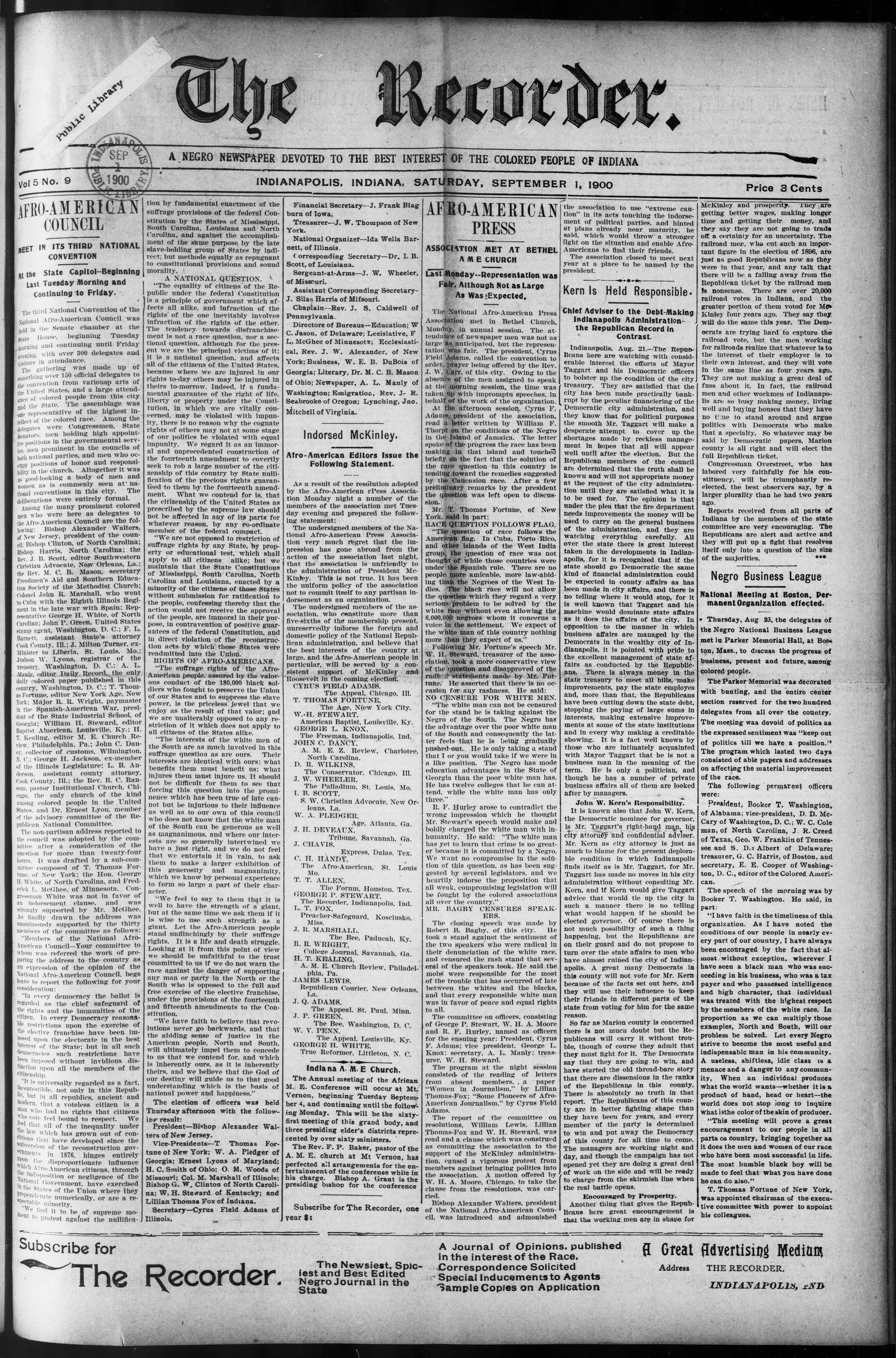
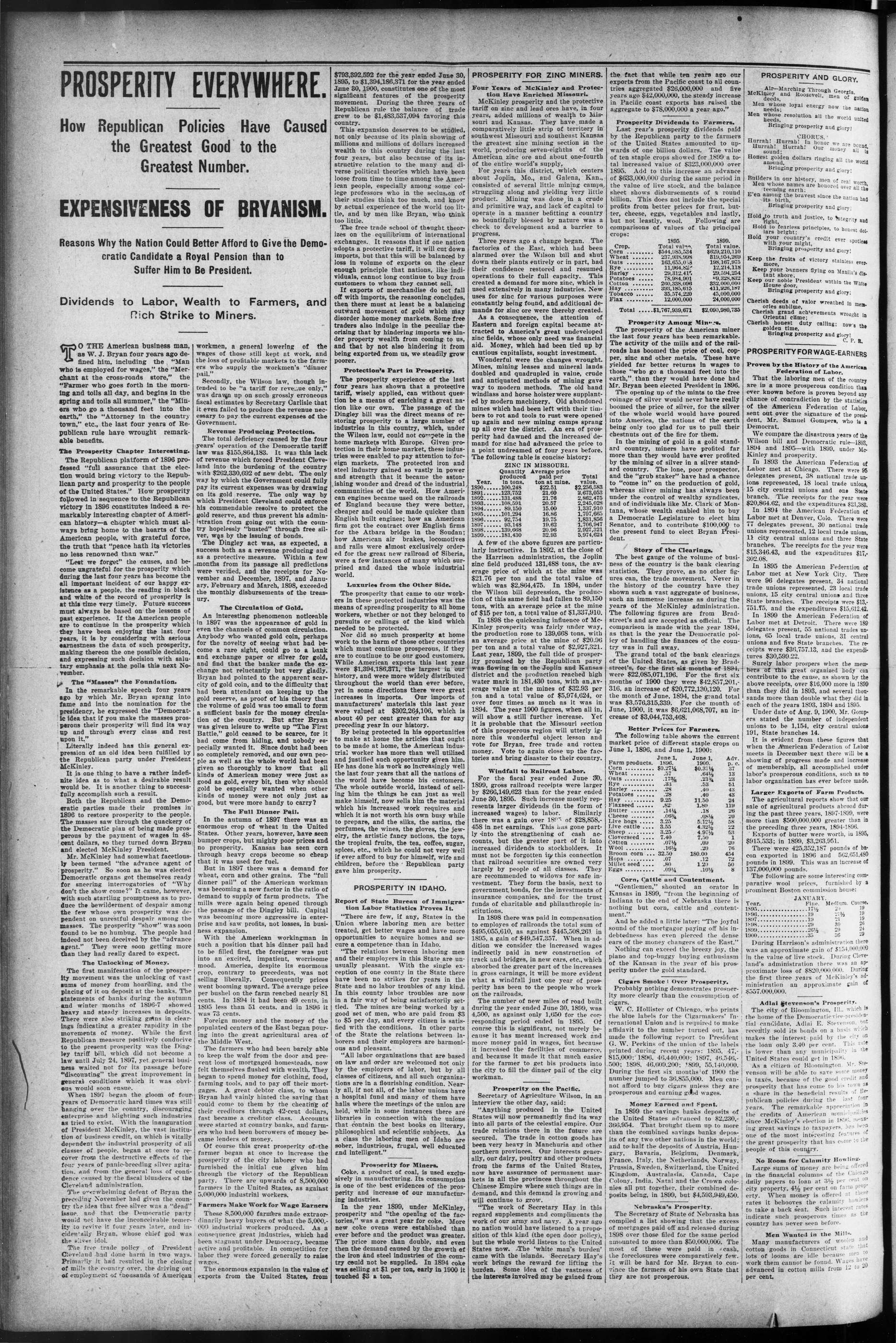
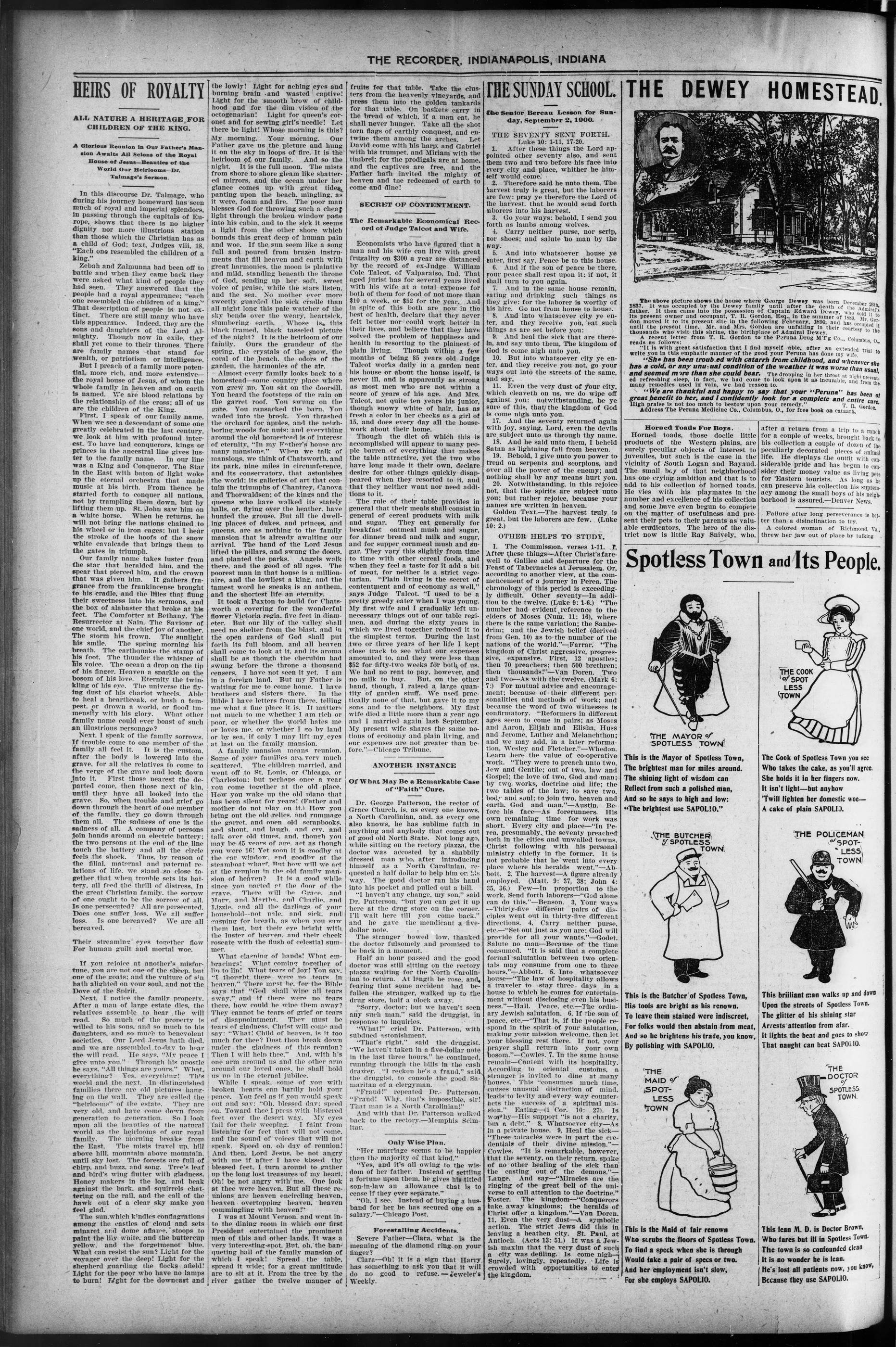
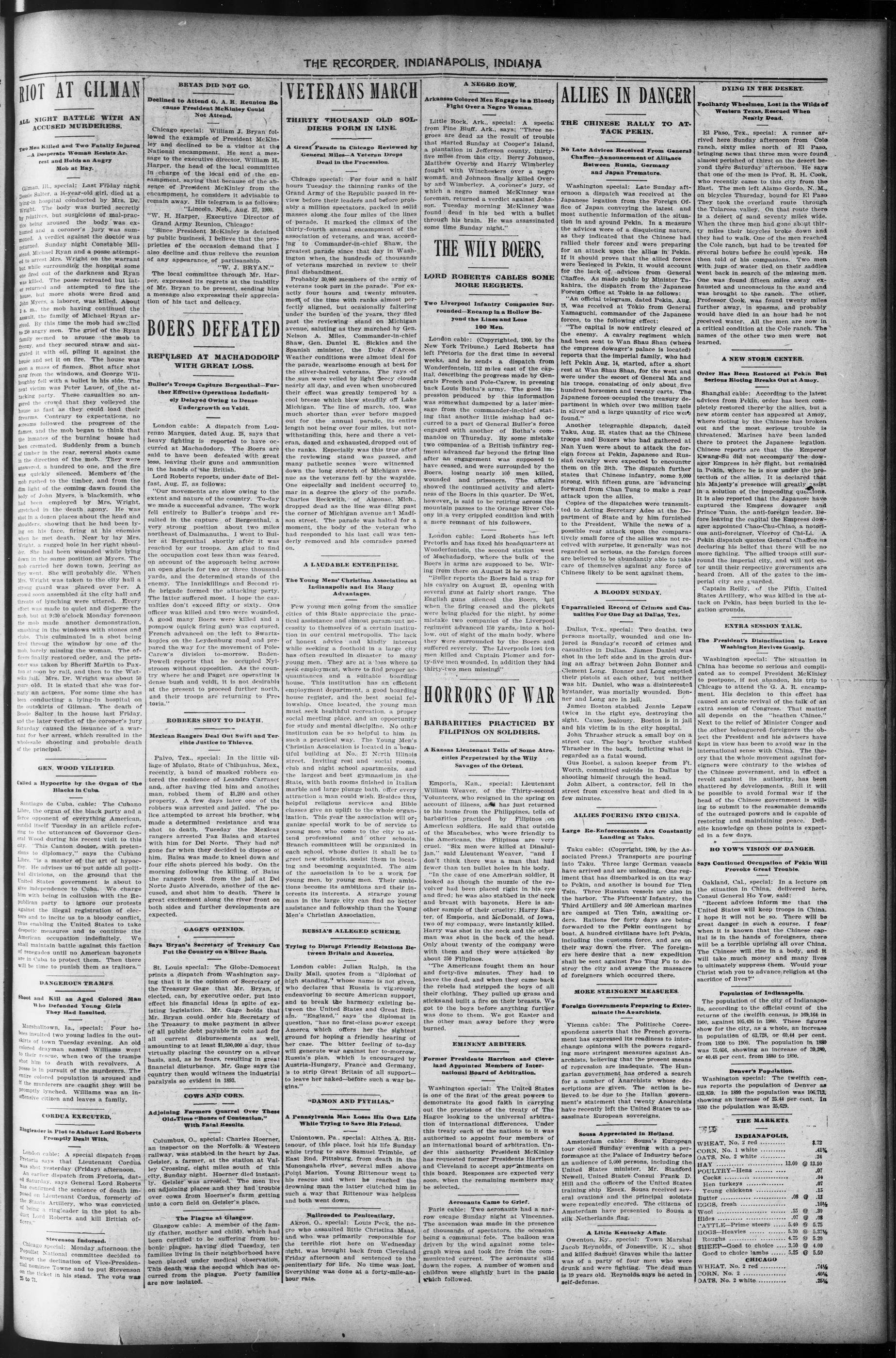
Page text (machine-generated)
Vol 5 No. 9
AFRO-AMERICAN COUNCIL
MEET IN ITS THIRD NATIONAL CONVENTION
At the State Capitol-Beginning Last Tuesday Morning and Continuing to Friday.
The third National Convention of the National Afro-American Council was held in the Senate chamber at the State House, beginning Tuesday morning and continuing until Friday evening, with over 300 delegates and in attendance.
rators.
The gathering was made up of something over 150 official delegates to the convention from various artis of the United States, and a large attendance of colored people from this city and the State. The assemblage was one representative of the highest indellegates were Congressmen, State Senators, men holding high appointe positions in the governmental service, men prominent in the councils of both national parties, and men who occupy positions of honor and responsibility in the church. Altogether it was good-looking a body of men and women as is commonly seen at national conventions in this city. The deliberations were entirely formal.
democrat. Among the many prominent colored men who were here as delegates to the Afro-American Council are the following: Bishop Alexander Walters, of New Jersey, president of the council; Bishop Clinton, of North Carolina; Bishop Harris, North Carolina; the Rev. J. B. Scott, editor Southwestern Christian Advocate, New Orleans, La.; the Rev. M. C. B. Mason, secretary Freedman's Aid and Southern Education Society of the Methodist Church; Colonel John R. Marshall, who went to Cuba with the Eighth Illinois Regiment in the late war with Spain; Representative George H. White, of North Carolina; John P. Green, United States stamp agent, Washington D. C.; F. L. Barnett, assistant State's attorney Cook County, Ill.; J. Milton Turner, ex-minister to Liberia, St. Louis, Mo.; Johnson W. Lyons, registrar of the treasury, Washington, D. C.; A. L. Manly, editor Daily Record, the only colored paper published in this country, Washington, D. C.; T. Thomas, fortune, editor New York Age, New York; Major R. B. Wright, paymaster in the Spanish-American War, president of the State Industrial School, Georgia; William H. Steward, editor Baptist American, Louisville, Ky.; H. L. Johnson, editor M. F. Church复
T. Kealing, editor M. E. Churn Review, Philadelphia, Pa.; John C. Dane, collector of customs, Wilmington, N. C.; George H. Jackson, ex-member of the Illinois Legislature; L. B. Anderson, assistant county attorney, Cook County, Ill.; the Rev R. C. Ranson, pastor Institutional Church, Chicago, the only church of the kind among colored people in the United States, and Dr. Ernest Lyon, member of the advisory committee of the Republican National Committee.
The non-puritan address reported to the council was adopted by the committee after a consideration of the question for more than twenty-four hours. It was drafted by a sub-committee composed of T. Thomas Fortune, of New York; the Hon. George H. White, of North Carolina, and Fredrick L. McGhee, of Minnesota. Congressman White was not in favor of an endorsement clause, and was strongly supported by Mr. McGhee. As finally drawn the address was unanimously supported by the thirty members of the committee as follows: "Members of the National Afro-American Council—Your committee to whom was referred the work of preparing the address to the country as an expression of the opinion of the National Afro-American Council, begs leave to report the following for your consideration;
"In every democracy the ballot is regarded as the chief safeguard of the rights and the immunities of the citizen. In every Democracy reasonable restrictions upon the exercise of the elective franchise have been imposed upon the electorate in the best interest of the State; but in all such democracies such restrictions have been imposed without invidious distinction upon all the members of the citizenship.
"It is universally regarded as a fact, incontestable, not only in this Republic, but in all republics, ancient and modern, that a voteless citizen is a man who had no rights that citizens who feel feel bound to respect. We feel that all of the inequality under the law which has grown out of conditions that have developed since the subversion of the reconstruction governments in 1876, hinges entirely upon the disproportionate influence which Afro-American citizens, through the indisposition or negligence of the National Government, have exercised in the States of the Union where they represent numerically, or are a respectable minority.
"We feel it to be of supreme moment to protest against the nullification."
INDIANAPOLIS, INDIANA, SATURDAY, SEPTEMBER 1, 1900
The
tion by fundamental enactment of the suffrage provisions of the federal Constitution by the States of Mississippi, South Carolina, Louisiana and North Carolina, and against the accomplishment of the same purpose by the late slave-holding group of States by indirect; but methods equally as repugnant to constitutional provisions and sound morality.
A NATIONAL QUESTION.
"The equality of citizens of the Republic under the federal Constitution is a principle of government which affects all alike, and infraction of the rights of the one inevitably involves infraction of the rights of the other. The tendency towards disfranchise is not a race question, nor a sectional question, although for the present we are the principal victims of it: it is a national question, and affects all of the citizens of the United States, because where we are injured in our rights to-day others may be injured in theirs to-morrow. Indeed, if a fundamental guarantee of the right of life, liberty or property under the Constitution, in which we are vitally concerned, may be violated with impunity, there is no reason why the cognate rights of others may not at some stage of our politics be violated with equal impunity. We regard it as an immoral and unprecedented construction of the fourteenth amendment to coverly seek to rob a large number of the citizenship of this country by State nullification of the precious rights guaranteed to them by the fourteenth amendment. What we contend for is, that the citizenship of the United States as prescribed by the supreme law should not be affected in any of its parts for whatever reason, by any co-ordinate member of the federal compact.
"We are not opposed to restriction of suffrage rights by any State, by property or educational test, which shall apply to all citizens alike; but we maintain that the State Constitutions of Mississippi, South Carolina, North Carolina and Louisiana, enacted by a minority of the citizens of those States without submission for ratification to the people, confessing thereby that the action would not receive the approval of the people, are immoral in their purpose, in contravention of positive guarantees of the federal Constitution, and in direct violation of the reconstruction acts by which those States were readmitted into the Union.
RIGHTS OF AFRO-AMERICANS.
"The suffrage rights of the Afro-American people, assured by the valorous conduct of the 180,000 black soldiers who fought to preserve the Union of our States and to suppress the slave power, is the priceless jewel that we enjoy as the result of that valor; and we are unalterably opposed to any restriction of it which does not apply to all citizens of the States allike.
"The interests of the white men of the South are as much involved in this suffrage question as are ours. Their interests are identical with ours; what benefits them must benefit us; what injures them must injure us. It should not be difficult for them to see that forcing this question into the prominence which has been true of late cannot but be injurious to their influence as well as to our own of this council who does not know that the white man of the South can be generous as well as magnanimous, and where our interests are so generally intertwined we have a just right, and we do not feel that we entertain it in vain, to ask them to make a larger exhibition of this generosity and magnanimity, which we know by personal experience to form so large a part of their character.
"We feel to say to them that it is well to have the strength of a giant, but at the same time we ask them if it is wise to use such strength as a giant. Let the Afro-American people stand unfinchingly by their suffrage rights. It is a life and death struggle. Looking at it from this point of view we should be unfaithful to the trust committed to us if we do not warn the race against the danger of supporting any man or party in the North or the South who is opposed to the full and free exercise of the elective franchise, under the provisions of the fourteenth and fifteenth amendments to the Constitution.
"We have faith to believe that revolutions never go backwards, and that the abiding sense of justice in the American people, North and South, will ultimately impel them to concede to us that we contend for, and which is inherently ours, as it is inherently theirs, and we believe that the God of our destiny will guide us to that good understanding which is the basis of national power and happiness."
The election of officers was held Thursday afternoon with the following result:
President—Bishop Alexander Walters of New Jersey.
Vice-Presidents—T. Thomas Fortune of New York; W. A. Pledger of Georgia; Ernest Lyons of Maryland; H. C. Smith of Ohio; O. M. Woods of Missouri; Col. M. Marshall of Illinois; Bishop G. W. Clinton of North Carolina; W. H. Steward of Kentucky; and Lillian Thomas Fox of Indiana.
Secretary-Cyrus Field Adams of Illinois.
Financial Secretary--J. Frank Blag burn of Iowa,
Treasurer--J. W. Thompson of New York.
National Organizer--Ida Wells Barnett, of Illinois.
Corresponding Secretary--Dr. I. B. Scott, of Louisiana.
Sergeant-at-Arms--J. W. Wheeler, of Missouri.
Assistant Corresponding Secretary--J. Silas Harris of Mifsouri.
Chaplain--Rev. J. S. Caldwell of Pennsylvania.
Directore of Bureaus—Education; W C. Jason, of Delaware; Leeisative, F L, McGhee of Minnesota; Ecclesiastical, Rev. J. W. Alexander, of New York; Business, W. E. B. DuBois of Georgia; Literary, Dr. M. C. B. Mason of Ohio; Newspaper, A. L. Manly of Washington; Emigration, Rev. J. R. Seabrooke of Oregon; Lynching, Jno. Mitchell of Virginia.
Indorsed McKinley.
Afro-American Editors Issue the Following Statement.
As a result of the resolution adopted by the Afro-American rPess Association Monday night a number of the members of the association met Tuesday evening and prepared the following statement:
The undersigned members of the National Afro-American Press Association very much regret that the impression has gone abroad from the action of the association last night, that the association is unfriendly to the administration of President McKinley. This is not true. It has been the uniform policy of the association not to commit itself to any partisan endorsement as an organization.
The undersigned members of the association, who constitute more than five-sixths of the membership present, unreservedly indorse the foreign and domestic policy of the National Republican administration, and believe that the best interests of the country at large, and the Afro-American people in particular, will be served by a consistent support of McKinley and Roosevelt in the coming election.
CYRUS FIELD ADAMS,
The Appeal, Chicago, Ill.
T. THOMAS FORTUNE.
The Age, New York City.
W. H. STEWART,
American Baptist, Louisville, Ky.
GEORGE L. KNOX,
The Freeman, Indianapolis, Ind.
JOHN C. DANCY,
A. M. E. Z. Review, Charlotee
North Carolina.
D. R. WILKINS,
The Conservator, Chicago, Ill.
J. W. WHEELER.
The Palladium, St. Louis, Mo.
I. B. SCOTT,
S. W. Christian Advocate, New Or
leans, La.
W. A. PLEDGER,
Age, Atlanta, Ga.
J. H. DEVEAUX,
Tribune, Savannah, Ga.
J. CHAVIS,
Express, Dalas, Tex.
C. H. HANDY,
The Afro-American, St. Louis
Mo.
T. T. ALLEN,
The Forum, Houston, Tex.
GEORGE P. STEWART,
The Recorder, Indianapolis, Ind.
L. T. FOX.
Preacher-Safeguard, Kosciusko, Miss,
J. R. MARSHALL,
The Bee, Paducah, Ky.
R. R. WRIGHT,
College Journal, Savannah, Ga.
H. T. KEALING,
A. M. E. Church Review, Philadelphia, Pa.
JAMES LEWIS,
Republican Courier, New Orleans, La.
J. Q. ADAMS,
The Appeal, St. Paul, Minn.
J. P. GREEN,
The Bee, Washington, D. C.
W. V. PENN.
The Appeal, Louisville, Ky.
GEORGE H., WHITE
Indiana A. M. E Church.
The Annual meeting of the African
M. E. Conference will occur at Mt.
Vernon, beginning Tuesday September
4, and continuing until the following
Monday. This will be the sixty-
first meeting of this grand body, and
three presiding elder's districts represented
by over sixty ministers.
The Rev. F. P. Baker, pastor of the
A. M. E. church at Mt Vernon, has
perfected all arrangements for the
entertainment of the conference while in
his charge. Bishop A. Grant is the
presiding bishop for the conference
Subscribe for The Recorder, one
year $1
The Newsiest, Spiciest and Best Edited Negro Journal in the State
A Journal of Opinions. published in the interest of the Race. Correspondence Solicited Special Inducements to Agents Sample Copies on Application
AFRO-AMERICAN PRESS
ASSOCIATION MET AT BETHEL
A M E CHURCH
The National Afro-American Press Association met in Bethel Church, Monday, in annual session. The attendance of newspaper men was not as large as anticipated, but the representation was fair. The president, Cyrus Field Adams, called the convention to order, prayer being offered by the Rev. J. W. Carr, of this city. Owing to the absence of the men assigned to speak at the morning session, the time was taken up with improptu speeches, in behalf of the work of the organization.
At the afternoon session, Cyrus F. Adams, president of the association, read a letter written by William F. Thorpt on the conditions of the Negro in the Island of Jamaica. The letter spoke of the progress the race has been making in that island and touched briefly on the fact that the solution of the race question in this country is tending toward the remedies suggested by the Caucasian race. After a few preliminary remarks by the president the question was left open to discussion.
Mr. T. Thomas Fortune, of New York, said in part:
PAGE QUESTION FOLLOWS FLAG
RACE QUESTION FOLLOWS FLAG.
"The question of race follows the American flag. In Cuba, Porto Rico, and other islands of the West India group, the question of race was not thought of while those countries were under the Spanish rule. There are no people more amicable, more law-abiding than the Negroes of the West Indies. The black race will not allow the question which they regard a very serious problem to be solved by the white race without even allowing the 6,000,000 negroes whom it concerns a voice in the settlement. We expect of the white man of this country nothing more than they expect of us."
Following Mr. Fortune's speech Mr. W. H. Steward, treasurer of the association, took a more conservative view of the question and disapproved of the radio statements made by Mr. Fortune. He asserted that there is no occasion for any rashness. He said:
NO CENSURE FOR WHITE MEN
NO CENSURE FOR WHITE MEN.
"The white man can not be censured for the stand he is taking against the Negro of the South. The Negro has the advantage over the poor white man of the South and consequently the latter feels that he is being gradually pushed out. He is only taking a stand that I or you would take if we were in a like position. The Negro has mode education advantages in the State of Georgia than the poor white man has. He has twelve colleges that he can attend, while the white man has only three."
R. F. Hurley arose to contradict the wrong impression which he thought Mr. Stewart's speech would make and boldly charged the white man with humanity. He said: "The white man has yet to learn that crime is no greater because it is committed by a Negro. We want no compromise in the solution of this question, as has been suggested by several legislators, and we heartily indorse the proposition that all weak, compromising legislation will be fought by the colored associations all over the country."
MR. BAGBY CENSURES SPEAKERS.
The closing speech was made by Robert B. Bagby, of this city. He took a stand against the sentiment of the two speakers who were radical in their denunciation of the white race, and censured the rash stand that several of the speakers he took. He said the mobs were responsible for the most of the trouble that has occurred of late between the whites and the blacks, and that every responsible white man was in favor of peace and equal rights to all.
The committee on officers, consisting of George P. Stewart, W. H. A. Moore and R. F. Hurley, named as officers for the ensuing year: President, Cyrus F. Adams; vice president, George L. Knox; secretary, A. L. Manly; treasurer, W. H. Steward.
The program at the night session consisted of the reading of letters from absent members, a paper "Women in Journalism," by Lillian Thomas-Fox; "Some Ploneers of Afro-American Journalism," by Cyrus Field Adams.
The report of the committee on resolutions, William Lewis, Lillian Thomas-Fox and W. H. Steward, was read and a clause which was construed as committing the association to the support of the McKinley administration. caused a vigorous protest from members against bringing politics into the association. A motion offered by W. H. A. Moore, Chicago, to take the clause from the resolutions, was carried.
Bishop Alexander Walters, president of the National Afro-American Council, was introduced and admonished
the association to use "extreme caution" in its acts touching the indorsement of political parties, and hinted at plans already near maturity, he said, which would throw a stronger light on the situation and enable Afro-Americans to find their friends. The association closed to meet next year at a place to be named by the president.
Kern Is Held Responsible.
Chief Adviser to the Debt-Making Indianapolis Administration the Republican Record in Contrast.
Indianapolis, Aug. 21.—The Republicans here are watching with considerable interest the efforts of Mayor Taggart and his Democratic officers to bolster up the condition of the city treasury. They are satisfied that the city has been made practically bankrupt by the peculiar financiering of the Democratic city administration, and they know that for political purposes the smooth Mr. Taggart will make a desperate attempt to cover up the shortages made by reckless management in hopes that all will appear well until after the election. But the Republican members of the council are determined that the truth shall be known and will not appropriate money at the request of the city administration until they are satisfied what it to be used for. The opinion is that under the plea that the fire department needs improvements the money will be used to carry on the general business of the administration, and they are watching everything carefully. All over the state there is great interest taken in the developments in Indianapolis, for it is recognized that if the state should go Democratic the same kind of financial administration could be expected in county affairs as has been made in city affairs, and there is no telling where it would stop, for it is well known that Taggart and his machine would dominate state affairs as it does the affairs of the city. In opposition to the manner in which business affairs are managed by the Democrats in the wealthy city of Indianapolis, it is pointed with pride to the excellent management of state affairs as conducted by the Republicans. There is always money in the state treasury to meet all bills, make improvements, pay the state employees and, more than that, the Republicans have been cutting down the state debt, stopping the paying of large sums in interests, making extensive improvements at some of the state institutions and in every way making a creditable showing. It is a fact well known by those who are intimately acquainted with Mayor Taggart that he is not a business man in the meaning of the term. He is only a politician, and though he has a number of private business affairs all of them are looked after by managers.
John W. Kern's Responsibility.
It is known also that John W. Kern, the Democratic nominee for governor, is Mr. Taggart's right-hand man, his city attorney and confidential adviser. Mr. Kern as city attorney is just as much to blame for the present deplorable condition in which Indianapolis finds itself as is Mr. Taggart, for Mr. Taggart has made no moves in his city administration without consulting Mr. Kern, and if Kern would give Taggart advice that would tie up the city in such a manner there is no telling what would happen if he should be elected governor. Of course there is not much possibility of such a thing happening, but the Republicans are on their guard and do not propose to turn over the state affairs to men who have almost ruined the city of Indianapolis. A great many Democrats in this county will not vote for Mr. Kern because of the facts set out here, and they will use their influence to keep their friends in different parts of the state from voting for him for the same reason.
So far as Marion county is concerned there is not much doubt but the Republicans will carry it without trouble, though of course they admit that they must fight for it. The Democrats say that they are going to win, and have started the old thread-bare story that there are dissensions in the ranks of the Republicans in this county. There is absolutely no truth in that report. The Republicans of this county are in better fighting shape than they have been for years, and every member of the party is determined to win and put away the Democracy of this county for all time to come. The managers are working night and day, and though the campaign has not opened yet they are doing a great deal of work on the side and will be ready to charge from the skirmish line when the real battle opens.
Encouraged by Prosperity. Another thing that gives the Republicans here great encouragement is that the working men are in shape for
Price 3 Cents McKinley and prosperity. They are getting better wages, making longer time and getting their money, and they say they are not going to trade off a certainty for an uncertainty. The railroad men, who cut such an important figure in the election of 1896, are just as good Republicans now as they were in that year, and any talk that there will be a falling away from the Republican ticket by the railroad men is nonsense. There are over 20,000 railroad votes in Indiana, and the greater portion of them voted for McKinley four years ago. They say they will do the same this year. The Dem-
ocrats are trying hard to capture the railroad vote, but the men working for railroads realize that whatever is to the interest of their employer is to their own interest, and they will vote in the same line as four years ago. They are not making a great deal of fuss about it. In fact, the railroad men and other workmen of Indianapolis are so busy making money, living well and buying houses that they have no time to stand around and argue politics with Democrats who make that a specialty. So whatever may be said by Democratic papers, Marion county is all right and will elect the full Republican ticket.
Congressman Overstreet, who has labored very faithfully for his constituency, will be triumphantly re-elected, the best observers say, by a larger plurality than he two years ago.
Reports received from all parts of Indiana by the members of the state committee are very encouraging. The Republicans are alert and active and they will put up a fight that resolves itself only into a question of the size of the majorities. ****
Negro Business League
National Meeting at Boston, Permanent Organization effected.
- Thursday, Aug 23, the delegates of the Negro National Business League met in Parker Memorial Hall, at Boston, Mass., to discuss the progress of business, present and future, among colored people.
The Parker Memorial was decorated with bunting, and the entire center section reserved for the two hundred delegates from all over the country. The meeting was devoid of politics as the expressed sentiment was "keep out of politics till we have a position." The program which lasted two days consisted of able papers and addresses on affecting the material improvement of the race.
The following permanent officers were:
President, Booker T. Washington, of Alabama; vice-president, D. D. McCary of Washington, D. C.; W. C. Coleman, of North Carolina, J. R. Creed of Texas, Geo. W. Franklin of Tennessee and S. D. Albert of Delaware; treasurer, G. C. Harris, of Boston, and secretary, E. C. Cooper of Washington, D. C., editor of the Colored American.
The speech of the morning was by Booker T. Washington. He said, in part:
"I have faith in the timeliness of this organization. As I have noted the conditions of our people in nearly every part of our country, I have always been encouraged by the fact that almost without exception, wherever I have seen a black man who was succeeding in his business, who was a tax payer and who passeded intelligence and high character, that individual was treated with the highest respect by the members of the white race. In proportion as we can multiply those examples, North and South, will our problem be solved. Let every Negro strive to become the most useful and indispensable man in his community. A useless, shiftless, idle class is a menace and a danger to any community. When an individual produces what the world wants—whether it is a product of hand, head or heart—the world does not stop long to inquire what is the color of the skin of producer.
"This meeting will prove a great encouragement to our people in all parts os country, bringing together as it does the men and women of our race who have been most successful in life. The most humble black boy will be made to feel that what you have done he can do also."
T. Thomas Fortune of New York, was appointed chairman of the executive committee with power to appoint his colleagues.
INDIANAPOLIS, ZND
PROSPERITY EVERYWHERE.
How Republican Policies Have Caused the Greatest Good to the Greatest Number.
Reasons Why the Nation Could Better Afford to Give the Democratic Candidate a Royal Pension than to Suffer Him to Be President.
Dividends to Labor, Wealth to Farmers, and Rich Strike to Miners.
TO THE American business man, as W. J. Bryan four years ago defined him, including the "Man who is employed for wages," the "Merchant at the cross-roads store," the "Farmer who goes forth in the morning and tolls all day, and begins in the spring and toils all summer," the "Miners who go a thousand feet into the earth," the "Attorney in the country town," etc., the last four years of Republican rule have wrought remarkable benefits.
The Prosperity Chapter Interesting.
The Republican platform of 1896 professed "full assurance that the election would bring victory to the Republican party and prosperity to the people of the United States." How prosperity followed in sequence to the Republican victory in 1896 constitutes indeed a remarkably interesting chapter of American history—a chapter which must always bring home to the hearts of the American people, with grateful force, the truth that "peace hath its victories no less renowned than war."
"Lest we forget" the causes, and become ungrateful for the prosperity which during the last four years has become the all important incident of our happy existence as a people, the reading in black and white of the record of prosperity is at this time very timely. Future success must always be based on the lessons of past experience. If the American people are to continue in the prosperity which they have been enjoying the last four years, it is by considering with serious earnestness the data of such prosperity, making thereon the one possible decision, and expressing such decision with salutary emphasis at the polls this next November.
The "Masses" the Foundation.
In the remarkable speech four years ago by which Mr. Bryan sprang into fame and into the nomination for the presidency, he expressed the "Democratic idea that if you make the masses prosperous their prosperity will find its way up and through every class and rest upon it."
Literally indeed has this general expression of an old idea been fulfilled by the Republican party under President McKinley.
It is one thing to have a rather indefinite idea as to what a desirable result would be. It is another thing to successfully accomplish such a result.
Both the Republican and the Democratic parties made their promises in 1896 to restore prosperity to the people. The masses saw through the quackery of the Democratic plan of being made prosperous by the payment of wages in 48-cent dollars, so they turned down Bryan and elected McKinley President.
Mr. McKinley had somewhat facetiously been termed "the advance agent of prosperity." So soon as he was elected Democratic organs got themselves ready for sneering interrogatories of "Why don't the show come?" It came, however, with such startling promptness as to produce the bewilderment of despair among the few whose own prosperity was dependent on unrestful despair among the masses. The prosperity "show" was soon found to be no humbug. The people had indeed not been deceived by the "advance agent." They were soon getting more than they had really dared to expect.
The Unlocking of Money.
The first manifestation of the prosperity movement was the loss of vast sums of money from hoarding, and the placing of it on deposit in the bank. The statements of it during the autumn months of 1896-7 showed heavy and steady increases in deposits. There were also striking gains in clearings indicating a greater rapidity in the movements of money. While the first Republican measure positively conducive to the present prosperity was the Dingley tariff bill, which did not become a law until July 24, 1897, yet general business waited not for its passage before "discounting" the great improvement in general conditions which it was obviated would soon ensue.
When 1897 began the gloom of four years of Democratic hard times was still hanging over the country, discouraging enterprise and blighting such industries as tried to exist. With the inauguration of President McKinley, the vast institution of business credit, on which is vitally dependent the industrial prosperity of all classer of people, began at once to recover from the destructive effects of the four years of panic-breeding silver agitation, and from the general loss of confidence caused by the fiscal blunders of the Cleveland administration.
The overwhelming defeat of Bryan the preceding November had given the country the idea that free silver was a "dead" issue, and that the Democratic party would not have the inconceivable temerity to revive it four years later, and incidentally Bryan, whose chief god was the silver idol.
The free trade policy of President Cleveland had done harm in two ways. Primarily it had resulted in the closing of mills the country over, the driving out of employment of thousands of American
workmen, a general lowering of the wages of those still kept at work, and the loss of profitable markets to the farmers who supply the workmen's "dinnerail." Secondly, the Wilson law, though intended to be "a tariff for revenue only," was drawn up on such grossly erroneous fiscal estimates by Secretary Carlisle that it even failed to produce the revenue necessary to pay the current expenses of the Government.
Revenue Producing Protection:
The total deficiency caused by the four years' operation of the Democratic tariff law was $155,864,183. It was this lack of revenue which forced President Cleveland into the burdening of the country with $262,330,692 of new debt. The only way by which the Government could fully pay its current expenses was by drawing on its gold reserve. The only way by which President Cleveland could enforce his commendable resolve to protect the gold reserve, and thus prevent his administration from going out with the country hopelessly "busted" through free silver, was by the issuing of bonds. The Dingley act was, as expected, a success both as a revenue producing and as a protective measure. Within a few months from its passage all predictions were verified, and the receipts for November and December, 1897, and January, February and March, 1898, exceeded the monthly disbursements of the treasury.
The Circulation of Gold.
An interesting phenomenon noticeable in 1897 was the appearance of gold in even the channels of common circulation. Anybody who wanted gold coin, perhaps for the novelty of seeing what had become a rare sight, could go to a bank and exchange paper or silver for gold, and find that the banker made the exchange not reluctantly but very gladly. Bryan had pointed to the apparent scarcity of gold coin, and to the difficulty that had been attendant on keeping up the gold reserve, as proof of his theory that the volume of gold was too small to form a sufficient basis for the money circulation of the country. But after Bryan was given leisure to write up "The First Battle," gold ceased to be scarce, for it had come from hiding, and nobody especially wanted it. Since doubt had been so completely removed, and our own people as well as the whole world had been given so thoroughly to know that all kinds of American money were just as good as gold, every bit, then why should gold be especially wanted when other kinds of money were not only just as good, but were more handy to carry?
The Full Dinner Pail.
In the autumn of 1897 there was an enormous crop of wheat in the United States. Other years, however, have seen bumper crops, but mighty poor prices and no prosperity. Kansas has seen corn through heavy crops become so cheap that it was used for fuel.
But in 1897 there was a demand for wheat, corn and other grains. The "full dinner pail" of the American workman was becoming a new factor in the ratio of demand to supply of farm products. The mills were again being opened through the passage of the Dingley bill. Capital was becoming more aggressive in enterprise and saw profits, not losses, in business expansion.
With the American workingman in such a position that his dinner pail had to be filled first, the foreigner was put into an excited, impatient, worrisome mood. America, despite its enormous crop, contrary to precedents, was not selling liberally. Consequently prices went booming upward. The average price per bushel on the farm reached nearly 11 cents. In 1894 it had been 49 cents, in 1895 less than 51 cents, and in 1896 it was 73 cents.
Foreign money and the money of the populated centers of the East began pouring into the great agricultural area of the Middle West.
The farmers who had been barely able to keep the wolf from the door and prevent loss of mortgaged homesteads, now felt themselves flushed with wealth. They began to spend money for clothing, food, farming tools, and to pay off their mortgages. A great debtor class, to whom Bryan had vainly hinted the saving that could come to them by the cheating of their creditors through 42-cent dollars, fast became a creditor class. Accounts were started at country banks, and farmers who had been borrowers of money became lenders of money.
Of course this great prosperity of the farmer began at once to increase the prosperity of the city laborer who had furnished the initial cue given him through the victory of the Republican party. There are upwards of 8,500,000 farmers in the United States, as against 5,000,000 industrial workers.
Farmers Make Work for Wage Earners
These 8,500,000 farmers made extraordinarily heavy buyers of what the 5,000,000 industrial workers produced. As a consequence great industries, which had been stagnant under Democracy, became active and profitable. In competition for labor they were forced generally to raise wages. The enormous expansion in the value of exports from the United States, from
$793,892,592 for the year ended June 30, 1895, to $1,194,867,371 for the year ended June 30, 1900, constitutes one of the most significant features of the prosperity movement. During the three years of Republican rule the balance of trade grew to be $1,483,537,094 favoring this country.
This expansion deserves to be studied, not only because of its plain showing of millions and millions of dollars increased wealth to this country during the last four years, but also because of its instructive relation to the many and diverse political theories which have been loose from time to time among the American people, especially among some college professors who in the seclusion of their studies think too much, and know by actual experience of the world too little, and by men like Bryan, who think too little.
The free trade school of thought theorizes on the equilibrium of international exchanges. It reasons that if one nation adopts a protective tariff, it will cut down imports, but that this will be balanced by loss in volume of exports on the clear enough principle that nations, like individuals, cannot long continue to buy from customers to whom they cannot sell.
If exports of merchandise do not fall off with imports, the reasoning concludes, then there must at least be a balancing outward movement of gold which may disorder home money markets. Some free traders also indulge in the peculiar theorizing that by hindering imports we hinder property wealth from coming to us, and that by not also hindering it from being exported from us, we steadily grow poorer.
The prosperity experience of the last four years has shown that a protective tariff, wisely applied, can without question be a means of enlriching a great nation like our own. The passage of the Dingley bill was the direct means of restoring prosperity to a large number of industries in this country, which, under the Wilson law, could not compete in the home markets with Europe. Given protection in their home market, these industries were enabled to pay attention to foreign markets. The protected iron and steel industry gained so vastly in power and strength that it became the astonishing wonder and dread of the industrial communities of the world. How American engines became used on the railroads of England because they were better, cheaper and be made quicker than English built engines; how an American firm got the contract over English firms for the Atbara bridge in the Soudan; how American air brakes, locomotives and rails were almost exclusively ordered for the great new railroad of Siberia, were a few instances of many which surprised and dazed the whole industrial world.
Luxuries from the Other Side.
The prosperity that came to our workers in these protected industries was the means of spreading prosperity to all home workers, whether or not they belonged to pursuits or callings of the kind which needed to be protected.
Nor did so much prosperity at home work to the harm of those other countries which must continue prosperous, if they are to continue to be our good customers. While American exports this last year were $1,394,186,371, the largest in our history, and were more widely distributed throughout the world than ever before, yet in some directions there were great increases in imports. Our imports of manufacturers' materials this last year were valued at $302,264,106, which is about 40 per cent greater than for any preceding year in our history.
By being protected in his opportunities to make at home the articles that ought to be made at home, the American industrial worker has more than well utilized and justified such opportunity given him. He has done his work so increasingly well the last four years that all the nations of the world have become his customers. The whole outside world, instead of selling him the things he can just as well make himself, now sells him the material which his increased work requires and which it is not worth his busy while to prepare, and the silks, the satins, the perfumes, the wines, the gloves, the jewelry, the artistic fancy notions, the toys, the tropical fruits, the tea, coffee, sugar, spices, etc., which he could not very well if ever afford to buy for himself, wife and children, before the Republican party gave him prosperity.
PROSPERITY IN IDAHO
Report of State Bureau of Immigration Labor Statistics Proves It.
"There are few, if any, States in the Union where laboring men are better treated, get better wages and have more opportunities to acquire homes and secure a competence than in Idaho.
"The relations between laboring men and their employers in this State are unusually pleasant. With the single exception of one county in the State there have been no strikes for years in the State and no labor troubles of any kind. In this county labor troubles are now in a fair way of being satisfactorily settled. The mines are being worked by a good set of men, who are paid from $3 to $5 per day, and every citizen is satisfied with the conditions. In other parts of the State the relations between laborers and their employers are harmonious and pleasant.
"All law organization that are based on law and order are welcomed not only by the employers of labor, but by all classes of citizens, and all such organizations are in a flourishing condition. Nearly all, if not all, of the labor unions have a hospital fund and many of them have halls where the meetings of the union are held, while in some instances there are libraries in connection with the unions that contain the best books on literary, philosophical and scientific subjects. As a class the laboring men of Idaho are sober, industrious, frugal, well educated and intelligent."
Prosperity for Miners
Coke, a product of coal, is used exclusively in manufacturing. Its consumption is one of the best evidences of the prosperity and increase of our manufacturing industries. In the year 1899, under McKinley, prosperity and "the opening of the factories," was a great year for coke. More new coke ovens were established than ever before and the product was greater. The price more than double, and even then the demand caused by the growth of the iron and steel industries of the country could not be supplied. In 1894 coke was selling at $1 per ton, early in 1900 it touched $3 a ton.
PROSPERITY FOR ZINC MINERS.
Four Years of McKinley and Protection-Have Enriched Missouri
In have kritched Missouri. McKinley prosperity and the productive tariff, lead to a lead in four years, added million of wealth to Missouri and Kansas. They have made a comparatively little strip of territory in southwest Missouri and southeast Kansas the greatest zinc mining section in the world, producing seven-eighths of the American zinc ore and about one-fourth of the entire world's supply.
For years this district, which centers about Joplin, Mo., and Galena, Kan., consisted of several little mining camps struggling along and yielding very little product. Mining was done in a crude and primitive way, and lack of capital to operate in a manner befitting a country so bountifully blessed by nature was a check to development and a barrier to progress.
Three years ago a change began. The factories of the East, which had been alarmed over the Wilson bill and shut down their plants entirely or in part, had their confidence restored and resumed operations to their full capacity. This created a demand for more zinc, which is used extensively in many industries. New uses for zinc for various purposes were constantly being found, and additional demands for zinc ore were thereby created.
As a consequence, the attention of Eastern and foreign capital became attracted to America's great undeveloped zinc fields, whose only need was financial aid. Money, which had been tied up by cautious capitalists, sought investment.
Wonderful were the changes wrought. Mines, mining leases and mineral lands doubled and quadrupled in value, crude and antiquated methods of mining gave way to modern methods. The old hand windlass and horse hoister were supplanted by modern machinery. Old abandoned mines which had been left with their timbers to rot and tools to rust were opened up again and new mining camps sprang up all over the district. An era of prosperity had dawned and the increased demand for zinc had advanced the price to a point undreamed of four years before.
The following table is concise history:
| Year. | Quantity produced in tons. | Average price paid per ton at mine. | Total value. |
| :--- | :--- | :--- | :--- |
| 1801 | 100,248 | $22.51 | $2,258,653 |
| 1801 | 123,752 | 21.60 | 2,673,053 |
| 1803 | 108,591 | 21.70 | 2,673,053 |
| 1803 | 108,591 | 20.57 | 2,245,028 |
| 1894 | 89,150 | 15.00 | 1,337,910 |
| 1895 | 101,294 | 16.86 | 1,707,653 |
| 1895 | 92,754 | 19.75 | 1,831,856 |
| 1895 | 92,754 | 19.92 | 1,831,856 |
| 1898 | 139,688 | 20.96 | 2,027,321 |
| 1898 | 181,430 | 22.93 | 3,574,624 |
A few of the above figures are particularly instructive. In 1892, at the close of the Harrison administration, the Joplin zinc field produced 131,488 tons, the average price of which at the mine was $21.76 per ton and the total value of which was $2,864,475. In 1894, under the Wilson bill depression, the production of this same field had fallen to 89,150 tons, with an average price at the mine of $15 per ton, a total value of $1,337,910.
In 1898 the quickening influence of McKinley prosperity was fairly under way, the production rose to 139,698 tons, with an average price at the mine of $20.90 per ton and a total value of $2,927,321. Last year, 1899, the full tide of prosperity promised by the Republican party was flowing in on the Joplin and Kansas district and the production reached high water mark in 181,430 tons, with an average value at the mines of $32.93 per ton and a total value of $5,974,624, or over four times as much as it was in 1894. The year 1900 figures, when all in, will show a still further increase. Yet it is probable that the Missouri section of this prosperous region will utterly ignore this wonderful object lesson and vote for Bryan, free trade and rotten money. Vote to again close up the factories and bring disaster to their country.
Windfall to Railroad Labor
Windfall to Railroad Labor.
For the fiscal year ended June 30, 1899, gross railroad receipts were larger by $260,149,623 than for the year ended June 30, 1895. Such increase mostly represents larger dividends (in the form of increased wages) to labor. Similarly there was a gain over 1895 of $28,858,458 in net earnings. This has gone partly into the strengthening of cash accounts, but the greater part of it into increased dividends to stockholders. It must not be forgotten in this connection that railroad securities are owned very largely by people of all classes. They are recommended to widows for safe investment. They form the basis, next to government bonds, for the investments of insurance companies, and for the trust funds of charitable and philanthropic institutions.
In 1898 there was paid in compensation to employees of railroads the total sum of $495,055,610, as against $445,508,261 in 1898, a gain of $49,547,357. When in addition we consider the increased wages indirectly paid in new construction of track and bridges, in new cars, etc., which absorbed the greater part of the increases in gross earnings, it will be more evident what a windfall just one year of prosperity has been to the people who work on the railroads.
The number of new miles of road built during the year ended June 30, 1899, was 4,500, as against only 1,650 for the corresponding period ended in 1895. Of course this is significant, not merely because it has meant increased work and more money paid in wages, but because it increased the facilities of commerce, and because it made it that much easier for the farmer to get his products into the city to fill the dinner pail of the city workman.
Prosperity on the Pacific.
Prosperity on the Pacific.
Secretary of Agriculture Wilson, in an interview the other day, said:
"Anything produced in the United States will now permanently find its way into all parts of the celestial empire. Our trade relations there in the future are secured. The trade in cotton goods has been very heavy in Manchuria and other northern provinces. Our interests generally, our dairy, poultry and other products from the farms of the United States, now have assurance of permanent markets in all the provinces throughout the Chinese Empire where such things are in demand, and this demand is growing and will continue to grow.
"The work of Secretary Hay in this regard supplements and compliments the work of our army and navy. A year ago no nation would have listened to a proposition of this kind (the open door policy), but the whole world listens to the United States now. The 'white man's burden' came with the islands. Secretary Hay's work brings the reward for lifting the burden. Some idea of the vastness of the interests involved may be gained from
the fact that while ten years ago our exports from the Pacific coast to all countries aggregated $26,000,000 and five years ago $42,000,000, the steady increase in Pacific coast exports has raised the aggregate to $78,000,000 a year ago."
Prosperity Dividends to Farmers.
Crop. 1895. 1899. Total value. Total value.
Corn $544,985,534 $629,210,110
Wheat 237,938,998 $19,954,269
Oats 163,655,058 198,167,975
Rye 11,964,822 12,214,118
Barley 29,312,415 29,594,254
Potatoes 78,984,901 89,328,832
Cotton 260,338,096 832,000,000
Hay 393,185,615 411,926,187
Tobacco 35,574,220 45,000,000
Flax 12,000,000 24,000,000
Prosperity Among Minors.
Prosperity Among Miners.
The prosperity of the American miner the last four years has been remarkable. The activity of the mills and of the railroads has boomed the price of coal, copper, zinc and other metals. These have yielded far better returns in wages to those "who go a thousand feet into the earth," than they would have done had Mr. Bryan been elected President in 1896. The opening up of the mints to the free coinage of silver would never have really boomed the price of silver, for the silver of the whole world would have poured into America, the nations of the earth being only too glad for us to pull their chestnuts out of the fire for them.
In the mining of gold in a gold standard country, miners have profited far more than they would have ever profited by the mining of silver in a silver standard country. The lone, poor prospector, and the "grub staker" have had a chance to "come in" on the production of gold, whereas silver mining has always been under the control of wealthy syndicates, and of individuals like Mr. Clark of Montana, whose wealth enabled him to buy a Democratic Legislature to elect him Senator, and to contribute $100,000 to the present fund to elect Bryan President.
Story of the Clearings.
The best gauge of the volume of business of the country is the bank clearing statistics. They prove, as no other figures can, the trade movement. Never in the history of the country have they shown such a vast aggregate of business, such an immense increase as during the years of the McKinley administration. The following figures are from Bradstreet's and are accepted as official. The comparison is made with the year 1894, as that year the Democratic policy of handling the finances of the country was in full sway.
The grand total of the bank clearings of the United States, as given by Bradstreet's, for the first six months of 1894, were $22,085,071,196. For the first six months of 1900 they were $42,857,201,316, an increase of $20,772,130,120. For the month of June, 1894, the grand total was $3,576,153,339. For the month of June, 1900, it was $6,621,068,707, an increase of $3,044,753,468.
Better prices for Farmers
The following table shows the current market price of different staple crops on June 1, 1896, and June 1, 1900:
| Farm products | June 1, 1896 | June 1, 1900 | Adv. p.c. |
| :--- | :--- | :--- | :--- |
| Corn | $0.27\%$ | $0.37\%$ | 37 |
| Wheat | .37 | .64\%$ | 13 |
| Wheat | .17\%$ | .22\%$ | 28 |
| Rye | .33 | .53 | 51 |
| Barley | .28 | .40 | 43 |
| Potatoes | .28 | .40 | 43 |
| Hay | 9.25 | 11.50 | 24 |
| Beefed | .82 | 1.80 | 111 |
| Butter | .14\%$ | .18 | 26 |
| Cheese | .06\%$ | .08\%$ | 20 |
| Live hogs | 3.25 | 5.12\%$ | 58 |
| Live cattle | 3.55 | 4.32\%$ | 22 |
| Sheep | 3.25 | 4.97\%$ | 53 |
| Sheep | 7.40 | 7.40 | 1 |
| Cotton | .07\%$ | .09 | 20 |
| Wool | .16\%$ | .20 | 76 |
| Broom corn | 32.50 | 180.00 | 454 |
| Hops | .07 | .12 | 72 |
| Millet seed | .80 | 1.27 | 50 |
| Eggs | .09\%$ | .10\%$ | 8 |
**Corn, Cattle and Contentment.**
*“Gentlemen,” shouted an orator in Kansas in 1899, “from the beginning of Indiana to the end of Nebraska there is nothing but corn, cattle and contentment.”*
And he added a little later: "The joyful sound of the mortgager paying off his indebtedness has even pierced the dense ears of the money changers of the East." Nothing can exceed the breezy joy, the piano and top-buggy buying enthusiasm of the Kansan in the year of his prosperity under the gold standard.
Cigars Smoke! Over Prosperity.
Probably nothing demonstrates prosperity more clearly than the consumption of cigars.
W. C. Hollister of Chicago, who prints the blue labels for the Cigarmakers' International Union and is required to make affidavit to the number turned out, has made the following report to President G. W. Perkins of the union of the labels printed during recent years: 1895, 47, 815,000; 1896, 46,440,000; 1897, 46,546,000; 1898, 46,009,200; 1899, 55,140,000. During the first six months' of 1900 the number jumped to 36,855,000. Men cannot afford to buy cigars unless they are prosperous and earning good wages.
Money Earned and Spent.
In 1899 the savings banks deposits of the United States advanced to $2,230,363,954. That brought them up to more than the combined savings banks deposits of any two other nations in the world; and to half the deposits of Austria, Hungary, Bavaria, Belgium, Denmark, France, Italy, the Netherlands, Norway, Prussia, Sweden, Switzerland, the United Kingdom, Australasia, Canada, Cape Colony, India, Natal and the Crown colonies all put together, their combined deposits being, in 1899, but $4,593,949,450.
Nebraska's Prosperity.
The Secretary of State of Nebraska has compiled a list showing that the excess of mortgages paid off and released during 1898 over those filed for the same period amounted to more than $20,000,000. The most of these were paid in *eash*, the foreclosures were comparatively few. It will be hard for Mr. Bryan to convince the farmers of his own State that they are not prosperous.
PROSPERITY AND GLORY.
PROSPERITYFORWAGE-EARNERS
Proven by the History of the American Federation of Labor.
That the laboring men of the country are in a more prosperous condition than ever known before is proven beyond any chance of contradiction by the statistics of the American Federation of Labor, sent out over the signature of the president, Mr. Samuel Gompers, who is a Democrat.
We compare the disastrous years of the Wilson bill and Democratic rule-1883, 1894 and 1895-with 1890, under McKinley and prosperity.
In 1893 the American Federation of Labor met at Chicago. There were 96 delegates present, 38 national trade unions represented, 18 local trade unions, 15 city central unions and one State branch. The receipts for the year were $20,846.62, and the expenditures $21,388.
In 1894 the American Federation of Labor met at Denver, Colo. There were 77 delegates present, 30 national trade unions represented, 12 local trade unions, 11 city central unions and three State branches. The receipts for the year were $15,346.43, and the expenditures $17,302.08.
In 1895 the American Federation of Labor met at New York City. There were 96 delegates present, 34 national trade unions represented, 23 local trade unions, 15 city central unions and three State branches. The receipts were $13,751.75, and the expenditures $15,612.42.
In 1890 the American Federation of Labor met at Detroit. There were 189 delegates present, 55 national trade unions, 65 local trade unions, 31 central unions and five State branches. The receipts were $36,757.13, and the expenditures $30,599.22.
Surely labor prosperws when the members of this great organized body can contribute to the cause, as shown by the above receipts, over $16,000 more in 1898 than they did in 1893, and several thousands more than double what they did in each of the years 1893, 1894 and 1895. Under date of Aug. 9, 1900, Mr. Gompens stated the number of independent unions to be 1,154, city central unions 191, State branches 14. It is evident from these figures that when the American Federation of Labor meets in December next there will be a showing of progress made and increase of membership, all accomplished under labor's prosperous conditions, such as no labor organization has ever before made.
Larger Exports of Farm Products.
LARGE EXPORTS OF FARM PRODUCTS.
The agricultural reports show that our sale of agricultural products abound during the past three years, 1887-1890, were more than $500,000,000 greater than in the preceding three years, 1894-1896.
Exports of butter were worth, in 1895, $915,333; in 1898, $329,951.
There were 425,352,187 pounds of bacon exported in 1896 and 562,635,180 pounds in 1899. This was an increase of 137,000,000 pounds.
The following are some interesting comparative wool prices, furnished by a prominent Boston commission house:
JANUARY.
Year. Price. Medium. Course. 1893. 137½. 19. 19 1896. 19. 21½. 19 1897. 19. 21. 19 1898. 20. 80. 24 1899. 20. 29. 24 1900. 35. 36. 29
During Harrison's administration there was an approximate gain of $154,000,000 in the value of live stock. During Cleveland's administration there was an approximate loss of $820,000,000. During the first three years of McKinley's administration an approximate gain of $557,000,000.
Adlai Stevenson's Prosperity:
The city of Bloomington, IL, which is the home of the Democratic presidential candidate, Adalai E. Stevenson, but recently sold its bonds on a basis which makes the interest paid by the city on the loan only 3.40 per cent. This rate is lower than any municipality in the United States could get in 1806. As a citizen of Bloomington, Mr. Stevenson will be able to save some money in taxes, because of the good credit and prosperity that has come to his town as a share in the beneficial results of the republican policies during the last four years. The remarkable appreciation in the credits of American municipalities since McKinley's election in 1806, meaning great savings to taxpayers, has been one of the most interesting features of the great prosperity that has come to the people of this country.
No room for calamity here.
Large sums of money are being offered in the financial columns of the Chicago daily papers to loan at 3½ per cent on city property. 4½ per cent on farm property. When money is offered at these rates it behooves the calamity house to take a back seat. Such interest rates indicate such prosperous times as the country has never seen before.
Men Wanted in the Mills
Men winter in the
Many manufacturers of woolen and
cotton goods in Connecticut state that
lives in New York because men to
work them cannot be found. Wages have
advanced in cotton mills from 12 to 20
per cent.
HEIRS OF ROYALTY
ALL NATURE A HERITAGE FOR CHILDREN OF THE KING.
A Glorious Reunion in Our Father's Mansion Awaits All Scolons of the Royal House of Jesus—Beauties of the World Our Heirlooms—Dr. Talmage's Sermon.
In this discourse Dr. Talmage, who during his journey homeward has seen much of royal and imperial splendors, in passing through the capitals of Europe, shows that there is no higher dignity nor more illustrious station than those which the Christian has as a child of God; text, Judges viii. 18, "Each one resembled the children of a king."
Zebah and Zalmunna had been off to battle and when they came back they were asked what kind of people they had seen. They answered that the people had a royal appearance; "each one resembled the children of a king." That description of people is not extinct. There are still many who have this appearance. Indeed, they are the sons and daughters of the Lord Almighty. Though now in exile, they shall yet come to their thrones. There are family names—that stand for wealth, or patriotism or intelligence. But I preach of a family more potential, more rich, and more extensive—the royal house of Jesus, of whom the whole family in heaven and on earth is named. We are blood relations by the relationship of the cross; all of us are the children of the King.
First, I speak of our family name. When we see a descendant of some one greatly celebrated in the last century, we look at him with profound interest. To have had conquerors, kings or princes in the ancestral line gives luster to the family name. In our line was a King and Conqueror. The Star in the East with baton of light woke up the eternal orchestra that made music at his birth. From thence he started forth to conquer all nations, not by trampling them down, but by lifting them up. St. John saw him on a white horse. When he returns, he will not bring the nations chained to his wheel or in iron cages; but I hear the stroke of the hoofs of the snow white cavalcade that brings them to the gates in triumph.
Our family name takes luster from the star that heralded him, and the spear that pierced him, and the crown that was given him. It gathers fragrance from the frankincense brought to his cradle, and the lilies that flung their sweetness into his sermons, and the box of alabaster that broke at his feet. The Comforter at Bethany. The Resurcorder at Nain. The Saviour of one world, and the chief joy of another. The storm his frown. The sunlight his smile. The spring morning his breath. The earthquake the stamp of his foot. The thunder the whisper of his voice. The ocean a drop on the tip of his finger. Heaven a sparkle on the bosom of his love. Eternity the twinkling of his eye. The universe the flying dust of his charlot wheels. Able to heal a heartbreak, or hush a tempest, or drown a world, or flood immensely with his glory. What other family name could ever boast of such an illustrious personage?
Next, I speak of the family sorrows. If trouble come to one member of the family all feel it. It is the custom, after the body is lowered into the grave, for all the relatives to come to the verge of the grave and look down into it. First those nearest the departed come, then those next of kin, until they have all looked into the grave. So, when trouble and grief go down through the heart of one member of the family, they go down through them all. The sadness of one is the sadness of all. A company of persons join hands around an electric battery, the two persons at the end of the line touch the battery and all the circle feels the shock. Thus, by reason of the filial, maternal and paternal relations of life, we stand so close to together that when trouble sets its battery, all feed the thrill of distress. In the great Christian family, the sorrow of one ought to be the sorrow of all. Is one persecuted? All are persecuted. Does one suffer loss. We all suffer loss. Is one bereaved? We are all bereaved.
Their streaming eyes together flow
For human guilt and mortal woe.
If you relioce at another's misfortune, you are not one of the sheep, but one of the goats; and the vulture of sin hath alighted on your soul, and not the Dove of the Sult.
Next, I notice the family property. After a man of large estate dies, the relatives assemble to hear, the will read. So much of the property is willed to his sons, and so much to his daughters, and so much to benevolent societies. Our Lord Jesus hath died, and we are assembled to-day to hear the will read. He says, "My peace I give unto you." Through his anostle he says, "All things are yours." What, everything? Yes, everything! This world and the next. In distinguished families there are old pletures hanging on the wall. They are called the "heirlooms" of the estate. They are very old, and have come down from generation to generation. So I look upon all the beauties of the natural world as the heirlooms of our royal family. The morning breaks from the East. The mists travel up, hill above hill, mountain above mountain, until sky lost. The forests are full of chirp, and buzz, and song. Tree's leaf and bird's wing flutter with gladness. Honey makers in the log, and beak against the bark, and squirrel chattering on the rail, and the call of the hawk out of a clear sky make you feel glad.
The sun,which kindles conflagrations among the castles of cloud and sets minaret and dome adamé, stoops to paint the lily white, and the buttercup yellow, and the forgetment blue. What can resist the sun? Light for the voyager over the deep! Light for the shepherd guarding the flocks afield! Light for the poor who have no lamps to burn! Light for the downcast and
the lowly! Light for aching eyes and burning brain and wasted captive! Light for the smooth brow of childhood and for the dim vision of the octogenarian! Light for queen's coronet and for sewing girl's needle! Let there be light! Whose morning is this? My morning. Your morning. Our Father gave us the picture and hung it on the sky in loops of fire. It is the heirloom of our family. And so the night. It is the full moon. The mists from shore to shore gleam like shattered mirrors, and the ocean under her glance comes up with great tides, panting upon the beach, mingling, as it were, foam and fire. The poor man blesses God for throwing such a cheap light through the broken window pane into his cabin, and to the slick it seems a light from the other shore which bounds this great deep of human pain and woe. If the sun seem like a song full and poured from brazen instruments that fill heaven and earth with great harmonies, the moon is plaintive and mild, standing beneath the throne of God, sending up her soft, sweet voice of praise, while the stars listen, and the sea. No mother ever more sweetly guarded the sick cradle than all night long this pale watcher of the sky bends over the weary, heartseeky slumbering earth. Whose is this black framed, black tasseled picture of our family. Ours the grandeur of the spring, the crystals of the snow, the coral of the beach, the odors of the garden, the harmonies of the air.
Almost every family looks back to a homestead—some country place where you grew up. You sat on the doorsill. You heard the footsteps of the rain on the garret roof. You swung on the gate. You ransacked the barn. You waded into the brook. You thrashed the orchard for apples, and the neighboring woods for nuts; and everything around the old homestead is of interest of eternity, "In my Father's house are many mansions." When we talk of mansions, we think of Chatsworth, and its park, nine miles in circumference, and its conservatory, that astonishes the world: its galleries of art that contain the triumphs of Chantrey, Canova and Thorwaldsen; of the kings and the queens who have walked its stately halls, or, flying over the heather, have hunted the grouse. But all the dwelling places of dukes, and princes, and queens, are as nothing to the family mansion that is already awaiting our arrival. The hand of the Lord Jesus lifted the pillars, and swung the doors, and planted the parks. Angels walk there, and the good of all ages. The poorest man in that house is a millionaire, and the lowest a king, and the tastest word he speaks is an anthem, and the shortest life an eternity.
It took a Paxton to build for Chatsworth a covering for the wonderful flower Victoria regia, five feet in diameter. But our lily of the valley shall need no shelter from the blast, and in the open gardens of God shall put forth its full bloom, and all heaven shall come to look at it, and its aroma shall be as though the cherubim had swung before the throne a thousand censers. I have not seen it yet. I am in a foreign land. But my Father is waiting for me to come home. I have brothers and sisters there. In the Bible I have letters from there, telling me what a fine place it is. It matters not much to me whether I am rich or poor, or whether the world hates me or loves me, or whether I go by land or by sea, if only I may lift my eyes at last on the family mansion.
A family mansion means reunion. Some of your families are very much scattered. The children married, and went off to St. Louis, or Chicago, or Charleston: but perhaps once a year you come together at the old place. How you wake up the old plano that has been silent for years! (Father and mother do not play on it.) How you bring out the old relics, and rummage the garret, and open old scrapbooks, and shout, and laugh, and cry, and talk over old times, and, though you may be 45 years of age, as though you were 16! Yet soon it is goodby at the car window, and goodby at the steamboat wharf. But how will we act at the reunion in the old family mansion of heaven? It is a good while since you parted at the door of the grave. There will be Grace, and Mary, and Martha, and Charlie, and Lizzie, and all the darlings of your household—not pale, and sick, and casping for breath, as when you saw them last, but their eye bright with the luster of heaven, and their cheek rosette with the flush of celestial summer.
What clapping of hands! What embracings! What coming together of loin to lip! What tears of joy! You say, "I thought there were no tears in heaven." There must be, for the Bible says that "God shall wipe all tears away," and if there were no tears there, how could he wipe them away? They cannot be tears of grief or tears of disappointment. They must be tears of gladness. Christ will come and say: "What! Child of heaven, is it too much for thee? Dost thou break down under the gladness of this remon't? Then I will help thee." And, with his one arm around us and the other arm around our loved ones, he shall hold us up in the eternal jubilee.
While I speak, some of you with broken hearts can hardly hold your peace. You feel as if you would speak out and say: "Oh, blessed day; speed on. Toward thee I press with blistered feet over the desert way. My eyes fail for their weeping. I faint from listening for feet that will not come, and the sound of voices that will not speak. Speed on. on day of reunion! And then, Lord Jesus, be not angry with me if after I have kissed thy blessed feet. I turn around to gather up the long lost treasures of my heart. Oh! be not angry with me. One look at thee were heaven. But all these reunions are heaven encircling heaven, heaven overtopping heaven, heaven commingling with heaven!"
I was at Mount Vernon, and went into the dining room in which our first President entertained the prominent men of this and other lands. It was a very interesting-spot. But, oh, the banqueting hall of the family mansion of which I speak! Spread the table, spread it wide; for a great multitude are to sit at it. From the tree by the river gather the twelve manner of
THE RECORDER, INDIANAPOLIS, INDIANA
fruits for that table. Take the clusters from the heavenly vineyards, and press them into the golden tankards for that table. On baskets carry in the bread of which, if a man eat, he shall never hunger. Take all the shot torn flags of earthly conquest, and entwine them among the arches. Let Dayd come with his harp, and Gabriel with his trumpet, and Miriam with the timbrel; for the prodigals are at home, and the captives are free, and the Father hath invited the mighty of heaven and the redeemed of earth to come and dine!
SECRET OF CONTENTMENT.
The Remarkable Economical Record of Judge Talcot and Wife.
Economists who have figured that a man and his wife can live with great frugality on $200 a year are distanced by the record of ex-Judge William Cole Talcot, of Valparaiso, Ind. That aged jurist has for several years lived with his wife at a total expense for both of them for food of not more than $10 a week, or $52 for the year. And in spite of this both are now in the best of health, declare that they never felt better nor could work better in their lives, and believe that they have solved the problem of happiness and health in resorting to the plainest of plain living. Though within a few months of being 85 years old Judge Talcot works daily in a garden near his house or about the house itself, is never ill, and is apparently as strong as most men who are not within a score of years of his age. And Mrs. Talcot, not quite ten years his junior, though snowy white of hair, has as fresh a color in her cheeks as a girl of 15, and does every day all the housework about their home.
Though the diet on which this is accomplished will appear to many people barren of everything that makes the table attractive, yet the two who have long made it their own, declare desire for other things quickly disappeared when they resorted to it, and that they neither want nor need additions to it.
The rule of their table provides in general that their meals shall consist in general of cereal products with milk and sugar. They eat generally for breakfast oatmeal mush and sugar, for dinner bread and milk and sugar, and for supper cornmeal mush and sugar. They vary this slightly from time to time with other cereal foods, and when they feel a taste for it add a bit of meat, for neither is a strict vegetarian. "Plain living is the secret of contentment and of economy as well," says Judge Talcot. "I used to be a pretty greedy eater when I was young. My first wife and I gradually left unnecessary things out of our table regimen, and during the sixty years in which we lived together reduced it to the simplest terms. During the last two or three years of her life I kept close track to see what our expenses amounted to, and they were less than $52 for fifty-two weeks for both of us. We had no rent to pay, however, and no milk to buy. But, on the other hand, though, I raised a large quantity of garden stuff. We used practically none of that, but gave it to my sons and to the neighbors. My first wife died a little more than a year ago and I married again last September. My present wife shares the same notions of economy and plain living, and our expenses are not greater than before." -Chicago Tribune.
ANOTHER INSTANCE
Of What May Be a Remarkable Case of "Faith" Cure.
Dr. George Patterson, the rector of Grace Church, is, as every one knows, a North Carolinian, and, as every one also knows, he has sublime faith in anything and anybody that comes out of good old North State. Not long ago, while sitting on the rectory plaza, the doctor was accosted by a shabbily dressed man who, after introducing himself as a North Carolinian, requested a half dollar to help him on his way. The good doctor ran his hand into his pocket and pulled out a bill. "I haven't any change, my son," said Dr. Patterson, "but you can get it up here at the drug store on the corner. I'll wait here till you come back." and he gave the mendicant a five-dollar note.
The stranger bowed low, thanked the doctor fulsomely and promised to be back in a moment.
Half an hour passed and the good doctor was still sitting on the rectory plaza waiting for the North Carolinian to return. At length he rose, and fearing that some accident had befallen the stranger, walked up to the drug store, half a block away.
"Sorry, doctor; but we haven't seen any such man," said the druggist, in response to inquiries.
"What!!" cried Dr. Patterson, with subdued astonishment.
"That's right," said the druggist.
"We haven't taken in a five-dollar note in the last three hours," he continued, running through the bills in the cash drawer. "I reckon he a fraud," said the druggist, to console the good Samaritan of a clergyman.
"Fraud!" repeated Dr. Patterson.
"Fraud! Why, that's impossible, sir! That man is a North Carolinian!"
And with that Dr. Patterson walked back to the rectory.—Memphis Scimitar.
Only Wise Plan
"Her marriage seems to be happier than the majority of that kind."
"Yes, and it's all owing to the wisdom of her father. Instead of settling a fortune upon them, he gives his titled son-in-law an allowance that is to cease if they ever separate."
"Oh, I see. Instead of buying a husband for her he has secured one on a salary."—Chicago Post.
Forestalling Accidents
Severe Father—Clara, what is the meaning of the diamond ring on your finger?
Clara—Oh! it is a sign that Harry has something to ask you that it will do no good to refuse.—Jeweler's Weekly.
THE SUNDAY SCHOOL. THE DEWEY HOMESTEAD
The Senior Berean Lesson for Sunday, September 2, 1900.
THE SEVENTY SENT FORTH.
Luke 10: 14, 11, 17-20.
1. After these things the Lord appointed other seventy also, and sent them two and two before his face into every city and place, whither he himself would come.
2. Therefore said he unto them, The harvest truly is great, but the laborers are few; pray ye therefore the Lord of the harvest, that he would send forth laborers into his harvest.
3. Go your ways; behold, I send you forth as lambs among wolves.
4. Carry neither purse, nor serpil, nor shoes; and salute he man by the way.
5. And into whatsoever house ye enter, first say, Peace be to this house.
6. And if the son of peace be there, your peace shall rest upon it: if not, it shall turn to you again.
7. And in the same house remain, eating and drinking such things as they give: for the laborer is worthy of his hire. Go not from house to house.
8. And into whatsoever city ye enter, and they receive you, eat such things as are set before you:
9. And heal the sick that are therein, and say unto them, The kingdom of God is come nigh unto you.
10. But into whatsoever city ye enter, and they receive you not, go your ways out into the streets of the same, and say.
11. Even the very dust of your city, which cleaveth on us, we do wipe off against you: notwithstanding, be ye sure of this, that/ the kingdom of God is come nigh unto you.
12. And the seventy returned again with joy, saying, Lord, even the devils are subject unto us through thy name.
13. And he said unto them, I beheld Satan as lightning fall from heaven.
19. Bebold, I give unto you power to tread on serpents and scorpions, and over all the power of the enemy; and nothing shall by any means hurt you.
20. Notwithstanding, in this rejoice not, that the spirits are subject unto you; but rather rejoice, because your names are written in heaven.
Golden Text—The harvest truly is great, but the laborers are few. (Luke 10: 2.)
OTHER HELPS TO STUDY.
1. The Commission, verses 1-11. 2. After these things—After Christ's farewell to Gallilee and departure for the Feast of Tabernacles at Jerusalem, Or, according to another view, at the commencement of a journey in Perean. The chronology of this period is exceedingly difficult. Other seventy—In addition to the twelve. (Luke 9: 1-6.) "The number had evident reference to the elders of Moses (Num. 11: 16), where there is the same variation; the Sanhedrin; and the Jewish belief (derived from Gen. 10) as to the number of the nations of the world."—Farrar. "The kingdom of Christ aggressive, progressive, expansive. First, 12 apostles; then 70 preachers; then 500 brethren; then thousands."—Van Doren. Two and two—As with the twelve. (Mark 6: 7) For mutual advice and encouragement; because of their work and information, and because the word of two witnesses is confirmatory. "Reformers in different ages seem to come in pairs; as Moses and Aaron, Elijah and Elisha, Huss and Jerome, Luther and Melanchthon; and we may add, in a later reformation, Wesley and Fletcher."—Whedon. Learn here the value of co-operative work. "They were to preach unto two, Jew and Gentile; out of two, law and Gospel; the love of two, God and man; by two, works, doctrine and life; the two tables of the law; to save two, body and soul; to join two, heaven and earth, God and man."—Austin. Before his face—As forreurers. His own remaining time for work was short. Every city and place—"In Perea, presumably, the seventy preached both in the cities and unwalled towns. Christ following with his personal ministry chiefly in the former. It is not probable that he went into every place where his heralds went."—Abott. 2. The harvest—A figure already employed. (Matt. 9: 37, 38; John 4: 35, 36.) Few—In proportion to the work. Send forth laborers—"God alone can do this."—Benson. 3. Your ways
—Thirty-five different pairs of disciples went out in thirty-five different directions. 4. Carry neither purse, etc. —Set out just as you are; God will provide for all your wants." —Godet, Salute no man. —Because of the time consumed. "It is said that a complete formal salutation between two orientals may consume from one to three hours." —Abbott. 5. Into whatsoever house. "The law of hospitality allows a traveler to stay three days in a house to which he comes for entertainment without disclosing even his business." —Hall, Peace, etc. —The ordinary Jewish salutation. 6. If the son of peace, etc. —That is, if the people respond in the spirit of your salutation, making your mission welcome, then let your blessing rest there. If not, your prayer shall return into your bosom." —Cowles. 7. In the same house remain. —Content with its hospitality, According to oriental customs, a stranger is invited to dine at many houses. This "consumes much time, causes unusual distraction of mind, leads to levity and every way counteracts the success of a spiritual mission." —Eating. —1 Cor. 10: 27). Is worthy. —His support is not a charity, but a debt." 8. Whatsoever city—in a private house. 9. Heal the sick. —These miracles were in part the credentials of their divine mission." —Cowles. "It is remarkable, however, that the seventy, on their return, spake of no other healing of the sick than the casting out of the demons." —Lange. And say. —Miracles are the ringing of the great bell of the universe to call attention to the doctrine." Foster. The kingdom. —Conquerors take away kingdoms; the heralds of Christ offer a kingdom." —Van Doren. 11. Even the very dust. —A symbolic action. The strict Jews did this in leaving a heathen city. St. Paul, at Antioch. (Acts 13: 51). It was a Jewish maxim that the very dust of such a city was defiling. Is come night. Surely, lovingly, repeatedly. Life is crowded with opportunities to enter the kingdom.
M. W. H.
The above picture shows the house where George Dewey was born December 28th, 1837. It was occupied by the Dewey family until after the death of the Admiral's father. It then came into the possession of Captain Edward Dewey, who sold it to Mr. Gordon in 1838. The Admiral's brother, Mr. Gordon, moved it to its present site in the following February, 1850, and has occupied it until the present time. Mr. and Mrs. Gordon are unfaithful in their courtesy to the thousands who visit this shrine, the birthplace of Admiral Dewey.
A recent letter from T. R. Gordon to the Peruna Drug Mtg Co., Columbus, O. read, "It is with great satisfaction that I find myself able, after an extended trial to write you in this emphatic manner of the good your Peruna has done my wife.
"She has been troubled with catarrh from childhood, and whenever she has a cold, or any un-ual condition of the weather it was worse than usual, and seemed more than she could bear. The drooping in her throat at night present refreshed sleep, in fact, we had come to look upon it as incurable, and from the many remedies used in vain, we had reason to.
"We are thankful and happy to say that your "Peruna" has been of great benefit to her, and I confidently look for a complete and entire cure. High praise is not too much to bestow upon your remedy." T. R. Gordon. Address The Peruna Medicine Co., Columbus, O., for free book on catagine
Spotless Town and Its People.
THE MAYOR OF
SPOTLESS TOWN
THE COOK
OF SPOT
LESS
TOWN
Horned Toads For Boys
HORNED TOADS FOR BOYS.
Horned toads, those docile little products of the Western plains, are surely peculiar objects of interest to juveniles, but such is the case in the vicinity of South Logan and Bayaud. The small bey of that neighborhood has one crying ambition and that is to add to his collection of horned toads. He vies with his playmates in the number and excellence of his collection and some have even begun to compete on the matter of usefulness and present their pets to their parents as valuable eradicators. The hero of the district now is little Ray Snively, who,
Spotless Town
THE MAYOR OF
SPOTLESS TOWN
This is the Mayor of Spotless Town, The brightest man for miles around. The shining light of wisdom can Reflect from such a polished man, And so he says to high and low: "The brightest use SAPOL!O."
THE BUTCHER
& SPOTLESS
TOWN
This is the Butcher of Spotless Town, His tools are bright as his renown. To leave them stained were indiscreet. For folks would then abstain from meat. And so he brightens his trade, you know. By polishing with SAPOLIO.
THE
MAID OF
SPOT-
LESS
TOWN
This is the Maid of fair renown
Who scrubs the floors of Spotless Town.
To find a speck when she is through
Would take a pair of specs or two.
And her employment isn't slow,
For she employs SAPOLIO.
This is the Maid of fair renown Who scrubs the floors of Spotless Town. To find a speck when she is through Would take a pair of specs or two. And her employment isn't slow, For she employs SAPOLIO.
after a return from a trip to a ranch for a couple of weeks, brought back to his collection a couple of dozen of the peculiarly decorated pieces of animal life. He displays the outfit with considerable pride and has begun to consider their money value as living pets for Eastern tourists. As long as he can preserve his collection his supremacy among the small boys of his neighborhood is assured.—Denver News.
Failure after long perseverance is better than a disinclination to try.
A colored woman of Richmond, Va., threw her jaw out of place by talking.
and Its People.
THE COOK
OF SPOT
LESS
TOWN
The Cook of Spotless Town you see Who takes the cake, as you'll agree She holds it in her fingers now. It isn't light—but anyhow 'Twill lighten her domestic woe— A cake of plain SAPOLIO.
THE POLICEMAN
OF SPOT-
LESS
TOWN
This brilliant man walks up and down
Upon the streets of Spotless Town.
The glitter of his shining star
Arrests attention from afar.
It lights the beat and goes to show
That naught can beat SAPO1O.
This brilliant man walks up and down
Upon the streets of Spotless Town.
The glitter of his shining star
Arrests attention from afar.
It lights the beat and goes to show
That naught can beat SAPO1O.
THE DOCTOR
of
SPOTLESS
TOWN.
This lean M. D. is Doctor Brown.
Who fares but ill in Spotless Town.
The town is so confounded clean
It is no wonder he is lean.
He's lost all patients now, you know,
Because they use SAPOLIO.
This lean M. D. is Doctor Brown. Who fares but ill in Spotless Town. The town is so confounded clean It is no wonder he is lean. He's lost all patients now, you know, Because they use SAPOLIO.
ALL NIGHT BATTLE WITH AN
ACCUSED MURDERESS.
Two Men Killed and Two Fatally Injured
—A Desperate Woman Resists Ar-
rest and Holds an Angry
GEN, WOOD VILIFIED
Called a Hypoerite by the Organ of the Blacks in Cuba.
Santiago de Cuba, cable: The Cubano Libre, the organ of the black party and a fierce opponent of everything American, should itself Tuesday in an article referring to the utterances of Governor General Wood during his recent visit to this city. "This Canton doctor, with pretensions to diplomacy," says the Cubano Libre, "is a master of the art of hypocrisy. He advises us to put aside all political divisions, on the ground that the United States government is about to give independence to Cuba. We charge him with being in collusion with the Republican party to ignore our protests against the illegal registration of electors and to incite us to a bloody conflict, thus enabling the United States to take despotic measures and to continue the American occupation indefinitely. We shall maintain battle against this faction of renegades until no American bayonets are in Cuba to protect them. Then there will be time to punish them as traitors."
DANGEROUS TRAMPS.
Shoot and Kill an Aged Colored Man Who Defended Young Girls They Had Insulted.
Marshalltown, Ia., special: Four hooves insulted two young ladies in the outskirts of town Tuesday evening. An old colored drayman named Williams went to their rescue, when two of the tramps shot him to death with revolvers. A posse is in pursuit of the murderers. The entire colored population is aroused and if the murderers are caught they will be promptly lynched. Williams was an infiltrative citizen and leaves a family.
CORDUA EXECUTED.
Bingleader in Plot to Abduct Lord Roberts
Promptly Dealt With.
London cable: A special dispatch from Pretoria says that Lieutenant Cordua was shot yesterday (Friday) afternoon. An earlier dispatch from Pretoria, dated Saturday, says General Lord Roberts has confirmed the sentence of death imposed on Lieutenant Cordua, formerly of the Staats Artillery, who was convicted of being a ringleader in the plot to abduct Lord Roberts and kill British officers.
Chicago special: Monday afternoon the Populist National committee decided to accept the deciliation of Vice-Presidential nominee Towne and to put Stevenson on the ticket in his stead. The vote was 5 to 7.
BRYAN DID NOT GO.
Declined to Attend G. A. R. Reunion Because President McKinley Could Not Attend.
Chicago special: William J. Bryan followed the example of President McKinley and declined to be a visitor at the National encampment. He sent a message to the executive director, William H. Harper, the head of the local committee in charge of the local end of the encampment, saying that because of the absence of President McKinley from the encampment, he considers it advisable to remain away. His telegram is as follows: "I request."
"Since President McKinley is detained by public business, I believe that the proprieties of the occasion demand that I also decline and thus relieve the reunion of any appearance, of partisanship. "W. J. BRYAN."
The local committee through Mr. Harper, expressed its regrets at the inability of Mr. Bryan to be present, sending him a message also expressing their appreciation of his tact and delicacy.
BOERS DEFEATED
BOERS DEFEATED
Buller's Troops Capture Bergenthal—Fur-
ther Effective Operations Indefinitely Delayed Owing to Dense
Undergrowth on Veldt.
London cable: A dispatch from Lourenzo Marquez, dated Aug. 28, says that heavy fighting is reported to have occurred at Machadodorp. The Boers are sald to have defeated with great loss, leaving their guns and ammunition in the hands of the British.
Lord Roberts reports, under date of Belfast, Aug. 27, as follows:
"Our movements are slow owing to the extent and nature of the country. To-day we made a successful advance. The work fell entirely to Buller's troops and resulted in the capture of Bergenthal, a very strong position about two miles northeast of Dalmantha. I went to Buller at Bergenthal shortly after it was reached by our troops. Am glad to find the occupation cost less than was feared, on account of the approach being across an open glacis for two or three thousand yards, and the determined stands of the enemy. The Inniskillings and Second rifle brigade formed the attacking party. The latter suffered most. I hope the casualties cannot exceed fifty or sixty. One officer was killed and two were wounded. A good many Boers were killed and a pompow (quick firing gun) was captured. French advanced on the left to Swartzkopies on the Leydenburg road and prepared the way for the movement of Pole-Carew's division to-morrow. Baden-Powell reports that he occupied Nylstroom without opposition. As the country where he and Paget are operating is dense bush and veldt, it is not desirable at the present to proceed further north, and their troops are returning to Pretoria."
ROBBERS SHOT TO DEATH.
Mexican Rangers Deal Out Swift and Terrible Justice to Thieves.
Palvo, Tex., special: In the little village of Mulato, State of Chihuahua, Mex., recently, a band of masked robbers entered the residence of Leandro Carrascad and, after having tied him and another man, robbed them of $1,200 and other property. A few days later one of the robbers was arrested and jailed. The police attempted to arrest his brother, who made a determined resistance and was shot to death. Tuesday the Mexican rangers arrested Paz Balsa and started with him for Del Norte. They had not gone far when they decided to dispose of him. Balsa was made to kneel down and four rifle shots pierced his body. On the morning following the killing of Balsa the rangers took from the jail at Del Norte Justo Alverado, another of the accused, and shot him to death. There is great excitement along the river front on both sides and further developments are expected.
Says Bryan's Secretary of Treasury Can Put the Country on a Silver Basis.
St. Louis special: The Globe-Democrat prints a dispatch from Washington saying that it is the opinion of Secretary of the Treasury Gage that Mr. Bryan, if elected, can, by executive order, put into effect his financial ideas in spite of existing legislation. Mr. Gage holds that Mr. Bryan could order his Secretary of the Treasury to make payment in silver of all public debt payable in coin and for all current disbursements as well, amounting to at least $1,500,000 a day, thus virtually placing the country on a silver basis, and, as he fears, resulting in great financial disturbance. Mr. Gage says the country then would witness the industrial paralysis so evident in 1893.
Adjoining Farmers Quarrel Over These Old.Time "Bones of Contention," With Fatal Results.
Columbus, O., special: Charles Hoerer, an inspector on the Norfolk & Western railway, was stabbed in the heart by Jas. Gelsler, a farmer, at the station at Valley Crossing, eight miles south of this city, Sunday night. Hoerer died instantly. Gelsler was arrested. The men live on adjoining places and they had trouble over cows from Hoerer's farm getting into a corn field on Gelsler's place.
The Plague at Glasgow
Glasgow cable: A member of the family (father, mother and child), which had been certified to be suffering from bubonic plague, having died Tuesday, ten families living in their neighborhood have been placed under medical observation. This death was the second which has occurred from the plague. Forty families are now isolated.
THE RECORDER, INDIANAPOLIS, INDIANA
VETERANS MARCH
THIRTY THOUSAND OLD SOLDIERS FORM IN LINE.
A Great Parade in Chicago Reviewed by General Miles-A Veteran Drops Dead in the Procession.
Chicago special: For four and a half hours Tuesday the thinning ranks of the Grand Army of the Republic passed in review before their leaders and before probably a million spectators, packed in solid masses along the four miles of the lines of parade. It marked the climax of the thirty-fourth annual encampment of the association of veterans, and was, according to Commander-in-chief Shaw, the greatest parade since that day in Washington when the hundreds of thousands of veterans marched in review to their final disbandment.
Probably 20,000 members of the army of veterans took part in the parade. For exactly four hours and twenty minutes, most of the time with ranks almost perfectly aligned, but occasionally faltering under the burden of the years, they filed past the reviewing stand on Michigan avenue, saluting as they marched by Gen. Nelson A. Miles, Commander-in-chief Shaw, Gen. Daniel E. Sickles and the Spanish minister, the Duke d'Arcos. Weather conditions were almost ideal for the parade, wearlse enough at best for the silver-haired veterans. The rays of the sun were veiled by light leecey clouds nearly all day, and even when unobscured their effect was greatly tempered by a cool breeze which blew steadily off Lake Michigan. The line of march, too, was much shorter than ever before mapped out for the annual parade, its entire length not being over four miles, but notwithstanding this, here and there a veteran, dazed and exhausted, dropped out of the ranks. Especially was this true after the reviewing stand was passed, and many pathetic scenes were witnessed down the long stretch of Michigan avenue as the veterans fell by the wayside. One especially sad incident occurred to mar in a degree the glory of the parade. Charles Beckwith, of Algonac, Mich., dropped dead as the line was filling past the corner of Michigan avenue and Madison street. The parade was halted for a moment, the body of the veteran who had responded to his last call was tenderly removed and his comrades passed on.
A LAUDABLE ENTERPRISE.
The Young Mens' Christian Association at Indianapolis and Its Many Advantages.
Few young men going from the smaller cities of this State appreciate the practical assistance and almost paramount necessity to themselves of a certain institution in our central metropolis. The lack of honest advice and kindly interest while seeking a foothold in a large city has often resulted in disaster to many young men. They are at a loss where to seek employment, where to find proper acquaintances and a suitable boarding house. This institution has an efficient employment department, a good boarding house register, and the best social fellowship. Once located, the young man must seek healthful recreation, a proper social meeting place, and an opportunity for study and mental discipline. No other institution can be so helpful to him in such a practical way. The Young Men's Christian Association is located in a beautiful building at No. 32 North Illinois street. Inviting rest and social rooms, club and night school apartments, and the largest and best gymnasium in the State, with bath rooms finished in Italian marble and large plunge bath. offer every attraction a man could wish. Besides this, helpful religious services and Bible classes give an uplift to the whole organization. This year the association will organize special work to be of service to young men who come to the city to attend professional and other schools. Branch committees will be organized in each school, whose duties it shall be to greet new students, assist them in locating and becoming acquainted. The aim of the association is to be a work for young men, by young men. Their ambitions become its ambitions and their interests its interests. A strange young man in the large city can find no better assistance and fellowship than the Young Men's Christian Association.
RUSSIA'S ALLEGED SCHEME
Trying to Disrupt Friendly Relations Between Britain and America.
London cable: Julian Ralph. In the Daily Mall, quotes from a "diplomat of high standing," whose name is not given, who declares that Russia is vigorously endeavoring to secure American support, and to break the harmony existing between the United States and Great Britain. "England," says the diplomat in question, "has no first-class power except America which offers her the slightest ground for hoping a friendly hearing of her case. The bitter feeling of to-day will generate war against her to-morrow. Russia's plan, which is encouraged by Austria-Hungary, France and Germany, is to strip Great Britain of all support—to leave her naked—before such a war begins."
"DAMON AND PYTHIAS."
A Pennsylvania Man Loses His Own Life
While Trying to Save His Friend.
Uniontown, Pa., special: Althea A. Ritterenour, of this place, lost his life Sunday while trying to save Samuel Trimble, of East End, Pittsburg, from death in the Monongahela river, several miles above Point Marion. Young Ritterenour went to his rescue and when he reached the drowning man the latter clutched him in such a way that Ritterenour was helpless and both went down.
Railroaded to Penitentlary.
Akron, O., special: Louis Peck, the negro who assaulted little Christina Maas, and who was primarily responsible for the terrible riot here on Wednesday night, was brought back from Cleveland Friday afternoon and sentenced to the penitentiary for life. No time was lost. Everything was done at a forty-mile-an-hour rate.
Arkansas Colored Men Engage in a Bloody
Fight Over a Negro Woman.
Little Rock, Ark., special: A special from Pine Bluff, Ark., says: "Three negroes are dead as the result of trouble that started Sunday at Cooper's Island, a plantation in Jefferson county, thirty-five miles from this city. Berry Johnson, Matthew Overby and Harry Wimberley fought with Winchester over a negro woman, and Johnson finally killed Overby and Wimberley. A coroner's jury, of which a negro named McKinney was foreman, returned a verdict against Johnson. Tuesday morning McKinney was found dead in his bed with a bullet through his brain. He was assassinated some time Sunday night."
THE WILY BOERS
LORD ROBERTS CABLES SOME MORE REGRETS.
Two Liverpool Infantry Companies Surrounded-Encamp in a Hollow Beyond the Lines and Lose 100 Men.
London cable: (Copyrighted, 1900, by the New York Tribune). Lord Roberts has left Pretoria for the first time in several weeks, and he sends a dispatch from Wonderfontein, 112 miles east of the capital, describing the progress made by Generals French and Pole-Carew, in pressing back Louis Botha's army. The good impression produced by this information was somewhat dampened by a later message from the commander-in-chief stating that another little mishap had occurred to a part of General Buller's force engaged with another of Botha's commandos on Thursday. By some mistake two companies of a British infantry regiment advanced far beyond the firing line after an engagement was supposed to have ceased, and were surrounded by the Boers, losing nearly 100 men killed, wounded and prisoners. The affairs showed the continued activity and alertness of the Boers in this quarter. Dew, however, is said to be retiring across the mountain passes to the Orange River Colony in a very crippled condition and with a mere remnant of his followers.
London cable: Lord Roberts has left Pretoria and has fixed his headquarters at Wonderfontein, the second station west of Machadorp, where the bulk of the Boers in arms are supposed to be. Wiring from there on August 24 he says: "Butler reports the Boers laid a trap for his cavalry on August 23, opening with several guns at fairly short range. The English guns silenced the Boers, but when the firing ceased and the pickets were being placed for the night, by some mistake two companies of the Liverpool regiment advanced 150 yards, into a hollow, out of sight of the main body, where they were surrounded by the Boers and suffered severely. The Liverpools lost ten men killed and Captain Plomer and forty-five men wounded. In addition they had thirty-two men missing."
HORRORS OF WAR
HORRORS OF WAR
BARBARITIES PRACTICED BY FILIPINOS ON SOLDIERS.
A Kansas Lieutenant Tells of Some Atrocities Perpetrated by the Wily Savages of the Orient.
Emporia, Kan., special: Lieutenant William Weaver, of the Thirty-second Volunteers, who resigned in the spring on account of illness, and has just returned to his home from the Philippines, tells of barbarities practiced by Filipinos on American soldiers. He said that outside of the Macabees, who were friendly to the Americans, the Filipinos are very cruel. "Six men were killed at Dinalauan," said Lieutenant Weaver, "and I don't think there was a man that had fewer than ten bullet holes in his body.
"In the case of one American soldier, it looked as though the muzzle of the revolver had been placed right in his eye and fired; he was also stabbed in the neck and breast with bayonets. Here is another sample of their cruelty: Harry Easter, of Emporia, and McDonald, of Iowa, two of my company, were instantly killed. Harry was shot in the neck and the other man was shot in the back of the head. Only about twenty of the company were with them and they were attacked by about 250 Filipinos.
"The Americans fought them an hour and forty-five minutes. They had to leave the dead, and when they came back the rebels had stripped the boys of all their clothing. They pulled up grass and sticks and built a fire on their breasts. We got to the boys before anything further was done to them. We got Easter and the other man away before they were burned.
EMINENT ARBITERS
Former Presidents Harrison and Cleveland appointed members of Inter-
land Council.
Washington special: The United States is one of the first of the great powers to demonstrate its good faith in carrying out the provisions of the treaty of The Hague looking to the universal arbitration of international differences. Under this treaty each of the nations to it was authorized to appoint four members of an international board of arbitration. Under this authority President McKinley has requested former Presidents Harrison and Cleveland to accept appointments on this board. Responses are expected very soon, when the remaining members may be selected.
Aeronauts Came to Grief.
Paris cable; Two aeronauts had a narrow escape Sunday night at Vincennes. The ascension was made in the presence of thousands of spectators, the occasion being a communal fete. The balloon was driven by the wind against some telegraph wires and took fire from the communicated current. The aeronauts slid down the ropes. A number of women and children were slightly hurt in the panic which followed.
ALLIES IN DANGER
THE CHINESE RALLY TO AT- TACK PEKIN.
No Late Advices Received From General
Chaffee—Announcement of Alliance
Between Russia, Germany
and Japan Premature.
Washington special: Late Sunday afternoon a dispatch was received at the Japanese legation from the Foreign Office of Japan conveying the latest and most authentic information of the situation in and around Pekin. In a measure the advices were of a disquieting nature, as they indicated that the Chinese had rallied their forces and were preparing for an attack upon the allies in Pekin. If it should prove that the allied forces were besieged in Pekin, it would account for the lack of advices from General Chaffee. As made public by Minister Takahira, the dispatch from the Japanese Foreign Office at Tokio is as follows:
"An official telegram, dated Pekin, Aug. 15, was received at Tokio from General Yamaguchi, commander of the Japanese forces, to the following effect:
"The capital is now entirely cleared of the enemy. A cavalry regiment which had been sent to Wan Shau Shan (where the empress dowager's palace is located) reports that the imperial family, who had left Pekin Aug. 14, started, after a short rest at Wan Shau Shan, for the west and were under the escort of General Ma and his troops, consisting of only five hundred horsemen and twenty carts. The Japanese forces occupied the treasury department in which over two million tails in silver and a large quantity of rice were found."
Another telegraphic dispatch, dated Taku, Aug. 23, states that as the Chinese troops and Boxers who had gathered at Nan Yue were about to attack the foreign forces at Pekin, Japanese and Russian cavalry were expected to encounter them on the 20th. The dispatch further states that Chinese infantry, some 9,000 strong, with fifteen guns, are advancing forward from Chan Tung to make a rear attack upon the allies.
Copies of the dispatches were transmitted to Acting Secretary Adee at the Department of State and by him furnished to the President. While the news of a possible rear attack upon the comparatively small force of the allies was not received with surprise, it generally was not regarded as serious, as the foreign forces are believed to be abundantly able to take care of themselves against any force of Chinese likely to be sent against them.
A BLOODY SUNDAY
Unparalleled Record of Crimes and Casualties For One Day at Dallas, Tex.
Dallas, Tex. special: Two deaths, two persons mortally wounded, and one injured is Sunday's record of crimes and casualties in Dallas. James Daniel was shot in the left side and in the groin during an affray between John Bonner and Clement Long. Bonner and Long emptied their pistols at each other, but neither was hit. Daniel, who was a disinterested bystander, was mortally wounded. Bonner and Long are in jail.
James Boston stabbed Jennie Lepaw twice in the right eye, destroying the sight. Cause, jealousy. Boston is in jail and his victim is in the city hospital.
John Thrasher struck a small boy on a street car. The boy's brother stabbed Thrasher in the back, inflicting what is regarded as a fatal wound.
Gus Roebel, a saloon keeper from Ft. Worth, committed suicide in Dallas by shooting himself through the head.
John Albert, a contractor, fell in the street from excessive heat and died in a few minutes.
ALLIES POURING INTO CHINA.
Large Re-Enforcements Are Constantly Landing at Taku.
Taku cable; (Copyright, 1900, by the Associated Press.) Transports are pouring into Taku. Three large German vessels have arrived and are unloading. One regiment that has disembarked on its way to Pekin, and another is bound for Tien Tsln. Three Russian vessels are also in the harbor. The Flatteneenth Infantry, the Third Artillery and 500 American marines are camped at Tien Tsln, awaiting orders. Rations for forty days are being forwarded to the Pekin contingent by boat. A hundred civilians have left Pekin, including the customs force, and are on their way down the river. The foreigners here desire that a new expedition shall be sent against Pao Ting Fu to destroy the city and avenge the massacre of foreigners which occurred there.
MORE STRINGENT MEASURES.
Foreign Governments Preparing to Exter-
minate the Aparchists,
Vienna cable: The Politische Correspondenz asserts that the French government has expressed its readiness to interchange opinions with the powers regarding more stringent measures against Anarchists, believing that the present means of repression are inadequate. The Hungarian government has ordered a search for a number of Anarchists whose descriptions are given. The action is believed to be due to the Italian government's statement that twenty Anarchists have recently left the United States to assassinate European sovereigns.
Sonsa Appreciated in Holland.
Amsterdam cable: Sousa's European tour closed Sunday evening with a performance at the Palace of Industry before an audience of 5,000 persons, including the United States minister, Mr. Stanford Newell, United States Consul Frank D. Hill and the officers of the United States training ship Essex. Sousa received several ovations and the principal solos were repeatedly enced. The citizens of Amsterdam have presented to Sousa a silk Netherlands flag.
A Little Kentucky Affair
Owenton, Ky., special: Town Marshal Jacob Reynolds, of Jonesville, Ky., shot and killed Samuel Graves while the latter was of a party of four men who were drunk and were fighting. The dead man is 19 years old. Reynolds says he acted in self-defense.
Foolhardy Wheelmen, Lost in the Wilds of Western Texas, Rescued When Nearly Dead.
El Paso, Tex., special: A runner arrived here Sunday afternoon from Cole ranch, sixty miles north of El Paso, bringing news that three men were found almost perished of thirst on the desert beyond there Saturday afternoon. He says that one of the men is Prof. R. H. Cook, who recently came to this city from the East. The men left Alamo Gordo, N. M., on bicycles Thursday, bound for El Paso. They took the overland route through the Tulareosa valley. On that route there is a desert of sand seventy miles wide. When the three men had gone about thirty miles their bicycles broke down and they had to walk. One of the men reached the Cole ranch, but had to be treated for several hours before he could speak. He then told of his companions. Two men with jugs of water tied on their saddles went back in search of the missing man. One was found fifteen miles away exhausted and unconscious in the sand and was brought to the ranch. The other, Professor Cook, was found twenty miles further away, in spasms, and probably would have died in an hour had he not received water. All the men are now in a critical condition at the Cole ranch. The names of the other two men were not learned.
A NEW STORM CENTER
Order Has Been Restored at Fekin But
Serious Rioting Breaks Out at Amoy.
Shanghai cable: According to the latest advises from Pekin, order has been completely restored there by the allies, but a new storm center has appeared at Amoy, where rioting by the Chinese has broken out and the most serious trouble is threatened. Marines have been landed there to protect the Japanese legation. Chinese reports are that the Emperor Kwang-Su did not accompany the dowager Empress in her flight, but remained in Pekin, where he is now under the protection of the allies. It is declared that his Majesty's presence will greatly assist in a solution of the impending questions. It is also reported that the Japanese have captured the Empress dowager and Prince Tuan, the anti-foreign leader. Before leaving the capital the Empress dowager appointed Chao-Chuo-Chiao, a notorious anti-foreigner, Viceroy of Chi-Li. A Pekin dispatch quotes General Chaffee as declaring his belief that there will be no more fighting. The allied troops still surround the imperial city, and will not enter until their respective governments are heard from. All of the gates to the imperial city are guarded.
Captain Reilly, of the Fifth United States Artillery, who was killed in the attack on Pekin, has been buried in the legation grounds.
EXTRA SESSION TALK.
The President's Disinclination to Leave Washington Reyes Gossip
Washington special: The situation in China has become so serious and complicated as to compel President McKinley to postpone, if not abandon, his trip to Chicago to attend the G. A. R. encampment. His decision to this effect has caused an acute revival of the talk of an extra session of Congress. That matter all depends on the "heathen Chinee." Next to the relief of Minister Conger and the other beleguered foreigners the object the President and his advisers have kept in view has been to avoid war in the international sense with China. The theory that the whole movement against foreigners were contrary to the wishes of the Chinese government, and in effect a revolt against its authority, has been shattered by developments. Still it will be possible to avoid formal war if the head of the Chinese government is willing to submit to the reasonable demands of the outraged powers and is capable of restoring and maintaining peace. Definite knowledge on these points is expected in a few days.
BO YOW'S VISION OF DANGER
Says Continued Occupation of Pekin Will
Provoke Great Trouble.
Oakland, Cal., special: In a lecture on the situation in China, delivered here, Consul General Ho Yow, said: "Recent advices inform me that the United States will keep troops in China. I hope it will not be so. There will be great danger in such a course. I fear when it is known that the Chinese capital is in the hands of foreigners, there will be a terrible uprising all over China. The Chinese will rise in a body, and it will take much money and many lives to ultimately suppress them. Would your Christ wish you to advance religion at the sacrifice of lives?"
Population of Indianapolis.
The population of the city of Indianapolis, according to the official count of the returns of the twelfth census, is 169,164 in 1900, against 105,436 in 1980. These figures show for the city, as a whole, an increase in population of 63,728, or 60.44 per cent. from 1800 to 1900. The population in 1890 was 75,565, showing an increase of 20,380, or 40.48 per cent. from 1880 to 1890.
Denver's Population.
Washington special: The twelfth census reports the population of Denver as 132,859. In 1899 the population was 106,713, showing an increase of 25.44 per cent. In 1890 the population was 35,629.
THE MARKET3.
INDIANAPOLIS.
WHEAT, No. 2 red ... $.72
CORN, No. 1 white ... $.41%
OATS, No. 2 white ... $.24
HAY ... $13.00 @ $13.50
POULTRY—Hens ... .07
Cocks ... .09
Hen turkeys ... .07
Young chickens ... .15
Butter ... .08 @ .12
EGGS, fresh ... $10%
Wool ... .15 @ .20
Hides ... .07 @ .08
CATTLE—Prime steers ... $5.40 @ $5.75
HOGS—Heavles ... $5.30 @ $5.37%
Roughs ... $4.75 @ $5.20
SHEEP—Good to choice ... $3.50 @ $4.00
Good to choice lambs ... $5.25 @ $5.50
CHICAGO
WHEAT, No. 2 red ... $74%
CORN, No. 2 ... $40%
OATS, No. 2 white ... $25%
A Negre Newspaper
PUBLISHED EVERY SATURDAY AT
INDIA+POLIS, INDIA.
SUBSCRIPTION RATES:
One Year. $1.00
Six Months. 50
Three Months. 25
Subscriptions may be sent by postoffice
money order, or registered letter.
All communications for publication should
be accompanied with the name of the writer—
not necessarily for publication but as a guar-
antee of good faith. ↵
We solicit news, contributions, opinions and
in fact all matter affecting the Race. We will
not pay for any matter, however, unless it is
ordered by us. All matter intended for publiza-
tion must reach this office not later than Wed-
day of each week to insure insertion
in the current issue.
ADVERTISING RATES
Will be furnished on Application.
Entered at the Postoffice as second-class
matter.
All letters, Communications and Business matters should be addressed to THE RECORDER,
Geo. P. STEWART, Publisher
SATURDAY, SEPTEMBER 1, 1900
EDITORIAL
M'KINLEY AND ROOSEVELT.
Congressional Ticket.
For Representative—
JESSE OVERSTREET,
Of Marion County.
THE STATE TICKET
For Governor,
WINFIELD T. DURBIN,
Madison County.
For Lieutenant Governor,
NEWTON W. GILBERT,
Steuben County.
For Secretary of State,
UNION B. HUNT,
Randolph County.
For Auditor of State,
WILLIAM H. HART,
Clinton County.
For Treasurer of State,
LEOPOLD LEVY,
Huntington County.
For Attorney General,
WILLIAM L. TAYLOR,
Marion County.
For Superintendent Public Instruction,
FRANK L. JONES,
Tipton County.
For State Statistician,
E. F. JOHNSON,
Benton County.
For Reporter Supreme Court,
CHARLES F. REMY,
Jackson County.
For Judge of the Supreme Court,
First District,
JAMES H. JORDAN,
Morgan County.
Fourth District,
LEANDER J. MONKS
Randolph County.
Legislative Ticket
For Senators--
Frederick E. Matson.
Charles N. Thompson.
James T. Layman.
For Representatives--
Joseph H. Cark.
Joseph R. Morgan.
Joseph A. Minturn.
Carl C. Pritchord.
William Reagan.
Frederick Ostermeyer.
Henry Wessling.
For Joint Representative—
Larz A. Whitcomb.
COUNTY TICKET.
For Prosecutor—John C. Ruckles-
haus.
For Treasurer—Armin C. Koehne
For Sheriff—Eugene Saulcy.
For Commissioner, First District—
John McGaughey.
For Commissioner, Third District—
Thomas Spafford.
For County Assessor—Marion Eaton
For Coroner—Dr. Alembert W. Bray-
ton.
For Survevior—James Nelson.
FBI Surveyt-Source
The numerous attempts of the so called democrats to inject politics into a non-partisan oraanization were ludicrous. From the tone of the Associated Press dispaiches sent out concerning the meeting of the Afro-American Press Association, one would be lead to believe that political preferment had been expressed, but such a thought is far from being correct. The Association is non-partisan, and affiliation with political parties is specifically prohibited. In the report of the committee on resolutions, mention was made of the "safe and wise administration of President McKinley" and we are sure not with political intent, but expressive of good will. The Republican members of the Association very promptly voted to "out out" that part of the resolutions that bore a political tinge, in keeping with the articles of the organization. This action can in no wise be construed as a reflection on the Administration as there was not even one Democrat editor present and but two editors of independent race papers. The objection to that part of the resolution was raised by a Republican and the motion carried by Republican votes in the interest of harmony. Thus it seems to us that the real intent of our Democratic brethren is made apparent and they cried wolf when there was no wolf.
The signed statement of the Republican editors, which is published in this issue, is conclusive evidence that had the members been actuated by personal feeling, the Afro-American Press Association would have unequivocally commended and endorsed the present administration.
As the Republican county and legislative tickets are now completed, and the campaign virtually opened, it now behooves every Republican, regard of race or creed, to bend their ceaseless efforts in bringing about success at the polls. A casual glance at the ticket, as published in this issue, will be sure to cause a feeling of contentment—each and every nominee can be said to embrace the qualities essential to successful and efficient office holders. The legislative ticket contains the names of men who are noted for their business capacity and honesty. And right here, let us say that individual work in behalf of the ticket is one of the main essentials. Don't allow that feeling of safety control your actions, but see to it that you are doubly sure. We repeat that a feeling of contentment is abroad, and that feeling is strengthened when one visits the head quarters of the county committee. Secretary Elliott has the name of being the most efficient and thorough party organizer in the county and his work bears out the statement. Chairman Aiken has now assumed charge of the general work of the campaign and from now on can be found at this post of duty. The ticket is the best one that has ever been presented to the voters of Marion county, and its personnel is congratulatory.
In the entertainment of the Afro-American Council this week, the citizens of Indianapolis both white and colored, have added to our fame as a "Convention City." The latch key of hospitality was placed into the hand of each visitor and if he failed to of the good cheer and fellowship, well then! To the local committee of arrangements great credit is due. They labored night and day in a ceaseless effort to fulfill their duties. Their success redounds to the credit of the city and its citizens.
The Independent colored voter is with us again. His independence though is confined to politics, in all other things we find in him a lack of fealty to the things that best promote his welfare.
The newly elected officers of the Afro-American Council are unquestionably men of high ability and fitness for their respective duties. The re-election of Bishop Walters to the presidency is complimentary to his fairness and executive capacity.
It seems to us that the time is here when the parasitical independent voter should develope from his metamorphic stage with a full grown popocrat or Democrat.
THE RECORDER, INDIANAPOLIS, INDIANA
WAGES OF WORKERS
How They Have Increased Under McKinlevism.
REPORTS BY 200 FACTORIES
Comparisons For 1894 With the More Recent Years.
Wages In These Industries Was $49,803,866
In '94, Against $78,835,069 In '99
-Number of Employees Increased From 90,
-483 to 174,645-Facts of Interest to the
Farmer as Well as to the Mechanic and
Laborer.
Two hundred manufacturers of the United States who have been asked to give comparisons as to the number of wage earners employed by them in recent years and the wages paid have furnished some information which Mr. Bryan should explain not only to the wage earners, but to the farmers of the country. These 200 manufacturers were employing 90,483 men in 1894 and they had little use for more until the year of the inauguration of President McKinley, when they employed 100,600 men. Since that time the number of men employed by the manufacturers has steadily increased. For 1890 the number was 174,645. In 1894 the amount of wages paid by the manufacturers was $40,803,866; in 1897, $54,412,774; in 1898, $62,247,940; and in 1899, $78,835,060. In the three years of 1897, 1898 and 1899 the 200 manufacturers made total wage payments of more than $195,000,000, or an average for each year since the defeat of Mr. Bryan of $65,000,000 a year, which is an average of $25,000,000 a year more than the wages they were paying in 1894. In the three years following the defeat of Bryanism and free silver these 200 manufacturers paid to wage earners $75,000,000 more than would have been paid if the desperate conditions of 1894 had continued.
Increase of Markets.
The wage earners who received this money have had it to devote to more and better things to eat and wear, to more comfortable homes and to savings for the future. The people of the United States who have produced food articles—the wheat raiser, the beef and malton raiser, the poultry raiser, the dairyman, etc.—have had in the last three years among the employees of those 200 manufacturers alone an increased market of $75,000.000. An American tariff, an honest money standard and a prospect of stable business and financial conditions have enabled the 200 manufacturers who furnished the foregoing information to pay an average of $25,000,000 a year more in wages than in 1894. The same conditions have enabled other manufacturers to do the same thing. How many tens of millions on tens of millions annually must this represent all over the country? Millions on millions of increased purchasing power by the wage earners, so that the man who has an article to sell has a market where there is money to buy. Is Mr. Bryan going to explain to the wage earners and the farmers and the merchants of this country how the free coinage of all ver or of anything else would have done for us what has been done for us since 1896?
Will Bryan Explain?
Mulhall estimates that the census just taken will show the nation's wealth to be more than $91,000,000,000. Of that wealth more than $13,000,000,000 are in manufactures. There is not a wage earner of the densest brain who does not know in these days that the employment of wealth and capital in manufactures means that the very largest share of the capital turned over in a given time goes to wages. Will Mr. Bryan make it clear to the wage earner and the farmer how the free coinage of 30,000,000 or 40,000,000 of silver a year could do as much for the people of the United States as the increase of wage payments by only those 200 manufacturers from $40,000,000 a year in 1894 to nearly $79,000,000 in 1899, if we say nothing at all about all the other manufacturing industries, representing a value of $13,000,000,000? And if he does not and cannot explain it, will the wage earners listen to him now with any more heed than with what they listened to him four years ago, when he told them the things which have happened could not happen without the free coinage of silver at 16 to 1?
LINCOLN'S DESPOSITION.
Here is a choice paragraph from the "empire" argument of the Indianapolis Sentinel in Lincoln's day:
"Have not the people daily evidence that Abraham Lincoln is assuming the power—the despotic power—to enable him to pay his debts and replenish his overdrawn coffers, exhausted by extravagance and ambitious strife for power?"
Bryan a Trimmer.
Bryan's insincerity as a free trader was illustrated by his wedding to free silverism; his insincerity as to silverism is freshly accentuated by his courtship of anti-imperialism. He appears to be a trimmer, a flatterer and a double dealer.
AROUND THE CHURCHES
THE CHURCH
BETHEL A. M. E. CURCH
[Corner Vernect and Teetal Stal
Rev. C. W. Newton, pastor hours; 8 to 9 a. m: 5 to 6 p. m. Sunday services: early morning Prayer meeting, 6 o'clock' Chas. Grant, leader. 10;30 a: m., Preaching. 12;30 M. Class es. 2:30, p. m., Sunday-school, John Carter, superintendent. Preaching at 8 p. m.
WEEKLY MEETINGS.
Monday, Y. P. A; second and fourth weeks; Amanda Mayne, president and Mamie Chavis, secretary.
Tuesday; Trustee meeting, first Tuesday night of each month.
Christian Endeawor society. 8 p. m., Alphonso Beard, president.
Official Board, second and fourth Tuesday nights.
Wednesday: Class meetings.
Thursday; Prayer meeting, leaders appointed weekly. Friday Classes
Dollar Money Roll;
Win E. Viney, Caroline Elbert, C. B. Rape, Benji F. Lowe M. Rogers Col. Ky. Lawson, Martha Hall, D. W Davis, Jno. H. Allen, Rhoda Tutt, Julia A. Quinn, Susan Porter.
Mary C, Allen, J. M. & Josie Porter, W. P. Q. Bell, W. G. Parks, Jos. P. Haughey, Ben F. Wade, John Carter, D. M. Black and wife, 50c each; Dorah Carter, John Hubbard, E. J, Smoot, Ed Harris, Tolbert Granger, Chas F. Nunn, M. Gentry, Eliza Thomson, Sam'l Givens and wife, Nellie Allen, $1.25; Dr. S. A. Elbert, 50c; Emma Shepherd, Rebecca Pounds, Mrs. Nathan Hill, Ida Sweeney, Mary Hart Addie Rudd, Angie Blackwell, 50c; John Brown, John Dawson, 50c; Nan cay Bartell, 30c; Lizzie Abstom, Mrs. J. Young; 25; Mamile Chavis, Thomas York, Nathan Pierce, (Black class); Nora Hitchens, class, No. 1; Mrs Glover, Mrs. Hedgpath, Mrs. Alice Mason, Mrs. E. B. Covington, Mrs. Paine, 50c; Lizzie Sterrett, Mrs. Sarah Hart, B. H. Ferguson, 25c; Sarah Brya it. 25c; Will Beck, Mrs Will Beck, Sanders. Willie See, Georgie Caldwell, Cord Powell,
America Davis, J. H. Sweeney, Nannie Perkins, Mary E$^{a}$ Beck, C. W. Grant, Fannie Stone, Addie Burris, Smith Crawford, Emma Crawford.
Prof H. T. Kealing, who is the guest of the pastor, will preach Sunday a. m Rev. Newton is entertaining a number of very distinguished guests this week as follows; Prof. H. T. Kealing of the A. M. E. Review; Prof. R. R. Wright of the State University of Ga., Prof. W. S. Searboro of Wilberforce. O Rev. N. J. McCracken of Illinois, Drs Cary, Rans and Murray of Chiego
A testimonial reception will be tendered the pastor on Monday evening. The following program will be rendered: Invocation; Chorus by Y. P. A; So lo by Mr. James Sharpe; Declamation by Miss L. Mayzee; Solo by Mrs. Barnett; Solo, Miss Maude Bass; Paper by Mr Willis Kersey; Payer by Mrs. Roxie Bell and a Solo by Mrs. Anna Johnson.
Subscribe for The Recorder and keep posted on the leading topics of the day. 25c for 3 months
WAYMAN CHAPEL
Morning service at 11 o'clock; Sunday-school at 2 p.m., and evening services at 8 o'clock. Regular weekly services. Quarterly meeting Sunday Rev. Hurley will preach the sacramental sermon. Subscribe for The Recorder and keep posted on the leading topics of the day. 25c for 3 months
FREE BAPTIST CHURCH
(Corner Rhode Island and Newport St.)
Rev. Hardimon of Greencastle occupied the pulpit last Sunday and delivered an excellent discourse.
The Sunday-school musicale to-night mises to be a success.
JONES TABERNACLE A. M. E. ZION
CHURCH
(COR BLACKFORD & NORTH STREETS)
Sunday services as usual.
We will have as our guests Sunday,
Bishops Harris, Clinton and Walters,
services will be conducted by them. Y,
P, S. C. E. at 7,s0 p. m. Come out to
these services.
Connectional Council will convene
Monday at 10 a. m. All the bishops
and general officers will be present. A
cordial invitation is extended to the
public to attend the Council.
Tuesday, Sept. 4, at 8 p. m a reception will be tendered the Council, An excellent program has been arranged Gov. Mount will deliver the address of welcome, and Rev. E. L. Gilliam will extend a welcome in behalf of the Methodists. Mesdames Dr. Johnson, Annie Johnston, Laura Clay Davls, Miss Mattie Baker and others will appear. Short addresses will be made by the Bishcps and Officials.
The Ladies Social club met at the home of Mrs. Anna Stevenson last Thursday.
Bro. Thomas Poole remains very ill at his home.
Mesdames Maria Wells and Lucy Crawford are quite ill.
Subscribe for The Recorder and keep posted on the leading topics of the day. 25c for 3 months
OLIVET BAPTIST CHURCH
[Cor, Prospect and McKernan Sts.]
R. D. Leonard, Pastor.
Rev. I. Tolliver of Washington, D.C. preached last Sunday morning and the sermon was greatly enjoyed.
There will be a grand quartette concert Wednesday night, Sept. 5 by good talent. Everybody invited.
Rev. Hardimon was with us last Sunday morning.
Rev. Leonard has returned from the Association and reports a grand meeting. It is hoped that we will get to work now with renewed energy.
The ladies organized a sewing circle last Friday evening.
On the sick list; Miss Edith English and Viola Leonard.
Subscribe for The Recorder, one year $1
CORINTHIAN BAPTIST CHURCH
Corvus North and Saving Streets
Rev. John J. Blackshear, Pastor.
Sunday-school meets at 9;30 a., m.
Visitors are always welcome.
The pastor preached an effective sermon last Sunday. His lecture to the B. Y. P. U. was well received. There were two additions; Sisters Walters, and Beauford.
Miss Genevieve Bagby's club will give a moonlight social at the church Monday night.
The grand rally will be held on the fifth Sunday in Sept, at which time all the clubs will report.
An important church meeting was held Friday night on the financial condition of the church.
Communion services tomorrow-
Read The Recorder.
9th Presbyterian Church Michigan st., bet. Capitol avenue and Illinois st
Sunday-school at 9:00 a.m.
Rev. Dr. Alexander of Brooklyn, the first pastor of our church, will speach at 11 a.m. All members are requested to pay their subscription to-mor. row. You are invited.
SIMPSON CHAPEL M. E. CHURCH
Cor. Howard and 11th Streets)
Rev. E. L. Gilliam Pastor
Four accessions to the church last Sunday.
The governors and their respective States are hard at work.
The quarterly conference report is quite satisfactory.
The pastor has removed to 616 West Eleventh street, and is comfortably situated.
The pastor will preach special sermons, at the morning and evening services.
MOUNT ZION BAPTIST CHURCH.
(Corner Eleventh and Fayette Sts.)
Rev. B. F. Farrell - Pastor
read
The RECORDER for the news.
The friends of Mr. Felix Davis familiarly known as the "Parson," will be glad to know that he has so far recovered his health as to be able to resume his active duties as President of the Propaganist club. He will feel of fended if every member of the club does not come in and congratulate him on or about the first of the month. Extensive repairs and improvements have recently been made by the club, making it one of the most delightful places in the city to while away an "Idle hour." Gentlemen who have not become members of the organization, should hasten to have their names enrolled A bran new billiard table is one of the latest attractions.
I AM NOW RECEIVING
FALL STYLES
I extend a cordial invitation to the
public and friends, to call.
CLEANING, DYEING, REPAIRING
D. L Mesbitt,
Merchant Tailor. 405 Indiana av
FOR AN.....
Easy Shave, First-class Hair
Cut or Refreshing Bath
Go To The
216 INDIANA AVENUE
Where you will find all well known
and efficient tonsorial artists;
Mr. W. D FERGUSON,
Mr. BENJA MIN DUNN,
L. Dunn, Artistic Shoe Polisher,
CHAS, RAPE Prop.
8 to 10 a.m.
Office hours
1 to 3 p.m.
6 to 8 p.m.
Dr, J. H. WARD,
Physician & Surgeon.
435 Indiana Avenue.
Old phone, 1 ring-6490; new 1974.
LEWIS C. HAYES
502 and 504 Indiana Avenue
The BEST Ice Cream Soda in "Bucke
town. Sole Agent in the city for
Ozonized Ox Marrow
Dr. GRANT H. CLAY,
DENTIST.
108 N. Illinois Street.
THE MACEDONIA
415 Indiana Ave.
Ice Cream and Confectionery Parlor
Take home a box of our best candy to your wife or sweetheart
Our Fine Ice Cream is unsurpassed, Delicious Soda Water-try our Fruit Flavors.
Fine Home-made Bread. Rolls and Cakes a Specialty.
GIVE US A CALL.
Misses Julia Young, of Maysville, Ky. and Henrietta Davis, in charge.
Mrs. Felix Davis, Mn'g.r.
NEW YORK STORE
Established in 1853
Sole Agents Butterick Patterns.
HANDKERCHIEFS
Most useful article in demand at all times—more especally now good time to buy them, too-prices are about half usual
Some new designs in Lace and Embroidered Handkerchiefs—ought to be flarked 25c, but today for 15c
Children's extra fine quality Handkerchiefs, with colored borkers, at 40
Ladies' plain and colored bordered Handkerchiefs, in a good quality trimmed, embroidered and lace cornered ones, worth 10c special 5c
Men's large size Japanette Handkerchiefs, worth 12c, today for 8c
PECTIS DRY GOODS CO.
Indiana's Best Negro Newspaper
The Recorder
A Representative Paper Read by 20,000 Afro-Americans each week Subscription price
One Year $1.00
Will be sent to any address in the United States on receipt of subscription price
Agents Wanted.
Knightstown News.
Miss Mae Howard of Cadiz, is the guest of Mtss Maggie Crenshaw Mrs. T. Watkins of Richmond, was in the city Sunday.
James Keemer spent Tuesday at Camdridge City.
Ray Lester Spent Sunday with Cincinnati and Greensburg friends Kinchen Woods and wife attended the lodge at New Castle Tuesday.
Miss Mary Walker of Madison is the guest of Miss Edith Bray.
Miss Nellie Linsey who has been the guest of friends here for the past month, returned to Lebanon Monday.
A. E, Gramby spent Sunday at Indianapolis with his wife and mother.
Mr. Waddall has removed his barbershop to the ground floor. He now has the finest shop in the city.
Washington Notes
Mrs. John H. Rumsey gave a delightful house party last Friday evening in honor of her sister, Miss Lorena Stewart. The evening was spent in games and music after which a dainty menu of four courses was served. The guests departed at a late hour after complimenting the hostess on the success of the evening. About 25 were present.
Elder Lewis was not present last Sunday. But the rally was a success under the circumstances. The collection being $11.32, the clubs reported $17.10. There was $28.42 turned over to Mr. Amos Hawkins, treasurer of trustee board. Elder Lewis preached Thursday night.
Rev. W. Nichols of the Second Baptist church, occupied the pulpit of the A. M. E. church last Sunday.
Mrs. Minard Burris of Petersburg came here Saturday to meet her mother and sister, Mrs. Bonds and Miss Berinice of Cincinnati, who will visit the family.
Read The Recorder.
South Bend Notes
Indiana's Best Negro Newspaper
Charlie Wilkins is on the sick
list this week.
Andrew Price and Mrs. Ellington spent Tuesday at Chicago.
The Masonic lodge will give a grand ball at the Occidental club room Labor day, Sept. 3.
John James is visiting Miss Minnie Jackson at Chicago.
Rev. Alexander left Tuesday for
Grand Rapids to attend the A. M. E. conference. Dollar money collected was $26.00. Dr. Hickman after being elected Junior Grand Deacon of the Masonic lodge at Marion, returned home Friday and reported a good time. Mrs. Lola Grady and Miss Etta Powell spent several days at Chicago this week. Mrs. Hickman and Mrs. Della Curtis attained the G. A. R. campment this week at Chicago Ollie Lee gave a delightful entertainment at the Masonic club rooms Monday evening in honor of Miss Gertrude Howard of Chicago.
Mrs. Sally Ellington of Indianapolis, spent several days in this city visiting friends. Her daughter, Mrs. Rasburn Curtis who will make that city her home, accompanied her home.
The Baptist association will meet at South Bend on the third Wednesday in August next year.
Miss Gertrude Howard returned to her home at Chicago Tuesday spending several days with friends in this city.
Don't forget rally day, Sunday, at the A. M. E. church.
Crawfordsville Notes.
Misses Maud Fisher and Blanche Patterson are the guests of friends at Lafayette this week.
Miss Eva Johnson left for Danville, Ill., to visit her grandmother, Mrs. William Patterson.
Quite a number of persons are attending the Knights. Templars conclave at Lafayette this week
Mr. and Mrs. Wm. Patterson were in the city last Sunday.
Mrs. Margaret Page was in the city from Lake Winona. She has returned to her home at Bloekburg, Va.
Edinburg News
Those who attended the races from Columbus were: Misses Ada Goer, Bettie Johnson, Madams King Brown, Chas, Davis and Chas H. Brown.
Mrs Mattie Brown of Shelbyville, is visiting her sister, Mrs, Wm. Martin.
Miss Limie Bird of Morristown died at her home last evening. She was well known here and her death caused much grief.
Miss Katie Gooden of Shelbyville, visited her sister. Mrs. Johnson last week.
Messrs. Harry Henderson. Claud Beatty and Moore attended the races here.
Will Bass and Chas Hubbard spent last week here.
Greensburg Notes.
Rev. Irvin preached his farewell sermon for this conference year last Friday night.
Miss Mitchell of North Vernon, is the guest of Mrs. Good.
Mrs. Wm. Meadows entertained Mme. Terry at tea last Friday evening.
Mrs. Samuel Hardwrick entertained Rev. Irvin and family and Mrs. Holt of Indianapolis at dinner Monday.
Mrs. Frank Bass and children are guests of her parents.
Rev. Irvin spent Sunday at Connersville.
Mesdames Easton and Terry sang at Connersville Sunday. They left for Scottsburg to fill an engagement there.
Prof. Staton of Indianapolis was in the city Thursday and assisted Miss Georgia Edwards in the musical concert.
THE RECORDER, INDIANAPOLIS, INDIANA
Misses Jacksons, Wallace and Domie Jobson were in the city Sunday evening.
The social Monday night was a grand success.
Messrs. Hines and Grissom were in the city Sunday as the guests of friends. They live at Shelbyville.
The A. M. E. concert given at the Grand opera house last Thursday night was a success in all repects. All the participants did their parts splendidly.
Shelbyville Notes.
J. R. Curtis of Muncie, was the guest of friends and relatives in the city Sunday.
Miss Ella Smith is visiting at Indianapolis.
B. Grissom of Indianapolis, was the guest of friends and relatives in this city Sunday.
Leonard Johnson visited friends at Indianapolis Sunday.
Mrs. Violet Dond spent Sunday at Indianapolis.
James T. Matthews of Greensburg, was in the city Sunday.
Dommie Johnston spent Sunday evening with friends at Greensburg
Miss Leona Harper spent Sunday at Indianapolis.
Mrs. Anna Russell spent Sunday and Monday at Rushville.
Wm. C. Hill spent Sunday at Indianapolis.
Jacob Stafford v sited friends at Indianapolis Sunday.
Mrs. Sallie Ramsey visited at Rushville Sunday and Monday.
Little Eva and Lilley Hazele, wood of Indianapolis, who has been visiting their grandmother, returned home Saturday.
Mrs. Sallie Watkins spent Sunday and Monday at Rushville.
Miss Nellie Lamb of Seymour, is the guest of Mr. and Mrs. Tellis Carter.
Mrs. Mattie Roberts spent Sunday at Indianapolis.
Mrs. Lucy Smith spent the day with friends at Indianapolis, last Sunday.
Mr. Goins of Seymour, was the guest of his daughter, Mrs. Gertrude Carter this week.
Thomas Blanton left Sunday for Detroit to spend the rest of the summer.
Henry Montgomery, Sr., left Saturday for Chicago to spend a few days.
Rev. J. T. Leggett of Dayton, O., was in the city Sunday and Monday on business. While here he preached two excellent sermons for Rev. T. R. Fletcher,
Prof. R. A. Roberts of Carthage is the guest of friends in this city.
Mrs. Mary Robinson and family who have been visiting relatives at Indianapolis, returned home last Saturday.
Charlestown Notes
The A. M. E. church will give a basket meeting Sunday at Center Grove. Rev. Keller will be assisted by Rev Smith of Watson.
Prot. C. F. Maxwell of Spencer, spent a few days in the city.
Mrs. Eliza Mitchem left Sunday tor Indianapolis to visit her daughter, Mrs. Harry Moore.
Mr. and Mrs. Hardrick of Louisville, spent Sunday here as the guest of Mr. and Mrs. David Stone Miss Sarah Dudley of Jeffersonville, was the guest of Mrs. Sallie Garlin.
Mr. Richardson has returned to his home at Chicago.
On the sick list; Hannah Hicks, Betty Veach Eugene Paris, Clarence Searce and Walter Scott.
Dublin Notes.
Rev. Collins is holding camp meeting at Conniersville.
Mrs. Lucy Martin of Indianapolis, spent a few days in the city.
Miss Hattie Knox who has been visiting her aunt, Mrs. Speed for some time, left Thucsday for Princeton, Ky., to teach school.
Miss Nellie Ferguson of Richmond, is visiting in the city.
Miss Grace Reed is on the sick list.
Seymour Sights.
Rev. Dehoney has returned from the F. A. M. State meeting at Marion. Seymour is to be congratulated upon the re-election of Prof. D. W. Cain as grand master.
Alex Goen has returned from the F. A. M. meeting.
Mrs. Hargrave has returned to her home at North Vernon.
Mrs. Sarah Davis and daughter Jessie, are visiting relatives at Chicago.
Rev. C. D. Lamb preached at the A. M. E. church Sunday morning
Mrs. Ida Allen and Miss Iva Payne returned from a visit to Noblesville and Anderson Monday evening.
Miss Nettie Pierce of Indianapolis is the gnest of Miss Pearl Mitchell.
Mrs. Riehard Brown visited at Wsshington Sunday.
Miss Florence Anthony has returned from West Baden.
Marion Flashes.
Mrs. and Mrs. Curry of Indianapolis are visiting relatives and friends.
Bert Chavis made a trip to Indianapolis and Terre Haute.
Rev. Anderson of Evansville and Rev. Dehoney of Seymour paid Rev. G. W. Carr a visit while in the city.
Mr. and Mrs. Dr. Thomas and Beard of Louisvsile dined with Mr. and Mrs. John Chavous Sunday.
Robert Sanders has gone to South Bend to reside.
Mrs. Mahalia Weaver, Mr. and Mrs. Dillard Artis and Mrs. W. T. Thomas are attending the Knights of Tabor of Tabor meeting at Muncie.
Miss Maud Bass of Indianapolis is visiting relatives.
Rev C. W. Mossell is preparing for the conference.
PROSPERITY FACT.
Last Tuesday at South Chicago the Illinois Steel company paid to its 6,000 workmen $218,000 for two weeks' work. Four years ago it was paying to less than half that number of workmen much less than half that amount of money. In 1896 the best common workman got only $1.20 a day. Now the lowest pay given to any common laborer is $1.50 a day. Wages are on the average 25 per cent higher than they were four years ago and work is steadier. The plant of the Illinois Steel company has been running every day this year, and unless there is an improbable change in the situation there will be no shutdown this year. As two new blast furnaces are building, the number of men in the company's employ will be much larger soon than it is now.
---
Must Stand Back.
"If it is asserted, as it is constantly asserted," said Bryan in his 1896 notification speech, "that the gold standard will enable us to borrow more money from abroad. I reply that the restoration of bimetallism will restore the parity between money and property which will enable the American people to become loaners of money instead of perpetual borrowers." Having become loaners of money abroad under the gold standard, being now the creditor instead of the debtor nation, do you see how wide of the mark Bryan was shooting then. There is nothing to confirm a single one of his old prophecies. Why put faith in his new ones?
Indiana's Best Negro Newspaper
CONN'S COMMENT
Why Indiana Manufacturer Refuses to Support Bryanism.
Over his autograph signature in the Elkhart Truth of last week Hon. Charles G. Conn, a former Democratic congressman from Indiana and one of the most extensive manufacturers of band instruments in the world, denounces Bryanism and assigns convincing reasons for taking up with McKinley. He says that in 1896 he employed during July 181 persons, with a monthly pay-roll of $7,250. During the month just closed he employed 274 persons, with a pay-roll of $11,438. To this he adds: "The same rate of increase holds good in nearly every factory in the country, and published reports show that there are few idle working people. During the year of 1896 it was estimated that there were over two millions of wage-earners out of employment. Do you want to return to that lamentable condition? Is there so much fat on your ribs that you can endure another period of semistarvation? The monetary report of the United States treasurer for last month shows that there are over 453 millions of gold in the treasury, the largest amount ever held at any one time by the government. Russia and England are both negotiating loans in this country, and we have become a creditor instead of a borrowing nation. The development of South Africa, which must follow the Boer war, and the new markets to be opened in the Orient will tax our resources to the utmost to supply the increased demand, provided we are in a position to meet it. But it can never be done with a financial panic on our hands, or with a depreciated money. Our political as well as our commercial policies must be sound and progressive. It is folly to expect unsafe, unsound policies to insure national prosperity."
LEVEL HEADED MECHANIC
Experience and Profit Teach Him the Benefit of Republican Control
Benefits of Republican Control.
A level-headed mechanic and Democrat, for whose genuineness that most trustworthy authority vouches, sends to the New York Sun this unanswerable argument in justification of his conversion to Republicanism:
"I am a Democrat and cast my first vote for Grover Cleveland and tariff reform in 1892. At that time I was receiving $2 a day and working three days a week, but in 1893 my wages were reduced and I was thrown out of employment for nearly a year and a half. In the face of this fact I voted for Bryan in 1896, and continued voting the Democratic ticket in hopes of a change for the better. In 1898 my wages were increased to $2.75 per day and I have been kept busy constantly, often working over-time to help out a rush in the factory. Now, Mr. Editor, with a wife and family to support, I have come to the conclusion that to vote for Bryan is but to go back to the condition existing in 1896, therefore I shall vote the entire Republican ticket. I know 15 Democratic neighbors who think as I do and will place the cross next election day in the circle under the Republican emblem. A dangerous malady requires a drastic remedy."
That in essence embodies the whole matter in contention. It is a choice between Democratic calamity and Republican prosperity, idleness and industry, work at living wages or no work and no wages. Not all the demagogic clap-trap about imperialism will drown the hum of busy wheels, not all the shouting of bumblebee will silence the eloquence of employment or controvert the logic of labor. Under Democratic administration of national affairs there is nothing doing and nothing for workingmen to do, and when workingmen have nothing to do their families have nothing to eat. Under Republican administration of government manufacture thrives, commerce is created and plenty abounds for all classes. Consumption is enlarged and production rushes to meet legitimate demand. Work for the workingman makes market for the farmer and thrift takes the place of stagnation, abundance supplants starvation. The common sense of self-preservation is superior to sophistry.
Will Be Rebuked
The Democratic idea that the constitution follows the flag into the Philippines, but not into the southern states, is one that will receive a merited rebuke at the polls by persons who judge by facts, not by fine phrases.
One Thing Like It.
Col. Bryan says there is nothing like the old platform, when it comes to sweeping the country. There is one other thing like it, Colonel, viz., the old result—st. Louis Globe-Democrat.
What Now?
The gold standard carries the knife of the assassin and does its work behind the mask of the burglar. It is not an open enemy, never was and never will be—Bryan.
THE TROOPER
Cramps In the Stomach
--DIARRHOEA--
SUMMER Complaint and
Indigestion.
Call for it over the Bar.
Manufactured by A. A. Nichols,
407 W. North St., Indianapolis.
For Sale by Druggists.
PATENTS
GUARANTEED
DESIGNED TRUSTHOLDER
CARICATURE COPYRIGHT & O.
Our fee returned if we fail. Any one sending sketch and description of any invention will promptly receive our opinion free concerning the patentability of same. "How to Obtain a Patent" sent upon request. Patents secured through us advertised for sale at our expense.
Patents taken out through us receive special notice, without charge, in THE PATENT RECORD, an illustrated and widely circulated journal, consulted by Manufacturers and Investors.
Send for sample copy FREE. Address.
VICTOR J. EVANS & CO.,
(Patent Attorneys)
Evans Building, WASHINGTON, D. C.
C. M. C. WILLIS
Funeral Director
Old and New Phones 1173
536 Indiana Ave
Indianapolis, Ind
Where to Locate?
Why, in the Territory Traversed
—by the—
LOUISVILLE & NASHVILLE RAILROAD,
The Great Central Southern Trunk
Line in
Kentucky, Tennessee, Alabama
Mississippi, Florida.
TURERS, INVESTORS, SPECULATORS AND MONEY LENDERS will find the greatest chances in the United States to make "big money" by reason of the abundance and cheapness of money.
LABOR-EVERYTHING
Free sites, financial assistance, and Freedom from taxation for the manufacturer.
Land and farms at $1.00 per acre and up wards, and 500,000 acres in West Florida that can be taken gratis under the U. S. Homestead laws.
Stock raising in the Gulf Coast District will make enormous profits.
Half Fare Excursions the First and Third
TUESDAYS of each month.
Let us know what you want, and we will tell you where and how to get it—but don't delay, as the country is filling up rapidly. Printed matter, maps and information free. Address.
S. J. WEMYSS.
General Immigration and Industrial Agent, Louisville, Ky.
BROKEN BRIC-A BRCHS
The multitudes who use this standard article know that it is many hundred per cent, better than other cements for which similar clauses are made, but a great many do not know the reason why. The simple reason is that Mr Major uses the best materials ever discovered and other manufacturers do not use them, be cause they are too expensive and do not allow large profits. Mr. Major tells us that one of the elements of his cement costs $3.75 a pound and another costs $2.65 a gallon, while a large share of the so-called cements and liquid glue upon the market are nothing more than sixteen-cent glue, dissolved in water or citric acid, and in some cases altered slightly in color and odor by the addition of cheap and useless materials.
Major's cement retails at fifteen cents and twenty-five cents a bottle, and when a dealer tries to sell a substitute you can depend upon it that his only object is to make larger profit.
The profit on Major's cement is as much as any dealer ought to make on any cement. And this is doubly true in View of the fact that each dealer gets his share of the benefit of Mr Major's advertising, which now amounts to over $5000 a month, throughout the country.
Established in 1876.
Insist on having Major's, Don't accept any offhand advice from a druggist.
If you are at all handy (and you will be likely to find that you are a good deal more so than you imagine) you can repair your rubber boots and family shoes, and any other rubber and leather articles, with Major's Rubber Cement and Major's Leather Cement.
And you will be suprised at how many dollars a yearoon will save.
If your druggist can't supply you, it will be forwarded by mail; either kind. Free of post e.
Subscribe for The Recorder, one year $1
THE HOUSEHOLD.
Thar's English cooks, an' German cooks, an' French cooks nowadays.
Alixin' funny dishes in a thousand modern ways.
But jest somehow or other things don't taste the same to me.
As in the olden, golden days, when mother poured the tea.
Her snowy rolls an' steamin' toast, an' waffles rich and brown.
Are far ahead o' all this trash ye git to-day in town.
An 'life was sweet as honey, an' full o' loan an' glee.
In boyhood's sweetest, fleetest days,
when mother poured the tea.
I see her now, the household queen, in
her accustomed place.
Breakfast is the most heard with all
Presidin' oer the merry board with all a monarch's grace.
a monarch's grace.
An' good old Dad an' little Nan, an'
Fred an' Sue an' me
Wuz feelin' prime at eatin' time, when
mother poured the tea.
But mother's gone long years ago, up
to a fairer clime.
An' things don't taste exactly like they did in childhood time.
Tain't 'cause I'm never hungry, I'm as chipper as can be.
But food don't taste just like it did when mother poured the tea.
—Hilton R. Greer, in What to Eat.
A WOMAN'S IDEA.
How Indianapolis Became the Greatest Sunbonnet City in the World.
"Do you know?" said a manufacturer, "that Indianapolis is the greatest sunbonnet manufacturing city in the world?" The rise of the sunbonnet as an article of extensive wholesale manufacture was accidental and sudden. Ten years ago there were no manufacturers of sunbonnets in this country, as far as known. Sunbonnets were then and had been in use for scores of years, especially the old-fashioned Quaker gingham bonnet. Each community furnished its own supply—every woman made her own bonnet. It had not occurred to any one that there would be profit in making them by the dozens or hundreds of dozens. But that thought came to Mrs. M. L. Roberts, of West Indianapolis.
A sunbonnet that Mrs. Roberts made for herself attracted the attention of a neighbor. It was not elaborate. It was simply made, but nutty, and the fastiness of it added practically nothing to its cost. Would Mrs. Roberts make one for her? She would. She did. That started the trouble. There were other neighbors and friends. Bonnets had to be made by the dozen. Perhaps other women in the city would be glad to get such bonnets? The large retail stores were visited and trial orders were obtained. These orders were soon duplicated. Perhaps there would be a sale of them in Chicago, Louisville and St. Louis? There was.
Once they were sampled there was too much of a demand for them. Three or four days after there had been a shipment of 100 dozens would come the order, "Ship another hundred dozens at once." Mrs. Roberts had converted sitting room, dining room, bedroom into sewing rooms, but the facilities were overtaxed. Part of the large barn was remodeled and fitted up with sewing machines, cutting tables, etc., but there was no catching up with orders. The large customers seeing that the demand could not be supplied in this way, started to manufacture their own sunbonnets. Sunbonnets were not patented, and there was nothing to prohibit anybody from making even Mrs. Roberts's pattern of them.
As one large factory after another was started with unlimited capital behind it Mrs. Roberts saw that it was useless to try to compete in the making of the popular cheap bonnet, and immediately set to work to manufacture the better and more expensive kinds and began the making of sun hats. Competition was headed off this time by the securing of a patent in a simple device which enabled the hat and bonnet to be taken apart to be washed and be easily put together again and appear as new.-Indianapolis News.
Peach Dumplings.
Peel as many fine, large, perfectly ripe peaches as are required. Make a tea biscuit crust by sifting a quart of flour with a teaspoonful of salt and three teaspoonfuls of baking powder into a bowl. Mix through this two heaping tablespoonfuls of butter, then stir in enough milk to make a light dough; turn it onto a well-foured pastry board and roll it out to the thickness of a quarter of an inch; cut the paste into squares large enough to cover one peach; put the peach in the center of the square; grate a little nutmeg over it; fold the paste over the peach, pressing it close with the palm of the hands. When the peaches are all folded in the paste, put them in a pan and bake them in a slow oven or put them in steamer and steam them till they are so tender a broom splint will easily pierce them. Serve hot or cold with a sauce of cream, well sweetened with powdered sugar.
Tips for Travelers.
In starting away it is important to think of the small things. The big ones take care of themselves. We simply never forget that nice new dress, any more than we do that fresh creation from the milliner. But the paper or case of pins, the extra hairpins, and, indeed, the thousand and one little nothings that may fairly make or mar the whole trip; ah! those are the cascally little annoyances which we too often forget. Even if we are able to replenish our stores we too often find the resort shop as woefully lacking a real assortment as it is "steep" in price. They take this way of get-
ting even with us for buying nothing but "notions."
Painted Woodwork
To keep painted woodwork looking fresh, all one needs to do is to clean it with whiting, which is by far the best thing to apply to paint. A flannel cloth should be dipped into clean warm water, then squeezed nearly dry. Dip it into the whiting and let it take up as much of the powder as will adhere to it. Little rubbing is necessary to remove the dirt from the paint, which should then be washed with clear water and dried. Tea, slightly warm, is by some housekeepers used in cleaning paint, the tannic acid removing the dust or dirt from the wood quickly. Paint stains that by any mischance have found their way to the unpainted floor may be removed by applying spirits of turpentine. What does not come off because of the turpentine may be rubbed with sand or sand-paper.
Book Cleaning
If a grease spot by any ill chance gets on the leaves of a book, it may be removed by applying the same cleaning agents that would be used for cloth. Fuller's earth mixed with water enough to form a creamy combination may be used. It should be plastered on the obnoxious spot of grease to the thickness of a quarter of an inch. Four hours later, when the clay has had time to do its work, scrape it away and the grease with it.
Linen Neckwear.
Narrow turned-down linen collars are worn more than ever, if possible, and the beauty of embroidery and workmanship in these small accessories to the toilette is quite remarkable, says Harper's Bazar. The sheerest and smartest materials are used with the best of hand embroidery, and in a wide variety of design. The newest have an edge finished in hand embroidery, then cut out, leaving an open scallop.
Some clever women find that these collars can be made out of fine embroidered linen handkerchiefs that have the scalloped edges, or are finished with fine hem-stitching and some embroidery in the corner. No economy is secured in making the collars out of these handkerchiefs, for they are always expensive, but as fashion insists now upon the daintiest pocket handkerchiefs and collars possible, does not enter into the question. These collars are worn not only on shirt waists or quite plain gowns, but with silk and satin dresses, and are considered correct for any wear.
Comfort for 58 Cents.
One woman has found summer comfort for 58 cents!
How?
Very readily. She simply picked up a bit of a bargain in the shape of a dressing saque built a la kimono, and in this, with the two others for which she sent, she lives and has her being as much of the time as she passes in the particular part of her domain, which she calls her very own.
These little jackets, worn with a light skirt or with a pretty petticoat, are to be had in all of the pale shades of sheer lawn. A band of white lawn, deliciously clean and crisp, is in the form of a border, and is the only trimming. As all who have seen it agree, the collar formed of these turned-back bands is the height of artistic grace.
Shirt Waist Box.
Another piece of furniture has at last been added to mademoiselle's pretty bedroom. It finds its way to the chamber of the matron also. It is known as the shirt waist box, and is a handsome addition to the room, besides being extremely useful. It is a capacious box, fitted with brass hinges and lids, but has no lock or key. It is about three-quarters of a yard in length, stands half a yard high, and is of about breadth. It is covered with pretty cretonne, pink or blue flowered with dogwood blossoms, or some other pretty design. It is neatly lined to match.
You can have your shirt waist box covered to match the upholstery of your room if you are of the opinion that everything in that nest must be en suite; but most women purchase them as they stand, only taking care to select some color of English dimity or cretonne, which will accord well with the bedroom in which it may stand.
What Laundresses Do Not Realize.
What Laundresses Do Not Realize.
Soft water for washing is preferable to hard for various reasons. In the first place, because it uses less soap, more soap being required to make a lather with hard water than with soft. In the second place, because hard water contains a deposit of lime, which is not good for the clothes, tending to rot the fibers. One soon learns to know the difference in feeling between hard and soft water. There is no substance so hard that it can not be dissolved sooner or later with water. Water dissolves the dirt, and water without soap will do this. We use soap, however, to soften the grease which holds the particles of dirt, which loosen as the grease is softened. If, therefore, the water which you are compelled to to use is hard, use borax to soften it.
Linen Gowns.
Conspicuously fashionable this summer are the gowns of linen. There has been a wonderful demand for linen of every weave and color. Charming gowns are seen in lovely blues and soft pinks and fascinating reds. Red linen has great possibilities, but there are bewitching blues, pale pastel, the turquoise, the gray blue of the harebell, the dark blue of the cornflower, the butcher blue and the intense blue of the classic navy tone. The canary yellow suggests something very full of distinction, planned with telling notes of black and a chene silk of blurred pink and green and pale
blue coloring in a waistband. Various tan shades suggest a decorative element of light toned guipure, with black velvet ribbon and gold galloon. One charm of the linen gown is that the material adapts itself so admirably to the tailor cut and finish. Strappings and stitchings are brought out in their happiest guise, and the dainty little lingerie petticoats which the fashionable girl wears with these tailor-made costumes make a charming contrast.
I have two supersize sections that I can cheerfully recommend. Have been troubled for about three years what I called billious attacks coming on regular once a week. Was sold by different pianists than I had, and several I had the teeth extracted, but the tacks continued. I had seen advertisements Ripans Tabulures in all the papers but had no fear that they caused by bad treatment of which I induced me to try them. Have taken two to small five-cent boxes of the Tabulures and have no recurrence of the attacks. Have never gagged at the amount of good which I believe has been taken by Ripans Tabulures induces me to add mine.
Shop News.
The latest ribbon belts simply crossed in the center of the front pulled way down and their short, pointed ends fastened with a Horseshoe pin instead of a buckle or clap. Horseshoe pins in high favor for belt or stock. Old-fashioned round collars of lace, adjustable, steadily growing in favor and promising to be the unseparable silk waist adjunct of the fall. Sets of different colored velvet stock and girdle fancy buckle adorned, to give a smart touch of contrasting color to black, white or light tinted gowns.
Round corners distinguishing the latest little turned-over collars of dainty mull, embroidery or lace.
Three Fashions
White sailor blouses range all the way from durable piques to the airy affairs of all-over lace and Swiss muslin ornamented with strappings of plain muslin or batistes.
Black satin stocks are fashionable for tailor costumes. They stand high on either side in front of the ears and have a tie of contrasting color knotted at their base.
The popularity of the bolero is most decidedly on the wane. The taffeta jacketes are as popular as they promised to be two months ago, but not in the bolero shape. The "mess" jacket, high to the neck and with a little point behind, seems to be the successor of the bolero.
COLD STORAGE
Has Wiped Out the Demarkations of "Season" For Game.
"Whether meats and other food products deteriorate in cold storage is a very interesting problem," said a local chemist recently, "and one of immense importance to the public generally. Very few people have any idea of the extent to which the business has increased of late years. In 1889 I was in Chicago, and the chef of a famous restaurant showed me, as a curiosity, some beefsteaks that had been kept frozen for forty days. They were supposed to have greatly improved. At present such an incident would be taken as a matter of course, and in New York city enormous stores of all kinds of choice meats, game and poultry are kept from one year's end to another. The practice has wiped out all the markations of 'season', and an epicure may eat quail and woodcock whenever he likes. Eggs are preserved in the same manner, and so are some vegetables, and the amount of invested capital locked up in the great cold storage warehouses runs into the tens of millions. But now arises the question whether present is food a nutritious, and there certainly seems to be a good deal of evidence against it. In some mysterious manner frozen or tinned food appear in time to lose their blood-making properties, and in that connection I recall a striking bit of testimony from a singular source. Walter Wellman, the explorer who made a dash for the north pole in 1899, says, in his story of the expedition, that his men, while in winter quarters, began to lose strength and vitality in a manner that was apparently unaccountable. They were living entirely on preserved food, and at last, as an experiment, Wellman cut it off, and put them on a diet of resh fish, caught through the ice, with an occasional bit of bear meat. They improved immediately, and he drew the conclusion that preserved stuffs eventually resist assimilation and are useless to sustain life. If such is the fact the sooner it is known the better; but it would strike a body blow at a tremendous industry. From present indications meats ought not to be kept in cold storage over a month. Canned goods retain their vital qualities much longer, but exactly how long remains to be determined."—New Orleans Times-Democrat.
Coming Down With a Parachute.
"Coming down from the clouds in a parachute is like a dream," said a circus balloon artist. "Ever dream of falling from a high place? You come down, alight quietly, a awake, and you're not hurt. Well, that's the parachute drop over again. No, there is no danger. A parachute can be guided readily on the down trip, but you can't steer a balloon. To guide a parachute out of harm's way a practiced hand can tilt it one way or the other, spill out air, and thus work it to where you want to land, or to avoid water, trees, chimneys or church spires. Circus ascensions are generally made in the evening. When the sun goes down the wind goes down. The balloon then shoots into the air and the parachute drops back to the circus lot, or not far away. A balloon is made of 4c muslin and weights about 500 pounds. A parachute is made of 8c muslin. The rope that secures the parachute is cut with a knife. The aeronaut drops fully 40 feet before the parachute begins to fill. It must fill, if you're up high enough. There are several hundred parachute men in the business and the accidents are less in ratio than railroad casualties. Our business is new at that. After awhile the ratio will be less. A man can't shake out a parachute if it doesn't open. A man in the air is simply powerless. Invariably the fall is head first. When the parachute begins to fill the descent is less rapid, and finally when the parachute has finally filled, it bulges out with a pop. Then the aeronaut climbs on to his trapeze and guides the parachute to a safe landing. In seven cases out of ten you can land back on the lot where you starred from."—New York News.
I have two nephews and a cousin fraction that I can cheerfully recommend them, and what I called billious attacks coming on regularly once a week. Was told by different physicians that it was caused by bad teeth, of which I had two. Billious attacks have been tacks continued. I had seen advertisements of Ripa Tables in all the pallets but had no faith in them, but about six weeks since a friend induced me to try them. Have taken but two of the bills and have no recurrence of the attacks. Have never given a testimonial for anything before, but the great amount of good which I believe has been my nephews and cousins has many testimonials you doubtless have in your possession now. A. T. DEWITT.
R.I.P.A.N.S
The modern stand-
ard Family Medi-
cine: Cures the
common every-day
ill of humanity.
TRADE
R.I.P.A.N.S
AGUILS
MARK
Tabules regularly. She keeps a few cartons Ripans Tabules in the house and says she will not be with the burnt and untoulless have disappeared with the indigestion which was formerly so great a burden for her. Our whole family take the Tabules regularly, especially after a visit to the hospital, the headache has dispaired and we good condition and he never complains of his stomach. He is now a red, chubby-faced boy. This is another tabule for Ripans Tabules and is enjoying the best of health and spirit; also he is hearty meals, an impossibility before she took Ripans Tabules. ANTON H. BLACKEN.
A new style pack containing the RIPANS Tabules in a paper carton (without glue) is now for sale at some drug stores—FOR FIVE CENTS. This low-priced sort is intended for the poor and the economical. One dozen of the five-cents cartons (30 tabules) can be had by mail by sending forty-eight cents to the RIPANS CHEMICAL COMPANY, No. 10 Spruce Street, New York—or a single carton TABULES; will be sent for five cents. These are made in the USA and are all as good a liquor store and chemical them. They肩背 pain, indigestion and prolong life. One gives
American Mutual Aid Association
We need not refer you to people in Europe, Asia, etc., for recommendation, but can furnish testimonials from reliable persons in your own city.
We pay Sick accident and Death Benefits Also furnish Free Medical attention in case of Sickness or Accident Be on the safe side and Insure with us.
E. B. HAMPTON, Organiz
Room 43 BALDWIN BLOCK, Indianapolis, Ind.,
50 YEARS' EXPERIENCE
PATENTS
TRADE MARKS DESIGNS
COPYWRITS & Cc.
Anyone sending a sketch and description may quickly ascertain our opinion free whether an invention may be globally公允. Contains strictly confidential. Handbook on Patents sent free. Oldest agency for securing patents. Patents taken through Mum & Co. receive special notice without charge with the
THE NEW YORK CLIPPER
Contains a Reliable Reel of all the Events in the THEATRICAL WORLD AND THE WORLD OF SPORNS
PUBLISHED WEEKLY.
$4.00 A YEAR. SINCE COPY, I For Sale by all Newsdeal
Goldfish In Glass Bowls.
A scientific man says there is cruelty in the keeping of goldfish. Half of such captives die from sheer want of rest. As fish have eyes so formed that they cannot endure the light, in a glass vessel they are in an entirely wrong place, as is evident from the way in which they dash about and go round and round until fairly worn out.
Winter Homes of Birds.
Swallows migrate to Central America and the southern part of Mexico. They like it pretty warm. Along about this time of year they begin to appear in the southern states, but they seldom get far north until the latter part of April. The robins don't care for such a warm climate, and very few of them get as far south as Mexico.
Something Like Latin
Here's a puzzle for some clever boy or girl to make out. It isn't Latin, although it looks like it:
"Is acer," said jacinto his mas ter at te,
"Jus passum sum jam." "Notabit!" anser de,
"Duce wiser? Cos uva da lotas anu,
Anu jus bene an etenim au lupa tago."
Instinct of Frogs.
When a frog prepares to catch his food, he instinctively seeks a place that harmonizes with the colored spots on his back. He does this to protect himself and to entice unwary insects.
In its beginning a language is pure like spring water. It can be drunk from the well—that is to say, from popular speech. But as the spring trickles into a rivulet and then into a river it has to be filtered, and after long use the language has to be filtered too. The filter is the personal taste of the writer. We call the filter "style"—George Moore in London Times.
Proof.
Customer—Waiter, there is a hair in this stew.
Waiter—Yo' must be mistaken, sah.
De cook am baldheaded. — Chicago News.
I want to inform you, in words of highest importance, how I have derived the advice I have received. Ripana Tables. I am a professional nurse and head is always needed. Ripana Tables does it after one of my cases I run down, acting on the advice of Mr. Geo. Bower, Ph. G., 688 Newark Indication, in Ripana Tables with grand results. MISS BESSIE WEDMAR.
Mother was troubled with heartburn and strep indigestion, for a good many years. One day the doctor mentioned in the paper including Ripana Tables. She determined to give them a trial was greatly enhanced and now takes the
Language.
for over five years. Noting gave me any relief
My feet and legs and abdomen were blosted so
I could not wear shoes on my feet and only a loose
dress. I saw Ripans Tabules advertised in our
family paper, bought some and took them as directed.
Have taken them about three weeks and there
is such a change! I am not constipated any more
and I owe it all to Ripans Tabules. I am thirty-
seven years old, have no occupation, only my
household duties and nursing my sick husband.
He has had the dropsy and I am trying Ripans
Tabules for him. He feels some better but it will
take some time, he has been sick so long. You
may use my letter and name as you like.
Mrs. Mary Gorman CLARKE
I have been suffering from headaches ever since I was a little girl. I could never ride in a
Reading some of the testimonials in favor of Ripana Tables, I tried them. Ripana Tables not only relied but actually cured my youngster, and he was a great friend. He good condition and he never complains of bitcham. He is now a req, chubby-faced boy. This wonderful change I attribute to Ripana Tables. I am satisfied that they will benefit any one from radio to old age) if taken accustomed to. E. W. Paton.
Organizer.
ck. Indianapolis, Ind..
THE NEW YORK
CLIPPER
Contains a Reliable Record
of all the Events in the
THEATRICAL WORLD
AND THE
WORLD OF SPORTS.
PUBLISHED WEEKLY.
$4,00 A YEAR, SINGLE COPY, 10cts.
For Sale by all Newseaiers.
SAMPLE COPY FREE.
Address NEW YORK CLIPPER,
NEW YORK.
TAKEN FROM LIFE.
BEFORE AND AFTER TREATMENT.
OZONIZED OX MARROW
THE ORIGINAL—COPYRIGHTED
This wonderful hair pomade is the only safe preparation to be used in the old hair straight as shown above. It nourishes the scalp, prevents the hair from falling out and makes it grow. Sold over 40 years and used by thousands. It is a warm, warm-tempering testimonial free on request. It was the first program ever sold for straightening kinky hair. Beware of imitations. Get the Original Ozonized Ox Marrow, as the genuine never fails to keep the hair pliable and beautiful, to let it necessary for ladies and gentlemen. Elegantly perfumed. The great advantage of this wonderful pomade is that by its use you can straighten your own hair at home. Owing to its superior and lasting quality it is the most economical. It is not possible for my body to produce a preparation equal to it. Full directions with every bottle. Only 50 cents. Sold by dealers or send us $1.40 Postal or Express Money Order for 3 bottles, express paid. Write your name and address plainly to
Ozonized OX MARROW CO.,
76 Wabash Ave., Chicago, Ill.
For sale by Lewis: Hayes, Drugist, 502 Indiana Ave: Indianapolis.
A GREAT NEWSPAPER
It has always been claimed for The Chicago Tribune that it would, in all probability, pass with the highest average in any competitive examination in the state of Illinois and the United States for excellence in all departments of journalism.
"Under date of May 2, 1899, the Omaha World-Herald, editorially an independent newspaper, asked the names of the five best newspapers in this country, points out in a letter to the editor in one way and be inferior in another. The World-Herald gives lists under the headlines of the weekly presentation of news briefly. Typographical appearance. Classification of news by department. Editors. The Chicago Tribune is the only newspaper in the state which the World-Herald considers worthy of mention under four differing heads."—From the October Plain Talk.
Practically all high-class intelligent and middle classes in Chicago and vicinity, read The Chicago Tribune. A newspaper that them read no other morning newspaper.
The Chicago Tribune prints more advertising year in and year out than any newspaper in the West.
A Great Advertising Medium.
MRS. MARY GORMAN CLARKEN
ering from and headaches ever
girl and the kids in a car
or go into a place without getting a
place without getting a
headache and slack at my
stomach. I heard about
bathroom. I heard about
aunt of mine who was
taking them for cataract
of the stomach. She had
frowned. She had their
their use she advised me
to take them too, and I
have been doing so since
they have been saying
they have completely
cured my headaches.
I am twenty-nine years
old. I am welcome to
use them.
my seven-year-old boy
suffered with pains in
his head, constipation
and stomach. He could not
eat like children of his
age do and what he
did eat did not agree
with the pain and of a saffron color
Do You Know
THAT THE RECORDER
THAT
Is Prepared to do all kinds of Job Printing on short notice? We can make anything from a Bill Head, Letter Head, Minutes, Dodgers, Tickets, Business Cards, Visiting Cards, Book or Newspaper,
In fact, everything in Job Printing We make a specialty of first-class Job Printing
If you want anything done and are too busy to call, drop us a postal or call telephone 561.
If You Want any kind of Printing done let us know.
If you have anything to advertise send it to The Recorder.
If you have a house to rent,
If you have a room to let,
If you want a situation,
If you want to sell anything,
If you want anything,
Advertise in
THE RECORDER
We Want your subscription, your advertisement,
We want you to buy the paper.
We want a large number of Newsboys to sell the paper,
We don't want much but we want to give you the best for your money.
Send Us your news,
word what your
church is doing.
Send us what your lodge in doing,
Send us what your club is doing,
Send us word what you are doing,
and we will be glad to publish it.
Tl₂: Recorder belongs to no party.
The Recorder belongs to no faction,
The Recorder belongs to no sect.
The Recorder belongs to no denomination.
The Recorder belongs to the people and it represents them.
We Want your trade,
your patronage
We want your co-operation;
We want you to assist us in making The Recorder what it really is, the greatest, the most newsy, and the best Negro journal in the State
If You Want to know any more, call or address
The Recorder,
INDIANAPOLIS, IND.
```markdown
```
Ten Years Pain "I am a school teacher, have suffered agony monthly for ten years.
"My nervous system was a wreck. I suffered with pain in my side and had almost every ill known. I had taken treatment from a number of physicians who gave me no relief.
"One specialist said no medicine could help me, I must submit to an operation.
"I wrote to Mrs. Pinkham, stating my case, and received a prompt reply. I took Lydia E. Pinkham's Vegetable Compound and followed the advice given me and now I suffer no more. If any one cares to know more about my case, I will cheerfully answer all letters."—MISS EDNA ELLIS, Higginsport, Ohio.
War News.
"Dear Prince," cabled Croker to Kroker as Hill went down in the fraes. "I have taken another kopje."—Philadelphia North American.
After biting a Columbus, O., woman on the thumb the dog died in convulsions.
Gold Medal Awarded Walter Baker & Co. Paris, Aug. 20. —The judges at the Paris Exposition have just awarded a gold medal to Walter Baker & Co. Ltd, Berchester, Mass., U., S.A., A., preparations of cocoa and chocolate. This famous company, now the largest manufacturers of cocoa and chocolate in the world, have received the highest awards from the great international and other expositions in Europe and America. This is the third award from a Paris exposition.
In the United States and Canada there are 900,644 Odd Fellows and 837,395 Free Masons.
We take the finest dried beef and slice it as none can do by hand. Then we seal the wafer slices in key- opening cans. They come to you with all their tempting freshness marked LIBBY'S
That's but one of Libby's thirty varieties of canned luncheons that your grocer should have for you. He will get them if you ask. There are no others like them. Libby, McNeill & Libby, Chicago. Write for our free booklet, "How to Make Good Things to Eat."
Iafflicted with
sore eyes, use
Thompson's Eye Water
DROPSY NEW DISCOVERY; gives
quick relief and 10 DATS' treatment
Book of testimonials and 10 DATS' treatment
FREE. Dr. H. H. Green's Sons. Box & Atinata. Ga.
PISO'S CURE FOR
CURSES WHERE ALL ELSE FAILS.
Best Cough Syrup. Tastes Good. Use
in time. Sold by druggists.
CONSUMPTION
Indianapolis Bus
Bryant & Stratton, Established 1850, (inco
OLDEST, LARGEST AND BEST SCHOOL OF
the finest quarters of any Business School in Ameri
the front start; finest penman in Central States;
graduate; students assisted to positions over 20
dents entering daily time short; expenses low;;
sufficient patronage to secure the best positions i
and specimens.
THE
INDIANA S
Indian
Indian
SEPTEMBER
Indianapolis Business University
Boyant & Stirrion, Established 1850, (Incorporated) When Building, N. Pennsylvania St.
OLDST. LARGEST AND BEST SCHOOL OF BUSINESS SHORTHAND AND TELEGRAPHY.
Oldeest. largest of any Business School in America. Abstient school; best system; business practice from start; finest penman in Central States; expert accountant and reporter; most successful graduates; most assisted to positions—over 25,000 in good situations; open all year; new students; excellent daily; time short; expenses low; National patronage; good school in state; sufficient support to secure the best positions for its graduates.
Write for beautiful catalog and specimens.
J. E. HEEB, President
INDIANA STATE FAIR Indianapolis, Indiana. SEPTEMBER 17 to 22, 1900.
$25,000.00 In Premiums.
Open to the World.
Entries Free.
All Premiums Guaranteed.
Entries Close September 10th.
The Greatest Live Stock Show Ever
Held in Indiana.
The Largest Corn Show
The West.
Lectures Every Day by M
Other Special Attraction
Later.
Admission 50c. Carriage
Excursions on All Railroad
FOR FURTHER PART
CHARLES
AARON JONES,
President.
Only three miles of lot frontage is entered in the lawn competition instituted in Kansas City by the Times of that city. The idea was to beautify the city in advance of the assembling of the Democratic National Convention. A prize of $250 was offered by the paper and thirty-nine other prizes have been contributed by business men, the total aggregate value being $1,600. Three miles is only a small part of the street frontage in the residential part of the city, but it is not to be supposed that the work of improvement has been confined to that distance. There is a strong force of example in one well-kept dooryard, and the stimulus of the competition has resulted undoubtedly in the creation of many leaven spots. Coincident with the lawn competition was another in the furnishing of designs for four-roomed houses on 25-foot lots. The purpose was to show workingmen who desire to cost them that a pretty house will cost them very little more than a commonplace one, and the twenty-one designs submitted are at the free service of the ambitious home-builders.—New York Post.
She Filed No Love Letters.
"I wrote to ask Miss Jimp to return
me letters."
"What did she do about it?"
"She replied that she would gladly send them back if she could find them."—Chicago Record.
There is more Catarrh in this section of the country than all other diseases put together and united. It is a common cause of bloating. For a great many years doctors pronounced it a local disease, and prescribed local remedies, and by constantly falling to cure with local treatment, it has been proven catarrh to be a constitutional disease, and therefore requires constitutional treatment. Hall's Catarrh Cure, manufactured by F. J. Cheney & Co., is available on the market. It is taken internally in doses from 20 drops to a teaspoonful. It acts directly on the blood and mucous surfaces of the system, and it is used to cure it. Send for circulars and testimonials. Address, F. J. CHENEY & CO., Toledo, O
The longest unnavigable river is the Dakota, the length of which is about 600 miles.
BEST FOR THE BOWELS.
No matter what ails you, headache to a cancer, you will never get well until your bowels are put right. CASCARETS help nature, cure you without a gripe or pain, produce easy natural movements, cost you just 10 cents to start getting your health back. CASCARETS Candy Cathartic, the genuine, put up in metal boxes, every tablet has C. C. C. stamped on it. Beware of imitations.
The new Russian battleships now in course of construction will be lined with asbestos.
What Do the Children Drink?
Don't give them tea or coffee. Have you tried the new food drink called GRAIN-O? It is delicious and nourishing, and takes the place of coffee. The more Grain-O you give the children the more health you distribute through their systems. Grain-O is made of pure grains, and when properly prepared tastes like the choice grades of coffee, but costs about one-fourth as much. All grocers sell it. 15 and 25 cents.
The German Emperor possesses in all 111 residences.
Lane's Family Medicine
Moves the bowels each day. In order to be healthy this is necessary. Acts gently on the liver and kidneys. Cures sick headache. Price 25 and 50c. Kiddville, Right Angle and Log Lick are Kentucky postoffices.
PUTNAM FADELESS DYE produces the fastest and brightest colors of any known dye stuff.
An eloquent speaker, like a river, is greatest at the mouth.
If you wish to have beautiful, white clothes, ask for Red Cross Ball Blue.
Lives of great men are very apt to remind us that they were not infallible.
VITALITY low, debilitated or exhausted cured by Kline's invigorating Tonic. FREE $1. Total bottle contains 2 weeks' treatment. Dr. Kline's institute, 881 Arch Street, Philadelphia. Founded 1871.
In Austria, mushrooms are grown in coal pits.
Red Cross Ball Blue is the best in the world. Large 2 oz. package costs 5 cents.
business University Y
(Associated) When Building, N. Pennsylvania St.
BUSINESS SHORTHAND AND TELEGRAPHY.
ca. Abiest faculty; best system; business prax-
expert accountant and reporter; most successful
400 in good situations; open all year; new
situational patronage; only school in state having
its graduates. Write for beautiful catalog
E. J. HEER, President.
THE
TATE FAIR
apolis,
a.
17 to 22, 1900.
The Largest Corn Show Ever Held in
the West.
Lectures Every Day by Mrs. Rorer.
Other Special Attractions Announced
Later.
Admission 50c. Carriages Free.
Excursions on All Railroads.
ICULARS, ADDRESS
DOWNING, Secretary,
Room 14, State House,
INDIANAPOLIS, IND.
THE RECORDER, INDIANAPOLIS, INDIANA
THE INDIANAPOLIS CARNIVAL.
The Fall Festivities Society of indianapolis, organized several weeks ago, for the purpose of giving an annual fall carnival, will on October 8, 9, 10, 11 and 12, hold the first meeting. In celebration of the one hundredth anniversary of the founding of the Northwest Territory, out of which Indiana was formed, the first carnival will be called "The Indian Carnival," and Tecumseh, the old Indian war leader, will be the central hero. A prominent citizen will represent Tecumseh, who will enter the city via White river, from Broad Ripple, and be escorted to the center of the city by the Mayor and other public officers and citizens. Circle street will be enclosed and the circle be known as the "Magic Circle." The soldiers and sailors' monument, towering from the center of the circle, and the whole interior of the "Magic Circle" will be illuminated and decorated. There will be four arched entrances to the "Maryo Circle"—one each at South and North Meridian streets and at East and West Market street. Washington, Meridian, Market, Illinois, Pennsylvania and other main thoroughfares will be illuminated at night during carnival week. One of the city parks will be used also for carnival attractions, the leading one of which will be the celebrated Frank C. Bostock Mighty Midway Carnival and the Hagenbeck animal aggregation, a part of which is now in Paris, France, at the exposition. Several Oriental shows, never before seen in this country, will come direct from Paris, under the management of Col. J. H. Laine, a veteran in the show business. The Bostock carnival attractions include many shows originated exclusively for street shows in large cities and with the Hagenbeck animal attractions have been exhibited all together but a few times in America. They were at the National Export Exposition in Philadelphia for three months last year. There will be a big street pageant, with many boats, picturing the history of Indiana, and military and civic organizations, in command of Major General James R. Carnahan, brigade commander of Indiana Knights of Pythias, will be in line. Besides this night parade there will be a merchants' street parade and an industrial parade. Isaac Godlove, the "father of float building," has been engaged to build the floats, which will be very expensive.
The Fall Festivities Society is composed of the best known business men of Indianapolis, D. M. Parry being the President, and other officers are such men as Hugh J. McGowan, President of the Indianapolis Street Railroad Company and Kansas City Gas Cmopany: W. W. Hubbard, Treasurer of the Island Coal Company; E. K. Chapman, George W. Bliss, Admiral George Brown, of navy fame, and a score of others. Reduced rates will be granted for the carnival on all railroads entering Indianapolis. More than 100,000 visitors are expected during the week, and Indianapolis will offer her hospitality to the strangers within her gates.
THE DOUGLAS SHOE
The best advertised and consequently the best known shoe in the world to-day is undoubtedly made by the W. L. Douglas Shoe Co., of Brockton, Mass. The one idea of this company has always been to sell a shoe for $3.50 which equals in every way the $5 shoes of any other concern. They are able to do this on account of there being no middle man's profit, as the goods are sold direct from the factory to the wearer. In 60 of the principal cities of the country they own their own retail stores. The goods are made in all sizes and widths, and few shoes equal them for style and durability.
The factory at Brockton employs over 1,100 hands, and all labor troubles are settled by the State Board of Arbitration. Nothing but union labor is employed, and pay about the best average wages of any shoe workers in the United States. The factory pay roll amounts to $17.435 per week. This company makes shoes for men only, and it is their proud boast that over one million men wear them—D Denver (Colo.) Post.
AGENTS WANTED
In every city, town or village. No special experience is required. The Cosmopolitan in starting out for the fall subscription season of 1900, is prepared to pay handsomely for work. Arrangements are being made to give every possible aid to agents, and any person with a little perseverance can largely increase his income by this work, even if spare moments only are utilized. Write to-day for special fall offer. Address THE COSMOPOLITAN MAGAZINE Agents Department, Irvington-on-Hudson, N. Y.
Bargain-Counter Voting.
The woman candidate faced the mean man who wished to sell his vote. "No, sir!" she said. "I will not give you $1 for your vote. It is not worth it." "Take it for 90 cents, lady," said the mean man. "Why didn't you say that before? Ard can you vote twice for $1.97?"—Chicago News.
Excursion to Detroit via Pennsylvania Lines
August 25th, 26th, 27th and 28th, for Knights of Pythias biennial conclave, excursion tickets will be sold to Detroit, Michigan, via Pennsylvania Lines. For further information, return limit, time of trains, etc., please address or call upon ocal ticket agent of Pennsylvania Lines.
PENNSYLVANIA LINES
$1.00 Lake Maxinckuee and Return $1.00
Sunday, Sept. 2nd.
Special train leaves Indianapolis' 7:30 a.
m. Returning, leaves the lake at 6:30
p. m.
Money Making Education.
A course at Heeb's Indianapolis
Business University will get you into
a high-salaried position. Send for
particulars.
It is a noteworthy fact that farm wages
run highest in Scotland, where schooling
has long been better than elsewhere.
The Supreme Court of Illinois has just
decided by a unanimous vote that hard
erder is an intoxicating drink.
Their Euphonious Appellations Celebrated by a Pine-Tree State Hard.
Oh, the lovely rivers and lakes of Maine!
I am charmed with their names, as my song will explain.
Aboriginal muses inspire my strain
While I sing the bright rivers and lakes of Maine,
From Cupsuptic to Sheputmaticook.
From Sagadahoc to Pohennegamook—'Gamook,'gamook,
Pohennegamook.
From Sagadahoc to Pohennegamook.
For light serenading the "Blue Moselle," "Bonnie Doon" and "Sweet Avon" may do very well;
But the rivers of Maine in their wild solitudes
Bring a thunderous sound from the depths of the woods—
The Aroostook and Chimmenticook.
The Chimpasaoc and Chinquassabam-took—'Bamtook,'bamtook,
Chimpasaoc and Chinquassabamtook.
Behold! how they sparkle and flash in the sun!
The Mattawamkeag and Mussungun,
The kingly Penobscot and wild Woolastook,
Kennebec, Kennebago and Sabosticook;
The pretty Presumpscot and gay Tulan-bic,
The Essquilagsook and little Schoodic—
Schoodic, Schoodic,
The little Schoodic,
The Essquilagsook and little Schoodic.
Yes, yes. I prefer the bright rivers of Malne.
To the Rhine or the Rhone, or the Saone or the Seine;
These may do for the cockney; but give me some nook
On the Ammonoosac or the Wytopitlook, on the Umsakis or the Ripogenis.
"Away down South" the Cherokee Has named his river the Tennessee, The Chattahoooche and the Ocmulgee, The Congaree and the Ohoopee;
But what are they or the French Destroy
To the Passadumkeag or the Wassato-
quoit—
'Toquoit, 'toquoit.
To the Passadumkeag or the Wassato-
quoit?
Then turn to the beautiful lakes of Maine
(To the sage of Auburn be given the
strain.
The statesman whose genius and bright
fancy makes
The earth's highest glories to shine in its
lakes);
What lakes out of Maine can we place
in the book
With the Matagomon and the Pangoko-
mook—
'Omook, 'omook,
The Pangokoomook?
With the Matagomon and the Pangoko-
mook?
Lake Leman or Como, what care I for
them.
When Maine has the Moosehead and
Pongokwahem?
And sweet as the dews in the violets' kiss,
Wallagoesquegamook and Telesimis;
And when I can share in the fisherman's bunk
On the Mooselocmagnetic or Mol'tunka-
munk—
'Amunk, 'amunk,
On the Mooselocmagnetic or Mol-tunka-
munk!
And Maine has the Eagle lakes and Che-
appawgan,
And the little Sepic and the little Scapan,
The spreading Sebago, the Cangomgomoc,
The Millkonet and Motsinios,
Caribou and the fair Apmonjenega-
mook,
Oquassac and rare Wetokenebacook—
'Acook, 'acook,
Oquassac and rare Wetokenebacook.
And there are the Pokeshine and Pat'-
quonograms;
And there is the pretty Coscomegonosis,
Romantic Umbagot and Pemadumook,
The Pemadumook and the old Chesun-
cook,
Sepolis and Moosetuck; and take care
not to miss
The Umbazookskus and the Sysladobis-
—
'Dobsis, 'dobsis,
The Sysladobis,
The Umbazookskus and Sysladobis.
Oh, give me the rivers and lakes of
Maine.
In her mountains or forests or fields of grain.
In the depth of the shade or the blaze of the sun.
The lakes of Schoodie and Basconegun.
And the dear Waubascos and the clear Aquessuc.
The Cobbossecontic and Millenkikuk,
'Kikuk, 'kikuk.
The Millenkikuk.
The Cobbossecontic and Millenkikuk!
—Lewiston Journal.
Yes. What?
A good story is going the rounds at Harvard University concerning a last year's graduate, a dutiful son and an industrious student, yet withal a somewhat literal youth. At the beginning of the concluding year his father, who was just setting out for Europe, said to hi.:
"Now, Harry, you get your degree, and I'll send for you to come over and travel all summer."
Harry was delighted. "Father," said he, "I will." He studied faithfully all the college year, and in June went through with flying colors. Then he cabled his father:
"Yes."
But the father, alas! had forgotten his impulsive offer. He mused over the message, wondered, and then cabled back:
"Yes, what?"
The son was in turn perplexed, but being a well-trained lad, he did not remain long in the dark, and fired by duteous zeal, cabled back:
"Yes, sir."
Letters of explanation followed, and he is now making the "grand tour."
There is no end of Old Virginia Cheroots
to waste, as there is no finished end to cut off and throw away. When you buy three Old Virginia Cheroots for five cents, you have more to smoke, and of better quality, than you have when you pay fifteen cents for three Five Cent cigars.
Three hundred million Old Virginia Cheroots smoked this year. Ask your own dealer. Price, 3 for 5 cents.
Georgia's First Refinery
The coast region of Georgia is to have a sugar refinery, the first one in the State. It is to be located in Baxley, and its prospects are indicated by a local paper's report that the capital for it was obtained locally in less than a day's canvass. Sugarcane is said to be well adapted to the soil and climate in the southern part of Georgia, and the farmers would rather grow it than any other crop. Hitherto they have been deterred from growing it on a large scale because of the difficulty in refining the syrup and in finding a market. The new company will do this for them, and the acreage devoted to cane is expected to increase rapidly. At the outset the refining company will not handle sugar, waiting until the cane crop is larger, but will devote its attention to the refining of syrup by a patent process, which prevents it from sugaring or fermenting.—New York Post.
Privation of the Poor
"There isn't room to swing a cat in here!" he said.
"No," said the man, with the utmost bitterness. "Only the rich can swing cats these days."
We little understand, you and I who have money to burn, how very deep and real is the discontent of the poor. —Detroit Journal.
$25,000 For Flying Machines
Our government is to devote $25,000 for experimenting with flying machines for use in the army. This is a large sum and yet it can not compare with that spent by those who experiment with so-called dyspepsia cures. Take Hostetter's Stomach Bitters. It is made expressly to cure constipation, dyspepsia and all stomach disorders.
Careless, But Thrifty.
"What a careless woman Mrs. Prucer is!"
"Yes. I see noticed that when she comes home from a picnic she nearly always finds three or four more dishes in her basket than she took with her when she went—Chicago Tribune.
Binks (who has taken a shooting box to small box applying for a situation)—Well, what can you do?
Small Boy—Please, sir, I thought I might go out with you a-shooting and pick up the poultry—King.
Try Grain-O! Try Grain-O!
Ask your grocer to day to show you a package of GRAIN-O. the new food drink that takes the place of coffee. The children may drink it without injury as well as the adult. Ah who try it like it. GRAIN-O has that rich seal brown of Mocha or Java, but it is made from pure grains, and the most delicate stomach receives it without distress. One-fourth the price of coffee. 15 and 25 cents per package. Sold by all grocers.
In the game of love diamonds sometimes win when hearts are trumps.
Public Health
Ard Public Morals are always enhanced and improved, and Disease, Sickness, Poverty and Misery anilored or an inhibited aloofs, bills avoided by educating the public especially men on subjects of vital importance concerning their physical well-being. The Peabody Medical Institute, No. 4 Bulfinch street, Boston, Mass., has done no noble work for mankind through their great milestone of the 19th century, the many read and indorsed by many, very many thousands of people. Their last unique 94 pamphlet, for men only, entitled "Know Thyself," should be read by all the men throughout the land. Sent free, sealed, on receipt of 6 cents for postage. Send for it to day.
The parchment of the best banjoes is made of wolfskin.
Carter's Ink Is Scientifically compounded of the best materials. If your dealer does not keep it he can get it for you.
Strange to say, Turkey and Greece are without telephones.
I do not believe Piso's Cure for Consumption has an equal for coughs and colds—John F. Boyer, Trinity Springs, Ind., Feb. 15, 1900.
The needle goes through its work—but not until it is hard pushed.
Mrs. Winslow's Soothing Syrup for children teething, soothes the gums, reduces inflammation and pain, cures wind colds 250 per bottle.
Nothing comes home to a man so much as an unsettled bill.
CASTORIA
For Infants and Children.
The Kind You Have Always Bought
Bears the Signature of
There is
Old Virgin
to waste, as there i
cut off and throw
buy three Old Vi
Without help, a bald spot never grows smaller. It keeps spreading, until
Without help, a bald spot never grows smaller. It keeps spreading, until at last your friends say, "How bald he is getting." Not easy to cure an old baldness, but easy to stop the first thinning, easy to check the first falling out. Used in time.
baldness is made impossible with—
baldness is made impossible with AYER'S HAIR VIGOR It stops falling, promotes growth, and takes out all dandruff. It always restores color to faded or gray hair, all the dark, rich color of early life. You may depend upon it every time. It brings health to the hair.
"I have used your Hair Vigor and am greatly pleased with it. I have given you my hair has stopped falling out and has started to grow again nicely." JULIE WITT March 28, 1889 *Canova, S. Dak.* Write the Doctor. If you do not obtain all the benefits you expected from the use of the Vigor, address Dr. J. C. AVERD *Address, Dr. J. C. AVERD*
TOWER'S
FISH BRAND
TRADE
POMMEL
The Best
Saddle Coat.
SLICKER
Keeps both rider and saddle per-
fectly dry in the hardest storms.
Satisfies the wildest Applk for
1898 Fish Brand Finned Slicer
it is entirely new. If not for sale in
your town, write for catalogue to
A. J. TOWER, Boston, Mass.
$3.00
W.L.DOUGLAS
SHOES $3.50
UNION MADE
M. B. H.
The modern, easy, fit, comfortable shoes for progressive men are the W. L. Douglas $3 and $5.50 shoes. Perfect shoes that hold their shape and fit until worn out. Over 1,000,000 satisfied wearers. Established in 1876.
A TRIAL WILL CONVINCE YOU
Why do you pay $4 to $5 for shoes when you can buy W.L. Douglas shoes for $8 and $5.50 which are just as good.
A $5 SHOE FOR $3.50.
A $4 SHOE FOR $3
The real worth of our $3 nutmeg.5.5
shoes compared with other ankle is $1.
The shoes market and retail make
men $1.50 and $2.50 shoes and make
sell men $4.50 and $5.50 shoes than any other two manu-
al shoes.
the world, and the highest grade $ and $5 and $50 shop business in the
world. The highest grade $ and $20 shop shoes then can be
bought less than $5.
THE EASON more W. L. DOUGLAS $ and $2.00
they are because they ARE THE BEST. You
them; we give one exclusive sale in each town.
no substitute! Inist on having W. L.
Douglas shoes not withget them for you, and direct to
your dealer will not get them for you, and direct to
exploising price and $2.00 for carate. Your
our shoes will reach you anywhere. Catalogue:
W. L. DOUGLAS SHOE CO., Brooklyn, Mass.
I. N. U. INDIANPOL, NO. 35, 1900.
Fine Stationery FOR SALE
Give us a call. 'Phone 156
PERSONAL·MENTION
Patronize our Advertisers.
Allen Simms is in Chicago.
We print visiting cards 24 for 25c.
It pays to advertise in The Recorder
Tell your friends to read next week's issue of The Recorder.
The best of service at the Macedonia
For Rent—House, 4 or 6 rooms; 426 North California street.
Have you heard of the Royal Legion of Peace?
Ice Cream, confections and fruits at the Macedonia.
Delicious Sodas at the Macedonia.
Call and see us in our new quarters-414 Indiana avenue. New phone 1563
Try our fresh bread cakes and pies -The Macedonia, 415 Indiana avenue.
The city is crowded with visitors.
Perry Hurst of Lima, O., visited Mr. H D. Scott, last Sunday.
Mr. and Mrs. Oscar Hightower, are visiting relatives in Chicago.
Mrs. Rosa Gray has returned from Winonia, Ind.
Mrs. Fanny Hil' , 1521 Yandes street is very ill.
Samuel E. Gray has returned to the city.
Oliver McCary has returned to the city.
Mesdames Williams Wright and W.
C. Brown are visiting in Chicago.
Mrs. Ferguson of Muncie, is the guest of Mrs. Belle Kelly.
Alex. Kelly is now head cook at the Columbia hotel in Montpelier.
R. S. Street has returned from Marion.
See Conrad Adv. for bargains.
Mr. James Shelton has recovered from his recent illness.
Miss Anna Mayo and Miss Eva Turner are in Chicago the guest of friends
Mrs. Carrie Beck of N. Noble street is in Chicago.
Mrs. Gilliam of W. Eleventh street is visiting in Rushville, Ind,
Mrs. Eilzah Coleman left Sunday for Chicago.
Mrs. Cresa Case of North Senate ave spent a few days in Chicago.
Frank Wilson of Vincennes attended the Afro-American Council.
Rev. G W. Hardimon of Greencastle Ind., was in the city last week.
Miss Bertha Miller of 1702 Thaddens street is visiting friends in St. Louis, Mo.
Mrs. Bettie Ward, entertained the social club of Jones Tabernacle last Thursday afternoon.
Miss Lydia Williams of Chicago, is visiting Miss Bell in West Emmett street
Rev. H, L. Herod will leave Monday for Danville, Ky. He will remain about two weeks.
Mr. W. Burns of Lima spent Sunday in the city the guest of Miss Ada Bagby.
Wanted—A first class Women pastry cook-call at 366 Bird street.
Felix Davis.
Mrs. J. T. V. Hill, Mrs. John Sterling and Mrs. E. B. Martin are spending the week in Chicago.
Mr. J. W. Quinn who was sent as delegate to the Baptist association at Crawforsville has returned.
Read The Recorder for the news-the paper of the people.
For Sale—A restaurant, a good location. A bargain for cash. For particulars call at 352 West Twelvth street.
The Recorder is now located at 414 Indiana avenue. New telephone 1563 Mrs. Felix Davis the well known caterress has assumed charge of the Macedonia. Attorney Mitchem of Marion attended the Afro-American Council this week. Misses Mamie Garrett and Carrie Parker and William Mitchell are in Chicago. Quite a number of persons are attendi
ne the G. A. R. meeting in Chicago, this week. Two unfunished rooms to let to lady or gentleman call and see them 609 Fayette street. Miss Bertha Christy of Yandes street is much improved from her recent ill-
ness.
The Womans club met at the home of Mrs. Tillie Mitchell 906 S. New Jers
gav street Monday afternoon.
Mrs. Alfred Moss left Thursday for her home in Minneapolis after and extended visit with friends.
Mrs. F. DeWitt Kemp of Fremont.
O., is the guest of Mrs. Cnas. H. Stewart 1030 Fayette street,
Mrs. Lillian Henderson of N. California street entertained the Topaz Cluster club Friday.
James Milton Turner of St. Louis was the guest of Mrs. Thomas Floyd ni West Pratt street, this week.
Bishop A. Walters, president of the Afro-American council was the guest of Mrs. Belle Davis in Bird street this week.
Furnished Rooms and board by the week, day or meal. J. B. Stradford 355 S. Meridian street.
Fine box stationery at 8 cents a box call and see our line.
Miss Ida Lucas, who has been visiting relatives in the city, will return to her home in Rockville, Ind., Tuesday a
Mrs. L. P. Quinn of Decatur, Ill., who is now in the city visiting her mother-in-law and friends, will remain here two weeks.
Mr. John Wesley Jones is on the sick list this week at the residence of Mrs. Sarah Thomas, 1609 Guffin street.
Misses Genevieve Bagby and Katie Pritchett who have been visiting Huldah Burns in Lima, Ohio, returned home Sunday accompanied by Miss Burns.
Misses Nanny and Lillie May Richardson of Louisville, have returned to spend the winter with relatives in Bradshaw street.
T. W. Whittaker of Princeton and Attorney D. M. Roberts of Terre Haute were callers at The Recorder office this week.
Geo. J. Dawson is advertising solicitor for The Recorder.
Miss Daisy Walker has left the city for her former home in Lexington, Ky., where she will remain until after the colored fair.
Mr. Rufus Allison and Mr. Sheridan Pickett spent Sunday in Maxinkuckee guest of Miss E. Allison and Miss Rachel Ralston.
Mrs. James W. Jackson and children of Chicago who have been visiting her parents in this city left for home Wednesday accompanied by Charles Jack son who will spend several weeks in that city.
Mrs. J. N. Blackwell, 1605 Alvord street, entertained a number of friends, Friday evening, in honor of 22 nd anniversary of her son J. A. Blackwell. Music and dancing were enjoyed by those present.
Miss Edna Allison and Mrs. Rachel Ralston and daughter, leaves Maxinkuckee Monday September 3 for Chicago to spend a week returning home on the 8 th of September.
The funeral of Mr. William Brown was held from Bethel churc c last Sunday under the auspices of Marion lodge No. 5 K. of P. Rev. J. W. Carr officiated in the absence of the pastor, Rev. C. W. Newton.
Mr. and Mrs. Burns Fisher entertained a few friends at whist party Wednesday evening at their home in West Tenth street in honor of Mrs. Quinn of Kentucky and Mrs. Wright of Niagara Falls. N. Y. a'so Mrs. F. DeWitt Kemp of Fremont O., Miss Edna Anderson of Cleveland, Ohio. A croquet tournament is being played by the following gentlemen. R. Bruce, I Blair, J Vlney and W. Russell. The games are played every Monday afternoon at the residence of Mr. Grant H. Clay, in Blockford street. A series of 15 games each has been arranged.
The Woman's Home and Foreign Missionary society met at Mrs. Martin's in Superior street. The subject "Did John know Christ before his baptism" was opened by Mrs. Mary Boon then followed by the different ladies. A solo "O eyes that are weary" was sang by Mrs. Mary Best. It was highly commended by the ladies.
The marriage of Mr. Charles W. Samuels and Miss Lenora Ousley, occurred at the home of the bride parents in Yandes street last weeks, Rev. A. L Murry of Chicago officiated. Miss Bessie Phillips, the maid of honor, looked charming in cream crepon with white baby ribbon. The bride wore white silk organdie trimed in lace. Mr Spencer Henderson acted as best mare. The bride and groom were the recipients of many handsome presents.
Misses Daisy Butler and Fannie Mitchell are visiting relatives in Chicago.
Attorney D. M. Morton of Terre Haute, attended the Afro-American Council, this week.
Mrs. James Jackson has returned from Chicago, accompanied by Mrs. Charles Jackson.
Perry Duncan has gone to Philadelphia to attend school.
John Dunaway is in Marion, Ind.
John Dunaway is in Marion, Ind.
Messrs. Warfield and Finley, gave an outing in honor of Mrs Edward Finley's, birthday last evening at Irvington. It was an enjoyable affair
Oscar Harris has returned from Chicago,
Mrs. Inez Windrull of Ft. Wayne, is the guest of Mrs. Manuel Phillips in Martindale avenue.
THE RECORDER, INDIANAPOLIS, INDIANA
The Progressive club was entertained by Mrs. Cora Jackson, 383 Toledo street, last Thursday afternoon. The out-of-town guests were Miss Sarah Bibba of Jeffersonville and Miss Nellie Lamb of Seymour.
Mrs. Cora Jackson entertained in honor of Miss Nellie Webster, Thursday evening.
Miss Jessie Coleman, 1024 North Senate avenue, will teach painting on silk, satin and velvet during this month for five dollars. Call at residence.
Prof. J. A. Sterrett will give a shirt waist ball, Monday night at Odd Fellows hall. The gentleman wearing the neatest shirt-waist will be awarded a handsome prize. This will probably be the last appearance of Prof. Sterrett.
MRS. E. E. THORNE, has opened a first-class private RESTAURANT 420 Indiana Avenue Near Dr. Elbert's office. Best service and everything pleasing to the taste. Chicken pot-pie, fried chicken, etc. It is the BEST place in the city. West side of Indiana avenue, btw, Vermont and Michigan Street.
and Michigan Streets.
A Grand Smoker
Republican Hotel Boys
Wednesday eve, Sept. 5th.
At Odd Fellows Hall
Indiana Avenue.
GOOD SPEAKING AND MUSIC.
EVERYBODY INVITED.
No Admission.
Robert Moody, President; Frank Price
Secretary; Luther Dawson, Treas.
Mrs. Maria Spears has to Chicago to
spend a few weeks.
HART
The Grandest of all Pro-
THE ORIGINAL ANI
Matchless and Positively Unequal
Knotty. Stubborn. Hair
HARTONA will make the hair grow one box of HARTONA will show immei-
on on bald and thin places. HARTONA of the Hair and all Scalp Diseases. Re-
est priced hair remedy on the market, a box. Don't allow your hair and face that are sold cheap to catch the ignorant NA is used by over 50,000 people in every does not have to be used all the time, a fresh life and lustre, and the hair stays the use of HARTONA. One box of HA the family. Benefits and improves chil Money positively refunded if you are not
HARTONA FA
will gradually turn the skin of a black p will turn the skin of a mulatto person WASH will not lighten the skin in spot mains soft and bright without continue does the work. It is your dhty to look of delighted patrons send us testimonial ed States. HARTONA FA E WASH Pimples, Black-Heads, Freckles and all alate the shade of skin on neck face and directions with each bottle. HARTONA and is sent to any part of the United S bottle. Remember your money is posi-
lately satisfied and delighted with the
HARTON
grandest of all Preparations for the
THE ORIGINAL AND ONLY HARTON
and Positively Unequaled for Straightenin
Knotty. Stubborn. Harsh. Curly Hair.
A will make the hair grow long, soft and straight.
HARTONA will show immediate results. Make
in places. HARTONA cures Dandruff, Baldness
and all Scalp Diseases. Remember that HARTON
remedy on the market, because it is the best
allow your hair and face to be ruined by dand
neap to catch the ignorant and uneducated clo
over 50,000 people in every state in the Uni
to be used all the time, as it straightens the hair
hustre, and the hair stays and grows naturally.
HARTONA. One box of HARTONA can be used
benefits and improves children's hair just the
only refunded if you are not perfectly satisfied.
HARTONA FACE WASH
return the skin of a black person five or six shades
of a mulatto person perfectly white. HA
lighten the skin in spots but all over evenly
bright without continual use of the Face Wash.
It is your dhty to look as beautiful as possi
trons send us testimonials every year from all
HARTONA FA E WASH will remove Wrinkles
Heads, Freckles and Blemishes of the Skin
of skin on neck face and hands to any shade
of each bottle. HARTONA FACE WASH is per
ny part of the United States on receipt of p
number your money is positively refunded if you
and delighted with the Hartona Remedies.
HARTONA
The Grandest of all Preparations for the Hair!
THE ORIGINAL AND ONLY HARTONA.
Matchless and Positively Unequaled for Straightening all Kinky, Knotty. Stubborn, Harsh, Curly Hair.
HARTONA will make the hair grow long, soft and straight. The use of one box of HARTONA will show immediate results. Makes the hair grow on bald and thin places. HARTONA cures Dandruff, Baldoess, Falling out of the Hair and all Scalp Diseases. Remember that HARTONA is the highest est priced hair remedy on the market, because it is the best. Price $1.00 a box. Don't allow your hair and face to be ruined by dangerous chemicals that are sold cheap to catch the ignorant and uneducated classes. HARTONA is used by over 50,000 people in every state in the Union. HARTONA does not have to be used all the time, as it straightens the hair and gives it fresh life and lustre, and the hair stays and grows naturally straight after the use of HARTONA. One box of HARTONA can be used by everyone in the family. Benefits and improves children's hair just the same as adults. Money positively refunded if you are not perfectly satisfied.
HARTONA FACE WASH.
will gradually turn the skin of a black person five or six shades lighter, and will turn the skin of a mulatto person perfectly white. HARTONA FACE WASH will not lighten the skin in spots but all over evenly. The skin remains soft and bright without continuel use of the Face Wash. One bottle does the work. It is your dhty to look as beautiful as possible. Thousands of delighted patrons send us testimonials every year from all over the United States. HARTONA FA E WASH will remove Wrinkles, Darle Spots, Pimples, Black-Heads, Freckles and all Blemishes of the Skin. You can reg alate the shade of skin on neck face and hands to any shade you wish. Full directions with each bottle. HARTONA FACE WASH is perfectly harmless and is sent to any part of the United States on receipt of price-$1.00 per bottle. Remember your money is positively refunded if you are not absolutely satisfied and delighted with the Hartona Remedies.
HARTONA NO-SMELL
smells and bad odors of the body Cures sor-
tic HARTONA NO-SMELL is a God-send to
degreeable odors caused by perspiration of the
where on receipt of price—50c a package.
all orders to—
HARTONA REMEDY COM-
900 E. Maln St., R
ce our remedies in this city, we will send to
and mail to us this Coupon and ONE DOLLAR to
HAIR STRAIGHTENER, worth $3.00; two
ONE WASH, worth $2.00; one package of B
50c. The entire lot of remedies, worth $5.50,
so that no one can tell contents, for ONE DO
or goods now, as this grand offer will last
one and address plainly. Money can be sent
Express, or enclosed in a Registered Letter.
will remove all snails and bad odors of the body. Cures sore and aching feet, chafed limbs, etc. HARTONA NO-SMELL is a God-send to all persons suffering from disagreeable odors caused by perspiration of the feet, arm-pits, etc. Sent anywhere on receipt of price—50c a package.
Address all orders to—
HARTONA REMEDY COMPANY,
909 E. Main St., RICHMOND, VA.
To introduce our remedies in this city, we will send to all persons who will cut out and mail to us this Coupon and ONE DOLLAR three large boxes of HARTONA HAIR STRAIGHTENER, worth $3.00; two large bottles of HARTONA FACE WASH, worth $2.00; one package of HARTONA NO-SMELL, worth 50c. The entire lot of remedies, worth $5;50, will be sent securely sealed, so that no one can tell contents, for ONE DOLLAR and this Coupon. Order goods now, as this grand offer will last but a short time. Write your name and address plainly. Money can be sent by Post-office Money Order, Express, or enclosed in a Registered Letter.
HARTONA REMEDY COMPANY,
909 E. Main Street, RICHMOND, VA.
Gentlemen:—I enclose you ONE DOLLAR, for which send me the following goods at once—
HARTONA REMEDY COMPANY.
To introduce our remedies in this city, we will send to all persons who will cut out and mail to us this Coupon and ONE DOLLAR three large boxes of HARTONA HAIR STRAIGHTENER, worth $3.00; two large bottles of HARTONA FACE WASH, worth $2.00; one package of HARTONA NOSMFLL, worth 50c. The entire lot of remedies, worth $5;50, will be sent securely sealed, so that no one can tell contents, for ONE DOLLAR and this Coupon. Order goods now, as this grand offer will last but a short time. Write your name and address plainly. Money can be sent by Post-office Money Order, Express, or enclosed in a Registered Letter.
Gentlemen--I enclose you ONE DOLLAR, for which send me
the following goods at once—
Three Large Boxes HARTONA HAIR Straightener, worth $3
Two Large Bottles HARTONA Face Wash, worth $2.
One Package HARTONA NO SMELL, worth 50c
My Name is ...
House No..... Street......
City..... County..... State.....
NOTICE
—Given by the--
Address all orders to-
Cleaning, Dyeing and Repairing
Timberlake & Sellers,
Merchant Tailors
CALL AND SEE OUR
Fall Styles
No trouble to show them.
413 Indiana ave
All work promptly attended to.
Elizabeth Baker's Cafe
419 Indiana Avenue.
Meals at all hours. Home Cooking.
Good Service.
Fragrant Lasting
...THE ONLY...
GENUINE
WOODBINE
Perfume
R. P. Blodau's Drug Store
All First Class
Barber Shops
USE
CUNNINGHAM'S
TAR SHAMPOO SOAP
Large Cake 10c
R. A. PEARCE & Sons, Agents
225 Indiana Ave. Indianapolis, Ind
S. L. TAYLOR,
Popular-priced Tailor
(formerly of Taylor & Schneider)
now at 17 Virginia Ave
Pants to order $3.00 up; Suits, $15.
up, Pants pressed 15c; Suits, 50c.
The Mississippi String Band
of Jackson, Miss,
will give a first-class
ENTERTAINMENT
At Odd Fellows Hall, Thursday eve,
September 6th. A large crowd will
be present.
Preparations for the Hair!
AND ONLY HARTONA.
Used for Straightening all Kinky,
Harsh, Curly Hair.
Now long, soft and straight. The use of
mediate results Makes the hair grow
cures Dandruff, Baldoess, Falling out
remember that HARTONA is the high
because it is the best. Price $1.00
it to be ruined by dangerous chemicals
and uneducated classes. HARTO-
ry state in the Union. HARTONA
as it straightens the hair and gives it
and grows naturally straight after
HARTONA can be used by everyone in
children's hair just the same as adults,
not perfectly satisfied.
FACE WASH.
person five or six shades lighter, and
perfectly white. HARTONA FACE
is but all over evenly. The skin re-
lude use of the Face Wash. One bottle
as beautiful as possible. Thousands
als every year from all over the Unit-
will remove Wrinkles, Dark Spots,
Al Blemishes of the Skin. You can reg
d hands to any shade you wish. Full
A FACE WASH is perfectly harmless
tates on receipt of price-$1.00 per
titively refunded if you are not abso-
Hartona Remedies.
the body. Cures sore and aching feet
MELL is a God-send to all persons suff
by perspiration of the feet, arm-pits,
e-50c a package.
REMEDY COMPANY,
909 E. Main St., RICHMOND, VA.
city, we will send to all persons who
a and ONE DOLLAR three large boxes
r. worth $3.00; two large bottles of
0; one package of HARTONA NO-
remedies, worth $5;50, will be sent se-
contents, for ONE DOLLAR and this
grand offer will last but a short time.
Money can be sent by Post-office
Registered Letter.
Rainy Day Skirts AND Dress Skirts
THE FASHION OF THE NORTHWEST.
A RACE ENTERPRISE
H. L. SANDERS.
Wishes to extend an invitation visiting the city, to call at his spect his electric plant for man.
Gents furnishings
Rubber and Celluloid Collars,
Keep cool, buy silk-front and Newest and latest styles in new Hose, hats, capes, suspenders.
We will treat
MADAM M
H. L. SANDERS. 206 INDIANA AVE. Wishes to extend an invitation to all friends and strangers visiting the city, to call at his new ARCADE store, and inspect his electric plant for manufacturing coats and shirts.
Gents furnishings
Rubber and Celluloid Collars, always ready to use at 10c, 15c 25c
Keep cool, buy silk-front and mabras cloth shirts at 50c 75c 1.00
Newest and latest styles in neckwear, 15, 25 and 50c.
Hose, hats, capes, suspenders, handkerchiefs, umbrellas, etc.
We will treat you right.
MADAM McNAIRDEE
A
The gifted Clairvoyant, the great female wonder, born with the double (caul) veil, she is one of the old ancient southern Clairvoyants of New Orleans She's a living Phrenologist and Physiognomist. She tells you plainly what you are best adapted for in life by reading your brains and mind. With a grasp of her hand she gives you a coil of influence to enable you to overcome all bad luck. She has made thousands of homes happy.
Read the fifth chapter, ninth verse of St. Matt : "Blessed are the peacemakers for they shall be called the children of God." She re-unites the separated, makes peace where there is confusion. Your husband or wife will never become angry or your sweet heart forsake you. But will love you better and marry you sooner if you will only heed this lady's consultation. Read what several ladies of your city say: "Yes, we believe her a God-send to our city: my husband and I had been separated over a year and just think, since I called on this lady, he returned; today we are together and happy." "This young lady says: "The one I loved refused to call or write
Address Madam McNairdee
Address Mada
417½ India
Guitars, Mando-
lins, Banjos and
Violins.
Cheviot, Homespuns, Venetian Cloth, Silks and Satins.
We have on hand
one dozen sample silk skirts, very fine ones; made to sell at $35. & $40,
with fancy trimmings-will close them out at choice for $13.00 on payments
Men's New Fall Clothing the largest line we have ever shown Trunks from $1,98 to $10.
invitation to all friends and strangers
at his new ARCADE store, and in-
er manufacturing coats and shirts.
dillars, always ready to use at 10c, 15c 25c
and mabras cloth shirts at 50c 75c 1.00
in neckwear, 15, 25 and 50c.
inders, handkerchiefs, umbrellas, etc.
treat you right.
McNAIRDEE
me; I called on this lady and we are now engaged."
You can't afford to miss consulting this gifted lady; she is gifted to read characters. She challenges the world to excell her advice on love, losses, business, family and financial troubles. Re-unites the separated, causes speedy marriage with the one of your choice.
No cards allowed in her place of business; no one's ill wishes filled; strictly a Christian lady and depends entirely on her heavenly gift.
If you are painful or ailing, think you have been witchcrafted go to see her. She spent eight years in the Jungles of Africa and has traveled through thirty-four States doing good wherever she went.
Read St. John, ninth chapter, thirty-third verse: "If this man is not of God he could do nothing."
Three Parlors so arranged that you meet no friend or stranger; every thing strictly confidential, owing to such crowds you may call night or day. Permanently located.
N, B. Send lock of hair accompanied by one $1 00 and receive full life reading. Clip this ad.
adam McNairdee
liana-Avenue.
SOLD ON EASY
WEEKLY
PAYMENTS.
ECKELSTELLSWHYHE'SAGAINST THE NEBRASKAN.
Ex-Comptroller of the Currency Under President Cleveland Will Vigorously Oppose the Election of the Democratic Candidate.
I did not support Mr. Bryan in 1806, and I do not intend to now. I shall oppose his election this year with all the vigor and ability I possess. I do not feel that I could stand to my convictions by remaining merely passive and contenting myself with simply voting against him.
Bryan the Issue.
No issue set forth in any platform, no matter how cunningly devised and arranged, in this campaign can be made paramount to the issue of Mr. Bryan himself, his erroneous views of public questions, his numerous vagaries and his demonstrated desire to find popularity and votes in a never-absent appeal to class prejudices and supposed race hatreds.
I am still a Democrat, if believing in Democratic principles correctly interpreted and properly enforced as an agency for good constitutes true Democracy; but I am not one if the utterances of the platform adopted at Chicago four years since and just reaffirmed and re-emphasized at Kansas City are the rightful expressions of what modern Democracy stands for.
Isms of Populism.
The many isms of Populism were abhorrent four years since to my sense of what is safe and sound in the operations of government and the general well-being of the people, because I viewed them as being fundamentally wrong, and, being so, neither lapse of time nor errors of the party in power reconcile me to their adoption or make it possible that I should support a candidate who not only approves of them, but is their best embodiment and most vigorous champion. I have not read all of Mr. Bryan's utterances during the past four years, but I have taken note of enough of them to know that his views have not changed on any important question since 1896, and his determination to stir up class strife is not less manifest. Throughout all his addresses, public and private, is shown uniformly an apparent pleasure in preaching the desirability of discord between employee and employer, class and class. No appeal ever comes from him which is not tinged with advice to those who must work to distrust those who must employ.
Harmful to Labor.
All this is not only un-American, but it is unjust, unfair and harmful, most of all to the laborer, for whose well-being beyond all others it is necessary that complete harmony between capital and labor and not continual antagonism should exist. The interests of labor are never in such great jeopardy as when intrusted to a man who has the gift of oratory coupled with unbounded political ambition and no business judgment or训诫.
No man is fitted for the presidency who day in and day out proclaims, in the midst of a demonstrated better condition of affairs, the reverse to be true in order to foment a discontent, which will gain to himself and party a political advantage.
ignorant or Blind.
Mr. Bryan, without the statesmanship to analyze the conditions as they exist, and find a remedy therefor, gives utterance to nothing that would improve them, but only to that which would make them worse and cause greater injury to the great mass of the people, whose fate he constantly bewaits. I do not believe in the public value of any man who is, under any and all circumstances, a faultfinder and mere protester against all existing order of things.
Mr. Bryan's friends insist that he is nothing if not intellectually honest and fearless. Granted that their contention is true, the inquiring public must then be forced to conclude that he is either woefully ignorant or willfully blind. At no time since his coming into political power has he made an economic prediction which has not failed of fulfillment, or laid down as truth an economic doctrine which has not in the course of quick events been demonstrated to be an economic fallacy.
Dictation of Platform.
If he does not study grave public questions in the light of past history and present facts and human experiences, but only views them in the glare of his own preconceived notions and flame of his own fiery political oratory, he is unsuited either to advise the public as a teacher or guide them as a leader. If he was unfit because of his erroneous views and economic heresies, he is elected to the presidency in 1896, he is equally an unfit man now, for he boasts, with triumphant self-satisfaction, that he stands to-day on all these questions exactly where he stood then, and to make more manifest and clearly defined his position he compels his party to blazon such fact in a platform so constructed as to accord with his views and wishes.
Alliance with Croker:
Alliance with Croker
I can conceive of nothing more pitiable than the sight of accredited delegates of a once great political party in a national convention supinely surrendering their own views on a vitally important economic question at the behest of a once defeated presidential candidate, who only had brought that party into disgrace and disgrace, unless it be the sight of that presidential candidate and to be nominee, appealing through his confidential agent, Richard Croker, Tammany dictator, to be his chief aid, trusted friend and lienttenant in the emergency which confronted him.
Hereofo Democratic presidential candidates have gained public respect and strength by having the open enmity of Tammany, Mr. Bryan, who more than any of them has boasted of his stand for principle and his integrity of character, has done what Mr. Seymour, Mr. Tilden and Mr. Cleveland would not do. He has formed an open alliance, offensive and defensive, with Tammany, and that too, at a time when that organization is
THE NEGRO DISFRANCHISED
THE FIRST STEP INTO A NEW SLAVERY
CAROLINA
BALLOT
BOX!
'SENATOR TILLMAN IN CONGRESS-"We do our best to keep every negro in our State from voting".
known to be thoroughly corrupt, and a constant menace to all the best interests of good government.
Unity with Populists.
Mr. Bryan hardly appeals to the thoughtful citizen, with whom political parties are only agencies for public good to the extent that they state for fundamentally right principles and honest administration, when upon the one hand he is presented by the Populists and on the other by Tammany. The joining hands with one constitutes an offense against safety in governmental administration, the alliance with the other an offense against political decency, making it doubtful as to his ability, no matter how strenuously he might try, to secure honesty in the conduct of public affairs in an administration over. which he presided.
It is not difficult to predict what would be the outcome of any administration based upon the socialism of Populism and the rapacity of Tammany.
Reaffirming of 16 to 1.
I am told that not a few Democrats who refused to sanction the nominee and platform of the Chicago convention will aid the nominee presented at Kansas City. I doubt if there are many who will do so. Why should they? The same candidate has been named, the same doctrines announced, only in a more offensive way.
It must not be forgotten that the reaffirming of the principles of the Chicago platform was the repledging of an intention, when opportunity is afforded, to debase the country's currency. It was reassaulting the Supreme Court of the country. It means a realliance with the elements of disorder, as against the properly constituted authorities of peace, integrity of property and person. It is the announcing once more of a desire to get into power that the sacred right of private contract under the guaranty of law may be abrogated. It is the acceptance of those elements of socialism which work injury to both government and people.
In fine, the reaffirmation at Kansas City was the re-asserting of the utterances made at Chicago, which, revolutionary then, are none the less so now. A source of menace to the country then, they are equally so now; and every man
THE
SENATOR TILLMAN IN CONGRESS
who stood out against them then ought not on some new issue, which does not in any degree lessen the danger of these for harm, fail to denounce and defeat them. I do not think that the fact that here and there may be some elements more conservative in the party than seemed to be the case in 1896, makes any difference. Mr. Bryan still gives official voice to the party's views, maps out its campaigns and writes its platforms. Mr. Bryan's intimates and advisers are still Populists and self-seekers, with the added contingent of Tammany bosses. He has neither use nor care for any man who is conservative in his views or careful in his utterances.
Effect on Gold Basis.
If elected President the public must be prepared to see Mr. Bryan as chief executive and those associated with him as cabinet counsellors construe every law bearing upon the currency and the powers of the Treasury Department in such a manner as to nullify as best they can its provisions in so far as they bear upon the question of the maintenance of the gold standard. His Populist allies boast that they seek power that they may bring about the repeal of the existing laws and to this end they are Mr. Bryan's champions and defenders.
He can and will keep the country in a state of ferment and uncertainty in an attempt to bring about the larger use of silver as a redemptive money. The experiment is too dangerous a one to be entered upon by any on the grounds that the gold standard is so fixed in law that it cannot be disturbed, no matter who may be President or Secretary of the Treasury. The law ought to be executed with a construction favorable to it to fully carry out its provisions and not in a manner antagonistic to them. It is not a perfect law, but can be made so by its friends. It can be made abortive by its enemies once firmly entrenched in power.
Bryan and Recent War.
It will hardly do for any sound money Democrat or Republican to support Mr. Bryan because of a supposed better position he occupies than Mr. McKinley on the question of colonial possessions despite his worst position on the question of the monetary standard, the Supreme Court, the enforcement of law and the right of private contract. Mr. Bryan's position can hardly be as satisfactory a one on an analysis growing out of the Spanish war.
He and his friends, in order to put the administration to a political disadvantage, urged on the declaration of war with Spain, and when it was over Mr. Bryan, personally at Washington, through personal advice and solicitation, brought into line a sufficient number of Democratic Senators to ratify the treaty of Paris, despite the fact that it provided for the purchase and taking sovereign possession of Porto Rico, and the Philippines, without any provision for giving them any home government whatsoever.
---
The evils and burdens of the present moment growing out of the Spanish war are to be laid as much at the door of Mr. Bryan and his party as at that of Mr. McKinley and his. His explanation of his reason for wishing the treaty ratified is wholly superficial and does not bear analysis.
Policy on Philippines.
I imagine that -self-government will come quite as readily through the administration of Mr. McKinley as through that ofMr. Bryan. It will not come under either until the Philippines are fitted for it, property rights safe and personal ones protected. I hardly believe Mr. Bryan could do more than send a commission there, as the President has done, in order to take steps looking to supplant the military government with a civil one.
The country will not sanction the immediate abandonment of those islands to disorder and pillage. When a time comes that there is safety in a constitutional home government, only remaining within the sphere of the influence of the United States, and public sentiment is to this end, it can be put down that Mr. McKinley's administration will readily grant it, for I believe it is generally admitted that no one is more ready to put himself in touch with public sentiment than the President, or act in accordance therewith with more alacrity. If Mr. Bryan means an immediate abandonment of our control in the islands he must certainly fail of support, for no thoughtful person will sanction a policy which will make the country ridiculous in the eyes of the world.
Would Not Trust Him.
If Mr. Bryan and his party had stood out as they should have against the Spanish war and had opposed instead of assisted in ratifying the Paris treaty, they would be in a better position to confront Republican plans and purposes, for they would at least be consistent with their action. As it is now, they urged the war, but now wish to avoid the consequences in order to gain political power by so doing. As it is, I don't see that Mr. Bryan is less of an expansionist, through force of circumstances which he assisted in creating, than is Mr. McKinley. The
NEGRO DISFRANCHIS
FIRST STEP INTO A NEW SLAVE
KLU KLU
BALLOT
BOX!
"We do our best to keep every neg
difference is certainly not great enough to make any man surrender his convictions on other great questions to accept him upon one. It may also be fairly doubted whether a man with so many erroneous ideas as to the conduct of the domestic affairs of the nation can be trusted to have right ones when it comes to managing our foreign properties.
As to Porto Rico.
As to the question growing out of the Porto Rican tariff, I believe the administration made a most egregious error, but as Democracy is now constituted and controlled it stands for nothing so far as a tariff policy is concerned. It has abandoned all the advantages of its position on this question, by advocating in its silver policy the very worst kind of protection. Mr. Bryan stands responsible for making it a party unable to manfully advocate a Democratic tariff doctrine. It is to-day under Mr. Bryan's leadership, a party emphasizing a desire for special privileges and class legislation, appealing for the support of every element of discontent by falling in with and advocating the particularly special legislation which such element stands for. Its demagogy is manifest on every hand.
Raising the Boer Issue.
What thoughtful and inquiring person can possibly believe that either Mr. Bryan or the delegates at Kansas City are really deeply solicits to the extent which it is made to appear that they are as to the alleged wrongs of the Boers in South Africa? Is it not manifest through the thin disguise of a love of human freedom, rights and republican form of government, that Mr. Bryan and his followers hope for the German and Dutch vote as a determining factor in the election because of racial affiliations with the Boers and a supposed race prejudice against Great Britain, and not because the question or the integrity of the Boer republics is so dear to them?
It is absurd that the great questions with which we have to do affecting the vital interests of the United States shall be overlooked in a debate upon how Great Britain shall conduct its own affairs, especially in the face of a proclaimed reaffirmation of the Monroe doctrine, which means, properly interpreted, that the people of the United States shall attend to their own affairs and let European nations look after theirs.
Confidence in Germans.
Having voiced such a sentiment, the Kansas City convention, under the inspiration of Mr. Bryan, immediately proceeds, for political effect, to express a wish to interfere with a European government in a matter strictly its own. I think such politics cheap, and unstatesmanlike, quite beneath the dignity of any great party or leader.
I shall be surprised if any German voter, heretofore the bulwark of the country, against every assault upon the integrity of the country's currency system
and protesting against any debasement of the country's coin, will aid and abet such a proceeding because of a belief in any injustice done by Great Britain to some affiliated race ten thousand miles away.
If Mr. Bryan was a statesman and not a mere declaimer, and dealt in a statesman-like manner with American problems, we would not be treated to the floods of petulant fault-finding and appeals to prejudice which are manifest in all that he says, but would have instead suggested solutions, grounded upon principles, and in accord with the facts of national history and national experience.
Distrust His Wisdom.
I am sure the American people rightly distrust the wisdom of one who thus far in life has been a living expression, in every address he has made of that best definition of the essential elements of stump speech, namely, to claim everything and denounce well.
I am not unmindful of the fact that there are many conditions in this country requiring careful, thoughtful and statesmanlike dealing with. There are many evils to which labor is subject that need to be remedied. Likewise there are many prejudices unjustly entertained against capital, but in neither instance can they be dealt with to the good of all by any one who brings to them none of the elements of a statesman and all of those which wholly make up the successful stump speaker and campaign orator.
Where Remedies Lie.
I believe that more of the remedy lies without, the pale of enacted legislation than within it, and that neither labor nor capital is benefited by public utterances on the platform, in legislative halls and through the columns of the press to the effect that there is an irrepressible conflict between them.
I do not believe any man benefits his country by being a preacher of discontent, strife between classes, social and political pessimism, financial disorder and continuous financial gloom, despite surroundings and widespread prosperity, and therefore I do not believe in Mr. Bryan.
There are some things in President McKinley's administration and official acts I am not in accord with. I do not accept
SED
RY
INA
ro in our State from voting".
Republican doctrines as against pure Democratic ones, rightly interpreted and incorporated into the administration of public affairs. But as between Republicanism and Populism, filtered through the channel of Bryanism, I prefer Republicanism.
Denies His Democracy.
There is no Democratic doctrine presented this year and no Democratic candidate. Mr. Bryan was first named by the Populist because he best stood for Populistic doctrines. He was only indorsed by the convention at Kansas City, called under alleged Democratic auspices, because Bryanism, Populism and Democracy as now made up are synonymous terms.
The combined forces of the elements of discontent of the country having gathered in one fold and found without a dissenting voice a candidate so many such as to respond with an equal degree of satisfaction to each one's peculiarism, it seems to me the part of wisdom to meet them in another election, and again demonstrate that the electorate of this country in every critical time always stands ready to do that which is wise, putting down the wrong thing and putting up the right.
To Vote for McKinley.
I am going to vote for President McKinley, and do whatever I consistently can to aid in his election, not because I favor all his policies or approve of all his political acts, but because under all existing conditions I believe the affairs of the country will be better off in his hands than in those of Mr. Bryan.
I hope some time to see the Democratic party re-created, advocating Democratic candidates and Democratic principles, but it cannot be more than a disturbing force in the country's daily history until it rids itself of a leadership which has brought it to its present low estate and ceases making itself the lying-in asylum of those elements of discontent which, if once entrusted with governmental power would work injury at home and loss of standing abroad.
Advice to Democrats.
It can live under defeat without complete and ultimate destruction, but a victory gained by it with a candidate holding the views of Mr. Bryan and a platform pledging the party to carry out the things advocated at Chicago in 1896, and in Kansas City this year, would work such results to the country that it would pass out of political power at a recurring election, without the smallest minorities to do it honor.
"Unwent, unhonored and unsung."
The Democrat who wishes to save his party's future will only aid that end by defeating Mr. Bryan and burying his platform. Its ultimate recurrence to power and prestige lies in the independence of Democrats who are such on principle, and not through expediency.
JAMES H. ECKELS.
ASSENT OF GOVERNED
ASSENT OF GOVERNED
ARMY OF A MILLION VOTERS DISFRANCHISED IN SOUTH.
Government by Force Imposed by the Democrats at Home, While They Denounce Republican Administration in Our Colonies.
(From the New York Times.)
Four years ago, in the so-called Democratic convention at Chicago, Senator Benjamin R. Tillman of South Carolina, in offering a resolution to denounce the administration of President Cleveland, made an attempt to convert the convention to his view that the campaign about to begin was a sectional one, in which the South and West were to be combined by a common sentiment against the North and East, to overthrow those sections and make their financial opinions odious, and to destroy their domination in future national financial legislation and operations.
Tillman has learned something since that day, when he was deservedly hissed and hooted in a convention otherwise none too sane or sensible, and the merited rebuke administered by Senator J. K. Jones possibly convinced him that sectionalism is as hopeless an issue as secession to divide the country. But he was still a man of impulse at Kansas City. Restored to favor after a civilizing ordeal of four years of service in the Senate, he helped to prepare a platform exposing his party to the charge of gross inconsistency or insincerity.
To Tillman was assigned the task of reading the platform. He does not lack dramatic sense, and he has a large voice. With prodigious volume and vehemence he rolled forth the references, in the opening phrases to "the inalienable rights" of men guaranteed by the Declaration of Independence and the Constitution. As a sweet morsel he mouthed the language of the declaration that governments must "derive their just powers from the consent of the governed." "Any other government," he shouted, with sonorous intensity, "is tyranny, and to impose upon any people a government of force is to sustain the methods of imperialism." The case of the Porto Ricans was described as appealing "with peculiar force to our justice and magnanimity."
These sentiments were prepared and emitted by Mr. Tillman for application solely to the question of imperialism and the conduct of the administration in endeavoring to deal with the new problems that vex the country. But they seem to have a more interesting meaning, as applied to Southern States, than they would as interpreted only to denounce and embarrass the administration in its effort to establish free governments in the Philippines, Cuba and Porto Rico.
Alabama's population in 1890 was 1,513,017. There were upon the common calculation of one voter in five, 302,203 voters in that State in 1896. Alabama gave to all candidates for President 198,653 votes, Bryan receiving 130,307. Louisiana's population in 1890 was 1,118,597. The State was entitled in 1896 to at least 223,000 votes. It cast 102,046, and Bryan had 77,000 of these. Mississippi had 1,289,600 population in 1890, and presumably 257,920 males of voting age. In 1896 there were cast for President in Mississippi 70,545 votes, Bryan getting 53,859. North Carolina was reported in 1890, in the census of that year, as having 1,617,947 population. The State cast 331,210 votes in the presidential contest of 1896, or a little more than the reasonable ratio for 1890. South Carolina, with a reported population in 1890 of 1,151,149, and with not less than 230,000 voters, cast for all candidates in 1896 68,907 votes, and 58,798 of them went to Mr. Tillman's man Bryan.
What became of the 600,000 votes that appear to have been missing from the election returns of Alabama, Louisiana, Mississippi and South Carolina? Were these 600,000 voters to be governed, in case Mr. Bryan was chosen or defeated, without their consent, thus subjecting them to the "tyranny" referred to by the Democratic platform? Have those missing voters been since found and required to give their consent to the election of Representatives in Congress in order that they should not be taxed without national representation fairly secured? Or has their consent been obtained to new restrictions of the suffrage? Has there been shown any tendency in any of those States to exchange "the methods of imperialism for those of a republic?"
How have Alabama, Louisiana, Mississippi, North Carolina and South Carolina qualified themselves to reproach the administration for imperialism? Have not three of those States formally and completely and the two others by progressive steps undertaken to deprive some 600,000 of "the governed" of the opportunity to give or withhold that consent guaranteed as a right according to the Democratic application of the Declaration of Independence, and secured by the Constitution?
Why waste hypocritical platform sentiment on the people of Porto Rico because they have "a government without their consent and taxation without representation," when 600,000 voters in four States, all Democratic States, are deprived of the right to consent, and about 1,000,000 altogether, if we consider Virginia, Georgia, Florida and Tennessee, are in like manner subjected to "tyranny." Mr. Tillman's platform also declares its opposition to "militarism" for the reason that "it means conquest abroad and intimidation and oppression at home. It means, the standing army that has always been fatal to free institutions." What apology does Senator Tillman offer to the standing army of 1,000,000 voters disfranchised in Southern States? Were "intimidation and oppression at home" practiced to bring about that result, peculiarly only to one section of the country? Does not the condition of these silenced voters "appeal with peculiar force to our justice and magnanimity"?
Labor Prosperous in New York.
In New York State the Bureau of Labor Statistics shows that the number of employees in 3,553 of the largest factories in the State has increased in the last three years by 56,321, or 18.7 per cent, while the increase in wages is $21,460,-804, or 15.2 per cent.
Wages on the Great Lakes.
Wages of employees conected with the shipping on the Great Lakes have been generally advanced.
BRYAN'S SOLILOOUY.
(Dedicated to soft citizens.)
I favor Free Silver and paper,
I favor Free Silver and gold, Gold,
In fact, I shall play any caper
That brings me a vote, young or old.
I preach "the consent of the governed,"
And practice "time to time." I'll promise all things to the voter
Who stands on my platform to-day.
I know I'm a taller from Way Back,
And gift with it the mouth." It matters not how I maneuver,
I'm sure of the Red, Solid South!
I favor "Expansion" and taxes,
But don't let it to roar strong.
And believe in the riot of "Red Shirts"
If they vote for me often and strong.
I'll promise all things if elected,
And do what I please when I'm in;
I favor all virtue in office,
But wink at tough Tammany sln.
I know I'm a Blower and Actor,
By hiding me to see me."
Behind Anti-Imperial humbug,
That soon, like Free Silver, is gone.
I know I'm a Howler and Hoodoo,
By hiding me and finer don't see
That my Anti-Imperial humbug,
Is a Paramount Fraud, just per se.
A Dictator, I'm bald to my party;
I force them to do what I think,
And still to the trough I can lead them,
But can I induce them to drink?
And when the election is over,
I have to stand and attain,
I'll turn and twist with the Rabbble-
Bambooebo and fool them again!
JOHN A. JOYCE, Washington, D. C.
My Dear Boy—In your last letter you say that old man Skinner, your employer, says that he "doesn't see what a farmer can be thinking of to vote for McKinley when the trusts are squeezing the life out of the farmers and the country is drifting right into imperialism every day."
You want to know how to answer him. Well, I will tell you what to say to him and then I have a few words to say to you.
Ask Mr. Skinner if he remembers that in 1896 he sold that sorrel mare that used to work on the nigh side with old Jim for $45. Ask him whether the sorrel wasn't a better horse than that bay that he sold to Crawford the other day for $80. Remind him that he sold his wool in 1896 for 14 cents and that he sold this year at 27 cents, and kicked like a steer because he didn't get 30.
Gently suggest that he sold a couple of steers in 1896 for $3.25 per hundred, and that they were as good as those splendid fellows that he sold last week for $5.10.
The old man runs a huckster wagon into Nelsonville and sells produce to the miners' wives. Ask him if he remembers that four years ago a woman would come out to the wagon and say:
"Can you let me have a peck of potatoes and trust me till John gets work?"
Remind him that the same woman comes out now and says: "Give me three dozen of eggs and two pounds of butter. What are those peaches worth? I'll take a basketful of them. Give me a peck of those tomatoes. How much does it all come to? Here's your money. When are you going to bring in some real? John likes veal for breakfast."
Ask him if he doesn't know that more money has been paid out as wages to working men during the past year than in any other year in the history of the Hocking Valley. Ask him whether a considerable part of this money hasn't found its way into his capacious pocketbook.
Remind him that he told me that whenever the Mayhew farm is put up for sale he intends to bid on that upper eighty that joins his, and that he has made enough money in the last two years to pay for it.
And then gently suggest that he does not appear to be suffering much from imperialism or trusts either. Tell him that perhaps he had better let well enough alone. Tell him not to vote for what he doesn't want. Tell him that when trade is good and business confidence strong and healthful, it is not wise to tear the whole thing down by giving the administration into untried hands. I think that this is the only kind of argument that will touch old man Skinner, but you, my boy, have a larger soul. I want to say some other things to you.
My boy, thank God that you live in a country prosperous at home and honored abroad, and never so prosperous and honored as now.
When you come to vote this fall, remember that the national credit has reached its highest point, that the work of American laborers has gained its highest reward, and that the glory of American arms on land and sea has been most widely maintained under the wise, thoughtful, patriotic administration of William McKinley.
Remember that his administration is carrying out the principles and policy of the Republican party.
Remember that the blood of four generations of American soldiers runs in your veins, and then vote so that you will not be ashamed of your vote on the day after election. YOUR FATHER.
Farm Mortgages and Interest:
In 1890 the farm mortgages of the State of Kansas amounted to the vast sum of $240,000,000, much of it bearing the exorbitant interest of 12 per cent, was reduced in 1899 to less than $41,000,000. certainly a remarkable evidence of the prosperity of the farmer. The present rates of interest on Kansas farm loans are the lowest ever known.
Prosperity Proof in Money Orderc.
Labor in Michigan.
Labor Commissioner Cox, of Michigan, says in his 1899 report: "Wages show a decided increase over those of 1898, and an average of more than 10 per cent increase over 1897. The greatest gain is in the fact that all idle labor is now steadily employed at remunerative wages."
Sheep Worta Money Now.
Sheep are higher than for twenty years and worth about double what they were four years ago.
What Cows Are Worth.
The total value of the farmer's and dryman's milch cows is 53 per cent greater than in 1896.