The Recorder
Saturday, September 8, 1900
Indianapolis, Indiana
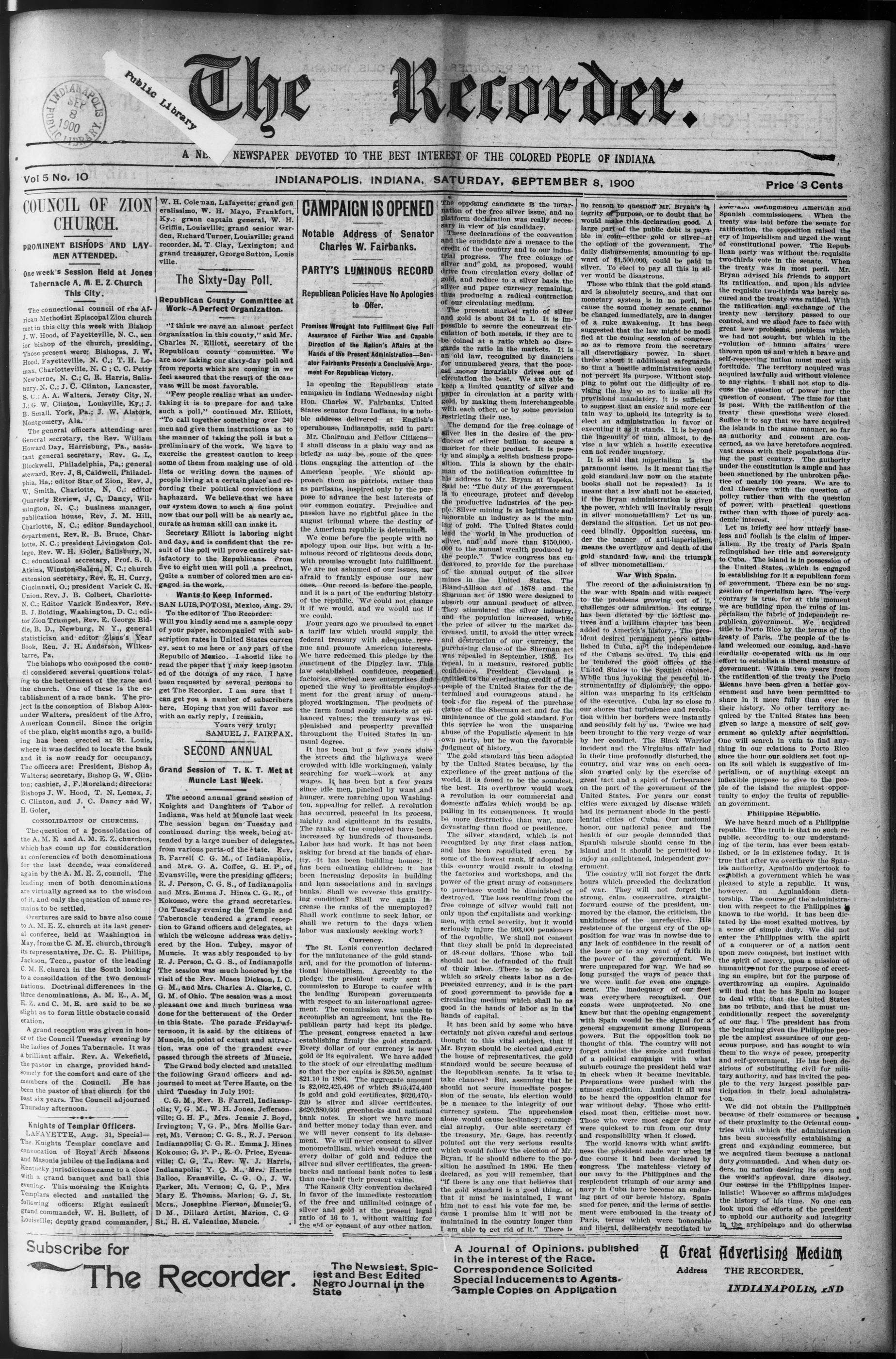
Page text (machine-generated)
Vol 5 No. 10
PROMINENT BISHOPS AND LAY-MEN ATTENDED.
One week's Session Held at Jones Tabernacle A. M. E. Z. Church This City.
The connectional council of the African Methodist Episcopal Zion church met in this city this week with Bishop J. W. Hood, of Fayetteville, N. C., senior bishop of the church, presiding. Those present were; Bishopss, J. W. Hood, Fayetteville, N. C.; T. H. Lomax, Charloteville, N. C; C. C. Petty Newberne, N. C.; C. R. Harris, Salisbury, N. C.; J. C. Clinton, Lancaster, S. C.; A. A. Walters, Jersey City, N.; G. W. Clinton, Louisville, Ky.; J. B. Small, York, Pa.; J. W. Alstork, Montgomery, Ala.
The general officers attending are General secretary, the Rev. William Howard Day, Harrisburg, Pa., assistant general secretary, Rev. G. L. Blockwell, Philadelphia, Pa.; general steward, Rev. J, S, Caldwell, Philadelphia, Ha.; editor Star of Zion, Rev. J, W, Smith, Charlotte, N, C.; editor Quarterly Review, J, C, Dancy, Wilmington, N. C.; business manager, publication house, Rev. J, M. Hill, Charlotte, N. C.; editor Sundayschool department, Rev. R. B. Bruce, Charlotte, N. C.; president Livingston College, Rev. W. H. Goler, Salisbury, N. C.; educational secretary, Prof. S. G. Atkins, Winston-Salem, N. C.; church extension secretary, Rev. E. H. Curry, Cincinnati, O.; president Varick C. E. Union, Rev. J. B. Colbert, Charlotte-N. C.; Editor Varick Endeavor, Rev. B. J. Bolding, Washington, D. C.; editor Zion Trumpet, Rev. E. George Biddle, B. D., Newburg, N. Y., general statistician and editor Zisus's Year Book, Reu, J. H. Anderson, Wilkesbarre, Pa.
The bishops who composed the council considered several questions relating to the betterment of the race and the church. One of these is the establishment of a race bank. The project is the consition of Bishop Alexander Walters, president of the Afro-American Council. Since the origin of the plan, eight months ago, a building has been erected at St. Louis, where it was decided to locate the bank and it is now ready for occupancy. The officers are: President, Bishop A, Walters; secretary, Bishop G. W. Clinton; cashier, J. F. Moreland; directors: Bishops J. W. Hood, T. N. Lemax, J. C. Clinton, and J. C. Dancy and W. H. Goler.
CONSOLIDATION OF CHURCHES.
The question of a consolidation of the A. M. E. and A. M. E. Z. churches, which has come up for consideration at conferenches of both denominations for the last decade, was considered again by the A. M. E. Z. council. The leading men of both denominations are virtually agreed as to the wisdom of it, and only the question of name remains to be settled.
Overture are said to have also come to A. M. E. Z. church at its last general conferee, held at Washington in May, from the C. M. E. church, through its representative, Dr. C. E. Phillips, Jackson, Teen., pastor of the leading C. M. E. church in the South looking to a consolidation of the two denominations. Doctrinal differences in the three denominations, A. M. E. A. M. E. Z. and C. M. E. are said to be so slight as to form little obstacle consid eration.
A grand reception was given in honor of the Council Tuesday evening by the ladies of Jones Tabernacle. It was a brilliant affair. Rev. A. Wekefield, the pastor in charge, provided handsomely for the comfort and care of the members of the Council. He has been the pastor of that church for the past six years. The Council adjourned Thursday afternoon.
Knights of Templar Officers.
LAFAYETTE, Aug. 31, Special—The Knights Templar conclave and convocation of Royal Arch Masons and Masonie jubilee of the Indiana and Kentucky jurisdictions came to a close with a grand banquet and ball this evening. This morning the Knights Templars elected and installed the following officers: Right eminent grand commander, W. H. Bullett, of Louisville; deputy grand commander,
NEWSPAPER DEVOTED TO THE BEST INTEREST OF THE COLORED PEOPLE OF INDIANA
W. H. Cole man, Lafayette; grand gen
eralissimo, W. H. Mayo, Frankfort,
Ky.; grann captain general, W. H.
Griffin, Louisville; grand senior warden,
Richard Turner, Louisville; grand recorder, M. T. Clay, Lexington; and grand treasurer, George Sutton, Louis ville.
The Sixty-Day Poll.
Republican County Committee at Work--A Perfect Organization.
"I think we have an almost perfect organization in this county," said Mr. Charles N. Elliott, secretary of the Republican county committee. We are now taking our sixty-day poll and from reports which are coming in we feel assured that the result of the canvass will be most favorable.
"Few people realize what an undertaking it is to prepare for and take such a poll," continued Mr. Elliott, "To call together something over 240 men and give them instructions as to the manner of taking the poll is but a preliminary of the work. We have to exercise the greatest caution to keep some of them from making use of old lists or writing down the names of people living at a certain place and recording their political convictions in haphazard. We believe that we have our system down to such a fine point now that our poll will be as nearly accurate as human skill can make it.
Secretary Elliott is laboring night and day, and is confident that the result of the poll will prove entirely satisfactory to the Republicans. From five to eight men will poll a precinct, Quite a number of colored men are engaged in the work.
Wants to Keep Informed.
SAN LUIS,POTOSI, Mexico, Aug. 29.
To the editor of The Recorder:
To the editor of The Recorder:
Will you kindly send me a sample copy of your paper, accompanied with subscription rates in United States currency, sent to me here or any part of the Republic of Mexico. I should like to read the paper that I may keep insotmed of the doings of my race. I have been requested by several persons to get The Recorder. I am sure that I can get you a number of subscribers here. Hoping that you will favor me with an early reply, I remain.
Yours very truly;
SAMUEL J. FAIRFAX.
SECOND ANNUAL
Grand Session of T. K. T. Met at Muncle Last Week.
The second annual grand session of Knights and Daughters of Tabor of Indiana, was held at Muncie last week The session began on Tuesday and continued during the week, being attended by a large number of delegates from various parts of the state. Rev. B. Farrell C. G. M., of Indianapolis, and Mrs. G. A. Coffee, G. H. P., of Evansville, were the presiding officers; R. J. Person, C. G. S., of Indianapolis and Mrs. Emma J. Hines C. G. R., of Kokomo, were the grand secretaries. On Tuesday evening the Temple and Tabernacle tendered a grand reception to Grand officers and delegates, at which the welcome address was delivered by the Hon. Tuhey, mayor of Muncie. It was aly responded to by R. J. Person, C. G. S., of Indianapolis The session was much honored by the visit of the Rev. Moses Dickson, I. C. G. M., and Mrs. Charles A. Clarke, C. G. M. of Ohio. The session was a most pleasant one and much business was done for the betterment of the Order in this State. The parade Fridayafternoon, it is said by the citizens of Muncie, in point of extent and attraction, was one of the grandest ever passed through the streets of Muncie.
The Grand body elected and installed the following Grand officers and adjourned to meet at Terre Haute, on the third Tuesday in July 1901:
C. G. M., Rev. B. Farrrell, Indianapolis; V, G. M., W. H. Jones, Jeffersonville; G. H. P., Mrs. Jennie J. Boyd, Irvington; V, G. P., Mrs. Mollie Garret, Mt. Vernon; C. G. S., R. J. Person Indianapolis; C. G. R., Emma J. Hines Kokomo; G. P. P., O. Price, Evensville; C. G. T., Rev. W. J. Harris, Indianapolis; Y. Q. M., Mrs. Hattie Balloo, Evansville, C. G. O., J. W. Parker, Mt. Vernon; C, G. P., Mrs Mary E. Thomas, Marion; G. J. St. Mcrs., Josephine Pierson, Muncie; G. D M., Dillard Artist, Marion, C. G St., H. H. Valentine, Muncie.
INDIANAPOLIS, INDIANA, SATURDAY, SEPTEMBER 8, 1900
CAMPAIGN IS OPENED
Notable Address of Senator Charles W. Fairbanks.
Republican Policies Have No Apologies to Offer.
Promises Wrought Into Fulfillment Give Full Assurance of Further Wise and Capable Direction of the Nation's Affairs at the Hands of the Present Administration—Senator Fairbanks Presents a Conclusive Argument For Republican Victory.
In opening the Republican state campaign in Indiana Wednesday night Hon. Charles W. Fairbanks, United States senator from Indiana, in notable address delivered in English's operahouse, Indianapolis, said in part: Mr. Chairman and Fellow Citizens—I shall discuss in a plain way and as briefly as may be, some of the questions engaging the attention of the American people. We should approach them as patriots, rather than as partisans, inspired only by the purpose to advance the best interests of our common country. Prejudice and passion have no rightful place in the august tribunal where the destiny of the American republic is determined.
We come before the people with no apology upon our lips, but with a luminous record of righteous deeds done, with promise wrought into fulfillment. We are not ashamed of our issues, nor afraid to frankly espouse our new ones. Our record is before the people, and it is a part of the enduring history of the republic. We could not change it if we would, and we would not if we could.
Four years ago we promised to enact a tariff law which would supply the federal treasury with adequate revenue and promote American interests. We have redeemed this pledge by the enactment of the Dingley law. This law established confidence, reopened factories, erected new enterprises and opened the way to profitable employment for the great army of unemployed workingmen. The products of the farm found ready markets at enhanced values; the treasury was replenished and prosperity prevailed throughout the United States in unusual degree.
It has been but a few years since the streets and the highways were crowded with idle workingmen, vainly searching for work—work at any wages. It has been but a few years since idle men, pinched by want and hunger, were marching upon Washington, appealing for relief. A revolution has occurred, peaceful in its process, mighty and significant in its results. The ranks of the employed have been increased by hundreds of thousands. Labor has had work. It has not been asking for bread at the hands of charity. It has been building homes; it has been educating children; it has been increasing deposits in building and loan associations and in savings banks. Shall we reverse this gratifying condition? Shall we again increase the ranks of the unemployed? Shall work continue to seek labor, or shall we return to the days when labor was anxiously seeking work?
Currency.
The St. Louis convention declared for the maintenance of the gold standard, and for the promotion of international bimetallism. Agreeably to the pledge, the president early sent a commission to Europe to confer with the leading European governments with respect to an international agreement. The commission was unable to accomplish an agreement, but the Republican party had kept its pledge. The present congress enacted a law establishing firmly the gold standard. Every dollar of our currency is now gold or its equivalent. We have added to the stock of our circulating medium so that the per capita is $26.50, against $21.10 in 1896. The aggregate amount is $2,062,425,496 of which $15,474,460 is gold and gold certificates, $626,470,-320 is silver and silver certificates, $620,380,606 greenbacks and national bank notes. In short we have more and better money today than ever, and we will never consent to its debasement. We will never consent to silver monometallism, which would drive out every dollar of gold and reduce the silver and silver certificates, the greenbacks and national bank notes to less than one-half their present value.
The Kansas City convention declared in favor of the immediate restoration of the free and unlimited coinage of silver and gold at the present legal ratio of 16 to 1, without waiting for the old or consent of any other nation.
The Newsiest, Spiciest and Best Edited Negro Journal in the State
A Journal of Opinions. published in the interest of the Race. Correspondence Solicited Special Inducements to Agents Sample Copies on Application
The opposing candidate is the incarnation of the free silver issue, and no platform declaration was really necessary in view of his candidacy. These declarations of the convention and the candidate are a menace to the credit of the country and to our industrial progress. The free coinage of silver and gold, as proposed, would drive from circulation every dollar of gold, and reduce to a silver basis the silver and paper currency remaining, thus producing a radical contraction of our circulating medium.
The present market ratio of silver and gold is about 34 to 1. It is impossible to secure the concurrent circulation of both metals, if they are to be coined at a ratio which so disregards the ratio in the markets. It is an old law, recognized by financiers for unnumbered years, that the poorest money invariably drives out of circulation the best. We are able to keep a limited quantity of silver and paper in circulation at a parity with gold, by making them interchangeable with each other, or by some provision restricting their use.
The demand for the free coinage of silver lies in the desire of the producers of silver bullion to secure a market for their product. It is purely and simply a selfish business proposition. This is shown by the chairman of the notification committee in his address to Mr. Bryan at Topeka. Said he: "The duty of the government is to encourage, protect and develop the productive industries of the people." Silver mining is as legitimate and honorable an industry as is the mining of gold. The United States could lead the world in the production of silver, and add more than $150,000,000 to the annual wealth produced by the people." Twice congress has endeavored to provide for the purchase of the annual output of the silver mines in the United States. The Bland-Allison act of 1878 and the Sherman act of 1890 were designed to absorb our annual product of silver. They stimulated the silver industry, and the population increased, while the price of silver in the market decreased, until, to avoid the utter wreck and destruction of our currency, the purchasing clause of the Sherman act was repealed in September, 1893. Its repeal, in a measure, restored public confidence. President Cleveland is entitled to the everlasting credit of the people of the United States for the determined and courageous stand he took for the repeal of the purchase clause of the Sherman act and for the maintenance of the gold standard. For this service he won the unsparing abuse of the Populistic element in his own party, but he won the favorable judgment of history.
The gold standard has been adopted by the United States because, by the experience of the great nations of the world, it is found to be the soundest, the best. Its overthrow would work a revolution in our commercial and domestic affairs which would be appalling in its consequences. It would be more destructive than war, more devastating than flood or pestilence.
The silver standard, which is not recognized by any first class nation, and has been repudiated even by some of the lowest rank, if adopted in this country would result in closing the factories and workshops, and the power of the great army of consumers to purchase would be diminished or destroyed. The loss resulting from the free coinage of silver would fall not only upon the capitalists and workingmen, with cruel severity, but it would seriously injure the 903,000 pensioners of the republic. We shall not consent that they shall be paid in depreciated or 48-cent dollars. Those who toll should not be defrauded of the fruit of their labor. There is no device which so stricly cheats labor as a depreciated currency, and it is the part of good government to provide for circulating medium which shall be as good in the hands of labor as in the hands of capital.
It has been said by some who have certainly not given careful and serious thought to this vital subject, that if Mr. Bryan should be elected and carry the house of representatives, the gold standard would be secure because of the Republican senate. Is it wise to take chances? But, assuming that he should not secure immediate possession of the senate, his election would be a menace to the integrity of our currency system. The apprehension alone would cause hesitancy; commercial atrophy. Our able secretary of the treasury, Mr. Gage, has recently pointed out the very serious results which would follow the election of Mr. Bryan, if he should adhere to the position he assumed in 1806. He then declared, as you will remember, that "if there is any one that believes that the gold standard is a good thing, or that it must be maintained, I want him not to cast his vote for me, because I promise him it will not be maintained in the country longer than I am able to retid of it." There is
no reason to question Mr. Bryan's integrity or purpose, or to doubt that he would make this declaration good. A large part of the public debt is payable in coin—either gold or silver—at the option of the government. The daily disbursements, amounting to upward of $1,500,000, could be paid in silver. To elect to pay all this in silver would be disastrous.
Those who think that the gold standard is absolutely secure, and that our monetary system is in no peril, because the sound money senate cannot be changed immediately, are in danger of a ruke awakening. It has been suggested that the law might be modified at the coming session of congress so as to remove from the secretary all discretionary power. In short, throw about it additional safeguards, so that a hostile administration could not pervert its purpose. Without stopping to point out the difficulty of revising the law so as to make all its provisions mandatory, it is sufficient to suggest that an easier and more certain way to uphold its integrity is to elect an administration in favor of executing it as it stands. It is beyond the ingenuity of man, almost, to devise a law which a hostile executive can not render nugatory.
It is said that imperialism is the paramount issue. Is it meant that the gold standard law now on the statute books shall not be repealed? Is it meant that a law shall not be enacted, if the Bryan administration is given the power, which will inevitably result in silver monometallism? Let us understand the situation. Let us not proceed blindly. Opposition success, under the banner of anti-imperialism, means the overthrow and death of the gold standard law, and the triumph of silver monometallism.
War With Spain.
The record of the administration in the war with Spain and with respect to the problems growing out of it, challenges our admiration. Its course has been dictated by the loftiest motives and a brilliant chapter has been added to America's history. The president desired permanent peace established in Cuba, and the independence of the Cubans secured. To this end he tendered the good offices of the United States to the Spanish cabinet. While thus invoking the peaceful instrumentality of diplomacy, the opposition was unsparing in its criticism of the executive. Cuba lay so close to our shores that turbulence and revolution within her borders were instantly and sensibly felt by us. Twice we had been brought to the very verge of war by her conduct. The Black Warrior incident and the Virginius affair had in their time profoundly disturbed the country, and war was on each occasion avorted only by the exercise of great tact and a spirit of forbearance on the part of the government of the United States. For years our coast cities were ravaged by disease which had its permanent abode in the pestilential cities of Cuba. Our national honor, our national peace and the health of our people demanded that Spanish misrule should cease in the island and it should be permitted to enjoy an enlightened, independent government.
The country will not forget the dark hours which preceded the declaration of war. They will not forget the strong, calm, conservative, straightforward course of the president, unmoved by the clamor, the criticism, the unkindness of the unreflective. His resistance of the urgent cry of the opposition for war was in nowise due to any lack of confidence in the result of the issue or to any want of faith in the power of the government. We were unprepared for war. We had so long pursued the ways of peace that we were unfit for even one engagement. The inadequacy of our deet was everywhere recognized. Our coasts were unprotected. No one knew but that the opening engagement with Spain would be the signal for a general engagement among European powers. But the opposition took no thought of this. The country will not forget amidst the smoke and fustian of a political campaign with what suburb courage the president held war in check when it became inevitable. Preparations were pushed with the utmost expedition. Amidst it all was to be heard the opposition clamor for war without delay. Those who criticised most then, criticise most now. Those who were most eager for war were quickest to run from our duty and responsibility when it closed.
The world knows with what swiftness the president made war when in due course it had been declared by congress. The matchless victory of our navy in the Philippines and the resplendent triumph of our army and navy in Cuba have become an enduring part of our heroic history. Spain sued for peace, and the terms of settlement were embodied in the treaty of Paris, terms which were honorable and liberal, deliberately negotiated by
Price '3 Cents
sive and distinguished American and Spanish commissioners. When the treaty was laid before the Senate for ratification, the opposition raised the cry of imperialism and urged the want of constitutional power. The Republican party was without the requisite two-thirds vote in the senate. When the treaty was in most peril. Mr. Bryan advised his friends to support its ratification, and upon his advice the requisite two-thirds was barely secured and the treaty was ratified. With the ratification and exchange of the treaty new territory passed to our control, and we stood face to face with great new problems, problems which we had not sought, but which in the evolution of human affairs were thrown upon us and which a brave and self-respecting nation must meet with fortitude. The territory acquired was acquired lawfully and without violence to any rights. I shall not stop to discuss the question of power nor the question of consent. The time for that is past. With the ratification of the treaty these questions were closed. Suffice it to say that we have acquired the islands in the same manner, so far as authority and consent are concerned, as we have heretofore acquired vast areas with their populations during the past century. The authority under the constitution is ample and has been sanctioned by the unbroken practice of nearly 100 years. We are to deal therefore with the question of policy rather than with the question of power, with practical questions rather than with those of purely academic interest.
Let us briefly see how utterly hasless and foolish is the claim of imperialism. By the treaty of Paris Spain relinquished her title and sovereignty to Cuba. The island is in possession of the United States, which is engaged in establishing for it a republican form of government. There can be no suggestion of imperialism here. The very contrary is true, for at this moment we are building upon the ruins of imperialism the fabric of independent republican government. We acquired title to Porto Rico by the terms of the treaty of Paris. The people of the island welcomed our coming, and have cordially co-operated with us in our effort to establish a liberal measure of government. Within two years from the ratification of the treaty the Porto Ricans have been given a better government and have been permitted to share in it more fully than ever in their history. No other territory acquired by the United States has been given so large a measure of self government so quickly after acquisition. One will search in vain to find anything in our relations to Porto Rico since the hour our soldiers set foot upon its soil which is suggestive of imperialism, or of anything except an inflexible purpose to give to the people of the island the amplest opportunity to enjoy the fruits of republican government.
Philippine Republic.
We have heard much of a Philippine republic. The truth is that no such republic, according to our understanding of the term, has ever been established, or is in existence today. It is true that after we overthrow the Spanish authority, Aguinaldo undertook to establish a government which he was pleased to style a republic. It was, however, an Aguinaldoan dictatorship. The course of the administration with respect to the Philippines known to the world. It has been dictated by the most exalted motives, by a sense of simple duty. We did not enter the Philippines with the spirit of a conquerer or of a nation sent upon mere conquest, but instinct with the spirit of mercy, upon a mission of humanity not for the purpose of erecting an empire, but for the purpose of overthrowing an empire. Aguinaldo will find that he has Spain no longer to deal with; that the United States has no tribute, and that he must unconditionally respect the sovereignty of our flag. The president has from the beginning given the Philippine people the amplest assurance of our generous purpose, and has sought to win them to the ways of peace, prosperity and self-government. He has been desirious of substituting civil for military authority, and has invited the people to the very largest possible participation in their local administration.
We did not obtain the Philippines because of their commerce or because of their proximity to the Oriental countries with which the administration has been successfully establishing a great and expanding commerce, but we acquired them because a national duty commanded. And when duty orders, no nation desiring its own and the world's approval, dare disobey. Our course in the Philippines imperialistic! Whoever so affirms misjudges the history of his time. No one can look upon the efforts of the president to uphold our authority and integrity in the archipelago and do otherwise
SUPPLEMENT TO Indianapolis Recorder. INDIANAPOLIS, IND.
Saturday, Sept. 8, 1900.
COWBOY STORIES
ABOUT ROOSEVELT.
Rough Rider Had the Friendship of the Cattlemen.
Quaint Orders Given to the Cow Puncheers—His Experience with a Broncho—The Colonel Won—Test of Friendship.
In a moss interesting letter in the Chicago Record, dated at Medora, N. D., William E. Curtis repeats many of the stories told him by the ranchmen and cowboys of North Dakota and eastern Montana relative to Gov. Roosevelt He says they remember him most kindly and consider him one of themselves. Among others Mr. Curtis relates the following:
A. T. Packard, now of Chicago, was editor of the Bad Lands Cowboy when Roosevelt was ranching up on the Little Missouri, and has many pleasant recollections of those days. Said he: "You cannot pay a higher compliment to Theodore Roosevelt than to say that he won the friendship of every cowboy in the Bad Lands. There isn't on earth a more independent, self-thinking lot of men than these same cow-punchers. They have the faculty of shucking a man out of his crust and looking his real character squarely in the face. If they like him it is a pretty safe guess that the man will pass muster anywhere for his sterling worth, and it is just as safe for any one who differs from such a conclusion about Roosevelt to keep his opinion to himself in the Bad Lands. The cowboy is perfectly willing at all times to back up in any way his friendship for Roosevelt. I wonder what would have happened to Altgeild if he had delivered his Toledo speech at a Bad Lands round-up?
"Roosevelt had just established his Chimney Butte ranch and was driving in some cattle when I landed at Medora, so that I was contemporary with him. His name was a little too much for the average cowboy, and at first he was generally known as Roosefelder. That he was destined to popularity was shown by an almost immediate change to nicknames, chief of which were 'Old Four Eyes,' because he wore spectacles with enormous glasses, and 'Skin Tooth,' which has been sufficiently explained by the cartoonist.
"Nothing amused the cowboys more than Roosevelt's choice of words and manner of speech. He was the purist in language, and at first was unable to tackle the cow-punchers' slang. While driving the first bunch of cattle to his 'Chinney Butte ranch a number of them started up a coulee. An experienced foreman would have shouted: 'Get a git on you there and head them steers,' or 'Hit the high places and turn 'em.' Roosevelt's order, while equally sharp, nearly paralyzed the flying cow-puncher. It has been treasured and told and retold where ever two or more cow-punchers have gathered together. Standing in his stirrups, he opened his steel-trap mouth and yelled: 'Hasten quickly forward yonder.' The wonder was it didn't stampede the herd.
"In the Chimney Butte horse herd," continued Mr. Packard, "was a broncho named Devil. When you find a horse in the West with such a name you can be sure he has earned it. Devil,had. One after another the cowboys had tried their best to 'stay with the leather' on him, and none had succeeded, even with the aid of a 'life-preserver' and hobbled stirrups. He had been given up as a 'spoiled' horse, especially after he had acquired the playful habit of trying to bite and jump on the rider after he had thrown him.
"Roosevelt decided to ride Devil and tame him for a saddle horse. It took three men to rope and tie him down while the blind and saddle were being put on, and he was then led to the edge of the Little Missouri and headed for a quick-sand. Roosevelt mounted, jerked off the blind, and then began what was called at the time 'the gaul durdest panoramaer the Bad Lands has ever saw.' The first jump took Devil into the middle of the quicksand and Macmnonies' fountain became a squirt gun by comparison. Sand, water, Roosevelt and Devil seemed merged into solid body. Finally there was a separation and Roosevelt 'ascended to take a look at Wyoming,' as Bill Jones facetiously remarked. The next day and the next and the next there was the same 'panorammer,' but finally came a day when Roosevelt 'stayed with the leather' and brought Devil, thoroughly tamed, back to the ranch. It may not sound like much in the telling, but a man who can tame a horse with Devil's reputation can divide the last chew of tobacco with a cow-puncher. And that is a final test of friendship. He at once became 'Teddy' to every cowboy in the Bad Lands.
The Prosperity Alphabet
Abundance of work.
Better times.
Calamity dethroned.
Duty performed.
Expansion realized.
Free silver exposed.
Gold standard continued.
Hawaii annexed.
Independence to Cuba.
Justice to all.
Knowledge promoted.
Liberty extended.
McKinley's re-election.
National honor upheld.
Dpportunities improved.
Protection assured.
Quantities of employment.
Roosevelt a winner.
Stability of credit.
Trade extended.
Union forever.
Values unheld.
Wages increased.
"Xs" more pleniful.
Yankee Doodle Dandy.
Zenith of prosperity.
"I tell you, increase and multiply and expand is the law of this nation's existence. You cannot limit this great republic by mere boundary lines, saying "Thus far shalt thou go and no further." Just so far as our interests require additional territory, in the North, in the South, or on the islands of the ocean, I am for it."—Stephen A. Douglas, one of Lincoln's opponents in the election of 1800.
"I prefer to trust McKinley and influence the policy of my party later in a way to give the distant lands the best and freest government possible. I cannot trust a party that has been instrumental in forcing the adoption of the treaty in the Senate and now holds the President responsible for doing his duty. I cannot trust a party which is so anxious for the rights of the Filipinos, and tramples these sacred rights under foot in our land in the South."—Rabbi Hirsch.
"What I want to say is this: We are on the eve of a campaign second in importance to none other in the history of our party, a campaign on the issues of which depend our future prosperity. I don't propose to discuss these issues, but I want to say a few words to sound a note of warning which the importance of this campaign justifies me in saying, not only to the Republicans of New Jersey, but to the Republicans of the whole country. It is your duty and the time is at hand when every man, no matter how humble, how prominent or influential, is called upon to contribute all the efforts, all the influence in his power to perpetuate this administration. * * * I tell you, my friends, in all sincerity and honesty, it will not do to take anything for granted, not to neglect a single effort, nor miss a trick. We are confronted by a desperate foe: the fate of Bryanism hangs in the balance. If killed now, it is killed forever."—M. A. Hanna, in Asbury Park speech.
"Our business, that is, the retail house for which I speak, has each year for several years, handsomely surpassed its predecessors. The last six months have shown greater sales by a large percentage, and there is more general satisfaction than has ever been shown herefore. Our pay roll is much larger than
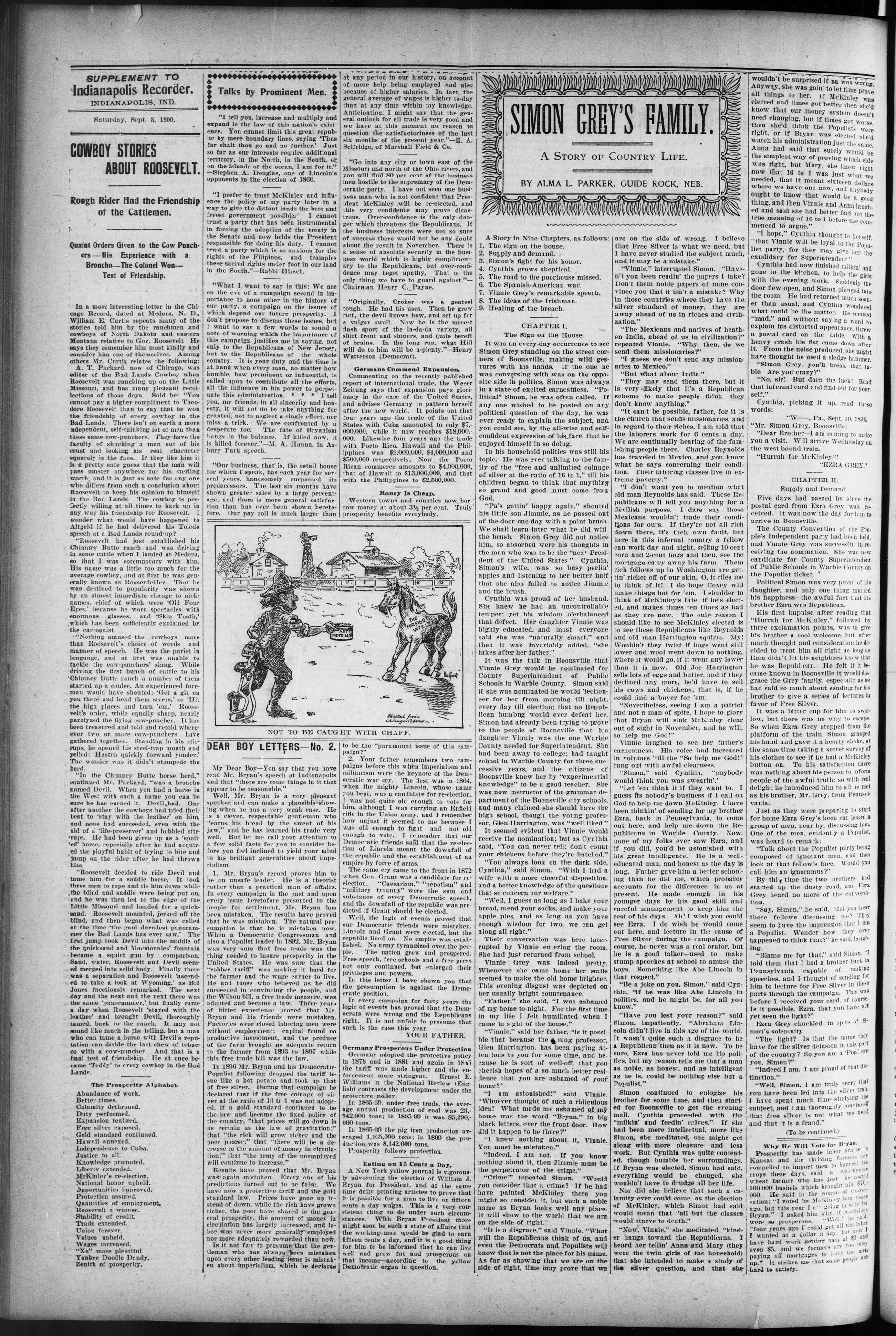
BAYAN
FREE
NILVER
ANY IMPERIAL
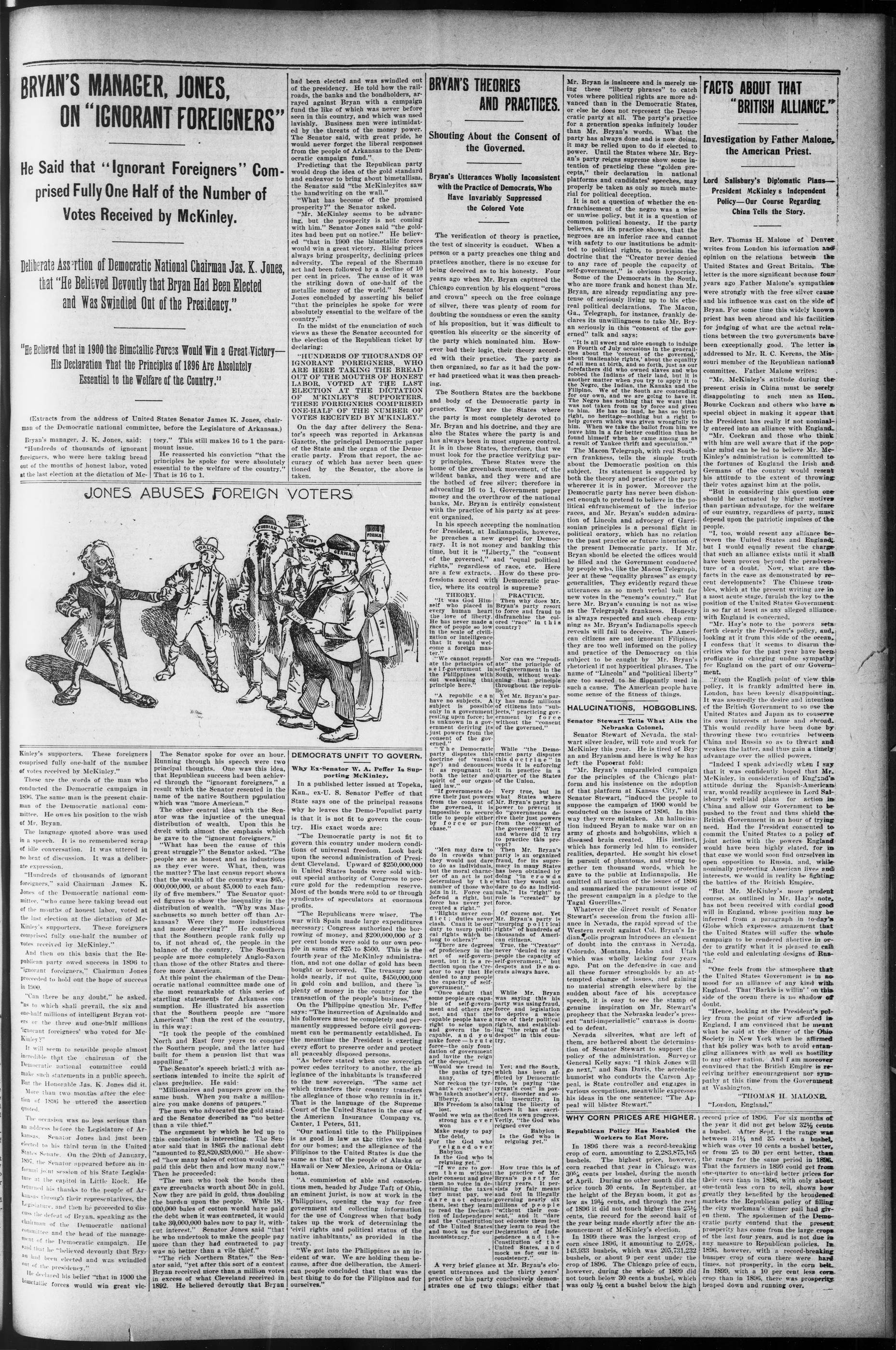
THE FOREIGN VOTE
Mental from Chicago Tribune.
NOT TO BE CAUGHT WITH CHAFF.
My Dear Boy—You say that you have read Mr. Bryan's speech at Indianapolis and that "there are some things in it that appear to be reasonable." Well, Mr. Bryan is a very pleasant speaker and can make a plausible showing when he has a very weak case. He is a clever, respectable gentleman who "earns his bread by the sweat of his jaw," and he has learned his trade very well. But let me call your attention to a few solid facts for you to consider before you feel inclined to yield your mind to his brilliant generalities about imperialism.
1. Mr. Bryan's record proves him to be an unsafe leader. He is a theorist rather than a practical man of affairs. In every campaign in the past and upon every issue heretofore presented to the people for settlement, Mr. Bryan has been mistaken. The results have proved that he was mistaken. The natural presumption is that he is mistaken now. When a Democratic Congressman and also a Populist leader in 1892, Mr. Bryan was very sure that free trade was the thing needed to insure prosperity in the United States. He was sure that the "robbber tariff" was making it hard for the farmer and the wage earner to live. He and those who believed as he did succeeded in convincing the people, and the Wilson bill, a free trade measure, was adopted and became a law. Three years of bitter experience proved that Mr. Bryan and his friends were mistaken. Factories were closed laboring men were without employment; capital found no productive investment, and the produce of the farm brought no adequate return to the farmer from 1893 to 1897 while this free trade bill was the law.
In 1896 Mr. Bryan and his Democratic Populist following dropped the tariff issue like a hot potato and took up that of free silver. During that campaign he declared that if the free coinage of silver at the ratio of 16 to 1 was not adopted, if a gold standard continued to be the law and became the fixed policy of the country, "that prices will go down is as certain as the law of gravitation;" that "the rich will grow richer and the poor poorer;" that "there will be a decrease in the amount of money in circulation;" that "the army of the unemployed will continue to increase."
Results have proved that Mr. Bryan was again mistaken. Every one of his predictions turned out to be false. We have now a protective tariff and the gold standard law. Prices have gone up instead of down, while the rich have grown richer, the poor have shared in the general prosperity, the amount of money in circulation has largely increased, and labor was never more generally employed nor more adequately rewarded than now.
Is it not fair to presume that the gentleman who has always been mistaken upon every other leading issue is mistaken about imperialism, which he declare
at any period in our history, on account of more help being employed and also because of higher salaries. In fact, the general average of wages is higher to-day than at any time within my knowledge. Anticipating, I might say that the general outlook for all trade is very good and we have at this moment no reason to question the satisfactoriness of the last six months of the present year."—E. A. Selfridge, of Marshall Field & Co.
"Go into any city or town east of the Missouri and north of the Ohio rivers, and you will find 80 per cent of the business men hostile to the supremacy of the Democratic party. I have not seen one business man who is not confident that President McKinley will be re-elected, and this very confidence may prove disastrous. Over-confidence is the only danger which threatens the Republicans. If the business interests were not so sure of success there would not be any doubt about the result in November. There is a sense of absolute security in the business world which is highly complimentary to the Republicans, but over-confidence may beget apathy. That is the only thing we have to guard against."—Chairman Henry C. Payne.
"Originally, Croker was a genteel tough. He had his uses. Then he grew rich, the devil knows how, and set up for a vulgar swell. Now he is the merest flash sport of the la-da-da variety, all shirt front and shiners, and quite bereft of brains. In the long run, what Hill will do to him will be a-plenty."—Henry Watterson (Democrat).
**Germans Commend Expansion.**
Commenting on the recently published report of international trade, the Weser Zeitung says that expansion pays gloriously in the case of the United States, and advises Germany to pattern herself after the new world. It points out that four years ago the trade of the United States with Cuba amounted to only $7,000,000, while it now reaches $18,000,000. Likewise four years ago the trade with Porto Rico, Hawaii and the Philippines was $2,000,000, $4,000,000 and $500,000 respectively. Now the Porto Rican commerce amounts to $4,000,000, that of Hawaii to $13,000,000, and that with the Philippines to $2,500,000.
Western towns and counties now borrow money at about $3 \frac{1}{2}$ per cent. Truly prosperity benefits everybody.
THE FOREIGN VOTE
Marshal from
Chicago, Illinois.
to be the "paramount issue of this campaign?"
2. Your father remembers two campaigns before this when imperialism and militarism were the keynote of the Democratic war cry. The first was in 1864, when the mighty Lincoln, whose name you bear, was a candidate for re-election. I was not quite old enough to vote for him, although I was carrying an Enfield rifle in the Union army, and I remember how unjust it seemed to me because I was old enough to fight and not old enough to vote. I remember that our Democratic friends said that the re-election of Lincoln meant the downfall of the republic and the establishment of an empire by force of arms.
The same cry came to the front in 1872 when Gen. Grant was a candidate for re-election. "Caesarism," "nepotism" and "military tyranny" were the sum and substance of every Democratic speech, and the downfall of the republic was predicted if Grant should be elected.
Well, the logic of events proved that our Democratic friends were mistaken. Lincoln and Grant were elected, but the republic lived on. No empire was established. No army tyrannized over the people. The nation grew and prospered. Free speech, free schools and a free press not only continued, but enlarged their privileges and powers.
In this letter I have shown you that the presumption is against the Democratic position.
In every campaign for forty years the logic of events has proved that the Democrats were wrong and the Republicans right. It is not unfair to presume that such is the case this year.
YOUR FATHER.
Germany Prosperous Under Protection
Germany adopted the protective policy in 1878 and in 1881 and again in 1885 the tariff was made higher and the enforcement more stringent. Ernest E. Williams in the National Review (English) contrasts the development under the protective policy.
In 1805-09, under free trade, the average annual production of coal was 23,942,000 tons; in 1805-09 it was 85,290,000 tons.
In 1805-09 the pig iron production averaged 1,165,000 tons; in 1890 the production was 8,142,000 tons.
A New York yellow journal is vigorously advocating the election of William J. Bryan for President, and at the same time daily printing articles to prove that it is possible for a man to live on fifteen cents a day wages. This is a very consistent thing to do under such circumstances. With Bryan President there might soon be such a state of affairs that the working man would be glad to earn fifteen cents a day, and it is a good thing for him to be informed that he can live well and grow fat and prosperous on that income—according to the yellow Democratic organ in question.
SIMON GREY'S FAMILY.
A Story in Nine Chapters, as follows
1. The sign on the house.
2. Supply and demand.
3. Simon's fight for his honor.
4. Cynthia grows skeptical.
5. The road to the poorhouse missed.
6. The Spanish-American war.
7. Vinnie Grey's remarkable speech.
8. The ideas of the Irishman.
9. Healing of the breach.
It was an every-day occurrence to see Simon Grey standing on the street corners of Boonsville, making wild gestures with his hands. If the one he was conversing with was on the opposite side in politics, Simon was always in a state of excited earnestness. "Political" Simon, he was often called. If any one wished to be posted on any political question of the day, he was ever ready to explain the subject, and you could see, by the all-wise and self confident expression of his face, that he enjoyed himself in so doing. In his household politics was still his topic. He was ever talking to the family of the "free and unlimited coinage of silver at the ratio of 16 to 1," till his children began to think that anything so grand and good must come from God.
"Pa's gettin' happy again," shouted his little son Jimmie, as he passed out of the door one day with a paint brush. We shall learn later what he did with the brush. Simon Grey did not notice him, so absorbed were his thoughts in the man who was to be the "next President of the United States" Cynthia, Simon's wife, was so busy peelin' apples and listening to her better half that she also failed to notice Jimmie and the brush.
Cynthia was proud of her husband. She knew he had an uncontrollable temper; yet his wisdom o'erbalanced that defect. Her daughter Vinnie was highly educated, and most everyone said she was "naturally smart." and then it was invariably added, "she takes after her father."
It was the talk in Boonsville that Vinnie Grey would be nominated for County Superintendent of Public Schools in Warble County. Simon said if she was nominated he would 'lectioner' for her from morning till night, every day till election; that no Republican humbug would ever defeat her. Simon had already been trying to prove to the people of Boonsville that his daughter Vinnie was the one Warble County needed for Superintendent. She had been away to college; had taught school in Warble County for three successive years, and the citizens of Boonsville knew her by "experimental knowledge" to be a good teacher. She was now instructor of the grammar department of the Boonsville city schools, and many claimed she should have the high school, though the young professor, Glen Harrington, was "well liked."
It seemed evident that Vinnie would receive the nomination; but as Cynthia said, "You can never tell; don't count your chickens before they're hatched." "You always look on the dark side, Cynthia," said Simon. "Wish I had a wife with a more cheerful disposition, and a better knowledge of the questions that so concern our welfare." "Well, I guess as long as I bake your bread, mend your socks, and make your apple pies, and as long as you have enough wisdom for two, we can get along all right." Their conversation was here interrupted by Vinnie entering the room. She had just returned from school. Vinnie Grey was indeed pretty. Whenever she came home her smile seemed to make the old home brighter. This evening disgust was depicted on her usually bright countenance.
"Father," she said, "I was ashamed of my home to-night. For the first time in my life I felt humiliated when I came in sight of the house."
"Vinnie," said her father, "is it possible that because the young professor, Glen Harrington, has been paying attention to you for some time, and because he is sort of well-off, that you cherish hopes of a so much better residence that you are ashamed of your home?
"I am astonished!" said Vinnie. "Whoever thought of such a ridiculous idea! What made me ashamed of my home was the word "Bryan." in big black letters, over the front door. How did it happen to be there?
"I knew nothing about it, Vinnie. You must be mistaken.
"Indeed. I am not. If you know nothing about it, then Jimmie must be the perpetrator of the crime."
"Crime?" repeated Simon. "Would you consider that a crime? If he had have painted McKinley there you might so consider it, but such a noble name as Bryan looks well any place. It will show to the world that we are on the side of right."
"It is a disgrace," said Vinnie. "What will the Republicans think of us, and even the Democrats and Populists will know that is not the place for his name. As far as showing that we are on the side of right, time may prove that we
are on the side of wrong. I believe that Free Silver is what we need, but I have never studied the subject much, and it may be a mistake."
"Vinnie." interrupted Simon. "Haven't you been readin' the papers I take? Don't them noble papers of mine convince you that it isn't a mistake? Why in those countries where they have the silver standard of money, they are away ahead of us in riches and civilization."
"The Mexicans and natives of heathen India, ahead of us in civilization?" repeated Vinnie. "Why, then, do we send them missionaries?"
"I guess we don't send any missionaries to Mexico."
"But what about India."
"They may send them there, but it is very likely that it's a Republican scheme to make people think they don't know anything."
"It can't be possible, father, for it is the church that sends missionaries, and in regard to their riches, I am told that the laborers work for 6 cents a day. We are continually hearing of the fanning people there. Charley Reynolds has traveled in Mexico, and you know what he says concerning their condition. Their laboring classes live in extreme poverty."
"I don't want you to mention what old man Reynolds has said. These Republicans will tell you anything for a devilish purpose. I dare say those Mexicans wouldn't trade their conditions for ours. If they're not all rich down there, it's their own fault, but here in this infernal country a fellow can work day and night, selling 10-cent corn and 2-cent hogs and then, see the mortgage carry away his farm. Them rich fellows in Washington are gettin' richer off of our skin. O, it riles me to think of it! I do hope Coxey will make things hot for 'em. I shudder to think of McKinley's fate, if he's elected, and makes times ten times as bad as they are now. The only reason I should like to see McKinley elected is to see these Republicans like Reynolds and old man Harrington squirm. My: Wouldn't they twist if hogs went still lower and wool went down to nothing, where it would go, if it went any lower than it is now. Old Joe Harrington sells lots of eggs and butter, and if they declined any more, he'd have to sell his cows and chickens; that is, if he could find a buyer for 'em.
"Nevertheless, seeing I am a patriot and not a man of spite, I hope to glory that Bryan will sink McKinley clear out of sight in November, and he will, so help me God!"
Vinnie laughed to see her father's earnestness. His voice had increased in volumes 'till the "So help me God!" rang out with awful clearness.
"Simon," said Cynthia, "anybody would think you was swearin."
"Let 'em think it if they want to. I guess its nobody's business if I call on God to help me down McKinley. I have been thinkin' of sending for my brother Ezra, back in Pennsylvania, to come out here, and help me down the Republicans in Warble County. Now, none of my folks ever saw Ezra, and if you did, you'd be astonished with his great intelligence. He is a well-educated man, and honest as the day is long. Father gave him a better schooling than he did me, which probably accounts for the difference in us at present. He made enough in his younger days by his good skill and careful management to keep him the rest of his days. Ah! I wish you could see Ezra. I do wish he would come out here, and lecture in the cause of Free Silver during the campaign. Of course, he never was a real orator, but he is a good talker—used to make stump speeches at school to anuse the boys. Something like Abe Lincoln in that respect."
"Be a joke on you, Simon," said Cynthia, "if he was like Abe Lincoln in politics, and he might be, for all you know."
"Have you lost your reason?" said Simon, impatiently. "Abraham Lincoln didn't live in this age of the world. It wasn't quite such a disgrace to be a Republican then as it is now. To be sure, Ezra has never told me his politics, but my reason tells me that a man as noble, as honest, and as intelligent as he is, could be nothing else but a Populist."
Simon continued to eulogize his brother for some time, and then started for Boonsville to get the evening mall. Cynthia proceeded with the "milkn' and feedin' calves." If she had been more intellectual, more like Simon, she meditated, she might get along with more pleasure and less work. But Cynthia was quite contented, though humble her surroundings. If Bryan was elected, Simon had said, everything would be changed, she wouldn't have to drudge all her life. Nor did she believe that such a calamity ever could come, as the election of McKinley, which Simon had said would mean that "all but the classes would starve to death."
"Now, Vinnle," she meditated, "kinder hangs toward the Republicans. I heard her tellin' Anna and Mary (they were the twin girls of the household) that she intended to make a study of the silver question, and that she
wouldn't be surprised if pa was wrong. Anyway, she was goin' to let time prove all things to her. If McKinley was elected and times got better then she'd know that our money system doesn't need changing, but if times got worse, then she'd think the Populists were right, or if Bryan was elected she'd watch his administration just the same. Anna had said that surely would be the simplest way of proving which side was right, but Mary, she knew right now that 16 to 1 was just what we needed, that it meant sixteen dollars where we have one now, and anybody ought to know that would be a good thing, and then Vinnie and Anna laughed and said she had better find out the true meaning of 16 to 1 before she commenced to argue.
"I hope," Cynthia thought to herself, "that Vinnie will be loyal to the Populist party, for they may give her the candidacy for Superintendent."
Cynthia had now finished milkin' and gone to the kitchen, to help the girls with the evening work. Suddenly the door dew open, and Simon plunged into the room. He had returned much sooner than usual, and Cynthia wondered what could be the matter. He seemed "mad," and without saying a word to explain his distorted appearance, threw a postal card on the table. With a heavy crash his fist came down after it. From the noise produced, she might have thought he used a sledge hammer, "Simon Grey, you'll break that table. Are you crazy?" "No, sir! But darn the luck! Read that infernal card and find out for yourself." Cynthia, picking it up, read these words:
"W—, Pa., Sept. 10, 1806. "Mr. Simon Grey, Boonsville: "Dear Brother—I am coming to make you a visit. Will arrive Wednesday on the west-bound train.
"Hurrah for McKinley!!!
"EZRA GREY"
CHAPTER II.
Supply and Demand
Five days had passed by since the postal card from Ezra Grey was received. It was now the day for him to arrive in Boonsville.
The County Convention of the People's Independent party had been held, and Vinnie Grey was successful in receiving the nomination. She was now candidate for County Superintendent of Public Schools in Warble County on the Populist ticket.
Political Simon was very proud of his daughter, and only one thing marred his happiness—the awful fact that his brother Ezra was Republican.
His first impulse after reading that "Hurrah for McKinley," followed by three exclamation points, was to give his brother a cool welcome, but after much thought and consideration he decided to treat him all right as long as Ezra didn't let his neighbors know that he was Republican. He felt if it became known in Boonsville it would disgrace the Grey family, especially as he had said so much about sending for his brother to give a series of lectures in favor of Free Silver.
It was a bitter cup for him to swallow, but there was no way to escape. So when Ezra Grey stepped from the platform of the train Simon grasped his hand and gave it a hearty shake, at the same time taking a secret survey of his clothes to see if he had a McKinley button on. To his satisfaction there was nothing about his person to inform people of the awful truth; so with real delight he introduced him to all he met as his brother, Mr. Grey, from Pennsylvania.
Just as they were preparing to start for home Ezra Grey's keen ear heard a group of men, near by, discussing a One of the men, evidently a Populist, was heard to remark:
"Talk about the Populist party being composed of ignorant men, and then look at that fellow's face. Would you call him an ignorant?"
By this time the two brothers had started up the dusty road, and Ezra Grey heard no more of the conversation.
"Say, Simon," he said, "did you hear those fellows discussing me? They seem to have the impression that I am a Populist. Wonder how they ever happened to think that?" he said, laughing.
"Blame me for that," said Simon. "I told them that I had a brother back in Pennsylvania capable of making speeches, and I thought of sending for him to lecture for Free Silver in these parts through the campaign. This was before I received your card, of course. Is it possible, Ezra, that you have not yet seen the light?"
Ezra Grey chuckled, in spite of Simon's solemnity.
"The light? Is that the name they have for the silver delusion in this part of the country? So you are a 'Pop' are you, Simon?"
"Indeed I am. I am proud of that distinction."
"Well, Simon, I am truly sorry that you have been led into the silver trap. I have spent much time studying the subject, and I am thoroughly convinced that free silver is not what we need, and that it is a fraud."
Why He Will Vote for Bryan.
Prosperity has made labor scarce in Kansas and the thriving farmers are compelled to import men to harvest the crops these days, said a well-known wheat farmer who has just harvested 100,000 bushels which brought $70,000. He said in the course of conversation: "I voted for McKinley four years ago, but this year I am going to vote for Bryan." I asked him why, if conditions were so prosperous. "Well," he said, "four years ago I could get all the labor I wanted at a dollar a day, but now I have hard work getting men at $3 and even $5, and we farmers are too busy paying off mortgages to hunt the men up." It strikes me that some people are hard to satisfy.
THE HOUSEHOLD.
LAST BUN OF SUPPER.
Tis the last bun of supper,
Left steaming alone;
And its light brown companions
Are buttered and gone;
No bun of its kindred,
No cookie is nigh.
To steam on the platter,
Or hear its mate lie.
I'll not leave thee, thou lone one,
To meet a cold fate,
Since thy mates are all eaten,
Come lie on my plate.
Thus kindly I'll butter
Thy toasted side o'er.
And think on thy sweetness
When thou art no more.
Thus all bread must follow
Three times every day;
When the meal times approach
It must vanish away.
When hunger is mighty
And sickness has flown.
What bun can inhabit
The table alone?
Vegetables
Why do we respect some vegetables and despise others? The bean is a graceful, confiding, engaging vine; but you never can put beans into poetry or into the highest kind of prose. There is no dignity in the bean.
Corn—which in my garden grows alongside the bean, and, so far as I can see, with no affection of superiority—is, however, the child of song. It waves in all literature. But mix it with beans, and its high tone is gone. Succotash is vulgar; it is the bean in it; the bean is a vulgar vegetable, without culture, or any flavor of high society among vegetables.
Then there is the cucumber, like so many people, good for nothing when it is ripe, and the wildness has gone out of it. How inferlor to the melon, which grows upon a similar vine! The cucumber is a sort of low comedian in a company where the melon is a minor gentleman.
The lettuce is to me a most interesting study. Lettuce is like conversation; it must be fresh and crisp, so sparkling that you scarcely notice the bitter in it. Lettuce, like most talkers, though, is apt to run rapidly to seed. Blessed is that sort which comes to a head, and so remains—like a few people I know—growing more solid and satisfactory and tender, and whiter at the center. Lettuce, like conversation, requires a good deal of oil, to avoid friction, and keep the company smooth; a pinch of Attic salt, a dash of pepper, mustard and vinegar, but so mixed that you will notice no sharp contrasts, and a trifle of sugar. I feel that I am in the best society when I am with lettuce; it is in the most select vegetable circle.—Charles Dudley Warner, in "My summer in a garden."
From Peaches.
A delicious dessert, made from peaches, has the merit of pleasing both the eye and the palate. Peel six large, ripe peaches, first dipping them in boiling water to loosen the skin, then placing them in cracked ice to cool. Cut them in halves and remove the stones and sprinkle them with a liberal supply of sugar. Put one cupful of cream into a bowl and whip it until it has trebled in quantity. The froth should then be put on a sieve to drain and kept on ice till wanted. Beat the whites of four eggs with four ounces of powdered sugar until very stiff. This must be dried over the fire, and the only way to do it successfully is to drop the meringue in spoonfuls on white paper, place the paper on a board and place it over the range where it will keep warm for one-half hour. Then place board and all in a slow oven till the white turns brown. When these are cold, remove the soft inner portion from each, leaving a mere shell of white of egg, within which you may place one-half a peach. Heap the whipped cream on top and serve.
Buying Table Linen.
When purchasing table linens always purchase the very best that you can afford, for every dollar put into table linens is an economy. After you have once collected a fair number of tablecloths, make it a rule to lay aside a little at a time and each year or even two years, buy a cloth or napkins. When there are signs of wear cut the cloth along the entire length, and this piece along the raw edge. This will give you a pretty sideboard cover, that will last for a long time. Cut the rest of the cloth into small pieces that may be used for napkins, tray covers, or any of the uses that are constantly arising. These will always prove useful and will save rough wear and tear on your good napkins.
Short Fashions.
Cashmere is in high favor once more.
The mushroom hat is of the Lady-smith order, but is newer—and therefore a bit better style.
Waists of cashmere, nuns' velling and Landsdowne are made up with countless tuckings and strappings and stitchings.
Some of the newest easy jackets of the "Gelskau" variety are made of very sheer albatross lined with pink, blue or mandarin-yellow China silk.
Red invades tennis, golf, cycling, yachting and the beach, as if by natural right, but it is now quite a feature for shopping, the promenade and evening as well.
Many fashionable bodices are fashioned entirely of pieces of lace and narrow ribbons pieced together in wonderful style over a model in such a way as to seem to be modeled on the human figure when worn.
Teaching Little Ones
It is wonderful how much knowledge can be imparted to small children by a quick nursemaid who has an inking of the kindergarten system. Children are never tired of asking questions, and if these are intelligently answered they pick all sorts of useful knowledge without any actual teaching. The object of the kindergarten system is to teach the little ones to think for themselves, and it is worth every mother's and nurse's while to learn something of it. The custom of talking nonsense to them and distorting words cannot be too much condemned.
Economic Fashion.
Once in a great while it happens that fashions are accommodating and allow some economy on the part of their fellowers. That is true just at present. A useful fashion is seen in the choux of tulle, white, black, or vivid colored, that may be used on the front of a bodice. They are used and they do brighten up a gown that has been worn once too often, but there is a drawback. Even when there is no necessity for the addition of the tulle, the observer is likely to decide that there is, and therefore the charitable knots of black, white or color may be misunderstood. They are worn on the left side of the bodice.
Take Care of Your Piano.
Windows are open now all day, and, notwithstanding great care, dust is bound to settle on everything. The piano is the one piece of furniture that should be specially cared for. Many piano owners have never learned how to protect their instruments properly. Keep a space of ten or twelve inches between the piano and the wall. That will improve the tone, and the instrument will be safer from dampness and changes of temperature. Never put books, music or bric-a-brac on a piano. That deadens the tone and often causes unpleasant rattling.
When the keys grow yellow they may be cleaned by being carefully rubbing with a very fine sandpaper. Another way is to dilute nitric acid in soft water, half an ounce of acid to five ounces of water. Apply to the keys by rubbing well with a brush. Then wipe every key carefully with a flannel dipped in clean water. According to a wholesale furniture dealer, the best furniture polish is made of one-third alcohol and two-thirds sweet oil. Apply the polish with a soft cloth and then rub dry with another one.
Bathtubs Need Attention.
If a bathtub has part of its enamel worn off it is hard to keep clean. It is very easy, however, to re-enamel an old tub at slight expense. Scrub it first with a strong solution of soda in water. When perfectly dry apply the first coat of enamel. Allow this two days in which to dry, and then put on the second coat. After drying for twenty-four hours till the tub with cold water and let this stand six hours. Empty, dry thoroughly and add the third coat of paint.
There are several ways to clean an enameled tub. One that is easy and quick is to pour some benzine on a cloth, scour the bathtub well with this, and then wash with water and soap. Another method is to take a heaping tablespoonful of kitchen salt, wet it with turpentine and scour the bathtub with this. Then rub carefully with a clean cloth. Caution is needed in trying this plan to see that the tub is perfectly dry before the salt and turpentine mixture is used.
Kind to the Invalid.
During the recent maneuvers of the German army in Westphalia the Empress was accustomed to drive every day through a neighboring village. There was a poor old widow in the village who had been confined to her bed for some years, but learning that the Empress often passed her little house she made a violent effort one day to reach the window. She failed in her attempt, but her anxiety to see the Empress became talked of in the village, and finally reached her majesty's household, and at last the Empress herself. One morning the old woman heard a commotion at her door; there was a knock, followed by footsteps, and then a gracious, womanly presence entered her room and a gentle voice said: "I am the Empress, my friend. I am told that you wish to see me." Her majesty sat at the bedside and talked to her a long while and left a present when she went away.
The White Glove.
The passing of the white glove is not a source of unmixed lamentation to the woman who desires to follow the edict of fashion. According to the popular idea, the boot and glove are the distinguishing characteristics by which a woman of refinement may be recognized among others, and the simultaneous reign of the white glove and the long skirt has been a source of anxiety as well as a shock to the inate sense of daintiness of this woman. Now that Paris has declared in favor of tans and grays, no doubt a widespread concurrence of opinion as to the general fitness of the glove to the occasion upon which it is to be worn will prevail—Harper's Bazar.
Table China.
The term "table china," by a certain license of phrase, has come to include all pottery used on the table, whether it be a fine porcelain or an opaque earthenware. The old-fashioned idea that all the tableware should match has been given up long ago by people of good taste. It is the exception rather than the rule for housekeepers to purchase an entire set of table china in one pattern. A great many of the pieces formerly included in a full dinner service are no longer used
THE RECORDER. INDIANAPOLIS. INDIANA
on the table. It, therefore, happens that the purchaser of a full set can buy it at considerable reduction on its former price; but at the same time she must take many pieces—some quite expensive ones, like the soup tureen—which she will never be likely to use outside the limits of the kitchen or the pantry. It is wiser, therefore, to buy a set of such pieces as one needs for the table service of the roast and some other dinner courses, with coffee and tea cups and saucers, there being in addition special china sets for the soup, the dessert and the salad courses, or any other courses that one may prefer to serve in a special china—New York Tribune.
Selecting Hats.
The full face and the low forehead are most beautifully framed by a hat worn off the face. A soft pampadour is the best arrangement for the hair. If the face be very thick, the hat should have a forward drooping effect, rather than the backward flare. Now the girl with a high forehead may be made hideous with pampadour effects. Let her choose one of the hats that tilts toward her eyes. Whether this hat shall be plain and small and set on squarely, or larger and more ornate, or still larger and still more gorgeous, will depend upon her face, her dress, her age, the occasion and—her purse. Through all this the wise woman will see the warning as to choosing anything which accentuates or calls attention to any unattractive feature.
Cut and scrape the pulp from boiled corn, of which use one-half cupful to three eggs, one-half teaspoonful of salt, a little pepper, and one teaspoonful of butter cut into little bits. Beat together well and cook as a plain omlet.
THE BIBLE FOR LAWYERS.
The Great Value of Familiarity With the Scriptures to the Legal Fraternity Explained.
"I would advise any young man preparing himself for the practice of law to become a close student of the Bible," said one of the best known and most successful members of the New Orleans bar. "Of course," he continued, "that would be good advice for any young man, irrespective of his intentions, but a knowledge of the Bible is peculiar and eminently practical advantage to every lawyer who expects to devote much of his time to jury cases. I am convinced, both by experience and observation, that there is nothing that can be used with greater effect in a speech to a jury than metaphors and illustrations drawn from the Scriptures. Walving all argument as to inspiration, literal interpretation, higher criticism and so on, there is no gainsaying the fact that the Bible's wonderful appeal to the human heart is due in a great measure to its universality. You can find something in it that is applicable to every condition of life: something that gives the force and impressiveness of a personal message, and it teems with similes and parables that are convincing by reason of their superb simplicity and directness. It is an inexhaustible storehouse from which to draw, and as almost everybody of ordinary education is more or less familiar with its text, there is small danger of one's hearers missing the point. Then, again, a lawyer may quote from the Bible or use biblical illustrations without the slightest air of pedantry, which is a consideration of the first importance. Young advocates are apt to blunder in endeavoring to give their speeches an effect of erudition, and I have noticed that the majority of them quote from Shakespeare. That, in my opinion, is a fatal mistake, for the reason that the average juryman has never read the great master poet, is more than likely to misunderstand the quotations and is pretty sure to jump to the conclusion that the fledgling barrister is trying to 'show off.' A biblical simile, on the other hand, is almost certain to strike a warm spot in the hearer's heart. I make students study their Bibles and Blackstone hand in hand."—New Orleans Times-Democrat.
Mackerel Have Moved
The failure of the mackerel fishery on our part of the coast this season confirms the opinion that the schools, migrating northward, have taken a new track of late years. They no longer hug the shores as they did in the days when drag seines scooped them in so abundantly. Their course is now more direct from George's Bank to their eastern haunts. This much is certain, passing vessels fall in with them wide off, and for some years they strike Sambo in numbers, before first stragglers appear in our boys. This being so, the trappers are out of it, but the netters have a chance for drifting, provided they make a wider berth than they did this spring. Their range was not far outside of the hedlands; they could not venture further in the boats used, and, therefore, the experiment was not successful. Craft of larger size is required for drifting nets in these waters. The small schooners employed in lobstering would be about the right thing. In future operations it would be wise to commence earlier in May, and intercept the schools at least twenty miles off the cape. They they could be followed down the shore during the whole run. Go where the fish are and they can be caught."—Clark's Harbor (N. S.) Coast Guard.
4 Change of Name
A bicyclist met an automobilist, when the latter inquired: "Did you pass an automobile as you were coming along?" The cyclist, who had passed a broken-down automobile, replied: "Yes, I guess I saw what you mean—a machine like yours, but when I saw it was an immobile."
None Escape.
"How many boarders does Mrs. Prorots take in this summer?" asked Skidds.
"All of them," replied Spudds.
I have used hipses twice with so much more faction that I can cheerfully recommend them. Have been troubled for about ten years with the pain of hip flexion once a week. Was told by identical physicians that it was caused by bad teeth, of which I had several. I had the teeth extracted, but the attorney said I had a broken hip. Ripana Tables in all the papers a but had no faith in them, but about six weeks since a friend induced me to try them. Have taken but two of the tablets, and have not recurrented of the attacks. Have never given a testimonial for anything before, but the great amount of good which I believe has been owed to me is many testimonials you doubtless have in your possession now. A. T. DEWITT.
ONE GIVES RELIEF.
R·I·P·A·N·S
The modern stand-
ard Family Medic-
ine: Cures the
common every-day
ill of humanity.
TRADE
R·I·P·A·N·S
RELIES
MARK
---
Tabules regularly. She keeps a few cartons Ripans Tabules in the house and says she will not be with the children and appliances have disappeared with the indication which was formerly so great a burden for her. Gur whole family take the Tabules regularly, especially after she has been sick. The headmasters have dispaired her good condition and he never complains of his stomach. He is now a reub, chubby-faced boy. This is an important part of her life and is enjoying the best of health and spirit; also is eating hearty meals, an impossibility before she took Ripans Tabules. ANTON H. BLACKER.
A new style pack contains the REPANS Tabules packed in a paper carton (not plain) in now for sale at some drug stores—FOR FIVE CENTS. This low-priced sort is intended for the poor and the economical. One down of the five-cent cartons (10 tabules) can be had by mail by sending forty-eight cents to the RIPANS CHEMICAL COMPANY, No. 10 Syrna Street, New York—or a single carton TABULES; will be sent for five cents. The tabules are made from cotton and as some liquor stores and herber shops,印染 industry, and prolapse life. One gives relief.
American Mutual Aid Association
We need not refer you to people in Europe, Asia, etc. for recommendation, but can furnish testimonials from reliable persons in your own city. We pay Sick accident and Death Benefits Also furnish Free Medical attention in case of Sickness or Accident Be on the safe side and Insure with us.
"Have you read Borus' latest book, 'Boiled Brains?'"
"Yes."
"I thought you didn't like Borus' style."
"I don't."
"What did you read his book for?"
"Because I knew some blamed fool would be sure to ask me if I had read it."—Chicago Tribune.
The record for Ceylon snipie shooting still remains that of the muzzle loader. 100 couples in one day. This record was made by a Ceylon civil servant called Tranchell early in the nineteenth century. Average gunners get 30 to 40 couples a day.
Locusts Good to Eat
All native African races eat locusts. With many it takes; and has to take, the place of the British workman's beef and mutton. In a good many villages sun dried locusts are an article of commerce. The Sudanese are particularly fond of them.
Before they are eaten they are toasted. The wings and legs having first been torn off, the long, soft body, and the crisp head form the delicacy.
I determined not to let my European prejudices influence me, but to give the dish of grilled locusts a fair trial. I thought how John the Baptist had enjoyed them plus wild honey.
The one I was eating was rather nice. I agreed with my Arab servant that, should the meat supply fall short, a dish of locusts would be a very good substitute.
By the time I was eating the second locust it seemed to me absurd why one should have a sort of lurking pity for John the Baptist's daily menu unless it be for its monotony, and I felt convinced that I should get tired of honey sooner than I should of locusts.—Current Literature.
The Song of the Yukon River.
The Song of the Yukon River.
"There is something peculiar about the Yukon river that I have never heard of in connection with any other stream," said Captain Gray, who has been running boats on the big Alaska artery. "From the mouth of the Yukon up as far as there is any navigable water the stream is constantly singing. No matter where you are, there is a sound like that made by escaping steam. At first I used to think that maybe it came from the boiler or engines. But when we were tied up at night, with everything cold, the sound was the same. I have puzzled my brain to find an explanation of the phenomenon, but without avail. The singing goes on day and night.
"When you get up stream some distance, you can also hear the rocks rolling over the bed of the river, and this produces a most peculiar sound."—Portland Telegram.
Freaks of Explosions.
Gunpowder explosions have one remarkable feature. The bodies of persons killed in such an accident are always found without clothing, but frequently one foot will have the shoe on. This is true of horses also. If one of the feet is in the air and another on the ground, the shoe will be found torn from the foot that was on the ground and not from the other. When men are killed in powder explosions, the foot that happens to be in the air when the shock came will be found wearing the shoe, while the other foot will be bare.
I wore to inform you, in words of highest importance, that I have derived from Ripan Tables. I am a professional nurse and in this profession a clear conscience. Ripan Tables does it After one of my cases I found myself completely unhappy in the advice of Mr. Gow. Boe. Fr. G., 888 Newark and I stock Ripan Tables with grand results. Miss BESSER WINNEMAR.
Mother was troubled with heartburn and a bad indigestion, for a good many years. One day she saw a testimonial from Ripan Tables. She determined to give them what was greatly relieved and now takes the
Why He Read It.
for our new wife. No kidding, I really need her. My feet and legs and abdomen were bloody. I could not wear shoes on my feet and only a loose dress. I saw Ripans Tables advertised in our store. I saw them and took them an arm around. Have taken them about a week ago and I see a change. I am not con-tipulated any more and I love it. It is to Ripans Tables. I am thirty five and I have a household duties and nursing my sick husband. He has had the droopy and I am trying Ripans Tables for him. He feels some better but it will be a little more challenging. You may use my letter and same as you like.
Mrs. MARY GOMAS CLARK
I have been suffering from headaches ever since I was a little girl. I never rides a bike.
Reading some of the testimonials in favor of Ripana Tables, I tried them. Ripana Tables not only relieved but actually cured my youngster, and he was so happy with good condition and he never complains of his stomach. He is now a ren, chubby-faced boy. This wonderful change I attribute to Ripana Tables. I am satisfied that they will benefit any on (from adults to old age) if taken care of in institutions.
E. W. Pronk
packed in a paper carton (without glass) is now for sale
sort is intended for the poor and the economical. One
aid by mail by sending forty-eight cents to the RIPA.
single carton (TIN TABLURE) will be sent for five cents.
storekeeper, news agents and as some liquor stores
college life. One gives relief.
All Aid Association
Louis, Mo.,
people in Europe, Asia, etc.,
in furnish testimonials from
city.
Death Benefits Also furnish
case of Sickness or Accident
are with us.
Organizer.
ROCK, Indianapolis, Ind.
"Do you think I will have any difficulty in learning to float, George?" she asked.
"No, indeed," he replied enthusiastically.
"With a little practice, I'm sure you could fly."—Philadelphia Press.
By the Minister.
He—Do you think a fellow ought to be locked up for stealing kisses?
She—N—no, not just that. But I think he ought to be tied up.
So now they're engaged.—Philadelphia Bulletin.
WONDERFUL DISCOVERY
Curly Hair Made Straight By
TAKEN FROM LIFE:
This wonderful hair pomade is the only safe preparation in the world that makes kinky hair grow. It prevents the hair from falling out and makes it grow. Sold over 40 years and used by thousands. It is the first preparation ever sold for hair growth. Get the Original Ozonized Ox Marrow, a gummine nectar and a toilet necessity for indies and gentlemen. Elegantly perfumed. The great advantage of this preparation is you can straighten your own hair at home. You can use it to straighten your hair at home. It is the most economical. It is not possible for anybody to produce a preparation equal to it. Full direct delivery is available to dealers or send us $1.40 Postal or Express Money Order for your payment. Write your name and address plainly.
OZONIZED OX MARROW CO.,
76 Wabash Ave., Chicago, Ill.
For sale by Lewis C- Hayes, Druggist, 602 Indiana ave; Indiana polis.
A GREAT NEWSPAPER.
It has always been claimed for The Chicago Tribune that it would, in all probability, pass with the highest average in any competitive examination of newspapers in the United States for excellence in all departments of journalism.
"Under date of May 2, 1890, the Omana World-Herald, editorially annotated, asked the names of the five best newspapers in this country, points out one way and be inferior in another. The World-Herald gives lists under the name of the American newspapers distinguished especially for excellence, mentioning in all some twenty,
THE FOLLOWING ARE THE HEADINGS:
(1) Most and best news, foreign and domestic, presented attractively.
(2) Best possible presentation of the news.
(3) Typographical appearance.
(4) Classification of news by department.
(5) Editorials.
The Chicago Tribune is the most popular newspaper, which the World-Herald considers worthy of mention under four different heads."—From the October Plain Timer
Practically all high-class intelligent and middle classes in Chicago and vicinity, read The Chicago Tribune. A newspaper they read no other morning newspaper.
The Chicago Tribune prints more advertising year in and year out than any newspaper in the West.
A Great Advertising Medium.
car or go into a crowded place without getting a stoma. She had a stoma and a diaper about Ripana Tabules from an aunt of mine who was sick of the stomach. She had found such relief from their use, she meaused me and has been doing so since last October, and will say they have complete stoma. I am twelve nine years old. You are welcome to use this testimonial.
my seven-year-old pains in my seven-year-old pains in his head, constipation and complained of his constipation, and eat like children of his age do and what he did eat did not agree with his eating this with a saffron tea.
An Angel.
THAT
Is Prepared to do all kinds of Job Printing on short notice? We can make anything from a Bill Head, Letter Head, Minutes, Dodgers, Tickets, Business Cards, Visiting Cards, Book or Newspaper,
In fact, everything in Job Printing We make a specialty of first-class Job Printing
If you want anything done and are too busy to call, drop us a postal or call telephone 561.
If You Want any kind of Printing done let us know.
If you have anything to advertise send it to The Recorder.
If you have a house to rent,
If you have a room to let,
If you want a situation,
If you want to sell anything,
If you want anything,
Advertise in
THE RECORDER
We Want your subscription,
your advertisement,
We want you to buy the paper.
We want a large number of
Newsboys to sell the paper,
We don't want much but we
want to give you the best for your
money.
Send Us your news,
word what your
church is doing.
Send us what your lodge in doing,
Send us what your club is doing,
Send us word what you are doing, and we will be glad to publish it.
belongs to no party,
The Recorder
The Recorder belongs to no faction,
The Recorder belongs to no sect.
The Recorder belongs to no denomination.
The Recorder belongs to the people and it represents them.
We Want your trade,
your patronage
We want your encouragement;
We want your co-operation;
We want you to assist us in making The Recorder what it really is, the greatest, the most newsy, and the best Negro journal in the State
If You Want to know any more, call or address
The Recorder,
INDIANAPOLIS, IND.
---
KIDNEY TROUBLES OF WOMEN
His Frederick's Letters Show How She Relled on Mrs. Pinkham and Was Cured.
"DEAR Mrs. PINKHAM:—I have a yellow, muddy complexion, feel tired and have bearing down pains. Menses have not appeared for three months; sometimes am troubled with a white discharge. Also have kidney and bladder trouble.
I have been this way for a long time, and feel so miserable I thought I would write to you and see if you could do me any good."—MISS EDNA FREDERICK, Troy, Ohio, Aug. 6, 1899.
"DREAD MRS. PINKHAM": I have used Lydia E. Pinkham's Vegetable Compound according to directions, and can say I have not felt so well for years as I do at present. Before taking your medicine a more miserable person you never saw, I could not eat or sleep, and did not care to talk with any one. Now I feel so well I can not be grateful enough to you for what you have done for me." -MISS EDNA FREDERICK, TEOY, Ohio Sept. 10, 1899.
Backache Cured
"Dear Mrs. PINKHAM:—I write to thank you for the good Lydia E. Pinkham's Vegetable Compound has done me. It is the only medicine I have found that helped me. I doctored with one of the best physicians in the city of New York, but received no benefit. I had been alling for about sixteen years, was so weak and nervous that I could hardly walk; had continued pain in my back and was troubled with lencorrhea. Menses were irregular and painful. Words cannot express the benefit I have derived from the use of your medicine. I heartily recommend it to all suffering women." — Mrs. MARY BARSHINGER, Windsor, Pa.
The Rise of Dowle.
New York is getting a glimpse of a man who has made more trouble in Chicago in the last ten years than the unarchists have. He is John Alexander Dowle, head of something which he calls "The Church in Zion," and he is on his way to Palestine to "see the morning sun rise over the hills of Jerusalem at the dawn of the twentyth century." How glad they are to get rid of Dowle in Chicago—even for a few months—may be guessed from the fact that the Michigan Central railroad gave him a special car for his party and transported his twenty-seven trunks and twenty-four hand bags free of charge. The railroad could get back the price of the car a dozen times over by popular subscription, and the Chicago Council would probably extend a vote of thanks to it for removing, even temporarily, the man whom the Council has been trying in vain for six years to drive out of the city. Dowle has been in the faith healing business and has drawn about him an army of 60,000 followers. He has made a cheerful little rule that every one of these income to the church—which is Dowle—and, in order that they may have their title money which forbids the members to bet on horse races, pay dues to any secret society, or spend money on the剧院, liquor, drugs or tobacco. In lieu of the luxuries so cut off, they are allowed to buy as many copies as they can afford of the weekly, fortnightly and monthly publications issued by Dowle's Zion Publishing Company. If they have any surplus they may deposit it in the Zion bank. By following these thrifty tactics, Dowle has been able to purchase a trace of 500 acres of lake front half way between Chicago and Milwaukee, for a Zion colony. His property, all together, is estimated at $1,000,000, and it all stands on the records, not in the name of Zion, but of John Alexander Dowle, in person—Brooklyn Eagle.
Excursion to Richmond, Va., via Pennsy-
vania Lines.
September 13th, 14th, 15th and 16th,
for Sovereign Grand Lodge I. O. O. F.
Convention, excursion tickets will be
sold to Richmond, Virginia, via Pennsylvania
Lines, good returning Tuesday,
September 25th, inclusive.
Insures a Salaried Position.
Insures a salaried position.
A course in business, short-hand, telegraphy, at Indianapolis Business University. President Heeb sends full particulars free.
"Love is a transport," says a poet. Yes, and so is a canal boat, for that matter.
ABSOLUTE
SECURITY.
Genuine
Carter's
Little Liver Pills.
Must Bear Signature of
A. W. Wood
See Fac-Simile Wrapper Below.
Very small and as easy
to take as sugar.
CARTERS
LITTLE
LIVER
PILLS.
FOR HEADACHE.
FOR DIZZINESS.
FOR BILIOUSNESS.
FOR TORPID LIVER.
FOR CONSTIPATION.
FOR SALLOW SKIN.
FOR THE COMPLEXION
GENUINE MUST HAVE SIGNATURE.
Priced
25 CENTS
Purely Vegetable.
CURE SICK HEADACHE
THE SUNDAY SCHOOL
The Senior Boccan Lesson for Sunday, September 9, 1900.
THE GOOD SAMARITAN. — Luke
10.0. 25:37.
25. And behold, a certain lawyer stood up, and tempted him, saying, Master, what shall I do to inherit eternal life?
26. He said unto him, What is written in the law? how readest thou?
27. And he answering said, Thou shalt love the Lord thy God with all thy heart, and with all thy soul, and with all thy strength, and with all thy mind; and thy neighbor as thyself.
28. And he said unto him, Thou hast answered right: this do, and thou shalt live.
29. But he, willing to justify himself, said unto Jesus, And who is my neighbor?
30. And Jesus answering said, A certain man went down from Jerusalem to Jericho, and fell among thieves, which stripped him of his raiment, and wounded him, and departed, leaving him half dead.
31. And by chance there came down a certain priest that way; and when he saw him, he passed by on the other side.
32. And likewise a Levite, when he was at the place, came and looked on him, and passed by on the other side.
33. But a certain Samaritan, as he journeyed, came where he was; and when he saw him, he had compassion on him.
34. And went to him, and bound up his wounds, pouring in oil and wine, and set him on his own beast, and brought him to an inn, and took care of him.
35. And on the morrow when he departed, he took out two pence, and gave them to the host, and said unto him, Take care of him; and whatsoever thou spendest more, when I come again, I will repay thee.
36. Which now of these three, thinkest thou, was neighbor unto him that fell among the thieves?
37. And he said, He that showed mercy on him. Then said Jesus unto him, Go, and do thou likewise.
Golden Text—Love thy neighbor as thyself.
OTHER HELPS TO STUDY.
I. The Law of Love, verses 25-28.
25. Lawyer—A professional interpreter of the Mosaic law and of the rabbinical comments upon it, which were far more extensive than the law itself. Tempted him—Rather, "tested him," to ascertain the measure of his knowledge and wisdom. Master—The word means "teacher." What shall I do—It was not the question of a convicted sinner, but of a self-conscious theorist, who sought for an opportunity of allying his knowledge. 26. What is written—Instead of giving detailed precepts, Christ sends him back to the law of which he was a teacher. 27. He answering said—Quoting from Deut. 6. 5: 10-12. Lev. 19. 18. "A Passage which every Jew repeated in each morning's and evening's prayer and wore in the little text boxes of his phylactery."—Gelikie. The Lord thy God—The sum of the first four commandments. All thy heart—With sincerity and earnestness. All thy heart—With the emotional nature, having feeling and warmth. All thy strength—With intensity and devotedness, as the one great purpose. All thy mind—An intelligent affection, the tribute of reason rather than of blind passion. Thy neighbor as thy self—"Freely and readily, sincerely and unfeignedly, tenderly and compassionately, constantly and perseveringly."—Burkitt. Love to man is the sum of the last six of the commandments. 28. This do—A personal application of the general principle. Thou shalt live—Shalt have eternal life.
II. The Life of Love, verses 29-37.
29. Justify himself—To find some excuse for a lack of obedience to this high command. My neighbor—The Jews considered only their own people as "neighbors," and all the rest of the world as aliens and enemies. 30. A certain man—Who by the terms of the parable is supposed to be a Jew. Went down—Jericho, about twenty miles from Jerusalem, is thirty-five hundred feet lower, being in the Jordan valley. Thieves—More correctly, "highway robbers." Jerome says that in his time this road was called "the bloody way." Stripped him—The word "marment" is not in the original. They probably robbed him of both money and clothing. Half dead—Unable to help himself, yet with a chance of life if assisted. 31. By chance—"By a coincidence." Not by accident, but by divine order, the sufferer was met that day. A certain priest—Many priests had homes in Jericho, from which they went up to the temple for their fortnight service in turn. On the other side—"Not of the road only, but of the ravine."—Ellicott. 32. 33. A Levite—One from the priestly tribe, though not from the family of Aaron; employed in subordinate duties in the temple and in religious instruction. Samaritan—One who was despised by the Jews. Had commission—His creed was imperfect, but his heart was right. 34. Went to oil—"Putting aside all fear of robbers and Roman police"—Plumture. Oil and wine—A common remedy: recommended by Greek and Latin physicians. His own beast—Probably a donkey. An inn—The inn or khan of the East is an open building by the wayside where the traveler finds shelter only, and must provide and prepare his own food. 35. Two pence—About twenty-seven cents, but in that time the wages of two days, and able to buy as much as perhaps two dollars now. 36. Which, thinkest thou—Thus Jesus leads the lawyer not only to answer his own questions, but to a consciousness of his own individual duty. 37. He that showed mercy—The lawyer is unwilling to praise one of the despised race, and so answers by a circumlocution, yet answers sufficiently to condemn himself. Do thou likewise—he is hidden not to stay questioning about the theory of religion, but to go out and practice it.
THE RECORDER, INDIANAPOLIS, INDIANA
Y. We ask to money until you have examined the machine and convinced yourself it to such a machine as was never before offered at anything like the price. OUR OFFER. Inception No. 92 if you have any money to pay the machine. Don't send one cent of money, but write your name and find in full, name of postoffice and nearest railroad station, and we will send this drophead 5-drawer CabinetBlueRibbon Bewing Machine to your railroad station. PREPAYING ALL PERIGHT CHARGES ourselves; go there and examine it, call in any expert to examine it, compare it with machines that others sell at $40 to $60, and if every one pronounces it in every way the equal of such machines, the most wonderful bargain you ever heard of, pay freight agent our special introductory price. $16.27. If it is not perfectly satisfactory in every way, you will be under no obligations to take it. $16.27, freight and collection charges paid by us to as low town east of Rocky Mount ins for the No. 92 machine in our new Grand Five Drawer Drop Head Cabinet Blue Ribbon $16.27. If it is all previous attempts at Sewing Machine values. Guaranteed 20 Years.
Combs Made of Cows' Milk.
Dr. Peter T. Austen, formerly professor of chemistry in Rutgers College and the New Jersey State Scientific School, and afterward professor of chemistry in the Polytechnic Institute of Brooklyn, has been interested for some time in the development of what is technically known as casein. Casein is a product of skimmed milk. It is made by a precipitation and pressing process and resembles a hard cheese in its composition. It has been known more or less for centuries in some of the arts, but only with recent years has it become a commercial article largely through work done by William A. Hall, of Bellows Falls, Vt. casein has been utilized for business purposes. It is now widely used in all insoluble, porous contours and especially in the enamelling of paper. Most of the paper mills of the country, and particularly those in the combination embracing the International Paper Company, use casein in their manufactured product. It is likewise used as a binding material and substitute for inseed oil in paints and as a substitute for nearly every purpose for which glue is now used, including kalamite, textile, carpet, paper box, woodworking veneers and kindred trades. More than this, it has proven in excellent substitute for egg albumen in the printing of calico, finishing of leather, glazing of coffee, etc. All of these uses are the results of work done at the works in Bellows Fall. It is almost impossible to take a fine-tooth bomb made out of casein from a comb made of rubber, and the teeth do not break so readily as they do in the ordinary rubber comb of similar construction. The name given by Dr. Austen to the new product of casein is laceidro,—New York Mall and Express.
Hayoc of Pot Fishing.
A new illustration of the necessity for the enactment and strict enforcement of legislation for the protection of fish is furnished by the statement that the pike and bass fishing in the Delaware and Chesapeake canal has been entirely destroyed by the pot fishermen who were permitted to drag the waters of the canal with their nets. This canal for years furnished a favors fishing ground for the anglers of Philadelphia and Wilmington who now and it impossible to make a good catch of their favorite gamey fish. What has happened to the fish of the Delaware and Chesapeake canal will happen to the fish of every lake, river and mill pond in the country in which the use of nets, traps, eel weirs, fykes, spears or set lines is permitted. This was demonstrated in the Delaware through the prevalence of eel racks, and it has been the inevitable result wherever the pot fishing devices have been tolerated. There is no way to provide good angling to those who love the sport but to protect the fish from every form of fish trap except the rod and line.
The lesson of the destruction of the fish in the Delaware and Chesapeake canal should not be lost upon legistatures and fish commissioners. It is all very well to provide for the artificial propagation of fish and the restocking of depleted waters if suitable laws against net fishing are enacted and enforced, and quite useless otherwise. A few net fishermen can destroy more fish than a dozen hatcheries can propagate and plant, and until the net fishermen are suppressed the stock of streams and lakes will be of no avail whatever.—Philadelphia Times.
A Muster of One-Eyed Men.
In Salford county court yesterday there appeared a long array of one-eyed men. Some wore masks, others displayed empty sockets and one had the luxury of a glass eye. They gave evidence in an application to reduce the amount of compensation awarded to a miner, who had lost an eye, and solidly swore they could work as well in the mines with one eye as with two. One witness declared that his sight was as good as gold, and seemed indignant at the idea that the loss of an eye was a misfortune. In face of such unanimous testimony, judgment went against the workman, who, it was held, was able to follow his employment.—London Express.
We refund 10c for every package of PUTNAM FADELESS DYE that falls to give satisfaction. Monroe Drug Co., Unionville, Mo. Sold by druggists.
Opposing candidates are naturally conflicting dates.
A woman teacher in an Ohio school has a professor in her eye instead of a pupil.
Bria, Winslow's Soothing Syrup for children teething, softens the gums, reduces inflammation sings a pain, cures wind colic 250 per bottle.
The sky is cheerful when it is blueest, but it is different with a man.
When $a$ man's anger is smoldering his wife ought to turn the hose on him.
The Bluest Blue makes the whitest white, that's Red Cross Ball Blue.
If Noah ever called his wife an angel he undoubtedly meant an ark-angel.
Tears are the diamonds of the fairies.
What Do the Children Drink?
What Do the Children Drink?
Don't give them tea or coffee. Have you tried the new food drink called GRAIN-O? It is delicious and nourishing, and takes the place of coffee. The more Grain-O you give the children the more health you distribute through their systems. Grain-O is made of pure grains, and when properly prepared tastes like the choice grades of coffee, but costs about one-fourth as much. All grocers sell it. 15 and 25 cents.
Lots of people complain from a mere habit of complaining.
Didn't Like Air Cars.
The New York man was showing the visiting merchant from Kansas the compressed air cars in Twenty-ninth street, says the New York Sun, and after one of those lucid explanation for which a New Yorker is famous, he asked the Kansan to take a ride with him.
"Not much!" protested the visitor, pulling back like a steer on a rope. "Why not?" expostulated the New Yorker. "Because, by gravity," explained the Kansas man. "I've been moved two or three times by a cyclone, and I've got all I want of it."
From War to Peace
Two cannon from the civil war are to be melted and cast into a statue representing peace. What a contrast—as great in a way as the change Hostetter's Stomach Bitters will bring about in the health of any who uses it. It cures constipation, dyspepsia, or weak kidneys. Try it.
Hindoo Troops in China.
The expeditionary force which is to be sent out will number 5,000 men of all arms. With the exception of the field battery of artillery it consists entirely of native regiments.
But these regiments have in their ranks many races and many scecs and creeds: stalwart Sikhs, Rajputs of high lineage and the bluest blood of Hindostan; fiery Pathans from the wild borders of Afghanistan; mildeyed Tamilis and Tellgas, from therice fields of Madras; Sikh, Hindoo and Mohammedan—aye, and Roman Catholic, for Madras sappers usuallyprofess this creed, although now andagain a Protestant, a Nonconformistand even an American Methodist findshis way into the ranks of these splendid Indian engineers. This contingentis thoroughly representative of Indiaas a whole. Its departure will stir upa spirit of envy throughout the nativearm; it will start multitudinousprayers for a large development of theChinese crisis and the consequent needfor many more troops. Of theregiments selected for service in Chinatwo particularly distinguishedthemselves in the Pathan revolt in 1897. It was the First Sikhs who furnished Mr.Gee, the political officer, with an escort on that ill-fated visit to theTochivalley, when the party was ambushedas they sat at lunch and wouldhave been annihilated but for the coolcourage displayed by the native officers,every European officer havingbeenshot down. The Twenty-four PunjabInfantry, which is recruited in exactlythe same way as the First Sikhs,formed part of the famous garrison ofthe Malakand.—London Mall.
To Make it a Warm Session.
"This hurt me as well as you, Willie," said the old gentleman as he led the way to the woodshed. "I will not say that it hurts me as much as you, because I propose to lay it on so hard that it will hurt you a whole lot more than me." - Chicago Post.
TO CURE A COLD IN ONE DAY
Take Laxative Bromo Quinine Tablets. All drugists refund the money if it fails to cure. E. W. Grove's signature is on each box. 25c.
A young man may die, but an old man must.
BEST FOR THE BOWELS.
No matter what ails you, headache to a cancer, you will never get well until your bowels are put right. CASCARETS help nature, cure you without a gripe or pain, produce easy natural movements, cost you just 10 cents to start getting your health back. CASCARETS Candy Cathartic, the genuine, put up in metal boxes, every tablet has C. C. C. stamped on it. Beware of imitations.
Continued cheerfulness is a manifest sign of wisdom.
$100 Reward $100.
The readers of this paper will be pleased to learn that there is at least one dreaded disease that science has been able to cure in all its stages, and that is Catarrh. Catarrh is known to the medical fraternity. Catarrh being a constitutional disease, requires a constitutional treatment. Hall's Catarrh Cure is taken internally, acting directly upon the blood and mucous surfaces of the nose, throat, and lungs, the disease, and giving the patient strength by building up the constitution and assisting nature in doing its work. The proprietors have so much faith in its curative powers that they believe it will cure. It fails to cure. Send for list of testimonials. Address, F. J. CHENEY & CO, Toledo,
Address, F. J. CHENEY & CO., Toledo, O.
Sold by drugstores, 75c.
Hall's Family Pills are the best.
Malds of honor are those who do not
indulge in flirtations.
Try Grain-O! Try Grain-O!
Ask your grocer to day to show you a package of GRAIN-O, the new food drink that takes the place of coffee. The children may drink it without injury as well as the adult. All who try it like it. GRAIN-O has that rich seal brown of Mocha or Java, but it is made from pure grains, and the most delicate stomach receives it without distress. One-fourth the price of coffee. 15 and 25 cents per package. Sold by all grocers.
Let go the handle bars of love or a bicycle and it begins to wabble.
Red Cross Ball Blue makes clothes whiter than snow; 2 oz. package 5 cents.
There's a good bit off the top in the first row at the burlesque.
row at the burlesque.
51ST YEAR
Indianapolis
BUSINESS UNIVERSITY
Oldest, largest, cheapest in West. Positions secured. Enter any time. Particulars free. Penn. St. opp. P. O. E. J. HEEB, Pres.
PISO'S CURE FOR
CUBES WHERE ALL ELSE FAILS.
Best treatment for these. Use in time. Sold by druggists.
CONSUMPTION
FOR MALARIA, CHILLS AND FEVER.
The Best Prescription Is Grove's Tasteless Chill Tonic.
The Formula Is Plainly Printed on Every Bottle, So That the People May Know Just What They Are Taking.
Imitators do not advertise their formula knowing that you would not buy their medicine if you knew what it contained. Grove's contains Iron and Quinine put up in correct proportions and is in a Tasteless form. The Iron acts as a tonic while the Quinine drives the malaria out of the system. Any reliable druggist will tell you that Grove's is the Original and that all other so-called "Tasteless" chill tonics are imitations. An analysis of other chill tonics shows that Grove's is superior to all others in every respect. You are not experimenting when you take Grove's—its superiority and excellence having long been established. Grove's is the only Chill Cure sold throughout the entire malarial sections of the United States. No Cure, No Pay. Price, 50c
as 300,000,000 of them are being smoked this year. Ask anybody about them, if you have never smoked them yourself. They have made their own reputation and their own place in the cigar trade, wholly on their merits. Three good smokes for five cents, and no waste!
From the mother's point of view an ugly baby is an impossibility
Lane's Family Medicine
Moves the bowels each day. In order to be healthy this is necessary. Acts gently on the liver and kidneys. Cures sick headache. Price 25 and 50c.
It is no credit to a man to keep his word because no one will take it.
I am sure Piso's Cure for Consumption saved my life three years ago--Mrs. Thos. Robbins, Maple Street, Norwich, N. Y., Feb. 47, 1900.
When ghosts walk they probably enter houses with the aid of skeleton keys.
DROPSY NEW DISCOVERY; gives quick relief and cures worst cases. Bank of sentimental and 10 B.A. 6 treatment FREE. Dr. H. Green's Buns. Box 2. Atlantic, Gm
Most every
something
Old Virginia
as 300,000,000
smoked this year.
them, if you have
yourself. They
own reputation and
in the cigar trade
merits. Three go
cents, and no wast
Three hundred million Old
year. Ask your own de
THE
INDIANA S
Indian
Indian
SEPTEMBER
$25,000.00 In Premiums.
Open to the World.
Entries Free.
All Premiums Guaranteed.
Entries Close September 10th.
The Greatest Live Stock Show Ever
Held in Indiana.
FOR FURTHER PART
CHARLES
AARON JONES.
President.
BEST MINNESOTA
PATENT
FLOUR
Roberts' Best Patent Flour. For
flour made: 96 lb. stocks, $1.95; 96 lb.
pure flour made: 96 lb. stocks, $1.95; fifteen carloads of carcasses at half the
that others sell or $0 or $0. for. Carpets
for drug catalogue and save money.
TOWER'S
FISH BRAND
SLICKER
WILL KEEP YOU DRY.
Don't be fooled with a mackintosh
or rubber coat. If you want cool
that will keep you dry in the hard-
est storm buy the Fish Brand
Slicker. I not for sale in your
town, write for catalogue to
A. J. TOWER, Boston, Mass.
body knows
ing about
Cheroots
of them are being
Ask anybody about
never smoked them
have made their
and their own place
e, wholly on their
good smokes for five
te!
Virginia Cheroots smoked this
aler. Price, 3 for 5 cents.
THE
STATE FAIR
apolis,
a.
17 to 22, 1900.
The Largest Corn Show Ever Held in
the West.
Lectures Every Day by Mrs. Rorer.
Other Special Attractions Announced
Later.
Admission 50c. Carriages Free.
Excursions on All Railroads.
NCULARS, ADDRESS
DOWNING, Secretary,
Room 14, State House,
INDIANAPOLIS, IND.
fully guaranteed; none better as any price. G 2015 T.M.
observer Best Minnesota Patent, guaranteed equal to
sack. 24 Patent, same as good many sell for best $1.75
will be a better deal. 97 spets. on behalf of our
your dealer pay for them.
for 20 cts. per yd. that others ask from 50 to 60 cts. for
your dealer pay for them. Purposes only. Your
your dealer pay for them. Purposes only.
We are offering FINE TOP BUGGIES, PHAETONS, FINE
OUR CORRESPONDENTS.
News, Incidents, Social * and * Personal Activities
The Recorder
A Representative Paper Read by 20,000 Afro-Americans each week Subscription price
One Year $1.00
Will be sent to any address in the United States on receipt of subscription price
Agents Wanted.
Fowler Notes.
James Wilson, wife and two little daughters Zorda and Zella were in the city of Lafayette Sunday.
Joseph Biggs of Terre Haute, visited his father and friends last week.
Miss Lillie Morgan is visiting her many friends in this city.
Miss Mary Wilson is on the sick list.
Joe Johnson went to Judy Hill to visit friends.
The home of James Miller was destroyed by fire last Saturday.
Greensburg Notes.
Mrs. Wm. Graves and children, accompanied by her mother, Mrs. Burton, left Wednesday for an extended visit in Kentucky.
Robert Baker and wife were visitors at Lawrenceburg last week. Wm. Wright is on the sick list this week.
Miss Mitchell returned to her home at North Vernon, Monday. A number of friends of Mrs. James Wrignt surprised her last Saturday night in honor of her birthday. Dainty refreshments were served.
Miss Emma Langtson entertained last Friday evening in honor of Miss Mitchell. Games were indulged in until a late hour when delicate refreshments were served. Miss Meadows has returned home from her visit. Mrs. Melvin Rood entertained at dinner Sunday in honor of Miss Mitchell. Mrs. Geo, Edwards is suffering from the effects of running a wire in her foot. Miss Lula Sanders is the guest of Miss Sarah Rhim.
Crawfordsville Notes.
Mrs. M. V. Saunders is visiting at Anderson.
Miss Frances Rowe of Decatura, Ill., is visiting her aunt, Mrs. Amelta Jackson.
Miss Eva Johnston has returned from a visit at Danville, Ill.
Misses Maude Fisher and Blanche Patterson have returned from a visit at Lafayette.
Harmon Churchill died suddenly last Wednesday mornning of heart disease, Funeral occurred Thursday afternoon.
Carl Bedford, Henry Biggs and Albert Biggs of Lafayette, attended Labor day in the city Monday. Geo. C. Parker, of Logansport, was in the city Sunday. Charles Sager and his "California Troubados" of Indianapolis, were in the city Monday and
took part in the Labor day exercises.
Mrs. Frank Patterson and daughter, Blanche and Miss Maude Fisher of Indianapolis spent Sunday at Danville, Ill.
Logansport News.
Miss Henry Clay of Cincinnati, is visiting Mr. and Mrs. Chas. H. Parker.
Ceo. Hill spent Sunday at Toledo.
Harry Russell, James Turner and Harry Brooks visited at Lafayette last Sunday.
Miss Maggie White of Chieago, is visiting Mr. and Mrs. Charles H. Parker.
Miss Myrtle Smith left last week for her home at Hartford City.
Sir Knights G. C. Parker, Elwood Winslow wife, A. J. Scott and wife, Frank Carter and son, Cecil and also Miss Catherine Goodwin and Mrs. Ed Russell attended the grand conclave at Lafayette last week.
John Russell has accepted a position as "second" at the Murdock hotel.
Henry Harris and son, Oscar were in Chicago last week.
H. B. Turner and James Carter and son, Herbert, attended the G. A. R. encampment last week.
Miss Williams has returned from an extended trip.
Rev. H. Stewart of Kenneth who was hurt some time ago, is convalescing. Mr. and Mrs. Ed Gibson entertained Gen. C. King last Tuesday. There are 45 colored voters at Kenneth; 62 in this city, making a total of 107 for Cass county. Miss Lula Doffmyer who has been visiting her aunt, Mrs Ed Gibson of Kenneth, has returned home. Mrs. Dora Banks of Anderson is visiting her mother, Mrs. B. C. Marshall.
Miss Claude Wateman was married last Wednesday to Mr. W. Childs of Lafayette They will make their future home at Lafayette.
Mrs. Julia Strothers and Mr. Isaac Green were married at Chicago.
Rev. J. Pettiford left Monday for conference which convenes at Mt Vernon.
Shelbyville Notes.
Indiana's Best Negro Newspaper
Lee Owens of Indianapolis, was the guest of friends and relatives here Sunday.
James Matthews of Greenfield was the guest of relatives Sunday.
Earnest Montgomery" was the guest of friends at Rushville last Sunday.
Miss Bessie Johnson of Indianapolis was in the city Sunday.
Miss Laura Curtis of Muncie is the guest of relatives at Maplewood.
Mrs. Bertha Reed of Indianapolis is visiting relatives in the city.
Miss Henrietta Carr and Florence Metzger of Franklin, were the guests of Mable Johnson Thursday and Friday.
Lon Grissom who has been visiting relatives here returned to his home at Muncie, Tuesday.
Dudley Long who has been visiting at Springfield, O., for three months, returned home Saturday.
Miss Rose Dent of Springfield, O.' retnrned to the city Friday.
Mrs. Lon. Grissom of Muncie is the guest of relatieve in this city.
---
THE RECORDER, INDIANAPOLIS, INDIANA
Prof. R. A. Roberts left for Carthage Friday.
Rufus Morgan of Seymour was the guest of relatives Saturday and Sunday.
Miss Lena Johnson of Indianapolis, is the guest of parents during the illness of her father, Chas Bell.
Rushville Noes.
Rev. N. L. Bray of Knightstown held a basket meeting for the A. M. E. church on 26 ult. They are going to build soon.
James Elliott and daughter, Ola, of Greensburg, were the guests of Wm. Keys and wife of Cherry Grove last week.
Eli Bass and John Williams of Connersville, were in the city Sunday.
Rev. Johnson of the Seland Baptist church, has returned from Crawfordsville where he attended the association.
Subscribe for The Recorder, one year $1
Edinburg Noes
Preaching at First Baptist church morning and evening by the pastor, Rev. Franklin; sacrament in the afternoon.
Miss Fannie Hill and Mrs. Tilman Long attended the Franklin fair last week.
Mr. Baker of Irvington, is visiting Misses Hill.
Mrs. Hensley of Bloomington, is visiting her sister, Mrs. John Miller.
Tilman Long is at Shelbyville on business this week.
James Hill and Harry Watts attended the fair at Franklin last week.
Mrs. Phillips of Columbus, spent Sunday with Mrs. Emma Bird.
The funeral of Miss Linnie Bird occurred at the First Baptist church Monday 29. It was largely attended.
Marion Flashes
A grand reception was tendered Rev. Mossell and family on the 4 from 2 till 9 p. m.
Oliver Burden. the blacksmith, is still confined to his room.
Garr Baswell and Miss Lonna Holliday were united in marriage on the 4 at the residence of Samuel Holliday at South Marion. The Recorder wishes them a happy and prosperous life.
The Sorosis club held its first meeting after summer vacation at the home of Mrs. Wm Harper in W. Tenth-st. Wednesday afternoon at 2:30.
A big family reunion was held at the home of George Burden at West Marion. Over 40 grand and great grand children met; the oldest grand parent living is now 57 years of age. They organized a base ball team and had a game after partaking of a luxurious spread.
Mrs Daisy West was at Benton Harbor last Sunday week.
Reu. G. W. Carr, of Second Baptist church is very ill.
Mrs. W. E. Weaver is able to be out again.
Sadie Fleming, Master Jerry and Geary Nichols returned home from a visit at Chicago Saturday night.
Knightstown News.
M1s. James Keemer left the city Thursday for Petosky, Mich., for her health.
Rev, Bray left Monday evening to attend the conference at Mt. Vernon. He preached his farewell sermon Sunday.
Miss Calista Modlin af Spiceland attended church here. Sunday
Miss Anna White of Marion is the guest of her grandmother, Nettie Moss.
Harry Brown was the guest of Miss Cappie Burton of Shirly last Sunday.
Mrs. A. E. Gramby of Indianapolis, came Thursday eve., and will make this city her future home.
Mrs. Crenshaw and daughter, Margaret entertained Mr. and Mrs.
A. E. Gramby at dinner Sunday
R. B. Gramby at dinner Sunday.
Rev, and Mrs. Bray were entertained at supper at the home of Mrs. Crenshaw and daughter last Saturday.
R. A. Roberts of Sheldyville, passed through the city Sunday en route to Spiceland where he will attend school this winter.
Msss Katie Bailey of New Castle was the guest of Miss Rosa Thomas Sunday.
Kid Laster was seriously injured Tuesday evening by spraining his ankle.
James Keemer spent Tuesday at Carthage.
Henry McCullen of Carthage was in the city Tuesday on business.
BROKEN BRIC-A BRCHS
Mr. Major, the famous cement man, of New York, explains some very interesting facts about Major's Cement.
The multitudes who use this standard article know that it is many hundred per cent. better than other cements for which similar claims are made, but a great many do not know the reason why. The simple reason is that Mr. Major uses the best materials ever discovered and other manufacturers do not use them, because they are too expensive and do not allow large profits. Mr. Major tells us that one of the elements of his cement costs $3.75 a pound and another costs $2.65 a gallon, while a large share of the so-called cements and liquid glue upon the market are nothing more than sixteen-cent glue, dissolved in water or citric acid, in some cases altered slightly in color and odor by the addition of cheap and useless materials.
Major's cement retails at fifteen cents and twenty-five cents a bottle, and when a dealer tries to sell a substitute币 can depend upon it that his only object is to make larger profit
The profit on Major's cement is as much as any dealer ought to make on any cement. And this is doubly true in View of the fact that each dealer gets his share of the benefit of Mr Major's advertising, which now amounts to over $5000 a month, throughout the country. Established in 1876.
Insist on having Major's, Don't accept any offhand advice from a druggist.
If you are at all handy (and you will be likely to find that you, are a good deal more so than you imagine) you can repair your rubber boots and family shoes, and any other rubber and leather articles, with Major's Rubber Cement and Major's Leather Cement.
And you will be suprised at how many dollars a year you will save.
If your druggist can't supply you, it will be forwarded by mail; either kind. Free of post e.
Where to Locate?
LOUISVILLE & NASHVILLE RAILROAD,
The Great Central Southern Trunk
FARMERS, FRUIT GROWERS.
STOCK RAISERS, MANUFAC-
TURERS, INVESTORS, SPECU-
ULATORS AND MONEY LENDERS
will find the greatest chances in the United
States to make "big money" by reason of the
abundance and cheapness of
LAND and FARMS.
TIMBER and STONE,
IRON and COAL,
LABOR-EVERYTHING!
Free sites, financial assistance, and Freedom
from taxation for the manufacturer.
Land and farms at $1.00 per acre and up
wards, and 500,000 acres in West Florida that
can be taken gratis-under the U. S. Homestead
laws.
Stock raising in the Gulf Coast District will make enormous profits.
Half Fare Excursions the First and Third TUE3DAYS of each month.
Let us know what you want, and we will tell you where and how to get it—but don't delay, as the country is filling up rapidly.
Printed matter, maps and information free Address.
S. J. WEMYSS.
General Immigration and Industrial Agent, Louisville, Ky.
Soldier's Relief
THE GUARDIAN
SUMMER Complaint and
Indigestion.
Call for it over the Bar.
Manufactured by A. A. Nichols,
407 W. North St., Indianapolis.
For Sale by Druggists.
treaty was dead beyond resurrection. The incipient imperialistic policy, so-called, was crushed. Thus it will be seen that the imperialism with which he now attempts to frighten the people is of his own creation, and if it is fraught with the dangers he prophesies, he cannot avoid his full share of responsibility before the American people. The pretence, however, that the treaty lays the groundwork of imperialism is a hollow mockery.
Senator Hear, who strenuously opposed the treaty, thus speaks of Mr. Bryan's efforts: "He put forth all of his powers as a great party leader *..* * to secure the ratification of the treaty. Not content with writing letters, he came to Washington in person to overcome the reluctance of his followers. Seventeen of them voted for the treaty, of whom only four or five at most had been previously known to be in its favor." In view of all this, the utter hypocrisy of the imperialistic cry must be manifest to every American citizen. I do not indulge in extravagant language when I say that the issue of imperialism is an unadulterated sham and fraud.
Mr. Bryan proposes as soon as a government is established to give independence to the Fillipinos. Not absolute, unconditional independence, however, but independence under a protectorate of the United States. If the Democratic contention that the constitution extends in its full force to the Philippines be true, if would be impossible to alienate the archipelago if it has become included within the constitutional body politic of the United States. It would be as truly impossible for congress to cede it as it would be to alienate the state of Nebraska. Mr. Bryan's present proposal, therefore, to establish an independent government and convey the islands to that government, is without constitutional authority. If we have no right to govern the Fillipinos, by what right shall we establish a protectorate? Who has invited us to establish a protectorate? A protectorate under the circumstances is offensive to the right of absolute independence. It is repugnant to the principles of absolute self government. It is a restraint upon the freedom of the state.
It seems to us that the course we followed with respect to territory acquired hitherto is a safe guide for the future. We must discharge our obligations without regret, in a manful way, in an American way, conscious of the fact that we have the power, the manhood, the patriotism and the Christian spirit necessary to do it. Responsibilities once assumed must be honorably discharged, not dishonorably abandoned.
Consent of the Filipinos.
Consent of the Philippines.
But it is said that we are governing the Philippine islands without the consent of the inhabitants. Upon what facts does this assertion rest? It is true we are not governing them with the consent of the rebel, Aguinaldo and those associated with him, but he is not authorized to speak for the great majority of the inhabitants. He represents but comparatively a small minority of the people. Many of the tribes are as hostile to him as he is to the flag of the United States. From the vast majority of the people there has come no word of dissent. Shall we consult the minority, or the vast majority in the Philippines? Shall we capitulate to a minority and leave millions in the islands to the imperialistic rule of Aguinaldo? We are today in possession of the Philippine islands with the consent of a large majority of the people; at least we have no word of dissent from them.
Aguinaldo, for whom the opposition express so much sympathy, and who has been compared to Washington, Bolvar and other patrols, planned a slaughter of American soldiers and foreign residents which would have appalled Chistendom if it had been successful. Fortunately, the intended massacre was frustrated by the vigilance of our soldiers. Singularly enough, the date of massacre was fixed for the anniversary of Washington's birth. The proclamation of Aguinaldo's secretary of the interior was carefully prepared to the minutest detail. The man who planned this fendish enterprise is today watching the progress of the pending campaign and hoping for an opposition triumph. It is to the mercy of such a man we are asked to surrender the foreigners in the Philippines—Germans, British, French and other nationalities. In short, we are asked to surrender the majority of the people of the archipelago, who are in our keeping by a solemn international engagement, to the atrocious leader of a small minority of the inhabitants of the islands. What answer will the American people make?
The Porto Rican Act
The Kansas City platform condemns the Porto Rican act. This measure, which for a time gave rise to a difference of opinion among many well-meaning citizens, is constitutional and just. The feature of the measure to which most exception has been taken is that which provides for the retention of duties upon commerce between Porto Rico and the United States. It has been charged that these duties are in contravention of the constitution.
When we expelled the Spanish armies and took possession of the island, we found 800,000 people in a deplorable condition. There was no scientific system of taxation in the island. It was deemed wise by congress that the people of Porto Rico should bear part of the expense of the administration of their own government, rather than that the entire burden should rest upon the United States." The president, in his annual message, recommended free trade with the island. The congress, upon further inquiry into the
affairs of the island, and upon information not in possession of the president at the date of the submission of his message, deemed it wise that a part of the requisite revenue should be raised by the small duty indicated upon the commerce between the island and the United States. The measure had the entire approval of the president. The opposition suggested that it was dictated by the trusts, but it was soon discovered that the trusts were absolutely opposed to it, for they objected to any duties whatever upon sugar and tobacco which were the two commodities chiefly affected. They and others were during the pendency of the bill and are now suing the officers of the United States in New York to recover nearly $2,000,000, which, it is alleged, were improperly collected in the way of duties, holding that the constitution extended to Porto Rico, and that their collection was therefore, unconstitutional. This measure, to which exception is taken by the opposition, was enacted entirely in the interest of the Porto Ricans and is just in its operation. The people of the island are satisfied with it.
Trusts.
The Republican party recognizes the honest co-operation of capital to meet new business conditions and to promote the extension of our foreign trade. It is inexorably opposed, however, to all combinations or so-called trusts intended to stifle fair competition, to create monopolies, or to control prices. The Republican party is credited with the only national legislation which has been effective in the regulation or restriction of combinations in any degree. It enacted the interstate commerce law and the Sherman anti-trust law—two measures which have been wholesome in their effect. An anti-trust bill was passed by the house of representatives, after protracted debate, at the last session of congress, but too late to enable its consideration by the senate prior to adjournment. This measure, it is fair to say, had the support of both Democrats and Republicans in the house and did not become a party measure. When in power, the Democratic party accomplishel absolutely nothing which was effective upon the subject. Mr. Bryan, as a member of congress, did nothing in restraint of the trusts, although the subject was then engaging public attention. The Republican party proposes to deal with the subject in an honest, intelligent and effective way, so that legitimate enterprise shall be free from destructive combinations of whatever character, and the public be protected against unjust exactions.
China.
The Chinese situation, grave and critical, suggests to the thoughtful the fortunate circumstance that we have at the head of our national affairs a well polished and resourceful executive; one who is not only well known at home, but who is equally well known among the foreign nations. From the beginning of the pending trouble until now, no mistake has been made. We have not been plunged headlong into untenable positions, or involved in embarrassing complications. Each step has been taken deliberately and wisely. If war with China is happily averted, there, nevertheless, will be profound and serious problems for solution. Shall we commit their solution to inexperienced hands?
Negroes.
The Democratic party appeals for the support of the colored people. There is something in this which verges upon the audacious. A party which has stubbornly opposed the negro in his slow and tedious advance from serfdom to liberty, and which has in four states reduced him to a state of vassalage, by robbing him of one of the dearest rights of an American freeman, the elective franchise, should be the last to expect from him support or sympathy. The Democratic crusade against the political equality of the negro is one of the significant and serious movements of the day, and presents a question which is of great gravity. With the negroes in Mississippi, Louisiana, North Carolina and South Carolina disfranchised, it ill becomes our Democratic friends to talk of imperialism in the Philippines. It would seem that they should have observed the southern beam while seeing the Philippine mote.
Those who say that imperialism is the paramount issue are in error, for the dominant question in this campaign is Bryanism. Imperialism is a sham, but Bryanism is a reality. Bryanism found its concrete expression in the Chicago, Sioux Falls and Kansas City platforms. Bryanism is the doctrine of unrest, discontent, class prejudice, private and national repudiation. It is a menace to labor and capital. It is the essence of Populism. It is a long way between the Democracy of Jefferson, Jackson, Tillen and Cleveland and Bryanism.
Time will not permit me to more than mention our state administration, one of the best in our history. It meets with universal commendation. All honor to Gov. Mount for his magnificent achievements.
Fellow citizens, it is impossible to over-estimate the importance of the impending campaign; its far-reaching significance. Indiana—great and splendid state she is—should not support any reactionary policy. She will not. She will stand firm, as she has stood heretofore, in favor of a protective tariff, the gold standard, national duty and the honor of our flag. No stain rests upon it, symbol of Liberty, Justice and Mercy. Let us give our potential support to an administration which makes for prosperity and honor at home and for prestige and honor abroad.
SOLOMON'S GARDEN
TYPICAL OF THE CHURCH MIL-
ITANT OF OUR DAY.
Christ the Founder of the Garden Where
Flourish the Flowers and Fruits of
Religious Devotion-Dr. Talmage's Sermon.
This sermon Dr. Talmage sends
from a halting place in his journey
through the valleys of Switzerland. It
seems to have been prepared amid the
bloom and aroma of a garden midsummer. The text is Song of Solomon v, 1,
"I am come into my garden."
My text leads us into a scene of summer redolence. The world has had a great many beautiful gardens. Charlemagne added to the glory of his reign by decreeing that they be established all through the realm—deciding even the names of the flowers to be planted there. Henry IV, at Montpellier, established gardens of bewitching beauty and luxuriance, gathering into them Alpine, Pyrenaean and French plants. One of the sweetest spots on earth was the garden of Shenstone, the poet. His writings have made but little impression on the world; but his garden, "The Leasowes," will be immortal. To the natural advantages of that place was brought the perfection of art. Arbor and terrace and slope and rustic temple and reservoir and urn and fountain here had their crowning. Oak and new and hazel put forth their richest foliage. There was no life more diligent, no soul more ingenious than that of Shenstone, and all that diligence and genius he brought to the adornment of that one treasured spot. He gave £300 for it; he sold it for £17,000. And yet, I am to tell you today of a richer garden than any I have mentioned. It is the garden spoken of in my text, the garden of the church which belongs to Christ, for my text says so. He bought it, be planted it, be owns it, and he shall have it.
The church, in my text, is appropriately compared to a garden, because it is a place of choice flowers, of select fruits and of thorough irrigation.
That would be a strange garden in which there were no flowers. If nowhere else, they would be along the borders or at the gateway. The homeiest taste will dictate something, if it be only the old fashioned hollyhock or dailia or daffodil; but if there be larger means, then you will find the Mexican cactus and blazing azalea and clustering oleander. Well, now, Christ comes to his garden and he plants some of the brightest spirits that ever flowered upon the world. Some of them are violets, inconsipienuous, but sweet as heaven. You have to search and find them. You do not see them very often, perhaps, but you find where they have been by the brightened face of the invalid and the sprig of geranium on the stand and the new window curtains keeping out the glow of the sunlight. They are, perhaps, more like the ranunculus, creeping sweetly along amid the thorns and briers of life, giving kiss for sting; and many a man who has had in his way some great black rock of trouble has found that they have covered it all over with flowery jasmine running in and out amid the crevices.
There are others planted in Christ's garden who are always radiant, always impressive—more like the roses of deep hue that we occasionally find, called "giants of battle;" the Martin Luthers, St. Pauls, Chrysostomus, Wycliffe, Latimers and Samuel Rutherfords. What in other men is a sparks in them is a confaguration. When they sweat, they sweat great drops of blood. When they pray, their prayer takes fire. When they preach, it is a Pentecost. When they fight, it is a Thermopylae. When they die, it is a martyrdom. You find a great many roses in the gardens, but only a few "giants of battle." Men say, "Why don't you have more of them in the church?" I say, "Why don't you have in the world more Humboldt and Wellingtons?" God gives to some ten talents, to others one.
But I have not told you of the most beautiful flower in all this garden spoken of in the text. If you see a century plant, your emotions are started. You say, "Why, this flower has been a hundred years gathering up one bloom, and it will be a hundred years more before other petals will come out." But I have to tell you of a plant that was gathering up from all eternity and that 1,900 years ago put forth its bloom never to wither. It is the passion plant of the cross. Prophets foretold it; Bethlehem shepherds looked at its bursting, and the dead got up in the winding sheets to see its full bloom. It is a crimson flower—blood at the roots, blood on the branches, blood on the leaves. Its perfume is to fill all the nations. Its breath is heaven. Come O winds from the north and winds from the south and winds from the east and winds from the west, and bear to all the earth the sweet smelling savor of Christ, my Lord!
His worth if all the nations knew.
Sure the whole earth would love him
too.
Again, the church may be appropriately compared to a garden, because it is a place of fruits. That would be a strange garden which had in it no berries, no plums or peaches or apricots. The coarser fruits are planted in the orchard or they are set out on the sunny hillside; but the choicest fruits are kept in the garden. So in the world outside the church Christ has planted a great many beautiful things - patience, charity, generosity, integrity; but he intends the choicest fruits to be in the garden, and if they are not there, then shame on the church.
Religion is not a mere flowering sentimentality. It is a practical, life-giving beautiful fruit—not posies, but apples. “Oh.” says somebody, “I don't see what your garden of the church has yielded.” Where did your asylums come from, and your hospitals, and your institutions of mercy? Christ planted every one of them. He planted them in his garden. When Christ gave sight to Bartimeus, he laid the cornerstone of every blind asylum that has ever been built.
I admit there are men and women in the church who ought not to be there; but let us be frank and admit the fact that there are hundreds and thousands of glorious Christian men and women—holy, blessed, useful, consecrated, and triumphant. There is no grander collection in all the earth than the collection of Christians. There are Christian men in every church whose religion is not a matter of psalm singing and church-going. To?morrow morning that religion will keep them just as consistent and consecrated in their worldly occupation as it ever kept them at the communion table. There are women with us to-day of a higher type of character than Mary of Bethany. They not only sit at the feet of Christ, but they go out into the kitchen to help Martha in her work, that she may sit there, too.
I have not told you of the better tree in this garden and of the better fruit. It was planted just outside Jerusalem a good while ago. When that tree was planted, it was so split and bruised and barked men said nothing would ever grow upon it, but no sooner had that tree been planted than it budded and blossomed and fruited, and the soldiers' spears were only the clubs that struck down that fruit, and it fell into the lap of the nations, and men began to pick it up and eat it, and they found in it an antidote to all thirst, to all poison, to all sin, to all death, the smallest cluster larger than the famous one of Eshcol, which two men carried on a staff between them. If the one apple in Eden killed the race, this one cluster of mercy shall restore.
Again, the church in my text is appropriately called a garden because it is thoroughly irrigated. No garden could prosper long without plenty of water. I have seen a garden in the midst of a desert, yet blooming and luxuriant. All around was dearth and barrenness, but there were pipes, aqueducts, reaching from thir garden up to the mountains, and through those aqueducts the water came streaming down and tossing up into beautiful fountains until every root and leaf and flower was saturated. That is like the church. The church is a garden in the midst of a great desert of sin and suffering, but it is well irrigated, for "our eyes are unto the hills from whence cometh our help." From the mountains of God's strength there flow down rivers of gladness. "There is a river the stream whereof shall make glad the city of our God." Preaching the gospel is one of the aqueducts. The Bible is another. Baptism and the Lord's supper are aqueducts. Water to slake the thirst, water to wash the unclean, water tossed high up in the light of the Sun of Righteousness showing us the rainbow around the throne. Oh, was there ever a garden so thoroughly irrigated?
Hark! I hear the latch of the garden gate, and I look to see who is coming, I hear the voice of Christ, "I am come into my garden." I say, "Come in. O Jesus! We have been waiting for thee; walk all through the paths. Look at the flowers; look at the fruit; pluck that which thou wilt for thyself." Jesus comes into the garden and up to that old man, and touches him, and says: "Almost home, father; not many more aches for thee; I will! never leave thee; take courage a little longer and I will steady thy tottering steps and I will soothe thy troubles and give thee rest. Courage, old man." Then Christ goes up another garden path, and he comes to a soul in trouble and says: "Peace! All is well. I have seen thy tears. I have heard thy prayer. The sun shall not smite thee by day nor the moon by night. The Lord shall preserve thee from all evil; he will preserve thy soul. Courage, O troubled spirit!"
It has seemed as if Jesus Christ took the best. From many of your households the best one is gone. You know that she was too good for this world. She was the gentlest in her ways, the deepest in her affection, and when at last the sickness came you had no faith in medicines. You knew that the hour of parting had come, and when, through the rich grace of the Lord Jesus Christ, you surrendered that treasure you said: "Lord Jesus, take it—it is the best we have. Take it. Thou art worthy." The others in the household may have been of grosser mold. She was of the Nest.
The heaven of your little ones will not be fairly begun until you set there. All the kindnesses shown them by immortals will not make them forget you. There they are, the radiant throngs that went out from your homes. I throw a kiss to the sweet darlings. They are all well now in the palace.
I notice that the fine gardens sometimes have high fences around them, and I cannot get in. It is so with a king's garden. The only glimpse you ever get of such a garden is when the king rides out in his splendid carriage. It is not so with this garden, this King's garden. I throw wide open the gate and tell you all to come in. No monopoly in religion. Whosoever will, may. Choose now between a desert and a garden. Many of you have tried the garden of this world's delight. You have found it has been a chagrin. So it was with Thomas Hood. He made all the world laugh. He makes us laugh now when we read his poems, but he could not make his own heart laugh. While in the midst of his festivities he confronted a looking glass, and as he saw himself said: "There, that is true. I look just as I am, done up in body, mind and purse."
O ye weary souls, come into Christ's garden to-day and pluck a little heartsease! Christ is the only rest and the only pardon for a perturbed spirit. Do you not think your chance has almost come? You men and women who have been waiting year after year for some good opportunity in which to accept Christ, but have postponed it, five, ten, twenty, thirty years--do you not feel as if now your hour of salvation had come? O man, what grudge hast thou against thy poor soul that thou will not let it be saved?
Some years ago a vessel struck on the rocks. They had only one lifeboat. In that lifeboat the passengers and crew were getting ashore. The vessel had foundered and was sinking deeper and deeper, and that one boat could not take the passengers very swiftly. A little girl stood on the deck waiting
for her turn to get into the boat. The boat came and went, came and went, but her turn did not seem to come. After awhile she could wait no longer, and she leaped on the taffrail and then sprang into the sea, crying to the boatman: "Save me next! Save me next!" Oh, how many have gone ashore into God's mercy, and yet you are clinging to the wreck of sin. Others have accepted the pardon of Christ, but you are in peril. Why not this moment make a rush for your immortal rescue, crying until Jesus shall hear you and heaven and earth ring with the cry: "Save me next! Save me next!" Now is the day of salvation! Now! Now!
It was a clear, cool summer morning, and the Old Sailor sat in customary place at the end of the p. The two boys were sitting beside him. All three were gazing out on the ocean. The long glassy swells rolled lazily and shattered themselves into trunks of flashing silver against the hard, yellow beach. A stately hawk soared high above, a floating
Natural Coke Ovens.
Both in America and Europe numerous deposits of coke, made in nature's furnace, and of better quality than the artificial, have been discovered. Such have been formed by molten lava bursting through coal beds. The process of conversion into coke under such circumstances is called by scientists "contact metamorphosis." One of the best known deposits of this nature is that of Fungkirchen, in Hungary, where the coal bed was not only penetrated, but also largely flooded over by the lava, which actually also insinuated itself into the coal strata. In some places pieces of coal are found intact, imbedded in the lava. Similarly fragments of lava are met with imbedded in the coal. As a rule, however, wherever the lava had come in contact with the coal the latter was changed into coke.
Recently in Mexico large coke deposits have been discovered which bear a striking resemblance to that described. The coal fields of Santa Clara have suffered extensively from the breaking through of lava. In the clefts are sand and stone imbedded. The volcanic stone forms a thin covering over the coke. Here, too, pieces of lava are sometimes found in the center of a coal mass and vice versa. The first discovery was of a comparatively useless layer of mixed coke and lava, but later a good coke bed of from 7 to 10 feet thick was found, safely packed in beneath a thin covering of lava, but not mixed therewith. It is usually soft coal which has thus been turned into coke, but occasionally a bed of anthracite coke of about three feet thick is met with. Such a deposit is generally betrayed by a glassy lava covering. Occasionally in the same bed there are alternate pockets of coal and coke, separated only by a clay layer of a few inches thick. Natural coke is of a dark gray color, of fine composition—much closer than oven coke. It is no more difficult to light than is anthracite coal, and therefore furnishes an excellent fuel, which when burned up'leaves only a very small amount of white ashes.—Philadelphia Record.
Power of the Paris Bourse.
While the Paris bourse is neither saint nor hero, aside from saints and heroes it is the only power that the kings and mobs of France could not compel to express a sentiment contrary to the law of commerce. When the exchange expresses an opinion it is in a language understood by all—that of francs and centimes. Napoleon feared it. Robespierre held it in execution, and Prudhom had to confess that the bourse in critical moments was the final refuge of honest views.
Lastly, Frenchmen recall that the entente between France and Russia had its origin in the efficacious offices of the bourse. One need not have gray hairs to revert to that evening at the Peterhof—it was in the summer of 1891, I believe, when the grandson of Nicholas I, the narrow and reactionary Alexander III, an implacable enemy of the French revolution—of a sudden changed his mind and consented to hear, hat off, the "Marsellaise," the hymn proscribed the night before by the chief of police. Russia wanted money and wanted it badly. She had made a tour of Europe and found her credit disabled everywhere save in the French capital, and here the fulfillment of her application was made contingent upon a certain martial reciprocity which culminated in the extant France-Russian alliance—Paris correspondence in Chicago News.
Lightning Deaths in Massachusetts
Inquiries are often made at this season of the year with reference to the liability to death by lightning, and as to the best methods to be adopted to prevent such accidents. Many people are unusually timid during the occurrence of thunder storms, in consequence of a peculiarly nervous organization. Such persons, however, may be assured that the risk of being killed by lightning is extremely slight, when compared with the mortality from other causes. In general it may be stated that such an event occurs only one three-hundredth as often as a death from typhoid fever, and only one two-thousandth as often as a death from consumption. In other words, while there have been at least 250,000 deaths from consumption and 855,000 from typhoid fever in Massachusetts since 1842, there have been only 185 deaths from lightning in the State in the same time.
Au intelligent writer on this subject, Dr. J. L Sullivan, of Malden, in summing up the possibilities of lightning strokes, makes the following statement: "Lightning may heal as well as harm; it may abolish sight, hearing and the power of voluntary motion, or it may restore the lost senses and cure paralysis. It may strip the body naked and consume the clothing, while the wearer escapes unhurt, or it may consume the individual and leave his garments untouched. One person who is fatally injured may be hurled violently to a distance, while another is left in the precise attitude and spot in which death surprised him. One case may present extensive anatomical changes, such as rupture of the heart or fracture of the bones, while in another no injury will be detected. There may be sudden burning of the body, or it may be consumed slowly, as by spontaneous combustion, and only gradually be reduced to ashes." He also adds that the "immediate disappearance of the stricken person may occur, without leaving a trace of his body or any of its parts." such cases having been observed.-Boston Globe.
It was a clear, cool summer morning, and the Old Sailor sat in his customary place at the end of the pier. The two boys were sitting beside him. All three were gazing out on the ocean. The long glassy swells rolled lazily in, and shattered themselves into fragments of flashing silver against the hard, yellow beach. A stately ash-hawk soared high above, a floating silhouette against the clear, blue sky. Far out to the eastward a magnificent full-rigged ship with double topsails and togallnails rolled slowly as she vainly strove to make her way to the southward in the light air. Nearer to the land two steamers were tearing the water into clouds of smokelike spray as they hurried down the coast. Heavy columns of black smoke showed that the stokers hidden away in the dark recesses below were spreading fresh coal on the fires.
"S'posin' I was to ax you," said the Old Sailor, suddenly, "what them there two steamers was a-doin', wot 'd you say?"
"I'd say that they were firing up," answered Henry, confidently.
"Werry good," said the Old Sailor, "werry good as fur as it goes. But wot are they a-firin' up fur?"
"Because they're in a hurry," said little George.
"Also, moreover, an' likewise werry good, too. But howsumever ye 'ain't hit the p'int yit."
"Won't you tell us what the point is?" said Henry.
"That are the werry identical thing wot I'm about to go fur to come fur to do," answered the Old Sailor. "Ye see them there two steamers are a-startin' on a race."
"Oh!" exclaimed both boys.
"Edzackly—oh," continued the Old Sailor, gravely. Then, after a moment of silence, he unexpectedly continued; "Wich the same it reminds me o' the vyage I made on the trump steamer Pickled Pepper from Constantinople to Noo Yawk in the year 1878." "Please tell us about it," said the boys.
"Ain't you two boys knowed me long enough to know that w'en I gits reminded o' suthin' I allus tells ye about it? Wot else's the use o' gittin' reminded? Anyhow, s' help me Sally Growler of this ain't the way wot it happened. The Pickled Pepper had taken on a cargo o' ottomans. Do ye know wot a ottoman are?"
"It's a sofa without a back, isn't it?" "Werry good. It aren't got no back an consequentially no backbone, w'ich are w'y it's like Turkey, an' that are w'y it are called the Ottoman Empire, Ottomans was all the rage in 1878, an' the genoine ones from Turkey was asellin' like hot cakes. The steamer P. W. Murphy were a-loadin' with 'em at the same time we was, an' an' we knowed there were a-goin' to be a scrimmage to see who'd git to Noo Yawk fust. "Cos w'y, ef we both in at enn et audd all our ottomans on to the market, the price d' go down. But ef we could git in a day or two ahead, the firm wot were a-goin' to take our ottomans got git 'em all sold off after the P. W. Murphy could discharge her cargo. Well, as luck d' have it, jess as we a-gittin' the last o' our cargo aboard, sometihn busted down in the engine room. The engineer said as how it would take 24 hours to repair it, so the P. W. Murphy got to six six hours ahead o' us. That made our Cap'n b'illin' mad. As soon as we started he shouts down the tube to the engineer, 'Shove the old kettle through it till her sides smoke; we got to beat that. Irish tramp to Sandy Hook.' An' the engineer he sez to the Cap'n, sez he, 'Werry good, sir; it should be did.'
"Putty soon a most outrageous black smoke come a-rollin' up out o' the funnels. "That's business,' sez the Cap'n; 'but goodness gracious, wot a lot o' soot are a-fallin'." Sure 'nuff, the soot began fur to come down out o' that smoke like it were black snow, an' putty soon the whole deck abaft the smokestack covered with it two inches deep. The Cap'n he calls the bo'smite mate, an' tells him to git a gang o' men an' shovel it off, an' then he calls down to the engineer, an' sez he to him, sez he. 'Wot on arth are you aburnin'? An' the engineer sez he to him, sez he. It's that bloomin' Turkish coal. I think they've swindled us. We bought it at the same place as the P. W. Murphy, though.' Then the Cap'n danced an' used hard words. Them fellows has paid the coal man to sell us bad coal, but we'll beat 'em anyhow.' So he ordered the engineer to pile on the coal, an' not stop to worry about whether it 'd last till we got to port, an' he told him to die down the safety valve. 'We'll bust our b'illers an' all go to Davy Jones's locker afore we git beat,' sez the Cap'n. 'Werry good, sir,' sez the engineer, to him, sez he. 'Davy Jones's locker are our port, ef yer sez so.' An' then the smoke began fur to git wuss an' wuss. We was all busy tryin' to sweep the soot off the deck, but we could hear the awful rumpus the engines was a-makin' down below. I made up my mind that Davy Jones's locker were close aboard o' us, but it turned out that we wasn't bound there arter all.
"It were daylight the fourth day w'en the P. W. Murphy were sighted dead ahead o' us. She were about ten miles away, an' so we'd gained a good 50 mile on her. 'Cos w'y, we reckoned that her best speed were about ten knots, an' we'd got up to a pint ten miles astern arter her leavein' six hours ahead o' us. Well, mebbe that 'ere P. W. Murphy weren't a-hustlin'. She sart'nly were. Wy, the water were a-flyin' a dozen feet high under her starn where the perperler were a-slashin' it. But, ye see, the wessel's lines was so full that she couldn't be druv no faster. An' now it come to a question o' who could keep up the strain bestan' longest.
' 'Put suthin' greasy onto your fires.' calls our Cap' down to the engineer.
' 'All right, sir,' sez the engineer, sez he. 'We got two hundred Cincinnati hams in our stores. How'll them do?
' 'Let the cook cut all the fat off 'em, an' heave it in.'
' 'Women on the carriage.
'Werry good,' sez the engineer, sez
HOT CONTEST
Denderson
SAILOR'S VARNS.
he. 'An' in half an hour light blue smoke beganned fur to come up out o' the smokestack.,an' dear, dear, what a dreadful smell! Next thing we knowed the same kind o' smoke were a-comin' from the P. W. Murphy.
"They're a-burnin' their hams, too, sez the Cap'n, but we'll beat 'em at that game."
"Then he ordered the ship's carpenter to broach the paint room stores, an' in a few minutes the stokers was a firin' up with raw an' boiled linseed oil, turpentine, Japan, mineral paint, an' patent dryer. My eye, you never see nothin' burn like that patent dryer! It made the fire so hot that the engineer called up through the tube:
"The steam's too much heated; it's makin' the cylinders red hot."
" 'Turn the hose on 'em,' sez the Cap'n, sez he. 'We got to beat that bloomin' tramp, an' there mustn't be no accidents.'
"The perpeller were a-thrashin' away mos' dreadful, 'w'en on a suddent there were a jolt, an' the engineer reports that one blade were bruk off the screw.
" 'Make her go around faster then,' sez the Cap'n.
" 'Then I got to have more fire,' sez the engineer.
" 'Send down the topgallant yards,' sez the Cap'n, 'an' 'wen them's gone give him the tops' lays. 'I'll burn all the wood on the consumed oo hooker, but I will catch the P. W. Murphy.
"The yards was lowered an' chopped up, an' byme-by we got orders to give the stokers the topmasts. The lower masts was iron; so they couldn't burn them; but we unrove all the riggin' wot were made o' tarred rope, an' that went into the fire, too. The furnaces was red hot now, an' hands was astandin' by heavin' water on 'em to keep 'em from meltin'. Every half hour the steward went 'round an' put lee on the heads o' the engineers an' stokers, or else they'd 'a' died right at their posts. The thermometer were 170 degrees in the fire room. Fust thing we knew there were another jolt, an' the engineer calls up:
"Another blade are gone, sir."
"Turn the bloomin' thing around faster' sez the Cap'n, sez he.
"Gimme more fire' yells the engineer.
"Rip out the cabin bulkheads,' sez the Cap'n.
"Bang! went the axes, an' we commenced choppin' the ship apart.
" I wonder ef we're a-gainin' any onto her, 'sez the Cap'n.
" Then he sends for his sextant, an' he takes the altitudo o the P. W. Murphy's waterline, an' he sez, sez he:
" We ain't a-gainin' a blooming foot onto her. We got to make more steam an' drive that one blade faster or bust our 'billers in the attempt.'
" Werry good, shr, 'sez the mate, wich he were me. 'Wot shall we burn next?
" The deck houses an' the boats. Let 'er go!
" An' accordin' to orders I lets 'er go, fur I seed now that the Cap'n was bound to win, ef he had to jump into the furnace hiself. This 'ere race wot I'm a-tellin' you 'bout had now been goin' on several days, an' we was more'n halfway across. The P. W. Murphy were still about ten mile ahead o' us. All at once she stopped.
" Quick! Quick! 'yells the Cap'n; 'git me my glass, till I see wot's the matter with her.'
"I fetched him the glass, an' he took a squint. Then he ups an' slams the glass down on the deck, an' knocked it so crooked you could see round turns in the horizon line.
"They've come across a dirillet loaded with wood, an' they're a-gittin' of 't aboard" se he to me, se he.
"Werry good, sir; but all the time we're a-runnin' up onto her hand over hand," se i to he, se i Z. Jess like that, him bein' Cap n' an' me nate.
"But, you bowlin' old idiot,' se he to me, se he, 'we're a-burnin' up the ship under our werry feet!"
"We ain't a-burnin' the engine an' the screw, se i to he, se i Z.
"You're a loomatic', se he, dancin' round like his feet hurt him.
" It are so hot down here that the men can't stand,' comes up from the engine room.
" Turn a hose on 'em an' cool 'em off.' sez the Cap'n.
" But that 'll fill the engine room with water.'
"Bail it out then"
"I made up my mind the Cap'n were gone crazy, an' I'd have to stand by to save the ship. The P. W. Murphy knocked off takin' on wood w'en we got about two mile astern o' her, an' beginned ploughin' ahead agin at a ten-knot gait. She hadn't burnt up her yards nor nothin', but she'd sent all her splars down, so as to be on even tarmes with us.
"Can't ye drive that thing around faster?' yells the Cap'n down to the engine room agin.
"No, our fire's gittin' low."
"Rip up the deck!" sez the Cap'n.
"All hands rip up deck!" yells the bo'sun's mate.
"The men stared a bit, an' then fell to with axes an' batchets, an' the plankin' beginned fur to come up. It were good fat Georgy's pine, an' my lands, how 't did burn! We pled that on, an' then the steward came on deck, an' sez he to the Cap'n, sez he:
"We got lots o' sugar an' molasses an' sweet oil an' putty consid'able kerosene in the stores."
"Wy on 'arth didn't ye tell us that afore!' screamed the Cap'n. 'Put 'em all in the furnace fires."
"Ten minutes arterwards he hollers down to the engineer."
"How are your fires now? Hot
'nuff?"
" 'Too hot!' The iron plates in the ship's sides is a meltin'."
'Let 'em melt an' be blowed' sez the Cap'n.
'But this 'eke wessel 'll sink' sez I to he. sez I.
'Who 'n Jerusalem cares?' sez he to me, jess like that.
'But we can't get the cargo to port of the ship sinks.' sez I to he.
'Can't. eh—can't?' Call yourself an old sailor? You watch me, an' I will show ye how we can get this 'eire cargo into port.'
'Then he orders the bo'sun's mate to
take all hands 'blow an' pack them
downs down into the lower layer
" 'Cut away all the bulkheads,' sze
he, 'an run the ottomans in solid from
stem to starn. Then git all the wires
riggin' aboard an lash 'em together, so
they can't possibly come apart.'
"The hands jumped blow to do what he'd told 'em. All this time the ship were a-reelin' an a-tremblen like she had a fit. But we was a-gainin' on the P. W. Murphy. Half an hour later we passed her. All hands was called on deck to cheer. But the engineer he yells up the tube;
"All the bolts in the wessels' frames is melted out, an' I spect shell fall in."
"Let her got yells the Cap'n.' All hands b'low!"
"He jumped off the bridge an' tumbled down into the hold. We all follored, even the man at the wheel. The next minute there were a crash an' a tremendous sizzlin' an' the old ship jess opened out like a piece o paper wot's bin folded. There were nothin' left to hold to her together, an' her iron sides flattened an' an' went steamin' an' bubblin' down into the sea. An' then we all seed the Cap'n idee. Fur we found ourselves afloat on them ottomans, an' bless your souls, so were the furnaces an' the engines, an' the shaft, an' the perpelier! All the time we'd been so excited that we didn't know where we was, but now we seed that we was not more n' 20 miles off Sandy Hook. At that werry minute blow me fur pickles of there weren't a tremenjs explosion. an' we seed that the P. W. Murphy had bust her b' ilers!
"Hooray!' sez the Cap'n.
"Hooray!' sez us.
"At that there were a jolt an' a wobble, an' wot d'ye think?
"What?" asked the boys, breathlessly.
"The rest o' our perpeller were gone."
"Stick a ottoman onto the shaft!"
sez the Ca'n.
"No sooner said than done, an 'the whole crew putty nigh died a-laffin' to see that Turkish sofa thrushin' the water. But it kep' usin' goin' ahead, an byme-by we got a tug an' was towed up the harbor, an' got our cargo landed twelve hours ahead o' the P. W. Murphy."
"A great victory!" exclaimed Henry, "so not wry, either," said the Old Sailor, solemnly. " 'Cos wy, they went an' dismelled an' the Cap' gurt fittin' the goods damdled by water!"—Harper's Young People
Stonewall Jackson's Widow
The news that Mrs. Stonewall Jackson is suffering from a most painful affliction brings much sorrow to every one in Charlotte, where she resides. Mrs. Jackson lives in a plain, two-story, brown dwelling on Trade street. A narrow asphalt walk, bordered with violets; leads up to the door; ivy and Madeira vines clamber in profusion over the veranda, and two stately magnolias in full bloom cast their shadows out into the street. One need not know he is entering the home of a Southern woman, for a glance around as you enter acquaint you with that fact. A large painting of "Stonewall" Jackson occupies a conspicuous position; paintings of other Confederate generals adorn the walls, besides various souvenirs of the lost cause. There is no air of luxury in her apartments
—only the refinement and culture of a typical Southern woman are suggested
Though suffering has left its indelible traces, there are yet to be seen marks of that beauty which captivated young Jackson when he first met her as Anna Morrison at the home of General David Hill. The snows of seventy winters have not been pitiesser for her blink hair has not lost its luster. Her eyes—you think of nothing else when looking at her—are black and piercing.
The death of Mrs. Jackson's daughter, Mrs. Christian, some years ago, was a crushing blow. Since that time she has lived with her grandchildren, who are certainly a stay to her in her old age. Until her health failed, Mrs. Jackson always personally superintended her housekeeping duties, and it was with much regret that these duties were relinquished to younger hands—Charlotte (N. C.) Letter to Augusta (Ga.) Chronicle.
Makes a Difference.
Mrs. Hifile—I lost half a sovereign somehow out of my purse to day.
Mr. Hifile—You did, eh? I like to know how you managed to do such an idiotic thing as that?
Mrs. Hifile—I can't tell exactly. I was in Lacey's store and got into the rush at a bargain counter, and then my attention was attracted to another counter, and I worked my way there, and, I suppose, laid my purse down for an instant, possibly unchallenged. All I know **is** that when I came to look a half sovereign was missing.
Mr. Hiflie—Huh! I see just how it was. You got so intensely excited over some foolish frippery or other you forgot all about what you were doing; forgot where you were or who you were; didn't know whether you were on earth or Mars or Jupiter, alive or dead. You women never learn by experience—same thing over and over again. It isn't six months since you lost half a crown the same way. The washerwoman comes to night-light, and I haven't a shifting to pay her with.
Mrs. Hiflie—You had five pounds in your pocket this morning.
Mr. Hiflie—I dropped that at the
races.—London Ttt-Bits.
---
An Alligator on His Travels
One evening last week, as Walter Pasteur and Lee Rayser were riding in front of E. L. Howell's, in the edge of Anthony, they came upon a monster alligator plodding along the road as if he had as much right to the highway as the largest taxpayer in the county, and even more so, as he refused to give half of the road. Mr. Howell was called out with his gun and other weapons, and after the 'gator was killed his skin was taken off and is now a souvenir of the event. He was several rules from any pond or stream. -Savannah (Ga.) News.
UNSPEAKABLE INDIGNITIES INFLICTED ON MISSIONARIES.
One Became Hysterical and Laughed and Was Saved—Many Missionaries Killed With Hay Forks and An.
Shanghai cable: The Associated Press representative learns from official sources the facts of the killing of several American women. At the request of the mission board the details were withheld, out of regard for the feelings of the relatives of the murdered women; but other prominent Americans who have long antagonized the policy of sending women to isolated posts, think it important that the facts be known. The names of the victims are withheld by request. Two of these women were captured while attempting to leave the stalions where they were located, were led about the country naked, repeatedly outraged and finally killed by a method too revolting to be described. The other American women were coming to the coast with a party, which a number of Chinamen followed and stoned. The women fell exhausted, and were taken by the Chinamen into the presence of the local officials. They were prostrated upon the execution block and a faint was made of being beheaded. One of them became hysterical and laughed, and thinking her insane, the Chinese escorted her to the coast, because of their superstition regarding the insane. On the journey, however, the woman was repeatedly criminally assaulted by her escort. The other woman, after being exhibited naked for some days and suffering assault by several men, was tortured to death by the same shamful methods as were practiced in other cases. Two Swedish missionary women arrived at Shanghai after similar experiences, except that their lives were spared. The foregoing are matters of official record.
The fourteen English missionaries, including six women and four children, who were murdered at Chu-Chau, in the province of She-King, according to the story of the Spanish priest who escaped, were killed with hay forks and ancient spears by the magistrate's body guard, and their naked bodies hanged from trees. The incidents make a lenient policy unpopular in Shanghai, where all the victims had infilms.
Placards appeared in all public places exhorting foreigners to oppose a compromise with the government, and attacking Li Hung Chang, quoting the remark to Consul Goodnow, credited to Earl Li, that "the foreigners in Pekin, except the ministers, were of no account." Li Hung Chang, Yung Lu, Hsu Tung and Prince Ching, whom an imperial edict has appointed peace commissioners, constitute a radically anti-foreign commission. Hsu Tung, guardian of the heir apparent, is especially obnoxious. Three of the commissioners are Manchus.
The American Association, whose membership includes all the foremost business men at Shanghai, met and adopted a protest against the evacuation of Pekin until a final settlement has been reached. The meeting also resolved to urge President McKinley to insist upon the appointment of satisfactory commissioners and the recognition of the Emperor as sovereign. Li Hung Chang, since his understanding with Russia, has changed front toward the representatives of the other powers and has been insolent and almost insulting in his interviews with them.
SUICIDE IS DESERTION
New York special: A dispatch to the Herald from Paris says: "A curious order of the day has been issued by Colonel Clamorgan, of the Second Regiment of marines. It runs as follows: "A soldier of the regiment committed suicide some days ago at Kerhuon. A sergeant committed suicide this morning in barracks. It is better that their names should not be mentioned. These two deaths are a source of profound regret, as would be the desertion or crime of a comrade.
"Suicide for a soldier is desertion. It is a fight toward a country from which nobody returns. Suicide is a crime. It is the abandonment of one's post and flight before the enemy. For this reason it is a painful but just custom that military honors are not rendered to suicides. A soldier who believes in God and who loves his country would have no temptation to commit suicide. Let us therefore be true believers and patriots in order that a noble hope may sustain us during life, and that all of us, sons of France and soldiers, first of all may know how to keep our blood for the defense of the father-land."
Hon. Jesse Welk in Trouble
Hon. Jesse Weik in Trouble.
Hon. Jesse Weik, a prominent Republican politician of Greencastle, is in serious trouble. Some one in Greencastle wrote the Postmaster General that Weik for years had been traveling on a pass issued to him when he was made a postal inspector. The government detailed Inspector Owen on the case. Last week Mr. Weik left Greencastle on a train, but in some way became aware that the inspector was watching him. In his alarm he jumped from the train and was seriously injured. His arrest followed, but he was permitted to remain at home because of the injuries he suffered in his hit. His pass and credentials which he is alleged to have used in traveling could not be found. It is said that there is no parallel to Weik's case on the records of the Federal court.
OLD MAN "WHITECAPPED."
Dragged From Bed and Cruelly Flogged by an Gilio Mob.
Lima, O., special: A crowd of men calling themselves the "South Lima White Caps," at 2 o'clock Sunday morning dragged William Stell, an aged man, from his bed and subjected him to a most cruel flogging. There was not an inch of his back that did not show signs of mutation. It was claimed that Stell had been cruel to his wife. The police have the guilty persons under surveillance.
VERMONT GOES REPUBLICAN.
Practical Republican Loss of 20 Per Cent and Democratic Gain of 18 Per Cent Over Vote of 1896.
White River Junction, Vt., special to Indianapolis Journal: State issues, of which local option was the most important, caused a 20 per cent. decrease in the Republican vote in Tuesday's State election, and a large proportion of that loss went to the Democratic party. The Republicans, of course, carried the State by an immense margin, but it is likely to fall at least 10,000 under the vote of 1896, but at the same time it is probably about 5,000 ahead of the gubernatorial vote two years ago. The vote for Governor in 161 cities and towns out of 246 in the State gives Sickney, Rep. 36,671; Senter, Dem. 13,667; others, 1,127. The same cities and towns in 1896 gave Groun, Rep. 40,664; Jackson, Dem. 11,917; all others, 1,264. The Republican plurality is 20,044; majority over all, 21,877; the Republican plurality in the same towns in 1896 was 28,747, and majority over all, 27,483. The Republican vote on these figures shows a loss of practically 20 per cent., while the Democratic gain is substantially 13 per cent. If the same ratio should be maintained in the remaining towns the Republican majority would be about 29,500.
Omaha special: A Cheyenne dispatch says the men who held up the Union Pacific train near Tipton Station Wednesday night secured $100,000 in gold. It was being shipped to the Philippines to pay soldiers.
WILL NOT WITHDRAW FROM PEKIN WITHOUT SATISFACTION.
Any Other Course Would be a Vital Blow to Prestige of All Foreigners in China—More Barbarities.
Shanghai cable: Dispatches announcing that the American government refuses to agree to the withdrawal of the troops from Pekin before satisfaction for the outrages upon and the losses of its subjects is given have been received here and are applauded by the entire foreign colony at Shanghai. Any other policy, according to the business men and missionaries with whom the Associated Press representative has talked, would be a vital blow to the prestige of the foreigners and would weaken their status in China. The local English papers fiercely denounce the proposals to evacuate Pekin, and say that the Chinese would interpret evacuation as defeat. The masses of Chinamen now believe that the Chinese arms are victorious.
The Chinese papers printed in Shanghai contain long circumstantial accounts of alleged Chinese victories at Pekin, TienTsin and Lung-Chao, and the shops in the native quarter display for sale lurid photographs of the Celestial army driving the European soldiers into the sea at Taku and cutting them to pieces at TienTsin. They also show pictures of the foreign admirals being tortured in the presence of the viceroys. Vice Admiral Seymour is represented with his arms pinched bowing before the throne. The people accept these reports and pictures and consider the reports of the English press as merely "foreign lies."
The European community continues to demand the destruction of Pekin and the exemplary punishment of the officials, deeming indemnity and paper promises of new treaties inadequate. Undoubtedly the information in detail of massacres of foreigners daily received inflames this sentiment. The dowager Empress is living in the Yamen at Tal-Yuan-Fu, in Shan-Si province. Fifty missionaries have been slaughtered in that yamen under orders, practically in the presence of the vicecyr. Three were beheaded in the inner court and others were killed barbarously in the outer courtyard. Their bodies were thrown to the dogs.
A HORRIFIED CHINAMAN.
Minister Wu's Modesty Sadly Shocked by the Conduct of Cape May Lovers.
Cape May, N. J., special: Minister Wu Ting Fang disapproves the American straw ride. The Chinese envoy was a guest at such a function last Saturday evening with his nephew, F. Ung Chao Shee. Four horses, decked with sleigh-bells and plumes, pulled a haycart half full of straw. The minister had the seat of honor at the head of the load. A dozen pretty Cape May damsels, with their beaux, formed the party. Minister Wu was delighted until by the light of one of the Japanese lanterns he saw the arm of one of the young fellows steal around a girl's waist. In China this would be a most shocking breach of the peace, and the Chinese minister looked to see if the girl resented the advance. Instead her hand found that of her sweetheart around the straw and held it. The further the wagon went the more did the billing and coining become epidemic. Minister Wu had been brought up to different things. Taking the arm of his nephew firmly in his hand he pulled him to the end of the wagon and alighted. "We need exercise and will walk home," he said to the astonished people, and politely saying goodnight he and the young man went to the hotel across lots. The minister will say nothing as to his reasons for leaving the party. He only says the women of China do not go on straw rides.
Arthur Sewall Stricken.
Bath, Me., special; Arthur Sewall, Democratic candidate for Vice President in 1896, is in a critical condition at his summer home at Small Point, sixteen miles from this city. Mr. Sewall was seized with an attack of apoplexy at 10 o'clock Tuesday night and has been unconscious most of the time since them. News was received from Small Point to the effect that the chances for his recovery are slight.
THE RECORDER. INDIANAPOLIS. INDIANA
COL. BRYAN AND GOV. ROOSEVELT AT CHICAGO.
Review a Great Parade and Address the Multitudes on Non-Partisan Lines —Brief Extracts.
Chicago special: Organized labor passed in review Monday before Col. W. J. Bryan and Gov. Theodore Roosevelt. Fully 35,000 men participated in the parade. Both Bryan and Roosevelt were heartily greeted by the men as they marched past the hotel. In the afternoon many meetings were held at various points in the city parks. Col. Roosevelt spoke at Electric Park. He said in part:
"By far the greatest problem, the most far reaching in its stupendous importance, is that problem, or rather that group of problems, which we have grown to speak of as the labor question. It must be always a peculiar privilege for any thoughtful man to address a body of men predominantly composed of wage-workers, for the foundation of our whole social structure rests upon the material and moral well-being, the intelligence, the foresight, the sanity, the sense of duty and the wholesome patriotism of the wage-worker. This is doubly the case now, for, in addition to each man's individual action, you have learned the great lesson of acting in combination.
The fundamental law of healthy political life in this great Republic is that each man shall in deed, and not merely in word, be treated strictly on his worth as a man; that each shall do full justice to his fellow, and in return shall exact full justice from him. Each group of men has its special interests; and yet the higher, the broader and deeper interests are those which apply to all men alike, for the spirit of brotherhood in American citizenship, when rightly understood and rightly applied, is more important than aught else. Let us scrupulously guard the special interests of the wage-worker, the farmer, the manufacturer and the merchant, giving to each man his due, and also seeing that he does not wrong his fellows; but let us keep ever clearly before our minds the great fact that where the deepest chords are touched the interests are all allike and must be guarded alike.
"A word on the general question: In the first place, in addressing an audience like this I do not have to say that the law of life is work and that work in itself, so far from being any hardship, is a great blessing, provided, always, it is carried on under conditions which preserve a man's self respect and which allow him to develop his own character and rear his children so that he and they, as well as the whole community of which he and they are a part, may steadily move onward and upward. The idler, rich or poor, is at best a useless, and is generally an obnoxious member of the community. To whom much has been given, from him much is rightfully expected; and a heavy burden of responsibility rests on the man of means to justify by his actions the social conditions which have rendered it possible for him or his forefathers to accumulate and to keep the property he enjoys.
"Before us loom industrial problems, vast in their importance and their complexity. The last half century has been one of extraordinary social and industrial development. The changes have been far reaching, some of them for good and some of them for evil. It is not given to the wisest of us to see into the future with absolute clearness. No man can be certain that he has found the entire solution of this infinitely great and intricate problem, and yet each man of us, if he would do his duty, must strive manfully, so far as in him lies, to help bring about that solution.
"The one fact which all of us need to keep steadily before our eyes is the need that performances should square with promise if good work is to be done, whether in the industrial or in the political world. Nothing does more to prompt mental dishonesty and moral insincerity than the habit either of promising the impossible, or of demanding the performance of the impossible; or, finally, of failing to keep a promise that has been made; and it makes not the slightest difference whether it is a promise on the stump or off the stump. Remember that there are two sides to the wrong thus committed. There is first the wrong of failing to keep a promise made and in the next place there is the wrong of demanding the impossible, and therefore forcing or permitting weak or unscrupulous men to make a promise which they either know, or should know, can not be kept.
"No small part of our troubles, in dealing with many of the gravest social questions, such as the so-called labor question, the trust question, and others like them, arises from these two attitudes. We can do a great deal when we undertake soberly to do the possible. When we undertake to do the impossible we too often fail to do anything at all. The success of the law for the taxation of franchises recently enacted in New York State, a measure which has resulted in putting upon the assessment books nearly $200-900,000 worth of property which had hitherto escaped taxation, is an illustration of how much can be accomplished when effort is made along sane and sober lines."
Mr. Bryan also spoke at Electric Park, in the course of his address he said:
"Why should the man who eats at a well-supplied table forget the man whose soil furnishes the food? Why should the man who warms himself by the fire forget the man whose labor in the forest or in the mine brings forth the fuel? Why should the man clad in the best products of the loom forget the man whose caloused hands make fine clothing possible? Both the consumer and the producer are necessary, but of the two the producing comes first in point of time and in point of importance. Shall the rosebud, blooming in beauty and shedding its fragrance on the air, despise the roots of the bush because they come into actual contact with the soil?
"The blacklist, by means of which employers combine to deprive the discharged vorkman of re-employment, is one of the more recent menaces to the laboring man. The independence of the wage-earner decreases as the difficulty of obtaining employment increases, and the skilled workman whose efficiency in a certain trade or occupation becomes practically the chattel of the employer if every opportunity to make use of his experi-
ence is closed by agreement between employers.
"The laboring man is also interested in legislation prohibiting Oriental immigration. It is unfair to the American workman, who is the foundation of the Nation's wealth in time of peace and its defense in time of war, to subject him to the danger of having his occupation given to an Oriental laborer.
"The resolutions adopted by the various labor organizations in condemnation of militarism and imperialism justify me in making a brief reference to these questions. No class contributes more than the laboring class, in proportion to its numbers, to the rank and file of the army; no class contributes more in proportion to its numbers to the expense of the army, and no class is more menaced by the existence of a large army. Most of the countries in Europe which maintain large military establishments collect an income tax which adjusts the burden of the government to the income of the citizen. Here our federal taxes are largely collected upon consumption, and while they are income taxes in the sense that they must be paid out of the incomes of the people, yet the exactions are not proportionate to the incomes. The taxes upon consumption bear heaviest upon the poor and lightest upon the rich, and are, in fact, graded income taxes, the per cent. collected decreasing as the income increases.
"To support a permanent army of 100-000 men requires approximately one-half as much money as is annually expended for education in the United States. How much cheaper it is to uplift people by the gentle and peaceful process of intellectual development than to blow them up with powder and dynamite! "Imperialism involves a departure from principles which were universally accepted in this country until within two years. To know that all men were created equal one needs not the wisdom of a sage or the learning of the schools. It was declared to be a self-evident truth; it was evident to those who pledged their lives to the maintenance of the Declaration of Independence, and it is evident still to those who are not blinded by the glamor of wealth and the glittering promises of a colonial system.
"But why quote from newspapers as to what may be done hereafter in the presence of a law already enacted which makes subjects out of Porto Ricans, withdraws from them the guarantees of the Constitution and asserts the power of the President and Congress to govern them without their consent and tax them without representation—a power as unlimited and tyrannical as man ever asserted or exercised by any ruler in the history of the human race? This doctrine has not yet been approved by the people; it furnishes the supreme question of the present campaign.
"In the presence of these perils the laboring man has a responsibility commensurate with his opportunity. Without a large percentage of the laboring vote no party can win in an election in the United States. The men who work for wages can, by throwing their votes on the one side or the other, determine the policy of this country. They need not march in parades; they need not adorn themselves with the insignia of any party, but on election day their silent ballots can shape the destiny of this Nation, and either bring the government back to its ancient landmarks or turn it into the pathway followed by the empires of the old world."
W. C. T. U. PRAYER CHAIN
Mrs. Balchi's Anti-McKinley Scheme At attracting Attention Throughout the Country.
The "prayer chain pledge" scheme of enlisting the prayers of the women of the country against William McKinley is attracting attention all over the United States. Mrs. Mary E. Balch, secretary of the Indiana W. C. T. U., who is sending out the pledges, announces that at the next meeting of the Executive Committee of the Indiana W. C. T. U. she will lay the scheme before it and seek to secure the committee's official indorsement. From indications the meeting of the committee will be lively, as Mrs. Balch has some influential sympathizers, while other members of the committee, although they oppose Mr. McKinley's canteen policy, are strongly in favor of keeping the W. C. T. U. out of politics. In the latter class is Mrs. F. T. McWhirter, State president.
The "Prayer Chain" Repudiated.
Wabash special: Members of the local Woman's Christian Temperance Union openly repudiate the effort of Miss Mary E. Balch, secretary of the State organization, who is endeavoring to establish a "prayer chain" among the members of the union in Indiana, for the defeat of President McKinley. Her action is ascribed to intense partisanship and is almost universally condemned by the women of the local unions, which are among the strongest in Indiana and were among the first organized. The fear is expressed that the misuse of her official title of secretary will injure the union, which has been kept out of politics, many persons obtaining the impression that she is proceeding with the sanction of the State organization.
KRUGER AND STEYN FLEE
The End of the Boer War Believed to be Very Near.
Pretoria cable: Mr. Kruger and Mr. Steyn have gone to Barberton. It is believed that they are preparing for flight. The general opinion is that the war is now very near the end; but, should the Boers construct strongholds in the bush, on the veldt, or elsewhere, and begin a system of raids, the British would require further large supplies of horses. General Buller moved fourteen miles northwestward, along the Lydenburg road and crossed Crocodile river to Badfonteln. He found the Boers concentrating in the Crocodile mountains.
A force of Boers under Commandant Heron broke through the British lines and captured and burned a supply train at Kilp river station, taking thirty-five prisoners. Brabant's horse proceeded thither, recaptured all the prisoners, and drove the Boers into the hills.
Colonel Plummer dispersed a small commando under Commandant Pretorius east of Pinaars river, capturing twenty-six Boers, a number of wagons, and a quantity of cattle and rifles.
ANXIOUS FOR PEACE
Lavishing Money to Secure Withdrawal of Allies From Pekin—Russia Offered Three Manchurian Provinces.
London cable: Tuesday's dispatches from Shanghai and Tien-Tsin refer to the hopeless confusion and mismanagement of the Chinese telegraph system, which may probably account in part for the delay in getting news from Pekin. Another reason for the delay doubtless is the anxiety of the Chinese authorities to procure the evacuation of the capital. No effort is being spared by them to bring this about. Their idea is that should the foreign ministers in Pekin be allowed free communication with their governments, the full extent of the complicity of the Chinese government in the anti-inforeign outrages would be revealed and would lead the allies to decide to remain until further retribution had been exacted. All telegrams have to be conveyed by courier from Tsi-Nan-Fu to Pekin and probably all cipher dispatches have been stopped.
According to Shanghai advices, Ll Hung Chang wired the Chinese minister in London as follows: "Our St. Petersburg minister has persuaded Russia to leave Pekin. You are useless if you can not persuade England." It is asserted that Earl Li has promised Russia, three Manchurian provinces if she secures the withdrawal of the allied forces from Pekin and favorable peace terms from the powers. Both the Empress dowager and Ll Hung Chang are said to be lavishingly money to attain these objects. Shanghai reports that an imperial elicit issued at Tai-Yuan-Fu appoints Ll Hung Chang, Yung Lu, Hsu Tung (tutor of the heir apparent) and Prince Ching commissioners to negotiate peace.
There is no sign as yet of any decision on the part of the powers regarding the Russian proposals. The Japanese papers unreservedly condemn the idea of evacuating Pekin, and hint that there is a secret compact between Germany and Russia to the detriment of Great Britain and Japan. The unmistakable condemnation of the proposal to immediately withdraw from Pekin, which is voiced from all the foreign colonies in the far East, is taken in some quarters as a forecast of the opinion which may be expected from the ministers when their views are obtainable. As already suggested, the Russian proposals are capable of modification, and it is thought in well informed circles that Lord Salisbury is striving to conform them more closely to the terms first formulated by the government at Washington.
According to a special dispatch from St. Petersburg, dealing with the question of Manchuria, the Russian officials repudiate any intention to permanently occupy or annex Manchuria. The dispatch adds that Russia will claim no territorial concessions, provided the other powers refrain from so doing, and expresses the hope that the question of indemnities can be settled by the co-operation of the allied powers.
The Moscow correspondent of the Standard, referring to the horrible accounts of Russian brutality at Blagovestchensk after the bombardment, says: "It is said that the Cossacks mercilessly butchered men, women and children in the villages on the Amur river and flung their corpses into the stream. The stories are confirmed by an official order just issued couched in a mild tone admitting the massacres, which are described as caused by exasperation against the Chinese for beginning hostilities and threatening the utmost severity of martial law for any future violence to unarmed, peaceful Chinamen, at the same time ordering the police throughout the Amur district to compel the town and country populations to drag the Chinese corpses out of the river and bury or burn them in order to prevent an outbreak of infection." The correspondent adds: "This order reads like a free warrant for the massacre of any Chinaman whom the Cossacks may provoke into a quarrel or prove to be in possession of arms."
WARNING TO POSTMASTERS
Officials Must Not Use Government Telegraph Rates For Private Messages.
Washington special: Postmaster General Emory Smith has issued the following to postmasters and other postal employees:
"The government telegraph rates annually established by the Postmaster General, conformable to law, are intended to apply to government business exclusively, and no private individual, association, company or corporation should in any way be benefited thereby. It having been brought to the notice of the department that persons other than officers of the government, are in the habit of not only taking advantage of the reduced rates on messages of no public interest, but that the department is often compelled to pay for such private service, it is hereby directed that hereafter whenever it becomes necessary to use the telegraph wires on any business in the special interest of any private person or persons, and in which the government has no interest, the party for whom the service is performed will be required to make a deposit with the postmaster covering the cost of the message at commercial rates, both ways."
BATTLE FLAGS RETURNED
Given Back to Louisiana by Former Ohio Volunteer Soldiers.
Columbus, O., special: An Incident out of the ordinary occurred at the reunion of the Forty-sixth Ohio Volunteer Infanty at Worthington, a suburb of Columbus, Tuesday. The colors of the Thirtieth Louisiana Regiment were returned to a committee of the survivors of that old organization. The flags were captured at Ezra Courthouse, just outside of Atlanta, Ga. during the war of the rebellion, and have been in the relic room of the State Capitol for many years. Tuesday, during the reunion, Judge David Pugh made an address and turned the flags over to a committee composed of Messrs. Shepard D. Harris, John A. Landry and James H. Brown, of New Orleans. Governor Nash was present and participated in the exercises.
London cable: It is reported that Lord Roberts has issued a proclamation formally annealing the Transvaal to the dominions of the British crown.
Gen. Christian De Wet, according to the Daily Mall's Cape Town advice, is reported to have appeared again along the railway near Winburg road.
A KENTUCKY HEROINE.
Stopped a Runaway Team and Probably Saved the Lives of Several People.
New York special: Five persons were saved from injury or death Tuesday by Miss Ada May Railey, daughter of Col. Charles L. Railey, a well known horseman of Lexington, Ky. A. H. Califf, of New York, secretary of the Missouri Pacific railroad, with Mrs. Califf and their guests, Miss Alice Neale and Mrs. Winston Barrett, of Chicago, and Miss Railey, had driven in an omnibus from Mr. Califf's cottage at Seabright to Pleasure bay, and were returning when they discovered that the coachman was not on the box and that the horses were running away. Mr. Califf jumped in an effort to gain the horses' heads, but was thrown to the ground and the team dashed on. Miss Railey, who is known throughout Kentucky as a horsewoman of remarkable skill, climbed through a window scarcely large enough to admit her body sidewise, to the box and, gaining a footing on the whistletrees, managed to get hold of one line and threw one of the horses, bringing the vehicles to a sudden stop on the edge of a ditch near the approach to the bridge across the bay. The frightened occupants climbed out, and with the assistance of passersby untangled the animals from the broken harness. No one was injured, except Mr. Califf, who was severely bruised by his fall.
FEARFULLY FATAL COLLISION.
Sixteen Persons Killed in a Sunday Horror on the Philadelphia & Read-
Philadelphia special: Sixteen persons killed and over thirty injured is the appalling record of a rear end collision between an excursion train and a milktrain on the Bethlehem branch of the Philadelphia & Reading railway Sunday morning at Hatfield, Pa., twenty-seven miles north of this city. The wrecked train consisted of ten day coaches, and was the first section of a large excursion made up of people from Bethlehem, Alentown and surrounding towns to Atlantic City. This section carried only those persons who lived in Bethlehem and Alentown, and left the Union Depot in Bethlehem at 6:05 a.m., exactly thirty-five minutes behind the milk train. The latter train consisted of two milk cars and two passenger coaches, and had stopped at every station on the road from Bethlehem en route to Philadelphia. At 6:54 the milk train drew up at the milkplatform at Hatfield, and in less than minutes the special excursion train, running at the rate of thirty-five miles an hour, crashed into the rear of the milktrain. The excursion train was a picture of indescribable horror. The locomotive was a mass of bent and broken iron, and firmly held the bodies of its engineer and fireman beneath its great weight. Behind the engine six of the ten cars were also a mass of wreckage. The first car was broken in twain and the other five cars were thrown on their sides, completely demolished. Nine persons were killed in the first two cars, and the others in those coaches were badly maimed.
PHILIPPINE VOLUNTEERS' RETURN.
The Homeward Movement Will Commence About November 15.
Washington special: So far as the War Department has made any plans for the return of the volunteer troops from the Philippines, it is intended to commence the homeward movement about the middle of November. No orders have yet been issued, but it will take practically all of the transport service at the command of the department to accomplish the return of the 31,000 volunteers between the date named and June 30 of next year, when their term of service expires by operation of law. It is the intention of the department to return the organizations in the same relative order as they were shipped to the islands, thus equalizing as nearly as possible their terms of foreign service. The above is practically the information that is being returned to many private inquiries from friends and relatives of the soldiers now in the Philippines, with which the department has been flooded for some time past.
Gen. Chaffee to Leave Eskip
Washington special: General Chaffee will be ordered to lead all of the American troops from Pekin to the sea coast, unless Russia shall change her present intention. Minister Conger and all American civilians in Pekin will accompany; the troops. The United States soldier will be held at Tien-Tsin or some other convenient base, prepared to act in the event of outbreaks threatening Americans.
THE MARKETS
WHEAT, No. 2 red ..... 1.0
CORN, No. 1 white ..... 1.0
OATS, No. 2 white ..... 1.0
HAY ..... 12.0
POULTRY—Hens ..... 1.0
Cocks ..... 1.0
Hen turkeys ..... 1.0
Young chickens ..... 1.0
Butter ..... 1.0
EGGS, fresh ..... 1.0
Wool ..... 1.0
Hides ..... 1.0
CATTLE—Prime steers ..... 5.3
HOGS—Heavies ..... 5.4
Roughs ..... 4.4
SHEEP—Good to choice ..... 2.3
Good to choice lambs ..... 4.5
CHICAGO
WHEAT, No. 2 red ..... 1.0
CORN, No. 2 ..... 1.0
OATS, No. 2 white ..... 1.0
Give us a call. 'Phone 156
PERSONAL·MENTION
Patronize our Advertisers.
We print visiting cards 24 for 25c.
It pays to advertise in The Recorder
Geo. J. Dawson is advertising solicitor for The Recorder.
All the city Scoops will open Monday
Miss Lizzie Sweeney is in Cnicago.
James Martin has gone to Detroit.
Miss Jennie Best has gone to Terre Haute for permanent residence.
Mrf. Dr. Beamouth left Monday for Detroit and Ann Harbor, Mich.
Tell your friends to read next week's issue of The Recorder.
The best of service attribui a
For Rent—House, 4 or 6 rooms; 426 North California street.
Alfred Taylor is seriously ill at his home in North Alabama street.
Miss Ella, Anderson who has been quite ill is greatly improved.
Mrs. Buelah Porter has returned from a pleasant visit to Chicago.
Miss Ida Groves is the guest of friends and relatives in Chicago'
Will Turner has fully recovered from his late illness.
Rufus Cantrell han gone to Atlanta, Ga.
James Shelton has returned from a pleasant visit in Chicago.
Mr. Wm. Murphy and Rosa Miller have returned from Chicago.
Ice Cream, confections and fruits at the Macedonia.
Delicious Sodas at the Macedonia.
Call and see us in our new quarters-414 Indiana avenue. New phone 1563
Mr. and Mrs. Remus Moore have removed to 1931 Alvord street.
Howard Simms is visiting relatives in Munole.
Sandford Boon, visited in Muncie, last Sunday.
Miss Flora White spent last Sunday in Anderson.
Miss Agnes Booth is visiting in Niagara Falls.
Mr. and Mrs. Dieser will leave tomorrow for Lexington, Ky.
Try our fresh bread cakes and pies -The Macedonia, 415 Indiana avenue.
Forest Mitchel of Frankfort, was in the city Tuesday, enroute to Lebanon, Ind.
Rev. J. W. Carr, accompanied by his wife, will leave Tuesday on a three weeks vacation.
Mr. and Mrs. Harry Cooper have returned to the city.
Mrs. W. N. Curry entertained in honor of Mrs. DeWitt Kemp Thursday afternoon.
Miss Sylvania Coleman of Greensville, Miss., is the guest of Mrs. Aman da Mayne in West Washington-st.
Mrs. Willis Martin of N. Capital ave entertained a number of ladies, at dinner Wednesday.
Mrs. Samuel Linton 618 W North St has returned from a two weeks visit at Alexandria, Ind.
Mrs. L. Williams and daughter Lydia who spent last week in Chicago visit-ing friends, have returned home.
Mrs. Robt. Taylor of W. 13, St. entertained the Progressive Club Thursday afternoon.
Bishop Walters and Dr. Caldwell were the guests of Mrs Kate Frye in Fayette Street.
See Conrad Adv. for bargains.
Wanted—A first class Women pastry cook-call at 306 Bird street.
Felix Davis.
Read The Recorder for the news-the paper of the people.
Mrs. R. M. Hunter of Bright street, is visiting relatives in Burksville'le. Ky. She is accompanied by her children.
Mrs. Belle White, 528 Roanoke street has returned from visiting relatives in Muncie.
Miss Rosella Beachem has returned from Lima, O, where she attended the Ohio Western Union Baptist meeting.
Mesdames Wright, Johnson and Fisher will spend Sunday in 'incinnati.
Miss Edna Anderson of Cleveland, who has been the guest of Mrs. A. Henderson, has returned home.
Mrs. Thomas Lewis of Hudson Street who has been the guest of friends Marshall Mich has returned to the City.
Benj. Cooper has been removed to the city Hospital for treatment. He is a member of Marion K. P. Lodge.
The Recorder is now located at 414 Indiana avenue. New telephone 1563
Two unfunished rooms to let to lady or gentleman call and see them 609 Fayette street.
Fine box stationery at 8 cents a box call and see our line.
Miss Sallie Shaklford of Louthville who has been the guest of Mrs Colbert in Ogden Street returned to her home last week.
Mr. Hugh J. Rouse of Evansville, is in the city, the guest of Mr. Leslie Phillips. Mr. Rouse is a political orator of reputation.
George Worthington, our popular mail-carrier is attending the Letter Carrier's Convention in Detroit, this week.
Mrs. Jennie Williams formerly of New Albany, but now of Chicago, is visiting this city.
Mrs. Lalie Manning, 511 Woods-st, will entertain the Progressive Club next Thursday afternoon.
Mr. Mike Wells has opened the Buffalo Exchange, at 306 Indiana avenue He invites his friends to call. Genial Sam Facen is chief dispenser of drinks A barbecued dinner, for the benefit of Corinthian Baptist church will be given at the Fair Grounds Sept. 10th. Miss Ada Harris has returned from a trip abroad, during which time she visited London and the Paris Exposition. Dr Goler, president of Livingstone College; Kev. Geo, Clement, of Salisbury, N. C., were the guests of Mr. and Mrs. H. L. Sanders, this week. Mrs Margaret of Cincinnati, returned home Sunday accompanied by Miss Francis Beard. Andrew Valentine and Miss Lizzie Spaulding were married at the home of the groom in W North St. last Wednesday. Rev. Carr officiated.
Mrs. Maggie Brooks of Minneapolis, has returned home after being the guest of daughters, Misses Ednah and Modjeska Brown.
Misses Lizzie and Ella Nelson of Cincinnati, will be the guests of Mrs. A. Banks in North California street Sunday.
A first voters club Republican club will be organized at 413 Indiana Avenue next Wednesday night all first voters are invited to join.
Mrs. F. DeWitt Kemp of Freemont, O., after a very plessant visit, as the guest of Mrs. Charles Stewart. will return home to-day.
Miss Emma Angus, has removed to 1017 North Missouri street. She makes a specialty in Hair Dressing, Straightening, Shampooing and Manicuring. Take special notice
A Union Campmeeting will be held at Greenfield, Ind. beginning Friday, September, 7, Rev. R. D, Jones pastor of the Second M, E. Church, at Greenfield is managing the affair.
The Calanthe Court will give a social at the home of Mrs. Minnie Hightower 529 Sciota'St. Friday evening Sept-14. All K P. members and the public are invited to be present.
Mr. Joseph Nunn and daughter Miss Mnrtaf of Louisville, Ky. passed through the city last Thursday enroute from Chicago They were met at the stationby Mr. and Mrs. Ed. Smith Mr. Walter Cook spent last Sunday in Chicago. Mr. John Fisher of that city returned with him and will probably locate here.
Mr. Harry Taylor who is visiting at Cleveland, O. will return Oct. 1. Mr. Taylor and Emsirdell Stone will open the dancing class for the second season, at the Odd fellows hall. Look out for invitations.
Mr. Thos. Posey, a former citizen of this State, has returned to this city after an absence of five years. Mr. Posy has been located at Silver City, New Mexico. He will locate here with his family.
The Womans Home and Foreign Missionary Society met with Mrs. Blandford, 818 Cal. 'St The meeting was largely attended- Two visitors were present. The next meeting will be held with Mrs. Bell in 127 Emmet St.
Mr. T. Fox has assumed the management of the Propagandist Club, Mr. Emsirdell Stone retiring. This club is in a prosperous condition, and takes rank with the leading social organizations of the city.
Prof. J. A. Sterret left Thursday for Cleveland O. He is undecided as to weather he will locate in Cleveland or Detroit. During his stay in this city Mr. Sterret has made many warm friends, who regrets his departure.
Montgomery K, P, lodge will hold iniary meeting to-night, Visiting Knights are cordially invited.
Quite a number of Vincennes folks visited in this city last Sunday. Among the visitors were; Mrs. R. Richey and Mrs. Saunders. Messrs Chas. Mallory, Alfred and Chas. Vincent, Joe, Cosby, Jno. Clinton. Mr. Cosby was the guest of Mr. Augustus Carter
Mr. and Mrs. W. H. Johnston, 712 Maxwell St. entertained about 60 young people Friday evening in honor of the 20 anniversary of their daughter Daisy. Music dancing was greatly enjoyed by all present and many beau-tiful and useful presents were receiv- ed. All the young ladies looked charm- ing in pretty gowns of lawns and organdies while the young men looked pretty in neat suits of various styles. Many out town guests were entertain ed. Among whom were, Miss Harper. of Franklin, Miss Douglas of Muncle, Misses Mamie Kittrel and Julia Philip of Ga- and Miss Gates of Ky.
THE RECORDER, INDIANAPOLIS, INDIANA
HARTONA
Matchless and Positively Unequaled for Straightening all Kinky, Knotty. Stubborn, Harsh, Curly Hair.
HARTONA will make the hair grow long, soft and straight. The use of one box of HARTONA will show immediate results. Makes the hair grow on bald and thin places. HARTONA cures Dandruff, Baldness, Falling out of the Hair and all Scalp Diseases. Remember that HARTONA is the high est priced hair remedy on the market, because it is the best. Price $1.00 a box. Don't allow your hair and face to be ruined by dangerous chemicals that are sold cheap to catch the ignorant and uneducated classes. HARTONA is used by over 50,000 people in every state in the Union. HARTONA does not have to be used all the time, as it straightens the hair and gives it fresh life and lustre, and the hair stays and grows naturally straight after the use of HARTONA. One box of HARTONA can be used by everyone in the family. Benefits and improves children's hair just the same as adults. Money positively refuted if you are not perfectly satisfied.
HARTONA FACE WASH.
will gradually turn the skin of a black person five or six shades lighter, and will turn the skin of a mulatto person perfectly white. HARTONA FACE WASH will not lighten the skin in spots but all over evenly. The skin remains soft and bright without contour use of the Face Wash. One bottle does the work. It is your duty to look as beautiful as possible. Thousands of delighted patrons send us vestin on all every year from all over the United States. HARTONA FACE WASH will remove Wrinkles, Dark Spots, Pimples, Black-Heads, Freckles and all Blemishes of the Skin. You can regulate the shade of skin on neck face and hands to any shade you wish. Full directions with each bottle. HARTONA FACE WASH is perfectly harmless and is sent to any part of the United States on receipt of price—$1.00 per bottle. Remember your money is positively refunded if you are not absolutely satisfied and delighted with the Hartona Remedies.
HARTONA NO-SMELL will remove all smells and bad odors of the body. Cures sore and aching feet chafed limbs, etc. HARTONA NO-SMELL is a God-send to all persons suffering from disagreeable odors caused by perspiration of the feet, arm-pits, etc. Sent anywhere on receipt of price—50c a package.
Address all orders to—
smells and bad odors of the body. Cures sore and aching feet. HARTONA NO-SMELL is a God-send to all persons suffering graceless odors caused by perspiration of the feet, arm-pits where on receipt of price—50c a package. All orders to—
will remove all smells and bad odors of the body. Cures sore and aching feet chafed limbs, etc. HARTONA NO-SMELL is a God-sand to all persons suffering from disagreeable odors caused by perspiration of the feet, arm-pits, etc. Sent anywhere on receipt of price-50c a package.
HARTONA REMEDY COMPANY.
To introduce our remedies in this
will cut out and mail to us this Coupon
of HARTONA HAIR STRAIGHTEN,
HARTONA FACE WASH, worth $24.
SMFLL, worth 50c. The entire lot of
curely sealed, so that no one can tell
Coupon. Order goods now, as this
Write your name and address plain
Money Order, Express, or enclosed in
HARTONA REM
909 E. Main Street
Gentlemen:—I enclose you ON
the following goods at once—
Three Large Boxes HARTONA
Two Large Bottles HARTONA
One Package HARTONA NO S
My Name is .....
House No.....
City.....
OPENING
The Big Dr
354-358 Massa
Will open to=day
A hearty welcome is extended
busy for sometime gleaning the
creations of the Foreign and D
We are showing a great
Cloaks, Suits, Hosiery,
Goods at Dwarf Price
Instead of cheap souvenirs, we will m
offered in this city. For instance, he
give you an idea of what you may expect
Gloves.
use our remedies in this city, we will send to all persons who mail to us this Coupon and ONE DOLLAR three large boxes of HAIR STRAIGHTENER, worth $3.00; two large bottles of FACE WASH, worth $2.00; one package of HARTONA NO. 50c. The entire lot of remedies, worth $5;50, will be sent so that no one can tell contents, for ONE DOLLAR and this goods now, as this grand offer will last but a short time and address plainly. Money can be sent by Post-office Express, or enclosed in a Registered Letter.
HARTONA REMEDY COMPANY,
909 E. Main Street, RICHMOND, VA.
Open:—I enclose you ONE DOLLAR, for which send me bring goods at once—
Large Boxes HARTONA HAIR Straightener, worth $3
Large Bottles HARTONA Face Wash, worth $2.
Package HARTONA NO SMELL, worth 50c
is
No.
County.
State.
OPENING....
Big Dry Goods Store
554-358 Massachusetts Avenue.
open to-day, September 8th
Welcome is extended to all. Our buyers have been set time gleaning the Eastern Markets, for the latest the Foreign and Domestic looms.
We are showing a great stock of Dress Goods Suits, Hosiery, Underwear and Fancy at Dwarf Prices.
We souveniris, we will mark our opening with values seldom used. For instance, here are a few leaders—just enough to do what you may expect in all other Departments.
To introduce our remedies in this city, we will send to all persons who will cut out and mail to us this Coupon and ONE DOLLAR three large boxes of HARTONA HAIR STRAIGHTENER, worth $3.00; two large bottles of HARTONA FACE WASH, worth $2.00; one package of HARTONA NOSMFLL, worth 50c. The entire lot of remedies, worth $5;50, will be sent securely sealed, so that no one can tell contents, for ONE DOLLAR and this Coupon. Order goods now, as this grand offer will last but a short time Write your name and address plainly. Money can be sent by Post-office Money Order, Express, or enclosed in a Registered Letter.
Gentlemen:—I enclose you ONE DOLLAR, for which send me
the following goods at once—
Three Large Boxes HARTONA HAIR Straightener, worth $3
Two Large Bottles HARTONA Face Wash, worth $2.
One Package HARTONA NO SMELL, worth 50c
OPENING....
Will open to=day, September 8th
A hearty welcome is extended to all. Our buyers have been busy for sometime gleaning the Eastern Markets, for the latest creations of the Foreign and Domestic looms.
We are showing a great stock of Dress Goods Cloaks, Suits, Hosiery, Underwear and Fancy Goods at Dwarf Prices.
Instead of cheap souvenirs, we will mark our opening with values seldom offered in this city. For instance, here are a few leaders—just enough to give you an idea of what you may expect in all other Departments.
Gloves.
$1 00 Kid Gloves, all shades, 69c
$1,25 real Kid, all the new shades go for ..... 89c
Ribbons.
Heavy all silk, the 5c, 7c 8c kind to
The $1.35 kind, 54 inch wide, camels hair, ..... 89c
SATURDAY ONLY
THE CASH &
Open Saturday evening until
E CASH & DOVE CO., day evening until ten o'clock.
S. L. TAYLOR,
Popular-priced Tailor
(formerly of Taylor & Schneider)
now at 17 Virginia Ave.
Pants to order $3.00 up; Suits, $15.
up, Pants pressed 15c; Suits, 50c.
The Mississippi String Band
will repeat their entertainment on Monday night, September 10th, at Odd Fellows Hall Regular dances will be held every Monday and Thursday nights Prof. L. R. Hendricks. Manager. Dr. GRANT H. CLAY, DENTIST. 108 N. Illinois Street.
```markdown
```
```markdown
```
THE
Heavy all silk, the 5c, 7c 8c kind to day for 3c a yard.
All the leading $1,00, $1,25 Corsets TO-DAY 79 CENTS,
NEW YORK STORE Established in 1853. Sole Agents Butterick Patterns.
Shirt Waists....
Little Priced.
A special lot of them in both Colors and white,
A few of the white only
In the colors, there are three shades of Blue-- Lavender, and Pink.
While they last, each.
29c
PEETIS DRY GOODS CO.
Rainy Day Skirts AND Dress Skirts
A woman in a dress with a high collar, puffed sleeves, and a wide belt. The dress has a patterned skirt with a plaid design.
A RACE ENTERPRISE
H. L. SANDERS,
Wishes to extend an invitation
visiting the city, to call at his
spect his electric plant for man
Gents furnishings
Rubber and Celluloid Collars,
Keep cool, buy silk-front and n
Newest and latest styles in nec
Hose, hats, capes, suspenders,
We will treat
MADAM M
H. L. SANDERS. 206 INDIANA AVE.
Wishes to extend an invitation to all friends and strangers visiting the city, to call at his new ARCADE store, and inspect his electric plant for manufacturing coats and shirts.
Gents furnishings
Rubber and Celluloid Collars, always ready to use at 10c, 15c 25c
Keep cool, buy silk-front and mabras cloth shirts at 50c 75c 1.00
Newest and latest styles in neckwear, 15, 25 and 50c.
Hose, hats, capes, suspenders, handkerchiefs, umbrellas, etc.
We will treat you right.
MADAM McNAIRDEE
A
The gifted Clairvoyant, the great female wonder, born with the double (caul) veil, she is one of the old ancient southern Clairvoyants of New Orleans She's a living Phrenologist and Physiognomist. She tells you plainly what you are best adapted for in life by reading your brains and mind. With a grasp of her hand she gives you a coil of influence to enable you to overcome all bad luck. She has made thousands of homes happy.
Read the fifth chapter, ninth verse of St. Matt.: "Blessed are the peace-makers for they shall be called the children of God." She re-unites the separated, makes peace where there is confusion. Your husband or wife will never become angry or your sweet heart forsake you. But will love you better and marry you sooner if you will only heed this lady's consultation.
Read what several ladies of your city say: "Yes, we believe her a God-send to our city; my husband and I had been separated over a year and just think, since I called on this lady, he returned; today we are together and happy." This young lady says: "The one I loved refused to call or write
Address Madal
417½ India
Guitars, Mandolins, Banjos and Violins.
Cheviot, Homespuns, Venetian
Cloth, Silks and Satins.
We have on hand..
one dozen sample
silk skirts, very
fine ones; made to
sell at $35. & $40,
with fancy trimmings-will close
them out at choice for
$13.00 on paymens
Men's New Fall Clothing
the largest line we have ever shown
Trunks from $1.98 to $10.
ONRAD'S
834 Mass. ave.
SOLD ON EASY
WEEKLY
PAYMENTS.
invitation to all friends and strangers
at his new ARCADE store, and in-
for manufacturing coats and shirts.
dollars, always ready to use at 10c, 15c 25c
and mabras cloth shirts at 50c 75c 1.00
in neckwear, 15, 25 and 50c.
inders, handkerchiefs, umbrellas, etc.
treat you right.
McNAIRDEE
me; I called on this lady and we are now engaged."
You can't afford to miss consulting this gifted lady; she is gifted to read characters. She challenges the world to excel her advice on love, losses, business, family and financial troubles. Re-unites the separated, causes speedy marriage with the one of your choice.
No cards allowed in her place of business; no one's ill wishes filled; strictly a Christian lady and depends entirely on her heavenly gift.
If you are painful or ailing, think you have been witchcrafted to go to her. She spent eight years in the Jungles of Africa and has traveled through thirty-four States doing good wherever she went.
Read St. John, ninth chapter, thirty-third verse: "If this man is not of God he could do nothing."
Three Parlors so arranged that y r stranger; every thing strictly confidential, owing to such crowds you may call night or day. Permanently located.
adam McNairdee
diana-Avenue.
BRYAN'S MANAGER, JONES, ON "IGNORANT FOREIGNERS"
He Said that "Ignorant Foreigners" Comprised Fully One Half of the Number of Votes Received by McKinley.
Deliberate Assertion of Democratic National Chairman Jas. K. Jones, that "He Believed Devoutly that Bryan Had Been Elected and Was Swindled Out of the Presidency."
"He Believed that in 1900 the Bimctallic Forces Would Win a Great Victory His Declaration That the Principles of 1896 Are Absolutely Essential to the Welfare of the Country."
(Extracts from the address of United States Senator James K. Jones, chairman of the Democratic national committee, before the Legislature of Arkansas.)
RUSSIAN
MISS
GERMAN
POWER
ONE
Bryan's manager, J. K. Jones, said: "Hundreds of thousands of ignorant foreigners, who were here taking bread out of the mouths of honest labor, voted at the last election at the dictation of Mc-
JONES A
Kinley's supporters. These foreigners comprised fully one-half of the number of votes received by McKinley." These are the words of the man who conducted the Democratic campaign in 1896. The same man is the present chairman of the Democratic national committee. He owes his position to the wish of Mr. Bryan. The language quoted above was used in a speech. It is no remembered scrap of idle conversation. It was uttered in no heat of discussion. It was a deliberate expression.
"Hundreds of thousands of ignorant foreigners," said Chairman James K. Jones of the Democratic national committee, "who came here taking bread out of the months of honest labor, voted at the last election at the dictation of McKinley's supporters. These foreigners comprised fully one-half the number of votes received by McKinley."
And then on this basis that the Republican party owed success in 1896 to "ignorant foreigners," Chairman Jones proceeded to hold out the hope of success in 1900.
"Can there be any doubt," he asked, "as to which shall prevail, the six and one-half millions of intelligent Bryan voters or the three and one-half millions 'ignorant foreigners' who voted for McKinley?"
It will seem to sensible people almost incredible that the chairman of the Democratic national committee could make such statements in a public speech. But the Honorable Jas. K. Jones did it. More than two months after the election of 1896 he uttered the assertion quoted.
The occasion was no less serious than an address before the Legislature of Arkansas. Senator Jones had just been elected to his third term in the United States Senate. On the 20th of January, 1807, the Senator appeared before an informal joint session of his State Legislature at the capitol in Little Rock. He returned his thanks to the people of Arkansas through their representatives, the Legislature, and then he proceeded to discuss the defeat of Bryan, speaking as the chairman of the Democratic national committee and the head of the management of the Democratic campaign. He said that he "believed devoutly that Bryan had been elected and was swindled out of the presidency." He declared his belief "that in 1900 the bimetallic forces would win great vic-
---
tory." This still makes 16 to 1 the paramount issue.
He reasserted his conviction "that the principles he spoke for were absolutely essential to the welfare of the country."
That is 16 to 1.
BUSES FOREIGN
The Senator spoke for over an hour, Running through his speech were two principal thoughts. One was this idea, that Republican success had been achieved through the "ignorant foreigners," a result which the Senator resented in the name of the native Southern population which was "more American." The other central idea with the Senator was the injustice of the unequal distribution of wealth. Upon this he dwelt with almost the emphasis which he gave to the "ignorant foreigners."
"What has been the cause of this great struggle?" the Senator asked. "The people are as honest and as industrious as they ever were. What, then, was the matter? The last census report shows that the wealth of the country was $65,000,000,000, or about $5,000 to each family of five members." The Senator quoted figures to show the inequality in the distribution of wealth. "Why was Massachusetts so much better off than Arkansas? Were they more industrious and more deserving?" He considered that the Southern people rank fully up to, if not ahead of, the people in the balance of the country. The Southern people are more completely Anglo-Saxon than those of the other States and therefore more American. At this point the chairman of the Democratic national committee made one of the most remarkable of this series of startling statements for Arkansas consumption. He illustrated his assertion that the Southern people are "more American" than the rest of the country, in this way:
"It took the people of the combined North and East four years to conquer the Southern people, and the latter had built for them a pension list that was appalling."
The Senator's speech bristled with assertions intended to incite the spirit of class prejudice. He said:
"Millionaires and paupers grow on the same bush. When you make a millionaire you make dozens of paupers."
The men who advocated the gold standard the Senator described as "no better than a vile thief."
The argument by which he led up to this conclusion is interesting. The Senator said that in 1865 the national debt "amounted to $2,$20,$29,000." He showed "how many bales of cotton would have paid this debt then and how many now." Then he proceeded:
"The men who took the bonds then gave greenbacks worth about 500 in gold. Now they are paid in gold, thus doubling the burden upon the people. While 18,000,000 bales of cotton would have paid the debt when it was contracted, it would take 30,000,000 bales now to pay it, without interest." Senator Jones said "that he who undertook to make the people pay more than they had contracted to pay was no better than a vile thief."
"The rich Northern States," the Senator said, "yet after this sort of a contest Bryan received more than a million votes in excess of what Cleveland received in 1892. He believed devoutly that Bryan
had been elected and was swindled out of the presidency. He told how the railroads, the banks and the bondholders, arrayed against Bryan with a campaign fund the like of which was never before seen in this country, and which was used lavishly. Business men were intimidated by the threats of the money power. The Senator said, with great pride, he would never forget the liberal responses from the people of Arkansas to the Democratic campaign fund." Predicting that the Republican party would drop the idea of the gold standard and endeavor to bring about bimetallism, the Senator said "the McKinleyites saw the handwriting on the wall." "What has become of the promised prosperity?" the Senator asked.
"Mr. McKinley seems to be advancing, but the prosperity is not coming with him." Senator Jones said "the goldites had been put on notice." He believed "that in 1900 the bimetalic forces would win a great victory. Rising prices always bring prosperity, declining prices adversity. The repeal of the Sherman act had been followed by a decline of 10 per cent in prices. The cause of it was the striking down of one-half of the metallic money of the world." Senator Jones concluded by asserting his belief "that the principles he spoke for were absolutely essential to the welfare of the country."
In the midst of the enunciation of such views as these the Senator accounted for the election of the Republican ticket by declaring:
"HUNDERDS OF THOUSANDS OF IGNORANT FOREIGNERS, WHO ARE HERE TAKING THE BREAD OUT OF THE MOUTHS OF HONEST LABOR, VOTED AT THE LAST ELECTION AT THE DICTATION OF M'KINLEY'S SUPPORTERS. THESE FOREIGNERS COMPRISED ONE-HALF OF THE NUMBER OF VOTES RECEIVED BY M'KINLEY."
On the day after delivery the Senator's speech was reported in Arkansas Gazette, the principal Democratic paper of the State and the organ of the Democratic party. From that report, the accuracy of which has never been questioned by the Senator, the above is taken.
VOTERS
GERMAN
FOREIGN
NTR
DEMOCRATS UNFIT TO GOVERN.
Why Ex-Senator W. A. Peffer Is Supporting McKinley.
In a published letter issued at Topeka, Kan., ex-U. S. Senator Peffer of that State says one of the principal reasons why he leaves the Demo-Populist party is that it is not fit to govern the country. His exact words are:
"The Democratic party is not fit to govern this country under modern conditions of universal freedom. Look back upon the second administration of President Cleveland. Upward of $250,000,000 in United States bonds were sold without special authority of Congress to procure gold for the redemption reserve. Most of the bonds were sold to or through syndicates of speculators at enormous profits.
"The Republicans were wiser. The war with Spain made large expenditures necessary; Congress authorized the borrowing of money, and $200,000,000 of 3 per cent bonds were sold to our own people in sums of $25 to $500. This is the fourth year of the McKinley administration, and one not dollar of gold has been bought or borrowed. The treasury now holds nearly, if not quite, $450,000,000 in gold coin and bullion, and there is plenty of money in the country for the transaction of the people's business." On the Philippine question Mr. Peffer says: "The insurrection of Aguinaldo and his followers must be completely and permanently suppressed before civil government can be permanently established. In the meantime the President is exerting every effort to preserve order and protect all peaceably disposed persons.
"As before stated when one sovereign power eedes territory to another, the allegiance of the inhabitants is transferred to the new sovereign. 'The same act which transfers their country transfers the allegiance of those who remain in it.' That is the language of the Supreme Court of the United States in the case of the American Insurance Company vs. Canter, 1 Peters, 511.
"Our national title to the Philippines is as good in law as the titles we hold for our homes; and the allegiance of the Filipinos to the United States is due the same as that of the people of Alaska or Hawaii or New Mexico, Arizona or Oklahoma.
"A commission of able and conscientious men, headed by Judge Taft of Ohio, an eminent jurist, is now at work in the Philippines, opening the way for free government and collecting information for the use of Congress when that body takes up the work of determining the 'civil rights and political status of the native inhabitants,' as provided in the treaty.
"We got into the Philippines as an incident of war. We are holding them because, after due deliberation, the American people concluded that that was the best thing to do for the Filipinos and for ourselves."
BRYAN'S THEORIES AND PRACTICES.
Shouting About the Consent of the Governed.
Bryan's Utterances Wholly Inconsistent with the Practice of Democrats, Who Have Invariably Suppressed the Colored Vote
The verification of theory is practice, the test of sincerity is conduct. When a person or a party presses one thing and practices another, there is no excuse for being deceived as to his honesty. Four years ago when Mr. Bryan captured the Chicago convention by his eloquent "cross and crown" speech on the free coinage of silver, there was plenty of room for doubting the soundness or even the sanity of his proposition, but it was difficult to question his sincerity or the sincerity of the party which nominated him. However bad their logic, their theory accorded with their practice. The party as then organized, so far as it had the power had practiced what it was then preaching.
The Southern States are the backbone and body of the Democratic party in practice. They are the States where the party is most completely devoted to Mr. Bryan and his doctrine, and they are also the States where the party is and has always been in most supreme control. It is in these States, therefore, that we must look for the practice verifying party principles. These States were the home of the greenback movement, of the wildcat banks, and they were and are the hotbed of free silver; therefore in advocating 16 to 1, Government paper money and the overthrow of the national banks, Mr. Bryan is entirely consistent with the practice of his party as at present organized.
In his speech accepting the nomination for President, at Indianapolis, however, he preaches a new gospel for Democracy. It is not money and banking this time, but it is "Liberty," the "consent of the governed," and "equal political rights," regardless of race, etc. Here are a few extracts. How do these professions accord with Democratic practice, where its control is supreme?
THEORY.
"It was God Himself who placed in every human heart the love of liberty."
He also never made a place of race in the scale of civilization or intelligence that it would welcome a foreign master.
PRACTICE.
Then why does Mr. Bryan's party resort to force and fraud to disfranchise the colored "race" in this country?
PRACTICE.
Why does Mr. Bryan's party resort to force disfranchise the colored "race" in this country?
"We cannot repudiate the principles of self-government in the Philippines with out weakening that principle here.
"A republic can have no subjects. A state has no citizens. Subjects only in a government resting upon force; he is unknown in a government deriving its just powers from the consent of the governed." Nor can we "repudiate" self-government in the South, without weakening that principle throughout the republic.
Yet Mr. Bryan's party has made millions of subjects in the subjects," practicing government by force without the "consent of the governed."
Yet Mr. Bryan's party has made millions of citizens into "sub-judges" by practicing government without the "consent of the governed."
While "the Democratic party disputes this doctrine" in words it is enforcing in place in a quarter of the States of the Union.
"The The Democratic party disputes this age) and denounces it as repugnant to both the letter and our organized law."
Very true, but in what States where power to prevent it do "governments deceive from the consent of the governed?" When and where did it try to practice this precept?
"If governments derive their just powers the governed, it is impossible to secure to people either by force or purse."
"Men may dare to do in crowds what they would not dare but the moral character of the moral character of an act is not determined by the nature of the job in it. Force can defend a right, but force has never yet created a right. If it fails; duties never clash. Can it be our duty to usurp political rights of hundreds of Americans to others?" Then Mr. Bryan's party is an organized fraud, for its supreme power. In many States has been obtained by doing "in erows what they would not determine by the nature of the job in it." Its "right" to rule is "created" by force. Of course not. Yet Mr. Bryan's party is "insurging political rights" of hundreds of Americans to others."
"Rights never con
clash. Can it be on
duty to usurp politi
be long to others?"
True, the "Creator"
never "denied to any
people the capacity of
self-government," but
despots and D e m ocrats
always have.
"There are degrees of proficiency on the self-government, but it is a requirement toator to say that He denied to any people of self-government."
While Mr. Bryan was saying this his party was using fraud, and deception to deprive a whole race of their political rights, and to reign in the despot" in this country.
"Once admit that some people are capable of self-government and others are incapable of self-government capable people have a right to seize up and govern the incapable, and d y you are incapable of force—the only foundation of government and invite the reign of the despot."
Yes; and the South, which has been afflicted by Democratic rule, is paying "the poverty, disorder and criminal insecurity. In taking the liberty of others it has sacrificed its own progress. "God who reigned over
Would we tread in the paths of tyranny,
Nor reckon the tyr
ant's cost?
Who taketh another's
Uberty.
Babylon Is the God who is reigning yet."
Make ready to pay
the debt,
For the God who
reigned over
Israel
Is the God who is
religious, or not.
"If we are to govern them without their consent and give them the power to terminating the taxes they must pay, we dare not educate them to read the Declaration of Independence and the Constitution of the United States and bind them for our inconsistency." And it "dare not educate them lest they learn to read the Constitution of the United States, and bind them for our inconsistency."
A very brief glance at Mr. Bryan's eloquent utterances and the thirty years' practice of his party conclusively demonstrates one of two things: either that
Mr. Bryan is insincere and is merely using these "liberty phrases" to catch votes where political rights are more advanced than in the Democratic States, or else he does not represent the Democratic party at all. The party's practice for a generation speaks infinitely louder than Mr. Bryan's words. What the party has always done and is now doing, it may be relied upon to do if elected to power. Until the States where Mr. Bryan's party reigns supreme show some intention of practicing these "golden precepts," their declaration in national platforms and candidates' speeches, may properly be taken as only so much material for political deception.
It is not a question of whether the enfranchisement of the negro was a wise or unwise policy, but it is a question of common political honesty. If the party believes, as its practice shows, that the negroes are an inferior race and cannot with safety to our institutions be admitted to political rights, to proclaim the doctrine that the "Creator never denied to any race of people the capacity of self-government," is obvious hypocrisy. Some of the Democrats in the South, who are more frank and honest than Mr. Bryan, are already repudiating any pretense of seriously living up to his ethereal political declarations. The Macon, Ga., Telegraph, for instance, frankly declares its unwillingness to take Mr. Bryan seriously in this "consent of the governed" talk and says:
"It is all sweet and nice enough to indulge on Fourth of July occasions in the generalities about the "consent of the governed," the malanical rights," about the equality of all men," and of all women, "of our forefathers did who owned slaves and who robbed the Indians of their land, but it is another matter when you try to apply it to me," and the Indian, the Kanaka and the Filipino. We are going to rob for our own, and we are going to have it. The Negro has nothing that we want that he not been from us by force and given to him. He was not in a good right, no heritage—nothing but a right to help govern which was given wrongfully to him. When we take the ballot from him we have no health condition than he found himself when he was a result of Yankee thrift and sneezing."
The Macon Telegraph, with real Southern frankness, tells the simple truth about the Democratic position on this subject. Its statement is supported by both the theory and practice of the party wherever it is in power. Moreover the Democratic party has never been dishonest enough to pretend to believe in the political enfranchisement of the inferior races, and Mr. Bryan's sudden admiration of Lincoln and advocacy of Garrisonian principles is a personal flight in political oratory, which has no relation to the past practice or future intention of the present Democratic party. If Mr. Bryan should be elected the offices would be filled and the Government conducted by people who, like the Macon Telegraph, jeer at these "equality phrases" as empty generalities. They evidently regard these utterances as so much verbal bait for new votes in the "enemy's country." But here Mr. Bryan's cunning is not as wise as the Telegraph's frankness. Honesty is always respected and such cheap cunning as Mr. Bryan's Indianapolis speech reveals will fail to deceive. The American citizens are not ignorant Filipinos, they are too well informed on the policy and practice of the Democracy on this subject to be caught by Mr. Bryan's rhetorical if not hypocritical phrases. The name of "Lincoln" and "political liberty" are too sacred to be flippantly used in such a cause. The American people have some sense of the fitness of things.
HALUCINATIONS, HOBGOBLINS.
Senator Stewart Tells What Ails the Nebraska Colonel.
Senator Stewart of Nevada, the stalwart silver leader, will vote and work for McKinley this year. He is tired of Bryan and Bryanism and here is why he has left the Poperac fold:
"Mr. Bryan's unparalleled campaign for the principles of the Chicago platform and his insistence on the adoption of that platform at Kansas City," said Senator Stewart, "induced the people to suppose the campaign of 1900 would be conducted on the issues of 1896. In this way they were mistaken. An hallucination induced Bryan to make war on an army of ghosts and hobgoblins, which a diseased brain created. His instinct, which has formerly led him to consider realities, departed. He sought his closest in pursuit of phantoms, and strung together ten thousand words, which he gave to the public at Indianapolis. He omitted all mention of the issues of 1896 and summarized the paramount issue of the present campaign in a pledge to the Tacal Guerrillas."
Whatever the direct result of Senator Stewart's secession from the fusion alliance in Nevada, the rapid spread of the Western revolt against Col. Bryan's Indian's diplomacy program introduces an element of doubt into the canvass in Nevada, Colorado, Montana, Idaho and Utah which was wholly lacking four years ago. Put on the defensive in one and all these former strongholds by an attempted change of issues, and gaining no material strength elsewhere by the sudden about face of his acceptance speech, it is easy to see the stamp of genuine inspiration on Mr. Stewart's prophecy that the Nebraska leader's present "anti-imperialistic" canvass is doomed to defeat.
Nevada silverites, what are left of them, are bothered about the determination of Senator Stewart to support the policy of the administration. Surveyor General Kelly says: "I think Jones will go next," and Sam Davis, the acrobatic humorist who conducts the Carson Appeal, is State controller and engages in various occupations, meanwhile expresses his ideas in the one sentence: "The Appeal will blister Stewart."
WHY CORN PRICES ARE HIGHER.
Republican Policy Has Enabled the Workers to Eat More.
In 1896 there was a record-breaking crop of corn, amounting to 2,283,875,165 bushels. The highest price, however, corn reached that year in Chicago was $30\frac{1}{4} cents per bushel, during the month of April. During no other month did the price touch 30 cents. In September, at the height of the Bryan boom, it got as low as $19\frac{1}{2} cents, and through the rest of 1896 it did not touch higher than $25\frac{1}{2} cents, the record for the second half of the year being made shortly after the announcement of McKinley's election.
In 1899 there was the largest crop of corn since 1896, it amounting to 2,078-143,933 bushels, which was 205,731,232 bushels, or about 9 per cent under the crop of 1896. The Chicago price of corn, however, during the whole of 1899 did not touch below 30 cents a bushel, which was only $\frac{1}{2}$ cent a bushel below the high
Investigation by Father Malone the American Priest.
Lord Salisbury's Diplomatic Plans— President McKinley's Independent Policy—Our Course Regarding China Tells the Story.
Rev. Thomas H. Malone of Denver writes from London his information and opinion on the relations between the United States and Great Britain. The letter is the more significant because four years ago Father Malone's sympathies were strongly with the free silver cause and his influence was cast on the side of Bryan. For some time this widely known priest has been abroad and his facilities for judging of what are the actual relations between the two governments have been exceptionally good. The letter is addressed to Mr. R. C. Kerens, the Missouri member of the Republican national committee. Father Malone writes:
"Mr. McKinley's attitude during the present crisis in China must be sorely disappointing to such men as Hon. Bourke Cockran and others who have a special object in making it appear that the President has really if not nominally entered into an alliance with England. "Mr. Cockran and those who think with him are well aware that if the popular mind can be led to believe Mr. McKinley's administration is committed to the fortunes of England the Irish and Germans of the country would resent his attitude to the extent of throwing their votes against him at the polis. "But in considering this question one should be actuated by higher motives than partisan advantage, for the welfare of our country, regardless of party, must depend upon the patriotic impulses of the people.
"I, too, would resent any alliance between the United States and England, but I would equally resent the charge that such an alliance exists until it shall have been proven beyond the peradventure of a doubt. Now, what are the facts in the case as demonstrated by recent developments? The Chinese troubles, which at the present writing are in a most acute stage, furnish the key to the position of the United States Government in so far at least as any alleged alliance with England is concerned.
"Mr. Hay's note to the powers sets forth clearly the President's policy, and looking at it from this side of the ocean, I confess that it seems to disarm the critics who for the past year have been profligate in charging undue sympathy for England on the part of our Government.
"From the English point of view this policy, it is frankly admitted here in London, has been keenly disappointing. It was assuredly the desire and intention of the British Government to so use the United States and Japan as to conserve its own interests at home and abroad. This would readily have been done by throwing these two countries between China and Russia so as to thwart and weaken the latter, and thus gain a timely advantage over the allied powers.
"Indeed I speak advisedly when I say that it was confidently hoped that Mr. McKinley, in consideration of England's attitude during the Spanish-American war, would readily acquiesce in Lord Salisbury's well-laid plans for action in China and allow our Government to be pushed to the front and thus shield the British Government in an hour of trying need. Had the President consented to commit the United States to a policy of joint action with the powers England would have been highly elated, for in that case we would soon find ourselves in open opposition to Russia, and, while nominally protecting American lives and interests, we would in reality be fighting the battles of the British Empire.
"But Mr. McKinley's more prudent course, as outlined in Mr. Hay's note, has not been received with cordial good will in England, whose position may be inferred from a paragraph in to-day's Globe which expresses amazement that the United States will suffer the whole campaign to be rendered abortive in order to gratify what it is pleased to call 'the cold and calculating designs of Russia.'
"One feels from the atmosphere that the United States Government is in no mood for an alliance of any kind with England. That 'Barkis is willin' on this side of the ocean there is no shadow of doubt."
"Hence, looking at the President's policy from the point of view afforded in England, I am convinced that he meant what he said at the dinner of the Ohio Society in New York when he affirmed that his policy was both to avoid entangling alliances with as well as hostility to any other nation. And I am moreover convinced that the British Empire is receiving neither encouragement nor sympathy at this time from the Government at Washington.
"THOMAS H. MALONE
"London, England."
record price of 1896. For six months of the year it did not get below 32½ cents a bushel. After Sept. 1 the range was between 31½ and 35 cents a bushel, which was over 10 cents a bushel better, or from 25 to 30 per cent better, than the range for the same period in 1896. That the farmers in 1890 could get from one-quarter to one-third better prices for their corn than in 1896, with only about one-tenth less corn to sell, shows how greatly they benefited by the broadened markets the Republican policy of filling the city workman's dinner pail had given them. The spokesmen of the Democratic party contend that the present prosperity has come from the large crops of the last four years, and is not due in any measure to Republican policies. In 1896, however, with a record-breaking bumper crop of corn there were hard times, not prosperity, in the corn belt. In 1899, with a 10 per cent less corn crop than in 1896, there was prosperity heaped down and running over.