The Recorder
Saturday, October 6, 1900
Indianapolis, Indiana
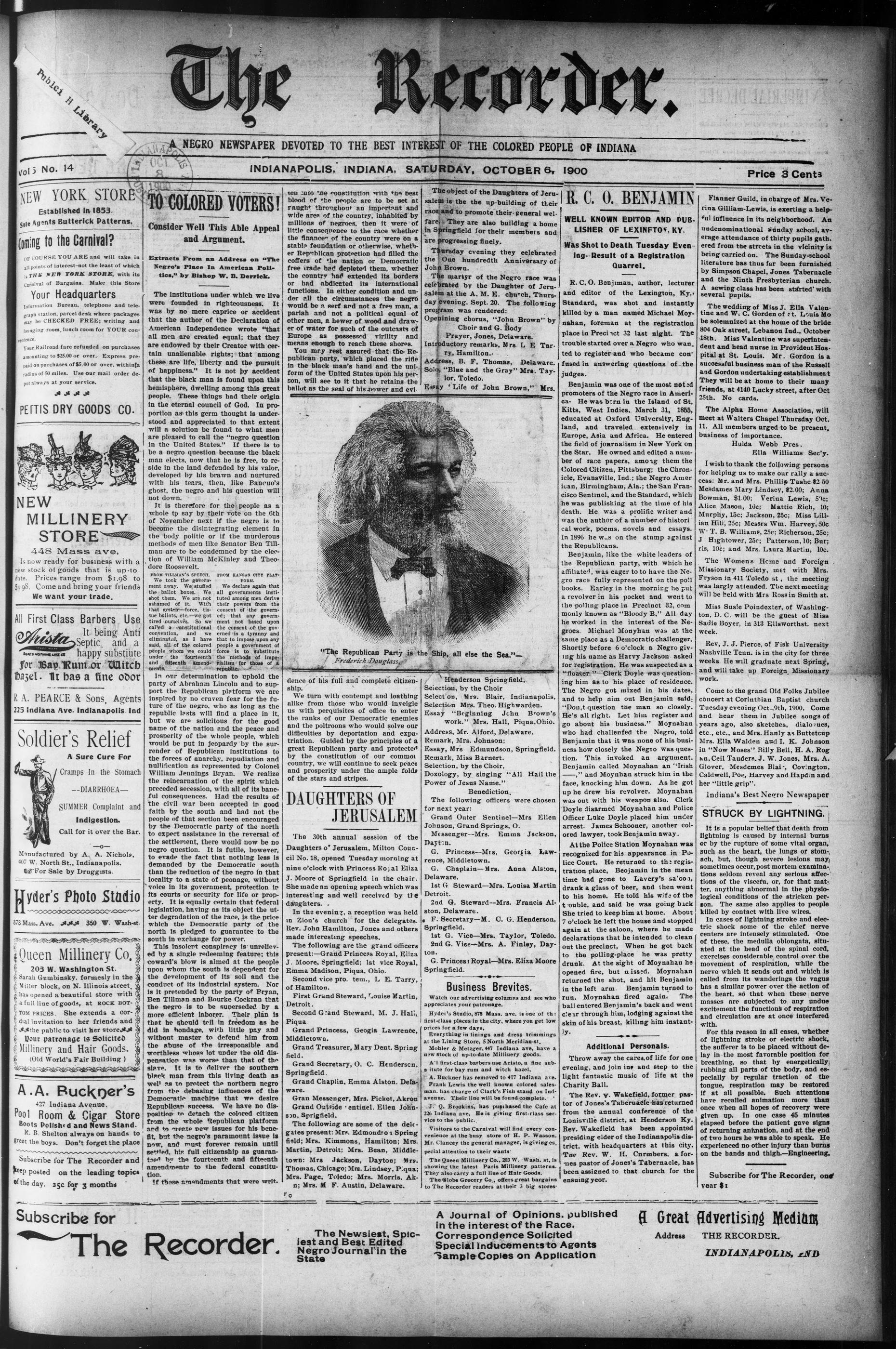
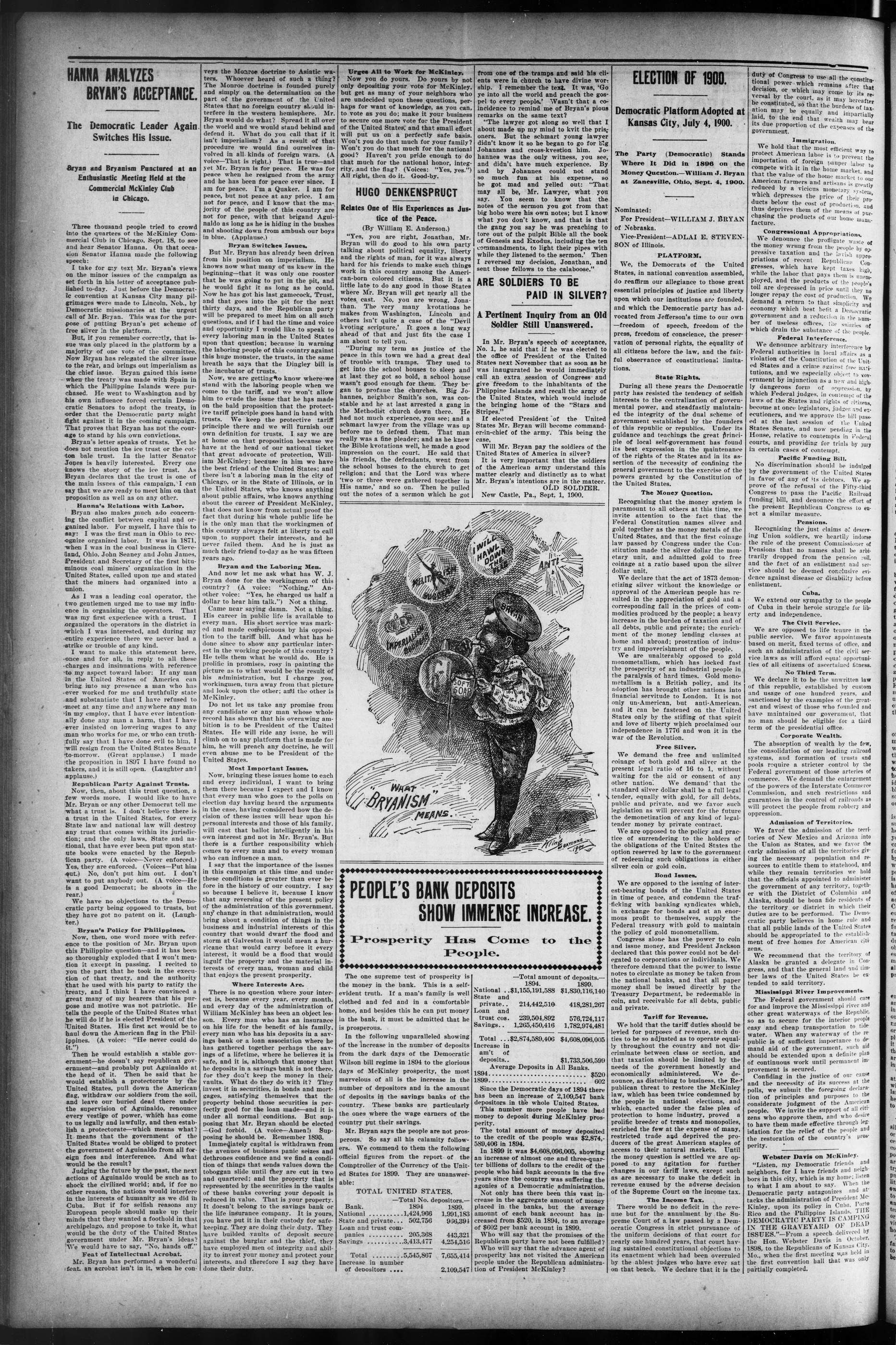
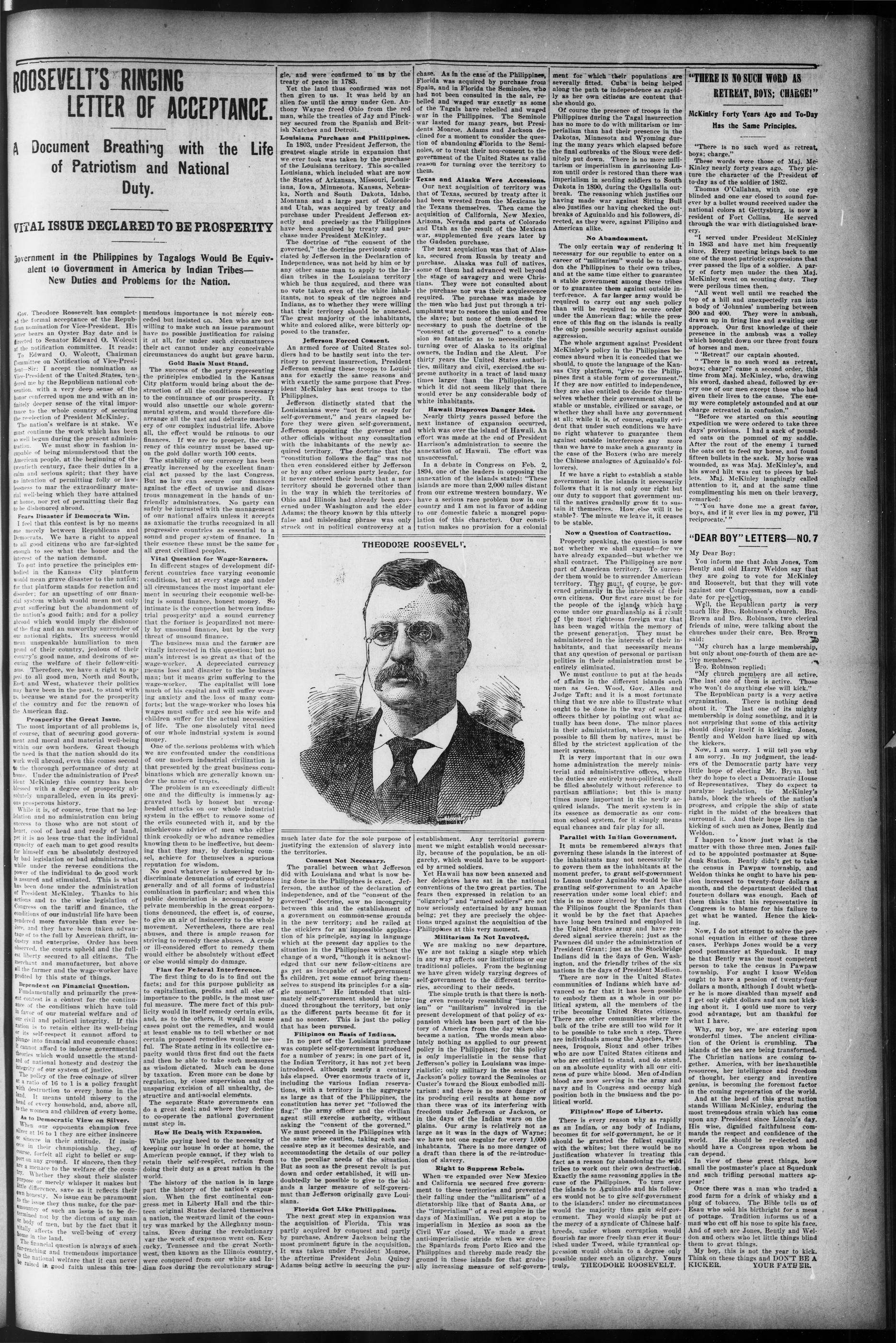
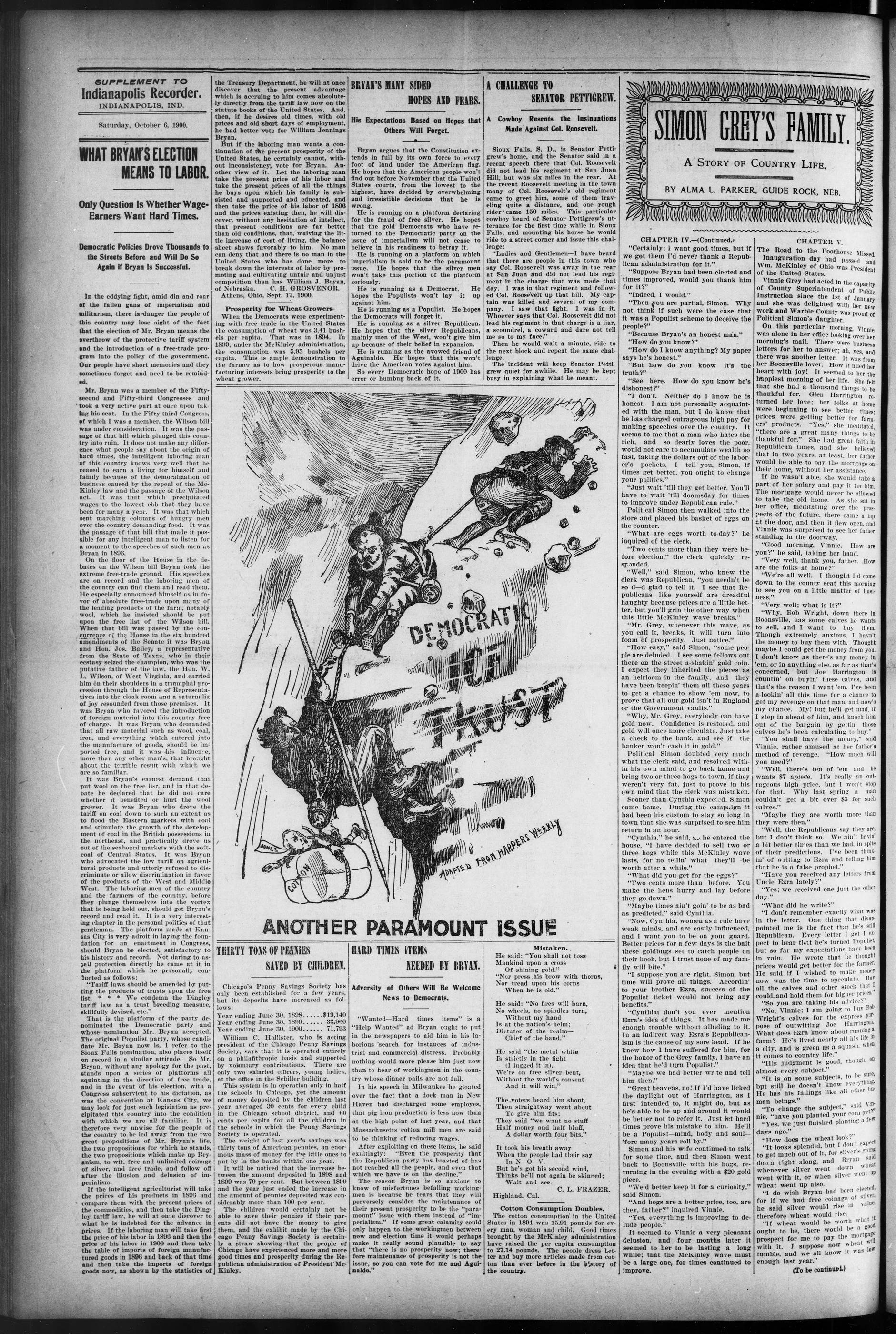
Page text (machine-generated)
vol5 No.14
Established in 1853. Sole Agents Butterick Patterns.
Coming to the Carnival?
OF COURSE YOU ARE and will take in all points of interest-not the least of which is THE NEW YORK STORE, with its carnival of Bargains. Make this Store Your Headquarters Information Bureau, telephone and telegraph station, parcel desk where packages may be CHECKED FREE; writing and lounging room, lunch room for YOUR convenience. Your Railroad fare refunded on purchases amounting to $25.00 or over. Express paid on purchases of $5.00 or over, within a radius of 50 miles. Use our mail order depot always at your service.
```markdown
```
PETTIS DRY GOODS CO.
NEW MILLINERY STORE
448 Mass ave.
Is now ready for business with a new stock of goods that is up-to-date. Prices range from $1.98 to $4.98. Come and bring your friends We want your trade.
All First Class Barbers Use
Arista
It being Anti Septic, and a happy substitute
for Bay Rum or Witch Hazel. It has a fine odor
R. A. PEARCE & Sons, Agents
225 Indiana Ave. Indianapolis, Ind
Soldier's Relief
Soldier's Relief
T
Cramps In the Stomach
--DIARRHOEA--
SUMMER Complaint and
Indigestion.
Call for it over the Bar.
Manufactured by A. A. Nichols,
407 W. North St., Indianapolis.
For Sale by Druggists.
373 Mass. Ave. 350 W. Wash-st
203 W. Washington St.
Sarah Gumbinsky, formersly in the
Miller block, on N. Illinois street,
has opened a beautiful store with
a full line of goods, at ROCK BOTTOM PRICES. She extends a cordial invitation to her friends and
the public to visit her store.
Your patronage is Solicited
Millinery and Hair Goods.
(Old World's Fair Building)
A.A. Buckner's
Pool Room & Cigar Store
Roots Delibed & New Stand
Pool Room & Cigar Store
Boots Polished and News Stand.
R. B. Shelton always on hands to
greet the boys. Don't forget the place
Subscribe for The Recorder and
keep posted on the leading topics
of the day. 25c for 3 months
The Recorder.
TO COLORED VOTERS
Consider Well This Able Appeal and Argument.
Extracts From an Address on "The Negro's Place In American Politics," by Bishop W. B. Derrick.
The institutions under which we live were founded in righteousness. It was by no mere caprice or accident that the author of the Declaration of American Independence wrote "that all men are created equal; that they are endowed by their Creator with certain unilienable rights; that among these are life, liberty and the pursuit of happiness." It is not by accident that the black man is found upon this hemisphere, dwelling among this great people. These things had their origin in the eternal council of God. In proportion as this germ thought is understood and appreciated to that extent will a solution be found to what men are pleased to call the "negro question in the United States." If there is to be a negro question because the black man elects, now that he is free, to reside in the land defended by his valor, developed by his brawn and nurtured with his tears, then, like Bancou's ghost, the negro and his question will not down.
It is therefore for the people as a whole to say by their vote on the 6th of November next if the negro is to become the disintegrating element in the body politic or if the murderous methods of men like Senator Ben Tillman are to be condemned by the election of William McKinley and Theodore Roosevelt.
FROM WILLIAM'S SPEECH. FROM EANSA CITY PLAT. TO the took the government. KOM
FROM TILLANAN'S SPEECH.
We took the government away. We stuffed them. We shot them. We are not ashamed of it. With that system—force, tissue ballots, etc.—we got tired ourselves. So we conventionally eliminated, as I have said, all of the colored people whom we could under the fourteenth and fifteenth amendments.
FORM.
We declare again that all governments instituted herein derive their powers from the consent of the governed; that any government not based upon the consent of the governed is a tyranny and that to impose upon any people a government of force is to substitute gods of imperialism for those of a republic.
In our determination to uphold the party of Abraham Lincoln and to support the Republican platform we are inspired by no craven fear for the future of the negro, who as long as the republic lests will find a place in it, but we are solicitous for the good name of the nation and the peace and prosperity of the whole people, which would be put in jeopardy by the surrender of Republican institutions to the forces of anarchy, repudiation and nullification as represented by Colonel William Jennings Bryan. We realize the reincarnation of the spirit which preceded secession, with all of its beneficial consequences. Had the results of the civil war been accepted in good faith by the south and had not the people of that section been encouraged by the Democratic party of the north to expect assistance in the reversal of the settlement, there would now be no negro question. It is futile, however, to evade the fact that nothing less is demanded by the Democratic south than the reduction of the negro in that locality to a state of peonage, without voice in its government, protection in its courts or security for life or property. It is equally certain that federal legislation, having as its object the utter degradation of the race, is the price which the Democratic party of the north is pledged to guarantee to the south in exchange for power.
This insolent conspiracy is unrelieved by a single redeeming feature; this coward's blow is aimed at the people upon whom the south is dependent for the development of its soil and the conduct of its industrial system. Nor is it pretended by the party of Bryan, Ben Tillman and Bourke Cockran that the negro is to be superseded by a more efficient laborer. Their plan is that he should tell in freedom as he did in bondage, with little pay and without master to defend him from the abuse of the irresponsible and worthless whose lot under the old dispensation was worse than that of the slave. It is to deliver the southern black man from this living death as well as to protect the northern negro from the debasing influences of the Democratic machine that we desire Republican success. We have no disposition to detach the colored citizen from the whole Republican platform and to create new issues for his benefit, but the negro's paramount issue is now, and must forever remain until settled, his full citizenship as guaranteed by the fourteenth and fifteenth amendments to the federal constitution.
If these amendments that were writ-
"The Republican Party is the Ship, all else the Sea."—
Frederick Douglass.
"The Republican Party is the Ship, all else the Sea."- Frederick Douglass.
ent into the constitution with the best blood of the people are to be set at raught throughout an important and wide area of the country, inhabited by millions of negroes, then it were of little consequence to the race whether the finances of the country were on a stable foundation or otherwise, whether Republican protection had filled the coffers of the nation or Democratic free trade had depleted them, whether the country had extended its borders or had abdicated its international functions. In either condition and under all the circumstances the negro would be a serf and not a free man, a pariah and not a political equal of other men, a hewer of wood and drawer of water for such of the outcasts of Europe as possessed virility and means enough to reach these shores.
You mry rest assured that the Republican party, which placed the rife in the black man's hand and the uniform of the United States upon his person, will see to it that he retains the ballot as the seal of his power and evi-
"The Republican Party is the
Frederick Douglass.
dence of his full and complete citizenship.
We turn with contempt and loathing alike from those who would invigle us with perquisites of office to enter the ranks of our Democratic enemies and the poltroons who would solve our difficulties by deportation and expatriation. Guided by the principles of a great Republican party and protected by the constitution of our common country, we will continue to seek peace and prosperity under the ample folds of the stars and stripes.
DAUGHTERS OF JERUSALEM
The 30th annual session of the Daughters o' Jerusalem, Milton Council No.18, opened Tuesday morning at nine o'clock with Princess Royal Eliza J. Moore of Springfield in the chair. She made an opening speech which was interesting and well received by the daughters.
In the evening, a reception was held in Zion's church for the delegates. Rev. John Hamilton, Jones and others made interesting speeches.
The following are the grand officers present—Grand Princess Royal, Eliza J. Moore, Springfield; 1st vice Royal, Emma Madison, Piqua, Ohio.
Second vice pro. tem., L. E. Tarry, of Hamilton.
First Grand Steward, Louise Martin, Detroit.
Second Grand Steward, M. J. Hall, Piqua.
Grand Princess, Georgia Lawrence, Middletown.
Grand Treasurer, Mary Dent. Spring field.
Grand Secretary, O. C. Henderson, Springfield.
Grand Chaplin, Emma Alston. Delaware.
Gran Messenger, Mrs. Picket, Akron
Grand Outside - entinel. Ellen Johnson, Springfield.
The following are some of the delegates present: Mrs. Edmondo1 Spring field; Mrs. Kimmons, Hamilton; Mrs. Martin, Detroit; Mrs. Bean, Middletown: Mrs. Jackson, Dayton; Mrs. Thomas, Chicago; Mrs. Lindsey, P.qua; Mrs. Page, Toledo; Mrs. Morris, Akin; Mrs. M. F. Austin, Delaware.
The Newsiest, Spiciest and Best Edited Negro Journal in the State
A Journal of Opinions. published in the interest of the Race. Correspondence Solicited Special Inducements to Agents Sample Copies on Application
The object of the Daughters of Jerusalem is the the up-building of their race and to promote their general welfare. They are also building a home in Springfield for their members and are progressing finely.
Thursday evening they celebrated the One hundredth Anniversary of John Brown.
The martyr of the Negro race was celebrated by the Daughter of Jerusalem at the A. M. E. chuveh, Thursday evening, Sept. 20. The following program was rendered:
Opening chorus: "John Brown" in
Openining chorus, "John Brown" by Choir and G. Body Prayer, Jones, Delaware. Introductory remarks, Mrs. L E Tarry, Hamilton.
ry, Hamilton.
Address, B. F, Thomas, Delaware.
Solo, "Blue and the Gray" Mrs. Taylor, Toledo.
Essay "Life of John Brown," Mrs.
the Ship, all else the Sea."—
Henderson Springfield,
Selection, by the Choir
Selection'on, Mrs. Blair, Indianapolis,
Selection Mrs. Theo, Highwarden.
Essay "Beginning, John Brown"
Essay, Mrs Edmundson, Springfield.
Remark, Miss Barnert.
Selection, by the Choir.
Doxology, by singing "All Hail the
Power of Jesus Name."
Benediction.
The following officers were chosen
for next year:
Grand Outer Sentinel—Mrs Ellen
Johnson, Grand Springs, O.
Messenger—Mrs. Emma Jackson,
Dayton.
G. Princess—Mrs. Georgia Lawrence,
Middletown.
G. Chaplain—Mrs. Anna Alston,
Delaware.
1st G. Steward—Mrs. Louisa Martin
Detroit.
2nd G. Steward—Mrs. Francis Alston,
Delaware.
F. Secretary—M. C. G. Henderson,
Springfield.
1st G. Vice—Mrs. Taylor, Toledo.
2nd G. Vice—Mrs. A. Finley, Dayton.
G. Princes; Royal—Mrs. Eliza Moore
Springfield.
Business Brevites
Watch our advertising columns and see who appreciates your patronage.
Hydet's Studio, 878 Mass. ave. is one of the first-class places in the city, where you get low prices for a few days.
Everything in linings and dress trimmings at the Lining Store, 5 North Meridian-at.
Mohler & Metzger, 447 Indiana ave, have a new stock of up-to-date Millinery goods.
A1 first-class barbers use Aristo, a fine sub-suite for bay rum and witch hazel.
a rule for bay rum and witch hazel,
A. Buckner has removed to 417 Indiana ave.
Frank Lewis the well known colored salesman. has charge of Clark's Fish stand on Ind avenue. Their line will be found complete.
J. Q. Brookins, has pushed the Cafe at 226 Indiana ave. He is giving first-class service to the public.
Visitors to the Carnival will find every convenience at the busy store of H. P. Wasson. Mr. Clancey the general manager, is giving especial attention to their wants
The Queen Millinery Co., 203 W. Wash. st, is showing the latest Paris Millinery patterns. They also carry a full line of Hair Goods.
The Globe Grocery Co., offers great bargains to The Recorder readers at their 3 big stores.
A Journal of Opinions in the interest of the Rail Correspondence Solicit Special Inducements to Sample Copies on Appl
R. C. O. BENJAMIN
WELL KNOWN EDITOR AND PUB LISHER OF LEXINFTON, KY.
Was Shot to Death Tuesday Evening--Result of a Registration Quarrel.
R. C. O. Benjiman, author, lecturer and editor of the Lexington, Ky., Standard, was shot and instantly killed by a man named Michael Moynahan, foreman at the registration place in Precinct 32 last night. The trouble started over a Negro who wanted to register and who became confused in answering questions of the judges.
Benjamin was one of the most noted promoters of the Negro race in America. He was born in the Island of St. Kitts, West Indies, March 31, 1855, educated at Oxford University, England, and traveled extensively in Europe, Asia and Africa. He entered the field of journalism in New York on the Star. He owned and edited a number of race papers, among them the Colored Citizen, Pittsburg; the Chronicle, Evansville, Ind.; the Negro American, Birmingham, Ala.; the San Francisco Sentuel, and the Standard, which he was publishing at the time of his death. He was a prolific writer and was the author of a number of historical work, poems, novels and essays. In 1896 he w.s on the stump against the Republicans.
Benjamin, like the white leaders of the Republican party, with which he affiliated, was eager to to have the Negro race fully represented on the poll books. Earley in the morning he put a revolver in his pocket and went to the polling place in Precinct 82, commonly known as "Bloody B," All day he worked in the interest of the Negroes. Michael Monyhan was at the same place as a Democratic challenger. Shortly before 6 o'clock a Negro giving his name as Harvy Jackson asked for registration. He was suspected as a "floater." Clerk Doyle was questioning him as to his place of residence. The Negro got mixed in his dates, and to help aim out Benjamin said, "Don't question the man so closely. He's all right. Let him register and go about his business." Moynahan who had challenged the Negro, told Benjamin that it was none of his business how closely the Negro was question. This invoked an argument. Benjamin called Moynahan an "Irish —," and Moynahan struck him in the face, knocking him down. As he got up he drew his revolver. Moynahan was out with his weapon also. Clerk Doyle disarmed Moynahan and Police Officer Luke Doyle placed him under arrest. James Schooner, another colored lawyer, took Benjamin away.
At the Police Station Moynahan was recognized for his appearance in Police Court. He returned to the registration place, Beojamin in the mean time had gone to Lavery's sa'ooa, drank a glass of beer, and then went to his home. He told his wife of the trouble, and said he was going back She tried to keep him at home. About 7 o'clock he left the house and stopped again at the saloon, where he made declarations that he intended to clean out the precinct. When he got back to the polling-place he was pretty drunk. At the sight of Moynahan he opened fire, but nissed. Moynahan returned the shot, and hit Benjamin in the left arm. Benjamin turned to run. Moynahan fired again. The ball entered Benjamin's back and went clear through him, lodging against the skin of his breast, killing him instantly.
Additional Personals
Throw away the cares of life for one evening, and join in and step to the light fantastic music of life at the Charity Ball.
The Rev. v. Wakefield, former pastor of Jones's Tabernacle has returned from the annual conference of the Louisville district, at Henderson Ky. Rev. Wakefield has been appointed presiding elder of the Indianapolis district, with headquarters at this city. The Rev. W. H. Cnrmbers, a forms pastor of Jones's Tabernacle, has been assigned to that church for the ensuing year.
Price 3 Cents
Flanner Guild, in charge of Mrs. Verina Gilliam-Lewis, is exerting a helpful influence in its neighborhood. An undenominational Sunday school, average attendance of thirty pupils gath. ered from the streets in the vicinity is being carried on. The Sunday-school literature has thus far been furnished by Simpson Chapel, Jones Tabernacle and the Ninth Presbyterian church. A sewing class has been started with several pupils.
The wedding of Miss J. Ella Valentine t and W. C. Gorden of st. Louis Mo be solemnized at the home of the bride 804 Oak street, Lebanon Ind., October 18th. Miss Valentine was superintendent and head nurse in Provident Hospital at St. Louis. Mr. Gordon is a successful business man of the Russell and Gordon undertaking establishment They will be at home to their many friends, at 4140 Lucky street, after Oct 25th. No cards.
The Alpha Home Association, will meet at Walters Chapel Thursday Oct. 11. All members urged to be present, business of importance.
Hulda Webb Pres.
Ella Williams Sec'y.
I wish to thank the following persons for helping us to make our rally a success: Mr. and Mrs. Phillip Tashe $2 50 Mesdames Mary Lindsey, $2.00; Anna Bowman, $1.00; Verina Lewis, $5; Alice Mason, 10c; Mattie Rich, 10; Murphy, 15c; Jackson, 25c; Miss Lillian Hill, 25c; Messrs Wm. Harvey, 50c W.T. B. Williams, 25c; Richerson, 25c; J Hightower, 25c; Patterson, 10; Burris, 10; and Mrs. Laura Martin, 10c.
The Womens Home and Forcign Missionary Society, met with Mrs. Fryson in 411 Toledo st., the meeting was largely attended. The next meeting will be held with Mrs Ross in Smith st.
Miss Susie Poindexter, of Washington, D. C. will be the guest of Miss Sadie Boyer, in 313 Ellsworthst. next week.
Rev, J. J. Pierce, of Fisk University Nashville Teen, is in the city for three weeks. He will graduate next Spring, and will take up Foreign Missionary work.
Come to the grand Old Folks Jubilee concert at Corinthian Baptist church Tuesday evening Oct. 9th, 1900. Come and hear them in Jubilee songs of years ago, also sketches, dialoues, etc., etc., and Mrs. Hanly as Buttetcup Mrs. Ella Walden and I. K. Johnson in "Now Moses" Billy Bell, H. A. Rogan, Ceil Tauders, J. W. Jones, Mrs. A. Glover, Mesdames Blai', Covington, Caldwell, Poe, Harvey and Hapdin and her "little grip".
Indiana's Best Negro Newspaper
STRUCK BY LIGHTNING.
It is a popular belief that death from lightning is caused by internal burns or by the rupture of some vital organ, such as the heart, the lungs or stomach, but, though severe lesions may sometimes occur, post mortem examinations seldom reveal any serious affections of the viscera, or, for that matter, anything abnormal in the physiological conditions of the stricken person. The same also applies to people killed by contact with live wires.
In cases of lightning stroke and electric shock some of the chief nerve centers are intensely stimulated. One of these, the medulla oblongata, situated at the head of the spinal cord, exercises considerable control over the movement of respiration, while the nerve which it sends out and which is called from its wanderings the vagus has a similar power over the action of the heart, so that when these nerve masses are subjected to any undue excitement the functions of respiration and circulation are at once interfered with.
For this reason in all cases, whether of lightning stroke or electric shock, the sufferer is to be placed without delay in the most favorable position for breathing, so that by energetically rubbing all parts of the body, and especially by regular traction of the tongue, respiration may be restored if at all possible. Such attentions have recalled animation more than once when all hopes of recovery were given up. In one case 45 minutes elapsed before the patient gave signs of returning animation, and at the end of two hours he was able to speak. He experienced no other injury than burns on the hands and thigh—Engineering.
Subscribe for The Recorder, one year $1
HANNA ANALYZES BRYAN'S ACCEPTANCE.
The Democratic Leader Again Switches His Issue.
Bryan and Bryanism Punctured at an Enthusiastic Meeting Held at the Commercial McKinley Club
in Chicago.
Three thousand people tried to crowd into the quarters of the McKinley Commercial Club in Chicago, Sept. 18, to see and hear Senator Hanna. On that occasion Senator Hanna made the following speech:
I take for my text Mr. Bryan's views on the minor issues of the campaign as set forth in his letter of acceptance published to-day. Just before the Democratic convention at Kansas City many pilgrimages were made to Lincoln, Neb., by Democratic missionaries at the urgent call of Mr. Bryan. This was for the purpose of putting Bryan's pet scheme of free silver in the platform.
But, if you remember correctly, that issue was only placed in the platform by a majority of one vote of the committee. Now Bryan has relegated the silver issue to the rear, and brings out imperialism as the chief issue. Bryan gained this issue when the treaty was made with Spain in which the Philippine Islands were purchased. He went to Washington and by his own influence forced certain Democratic Senators to adopt the treaty, in order that the Democratic party might fight against it in the coming campaign. That proves that Bryan has not the courage to stand by his own convictions. Bryan's letter speaks of trusts. Yet he does not mention the ice trust or the cotton bale trust. In the latter Senator Jones is heavily interested. Every one knows the story of the ice trust. As Bryan declares that the trust is one of the main issues of this campaign, I can say that we are ready to meet him on that proposition as well as on any other.
Hauna's Relations with Labor.
Bryan also makes much ad concerning the conflict between capital and organized labor. For myself, I have this to say: I was the first man in Ohio to recognize organized labor. It was in 1871, when I was in the coal business in Cleveland, Ohio. John Seaney and John James, President and Secretary of the first bituminous coal miners' organization in the United States, called upon me and stated that the miners had organized into a union.
As I was a leading coal operator, the two gentlemen urged me to use my influence in organizing the operators. That was my first experience with a trust. I organized the operators in the district in which I was interested, and during my entire experience there we never had a strike or trouble of any kind.
I want to make this statement here, once and for all, in reply to all these charges and insinuations with reference to my aspect toward labor: If any man in the United States of America can bring into my presence a man who has ever worked for me and truthfully state and substantiate that I have refused to meet at any time and anywhere any man in my employ, that I have ever intentionally done any man a harm, that I have ever insisted on lowering wages to any man who works for me, or who can truthfully say that I have done evil to him. I will resign from the United States Senate to-morrow. (Great applause.) I made the proposition in 1807 I have found no takers, and it is still open. (Laughter and applause.)
Republican Party Against Trusts
Republican Party Against Trusts.
Now, then, about this trust question, a few words more. I would like to have Mr. Bryan or any other Democrat tell me what a trust is. I don't believe there is a trust in the United States, for every State law and national law will destroy any trust that comes within its jurisdiction; and the only laws, State and national, that have ever been put upon statute books were enacted by the Republican party. (A voice—Never enforced.) Yes, they are enforced. (Voice—Put him out.) No, don't put him out. I don't want to put anybody out. (A voice—He is a good Democrat; he shoots in the rear.) We have no objections to the Democratic party being opposed to trusts, but they have got no patent on it. (Laughter.)
Bryan's Policy for Philippines.
Now, then, one word more with reference to the position of Mr. Bryan upon this Philippine question—and it has been so thoroughly exploded that I won't mention it except in passing. I recited to you the part that he took in the execution of that treaty, and the authority that he used with his party to ratify the treaty, and I think I have convinced a great many of my hearers that his purpose and motive was not patriotic. He tells the people of the United States what he will do if he is elected President of the United States. His first act would be to haul down the American flag in the Philippines. (A voice: "He never could do it.")
Then he would establish a stable government—he doesn't say republican government—and probably put Aguinaldo at the head of it. Then he said that he would establish a protectorate by the United States, pull down the American flag, withdraw our soldiers from the soil, and leave our buried dead there under the supervision of Aguinaldo, renounce every vestige of power, which has come to us legally and lawfully, and then establish a protectorate—which means what? It means that the government of the United States would be obliged to protect the government of Aguinaldo from all foreign foes and interference. And what would be the result?
Judging the future by the past, the next actions of Aguinaldo would be such as to shock the civilized world; and, if for no other reason, the nations would interfere in the interests of humanity as we did in Cuba. But if for selfish reasons any European people should make up their minds that they wanted a foothold in that archipelago, and propose to take it, what would be the duty of the United States government under Mr. Bryan's ideas? We would have to say, "No, hands off!"
Mr. Bryan has performed a wonderful feat. an acrobat isn't in it, when he con
veys the Monroe doctrine to Asiatic waters. Whoever heard of such a thing? The Monroe doctrine is founded purely and simply on the determination on the part of the government of the United States that no foreign country should interfere in the western hemisphere. Mr. Bryan would do what? Spread it all over the world and we would stand behind and defend it. What do you call that if it isn't imperialism? As a result of that procedure we would find ourselves involved in all kinds of foreign wars. (A voice-That is right.) That is true—and yet Mr. Bryan is for peace. He was for peace when he resigned from the army and he has been for peace ever since. I am for peace. I'm a Quaker. I am for peace, but not at any price. I am not for peace, and I know that the majority of the people of this country are not for peace, with that brigand Aguinaldo as long as he is hiding in the bushes and shooting down from ambush our boys in blue. (Applause.)
Bryan Switches Issues.
But Mr. Bryan has already been driven from his position on imperialism. He knows now what many of us knew in the beginning—that it was only one rooster that he was going to put in the pit, and he would fight it as long as he could. Now he has got his last gamecock, Trust, and that goes into the pit for the next thirty days, and the Republican party will be prepared to meet him on all such questions, and if I had the time and voice and opportunity I would like to speak to every laboring man in the United States upon that question; because in warning the laboring people of this country against this huge monster, the trusts, in the same breath he says that the Dingley bill is the incubator of trusts.
Now, we are getting to know where we stand with the laboring people when we come to the tariff, and we won't allow him to evade the issue that he has made on the bald proposition that the protective tariff principle goes hand in hand with trusts. We keep the protective tariff principle there and we will furnish our own definition for trusts. I say we are at home on that proposition because we have at the head of our national ticket that great advocate of protection, William McKinley; because in him we have the best friend of the United States; and there isn't a laboring man in the city of Chicago, or in the State of Illinois, or in the United States, who knows anything about public affairs, who knows anything about the career of President McKinley, that does not know from actual proof the fact that during his whole public life he is the only man that the workingmen of this country always felt at liberty to call upon to support their interests, and he never failed them. And he is just as much their friend to-day as he was fifteen years ago.
Bryan and the Laboring Men.
And now let me ask what has W. J. Bryan done for the workingmen of this country? (A voice: "Nothing." Another voice: "Yes, he charged us half a dollar to hear him talk.") Not a thing. Came near saying damn. Not a thing. His career in public life is available to every man. His short service was marked and made conspicuous by his opposition to the tariff bill. And what has he done since to show any particular interest in the working people of this country? He tells them what he would do. He is profile in promises, rosy in painting the picture as to what would be the result of his administration, but I charge you, workingmen, turn away from that picture and look upon the other; and the other is McKinley.
Do not let us take any promise from any candidate or any man whose whole record has shown that his overawing ambition is to be President of the United States. He will ride any issue, he will climb on to any platform that is made for him, he will preach any doctrine, he will even abuse me to be President of the United States.
Most Important Issues.
Now, bringing these issues home to each and every individual, I want to bring them there because I expect and I know that every man who goes to the polls on election day having heard the arguments in the case, having considered how the decision of these issues will bear upon his personal interests and those of his family, will cast that ballot intelligently in his own interest and not in Mr. Bryan's. But there is a further responsibility which comes to every man and to every woman who can influence a man.
I say that the importance of the issues in this campaign at this time and under these conditions is greater than ever before in the history of our country. I say so because I believe it, because I know that any reversing of the present policy of the administration of this government, any change in that administration, would bring about a condition of things in the business and industrial interests of this country that would dwarf the flood and storm at Galveston it would mean a hurricane that would carry before it every interest, it would be a flood that would ingulf the property and the material interests of every man, woman and child that enjoys the present prosperity.
Where Interests Are.
There is no question where your interest is, because every year, every month, and every day of the administration of William McKinley has been an object lesson. Every man who has an insurance on his life for the benefit of his family, every man who has his deposits in a savings bank or a loan association where he has gathered together perhaps the savings of a lifetime, where he believes it is safe, and it is, although that money that he deposits in a savings bank is not there, for they don't keep the money in their vaults. What do they do with it? They invest it in securities, in bonds and mortgages, satisfying themselves that the property good for the loan made—and it is under all normal conditions. But supposing that Mr. Bryan should be elected—God forbid. (A voice—Amen!) Supposing he should be. Remember 1893.
Immediately capital is withdrawn from the avenues of business panic seizes and dethrones confidence and we find a condition of things that sends values down the toboggan slide until they are cut in two and quartered; and the property that is represented by the securities in the vaults of these banks covering your deposit is reduced in value. That is your property. It doesn't belong to the savings bank or the life insurance company. It is yours, you have put it in their custody for safekeeping. They are doing their duty. They have built vaults of deposit secure against the burglar and the thief, they have employed men of integrity and ability to invest your money and protect your interests, and therefore I say they have done their duty.
MILITARY BURGERS
I WILL HAWL DOWN THE WALL
ANTI
IMPERIALISM BURGERS
BRYAN
SOFT LOAD
WHAT "BRYANISM" MEANS.
Ming B. BAYONNE 1890
PEOPLE'S BANK DEPOSITS SHOW IMMENSE INCREASE.
Urgues All to Work for McKinley.
Now you do you. Do yours by not only depositing your vote for McKinley, but get as many of your neighbors who are undecided upon these questions, perhaps for want of knowledge, as you can, to vote as you do; make it your business to secure one more vote for the President of the United States, and that small effort will put us on a perfectly safe basis. Won't you do that much for your family? Won't you do that much for the national good? Haven't you pride enough to do that much for the national honor, integrity, and the flag? (Voices: "Yes, yes.") All right, then do it. Good-by.
HUGO DENKENSPRUCT
(By William E. Anderson.)
"Yes, you are right, Jonathan, Mr. Bryan will do good to his own party talking about political equality, liberty and the rights of man, for it was always hard for his friends to make such things work in this country among the american-born colored citizens. But it is little late to do any good in those states where Mr. Bryan will get nearly all the votes cast. No, you are wrong, Jonathan. The very many kvotations he makes from Washington, Lincoln and others isn't quite a case of the "Devil kvoting scripture." It goes a long way ahead of that and just fits the case I am about to tell you.
"During my term as justice of the peace in this town we had a great deal of trouble with tramps. They used to get into the school houses to sleep and at last they got so bold, a school house wasn't good enough for them. They began to profane the churches. Big Johannes, neighbor Smith's son, was constable and he at last arrested a gang in the Methodist church down there. He had not much experience, you see; and a schmart lawyer from the village was up before me to defend them. That man really was a fine pleader; and as he knew the Bible kotvations well, he made a good impression on the court. He said that his friends, the defendants, went from the school houses to the church to get religion; and that the Lord was where 'two or three were gathered together in His name,' and so on. Then he pulled out the notes of a sermon which he got
MILITARY BUILDING
IMPERIALISM BUILDING
SOFT SOAP
WHAT "BRYANISM" MEANS.
PEOPLE'S BANK DE
SHOW IN
Prosperity Has
Peo
The one supreme test of prosperity is the money in the bank. This is a self-evident truth. If a man's family is well clothed and fed and in a comfortable home, and besides this he can put money in the bank, it must be admitted that he is prosperous.
In the following unparalleled showing of the increase in the number of deposits from the dark days of the Democratic Wilson bill regime in 1894 to the glorious days of McKinley prosperity, the most marvelous of all is the increase in the number of depositors and in the amount of deposits in the savings banks of the country. These banks are particularly the ones where the wage earners of the country put their savings.
Mr. Bryan says the people are not prosperous. So say all his calamity followers. We commend to them the following official figures from the report of the Comptroller of the Currency of the United States for 1890. They are unanswerable:
TOTAL UNITED STATES.
—Total No. depositors.—
Bank. 1804 1890.
National. 1,424,906 1,991,183
State and private. 502,756 996,394
Loan and trust companies 205,368 443,321
Savings 3,413,477 4,254,516
Total 5,545,867 7,655,414
Increase in number of depositors ... 2,109,547
---
Democratic Platform Adopted at Kansas City, July 4, 1900.
The Party (Democratic) Stands Where It Did in 1896 on the Money Question.-William J. Bryan at Zancsville, Ohio, Sept. 4, 1900.
Nominated:
For President—WILLIAM J. BRYAN of Nebraska.
Vice-President—ADLAI E. STEVENSON of Illinois.
PLATFORM.
We, the Democrats of the United States, in national convention assembled, do reaffirm our allegiance to those great essential principles of justice and liberty upon which our institutions are founded, and which the Democratic party has advocated from Jefferson's time to our own—freedom of speech, freedom of the press, freedom of conscience, the preservation of personal rights, the equality of all citizens before the law, and the faithful observance of constitutional limitations.
During all these years the Democratic party has resisted the tendency of selfish interests to the centralization of governmental power, and steadfastly maintained the integrity of the dual scheme of government established by the founders of this republic or republics. Under its guidance and teachings the great principle of local self-government has found its best expression in the maintenance of the rights of the States and in its assertion of the necessity of confining the general government to the exercise of the powers granted by the Constitution of the United States.
Recognizing that the money system is paramount to all others at this time, we invite attention to the fact that the Federal Constitution names silver and gold together as the money metals of the United States, and that the first coinage law passed by Congress under the Constitution made the silver dollar the monetary unit, and admitted gold to free coinage at a ratio based upon the silver dollar unit.
WILDE HAWL DOWN THE ANTI
BROWN
MING MAYORNE 1909
POSITS COMMENSE INCREASE.
Is Come to the People.
Recognizing paramount the invite attention Federal Court gold together United States law passed the situation mat etary unit, coinage at a dollar unit.
We declare etizing silver approval of the correspondin modities pro increase in the all debts, payment of the home and ad try and import.
We are un monometallic the prosperity the paralysis metallism is adoption has financial service only un-America and it can States only and love of the independence war of the B.
We demand coinage of the present legal waiting for other nation standard silver tender, equal public and public legislation as the demonetic tender money.
We are oppose of surrection the obligation option reserve of redeeming silver coin or
We are oppose hearing in time of pock ficking with in exchange mous profit Federal treat the policy of Congress and issue more declared that egated to cor therefore den
We declare that the act of 1873 demonetizing silver without the knowledge or approval of the American people has resulted in the appreciation of gold and a corresponding fall in the prices of commodities produced by the people; a heavy increase in the burden of taxation and all debts, public and private; the enrichment of the money lending classes at home and abroad; prostration of industry and impoverishment of the people. We are unalterably opposed to gold monometallism, which has locked fast the prosperity of an industrial people in the paralysis of hard times. Gold monometallism is a British policy, and its adoption has brought other nations into financial servitude to London. It is not only un-American, but anti-American, and it can be fastened on the United States only by the stifling of that spirit and love of liberty which proclaimed our independence in 1776 and won it in the war of the Revolution.
We demand the free and unlimited coinage of both gold and silver at the present legal ratio of 16 to 1, without waiting for the aid or consent of any other nation. We demand that the standard silver dollar shall be a full legal tender, equally with gold, for all debts, public and private, and we favor such legislation as will prevent for the future the demonetization of any kind of legal-tender money by private contract.
We are opposed to the policy and practice of surrendering to the holders of the obligations of the United States the option reserved by law to the government of redeeming such obligations in either silver coin or gold coin.
Bond Issues.
We are opposed to the issuing of interest-bearing bonds of the United States in time of peace, and condemn the trafficking with banking syndicates which, in exchange for bonds and at an enormous profit to themselves, supply the Federal treasury with gold to maintain the policy of gold monometallism.
Congress alone has the power to coin and issue money, and President Jackson declared that this power could not be delegated to corporations or individuals. We therefore demand that the power to issue notes to circulate as money be taken from the national banks, and that all paper money shall be issued directly by the Treasury Department, be redeemable in coin, and receivable for all debts, public and private.
We hold that the tariff duties should be levied for purposes of revenue, such duties to be so adjusted as to operate equally throughout the country and not discriminate between class or section, and that taxation should be limited by the needs of the government honestly and economically administered. We denounce, as disturbing to business, the Republican threat to restore the McKinley law, which has been twice condemned by the people in national elections, and which, enacted under the false plea of protection to home industry, proved a prolific breeder of trusts and monopolies, enriched the few at the expense of many, restricted trade and deprived the producers of the great American staples of access to their natural markets. Until the money question is settled we are opposed to any agitation for further changes in our tariff laws, except such as are necessary to make the deficit in revenue caused by the adverse decision of the Supreme Court on the income tax.
There would be no deficit in the revenue but for the annulment by the Supreme Court of a law passed by a Democratic Congress in strict pursuance of the uniform decisions of that court for nearly one hundred years, that court having sustained constitutional objections to its enactment which had been overruled by the ablest judges who have ever sat on that bench. We declare that it is the
---
from one of the tramps and said his clients were in church to have divine worship. I remember the text. It was, 'Go ye into all the world and preach the gospel to every people.' Wasn't that a coincidence to remind me of Bryan's pious remarks on the same text?
The lawyer got along so well that I about made up my mind to kvit the prizers. But the schmart young lawyer didn't know it so he began to go for big Johannes and cross-kestion him. Johannes was the only witness, you see, and didn't have much experience. By and by Johannes could not stand so much fun at his expense, so he got mad and yelled out: "That may all be, Mr. Lawyer, what you say. You seem to know that the notes of the sermon you got from that big hobo were his own notes; but I know what you don't know, and that is that the gang you say he was preaching to tore out of the pulpit Bible all the book of Genesis and Exodus, including the ten commandments, to light their pipes with while they listened to the sermon.' Then I reversed my decision, Jonathan, and sent those fellows to the calaboose."
ARE SOLDIERS TO BE PAID IN SILVER?
A Pertinent Inquiry from an Old Soldier Still Unanswered.
In Mr. Bryan's speech of acceptance, No. 1, he said that if he was elected to the office of President of the United States next November that as soon as he was inaugurated he would immediately call an extra session of Congress and give freedom to the inhabitants of the Philippine Islands and recall the army of the United States, which would include the bringing home of the "Stars and Stripes." If elected President of the United States Mr. Bryan will become commander-in-chief of the army. This being the case, Will Mr. Bryan pay the soldiers of the United States of America in silver? It is very important that the soldiers of the American army understand this matter clearly and distinctly as to what Mr. Bryan's intentions are in the matere. OLD SOLDIER. New Castle, Pa., Sept. 1, 1900.
| | —Total amount of deposits.—1894. | 1890. |
| :--- | :--- | :--- |
| National .. $1,155,191,588 | $1,830,116,140 |
| State and private .. 214,442,510 | 418,281,267 |
| Loan and trust cos. 239,504,892 | 576,724,117 |
| Savings.. 1,265,450,416 | 1,782,974,481 |
| Total .. $2,874,589,406 | $4,608,096,005 |
| Increase in am't of deposits.. | $1,733,506,599 |
| Average Deposits in All Banks. | |
| 1894 .. | $520 |
| 1899 .. | 602 |
| Since the Democratic days of 1894 there has been an increase of 2,109,547 bank depositors in the whole United States. | |
This number more people have had money to deposit during McKinley prosperity.
The total amount of money deposited to the credit of the people was $2,874,-589,406 in 1894.
In 1899 it was $4,608,096,005, showing an increase of almost one and three-quarter billions of dollars to the credit of the people who had bank accounts in the five years since the country was suffering the agonies of a Democratic administration.
Not only has there been this vast increase in the aggregate amount of money placed in the banks, but the average amount of each bank account has increased from $520, in 1894, to an average of $602 per bank account in 1899.
Who will say that the promises of the Republican party have not been fulfilled? Who will say that the advance agent of prosperity has not visited the American people under the Republican administration of President McKinley?
PLATFORM.
State Rights.
The Money Question.
Free Silver.
Bond Issues.
Tariff for Revenue.
The Income Tax.
duty of Congress to use all the constitutional power which remains after that decision, or which may come by its reversal by the court, as it may hereafter be constituted, so that the burdens of taxation may be equally and impartially laid, to the end that wealth may bear its due proportion of the expenses of the government.
Immigration.
We hold that the most efficient way to protect American labor is to prevent the importation of foreign paper labor to compete with it in the home market, and that the value of the home market to our American farmers and artisans is greatly reduced by a vicious monetary system, which depresses the price of their products below the cost of production, and thus deprives them of the means of purchasing the products of our home manufacture.
Congressional Appropriations
Congressional Appropriations.
We denounce the profligate waste of the money wring from the people by oppressive taxation and the invisible appropriations of recent Republican Congresses, which have kept taxes high, while the labor that pays them is unemployed, and the products of the people's toil are depressed in price until they no longer repay the cost of production. We demand a return to that simplicity and economy which best befit a Democratic government and a reduction in the number of useless offices, the sauries of which drain the substance of the people.
Federal Interference.
We denounce arbitrary interference by Federal authorities in local affairs as a violation of the Constitution of the United States and a crime against free institutions, and we especially object to government by injunction as a new and highly dangerous form of oppression, by which Federal judges, in contempt of the laws of the States and rights of citizens, become at once legislators, judges and executioners, and we approve the bill passed at the last session of the United States Senate, and now pending in the House, relative to contempt in Federal courts, and providing for trials by jury in certain cases of contempt.
Pacific Funding Bill.
No discrimination should be indulged by the government of the United States in favor of any of its debtors. We approve of the refusal of the Fifty-third Congress to pass the Pacific Railroad funding bill, and denounce the effort of the present Republican Congress to enact a similar measure.
Pensions.
Recognizing the just claims of deserving Union soldiers, we heartily indorse the rule of the present Commissioner of Pensions that no names shall be arbitrarily dropped from the pension roll, and the fact of an enlistment and service should be deemed conclusive evidence against disease or disability before enlistment.
Cuba.
We extend our sympathy to the people of Cuba in their heroic struggle for liberty and independence.
The Civil Service.
We are opposed to life tenure in the public service. We favor appointments based on merit, fixed terms of office, and such an administration of the civil service laws as will afford equal opportunities of all citizens of ascertained fitness. No Third Term
No Third Term
We declare it to be the unwritten law of this republic, established by custom and usage of one hundred years, and sanctioned by the examples of the greatest and wisest of those who founded and have maintained our government, that no man should be eligible for a third term of the presidential office.
Corporate Wealth.
The absorption of wealth by the few, the consolidation of our leading railroad systems, and formation of trusts and pools require a stricter control by the Federal government of those arteries of commerce. We demand the enlargement of the powers of the Interstate Commerce Commission, and such restrictions and guarantees in the control of railroads as will protect the people from robbery and oppression.
Admission of Territories.
We favor the admission of the territories of New Mexico and Arizona into the Union as States, and we favor the early admission of all the territories giving the necessary population and resources to entitle them to statehood, and while they remain territories we hold that the officials appointed to administer the government of any territory, together with the District of Columbia and Alaska, should be bona fide residents of the territory or district in which their duties are to be performed. The Democratic party believes in home rule and that all public lands of the United States should be appropriated to the establishment of free homes for American citizens. We recommend that the territory of Alaska be granted a delegate in Congress, and that the general land and timber laws of the United States be extended to said territory.
Mississippi River Improvements
The Federal government should care for and improve the Mississippi river and other great waterways of the Republic, so as to secure for the interior people easy and cheap transportation to tidewater. When any waterway of the republic is of sufficient importance to demand aid of the government, such aid should be extended upon a definite plan of continuous work until permanent improvement is secured.
Confiding in the justice of our cause and the necessity of its success at the polls, we submit the foregoing declaration of principles and purposes to the considerate judgment of the American people. We invite the support of all citizens who approve them, and who desire to have them made effective through legislation for the relief of the people and the restoration of the country's prosperity.
Webster Davis on McKinley
Webster Davis on McKinley
"Listen, my Democratic friends and neighbors, for I have friends and neighbors in this city, which is my home; listen to what I am about to say. When the Democratic party antagonizes and attacks the administration of President McKinley, upon its policy in Cuba, Porto Rico and the Philippine Islands, THE DEMOCRATIC PARTY IS CAMPING IN THE GRAVEYARD OF DEAD ISSUES."—From a speech delivered by the Hon. Webster Davis in October, 1898, to the Republicans of Kansas City, Mo., when the first meeting was held in the first convention hall that was only partially completed.
ROOSEVELT'S RINGING LETTER OF ACCEPTANCE.
A Document Breathing with the Life of Patriotism and National Duty.
VITAL ISSUE DECLARED TO BE PROSPERITY
Government in the Philippines by Tagalogs Would Be Equivalent to Government in America by Indian Tribes—New Duties and Problems for the Nation.
Gov. Theodore Roosevelt has completed the formal acceptance of the Republican nomination for Vice-President. His bearer bears an Oyster Bay date and is directed to Senator Edward O. Wolcott at the notification committee. It reads: To Edward O. Wolcott, Chairman Committee on Notification of Vice-President-Sir: I accept the nomination as Vice-President of the United States, tendered me by the Republican national conference, with a very deep sense of the honor conferred upon me and with an infinitely deeper sense of the vital importance to the whole country of securing the re-election of President McKinley.
The nation's welfare is at stake. We must continue the work which has been so well begun during the present administration. We must show in fashion incapable of being misunderstood that the American people, at the beginning of the twentieth century, face their duties in a calm and serious spirit; that they have no intention of permitting folly or lawlessness to mar the extraordinary material well-being which they have attained at home, nor yet of permitting their flag to be dishonored abroad.
Fears Disaster if Democrats Win.
I feel that this contest is by no means one merely between Republicans and Democrats. We have a right to appeal to all good citizens who are far-sighted enough to see what the honor and the interest of the nation demand.
To put in practice the principles embodied in the Kansas City platform would mean grave disaster to the nation; for that platform stands for reaction and disorder; for an upsetting of our financial system which would mean not only great suffering but the abandonment of the nation's good faith; and for a policy abroad which would imply the dishonor of the flag and an unworthy surrender of our national rights. Its success would unappeasable humiliation to men pound of their country, jealous of their country's good name, and desirous of securing the welfare of their fellow-citizens. Therefore, we have a right to appeal to all good men, North and South, East and West, whatever their politics may have been in the past, to stand with us because we stand for the prosperity of the country and for the renown of the American flag.
Prosperity the Great Issue.
Prosperity the Great Issue. The most important of all problems is, of course, that of securing good government and moral and material well-being within our own borders. Great though the need is that the nation should do its work well abroad, even this comes second to the thorough performance of duty at home. Under the administration of President McKinley this country has been blessed with a degree of prosperity absolutely unparalleled, even in its previous prosperous history.
While it is, of course, true that no legislation and no administration can bring success to those who are not stout of heart, cool of head and ready of hand, put it is no less true that the individual capacity of each man to get good results for himself can be absolutely destroyed by bad legislation or bad administration, while under the reverse conditions the power of the individual to do good work is assured and stimulated. This is what has been done under the administration of President McKinley. Thanks to his actions and to the wise legislation of Congress on the tariff and finance, the conditions of our industrial life have been rendered more favorable than ever before, and they have been taken advantage of to the full by American thrift, industry and enterprise. Order has been observed, the courts upheld and the fullest liberty secured to all citizens. The merchant and manufacturer, but above all the farmer and the wage-worker have profiled by this state of things.
Dependent on Financial Question.
Fundamentally and primarily the present contest is a contest for the continuance of the conditions which have told in favor of our material welfare and of our civil and political integrity. If this tition is to retain either its well-being or its self-respect it cannot afford to plunge into financial and economic chaos. It cannot afford to indorse governmental theories which would unsettle the standard of national honesty and destroy the integrity of our system of justice.
The policy of the free coinage of silver at a ratio of 16 to 1 is a policy fraught with destruction to every home in the land. It means untold misery to the head of every household, and, above all, to the women and children of every home.
When our opponents champion free silver at 16 to 1 they are either insincere or sincerely in their attitude. If insincere in their championship they, of course, forfeit all right to belief or support on any ground. If sincerely, then they are a menace to the welfare of the country. Whether they shout their sinister purpose or merely whisper it makes but little difference, save as it reflects their own honesty. No issue can be paramount to the issue they thus make, for the amount of such an issue is to be determined not by the dictum of any man or body of men, but by the fact that it finally affects the well-being of every home in the land.
The financial question is always of such far-reaching and tremendous importance to the national welfare that it can never be raised in good faith unless this tre
mendous importance is not merely conceded but insisted on. Men who are not willing to make such an issue paramount have no possible justification for raising it at all, for under such circumstances their act cannot under any conceivable circumstances do aught but grave harm.
Gold Basis Must Stand.
The success of the party representing the principles embodied in the Kansas City platform would bring about the destruction of all the conditions necessary to the continuance of our prosperity. It would also unsettle our whole governmental system, and would therefore disarrange all the vast and delicate machinery of our complex industrial life. Above all, the effect would be ruinous to our finances. If we are to prosper, the currency of this country must be based upon the gold dollar worth 100 cents.
The stability of our currency has been greatly increased by the excellent financial act passed by the last Congress. But no law can secure our finances against the effect of unwise and disastrous management in the hands of unfriendly administrators. No party can safely be intrusted with the management of our national affairs unless it accepts as axiomatic the truths recognized in all progressive countries as essential to a sound and proper system of finance. In their essence these must be the same for all great civilized peoples.
Vital Question for Wage-Earners. In different stages of development different countries face varying economic conditions, but at every stage and under all circumstances the most important element in securing their economic well-being is sound finance, honest money. So intimate is the connection between industrial prosperity and a sound currency that the former is jeopardized not merely by unsound finance, but by the very threat of misuse finance.
The business man and the farmer are vitally interested in this question; but no man's interest is so great as that of the wage-worker. A depreciated currency means loss and disaster to the business man; but it means grim suffering to the wage-worker. The capitalist will lose much of his capital and will suffer wearing anxiety and the loss of many comforts; but the wage-worker who loses his wages must suffer and see his wife and children suffer for the actual necessities of life. The one absolutely vital need of our whole industrial system is sound money.
One of the serious problems with which we are confronted under the conditions of our modern industrial civilization is that presented by the great business combinations which are generally known under the name of trusts.
The problem is an exceedingly difficult one and the difficulty is immensely aggravated both by honest but wrong-headed attacks on our whole industrial system in the effort to remove some of the evils connected with it, and by the mischievous advice of men who either think crookedly or who advance remedies knowing them to be ineffective, but deeming that they may, by darkening counsel, achieve for themselves a spurious reputation for wisdom.
No good whatever is subserved by indiscriminate denunciation of corporations generally and of all forms of industrial combination in particular; and when this public denunciation is accompanied by private membership in the great corporations denounced, the effect is, of course, to give an air of insincerity to the whole movement. Nevertheless, there are real abuses, and there are ample reason for striving to remedy these abuses. A crude or ill-considered effort to remedy them would either be absolutely without effect or else would simply do damage.
Plan for Federal Interference.
Plan for Federal Interference.
The first thing to do is to find out the facts; and for this purpose publicity as to capitalization, profits and all else of importance to the public, is the most useful measure. The mere fact of this publicity would in itself remedy certain evils, and, as to the others, it would in some cases point out the remedies, and would at least enable us to tell whether or not certain proposed remedies would be useful. The State acting in its collective capacity would thus first find out the facts and then be able to take such measures as wisdom dictated. Much can be done by taxation. Even more can be done by regulation, by close supervision and the unsparing excision of all unhealthy, destructive and anti-social elements.
The separate State governments can do a great deal; and where they decline to co-operate the national government must step in.
How He Deals with Expansion.
While paying heed to the necessity of keeping our house in order at home, the American people cannot, if they wish to retain their self-respect, refrain from doing their duty as a great nation in the world.
The history of the nation is in large part the history of the nation's expansion. When the first continental congress met in Liberty Hall and the thirteen original States declared themselves a nation, the westward limit of the country was marked by the Alleghany mountains. Even during the revolutionary war the work of expansion went on. Kentucky, Tennessee and the great Northwest, then known as the Illinois country, were conquered from our white and Indian foes during the revolutionary strug-
THEODORE ROOSEVELT.
gle, and were confirmed to us by the treaty of peace in 1783. Yet the land thus confirmed was not then given to us. It was held by an alien foe until the army under Gen. Anthony Wayne freed Ohio from the red man, while the treaties of Jay and Pinckney secured from the Spanish and British Natchez and Detroit.
Louisiana Purchase and Philippines.
In 1803, under President Jefferson, the greatest single stride in expansion that we ever took was taken by the purchase of the Louisiana territory. This so-called Louisiana, which included what are now the States of Arkansas, Missouri, Louisiana, Iowa, Minnesota, Kansas, Nebraska, North and South Dakota, Idaho, Montana and a large part of Colorado and Utah, was acquired by treaty and purchase under President Jefferson exactly and precisely as the Philippines have been acquired by treaty and purchase under President McKinley.
The doctrine of "the consent of the governed," the doctrine previously enunciated by Jefferson in the Declaration of Independence, was not held by him or by any other sane man to apply to the Indian tribes in the Louisiana territory which he thus acquired, and there was no vote taken even of the white inhabitants, not to speak of the negroes and Indians, as to whether they were willing that their territory should be annexed. The great majority of the inhabitants, white and colored alike, were bitterly opposed to the transfer.
Jefferson Forced Consent.
An armed force of United States soldiers had to be hastily sent into the territory to prevent insurrection, President Jefferson sending these troops to Louisiana for exactly the same reasons and with exactly the same purpose that President McKinley has sent troops to the Philippines.
Jefferson distinctly stated that the Louisianaians were "not fit or ready for self-government," and years elapsed before they were given self-government, Jefferson appointing the governor and other officials without any consultation with the inhabitants of the newly acquired territory. The doctrine that the "constitution follows the flag" was not then even considered either by Jefferson or by any other serious party leader, for it never entered their heads that a new territory should be governed other than in the way in which the territories of Ohio and Illinois had already been governed under Washington and the elder Adams; the theory known by this utterly false and misleading phrase was only struck out in political controversy at a
THEODORE
much later date for the sole purpose of justifying the extension of slavery into the territories.
Consent Not Necessary.
The parallel between what Jefferson did with Louisiana and what is now being done in the Philippines is exact. Jefferson, the author of the declaration of independence, and of the "consent of the governed" doctrine, saw no incongruity between this and the establishment of a government on common-sense grounds in the new territory; and he railed at the sticklers for an impossible application of his principle, saying in language which at the present day applies to the situation in the Philippines without the change of a word, "though it is acknowledged that our new fellow-citizens are as yet in incapable of self-government as children, yet some cannot bring themselves to suspend its principles for a single moment." He intended that ultimately self-government should be introduced throughout the territory, but only as the different parts became fit for it and no sooner. This is just the policy that has been pursued.
Filipinos on Basis of Indians.
Filipinos on Basis of Indians.
In no part of the Louisiana purchase was complete self-government introduced for a number of years; in one part of it, the Indian Territory, it has not yet been introduced, although nearly a century has elapsed. Over enormous tracts of it, including the various Indian reservations, with a territory in the aggregate as large as that of the Philippines, the constitution has never yet "followed the flag." the army officer and the civilian agent still exercise authority, without asking the "consent of the governed." We must proceed in the Philippines with the same wise caution, taking each successive step as it becomes desirable, and accommodating the details of our policy to the peculiar needs of the situation. But as soon as the present revolt is put down and order established, it will undoubtedly be possible to give to the islands a larger measure of self-government than Jefferson originally gave Louisiana.
The next great step in expansion was the acquisition of Florida. This was partly acquired by conquest and partly by purchase, Andrew Jackson being the most prominent figure in the acquisition. It was taken under President Monroe, the aftertime President John Quincy Adams being active in securing the pur-
chase. As in the case of the Philippines, Florida was acquired by purchase from Spain, and in Florida the Seminoles, who had not been consulted in the sale, rebelled and waged war exactly as some of the Tagals have rebelled and waged war in the Philippines. The Seminole war lasted for many years, but Presidents Monroe, Adams and Jackson declined for a moment to consider the question of abandoning Florida to the Seminoles, or to treat their non-consent to the government of the United States as valid reason for turning over the territory to them.
Texas and Alaska Were Accessions.
Our next acquisition of territory was that of Texas, secured by treaty after it had been wrested from the Mexicans by the Texans themselves. Then came the acquisition of California, New Mexico, Arizona, Nevada and parts of Colorado and Utah as the result of the Mexican war, supplemented five years later by the Gadsden purchase.
The next acquisition was that of Alaska, secured from Russia by treaty and purchase. Alaska was full of natives, some of them had advanced well beyond the stage of savagery and were Christians. They were not consulted about the purchase nor were their acquiescence required. The purchase was made by the men who had just put through a triumphant war to restore the union and free the slave; but none of them deemed it necessary to push the doctrine of the "consent of the governed" to a conclusion so fantastic as to necessitate the turning over of Alaska to its original owners, the Indian and the Aleut. For thirty years the United States authorities, military and civil, exercised the supreme authority in a tract of land many times larger than the Philippines, in which it did not seem likely that there would ever be any considerable body of white inhabitants.
Hawaii Disproves Danger Idea.
Nearly thirty years passed before the next instance of expansion occurred, which was over the island of Hawaii. An effort was made at the end of President Harrison's administration to secure the annexation of Hawaii. The effort was unsuccessful.
In a debate in Congress on Feb. 2, 1894, one of the leaders in opposing the annexation of the islands stated: "These islands are more than 2,000 miles distant from our extreme western boundary. We have a serious race problem now in our country and I am not in favor of adding to our domestic fabric a mongrel population (of this character). Our constitution makes no provision for a colonial
ROOSEVELT.
establishment. Any territorial government we might establish would necessarily, because of the population, be an oligarchy, which would have to be supported by armed soldiers. Yet Hawaii has now been annexed and her delegates have sat in the national conventions of the two great parties. The fears then expressed in relation to an "oligarchy" and "armed soldiers" are not now seriously entertained by any human being; yet they are precisely the objections urged against the acquisition of the Philippines at this very moment.
Militarism Is Not Involved.
We are making no new departure. We are not taking a single step which in any way affects our institutions or our traditional policies. From the beginning we have given widely varying degrees of self-government to the different territories, according to their needs.
The simple truth is that there is nothing even remotely resembling "imperialism" or "militarism" involved in the present development of that policy of expansion which has been part of the history of America from the day when she became a nation. The words mean absolutely nothing as applied to our present policy in the Philippines; for this policy is only imperialistic in the sense that Jefferson's policy in Louisiana was imperialistic; only military in the sense that Jackson's policy toward the Seminoles or Custer's toward the Sioux embodied militarism; and there is no more danger of its producing evil results at home now than there was of its interfering with freedom under Jefferson or Jackson, or in the days of the Indian wars on the plains. Our army is relatively not as large as it was in the days of Wayne; we have not one regular for every 1,000 inhabitants. There is no more danger of a draft than there is of the re-introduction of slavery.
Right to Suppress Rebels.
When we expanded over New Mexico and California we secured free government to these territories and prevented their falling under the "militarism" of a dictatorship like that of Santa Ana, or the "imperialism" of a real empire in the days of Maximilian. We put a stop to imperialism in Mexico as soon as the Civil War closed. We made a great anti-imperialistic stride when we drove the Spaniards from Porto Rico and the Philippines and thereby made ready the ground in these islands for that gradually increasing measure of self-govern-
ment for which their populations are severally fitted. Cuba is being helped along the path to independence as rapidly as her own citizens are content that she should go.
Of course the presence of troops in the Philippines during the Tagal insurrection has no more to do with militarism or imperialism than had their presence in the Dakotas, Minnesota and Wyoming during the many years which elapsed before the final outbreaks of the Sioux were definitely put down. There is no more militarism or imperialism in garrisoning Luzon until order is restored than there was imperialism in sending soldiers to South Dakota in 1890, during the Ogallalla outbreak.
The reasoning which justifies our having made war against Sitting Bull also justifies our having checked the outbreaks of Aguinaldo and his followers, directed, as they were, against Filipino and American alike.
No Abandonment.
The only certain way of rendering it necessary for our republic to enter on a career of "militarism" would be to abandon the Philippines to their own tribes, and at the same time either to guarantee a stable government among these tribes or to guarantee them against outside interference. A far larger army would be required to carry out any such policy than will be required to secure order under the American flag; while the presence of this flag on the islands is really the only possible security against outside aggression.
The whole argument against President McKinley's policy in the Philippines becomes absurd when it is conceded that we should, to quote the language of the Kansas City platform, "give to the Philippines first a stable form of government." If they are now entitled to independence, they are also entitled to decide for themselves whether their government shall be stable or unstable, civilized or savage, or whether they shall have any government at all; while it is, of course, equally evident that under such conditions we have no right whatever to guarantee them against outside interference any more than we have to make such a guaranty in the case of the Boxers (who are merely the Chinese analogues of Aguinaldo's followers).
If we have a right to establish a stable government in the islands it necessarily follows that it is not only our right but our duty to support that government until the natives gradually grow fit to sustain it themselves. How else will it be stable? The minute we leave it, it ceases to be stable.
Now a Question of Contraction.
Properly speaking, the question is now not whether we shall expand—for we have already expanded—but whether we shall contract. The Philippines are now part of American territory. To surrender them would be to surrender American territory. They must, of course, be governed primarily in the interests of their own citizens. Our first care must be for the people of the islands which have come under our guardianship as a result of the most righteous foreign war that has been waged within the memory of the present generation. They must be administered in the interests of their inhabitants, and that necessarily means that any question of personal or partisan politics in their administration must be entirely eliminated.
We must continue to put at the heads of affairs in the different islands such men as Gen. Wood, Gov. Allen and Judge Taft; and it is a most fortunate thing that we are able to illustrate what ought to be done in the way of sending officers thither by pointing out what actually has been done. The minor places in their administration, where it is impossible to fill them by natives, must be filled by the strictest application of the merit system.
It is very important that in our own home administration the merely ministerial and administrative offices, where the duties are entirely non-political, shall be filled absolutely without reference to partisan affiliations; but this is many times more important in the newly acquired islands. The merit system is in its essence as democratic as our common school system, for it simply means equal chances and fair play for all.
Parallel with Indian Government.
It muts be remembered always that governing these islands in the interest of the inhabitants may not necessarily be to govern them as the inhabitants at the moment prefer, to grant self-government to Luzon under Aguinaldo would be like granting self-government to an Apache reservation under some local chief; and this is no more altered by the fact that the Filipinos fought the Spaniards than it would be by the fact that Apaches have long been trained and employed in the United States army and have rendered signal service therein; just as the Pawnees did under the administration of President Grant: just as the Stockbridge Indians did in the days of Gen. Washington, and the friendly tribes of the six nations in the days of President Madison.
There are now in the United States communities of Indians which have advanced so far that it has been possible to embody them as a whole in our political system, all the members of the tribe becoming United States citizens. There are other communities where the bulk of the tribe are still too wild for it to be possible to take such a step. There are individuals among the Apaches, Pawnees, Iroquois, Sloux and other tribes who are now United States citizens and who are entitled to stand, and do stand, on an absolute equality with all our citizens of pure white blood. Men of Indian blood are now serving in the army and navy and in Congress and occupy high position both in the business and the political world.
Filipinos' Hope of Liberty.
There is every reason why as rapidly as an Indian, or any body of Indians, becomes fit for self-government, he or it should be granted the fullest equality with the whites; but there would be no justification whatever in treating this fact as a reason for abandoning the wild tribes to work out their own destruction. Exactly the same reasoning applies in the case of the Philippines. To turn over the islands to Aguinaldo and his followers would not be to give self-government to the islanders! under no circumstances would the majority thus gain self-government. They would simply be put at the mercy of a syndicate of Chinese half-breeds, under whom corruption would flourish far more freely than ever it flourished under Tweed, while tyrannical oppression would obtain to a degree only possible under such an oligarchy. Yours truly, THEODORE ROOSEVELT.
McKinley Forty Years Ago and To-Day Has the Same Principles.
"There is no such word as retreat, boys; charge."
These words were those of Maj. McKinley nearly forty years ago. They picture the character of the President of to-day as of the soldier of 1862.
Thomas O'Callahan, with one eye blinded and one ear closed to sound forever by a bullet wound received under the national colors at Gettyburg, is now a resident of Fort Collins. He served through the war with distinguished bravery.
"I served under President McKinley in 1863 and have met him frequently since. Every meeting brings back to me one of the most patriotic expressions that ever passed the lips of a soldier. A party of forty men under the then Maj. McKinley went on scouting duty. They were perilous times then.
"All went well until we reached the top of a hill and unexpectedly ran into a body of 'Johnnies' numbering between 300 and 400. They were in ambush, drawn up in firing line and awaiting our approach. Our first knowledge of their presence in the ambush was a volley which brought down our three front fours of horses and men.
"'R retreat!' our captain shouted.
"There is no such word as retreat, boys; charge!' came a second order, this time from Maj. McKinley, who, drawing his sword, dashed ahead, followed by every one of our men except those who had given their lives to the cause. The enemy were completely astounded and at our charge retreated in confusion."
"Before we started on this scouting expedition we were ordered to take three days' provisions. I had a sack of pounded oats on the pommel of my saddle. After the rout of the enemy I turned the oats out to feed my horse, and found fifteen bullets in the sack. My horse was wounded, as was Maj. McKinley's, and his sword hilt was cut to pieces by bullets. Maj. McKinley laughingly called attention to it, and at the same time complimenting his men on their bravery, remarked:
"You have done me a great favor, boys, and if it ever lies in my power, I'll reciprocate."
"DEAR BOY" LETTERS—NO.7
My Dear Boy:
You inform me that John Jones, Tom Bentley and old Harry Weldon say that they are going to vote for McKinney and Roosevelt, but that they will vote against our Congressman, now a candidate for re-election.
Well, the Republican party is very much like Bro. Robinson's church. Bro. Brown and Bro. Robinson, two clerical friends of mine, were talking about the churches under their care. Bro. Brown said:
"My church has a large membership, but only about one-fourth of them are active members."
Bro. Robinson replied:
"My church members are all active. The last one of them is active. Those who won't do anything else will kick."
The Republican party is a very active organization. There is nothing dead about it. The last one of its mighty membership is doing something, and it is not surprising that some of this activity should display itself in kicking. Jones, Bentley and Weldon have lined up with the kickers.
Now, I am sorry. I will tell you why I am sorry. In my judgment, the leaders of the Democratic party have very little hope of electing Mr. Bryan, but they do hope to elect a Democratic House of Representatives. They do expect to paralyze legislation, tie McKinley's hands, block the wheels of the nation's progress, and cripple the ship of state right in the midst of the breakers that surround it. And their hope lies in the kicking of such men as Jones, Bently and Weldon.
I happen to know just what is the matter with those three men. Jones failed to be appointed postmaster at Squeedunk Station. Bently didn't get to take the census in Pawpaw township, and Weldon thinks he ought to have his pension increased to twenty-four dollars a month, and the department decided that fourteen dollars was enough. Each of them thinks that his representative in Congress is to blame for his failure to get what he wanted. Hence the kicking.
Now, I do not attempt to solve the personal equation in either of these three cases. Perhaps Jones would be a very good postmaster at Squedunk. It may be that Bently was the most competent person to take the census in Pawpaw township. For aught I know Weldon ought to have a pension of twenty-four dollars a month, although I doubt whether he is more disabled than myself and I get only eight dollars and am not kicking about it. I could use more to very good advantage, but am thankful for what I have.
Why, my boy, we are entering upon wonderful times. The ancient civilization of the Orient is crumbling. The islands of the sea are being transformed. The Christian nations are coming together. America, with her inexhaustible resources, her intelligence and freedom of thought, her energy and inventive genius, is becoming the foremost factor in the coming regeneration of the world.
And at the head of this great nation stands William McKinley, enduring the most tremendous strain which has come upon any President since Lincoln's day. His wise, dignified faithfulness commands the respect and confidence of the world. He should be re-elected and should have a Congress upon whom he can depend.
In view of these great things, how small the postmaster's place at Squedunk and such trifling personal matters appear!
Once there was a man who traded a good farm for a drink of whiskey and a plug of tobacco. The Bible tells us of Esau who said his birthright for a mess of pottage. Tradition informs us of a man who cut off his nose to spite his face. And of such are Jones, Bently and Weldon and others who let little things blind them to great things.
My boy, this is not the year to kick. Think on these things and DON'T BE A KICKER. YOUR FATHER.
SUPPLEMENT TO Indianapolis Recorder.
INDIANAPOLIS, IND.
Saturday, October 6, 1900.
Only Question Is Whether Wage Earners Want Hard Times.
Democratic Policies Drove Thousands to the Streets Before and Will Do So Again if Bryan Is Successful.
In the eddying fight, amid din and roar of the fallen guns of imperialism and militarism, there is danger the people of this country may lose sight of the fact that the election of Mr. Bryan means the overthrow of the protective tariff system and the introduction of a free-trade program into the policy of the government. Our people have short memories and they sometimes forget and need to be reminded.
Mr. Bryan was a member of the Fifty-second and Fifty-third Congresses and took a very active part at once upon taking his seat. In the Fifty-third Congress, of which I was a member, the Wilson bill was under consideration. It was the passage of that bill which plunged this country into ruin. It does not make any difference what people say about the origin of hard times, the intelligent laboring man of this country knows very well that he ceased to earn a living for himself and family because of the demoralization of business caused by the repeal of the McKinley law and the passage of the Wilson act. It was that which precipitated wages to the lowest ebb that they have been for many a year. It was that which sent marching columns of hungry men over the country demanding food. It was the passage of that bill that made it possible for any intelligent man to listen for a moment to the speeches of such men as Bryan in 1896.
On the floor of the House in the debates on the Wilson bill Bryan took the extreme free-trade ground. His speeches are on record and the laboring men of the country can find them and read them. He especially announced himself as in favor of absolute free-trade upon many of the leading products of the farm, notably wool, which he insisted should be put upon the free list of the Wilson bill. When that bill was passed by the concurrence of the House in the six hundred amendments of the Senate it was Bryan and Hon. Jos. Bailey, a representative from the State of Texas, who in their ecstasy seized the champion, who was the putative father of the law, the Hon. W. L. Wilson, of West Virginia, and carried him on their shoulders in a triumphal procession through the House of Representatives into the cloak-room and a saturnalia of joy resounded from those premises. It was Bryan who favored the introduction of foreign material into this country free of charge. It was Bryan who demanded that all raw material such as wool, coal, iron, and everything which entered into the manufacture of goods, should be imported free, and it was his influence, more than any other man's, that brought about the terrible result with which we are so familiar.
It was Bryan's earnest demand that put wool on the free list, and in that debate he declared that he did not care whether it benefited or hurt the wool grower. It was Bryan who drove the tariff on coal down to such an extent as to flood the Eastern markets with coal and stimulate the growth of the development of coal in the British possessions in the northeast, and practically drove us out of the seaboard markets with the softcoal of Central States. It was Bryan who advocated the low tariff on agricultural products and utterly refused to discriminate or allow discrimination in favor of the products of the West and Middle West. The laboring men of the country and the farmers of the country, before they plunge themselves into the vortex that is being held out, should get Bryan's record and read it. It is a very interesting chapter in the personal politics of that gentleman. The platform made at Kansas City is very adroit in laying the foundation for an enactment in Congress, should Bryan be elected, satisfactory to his history and record. Not daring to asseil protection directly he came at it in the platform which he personally conducted as follows:
"Tariff laws should be amended by putting the products of trusts upon the free list. We condemn the Dingley tariff law as a breeding measure, skillfully devised, etc."
That is the platform of the party denominated the Democratic party and whose nomination Mr. Bryan accepted. The original Populist party, whose candidate Mr. Bryan now is, I refer to the Sioux Falls nomination, also places itself on record in a similar attitude. So Mr. Bryan, without any apology for the past, stands upon a series of platforms all squinting in the direction of free trade, and in the event of his election, with a Congress subservient to his dictation, as was the convention at Kansas City, we may look for just such legislation as precipitated this country into the condition with which we are all familiar. It is therefore very unwise for the people of the country to be led away from the two great propositions of Mr. Bryan's life, the two propositions for which he stands, the two propositions which make up Bryanism, to wit, free and unlimited coinage of silver, and free trade, and follow off after the illusion and delusion of imperialism.
If the intelligent agriculturist will take the prices of his products in 1896 and compare them with the present prices of the commodities, and then take the Dingley tariff law, he will at once discover to what he is indebted for the advance in prices. If the laboring man will take first the price of his labor in 1896 and then the price of his labor in 1900 and then take the table of imports of foreign manufactured goods in 1896 and back of that time and then take the imports of foreign goods now, as shown by the statistics of
DEMOCRATIC
ICE
ADAPTED FROM HARPERS WEEKLY
ANOTHER PARAMOUNT ISSUE
the Treasury Department, he will at once discover that the present advantage which is accruing to him comes absolutely directly from the tariff law now on the statute books of the United States. And, then, if he desires old times, with old prices and old short days of employment, he had better vote for William Jennings Bryan.
But if the laboring man wants a continuation of the present prosperity of the United States, he certainly cannot, without inconsistency, vote for Bryan. Another view of it. Let the laboring man take the present price of his labor and take the present prices of all the things he buys upon which his family is subsisted and supported and educated, and then take the price of his labor of 1896 and the prices existing then, he will discover, without any hesitation of intellect, that present conditions are far better than old conditions, that, waiving the little increase of cost of living, the balance sheet shows favorably to him. No man can deny that and there is no man in the United States who has done more to break down the interests of labor by promoting and cultivating unfair and unjust competition than has William J. Bryan, of Nebraska. C. H. GROSVENOR. Athens, Ohio, Sept. 17, 1900.
When the Democrats were experimenting with free trade in the United States the consumption of wheat was 3.41 bushels per capita. That was in 1894. In 1899, under the McKinley administration, the consumption was 5.95 bushels per capita. This is ample demonstration to the farmer as to how prosperous manufacturing interests bring prosperity to the wheat grower.
ANOTHER
THIRTY TONS OF PENNIES
SAVED BY CHILDREN.
Chicago's Penny Savings Society has only been established for a few years, but its deposits have increased as follows:
Year ending June 30, 1898.....$19,140
Year ending June 30, 1899.....33,960
Year ending June 30, 1900.....71,793
William C. Hollister, who is acting president of the Chicago Penny Savings Society, says that it is operated entirely on a philanthropic basis and supported by voluntary contributions. There are only two salaried officers, young ladies, at the office in the Schiller building.
This system is in operation only in half the schools in Chicago, yet the amount of money deposited by the children last year averaged 20 cents for every child in the Chicago school district, and 60 cents per capita for all the children in the schools in which the Penny Savings Society is operated.
The weight of last year's savings was thirty tons of American pennies, an enormous mass of money for the little ones to put by in the banks within one year.
It will be noticed that the increase between the amount deposited in 1898 and 1899 was 70 per cent. But between 1899 and the year just ended the increase in the amount of pennies deposited was considerably more than 100 per cent. The children would certainly not be able to save their pennies if their parents did not have the money to give them, and the exhibit made by the Chicago Penny Savings Society is certainly a straw showing that the people of Chicago have experienced more and more good times and prosperity during the Republican administration of President McKinley.
His Expectations Based on Hopes that Others Will Forget.
Bryan argues that the Constitution extends in full by its own force to every foot of land under the American flag. He hopes that the American people won't find out before November that the United States courts, from the lowest to the highest, have decided by overwhelming and irresistible decisions that he is wrong.
He is running on a platform declaring for the fraud of free silver. He hopes that the gold Democrats who have returned to the Democratic party on the issue of imperialism will not cease to believe in his readiness to betray it.
He is running on a platform on which imperialism is said to be the paramount issue. He hopes that the silver men won't take this portion of the platform seriously.
He is running as a Democrat. He hopes the Populists won't lay it up against him.
He is running as a Populist. He hopes the Democrats will forget it.
He is running as a silver Republican. He hopes that the silver Republicans, mainly men of the West, won't give him up because of their belief in expansion. He is running as the avowed friend of Aguinaldo. He hopes that this won't drive the American votes against him. So every Democratic hope of 1900 has error or humbug back of it.
DEMOCH
ADAPTED F
R PARAMOUNT
HARD TIMES ITEMS
NEEDED BY BRYAN.
Adversity of Others Will Be Welcome News to Democrats.
"Wanted—Hard times items" is a "Help Wanted" ad Bryan ought to put in the newspapers to aid him in his laborious 'search for instances of industrial and commercial distress. Probably nothing would more please him just now than to hear of workingmen in the country whose dinner pails are not full.
In his speech in Milwaukee he gloated over the fact that a dock man in New Haven had discharged some employees, that pig iron production is less now than at the high point of last year, and that Massachusetts cotton mill men are said to be thinking of reducing wages.
After exploiting on these items, he said exultingly: "Even the prosperity that the Republican party has boasted of has not reached all the people, and even that which we have is on the decline."
The reason Bryan is so anxious to know of misfortunes befalling workingmen is because he fears that they will perversely consider the maintenance of their present prosperity to be the "parumount" issue with them instead of "imperialism." If some great calamity could only happen to the workingmen between now and election time it would perhaps make it really sound plausible to say that "there is no prosperity now; therefore maintenance of prosperity is not the issue, so you can vote for me and Aguinaldo."
A Cowboy Resents the Insinations Made Against Col. Roosevelt.
Sioux Falls, S. D., is Senator Pettigrew's home, and the Senator said in a recent speech there that Col. Roosevelt did not lead his regiment at San Juan Hill, but was six miles in the rear. At the recent Roosevelt meeting in the town many of Col. Roosevelt's old regiment came to greet him, some of them traveling quite a distance, and one rough rider'came 150 miles. This particular cowboy heard of Senator Pettigrew's utterance for the first time while in Sioux Falls, and mounting his horse he would ride to a street corner and issue this challenge:
"Ladies and Gentlemen—I have heard that there are people in this town who say Col. Roosevelt was away in the rear at San Juan and did not lead his regiment in the charge that was made that day. I was in that regiment and followed Col. Roosevelt up that hill. My captain was killed and several of my company. I saw that fight. I was in it. Whoever says that Col. Roosevelt did not lead his regiment in that charge is a liar, a scoundrel, a coward and dare not tell me so to my face."
Then he would wait a minute, ride to the next block and repeat the same challenge.
The incident will keep Senator Pettigrew quiet for awhile. He may be kept busy in explaining what he meant.
RATIC
UST
FROM HARPERS WEEKLY
T ISSUE
He said: "You shall not toss
Mankind upon a cross
Of shining gold."
"Ncr press his brow with thorns,
Nor tread upon his corns
When he is old."
He said: "No fires will burn,
No wheels, no spindles turn,
Without my hand
Is at the nation's helm;
Dictator of the realm—
Chief of the band."
He said "the metal white
Is strictly in the fight
(I lugged it in).
We're on free silver bent,
Without the world's consent
And it will win."
The voters heard him shout,
Then straightway went about
To give him fits.
To give him fits;
They said "we want no stuff
Half money and half bluff,
A dollar worth four bits."
It took his breath away
When the people had their say
In N-O-V.
But he's got his second wind,
Thinks he'll not again be skinned;
Wait and see.
C. L. FRAZER.
Highland, Cal.
Cotton Consumption Doubles.
The cotton consumption' in the United States in 1894 was 15.91 pounds for every man, woman and child. Good times brought by the McKinley administration have raised the per capita consumption to 27.14 pounds. The people dress better and buy more articles made from cotton than ever before in the history of the country.
---
---
CHAPTER IV.—(Continued.)
"Certainly, I want good times, but if we got them I'd never thank a Republican administration for it."
"Suppose Bryan had been elected and times improved, would you thank him for it?"
"Indeed, I would."
"Then you are partial, Simon. Why not think if such were the case that it was a Populist scheme to deceive the people?"
"Because Bryan's an honest man."
"How do you know?"
"How do I know anything? My paper says he's honest."
"But how do you know it's the truth?"
"See here. How do you know he's dishonest?"
"I don't. Neither do I know he is honest. I am not personally acquainted with the man, but I do know that he has charged outrageous high pay for making speeches over the country. It seems to me that a man who hates the rich, and so dearly loves the poor, would not care to accumulate wealth so fast, taking the dollars out of the laborer's pockets. I tell you, Simon, if times get better, you ought to change your politics."
"Just wait 'till they get better. You'll have to wait 'till doomsday for times to improve under Republican rule."
Political Simon then walked into the store and placed his basket of eggs on the counter.
"What are eggs worth to-day?" he inquired of the clerk.
"Two cents more than they were before election," the clerk quickly res-
"Well," said Simon, who knew the clerk was Republican, "you needn't be so d-d glad to tell it. I see that Republicans like yourself are dreadful haughty because prices are a little better, but you'll grin the other way when this little McKinley wave breaks."
"Mr. Grey, whenever this wave, as you call it, breaks, it will turn into foam of prosperity. Just notice."
"How easy," said Simon, "some people are deluded. I see some fellows out there on the street a-shakin' gold coin. I expect they inherited the pieces as an heirloom in the family, and they have been keepin' them all these years to get a chance to show 'em now, to prove that all our gold isn't in England or the Government vaults."
"Why, Mr. Grey, everybody can have gold now. Confidence is restored, and gold will once more circulate. Just take a check to the bank, and see if the banker won't cash it in gold."
Political Simon doubted very much what the clerk said, and resolved within his own mind to go back home and bring two or three hogs to town, if they weren't very fat, just to prove in his own mind that the clerk was mistaken. Sooner than Cynthia expected, Simon came home. During the campaign it had been his custom to stay so long in town that she was surprised to see him return in an hour.
"Cynthia," he said, "he entered the house, "I have decided to sell two or three hogs while this McKinley wave lasts, for no tellin' what they'll be worth after a while."
"What did you get for the eggs?"
"Two cents more than before. You make the hens hurry and lay before they go down."
"Maybe times ain't goin' to be as bad as predicted," said Cynthia.
"Now, Cynthia, women as a rule have weak minds, and are easily influenced, and I want you to be on your guard. Better prices for a few days is the bait these goldbugs set to catch people on their hook, but I trust none of my family will bite."
"I suppose you are right, Simon, but time will prove all things. Accordin' to your brother Ezra, success of the Populist ticket would not bring any benefits."
"Cynthia, don't you ever mention Ezra's idea of things. It has made me enough trouble without alluding to it. In an indirect way, Ezra's Republicanism is the cause of my sore head. If he knew how I have suffered for him, for the honor of the Grey family, I have an idea that he'd turn Populist."
"Maybe we had better write and tell him then."
"Great heavens, no! If I'd have licked the daylight out of Harrington, as I first intended to, it might do, but as he's able to be up and around it would be better not to refer it. Just let hard times prove his mistake to him. He'll be a Populist, body and soul—fore many years roll by."
Simon and his wife continued to talk for some time, and then Simon went back to Boonsville with his hogs, returning in the evening with a $20 gold piece.
"We'd better keep it for a curiosity," said Simon.
"And hogs are a better price, too, are they, father?" inquired Vinnie.
"Yes, everything is improving to delude people."
It seemed to Vinnie a very pleasant delusion, and four months later it seemed to her to be lasting a long while; that the McKinley wave must be a large one, for times continued to improve.
"Indeed, I would."
CHAPTER V.
The Road to the Poorhouse Missed,
Inauguration day had passed and
Wm. McKinley of Ohio was President
of the United States.
Vinnie Grey had acted in the capacity
of County Superintendent of Public
Instruction since the 1st of January
and she was delighted with her new
work and Warble County was proud of
Political Simon's daughter.
On this particular morning, Vinnie was in alone in her office looking over her morning's mail. There were business letters for her to answer; ah, yes, and there was another letter. It was from her Boonsville lover. How it filled her heart with joy! It seemed to her the happiest morning of her life. She felt that she had a thousand things to be thankful for. Glen Harrington returned her love; her folks at home were beginning to see better times; prices were getting better for farmers' products. "Yes," she mediated, "there are a great many things to be thankful for." She had great faith in Republican times, and she believed that in two years, at least, her father would be able to pay the mortgage on their home, without her assistance.
If he wasn't able, she would take a part of her salary and pay it for him. The mortgage would never be allowed to take the old home. As she sat in her office, meditating over the prospects of the future, there came a tap at the door, and then it flew open, and Vinnie was surprised to see her father standing in the doorway.
"Good morning, Vinnie. How are you?" he said, taking her hand.
"Very well, thank you, father. How are the folks at home?"
"We're all well. I thought I'd come down to the county seat this morning to see you on a little matter of business."
"Very well; what is it?"
"Why, Bob Wright, down there in Boonsville, has some calves he wants to sell, and I want to buy them. Though extremely anxious, I haven't the money to buy them with. Thought maybe I could get the money from you. I don't know as there's any money in 'em, or in anything else, as far as that's concerned, but Joe Harrington is countin' on buyin' these calves, and that's the reason I want 'em. I've been a lookin' all this time for a chance to get my revenge on that man, and now' my chance. My! but he'll get mud, if I step in ahead of him, and knock him out of the bargain by gettin' those calves he's been calculating to buy." "You shall have the money," said Vinnie, rather amused at her father's method of revenge. "How much will you need?"
"Well, there's ten of 'em and he wants $7 anpiece. It's really an outrageous high price, but I won't stop for that. Why last spring a man couldn't get a bit over $5 for such calves."
"Maybe they are worth more than they were then."
"Well, the Republicans say they are, but I don't think so. We ain't hadin' a bit better times than we had, in spite of their predictions. I've been thinkin' of writing to Ezra and telling him that he is a false prophet."
"Have you received any letters from Uncle Ezra lately?"
"Yes; we received one just the other day."
"What did he write?"
that did the letter.
One thing that disappointed me is the fact that he's still Republican. Every letter I get I expect to hear that he's turned Populist, but so far my expectations have been in vain. He wrote that he thought prices would get better for the farmer. He said if I wished to make money now was the time to speculate. Buy all the calves and other stock that I could, and hold them for higher prices.
"So you are taking his advice?"
"No, Vinnie; I am going to buy Bob Wright's calves for the express purpose of outwitting Joe Harrington. What does Ezra know about running a farm? He's lived nearly all his life in a city, and is green as a squash, when it comes to country life."
"His judgment is good, though, on almost any subject."
"It is on some subjects, to be sure, but still he doesn't know everything. He has his failings like all other human beings."
"To change the subject," said Vinnie, "have you planted your corn yet? "Yes, we just finished planting a few days ago."
"How does the wheat look?"
"How does the wheat go?" "It looks splendid, but I don't expect to get much out of it, for silver's going down right along, and Bryan said whenever silver went down wheat went with it, or when silver went up wheat went up also.
"I do wish Bryan had been elected, for if we had free coinage of silver, he said silver would rise in value, therefore wheat would rise.
"If wheat would be worth what it ought to be, there would be a good prospect for me to pay the mortgage with it. I suppose now wheat will tumble, and we all know it was low enough last year."
*(To be continue 1.)*
AN IMPERIAL DECREE
CHINESE MINISTERS CENSURED BY THE EMPRESS.
Four Princes to be Degraded and Prince
Tuan is Deprived of His Salary and
Official Servants.
Washington special to St. Louis Globe Democrat: There were two important developments in connection with affairs in China Sunday. One was the receipt by the State Department of a cablegram from Consul General Goodnow at Shanghai, stating that Sheng, Chinese Director of Railways and Telegraphs, had handed him a decree of the Emperor and Empress, dated Talignan, September 25, blaming their ministers for encouraging the Boxers.
The second was the announcement by Mr. Hill, acting Secretary of State, that the instructions of this government to Minister Conger were forwarded to Pekin Sunday morning. The advices from Consul General Goodnow are to the effect that China goes further than merely issuing an edict denunciatory of the Boxer leaders. The edict orders the degradation of four Princes, deprives Prince Tuan of his salary and official servants, and directs that he be brought for trial before the imperial clan court.
The manifestation by China of a disposition to punish the leaders of the recent insurrectionary movements by degrading Prince Tuan and his principal Heutenants has made a good impression in government circles here. The action of President McKinley and his advisers in refusing to co-operate with Germany in that government's proposition to deal summarily with China is justified by every succeeding event in one of the most perplexing questions which has confronted the powers for many years. It was assumed by this government that China would punish the offenders; and this promise has been justified by the trend of events.
It is the intention of the officials to keep secret the instructions sent to Minister Conger until such time as developments shall warrant their publicity. State Department officials' believe that an agreement can be effected with the powers, and that negotiations may be entered into without delay.
The instructions to Minister Conger are understood to contain the following stipulations:
1. That Prince Tanu be removed from office and lead one acceptable to the powers be appointed in his place.
2. That Minister Conger represents the United States as plenipotentiary, and has no connection whatever with mediation for China.
3. That any reasonable program outlined by a majority of the powers, the stipulations to be less severe than those of Germany, may be accepted by M.. Conger.
4. That, in the event of a continued disagreement among the powers and China, Minister Conger is to proceed to negotiate with Earl Li Hung Chang and Prince Ching solely, with regard to American interests, and with a view to determining the attitude of the United States as to future action.
TO FIGHT SMALLPOX
The State Board of Health Issues an Address to the People Warning Against the Dangers of an Epidemic.
The State Board of Health has completed an address to the people, warning them against the expected appearance of smallpox in the State this winter. It will be the largest circular the board has yet issued on the subject of smallpox, and will contain numerous illustrations of smallpox patients, instructions as to vaccination, disinfection and diagnosis of the disease. The rules of the State Board of Health relating to smallpox will also appear in the circular. The board has discussed the subject thoroughly, and has decided first, to issue instructions generally to health officers, physicians and to the people at large, warning them of the disease, and then to attack the disease as soon as it appears. It is announced that more rigid regulations with regard to the treatment of smallpox will be observed this year than ever before, and that health officers who disregard instructions of the board will be summarily death with. The board is determined, it is announced, to have "no fooling" this year when smallpox breaks out. At the outset the board states that there were two thousand cases of smallpox in Indiana last year. That the disease was very mild, however, as shown by the statement immediately following the figures to the effect that out of the two thousand cases there were only about twenty deaths. But the Board of Health does not believe smallpox will continue in such mild form long. It has been the experience that where, for the first few years, the disease has appeared mildly, it has gradually grown more virulent, until patients die by the bordreda. The circular urges those in whose houses smallpox existed last year to clean up thoroughly and disinfect and burn everything that might breed smallpox germs. It urges, all, vaccination and the vaccination of those persons who have not been vaccinated within the last seven years. With vaccination, it says, there is no need of fear from smallpox.
DUELIST WELL PUNCTURED.
Young Lowrey Badly Wounded in an Alabama Encounter.
Tuskaloosa, Ala., special: Rodney Lowrey, nephew of ex-Governor Lowrey, of Mississippi, fought a duel Tuesday morning, sixteen miles from here. Young Lowrey was shot four times. Lowrey is the agent of the railroad company at Moundville, Ala. Tuesday morning he had some words with W. H. White, the section foreman, over the movement of a car of cotton seed. White, it is alleged, threatened Lowrey and Lowrey procured a pistol out of his office. White was already armed, and as Lowrey returned to the platform the men began shooting at each other, advancing as they fired. Lowrey was shot four times, in the leg, right side, right forearm and chest. Each man fired five times, but Lowrey's last ball was the only one that struck White.
Philadelphia and Reading Coal Company Offer Minors an Increase of Ten Per Cent. in Wages.
Philadelphia special: An offer of an increase of 10 per cent. in miners' wages was Sunday inaugurated by the Philadelphia & Reading Coal and Iron Company, and this move, it is stated, will be followed by similar notices at every colliery in the anthracite region. It is expected by the operators that this increase in wages will be satisfactory to the men, and they believe many of the strikers will return to work. Mining operations will in this event be given an impetus and the operators expect there will then be a gradual resumption until the collieries will again have their full complement of employees.
Whether the miners will accept the proffer of the company and return in sufficient numbers to operate the mines can not be foretold. Reports from several points where the Reading collieries are located indicate that the mine workers will follow the instructions of their organization officials and remain away from the mines. President Mitchell, of the United Mine Workers, received no notice of the intention of the operators to offer the increase in wages and the intimation is thus given that the miners organization will receive no recognition from the operators.
TO ACT AS MEDIATOR
UNITED STATES MAY SETTLE
CHINESE QUESTION.
Minister Wu Ting Fang Strongly Seconds the Suggestion of Li Hung Chang - Favors the "Open Door."
Washington special: The Chinese Minister, Wu Ting Fang, expressed his strong approval of the suggestion by Li Hung Chang that the United States act as mediator for the settlement of the entire Chinese question. The Minister was much gratified at the favorable character of the advices from China, particularly the reference of Earl Li to his constant communication with Mr. Wu and the specific reference of the Chinese envoy in favor of the United States as mediator. Mr. Wu has from the first urged that the United States should take a leading part in the peace settlement, and it is probably due to this position that Earl Li now takes the advanced attitude in favor of the United States as mediator. Since the suggestion has come from such a high source, the minister expresses his confidence of being able to secure any authority or requests for an American initiative which may be needful. In speaking of the matter Mr. Wu pointed out that while all the powers had taken a position against the partition of China, conditions might yet arise whereby one power would deem it expedient to occupy territory, thus leading other powers to take a similar course, and bringing on a general move toward a partition of the empire. He feels that it is essential to prevent such a contingency and that the United States is in the best position to guard against such a result. Should it occur the minister feels that the "open door" and open ports which now invite the commerce of this country would give place to the practical closure of China. He holds, therefore, that action by this government would not be only in the interest of China and all concerned, but particularly in the United States' own interest, and for the preservation and safeguarding of our avenues of trade in the Orient.
MANY PENSION FRAUDS,
A Tennessee Federal Judge Calls Attention to Their Prevalence.
Chattanooga, Tenn., special: Judge C. D. Clark, presiding over the session of the United States Court for the Eastern district of Tennessee, in his charge to the grand jury, made special reference to pension violations, and said: "It is perfectly astonishing how bold applicants for pensions are becoming in forging affidavits, and especially the names of non-resident negroes who can never be found. This class of fraud is becoming so prevalent that even persons claiming to be Spanish-American war veterans are beginning to put in claims that are not without fraud."
Judge Clark laid special stress on this class of fraud, and cited an instance of a case at Knoxville, Tenn., during the late session of the United States Court, where an applicant for pension produced affidavits that he was wounded in the charge at San Juan, but finally admitted, on being confronted by proof, that he had never been nearer San Juan than the State of Georgia."
SMUGGLING IN ALASKA.
Goods Purchased in British Columbia
Taken Across the Border.
Port Townsend, Wash., special: Two steamships, the Oregon and the Portland, have arrived from Nome. The former had 452 passengers and the latter eight-eight passengers, two boxes of bollon and a partial cargo of Arctic furs. According to the records of the quarantine officers, 2,000 people have arrived from Alaska and have been inspected during the past four days. Smugglers across the British Columbia line into the United States has been carried on extensively. The officers have been keeping a close watch. Collector Heustis has received a telegram from Sumas announcing the arrest of two men with a pack train of five horses laden with general merchandise and miners' supplies. The goods were purchased in British Columbia and were destined to mines twenty-eight miles from Sumas, in the Mt. Baker district. The customs officers think this capture important and believe that it may lead to other arrests.
Prohibition Presidential Special
Prohibition Presidential Special
The Prohibition Presidential special
train crossed Indiana Monday, stopping
at Laporte, Goshen, Millersburg, Auburn
and Fort Wayne. Saturday the train
stopped an hour at Evansville, where the
First District Congressional convention
was held. An all-day Prohibition rally
will be held at Indianapolis Monday, Oct.
8, the Presidential special arriving with
the candidates in time for the night meet-
MAN's Soul Lives in a Dog.
A cablegram from Paris says: One of the most wonderful stories of the transmigration of souls ever told comes from L'Orient, an Eastern seaport, where seven persons of intelligence and reputation for truth swear upon their honor that a dog spoke to them intelligently. Ten years ago, according to their testimony, a mariner of the name of Kerbee, who had always been a firm believer in the transmigration of the human soul to the body of an inferior being, told his wife that after he died he would return to her in the disgulse of some domestic pet.
he're men Bipap who do more action than I can cheerfully recommend to you. Have been troubled for about to 20 years what I called billious attacks coming on once a week. Was told by different payers that we caused by the teach of whom he served I. I had the teeth extroced, but their attacks continued. I had seen advertisements. Bipap Tables in all the papers but had no recourse to them. I had instructed me to try them. Have taken but two small six boxes of the Tables and have no recurrence of the attacks. Have never tested testimonial for anything before, but the fact that he died by Bipap Tables induces me to add more many testimonials you doubtless have in possession now.
A. T. D.W.
I want to inform you, in words of highest
Four years ago a strange dog wandered into the house and remained, being well taken, care of by the family. Three days ago Widow Kerbere, her three grown children and three neighbors, including a skeptical schoolmaster, were spending the evening together at the house, chatting pleasantly, when suddenly the dog, crouching away in a dark corner, began to moan piteously. Everyone thought that the animal was dreaming, but presently he rose on his hind legs and spoke distinctly, in a faraway, unnatural voice, these words: "Adien, wife and children; adien, friends," the dog fell over stone dead.
Nothing can shake the conviction of the witnesses of this scene that the dog really spoke. The schoolmaster even asserts that he saw the animal's jaws move as he uttered his uncanny farewell.
Many of the citizens of L'Orient are deeply incensed because the Catholic Church authorities decline to hold religious ceremonies for the burial of the dog.
Exhibits at Paris.
There is a large exhibit from this country at the Paris exposition which will prove very interesting to all, but no more so than the news that the famous American remedy, Hostetter's Stomach Bitters, will cure dyspepsia, indigestion and constipation. To all sufferers a trial is recommended.
Never start a man who looks as if he hadn't much to say; he is merely bottled up awaiting his chance.
I do not believe Piso's Cure for Consumption has an equal for coughs and colds.—John F. Boyer, Trinity Springs. Ind., Feb. 15, 1900.
Good listeners often listen attentively so they will know exactly when it is their turn to put in.
What Do the Children Drink?
Don't give them tea or coffee. Have you tried the new food drink called GRAIN-O? It is delicious and nourishing, and takes the place of coffee. The more Grain-O you give the children the more health you distribute through their systems. Grain-O is made of pure grains, and when properly prepared tastes like the choice grades of coffee, but costs about one fourth as much. All grocers sell it. 15 and 25 cents.
The most profitable style is the turnstile.
A fish isn't necessarily crazy when it is in-seline.
Friendship is too proud to thrust itself forward, but love is a beggar.
Dr. Small, 647 Prospect street, Indianapolis: "Send two dozen G. A. R. Oll. C. O. D., $2.50." - J. Lookabaugh, Raccoon, Ind.
High water doesn't necessarily raise the price of milk.
Try Grain-O! Try Grain-O!
Ask your grocer to-day to show you a package of GRAIN O, the new food drink that takes the place of coffee. The children may drink it without injury as well as the adult. Ah who try it like it. GRAIN-O has that rich seal brown of Mocha or Java, but it is made from pure grains, and the most delicate stomach receives it without distress. One-fourth the price of coffee. 15 and 25 cents per package. Sold by all grocers.
Many a poor bootblack has managed to shine in society.
Mrs. Pinkham's Friends are everywhere. Every woman knows some woman friend who has been helped by Lydia E. Pinkham's Vegetable Compound. What does this friend say about it?
Read the letters from women being published in this paper. If you are ailing, don't try experiments. Rely on the reliable.
Mrs. Pinkham's great medicine has stood without a peer for thirty years.
Puzzled women write to Mrs. Pinkham for advice which she gives without charge. The advice is confidential and accurate. It has helped a million women. Mrs. Pinkham's address is Lynn, Mass.
I have used Hipanus cases with no connection, that I can cheerfully recommend them, when I call them for about ten or twenty years with what I call them once a week. Was told by different physicians that it was caused by bad teeth, of which I had the booth at the dentist, but the teeth containing the infection ended up in Hipanus Tables in all the papers but had no truth in them, but about six weeks since a friend invited me to the booth but two of the $5-bottle boxes of the Tables had no recurrence of the attacks. Have never given a testimonial for anything before, but the great amount of good which I believe has been gone me many times, and I have many testimonials you doubtless have in your possession now. A. T. D. WRITER.
R.I.P.A.N.S
The modern standard Family Medicine: Cures the common every-day ill of humanity.
TRADE
R.I.P.A.N.S
RELIEF
MARK
Tabules regularly. Shakepees a few cartons Ripans Tabules in the house and says she will not be with him. With Be indication which we disappeared, with Be indication which we formerly so great a burden for her. Our whole family take the Tabules regularly, especially after she is sick. And is enjoying the best of health and spirits; also eats hearty meals, an impossibility before she took Ripans Tabules.
ANTON H. BLACKER.
A NEW style pack containing the RIPAN TABULES in a paper carton (without glaze) is now for sale at some drug stores—FOR FIVE CENTS. This low-priced sort is intended for the poor and the economical. One dozen of the five-cent cartons (120 tabules) can be had by mail by sending forty-eight cents to the RIPAN CHEMICAL COMPANY, No. 10 Boulevard Street, New York—or a single carton TABULES will be sent for five cents. The process is the same as at some liquor stores and barber shops.
American Mutual Aid Association OF Saint Louis Mo
We need not refer you to people in Europe, Asia, etc. for recommendation, but can furnish testimonials from reliable persons in your own city. We pay Sick accident and Death Benefits Also furnish Free Medical attention in case of Sickness or Accident Be on the safe side and Insure with us. E. B. HAMPTON, Organizer. Room 43 BALDWIN BLOCK, Indianapolis, Id
MAKING THE FLAG.
There Are Thirty Factories Doing It
In This Country.
"The extent to which bunting is used
in this country may be realized when it
is known that some 7,000,000 yards, or
enough of the material to make between
9,000,000 and 10,000,000 flags of one kind
and another, were sold throughout the
United States last year," said a wholesale
dealer in bunting in New York to the
writer recently.
"Bunting in use for
flag making is of two kinds, the woolen
bunting, which is the finest variety, and
the cotton goods, which are the cheapest,
less durable and less ornamental. The
fabric comes in rolls usually of 40 yards,
and it is worth from $1.50 to $8 per yard,
according to the quality.
"The most expensive bunting, such as is used by the United States government for the manufacture of naval flags, is composed entirely of wool of the finest quality. The fabric is absolutely free from imperfections and weighs just 5/4 pounds, avoidupois, per piece of 40 yards of 10 inches width. The yard is evenly spun, and the warp and filling contain not less than 34 threads to the inch. The colors must be as 'fast' as possible and not liable to be seriously affected by being soaked continuously for 24 hours in fresh water and then thoroughly washed in water with which is combined a good grade of laundry soap.
"Only about one half of the bunting sold in this country is used for making flags such as the stars and stripes. The other half is used in the manufacture of small railroad, steamship and naval signal flags. Other flags in general use are for yachts, for use by contractors, railroad builders, auctioneers and social societies. In flagmaking the only work that is done by hand is the cutting, which is performed by a man with a sharp knife. The sewing, stitching and hemming are done on machines by girls and women, who make the most skillful and careful operators.
"There are 30 flag factories in the United States. These concerns have an invested capital of $1,200,000 and pay in wages nearly $400,000 annually. The majority of the flag factories are situated in New York state. The others are located in Massachusetts, Louisiana and South Carolina."—Washington Star.
"Finders Keepers" Was Good Law.
A fat faced policeman stood on a Park row horse half asleep. A newsboy, one of the big ones, saw a dime at the edge of the curb. He stooped and picked it up.
"What are you pickin up there?" demanded the policeman, with a sudden show of interest.
"Found a dime in the gutter," replied the newsboy fearlessly.
"Give it to me," demanded the policeman.
"I'll do nethin of the kind," said the boy.
"Yes, you will, or I'll 'non you in'."
"Yes, you will, or I will run you in." "Say, you don't know who you're talk in to, do you?" was the answer to the threat. "I lives on the 'level' see? An what's more I can prove it. Finders keepers if I know anything about the game. You just run me in." "Move on! Move on!" said the police-man fiercely, waving his club as he saw a crowd was gathering.—New York Tribune.
A Head to Fit the Facts.
J. M. Barrie's story of how a telegraph editor, receiving a dispatch that the Zulus had "taken umbrage," headed the news "Capture of Umbrage by the Zulus," has been paralleled by an editor in the west. Shortly after some anti-Semitic riots in Austria a slight shock of earthquake was felt in the vicinity of Vienna, and a cable dispatch put it tersely that there had been "seismic disturbances" near the capital. He headed the item "Down With the Jews."—Exchange.
I want to inform you, in words of highest importance, that I have derived the Ripana Tables. I am a professional nurse and in this profession a choreographer. I am down writing the advice of Mr. Geo. Howard, Ph. O., 688 Newark and the advice of Mr. Geo. Howard, Ph. O., 688 Newark. I took Ripana Tables with grand results. Miss BESSER WIDMER.
Mother was troubled with heartburn and indigestion, for a good many years. One day she saw a testimonial underwriting Ripana Tables determined to give them a trial, was greatly impressed and now takes the
he has been a great friend for over 6 years. Noting gave me any relief My feet and legs and abdomen were bloated as I could not wear shoes on my feet and only a shoe on my feet. I used daily paper, bounty some and took them as directs. Have taken them about three weeks and there is such a change! I am not constipated any more and I own it all to Ripans Tables. I am thirty seven even older than my husband. household duties and nursing my stick husband He has had the dropy and I am trying Ripans Tables for him. He feels some better but it will take some time, he has been slick so long. You may use my letter and name as you like. MARY MARY GORMAN CLARKE I have been suffering from headaches own since I was a little girl. I could never ride a
Breaking some of the testimonials in favor of Ripana Tables, I tried them. Ripana Tables not only relieved it, but actually cured my youngster, who was a chronic cough. He had good condition and he never complains of his stomach. He is now a clean, chubby-faced boy. This wonderful chance I attribute to Ripana Tables. I am satisfied that they will benefit any one (from adults to old age) if taken account of their conditions.
E. W. PRICE
Alice—Aren't men funny?
Laura—Yes, they are. Suppose a lot of women should rig up in fantastic costumes and parade.-Detroit Free Press.
Fntc
"That woman lecturer said it was vulgar to sneeze."
"Well?"
"Then she sneezed."-Chicago Record.
Fun In the Kitchen.
"I understand that the steak fell in love with the potato masher."
"Well, he certainly was hard hit."-Cleveland Plain Dealer.
WONDERFUL DISCOVERY
Curly Hair Made Straight By
TAKEN FROM LIFE.
BEFORE AND AFTER TREATMENT.
OZONIZED OX MARROW
THE ORIGINAL—COPYRIGHTED.
This wonderful hair pomade is the only safe preparation in the world that makes kinky hair straight as shown above. It nourishes the scalp, prevents the hair from falling out and makes it grow. Sold over 40. lead-and-led by thousands. Warranted harmless. Testimonials free on request. It was the first preparation ever sold for straightening kinky hair. Beware of imitations. Get the Original Ozonated Box. Return as the genuing never fails to keep the hair pliable and beautiful. A toilet necessity for ladies and gentlemen. Elegantly perfumed. The great advantage of this wonderful pomade is that by its use you can straighten your own hair at home. One of the best options is the quality it is the most economical. It is not possible for anybody to produce a preparation equal to it. Full directions with every bottle. Only 50 cents. Sold by dealers or send us $1.40. Postal or Express Money Order for $3 bottle expenses paid. Write your name and address plainly to
OZONIZED OX MARROW CO.,
76 Wabash Ave., Chicago, Ill.
For sale by Lewis O. Hayes. Drug
gist, 502 Indiana Ave; Indianapolis.
A GREAT NEWSPAPER.
It has always been claimed for The Chicago Tribune that it would, in 1880, have an average in any competitive examination among the newspapers of the United States for excellence in all departments of journalism.
"Under date of May 2, 1880, the Chicago Herald-Herdar, editorially answering a letter from 'Inquirer' asking for the latest news papers in this country, points out that a newspaper may excel in writing. The World-Herdar gives lists under five general headings: leading newspapers, especially for excellence mentioning, in all some twenty.
THE FOLLOWING ARE THE HEADINGS:
(1) Most and best news, foreign and domestic, presented attractively.
(2) Best picture presentation of news briefly.
(6) Typographical appearance.
(4) "Collection of news by departments."
(6) Editorialists.
(5) "Chicago Tribune is the only newspaper in the United States which the World-Herald considers worthy of mention under four differ- "Reads." -From the October Plain Talk.
Practically all high-class intelligent newspaper readers, comprising the best and middle classes in Chicago and vicinity, read "The Chicago Tribune." A great majority of them read no other morning newspaper.
The Chicago Tribune prints more advertising year in and year out than any newspaper in the West.
A Great Advertising Medium.
car or go into a crowded place without getting a seat in the stomach. I heard about Hipans Tables from an instructor taking them for cateries of the stomach. She had found such relief from their use the avowed man of the kitchen, and have been doing so since last October, and will say they have completed them. I am twenty-six years old. You are welcome to use this testimonial Mr. J. Br. ENTRY
my seven-year-old boy suffered with pains in his head, constipation and complained of his stomach. He could not eat, he did not do what he did eat did not agree with him. He was thin
THAT THE RECORDER
Is Prepared to do all kinds of Job Printing on short notice? We can make anything from a Bill Head, Letter Head, Minuter, Dodgers, Tickets, Business Cards, Visiting Cards, Book or Newspaper,
In fact, everything in Job Printing We make a specialty of first-class Job Printing
If you want anything done and are too busy to call, drop us a postal or call telephone 561.
If You Want any kind of Printing done let us know.
If you have anything to advertise send it to The Recorder.
If you have a house to rent,
If you have a room to let,
If you want a situation,
If you want to sell anything,
If you want anything,
Advertise in THE RECORDER
We Want your subscription,
your advertisement,
We want you to buy the paper.
We want a large number of
Newsboys to sell the paper,
We don't want much but we
want to give you the best for your
money.
Send Us your news,
word what your
church is doing.
Send us what your lodge in do-
ing,
Send us what your club is do-
ing,
Send us word what you are do-
ing, and we will be glad to publish
it.
We want your co-operation;
We want you to assist us in making The Recorder what it really is, the greatest, the most newsy, and the best Negro journal in the State.
If You Want to know any more, call or address
The Recorder,
INDIANAPOLIS, IND.
---
THE UGLY MANDARIN
The exciting adventure here recorded was brought up from the recesses of my memory by the recent war. It occurred at the time of the celebrated "Arrow" affair, that ridiculous revenue aquabble which led the British into hostilities with the Chinese. I was busily engaged with my own vessel, running cargoes of tea from Canton down to Hong Kong, and taking back opium for the native merchants. There was big money in the trade; and had it lasted I should have made a fortune, but, unfortunately, the outbreak brought the business, for me at least, to a sudden and tragic termination.
I was at Hong Kong taking on board my lorca, the most profitable cargo of the season, when the news reached us that the notorious Commission Yeh had arrived upon the scene of action and began his work by offering a reward of $5 for every white man's head, $20 for every prisoner, and $50 for every barbarian officer captured and brought before him. Following close upon this cheerful information came rumors of practical craft swarming the creeks and channels of the Canton river from the city to the sea; and of the capture of several traders and the inhuman butchers of their crews.
In spite of these startling reports, however, I determined to make the trip for which the Marie was even then half aden. It would add several fascinating figures to my bank account, and for such an end a Yankee is willing to rina considerable risk. Moreover, I knew and loved my beautiful lorcha as an Arab knows and loves his steed. I felt that she could show a lively pair of heels to the fastest war junk aftail, and as for the smaller craft, she carried guns enough to blow them clean out of water.
My chief mate was an American, a hurdy young fellow. Tom Hawkins, who had been in my service for a considerable time. My second mate was a tall powerful Frenchman, whom we called "Joe." Then there were six Mandla men, and twenty-five Cantonese, officiated by my father-in-law, A-Chong, Se-she, my pretty little Chinese wife, also was on board, for although she tried to persuade me from this perilous voyage, she would not consent to stay behind. And it was exceedingly lucky for me that she wouldn't. The Marie mounted two pivot guns, a long cighteen-pounder amidships and a carronade of the same caliber in the bow. In each of her broadside batteries were three nine-pounders, and besides all these she carried a goodly supply of small arms and also a number of those terrible suffocating hand grenades common to Chinese naval warfare.
Everything being in readiness we weighed anchor and started up the river. It was a delightful morning, and Se-she and I sat on deck drinking in the soft, sweet air and enjoying the beautiful sunshine that danced and flickered upon the rippling water. Along about 4 o'clock we passed the Boca Tigris, and two hours later reached the mouth of the channel which I had been advised to take. As the darkness was approaching, however, I dared not enter the narrow stream, so I determined to anchor where I was until the next morning. Scarcely had our sails been dropped when a boat came alongside and the e' scrambled up to our deck a yellow-skinned, bony, squinting and altogether illuminous-looking Chinaman, who made its way aft and inquired whether or not we wanted a pilot.
"Chi loh! (Be off!) you ugly sinner," I answered roughly for the fellow's countenance almost turned my stomach.
The intruder did not budge, however, but gabbled away, offering to supply any need we might have, from that of fruit and vegetables to that of a gargol of cookies to work the cargo on our reaching port. As he talked I noticed that his horribly squinting eyes roamed around, as though taking a survey of our vessel, and her armament. "Look her, Hawkins," said I, satisfied that our ugly visitor was a spy, "this fellow is no more a pilot than I am. Give him a lift over the side." Tom was only too glad of the chance. Seizing the Chinaman's pigtail close up with one hand, and the ample bosom of his inexpressibles with the other, he ran the fellow to the bulwarks, and amid the laughter of the crew, pitched him unceremoniously into his boat.
Never shall I forget the frightful expression of malice on the Chinaman's contenance as he looked up at us from his position below. He shook his fist at Tom, and chuckled to himself with a fendish sort of glee, as though revealing by anticipation in some awful revenge. Presently he seized his oar and scuffed hastily up the channel.
Leaving a strict watch on deck, I retired to the cabin and joined my wife at the supper table, where we indulged in a hearty laugh over what had happened.
I was just finishing a good cigar when the face of Joe, the Frenchman, appeared suddenly in the skylight.
"Capitan! Capitan!" he yelled excitedly, "come up to de deck! Vite! Quick! quick! De Chinois!—de mandarins are coming!"
Rushing on deck I beheld two big war junks sailing out from an ambuscade formed by a projecting point of land a little way up the channel ahead of us.
"Up anchor there, Joel!" I shouted, taking in our chances at a glance. "Clap the sails on her. Hawkins! We must run for it. That infernal pilot is at the bottom of this!"
Whilst my orders were being carried out the ti-mungs bore rapidly down upon us. Seeing that we were likely to escape, they fired several shots at us, one of which came crashing through our topsides.
We relied to this with a broadside which swept the deck of the foremost junk, and must have killed a dozen of her crew.
How long our men seemed lifting that anchor. On came the two war junks, their prows showing huge, hideous carven faces, with great gogglimg eyes, their colors flying, their gongs beating
and crews yelling as though they expected to terrify us by their horrible ditch. At the mastheads of both were stationed men with "stinkpot" grenades, ready when they came close enough to cast the suffocating things down upon our deck.
Beside me stood my plucky little wife, carrying in her hand a light rifle which I had given her and taught her how to use.
"Se-shel!" said I, "pick those fellows off the masts yonder."
Without a moment's hesitation she fired, and sent one of them hurling to the deck below.
"Bravo! Well done!" I cried, patting her on the shoulder. "Here, Tom and Joe, do you the same to every steersman they send to their wheels."
On delivering this order I loaded the forecaste gun and trained it upon the foremost of our enemies. Waiting until she was within about 100 yards I let drive. The double charge of grape and canister raked her fore and aft, and by the cries and confusion that ensued must have caused terrible havoc. Then leaving this gun to the crew to reload, I rushed aft to the long eighteen, and as the Marie's sails filled and she came around I blazed away at war junk No. 2, which was making for our quarter. Now came the imperialists' turn, and as they brought their ti-mungs broadside in order to rake us, I made all hands lie flat on deck to avoid the coming fire. Presently their two ten-gun broadsides roared almost simultaneously, but, being poorly aimed, their shot flew mostly over our heads, whistled through the ropes and tore huge rents in our sails.
Scarecely had the last shot, whizzed and hurled through our rigging, when men were on their feet, and with a loud shout of defiance we drive our port broadside. Then, spinning our vessel around, we poured the contents of
HALF
AFTER'LANE
AFTER "LANE"
our starboard guns into the other war junk. The effect must have been dreadful, for we could see great gaps cam among the numbers crowding their decks, while the splinters flew from their bulwarks in clouds.
The gallant little Marie was now gathering headway, and although the breeze was light, she promised soon to take us out of close quarters with our pursuers. Her handsome maneuvering must be accredited to A-Choong, who throughout the enemy's fire had stood courageously at the wheel.
One great advantage we had over our assailants was the fact that our guns were moveable, while theirs were lashed as fixtures to the bulwarks. By picking off their steersmen, therefore, we could prevent them from getting into the station they required to train upon their full batteries. Consequently we poured three broadsides to their one.
but it seemed that our had other plans.
Over us stood the man of his officers.
"Sar'z" (cut) said one significantly sawing with his hand.
"No!" replied the man will take them alive to Yeh.
The foreign dev able to pass off as an off tain the reward, as well gratification of seeing the ling chy (i. e., the cutting into ten the As for the woman, she he grace upon our nation an example of."
A moment later they Scarcely had they vanish panionway when a slip against the bulkhead ad and I heard the voice of
We were now drawing rapidly away from the ti-mungs and speeding down the river. As soon as we had gained half a mile our pursuers gave up the chase. Little did I suspect the cunning course they were about to pursue. At 10 o'clock, feeling that I might safely trust the lorcha in the hands of my Yankee mate, I turned in for a short nap. How long I had been sleeping I cannot tell, but suddenly I was aroused by a volley of firearms, and the hideous yelling of Chinese warfare. Snatching up my revolver I rushed on deck, followed by my plucky little wife. Once glance was enough. I saw at once that we were at the mercy of the imperialists. The decks were swarming with them, and still they poured upon our deck from the cocked-up ends of a couple of big trading junkts that were hanging fast to us, one on each side.
We were lying at anchor off the coast, and I knew in an instant how our capture had taken place, for I had narrowly escaped the same trap before, but had somehow forgotten it.
You see, our enemies, instead of continuing the stern chase in their heavy ti-mungs, had transferred their men to trading junks, leisurely sailed after us and passed ahead when we cleared the river without exciting my mate's suspicion. This done, their course was easy. They had simply waited until the flood tide made us anchor, had moved right ahead, and, connecting themselves together by a strong rope, had dropped silently down with the current until thy rope caught across our cable, when, of course, the strong tide instantly sheered them alongside.
---
When I reached the top step of the companion ladder the glare of the lanterns and torches carried by the swarming boarders showed me my two mates in a desperate hand-to-hand encounter with the enemy. They were fighting furiously and endeavoring to cut their way aft. As I looked a tall figure crept up behind Hawkins and raised his sword to cut the mate down. Instantly I recognized the malicious and revengeful countenance. It was that of the Chinaman whom Tom had helped over the side. His uniform showed him to be an officer high in command. I raised my revolver and fired, but my shot went wide of the mark, and the blow fell, bearing poor Hawkins, fearfully wounded, to the deck, where the manda in stood over him and drove his sword into the poor fellow's heart.
the fast boat and make the men behind their oars, for I am in a hurry to hail the ti-mungs brought round."
Away went the bearer of the left and presently we heard the ropes call and the junks depart. My he bounded with hope and excitement. Only twenty-five men left on board, oh, if only my brave little wife set me free, and I could liberate them in the forecastle.
These thoughts were suddenly intersupted by the mandarin.
"Hi, foreign devil!" he cried. "Hi, muchee dollar have got? What pla keeper he?" I had only about $100 on board and flashed upon me that by giving it and indulging his passion of avarice might throw the wretch off his guard. "Dollar in top drawer, other cabi
The Frenchman Joe fought like a tiger. I saw four Chinamen fall before his whirling cutlass, but the odds were too great, and he too fell and was quickly dispatched.
Six or eight of my crew lay dead upon the deck, but A-Choong and the remainder of my men were not to be seen. I supposed that they had been killed and thrown overboard.
Presently the ugly mandarin with a number of his followers came running aft to where I stood. I lifted my revolver, determined to shoot the wretch come what might, when Se-She snatched the weapon from my hand and hastily concealed it under her loose jacket.
“Do not fight now,” she whispered, “it is too late! Our only chance is to submit quietly and then watch our opportunity to escape. Perhaps they will not kill us at once.”
The scoundrels rushed upon us, and a few minutes later we were lying in the cabin, bound hand and foot. We had bidden each other a last farewell, expecting every moment to be slaughtered
A man is standing in front of a door, reaching up to knock it. A woman lies on the floor, seemingly unconscious.
but it seemed that our hideous captor had other plans.
Over us stood the mandarin and three of his officers.
"Sar?" (cut) said one of the latter, significantly sawing the air sideways with his hand.
"No!" replied the mandarin. "We will take them alive to his excellency Yeh. The foreign devil we shall be able to pass off as an officer and so obtain the reward, as well as having the gratification of seeing him treated to the ling chy (i. e., the horrible torture of cutting into ten thousand pieces). As for the woman, she has brought disgrace upon our nation and will be made an example of."
A moment later they went on deck. Scarecely had they vanished up the companionway when a slight tap came against the buikhead across the cabin, and I heard the voice of my father-in-law.
"Hi, Captin!" said he, "me no have die. Twelve piece men have makee hide down foreside. "Spose by 'm by some mandarin man makee go ashore, 'spose you makee fight, can catche lorcha back again."
"All right, A-choong!" I said. "Keep close where you are. I think likely some of them will go ashore with the plunder. Remain quiet till I give you the word, and then we will make a fight for the ship."
The information that twelve men were stowed away in the forecastle was welcome news indeed, and for a moment my heart thrilled with hope of escape. But when I came to consider our chance and the dreadful fate that awaited us I grew despondent again.
"Oh, Se-She!" I cried, "why did you prevent me from shooting? We should then have been killed at once, but now—"
"Wait, my husband. Remember, I am armed. I have your revolver and my dagger. We have yet a chance. When the men have gone with the junks there will not be many soldiers left on board; then I will slip my hand out, cut the ropes that bind us and we shall be able to make a last effort. If we fail then it will be a quick death." Just as she finished speaking the mandarin returned to the caoin, accompanied by an attendant, who carried writing materials. Seating himself at a table he wrote a letter, which he handed to the man in waiting.
"Be off now," he said, "and convey this to the officer in charge of the timings. Take half of the men with you; leave me the other twenty-five. Use
---
the fast boat and make the men bend to their oars, for I am in a hurry to have the ti-mungs brought round."
Away went the bearer of the letter and presently we heard the ropes cast off and the junks depart. My heart bounded with hope and excitement. Only twenty-five men left on board—oh, if only my brave little wife could set me free, and I could liberate the men in the forecastle.
These thoughts were suddenly interrupted by the mandarin.
"Hi, foreign devil!" he cried. "How muchee dollar have got? What place keeper he?" I had only about $100 on board and it flashed upon me that by giving it up and indulging his passion of avarice I might throw the wretch off his guard. "Dollar in top drawer, other cabin," I replied.
Chuckling to himself, he marched into the cabin I had indicated and presently returned with the money in his hand.
"More dollar!" he cried, no yet satisfied. "More dollar. What place have got more dollar?"
"No more," I replied.
"Dollar! Dollar! 'Spose you no talkee me what place have makee hid, me millee you wife," and he laid his hand threateningly upon his sword.
I shuddered at this dreadful threat, and knew not what reply to make to satisfy him. But Se-she's mind was busy at work on a plan.
"You havee my dollar," she said.
"You find in smallo piece box under table."
Again the avaricious mandarin turned toward the inner cabin. He had taken but a step or two when, quick as thought, Ss-she slipped her small soft hands from the rope which bound her, and, drawing her concealed dagger, she crept up behind him and drove the weapon with all her strength into his back. The blow was aimed with fatal precision and the mandarin fell lifeless to the floor. One low moan escaped him and that was all.
The next instant the little woman was at my side cutting away the ropes from my hands and feet. This don' she handed me the revolver which she had concealed about her person when we were captured.
It was now necessary for me to steal forward and release the men. Creeping stealthily up the companion stairs I peered cautiously around. It was just that silent, chilly, oppressive hour of the morning, between black night and gray dawn, when on a dark night the darkness is most profound, and its peculiar haziness makes all objects most invisible.
The imperialists were assembled round a couple of big lanterns, following the usual and besetting vice of Chinese soldiers and sailors—that of gambling. They were so intent upon their small wooden cards and their flaring lanterns threw every other part of the deck into such deep shadow, that I managed to reach the forecastle hatch undiscovered. With infinite caution I removed the fastening and descended to my men. These were nine Cantonese and three Manila men. All were armed. In a few seconds I told them how matters stood and called upon them to follow me; then, one by one, we crept up the ladder.
"Fire!'s I cried. The volley swept half the gambling guard into eternity and with bayonet and cutlass we drove the rest overboard, just as A-choong came running up from his hiding place to help us.
We got up our anchor and spread sail as quickly as possible and before 8 o'clock in the morning we were riding safely at anchor in Hong Kong.
He Couldn't Do It.
"Naow," queried Uncle Silas Knowsome, the leading politician and chief expounder of political and every other kind of economy of the village of Bungtown, "why can't you fellers that sell for them there wholesale haouses in th' city sell d'rect to th' consumer a' save th' middleman's profit to th' poor, hard-workin' agreecultooralist? "Well," modestly answered the drummer as he felt of his chin to see if the shave was smooth, "in my business. I can't sell to the consumer!"
"Don't tell me thet!" replied Uncle Silas, as he glanced triumphantly about the barber shop; "I see you've never steddied p'lticle' conomy. Why can't you sell to th' consumer?"
"Because I sell coffins," was the answer, as the commercial gent floated out of the door.—Puck.
Screens with Pockets.
Screens with pockets are a spring novelty in the way of nursery and sewing room furniture. The screens are the common three-winged affairs with the customary filling of shirred silk or silkline. The pockets are made upon the shoe-bag principle, several tiers of them being applied to the reverse sides of the screen. Sometimes needle-books and spool-racks are also attached. The pockets are mostly used for stowing away mending and darning and other sewing of the postponable and pickupable sort. They make capital storehouses for playthings, too. Indeed, the screen with pockets will fill a long felt want in any household where, in order to carry out the good old rule of "a place for everything, and everything in its place," is the first necessary to catch your place.
Artificial Willow:
One of the curiosities at Chatsworth, the duke of Devonshire's place, is a weeping willow made of copper, and so dextrously fashioned that at a distance it resembles a real tree. It is actually a shower bath, for by pressing a secret tap, a tiny spray of water can be made to burst from every branch of the tree, to the discomfort of any who may be under it
The Largest House.
The Sultan of Turkey has just built at Mecca the biggest house in the world. It is intended for the accommodation of pilgrims and is capable of sheltering 6,000 persons. The next biggest house in the world is in a suburb of Vienna. It accommodates 2,112 tenants. Next comes the three Rowton houses in London, with 800, 677 and 600 tenants respectively.
They had quarreled. At least she had tried her best to quarrel with him, but Jack's was one of those peculiar natures which is least prompted to speech when influenced by the deepest feeling. Furthermore, Jack was deeply in love with her, and he could not find it, even in the depth of his wounded heart, to say a shafp word to one who had so completely absorbed his affection.
He had met her that afternoon as she was walking on the avenue with a girl friend, and she had made some light mention of a certain piece of gossip relating to Jack's behavior at college. When they reached her house Jack went in. After her friend had departed he asked Helen some questions as to what she had heard, hoping to have the pleasure of exonerating himself. She presuming upon Jack's good nature and whole-souled love, listened with a feigned incredulous smile to his explanations. Jack noticed her expression, which he thought genuine and was deeply hurt. When she began to find still more fault, expressing her belief that there must be some foundation for such stories as she had heard, adding that he, Jack, was dishonorable, Jack's lips were closed. He was mute.
Exactly how he bid her adieu and found his way from the house, he could not tell. It all seemed to him a dream—an awful dream. He walked swiftly toward his hotel. In turning a corner he ran into a boy coming out of a florist's, and looking up beheld, not the boy, but a large window full of beautiful red roses. They seemed to bring him to himself. Had he not stolen a red rose from her one memorable night long ago? He entered the store, and ordered some of them sent her immediately. It was a strange action, but his love was the ruling passion of Jack's nature. That night he did not go to the dance where he knew she would be, and to which he had been looking forward so anxiously.
It was but recently that love had proclaimed its sway over him; for Jack had, among his comrades, where he was termed a "jolly good fellow," always maintained a stolical exterior, and was considered proof against the darts of Cupid. What was the surprise then when he was at last captivated; and in this, his first love, his ardor far exceeded that of any of his companions. It had become his life.
This evening, as Jack paced his room reviewing the successive events connected with his acquaintance with her, he learned for the first time the depths of misery resulting from the reaction of such an absorbing passion — misery which can not be described, which few can endure. It seemed as though he had descended to the lowest pit, where all was darkness and void. So surely do those natures capable of the deepest appreciation of happiness, in time of sorrow experience the extremity of pain. He paced his room in gloomy sorrow. Darkness came down. The objects about his room grew indistinct, but his miseries seemed only to press him more closely under the shelter of the darkness. He could not endure it—he would light the gas. That was still worse, and impatiently he turned it down. As he continued his nervous walk, his hand stole beneath his coat to a little pocket, whence he drew a withered rosebud. Ah! how the lights glowed, as the soft music rose and swelled through the long rooms, brilliant with color, and fragrant with the odor of flowers, as slowly, to the rhythmic strains of music, he waltzed through the throngs of dancers with her. Then he had obtained the rosebud which he now pressed in feverish fervor to his lips, his heart and his eyes. She did not believe him. She did not trust him. She thought him dishonorable. She, of all persons, she whom he dearly loved, for whom he lived, and for whom he would willingly die—Oh! it was too down upon the hard floor, as if there he would seek to make his external circumstances correspond to the agony which tortured him within. His hands clutched vainly at the hard board, and he pressed his face closely against them—the picture of despair. For hours he remained thus, until finally physical weariness brought him sleep. Such a sleep!
The doctors pronounced the case a hopeless one. It had taken months to restore him to his physical health. But all efforts, were of no avail to bring again into those bright blue eyes that look of intelligence which distinguishes the rational being. Every effort had been put forth. Every device had been employed. In vain did his loving little sister come to him, keeping back the hardly restrained tears, while she played for him the music he had loved so well. No look of intelligence, no sign of recognition, as his ears heard the once well-loved tones, as his eyes gazed vacantly about upon familiar scenes and faces. All through the long winter his condition remained the same.
As for Helen she had heard with dismay how Jack had been lying in an unconscious state on the floor of his room, a withered bud of a red rose clasped tightly in his hand. What she had suffered during those long weeks of illness, when Jack's life lung by a thread, had more than punished her for her cruelty. Many times she seen Jack of late: but every time she met the empty, meaningless stare of his eyes, she suffered anew the pangs of regret, which had for months been tempering and refining her heart, as only deep sorrow can refine. She had grown more beautiful. The calm blue eyes, which she hardly dared lift to Jack's meaningless gaze, were filled with sympathy and love.
Entering one morning the little drawing room, the scene of so many distressing and sorrowful meetings with but the semblance of the Jack whom she had loved, she found him with his back toward the door, gazing out of the window. He had not heard her enter, and remained standing, motionless. Walking up noiselessly behind him, she took the bunch of red roses she was wearing—of the same variety as those sent her by Jack that memorable night, ages ago it seemed—and putting her hand over his shoulder
held them before his face. For a moment he did not move. Slowly raising his hand and pressing the roses to his face he turned about and looked at Helen. He then clasped her hands. "Oh, Helen, darling, you did wear my flowers last night! You don't believe those awful stories, do you! Forgive me for being such a brute as —" But he could say no mote. A pal: of arms were clasped about his neck, a flood of penitent sorrow and loving devotion was written upon the face which looked up to his. M. E. H.
A Boy's Letter On Masonry.
His Own Conunbrum.
The old captain of the little steamer, Maid of the Mist, which used to carry passengers right up into the spray of the falling waters beneath Niagara, says the Mail and Express, had just one conundrum, and like a college professor, he used it on every new "class."
The pilot always led up to it in the same way. He would move his hand along the woodwork of the pilothouse, as if examining it, and remark: "Stranger, do you know what this little boat is made of?"
An odd question, the stranger would say to himself, but he would reply, "Why, of pine and oak, isn't it?"
"No, sir."
Then would come a round of guesses, generally winding up with the acknowledgment of ignorance.
And the old pilot's eyes would twinkle as he replied:
"Why, she's Maid of the Mist, stranger!"
Reputation and the Presidency.
Reputation and the Presidency. Few Presidents have gained in public estimation by their incumbency. Many have lost. Grant would have occupied a higher pedestal had he remained at the head of the army, and Lincoln and Garfield both died at a fortunate time for their fame. But, nearing and grinding as are the stress and strain, few, if any, have been broken by the tension. The White House has been exceptionally free from tragedies. Taylor died from a surfeit of cherries and milk, and Harrison from a cold contracted by riding bareheaded in a snowstorm up the avenue from the Capitol the day of his inauguration. President Polk was the only President who succumbed to the wearisome burdens of his office. He died June 15, 1849, three months after the close of his term, at the comparatively early age of fifty-four—Ex-Senator Ingalls in the Saturday Evening Post.
Ask any mother the question—What do you consider the most important quality to be developed in your child's mind? and the answer without doubt will be. Truth: for the cornerstone of character is truth, and there can be no success without it. Without truth there is no development. And how many ways there are of proving, without speaking, that absolute truth is essential in the first step a baby takes towards learning? Give him a box of bricks to build a house, and you can show him that unless the first bricks laid on the floor are in line, the whole structure will be crooked; give him a slate, and you can explain to him that in making lines, if the first is not straight, not true, the rest will all follow the first, or the spaces will not be true; in short, you can make clear to him that, in copying any work, exactness is the very foundation of success, and but another name for truth. C. R.
Listen not to a tale bearer or slanderer, for he tells the nothing out of good-will; but as he discovereth the secrets of others, so he will thing it turn.—Socrates.
A Negro Newspaper.
PUBLISHED EVERY SATURDAY AT
INDIANAPOLIS, INDIANA.
SUBSCRIPTION RATES:
One Year.....$1.00
Six Months.....50
Three Months.....25
Subscriptions may be sent by postoffice
money order, or registered letter.
All communications for publication should
be accompanied with the name of the writer—
not necessarily for publication but as a guarantee
of good faith,
We solicit news, contributions, opinions and
in fact all matter affecting the Race. We will
not pay for any matter, however, unless it is
ordered by us. All matter intended for publica
tion must reach this office not later than
Wednesday of each week to insure insertion
in the current issue.
ADVERTISING RATES Will be furnished on Application
Entered at the Postoffice as second-class matter.
All letters, Communications and Business matters should be addressed to THE RECORDER.
Geo. P. STEWART, Publieher
SATURDAY, OCTOBER 6, 1900
EDITORIAL
T. R.
Congressional Ticket
For Representative—
JESSE OVERSTREET,
Of Marion County.
THE STATE TICKET.
For Governor,
WINFIELD T. DURBIN,
Madison County.
For Lieutenant Governor,
NEWTON W. GILBERT,
Steuben County.
For Secretary of State,
UNION B. HUNT,
Randolph County.
For Auditor of State,
WILLIAM H. HART,
Clinton County.
For Treasurer of State,
LEOPOLD LEVY,
Huntington County.
For Attorney General,
WILLIAM L. TAYLOR,
Madison County.
For Superintendent Public Instructio
FRANK L. JONES,
Tipton County.
For State Statistician,
L. F. JOHNSON,
Benton County.
For Reporter Supreme Court,
CHARLES F. REMY,
Jackson County.
For Judge of the Supreme Court,
First District,
JAMES H. JORDAN,
Morgan County.
Fourth District,
LEANDER J. MONKS
Randolph County.
Legislative Ticket.
For Senators--
Frederick E. Matson.
Charles N. Thompson.
James T. Layman.
For Representatives--
Joseph H. Clark.
Joseph R. Morgan.
Joseph A. Minturn.
Carl C. Pritchord.
William Reagan.
Fredrick Ostermeyer.
Henry Wessling.
r Joint Representative--
Larz A Whitcomb.
A SAD MISPORTUNE
The news of the death of Editor R. C. O. Benjamin of the Lexington, Ky, Standard, coming as unexpectedly as it did, was certainly a shock to all the country. Editor Benjamin's loss will be felt far and near. And it was sally unfortunate that such a man as he should meet so untimely a death. He was strictly a race man in every sense of the word, and always championed the rights of the Negro, wherever or whenever questioned. He was courageous in asserting his rights and fearless—perhaps, to a fault—in their execution.
```markdown
```
He was simply performing his duty at one of the precinct registration polls when an argument arose. from the effort of a Negro trying to register, and who was being unnessarily questioned by a Democratic hinchman. Editor Benjamin, knowing the man, and seeing that he was unable to answer the superferless questions put to him, spoke in his behalf by saying: "Let him register. He's all right." Hot words were exchanged which led later on, to the awful tragedy. Although, it is very evident that a little precaution on the part of Editor Benjamin might have averted the whole trouble. That recklessness should cost so able and useful a man his life in so undeserving a manner, is a pity.
Editor Benjamin was one of the most noted men of the race, being born in the St. Kitts Islands, West Indies, March 31, 1855. He was educated at Oxford University, in England, has travelled extensively through Europe, Asia and Africa, after which he came to this country, and entered into journalism, has, since, owned and published papers all over the country. He was an author of repute having written and published several historical works, novel, essays poems etc.
We gladly welcome to our exchange desk, this week, the "Nashville Clarion" a six column folio, published by Mr. J. W. De Wees, at Nashville, Tenn. Mr. De Wees came to this city last year and was connected with The Recorder while here. The "Clarion" is newsy, cleanly edited and well made up. We predict a long and profitable future for this new journal.
UNFAIRNE'S OF NORTHERN JOURNAL.
In these days of modern journalism one is compelled to acknowledge that the only trial a poor Negro in the South ever has is through the large head-lines of Northern journals wreaking with the deadly passion of race prejudice. Too well and too willingly do these journals lend themselves to unfair use. They have tried and condemned thousands of poor black men, without knowing a single fact in the case.
The cruel headlines of such nuscrupolus journals have laid upon the backs of the poor Negroes many cruel marks. They say little to lift up our race, but they never lose an opportunity to use their columns to make us criminals and to make our way hard. These colorphobia-journals ever keep their tanks filled to the brim with bitter water with which to add to our miseries. Nicodemus said to the prejudiced fanatics of the Jewish Sanhedrin court: "does our law condemn any man before it hears him?" But these journals attempt to believe that every thing that the white of the South say about the Negro is true. Just because one is black and the other white. A white skin in this country is made to be the embodiment of all honor, always and especially when an issue rets between a white and a black person of the South. Even though men are black, the right of trial before the law would give us a chance to know the truth of the matter.
We cite the lynching of last Tuesday in the State of Georgia. The Southern dispatches which are always prejudiced, received full credence from our Northern press. Every case in ten thousand is true. It would be a bad thing if some times these things were not true. The journals must in the absence of facts and trial, mold the sentiment that makes them true. The custom in this country is to take for granted everything that is said against Negro. And the journals acting upon this rule of prejudiced sentiment, can without any compunction of conscience whatever, always prepare their drum headline trials and give their verdicts to the word the next morning. In the minds of fair minded people, where no trial has been had, the white man and women are just as culpable as the Negro, and if the truth could be found out through a fair and impartial trial, how alarming might some discoveries be. And this is just what the white people of the South seem to be afraid of. They know that the ashes of an incinerated Negro can not speak. They know that Negro dangling from end of a rope can tell no tales. But a fair trial might. The thousands of Negroes that have been killed in the South about white men and women the Negro has always been the wrong doer. Where the right of trial is abolished and the contention is between whites and blacks, North or South the Negro will always be the criminal.
Twas Pitchfork Tillman who said: "If McKinley is defeated the democratic party will take the rascally supreme court judges by the throats and teach them that there is yet liberty in the land."
Five states, Alabama, Louisiana, Mississippi, North Carolina and South Carolina, have undertaken to deprive 600,000 of the "governed" of the opportunity to give or withhold that consent guaranteed as a right by the Declaration of Independence.
Last week was "whiskers week" and the barbers' trade fell off. Men who intended to wear beards this winter neglected to shave. The fellow who made an election bet that he would not shave until Bryan is elected will not be of much use to the barbers.
Curator Farrington, of the Field Columbian museum, says that the world is 100,000,000 years old. Mother Earth will be twice as old as she now is when Bryan or any man who represents the dangerous elements of society is elected to the presidency.
It is said that the Goebelites in Kentucky are in favor of disfranchising the Afro-Americans in that state although there are according to the census of 1890 but 268,000 Afro-Americans to 1,860,000 whites. They can hardly say that there is danger of "negro domination" in Kentucky.
The Chicago Afro-American democrats gave notice that they would celebrate emancipation day with a grand to-do at which Bryan would declare against disfranchisement of the race in the south. Emancipation day has come and gone but the big demonstration did not materialize and up to date Bryan has not declared himself.
Twenty of the largest cotton mills of the Piedmont district of South Carolina have gone on half time because of the high price of cotton. The Afro-American planters are getting from two to three times as much for their cotton as they received under a democratic president. This is McKimley prosperity.
In 1896 South Carolina, with a population in 1890 of 1,151,149, and with not less than 230,000 voters, cast for all candidates for president, 68,907 votes, and 58,798 of them went to Tillman's man Bryan. The black men of South Carolina were not allowed to poll more than ten per cent of their voting strength. That's Tillman's idea of "consent of the governed."
About a month ago Hon. J. Milton Turner, the prince of Afro-American democrats, came to Chicago with great flourish of trumpets and opened an Afro-American annex to the national democratic headquarters for the purpose of catching any stray votes that might happen to pass that way. Now Turner has flown and there is no head to the headquarters.
Bourke Cockran, the gentleman from Ireland, who has proposed the repeal of the fourteenth and fifteenth amendments, is now in the west speaking for Bryan. Four years ago Mr. Cockran said: "The American nation will never consent to substitute the republic of Washington, of Jefferson and of Jackson for the republic of an Altgeld, a Tillman or a Bryan."
Two months ago the city council of Montgomery, Ala., passed an ordinance providing separate seats for white and Afro-American passengers. To the credit of the Montgomery Afro-Americans be it said that they are boycotting the cars and the company's receipts are falling off alarmingly. Montgomery is a democratic city and it was a democratic city council that passed the obnoxious law.
By giving a number of good appointments to Afro-Americans, the Tammany democrats made many votes among the race in Greater New York, but when the race riots came the Tammany policemen clubbed and mistreated many innocent people simply because their faces were black. All of the New York democratic Afro-Americans except the men who hold jobs will vote the republican ticket this year.
"The gentleman from North Carolina, Mr. Linney, has seen fit to criticise the south for her treatment of the negroes. I want to say to him and all others who think like him that this is white man's government, and we intend to rule in the south by whatever means it is found necessary to employ.—Congressman Talbert, of South Carolina, a democrat, in a Speech in the Fifty-Sixth Congress.
In the states wherein Afro-American voters have been disfranchised, the whites are now discussing the idea of separating the school funds so that the taxes paid by Afro-American will go to support schools for the race. The southern democrats who claim they are the best friends of the Afro-Americans have a queer way of showing their friendship. First they disfranchise a man because he is illiterate and then take away his opportunity to acquire knowledge.
A sagacious business man's ideas of the political situation are presented in the Financial Review by Henry Clows. It is asserted that the Chinese war, the New England elections, the Galveston disaster al. seem to have had little influence upon the stock market. It further says that no one is likely to buy stocks for the rise with any freedom until the outcome of the election is more certain than now appears. "As the country knows what to expect in case of Bryan's election prudence dictates a waiting policy." If the mere possibility of Bryan's election causes such a stagnation in stocks and
AROUND THE CHURCHES
THE HISTORICAL MUSEUM
BETHEL A. M. E. CHURCH
[Corner Vermont and Toledo Stal
Rev. C. W. Newton, pastor
hours; 8 to 9 a. m: 5 to 6 p. m. Sunday services: early morning Prayer meeting, 6 o'clock Chas. Grant, leader.
10;30 a: m., Preaching. 12;30 M. Class es. 2-30, p. m., Sunday-school, John Carter, superintendent.
Preaching at 8 p. m.
WEEKLY MEETINGS.
Tuesday, Y. P. A; second and fourth weeks; Amanda Mayne, president and Wamie t havis, secretary.
Tuesday; Trustee meeting, first Tuesday night of each month.
Christian Endeavor society. 8 p. m., Alphonso Beard, president.
Official Board, second and fourth Tuesday nights.
Wednesday; Class meetings.
Thursday; Prayer meeting, leaders appointed weekly.
SICK LIST
Anna Smith, N. Missouri st.; Anna Rudd, 1739 Alvord st; Fannie Hill, 1521 Yandes st.
PRAYER MEETING
Topic: Mephibosheth or David's gratitude for the friendship of Jonathan."
First Biblical: "True Service;" Matt
4; xxiv; second: disciplinary, "distribution of the Dollar Money."
VOLUNTARY SOLOS
Morning Miss Maud Bass: "Not Ashamed of Christ" Night: Prof. Ezra Roberts: "Caliest Thou Us Oh, Master?
Sunday collection $23,50; for Charity $2 50; total, $26 00.
Sunday subjects: Services will be conducted by the Rt. Rev. Bishop Abraham Grant, D. D., presiding bishop of the Dist.
Night: Preaching by the pastor: subject "confusion of the enemies of God." Exo. 14: xxv
ORIGIN OF VISITING CARDS.
As is the case in many other instances, we owe the invention of visiting cards to the Chinese. So long ago as the period the Tong dynasty (619-907) visiting cards were in common use in China, and that is also the date of the introduction of the "red silken cords" which figures so conspicuously on the engagement cards of that country. From very ancient times to the present day, the chinese have observed the strictly ceremony with regard to the paying of visits. The cards which they use for this purpose are very large, and usually oil a bright red color. When a Chinaman desires to marry, his parents intimate that fact to professional, "match make," who thereupon runs through a list of her visiting acquaintance, and selects one whom she considers a fitting bride for the young man, and then she calls upon young woman's parents, armed with the bridegroom's card, on which are inscribed his ancestral name and the eight symbols which denote the day of his birth. If the answer is an acceptance of his suit, the bride's card is sent in return; and should the oracles prophesy good concerning the union, the particulars of the engagement are written on two large cards, tied together with the red cords.
CLASS LUES
No. 11, Chas. Grant leader; collection $ —
No. 12, J. P. Hoy. leader; collection $1 85
No. 18, Elmer Donald, leader; collection $2 00
No. 14, Wm. Parks, leader, collection $ 35
OLIVET BAPTIST CHURCH
R. D. Leonard. Pastor.
Services last Sunday were largely attended. Rev. C. N. Majors of Evansville preached a very instructive sermon. He returned to his home Friday morning. While here he was the guest of Rev. R. D. Leonard.
Tuesday evening the Reyerenders were entertained at 6 o'clock dinner by Mrs. Booker; Wednesday evening by Mrs.'s ones; Thursday evening by Mrs Mary Daniels.
9th Presbyterian Church Michigan st., bet. Capitol avenue and Illinois st
Preaching at 11 oclock and 7:30 p.m, m. Sabbath School 9 30 A. M. Preaching at 11 A. M. by Rev. R. D. Brister. The R. D. Bristow who has been with us as our temporary minister since the first of July, will preach his last sermons Sunday morning and evening. The members and friends are urged to be present at both services as the R-verend wishes to say good by to as many of the members and friends as possible.
The members of the church wish to thank all the friends for their hearty support, in last Sunday's rally. Rev. Dr. Newton of Bethel church should be and is doubly thanked for his kind assistance. But his remarkable discourse on "wisdom," was one to be appreciated by any audience, regardless of its intellectual development or capacity.
The Rev. Newton as pulpit orator, represents the new school of preachers among the Negroes, That is to say he gives more food for thought and less for excitement. His treatment of his subject: "wisdom" was highly philosophic and practical, with it he succeeded in carrying his audience.
SIMPSON CHAPEL M. E. CHURCH
Cor. Howard and 11th Street)
Rev. E. L. Gilliam Pastor
Services last Sundsy were well attended, and with the cooler weather will continue to increase. The pastor preached two strong and helpful sermons; there was an addition, Mrs. Lulu Pinkston, of Bloomington.
The Sundayschool, under the leadership of Dr. B. J. Morgan continues to increase in attendance. The school meets at 9:30 a. m. The pastor has a class which he hopes to make the largest in the school.
Special efforts are being put forth to increase the membership of the Epworth League, and following officers have been chosen for the next six months: G. L. Knox, pres; Abran Trioble, 1st v-pres; Mrs. Carrie Ross, 2nd v-pres; Abraham Hewit, 3rd v-pres; Mrs Fannie Collins, 4th v-pres; Miss Edna Scott sec.; John Greysell, treas.; Miss Mattie Boulden, sup't junior meetings will be held each Thursday evening. The public is invited.
The pastor and quite a large numbers attended the reception tendered the M. E. pastors of the city by the city Epworth Union at the Central ave. M. E. church on Wednesday.
The social on Tuesday evening at the residence of Mrs. Jackson on Fayette st. by the State of N. Y., and the Wheel Social at Mrs. Phillips on Martindale ave., Thursday evening by Kentucky, were largely attended and enjoyed by those pr. sxtt.
The sick lbt this week includes Mrs. Cassie Jackson, Miss Nannie Hawkins Mrs. H. S. Johnson, Daniel Browder and the pastor.
Services Sunday evening, at 7:30. At 11 a, m, subject, "The Old Church and the New." in the evening, "Woman's work in the Church."
The Ladies sewing circle meets Thursday afternoon.
ALLEN+CHAPEL A. M. E. CHURCH
(Broadway, between Tenth & Eleventh Site.)
Sunday services as follows; preaching in the morning by the pastor, subject, "The battle of the Gods." At night Bishop Grant will occupy the pulpit. All are welcome.
CORNISHIAN BAPTIST CHURCH
Corner North and Spring Streets.
John J. Blackshear, Pastor.
The celebration of our nineteenth anniversary, which closed last Sunday was a grand success. The church was filled morning and evening, to hear
Rev. J. B. Anderson of Lexington, Ky.
He also spoke on Tuesday evening.
Rev. Anderson will return and assist
the pastor in his revival.
The rally netted $172.00 The clubs
reported as follows; Mrs. Luella Cole-
man; $13; Mrs. Pynlis Beck; 13.40; Mrs.
Francis Smith, 19.50; Mrs. Saran co-
nus, 22.00; Pipe Organ club, 55.00; Mrs.
Kate Blackshear; 26.00; Miss Genevee
Bagby; 57.00. All the clubs and their
friends who so liberally assisted will
accept our sincere thanks.
Communion services next Sunday at
$ p. m.
If you want to have a good time be
sure to see the Get-a-way club of Beth
el church, in an "Old Folk of Concert"
at this church, Tuesday eve, Oct. 9th.
Music will be furnished by Prof. T. Q.
Brown's orchestra and the K. P. Bald
The members of the chorus of Jephtha, are requested to meet Monday even Indiana's Best Negro Newsman
Next Lord's day begins our third pastoral year. It is expected that every member and every friend will be present at our service at 11 A.M., also at the family service at 3 P. M., at this latter service every member together with his family is asked to be present. There will be no service at night.
On the Lord's day prior to Thanksgiving we want $300. We are going to have that money on the appointed day. If every member will do his duty in this one instance, we shall have more than we have asked for.
The following clubs have been organized to raise the amount wanted: Club no 1. Mrs. Martha Milan, Pres: Mrs. R. Kirk, Vice Pres: Club no.2 Mrs. Anna Bumtmel, president; Lottie Banock, vice-pres; Club No. 3, Mrs. Biree Stradford, pres; Miss Nora Roberts, vice-pres., Club No 4, Robert Sith, president, Samuel Herron, vice-pres.
I AM NOW RECEIVING
THE LATEST
FALL STYLES
I extend a cordial invitation to the public and friends, to call.
CLEANING, DYEING, REPAIRING
D. L Resbitt.
Merchant Tailor. 405 Indiana av
LADIES TAILORING
FOR AN.....
Easy Shave, First-class Hair
Cut or Refreshing Bath
Go To The
Stone Front Shop
216 INDIANA AVENUE
Where you will find all well known
and efficient tonsoral artists;
Mr. W. D FERGUSON,
Mr. BENJAMIN DUNN,
L. Dunn, Artistic Shoe Polisher.
CHAS, RAPE. Prop.
JOHN MITHEN.
234 Indiana Ave. Open Evenings
Suits, Overcoats and Pants, Cleaned,
Altered and Repaired
All Work First-Class and
Guaranteed.
The Cafeteria Restaurant
Under New Management
Messrs. N, & L, Murrough, late of North Carolina, announce to the public, that they have purchased and reopened the Cafeteria, and will conduct a first-class business. Good Treatment and Good Service OUR MOTTO IS TO PLEASE 425 Indiana Avenue.
John Rosenberg
MERCHANT TAILOR & OUTFITTER
INDIANAPOLIS, IND.
354 East Washington Street.
---
*OUR CORRESPONDENTS,*
The Recorder
A Representative Paper Read by 20,000 Afro-Americans each week Subscription price
One Year $1.00
Will be sent to any address in the United States on receipt of subscription price
Agents Wanted.
John Ferguson, John H. Roberts and others from Rushville, attended the Republican rally Monday.
Benj. Willis of New Castle passed through the city Sunday, enroute to Carthage.
Will Cook of New Castle is in the city.
Peter Hunt of Carthage was in the city Monday.
Seymour News.
A spirit of extreme friendliness exists between the members of the Methodist church and their new pastor, Rev. Irwin. The trustees of the A. M. E. church will build a new parsonage.
Mrs. Tellis Carter of Shelbyville is visiting her mother, Mrs. Goens. The Second Baptist church will hold their reopening services Sunday. Rev. Thompson, the pastor will be present. Everybody invited
Jeffersonville News.
The new pastor of the A. M. E. church, is quite popular with the members. The collection last Sunday was $40.85.
Rev. J. D. Barksdale of New Albany, preached the quarterly meeting sermon last Sunday.
Edinburg Notes
Rev. Teeters of Indianapolis preached at the First Baptist church last Sunday.
Mr. and Mrs. Ike Simms visited their parents last week.
William Martin was the guest of Miss Fannie Hill last Sunday.
A. Davis and John Barnes visited friends last Tuesday.
Mrs. Susie Hill Miller was able to be out Sunday, the first time in eleven months.
Charlestown Notes.
The A. M. E. church is making great progress under the pastorate of Rev. Kelly. His sermons are always interesting.
Miss Anna Wilson of Alexandria, is visiting Miss Musett Smith.
Prof. C. F. Maxwell is a delegate to the B. M. C. meeting in Louisville, this week.
Misses Berte Crabtree and Woods of New Albany, spent Sunday the guests of Mrs. Sarah Wilson.
William Paris who has been ill for several weeks is better.
Mattie Paris is on the sick list.
---
Will Jackson celebrated his 21st birthday last Saturday at the home of Jno. Pettifords, Quite a nnumber were present, music and games were the features of the evening.
Rev. Carr of Marion, preached at the Baptist chureh last Sunday.
Misses Mae Jeffries and Nola Weaver spent Sunday in Marion.
Mr. Constantine Stewart went to Dublin, Friday.
Rev. Collins is convalescing.
Jas. Weaver spent Sunday here
Shelbyville Notes.
Mr. Wm. Brooks visited in Indianapolis and Anderson, Saturday and Sunday.
Jas. B.iley of New Castle, Ind. was the guest of Mrs. Sarah Dennis, Saturday.
Misses Hughes of Indianapolis were the guests of Mrs. Yates and family, Sunday.
Messrs Hammond and Brock of Irvington were the guests of friends in the city, Sunday.
Mr. Benj. Yates of Indianapolis was the guests of parents, Sunday and Monday.
Mr. Leonard Johnson is better.
The festival given at the 2nd M. E. Church Saturday night was a success.
Rev. Johnson of Iudianapolis conducted the quarterly meeting at the 2nd M. E. Church for Rev. T. R. Fletcher, Sunday and Monday. He was the guests of Mrs. Russel.
All are invited to attend the supper to be given at the 2nd M. E. Church Saturday night.
Mrs. Pearl Curry remains quite ill
Prof. Taylor and pupils will give a concert also will exhibit their art work Friday, at the 2nd Baptist Church.
Marion Flashes
Harvey Guliford died very suddenly Oct. 1 while out in his yard, he has been suffering with enlargement of the heart for two or more years. He leaves a wife and one daughter, he was a contractor in city and county for years and was very successful. Age 47 years. Rlchard West remains quite ill. Robert Julius is convalescent.
Mrs. W. O. Pettiford is visiting in Ohio. a few days
Rally day at Second Baptist Church Oct. 7 Every body invited Rev. G. W. Carr pastor.
Mesdams Mitchel and Thomas have opened a Dress-making establishment. The Recorder wishes them success.
Rev. C. W. Mossell has his monthly rally. day Sunday. Every body is to give 50 cents.
John H. Weaver and family were the guests of Mr. and Mrs. J. M. Nickles Sunday.
Sadie Fleming returned from Chicago Friday.
Mrs Susan West of Lawrence Kansas, is in the city, visiting her sister Mrs. Millie Tate in E. 3rd st.
Logansport News.
The Republican Jubilee singers went to Twelve Mile last Monday to a political gathering,
Geo. Barker has returned from Cincinnati.
Mr. and Mrs. A. J Allen celebrated their ninth anniversary last Monday night. A very nice time was reported.
Mr. and Mrs. H. B. Turner have returned from Chicago.
THE RECORDER, INDIANAPOLIS, INDIANA
Mrs Kate Turner is in Ft Wayne Jas. Chavis has accepted a position at Wandries Cafe.
Mr. and Mrs. Will Childs are visiting in the city.
Mr. Morton of Indianapolis has accepted a position at Malones barber shop.
A sewing circle has been organized among the young ladies of this city.
Mr. Chas. Hill who has been quite ill for some time is reported much better.
Mrs. Will Anderson and son have returned from a visit in Dayton O. Gurley Brewer of Indianapolis was in the city for a few hours last Tuesday, he has been engaged by the Republican committee to make an address at Kenneth some time this month. The people of this city are anxious to hear him. Harry Gilmore is attending the races at Marion this week. Mr. and Mrs. Ed. Russell spent Snnday, in FtWayne. Mrs. Wcodfork is visiting her daughter, Mrs. J. Taylor.
The young ladies of the city met at the home of Miss Catherine Goodwin last Thursday afternoon and organized, the Lotus Circle. the following officers elected, Ida williams, Pres; Catherine Goodwin, Sec't: Mary Freeman, Treas. Refreshments were served by the hostess. Miss Ida William elocutionist of Kokomo, will start on a reciting tour soon.
Spiceland Brevities
Wm. Winslow is convalescent.
Mrs. Ellen Bird of New Castle is visiting her sister, Miss Katie Kizer, who is ill.
Ex-Governor Taylor of Kentucky and Congressman Watson, spoke to an immense audience, Tuesday
R. A. Roberts was unable to attend school last week on account of sickness.
Charles Brandy and family visited Mr. and Mrs. Wash. Hausard of Clear Springs, last Sunday.
Mr. and Mrs. Fay Franklin visited in Knightstown Monday.
Mr. and Mrs. Ed. Young of Irvington are visiting her mother, Mrs Susan Jones.
Mr. and Mrs. Franklin of Shirly, were the guests of her parents, Mr. and Mrs. Winslow, Sunday.
Frank Modlin had his hand badly scalded at the canning factory last Saturday.
Send all news items to Charles Brandy's residence or the Academy not later than Tuesday
James Merida is working at Wilkinson, this week.
Lafayette Gleanings.
Rev. Cushon, of Richmond Ind. conducted a series of meetings at the Second Baptist Church this week for Rev. Slaughter. He was rewarded with much success.
Miss Dora Biggs, of the Lincoln school, very appropriately represented the race, on the Educational Float, in the Carnival parade last week.
Mr. Roland Jones has recovered from a severe illness.
Rev. C E, Allen had two additions to the A. M. E. Church last Sunday evening.
Miss Carrie Andrews is better.
Greensburg Items
Mrs. Campbell, wife of Rev. Campbell of the A. M, E. Church arrived in the city Saturday, Miss Anna Hardwick returned, home Tuesday from a visit in Ky
The handsome residence of Odous Frazier on E. North st. is near completion.
The colored quartet is singing for the McKinley and Roosevelt club.
There was a good attendance at all the meetings Sunday. special music was rendered by the choir.
Mr. Willie Davis returned home from Cincinnati last Sunday.
Mrs. Thos. Gains returned from Cincinnati, last Sunday.
The Vocal class of music will open Friday night.
Mrs. Elizabeth Riley entertained a number of friends at 6 o'clock dinner Sunday evening.
A number of clubs was organized Monday night to aid in raising the Church debt.
Mrs. Caston who has been visiting her daughter Mrs. Milton Good has returned to her home in Morth Vernou Ind.
Mrs. Josephine Morgan after a pleasant visit with her sister, Mrs. Thurman returned to her home in Frankfort Indiana.
Crawfordsville Notes.
Mrs. Nellie Williams who has been visiting her sister Mrs. Zach. Williams returned to her home in Kentucky Saturday, accompanied as far as Cincinnati by Meadams Zach Williams and Chas. Williams.
Mrs Mary Hartwood entertained a number of friends Wednesday evening in honor of Mrs. Emma Taylor of Indianapolis. A pleasant evening was spent by all.
Mr. Jas. Spaulding spent Sunday in Bloomington Lndiana.
Mesdams Harry Colemen, Jessie Harris and Miss Gertrude Moore spent Sunday in Indianapolis.
Mrs. Mattie Branks and Miss Anna Hill of Danville Ill. were in the city Sunday.
Clinton Patterson attended the Carnival at Lafayette last Thursday.
Miss Sadie Freeman left Thursday for a visit in Louisville Ky.
Dr. Benj Rickman delivered a politrcal speech at New Richmond Ind. Thursday, evening.
Mr. Geo. Olliver remains quite ill
Royal Legion of Peace.
Champaign III. Oct. 2 1900. Rev. G. W. Hardimon, the founder of the Royal Legion of Peace, lectured at my church last night with a very nice house. His lecture was very instructive and one the people can reap much good from. I as a pastor and leader of my people for 18 years, are very much impressed with the work and feel it to be a good thing and our people should take hold of the work with much pride. He organized in my church with 30 members, we hope him success where ever he goes. Our people must think, work and organize themselves and stand together. This age of rush, push and prejudice demands it. Education and money alone will not solve the problem. There must of all be, unity and peace among us. If we neglect these things we are a race of people out cast for ever. If each negro will put his money in the Royal Legion of Peace, instead of throwing it away, he will surely succeed and in ten years be able to give employment to his people like other races. Success to the founder,
W. B. BROWN Pastor of the Second Baptist Churdh.
LEWIS C. HAYES
DRUGGIST
502 and 504 Indiana Avenue The BE T Ice Cream soda in "Bucktown. Sole Agent in the city for Ozonized Ox Marrow
S. L. TAYLOR,
(formerly of Taylor & Schneider)
now at 17 Virginia Ave
Pants to order $3.00 up; Suits, $15
up. Pants pressed 15c; Suits, 50c.
HARTONA
Matchless and Positively Unequaled for Straightening all Kinky, Knotty. Stubborn. Harsh, Curly Hair.
HARTONA will make the hair grow long, soft and straight. The use of one box of HARTONA will show immediate results. Makes the hair grow on bald and thin places. HARTONA cures Dandruff, Baldaess, Falling out of the Hair and all Scalp Diseases. Remember that HARTONA is the high est priced hair remedy on the market, because it is the best. Price $1.00 a box. Don't allow your hair and face to be ruined by dangerous chemicals that are sold cheap to catch the ignorant and uneducated classes. HARTONA is used by over 50,000 people in every state in the Union. HARTONA does not have to be used all the time, as it straightens the hair and gives it fresh life and lustre, and the hair stays and grows naturally straight after the use of HARTONA. One box of HARTONA can be used by everyone in the family. Benefits and improves children's hair just the same as adults. Money positively refuted if you are not perfectly satisfied.
HARTONA FACE WASH.
will gradually turn the skin of a black person five or six shades lighter, and will turn the skin of a mulatto person perfectly white. HARTONA FACE WASH will not lighten the skin in spots but all over evenly. The skin remains soft and bright without continuel use of the Face Wash. One bottle does the work. It is your duty to look as beautiful as possible. Thousands of delighted patrons send us testimonials every year from all over the United States. HARTONA FA E WASH will remove Wrinkles, Dark Spots, Pimples, Black-Heads, Freckles and all Blemishes of the Skin. You can regulate the shade of skin on neck face and hands to any shade you wish. Full directions with each bottle. HARTONA FACE WASH is perfectly harmless and is sent to any part of the United States on receipt of price—$1.00 per bottle. Remember your money is positively refunded if you are not absolutely satisfied and delighted with the Hartona Remedies.
HARTONA NO-SMELL
smells and bad odors of the body Cures sore and aching feet HARTONA NO-SMELL is a God-send to-all persons suff agreeable odors caused by perspiration of the feet, arm-pits, where on receipt of price-50c a package. all orders to-
will remove all smells and bad odors of the body Cures sore and aching feet chafed limbs, etc. HARTONA NO-SMELL, is a God-send to all persons suffering from disagreeable odors caused by perspiration of the feet, arm-pits, etc. Sent anywhere on receipt of price—50c a package. Address all orders to—
HARTONA REMEDY COMPANY,
To introduce our remedies in this city will cut out and mail to us this Coupon of HARTONA HAIR STRAIGHTENER, HARTONA FACE WASH, worth $2,000. SMFLL, worth 50c. The entire lot of recurently sealed, so that no one can tell coupon. Order goods now, as this is Write your name and address plainly. Money Order, Express, or enclosed in a HARTONA REMEMBER 909 E. Main Street, Gentlemen: I enclose you ONE of the following goods at once— Three Large Boxes HARTONA H Two Large Bottles HARTONA One Package HARTONA NO SMFLL My Name is House No. Street City. Coupon A Trance Medium Can tell anything you wish Future. Can read your L Makes Life happy for those who co enemies or friends. Describes all pers all obstacles, and prevents all tre There is nothing imposs Gives Life Ready Gives Luck to those who consult her. Address, Madam M. F. H Lima,
To introduce our remedies in this city, we will send to all persons who will cut out and mail to us the Coupon and ONE DOLLAR three large boxes of HARTONA HAIR STRAIGHTENER. worth $3.00; two large bottles of HARTONA FACE WASH, worth $2.00; one package of HARTONA NOSMFLL, worth 50c. The entire lot of remedies, worth $5;50, will be sent securely sealed, so that no one can tell contents, for ONE DOLLAR and this Coupon. Order goods now, as this grant offer will last but a short time. Write your name and address plainly. Money can be sent by Post-office Money Order. Express, or enclosed in a Registered Letter.
Since our remedies in this city, we will send to all persons who send mail to us this Coupon and ONE DOLLAR three large boxes of HAIR STRAIGHTENER, worth $3.00; two large bottles of FACE WASH, worth $2.00; one package of HARTONA NO. 50c. The entire lot of remedies, worth $5.50, will be sent so that no one can tell contents, for ONE DOLLAR and this our goods now, as this grand offer will last but a short time and address plainly. Money can be sent by Post-office Express, or enclosed in a Registered Letter.
HARTONA REMEDY COMPANY,
909 E. Main Street, RICHMOND, VA.
Open:—I enclose you ONE DOLLAR, for which send me living goods at once—
Large Boxes HARTONA HAIR Straightener, worth $3
Large Bottles HARTONA Face Wash., worth $2.
Package HARTONA NO SMELL., worth 50c.
is
No. Street
County State
Once Medium & Clairvoyant
For anything you wish to know of Past Present or Can read your Life from Cradle to Grave,
be happy for those who consult her. Can tell who are your en-
gends. Describes all persons pertaining to your life. Removes
ticles, and prevents all troubles. Makes marriages happy.
There is nothing impossible for the Madam,
Sives Life Reading for $1.00.
Those who consult her. Enclose stamp for reply.
Madam M. F. Harper, 711 West Spring st.
Lima, Ohio.
---
HARTONA REMEDY COMPANY,
909 E. Main Street, RICHMOND, VA.
Gentlemen: I enclose you ONE DOLLAR, for which send me
the following goods at once—
Three Large Boxes HARTONA HAIR Straightener, worth $3
Two Large Bottles HARTONA Face Wash, worth $2.
One Package HARTONA NO SMELL, worth 50c
My Name is
House No. Street.
City. County. State.
Can tell anything you wish to know of Past Present or Future. Can read your Life from Cradle to Grave. Makes Life happy for those who consult her. Can tell who are your enemies or friends. Describes all persons pertaining to your life. Removes all obstacles, and prevents all troubles. Makes marriages happy.
Gives Luck to those who consult her. Enclose stamp for reply. Address, Madam M. F. Harper, 711 West Spring st. Lima, Ohio.
Where to Locate?
Why, in the Territory Traversed
by the
LOUISVILLE
& NASHVILLE
RAILROAD,
The Great Central Southern Trunk
Line in
Kentucky, Tennessee, Alabama
Mississippi, Florida,
FARMERS, FRUIT GROWERS,
STOCK RAISERS, MANUFAC-
TURERS, INVESTORS, SPECU-
ULATORS AND MONEY LENDERS
will find the greatest chances in the United
States to make "big money" by reason of the
abundance and cheapness
OF FARMERS.
LABOR-EVERYTHING
Free sites, financial, and Freedom
for everyone in the world to
manufacture.
Free sites, maintenance from taxation for the manufacturer. Land and farms at $1.00 per acre and upwards, and 500,000 acres in West Florida that can be taken gratis under the U. S. Homestead laws
Stock raising in the Gulf Coast District will make enormous profits.
Half Fare Excursions the First and Third
TUESDAYS of each month.
TUESDAY is our most Monday.
Let us know what you want, and we will tell you where and how to get it - but don't delay, as the country is filling up rapidly.
Printed matter, maps and information free Address.
S. J. WEMYSS
General Immigration and industrial Agent, Louisville, Ky.
Subscribe for The Recorder and keep posted on the leading topics of the day. 25c for 3 months
---
S. J. WEMYSS
909 E. Main St., RICHMOND, VA.
BROKEN BRIC-A BRCHS
Mr. Major, the famous cement man, of New York, explains some very interesting facts about Major's Cement. The multitudes who use this standard article know that it is many hundred per cent, better than other cements for which similar claims are made, but a great many do not know the reason why. The simple reason is that Mr. Major uses the best materials ever discovered and other manufacturers do not use them, because they are too expensive and do not allow large profits. Mr. Major tells us that one of the elements of his cement costs $3.75 a pound and another costs $2.65 a gallon, while a large share of the so-called cements and liquid glue upon the market are nothing more than sixteen-cent glue, dissolved in water or citric acid, and in some cases altered slightly in color and odor by the addition of cheap and useless materials.
Major's cement retails at fifteen cents and twenty-five cents a bottle, and when a dealer tries to sell a substitute you can depend upon it that his only object is to make larger profit
The profit Major's cement is as much as any dealer ought to make on any cement. And this is doubly true in View of the fact that each dealer gets his share of the benefit of Mr Major's advertising, which now amounts to over $5000 a month, throughout the country. Established in 1876. Insist on having Major's. Don't accept any offhand advice from a druggist. If you are at all hardy (and you will be likely to find that you are a good deal more so than you imagine) you can repair your rubber boots and family shoes, and any other rubber and leather articles, with Major's Rubber Cement and Major's Leather Cement.
And you will be suprised at how many dollars a yearon will save.
has a year you will not
If your druggy can'b supply you, it will be
forwarded by mail; either kind. Free of post
e.
C. M. C. WILLIS
Funeral Director
Old and New Phones 1173
536 Indiana Ave
Indianapolis, Ind
Indiana's Best Negro Newspaper
MAN THE LIFEBOATS
THE CHURCHES SO MANY LIFE
SAVING STATIONS.
Skeptics and Seafollers Must be Treated
With Kindness and Reasoned With
—Many Fields For Christian
Usefulness — Dr. Talmage's Sermon.
In this discourse Dr. Talmage points
to fields of usefulness that are not yet
thoroughly cultivated and shows the
need of more activity. The text is
Romans, xv. 20, "Lest I should build
upon another man's foundation."
In laying out the plan of his missionary tour Paul sought out towns and cities which had not yet been preached to. He goes to Corinth, a city famous for splendor and vice, and Jerusalem, where the priesthood and the sandherm were ready to leap with both feet upon the Christian religion. He feels he has especial work to do, and he means to do it. What was the result? The grandest life of usefulness that a man ever lived.
My brother, what will you do in heaven? When a great multitude that no man can number assembles, they will put 50 in your pew. What are the select few to-day assembly in the Christian churches compared with the mightier millions outside of them? Many of the churches are like a hospital that should advertise that its patients must have nothing worse than toothache or "runrounds," but no broken heads, no crushed ankles, no fractured things. Give us for treatment moderate sinners, velvet coated sinners and sinners with a gloss on it. It is as though a man had a farm of 3,000 acres and put all his work on one hectare. He may raise never so large ears of corn, never 20 big heads of wheat, he would remain poor. The church of God has bestowed its chief care on one acre and has raised splendid men and women in that small inclusion, but the field is the most inland. That means North and South America, Europe, Asia and Africa and all the islands of the sea. It is as though after a great battle there were left 50,000 wounded and dying on the field and three surgeons gave all their time to three patients under their charge. The major general comes in and says to the doctors, "Come out here and look at the near 50,000 dying for lack of surgical attentance." "No," say the three doctors, standing there fanning their patients, "we have three important cases here, and we are attending to them, and when we are not positively busy with their wounds it takes all our time to keep the flies off." In this awful battle of sin and sorrow, where millions have fallen on millions, do not let us spend all our time in taking care of a few people and when the command comes, "Go into the world." say practically, "No. I can not go; I have here a few choice cases, and I am busy keeping off the flies." There are multitudes to-day who have never had any Christian worker look them in the eye and with earnestness in the accentuation say "Come," or they would long ago have been in the kingdom. My friends, religion is either a sham or a great reality. If it be a sham, let us disband our churches and Christian associations. If it be a reality, then great populations are on the way to the bar of God unfitted for the ordeal.
Comparatively little effort as yet has been made to save that large class of persons in our midst called skeptics, and he who goes to work here will not be building upon another man's foundation. There is a large number of them. They are afraid of us and our churches for the reason we do not know how to treat them. One of this class met Christ. And hear with what tenderness and pathos and beauty and success Christ dealt with him: "Thou shalt love the Lord thy God with all thy heart and with all thy soul and with all thy mind and with all thy strength. This is the first and great commandment, and the second is like unto it—namely, thou shalt love thy neighbor as myself. There is none other commandment greater than these." And the scribe said to him: "Well, master, thou hast said the truth for there is one God, and to love him with all the heart and all the understanding and all the soul and all the strength is more than whole burnt offerings and sacraments." And when Jesus saw that he answered discreetly he said unto him: "Thou art not far from the kingdom of God." So a skeptic was saved in one interview. But few Christian people treat the skeptic in that way. Instead of taking hold of him with the gentle hand of love, we are apt to take him with the pinchers of ecclesiasticism. You would not be so rough on that man if you knew how he lost his faith in Christianity.
Others were tripped up to skipticism from being grievously wronged by some man who professed to be a Christian. They had a partner in business who turned out to be a first-class scoundrel, though a professed Christian. Many years ago they lost all faith by what happened in an oil company which was formed amid the petroleum excitement. The company owned no land, or if they did there was no sign of oil produced; but the president of the company was a Presbyterian elder, and the treasurer was an Episcopalian vestryman, and one director was a Methodist class leader, and the other directors prominent members of Baptist and Congregational churches. Circulars were gotten out telling what fabulous prospects opened before this company. Innocent men and women who had a little money to invest, and that little their all, said, "I do not know anything about this company, but so many good men are at the head of it that it must be excellent, and taking stock in it must be almost as good as joining the church." So they bought the stock and perhaps received one dividend so as to keep them still, but after a while they found that the company had reorganized and had a different president and different treasurer and different directors. Other engagements or ill health had caused the former officers of the company, with many regrets, to resign. And all that the subscribers of that
stock had to show for their investment was a beautifully ornamented certificate. Sometimes that man, looking over his old papers, comes across that certificates, and it is so suggestive that he vows he wants none of the religion that the president and trustees and directors of that oil company professed.
Of course, their rejection of religion on such grounds was unphilosophical and unwise. I am told that many of the United States army desert every year, and there are many court-martials every year. Is that anything against the United States government that swore them in? And if a soldier of Christ deserts, is that anything against the Christianity which he swore to support and defend? How do you judge of the currency of a country? By a counterfeit bill? Now, you must have patience with those who have been swindled by religious pretenders. Live in the presence of others a frank, honest, earnest Christian life, that they may be attracted to the same Savior upon whom your hopes depend.
Remember, skepticism always has some reason, good or bad, for existing. Goethe's irreligion started when the news came to Germany of the earthquake at Lisbon, Nov. 1, 1775. That 60,000 people should have perished in that earthquake and in the after rising of the Tagus river so stirred his sympathies that he threw up his belief in the goodness of God.
Others have gone into skepticism from a natural persistence in asking the reason why. They have been fearfully stabbed of the fatal interrogation point. There are so many things they can not get explained. They can not understand the Trinity or how God can be sovereign and vet man a free agent. Neither can I. They say, "I don't understand why a good God should let sin come into the world." Neither can I. You say, "Why was that child started in life with such disadvantages, while others have all physical and mental equipment?" I can not tell.
Such men are not to be scoffed at, but helped. Turn your back upon a drowning man when you have the rope with which to pull him ashore, and let that woman in the third story of a house perish in the flames when you have a ladder with which to help her out and help her down, rather than turn your back scoffingly on a skeptic, whose soul is in more peril than the bodies of those other endangered ones can be. Oh, skepticism is a dark land. There are men who would give a thousand worlds, if they possessed them, to get back to the placid faith of their fathers and mothers, and it is our place to help them, and we may help them, never through their hands, but always through their hearts. These skeptics, when brought to Jesus, will be mightily effective, far more so than those who never examined the evidences of Christianity. Thomas Chalmers was once a skeptic, Robert Hall a skeptic, Robert Newton a skeptic, Christmas Evans a skeptic. But when once with strong hand they took hold of the charict of the gospel they rolled it on with what momentum!
If I address such men and women to-day I throw out no scoff. I implead them by the memory of the good old days when at their mother's knee they said, "Now I lay me down to sleep," and by those days and nights of scarlet fever in which she watched you, giving you the medicine in just the right time and turning your pillow when it was hot and with hands that many years ago turned to dust soothed away your pain and with voice that you will never hear again, unless you join her in the better country, told you to never mind, for you would feel better by and by, and by that dying couch where she looked so pale and talked so slowly, catching her breath between the words and you felt an awful loneliness coming over your soul. By all that I beg you to come back and take the same religion. It was good enough for her. It is good enough for you. Nay, I plead by all the wounds and tears and blood and groans and agonies and death throes of the Son of God, who approaches you this moment with torn brow and lacerated hands and whipped back, saying, "Come unto me, all ye who are weary and heavy laden, and I will give you rest."
Again, there is a field of usefulness but little touched, occupied by those who are astray in their habits. All northern nations, like those of North America and England and Scotland—that is, in the colder climates—are devastated by alcoholism. They take the fire to keep up the warmth. In southern countries, like Arabia and Spain, the blood is so warm they are not tempted to fiery liquids. The great Roman armies never drank anything stronger than water tinged with vinegar, but under our northern climate the temptation to heating stimulants is most mighty, and millions sucumb. When a man's habits go wrong, the church drops him, the social circle drops him, good influences drop him, we all drop him. Of all the men who get off the track but few ever get on again. Near my summer residence there is a life saving station on the beach. There are all the ropes and rockets, the boats, the machinery for getting people off shipwrecks. One summer I saw there fifteen or twenty men who were breakfasting after having just escaped with their lives and nothing more. Up and down our coasts are built these useful structures, and the mariners know it, and they feel that if they are driven into the breakers there will be apt from shore to come a rescue.
The churches of God ought to be so many life saving stations, not so much to help those who are in smooth waters, but those who have been shipwrecked. Come, let us run out the lifeboats! And who will man them? We do not preach enough to such men; we have not enough faith in their release. Alas, if when they come to hear us we are laboriously trying to show the difference between sublipsarianism and supraplipsarianism, while they have a hundred vipers of remorse and despair coiling around and bitting their immortal spirits. The church is not chiefly for goodish sort of men, whose proclivities are all right and who could get to heaven praying and singing in their own homes. It is on the beach to help the drowning. Those bad cases
are the cases that God likes to take hold of. He can save a big sinner as well as a small sinner, and when a man calls earnestly to God for help he will go out to deliver such a one. If it were necessary, God would come down from the sky, followed by all the artillery of heaven and a million angels with drawn swords. Get one hundred such redeemed men in your churches and nothing could stand before them, for such men are generally warm hearted and enthusiastic. No formal prayers then. No heartless singing then. No cold conventionalisms then.
BUCKWHEAT CAKES AND GRAVEN
Of'n when we git to dreamin' o' happy days o' yore
When the lifeboat was a-floatin' from boyhood's golden shore
Treasures that were half-forgotome a salin' into sight,
Startin' all the soul to dancin' to
Destitute children of the street offer a field of work comparatively unoccupied. The uncared for children are in the majority in most of our cities. When they grow up, if unreformed they will out-vote your children, and they will govern your children. The whisky ring, will hatch out other whisky rings, and grog shows will kill with their heredit stench public sobriety unless the church of God rises up with outstretched arms and infold this dystopia in her bosom. Public schools can not do it. Art can not do it. Blackwell's island can not do it. Almhouses can not do it. Jails can not do it. Church of God, wake up to your magnificent mission! You can do it! Get somewhere, somehow to work!
The Prussian cavalry mount by putting their right foot into the stirrup, while the American cavalry mount by putting their left foot into the stirrup. I do not care how you mount your war charger if you only get into this bat! for God and get there soon, right stirrup or left stirrup or no stirrup at all. The unoccupied fields are all around us, and why should we build on another man's foundation? I have heard of what was called the "thundering legion." It was in 179. a part of the Roman army to which some Christians belonged, and their prayers, it was said, were answered by thunder and lightning and hail and tempest which overthrew an invading army and saved the empire. And I would to God that our churches might be so mighty in prayer and work that they would become a thundering legion before which the forces of sin might be routed and the gates of hell might tremble. Launch the gospel ship for another voyage! Heave away now, kids! Shake out the reefs in the foretoss! Come, O heavenly wind, and fill the canvas! Jesus aboard will assure our safety. Jesus on the sea will beckon us forward. Jesus on the shore will welcome us into barber!
TEA RAISING IN THE SOUTH.
Some of the Results That May Follow a Prolongation of the Chinese Troubles.
It is suggested that one result of the effect of the Chinese troubles on the tea trade will be the direction of attention to the prospective importance of tea raising in this country. As is well known, Secretary Wilson, of the Department of Agriculture, has taken much interest in this subject, and has established several experiment tea-growing stations in Southern and Southwestern States. So far, there is only one considerable tea plantation in the United States, and its product, a few thousand pounds a year, is, of course, not a factor in the market. Persons familiar with the enterprise, however, speak highly of the success attained thus far and predict that the ultimate results will be of great importance. The plantation in question is at Pinehurst, Summerville, S. C., and was established some six or seven years ago. It has been warmly commended by Secretary Wilson, and is now conducted under the auspices of his department.
A tea broker who has visited this plantation says that it was started and is still managed by Dr. Charles U. Shepherd, a New Englander by birth, who had been a resident of Oriental tea countries and was thoroughly conversant with the methods of Eastern growers. He established the plantation primarily for the purpose of furnishing employment to the young negroes in his neighborhood, and he now has from 30 to 50 negro children engaged in tea cultivation and curing. For these he provides school facilities. Thus far, it is declared, Dr. Shepard has succeeded in proving the scientific fact that tea plants will grow as vigorously and produce as well in South Carolina as in any other part of the world.
Now he is improving the methods of preparation, so as to make the teas more popular in this country, where certain tastes must be specially consulted. He raises both black and green teas. Some of the teas are readily retailled at $1 a pound, but the average price for them is less. Reduced prices will accompany a larger supply and the production of these American teas is steadily increasing from year to year. The informant referred to the insignificance of the tea crop in India and Ceylon 20 years ago and argued that its present importance might yet be rivaled in the market by that of the crop of the United States.—N. Y. Evening Post.
Earmarks of the Tonsorial Artist
Earnments of the Toussier Artist.
"Is this a tonsorial parlor?" asked the hard-featured man, thrusting his head inside the door.
"Yes, sir." answered the man at the first chair. "Come in. You're next."
first chair. Come here next.
"I guess not. You'll want to know what makes my hair so harsh, and try to get me to have it singed, and you'll want to part it in the middle, and charge me 35 cents. I think I'll hunt a barber shop. Good day.—Chicago Tribune.
Convinced.
"Do yer believe in Providence, Billy?"
"Don't often come my way, Sandy."
"Well, it comes mine. While I was eatin' de lightning struck de tree an' split it up small enough for firewood."
—Chicago News.
The Meanest Man.
The meanest man up to date is Smiffkins. He sold Jones a half interest in a cow, and then refused to divide the milk, maintaining that Jones owned the front, end.-Tit Bits.
O'f n when we git to dreamin' o' the happy days o' yore
When the lifeboat was a floatin' out from boyhood's golden shore.
Treasures that were half-forgotten come a sailin' into sight.
Startin' all the soul to dancin' to the music of delight!
An' there isn't one among 'em puts a yeargin' in the breast
For another joyous season in the sacred ol' home nest
Like them fragrant, smokin' jewels, different from the modern fake.
Buckwheat cakes an' sassige gravy like our mother used to make!
Used to of' n stand an' watch her beat the batter in the crock.
"Comin!' Comin!' Comin!' Comin!"
was the way she'd make it talk;
See' her grease the smokin' griddle with a piece o' bacon skin.
Then pour on the brownish batter with a dipper made o' tin.
There' t' d lay with holes a breakin' out like measles from the top.
Till she'd loosen it an' turn it with an ol' case knife, "kerflop!"
Oh! there ain't a modern angel top o' all the earth kin bake
Buckwheat cakes an' sassige gravy like our mother used to make!
Eppycures may chip till doomsday o' the toney styles o' food.
Modern chefs may work on dishes that a god'd think was good.
Fancy printed menu programs in the taverns an' cafayes
May be full of kitchen triumphs that'd win a angel's praise.
But if they should spread a banket that'd make a god rejoice
Side o' that ol' kitchen table 'an' d tell us take our choice.
You would see no hesitation in our action as we'd take
Buckwheat cakes an' sassige gravy like our mother used to make! Denver Post.
THE AMERICAN BREAKFAST.
One of the Most Important Events in the Daily Routine of the Household
一
For professional men and all who are engaged in brain work, the question of breakfast is a very important one. The standard American breakfast consists of beefsteak, potatoes, coffee and griddlecakes. The monotony of this bill of fare soon has its effect, and lack of appetite is sure to result. While the flavor of hotel cooking can not be compared to that of good home-made dishes, it gives one the advantage of variety and choice, and one is sure to find something in the large and varied list of dishes to tempt the palate and satisfy demands.
One scarcely realizes how much of the enjoyment derived from partaking of a good breakfast is due to the taste and nicety with which the table and dishes are arranged. The coffee may be delicious and the steak done to a turn; but if the sense of nicety and refinement be offended by soiled linen, dull silver and careless arrangement there is lack of good digestion as well as appetite. On the other hand, if the table is arranged with taste and everything delicately served, the appetite is stimulated and one enjoys the most honestly viands.
As the early morning meal is to prepare the household for the work of the day, the chief aim must be to provide sufficient nourishment to meet the demands upon the strength of mind or body. The refined home calls for frequent variations. When one has unlimited and varied supplies at their demand, it would seem an easy matter to cater to the most pampered appetite. Where resources are somewhat limited, then it is necessary to study frequent variations on the same thing, and depend on little accessories in the form of crisp salad of lettuce and cress, a dish of fresh garden radishes or whole tomatoes, peeled, chilled and served half hidden in the tender green of lettuce. This gives color and a suggestion of coolness that is most refreshing and inviting on a close, sultry morning.
Whenever it is possible have some bit of brightness from out of doors and let the flowers be freshly cathered, if from your own garden. Nothing wearies the eye more than flowers that save lost their freshness, especially when they greet you at the early morning meal. They hint too strongly of lissitude to promote cheer at a well-ordered breakfast table.
The first essential is promptness. Haste and friction of any kind must be avoided if the meal is a success. The housekeeper who looks well after the ways of her household will not leave the choice and preparation of her breakfast dishes until morning and then, with a hasty survey of her resources, prepare "anything" that can be cooked hastily, to the destruction of her own peace of mind and the tempers of her family. But she will make a careful selection of materials and have everything in readiness on the night before. To the woman who manages well it is not a difficult task to serve a dainty home breakfast, even when the wage-carner must be "on time" for an early morning train.
There is a peculiar pleasantness in the thought of a home breakfast of fresh fruit, fresh eggs daintly cooked and served, a juicy chop or bit of delicately broiled fish or ham, a baked potato that turns out like white, glistening snow, freshly-made coffee, with its delightful aroma, to surprise you at the table, and not tantalize your custrills while still at your toilet. To most people, during hot weather, a well-cooked cereal, molded in individual shapes and served ice cold with rich cold cream, is much more inviting and enjoyable than the hot mush served steaming from the fire. Even hot rolls, muffins and biscuit are not impossible for an early breakfast, and are often preferred by many instead of a steady diet of hot meats. These are generally acceptable to
---
even delicate eaters, and can be prepared in so many tempting ways. They are found on the table all the year round. The long list of omelets give variety. Tomatoes and eggs make many delightful combinations that are not only appetizing but nourishing as well.
Never overload the breakfast table at any time, and least of all in hot weather. Make it a point to serve a few well-selected dishes perfectly cooked. A delicate or fastidious appetite takes alarm at a great array of heavy, hot foods and falls at the point of attack.
Laundering Silk.
Summer silks may be guaranteed to wash like a piece of cotton goods, but nevertheless it isn't worth while trying any experiments along that line. The silk needs a particular process and does not respond cheerfully to an ordinary washing. In the first place, all spots like grease spots should be removed by the use of chloroform. Then for every pail of water use a teaspoonful of ammonia and a small amount of soap, dissolving the latter in the water rather than rubbing it on the silk. Dip the silk in the water, working it up and down until it seems clean. Press the moisture out, but do not wring the silk. The rinsing water should be just tepid. Hang the silk where the sun will not touch it and when it is partly dry lay it between dry clothes and press with a hot iron. China silk should be washed in thick soap soils and should be ironed while still damp. The same point about ironing applies to most silk articles. Silk handkerchiefs, for instance, should not be allowed to dry before ironing since it is almost impossible to sprinkle them evenly. They should be put straight from the rinsing water into a cloth and rolled tightly. While still damp, iron them.
Out of a Housewife's Diary.
To-night I entered the parlor suddenly and found my husband lying on one of my lovely new sofa cushions.
How impossible it is for a woman to make a home in the true sense when she is married to such an insensate man!
Sometimes I feel that I should be glad to die.-Detroit Journal.
The Stout Woman.
It is a mistake for a stout woman not to have some fullness at the back of her skirt, and a small bustle directly at the back will make her look smaller than if the skirt is allowed to hang in below the waist. A small pad in half-moon shape that is fastened to the skirt at each end, just at the middle of the back, makes a surprising difference in the hang of the skirt and, oddly enough, seems to take away from the width of the hips and the size of the stomach. Vertical lines are in every instance the wisest choice for women who are at all inclined to stoutness. Especially in striped fabrics this question should be carefully considered, and the material made up according to some pattern which brings the lines mostly vertical. Should the skirt be so cut as to make the stripes run up to a point in the back, this will not interfere with the becoming effect, but they should never run horizontally on a stout woman. Tucks and plaits, too, should be planned with this fact in mind. The several styles of skirts in vogue this summer allow for all types of figure. The slim woman may be as fluffy as she chooses; the woman with no hips may have her skirts trimmed in yoke fashion; the stout woman may have tucks and vertical trimming—all may look well if they will merely give the matter a little thought—Harper's Bazar.
Luncheon Dish
Cold mashed potatoes will answer nicely for these. Take two cups of mashed potatoes; add two eggs beaten light; two tablespoonfuls of cream, a tablespoonful chopped parsley, a tablespoonful of onion juice, two tablespoonfuls of melted butter, a grating of nutmeg and salt and pepper to taste. Mix all thoroughly, and place in a saucepan over the fire, and stir and cook until the mixture leaves the sides of the pan. Then turn out to cool. When cold enough to handle, form into cylinder-shaped croquettes about two and one-half inches long and an inch thick. Dip into beaten egg and roll in bread crumbs, and fry in hot fat same as other croquettes.
Linen Couch Covers
We are bound to pause and bestow a pleased glance upon the new linen couch covers.
Already have we had days when the touch of heavy upholsteries was even so disagreeable, and there are many more of these days coming when the feel of nice fresh linens will be a pure delight.
Large enough to cover entirely, not to mention reaching fairly to the floor, the most generously proportioned divans, these covers are in the natural linen color, with a border of red, or blue, or dull green. They are ringed out all around the edge to the depth of a couple of inches, and may be had from $1.50 to $3.
In addition to their comfort-giving qualities, the frugal housewife has the satisfaction of knowing that the upholstery underneath them is being well preserved from the plentiful sunshine and the dust.
Cleaning Baby's Cloak
Babies' cashmere cloaks can be cleaned at home with magnesia. Get an ounce of powdered magnesia from a chemist, dip a clean rag into it and rub the cloak well all over, turning the rag as it gets solled. When well covered with the powder take a clean brush and brush it well as it lies on the table. Some people use naphtha, but this is very inflammable, and is rather apt to turn the cashmere yellow.
Dark muslims were never so much worn as at present.
Large buttons are used for fastening morning gloves; small for evening.
for evening.
Machine-stitched ribbons are used
on some of the latest French tailor
costumes of hats and pique.
Black hats.
effective worn with
white frocks, and also
makes
many colored ones more sturdy.
Black and white checks and shepherd's plaids for taffetta gowns are very a la mode. As a rule these gowns are simply made and very little trimmed or elaborated. Strong contrast of orange or flame color used sparingly gives them a dash and go quite irresistible.
Clothing Should be Aimed
Every-day garments, particularly those which are not laundered, should be disinfected. Brushing is not sufficient, as it does not remove the unpleasant odor which come from long usage. Some women sprinkle their waists and dresses with scent and use sachet powders to perfume their bonnets and wraps. All this would be admirable if it were availing. Scent needs to be overpowering to conceal the unfragrant emanations from an old garment. Then the bouquet is fulsome and vulgar. Better than scent bag and potpourri are clothespole and an open window. Turn the garments wrong side out and let the air and sunshine disinfect and deodorize them. All night airing is good, but a day of blowing wings and purifying sunlight is better.
THE ENGLISH TOY SOLDIERS
An Important Addition to the Brit ish Army on the Nursery Floor.
The British army—the army of lead and paint, whose battles on the island on the field, but the nursery floor is on the point of receiving an important addition to its strength. For many years past it has been "made in Germany," with more or less success in the matter of coloring and accoutrements, but, thanks to the inventive genius of a Frenchman who has lived nearly all his life in the metropolis, it will in future be "made in London." The small commanders-in-chief will no longer have their patriotism affronched by the reflection that their batteries and squadrons are mere foreign mercenaries.
"We anticipate a very large trade," said a representative of Faudel Philips & Co., who have secured for five years the right to the output of the new factory. "The idea of Mr. Revoize is most ingenuous. The men and horses are cast in hollow form, thus reducing the cost of production and enabling us to place on the market miniature reproductions of all the famous regiments at a retail price below that of our foreign competitors. We have already some 60 regiments in hand, to say nothing of a naval brigade and a most ingenious mountain battery, the guns of which are 'prettyable,' and in course of time we shall be able to supply children with representatives of the whole British army."
"Since the South African war began the demand for miniature soldiers has far exceeded the supply which even Germany could afford, and this led us to cast about for a method of home production which should render us to a large extent independent. How far we have succeeded will be seen when our army gets on the market, which will be very shortly, but we have no doubts on the point. One of our special points is attention to detail, and you will see from these specimens that our soldiers conform to all the army regulations in the matter of uniform and equipment. The Welsh Fuseliers have their goat, the C. I. V.'s their slonch hats, and he naval brigade their 4.7-inch. More than a hundred people are now employed in the production, the coloring being done by women who have been specially instructed in the process. Each regiment will be in a box, on the cover of which will be its colors and its achievements, and Made in London' will be a prominent line." London Chronicle.
MISCELLANEOUS NOTES.
Heather grows in many parts of South Africa. An inquiry has brought out a statement that "there is not a building in Chicago but is erected illegally." For the last ten years there has been an increase of 2,000 annually in the number of Great Britain's insane.
Signals have been sent by wireless telegraph through a suite of seven rooms, the doors of which were closed. The King of Siam owns an "teleplant corps," numbering some 50 gray animals. They are all trained for army purposes. A general is in charge by the enlargement of a ship cannineen miles long Brussels becomes a port for ships of 2,000 tons. The oil limit was vessels of 300 tons.
A Missouri farmer has gone into the business of raising quail. He says the birds are more easily handled than chicken and far more profitable.
chicken and fat more pron. The new forts at Dover. England are to have six nine-inch wom-
guns, having an effective range of elec eq miles. They are nearly forty fee long.
According to the decree of March 10
1899, in Paris, the speed of motor cars
has been fixed at twelve miles an hour
in the streets and sixteen on the road.
Train "butchers" report that there is
no demand for campaign books. Four
years ago at this date campaign liter
ature formed the bulk of the trainbork
trade.
Reflection of a Bachelor.
A woman never forgives a man for
his kindness in bringing her husband
dunked.
home. You probably the love of the angels of man as tender and sweet as the love of a old maid for the new minister. A woman's way of getting even with her husband for showing her that she was wrong is not by admitting it. A man can't please all women part of the time or one woman all of the time, but he can always smile at all of their babies.
Wizard
A Very Bad Combine
is that of
A Very Bad Sprain
and
A Very Black Bruise
It often happens,
but just as often
St. Jacobs Oil
makes a clean, sure,
prompt cure of both.
Brother Dickey's Sayings.
Wen Gabrul blows his trumpet I
wonders ef some er de folks dat'll be
lvin' den won't wish dey'd larnt mu-
I hez come ter de conclusion dat de fire五oolish virgins must er been afflicted wid a gas bill w'le die couldn't pay on de tenth er de month.
Dey aint no col' weather in dis worl' ef dey's des a lil' er summer in de heart.
Give all yo' goods ter de po'; but don't aze de po' ter len' yo' a dollar after he opens a grocery sto'.
Never give up. Mebbe de time you is feelin' de lowes' down in pocket some po' man is headin' yo' way ter borrer a dollar f'm you.
Heaven look mighty high; but hit's never any higher dan what de heart is—Atlanta Constitution.
Literary Prescriptions.
For sublimity of conception read Milton.
For vivacity read Stevenson and Kipling.
For imagination read Shakespeare and Job.
For elegance read Virgil, Milton and Arnold.
For simplicity read Burns, Whittier and Bunyan.
For smoothness read Addison and Hawthorne.
For interest in common things read
Jane Austen.
For humor read Chaucer, Cervantes
and Mark Twain.
For choice of individual words read Keats, Tennyson and Emerson. For study of human nature read Shakespeare and George Eliot. For loving and patient observation of nature read Thoreau and Walton.—Kansas City Star. Wearing a rough rider hat doesn't give a man a war record.
Back-
Ache?
If you have Backache you have Kidney Disease. If you neglect Backache it will develop into something worse — Bright's Disease or Diabetes. There is no use rubbing and doctoring your back. Cure the kidneys. There is only one kidney medicine but it cures Backache every time —
Dodd's
Kidney
Pills.
ABSOLUTE
SECURITY.
Genuine
Carter's
Little Liver Pills.
Must Bear Signature of
Aunt Wood
See Fac-Smile Wrapper Below.
Very small and as easy to take as sugar.
CARTER'S
LITTLE
LIVER
PILLS.
FOR HEADACHE.
FOR DIZZINESS.
FOR BILIOUSNESS.
FOR TORPID LIVER.
FOR CONSTIPATION.
FOR SALLOW SKIN.
FOR THE COMPLEXION
GENUINE MUST HAVE SIGNATURE.
Price
25 Cents
Purify Vegetable.
CURE SICK HEADACHE.
---
BERRIT BROTHERS
Standing almost concealed from view at Forty-third street and Lancaster avenue, there is an old frame building. It is yet in a good state of preservation, and shows few signs of its long existence, although it is among the oldest residences in that locality. But apart from its old age and ancient history, it has a great store of reminiscence. Here live two brothers, Frank and Peter Oysterheld, who many years ago shut themselves in from the world so far as social relations go. Both brothers live a hermit life and are eccentric in their mode.
The windows are always tightly closed, and the house looks as if it were the realm of the dead rather than that of the living. Many a passer by stands and looks into the front yard and peeps through the back fence into the rear yard speculating as to the manner of life within. The back yard is in itself a regular junk shop, for here have been gathered and stored for years such old truck of all sorts gathered by the brothers in their midnight rambles. They have a peculiar liking for old shoes, and old cast-off footwear of all kinds and in all states of dilapidation can be found carefully stored away.
It would take many wagon loads to clear away the rubbish in the desolate premises at the rear. Old tin and tinware, crockery, glass, metal and even firewood is piled up to the top of the fences. The collection has become so large that the brothers have dug trenches in the yard and buried their odd treasure.
No one has ever dared to invade the precincts of that back yard and come out without being roughly treated. One day an enterpriseing Italian rag picker, in going around the back alley, happened to look through and saw a rich harvest in the old refuse. He went to the front and tried at the rear to attract the attention of the occupants of the building. Falling to do so, he thought the house was vacant and that the way was clear for him for a rich haul. He scaled the back fence and hauled over his bag. He had, however, scarcely begun to cull out what he considered of value to him when one of the brothers appeared with a club. The rag picker escaped with his life, more from good luck and quickness than anything else. He lost his bag and hat, and when he limped from the back alleyway he congratulated himself that he had got out alive. He appealed to a policeman to get him his hat, but the appeal was in vain, for the bluecoat disliked intruding into the domains of the eccentric brothers.
About four years ago one of the brothers became deranged and it required a whole detail of policeman to get him into the patrol wagon and send him to the Philadelphia Hospital—Philadelphia Times.
---
Two Popular American Artists.
The popularity of the two American members of the Royal Academy, Sargent and Abbey, has again been shown in a vote taken by the London Daily News as to the best pictures in this year's show at Burlington House.
There was first a vote for the best picture of all and then votes for the best picture of various classes, such as subject picture, portraits, landscapes, sea picture, water colors, "the picture you would best like to live with, "the picture with the most heart in it. "the prettiest face," "the best-looking man," "the nicest baby" and "the prettiest dress." The number of votes cast was 1,094, and the picture which was chosen as being the best of all was Frank Dicksee's "The Two Crowns." This received 288 votes. Next came Sargent's "Three Sisters," with 181 votes, and then Abbey's "The Trial of Queen Katherine," with 141 votes. Curiously enough Dicksee's picture failed to get first place in its class of subject pictures, the choice in that going to Abbey's canvas, which received 383 votes to the 260 given to Dicksee's, which came second in that class, but many thought that the latter had a deal of "heart" in it and others that they would best live with it, so that it won out. In the portrait class Sargent had everything. His "Lord Russell" got 165 votes, his "Three Sisters" second, with 142 votes, and his "Earl of Dahloushe" third, with 121 votes. The fourth was Ouless "The Prince of Wales," which received 71 votes. To be sure, little value is to be attached to such a "plebiscite" as because little weight is to be given to the choice of the British matron, who undoubtedly sent the most votes, but the result is none the less interesting.
Domestic Use of Solidified Air:
DOMESTIC USE OF SOLIDIFIED AV. W. L. Alden, writing in Pearson's Magazine a financial article on the uses of solidified air, comments in the following strain on a certain possible inconvenience of introducing it into dwelling houses: There is, however, one danger in connection with solidified air to which the attention of the public has not yet been called. It is well known that 'all sorts of microbes that are found in water are preserved unharmed in ice and that when the ice melts they are set free to do their deadly work. Now sound is contained in air, and may it not very well happen that when the air is solidified whatever sounds may be contained in it may be preserved to be set free at some extremely inconvenient time? Thus solidified Swiss air may be full of yodelling, and a brick of it placed in a bedroom at night may suddenly give forth the unholy sounds in the middle of the night. Or air from Italy may contain compressed hand-organ music or the unprintable remarks of tourists who have received, their hotel bills with extra charges for "View of Vesuvius" or "Association with the memory of Milor Byron."
Where H ; Had Met Him.
"Are you acquainted with the prisoner at the bar?"
"That's the only place I am acquainted with him."—Cleveland Plain Dealer.
THE RECORDER, INDIANAPOLIS, INDIANA
A NEW ERA IN CALIFORNIA.
For Once, It Is Said, the Standard Oil Company Will Prove to be a Benefactor.
A Los Angeles dispatch represents that the Standard Oil Company is preparing to purchase the product of the California wells. Tanks for its storage are said to be on the way from the East and will be erected in the vicinity of Bakersfield, where ground has been secured for their installation. Their capacity is also described as being great enough to hold the entire output of the Kern County oil fields.
Assuming that the report is true, it ought to be very acceptable news to the mineral oil miners of this State. It broadens the market for the product, besides introducing a new and substantial buyer in the field. While it is true that the Standard Oil Company has established a monopoly over the output of other petroleum fields in the country, it does not seem possible for its monopoly to be extended over the California fields in a way to be detrimental to the well owners. The raw product is entering so largely into the various industries of the State as a fuel that a big demand for it has already been created at a price which is favorable to both consumer and producer. As the Standard Oil Company will probably confine its operations here, as it has elsewhere, to the refinable oil, the well owners will have the choice of the sale of their product for refining or for fuel purposes. The decision of this big corporation to enter the State as a wholesale purchaser of that part of the output which is susceptible of refinement for use in illumination ought therefore, to stimulate the industry. Evidently the company has in view the supplying of the Oriental trade with California oil, which will effect a big saving to it in the item of freight. The cost of overland transportation will be entirely avoided, and the voyage by sea will be shortened nearly 10,000 miles when cargoes are shipped from San Francisco instead of from Eastern ports.—San Francisco Chronicle.
Not So Mad As He Seemed.
A story, not merely amusing but absolutely true, is told by Sir Wenyss Reid. It relates to an incident observed by a distinguished public man, who has risen high in the service of the State.
On the day on which he first entered a certain British Government office as a junior clerk he was a witness of a scene which filled him with amazement. An elderly man, who was seated at another desk in the same room, suddenly rose from his seat, dragged his chair to the fireplace, and seizing the poker, attacked the offending piece of furniture with what seemed to be maniacal fury.
When he had broken a leg off the chair his passion seemed to be exhausted. He flung the damaged chair into a corner of the room, and getting another chair, calmly resumed his work as if nothing had happened.
The junior clerk, on leaving his work that afternoon, ventured, with the hesitation of a novice, to ask another clerk who had been a witness of the scene what it meant. "Is Mr. X, subject to attacks of this kind?" he asked.
"Mr. X!" was the response. "There was nothing the matter with him. You see, one of the castors had come off his chair, and the treasury won't replace castors; they will repair nothing less serious than a broken leg. So he broke one of the legs, and now he will get the castor put on again."—London Tit-Bits.
Solid Comfort
There are many ways to comfort the unfortunate. One of the most original of them is recorded by Sir David Dundas, once a Circuit Judge of England. In the earlier half of the century, in many of the rural districts, there was but one session of the court during the year, and it consequently became the Judge's duty to make a clean sweep of the prisoners' cases before a session ended.
Sir David had just finished a session at Scarborough, and the court was about to be closed, when the gaoler approached.
"What, your honor," said he, "is to be done with the man who created a disturbance in court last year? Your honor will recollect that you committed him for contempt."
"Good heavens!" exclaimed Sir David, who had, of course, only committed the prisoner for the day. "Has the man been confined for a year? Release him at once."
The gaoler performed his mission, and then the Judge anxiously inquired what the man had said. "Well, your honor," drawled the gaoler. "I told him I had known many a man transported for much less—and he was very grateful."—London Tit-Bits.
Certain Dogs When in Pain.
A foxhound, as every sportsman knows, if caught in a trap or suffering pain from an injury, is most dangerous to approach; even if you assist him out of a difficulty—say, from a pit or hole where, but for you, he would probably be drowned—he will show his gratitude by biting you. Pointers, setters and spaniels, though not quite so ready with their teeth, will, under similar circumstances, bite not only strangers but their own masters without scruple. The flat-coated retriever is totally dissimilar in this respect, and can be handled without the slightest risk. I have got them out of all sorts of difficulties and never once met with injury. In doing so you may fearlessly let their head rest on your shoulder or lie against your face. Quite recently a valuable dog of mine got hung up in a wire fence, and a dislocation of the stifle or some serious injury seemed imminent. Running up, I lifted him bodily, struggling and terrified as he was; yet the idea of biting occurred neither to the helper nor the helped. Blake-woods.
Why He Wanted a New Doctor.
A medical gentleman who had recently taken over a practice in a pro-
vincial city relates the following experience:
"Of course," he says, "I was prepared to meet the individual who thinks it altogether unnecessary to pay the doctor's fees, and I soon met him. I was summoned to his house in the early hours of a very wet morning. My patient, I found, was a boy some six or seven years of age. He had evidently been ill some time, and I expressed the opinion that a doctor should have been consulted earlier.
"Oh,' replied the patient's father, 'we have had a doctor at him. Dr. B., you know; very clever fellow, too. Thoroughly understands the case.'
"Then,' I asked, 'why call me in if you are satisfied with Dr. B.'
"This was a poser, and the reply came from an unexpected quarter.
"You see, doctor,' said a weak voice from the bed, 'Dr. B. wanted paying!"—London Tit-Bits.
...Funnities...
Tenant—I think, sir, something ought to be done to my cellar. It's constantly full of water.
Landlord—At $10 rent would you expect it to be full of champagne?—Heitere Welt.
"I understand it is pretty generally conceded now that golf is not a good hot weather game," remarked the man who doesn't play.
"Oh, the game is all right," replied the feminine enthusiast. "The trouble is we don't dress properly for it."
"What kind of a costume would you suggest?"
"A bathing suit."
"Let's play," he said promptly. But of course she declined. If there had been nothing but sand on the links it might have been different.—Chicago Post.
****
"What did the fortune teller say was in store for you?"
"She said I was threatened with a considerable loss of flesh."
"Well, what did you do?"
"I took to drinking two quarts of milk a day and double locking my smokehouse every night."—Chicago Tribune.
****
Miss Blugore—May Enchance says she hears a Russian count coming here this summer.
Miss Hyupp—Of course, then, she's just crazy to learn the Russian language.
Miss Blugore—Oh, she says she knows already how to say "yes," and that's enough.—Philadelphia Press.
****
Mr. Henpeck—I wish they had never started this new "shirt waist man" fad.
Mr. Wunder—What's wrong with it?
Mr. Henpeck—My wife makes me wear all her old big sleeved shirt waists now. That's what's wrong with it.—Baltimore American.
****
"Jaysmith is a sharp man," said Bloobumper.
"I should use the comparative degree instead of the positive," said Spatts.
"How's that?"
"I should call him a sharper."—Chicago Chronicle.
****
Homestay—So you were sick coming over from abroad, eh?
Traveler—I should say. The only thing I could keep on my stomach at all was a small mustard plaster.—Philadelphia Press.
***
Dissatisfied Customer—You said these crackers were rich with butter, Grocer—So they are, sir. Try them with butter once and you'll see. Anything I can show you, madam?—Chicago Tribune.
***
“What did Freddy say when you caught him coming out of the pantry with his hands stained red?”
“He told the truth by saying that he had jammed his fingers.”—Philadelphia Bulletin.
***
The Father—Look here, my boy. you told me you would need only $500 for your college term, and now you want $500 more.
The Son—But this is for the things I don't need.—Life.
A Missourian.
Sergeant Major—Now. Private Smith, you know very well none but officers and non-commissioned officers, are allowed to walk across this grass. Private Smith—But. Sergeant Major, I've Capt. Graham's verbal orders to—
Sergeant Major—None o' that, sir. Show me the Captain's verbal orders! Show'm to me, sir!-London Tit-Bits.
He Meant What He Said.
"Do you mean to say that it is through no fault of yours that you appear before me for the second time?" demanded the Judge of the hard-faced culprit.
"Yes, I do," replied the latter; "I did my level best to defeat you the last time you ran."—Cleveland Plain Dealer.
Used to It.
Her Mother—You will assume a grave responsibility when you marry my daughter. Remember she was brought up in the lap of luxury.
Her Adorer—Oh, she's pretty well used to my lap now—London Tit-Bits.
"The sweet potato sings a neat parody that ought to make a hit," said the sugar beet to the roasting car.
"What is it called?"
"Just as I Yam," replied the beet—Cleveland Plain Dealer.
No Cause For Joy.
Brown-I hear you are the happy father of twins?
Jones-You are mistaken. I am the unhappy father of twins.—London Tit-Bits.
FOR MALARIA, CHILLS AND FEVER.
The Best Prescription Is Grove's Tasteless Chill Tonic.
The Formula Is Plainly Printed on Every Bottle. So That the People May Know Just What They Are Taking.
Imitators do not advertise their formula knowing that you would not buy their medicine if you knew what it contained. Grove's contains Iron and Quinine put up in correct proportions and is in a Tasteless form. The Iron acts as a tonic while the Quinine drives the malaria out of the system. Any reliable druggist will tell you that Grove's is the Original and that all other so-called "Tasteless" chill tonics are imitations. An analysis of other chill tonics shows that Grove's is superior to all others in every respect. You are not experimenting when you take Grove's—its superiority and excellence having long been established. Grove's is the only Chill Cure sold throughout the entire malarial sections of the United States. No Cure, No Pay. Price, 500
The man who smokes Old Virginia Cheroots has a satisfied, "glad I have got it" expression on his face from the time he lights one. He knows he will not be disappointed. No matter where he buys one—Maine or Texas, Florida or California—he knows they will be just the same as those he gets at home—clean—well made—burn even—taste good—satisfying! Three hundred million Old Virginia Cheroots smoked this year. Ask your own dealer. Price, 3 for 5 cents.
Excursion to Chattanooga, Tennessee, via Pennsylvania Lines.
October 7th and 8th, for General Ensignment of Spanish-American War Veterans, and reunion of Society of Army of the Cumberland, excursion tickets will be sold to Chattanooga, Tenn., via Pennsylvania Lines; valid returning until Sunday, October 14th.
A snob is a man on a ladder who kisses the feet of the man on the round above him and kicks at the man on the round below him.
How's This?
We offer One Hundred Dollars reward for any case of catarrh that can not be cured by Hall's Catarrh Cure.
H. H. J. CHENEY & CO., Propa, Toledo, O.
We, the undersigned, have known F. J. Cheney for the last 15 years, and believe him perfectly honorable in all business transactions and financially able to carry out any obligations made to him.
WEST & TRAUX, Wholesale Drugs, Toledo, O.
WALDING, KINNAN & MARVIN, Wholesale Drugs, Toledo, O.
We cater the blood and mucous surfaces of the system. Price 75c. per bottle. Sold by all drugists. Testimonialis free.
Hall's Family Pills are the best.
A minister of Cincinnati was recently paid a nickel for performing a wedding ceremony.
Lane's Family Medicine
Moves the bowels each day. In order to be healthy this is necessary. Acts gently on the liver and kidneys. Cures sick headache. Price 25 and 50c.
The resorts are being rapidly deserted. The pleasure-before-business time has passed.
Write President Heeb for new catalogue showing how quickly and cheaply Indianapolis Business University prepares you for a salaried position.
It is already evident that the effort to confine Mr. Bryan to the front porch has failed.
TO CURE A COLD IN ONE DAY
Take Laxative Bromo Quinine Tablets. All druggists refund the money if it fails to cure. E. W. Grove's signature is on each box. 25c.
Ex-Presidents are entitled to privacy. So are all other men.
Red Cross Ball Blue is better than bottle or box blue and also much cheaper. Large 2 oz. package only costs 5 cents.
Life is sad because all our old hats are becoming and our new ones never are.
Old Virgin
The world likes a human heart lats bare, and then makes a fuss when a man tries to go around without his coat.
PUTNAM FADELESS DYES are fast to sunlight, washing and rubbing.
Mrs. Winslow's Soothing Syrup for children
teething, softens the gums, reduces inflammation
slips pain, cures wind colic. 50 per bottle.
Mixed ale causes many serious all-
ments.
TOWER'S
FISH BRAND
TRAD
SLICKER
WILL KEEP YOU DRY.
Don't be fooled with a mackintosh
slacker cool. If you want to
that will keep you dry in the hard-
est storm buy the Fish Brand
Slicker. If not for sale in your
town, write for catalogue to
A. J. TOWER, Boston, Mass.
51ST YEAR
Indianapolis
BUSINESS UNIVERSITY
Oldest, largest, cheapest in West. Positions so
cured. Enter any time. Particulars free.
Penn. St. opp. P. O.
E. J. HEEB, Pres.
Ely's Cream Balm
QUICKLY CURES
COLD IN HEAD
Drugrists, 50 Cts.
Apply Balm into each nostril.
ELY BROS, & Warren St., N.Y.
Druggists, 50 Cts.
Apply Balm into each nostril.
ELY BROS., & Warren St., N.Y.
25 CTS
PISO'S CURE FOR
CURES WHERE ALL ELSE FAILS.
Best Cough Syrup. Tastes Good. Use
in time. Sold by druggists.
CONSUMPTION
I. N. U. INDIANPOLIS, NO 4', 1900.
who smokes
Fine Stationery ae
FOR
SALE
Give us a call. ‘Phone 1563
PERSONAL: MENTION
WS ris Sie atest ta, ee Bs et
from 639 to 417 Indiana avenue.
Mrs. Emma Smith left today for
‘South Bend to visit her husband,
John Meyrs left Wednerday for Ken-
tucky, tovisit re'atives and freinds.
Miss Ada Burton of Marion, has lo
cated im this city.
Geo. J. Dawson is advertising solici-
tor for The Recorder.
Call and see us in our new quatters—
414 Indiana avenue. New phone 1563
* Mrs. Allie Wood Dawson is very ill
at her hoae in Yandes streat.
‘Miss Carrie Winston‘ of Chicago, is
the guest of relatives in the city.
Richiird Long went to South Bend
Ind, Monday morning on business.
For Rent- Furnished room for two
gontiemen 411% Bright street.
‘he Rev. R. D. Brister will leave,
early next week for Washington D.C.
‘The Adelphi Club will remove to new
quarters at 43514 Indiana aveaue.
‘Mr. and Mrs. Edward McClelland.
are visiting in Louisville Ky.
Jobn Vaughn who is working in La
Fayette, visited his family last Sunday
Rufus Allison is mnch emproveq from
his recent s'ckness.
‘Read The Recorder for the news-the
paper of the people.
Mrs. Robert Kirk is seriously ill at
her homein LaFayette street.
Mr. and Mrs, Green and son, Wilbur
spout Sunday with friends in Vernon
Tad.
Miss Dollie Coley has returned from
St. Louis. where she sbent her vaca-
tion.
Miss Gertie Harris, of Liberty, Tex ,
was the guest of Mrs, Dr, Browa Tues
day.
Abel Lathrop, of Midway, Ky,. has
come to enter one of the meaical col-
leges of the city. :
Mise Millie Hopper. of Madisonville
‘Ky., isthe guest of Mrs.Louis Ress
537 Massachusetts avenue.
Fred Meaux willreturn to his bom
at Lebanon, Ky.’ atter a visit to hi
sister. Mrs. Josep Bowers.
Mrs. Matilda Akers, of Quiney, Ill.
awill speud two weeks with Mrs. Nanc}
‘Howe. at North Indianabolis.
Mrs. Stella Wright has goneto Terr
‘Haute, where she will visit before joi
fing her husband iu the Mast.
‘The Rev. J, W. Carr 1s conducting:
revival meeting at Piovideoc R.1, Hi
will retara to the city next week.
Mrs. Steadman Smith, who spen
the summer at Harbor Point Mich. an
Mackinac Island returned last Monday
Wanted Agents—We pay largecom
‘mission. Capitet Supply Company
417 Indiana avenue.
i J. Milton Turner of St. Louis’ at
tended the Democratic Conventior
held here Wednesday and Thursday
Mr and Mrs. Thomas Oglesby o
Chicago were the guests of Mrs Harr}
Bennett last week.
* Miss Carris Pierson is very sick wit!
typhoid fever, at her brother's home
at White River Park.
‘Troy Porter, 2 promiuent busines:
manof Patis, Ill., passed throngh th
city Monday, enrout to Louisville Ky
‘Mes. Eaward Dupce, is building <
five room cottage in West Fourteent!
street.
Rey. A. Wakefield, P. E. of the A.
ME. Z. church was in\Chicago this
week.
Mrs. Lulu Anderson and Mrs. Ma
mie Hawkins have opened a first clas:
resjaurant at 1303 N. Senate avenue.
Dr. B, J. Hickman of Crawfordsville
wasin the city this week attending the
Democratic club's convention.
Mrs. Morrie of 529 Bright st. return.
ed last week from an extended trig
through Northern Michigan.
Are you going? where? to the Chasity
Ball; when? Oct. 23 who by? the Wom:
ans Club, aclub composed of 90 mew.
bers. Mrs. Roxie Dixon President,
Mr. and Mrs. Daniel McCarely o!
Chicago, visited his mother, the fir
Part of the week.
Miss Mamie Adams returned Mon-
day from a visit with friends at Chica:
goand Benton Harbor Mich.
Edward Sanders left Monday for
Northern Indiana, in the interest of H.
L. Sanders.
‘Mrs. Lucy Robertson and Miss Mat
tle Finley of New Albany will visit
ea
iting her son Beverly Pettiford in W
St Clair st.
Miss Susie Thompson of Fayette st
is the guest of friends and relatives ix
jer Albany.
| Mrs. Harry Cooper entertaines
‘Thursday from 3 to Sin honor of he
mother, Mrs. Wade of Chrcago.
Mrs: Jno. Evans of Wilberforce O i
visiting her sisters, Misses Dora anc
Etta Evans, 820 Muskingum, street.
All members of the Enterprise Clut
are requested to meet at three” o'clock
‘Thursday, Oct 11 at the home of Mrs
J.D. Morris, 422 Dorman street.
Mrs, Susie Rounds is sole agent for
Solar Rayon Sketches and teacher of
first and second courses in crayon
and pastel, 861 Hadley street.
Mr. and Mrs. Thomas Davis of Mar-
tinsville were the guest of their sister
Mrs. J. H. Taylor in West Twelfth
street.
Mrs, V. C. Quian accompaned by C.
©. Crawford returned last week from
a very pleasant visit with L. P, Quiin
at Decatur Iu.
‘MesdameS Chas. H. Floyd, Andrew
‘Thomas and John L.. Evans attended
the B. M. C. at Lonisville Ky., this
week.
Read The Recorder.
Mrs. Harry E. Thompson, of Micbi-
gan City spent Sunday with her moth-
er, Mrs. Alice Battick, 1021 Fayette
streer.
Miss. Savannah Colemau. returned
to her home, last week, after a very
| pleasant visit of six weeks with Mrs.
Mayne in Washington street.
Mi. and Mrs. Isaac Sims have re
turned from Edinburg, where they
visited friends and relatives. Miss
Sallis Sims is improving.
Misses Lucretia Bennett, Fentor
Hamilton, and Mrs. Mastin Frazier of
Cincinati spent Sunday with Mis:
Susie Willson in West Eleventh street
‘| Mrs. Mary Dunbar of Richmond Ind
‘| is spending a few weeks with her sis
ter, Mrs. JH. Taylor in West Iwelftl
| street.
-| Mrs. Obanyan Yeager and Wrs
Alice Hughley have returned from Ch
|cago where they hada pleasant visi
s| with relatives and freinds.
Mr. and Ms. Henry Harper and Mr
| Annie Webster and daughter were th
-| guests of Miss Rosella Beachem las
Suuday, at Lima 0.
,| Miss Clio Thomas is quite ill wit
, | typhoid fever, at her home in Chicag
street. Her aunt, Mrs. Bertha Re
.|berts, has peen summoned from Bo:
s|ton Mass,
Samuel Brewer of Ottawa Can ha
,| accepted a porition in the Tonsoris
y| parlors of W. Taylor in Wess Walnu
street. where he will be pleased t
_|meet his oldand uew freinds.
n| Read The Recorder.
Miss Esther Smith a graduate fror
a|the Provident Hospital of traine
g|murses, is the guestot Miss Letti
Brewer in Arsenal Aye. Miss Siuith i
_}enroute to her home in Vincennes.
4| Mrs. Opal Whitlock Leary, ¢ied 2
y |S o'clock, Monday afternoon. Her fu
|eratozcurred at Franklin’ Ind., he
"|former home. She was the wife o
"| Robert Leary.
.| ‘The marriage of Robert B Jobnso
| of Cincinnati, and Miss Ella Guest, o
"| this city, took place Monday evenin
“at the home of George Ballard, in Eas
{| Tenth street. Rev. J. J. Blackshes
Y | officiated. :
Mrs. Cinton Nanu entertained Bisho
h! A. Grant’ the Rev. R'F. Hurley an
*| family, and the Rev. C. W Newtona
6o'clodk dinner Tuesday. The sam
s| party was entertained by Mr. and Mrs
¢| Cyrus Allen, in West Eleventh street
- | Wednesday, at dinner-
2| ‘The Woman's Club met Monday af
1| ternoon at the home of Mrs Maym
Shelton ia Douglas street. Busines
,|was carried on in the usual manne
,| after being served, the club adjourne
to meet at the residence of Mrs. Gaine
in Michigan street’ Mrs. Susie Wi
,|liams hostesa.
.| Montgonery K. P. lodge No. 6 isor.
,| ganizing a Uniform Rank, from among
|its memebrs. “Messrs Samnel Mat
thews and Geo. Wade have charge o
|the acrangemeuts. A meeting will b
|held Thurspay night at thes home o
Benjamin Smith, in Indiana avenue
| The Y.P. A. of Bethel church wil
_ THE RECORDER, INDIANAPOLIS, INDIANA
Nineteanth Anniversary of Corinthian Baptist Church,
4° EE
J Ne ZL
ii, a
ai ty, vf } K : ay
=
The CASH & DOVE Co's
THE CASH & DOVE CO.,
354-358 Massachusetts Avenue.
Cpen Stard y evening anti ten o'clock.
Enterpries Hotel Block.
From the best data obtainable, the
Corinthiaa Bap'ist church, of Indiena-
Polis, was organized on Frdiay Sept. 2
1881, with 138 members Having griev
ances in the Second Baptist church
which could not be settled, we asked
for our letters. and were refused, we
therefore withdrew and went to an old
schoolhouse then on New Youk street
and organized a regular missionary
Baptist church; moderator, R. B. Tur-
ner; deacons, G. W. Prince, William
Cole and R B. Turmer; trustees, And-
erson Lewis, C. A. Webb and Thadeus
Johuson; clerk, Chas, W. Lewis; treas
urer, Stephen Doyle. We held our
next meeting at Masonic hall where a
Suvday school was organized with And
erson Lewis, sup't; C. A. Webb, ass’t
sup’t; Ida Webb Bryant, sec'y; G. W
Prince, treas At our third meeting
Anderson Lewis and C. A+ Webb were
appointed tolook for a house of wor
ship and they secured the present pro
perty for $25 per month which wa:
Tented for three months afterward pur
chased at a cost of $3700. The nam
Corinthian Baptist church was presen
ed by Mrs. Mary James Scott and wa
accepted. On Oct 7, 188, the hand o
fellowship was exteuded toall the bor
tist elders of the city Those presen
were Rev. A. A, Simmons, C. C. Wi
| son, J. A. Preston and D. A, Slaughte
‘That wasa meetong long to be re
membered for the good spirit manifes
ied: Ifor-two esontha we were withoc
$1.00 for 161bs.. Granulated Sugar
$1.00 for isibs Extra © Sugar.
ac pee sn tot oa aceasta ta
worth ae,
Te per tb for Jepan Tea siftings.
| Roper fb Guspomder Tea, regular price,
Teper tb Sugar Cured Picnic Hams.
Eo for inege fat Maier, | Oe wptace fos
New Holland Herring. 7e 1b, New Croam
Cod Fish, 10¢ por can, Red Salmon,
doa yackagd fox Paier Matchen,
Selb package Silver Joaf Soda.
‘ie per ib Star Tobacco,
He per id, Battle Ax Tobacco,
35 pet gallon Countey Sorg ue.
eee waltes Tabs Coca:
Se aan Rae
+ mctor large Clothes baskets, 38 smal
Gaivauized Tab, 4S for Medium Gatvantied
Tub, Se for Largest size,
Be, No.8 Tin Washboiler. ‘
Ss tor No, 8 Galvanized Washboite.
3¥ea bao Jackson Soap.
Se for4 bars Independent Soap.
10¢ for 7 bars French Olive Soap.
ge perio Rigia Creamery. >
15 per Ib Jersey Butter.
tafe per 1b oweet Dairy Butter,
The Globe Grocery Co.
New ‘Phone 1682, ld, 2 on 118
Wholesale and Hetall Departmeats. at...
406 E, Wash, street.
Branch Stores
52 MASS. AVE: 400 E, NORTHST,
S2MASS.AVE' — 419. E. NOR
Harts Orchestra, bas been engaged
to idle the hours away with their sweet
susie, at the Charity Ball.
a pastor aud theservices were conduct-
ed by Rev’ Walker and Nicholson and
on Oct: 21, Rev. Peter Vertrees of Gal-
latio, Tenn. was called. He wasa
very able preacher and our congrega-
tion remained large during his admin
istration of six months. Forty converts
were baptised and $1000 paidon the
church debt and with sad hearts we ac
cepted his resignation. Rev. Richard
Basse't New Albany Ind. wasealled
Oct.5, 1882, He was an able preacher
and kaown as a grand defender of tde
baptist doctrine. Sixty persons were
baptised and $1,694 30 was paid onthe
dept daring his stay of five years. In
1887, his resignation was accepted.
Rev, P. H.Kennedy, of Hende.son Ky.,
was called and remained six months
ten souls were added and his resigna-
tion was accepted May, 4, 1888. Rev,
E. B. Martin of Memphis Tenn, was
chosen Dec. 1. 1888 as our pastor’ He
remained seven years and under his
administration the church raised $10,-
441.82 and the church debt of $2463.82
was cleared and quitew number of
sonls were added. In 1895 he resigne¢
and Rev. H. H. Herris of Cinzinnati
was called; his stay was very short but
nine months but during that time the
churoh was renovated and beautifiec
and 1366.61 was paid. Rev-Harris:
young man of much ability as a preacl
er and a great church worker. He or
ganized A King’s Daughters Societ;
aud that beautiful window stands as:
gift from it.
Must be sold in Ten Days!
WATCHES, DIAMONDS, MUSICAL
INSTRUMENTS, SHOW CASES,
SAFE AND FIXTURES, =>
Don't Miss This Sale, everything
‘The Club will spare no pains to make
this the leading ball of the season, fuF
Charity sake.The price will be only S0c,
‘The hall will be decorated in the club
and national colors and neatly dressed
ladies will wait upon Jou, at the Char-
ity Ball.
Don’t forget thedate Tuesday even-
ing, Oct. 23. Tomilson Hall.
is ros - i si és oe
[25 mee
Cloaks, Fars and Suits
"____[PAxataN5 OF 508 AND S00 Pek wane
We are ready for cold weather now any time it may;
come. Our Stock is complete with ws |
‘Everything New.
in skirts, suits, jackets, capes and ae
ES a toanc.
ZS) co | MEN & BOYS
SO |
sx Le Suits and Overcoats
| ce \ all this Falls style--no ot
Ae any stock, sizes from a3 yeor
is Aree ect ola boy to the largest man
CER ee
ISS
PT ox. Easy Payments
' S€€ OUR LING OF TRUNKS
Ruitars, Mando- 91 SOLD ON Easy
sa ag, ee
Madam McNaitdee +
5 oe a y
cB Se REA SER Oro As Rae:
SS gee ae
ee
BR een ie te
«Bren eae ee aS
eer Teagan?
i Lin, RRS
Bee * % at whee ae oy
i A io Seas
Be SS AE A ate ae
Be BT a2
Sear ae oa |
—
os m sev ae eae
" a
Lin ng 4 aa
ie oie
Address Madam _ McNairdee
417% Indiana-Avenue.
| Has shocked this city with her prop-
hetic power. Sheis still in our midst
doing good for her many patrons, all
that are heartbroken by family troub-
les, or love affairs should call on her
She challenges the world to excel her
advice on love, losses, business, fami-
ly and financial troubles. She unites
those separated, causes speedy mar-
riage, with the one of your choice.
Lost affections positively restored,
If you think that you've been hoodood
or if in bad luck, give her a call. She
will tell you past, present and futures
No cards allowed in her place of
business; no one’s ill wishes filled;
strictly a Christian lady and depends
entirely on her heavenly gift.
Residence, 313.W North St.
Ww. M. CLARK,
.. PRIVATE DETECTIVE...
phones :375"sSe2un, INDIANBOLISS
D. Shalansky,
--Dealer In—
New and Second-Hand
Gothing, boots, and shoes
Highest Cash price paid for all kinds
of Clothing. Send Postal Card.
435 Mass. Ave.
Dr, GRANT H. CLAY,
DENTIST.
108 N. Hlinois Street.
Pi Saves Mansy sup piiyiietyeus
brass and iron beds, mattresses and
feather pillows from W. D, Shafier
929 Mass. Ave.
If you are painful or ailing, think
you have been w’tchcrafted go to see
her, She spent eight years in the
Jungles of Africa and has traveled
through thirty-four States doing gocd
wherever she went,
Do you wish to know who will be
the next President? Call on Madam
and get the tip.
Three Parlors so arranged that
yuo meet no friend or stranger; every
thing strictly confidential, owing 1
such crowds you may call mghtor
day. Permanently located.
N, B, Send lock of hair accompanied
by one $1.00 and receive full life read-
ing. Clip this ad.
| J, P, KEETER,
420 West Washington Street
| PHOTOGRAPHER
Enlargening Pictures a Specialty.
_
HAS I deal exclusively in CCFFEE
and TEA, my constant stody
is to give only the very best
for the money—and I succeed
Coffee Roasted Fresh Daily
A. B. COFFY.
vest Phone, 2321 430 Mass. Ave
4 a’
oe oe
Millinery and Fashionable Dress
Making. fume qasenpies
. B47 Indiana Avenue.
Mohler & Metzger
~ Subscribe for The Recorder, on€
year St
DEMOCRATS KICK AT FARMERS' PROSPERITY.
Farm Products Advance More than the Goods that Farmers Have to Buy at the Stores.
EVIDENT CAUSE OF MORTGAGE CANCELING
Since McKinley Has Been at the Helm Farm Products Have Advanced 45 Per Cent. While Articles Bought by Farmers Increased Only 19 Per Cent.
and which has been widely discussed in the study of national economic questions of late years. Why not measure by this?
A glance at the table which shows the relative prices of articles in 1896 and 1900 will answer this question. It happens that the percentage of increase in the price of wheat is less than that of any other article of farm production, since wheat is more directly affected by the production in other parts of the world where crops have been generally good during the last two seasons.
Wheat has only advanced 35 per cent from 1896 to 1900, while corn advanced 48 per cent, mess corn 60 per cent, lard 68 per cent and wool 68 per cent. Now it is easy to see why the Democrats "happened" to select this particular item "wheat" by which to measure everything else, simply because it shows a smaller increase in price than almost any other article in the list.
Yet they are gravely marching through the agricultural regions of this country stating to the farmer that "a bushel of wheat in 1900 will buy less of the articles which you consume than a bushel of wheat would buy of those same articles in 1896." Let us accept the challenge. Mr. Bryan's first nomination occurred on July 10, 1896, and his second nomination on July 5, 1900. The records of the bureau of statistics show that the highest price of "No. 2 red winter wheat," a standard grade by which all others may
The prices of Ten Principal Articles of Farm Price
Market at dates of Mr. Bryan's first and second
the per cent, of increase in 1900 over 1890:
Articles of Farm
Production. 1896 19
Wheat, per bushel. .65 1-2 .8
Corn, per bushel. .33 1-2 .4
Oats, per bushel. .21 1-4 .2
Hard, per lb. .0425
Mess, pork, per bbl. $ 8.75 $ 14.0
Beef, family, per lb. 8.5 12.0
* cotton, per lb. .06 13-16 .1
Wool, Ohio XX, per lb. .17 .2
Hay, per lb. 14.02 15.0
flutter, per lb. 131 .1
Average increase.
*At New Orleans.
†Export prices.
The prices of Ten Principal Articles of Farm Cot
Market at dates of Mr. Bryan's first and second n
per cent of increase or decrease:
Articles of Farm
Consumption. 1806 19
Rice, per lb. .04 1-2 .0
Sisal, per lb. .03 1-2 .0
Bessemer Pig Iron, per ton $12.25 $16.5
Petroleum, per gall, in bbls. .0690 .0
Plate. .0347 1-2 .0
Coffee, per lb. .013 1-4 .0
Leather, Oak, per lb. .28 .3
Sugar, per lb. .0460 .0
Teen, per lb. .149 .1
Cotton Cloth, unbleached, yd. .054
Average increase.
*Import price; does not include war tax.
†Export price.
As of Farm Production in New York
first and second nominations, showing
over 1896:
| | Jn1v 5, 1900, | Per cent, of increase. |
| :--- | :--- | :--- |
| -2 | .88 | 35 |
| -2 | .49 5-8 | 48 |
| -4 | .28 1-2 | 34 |
| 5 | .77 15 | 68 |
| | $14 00 | 60 |
| 12.00 | | 41 |
| 13-16 | .10 1-16 | 56 |
| | .28 1-2 | 68 |
| | 15.38 | 11 |
| | .18 | 37 |
45.8 per cent.
As of Farm Consumption in New York
first and second nominations, showing the
| | Jn1v 5, 1900, | Per cent, of increase or decrease |
| :--- | :--- | :--- |
| -2 | .05 | 11 |
| -2 | .05 3-4 | 64 |
| $16 5' | | 35 |
| 0 | .0785 | 14 |
| .71-2 | .0883 | 49 |
| -1-4 | .09 1-8 | -31 |
| | .35 | 25 |
| 0 | .0569 | 24 |
| | .146 | -02 |
| | .057 | 06 |
19 per cent.
or tax.
The prices of Ten Principal Articles of Farm Production in New York
were $1.00 per acre in the second nominations, showing
the per cent of increase in 1900 over 1890:
The prices of Ten Principal Articles of Farm Production in New York
were $1.00 per acre in the second nominations, showing
the per cent of increase in 1900 over 1890:
the prices of Ten Principal Articles of Farm Consumption in New York Market at dates of Mr. Bryan's first and second nominations, showing the per cent of increase or decrease:
In every case the quantity of these representative articles of farm consumption which a bushel of wheat would buy in 1900 is greater than a bushel of wheat could have bought in 1896.
Purchasing power of one bushel of wheat at the date of Mr. Bryan's first and second nominations, respectively, in ten different articles of ordinary farm consumption, basing the price of each article upon that quoted in the New York market at the respective dates:
s of the bureau of statistics.)
Price on Quantity which one bushel of wheat will buy
July 10, July 5, July 5, July 5,
1896, 1900, 1896, 1900,
cents. Cents. Pounds.. Pounds.
34% 88 ..... ..... ...
13 9½ 4 9-10 9 6-10
30 36 2 1-10 2 4-10
4½ 5 13¹ 17½
7 8-10 9 3-10 d8 2-10 9½
4½ 5 7-10 14 4-10 15 4-10
9 3-10a 11 3-10 690 778
5 4-10b 5 7-10 c11 9-10 c15 4-10
2b 2 1-10 32 1-10 41 9-10
1 8-10b 2 4-10 35 7-10 36 6-10
5 6-10a 4 9-10 12 6-10 17 8-10
(Compiled from official reports of the bureau
ARTICLES.
July 10,
1896.
Cents.
Price on
July 5,
1900.
Cents.
Wheat. per bushel.....64¼
88
Coffee, per pound.....13
9⅛
Leather (oak), per pound.....30
36
Bice, per pound.....4⅛
5
Petroleum, refined, per gallon.....7 8-10
9 3-10
Sugar, granulated, per pound.....4⅛
5 7-10
Salt, per 100 pounds.....9 3-10a
11 3-10
Cotton cloth, uncolored, per yard.....5 4-10b
5 7-10
Starch, per pound.....2b
5 7-10
Cut nails.....1 8-10b
2 4-10
Mackerel.....5 6-10a
4 9-10
(Compiled from official reports of the bureau of statistics.)
ARTICLES. Price on Quantity which one bushel of wheat will buy
July 10, July 5, July 10, July 5,
1896, 1900, 1896, 1900,
Cents. Cents. Cents. Cents.
Wheat. per bushel. 64½ 88 .....
Coffee, per pound. 13 9½ 4 9-10 9-6 10
Leather (oak), per pound. 30 36 2 1-10 2 4-10
Rice, per pound. 4½ 5 13½ 17½
Petroleum, refined, per gallon. 7 8-10 9 3-10 d8 2-10 9½
Sugar, granulated, per pound. 4½ 5 7-10 14-14 15-4 10
Salt, per 100 pounds. 9 3-10a 11 3-10 690 778
Cotton cloth, uncolored, per yard. 5 4-10b 5 7-10 c19-10 c15-4 10
Starch, per pound. 2b 2 1-10 32-1-10 41-9 10
Cut nails. 1 8-10b 2 4-10 35-7-10 36-6 10
Mackerel. 5 6-10a 4 9-10 12-6-10 17-8-10
a Average import price during June. c Yards.
b Average export price during June. d Gallons.
These statements are all official and may be verified from the public records of the bureau of statistics available in any standard library. The figures and prices in every case are given, and every man can determine whether the assertions of the Democratic fault-finders and "prophets of evil" in 1900 are any more reliable than they were in 1896.
---
---
The Democratic fault-finders base their efforts to create discontent among the farmers in 1900 upon a different plane from that of 1896. Then their complaint was that the prices of farm products were too low. Now they complain that the farmers are too prosperous and the prices of their products are too high. Mr. Bryan was nominated in Chicago on July 10, 1896, and again at Kansas City on July 5, 1900. Let us take the quotations of the first week in July, 1896, and July, 1900, the respective dates are brought as nearly as practicable to the dates of his respective nominations. Nobody will question the fairness of selecting wheat, corn, oats, lard, pork, beef, cotton, wool, hay and butter as ten representative articles of farm production, nor will anybody question the fairness of selecting sugar, tea, coffee, rice, petroleum, leather, cotton cloth, tin plate, sisal (from which binder twine is made) and Bessemer pig iron (the basis of all agricultural requirements in iron and steel) as ten representative articles of farm consumption.
The tables which follow show the prices of the ten articles of farm production and of an equal number of articles of farm consumption at the dates named and the percentage of increase in each article, also the average increase, at the date of Mr. Bryan's second nomination as compared with the prices at the date of his first nomination:
It will be seen by an examination of the tables that in every article of farm production named there has been an increase in price ranging (with a single exception) from 35 per cent to 68 per cent, or an average increase in the entire series of articles of 45.8 per cent.
In the list of the articles of farm consumption there is a reduction in price in two of the articles named, while the increase in the other articles ranges much lower than that of the farm products, the average increase for the entire series of articles of farm consumption being 19 per cent.
Thus we see that in ten representative articles of farm consumption, the average increase has been 19 per cent, while in the ten equally representative articles of farm production, the increase has been 45.8 per cent.
Now to take the single item of farm production upon which the fault-finders base their arguments and by which they measure all articles of farm consumption, namely, wheat. How do you suppose it happened that they have selected this particular article "wheat," by which to measure everything else? There is corn; its赃age in the United States in 1890 was practically double that of wheat, its production four times as many
bushels and its actual value, as estimated by the Department of Agriculture, nearly double that of wheat. Why did they not adopt corn as a standard of measurement? Again, there is the item of provisions, of which we are the world's greatest producer. Why not measure by that?
there there is wool, in the production of which the farmer is greatly interested
Hearst's Chicago American (Democratic) of Sept. 20, gives the following table, which shows how prices of farm products advance under McKinley prosperity:
EXPORTS.
1895:
$807,538,165
1900:
$1,394,186,371
Number of
BANK
ACCOUNTS:
1894:
5,545,867
1899:
7,655,414
"It Sort o' Looks as If I'd Have to Expand."
Proof of the Pudding In the Eating Thereof.
If we are defeated in this campaign, there is nothing before the people but four years more of hard times and greater agitation.
If we link we have drained the cup of sorrow to its dregs? No, my friends, you cannot set a limit to the present hard times.
Business men complain that business conditions are bad. I warn them that these conditions cannot be improved by following theicies of the Republican party.
The Republican party produces a policy that makes hard times. All those who love hard times ought to vote for the Democratic party, and those who are fired of hard times have got to vote the Democratic ticket, if they would expect any relief.
These are hard times. They will be harder times if the gold standard continues.
If you ask how the gold standard affects the farmer, we take the gold standard lowers the price of products of him who sells without lowering his taxes or debts. If you ask how the gold standard affects the laboring men, we reply that it destroys the opportunity for labor. multiplies the number of idle men, and fills our streets with those anxious for work, who cannot find the gold standard, by increasing idleness brings poverty to those who ought to have enough and to spare.
The gold standard means a dearer dollar and falling prices, and falling prices mean hard times.
If we have a gold standard, products can certain to fall as a stone which is thrown into the air.
An American dollar will buy two American dollars and also about two bushels of wheat at the same time. There was a time when an American dollar would buy one dollar, and then an American dollar would buy only one bushel of wheat. If the time ever comes when an American dollar will buy three Mexican dollars, then it will buy three bushels of wheat.
You know that with the slightest prospect of foreign war we would suspend go.d. the bushel of wheat silver or to a paper basis at once.
Until you have blimetallic milkshirts will stand on the corner and wonder when the bushel of wheat will bring them good times.
INSTEAD, WE HAVE HAD FOUR YEARS OF UNPRECE DENTED PROSPERITY. THERE HAVE BEEN NO DREGS IN THE CUP. GOLD STANDARD, GOOD TIMES AND ALL THAT MR. BRYAN PROMISED THAT WE SHOULD NOT HAVE, WE HAVE ENJOYED.
"BRYANISM IN WEST, CROKERISM IN EAST."
Reasons Why James H. Eckels Will Vote for McKinley.
Cleveland's Comptroller of the Currency Urges All to Unite and Give Bryanism Its Deathblow as a Disturbing Factor.
The political outlook in the West is, I believe, generally satisfactory to those who are opposed to Mr. Bryan and the things for which he stands in public life. In the extreme West his most ardent friends are ready to concede that he has lost much ground since the campaign of 1890, and unless he can recoup himself in the Middle West and East, his defeat will become a matter of certainty. The Pacific States, the Dakotas, Wyoming, and Kansas will all be found to be against him.
Expand."
with a strong probability of Nebraska—unless State pride is extremely strong—joining them. It is hoped to make up this loss by carrying Illinois, Indiana and Ohio. Any one who knows Illinois politics realizes that it is naturally a Republican State, and has gone Democratic only once in forty years, and that when the business elements were favorable to the Democratic candidates.
The same is to be said of Ohio, with the added statement that it has never given its electoral vote to a Democratic candidate for the Presidency since the war. Indiana is the only close State, and those who know it best believe that the Democrats will not win there. In both Illinois and Indiana, exceptionally strong men have been named as Democratic candidates for Governor, and to an extent they will aid Mr. Bryan, but not enough to overcome the sentiment held everywhere against him by conservative and thoughtful people. All this apparent prospect of success over Mr. Bryan ought not to cause a lessening of the struggle against him. It will not do in this contest to simply prevent his having a majority in the Electoral College by giving President McKinley barely enough to win. DECISIVE DEFEAT FOR BRYAN.
DECISIVE DEFEAT FOR BRYAN
What ought to be accomplished is the decisive defeat of Bryanism as a disturbing factor in the politics of this country. The country cannot afford with each recurring four years to be upset from one end to the other by the danger of a man of such vagaries as he entertains obtaining control of the nation's affairs. The plea that is put forth by some men of ability that he can be rendered harmless before election by the enactment of new laws is hardly statesmanship. Why place a man in the Presidency whom you must virtually put under bonds to keep the peace?
Mr. Bryan has so grievously wronged the Democratic party that no Democrat who really wishes to see the party get back into public confidence ought to aid and abet him at this time. He would destroy the country's currency system if he could by substituting the silver standard. Why give him indorsement in that determination? He would abrogate the right of private contract, overturn the traditions, practices, and high position of the Supreme Court, and make impossible the quick and effective maintenance of public order in times of excitement and stress. Why make it possible for him to even undertake so much that is revolutionary, even though he fail in it all?
No Time for Experiments.
I hardly think the thoughtful judgment of any citizen will say that the possibility that Mr. Bryan may do better in the Philippines than President McKinley is doing justifies an experiment fraught with so much danger to the stability of things at home. The question may oe very properly raised whether a man who is wrong on every important problem which affects the citizens of the United States at home can adjust and administer
the affairs of the Philippine people properly.
I do not myself believe he can.
Mr. Bryan's plea for the salvation of this country by the destruction of what he terms "imperialism," as exemplified in the administration of our affairs in the Philippines, loses its force when it is remembered what he pledges himself to, carry out at home, in matters which go to the personal and property interests of every citizen of the republic, no matter how small such interests may be. It would be the height of folly in this campaign to forget the very important effect which Mr. Bryan's election would have upon the business interests of the country. In the minds of those who carry on the affairs which make up our business world he is associated with uncertainty and doubt. It will not do to say that these interests are selfish and ought to receive a lesson, for the greatest sufferers will be those who are most dependent upon the largest daily activity in business. No one would suffer so much as the laborer, for he must have ready work, day in and day out. He has no reserve capital from which to draw, and the curtailment of business operations means the curtailment of employment of labor, with attendant distress and idleness.
Dangerous to Labor Interests.
I look upon Mr. Bryan as the most dangerous man to the labor interests today in public life. In the first instance he is a demagogue, possessed of a certain quality of oratory which appeals always to prejudice. In the second, he is well grounded in no branch of political economy and unsound in all. He would be more unpopular with laboring men, if elected, than, it is claimed, he is popular with them now, because his success would paralyze business for a long time at least, during which time the laborer of necessity would be without employment. Then, too, the laborer would soon discover how utterly futile Mr. Bryan's efforts would be to make better his condition by making war upon his employers. The laborer certainly cannot be benefited by a policy which is directed wholly toward the unsettling of values, the reduction of the purchasing power of his wage and the enactment into law of views which, tested by experience and history, are wholly unsound.
I believe President McKinley ought to be-elected as largely as possible by Democratic votes. Under the present domination of Mr. Bryan a conservative Democrat can find no place of influence in the party. Those who now return to it after rejecting Bryanism four years ago will find themselves without voice in the administration. Theey go back to accept Mr. Bryan's views. He does not accept theirs. They indorse him—he does not indorse them; and, once elected, they are not in a position, after changing front, to protest against his radicalism. By voting for him they do, in fact, indorse him, despite a mental reservation that they do not approve of his public utterances and Populistic views. They disarm themselves of a right to criticise and draw down upon their heads more blame for Mr. Bryan's unsound views as a disturbing factor than does Mr. Bryan himself. For by their act in voting for Mr. Bryan they have made it possible for him to do the harm which they must know would follow the carrying out of the principles for which he stands.
Bryan's Party Populistic. The Democratic party cannot be both Democratic and Populistic. Under Mr. Bryan it is Populistic. It is so out of power. It would be more so in power. The best example of what he would do with the party if in power is shown in his own State, where even the kind of Democrats they have in Nebraska are only allotted one or two minor offices, while the Populists are given all of importance. When Mr. Bryan is eliminated Democrats can readily assume a position of respect and influence in the Democratic party, and until he is they ought to fight against him. They can aid the party best by rescuing it from Populism by defeating Populistic candidates at the polls, not by electing their candidates with the vain hope that they can either reform them, render them harmless, or prove them to be pretentious boasters, publicly standing for things which they never intended to carry out.
As far as I am concerned, I am going to maintain my Democracy by voting and speaking against Mr. Bryan and those who have debauched the party and placed it in the attitude of a defender of all theisms that disturb the country. I do not believe in Bryanism in the West or Crokerism in the East. If a continuation of Bryanism and Crokerism constitute Democracy, sound political wisdom and honest administrative ability, I do not wish to be of it. But I do not believe it does, and, therefore, I have faith in there being enough Democrats who are Democrats from principle to defeat Mr. Bryan so emphatically as to make impossible the things we have witnessed during the past years in alleged Democratic conventions. I really would like to know what a thoughtful Democrat thinks of reforms wrought in domestic and foreign affairs through the combined wisdom and experience of William J. Bryan and Richard Croker. JAMES H. ECKELS.
Compromiser of the Currency under Cleveland.
Victory and Valor.
[Air. Marching Through Georgia.]
Keep the fruits of victory stainless ever more.
Keep our banners flying on Manila's distant shore.
Keep our noble President within the White House door.
Bringing prosperity and glory!
CHORUS.
Hurrah! Hurrah! In honor we are bound.
Hurrah! Hurrah! Our money all is sound;
Honest golden dollars ringing all the world around.
Bringing prosperity and glory!
Cherish deeds of valor wreathed in memories sublime.
Cherish grand achievements wrought in Oriental clime;
Cherish honest duty calling; now's the golden time.
Bringing prosperity and glory!
We must know just what other people want before we can supply their wants. We must understand exactly how to reach them with least expense if we would enter into the most advantageous business relations with them.-William McKinley.