The Recorder
Saturday, October 13, 1900
Indianapolis, Indiana
Page text (machine-generated)
NEW YORK STORE
Established in 1853. Sole Agents Butterick Patterns.
HANDKERCHIEFS
Ladies' Handkerchiefs, in plain white hemstitched pretty colored borders, plain linen and lace trimmed ones; also, a good assortment of men's fancy colored borders for 5c
Ladies fancy Handkerchiefs, in a variety of styles, in lace trimmed and embroidered edges and plain hems, for each..... 10c
Men's pure linen Handkerchiefs, with very narrow hems and a neat embroiderek inital [every letter] for, each..... 15c
PETTIS DRY GOODS CO.
NEW
MILLINERY
STORE
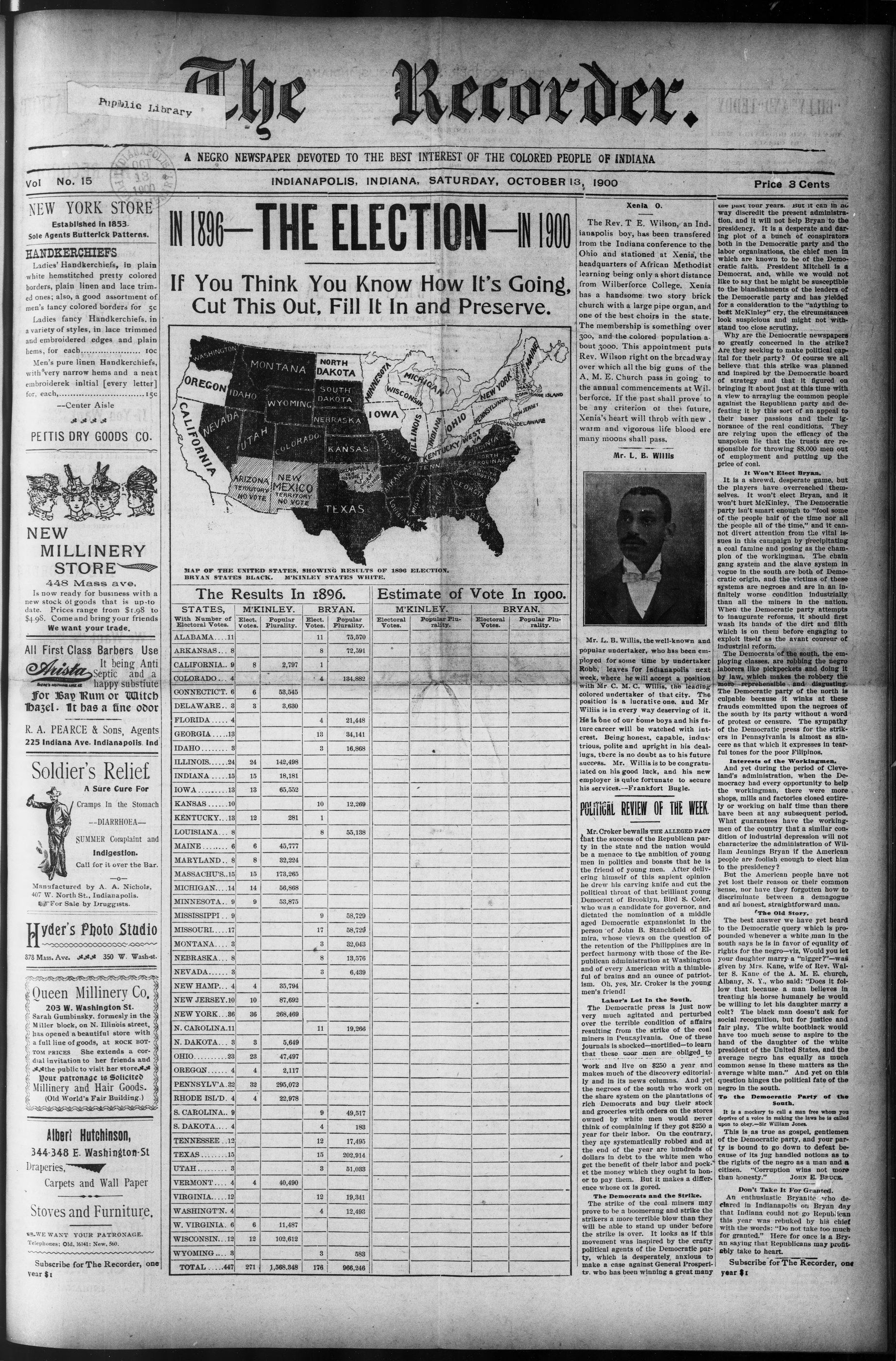
MAP OF THE UNITED STATES, SHOWING RESULTS OF 1896 ELECTION.
BRYAN STATES BLACK. MKINLEY STATES WHITE.
448 Mass ave.
Is now ready for business with a
new stock of goods that is up-to
date. Prices range from $1.98 to
$4.98. Come and bring your friends
We want your trade.
All First Class Barbers Use
Arista
It being Anti
Septic and a
happy substitute
For Bay Rum or Witch
Hazel. It has a fine odor
R. A. PEARCE & Sons, Agents
225 Indiana Ave. Indianapolis, Ind
Soldier's Relief
T
A Sure Cure For
Cramps In the Stomach
--DIARRHOEA--
SUMMER Complaint and
Indigestion.
Call for it over the Bar.
Manufactured by A. A. Nichols,
407 W. North St., Indianapolis.
For Sale by Druggists.
Hyder's Photo Studio
878 Mass. Ave. 350 W. Wash-st.
Oueen Millinerv Co.
203 W. Washington St.
Sarah Gumbinsky, formely in the
Miller block, on N. Illinois street,
has opened a beautiful store with
a full line of goods, at ROCK BOTTOM PRICES She extends a cordial invitation to her friends and
the public to visit her store.
Your patronage is Solicited
Millinery and Hair Goods.
Minerery and Tail Goods
(Old World's Fair Building.)
Albert Hutchinson,
344-348 E. Washington-St
Draperies,
Carpets and Wall Paper
Stoves and Furniture.
WE WANT YOUR PATRONAGE.
Telephones; Old, 16141: New, 560.
Subscribe for The Recorder, one
year $1
```markdown
```
A NEGRO NEWSPAPER DEVOTED TO THE BEST INTEREST OF THE COLORED PEOPLE OF INDIANA INDIANAPOLIS, INDIANA, SATURDAY, OCTOBER 13, 1900
IN 1896—THE ELECTION—IN 1900
The Rev. T E. Wilson, an Indianapolis boy, has been transferred from the Indiana conference to the Ohio and stationed at Xenia, the headquarters of African Methodist learning being only a short distance from Wilberforce College. Xenia has a handsome two story brick church with a large pipe organ, and one of the best choirs in the state. The membership is something over 300, and the colored population about 3000. This appointment puts Rev. Wilson right on the breadway over which all the big guns of the A. M. E. Church pass in going to the annual commencements at Wilberforce. If the past shall prove to be any criterion of the future, Xenia's heart will throb with new warm and vigorous life blood ere many moons shall pass.
If You Think You Know How It's Going, Cut This Out, Fill It In and Preserve.
WASHINGTON
MONTANA
OREGON
IDAHO
WYOMING
CALIFORNIA
NEVADA
UTAH
COLORADO
ARIZONA
TERRITORY
NO VOTE
NEW MEXICO
TERRITORY
NO VOTE
NORTH DAKOTA
SOUTH DAKOTA
NEBRASKA
KANSAS
TEXAS
MINNESOTA
MICHIGAN
WISCONSIN
IOWA
ILLINOIS
INDIANA
OHIO
PENNSYLVANIA
NEW YORK
MASS
CONN. HODE ISLAND
NEW JERSEY
DELAWARE
KENTUCKY
WEST VA
MORGANIA
NORTH CAROLINA
TENNESSEE
NORTH CAROLINA
GEORGIA
FLORIDA
Mr. L. B. Willis
A. B.
The Results In 1896.
STATES, With Number of Electoral Votes.
M'KINLEY.
Elect. Votes.
Popular Plurality.
Elect. Votes.
Popular Plurality.
M'KINLEY.
Electoral Votes.
Popular Plurality.
Electoral Votes.
Popular Plurality.
ALABAMA...11
ARKANSAS...8
CALIFORNIA..9
COLORADO...4
GONNECTICT.6
DELAWARE..3
FLORIDA...4
GEORGIA...13
IDAHO...3
ILLINOIS...24
INDIANA...15
IOWA...13
KANSAS...10
KENTUCKY...13
LOUISIANA...8
MAINE...6
MARYLAND..8
MASSACHU'S..15
MICHIGAN...14
MINNESOTA..9
MISSISSIPPI...9
MISSOURI...17
MONTANA...3
NEBRASKA...8
NEVADA...3
NEW HAMP...4
NEW JERSEY.10
NEW YORK..86
N. CAROLINA.11
N. DAKOTA...3
OHIO...23
OREGON...4
PENNSYLV'A.32
RHODE ISL'D.4
S. CAROLINA.9
S. DAKOTA...4
TENNESSEE...12
TEXAS...15
UTAH...3
VERMONT...4
VIRGINIA...12
WASHINGT'N.4
W. VIRGINIA.6
WISCONSIN...12
WYOMING...3
TOTAL...447
271
1,568,348
176
966,246
Mr. L. B. Willis, the well-known and popular undertaker, who has been employed for some time by undertaker Robb, leaves for Indianapolis next week, where he will accept a position with Mr C. M. C. Willis, the leading colored undertaker of that city. The position is a lucrative one, and Mr Willis is in every way deserving of it. He is one of our bome boys and his future career will be watched with interest. Being honest, capable, industrious, polite and upright in his dealings, there is no doubt as to his future success. Mr. Willis is to be congratulated on his good luck, and his new employer is quite fortunate to secure his services.—Frankfort Bugle.
POLITICAL REVIEW OF THE WEEK
Mr. Croker bewalls THE ALLEGED FACT that the success of the Republican party in the state and the nation would be a menace to the ambition of young men in politics and boasts that he is the friend of young men. After delivering himself of this sapient opinion he drew his carving knife and cut the political throat of that brilliant young Democrat of Brooklyn, Bird S. Coler, who was a candidate for governor, and dictated the nomination of a middle aged Democratic expansionist in the person of John B. Stanchfield of Elmira, whose views on the question of the Philippines are in perfect harmony with those of the Republican administration at Washington and of every American with a thimbleful of brains and an ounce of patriotism. Oh, yes, Mr. Croker is the young men's friend!
Labor's Lot In the South.
The Democratic press is just now very much agitated and perturbed over the terrible condition of affairs resulting from the strike of the coal miners in Pennsylvania. One of these journals is shocked—mortified—to learn that these unarmed men are obliged to work and live on $250 a year and makes much of the discovery editorially and in its news columns. And yet the negroes of the south who work on the share system on the plantations of rich Democrats and buy their stock and groceries with orders on the stores owned by white men would never think of complaining if they got $250 a year for their labor. On the contrary, they are systematically robbed and at the end of the year are hundreds of dollars in debt to the white men who get the benefit of their labor and pocket the money which they ought in honor to pay them. But it makes a difference whose ox is gored.
The Democrates and the Strike.
The strike of the coal miners may prove to be a boomerang and strike the strikers a more terrible blow than they will be able to stand up under before the strike is over. It looks as if this movement was inspired by the crafty political agents of the Democratic party, which is desperately anxious to make a case against General Prosperity, who has been winning a great many
Price 3 Cents
the past four years. But it can in no way discredit the present administration, and it will not help Bryan to the presidency. It is a desperate and daring plot of a bunch of conspirators both in the Democratic party and the labor organizations, the chief men in which are known to be of the Democratic faith. President Mitchell is a Democrat, and, while we would not like to say that he might be susceptible to the blandishments of the leaders of the Democratic party and has yielded for a consideration to the "anything to beat McKinley" cry, the circumstances look suspicious and might not withstand too close scrutiny.
Why are the Democratic newspapers so greatly concerned in the strike? Are they seeking to make political capital for their party? Of course we all believe that this strike was planned and inspired by the Democratic board of strategy and that it figured on bringing it about just at this time with a view to arraying the common people against the Republican party and defeating it by this sort of an appeal to their baser passions and their ignorance of the real conditions. They are relying upon the efficacy of the unspoken lie that the trusts are responsible for throwing 88,000 men out of employment and putting up the price of coal.
It Won't Elect Bryan.
It is a shrewd, desperate game, but the players have overreached themselves. It won't elect Bryan, and it won't hurt McKinley. The Democratic party isn't smart enough to "fool some of the people all of the time," and it cannot divert attention from the vital issues in this campaign by precipitating a coal famine and posing as the champion of the workingman. The chain gang system and the slave system in vogue in the south are both of Democratic origin, and the victims of these systems are negroes and are in an infinitely worse condition industrially than all the miners in the nation. When the Democratic party attempts to inaugurate reforms, it should first wash its hands of the dirt and filth which is on them before engaging to exploit itself as the avant coureur of industrial reform.
The Democrats of the south, the employing classes, are robbing the negro laborers like pickpockets and doing it by law, which makes the robbery the more reprehensible and disgusting. The Democratic party of the north is culpable because it winks at these frauds committed upon the negroes of the south by its party without a word of protest or censure. The sympathy of the Democratic press for the strikers in Pennsylvania is almost as sincere as that which it expresses in tearful tones for the poor Fillipinos.
Interests of the Workingmen.
And yet during the period of Cleveland's administration, when the Democracy had every opportunity to help the workingman, there were more shops, mills and factories closed entirely or working on half time than there have been at any subsequent period. What guarantees have the workingmen of the country that a similar condition of industrial depression will not characterize the administration of William Jennings Bryan if the American people are foolish enough to elect him to the presidency?
But the American people have not yet lost their reason or their common sense, nor have they forgotten how to discriminate between a demagogue and an honest, straightforward man.
'The Old Story.
The best answer we have yet heard to the Democratic query which is propounded whenever a white man in the south says he is in favor of equality of rights for the negro—viz. Would you let your daughter marry a "nigger"?—was given by Mrs. Kane, wife of Rev. Walter S. Kane of the A. M. E. church, Albany, N. Y., who said: "Does it follow that because a man believes in treating his horse humanely he would be willing to let his daughter marry a colt? The black man doesn't ask for social recognition, but for justice and fair play. The white bootblack would have too much sense to aspire to the hand of the daughter of the white president of the United States, and the average negro has equally as much common sense in these matters as the average white man." And yet on this question hinges the political fate of the negro in the south.
To the Democratic Party of the South.
It is a mockery to call a man free whom you deprive of a voice in making the laws he is called upon to obey—Sir William Jones.
This is as true as gospel, gentlemen of the Democratic party, and your party is bound to go down to defeat because of its jug handled notions as to the rights of the negro as a man and a citizen. "Corruption wins not more than honesty." JOHN E. BRUCE.
Don't Take It For Granted.
An enthusiastic Bryanite who declared in Indianapolis on Bryan day that Indiana could not go Republican this year was rebuked by his chief with the words: "Do not take too much for granted." Here for once is a Bryan saying that Republicans may profitably take to heart.
Subscribe for The Recorder, one year $1
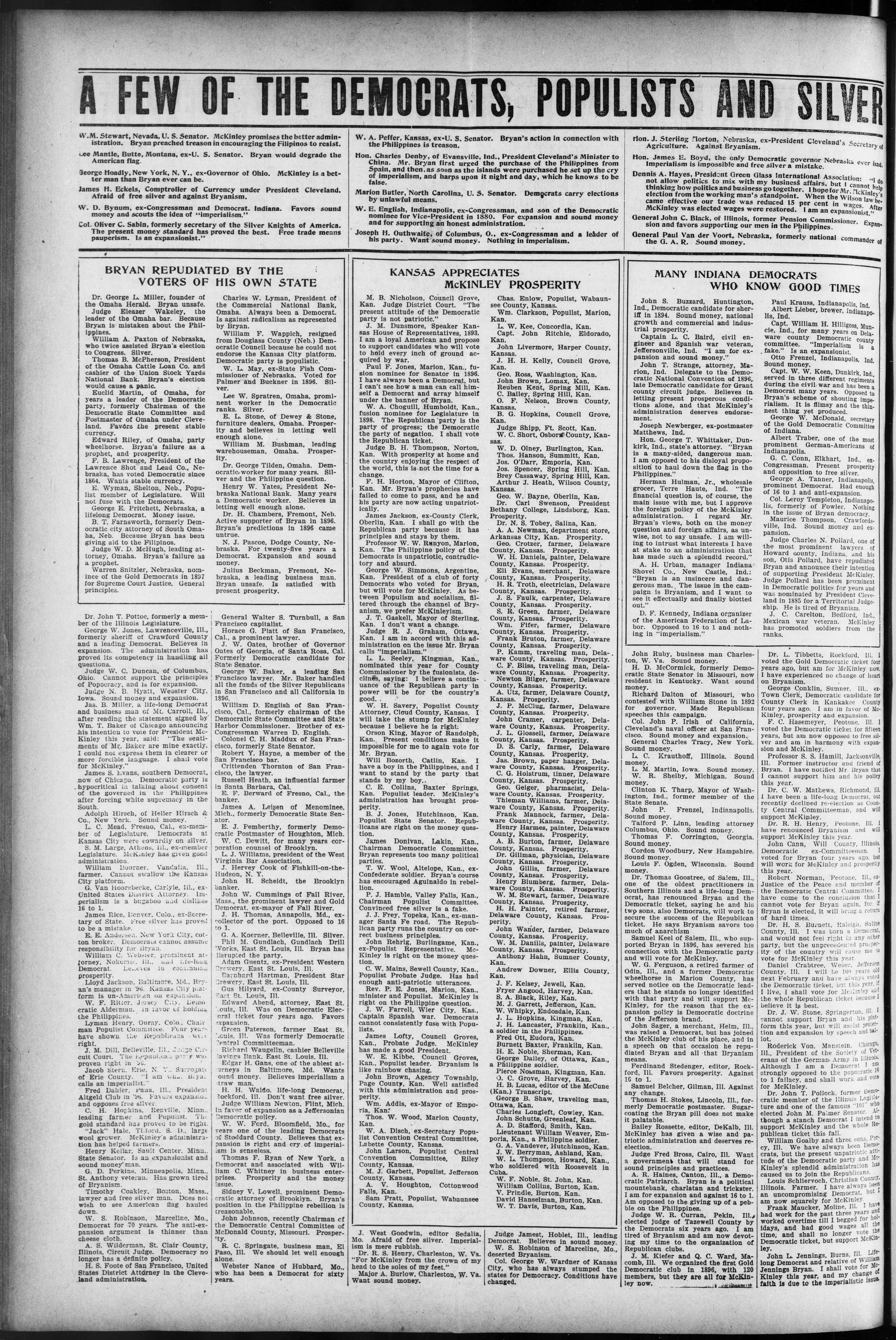
A FEW OF THE DEMOCRATS, POPULISTS AND SILVER
W. M. Stewart, Nevada, U. S. Senator. McKinley promises the better administration. Bryan preached treason in encouraging the Filipinos to resist.
Lee Mantle, Butte, Montana, ex-U. S. Senator. Bryan would degrade the American flag.
George Hoadly, New York, N. Y., ex-Governor of Ohio. McKinley is a better man than Bryan ever can be.
James H. Eckels, Comptroller of Currency under President Cleveland, Afraid of free silver and against Bryanism.
W. D. Bynum, ex-Congressman and Democrat. Indiana. Favors sound money and scouts the idea of "imperialism."
Col. Oliver C. Sabin, formerly secretary of the Silver Knights of America. The present money standard has proved the best. Free trade means pauperism. Is an expansionist."
BRYAN REPUDIATED BY THE VOTERS OF HIS OWN STATE
BRYAN REPUDIATED BY THE VOTERS OF HIS OWN STATE
Dr. George L. Miller, founder of the Omaha Herald. Bryan unsafe. Judge Eleaser Wakeley, the leader of the Omaha bar. Because Bryan is mistaken about the Philippines. William A. Paxton of Nebraska, who twice assisted Bryan's election to Congress. Silver. Thomas B. McPherson, President of the Omaha Cattle Loan Co. and cashier of the Union Stock Yards National Bank. Bryan's election would cause a panic. Euclid Martin, of Omaha, for years a leader of the Democratic party, formerly Chairman of the Democratic State Committee and Postmaster of Omaha under Cleveland. Favors the present stable currency. Edward Riley, of Omaha, party wheehorse. Bryan's failure as a prophet, and prosperity. F. B. Lawrence, President of the Lawrence Shot and Lead Co., Nebraska, has voted Democratic since 1864. Wants stable currency.
E. Wyman, Shelton, Neb., Populist member of Legislature. Will not fuse with the Democrats. George E. Pritchett, Nebraska, a lifelong Democrat. Money issue. B. T. Farnsworth, former Democratic city attorney of South Omaha, Neb. Because Bryan has been giving aid to the Filipinos. Judge W. D. McHugh, leading attorney, Omaha. Bryan's failure as a prophet. Warren Snitzler, Nebraska, nominee of the Gold Democrats in 1897 for Supreme Court Justice. General principles.
Dr. John T. Pottoc, formerly a member of the Illinois Legislature.
George W. Jones, Lawrenceville, Ill., formerly sheriff of Crawford County and a leading Democrat. Believes in expansion. The administration has proved its competency in handling all questions.
Judge W. C. Duncan, of Columbus, Ohio. Cannot support the principles of Popocracy, and is for expansion.
Judge N. B. Hyatt, Weoster City, Iowa. Sound money and expansion.
Jas. B. Miller, a life-long Democrat and business man of M. Carroll, Ill., after reading the statement signed by Wm. T. Baker of Chicago announcing his intention to vote for President McKinley this year, said: "The sentiments of Mr. Baker are mine exactly. I could not express them in clearer or more forcible language. I shail vote for McKinley."
James S. Evans, southern Democrat, now of Chicago. Democratic party is hypocritical in talking about consent of the governed in the Philippines after forcing white supremacy in the South.
Adolph Hirsch, of Heller Hirsch & Co., New York. Sound money.
L. C. Mead, Fresno, Cal., ex-member of Legislature. Democrats at Kansas City were cowardly on silver, S. M. Large, Athens, Ill., ex-member Legislature. McKinley has given good administration.
William Bourner, Vandalia, Ill., farmer. Cannot swallow the Kansas City platform.
G. Van Hoorebecke, Carlyle, Ill., ex-United States District Attorney. Imperialism is a bugaboo and dislikes 16 to 1.
James Rice, Denver, Colo., ex-Secretary of State. Free silver has proved to be a mistake.
E. E. Andersen, New York City, cotton broker. Democrats cannot assume responsibility for bran.
William C. Webster, prominent attorney, Nokoma, Ill., and life-long Democrat. Leaves in continuing prosperity.
Lloyd Jackson, Baltimore, Md., Bryan's manager in '96. Kansas City platform is un-American on expansion.
W. F. Ritter, Jersey City, Democratic Alderman, in favor of holding the Philippines.
Lyman Henry, Ocurry, Colo., Chairman Populist Committee. Four years have shown the Republicans were right.
J. M. Dill, Belleville, Ill., Jingo Circuit Court. The Populist party was proven right in '96.
Jacob Stern, Erie, N. Y., Surrogate of Erie County. "I am who. Bryan calls an imperialist."
Fred Dahler, Pana, Ill., President Altgeild Court in '96. Favors expansion and opposes free silver.
C. H. Hopkins, Renville, Minn., leading farmer and Populist. The gold standard has proved to be right
"Jack" Hale, Thilford, S. D., large wool grower. McKinley's administration has helped farmers.
Henry Kellar, Sault Center, Minn.
State Senator. Is an expansionist and sound money man.
G. D. Perkins, Minneapolis, Minn.
St. Anthony veteran. Has grown tired of Bryanism.
Timothy Coakley, Boston, Mass.
lawyer and free silver man. Does not wish to see American flag hauled down.
W. S. Robinson, Marceline, Mo.
Democrat for 70 years. The anti-expansion argument is thinner than cheese cloth.
A. S. Wilderman, St. Clair County, Illinois. Circuit Judge. Democracy no longer has a definite policy.
H. S. Foote of San Francisco, United States District Attorney in the Cleveland administration.
Charles W. Lyman, President of the Commercial National Bank, Omaha. Always been a Democrat. Is against radicalism as represented by Bryan.
William F. Wappich, resigned from Douglass County (Neb.) Democratic Council because he could not endorse the Kansas City platform. Democratic party is populistic.
W. L. May, ex-State Fish Commissioner of Nebraska. Voted for Palmer and Buckner in 1896. Silver.
Lee W. Spratren, Omaha, prominent worker in the Democratic ranks. Silver.
E. L. Stone, of Dewey & Stone, furniture dealers, Omaha. Prosperity and believes in letting well enough alone.
William M. Bushman, leading warehouseman, Omaha. Prosperity.
Dr. George Tilden, Omaha. Democratic worker for many years. Silver and the Philippine question.
Henry W. Yates, President Nebraska National Bank. Many years a democratic worker. Believes in letting well enough alone.
Dr. H. Chambers, Fremont, Neb. Active supporter of Bryan in 1896. Bryan's predictions in 1896 came untrue.
N. J. Pascoe, Dodge County, Nebraska. For twenty-five years a Democrat. Expansion and sound money.
Julius Beckman, Fremont, Nebraska, a leading business man. Bryan unsafe. Is satisfied with present prosperity.
General Walter S. Turnbull, a San Francisco capitalist.
Horace G. Platt of San Francisco, Cal., a prominent lawyer.
J. W. Oates, brother of Governor Oates of Georgia, of Santa Rosa, Cal. Formerly Democratic candidate for State Senator.
George W. Baker, a leading San Francisco lawyer. Mr. Baker handled all the funds of the Silver Republicans in San Francisco and all California in 1896.
William D. English of San Francisco, Cal., formerly chairman of the Democratic State Committee and State Harbor Commissioner. Brother of ex-Congressman Warren D. English.
Colonel C. H. Maddux of San Francisco, formerly State Senator.
Robert Y. Hayne, a member of the San Francisco bar.
Crittenden Thornton of San Francisco, the lawyer.
Russell Heath, an influential farmer in Santa Barbara, Cal.
E. F. Berward of Fresno, Cal., the banker.
James A. Leisen of Menominee, Mich., formerly Democratic State Senator.
E. J. Pemberthy, formerly Democratic Postmaster of Houghton, Mich.
W. C. Dewitt, for many years cor-
J. Hervey Cook of Fishkill-on-the Hudson, N. Y.
Edgar H. Gans, one of the ablest attorneys in Baltimore, Md. Wants sound money. Believes imperialism a draw man.
H. H. Waldo. life-long Democrat, Rockford. Ill. Don't want free silver. Judge William Newton, Flint, Mich. In favor of expansion as a Jeffersonian Democratic policy.
W. W. Ford, Bloomfield, Mo., for years one of the leading Democrats of Stoddard County. Believes that expansion is right and cry of imperialism is senseless.
Thomas F. Ryan of New York, a Democrat and associated with William C. Whitney in business enterprises. Prosperity and the money issue.
Sidney V. Lowell, prominent Democratic attorney of Brooklyn. Bryan's position in the Philippine rebellion is treasonable.
John Johnson, recently Chairman of the Democratic Central Committee of McDonald County, Missouri. Prosperity.
R. C. Springgate, business man, El Paso, Ill. We should let well enough alone. Webster Nance of Hubbard, Mo., who has been a Democrat for sixty years.
W. A. Peffer, Kansas, ex-U. S. Senator. Bryan's action in connection with the Philippines is treason.
Hon. Charles Denby, of Evansville, Ind., President Cleveland's Minister to China. Mr. Bryan first urged the purchase of the Philippines from Spain, and then, as soon as the islands were purchased he set up the cry of imperialism, and harps upon it night and day, which he knows to be false.
Marion Butler, North Carolina, U. S. Senator. Democrats carry elections by unlawful means.
W. E. English, Indianapolis, ex-Congressman, and son of the Democratic nominee for Vice-President in 1880. For expansion and sound money and for supporting an honest administration.
Joseph H. Outhwaite, of Columbus, O., ex-Congressman and a leader of his party. Want sound money. Nothing in Imperialism.
KANSAS APPRECIATES McKINLEY PROSPERITY
KANSAS APPRECIATES McKINLEY PROSPERITY
M. B. Nicholson, Council Grove, Kan. Judge District Court. "The present attitude of the Democratic party is not patriotic."
J. M. Dunsmore, Speaker Kansas House of Representatives, 1893. I am a loyal American and propose to support candidates who will vote to hold every inch of ground acquired by war.
Paul F. Jones, Marlon, Kan., fusion nominee for Senator in 1896. I have always been a Democrat, but I can't see how a man can call himself a Democrat and array himself under the banner of Bryan.
W. A. Chogull, Humboldt, Kan., fusion nominee for Legislature in 1898. The Republican party is the party of progress; the Democratic the party of negation. I shall vote the Republican ticket.
Judge B. H. Thompson, Norton, Kan. With prosperity at home and the country enjoying the respect of the world, this is not the time for a change.
F. H. Horton, Mayor of Clifton, Kan. Mr. Bryan's prophecies have failed to come to pass, and he and his party are now acting unpatriotically.
James Jackson, ex-County Clerk, Oberlin, Kan. I shall go with the Republican party because it has principles and stays by them.
Professor W. W. Runyon, Marion, Kan. The Philippine policy of the Democrats is unpatriotic, contradictory and absurd.
George W. Simmons, Argentine, Kan. President of a club of forty Democrats who voted for Bryan, but will vote for McKinley. As between Populism and socialism, filtered through the channel of Bryanism, we prefer McKinleyism.
J. T. Gaskell, Mayor of Sterling, Kan. I don't want a change.
Judge R. J. Graham, Ottawa, Kan. I am in accord with this administration on the issue Mr. Bryan calls "imperialism."
L. L. Seeley, Kingman, Kan. nominated this year for County Commissioner by the fusionists, declines, saying: I believe a continuance of the Republican party in power will be for the country's good.
W. H. Savery, Populist County Attorney, Cloud County, Kansas. I will take the stump for McKinley because I believe he is right.
Orson King, Mayor of Randolph, Kan. Present conditions make it impossible for me to again vote for Mr. Bryan.
Will Bozorth, Catlin, Kan. I have a boy in the Philippines, and I want to stand by the party that stands by my boy..
C. E. Collins, Baxter Springs, Kan. Populist leader. McKinley's administration has brought prosperity.
B. J. Jones, Hutchinson, Kan. Populist State Senator. Republicans are right on the money question.
James Donivan, Lakin, Kan,
Chairman Democratic Committee.
Bryan represents too many political parties.
T. W. Wool, Altelope, Kan., ex-Confederate soldier. Bryan's course has encouraged Aguinaldo in rebellion.
P. J. Hamble, Valley Falls, Kan., Chairman Populist Committee.
Convinced free silver is a fake.
J. J. Frey, Topeka, Kan., ex-manager Santa Fe road. The Republican party runs the country on correct business principles.
John Rehrig, Burlingame, Kan., ex-Populist Representative. McKinley is right on the money question.
C. W. Mains, Sewell County, Kan., Populist Probate Judge. Has had enough anti-patriotic utterances.
Rev. P. E. Jones, Marion, Kan., minister and Populist. McKinley is right on the Philippine question.
J. W. Farrell, Wier City, Kas., Captain Spanish war. Democrats cannot consistently fuse with Populists.
James Lofty, Council Groves, Kan., Probate Judge. McKinley has made a good President.
W. E. Kibbe, Council Groves, Kan., Populist leader. Bryanism is like rainbow chasing.
John Brown, Agency Township, Page County, Kan. Well satisfied with this administration and prosperity.
Wm. Addis, ex-Mayor of Emporia, Kan'
Thos. W. Wood, Marion County, Kan.
W. A. Disch, ex-Secretary Populist Convention Central Committee, Labette County, Kansas.
John Larson, Populist Central Convention Committee, Riley County, Kansas.
M. J. Garbett, Populist, Jefferson County, Kansas.
A. V. Houghton, Cottonwood Falls, Kan.
Sam Pratt, Populist, Wabaunsee County, Kansas.
J. West Goodwin, editor Sedalia
Mo. Afraid of free silver. Imperialism is mere rubbish.
Dr. R. S. Henry, Charleston, W. Va.
"For McKinley from the crown of my head to the soles of my feet."
Major A. Burlow, Charleston, W. Va.
Want money.
Chas. Enlow, Populist, Wabaunsee County, Kansas.
Wm. Clarkson, Populist, Marion, Kan.
L. W. Kee, Concordia, Kan.
Capt. John Ritchie, Eldorado, Kan.
John Livermore, Harper County, Kansas.
J. H. H. Kelly, Council Grove, Kan.
Geo. Ross, Washington, Kan.
John Brown, Lomax, Kan.
Reuben Kent, Spring Mill, Kan.
C. Bailey, Spring Hill, Kan.
O. F. Nelson, Brown County,
Kansas.
B. G. Hopkins, Council Grove,
Kan.
Judge Shipp, Ft. Scott, Kan.
W. C. Short, Osborn County, Kansas.
P. Kamm, traveling man, Delaware County, Kansas. Prosperity.
C. F. Bliss, traveling man, Delaware County, Kansas. Prosperity.
Newton Bilger, farmer, Delaware County, Kansas. Prosperity.
J. P. McClug, farmer, Delaware County, Kansas. Prosperity
John Cramer, carpenter, Delaware County, Kansas. Prosperity
J. L. Glossell, farmer, Delaware County, Kansas. Prosperity
W. M. Danilis, painter, Delaware County, Kansas. Prosperity.
Anthony Hahn, Sumner County, Kan.
Andrew Downer, Ellis County, Kan.
J. F. Kelsey, Jewell, Kan.
Fryer Angood, Harvey, Kan.
S. A. Black, Riley, Kan.
M. J. Garrett, Jefferson, Kan.
W. Whipky, Endosdale, Kan.
J. L. Hopkins, Kingman, Kan.
J. H. Lancaster, Franklin, Kan., a soldier in the Philippines.
Fred Ott, Eudora, Kan.
Burnett Baxter, Franklin, Kan.
H. E. Noble, Sherman, Kan.
George Dalley, of Ottawa, Kan., a Philippine soldier.
Pierce Nossman, Kingman, Kan.
O. C. Grove, Harvey, Kan.
H. B. Lucas, editor of the McCune (Kan.) Transcript.
George B. Shaw, traveling man,
Ottawa, Kan.
Charles Longleft, Cowley, Kan.
John Schutts, Greenleaf, Kan.
A. D. Stafford, Smith, Kan.
Lieutenant William Weaver, Emporia, Kan., a Philippine soldier.
G. A. Vanderee, Hutchinson, Kan.
J. W. Berryman, Ashland, Kan.
W. L. Thompson, Howard, Kan., who soldiered with Roosevelt in Cuba.
W. F. Noble, St. John, Kan.
William Collins, Burton, Kan.
V. Prindle, Burton, Kan.
David Hanselman, Burton, Kan.
W. T. Davis, Burton, Kan.
Judge Jamest, Hoblet, Ill., leading Democrat. Believes in sound money. W. S. Robinson of Marceline, Mo., deserted Bryanism.
Col. George W. Wardner of Kansas City, who has always stumped the states for Democracy. Conditions have changed.
Hon. J. Sterling Horton, Nebraska, ex-President Cleveland's Secretary of Agriculture. Against Bryanism.
Hon. James E. Boyd, the only Democratic governor Nebraska ever had. Imperialism is impossible and free silver a mistake.
Dennis A. Hayes, President Green Glass International Association: "I do not allow politics to mix with my business affairs, but I cannot help thinking how politics and business go together. I hope for Mr. McKinley's election from the working man's standpoint. When the Wilson law became effective our trade was reduced 15 per cent in wages. After McKinley was elected wages were restored. I am an expansionist."
General John C. Black, of Illinois, former Pension Commissioner. Expansion and favors supporting our men in the Philippines.
General Paul Van der Voort, Nebraska, formerly national commander of the G. A. R. Sound money.
MANY INDIANA DEMOCRATS WHO KNOW GOOD TIMES
John S. Buzzard, Huntington, Ind., Democratic candidate for sheriff in 1894. Sound money, national growth and commercial and industrial prosperity. Captain L. C. Baird, civil engineer and Spanish war veteran, Jeffersonville, Ind. "I am for expansion and sound money." John T. Strange, attorney, Marlon, Ind. Delegate to the Democratic National Convention of 1896, late Democratic candidate for Grant county circuit judge. Believes in letting present prosperous conditions alone, and that McKinley's administration deserves endorsement. Joseph Newberger, ex-postmaster Matthews, Ind. Hon. George T. Whittaker, Dunkirk, Ind., state attorney. "Bryan is a many-sided, dangerous man. I am opposed to his disloyal proposition to haul down the flag in the Philippines."
Herman Hulman, Jr., wholesale grocer, Terre Haute, Ind. "The financial question is, of course, the main issue with me, but I approve the foreign policy of the McKinley administration. I regard Mr. Bryan's views, both on the money question and foreign affairs, as unwise, not to say unsafe. I am willing to intrust what interests I have at stake to an administration that has made such a splendid record." A. H. Urban, manager Indiana Shovel Co., New Castle, Ind.: "Bryan is an insincere and dangerous man. The issue in the campaign is Bryanism, and I want to see it effectually and finally blotted out." D. F. Kennedy, Indiana organizer of the American Federation of Labor. Opposed to 16 to 1 and nothing in "imperialism." John Ruby, business man Charles ton, W. Va. Sound money.
H. D. McCormick, formerly Democratic State Senator in Missouri, now resident in Kentucky. Want sound money.
Richard Dalton of Missouri, who contested with William Stone in 1892 for governor. Made Republican speeches this campaign.
Col. John P. Irish of California, Cleveland's naval officer at San Francisco. Sound money and expansion.
General Charles Tracy, New York. Sound money.
L. C. Krauthoff, Illinois. Sound money.
L. M. Martin, Iowa. Sound money.
W. R. Shelby, Michigan. Sound money.
Clinton K. Tharp, Mayor of Washington, Ind., former member of the State Senate.
John P. Frenzel, Indianapolis. Sound money.
Talford P. Linn, leading attorney
Columbus, Ohio. Sound money.
Thomas F. Corrington, Georgia.
Sound money.
Cordon Woodbury, New Hampshire. Sound money. Louis F. Ogden, Wisconsin. Sound money. Dr. Thomas Goostree, of Salem, Ill., one of the oldest practitioners in Southern Illinois and a life-long Democrat, has renounced Bryan and the Democratic ticket, saying he and his two sons, also Democrats, will work to secure the success of the Republican ticket. He says Bryanism savors too much of anarchism Samuel Keel of Salem, Ill., who supported Bryan in 1896, has severed his connection with the Democratic party and will vote for McKinley. W. G. Ferguson, a retired farmer of Odin, Ill., and a former Democratic wheelhorse in Marion County, has served notice on the Democratic leaders that he stands no longer identified with that party and will support McKinley, for the reason that the expansion policy is Democratic doctrine of the Jefferson brand.
John Sager, a merchant, Helm, Ill., was raised a Democrat, but has joined the McKinley club of his place, and in a speech on that occasion he repudiated Bryan and all that Bryanism means.
Ferdinand Stedenger, editor, Rockford, Ill. Favors prosperity. Against 16 to 1.
Samuel Belcher, Gilman, Ill. Against any change.
Thomas H. Stokes, Lincoln, Ill., formerly Democratic postmaster. Sugarcating the Bryan pill does not make it palatable.
Bailey Rossette, editor, DeKalb, Ill. McKinley has given a wise and patriotic administration and deserves reelection.
Judge Fred Bross, Cairo, Ill. Want a government that will stand for sound principles and practices.
A. R. Haines, Canton, Ill., a Democratic Patrilarch. Bryan is a political mountbank, charlatan and trickster. I am for expansion and against 16 to 1. Am opposed to the giving up of a pebble on the Philippines.
Judge W. R. Curran, Pekin, Ill., elected judge of Tazewell County by the Democrats six years ago. I am tired of Bryanism and am now devoting my time to the organization of Republican clubs. J. M. Kiefer and Q. C. Ward, Macomb, Ill. We organized the first Gold Democratic club in 1896, with 120 members, but they are all for McKinley now.
Paul Kraus, Indianapolis, Ind.
Albert Lieber, brewer, Indianapolis, Ind.
Capt. William H. Hilligess, Muncie, Ind., for many years on Delaware county Democratic county committee. "Imperialism is a fake." Is an expansionist.
Otto Frenzel, Indianapolis, Ind.
Sound money.
Capt. W. W. Keen, Dunkirk, Ind., served in three different regiments during the civil war and has been a Democrat many years. Opposed to Bryan's scheme of shouting imperialism. It is flimsy and the thinnest thing yet produced.
George W. McDonald, secretary of the Gold Democratic Committee of Indiana.
Albert Traber, one of the most prominent German-Americans of Indianapolis.
G. C. Conn, Elkhart, Ind., ex Congressman. Present prosperity and opposition to free silver.
George A. Tanner, Indianapolis, prominent Democrat. Had enough of 16 to 1 and anti-expansion. Col. Leroy Templeton, Indianapolis, formerly of Fowler. Nothing in the issue of Bryan democracy. Maurice Thompson, Crawfordville, Ind. Sound money and expansion. Judge Charles N. Pollard, one of the most prominent lawyers of Howard county, Indiana, and his son, Otis Pollard, have repudiated Bryan and announce their intention of supporting President McKinley. Judge Pollard has been prominent in Democratic politics for years and was nominated by President Cleveland in 1885 for a Territorial Judgeship. He is tired of Bryanism. J. C. Carelton, Bedford, Ind., Mexican war veteran. McKinley has promoted soldiers from the ranks.
Dr. L. Tibbetts, Rockford, Ill. I voted the Gold Democratic ticket four years ago, but am for McKinley now. I have experienced no change of heart on Bryanism. George Conklin, Sumner, Ill. ex-Town Clerk, Democratic candidate for County Clerk in Kankakee County four years ago. I am in favor of McKinley, prosperity and expansion. F. C. Hasemeyer, Peotone, Ill. I voted the Democratic ticket for fifteen years, but am now opposed to free silver and am in harmony with expansion and McKinley. Professor S. S. Hamill, Jacksonville, Ill. Former instructor and friend of Bryan. I have notified Mr Bryan that I cannot support him and his policy this year. Dr. C. W. Mathews, Richmond, Ill. I have been a life-long Democrat, but recently declined re-election as County Central Committeeman, and will support McKinley. Dr. R. H. Henry, Peotone, Ill. I have renounced Bryanism and will support McKinley this year.
John Cann, Will County, Illinois, Democratic ex-Committeeman. I voted for Bryan four years ago, but will work for McKinley and prosperity this year.
Robert Norman, Peotone, Ill., ex-Justice of the Peace and member of the Democratic Central Committee. I have come to the conclusion that I cannot vote for Bryan again, for if Bryan is elected, it will bring a return of hard times.
Dr. H. S. Burnett, Raleigh, Saline County, Ill. I was born a Democrat, and would not feel right in any other party, but the unprecedented property of the country will cause me to vote for McKinley this year.
Daniel Crabtree, Wenner, Jefferson County, Ill. I will be 100 years old next February and have always voted the Democratic ticket, but this year, if I live, I shall vote for McKinley and the whole Republican ticket because I believe it is best.
Dr. J. W. Stone, Springerton, Ill. I cannot support Bryan and his platform this year, but will assist protection and expansion by speech and ballot.
Roderick Von. Manstein, Chicago, Ill. President of the Society of Veterans of the German Army in Illinois. Although I am a Democrat I am strongly opposed to the popocratic 16 to 1 fallacy, and shall work and vote for McKinley.
Dr. John T. Pollock, former Democratic member of the Illinois Legislature and one of the famous "101" who elected John M. Palmer Senator. Although a stanch Democrat I intend to support McKinley and the whole Republican ticket this fall.
William Goalby and three sons, Pa-
cy, Ill. We have always been Democ-
rats, but the present unpatriotic atti-
tude of the Democratic party and Mc
Kinley's splendid administration has
caused us to join the Republicans.
caused us to join Louis Schervloch, Christian County, Illinois. Farmer. I have always been an uncompromising Democrat, but I am now squarely for McKinley. Frank Maucker, Moline, Ill. I have had work for the past three years and worked overtime till I begged for holidays, and had good wages all the time, and shall no longer vote the Democratic ticket, but support McKinley.
John L. Jennings, Burns, III. Life-long Democrat and relative of William Jennings Bryan. I shall vote for McKinley this year, and my change of faith is due to the imperialistic issue.
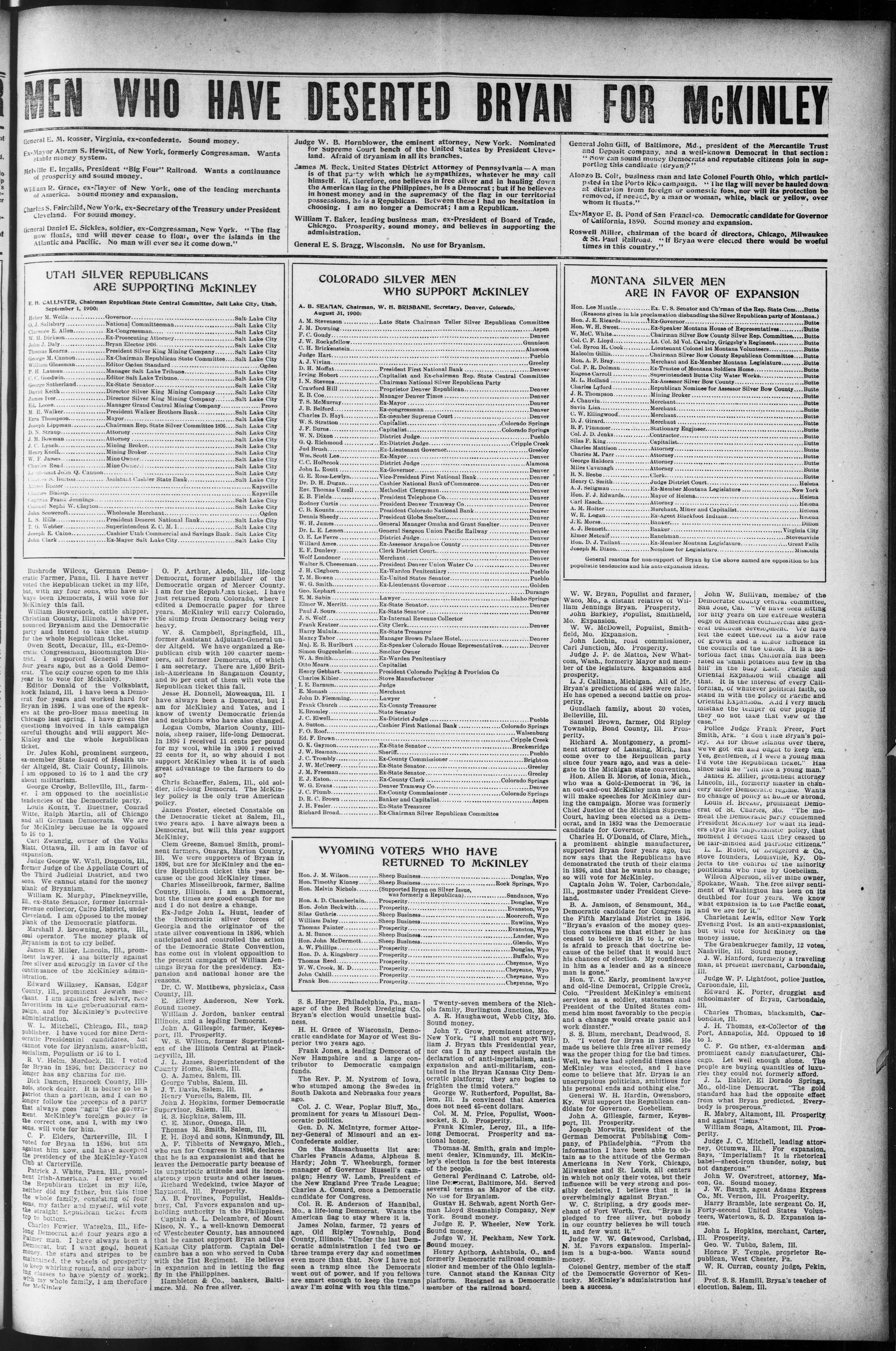
MEN WHO HAVE DESERTED BRYAN FOR McKINLEY
Charles S. Fairchild, New York, ex-Secretary of the Treasury under President Cleveland. For sound money.
General Daniel E. Sickles, soldier, ex-Congressman, New York. "The flag now floats, and will never cease to float, over the islands in the Atlantic and Pacific. No man will ever see it come down."
UTAH SILVER REPUBLICANS ARE SUPPORTING McKINLEY
E. H. CALLISTER, Chairman Republican State Central Committee, Salt Lake City, Utah, September 1, 1900:
Bushrode Wilcox, German Democratic Farmer, Pana, Ili. I have never voted the Republican ticket in my life, but, with my four sons, who have always been Democrats, I will vote for McKinley this fall.
William Bowerdock, cattle shipper, Christian County, Illinois. I have renounced Bryanism and the Democratic party and intend to take the stump for the whole Republican ticket.
Owen Scott, Decatur, Ill., ex-Democratic Congressman, Bloomington District. I supported General Palmer four years ago, but as a Gold Democrat. The only course open to me this year is to vote for McKinley.
Editor Donald of the Volksblatt, koek Island, Ill. I have been a Democrat for years, and worked hard for Bryan in 1896. I was one of the speakers at the pro-Boer meeting in Chicago last spring. I have given the questions involved in this campaign careful thought and will support McKinley and the whole Republican ticket.
Dr. Jules Kohl, prominent surgeon, ex-member State Board of Health under Altgeld, St. Clair County, Illinois. I am opposed to 16 to 1 and the cry about militarism.
George Crosby, Belleville, Ill., farmer. I am opposed to the socialistic tendencies of the Democratic party.
Louis Kontz, T. Buettner, Conrad Witte, Ralph Martin, all of Chicago and all German Democrats. We are for McKinley because he is opposed to 16 to 1.
Carl Zwanzig, owner of the Volks Blatt, Ottawa, Ill. I am in favor of expansion.
Judge George W. Wall, Duquoin, Ill., former Judge of the Appellate Court of the Third Judicial District, and two sons. We cannot stand for the money blank of Bryanism.
William K. Murphy, Pinckneyville, Ill., ex-State Senator, former Internal-revenue collector, Cairo District, under Cleveland. I am opposed to the money blank of the Democratic platform.
Marshall J. Browning, Sparta, Ill., coal operator. The money plank of Bryanism is not to my belief.
James E. Miller, Lincoln, Ill., prominent lawyer. I am bitterly against free silver and strongly in favor of the continuance of the McKinley administration.
Edward Willasey, Kansas, Edgar County, Ill., prominent Jewish merchant. I am against free silver, race favorism in the gubernatorial campaign, and for McKinley's protective administration.
W. L. Mitchell, Chicago, Ill., map publisher. I have voted for nine Democratic Presidential candidates, but cannot vote for Bryanism, anarchism, socialism, Populism or 16 to 1.
R. V. Helm, Murdock, Ill. I voted for Bryan in 1896, but Democracy no longer has any charms for me.
Dick Damon, Hancock County, Illinois, stock dealer. It is better to be a patriot than a partisan, and I can no longer follow the precepts of a party that always goes "again" the government. McKinley's foreign policy is the correct one, and I, with my two sons, will vote for him.
C. P. Elders, Carterville, Ill. I voted for Bryan in 1896, but am against him now, and have accepted the presidency of the McKinley-Yates Club at Carterville.
Patrick J. White, Pana, Ill., prominent Irish-American. I never voted the Republican ticket in my life, neither did my father, but this time the whole family, consisting of four sons, my father and myself, will vote the straight Republican ticket from top to bottom.
Charles Fowier. Watekse. Ill., lifelong Democrat and four years ago a Palmer man. I have always been a Democrat, but I want good, honest money, the stars and stripes to be maintained, the wheels of prosperity to keep whirling round, and our laboring classes to have plenty of work; with my whole family, I am therefore for McKinley.
O. P. Arthur, Aledo, Ill., life-long Democrat, former publisher of the Democratic organ of Mercer County, I am for the Republican ticket. I have just returned from Colorado, where I edited a Democratic paper for three years. McKinley will carry Colorado, the slump from Democracy being very heavy. W. S. Campbell, Springfield, Ill., former Assistant Adjunct-General under Altgeeld. We have organized a Republican club with 100 charter members, all former Democrats, of which I am secretary. There are 1,600 British-Americans in Sangamon County, and 90 per cent of them will vote the Republican ticket this fall. Jesse H. Donnell, Moweaqua, Ill. I have always been a Democrat, but I am for McKinley and Yates, and I know of twenty Democratic friends and neighbors who have also changed.
Logan Combs, Marion County, Illinois, sheep raise, life-long Democrat. In 1896 I received 11 cents per pound for my wool, while in 1900 I received 22 cents for it, so why should I not support McKinley when it is of such great advantage to the farmers to do so?
Chris Schaeffer, Salem, Ill., old soldier, life-long Democrat. The McKinley policy is the only true American policy.
James Foster, elected Constable on the Democratic ticket at Salem, Ill., two years ago. I have always been a Democrat, but will this year support McKinley.
Clem Greene, Samuel Smith, prominent farmers, Onarga, Marion County, Ill. We were supporters of Bryan in 1896, but are for McKinley and the entire Republican ticket this year because of the good McKinley times.
Charles Missellbrook, farmer, Saline County, Illinois. I am a Democrat, but the times are good enough for me and I do not desire a change.
Ex-Judge John L. Hunt, leader of the Democratic silver forces of Georgia and the originator of the state silver conventions in 1896, which anticipated and controlled the action of the Democratic State Convention, has come out in violent opposition to the present campaign of William Jennings Bryan for the presidency. Expansion and national honor are the reasons. Dr. C. W. Matthews, physiciaz, Cass County, Ill. E. Ellery Anderson, New York. Sound money.
William J. Jordon, banker central Illinois, and a leading Democrat. John A. Gillespie, farmer, Keyesport, Ill. Prosperity.
W. S. Wilson, former Superintendent of the Illinois Central at Pinckneyville, Ill. J. L. James, Superintendent of the County Home, Salem, Ill.
Henry Vursells, Salem, Ill
John J. Hopkins, former Democrat
Supervisor, Salem, Ill.
R. S. Hopkins, Salem, Ill.
C. E. Minor, Omega, Ill.
Thomas M. Smith, Salem, Ill.
E. H. Boyd and sons, Kimmundy, Ill.
A. F. Tibbettes of Newgayo, Mich.
who ran for Congress in 1896, declares that he is an expansionist and that he leaves the Democratic party because of its unpatriotic attitude and its inconsistency upon trusts and other issues.
Richard Wedekind, twice Mayor of Raymond, Ill. Prosperity.
A. B. Provinces, Populist, Healdsburg, Cal. Favors expansion and upholding authority in the Philippines.
Captain A. L. Delcamre, of Mount Kisco, N. Y., a well-known Democrat of Westchester County, has announced that he cannot support Bryan and the Kansas City platform. Captain Delcamre has a son who served in Cuba with the 71st Regiment. He believes in expansion and in letting the flag fly in the Philippines.
Hambleton & Co., bankers, Baltimore, Md. No free silver.
Judge W. B. Hornblower, the eminent attorney, New York. Nominated for Supreme Court bench of the United States by President Cleveland. Afraid of Bryanism in all its branches.
James M. Beck, United States District Attorney of Pennsylvania—A man is of that party with which he sympathizes, whatever he may call himself. If, therefore, one believes in free silver and in hauling down the American flag in the Philippines, he is a Democrat; but if he believes in honest money and in the supremacy of the flag in our territorial possessions, he is a Republican. Between these I had no hesitation in choosing. I am no longer a Democrat; I am a Republican.
William T. Baker, leading business man, ex-President of Board of Trade, Chicago. Prosperity, sound money, and believes in supporting the administration.
General E. S. Bragg, Wisconsin. No use for Bryanism.
COLORADO SILVER MEN WHO SUPPORT McKINLEY
WYOMING VOTERS WHO HAVE RETURNED TO McKINLEY
WYOMING VOTERS WHO HAVE RETURNED TO McKINLEY
Frank Jones, a leading Democrat of New Hampshire and a large contributor to Democratic campaign funds.
The Rev. P. M. Nystrom of Iowa, who stumped among the Swedes in South Dakota and Nebraska four years ago.
Col. J. C. Wear, Poplar Bluff, Mo., prominent for years in Missouri Democratic politics.
Gen. D. N. McIntyre, former Attorney-General of Missouri and an ex-confederate soldier.
On the Massachusetts list are: Charles Francis Adams, Alpheus S. Hardy; John T. Wheeburgh, former manager of Governor Russell's campaign; Henry W. Lamb, President of the New England Free Trade League; Charles A. Conard, once a Democratic candidate for Congress.
Col. R. E. Anderson of Hannibal, Mo., a life-long Democrat. Wants the American flag to stay where it is.
James Nolan, farmer, 72 years of age, Old Ripley Township, Bond County, Illinois. "Under the last Democratic administration I fed two or three tramps every day and sometimes even more than that. Now I have not seen a tramp since the Democrats went out of power, and if you fellows are smart enough to keep the tramps away I'm going with you this time."
Twenty-seven members of the Nichols family, Burlington Junction, Mo. A. R. Haughawout, Webb City, Mo. Sound money.
John T. Grow, prominent attorney, New York. "I shall not support William J. Bryan this Presidential year; nor can I in any respect sustain the declaration of anti-imperialism, anti-expansion and anti-militarism, contained in the Bryan Kansas City Democratic platform; they are bogies to frighten the timid voters."
George W. Rutherford, Populist, Salem, Ill. Is convinced that America does not need 45-cent dollars.
Col. M. M. Price, Populist, Woonsocket, S. D. Prosperity.
Frank Kimler, Leroy, Ill., a lifelong Democrat. Prosperity and national honor.
Thomas M. Smith, grain and implement dealer, Kimmundy, Ill. McKinley's election is for the best interests of the people.
General Ferdinand C. Latrobe, oldline Democrat, Baltimore, Md. Served several terms as Mayor of the city. No use for Bryanism. Gustav H. Schwab, agent North German Lloyd Steamship Company, New York. Sound money.
Judge E. P. Wheeler, New York. Sound money. Judge W. H. Peckham, New York. Sound money. Henry Aptorp, Ashtabula, O., and formerly Democratic railroad commissioner and member of the Ohio legislature. Cannot stand the Kansas City platform. Resigned as a Democratic member of the railroad board.
General John Gill, of Baltimore, Md., president of the Mercantile Trust and Deposit company, and a well-known Democrat in that section: "How can sound money Democrats and reputable citizens join in supporting this candidate (Gryan)?"
Alonzo B. Colt, business man and late Colonel Fourth Ohio, which participated in the Porto Rico campaign. "The flag will never be hauled down at dictation from foreign or domestic foes, nor will its protection be removed, if needed, by a man or woman, white, black or yellow, over whom it floats."
Ex-Mayor E. B. Pond of San Francisco. Democratic candidate for Governor of California, 1890. Sound money and expansion.
Roswell Miller, chairman of the board of directors, Chicago, Milwaukee & St. Paul Railroad. "If Bryan were elected there would be woeful times in this country."
MONTANA SILVER MEN ARE IN FAVOR OF EXPANSION
Hon. Lee Mantle.....Ex. U. S. Senator and Chrman of the Rep. State Com...Butte
(Reasons given in his proclamation disbanding the Silver Republican party of Montana.)
Hon. J. E. Ricards.....Ex-Governor...
Hon. W. H. Sweet.....Ex-Speaker Montana House of Representatives...Butte
W. McC. White.....Chairman Silver Bow County Silver Rep. Committee...Butte
Col. C. F. Lloyd.....Lt. Col. 3d Vol. Cavalry, Griggsby's Regiment...Butte
Col. Byron H. Cook.....Lieutenant Colonel 1st Montana Volunteers...Butte
Malcolm Gillis.....Chairman Silver Bow County Republican Committee...Butte
Hon. A. F. Bray.....Merchant and Ex-Member Montana Legislature...Butte
Col. P. R. Dolman.....Ex-Trader of Montana Soldiers Home...Butte
Eugene Carroll.....Superintendent Butte City Water Works...Butte
M. L. Holland.....Ex-Assessor Silver Bow County...Butte
Charles Lyford.....Republican Nominee for Assessor Silver Bow County...Butte
J. R. Thompson.....Mining Broker...Butte
J. Chauvin.....Merchant...Butte
Savin Lisa.....Merchant...Butte
C. W. Ellingwood.....Merchant...Butte
D. J. Girard.....Merchant...Butte
B. F. Plummer.....Stationary Engineer...Butte
Col. J. D. Jenks.....Contractor...Butte
Silas F. King.....Capitalist...Butte
Charles Mattison.....Attorney...Butte
Charles M. Parr.....Attorney...Butte
George Haldorn.....Attorney...Butte
Miles Cavanagh.....Attorney...Butte
B. N. Beebe.....Clerk...Butte
Henry C. Smith.....Judge District Court...Helena
A. J. Seligman.....Ex-Member Montana Legislature...New York
Hon. F. J. Edwards.....Mayor of Helena...Helena
Carl Rasch.....Attorney...Helena
A. M. Holter.....Merchant, Miner and Capitalist...Helena
W. R. Logan.....Ex-Agent Blackfoot Indians...Helena
J. E. Morse.....Banker...Dillon
A. J. Bennett.....Banker...Virginia City
Elmer Metcalf.....Ranchman...Stevensville
Hon. D. J. Tallant.....Ex-Member Montana Legislature...Great Falls
Joseph M. Dixon.....Nominee for Legislature...Missoula
General reasona for non-support of Bryan by the above named are opposition to his populistic tendencies and his anti-expansion ideas.
W. W. Bryan, Populist and farmer Waco, Mo., a distant relative or William Jennings Bryan. Prosperity John Barkley, Populist, Smithfield,
John Barkley, Populist, Smithneld, Mo. Expansion.
W. W. McDowell, Populist, Smithfield, Mo. Expansion.
John Lochin, road commissioner,
Carl Junction, Mo. Prosperity.
L. J. Callilan, Michigan. All of Mr. Bryan's predictions of 1896 were false. He has opened a second battle on prosperity.
Gundlach family, about 30 votes, Belleville, Ill.
Samuel Brown, farmer, Old Ripley Township, Bond County, Ill. Prosperity.
Richard A. Montgomery, a prominent attorney of Lansing, Mich., has come over to the Republican party since four years ago, and was a delegate to the Michigan state convention.
Hon. Allen B. Morse, of Ionia, Mich., who was a Gold-Democrat in '96, is an out-and-out McKinley man now and will make speeches for McKinley during the campaign. Morse was formerly Chief Justice of the Michigan Supreme Court, having been elected as a Democrat, and in 1892 was the Democratic candidate for Governor. Charles H. O'Donald, of Clare, Mich., a prominent shingle manufacturer, supported Bryan four years ago, but now says that the Republicans have established the truth of their claims in 1896, and that he wants no change; so will vote for McKinley. Captain John W. Toler, Carbondale, Ill., postmaster under President Cleveland.
B. A. Jamison, of Sensmount, Md., Democratic candidate for Congress in the Fifth Maryland District in 1896. "Bryan's evasion of the money question convinces me that either he has ceased to believe in 16 to 1, or else is afraid to preach that doctrine because of the belief that it would hurt his chances of election. My confidence in him as a leader and as a sincere man is gone."
Hon. T. C. Early, prominent lawyer and old-line Democrat, Cripple Creek, Colo. "President McKinley's eminent services as a soldier, statesman and President of the United States commend him most favorably to the people and a change would create panic and work disaster."
S. S. Blum, merchant, Deadwood, S. D. "I voted for Bryan in 1896. He made us believe this free silver remedy was the proper thing for the bad times. Well, we have had splendid times since McKinley was elected, and I have come to believe that Mr. Bryan is an unscrupulous politician, ambitious for his personal ends and nothing else."
General W. H. Hardin, Owensboro, Ky. Will support the Republican candidate for Governor. Goebelism. John A. Gillespie, farmer, Keyesport, Ill. Prosperity. Joseph Morwitz, president of the German Democrat Publishing Company, of Philadelphia. "From the information I have been able to obtain as to the attitude of the German Americans in New York, Chicago, Milwaukee and St. Louis, all centers in which not only their votes, but their influence will be very strong and possibly decisive, I believe that it is overwhelmingly against Bryan." W. C. Stripling, a dry goods merchant of Fort Worth, Tex. "Bryan is pledged to free silver, but nobody in our country believes he will touch it, and few want it." Judge W. W. Gatewood, Carlsbad, N. M. Favors expansion. Imperialism is a bug-a-boo. Wants sound money.
Colonel Gentry, member of the staff of the Democratic Governor of Kentucky. McKinley's administration has been a success.
John W. Sullivan, member of the Democratic county central committee, San Jose, Cal. "We have been sitting for nity years on the extreme western edge or American commercial and general business development. We have lent the enact thereon in a slow rate of growth and a minor influence in the councils of the Union. It is a notorious fact that California has been rated as small potatoes and few in the hill" in the busy East. Pacific and Oriental Expansion will change all that. It is the interest of every California, of whatever political faith, to stand in with the policy of Pacific and Oriental Expansion. And I very much make the temper of our people if they do not take that view of the case." Police Judge Frank Freer, Fort Smith, Ark. "I don't like Bryan's policy. As for those islands over there, we've got em and ought to keep 'em. Yes, gentlemen, if I were a young man I vote the Republican ticket." Has since said he "let a young man
James E. Miller, prominent attorney Lincoln, Ill., formerly master in chancery under Democrat regime. Wants no change of policy at home or abroad. Louis H. Breker, prominent Democrat of St. Charles, Mo. "The moment the Democracy cadre condemned President McKinney for what its leaders stye his 'impermanent policy, that moment I decided that they ceased to beair-minded and patriotic citizens." L. L. Rubel, or bridgeord & Co., stove founders, Louisville, Ky. Objects to the control of the minority positions who rue by Goebelism. Wilsen Niperson, silver mine owner, Spokane, Wash., the free silver sentiment of Washington has been on its deathbed for four years. We know what expansion is to the Pacific coast, and we are for it." Charletant Lewis, editor New York Evening Post. Is an anti-expansionist, but will vote for McKinney on the money issue. The Grabenkruger family, 12 votes, Nashville, Ill., Sound money.
J. W. Hanford, formerly a traveling man, at present mercant, Carbondale, ill.
Judge W. P. Lightfoot, police justice, Carbondale, ill.
Edward K. Porter, druggist and schoolmaster of Bryan, Carbondale, ill.
Charles Thomas, blacksmith, Carbondale, Ill.
J. H. Thomas, ex-Collector of the Port, Annapolis, Md. Opposed to 16 to 1.
O. F. Gunther, ex-alderman and prominent candy manufacturer, Chicago. Let well enough alone. The people are buying quantities of luxuries they could not formerly afford.
J. L. Babler, El Dorado, Springs, Mo. old-line Democrat. The gold standard has had the opposite effect from what Bryan predicted. Everybody is prosperous.
R. Mabry, Altamont, Ill. Prosperity and against "isms."
William Soaps, Altamont, Ill. Prosperity.
Judge J. C. Mitchell, leading attorney, Ottumwa, Ill. For expansion. Says, "Imperialism? It is rhetorical babel—sheet-iron thunder, noisy, but not dangerous." John W. Overstreet, attorney, Macon, Ga. Sound money.
J. W. Baugh, agent Adams Express Co., Mt. Vernon, Ill. Prosperity.
Harry Bramble, late sergeant Co. H, Forty-second United States Volunteers, Watertown, S. D. Expansion issue.
John L. Hopkins, merchant, Carter, Ill. Prosperity.
Geo. W. Tubbs, Salem, Ill.
Horace F. Temple, proprietor Republican, West Chester, Pa.
W. R. Curran, county judge, Pekin, Ill.
Prof. S. S. Hamill, Bryan's teacher of elocution, Salem, Ill.
My Dear Boy:
So old man Skinner says that there will be war in the Philippines for twenty years yet; that we will soon see the time when men will be conscripted in every township for service in China, and that we are bound to have a financial crash next spring, and then the poor people will see the hardest times they ever saw.
Well, I guess the old man is a typical Democrat. He certainly has all the symptoms. Perhaps I had better tell you what the symptoms are.
There are certain constitutional characteristics which distinguish the Democratic party and opposite characteristics which distinguish the Republican party. When I tell you what they are, you will see why I want you to be a Republican. 1. The Democrats are pessimistic. They always look on the dark side. They perpetually expect evil ahead and see nothing but the evil in the things that now are. You pick up an average Democratic platform and you find it full of phrases like the following: "We protest," "we denounce," "we disapprove," "we view with alarm." One of the strongest reasons against the party is that they are always striving to make the people discontented with their lot and to fill them with anxious forebodings for the future. Right in the middle of abundance and cheer and victory, they insist that we are all going "to the bow-wows."
Now it is the nature of Republicans to be optimistic. The Republican party sees the bright side. Thankful for the blessings of the past, they look forward with confidence to the future. They expect good things and the expectation helps bring good things to pass. They rejoice in the greatness and prosperity of our highly favored land. They look upon our schools and churches, our farms and factories, our army and navy, and their platforms contain phrases like these: "Thankful for the past," "we rejoice," "we congratulate," "we point with pride." They bring to the people a song of hope and cheer and content. Be a Republican my boy, and "keep sweet." Don't let yourself get sour and pessimistic.
2. The Democratic party seems unable to learn from experience. One reason why I fit in easily into the Republican party is because I can learn from experience. Eight years ago I was a free trader. I read about free trade in a book and was convinced. It was a very nice book and the free trade theory was presented in a very nice way. I still insist that free trade is a nice thing in a book so long as you keep it in the book; but when you take it out of the book and apply it to wool and eggs and pig iron and things, it doesn't work worth a cent. The experience of this country from 1893 to 1897 made me a protectionist. But our Democratic friends have failed to learn the lesson. In their platform this year they still denounce our protective tariff law.
If there is anything positively settled by the experience of nations, it is that the best standard for a nation's currency and for the world's currency is gold. For centuries the nations bungled along endeavoring to keep up two standards, silver and gold, with the result that the comparative values of the two metals were constantly changing and the cheaper one driving the other out of circulation, making currency scarce, values uncertain, exchange troublesome and commerce difficult. Through experience, the nations, one after another, learned that the honest way and the best way is to have one standard and that standard the best money—gold with a hundred cents' worth of gold in the dollar. We have learned that, since a standard dollar is a measure of value, it should contain the value that it represents.
All civilized people in the world have learned this except the Populistic-Democratic party. They come out this year of our Lord 1900 and propose to roll back the wheels of progress and return to the financial ways of barbarian.
Now the Republican party does learn by experience. It keeps up with the procession. When a thing has been tried and found wanting, the Republican party drops it. When a thing has been proved to be good by experience, the Republican party sticks to it. My boy, the Republican party is not perfect by a long ways. It has some men in it who are not good. Any great party must have some such in a world like this. It may sometimes make mistakes. But the broad political principles of the party are true and right and it is the party that learns from experience. You be a Republican and you will not be sorry.
Who Fills the Dinner Pail?
Every full dinner pail contains these articles:
The farmer produces all of these except the coffee or tea, and perhaps not all of the sugar. It is to the interest of the farmer to see that the wage earner has a chance to live such as he has enjoyed during the Republican administration.
Too Much Prosperity for Wicks.
Jack Wieks, the sawnill proprietor of Quicksilver Mountain, Mont., has joined the Missouri railroad flagmen in declaring against too much prosperity. Jack Wieks is going to vote for Bryan. He says so himself, and is entirely frank about the reason.
"Why," he is reported to have said, "three and four years ago I could get all the help I wanted at almost any price I offered, and could put pay days off two or three months if I chose, and the men would stay with me. Now I am paying men $50 a month and their keep and have hard work to get them and harder work to keep them. If I even look crosswise at one of them, he calls for his time and his money. I don't dare to let a pay day go by or my camp would soon be deserted. Vote for McKinley and keep up this condition of affairs? Well, I guess not."
The money in circulation in 1870 was $675,212,794; in 1900 it was $2,006,653, .042, or three times as great. And this under a gold standard where all dollars are of equal value.
SUPPLEMENT TO Indianapolis Recorder.
INDIANAPOLIS, IND.
Saturday, October 13, 1900.
FAVOR M'KINLEY AND CONTINUED PROSPERITY.
Peculiar Position of the Southern Business Men.
Emphatic in Favor of Sound Money and Protection, and Are Satisfied to Let Well Enough Alone.
The South is becoming thoroughly awakened to the fact that the policies of the Republican party—protection, expansion and sound money—are those that will best promote the industries of that section of the country. The Manufacturers' Record of Baltimore has collected another broadside of Southern opinion on the issues of the day, this time from bankers. The Southern bankers as a rule coincide with the opinions of the manufacturers, and here is what some of them say:
E. L. Foster, vice-president of the Bank of Anderson County, Coal Creek, Tenn.: "While I was a Democrat and voted three times for Cleveland, I do not see what could be done—from a mere human standpoint—that would be more disastrous to the business interests of the country, and therefore to every interest, than the election of Bryan. The gold standard of money must be maintained, imperialism or no imperialism."
A. S. Reed, cashier, Bertram, Texas: "While a very large majority of people in this section will vote for Bryan for President, because he is his party nominee, still the honest conviction of the best business men is that they would really prefer to see Mr. McKinley re-elected, believing that such re-election would the better tend to insure a continuance of the present prosperity."
H. F. Schweeer, cashier First National Bank, Denton, Texas: "I firmly believe that Bryan's election would bring financial disaster over our beloved country, degradation to our flag wherever it floats; McKinley's election, continued prosperity and all nations honor our flag wherever it is thrown to the breeze."
H. W. Showalter, a assistant cashier, Ritchie County Bank, Harrisville, W. Va.: "Democrats and Republicans both say that times are better now than ever before in the country's history. McKinley, protection and sound money is the cry from all lips."
Joseph S. Davis, cashier First National Bank, Albany, Ga., "The conservative business men of the South, almost without exception, regard the doctrine of free, independent and unlimited coinage of silver as a menace to the country's prosperity. But what the result would be should Mr. Bryan be elected would require a prescience beyond human to declare with certainty." W. E. Satterfield, cashier People's National Bank, New Iberia, La.: "The country has never been so prosperous as since the election of Mr. McKinley. We want to see his good work continued. No Bryan." G. W. Saxon, president Capital City Bank, Tallahassee, Fla.: "The political party that maintains an honest, stable currency, with open doors for foreign trade, will, in my opinion, best subserve the business interests of the country." J. K. Ragsdale, Blair, S. C.: "The average business man believes that the election of Mr. Bryan to the presidency of the United States would cause a money panic."
F. A. Piper & Co., bankers, Uvalde, Texas: "We are doing well; be satisfied and let it alone."
W. S. Wilson, cashier Deposit: Bank, Eminence, Ky.: "It is my opinion that the election of Mr. McKinley will be for the business interests of the country. Imperialism is only a scare that we care nothing for. I am a Democrat, but I am convinced it is to our interest to make no change in the President."
P. A. Ball, cashier American National Bank, Fort Smith, Ark.: "This section of country never before enjoyed so great a degree of prosperity as at the present time. We are well satisfied with McKinley's administration, and for my part apprehend that a change would prove most disastrous to every business enterprise."
A. E. Watson, president First National Bank, Marlin, Texas: "The business outlook is good. In our opinion the election of Mr. Bryan to the presidency would be very disastrous to every business interest in the country."
William Powell, cashier Bank of Culoden, Culoden, Ga.: "I am a Northerner. While he (Mr. Bryan) might not be able to foist his free silver issue upon the country, it would be dangerous to give him the chance to do so, and only for the race question. I believe that this would be the verdict at the polls of many thousands of the voters of Georgia."
O. F. Luttrell, cashier Bank of Brewton, Brewton, Ala.: "It seems to be the consensus of opinion among the leading business men that the business and commercial interests of the country will be best subserved by the election of Mr. McKinley. No one denies that the election of Bryan would be adverse to all business."
J. B. Carter, president Gribble-Carter Wholesale Grain Co., Sherman, Texas: "As for presidential candidates I do not think it advisable to make a change at this particular time."
C. W. Arnett, Fairmount, W. Va.: "Bryan's election would mean disaster to business, destruction of public confidence, the return of panics, the reduction of work and wages, and the repetition of the scenes of hardship which filled the land during the last Democratic administration."
O. G. Bournan, Citizens' National Bank, Hillsboro, Texas: "I believe that the business interests of the country would be injured less by the election of President McKibble than Mr. Bryan."
YOUR FATHER
Money in Circulation.
Striking Intence of the Value of Protective Tariff.
The Democrats have a fashion of claiming that the tin plate duty is an imposition on American consumers. Without the duty which was originally imposed by the McKinley law of 1890, tin plate manufacture would never have been begun in the United States.
To-day nearly all the tin plate used in the country is of domestic manufacture. The factories give employment directly to thousands of men and indirectly to other thousands who produce the iron which goes into the plate.
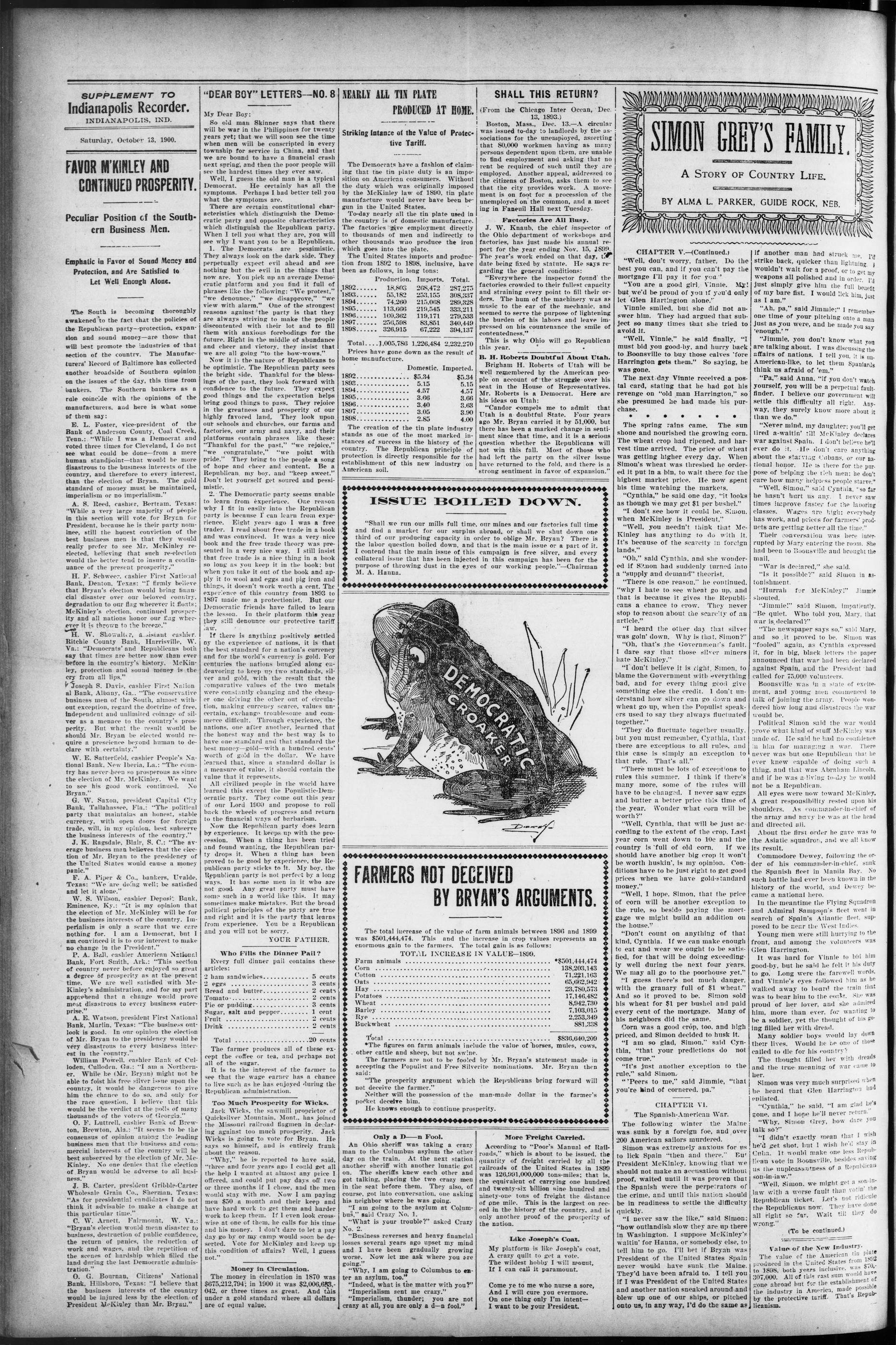
The United States imports and production from 1892 to 1898, inclusive, have been as follows, in long tons:
| Production | Imports | Total |
| :--- | :--- | :--- |
| 1892 | 18,803 | 268,472 | 287,275 |
| 1893 | 55,182 | 253,155 | 308,337 |
| 1894 | 74,260 | 215,068 | 289,328 |
| 1895 | 113,606 | 219,545 | 333,211 |
| 1896 | 100,362 | 119,171 | 279,533 |
| 1897 | 256,598 | 83,851 | 340,449 |
| 1898 | 326,915 | 67,222 | 394,137 |
Total.....1,005,786 1,226,484 2,232,270
Prices have gone down as the result of home manufacture.
Domestic. Imported.
1892.....$5.34.....$5.34
1893.....5.15.....5.15
1894.....4.57.....4.57
1895.....3.66.....3.66
1896.....3.40.....3.63
1897.....3.05.....3.90
1898.....2.85.....4.00
The creation of the tin plate industry stands as one of the most marked instances of success in the history of the country. The Republican principle of protection is directly responsible for the establishment of this new industry on American soil.
ISSUE BOILE
"Shall we run our mills full time, our mills and find a market for our surplus abroad third of our producing capacity in order to the labor question boiled down, and that is I contend that the main issue of this camp collateral issue that has been injected in the purpose of throwing dust in the eyes of our M. A. Hanna.
DEMOCRAT CROAK
FARMERS NOT DECEIVED BY BRYAN
full time, our min
surplus abroad,
city in order to
down, and that is
one of this campa
in injected in this
the eyes of our
DEMOCR
CROAKER
DECEIVE
Y BRYAN'
"Shall we run our mills full time, our mines and our factories full time and find a market for our surplus abroad, or shall we shut down one third of our producing capacity in order to oblige Mr. Bryan? There is the labor question boiled down, and that is the main issue or a part of it. I contend that the main issue of this campaign is free silver, and every collateral issue that has been injected in this campaign has been for the purpose of throwing dust in the eyes of our working people."—Chairman M. A. Hanna.
DEMOCRATIC
CROAKER
FARMERS NOT DECEIVED BY BRYAN'S ARGUMENTS.
The total increase of the value of farm and was $501,444,474. This and the increase enormous gain to the farmers. The total gain
TOTAL INCREASE IN VALUE
Farm animals
Corn
Cotton
Oats
Hay
Potatoes
Wheat
Barley
Rye
Buckwheat
Total
*The figures on farm animals include the other cattle and sheep, but not swine.
The farmers are not to be fooled by Mr. accepting the Populist and Free Silverite not said:
"The prosperity argument which the Re not deceive the farmer."
Neither will the possession of the man-m pocket deceive him.
value of farm an-
d the increase
ers. The total gai-
rease IN VALUE
Animals include the
not swine.
She fooled by Mr.
Free Silverite nor-
nt which the Red
on of the man-m
The total increase of the value of farm animals between 1896 and 1899 was $501,444,474. This and the increase in crop values represents an enormous gain to the farmers. The total gain is as follows:
TOTAL INCREASE IN VALUE—1899.
Farm animals ... *$501,444,474
Corn ... 138,203,143
Cotton ... 71,221,163
Oats ... 65,662,942
Hay ... 23,780,573
Potatoes ... 17,146,482
Wheat ... 8,942,730
Barley ... 7,103,015
Rye ... 2,253,349
Buckwheat ... 881,338
Total ... $836,640,209
*The figures on farm animals include the value of horses, mules, cows, other cattle and sheep, but not swine.
The farmers are not to be fooled by Mr. Bryan's statement made in accepting the Populist and Free Silverite nominations. Mr. Bryan then said:
"The prosperity argument which the Republicans bring forward will not deceive the farmer."
Neither will the possession of the man-made dollar in the farmer's pocket deceive him.
He knows enough to continue prosperity.
An Ohio sheriff was taking a crazy man to the Columbus asylum the other day on the train. At the next station another sheriff with another lunatic got on. The sheriffs knew each other and got talking, placing the two crazy men in the seat before them. They also, of course, got into conversation, one asking his neighbor where he was going.
"I am going to the asylum at Columbus," said Crazy No. 1.
"What is your trouble?" asked Crazy No. 2.
"Business reverses and heavy financial losses several years ago upset my mind and I have been gradually growing worse. Now let me ask where you are going."
"Why, I am going to Columbus to enter an asylum, too."
"Indeed, what is the matter with you?"
"Imperialism sent me crazy."
"Imperialism, thunder; you are not crazy at all, you are only a d—n fool."
Only a D—n Fool.
(From the Chicago Inter Ocean, Dec. 13, 1893.)
Boston, Mass., Dec. 13.—A circular was issued to-day to landlords by the associations for the unemployed, asserting that 80,000 workmen having as many persons dependent upon them, are unable to find employment and asking that no rent be required of such until they are employed. Another appeal, addressed to the citizens of Boston, asks them to see that the city provides work. A movement is on foot for a procession of the unemployed on the common, and a meeting in Faneuil Hall next Tuesday.
Factories Are All Busy.
J. W. Knaub, the chief inspector of the Ohio department of workshops and factories, has just made his annual report for the year ending Nov. 15, 1890. The year's work ended on that day, to date being fixed by statute. He says regarding the general conditions:
"Everywhere the inspector found the factories crowded to their fullest capacity and straining every point to fill their orders. The hum of the machinery was as music to the ear of the mechanic, and seemed to serve the purpose of lightening the burden of his labors and leave impressed on his countenance the smile of contentedness."
This is why Ohio will go Republican this year.
B. H. Roberts Doubtful About Utah. Brigham H. Roberts of Utah will be well remembered by the American people on account of the struggle over his seat in the House of Representatives. Mr. Roberts is a Democrat. Here are his ideas on Utah:
"Candor compels me to admit that Utah is a doubtful State. Four years ago Bryan carried it by 51,000, but there has been a marked change in sentiment since that time, and it is a serious question whether the Republican will not win this fall. Most of those who had left the party on the silver issue have returned to the fold, and there is a strong sentiment in favor of expansion."
LED DOWN.
our mines and our factories full time abroad, or shall we shut down one order to oblige Mr. Bryan? There is that is the main issue or a part of it. campaign is free silver, and every in this campaign has been for the of our working people."—Chairman
DEIVED BYAN'S ARGUMENTS.
farm animals between 1896 and 1899 increase in crop values represents an total gain is as follows:
N VALUE—1899.
*$501,444,474
138,203,143
71,221,163
65,662,942
23,780,573
17,146,482
8,942,730
7,103,015
2,253,349
881,338
$836,640,209
ude the value of horses, mules, cows,
by Mr. Bryan's statement made in write nominations. Mr. Bryan then the Republicans bring forward will man-made dollar in the farmer's perity.
According to "Poor's Manual of Railroads," which is about to be issued, the quantity of freight carried by all the railroads of the United States in 1890 was 126,901,000,000 tons-miles; that is, the equivalent of carrying one hundred and twenty-six billion nine hundred and ninety-one tons of freight the distance of one mile. This is the largest on record in the history of the country, and is only another proof of the prosperity of the nation.
My platform is like Joseph's coat,
a crazy quilt to get a vote.
The wildest hobby I will mount,
If I can call it paramount.
Come ye to me who nurse a sore,
And I will cure you evermore.
On one thing only I'm intent—
I want to be your President.
More Freight Carried.
Like Joseph's Coat
CHAPTER V.—(Continued.)
"Well, don't worry, father. Do the best you can, and if you can't pay the mortgage I'll pay it for you."
"You are a good girl, Vinnie. My but we'd be proud of you if you'd only let Glen Hartington alone."
Vinnie smiled, but she did not answer him. They had argued that subject so many times that she tried to avoid it.
"Well, Vinnie," he said finally, "I must bid you good-by, and hurry back to Boonsville to buy those calves 'fore Harrington gets them.' So saying, he was gone.
The next day Vinnie received a postal card, stating that he had got his revenge on "old man Harrington," so she presumed he had made his purchase.
The spring rains came. The sun shone and nourished the growing corn. The wheat crop had ripened, and harvest time arrived. The price of wheat was getting higher every day. When Simon's wheat was threshed he ordered it put in a bin, to wait there for the highest market price. He now spent his time watching the markets.
"Cynthia," he said one day, "it looks as though we may get $1 per bushel."
"I don't see how it could be. Simon, when McKinley is President."
"Well, you needn't think that McKinley has anything to do with it. It's because of the scarcity in foreign lands."
"Oh," said Cynthia, and she wondered if Simon had suddenly turned into a "supply and demand" theorist.
"There is one reason," he continued, "why I hate to see wheat go up, and that is because it gives the Republicans a chance to crow. They never stop to reason about the scarcity of an article."
"I heard the other day that silver was gold' down. Why is that, Simon?" "Oh, that's the Government's fault. I dare say that those silver miners hate McKinley."
"I don't believe it is right, Simon, to blame the Government with everything bad, and for every thing good give something else the credit. I don't understand how silver can go down and wheat go up, when the Populist speakers used to say they always fluctuated together."
"They do fluctuate together usually, but you must remember, Cynthia, that there are exceptions to all rules, and this case is simply an exception to that rule. That's all."
"There must be lots of exceptions to rules this summer. I think if there's many more, some of the rules will have to be changed. I never saw eggs and butter a better price this time of the year. Wonder what corn will be worth?"
"Well, Cynthia, that will be just according to the extent of the crop. Last year corn went down to 10c and the country is 'full of old corn. If we should have another big crop it won't be worth huskin', is my opinion. Conditions have to be just right to get good prices when we have gold-standard money."
"Well, I hope, Simon, that the price of corn will be another exception to the rule, so beside paying the mortgage we might build an addition on the house."
"Don't count on anything of that kind, Cynthia. If we can make enough to eat and wear we ought to be satisfied, for that will be doing exceedingly well during the next four years. We may all go to the poorhouse yet." "I guess there's not much danger, with the granary full of $1 wheat." And so it proved to be. Simon sold his wheat for $1 per bushel and paid every cent of the mortgage. Many of his neighbors did the same. Corn was a good crop, too, and high priced, and Simon decided to husk it. "I am so glad, Simon," said Cynthia, "that your predictions do not come true." "It's just another exception to the rule," said Simon. "Peers to me," said Jimmie, "that you're kind of cornered, pa."
CHAPTER VI.
The following winter the Maine was sunk by a foreign foe, and over 200 American sailors murdered. Simon was extremely anxious for us to lick Spain "then and there." But President McKinley, knowing that we should not make an accusation without proof, waited until it was proven that the Spanish were the perpetrators of the crime, and until this nation should be in readiness to settle the difficulty quickly.
"I never saw the like," said Simon; "how outlandish slow they are up there in Washington. I suppose McKinley's waltin' for Hanna, or somebody else, to tell him to go. I'll bet if Bryan was President of the United States Spain never would have sunk the Maine. They'd have been afraid to. I tell you if I was President of the United States and another nation sneaked around and blew up one of our ships, or pitched onto us, in any way. I'd do the same as
if another man had struck me. I'd strike back, quicker than lightning. I wouldn't wait for a proof, or to get my weapons all polished and in order. I just simply give him the full beauty of my bare fist. I would lick him, just as I am."
"Ah, pa," said Jimmie; "I remember one time of your pitching onto a man just as you were, and he made you say 'enough.'"
"Jimmie, you don't know what you are talking about. I was discussing the affairs of nations. I tell you, it is un-American-like, to let them Spaniards think us afraid of 'em."
"Pa," said Anna, "if you don't watch yourself, you will be a perpetual fault-finder. I believe our government will settle this difficulty all right. Anyway, they surely know more about it than we do."
"Never mind, my daughter; you'll get tired a-waitin' till McKinley declares war against Spain. I don't believe hell ever do it. He don't care anything about the starving Cubans, or our national honor. He is there for the purpose of helping the rich men; he don't care how many helpless people starve." "Well, Simon," said Cynthia, "so far he hasn't hurt us any. I never saw times improve faster for the laoring classes. Wages are high; everybody has work, and prices for farmers' products are getting better all the time." Their conversation was here interrupted by Mary entering the room. She had been to Boonsville and brought the mail.
"War is declared," she said. "Is it possible?" said Simon in astonishment. "Hurrah for McKinley!" Jimmie shouted.
"Jimmie!" said Simon, impatient, "Be quiet. Who told you, Mary, that war is, declared?"
"The newspaper says so," said Mary, and so it proved to be. Simon was "fooled" again, as Cynthia expressed it, for in big, black letters the paper announced that war had been declared against Spain, and the President had called for 75,000 volunteers.
Boonsville was in a state of excitement, and young men commenced to talk of joining the army. People wondered how long and disastrous the war would be.
Political Simon said the war would prove what kind of stuff McKinley was made of. He said he had no confidence in him for managing a war. There never was but one Republican that he ever knew capable of doing such a thing, and that was Abraham Lincoln, and if he was a living to-day he would not be a Republican.
All eyes were now toward McKinley. A great responsibility rested upon his shoulders. As commander-in-chief of the army and navy he was at the head and directed all. About the first order he gave was to the Asiatic squadron, and we all know its result. Commodore Dewey, following the order of his commander-in-chief, sunk the Spanish fleet in Manila Bay. No such battle had ever been known in the history of the world, and Dewey became a national hero. In the meantime the Flying Squadron and Admiral Sampson's fleet went in search of Spain's Atlantic fleet, supposed to be near the West Indies. Young men were still hurrying to the front, and among the volunteers was Glen Harrington.
It was hard for Vinnie to bid him good-bye, but he said he felt it his duty to go. Long were the farewell words, and Vinnie's eyes followed him as he walked away to board the train that was to bear him to the cook. She was proud of her lover, and she admired him, more than ever, for wanting to be a soldier, yet the thought of his going filled her with dread.
Many soldier boys would lay down their lives. Would he be one of those called to die for his country?
The thought filled her with dreads and the true meaning of war came to her.
Simon was very much surprised when he heard that Glen Harrington had endlisted.
"Cynthia," he said. "I am glad he's gone, and I hope he'll never return."
"Why, Simon Grey, how dare you talk so?"
"I didn't exactly mean that I wish he'd get shot, but I wish he'd stay in Cuba. It would make one less Republican vote in Boonsville, besides saving us the unpleasantness of a Republican son-in-aw." "Well, Simon, we might get a son-in-law with a worse fault than votin' the Republican ticket. Let's not ridicule the Republicans now. They have done all right so far. Wait till they do wrong."
Value of the New Industry.
The value of the American tin plate produced in the United States from 1892 to 1898, both years inclusive, was $70,307,000. All of this cast sum would have gone abroad but for the establishment of the industry in America, made possible by the protective triff. That's Republi-
cism
"BILLY" AND "TEDDY"
BRYAN AND ROOSEVELT MEET BY CHANCE.
Their Special Trains Come Together at Alton, Ill.—The Candidates Greet Each Other Cordially.
East St. Louis special: Bryan and Roosevelt shook hands across the political chasm Monday night at Alton. Their private cars came alongside in the yards. Each stepped upon the platform and recognized the other at once. "Hello, Billy," said "Teddy," thrusting toth his hand. "Hello, Teddy," quath Billy, grabbing Roosevelt's extended hand and shaking it vigorously. "How is your voice?"
"It's as rough as the Populist platform. How is yours, Colonel Bryan?" laughed Roosevelt.
"Mine is as broken as Republican promises," retorted the Nebraskan.
Then everybody laughed and cheered, the Democrats with Bryan shouting hurrah for him, and Roosevelt's followers yelling for McKinley. The meeting came wholly by clance and was as cheerful as it was picturesque. The women with Judge Yates and the Illinois Republicans passed bouquets through the car window to Mr. Bryan and pelted him with roses. The two trains soon drew past each other. Bryan's north-bound for Quincy and Roosevelt's southward for St. Louis. As the two trains slipped slowly into the dark the prominent figures of the two great parties stood on the platforms of their respective cars calling "Good luck" and "Good bye" and waving signals of cordiality.
Rosevelt at Springfield
Governor: Roosevelt, addressing 20,000 persons in the grounds of the Illinois State Capitol at Springfield, Monday, for the first time since his tour began made Abraham Lincoln the theme, the inspiration and the threat of his speech. He cried shame at the Democrats for invoking Lincoln as authority for and patron saint of what Roosevelt called their most shameful neries. He said that the words of Abraham Lincoln in the mouths of craters who argued for the hauling down of the flag and connived at the disfranchisement of the negroes of North Carrollia seemed like a desecration of the lofty statesmanship and patriotism of the great abolitionist. Toward the close of the speech he referred indirectly to the spirit of the riot and disorder manifested against him at Victor, Col., and at Chicago Sunday, saying:
"Remember that free silver was not the most sinister feature of the platform four years ago; that platform that has been re-enacted this year. The most sinister feature of that platform is that it incited to riot by the planks put in it. Whether they be politicians on the stump or in the making of a platform, or whether they be editors of newspapers, when men use every expedient of shameful audacity and shameful slander to arouse the lowest and vilest passions of mankind, when they do that they are to blame rather than their dupes and tools, when riot follows, when mob violence and anarchy take the place of the orderly liberty under the law which we have inherited from our forefathers.
"I ask—then, that you keep the conditions under which we have prospered, that you keep that orderly liberty of which anarchy and mob rule are the worst foes, and finally I ask that the young men, the men growing to manhood, by the memory of the older men who fought in the great war, by the memories of the great deeds of the men who served under Grant and followed Abraham Lincoln; I ask them to see to it that once more on the threshold of the new century the American people declare the doctrine for all time that where the American flag has been hoisted in honor it shall never be hauled down in dishonor."
Bryan in "Egypt"
Alton, Ill., special: Mr. Bryan's working day started at 7 o'clock Monday morning with a speech in the town of his birth, where about 3,000 people heard him. His public reception was warm, but no more so than it has been at scores of house in which his father had held court house in which his father rhd held court from 1860 to 1872, and in which he made his first political speech, twenty years ago. He referred to his boyhood days and friends with much feeling.
"I am glad to be among the people with whom I lived," he said, "If I wanted to declare myself a great man, this is the last place I would come to make such a declaration, because you have known me from my boyhood; but if any one wanted to declare that I was a bad man I would want him to make the declaration here rather than any place else."
In the course of his speech Mr. Bryan said:
"If the election were held today there is no doubt that we would have a majority in the electoral college and on the popular vote. But the Republican managers are now collecting from the monopolies a large campaign fund. They will buy every vote that can be bought. They will coerce every vote that can be coerced. They will intimidate every labor man who can be intimidated. They will bribe every election judge that can be bribed. They will corrupt every count that can be corrupted. I do not understand how it is possible for the plain everyday Republican to close his eyes to what is going on when he knows that if aaids these influences to carry the election at this time the same means can be employed to carry other elections, when those who are supporting the Republican ticket today will be opposing the Republican ticket."
Through the southern part of the State the Bryan crowds have been uniformly large—in many cases in excess of the size of the town where the meeting was held.
The Chinese Abandon Pekin as Seat of Government.
Washington special: That the Emperor of China has decided to establish his capital at Sing-An-Fu, indicating his determination to not return to Pekin, appears to be proved by the following bulletin issued by the State Department Saturday.
"The Japanese Minister has left with the Secretary of State a copy of a tele-
gram, dated October 1, received from the Japanese Minister for Foreign Affairs, to this effect: "The Japanese Acting Consul General at Shanghai reported on the 28th ult. the publication in Chinese papers of an undated imperial edict, the purport of which was as follows: "Tough we have accompanied her Majesty, the Empress dowager, to Thai-Yuen and settled there, it is not our intention to remain there permanently, inasmuch as Sing-an was the seat of the ancient rulers of China, and it is defended by nature. We order the acting Governor of Shan-Si to select a suitable site for the imperial palace in the city of Sing-An, and to provide everything necessary for our journey thereto. He should bear in mind the harpships we are now exposed to and refrain from all extravagant preparations."
* WRECK ON MONON
Head-On Collio-io of Fast Passenger Trains at Monticello.
Passenger trains Nos. 33 and 38 on the Monon railroad collided head-on immediately south of the Monticello station Sunday afternoon about 2 o'clock. Both engines were demolished, and the baggage cars of the trains were badly damaged. A number of passengers on both trains received small wounds, but none of them were dangerously hurt. The south-bound train had just pulled out of the station and was going very slowly. The north-bound was slowing up for a stop at Monticello, and to these two fortunate circumstances a number of people in all probability owe their lives. On the way south No. 33 had lost several minutes and by the times it arrived at Monticello had made the time up. This had evidently escaped the memory of the train dispatcher, who gave both trains the main track at Monticello. A curve at the point of collision prevented each engineer from seeing the other train as they approached each other.
FLOODS IN MEXICO.
Country Back of Tampico Devastated by Two Rivers.
St. Louis special: Telegraph advices from Tampico, Mexico, state that the Panuco and Tames rivers, which empty into the gulf at that place, are on one of the biggest rises in their history and great damage has been wrought by the floods in the populated and cultivated valleys above there. At one point near Chila Station, on the line of the Mexican Central railroad, the Tames river is over fifty miles wide and has swept to destruction hundreds of houses occupied by Mexican farmers and laborers. Many deaths by drowning are reported. All the tributaries of these rivers in the south and eastern parts of the State of San Luis Potosí are out of their banks and have washed away whole villages and ruined thousands of acres of growing crops.
STRIKE AT WEST POINT
Walters Demand More Money and Get It
Quick at Dinner Time.
West Point, N. Y., special: Twenty-two of the waiters in the cadet mess stopped work just before the dinner hour Sunday night, and refused to handle a single ration unless a raise of $2 a month in their salary was guaranteed. Major Hall, treasury of the commissary department, was summoned, and acceded to the demand. A strike is also pending in two of the other departments. The grievances are based on the recent increase in the number of cadets, which naturally makes additional work for the civilian employees. The old scale of the mess hall waiters was $20 a month, with rations.
FOR ROBBING THE DEAD
Russian Sailor Arrested. He Was on th
I-Fated Idler.
Pittsburgh, Pa., special: Charles Samuels, a Russian sailor, suspected of robbing the dead body of Miss Jane Corrigan, of Cleveland, of $10,000 worth of jewelry, was arrested here and will be taken back to Cleveland for trial. Several months ago Miss Corrigan was drowned in Lake Erie by the wrecking of her father's yacht. When the wreck was raised and the body recovered the jewelry was missing. Samuels, who found the body, was suspected, but he disappeared. Wednesday he das discovered in this city. In his pocket was found a pair of gold cuff buttons marked "J. C." the initials of the dead woman.
A MOTHER'S HORRID CRIME
Crazed by Bad Health She Shoots Two Children and Commits Suicide.
New York special: Mrs. Lillian Smith, of Inwood, borough of Manhattan, while insane, shot her two children, Ethel, aged twelve years, and Theodore, aged eight years, and then committed suicide by shooting herself. Another child lies in Fordham Hospital at the point of death as the result of carbolic acid burz. Before shooting the children Mrs. Smith tried to force them to drink carbolic acid. Long brooding over the prospect of death is said to have been the cause of the woman's insanity. She had been in bad health.
Roosevelt Insulted at Chicago
Col. Roosevelt attended the Trinity Dutch Reformed Church at Chicago Sunday. As he was leaving the church at the conclusion of the service he was met by a crowd of hoodlums who greeted him with the viles and most insulting epithets of which such gamins are capable. Curses and obscenity filled the air. Col. Guild, who, was the Colonel's only escort, urged him to get into the carriage at once, but Roosevelt was furious and stood his ground. His tormentors danced around and away from him all the time yelling out their insulting language. Col. Guild finally shoved Roosevelt into the carriage and yelled to the driver to drive rapidly to the Annex, which he did, followed by the mob of yelling, cursing, mud-throwing boys.
Mrs. Kruger Very Sick.
London cable: A Pretoria dispatch to the Daily Telegraph says Mrs. Kruger, the wife of the President of the Transvaal, is so ill that the authorities have issued an order for bidding the drivers of vehicles to pass the house except at a walking gait.
THE RECORDER, INDIANAPOLIS, INDIANA
DRAMATIC SCENES
DRAMATIC SCENES
YOUNSEY BECOMES HYSTERICAL IN COURT ROOM.
Grows Frankie and Screams Out: "Geebel is Not Dead, All Demons in Hell Could Not Kill Him."
Georgtown, Ky., special; One of the most remarkable scenes ever enacted in a Kentucky court occurred Tuesday in the Youtsey trial, the defendant himself being the chief participant. The court room was crowded at the time and the excitement was intense. Dee Armstrong, the Louisville detective, had just told of his talks with Youtsey before and after his arrest. Then Arthur Goebel was put on the stand and Judge Ben Williams, who for the first time appeared for the prosecution, did the questioning.
Arthur Goebel said: "I talked with Youtsey the day he was arrested, late in the afternoon, in the jail in Frankfort, in reference to the murder of my brother." Just at this point Youtsey arose behind his attorneys and in a loud voice said, "It is untrue—it is a lie—I never spoke a word to that man in my life, nor he to me."
Colnel Crawford told him to be quiet and sit down, and others took "hold of him.
"I will not sit down. I never said a word to that man-it's untrue!" He was shouting by this time and everyone was on titopees of excitement. Youtsey's wife sprang to his side and while endeavoring to make him sit down could be heard saying: "Now you have killed my husband. I suppose you are satisfied." Then Youtsey hysterically shouted again: "I am innocent! There is no blood on my hands! These men are swearing my life away!" Two or three deputy sheriffs went over and caught hold of him. He struggled wildly and said: "Let me alone! I will not sit down!" Arthur Goebel, meanwhile, sat sphinx-like in the witness chair and never turned his head. Finally, after Youtsey was forced into a seat, he shouted again: "Goebel is not dead! All the demons in bed could not kill him!"
"Mr. Sheriff, if the defendant does not behave himself put handcuffs on him" said Judge Cantrill. Meanwhile the audience could not be forced to keep their seats until the judge threatened to fine those who stood up. Youssef settled back in his chair, closed his eyes and seemed in a state of collapse. He waved his handkerchief above his head in an almess sort of wav and groaned and cried hysterically. Finally quiet was restored, and Judge Williams asked Arthur Goebel another question, when Col. Crawford asked a postponement of the trial on account of the defendant's condition. Judge Cantrill said he could see noause or reason for defendant's outbreak, but in justice to his attorneys he would postpone the case. Mr. Franklin said the commonwealth had not the slighest objection to adjourning till Wednesday, and court so adjourned.
Youssey still occupied his chair, with his eyes closed, apparently in a half-fatting condition. After the crowd passed out Jailor Reed and deputies carried Youssey to the jail, as he was unable to walk. Various reasons are assigned for his unseemly outbreak, the first being that his long confinement and strain of the trial caused him to become hysterical and lose control of himself. Another is that he is really demented, as shown by his remark that Goebel was not dead. He is being attended by physicians and relatives at the jail and his condition is deemed critical.
ROCKFELLER IS WANTED.
The Governor of Texas Issues Requisition For Oil Magnate.
St. Louis, Mo., special: Requisition papers issued by Governor Sayers, of Texas, were served on Governor Roosevelt at the Planters' Hotel Tuesday for the extradition of John D. Rockefeller, Henry M. Flagler and other Standard oil magnates. The defendants are wanted in Texas for alleged violation of the antitrust law. Governor Roosevelt said he could not act on the requisition as long as he was out of the State of New York, as he was technically not Governor. He said he would look into the case when he returned to New York.
DOWIE IN LONDON
The Chicago Divine Healer Waging a Sensational Crusade Against Church of England.
London cable; J. A. Dowie, who is seeking to establish his sect in England, Sunday night, said he had come to give London a spanking and would wage relentless war against the Church of England. He denounced the Archbishop of Canterbury as an incompetent. This excited the audience and they began to interrupt. He had one man put out. Dowie said London churches refused to allow him to use their baptismal font, but, if necessary, he would get a bath tub and employ a policeman to guard it.
CASE AGAINST RATHBONE
The Late Director of Cuban Posts Will be Charged With Having Concocted the Whole Scheme of Embrzezlement.
Havana cable: The Havana Post, referring to the post office frauds, made the following statement:
"We have been quietly and on our own account working up the case against Mr. Estes G. Rathbone, and we now believe that he will be charged with having concocted the whole scheme of embezzlement. It may even be shown that he secured for himself something between $27,000 and $28,000."
Philippine Revenues
Washington special: The War Department Saturday made a statement showing the revenues in the Philippines islands for the first seven months of 1900 to have been $4,782,080, an increase over the corresponding period of 1859 of $2,065,335. The customs receipts for the period named in 1900 were $3,362,245, and the internal revenue receipts $338,101. The postal receipts, beginning July 1, were deposited in the treasury, and for that month amounted to $110,845.
The Balloonist and Explorer Possibly Killed by Savage E-kimos.
Minneapolis, Minn., special: Harry S. Knappen, a newspaper man, who has just returned from a long trip along the east shore of Hudson bay, tells a story that is likely to explain the fate of the Andree Polar balloon expedition. Mr Knappen, with nine white men and eight Indians, sailed 600 miles up the bay. At the northern end of their journey they found an Eskimo tribe, who reported that two years before a "sky boat" had come into the region on the extreme northeast shore of the bay, that it came to the ground, and that the hostile natives of that country killed the white men in it. Knappen brought back nothing in the nature of evidence confirming the theory that the men in the "sky boat" were Andree and his companions, but he believes that they were the explorers.
WHAT THEY SAY
WHAT THEY SAY
VARIOUS VIEWS BY DIVERS POLITICAL PROPHETS.
Progress of the Campaign and Party Pros
peets as Seen by Prominent Partisans
—Payne; Jones and Aligeld.
Chicago special: Henry C. Payne, vice-chairman of the Republican national executive committee, declared Tuesday that William Jennings Bryan had admitted that he was already a defeated man. Mr. Payne based this assertion on that part of Mr. Bryan's speech at Salem which charged the Republican party with planning to buy votes and to corrupt and coerce voters. Said Mr. Payne: "When a man who is running for office knows that he is beaten, the first indication of the knowledge is that he cries 'fraud.' Bryan is beaten now. He knows it; he cries 'fraud,' just as he did four years ago a few weeks before election, when he realized that he was on the down grade. The tide is turning our way. It began turning our way about ten days ago. It has been coming stronger every day, not here or there, but all over. If the Democrats can not stop this general movement to McKinley, Roosevelt and continued prosperity, they will be so thoroughly beaten that they never will get courage to try it again."
Republican managers at the headquarters said that every indication pointed conclusively to a let down in the Democratic campaign. The Republicans at the headquarters are of the opinion that the Democrats have no more money, and they declare the Democrats have but few speakers of national prominence out in the country, while the Republicans are putting in new men and more of them daily.
"Let them think so; let them think so. We may not have as much money as they have, but when election day comes they probably will be surprised to learn that we have a few more votes to spare. I have contended for some time that the only way the Republicans can beat us is to resort to the tactics they pursued four years ago; they can only beat us by buying votes and coercing and intimidating voters."
New York special: John P. Altgeld, former Governor of Illinois, arrived in the East Tuesday. He received several delegations at the Fifth Avenue Hotel. Mr Altgeld sees a Bryan victory and counts Ohio, South Dakota and Kansas for the Nebraskan. "If the election were held to-morrow," he said, "McKinley would not carry eight States. I have been speaking in South Dakota, Kansas and Ohio Bryan will carry all three. He will have 5,000 plurality in South Dakota, 10,000 in Kansas. Ohio will be close, but it will go for Bryan. Illinois is a hard battle ground, and it will take a landslide to carry it for Bryan, yet I expect that landslide. Sixty-five per cent. of the German voters were for McKinley four years ago. This year 75 per cent. of them will be for Bryan. Trusts and imperialism are responsible for the change."
RIOTS IN PORTO RICO
Three Men and a Woman Killed and Scores of Persons Injured.
San Juan, Porto Rico, cable: Fatal riot took place at Guaymas, Sunday night. Three men and a woman were killed and scores of persons were injured. The disturbances were the outcome of election excitement. The riot originated in a cafe. A member of the federal party shot and wounded a republican. The latter's friends tried to lynch the federalist, but several Americans prevented them. Members of both parties hurried to the scene and bloody street fighting ensued. The police who attempted to quell the rioters were roughly handled. Several were severely wounded. Rioting was resumed Monday and armed bands paraded the town, firing revolvers and terrorizing the populace. The police succeeded in getting the mob under control. A further outbreak is feared.
CABINET OF PERU RESIGNS.
Great Public Scandals Cause Ministers to Withdraw.
Lima, Peru, cable, via Laredo Junction. The cabinet has resigned on account of an unanimous vote of censor by Congress being inevitable as a result of the scandal in connection with the purchase of arm in Belgium and the alqed use by Seno Belaudue, a former minister of finance of government funds for his private transactions. The ministers of Peru, who have just resigned, were appointed Aug. 1 last by President Romana. Senior Enrique Coronel Zegarra be President of the cabinet and minister of home affairs
Hanna Challenged
Sloux Falls, S. D., special: Senator Pettigrew Tuesday issued a public challenge to Senator Hanna for a joint debate.
Chicago special: Senator Hanna, when shown a copy of Senator Pettigrew's challenge to joint debate in South Dakota, said he would pay no attention to the challenge.
Their Union at Pittsburgh is Wealthy and
Has Money to Loan Employers.
Washington special: The workman's side of the question of trade arbitration was presented to the Industrial Commission Thursday by A. N. Hammett, of Pittsburg, one of the officers of the Window Glass Cutters' Union, which is, perhaps, the most strong; organized union in the country, and at the same time maintains the closest and most friendly relations with the manufacturers. Mr. Hammett said the cutters did not make more than seven or eight months' time a year, owing to the fact that the glass production was in excess of the domestic demand. The workers have a wage scale committee, which meets with the manufacturers each year and adjuncts the wage scale and other matters for the ensuing year. The wages of the cutters now run from 55 to 84 a day. The men are not at work now, owing to some difference over the season's schedule, which is still in conference between the workmen and employers. The men are practically all Americans, there being only twenty-five or thirty freges in each u i n. The initiation fee is now $25 and does 1 per cent of the wages. The union is rich, having at times as much as $25,000 in its treasury. Mr. Hammett cited one case where a certain manufacturer being in financial difficulties, borrowed $5,000 at 4 per cent from the workmen and started up his factory. The money was well secured, and the loan was a good thing for both s. d. There are a good many co-op raffic factories, some of them odd and successful, while others started on the same basis have failed. The highest wages paid to the trade are those paid to the blowers, who receive from a minimum of $140 a month to $400 or $500.
Apprentices are taken into the shops only with the consent of the man a workman having a right to take in his son of his brother where the quota of the factory is not full. These apprentices work for three years without wages, after which they are taken into the union as full journeymen.
ENGLISH ELECTIONS
The Administration Party Will Have a Large Majority in the Next Par- ment.
London cable: Thirty-two contests took place Friday in the parliamentary general election. Most of them were in rural districts, and results have not yet been announced. So far as is known, however, 41 members have been officially declared elected, and the relative strength of the parties is the following: Ministerialists, 30; Liberal, 71; Nationalists, 60; Laborists, 3. In the Stratford and Widnes divisions of Lancashire, Sir John William McClure and Mr. John Saunders Gilliam, who respectively represented their constituents in the late Parliament, have been returned by the Conservatives with increased majorities. Sir Robert Bannatyne Finally. Attorney-General was re-elected as the Liberal Unionist candidate in the Inverness burghs. At Maldstone the Liberals captured a seat. Thus far the Ministerialists have gained twenty-three seats and the opposition fifteen, which would give the government sixteen votes on a division in the House of Commons. Mr. Chamberlain, Secretary of State for the Colonies, sent the following telegram to a candidate: "Let all patriotic Englishism remember the words of the mayor of Mafeking. 'A seat lost to the Unionist government is a seat gained by the Boers.'"
MICHIGAN WAY'S PEACE PLAN
An Insurance scheme to Force Nations to Arbitration.
Grand Rapids, Mich., special; An International Insurance Association, organized for the purpose of preventing wars between nations, filed articles of incorporation in Lansing Thursday. Homer L. Boyle is the chief promoter, his plan of peace including the formation of an International Board of Arbitration, composed of two representatives from each of the powers signing the agreement. All disputes will be referred to this board, the expense of which will be paid from contributions made by all the powers. The scheme is based on a popular stock membership at $1 a share, the idea being to gain a large constituency in all the leading nations, making it almost a necessity for nations to take out policies.
A STOVE TRUST.
A Vast Enterprise to be Capitalized at $60,000,000 to Take Out a Charter Under Laws of Delaware.
Pittsburgh special: Representatives of some four hundred stove making concerns scattered throughout the country are to meet at the Auditorium, Chicago, on Oct 16, to take definite action on the formation of the stove manufacturing company which will be capitalized at about $90,000. 000, aside from the possible large issue of bonds. The promoters of the vast enterprise have already taken out a charter under the laws of the State of Delaware and something like 200 of the stove manufacturing companies have optioned their properties and business.
Croker Hires a Hall-or Two.
New York special: Richard Croker has hired every hall in the city for Democratic speakers for every evening from the 18th of October to the 6th of November, so that Republicans can not hold any meetings.
THE MARKETS
# INDIANAPOLIS.
WHEAT, No. 2 red ... $ 7.71%
CORN, No. 1 white ... $ 42%
OATS, No. 2 white ... $ 24%
POULTRY-Hens ... $ 0.
Cocks ... $ 04
Hen turkeys ... $ 07
Young chickens ... $ 15
Butter ... $ 08 @ $ 12
Eggs, fresh ... $ 14
Wool ... $ 15 @ $ 30
Hides ... $ 07 @ $ 08
CATTLE-Prime steers ... $ 5.25 @ $ 5.75
HOGS-Heavies ... $ 5.35 @ $ 5.42%
Roughs ... $ 4.50 @ $ 5.00
SHEEP-Good to choice ... $ 3.25 @ $ 3.50
Good to choice lambs ... $ 4.75 @ $ 5.00
# CHICAGO
WHEAT, No. 2 red ... $ 78%
CORN, No. 2 ... $ 41
OATS, No. 2 white ... $ 26%
THAT
THE RECORDER
Is Prepared to do all kinds of Job Printing on short notice? We can make anything from a Bill Head, Letter Head, Minutes, Dodgers, Tickets, Business Cards, Visiting Cards, Book or Newspaper,
In fact, everything in Job Printing We make a specialty of first-class Job Printing
If you want anything done and are too busy to call, drop us a postal or call telephone 561.
If-You Want any kind of Printing done let us know.
If you have anything to advertise send it to The Recorder.
If you have a house to rent,
If you have a room to let,
If you want a situation,
If you want to sell anything,
If you want anything,
Advertise in THE RECORDER
We Want your subscription, your advertisement,
We want you to buy the paper.
We want a large number of Newsboys to sell the paper,
We don't want much but we want to give you the best for your money.
Send Us your news,
word what your
church is doing.
Send us what your lodge in doing,
Send us what your club is doing,
Send us word what you are doing, and we will be glad to publish it.
$ \mathrm{Tl}_{1} $ Recorder belongs to no party.
The Recorder belongs to no faction,
The Recorder belongs to no sect.
The Recorder belongs to no denomination.
The Recorder belongs to the people and it represents them.
your trade,
your patronage
you Want
We want your encouragement;
We want your co-operation;
We want you to assist us in making The Recorder what it really is,
the greatest, the most newsy, and
the best Negro journal in the State
If You Want to know any more,
call or address
The Recorder,
INDIANAPOLIS, IND.
---
How Mothers may Help their Daughters into Womanhood
A
Every mother possesses information of vital value to her young daughter. That daughter is a precious legacy, and the responsibility for her future is largely in the hands of the mother. The mysterious change that develops the thoughtless girl into the thoughtful woman should find the mother on the watch day and night. As she cares for the physical well-being of her daughter, so will the woman be, and her children also.
When the young girl's thoughts become sluggish, when she experiences headaches, dizziness, faintness, and exhibits an abnormal disposition to sleep, pains in the back and lower limbs, eyes dim, desire for solitude, and a dislike for the society of other girls, when she is a mystery to herself and friends, then the mother should go to her aid promptly. At such a time the greatest aid to nature is Lydia E. Pinkham's Vegetable Compound. It prepares the young system for the coming change, and is the surest reliance in this hour of trial.
The following letters from Miss Good are practical proof of Mrs. Pinkham's efficient advice to young women.
Miss Good asks Mrs. Pinkham for Help.
June 12th, 1899.
"DEAR MRS. PINKHAM: I have been very much beaten for some time with my monthly periods being irregular. I will tell all about it, and put myself in your care, for I have heard so much of you. Each month menstruation would become less and less, until it entirely stopped for six months, and now it has stopped again. I have become very tired, vous and of a very bad color. I am a young girl, and have always had to
HAM:—I have been very much bothered for some periods being irregular. I will tell you all about your care, for I have heard so much of you. Each time I become less and less, until it entirely stopped by my again. I have become very ner-color. I am a young girl and always to work very hard. I would be very much pleased if you would tell me what to do.”—Miss Pearl Good, Cor. 29th Avenue and Yeslar Way, Seattle, Wash.
february 10th, 1900.
"DEAR MRS. PINKHAM: I cannot praise Lydia E. Pinkham's Vegetable Compound enough. It is just simply wonderful the change our medicine has made in me. I feel like another person. My work is now a pleasure to me, while before using your medicine it was a burden. To-day I am healthy and happy girl. I think if more women would use your Vegetable Compound there would be less suffering in the world. I cannot express the relief I have experienced by using Lydia E. Pinkham's Vegetable Compound."—Miss PEARL Good, Cor. 29th Avenue and Yeslar Wash, Seattle, Wash.
deposited with the National City College, pynn, Mass., $5,000, which will be paid to any person who can show proof of testimonial is not genuine, or was published before obtaining the writer's special permission. - LYDIA E. PINKMAN MEDICINE CO.
At a medical examination in the army one man was checked for having dirty feet, when one made answer: "I beg your pardon, sir. There were two of us washing in the one tub last night, and I must have washed the other man's feet, instead of my own!"
LIBBY'S
8 Plates of Soup, 10c.
A 10-ct. can of Libby's Premier Soup makes eight plates of the best soup you ever tasted.
Oxtail Mullagatawney
Turtle Mock Turtle
Chicken Kidney or Giblet
Tomato Ready-made Soups.
One can will make you a convert.
Libby, McNell & Libby, Chicago
Write a postal for our free book. "How to
Make Good Things to Eat."
TOWER'S
TRADY
FISH BRAND
POMMEL
SLICKER
The Best
Saddle Coat.
Keeps both rider and saddle perfectly dry in the hardest storms.
Substitutes will disappoint. Ask for 1899 Fish Brand Pommel Slicker—
It is entirely new. If not made in your town, write for catalogue to
A.J. TOWER, Boston, Massi
I. N. U. INDIANPOLIS, NO 41, 1900.
---
---
MISS PEARL GOOD
If there was a way to make soup better, we would learn it — but there isn't.
June 12th, 1899.
The Happy Result.
His Only Fear.
The dangers of battle have seldom been more pithily expressed than by one Corporal Caithness, a veteran of Waterloo.
When he went home to tell his friends about the victory, they crowded about and asked him if he had not feared the English would lose the day.
"No, no," said he, "I knew we couldn't do that. But what I did fear was that we should all be killed before we had time to win it."
There are no snakes or frogs in Alaska but there are toads.
What Do the Children Drink?
Don't give them tea or coffee. Have you; tried the new food drink called GRAIN-O? It is delicious and nourishing, and takes the place of coffee. The more Grain-O you give the children the more health you distribute through their systems. Grain-O is made of pure grains, and when properly prepared tastes like the choice grades of coffee, but costs about one-fourth as much. All grocers sell it 15 and 25 cents.
Some men are so full of human nature that they have no room for principle.
In China a doctor's fee varies from eight cents to a quarter.
FITS Permanently Cured. Notifies or nervoussarter first day's use of Dr. Kline's Great Nerve Restorer. Send for FREE $2.90 trial bottle and treatise. DR. R. H. KLINE, Ltd., 611廊 St., Philadelphia, 450
A penny will buy 20 times as much nourishment in the shape of oatmeal as in the form of beef.
TO CURE A COLD IN ONE DAY
Take Laxative Bromo Quinine Tablets. All druggists refund the money if it fails to cure.
E. W. Grove's signature is on each box. 25c.
Women clean the streets of Cannes, the cleanest town in the world.
I am sure Pisa's Cure for Consumption saved my life three years ago.-Mrs. Thos. Robbins, Maple Street, Norwich, N. Y., Feb. 17, 1900.
A Chinese drink made of lamb's flesh bruised with rice and fermented.
If you wish to have beautiful, white clothes, ask for Red Cross Ball Blue.
Five tons a day of snails are eaten in Paris.
THE RECORDER, INDIANAPOLIS, INDIANA
An unlettered clergyman wanting a place (His manners, were genial and pleasant his face)
Received a kind letter inviting him down
To preach in a church in a large country town.
The town was uncultured, old-fashioned plain;
The principal business was harvesting grain,
And none of the church members ventured to speak
A word of the Hebrew, or Latin, or Greek.
For this very reason they wished all the more
A scholar well grounded in classical lore;
While a candidate might just as well stay away
If he didn't quote Hebrew at least once a day.
The divine about whom this story was told
By the Times of Manhattan was cunning and bold,
And knowing they wished for a classical man,
Though he didn't know Latin, he hit on a plan,
For he thought, "We shall see how much shrewdness avails.
Though I can not read Greek, I'm a native of Wales;
If a few Welsh expressions I cautiously use,
It may rival the Hebrew in pleasing the pews."
On the critical day, with exceptional grace,
With well-attuned voice and well-controlled face.
"To be sure, 'tis correct, but if beauty you seek,
Hear the rhythmical sound of original Greek!"
Then boldly a medley of Welsh he recited
And marked the effect on his hearers be- nighted.
Their mothers assumed an intelligent air,
While the deacons all nodded as much as
to say
That Greek was by far the more excellent
way.
A still bolder venture he hazarded next.
By a curious way of announcing the text:
"These words, as my hearers have noticed, of course,
Have lost nearly all their original force.
"In Hebrew how clearly the thought flashes out."
And more of the Welsh he proceeded to spout;
When, what was his horror to spy near the door
A jolly old Welshman just ready to roar!
Overcome with remorse and foreseeing the shame
Exposure would bring to his reverend name.
The preacher's mad impulse at first was to run,
But the Welshman's round face so brimming with fun
He bravely confronted that dangerous smile
And coolly continued his sermon a while,
Till at length without showing the least agitation
He rallied himself for a final quotation:
"The rendering here is decidedly wrong,
Quite different thoughts to the Chaldee belong."
Then Welshman in pulpit to Welshman in pew,
In the barbarous dialect they alone knew,
Cried. "Friend: By the land of our fathers, I pray,
As you hope for salvation, don't give me away!"
The joke was so rich, the old Welshman kept still,
And the classical parson is preaching there still.
Didn't Have to Swear.
Albert D. Richardson, who served through the Civil War as correspondent for the New York Tribune, in his history of his adventures, gives a close picture of many of the men whose power was developed in the great conflict.
He describes Grant's calmness under the fierce attacks of the newspapers. "He only smoked and waited. Only once he protested, saying to the correspondent of a journal which had denounced him with great severity. Your paper is unjust to me. Time will make it all right. I want to be judged only by my acts."
"During the evening camp fires," says Richardson, "I saw much of General Grant. He impressed me as possessing great purity of character and integrity and amiability. Military men seem to cherish more jealousies than members of almost any other profession. Grant was above this 'mischievous, foul sin of chiding.' I never heard him speak unkindly of a brother officer."
Mr. George W. Childs, in his "Recollections," tells us that Grant's habits of thought and speech were singularly clean and pure. "I never," he says, "in all the years I knew him intimately, heard him say when alone with men a word that would bring a blush to the cheek of a woman."
Washington is reported by his friends and by Secretary Lear, who lived with him for years, to have been as modest and clean in his language at all times as if he had been talking to a young girl.
Boys sometimes mistake coarseness for strength and think that oaths and indecent language are the manifestations of manhood and force of character. Washington and Grant evidently thought otherwise.
INPIANA COLLEGES.
Central Normal College at Danville Passes to a New Management.
It is more than passing interest to the educational public that the Central Normal College, located at Danville, Ind., has passed under the control of and in the future will be managed by a well financed stock company, duly incorporated under the laws of the State. The reputation of this institution is wide; indeed, its students in the past have hailed from every State in the Union and its alumni has proven its best medi in making its work well and favorably known.
This college lays no claims to merits it does not possess, but it justly prides itself upon the ability of its instructors, its system of self-government for the students, its carefully selected course of study and its economy of expenditures. The combined effect of these elements is to place within the reach of the poor boy or girl the essentials of a college education at a minimum expenditure of time and money.
At the first meeting of the board of trustees Prof. Jonathina Rigdon was unanimously chosen president of the college, and is now busily engaged in enlarging and reorganizing its already strong and efficient faculty. Mr. Rigdon is well known in the educational world as a teacher and as the author of the "Rigdon's Series of Grammars"—text-books that have been strongly indorsed by educators for their thoroughness and comprehensiveness. He studied under President Alfred Holbrook in the National Normal University, completed the scientific and classic courses in the Central Normal College under President John A. Steele, and after teaching philosophy in this institution for five years resigned his position to study philosophy under Borden P. Bowne at Boston University, where he graduated in 1891. He has since taught grammar and philosophy in the Central Normal, building up an enviable reputation, hundreds of students coming every year to the college to study these branches under him, and his services as an instructor being in great demand at teachers' institutes and associations.
The organization of the school under the new management was completed by the selection of Prof. Gusavus L. Spillman as vice-president, and Prof. Charles A. Hargrave as secretary and treasurer. Mr. Spillman is a native of Zurich, Switzerland, having come to the United States when he was twelve years of age. He is a graduate of the Central Normal and Indiana State University, and has taken special work at the Chicago University. He has taught both the ancient and modern languages since 1880 and has long been considered one of the ablest language teachers in the State. Prof. Hargrave has given all his adult life to the service of this institution, whose finances he now manages. He lectures on scientific subjects occasionally and writes for a scientific journal, but the college is his world and he seldom leaves it.
The citizens of Danville and of Hendricks county have always felt a justifiable pride in the Central Normal and now that they have added a financial to their educational interest they are enthusiastic in their belief that there is a great future for the Central Normal. This independent college, which never received a donation from individual, church or State, has enrolled twenty thousand young men and women, two thousand of whom have graduated from its various courses. Its alumni is in all the professions and in all the commercial enterprises. There is not a reader of this paper that does not know of some of them. We mention a few: Hon. S. M. Ralston, Lebanon, Ind.; Rev. Horace G. Ogden, Attica, Ind.; Arthur L. Foley, professor of physics in Indiana University; Prof. G. Elmer Johnson, principal of a school in Greater New York; Prof. Will H. Glasscoock, ex-assistant superintendent of public instruction for Indiana; Rev. J. V. Coombs, editor of Indiana Christian; Daniel V. Miller, lawyer at Terre Haute; John W. Craven, registrar of Indiana University; Prof. Charles Switzer, president of Salina (Kan). Normal University; Hon. E. V. Brookshire, ex-Indiana congressman; C. A. Woody, wealthy Cripple Creek gold miner. The above list could be greatly extended. More Indiana county superintendents have been students of this college than of any other. The graduates are in the Klondike gold regions, ni government positions, officers in the army and militia, practicing medicine from New York to Los Angeles, pleading before juries in all States and preaching the gospel in city and wilderness.
What Will Become of China?
None can foresee the outcome of the quarrel between foreign powers over the division of China. It is interesting to watch the going to pieces of this race. Many people are also going to pieces because of dyspepsia, constipation and stomach diseases. Good health can be retained if we use Hostetter's Stomach Bitters.
Beer fills many a bottle—and the bottle fills many a bier.
Bra. Winslow's Soothing Syrup for children wetting, soothes the gums, reduces inflammation selsy pain, cures wind colds. 150 per bottle.
All the flowers of the Arctic region are either white or yellow, and there are 762 varieties.
S.25 Cincinnati and Return via C. H. & D. Sunday, October 7th.
Two special fast trains. The first will leave at 6:30 a. m., making a local stops. The second will leave at 7:15 a. m., stopping at Rushville, Connerville and Hamilton. Returning leave Cincinnati, 6:20 p. m. Tickets, 25 W. Washington street, and Union Station.
Struckoyle—I suppose while you were in Paris you did as the Parisians did?
Newriche (hotly)—Do you mean to call me a robber?--Puck.
900 DROPS
CASTORIA
A Vegetable Preparation for Assimilating the Food and Regulating the Stomachs and Bowels of
INFANTS & CHILDREN
Promotes Digestion, Cheerfulness and Rest. Contains neither Opium, Morphine nor Mineral.
NOT NARCOTIC.
Recipe of Old Dr. SAMUEL PITCHER
Pumpkin Seed
Alc. Stone
Ricotta Salata
Mustard Seed
Peppermint
Bil Carbonate Soda
Warm Soil
Clarified Sugar
Wintergreen Flavor
Aperfect Remedy for Constipation, Sour Stomach, Diarrhoea Worms, Convulsions, Feverishness and LOSS OF SLEEP.
Fae Simile Signature of
Charles H. Flitchner
NEW YORK.
At a month's old
35 Doses – 35 CENTS
EXACT COPY OF WRAPPER.
CASTORIA
For Infants and Children.
The Kind You Have
Always Bought
Bears the
Signature
of
Chat. H. Flitchner.
In Use
For Over
Thirty Years
CASTORIA
THE CENTAUR COMPANY, NEW YORK CITY.
because they know that once a man starts smoking them he is "fixed," and that he will have no more trouble with him trying to satisfy him with different kinds of Five Cent cigars. Three hundred million Old Virginia Cheroots smoked this year. Ask your own dealer. Price, 3 for 5 cents.
Lafayette Forgotten in France.
The name of Lafayette, so familiar and so gratefully remembered by all in America, is hardly known in France. In his native land he is forgotten by all except students of history and genealogists.
When the Washington and Lafayette monument, by Bartholdi, was unveiled in Paris, Frenchmen recognized the former at once as Le Grand American, but said, "Who is this Lafayette that is taking him by the hand?"
The new grand Lafayette statue and monument, for which the school children of the United State have contributed their pennies, to the amount of nearly seven hundred and thirty thousand francs, French money, has been formally accepted by the French government and accorded a favorable site in the Court of Louvre. A facsimile of it, in "staff," has already been set up. But the government officials and a few, of the better educated class appear alone to comprehend its purport and significance.
That the young people of the United States should take so great an interest in a Frenchman whom his fellow countrymen know nothing of seems to mystify the present generation of Parisians. They appear inclined to regard it as a freak on the part of the queer Americans. Let us hope that their descendants will be better instructed, and that this noble memorial raised in their city by the youth of America will aid them to an appreciation of one of the purest souls and most disinterested patrons that France has produced—and neglected. It was only by using a guide book in English that I was able to find Lafayette's grave—in a moldy, unkempt corner of the grounds of the convent of the Petit Plepus. A small stone slab alone marks the spot. Hard by it were buried indiscriminately in pits the bodies of nearly two thousand unfortunates who perished by the guillotine during the reign of terror—Youth's Companion.
It is easier to take things as they come than it is to part with them as they go.
Try Grain-O! Try Grain-O!
Ask your grocer today to show you a package of GRAIN-O. the new food drink that takes the place of coffee. The children may drink it without injury as well as the adult. All who try it like it. GRAIN-O has that rich seal brown of Mocha or Java, but it is made from pure grains, and the most delicate stomach, receives it without distress. One-fourth the price of coffee. 15 and 25 cents per package. Sold by all grocers.
A reasonable woman is one who isn't unreasonable all the time.
Cured of Catarrh of Long Standing.
Ex-Congressman A. T. Goodwyn.
Ex-Congressman A. T. Goodwyn, from Alabama, writes the following letter:
The Peruna Medicine Co., Columbus, Ohio: Gentlemen—I have now used two bottles of Peruna, and am a well man to-day. I love them, and good effects of your medicine before I had used it. I will use them with catarrh for over a year." Respectfully, A. T. Goodwyn.
Catrigh in its various forms is rapidly becoming a national curse. An undoubted remedy has been discovered by Dr. Hartman. This remedy has been thoroughly tested during the past forty years. Prominent men come to know of its virtues and are making efforts to save the country. To save the country we must save the people. To save the people we must protect them from disease. The disease that is at once the most prevalent and stubborn of cure is catarrh. Public men of all parties recognize in Peruana a national catarrh remembrance of unequaled merit. Send to Dr. Hartman, Columbus, Ohio, for a free book on catarrh.
ELY'S
CREAM BALM
CAPRICE COLD
ROSE COLD
HEAD
HAYFEVER
DELIVERY
BUDGET
HOME
ELY BROS.
NEW YORK
Ely's Cream Balm
Easy and pleasant to use.
Contains no injurious drug.
ALLIAS Inflammation.
Halts and Protects the Membrane. Restores the Senses of Taste and Small. Large Size, 60 cents at Drugs or Baking, 10 cents at bail. ELY BROTHERS. 56 Warren Street, New York.
PISO'S CURE FOR CURES WHERE ALL ELSE FAILS. Best Cough Syrup. Tastes Good. Use in time. Sold by druggists.
CONSUMPTION
THE RECORDER.
A Negro Newspaper.
PUBLISHED EVERY SATURDAY AT
INDIANAPOLIS, INDIANA.
SUBSCRIPTION RATES;
One Year.....$1.00
Six Months.....50
Three Months.....25
Subscriptions may be sent by postoffice
money order, or registered letter.
All communications for publication should
be accompanied with the name of the writer—
not necessarily for publication but as a guarantee
of good faith, p.
We solicit news, contributions, opinions and
in fact all matter affecting the Race. We will
not pay for any matter, however, unless it is
ordered by us. All matter intended for publica
tion must reach this office not later than
Wednesday of each week to insure insertion
in the current issue.
ADVERTISING RATES Will be furnished on Application
Entered at the Postoffice as second-class matter.
All letters, Communications and Business matters should be addressed to THE RECORDER.
Geo. P. STEWART, Publisher
SATURDAY, OCTOBER 18, 1900
EDITORIAL
FOR PRESIDENT
WILLIAM MCKINLEY
FOR VICE-PRESIDENT
THEODORE ROOSEVELT
F representative—
JESSE OVERSTREET,
Of Marion County.
For Governor,
WINFIELD T. DURBIN,
Madison County.
For Lieutenant Governor,
NEWTON W. GILBERT,
Steuben County.
For Secretary of State,
UNION B. HUNT,
Randolph County.
For Auditor of State,
WILLIAM H. HART,
Clinton County.
For Treasurer of State,
LEOPOLD LEVY,
Huntington County.
For Attorney General,
WILLIAM L. TAYLOR,
Benton County.
For Superintendent Public Instructible
FRANK L. JONES,
Tipton County.
For State Statistician,
L. F. JOHNSON,
Benton County.
For Reporter Supreme Court,
CHARLES F. REMY,
Jackson County.
For Judge of the Supreme Court,
First District,
JAMES H. JORDAN,
Morgan County.
Fourth District,
LEANDER J. MONKS
Randolph County.
Legislative Ticket.
Frederick E. Matson.
Charles N. Thompson.
James T. Layman.
For Representatives
Joseph H. Cark.
Joseph R. Morgan.
Joseph A. Minturn.
Carl C. Pritchord.
William Reagan.
Frederick Ostermeyer.
Henry Wessling.
r Joint Representative
Larz A. Whitcomb.
For Prosecutor—John C. Ruckless
haus.
For Treasurer—Armin C. Koehne
For Sheriff—Eugene Sauley.
For Commissioner, First District—
John McGaughey.
For Commissioner, Third District—
Thomas Spafford.
VOTE YOUR BEST INTEREST,
The man who votes to ruin a business ought not to enjoy the benefits of that business. One of the chair factories of this city when Mr. Cleveland was president ran ten hours in each week And now under McKinley prosperity they run on full time every day. Every employee of that factory who votes for Mr. Bryan if he could be elected would be just so many nails in the coffin of that proprietor's success. We do not say that any man ought to be hindered from voting as he wants to even if he votes bread out of the mouths of his dear little children and his faithful wife. Even if he votes his family out of clothes and home; even if his vote closes the doors and stops the wheels of the factory that his family immunity from want and suffering. No let him vote for the man and party of his choice but he is an enemy to the man's business against which he casts his vote and ought to be let go on an indefinite suspension.
During the last Cleveland administration a large tailor establishment in this city on wholesale contracts made often as low as ten suits of clothes per week and the tailors were on starvation wages. They could not make more than the small trade produced. Now under McKinley prosperity this same establishment makes on wholesale contracts from two hundred to three hundred suits per week. The employee in there who wants to vote for Mr. Bryan and the Democratic party ought to be left free to do so; but he ought not want a place kept after he has given it a black eye with the blind devotion of a partisan vote that means suicide to his own best interest. A man who will do that kind of voting nee's a political wet nurse to soak his eyes so that they can be opened to vote with his bread and butter interest. Talk about disfranchising the Negroes in Louisiana and South Carolina Tillman could find prolific grounds in which to work the disfranchising business if applied to white men in the North who vote away the goose that lays the golden egg,
It is certainly gall upon the part of the Democratic party to deceive a man who expects to make a living by working him into voting their ticket. They have always during the course of their history deceived the working man. It is a large price for the right of party love when a man must paralyzed the sinews of industry with the use of his vote to sustain that love. And yet this is just what every man does who casts a ballot for the Democratic party. The Democratic party has always been a party of spoils only.
They make themselves rich in the emoluments of office tenure and leave the country and treasury bare. Their election can only be the dangerous and costly experiment of try us again and see if we don't make it this time.
The two leading St. Louis dailies are having a monkey and parrot time over Mr. Butler, the democratic nominee for congress from the Twelfth district of Missouri. Hon. Mr. Butler runs a large theater which he calls "The Home of Folly," and advertises "two frolics daily." The scenes behind the footlights are what the "gods" call warm. The Republic admits that Mr. Butler is not an ideal candidate, but urges every member of the party to vote for him because he is a democrat.
In 1864 when Lincoln was running for his second term, the issues were the same as they are to-day. The paramount issue of that campaign was whether President Lincoln was to be sustained in his efforts to put down the rebellion, preserve the union and wipe out slavery, and as the democratic party is now advocating that American troops be withdrawn from the Philippines and the insurgent be given control of the country, so then they were demanding that the federal soldiers be withdrawn from the states in rebellion and peace be sought "by cessation of hostilities."
The minister of the Gospel is one of the leaders of his people. He should give them sound advice and direct them in the right way. In this campaign it is the duty of every Afro-American preacher who has the true interest of the race at heart to explain to his people the issues as they affect the Afro-American. He should show what the democratic party has done in the line of depriving the Afro-American people of their civil and political rights and appeal to them to continue to support, with all their strength, the party which gave freedom to the slave and enlarged opportunities to the freeman.
RECORDER, INDIANAPOLIS, INDIANA
According to the Atlanta Constitution Afro-Americans of the south produce about 85 per cent. of all the cotton raised in that section and add nearly $400,000,000 to the wealth of the country every year, yet the democrats say they are lazy and nonproductive and would wrest from them their citizenship.
The New York state republican platform declares: "Neither in the Philippines nor elsewhere will the cause of human liberty look for its champion to a party whose only hope of obtaining power lies in the suppression of human rights and in an organized conspiracy to nullify the guarantees with which the constitution endeavors to surround the citizen."
Bishop Turner claims that in event of Bryan's election federal troops will be called out to prevent lynchings. The democratic national platform says; "We denounce arbitrary interference by federal authorities in local affairs as a violation of the constitution of the United States and a crime against free institutions." Lynching is a local institution which the democrats of certain sections take great delight in and it is not likely that Bryan would interfere with democratic amusements. Lynching is confined almost entirely to democratic states. The spectacle of Pitchfork Tillman, who will be Bryan's adviser in chief in case of election, advising him to stop a South Carolina lynching with federal troops would be inspiring.
The Afro-American cannot afford to break his serried forces consecrated to liberty and equality before the law, until every man everywhere in this broad land has every right that he is entitled to. The Afro-American's mission as a soldier of liberty will not be ended until every populist, prohibitionist and republican enjoys his civil and political rights as amply as a democrat. To-day no democrat can complain that he is denied perfect equality before the law in any section of this country. He is as free in Vermont or Iowa as in Mississippi or Georgia and wherever the opposite party rules he has naught to make him afraid. But this is not true as to populists, prohibitionists and republicans. In some sections of the country, in at least one-fourth of the states of the union, if they would live unmolested, they must smother their convictions and vote with the ruling side, although to do so may undermine their business and be against the interest of the government. This is an inequality of right; it must be corrected. The men of opposite faith to this favored son of America must be enabled to stand upon the same plain as he does in every section of this country.
The democrats of the south are especially anxious for the election of Bryan because they believe it will then be easier than it is even now, to deprive the Afro-American of his rights as a citizen.
It cost 1,000,000 lives and $1,000,000,-000 to rid this country of the curse of slavery. The democratic party hopes to take away the manhood rights of the Afro-Americans and reduce them to a state of vassalage.
"Trust in God, but keep your powder dry," was the shrewd advice of a great commander. Good as the Divine Creator is, he leaves us to fight out our own battles. McKinley is sure to be elected if we get out the voters.
In Evansville, Ind., recently a man predicted the exact hour of his death and died according to schedule. The people of this country may be relied upon to kill Bryanism, Tillmanism and Altgeldism on schedule time November 6, 1900.
The old saying about consistency being a jewel is a proverb which does not appeal to Bryan and Tillman. They continue to yell about their love for liberty in the Philippines, but refuse to grant civil and political rights to the Afro-Americans of the south.
It is a little less than sacrilege for the anarchistic popocratic free silverites to try to create the impression that the blatherskite and monumental fraud Bryan, is cast in the same mold as was the patriotic able statesman, Lincoln.
Nine out of ten of the large manufacturing and business men are supporting McKinley. What stronger argument do the wage earners want than this that the best interests of the country demand the success of the republic ticket?
The destiny of every Afro-American in the north is identified with that of his southern brother. If the democrats of the south succeed in wresting the franchise from the people of the race in the south, the same thing will be done in the north.
In Cuba the Afro-American soldiers astonished the world by bravery and coolness under fire. They were fighting to be the beautiful isle from the Spanish yoke. It was President McKinley who commissioned 266 men of the race to lead their men to battle.
AROUND THE CHURCHES
A Week's Happenings in Religious Circles
THE CHURCH
BETHEL A. M. E. CHURCH
BETHEL Hormann and Sidra Sid
Corner Vermont and Teleco Stal
hours; 8 to 9 a. m: 5 to 6 p. m. Sunday
services: early morning Prayer meet-
ing, 6 o'clock' Chas. Grant, leader.
10:30 a. m.: Preaching, 12:30 M. Class
es. 2:30, p. m., Sunday-school, John
Carter, superintendent.
Preaching at 8 p. m.
WEEKLY MEETINGS.
Tuesday, Y. P. A; second and fourth
weeks; Amanda Mayne, president and
Mamie Chavis, secretary.
Tuesday; Trustee meeting, first
Tuesday night of each month.
Christian Endeavor society. 8 p.
m., Alphonso Beard, president.
Official Board, second and fourth
Tuesday nights.
Wednesday: Class meetings.
Thursday; Prayer meeting, leaders appointed weekly.
Friday; Classes
Rev. C. W. Newton, pastor
Rev. C. W. Newton, pastor
Bishop Grant's sermon. He took for his text 2 Cor. 4-iii ver. "But if our Gospel be hid; it is hidden to them that are Lost" The sermon was a rich treat The congregation baptised it with tears of emotion. The Bishop sways his congregation like a cyclone His exegesis is always careful and correct. His illustrations happy, fine and expressive but the Bishop lowers highest in his preaching when he begins to swing the irresistable force of his masterful homiletics. Bishop Grant has few equals as a homiletical preacher. Here is where he drives a nail in a sure place everytime. Bethel will be glad when the Bishop preaches for again.
Who owns the lands in America? Nearly 22,000,000 acres of land are owned by 7 men who owe their allegiance to other governments. To be exact there are 21,241,900 acres of land under the direct control and management thirty foreign individuals or companies. There are 2,720,283 acres of land in Massachusetts, so that the men living in other countries and owing allegiance to other powers, own land enough to make about ten states like Massachu etts, more than the whole of New England. More land than some governments own to support a king. The largest amount of land owned by any one man or corporation is called the Holland land company. There is twice as much land owned as allieus in the United States as there is owned by Englishmen in Ireland. This is indeed paving a good broad way for the control of foreign power in this country. Well it may be one of the innumerable ways of God hidden in history, for something better for our great big reckless country God alwa's has a way ready. But this does not look very much America for Americans.
Woman's true place and best use in the world. There is nothing in this great universe that attracts man so much as wonder. Wonder is the basis of worship; wonder is the basis of admiration and admiratton is the foundation of love.
As woman is the most wonderful of all creatures, she is therefore most admitted and most sought for as a helpmate to man which is her true destiny and that destiny has been largely distributed by our faulty civil organization. Happily the day is not far distant when this fault will be corrected and womans occupation will be restored to her home. They will make castles of their homes, castles of virtue castles where all of the elements of moral strength, honor and pride are produced; and good women will become the mothers of great men and the nation will be great. The world wants just that one thing more than all else. Mothers, mothers, mothers. A mother's kingdom is her home. The new woman of the age is a serious obstruction to this the world's greatest want, mothers!
Mr. Matthew is visiting Mrs. Lucy Allen at W. 11th-st., Mr. Mathews was present with Mrs. Allen at service Sunday morning.
CLASS TOPIC.
"Paul Bitten by a Venamous Serpent" Acts, 28 chap.
"Paul withstanding Ely was the sorcerer," Acts, 13 chap.
Tomorrow morning subject, "Jesus knows our love by what we are doing" John 21; xv. Evening subject: "The Blessing of God's Providence to the Man of God." Romans 8; xxviii; this text is by the special request of Mr Lanier.
VOLUNTARY SOLOS
Morning; "The Palms" by Mrs: Sallie Robiuson.
Night: Solo by Mrs. Fannie Lanear.
Sunday collections: Trustees $23.30 for charity $7.43; total $30.73.
CLASS DUES.
No. 11, Chas. Grant leader; collection $ 6.5
No. 12, J. P. Hoy. leader; collection $ 55
No 18, Elmer Donald, leader; collection $ 125
No. 14, Wm. Parks, leader, collection $ 70
JONES TABERNACLE A, M. E. ZION
CHURCH
Preaching at 11 a. m.; Sundayschool
2 p. m. Weekly meetings: Young
Girls club, Monday 4 p. m., Mrs. Jennie
Asby, pres.; Young Ladies Occasia
club, Monday eve 8 p. m., Miss
Katie Stevenson, pres.; Dorcas Circle,
thursday 4 p. m., Mrs. Anna Poole
pres; Ladies Social Circle, Thursday
4 p. m., Mrs Mary Wakefield pres.
Young Men's Willing Worker club,
Wednesday 8 p. m.; Class Thursday
8 p. m; you are invited.
Grand Republican rally Tuesday,
Oct. 16, 1900 Good speakers you are
invited.
Our sick: Janie Wells and Toledo
Eatoh; go and see them.
Quarterly meeting, Nov. 25.
ALLEN*CHAPEL A. M. E. CHURCH
(Broadway, between Tenth & Eleventh St.)
R. French Hurley.D. D. pastor.
Residence, 703 East Pratt street.
Preaching by pastor. Last Subbath morning subject continued. 12 m. roll call of classes; 2:15 Sabbaths:shool. 7:30, subject, by the pastor, "Christianity and Politics."
Monday at 8 p. m. formation of new classes which will be concluded on Tuesday. Wednesday evening prayer meeting: Friday night the 18, lecture by Bishop Turner of Atlanta, Ga. subject: "The Status of the Negro Race," admission free.
ST. PAUL A M E TEMPLE.
25TH-ST. AND MANLOVE-AVE
L. W. Rattliffe, Pastor.
There has been a great awakening in our community during the past few weeks. Everything seems to be on alert and prosperity can be seen here and there.
The Sundayschool, Mrs. Thompson, sup't is increasing greatly in numbers. An election of officers is occur soon.
The Y P. S. C E. was organized last Sunday to meet each succeeding Wednesday eve. Officers: Mrs. Simms press; Miss Nettle Thompson, V-pres; Miss Alice Kinslow, sec'y; James Due. ass't sec'y; Miss Thompson, treas.; Miss Daiy Venerable, organist
The prayer meeting has shown a remarkable growth in attendance as well as interest.
A strong choir has been organized comprising some of the best talent of the city. The officers chosen were: Instructor, Samuel A. Rattliffe, leader Mrs. G. A. Rattliffe, organist, Mrs. Bertha Farmer; sec'y, Miss daisy Venetable, treas., Mr. Augustus Lasch, Members: Sopranos, Mrs. G. A. Rattliffe, Misses Nettie Thompson, Anna Brooks, Daisy Venerable, Alice Kinslow, Puryear, Contralto: Misses Clementine Brooks', Sophia Brooks, Ida Wilson, Mrs. Anderson, Mrs. Anderson; Tenor: Messrs, Harry Farmer, James Due, Bass, Messrs. A. Lasch John Anderson, Paul Cooper.
The ceoir has purchased a $150 Chicago Cottage organ.
Subscribe for The Recorder and keep posted on the leading topics of the day. 25c for 3 months
SIMPSON CHAPEL M. E. CHURCH
Cor. Howard and 11th Street)
Rev. E. L. Gilliam Pastor
The services last Sunday were well attended. The pastor preached and the congregation enjoyed the sermons The Sabbathschool is increasing in numbers, and in interest and the pastor, with the sup't, Dr Morgan, hope are long that it will be the largest in the history of Simpson Chapel.
The Epworth League, under the leadership of the newly elected officers, with President Knox at their head, expect to make it a power for good in the church and community.
Next Thursday evening the literary Department, Abram Hewitt V. P., will begin the study of the lives of great men, with that rederick Douglass. A profitable meeting is anticipated. The public is cordially invited to attend these meetings each Thursday evening.
The states of Tenn., North Carolina, Kentucky, and New York will make their regular monthly settlement of revenue collected, on the fourth Sun-in this month, and they hope to have at least $250.00.
The choir is determined to stand second to none in the city, and with their new organist, Miss Jennie Miller, will have regular rehearsal's, and the members and friends may confidently look forward to rich musical treats.
The sick are on the improve, and Mesdames M. S. Johnson, Cassie Jackson, Miss Mamie Hawkins, and Bro. Daniel Browder are all able to sit up.
The pastor, Mrs. Carrie Ross, and Mrs. Cassie Jackson will attend an Epworth League and Sundayschool Institute at Bloomington on 19 to 20 inst.
Don't forget the special New York meeting Sunday at 3 p. m.
Pastor's subjects: Morning, "Come"
7:30 p. m. "Go."
The evening service will begin
promptlp at 7 p. m. Epworth League,
7:30, preaching and closing at 9 p. m.
Indiana's Post Negro Newspaper
Indiana's Best Negro Newspaper
THE LATEST
FALL STYLES
I extend a cordial invitation to the public and friends, to call. CLEANING, DYEING, REPAIRING D. L Mesbitt, Merchant Tailor. 405 Indiana av LADIES TAILORING
FOR AN.....
Easy Shave, First-class Hair
Cut or Refreshing Bath
Stone Front Shop
216 INDIANA AVENUE
Where you will find all well known
and efficient tonsoral artists;
Mr. W. D FERGUSON,
Mr. BENJAMIN DUNN,
L. Dunn, Artistic Shoe Polisher.
CHAS, RAPE, Prop.
JOHN MITHEN.
284 Indiana Ave. Open Evenings
Suits, Overcoats and Pants, Cleaned,
Altered and Repaired
All Work First-Class and
Guaranteed
D. Shalansky,
--Dealer In--
New and Second-Hand
clothing, boots, and shoes
Highest Cash price paid for all kinds
of Clothing. Send Postal Card.
435 Mass. Ave.
108 N. Illinois Street.
AS I deal exclusively in COFFEE and TEA, my constant stndy is to give only the very best for the money—and I succeed.
Coffee Roasted Fresh Daily
A. B. COFFY.
A. B. COFFEE
New Phone, 2921 430 Mass. Ave.
OUR CORRESPONDENTS,
Seymour News
The grand opening of the Second Baptist Church last Sunday was a success both spiritually and financially. Rev.A. J. Thompson preached the morning and evening sermons and at 3 o'clock Rev. J.W. Clevenger preached a very interesting and able sermon.
Mrs. Turner of Indianapolis, is the guest of Mrs. Finhe Sharpe. Rev. Irvin of the A. M. E. Church preached two able sermons Suuday.
Mrs. Geo, Lamb has recovered from her illness.
Milton Booker remains quite ill.
Mrs. Tellis Carter is the guest of friends in the city.
Mrs. Maria Dixon is visiting her son in Harrison county,
The Church Aid Society gave an entertainmbnt, last Friday evening.
The Honey Bee Circle will give an entertainment Friday evening.
Wm. Payne remains quite ill,
Shelbyville Notes.
Mrs. Laura Goode is visiting friends and relatives in Columbus. Mrs. Elizabeth Dudley and son, George, are visiting in Indianapolis this week.
The marine band members have received their new coats and caps. They were on parade Tuesday night with the colored voters of the city.
Miss Alice Roberts and father, of Carthage, was in the city Tuesday and Wednesday.
Miss Rose E. Dent spent Sunday in Cincinnati.
Mr. Lee Owens of Indianapolis was the guest of friends and relative in the city. Sunday.
Miss Minnie Miller of Edinburg is the guest of Mrs. Hodge.
Mr. Jas. Matthews of Greenfield was in the city, Suuday.
Rev. T. R. Fletcher and wife, visited relatives in Cincinnati and Covington, Sunday.
Messrs Ernest Johnson, Dudley Loving and Jacob Stafford are thinking of taking the Civil Service examination soon.
Mrs. Goens and son of Bagdad Ky. are the guests of relatives.
Crawfordsville Notes.
Rev. H. V. Saunders was in Indianapolis last week.
The social given at the Baptist Church, last Saturday evening was quite a success.
Miss Minnie Hale left Thursday for a three months visit with her father, at Decatur Ill.
Harry Jones of Danville Ill. is in the city.
Many visitors are expected in the city next wээK to attend the Corn Carnival the 15th and 20th.
Marion Flashes.
Rev. Smothers of Muncie, Rev. Eliza of Alexandria, assisted Rev. G. W. Carr in his church rally at Second Baptist church. They raised $137 which will be applied on their new purchase.
Mrs. Emily, Weaver is seriously sick at her daughter's home in Lomax street.
Mrs. Ida Morgan is suffering from a burnt hand caused by a gas explosion.
Sam'l E. Jacksou is suffering with lame back at his home.
Richard West is able to be out again after a severe spell of sickness.
Hon. Nelson Crews of Kansas City, addressed the citizens of Marion recently.
Trip around the world on the 10 Anna P. Julius, manager. Round trip, 25c.
David Canon has a club house Johnstown.
Sam'l E. Johnson is improving his property.
Mrs. John Carter was called to Benton Harbor by the death of her son, Will Moore.
Lafayette Gleanings.
The Recorder's subscription list in this city is stretching out weekly. Now is the time to subscribe.
Mrs. Nancy Johnson tendered vuita an informal reception at her home last Wednesday evening in honor of guest, Mrs. Hattie Moore of Indianapolis. There were ninety ladies in attendance and an elaborate menu was seveed. Mrs. Mamie G. Carter assisted her in receiving.
Edward Mauson is enjoying a visiting from his sister of Lebanon. Tenn.
The genial Zack Williams and Clint Patterson of Cramfordsville, were in the city last week.
The members of the A. M. E. church will give a welcome reception to their new pasto. Rev. C. E. Allen and family on Friday evening of this week.
Mr. J. H. Lester of Marion, has called home to attend his wife Who is sick.
The Recorder is the leading race paper of the State, Help to support it by your subscription.
Douglass Chapter, R. A. M., No. 14, elected officers as follows last Tuesday: Sam'l H. Wharton, high priest; D. I. Sewell, king; Sam'l Carter, scribe; Will F. Anderson, sec'y.; Will O. Graves, treas.; Roiand Jones, S. Carter and Wm. Hearn, trustees.
Tippocanoe lodge and Household of Ruth, G. U. O. O. F. gave a joint banquet last Tuesday-evening. The menu was up to date and all who attended enjoyed themselves.
Just as we send our letter to press Governor Roosevelt has captured the city and the marching clubs and bands of music are out in full force. The colored rough rider's club is in to the extent of a hundred.
Franklin Notes.
Miss Helen Williams is improving.
Mr. and Mrs. Rob't Williams are house-keeping on W. King st. where they are lat home to their friends.
Mr. Eugene Batty, one of our promising young men has again en-tered the Indiana Medical school
Miss Carrie Coleman is a welcome addition in our midst.
Messrs Bird and Artist of the Indianapolis training school witnessed the foot ball game Saturday, they were entertained by Mr. Fossett.
Leslie Dixon has returned from Camp Comfort.
The following officers have been elected for the A. M.E. S. S: Hattie Fosset*, supt., Julia Davis, sec'y.; Partha Ferguson, organist, A, SheJton lib. Class No. 1, Bell Owens: No. 2, Artitia Shelton; No. 3 Susie Craig; No. 4, Partha Ferguson; treas. Lucy Medcalf; choister, Hattie Irvin.
"Faithful Workers" gave a fine supper Wednes night which was largely attended.
Rev. J. R. Ferguson of Thorn-
THE RECORDER, INDIANAPOLIS, INDIANA
town is spending a few days with his family.
Rev. Coleman is a persistent worker, and one whom we all feel proud of.
The Coal club had an enthusiastic meeting Tuesday night. Miss Smalls, pres. Mrs. Coleman is much appreciated for affable and kindly manner.
Miss Agnes Grove has gone to Frankfort, Ky., for the winter.
Mrs. Susie Craig is again able to be among her friends.
A number of young people accompanied the Metropolitan band to the Capital City carnival,
Miss Opal Lewis has returned from a visit to Ill.
It is said that Rev. Smith has resigned the pastorate of the Second Baptist church.
The trustees have repapered the A. M. E. church and an air of taste and neatness prevails.
The choir rendered good seevice at the Methodist church Sunday night. A juvenile will be organized soon.
Thomas Perkins attended the Webb Deer wedding at providence.
Anderson Notes
Allen Chapel A. M. E. Church gave Rev. and Mrs. W. H. Taylor a grand reception on Thursday night of last week. An appropriate program was rendered after which a supper of five courses was served. The guests of honor were, Rev. and Mrs W. H. Taylor, pastor Rev. and Mrs. E. R. Lewis of the M. E. Church, Rev. W. Z. Thomas of the 2nd Baptist Church, Rev. T. J. White of Clinton, Rev. and Mrs. M. V. Saunders of CraWfordsville and Hon. Gurley Brewer of Indianapolis. There was a large attendance and the event will long live in the memory of the people of this city
The quarterly meeting at the A, M. E. Church Sunday was a grand success, three persons united with the church. Rev. C. C. Townsend Presiding Elder was present. The Richmond District Conference will convene in Allen Chapel A. M. E Church Nov. 13th, 14th and 15th.
Frankfort Notes.
The pastor preached two very interesting sermons last Sunday.
Rev. J. W, Harper has returned from Kokomo.
Bert Cummings spent last Sunday at Indianapolis.
Mr. Fanning was the guest of friends at Chicago last Sunday.
Jennie Parker is visiting her grandparents at Lost Creek.
Elroy Cummings spent last Sunday at Lebanon.
Spiceland Brevities.
Mrs. Francis Kizer is on the sick list.
R. A. Roberts was in Carthage last Saturday.
Mr. and Mrs. Jno. Keene were in New Castle last week to see W. J. Bryan.
J. F. Wright and mother passd through here enroute to New Castle,to see Mrs. Wright's daughter, Mrs. Ben. Willis, who is sick.
Clarence Crenshaw is sick with malarial fever at the home of his grand-father Mr. Jenkins.
Henry Winslow and Mrs. Tessie Rodgers of Knightstown, were married last Sunday evening at the home of Rev. Rob't Simmons. Jno. and Lucy Merida have moved into the property of Rob't Simmons on E. Main st. Mrs. Ellen Bird have returned to her home in New Castle.
My attention has been called to a clipping from the Recorder in which it is stated that I have returned to Indiana and have been stationed at Evansville. I wish to correct by saying that my family just arrived here on the 21 ult., and we are most happily located with historic old St. St-James. On the 3 inst. a grand reception was tendered me and family which was one of most elaborate affairs I have ever witnessed. St. James congregation, the Louisiana conference, the M. E. church, the Baptist, the presbyterians, the Congregational each had able representatives on the program, while the citizens welcome was spoken by Col. Jas. Lewis, surveyor of the Port of New Orleans. The music, which was grand, was furnished by St. James famous choir and said to be the best in the South, and certainly one of the best which I have ever had.
I am pleased to say further that Mrs. Graham, like myself, is already delighted with our congregation. We have never been more heartily received any where and we believe that we can accomplish much here for the glory of God and the good of the race.
This persuades us to endure the unpleasant features of race proscription and to determine as true soldiers to stick to our post. We have won the confidence of our people, as well as the respect of the whites and we will use whatever prestige we have to contend for justice for the race.
Yours for the race.
D. A. Graham
222 N. Roman st.
Kalamazoo Notes.
Young men's Sunday club will be organized in the A. M. E, Church Mrs. H. L. Wilson returned Monday from an extended visit with her parents, at Gobleville Mich. Mrs. F. E. Wilson is visiting her parents, Rev. and Mrs. J. L. Hill in Flint Mich. W. F. Stadford Atty. delivered a fine address to the Colored Republican Club, Monday evening at G. U. O. of O. F. Hall. Remarks were also made by Rev. Haywood. Miss Cleo Cole will recite in First Baptist Church next Sunday. Lawyer Barnes spoke at the Auditorium, Wednesday night.
Miss Emma Banks died Wednesday morning.
Miss Florence Brown has returned from a visit with friends in Ontario.
South Bend Notes
Quite a number of boys went to Goshen Wednesday to attend a rally. Rev. Thos. Evans of Calvin spent a few hours in the city Wednesday. Mrs. Will Miller, is visiting her parents in Detroit, Mich. The Odd Fellows will give a big Oyster supper Friday eve Oct. 19th. Mrs. Mattie Givens is the guest of friends and relatives at Cassopolis this week. The membs and friends of the A. M. E. Church gave a pound social at the church Friday night for the benefit of the pastor's sick boy.
There will be a social given at the A. M. E. Church every Friday evening, during the season
Mrs. Sarah Smith was granted a divorce from Albert Smith on the ground of non support, with $100 Alamony, and assuming her maiden name of Sarah Bridgeman.
Miss Alice Brown left for Toker Mich. Wednesday to visit her grand-parent.
Mr. Noah Pompey and Miss Cora Gilbert were married Wednesday.
Miss Eliza Griffen of Niles spent a few days in the city visiting relatives and friends.
Subscribe for The Recorder and keep posted on the leading topics of the day. 2cg for 3 months
HARTONA
Matchless and Positively Unequaled for Straightening all Kinky, Knotty. Stubborn. Harsh. Curly Hair.
HARTONA will make the hair grow long, soft and straight. The use of one box of HARTONA will show immediate results. Makes the hair grow on bald and thin places. HARTONA cures Dandruff, Baldess, Falling out of the Hair and all Scalp Diseases. Remember that HARTONA is the high est priced hair remedy on the market, because it is the best. Price $1.00 a box. Don't allow your hair and face to be ruined by dangerous chemicals that are sold cheap to catch the ignorant and uneducated classes. HARTONA is used by over 50,000 people in every state in the Union. HARTONA does not have to be used all the time, as it straightens the hair and gives fresh life and lustre, and the hair stays and grows naturally straight after the use of HARTONA. One box of HARTONA can be used by everyone in the family. Benefits and improves children's hair just the same as adults. Money positively refuted if you are not perfectly satisfied.
HARTONA FACE WASH.
will gradually turn the skin of a black person five or six shades lighter, and will turn the skin of a mulatto person perfectly white. HARTONA FACE WASH will not lighten the skin in spots but all over evenly. The skin remains soft and bright without continuel use of the Face Wash. One bottle does the work. It is your dhty to look as beautiful as possible. Thousands of delighted patrons send us testimonials every year from all over the United States. HARTONA FA E WASH will remove Wrinkles, Dark Spots, Pimples, Black-Heads, Freckles and all Blemishes of the Skin. You can regulate the shade of skin on neck face and hands to any shade you wish. Full directions with each bottle. HARTONA FACE WASH is perfectly harmless and is sent to any part of the United States on receipt of price—$1.00 per bottle. Remember your money is positively refunded if you are not absolutely satisfied and delighted with the Hartona Remedies.
HARTONA NO-SMELL
smells and bad odors of the body Cures sore and aching
the HARTONA NO-SMELL is a God-send to all persons
agreeable odors caused by perspiration of the feet, arm-
where on receipt of price—50c a package.
all orders to—
will remove all smells and bad odors of the body. Cures sore and aching feet chafed limbs, etc HARTONA NO-SMELL is a God-send to all persons suffering from disagreeable odors caused by perspiration of the feet, arm-pits, etc. Sent anywhere on receipt of price—50c a package.
HARTONA REMEDY COMPANY.
To introduce our remedies in this city, we will send to all persons who will cut out and mail to us this Coupon and ONE DOLLAR three large boxes of H. RTONA HAIR STRAIGHTENER worth $3.00; two large bottles of HARTON FA E WASH. worth $2.00; one package of H. RTONA NOMFLL, worth 50c. The entire lot of remedies, worth $5.50, will be sent securely sealed, so that no one can tell contents, for ONE DOLLAR and this Coupon. Order goods now, as this grand offer will last but a short time. Write your name and address plainly. Money can be sent by Post-office Money Order, Express, or enclosed in a Registered Letter.
Three Large Boxes HARTONA HAIR Straightener, worth $3
Two Large Bottles HARTONA Face Wash, worth $2.
One Package HARTONA NO SMELL, worth 50c
Madam McNairdee
M. H.
for five weeks vacation to her farm, N, B. Send lock of hair accompanied and resting in her beautiful residence by one $1.00 and receive full life read in the city of New Orleans, All thating. Clip this ad.
417 $ _{1/2} $ Indiana-Avenue.
W.L.DOUGLAS
SHOES $3.50
UNION MADE
M. B. H.
THE BEST
Made of the best imported and
American leatherers. The work-
wear and upholstery in equal to $4 and $5 shoes of
the same quality. The style is
tomato mousse shoes. They will out-
wear two pairs of other mukes at
$3.50. You can buy them at a
unit price. You can safely room-
mature. You can hire friends; they
please everybody that they are.
Your dealer should keep them; we give one dealer
exclusive sale in each town. Just ask having W. L.
Douglas shoes with name and price placed on bottom.
If your dealer will not get them for you, send direct to
State kind of leather, size, and width, plato or can to.
Our shoes will reach you anywhere. Catalogue Price:
W. L. DUOLES SHOE CO., Brockton, Mass.
The constant labor of four persons for
an entire year is required to produce a
cashmere shawl of the best quality.
$100 Reward $100
The readers of this paper will be pleased to learn that there is at least one dreaded disease that is Cataract, the cure of Cataract stages, and that is Cataract. Hailen Cataract is the only positive cure known to the medicalaternity. Cataract being a constitutional disease, Cataract being demyelinating Cataract Cataract is taken internally, acting directly upon the blood and mucous surfaces of the eye, by demyelinating the foundation of the disease and by building up the constitution and assisting so much faith in its sensitive offer One Hundred dollars for any case that it fails to cure. Send for list of testimonials.
An authority on cats says that blue-eyed cats are always deaf, and that pure white ones are afflicted in the same manner.
It requires no experience to dye with PUTNAM FADELEL DYES. Simply boiling your goods in the dye is all that's necessary. Sold by druggists.
Land in England is 800 times as valuable now than it was 200 years ago.
When buying bluing, ask for Red Cross Ball Blue. Large package 5 cents.
The wise farmer never harrows the feelings of his wife.
Carter's Ink has the indorsement of the United States Government and of all the leading railroads. Want any more evidence?
It will never be out of style, probably, for barrels to wear hoops.
Lane's Family Medicine
Moves the bowels each day. In order to be healthy this is necessary. Acts gently on the liver and kidneys. Cures sick headache. Price 25 and 50c.
The number of rooms in a house, of windows or doors in a room, even of rungs on a ladder, in Siam must always be odd. Even numbers are considered unlucky.
The only two great European capitals that never have been occupied by a foreign foe are London and St. Petersburg.
A Light Step.
Anybody can have it who will be at the pains to set the foot down right. In that lies all the difference betwixt a thumping, lumping gait and the light tread that makes people all you a "velvet foot." It is something ridiculously easy to learn, and one which adds even more to the comfort of the learner than to that of those about him.
The whole art and mystery lies in a single sentence: Put the ball of the foot down first, throwing the weight upon it, and letting the heel come to the floor the hundredth part of a second after. Treading flat-footed—over all the sole at once—the weight comes with a jar that is about equally destructive to quiet, to grace, and to shoe leather. By stepping first on the ball, just back of the toes, its cushiony muscles act as a spring, and make of walking a double pleasure.
Try it, boys and girls, for just one month, and see if it does not help you in many ways—not to mention the benefit to the older people about you.
Rheumatism
is Uric
Acid in the
blood. Unhealthy
kidneys are the cause
of the acid being there. If
the Kidneys acted as they
should they would strain the
Uric Acid out of the system and
rheumatism wouldn't occur
Rheumatism is a Kidney Disease.
Dodd's Kidney will have made
a great part of their reputation
curing Rheumatism. So get
at the cause of those fear-
ful shooting pains and
stiff, aching joints.
There is but
one sure
way-
50c a box 6 boxes $2.50
£ all deals of price
DOODS MEDICINE C. Buffalo, N. X.
NIGHT OF THE SOUL
COMFORT FOR PEOPLE NEARING LIFE'S LIMIT.
"Work While the Day Lasts For Behold the Night Cometh When No Man Can Work"—Helpful Thoughts—Dr. Talmage's Sermon.
In this sermon Dr. Talmage discourses upon the invitation given to Christ to stay overnight in the oriental village and make some consolatory suggestions. The text is Luke xxiv. 29. "Abide with us, for it is toward evening."
With many of us it is a bright, sunny day of prosperity. There is not a cloud in the sky, not a leaf rustling in the forest. No chill in the air. But we cannot expect all this to last. He is not an intelligent man who expects perpetual daylight of joy. The sun will after awhile near the horizon. The shadows will lengthen. While I speak many of us stand in the very hour described in the text. "For it is toward evening." The request of the text is appropriate for some in every community. For with them it is toward the evening of old age. They have passed the meridian of life. They are sometimes startled to think how old they are. They do not, however, like others to remark upon it. If others suggest their approximation toward cenerable appearance, they say, "Why, I'm not so old after all." They do indeed notice that they cannot lift quite as much as once. They cannot walk quite so fast. They cannot read quite so well without spectacles. They cannot so easily recover from a cough or any occasional allure. They have lost their taste for merriment. They are surprised at the quick passage of the year. They say that it only seems but a little while ago that they were boys. They are going a little down hill. There is something in their health, something in their vision, something in their walk, something in their changing associations, something above, something beneath, something within to remind them that it is toward evening.
The request of the text is an appropriate exclamation for all those who are approaching the gloomy hour of temptation. There is nothing easier than to be good natured when everything pleases or to be humble when there is nothing to puff us up or forgiving when we have not been assailed or honest when we have no inducement to fraud. But you have felt the grapple of some temptation. Your nature at some time quaked and groaned under the infernal force. You felt that the devil was after you. You saw your Christian graces retreating. You feared that you would fail in the awful wrestle with sin and be thrown into the dust. The gloom thickened. The first indications of the night were seen. In all the trembling of your soul, in all the infernal suggestions of satan, in all the surging up of tumultuous passions and excitement, you felt awful emphasis that it was toward evening. In the tempted hour you need to ask Jesus to abide with you. You can beat back the monster that would devour. You can unpurse the sin that would ride you down. You can sharpen the battleax with which you split the head of helmeted abomination. Who helped Felix shake the brazen gated heart of Felix? Who acted like a good sailor when all the crew howled in the Mediterranean shipwreck? Who helped the martyrs to be firm when one word of recantation would have unfastened the withes of the stake and put out the kindling fire?
When the night of the soul came on and all the denizens of darkness came riding upon the winds of perdition, who gave strength to the soul? Who gave calmness to the heart? Who broke the spell of infernal enchantment? He who heard the request of the villagers, "Abide with us, for it is toward evening." One of the forts of France was attacked and the outworks were taken before night. The besieging army lay down, thinking that there was but little to do in the morning and that the soldiery in the fort could be easily made to surrender. But during the night, through a back stairs, they escaped into the country. In the morning the besieging army sprang upon the battlements, but found that their prey was gone. So when we are assaulted by temptation, there is always some secret stair by which we might get off. God will not allow us to be tempted above what we are able, but with every temptation will bring a way of escape that we may be able to bear it.
You have long rejoiced in the care of a mother. You have done everything to make her last days happy. You have run with quick feet to wait upon her every want. Her presence has been a perpetual blessing in the household. But the fruit gatherers are looking wistfully at that tree. Her soul is ripe for heaven. The gates are ready to flash open for her entrance. But your soul sinks at the thought of separation. You cannot bear to think that soon you will be called to take the last look at that face which from the first hour has looked upon you with affection unchangeable. But you see that life is ebbing and the grave will soon hide her from your sight. You sit quiet. You feel heavy hearted. The light is fading from the sky, the air is chill. It is toward evening.
You had a considerable estate and felt independent. In five minutes on one fair balance sheet you could see just how you stood with the world. But there came complications; something that you imagined impossible happened. The best friend you had proved traitor to your interests. A sudden crash of national misfortune prostrated your credit. You may feel anxious about where you are standing and fear that the next turn of the commercial wheel will bring you prostrate. You foresee what you consider certain defalcation. You think of the anguish of telling your friends that you are not worth a dollar. You know not how you will ever bring your children home from school. You wonder how you will stand the selling of your library or the moving into a plainer
house. The misfortunes of life have accumulated. You wonder what makes the sky so dark. It is toward evening. Trouble is an apothecary that mixes a great many drafts, bitter and sour and nauseous, and you must drink some of them. Trouble puts up a great many packs, and you must carry some one of them. There is no scandal so thick and well adjusted but some thorn will strike through it. There is no sound so sweet but the undertaker's screwdriver grates through it. In this swift shuttle of the heart some of the threads must break. The journey from Jerusalem to Emmaus will soon be ended. Our Bible, our common sense, our observation, reiterate in tones that we cannot mistake and ought not to disregard, it is toward evening.
utes, one minute. Then only second left, four seconds, three seconds, one second. Gone! The chatter of life ended! The book closed! The pulse at rest! The feet through the journey! The hands closed from work. No word on the lips. No broil in the nostrils. Hair combed back lie undisheveled by any human hand. The muscles still. The nerves still. The lungs still. The tongue still. Still. You might put the stethoscope breast and hear no sound. You might put a speaking trumpet to the ear, you could not wake the deafness. Motion. No throb. No life. Still! S. On earth with many of you the evening is the happiest part of the 24 hours. You gather about the stand. You and laugh and sing. You recount day. You plan for the morrow.
Oh, then, for Jesus to abide with us! He sweetens the cup. He extracts the thorn. He wipes the tear. He hushes the tempest. He soothes the soul that flies to him for shelter. Let the night swoop and the Eurocydon toss the sea. Let the thunders roll. Soon all will be well. Christ in the ship to soothe his friends. Christ on the sea to stop its tumult. Christ in the grave to scatter the darkness. Christ in the heavens to lead the way. Blessed all such. His arms will inclose them, his grace comfort them, his light cheer them, his sacrifice free them, his glory enchant them. If earthly estate takes wings, he will be an incorruptible treasure. Standing with us in the morning of our joy and in the noonday of our prosperity, he will not forsake us when the luster has faded and it is toward evening.
Listen to Paul's battle shout with misfortune. Hark to mounting Latimer's fire song. Look at the glory that hath reft the dungeon and filled the earth and heavens with the crash of the falling manacles of despotism. And then look at those who have tried to cure themselves by human prescriptions, attempting to heal gangrene with patch of court plaster and to stop the plague of dying empires with the quackery of earthly wisdom. Nothing can speak peace to the soul, nothing can unstrap our crushing burdens, nothing can overcome our spiritual foes, nothing can open our eyes to see the surrounding horses and charisots of salvation that fill all the mountains, but the voice and command of him who stopped one night at Emmans.
The words of the text are pertinent to us all from the fact that we are nearing the evening of death. I have heard it said that we ought to live as though each moment were to be our last. I do not believe that theory. As far as preparation is concerned, we ought always to be ready. But we cannot always be thinking of death, for we have duties in life that demand our attention. When a man is selling goods, it is his business to think of the bargain he is making. When a man is pleading in the courts, it is his duty to think of the interests of his clients. When a clerk is adding up accounts, it is his duty to keep his mind upon the column of figures. He who fills up his life with thoughts of death is far from being the highest style of Christian. I knew a man who used often to say at night. "I wish I might be before morning!" He is now an infidel. But there are times when we can and ought to give ourselves to the contemplation of that solemn moment when to the soul time ends and eternity begins. We must go through that one pass. There is no roundabout way, no brypath, no circuitous route. Die we must, and it will be to us a shameful occurrence or a time of admirable behavior. Our friends may stretch out their hands to keep us back, but no imitation on their part can hinder us. They might offer large retainers, but death would not take the fee. The breath will fail, and the eyes will close, and the heart will stop. You may hang the conch with gorgeous tansy, but what does death care for bed curtains? You may hang the room with the finest work of art, but what does death care for pictures? You may fill the house with the wallings of a widowhood and orphanage—does death mind weeping?
This ought not to be a depressing theme. Who wants to live here forever? The world has always treated me well, and every day I feel less and less like scolding and complaining, but yet I would not want to make this my eternal residence. I love to watch the clouds and to bathe my soul in the blue sea of heaven, but I expect when the firmament is rolled away as a scroll to see a new heaven, grander, higher and more glorious. You ought to be willing to exchange your body that has headaches and side aches and weaknesses innumerable, that limbs with the stone bruise or festers with the thorn or flames on the funeral pyre of fevers, for an inocuntible body and an eye that blinks not before the Jasper gates and the great white throne. But between that and this there is an hour about which no man should be reckless or foolhardy. I doubt not your courage, but I tell you that you will want something better than a strong arm, a good aim and a trusty sword when you come to your last battle. You will need a better robe than any you have in your wardrobe to keep you warm in that place.
Circumstances do not make so much difference. It may be a bright day when you push off from the planet or it may be a dark night and while the owl is hoisting from the forest. It may be spring, and your soul may go out among the blossoms, apple orchards swinging their censers in the way. It may be winter and the earth in a snow shroud. It may be autumn and the forests set on fire by the retreating year; dead nature laid out in state. It may be with your wife's hand in your hand or you may be in a strange hotel with a servant faithful to the last. It may be in the rail train, shot off the switch and tumbling in long reverberation down the embankment—crash! crash! I know not the time; I know not the mode, but the days of our life are being subtracted away, and we shall come down to the time when we have but ten days left, then nine days, then five days, then seven days, six days, five days, four days, three days, two days, one day. Then hours, three hours, one hour. Then only minutes left, five minutes, four minutes, three minutes, two min-
utes, one minute. Then only secones left, four seconds, three seconds, two seconds, one second. Gone! The chapter of life ended! The book closed! The pulse at rest! The feet through with the journey! The hands closed from all work. No word on the lips. No breath in the nostrils. Hair combed back to lie undisheveled by any human hands. The muscles still. The nerves still. The lungs still. The tongue still. All still. You might put the stethoscope to breast and hear no sound. You might put a speaking trumpet to the ear, but you could not wake the deafness. No motion. No throbb. No life. Still! Still!
On earth with many of you the evening is the happiest part of the 24 hours. You gather about the stand. You talk and laugh and sing. You recount the day. You plan for the morrow. You have games and repartes. Amid all the toll of the day that is the goal for which you run, and as you take out your watch or look at the descending sun you thrill with the thought that it is toward evening. So death comes to the discipline. What if the sun of life is about to set? Jesus is the dayspring from on high: the perpetual morning of every ransomed spirit. What if the darkness comes? Jesus is the light of the world and of heaven. What though this earthly house does crumble? Jesus has prepared a house of many mansions. Jesus is the anchor that always holds. Jesus is the light that is never eclipsed. Jesus is the fountain that is never exhausted. Jesus is the evening star, hung up amid the gloom of the gathering night.
You are almost through with the abuse and backbiting of enemies. They will call you no more by evil names. Your good deeds will not longer be misinterpreted or your honor flipped. The troubles of earth will end in the felicities of heaven! Toward evening! The bereavements of earth will soon be lifted! You will not much longer stand pouring your grief in the tomb life Rachael weeping for her children or David mourning for Absalon. Broken hearts bound up. Wounds healed. Tears wiped away. Sorrows terminated. No more sounding of the dead march! Toward evening. Death will come, sweet as slumber to the eyelids of the babe, as full rations to a starving soldier, as evening hour to the exhausted workman. The sky will take on its sunset glow, every cloud a fire psalm, every lake a glassy mirror: the forests transfigured: delicates climbing the air. Your friends will announce it; your pulses will beat it; your joys will ring it; your lips will whisper it: "Toward evening."
Chinese Bargains.
It is safe to say that nothing could more grievously disconcert the ordinary Pekin merchant than a customer's prompt payment of the price that had first been named for an article. Although this price would probably be three or four times the real value, the merchant would not be satisfied. He would reason that any one willing or ignorant enough to pay so preposterous a sum could easily have been persuaded to pay as much again and he would mourn for a week over the loss of a profit that a little foresight on his part might have secured. On the other hand, had the customer pursued the usual course and haggled and bargained until the article had been sold at a fair price, the merchant would have had nothing to regret, for he would know that he had done his best.
It is interesting to watch a Chinese sale. The merchant first looks his customer over carefully, trying to decide whether he is a resident of town or a "man from the country;" whether he is probably "close" or lavish with money; in short, to what extent he may be imposed upon. He then names a price in accordance with the result of his examination. Upon this, a whirlwind of talk breaks out, the tongues of clerks, merchant and buyer all going at once. The buyer denounces the merchant as a thief and a swindler and offers perhaps half what the article is worth. The merchant accuses the buyer of wishing to rob him, and says that he would steal from his own grandmother. This goes on for half an hour or so, the men coming nearer and nearer to an agreement, until at last the bargain is concluded, the scowls and fierce, frowns are succeeded by amiable smiles, and with many bows and compliments merchant and buyer separate.
It is considered very discourteous for a person, after asking the price of an article to pass on without more words. On such occasions, a merchant feels justified in standing in the doorway of his store and pursuing the offender with abuse; and it sometimes happens that Chinese gentlemen, turning back in rage, are brought to shame for their rudeness and enter into discussion of the price before going or their way.
The Chinese themselves while submitting to the extortionate practices of their merchants, do not, apparently quite approve of them; for in dividing society into grades, they always put the merchants at the bottom. The hierarchy is, first, scholars; second, farmers; third, laborers and mechanics; and fourth, merchants.
Yet the merchants of Pekin are often surprisingly kind and liberal. One of them will cheat you in the price weight and quality of a pound of tea, and the next moment you will find him giving the price of a dozen chests of tea to relieve the poor or lending money without interest to a needy friend.
And notwithstanding their customary slyness in their transactions with foreigners, the Pekin merchants have sometimes shown themselves literally "childlike and bland." One of them loaned several thousand dollars at one time to the treasurer of the British legislation, who gave him a note for the amount. This note the merchant immediately returned, saying that the treasurer would need it in order to know when the money became due.
Another who kept a small hotel in conjunction with his store, took a somewhat notorious American to board at one dollar a day. Having after six months received no payment he reduced his charge to half a dollar a day in order that he should not lose so much in case his boarder never paid anything.—Youth's Companion.
I have re used Ripans Tables with so much satisfaction that I can cheerfully recommend them to you. I have two years with what I called bilious attacks combined once a week. Was told by old physicians that it was caused by bad teeth, of which I had been infected with both extracured, out the attacks continued. I was told that Ripans Tables in all the papers, but had noith in them, but about six weeks since a friend in them, but about six weeks since a friend in them. Have taken but two of the small amounts of them. Have given noith no recurrence of the attacks. Have never given a testimonial for anything before, but the great amount of good which I believe has been note made to me. I have many testimonials yet doubtless have it your possession now. A. T. D. WErWt.
ONE GIVES RELIEF.
R.I.P.A.N.S
The modern standard Family Medicine: Cures the common every-day ill of humanity.
TRADE
R.I.P.A.N.S
AGRULES
MARK
```markdown
```
Tabules regularly. She keeps a few cartons Ripans Tabules in the house and says she will not be with you unless she is wearing disappearance have disappeared with the indigestion she formerly so great a burden for her. Our whole family take the Tabules regularly, especially after a hearty meal. My mother is fifty years of age and she is always so heavy she needs hearty meals, an impossibility before she took Ripans Tabules. ANTON H. BLACKER.
A new style pocket containing THE REPUBLIC TABLES at some drug stores—your fifty cents. This low price doesen of the five-cent cartons (120 tablets) can be had CHEMICAL COMPANY, No. 10 Spruce Street, New York—or RIPA'S TABLES at another 120 cents. They banish pain, indulge in and harbor shops. They banish pain, indulge in and harbor shops. They banish pain, indulge in and harbor shops.
American Mutual Of Saint
We need not refer you to to for recommendation, but can reliable persons in your own We pay Sick accident and D Free Medical attention in c Be on the safe side and Insure E, B, HAMPTON, Room 43 BALDWIN BLOC
Where to Locate?
Why, in the Territory Traversed
by the
LOUISVILLE & NASHVILLE RAILROAD,
The Great Central Southern Trunk
—Line in—
A new style packer contains TEN REA. This tau-priored packer in a paper carton (without glue) is now for sale as some drug stores—FOR FIVEN CENTS. This tau-priored sort is intended for the poor and the economical. One dosen of the five-cents cartons (132 tables) can be had by mail by sending forty-eight cents to the RIPA CHEMICAL COMPANY, No. 10 Bruece Street, New York—or a single carton (TEN REA) will be sent for five REA TABLERS may also be had of some grocers, general storekeepers, news agents and at some liquor store and bar shop. They have pain, tide and an amuse-bol.
American Mutual Aid Association
We need not refer you to people in Europe, Asia, etc. for recommendation, but can furnish testimonials from reliable persons in your own city. We pay Sick accident and Death Benefits Also furnish Free Medical attention in case of Sickness or Accident Be on the safe side and Insure with us.
Kentucky, Tennessee, Alabama Mississippi, Florida,
—Where—
FARMERS, FRUIT GROWERS,
STOCK RAISERS, MANUFACTURERS, INVESTORS, SPECULATORS AND MONEY LENDERS
will find the greatest chances in the United States to make "big money" by reason of the abundance and cheapness of LAND and FARMS
LABOR-EVERYTHING!
Free sites, financial assistance, and Freedom from taxation for the manufacturer.
Land and farms at $100 per acre and up wards, and 500,000 acres in West Florida that can be taken gratis under the U. S. Homestead laws.
Stock raising in the Gulf Coast District will make enormous profits.
Half Fare Excursions the First and Third TUESDAYS of each month.
Let us know what you want, and we will tell you where and how to get it - but don't delay as the country is filling up rapidly.
Printed matter, maps and information free.
Address.
S. J. WEMYSS
General Immigration and industrial Agent, Louisville, Ky.
BROKEN BRIC-A BRACS
Mr. Major, the famous cement man, of New York, explains some very interesting facts about Major's Cement.
The multitude who use this standard article know that it is many hundred per cent, better than other cements for which similar claims are made, but a great many do not know the reason why. The simple reason is that Mr Major uses the best materials ever discovered and other manufacturers do not use them, because they are too expensive and do not allow large profits. Mr. Major tells us that one of the elements of his cement costs $3.75 a pound and another costs $2.65 a gallon, while a large share of the so-called cements and liquid glue upon the market are nothing more than sixteen-cent glue, dissolved in water or citric acid and, in some cases altered slightly in color and odor by the addition of cheap and useless materials.
Major's cement retains at fifteen cents and twenty-five cents a bottle, and when a dealer tries to sell a substitute you can depend upon it that his only object is to make larger profit
The profit on Major's cement is as much as any dealer ought to make on any cement. And this is doubly true in View of the fact that each dealer gets his share of the benefit of Mr Major's advertising, which now amounts to over $5000 a month, throughout the country. Established in 1876.
Insist on having Major's, Don't accept any offhand advice from a druggist.
If you are at all handy (and you will be likely to find that you are a good deal more so than you imagine) you can repair your rubber boots and family shoes, and any other rubber and leather articles, with Major's Rubber Cement and Major's Leather Cement.
And you will be surprised at how many dollars a year you will save.
If your druggist can't supply you, it will be forwarded by mail; either kind. Free of postage.—
I want to inform you, in words of highest praise, of the benefit I received from Ripan Tables. I am a professional nurse and in this profession a clear head is always needed. Ripan Tables does it well. I found myself completely run down. Acting on the advice of Mr. Geo. Boehner, Ph. D., 688 Newark I took Ripan Tables with grand results. MISS BESIEN WEDMAN
Mother was troubled with heartburn and sleeplessness, caused by indigestion, for a good reason. She saw a testimonial in the paper indorizing Ripan Tables. She determined to give them a better relief, relieved by their use and now takes the
TIMBER and STONE.
I have been a close friend from southeast Atlanta, and gave me my real, my feet and legs and also blocked so I could not wear shoes on my feet and my loos dress. I saw Ripana Tables advertiseries. I saw outfits and took them as a demonstration. Eaken took them and there is such a change! I am not can-can Tables. I am not I love it to Tables. I have no occupation, only my household duties. I have no sick husband. He has had the droopy and his old diapers for him. He feels some ache but will take them for him. He feels some ache so long. You may use my letter and your like. Bri. Max. Sotomia CLAREN.
I have been suffering from headaches ever since I was a little girl.
Reading some of the testimonials in color of Ripans Tables, I tried them. Ripans Tables are colorful, but actually cured my tongue, the headache, and the pain. These are in good condition and he never complained about his stomach. He is now a red, chubby-faced boy. The wonderful change I attribute to Ripans Tables is that he is with benefit any one from the cradle to old age) if taken scioned suggestions. E. W. Porter.
packed in a paper carton (without glass) in bow for sale
sports is intended for the poor and the economical. One
aid by mail by sending forty-eight cents to the Rise-
single carton (TEN YARULES) will be sent for five cents
storeskepoos. news agents and at some liquor store
I Aid Association
Mouis Mo.,
people in Europe, Asia, etc.,
furnish testimonials from
city.
Death Benefits Also furnish
case of Sickness or Accident
with us.
Organizer.
Indianapolis, Id
Apropos of Men.
Alice—Aren't men runny?
Laura—Yes, they are. Suppose a lot of women should rig up in fantastic costumes and parade.—Detroit Free Press.
Fatq
"That woman lecturer said it was wub gar to sneezed."
"Well?"
"Then she sneezed."—Chicago Record.
Fun In the Kitchen.
"I understand that the steak fell in love with the potato masher."
"Well, he certainly was hard hit."—Cleveland Plain Dealer.
WONDERFUL DISCOVERY
Curly Hair Made Straight By
TAKEN FROM LIFE:
A GREAT NEWSPAPER
It has always been claimed for the Chicago Tribune that it would highest all probability, pass off the highest examination among the newspapers of the United States for excellence in all departments of journalism.
"Under date of May 2, 1869, the date of Herald, editorially an-awering a letter from 'Inquirer' asking papers in this country, how many papers in this country, may another the newspaper may answer." The World-Herald gives lists under five general headings: "The Chicago Tribune," "The World-Herald," "The World-Herald," and "The World-Herald," distinguished especially for excellence, mentoring in all some twenty.
THE FOLLOWING ARE THE HEADINGS:
(1) Most and best news, foreign and domestic, presented attractively in papers of news brief.
(2) Typographical appearance.
(3) Communication of news by departments.
(4) The Chicago Tribune is the only newspaper in the United States to consider worthy of mention under four different headings." From the October Plain Talk.
Practically all high-class intelligent newspaper readers, comprising the best and middle classes in Chicago, diligently read The Chicago Tribune. A great majority of them read no other morning newspaper.
The Chicago Tribune prints more advertising year in and year out than any newspaper in the West.
A Great Advertising Medium.
died overcooked i. I could not robe in robes to cover my face without getting a place without getting a place and at my bedside I boarded a Bipun and an ant of mine was taking them for dinner and stomach. She and I ate from their use she took to them too, and we have been doing so since she may be sober, and will say completely cure my heart i. I am twenty six years old. You are welcome to use this testimonial Mrs J. M. Hertz
housed year-old boy surrounded with his head, constipated and complained of his stomach. He could not do any good do we do and did not agree with him. He was taken with him.
TRIUMPH OF SCIENCE
Four of us were sitting in the bay window of the hotel. There was England, the landscape painter; Harrison, the civil engineer; Eardly Britton, the professor of physiology, and myself. Outside there was a whisk of rain in the air. The surf was coming up thunderously on the beach, fifty yards away. Dusk had fallen very rapidly, and far out at sea the lightship's challenge flashed at regular intervals. We in our pipes. Politics had been discussed, books talked over, and nothing remained but the last refuge of the weary-story telling.
Harrison tried to thrill us with a profoundly uninteresting tale of a bridge, judged by him to be safe, which had gone down five minutes after (or was it before) he had tested it. England told at great length a harrowing special of the loss and recovery of one of his own pictures, which some presentable a bad judge of pictures had stolen. To impart a little life to the gathering I told a very good story, thoroughly original, about stopping at an inn on the slopes of the Black Forest Mountains; how I had not liked the landlord's appearance, and how he very nearly robbed and murdered me, but for my presence of mind in leaving the inn the next morning. Strange to say, this story also fell flat, and so we asked Britton for a tale. He smiled sadly, and puffed away at his pipe.
"Ah, well." said he, "you tellows may laugh, but I've had one stirring adventure in my time, young as I am." (It is hardly necessary for me to say that Britton's discoveries in brain physiology had won his him D. Sc. of London University at the age of twenty, and that his further successes had given him a world fame.) "I have never told this to any one before," went on Britton, "as I ever's felt rather nerves about it. But it's five years ago now, so I think I'll venture, if you care to listen. Charge your pipes, please. There's some Latakia here, if you care to try it.
"It was just after I got my D. Se. I went straight to Leipisc to study under Virhoff: I had good recommendations from Crane, Thompson and other big lights. Taking one thing with another I felt on good terms with myself when I stepped out of the train at the Schlosswein terminus. I first hunted for lodgings, but they all seemed full, till at last I turned down a street of dark, tall houses, and in the window of one stood the welcome announcement that lodgings were to be let within. The place suited me admirably, especially as there was a large, rambling room under the roof, which I saw at once would be the very thing for my laboratory. So I had my traps brought up, and was soon quite at home. Of course I quickly introduced myself to the great Virhof. He was a man of about seventy years of age, white-haired, venerable, with a look of gentle and placid serenity on his face. He had, in fact, what you would call a thoroughly benevolent appearance, and a child would trust him at first sight. I can't tell you how kindly he received me, or how quickly he put me about my ease. He soon got me to talk to him about my work, and I could see he was surprised in its extent. I went home, highly delighted with my reception, as you may suppose. I had looked for some soured oldotry of science and lo! a genial old philanthropist.
"During the next six months I worked hard, and found the benefit of such teaching as Virhof could undoubtedly give. On certain phases of brain physiology he was sublime, and would have inspired a cloak. Now all this time I was busy in my spare moments on the 'medulla oblongata' and its functions, and I thought something might come of my researches in that direction, though, truth to say, I had very hazy notion about what did come at last. But I was very shy about this private work of mine, and although I talked freely enough with my master on other topics, I did not say anything about my pet subject. Looking back now, I can think of no other reason than shyness.
"One day, however, after an unusually brilliant lecture of Virhof's, I waited for him and we sauntered slowly down the street together, his arm resting affectionately in mine. Neither spoke for some time, so at last he said playfully: 'Well, my young friend, you seem dull to-day. Is it that you are in what you English call a "brown study?"' I was thinking, said I, moved to sudden confidence, of some researches I have been recently making."
"Ah, yes," said he, inquiringly, "in what direction?"
"Well, master. I have been doing what many men before have tried to do: that is, find out the precise functions of the medulla oblongata."
"As I said the words I found my arm violently pressed by that of the old man, as if he had felt a sudden eletric shock. I looked up in surprise.
"Pardon me, he said, 'it is a slight affection of the heart, to which I am subject. You were saying——'
"But, master,' I replied, 'this is dangerous. Have you consulted anyone?'"
"No. no!' he cried, impatiently.
"Don't think anything more about it. You were saying something about some little researches of yours. You must let me come to see your laboratory. Perhaps I may be able to give you some hints."
I thanked him effusively, and we inside hardwell at the corner of my street.
"A few weeks passed away, and I was getting feverishly anxious. My experiments were turning out even more successful than I had hoped, and light was beginning to dawn upon me. I saw the goal of my hope very near at hand. I strove hard to be methodical in my work, and each series of experiments, whether ultimately successful or not, was duly entered in a separate note book. Virhof, in the meanwhile had been, if possible, kinder to me than ever, and it was evident. I think to all, that I was his pet pupil.
"One day to speak to me: Well, dear pupil, and how go the researches? I must call in this evening and see your little workshop, is it not so?"
"I told him that I should be only too honored, and it was arranged that he would call in about 7 o'clock on his way home from a friend's house.
"As I sat, just when dusk was coming
tion of my latest experiment suddenly came into my head. It was a strating idea, and I rushed into my laboratory and plunged at once into medias res. For some time I worked in silence, expectation at fever point. Suddenly I dropped my scapel and drew a hour breath. I had finished! My work was over and the discovery was made. My brain was all in a whirl, and I had hardly self-control enough to note down the final results and how it was obtained, in my note book, which I put into my pocket. The cathedral clock struck 7 at that moment and a knock was heard at my laboratory door. I went to open it and found my master waiting outside.
"What! he cried, 'you seem excited, carried out of yourself (do not the English speak so)'. You are kind to be thus overjoyed to see the old master."
"The people of the house had told him I was upstairs, and he had found his way to the laboratory by a sort of instinct.
"I took him affectionately by the arm and made him sit down, though he was very hale and active in his movements, and would have shamed many a young man of twenty or thirty. His eyes wandered inquisitively round the room, and at length he said:
"But come, I am going to look around."
"I smiled, and my heart beat at the news I was presently going to give him. How glad he would be! How he would wring my hand and beam upon me! Viroth had his back o me, and I was bending over some papers, when suddenly I heard him utter a sort of choking gasp, and I saw his whole body shake convulsively. I rushed to his side, and he looked round at me with a face as white as the dead. His lips moved, but no sound came from them, and stil he stared at me with glassy, horror stricken eyes.
"What is it, dear master? I cried in fear. 'Is it the heart pain again?'
"The sound of my voice seemed to bring him somewhat to himself, and he stagered to a chair, holding a paper in his hand.
"Yes, yes,' he muttered hoarsely, 'the pain in my heart—so bad.'
"I gave him some brandy and he soon grew more life-like, though I could see he had had a great shock.
"I must go home,' he said.
"I expostulated in vain, but when I found he was determined, I rose to accompany him, but to my surprise he would not let me go any farther than my sitting room door.
"Go in and sit down,' said he. 'Don't take any notice of me. I like it better so. Sit down and close the door. I will go down alone.'
"I could but obey, and I heard his steps going down stairs, and then the clang of the hall door as it closed upon him. He had dropped the paper on my landing, and I had mechanically picked it up. I now looked at it and found it was one of my concluding experiments, the result of which I had scribbled down hastily, before noting in my book.
"I slept very badly that night, what with one thing and another, and I remember very well getting up to feel if my precious note book was safe. Then I got into bed again. But my discovery and its results haunted me.
"At last, out of all patience, I got up, put on my dressing gown, and determined to go to my laboratory and take a look round, thinking by this means to settle my mind. I accordingly took a box of matches, and moved softly, with slipper-shod feet along the corridor. What was my astonishment to see a light fairly shining under the laboratory door! Some one was in there. I first thought of thieves, but at once scouted the idea. What could thieves want in such a place? I listened breathlessly at the keyhole, and distinctly heard somebody moving about, and once I thought I heard an impatient sigh. am not very muscular, but still, this was an intrusion on my 'holy of holies,' and I determined, if the door was unlocked, to rush in and catch the intruder if possible. I put my hand on the knob but must have made some slight noise in doing so, for the light was instantly extinguished. In I dashed, but fell prostrate over a chair, which had been cleverly placed at the entrance. Something brushed past me in the darkness rushed through the door and down stairs. It did not take me very long to jump up and follow the nocturnal vistant, arousing the house at the same time by my cries. But as I got to the top of the bottom flight of stairs I heard the bolt of the hall door shot back, and I just got to the street in time to see a cloaked figure running with incredible swiftness forty or fifty yards away.
"It was impossible for me, clad as I was to pursue it, so my landlord and I, after thoroughly searching every corner of the house, and finding no clue to the mystery, decided to go back to bed once more, and acquaint the police with my adventure in the morning.
"Morning came, and with it a kind letter from Professor Virhof, telling me that his indisposition made it impossible for him to lecture and inviting me to come to his house in the afternoon, and 'I was to be sure,' said the letter, 'to bring with me any notes I might have made on the functions of the medulla oblongata, as he wished to see how far I had gone in the study of that organ.'
"I pased my morning in the laboratory, verifying, examining each link in my chain of causation, and looking eagerly for any possible source of error. No, all was safe enough, and my blood coursed quickly through my veins as I thought of the reputation I had made for myself, and of the dear ones at home—how glad they would be! I ate my lunch in a dream, and was actually on my way to the professor's when I suddenly remembered that I had left my precious note book behind me. I hastily ran back, snatched it up from an experimenting table, and made the best of my way to my master's house, knowing that he much disliked unpunctuality.
"He received me warmly, but I still fancied that his face was a trifle pale, and that his hand shook. This latter fact was brought to my notice by his letting a wine glass fall after dinner. He had just raised it to his lips when I said, 'Now, master, I have a wonderful piece of food for you, and I want you to drink to my health. I have discovered the true function of the medulla oblongata.'
THE RECORDER. INDIANAPOLIS. INDIANA
"Hardly had the words left my lips when his wine glasg dropped to the ground. I rang the bell for the servant, at the professor's request, and in turning to do so faced a small mirror on the wall.
"I saw Virhof's face reflected for one brief instant; and such an awful look of malignant hatred as was then depicted on it I never wish to see again. I turned hastyily round, and could not but believe that my eyes had played me false, for there he sat smiling gently as before. He began to talk at once, expressing, as I thought he would, great gladness at my news, 'though,' he said, 'I hardly yet credit it, even from you, my young friend.'
"He got up and proposed that we should take our cigars and adjourn to his laboratory, where we could discuss matters in a more scientific atmosphere, as it wore.
"Of course you brought your notes of work with you," he said.
"I told him that I had, and we went down a long flight of steps and along one or two passages till we came to our destination. It was, in reality, a large cellar, which had been turned to scientific use, and was fitted up with all the latest improvements.
"My mouth watered, so to speak, at the splendid apparatus around me. The best of instruments—electric batteries of all sizes—first rate operating tables; in fact, I had never seen so perfect an equipment. A large globe, hanging from the ceiling, gave out brilliant electric rays, and smaller lights were near each working bench.
"We stepped inside, and to my surprise Virhof locked the door behind us and put the key in his pocket. After showing me his treasures, he clapped me cordially on the shoulder and said:
"Now, my dear pupil, you shal sit on this operating table. I will sit on the chair here in front of you—quite at home, eh?—and you shall tell me all about your discovery! Up you get, ha, droll how droll to see you sitting up there!
"I laughed myself, though there was something in his maner, I know not what, which seemed strained and unnatural. Accordingly, I perched on the table. Virhof siting in front of me, smiling fixedly.
"First, let me see your notes, will you."
"I handed him my note book silently."
"Sit still," said he, 'don't move.'
"Hardly had he said these words when I felt a shock, and knew that a strong electric current was passing through me. I was powerless to move. "Ha, ha! young friend! Dear young friend!' said Virhof. "You feel the thrill, it is not so? Listen, O great discoverer. By pressing this knob, which you see here, I make an end of you, sure and safe; and that is what I am presently going to do. You baby faced fool! You English devil! Shall chance put into your hands what I, Virhof, have spent my life trying to discover? I it was whom you surprised last night! I opened your hall door after I left you, shut it, myself being inside, and then crept back and hid in your laboratory. At night I tried to find out if you had discovered the secret for which I had toiled in vain, for I guessed from the paper that you must be on the right track. But I could find nothing, so I have brought you and your discovery here, and I mean to kill you and keep it. My work is meat and drink to me, it is the blood, the life of my heart! hissed he, his face transformed by rage into that of a demon.
"You—you boy, is it fit that you should by accident find out what has been to me the work of hours and hours of seetre toil? No, dear young friend; you have only one more discovery to make, and that will be when I once more press the knob, and then you will be dead! How droll! and he laughed shrilly.
"The sweat comes out on my brow. My soul froze with horror under the malevolent eye of the maniac, for such I judged him to be.
"You will disappear, vanish!" continued he. 'No one shall learn your fate, and I. Virhof, will have what is rightfully my own.'
"So saying, he quickly opened the note book and dashed hastily over the pages. For a few moments no sound was heard save his hurried breathing. I was too faint with fear to say one word. Suddenly he uttered an exclamation of surprise and disgust and threw the book down.
"But—but," stammered he, "you have discovered nothing. It is all wrong, all quite wrong,' and he paced backward and forward in uncontrollable agitation.
"At last he stopped, clapped his hands to his sides, and laughed loudly, in a very forced manner.
"Ha, ha! shouted he, 'what a jest! I believe the boy thinks I am in earnest! Seel! and he pressed another knob. The electric current was broken and I jumped down from the table, free once more.
"You must allow the old man his joke,' said he, still laughing nervously. 'See, here is your book! Come and let us have some more wine!
"But I was still terribly frightened, and I am not ashamed to own it. I can not tell with what relief I followed Virhof upstairs. He still laughed and talked volllibly, praying me not to be offended at his ill-timed jest.
"I could hardly answer him and took the first opportunity of bidding him good night. How blessed seemed the free air of heaven, playing on my hot brow! My thoughts were still in a riotous maze of confusion. One idea kept coming to me, however, what had he meant by saying I had made no discovery? Had he then detected some error, some weak point? I found out, gentlemen, when I got home the answer to the enigma, and the cold sweat came to my brow once more, when I saw that my life had been saved by my having, in my hurry, put the wrong book in my pocket when I went to Virhof's.
"Next day I published my discovery, and the day afterward the papers announced the suicide of the eminent Professor Virhof—a man renowned alike for his scientific discoveries and for his unfailling goodness of heart and benignity of demeanor."—W. Francis, in "The Argosy."
A clever Atchison, Kan., woman has induced her boys to take the greatest interest in keeping her wood box filli with kindling by calling the hatchet a machete.
FUNNITIES.
A boy was holding a horse's head whilst the blacksmith shod the animal. The horse, being a young one and restless, did not seem to enjoy the shooting process, and plunged occasionally. The smith, who was putting on a hind shoe, getting impatient, requested the boy to keep the horse quiet, whereupon he replied: "My end is quiet enough, guvor; see tae yours." ***
An American exchange reports that at a trial recently an old Irishman was called into the witness box, and being a little blind, he went too far in more senses than one, instead of going up the stairs that led to the box, mounted those that led to the bench. The judge took the mistake good humoredly. Is it a judge you want to be, my good man?" he asked. "Ah, sure, your honor," was the reply. "I'm an old man now, and mebbe it's all my 'fit for.'"
A Scotch recruit being posted on sentry for the first time began his two hours sentry go by starting off at a run as fast as his leg would carry him. For some minutes he raced for dear life from one ehd of his post to the other, till the sergeant seeing him from the guard room cried out in amazement: "What on earth are ye doing, man? Walk your post properly. There's no order to run." When Sandy shouted back: "Hoot, man( d'ye think I'm gaein' to tak' half a day doin' two' ooors, when I can get it done in an 'oor if I hurry up?"
* * *
It is said that the sermons preached in the Swedish churches are the longest in Europe. Nevertheless the people listen with undivided attention throughout. But it is a great trial of patience to visitors, and a small child, who accompanied some guests to church one Sunday thought the preacher was never going to leave off. At last, her patience being exhausted, she got up from her seat and walked gravely up to her father, who sat at the other end of the pew, and in a loud voice, said: "Papa, did the preacher forget to bring his 'Amen' with him?"
On board an Atlantic liner a Cockney was telling a story of a man who swam across the Atlantic ocean. His listens scouted the idea, but he maintained that he saw the man finish the feat on the Irish coast. A tall Yankee, with a large cigar in his mouth, stepped forward and said: "I say, stranger, would you know that man again if you saw him?" "No." replied the Cockney. "don't think, I would recognize him again, as I could not get near for the crowd." "Wal, guess you can't, for I'm the man that swam across the Atlantic; but I'm glad to see at least one man amongst you who can verify my little aquatic heat," then, stepping to the rear, the Yankee coolly puffed at his cigar as he gazed across the expanse of water.
"Father," asked Tommy the other day, "why is it that the boy is said to be the father of the man?" Mr. Tompkins had never given the subject any thought and was hardly prepared to answer offhand. "Why, why," he said, stumblingly, "it's because it's so, I suppose." "Well, pop, since I'm your father, I'm going to give you a ticket to the theater and half a dollar besides. I always said that if I was a father I would not be so stingy as the rest of them are. Go in, pop, and have a good time while you are young. I never had any chance myself!" Mr. Tompkins gazed in blank astonishment at Tommy. Slowly the significance of the hint dawn upon him. Producing a silver dollar he said: "Take it, Thomas. When you really do become a father, I hope it won't be your misfortune to have a son who is smarter than yourself."
***
A young woman who lives over on Capitol Hill, and has a name which exactly expresses her nature, spent a part of last summer in Atlantic City. There is in Atlantic City an Episcopal Church whose doors are never closed. The pastor is exceedingly devout and ultra High Church, and he reads prayers every day. The Washington young woman went into church one morning. The rector had just begun to read the service and she was the only listener. The rector finished the prayers, and it then became evident that he meant to do his full duty by his congregation. He was going to preach a sermon to the Washington young woman. "Dearly beloved," he began, gazing earnestly into space, "I purpose speaking to you this morning from the text—" and to the dismay of his solitary listener he continued "from the text' Depart from me for I am a sinful man."
串串串
Frederick II, King of Prusia, was remarkable for an extravagant humor of supporting a regiment of the talest men and he would give a fellow 6 feet 2½ inches high 80 or 100 guineas bounty. One day while his majesty was reviewing this regiment of giants, attended by all the foreign ambassadors, officers of rank, he took occasion to ask the French minister, who stood near him, if he thought that his master had an equal number of troops in his service able to engage those formidable men. The Frenchman, who was no soldier, said he believed not. The king, pleased with such a reply from a native of the vainest nation in the world, asked the imperial ambassador the same question, and the German replied frankly that he did not believe there was such another regimentin the world. "Well, my lord Hyndford," said the king to the British ambassador, "I know you have brave troops in England, but would an equal number of your countrymen, do you think, beat these?" "I would not take upon me absolutely to say that," replied his lordship. "but I dare be bold enough to say that half the number would try."
It is a Denver newspaper tradition that the funniest piece of journalistic work ever done by Mark Twain was strangled by a too friendly proof reader. He was directed by the editor to "write up" the opening of a saloon—quite a noteworthy event in those days in the Colorado towns and thought it would be funny to make his account of the lestivites bear silent witness to the potency of the free refreshments dispensed. The article began soberly enough but soon the diction became misty, then the spelling grew confused,
and finally the whole thing degenerated into a maudlin, incoherent eulogy of the saloonkeeper. It was funny. Mark Twain read it over and laughed until he cried. But the next morning when he eagerly scanned the paper he could not find his work. In an obscure corner he saw a two-line item stating that "the Alcazar saloon was opened with appropriate festivities last night." That was all. He rushed down to the office, and inquired about his article. The editor knew nothing about it. The sub-editor couldn't tell what had become of it. The foreman said he hadn't seen it. As the great humorist was proclaiming the "outrage," and was running about the office trying to trace the missing "copy," a proof-reader slyly nudged him and said confidently, "You owe me a cigar." "How is that?" inquired Mark Twain. "I have earned it," was the reply. "I saved your job for you last night. Maybe you don't know how the old man here feels about such things, but he won't have it if he finds it out. He's sacked three men since I've been here—just that way." "Just what way?" "Why, just as you were last night, you know. Your stuff wouldn't do at all. It was simply awful. I knew that if the old man were to see if you were done for, so I just fixed it up myself."
Gleanings From Great Men.
Force is legitimate when gentleness
avails not.—Corneille.
***
In a proper condition of society there
will be no pauperism.—Shelley.
***
Flatterers are cats that lick before
and scratch behind.—German Proverba.
***
Agitation is the marshalling of the
conscience of a nation to mold its laws.
—Sir R. Peel.
The Herodis are not all dead, nor are the Murdered Innocents all buried.—Bishop Potter.
No Christian who knows the Gospel can possibly believe that it warrants him in living uselessly by the sweat of another man's brow.—Goldwin Smith.
Liberty knows nothing but victories. Soldiers call Bunker Hill a defeat? but liberty dates from it, though Warren lay dead on the field.—Wendell Philips.
* * *
They never fail who die In a great cause; the block may soak their gore:
Their heads may sodden in the sun; their limbs
Be strung to city gates and castle walls— But still their spirit walks abroad.
But still their spirit walks abroad.
—Byron.
Until some marked change shall have been wrought in the general condition of our rural industry, so as to render it less repulsive than it now is, our cities must continue over-crowded and full of misery.—Greeley.
**幸幸幸**
I do not see why poverty should cringe to wealth, which is often as otherwise an accidental distinction and quite as often a distinction unadorned by any special moral or intellectual excellence—Bishop Potter.
RULING PASSION STRONG.
Even Facing Death the Purist Had to Rebuke One Who Was Helping Him.
A certain out-of-town man, who was widely known in Cleveland, representing one of the oldest families in northern Ohio, had many peculiarities. Among these was a remarkably fastidious care for forms of speech and pronunciation, according to the Cleveland Plain Dealer.
One day, when he was standing on the little landing at his island home, he slipped in some manner and went into the water with a resounding splash. There were a number of visitors on the island, and several of them were at the landing when the proprietor fell in. Anfong them was an old lady, who shrieked direfully as the host disappeared.
"He'll be drowned-ded," she wailed; "he'll be drowned-ded!"
Just then the waters parted and the head of the victim of the accident ap peared above the surface.
Coughing and spluttering, he looked toward the agitated old lady.
"Drowned, you old idiot!" he roared.
"drowned!"
And then they fished him out.
The Toddy Tree.
Nature has her run shops, her saloons. She produces plants which devote themselves to the manufacture and sale of intoxicants. The South American toddy tree is well known to naturalists. It is well known also to the South American beetle, the Oryctes Hercules. When the latter goes on a spree he never goes it alone, after the unneighborly habit of the human drunkard. He collects his friends and acquaintances to the number of thirty or forty; the whole crowd run their short horns through the bark of the toddy tree, level in the overflowing juices, and, while inbiated, are easily caught by the human natives.
The toddy tree parts with its liquor free of charge. There are other plants which are less generous. They exact no less a penalty than the death of the unfortunate drunkard. And what do they do with the body? Strange as it may seem, they eat it. In this manner they obtain the food which nourishes them and sustains their healthful existence.
At the end of each of their long green leaves these plants have a pitcher shaped receptacle. We might style this the growler, but it never needs to be rushed. It is always full of what with special appropriateness might be called bug juice—a watery liquor, sweet to the taste, and beinebrating to the senses. Only in fine weather is the growler open for business. On rainy days it is firmly shut up to keep out the rain that would dilute and spoil the contents. Nature's salcon-keepers do not water their stock.—William S. Walsh in May Lippincott's.
How the Spanish Labored For Three Years to Recapture It From The British.
Undoubtedly the most interesting story of siege and bombardment in the annals of warfare since cannon were first invented, says the St. Paul Dispatch, is that of the unsuccessful attempt of Spain to regain in 1779 the fortress of Gibraltar, which England had taken by storm a few years before. For three years and seven months the stronghold was invested by a large force of all arms, and a practically uninterrupted fire from 135 guns, including some 30 mortars of thirteen-inch canber, was maintained from January 12, 1780, till February 2, 1783. Meanwhile the gallant little garrison was but once relieved and suffered all the pangs of starvation, not unmingled sometimes with a feeling of despair; still they clung to the gigantic rock, repelling attack after attack with indomitable courage and endurance and inflicting enormous losses on their opponents. The latter, indeed, are deserving of praise for the pertinacity and perseverance with which they returned to the fray time after time, undaunted by continual reverses and hopeful ever to retrieve the disgrace which they considered the presence of the hated "infidel" put upon them.
The most interesting and exciting episode during this long siege was the ferocious attempt made by the Spaniards toward the close, when they strained every nerve to desmay and overcome the already exhausted, but still unfinishing garrison. More than 50,000 troops and 170 pieces of ordinance of large caliber were at the disposal of the Spanish general, and the ingenious type of floating batteries, strongly resembling the famous "cheese boxes on rafts" of the late war, had been devised by the Dons, who expected great things of them in the mediated assault. The numbers of the opposing forces were ludicrously disproportionate. Besides the above-mentioned troops and guns, the Spanish possessed nine line of battle ships, fifteen gun or mortar boats, sufficient to land nearly 40,000 men, and, in addition, the ten floating batteries, which consisted of large vessels, their sides protected by a banking of timber seven feet thick, and the decks and guns screened with a slanting roof of shot-proof material. To this gigantic defense the defense could only oppose some 7,000 men, many of them sick or wounded, and all reduced to scanty rations for many months past, ammunition was limited and the cannon even then were antiquated. On the 8th of September, 1782, fire was opened on the fortress at a preconcerted signal by the entire strength of the Spanish artillery, both on land and afloat. The "floating batteries" were moored within half range and proved indeed invulnerable to shot and shell, which lasted all night and day until late on the 12th. On that day the garrison, unable to make an impression on the fleet, whose efforts were beginning to give the small force of defenders considerable trouble and inconvenience, conceived the brilliant idea of loading their guns with redhot shot and burning shells, which, though of little or no penetrating power, turned out to be very effective against the wooden sides of the battle ships and the gunboats; in fact, within a very few hours every one of the floating batteries lay perfectly quiescent on the water, a useless mass of burning hulks.
The endeavors and energies of the defenders finally prevailed over the vast numerical superiority of their opponents and on the 14th of the month the desperately conducted attack was given up and the Spanish troops retired to their lines, severely crippled by the enormous losses they had suffered; winter quarters were taken up, the bombardment practically abandoned and peace was declared on the 24th of February following. Thus ended the most remarkable siege that can be found on the pages of history; remarkable for many reasons, but most of all for the small loss of life among the defenders, who, during the three years and a half that the investment lasted, lost in all but 500 men, while they inflicted on the enemy a total loss of several thousand lives. Gibraltar to-day simply bristles with artillery; the mountain is honeycombed with passages and galleries leading to remotely hidden batteries, some the result of nature's workings, but most of them excavated by years of arduous toil in the very howbels of the gigantic rock.
Pessimistic Philosophy.
Times are so hard that the price of a compliment has been reduced from 50 cents to a quarter.
If you want to borrow money don't work your friend for a few cents; work a bank cashier for a lot.
After a woman has had experience she knows that a man is just as mean before marriage as after.
About all a girl does for her little brother is to jerk his clothes and say, "Behave yourself!"
After a woman knows a man thoroughly she is content with the compliment if he asks for a second piece of pie and doesn't praise her cooking.
The society edifice of a newspaper seldom lasts more than a year; at the end of a year all the women hate her.
If there is any important news from the seat of war a man can always hear of it without neglecting his work to run to the bulletin board. It is like losing a hat in the wind, the other fellow always chases it.
When a woman gets up to take her leave her hostess feels that she is falling short of her duty unless she spends the next fifteen minutes in sweeping away her guest's excuses for not staying longer.
Instead of teaching a little piano playing, how to dab in paints, dancing, etc., to make a girl fitted for a wife, she should be given a drill in developing her patience. Any married woman will admit that she has more need of patience than she has of the two-step—Atchison Globe.
In no great religious movement has philanthropy been very strong, or rather sentiment or pity—the consciousness of sin has been too strong.—Townbey.
Fine Stationery FOR SALE
Give us a call. 'Phone 1563
PERSONAL MENTION
Patronize our Advertisers.
We print visiting cards 24 for 25c.
Geo. J. Dawson is advertising solicitor for The Recorder.
Call and see us in our new quarters-414 Indiana avenue. New phone 1563
Read The Recorder for the news-the paper of the people.
Mrs. C. A. Jackson is sick at her Lome in Agnes street.
A. H. Turner' of Coonersville is spending a few days in the city.
Will Asbury has gone to St. Louis and Kansas City for a two weeks' visit.
The opening of the select dancing class, no 1 was a grand success.
Mrs. S. H. Thompson returned from Proctorville, Yt last Wednesday.
Mrs. Emma Tavlor of Crawfordsville is visiting friends in this city.
Milton Gentry spent Sunday in St. Louis, Mo.
Born to Mr. and Mrs. W. H. Martin
1018 Elm street - A seven pound boy
Mrs. Emma Rogers is seriously ill at her home in LeFayette street.
Miss Etta Lindsey continues quite ill at her home in Chicago street.
Mrs. Sim Buckner of Frankfort, Ky. is in the city, visiting friends.
Mrs. Carolina Mack will spend the winter in Toledo.
Rev. and Mrs. L. W. Ratliffe have taken residence at 2434 Baltimore ave.
Wm. Frances attended the B. M. O at Louisville last week.
Don't forget the date. Tuesday evening, Oct. 23. Tomilson Hall.
Mrs. Chas. Guthrie returned from a pleasant visit with friends and relatives at Columbus, O.
Mesdames R A. Kelly, J. W. Bailey Miss Lola B Kelly and Mr. Clark of Plainfield attended the carnival. Judson W. Lyons register of the Treasury, will come to Indiana soon to aid in the campaign. The Select Dancing class gave a mask ball last evening. The class is being well patrotized by the public. Bishop H. M. Turner. senior bishop of the A. M. E. church, will be the gnest of Bishop Grant next week. Cerral Chambers and Miss Henrietta Davis were married Wednesday evening by Rev. C. Duncan. The Marine Band of Shelbyville played in the Roosevelt demonstration Thursday night. Mrs Stella Keelum of Knightstown was the guest at Mrs. Carrie White this week.
Bishop Grant will preach Sabbath evening, Oct. 14th, at Wayman chapel cor. Seventeenth and Yandes streets.
Miss Louise Robinson of Washington D. C. is visiting her cousin, Mrs. A. E. Manning.
Miss Gertrude Garnett, returned this week after a two weeks' visit at Chicago.
Mrs. Sophia Fleming returned last week from a pleasant visit with her daughters' at Chicago.
The Topaz Cluster club met Friday afternoon at the home of Mrs. Lewis Clark, in Fayette st.
J. Keene, of hurubusco Ind., was the guest of his daughter, during the carnival.
T. P. Miller left Tuesday for a visit with friends and relatives at Lebanon, Tenn.
Mrs. Lillian Castor and Willa Smith of Richmond Ind., were the guests of Mrs. Lillian Harris, carnival week. "For sweet charity's sake", the proceeds of the Charity Ball, Oct. 23, will be used. It is a worthy cause. W. H. Jones of Rockville a member of the advisory committee, was in the city this week.
The wedding of Wiss Maggie Lyons and Mr. Chas. Turner will take place Wednesday evenenng. October 24th.
The Charity Ball to be given by the Woman's club, Oct 23, at Tominson's Hall, will be a grand affair. Tickets now on sale.
W. H. Pledger' of Atlanta, Ga. is expected in the city soon, where he will make his headquarters woile assisting in the Indiana campaign.
Mrs. John Edlen, who is making an extended visit in Terre Haute returned Thursday to "do" the carnival festivities.
Otta W. Harrison, 1701 Lockwood street, died Tuesday Oct. 9, after a sickness of four weeks of tuberculosis. Age 13 ears.
Miss Fern Wilis entertained a number of friends in honor of Miss Estella Buckner, of Frankfort, Inl. last Thursday.
Miss Florence Livingston, after a three weeks' visit in the city, returned to her home at Clinton Ind. last Thursday.
T. Fox, of 1420 N. Capitol avenue left Wednesday night for Burlington Ia. and Chicago. He will return Monday.
Mrs. Bettie Hart of 309 West Sixteenth street is in St. Louis visiting her son, charlie who is traveling with the old Kentucky company.
Mrs. Carrie Edlen, of 322 West Vermont street, has gone to Terre Haute for her health, where she will remain several weeks.
Mrs. Charity Bates of Chicago, who has been visiting her father and Mrs. Stewart, 1015 N. Missouri street, went home last Saturday.
Are you going? where? to the Charity Ball; when? Oct. 23 who by? the Wom ans Club, a club composed of 30 members. Mrs. Roxie Dixon President.
Mrs. Crittenden Hamilton of Harrodsburg Ky., returned to her home after a two weeks' visit with Mr. and Mrs. McCarty in N. Missouri street.
Rev. L. Stokes, one of St. Paul's Temple ex-pastor's will fill its pulpit next Sunday morning at 10:45 and at 3:00 o'clock. All are welcome
The Woman's Club will be entertained at the home of Mrs. Mary Jackson 626 Douglas street, Monday afternoon The club will be addressed by Dr. J. H Ward and Hon. Geo L. Knox.
Miss Sarah F. Dickerson, after a very pleasant visit of two months in Louisville, Frankfort' Lexington and Georgetown Ky., returned home last week much improved in health.
Misses Reed, Mable, Mamie and Carrie Johnson of Shelbyville, were in the city Thursday. Miss Mable Johnson is the efficient representative of the Recorder in that city.
Nelson C. Crews, clerk of the Police Court at Kansas City, Mo., and member-at-large of the Republican State central committee of Missouri, was in the city last Monday.
Miss Emmy Angus has removed to 1017 North Missouri street. She makes a speciality in Hair Dressing, Straight ening, Shampooing and Manicuring. Take special notice.
Mrs. John Bush, died at her home 1639 Yandes street, from an attack of typhoid fever, last Wednesday morning. She was buried Friday afternoon under the auspices of Household of Ruth lodge, no. 34.
Mrs. Susie Rounds is sole agent for Solar Rayon Sketches and teacher of first and second courses in crayon and pastel.
Harts Orchestra, has been engaged to idle the hours away with their sweet music, at the Charity Ball.
The Y. P. A. of Bethel A. M. E. church will give their mark social Wednesday evening, Oct. 17th at Mrs. Nora Beard's 715 West Vermont street. A cordial invitation is extended to the public.
Bishop C. T. Schaffer, who has just closed the Missouri and Kansas conferences, in company with H. B. Parks secretary of the Missionary society passed through the city Tuesday, en route to their home at Philadelphia, Penn.
L. B. Willis, a well-known and popular undertaker of Frankfort, Ky., has accepted a position with C. M. C. Willis, the only colored undertaker of this city. The position is a lucrative one and Mr. Willis is in every way deserving of it.
Yourself and friends are invited to attend the Charity Ball at Tomlinson's Hall, Oct. 28. Under the auspices of the Woman's club, composed of thirty members. Proceeds to be used for charitable purposes. Good Music.
Wrs. Louise McGruder, aged ninety years, who died Sept 7th, was buried in the Davidson lot at Crown Hill cemetery. She was the mother of Mrs. Martha Baldin. The funeral was held from Bethel church, Dr. S. A. Elbert officiating.
Card of Thanks
I wish to thank the following persons for helping us to make our rally a success: Mr. and Mrs Phillip Tasch, $2.50 Mesdames Mary Lindsay, $2.00; Anna Bowman, $1.00; Verina Lewis, 50c; Alice Masou, 10c; Mattie Rich, 10c; Murphy, 15c; Jackson, 25; Miss Lillian Hill, 25c; Messrs. Wm. Harvey, 20c w. T. B. Williams, 25c; Richardson 25 J. Hightower, 25c; Patterson, 10; Burris 10c and Mrs. Laura Martin, 10c.
Indianapolis, Ind., Sept. 28, 1900.
To the friends and acquaintances I have made during my stay in your city I wish to thank each and all for their royal hospitality tendered me. Words cannot express my gratitude and it is with deep regret that I take my departure. I hope for the time when I can be accepted as one among your number not as a visitor but as a resident With many very pleasant remembrances, I bid adieu.
Fondly Yours.
Savannah Coleman.
Greenville, Miss.
THE RECORDER, INDIANAPOLIS, INDIANA
Suits from $15 up. Overcoats from $12 up. Pants, $5 up. We make a specialty on "Raglans" Fit Guaranteed. Ladies and Gents's Clothing. Cleaned, Dyed and Repaired. Work called for and Delivered
THOMAS
413
FASHION
Suits from $15
up.
We make a special
Fit Guaranteed. Ladies and
Dyed and
Work called for
Corinthian Anniversary
(Coutinued from last week.)
A society known as the Ladies Church Aid Society was organized at the residence of Mrs. Emma Prince in 1895 by Mrs. Kittle Minter, under whose direction the society presented the church with an addition of a kitchen and are now plastering the same under the management of their pres. Mrs. Twyman. This society has done great work also by raising money and helping when ever called upon. July, 1896 Rev. Harris offered his resignation and a call was extended to our present pastor Rev. J. J. Blackshear of Columbia Tenn. Though a young man he has had charge of the church four years, $4807.40 has been raised and 135 unitep to the church, and at present composed of 354 members. And the church under the present pastor has succeeded admirably. He organized a society known as the B. Y. P. U. when bromises to be a great help spiritually to the church. There is a Missionary society connected with the church with Mrs. Blackshear as pres., which hopes to do great work both home and foreign Missions, they have also contributed to the church. We hope to see in the hands of every member a Historical sketch of this church. The success which has followed this church has been indeed remarkable. From a struggling band of 138 members with no place to go, no where to worship God (in united song and praise) who was leading us on we have by increasing, untiring prayerful efforts, made for ourselves a name and gained prominence among the leaders of Baptist organizations in the state. Like all organizations of its nature the advancement has not always been bright and easy the trials in its intency were many. Opposition was busy on all sides. But a just and mer, ciful God was before us. To-day we are increased in membership and comparatively free from debt, owning one of the most valuable pieces of property in the city. We have been very fortunate in but very few of the charter members have passed away. Bro. Nelson one of our members has this year gone to rest and to all those gone on before we can but say,
Yet again we hope to meet thee
When the days of life have fled.
Then in heaven with joy we greet thee
For Sale at....
$1.00 for 17lbs. *Granulated Sugar*
$1 for 18lbs White A Sugar.
18c per 1lb for our own famous Mocha and
Java, worth 30c.
35c per gallon new Country Sorghum.
25c " " Golden Drip Syrup.
38c " open Kettle New Orleans.
25c for 41lb Butter Crackers.
25c for 61bs Salty Crackers.
25c for 61bs Ginger Snaps.
10c lb new Figs. 7½c lb new Dates.
5c for large, fat Mackerel. 2c piece new
Holland Herring. 6½c lb new Cod Fish.
7½c lb Lutz & Shrum Apple Butter.
10c for 3 doz spiced Pickles.
8½¢ package Old Pioneer Pancake Flour.
8½¢ package Buckwheat flour.
4¢ for Blue Granite Tea Kettle.
2¢ for 3 qt Franite Coffee or Tea Pot.
39c No 8 Tin Washboiler.
55c No. 8 Galvanized washboiler.
5c for 5 cakes Toilet Soap.
5c for 4 bars Laundry Soap.
5c for 5 bars Tas Soap.
10c per lb best Elgin Creamery,
15c per lb Jersey Butter.
12½¢ " sweet dairy Butter.
The Globe Grocery Co.
New 'Phone 1682. Old, 2 on 118
Wholesale and Retail Departments, at ...
406 E. Wash, street.
Branch Stores
542 MASS. AVE 419 E. NORTH-ST
J, P. KEETER,
420 West Washington Street.
PHOTOGRAPHER
Enlargening Pictures a Specialty.
LEWIS C. HAYES
DRUGGIST
502 and 504 Indiana Avenue
The BE 5T Ice Cream Soda in "Buck-
town. Sole Agent in the city for
Ozonized Ox Marrow
---
What is the vogue in Linings It's hard to tell when you look over our stock, with its quality and quantity. Pick ANY OF THEM though, and you'll pick a stylish lining. We'll appreciate YOUR trade.
THE LINING STORE
5 N. Meridian Street.
The Great Sale of
Empire Jewelry Co.
138 North Illinois Street.
Must be sold in Ten Days!
WATCHES, DIAMONDS, MUSICAL
INSTRUMENTS, SHOW CASES,
SAFE AND FIXTURES.
Don't Miss This Sale, everything
C. M. C. WILLIS
Funeral Director
Old and New 'Phones 1173
536 Indiana Ave
Indianapolis,
Ind
LADY ATTENDANT.
Save Money! by buying your
brass and iron beds, mattresses and
feather pillows from W. D. Snafter
929 Mass. Ave.
S. L. TAYLOR,
THE
Popular-priced Tailor
(formerly of Taylor & Schneider)
now at 17 Virginia Ave.
Pants to order $3.00 up; Suits, $15
up, Pants pressed 15c; Suits, 50c.
..4 M'S..
Millinery and Fashionable Dress
Making. A new and complete line
in the latest styles.
347 Indiana Avenue.
Mohler & Metzger.
M, F. LEWIS,
the well known salesman
.....AT.....
Clark's
Oyster & Fish House
249 Indiana Avenue
Everything in Season.
Old Telephone, 2 on 11150.
Thomas Cousins vs Mary Cousins
STATE OF INDIANA, MARION COUNTY
as: In the Circuit Court of MarionCounty, In
the State of Indiana. No. 10566. Complaint for
divorce.
BEIT KNO WN, That on the 1st day of October, 1900, the above named plaintiff, by his attorney, filed in the office of the Clerk of the Court Circuit of Marion County, in the State Indiana, his complaint against the above name plaintiff, in his complaint filed in the office of the Clerk's office the affidavit of a competent person, showing that said defendant Mary Cousins, is not a resident of the State Indiana, has said defendant the said defendant is a necessary party thereto and whereas said plaintiff having by endorsement said complaint required said defendant to murthereto on the 39th day of November, 1900 NOW THEREFORE. By order of said Court said defendant last above named is hereby notified that same being the 23rd judicial day of a term Court House in the City of Indianapolis, on the 1st Monday in November 1900, said complaint and the matters and things therein contained will be heard and determined her absence
James T. V. Hill.
Attorney for Plaintiff.
Geo. B. Elliot.
Clerk.
Cloaks, Furs and Suits
PAYMENTS OF 50C AND $1.00 PER WEEK.
We are ready for cold weather now any time come. Our Stock is complete with Everything New in skirts, suits, jackets capes and
ready for cold weather now any time Our Stock is complete with everything New suits, suits, jackets capes and f
We are ready for cold weather now any time it may come. Our Stock is complete with
in skirts, suits, jackets capes and furs.
MEN & BOYS
Suits and Overco
all this Falls style--
stock, sizes from a 3
old boy to the largest
SOLD
ON... Easy Payn
SEE OUR LINE
Guitars, Mando-
lins, Banjos and
Violins.
CONT
332-334
SH
Every
Largest Assortment
Prices from
SEE OUR LINE OF TRUNKS
ando-
and
CONRAD'S
332-334 Mass. ave.
SOLL
PAY
SHOES
FOR
Everybody
st Assortment. Lowest
Prices from 98c to $5.0
We Save You
from 50c to $1.00
ON EVERY PAIR OF SHOES.
Only Store employing a Colore
Ask for Oscar Hightower, No. 1
MAROTT'S
SEE OUR LINE OF TRUNKS Guitars, Mando-lins, Banjos and Violins. CONRAD'S SOLD ON EASY WEEKLY PAYMENTS. 332-334 Mass. ave.
SHOES FOR EverybodY
Largest Assortment. Lowest Prices. Prices from 98c to $5.00
The only Store empl Ask for Oscar MAR
The only Store employing a Colored Clerk Ask for Oscar Hightower, No.19 MAROTT'S
26 to 28 East Washington Street.
THE CASH & DOVE CO.
354-358 Mass. ave
New TWraps
$8.00 Kersey, all lined Jackets; all the new
shades, this week ..... $5.99
$7.00 Jacket, of good Kersey, all lined, the new
Medica collar, this week ..... $4.99
A fine Jacket cheap at $15.00, come in all the
fine shapes..... $10.00
New Automobilie Jackets, Skinners' Satin
lined, $5. up to ..... $25.00
Our $2.50 Suits will cost you from $10.00 to 1
more in any of the high rent stores.
$5.50 Frenrich Flannel Waist, vrsy stylish; this
week ..... $3.99
$1.50 All-Wool Waist sale ..... 980
Remember, that ever
lined Jackets; all the new
week. $5.98
God Kersey, all lined, the rew
this week. $4.98
ap at $15.00, come in all
the Jackets, Skinners' Satin
to $25.00
will cost you from $10.00 to 12
the high rent stores.
Panel Waist, vrsy stylish; this
stist sale. $3.98
98c
Cheaper to
saw these
$1.00 Corded Taffetas and
for one day only
$1.00 Rich Taffetas, makers
vage.....
40c all-wool serge.
10 yards red and black Calico
10 yarbs extra heavy Muslim
customer.....
Outing Flannel.
Blankets from 49c to $10.00.
$1.25 Kid Gloves, sale....
John Rosenberg
MERCHANT TAILOR & OUTFITTER
INDIANAPOLIS, IND.
354 East Washington Street.
7
Big Sale Now On.
ing New s capes and furs.
MEN & BOYS Suits and Overcoats all this Falls style--no old stock, sizes from a 3 year old boy to the largest man. SOLD ON... Easy Payments
E OF TRUNKS
RAD'S
Mass. ave.
SOLD ON EASY
WEEKLY
PAYMENTS.
DES
OR
bodY
Lowest Prices.
98c to $5.00
Hightower, No. 19
OTT'S
& DOVE CO.
Mass. ave
Our Prices
ways n L
Lower than
Elsewhere
Silks and Dress Goods
Cheaper than you ever
saw these values.
MADISON
MADE IN USA
MASSACHUSETTS SENATOR AGAINST BRYANISM.
Confidence in a Party that Denies Self-Government.
The Real Issue Is the Preservation of National Financial Honor and Not Whether Aguinaldo Shall Succeed
By Hon. George F. Hoar, United States Senator.)
I am asked to state briefly why I think anti-imperialists should vote for President McKinley this fall. There is in my judgment such a thing as imperialism, and such a thing as anti-imperialism. The imperialist says the Philippine Islands are ours. The anti-imperialists say the Philippine Islands belong to the Philippine people. The imperialists say we will establish for them the best government we think they are fit for. The anti-imperialists say they have a right to establish for themselves such a government as they think good and fit for themselves.
Now, President McKinley made the treaty, and Mr. Bryan, when its defeat was assured, came to Washington and asked it. These two great political leaders, between whom you are to take your choice, are equally responsible for everything that has happened so far. When the treaty became the law of the land, the public faith was pledged to pay $20,000,000 for sovereignty over the Philippine Islands, and that Congress, and not the people, should dispose of them hereafter. It became the constitutional duty of the President, until Congress should act, or declare otherwise, to reduce them to order and submission. The Supreme Court of the United States so held long ago. The only difference up to this point between President McKinley and Mr. Bryan is that President McKinley believed he was doing right, belonged to a party which had always been, as he himself had been, the champion of political liberty, in the past, and is right on all of the other questions that are at stake in the coming election, and is fit to be trusted with all new questions that shall arise. On the other hand, Mr. Bryan thought the whole transaction wrong, makes his thin and frivolous excuse for his conduct, and the party with whom he acts; and the men who surround him and will surround him as his counselors are men who have been the opponents of righteousness, equality and civil liberty always in the past, are wrong on all the other great questions that are at stake in the present election, and are not, in my judgment, to be trusted with new questions, however important or vital, that are to come up in the future.
In the matter of imperialism there has been little practical difference between President McKinley and Mr. Bryan in the past. There will be little practical difference in the future. Mr. Bryan does not even promise to use his power as executive and commander-in-chief in calling our troops from the Philippines. He only promises to call Congress together. He knows very well he cannot command even the strength of his own party to undo the mischief which seventeen of his own followers in the Senate, at his own treaty, wrought when they ratified the treaty—Messrs. McEnery, McLaurin, Morgan, Pettus, Sullivan, Allen, Butler, Harris, Teller, Keller and Jones (of Nevada)—have not changed their minds. Possibly Mr. Clay of Georgia and Mr. Kenney of Delaware among his associates have done so. It is hopeless, even if the Democrats get a tie, or even a majority in the Senate, to expect them to accomplish anything in behalf of the independence of the Philippine Islands.
In 1896 you regarded Mr. Bryan's campaign as a "passionate crusade of dislover." You said its success would bring with it not only adversity, but disgrace. Would its success not bring disgrace now? Mr. Bryan said at Topkaa that if he were elected the free coinage of silver should be accomplished before another presidential election. Secretary Gage says he can lawfully accomplish it by executive power alone. Whether Mr. Gage is right in his construction of the powers of the President under existing law, I will not undertake to say. But I will undertake to say that Mr. Bryan will not hesitate to use that power if he has the greatest authority of Mr. Gage for its lawfulness. I do not believe the man who promoted the ratification of the Spanish treaty means business in this matter of the Pallippine Islands. But I do believe he means business in the matter of the free coinage of silver, in the matter of free trade, and in his purpose to reconstruct the Supreme Court. He means bad business. He means business which will overthrow prosperity and embarrass manufacture; which will reduce wages and destroy credit; which will debauch the currency and render the standard of value uncertain; which will impair the obligation of contracts and the value of savings; which will hurt our credit and break our faith. All this you believe, as I do. You said so in 1896. You have been confirmed in your opinion by everything that has happened since. Will you support a candidate who, if he have his way, you admit will accomplish all these things, because he and his party give you an empty promise of justice to 10,000,000 Asiatics, and at the same time threaten grievous injustice and wrong to 10,000,000 Americans?
I will not vote for a candidate for the presidency, or help to bring a party into power who, while they plant one heel on the forehead of Booker Washington, and the other on the forehead of Robert Small, wave the flag over Aguinaldo and Malibu.
GEORGE F. HOAR.
Wai.
Why Judge Hornblower Declines to Support Bryan.
Opinion of a Leading New York Jurist Whose Elevation to the Supreme Bench Was Beaten by D. B. Hill.
(By Judge William B. Hornblower of New York.)
Judge William B. Hornblower of New York, who was nominated to the Supreme bench of the United States by President Cleveland, and whose confirmation was beaten in the Senate for purely personal causes by David B. Hill, has made the following statement why he, a Democrat, cannot support Bryan:
I have been repeatedly asked during the past few weeks what, in my judgment, is the duty of a Gold Democrat who is also an Anti-Imperialist, in the pending presidential campaign. The question is by no means a simple one, and I can well understand and appreciate the position taken by such men as Mr. Schurz, Mr. Shepard and Mr. Olney. For my own part, however, I cannot see my way clear to reaching their conclusions. The same reasons which compelled me to oppose Mr. Bryan in 1896 compel me to oppose him in the present campaign. All the heroes, financial and Populistic, which were embodied in the un-Democratic, crazy-cult platform of 1896 are readopted without any attempt at modification or mollision by the Kansas City platform. The 16 to 1 plank is expressly reaffirmed and redeclared, and this at the instance of Mr. Bryan himself. I cannot support a candidate who still adheres to a proposition which to my mind, is a monstrosity and which, if carried into effect, would in my judgment produce untold disaster to all classes of the community and bring honor and humiliation to our nation. The fact, if it be a fact, that recent legislation has made it difficult for Mr. Bryan to carry into practice his avowed principles does not, it seems to be, make it any the more right to vote for a man who still maintains these principles. I is quite within the possibilities that during his administration, if he should be selected, a complete change might be effected in the political composition of both houses of Congress, and the verdict of the people expressed at the polls in favor of Mr. Bryan's election as President might be carried into effect. It will certainly be Mr. Bryan's duty, according to his expressed declaration, to do what it lies to bring about this result.
It is not to be forgotten that Mr. Bryan is not only the candidate of what is left of the Democratic party, but he is the candidate also of the Populist party, and has accepted the nomination on their platform. The radical notions of the Populists, if ever carried into effect in this country, would reduce popular government to a position where we should be the laughing stock of the nations, and would produce a reaction in the minds of the voters which would carry us far in the direction of domestic imperialism, which I suppose will be conceded to be of vastly more moment to us and to our posterity than colonial imperialism. Indeed, the chief objection to colonial imperialism is its probable effect upon our domestic institutions, and its tendency towards enlarging the powers of the executive as between the executive and the legislative departments of the government, and towards increasing the powers of the Federal government as between itself and the States.
The question as to what is the "paramount issue" in this campaign is one on which men may honestly differ. It seems to me, however, that the most important issue before us at the present moment is whether our domestic affairs are to be thrown into confusion and exposed to disaster. The rights and wrongs of our colonial possessions must in this emergency be subordinated to the rights and wrongs of our own affairs.
Furthermore, I am by no means satisfied that Mr. Bryan would be a safe person to whom to intrust the imperialistic questions which will confront us in the future. In my judgment he ought to have made his fight at the time when the treaty with Spain was before the Senate. He should have upheld the hands of such dissenting Republicans as Senator Hoar, and he should have opposed to the bitter end the principle of buying foreign peoples without their consent and in the midst of a war for independence on their part. By supporting the treaty Mr. Bryan made himself a party to its compact, and is, more than any other one man, except Mr. McKinley, responsible for the situation. The treaty was ratified, the purchase money was paid, the islands are in our possession. In my judgment, the question of their future and of our future, as determined indirectly by their future, must wait until we have settled the question of the present, and that question is whether honesty, integrity and common sense shall be applied to the financial affairs of the United States, or whether popular approval shall be given to the vagaries, whims, and fallacies of the Populists and Bryanites, with all the resulting disaster and dishonor.
WILLIAM B. HORNBLOWER.
New York, Sept. 18.
"What I denounce is a Protective Tariff. It is false economy and the most vicious political principle that has ever cursed this country."-William Jennings Bryan in a speech in the House of Representatives, 1894, advocating the passage of the Wilson-Gorman Free Trade Tariff Law.
EXPORTS
TO
HAWAII:
In
1895
$3,723,057
1900
$13,509,148
EXPORTS
TO
PHILIPPINES:
1895
$119,255
1900
$2,640,449
o "It Sort o' Looks as If I'd Have to Expand."
SCOTT.
SOUTHERN PROGRESS UNDER PROTECTION.
Improvement Directly Traceable to Protection.
Acknowledged and Understood by Southern Business Men and Planters, Whose Sympathies Are with Republicanism.
(By Hon. N. B. Scott, United States
Senator, of West Virginia.)
The South is the citadel of Democracy in this country; it has also always been the citadel of free trade. Twenty-five years ago a protectionist Southerner was almost as rare as a white blackbird. The overthrow of the old Whig party had practically eradicated that element of political society in that section.
But since then a great change has been gradually going on. The growth of protectionist sentiment in the South during the last quarter century is one of the most important developments of recent political history.
It is a fact susceptible of ample proof that whenever we have had a protective tariff the whole country, North and South, has prospered, and whenever we have had a low tariff, or practically free trade, the country has suffered from haed times.
In every branch of productive industry that can be named there has been
EXPORTS
TO
HAWAII:
In
1895
$3,723,057
1900
$13,509,148
EXPORTS
TO
PHILIPPINES:
1895
$119,255
1900
$2,640,449
"It Sort o' Looks as
increased activity and increased profit during McKinley's administration as compared with the previous low tariff of Cleveland's administration. 'In these benefits the South has fully participated and shared equally with the North. All this progress, improvement and profit is due mainly to the Republican protective tariff, operating according to the fixed gold standard. The change of opinion among the Southern business men in regard to the principle of the tariff and other fundamental business principles during the present campaign has been wonderful; in fact, quite revolutionary.
In West Virginia the feeling in favor of protection is very strong; in fact, the inhabitants realize that the Republican tariff on coal and iron has been the making of the State. The farmers of the State also appreciate the rise in prices of farm products, which they see is due not so much to bountiful crops as to a good market for those crops. The recent tremendous increase in the foreign demand for American coal is also appreciated at its full value by the West Virginia people, and they are fully aware that it has been rendered possible by the protection afforded to home products by the Dingley tariff.
The banking house of Hambleton & Co. of Baltimore, all of the members of which are prominent Democrats, have come out with a circular to their clients and correspondents all over the South, in which they advocate the defeat of Bryan and the re-election of McKinley, on account of the great benefits to the South which have accrued from the workings of the Republican financial and commercial policy during the last four years.
In brief, no section of the country has had a larger share of the general prosperity during the present administration than the South, and it has been due mainly to the operation of the Republican tariff and currency laws, as the Southern business men now understand and acknowledge. Never before in the history of the United States has the output of the Southern iron ore and pig-iron, lumber, coal and coke, been so large as it has been in the past two years; and not for years, if ever, have the prices been so high. Never before was so large a proportion of Southern products shipped from Southern ports. Never before has money loaned there at such low interest. All this has occurred under the gold standard and the protective tariff. A few years ago the South had practically no manufactures; it has now over $1,000,000 invested in factories, paying over $350,000,000 in wages, and producing between $1,500,000,000 and $2,000,000 products yearly. Most of this increase has been secured under the present administration, and is directly due to the operation of the Republican policies.
N. B. SCOTT.
EAMES.
AMERICANS ARE NATURAL PIONEERS.
We Must Advance Commercially, Being Producers.
Must. Seek Markets Elsewhere and Create New Openings for Our Goods Expansion Natural in a Nation's Life.
(By John C. Eames, of the H. B. Claflin Co., of New York.)
How any man at all interested in the advancement and welfare of this great country can preach the doctrine of anti-expansion is more than I can understand.
Anti-expansion means contraction, or at least that would be the result. Unless we seek markets for our goods outside of the limits of our own country we cannot advance commercially. We are a country of producers. Not only do we draw from nature's bountiful supplies of the ground, but, by using the ingenuity Providence has given us, we have demonstrated that we can by modern machinery turn out more manufactured goods than we can use. Therefore we must not only seek markets elsewhere, but we must create new markets for our productions. To do this our country must have at least a foothold in other countries, commercially at least.
if I'd Have to Expand."
Our occupancy of Cuba and Porto Rico has assured us of the greater part of the trade with those islands. The influence for good has not stopped there, but it has extended to all the Spanish-speaking countries of America. Inquiries from these countries for American goods and manufactures are becoming more numerous every day.
I wish to say right here from my own knowledge of the business men in Cuba, and from what they have said to me personally, that I am sure that their confidence in us alone was what made them continue business on the islands and feel that there was a future for them. Without an exception the business men from Havana and other cities in Cuba have stated frankly to me that if the United States should withdraw entirely from Cuba they themselves would feel obliged to go out of business; that all business confidence would be shaken.
Speaking especially of fabrics manufactured from cotton, think how important it is that we find new markets for our cotton goods. Of the nine to twelve millions of bales of raw cotton produced in this country two-thirds of it is exported and made up into cotton cloths abroad. The exportation of the raw material itself is an immense factor in our foreign trade and commerce, but how much better it would be, instead of sending two-thirds of the raw cotton abroad and using one-third in manufacturing goods in this country, to export one-third and use two-thirds here, exporting the finished product, thereby doubling the number of our mills and factories and giving employment to twice the number of operatives.
It is not probable that we will ever gain very much of a foothold on Chinese shores, for it does not seem to be the desire of the people of this country at large that we should expand to that extent. But we have the Philippine Islands, practically forced upon us by circumstances, which in the near future will prove to be one of the most valuable territorial acquisitions that we have made since the original thirteen States were organized. Not only can we, in time, supply the seven or eight million inhabitants of those islands with practically everything that they do not raise or manufacture themselves, but we can use the islands as a stepping-stone to Asiatic countries. The majority of the large Hongkong and Shanghai houses already have branches in Manila, as well as representatives in New York; this will complete the chain of commercial intercourse between this country and China.
What we need to expand our trade and commerce with other countries is a broad and liberal policy by this government such as the present administration has adopted.
New York. JOHN C. EAMES.
WARREN.
WHAT REPUBLICANISM HAS DONE IN WYOMING.
Miners and Stockraisers Are Receiving Good Returns.
Senator Warren Tells Why the West Will Return Good Majorities for McKinley and Roosevelt This Year.
(By Hon. Francis E. Warren, United States Senator.)
The people of Wyoming are vitally and intensely interested in the outcome of the present campaign. Wyoming has been a State but a little over eight years, and of this period four years each of Democratic and Republican government have served to impress upon the minds of its people two distinct and impressive object lessons. The first period was during the Democratic administration from 1803 to 1896 inclusive, in which we suffered so severely in business matters and when our material conditions were confessedly so devoid of hope that as we look back it all seems like a hideous nightmare.
The second period of four years is that formed by the McKinley administration. At the outset of it we were awakened to life and hope. During this time our industries, depressed and unprofitable under Democratic policies, have become prosperous, and our business ventures remunerative and satisfactory. The ranches, farms, cattle, sheep, mines and railroads of our State all give substantial returns to the capital and labor expended upon them, and our people, instead of being constant borrowers, are now paying their debts and becoming lenders. Bryan's scare heads—"Expansion, Imperialism and Militarism"—are not an issue of the campaign in Wyoming. This State is the product of expansion. Every foot of its area of 97,000 square miles was formed from territory acquired by acts of expansion such as the Louisiana purchase, the seizure of the Oregon country, the Mexican treaty, and the California purchase, and all this without the consent of the governed.
"One of our Wyoming volunteers who, when the war broke out, was a leading Democratic politician of the State, who went to the Philippines as a private and through merit won a commission, recently wrote home as follows:
"I would like to be home so that I could vote against Bryan. I hope he will be defeated so badly that the bugaboo word Imperialism will never be heard again."
The chief industries in Wyoming are live stock raising, farming, coal mining and railroad operation. Sheep, cattle and horse raising form the greatest industry of the State. During the four years of Democratic administration, and under the direct operations of the Wilson tariff law, the condition of the sheep and wool industry in Wyoming was appalling. Sheep brought less than one dollar a head; wool sold for five cents and sometimes less per pound, and mutton shipments would seareally realize the railroad freight to market. During that four years the highest annual assessed valuation of all the sheep in the State was $1,308,000.
But with the McKinley administration and the Dingley tariff of 1897 sheep, which could scarcely find a purchaser at a dollar a head, now sell for four dollars. Wool now brings from fourteen to seventeen cents. Mutton now sells for from four to six cents a pound on foot. And the assessed valuation of sheep in Wyoming is now $5,426,493, a gain in four years of over 300 per cent.
The contrast between the cattle industry under Democratic and Republican administrations is almost as startling. From 1893 to 1897 depression and ruin was the rule. But, as in the sheep business, the election of McKinley and inauguration of Republican policies wrought a marvelous change. Mixed heds of cattle for the past three years have sold for thirty to thirty-five dollars a head; calves bring fifteen to twenty dollars a head, and steers now net the cattle raiser from forty-five to fifty-five dollars each. The assessed valuation of cattle in the State now amounts to $6,154,600 and is rapidly increasing.
Under the past four years of Republicanism, Wyoming has grown to be an important factor among the coal-producing States. During the four years of Democratic rule, with the same number of mines as at present, the annual production was 2,439,311 tons as against 4,500,000 tons per annum during the past two years of the McKinley administration. The increase in production means more miners, more days worked, better pay.
The most hopeful feature of Wyoming's business condition is to be found in the fact that its local banks now carry the credits of its business people. The deposits of Wyoming banks have increased four-fold in the past four years and the number of depositors has increased five-fold. Western banks are now as independent of the East as the East is of Europe, and it will be difficult, I think, for Mr. Bryan to convince our people that this comfortable state of affairs is not due directly to the wise and patriotic policy of the Republican party.
In 1898, when four years of depression and disaster had almost driven our people to despair, Bryan carried the State by about 250 plurality. Now if the people will spare time from business, from the reach and from the mine to go to the polls, this plurality will not only be lost to Mr. Bryan, but the McKinley and Roosevelt electors will carry the State by a substantial majority
FRANCIS E. WARREN.
United States Senator.
Cheyenne, Wyo.
CONSOLIDATING ROADS ASSISTS THE EMPLOYES.
Better Chance for Railroad Men than Ever Before.
A Return to the Old System of High Freights, High Fares and Jerkwater Railroads Is an Impossibility.
(By William H. Baldwin, Jr., President of the Long Island Railroad.)
To appreciate the significance of the value of railroad consolidation to the public, it is only necessary to attempt to conceive of a return to former conditions. The small independiente railroads, with their relatively small number of employees, each road with its own standards of equipment dependent upon the idiosyncrasies of its principal officers or directors; each road with responsibilities to the public as a carrier only to the extent of its own short line—all these limitations suggest a local independence which would permit to the railroad the employment of labor on the basis of "supply" for its small demands.
On the other hand, the gradual growth of large systems composed of many such small lines produces a new and constantly growing responsibility to the public, until finally a point is reached, where the law of supply and demand affects but remotely the skilled labor necessary in transportation service. The function performed by railroads has become too important to the body politic to permit of any solution of these serious labor and wage questions, except by intelligent consideration on the part of the representatives both of the management and of the employees.
The effect of consolidation has brought many good results to the employees: An increased ability on the part of the railroads to pay higher wages; to employ more men; an improvement in standards of tracks and equipment, which has reduced the hours for a day's work and has made the service less dangerous. It has also made the employment of men in the service more regular throughout the year and thus kept together a regular force, and has developed a code of standard rules, governing the army of employees, which have dignified their employment and made more permanent their positions.
The saving by consolidation is due to the ability to develop business economically.
Conversely, the business of any trunk line to-day could not be handled by a series of independent lines with varying standards, at the present rates which are profitable to the larger lines. With the improved efficiency and economy of transportation, rates have constantly declined and traffic has been continually developed. With increased density of traffic, the number of employees has been increased in proportion and has been paid a higher wage. The improved facilities and higher speed of trains have made the day's work for a trainman, not one hundred miles as a maximum, but as a minimum, so that to-day, with high speed trains, the trainman may earn in two hours' time a wage higher than he earned in earlier days in five hours' time. Even though the wage per mile run wee the same to-day as in past years, the actual work which the trainman can physically do within reasonable hours is oftentimes 100 per cent greater. The locomotive engineer of to-day may average easily one hundred and seventy-five miles per day, and at an increased rate of pay over the one-hundred-mile day of the past.
In railroads, more than in any class of labor in this country, we have seen the results of wise leadership on the part of the trade unions. Both capital and labor aim at monopoly; the best result is obtained only when intelligent counsel prevails. The railroads are moving on toward greater consolidations and with constantly increasing benefit to their million employees and to the public. More and more each year the management of railroads acknowledge their public duties, more and more each year the operation of railroads is becoming a governmental function, so that, as I see it, the best condition will be reached when the relations between the government and the railroads are intelligently defined, with the management and operation left in the hands of private persons. The ideal condition is to so operate the railroads as to approach an ideal governmental operation and yet to retain the ownership in private capital.
The history of railroad wages has shown that the public has been willing always to recognize the responsibilities of railroad men, and has given its sympathy to them in their reasonable demands. The employees, as a rule, have shown an intelligent understanding of the reasonable wage, and when they have not acted fairly and wisely they have not been supported by the public, have been refused their demands by the railroads and have learned that reason must prevail.
WM. H. BALDWIN, JR.
New York.
REMEMBER
"If there is anyone who believes the Gold Standard is a good thing, or that it must be maintained, I warn him not to cast his ballot for me, because I promise him it will not be maintained in this country longer than I am able to get rid of it." William Jennings Bryan in a speech at Knoxville, Tenn. Sept. 16, 1896.