The Recorder
Saturday, October 20, 1900
Indianapolis, Indiana
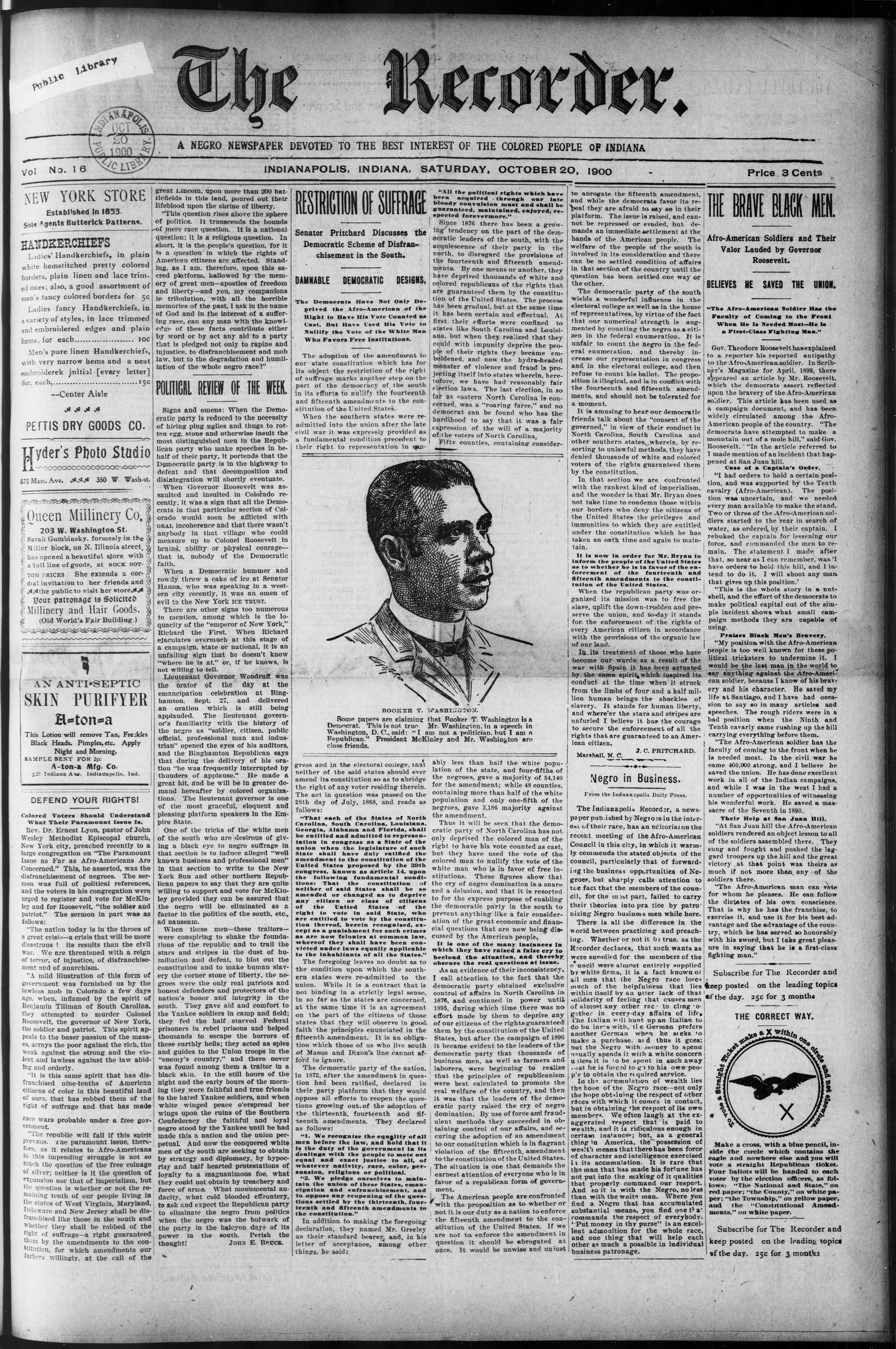
Page text (machine-generated)
Public Library
INDIANAPOLIS
OCT
20
1900
PUBLIC LIBRARY
Vol No. 16
NEW YORK STORE
Established in 1853.
Sole Agents Butterick Patterns.
HANDKERCHIEFS
Ladies' Handkerchiefs, in plain white hemstitched pretty colored borders, plain linen and lace trimmed ones; also, a good assortment of men's fancy colored borders for 5c
Ladies fancy Handkerchiefs, in a variety of styles, in lace trimmed and embroidered edges and plain hems, for each..... 10c
Men's pure linen Handkerchiefs, with very narrow hems and a neat embroiderek jnltial [every letter] for, each..... 15c
--Center Aisle
PETTIS DRY GOODS CO.
Hyder's Photo Studio
873 Mass. Ave. 350 W. Wash-st.
Queen Millinery Co.
203 W. Washington St.
Sarah Gumbinsky, formly in
the Miller block, on N. Illinois street,
has opened a beautiful store with
a full line of goods, at ROCK BOTTOM PRICES She extends a cordal invitation to her friends and
the public to visit her store
Your patronage is Solicited
Millinery and Hair Goods.
(Old World's Fair Building.)
AN ANTI-SEPTIC
SKIN PURIFYER
A=ton=a
This Lotion will remove Tan, Frekles
Black Heads, Pimples, etc. Apply
Night and Morning.
SAMPLE SENT FOR 29c
A=ton-a Mfg. Co.
225 Indiana A. Ave. Indianapolis, Ind.
Colored Voters Should Understand
What They Really Want to Know
What Their Paramount Issue Is.
Rev. Dr. Ernest Lyon, pastor of John Wesley Methodist Episcopal church, New York city, preached recently to a large congregation on "The Paramount Issue as Far as Afro-Americans Are Concerned." This, he asserted, was the disfranchisement of negroes. The sermon was full of political references, and the voters in his congregation were urged to register and vote for McKinley and for Roosevelt, "the soldier and patriot." The sermon in part was as follows:
"The nation today is in the throes of a great crisis—a crisis that will be more disastrous! its results than the civil war. We are threatened with a reign of terror, of injustice, of disfranchisement and of anophism.
"A mild illustration of this form of government was furnished us by the lawless mob in Colorado a few days ago, when, inflamed by the spirit of Benjamin Tillman of South Carolina, they attempted to murder Colonel Roosevelt, the governor of New York, the soldier and patriot. This spirit appeals to the baser passion of the masses, arrays the poor against the rich, the weak against the strong and the violent and lawless against the law abiding and orderly.
"It is this same spirit that has disfranchised nine-tenths of American citizens of color in this beautiful land of ours, that has robbed them of the right of suffrage and that has made race wars probable under a free government."
"The republic will fall if this spirit prevails. The paramount issue, therefore, as it relates to Afro-Americans in this impending struggle is not so much the question of the free colage of silver; neither is it the question of expansion nor that of imperialism, but the question is whether or not the remaining tenth of our people living in the states of West Virginia, Maryland, Delaware and New Jersey shall be disfranchised like those in the south and whether they shall be robbed of the right of suffrage—a right guaranteed them by the amendments to the constitution, for which amendments our fathers willingly, at the call of the
```markdown
```
A NEGRO NEWSPAPER DEVOTED TO THE BEST INTEREST OF THE COLORED PEOPLE OF INDIANA INDIANAPOLIS, INDIANA, SATURDAY, OCTOBER 20, 1900
The
great Lincoln, upon more than 200 battlefields in this land, poured out their lifeblood upon the shrine of liberty.
"This question rises above the sphere of politics. It transcends the bounds of mere race question. It is a national question; it is a religious question. In short, it is the people's question, for it is a question in which the rights of American citizens are affected. Standing, as I am, therefore, upon this sacred platform, hallowed by the memory of great men—apostes of freedom and liberty—and you, my companions in tribulation, with all the horrible memories of the past. I ask in the name of God and in the interest of a suffering race, can any man with the knowledge of these facts contribute either by word or by act any aid to a party that is pledged not only to rapine and injustice, to disfranchisement and mob law, but to the degradation and humiliation of the whole negro race?"
POLITIGAL REVIEW OF THE WEEK.
Signs and omens: When the Democratic party is reduced to the necessity of hiring plug uglies and thugs to rotten egg, stone and otherwise insult the most distinguished men in the Republican party who make speeches in behalf of their party, it portends that the Democratic party is in the highway to defeat and that decomposition and disintegration will shortly eventuate. When Governor Roosevelt was assaulted and insulted in Colorado recently, it was a sign that all the Democrats in that particular section of Colorado would soon be afflicted with ORAL incoherence and that there wasn't anybody in that village who could measure up to Colonel Roosevelt in brains, ability or physical courage—that is, nobody of the Democratic faith.
When a Democratic bummer and rowdy threw a cake of ice at Senator Hanna, who was speaking in a western city recently, it was an omen of evil to the New York ICE TRUST.
There are other signs too numerous to mention, among which is the loquacity of the "emperor of New York." Richard the First. When Richard ejaculates overmuch at this stage of a campaign, state or national, it is an unfailing sign that he doesn't know "where he is at." or, if he knows, is not willing to tell.
Lieutenant Governor Woodruff was the orator of the day at the emancipation celebration at Binghamton, Sept. 27, and delivered an oration which is still being applauded. The lieutenant governor's familiarity with the history of the negro as "soldier, citizen, public official, professional man and industrial" opened the eyes of his auditors, and the Binghamton Republican says that during the delivery of his oration "he was frequently interrupted by thunders of applause." He made a great hit, and he will be in greater demand hereafter by colored organizations. The lieutenant governor is one of the most graceful, eloquent and pleasing platform speakers in the Empire State.
One of the tricks of the white men of the south who are desirous of giving a black eye to negro suffrage in that section is to induce alleged "well known business and professional men" in that section to write to the New York Sun and other northern Republican papers to say that they are quite willing to support and vote for McKinley provided they can be assured that the negro will be eliminated as a factor in the politics of the south, etc., ad nauseam.
When these men—the traitors—were conspiring to shake the foundations of the republic and to trail the stars and stripes in the dust of humiliation and defeat, to blot out the constitution and to make human slavery the corner stone of liberty, the negroes were the only real patriots and honest defenders and protectors of the nation's honor and integrity in the south. They gave aid and comfort to the Yankee soldiers in camp and field; they fed the half starved Federal prisoners in rebel prisons and helped thousands to escape the horrors of these earthly hells; they acted as spies and guides to the Union troops in the "enemy's country," and there never was found among them a traitor in a black skin. In the still hours of the night and the early hours of the morning they were faithful and true friends to the hated Yankee soldiers, and when white winged peace o'erspread her wings upon the ruins of the Southern Confederacy the faithful and loyal negro stood by the Yankee until he had made this a nation and the union perpetual. And now the conquered white men of the south are seeking to obtain by strategy and diplomacy, by hypocrisy and half hearted protestations of loyalty to a magnanimous foe, what they could not obtain by treachery and force of arms. What monumental audacity, what cold blooded effrontery, to ask and expect the Republican party to eliminate the negro from politics when the negro was the bulwark of the party in the halcyon days of its power in the south. Perish the thought! JOHN E. BRUCE.
Recorder.
BOOKER S. WASHINGTON
Some papers are claiming that Rooker T. Washington is a Democrat. This is not true. Mr. Washington, in a speech in Washington, D.C., said: "I am not a politician, but I am a Republican." President McKinley and Mr. Washington are close friends.
RESTRICTION OF SUFFRAGE
Senator Pritchard Discusses the Democratic Scheme of Disfranchisement in the South.
The Democrats Have Not Only Deprived the Afro-American of the Right to Have His Vote Counted as Cast, But Have Used His Vote to Nullify the Vote of the White Man Who Favors Free Institutions.
The adoption of the amendment to our state constitution which has for its object the restriction of the right of suffrage marks another step on the part of the democracy of the south in its efforts to nullify the fourteenth and fifteenth amendments to the constitution of the United States.
When the southern states were readmitted into the union after the late civil war it was expressly provided as a fundamental condition precedent to their right to representation in gn
BOOKER T.
Some papers are claiming Democrat. This is not true Washington, D. C., said: "I a Republican." President McKinney close friends.
gress and in the electoral college, that neither of the said states should ever amend its constitution so as to abridge the right of any voter residing therein. The act in question was passed on the 28th day of July, 1868, and reads as follows:
"That each of the States of North Carolina, South Carolina, Louisiana, Georgia, Alabama and Florida, shall be entitled and admitted to representation in congress as a State of the union when the legislature of such State shall have duly ratified the amendment to the constitution of the United States proposed by the 30th Amendment of 1795, to the following fundamental conditions: That the constitution of neither of said States shall be so amended or changed as to deprive any citizen or class of citizens of the United States of the right to vote in said State, who are entitled to vote by the constitution thereof, herein recognised, except as a punishment for such crimes of the United States, whereof they shall have been convicted under laws equally applicable to the inhabitants of all the States."
The foregoing leaves no doubt as to the condition upon which the southern states were re-admitted to the union. While it is a contract that is not binding in a strictly legal sense, in so far as the states are concerned, at the same time it is an agreement on the part of the citizens of those states that they will observe in good faith the principles enunciated in the fifteenth amendment. It is an obligation which those of us who live south of Mason and Dixon's line cannot afford to ignore.
The democratic party of the nation, in 1872, after the amendment in question had been ratified, declared in their party platform that they would oppose all efforts to reopen the questions growing out.of the adoption of the thirteenth, fourteenth and fifteenth amendments. They declared as follows:
"1. We recognise the equality of all men before the law, and hold that it is the duty of the government in its dealings with the people to mete out equal and exact justice to all, of mankind, and race, color, persuasion, religious or political.
"2. We pledge ourselves to maintain the union of these States, emancipation and enfranchisement, and to oppose any reopening of the questions settled by the thirteenth, fourteenth and fifteenth amendments to the constitution."
In addition to making the foregoing declaration, they named Mr. Greeley as their standard bearer, and, in his letter of acceptance, among other things, he said;
---
"All the political rights which have been acquired - through our late commission - must and shall be guaranteed, protected, enjoyed, respected forevermore."
Since 1876 there has been a growing tendency on the part of the democratic leaders of the south, with the acquiescence of their party in the north, to disregard the provisions of the fourteenth and fifteenth amendments. By one means or another, they have deprived thousands of white and colored republicans of the rights that are guaranteed them by the constitution of the United States. The process has been gradual, but at the same time it has been certain and effectual. At first their efforts were confined to states like South Carolina and Louisiana, but when they realized that they could with impunity deprive the people of their rights they became emboldened, and now the hydra-headed monster of violence and fraud is projecting itself into states wherein, herefore, we have had reasonably fair election laws. The last election, in so far as eastern North Carolina is concerned, was a "roaring farce," and no democrat can be found who has the hardihood to say that it was a fair expression of the will of a majority of the voters of North Carolina.
Fifty counties, containing consider-
WASHINGTON.
That Booker T. Washington is a Mr. Washington, in a speech in not a politician, but I am a manley and Mr. Washington are
ably less than half the white population of the state, and four-fifths of the negroes, gave a majority of 54,140 for the amendment; while 48 counties, containing more than half of the white population and only one-fifth of the negroes, gave 3,186 majority against the amendment.
Thus it will be seen that the democratic party of North Carolina has not only deprived the colored man of the right to have his vote counted as cast, but they have used the vote of the colored man to nullify the vote of the white man who is in favor of free institutions. These figures show that the cry of negro domination is a snare and a delusion, and that it is resorted to for the express purpose of enabling the democratic party in the south to prevent anything like a fair consideration of the great economic and financial questions that are now being discussed by the American people.
It is one of the many instances in which they have raised a false cry to becloud the situation, and thereby obscure the real questions at issue.
As an evidence of their inconsistency, I call attention to the fact that the democratic party obtained exclusive control of affairs in North Carolina in 1876, and continued in power until 1895, during which time there was no effort made by them to deprive any of our citizens of the rights guaranteed them by the constitution of the United States, but after the campaign of 1896 it became evident to the leaders of the democratic party that thousands of business men, as well as farmers and laborers, were beginning to realize that the principles of republicanism were best calculated to promote the real welfare of the country, and then it was that the leaders of the democratic party raised the cry of negro domination. By use of force and fraudulent methods they succeeded in obtaining control of our affairs, and securing the adoption of an amendment to our constitution which is in flagrant violation of the fifteenth amendment to the constitution of the United States. The situation is one that demands the earnest attention of everyone who is in favor of a republican form of government.
The American people are confronted with the proposition as to whether or not it is our duty as a nation to enforce the fifteenth amendment to the constitution of the United States. If we are not to enforce the amendment in question it should be abrogated at once. It would be unwise and unjust
to abrogate the fifteenth amendment, and while the democrats favor its repeal they are afraid to say so in their platform. The issue is raised, and cannot be repressed or evaded, but demands an immediate settlement at the hands of the American people. The welfare of the people of the south is involved in its consideration and there can be no settled condition of affairs in that section of the country until the question has been settled one way or the other.
The democratic party of the south wields a wonderful influence in the electoral college as well as in the house of representatives, by virtue of the fact that our numerical strength is augmented by counting the negro as a citizen in the federal enumeration. It is unfair to count the negro in the federal enumeration, and thereby increase our representation in congress and in the electoral college, and then refuse to count his ballot. The proposition is illogical, and is in conflict with the fourteenth and fifteenth amendments, and should not be tolerated for a moment.
It is amusing to hear our democratic friends talk about the "consent of the governed," in view of their conduct in North Carolina, South Carolina and other southern states, wherein, by resorting to unlawful methods, they have denied thousands of white and colored voters of the rights guaranteed them by the constitution.
In that section we are confronted with the rankest kind of imperialism, and the wonder is that Mr. Bryan does not take time to condemn those within our borders who deny the citizens of the United States the privileges and immunities to which they are entitled under the constitution which he has taken an oath time and again to maintain.
It is now in order for Mr. Bryan to inform the people of the United States and that he is in favor of the enforcement of the fourteenth and fifteenth amendments to the constitution of the United States.
When the republican party was organized its mission was to free the slave, uplift the down-trodden and preserve the union, and to-day it stands for the enforcement of the rights of every American citizen in accordance with the provisions of the organic law of our land.
In its treatment of those who have become our wards as a result of the war with Spain it has been actuated by the same spirit which inspired its conduct at the time when it struck from the limbs of four and a half million human beings the shackles of slavery. It stands for human liberty, and where'er the stars and stripes are unfurled I believe it has the courage to secure the enforcement of all the rights that are guaranteed to an American citizen.
Negro in Business.
From the Indianapolis Daily Press.
The Indianapolis Record, a newspaper published by Negroes in the interest of their race, has an editoriation the recent meeting of the Afro-American Council in this city, in which it warmly commends the stated objects of the council, particularly that of forwarding the business opportunities of Negroes, but sharply calls attention to the fact that the members of the council, for the most part, failed to carry their theories into pra tice by patronizing Negro business men while here.
There is all the difference in the world between practicing and preaching. Whether or not it be true, as the Recorder declares, that such wants as were supplied for the members of the council were almost entirely supplied by white firms, it is a fact known of all men that the Negro race loses much of the helpfulness that lies within itself by an utter lack of that solidarity of feeling that causes men of almost any other race to cling together in every-day affairs of life. The Italian will hunt up an Italian to do business with, the German prefers another German when he seeks to make a purchase, and thus it goes, but the Negro with money to spend usually spends it with a white concern unless it is to be spent in such away that he is forced to go to his own people to obtain the required service.
In the accumulation of wealth lies the bove of the Negro race—not only the hope obtaining the respect of other races with which it comes in contact, but in obtaining the respect of its own members. We often laugh at the exaggerated respect that is paid to wealth, and it is ridiculous enough in certain instances; but, as a general thing in America, the possession of wealth means that there has been force of character and intelligence exercised in its accumulation. It is rare that the man that has made his fortune has not put into the making of it qualities that properly command our respect. And so it is with the Negro, no less than with the white man. Where you find a Negro that has accumulated substantial means, you find one it commands the respect of everybody. "Put money in thy purse" is an excellent admonition for the whole race, and one thing that will help each other as much a possible in individual business patronage.
Price. 3 Cents
Afro-American Soldiers and Their Valor Lauded by Governor Roosevelt.
BELIEVES WE SAVED THE UNION.
"The Afro-American Soldier Has the Faculty of Coming to the Front When He Is Needed Most-He Is a First-Class Fighting Man."
Gov. Theodore Roosevelt has explained to a reporter his reported antipathy to the Afro-American soldier. In Scrubner's Magazine for April, 1899, there appeared an article by Mr. Roosevelt, which the democrats assert reflected upon the bravery of the Afro-American soldier. This article has been used as a campaign document, and has been widely circulated among the Afro-American people of the country. "The democrats have attempted to make a mountain out of a mole hill," said Gov. Roosevelt. "In the article referred to I made mention of an incident that happened at San Juan hill.
Case of a Captain's Order.
"I had orders to hold a certain position, and was supported by the Tenth cavalry (Afro-American). The position was uncertain, and we needed every man available to make the stand. Two or three of the Afro-American soldiers started to the rear in search of water, as ordered, by their captain. I rebuked the captain for lessening our force, and commanded the men to remain. The statement I made after that, so near as I can remember, was 'I have orders to hold this hill, and I intend to do it. I will shoot any man that gives up this position.'
"This is the whole story in a nutshell, and the effort of the democrats to make political capital out of the simple incident shows what small campaign methods they are capable of using."
Praises Black Men's Bravery.
"My position with the Afro-American people is too well known for these political tricksters to undermine it. I would be the last man in the world to say anything against the Afro-American soldier, because I know of his bravery and his character. He saved my life at Santiago, and I have had occasion to say so in many articles and speeches. The rough riders were in a bad position when the Ninth and Tenth cavarly came rushing up the hill carrying everything before them.
"The Afro-American soldier has the faculty of coming to the front when he is needed most. In the civil war he came 400,000 strong, and I believe he saved the union. He has done excellent work in all of the Indian campaigns, and while I was in the west I had a number of opportunities of witnessing his wonderful work. He saved a massacre of the Seventh in 1890.
Their Help at San Juan Hill.
"At San Juan hill the Afro-American soldiers rendered an object lesson to all of the soldiers assembled there. They sung and fought and pushed the laggard troopers up the hill and the great victory at that point was theirs as much if not more than any of the soldiers there.
"The Afro-American man can vote for whom he pleases. He can follow the dictates of his own conscience. That is why he has the franchise, to exercise it, and use it for his best advantage and the advantage of the country, which he has served so honorably with his sword, but I take great pleasure in saying that he is a first-class fighting man."
THE CORRECT WAY.
To doe a Straight Flight make a X within one circle and not elsewhere.
Make a cross, with a blue pencil, inside the circle which contains the eagle and nowhere else and you will vote a straight Republican ticket. Four ballots will be handed to each voter by the election officers, as follows: "The National and State," on red paper; "the County," on white paper; "the Township," on yellow paper, and the "Constitutional Ameadments," on white paper.
Subscribe for The Recorder and keep posted on the leading topics of the day. 25c for 3 months
SOME MORE DEMOCRATS, POPULISTS AND SILVER
EX-SECRETARY CARLISLE WILL SUPPORT McKINLEY
Hon. John G. Carlisle, formerly Speaker of the House of Representatives and Secretary of the Treasury under President Cleveland, has accepted the Presidency of a Sound Money Club in New York and will assist in the re-election of President McKinley. Mr. Carlisle's reasons are covered by two utterances made in a speech at Chicago four years ago. They still hold good. He said:
WILLIAM HINTZ AND HIS EXPERIENCE WITH SHEEP
MORE NEBRASKANS LEAVE BRYAN'S STANDARD
MORE NEBRASKANS LEAVE BRYAN'S STANDARD
"The greatest crime, short of absolute political enslavement, that could be committed against the workingman in this country would be to confiscate his labor for the benefit of the employer by destroying the value of the money in which his wages are paid. But, gentlemen, this irreparable wrong can never be perpetrated under our system of government, unless the laboring man himself assists in forging his own chains." — Hon. John G. Carlisle, Democrat, Ex-Secretary of the Treasury, Chicago, April 15, 1896.
WILLIAM HINTZ AND EXPERIE
William Hintz, one of the best known German farmers in Hancock County, Ohio, gives this reason for his conversion from Bryanism: "I used to be a Democrat, and I was one until I found that by voting the Democratic ticket I was voting against my sheep. I had a big flock of sheep on my farm. The Democratic party in 1892 initiated free trade and took the duty off wool. The price fell to 11 cents. It made me think. I studied the question hard and conscientiously, and from all sides. I looked at it in an unbiased manner. What was good for me certainly must be good for my neighbor, and from also suffer with me. If the price of my wool depreciated, the cost of clothes might be less, but I would have no money to buy them. I studied the matter carefully, and came to the
MORE NEBRASKAN
LEAVE B
Dr. J. T. Emigh, Red Cloud.
William Kent, Sr., retired farmer,
Red Cloud.
J. S. Dyer, stock buyer, Red Cloud.
Ed. Dyer, stock buyer, Red Cloud.
Geo. Blair, merchant, Red Cloud.
Joe Blair, clerk, Red Cloud.
Bert Blair, clerk, Red Cloud.
Paul Storey, clerk, Red Cloud.
Hub. Henry, farmer, Red Cloud.
M. R. Bentley, capitalist, Red
Cloud.
Henry Guy, farmer, Guide Rock,
German.
Geo. Guy, farmer, Guide Rock,
German.
Dr. Bradshaw, Guide Rock.
A. S. Proudft, lumber merchant,
Guide Rock.
Evans Amack, farmer, Red Cloud.
J. S. Emigh, farmer, Cowles.
J. W. Hunter, Abingdon, Ill., Collector of Internal Revenue in the Peoria district under President Cleveland. Was party nominee for Congress eight years ago.
Frank Sweeney, New Albany, Ind., formerly city engineer. Organized a McKinley and Roosevelt club.
John N. Penrod, Wabash, Ind., one of the most prominent lumber man in the state. Voted for Palmer and Buckner four years ago. Believes Bryan's attitude on the money question is a menace to the material interests of every citizen.
Vivek Allard, Metropolis, Ill., a life-long Democrat and owner of the largest farm in Massac county containing 1,800 acres opposite Paducah. He has never before cast a Republican vote. Prosperity.
Ex-Governor Charles T. O'Ferran of Richmond, Va., states that there will be twice as many business men in Richmond this year who will support McKinley as there were in 1896. He will not support Bryan, but will vote for McKinley and has always heretofore been a Democrat. Frank T. Glascow, superintendent of the Tredegar Iron Company, Richmond, Va., the largest iron manufacturing plant in the state, will this year vote for McKinley. Major Clay Drewry of the firm of Drewry, Hughes & Co., Richmond, Va., one of the largest dry goods firms in the state, who voted for Bryan in 1896 will this year vote for McKinley. Mr. J. F. George of Richmond, Va., one of the largest dealers in leaf tobacco, who voted for Bryan in 1896 will vote for McKinley this year.
William R. Trigg, president of the W. R. Trigg company, a very large shipbuilding plant that has opened up in Richmond, Va., will this year vote for McKinley. His works give employment to nearly 1,000 operatives. He has heretofore always been a Democrat.
"No man who has a particle of sympathy for working men and women, and their dependent families, can contemplate the possibility of such a calamity (free coinage of silver) without feeling that it is his duty, whether he occupies a public or private station, to employ every honorable means at his command to avert it."—Hon. John G. Carlisle, Democrat, Ex-Secretary Treasury, Chicago, April 15, 1896.
conclusion that I might just as well kill my sheep as vote the Democratic ticket. Then came the cry of free silver. In my life I have found that it is wise to follow successful men. Therefore if a man is a money-maker, why not watch him and try the same methods yourself? I found that the men of the country who had money were against free silver, I asked myself why, and concluded free silver would be bad for my sheep. I voted for McKinley and the Republican platform and have done so ever since. I shall support the Republican ticket this year. I am no longer a Democrat but a Republican. The Democratic platform shifts its planks too often to suit me. I am satisfied with the present state of affairs, and so are my sheep."
C. G. Seder, Deloitte township, Holt Co., Neb.: "I am for the straight Republican ticket this year. McKinley times are good enough for me and I want to have more good times. I was Populist committeeman of Deloitte township long enough to find out that the Populist party is not a party of reform, and I can't see how any thinking man can support Bryan again after seeing the prosperous condition of the country and seeing how Bryan's predictions have turned out. A large number of my neighbors who supported Bryan four years ago, like myself, disgusted with the talk about imperialism, trusts, etc., and will this time cast their votes with the party that always gives us good government and good prices for our products. I am for the straight Republican ticket."
Virginiai Newton, president of the First National bank, Richmond, Va., who voted for Palmer and Buckner in 1896, will not vote for Bryan this year and says that he considers him the most dangerous man in America today.
Colonel John B. Purcell of the wholesale drug firm of Purcell, Ladd & Co., Richmond, Va., voted for Palmer and Buckner in 1896, but will not vote for Bryan this year.
R. E. Richardson, Talleysville, Va., one of the largest timber operators in Virginia as well as a merchant operating five stores, who would not vote at all in 1896, will vote for McKinley this year and states as his reason that he is satisfied for business to remain as it is.
Roger Gregory, Jr., Democratic chairman of King William county, Va., in 1896 and a large planter, has announced his intention of voting for McKinley this year.
One of the oldest Democrats in West Virginia, Mr. John B. Darnall of Alderson, Monroe county, has come out for McKinley in a letter in which he says that he is 82 years old and has voted with the Democrats for more than 50 years, but now feels compelled to become identified with the party that has brought such prosperity to his state by the operation of its principles of sound money and protective tariff.
James Brittingham of Mount Vernon, N. Y.
General Charles F. Smyth of Chicago, formerly on Governor S. J. Tilden's staff in New York.
Arthur A. Taylor, Santa Cruz, Cal.
Jacob Keene, prominent attorney, Athens, Mich.
Franklin Bartlett, New York. Favors sound money.
Francis L. Stetson, New York. In favor of sound money.
Herbert B. Turner, New York. Sound money.
BRYAN HAS LOST NEWSPAPER SUPPORT
The Following is a List of some of the Democratic and Independent Papers that have announced themselves as opposed to 16 to 1 and the Democratic National Ticket:
Staats Zeitung. New York.
Baltimore Sun.
Boston Herald.
Brooklyn Eagle.
Baltimore News.
Pittsburg Leader.
Richmond (Va.) Times.
New York Times
Chattanooga Times.
Philadelphia Ledger.
Philadelphia Times.
New York Sun.
Galveston News.
St. Paul Globe.
Greenville (S. C.) News.
Hartford Times.
Worcester Post.
Burlington (Ia.) Gazette.
Raleigh (N. C.) Observer.
Charlotte (N. C.) Observer.
New Haven Union.
Fall River Herald.
Manchester (N. H.) Union.
New Haven Register.
Charleston (S. C.) Post.
Montana Journal, Butte City.
LaPorte City, (Ia.) Progress Review.
Bloomington (Ill.) Journal.
Bloomington (ill.) Journal. German Weekly
MISSOURIANS ARE APPRECIATING PROSPERITY
Ralph Simmons, banker, Seymour, Mo. General prosperity of the country.
Capt. R. A. Collins, Piedmont, Mo., captain artillery in Confederate army, also lawyer fine ability. Sound money and prosperity and expansion.
Col. G. W. Ceath, Piedmont, Mo., business man. Prosperity and good business.
Col. O. L. Nieder, Mansfield, Mo., Democratic candidate prosecuting attorney in 1898. Expansion and prosperity.
H. E. Stiff, Mountain Grove, lumber merchant. Good business.
M. Gorman, Hartville, merchant, former Democratic collector of Wright county. Business conditions.
Henry Snyder, Mountain Grove, farmer. Good prices for farm products.
Prof. J. S. Magee, Cape Gardeau, professor in college. Willing to stump for sound money and expansion.
R. McCombs, Jackson, miller. Expansion and sound money.
Robt' Barnard, McElhaney Station, farmer, Prosperity.
Jesse Frank, Grangeville, son of the former Populist candidate for Congress. Now on the stump for McKinley and prosperity.
J. H. Stoinecipher, Buffalo, Mo., Populist candidate for Congress in 1896. Ready to stump state for McKinley and Flory.
W. D. Olderworth, St. Louis, farmer. Approves entire policy of the President. Expansion.
Walter Olderworth, St. Louis, farmer. Approves entire policy of the President. Expansion.
Bruno Olderworth, St. Louis, farmer. Approves entire policy of the President. Expansion.
Henry Heineman, St. Louis, farmer. Satisfied with McKinley in administration. Business conditions satisfy him also.
James Gardner, St. Louis, farmer. Bryan's claim that McKinley's election would mean low prices proven false. Entirely satisfied with McKinley. Believes him safe and good President.
Eugene Guerre, florisant, business man. Now believes Bryan wrong on all issues.
Wm. Offer, St. Louis, telegraph operator. Enlisted as Bryan did to fight Spain, and is in hearty sympathy with President's course and is working for his re-election.
Dr. Davis, Charleston, Mississippi Co., physician. Sound money and fixed policy of Republican party.
John A. Jackson, Chillicothe, Populist candidate for Congress in 1896. Says he don't want to shoot in the air any longer. Wants to vote with the party that has fixed principles and policies.
G. S. Clemens, Carthage, business man. General prosperity of the country.
Thos. H. Harkless, Lamar, merchant, now Republican candidate for Legislature. Prosperity.
Gen. D. H. McIntyre, Mexico, Mo.
former Attorney General of Missouri,
an old ex-Confederate general, writes
that he will vote the Republican ticket
from top to bottom, and take the stump
in October if his strength will permit.
Julius S. Walsh, president of the
Terminal Railroad Association of St.
Louis, is a native of this city, and voted
A GEORGIAN'S REASONS FOR VOTING FOR McKINLEY
I shall vote for McKinley, and Roosevelt because: First—We are Americans, and are against all of America's enemies.
Second—We are patriotic, and are desirous of suppressing those who give aid and comfort to our enemies.
Third—We are honest and are against all efforts at dishonoring the nation by currency legislation or otherwise.
Fourth—We are law abiding, and are against all encouragement of force in the settlement of disputes.
Fifth—We are progressive, and
New York.
Denver Times.
(Silver Republican and supported Bryan in 1896).
Denver Republican.
(Silver Republican and supported Bryan in 1896).
Denver Post.
Port Chester (N. Y.) Daily Item.
Sedalia (Mo.) Daily Bazoo.
Louisville Post.
Nashville Banner.
Wellston (O.) Sentinel.
Beloit (Wis.) Daily News.
Louisville Dispatch.
Detroit Free Press.
Galveston Globe.
Pittsburg Dispatch.
De Kalb (Ill.) Advertiser.
Rockford (Ill.) Germania.
St. Louis Anzeiger des Westens.
Philadelphia Demokrat.
The People, Chicago.
Utica (N. Y.) Observer.
Rome (N. Y.) Sentinel.
Troy (N. Y.) Press.
Westchester (Pa.) Republican.
Butte (Mont.) Inter Mountain
Monona Leader, Monona, Ia
for the Democratic ticket for more than thirty years. In 1896 he took an active part in the local sound money movement and marched in the big procession of October 31 that year. He was one of the vice presidents of the Music Hall meeting of the sound money Democratic party on the evening of the same day, the principal speaker of which was the presidential candidate of that party, Gen. John M. Palmer, whose death is now being mourned by the whole nation. Mr. Walsh will vote for McKinley and Roosevelt next November. The official reports of the Terminal Association show that its receipts have steadily increased since President McKinley's election, and Mr. Walsh is authority for the statement that the company's business is larger now than it ever was before. When asked if he thought the business would continue to increase in the event of Bryan's election, he laughed and answered: "I'd not like to take the chances." G. H. Walker, stock broker, St. Louis, Mo. Sound money.
H. H. Pike, live stock dealer, Ashland, Pike Co., Mo.: "A good many 'Pikers' will be with me in voting for McKinley this year. I can borrow money at a lower rate of interest than I could before McKinley's election, and get a better price for my stock. A good many of my neighbors also have been more prosperous under McKinley than they were before, and we all believe that it is to our interest to keep him in."
James Campbell, stock broker, St. Louis. Sound money, and says that "McKinley is more apt to carry Missouri than Bryan is to carry New York."
A. W. Day, president Day Rubber Co., St. Louis. Prosperity and sound money.
William B. Cowan, cashier National Bank of Commerce, St. Louis, Mo. Sound money and prosperity.
P. C. Maffett, president Missouri Railway Co., St. Louis, Mo. Sound money and prosperity.
R. P. Tansey, president St. Louis Transfer Co. Wants sound money.
Alonzo C. Church, vice president Wiggins Ferry Co., St. Louis, Mo: "Bryan is not a Democrat, but a Populist. He is a different man from the line of eminent Democrats beginning with Jefferson and ending with Cleveland.
John Scullin, president Wiggins Ferry Co., St. Louis: "I always voted the Democratic ticket until Mr. Bryan's nomination on a free silver platform at Chicago four years ago. For the government to put a stamp on a piece of silver bullion and call it a dollar, without being able to redeem it in money which circulates at its face value the world over, seems to me ridiculous. I expect to vote for McKinley and to continue voting the Republican ticket as long as the Democratic party continues to advocate the free and unlimited coinage of silver at the ratic of 16 to 1."
Judge John G. Wear, Poplar Bluff, Mo., for twelve years on the Missouri Circuit Court bench. Is disgusted with the makeshifts of the Democracy for a "paramount" issue.
favor legitimate expansion of our commerce and our power.
Sixth—We are hopeful that Mr. McKinley has seen his former errors and will treat our Southern people fairly and broadly, and carefully refrain from humiliating them.
Will he do so? If he does not, then all hope of ever breaking the solid South must be postponed until he is succeeded by a wiser man; and, we, who are leaving the beaten path, will sorrowfully and penitently return whence we came.
Alexander R. Lawton.
Savannah, Ga.
COL. JAMES R. CAMPBELL BELIEVES IN EXPANSION
BRYAN MISSES THE SPIRIT OF AMERICAN ASPIRATIONS
BRYAN MISSES THE SPIRIT OF AMERICAN ASPIRATIONS
KANSAS WANTS EXPANSION AND GENERAL PROSPERITY
KANSAS WANTS EXPANSION AND GENERAL PROSPERITY
Ex-Congressman James R. Campbell of McLeansboro, Ill., for years a leader In the Democratic party of Southern Illinois, has announced his conversion to Republicanism on the expansion question. He is a colonel in the United States service and has just returned from the Philippines.
"I have always been a Democrat," said Colonel Campbell, "but the party's stand on the Philippine question compels me to change my political belief. I desire to be known as an expansion Republican. Any Democrat, Bryan included, who will go to the Philippines and ascertain the exact situation, as I know it, will come home convinced the party is wrong on the question. We should hold the islands and give the people a stable government. I believe the war in the Philippines will cease as soon as McKinley is re-elected."
Colonel Campbell's wide acquaint-
Dr. J. A. Milburn, pastor of the Second Presbyterian church of Indianapolis, who has been a sturdy champion of Democratic principles in the past, intends to vote the Republican ticket this year. He says: "I see no reason why a minister should not express his political preferences, as well as any one else. I have been for long years a Democrat, but at the last Presidential election voted for McKinley. I will vote for him again. Mr. Bryan, I think, is a good man, but he is the incarnation of economic heresies, and what is more he fails to understand the temperament and the genius of a growing world. He has not yet learned, evidently, that life means growth, and that to cease to
W. H. Nation, a leading Populist of Erie, Neosho Co., Kansas: "McKinley's election was not attended by the evil consequences predicted, in fact the time since the election of 1896 has been a period of almost unexamined prosperity. Instead of men hunting work, you now find work hunting men, and the doleful predictions made four years ago now read like a comic almanac, and this fact has made it necessary to create a new issue, consequently, the question of imperialism has been brought forward and the Democratic party has become sentimental and is shedding tears over the wrongs of the colored man (10,000 miles away). I can see no reason why the Populist party should any longer follow Mr. Bryan, the fact that nearly all the gold Democrats that bolted Bryan in '96 are supporting him now leads me to believe that secretly he has abandoned the silver issue, and on that issue only was he in sympathy with the Populist party. From the first I have been in favor of retaining the Philippines and sustaining the administration."
R. E. Melvin, Lawrence, Kan. A leading attorney and graduate of the Kansas State University. John A. Forrest, one of the leading business men of Hope, Kansas. Prosperity. Judge Funk, Medicine Lodge, Kan. Prosperity. Ben Jenkins, miner, Weir City. Lou McGruder, farmer, Weir City.
William E. Curtis, New York. Sound money.
Abram H. Dailey, the weil-known Brooklyn lawyer and former Surrogate of Kings county, has abandoned the Democratic organization with which he had been closely allied for years and will vote the whole Republican ticket this year. Mr. Dailey thus briefly but forcibly accounts for his political change of heart: "When I want to destroy a bad cause I come out actively against it. I don't believe in any halfway measures in regard to Bryanism."
F. P. Garretttown, Newport, R. I., was once a free trader, but is convinced that protection is the proper policy for the United States to pursue.
J. R. Williams, Bucks, Summers Co., West Va. In declining a Democratic nomination he wrote: "As an honest man I cannot consent to allow my name to remain on a ticket I cannot support. I voted for William McKinley in 1896 and am proud of it, as I feel the Republican party has fully redeemed all its pledges made to the people then, and especially to the farmers. I desire no change in the administration. I feel that I can support my family better and easier; have better prices and readier markets for the products of my farm under a Republican administration. I cannot jeopardize my interests for any untried theory of free silver or bugaboo of imperialism. I am for McKinley and the Republican ticket."
B. F. Meador, Dunns, West Va: "I have been a life-long Democrat, voting that ticket for 21 years, but I find that the Republican party is the party of the people; the party for the farmer and laboring man. I can live easier and have more comforts of life under a Republican administration than under a Democratic administration. In view of these facts, I can no longer support the Democratic ticket, and hereby declare myself for McKinley and the republican party." A. J. Mills, Oriskany, N. Y.—I have voted the Democratic ticket for years but this time I shall give my vote to McKinley and Roosevelt. I liked McKinley's attitude on the Cuban question and I admire Roosevelt very much.
ance in Illinois led State Chairman Rowe to ask him to make speeches for the Republican ticket, but he declined on the ground that his furlough is only for another month and he has not the time to take the stump. In 1884 Mr. Campbell was elected as a Democrat to the house from the forty-sixth senator district, and was re-elected in 1886. Two years later he was promoted to the senate, where he served eight years. His legislative career was criticised many times, but he was ever known as a loyal Democrat. In 1896 he was elected to congress on the Democratic ticket in the twentieth Illinois district. When the Spanish-American War broke out he raised the Ninth Illinois Regiment and was elected colonel. He was the first congressman to resign from the house to accept a commission in the army. He has been in the Philippines since occupation by American troops.
grow means the beginning of death. Whether, as Mr. Bryan says, world dominion is our destiny or not one thing is clear, and that that exapansion is in our blood, and it is in our blood not because of any love of conquest of the world, but of our passion for the world's betterment. One thing that characterizes the American is his God-like ambition, his supreme and splendid passion for achievement. He is not satisfied with the good. He yearns for the better, and when he has attained the better he reaches out for the best. He wants this to be the best possible world, and, thank God, he is man enough to do his share to make it so."
Charles I. Dodson, merchant, Weir City. Charles Hughes, Weir City.
J. S. Murphy, expressman, Weir City.
Henry Davis, carpenter, Weir City,
Captain J. W. Farrell, real estate
and insurance, Weir City.
Matt Goodman, miner, Weir City.
Robert Goodman, weigh check
man, Weir City.
Ed Goodman, miner, Weir City.
Tom Brisco, miner, Weir City.
James Dunn, Sr., miner, Weir City.
James Dunn, Jr., miner, Weir City.
Ira Clemens, coal prospector, Weir City.
J. D. James, merchant, Weir City.
William Addy, Weir City.
James Bates, miner, Weir City.
Matt McClenahan, miner, Weir City.
James Moore, merchant, Weir City.
Sol Relli, miner, Weir City.
John Alfred, miner, Weir City.
Mike Fasogen, miner, Weir City.
Charles Kemp, miner, Weir City.
Thomas Mallems, miner, Weir City.
Ed Broadhurst, farmer, Weir City.
S. P. Murphy, ice dealer, Weir City.
Charles Dunn, miner, Weir City.
H. Huntsterger, mine engineer, Weir City.
Judge A. C. Hinkson of Sacramento, Cal., has resigned from the Iroquois club, the leading Democratic organization of the state. "Long before the retention of the Philippines had crystallized into a political issue I expressed the unqualified opinion that, not only as a wise political and commercial measure, but as a duty to the inhabitants of the Philippine Islands, they should be retained as our territory and should be governed as our other territories are governed. To this view I still adhere, regardless of the wishes of the comparatively few who are in rebellion against our government."
William H. Devlin, at one time Democratic candidate for assemblyman, Sacramento, Cal., now a leading attorney. "The Philippines are now in rebellion against the authority of the United States, and for my part, I believe that this rebellion should be crushed, and that until the authority of our government is recognized no negotiations towards peace should be had. By acquiring the Philippines we have undertaken new responsibilities and are liable to the governments of the world for the proper preservation of property rights and maintenance of good government. In my judgment, this can be brought about at the present time only by the authority of our government being recognized and respected. For these reasons and others, I favor the policy of President McKinley, and intend to vote for him."
Col. Andrew Corry, who has hitherto been one of the principal stays of the Democratic party in Iron county, Utah, has publicly announced himself a Republican. As Mr. Corry is widely known throughout Utah, his conversion will occasion no little surprise. Will H. Lett, who has been secretary in the Salt Lake City (Utah) Fifth precinct, has resigned and will support the Republican ticket. "I think it would be suicidal to make a change in the administration at this time. I believe President McKinley is the right man for the place at present and I shall do all I can to keep him there. I am in favor of expansion and believe this cry of 'imperialism' is a buqaoon. I have always been a Democrat until this year, but from now on I intend to do all I am able to elect the Republican ticket."
eee
— ay
WASHINGTON WHEELS INTO | MICHIGAN HAS MANY | WISCONSIN DEMOCRATS |
LINE ON EXPANSION M-VINT EV crnaiwontre itech Rares eres
Jone! Frank Wiikessz, formerly
populist member of the legislature
ofthe state of Wasbington, and who
vss one time associate editor of the
New York Sum, has rejected Bryan-
cm. He says: “Iam an expansion-
tof the most extreme type and
eve in holding the Philippine
[lands for commercial reasons as
5 a military and naval base.
vw paid taxes for thirty years to
Jish eastera manufacturing in-
:—past even under angry pro-
ccavse £ lived in a region
from all possibility of profit-
qe manufacture-—and now, when
vuchington has a chance to estab-
jsh ® manufacturing industry to
supply the people of Asia with fin-
hd prednets, I am @ high tariff
ate, I Want the industries of
Wa-bington diversified; I want our
is: bullt up and commerce estab-
ei. I want to see the consum-
= jowers of the market of Asta in-
<4, so that it will consume all
the sorplus wheat raised in Austra-
sud on the Pacific coasts of the
Nort and South American conti
us.and this will increase the price
wiwat raised in the Mississippi
ivy, where I have a large farm.
i pelieve that the success of Democ-
rary will directly and disastrously
affect my pocket; that it would if
carried to a logteal conclusion create
industrial and commercial lethargy
a the Paeifie coast, and by curtail-
ue che power of consumption of the
forrign and domestic markets cause
vrealstuffs and provistons to fall in
Hicam Hammer, one of the ablest
ists in Washington (state): I
Proteetionist. I believed that
we had free silver, want ard
vstiution would follow. ‘The re-
is true. I believe that in the
jurure as in the past that whatever
iegisiation we obtain—that fs, in the
nicrestof all the people—must come
hrough the Republican party.
John H. SUpper, Hamilton, Wash.,
one of the largest merchants in the
Upper Skagit valley, and a Demo-
Dr. M. B, Mattice, Sedro-Woolley,
Wash., a leading physiclan and Jlite-
‘ong, Democrat.
A. Lyons, Burlington, Wash., an
enthusiasti¢ fusionist in 1896-'98.
C. E, Bingham, mayor of Sedro-
Woolley, Wash., head of the bank-
ing house of C. E, Bingham & Co.,
who has always been a staunch
Democrat.
Heary " Thompson, Birdsview,
Wash., an extensive rancher and
old-line Democrat.
N. W. Carpenter, Mount Vernon,
Wash., @ large saw mill owner aid
4 Populist.
J. B. Holbrook, Sedro-Woolley,
Wash., bank cashier and an active
Democrat.
Thomas W. B. Thomson, Hamil-
ton, Wash., mine owner’ in the
Upper Skagit, and a Populist.
Louis Kirkby, Sedro-Woolley,
Wash., mail carrier and a Populist.
W. BE. Schricker, La Conner,
Wash., head of the ‘Skagit County
Bank and an influential Democrat.
Adam Huff, Bayview, Wash., a
rancher and strong Fusionist.
M. 0. Pease, Anacortes, Wash.,
mine owner and a good Democrat
all his life.
Col. Geo. G. Lyon, Seattle, news-
yaper proprietor and editor, Expan-
sionist,former chairman Republican
Territorial Committee, leader of Sil-
ver Republicans 1896.
j. E. Yeend, Walla Walla, farmer,
present tember state senate, elected
as Fusionist 1896. Expansion.
be, G. V. Calhoun, Seattle, origin-
u silver Republican and one of
managers fusion state campaign
189, Expansion.
J.C, MeCrimmon, North Yakima,
cuirman Populist County Commit-
tee 1896. Expansion.
4, E. Hay, Wilbur, original Silver
iepublican and fusion organizer; is
now chatrnan Lincoln County Re-
publican Committee and nominee
for state senate. Expansion.
Dr. J. C. House, Port Townsend,
‘ormerly chairman Idaho Republi-
can Territorial Committee; Silver
Repablioan and fusion organizer
this state 4806: Ghateeen camanon
A. Parkhurst, Oriskany, N. ¥.—I
hive always been a Democrat, but as
teanis the national ticket this fall I
‘ekeve in letting well enough alone.
Jobn F. Malloy, Oriskany, N. Y.—I
have siways heretofore voted the
Denocrutic ticket, but this year my
‘allot will be cast for McKinley. 1
‘lieve the country is prospercus now
iti tn he proper shape for us to sup-
bor: dickinley, We do not want a
thauge at this time. I can not go
San. “When a man forces himseif
Si people as ke did you may count
3. Holman, Oriskany, N. ¥.—I
tive never yet voted the Republican
lations! tieket, but will do so this year.
Von want to see any change. ‘Things
Xe 8 scod shape, and we should keep
WeKinley where he is.
p&.clawson, Oriskany, N. ¥.—I am a
_pimovrat, but I shall Vote tue’ Repub-
Nan ticket this year, at least that is
Ri wwestion at the present time. Me-
sales ‘sa good man, and we have had
fod times under his administration,
Ht G. Millington, Clare Milis, N.Y.
aloe for McKinley. 1 voted for
titCand the last time he ran, and got
Gousi of it In his term, and shan’t
se that way this year, MeKinley 13
Wot enough
fines Lorraine, Clark Mills, No ¥.
aug’ (0 be a Demoerat, but have
feu im the last two years. It is
in "Jct the people to have Mcxin-
tie, Limes suit me better under
Repabticans
way! att. Oriskany, N. ¥.xI_ have
hu 2 ‘oted the Democratic ticket.
any Sear Lam out for MeKinley
toc, Nill get my vote. Times are
Prop Sh for me now and I don’t
to 1. 00 anything that would tend
bring about a change:
County Republican Committce 1898.
Expansion,
Geo. S. Courter, North Yakima,
secretary Silver Republican State
Central’ Committee 1896. . Expan-
sion. *
L. C. Whitney, Everett, former
prosecuting attorney Snohomish
county. Finance and expansion.
PF. “M. Sanders, Entiat, Chelan
county, business man. Expansion.
George Donworth, leading attor-
ney of Seattle. Finance and expan-
ston.
Josiah Collins, leading attorney
of Seattle. Finance and expansion.
S. M. Shipley, attorney, Seattle,
Silver Republican organizer and fu-
sion nominee for state senate 1898.
Expansion.
Richard Gowan, attorney, Seattle.
Finance and expansion.
Col. W. M. Ridpath, mining man,
Spokane, former Republican mem-
ber and’ speaker Indiana house of
representatives; manager George
‘Turner's senatorial fight 1897. Ex-
pansionist.
W. H. Plumgner, attorney, Spo-
Kane, elected to state senate as fu-
sionist 1896, Expansion.
Col. J. J. Weisenberger, What-
com, fusion campaign speaker 1896;
original ‘Silver Republican; major
First Washington Regiment Volun-
teers in Philippines; delegate to
Republican state conyention 1900;
present colonel Washington State
| National Guard. Expansion.
D. G Haight, business man, Aber-
deen, life-long Democrat, .Expan-
sion.
Col. J. J. Tolkas, Aberdeen, mer-
chant, life-long Democrat, Expan-
sion.
Mark Payette, Aberdee=, mer-
chant. Expansion.
I. C, Crowtherx, Aberdeen, retired,
Expansion.
H. L. Blanchard, Chimacum, Jef-
ferson county, former member board
county commissioners, _ life-long
Democrat; now president State
Dairy Association. Expansion.
R. J. Chard, Port Townsend, mer-
chant, life-long Democrat; is for ex-
pansion, and against Democratic
pro-Boex sympathy.
Charles Pink, Port . Townsend,
former city councilman and appoint-
ed customs inspector under Cleve-
land administration. Same reasons
as Chard.
‘A. N. Godfrey, Port Townsend,
former county surveyor; appointed
deputy collector customs under
Cleveland administration. Expan-
sion.
J. ©, Pringle, editor Port Town-
send Evening Call. Finance and
expansion.
F. F. Marble, North Yakima,
elected county surveyor 1892; nom-
inated for same office by fusionists
1900; resigns from ticket and de-
clares for McKinley.
John Louden, leading business
man North Yakima. Expansion.
Judge C. C, Austin, Seattle, former
member state senate and elected
police judge Seattle on fusion ticket
1896. “Original Silver Republican,
Expansion.
Solon T. Willlams, Seattle, Silver
Republican, elected to state legisla-
ture as fustonist 1896. Expansion.
'W. A. Peters, attorney, Seattle;
former Democrat. Expansion.
N. J. Craig, Everett, chairman
Populist County Convention 1896;
member city council. Expansion,
John McRae, Everett, life-long
Democrat and leading party work-
er; former city councilman. Ex-
panston.
A. W. Criswell, Everett, leading
Populist. Expansion.
Harry Knowles, Snohomish, fu-
sion chief deputy sheriff 1896-’98.
J. M. Holden, Orting, People’s
Party organizer 1896. Expansion.
James Coplan, business man, Ort-
ing. Expansion.
Henry Beckett, Orting, assessor
Pierce county 1896; elected on fu-
sion ticket. Expansion.
H. P. Bulger, Tacoma, People’s
Party speaker and club’ organizer
1896; Republican organizer 1898.
Expansion.
M. B. Harben, Seattle, tusion
speaker and organizer 1896-’98.
Member King County Republican
Convention 1900. Expansion,
J. Lorraine, Clark Mills, N. ¥.—I
have been a Republican ever since tne
last presidential election. Think 1
shall vote for McKinley because the
times are better now then ever before.
W. Dennison, Oriskany, N. ¥.—I was
a Demociat until four years ago. I
shall vote for McKinley this year. we
want a ccntinuation of the good times.
H. B. Harrison, Clark Mills, N. Y.—
I used to be a Democrat, but no silver
business for me. I think I shall be a
Republican hereafter. The Democratic
politicians are playing for selfish ends
and not for the good of the country.
Croker was able to overrule the whole
Democratic convention at Saratoga
when everybody else wanted Coler for
governor. Then he put an anti-trust
plank into the platform and he is one
of the head men in trusts. I shall cer-
tainly support McKinley this year,
whatever I may do afterward.
P. W. Copeland, Clark Mills, N. ¥.--
Tused to be a Democrat. It is hard tc
tell. where the Democracy is now-
adays. I think I shall vote for MeKin-
ley. I think that would be the wiser
way. Z
Arthur Wright, Clark Milis, N, ¥.—
{am a Demcerat, but I shall do as 1
did four years ago, vote for McKinley
as the less of two evils.
Lewis Farmer, Clark Mills, N. ¥.—
I voted for Cleveland three times and
four years ago I voted for McKinley.
[have no use for Bryan. I am going
‘o be a Republican. We had all the
Democratic admiatstration under
Sleveiand’s last term that we wanted
H. E. Palmer, Bridgewater, N. ¥—
As a party we don’t say much about
tree silver. I guess that is the wiser
way. I am an expansionist. I don’t
object to that part of the administra-
tion’s policy.
MICHIGAN HAS MANY
McKINLEY CONVERTS
Better business now; /foolish to
change.
James O. Crotser, Kingsley: Bet-
ter business now; foclish to change.
Joseph Garko, Anton Mickles, and
Paul Wieneskie, East Lake. Coun-
try more prosperous under Republi-
can rule,
Cristopher Clark, Marion. Ex-
pansion.
J. Warren Scoville, Marion. Pros-
perity.
A. J. Montgomery, Reed City.
Prosperity.
James H. Booth, and J. C. Corbin,
Duncan. Republican party has ful-
filled pledges. .
Frank C. Miller, Ionia; formerly
secretary and treasurer Democratic
County Committee.
Edwin A. Murphy, Ionia, cand!-
date for prosecuting attorney Dem-
ocratic ticket, 98.
Albert E. ‘Shelley, Belding, real
estate dealer; prominent Democrat.
C. C. Reeves, 0. 8. Shaw, James
Lampson, and Otto Tacy, ‘Covert.
Business prosperity.
L. P. Parkhurst, M.D., Middle-
ville, and B. W. Stickney, Hartford.
Satisfied he was wrong on silver
question. Changed his mind as to
16 tol.
Michael Holman, Hesperia. Bet-
ter times.
Cassius Potter, Lattin. Better
times.
Samuel Frees, Lattin. Better
times.
R. R. Gale, Hart. :
James H. Slater, Hart. Bad policy
to change now.
Col. Benoni Lachance, Ed-Vill.
Pres., Mackinaw Island. Philippine
question.
C. H. Angell, St. Ignace. Philip
pine question.
George Wilson, Newton. Times
good enough.
James Sealey, Will E. Fuller, Geo.
Frownfelder, Fred E. McMichael,
and Frank L, Fuller, Greenville.
Satisfied with present conditions.
Charles R. Culver, Carson City.
Disgusted with imperialism buga-
boo.
Dr. William Richardson, Carson
City. Lost confidence in 16 to 1.
Albert Grover, Mclvor. Pros-
perity.
Louis Boley, Melvor. Prosperity.
John Jones, Hetherton. Changed
mind as to 16 to 1.
William Hunt, Hillman. Changed
mind as to 16 to 1.
David Moore, Atlanta. Changed
mind as to 16 to 1.
R. Stickney, Hartford. Foreign
policy.
John Mackey, South Haven. For-
eign policy.
Charles Rosevelt, Keeler. Foreign
policy. :
Paul Suchs, lumberman. Pledges
of Republican party kept.
Charles Bradley, leading farmer,
McBain. Don’t like Bryan’s speech
of acceptance.
Lawrence Dahoney, mill man, Me-
Pain. Thinks Bryan dangerous man.
Henry Coopman, Falmouth, mili
man, McBain. Fears repetition of
times of 1895-'96,
John J. Sweetland, M.D., Mott-
ville. Money question.
George W.Nihart, Petoskey, chair-
man Democratic County Committee
St. Joseph County '96. Money ques-
tidn.
A. W. Maring, Mendon,
F. L. Burdick, Sturgis.
Robt. McDougall, Harbor Springs,
candidate Silver ticket auditor-gen-
eral ‘96,
John B.Whitney, Hillsdale, candi-
date Democratic ticket ’98 for city
treasurer.,
B.E, Sheldon, justice peace, Hills-
dale,
C. A. Sheperd, ex-prosecuting at-
torney, Hillsdale,
Frederick Chester, Camden.
0. W. Halstead, banker, Mason,
Money question.
F. W. Webb, merchant, Mason.
Money question,
John Dean, leading farmer, Mason,
Better times.
C..G. Huntington, retired mer-
chant, Mason. Better times.
‘Thomas Sarrow, Mason.
L. B. Smith, Webberville, leading
farmer. Money question.
‘8. L, Kilbourne, Lansing, prom!-
nent Iawyer. Money question.
Edward Wood and Geo. Wood, Jr.,
Richland. Better times.
Charles Grover, and Geo. Galitly,
Richland. Spanish war volunteers,
Newell Barber, Cressey.
‘James Calthrop, Prairieville,
William Amell, Beaverton.
W. W. Hunter, supervisor, Bea-
verton.
Alphonso Otte, Beaverton.
James A. Leisen, Menominee,
Democratic Candidate State Senate
"98, Heutenant Spanish war. Ex-
pansion and war policy.
John M. Knox, C. N. Bliss, and C.
Vining, Beaverton. Recent history.
Dr. E. Laylor, Baldwin, Pros-
perity.
Henry Ingraham, Luther. Pros-
perity.
Ed. Kildel, Luther. Prosperity.
J. G. Rogers, Chase. Prosperity.
John Boosinger, East Jordan,
merchant. Prosperity.
M. M, Burnham, lawyer, East Jor-
dan. Prosperity.
C. J. Herron, merchant, Boyne
City. “Prosperity.
‘W. W. Bailey, merchant, Boyne
City. Prosperity.
George W. Batley, real estate,
Boyne City. Prosperity.
J, Milo Eaton, lawyer, Charle-
ee ee eee
Foreign policy.
W. E. Haybarker, merchant,
Orono.
D. C. Thompson, sawyer, Ashton.
Samuel Peasley, produce dealer,
Hersey.
Frank Proctor, merchant, Hersey.
Prosperity,
Herbert Richards. Menominee.
DeWitt Brown, Stephenson.
John Fisher, Cassopolis. Expan-
sion.
Frank J. Kneeland, St. Louis,
real estate. Satisfied with present
conditions,
James “A. Burgess, prominent
stock buyer, St. Lous. Wants pres-
ent conditions to continue.
Richard E. Hughes, St. Louis,
Satisfied with present conditions.
Dr. 8. P. Tuttle, St. Louis.
Edward Crick, Forest Hill.
Frank Platz, Rogers City. Tariff,
Henry Hanson, Rogers City. Con-
vinced on all national questions.
Ernest Adrian, Rogers City. Same
as above.
S. L. Kilbourne, Union City.
Money question.
W. M. Gow, Cadillac.
J. E. Henderson, Cadillac, court
stenographer.
Olof Johnson, Swedish merchant,
Cadillac.
J. H. Bearss, Yuma, lumber man-
ufacturer.
Ed. Wilson, hardware dealer,
Sherman,
Henry Bull, ex-alderman, Petos-
key.
Isaac Toll, ex-village president,
Petoskey.
William Dimmer, Copper Fails.
J. J. Gagner, insurance agent,
Gladstone. Better times.
W. H. McDonald, hotel keeper,
Gladstone. Better times.
Fred Falkins, stationery engineer,
Gladstone. Better times.
John Malloy, city marshal, Glad-
stone. Better times.
Alex, Murker, Gladstone, Better
times.
James Davis, Mt. Pleasant,
John Battner, Caldwell.
John C. Wood, Caldwell.
James Forquer, Caldwell.
Fred Fehlafley, Caldwell.
F. C. Dingman, Caldwell: .
Alex. Worden, ex-alderman, Pe-
toskey.
J. J, Reycraft, former Democratic
candidate for mayor of Petoskey.
John Litney, Suttons Bay.
George Steinel, Jr., Suttons Bay.
Cannot go free silver.
Dr. R. P. Burke, Empire. Cannot
go free silver.
M. Oberlin, Bingham, Cannot go
free silver.
D. H. Day, Glenhaven. Cannot go
free silver.
Samuel B. Owen, Elk Rapids.
‘Archibald Cameron, Sr., Central
Lake.
George J. Noteware, Bellaire.
Charles L, Cleveland, Bellaire, I.
G. Nobles, Oxford, and Robt. Bur-
dick, Oxtord. Are satisfied that they
were wrong as to free silver.
D. G. Tillotson, Charlevoix.
J. H. Edsall, Greenville,
W. J. Roberts, Maple Rapids.
Isaac Wolf, Luther.
G. W. Barringer, Leroy.
James Kanane, Dowagiac. Party
has abandoned cardinal doctrines of
Democracy.
Col. John A. Elwell, St. Louis.
Judge Chas. J. Pailthorp, Petos-
key.
M. W. Stevens, Niles.
L. H. Beeson, Niles.
Charles A. Johnson, Niles,
Dr. Henderson, Buchanan.
Charles F. Howe, Buchanan.
Allen B. Morse, Ionia, ex-supreme
judge, was Democratic candidate for
governor in 1892. Money question.
Hon. R. A. Montgomery, promi-
nent attorney, Lansing.’ Money
question.
William Walter, Fennyille, Money
question.
Hon. William H. Porter, Marshall.
Money question.
Chas, W. Gale, Owosso. Our only
safety is to yote for McKinley.
William Smith, Amadon, promi-
nent farmer, Money question.
Monroe Morrow, Benton Harbor.
Says country is’ prosperous; he
wants no change.
Dr. Robt, Henderson, Buchanan.
Frank Parsons, Grand Ledge.
Afraid of Bryan on silver question.
R. S. Whelpley, Grand Ledge.
Afraid of Bryan on silver question.
John Corbin, Baton Rapids.
Afraid of Bryan’ on silver question,
C. Murphy, Remus, prominent
business man. Says ‘free sflver
would be disastrous,
Timothy Nester, Munising, for
years leader of Upper Peninsula
Democracy.
Edward Skidmore, Vestaburgh.
Disgusted with the sliver party.
James B. McCrea, supervisor,
Roscommon. Don't believe in free
silver and belleves in expansion,
0. P. Dickinson, ex-supervisor,
Houghton Lake. Can't go Bryan,
McKinley did as he promised and
we have good times.
James H. Sly, ex-county treasurer,
Roscommon. Is for gold standard.
David Burleson, leading farmer,
Roscommon. Has had enough of
the Democrati¢ party.
Bert J. Morrison, Benton Harbor.
Does not believe in free silver.
Charles F. Howe, Buchanan.
Josiah Reynolds, old soldier, Ama-
don. Is for expansion.
A. B. Klise, life-long Democrat,
Sturgeon Bay. Will vote for Mc-
Kinley because business is so much
better. ; me
WISCONSIN DEMOCRATS
ABANDONING BRYAN
IOWA DEMOCRATS WHO ARE
OPPOSED TO FREE SILVER
Py yy itmmer, Des Moines, Iowa. Against free silver.
L. M. Martin, Des Moines, Iowa, Against free silver.
B, F. Tillinghast, Davenport, Iowa. Against free silver.
M. Ricker, Waterloo, Iowa. ‘Against free silver.
J. P. Kieffer, Waterloo, lowa. Against free silver.
W. J. Knight, Dubuque, Iowa. Against free silver.
W. J. Cantillon, Dubuque, Iowa, Against free silver.
Sam G. Sloane, Charles City, Iowa. Against free silver.
E, Duke Naven, La Porte, lowa. Against free silver.
Hon. C. S. Ranck, Iowa City, Iowa. Opposed to free silver,
Hon. John Everall, Blkader, Iowa, Opposed to free silver.
Judge J. C. Mitchell, Ottumwa, Iowa, Opposed to free silver.
F. M. Hubbell, Des Moines, Iowa. Opposed to free silver.
George H. Otis, Monona, Iowa. Opposed to free silver.
T. J. Sullivan, Elkader, Iowa. Opposed to free silver.
Hon. G. L. Gilbert, Monona, Iowa. Opposed to free silver.
Hon. George Scoficid, Strawlerry Point, lowa. Opposed to free silver.
E, Hagenan, Burlington, Iowa. Opposed to free silver.
Jacob Epstein, Burlington, lowa. Opposed to free silver.
H. A. Mathes, Burlington, Towa. Opposed to free silver,
G. H. Prenzler, Burlington, Iowa. Opposed to free silver.
Charles H. Schweizer, LaCrosse,
Wis. Formerly chairman of the Dem-
jocratic City Committee and city attor-
ney: “I have never been a Republican
and I have never been and am not now
in accord with Mr. Bryan and his plat-
form. Being convinced that Mr. Bry-
fan's election would result in disaster
to the country at large, presently or
jultimately I must refuse to aid or lend
comfort in any way to doctrines which
fare so pregnant with evils. Nor can [
find in the issue of imperialism apy
real excuse for supporting Mr. Bryan
land impliedly endorsing his: financiai
Jand Populistic heresies, an issue
raised to distract the attention
Jof the voter, and especially Gold
Democrats from these fallacies the
dangers of which were so thor-
joughly exposed in the last election,
The best interests of the country de-
mand at this time the defeat of Mr.
Bryan and his principles. I feel, there-
fore, that it is my duty to exert what
little influence I may command in op-
posing his election, and to cast my
vote as my convictions dictate, for Me-
Kinley and Roosevelt.” *
John Jounston, c2shter of the Marine
National Bank of Milwaukee, formerly
the Wisconsin Marine Bank, tne oldest
banking institution in the West, and
Alfred James, president of the North-
western National Fire Insurance Com-
any, both leaders of the Wisconsin
Democracy, have declared for Presi-
dent McKinley. Messrs. Jobnsion and
James have always been stalwarts of
the party. ‘They declare that many
Jother Democratic business men are go-
ing to desert the Democratic party be-
fore the campaign is over. Mr. Johnston
said: “Yes, I am a Republican, for the
present, at least. In 1896, when Bryan
was nominated at Chicago, free silver
was made the issue of the campaign. I
was opposed to free silver then, and
have been ever since the issue was first
Presented to the American people. 1
think, were legislation enacted author-
izing ‘the free coinage of silver at the
ratio of 16 to 1, the country would soon
go to ruin. TI am a stanch advocate
Jof expansion. I am thoroughly con-
vinced the acquisition of foreign terri-
tory in the manner outlined by the
present administration will redound to
the business interests of this country.”
Sylvester Hartmann, the well-known
grocer of Green Bay, Wis., who for
years has been a stanch Democrat, re-
turns from his European trip an’ un-
compromising Republican and adyo-
cate of McKinley and Roosevelt, While
John Sullivan, Bridgewater, N. ¥.—
Guess I am more of a Republican this
year, I shall certainly vote part of the
Republican ticket.
Barnard Gagan, Bridgewater, N. Y.
=I shall vote for McKitley this year.
I voted for him four years ago and
shall do the same now. I am a Demo-
erat, and when the Democratic party
comes back to my way of thinking 1
will be with them again.
G. L. Randall, Bridgewater, N. ¥.—
I think it will be well to leave things
as they are. I don't think a change
would make it any better.
. N. Neal, Bridgewater, N. Y—I am
a Democrat this year just the same as
always, but I am not in favor of free
silver.’ A man ean be a Democrat and
not in favor of Bryan. The times are
good enough without taking any
chances on a change.
“William H. Barron, Bridgewater, N.
Y.—I am going to vote the Republican
ticket this year. We are getting along
all right just as it is. A change would
not be any improvement. I am very
much interested in Mtr. Brownell’s can-
didacy and shall do all I ean to help
him, :
Byron Rose, Sauqtioit, N. ¥.—I lived
Sn Utica until a while ago, and when
there marched with the Jacksonjans
and voted the Democratic tleket. This
year I shall vote for McKiniey for
President. The times are good enough
Just as they are without any change.
C. L. Bowen, Sauquoit, N. Y.—I used
to be a Democrat, and ‘suppose I am
counted so now, but in these times I
am a Republican. What is the use of
voting for Bryan and make things
worse than they were under Cleveland?
‘The times are good enough now.
Charles J. Bonaparte, Baltimore,
Ma. always an independent Democrat;
objects to the “undoubted socialistic
tendencies of the whole Bryan outfit.”
Ernest Harvier, president of the In-
dependent Democracy of the Fifth As-
sembly (N. Y.) district: “Whatever
favor is due Mr. Bryan and his party
for his emphatic denunciation of im-
perialism will be suppressed by their
stand on the currency.”
‘Mr. Hartmann has elways been a sound
money man and was forced to holt the
Democratic national ticket. in ‘96, it
was not until his recent wisit to the
old country and because of what he
saw and heard there that'he deter
mined to eut looso altogetngr from the
party of Bryan. “While,” says Mr.
Hartmann, “I love the Fatherland as.
the place of my birth, Fimust pow as|
an American eitizen place the interests!
of the United States first. “I am not al
politician, but if the people of foreign
countries see in Bryan's election a cut-
ting off of this trade from our mer-
chants and manufacturers, then it is|
easy to see with which party the best.
Interest of this country lies.” Mr, Hart-
mann knows of two other business men
of Wisconsin who went over to Europe|
Democrats and came back Republicans.
One of them is a well known Manito-
Woe merchant, the other lives in Port
Washington, Mr. Hartmann believes|
that more Germans will vote for Mc-
Kinley this year than did in ’96, as they
are all strongly against the upsetting|
of either the monetary system of the|
country or trade conditions.
R. Winkler, German, Scott P. 0.,
Wis.
Chris Bammel, German, Adell P. 0.,,
Wis.
Gottlieb Suengler, German, Adell P.
0., Wis.
«Robt. Schultz, German, Adell P. 0.,
Wis.
Fred Melcher, German, Random
Lake, Wis.
we Dannes, German, Ade! P. 0.,
vis
Ernst Sidér, German, Scott P. 0.,
Wis.
Gottlieb Hilger, German, Adell P. 0.,
Wis.
Henry Capelle, German, Adell P. 0.,
Wis.
Joha_ Goetsch, German, Random
Lake, Wis.
Robt. Viersig, German, Adeli, Wis.
Claire B. Bird, attorney, Wausau,
Wis. “We must look to the Republican|
party to administer safely the practical|
affairs of the government. ‘The De-
mocracy has gone in its decadence so|
far that it has been swallowed by the|
Populists.””
George Schweizer, cashier German|
American Bank, LaCrosse, Wis.
Prof. J. T. Sims, prineipa! of the
Mosinee (Wis.) High School, is a can-|
didate for the Republican nomination!
for superintendent of county schools.
Mr. Sims was an enthusiastic emo
two years ago.
W. J. Puckett, assayer in charge of
the mint, Denver, Colo., under Prest-
dent Cleveland: “I have always been
a stickler for party, never haying voted
any other than a Democratie ticket. I
shall now support tie Republican
ticket from top to bottom. i have
many reasons for such action, but at
Dresent will only attempt to tefer to
one. Mr. Bryan boldly and publicly
upholds the Philippine insurgents con-
demning the action of the administra-
tion, commending the action of the in-
surgent leader, Aguinaldo, and giving
us to understand he 1s following the
example of Washington. If this is not
treason, what fs it? The boom of can-
non, the roar of musketry, the clash of
sabérs—the battle is on. Perish the
Dolitician who in time of war opposes
country, right or wrong.”
Dr. A. A. Ames, three times elected
mayor of Minneapolis on the Demo-
cratic ticket: “Iam a Republican be-
cause the party represents patriotism,
expansion and true progress.”
W. A. Dobbyn, Minneapolis, Minn.,
formerly a Populist: “The Populist
party is disintegrating and the Repub-
Ucan party will get most of these
votes.”
E. C. Benedict, Greenwich, Conn.
When asked to contribute to the Demo-
cratic campaign fund wrote: “I re-
gret to find no party in existence whose
Platform supports Democratic princl-
Dles to any degree. Four years ago
our state sent delegates to the Chicago
convention a3 representatives of un-
questioned Democratic principles,
They were outvoted in the national
convention which promulgated a plat-
form of doctrines almost wholly at
variance therewith and committed an
unpardonable crime when they used
our good name as a label. Therefore
I would as soon think of contributing
to a lot of Chinese who have captured
our Christian churches, set up therein
the teachings of Confucius as the gos-
pel and a painfully conspicuous Joss
to worship instead of the uaseen God,
and without changing the names of the
churehes call themselves regular
Christians.”
Saturday, Oct. 20, 1900.
UNION
THE "IDLE" SOLDIERS
From the Baltimore American. ("This country has a hundred thousand soldiers walking around in idleness."—W. J. Bryan.)
Walking around in idleness, Wherever the flag's assailed; Meeting the foe with an idle might That never yet has failed. Lawton, and Liscum, and Logan, too—Capron—the list is long— Went to their death in "idleness," And their "idleness" was wrong.
Grant and Sherman and Sheridan— Why should we call the roll? They idled away in the idle fight— In fights that tried the soul. "Walking around in idleness"— Braving the leaden hail; What of the glow of a nation's pride? Is that but an idle tale?
"Walking around in idleness," Over the Pekin road;
Scorched and worn by the galling sun,
Lugging an idle load.
Fighting with idle energy.
Cheering with idle breath—
Thinking, with idle love, of home,
And dying an idle death.
Private Smith, with an idle groan,
Gone to a home above;
And idle tears mark the idle wee
And the idle mother's love.
"Walking around in idleness"—
Lawton and Liscum, too;
Legions more will come idly when
There are 'idle deeds to do.
SOME DEMOCRATIC TRUSTS.
(From the Chicago Inter Ocean.) Merely to expose the sham of Mr. Bryan's present anti-trust campaign, we cite below a few of the trusts—only those with $10,000,000 or more capitalization—organized before Mr. McKinley's inauguration, and protected and nurtured by the Democracy between March 4, 1893, and March 4, 1897:
When formed.
Am. Sugar Co. ..... 1887
Am. Sugar Co. ..... 1887
National Salt Co. ..... 1889
Nat. Starch Co. ..... 1890
Sperry Flour Co. ..... 1891
Chl. Beef Combine. ..... 1892
Am. Spirits Co. ..... 1887
Am. Winnemak's Co. ..... 1894
Chl. Brew. & Malt. ..... 1894
Mil. & Chl. Brew. Co. ..... 1894
Am. Tobacco Co. ..... 1890
Am. Walt Cap. ..... 1890
Standard Wrap Co. ..... 1896
U. S. Leather Co. ..... 1898
U. S. Rubber Co. ..... 1892
U. S. Scurf' Fur. ..... 1892
Ogilvie Lumber Co. (Cal.)
Am. Win. Brew. Co. ..... 1890
Pgh. Plate-Glass Co. ..... 1891
Am. Cotton Oil Co. ..... 1888
Agr. Electric Co. ..... 1890
Stand. Oil Co. ..... 1872
Fuel & Iron Co. ..... 1892
Coal, Iron & R. K. Co. (Tenn.) ..... 1887
Lake Superior Co. Iron Dines ..... 1893
Am. Sewing Mach. ..... 1895
Union Typewriter Co. ..... 1893
Am. Elect. Heat Co. ..... 1893
Elec. Stor. Bat Co. ..... 1888
Gen. Electric Co. ..... 1892
West. Electric Co. ..... 1891
National Lead Co. ..... 1891
Brooklyn Wharf & Warehouse Co. ..... 1895
West. Elev. Assn. ..... 1897
Diamond Match Co. ..... 1897
373,800,000
11,000,000
12,000,000
11,600,000
10,000,000
Unknown
36,003,500
10,000,000
12,008,000
25,000,000
51,080,000
34,430,000
22,142,000
130,388,000
52,191,000
11,500,000
70,000,000
30,000,000
10,000,000
83,587,000
50,000,000
97,250,000
20,857,000
30,000,000
28,722,000
10,000,000
18,015,000
10,000,000
18,450,000
26,343,000
16,488,350
30,000,000
29,822,003
30,000,000
15,000,000
11,000,000
Aggregate capitallza-
agriculture capitalism.
Here are thirty-seven great corporations — price-fixing combinations or trusts—with aggregate capital of more than $1,000,000,000, of all which lived, prospered and waxed fat—unopposed and unassailed—during one to eight years of Democratic rule. Yet Mr. Bryan has the impudence to tell the American people that trusts are fostered by the Republican party and fought to the death by the Democracy.
---
Didn't Keep McKinley Buttons.
Up in Wisconsin the other day a traveling salesman walked into a little newspaper store at Janesville. While getting his paper he looked around him and noticed a large number of Bryan buttons for sale, but no McKinley buttons.
He asked the storekeeper if he did not keep McKinley buttons for sale, and was told
"No, I don't keep 'em. I sell 'em. They sell as soon as I get 'em. I stocked up at first with the same number of both, but have replenished my stock of McKinley buttons four times now, while all these Bryan buttons you see here are the first lot I bought. There are no Bryan folks around Janesville."
A CENTURY'S GROWTH OF THE COUNTRY.
History of National Expansion from Jefferson's Time.
The Life of the Nation, Like That of an Individual, Depends Upon Its Ability to Develop and Grow.
An intelligent youth, fifteen years old, who reads the daily papers, said to his father, who is a student of politics: "Father, what is the meaning of 'imperialism' as used in the Democratic platforms and by Democratic speakers, particularly Mr. Bryan; and what do you mean by expansion?"
The father answered: "My boy, 'imperialism,' correctly defined, means 'pertaining to an empire.' The use of it, as they intend it to apply by the party you speak of, is pure demagogy—a claptrap effort to catch votes in the coming election. These men have erected an air castle and are pelting it with words. But few of the men of brains who use this term, as applied to the conditions in this country, believe it to be true or correct. They have a mistaken idea that they can scare the American people by proclaiming against a bugaboo of their own creation. In this they are mistaken. The American voter is quick to detect humbug and is not easily scared even at the threat of real evils. It is possible that some of those men really believe what they say on this subject. If they do, they are in the unfortunate position of those of whom it is said, 'they believe a lie to be damned,' for these men will be politically damned at the election in November. Outside of these parties there are some declaring against 'imperialism' who are misled by diseased imaginations and who, while being honest, are simply foolish."
"Well, father, what do you mean by 'expansion?'"
"I use the word in its ordinary sense, my boy, which is the 'enlargement of surface.'"
"Yes, I understand that, but this is a political term as used now. Does it mean the 'enlargement of the surface' of the country?"
"Certainly, and but for expansion this country would have been very small indeed."
"When did it begin to expand? Who was the first expansionist?"
"Look at the map of the United States and you will see that the colonies of Great Britain which revolted in 1776 were Massachusetts, which included Maine; New Hampshire, Connecticut, Rhode Island, New York, which with New Hampshire included Vermont; New Jersey, Pennsylvania, Delaware, Maryland, Virginia, which included Kentucky, North Carolina, which claimed Tennessee; South Carolina and Georgia. All these colonies, with the outlying territories claimed by them, had only 482,361 square miles, with a population of about 3,000,000. Just before the Revolution George Washington, then a colonel of Virginia militia, was the first expansionist. Heided in driving the French out of Fort Duquesne, where Pittsburgh now stands; helped in annexing to Virginia all the territory which now comprises the States of Ohio, Indiana, Illinois, Michigan and Wisconsin. There were no white inhabitants save a few French on the lakes and in Illinois. These States cover 283,361 square miles, about three-fifths of the area of the colonies. At the taking of the census of 1890, ten years ago, they had a population of 13,461,846 and wealth valued at $15,041,635,522. Washington's expansion proved to be a very valuable one."
"Who was the next expansionist, and what did he do?"
"Thomas Jefferson was the next. In April, 1803, he purchased the territory of Louisiana from France. Look at that large map. All the States and territories which you see west of the Mississippi river to that irregular line which extends from the Gulf of Mexico to the Canadian border, near the Pacific ocean, were included in this purchase. At the time the purchase was made it was declared valueless, and Jefferson was denounced as bitterly by the opposition at that time as McKinley is now—in fact, more bitterly. In 1810, the first census after the purchase, the entire civilized population was 77,401. The area of this purchase was 974,873 square miles, more than double that of the original colonies, and comprised what is now the States of Louisiana, Arkansas, Missouri, Iowa, Minnesota, North and South Dakota, Nebraska, Kansas, part of Colorado, nearly all of Wyoming, nearly all of Montana, the Indian Territory and the Territory of Oklahoma. In 1890 the population of these States was 12,653,898 and their wealth was $11,505,352,540, eleven billion five hundred and ninety-five million three hundred and fifty-two thousand five hundred and forty dollars. These States in 1898 furnished over one-half the wheat and nearly one-half the corn crop of the country, and this year will do still better. They have nearly one-third of the total railway mileage and are great producers of cattle, sheep, hogs and horses. And yet their productive capacity is in its infancy. When irrigation is established, as it soon will be, the products of these States will be doubled or tripled. And there is one advantage of this purchase that can never be estimated in money, which is the control of the Mississippi river. Jefferson's purchase has turned out to be a good one, notwithstanding the bitter opposition to its consummation."
(To be continued.)
Measure of Coin.
Money is measured by troy weight, in which twenty-four grains make a pennyweight, twenty pennyweights one ounce and twelve ounces one pound. The silver dollar weighs 412½ grains, and $1.000, as near as it can be expressed intelligently in print, weighs 71.614 pounds, or a fraction over seventy-one and one-half pounds. In avoid-duplots the same would weigh 58.928, or nearly fifty-nine pounds.
A MISCHIEVOUS DONKEY.
DEMOCRACY
THE HIVE OF AMERICAN INDUSTRY
RAILROAD ACTIVITY PROVES GENERAL PROSPERITY.
PARDON ME, BUT-
Pardon me, but——
If you were going to rent your farm to a man, you would feel surer of getting your money if that man had had some experience in farming, wouldn't you? If you have a job, a steady job, and you knew there was going to be a change of managers of the business, factory or whatever concern it is that hires you, you would feel safer if you knew that the incoming manager had had experience in managing your line of business, would you not? You'd feel more certain of his running the business successfully, wouldn't you? You'd feel surer of holding your job, wouldn't you? If you are hustling around for a job, you'd rather get one if you could, on a farm, in a factory or in a business that is run by an experienced manager, wouldn't you? For you'd figure it that your job would be more likely to pan out, to be a steady one, wouldn't you?
When you take a ride on a railroad train, you wouldn't feel particularly comfortable if just before the train was to start you saw a young dry goods clerk climb up into the engine cab and begin to yank the lever. Now would you? You wouldn't want to be working at the mouth of a mine and know that a poet was running the hoisting engine, would you? You'd be afraid of your corpus, eh?
Now, when it comes to politics, don't you think a man ought to try to show just as good sense in voting as he does in his trade or business? Bryan is long on wind, we can all agree on that; but Mack has got the engineer's license. He's been over the road. But Bryan claims he has an entirely new method, a method of his
RAILROAD ACTIVITY
PROVES GEN.
MILES OF RAILROAD BUILT.
Year. Miles.
1892 4,441
1895 1,650
1899 4,500
1900 *5,100
* Estimated by Interstate Commerce Commission.
NUMBER OF RAILROAD EMPLOYES.
1899 928,924
1895 785,034
Republican increase... 143,890
THE WAGES PAID THEM.
1899 $522,967,896
1895 445,508,261
Republican increase... $77,459,635
GROSS RECEIPTS OF RAILROADS.
Year. Amount.
1892 $1,169,036,840
1894 1,066,943,358
1899 1,313,610,118
Decrease of $102,093,482 between 1892 and 1894.
own, for running the government steam boiler. He's crazy to try his new method—and if she busts, she can bust. Mack maintains, though, that you can't monkey with a steam engine. 'Twont do to let the water get too low, and you've got to shovel something besides air into the firebox.
Bryan said in 1896
That just as sure as Mack got into the cab the boiler would explode, the road would become foreclosed at auction, the right of, way given over to foreign nations and the inhabitants of the territory along the route would become paupers.
But.
Four years have passed away and the old engine is still doing biz. They've lengthened out her boiler some and hitched on several new coaches. The eagle still sits on the cowcatcher and has both eyes peeled for obstructions. There was a foreign critter got on the track once, but the eagle screeched and Mack, he turned on fifty million dollars of extra steam. They didn't hold any post-mortem because the foreigner was so cut up and scattered they couldn't find the remains. Because of the fact that the foreigner, however, did undertake to cross the track, there have been several important branches added to the road.
Bryan's Election and Flock Owners.
Gooding Bros. of Idaho have seen a contract for sheep which is typical of the feeling among Western wool raisers. The contract calls for the payment of $85,000 for a band of sheep in case McKinley is elected and $50,000 in case Bryan is successful. McKinley's election represents an immediate difference of $35,000 to one flock owner.
BRYAN'S LITTLE BOY ASKS SOME QUESTIONS.
A Colloquy that Ended in Talk About the "Gobblins."
Mr. Bryan, the handsome Democratic candidate, was on the Lincoln train today. A bright little boy, his son Georgie, sat by the candidate and was asking childish questions.
"Papa," he said, "what did the Hungarian miners out in Colorado mean when they shook flags marked 16 to 1 in Roosevelt's face?"
"Why, my son," said Bryan, as he beamed on his boy with loving smile, "why, the miners meant that they wanted our money to be 16 to 1. That is, they wanted it so that 16 ounces of silver would be one ounce of gold."
"But, papa, 16 ounces of our coined silver will buy one ounce of gold now, won't it?" asked Georgie, opening his eyes wide.
"Yes, my son. Congress did pass a law making that ratio. Sixteen ounces of our coined silver will buy one ounce of coined gold now."
"Then, papa," said Georgie thoughtfully, "if gold and silver are now 16 to 1 by act of Congress, what more do they want? What do they keep yelling for '16 to 1 for?'"
"Well, my son," said Bryan thoughtfully, "'16 to 1' is all right for the farmer, mechanic and business man, but the miner wants more for his silver. He wants to sell his 16 ounces of uncoined silver, which is really worth in the mar-
DUS DONKEY.
INCREASE of $246,606,760 between 1894 and 1899.
TONS OF FREIGHT CARRIED ONE MILE.
1899 ..... 123,667,257,153
1895 ..... 85,227,515,891
Republican increase. 38,439,742,262
NET EARNINGS OF RAIL-ROADS.
1890 ..... $456,641,119
1895 ..... 349,651,047
Republican increase.. $106,990,072
Gain in number of employees, amount paid in wages, tonnage and earnings during McKinley's administration over 1895:
Gain of 143,899 in number of employees.
Gain of $77,459,635 in wages.
Gain of 263,002,412 in tons.
Gain of $238,238,656 in gross earnings.
Gain of $106,990,072 in net earnings.
Gain of 2,750 in miles built.
ket less than eight dollars, for sixteen dollars' worth of gold."
"Why, papa, that would be paying a fifty per cent bonus on silver, wouldn't it? It would be buying it at twice its value. It would be just like the government buying all the hogs and corn and cotton at twice their market value, wouldn't it? That would be nice for the farmer, papa, but the miners wouldn't be in it, would they?"
"Georgie, hush," interrupted the boy's father.
"But, papa, I will hush in a minute, but say, if the government should buy all the miners' silver at twice its market value the farmer and the mechanic wouldn't be in it, would they, and—"
"Hush, Georgie, don't talk so much. You don't understand that we are using the '16 to 1' to fool the miners until after election."
"Oh! I see, papa," said Georgie; "if we should give an ounce of gold, worth sixteen dollars all over the world, for sixteen ounces of silver only worth eight dollars, we'd have to buy all the silver in the world—billions of dollars and—" "Hush, Georgie! hush!" interrupted his father.
"And, bye and bye, papa," said Georgie; "the rest of the world would have all our valuable gold and we would have their cheap silver worth 50 cents on the dollar. I see, papa, it's all a joke. It's what they call the 'bogie'. It's like plutocracy and Caesarism and imperialism. It's a scarecrow and—"
"Georgie," said the loving father, "you must hush. They will overhear you." Then the fond father put his arms around Georgie and gave him a big banana to eat. "Eat it, Georgie," said the bogie candidate, winking one eye, "or the goblins will get you." ELI PERKINS.
SIMON GREY'S FAMILY.
A STORY OF COUNTRY LIFE.
BY ALMA L. PARKER, GUIDE ROCK, NEB.
"Cynthia, you are not the loyal Populist that you used to be. I'm sorry to say. You seem to think that everything grand and good comes from McKinley. You seem to have the impression that he was the hero of Manila, but I tell you that man's name is Dewey. Now, Dewey, no doubt, is a great man. I'd just like to know what his politics is. I'll bet he's Populist."
"Well, I suppose that when Schley or Sampion sink that other fleet we'll have another hero."
"Yes, if they ever do, but they haven't found them yet. They don't seem to be in any hurry about it, either. They're drawing big pay, and they're not anxious to find the fleet very quick. I haven't any faith in them or McKinley, either, but George Dewey is all so far as I know."
Political Simon got very impatient, and spent most of the time fault-finding.
Vinnie Grey's Remarkable Speech. Another autumn arrived. The Spanish-American war had ended. Cervera's fleet had been sunk in almost at miraculous a manner as the Aslatic fleet had been. We were now a bigger nation than ever before, for the war had extended our dominions, by Spain ceding to us Porto Rico and the Philippine Islands. Also the Cubans had been given their freedom. We also had avenged the Maine! What a blessing it had been to those islands to exchange Spanish rule for American! Simon was glad we had been at war, because, he said, it had made better prices for farmers' products. He had never accumulated money faster than since McKinley's election. The reasons he gave for good times were the scarcity of farmers' products and the late war. Instead of going to the poorhouse they enjoyed luxuries in their own remodeled home.
Boonsville had just given Gien Harrington and the other soldier boys, just returned from Cuba, a reception.
Vinnie's term as Superintendent of Schools was almost over and the Greys wondered if the Populist convention would renominate her. It seemed evident that they would, for she had given perfect satisfaction.
* * * * * *
It was time for the convention, and Simon was once more a delegate. He was as enthusiastic as ever, and eager to know whether Vinnie would be renominated or not.
Vinnie herself was interested and determined to attend the convention. It had been whispered to her that she would again receive the nomination, and for this reason she wished to be present. She had no desire to have her name printed on another Populist ticket.
Vinnie viewed the convention of Populist delegates with keen interest. It seemed to her that they were lacking in the old-time enthusiasm. Was it possible that they, like herself, were beginning to realize that Republican times were not so bad after all, and were not anxious for a change?
The chairman called the meeting to order, and after the necessary introductory business had been attended to, they proceeded with the nomination of the several candidates. Finally the chairman announced that a nomination for County Superintendent was in order.
"Will some one make a nomination for Superintendent?" the chairman said.
A man from the Boonsville delegation arose. "I believe," he said, "that it is the will of this convention to give our present Superintendent the nomination again. I make a motion that we give Miss Vinnie Grey the nomination for County, Superintendent." And then the crowd yelled.
The motion soon was seconded.
"Any one else wish to make a nomination for this office?" said the chairman; but the crowd was silent.
"Then I suppose it is the will of this convention to choose Miss Grey unanimously by acclamation. Will some one kindly make a motion to that effect?"
"Miss Grey," said the chairman.
"The gentlemen of this convention have been very kind to me. I thank them very much, but I cannot accept the nomination."
Vinnie's declaration was a surprise to all, and was followed by a laugh.
"She's just gasin," said one.
"Wants to be coaxed," said another.
"Nominate her anyway," said a third.
"What's the reason you won't accept it?" said a fourth.
"Order," shouted the chairman, but his voice seemed to be unheard.
To pacify them Vinnie rose again.
"Miss Grey," said the chairman.
"Mr. Chairman, the gentlemen of this convention seem anxious to know the reason why I will not accept the nomination. May I have the privilege of telling them?"
CHAPTER VII
"Mr. Chairman."
The chairman, seeing that everyone was eager to hear what she wished to say, gave her that privilege. Yvonne's remarkable speech was as follows:
"To begin with, gentlemen, I have lost all faith in the Populist party. It has ceased to be a party of reform, if it ever was one. I do not wish to criticise the gentlemen of this convention, but I mean the Populist party as a whole. It is almost entirely composed of fault-finders, men who are never satisfied with anything. You know as well as I do that we are having good times, yet how many men in the Populist party are willing to acknowledge it? If you find one, ten chances to one he will say it is because of 'supply and demand', or the late war, or something else; the Government has nothing to do with it. Now, suppose this is true. Just trace that same man back to a few short years ago, before our last presidential election. He would then have told you that 'supply and demand' had nothing to do with the regulation of prices, and that nothing could bring good times with gold for our standard money. You know as well as I do how they told us that the rich would get richer and the poor poorer; that we would all be slaves if McKinley was elected. Now we know that was not the truth, for no man is more independent to-day than the farmer.
"The laboring man has no excuse for being idle now. There is plenty of work and good pay. Factories by the hundred have opened, giving men employment. They earn plenty of money, and can now afford to buy the farmers' beef and pork. Ah, yes, it is supply and demand, but there wouldn't be such a demand were it not for our new protection law enacted by our Republican Congress. Those men who traveled over this country, persuading men to join their so-called reform party, were false prophets. Would you continue to believe them? You had better trust the sure captain, who never lost a ship. When this People's Independent party started as a party of reform we were all anxious to join it. We were honest enough to wish to be on the side of reform, but, ah, gentlemen, time has proven that we don't need free silver.
"Free silver will soon cease to be your hobby, for we all now know that we don't need that. They can't deceive us that way any more. I hope the gentlemen here assembled will reason in your minds that the man who deceived you once may deceive you again. Many of those who voted for free silver didn't know what free silver meant, and, believing that these Populist speakers and papers told them, thought it was their only salvation. They have been very pleasantly saved without it, and ought to know better now.
"Suppose a foreigner came to this country and he didn't understand the English language, and some people told him that he was a slave; that he'd never get rich until a cyclone struck him.
"Why, if he believed what they told him, he'd probably pray and day for a cyclone to come. If he was wise, he'd first find out what a cyclone meant, then he might come to a different conclusion: but if he made no study of the subject, no investigation, of course he would never understand until a cyclone did strike him; then he would learn to his sorrow what it meant, and he would curse the men who deceived him.
"Now, these men who deceived us by saying we couldn't have good times without free silver, were false prophets. Let's not believe them any longer, but change our politics. Let's treat those gentlemen right who have brought good times to our door, and who have saved our country's honor in time of war."
"You, gentlemen, who are favored with the power to vote. I beg of you to vote sensibly. There is no one more contemptible than the hypocrite. If you believe one way and vote another you are committing a sin before God. I beg of you to reason for yourselves and then vote as you conscientiously believe to be right, no matter what others may think. Some people if they find they are wrong, won't acknowledge it, but a truly honest, upright or Christian man is glad to confess his mistake.
"We should not be foolish like the old woman, that owned a goose which laid a golden egg every day. Her neighbors told her to kill the goose and she would find it full of golden eggs. Now this old woman was prospering, but she wasn't satisfied, so she did as they advised her. She killed the goose, but to her sorrow there were no golden eggs to be found; so she didn't even have the goose left, because of her foolish greed.
"Let us not do as she did, but let us be satisfied with the good times we now have.
"You all know now why I will not accept the nomination so kindly offered me. I thank you," she said as she resumed her sent.
(To be continued.)
YOUTHFUL EXILES
Dr. Talmage's discourse this week describes the behavior of a young man away from home and suggests practical lessons for people of every age and class. The text is Daniel 1, 5. "And the king appointed them a daily provision of the king's meat and of the wine which he drank, so nourishing them three years, that at the end thereof they might stand before the king."
My text opens the door of a college in Babylon and introduces you to a young student 17 years of age, Daniel by name. Be not surprised if in the college you find many hilarities. Put a hundred young men together, and they are sure to have a good time. There is no harm in that. God does not write on the trees, and the grass, and the blossoms, in dull prose. The old robin does not sit moping in the nest because of the chirpings and the livey adventures of the fledgelings that have just begun to fly. Do not come into an orchard looking for winter apples on a May morning.
When you and I were in school or college and the vacation approached, we were full of bright anticipation, and we could not study the last day, and we could not study the last night. The lexicon and the philosophical apparatus were transparent, so we could see right through them into the meadows and the orchards. Not so with poor Daniel. He did not know that he should ever escape from captivity, or, escaping, he did not know but when he got home the loved ones would be dead and he would go, wandering and weeping, among the sepulchres of his fathers.
The next thought suggested to me by this subject is that young men may be carried into captivity by their enemies. There is a captivity more galling than the one in which Daniel was transported. It is the captivity of evil habit. Men do not get into that wittingly. Slyly and imperceptibly are the chains forged upon them, and one day they wake up to find themselves away down in Babylon. Cyrus afterward consented that some of his captives should return, and 50,000 of them accepted the opportunity. But tell me what evil habit ever consented to let a man go. Ten plagues made Pharaoh consent to the departure of God's people, but tell me what Pharaoh of evil habit ever cheerfully consented to let any of its victims go. Men talk of evil habits as though they were light and trivial, but they are scorpion whips that tear the flesh: they are spikes more bloody than the path of a Brahman; they make the poisonous robe of Nessus; they are the sepulchres in which millions are burned alive.
My subject also impresses me with the fact that early impressions are almost ineffaceable. Daniel had a religious bringing up. From the good meaning of his name I know he had pious parentage. But as soon as he comes into the possession of the king his name is changed, all his surroundings are changed, and now, you say, will begin the demoralization of his character. Before, his name was Daniel, which means "God my judge;" now his name is to be Belteshazzar, which means "the treasurer of the god Bel." Now you expect to see him overthrown amid all these changed circumstances. Oh, no! Daniel started right, and he keeps on right. When I find what Daniel is in Jerusalem, I am not surprised to find what he is in Babylon.
But I learn also from this subject the beauty of Christian sobriety. The meat and the wine that were to come to Daniel's table were to come from the king's table. Well, Daniel had no right to take that food. The king was a heathen and, like all the heathen, was accustomed to ask a blessing before he partook of food, and in that blessing they always dedicated the food to the gods. So that if Daniel had taken this food he would have broken the law which forbade the taking of food dedicated to idols. He chose pulse. It was a miracle that he did not dwindle away. There is nothing in pulse, such a poor herb, to make a man ruddy and healthful. Some people talk as though were a kind of diet which would make a man swarthy and competent to do the duties of this life. That is not the lesson at all. But for a positive miracle Daniel would have dwindled away, and when God, for his self denial, puts upon him this benediction he puts a benediction upon all Christian sobriety. I would not have you class your preacher among those who would put unnecessary restraints upon lawful appetites.
But, oh, how many temptations to dissipation! With so many things to tempt the appetite how many temptations to gluttony! With so many sparkling beverages how much temptation to drunkenness! Could I bring before you this morning the mothers and the wives and the sisters who have wept at the graves of the limebriar your soul would be overpoured with the spectacle. Could I show you the many forms robbed of their beauty, the eye flashings quenched in the wine cup, the ruddy cheek from which rum has wormed the rose, your souls would recoil with horror, and you would rise up and cry, "Begone, thou dream of bell!"
Are you fond of pictures? Here is one drawn by Solomon: "Who hath woe? Who hath sorrow? Who hath contentions? Who hath babbling? Who hath wounds without cause? They thatarry long at the wine, they that go to seek mixed wine. Look not thou upon the wine when it is red, when it moveth itself right in the cup. At the last it biteth like a serpent and stingeth like an adder."
"Do you know what you are doing?" said a mother who had broken into a restaurant, the door locked against her, her son inside. She came up to the counter and saw the man of the res-
taurant mingling the intoxicating cup for her own son. She said to the man behind the counter, "Do you know what you are doing?" "No," said he; "I don't." Says she, "You are fattening gravevards."
I was told at Des Molnes of a train of cars going through a very stormy night over one of the Western prairies. The young man who was present told us the story. In the night there was a little child in the sleeping car, fretful and worrying and crying hour after hour. A man on the opposite side of the car lost his patience and said, "Elther make that child shut up or take it to its mother!" Then another man on the opposite side of the sleeping car, a man with a broken heart, pushed back the curtain and looked out and said, "Young man, that child's mother is dead in the baggage car, and the little thing is walling for her." Then the man who had committed the affront rose and offered his services for the night and took care of the child until the morning, and all the passengers in the car were broken down with emotion. Oh, if the cry of one child could arouse so many sympathies what ought to be the effect of the ten thousand voiced shriek of orphanage and widowhood from the inebriate's grave! God save this country from the perils of strong drink.
My subject also impresses me with the beauty of youthful character remaining incorrupt away from home. If Daniel had plunged into every wickedness of the city of Babylon, the old folks at home would never have heard of it. If he had gone through all the rounds of iniquity, it would have cast no shadow on his early home. There were no telegraphs, there were no railroads. But Daniel knew that God's eye was on him. That was enough. There are young men not so good away from home as at home. Frederick tending his father's sheep among the hills or thrashing rye in the barn is different perhaps from Frederick on the Stock Exchange. Instead of the retiring disposition there is hold offrentry. Instead of an obliging spirit there is perhaps oppressive selfishness. Instead of open handed charity there is tight fisted stinginess. Instead of reasonable hours there is midnight revel. I speak to many young men on this matter—you who may have left your father's house and others who, though still under the parental roof, are looking forward to the time when you will go forth to conflict, alone in this world, with its temptations and its sorrows, and when you will build up your own character. Oh, that the God of Daniel might be with you in Babylon.
I think the most thrilling passage of a young man's life is when he leaves home to make his fortune. The novelty and the romance of the thing may keep him from any keen sorrow, but the old people who have seen the destruction of so many who have started with high hope cannot help but be anxious. As long as he was in his father's house his waywardness was kindly chided, and although sometimes he thought the restraint bitter and rather severe in his calmer moments he acknowledged it was salutary and righteous. Through the influence of metropolitan friends the father has obtained a situation for his son in the city. The comrades of the young man come the night before his departure to bid farewell to the adventurer. The morning of his going away he walks around the place to take a last look at object, perhaps comes upon some object that starts a tear. One old familiar place, but no one sees the tear. The trunk is put upon the wagon, the young man is off for the city. He is set down amid excitements and amid associates who are not overcareful about their words and actions. Morning comes. No family altar. Sabbath comes. No rural quiet. The sanctuary comes, and all the faces are strange, and no one cares whether he comes to church or does not store. He has to wayward the see a placard announcing a rare and vicious amusement. He has no greeting at the door of the boarding house. He has no appetite for the food. No one cares whether he eats or does not eat.Rather he would not eat. It is cheaper. After the tea he goes into the parlor, takes up a book, finds it dull, no sister to look over it with him. Goes up stairs to his room in the third story, finds it cold and uninviting, and in despair he rushes out, caring for nothing but to get something to make him stop thinking. He is caught in the first whirl of sin. He has started out on the dark sea where the cream of the joy is the flashing of the pit and the laughter is the creaking of the gate of the lost. Oh, how many graves there are in the country churchyard which if they could speak would tell of young men who went out with high hopes and came back blasted and crushed to disgrace the sepulchre of their fathers.
And yet this exodus must go on. As from distant bills the rivers ace poured down through tunnels to shack the thirst of our great cities, so from distant country places the streams of incorrupt population must pour down to purify our great cities. To-morrow morning on all the thoroughfares, in every steamboat and in every rail car will be young men going forth to seek their fortunes in our great towns. O Lord God of Daniel, help them to be as faithful in Babylon as they were at Jerusalem! Forget not, O my young friend, in the great seaports the moral and religious principles inculcated by parental solicitude, and if to-day seated in the house of god you feel the advantage of early Christian culture forget not those to whom you are most indebted and pray God that as old indebted upon them and the shadow of death the hope of heaven may beam through the darkness. God forbid that any of us through our misconduct should bring disgrace upon a father's name or prove recrent to the love of a mother. The dramatist made no exaggeration when he exclaimed "How sharper than a serpent's tooth it is to have a thankless child!" Oh, that God would help you as parents and as young people to take to heart the lessons of this important subject, and if we shall learn that there is danger of being carried into captivity and that early impressions are almost ineffaceable and that there is something beautiful in Christian sobriety and that there
is great attractiveness in plety away from home, then it will be to you and to me a matter of everlasting congratulation that we considered how Daniel behaved when he became a college student at Babylon. Sudden and Severe
MISCELLANEOUS NOTES
It costs nearly $12,000,000 to run New York's police department for a year.
The bread-eating world requires more than 2,300,000,000 bushels of wheat every twelve months.
Nearly 67,000 householders in Cuba have registered their intention to remain subjects of Spain.
There are still about $500,000 worth of unredeemed Porto Rican money in circulation in the island.
In 1870 there were 9,000 Shakers in the United States. At present they do not number more than 1,000.
Chicago public baths are patronized during August by 17,636 men, 5,680 women, 31,080 boys and 17,183 girls.
Every year in the United States there are opened and eaten 3,000,000 bushels of oysters. Much of this enormous crop comes from the Chesapeake.
Rice passed through the coffee mill to remove the flavor of coffee before spices are ground is said to be better than bread crumbs for the same purpose.
A naval officer, who has spent much time in Manila, says that the women, and even young girls, seem to grow old and faded from day to day from the effects of the climate.
In view of the high price of coal in Great Britain, it is proposed to put peat fuel on the market, and it is stated that works for preparing the peat are in course of erection in north of England.
An Australian manufacturer, in his search for a cheap raw material for paper making, has successfully experimented with turf. He claims to produce from the cleaned and bleached turf fibers a remarkably strong and durable paper.
According to the Sioux Indian weather prophets, it is going to be a hard winter. These predictions are based on the fact that the buffalo grass shows a heavy crop of seeds, which, the redskins declare, is a sure sign of a severe winter and deep snow.
Mr. Hayden's StrenuousBen.
The griftiest hen in America lives over in Alsen. Her right to be called a brave hen has been tested, and no one who reads these lines will deny that she is ever likely to shrink from any duty, public or private. She is not only a brave hen, but a "strenuous" hen.
She is the property of one of the Hayden brothers. They also own a thrashing machine. The latter was taken out of the shed for the first time last week and a small field of grain was thrashed to see that the machine was in good running order. When the job was finished, the machine was returned to the shed, when, to the amazement of all, there in the corner of the separator sat the strenuous hen. Under her was a net of eggs that she was endeavoring to hatch. She had been on the nest when the machine was taken out. She was there when the belts and pulleys began to whiz, when the fan began to sing and when the riddlers began to shake and rattle. The wind from the fan ruffled her feathers and almost took her breath, but, like the boy on the burning deck, she stayed at her post. What her thoughts were when the swift cylinder began to chew up straw cannot be guessed.
When found the hen was uninjured.
There was dust in her teeth and a
somewhat frightened look in her eye,
but she was on her nest. Of the eggs
all were safe save one.—Corralles (N.
M.) Times.
WHAT MIGHT BE DONE
What might be done if men were wise—
What glorious deeds; my suffering brother
And sease their scorn for one an-
other?
Oppression's heart might be imbued
With kindling drops of loving kindness
And knowledge pour
From shore to shore.
Light on the eyes of mental blind-
ness.
All slavery, warfare, lies and wrongs.
All vice and crime might die together;
And wine and corn,
To each man born.
Be free as warmth in summer
weather.
The meanest wretch that ever trod.
The deepest sunk in guilt and sorrow,
Might stand erect
In self-respect.
And share the teeming world to-
morrow.
What might be done? This might be done.
And more than this, my suffering brother—
More than the tongue
Ever said or sung.
If men were wise and loved each other!
Force of Habit
"That's a new idea," said one of the bystanders.
"Why does he stop every few minutes and seem to wait for something?"
"He's listening for applause," said the other bystander.—Chicago Tribune.
Hard to Believe
He (returned from a tour around the world—Awfully ugly little beggars, the Japs. Why. I was considered quite a good-looking chap out there.
She (absently)]Really?—London Tit Bits.
Sudden and Severe
attacks of
Neuralgia
come to
many of us,
but however
bad the case
St.
Jacobs
Oil
penetrates
promptly
and deeply,
soothes and
strengthens
the nerves
and brings
a sure cure.
TRADE MARK
ABSOLUTE SECURITY.
Genuine Carter's Little Liver Pills.
Must Bear Signature of
Aunt Good
See Fac-Simile Wrapper Below.
Very small and as easy to take as sugar.
CARTER'S
LITTLE
LIVER
PILLS.
FOR HEADACHE.
FOR DIZINESS.
FOR BILIOUSNESS.
FOR TORPID LIVER.
FOR CONSTIPATION.
FOR SALLOW SKIN.
FOR THE COMPLEXION
GENUINE MUST HAVE SIGNATURE:
Price
25 Cents
Purely Vegetable.
CURE SICK HEADACHE.
DENSION
JOHN W. MORRIS,
Washington, D.C.
Successfully. P. Qurris.
Late Principal Examiner U.S. Pension Bureau.
393 in civil war, 15 adjudicating claims, atty since
Many a poor man has died for love—of
drink.
TO CURE A COLD IN ONE DAY
Take Laxative Bromo Quinine Tablets. All
drugists refund the money if it fails to cure.
E. W. Grove's signature is on each box. 25c.
As late as the fifteenth century Vienna
had no street lamps, and every wayfarer
carried his lantern.
All goods are alike to PUTNAM
FADELESS DYES, as they color all
fibers at one boiling. Sold by druggists.
The edible dog of China is a small one
of greyhound-like form. The skin is al-
most destitute of hair.
A Touch of Nature
"The sentence of this court," said the judge, "is that you be condemned to solitary confinement for the term of two years."
"Thanks, judge! My profoundest thanks!" exclaimed the culprit, with effusive gratitude.
His honor, detecting the genuineness of the prisoner's appreciation, spontaneously replied:
"I don't know, my friend, but I almost envy you; I am a married man myself." -Richmond Dispatch.
The Omar Cult.
The historian of a sardonic turn is invited by an English paragrapher to deal with the Omar Cult and to use the following story: Among the festivities arranged for the Shah on his now abandoned visit to England was a dinner with the Omar Khayyam Club. The project was mentioned to the Persian monarch, "Omar Khayyam" he is alleged to have remarked, "Omar Khayyam? Who was he?"
BRIGHT'S DISEASE
is the deadliest and most painful malady to which mankind is subject. Dodd's Kidney Pills will cure any case of Bright's Disease. They have never failed in one single case. They are the only remedy that ever has cured it, and they are the only remedy that can. There are imitations of Dodd's Kidney Pills—pill, box and name—but imitations are dangerous. The original and only genuine cure for Bright's Disease is
DODD'S KIDNEY PILLS.
Dodd's Kidney Pills are fifty cents a box, at all dealers. 50c a box; 6 boxes $2.50. All dealers or by mail on receipt of price DODDS MEDICINE CO., Buffalo, N. Y.
ONE GIVES RELIEF.
R·I·P·A·N·S
The modern standard Family Medicine: Cures the common every-day ill of humanity.
TRADE
RIPPAN'S
MARK
---
Tabules regularly. Shakepee has a few cottons Ripans Tabules in the house and says she will not be with us until the next day. She has not disappeared with the indigestion which was formerly so great a burden for her. Our w o l e family take the Tabules regularly, especially after a meal, and is enjoying the best health and health; also is eating hearty meals, an impossibility before she took Ripans Tabules.
ANTON H. BLACKER
A new style packs containing THE RIPA... Tabules packs in a paper cotton (without stains) is now for all at some drug stores-FOR FIVE CENTS. This low priced sort is intended for the poor and the economical. One dozen of the five-cents cottons (120 tabules) can be had by mail by sending eight-eight cents to the RIPA CHEMICAL COMPANY, No. 168 Spence Street, New York-or a single cotton TABULES will be sent for five cents and barber shoes. They health care.
American Mutual Aid Association OF Saint Louis Mo
We need not refer you to people in Europe, Asia, etc. for recommendation, but can furnish testimonials from reliable persons in your own city. We pay Sick accident and Death Benefits Also furnish Free Medical attention in case of Sicknes or Accident Be on the safe side and Insure with us.
FACTS IN A FEW LINES.
The bells of Peking, seven in number, weigh 120,000 pounds.
Forty-two inventions relating to cycles were taken out last year by women.
It is a noteworthy fact that in the state of Utah there is not one Irish Mormon.
The foreign population of Shanghai last May was 6,774, of which 562 were Americans.
Sweden's seventh ironclad of modern type, the Dristigheten, was lately launched at Gothenburg.
WONDERFUL DISCOVERY
Curly Hair Made Straight By
TAKEN FROM LIFE.
BEFORE AND AFTER TREATMENT.
OZONIZED OX MARROW
THE ORIGINAL - COPYRIGHTED
This wonderful hair pomade is the only safe preparation in the world that makes kinky hair hair more manageable. It prevents the hair from falling out and makes it grow. Sold over 40 years and used by thousands. Warned harm to economicals free on request. Warned harm to economicals free on request. First preparation for straightening kinky hair. Beware of imitations. Give it a try. It is the genuine never fails to keep the hair pliable and beautiful. A toilet necessity for ladies and gentlemen. The vantage of this wonderful pomade is that by its use you can straighten your own hair at home. Over 40 years of experience with most economical. It is not possible for anybody to use it without a prescription. Only 40 cents. Sold by dealers or send us $1.40 Postal or Express Mail. Send us your address and press pass. Write your name and address plainly to
OZONIZED OX MARROW CO.,
76 Wabash Ave., Chicago, Ill.
For sale by Lewis C Hayes, Drug gist, 202 Indiana ave: Indianapolis.
A GREAT NEWSPAPER.
It has always been claimed for The Chicago Tribune that it would, in all probability, pass with the highest authority among the n-wapers of the United States for excellence in a.l departments of journalism.
"Under date of May 2, 1899, the Chicago Tribune, usually called 'swering a letter from 'Inquirer', asking the names of the five best newspapers, out that a newspaper may excel in one way and be inferior in another, five general headings of leading American newspapers distinguished in the intelligence, mentioning 'in all some twenty.'
THE FOLLOWING ARE THE HEADINGS:
(1) Most and best news, foreign and
(2) Best possible presentation of
news briefly.
(3) Typical appearance.
(4) Classification of news by
departments.
(5) Books.
The Chicago Tribune is the
newspaper of the World. It considers
which the World-Herald considers
worthy of mention under four dif-
ferent heads."—From the October Plain
Practically all high-class intelligent
newspaper readers, comprising the best
and middle classes in Chicago and vicinity, read The Chicago Tribune. A great majority of them read no other
The Chicago Tribune prints more
advertising year in and year out than
any newspaper in the West.
A Great Advertising Medium.
I want to inform you, in words of highest importance, that I have derived I have derived Ripa Tables. I am a professional nurses and in this profession a clear mind downward. I have advice of Mr. Geo. Bower, Ph. G., 688 Newark, N.J. I took Ripa Tables with grand results. Miss MIZER WIDMAR.
Mother was troubled with heartburn and staph infection, indigestion for a good many years. One day the testimonial in the paper of Ripa Tables. She determined to give them a trial, was greatly impressed and now takes the
Reading some of the testimonials in the book Ripan Tabsus, I tried them. Ripan Tabsus not only relieved but actually cured my myositis, and the pain of the blood vessels is in good condition and he never complained about stomach. He is now a red, healthy fed boy. This wonderful change I attribute to Ripan Tabsus, as it satisfied that they will be any one from a child to old age if they take some good directions. E. W. Pike.
Indianapolis, Id
Where to Locate?
Why, in the Territory Traversed
—by the—
LOUISVILLE & NASHVILLE RAILROAD,
The Great Central Southern Trunk
——Line in——
FARMERS, FRUIT GROWERS.
STOCK RAISERS, MANUFACT.
TURERS, INVESTORS, SPECU-
ULATORS AND MONEY LENDERS
will find the greatest chances in the United
States to make "big money" by reason of the
abundance and cheapness of
LAND and FARMS,
TIMBER and STONE,
IRON and COAL.
LABOR—EVERYTHING!
Free sites, financial assistance, and Freedom
from taxation for the manufacturer.
Land and farms at $1.00 per acre and up
wards, and 500,000 acres in West Florida that
can be taken gratis under the U. S. Homestead
laws.
Stock raising in the Gulf Coast District will
make enormous profits.
Half Fare Excursions the First and Third
TUESDAYS of each month.
Let us know what you want, and we will tell
you where and how to get it—but don't delay
as the country is filling up rapidly.
Printed matter, maps and information free
Address.
S. J. WEMYSS
General Immigration and Industrial Agent, Louisville, Ky.
BROKEN BRIC-A BRACS
Mr. Major, the famous cement man of New York, explains some very interesting facts about Major's Cement.
The multitudes who use this standard article know that it is many hundred per cent, better than other cements for which similar claims are made, but a great many do not know the reason why. The simple reason is that Mr. Major uses the best materials ever discovered and other manufacturers do not use them, because they are too expensive and do not allow large profits. Mr. Major tells us that one of the elements of his cement costs $3.75 a pound and another costs $2.65 a gallon, while a large share of the so-called cements and liquid glue upon the market are nothing more than sixteen-cent glue, dissolved in water or citric acid, and, in some cases altered slightly in color and odor by the addition of cheap and useless materials.
Major's cement retails at fifteen cents and twenty-five cents a bottle, and when a dealer tries to sell a substitute you can depend upon it that his only object is to make larger profit
The profition Major's cement is as much as any dealer ought to make on any cement. And this is doubly true in View of the fact that each dealer gets his share of the benefit of Mr Major's advertising, which now amounts to over $5000 a month, throughout the country. Established in 1876. Insist on having Major's. Don't accept any offhand advice from a druggist. If you are at all handy (and you will be libre to find that you are a good deal more so than you imagine) you can repair your rubber burs and family shoes, and any other rubber and leather articles, with Major's Rubber Cement and Major's Leather Cement.
and mayor's Office. Go there.
And you will be suprised at how many dolls
lars a yearoon will save.
If your druggist can't supply you, it will be
forwarded by mail; either kind. Free of post.
i. I could never raise a car to get into a place without getting a place with someone and at my knees Ripans Tabulars and a mint of nails who were taking them for cataract. She had found a nose on their skin she saved to take them too, and have been doing so since last week, and will say they have cured my headache i am twenty-nine years to use to this testimonial. Mrs. J. Br. HENRY
My seven-year old boy was pains in his head, constipation and complained of his not eating like children and did not what a dog did not agree with him. He was thin
Organizer
REMARKABLE DEMONSTRATION
IN THE GREAT CITY. +
siatison Square Garden Packed to Its Ur-
most Limit--The Nebraskan Speaks
at Four Mectiogs—His First
eenaeek '
By a". Democratic candidate for Presi-
js of the United States, wos given a
Cevption by New York City such as falls
» tiv tot of few great men to receive, It
su pronounced ovation from the time
pr se: foot in the elty until the last burst
of applause died away at the great Coop-
{Chien demonstration. In all Mr. Bry-
<i tended four monster mass mectings,
ot) of which he spoke. ‘The meetings
wy peld at- Madison Sqiare Garden,
Jisiison and ‘Twenty-fourth streets (open
‘i meeting), Tammany Hall and Cooper
sin Bryan arrived at 2:55 and was es-
«crul to the Hoffman House by Richard
Coker and the reception committee,
yom that time untfl 7:15, when he
cached Madison Square Garden, the
Swets of the metropolis presented a
sicov almost unequaled In the history ot
Soh demonstrations, AC@I5 Mr. Bryan,
yreompanied by Richard Croker, reached
tre stoxe in Madison Square Garden, al-
bmigh thelr entrance was seriously Im-
poiai by the great crowds. As soon a
ot bad been restored, Mr. Bryan: said
1) opening, Mr. Bryan referred to the
yest sadience before him, and said that
F indicated an interest in the campaign
hihi must be gratifying to ei whe real-
‘i the Importance of the questéers In-
volo, He declared that he was not vain
Soul) t9 accept the enthusiasm mant-
Pawel as @ personal tribute to himself,
lwowise, he aid, “the Individual counts
for nothing except thet he may be the
cat used by the people to carry
, wn will.” He Immediately e:~
teres on a defense of the Democratic
eoose an sald
Si that the people gathered hee
who suport our cause ‘are the enemtes
honest wealth Is a slander, which could
ie uttered without the offe who ut
‘ieul 11 knew It to be false, We are not
yymed to that wealth which comes aa
the reward of honest toll and ts enjoyed
by those who give to:aoclety something
‘return for that which soclety throws
vpon them. ‘The Demoeratfe party to-
‘hy ‘Snot only, not the enemy of honest
xeuith, but the Democratle party of to
Jay i= che best friend of the wealth thot
moeents ability of muscle or of mind
enpioved In ts acenmulation.”*
Toking up the Republican declaration
of principles, Mr, Bryan sald that that
iets Is not prepared today to make a
N$nt on a question before the country.
“And.” he continued, “if you want proof,
vet me remind you that the Republican
niewy today. instead of presenting any
coat principle and defending it, is pre-
“enting an appeal to every class of peo-
| supposed to be approachable in any
freetion.*
Referring to the Republican claim of
mosperity, Mr. Bryan. claimed he was
‘wiiling to admit that the army contrac-
vara and the trust-magnates might be
Wosperous. “A man who gets special
mivileges at the hand of the government
oan prosper under Republican adminis-
tation.” he sald, “but T deny that the
wealth producers of the country are en-
Seving their share of the government's
oductions.”
At this point there were cries of “Han-
ru" Hannat? 4
Mr, Bryan merely responded by asking
He audience not to trifle with a great
Taking up the subject of trusts, Mr.
Fysan declared that they had grown un-
r this administration more rapidly than
stor before, and he asserted that the Re-
ntblicans refused to meet the Issues they
ovrated.
Mr. Bryan outlined hia remedy for
tosis, which was to put on the free list
story trust-made article and to require
Sust corporations to take out a license
‘id to undergo a strict scrutiny In all
other States than those in which they
Wyre organized. He expressed convietion
axl we are approaching a period of in-
Mstrial despotism “where a few men
Ii control each great branch of indus-
{y. when every person who buys finished
Poauets will buy at a trust price, where
Svery person who furnishes raw material
il furnish {t at a trust price and where
trey man who works for wages. will
Fok for the wages fixed by the trust,"
Ne declared that Republicans desired
fie standing army for both’ foreign and
fmcetic reasons. “E believe.” he said,
Senouting previous utterances, “that one
2 the reasons why they want a largo
my &s to build a fort in every large clty
S00 use the army to suppress by force
Gut discontent -that ought to be cured
fy tesistation. Tf." he continued, “the
Serrase of the army was Intended to
aintain an imperial polley there: could
} oo justification for it on that ground,
boause the people had never voted for
© imperial poltey.”*
Mc. ryan then declared that he was
Diing to assume the responsibilities for
> ratification of the treaty if thé Re-
Fuviivans would take the resporetbility
hy toemselves for what had happened
Rive. "The President is responsible for
fun he sald, “and if he had given to
ihe Filipinos the same assurance of in-
Svongence that he gave to the Cubans
P: 4 sun would have been fired in Ma-
lo and these people would have been our
Binds tonday.
Mv. Bryan then explainedshis reason for
f\oorting the ratifleation of the treaty.
Sivns that if it had been rejected the
Savior would stfll have been in the hands
f the President so far as this country
Ys concerned: that he believed It better
® cocity the treaty and leave Americans
{ coal with the Filipinos than to have
Ge Spunfards deat with them. He de
Corot that the treaty had mot conferred
‘hon the United States the title to the
and cheered. as he lett the. platform. in
company with Mr, Croker, shaking hands
ay he lett.
The applause for My. Bryan as he went
away blendéd with that for Adlat E.
Stevenson as he arose to ‘speak. The
cheers died out and the nolse of the
crowd getting out prevented Mr. Steven-
son from speaking. He finally secured a
hearing, but there were few people left
in the hall.
VICTIMS OF DYNAMITE,
Family of Six Persons Kitted by Revenge-
fal Arkansans,
Hot Springs, Arx.. special: A’ father,
mother and four young children were
blown to atoms Tuesday at Sel!s, Mont-
gomery county, fourteen miles from Hot
Springs. While the family was at supper
thelr home was wrecked by an explosion
of dynamite. ‘The names of the unfortu-
nate people are Jefferson and Maggie
Jones and thelr children, ranging in age
from six years to four months. It ts be-
Meved a dispute over a homestead claim
Prompted the outrage. The county offi-
cfs wired that they were close on tie
track of the gullty parties.
AN UNLUCKY THIRTEEN BAGGED
BY INSURGENTS,
Renewed Rebel Activity in Luzon and
Elsewhere—Bodies of Our Dead
Soldiers Badly Muttinted,
Manila cable: A detachment of twenty
men of the Twenty-fourth Infantry while
engaged in repairing telegraph wires,
Oct. 10, at a point near San Jose, Neuvo
Eelja province, Isle de Luzon, were set
upon by two hundred rebels, ani over-
Powered and scattered. Seven of the
Americans reached San Jose, but It is
probable the remainder were captured.
The enemy surprised a party of scouts
of the Forty-third Infantry at a point
three miles from Takloban, Leyte Island,
Killing three of the Americans at the first
volley. Two escaped and gave the alarm,
Dut the enemy succeeded in evading their
Susp cce es apne sien snip
had’ conspired to surprise the Americans.
‘The bodies of the dead soldiers were bad-
ly mutilated.
DEMOCRATIC ADDRESS.
Chairman Jones Issues an Appeal for Free
Exercise of Right of Suffrage.
Chicago special: What Republicans re-
gurd as an extraordinary address was Is-
sued from Democratic national headquar-
tersshere Tuesday. It is signed by J. K.
Jones, and W. R. Hearst. The circular
address issued by the two eminent Dem-
ocrats reads:
“To the Democratic Clubs—In the free
exercise of the right of suffrage lies the
safety of the republic. Every patriot,
every honest man, is Interested in pre-
serving this right at all hazards. Will
you, therefore, every man of you, please
report promptly to us every instance com-
ing to your knowledge of any attempt to
coerce or intimidate any voter, by any
employer, whether a single person, a
company, or corporation, and whether at-
tempted by threat, by the pretense of or-
ders received conditioned on the clection
of McKinley or otherwise. Every such
offender deserves, like Cain, to be a fugt-
‘tive and a vagabond on the face of the
eacth and the public ought to know who
they are.""
MINING MEN DISAPPOINTED.
Months Will Elapse Wefore They Car
Make Profit on the Rand.
London cable: The South African min-
Ing companies have been bitterly disap-
Pointed by the delay in ending the mill-
tary campaign. They sent thelr engineers
and agents to Cape Town when Pretoria
was occupled, and there they have re.
mained in idleness, month after month,
‘A dozen engineers, representing the larg-
est mining interests, have been allowed ta
go to Johannesburg and report on the
condition of the plants, but pumping op-
erations have not been resumed, and min.
ers and natives can not be employed untt
ibe reliwnes are ngeoiend to herr: don
and supplies on a large scale. The rail-
ways barely suffice for the needs of the
army, and it fy not believed that the
mines can be operated with efficiency be+
fore the end of six months, It may bé
twelve months before returns ere recetved
from the Immense mass of capital invest.
ed in the Transvaal.
SILK WAIST SWINDLERS,
Chicago Sharpers “Do Up” More Than Ont
‘Thousand Ladies in St. Joseph, Mo,
‘St. Joseph, Mo.. special: Women ot
this city to the number of more than
1,000 believe they have been swindled bs
three men who represented themselys at
agents for the Quincy woolen and silk
mills, of Quincy. TI Chicago was giver
‘as the headquarters of the concern. It
was represented that $1 would buy the
finest silk waist pattern or silk skirt, and
the agenjs did an immense business
‘Three addresses of the business section
ot Chicago were given as locations of
the stores from which the orders would
be filled. Ten days was the limit set by
the agents for the customer to receive
the goods, The limit has expired. A
number of the women becoming anxious
wrote to the addresses given and in eack
case the letters were returned unopened
ROBBERY ON A TRAIN
Russian Pole Held Up While Trying t
"Take Ils Earnings Abroad.
Marietta, 0., special: John Kopte, «
Russian Pole, @ passenger on the east-
bound Baltimore & Ohio train, wat
robbed in a coach east of Athens by three
men, ‘The work was quick, and the rob-
bers escaped. Kopte has been in Ameri-
ca a year and worked in the coal miner
at Corning. He had earned $100 and war
going home to his family In Bremen
Germany. He is left without a cent. He
was, compiled to deliver his money. Ne
other passengers were disturbed.
THE RECORDER, INDIANAPOLIS, INDIANA
———_—————xx—x———
ee N OHIO DEMOCRATIC OLAIMS,
ROOSEVELT I pone
| tee Concedes Only Seven tates
Sarak Aa SaPe we to MeKinley.
MADE A TRIUMPHANT TOUR OF ie Trea
: 5 hicago special; Secretary Charles
: PADRE STAs, Walsh, of the Democratic national com-
Sacre ae mittee, made up a list of States Sun
Hoes Sones wate Atsteas CSUR SEEIRE TS ra ne yang vain ear oe
[= Pains AM Sesats—“thossevelt’® “| votes for Beyals, “giving the: Republicans
. Sigfeich ok deleastion. bP ah aac Aad alee ta tees seh lanier sae
Fat rs eee ae See ae Pe ae eae
the great Blaine demonstration in 1S has
this city been so crowded with visitors.
Every hotel is full and thousands of those
who came to see and hear Governor
Roosevelt are “being cared for at the
homes of residents of Columbus. ‘Ten
speeches made to large audiences since
leaving Cincinnati Tuesday morning had
not impaired the Governor's vocal or-
ans, nor did he show any evidence of fu-
tigue when he was introduced at the Au-
ditorium at 9:30 p. m. An impatient
throng had been awaiting him nearly two
hours.
When Colonel Roosevelt rose to speak
he was given such an enthusiastic greet-
ing that for flve minutes he could not
make his volce heard in his endeavor to
restore order. He said in part:
“Mr. Bryan has been advocating a
course in the Philippines that would stain
indelibly, with the stain of shame our na-
tlonal history, Now, I ask you in con-
sidering Mr. Bryan's prophecigs to ro-
member two er three facts—to remember
who the Filipino insurgents are, for
whom Mr. Bren appeals in quoting the
Goctrine of consent by the-governed. T
ask you to remember two or three things
In conection with the Philippine problem.
In the first place there are over eighty
tribes in the Philippine islands. Only
two of these tribes are against us. The
Proposition of Mr. Bryan is that we
should turn over the friendly Filipinos
to the Filipinos who have been shooting
at our soldiers, that we should, with in-
credible baseness, desert the men who
have been faithful to us and who have
trusted In our good faith and turn them
over to the wicked mercies of those who
have been opposing us.
“Now, who are these Tagaloes who are
in Insurrection against us? Mr. Fryan
‘and his followers have been saying that
they are the educated and civilized people
of the Islands, Now, let me relate two or
three instances of what they have done
over there. In the first place, Aguinaldo,
their leader—have you followed his ca-
reer? The antl-Imperialists called him at
‘one time the George Washington of the
Philippines. Now, just follow out what
this George Washington did. He first of
all started the insurrection, All right so
far. ‘Then he sold out to the Spantards
for $400,000, part of It down and part of It
to be paid him when he went to Hong
Kong. You can find the authority for
that in the proceedings of the Spanish
Cortes.
“How have the Filipinos carried on the
war? They have taken prisoners some of
our people. Some of them have escaped;
some of them have been put to death,
some have heen tertured to death. ‘Three
soldiers of a Philippine regiment whom
Colonel Guild, my companion, who was
a staff officer of Fitzhugh Lee, in the
Aoanieh mar one Becsonaly, bat say
march by on thtir way to the Philippines.
‘These three Massachusetts scldfers were
captured and burned at the stake. Now
that ix what they de te our people—these
Filipino bandits, who Bryan is abetting
and encouraging to shoot our men.
“Men of Ohio, if old Anthony Wayne
had waited until he got the consent of
the Indians before he fought the battle
of Fallen Timbers, Ohio would be an Tn-
dian hunting ground to-day. There were
anti-imperialists In those days who ald
not wish to seo it settled, but now, Thom-
as Jefferson, when be closed the Loutst-
ana’ purchase and afterward Issued this
order to the general in command, to the
man corresponding to MacArthur or Law-
ton in the Philippines. General Clarke,
“In case peaceable possession is refused,
then force must be used.’ not force with
the consent of the governed—force, ‘and
if the inhabitants are armed and brought
In opposition to us then foree must be
used.’ This is in a letter of Sept. 14,
1803... ‘
“Read the solemn dying testament of
Lawton, General Lawton, he whom I saw
facing death to win victory for the flag—
down before Santiago, He who was all
that an American officer should be out in
the Philippines. Before he was slain by a
Filipino bullet he spoke as follows. ‘It T
am shot by a Filipino bullet, it might as
well come from one of my own men, be-
‘cause I know from my own observations,
confirmed by captured prisoners, that the
continuance of fighting is chiefly due to
assurance sent from America,’ *
‘The Governor left Columbus Wednes-
day morning at 7:80 over the Hocking
Valley road for his second day in Ohio.
REPUBLICAN CLAIMS,
A Forecast of the Election Isaued by Vice-
‘Chairman Payee,
Chicago special: Henry ©. Payne, vice-
chairman of the Repubifean national
executive committee, Sunday nigut gave
out his first forecast of the election. Mr.
Paynermade an estimate o! the votes by
States, and in doing so divided th» States
into four classes—twenty-four States hay-
ing 270 electoral votes certain for MeKin-
ley: twelve States having 115 electoral
votes certain for Bryan; six States hav-
ing 38 electoral votes, in which the
chances of Republican or Democratic
Success are even, and three States, hay-
ing % votes in which the chances are 60
to 40 in favor of the Democrats.
‘Mr. Payne's forecast {x based on the
last reports received from all the States,
and is as follows:
For McKinley—California, 9; Connecti-
cut, 6; IMino!s, 2; Indiana, 15; Towa, 13;
Kansas, 10; Maine, 6: Massachusetts, 15;
Michigan, 16 Minnesota, 9: New Hamp-
shire, 4; New Jersey, 10; New York, 36:
North Dakota, 3; Ohio, 2%; Oregon, 4;
Pennsylvania, 9%; Rhode Island, 4: South
Dakota. 4; Vermont. 4; Washington, 4;
‘West Virginia, 6; Wisconsin, 12; Wyo-
ming, 3. Total, 20.
For Bryan—Alabama, 11; Arkansas, §;
Florida, 4; Georgia, 13; Louisiana, §; Mis-
sissippi. 9; Montana, 3; North Carolina,
1; South Carolina, 9; Tennessee, 12; Tex-
as, 15; Virginia, 32. Total, 118.
Even Chance—Delaware, 3; Kentucky,
12 Maryland, 8; Nebraska, 8; Nevada, 2:
Utah, & Total, 38.
Sixty to Forty In Favor of Democrats—
Coiorado, 4; Idaho, 3; Missovri, 17. To-
tal,
| DEMOCRATIC CLAIMS. ?
Secretary Walsh of the National Commit
tee Concedes Only Seven Btates
to MeKinley.
Chicago special: Secretary Charles A.
Walsh, of the Democratic national com-
mittee, made up a list of States Sunday
in which he made claim of 260 electorat
votes for Bryan, giving the Republicans
%, arid isting as doubtful 107 votes. He
concedes to McKinley only seven States
and they are Maine, New Hampshire,
Rhode Island, Vermont, Massachusetts,
Pennsylvania and Towa. His doubtful
States are California, Connecticut, TIlt-
nois, MiChigan, Minnesota, North Dako-
ta, Ohio, Oregon, Wisconsin and Wyo-
ming. Mr. Walsh has taken New Jersey
from the doubtful list and placed it
alongside of New York in the sure Bryan
column, and says that the developments
there during the past ten days warrant
this.
CHINESE NEWS
FOUR NATIVE UPRISINGS Now
IN PROGRESS.
Complicity of Government With the Box-
ors Clearly Estoblilshed by Documents
Found at Tlen-Tain—Li Hung
‘Chang's Hypocrisy.
London cable: The Shanghai corre-
spondent of the Morsing Post, wistng on
Saturday, describes four distinct agita-
tionswin Kwang. Tang, Kwang. Sh See
Chuan and be Yang ae. Felonail of
wile are anticaynaetic rather tian ant.
foreign, "if Sum Yat, Sen succeas
In the South" says. the correspondent
“nd his rebellon spreads over the Yan
Tet resion, Wp probably il be nied
Prince Tuam Tung Pu Hsiang andthe
Mobammeda leaders in the nortt west.”
me Chinese lnperial tvope, according
toe dispatch "to the Daly’ Chroniee
from Hong. Kong. have captured Wal
hot, on Bet river, where Sun Yat Sen,
the fetormer, had ral Bie og, an
have seniterpa the rebels
2 aispate trom shangtal say “From
canton it it eported Gat the Kwang 8
rebels have defeated the imperial oops
On te borders ef Kwang Tung. and that
General 'Su has rengmed tn consequence
of is requeat for telnforeementselng
temaked Boe Cubnese sellers dcsecat
Cathe cemetery for foreigners St. Nam
Shih oy near Canton, an the. vcs
had the’ ofendere decaptated and dhe
mlbcd thee equine
‘The Standard publishes mail advices
tron TiescTain giving & Int of tyr
Cocunis that were alae In the yamen
of the visroy after the capture of th
city and fel nto the hands of the corre
Spondents before the miltary authorities
hai setaed the yaiten, “These incite fe
Crips for money paid to Boxer genera
tor supplies to ther troops of every kind
reports of actions and sta of easel
Gi rewards paid to generals and. th
‘miles of the killed, at clearly proving
hat the authorities malnttned the Box
‘cemovement hy lavish expenaltte
"A-speclal dispatch from Pekin, dated
‘oat 2 says: "AL tne American fegation,
{Ti tune Chang expremed regret for th
be pecursses not tanked th
Knercane for their good treatment 0
the Chinese. He promised to request that
Togetlations be begun at the Tang 1
Trmen two days Wence, and’ to exclude
Yu a fom. them.”
“it asnerted" aay the Shanghal cor.
‘respondent of the men, "thatthe Ros
‘Tone have selaea the Ni Chang fal
‘way at the terminus of the Shan Hal
Kevan lines ‘This the frat step the
Russians have taken on the right bank of
the Amun, The Russian southern” an
‘northern armies have joined hands at
Tehling, norm of Bude thereby plac
ing allot Mahar east oF the Five
Uo anda porton west of the stream I
Mae aaa
BOER EXILES, ~~"
Hundreds of the Us fortunates Leaving
South Afries Seeking New Memes.
Lourenzo Marques cable: Hundreds of
Hoers with their familles are fleeing from
the couptry of their birth to begin ite
again in some other country. Most of
these have America as thelr ultimate des-
tnation. ‘The refugees are not paupers
in any sense. ‘They are taking passage
in French and German ships and are
willing to pay for the best accommoda-
tions. Special trains are engaged to meet
the ships at Marseilles and carry them
through France to Holland, their mother-
land, which is their first, stopping place,
in thelr search for new’ fortunes. But
Holland is overcrowded and is only a
temporary asylum. ‘The name America ts
on every lip, and little children bidding
good-bye to their playmates speak vague-
ly of America as thelr new home. Two
German ships left here last week carry-
ing 1.200 Boers. ‘They were closely fol-
lowed by two French ships with $0 souls
from the ‘Transvaal, miostly women and
children. All of these belonged to the
better class of Boers, and all were bound
for Holland, ‘They do not say where they
will go afterward. “To America?” ts the
question asked of them by those who are
left behind, “Probably,” is. the inevita-
ble answer. “We do not know, but we
think we should be happler in America
than elsewhere, and we may establish our
homes there.” y
“THE INDIANA MAN.”
A Former Hoosler Editor in a New Role
Abroad.
W. Swift Wright, formerly of Logans-
port, confidential adviser of President
Jiminez, Santo Domingo, is in New York
fon @ secret mission. It Is sail he has
come to negotiate a loan for Santo Do-
mingo, so that the bonded indebtedness
of the country may be transferred from
Belsfan to American creditors,
Bar Tenders strike,
Carbondate, IL, special: A unique strike
is on at Murphysboro. Every barténder
connected with the thirty saloons of that
city bas gone out for pay fer overtime
and picnic days. It is probable the strike
‘will not be settled for aome time, as the
saloon keepers refused to comply witty
the demends of the mer.
CHINESE “YELLOWS”
3AMPLES OF LIES CIRCULATED
TO DECEIVE.
Sere
m Devte"—Carioone That 2
Pekin cable: Have you heard how we
were defeated in China? How we were
rounced, thumped, maltreated, van-
auished and executed? By “we,” { meas,
of course, the forces of the allied armies,
It seems that we have been woefully
beaten and have suffered ignomin:ous
deaths for our presumption in Invading
the Mongolian empire. At least that ts
the way the Chinese tell {t. "We" thought
‘we had this portfon of China whipped and
at our mercy. “We” expected, after the
fall of Pekin that we wou'd have only to
Propose terms of peace and have them
eagerly accepted by the sprinting coolles
and their government,
At seems that “we" have done nothing
of the sort. The allied troops have suf-
fered defeat after defeat, “We” didn’t
march victoriously on to Pekin, nor aid
we capture the capital. China's brave
men were too much for us. At Taku our
ships were blown up. At Tien-Tsin we
were roundly whipped. ‘Though we after-
ward tried to march upon Pekin our men
were ruthlessly slaughtered. Every bat-
tle in which we entered resulted in our
awful defeat.
‘As T have written above, this ts the
way the Chinese tell the story. Moreover,
countless “numbers of the allied troops
fell Into the hands of the Chinese. Ali
these civilized victims were ruthlessly
butchered by the yellow captors. ‘That's
another phase of the Chinese narration
‘We who were with the allied forces were
under a delusion in fancying that we
were winning battles. | Every battle was
woh by the Chinese. ‘There can be no
doubt of It, for numerous copies of Chi-
nese posters have fallen into our hands,
ard In them we see depleted in pictured
and letter press the full story of how we
‘were whipped. In other words, the Chi-
nese have been up to thelr old tricks of
lying. ‘They have circulated broadcast
throughout the empire colored litho-
graphs which show the various kinds of
defeat they have inflicted upon us. Thesd
lithographs are works of art—from a Chi-
hese standpoint. ‘They are printed in al!
the gaudy colors known to the yellow ar-
tist. ‘These Uthographs all depict the
“foreign devils” in full retreat perore
ridiculously small bodies of Chinese
troops. On each lithograph is printed tr
Chinese hieroglyphies a clreumstantia.
account of how the foreign Invader:
ere detente
STILL HARRASSING THE BRIT-
1SH AT VARIOUS POINTS.
“A Satisfactory Little Affalr” Reported by
Lord Roberts—Gen, De Wet’s Proc-
Jamation to the Barghers.
London cable: The war office has re-
ceived the following from Lord Roberts,
dated Pretoria, Saturday, Oct. 13: “A
satisfactory little affair occurred near
Frankfort on Thursday. Colonel Grove,
with the West Kents, surprised a Boer
Inager at dawn. killed seven, wounded
nine and captured eighteen.”
A dispatch from Cape Town says: “The
Boers are very active in the Kroonstadt
district. General De Wet has proclaimed
that burghers who refused to fight will
be made prisoners of war. British mount-
ed infantry, scouting from Lindley, had
Captain Wiltshire killed through mistak-
ing a party :¢ forty Boers in khaki for
frlends, Boer commandoes continued to
harass the British column while march-
ing from Lindley to Kroonstadt. ‘The
Boers captured a detachment of the
Cheshire regiment. which was escorting
fan empty wagon from Frankfort, They
released the driver but kept the wagon.”
‘The intercession of the Prince of
Wales, says a dispatch from Copenhagen
to the Daily Telegraph, has secured the
liberation of some Danes who were com-
pelled by the Boers to fight against the
British and had been Imprisoned at Si-
monstown, Cape Colony.
CASTLE YOR KRUGER'S HOME,
A Delegate Visits the Structure and Fa-
‘vere Its Acueptanes.
Brussels cable: Transvaal Delegate
Fischer, accompanied by one of Dr.
Leyd’s secretaries and a reception com-
mittee, Tuesday visited the castle which
has been offered as a residence to Prest-
dent Kruger. ‘Tie party admired the
Gothic rooms and comfortable modern
appointments, and will recommend tt to
the ex-President on his arrival. Monks
built the castle about the year 1690, and
King Leopold I. slept in the room de-
signed for Oom Paul.
A Religions Crank.
‘Atianta, Ga, special: Mrs. Homer Ww,
Hodge has been granted a total divorce.
Hodge was charged with cruel and inbu-
man treatment, on account of his relig-
fous fanaticism. He was seized with an
insane desire to convert her to religion.
Every morning he compelled thetr son,
the butler, maid and others to get on
their knees before her and offer up pro-
longed prayers for her redemption. This
‘was Kept up until the breakfast was
cold, When she did sit down to the table
ft was to find a Bible in her plate.
“Boodle” For Indiana,
W. E. Curtis, the Chicago Record cor
respondent, in a letter to his paper, Mon
day, from New York, stated that Mayo;
Taggart, of Indianapolis, had left that
elty with $50,000 in a grip which he hac
secured from Richard Croker to be usee
to carry Indiana for Bryan. Mayor Tag.
gart was seen on his arrival at home by
reporters nnd positively denied the truth.
fulness of the statement.
Pe rT eRe
Bay City. .Mich., special: Mrs. Louis
Mills, of Essexville, administered Jduaa-
num to her 4-year-old daughter with fa-
tal effect and then took a dose of tha
drug herself. Mrs. Mills, who: ts sup.
posed to bave been temporarily” insane
wit: Mere:
CLEVELAND'S VIEWS.
He 1s Now as Much Opposed te Election of,
‘Bryan asin Last Compaiga,
Chicago special: A special to the Tx
une from Louisville, Ky., says: “Hx-
President Grover Cleveland has replle@
to-a letter written by Mr, John 8. Green,
of this city, inquiring if the former Pres-
ident had changed his views on the finan-
fiat question as expressed In his letter te
Chicago business men on April 13, 189.
Mr. Cleveland, in his letter, which Is
dated Buzzard’s Buy, Oct. 7, 1900, repiled
‘as follows:
“"T have received your letter, inclosing
4 copy of my letter, written more than
five years ago to the ‘business men of
Chicago. T had not seen It in a long
time, Dut it seems to me T could net state
the case better at this time If I should
try, I have not changed my opinfon as
tien expressed in the least.”
When Senator James K. Jones's atten-
tion was called to Grover Cleveland's ut-
terances he said: “Everybody had knewn
for five years what Mr. Cleveland's views:
were an the money question, and we did
not expect any change. His letter, there-
fore, does not seem to have any signif-
cance. It should be remembered in that
connection that he has also expressed his.
warm condemnation of President MeKin-
Jey's expansion. policies.”
“<>
sre
INDIANS STARVED.
Dextruction of Salmon by Canneries Frings,
Hardships for the Red Men.
‘Minneapolis, Minn, special: A special
to the Times from Tacoma, Wash. says:
“Census Enumeraters Beck and Sexton
have reached Juneau from Copper river,
where their summer's work resulted in
the enumeration of 8% Indians and 600
whites. ‘The Indlans\n that section have
died this summer by dozens. ‘This: mor-
tality results from the influx of miners
and the destruction of the salmon supply.
by cannerfes at the mouths of the riv-
ers. Mr. Beck reports that on July 4 gold
was found at Teslina river. In three
weeks four men took $4,000 in coarse gold.
Mr. Sexton thinks the copper belt of
Prince William sound will produce untold
millions. He traveled several weeks with,
Government Geologist Schrader, who ex-
pressed himself as belleving that the de
posits of copper there are unequaled tr
the world.”
ae ey mY
A DASTARDLY CRIME,
‘Child Criminally Assnaited and Her Body
‘wipe tates Fatt:
Dayton, 0; Special: The dead bedy of
Ada Lantz, the Iyear-old daughter of
Charles F. Lantz, a carpenter, prominent
in local labor circles, was found in a
vault in the rear of her father's rest-
dence, late Saturday night. A curprise
party had been tendered her parents and
while the guests were playing cards the
ittle girl lett the house. Her absence was
not discovered for about half an hour and
after a search of the premisen her body
was found, Cireumstances Indicate that
an assault had been committed upon the
child, and this was borne out by the cor’
‘oner’s investigation. The body was terri
biy mutilated, ‘The police have a suspect
in custody, but it ts not thought he cam
be held. fT
: Bagh: |
BRINGS $750,000 IN GOLD.
Last Ship With Klondike Tressure Arrives
From Lynn Canal
Seattle, Wash, special: The last large
crowd and the final heavy shipment of
treasure from the Klondike came on the
steamer City of Seattle, which arrived
Saturday from Lynn canal., Of passen-
ers the vessel had 22 and gold carey
of $750,000, Seventeen strong boxes w
the receptacles of this gold shipPient. An-
tone Stander, whose name hat been so
prominently identified with the {clondike
since its discovery by George Carmack
In August, 18%, had two boxes, “portion
of the clean up of his El, Dorad* mines.
ee g
PRISONERS RESCUED et
| Captain Shields and All ef His Aten Now
Sate fn Asaerican Hands, !
Manila cable: Captain Revarcux
Shields, who, with fifty-one men of @em-
pany F, Twenty-»sith regiment, U. ®. V.
Tatantiy was cepted by tne:
last month in tha island of MarirfPque,
was recovered Satday by the American
rescue force with :#ll the members ¢€ the
ee a
Ram's fbvrm Forecast,
Chicago special: ‘The Ram's HI of
this elty, has sen? out 400,000 circulgt let
ters asking ChrTtlan people how they
will vote for Present in November. The
returns for the flit week resulted #@ fol:
lows: McKinley, 18%; Bryan, 66% 6nd
Woolley, 660. at
David B. H’7\ at Indianapotia
Ex-Senator Davld B. Hill, of Kew
York, addressed Indiana DemocraB at
Indianapolis Tuestay night. A large au-
tence filled ‘Tortinson Hall, Mt Full
also delivered twe addresses at Skathy-
ville during the day. eee
A Portes Decapitated.
A passenger engthe at Curryvilla, 36o.,
Friday exploded. Zohn Mason, a osfdved
porter, was decaftated, Engineer Bfar-
key and his fireman were badly befned.
Several passenge?> were injured. Pitty
yards of track Were blown up as& the
engine was complively demolished,
a +i ae or
THE MARKETS,
aentawa Poeen..
WHEAT, Noo? rice. 14 GI6
CORN, No. white. 2S Atm
GATE. No. 2 WhifR s.s.ccse $i see
POULTRY—Hens ee... oes... UAB OT
eK ccsccesetene pervenseeeee DRL oh
Hen turkeys cc. nccsccsce a
Young chickens wiseccss... a5
Butter sscosscsseees ta: cscasere (0 Qo elt
Foggs, fresh sees apeesssecees FY
WOOL vececercce eteeeceees JS
Hides cee prensa
CATTLE—Prime Micers .... 5.25 @ 75
HOGS—Heavies sume cseocc-. 5.20 @ $30
ROUBHE vveesevsee sevvecensees 480 @
erin Good to choice as G "i
Good to choice Iumbs...... 450 @ hm
cHrcaco,
WHEAT, No. 2 reB.escosssssee a
CORN. N6. 2....-crvsosssennsee 1%
OATS, No. Whitd ccscse iy
OUR CORRESPONDENTS.
Greensburg Items.
The A. M. E. Church gave a reception last Tnursday in honor of Rev. Campbell and wife.
The Eureka Club will give an entertainment, Monday evening.
Kid Laster of Knightstown was here last Wednesday night to see his best girl.
Willie Hood is on the sick list.
Will Goens of Shelbyville spend Sunday with his parents Mr. and Mrs. George Edwards.
Mrs Josie Easton spend Sunday in North Vernon.
Mr. D. Johnson of Shelbyville spend Sunday with his best girl. Miss Clara Bradford of Rushville is the guest of Miss Meadows. Mr. Samuel Ecton has gone to Terre Haute, to spend the winter with his daughter Elizabeth Ecton. Mrs. Fannie Board and mother, re the guests of Mr. and Mrs. Samuel Hardwick. Odius Frazier who works for Mendhall and Spillman was seriously injured' The Duet sung by Mattie Edwards and Anna Herdwick Sunday night was well eendered.
Seymour News.
Rev. Irvin and Rev. Dehorney
attended the Carnival, last week in
Indianapolis.
Mrs. Lizzie Dehorney is sick.
Mr. William Payne is better.
Mrs. Wm. Goodnight of North
Vernon is visiting her mother-law
Mrs. Edwards.
Rev. Hill preached at the A. M.
E. Church.
Rev. Irvin preached a special
sermon to the young folks Sunday.
Wm. Payne is improving slowly.
Born to Mr. and Mrs. Tellis Carter
a boy, Tuesday,
Misses Richie and Troutman. for Columbus were the guests of Miss Pearl Mitchell Sunday.
Mrs. Jno. Goodnight and Miss Minnie Mitchell, of North Vernon spent Sunday in the city.
Miss Clara Furman and Mrs. Alma Litzy spent Sunday in North Vernon.
Mesdams Buford and Irvin and Mr. Warr of New Albany were the guests of Mrs. D. Goens, Snnday.
Rushville Notes.
Presiding Elder Townsend preached at the Baptist Church for the A. M. E. members, Rev. A H. Knight will be the pastor of the A. M. E. Church.
Rev. A. Knight was the guest of Richard Powell Wednesday.
Elder C. C. Townsend was the guest of Mr. and Mrs. Wm. Keys Wednesday.
Mr. Chas Roberts celebrated his 80th birthday with his sister in Carthage last Sunday.
Elder Sissle held his third quartly meeting last Sunday.
Mrs. Clara Morris, is in Muncie-
Mr. A. Keys is in Indianapolis. Mr and Mrs. Richardson, Catherine and Harry Richardson visited Indianapolis, last Thursday. The youngest son of Geo Easly is very sick, Mr. Easly has the sympathy of the community.
Charlestown Notes.
Otta W. Harrison formerly of Charleston died Wednesday Oct. 10 at his home in Indianapolis. The remains was brought there Thursday his funeral was conducted Friday by Rev. Leonard of Indianapolis. Rev. Jones of Chicago preached two very interesting sermons at the
A. M. E Church Sunday while here he was the guest of Rev. Kelly.
Miss S. Brown of Louisville Ky was the guest of Mrs. Frances and Maude Smith, Sunday.
Mrs. Anna McNary returned to her home in Chicago,after a visit of several weeks with friends and relatives.
Miss Fannie Douglass and Mrs. Walker of Louisville spend Sunday with Mr. and Mrs. B. Hayden.
Miss Lula Smith of Jeffersonville was the guest of her mother Mrs. Frances Smith Sunday, Miss Smith was accompained home by her mother.
Lyda Paynther, Nate Paynther, Benj, Hayden and Mesdames Wm. Scott and Solomon Wayne are on the sick list. Mrs. Nancy Paynther is visiting in Louisville, Ky.
Knightstown News.
R. A. Roberts of Spiceland spent Friday with Mr. and Mrs. James Keemer,
Mrs. A. E. Gramby visited relatives and friends in Indianapolis last week.
Miss Maggie Crenshaw, was the guest of Mrs. Carrie White of the Capital City laat week.
Chas. Brandy aud wife were in our city Thursday to see Roosevelr.
B. Watkins, was in our city Thursday enroute to Carthage where he delivered a political address, to a very large crowd.
Jes. Keemer, spent Saturday at Carthage, on business.
Miss Rose Thomas attended the Carnival at Indianapolis, she was accompanied home by her sister. Mrs. Bell Anderson, of Pueblo Col. Philander Weaver, and Jack Wright of Carthage were in our city. Monday. Ray Laster attended the Carnival at Indianapolis, last week. Ben Bailey and Odd Modlin were in our city Sunday. Mr. and Mrs. S. L. Brooks attended meeting, at Beech Sunday. Rev, Shelton delivered an able address. Sunday evening. Subscribe for the Recorder
Spiceland Brevities
Mrs. Frank Kizer continues quite ill.
Mesdams Jas. Brown and Jane Thurman, of New Castle were the guests of their sister, Mrs. Moses Thurman, last Sunday.
Mrs. Jno. Cook of Carthage is visiting Moses Thurman.
Mrs. Allie Roberts is now a resident of our village.
Rev. G. W. Shelton the new pastor preachod his first sermon last Monday evening.
Chas. Brandy and family spent Sunday in Knightstown with Mr. and Mrs. Louis Fox.
R. A. Roberts was here the first of the week.
Everybody went to Knightstown to see Roosevelt.
R. A. Roberts is president of the Academy Debating Club
Frank Thurman tell from a wagon and received an ugly scalp wound.
Weaver Notes.
Last Friday evening the young people met at the Weaver school and organized a Roosevelt Literary Society.
A party was given at the home of Mr. and Mrs. Jas. Ponds last Saturday evening.
The Commercial club met at the
THE RECORDER, INDIANAPOLIS, INDIANA
Weaver school last Wednesday eve quite a number attended.
The Weaver school dismissed last Thursday for the Roosevelt rally.
Miss Mable Parker of Logansport, and Miss Myrtle Smith, of Hartford city spent Sunday here.
Rev. Mrs. Collins was in Dublin last week.
Missess Mae Jeffries and Nola Weaver spent Thursday in Marion.
Quite a number of Weaver voters attended the political speech delivered by Hon. Nelson Crews of Kansas City.
Edinburg Notes
Misses Fannie Hill, Alice Hill and Lottie Bird, attended the Carnival last week.
Miss Frankie York was the guest of the Missess Hills, Sunday.
Mrs. Hayes of Greenburg, Ky. was the guest of Mr. and Mrs. T. Mitchell, a few days.
Mr. Whitlock and Miss Estella Turner of Franklin were the guest of Mr. and Mrs. T. Long, Sunday.
Mr. Harry Williams and wife spent Sunday with Mrs. Williams' parents Mr. and Mrs. Sims.
Mat. Belle and Better Logan of Franklin, spent Sunday with Mr. and Mrs. Sims.
Mrs. Tilman Long attended the Carnival in Indianapolis she was the guest of her mother Mrs. Martin. Mrs. Belle of Indianapolis, spent Sunday in the Burg.
South Bend Notes
Miss Edith Anderson, has returned from Macaugesburg Ohio.
Mrs. Joe. Stewart will leave for Pickletown O. in a few days to spend several months in visiting relatives and friends.
Rev C. Carter preacned at Chain Lake Baptist Church last Sunday.
The wedding bells will soon ring in the west part of the city.
Mrs. Lucy Matthews and daughter Edna have returned from a visit to relatives and friends, in Lorain Ohio.
Rev. F. P. Green preached at Mt. Zion Baptist Church Sunday evening.
Geo. L. Simpson son of Rev. and Mrs. Wm. Simpson of the A. M. E. Church, died Sunday night at 12:30, after a weeks illness of typhoid fever. Age 16 yrs. 9mos. 20days. His remains was taken to Zion Cass Co. Mich.
Aunt Eliza Coker wife of Wm. Coker was painfully burnt woundy ught.
Marion Flashes
Rev. C. W. Mossell has an evangelist assisting in revival services at the 5th st. A. M. E. Church.
Elisha Mcmass is dangerously ill at his home in West 12th st.
Miss Cora Julius is ill at her home in East 2nd st.
Mrs. Emily Weaver is better.
Mrs. Russel of Wabash, spent sunday in the city.
A concert will be given at the Baptist Church, Wednesday eve.
The son of Rev. G. W. Carr is better.
Miss Mitch went to Chicago on a business trip Thursday.
Mrs. Rosa Jones is able to be out again.
Quarterly meeting at the A.M. E Church sunday week
The Union stock company that has been organized among our colored citizens and in the county, have met with great success in getting rid of their stock of shares. It is the intention to build a business block soon. It is time that all colored citizens would wake up and start a smaller organization.
---
Shelbyville Notes.
Mr. and Mrs. Street Hodge visited in Indianapolis Sunday.
Mrs. Nannie Green, who has been visitig in Cincinnati, return ed home Saturday.
Mrs. Violet Dodds who has been visiting in Cincinnati returned home, Friday,
Mr. Thos. Dorsey visited relatives in Columbus. Sunday.
Mrs. Elizabeth Dudley and son George who has been visiting relatives in Indianapolis returned home Saturday.
Mr. Wm. Reed and son Bliss, of Indianapolis was the guest of relatives and friends Sunday.
Mr. Hsrold Taylor visited in Indianapolis Sunday.
Mr. Talbot of Frankiin is in the city for a few weeks,
Mr. Miller a tonsorial artist of Indianapolis was in our city Tuesday.
The Colored S. M. band played some of their best music for the rally last Tuesday.
Wilbert Grigsby son of Charles Grigsby, who has been in jail for a few weeks, was released Monday.
Mrs. Laura Goode returned home Wednesday, from Columbus.
Miss Julia Martin returned home Saturday, from a visit in Chicago and Indianapolis.
The social given at the Second Baptist Church, Saturday night was quite a success.
Mrs. T. R. Flecher and Lillan Esters are on the sick list.
A. E. Manning editor of the Indianabolis World, was in our city last Tuesday
The Marine Band has several engagements to fill, the band is now composed of eighteen pieces.
The Rescue Riders Club have increased to sixty in numcer.
Quite a number from Shelbyville attended the Roosevelt meeting at Indianapolis last Thursday.
Lafayette Gleanings.
Mr. Roland Joues, after several weeks illness, is able to attend his post at the Bramble-house barbershop.
Mrs. Jennie Powell of Purdue st. is our latest subscriber.
the members of the A. M. E. Church on last Friday evening tendered a formal reception to their new pastor Rev. C. E. Allen and family-The program was as follows. Solo, Mr. M. Carter; Welcome words from the church. Miss E. F. Smith; Solo Mrs. S. Welsh; Welcome on part of the Sunday school, Mr. W. F. Anderson; Music, Mrs. J, W. Willis, Response by, Rev. C. E. Allen. After the program a sumptuous menu was served. The success of the affair is due to the Stewardess. Rev. Allen is proving quite popular with his congregation Mrs. Nanuie Nelson entertained friends from Fort Wayne last week,
Mrs. W. L Hoffman has returned from a pleasant visit to Chicago. Marcus Edwards and Henry thomas, are visiting relatives and friends in Lebanon and Nashville. Mrs. Nora townsend is better. Rev. slaughter of the 2nd Baptist church will soon leave for the South Miss Pearl Powell has gone to Attica Ind, where she has accepted a position as foreman in the leading hairdressing parlor, she was an apprentice in Mrs. smith's establishment of this city and is in every respect competent to fill the position.
Jeffersonville News.
the rally at the A. M. E. Z. Church, last sunday, was a grand success. Rev. Craven and his congregation assisted. The sermon was preached by Rev. Irvin of Louisville Bethel A. M. E. Church is preparing for a rally Nov. 18th Rev. J. L. Craven, pastor of the Church. The rally at Prison Hill Baptist Church was a grand success Rev. Jones is the pastor for another year Indiana ave. Baptist church is undergoing repairs. see Miss susie Williams on North Ohio st., and subscribe for the Recorder.
HARTONA
Matchless and Positively Unequaled for Straightening all Kinky-Knotty. Stubborn. Harsh. Curly Hair.
HARTONA will make the hair grow long, soft and straight. The use of one box of HARTONA will show immediate results. Makes the hair grow on bald and thin places. HARTONA cures Dandruff, Baldness-Falling out of the Hair and all Scalp Diseases. Remember that HARTONA is the highest priced hair remedy on the market, because it is the best. Price $1.00 a box. Don't allow your hair and face to be ruined by dangerous chemicals that are sold cheap to catch the ignorant and uneducated classes. HARTONA is used by over 50,000 people in every state in the Union. HARTONA does not have to be used all the time, as it straightens the hair and gives it fresh life and lustre, and the hair stays and grows naturally straight after the use of HARTONA. One box of HARTONA can be used by everyone in the family. Benefits and improves children's hair just the same as adults. Money positively refunded if you are not perfectly satisfied.
HARTONA FACE WASH.
will gradually turn the skin of a black person five or six shades lighter, and will turn the skin of a mulatto person perfectly white. HARTONA FACE WASH will not lighten the skin in spots but all over evenly. The skin remains soft and bright without continuel use of the Face Wash. One bottle does the work. It is your dhty to look as beautiful as possible. Thousands of delighted patrons send us testimonials every year from all over the United States. HARTONA FA E WASH will remove Wrinkles, Dark Spots, Pimples, Black-Heads, Freckles and all Blemishes of the Skin. You can regalate the shade of skin on neck face and hands to any shade you wish. Fu directions with each bottle. HARTONA FACE WASH is perfectly harmless and is sent to any part of the United States on receipt of price-$1.00 per bottle. Remember your money is positively refunded if you are not absolutely satisfied and delighted with the Hartona Remedies.
HARTONA NO SMELL
smells and bad odors of the body. Cures soreness, HARTONA NO-SMELL, is a God-send to agreeable odors caused by perspiration of the skin where on receipt of price—50c a package. All orders to—
HARTONA REMEDY COMPANY
909 E. Main St., R.
face our remedies in this city, we will send to you and mail to us this Coupon and ONE DOLLAR for a HAIR STRAIGHTENER, worth $3.00; two PACE WASH, worth $2.00; one package of HAIR WASH, worth $5.50; so that no one can tell contents, for ONE DOLLAR goods now, as this grant offer will last time and address plainly. Money can be sent Express, or enclosed in a Registered Letter.
HARTONA REMEDY COMPANY
909 E. Main Street, RICHMOND, VA.
men:—I enclose you ONE DOLLAR, for which bring goods at once—
Large Boxes HARTONA HAIR Straightener, large Bottles HARTONA Face Wash, large Package HARTONA NO SMELL.
is
No Street
County State
Madam McNairde
will remove all smells and bad odors of the body. Cures sore and aching feet chafed limbs, etc. HARTONA NO-SMELI, is a God-send to all persons suffering from disagreeable odors caused by perspiration of the feet, arm-pits etc. Sent anywhere on receipt of price—50c a package. Address all orders to—
HARTONA
To introduce our remedies in this city, will cut out and mail to us this Coupon of H. HARTONA HAIR STRAIGHTENER, HARTONA FACE WASH, worth $2.00 SMFLL, worth 50c. The entire lot of rurecly sealed, so that no one can tell coupon. Order goods now, as this is Write your name and address plainly, Money Order, Express, or enclosed in a
HARTONA REMEDY
909 E. Main Street,
Gentlemen:—I enclose you ONE D the following goods at once—
Three Large Boxes HARTONA HA
Two Large Bottles HARTONA H
One Package HARTONA NO SME
My Name is ...
House No ..... Street...
City.....Count...
Madam M
HARTONA REMEDY COMPANY.
To introduce our remedies in this city, we will send to all persons who will cut out and mail to us this Coupon and $DOLLAR three large boxes of H'RTONA HAIR STRAIGHTENER. worth $3.00; two large bottles of HARTONA FACE WASH, worth $2.00; one package of H'RTONA NOSMFLL, worth 50c. The entire lot of remedies, worth $5,50, will be sent securely sealed, so that no one can tell contents, for ONE DOLLAR and this Coupon. Order goods now, as this grand offer will last a short time. Write your name and address plainly. Money can be sent by Post-office Money Order, Express, or enclosed in a Registered Letter.
Gentlemen:—I enclose you ONE DOLLAR, for which send me
the following goods at once—
Three Large Boxes HARTONA HAIR Straightener, worth $3
Two Large Bottles HARTONA Face Wash, worth $2.
One Package HARTONA NO SMELL, worth 50c
My Name is
City County State
Madam McNairdee
Mary C.
Madame McNa'd, formerly of New Orleans La is still in our midst during good for many patrons. When you meet her, you don't meet no quack or jake or medicated person, she possesses all the required qualities of an Educator. She is a graduate of Fisk University of Nashville Tenn. and attended school of her own city four years, and Rush University of Hollyspring Miss. she has in her possession her Diploma of Normal Course, owing to her Gift she would have filled a great space in public life of a great stage. She is a natural born Claivoyrant. She then taken a study of Phrenology-and Physiogomy that she may serve the people as God has commanded her, you can't afford to miss consulting this wonder full lady on all affairs of life, then you can speak what you know and testify what you have seen. Call soon, as she will leave for her home in December for five weeks vacation to her farm, and resting in her beautiful residence in the city of New Orleans, All the
417 1/2 India
417 1/2 Indiana-Avenue
417 $ _{1/2} $ Indiana-Avenue.
the body. Cures sore and aching feet
BELL, is a God-send to all persons suff-
ity perspiration of the feet, arm-pits.
—50c a package.
REMEDY COMPANY,
1909 E. Main St., RICHMOND, VA.
city, we will send to all persons who
and ONE DOLLAR three large boxes
ER, worth $3.00; two large bottles of
O; one package of HARTONA NO-
remedies, worth $5;50, will be sent se-
nounts, for ONE DOLLAR and this
grant I offer will last but a short time.
Money can be sent by Post-office
Registered Letter.
REMEDY COMPANY,
RICHMOND, VA.
DOLLAR, for which send me
AIR Straightener, worth $3
Face Wash, worth $2.
BELL, worth 50c
nty. State.
McNairdee
areheartbroken by family tronbles, or love affairs should give her a call, she reads you from your birth to the grave removes all bad luck and elevates degraded persons, causes your mind to come in contact with higher thoughts You have her as she appears in every day life, in a sitting or ready, you have seen her as you meet her privately she has no equal in her work, she allows no low ideas to approach her, she has occupied the public stage before thousands, exhibiting Phrenology in various tates. I all night or day she delights to christains tell you how to make home happy. A clasp of her hand will prove her pwer of greatness, she will bring love joues back, turn men from drinking. She is indorsed by both press and the people, to be the wonderful gifted lady of the day, give her a trial.
N, B, Send lock of hair accompanied by one $1 00 and receive full life reading. Clip this ad. na-Avenue.
IF LOVE
If love were what the rose is,
And I were like the leaf,
Our lives would grow together
In sad or singing weather,
Blown fields or flowerful closes,
Green pleasure or gray grief;
If love were what the rose is,
And I were like the leaf.
If I were what the words are,
And love were like the tune,
With double sound and single
Delight our lips would mingle
With kisses glad as birds are
That get sweet rain at noon;
If I were what the words are,
And love were like the tune.
If you were life, my darling,
And I, your love, were death,
We'd snow and snow together
Ere March made sweet the weather
With daffodil and starling
And hours of fruitful breath;
If you were life, my darling,
Private Edward Dumford paced up and down, and the moaning of the wind was the only sound to be heard
and down, and the manning of the wind was the only sound to be heard. It was a dark night, dark with a gloom that could almost be felt; a thick mist rolled over the slope of the hill, and effectually hid from view objects only a few yards distant. It was cool, too—cold as it can be cold in Eastern lands, where men, scorched all day long, feel, as we in more temperate zones do not feel, the cold of the raw mist, as it adds its ghostly velt to the darkness of the night. If Private Durnford had felt any inclination to sleep the chill mist would have effectually dispelled his desire, but there were other reasons why he did not feel tempted to doze at his post. Thoughts of the stealthy, wily foe out there in the darkness were not absent from his mind—recollections of sentries stabbed and mutilated during their night vigil; of sudden rushes among the tents of sleeping comrades; of savage, revengeful slaughter again and again. The soldier would have been more than human, brave man as he was, if such incidents had not come back to his mind with unpleasant vividness as he kept his lonely watch. Below him the soldier slept peacefully after a hard march, but the camp could give little sense of security to a man who knew that he might be cut down and hacked to death long before succor could arrive from his comrades. So dark that was night, so thick the mist, that any number of the swarthy-skinned foe might at this very moment, be lying within striking distance of him. Now and again, as the wind sighed and monned along the hillside, the sentry halted and peered keenly into the darkness, his finger on the trigger of his rifle and the rifle at the "ready." But each time he resumed his walk. He might not be able to feel quite confident in his own mind that it was only the wind which had caused the sound which had attracted his attention, and not one of the foe literally stalking him like an animal, but a sentry would run the risk of giving a false alarm and bringing upon himself the ridicule of his comrades.
An spite of himself his thoughts wandered, though his ears remained alert to catch the slightest sound. He was on sentry go in the Far East no longer, but back in the home of his boyhood in the county of broad acres in England; the only son of an old Yorkshire squire, a man beloved by all, a father little likely to be forgotten by the sea he idolized. Once again the private, as he marched up and down with shoulder rifle, lived again the life of freedom and happiness, and looked forward to the accomplishment of his boyish ambition to hold the Queen's commission. Then a change came; disaster followed disaster; the doting father and mother passed away into that country from whose bourn no traveler returns; and the boy awoke to find the ancient home of his people and the broad hands around it in the hands of strangers, and he himself almost peremptly, under the care of his voice, a guardian who had little sympathy with the hopes and longings of his newborn and ward. There was to be no Woolwich for him now; he must give himself to the quill; he must sit on a stool in his uncle's office in a dirty London street. The whole nature of the lad revolted at the idea, but appeals and remonstrances were in vain. It must be that or entire service from any hope of help from his uncle, and for the sake of that unloved uncle's daughter the lad yielded. His as was the sacrifice for his cousin's piece, so worth making for his cousin's piece, that his only daughter should marry his penniless nephew. Had things been different he would not have objected to the match, but Edward Durnford, the heir of a large Yorkshire estate, was by no means the same as Edward Durnford, the clerk in a London office, with only a clerk's prospects before him. The rage of the uncle knew no bounds when he prematurely discovered that his clerk had presumed to love his daughter, with her wealth; and that that daughter returned the love, instead of dutifully bestowing her affections on the man for whom her father intended her, whose disparity in age and but doubtful reputation were atoned for by a title and considerable wealth. A short but stormy scene and young Durnford found himself adrift. Nor could his gentle cousin long withstand the iron will of her father. Wounded and desperate, with all his hopes, in whatever direction they had turned, shattered. Edward Durnford turned to the profession he had so long desired and took the Queen's shilling.
In it! What was that? The young private's thoughts were back in the
```markdown
```
If you were thrall to sorrow,
And I were page to joy,
We'd play for lives and seasons
With loving looks and treasures,
And tears of night and morrow,
And laughs of maid and boy;
If you were thrall to sorrow,
And I were page to joy.
And I were lord in May,
We'd throw with leaves for hours
And draw for days with flowers,
Till day like night were shady
And night were bright like day;
If you were April's lady
And I were lord in May.
If you were queen of pleasure
And I were king of pain.
We'd hunt down love together,
Pluck out his flying feather
And teach his feet a measure.
And find his mouth a rein;
If you were queen of pleasure
And I were king of pain.
present, every sense on the alert. He halted and stood in a listening attitude, straining eyes and ears toward the point whence the sound seemed to come. He would have given much at that moment for the mist to have cleared. He had often in his life wished for death, but it is one thing to meet it in the heat of battle, in the excitement of the charge or in the flush of victory, with well-tried comrades on every side; it is quite another thing to meet it at a lonely outpost, stabbed in the dark by an unseen foe, hacked and mutilated almost beyond recognition. Men as a rule do not the prospect of such a death, and a soldier is no exception to the rule. The stoutest heart may be excused for qualling under such circumstances; the strongest nerves may feel somewhat shaken at such a probability. Edward Durnford had a stout heart and his nerves were strong enough, but a thrill would run down his spine now and then as the only too well-known possibilities attendant upon his position forced themselves upon his mind. But eyes and ears sought to pierce the gloom in vain; the sentry renewed his walk, and presently the retrospect of his life into which he had fallen.
He recalled that last letter from her—there was only one person "her" could mean to him—the last farewell agony before she entered upon a life she had not the strength of will to prevent being forced upon her; and he, with bitter thoughts of his uncle, and a love that would not be quenched for that uncle's daughter, in his mind, had passed from their life into a life like, and yet so unlike, the life which he had often pictured to himself. That was nearly two years ago; the monotony—the almost maddening monotony
—of an English barracks had passed and the first little gleam of hope had come into his mind as he saw the shores of England recede, and knew that at last he was going where an enemy, fierce but brave, promised hard blows and, perhaps, a temporary forgetfulness. He had distinguished himself, too, with a reckless dash and bravery which men were quick to note; he had come unscatched through more than one desperate fight; he had brought in a wounded comrade at deadly risk, and had heard men say that his name would be gazetted for the Victoria Cross; but forgetfulness had not come—it seemed further away than ever to-night, when in the silence and cold and mist he kept his lonely watch on the dreary hillside. Did she remember him still? Would she ever—? Ah! It required all his resolution to keep back the cry that rose to his lips as in the darkness of the night he stumbled and almost fell over the body of a man.
"Hold! I am English." The words came just in time to arrest the downward staff of the bayonet which the sentry was instinctively directing at what he immediately conceived to be one of the enemy caught in the act of attempting to creep up and assassinate him.
"English!" Durnford exclaimed.
"What on earth are you doing here, then?" He had retired a step and kept his rifle ready as the object arose from the ground; the gloom was too deep to distinguish faces and the Englishman was not at all certain even now that a trap was not being laid for him.
"I have just escaped," the other answered.
"I was trying to find the English camp, and when I heard you just now was uncertain whether you were friend or foe; I have been a prisoner for the last three days."
"Where? And how many of them are there?" the sentry asked.
"They were only a small party who were with us," the other answered; "they were halted in a cave near the mouth of the pass and close to a large and very curiously shaped rock. I and my wife were taken prisoners three days ago, and were being taken farther up into the hills; they intended to put us to ransom."
"Your wife!" the soldier broke in; "and have you left her down there in their hands?"
"What could I do?" his companion said. "One of them who could speak English told me that an English regiment was encamped up here. I think he thought it would make us feel it more to know that our countrymen were so near, but could do nothing; I thought if I could escape and find you, you might take them by surprise. There would have been no chance of getting off if my wife had been with me; I could never have made my way here in such a night."
"And what if they discover your escape? What if they are attacked? Do you think your wife will be safe?" "I think so—I trust so," the other faltered. "Listen to me." Durnford said: he
#
felt a growing contempt for this man who could bring himself to leave a woman—and that woman his wife—in the hands of the foe, while he himself escaped. "You must go forward into the camp at once and tell them; there may yet be time, but I would not trust the hillmen, they are fierce and revengeful." "Can not you take me in?" his companion said. "Surely under such circumstances they will pass over your leaving your post, and I can reward you well. Ask any one who knows, you will find that Sir Alfred Lane is not ungrateful."
who now crucified behind the bowl his eyes fixed upon the motionless ure. The hillman would probably have rested there so calmly if he known of his near neighbor.
Meanwhile Private Durnford was and pondered. It was impossible enter the care while the sentinel st where he now stood. He marveled he looked how the Baronet had slip past. Probably the watcher in carelessness had left the mouth of cave for a few moments and the B net had seized the opportunity. the private knew that such a cha
"Sir Alfred Lane!" The words came mechanically from the soldier's lips. Had there been light enough to mark the Baronet would have seen that the face of the sentry had suddenly become white and drawn, and a strange fire flashed from the eyes that glared through the darkness at him. "Are you Sir Alfred Lane?" "Certainly," the Baronet said. Though he could not see the sentry's face he could not help remarking the strange change that had come into his voice. "Do you know me?"
"I have heard of you." Durnford was pulling himself together; the need of immediate action cooled him and steadied his throbbing pulses. The husband of the woman he loved most in the world was standing with him on the bleak hillside, and that woman was a prisoner near, and yet so far, in the hands of a cruel, vindictive and relentless foe. He knew enough to feel that in all probability that foe might wreak their vengeance upon the prisoner who remained with them when they found that the other had escaped, more especially if there appeared any probability of a rescue. What was to be done? He passed a trembling hand over his forehead, pushing back his helmet so that the cool night air fanned his temples and his mind ran hurriedly over possibilities and chances, while his companion stood impatiently by wondering at his silence. Even if a surprise were effected she might yet lose her life before her friends could get to her, and if the surprise were not complete—and he knew how in dealing with the hillmen—they would in all probability make their retreat farther into the hills, and it would be impossible to overtake them. As he stood there pondering a plan which seemed desperate, indeed, and yet offered a chance of success, began to form itself in his mind. Why should he not make his way into the midst of the enemy as the Baronet, her husband—he ground his teeth in impotent rage as he remembered he was her husband—had made his way out, and bring the girl he loved into liberty and safety? He knew the place of which the Baronet had spoken, having been there on more than one occasion. But every minute was of importance; he could not afford to wait till he was relieved; and even if he could, or were to go into camp now, permission might not be granted him to carry out his design, but an attack might be decided on, and stratagem was required here, not force. No! he could not risk it; he would risk the consequences of leaving his post for her. Everything but the thought of her faded from his mind. He would go now; there was not much more than a mile and a half to cover. To his eager and impatient mind his plan seemed the best and most feasible.
"Listen to me," he said, breaking a silence which, though it had lasted only a few seconds, seemed like hours to his companion. "I know the place you name; I am going down there now. You must stop here on guard till I return, or if I don't get back, till the guard is relieved; in that case tell what has happened."
The other demurred. To do him justice he felt some shame at the thought of this private soldier doing what he himself ought to have tried to do, and knew that the proposed expedition was a reflection upon his own conduct. But mingled with the shame was a very real dislike of the idea of standing there at the sentry's post, with who knew what number of lurking foes round him. He thought, too, that the private's idea was a mad one, and told him so. But all his attempts to dissuade the soldier were vain, and it was with a very bad grace, indeed, that the Baronet finally yielded.
Taking off his accouterments, Private Durnford prepared for his dangerous exploit. He handed his rifle to the Baronet, giving him strict injunctions to keep a sharp lookout and to give the alarm at any appearance of danger. And then he slipped away into the darkness and mist upon his uncertain and hazardous journey. He knew his way, and, dark as was the night, he had little fear that he should be unable to find the cave; the mist, too, was clearing, and though it rendered all the most caution necessary, yet it enabled him to get his bearings better and to proceed more confidently to his destination. Still to the eager soldier the way seemed terribly long. He pictured the girl he loved alone and unaided among her captors, and he shuddered as he thought of what her fate might be.
As he drew near the cave of which the Baronet had told him he proceeded with more and more caution, taking advantage of every bowler which offered the smallest shelter; and then at length he came to one which from its shape he knew to be the one for which he looked—the bowler which stood near the mouth of the cave which contained the object of his enterprise.
Pending low behind it, he cautiously peered round the side. There was need now for all his care. Within a few yards of him, leaning upon his rifle, stood a swarty hillman. Had he been exercising even ordinary precaution it would have been almost an impossibility for the Englishman to have approached unseen, but the watcher was not exercising even ordinary caution. Nothing was further from his mind than any expectation of a foe being near. His own countrymen were fond of stalking the European foe in the night, but he knew that it was extremely unlikely that any similar attempt would be made by that foe upon his own people; and though he looked out now and then into the darkness, he paid little heed to his surroundings. It was, indeed, a different watch to that which had been kept so short a time before by the man
who now crucured behind the bowlder, his eyes fixed upon the motionless figure. The hillman would probably not have rested there so calmly if he had known of his near neighbor.
Meanwhile Private Durnford waited and pondered. It was impossible to enter the care while the sentinel stood where he now stood. He marveled as he looked how the Baronet had slipped past. Probably the watcher in his carelessness had left the mouth of the cave for a few moments and the Baronet had seized the opportunity. But the private knew that such a chance could not be counted upon to help him; he had to get in as well as get out and he had to get out not alone. The only chance was to silence the sentinel. How was it to be done? At another time he would have shrunk from striking a blow at any man in the dark, but the emergency of the case left him no thought of scruple, and he would now unhesitatingly, if the opportunity presented itself, stab his foe without compunction: but there was no weapon upon which he could put his hand.
He was still pondering the matter over when the motionless figure standing so near him began to pace slowly backward and forward, his long rifle thrown carelessly across the hollow of his arm, and the watching Englishman knew that now or never was his time. Several times the hillman paced to and fro, each time coming close up to the bowler behind which Durnford crouched. As he turned his back for the fifth time upon the huge stone the private rose-stealthily to his feet and glided from his shelter; the next moment he had sprung like a tiger upon his foe and grappled with him. The shout which the hillman instinctively strove to utter as he felt himself thus suddenly in the iron grip of an unspected assailant was stifled by the hand which was passed over his mouth, and in vain he endeavored to discharge his rifle, for the Englishman's right hand had taken a firm grip of the lock. And so for several moments they swayed together in a silent, deadly strife. The hillman was lithe, and supple, and strong, but his assailant matched him, and for a few who would gain the victory. Finding that he could not throw his assailant off, the hillman relinquished his grip of his rifle and drew his long knife from his belt; but the Englishman was as quick as himself, and, flinging the rifle thus left in his possession away, gripped the swarthy hand in the very act of driving the knife home. It now became a question of who should get possession of the knife, and, perhaps, in the end the hillman might have come off victorious had not an unexpected end come to the contest. As they swayed to and fro the Englishman suddenly tripped, and the two, still locked together in a close embrace, fell to the ground. Durnford uppermost. The fall jerked his hand from the mouth of the hill-man, but no shout, such as might have been expected, broke the stillness of the night. The man's strained muscles relaxed, and he lay limp and inert beneath the private, who for a few moments scarcely realized what had happened. Then it slowly dawned upon him—the knife intended to be buried in himself had found its sheath in the body of his antagonist. He had fallen upon the blade.
Durnford shook himself free and rose to his feet. Even in that moment he had time to feel relief that he had not intentionally stabbed this man from behind, and that he had died by an accidental slip. He looked around and listened intently. Pierce as had been the struggle, it had been almost noiseless, and had evidently attracted no attention. He stopped and gazed into the mouth of the cave. He had been in on a previous occasion, and knew that it was of no great size. He remembered its main characteristic, but it was a dangerous thing to go in in the dark. But there was nothing else to be done, and he entered.
He groped his way with the utmost caution, listening at every yard. As he proceeded the breathing of men fell upon his ears, and, guiding himself by the sound, he steered his way cautiously up the cave. Again he halted, and this time he could almost hear his own heart thumping against his ribs. There was another sound besides the heavy breathing of men: it came from a little apart and to one side of the cave; it was a subdued sobbing, the sobbing of one in dire distress. It could only have one meaning, and the private moved cautiously toward the place from which the sound proceeded. A few yards farther and he knew that, after two long years, he was once more—in this place so different from where they last met—close to the woman for whom he would have given his life. He smoke cautiously, fearing that she might scream if she heard someone approaching.
"Hush!" he said, "for your life, I am come to save you." The sobbing ceased. "Hush!" he whispered again. "I am an Englishman; no harm shall befall you. Not a sound, for your life."
She had grasped it now. She checked the scream that was on her lips as she heard the whisper close to her, and with the hope of deliverance her faculties came back to her.
"Are you really a friend?" she said. "You may trust me," he whispered close to her. "There is not a moment to lose; follow me as quickly and quietly as you can."
She obeyed: something in the voice moved her strangely, even in the midst of her deadly peril, but she had no time to wonder or to think. Cautiously as he had entered, as cautiously he departed, and the girl, with a courage and coolness bred of dire necessity, followed him. Together they reached the outer air. He drew her rapidly past the grim figure stretched out in its back beside the mouth of the cave, and together through the fast opening dawn they traced their way up the hillside toward the spot he had left, as it seemed, so long before. There was little time for conversation, the danger was not over yet; and even had there been time, what was there to say? He had risked life and his good name as a soldier to save her, but there was no way in which she could repay him. Just a few trembling words of gratitude, and the gentle pressure on his arm, that was all; it could be nothing
more, for between them was a bar
which only death could break.
Only death—and Death had come and broken it. When they reached the place where Durnford had left the husband of the woman he loved there was no sign of life. Only an object, as he looked around, which on closer inspection proved to be his rifle. He picked it up and examined it; it had not been discharged. Where had the Baronet gone? Durnford was about to proceed with his charge to the camp, but there was no need to risk more. The relief guard was already coming around, before its time, too; what had happened? It was with evident astonishment that the officer in in command saw the sentinel no longer alone, but with an Englishwoman, whose disordered appearance showed that she had come through some trying experience. He listened attentively as the private briefly related what had passed and surrendered himself to be put under arrest for leaving his post. When Durnford expressed his surprise at the disappearance of the Baronet the officer seemed about to speak, but, glancing at the girl, refrained. It was no fitting opportunity to tell the private what had caused him and his party to visit the sentries before their time—to tell him how in the darkness that goes before the dawn a figure running wildly toward one of the sentries at the camp had been challenged, and, failing to answer, had been fired on and killed by the sentry, who had no intention of giving the supposed enemy an opportunity of carrying out upon him the butchery which he believed had already been carried out on some of the outposts. All this Private Durnford heard later
—heard with a lightness of heart for which he hated himself, but which he could not altogether suppress. He told his tale to the colonel and officers and was formally reprimanded for leaving his post without leave. Only a reprimand, and he knew that even that was only a formal matter. They knew and trusted the man who was so evidently of their own rank in life; they admired him for the reckless bravery he had more than once displayed; they honored him in their hearts, although officially they must look severe, for risking the leaving his post without leave, and going alone and unarmed into what had been in truth the very jaws of death, to save a defenseless woman. And after the formal reprimand they shook him by the hand and told him he had done a noble thing.
It was never known why the Baronet had taken the course which had cost him his life. Perhaps, unused to such work as outpost duty, he had been seized with panic when he found himself alone on the solitary hillside, and had tried to make his way into camp, fleeing from an imaginary foe. His wife could scarcely be heartbroken at the severance of a bond to which she had never become reconciled—a bond which could not fall to have been more than ever irksome after the adventure of the night, when the man for whom she had always cared had rescued her at the imminent peril of his life from a danger from which her husband had made his escape alone.
And so twelve months later she became Mrs. Durnford, the wife, not of Private, but of Captain Durnford. He had won, not only his V. C., but a commission, and even his father-in-law must have been less than human if he had offered any opposition to his daughter's marriage with the man who had distinguished himself so greatly and who had saved his daughter's life. And Durnford dated his good fortune and success from that eventful night when he went on sentry-go on the lonely hillside on the Northwest frontier.—Household Woros.
FLEE FROM RAIN.
It is no of the peculiarities of the Chinese to carefully avoid being caught in the rain; the chief reason for this is that they have a superstition that crops of rain falling on the hair breed vermin, which, with their very long hair, it is very difficult for them to get rid of. They are, however, equally careful not to wet their feet. Their care of their feet is not altogether due to the fact that the soles of their shoes are made of pasteboard and liable to be injured by soaking, but also because they believe that sore feet are brought about by getting them damp. This fear of the Chinese of rainstorms has had a peculiar effect on their mobs and armies. At the time of the massacre of 1870 at Tien-Tsin the mob, after it had burned the French consulate, the cathedral and convent, had destroyed the orphanage of the Sisters of Charity and had murdered the Consul, all the sistes and several priests, started toward the other settlement, determined to put all foreigners to death. The cathedral behind them was in flames, and the mob, fresh from the torture of nuns, was hungry for blood. They started down the Taku road with frenzied shouts and the beating of drums and gongs, when suddenly it began to rain. That was the end of the massacre. The crowd covered their heads and scattered.-Leslie's Weekly.
New Potato Bug.
Joseph Barnes brought to this office last Saturday a specimen of the new potato bug that recently made its appearance in the vicinity of Hogback Lake. The bugs are a vicious looking insect, are wasp-shaped, light velvety brown in color and about two inches in length. They have three legs on each side, the two hind legs are large, the middle legs small, and the two front legs have regular ground moe paws for burrowing through the ground. They are wingless and cannot crawl up the side of any smooth surface like a cigar box. Just what damage these bugs will do is yet to be seen. We hope it will not materialize into a pest, as the country now has all the insect pests it cares to deal with.—Steuben (Ind.) Republican.
THAT
' THE RECORDER
Is Prepared to do all kinds of Job Printing on short notice? We can make anything from a Bill Head, Letter Head, Minutes, Dodgers, Tickets, Business Cards, Visiting Cards, Book or Newspaper, In fact, everything in Job Printing We make a specialty of first-class Job Printing If you want anything done and are too busy to call, drop us a postal or call telephone 561.
If You Want any kind of Printing done let us know.
If you have anything to advertise send it to The Recorder.
If you have a house to rent,
If you have a room to let,
If you want a situation,
If you want to sell anything,
If you want anything,
Advertise in THE RECORDER
We Want your subscription, your advertisement,
We want you to buy the paper.
We want a large number of Newsboys to sell the paper,
We don't want much but we want to give you the best for your money.
Send Us your news,
word what your
church is doing.
Send us what your lodge in doing,
Send us what your club is doing,
Send us word what you are doing, and we will be glad to publish it.
Tl.2 Recorder belongs to no party.
The Recorder belongs to no fa
tion,
The Recorder belongs to no sect.
The Recorder belongs to no de-
mination.
The Recorder belongs to the
people and it represents them.
We Want your trade,
your patronage
We want your encouragement:
We want your co-operation;
We want you to assist us in making The Recorder what it really is,
the greatest, the most newsy, are
the best Negro journal in the State
If You Want to know any more
call or address
The Recorder,
INDIANAPOLIS, IND.
WOMAN'SKIDNEYTROUBLES
Lydia E. Pinkham's Vegetable Compound is Especially Successful in Curing this Fatal Woman's Disease.
EDNA FREDERICK.
Of all the diseases known with which the female organism is afflicted, kidney disease is the most fatal. In fact, unless early and correct treatment is applied, the weary patient seldom survives.
Being fully aware of this, Mrs. Pinkham, early in her career, gave exhaustive study to the subject, and in producing her great remedy for woman'sills — Lydia E. Pinkham's Vegetable Compound — was careful to see that it contained the correct combination of herbs which was sure to control that fatal disease, woman's kidney troubles. The Vegetable Compound acts in harmony with the laws that govern the entire female system, and while there are many so called remedies for kidney troubles, Lydia E. Pinkham's Vegetable Compound is the only one especially prepared for women.
The following letters will show how marvellously successful it is:
$5000 REWARD.—We have deposited with the National City Bank of Lynn, $5000, which will be paid to any person who can find that the above testimonial letters are not genuine, or were published before obtaining the writer's special permission.
LYDIA E. PINKHAM MEDICINE CO.
"DEAR MRS. PINKHAM: I—am failing very fast.—since January have lost thirty-five or forty pounds. I have a yellow, muddy complexion, feel tired, and have bearing down pains. Menses have not appeared for three months; sometimes I am troubled with a white discharge, and I also have kidney and bladder trouble. . . I have been this way for a long time, and feel so miserable I thought I would write to you, and see if you could do me any good."—Miss EDNA FREDERICK, Troy, Ohio.
Sept. 10, 1899.
"DEAR MRS. PINKHAM:—I have used Lydia E. Pinkham's Vegetable Compound according to directions, and can say I have not felt so well for years as I do at present. Before taking your medicine a more miserable person you never saw. I could not eat or sleep, and did not care to talk with any one. I did not enjoy life at all. Now, I feel so well I cannot be grateful enough for what you have done for me. You are surely a woman's friend. Thanking you a thousand times, I remain, Ever yours
Miss EDNA FREDERICK, Troy, Ohio.
"DEAR MRS. PINKHAM:—I have taken five bottles of Lydia E. Pinkham's Vegetable Compound and cannot praise it enough. I had headaches.
leucorrhoea, falling of the womb, and kidney trouble. I also had a pain when standing or walking, and sometimes there seemed to be balls of fire in front of me, so that I could not see for about twenty minutes. Felt as tired in the morning when I got up as if I had had no sleep for two weeks. Had fainting spells, was down-hearted, and would cry." —MRS. BERTHA OFER, Second and Clayton Sts., Chester Pa.
"DEAR MRS. PINKHAM: I cannot find language to express the terrible suffering I had had to endure. I had female also liver, stomach, kidney, and bladder trouble
MARTHA CABLE
I tried several doctors, also quite a number of patent medicines, and had despaired of ever getting well. At last I concluded to try Lydia E. Pinkham's Vegetable Compound, and now, thanks to your medicine, I am a well woman. I can not praise your medicine too highly for I know it will do all, and even more, than it is recommended to do I tell every suffering woman about your Vegetable Compound, and urge them to try it and see for themselves what it will do." — MRS. MARY A. HIPLE, No. Manchester, Ind.
The Dark Side.
I am the hopeless misanthrope,
In shadows I am fain to grope.
When I behold a rose so fair.
I think of thorns well-hidden there.
When breezes soft sweep o'er the plain
I think about a hurricane.
When rain drops patter on the ground.
I think of floods with fear profound.
When fleecy clouds float o'er the blue.
I think of deadly storms that brew.
When butterflies are light of wing.
I think of grubs with shuddering.
So go your way and do not try
To staucan my heart, nor stay my sigh,
In shadows leave me here to grope.
I am the hopeless misanthrope!
Had to See the Boss.
Jones—I say, will you go with us down to the shore to-morrow night? We'll get back soon after 12 o'clock, I guess.
Brown—I should like to go, and I don't know but I will. I can't tell you positively just now.
Jones—I understand. You want to ask your wife.
Brown—No such thing. I want to ask the janitor if he is willing. I live in an apartment house, you remember.—Boston Transcript.
Try Grain-O! Try Grain-O!
Ask your grocer to day-to to show you a package of GRAIN O. the new food drink that takes the place of coffee. The children may drink it without injury as well as the adult. Ah who try it like it. GRAIN O has that rich seal brown of Mocha or Java, but it is made from pure grains, and the most delicate stomach receives it without distress. One-fourth the price of coffee. 15 and 25 cents per package. Sold by all grocers.
The man who gives things away is never heard to say he wishes he hadn't. Women are different.
Lane's Family Medicine
Moves the bowels each day. In order to be healthy this is necessary. Acts gently on the liver and kidneys. Cures sick headache. Price 25 and 50c.
A negro of Atlantic City, N. J., kept a quarter in his mouth for a year on a wager of $10. He should be a silver advocate.
THE RECORDER, INDIANAPOLIS, INDIANA
A Witty Red Man.
In "Travels in New England and New York" President Dwight, of Yale College, tells a good story of Indian wit and friendship.
In the early days of Litchfield, Conn., an Indian called at the tavern and asked the landlady for food, frankly stating that he had no money with which to pay for it. She refused him harshly, but a white man who sat by noted the red man's half-famished state and offered to pay for his supper.
The meal was furnished, and the Indian, his hunger satisfied, returned to the fire and told his benefactor a story, "You know Bible?" said the redskin.
The man assented.
Explains a British Joke
"You Americans," said the London young man, as he stopped sucking his cane, "are always insinuating that we Englishmen don't know what a real joke is. Now, just hold your sides while I go over this one, which I read in a home paper a week ago:
"The Countess—M'Lord, you were at the grand dinner last night, were you not? Just a while ago I heard one of those vulgar Americans make the remark that this morning you had a big head.
"The Duke—But, m'lady, there's nothing in it."
The American looked as sober as a criminal court judge.
"Well?" he asked.
"Don't you see?" explained the disgusted Britisher, poking the other in the ribs with his cane; "the Countess says someone accused her companion (ha!) of having a big head (ha! ha!), and he declares (a-ha! ha!), there's nothing in it."
"Yes, but—"
"Blarstedt idocy, but what?"
"Her companion was a duke."
"Yes."
"And not any different from the rest of the English nobility?"
"No. But the joke, the joke! It is so adroitly put. In apparent inadvertence (desperately) the Duke admits that there is nothing in his head! Now, do you see?"
"Well, it's a little strange that the Duke could make such a frank and candid admission, but—where does the joke come in?"—Brooklyn Life.
What He Deserved
The newly elected mayor of a country town was about to make his first journey in that capacity through the place. The townpeople had arranged that from an arch of flowers under which he was to pass a floral crown should hang, surmounted by the words, "He Well Deserves It." But the wind blew away the crown, and when the pompous mayor passed under the arch, to the great joy of those who had voted against him, only a rope with a noose at the end of it dangled there, with "He Well Deserve It" standing out in bold relief above it—Tit Bits.
New Ocean Greyhound
The famous Deutschland cost $3,323,000 displacement 23,200 tons; accommodation 1,057 passengers, has established a new record. Among the great remedies of the world Hostetter's Stomach Bitters holds the record with its fifty years of cure of constipation, indigestion and biliosness. Our Private Revenue Stamp is over the neck of the bottle.
The retired list of the regular army includes 764 officers on half pay, averaging about $3,000 each.
With the exception of railway brakemen, trained speakers articulate distinctly.
What Do the Children Drink?
Don't give them tea or coffee. Have you tried the new food drink called GRAIN-O? It is delicious and nourishing, and takes the place of coffee. The more Grain-O you give the children the more health you distribute through their systems. Grain-O is made of pure grains, and when properly prepared tastes like the choice grades of coffee, but costs about one-fourth as much. All grocers sell it. 15 and 25 cents.
Begging ought to rank higher than borrowing, because it is more honest.
STATE OF OHIO, CITY OF TOLEDO, LUCAS COUNTY.
FRANK J. CHENEY, the cath that be is the senior partner of the firm of F. J. Cheney & Co., doing business in the city of Toledo, County and State aforesaid, and that said firm will pay the sum of $10,000 for the services of Catarrh that cannot be cured by the use of HALL Catarrh Cure.
Frank J. Cheney, sworn to before me and subscribed in my presence, this 6th day of December, A. D. 1896, A. W. Cliffman.
BEAL Notary Public.
Hall's Catarrh Cure is taken internally and acids directly on the blood and mucous surfaces of the system. Send for testimonial forms or Co., Toledo, O. Sold by all Drugseus, and is available at the best
A Green Hand.
He was a new freight handler.
"Load those barrels in that car," or
dered the freight agent.
"Oi can't load barrels in that cor
sor," responded the new man.
"Why not?"
"It's a box car, sor."—Chicago News
If you wish to have beautiful, white
clothes, ask for Red Cross Ball Blue.
Fault is one thing that may be found
where it is not.
The more you see of some people th
less you are satisfied.
DON'T RUSH INTO CITIES.
President Stickney Says the Country Opportunities Are Large and Tempting.
"It has long been the belief of Mr. Stickney, the president of the Chicago Great Western railroad, that the farm life of America has been needlessly sombre. He is a very earnest advocate of a complete change in the methods of farm life. He is in favor of creating a little community wherever there are even a half dozen farmers scattered on the wide Western prairies. He would have these farmers come into a common community, not in any sense theoretically communal, but a community for cultivation, for mental advancement, for social progress, for the fostering of the finer and the jollier features of life. He advocates the union of these farmers into such a town or community, each one going out from his home in the morning to his field as a city laborer goes out to his work. The houses he would have built at some intersecting point, which would at all times leave the families of the farmers in immediate contact. Not only would there be a great increase in the satisfaction of living, but protection would be insured in the emergencies of sickness, fire and tramps. He would obliterate the isolation which separates the farmer from the world, and which, if we are to believe those who have made a study of the subject, does much to increase insanity in rural regions.
"Yet on no point is he more strenuous in his writings than on the foolishness shown by intelligent men in flocking to the cities for employment in already overcrowded quarters, when the opportunities in the country are so large and tempting to the man of clear vision. Here is a quotation from an address which Mr. Stickney gave some time ago:
"To the dogs with the sentimental nonsense that the crumbling process of the city schools and the advantages of city churches, which you seldom enter, "are all that makes life worth living" and that to remove to the country is to rob your children of these advantages. Let laboring men examine the pedigree of the successful business men, the distinguished lawyers, the leading physicians, the most eloquent clergymen, and almost without exception they are country born, reared and educated."—W. S. Harwood, in Ainslee's Magazine.
A Lumber King
There died not long ago in Michigan a man whose ambition was to make a vast fortune in lumber. Like most men of ability who keep but one purpose in view, he attained his goal, but unlike many with whom fortune deals most kindly, he became a philosopher in the midst of success.
He was a little gray-haired, stoop-shouldered man, whom strangers seldom noticed unless he looked at them with his keen, little eyes. Then they knew he was no ordinary man.
One day last summer he was wandering through a remote corner of his pine land empire when he discovered a man chopping trees.
"Is this your timber?" asked the old man, innocently, as he sat down on the noble trunk which the woodman had just felled.
"No," said the chopper, resting to chat with the stranger.
"Whose is it:"
"Oh, it belongs to old Ward. He owns all this timber."
"You're cutting it for him, then?"
"Not exactly. I've got my own winter's wood to get in."
"Would be mad? Well. I should think he might! He's as stingy about the wood as if he expected to use it all himself."
"Have you cut much of it?"
"I've got about eight cords stowed away."
"Where have you got it?" continued the old man in his squeaky voice.
The woodman showed him where it was hidden. The proprietor grinned as he started away slowly, saying:
"Ward would be mad if he knew that, wouldn't ne?" remarked the little man.
"Much obliged to you for cutting it. I'm old Ward."
The millionaire was as simple in his habits as any woodman. In the morning he rose at four o'clock, and by nine his house was always dark, and his family in bed.
Men who put on airs were more than he could stand. A promoter from the East who prided himself on wearing the finest clothes that extravagance could buy, once called at his house in the country. As the visitor drove into the winding roadway, he noticed an old man with a hose sprinkling the lawn.
"Here," he cried, "take my horse!"
The old man laid down the hose and took the horse's bridle, while the promoter went up to the front door and handed his card to the maid, saying that he wanted to see the master of the house.
"You just saw him," said the maid. "Where?"
"He is holding your horse." The promoter hurried back with a profusion of apologies. The little old man just grinned. He did no business with the promoter.
Observations.
A wise woman is never passe. She crosses the bridge spanning Youth and Age with firm step and smiling lips. If manners make the man, morals make the woman. From the last there is no appeal.
If fashionable mothers would strive as eagerly to cultivate symmetrical children as to grow fine house plants fewer stooped children would be seen. Confession in a worldly sense is usually non-effective. Error is best atoned by silent reformation.
Almsgiving is not always charity, any more than precept is practice.
Mallice is like a "kicking gun," the back action at times is tremendously surprising.
Wit wins a person the admiration of some, but politeness of all.-Philadelphia Record.
FOR MALARIA, CHILLS AND FEVER.
The Best Prescription Is Grove's Tasteless Chill Tonic.
The Formula Is Plainly Printed on Every Bottle. So That the People May Know Just What They Are Taking.
Imitators do not advertise their formula knowing that you would not buy their medicine if you knew what it contained. Grove's contains Iron and Quinine put up in correct proportions and is in a Tasteless form. The Iron acts as a tonic while the Quinine drives the malaria out of the system. Any reliable druggist will tell you that Grove's is the Original and that all other so-called "Tasteless" chill tonics are imitations. An analysis of other chill tonics shows that Grove's is superior to all others in every respect. You are not experimenting when you take Grove's—its superiority and excellence having long been established. Grove's is the only Chill Cure sold throughout the entire malarial sections of the United States. No Cure, No Pay. Price, 500
If you will buy three Old Virginia Cheroots
and smoke them to-day you will get the greatest amount of comfort and satisfaction that 5 cents will buy in a smoke, and get it three times over! You haven't any idea how good they are and cannot have until you try them. Try three to-day instead of a 5c. cigar. Three hundred million Old Virginia Cheroots smoked this year. Ask your own dealer. Price.2 for 5 cents.
Think of vast Russia being almost paperless. Only 279 papers are published in all the Czar's empire.
B. S. Window's Soothing Syrup for children wettling, soothes the gums, reduces inflammation aids' pain, cures wind colds. 250 per bottle.
The miners of the Yukon district, Alaska, employ 5,280 men, who receive an average of $1 an hour.
Piso's Cure for Consumption is an inraviable medicine for coughs and colds.—N. W. Samuel, Ocean Grove, N. J., Feb. 17, 1900.
Puck is of the opinion that the powers would do well to bear in mind that broken China has a cutting edge.
Red Cross is the best Ball Blue the world knows. Large package only 5 cts.
In Kentucky politics the barrel is not the potent power, but sharp edges and shooting irons come to the front.
Not in Particular
He—"Did you notice that really scrumptious girl?"
Said a spouse to his wife in society's whirl.
She—"What! the one in that old-fashioned purple dress.
A picture of dowdy untidiness.
Wearing a hat and a chiffon veil.
With a countenance most abnormally pale,
Retrousse nose and enormous ear?
No—not in particular, hubby dear."
—The Metropolitan Magazine.
Have You a Good Windmill?
No farm is complete without a wind power mill. It pumps water, saws wood, grinds feed, chops fodder and works gladly every day in the year. in this connection we call attention to the advertisement in another volume of The Mermotor Co., Chicago, Ill. We advise our readers to correspond with them for catalogue and full particulars.
Sensitive.
Harriet—When I said "Speaking about husbands," what made you stop me?
Carrie—Because I was afraid you would offend Mrs. Menniwiad. She has ost no less than three husbands, and she is very sensitive on the subject, therefore. She is afraid that people will think they were lost through her carelessness.—Boston Transcript.
Organized charity uncovers a multitude of sins.
TOWER'S
FISH BRAND
SLICKER
WILL KEEP YOU DRY.
Don't be fooled with a mackintosh
winter coat. If you coat
that will keep you dry in the
highest storm buy the Fish Brand
Slicker. If not for sale in your
town, write for catalogue to
A. J. TOWER, Boston, Mass.
ELY'S CREAM BALM
CREAM BALM COLD
HEAD
NAFKES
BARBERS
80 CENT BARBERS
ELY BOSS
Druggists, 50 Cts.
Apply Balm into each nostril.
ELY BROS. 66 Warren St., N.Y.
$3.00
W.L. DOUGLAS
SHOES $3.50
UNION MADE
M. B.
**BEST** Douglas $2.00 and $3.50 shoes for style, comfort, and wear is known. We have to give better satisfaction than the standard has always been. The standard has always been expect more for their money than expect more for their money. **SHOE** The HEADREason W. L. Douglas $2.50 shoes are sold than any other make is because TREY we give them a exclusive deal in each town. we give them a exclusive deal in each town. we no substitute! Instist on having W. L. Douglas if your dealer will not get you for them, send direct W. L. Douglas State kind of leather, size, and width, plain or cap size. Douglas W. L. Douglas
Patronize our Advertisers.
We print visiting cards 24 for 25c.
Geo. J. Dawson is advertising solicitor for The Recorder.
Miss Amanda Rogers is visiting in Connersville.
Old newspapers for sale at the Recorder office.
Richard Long has returned to the city indisposed.
Rulus Wilson has gone to Cincinnati for a few weeks.
Wellby Grider, of Washington D. C. is visiting in the city. Wm. R. Russell is attending the Indiana Dental College.
Mrs. Anna Edwards is yery ill at her home in Lincoln street.
Gurley Brewer was a member of the Roosevelt party last week. Mrs. Anna Scott and Georgia Porter have returned from Chicago Fred Hillman will be the guest of Miss Julia Brown tomorrow.
Mrs. A. A. McIsaac will leave Saturday for A. Chicago, her future home.
Daniel Carter the patrolman, is sick at his home, in Dormau street.
Carter Winslow, of Keokuk, Ia. is visiting his parents in this city.
Miss Tillie Larter was the guest of friends and relatives last week.
Rev. J. W. Carr has returned to the city after an extended eastern trip. Abel Hamlin and family will go to Alexandria for permanent residence. Old papers for sale at this office; 15c per hundred. Miss Rosetta Shears continues seriously ill at her home in Ralston avenue Geo. Sizemore of Marion, spent a few days in the city enroute to Terre Haute Mrs. R. J. Person who has been sick the past few weeks, is slowly improving Mrs. Leota Brown has gone to Louis ville called by the death of her father Call and see us in our new quarters-414 Indiana avenue. New phone 1563 Mrs. Eilza Cummins, of Muncie, is visiting at the home of Mrs. Amanda Lett. Mrs. Emma Badger, of Bowling Green Ky. is visiting relatives in the city.
The Indiana delegation employed at Washington D. C. will come home to vote.
John Robinson accompanied by Mr. Bess of Detroit are the guests of friends in the city.
Albert Shipp' of Columbus' O. spend Sunday in the city, the guest of Miss Maude Bass.
Mrs. Emma Combs, of Decatur, Ill, is visiting her brother in West Indianapolis.
Read The Recorder for the news-the paper of the people.
Rev. G. W. Hardiman the founder of the Royal Legion of Peace was in the city Friday.
Mr. Matthews of Bloomington, Ind. was the guest of Mrs. Jones in Paca street, last week.
Sam Gant spent Sunday in Cincinnati and Covington, the guest of John Hillman and family.
Mrs. W. N. Curry and daughter Miss Maude Bass will spend Sunday in Cincinnati the guest of friends.
Wm. Jones of Bloomingou. Ind. is the guest of his parents, Mr. and Mrs. George Jones in Paca street.
The Y. P. A's will meet in regular session Tuesday evening, Oct. 23rd in the parloors of Bethal church.
Chas. Bray. of Marion and William Vance of Anderson, were the guests of E. D. Sanders last Monday.
Dr. Sumner A. Furniss was a member of the reception committee that met Gov. Roosevelt, last week.
Dr. Harry Furniss, Minister to Bahia has reached the United States, and is expected to reach this city to day.
Rev. Jesse Bass of Cedar Rapids Ia. spent a few days in the city this week the guest of Rev. C. W Newton.
Mrs. Gibbs and little granddaughter recently of Washington D. C. have taken permanent residence in this city. Wendell, infant of Mr. and Mrs. Marcellus Neal, is very ill with typhoid fever at their home 626 Douglasstreet Mrs. Amanda Mayne entertained the Y. P. A.'s of Bethel church last evening at her home in Washington street. Dr. B. J. Hickman, of Crawfordsville is doing campaign work in the State and will speak in this city at an early date. Mrs. Anna Burris Granby and Miss Granshaw of Knightstown are visiting Miss Mayne Burris. in New Jersey street. Mrs. Ada Goins, District Most Noble Governor spent a few days in Evans. ville in the interest of the House hold of Ruth.
The Progressive Club was entertained by Mrs. E tella Rhodes at her home 1210 Favette street last Thursday afternoon.
Mrs. Susie Rounds is sole agent for
Solar Rayon Sketches and teacher of first and second courses in crayon and pastel.
Box stationery, stamps, postals, envelopes and paper, in fact a complete line, for sale at the Recorder office 414 Indiana avenue.
Rev. J. W. Quinn preached at Mt. Carmel Baptist church last Sunday morning and at New Bethel Baptist church in the evening.
John M. Kirk, of the 24th Inf. Co G. who has been in service in the Philipine Islands, is now in Presidio, Cal. and will be in the city in a few days.
Rev. Thos. Johnson, transferred from the Iowa conference, to Spencer Ind. was in the city this week. Rev. Johnson is the father of Dr. Johnson of this city.
The Rev George B. Lynch has been appointed general missionary for the Missonri annual conference of the A. M. E. church. His family will remain in this city.
Miss Emma Angus has removed to 1017 North Missouri street. She makes a speciality in Hair Dressing, Straight ening, Shampooing and Manicuring. Take special notice.
Clubs N's. 7 and 8 will give a carnival social, Oct. 26 at 626 West Eleventh street. from 8 p. m. to 11 p. m. Mesdames Alice Frazier and Laura Fermon. managers.
Rev, C. W. Newton and the young divine, Mr. B. F. Lowe will leave next Tuesday to attend the District conference which convenes at LaFayette Ind. Oct. 28, 1900.
Mr. and Mrs. John Hillman and daughter Parylee; Mr. and Mrs. Chas. Hillman, of Covington Ky. will spend Sunaay with Mr. and Mrs. Charles Brown in West Tenth street.
There will be a meeting held by the W. T. Durbin club Sunday. Oct. 21st at their headquarters, 1320 N. Senate avenue by order of J. W. Hunter, president and J. L. Brown secretary.
A. G. Meux president, A. F. Brown secretary and treasurer of the Whitehouse club, of Louisville, Ky. are visiting. They were highly entertained by Miss Jenn e Miller last Monday night Rev. A. Wakefield was in the city a few days this week and returned this morning with Mrs. Wakefield to Chicago. Rev. Wakefield is in charge of Walter's Metropolitan church of that city.
Mrs. A. J. Caldwell, who has been visiting for the past six weeks in Cincinnati and Chicago, will spend the winter in Cincinnati where her daughter. Aurélia will enter the Odeon school of Music.
A. A. Buckner desires to state that he was forced out of business on the account of sub-renting. He has his fixtures stored for a few days; he will open soon and wishes all his friends to stay by him.
Bishop Grant left this morning, in company with Bishop Turner, to preside at the opening exercises of the Institutional church at Chicago. Bishop Derrick and Booker T. Washington are among the speakers.
Mrs. Mamie Ward, through her attorney O. V Royal, was granted a divorce from her husband, Dr. J. H. Ward, in the Superior Court, no. 1, last Monday and her maiden name was restored. Both parties are well known in society circles.
Mrs. Wm. Blanford and Mrs. C. A. Johnson assisted by Miss Cora Warren entertained a few friends Wednesday evening in honor of Miss Bessie Lawson, recently of Michigan City' Miss Lawson will make her home in Indianapolis this winter.
The Woman's Home and Foreign Mission society met with Mrs. Frank Jones in Muskingum street. Excellent papers were read by Mesdames Grisby and Beecham on mission work. One visitor and one addition. The next meeting will be with Mrs. C. Hudson, 1320 Harlan street. Subject for discussion "Why stand we here idle zil the day?" The Rev. B. F. Watson, of Philadelphia, secretary of the A. M. E. extension board is in the city the guest of Bishop Grant. By the request of his friends in this city, Mr. Watson conducted a service at Wayman chapel last Thursday evening, assisted by Bishop Grant. Mr. Watson has written many of the hymns in the A. M. E. hymnal
Mr Samuel E. Gray of this city and Miss Vena Scott of Charleston, Ill. were joined in wedgeok, at the latter city last Wednesday night. Mr. and Mrs. Gray returned to this city Thursday and are at home to friends at their cozy residence 722 West Eleventh street. There will be a social reception to candidates, given by First Voters Rescue Riders club Friday evening, Oct. 26 at the home of James Shelton 231 Dong lasst street. Admission 10c; refreshments free, Clarence Stewart. president; F. Fowler Brown, secretary; Jas. Shelton, captain. The public is very cordially invited.
The "Winifred Social Club" composed of the following officers: Mrs. Roxy Miller, president; Miss Callie Graves, vice-president; Miss Maggie Miller, secretary; Miss Edith Turner, treasurer; gave their first weekly social, at the cozy home of Mrs. Grant Coley. 1022 N. Missouri street last Monday evening. Eveybody had a royal time. The Elf Club will meet at the home of Miss Lola Black 1124 Fayette street Saturday, October, 50th.
Mt. Zion Baptist Church Concert
There will be a word conundrum given under the auspices of the Penn. club managed by Misses L. W. King and Clara Mays, Wednesday evening Oct. 24th. at the Mt. Zion Baptist church. The conundrum will be presented in five parts, five words to a part. The person guessing the highest number of words over five will receive a prize. Music by the Mandolin club and the Kirk Sisters Quartette. Admission, 10c
What is the vogue in Lining?
It's hard to tell when you look over our stock, with its quality and quantity.
Pick ANY OF THEM though and you'll pick a stylish lining.
We'll appreciate YOUR trade.
THE
Tickets can be secured from the following members of the Woman's Club for the Grand harity Ball Oct. 28 at Toulonium Hall: Roxie Dickson, Nannie Crawford, Mand Shelton, Dora Payne, Sallie Richardson, Susie Williams. Tillie Mitchell, Fannie Smith, Tillie Richardson, Florence Bennett, Florence Tucker, Iara Beck, Minnie Scott. Matt Shelton, Belle Davis usan Miller Lizzie Dixon, Amanda Mayne, Maria Mason, Mary Jackson, Norma Cook, Bertha Turner, Ora Dunlap, Emma Bradley, and Bettie Weaver, Mrs Susan Williams, assisted by Mesdames Mand Shelton and Tillie Richardson will preside at the Ice Cream booth. Mrs Emma Bradley, assisted by Mesdames Dora Payne and Fannie Smith will preside at the lunch and coffee booth. R. Byron Shelton's orchestra will furnish the music. Don't forget the date, Tuesday evening October 23.
Business Brevites.
H. L. Sanders, has an excellent line of fall and winter gents furnishings.
of land and winter gents furnishings.
The People's Grocery, 537 Bright st.
is being well patronized by the general public:
Dr. Grant Clay, Dentist, is the most extensive advertiser among the Afro-American business and professional men. He says that printers ink pays.
C. M C Willis, the Undertaker, is repairing and remodeling his establishment.
Dr. J. H. Ward, one of our progressive M. D's, has purchased a horse and buggy, the latter being of the latest pattern.
Emanuel Williams has taken charge of the building at 312 and 814 Ind. ave. and has furnished rooms in connection with his restaurant.
The colored Lawyers, report plenty of business in their profession.
C. L. Rost 17 N. I. st. has opened a first class jewelry store. Call and inspect his line of goods.
Advertisers in The Recorder always reach a select and large audience. It pays to advertise.
Hutchison, 344 E. Wash., is showing draperies, carpets, wall-paper, stoves and furniture No trouble to show goods
Soldiers Relief, manufantured by A. Nichols is having a large sale. Read the advertisement.
Conrad, 334 Mass ave., can supply your wants. Everything sold on easy payment.
The cut rate Grocery three big stores are a blessing to the smal pocketbook.
are a blessing to the sma1 pocketbook.
The New York Store, still leads the big stores. If you can't get what you want at the New York store and a little cheaper in price, its not to be had Your patronage is always welcome.
The Imperial China Tea Co., has opened an additional store 244 Ind. ave which makes the third large s ore now operated by them Remember that they give a premium ticket with each purchase. Read their advertisement.
Imperial China Tea Company.
901 Mass. Ave., 1103 Shelby Street and 244 Indiana Ave. A full line of Grooeries, Teas, Spices and etc. Premium ticket with each purchase. Goods delivered to all parts of the city.
Dr. GRANT H. CLAY. DENTIST.
108 N. Illinois Street.
Fowler Notes.
Miss Grace Allen of Kankakee is visiting her mother Mrs. Dr. Chase.
Miss Cora Brown have returned from a visit to her parents in Tenn. Miss Mary Wilson is able to be out again. Mr. and Mrs. W. M. Biggs of Aydle-lotte was the guest of Mr. and Mrs. Jas. Wilson Satuday and Sunday. Joe. Johnson is visiting in Brook.
Mt. Vernon News,
It will be quite gratifying to the many friends of Rev. Wm. Craven a former pastor of the Free Will Baptist Church of Indianapolis, and who was called by the church here to know that he is proving himself the right man in the right place. Mr. Craven is youthful in appearance, being smooth faced and athletically built he has advanced rapidly in the ministry and attributes his success in great measuases to his early opportunities to see so much of the world. Mr. Craven is a man of interesting personality. He is in his 22nd year having been born in 1878, at (hester Ill. He received his classical education in the East St. Louis High School and spent four years in a Theological college. Mr. Craven is unmarried and altogether his aspect is that of a scholar a man of severe thought, but one who takes the world as it comes and lose no sleep because all things are not perfect. Subscribe for The Recorder one
Subscribe for The Recorder, one year $1
what is the vogue in Linings
It's hard to tell when you look
over our stock, with its quality
and quantity.
Pick ANY OF THEM though,
and you'll pick a stylish lining.
We'll appreciate YOUR trade.
THE
LINING STORE
5 N. Meridian Street.
S. L. TAYLOR,
—THE—
Popular-priced Tailor
(formerly of Taylor & Schneider)
now at 17 Virginia Ave
Pants to order $3.00 up; Suits, $15
up, Pants pressed 15c; Suits, 50c.
For Sale at....
$1.00 for 178bs. Granulated Sugar
$1 for 181bs White A Sugar,
18c per 1b for our own famous Mocha and
Java, weight 30%.
Java, worth 30c.
35c per gallon new Country Sorghum.
25c " Golden Drip Syrup.
25c " open Kettle New Orleans.
25c for 41b Butter Crackers.
25c for 61bs Salty Crackers.
25c for 61bs Ginger Snaps.
10c lb new Figs. 75c lb new Dates.
5c for large, fat Mackerel. 2c piece new Holland Herring. 6c%b new Cod Fish.
75c lb Lutz & Shrum Apple Butter.
10c for 3 doz spiced Pickles.
8%c package Old Pioneer Pancake Flour.
8%c package Buckwheat flour.
48c for Blue Granite Tea Kettle.
25c for 3 qt Franite Coffee or Tea Pot.
39c No 8 Tin Washboiler.
55c No. 8 Galvanized washboiler.
5c for 5 cakes Toilet Soap.
5c for 4 bars Laundry Soap.
5c for 5 bars Tas Soap.
16c per lb best Elgin Creamery.
15c per lb Jersey Butter.
12%c " sweet dairy Butter.
The Globe Grocery Co.
New 'Phone 1682. Old. 2 on 118
Wholesale and Retail Departments, at ...
406 E. Wash. street.
Branch Stores
542 MASS. AVE. 419 E. NORTH-ST
LEWIS C. HAYES
DRUGGIST
502 and 504 Indiana Avenue
The BEST Ice Cream Soda in "Buck-
town. Sole Agent in the city for
Ozonized Ox Marrow
Albert Hutchinson.
344-348 E. Washington-St
Draperies,
Carpets and Wall Paper
Stoves and Furniture.
WE WANT YOUR PATRONAGE.
Telephones: Old, 16141; New, 560.
NEW
MILLINERY
STORE
448 Mass ave.
Is now ready for business with a
new stock of goods that is up-to
date. Prices range from $1.98 to
$4.98. Come and bring your friends
We want your trade.
Save Money! by buying your
brass and iron beds, mattresses and
feather pillows from W. D. Shafter
929 Mass. Ave.
STATE OF INDIAA MARION COUNTY
set in Circuit Court of Marion County
in the State of Indiana. No. 10560 Complaint for
divorce.
BE IT KNOWN, That on the 1st day of October
1900, the above named plaintiff, by his attorney, filed in the office of the Clerk of the Circuit Court of Marion County, in the State Indiana, his complaint against the above name filed in the office of the Clerk of the Circuit Court of Marion County, having also filed in said Clerk's office the affidavit giving patent person, showing that said defendant Mary Cousins, is not a resident of the State of Indiana; that said action is for divorce and whereas the plaintiff thereto and whereas said plaintiff having by menton to said complaint required said defendant to appear in said Court, and answer or demand that said plaintiff have been notified NOW THEREFORE. By order of said Court said defendant last above named is hereby notified of the filling and pendency of said complaint against the above name, unless she has an answer demand thereto. Ling of said cause on the 30th day of November 1900, the same being the 23rd judicial day of a term of said Court to be begun and held at the Court House in November 1900, said complaint and the matters and therein contained and alleged, will be heard and determined in her absence. 10-13
State T. V. Hill. Geo. B. Ehlh. Attorney for Plaintiff. Clerk.
```markdown
```
Cloaks, Furs and Suits
PAYMENTS OF 50C AND $1.00 PER WEEK. We are ready for cold weather now any time come. Our Stock is complete with Everything New in skirts, suits, jackets capes and
ready for cold weather now any time Our Stock is complete with everything Ne s, suits, jackets capes and f
We are ready for cold weather now any time it may come. Our Stock is complete with
in skirts, suits, jackets capes and furs.
MEN & BOYS
Suits and Overco
all this Falls style--
stock, sizes from a 3
old boy to the largest
SOLD
ON.... Easy Payn
FREE OUR LINE OF TRUNKS
INDO-
and
CONRAD'S
332-334 Mass. ave.
John Rosenberg
MERCHANT TAILOR & OUTFITTER
INDIANAPOLIS, IND.
4 East Washington Street.
THE CASH & DOVE CO.
354-358 Mass. ave
65c large size Cotton Blankets 49c 59c Linoleum
11c extra heavy Canton Flannel ... 8½c 6½c heavy
9½c Fleece Backs, silk finish ... 5c 15c Columbia
60c Henrietta, silk finish ... 35c 15c and 19c Fr
for school dresses, sale ...
25c and 35c Novelty Dress Goods all day Saturday,
40c Mixtures, new autumn dress goods, sale to-day
See our up-to-date line of Plaids.
Big line $1.00 Waists, silk, in all the new patterns,
EVERYTHING NEW IN VELVETS.
New French Flannels just go on sale at...
Ready to Wear Department
Here is where we save you big money, To-day, a fine
ed throughout, with a new medica collar, a beauty,
$10.00 Jackets can't be duplicated any place less than
$3.50 to $4.50 Toy Skirts, for today's selling ...
$4.25 Rainy Day Skirts.
Everything In Mackintoshes at way o'c
DON'T FORGET THE PLACE.
ber, that every day is Bargain
THE CASH & DOVE CO.
354-358 Massachusetts Avenue
day evening until ten o'clock.
Enterprise Hotel Block.
The Recorder
ed particularly to the interest
colored people of Indiana
$1 Six Months 50c Three M
THOMAS N. SEL
413 Indiana Avenue
FASHIONABLE T
Suits from $15 up. Overcoat
up. Pants, $5 up.
We make a specialty on "Raglan
need. Ladies and Gents's Clothing
Dyed and Repaired.
Work called for and Delivered
John K
MERCHANT TAILED
INDIA
354 East Washington
John Rosenberg
MERCHANT TAILOR & OUTFITTER
INDIANAPOLIS, IND.
65c large size Cotton Blankets 49c 59c Llnoleum, heavy grade, 3c
61c extra heavy Canton Flannel 87c 61c heavy brown Muslin 41c
91c Fleece Backs, for wrappers... 5c 15c Columbia Cloth, sale, 41c
60c Henrietta, silk finish. 35c 15c and 19c Frances and Plaids,
for school dresses, sale, ... 19c
25c and 35c Novelty Dress Goods all day Saturday, only ... 19c
40c Mixtures, new autumn dress goods, sale to-day ... 19c
See our up-to-date line of Plaids.
Here 18 where we save you big money, To-day, a fine Kersey Jacket, flared throughout, with a new medica collar, a beauty, sale ..... $5.98
$10.00 Jackets can't be duplicated any places less than $15.00 to $16.50
$8.50 to $4.50 Toy Skirts, for today's selling ..... $1.98
$4.25 Rainy Day Skirts ..... $4.42
Everything In Mackintoshes at way-off Prices
DON'T FORGET THE PLACE
Remember, that every
THE CASH
354-358 Massa
Open Saturday evening until
Enterprise
"The Re
Is devoted particularly
colored people
One Year $1 Six Month
Remember, that every day is Bargain Day.
354-358 Massachusetts Avenue. Open Saturday evening until ten o'clock. Enterprise Hotel Block.
Is devoted particularly to the interests of the colored people of Indiana. One Year $1 Six Months 50c Three Months 25
THOMAS N. SELLERS,
413 Indiana Avenue
Suits from $15 up. Overcoats from $12 up. Pants, $5 up.
We make a specialty on "Raglans"
Fit Guaranteed. Ladies and Gents's Clothing. Cleaned
Dyed and Repaired.
Work called for and Delivered.
We make a specialty on "Raglans" Fit Guaranteed. Ladies and Gents's Clothing. Cleaned, Dyed and Repaired. Work called for and Delivered.
C. M. C. WILLIS
Old and New 'Phones 1173
536 Indiana Ave
Indianapolis, Ind
LADY ATTENDANT.
```markdown
```
Guitars, Mandoos
Banjos and
Violins.
Big Sale Now On.
1
A
weather now any time it may delete with ing New s capes and furs. MEN & BOYS Suits and Overcoats
all this Falls style--no old stock, sizes from a 3 year old boy to the largest man.
SOLD ON... Easy Payments
E OF TRUNKS
Rosenberg
MOR & OUTFITTER
NAPOLIS, IND.
n Street.
Our Prizes A.
ways in Little
Lower than
Elsewhere.
& DOVE CO.
Mass. ave
blankets 49c 59c Linoleum, heavy grade, 36c
Flannel ... 83c 61c heavy brown Muslim 41c
wrappers ... 5c 15c Columbia Cloth, sale ... 10c
h ... 35c 15c and 19c Francies and Plaids.
sale ... 10c
less Goods all day Saturday, only ... 19c
umn dress goods, sale to-day ... 19c
line of Plaids.
lik, in all the new patterns, one day sale ... 59c
NEW IN VELVETS.
just go on sale at ... 45c
Duty to Wear Department.
you big money, To-day, a fine Kersey Jacket, lin-
new medica collar, a beauty, sale ... $5.58
duplicated any places less than $15.00 to $16.50
s, for today's selling ... $1.98
$2.43
blackintoshes at way-off Prices
THE PLACE.
day is Bargain Day.
& DOVE CO.,
Machusetts Avenue.
ten o'clock
Hotel Block.
recorder"
to the interests of the
people of Indiana.
ths 50c Three Months 25
AS N. SELLERS,
3 Indiana Avenue
ONABLE TAILOR
5 up. Overcoats from $12
Pants, $5 up.
alty on "Raglans"
Gents's Clothing, Cleaned,
and Repaired.
r and Delivered.
..4 M'S.
Millinery and Fashionable Dress
Making. A new and complete line
in the latest styles.
347 Indiana Avenue.
Mohler & Metzger.
SOLD ON EASY
WEEKLY
PAYMENTS.
Our Prizes A.
ways n Little
Lower than
Elsewhere.
DEMOCRATIC RECORD ON THE TRUST QUESTION.
Every Line of Legislation Now on Our Statute Books Was Placed There by the Republicans, and the Democrats Voted Against a Constitutional Amendment to Regulate Them Only Four Months Ago.
How the Democratic National Chairman Tried to Help the Sugar Trust—Facts from the Congressional Record.
Every line of legislation now on the statute books of the United States directed against trusts and unlawful trade combinations was placed there by the Republ- ceans. That there is not more stringent law against them is the fault of the Democ- ratic party. The last occasion on which the parties, as represented in Congress, went on record on the trust question was on June 1, 1900.
On that day a final vote was taken on a constitutional amendment to grant Congress power to "define, regulate, prohibit and dissolve trusts, monopolies and combinations, whether existing in the form of corporations or otherwise." It requires a two-thirds vote of Congress to submit a constitutional amend-
It requires a two-thirds vote of Congress to submit a constitutional amendment to the State Legislatures for ratification. The question to so submit it was lost by a vote of 154 yea to 132 nays. OF THE YEAS 149 WERE REPUBLICANS AND ONLY 5 WERE DEMOCRATS. The five were Campbell of Montana, Naphen and Taylor of Massachusetts, Scudder of New York and Sibley of Pennsylvania.
OF THE 132 NAYS, ONLY TWO WERE REPUBLICANS, Lour and McCall.
Richardson, Lentz, Sulzer, Ruppert, Salmon and all the other professional "trust killers" voted NAY. They declined to give Congress the power to grapple with the Trusts. The Democrats indulged in spasms of virtue for two days, denouncing the trusts, and then voted to continue them.
In one of Mr. Bryan's recent speeches he gave the Republican remedy as the final one he would adopt, in case he was elected and all other means failed.
In other words, Mr. Bryan admits the value of the Republican idea, but wants to try other measures first. He has not said what those measures are to be.
Some trusts operate all over the country; others, like the New York Ice Trust, operate in a single city. The requisite power to reach each and all and bring them within the Federal law, WAS DENIED BY A MARGIN OF 36 VOTES, ALL DEMOCRATIC.
Denouncing is one thing. Doing is another. Mr. Bryan's trust denunciations, in view of his party's record, promise no better than the prophecies he made four years ago; and as a prophet Mr. Bryan has not succeeded.
Senator Jones and the Sugar Trust.
The Democrats made another brilli
ession of Congress Representative Ri
assist the Sugar Trust by offering a job
Rican sugar free of duty.
The remission of that duty would h
and the Sugar Trust would have benef
per year. The controller of the Sugar T
trat. Mr. Richardson's proposed gift
red in the Ways and Means Commit
Republican members of the committee.
It was also proposed by Senator J
Mr. Bryan's manager, to return the
discases, not to the Porto Ricans, but to
This amounted at the time to $1,457
American Sugar Refining Company a
same concern, would have benefited
first instance on record where a direct
and the Democratic manager, Senator
was also prevented by the Republicans
The money was not to be returned
now are, but to the Sugar Trust.
All the facts are printed in the Con
ican history.
The Democrats made another brilliant pro-trust record during the same session of Congress Representative Richardson of Tennessee, Democrat, tried to assist the Sugar Trust by offering a joint resolution to admit Cuban and Porto Rican sugar free of duty.
The remission of that duty would have amounted to about $25,000,000 a year, and the Sugar Trust would have benefited to the amount of at least $15,000,000 per year. The controller of the Sugar Trust is Mr. Henry O. Havemeyer, Democrat. Mr. Richardson's proposed gift to his friend Mr. Havermeyer was smothered in the Ways and Means Committee of the House. This was done by the Republican members of the committee.
It was also proposed by Senator Jones, Democratic national chairman and Mr. Bryan's manager, to return the duties paid on Porto Rican sugar and molasses, not to the Porto Ricans, but to the persons who paid these duties.
This amounted at the time to $1,487,806. Had the scheme succeeded, the American Sugar Refining Company and A. S. Lassalles & Co., a part of the same concern, would have benefited by a direct gift of $1,250,774. This is the first instance on record where a direct gift was intended to be made to a trust, and the Democratic manager, Senator James K. Jones, wished to make it. This was also prevented by the Republicans.
The money was not to be returned to the Porto Ricans, as the duties paid now are, but to the Sugar Trust.
All the facts are printed in the Congressional Record and are a part of American history.
"DEAR BOY" LETTERS, NO. 9.
You say that you are tired of working for old man Skinner, and are thinking of going West this fall, where wages are higher. You ask what I think about it. Well, I have no objection to your going West, but I don't want you to go till after the election. This is the first time in your life that you ever had an opportunity to exercise your right as an American citizen in voting for a President of the United States. I don't want you to lose your vote for the following reasons:
1. The only possible chance of the election of Bryan comes from the over-confidence of Republicans. It makes me sad to hear a man say, "Oh, McKinley is going to be elected, anyhow. There is no danger. I have arrangements made to be in California in November, but you won't need my vote."
Especially do I regret to hear talk of this kind among some of the railroad men. If any class of men ought to come unanimously to the support of McKinley and the Republican party, that class is composed of the railroad men of this country. Four years ago there were thousands of cars sidetracked, no building and but little repairing going on, and general stagnation in the railroad business. Now new roads, new roadbeds, new cars, the roads crowded with trains, full time and better pay bless—the railroad men of this country. And it vexes me to hear a railroad man say, "I would have to lay off a day to vote, and I guess I'll not do that. There will be plenty to elect McKinley without me." Well, if by any possibility McKinley should be defeated, just such men as that will have themselves to blame.
2. No American voter has any right to stay away from the polls or to lose his vote if it can possibly be avoided.
My son, you are one of the sovereigns of the United States, and you have no more right to neglect the duties pertaining to your high calling than the Emperor of Germany has to neglect the government of that mighty empire. To vote is a matter of inestimable privilege, and also a matter of earnest, conscientious duty.
Two years ago you enlisted to fight for your country as a soldier, but the surgeon turned you down and would not let you go. I sympathized with you in the bitterness of your disappointment. I knew that love of country led you to enlist, and I was proud because you wanted to go. And I think that the surgeon was a little over-particular. You would have made a good soldier. But I want you to realize that you serve your country as truly when you cast an honest ballot as if you were a soldier in the
```markdown
```
My Dear Boy:
iant pro-trust record during the same chardison of Tennessee, Democrat, tried to int resolution to admit Cuban and Porto have amounted to about $25,000,000 a year, fitted to the amount of at least $15,000,000 Trust is Mr. Henry O. Havemeyer, Demote to his friend Mr. Havermeyer was smoothee of the House. This was done by the Jones, Democratic national chairman and duties paid on Porto Rican sugar and moth the persons who paid these duties. 886. Had the scheme succeeded, the and A. S. Lasalles & Co., a part of the by a direct gift of $1,250,774. This is the gift was intended to be made to a trust, James K. Jones, wished to make it. This to the Porto Ricans, as the duties paidgressional Record and are a part of Amer-
field. Perhaps you can do more good with the ballot than you could with the gun. Your country did not seem to need you as a soldier, but your country does need you in the realm of citizenship.
3. No matter how long you may live, you will never have an opportunity to vote for better men than this year. We have a magnificent ticket. McKinley and Roosevelt! What a superb combination! They are both statesmen and both heroes, one of the great Civil War and one of the war for the deliverance of Cuba. McKinley, steady, earnest, thoughtful, calm, kind and faithful; Roosevelt, impetuous but efficient, brave and dashing, with both moral and physical courage. Was there ever a better ticket or one which more thoroughly commands the respect, the confidence and the affection of the American people?
If you don't stay and vote you will be sorry for it twenty years from now. Make some sacrifice for your country's sake. Oh my boy, you must not go until the election is over. And when in November the ballots fall.
"As snowflakes fall upon the sod,
And execute the freeman's will,
As lightning does the will of God,
Cast your vote and then sleep sweetly
that night, with a sense of duty faithfully
done.
YOUR FATHER.
The Foolish Calf
When Senator Hanna spoke at Youngstown, Ohio, recently, he told a story of a calf that left its mother to run after a steer. Secretary Heath has taken up this idea and developed it into a campaign poster which very artistically depicts Senator Hanna's idea. The calf is seen chasing the steer in the distance; the cow is in the foreground saunting quietly home, while the boy stands with uplifted fist shaking it at the calf, saying, "You little fool, you little fool, you d—d fool, you'll be sorry when supper time comes."
The picture is entitled "The Foolish Calf, or a Lesson to Labor," and standing by a fence in front of a cottage are a farmer and a woman, the man with a full dimer pail in his hand. This poster is sure to catch on and is likely to be a good vote getter.
When Senator Hanna arrived in Chicago this week it was shown to him and surprised him. He had no idea that Mr. Heath had been developing his story.
Germany's Need of Expansion.
The vital need of Germany is the extension of its market. Bismarck saw that the surest way of accomplishing this was through "expansion." Hence Germany's aggressive "colonial policy," which has already given it New Guinea, several slices of Africa, part of Samoa, the Solomon group, Kiao Chau in China; made it eager to get the Philippines, if it could; and caused it to pay Spain a big price for the Caroline Islands, which the United States left to that country by the treaty of Paris.
AGRICULTURAL
EXPORTS
In
1895
$553,210,026
In 1900
$835,912,952
EXPORTS
OF
MANUFACTURES
In 1895
$183,595,743
In 1900
$432,284,366
"It Sort o' Looks as if I'd Have to Expand."
PERKINS.
CALIFORNIA SENATOR ON OUR EXPANSION
Astounding Growth of the Trans- Pacific Trade.
Reasons Why the Pacific Coast Will Cast Its Electoral Votes for McKinley and Roosevelt.
(By George C. Perkins, United States Senator from California.) No portion of the country is more immediately concerned in sustaining the expansion policy of President McKinley than the States of the Pacific coast. While the South produces the cotton which is being shipped in such enormous quantities to the orient, while other sections are sending manufactures of every description, the coast is sending across the Pacific its own flour, fruits and manufactures. Besides this, we are handling the ships in which the exporting is done. Our own manufactures have ranged from mining and other machinery to a completed five thousand ton steel man-o-war for the Japanese government. Every line of industry has benefited and we expect by the establishment of closer commercial relations to increase both our population and prosperity.
The Pacific coast has long been on the edge of the country. To-day it is the center of the American transpacific trade. We have reached out beyond for business. We can control the trade of the Pacific. That is why we are all expansionists.
The growth of the transpacific trade is a matter of very recent years. Not more than ten years ago the Canadian Pacific Company established its first line of transpacific steamships. Prior to that there were six steamers plying from San Francisco in the Japan and China line. They brought from the orient tea, matting, silk, rice and the endless line of articles that are imported from Japan and China. They carried back silver in the form of Mexican dollars and bullion, some provisions, and flour which was taken along, for ballast as well as to fill up the cargoes. The establishment of the Canadian line—primarily for military purposes and secondarily for traffic, threw a good many San Francisco in to mourning. To them, they thought, the end had come. San Francisco was to lose its Asiatic business. Then followed in rapid succession the establishment of new lines from Portland, the Puget sound ports and San Diego.
Our merchants awoke. Instead of six steamers plying from San Francisco the number has been added to. The demand now is for larger boats and better boats, and the trade from the Pacific slope is many times what it once was.
The incoming cargoes are much what they formerly were, but the exports include every conceivable article of American produce and manufacture—cotton goods, electrical goods, bicycles, cotton literally by the trainload, alcohol by the trainload for use in the manufacture of smokeless powder in Japan, agricultural implements, canned fruits, canned vegetables, canned meats, almost everything that the mind can conceive. And the demand on the steamship companies is always for room and then for more room.
What is true of the Asiatic trade is equally true of the Australian. The Oceanic Steamship Company is about to add three 6,000-ton vessels to its feet and to begin steamer connection with Tahiti. I am assured that the available freight carrying facilities of the Australian steamers are engaged for months ahead.
These are the material evidences of trade expansion. The sentiment of this Pacific coast is overwhelmingly in favor of closer business relations with the orient. We do not favor giving up the Hawaiian Islands, which have been developed by California capital; we do not favor Mr. Bryan's policy of surrendering the Philippines.
GEORGE C. PERKINS.
*San Francisco, Cal.*
On an Illinois Central train, a few days ago a poll of voters was taken before the train reached Chicago, with the following result
For McKinley ..... 215
For Bryan ..... 20
Total voters on the train ..... 235
BLUM.
GERMAN-AMERICAN
FOR GOLD STANDARD.
Is the Paramount Issue of the
Present Campaign.
Bryan's Bogies, Imperialism and Militarism Cut No Figure with the German-Born Voters.
(An Interview with August Blum.)
Mr. August Blum, cashier of the First National Bank of Chicago, intends to vote for the re-election of President McKinley.
Mr. Blum is one of the best representatives in Chicago of the type of Germans who have gained, in this country, the respect of fellow American citizens, for integrity, industry and ability. He was cashier of the Union National Bank; but after the recent absorption of that institution by the First National, he was made cashier of the First National. He is generally recognized throughout the West as a leading banking authority, one whose judgment in connection with the various complex questions that come before every banker is almost infallibly correct.
In politics he is a Democrat, and was always a prominent supporter of Grover Cleveland.
The following are questions put to Mr. Blum, and the replies he gave;
Q. Would the election of Bryan benefit the business interests of Chicago, of the whole United States, and the German-American citizens particularly?
A. The election of Mr. Bryan would, in my opinion, be a great misfortune to this country, and therefore to Chicago, and therefore to German-Americans and to every other kind of Americans. American citizens of German birth are not a class by themselves.
Q. What, in your opinion, is the paramount issue of this campaign?
A<sub>1</sub> The paramount issue is that which is in the people's minds, not in the party platform nor in the speeches of leaders necessarily. There is one thing in which we are all vitally concerned, and that is the inviolability of the country's standard of value. For a quarter of a century we have battled for it. At the last moment to surrender to the enemy would be the height of folly. I know of no other issue comparable to this one in importance. Talk of imperialism is disingenuous. Much as we may differ about the desigibility of the Philippines as a colony, we occupy them now and largely through the help of Mr. Bryan. The thing is done.
Q. What do you think of Bryan's statement about the recent German loan?
statement about the recent German loan? A. It is very difficult to follow the tormous road of Mr. Bryan's utterances. Four years ago I tried persistently to understand his utterances about the standard of value, but I gave it up at last in despair. To construe our ability to absorb a foreign loan, as evidence of bad times, is decidedly Bryanese. We could not loan money to foreign governments if we were not in a prosperous condition. When Mr. Bryan undertakes to prove the contrary it may give him pleasure, but it will not convince any one. Q. Do you think that this country has prospered during the last four years as a result of Republican policies?
A. Yes; the country has prospered during the last four years. The best, in my opinion, that can be legitimately said of the policy of any party is that it does not stand in the way of normal business development which would mean prosperity. That can be said of the Republican party. During the last four years free play has been given to industry, frugality and to the natural productiveness of the country. There has been no attempt at interference by tampering with the standard of value, which would have meant destruction of prosperity."
Q. Do you think Bryan is a safe, solid, wise enough man to be President?
A. I answer this with a most emphatic NO.
Q. How do you think German-Americans, as a class, will vote in the presidential election this fall?
A. They will vote according to the dictates of their conscience. I have too much confidence in the good sense of my countrymen to be doubtful as to the outcome.
REMEMBER!
The Party (Democratic) stands where it did in 1896 on the Money Question.—W. J. Bryan, Zanesville, O. Sept. 4.
HOW SHALL I VOTE THIS FALL?
Am I a Republican, Democrat or Populist?
Let me reason with mysis if and you.
Suppose for a moment I am a farmer and
Five years ago I farmed 160 acres out west. T
were poor, my wheat brought only 40 cents a
and my corn only 18 cents. It was cheaper
stove than to buy wood or coal. I saved enough
sold the rest, but didn't get enough to pay the
owed him, and could get no more credit. I owed
my farm machinery. Thank heaven, the ag
Company extended the time on my note for
saved my home and the lives of myself and fam
That was under Cleveland's Democratic Ad
Four years ago McKinley was nominated for
a happyomen for the tillers of the soil all over
In 1896 my crops were good. My wheat a
hogs brought good prices.
I paid off the storekeeper, settled with the
took up the mortgage on the homestead and co
Another year and three more years have got
prosperous. So prosperous, in fact, that I ha
the hard times before William McKinley came
the greatest Republic in the world. But I have
I have a piano in the house, that two boys have
lege, that my wife and daughters are well dress
man himself is taking life mighty easy.
Prosperity has increased the size of my wa
I am just good enough Republican to vote on
McKinley.
a farmer and I own or rent land. I is out west. Times were bad, crops only 40 cents a bushel at the farm was cheaper to burn corn in the saved enough wheat for seed and high to pay the storekeeper what I credit. I owed a big payment on caves, the agent of the Harvester my note for another year. That myself and family.
Democratic Administration. Nominated for President. It was the soil all over the country.
My wheat and corn, cattle and cattle with the Harvester Company, westead and commenced to live. years have gone by, and I am still fact, that I have almost forgotten McKinley came to be President of old. But I have not forgotten that two boys have been fitted for collar are well dressed, and that the old easy.
Size of my waistband, and I guess can to vote once more for Major
HEWITT.
EX-MAYOR SQUARELY FOR REPUBLICANS.
Suppose for a moment I am a farmer and I own or rent land. Five years ago I farmed 160 acres out west. Times were bad, crops were poor, my wheat brought only 40 cents a bushel at the farm and my corn only 18 cents. It was cheaper to burn corn in the stove than to buy wood or coal. I saved enough wheat for seed and sold the rest, but didn't get enough to pay the storekeeper what I owed him, and could get no more credit. I owed a big payment on my farm machinery. Thank heaven, the agent of the Harvest Company extended the time on my note for another year. That saved my home and the lives of myself and family.
That was under Cleveland's Democratic Administration.
Four years ago McKinley was nominated for President. It was a happy omen for the tillers of the soil all over the country.
happy often for the thieves of the soil all over the country.
In 1896 my crops were good. My wheat and corn, cattle and hogs brought good prices.
I paid off the storekeeper, settled with the Harvester Company, took up the mortgage on the homestead and commenced to live.
Another year and three more years have gone by, and I am still prosperous. So prosperous, in fact, that I have almost forgotten the hard times before William McKinley came to be President of the greatest Republic in the world. But I have not forgotten that I have a piano in the house, that two boys have bees fitted for college, that my wife and daughters are well dressed, and that the old man himself is taking life mighty easy.
Prosperity has increased the size of my waistband, and I guess I am just good enough Republican to vote once more for Major McKinley.
MOUNTAIN STATES TURN TO M'KINLEY.
Supreme Court Would Nullify Any Imperialistic Ideas.
Every True Democrat Can Take No Other Course Except to Vote the Republican Ticket.
(By Abram S. Hewitt of New York, forerunner Mayor and Member of Congress.) The political situation at this time is of a very different character from that which presented itself four years ago. At that time it seemed possible to maintain a distinct Democratic organization, based upon the fundamental principles enunciated by Jefferson, and which had continued to govern the party in all previous presidential elections. The recent convention held at Kansas City has, however, rendered all such expectations hopeless. The party which calls itself Democratic is in reality Populistic, and based upon doctrines which, if carried into effect, would produce political anarchy.
You ask whether I believe in the coinage of silver at the ratio of 16 to 1. You might as well ask me whether I believed that an ounce should be made to pass for a pound in the ordinary transactions of commerce. The ratio is a false ratio. The value of silver measured by gold is, as every one knows, not 16 to 1, but 32 to 1. The proposition of the platform therefore is to declare that fifty cents shall by law be made equal to one dollar.
You ask me whether the present administration is likely to establish an imperialistic form of government over this country or in its new possessions.
I answer that the Constitution of the United States is too strongly entrenched in the affections of the people to permit its possible violation by the administration, and that if such an attempt were made, the Supreme Court of the United States will surely interpret the Constitution in the spirit of its founders and for the preservation of the constitutional government, to which we owe our stability and our prosperity.
You ask whether a Democrat, by voting for McKinley and Roosevelt, could be considered false to the interests of Democracy. I answer that I do not see how a Democrat who is true to the interests of Democracy can in the present exigency take any other course than to vote for the Republican ticket. I propose myself so to vote, and I do this because I am a Democrat who feels that Bryanism and all that it stands for is diametrically opposed to the principles of the Democratic party, as they are enunciated by Jefferson and as they have been construed by all the great men who have led the Democratic party up to the time of the holding of the unhappy convention of 1896, when the old organization was broken up. It is certainly a lesser evil to continue the government in the hands of the Republican party for the next four years than to encounter the perils which would confront us in case Bryan and his followers should have the opportunity of putting in practice the insane policy to which they are committed.
EUROPE FOR BRYAN.
Americans will be pleased to learn that the French press has followed the lead of London Truth, and is solid for Bryan. Henri Rochefort, editor of L'intraseigeant, declared editorially on September 26th that if Mr. Bryan be elected the expansion policy of Mr. McKinley y will be struck from American politics for years to come. Libre Parole goes further, saying:
"The results in the elections in the United States on the 6th of November interest our future destiny. It is for us that Bryan is working Made a criminal by imperialism McKinley conspires against France."
All true Americans should note that Bryan is working for the interests of Europe—not of the United States.
```markdown
```
---
WHAT SAX YOU?
SHOUP.
Prosperity the Cause of the Welcome Change.
No One Fears "Imperialism," While All Are Proud of the Records Made by the Army and Navy.
(By George L. Shoup, United States Senator from Idaho.)
There are many reasons which impel the voters of the mountain States to support the nominees and the policy of the Republican Party this fall. One word more than any other explains the position of our people in this support and that word is confidence.
The record of the Republican party is a record of fulfilled promises.
The first act of the party after its return to power was the enactment of the Dingley tariff law, which again placed us on a protection basis.
Take for example the benefits which have accrued to my own State, Idaho. Among our principal industries are mining, cattle and sheep growing and farming.
The great lead mines of the State are working every man possible at wages of $3.50 per day of eight hours. During the three years of President McKinley's administration the value of the lead produced in the State was $14,114,005, while during the last three years of President Cleveland's administration the total value was only $7,860,151.
Our sheep have advanced in price from $1.15 to $2.50 per head, a gain to the people of the State of over three million dollars in the value of the sheep alone. In the year 1896 the wool clip of Idaho was valued at $442,685, while for the year 1000 it is estimated that it will bring to the wool growers of the State $2,326,000.
A very conservative estimate of the number of cattle in the State is 500,000. They have increased in value on an average of $15 per head, making the cattlemen at least seven and one-half million dollars richer than they were three years ago. The increase in the price of horses of $10 per head has also added between one and two million dollars to the wealth of the State.
The voters of this State and of the other mountain States are not blind to these facts, and on election day they will give earnest evidence of their confidence in the party whose policy has so enriched and prospered them.
We of the West are proud of the achievements of our army and navy in the war with Spain. The patriotic position of the Republican party in declaring for the retention of the territory so gallantly won from Spain appeals to our people.
They do not fear "imperialism," for we have never met an American who was an imperialist. I am in receipt of letters from many men who have never voted anything but a Democratic ticket, but who will vote for McKinley and Roosevelt on this issue alone.
You can count on the electoral vote of Washington, Oregon, Idaho, Utah, Wyoming and perhaps Montana and Colorado for McKinley and prosperity.
GEO. L. SHOUP.
Boise, Idaho, Sept. 23, 1900.
PACIFIC COAST PROSPERITY
The Pacific coast has had a full measure of prosperity in the past four years and the calamity cry raised by the Bryanites only excites ridicule.
The leading Bryan paper of the coast is the San Francisco Examiner, which is under the same control as the New York Journal and the Chicago American. Its "Want" columns show that the wage earners there have plenty of call for their services. On Sept. 1, the Examiner's "Help Wanted" columns had advertisements for the following:
HELP WANTED.
Male ..... 2,554
Female ..... 351
Total ..... 2,805
On Sept. 21 the same paper had advertisements calling for the following:
Male help ..... 2,061
Female help ..... 369
Total ..... 2,427
Prosperity has visited the coast in earnest.
ABRAM S. HEWITT.