The Recorder
Saturday, November 3, 1900
Indianapolis, Indiana
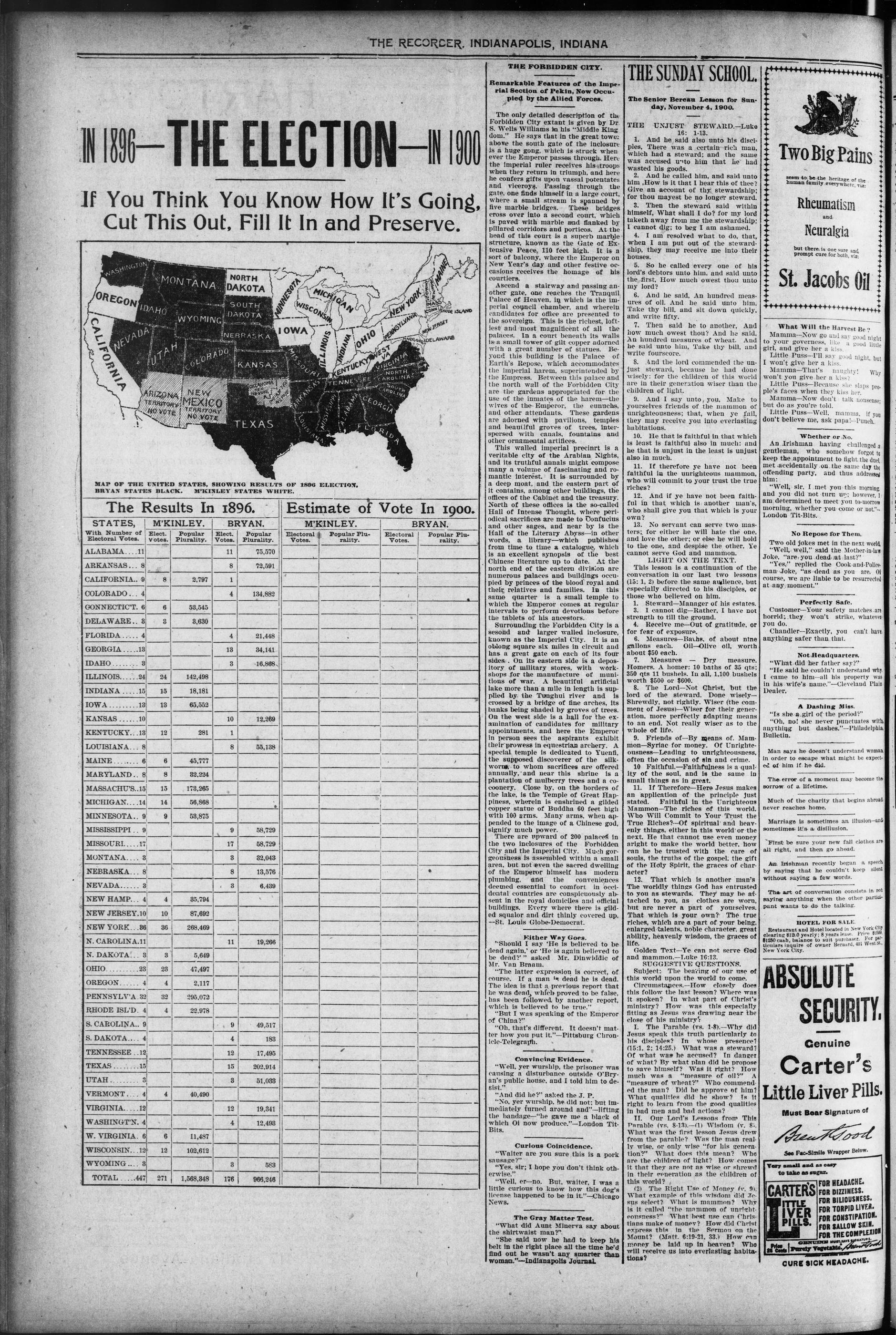
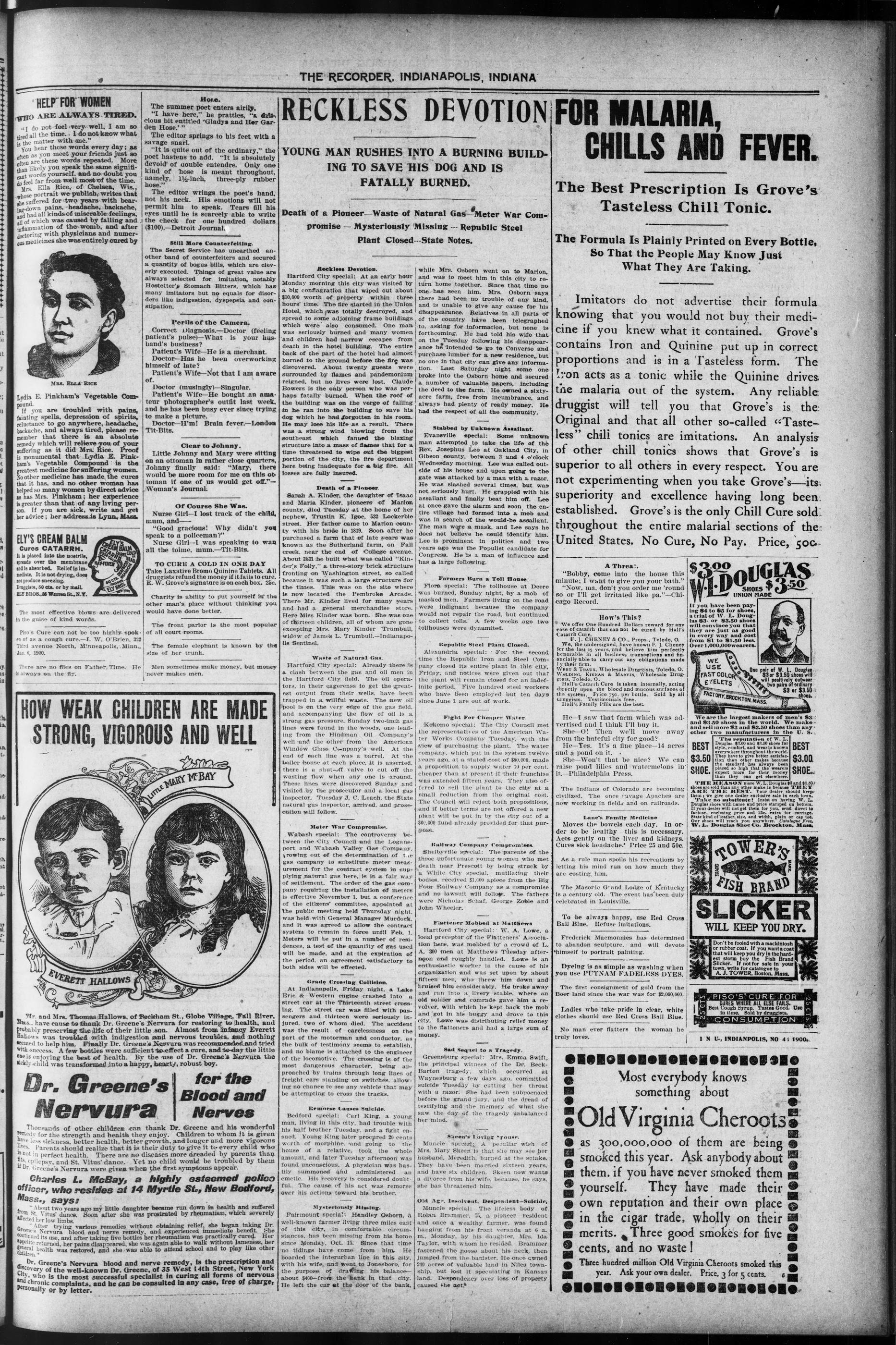
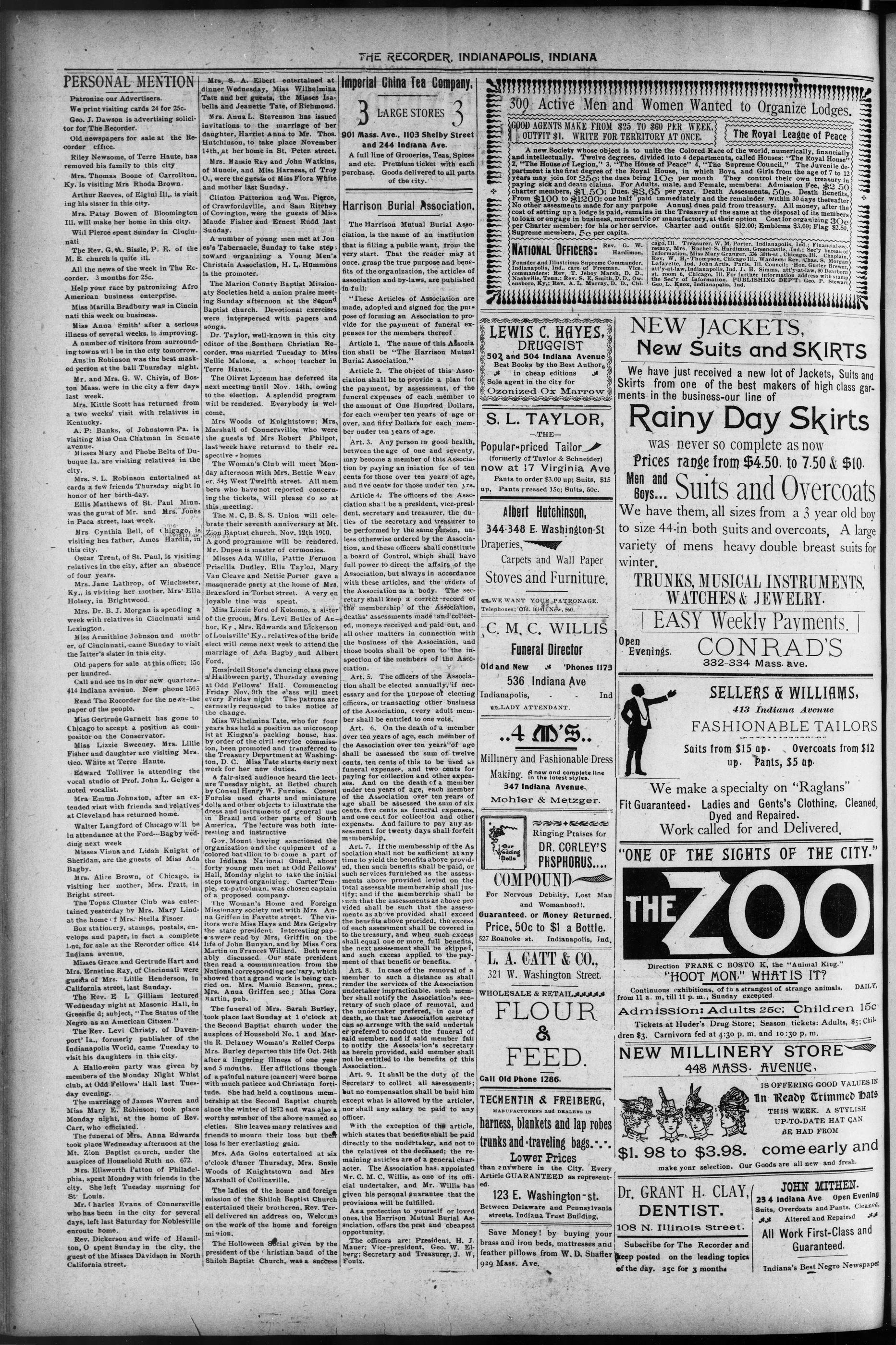
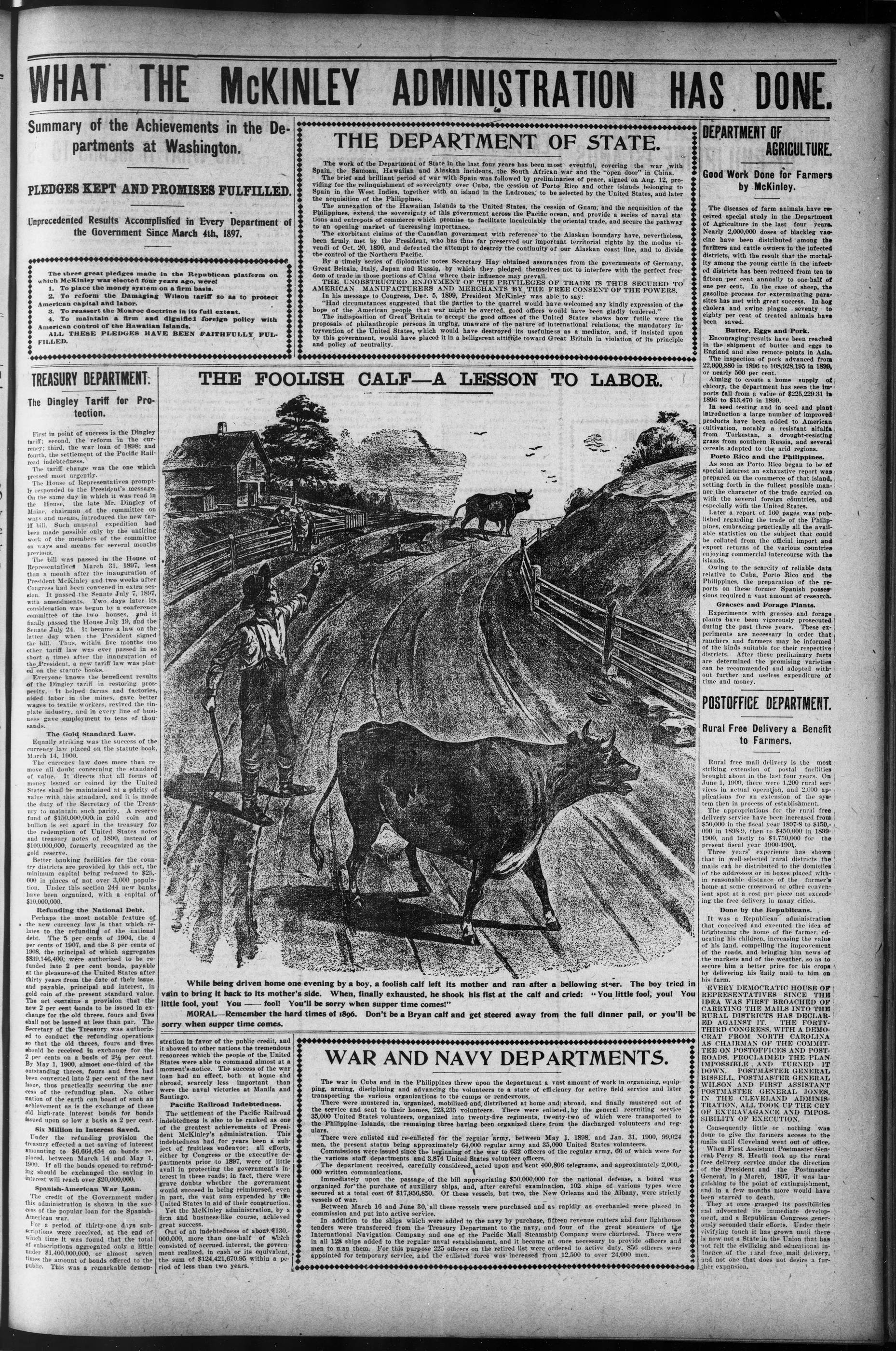
Page text (machine-generated)
Vol 5 No. 18
NEW YORK STORE
Established in 1853.
Sole Agents Butterlck Patterns.
About Our
25c Stockings.
Your next pair should be of ours Every dealer has its 25c Stockings for Ladies--Ours. We consider to be the best on the market; in fact, better than most 35c Grades that are sold; in both the Fit and Wearing gaulities. That they are Fast Black goes without saying. As to quantity, we have them in all sizes and kinds, two thread, plain wribbed tops; all black, all white feet or white sole; medium and heavy weight, also fleece lined. With double soles and high double heels. PETIS DRY GOODS CO.
Hyder's Photo Studio
878 Massachusetts Ave.
AN ANTI-SEPTIC
SKIN PURIFYER
A=ton=a
This Lotion will remove Tan, Freckles
Blacks, Heads, Pimples, etc. Appy
Night and Morning.
SAMPLE SENT FOR 25c
A-ton-a Mfg. Co.
225 Indiana Ave. Indianapolis, Ind.
MADE TO FIT YOU, ARE MY WINTER SUITS & OVERCOATS The latest creations in the Art of Snitings. Come and see them at your convenience.
D. L Mesbitt,
Merchant Tailor. 405 Indiana av
LADIES TAILORING
DICK. MILLER,
340 Indiana Avenne.
CIGARS AND
TOBACCO
OYSTERS fresh from the Sea
board, in any quantity
Daily Papers and Magazines. Bread
Cakes, Pies, Milk and Cream.
CALL AND SEE ME.
Ministers Endorse McKinley.
At a call meeting of the colored ministers, Thursday night, at Mt Zion Church resolutions endorsing the administration of President McKinley were adopted. The following ministers signed the resolutions:
E. L. Gilliam, C. W. Newton, J. J. Blackshear, J. R. Raynor, B. Farrell, D. D. Donohoo. James Holder, Chas. Williams, J. M. Morton, C. C. Wileon, R. French Hurley, W. A. Bowren, N. A. Soymour, R. D. Leoundar, W. H. Patterson, J. A. Preston, J. W. Carr, chairman; E. L. Bell, secretary.
Colored Bataillon.
About 50 members of the new battalion, that is being formed, met at 536 Indiana avenue, Thursday night. All members will report to Dr. Furniss for examination. The next meeting will occur next Friday night. Carter F. B. Temple has been elected as Captain.
Will Give a Social
The Board of Govenors of the Flanner Guild, have decided to give a concert and social, for the benefit of the Guild, next Thursday night at Bethel church. Admission 10 cents.
Subscribe for The Recorder and keep posted on the leading topics of the day. 25c for 3 months
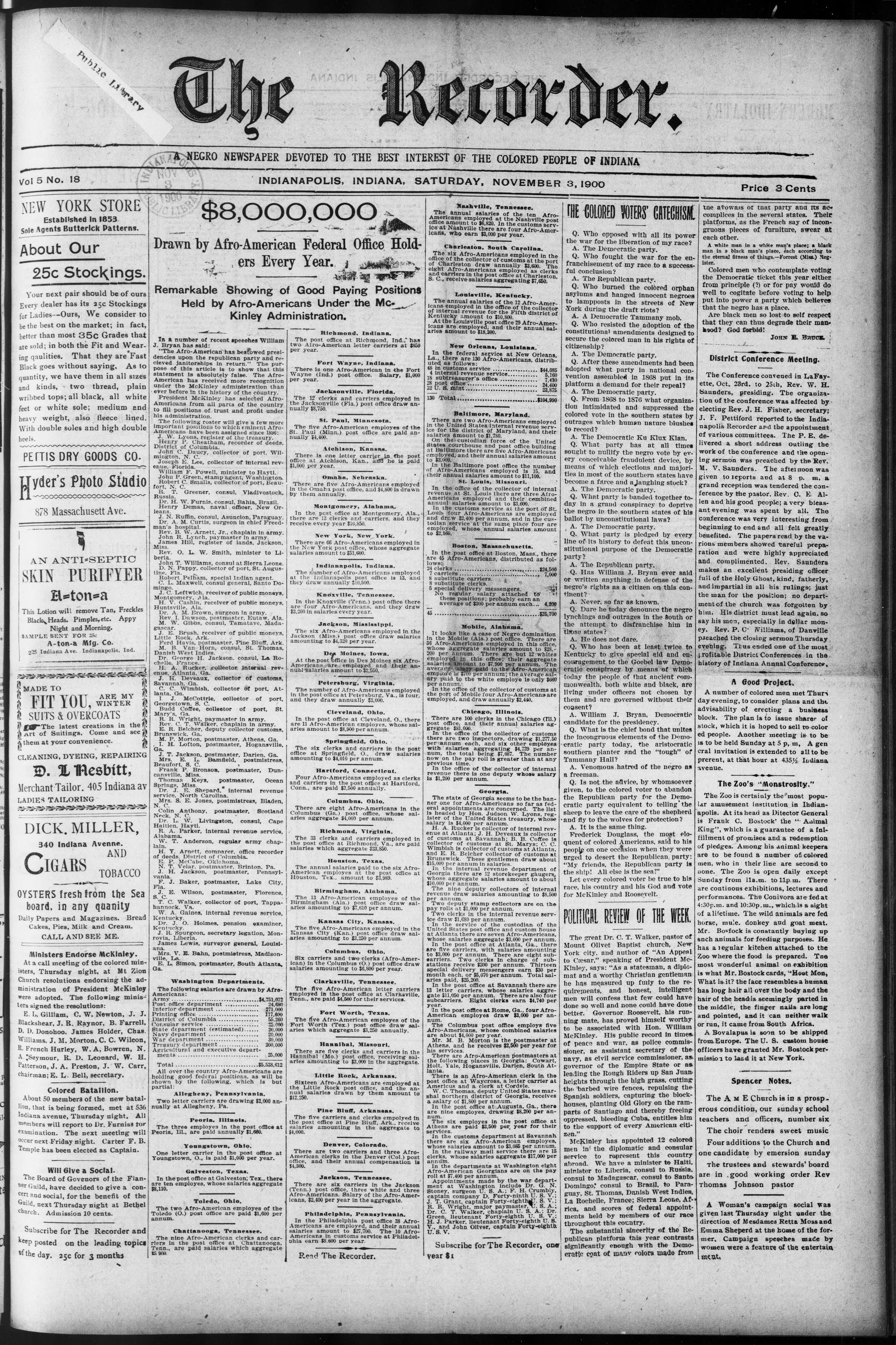
Remarkable Showing of Good Paying Positions Held by Afro-Americans Under the Mc Kinley Administration.
The
A NEGRO NEWSPAPER DE
NOV
3
1908
PUBLIC LIBRARY
$8,000
Drawn by Afro-American
ers Every
Remarkable Showing of
Held by Afro-American
Kinley Admi
In a number of recent speeches William J. Bryan has said:
"The Afro-American has bestowed presidencies upon the republican party and received janitorials in return." The purpose of this article is to show that this statement is absolutely false. The Afro-American received more recognition under the McKenzie administration than ever before in the history of the country.
President McKinley has selected Afro-Americans from all parts of the country to fill positions of trust and profit under his administration.
The following roster will give a few more important positions to which eminent Afro-Americans are registered since 1895: J. W. Lyons, register of deeds; Henry P. Cheatham, recorder of deeds; District of Columbia.
John B. Bury, collector of port, Wilmington, N. C.
Joseph E. Lee, collector of internal revenue, Florida.
John P. Powell, minister to Haytl. John P. Green, stammergent, Washington. Robert C. Smails, collector of port, Beaufort, N. C.
R. T. Greener, consul, Vladivostock, Russia.
D. H. W. Furnis, consul, Bahia, Brazil.
Henry Demas, naval officer, New Orleans.
D. H. Ruff, consul, Asunclon, Paraguay.
Dr. A. M. Curtis, surgeon in chief Freedman's hospital.
Rev. O. L. W. Smith, minister to Liberia.
John T. Williams, consul at Sierra Leone.
John T. Koppy, collector of port, St. Augustine, Fla.
Robert Pelham, special Indian agent.
C. L. Maxwell, consul general, Santo Domingo.
J. C. Leftwell, receiver of public moneys. Montgomery, Ala.
H. W. Cashin, receiver of public moneys.
Huntsville, Ala.
Huntsville, surgeon in army.
Rev. I. Dawson, postmaster, Eutaw, Ala.
M. W. Gibbs, consul, Tamatave, Madagascar.
J. H. Brush, receiver of public moneys.
Little Rock, Ark.
Ferd Havis, postmaster, Pine Bluff, Ark.
M. B. Van Horn, consul, St. Thomas,
Danish West Indies.
Dr. George H. Jackson, consul, Rochelle
H. A. Rucker, collector internal revenue,
Atlanta, Ga.
J. H. Deveaux, collector of customs,
Savannah, Ga.
C. C. Wimbish, collector of port, Atlanta, C. J. McCottie, collector of port, Georgetown, S. C. Budd Coffee, collector of port, St. Michael,
M. P. Morton, postmaster, Athens, Ga.
I. H. Lofton, postmaster, Hogansville, Ga.
J. T. Jackson, postmaster, Darien, Ga.
Mrs. E. I. Bamfield, postmistress,
Benderson, F. Frank P. Bronson, postmaster, Duncansville, Miss.
Thomas Keys, postmaster, Ocean
Shrimp, Miss., E. Sheepard, *internal revenue
service, North Carolina.
Mrs. S. E. Jones, postmistress, Bladen,
N.
Colin Anthony, postmaster, Scotland
Neck. N. L. Lutman, central
Geneva
Dr. L. W. Livingston, consul, Cape Haven Hospital, R. A. Parker, internal revenue service, Alabama. Dr. T. Anderson, regular army chapel-
H. Y. Arnett, comparer, office recorder of deeds. District of Columbia.
E. W. Bahn, Oklahoma.
N. T. Velar, postmaster, Brinton, Pa.
J. H. Jackson, postmaster, Pennsylvania.
J. B. Baker, postmaster, Lake City, Fla.
J. E. Wilson, postmaster, Florence, S.C.
T. C. Walker, collector of port, Tappahannock, Va.
W. A. Gaines, internal revenue service, Kentucky.
D. R. O. Holmes, pension examiner, Kentucky.
J. R. Spurgeon, secretary legation, Monroe, Liberia.
J. James Lewis, surveyor general, Louisiana.
Mrs. V. E. Bahn, postmistress, Madison, Lakes, Ga.
L. E. Simon, postmaster, South Atlanta, Ga.
Washington Departments.
The following salaries are drawn by Afro-
Americans:
Army $4,751,072
Post office department 24,000
Interior department 271,000
Printing office 117,600
District of Columbia 55,260
Consular service 25,000
State department (estimated) 20,000
Navy department 20,000
War department 30,000
Treasury department 200,000
Agricultural and executive de-
ments 25,000
Total $5,538,612
All over the country Afro-Americans are
holding good federal positions, as will
be bound by the following, which is but
partial:
Allegheny, Pennsylvania.
YEARLY.
Two letter carriers are drawing $2,000 annually at Allegheny, Pa.
Youngstown, Ohio.
One letter carrier in the post office at Youngstown, $O_{1}$ is paid $1,000 per year.
Galveston, Texas.
In the post office at Galveston; Tex., there are employees, whose salaries aggregate $110.10.
Toledo. Ohio.
The two Afro-American employees of the Toledo (O.) post office are paid $1,600 per annum.
Chattanooga, Tennessee.
The nine Afro-American clerks and carriers in the post office at Chattanooga, Tenn., are paid salaries which aggregate $5,900.
The post office at Richmond, Ind., has two Afro-American letter carriers at $500 per year.
Fort Wayne, Indiana.
There is one Afro-American in the Fort Wayne (Ind.) post office. Salary, $1,000 per year.
Jacksonville, Florida
The 12 clerks and carriers employees in
the office while (Fla.) post office draw
annually $750.
St. Paul Minnesota
The five Afro-American employees of the
St. Paul (Minn.) post office are paid annually
$4,400.
Athilson, Kansas.
There is one letter carrier in the post
office at Athilson, Kan., and he is paid
$1,000 per year.
Omhna, Nebraska.
There are five Afro-Americans employed in
the Omaha post office, and $4,800 is drawn
by them annually.
Montgomery, Alabam.
In the post office at Montgomery, Ala.,
there are 13 clerks and carriers, and they
receive every year $10,850.
New York, New York.
There are 66 Afro-Americans employed in the New York post office, whose aggregate salaries amount to $1,600.
Indianapolis, Indiana.
The number of Afro-Americans employed at the post office is 13, and they draw annually $1,500.
Knoxville, Tennessee
In the Knoxville (Tenn.) post office there
are 20,200 dollars in cash and they draw
20,200 dollars every year.
Jackson, Mississippi
The six Afro-Americans employed in the
draw salaries amounting to $4,250 per year.
Dee Molner, Iowa.
At the post office in Des Moines six Afro-
Americans are employed and their annual
salaries amount to $2,900.
Petersburg, Virginia.
The number of Afro-Americans employed
in the post office is $2,900; is four,
and they draw annually $5,000.
Cleveland, Ohio.
In the post office at Cleveland, O., there are 11 Afro-American employees, whose salaries amount to $3,000 per annum.
Springfield, Ohio.
The six clerks and carriers in the post office at Springfield, O., draw salaries amounting to $4,000 per annum.
Hartford. Connecticut.
Four Afro-Americans employed as clerks at Hartford, Conn. are paid $2,500 annually. Conn. are paid $2,500 annually.
Columbus, Ohio
There are eight Afro-Americans in the
There are eight Afro-Americans in the
salaries aggregate $4,000 per annum.
Richmond, Virginia.
The 33 clerks and carriers employed in the post office at Richmond Va., are paid salaries which aggregate $23,500.
**Houston, Texs.**
The annual salaries paid to the six Afro-American employees of the office at Houston, Tex., amount to $3,989.
Birmingham, Alabama
The 13 Afro-American employees of the Birmingham (Ala.) post office draw salaries amounting to $7,60 per annum.
Kansas City, Kansas.
The five Afro-Americans employed in the Kansas City (Kan.) post office draw salaries amounting to $3,250 per annum.
Columbus. Ohio.
Six carriers and two clerks (Afro-Amer-
ican) draw salaries amounting to $8,000 per year
salaries amounting to $8,000 per year
Clarksville, Tennessee
The five Afro-American letter carriers
will sell their wigs.
Tenn., are paid $5,500 for their services.
Fort Worth, Texas
The five Afro-American employees of the
salaries which aggregate $250 annually
Hannibal, Missouri
There are five clerks and carriers in the
arries amounting to $3,000 in the aggregate.
Little Rock, Arkansas
Sixteen Afro-Americans are employed at the Little Rock post office, and the annual salaries drawn by them amount to $12,500.
Pine Bluff, Arkansas.
The five carriers and clerks employed in the
them are: the insurance salaries amounting in the aggregate to
Denver, Colorado.
There are two carriers and three Afro-
American clerks in the Denver (Col.) post
office, and their annual compensation is
$4,300.
Jackson, Tennessee.
There are six carriers in the Jackson (Tenn.) post office, three white and three Afro-Americans. Salary of the Afro-Americans, $2,400 per year in the aggregate.
Philadelphia, Pennsylvanian.
In the Philadelphia post office 33 Afro-Americans are employed, and their annual salary is $1,000. The 10 Afro-Americans in customs service at Philadelphia earn $3,600 per year.
Read The Recorder
---
Nashville, Tennessee.
The annual salaries of the ten Afro-Americans employed at the Nashville post are based on the customs service at Nashville there are for Afro-Americans, who earn $3,000 per year.
Charleston, South Carolina
The six Afro-Americans employed in the port of Charleston on customs at the port of Charleston drawed eight Afro-Americans employed as clerks eight Afro-Americans employed as clerks in Charleston, S. C., receive salaries approved by the
Louisville, Kentucky
The annual salaries of the 12 Afro-Americans employed in the office of the collector of internal revenue for the Fifth district of Kentucky to $10,800. At the Louisville office, 99 Afro-Americans are employed, and their annual salaries amount to $18,300.
New Orleans, LA
In the federal service at New Orleans,
La., there are 130 Afro-Americans, distrib-
uated by four federal service offices.
48 in customs service ..... $44,085
4 internal revenue service ..... 5,100
13 subtreasurer's office ..... 7,470
25 post office ..... 24,400
18 U. S. mint ..... 23,875
**Total** ..... $104,990
Baltimore, Maryland.
There are two Afro-Americans employed in
international law, the district of Maryland, and their
labor force in the district of Maryland.
On the custodian force of the United States courthouse and post office building at Baltimore and three Afro-Americans employed, and their annual salaries amount to $3,000. Baltimore post office the number of Afro-Americans employed is 15 and their annual salaries amount to $11,000. St. Louis, Missouri. In the office of the collector of internal revenue and the three Afro-Americans employed and their combined annual salaries amount to $3,600. The customs service at the port of St. Louis and the three Afro-Americans employed and draw $2,400 per annum, and in the custodian service at the same place four are employed, whose annual salaries amount
Boston, Massachusetts
In the post office at Boston, Mass., there are 45 Afro-Americans, distributed as follows:
24 clerks ..... $24,500
7 carriers ..... 7,000
8 substitute carriers
8 substitute clerks
5 special delivery messengers.
No regular salary attached to
these positions; probably earn an
average of $200 per annum each. .. 4,200
45 ..... $35,700
Mobile, Alabama.
It looks like a case of Negro domination
in the Mobile (Ala.) post office. There are
12 Americans employed in this office,
whose aggregate salary is $200 per annum. There are but 12 whites
employed in this office; their aggregate
salaries amount to $7,500 per annum. The
average salary paid to them is $100 per annum; the average
salary paid to the white employee is only $600
per annum.
A case of the collector of customs at
the port of Mobile four Afro-Americans are
employed, and draw annually $2,440.
Chicago, Illinois
There are 100 clerks in the Chicago (IL.) post office, and their annual salaries agree with the office. In the office of the collector of customs there are two inspectors, drawing $1,277.50 per annum each, and six other employees salaries aggregating $4,739 per annum, total. Now on the pay roll is greater than at any previous time. The office of the collector of internal revenue there is one deputy whose salary is $1,200 per annum.
Georgia
The state of Georgia seems to be the banner one for Afro-Americans so far as fed- inal estates are concerned. The list is headed by Hossein. The sister of the United States treasury, whose salary is $4,000 per annum. The amount of internal revenue at Atlanta; J. H. Deveaux is collector of customs at Savannah; B. B. Coffee is collector of customs at St. Mary; C. C. Viburna is collector of customs at Atlanta; B. B. Deveaux is collector of customs at Brunswick. These gentlemen draw about $15,000 per annum in salaries. The internal revenue department of Georgia there are 12 keeper-gates whose aggregate salaries amount to about $10,000 per annum. The nine deputy collectors of internal re- velations薪水 amounts to $8,500 per annum. Two deputy stamp collectors are on the pay rolls at $1,000 per annum. The final internal revenue service draw $1,080 per annum. In the service of the custodian of the United States post office and custom house, whose salaries aggregate $3,000 per annum.
In the post office at Atlanta, Ga. there are five carriers, with salaries amounting $1,000 per annum. Two clerks in charge of substitutes receive $200 per annum. Thirteen special delivery messengers earn $30 per annum and $70 per annum. Total salaries paid, $25,200. In the post office at Savannah there are 13 letter carriers, whose salaries aggregate $1,000 per annum. Eight clerks earn $4,700 per year. In the post office at Rome, Ga. four Afro-American employees draw $3,000 per annum. The Columbus post office employs five Afro-American employees whose combined salaries are about $4,000 per annum.
Mr. M. B. Morton is the postmaster at
Atlanta, he receives $2,500 per year for
his services.
There are Afro-American postmasters at the following places in Georgia: Cowart, Holt Yale, Hogansville, Darlen, South Atlanta. There is an Afro-American clerk in the post office at Waycross, a letter carrier at Atlanta, W. C. Thomas, deputy United States marshal northern district of Georgia, receives a salary of $1,900 per annum.
In the post office at Augusta, Ga, there are nine employees, drawing $3,200 per an-
HE GOLORED VOTERS' GATECHISM
Q. Who opposed with all its power the war for the liberation of my race?
A. The Democratic party.
Q. Who fought the war for the enfranchisement of my race to a successful conclusion?
A. The Republican party.
Q. Who burned the colored orphan asylums and hanged innocent negroes to lampposts in the streets of New York during the draft riots?
A. A Democratic Tammany mob.
Q. Who resisted the adoption of the constitutional amendments designed to secure the colored man in his rights of citizenship?
A. The Democratic party.
Q. After these amendments had been adopted what party in national convention assembled in 1868 put in its platform a demand for their repeal?
A. The Democratic party.
Q. From 1868 to 1876 what organization intimidated and suppressed the colored vote in the southern states by outrages which human nature blushes to record?
A. The Democratic Ku Klux Klan.
Q. What party has at all times sought to nullify the negro vote by every conceivable fraudulent device, by means of which elections and majorities in most of the southern states have become a farce and a laughing stock?
A. The Democratic party.
Q. What party is banded together today in a grand conspiracy to deprive the negro in the southern states of his ballot by unconstitutional laws?
A. The Democratic party.
Q. What party is pledged by every line of its history to defeat this unconstitutional purpose of the Democratic party?
A. The Republican party.
Q. Has William J. Bryan ever said or written anything in defense of the negro's rights as a citizen on this continent?
A. Never, so far as known.
Q. Dare he today denounce the negro lynchings and outrages in the south or the attempt to disfranchise him in those states?
A. He does not dare.
Q. Who has been at least twice to Kentucky to give special aid and encouragement to the Goebel law Democratic conspiracy by means of which today the people of that ancient commonwealth, both white and black, are living under officers not chosen by them and are governed without their consent?
A. William J. Bryan, Democratic candidate for the presidency.
Q. What is the chief bond that unites the incongruous elements of the Democratic party today, the aristocratic southern planter and the "tough" of Tammany Hall?
A. Venomous hatred of the negro as a freeman.
Q. Is not the advice, by whomsoever given, to the colored voter to abandon the Republican party for the Democratic party equivalent to telling the sheep to leave the care of the shepherd and fly to the wolves for protection?
A. It is the same thing.
Frederick Douglass, the most eloquent of colored Americans, said to his people on one occasion when they were urged to desert the Republican party:
"My friends, the Republican party is the ship! All else is the sea!"
Let every colored voter be true to his race, his country and his God and vote for McKinley and Roosevelt.
POLITICAL REVIEW OF THE WEEK
The great Dr. C. T. Walker, pastor of Mount Olivet Baptist church, New York city, and author of "An Appeal to Cesar," speaking of President McKinley, says: "As a statesman, a diplomat and a worthy Christian gentleman he has measured up fully to the requirements, and honest, intelligent men will confess that few could have done so well and none could have done better. Governor Roosevelt, his running mate, has proved himself worthy to be associated with Hon. William McKinley. His public record in times of peace and war, as police commissioner, as assistant secretary of the navy, as civil service commissioner, as governor of the Empire State or as leading the Rough Riders up San Juan heights through the high grass, cutting the barbed wire fences, repulsing the Spanish soldiers, capturing the blockhouses, planting Old Glory on the ramparts of Santiago and thereby freeing oppressed, bleeding Cuba, entitles him to the support of every American citizen."
McKinley has appointed 12 colored men in the diplomatic and consular service to represent this country abroad. We have a minister to Haiti, minister to Liberia, consul to Russia, consul to Madagascar, consul to Santo Domingo, consul to Brazil, to Paraguay, St. Thomas, Danish West Indies, La Rochelle, France; Sierra Leone, Africa, and scores of federal appointments held by members of our race throughout this country. The substantial sincerity of the Republican platform this year contrasts significantly enough with the Democratic coat of many colors made from
one avowals or that party and its accomplices in the several states. Their platforms, as the French say of incongruous pieces of furniture, swear at each other.
A white man in a white man's place; a black man in a black man's place, each according to the eternal fitness of things—Forrest (Miss) Register.
Colored men who contemplate voting the Democratic ticket this year either from principle (?) or for pay would do well to cogitate before voting to help put into power a party which believes that the negro has a place.
Are black men so lost to self respect that they can thus degrade their manhood? God forbid!
JOHN E. BRUCE
District Conference Meeting.
The Conference convened in LaFayette, Oct. 28rd. to 25th, Rev. W. H. Saunders, presiding. The organization of the conference was affected by electing Rev. J. H. Fisher, secretary; J. F. Pettiford reported to the Indianapolis Recorder and the appointment of various committees. The P. E. delivered a short address outlining the work of the conference and the opening sermon was preached by the Rev. M. V. Saunders. The afternoon was given to reports and at 8 p. m. a grand reception was tendered the conference by the pastor, Rev. C. E. Allen and his good people; a very pleasant evening was spent by all. The conference was very interesting from beginning to end and all felt greatly benefited. The papers read by the various members showed careful preparation and were highly appreciated and complimented. Rev. Saunders makes an excellent presiding officer full of the Holy Ghost, kind, fatherly, and impartial in all his rulings; just the man for the position; no department of the church was forgotten by him. His district must lead again, so say his men, especially in dollar money. Rev. P. C' Williams, of Danville preached the closing sermon Thursday evening. Thus ended one of the most profitable District Conferences in the history of Indiana Annual Conference.
A Good Project.
A number of colored men met Thursday evening, to consider plans and the advisability of erecting a business block. The plan is to issue sharer of stock, which it is hoped to sell to color ed people. Another meeting is to be is to be held Sunday at 5 p., m., A general invitation is extended to all to be present, at that hour at 435% Indiana avenue.
The Zoo's "Monstrosity."
The Zoo is certainly the most popular amusement institution in Indianapolis. At its head is Ditector General is Frank C. Bostock' the "Animal King", which is a guarantee of a fulfillment of promises and a redemption of pledges. Among his animal keepers are to be found a number of colored men, who in their line are second to none. The Zoo is open daily except Sunday from 11a.m. to 11p.m. There are continuous exhibitions, lectures and performances. The Conivora are fed at 4:30p.m. and 10:30p.m., which is a sight of a lifetime. The wild animals are fed horse, mu'e. donkey and goat meat. Mr. Bostock is constantly buying up such animals for feeding purposes. He has a regular kitchen attached to the Zoo where the food is prepared. The most wonderful animal on exhibition is what Mr. Bostock cards, "Hoot Mon, What is it? the face resembles a human has long hair all over the body and the hair of the headis seemingly parted in the middle, the finger nails are long and pointed, and it can neither walk or run, it came from South Africa.
A Bovalapus is soon to be shipped from Europe. The U. S. custom house officers have granted Mr. Bostock permission to land it at New York.
Spencer Notes.
The A M E Church is in a prosperous condition, our sunday school teachers and officers, number six The choir renders sweet music Four additions to the Church and one candidate by emersion sunday The trustees and stewards' board are in good working order Rev Thomas Johnson pastor
A Woman's campaign social was given last Thursday night under the direction of Mesdames Retta Moss and Emma Sheperd at the home of the former, Campaign speeches made by women were a feature of the entertain ment.
OUR COMMERCIAL AND TERRITORIAL EXPANSION
AMERICA'S GREAT NEED OF PHILIPPINE ISLANDS.
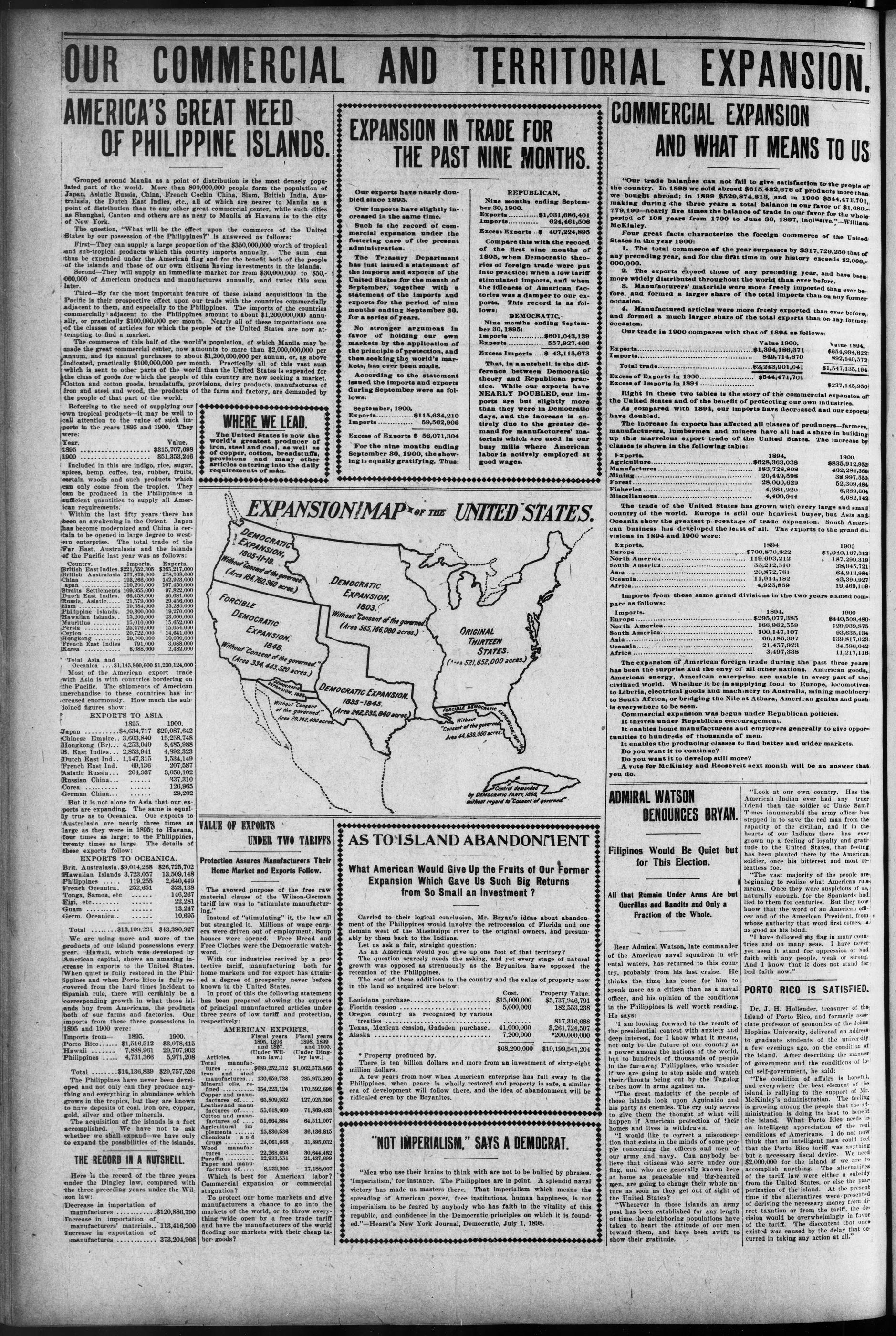
Grouped around Manila as a point of distribution is the most densely populated part of the world. More than 800,000,000 people form the population of Japan, Asiatic Russia, China, French Cochin China, Siam, British India, Australasia, the Dutch East Indies, etc., all of which are nearer to Manila as a point of distribution than to any other great commercial center, while such cities as Shanghai, Canton and others are as near to Manila as Havana is to the city of New York.
The question, "What will be the effect upon the commerce of the United States by our possession of the Philippines?" is answered as follows:
First—They can supply a large proportion of the $350,000,000 worth of tropical and sub-tropical products which this country imports annually. The sum can thus be expended under the American flag and for the benefit both of the people of the islands and those of our own citizens having investments in the islands.
Second—They will supply an immediate market for from $30,000,000 to $50,000,000 of American products and manufactures annually, and twice this sum later.
Third—By far the most important feature of these island acquisitions in the Pacific is their prospective effect upon our trade with the countries commercially adjacent to them, and especially to the Philippines. The imports of the countries commercially adjacent to the Philippines amount to about $1,200,000,000 annually, or practically $100,000,000 per month. Nearly all of these importations are of the classes of articles for which the people of the United States are now attempting to find a market.
The commerce of this half of the world's population, of which Manila may be made the great commercial center, now amounts to more than $2,000,000,000 per annum, and its annual purchases to about $1,200,000,000 per annum, or, as above indicated, practically $100,000,000 per month. Practically all of this vast sum which is sent to other parts of the world than the United States is expended for the class of goods for which the people of this country are now seeking a market. Cotton and cotton goods, breadstuffs, provisions, dairy products, manufactures of iron and steel and wood, the products of the farm and factory, are demanded by the people of that part of the world.
Referring to the need of supplying our own tropical products—it may be well to call attention to the value of such imports in the years 1895 and 1900. They were:
Included in this are indigo, rice, sugar, spices, hemp, coffee, tea, rubber, fruits, certain woods and such products which can only come from the tropics. They can be produced in the Philippines in sufficient quantities to supply all American requirements. Within the last fifty years there has been an awakening in the Orient. Japan has become modernized and China is certain to be opened in large degree to western enterprise. The total trade of the Far East, Australasia and the islands of the Pacific last year was as follows:
Country. Imports. Exports.
British East Indies. $221,552,305 $365,217,000
British Australasia. 170,364,000 170,364,000
China. 103,269,000 142,923,000
apan. 110,200,000 107,450,000
Straits Settlements 109,955,000 97,822,000
Dutch East Indies. 66,458,000 80,081,000
Brasil, Aslantic. 21,745,000 15,083,000
Siam. 19,384,000 25,280,000
Philippine Islands. 20,300,000 19,270,000
Hawaiian Islands. 15,200,000 23,000,000
Mauritius. 15,010,000 15,632,000
Oceania. 25,475,000 16,522,000
Ceylon. 20,722,000 14,641,000
Hongkong. 20,000,000 10,000,000
French East Indies. 791,000 3,088,000
Korea. 8,088,000 2,482,000
Total Asia and
Oceania. $1,145,860,000 $1,230,124,000
Most of the American export trade
with Asia is with countries bordering on
the Pacific. The shipments of American
merchandise to these countries has
increased enormously. How much the
sub-founded figures show:
Brit. Australasia. $9,014,268 $26,725,702
Hawaiian Islands . 3,723,037 13,509,148
Philippines . . . 119,255 2,640,449
French Oceanica. 232,651 323,138
Tonga, Samoa, etc. . . . 140,267
Eliq, etc. . . . 22,281
Guam. . . . 13,247
Germ. Oceanica. . . . 10,695
Total . . . . $13,109,231 $43,390,927
We are using more and more of the products of our island possessions every year. Hawaii, which was developed by American capital, shows an amazing increase in exports to the United States. When quiet is fully restored in the Philippines and when Porto Rico is fully recovered from the hard times incident to Spanish rule, there will certainly be a corresponding growth in what those islands buy from Americans, the products both of our farms and factories. Our imports from these three possessions in 1895 and 1900 were:
Imports from..... 1895. 1900.
Porto Rico..... $1,516,512 $3,078,415
Hawaii..... 7,888,961 20,707,903
Philippines..... 4,731,366 5,971,208
Total..... $14,136,839 $20,757,526
The Philippines have never been developed and not only can they produce anything and everything in abundance which grows in the tropics, but they are known to have deposits of coal, iron ore, copper, gold, silver and other minerals.
The acquisition of the islands is a fact accomplished. We have not to ask whether we shall expand—we have only to expand the possibilities of the islands.
THE RECORD IN A NUTSHELL.
Here is the record of the three years under the Dingley law, compared with the three preceding years under the Wilson law:
Decrease in importation of manufactures ..... $120,880,790
Increase in importation of manufacturers' materials. ..... 113,416,200
Increase in exportation of manufactures ..... 373,204,966
The United States is now the world's greatest producer of iron, steel and coal, as well as of copper, cotton, breadstuff, provisions and many other articles entering into the daily requirements of man.
EXPANSION
DEMOCRATIC
EXPANSION.
1805-11-19.
Without "Consent of the governed."
(Area 184,760,960 acres.)
FORCIBLE
DEMOCRATIC
EXPANSION.
1848.
Without "Consent of the governed."
(Area 334,443,520 acres.)
DEMOCRATIC
EXPANSION, 1833.
Without "Consent"
of the governed."
Area 29,142,400 acres
VALUE OF EXPORTS
UNDER TWO TARIFFS
Protection Assures Manufacturers Their Home Market and Exports Follow.
The avowed purpose of the free raw material clause of the Wilson-Gorman tariff law was to "stimulate manufacturing."
Instead of "stimulating" it, the law all but strangled it. Millions of wage earners were driven out of employment. Soup houses were opened. Free Bread and Free Clothes were the Democratic watchword.
With our industries revived by a protective tariff, manufacturing both for home markets and for export has attained a degree of prosperity never before known in the United States.
In proof of this the following statement has been prepared showing the exports of principal manufactured articles under three years of low tariff and protection, respectively:
Fiscal years 1895, 1896 1895, 1896 1895, 1896
(Under Wil-
son law.) 1890, 1890,
(Under Ding-
ley law.)
Articles.
Total manufactu-
tures ..... 698,252,312 $1,062,573,886
Inland and
steel manufactu-
tures ..... 130,659,738 285,975,290
Mineral oils, re-
fined ..... 154,222,124 170,592,989
Copper and manu-
ufactures of...
65,800,932 127,025,396
Leather and manu-
factures of...
53,018,009 71,898,433
Cotton and manu-
factures of...
51,664,884 64,511,007
Agricultural im-
plements ..... 15,830,536 36,136,815
Chemicals a nd
drugs ..... 24,061,668 31,895,032
Wood manufactu-
tures ..... 22,268,698 60,444,842
Paraffin ..... 12,933,551 21,437,698
Paper and manu-
factures ..... 8,223,295 17,188,007
Which is best for American labor? Commercial expansion or commercial stagnation? To protect our home markets and give manufacturers a chance to go into the markets of the world, or to throw everything wide open by a free trade tariff and have the manufacturers of the world flooding our markets with their cheap labor goods?
EXPANSION IN TRADE FOR THE PAST NINE MONTHS.
AS TO ISLAND ABANDONMENT
What American Would Give Up the Fruits of Our Former Expansion Which Gave Us Such Big Returns from So Small an Investment?
Carried to their logical conclusion, Mr. Bryan's ideas about abandonment of the Philippines would involve the retroduction of Florida and our domain west of the Mississippi river to the original owners, and presumably by them back to the Indians.
Let us ask a fair, straight question:
As an American would you give up one foot of that territory?
As an immigrant would you give up one role of that territory?
The question scarcely needs the asking, and yet every stage of natural growth was opposed as strenuously as the Bryanites have opposed the retention of the Philippines.
The cost of these additions to the country and the value of property now in the land so acquired are below:
There is ten billion dollars and more from an investment of sixty-eight million dollars.
A few years from now when American enterprise has full sway in the Philippines, when peace is wholly restored and property is safe, a similar era of development will follow there, and the idea of abandonment will be ridiculed even by the Bryanites.
"NOT IMPERIALISM." SAYS A DEMOCRAT.
"Men who use their brains to think with are not to be bullied by phrases. 'Imperialism,' for instance. The Philippines are in point. A splendid naval victory has made us masters there. That imperialism which means the spreading of American power, free institutions, human happiness, is not imperialism to be feared by anybody who has faith in the vitality of this republic, and confidence in the Democratic principles on which it is founded."—Hearst's New York Journal, Democratic, July 1, 1898.
Our exports have nearly doubled since 1895.
Our imports have slightly increased in the same time.
Such is the record of commercial expansion under the fostering care of the present administration.
The Treasury Department has just issued a statement of the imports and exports of the United States for the month of September, together with a statement of the imports and exports for the period of nine months ending September 30, for a series of years.
No stronger argument in favor of holding our own markets by the application of the principle of protection, and then seeking the world's markets, has ever been made.
According to the statement issued the imports and exports during September were as follows:
September, 1900
Exports ..... $115,634,210
Imports ..... 59,562,906
Excess of Exports $ 56,071,304
For the nine months ending September 30, 1900, the showing is equally gratifying. Thus:
REPUBLICAN.
Nine months ending September 30, 1900.
ber 30, 1900.
Exports ..... $1,031,686,401
Imports ..... 624,461,506
Excess: Exports ..... $ 407,224,895
Compare this with the record of
the first nine months of
1895, when Democratic theories
of foreign trade were put
into practice; when a low tariff
stimulated imports, and when
the idleness of American factories was a damper to our exports. This record is as follows:
DEMOCRATIC.
Nine months ending September
30, 1895:
Imports ..... $601,043,139
Exports ..... 557,927,466
Excess Imports ..... $ 43,165,673
That, in a nutshell, is the difference between Democratic theory and Republican practice. While our exports have NEARLY DOUBLED, our imports are but slightly more than they were in Democratic days, and the increase is entirely due to the greater demand for manufacturers' materials which are used in our busy mills where American labor is actively employed at good wages.
COMMERCIAL EXPANSION AND WHAT IT MEANS TO US
"Our trade balances can not fall to give satisfaction to the people of the country. In 1898 we sold abroad $615,482,676 of products more than we bought abroad; in 1899 $529,874,813, and in 1900 $544,471,701, making during the three years a total balance in our favor of $1,689,779,190—nearly five times the balance of trade in our favor for the whole period of 108 years from 1790 to June 30, 1897, inclusive."—William McKinley.
Four great facts characterize the foreign commerce of the United States in the year 1900:
1. The total commerce of the year surpasses by $317,729,250 that of any preceding year, and for the first time in our history exceeds $2,000,000,000.
2. The exports exceed those of any preceding year, and have been more widely distributed throughout the world than ever before.
3. Manufacturers' materials were more freely imported than ever before, and formed a larger share of the total imports than on any former occasion.
4. Manufactured articles were more freely exported than ever before, and formed a much larger share of the total exports than on any former occasion.
Our trade in 1900 compares with that of 1894 as follows:
The increase in exports has affected all classes of producers—farmers, manufacturers, lumbermen and miners have all had a share in building up this marvelous export trade of the United States. The increase by classes is shown in the following table:
Exports. 1894. 1900.
Agriculture $628,363,038 $835,912,952
Manufactures 183,728,809 432,284,366
Mining 20,449,598 38,997,550
Forest 28,000,629 52,309,484
Fisheries 4,261,920 6,289,604
Miscellaneous 4,400,944 4,682,142
The trade of the United States has grown with every large and small country of the world. Europe is still our heaviest buyer, but Asia and Oceania show the greatest percentage of trade expansion. South American business has developed the least of all. The exports to the grand divisions in 1894 and 1900 were:
Exports. 1894 1900
Europe $700,870,822 $1,040,167,312
North America 119,693,212 187,299,319
South America 33,212,310 38,945,721
Asia 20,872,761 64,913,984
Oceania 11,914,182 43,390,927
Africa 4,923,859 19,469,109
Imports. 1894. 1900
Europe $295,077,385 $440,509,480
North America 166,962,559 129,939,875
South America 100,147,107 93,635,134
Asia 66,186,397 139,817,023
Oceania 21,457,923 34,596,042
Africa 3,497,338 11,217,116
The expansion of American foreign trade during the past three years has been the surprise and the eny of all other nations. American goods, American energy, American enterprise are usable in every part of the civilized world. Whether it be in supplying food to Europe, locomotives to Liberia, electrical goods and machinery to Australia, mining machinery to South Africa, or bridging the Nile at Atbara, American genius and push is everywhere to be seen.
Commercial expansion was begun under Republican policies.
It thrives under Republican encouragement.
It enables home manufacturers and employers generally to give opportunities to hundreds of thousands of men.
It enables the producing classes to find better and wider markets.
Do you want it to continue?
Do you want it to develop still more?
A vote for McKinley and Roosevelt next month will be an answer that you do.
ADMIRAL WATSON
DENOUNCES BRYAN
Filipinos Would Be Quiet but for This Election.
All that Remain Under Arms Are but Guerillas and Bandits and Only a Fraction of the Whole.
Rear Admiral Watson, late commander of the American naval squadron in oriental waters, has returned to this country, probably from his last cruise. He thinks the time has come for him to speak more as a citizen than as a naval officer, and his opinion of the conditions in the Philippines is well worth reading. He says:
"I am looking forward to the result of the presidential contest with anxiety and deep interest, for I know what it means, not only to the future of our country as a power among the nations of the world, but to hundreds of thousands of people in the far-away Philippines, who wonder if we are going to step aside and watch their throats being cut by the Tagalog tribes now in arms against us.
"The great majority of the people of those islands look upon Aguinaldo and his party as enemies. The cry only serves to give them the thought of what will happen if American protection of their homes and lives is withdrawn."
"I would like to correct a misconception that exists in the minds of some people concerning the officers and men of our army and navy. Can anybody believe that citizens who serve under our flag, and who are generally known here at home as peaceable and big-hearted men, are going to change their whole nature as soon as they get out of sight of the United States?
"Wherever in those islands an army post has been established for any length of time the neighboring populations have taken to heart the attitude of our men toward them, and have been swift to show their gratitude."
"Look at our own country. Has the American Indian ever had any truer friend than the soldier of Uncle Sam? Times innumerable the army officer has stepped in to save the red man from the rapacity of the civilian, and if in the hearts of our Indians there has ever grown up a feeling of loyalty and gratitude to the United States, that feeling has been planted there by the American soldier, once his bitterest and most relentless foe.
"The vast majority of the people are beginning to realize what American rule means. Once they were suspicious of us, naturally enough, for the Spaniards had lied to them for centuries. But they now know that the word of an American officer and of the American President, from whose authority that word first comes, is as good as his bond.
"I have followed my flag in many countries and on many seas. I have never yet seen it stand for oppression or bad faith with any people, weak or strong. And I know that it does not stand for bad faith now."
PORTO RICO IS SATISFIED.
Dr. J. H. Hollender, treasurer of the Island of Porto Rico, and formerly associate professor of economics of the Johns Hopkins University, delivered an address to graduate students of the university a few evenings ago, on the condition of the island. After describing the manner of government and the conditions of local self-government, he said:
"The condition of affairs is hopeful, and everywhere the best element of the island is rallying to the support of Mr. McKinley's administration. The feeling is growing among the people that the administration is doing its best to benefit the island. What Porto Rico needs is an intelligent appreciation of the real conditions of Americans. I do not now think that an intelligent man could feel that the Porto Rico tariff was anything but a necessary fiscal device. We need $2,000,000 for the island if we are to accomplish anything. The alternatives of the tariff law were either a subsidy from the United States, or else the paraperization of the island. At the present time if the alternatives were presented of deriving the necessary money from direct taxation or from the tariff, the decision would be overwhelmingly in favor of the tariff. The discontent that once existed was caused by the delay that occurred in taking any action at all."
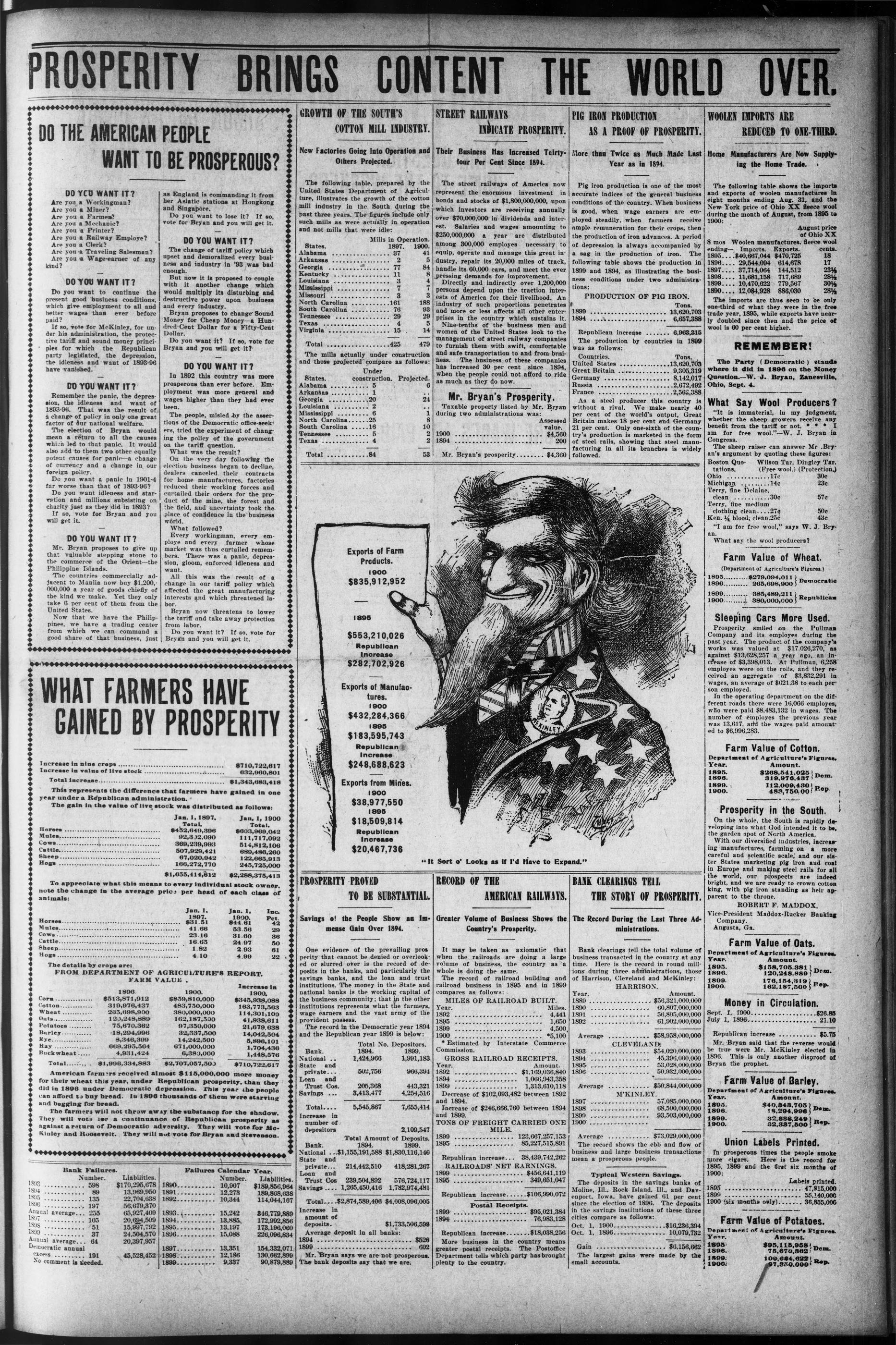
PROSPERITY BRINGS CONTENT THE WORLD OVER.
DO THE AMERICAN PEOPLE WANT TO BE PROSPEROUS?
WHAT FARMERS HAVE GAINED BY PROSPERITY
Jan. 1, 1897.
Total.
$452,649,396
92,322,090
369,239,993
507,929,421
67,020,942
166,272,770
$1,655,414,612
Jan. 1, 1900.
Total.
$603,969,042
111,717,092
514,812,106
689,486,290
122,665,913
245,725,000
$2,288,375,413
To appreciate what this means to every individual stock owner, note the change in the average price per head of each class of animals:
Jan. 1, 1897.
$31.51
Jan. 1, 1900.
$44.61
Inc.
Pct.
Horses
Mules
Cows
Cattle
Sheep
Hogs
41.66
23.16
16.65
1.82
4.10
53.56
31.60
24.97
2.93
4.99
61
22
Increase in
1896. 1900. 1900.
Corn. $513,871,912 $859,810,000 $345,938,088
Cotton. 319,976,437 483,750,000 163,773,563
Wheat. 285,698,900 380,000,000 114,301,100
Oats. 120,248,889 162,187,500 41,938,611
Potatoes. 75,670,362 97,350,000 21,679,638
Barley. 18,294,996 32,337,500 14,042,504
Rye. 8,346,399 14,242,500 5,896,101
Hay. 669,295,564 671,000,000 1,704,436
Buckwheat. 4,931,424 6,380,000 1,448,576
Total. $1,996,334,883 $2,707,057,500 $710,722,617
American farmers received almost $115,000,000 more money for their wheat this year, under Republican prosperity, than they did in 1896 under Democratic depression. This year the people can afford to buy bread. In 1896 thousands of them were starving and begging for bread.
The farmers will not throw away the substance for the shadow. They will vote for a continuance of Republican prosperity as against a return of Democratic adversity. They will vote for McKinley and Roosevelt. They will not vote for Bryan and Stevenson.
<table><thead><tr><th colspan="3">Bank Failures.</th><th colspan="3">Failures Calendar Year.</th></tr><tr><th></th><th>Number.</th><th>Liabilities.</th><th></th><th>Number.</th><th>Liabilities.</th></tr></thead><tbody><tr><td>1803</td><td>598</td><td>$170,295,078</td><td>1890</td><td>10,907</td><td>$189,856,964</td></tr><tr><td>1804</td><td>89</td><td>13,969,950</td><td>1891</td><td>12,273</td><td>189,808,638</td></tr><tr><td>1805</td><td>135</td><td>22,704,038</td><td>1892</td><td>10,344</td><td>114,044,167</td></tr><tr><td>1806</td><td>197</td><td>56,679,870</td><td></td><td></td><td></td></tr><tr><td>Annual average</td><td>255</td><td>65,927,409</td><td>1893</td><td>15,242</td><td>846,779,889</td></tr><tr><td>1807</td><td>105</td><td>20,694,509</td><td>1894</td><td>13,885</td><td>172,902,856</td></tr><tr><td>1808</td><td>51</td><td>15,997,792</td><td>1895</td><td>13,197</td><td>173,190,060</td></tr><tr><td>1809</td><td>37</td><td>24,504,570</td><td>1896</td><td>15,088</td><td>226,096,834</td></tr><tr><td>Annual average</td><td>64</td><td>20,397,957</td><td></td><td></td><td></td></tr><tr><td>Democratic annual excess</td><td>191</td><td>45,528,452</td><td>1897</td><td>13,351</td><td>154,332,071</td></tr><tr><td>No comment is needed.</td><td></td><td></td><td>1898</td><td>12,186</td><td>130,662,899</td></tr></tbody></table>
DO YCU WANT IT?
DO YOU WANT IT?
Are you a Workingman?
Are you a Miner?
Are you a Farmer?
Are you a Mechanic?
Are you a Printer?
Are you a Railway Employee?
Are you a Clerk?
Are you a Traveling Salesman?
Are you a Wage-earner of any kind?
DO YOU WANT IT?
Do you want to continue the present good business conditions, which give employment to all and better wages than ever before paid?
If so, vote for McKinley, for under his administration, the protective tariff and sound money principles for which the Republican party legislated, the depression, the idleness and want of 1893-96 have vanished.
DO YOU WANT IT?
Remember the panic, the depression, the idleness and want of 1893-96. That was the result of a change of policy in only one great factor of our national welfare. The election of Bryan would mean a return to all the causes which led to that panic. It would also add to them two other equally potent causes for panic—a change of currency and a change in our foreign policy. Do you want a panic in 1901-4 far worse than that of 1893-96?
If so, vote for Bryan and you will get it.
DO YOU WANT IT?
Mr. Bryan proposes to give up that valuable stepping stone to the commerce of the Orient—the Philippine Islands. The countries commercially adjacent to Manila now buy $1,200,000,000 a year of goods chiefly of the kind we make. Yet they only take 6 per cent of them from the United States. Now that we have the Philippines, we have a trading center from which we can command a good share of that business, just
```markdown
```
as England is commanding it from her Asiatic stations at Hongkong and Singapore.
Do you want to lose it? If so, vote for Bryan and you will get it.
DO YOU WANT IT?
The change of tariff policy which upset and demoralized every business and industry in '93 was bad enough.
But now it is proposed to couple with it another change which would multiply its disturbing and destructive power upon business and every industry.
Bryan proposes to change Sound Money for Cheap Money—a Hundred-Cent Dollar for a Fifty-Cent Dollar.
Do you want it? If so, vote for Bryan and you will get it?
DO YOU WANT IT?
In 1892 this country was more prosperous than ever before. Employment was more general and wages higher than they had ever been. The people, misled by the assertions of the Democratic office-seekers, tried the experiment of changing the policy of the government on the tariff question. What was the result? On the very day following the election business began to decline, dealers canceled their contracts for home manufactures, factories reduced their working forces and curtailed their orders for the product of the mine, the forest and the field, and uncertainty took the place of confidence in the business world.
Every workingman, every employee and every farmer whose market was thus curtailed remembers. There was a panic, depression, gloom, enforced idleness and want. All this was the result of a change in our tariff policy which affected the great manufacturing interests and which threatened labor. Bryan now threatens to lower the tariff and take away protection from labor. Do you want it? If so, vote for Bryan and you will get it.
Exports of Farm
Products.
1900
$835,912,952
1895
$553,210,026
Republican
Increase
$282,702,926
Exports of Manufactures.
1900
$432,284,366
1895
$183,595,743
Republican
Increase
$248,688,623
Exports from Mines.
1900
$38,977,550
1895
$18,509,814
Republican
Increase
$20,467,736
GROWTH OF THE SOUTH'S COTTON MILL INDUSTRY.
New Factories Going Into Operation and Others Projected.
The following table, prepared by the United States Department of Agriculture, illustrates the growth of the cotton mill industry in the South during the past three years. The figures include only such mills as were actually in operation and not mills that were idle:
Mills in Operation.
States. 1897. 1900.
Alabama 37 41
Arkansas 2 5
Georgia 77 84
Kentucky 11 8
Louisiana 3 4
Mississippi 7 7
Missouri 3 3
North Carolina 161 188
South Carolina 76 93
Tennessee 29 29
Texas 4 5
Virginia 15 14
Exports of Farm Products.
1900
$835,912,952
1895
$553,210,026
Republican Increase
$282,702,926
Exports of Manufactures.
1900
$432,284,366
1895
$183,595,743
Republican Increase
$248,688,623
Exports from Mines.
1900
$38,977,550
1895
$18,509,814
Republican Increase
$20,467,736
PROSPERITY PROVED
TO BE SUBSTANTIAL.
Savings of the People Show an Immense Gain Over 1894.
One evidence of the prevailing prosperity that cannot be denied or overlooked or slurred over is the record of deposits in the banks, and particularly the savings banks, and the loan and trust institutions. The money in the State and national banks is the working capital of the business community; that in the other institutions represents what the farmers, wage earners and the vast army of the provident possess.
The record in the Democratic year 1894 and the Republican year 1899 is below:
Bank. 1894. 1899.
National ... 1,424,966 1,901,183
State and private... 502,756 966,394
Loan and Trust Cos. 205,368 443,321
Savings ... 3,413,477 4,254,516
Total... 5,545,867 7,655,414
Increase in number of depositors 2,109,547
Total Amount of Deposits.
Bank. 1894. 1899.
National ... $1,155,191,588 $1,830,116,140
State and private... 214,442,510 418,281,267
Loan and
INDICATE PROSPERITY.
Their Business Has Increased Tairtyfour Per Cent Since 1894.
The street railways of America now represent the enormous investment in bonds and stocks of $1,800,000,000, upon which investors are receiving annually over $10,000,000 in dividends and interest. Salaries and wages amounting to $250,000,000 a year are distributed among 800,000 employees necessary to equip, operate and manage this great industry, repair its 20,000 miles of track, handle its 60,000 cars, and meet the ever pressing demands for improvement. Directly and indirectly over 1,200,000 persons depend upon the traction interests of America for their livelihood. An industry of such proportions penetrates and more or less affects all other enterprises in the country which sustains it.
Nine-tenths of the business men and women of the United States look to the management of street railway companies to furnish them with swift, comfortable and safe transportation to and from business. The business of these companies has increased 30 per cent since 1894, when the people could not afford to ride as much as they do now.
Taxable property listed by Mr. Bryan
during two administrations was:
Assessed
value.
1900 ..... $4,500
1894 ..... 200
Mr. Bryan's prosperity..... $4,360
MCKINLEY
"It Sort o' Looks as if I'd Have to Expand."
AMERICAN RAILWAYS
Greater Volume of Business Shows the
Country's Prosperity.
It may be taken as axiomatic that
when the railroads are doing a large
volume of business, the country as a
whole is doing the same.
The record of railroad building and
railroad business in 1895 and in 1899
compares as follows:
MILES OF RAILROAD BUILT.
Year. Miles.
1892 4,441
1895 1,650
1899 4,500
1900 *5,100
* Estimated by Interstate Commerce
Commission.
GROSS RAILROAD RECEIPTS.
Year.
Amount.
1892 $1,160,036,840
1894 1,066,943,358
1899 1,313,610,118
Decrease of $102,093,482 between 1892
and 1894.
Increase of $246,666,760 between 1894
and 1890.
TONS OF FREIGHT CARRIED ONE
MILE.
1899 123,667,257,153
1895 85,227,515,801
Republican increase... 38,439,742,262
RAILROADS' NET EARNINGS.
1895 $456,641,119
1895 349,651,047
Republican increase... $106,990,072
Postal Receipts.
1899 $95,021,384
1894 76,983,128
Mollis
enposs
in the
cities
Oct.
Republican increase.....$18,038,256
More business in the country means
greater postal receipts. The Postoffice
Department tells which party has brought
plenty to the country.
More than Twice as Much Made Last Year as in 1894.
Pig iron production is one of the most accurate indices of the general business conditions of the country. When business is good, when wage earners are employed steadily, when farmers receive ample remuneration for their crops, then the production of iron advances. A period of depression is always accompanied by a sag in the production of iron. The following table shows the production in 1899 and 1894, as illustrating the business conditions under two administrations:
PRODUCTION OF PIG IRON.
Tons.
1899 13,620,703
1894 6,657,388
Republican increase ..... 6,903,315
The production by countries in 1899
was as follows:
Countries. Tons.
United States ..... 13,620,703
Great Britain ..... 9,305,319
Germany ..... 8,142,017
Russia ..... 2,672,492
France ..... 2,562,388
As a steel producer this country is
without a rival. We make nearly 40
per cent of the world's output, Great
Britain makes 18 per cent and Germany
21 per cent. Only one-sixth of the country's production is marketed in the form
of steel rails, showing that steel man-
ufacturing in all its branches is widely
followed.
and."
BANK CLEARINGS TELL THE STORY OF PROSPERITY.
The Record During the Last Three Administrations.
Bank clearings tell the total volume of business transacted in the country at any time. Here is the record in round millions during three administrations, those of Harrison, Cleveland and McKinley:
HARRISON.
Year. Amount.
1889 $56,321,000,000
1890 60,807,000,000
1891 56,805,000,000
1892 61,902,000,000
Average $58,958,000,000
CLEVELAND
1893 $54,020,000,000
1894 45,306,000,000
1895 53,028,000,000
1896 50,932,000,000
Average $50,844,000,000
Typical Western Savings.
The deposits in the savings banks of Moline, Ill., Rock Island, Ill., and Davenport, Iowa, have gained 61 per cent since the election of 1890. The deposits in the savings institutions of these three cities compare as follows:
Oct. 1, 1900.....$16,236,394
Oct. 1, 1896.....10,079,732
Gain ..... $6,156,662
The largest gains were made by the small accounts.
The following table shows the imports and exports of woolen manufactures in eight months ending Aug. 31, and the New York price of Ohio XX fleece wool during the month of August, from 1895 to 1900:
5 moss. Wooden manufactures. neece wool
ending -. Imports. Exports. cents.
1895 ... $40,677,044 $470,725 18
1896 ... 29,544,004 614,678 17
1897 ... 37,714,064 144,512 23½
1898 ... 11,681,158 717,689 28½
1899 ... 10,470,622 779,567 30½
1890 ... 12,084,082 886,030 28½
The imports are thus seen to be only
one-third of what they were in the free
trade year, 1895, while exports have nearly
doubled since then and the price of
wool is 60 per cent higher.
REMEMBER!
The Party (Democratic) stands where it did in 1896 on the Money Question.-W. J. Bryan, Zanesville, Ohio, Sept. 4.
What Sav Wool Producers?
"It is immaterial, in my judgment,
whether the sheep growers receive any
benefit from the tariff or not. * * * I
am for free wool."—W. J. Bryan in
Congress.
The sheep raiser can answer Mr. Bryan's argument by quoting these figures:
Boston Quo-
tations. (Free wool.) (Protection.)
Ohio ..... 17c ..... 30c
Michigan ..... 14c ..... 23c
Terry, fine Délaine,
clean ..... 30c ..... 57c
Terry, fine medium
clothing clean ..... 27c ..... 50c
Ken. ¼ blood, clean 25c ..... 43c
"I am for free wool," says W. J. Bryan.
What say the wool producers?
Farm Value of Wheat.
(Department of Agriculture's Figures.)
1895..... $279,094,011} Democratic
1896..... 205,698,900
1899..... 385,489,211} Republicam
1900..... 380,000,000
Sleeping Cars More Used.
Prosperity smiled on the Pullman Company and its employees during the past year. The product of the company's works was valued at $17,026,270, as against $13,628,257 a year ago, an increase of $3,398,013. At Pullman, 6,258 employees were on the roils, and they received an aggregate of $3,832,291 in wages, an average of $621.38 to each person employed.
In the operating department on the different roads there were 16,066 employees, who were paid $8,483,132 in wages. The number of employees the previous year was 13,617, and the wages paid amounted to $6,969,283.
Farm Value of Cotton.
Department of Agriculture's Figures
Year. Amount.
1895. $208,541,025 | Dem.
1896. 319,976,437
1899. 112,009,430 | Rep.
1900. 483,750,00
Prosperity in the South.
On the whole, the South is rapidly developing into what God intended it to be, the garden spot of North America. With our diversified industries, increasing manufactures, farming on a more careful and scientific scale; and our sister States marketing pig iron and coal in Europe and making steel rails for all the world, our prospects are indeed bright, and we are ready to crown cotton king, with pig iron standing as heir apparent to the throne.
ROBERT F. MADDOX.
Vice-President Maddox-Rucker Banking Company.
Augusta, Ga.
Farm Value of Oats.
Department of Agriculture's Figures.
Year. Amount.
1895. $158,705,381} Dem.
1896. 120,248,889
1899. 176,154,319} Rep.
1900. 162,187,500}
Money in Circulation.
Sept. I, 1900. $26.85
July I, 1896. 21.10
Republican increase. $5.75
Mr. Bryan said that the reverse would
be true were Mr. McKinley elected in
1896. This is only another disproof of
Bryan the prophet.
Department of Agriculture's Figures.
Year. Amount.
1895. $40,848,705} Dem.
1896. 18,294,996
1899. 32,888,249} Rep.
1900. 32,337,500
Union Labels Printed.
In prosperous times the people smoke more cigars. Here is the record for 1895, 1899 and the 6st six months of 1900:
Labels printed.
1895 ..... 47,815,000
1899 ..... 35,140,000
1900 (six months only) ..... 36,855,000
Farm Value of Potatoes.
Department of Agriculture's Figures.
Year. Amount.
1895: $95,115,958; Dem.
1896. 75,670,862;
1899. 109,684,622; Rep.
1900. 97,380,000;
KEEP THE FLAG FLYING.
A
THE NEW STAR-SPANGLED BANNER.
Oh, say, can you see, by the far Eastern light,
What so proudly is hailed at the twilight's last gleaming?
Whose broad stripes and bright stars, after many a fight,
In lands near and far, is so gallantly streaming?
And the thanks in our prayers, rising high in the air,
Give proof to the World that our flag is still there;
Oh, say, let that star-spangled banner be waved
Oh, thus be it always, whenever we stand
Between the oppressed and a King's desolation!
Blest with victory and peace, may the heaven-recived land
Praise the Power that hath made us a powerful nation!
And onward we must, for our cause it is just!
And this be our motto, "In God is our trust;"
Let the star-spangled banner in triumph be waved
O'er the lands we have freed and the peoples we've saved! MARTIN SAXE.
WHICH WILL YOU HAVE?
WHICH WILL YOU HAVE?
McKinley with fields of waving grain; or Bryan with a wilderness of weeds?
McKinley with running spindles; or Bryan with rusting machinery?
McKinley with solid dollars; or Bryan with empty pockets?
McKinley with a full dinner paill; or Bryan with hunger at the door?
McKinley with roaring furnaces; or Bryan with dead ashes in the pit?
McKinley with crowded school houses; or Bryan with crowded soup houses?
McKinley with National industry; or Bryan with our markets free to foreigners?
McKinley with increasing business; or Bryan with general bankruptcy?
McKinley the practical statesman; or Bryan the air castle builder?
McKinley the agent of prosperity;
or Bryan the apostle of poverty?
McKinley the true and true; or
McKinley the true and tried; or Bryan the theorist?
McKinley the reliable American; or Bryan the political acrobat?
McKinley the performer; or Bryan the promiser and false prophet?
The answer rests with YOU.
```markdown
```
INCREASED WORK FOR CIGARMAKERS.
This is a comparison that will be appreciated, especially by those working in the tobacco and cigar industries.
The following are the official figures for the fiscal years ending June 30:
Cleveland's administration:
1893 *4,814,197,117
1894 4,066,917,433
1895 4,163,972,440
1896 4,239,755,943
Total 17,282,842,933
* Eight months under Harrison.
McKinley's administration:
1897 *4,933,169,097
1898 4,910,977,824
1899 5,077,287,824
1900 5,963,170,381
Total 20,014,564,697
* Eight months under Cleveland.
THE INCREASE UNDER MCKINLEY'S ADMINISTRATION
WAS 2,731,721,706 CIGARS.
At an average of 65,000 cigars
per man per year, it would require
more than 10,000 cigarmakers to
supply this increase in production,
and this does not include the additional
number of people necessary to
supply this extra 10,000 men
with material.
WHO WILL TAKE THE RESPONSIBILITY OF CHANGING THESE IMPROVED CONDITIONS? THEY ARE AS GOOD IN ALL OTHER TRADES.
```markdown
```
Wages to Be Paid in Good Money.
Now will we ever consent that the wages of labor or its frugal savings shall be scaled down by permitting payment in dollars of less value than the dollars accepted as the best in every enlightened nation of the earth? -President McKinley's speech at the banquet of the National Association of Manufacturers of the United States, at the Waldorf-Astoria, New York, Jan. 27, 1808.
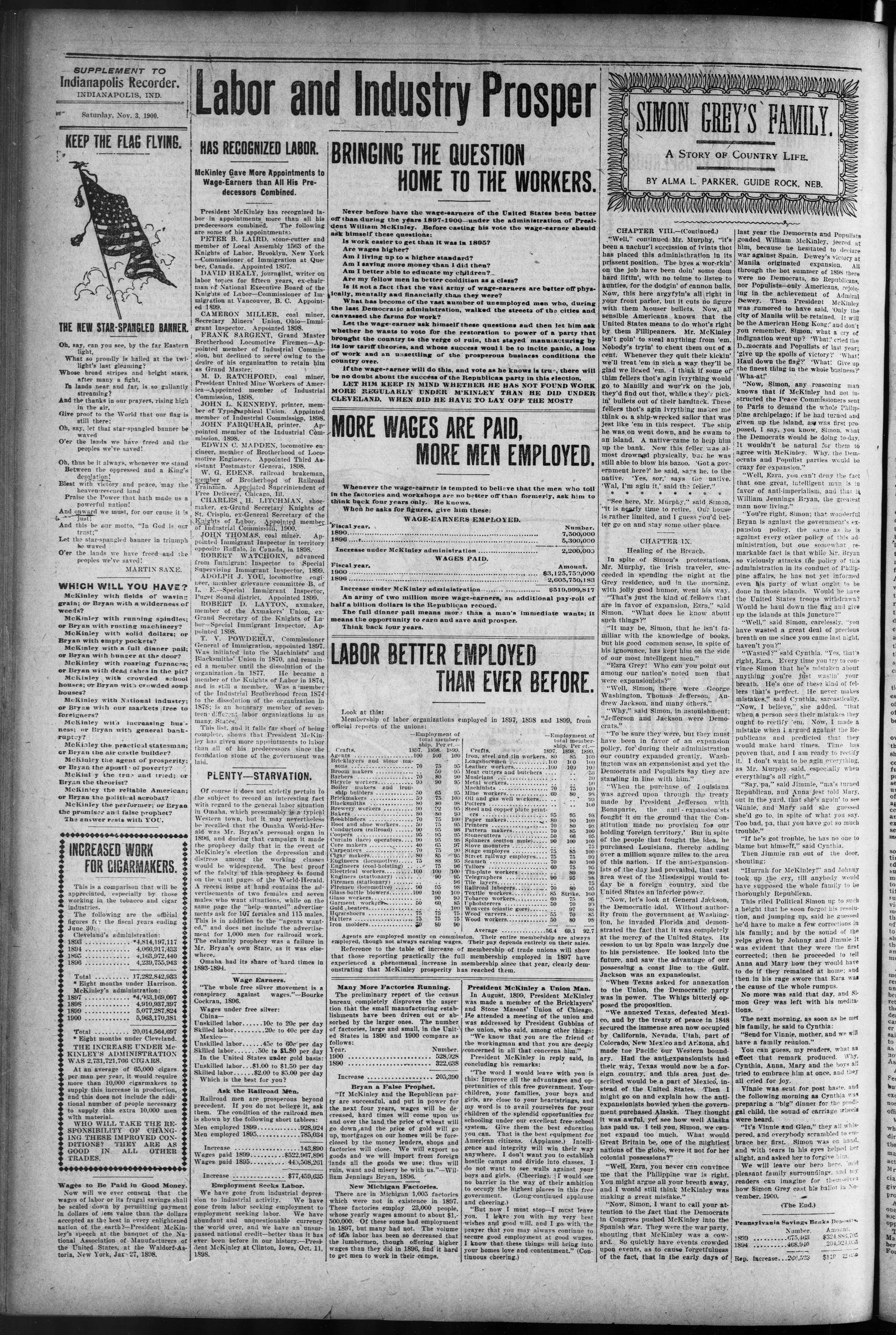
Labor and Industry Prosper
HAS RECOGNIZED LABOR.
McKinley Gave More Appointments to Wage-Earners than All His Predecessors Combined.
President McKinley has recognized labor in appointments more than all his predecessors combined. The following are some of his appointments:
PETER B. LAIRD, stone-cutter and member of Local Assembly 1563 of the Knights of Labor, Brooklyn, New York—Commissioner of Immigration at Quebec, Canada. Appointed 1897.
DAVID HEALY, journalist, writer on labor topics for fifteen years, ex-chairman of National Executive Board of the Knights of Labor—Commissioner of Immigration at Vancouver, B. C. Appointed 1899.
CAMERON MILLER, coal miner, Secretary Miners' Union, Ohio—Immigrant Inspector. Appointed 1898.
FRANK SARGENT, Grand Master Brotherhood Locomotive Firemen—Appointed member of Industrial Commission, but declined to serve owing to the desire of his organization to retain him as Grand Master.
M. D. RATCHFORD, coal miner,
President United Mine Workers of America—Appointed member of Industrial Commission, 1898.
JOHN L. KENNEDY, printer, member of Typographical Union. Appointed member of Industrial Commission, 1898.
JOHN FARQHAR, printer, Appointed member of the Industrial Commission, 1898.
EDWIN C. MADDEN, locomotive engineer, member of Brotherhood of Locomotive Engineers. Appointed Third Assistant Postmaster General, 1898.
W. G. EDENS, railroad brakeman, member of Brotherhood of Railroad Trainsman. Appointed Superintendent of Free Delivery, Chicago, Ill.
CHARLES H. LITCHMAN, shoemaker, ex-Grand Secretary Knights of St. Crispin, ex-General Secretary of the Knights of Labor. Appointed member of Industrial Commission, 1900.
JOHN THOMAS, coal miner. Appointed Immigrant Inspector in territory opposite Baffalo, in Canada, in 1898.
ROBERT WATCHORN, advanced from Immigrant Inspector to Special Supervising Immigrant Inspector, 1899. ADOLPH J. YOU, locomotive engineer, member grievance committee B. of L. E.—Special Immigrant Inspector, Puget Sound district. Appointed 1899. ROBERT D. LAYTON, axmaker, member of the Axmakers' Union, ex- grand Secretary of the Knights of Labor—Special Immigrant Inspector, Appointed 1898. T. V. POWDERLY, Commissioner General of Immigration, appointed 1897. Was initiated into the Machinists' and Blacksmiths' Union in 1870, and remained a member until the dissolution of the organization in 1877. He became a member of the Knights of Labor in 1874, and is still a member. Was a 'member of the Industrial Brotherhood from 1874 to the dissolution of the organization in 1878; is an honorary member of seventeen different labor organizations in as many States.
This list, and it falls far short of being complete, shows that President McKinley has given more appointments to labor than all of his predecessors since the foundation stone of the government was laid.
PLENTY—STARVATION.
Of course it does not strictly pertain to the subject to record an interesting fact with regard to the general labor situation in Omaha, which presumably is a typical Western town, but it may nevertheless be recalled that the Omaha World-Herald was Mr. Bryan's personal organ in 1896, and during that campaign it made the prophecy daily that in the event of McKinley's election the depression and distress among the working classes would be widespread. The best proof of the falsity of this prophecy is found on the want pages of the World-Herald. A recent issue at hand contains the advertisements of two females and seven males who want situations, while on the same page the "help wanted" advertisements ask for 107 females and 115 males. This is in addition to the "agents wanted," and does not include the advertisement for 1,000 men for railroad work. The calamity prophecy was a failure in Mr. Bryan's own State, as it was elsewhere. Omaha had its share of hard times in 1893-1894.
Wage Earners
"The whole free silver movement is a conspiracy against wages."—Bourke Cockran, 1806.
Wages under free silver:
China—
Unskilled labor.....10c to 20c per day
Skilled labor.....20c to 40c per day
Mexico—
Unskilled labor.....45c to 60c per day
Skilled labor.....50c to $1.80 per day
In the United States under gold basis:
Unskilled labor.....$1.00 to $1.50 per day
Skilled labor.....$2.00 to $5.00 per day
Which is the best for you?
Ask the Railroad Men.
Railroad men are prosperous beyond precedent. If you do not believe it, ask them. The condition of the railroad men is shown by the following short tables:
Men employed 1899.....928,924
Men employed 1895.....785,034
Increase .....143,890
Wages paid 1899.....$522,967,896
Wages paid 1895.....441,508,201
Increase .....$77,459,635
Employment Seeks Labor.
We have gone from industrial depression to industrial activity. We have gone from labor seeking employment to employment seeking labor. We have abundant and unquestionable currency the world over, and we have an unsurpassed national credit—better than it has ever been before in our history—President McKinley at Clinton, Iowa, Oct. 11, 1898.
BRINGING THE QUESTION HOME TO THE WORKERS.
Never before have the wage-earners of the United States been better off than during the years 1897-1900—under the administration of President William McKinley. Before casting his vote the wage-earner should ask himself these questions:
Is work easier to get than it was in 1895?
Am I better able to educate my children?
Are my fellow men in better condition as a
Is it not a fact that the vast army of wage-
lically, mentally and financially than they were?
What has become of the vast number of un-
the last Democratic administration, walked
canvassed the farms for work?
Let the wage-earner ask himself these ques-
whether he wants to vote for the restorative
brought the country to the verge of ruin, that
its low tariff theories, and whose success wou
of work and an unsettling of the prosper-
country over.
If the wage-earner will do this, and vote as
be no doubt about the success of the Republic
LET HIM KEEP IN MIND WHETHER H
MORE REGULARLY UNDER MKINLEY
CLEVELAND, WHEN DID HE HAVE TO L
MORE WAGES ARE P
MORE MED
Whenever the wage-earner is tempted to b
in the factories and workshops are no better o
think back four years only. He knows.
When he asks for figures, give him these:
WAGE-EARNERS EMPIRE
Fiscal year.
1890
1896
Increase under McKinley administration
WAGES PAID.
Fiscal year.
1900
1896
Increase under McKinley administration
An army of two million more wage-earner
half a billion dollars is the Republican record
The full dinner pall means more than a
means the opportunity to earn and save and p
Think back four years.
LABOR BETTER EMPLOY
THAN E
Look at this:
Membership of labor organizations employed in
official reports of the unions:
Is it not a fact that the vast army of wage-earners are better off physically, mentally and financially than they were?
What has become of the vast number of unemployed men who, during the last Democratic administration, walked the streets of the cities and canvassed the farms for work?
Let the wage-earner ask himself these questions and then let him ask whether he wants to vote for the restoration to power of a party that brought the country to the verge of ruin, that stayed manufacturing by its low tariff theories, and whose success would be to incite panic, a loss of work and an unsettling of the prosperous business conditions the country over.
If the wage-earner will do this, and vote as he knows is true, there will be no doubt about the success of the Republican party in this election.
LET HIM KEEP IN MIND WHETHER HE HAS NOT FOUND WORK MORE REGULARLY UNDER M'KINLEY THAN HE DID UNDER CLEVELAND. WHEN DID HE HAVE TO LAY OFF THE MOST?
MORE WAGES ARE PAID. MORE MEN EMPLOYED.
Whenever the wage-earner is tempted to believe that the men who toll in the factories and workshops are no better off than formerly, ask him to think back four years only. He knows.
Increase under McKinley administration ..... $519,099,817
An army of two million more wage-earners, an additional pay-roll of half a billion dollars is the Republican record.
The full dinner饭 means more than a man's immediate wants; it means the opportunity to earn and save and prosper.
Think back four years.
LABOR BETTER EMPLOYED THAN EVER BEFORE.
Membership of labor organizations employed in 1897, 1898 and 1899, from official reports, of the unions:
Agents are employed mostly on commission. That employed, though not always earning wages. Their pay Reference to the table of increase of members that those reporting practically the full member experienced a phenomenal increase in membership onstrating that McKinley prosperity has reached
employed, though not always earning wages. Their pay depends entirely on their sales. Reference to the table of increase of membership of trade unions will show that those reporting practically the full membership employed in 1897 have experienced a phenomenal increase in membership since that year, clearly demonstrating that McKinley prosperity has reached them.
---
Am I living up to a higher standard?
—Employment of total membership, Per et-
Crafts, 1857, 1858, 1859
Agents . . . 100 100 100
Bricklayers and stone ma-
sons . . . 70 75 95
Broom makers . . . 50 95
Brewers . . . 70 80 95
Bicycle workers . . . 90 90 95
Boiler makers and iron-
ship builders . . . 50 65 95
Brickmakers . . . 50 75 100
Brickmills . . . 80 80 95
Brewery workers . . . 90 92 95
Bakers . . . 80 80 90
Rookbinders . . . 70 75 100
Boot and shoe workers . . . 50 75 95
Bonders (railroad) . . . 90 95 95
Coopers . . . 90 95 95
Curtain (lace) operators . . . 90 95 98
Core makers . . . 40 95 97
Copers . . . 70 95 98
Clark makers . . . 80 85 95
Engineers (locomotive) . . . 75 88 95
Engineers (coal-holsting) . . . 75 96
Electrical workers . . . 100 100 100
Oilers (stationary) . . . 90 90 96
Firemen (stationary) . . . . . . 96
Firemen (locomotive) . . . 90 95 98
Glass-bottle blowers . . . 100 100 100
Glass workers . . . 95 95
Cattle workers . . . 50 60 85
Gold heaters . . . . . . . 100
Hqrscchoers . . . 75 75 75
Hetters . . . 75 75 75
Iron molders . . . 80 90
Many More Factories Running.
Many More Factories Running. The preliminary report of the census bureau, completely disproves the assertion that the small manufacturing establishments have been driven out or absorbed by the larger ones. The number of factories, large and small, in the United States in 1890 and 1900 compare as follows.
Increase ..... 205,330
Bryan a False Prophet.
"If McKinley and the Republican party are successful, and put in power for the next four years, wages will be decreased, hard times will come upon us and over the land the price of wheat will go down and the price of gold will go up, mortgages on our homes will be foreclosed by the money lenders, shops and factories will close. We will export no goods and we will import from foreign lands all the goods we use; thus will ruin, want and misery be with us."—William Jennings Bryan, 1896.
New Michigan Factories.
There are in Michigan 1,005 factories which were not in existence in 1897. These factories employ 23,000 people, whose yearly wages amount to about $1,500,000. Of these some had employment in 1897, but many had not. The volume of labor has been so decreased that the lumbermen, though offering higher wages than they did in 1896, find it hard to get men to work in their camps.
Average .....56.4 69.1 92.7
President McKinley a Union Man.
In August, 1890, President McKinley was made a member of the Bricklayers' and Stone Masons' Union of Chicago. He attended a meeting of the union and was addressed by President Gubbins of the union, who said, among other things, "We know that you are the friend of the workingman and that you are deeply concerned in all that concerns him." President McKinley in reply said, in concluding his remarks:
"The word I would leave with you is this: Improve all the advantages and opportunities of this free government. Your children, your families, your boys and girls, are close to your heartstrings, and my word is to avail yourselves for your children of the splendid opportunities for schooling under our excellent free-school system. Give them the best education you can. That is the best equipment for American citizens. (Applause.) Intelligence and integrity will win their way anywhere. I don't want you to establish hostile camps and divide into classes. I do not want to see walls against your boys and girls. (Cheering.) I would see no barrier in the way of their ambition to occupy the highest places in this free government. (Long-continued applause and cheering.)
"But now I must stop—I must leave you. I leave you with my very best wishes and good will, and I go with the prayer that you may always continue to secure good employment at good wages. I know that these things will bring into your homes love and contentment." (Continuous cheering.)
SIMON GREY'S FAMILY.
A STORY OF COUNTRY LIFE.
BY ALMA L. PARKER, GUIDE ROCK, NEB.
CHAPTER VIII.—(Continued.) "the continued, Mr. Murphy, 'it's been a nachurl's succession of ivents that has placed this administration in its prissent position. The byes a wor-rkin' on the job have been doin' some dom hard liftin', with no toilme to listen to aunties, for the dodgin' of cannon balls. Now, this here argyfyn' all right in your front parlor, but it cuts no figure with them Mouser bullets. Now, all sensible Americans knows that the United States means to do what's right by them Fillipeaners. Mr. McKinley isn't goin' to seal anything from 'em. Nobody's tryin' to cheat them out of a cent. Whenever they quit their klickin' we'll treat 'em in sich a way they'll be glad we liceed 'em. I think if some of them fellers that's agin ivrything would go to Manilly and wurrk on the job, they'd find out that, while's they's pickin' bullets out of their hardtack. These fellers that's agin ivrything makes me think on a ship-wrecked sailor that was jest like 'em in this respect. The ship he was on went down, and he swam to an island. A native came to help him up the bank. Now this feller was almost drowned physically, but he was still able to blow his bazoo. 'Got a government here?' he said, says he, to the native. 'Yes, sor,' says the native. 'Wal, I'm agin it,' said the felier."
"See here, Mr. Murphy," said Simon, "it is nearly time to retire. Our house is rather limited, and I guess you'd better go on and stay some other place."
CHAPTER IX
In spite of Simon's protestations, Mr. Murphy, the Irish traveler, succeeded in spending the night at the Grey residence, and in the morning, with jolly good humor, went his way. "That's just the kind of fellows that are in favor of expansion, Ezra," said Simon. "What does he know about such things?"
"It may be, Simon, that he isn't familiar with the knowledge of books, but his good common sense, in spite of his ignorance, has kept him on the side of our most intelligent men."
"Ezra Grey! Who can you point out among our nation's noted men that were expansionists?"
"Well, Simon, there were George Washington, Thomas Jefferson, Andrew Jackson, and many others."
"Why," said Simon, in astonishment: "Jefferson and Jackson were Democrats."
"To be sure they were, but they must have been in favor of an expansion policy, for during their administration our country expanded greatly. Washington was an expansionist and yet the Democrats and Populists say they are standing in line with him."
"When the purchase of Louisiana was agreed upon through the treaty made by President Jefferson with Bonaparte, the anti-expansionists fought it on the ground that the Constitution made no provision for our holding 'foreign territory.' But in spite of the people that fought the idea, he purchased Louisiana, thereby adding over a million square miles to the area of this nation. If the anti-expansionists of the day had prevailed, that vast area west of the Mississippi would today be a foreign country, and the United States an inferior power.
"Now, let's look at General Jackson, the Democratic idol. Without authority from the government at Washington, he invaded Florida and demonstrated the fact that it was completely at the mercy of the United States. Its cession to us by Spain was largely due to his persistence. He looked into the future, and saw the advantage of our possessing a coast line to the Gulf. Jackson was an expansionist.
"When Texas asked for annexation to the Union, the Democratic party was in power. The Whigs bitterly opposed the proposition.
"We annexed Texas, defeated Mexico, and by the treaty of peace in 1848 secured the immense area now occupied by California, Nevada, Utah, part of Colorado, New Mexico and Arizona, and made the Pacific our Western boundary. Had the ant-expansionists had their way, Texas would now be a foreign country, and this area just described would be a part of Mexico, instead of the United States. Then I might go on and explain how the ant-expansionists howled when the government purchased Alaska. They thought it was awful, yet see how well Alaska has paid us. I tell you, Simon, we cannot expand too much. What would Great Britain be, one of the mightiest nations of the globe, were it not for her colonial possessions?"
"Well, Ezra, you never can convince me that the Philippine war is right. You might argue all your breath away, and I would still think McKinley was making a great mistake."
"Now, Simon, I want to call your attention to the fact that the Democrats in Congress pushed McKinley into the Spanish war. They were the war party, shouting that McKinley was a coward. So quickly have events crowded upon events, as to cause forgetfulness of the fact, that in the early days of
last year the Democrats and Populists goaded William McKinley, jeered at him, because he hesitated to declare war against Spain. Dewey's victory at Manila originated expansion. All through the hot summer of 1888 there were no Democrats, no Republicans, nor Populists—only Americans, rejoicing in the achievement of Admiral Dewey. Then President McKinley was rumored to have said, "Only the city of Manila will be retained. It will be the American Hong Kong," and don't you remember, Simon, what a cry of indignation went up? "What!" cried the D.mocrats and Populists of last year; "give up the spolls of victory?" "What! Haul down the flag?" "What! Give up the finest thing in the whole business?" "Wha-at!"
"Now, Simon, any reasoning man knows that if McKinley had not instructed the Peace Commissioners sent to Paris to demand the whole Philippine archipelago; if he had turned and given up the island, as was first proposed, I say, you know, Simon, what the Democrats would be doing to-day. It wouldn't be natural for them to agree with McKinley. Why, the Democrats and Populist parties would be crazy for expansion."
"Well, Ezra, you can't deny the fact that one great, intelligent man is in favor of anti-imperialism, and that is William Jennings Bryan, the greatest man now living."
"You're right, Simon; that wonderful Bryan is against the government's expansion policy, the same as he is against every other policy of this administration, but one somewhat, remarkable fact is that while Mr. Bryan so viciously attacks the policy of this administration in its conduct of Philippine affairs, he has not yet informed even his party of what ought to be done in those islands. Would he have the United States troops withdrawn? Would he haul down the flag and give up the islands at this juncture?" "Well," said Simon, carelessly, "you have wasted a great deal of precious breath on me since you came last night, haven't you?"
"Wasted?" said Cynthia. "Yes, that's right, Ezra. Every time you try to convince Simon that he's mistaken about anything you're just wastin' your breath. He's one of these kind of fellers that's perfect. He never makes mistakes," said Cynthia, sarcastically. "Now, I believe," she added, "that when a person sees their mistakes they ought to rectify 'em. Now, I made a mistake when I argued against the Republicans and predicted that they would make hard times. Time has proven that, and I am ready to rectify it. I don't want to be again everything, as Mr. Murphy said, especially when everything's all right." "Say, pa," said Jimmie, "ma's turned Republican, and Anna jest told Mary, out in the yard, that she's again' to see Winnie, and Mary said she guessed she'd go to, in spite of what you say. Too bad, pa, that you have got so much trouble."
"If he's got trouble, he has no one to blame but himself," said Cynthia. Then Jimmie ran out of the door, shouting:
"Hurrah for McKinley!" and Johnny took up the cry, till anybody would have supposed the whole family to be thoroughly Republican.
This riled Political Simon up to such a height that he soon forgot his resolution, and jumping up, said he guessed he'd have to make a few corrections in his family; and by the sound of the yelps given by Johnny and Jimmie it was evident that they were the first corrected; then he proceeded to tell Anna and Mary how they would have to do if they remained at home; and then in his rage swore that Ezra was the cause of the whole rumpus.
No more was said that day, and Simon Grey was left with his mediations.
The next morning, as soon as he met his family, he said to Cynthia: "Send for Vinnie, mother, and we will have a family reunion." You can guess, my readers, what an effect that remark produced. Why, Cynthia, Anna, Mary and the boys all tried to embrace him at once, and they all cried for joy. Vinnie was sent for post haste, and the following morning as Cynthia was preparing a "big" dinner for the prodigal child, the sound of carriage wheels were heard.
"It's Vinnie and Glen," they all whispered, and everybody scrambled to embrace her first. Simon was on hand, and with tears in his eyes helped her alight, and asked her to forgive him.
We will leave our hero here, "mid pleasant family surroundings," and my readers can imagine for themselves how Simon Grey cast his ballot in November, 1900.
Pennsylvania Saving Benka Deposit:
Number. Amount.
1899 ..... 675,463 $324,885.05
1894 ..... 468,940 204,705
Rep. increase ..... 206,523 $119 22.04
AARON’S GOLDEN CALF TYPI-
CAL OF GREED.
Worshipers of That Famous Image No
More senighted Than #anatical Speo-
Ulators of Qur Duy—Dr. Tale
adnate bikin.
In this discourse Dr. Talmage shows
how the spirit of greed destroys wher
it takes possession of a man and that
money got in wrong ways Is a curse
text, Exodus xxxil, 20, "And he took
the calf which they had made and
burnt it in the fire and ground it tc
powder and strewed it upon the water
and made the children of Israel drink
of it.” :
Moses has been six weeks on Mount
Singj, and he comes back and hear:
the howling und sees the dancing ot
these golden calf fanatics, and he loses
hiis. patience, and he takes the two
plates of stone on which were written
the Ten Commandments and flings
them so hard against a rock that they
split all to pieces. When a man gets
angry, he is apt to break all the Ten
Commandments. Moses rushes in, and
he takes this calf god and throws {t
into @ hot fire until It is melted all out
of shape and then pulverizes it—not by
the modern appliance of nitro muriatic
acid, but by the ancient appliance of
niter or by the old fashioned file. He
stirs for the people a mostsnauseating
draft. He takes this pulverized golden
ealf and throws it in the only brook
Which Is accessible, and the people are
compelled to drink of that brook or not
drink at all.
Pull aside this curtain, and you sec
the golden calf of modern idolatry. It
4s not, like other idols, made out of
stocks or stone, but it has an ear so
sensitive that It can hear the whispers
‘on Wall street and Third street and
State stre-t and the footfalls in the
Bank of England and the flutter of a
Frenchman's heart on the bourse It
has an eye so keen that it can see the
Tust on the farm of Michigan wheat
and the Insect tn the Maryland peach
grchard and the trampled grain under
the hoof of the Rusti. War charger.
It is so mighty that it swings any way
it will the world’s shipping. It has its
foot on all the merchantmen and the
steamers. It started the American cly-
fl war and under God stopped it, and it
decided the Tnvko-Russian_ Contest.
‘One broker tn September. 1869, in New
York, shonted. “One hundred and sixty
for a million!” and the whole continent
shivered. The golden ealf of the text
has, as far as America is concerned, tts
right front foot in New York. its left
front foot in Chicago, its right back
foot in Charleston. its left back foot
in New Orleans. and when {t shakes
itself it shakes the world. Ob, this Is a
mighty god—the golden calf of the
world’s worship!
Further, every gcd must have not
only its temple, but its altar of sacri-
fice, and this golden calf of the text {s
no exception. Its altar is not made
out of stone as other altars, but out of
counting room desks and fireproof
safes, and it is a broad. # long, 2 high
altar. The victims’sactifieed on it are
the Swattonts and the Ketchams and
the Fisks and ten thousand other peo-
ple who are slain before this golden
calf. What docs this god care about
the groans and struggles of the vie-
tims before it? With cold. inetallic eve,
ft looks on and yet lets them suffer.
What an altar! What a sacrifice of
mind. body and sont! ‘The physteal
health of » rent multitude is flung on
to this sacrificial altar,
Solomon offered in one sacrifice on
fone occasion 22.000 oxen and 120,000
sheep. But that was a tame sacrifice
compared with the multitnde of men
who are sacrificing themselves on this
altar of the golden calf and sacrificing
their families with them. The soldiers
of General Havelock in India walked
literally ankle deep in the blood of “the
house of massacre.” where 200 white
women and children had been slain by
the sepoys. But the blood about this
* altar of the olden calf flows un to the
knee. flows un to the girdle, flows te
the shoulder. flows to the lin. Great
God of heaven and earth. have mercy
‘on those who immolate themselves on
this altar! The golden ealf has none
Some peopie are very much surprised
at the actions of neople in the Stock
Exchance. New York. Indsed, it is a
scene sometimes that paralyzes. de:
scription and is beyond the Imagina.
tion of any one who has never looked
in. What snanping of finger and thumt
and wild gesticulation and ravine like
hyenas, and stamping like huffaloes
and swaying to and fro, and jostline
and rnnning one upon ‘another. and
@eafening uproar. until the resident
* of the exchange strikes with his mallet
four or five times. crying. “Order, or
er!” and the astonished speetator oes
out Into the fresh air. feeling that he
has eseaned from pandomentnm What
does it all mean? T will tel) yon what
it means. The devotees of every heath
en temple cut themselves to nieces and
yell snd gvrate. This voelferstion and
gyration of the Stack Exchonee fs all
annronriate. This is the yrorship of the
gotten calf. 3
Hut my text suegests that tie wor
ship has to be broken up, as the be
havior of Moses on this occasion indi
ented. There are those who say thal
this golden calf spoken of in tle text
was hollow and merely plated with
gold. Otherwise Moses could not have
carried it. Ido not know that. Bui
somehow, perhaps by the assistance
of his friends, he takes up this golder
calf, which is an infernal insult te
God cad man, and throws it into the
fire, aud it is melted. And then it ebmes
ont and fs cooled off. and by som
chemical appliance or by an old fash
|funds to our own private speculation
will not pay. We had a great national
tumor in the shape of fictitious pros.
perity. We called it national enlarge
ment. Instead of caliing {t enlarge
ment we might better have called it a
swelling. It was a tumor, and God cut
it out, and the Nation was sent back te
the principles of our fathers and grand.
fathers, when twice three made six in
stead of 60, and whenjthe apples at the
bottom of the barrel were just as good
as the apples on the top of the barrel.
and a silk handkerchief was not ‘half
cotton, and a man who wore a $5 cont
pald for was more honored than a man
who wore a $50 ¢oat uot paid for.
‘The modern golden calf, like the one
of the text, is very apt to be made out
of borrowed gold. ‘These Israelites of
the text borrowed the earrings of the
Egyptians and then melted them inte
a god. ‘That is the way the golden calf
is made nowadays, A great many
housekeepers, not paying for the arti
cles they get. borrow of the grocer and
the baker and the butcher end the dre
goods seller. Then the retailer borrows
of the wholesale dealer, Then the
wholesale dealer borrows of the capt
talist, and we borrow and borrow and
borrow until the community is divided
into two classes—those who borrow
and those who are borrowed of—and
after awhile the capitalist wants his
one, and he rashes upon the whole:
sale dealer, and the wholesale dealer
wants his money, and he rushes upon
‘the retailer, and the retailer wants his
money, and he rushes on the customer,
and we all go down together. There 18
‘many a man in this day who rides in a
carriage and owes the blacksmith for
the tire, and the wheelwright for the
wheel, and the trimmer for the curtain,
and the driver for unpaid wages, and
the harness maker for the bridle, and
the furrier for the robe, while from the
tip of the carriage tongue clear back to
the tip of the camel's hair shaw! flut.
tering out of the back of the vehicle
everything is paid for by notes that
have been three times renewed. I tel]
you that in this country we shall nev.
er get things right until we stop bor.
Towing and pay as we go. |
But if we have made this world our
god, when we come to die we shall see:
our idol demolished. How much of this
‘World are you going to take with you
into the next? Will you have two
pockets—one in each side of your
shroud? Will you enshion your casket
with bonds and mortgages and certifi-
cates of stock? Ah, no! The ferryboat
that crosses this Jordan takes no bag-
gage—nothing heavier than an imma-
terial spirit. You may, perhaps. take
$500 with you two or three miles in the
shape of funeral trappings to the ecm-
ctery, but you will have to leave them
there. It would not be safe for you to
Ne down there with a gold watch or a
diamond ring: it wonld be a tempta-
tion to the pillagers. If we have mine
this world our god, we shall see our
idol, when we die, ground to pieces by
our pillow. and we shall have to drink
It In bitter regrets for the wasted op-
portunities of a lifetime, Soon we will
he gone. Where are the men who tried
Warren Hastings in Westminster hall?
Where are the pilgrim fathers who put
out for America? Where are the veter-
ans who on the Fourth of July, 1791,
marched from New York park to the
Battery and. fired a salute and then
marched back again? And the Sectety
of the Cincinnati, who dined that aft-
ernoon at Tontine Coffee House, on
Wall street. and Grant Thorburn, who
that afternoon waited 15 minutes at
the foot of Maiden lane for the Frook-
Iyn ferryboas, then got in and was
rowed neross by two men with oars,
the tide so strong that It was an hour
and ten minutes before they Innded?
Where are the veterans that fired the
salute, and the men of the Cincinnatt
society who that afternoon drank to
the patriotic toast. amd the oarsmen
that rowed the boat. and the neonte
who were transnorted? Gone! Oh, this
Is a flecting world! It Is a dving world,
A man who had worshiped it all his
days in his dying moment deserihed
himself when he sald, “Wool, foo’,
fool!”
T want vou to change temples and to
give un the worship of this nsatisty-
ing and cruel cod for the service of the
Tord Jesus Christ. Here is the gold
that will never ernntble. Tore are the
securities that will never fail. Here
are the banks that will never break.
Here is an altar on which there has
heen one sacrifice that does for al. Tor
“py one sacrifice hath Christ perfected
forever them that are. sanctified.”
Here is a God who will comfort yon
when yon are in tronble and soothe
yon when you are sick and save you
when you die,
When your parents have breathed
their list and the old. wrinkled and
trembling hands ean no more be pnt
ttpon your head for a Wessine. he wil
be to you a father and mother both,
giving you the defense of the one ana
the comfort of the other. For have we
not Paul's blessed hope that as Jesus
died and rose again, “Byen so them
also which sleep in Jesus shall God
bring with him?" And when your
children go away from yon, the sweet
darlings, you will not ikiss’ them and
say goodby forever. He only wants
| to hold them for you a litle while, He
| will give them buck to yon azain, and
[he wil] have them all waltine for you
pay ap he inden acco reget hese
“Look at Dobbs.” ae
“What is he doing?”
“Riding in an automobile with ¢
horseshoe pin on.”
THE RECORDER, INDIANAPOLIS, INDIANA
eee
AT ridt Battie’ Borda. | ise ebetceasticens wom ccinaes an
JEhe winning of a million of People
from siekness to health is a noble pur-
suit.
Our enormous mail is the wonder of
the age. We are floosed, simply flond-
ed,each morning with letters contain-
ing orders for “5 OROPS,” the
wondrous cure for the terrible, painful
diseases, Rheumatism,Sclatica
‘and Neuralgia,
Rheumatism, Sciatica and Neuralgia
withstand every other medicine, but
yield on the instant to “5 DROPS.
Within a day of getting “B DROPS"
and using it, your ulsease begins to
disappear.
‘Thousands of men and women, who
see their friends gladly relieved of
their terrible suffering, write us in
haste. Hundreds of testimonials from
grateful correspondents reach us daily.
To enabje all sufferers to test this
wonderful remedy, we will send free
a trial bottie on receipt of 5 cents
to pay for mailing, Large bottles of
300 doses $1,00, sent prepaid by mail or
express.
“& DROPS" isa preven-
tive as well as a curative,
for the following diseases:
Rheumatism, Sciatica, Neu-
ralgia, Gout, Dyspepsia,
Trade Mark Backache, Asthma, Way.
Fever, Catarrh, Liver and
Kidney ,Troubles, Sleeplessness, Ner-
vousness, Nervous and. Neuralgic
Headaches, Earache, Toothache,
Beart Weakness, LaGrippe, Malaria,
Paralysis, Creeping Numbness,
-nd along list of other ills,
Write us in haste and stop your suf-
fering. Agents wanted.
SWANSON RHEUMATIC CURE Co.
160 Lake Street, Chicago, {11.
A Strategist.
“General,” exclaimed the Filipino, “
dave just made a bighly important dis
sovery.”
“What is it?”
“Iam informed on undoubted an
thority that the world is round.”
“What do we care?”
“Well, general, it might be well t
lake precautions against retreating s
fast that we will make a complete cir
‘le and unexpectedly collide with the
enemy's rear guard.”—Washingtor
Star,
Guilty ot Macbeth.
School Visitor—Now, then, boy Nuun.
oer One, who wrote Macbeth?
Boy Number Ove (trembling violent:
ly).—Please, sir, 1 didn't.
School Visitor—I know, you didn't
out who did?
Boy Numigr One (with a spasm of
cirtue)—Please sir, I don’t wanter be a
tell-tale, but it was Rob Buster. ove
‘in the corner seat. I see him a-doin’ of
‘t—London ‘Tit-Bits.
Awkward Diversity.
Young Dramatist—Might I ask how
my three‘act drama is going on, Mr
Manager? Has it been accepted?
| “Phe three members of the reading
committee have read it, and think it
will do with one act struck out,”
“Lam glad to hear It is no worse.”
“But,” continued the manager, “un
fortunately each one wants to strike
gut 2 different act."—Lonton Tit-Bits.
Low Vatuation.
He—A penny for your thouzhts!
She—Ht's «bargain, but Von afraid
you will not get full value for your
‘money.
- He—Well, here's yonr penny. Now,
what were you thinking of?
She—You.—London Tit-Bits.
An Economical Choice.
“Hetty Green says she would prefer
a bright newspaper reporter to a duke
as a husband for her daughter.”
“Perhaps she’s ot the idea into ler
head that a newspaper reporter ean
live on little or nothing.”"—Cleveland
Plain Dealer.
When Love Turns Cota.
“But. Freddy, I don't see that you
need take Mabel's jilting you so much
to heart.”
“It isn't the jilting J mind, but she
returned the ring ina parcel marked,
Glass, with care. "—The King.
| Of Course, He Believed.
Farmer—Come, now, honor bright,
‘do you believe in the faith cure?
Granger—Believe in it? [ should say
Ido. [have an aunt who gets $5 a
visit and is maxing loads of moncy.—
Boston ‘Transcript.
sti iain a cB aaa
Dolly—Did that famous author send
‘you his autograph, Polly?
Polly—No; but he kept mine—the
mean, impudent thing.—London Tit-
Bits.
When a man is a brute he is the most
Noathadeae! of ail” benten”
Disease
is a symptom ‘of Kidney
Disease. A well-known doc-
tor bas said, ‘(I never yet
made a post-mortem exami-
nation in & case of death from
Heert Disease without find~
ing the “kidneys were at
fault.” ‘The Kidney medi-
cine which was first on the
market, most successful for
Heart Disease and all Kid-
ney Troubles, and most
ey: imitated is
Poded’s
Kidney
Pills.
ds een een ety
DODDS MEDICINE CO., Boneion we
{Rave used Ripans Taduies wiin so macs sas
fmotion that I can cheerfully reo-rumend ten,
Have bees troubled for about to co years with
nat I called billows attacks oomiag om resiariy
once e week. Was told by diicreat paysiciane
‘shat 18 was caused by bad teeth, of which T bad
sever LI bad the teoth extracted, ut the at
"Yanks continued. I had seen adveruiscinenve of
Ripans Tabules in ail the papers but had po faith
imthena, but about alx weeks since « friend In
duced mie to try them. Have taken but two of the
‘small Bcent boxes of the Tabulos and have bad
‘no recurrence of the attacks. Have never given s
testimonial for anything before, but the «reat
‘amount cf good which I believe has been sione me
by Ripane Tabules induces me toadd mine fo the
many testimonials you doubtless have tr. your
‘pesecasion now. ‘LT. DaWirs,
ui RIP-AN'S
es
3} 8 |
5 | The r-adern stand-
a |ard Family Medi-
|j)cine: Cures the fi
‘ = commen every-day |
5 | ill of humanity. i
{
a rence i
&
| eS ;
NS eee
Tabules regularly. Shekeeps afew cartons Ripans | Reading some of the testimonials in favor of
‘Tabules inthe house and sayeahe'wil hotbe with: | Ripane Tabules, {tried thems. Ripans abaloe bot
outthem. Tho heartbura and sleoplesaness have | only relieved but sotually cured my younger,
Kizappeared with the Indigestion which was | the Deadaches have disappeared, bowels are if
formerly so great burden for her. “Our whole | good condition aud he never complains of Mi
family take the Tabules regularly, dxpecially after | stomach, Ie{snow area, chubby-taced boy. Tala
S hearty meal. My mothee is Atty years of age | wonderfal change Tattributo to’ Ripans Tabules,
‘and is enjoying the bestof health and spirits; also | I'am satisdod that they will toned ny one (trots
ete hearty meals, an Impossibility afore she | the cradle to old age) If taken according to dire
| took Ripens Tabulen sro H. Batra. | tous, "mW. Pace,
‘Anew syle packet onotaining Tmt RIPAFs TABULA packed fn a paper cron (without yin 1 Dow for sala
8 tome drug storesvou Ir curva. This low-prioe sort la Intended for the poor and the econcmleal. One
onan of the five-cent cartons G0 tabulee) can, be Bad by mail by sending forty eight een tothe RIPAKS
Crema Cour, No. 0 Bprace Brest, New Yorkot a single carton eax TAMUisn) will ba sent for ve orate,
Rapass Tasviaa maj tise bel ud o soma grocern gencrel elorakeopors, hewa Ageals ond ah oeme ghar eres
sod barber shopa, Enay bales pin, induce savy anc prolong tn. One wea ae
American Mutual Aid Associati
Of Saint Louis Mo.,
We need not refer yo. to people in Europe, Asia, etc,
for recommendation, but can furnish testimonials from
reliable persons in ycur own city. hee ¢
We pay Sick accident and Death Benefits Also furnish
Free Medical attention in case of Sickness or Accident
Be on the safe side and Insure with us.
E, B,. HAMPTON, Organizer.
Room 43 BAtpwin Biocx, Indianapolis, Id
CAVEATS, TRADE MARKS,
COPYRIGHTS AND DESIGNS.
Send your business direct to Washington,
raves Lime, costa lens, better service:
Reese. rat ee, ea
fsgecured. PERSONAL APTEWTION GIVEN-19 YEARS
/AGEOAL ExTERSUNOE Reok How fo sisi Pena”
feciive special’ motice, without charge, inthe
INVENTIVE ACE
haneeeed mening Hlerenth yar terns, Siete
Lato of CA Snow & Co.
E.G. SIGRERS, stat sz. 8 we:
We WASHINGTON, D. 6";
WONDERFUL
Curly Hair Made Straight By
— CS
ey lat
GP.
Bap Or
OZONIZED OX MARROW
ectitratanwiratove Gesouisec tie ete
Droventa tho bute from failing out aod makes fi
stand Sarntia2 "Hocnanias ete ee
iSigntontag kinky tobe Mievease of foteattone
UR Oelinal Geowtsed Oe Ameren:
‘Sha beautiful, A toilet necereity for ladkes and|
gentlemen. Elegantly perfumed. The reat ad-|
Owing to its euperior and inating quality tte the]
Boece tienen nica
culers er‘acnd ta Wi,20'vontal or, Express
Pe ssctadenrsnigyare
OZONIZED OX MARROW CO.,
76 Wabash Aves, Chea, I
For sale by Lewis © Hayes, Drug
Rist, 502 Indiana ave; Indianapolis.
G Te
fares scover
FOR MAKING
fini CURLY HA
wor Stig
—
“68. Cp
ae eS eM \\
‘ie 4 a
a e/a
Se ae ea
COP’
SN
"eae are |)
TRALONTIVG i stern 3 vei
ee ee arena
elapse ee
op tao ie ees
Seraightens the hair, but removes Dandruil
tee ee
Harurlows head of bai, Cures ail kinds o
fumed, and is in every way an clogant article
{oP se ated Eick eds teal hoe
edie he eestoas naa at
at drag stores, or sent ‘by mail to. ny adron
icin ati "Rago RESON
MARUERCTURING £0 , Rictmond\ Vas
erAgeats wanted, Weite for tetms-"0
peas oe eee,
ta "words ot higher
paar Se Sieh
Wha daa
ee
Buiter san
iatrserrssdee
Hise ibis Sat
Eieaet yee
feecn at Saney
meee aoe
avice of Mr, Geo. Bow.
ERG ronan
arden Geo
fipsoe"Thca wah
Hiatieene
is So wamaan
orn vaio
Esahtscr
Sephates aces
iegeceet cre
Seren “ones
Ero rata
Biss pe
Bipead Pine at
Sibanta teeta
See eee
felleret by thelr use
| eee Come Bere: SSLETOD ICE SOGHIPELLG
for Gree se years, Now ing gave ime any rollet
by fect and legs and abdomen ware bloated 20
Toould not wear stces om my foot and only a loves
dress, Taaw Hipane Tabules advertised In out
ally paper, bought some aad took them as direct
fod. Have takes them about three weeks and thare
fs suca a change! Tam not constipated any more
and I owe ft ail to Ripans Tabules, Tam ¢hirey-
feven years old, have no occupation, only my
household duties aud nursing my eiok Busband.
Bo bas had the érepay and 1 am trying Ripens
‘Tarmles forhim. He feels some better but it wil
taxe some time, he has been alck solong. Tou
‘ony use my letter and name as 700 tke,
ire. Mant Gomean Chuan.
T bees Reed outentas teat heneeeee-ere
Reading some of the testimonials in favor of
‘Ripans Tabules, I tried thems. ‘Ripans TabUlee not
‘only relieved but actually cured my youngster,
the headaclies have disappeared, bowels are 1
good condition and he never complains of Bi
Stomach. He is now area, chubby-faced boy. This
‘wonderfal change Tattribure to Ripans Tabules,
Tam satlatiod that they will benefit any one (from
‘the cradis to old age) if taken according to direo-
tions, EW. Paice,
Why, in the Territory Traversed
—by the— ’
RAILROAD,
cee Great @entral Southern Trunk
—Line in
Kentucky, Tennessee, Alabama
Mississippi, Florida,
—Where—
Fansers, Frurr Growers,
STOCK RAISERS, MANUFAC-
TURERS, INVESTORS, SPECU-
ULATORS AND MONEY LENDERS
will Gnd the greatest thances in tke United
States to make big money” Uy reasow of te
Abundance and cheapness of
LAND and FARMS,
TIMBER and STONE,
TRON and COAL,
LABOR—EVERY THING:
Free sites, nancial assistance. and Freedom
frou taxation for the mannfactucec.
Laud and farms at $L00 per acee and up
wards, and £00000 acres in West Florida that
an be taken gratis under the U. S, Homestead
laws.
Stock raising in the Galf Coast District wit
male enormous profits.
Half Fare Excursions the First aud ‘Third
TUESDAYS of each month.
Tet ns know what you want. and we witi tell
Yeu where aud liow to et it~bus aon etay
das the countey is Ailing op rapidly
Printed matter, maps and information free
‘Address,
S. J. Wemyss
General Immigration and anayettias
Agent, Louisville. Ky.
er ee er te ee
| Mr. Major, the fantous cement mau, vf New
York, explaius some very interesting facts
abont Maior’s Cement.
‘The multitudes who use this standard articte
know that itis many hundred per cent, better
than other cements. for witich similar’ claims
fare made. but a ereat many do not know the
reason why. ‘The siaiple reason is that Mr
Major uses the best materiais ever ciscorered
land other manufacturers do nut. use them, be
‘cause they ace too expeusiveand do not allow
large profits. Mr. Major tells us that one of
the elements of hin coment coats $3 75 2 pound
and snother costs $265 a gallon, while 2 large
shareof the so-called cements and ligaid give
trpom the market are nothing-more than six
teen-cent glue, dinsolved in water or citricacid
and, im some cases altered slightiy ix color and
odor by the addition of cheap and aseless ma
terials.
Major's cement retails at hiteen cents and
twenty-five cents abottie.and when a dealer
tries to sell a substitute yon can depend upor
it that hisomly object is to make larger profit
‘Phe profiton Major's cements 28 much as
any dealerought to makeon any cement. And
this is doubly tene in View of the fact that
each dealer gets his ahareof the benefit of Mr
Major's advertising, whick now amonts to
over $5000 a month. throughout the country.
Established in 1876,
Tasist on having Major's, Don't accept any
offhand advice from:a druggist.
If you are at alihhandy (and you will be tiety
to find that son area good deal moro so than
you imagine) you can repair your rubber boots
bd family shoes, and any other cubter and
leather articles, with Major's Rubber Cement
aud Major's Leathier Cement.
‘And you will be suprised at how many dot
lars ayearyou willsave.
Ifyour druggist can'tsupply you, t will be
forwarded by mall; either kind. Pree of pos}
place without getting a
Eecaccedatarss
cea Ss
Eecenae
Samiee
See
Sucewecs
Soeoe a
givens
exec
mets
oeemencm!
roan
pe
pote
cua
Sa
seitcoraent
rege
ens
Soca
omeas
ce
ee
Seaneae
poaeiae
eee
i oa ‘don aes
Do-Lou-Know
(- Od: no Us
THAT
,
LAE RECORDER
Is Prepared to do all kinds, of
Job Printing on short notice? We
can make anything from a
Bill Head, Letter Head,
Minutes, Dodgets, Tickets,
Business Cards, Visiting Cards,
Book or Newspaper,
In fact, everything in Job Printing
We make a specialty of firstaclasy
Job Printing
If you want anything done and ace
too busy to call, drop us a postal
or call telephene 561, *
TE You Want pice ince
let us know,
Ifyou have anything to adver
tise send it to The Recorder.
If you have a house to rent,
If you have a room to let,
If you want a situation,
If you want to sell anything,
If you want anything,
Advertise in
THE RECORDER
5
your subscription,
| We Want yoar advertisment,
‘We want you to buy the paper.
We want a large number ot
Newsboys to sell the paper,
| We don’t want much but we
want to give you the best for your
money.
our news,
Bend Usa wie your
church is doing.
Send us what your lodge in do-
ing,
Send us what your ciub is do-
ing,
Send us word what you are do
ing, and we wili be glad to publish
it.
Ti Recorder °°"
‘The Recorder belongs to no fac
tion,
The Recorder belongs to no sect.
|The Recorder belongs to n0 de-
‘nomination.
The Recorder belongs to tht
| people end itrepresents them.
We Wa t your trade,
n your patronage
We want your encouragement
We want your co-operation
We want you to assist us in malt-
ing The Recorder what it really i8,
the greatest, the most newsy, ant
‘the best Negro journal ia the State
If You Want®.;
call or address
The Recorder,
f INDIANAPOLIS, IND:
NEARLY 21 PER CENT INCREASE IN TEN YEARS.
The Inhabitants of the United States Now Number 76,25,220 Against 693,069. 756 in 1890 - Indiana's Total 2,516,463.
Washington special: The official announcement of the total population of the United States for 1900 is 76,25,220, of which 74,627,907 are contained in the forty-five States representing, approximately, the population to be used for apportionment purposes. There is a total of 154,153 Indians not taxed. The total population in 1890, with which the aggregate population of the present census should be compared, was 3,069,756. Taking the 1890 population as a basis, there has been a gain in population of 13,225,464 during the past ten years, representing an increase of nearly 21 per cent.
Following is the official announcement of the population of the United States in 1900 by States. In the figures the first column represents the census for 1900 and the second for 1890.
States. 1900. 1890.
Alabama 1, 828, 697 1, 513, 017
Arkansas 1, 133, 564 1, 128, 179
California 1, 485, 063 1, 109, 130
Colorado 539, 700 412, 198
Connecticut 908, 325 746, 358
Delaware 184, 735 158, 493
Florida 528, 542 391, 422
Georgia 2, 215, 629 1, 837, 552
Idaho 161, 771 84, 385
Illinois 4, 821, 550 3, 826, 351
Indiana 2, 516, 462 2, 192, 404
Iowa % 2, 251, 829 1, 911, 806
Kansas 1, 469, 496 1, 427, 096
Kentucky 2, 147, 174 1, 858, 655
Louisiana 1, 331, 627 1, 118, 587
Maine 694, 306 661, 086
Maryland 1, 189, 946 1, 042, 390
Massachusetts 2, 905, 346 2, 928, 943
Michigan 2, 419, 78 2 2, 092, 889
Minnesota % 1, 751, 395 1, 901, 826
Mississippi 1, 851, 372 1, 898, 600
Missouri 3, 107, 117 2, 679, 184
Montana 243, 289 132, 159
Nebraska 1, 968, 901 1, 058, 910
Nevada 42, 334 45, 671
New Hampshire 411, 589 376, 530
New Jersey 1, 883, 699 1, 444, 933
New York 7, 288, 009 5, 997, 853
North Carolina 1, 891, 922 1, 617, 947
North Dakota 319, 401 188, 719
Ohio 1, 157, 545 3, 674, 316
Oregon 412, 542 313, 767
Pennsylvania 6, 201, 365 5, 238, 014
Rhode Island 428, 556 345, 506
South Carolina % 1, 340, 312 1, 151, 149
South Dakota 401, 559 288, 988
Tennessee 2, 092, 723 1, 767, 518
Texas 3, 048, 828 2, 235, 523
Utah 276, 565 207, 905
Vermont 343, 641 332, 422
Virginia 1, 854, 184 1, 655, 980
Washington 517, 672 349, 390
West Virginia 958, 900 762, 794
Wisconsin 2, 068, 963 1, 688, 880
Wyoming 92, 531 60, 706
Total for 45 States.....74,627,907 62,116,811
Territories, etc.
Alaska (estimate) ..... 44,000 30,027
Arizona ..... 122,212 59,620
Dis. of Columbia ..... 278,718 290,920
Hawaii ..... 154,001 89,900
Indian Territory ..... 391,960 180,182
New Mexico ..... 193,777 153,583
Oklahoma ..... 398,245 61,834
Persons in the service of
the U. S. stationed
abroad (estimated) ..... 84,490 ...
Indians, etc., on Indian
reservations except Indian
Territory ..... 145,382
Total for 7 territories,
etc. ..... 1,657,313 952,245
The Alaskan figures are derived from
partial data only, and all returns
for Alaska and for certain military organiza-
tions stationed abroad, principally in the
Philippines, have not yet been received.
THANKSGIVING DAY
Annual Proclamation by the President of the United States.
Washington special: The State Department Tuesday issued the following Thanksgiving proclamation, signed by President McKinley:
"It has pleased Almighty God to bring our Nation in safety and honor through another year. The works of religion and charity have everywhere been manifest. Our country through all its extent has been blessed with abundant harvests. Labor and the great industries of the people have prospered beyond all precedent. Our commerce has spread over the world. Our power and influence in the cause of freedom and enlightenment have extended over distant seas and lands. The lives of our official representatives and many of our people in China have been marvelously preserved. We have been generally exempt from pestilence and other great calamities, and even the tornado devastation which overwhelmed the city of Galveston made evident the sentiment of sympathy and Christian charity by virtue of which we are one united people.
"Now, therefore, I, William McKinley, President of the United States, do appoint and set apart Thursday, the 29th of November next, to be observed by all the people of the United States, at home or abroad, as a day of thanksgiving and praise to Him who holds the nations in the hollow of His hand. I recommend that they gather in their several places of worship and devoutly give Him thanks for the prosperity wherewith He has endowed us, for seed time and harvest, for the valor and humanity of our armies and navies, and for all his benefits to us as individuals and as a Nation; and that they humbly pray for the continuance of His divine favor, for concord and amity with other nations, and for righteousness and peace in all our ways."
EARTHQUAKE AT CARACAS.
The Capital of Venezuela Severely Shaken Up-Fifteen Persons Killed.
Caracas, Venezuela, cable: At 4:46 o'clock Monday morning Caracas was visited by a severe earthquake. Fifteen persons were killed and many others injured. Great damage was done to buildings, including the Pantheon and the churches. The United States legislation was badly damaged, but all the occupants escaped unhurt. President Castro, who leaped from a balcony on the second floor of the government house, had one of his legs broken.
Chicago special: In a speech at the meeting of the Chicago Teachers' Federation, Bishop Spalding, the Roman Catholic diocese of Pooria, predicted that the time would come when all born American citizens would become serfs to the trusts, unless a halt was called. Continuing, Bishop Spalding said: "We Americans are gradually coming to that condition in which we shall be incapable of moral indignation. We are coming to measure everything by financial gauges of profit and loss. We are beginning to think that nothing which is legal can be a crime. And yet we know, or should know, that every cultivated man knows, that the worst crimes of history have been legal crimes. The torture of fighting men to make a Roman holiday, the crimes of the inquisition, the robbery of God's poor to make revenue for kings, all crimes of the most pronounced character, were yet legal. We are coming to an acceptance of the belief that this is no longer a government of the people, for the people and by the people, but rather a government of trusts, by the trusts and for the trusts. We are told that the corporation has no soul. It may be so. But the trust has a soul, and it is the soul of the devil."
APPALLING RESULT OF AN EXPLOSION AT NEW YORK.
Thirty People Killed and One Hundred Men, Women and Children Injured
—Property Loss $1,500,000.
New York special: As the result of a small fire several successive explosions of chemicals occurred in the drug stage of Tarrant & Co., at Warren and Greenwich streets, Monday, and blew down a dozen buildings and badly damaged a score of others. The loss of life is not known, but from all sources of information it is gathered that there are perhaps the bodies of thirty persons in the ruins, though because of the hot debris and the slowness of the moving of it nobody had been removed up to midnight. The disaster was one of the most terrible that has ever occurred in this city and rivals the Windsor Hotel fire in its appalling results, though in loss of property it will be worse. Chief Croker, of the fire department, said that the loss is fully $1,500,000. The action of the catastrophe was more vivid and awful than the city has seen for a long time. Buildings fell in on themselves or toppled over on others, iron girders were thrown yards away, smashing through great walls, whole structures fell into the streets in plies so that the line of thoroughfare could not be marked out, huge splinters of iron, steel and wood were flung into the streets and into the buildings clean through the walls, where they buried women and men, people walking through the streets were knocked down and dangerously injured by timbers, glass and steel, horses were thrown down, wagons, windows, store fronts and all sorts of property for blocks in every direction were wrecked and damaged. There are thirty-five persons reported missing and one hundred men, women and children are on the list of the injured.
Governor Roosevelt Assaulted With Eggs
and Vile Epithets at Eimire, N. X.
Elmira, N. Y., special: For the first time in New York State and in the home of the Democratic candidate for Governor, Theodore Roosevelt was assaulted on the streets of Elmira Tuesday on his way to the place of meeting. He was in a carriage, and at several points along the route was petted with eggs and vegetables, and greeted with the vilest epithets. He sat in dignified silence, while the police looked on quiescently. The Campaign Club from Corning was also assaulted personally, and a bitter fight ensued. In the places of meeting the Governor had no interruption. After it was over he said: "It was nasty conduct; the conduct of hoodlums." Six men from Corning were badly hurt, being badly bruised and hurt. "The fight at Victor," said Secretary Loeb, of the Governor's staff, "was not half as bad as that here. At Victor no blood was shed, but here blood flowed quite freely."
BROKE HIS RECORD
New York special: "And I am feeling tolerably well, I thank you." This was Mr. Bryan's response when told Monday that he had made thirty speeches during the day, and thus broken his own record for speech making. As a rule the speeches were not so long as on most occasions, but they exceeded in number by nine or ten those of any previous day during the campaign, and by three the highest number made in the campaign in any one day in 1896. Beginning at Bainbridge, in the interior of the State, at 9 o'clock in the morning, he spoke in succession at Sydney, Unadilla, Oneonta, Otsego, Schenvus, Cobleskill, Voorheesville, Delarson, Ravena, Coxaack, Catskill, Saugerties, Kingston, Highlands, Marlboro, Cornwall, Highland Falls, Haverstraw, West Nyack and Little Ferry. In New York city he made one speech, at Hamilton Fish Park, and on the East Side, and in Brooklyn during the night he made eight speeches, making thirty in all for the day and night.
SALISBURY WILL RESIGN.
The English Premier Decides to Step Down in Favor of the Marquis of Landsdowne
London cable: The following important announcement appears Wednesday morning in the Daily Telegraph: "We understand that, after mature consideration, Lord Salisbury has decided to resign the foreign secretaryship, which will be transferred to the Marquis of Lansdowne. Although the health of the Prime Minister gives no cause for anxiety, we believe that he is largely influenced by the counsels of his medical advisers."
THE RECORDER, INDIANAPOLIS, INDIANA
Welcome to City Imperial Volunteers Turned Into a Disgraceful Debauch in the Streets.
London cable: The City Imperial Volunteers, who arrived at Southampton from South Africa on Saturday on the British transport Auraria, reached here by train Monday, marched through London, along streets packed by thousands, and received a tumultuous greeting. Such a demonstration was probably never before evoked by such a small body of volunteers. The exuberant throngs proved unmanageable and the police and soldiers were quite unable to stem the ugly rushes. The crush of the populace became so terrible at the Marble Arch that the people broke through the cordon and when the field was again cleared forty persons requiring the aid of ambulance surgeons were lying on the ground, several of them suffering from serious injuries. In narrow Fleet street the crowds broke down all the barriers, and sightseers, soldiers, police and City Imperial Volunteers were mixed up in a confused mass from which the volunteers had to be finally extricated in single file. A fractious cavalry horse stamped the crowd at Ludgate and fifty persons who were injured had to be attended by the ambulance corps. Along the whole length of Fleet street the scenes could only be likened to a continual football scrimmage, but it was even more exciting. There were 4,000 police and 22,000 troops on duty along the line of march, but they were unable to manage the crowds. Women and girls fainted and were trampled under foot. Stands overloaded with sightseers fell in. Twelve persons out of thirty, who were riding on top of a mail wagon whose wheels gave way, had their bones broken. A man, who was leaning over the parapet of the roof of a building, lost his balance and fell upon a group of women, killing one and injuring two others, but walked away himself, apparently uninjured.
STRANGE PLAGUE
Natives of the Alaskan Coast Perishing in Large Numbers.
A special to the Minneapolis Times from Dawson, Oct. 11, via Tuoma, Oct. 28, says: "Recitals of the suffering of the plague-streken natives of Siberian and Alaskan coasts and the lower Yukon by travelers who reached Dawson two weeks ago picture these mortals living in awful misery, that may be compared with that of the disease and famine-burdened people of India. Graphic pictures of the sufferings of a small part of the stricken on the lower Yukon, which will serve as a sample of the misery in which these people drag out an existence of affliction on the American continent, is given by the Rev. John B. Rene, in charge of the Catholic missions and churches of Alaska, who has arrived at Dawson en route from the mouth of the Yukon to his headquarters in Juneau. He says: "The condition of the natives is so miserable that one might say 'death would be a relief to them. On entering the tent one sees a man, his wife and three or four children and a number of infants and other natives, lying on a thin mat on the damp ground all prostrated and afflicted by the plague. All are coughing up blood. To aggravate their misery all the sufferers are wet day and night. The disease is a kind of infectious la grippes or complication of influenza, measles and typhoid fever.
FERRELL MUST DIE
The Cowardly Murderer of Messenger Lane Will Pay the Penalty For His Crime.
Marysville, O., special: The jury at midnight returned a verdict of murder in the first degree without recommendation against Rosslyn H. Ferrell for the murder on the night of Aug. 10 last, of Charles Lane, an express messenger on a Pan-Handle east-bound train. The murder was committed for the purpose of robbery. Ferrell secured $1,000 in money from the way safe of the Adams Express Company. The verdict carries with it the death penalty, which in Ohio is electrocution. A desperate effort was made to save the prisoner's life. The crime was not denied, but the plea was made that he was mentally irresponsible and an attempt was made to show that insanity was hereditary in the Ferrell family.
CHANGES IN THE ARMY.
Caban Departments Combined-Fitzhugh Lee Ordered to Omaha
Washington special: An order was issued Tuesday by order of the President discontinuing the division of Cuba and the eastern and western departments of that division and establishing the department of Cuba. Gen. Leonard Wood is placed in command of the new department. Gen. Fitzhugh Lee is ordered to command the Department of the Missouri with headquarters at Omaha. Gen. Elwis O. Otis has been ordered to Minnesota to command the Department of the Lakes. The Department of Missouri has been under command of General Merriam and the Department of the Lakes under command of General Wade, both of whom have had command temporarily.
LYNCHINGS IN GEORGIA
Four Negroes Put to Death. Two For
Frightening a White Woman.
Macon, Ga., special: It was learned here Thursday that two negroes, James Grler and James Calloway, were lynched by white farmers, near Liberty Hill, in Pike county. While out hunting, they shot recklessly into a farmer's house, frightening a young woman. A story also reaches here of a lynching near Welston, in Houston county. Last week a negro was lynched at that place for assault on a white woman. Sunday another negro assaulted a girl of his own race. The man was captured and negroes of the vicinity asked the white citizens to let them have him. This was compiled with and the negro was lynched in the woods.
The Lie Direct.
London cable: Mr. Winston Spencer Churchill, speaking Thursday evening at a banquet given by the Pall Mall Club, attacked Lord Rosslyn for "slandering British officers" in accounts the earl sent to newspapers from South Africa. He went so far as to give the lie direct to some of Lord Rosslyn's statements.
The Afrikanders All Stand Together and Place Enormous Difficulties in Way of Lord Roberts.
London cable: The military situation in South Africa is gloomy to a distressing degree from the British viewpoint. The Boers have effected an unbroken series of considerable successes in every corner of the theater of war, and, gravest of all, is the evidence of their ability to isolate Cape Colony from the north. An attempt to send British reinforcements by Bloemfontein, to strengthen the lines of communication in the southern part of the Orange River Colony, has failed. There has been persistent "sniping" as far south as the Fraserburg road. This Afrikaender determination to display a solidity of race feeling puts enormous difficulties in the way of Lord Roberts in his work of suppressing guerrillas with a severe hand. The Cape Dutch practically say: "Unless you treat the Boers as honorable belligerents we will make your soldiers suffer." The writer has been through the war and knows how badly impossible it would be to seek to suppress disaffection in the north of the colony if families are deported, as was done at Jagerfontein after an attack from the garrison there. The Boers will be able to fight for months among their trackless highlands and to easily trap and destroy parties of stronger troops if an attempt is made to burn and raze little homescads. It is improbable, however, that Lord Roberts will obey the clamor of the London press to institute severe repressive measures. He is to return on November 15, and probably it will not be Kitchener, Baden-Powell or another general who will be in supreme control then, but Sir Alfred Milner, who is greatly disappointed at the incompetence shown by the military commissioners. The new government here has given Milner a free hand, and certainly will support him in taking the control out of the hands of the generals, especially in view of the fact that the latter have always contended that the war is ended.
A dispatch received at the War Office from Lord Roberts, dated Pretoria, Friday, Oct. 25, referring to the fighting of General Barton's column with Gen. De Wet's forces on October 25, says: "The British losses were heavier than at first reported. An additional officer and twelve men were killed and three officers and twenty-five men were wounded. The Boers left twenty-four dead and nineteen wounded on the field and twenty-six Boers were made prisoners. Three Boers who held up their hands in token of surrender and then fled the British were court-martialled, convicted and sentenced to death. I have confirmed the sentence." The dispatch also refers to minor affairs in which the troops of Gen. Kichener and Gen. Methuen were engaged, and a serious incident between Springfontein and Phillippolis. Orange River Colony, where fifty cavalrymen were ambushed and captured by the Boers, only seven of the party escaping. Another dispatch from Lord Roberts says:
"Barton attacked the ubiquitous De Wet near Frederickstad. The Boers were scattered in all directions."
FACTS AND FIGURES.
Phenomenal Growth of the Various Manufacturing Industries of the World
Washington special: The manufacturers of the United States are rapidly increasing their share of the foreign commerce of the country. Nearly one-half of the importations are now for their use and more than one-third of the exportations are their products. Their importations during the nine months ending with September, 1900, amounted to $281,000,000, a daily average of over a million dollars, while their exports of finished manufactures in the same time amounted to $238,000,000, a daily average of more than a million and a quarter dollars. Never before in the history of the country have the manufacturers imported so much material for use in manufacturing or exported so much of finished manufactures. In the corresponding nine months of last year the importations of manufacturers' material amounted to $242,000,000, or $40,000,000 less than in the nine months just ended, and the exports of manufactures amounted to $277,000,000, or $0,000,000 less than in the corresponding months in this year. In the nine months of 1896, ending with September, the importations of manufacturers' materials amounted to $133,000,000, as against $211,000,000 in the corresponding months of 1900, and the exports of manufactures amounted to $184,000,000, as against $338,000,000 in the corresponding months of 1900. Thus the manufacturers during the four years have increased their importation of materials for use in manufacturing more than 50 per cent. and increased their exportations' of finished manufactures more than 80 per cent. Manufacturers' materials a decade ago formed but 35 per cent. of the total importations; now they form over 45 per cent. of the total imports; while finished manufactures, which a decade ago formed but 18 per cent. of the exports, now form over 23 per cent. of the exports.
Alvord Arrested
Boston special: Cornelius L. Alvord, Jr., the absconding note teller of the First National Bank in New York city, who is charged with stealing $700,000 from the bank, was arrested here Monday by Chief Inspector William B. Watts, of this city, and Detective Armstrong, of New York, in an ordinary lodging house, at the corner of West Newton street and Burlington avenue. When arrested Alvord, who knew Detective Armstrong, stated that he was glad the suspense was ended, and was willing to go back to New York without papers.
Miner's Strike Off
Hazleton, Pa., special: The mine workers' strike has been declared off against all companies which have complied with the strikers' demands, and the strike will be continued against those companies which have not granted the Scranton convention's demands. The strikers will return to work at the places where the tie-up is ended.
up is ended.
The Republican National Committee Issues a Statement Concerning Volunteers.
New York special: The Republican national committee issued the following statement concerning the United States army Saturday:
"Reports received from the War Department at Washington by the Republican national committee give news of the gradual reduction of the forces of occupation in the army. General Davis, commanding the Department of Porto Rico, recommends that the troops on that island be withdrawn almost entirely. He thinks eighteen companies sufficient to garrison the island. As Porto Rico is an important naval station, however, artillerymen will be needed there still to man the forts, especially at San Juan. Orders have been issued for the reduction of the troops in China and plans made for their final withdrawal. It is hoped that when the election is over the situation will improve sufficiently in the Philippines to warrant a material reduction of the forces there. Secretary Root recently called attention to the fact that in the fall of 1838 when President McKinley recommended the retention of 100,000 men in the army he was arguing for a decrease and not an increase, for then there were 272,000 men in service. The war with Spain was not ended, for the peace treaty had not been ratified. In the meantime people should remember that unless there is further legislation on the subject the army will drop back to its former limit of 27,500 men next July, which is only one-third of what it was in proportion to the size of the country, so great has been the growth in population. This makes little allowance for the elaborate scheme of coast fortifications proposed by the late Samuel J. Tilden for the protection of a peaceful republic."
DEATH IS THEIR PORTION
Chinese Princes Are Now Rapidly Dying Out.
Washington special: The Chinese minister has received a dispatch, stating that Kang Yi, a member of the Cabinet, with Yun Lu and one of the intense foreign leaders, whose punishment was demanded by the powers, died of illness on the 18th inst.; also that Yu Hsien, the late Governor of Shan-Si, who is said to have been responsible for the death of many missionaries, has committed suicide by swallowing gold leaf. Minister Wu regards this act as the result of the disfavor which the high officials have received from the throne.
The death of Kang Yi is an important event, as he was one of the ringleaders whose punishment was demanded by the powers. He held the position of assistant grand secretary and president of the civil board, and also was one of the six Chinese statesmen making up the private council, or cabinet, which is the body nearest the throne. Following the demands of the powers for his punishment, an edict was issued, handing him over to the board of censors to consult and decide on a penalty for his misdoing.
The same edict ordered the punishment of Prince Tuan, but it was thought that the Tuan influence would secure lenency for Kang Yi and others. To-day's dispatch, however, shows that Kang Yi himself realized that there was no hope of imperial favor. Although the dispatch to Minister Wu stated that Kang Yi only died on the 18th inst, it is believed that his "death" is the disgrace which has overtaken the anti-foreign element. Prince Yu's suicide by swallowing gold leaf is peculiar to China. It is a means by which high personages take their life, the gold leaf be representative of their high station. The leaf forms a ball in the canal of the body and brings death from suffocation.
A BOXERS' PROCLAMATION
ay They Have Organized to Protect Their Country and Their Homes.
Hong Kong cable: Advices from Lieu Chau, on North river, say that American mission property there is threatened with destruction by Boxers, who have posted the following proclamation: "We have organized to protect our country and our homes, and we rely upon one another to support the order to drive out the foreign devils. They are mad. Their folly passes description. They are usurpers of our land. They disturb our borders. In all the provinces and prefectures chapels have been opened, and our people are deceived, ripped open and disemboweled, while the foreigners grow fat on the revenues of China, insulting our officials and merchants and seizing our temples and palaces. The emperor is indulgent and permits this. Who can foretell the intentions of the foreign devils? Day by day they act more outrageous. When we behold the present condition of affairs our hearts are bruised with grief. Therefore we have organized our strength to destroy the devouring wolf throughout the empire."
The Boxers took the American Presbyterian mission buildings, but have not destroyed them. Rebellion is spreading along East river and North river, in the province of Kwang-si. It is supposed to be aimed at the overthrow of the Manchu dynasty, but the reports are contradictory.
WIFE FOR TEN DOLLARS
Queer Story Told by Oliver Busted and Supported by a Woman.
Poughkeepsie, N. Y., special: Oliver Husted and Mrs. Y. Theron, Sherow, the couple who eloped from Schultzville and were arrested near Holly, Mich, were brought back to Poughkeepsie. They set up a most remarkable defense to the charges of grand larceny and kidnapping, on which they were arrested. Husted says that on Aug. 30 Sherow suggested an exchange of wives, and that he and Mrs. Sherow left for Michigan, taking Sherow's three-year-old daughter with them. He says that he heard Mrs. Sherow ask her husband if he wished her to go, and he told her to go and stay. He says he gave the woman $10 to pay to her husband. Husted was sent to jail, while Mrs. Sherow was allowed to go home with her husband out of sympathy for the children. She says that Husted tells the truth. The case will come up in court.
SEVERAL ENGAGEMENTS IN THE PHILIPPINES RECENTLY.
One Desperate Fight in Which Americans Attacked a Large Force of Insurgents But Were Beaten Off.
Washington special: The War Department has received a dispatch from Gen. MacArthur, at Manila, giving an account of a fight, in which a small detachment of the American troops attacked a much larger force of Filipinos. The dispatch follows:
"First Lieutenant Febriger, forty men, Company H. Thirty-third Regiment United States Infantry Volunteers; Second Lieutenant Grayson V. Heldt, sixty men, Troop L, Third Cavalry, attacked insurgents 140 miles east of Tarvican, Iloocs province, Luzon, and developed a strong position occupied by about 400 riflemen and 1,000 bolzen, under command of Juan Villamor, subordinate of Timos. A desperate fight ensued, which was most creditable to the force engaged, though under heavy pressure and overwhelming opposition, our troops were compelled to retire to Navarican, which was accomplished orderly. Acting Surgeon Bath and civilian teamster, captured early in the fight, were released by Villamor. According to their accounts insurgents were much stronger than reported here, and their loss, moderate estimate, was over 150. Our loss 5 killed and 9 wounded.
Manila cable: While scouting near Looc a detachment of the Twentieth and Twenty-eighth regiments, under Captain Belgier, were attacked by 400 insurgents, armed with rifles, under the command of a white man whose nationality is not known to the Americans. The insurgents for the most part were intrenched. After an heroic flight Captain Belgier drove off the enemy, killing more than seventy-five. The fight lasted for two hours. Captain Belgier and three privateers were slightly wounded and two of the Americans were killed.
An engagement took place Oct. 24 between detachments of the Third Cavalry and the Thirty-third Volunteer Infantry, numbering sixty, and a force of insurgents, including 400 riflemen and 1,000 bolemen. The fighting was desperate. Finally, under pressure of - overwhelming numbers, the Americans were compelled to retire on Navalvoan. Lieutenant Geo. La Febiger and four privates were killed, nine were wounded and four were missing. Twenty-nine horses were missing. A number of teamsters were captured by the insurgents, but were subsequently released. The enemy's loss is estimated at 150.
A civilian launch towing a barge loaded with merchandise, near Trayat, was attacked by a force of 150 insurgents under David Fagin, a deserter from the Twenty-fourth Infantry. The American troops, on hearing the firing, turned out in force before the boat could be looted and captured. Fagin, who holds the rank of general among the insurgents, has sworn special enmity toward his former company. Of the twenty men he captured a month ago seven have returned. One was killed in a fight, his body being horribly mutilated. Fagin sends messages to his former comrades threatening them with violence if they become his prisoners. It was Fagin's men who captured Leutenant Frederick W. Alstaetter, who is still a prisoner.
MR. SHERMAN'S FUNERAL
Members of the Cabinet, Diplomats and Many Distinguished People Attend the
The funeral of the late Hon. John Sherman took place at his residence in Washington Wednesday. Representatives of every government department, diplomatic representatives from nearly all the legations, members of the Supreme Court and a large number of Senators and Representatives and prominent citizens were present. The services were conducted by Rev. Alexander McKay-Smith, of St. John's Episcopal Church. The funeral party left for Mansfield, O. at 3 p.m. where the interment took place Thursday with impressive ceremonies, President McKinley being in attendance.
FOR ROBBING THE DEAD.
Russian Sailor Arrested-He Was on the Ill-Fated Idler.
Pittsburgh, Pa., special. Charles Samuels, a Russian sailor, suspected of robbing the dead body of Miss Jane Corrigan, of Cleveland, of $10,000 worth of jewelry, was arrested here and will be taken back to Cleveland for trial. Several months ago Miss Corrigan was drowned in Lake Erie by the wrecking of her father's yacht. When the wreck was raised and the body recovered the jewelry was missing. Samuels, who found the body, was suspected, but he disappeared. Wednesday he das discovered in this city. In his pocket was found a pair of gold cuff buttons marked "J. C." the initials of the dead woman.
Bar Tenders Strike
Carbondale, Ill., special: A unique strike is on at Murphysboro. Every bartender connected with the thirty saloons of that city has gone out for pay for overtime and picnic days. It is probable the strike will not be settled for some time, as the saloon keepers refused to comply with the demands of the men.
INDIANAPOLIS.
WHEAT, No. 2 red ..... $.72%
CORN, No. 1 white ..... .41%
OATS, No. 2 white ..... .24%
POULTRY-Hens ..... .06%
Cocks ..... .04
Hen turkeys ..... .07
Young chickens ..... .15
Butter ..... .08 @ .12
Eggs, fresh ..... .16
Wool ..... .15 @ .30
Hides ..... .07 @ .08
CATTLE-Prime steers ..... 5.25 @ 5.75
HOGS-Heavies ..... 4.60 @ 4.70
Roughs ..... 4.00 @ 4.30
SHEEP-Good to choice ..... 3.50 @ 4.00
Good to choice lambs ..... 4.50 @ 5.00
CHICAGO.
WHEAT, No. 2 red ..... .75%
CORN, No. 2 ..... .33%
DATS, No. 2 white ..... .25
PUBLISHED EVERY SATURDAY AT
INDIANAPOLIS, INDIANA.
SUBSCRIPTION RATES;
One Year. $1.08
Six Months. 50
Three Months. 25
Subscriptions may be sent by postoffice
money order, or registered letter.
All communications for publication should
be accompanied with the name of the writer-
not necessarily for publication but as a guar-
ance of good faith,
We solicit news, contributions, opinions and
in fact all matter affecting the Race. We will
not pay for any matter, however, unless it is
ordered by us. All matter intended for publica-
tion must reach this office not later than
Wednesday of each week to insure insertion
in the current issue.
ADVERTISING RATES Will be furnished on Application.
Entered at the Postoffice as second-class matter.
All letters, Communications and Business matters should be addressed to THE RECORDEK.
Geo. P. STEWART, Publisher
SATURDAY, NOVEMBER 8, 1900
EDITORIAL
VICTORY!
FOR PRESIDENT
FOR VICE-PRESIDENT
WILLIAM MCKINLEY
THEODORE ROOSEVELT
BRYAN NOT OUR FRIEND.
What reasons can any Afro-American, Bishop Turner, or any other, have for throwing his influence in favor of Bryan? Not one can be given. The wisest man cannot assign a single reason for supposing that Bryan's election would effect any good whatever for the Afro-American race, for it cannot be shown that in any one of his numerous speeches he has ever hinted at any of the remotest plans for doing anything of the kind. He raves about the "consent of the governed," but has it carefully understood that he refers to the Philippine islands and not to South Carolina. He has no word of rebuke for Goebelism in Kentueky, Tillmanism in South Carolina, Crokerism in New York, or Altgeldism in Illinois.
He howls about trusts, always excepting the one of which National Chairman J. K. Jones is president. He is sorely grieved about alleged violations of the constitution, but never even whispers a word of censure for his friends in South Carolina, Louisiana and Mississippi, who have openly and shamelessly nullified the fourteenth and fifteenth amendments. He cannot do so, for the solid south nullifiers and lynchers and the New York mobocrats are his warmest friends and most entusiastic admirers. If by any single incident, vote or saying Bryan has shown any interest in the welfare of the Afro-American race or any individual thereof, history has failed to record the fact.
Several attempts have been made to sound him upon his attitude toward the Afro-American race, without any other effect than to show his wonderful dexterity in dodging. He was afraid to say anything unfavorable, lest he should offend Afro-American voters in states where they held the balance of power, and equally afraid to say anything favorable lest he should offend his friends, the southern lynchers and northern mob.
ciple or sensible policy whatever, and all his tendencies are in dangerous directions. And some of the moves made in his behalf seem totally idiotic, as, for instance, that of importing the blackguard Tillman to squirt his filth into the faces of decent people. The single fact that the Goebelites of Kentucky, the mobocrats of New York, the lynchers of the south and the cranks of everywhere, from Carl Schurz down to String-heel Jim, are followers of Bryan, is sufficient evidence that he could not safely be trusted with a much smaller office than that of president.
When before was the hat passed around among school children to aid in electing a president of the United States? When was a man the candidate of two parties as hostile to each other as the democrats and populists? History presents no other such anomaly.
Again, it is the first time that business enterprises are conditioned upon the election or rejection of a presidential candidate. Business men view with apprehension Bryan and his motley followers. They could adapt themselves to any one policy that was announced in advance, but Bryan's policy is a Jacob's coat of many colors—one thing being the paramount issue to-day and another to-morrow.
His 16 to 1 paramount issue disrupted his party, defeated him and was condemned by the entire country. History was full of examples, sad and instructive, of nations which had wrecked their prosperity by benig led away by a financial craze, out Bryan heeds not the teachings of history, or misunderstands and perverts them. He devotes his entire time to exciting a craze among the disreputable and dangerous elements of society. Afro-Americans have more to fear than any other class the condition of things the election of Bryan would produce. They share the general prosperity of the country. They are among the first to experience the inconveniences of evil times.
Mr. Bryan has not the confidence of business men and he does not pretend to propose any plans for the relief of any class but the Philippine islanders.
There is nothing for the Afro-American in Bryan's policy, nor does he pretend that there is.
Remember the words of the immortal Douglas: "The republican party is the ship, all else the sea," and vote for McKinley and Roosevelt.
It's all over but the shouting.
Fall in and forward to victory.
RALLY ON THE CENTER.
The campaign is over. The long roll has sounded; the bugles have called boots and saddles; the boys have fallen into line, touched elbows, and wait with eager impatience to charge the enemy and rout them.
The outposts have all been called in, and from Maine to California they are rallying on the center with a courage that is invincible and a determination that presages victory.
There is not a coward in our ranks, not a living soul who does not feel that when the polls close next Tuesday night the Bryan-Tillman-Altgeld party will be routed horse, foot and dragoons, and will be scurrying hither and yon, utterly demoralized.
"It is a consummation devoutly to be wished," a deserved rebuke for a party that would dishonor our country, debase our money and bring reproach upon the proud title of American citizen.
Altgeld, Tillman, Bryan and their cohorts will pass out of public notice, and will be remembered only as we remember some horrible dream that was filled with dire forebodings and impending disasters.
God Almighty still reigns supreme, and He will continue to guide and direct this country until its mission has been accomplished, and mankind the world over are brothers indeed.
So be of good cheer, fellow republicans, McKinley will surely be reelected—but do not forget to vote for him, and have your neighbors do likewise—just to make it certain.
Vote the straight republican ticket.
Hurrah for the old flag and McKinley.
Vote for McKinley if you value liberty.
Vote the straight republican ticket next Tuesday.
Go to the polls next Tuesday and do your full duty.
A few more days to wait and Bryan will know his fate.
Vote for McKinley if you want 100 cents in your dollar.
Here's to Teddy and Mac, No votes may they lack.
Vote for McKinley and Roosevelt and a good, honest dollar.
"The Negro vote is a purchasable one."—Senator Tillman.
The democrats of the south enlarge the Afro-Americans with numbers of crimes of which they are not guilty. Remember that, and vote the straight republican tisket.
During the recent war with Spain Afro-American soldiers traveling in the south were fired upon by southern democrats while they were asleep on the train, and many killed.
Do not sit down and dream that McKinley is sure of election. The enemy is wide-awake and hustling. The only way you can defeat Bryan is by hustling for McKinley.
CHURCH NOTES.
BETHEL A. M. E. CHURCH
(Corner Vermont and Toledo Stal)
Rev. C. W. Newton, pastor
10;30 a: m. Preaching. 12;30 M. C.
es. 2:30, p. m., Sunday-school, J.
Carter, superintendent.
Preaching at 8 p. m..
Christian Endeavor society.
m., Alphonso Beard, president.
GESTURES.
Mr. J. W. Shoemaker in his work
Elocation.---While speech is the ve
The alchemists of old tried in vain to make gold out of baser metals. Bryan's task is just as difficult. It is impossible to make 50 cents worth of silver equal to 100 cents in gold.
As the boys in '61 buckled on the knapsack and clutched the gun, resolved that the government should be preserved, so to-day the same spirit animates them and their geny.
The opinion of the white people in the southern states is that, so far as the Afro-Americans are concerned, the theory of the "consent of the governed" does not apply.
Maj. Mac and Col. Ted
Each in youth brave followers led
When "To arms!" Columbia said.
Maj. Mac and Col. Ted
Of our party now the head,
By them we're to victory led.
The bugles have sounded the charge! Up, boys, and rout them; chase them from the hill tops, from the woods, from the fence corners, from every coigne of vantage they may possess.
There are more than 200 Afro-American newspapers published in the United States, and of these but six are supporting the democratic ticket. The others are true to the grand old party.
Nearly all of the prominent Afro-Americans who strayed away into the Bryan camp have come back to the republican fold. They say there is no place in the democratic party for the Afro-American.
Think of having Boss Croker as secretary of the treasury. That's the way it will be if Bryan is elected. By the democratic system of disfranchisement in the south a vote in South Carolina counts more than two votes in the state of New York.
Under the theory of the "consent of the governed" the Afro-American citizens of South Carolina should govern that state, but as a matter of fact the whites have driven out the Afro-Americans, making them the governed without their consent.
Some southern coward, who is afraid to sign his name, has written to the editor of the Chicago Appeal giving him a "roast" on account of the strong articles denouncing southern methods. The letter writer says that the cotton crop of the south is large and a great deal of it is made into ropes to use on "impudent niggers."
Mr. Bryan says:
"I challenge our opponents to find in act or utterance of mine a justification of the charge that if elected I would not enforce the laws of the United States."
Gen. Jackson said that he had sworn to uphold the constitution of the United States—as he understood it. Perhaps Mr. Bryan would, if, etc., enforce the laws of the United States as he understands them; or as Altgeld, Tillman, Waite and Croker would interpret them; and that is just what worries the people. They do not want that kind of enforcement.
Cyrus Field Adams, member of the national republican advisory committee during the present campaign, has had correspondence with more than 7,000 of the most prominent Afro-Americans in the northern states, where the vote of the race is counted and counts for something. These include ministers, professional and business men, secret society leaders and men of general prominence. In their last reports on the political situation they say that the Afro-American vote will be loyal to the republican party, which gave freedom to the slave and enlarged opportunities to the freemen, and that from 90 to 95 per cent. of the vote will be cast for McKinley and Roosevelt.
H. D. Wilson, a member of the Louisiana legislature, and author of the bill requiring separate street cars for the races, is in New Orleans pressing before the city council the separate car ordinance. Wilson lets the southern cat out of the bag by saying: "It is not only the desire to separate the whites and blacks on the street cars for the comfort it will provide, but also for the moral effect. The separation of the races is one benefit, but the demonstration of the superiority of the white man over the negro is a greater thing. There is nothing which shows it more conclusively than the compelling of the negroes to ride in cars marked for their especial use." It is needless to say that Wilson is a democrat and that the Louisiana separate car law was passed by a democratic legislature.
Indiana's Best Negro Newspaper
CHURCH NOTES
Rev. C. W. Newton, Dastor
10;30 a. m. Preaching. 12;30 M. Class
es. 2;30 p. m., Sunday-school, John
Carter, superintendent.
Preaching at 8 p. m.
Christian Endeavor society. 6 p. m.
Alphonso Beard, president.
Mr, J. W. Shoemaker in his work on Elocution.---While speech is the verbal manifestation of thought and feeling gesture is the silent but no less eloquent expositor of the same workings of the soul. Great attention and much criticisms has been given to gesture. Not only does the untrained schoolboy and public speaker who is deficient in this art, find themselves the subjects of the critic's diagnnosis, but some of the greatest men in the land have been severely held up to ridicule for lack in this fine art. Mr. Bessant in his Fifty years ago, says of the great D'Israeli---His gesture was abun dant; he often appeared as if trying with what celerity he could move his body from one side to the other, and throw his hands out and draw them in again. Sir T. Wilson in his art of Rhetoric p. 295 says, the gesture of a man is the speech of his body; therefore by reason it is that like as the speech must agree to the matter' so must also the gesture agree to the mind. Mr. Whitney in his nature and origin of language, p. 294 says the lower the intellectual condition of the speaker and the spoken to, the more indispensable is the addition of tone and gesture. The ignorant must always be addressed in strong gesture and vehement tone. Few preachers can succeed in negro pulpits to-day un less they adopt this method. Three thousand years ago taught that where gesticulation was abundant, that brain was scarce upon the part of the speaker and those spoken to, and for this reason, the refinement of Chinese court manners forbade the use of gestures by persons addressing the Emperor.
GESTURES.
Rings, ten inches or so in diameter were kept as regular court fixtures to be used by nobies and persons of distinction when in the presence of the Emperor, to prevent as few gestures as possible. When addressing his majesty they would put both hands thru one of these rings and clasp it in their fingers with the hands motionless in front. This country possesses one of these rings which is described thus: A ring thirty-five hundred years old. The Smithsonian Institute at Washington D. C. has received a gift of great antiquity from the (hinese) minister. It is a "jade" ring about ten indhes in diameter and one-eight of an inch in thickness, with a hollow center about four inches in diameter. It is of a pale hue and is known as the "Han Pek" jewel of the dynasty of Han, an old time monarch of 3500 years ago.
Court officers of that day, when an audience was accorded them by the Emperor, held the ring with both hands, and thrust their fingers into the opening to gaurd against moving their hands while addressing the throne, the emphasizing of their remarks by flour ihes of the hands presumably being contrary to official etiquette. The ring was used as an emblem of submission or respect for the sovereign. It was recently unearthed from a pulcherc, having been buried with the owner.
Sunday collections were $21.50.
Names of members who joined the church Sunday morning; L' B. Willis Lacretia Carter, Irvington. R. B. Shelton 1107 N. Missouri st. Harriet Bishop, 312 Bird; Sallie Thomas, 415 E. Muskingum; Daisy Walker, 721 Indiana ave. Members to whom church letters were given: Carrie Hawkins and Gertrude Garnett. Members sick; Mrs. E. N. Perkins 912 E.20th st. Mrs. Wm' Perkins 2002 Cornwell ave.; Mrs. E. Simmons 926 E. 16th st. Miss Julia Robinson 1030 Mer.
Hon. Consul H. W. Furnas at Bahia Brazil S. A. gave a lecture at the Church Tuesday night on Brazil, its people and their customs. The lecture was the finest of the kind ever given in the church. Mr. Furnas spoke inductively, entertainingly and pleasingly. He has been a careful and industrious student of everything pertaining to this wonderful country. The Consuls information is very valuable because it corrects much heretofore in correctly given and extends much further than the general scope of book information given. Consul Furnas is in love with the people of Brazil and presents them in such a lovable light that he left his audience in love with them and we all want to go to Brazil. The Consul gave the entire proceeds of the Lecture to the Church Stewards for the pastor.
CLASS DUES.
Class No. 1, H, C. Milliken leader
collection $2.00
No. 2. Wm. Abstome leader; collection $.70.
No. 3, D. M. Black; collection $1.65
No. 4, J H. Lee, leader; collection,
$.50
No. 5 John Sanders, leader; collection $1.70.
Subscribe for The Recorder, one year $1
Quarterly meeting at this church tomorrow to which all are cordially in. vitsd.
10:30 preaching by the Presiding Elder; 3:00 o'clock communion, sermon by Rev Dr. Gilliam.
7:30, preaching,
Monday night love feast Wednesday night, quarterly conference.
Sunday, Nov. 11, at 3 o'clock will be delivered the first of a course of twelve Sunday afternoon sermons, to which all are cotually invited.
JONES TABERNACLE A, M. E. ZION
CHURCH
(404 BLACKFORD & NORTH STREETS)
REV W. H. CHAMBERS, PASTOR.
Preaching at 11 a. m.; Sundayschool
2 p. m. Weekly meetings: Young
Girls club, Monday 4 p. m., Mrs. Jennie
Ashby, pres.; Young Ladies Ocasia
club, Monday eve 8 p. m., Miss
Katie Stevenson, pres.; Dorcas Circle,
Thursday 4 p. m., Mrs. Anna Poole
pres; Ladies Social Circle, Thursday
4 p. m., Mrs. Mary Wakefield pres.
Young Men's Willing Worker club,
Wednesday 8 p. m.; Class Thursday
8 p. m.; you are invited.
Quarterly meeting, Nov. 25.
Ministers and young men interested
in organizing a Colored Young
men's Christian Association will please
meet at this chuch tomorrow.
Six additions last Sunday; Rev. D.
S, Donohoo, P. E.. was there.
Christian Endeavor at 7 p.m. Bro. Muldraugh and family are from Tennessee and come highly recommended. The clubs are on the move. Look out for the Willing Workers on the 13 The new presidents of Doreas and the Social Circle are making it pleasant for all. The organist is on the sick list; we hope her a speedy recovery. The Children's clubs are making every effort to surpass the Young Ladies. The Lillies made a handsome appearance at the funeral of Brother Glenn last Friday. We are one of them.
SIMPSON CHAPEL M. E. CHURCH
The Pastor, officers and members of Simpson are congratulating themselves upon the magnificent financial showing of the states on Sunday last Kentucky, under Gov Ferguson, and New York, with Gov. Knox at the head, were a tie in amount collected. Too much credit cannot be given them. Mrs.,—well, for fear that I might omit some one from my list, I will simply say that there can be found in no church in this city, a more faithful, energetic and willing set of Christian women than those in the several States and the men are also doing yeomen service.
There have been raised in the past eight weeks, $650 without the aid of a rally.
The Epworth League has begun to to take on new life, and energy. There were quite a number of visitors last meeting, and several were added to the list as members.
The pastor was called to attend the funeral of Mrs. Nannie Jone at Greenfield Tuesday,
The Sunday evening Song and praise service at 7 o'clock; you miss a treat if you don't attend.
There were two additions last Sabbath: Mrs. Mamie McClain, of Princeton; Mr. Henry Hewitt of North Carolina.
The pastor will preach tomorrow morning and evening.
P. D., G. A. Sissle, is suffering from an attack quinzy.
ST. PAUL A M E TEMPLE,
L. W Rattifle, Pastor.
Preaching at 10:45 A. M. and 7:45 p.
m., Sunday-school 2:30 p. m. Mrs.
Thompson, sup't; Class meeting 12 M.
Mite missionary 7 p. m. first and
second Sundays; Y. P. S. C. E Wednesday
evening; Prayer meeting Thursday
evening.
Rev. S. L. Kendrick, formerly of
Spencer, delivered an excellent ser
mon last Sunday evening to a large and appreciative audience.
A Subdivision has been made in the classes and new leaders appointed. The following is their report; Class No. 1, Robert Kinslow leader, $1.05; class No. 2, Quash Merritt, leader' 65c; class No. 3, S. P. Thompson leader, 15c; class No. 4, Enoch battlefield leader 40c.
The missionary society rendered an excellent program Sunday afternoon. Too much credit cannot be given those who took part.
Sundayschool elected the following officers: Mrs. Violet Thompson, supt; Mrs. Speaks, ass's supt; Miss Anna Brooks, sec'y; Mrs. Marshall, treas; Miss Daisy Venerable, organist; Miss Nettie Thompson, chorister, James Due, librarian. This attendance is increasing.
Prof. Kennedy of New York, made a few interesting remarks to the school last Sunday.
Everybody is looking ahead to the ladies rally. The following captains have been chosen: Mrs. G. A. Ratliffe; general captain, Mesdames Kinslow, Cooper, Stallard and Miss Brooks are captains in charge.
CORINTHIAN BAPTIST CHURCH
Corner North and Spring Streets.
Rev. J. J. Blackshear Pastor.
The attendance last Sunday was good and the services were inspiring due to two excellent sermons by the pastor.
The S bathschool continues to grow, and the interest increases.
Church meeting was held last Thursday night instead of Friday night so that it would not interfere with the colored Republican mass meeting at Tomlinson Hall on that night.
There will be a swell concert given at this church Thanksgiving night by the choir. Look for further particulars.
A society of Sisters of Charity was organized at this church last Tuesday with 35 members. The sick is improving.
Morning services at 11 o'clock; evening, 7:42; Sabbath School at 2:30 p. m. m. prayer meeting, Thursday evening; class meeting, Tuesday evening; Christian Endeavor, Monday, evening.
Bishop Turner failed to put in appearance last Sabbath and many were disappointed Collection for the day was $15.28 and we extend our sincere thanks to the generous public for their assistance. Miss Harvey gives a concert next week. Pres't Beard of Bethel C. E. visited our C. E. last Monday night
Knightstown News.
Jno, Spinks of Greenfield was in the city Saturday.
Mr. Waddell was the guest of Mrs, Nettie Taylor Thursday eve.
Miss Alma Taylor entertained in honor of Miss Hattie Fox Sunday
Jas. Keemer spent Friday in New Castle.
Chas. Brown, Jas, Bailey Misses Edith Bray and May Taylor were winners in Cake Walk Thurs, eve.
Miss Grace Kingsly of Fairmont was uest of Miss Brooks Sunday.
Albert Milton has resigned his position at Fox's shop.
Madison Bass, policeman, attened court at New. Castle this week in attendance of the Blackmailing casc of Alice Green, who was convicted and sent to prison. A.E. Gramby purchased some fiue
Muncle Notes.
Louise Rush is visiting in Richmond.
Johnie White is better.
Mr. and Mrs. Frank Hampton are the parents of a baby girl.
Miss Slyvia Harness ef Troy O. is visiting Mrs. Ben Ray.
Sarah Boyer of Indianadolis is visiting friends in the city.
Mr. and Mrs. Wood Cook are rejoiceing over a baby girl.
The Ladies of the 2nd Baptist Church gave a reception in honor of their pastor, Monday evening. The Eagle Band gave a concert at the A. M. E. Church monday eve. The silver leaf club entertained about 50 of their friends at the home of Mrs Jones Friday evening- miss Lizzie Hoyle of Knoxville Tenn. is visiting friends. Artie Curtis and sister spent sunday in Louisville. Kv.
*OUR CORRESPONDENTS,
Shelbyville Notes.
Leonard Johnson spent Sunday in Greenfield and Indianapolis.
Miss Lucy Smith and Mrs. Mattie Roberts spent Saturday and Sunday at Indianapolis.
Mrs. Hattie Boson of Indianapolis, was in the city Tuesday on business.
Miss Lillian Esters left Thursday for Franklin where she will make her future home.
Gurley Brewer delivered an excellent speech on Wednesday at the Republican headquarters.
Miss Bertha Barker who has been visiting in this city a week returned to her home in Græensburg Sunday.
Mrs. Kaura Butler and daughter, Stella, who have been spending the summer in Wequetonsing, mich. returned to this city Thursday.
The campaign social given by the Ladies' club No. 1. at Odd Fellows hall Saturday night was quite a success.
The gentlemen of the Second M. E. church were badly beaten by the ladies in their rally last Sunday.
Madison Esters visited his daughter, Mary Wilson Monday
South Bend Notes
John James is now janitor of the A. M. E. church,
Edward Sanders, travelling salesman, was in the city several days on business this week.
James Bowen is quite sick at his home on N. Lafayette street.
Joe Pankey of Chicago was in the city last Friday.
Mrs. James Sanders of Consontine, Mich., spent Sunday in the city visiting her daughter, Mrs. Ramsey and Elizabeth Murphy.
The Odd Fellows will give a grand three nights' fair at their hall Nov. 6, 7 and 8. A gold watch is to be given away on the last night.
The entertainment at given at Mt. Zion Baptist church Wednesday was success,
Mrs. Bradley Moline, Ill., who has been visiting friends in Michigan, is now a guest of her son in W. Napier street,
Rev. Charles Carter preached a splendid sermon Sundan night at Mt. Zion Baptist church.
Sunday is building and loan day at Zion church.
B. Hodgers and Miss Cora Coker were married on the 17 ult.
Geo. Powell of Calvin spent Sunday in this city visiting friends and relatives en route to Chicago.
Lafayette Gleanings.
Subscribe for the leading race Journal.
Miss Miller Eckles is on the sick list this week.
Miss W. O. Graves and Samuel Carter attended the ground breaking at Chicago, G. U. O. O. F. temple.
Marcus Edwards is visiting in Lebanon, Tenn.
The district conference adjourned Friday evening. The executive committee held business session Saturday and the delegates returned to their home. A good impression was made upon our people by the conference and the cause of Christianity gained a new life. Rev. Allen and his members are very proud of their visitors.
Jeffersonville News.
Miss Jackson of New Albany, spent Saturday and Sunday visiting Miss Nellie Gray. Miss Ella Brooks of Charleston was in the city guest of Miss Birdie Brown.
Bethel A. M. E. church is pro gressing nicely; 4 accessions to the church last Sunday.
Ester Deering, Rev. Cravens niece, that lived with them, died last Monday evening of malaria and asthma. Funeral was held at the methodist church; Rev. Lewis P. E., officiated.
The A. M. E. Z. members worshipped in the new choreh Sunday on Wall street.
The services at Indiana avenue Baptist church were well attended last Sunday.
The funeral of Mrs. Miller, one the oldest citizens took place at Wesley Chapel in Gibsonville, Sunday. Rev. W. S. Rollins officiated,
Logansport News.
A Household of Ruth was instituted this week with a membership of twentytwo.
Geo. C. King and Rev. J. F. Pettiford attended the District Conference at Latayette last week.
The Juvenile choir of A. M. E. Church is discoursing sweet music each sabbath.
Geo. Stone has returned from a visit with his parents in Huutington.
Mr. Christy of Kokomo was in the city last week.
G. C. Parker. Harry Patton and Jas. Turner were in Kokomo last week.
Albert Scott was at Lafayette last week.
A Thompsan of Detroit has resigned his position as chef at the Murdock.
Arthur Wilson is doing well at the New hotel.
Hariy Russell spent Sunday at Peru among friends.
Spiceland Brevitles:
Mrs. Harriet Brandy of Elizaville. Ky., is visiting her son, here. Mrs. John Winslow of Greensboro, visited her father-in-law in this city this week.
Henry McCullough and wife, J. E. Wright and Miss Alice Roberts drove from Carthage to this city last Sunday morning, then to New Castle where they were the guests of Ben Willis and wife.
Gurney Lawrence and wife of Anderson were here last Friday. They left their little daughter here with his sister to attend school.
Rev. G. W. Shelton held services here. Rev. Thomas of Indianapolis preached Sunday night.
Mr. Roberts and wife were the guests of mrs. Fay Franklin last Sunday.
Marion Flashes
One hundred and eight communed at the A. M. E. church last Sunday. Collection amounted to $30; closed Monday night with an old fashioned lovefeast.
Mrs. Nora Knox will visit Indianapolis and Knightstown for the next two weeks.
Dr. Hickman of Crawfordsville, spent last Sunday here.
Miss A. J. Finley will visit her parents at Mitchell for 4 weeks stay
Attorney O. W. Mitchell is improving in health
A large number of Weaver people attended quarterly meeting here Sunday.
John Spain was married to Emma Mutton. They are at home to their friends on Lomax street. Drs. Thomas Kimball and Pelps amyutated John Newsome's leg at the hospital Friday. He is doing nicely. W. F. Hyatt is visiting his sister here. His home is in Milwaukee.
THE RECORDER, INDIANAPOLIS, INDIANA
Dr. W. T. Thomas attended the dedication of the Anderson hospital last Sunday.
Fowler Notes.
Mrs. Carlisle entertained in honor of her daughter's 19th birthday. Mesdames Jeffry Miller, Durham, and Will Wilson and and George Jeffry went to Chicago Sunday. Clince Woods and sister Lorena were in the city last Sunday. Joseph Miller and Lewis Edwards went Earl Park this week.
Edinburg Notes
John Johnson was taken suddenly sick Tuesday morning from heart trouble.
Mr. and Mrs. Tilman Long entertained Madams Ben Kennedy, Alonzo Manuel and Ida Claggett Alum Cave; Bell Metzger and dugter, Florence Friday night,
Among those who attended the rally at Franklin were John Barnes, miss Fannie Hill, Tilman Long and wife of this city.
Mrs. Libbie Dixon who has been making her home in this city left Sunday for Seymour.
Miss Conisa Smalls of Franklin, and Mrs. Lizzie Manuel, of Alum Cave, spent Sunday with Mrs. T. Long,
Miss Emma Bird and daughier, Myrtle and Emma Simms spent Saturday at Franklin.
Frankfort News:
Rev. J. W. Harper has returned home after many days spent in Terre Haute and Princeton.
Alonzo Seymore, of Indianapolis was the guest of Miss Emma Harper Sunday.
Clyde Radliffe spent last Sunday in Indianapolis.
On the sick list, Rev. J. Johnson and Mrs. J. D. Kersey.
Homer Parker went to Rockville last Monday.
Mrs. Radliffe was called to Tuscolo, Ill. by the illness of her daughter.
J. D, Kersey has remodeled his residence.
Dave Mitchell spent last Monday in Thorntown.
The colored glee club, Messrs Kersey, Hawkins, Roy Harper and Forest Mitchell sang for the Republican rally in Kokomo Saturday.
Franklin News.
Miss Louise Smalls and Mrs. Manuel visited Mrs. Long at Edinburg Tuesday.
W. Frank Pettiford of Washington D. C. is the guest of his parents he is home to vote for McKinley
The speech delivered by Gurley Brewer was well received.
Mr. and Mrs. Chas, Fossett of Indianapolis and Miss Carrie Toliver of Vevay were the guests of the formers parents Sunday.
Mr. and Mrs. Major Davis of the capital city spent between trains with her parents a few days ago.
Miss Partha Ferguson has recovered from a recent sick spell.
Miss Lucy Medcalf and B. Owens have returned from Indianapolis. Miss Hattie Irvin visited in the capital last week. The young ladies celebrated "Hollween eve" at the home of Hattie Fossett, fun galore.
Anderson Notes
A large delegation of our citizens went to Alexandria on Monday night to hear Hon. Gurley Brewer discuss the issues of the campaign. Mr. Brewer is a great favorite of the people of this city.
The 2nd Baptist Church will give a $100 rally soon.
Allen Chapel A. M. E. Church had special services Suuday night under the auspices of the young men. The church was richly decorated with flowers, the choir rendered good music. The services on next Sunday will be in charge of the young ladies.
Mr. and Mrs. J. M. Dyson entertained at 6 o'clock dinner Tuesday, Mrs. A. M. Taylor of Rockville, Mrs. Dr. Atkins, Mr. and Mrs. J. Steeples and Rev. and Mrs. W. H. Taylor.
The District Conference of the Richmond District will convene in Allen Chapel Church Nov. 13 14 15.
Crawfordsville News.
Mesdames Mary Lewis and Emma Taylor spent Sunday in Indianapolis.
Miss Pearl Boone has returned from an extended trip in Jersey city N.J. and New York city.
Mrs. Wm. Patterson and mother of Danville Ill. spent Sunday in the city, the guest of Mrs. Ida Smith.
Jno. and Wm. Oliver have returned to Marion after spending a few days with their parents.
Wm. Pierce spent Sunday in Indianapolis.
Clinton Patterson is spending the week in Indianapolis.
The colored republican club gave a love feast at their rooms Monday evening it was largely attended
Greensburg Items.
Mell Good and wife spend Sunday in North Vernon. Miss Breatrece Barker has returned home from a visit to Shelbyville. Mesdames Grissom and Green of Shelbyville spent Sunday with Mr. and Mrs. George Edwards. The Glenner club will give a social Thursday eve at Mrs. S. Wright Wm. Frazier is on the sick list. Rev. Campbell will preach at Columbus Sunday.
Charlestown Notes.
There was given a social at the A. M. E. church Wednesday evening,
Mrs. Mallie Wilson of Alexandria was called here last Wednesday to the bedside of her daughter, Anna, who is very ill at the home of Mrs. Francis Smith.
Mrs. Eliza Mitchell has returned homs after two months' visit with her daughter, Mrs. Moor of Indianapolis. She reports nice time.
Mrs. Sarah Wilson and her niece Bealah' spent Sunday in New Albany among friends and relatives.
Kalamazoo Notes.
Louis Stafford is on the sick list.
Miss Cora Johnson cf Milwaukee Wis., is visiting friends in this city
Mrs. F. E. Wilson who has been visiting her parents at Flint, returned home last week.
Arthur Allen and wife of Muncie, Ind., who have been the guests of friends in this city returned to their home last week.
Mrs. Hiram Wilson has returned from Cassopolis where she was called to the bedside of her aunt.
Quarierly meeting at the A, M.
E. church Sunday; everybody come A grand entertainment will be given at this church by the young people this month.
The Second Baptist Sunday school will give an entertainment for the benefit of school on the 12. The social given by Bethel temple society. Web link:
society Wednesday was a success The A. M- E. church is filled attentive listeners.
Greenfied "Vaporing."
Rev. M. S. Johnson of second M. E. church, is at Bloomington this week.
Rev. E. L. Gilliam of Indianapolis, preached the funeral of Mrs. Nannie B. Jones, this week.
Prof. Marcelou Neal was in the city this week on business.
Mrs. Hampton Reader of Lebanon, is visiting her parants here.
Richard Curry made a business trip to Indianapolis this week.
Mrs. Polly Atkins left a few days ago to visit in Tennessee, her old home. Her stay is indefinite.
HARTONA
Matchless and Positively Unequaled for Straightening all Kinky, Knotty. Stubborn, Harsh, Curly Hair.
HARTONA will make the hair grow long, soft and straight. The use of one box of HARTONA will show immediate results Makes the hair grow on bald and thin places. HARTONA cures Dandruff, Baldoess, Falling out of the Hair and all Scalp Diseases. Remember that HARTONA is the high est priced hair remedy on the market, because it is the best. Price $1.00 a box. Don't allow your hair and face to be ruined by dangerous chemicals that are sold cheap to catch the ignorant and uneducated classes. HARTONA is used by over 50,000 people in every state in the Union. HARTONA does not have to be used all the time, as it straightens the hair and gives fresh life and lustre, and the hair stays and grows naturally straight after the use of HARTONA. One box of HARTONA can be used by everyone in the family. Benefits and improves children's hair just the same as adults. Money positively refunded if you are not perfectly satisfied.
HARTONA FACE WASH.
will gradually turn the skin of a black person five or six shades lighter, and will turn the skin of a mulatto person perfectly white. HARTONA FACE WASH will not lighten the skin in spots but all over evenly. The skin remains soft and bright without continuel use of the Face Wash. One bottle does the work. It is your dhty to look as beautiful as possible. Thousands of delighted patrons send us testimonials every year from all over the Unit ed States. HARTONA FA'E WASH will remove Wrinkles, Dark Spots, Pimples, Black-Heads, Freckles and all Blemishes of the Skin. You can regulate the shade of skin on neck face and hands to any shade you wish. Fu directions with each bottle. HARTONA FACE WASH is perfectly harmless and is sent to any part of the United States on receipt of price—$1.00 per bottle. Remember your money is positively refunded if you are not absolutely satisfied and delighted with the Hartona Remedies.
HARTONA NO-SMELL
will remove all smells and bad odors of the body. Cures sore and aching feet chafed limbs, etc. HARTONA NO-SMELL is a God-send to all persons suffering from disagreeable odors caused by perspiration of the feet, arm-pits etc. Sent anywhere on receipt of price-50c a package.
Address all orders to
HARTONA REMEDY COMPANY.
To introduce our remedies in this city, we will send to all persons who will cut out and mail to us this Coupon and ONE DOLLAR three large boxes of HARTONA HAIR STRAIGHTENER. worth $3.00; two large bottles of HARTONA FACE WASH. worth $2.00; one package of HARTONA NOSMFLL, worth 50c. The entire lot of remedies, worth $5;50, will be sent securely sealed, so that no one can tell contents, for ONE DOLLAR and this Coupon. Order goods now, as this grant offer will last but a short time Write your name and address plainly. Money can be sent by Post-office Money Order, Express, or enclosed in a Registered Letter.
Three Large Boxes HARTONA HAIR Straightener, worth $3
Two Large Bottles HARTONA Face Wash, worth $2.
One Package HARTONA NO-SMELL, worth 50c
Madam McNairdee
Mary E.
The gifted Clairmoyant, the great loved refused to call or write me; I call female wonder, born with the doubled on this lady and we are now engag-eau) veil, she is one of the old an-ed." You can afford to miss consult-ient southern Clairmoyants of Newing this gifted lady; she is gifted to Orleans. She's a living Phrenologist read characters. she challenges the and Physiognomist. She tells you plain-world to excel her advice on love, lossy what you are best adapted for ines, business, family and financial trou- life byreading your brains and mind-ibles. Re-unites the seperated, causes With a grasp of her hand she gives you speedy marriage with the one of your a coil of influence to enable you to choice.
overcome all bad luck. She has made thousands of homes happy.
No cards allowed in her place of business; no one's ill wishes filled; stricty a Christian lady and depends entirely on her heavenly gift.
Read the fifth chapter, ninth verse of St. Matt: "Blessed are the peacemakers for they shall be called the children of God." She re-unites the seperated, makes peace where their is confusion. Your husband or wife will never become angry or your sweetheart forsake you. But will love you better and marry you sooner if you will only heed this lady's consultation.
Read what several ladies of your city say: "Yes, we believe her a Godseud to our city; my husband and I had been seperated over a year and just think since I called on this lady, he returned today we are together and happy."
This young lady says: "The one
mess; no one's ill wishes filled; strietly a christian lady and depends entirely on her heavenly gift.
If you are painfni or ailing, think you have been witchcraft go to see her. She spent eight years in the Jungles of Africa and has traveled though 84 States doing good wherever she went. Read St Jnno, 9th chap, 33rd verse: "If this man is not of God he could do nothing."
Three parlors so arranged that you meet no friend or stranger; everything confidential, owing to such crowds you may call night or day. Permanently located.
N, B, Send lock of hair accompanied by one $1 00 and receive full life reading. Clip this ad.
THE RECORDER, INDIANAPOLIS, INDIANA
THE FORBIDDEN CITY.
Remarkable Features of the Imperial Section of Pekin, Now Occupied by the Allied Forces.
The only detailed description of the Forbidden City extant is given by Dr. S. Wells Williams in his "Middle Kingdom." He says that in the great tower, above the south gate of the enclosure is a huge gong, which is struck when ever the Emperor passes through. Here the imperial ruler receives his troops when they return in triumph, and here he confers gifts upon vassal potentates and viceroyos. Passing through the gate, one finds himself in a large court, where a small stream is spanned by five marble bridges. These bridges cross over into a second court, which is paved with marble and flanked by pillared corridors and porticos. At the head of this court is a superb marble structure, known as the Gate of Extensive Peace, 110 feet high. It is a sort of balcony, where the Emperor on New Year's day and other festive occasions receives the homage of his courtiers.
IN 1896—THE ELECTION—IN 1900
If You Think You Know How It's Going, Cut This Out, Fill It In and Preserve.
WASHINGTON
MONTANA
OREGON
IDAHO
WYOMING
CALIFORNIA
NEVADA
UTAH
COLORADO
ARIZONA
TERRITORY
NO VOTE
NEW MEXICO
TERRITORY
NO VOTE
NORTH
DAKOTA
SOUTH
DAKOTA
NEBRASKA
KANSAS
TEXAS
MINNESOTA
MICHIGAN
WISCONSIN
IOWA
ILLINOIS
INDIANA
OHIO
PENNSYLVANIA
NEW YORK
MASS
CONN. MODE ISLAND
NEW JERSEY
MARKANSAS
DELAWARE
KENTUCKY
WEST VA
VIRGINIA
NORTH
CAROLINA
SOUTH
CAROLINA
MISS SOURT
TENNESSEE
MISSISSippi
ALABAMA
GEORGIA
FLORIDA
Ascend a stairway and passing another gate, one reaches the Tranquil Palace of Heaven, in which is the imperial council chamber, and wherein candidates for office are presented to the sovereign. This is the richest, loftiest and most magnificent of all the palaces. In a court beneath its walls is a small tower of gilt copper adorned with a great number of statues. Beyond this building is the Palace of Earth's Repose, which accommodates the imperial harem, superintended by the Empress. Between this palace and the north wall of the Forbidden City are the gardens appropriated for the use of the inmates of the harem—the wives of the Emperor, the eunuchs, and other attendants. These gardens are adorned with pavilions, temples and beautiful groves of trees, interspersed with canals, fountains and other ornamental artifices.
This walled imperial precintr is a veritable city of the Arabian Nights, and its truthful annals might compose many a volume of fascinating and romantic interest. It is surrounded by a deep moat, and the eastern part of it contains, among other buildings, the offices of the Cabinet and the treasury. North of these offices is the so-called Hall of Intense Thought, where periodical sacrifices are made to Confucius and other sages, and near by is the Hall of the Literary Abyss—in other words, a library—which publishes from time to time a catalogue, which is an excellent synopsis of the best Chinese literature up to date. At the north end of the eastern division are numerous palaces and buildings occupied by princes of the blood royal and their relatives and families. In this same quarter is a small temple to which the Emperor comes at regular intervals to perform devotions before the tablets of his ancestors.
MAP OF THE UNITED STATES, SHOWING RESULTS OF 1886 ELECTION,
BRYAN STATES BLACK. MKINLEY STATES WHITE.
Surrounding the Forbidden City is a second and larger walled enclosure, known as the Imperial City. It is an oblong square six miles in circuit and has a great gate on each of its four sides. On its eastern side is a depository of military stores, with workshops for the manufacture of munitions of war. A beautiful artificial lake more than a mile in length is supplied by the Tunghui river and is crossed by a bridge of fine arches, its banks being shaded by groves of trees. On the west side is a hall for the examination of candidates for military appointments, and here the Emperor in person sees the aspirants exhibit their prowess in equestrian archery. A special temple is dedicated to Yuenfi, the supposed discoverer of the silkworms, to whom sacrifices are offered annually, and near this shrine is a plantation of mulberry trees and a coopery. Close by, on the borders of the lake, is the Temple of Great Happiness, wherein is enshrined a gilded copper statue of Buddha 60 feet high with 100 arms. Many arms, when appended to the image of a Chinese god, signify much power.
There are upward of 200 palaces in the two inclusions of the Forbidden City and the Imperial City. Much gorgeousness is assembled within a small area, but not even the sacred dwelling of the Emperor himself has modern plumbing, and the conveniences deemed essential to comfort in occidental countries are conspicuously absent in the royal domiciles and official buildings. Every where there is glided squail and dirt thinly covered up. -St. Louis Globe-Democrat.
Either Way Goes
"Should I say 'He is believed to be dead again,' or 'He is again believed to be dead?'" asked Mr. Dlnwiddie of Mr. Van Braam.
"The latter expression is correct, of course. If a man ta dead he is dead. The idea is that a previous report that he was dead, which proved to be false, has been followed by another report, which is believed to be true."
"But I was speaking of the Emperor of China?"
"That's different. It doesn't matter how you put it."—Pittsburg Chronicle-Telegraph.
Convincing Evidence.
"Well, yer wurship, the prisoner was causing a disturbance outside O'Bryan's public house, and I told him to desist."
"And did he?" asked the J. P.
"No, yer wurship, he did not; but immediately turned around and"—lifting the bandage—"he gave me a black of which Oi now produce."—London Tit-Bits.
Curious Coincidence
"Walter are you sure this is a pork sausage?"
"Yes, sir; I hope you don't think otherwise."
"Well, er—no. But, waiter, I was a little curious to know how this dog's license happened to be in it."—Chicago News.
The Gray Matter Test
"What did Aunt Minerva say about the shirtwaist man?"
"She said now he had to keep his belt in the right place all the time he'd find out he wasn't any smarter than woman."—Indianaapolis Journal.
THE SUNDAY SCHOOL
THE SUNDAY SCHOOL
The Senior Berean Lesson for Sunday, November 4, 1900.
THE UNJUST STEWARD.—Luke 16: 1-13.
1. And he said also unto his disciples, There was a certain rich man, which had a steward; and the same was accused unto him that he had wasted his goods.
2. And he called him, and said unto him, How is it that I hear this of thee? Give an account of thy stewardship; for thou mayest be no longer steward.
3. Then the steward said within himself, What shall I do? for my lord taketh away from me the stewardship; I cannot dig; to beg I am ashamed.
4. I am resolved what to do, that, when I am put out of the stewardship, they may receive me into their houses.
5. So he called every one of his lord's debtors unto him, and said unto the first, How much owest thou unto my lord?
6. And he said, An hundred measures of oil. And he said unto him, Take thy bill, and sit down quickly, and write fifty.
7. Then said he to another, And how much owest thou? And he said, An hundred measures of wheat. And he said unto him, Take thy bill, and write fourscore.
8. And the lord commended the unjust steward, because he had done wisely; for the children of this world are in their generation wiser than the children of light.
9. And I say unto you, Make to yourselves friends of the mammon of unrighteousness; that, when ye fall, they may receive you into everlasting habitations.
10. He that is faithful in that which is least is faithful also in much; and he that is unjust in the least is unjust also in much.
11. If therefore ye have not been faithful in the ungrighteous mammon, who will commit to your trust the true riches?
12. And if ye have not been faithful in that is another man's, who shall give you that which is your own?
13. No servant can serve two masters; for either he will hate the one, and love the other; or else he will hold to the one, and despise the other. Ye cannot serve God and mammon.
LIGHT ON THE TEXT.
This lesson is a continuation of the conversation in our last two lessons (15: 1, 2) before the same audience, but especially directed to his disciples, or those who believed on him.
1. Steward—Manager of his estates.
2. I cannot dig—Rather, I have not strength to till the ground.
3. Receive me—Out of gratitude, or for fear of exposure.
4. Measures—Banks, of about nine gallons each. Oil—Olive oil, worth about $50 each.
5. Measures — Dry measure. Homers. A homer: 10 baths of 35 qts. 350 qts 11 bushels. In all, 1,100 bushels worth $500 or $600.
6. The Lord—Not Christ, but the lord of the steward. Done wisely. Shrewdly, not rightly. Wiser (the comment of Jesus).—Wiser for their generation, more perfectly adapting means to an end. Not really wiser as to the whole of life.
9. Friends of-By means of. Mammon-Syriac for money. Of Unrighteousness-Leading to unrighteousness, often the occasion of sin and crime.
10 Faithful.Faithfulness is a quality of the soul, and is the same in small things as in great.
11. If Therefore-Here Jesus makes an application of the principle just stated. Faithful in the Unrighteous Mammon-The riches of this world. Who Will Commit to Your Trust the True Riches?-Of spiritual and heavenly things, either in this world or the next. He that cannot use even money aight to make the world better, how can he be trusted with the care of souls, the truths of the gospel; the gift of the Holy Spirit, the graces of character?
12. That which is another man's
The worldly things God has entrusted
to you as stewards. They may be
attached to you, as clothes are worn,
but are never a part of yourselves.
That which is your own? The true
riches, which are a part of your being,
enlarged talents, noble character, great
ability, heavenly wisdom, the graces of
life.
Golden Text—Ye can not serve God and mammon—Luke 16:13.
SUGGESTIVE QUESTIONS.
Subject: The bearing of our use of this world upon the world to come.
Circumstances.—How closely does this follow the last lesson? Where was it spoken? In what part of Christ's ministry? How was this especially fitting as Jesus was drawing near the close of his ministry?
I. The Parable (vs. 1:8).—Why did Jesus speak this truth particularly to his disciples? In whose presence? (15:1, 2; 14:25). What was a steward? Of what was he accused? In danger of what? By what plan did he propose to save himself? Was it right? How much was a “measure of oil?” A “measure of wheat?” Who commended the man? Did he approve of him? What qualities did he show? Is it right to learn from the good qualities in bad men and bad actions?
II. Our Lord's Lessons from This Parable (vs. 8-13).—(1) Wisdom (v. 8). What was the first lesson Jesus drew from the parable? Was the man really wise, or only wise "for his generation?" What does this mean? Who are the children of light? How comes it that they are not as wise or shrewed in their generation as the children of this world?
(2) The Right Use of Money (v. 9). What example of this wisdom did Jesus select? What is mammon? Why is it called "the mammon of unrighteousness?" What best use can Christians make of money? How did Christ express this in the Sermon on the Mount? (Matt. 6:19-21, 33). How can money be laid up in heaven? Who will receive us into everlasting habitations?
```markdown
```
seem to be the heritage of the human family everywhere, viz:
Rheumatism
and
Neuralgia
but there is one sure and prompt cure for both, viz:
St. Jacobs Oil
What Will the Harvest Be?
Mamma—Now go and say good night to your governess, like a good little girl, and give her a kiss.
Little Puss—I'll say good night, but
I won't give her a kiss.
Mamma—That's a naughty! Why
won't you give her a kiss?
Little Puss—Because she slaps people's faces when they kiss her.
Mamma—Now don't talk nonsense; but do as you're told.
Little Puss—Well, mamma, if you don't believe me, ask papa—Punch.
Whether or No
An Irishman having challenged a gentleman, who somehow forgot to keep the appointment to fight the duel, met accidentally on the same day the offending party, and thus addressed him:
"Well, sir, I met you this morning and you did not turn up; however, I am determined to meet you to-morrow morning, whether you come or not." London Tit-Bits.
No Repose for Them
Two old jokes met in the next world,
"Well, well," said the Mother-in-law
Joke, "are you dead at last?"
"Yes," replied the Cook and Police-
man Joke, "as dead as you are. Of
course, we are liable to be resurrected
at any moment."
Perfectly Safe
Customer—Your safety matches are horrid; they won't strike, whatever you do.
Chandler—Exactly, you can't have anything safer than that.
Not Headquarters.
"What did her father say?"
"He said he couldn't understand why I came to him—all his property was in his wife's name."—Cleveland Plain Dealer.
A Dashing Miss.
"Oh, no! she never punctates with anything but dashes."—Philadelphia Bulletin.
Man says he doesn't understand woman in order to escape what might be expected of him if he did.
The error of a moment may become the sorrow of a lifetime.
Much of the charity that begins abroad never reaches home.
Marriage is sometimes an illusion—and sometimes it's a disillusion.
First be sure your new fall clothes are all right, and then go ahead.
An Irishman recently began a speech by saying that he couldn't keep silent without saying a few words.
The art of conversation consists in not saying anything when the other participant wants to do the talking.
HOTEL FOR SALE
Restaurant and Hotel located in New York City
clearing $120 0 yearly; 8 years lease. Price $250
$250 cash, balance to suit purchaser. For
order of owner Bernard, 40 West.
New York City.
ABSOLUTE
SECURITY.
Genuine
Carter's
Little Liver Pills.
Must Bear Signature of
Breathood
to take as sugar.
CARTER'S
LITTLE
IVER
PILLS.
FOR HEADACHE.
FOR DIZZINESS.
FOR BILIOUSNESS.
FOR TORPID LIVER.
FOR CONSTIPATION.
FOR SALLOW SKIN.
FOR THE COMPLEXION
GENUINE MURDER HATE SIGNATURE.
Price
$5 Cents | Purely Vegetable.
CURE SICK HEADACHE.
PERSONAL: MENTION
SE et Cee ee ee
tor for The Recorder.
‘Old newspapers for sale at the Re-
order cffice.
Riley Newsome, of Terre Haute, has
removed his family to this city
Mra, Thomas Boone of Carrollton,
Ky. is visiting Mrs Rhoda Brown.
Arthur Reeves, of Elgini Il,, is visit
ing his sister in this city.
Mrs. Patsy Bowen of Bloomington
IU, will make her home in this city.
Wiil Pierce spent Sunday in Cincin-
nati
‘The Rev. G, *A. Sissle, P. E. of the
M. E. church is quite ill.
All the news of the week in The Re-
corder. 3 months for 25c.
Help your race by patronizing Afro
American business enterprise.
Miss Marilla Bradbury was in Cincin
nati this week ou business.
Miss Anna Smith’ after a serious
illness of several weeks, is improving.
A number of visitors from surround-
ing towns wi 1 be in the city tomorrow.
Austin Robinson was the best mask-
ed peréon ut the ball Thursday night.
Mr. and Mrs. G. W. Chiyis, of Bos-
ton Mass. were in the city a few days
last week.
Mrs. Kittie Scott has returned from
a two weeks’ yisit with relatives in
Kentucky.
A.P: Banks, of Johnstown Pa. is
visiting Mise Ona Chatman in Senate
avenue.
Misses Mary and Phobe Belts of Du-
buque la. are visiting relatives im the
city.
Mrs. 3. L. Robinson entertained at
cards a few friends Thursday night ix
honor of her birth-day.
Ellis Matthews of St. Paul Minn
was the guest of Mr. and Mrs. Jone:
in Paca street, last week. Ms
Mrs Cynthia Bell, of Chigago, is
visiting hes father, Amos anes
this city.
Oscar Trent, of St. Paul, is visiting
relatives in the city, after an absenc
of four years.
Mrs. Jane Lathrop, of Winchester,
Ky,, is viriting her mother, Mrs‘ Ella
Holsey, in Brightwood.
Mrs. Dr. B. J. Morgan is spending a
week with relatives in Cincinnati and
Lexington.
Miss Armithine Jobnson and moth
er, of Cincinnati, came Sunday to visit
the Jatter's sister in this city.
Old papers for sale atthis office; 15¢
per hundred. 7s
Call and see usin our new quarters-
414 Indiana avenue. New phone 1563
Read The Recorder for the news-the
paper of the people. ~
Miss Gertrude Garnett has gone to
Chicago to accept a positiun as com-
positor on the Conservator.
Miss Lizzie Sweeney, Mrs. Lillie
Fisher and daughter are visiting Mrs.
Geo. White at Terre Haute.
Edward Tolliver is attending the
vocal studio of Prof. John L. Geiger a
noted vocalist.
Mra Emma Johnston, after an ex-
tended visit with friends and relatives
at Cleveland has returned home.
Walter Langford of Chicago w'li_ be
in attendance at the Ford---Bagby wed:
ding next week
Misses Vinna and Lidah Knight of
Sheridan, are the guests of Miss Ada
Bagby.
Mrs. Alice Brown, of Chicago, is
visiting her mother, Mrs. Pratt, in
Bright street.
‘The Topaz Cluster Club was enter-
tained yesterday by Mrs. Mary Lind-
at the home (f Mrs. Stella Fisner
Box statiovery, stamos, postals, en-
velops and paper, in fact a complete
Lune, for sale at the Recorder office 414
‘Indiana avenue,
Misses Grace and Gertrude Hart and
‘Mrs. Ernstine Ray, of Ciocianati were
guests of Mrs. Lillie Henderson, in
California street, last Sunday.
‘The Rev. E L Gilliam lectured
‘Wednesday night at Masonic Hall, in
‘Greentfie d; subject, ‘The Status of the
Negro as an American Citwzen.””
‘The Rev. Levi Christy, of Daven-
port’ Ia., formerly publisher of the
Indianapolis World, came Tuesday to
visit his daughters in this city.
‘A Halloween party was givea by
members of the Monday Night Whist
club, at Odd Fellows’ Hall last Tues-
day evening.
‘The marriage of James Warren and
Miss Mary E. Robinson; took place
Monday night, at the home of Rev.
dinner Wednesday, Miss Wilhelmina.
Tate and ber guests, the Misses Isa-
bella and Jeanette Tate, of Richmond.
Mrs. Anna L, Stevenson has issued
invitations to the marriage of her
daughter, Harriet Anna to Mr. "Thos.
Hutchinson, to take place November
14th, at her home in St, Peter street.
Mrs. Mamie Ray and John Watkins,
of Muncie, and Miss Harness, of Troy
O., were the guests ot Miss Flora White
and mother last Sunday.
Clinton Patterson and Wm, Pierce,
of Crawfordsville, and Sam Ritehey
of Covington, were the guests of Miss
Maude Fisher and Ernest Rudd last
Sunday. ‘
A number of young men met at Jon
es’s Tabernacle, Sunday to take stép:
toward organizing a Young Men's
Christain Association, H. L. Hammons
is the promoter.
‘The Marion County Baptist Mission-
aty Societies held a naion praise meet-
ing Sunday afternoon at the Second
Baptist church. Devotionat exercises
were interspersed with papers and
songs.
Dr. Taylor, well-known in this city
editor of the Sonthern Christian Re-
corder, was married Tuesday to Miss
Nellie Malone, a school teacher in
Terre Haute.
‘The Olivet Lyceum has deferred its
next meeting until Nov. 14th, owing
tothe election. A splendid program
will be rendered. Everybody is wel-
come,
Mrs Woods of Knightstown; Mrs,
Marshall of Connersville, who were
the guests of Mrs Robert Philpot,
last‘week have returntd to their re-
spective « homes i
‘The Woman's Club will meet ‘Mon-
éay afternoon with Mrs, Bettie Weav
er, 545 West Twelfth street. All mem
bers who hayenot reported concern-
ing the tickets, will please ¢o so at
this. meeting.
‘The M.C, B.S. S, Union will cele-
brate their seventh anniversary at Mt
| Zign Baptust church, Nov, 12th 1960,
A good programme will be rendered.
Mr. Dupee is master of cermonies.
Misses Ada Willis, Pattie Fermon
Priscilla Dudley, Ella Taylos, Mary
Van Cleave and Nettie Porter gave a
masquerade party at the home of Mra
Braesford in Torbet street. A very en
joyable tine was spent.
Miss Lizzie Ford of Kokomo, a sister
of the groom, Mrs. Levi Butler of Ar-
hor, Ky , Mrs, Edwards and Dickerson
of Louisville’ Ky., relatives of the bride
elect will come next week to attend the
marriage of Ada Bagby and Albert
Ford.
Emsirdell Stone’s dancing class gave
a Hailoween party, Thursday evening
at Odd Fellows’ Hall. Commencing
Friday Nov, 9th the @'ass will meet
every Friday night. The patrons are
| earnestly requested totake notice of
| the change.
| Miss Wilhelmina Tate, who for four
| years has held u position as microscop
istat Kingan'’s packing house, has,
by order of the civil service commiss-
joes been promoted and tranaférred to
the Treasury Department at Washing-
ton, D.C. Miss Tate starts early next
week for her new duties.
A fair-sized audience heard the lect-
ure Tuesday night, at Bethel church
by Consul Henry W. Furniss. Consul
| Furniss used charts and miniature
dolls and other objects to iilustrate the
{dress and instruments of general use
in Brazil aud other parts of South
America, The lecture was both inte-
resting and instructive
Gov, Mount having sanctioned the
organization and the cquipment of a
colored batllion ob: come a part of
the Indiana National Guard, about
forty young men met at Odd Fellows’
Hali, Monday night to take the initial
steps toward organizing. Carter Tem-
ple, ex-patrolman, was chosen captain
of a proposed company.
‘The Woman's Home and Foreign
Missionary society met with Mrs An-
na Griffen in Fayette street. ‘The vis-
itors were Miss Hays and Mrs Grigsby
the state president. Interesting pap-
e-swere read by Mrs, Griffin on the
life of John Bunyan, and by Miss Cora
Martin on Frances Willard. Both were
ably discussed. Our state president
then read a communication from the
National corresponding sec’ tary, which
showed that a grand work is being car-
ried on, Mrs. Mamie Benson, pres.;
Mrs. Anua Griffen sec; Miss Cora
Martin, pub.
‘The funeral of Mrs. Sarah Burley,
took place last Sunday at 1 o'clock at
the Second Baptist church under the
auspices of Household No, 1 and Mar-
tin R. Delaney Woman's Rellef Corps
Mrs. Burley depurtea this life Oct. 24th
after a lingering fllnees of one year
and 5 months. Her afflictions though
of apainful nature (cancer) were borne
with much patiece and Christain forti-
THE RECORDER, INDIANAPOLIS, INDIANA
Imperial China Tea Company. | Nqeseesersy ere rey crys
hier = 300: Acti
= ctive M
3 LARGE STORES 3 = ee
= ea AGENTS MAKE Fi
901 Mass. Ave., 1103 Shelby Street}, S— 9 |. OUTFIT $1. WRITE
and 244 Indiana Ave. = Re neeie wis
A {ull line of Grooeries, Teas, Spices = and intellectual 4 Twret
and etc. Premium ticket with each|* $< 32, “The Hlouse'of Legion,
Parchase. Goods delivered to all parts| ge. }partment eae se
of the city. ~ arae: aidk anv deach ote
| ne
Harrison Burial Association,| $+ {No other arcesmests mad
The Harrison Mutual Burial Asgo-
ciation, Is the name of an institution
that is filling a public want, from the
very start. That the reader may at
once, grasp the true purpose and bene-
fits of the organization, the articles of
association and by-laws, are published
in full:
“These Articles of Association are
made, adopted and signed for the pur
pose of forming an Association to pro-
vide for the payment of funeral ex-
penses tor the members thereof
Article 1. The name of this Afsocia
tion shall be “The Harrison Mutual
Buria Association.”
Article 2, ‘The object of this» Asso:
ciation shall be to provide a plan for
the payment, by assessment, of the
funeral expenses of each member to
the amount of One Hundred. Dollars,
for each vember ten years of age or
over, and fifty Dollars for each mem-
ber under ten j ears of age.
Art. 3, Any person im good health,
between theage of one and seventy,
may become a member of this Associa-
tion by paying an iniation fee of ten
cents for those over ten years of age,
and five cents for those under ten yrs.
Article 4: The officers of the Asso-
ciation sha'l be a president, vice-presi-
dent, secretary and treasurer, the du-
ties of the secretary and treasurer to
be performed by the same person, un-
less otherwise ordered by the Associa-
tion, and these officers shall constitute
a board of Control, whigh shall have
fall power to direct the affairs of the
Association, but always in accordance
with these articles, and the orders of
the Association as a body. The sec-
retary shall keep « corrétt-record of
the memberchip’ of the Asséciation,
deaths' assessments imadé -and’col!éct-
ed, moneys received and paid’ out, and
allother matters in connection with
the bnsiness of the Association, and
those books shail be open to''the in-
spection of the members of ‘ihe As¢o-
ciation, ‘ ¥
_ Art. 5, The officers of the Associa-
tion shall be elected annually, ‘if nec-
essary and for the [urpose of electing
officers, or transacting other business
of the Association, every adult mem-
ber shall be entitled to one vote,
Art. 6, On the death of a ‘member
over ten years of ago, each metnber of
the Association over ten years°Of age
shall be assessed the sum of! twelve
cents, ten cents of this to be fised us
funeral expenses, and two cents for
paying for collection and other expen-
ses. And on the death ofa member
under ten years of age, each member
of the Association over ten years of
age shall be agsessed the sum of six
cents. five cents as funeral expenses,
and one cet for collection and other
expenses. And failure to pay any as-
sestment for twenty days shall-forfeit
m2mbership,
Art. 7, Ifthe membesship of the As
sociation shail not be sufficient at any
time to yield the benefits aboye provid-
ed, then such benefits shall be paid, or
such services furniehed us the assess-
ments above provided levied on the
total assessable membership shall jus-
tify; and if the memberrhip shall be
+uch that the assessments as above pro
vided shall be such that the assess-
ments as above provided shall exceed
the benefits above prorided, the excess
of each assessment shall be covered in
to the treasury, and when such excess
shall equal ove or more full benefits,
the next assessment shall be skipped,
and such cxcess applied to the pay:
ment of that benefit or benefits. A
Art. 8. Incase of the removal of a
member to such a distance as shall
render the services of the Aesociation
undertaker impracticable. such mem-
ber shall notify the Association's sec
retary of such place of removal, and
the undertaker prefered, in case of
death, so that tae Association secretay
can s0 arrange with the said undertak
ef prefered to conduct the funeral of
said member. and if said member fail
to notify the Associa'ion’s secretary
as herein provided, said member shail
not be entitled to the benefits of this
Association...
Art. 9, It shall be the duty of the
Secretary to collect all assessments;
but no compensation shall be baid him
except what is allowed by the articler,
nor shall any salary be paid to any
officer.
With the exception of th® article,
which states that bedefits shall be paid
directly to the undertaker, and not to
the relatives ot the deceased; the re-
maining asticles are of a general char-
acter. The Association has. appointed
Mr. C. M. C, Willis, as one of its offi-
cial undertaker, avd Mr. Willis bas
given his personal guarantee that the
provisions will be fulfilled.
Asa protection to yourself or loved
ones, the Harrison Mutual Burial As-
SRSA Gia as eek Cada tena Sed
SAPSNSTHesneTnennyeseanssyyssssysssyy snsnyinenteny sensi ry rye eres
= : : y
300; Active Men and Women Wanted to Organize Lodges. 3
a ec eee en SIRES PEELE
= AGENTS MAKE FROM $25 10 360 PER WEEK.$ oo.
Sj) OUTFITS], WRITE FOR TERRITORY AT ONCE, j {The Royal League of Peace } 3
= ‘A new Society whose object is to unite the Colored Race of the world, numerically, financially =
o— and intellectually. ‘Twelve degrees, divided into 4 departments, called Houses: “The Royal House”) <g
S~ 22, “The House of Legion,” 3, “ House of Peace" 4, ‘The Supreme Council,” The Juvenile de.) ~@
partment is the first degree of the Royal House, in which Boys and Girls from the age of 7 to 12? “3
= years may join for 25; the dues being 1Oc ‘per month. They control their own treasuty in;
paying sick and death claims. For Adults, male, and Female, members: Admission Fee, $250i ==
“+ $charter members, $1.50; Dues. $3.65 per year. Death Assesments, 50c. Death Bencitys ~*
e~~ (From $100 to $1200; one half ‘paid immediately and the remainder within 30days thereafter)
So No other a#sesments made for any purpose Annual dues paid fromtreasury. All money, after thes —~“@
cost of setting up a lodge is paid, remains in the Treasury of the same at the disposal of its members) ~2
S= } toloan or engage in business, mercantile or manufactory, at their option Cost for organizing Qc)
@-~— $ per Charter member; for his orherservice. Charter and outfit $12.00; Emblems $3.00; Flag @25) <3.
= sSupreme members, Ke per capita. 3 3
ee Thee. GW] Smet, Fragnnger West, Foren, Tnalamapanig Tad Meawcaioc, SS
S= NATIONAL OFFICERS: *“sascins: | ies. Ste gael Sr incicons grisea Got Sey Soca)
— : Rey, W, H.- Thompson, Chicago Tll., Wardeas: Rev Chas. SMa,
S— 3 Fonnder-and Mustrious Supreme Commander, | Lafayetie, ivd, John Artis. Paris, iil, Council; Hom tariey Woks)
SS Indianapolis, nd.. care of Freeman. Vice. | att'y-atlaw, Indianapolis, nd. 3-H. Simas, atyeacing wees.
SO Ycommanders: Rev, T. Jeuoy Marsh, D. D., | st. room tr’ Chicage, Ill: For further intortiation sasecc eee ee
So SNS eating 8 banc. Oe: | the Sy ie iniatnaiog, GORLSHNC' BEB Cc f" Goon)
PASS SSSSSSSSESSSE SESS ESSE SSE SS ESS CSS ESSE SCS CEOS SECC eC Cee ea gC K CCC ee
PR ARIRIR ARIE ISIE SOTO IOA RIOR
LEWIS C. HAYES, ?
_DRUGGIST
€ 502 and 504 Indiana Avenue
Best Books by the Best Author,
i A Tinchesp editions ot 2
Sole agent in the city for 3
@ Ozonized. Ox Marrow 9
RORYERBRGERIERIESE IONE EP BERL
S. L. TAYLOR,
—=THE—
Popular«priced Tailor _#
(formerly of Taylor & Schneider)
now at !7 Virginia Ave
Pants to order $3.00 up; Suits, $15
up, Pants pressed 15c; Suits, 50c.
Albert Hutchinson,
| 344-348 E. Washington-St
Draperies, ~""oaay”
Carpets and Wall Paper
Stoves and Furniture,
eave WANT VOUS PATRONAGE!
Telephones: Of tonal NAW, 560, mae
-C, M,C, WILLIS
Funeral Director
Oldand New = ‘Phones 1173
536 Indiana Ave
Indianapolis, - - Ind
eo-LADY ATTENDANT
’ ets
4 O'S...
Millinery and Fashionable Dress
Making. firme favsomgpiess "ne
347 Indiana Avenue.
Mohler & Metzger.
Gace 7 mba eu teeta!
|e | Ringing Praises for
fas | DR. CORLEY’S
| "| PHSPHORUS....
COMPOUND —=>
For Nervous Debitity, Lost Man
and Womanhoo3!.
Guaranteed, or Money Returned.
Price, 50c to $1 a Bottle.
527 Roanoke st. Indianapolis, Ind,
L, A. CATT & CO.,
321 W. Washington Street.
WHOLESALE & RETAIL tote t
Call Old Phone 1286.
TECHENTIN & FREIBERG,
harness, blankets and lap robes
trunks and traveling bags.-.°,
| Lower Prices
than envwhere in the City. Every
; ae GUARANTEED as represent-
123 E. Washington-st.
Between Delaware and Pennsylvania
Sees Tre tbe
“Save Money! by buying your
brass and iron beds, mattresses and
oo pillows from W. D, Shafter
929 Mass. Ave,
NEW JACKETS, _
New Suits and SKIRTS
We have just received a new lot of Jackets, Suits ang
Skirts from one of the best makers of high class gar-
ments in the business-our line of
Rainy Day Skirts
Was never so complete as Now
Prices range from $4.50. to 7.50 & $10.
Men and : ean
“ws... Suits and Overcoats
‘We have them, all sizes from a 3 year old boy
to size 44-in both suits and overcoats, A large
variety of mens heavy double breast suits for
winter,
TRUNKS, MUSICAL INSTRUMENTS,
e. WANORE G EWEERY,
| EASY Weekly Payments. |
fea Co) N RAD S
: 332-334 Mass. ave.
@ » SELLERS & WILLIAMS,
413 Indiana Avenue
FASHIONABLE TAILORS
| Suits from $15 ap- Overcoats from $12
| i up. Pants, $5 ap.
We make aspecialty on “Raglans”
Fit Guaranteed. Ladies and Gents’s Clothing, Cleaned,
Dyed and Repaired.
Work called for and Delivered,
“ONE OF THE SIGHTS OF THE CITY.”
Direction FRANK C BOSTO K, the “Animal Kivg.”
“HOOT MON.” WHATIS IT?
Continuous exhibitions, of th's strangest of strange animals. DAILY,
from 11 a. ty till 11 p. m., Sunday excepted
Admission: Adults 26c; Children 15c¢
Tickets at Huder's Drug Store; Season tickets: Adults, 5; Chik
dren $3, Carnivora fed at 4:30 p. m. and 10:30 p,m. ee
NEW MILLINERY STORE”
____, 448 MASS: AVENUE,
A 2 ‘is OFFERING GOOD VALUES IN
i 2
sm Ny fe Ge tn Ready Trimmed hats
Bat Shea peer x THIS WEEK. A STYLISH
tos co ey Be UP-TO-DATE HAT CAN
We 1. ES se BE HAD FROM
$1. 98 to $3.98. come early and
| mabe yonr selection. Gur Goods are all mew and fresh
a
no
Dr, GRANT H. CLAY,
DENTIST.
108 N. Illinois Street.
| Subsctibe for The Recorder and
ikeep posted on the leading topics
‘ef the day. 2sc for 3 montha
JOHN MITHEN.
234 indiana Ave Open Evening
Suits, Overdoats and Pants, Cleaned,
ae Altered and Repaired a
All Work First-Class and
Guaranteed.
Indiana’s Best Negro Newspspet
WHAT THE McKINLEY ADMINISTRATION HAS DONE.
Summary of the Achievements in the Departments at Washington.
PLEDGES KEPT AND PROMISES FULFILLED
Unprecedented Results Accomplished in Every Department of the Government Since March 4th. 1897.
```markdown
```
The three great pledges made in the Republican platform on which McKinley was elected four years ago, were:
1. To place the money system on a firm basis.
2. To reform the Damaging Wilson tariff so as to protect American capital and labor.
3. To reassert the Monroe doctrine in its full extent.
4. To maintain a firm and dignified foreign policy with American control of the Hawaiian Islands.
ALL THESE PLEDGES HAVE BEEN FAITHFULLY FULFILLED.
TREASURY DEPARTMENT:
First in point of success is the Dingley tariff; second, the reform in the currency; third, the war loan of 1898; and fourth, the settlement of the Pacific Railroad indebtedness.
The tariff change was the one which pressed most urgently.
The House of Representatives promptly responded to the President's message. On the same day in which it was read in the House, the late Mr. Dingley of Maine, chairman of the committee on ways and means, introduced the new tariff bill. Such unusual expedition had been made possible only by the untiring work of the members of the committee on ways and means for several months previous.
The bill was passed in the House of Representatives March 31, 1897, less than a month after the inauguration of President McKinley and two weeks after Congress had been convened in extra session. It passed the Senate July 7, 1897, with amendments. Two days later its consideration was begun by a conference committee of the two houses, and it finally passed the House July 19, and the Senate July 24. It became a law on the latter day when the President signed the bill. Thus, within five months (no other tariff law was ever passed in so short a time) after the inauguration of the President, a new tariff law was placed on the statute books. Everyone knows the beneficent results of the Dingley tariff in restoring prosperity. It helped farms and factories, aided labor in the mines, gave better wages to textile workers, revived the tinplate industry, and in every line of business gave employment to tens of thousands.
The Gold Standard Law.
Equally striking was the success of the currency law placed on the statute book, March 14, 1900. The currency law does more than remove all doubt concerning the standard of value. It directs that all forms of money issued or coined by the United States shall be maintained at a parity of value with this standard, and it is made the duty of the Secretary of the Treasury to maintain such parity. A reserve fund of $150,000,000, in gold coin and bullion is set apart in the treasury for the redemption of United States notes and treasury notes of 1890, instead of $100,000,000, formerly recognized as the gold reserve. Better banking facilities for the country districts are provided by this act, the minimum capital being reduced to $25,000 in places of not over 3,000 population. Under this section 244 new banks have been organized, with a capital of $10,000,000.
Refunding the National Debt.
Perhaps the most notable feature of the new currency law is that which relates to the refunding of the national debt. The 5 per cents of 1904, the 4 per cents of 1907, and the 3 per cents of 1908, the principal of which aggregates $839,146,400; were authorized to be refunded into 2 per cent bonds, payable at the pleasure of the United States after thirty years from the date of their issue, and payable, principal and interest, in gold coin of the present standard value. The act contains a provision that the new 2 per cent bonds to be issued in exchange for the old threes, fours and fives shall not be issued at less than par. The Secretary of the Treasury was authorized to conduct the refunding operations so that the old threes, fours and fives should be received in exchange for the 2 per cents on a basis of $2½ per cent. By May 1, 1900, almost one-third of the outstanding threes, fours and fives had been converted into 2 per cent of the new issue, thus practically securing the success of the refunding plan. No other nation of the earth can boast of such an achievement as is the exchange of these old high-rate interest bonds for bonds issued upon so low a basis as 2 per cent.
Six Million in Interest Saved.
Under the refounding provision the treasury effected a net saving of interest amounting to $6,664,454 on bonds replaced, between March 14 and May 1, 1900. If all the bonds opened to refunding should be exchanged the saving in interest will reach over $20,000,000.
Spanish-American War Loan.
The credit of the Government under this administration is shown in the success of the popular loan for the Spanish-American war.
For a period of thirty-one days subscriptions were received, at the end of which time it was found that the total of subscriptions aggregated only a little under $1,400,000,000, or almost seven times the amount of bonds offered to the public. This was a remarkable demon-
THE POOLISH CALF—A LESSON TO LABOR.
While being driven home one evening by a boy, a foolish calf left its mother and ran after a bellowing steer. The boy tried in vain to bring it back to its mother's side. When, finally exhausted, he shook his fist at the calf and cried: "You little fool, you! You little fool, you! You — fool! You'll be sorry when supper time comes!"
MORAL—Remember the hard times of 1896. Don't be a Bryan calf and get steered away from the full dinner pail, or you'll be sorry when supper time comes.
stration in favor of the public credit, and it showed to other nations the tremendous resources which the people of the United States were able to command almost at a moment's notice. The success of the war loan had an effect, both at home and abroad, scarcely less important than were the naval victories at Manila and Santiago.
WAR AND NAVY DEPARTMENTS.
The war in Cuba and in the Philippines threw upon the department a vast amount of work in organizing, equipping, arming, disciplining and advancing the volunteers to a state of efficiency for active field service and later transporting the various organizations to the camps or rendezvous.
The war in Cuba and in the Philippines threw upon the department a vast amount of work in organizing, equipping, arming, disciplining and advancing the volunteers to a state of efficiency for active field service and later transporting the various organizations to the camps or rendezvous.
There were mustered in, organized, mobilized and distributed at home and abroad, and finally mustered out of the service and sent to their homes, 223,235 volunteers. There were enlisted, by the general recruiting service 35,000 United States volunteers, organized into twenty-five regiments, twenty-two of which were transported to the Philippine Islands, the remaining three having been organized there from the discharged volunteers and regulars.
Pacific Railroad Indebtedness.
Pacific Railroad Indebtedness.
The settlement of the Pacific Railroad indebtedness is also to be ranked as one of the greatest achievements of President McKinley's administration. This indebtedness had for years been a subject of fruitless endeavor; all efforts, either by Congress or the executive departments prior to 1897, were of little avail in protecting the government's interest in these roads; in fact, there were grave doubts whether the government would succeed in being reimbursed, even in part, the vast sum expended by the United States in aid of their construction.
The department received, carefully considered, acted upon and sent 400,806 telegrams, and approximately 2,000,000 written communications.
Between March 16 and June 30, all these vessels were purchased and as rapidly as overhauled were placed in commission and put into active service.
Yet the McKinley administration, by a firm and business-like course, achieved great success.
In addition to the ships which were added to the navy by purchase, fifteen revenue cutters and four lighthouse tenders were transferred from the Treasury Department to the navy, and four of the great steamers of the International Navigation Company and one of the Pacific Mail Steamship Company were chartered. There were in all 128 ships added to the regular naval establishment, and it became at once necessary to provide officers and men to man them. For this purpose 225 officers on the retired list were ordered to active duty. 856 officers were appointed for temporary service, and the enlisted force was increased from 12,500 to over 24,000 men.
Out of an indebtedness of about $130,
000,000, more than one-half of which
consisted of accrued interest, the government
realized, in cash or its equivalent,
the sum of $124,421,670.95 within a period
of less than two years.
THE DEPARTMENT OF STATE.
The work of the Department of State in the last four years has been most eventful, covering the war with Spain, the Samann, Hawaiian and Alaskan incidents, the South African war and the "open door" in China.
Good Work Done for Farmers by McKinley.
The brief and brilliant period of war with Spain was followed by preliminaries of peace, signed on Aug. 12, providing for the relinquishment of sovereignty over Cuba, the cession of Porto Rico and other islands belonging to Spain in the West Indies, together with an island in the Ladrones; to be selected by the United States, and later the acquisition of the Philippines.
The annexation of the Hawaiian Islands to the United States, the cession of Guam, and the acquisition of the Philippines, extend the sovereignty of this government across the Pacific ocean, and provide a series of naval stations and entropes of commerce which promise to facilitate incalculably the oriental trade, and secure the pathway to an opening market of increasing importance.
The diseases of farm animals have received special study in the Department of Agriculture in the last four years. Nearly 2,000,000 doses of blackleg vaccine have been distributed among the farmers and cattle owners in the infected districts, with the result that the mortality among the young cattle in the infected districts has been reduced from ten to fifteen per cent annually to one-half of one per cent. In the case of sheep, the gasoline process for exterminating parasites has met with great success. In hog cholera and swine plague seventy to eighty per cent of treated animals have been saved.
The exorbitant claims of the Canadian government with reference to the Alaskan boundary have, nevertheless, been firmly met by the President, who has thus far preserved our important territorial rights by the modus vivendi of Oct. 20, 1899, and defeated the attempt to destroy the continuity of our Alaskan coast line, and to divide the control of the Northern Pacific.
By a timely series of diplomatic notes Secretary Hay obtained assurances from the governments of Germany, Great Britain, Italy, Japan and Russia, by which they pledged themselves not to interfere with the perfect freedom of trade in those portions of China where their influence may prevail.
THE UNOBSTRUCTED ENJOYMENT OF THE PRIVILEGES OF TRADE IS THUS SECURED TO AMERICAN MANUFACTURERS AND MERCHANTS BY THE FREE CONSENT OF THE POWERS.
In his message to Congress, Dec. 5, 1899, President McKinley was able to say:
"Had circumstances suggested that the parties to the quarrel would have welcomed any kindly expression of the hope of the American people that war might be averted, good offices would have been gladly tendered."
The indisposition of Great Britain to accept the good offices of the United States shows how futile were the proposals of philanthropic persons in urging, unaware of the nature of international relations, the mandatory intervention of the United States, which would have destroyed its usefulness as a mediator, and, if insisted upon by this government, would have placed it in a belligerent attitude toward Great Britain in violation of its principle and policy of neutrality.
Butter, Eggs and Pork.
Encouraging results have been reached in the shipment of butter and eggs to England and also remote points in Asia. The inspection of pork advanced from 22,900,880 in 1896 to 108,928,195 in 1899, or nearly 500 per cent. Aliming to create a home supply of chicory, the department has seen the imports fall from a value of $225,229.31 in 1896 to $13,470 in 1899. In seed testing and in seed and plant introduction a large number of improved products have been added to American cultivation, notably a resistant alfalfa from Turkestan, a drought-resisting grass from southern Russia, and several cereals adapted to the arid regions. Porto Rico and the Philippines. As soon as Porto Rico began to be of special interest an exhaustive report was prepared on the commerce of that island, setting forth in the fullest possible manner the character of the trade carried on with the several foreign countries, and especially with the United States.
Later a report of 100 pages was published regarding the trade of the Philippines, embracing practically all the available statistics on the subject that could be collated from the official import and export returns of the various countries enjoying commercial intercourse with the islands. Owing to the scarcity of reliable data relative to Cuba, Porto Rico and the Philippines, the preparation of the reports on these former Spanish possessions required a vast amount of research.
Graces and Forage Plants.
Experiments with grasses and forage plants have been vigorously prosecuted during the past three years. These experiments are necessary in order that ranchers and farmers may be informed of the kinds suitable for their respective districts. After these preliminary facts are determined the promising varieties can be recommended and adopted without further and useless expenditure of time and money.
POSTOFFICE DEPARTMENT.
Rural free mail delivery is the most striking extension of postal facilities brought about in the last four years. On June 1, 1900, there were 1,200 rural services in actual operation, and 2,000 applications for an extension of the system then in process of establishment.
The appropriations for the rural free delivery service have been increased from $50,000 in the fiscal year 1807-8 to $150,000 in 1808-9, then to $450,000 in 1809-100, and lastly to $1,750,000 for the present fiscal year 1900-1901.
Three years' experience has shown that in well-selected rural districts the mails can be distributed to the domiciles of the addresses or in boxes placed within reasonable distance of the farmer's home at some crossroad or other convenient spot at a cost per piece not exceeding the free delivery in many cities.
Done by the Republicans.
Done by the Repsons.
It was a Republican administration that conceived and executed the idea of brightening the home of the farmer, edible in his children, invoking the value of his land, compelling the improvement of the roads, and bringing him news of the markets and of the weather, so as to secure him a better price for his crops by delivering his daily mail to him on his farm.
EVERY DEMOCRATIC HOUSE OF REPRESENTATIVES SINCE THE IDEA WAS FIRST BROACHED OF CARRYING THE MAILS INTO THE RURAL DISTRICTS HAS DECLARED AGAINST IT. THE FORTYTHIRD CONGRESS, WITH A DEMOCRAT FROM NORTH CAROLINA AS CHAIRMAN OF THE COMMITTEE ON POSTOFFICES AND POSTROADS, PROCLAIMED THE PLAN IMPOSSIBLE, AND TURNED IT DOWN. POSTMASTER GENERAL BISSELL, POSTMASTER GENERAL WILSON AND FIRST ASSISTANT POSTMASTER GENERAL JONES, IN THE CLEVELAND ADMINISTRATION, ALL TOOK UP THE CRY OF EXTRAVAGANCE AND IMPOSSIBILITY OF EXECUTION.
WAR AND NAVY DEPARTMENTS.
Consequently little or nothing was done to give the farmers access to the mails until Cleveland went out of office. When First Assistant Postmaster General, Perry S. Heath took up the rural free delivery service under the direction of the President and the Postmaster General, in March, 1897, it was languishing to the point of extinguishment, and in a few months more would have been starved to death.
Commissions were issued since the beginning of the war to 632 officers of the regular army, 66 of which were for the various, staff departments, and 2,874 United States navy officers.
Immediately upon the passage of the bill appropriating $50,000,000 for the national defense, a board was organized for the purchase of auxiliary ships, and, after careful examination, 102 ships of various types were secured at a total cost of $17,956,850. Of these vessels, but two, the New Orleans and the Albany, were strictly vessels of war.
They at once grasped its possibilities and advocated its immediate development, and a Republican Congress generously seconded their efforts. Under their vivifying touch it has grown until there is now not a State in the Union that has not felt the civilizing and educational influence of theiral free mail delivery, and not one that does not desire a further expansion.