The Recorder
Saturday, December 8, 1900
Indianapolis, Indiana
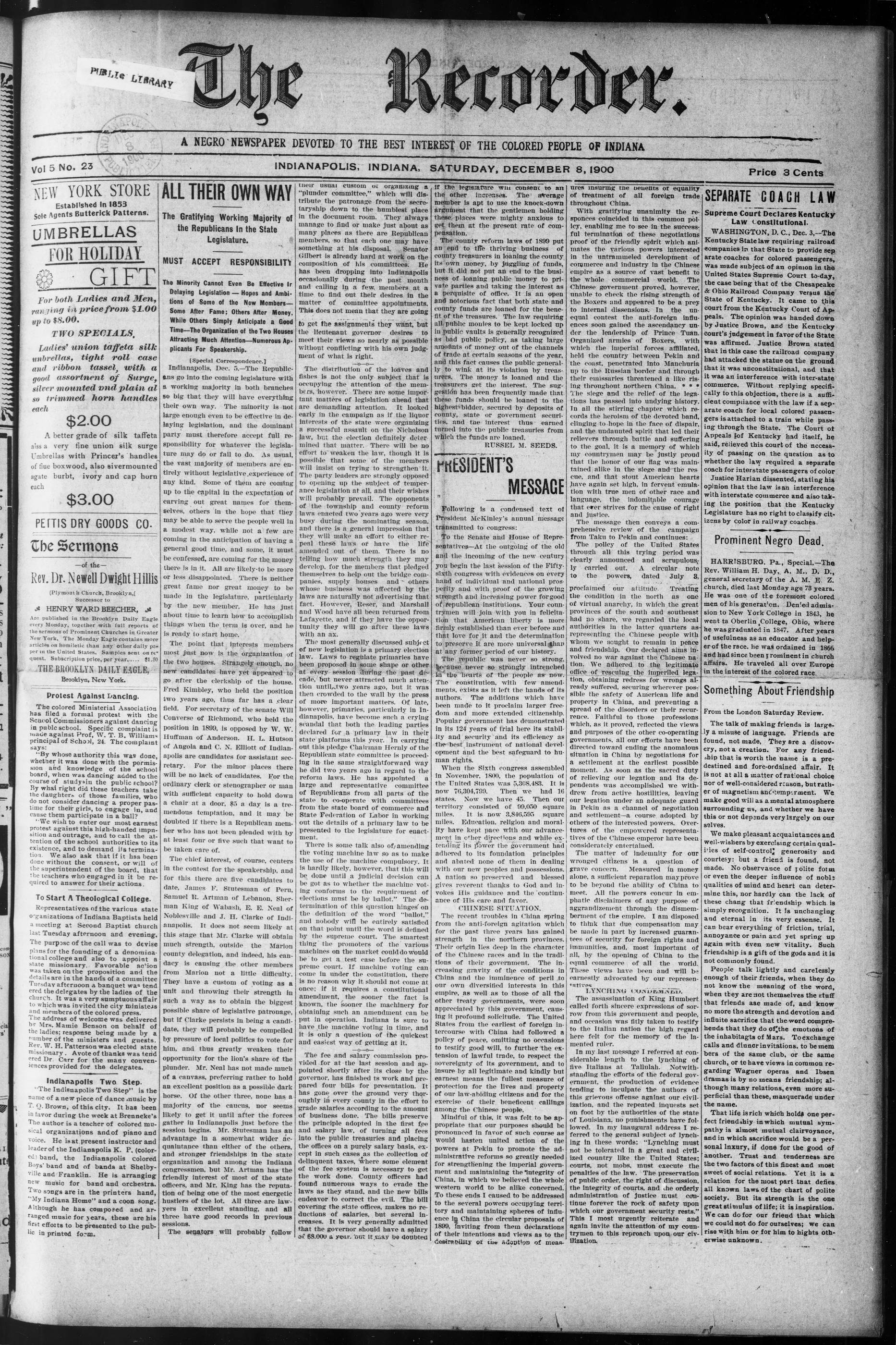
Page text (machine-generated)
NEW YORK STORE
Established in 1853
Sole Agents Butterick Patterns.
UMBRELLAS
FOR HOLIDAY
GIFT
For both Ladies and Men,
ranging in price from $1.00
up to $8.00.
TWO SPECIALS
Ladies' union taffeta silk unbrellas, tight roll case and ribbon tassel, with a good assortment of Surge, silver mounted and plain al so trimmed horn handles each
$2.00
A better grade of silk taffeta alss a very fine union silk surge Umbrellas with Princer's handles of fine boxwood, also silvermounted agate burbt, ivory and cap horn each
$3.00
PETTIS DRY GOODS CO.
The Sermons
—of the—
Rev. Dr. Newell Dwight Hillis
(Plymouth Church, Brooklyn,\
Successor to
HENRY WARD BEECHER,
Are published in the Brooklyn Daily Eagle
every Monday, together with full reports
of the sermons of Prominent Churches in Greater
New York. The Monday Eagle contains more
articles on homiletic than any other daily paper
in the United States. Samples sent on request. Subscription price, per year.... $1.50
THE BROOKLYN DAILY EAGLE
Brooklyn, New York.
Protest Against Dancing.
To Start A Theological College.
Representatives of the various state organizations of Indiana Baptists held a meeting at Second Baptist church last Tuesday afternoon and evening. The purpose of the call was to devise plans for the founding of a denominational college and also to appoint a state missionary. Favorable action was taken on the proposition and the details are in the hands of a committee Tuesday afternoon a banquet was tended the delegates by the ladies of the church. It was a very sumptuous affair to which was invited the city ministers and members of the colored press. The address of welcome was delivered by Mrs. Mamie Benson on behalf of the ladies; response being made by a number of the ministers and guests. Rev. W. H. Patterson was elected state missionary. Avote of thanks was tended Dr. Dr. Carr for the many conveniences provided for the delegates.
Indianapolis Two Step.
"The Indisnapolis Two Step" is the name of a new piece of dance music by T. Q. Brown, of this city. It has been in favor during the week at Brenneke's. The author is a teacher of colored musical organizations and of piano and voice. He is at present instructor and leader of the Indianapolis K. P. (colored) band, the Indianapolis colored Boys' band and of bands at Shelbyville and Franklin. He is arranging new music for band and orchestra. Two songs are in the printers hand, "My Indiana Home" and a coon song. Although he has composed and arranged music for years, these are his first efforts to be presented to the public in printed form.
```markdown
```
A NEGRO NEWSPAPER DEVOTED TO THE BEST INTEREST OF THE COLORED PEOPLE OF INDIANA INDIANAPOLIS, INDIANA, SATURDAY, DECEMBER 8, 1900
The
ALL THEIR OWN WAY
The Gratifying Working Majority of the Republicans In the State Legislature.
MUST ACCEPT RESPONSIBILITY
The Minority Cannot Even Be Effective Ir Delaying Legislation — Hopes and Ambitions of Some of the New Members— Some After Fame; Others After Money, While Others Simply Anticipate a Good Time—The Organization of the Two Houses Attracting Much Attention—Numerous Applicants For Speakership.
[Special Correspondence.]
Indianapolis, Dec. 5.—The Republicans go into the coming legislature with a working majority in both branches so big that they will have everything their own way. The minority is not large enough even to be effective in delaying legislation, and the dominant party must therefore accept full responsibility for whatever the legislature may do or fail to do. As usual, the vast majority of members are entirely without legislative_experience of any kind. Some of them are coming up to the capital in the expectation of carving out great names for themselves, others in the hope that they may be able to serve the people well in a modest way, while not a few are coming in the anticipation of having a general good time, and some, it must be confessed, are coming for the money there is in it. All are likely-to be more or less disappointed. There is neither great fame nor great money to be made in the legislature, particularly by the new member. He has just about time to learn how to accomplish things when the term is over, and he is ready to start home.
The point that interests members most just now is the organization of the two houses. Strangely enough, no new candidates have yet appeared to go after the clerkship of the house. Fred Kimbley, who held the position two years ago, thus far has a clear field. For secretary of the senate Will Converse of Richmond, who held the position in 1899, is opposed by W. W. Huffman of Anderson. H. L. Hutson of Angola and C. N. Elliott of Indianapolis are candidates for assistant secretary. For the minor places there will be no lack of candidates. For the ordinary clerk or stenographer or man with sufficient capacity to hold down a chair at a door, $5 a day is a tremendous temptation, and it may be doubted if there is a Republican member who has not been pleaded with by at least four or five such that want to be taken care of.
The chief interest, of course, centers in the contest for the speakership, and for this there are five candidates to date, James F. Stutesman of Peru, Samuel R. Artman of Lebanon, Sherman King of Wabash, E. E. Neal of Noblesville and J. H. Clarke of Indianapolis. It does not seem likely at this stage that Mr. Clarke will obtain much strength, outside the Marion county delegation, and indeed, his candacy is causing the other members from Marion not a little difficulty. They have a custom of voting as a unit and throwing their strength in such a way as to obtain the biggest possible share of legislative patronage, but if Clarke persists in being a candidate, they will probably be compelled by pressure of local politics to vote for him, and thus greatly weaken their opportunity for the lion's share of the plunder. Mr. Neal has not made much of a canvass, preferring rather to hold an excellent position as a possible dark horse. Of the other three, none has a majority of the caucus, nor seems likely to get it until after the forces gather in Indianapolis just before the session begins. Mr. Stutesman has an advantage in a somewhat wider acquaintance than either of the others, and stronger friendships in the state organization and among the Indiana congressmen, but Mr. Artman has the friendly interest of most of the state officers, and Mr. King has the reputation of being one of the most energetic hustlers of the lot. All three are lawyers in excellent standing, and all three have good records in previous sessions.
The senators will probably follow
Recorder.
their usual custom or organizing a "plunder committee," which will distribute the patronage from the secretaryship down to the humblest place in the document room. They always manage to find or make just about as many places as there are Republican members, so that each one may have something at his disposal. Senator Gilbert is already hard at work on the composition of his committees. He has been dropping into Indianapolis occasionally during the past month and calling in a few members at a time to find out their desires in the matter of committee appointments. This does not mean that they are going to get the assignments they want, but the leutenant governor desires to meet their views so nearly as possible without conflicting with his own judgment of what is right.
The distribution of the loaves and fishes is not the only subject that is occupying the attention of the members, however. There are some important matters of legislation ahead that are demanding attention. It looked early in the campaign as if the liquor interests of the state were organizing a successful assault on the Nicholson law, but the election definitely determined that matter. There will be no effort to weaken the law, though it is possible that some of the members will insist on trying to strengthen it. The party leaders are strongly opposed to opening up the subject of temperance legislation at all, and their wishes will probably prevail. The opponents of the township and county reform laws enacted two years ago were very busy during the nominating season, and there is a general impression that they will make an effort to either repeal these laws or have the life amended out of them. There is no telling how much strength they may develop, for the members that pledged themselves to help out the bridge companies, supply houses and others whose business was affected by the laws are naturally not advertising that fact. However, Reser, and Marshall and Wood have all been returned from Lafayette, and if they have the opportunity they will go after these laws with an ax.
The most generally discussed subject of new legislation is a primary election law. Laws to regulate primaries have been proposed in some shape or other at every session during the past decade, but never attracted much attention until two years ago, but it was then crowded to the wall by the press of more important matters. Of late, however, primaries, particularly in Indianapolis, have become such a crying scandal that both the leading parties declared for a primary law in their state platforms this year. In carrying out this pledge Chairman Herny of the Republican state committee is proceeding in the same straightforward way he did two years ago in regard to the reform laws. He has appointed a large and representative committee of Republicans from all parts of the state to co-operate with committees from the state board of commerce and State Federation of Labor in working out the details of a primary law to be presented to the legislature for enactment.
There is some talk also of amending the voting machine law so as to make the use of the machine compulsory. It is hardly likely, however, that this will be done until a judicial decision can be got as to whether the machine voting conforms to the requirement of elections must be by ballot. The determination of this question hinges on the definition of the word "ballot," and nobody will be entirely satisfied on that point until the word is defined by the supreme court. The smartest thing the promoters of the various machines on the market could do would be to get a test case before the supreme court. If machine voting can come in under the constitution, there is no reason why it should not come at once; if it requires a constitutional amendment, the sooner the fact is known, the sooner the machinery for obtaining such an amendment can be put in operation. Indiana is sure to have the machine voting in time, and it is only a question of the quickest and easiest way of getting at it.
The fee and salary commission provided for at the last session and appointed shortly after its close by the governor, has finished its work and prepared four bills for presentation. It has gone over the ground very thoroughly in every county in the effort to grade salaries according to the amount of business done. The bills preserve the principle adopted in the first fee and salary law, of turning all fees into the public treasuries and placing the offices on a purely salary basis, except in such cases as the collection of delinquent taxes, where some element of the fee system is necessary to get the work done. County officers had found numerous ways to evade the laws as they stand, and the new bills endeavor to correct the evil. The bill covering the state offices, makes no reductions of salaries, but several increases. It is very generally admitted that the governor should have a salary of £8,000 a year, but it may be doubted
if the legislature will consent to an the other increases. The average member is apt to use the knock-down argument that the gentlemen holding these places were mighty anxious to get them at the present rate of compensation.
The county reform laws of 1890 put an end to the thriving business of county treasurers in loaning the county its own money, by juggling of funds, but it did not put an end to the business of loaning public money to private parties and taking the interest as a perquisite of office. It is an open and notorious fact that both state and county funds are loaned for the benefit of the treasures. The law requiring all public monies to be kept locked up in public vaults is generally recognized as bad public policy, as taking large amounts of money out of the channels of trade at certain seasons of the year, and this fact causes the public generally to wink at its violation by treasurers. The money is loaned and the treasurers get the interest. The suggestion has been frequently made that these funds should be loaned to the highest bidder, secured by deposits of county, state or government securities, and the interest thus earned turned into the public treasuries from which the funds are loaned.
RUSSEL M. SEEDS.
Following is a condensed text of President McKinley's annual message transmitted to congress:
To the Senate and House of Representatives—At the outgoing of the old and the incoming of the new century you begin the last session of the Fifty-sixth congress with evidences on every hand of individual and national prosperity and with proof of the growing strength and increasing power for good of republican institutions. Your countrymen will join with you in felicitation that American liberty is more firmly established than ever before and that love for it and the determination to preserve it are more universal than at any former period of our history.
The republic was never so strong, because never so strongly intrenched in the hearts of the people as now. The constitution, with few amendments, exists as it left the hands of its authors. The additions which have been made to it proclaim larger freedom and more extended citizenship. Popular government has demonstrated in its 124 years of trial here its stability and security and its efficiency as the best instrument of national development and the best safeguard to human rights.
When the Sixth congress assembled in November, 1800, the population of the United States was 5,308,483. It is now 76,304,799. Then we had 10 states. Now we have 45. Then our territory consisted of 99,050 square miles. It is now 3,846,595 square miles. Education, religion and morality have kept pace with our advancement in other directions and while extending its power the government had adhered to its foundation principles and abated none of them in dealing with our new peoples and possessions. A nation so preserved and blessed gives reverent thanks to God and invokes His guidance and the continuance of His care and favor.
CHINESE SITUATION.
The recent troubles in China spring from the anti-foreign agitation which for the past three years has gained strength in the northern provinces. Their origin lies deep in the character of the Chinese races and in the traditions of their government. The increasing gravity of the conditions in China and the imminence of peril to our own diversified interests in this empire, as well as to those of all the other treaty governments, were soon appreciated by this government, causing it profound solicitude. The United States from the earliest of foreign intercourse with China had followed a policy of peace, omitting no occasions to testify good will, to further the extension of lawful trade, to respect the sovereignty of its government, and to insure by all legitimate and kindly but earnest means the fullest measure of protection for the lives and property of our law-abiding citizens and for the exercise of their beneficent callings among the Chinese people.
Mindful of this, it was felt to be appropriate that our purposes should be pronounced in favor of such course as would hasten united action of the powers at Pekin to promote the administrative reforms so greatly needed for strengthening the imperial government and maintaining the integrity of China, in which we believed the whole western world to be alike concerned. To these ends I caused to be addressed to the several powers occupying territory and maintaining spheres of influence in China the circular proposals of 1890, inviting from them declarations of their intentions and views as to the desirability of the adoption of meas-
ures insuring the oenees of equality of treatment of all foreign trade throughout China.
With gratifying unanimity the responses coincided in this common policy, enabling me to see in the successful termination of these negotiations proof of the friendly spirit which animates the various powers interested in the untrammeled development of commerce and industry in the Chinese empire as a source of vast benefit to the whole commercial world. The Chinese government proved, however, unable to check the rising strength of the Boxers and appeared to be a prey to internal dissensions. In the unequal contest the anti-foreign influences soon gained the ascendancy under the leadership of Prince Tuan, Organized armies of Boxers, with which the imperial forces affiliated, held the country between Pekin and the coast, penetrated into Manchuria up to the Russian border and through their emissaries threatened a like rising throughout northern China. * * * The siege and the relief of the legations has passed into undying history. In all the stirring chapter which records the heroism of the devoted band, clinging to hope in the face of dispair, and the undaunted spirit that led their relievers through battle and suffering to the goal, it is a memory of which my countryman may be justly proud that the honor of our flag was maintained alike in the siege and the rescue, and that stout American hearts have again set high, in fervent emulation with true men of other race and language, the indomitable courage that ever strives for the cause of right and justice.
The message then conveys a comprehensive review of the campaign from Taku to Pekin and continues: The policy of the United States through all this trying period was clearly announced and scrupulous, carried out. A circular note to the powers, dated July 8, proclaimed our attitude. Treating the condition in the north as one of virtual anarchy, in which the great provinces of the south and southeast had no share, we regarded the local authorities in the latter quarters as representing the Chinese people with whom we sought to remain in peace and friendship. Our declared aims involved no war against the Chinese nation. We adhered to the legitimate office of rescuing the imperiled legation, obtaining redress for wrongs already suffered, securing wherever possible the safety of American life and property in China, and preventing a spread of the disorders or their recurrence. Faithful to those professions which, as it proved, reflected the views and purposes of the other co-operating governments, all our efforts have been directed toward ending the anomalous situation in China by negotiations for a settlement at the earliest possible moment. As soon as the sacred duty of relieving our legation and its dependents was accomplished we withdrew from active hostilities, leaving our legation under an adequate guard in Pekin as a channel of negotiation and settlement—a course adopted by others of the interested powers. Overtures of the empowered representatives of the Chinese emperor have been considerably entertained.
The matter of indemnity for our wronged citizens is a question of grave concern. Measured in money alone, a sufficient repatriation may prove to be beyond the ability of China to meet. All the powers concur in emphatic disclaimers of any purpose of aggrandizement through the dismemberment of the empire. I am disposed to think that due compensation may be made in part by increased guarantees of security for foreign rights and immunities, and, most important of all, by the opening of China to the equal commerce of all the world. These views have been and will be earnestly advocated by our representatives.
LYNCHING CONDEMNED.
The assassination of King Humbert called forth sincere expressions of sorrow from this government and people, and occasion was fity taken to testify to the Italian nation the high regard here felt for the memory of the lamented ruler.
In my last message I referred at considerable length to the lynching of five Italians at Tallulah. Notwithstanding the efforts of the federal government, the production of evidence tending to inculpate the authors of this grievous offense against our civilization, and the repeated inquests set on foot by the authorities of the state of Louisiana, no punishments have followed. In my inaugural address I referred to the general subject of lynching in these words: "Lynching must not be tolerated in a great and civilized country like the United States; courts, not mobs, must execute the penalties of the law. The preservation of public order, the right of discussion, the integrity of courts, and the orderly administration of justice must continue forever the rock of safety upon which our government security rests." This I most urgently reiterate and again invite the attention of my countrymen to this reproach upon our civilization.
Price 3 Cents
SEPARATE COACH LAW
Supreme Court Declares Kentucky Law Constitutional.
WASHINGTON, D. C., Dec. 3,—The Kentucky State law requiring railroad companies in that State to provide sep arate coaches for colored passengers, was made subject of an opinion in the United States Supreme Court to-day, the case being that of the Chesapeake & Ohio Railroad Company versus the State of Kentucky. It came to this court from the Kentucky Court of Appeals. The opinion was handed down by Justice Brown, and the Kentucky court's judgement in favor of the State was affirmed. Justice Brown stated that in this case the railroad company had attacked the statue on the ground that it was unconstitutional, and that it was an interference with inter-state commerce. Without replying specifically to this objection, there is a sufficient compliance with the law if a separate coach for local colored passengers is attached to a train while passing through the State. The Court of Appeals of Kentucky had itself, he said, relieved this court of the necessity of passing on the question as to whether the law required a separate coach for interstate passengers of color
Justice Harlan dissented, stating his opinion that the law is an interference with interstate commerce and also taking the position that the Kentucky Legislature has no right to classify citizens by color in railway coaches.
Prominent Negro Dead
HARRISBURG. Pa., Special.—The Rev. William H. Day, A. M., D. D., general secretary of the A. M. E. Z. church, died last Monday age 73 years. He was one of the foremost colored men of his generation. Denied admission to New York College in 1843, he went to Oberlin College, Ohio, where he was graduated in 1847. After years of usefulness as an educator and helper of the race, he was ordained in 1866 and had since been prominent in church affairs. He traveled all over Europe in the interest of the colored race.
Something About Friendship
From the London Saturday Review.
The talk of making friends is largely a misuse of language. Friends are found, not made. They are a discovery, not a creation. For any friendship that is worth the name is a predestined and fore-ordained affair. It is not at all a matter of rational choice nor of well-considered reason, but rather of magnetism and temperament. We make good will as a mental atmosphere surrounding us, and whether we have this or not depends very largely on our selves.
We make pleasant acquaintances and well-wishers by exercising certain qualities of self-control* generosity and courtesy; but a friend is found, not made. No observance of polite form or even the deeper influence of noble qualities of mind and heart can determine this, nor hardly can the lack of these chang that friendship which is simply recognition. It is unchanging and eternal in its very essence. It can bear everything of friction, trial, annoyance or pain and yet spring up again with even new vitality. Such friendship is a gift of the gods and it is not commonly found.
People talk lightly and carelessly enough of their friends, when they do not know the meaning of the word, when they are not themselves the stuff that friends ase made of, and know no more the strength and devotion and infinite sacrifice that the word comprehends that they do of the emotions of the inhabitants of Mars. To exchange calls and dunner invitations, to be members of the same club, or the same church, or to have views in common regarding Wagner operas and Ibsen dramas is by no means friendship; although many relations, even more superficial than these, masquerade under the name.
That life is rich which holds one perfect friendship in which mutual sympathy is almost mutual clairvoyance, and in which sacrifice would be a personal luxury, if done for the good of another. Trust and tenderness are the two factors of this finest and most sweet of social relations. Yet it is a relation for the most part that defies all known laws of the chart of polite society. But its strength is the one great stimulus of life; it is inspiration. We can do for our friend that which we could not do for ourselves; we can rise with him or for him to hights otherwise unknown.
LACK OF PATIENCE OUR GREAT-
ES FAULT.
‘The Unfortunate Not Greatly to Blame
For Being Unhappy—Vutience No
Virtue With the Prosperous—
‘De. Talmmnge’s Sermon.
all admire, and the lessons taught are
very helpful; text, Hebrews x, 36, “Ye
have need of patience.”
Yes, we are in awful need of it.
Some of us have a little of it, and
some of us have none at all. ‘There is
less of this grace in the world than of
almost any other. Faith, hope and
charity are all abloom in hundreds of
souls where you find one specimen of
patience.
Ob, ft is easy enough to be patient
when there is nothing {9 be patient
about. © When the bank account is
good and in no danger of being over-
drawn, and the wardrobe is crowded
with apparel appropriate for the cold
‘or the heat or the wet, and all the fam-
ily have attested their hea!th by keen
appetites at u loaded table, and the
Bewspapers, If they mention us at all.
put right construction upon what we
do or say, and we can walk ten miles
without getting tired. and we sleep
eight solid hours without turning from
side to side, the moxt useless grace 1
ean think of is patience. It has no
business anywhere in your house; you
have no more need of it than of a lite
Preserver while you are walking the
Pavement of a city, no more need of it
than of an umbrella under a cloudless
sky, no more need of it than of Sir
Humphry Davy’s safety lamp for min-
ers while you are breathing the tonic
alr of an October morning. Do not
boast that you are placid and optimis-
tie and free from the spirit of scold.
If those who are unfortunate could
change lots with you, they would be
just as sunshiny. It is not religion
that makes you so happy, but capacity
to digest your food in three hours, auc
enough coupons cut off to meet all
your expenses, and complimentary
PBention and: capaelty to leave your
jorses In the stable beeese you need
a brisk walk down the avenue,
« First, potience with the frults of
others, No cne keeps the Ten Com-
mandments equally well. One's tem-
Perament decides which command-
ments he shall come.nearest to keep-
ing. If we break some of the com-
mandments ourselves, why be so hard
on those who break others of the ten?
If you and I run against one verse of
the twentieth chapter of Exodus, why
should we so severely excoriate those
who run against another verse of the
same chapter? Until we are perfect
ourselves we ought to be lenient with
our neighbor's imperfections. Yet it
is often the case that the man most
vulnerable is the most hypercritical.
Perhaps he is profane and yet has no
tolerance for theft, when profanity is
worse than theft, for, while the lat-
ter is robbery of a man, the former
fs robbery of God. Perhaps he Is glv-
en to defamation and detraction and
Yet feels inimseif better than some one
who is guilty of manslaughter, not
realizing that the assassination ot
character {s the worst kind of assassi-
nation. ‘The layer for washing in the
ancient tabernacle was at Its side bur-
nished like a looking glass, so that
those that approached that laver
might sce their need of washing, and
if by the gospel looking glass we dis-
covered our own need of moral
cleansing we would be more economic
of denunciation. The most of those
‘who go wrong are the victims of clr-
cumstances, and if you and I had been
rocked in the same iniquitous cradle
and been all our lives surrounded by
the same baleful influences we would
probably have done just as badly, per-
haps worse.
Again, we have need of patience un-
Ger wrong inflicted, and who escapes it
in some form? It comes to all people
in professional life in the shape of be-
ing misunderstood. Because of this,
how many people fly to newspapers for
an explanation. You see their card
signed by their own name declaring
they did not say this or did not do
that. They fluster and worry, not raal-
fzing that every man comes to be
taken for what he is worth, and you
cannot, by any newspaper putt, be tak-
en for more than you are worth nor
by any newspaper depreciation be put
down. ‘There is a spirit of fairness
abroad in the world, and if you are a
public man you are classified among
the friends or foes of society. If you
are a friend of society, you will iind
plenty of adherents, and if you are the
foe of society you cannot eseape rep-
rehension. Paul, you were right when
you said, not more to the Hebrews
than to us, “Ye have need of patience.”
I adopted a rule years ago which has
Deen of great service to me, and It
may be of some service to you: Cheer-
fully consent to be misunderstood.
God knows whether we are right or
‘wrong, whether we are trying to serve
him or damage his cause. When you
can cheerfully consent to be misunder-
stood, many of the annoyances and
vexations of life will quit your ineart,
and you will come into calmer seas
than you have ever sailed on. The
most misunderstood being that ever
trod the earth was the glorious Christ.
‘he world misunderstood his cradle
and concluded that one so poorly born
could never be of much importance.
They charged him with Inebriety and
called him 2 winebibber. The sanke-
rim misunderstood him, and when it
was put to the vote whether he was
guilty or not of treason he got but one
Yote, while all the others voted “Aye,
ae”) They wlenndarstosd tin crane
Re ea aa eee Lae Oe Tt os eee ae
tion. A draft from an open window or
hasty mastication or overwork brings
on that old spell, and you think you
would rather have almost anything
else, but that Is because you have not
tried the other. Asthma Would like to
trade off for erysipelas and erysipelas
for asthma, Almost every one has
something which he wishes he had
not. There are scores of diseases ever
ready to attack the human frame.
‘They have been in pursuit of our race
ever since Adam and Eve resigned
their innocence as well as the world’s
health. It is amazing how persistent
and methodic those disorders are in
their attack on the world and how reg.
ular is the harvest which with the
sharp scythe of pain they mow down
for the grave. No such disciplined and
courigeous army ever marched as the
army of physical suffering. They do
their work in the order I name, ana
You may depend upon their keeping
vu In that same order for a good while
yet. First of all tuberculosis, next or-
ganic heart disease, next pneumonia,
next in number of its victims Is apop-
lexy, next Bright's disease, next can-
ver, next typhoid fever, next paralysis,
‘Those eight diseases are the worst de-
spoilers of human life. ©The doctors
with solutions and lancets and anody-
nes and cataplasms are in a brave
ficht against these physiological devils
that try to possess the human ‘race.
But after all the scientists can do
there is a demand for patience. Noth-
ing can take the place of that. It is
neede.! this moment in every sickrcom
and along the streets and in business
places and shops where breadwinners
are compelled to toil when physically
incompetent to move a pen or calcu-
late a column of figures or control a
shovel,
Now let us this hour turn over.a new
leaf and banish worriment and care
out of all our lives. Just see how these
perversities have multiplied wrinkles
in your fage and acidulated your dis-
position and tern your nerves. You are
sen years older than yeu oughtto be.
Do two things—one for the betterment
of your spiritual condition and the oth-
st for the safety of yeur werldty in. -2-
sts. Fist get your heart right wih
God by being pardoned through the
atonemevt of Jesus Christ. That will
give security for your soul's welfare.
Then get your life insured in some well
established life insurance company.
That will take from you all anxiety
about the welfare of your household
In the ease of your sudden demise.
Supposing that these two duties are
attended to, the one for the safety of
your soul in this woril and the next
and the other for the safety of gyour
family if you pass out of this life,
make a new start. If possible, have
your family sitting room where you
can let in the sunlight. Have a music-
al instrument if you can afford it—
harp or piano or bass viol or parlor or-
gan. Learn how to play on it yourself
or-have your children learn “how to
play on it. Let bright colors dominate
‘nm your room,
This last snmmer I stood on Sparrow
hi, four miles from Moscow. It was
the place where Napoleon stood and
looked upon tne city which he was
about to capture. His army had been
in long marches and awful fights and
fearful exhaustions, and when they
came to Sparrow hill the shout went
up from tens of thousands of voices,
“Moscow, Moscow!” I do not wonder
at the transport. A ridge of hills
sweeps round the city. A river semi-
circles it with brilliance. It is a spec-
tacle that you place in your memory
as one of three or four most beautiful
scenes in all the earth. — Napoleon's
army mareked on it in four divisions,
four overwheiming torrents of valor
and pomp, down Sparrow hifl and
through the beautiful valley and
across the bridges and into the pal-
aces, which sarrendered without one
shot of resistance because the aval-
anche of troop# was irresistible. There
is the room in which Napoleon slept,
and his pillow, which must have been
very uneasy, for, oh, how short his
stay! Fires kindled in all parts of the
city simultaneously drove out that
army into the snowstorms undee
which 95,000 mea perished. How soon
did triumphal mareh turn into horri-
ble demolition! To-day while lt speak
we come on a high hill, a glorious hill
of Christian anticipation. These hosts
of God have had a long mareh and
fearful battles, and defeats have again
and again mingled with the victories,
but to-day we come in sight of the
great city, the capital ofthe universe,
the residence of the King and the
home of those who are to reign with
him for ever and ever. Lool: at the
towers and hear them ring with
eternal jubilee. Look at the house of
many mansions, where many of our
loved ones are. Behold the streets of
burnished gold and hear the rumble
of the chariots of those Who are more
than conquerors. So far from being
driven back. all the twelve gates ave
wide open for our entrance. We are
marching on and marching on, ang
our every step brings us nearer to the
elty.
At what hour we shall enter we
have no power to foretell, but once en-
| listed amid the blood washed host our
entrance is certain. It may be in the
bright noonday or the dari: midnight.
THE RECORDER, INDIANAPOLIS, INDIANA
‘tence, beautiful Patience, long sut.{ ,sRAce seed mipanaTabates wien 20 muon s
fering Patience, will at that gate say:| fave bean soshied ter tea teense
‘“Good-by. I helped you In the battle of | ass Fealled blocs attacks oomiag ou reful
life, But now that you have gained the | ‘terete, wan eudny Simerent physi
friumph you necd me no more. 1| seer 1 had the teeth extracted, but tbe
ound up your wounds, but now they | ek contin s008 ‘advertisements
are all healed. I soothed your be-] them ber seo as oie tee ee
reavements, but you pass now into the} duoed meta ty them. Have taken but two ot
Teunions of heaven. I can do no more} . See teens bees o¢ tee fatale cad hare’
for you, and there is nothing for me] testimonial for angthing before; bat tne re
to do In a city where there are no bur- Ste Sees:
Gens to carry. Good:hy, “10. back |! <2 mateergeman tea emueeeearne
into the world from which yoa came] possasion now ‘a. Dewi
up to resume my tour among the hos- —
pitals and sickrooms and bereft house- | 1 wane to tatorm:
holds and almshouses. The ery of the | %, words st hlekast
: of the beneas
world’s sorrow reaches my ears, and| f"have ‘derived. thom R
I aust descend. Up and down’ that| RipanaTabules, tame .
Poor suffering world 1 will go to as | Profelonel aurse and o
Suage and comfort and sustain until] esd ieatways needed.) Gy
the world itself expires and on all its] Rysns Zebales does it, $5] The
mountains and in all its valleys and| foundspecttcnapeets ga
on all its plains there is not one soul} Fam down. Actingon the ard ]
left that bas ticed of patience.” See Nera |
Ave, Jersey City, ;
Ripe Tebales wan $] 0) f CINE
PASSING OF THE PRAIRIE DOG,| freed reeuite wy
MisiearWaoun —§) 2 || comn
Grasiors Have Declared incessant! mene Te mana 3S [ill of
War Against Hum, ath Searebure con
‘The agricultural experiment station
att Lincolu, Neb, hus Just issued a but
Jetin which seals the tate of that pic-
turesque little fellow, the prairie dog,
the ouly object that gives vital iter
est to the monotonous plains of ine
fir West, says thé Los Angeles x-
press. It Is always a relief to run past
a prairie dog town In the internanabiy
dull expanse of cactus and sage
brush, but his time has come, and ue
must speedily become an extinct’ ani-
mal, and the holes which have once
Known him shail know him ne more
forever,
‘the industrial forces of civilization
are leagued against the prairie dog,
and it is his own fault, for, innocent
as he looks, he is bad. Like Aitemus
Ward's kangaroo, he is an “amoosin’
little cuss.” But he is destructive. Hie
kills out the grass, and as that part of
the country frequented by the prairie
dog ts almost entirely used for grazing
nurposes, his extermination has been
-dered to save the land from his ray:
ages. :
“Lhe bulletin gives the fatal preserip-
tion in minute detail. Firat, dissolve
three ounces of strychnine and one-
half pound of potassium of cyanide in
che quart of boiling water. Then add
two quarts of molasses and one tea:
spoonful of off of anise. Stir. ‘Then
pour the solution over a bushel of
wheat and, while mixing it together,
sprinkle in four pounds of finely
ground cornmeal, which enables the
grains of wheat to carry a large
amount of poison. It is a tempting
menu for Cynomys Ludovicians, but
one teaspoonful ut a hole ends tie ca-
reer of the whole family,:and the pro-
portion given above will dispose of a
town of 500 acres, the number of fam-
tiles to the sere ranging from ninety
to, 4p
‘The bulletin further says that this
“year the poisoning is being done over
a large range of territory, and with
“gratifying results, se that it is not 1m-
probable in a short time the last pral-
rie dog will have disappeared. The
railroad traveler, as he crosses the
plains, will miss the sight of the litte
fellows who have added life and gay-
ety to the otherwise monotonous scen:
ery. But they should not have been
bad. It is to be regretted that tho
learned bulletin was not sufficiently
explicit. Tt does not tell what becomes
of the prairie dog’s boarders, the owl
and the ratlesnake, who, though never
Seen, were once popularly belicved to
share with him the comforts of home
and to dwell together in delightful
concord. Do they also partake of the
tempting meat ieft at the door, and
pass away with the proprietor and his
family, or do they expire of grief as
‘they witness the sad tragedy?
The Topaz.
“Not the least beautiful of the
many semi-precious stones, for which
there Is always a large demand, is the
topaz,” said a wholesale dealer in
gems to the writer yesterday. “Tne
name topaz generally suggests only a
yellow stone, yet there are light biue,
brown and green varieties which are
frequently sold as aquamarines. ‘The
gentiine aquamarine may, however, be
easily distinguished from a topaz, as
the former stone more closely resen-
bles the color of green sex salt. — Be-
sides, the topaz admits of a higher
polish, and is extremely slippery to the
touch. Strange to say, the yellow to-
paz when slightly heated becomes
pink; heated further, the pink grows
paler, and by long heating it is entire-
ly expelled, leaving the green colorless.
‘The sherry-colored or brown topaz 1s
Wleached in a yery short time by th’
rays of the sun or strong daylight, and
all the white topazes found in name
have been colorized’ in this way. The
topaz is found in granite rocks in Si
berin. Japan, Peru. Ceylon. Brazil and
Maine, and Sn voleante rocks in Cotora:
do, Utsh and New Mexico.—Washing.
ton Star.
The Rich Lose Ability te Erior.
The wealthy soon become satiated
and fall viethins to ennui, which is
worse than weariness. See these m
their boxes at the opera. Below them
and above them enthusiasm runs riot
when De Reszke or Sembrich sings.
‘They applaud languidly with dainty
fans upon the gloved hand. They do it
hecause.they think it is expected of
them, but their eves do not light up.
the color does not come into their
cheeks, their bosoms do not swell with
emotion. No, they are tired, they are
worn out, they have gone through too
much, and even mnsie cannot move
them. They really ure to be pitied. in
the highest gallery sit men and wom-
en who get much more ont of the mu-
sic than these people. They get delight,
and of delight those who have too
miuch are soon incapable.—Woman’s
Home Companion.
Moroes and Riographers,
She—Tell you the truth, Alfred, 1 do
not believe in heroes.
He—That's funny. If you had said
you didn't believe the people who
‘write their biographies I should heve
thought nothing of {t—Doston Tran-
script.
‘Shave used Ripans Tabules with so muon satie-
faction tbat I can ¢heerfully recommend them.
Have been troubled for about tance yeare with
what Toalled bilious attacks coming on regularly
‘once a week. Was told by diferent physiclans
bat 1t was caused by bad teeth, of which I bat
sover LI had the tooth extracted, ut the i:
tacks continued. I had soen advertisements of
Ripans Tabules in all the papete but had po faith
{ta them, bat about six weeks since « friend Jn.
‘duced nie to try them. Have taken but two of the
small Scent boxes of the Tabules and have bad
Sorecurrence ofthe attacks, Have never gira
‘ostimonial for anything before, bit the great
‘mount of good which I believe has been come me
by Ripane Tabules induces me to add maine fo the
‘many testimonials you doubtless have tz your
(possesion now. ‘AT. DaWits,
| RIPANS |
o
in a
|] The modern stand- ;
$) 2 || ard Family Medi- j
mn }#cine: Cures the é
= oe
> || commca every-day ‘
@ |] ill of humanity. i
2 ~~ p
Zz 5 °
| @e
Fepules regulariy. Shekeeps afew cartons Ripens | Reacting sore of the testimonials in favor of
Tables inthe house and saya abewill note wisi: | Riana Tabuidn tries iets Rigas Sais aoe
qutthem. The heartburn aod sleeplonsuees Bave | ouiy relieved but escually corsh my wena,
isappeared with the indigestion which wos | the boadccles have diuspsaned, woes
formerly 40 greata burden for her. Our whole | goed cvetition and sersecer commision Sf tf
‘amily take the Tabules repulariy, especially after | ftotanch. Ife tanow a ren, cbubby éased bape Tae
S'hoarey meal: My mothe tu Afty years of age | wontertal sheage Tavtebure to Riper sebae,
ud isenjoying the bestot health and spirits; sso | Tam satis thst they wil cede aay One ees
sts hearty meals, au tmpombilcy bafore the | thecradier-ld ege) if taxon ascordiog to Stee
ook RipaneTabalen Anrow H. Buaveas.” | uous, iW. Pace
Anew srie packet oootaining Fm RaPAsc Taman yanked Inn paper eacton (without xiau ta now forsale
At some drug soree-ton ivr chm. Thiclowpriced sore lv ntendad fr the Poot and toe eoapocteal” Cab
done of the Avocent carcons Gad taba) cut, be bai by toil by sending torty-agat cents tothe Rarasy
Casncat Gourunr, No.0 Brace Steet New Torker nsagiecartsu(ran Tasoenh el ba seat for are eee
‘iran Tasvra maj tio bo dot some eroows evosta! strckeoprn, eve agen and at oes Uqaar Seated
spatter shams teaetmmen ees ears onsen enero ee oe
American Mutual Aid Associati
Of Saint Louis Mo.,
We need not refer you to people in Europe, Asia, etc.
for recommendation, but can furn'sh testimonials from
reliable persons in your own city, ayia ‘
We pay Sick accident und Death Benefits Also furnish
Pree Medical attention in case of Sickness or Accident §
Be on the safe side and Insure with us.
E, B. HAMPTON, Organizer,
Room 43 BAtpwix Bock, Indianapolis, Id
IPATTIEN S
al 31s baal ALF
CAVEATS, TRADE MARKS,
COPYRIGHTS AND DESIGNS.
‘Send your business direct fo Washington,
arzn me, conta tan beter servo”
My saesin 00,8. Rat Qe FREE pai:
Sfuscared. PERSONAL ARTEWTION CHER" 19 Yeas
iheraat ntrmiever Sse aos atts eee?
ual bens Hace: pure Gaenek 8 6 Hoe
een eerepemes tore ener eae
INVENTIVE AGE
ANE NE ustect.c.A Snow & Co.
~U. WASHINGTON, Osc,
E.G. SIGGERS, ster Se. Nw:
Curly Hair Made Straight By
a | Soles
ol GA.
J BF 4a,p. Dy wea
TTAREN FROM LIP:
seron! SND sie Sues
OZONIZED OX MARROW
Tite omtGrsat—coprmiorten.
ile eet ex nets on ay ls
ee eee
UE ae oe
cote eee
ecttienartiae, pemewti tea fe
ee ce ere er rare
Petiitaer nak! Gieauer oe Micro
fee ea Mend. cnr
Pevrutimal ticerceuaiv ier
most economical. ft se not pursibe for ary body
Brena etait etras Sead Lae oy
igeriead eas caren, ieee
easy castes (las teres sa Wits
Fee oo ce eae
OZONIZED OX MARROW CO.,
76 Wabash Ave., Chicago, Il
For eale by Lewis 0 Hayes, Dew
gist, 502 Indiaus ave; Tudiana polis.
N Gill
rscovery
FOR MAKING.
xo AAR, CURLY Ha Sp i
er ag i,
bb 29 27,2 ™
(i) Se ae Ze
‘haifa ty
SON
OTN i
"eeop 6 are® 177
GTRMGHTING fon caf, certain ei retin
le qaeyatation, “iris utecistcly fee
foes ait Injorcn Sensicate ond contr ee
fore ine most dure heal it tot oly
Lefsightens the hair: but secoves Bandra!
Siimulstes the oviset the hain Leepoit fori
inti ost aad profuceo a Fehr feng and
eteie ger annimees
pealp ciscaice. Stenigtties e vichiy po
eee aes te overs ees en Gegeerince
forged fai. ie hog beta toned by how
ssnds with the unanimous verdict teat itis
te bone propacailon made.”“Evce, 25 somes
ag eereh or seat by mailto snganeree
for 30 cents th stamps. Address, NELSON
MANUFACTURING CO , Richmond, Va.
e@-Agents wanted. Write for terms.-@a
5 want to tnform
ta “words of highes
Prat, of Ge [bemet
have derived. from
Ripans Tabules Tam
Prsfestcael mares nd
this profeaion clea
ead ts alwaye needed
Ripens Tabuloe does it
‘ter ove of my cust]
‘candtmyenlt completely
Fan down, Acting on th
Sivige of is Geb: Bowe
f.'Pa. Gy Sh Nowark
Tre, derniy City 1 tok
Ripase Tebolee with
frend resulta,
ine ecate Wonpuan
Mother was troabied
with heartburn and
Tireplesenes, caused by
incigoton, tora enod
any years. Ono Gay
Sieitao.thcimonta
3° paper indorsing
Eipane avalon, she
Gecermlnodto give therm
sci, wan greatly
Fatloved ‘by thelr tee
felloved by thelr use
Cette ree Sree ere meat in
over Sie yeuta, Noting gave me aay telat
My foct and lige med abdomra were bloaied te
Toculd not wenrsiuces00 any foot and ouly s loon
dreus, “1 saw Ripans Tabules advertised tn cu,
dally paper, boucht some aud took Chem aa direct
fed. Have taken them about Uures weeks and there
Sn such achange! Lam not constipated any more
‘and I owe If a'l to Ripans Tabule, Tama thir
seven sears old, have mo occupation, only. &y
bousebold duties aud aursiug ty cick husband
Bo bas had the cropsy and Ca trying Ripans
‘Tables for him. Ho feela some better but it wil
$ako some time, be has been sick soloug. Yor
‘aay tse my letter and same en you Ike,
Mra. Many Gomuas CLanmn,
I have beea sutering from headsches over
diate I Wes 0 Us GR Yeas eee one
enbickiacnenhn <n ‘aoeinn ae
Reading some of the testimoniais tn favor of
Ripaue Tabuids, I tried them. Ripans Tabales not
ouly relieved but aocually cured my youngster,
the beaduclies have disappeared, bowels are is
good coadition and he never compiaine of Bi
‘Motanch. He tenow a rea, chubby-taced boy. ‘This
‘wonderful change Tattribute to Ripans Tabules
Tam satisfied that they will bereat any ome (trom
the cradie to old ego) if taken according to diree:
tons. EW. Paice,
Where to Locate?
Why, in the Territory Traversed
—by the—
| RAILROAD,
The Great Central Southern Trunk
—Line in—
Kentucky, Tennessee, Alabama
Mississippi, Florida,
—Where—
Fanwens, Fruir Growers,
STOCK RAISERS, MANUFAC.
TURERS, INVESTORS, SPECU-
ULATORS AND MONEY LENDERS
will find the greatest chances in the United
States to make big money” Uy reason of the
abundance and cheapness of
LAND and FARMS,
‘TIMBER and STONE,
: TRON and COAT,
LABOR-EVERY THING:
Free sites, financial assistance, and Freedom
from taxation for the manufacturer.
Land and farms at $100 per acre and up
wards, and £00000 acres in West Florida that
can be taken gratis under the U. 8, Homestead
laws,
Stock raising in the Gulf Coast District wil
Half Fare Excursions the First aud Tied
TUESDAYS of each month.
Tet us know what you wast, and we will tel
as the country ix Ailing up rapidly
Printed maiter, maps and Information free
Address,
S.J. Wemyss
General Immigration and inauserias
Agent, Louisville, Ky.
BROKEN BRIC-4 BR4CS
Mr. Major, the famous cement man, uf New
Sag een
Seo ica cae le ceulisd
eee ne cata emer aa
See ae
Cag eacmc cee uae
io ee
ee neaccouen eso
Se ui tance spene gee es
eae
rama een Cocee
ey cen (oansuae uaneareone:
Topiccnawe
eet ee eet ere Dacesieiceys
Pein eae
pes perp endt viene en
Gam ae rian t teed Sener
Soe rudsend meee reise
een
leather articles, with Major's Rubber Cement
Beemer cole eeee
ping iehperrres pare vas uired
PALE cee vicie asbatr seaic wilt
foes ey cai duet Decl pe
“tales aa eet Beedon eeeatie
place Without getting «
headacheand sick ot tay
‘stomach, ‘Theardabou
Ripans Tabules (rom an
‘aust of mine who. was
‘aking thern for eatarrh
‘of the stomach. Se nad
found such rellet fro
{help use shemaviend me
totake them too, and?
ave been dolngso since
laxt October, and wil
say they have complete
Iy cured my headaches
Tam twenty-nine years
od. You. are welcome
{o lise thle tevtimonial
Mra J. By mean
xy sovex-searold boy
uttered “with pains 10
hile “head, constipation
fend complatued of bis
stomach. He could not
‘at like ehtfidren of bis
‘ace do aud whut be
did eat did not agree
‘whi bak, Manet,
~
Do-{ou- Know
THAT
,
i HE RECORDER
Is Prepared to do all kinds, of
Job Printing on short notice? We
can make anything from a
Bill Head, Letter Head,
Minutes, Dodgers, Tickets,
Business Cards, Visiting Carde,
Book or Newspaper,
‘In fact, everything in Job Printing
We make a specialty of first-class
Job Printing
If you want anything done and are
toc busy to call, drop us a postal
or call telephone 56r. ©
| ind
Tf-You Want rhnine cose
let us know,
Ifyou have anything to adver.
tise send it to The Recorder.
If you have a house to rent,
| If you have a room to let,
If you want a situation,
If you want to sell anything,
If you want anything,
Advertise in
‘THE RECORDER
_
We Wait yr Greate,
We want you to buy the paper.
We want a large number ot
Newsboys to sell the paper,
We don’t want much but we
want to give you the best for your
money.
your news,
Begs race y one
church is doing.
Send us what your lodge in de-
ing,
Send us what your ciub is co-
ing,
Send us word what you are do-
ing, and we wili be glad to publish
it.
Th? Recorder Parree™
‘The Recorder belongs to no fac
tion,
‘The Recorder belongs to no sect.
The Recorder belongs to no de-
‘nomination.
The Recorder belongs to the
| people and it represents them,
your trade,
We Wart yor petronose
We want your encouragement:
We want your co-operation;
| We want you to assist us in mak-
‘ing The Recorder what it really is,
the greatest, the most newsy, au
the best Negro journal in the State
e You Wart'.'*22
call or address
| The Recorder,
: INDIANAPOLIS, IND.
wi Dt a el aa hs cl
President McKinley's MESSAGE.
The short session of the Fifty-sixth Congress convened at Washington at noon Monday, Dec. 3, 1900. Both Houses took a short recess until 1:30 p.m. when the President's message was received and read. It is in part as follows:
To the Senate and House of Representatives:
At the outgoing of the old and the incoming of the new century you begin the last session of the Fifty-sixth Congress with evidences on every hand of individual and national prosperity and with proof of the growing strength and increasing power for good of republican institutions.
In our foreign intercourse the dominant question has been the treatment of the Chinese problem. Apart from this, our relations with the powers have been happy.
[The President reviews the Chinese troubles at length, and closes the subject as follows:]
The matter of indemnity: for our wronged citizens is a question of grave concern. Measured in money alone, a sufficient repatriation may prove to be beyond the ability of China to meet. All the powers concur in emphatic disclaimers of any purpose of aggrandizement through the dismemberment of the empire. I am disposed to think that due compensation may be made in part by increased guarantees of security for foreign rights and immunities, and, most important of all, by the opening of China to the equal commerce of all the world. These views have been and will be earnestly advocated by our representatives.
The government of Russia has put forward a suggestion, that in the event of protracted divergence of views in regard to indemnities, the matter may be relegated to the court of arbitration at The Hague. I favorably incline to this, believing that high tribunal could not fall to reach a solution no less conducive to the stability and enlarged prosperity of China itself than immediately beneficial to the powers.
[Coming to the subject of our foreign relations, the President says:]
In the interest of expanding trade between this country and South America, efforts have been made during the past year to conclude conventions with the southern republics for the enlargement of postal facilities. Two such agreements were signed with Bolivia, on April 24, of which that establishing the money order system is undergoing certain changes suggested by the Postoffice Department. A treaty of extradition with that country, signed on the same day, is before the Senate.
Good will prevails in our relations with the German people. An amicable adjustment of his long-pending question of the admission of our life insurance companies, to do business in Prussia, has been reached. One of the principal companies has already been readmitted, and the way is opened for others to share the privilege.
Our friendly relations with Great Britain continue. The war in southern Africa introduced important questions. A condition unusual in international wars was presented, in that while one belligerent had control of the seas, the other had no ports, shipping or direct trade, but was only accessible through the territory of a neutral. Vexatious questions arose through Great Britain's action in respect to neutral cargoes, not contraband in their own nature, shipped to Portuguese South Africa, on the score of probable or suspected ultimate destination to the Boer states.
Such consignments in British ships, by which alone direct trade is kept up between our ports and southern Africa, were seized in application of a muncipal law prohibiting British vessels from trading with the enemy without regard to any contraband character of the goods, while cargoes shipped to Delaware bay, in neutral bottoms, were arrested on the ground of alleged destination to an enemy's country. Appropriate representations on our part resulted in the British government agreeing to purchase outright all such goods shown to be the actual property of American citizens. It is with satisfaction that I am able to announce the formal notification at The Hague, on September 4, of the deposit of ratification of the convention for the pacific settlement of international disputes by sixteen powers, namely, the United States, Austria, Belgium, Denmark, England, France, Germany, Italy, Persia, Portugal, Roumania, Russia, Sham, Spain, Sweden and Norway and the Netherlands. Japan also has since ratified the convention.
The administrative council of the permanent court of arbitration has been organized and has adopted rules of order and a constitution for the international arbitration bureau. In accordance with Article 23 of the convention, providing for the appointment by each signatory power of persons of known competency in questions of international law as arbitrators, I have appointed as members of this court the Hon. Benjamin Harrison, of Indiana, ex-President of the United States; the Hon. Melville W. Fuller, of Illinois, chief justice of the United States; the Hon. John W. Griggs, of New Jersey, Attorney-General of the United States, and the Hon. George Gray, of Delaware, a judge of the Circuit Court of the United States.
The all-important matter of an interoceanic canal has assumed a new phase. Adhering to its refusal to reopen the question of the forfeiture of the contract of the Maritime Canal Company, which was terminated for alleged non-execution in October, 1859, the government of Nicaragua has since supplemented that action by declaring the so-called Eyre-Cragin option void for non-payment of the stipulated advance. Protests in relation to these acts have been filed in the State Department and are under consideration. Deeming itself relieved from existing engagements, the Nicaraguan government shows a disposition to deal freely with the canal question, either in the way of negotiations with the United States, or by taking measures to promote the waterway. Overtures for a convention to
effect the building of a canal under the auspices of the United States are under consideration.
Satisfactory progress has been made toward the conclusion of a general treaty of friendship and intercourse with Spain, in replacement of the old treaty, which passed into abeyance by reason of the late war.
Our claims upon the government of the Sultan, for reparation for injuries suffered by American citizens in Armenia and elsewhere give promise of early and satisfactory settlement. His Majesty's good disposition in this regard has been evinced by the issuance of an irade for rebuilding the American college at Harpoot.
The exposition of the resources and products of the Western hemisphere, to be held at Buffalo, next year, promises important opportunities not only for the United States, but for other participating countries.
It is gratifying to be able to state that the surplus revenues for the fiscal year ended June 30, 1900, were $79,237,060.18. For the six preceding years we had only deficits, the aggregate of which from 1894 to 1899, inclusive, amounted to $283,022,991.14. The receipts for the year from all sources, exclusive of postal revenues, aggregated $67,240,851.89, and expenditures for all purposes except for the administration of the postal department aggregated $457,713,791.71. The receipts from customs were $23,164,871.16, an increase over the preceding year of $27,038,899.41. The receipts from internal revenue were $295,327,926.76, an increase of $21,890,765.25 over 1898. The receipts from miscellaneous sources were $38,748,053.97, as against $36,394,976.62 for the previous year.
It is gratifying also to note that during the year a considerable reduction is shown in the expenditures of the government. The War Department expenditures for the fiscal year 1900 were $134,774,767.78, a reduction of $86,066,486.69 over those of 1899. In the Navy Department the expenditures were $65,935,077.72 for the year 1900, as against $63,942,104.25 for the preceding year, a decrease of $7,989,026.53. In the expenditures on account of Indians there was a decrease in 1900 over $2,630,004.38, and in the civil and miscellaneous expenses for 1900 there was a reduction of $13,418,067.74. It will be the duty, as I am sure it will be the disposition, of the Congress to provide whatever further legislation is needed to insure the continued parity under all conditions between our two forms of metallic money, gold and silver.
I recommend that the Congress, at its present session, reduce the internal revenue taxes imposed to meet the expenses of the war with Spain in the sum of $30,-000,000. This reduction should be secured by the remission of those taxes which experience has shown to be the most burdensome to the industries of the people. I specially urge that there be included in whatever reduction is made the legacy tax, bequests for public uses of a literary, educational or charitable character. I am satisfied the judgment of the country favors the policy of aid to our merchant marine, which will broaden our commerce and markets and upbuild our sea-carrying capacity for the products of agriculture, and manufacture, which with the increase of our navy, mean more work and wages to our countrymen, as well as a safeguard to American interests in every part of the world.
The attention of the Congress is invited to the recommendation of the Secretary of the Treasury, in his annual report, for legislation in behalf of the revenue cutter service, and favorable action is urged.
In my last annual message to the Congress I called attention to the necessity for early action to remedy such evils as might be found to exist in connection with combinations of capital organized into trusts. The whole question is so important and far-reaching that I am sure no part of it will be lightly considered, but every phase of it will have the studied deliberation of the Congress, resulting in wise and judicious action. Restraint upon such combinations as are injurious and which are within Federal jurisdiction should be promptly applied by the Congress.
[The President then takes up the Philippine question, and after reciting what has been done to restore peace in the islands and establish civil government, concludes the subject as follows.]
I have upon another occasion called the Filipinos "the wards of the nation." Our obligation as guardian was not lightly assumed; it must not be otherwise than honestly fulfilled, aliming first of all to benefit those who have come under our fostering care. It is our duty so to treat them that our flag may be no less beloved in the mountains of Luzon and the fertile zones of Mindanao and Negros than it is at home, that there as there it shall be the revered symbol of liberty, enlightenment and progress in every avenue of development.
The Filipinos are a race quick to learn and to profit by knowledge. He would be rash, who, with the teachings of contemporaneous history in view, would fix a limit to the degree of culture and advancement yet within the reach of those people if our duty toward them be faithfully performed.
[In reference to Porto Rico and Cuba, Mr. McKinley says:]
The civil government of Porto Rico provided for by the act of the Congress approved April 12, 1900, is in successful operation. The courts have been established. The governor and his associates, working intelligently and harmoniously, are meeting with commendable success. On the 6th of November a general election was held in the island for members of the legislature, and the body elected has been called to convene on the first Monday of December.
I recommend that legislation be enacted by the Congress conferring upon the Secretary of the Interior supervision over the public lands in Porto Rico, and that he be directed to ascertain the location and quantity of lands the title to which remained in the crown of Spain at the date of cession of Porto Rico to the
THE RECORDER, INDIANAPOLIS, INDIANA United States, and that appropriations necessary for surveys be made and that the methods of the disposition of such lands be prescribed by law. The Department of Agriculture been extending its work, during the year, reaching farther for new vari of seeds and plants; co-operating n
On the 25th of July, 1900, I directed that a call be issued for an election in Cuba for members of a constitutional convention, to frame a constitution as a basis for a stable and independent government in the island. The election was held on the 15th of September and the convention assembled on the 5th of November, 1900, and is now in session. In calling the convention to order, the military governor of Cuba made the following statement: "As military governor of the island, representing the President of the United States, I call this convention to order. It will be your duty first to frame and adopt a constitution for Cuba, and when that has been done to formulate what, in your opinion, ought to be the relations between Cuba and the United States. The constitution must be adequate to secure a stable, orderly and free government." When the convention concludes its labors I will transmit to the Congress the constitution as framed by the convention for its consideration and for such action as it may deem advisable.
I renew the recommendation made in my special message of February 10, 1899, as to the necessity for cable communication between the United States and Hawaii, with extension to Manila. Since then circumstances have strikingly emphasized this need. Surveys have shown the entire feasibility of a chain of cables which at each stopping place shall touch on American territory, so that the system shall be under our own complete control.
The present strength of the army is 100,000 men—65,000 regulars and 35,000 volunteers. Under the act of March 2, 1899, on the 30th of June next the present volunteer force will be discharged and the regular army will be reduced to 2,447 officers and 29,025 enlisted men.
It must be apparent that we will require an army of about 60,000, and that during present conditions in Cuba and the Philippines the President should have authority to increase the force to the present number of 100,000. Included in this number authority should be given to raise native troops in the Philippines up to 15,000, which the Taft commission believe will be more effective in detecting and suppressing guerrillas, assassins and ladrones than our own soldiers. The full discussion of this subject by the Secretary of War in his annual report is called to your earnest attention.
The continued and rapid growth of the postal service is a sure index of the great and increasing business activity of the country. Its most striking new development is the extension of rural free delivery. This service ameliorates the isolation of farm life, conduces to good roads and quickens and extends the dissemination of general information. Experience thus far has tended to allay the apprehension that it would be so expensive as to forbid its general adoption or make it a serious burden. Its actual application has shown that it increases postal receipts and can be accomplished by reductions in other branches of the postal service.
Very efficient service has been rendered by the navy in connection with the insurrection in the Philippines and the recent disturbances in China. I approve of the recommendation of the Secretary of the Navy for new vessels and for additional officers and men which the required increase of the navy makes necessary.
The total area of public lands as given by the Secretary of the Interior is approximately 1,671,881,692 acres, of which 917,935,880 acres are undisposed of and 154,745,782 acres have been reserved for various purposes. The public lands disposed of during the year amount to 13,453,887,963, including 62,423,093 acres of Indian lands, an increase of 4,271,474,800 over the preceding year. The total receipts from the sale of public lands during the fiscal year were $4,739,758,101, an increase of $1,390,620,758 over the preceding year.
At the end of the fiscal year there were on the pension roll 993,225 names, a net increase of 2,010 over the year 1899. The number added to the rolls during the year was 45,344. The amount disbursed for army pensions during the year was $134,705,574.24, and for navy pensions $3,761,533.41, a total of $128,462,130.65, leaving an unexpended balance of $5,542,768.25 to be covered into the treasury, which shows an increase over the previous year's expenditures of $107,777.70. There were 684 names added to the rolls during the year by special acts passed at the first session of the Fifty-十 Congress. The act of May, 1900, among other things, provides for an extension of income to widows pensioned under said act to $250 per annum. The Secretary of the Interior believes that by the operations of this act the number of persons pensioned under it will increase and the increased annual payment for pensions will be between $3,000,000 and $4,000,000.
Much interesting information is given in the report of the governor of Hawaii as to the progress and development of the islands during the period from July 7, 1888, the date of the approval of the joint resolution of the Congress providing for their annexation, up to April 20, 1900, the date of the approval of the act providing a government for the territory and thereafter. The last Hawaiian census, taken in the year 1896, gives a total population of 108,020, of which 31,019 were native Hawaiians. The number of Americans reported was 8,485. The results of the federal census taken this year show the islands to have a total population of 154,001, showing an increase over that reported in 1896 of 41,981, or 41.2 per cent. There has been marked progress in the educational, agricultural and railroad development of the islands.
The director of the census states that the work in connection with the twelfth census is progressing favorably. This national undertaking, ordered by the Congress each decade, has finally resulted in the collection of an aggregation of statistical facts to determine the industrial growth of the country, its manufacturing and mechanical resources, its richness in mines and forests, the number of its agriculturists, their farms and products, its educational and religious opportunities, as well as questions pertaining to sociological conditions.
I recommend that the Congress, at its present session, apportion representation among the several States as provided by the Constitution.
The Department of Agriculture has been extending its work, during the past year, reaching farther for new varieties of seeds and plants; co-operating more fully with the States and Territories in research along useful lines; making progress in meteorological work relating to lines of wireless telegraphy and forecasts for ocean-going vessels; continuing inquiry as to animal disease; looking into the extent and character of food adulteration; outlining plans for the care, preservation and intelligent harvesting of our woodlands; studying soils that producers may cultivate with better knowledge of conditions, and helping to cloth desert places with grasses suitable to our arid regions.
Our island possessions are being considered, that their peoples may be helped to produce the tropical products now so extensively brought into the United States.
In my annual message of December 5, 1888, I called attention to the necessity for some amendment of the alien contract law. There still remain important features of the rightful application of the eight-hour law for the benefit of labor and of the principle of arbitration, and I again commend these subjects to the careful attention of the Congress. That there may be secured the best service possible in the Philippine islands, I have issued, uncer date of November 10, 1890, the following order:
"The United States civil service commission is directed to render such assistance as may be practicable to the civil service board, created under the act of the United States Philippines commission for the establishment and maintenance of an honest and efficient civil service in the Philippine islands and for that purpose to conduct examinations for the civil service of the Philippine islands, upon the request of the civil service board of said islands, under such regulations as may be agreed upon by the said board and the said United States civil service commission."
I am very much impressed with the statement made by the heads of all the departments of the urgent necessity of a hall of public records. In every departmental building in Washington, so far as I am informed, the space for official records is not only exhausted, but the walls of rooms are lined with shelves, the middle floor space of many rooms is filled with file cases, and garrets and basements, which were never intended, and are unfitted for their accommodation, are crowded with them.
The transfer of the government to this city is a fact of great historical interest. Among the people there is a feeling of genuine pride in the capital of the republic. It is a matter of interest in this connection that in 1800 the population of the District of Columbia was 14,633; today it is 278,718. The population of the city of Washington was then 3,210; today it is 218,196. The Congress having provided for an appropriate rational celebration of the centennial anniversary of the establishment of the seat of government in the District of Columbia, the committees authorized by it have prepared a program for the 12th of December, 1800, which date has been selected as the anniversary day.
In our great prosperity we must guard against the danger it invites of extravagance in government expenditures and appropriations; and the chosen representatives of the people will. I doubt not, furnish an example in their legislation of that wise economy which in a season of plenty husbands for the future. In this era of great business activity and opportunity, caution is not untimely. It will not abate, but strengthen confidence. It will not retard, but promote legitimate industrial and commercial expansion. Our growing power brings with it temptations and perils requiring constant vigilance to avoid. It must not be used to invite conflicts, nor for oppression, but for the more effective maintenance of those principles of equality and justice upon which our institutions and happiness depend. Let us keep always in mind that the foundation of our government is liberty; its superstructure, peace. WILLIAM McKINLEY. Executive Mansion. December 3, 1900.
PLOTTERS MET DEATH
Recent Mine Explosion in West Virginia
Caused by Angry Miners, Who
Were Explosives
Morgantown, W. Va., special: State Mine Inspector James W. Paul reports that the recent mine explosion at Berryville, Fayette county, in which fourteen lives were lost, was the result of a plot, and the plotters were slain in their own trap. The men who blew up the mine were angry at the boss and thought they were safe after lighting the fuse. The explosives ignited the fire damp. The men were standing in front of the entrance and the force of the explosion tore them to pieces. A few minutes before the explosion they were seen going into the powder house, and one of them remarked that he did not want to see anyone get hurt, but that something was going to happen.
MEN AND BOYS ROASTED.
Horrible Casualty at San Francisco Canceled by Collapse of Glass Works Roof.
San Francisco special: Thirteen people were killed and over eighty badly injured by the collapse of the roof of the Pacific glass works, on Fifthth street, Thursday while it was crowded with men and boys watching a football game on the field adjoining. About one hundred people fell through the roof upon the red hot furnaces, and glass vats below. Many were horribly burned and it is feared that in addition to the thirteen deaths already reported there will be several more. Two hundred men and boys had gathered on the sheet iron roof of the glass works to observe a free view of the annual football game between Stanford and University of California. About twenty minutes after the game had commenced there was a crash, plainly audible from the football grounds, and a portion of the crowd on the roof went down. The fires in the furnaces had been started for the first time and the vats were full of liquid glass. It was upon these that the victims fell. Some were killed instantly and others were slowly roasted to death. The few who missed the furnaces rolled off and, together with workmen in the glass works, saved the lives of many who lay unconscious by pulling them away from their horrible resting places.
56TH CONGRESS.
56TH CONGRESS.
(Short Session.)
The Fifty-sixth Congress convened for the short session at Washington at noon, Monday, Dec. 3, 1900.
In the Senate President pro tem. Frys called for order, and after the usual opening routine and the appointment of a committee to visit the House, Major Pruden, one of the secretaries to the President, was recognized and presented the awaited message of the President. It took Mr. Bennett, the secretary of the Senate, one hour and fifty-four minutes to read it. The Senate then adjourned at 3:45 p. m. Speaker Henderson rapped for order in the House at 12 o'clock. The roll call showed 775 members present. A number of members-elect were sworn in. The Speaker announced the appointment of Mr. Babcock, of Wisconsin, on the committee on ways and means to succeed Mr. Dolliver, of Iowa, elected to the Senate. After a short recess the House reassembled and listened to the reading of the President's message and at 4:20 p. m. adjourned.
Proceedings in the Senate Tuesday began by the swearing in of Senator-eiect Dollliver, of Iowa. When the unfinished business—known as the Spooner Philippine bill—was laid before the Senate at 2 o'clock, Mr. Frye, having previously yielded the gavel to Senator Gallinger, moved that the Senate proceed to the consideration of the bill "to promote the commerce and increase the foreign trade of the United States, and to provide auxiliary cruisers, transports and seamen for government use when necessary, better known as the ship subsidy bill. The effect of the motion was to make the subsidy measure the unfinished business. Mr. Jones, of Arkansas, demanded the yea and nays. The motion prevailed, 38 to 20. Mr. Frye, the sponsor for the bill, addressed the Senate in explanation of it. His statement was elaborate and at times eloquent. This great maritime nation, he said, was placed in a position humiliating beyond expression by the present condition of our merchant marine. With a boundless seacoast, unparalleled and unapproachable natural resources, shipbuilders the greatest exports in the world and every other argument in our favor, the United States had permitted its commercial rivals to seize the pathways of commerce and hold them, practically to the exclusion of this country. Mr. Frye took up that provision of the bill which provides the amount of subsidy to be paid vessels and explained how the payment would be regulated. He said that by the terms of the measure a ten-knot vessel out for 175 days would draw $15,000 a year beyond the cost of her coal and handling, and that the amount of subsidy would in percentage diminish with the increase of the speed of the ship. Mr. Clay, of Georgia, asked if it were true that a twenty-one knot ship would draw, under the bill, $304,000 a year. Mr. Frye replied that the amount drawn by such a vessel would be about $22,000 in excess of her coal consumption and handling. At this point Mr. Frye yielded the floor for the day, and the Senate, at 3:55 p. m., held a brief executive session, after which it adjourned.
The session of the House Tuesday was brief. The House will consider the army reorganization bill, which Mr. Hull, chairman of the committee on military affairs, reported. He explained the urgent necessity for immediate action on this measure, as under the present law the army must be reduced to 27,000 on July 1 next, and asked unanimous consent for consideration of the bill, but Mr. Sulzer, of New York, objected, so Mr. Hull introduced a resolution for a special order for consideration of the bill, with provision for a vote at the end of six hours' general debate. The usual resolution for the distribution of the President's message was adopted. The House then proceeded to business under the call of committees and adjourned at 1:35 p. m.
KRUGER "PERSONA NON GRATA."
The Kaiser Intimates That the South African Statesman is Not Wanted at Berlin.
Berlin cable: Mr. Kruger has abandoned his proposed visit to Berlin, owing to the receipt of an official intimation that Emperor William regrets that in consequence of previous arrangements he will be unable to receive him. The Boer statesman will therefore proceed direct from Cologne to Holland. The Emperor's intimation was conveyed to Mr. Kruger by the German envoy at Luxembourg. The Cologne Gazette, in an inspired communique says: "Mr. Kruger's visit is not agreeable to Germany, his aim being to obtain intervention in South Africa. It would be a grave political mistake, it would be even a great crime, to allow him to entertain even a spark of hope that Germany will render him any practical support." This declaration is accompanied with reproaches, Mr. Kruger being charged with "having encouraged a useless guerilla warfare and having disregarded Germany's advice when he might have still followed it."
Oscar Wilde Dead
Dublin cable: A dispatch to the Evening Mall from Paris says Oscar Wilde is dead. The dispatch adds that he expired in an obscure house in the Latin Quarter from meningitis, and was received into the Catholic Church on his deathbed. Oscar Wilde was the son of Sir W. R. W. Wilde, was born in 1858. He studied at Magdalen College, Oxford, and in 1858 got the Newdigate prize for his poem "Ravenna." He was known as the leader of the aesthetic school. Wilde visited and lectured in America in 1882 and 1883 and started the "sunflower" craze and various other phases of his esthetic cult. In 1886 he was sentenced to two years at hard labor for vicious practices, and since his release from prison has lived in close retirement, usually in France, and under an assumed name.
Parliament Opened
London specialist: The opening of the initial session of the fifteenth Parliament of Queen Victoria occurred at 2 o'clock Monday noon. It was a formal affair and of little public interest. A small crowd assembled to see the "beafees," who carried out the usual search for possible conspirators in the vaults beneath the houses of Parliament, with the customary ceremonial, and with the customary result.
THE NATIONAL GUARD.
Official History Now 1s Course of Preparation by the Indian Newspaper Union, Indianapolis.
ENDORSED BY STATE OFFICIALS.
Undertaking Officially Sanctioned, Giving Authentic History of the Guard Up to Date.
Officially endorsed and sanctioned by Governor Mount and Adjutant General Gore, the Indiana Newspaper Union has undertaken the preparation and publication of a "History of the National Guard of Indiana." The editorial charge of the work has been assumed by Col. Charles E. Wilson, military secretary to Governor Mount, whose reappointment to the same place has already been announced by Governor - elect Durbin. The work will be as complete as the official records and other data obtainable can make it, and the history will contain everything of fact or interest to the Guard from the time of the organization of the first militia in the Northwest Territory to the reorganized Guard of the present day. It will also contain the portraits and biographies of field, staff and line officers as well as those who have died while in the service of their country.
This work will be produced on an excellent quality of book paper, with half-tone illustrations and in library form, that it may be preserved as a lasting official memento of those who have ever proved so willing to respond to the call of duty. It will be a book of from 350 to 450 pages.
Representatives of the Indiana News-paper Union are now calling on those in authority for the necessary data pertaining to their commands. From all such a cordial co-operation is solicited and whatever other assistance they may be in a position to render.
Nine wives out of a possible ten can see where they made a mistake in not marrying the other fellow.
Lane's Family Medicine
Moves the bowels each day. In order to be healthy this is necessary. Acts gently on the liver and kidneys. Cures sick headache. Price 25 and 50c.
It is often easier to be thought stupid than to make an effort.
TO CURE A COLD IN ONE DAY
Take Laxative Bromo Quinine Tablets. All druggists refund the money if it fails to cure. E. W. Grove's signature is on each box. 250.
The more dignified a man is when sober the bigger fool he appears to oo when full.
BEST FOR THE BOWELS.
No matter what ails you, headache to
cancer, you will never get well until your
bowels are put right. CASCARBTS help
mature, cure you without a gripe or pain,
produce easy natural movements, cost
you just 10 cents to start getting your
bowels cleaned. CASCARBTS can in-
charge, the genuine, put up in metal
boxes, every tablet has C. C. stamped
on it. Beware of imitations.
Most men employ the first part of their
lives to make the last part miserable.
La Bruyere.
FITS
Permanently Cured. No fit or nervousness after
living with it. In lieu of a fitter,
send for FREE $3.00 trial bottle and treatise.
DR. R. H. KLINE, Ltd., 691 Arch St. Philadelphia, Pa.
$3.00
W.L. DOUGLAS
SHOES $3.50
UNION MADE
JOHN H. BURKE
The real worth of W. L. Douglas $3.00 and shoe compared with shoes that makes is $4.00 to $5.00.
Our $4 Gilt Edge Line
can be worn at any
price. Over 1,000
000 satisfied wearers.
WE USE
FAST COLOR
EYELETS
FACTORY, BROCKTON, MASS.
One pair of W. L. Doug's
eyewear will positively outweigh
two pairs of ordinary
$3 or $3.50
shoes.
We are the largest makers of men's $3
and sell men's $3 world. We make
and sell sellers $3 and $2.50 shoes
and any other two manufacturers in the E.
THE BEAM BIGMORE n.W. LOUGHS $ and $10
ARE THE BEAM BIG. Your dealer, should keep
ARE THE BEAM BIG. Your dealer, should keep
Take no substitute! Insets on having W.
Take no substitute! Insets on having W.
10 your dealer will not get there! Stamped on bottom.
10 your dealer will not get there! Stamped on bottom.
10 your dealer will not get there! Stamped on bottom.
$ate kind of leather, $ate kind of leather, $ate kind of leather, reach you anywhere. Catalogue FOOT.
$ate kind of leather, reach you anywhere. Catalogue FOOT.
DO YOU COUGH DON'T DELAY TAKE KEMP'S BALSAM THE BEST COUGH CURE 11 Cures Colds, Cough, Sore Throat, Croup, Influenza, Whooping Cough, Bronchitis and China. A certain cure for Consumption in first stages, and a sure relief in advanced stages. Use at once. You will see the excellent effect after taking the first dose. Sold by darton everywhere. Large bottles 26 cents and 60 cents.
GANGER
Positively cured by the Germ Treat ment
maintains the fit for full particular and
respective patients.
Cure, 129 S. Illinois St. Indianapolis
To W. C. T. U. Workers
with unselfish devotion pouring your modest
pains into a great, helpful, many-sided
enterprise of good women, send for details of
OCR 11,750 OFFER.
ey ee SE i er ae eo ee ee
THE RECORDER. -
=
~ A Negro Newspaper,
—
Pustissep Every SaTURDAr aT
Inpiawaronis, Inpiawa.
SUBSCRIPTION RATES;
Sm RR et eeayccsncssu-S peccpan EON
BR Monten. ete osey chee tmeo ones vocnve espe 60
Subscriptions may be sent by postoffice
money order,or registered letter,
Allcommunications for publication should
Be accompanied with the name of the weiter—
‘hot mecessarily for publication but as aguaran-
tee of good faith, ©
‘We solicit news, contributions, opinions and
An fact all matter affecting the Race. We will
not pay forany matter, however, unless it is or
dered by xs, All matter intended for publica
‘tio must reach this office not later than ‘Wed
uesday ef cach week to iusure insertion
An the current iseue.
2 ADVERTISING RATES
‘Will be furnished on Application.
| Batered at the Postoffice as second-class
matter.
All tetters, Communications aa Business
siatters should be addressed to
THERECORDER, -- “7 vn /~
Q@eo. P. STEWART Publisher
SATURDAY, DECEMBER 8, 1900
EDITORIAL
TO REDUCE REPRESENTATION.
‘The bill introduced Representative
Crumpacker of Indiana, to reduce the
representation of those States that
disfranchise a portion of their male
citizens, is commendable and bears the
true ring of patriotism and a just con-
sideration of the rights of citizenship
regardless of color. Such a palpable
violation of law, as that practiced by
the States that” keep from voting a
part of their citizens can not stand un-
der the stars and stripes. The Four-
teenth Amendment provides:
When the right to vote at any elec-
tion for the choice of Electors for
President and Vice President of the
United States, Representatives in Con-
gress, the executive and judicial of-
ficers of a State, or the members of the
Legislature thereof is denied to any of
the male inhabitants of such State, be-
ing 21 years of age, and citizens of the
United States, or in any way abridged
except for participation in «rebellion or
other crime, the basis of representa-
tion therein “shall ‘be reduced im the
Proportion which the number of such
male citizens shall bear to the whole
number of male citizens 21 years of age
in such State
‘The Constitutional Amendments,
adopted by the States of Fouisiana,
North Carolina, sand Mississippi, pro-
hibit citizens of those repective States
from voting. Therefore the justness of
Representative Crumbacker’s bill is
manifest. All hail then to Indiana's
Representative who has the courage
and manhood necessary to carry ont
hisconvictions. §
‘The Chicago Federation of Lator
has invited the Negro workmen of that
city to become members, Such radi-
eal departure from past custom—if
not law, portends much for the Negro.
While there is no doubt but what the
increasing eflicieacy of colored“men,
menaced the future safety of organizea
labor, and the best way to meet this
condition, was to absorb it, still the
Colored man gains by the offer, It is
but a question of time until the move-
ment will be general and another era
ofadvancement in the history of the
race will have been passed.
Negroes with bank accounts always
comfrand respect in any community.
‘The spirit of Chief Justice Taney
seins to linger about the United States
Supreme court. ‘The decision handed
down in the Kentucky Separate Coach
law;tends to confirm this belief.
‘To those of us who are satisfied with
small things, that part of the Presi-
dent’s message which refers to the
lynching evil, will be accepted with
good grace. On the lynching of Ital-
ians several yearsago, the President
wells at length and speaks in no uo-
certain tone; but upon the wholesale
lynching of Negroes in the South, we
are referred toa stereotyped sentence
in his inaugural address. As that has
been nearly four years since we re-
reived the above reference, and lynch-
ing has now becomealmost a national
evil, perhaps it would have been better
for President McKinley to have omit-
ted saying anything at allatthis time.
a
Make the best Presents for
Christmas. You cannot
make a mistake. Our
prices: 25c, 50c, 75c,
$1.00 and up.
200 Styles in Stock
TUCKER'S GLOVE STORE
iE, Wash Street,
Dey a eae eS ae ee
, INDIANA {
y OIL BURNER CO.,
40 E, Ohio Street,
LE SS i
Don’t tell your trouble to your:
J neighpor about your gas. ‘They:
4 hove their own trouble. Tell inf
to the InpDiaNa Or, BoryEK C
who bave the only sure subst
tute for natural gas, Call ana’
see it. Now on exhibitior at
‘ 40 E. Ohio Street.
VV VVS BP VBw ww
C.M.C, Willis, Beulah Willis.
L. B, Willis
Funeral Directors
And Embalmers
Oldand New —’Phones 1173
536 Indiana Ave
Indianapolis, - Ind
+ ea.LADY ATTENDANT.
Se ee a a eee a ee
facape To i
ARE MY
i FIT YOU WINTER | A
“SUITS& OVERCOATS 3% jf
(Fhe latest creations in the fl
#Art of Suitings, Come and see
a them at your convenience. i
hn
CLEANING, DYEING, REPAIRING
D. LZ esbitt,
Merchant Tailor. 405 Indiana av
LADIES TAILORING
J. A. Bryant,
Attorney,
Formerly of offNew York, is now
located in this City, and has opened
for Business. All businoss promptly
attended to. OFFICE, Room 327.
Lemeke Building.
5S. kL. TAYLOR,
—THE—
Popularpriced Tailor_&
(formerly of Taylor & Schneider)
now at 17 Virginia Ave.
Pants to order $3.00 up; Suits, $15
2, Pants pressed 15c; Suits, 50c.
SS me
LOUISVILLE - AND - NASHVILLE
are ee
The Great Central South-
RAILROAD, 7% Crest, Cen
hk Line
Winter
TOURIST TICKETS
Now op Sale tu
Florid
—And the—
Write for folders, descriptive matter, etc, to
C.L. STONE,
Generai Passenger Agent.
LOUISVILLE, KY.
SEND YOUR ADDREsS
ia
R. J. WEYSS
General Immigration and Industrial Agent,
LOUISVILLE, KY.,
And he will mail you, free.
MAPS, ILLUSTRATED PAMPH-
LOTS, and PRICE LISTS of FARMS
——
Kentucky, Tennessee, Ala-
buma Mississippi and
Florida.
Subscribe for The Recorder and
keep posted on the leading topics
the day. ase for 3 months
sme RECORDER, INDIANAPOLIS, INDIANA
SS SSS
TECHE
rnin and Reamer | SUSTSSTSSTEST ANT FETI TT
harness, blankets and lap robes) == A RO U N
trunks and traveling bags.*.*.| &=
5 ~~
ae oawen Prices | EA Wee's |
ee, as represent- PARSSARAREEAA RAS AEE Ag
123 -E.-Washingtonsst. |" = -
Between Delaware and Pennsylvania
streets, Indiana Trust Building, FA
JOHN MITHEN. Al
234 Indiana Ave. Open Evening fee
Suits, Overcoats and Pants, Cleaned, is hes tome GP |
att Alteréd nd Repairsd . stat | A Gl)
All Work First-Class and eect ar
Guaranteed, me EES
DICK. MILLER,
340 Indiana Avenne.
Clears .
ae TOBACCO
OYSTERS fresh from Sea
board, in any quanity
Daily Papers and Magazines. Bread
Cakes, Pies, Milk and Cream.
CALL AND SEE ME.
Sellers & Williams,
413 Indiana Ave,’
Fashionable Tailors
Suits from $15. up. Overcoats from
$12 up. Pants $5, up.
We make a specialty on “RacLans’?
Fit Guaranteed. Ladies and Gents
Clothing Cleaned, Dyed and Re-
paired.
Work Called For and Delivered.
New Grocery Store
1105 North Missourl Street.
We catry in stock a full line of up
to date Groceries. Fresh and Salt
Meats, Tea, Coffee, Sugar. ‘My
Stock is new, prices reasonable.
Call and see me, i
C. M. Smith, Prop.
ANT 7
Dr. GRANT H. CLAY,
108 N. Illinois stréét.
Save Money! by bu ying yeu
brass and iron beds, mattresses and
feather pillows from W, D, Shafter
929 Mass. Ave. ~
« LEWIS C. HAYES, ®
é DRUGGIST 3
02 and 504 Indiana Avenue»
Best Books by the Best Authors y
vt in cheap editions yt 7
Solo agent in the city for ;
Ozonized Ox Marrow ¥
MRGAIAIRORIOBA GIESSEN 9
pp
. ;
Aveers Photo Stadio
~eeroorr coe
878 Massachusett Ave.
Gray & Gribben
We are headquarters for DIA-
MONDS, WATCHES, CLCCKS,
JEWELRY and SILVERWARE
suitable for Christmas Presents.
A small payment down and
a5¢ to $1.00 per week. is all that is
necessary;
We especially invite the pa-
tronage of the Colored People of
the City which we will give our
best attention.
Ss
MORGAN
——-AND——
| SHELTON
417 Indiana-Ave.
UNDERTAKERS
Bonbelers
Fine Caskets. +... Best Service.
Open Day and Night, Lady
Attendant. »Phone.
Oe,
SSSSVSTNNSYESYASTSESTTSTNEST SSO FED ETDS omrre rnc rr ernernene ety rnynernege
= =
= AROUND THE CHURCHES 2
— ae
— ae
= 3
. 1 ls =
— fey 3S
= A Week’s Happenings in Religious Circles 3
a
; 5 $
PUMA AMAA ASA AAA AA AE EGS ALS SSSAEAES AAAS AAU AAD AA AAAS
ol Se OO rere Se eee
[ois No. 1, H, 2. Milliken leader, | Mesdames Hill and Davis each favored
deta 42540 the audience with an excellent recit
2 . tion. ‘The sewing circle and embroid.
f=\ | noe oo ida pe ake) movin Roda ate ce give a Kalico Karniyal
mS slo $125 som $2.49 |BH4 concert Monday evening. The
AS uy BO) BD) AE Bleak) collection’ $2.00 | worth League ‘atisnaed rally of
fat i No.4, J H. Lee, leader; coliection, | thecity teagues at Hyde Park M. 1
Brie ed | 8.55 leader; collee | Wednesday and spent a very pleasant
Le ‘ ae Sanders, leader; colle | jay; the choir will take Part in a cho.
jet tion $1.55, n ice ich will rained
L ai pal No. 6, Chas Rape, leader; pollse:foperce Daeews ne Pea is
BEERES eS tion 60. a |coeerratory of music; the pastor will
No. 7, Dr 8. A. Elbert, leader; col-|read a paper at she Methodist preach.
TREC MELTAl MDG AG HEE ection 62.05; | tS meeting at Meridian street church
Fee oe Ee oe No, 8, Alexander Craighead, leader; | Monday morning: the uscct en
ee en ee eae oe
10;30 a: m., Preaching. 12;30 M. Class
es, 2-30, p. m., Sunday-school, John
Carter, superintendent. .
Preaching at 8 p. m.. ‘
Christian Endeavor society. 6
m., Alphonso Beard, president.
AUTHOR OF “NEARER MY GOD TO THER”’.
Mrs. Sarah Flower Adams was the
authoress of the grand bymn. This 1a
dy was born in Cambridge, England in
the month of February, 1805. Ninety-
five years ago. Her father was theed-
itor of a weekly Cambridge paper, and
the same authority informs us that her
mother was a woman of fine gifts and
culture. The sweet hymn writer was
the youngest child and wasearly noted
for the taste which she manifested in
literature, and Inter in life for great
zealand earnestness in her’ religious
life. It is said that she contributed both
prose and veree to the periodicals of her
day, and to have her criticism in art
matters was highly esteemed. She
wrote @ catechism for children which
was published in the year 1845. She
married young, was of frail constitu-
tion, but was always, even with many
ereature complaints, very busy with
her literary labors.’ At just what time
and under what circumstances she
wrote the great hymn is not known,
It was first published in 1841, Fifty
nine years ago, but the authoress nev-
er knew the fame which the sacred
song brought her. Mrs. Adams) died
atthe ageof forty-four years. And
since then the lines she penned have
been singing themselves around the
world. How pewerful the little gocd
acts that we may Co, when the heart
from which they comeis pure and good
If the heart is rotten, all that we may
do is worthless. First make the tree
good and then the fruit will be good;
what counterfeit stuff is is advice from
abad heart and life. It does not go
with a ring through the ages, giving
the spark of life wnerever it touches.
Many have written books of advice on
christian living but have failed to give
the soul the wealth of heayen’s feeling
that this song of four verses bequeaths
wherever and whenever it is sung.
Singing it in any gathering and ir-
resistably and spontaneously, the heart
of both saint and sinner take hold of it
It is a welcome flame in any meeting
where Christ is the heart's craving.
It is suag throughout Christendom.
Many a fine sermon dies at the puipit
where it was born; but this song lives
avital flame in the hearts of millions
and will live through unborn genera—
tions. Why this difference between
this song and so many of our profess-
ional sermons? Answer--oh the sng
came from a divine soul; a song, a
word, a sentence, a book, a prayer, an
act, a thought, 2 truth from a sonl
that bearsthe image and likeness cf
God will be a living power forever, be
cause God goes forth in every drop of
water that leaps in the spiritual foun-
tain of the soul. We want no better
proof than that God is a living quick-
ening touch in the song “Nearer My
God To Thee.” There belongs to a
clean heart and a right spint a vital
good that does not go when we die
but it lives in what we do while living.
A great many things that we do in
this life are but precious seed sown to
come up and bear rich fruit through
the years while we are slumbering on
in the grave, Mrs, Adams died with-
out knowing what she had given to the
world in her heaven born cong. At
the time she composed it, it was her
own heart’s gem. but since she has
mingled with tbe dust of the earth it
has been made the gem of happiness
to many thousand hearts, Thus the
real good of hearts becomes,the good
of other hearts whether we live or die
The wealth of a gocd heart is the
best heritage that one can bestow up-
on this needy old world. And what
ever gem or gems we give to tile world |
out of the casket of a golden heart ion)
it we will receive Heaven in return, '
Extra service for Sunday morning;
work forall. Who will bring us a
good old fashion song blazing with
Holy Ghost flame? Who will bring
the red hot fire brand of a Holy Ghost
heart? Who will bring a tongue of
ire for Christian testimony? Whof
will bring a prayer that will bea spirit-
| = may “SPECIAL wae
| ie) Bargains in
—<——
|| PIANOS
E (oy For the oliday Season”
i _—— ‘What is more useful and instructive than a mesi-
OE 3 cal Instrument for a CHRISTMAS PRESENT
| See US; We Have Everything Known in the Musical Line.
| Walschner Masic Co.| see era
Pennsylvania Street
Clais No. 1, H, ©. Milliken leader,
Uéetion $270
No, 2. B. F. Lowe, leader; collec
tion $1.25,
No. 8,D. M. Black; collection $2.50
No. 4, J H. Lee, leader; collection,
8.55
No. 5. John Sanders, leader; collec
tion 81.55.
No. 6, Chas Rape, leader; collec-
tion 60 ‘
No.7, Dr $, A. Elbert, leader; col-
lection $2 05,
No, 8, Alexander Craighead, leader;
collection $ .40,
No9, John Catter lesder, $.90
No. 10, Mr. Beard leader, collec-
tion 40
No.1). Chas. Grant leader; collec
tion 8.45
No, 12.John O. Brown, leader; collec-
tion $2.35
No, 18, Eimer. Donald leader
tion 8.50
No, 14, Wm. Parks, leader, collec-
tion 8 —,
ual key that will unlock heaven,s door
Get ready children of theKing! March
ing orders have come,
10:30 a. m, Prayer meeting.
10:50 a.m. Praise meeting; shouting.
1i:40 a. m. Invitation to join ehurch,
Song--Where is my wondering boy?
11:50. Collection.
12 m, Read names of new leaders and
classes. 12:20 Dismissal. Night: Sub-
jeot “Secret of the true christian hap-
piness.” The third sermon on this
thought.
The Y. P. A. gave a cottage social
at the home of Mrs, Amanda Mayne
in Paca street. The affair was grand
The entertainments of this club are
noted for the gathering of excellent
gentlemen and beautiful women; here
is where refinement, gentility and cul-
ture in our young manhood becomes
a flower and the sweet gracea of our
young women an iridescent charm.
ST. PAUL A M E TEMPLE,
2572 ST. AND MANLOVE-AVE
L. W. Ratliffe, Pastor.
Preaching at 10:45 A. M. and 7:45 p.
m,, Sunday-school 2:30 p. m. Mrs.
‘Thompson, stip’t; Class meeting 12 M.
Mite missionary 7p. m. first and se-
cond Sundays; Y. P. S.C, E Wednes-
day evening; Prayer meeting Thurs-
day evening,
Services last Sunday were largely
attended; the pastor preached two able
sermons. The pastor and choir con-
ducted services at Allen Chapel in the
afternoon in a creditable manner.
Next Sunday, the 16 is our first quart
erly meeting; P. E. Lewis will be pre-
ent. At3p. m. Rev. Gilliam of Simp-
son’s Chapel will delive: the Sacra-
mental sermon. Ladies rally Dec. 30
Promises ro boagreat success. Anoth-
er attraction for the holidays will be
the Japanese wedding.
Class No '1, Robert Kinslow, lealer
collection $1.00
No. 2 Quash Merritt leader; collect-
ion 8.50.
No.3 8. P. Thompson leader; collect-
ion $.23. f
No. 4, Enoch Sattlefield, leader. col-
lection 8.40.
‘Total collections, $613
SIMPSON CHAPEL M. E. CHURCH
Rev. EB. L. Gilliam - Pastor
‘The services were well attended lust
Sunday; at 3p. m. the Stewards had a
special service, and at 4 p. m. the tem-
porary organization of the ¥. M C. A.
attended ia a body and were briefly
addressed by the pastor; there was one
addition, Mrs. Melissa Rice, of Evans-
ville, TheSabbath school will present
a beautiful cantata under the manage-
ment of Mrs Sadie Hill, Miss Jennie
Miller, and Mr. Amos Bybee, The
Midget wedding was a grand affair on
Wednesday evening; the Kentuckians
promise a still better literary treat in
the near fature. At the musicale and
literary concert given by the New York
ers last week, Misses Hill and Clay,
.
|
|
|
|
|
|
.
|
|
|
|
Mesdames Hill and Davis each favored
the audience with an excellent recita-
tion. ‘The sewing circle and embroid-
ery Class will give a Kalico Karnival
and concert Monday evening. Tho
Epworth League attended a Tally of
thecity leagues at Hyde Park M.
Wednesday and spent a very pleasant
day; the choir will take Part in a cho.
Tus of 300 voices, which will be trained
by Prof. Dungan of the Indianapolis
conservatory of music; the pastor will
Tead a paper at jhe Methodist preach-
ers meeting at Meridian street church
Monday morning; the usual services
will be held tomorrow and the pastor
will preach morning and night. The
Epworth League is doing practical
christian work, through the several de-
partments. During last week homes of
the sick have been visited, floors Serub-
bed, clothes washed, the sick bathed,
rooms sWept, children tidied up, food
furnished, ete, work has beeu secured
for the members and it is prorosed to
inject in our church work some practi-
cal christianity. G. L. Knox is pres.
and is ably supported by the vice-pres.
Mesdames Carrie Ross, Jackson, Col-
lins, and Gilliam, Misses Gordon, Clay
Mr. Hewitt and Tribble,
Second Christian Church,
13TH AND MISSOURI STS.
H.L. Herod. Pastor
Services at 11 a.m. and 7:30 p.m.
Lord’s day school at 9:30a,m. Morn.
ing subject: “The Cali to Battle”
Evening subject: “The Weightier
Matters.” Sunday December 23 is our
rally day. Membersand friends are
asked to remember their obligations
for that day.
OLIVET BAPTIST CHURCH
(Cor, Prospect and McKeruan Sts.j
R. D. Leonard, Pastor,
Sunday services: Sunday-school at
9:80 a. m, Morning service at 11a, m
Eyening service at 7:30p. m.
eee eee
WAYMAN CHAPEL.
‘Yandes and 17th St.
Rev E.L. Bell, Pastor.
‘Morning services at 11 o'clock; even-
ing, 7:42; Sabbath Schvol at 2:30 p.m.
prayer meeting, Thursday evening;
class meeting, Tuesday evening; Chris
tian Endeayor. Monday, evening.
9th Presbyterian Church
Michigan st., bet. Capitol avenue
and Iilinols st
Rey. Minor will preach at 11 a. m.
and 8 p,m, and Sunday school at 2:30
Pm. Prof. W.T. B. Williams, sup,t
“Members are requested to make a
special effort fo: the rally second Sun-
day in December. Miss Myrtle Hart
will prepare a musical program; the
public is invited to com> and help us.
Rev: Minor is a good spiritual speak-
erjcome and hear him,
ALLEN*CHAPEL A. M. E CHURCH
Ueeadaan Memes Paar & eiccce a
R. French Hurley.D. D. pastor.
Residence, 703 East Pratt street.
You are welcome; come aud see us
Don’t fail to attend the services.
Regular preaching service at 10:30.
m. and 7:30 p. m., Classes at 12:30; Sun
day-school at 2:15.
Rey. Gilliam will preach to the tribe
of Zebuton, J. H. Morton, priest, at 3
p.m. The song service will be ren-
dered by the choir of Simpson Chapel.
sneanig Bu1sdg pre mys0N 39009
HOUND LSILAVG NVINLNIUOD
Rev. us. J. Blackshear Pastr
Rex. Lane of Mt! Vernon, preached
for us last Sunday.
Rev. Tolliver, jr., of Washington, D:
C., son of the renowned Dr. Tolliver
of that city, preached last Sunday after
noon and evening. He isa worthy suc
cessor to his talented father.
Our sick members are improving.
The Thanksgiving dinner and cox
cert were successfully patronized.
‘The clubs have reported an addition
a1$100 to be paid on the chureh debt
Communion, last Sunday.
SSSISSTUETTSTTSSSSTTSSSESSSTY ESS INSTD ETS SSSTDST SI SID ENS IID PTT TTY FINE
= me FROM ~~ 3
e (UR CORRESPONDENTS,-++ 3
E News, Incidents, Social + and + Personal Activities 3
ALS ESSE SES SSE SSS SEES ESE ESOS SER CEE ee eee CCE Cee Cet eee eee eee cy pew
The Recorder
A Representative Paper
Read by 20,000 Afro-
Americans each week
Subscription price
One Year $1.00
ae ;
Will be sent to any address in
the United States on receipt of
subscription price
Agents Wanted.
Selceinail:meeeliiae-
Mrs Harriet Brandy has return-
ed to her home in Elizabeth Ky.
Mrs, Thurman has returned from
an extended visit in New Castle
Mrs. Ed, White of Indianapolis
end Mr, Jordon of Wabash spent
Friday with Mr, Modlin and wife.
Mrs. Joe Knox of Indianapolis
visited Mrs, F. Franklin last week.
Mr. Henry Winslow and wite of
Knightstown are the guests of par-
ents this week,
South Bend Notes.
‘The Xmas excercise of the Mt.
Zion Baptist Church will be held
on Monday night Dec; 24th and the
Xmas excercises at the A.M. E.
Church will be Tuesday Dec. 25th.
Mesdames, Jas. Mitchem, Joseph
Cross and Rev, William Simpson
are on the sick list
Mr. and Mrs. Jas. Bowen rejoiced
over the arrival of a bouncing boy
on Thanksgiving day.
Mr. and Mrs. Walter Gateskill
of Chicago are visiting Mr. George
Johnson and wife in 708 Monroe st.
The P.L. D. Club will meet at
the home of Mrs. Dr, Hickman 228
North Birdsell street.
Quarterly meeting at the A.M.
E. Church Sunday.
Bids are out for the remodelling
ofthe Mont Zion Baptist Church,
Miss Charleston, of Kalamazoo
Michigan is visiting in the city-
Mr, and Mrs, Cal Weaver are
the happy parents of a baby boy.
Samuel Curtis has moved to 710
West Monroe street,
Miss Daisy Roberts of Hamilton
Co. is visiting Mr. Matthews and
wife in 419 Scuth Scott street,
Rev. Chas. Carter occupied the
pulpit at A, M. E, Church Sunday,
Shelbyviile Notes.
Mrs, Maggie Edwards of Indian
polis was the guest of friends ir
this city, Sunday.
Rev. 'T. R, Fletcher preached ar
excellent sermon at the 2nd Baptis!
Church, Thanksgiving day,
Geo, Jonpson has returned from
Indianapolis and wlll remain here
until after Christmas,
The zad M..E, Sunday School is
Preparing for an excelient program
Christmas eve,
Henry Montgomery Jr. returned
‘rom a four months visit in Indian
polis, Monday.
Miss Ellenora Yates, returned
from a visit tm Connersville,
‘Thanksgiving day.
Dommie Johnson lett for Rush-
ville Satarday where he will prob-
ably make his future home.
George Motley, returned from
Franklin, Mouday,
Miss Carrie Johnson, spent
‘Thanksgiving in Indianavolis,
Rev. Route and wife of North
Vernon spent Thanksgiving with
telatives Mrs. Route continued ber
visit until the 7th of December.
Miss Bertha Reed is visiting in
Indianapolis,
The concert given at the Second
Baptist Church Thanksgiving eve-
ning was well attended,
Miss Katherine Gooden of India-
napolis, was the guest of relatives
Thanksgiving,
Miss Mamie Johnson returned
frem a visit in Indianapolis Sunday.
Mrs- Virgil Penick who has beeu
teaching in Greensburg Kentucky
for the past four months, returned
‘to this city Safurday, accompanied
by her husband, Mrs Williams and
Miss Lula Stader.
Madison Ester, visited’ relatives
in Indianapolis Thanksgiving
Eyerybody is invited to attend
the Washington Phantasmagoria,
the 15th Dec, at and M. E, Church,
| Mrs. Mary and Mr. Lee Owens
spent Thanksgiving with relatives.
| The social at the Second M.E.
Church Saturday evening given by
the missionary society was u success.
Crawtordsvilie News.
On Thanksgiving evening a fine
entertainment was rendered at the
A.M. E. Church, it was a success.
On Wednesday, Lincoln Schoo!
pupils served an elegant Tharks.
giving dinner in their rooms. to
forty guests. The pupils and teach.
ers deserved much praise.
‘Timothy Davis spent Thanksgiv-
ing in Lafayette,
Seymour News.
Rey, W. H. B. Taylor is conduct
ing revival services at the Second
Baptist Church,
| The Thanksgiving dinner and
supper at A.M, E, Church was a
‘success, the childrens concert was
tne teatnre of the evening,
Mr. Geo, Owens and Mrs, Susan
_yetéce were united in marriage
‘Thanksgiving evening, Mrs, Lizzie
Dehoney was brides maid and Mr,
oe (Owens) was droomeatidnt Rev,
David Dehorney officiated,
The doors of the Second Baptist
Church were open all day Thanks.
giving, where many feasted and
enjoyed themselves,
‘The Union Literary was well at-
tended last Tuesday evening,
Rev. C.D. Lamb was called to
Columbus last Sunday to preach.
Miss Bessie Mitchell is on the
sick list,
Milton Booker remains quite ill
James Owens, has returned to
Cincinatti,
‘The result of election of officers
in the Masonic lodge is as follows;
Alex, Goens, W. M; David Dehon-
ey, S. W; Jobn Mitckell, J. W; Je.
rome Mitchell, Secretary; J. Lamb;
Treasurer; Walter Goens, S, D; R.
Stewart, J. D; William Madox,
Chaplin; Jesse Hill, Tyler,
Jeffersonville News.
Rev. Tevis of Ind, ave. Baptist
caurch is assisting Rev. T. Bird in
a series of meetings ut Indianapo'i:
Mr, English and Miss Johnson
were married last week.
Samuel Wright has moved his
carpenter-shop to the corner of oth
and Spring streets
Dr. J. W. Gaines assisted Rev.
Craven Sunday night at Bethel A.
M. E, Church, Fine
The concert given at the Indians
ave, Baptist Church, Monday night
wasa pleasent affair, blind Cars
THE RECORDER, INDIANAPOLIS, INDIANA
rendered some fine music both yo-
cal and instrumental, *
Prof. Skinner and wife in North
Spring st. entertained Rev. Craven
and wife at dinner Thanksgiving,
‘Thanksgiving entertainments
was given at all the churches in
the city.
Rushville Notes.
The Baptist Church gave a con.
cert Thursday night. with great
success $10.35 was realized.
Mrs. Tilder O’rear and Warrie
Easley are on the sick list.
Harry Richard was ‘the guest of
his brother Warner Richardson in
Muncie last week. c
Chas. Roberts spent Thanksgiv-
ing with Carthage friends,
Miss Bird visited friends in
Greensburg and Knightstown last
week.
Mrs, Fannie Smith of Dayton O.
was the guest of Mrs. Alfred Keys
last week,
Miss Jennie Richardson is better,
Brother John Newby is a friend
to the Recorder.
Irvington News.
Mrs, Mary B, Meaux of Lebanon
Ky is the guest of Mrs. G, R.
Bently and will remain over Xmas
Will Martin was the guest o!
Shelbyville friends last week.
Mrs, Alice Baker visited relatives
in Edfnburg last week.
Mr. and Mrs. Logan Montgomery
are happy over the arrival of a
fine girl.
The rst Baptist Church are pre-
paring for a Xmus entertainment,
Mrs. Jennie S$. Boyd who has
been sick for the past two months,
is able to be out again.
Miss Lydia imarsden. after a
pleasent visit with relatives in
Danville Iil., has returned home.
Charlestown Notes,
Thanksgiving dinner and enter-
tainment at the A, M. E, Church
was well attended, and a success.
Mrs, Thompson. of Louisville is
the guests of her sister Mrs, Mason.
Miss Spratt Brown of Louisville
spent Saturday’ and Sunday with
Mrs. Frances Smith and family,
Miss Eva Paynther speat Sun-
day in Louisville,
Miss Lula Smith of Jeffersonville
and Prof, E. W. Harper were the
guests of Mrs, Frances and Miss
Smith, Thanksgiving,
Mrs. Sallie Smith of New Alba-
ny was the guests of her daughter
Mrs, William Scott, Sunday,
Subscribe for The Recorder and
keep posted on the leading topics
efthe day, 25c for 3 months
Marion Flashes.
Gurley Brewer is in the city rep-
resenting the Indiana Bureau of
Statistics, he is the guest of Mr.
John W. Burden and wife,
Jerry Nichols has been r.-elected
sup’t of the A, M, E, Sunday School
Mr. Nichols has the school ina
flourishing condition, and promises
to be second to none in the state,
Mr, and Mrs. Cass Chaveous are
the happy parents of a bouncing
baby boy.
Mr. Richard West and wife en-
tertained Mr. and Mrs. Carl Wins.
low and Mr. and Mrs. Mitchell, at
dinner Sunday.
Misses Cora Julius and May Mor-
gan are on the ssick list.
Rey. C. W. Mossel preached two
able sermons to a large audience at
the A. M. E. Church Sunday.
Mr, Wm. Harper and wife dined
with Mr, W. O, Pettiford the 28th
The ladies ot the Stewardess
Board of the A, M. E, Church gave
a Thanksgiving dinner, an excels
lent menu was served to a large
crowd in royal style, a neet sum
was realized for the trustees, The
following ladies compose the Stew.
ardess board, Mesdames J. W. Bur-
den. F. B. Ferguson, J. F. Pettiford
S. L. Holiday. R. D. Scott, John
Collins, C. W. Mossell and Martha
Clark, Miss Ella Moseell and Mrs.
Mary Fletcher also assisted,
MuncieNotes..
Mrs, John Hunt is entertaining
her brotheraand wife Mr, and Mrs.
Joe.Cannon of Cincinnati.
Pearl Mayberry of Bedford Ind
is the guest of her sister Mrs. Curtis
Mrs. Palmer is at the bedside o!
her brother in Crawfordsville.
Ed. Sanders of Indianapolis wa:
the guest of Miss Adsh Pierson
Thanksgiving,
A concert and supper was giver
at the A, M..E. Church Thanks.
giving eve Rev, Coleman pastor.
Arthur Ellisand Rev, D, Slaugh
ter are on the sick list,
The funeral of Mrs, Fox was helc
Wednesday at A, M. E, Church,
A dinner, supper and concer
was given at the and Baptist Churck
Thanksgiving Rev Slaughter pastor
Widows Sons Lodge No 22 F. A
M. held their annual election Tues.
Logansport News.
Mrs. Minnie Williams of chica.
go has returned to her home after
a visit with Mr. Carter and wite,
Thanksgiving night was enjoyed
by all who attended the reception
given‘by the Rescue Riders, Social
Club at the G, A, R. Hall,
Mr, Albert Scott and wife gave
quite an elaborate Thanksgiving
dinner in honor of her guests, Mes.
dames W. Anderson, $, Wharton
and son of Lufayette, Those pres.
‘ent. were Mrs, Moore of Indianapo.
lis,’ Mr: Jno, Thurman and wife
Mr: Geo, King aud wife, P. L
Easteity and George Parker.
Miss Elia Locus of Kokomo wa:
the guest of friends last. week,
Petcev Jones has returned from
Ithaca New York.
Prof. Geo. and wite entertained
Mesdames Anderson, Wharton and
son last Friday,
Mrs, Kitty Moore of. Indianapo.
lis is the guest of Mrs, Thurman:
Mr. Joe Cranshaw entertained a
jolly crowd last-week in honor of
her guests,
The Lotus Club gave quite a suc.
cessful social at jthe Church.
Maude Heerd has returned to
Terre Haute after a visit with her
sister Mrs, Joseph Malone.
Chester Keene has taken charge
of the stand at Youngs cigar store,
Knightstown News.
Ray Lastet speat Thanksgivirg
at Greensburg.
mr, Alfred Gramby and wife
were the guests of mrs. James
Keemer, Sunday.
nrs. Louis Fox gave a company
Eriday in honor of her sister-inlaw,
iss Hattie Fox, who left for her
home in maysville Ky. Tuesday.
Ray Laster and miss Grace Tay-
lor spent Sunday in Carthage
mr. A. E, Gramby and wife en.
tertuined ars. Rebecca Crenshaw
and daughter aiss maggie at din.
ner Thanksgiving,
Sanford Hill and iss Hattie Fox
spent Sunday in Carthage.
Charles Bray of Anderson is here
to assist his father in his barbershop,
A number of people of Richmond
sbent Thanksgiving with madison
Bass and wite.
Lafayette Gleanings,
Mise Mabel Parker of Logans-
port is visiting Mrs. Will Childs,
Rev.C. E, Allen has returned
from « pleasant visit with relatives
at Lyons, Ind,
Madam McNairdee +
fia A Sateen |
ee ity:
a RRR Va Chari a
aa Mien he eee:
| a oe Rae er
a ee
ae Pe
? So i ON FR ec ate .
ae 3 ee é
“ul } ‘ -s
a
i BY eS
417% Indiana-Avenue.
Miss Mazell P, Shaw, was tend
ered a reception Inst Monday, ir
honor of her fifteenth birthday, A
number of beautiful presents were
given, among which was a hand.
some Baldwin piano, from her moth
er.
John McDonald and Mrs. Laurs
Weir, have returned from Lebanon
and Nashville, Tenn., where they
‘went with the remains of the “late
ars, Mary stcDonald,
Mesdames Mary Wharton, Innah
E, Anderson and mr. Charles Shaw
have returned from Logansport,
The Choir of the methodist
church, gave a left-handed social at
the church, Thanksgiving night.
It wae a pleasant and profisable af.
fair.
Floyd lodge, No, 23, F. and A.
at., elected the following officers
at their las) meeting: James E.
Epps, W. m; Roland Jones, S. W,
D. Irwin Sewell, Jr. W; Wm, F.
Anderson, Sec,y; Quillar T. Smith,
Treas; Wm, Nelson, Tyler; W.O,
Graves, Henry Hill and Samuel
Carter, Trustees,
Franklin News,
Mr, Gregory and a party of
friends were entertained at the
home of Miss Singleton,
Mesdames Ellen Henderson and
Sarah Pettitord have returned from
a visit to Indianapolis,
_ Mr. Bell Sundayed in Edinburg,
Rey. Dnyall of Ilnois and Dr,
Gibson of Ky. are amoug friends,
Much regret is felt over the early
death of Bishop Moore, he was
well known in this city,
Miss Parthenia Ferguson is on
the sick list.
‘Lhe funeral of Lucy Clark as a
result of burns, occured at the 2nd
Baptist Church last Wednesday.
Carrie Coleman has returned
from Rockville, she left her sister
Mrs, Avery much improved,
Greensburg Items.
ars, White returned from a visi
in Rushville monday
Mr, Morton of Indianapolis visit:
ed Wilie Davis Thanksgiving.
Yea shall know all men by theit
works. No matter what trade or pro
fession one may be engaged in. By
their work shall yea kaow their worth
Madame McNairdee, the old establish
ed Clairvoyant, Polmist ana Life Read
er has been weighed oftimes in the
scales of public opinion and has alway:
been found ‘Not Wanting”. From the
far uway sunny‘south has the Madame
but recently receiyed her $10.00 collect
ion of hand prints and plaster cas
hands. Hands of many of America’,
most noted people she bas read for.
Her credentials are and far reaching
and good for the eye to look upon, why’
because it gives the utmost confidence
to her patrons th¥-know they are con:
sulting one giffed with rare power t
cost the Search Light of truth and un
derstanding on events which lie hidder
in the mystic future. She telis al
moves, changes and important event:
of yonr life, your whole life is an oper
‘book to her, you can consult her abou
the dead as well as the living, friend:
and enemies, business matters, mar
Ray Laster of Knightstown spent
Thanksgiving with fiends here.
ars. Riley entertaifed a number
of friends sunday, in honor of ber
sister ars, Lou Lewis, ars. Lewis
left for Loussville Ky. monday,
Lone Tree Lodge No. 23 has re.
modelied their hall,
Monroe Jones, bas returned from
a visit. in Vernon.
ars, melon Good and son after a
pleasent visit with her mother, re-
turned to Veruon Saturday,
Greenfied “Vaporing,””
| Rev. m, Johnson of 2nd ws, E,
Church is conducting a series of
meetings,
Joo, Kuy and iss Belle toxley
of Indianapolis’ were united in
marriage at the residence of urs.Cur-
ry Thanksgiving by Rev. Jobnson,
Ricnard Curry was in Indianap-
olis visizing this week,
J.T. V, Hill and sr stepp of In-
dianapolis were in the city this
week, they were entertained at
luncheon by wr D Curry and wife
and iss susan Eyans,
Alberson Watkins of the Beech
visited miss am weaver last week,
The Thanksgiving entertain.
ment conducted by ars Jobnion
of Indianapolis and mrs Carry of this
city was a success, those who’ assist.
ed were G L Knox, A Franklin,
Prof Brown, mesdames Franklin,
G Guthree, misses mamie Clay, Eva
Turner and Jackson of Indianapo:
lis, and misses Agnes and Q. Neil,
and Francis merida of this city.
we are under maay obligations to
the friends for assisting us.
Kalamazoo Notes.
Tao pulpit at the 2ad Baptist Church
is vacant.
Xmas eve will be observed by the
Baptist Sabbath School H. Bailey
sup't and chaisman, and Mrs. Gray
chairman of Literary and purchasing.
Benefit entertainment for the pastor
of the A°M I. Church wasa success,
$18.75 was realized,
A.M, E. Bazaz, Xmas week, a fine
7 program is being prepared.
The Progressive Legion Society is
contemplating a grand ball Xmasat
Macabees Mall.
Thomas Woodfork is on the sick list,
Elder Haywood will preach Sunday,
morning to childrea and their parents,
H. Bailey lost his purse containing $40,
ElderH L. Haywood was in Detroit
last week.
riages or losses, The Earth oftimes re.
ea 8 toherits hidden treasures, wills,
old estates etc- that time, distance ete,
has placed beyond the powers of cur
shrewdest lawyers are clearly seven by
her and rey-aled to you. ‘The sitter is
oftimes held in spell bound astonish-
ment by her most wonderful revela,
toon Do not put off from time to ume
but come and ‘consult this wonderful
person atonce- She has shocked this
city with her prophetic power. She le
still in our midst dowwg good for her
maby patrons, all that are heartbroken
by family troubles. or love affuirs
should cui on her. She challenges the
world to excel her advice on love, tus-
ines, tsmily and financial troubles.
| Three parlors so arraingea that you
meet no friend or stranger; everything
con idential, owing to such crowds you
may call night or day. Permanently
lected.
_ N, B, Send lock of hair accompanied
bby one $1.00 and receive full life read-
ling. Clip. this ad.
AGRICULTURE.
AUTUMN SONG
Let autumn come with wild carouse,
And scourge the woods, and bare the
boughs
Once gay with summer gles;
Let chattered blossoms fall to earth
And know no more the gentle earth
Of happy birds and bees;
Why—why should care your lover,
Whose love hath made him wise?
He feels the thrill of Maytime still,
Its dewlight in your eyes.
Let crafty winter hide from sight
The murdered leaves in cerements
white,
And hush the valley's moan;
Let summer's phantom stray the field
And never find a trace concealed
A fairer bloom no frost can doom
Is mine upon your lips.
-Samuel Minture Peck, in Leslie's Monthly.
OBSERVATIONS IN FEEDING.
A Problem Every Farmer Should Study-Comparative Value of Food.
Domestic animals deprived of their once wild state of freedom are no longer able to provide food for themselves, and are entirely dependent on their owner, who is responsible for their condition and is rewarded financially for his kindness in proportion to the amount of his knowledge and skill bestow a upon them, and, morally, by the pleasure it always gives the righteous man to confer comfort and happiness on dependent creatures, writes J. W. Ingham, in the New York Tribune. The subject of feeding to the best advantage has engaged the attention of farmers and herdsmen ever since Jacob fed the cattle of Laban, but never more than its great importance demands. That able, careful and candid scholars and experimenters should not always be able to arrive at the same conclusions is not surprising and not derogatory to scientific research. It only shows that human knowledge is limited and that different minds pursuing different courses of reasoning may arrive at different results.
The first and most important thing about feeding for profit is to supply the animals with food of the qualities and in quantities that will produce the most flesh or milk as may be required at the least possible cost. This problem every farmer must solve for himself, because the difference in cost of feeding materials in different localities renders the experience of others and the experiments of the colleges, though accurate for the places where made, unreliable in other regions. There is, perhaps, no investigator among the large body of able and educated men who has given the subject of feeding animals more study than did Prof. E. W. Stewart, or whose writings are more valuable than his, but there is such a difference in the capacity of different animals of the same breed, age and size to appropriate and digest food that neither Professor Stewart nor any other person could prescribe a ration that will be exactly suitable for all. By my own experience in feeding I have found that animals with the most ravenous appetites are not always the ones that fatten the most milk. Animals, like Sir John Falstaff, with an "unbounded stomach," are the ones that often become cloyed. Becoming cloyed means no gain in feed for a week. Animals that ruminate or chew the cud can endure fast eating and grooming better than the those which do not, but there is no doubt that even these do not get all the food in their stomachs amenable to, and a large portion passes away without giving up its nourishment to the absorbent vessels, and often is injurious in causing too great a boosiness of the bowels for the putting on of flesh. My cattle that increased in weight the fastest were of a quiet, stolid disposition, ate their rations with great deliberation and, no matter how much meal was given they would never eat enough to cloy their appetites or bring on diarrhoea. When they left some feed in their boxes I took it out immediately, and at the next feeding, with fresh feed, their appetites would be just as good as ever. The right quantity of grain to be fed for the cheapest production of flesh or milk and the maintenance of the health of the animals is the amount they will eat up clean every time and lick the trough. I know of no better criterion. The scales and four-quart measure may answer for some feeders; I prefer to find out each animal's safe capacity from itself.
Inexperienced feeders for beef are apt to feed too strongly, especially at the start. They are in a hurry to get their animals fat and off their hands, and so crowd them with grain, thinking that is the right road to the end in view. They soon find out that their animals refuse their food, their dung is nearly as thin as water, and they are losing flesh instead of gaining it. It requires considerable time to fatten animals. It can not be hurried any more than the planets. Most of my steers that will weigh 800 pounds live weight, after having become accustomed to it gradually, will eat eight quarts of cornmeal a day to advantage, besides what hay, cornstalks and roots they require. Some succulent food is necessary for successful feeding in the winter. If a farmer has no silo he should raise rutabagas, mangels or potatoes for a part of his cattle's rations. If corn and oats were of the same price per hundred weight, I would grind equal parts of them together and feed about 14 pounds a day of the mixture. It is relished better, furnishes a more bulky ration to fill the stomach fuller and does not become so compact as clear corn. There is not much doubt that it pays to cut the fodder, whether it be hay or stalks, into half-inch lengths, wet the mass, and mix meal with it, there.
by securing a better digestion of the meal by having it raised and remasticated with the cut fodder to which it adheres. Cornmeal may be made to stick well by grinding some oats or rye with it.
Professor Sanborn does not believe in mixing meal with cut fodder, but my experience sanctions the practice, and, with a good feed cutter, it adds but little to the labor of feeding. Corn fodder should be cut at all events, as cattle will eat the whole in order to get the meal. One bushel of rye, one bushel of oats and two bushels of corn ground together are sufficient for the purpose, or the oats may be left out if oats are relatively dearer than corn and rye. Corn and rye are of the same weight, and usually of the same price in this locality. Rye is not quite so fattening as corn, but when ground with it makes a healthful, palatable food for cattle.
The most profitable feeding I ever did was to fatten a lot of steers, which would weigh 800 or 900 pounds each when first put up, entirely on cut straw moistened with warm water and mixed with rye and cornmeal. Hay was dear and corn was made to supply its place. I gave each steer about a bushel basketful of cut straw moistened with water and mixed with seven pounds of meal at each feed, and two feeds a day. The greatest gain was made when a few pounds of roots were fed every day in addition to the other food. There is not much fattening substance in roots, but they sharpen the appetite, assist digestion and promote the general health of the animal.
Warm Farm Buildings.
"The importance of protecting all kinds of farm stock from cold weather, and more especially from cold winds and storms, can scarcely be overestimated," sensibly advises the American Cultivator. "The worst time for them is in the winter nights when they are lying down. As everyone should know, then the blood circulation is slower and the animal heat can only be maintained by the digestion of larger amounts of the heat-producing foods, and if they are not at hand then there is an absorption of the fats of the system into the digestive organs, there to be burned up to keep up the heat of the body.
"The fatty secretions in the milk are the first to be used up in the milch cow, and the fatty tissues of the body are next drawn upon. These are more expensive sources of heat than the grain feeds. It is cheaper to give extra amounts of corn, cornmeal, cottonseed or linseed meal than to allow the fat to be taken out of the milk or from the body.
"Boards and other means of keeping cold out are, however, cheaper than hay or grain. To attempt to keep the heat in a building up to a comfortable temperature when there are cracks in the sides and broken windows which admit the cold air is practically to attempt to warm up 'all out of doors'. Not every one can put new boarding, clapboards and paint on his buildings, because of the expense, but it would cost but little to repair the doors and windows and batten up the sides so as to keep out the cold air from the stalls. Few of these buildings are so arranged that there would be any lack of ventilation if this were done.
"Horses, cattle, swine or poultry can only be kept at a loss when the temperature at night goes below the freezing point where they rest, and yet there are not many of the old-style buildings where it does not do so on some nights, unless especial care has been taken to keep the cold air out of them.
"We have seen very poor buildings made comfortably warm for winter use by first putting battens over the cracks and then placing straw or even bags of leaves between the studding, holding them in place by cross slats nailed to the studs. If not an elegant way it was a cheap way of keeping out the cold air.
"We do not like close board partitions in front of the heads of the animals, such as we have seen, as in keeping in the animal heat it cuts off the means for the escape of foul odors. Let the foul air have a chance to get out and the fresh air from other parts of the building will come in to take its place, as the warmer air rises and the cooler air finds a lower level.
"When buildings have been made sung and warm it will seem more like cruelty to animals to allow them to stand out during the day in cold winds and storms or to allow them to drink ice water, and thus another source of loss will be cut off. The loss of profit in winter caused by cold buildings and too long exposure in cold yards has been so great on many farms that the profit of milk and eggs produced in the summer is gone in merely keeping alive in winter animals and fowl that are unproductive during that season, while if properly cared for in comfortable buildings are higher prices of products then should make that the most profitable part of the year.
"This is one of the leaks of the farm through which the money of the farmer runs away and it should be checked. Let everyone see if he can not find a way to stop it on his own farm at his own farm buildings."
Some Fundamental Facts.
1. The quantity and quality of cream, butter and cheese that may be made from each 100 pounds of milk depends on the amount of fat and of non-fatty solids contained. The water of milk is of no practical value separated from solids.
2. The amount of fat and non-fatty solids in 100 pounds of milk may vary as 5 to 1 in fat or 8 to 11 in non-fatty solids.
3. This difference characterizes breeds, but all individuals of no breed possess the same characteristics. All are not equally rich nor all equally poor in any breed.
4. Jersey and Guernseys as breeds excel all others in richness of their milk in fat and non-fatty solids. The
THE RECORDER, INDIANAPOLIS, INDIANA
order of richness of other breeds is usually as follows: Shorthorn, Ayreshire, Devon and Holstein. While all cows of the same breed do not give milk of the same quality, the averages assign them to this order. Some Jerseys give very poor milk and some Holsteins quite rich milk. Holsteins are noted for enormous yields of milk of low fat per cent. 5. The milk that will make most butter will make most cheese. 6. Milk containing most solids, fat and non-fat, is the best for food alike for old and young. These half-dozen facts are fundamental and fix the relative values of the different breeds of cows. In all fair and honest comparisons the Jerseys stands out far ahead of all other breeds, approached only by the Guernsey, her first cousin.
Very naturally this superiority is giving the Jersey an enormous lead in the dairy world. The most casual observer passing through any dairy region, needs but to look out of the car window to recognize this fact. The Jersey markings are to be seen everywhere, and the better the dairy region the more abundant the Jersey colors.—Jersey Bulletin.
SINGAN, CHINA'S OLD CAPITAL
Its Natural Advantages Have Made It Important for 3,000 Years.
Singan is practically the Chinese terminus of the great trans-Asiatic highway along which the Polos traveled, and along which the silks of the Seres were first carried to Roum. Singan stands, in fact, just within the eastern boundary of a region that seems to realize, on an extended scale, the conception of an enclosed valley which finds expression in so many ancient legends. Bounded on the north by the Mongolian plateau, this great basin is shut in precipitously on the south by a barrier of mountains whose summits rise from 5,000 to 11,000 feet above the sea level. An approximation of these natural barriers narrows the outlet into Central Asia to the dimensions of a gorge which the Chinese have blocked by a fortress called Kiayukwan while the eastern entrance is closed, or nearly closed, by a mountain range descending from the north which tends to join the southern barrier but stops short before the meeting is effected, leaving an interval of about fifteen miles through which the Yellow River issues into the plain. As though determined, however, to complete her work, nature has closed even this gap by a remarkable bank of loess clay, against which, in former times, the river would seem to have been stored up, but now it breaks through it by a narrow passage that constitutes the Tungkwan or eastern gate.
The fortress which guards this exit constitutes the key of the east, as the Kiayukan constitutes the key of the west for the possessors of Shensle and Kansuh. Here may be said practically to commence the great Nanloo or South road, whose prolongation beyond the Kiayuy gate constitutes the old highway across Central Asia, and along it without doubt the ancestral Chinese immigrants made their way. Here, apparently, in this Wei basin, they resolved to settle, and hence they extended their power east and south over the great plain.
We may begin now to realize the political and commercial importance of a city which dominated this great highway, and thus "mediatized the entire traffic between North China and the countries beyond." When, nearly 2,700 years ago, the Emperor Ping established his capital in Honan, Singan, or Changan as it was then called, became the capital of the Princes of Tsin, who were destined 500 years later to mount the imperial throne. It was here that the first Tsin Emperor, Che Whuangre, issued (313 B. C.) the famous order for the burning of the books, which has caused his name to be execrated by the Hiterati; and though it was destroyed so utterly during the civil wars which ensued that "fires blazed for three months among the palaces and public buildings," it was promptly rebuilt and made the capital of the succeeding dynasty. Here, from 202 B. C., to 24 A. D., reigned the Emperors of the first Han; here also, for a few short years resided the Emperor of the Sui; while of the two capitals of the great dynasty of Tang (618-906) Singan was the first and greatest.
The Sung, who reigned from A. D. 960 to 1125, made Singan their first capital. It has been besieged, destroyed and rebuilt. Dynasty has succeeded dynasty, palaces have succeeded palaces, city has succeeded city; but for nearly 3,000 years it has been a princely, an imperial or a provincial capital. Codiosus sent envoys here, bearing presents of emeralds and rubies to the Chinese monarch of the day; Marco Polo visited it and noted its greatness and wealth, and though time and political chances have lowered its earlier rank, it continues to be one of the first cities in China—a focus of ancient legend, a center of archaeological interest, and a point of the first strategic importance.—Saturday Review.
Old Green-Eye Again.
"Yes," she said. "I'm so glad my daughter has married a man of affairs. It relieves me of so much anxiety as to her future, you know." "Does it?" the other woman replied. "I knew he had five or six of them at the seashore during the summer, but I didn't suppose he went around boasting about his affairs—or perhaps you think merely that he has tired himself out?"—Chicago Times-Herald.
An Organic Trouble Anyway
"My poetry," said the bard who was not satisfied with the way in which the world was being run, "always comes from the heart."
"Oh," replied the lady who was inclined to take a cheerful view of things, "I somehow got to supposing that it came from your liver."—Chicago Times Herald.
THE SUNDAY SCHOOL
The Senator Berean Lesson for Sunday, December 9, 1900.
BARTIMEUS HEALED.
Mark 10:46:52
46. And they came to Jericho: and as he went out of Jericho with his disciples and a great number of people, blind Bartimeus, the son of Timeus, sat by the highway side begging.
47. And when he heard that it was Jesus of Nazareth, he began to cry out, and say, Jesus, thou Son of David, have mercy on me.
48. And many charged him that he should hold his peace: but he cried the more a great deal, Thou Son of David, have mercy on me.
49. And Jesus stood still, and commanded him to be called. And they call the blind man, saying unto him, Be of good comfort, rise; he calleth thee.
50. And he, casting away his garment, rose, and came to Jesus.
51. And Jesus answered and said unto him, What wilt thou that I should do unto thee? The blind man said unto him, Lord, that I might receive my sight.
52. And Jesus said unto him, Go thy way: thy faith hath made thee whole. And immediately he received his sight, and followed Jesus in the way.
LIGHT ON THE TEXT.
Introduction.—Jesus is still on his way to Jerusalem to be crucified, instructing his disciples on the journey to prepare them for the great change soon to come in their circumstances, and for the great responsibilities that will be thrown upon them. They cross the Jordan from the east to the west side at the fords opposite Jericho, and come into the city. The whole way is thronged with an increasing crowd of pilgrims, coming up to Jerusalem to celebrate the Passover the following week.
46. Jericho (see Place.)—Then a large and flourishing city. Great number. Jericho was full of people, who were going up to Jerusalem to attend the Passover. Sometimes 2,000,000 people came up to Jerusalem. Jericho was on one of the highways from Galilee. Bartimeus. Bar is an Aramale word for son. Timeus being the name of the father. Sat by the highway side. Because there many people would see his need, and especially now as the crowds were thronging in this main thoroughfare to Jerusalem. Begging. In those days there was almost nothing a blind man could do to earn a living. Matthew says there were two blind men, while Mark and Luke speak only of one. Archbishop Trench remarks, "The silence of one narrator is not to be assumed as the contradiction of the statement of another." An instance occurred in our history. In 1824 Lafayette visited America, and most accounts mention only him. But his son also went with him, and some writers mention two Lafayettes. But there is no contradiction.
47. Son of David, i. e., the expected Messiah. "The litanies of Christendom for centuries have been modeled on the Kryte Eleison (Lord, have mercy) which came from his lips."—Plumptree.
48. Hold his peace—They did not want him to intrude on the Master, who was soon to be proclaimed as the Messiah. They imagined they were pleasing Jesus. But he cried the more a great deal—It was the one opportunity of his life; it was now or never with him; it was sight now or lifelong darkness; it was a case almost of life or death. Therefore, he must push on in spite of every obstacle and all opposers. The very opposition increased his efforts.
50. Garment—The loose blanket, or cloak, worn over the tunic, or shirt. He laid aside whatever hindered his quick going. Rose.—"Sbrang up" in R. V. He did not hesitate; another proof of his faith.
51. Lord, or, as in R. V. "Rabboni," a title of special honor.
52. Thy faith.—Shown. (1) by perceiving Jesus to be the Messiah. (2) by going to him. (3) by persevering against opposition. (4) by casting aside blindnesses. (5) by following Christ. Hath made the whole.—Complete, wanting nothing that belongs to a perfect body. The sinner is never "who he is incomplete, imperfect, wanting, Golden Text." Lord, that I might receive my sight. (Mark 10:51)
SUGGESTIVE QUESTIONS.
Subject—An object lesson parable of salvation.
Circumstances (v. 1).—To what place had Jesus now come? How long before the crucifixion? Trace on the map the journey since the last lesson.
I. The Blind Beggar (v. 46).—What was his name? How many are mentioned in this account? (Matthew and Luke). Is this a contradiction? What did he lose by being blind? What other trouble did he have?
II. The Blind Man Seeks Help from Jesus (v. 47).—How did he know that Jesus was coming near? (See Luke 18:36, 27). How could he know that Jesus was able to help him? What did he do? Why did he call Jesus the son of David? Was this his last chance? III. He Presses His Case in Soite of Opposition (v. 48).—Name the hindrances in his way. Why did people oppose him? How did the opposition affect him? IV. Jesus Stops, Welcome and Cures the Blind Man (vs. 49-52).—What did Jesus do in the case? What indications of faith do you see in this man? Meaning of "whole" here? How can it be said that his faith had made him whole? What did Bartimeus do after he was cured? (Luke 18:43). V. Lessons from Bartimeus. A Parable of Salvation.—In what respects is a sinner like a blind man I (Cor. 2:14; John 3:19, 20: Eph. 4:18; I John 4:8). In what other respects is he poor like a beggar? (Eph. 2:9, 12).
In what ways may Jesus be said to be passing near us? What should we do when others oppose our becoming Christians? What should we do like the casting away of his garment by Bartimeus? How can we know that Jesus is ever ready to save us? How can we prove our faith? Why is faith necessary? In what respects is becoming a Christian a becoming "whole"? What blessings came to Bartimeus by his cure? What comes to us by believing on Jesus?
WOES OF WORKERS.
The American man or woman is industrious. Our leisure class is small, our working world very large. Many of our leading citizens of great wealth
What does the worker do when some chronic trouble manifests itself? He takes some stimulant or something which is designed for temporary effect, and simply weakens his already overworked system. How different from this is the work of Nervura! How beautiful its support to the natural powers! Without shock of any kind its purely vegetable elements seek out the weak spots and build them up. Immediately the circulation of the blood improves and the sluggish elements are expelled. The nerves are quieted, the quality of the blood is enriched and the new and strengthening tide communicates itself to every muscle of the body.
Mr. JOHN D. SMITH, Electrician for the Thomson-Houston Electric Co., of Lynn, Mase., says:
"When a man has been sick and is cured, it is his duty to tell others about it, that they, too, may get well. Three years ago I had been working almost night and day, could not eat regularly, and got only a few hours' sleep at night. No man can stand that long, and I soon began to be prostrated. I could not sleep when I tried, and my food would not stay on my stomach. I was in a terrible condition, and was much alarmed.
I went to doctors, but they did me no good. Learning of the wonderful good done by Dr. Goranovich block and nerve remedy I determined to try it. It cured me completely of all my complaints. I eat heartily and sleep well, thanks to this splendid medicine. I believe it to be the best remedy in existence."
Dr. Greene, Nervura's discoverer, will give all health seekers his counsel free of charge. His office is at 35 West 14th Street, New York City, and his advice may be secured by personal call or by letter through the mail; no charge is made in either case. The worn-out in body, mind, or sexual powers will get prompt help from Dr. Greene his advice is absolutely confidential and is free to all.
Couldn't Answer.
"You ask me whether you are the first girl I ever loved?"
"Yes, that is what I would like to know."
"Well, I can't tell by looking at you whether you want me to say you are the first girl, or are not."—Chicago Record.
The Silhouette Adapter
The Chinese Almanac.
Predicts the weather, and notes the days which are considered lucky or otherwise for commencing any undertaking, or for applying remedies to diseases. A lucky day is not necessary when Hostetter's Stomach Bitters is taken for constipation, indigestion, dyspepsia, billiousness, liver or kidney troubles. It will cure all these disorders.
Patience is the most essential ingredient of genius.
Piso's Cure cannot not be too highly spoken of as a cough cure, J. W. O.Brien, 3. Third avenue North, Minneapolis, Minn., Jan. 6, 1900.
It's a poor picture that attracts less attention than the frame.
Coughing Leads to Consumption:
Keeping Leads to Consumption.
Balsam Balsam will stop the cough at once. Give your druggist to-day and get a sample bottle free. Sold in 25 and 50 cent bottles. Go at once; delays are dangerous.
A woman with a three-inch tongue can make a giant feel like a midgel.
Try Grain-O! Try Grain-O!
Ask your Grocer to-day to show you a package of GRAIN-O, the new food drink that takes the place of coffee. The children may drink it without injury as well as the adults. All who try it like it. GRAIN-O has that rich seal brown of Mocha or Java, but it is made from pure grains, and the most delicate stomach receives it without distress. 1/4 the price of coffee. 15c and 25c per package. Sold by all grocers.
Politics may be found in honesty, but honesty isn't always found in polities.
Exzema Heliod.
Robert E. Groff, of Sax & Co., Indianapolis, writes Dr. Marlon Small, 647 Prospect street, Indianapolis that he has been benefited by G. A. R. oil for eczema and that he wants two bottles more.
The Bluest Blue makes the whitest white, that's Red Cross Bull Blue.
The only really peculiar people are those who haven't any peculiarities.
Your Storekeeper Can Sell You Carter's ink or he can get it for you. Ask him. Try it. Car loads are sent annually to every State in the Union. Do you buy Carter's?
When people of a critical tendency say "some people" they mean you.
Red Cross Ball Blue makes clothes whiter than snow; 2 oz. package 5 cents.
PUTNAM FADELESS DYES do not stain the hands or spot the kettle.
WOES OF W
The American man or woman is indus our working world very large. Many of our are hard workers. Our laboring classes are found in herds and hordes in the "hives of industry." What is all this work for? In most cases it is for daily bread, in many for maintenance of others. Great numbers also work to acquire wealth. Some for great commercial prominence. Some to preserve intact a splendid inheritance. Necessity, generosity and ambition are the inspiration of all classes of industry, and the object of every one falls to the ground when ill-health attacks him.
Maintaining health is the most vital thing in the world for workers of every class, and the usefulness of Dr. Greene's Nervura blood and nerve remedy, as a strengthener of the constitutional and vital powers, is beyond all question. This great remedy enters into partnership with Nature and helps human beings do their work without giving up to premature decay. The strain of work is on the minds of some, on the bodies of others, but the nourishing of either, or both, is in the nerves and blood. Nervura acts directly on the fountains of health and its strengthening power is wonderful.
Dr. Greene's NERVURA for the Blood and Nerves.
What does the worker do when so trouble manifests itself? He takes some of something which is designed for temporary simply weakens his already overworked skin different from this is the work of New beautiful its support to the natural power out shock of any kind its purely vegetable seek out the weak spots and build them diately the circulation of the blood imprime elements are expelled. The nerves are of the blood is enriched and the new and strate to every muscle of the body.
Mr. JOHN D. SMITH, Electric Electric Co., of Lynn, Masc., says:
"When a man has been sick and is cured, it too may get well. Three years ago I had been
is an important symptom of Kidney Trouble which is frequently overlooked. Pain in the back, scalding urine, nervousness and general debility also indicate the presence of this deadly disease. If any of these symptoms are present let a quantity of urine void-d in the morning, stand for 12 hours and look for sediment in bottom of vessel. Delay is fatal.
Delay is fatal. Don't wait.
$50
reward will be paid
of backache, nervous
lessness, weakness, lo
city, incipient if I need
and aid, disorders
not be cured by
50 reward will be the paid for a case of backache, nervousness, sleepiness, weakness, loss of vitality, pain in the eye, bladder and urinary disorders, that cannot be cured by MORROWS
Ely's Cream Balm
WILL CURE
CATARRH
Druggists, 50 Cts.
Apply Balm into each nostril.
ELY.BROS, 56 Warrens St. N.Y.
Dr.Bull's
COUGH SYRUP
Cures a Cough or Cold at once.
Conquers Croup, Whoooping-Cough, Bronchitis,
Gripe and Consumption. Quick, sure results.
Dr.Bull's Pills cure Constipation. 50 pills 10c.
ASTHMA
POPHAM'S ASTHMA SPECIFIC
Gives relief in FIVE minutes. Send
for a FREE trial package. Sold by
Duggle's. The box is postpaid
on receipt of $1.00. Mail
Address THOS. POPHAM, PHILLA, PA.
THE WORKING FIELD
900 DROPS
CASTORIA
A Vegetable Preparation for Assimilating the Food and Regulating the Stomachs and Bowels of
INFANTS / CHILDREN
Promotes Digestion, Cheerfulness and Rest. Contains neither Opium, Morphine nor Mineral.
NOT NARCOTIC.
Recipe of Old Dr. SINUEL PITCHER
Pumpkin Seed
Alc. Sugar
Rohchella Salt
Anise Leaf
Papermint
Di Carbamate Soda
Wine Sugar
Capital Sugar
Watery Pearl
Aperfect Remedy for Constipation, Sour Stomach, Diarrhoea Worms, Convulsions, Feverishness and LOSS OF SLEEP.
Fac Simile Signature of
Char. H. Flitcher
NEW YORK.
Alb. months old
35 Doses - 35 CENTS
EXACT COPY OF WRAPPER.
CASTORIA
For Infants and Children.
The Kind You Have
Always Bought
Bears the Signature of
Char. H. Flitcher.
In Use
For Over Thirty Years
CASTORIA
THE GENTAUR COMPANY, NEW YORK CITY.
LIEUTENANT PETERSON
Says Peruna Is the Finest Tonic
and Invigorator He
Ever Used.
Lieutenant Charles Peterson, Hook and
Ladder Co. No. 21, writes the following letter
to the Peruna Medicine Co., from 827
Cedar Avenue, Chicago, Ill.
Bethenny
"Last year I had a severe attack of in
grip which left me very weak, so that I
unable to perform my duties. Several of
my friends advised me to build up on
Peruan, and I found it by far the finest tonic
and instigator. I had a few weeks
weeks I was stressed well, and if ever I
were in an unusual hardship incident
with my duties at fire, I take a dose or two
of Peruan and find that it keeps me in good
health. Charles Peterson."
Lient. Chas. Peterson.
The above is only one of fifty thousand letters we have on file attesting the merits of Peruna.
There are a great multitude of people in all parts of the land who have entirely lost their health as a result of a la gripe; who have recovered from an attack, but find themselves with weakened nerves, deranged digestion, and with but very little of their former powers.
There is no disease known to man that leaves the system in such an outrageous and erasing condition as la gripe.
For this class of sufferers, Peruna is a specific. Peruna should be taken according to directions and in a few weeks the sufferer will be entirely restored to his accustomed health.
Address The Peruna Medicine Co., Columbus, O., for a free copy of "Facts and Faces."
What Shall We Have for Dessert?
This question arises in the family every day. Let us answer it to-day. Try Jell-O,
a delicious and healthful dessert. Prepared in two minutes. No boiling! no baking! add boiling water and set to cool. Flavors: Lemon, Orange, Raspberry and Strawberry. Get a package at your grocers-to-day. 10 cts.
PISO'S CURE FOR
GURES WHERE ALL ELSE FAILS.
Best Cough Syrup. Tastes good. Use in time. Sold by druggists.
CONSUMPTION
L.N. U. INDIANAPOLIS, NO. 49, 1900
900 DROPS
CASTORIA
Schoolmaster (entering boys' dormitory)—What are you doing out of bed this time of the night, Murphy? Murphy—Oh, sorr, I got out to tuck myself in—London Tit-Bits.
The Secret of His Success.
"To what do you attribute your success in life?" asked the inquisitive person. "Work," answered Senator Sorghum positively, "hard work."
"But you never seem to be devoting much time to work."
"No. But I've hired a tremendous amount of it done." —Washington Star.
AN ENEMY TO DRINK.
One Woman Who Has Done a Great Deal to Put Down This Fail
Deal to Put Down This Evil.
Minneapolis, Minn., Dec. 3, 1900.—(Special.) When the Independent Order of Good Templars of Minnesota wanted a State Organizer, they chose Mrs. Laura J. Smith of 1217 West 33d street, this city. The American Anti-Treat League also selected Mrs. Smith as National Organizer. The reason is not far to seek. This gifted woman has devoted her life to a battle against Drink and Drinking Habits. Her influence for good in Minnesota is and has been very far reaching.
About two years ago, however, it seemed as if this noble woman would have to give up her philanthropic work. Severe pains in her back and under her shoulder blades, made life a burden and work impossible. Physicians were consulted, and they prescribed for Kidney Disease. Three months' treatment, however, failed to give Mrs. Smith any relief. Her husband was much exercised, and cast about him for something that would restore his good wife to health and strength. He heard of the cures effected by Dodd's Kidney Pills, and advised her to try them, which she did. She is now a well woman and says: "Two weeks after I commenced taking Dodd's Kidney Pills I felt much better, and at the end of seven weeks was completely cured. I have had no recurrence of the trouble, but I take a pill off and on, and find that it keeps me in good health." Dodd's Kidney Pills are for sale by all dealers at 50 cents a box.
They are easily within the reach of all, and no woman can afford to suffer, when such a simple and sure Remedy is at hand.
Even the most enthusiastic advocate of ple draws a line on eating humble pie.
Deafness Cannot be Cured.
by local applications, as they cannot reach the disease portion of the ear. There is only one way to cure deafness, and is caused by constitutional condition of the mucous lining of the Eustachian Tube. When this tube gets infamed you have a tumour around the lining of the ear, which is entirely closed deafness is the result and unless the inflammation can be taken out and this tube restored to its normal condition, bearing can be destroyed. Over time, one out of ten cases by catarrh, is nothing but an infamed condition of the mucous surfaces.
A man who understands human nature never places much confidence in another man who makes an excuse for attending a circus.
Wise is the man who knows what is best worth knowing and does what is best worth doing.
You are probably a fool in the estimation of the man you consider a crank.
Eloquence is a painting of thoughts.—Pascal.
The fear of unbelief is unbelief in yourself.—Carlyle.
Nature never did betray the heart that loved her.—Wordsworth.
There are truths which are not for all men, nor for all times.—Voltaire.
A day for toil, an hour for sport, but for a friend, life is too short.—Emerson.
THE RECORDER, INDIANAPOLIS, INDIANA
A thunder and yards of ugly, sweating, profane infantry, huddled to the bamboo thickets at the edge of the trail to let the cavalry go by—Col. "Jack" Hayes ahead, leaning forward in the saddle, his eye upon the land and the sky and the trail below and the troopers behind, all in a moment the dripping bay, black and white horse troops, gaunt from service, pounding by at a half trot—the troopers and the doughty chaffing savagely at each other in voices guttural from dust and the air's scorch—southward the rock-ribbed heights walling out the China sea; to the east Lake Tahoe, gleaming under 500 feet of yellow mist—and above all things, living or inanimate, the blinding azure glitter of a torrid morning in Luzon. * * * Such is a futile stab at the color, magic and spirit of the campaign in the lower provinces last January, at the beginning of the hardest and most picturesque day a couple of war corps personnel ever put in.
The first of the scribes was John, a veteran, known in two continents for nothing else than compelling ability; and the second was the cub, who is writing this, whose head was full of the magnificence of war and the hope to keep alive.
We had transferred bacon and hard-tack from our hawversacks to—elsewhere at dawn. The sun was two hours high now. The trail was hot—desperately so, like the day—and Gen. Schwan shoved the cavalry ahead to run down, if possible, the "niggers." There was only one place for us at such a juncture, and that was at the heels, of the tall, unkillable gelding which carried the black-haired veteran of three wars, Col. Hayes—flesh, blood and bone a soldier.
Hayes led the column except for a bunch of scouts and sharpshooters. Unless you wish to be an object of charity before night, never start out to follow Hayes of the Fourth Cavalry, and the next brigadier in the regular service, without a horse under you which is fresh and tough naturally as a mountain ram. He is the fastest "hyker" and the most indomitable trailer in the service. No regiment has seen as much service in Luzon as the Fourth horse, and, perhaps, no soldier alive today has been under fire more times than "Jack" Hayes. His troops, once 100 strong, have been depleted by the rains, the sun's rays, the Mauser and the fever steam, to squads averaging thirty each of tanned and haggard fragments of granite. Behind Hayes and at the head of these troops, John and I sandwiched in our ponies.
Four hours and we were in the thrill of the midday sun's horrid passion. White men who have never left their native land know nothing of this thrall. It is as pitiless as the pressure of a cobra. It makes your head feel light, strangely so, and puts a queer tingle in your scalp. You say things you do not mean, and you're apt to gain instead of swearing. It is not healthy. And all the while the long-earned troop horse just ahead raced on at a walk which kept our ponies at a firing trot; and all the while Hayes leaned forward in the saddle with his eyes upon the world at large and the puzzling trail beneath.
The trail grew hotter and rockier. The infantry were now miles behind. Hayes was feeling the savage joy of close pursuit. Native cigarettes, clothing and even rebel accountments had been thrown away and were now scattered about the line of march. A loaded bull cart was passed by. The carabao had not been unyoked. Its swollen tongue was buried in the dust. The beast is a great sponge, which dies when the water is out.
Still we pushed through the killing midday. Canteens were dry. The nostrils of the mounts stretched wider apart and the inflamed whites began to show in their eyes. The trail showed that the main body of the rebels were ahead, but somehow everybody seemed to know that there were "gugus" in the thickets on either side. It was proven in this way:
One of the men in the rear troops dismounted to tighten his cinch. Before he was ready to remount the column was 500 yards ahead. We all heard a half dozen shots. Before a squad could gallop back a dozen bolos were dipped into the body of the trooper.
Ugly, white and unsmiling were the faces of the men, and low curses murmured along the files. The hidden rebels made no secret of their presence after that. An erratic fire was directed toward all points of our line from the thicket. Still that camel-gaited beast of the Colonel's strode relentlessly. Here is a picturesque bit of tragedy:
A Filipino undertook to cross the trail 400 yards ahead of the sharpshooters. A Krag cracked twice almost under the nose of the Colonel's troop horse. The native dropped, shaking. We rode up to the body at a fast trot. It had been hit in the breast and was quivering gently. A lighted cigarette was between the native's lips.
And even as we gazed, pausing a moment the smoke of his last inhalation curled from his nostrils and from the bloody hole in his breast. At 3 we entered the foul, big town of Silang at a gallop, with raised pistols. Not a living thing was seen, John and I found some water, warm and villainous tasting. The ponies, panting with thirst, would not touch it. We looked at each other in silence, thanking God for a chance to at last eat and cook bacon. Just then we heard the death knell. It was the trumpeter sounding "Forward." Despiringly we looked down the trail. Hayes was in the saddle, leading his troops out in twos. His long-bodied bay was walking like a demon.
It seemed as if we were going to execution. Our ponies had a half-dead, half-mad look. John's was tottering lance, while mine trailed its head and tolbed its tongue like a drying, dying carabao. The sun pressed down upon us with rays slanting, brazen and vicious. Beast and trooper were limp and gasping. "Niggers" were firing at
Exciting Incident of a March in Luzon with Jack Hayes, tae Intupid Cavalry Leader.
us from the front and behind. Horses were down from the sun and wounds. The sharpshooters replied occasionally, to the fire, and Hayes with persistence inhuman leaned forward on the trail.
Twilight in the mountains—riding upon the stress of nerve fiber; haunted by the dread of Tagalo knives, and the animal horror of falling behind the column—the scream of a troop) horse missing his foothold on the cliffs—Colonel Hayes a mile ahead with his invincible boy—the instant glare of a Mauser, flashing from some secure place in the heights—the groan of a struck beast sinking under a man—the grunt of a trooper, grazed or run through—the voices of officers shouting upon the power of man, God or the devil, to leave no wounded behind—and the shadowy majesty of night climbing into the high places—but my words can't be bring out the color, marvelous and hideous, of that picture, ten hours after we had bent to the trail behind that sinewy monster which Hayes rode.
Moonlight in the mountains—the white, passionate, incomparable moonlight of the tropics. We had dragged behind to the last troop—the famous White Horse outfit, of which Don Cameron is chief. This leader raised his voice occasionally to put spirit into the half-dead men behind. We had been getting the brunt of the fire. Hayes with the rest might have been miles ahead. We could not hear them—only the distant crack of Kraigs at intervals.
"To-day is the third day of this sort of thing with my troop." Cameron said quietly, "and we can't quite keep up."
John hadn't spoken for hours. Four unhorsed troopers were scraping along behind the little column—thirty-five in all. Two others, wounded, were clinging to the manes of their mounts. Their faces looked like putty in the moonlight. A couple of others were back somewhere—God and the bola men only know. The saddle under me seemed full of spikes. I could no walk, for the pony would not lead. hate to think of it now, but I had to jab his fanks with a lead pencil to keep him going. My spur was gone.
A midnight moon was above us when we rode into a little town—sixteen hours in the saddle without a bite. The Mausers of the enemy had been quiet for an hour. I was shaking with the chill of sheer fatigue. John felt my arm and asked me if I were scared, but he knew that time was long past. I would have braved a volley for a cup of strong coffee.
"Dismount," sang out Captain Cameron. I was dizzy for a moment. * * * "No fires, boys—the 'niggers' are all about!" The dream of hot coffee vanished, leaving cutting pains behind.
"How much can you eat of this stuff?" John asked, choking down handfuls of hardtack, and nibbling at a piece of raw bacon. I was waiting for an answer to the same question from an interior source.
"The 'niggers' will jump into us at dawn," the captain said. We were too near asleep to care. John and I Cameron sat in the doorway of a little shack, smoking a last cigarette. He had not thought of eating yet. His men had not all been cared for. He was a soldier, strong to bear the weight of men's lives. "Oh, to be a man like that!" I thought.
We were awakened by the crash of a bullet through our snack. Outside it was gray with dawn.
"You fellows sleep like babies," said the Captain, shoving his head through the doorway. "The 'niggers' will be after us in a moment!"
And they were. John and I crawled out into the road, peering into the thickets for something to fire at. The attack grew fiercer as the day broke, and for an hour we had more tragedy; and John and I, lying close together, thought the thoughts which come to a man in moments when life is cheap. The Captain was the only man on his feet. He gave orders in a quiet voice, and bullets seemed to curve about him—"Oh, to be a man like that!"
Then there was a cattle of galloping hoofs down the trail. The troops were coming. I felt John's hand. His was groping for mine. It was a beautiful moment.
Hayes was in the lead on his rakih bay. In the silence after the guns Cameron saluted his superior officer, and said:
"I could not keep my troops in the saddle, sir, any longer last night."—Will Levington Comfort in the St. Louis Globe-Democrat
The Cuckoo and Her Eggs
In the June number of "The Zoologist" A. H. Meklejohn raises the question as to the manner in which the cuckoo carries her egg when about to deposit it in the nest of the bird selected to act as foster mother. It is commonly supposed that the egg is carried in the beak, and in Professor Newton's edition of "Yarrell" several instances are quoted where observers state they have actually seen the modus operandi. Mr. Meklejohn, who was fortunate enough to observe a cuckoo in the act of depositing its egg in a robin's nest, is, however, of the opinion that the throat of the bird serves as the receptacle for the egg. He states that (1) the cuckoo was constantly opening her mouth during a preliminary encounter with the robins; (2) that the egg was certainly not laid in the ordinary way in the nest; (3) that the egg itself was slightly moist and sticky; (4) that the throat of the bird presented a slightly distended appearance, which might well have been due to the presence of the egg. It will be interesting to note what his fellow ornithologists think of the author's explanation of the mystery.—Nature.
Consult Mrs. Pinkham
No Other Person Has So Wide An Experience with Woman's Ills, Nor Such a Record of Success. "A Woman Best Understands a Woman's Ills."--Her Advice Led Miss Farrell to Health.
MISS M. S. FARRELL
Examination by a male physician is a hard trial to a delicately organized woman. She dreads the humiliation of it all.
She therefore puts it off as long as she dare, and is only driven to it by fear of cancer, polypus, or some dreadful sickness.
Most frequently such a woman leaves a physician's office, where she has undergone a critical examination, more or less discouraged.
This condition of mind destroys the effect of advice, and she grows worse rather than better.
In consulting Mrs. Pinkham, in person or by letter, no hesitation need be felt. The story is told to a woman, and is entirely confidential—to a woman who has listened to thousands of similar stories—and who is so competent to advise women because of vast experience, and because she is a woman. Her advice is absolutely free to all sick women, and her address is Lynn, Mass.
Read Miss Farrell's account of how she was sick, and was lead to health by Mrs. Pinkham. She is only one of thousands whom Mrs. Pinkham has cured this year.
Female Weakness Relieved by Mrs. Pinkham
"I take pleasure in writing you a few lines thanking you for your advice. I did just as you told me in taking your medicine, and owe my life to you. You are like a mother to your sex. I was awful sick, was all run down, and felt sick all over. I looked like a person brought out of the grave. My face was as white as the driven snow. I was always tired after doing a little work, and would have to sit down. I had terrible pains and headaches, and my appetite was not good; also, troubled with shortness of breath. I could not go up one flight of stairs without being tired and having to stop to get my breath. I was feeling just as miserable as could be. I took two bottles of your Vegetable Compound, and cannot express my thanks to you for what your medicine has done for me."—Miss M. S. FARRELL, 35 Devon St., Grove Hall, Boston, Mass.
$5000
REWARD. —We have deposited with the National City Bank of Lymn, $5000, which will be paid to any person who can find that the above testimonial letters are not genuine, or were published, or Lyda E. PINKHAM MEDICINE CO.
Made without regard to economy. We use the best beef, get all the essence from it, and concentrate it to the uttermost.
In an ounce of our extract there is all the nutrition of many pounds of beef. To get more nutrition to the ounce is impossible. Few extracts have as much.
Our booklet, "How to Make Good Things to Eat?" tells many ways to use beef extract. It gives recipes for lunches and the chatting dish. Send your address for it.
LIBBY, McNILL & LIBBY
Chicago
Cincinnati, O., and Quincy, III.
Affording through service to and from Indianapolis, Ind., Decatur, Springfield, Jacksonville, Ill., and Hannibal, Mo.
The only through car line between Cincinnati and Cities on the Mississippi River north of St. Louis.
Indianapolis and Kansas City.
JNO. S. LAZARUS,
Gen. Pass. Agt.
FETE TETT ESET TVETYHEPYS PTY SETHSR TTY EET TESSSSESSSD SS SSOSEESTSSSSSSSSST SEEDY SENSI ESTOS STD NE STO ty ySSoy SoSH STD ITTSDOTT SIS TESNDESN TY PNT ITY tea
Here We Are Again SE .
XMAS SLIPPERS
: ere ee ee er : ies’ (a =
: All our 75c, 85c and 98c Men | ras quiiedt60 idanined | =
: Heather and fancy, embriodered slip- Slippers, worth $1.48, in red and 3
: t 69 a no : : black, go at 3
3 pers, go at 69c per pair. oe 98 cents. | 3
[steer ] RICA CHOP STORE ==:
PERSONAL MENTION
Fe eRe en TE
We print visiting cards 24 for 25c.
Old newspapers for sale at the Re-
corder Cffice.
Miss Gertrude Brown spent Thanks-
giving in Terre Haute.
‘Mrs. Carrie Henderson is the guest
of Mrs. Stafford at Bloomington Ind.
Miss Susie C. Butler of Chillicothe
O. is the guest of Mrs. H. D. Jones.
Mrs. Frances Smith of Muskingum
street was ill this week.
Albert Smith continues ill at his
home in North Meriian street.
Call and see us in our new quarters
414 Indiana avenue. New phone 1563.
For Rent—Furnished rooms; inquire
611 West North street.
Peter King of Chicago was the guest
Of Miss Naive Coleman Thanksgiving.
‘The best shoe repairing at Geo. F.
Hildebrand’s 138 North Illinois street.
All the news of the week: in The Re-
corder. 3montbs for 25c.
Miss Amanda Rogers has returned
from Marion after a pleasant visit.
\, Mrs. Cora Russell of Central avenue
spent Thanksgiving at Muncie.
Mrs. George Beil has removed to 1119
Fayette street.
John M, Kirk left last Fsiday morn-
ing for Fort Skagnay Alaska.
Mrs. Lucy Jones is in Greensburg on
business.
Mrs. Chas. Brown and mother. Mrs.
Robiason and “rs; Josephine Turner
spent Sunday in Terre Haute.
Mrs. Sarah Edson and Mrs, L. John-
son left Sunday to attend the funeral
ot their brother in-law at Louisville.
‘rs, Susan Woods of Knightstown,
is the guest of Vrs. Lucy Philpott in
West Fourteenth street.
Mrs. C. A. Webb returned Monday
evening from a visit with friends at
Evansville and Henderson, Ky.
Mrs. Joseph West lett Thursday for
Marion after an extended visit to hey
sister, Mrs. W.N Curry.
Mrs, (ora jackson. was re-elected
princess of the Western Star Temple
No.11S. M and T.
Mrs. Emma Hillman entertained the
Topaz «luster Club at her home in
Bright street Friday afteanoon
Mrs. Ella Williams will be at home
to her friends, Friday afternoons dur-
ing the month of December from 2 to6.
James Bass continues ill at the home
of his daughter Mrs. Chas. Burton, in
‘West Pratt street.
‘The Queen Esther Circle will meet
with Mrs. Mattie Tasch, 526 Spring
street Tuesd.y eveving. e
Read The Recorder for the nexs-the
paper of the people.
Old papers for sale at this office; 16c
per hundred.
Mrs. “ m. Phillips has returned from
a visit to her mother at Madisonvile,
Okio.
Miss ¢ lio Thomas of North Indianap-
olis, who has been seriously 111 for sev-
‘erai Weeks is much improved.
‘The Rev. Matthew Toomey of Knox
ville, Tenn, will begin revival services
tomorrow at South Cavalry Baptist
church.
The Christian Praying Baad will
meetat Mt. Zion church, tov orrow at
4 p.m. All pastorsand real Christians
are invited to become members.
‘“Nirs. Gtant Baker of Chicago was
called to this city Wednesday by the
illness of her daughter, Mrs. Bailey
eee re OMY eke dt | ae
eee eee en eee ee
Baker of Chicago, at dinner Thanks-
giving.
All matters: for publication must
reach thiis office not later than Wed-
nesday to insure its insettion in the
current issue.
‘Miss Emma Angus has removed to
1017 North Misouri street. She makes
a speciality in Hair Dressing, Straight
ening, Shampoving and Manicuring.
Mrs. Sarah McKnight and sister,
Mrs. Rachel Windsor of Xenia were
the guest of the formers daughter in
Blackford streets Thanksgiving,
‘Phere will bea Kentucky oyster sup-
per at thehome of irs Laura Smith
760 West Walnut street, Friday even-
ing, December 14.
Mrs D.-D. Morton and Edward
Walker spent Thanksgiving in Nobles
ville, the guests of Miss Lucy B. St-ne
and parents.
Help your race by patronizing Afro
American business enterprise.
Box stationery, stamps, postals, en-
velops and paper, ia fact a complete
Lune, for sale at the Recorder office 414
Indiana avenue,
Wautrd--Gentieman roomers, nicely
furnished rooms 831 Paca street, one
square north of Indiana avenue,
Mr. and Mrs, A. M. Strickland enter-
tained a few friends at dianer in hon-
or of Mrs, Hulda Strickland of Louls-
Ville, Sunday. Mrs, Strickland return:
ed home Monday. :
There will bea turkey social given at
Mrs. Edward Harris’ 531 Hiawatha
street, for the benefit of the Under Club
No. 3, Mrs. Sus‘e Porter, captain’ Ken
tucky oysters will be served.
‘The Octayo Fleasure Club will meet
Monday evening at the home of J. D.
Morris 422 Dorman street. The excu-
tive board desircs all members to be
present. Businessof importance.
‘The concert given last Friday even-
ing at Sumaer hall by the Juvenille
and Aurong U. B.F. was a grand suc.
cess A program of speeches and mu-
sic was rendered, 2
‘The Woman’s C’ub met with Mrs.
‘Bertha Turner in North Missouristreet
last Monday aud adjourned to meet
with Mrs. Ada Goins, 553 West 12th,
street, Monday December 10.
"Mrs. Flora Wayse and angie Brooks
willentertain the Ladies of the Pro-
gressive Club next Thursday evening
in honor of Miss Louise Hardaway
and Mr, Clarence Stewart, at theis
‘home In Roanoke stregy ~
| ‘The Ladies Social club met with Mrs
Kate Frye ‘Thursday of last week and
was royally entertained. Mrs. Miner-
via Stokes entertained the same club
Thursday. The service was in three
courses.
The party given in honor of Miss
Ella May Beckwith and her friend
Miss Belle Robinson, Thankégiving
evening at theirhome in Lewis street
wasa swell affair. Mr. Jeanus and
Gohagon and Miss Beckwith presided
at the piano and the Misses Lucy and
Arealia Larne presided at the punch
bowl.
‘There isa movement on foot by som:
of the leading young anen. of the cit)
to organize a social and dancing club
‘They will givea grand ball and ban.
quetin the near future. all_perscn:
‘notified will meet Sunday afternoon al
2:30 im the West parlor of the Propa
‘gandist cluo.
‘The Ladies of tae Home and Foreign
Missionary society met with Mrs. L.
‘Smith hnd was largely attended. The
subject “Thanksgiving” was well dis-
THE RECORDER, INDIANAPOLIS, INDIANA
ph Ae Ride Se 3b, de Se sh Fe aN Se tA, Se oh K, 3K
lap: [4
{
Rings Are More & iL
;
| FASHIONABLE |!
R
:
14
‘ ‘Now than they ever were before, andthe more the merri- | A
er tis impossible fora well-dressed woman tohave | |
| toomany rings. Webave provided for the demands of | t
Pa fashion, and we have here, ready for you to look at, as | ¥
| handscme a line of Rings as you ever saw. $4.00 to | %
| $500.CO bnysa Diamond Ring at our place, st wt | |
| You are always welcome to call and see our collection 4
eI if you want to purchase or set, Quality is what we de- | hs
| ipend Uncen cetera mem on 5 hoe
| SPE Te hace eam oe Se Sh
TC OST Diamond |
o bee 9 +» Merchant | ‘
15 North IllinOis Street. | ft
The Baes House{s Just Opposite Us. |
NIE GF TE AN RLS AY AN TE FF Ae LAR
‘cussed. There will bea social at the
| home of Mrs, Griffin 1111 Fayettestreet
December 13 The public is invited
‘Mrs. Benson, pres. Mre. Griffin sec.
‘Mes Martin, pub,
St. Mary's No. 2S, M. and T. elect-
ed the following officers for 1901. _
Mrs. Mary F. Jameson, W, P.=Mrs.
Lida Waits, V. P. Mrs Susie Dobald,
F Sec. Mrs. Ne'tie Morris, R. Sec.
Mrs. Patsy McGruder, Treas. Mrs.
Millie Carter, Chairman of T. B. Mrs.
Josie Redman and Fannie Butler Ass’t
Mrs. Carrie Robbins, Ch. of S.Com.
and Mrs. Maria Barnett' Chaplain.
‘The temple presented the acting princ-
ess, Mrs, Mary Jameson many valuable
and useful presents, showing their ap-
preciation of her work.
Miss India Stokes and Mr. Thomas
Dudley were married at the homo of
the bride's sister, Mrs JennieGauld in
Park avenne, last Wedne'day evening
Rev. Thompson officiated. Mr. and
Mrs Dudley will beat home to their
| friends at Anderson, Ind.
Attorneys for William Miller and
other colored Democrats. charged with
intimidating voters inthe Third ward
onelection day, have filed a motion in
the United States Cour} asking that
the indictments be quashed. The at-
torneys say the indictments ¢o not
charge that the intimidation was on
“account of race, color or previous c°n
dition,” and without this allegation
there is no offense against the Govern-
anak:
Un Memoriam.
We, the officers and members of Cap-
ital City Tabernacle, No 35; feel that
in the aeath of daughter Clara Bair,
we lost a true and faithful member.
‘Though a young woman of 20 years,
her life was full of sparkling gems of
usefullness; and her tenderness of heast
her bright contenance, her cheerful ex-
pression and her unassuming disposit-
ion, won for her the highest respect of
those wao knew her best. She was a
consistent christian, and active in Sun-
day-school work.
For several years she was a member
of Rose Bud ‘Tent, No. 24, during that
time she filled the high officeof C. M P
severalterms. Transfering to Cap’.
talCity Tabernacle, it was but a few
Fmonths, uatil her efficiency and genial
ity. caused her to be unanimously elect
ed C, R., which office she successfully
filled until sickness caused her to retire
When informed that her illness was
that dreaded desease, ber resignation
was remarkable, and the susniness of
her nature seemed to grow brighter.
‘The last sad rites were held from
Second Baptist church, of which she
was a member, Nov. 22. As a tribute
of respect so ber memory and useful-
ness, resolutions were offered by Beth-
el A. M. E. sundayschool, it which she
was an active workrr, ‘Jesus Savior,
Pilot me.” was beautitul'y sung by
Mrs. Gertrude Moore, P.V. P , Athens
‘Tabernacle, No. 3, of Crawfordsville.
Emblematic of her purity, the follow-
ing ladies, who acted as pali-bearers,
were arrayed in pute white; Misses
Jessie Holt, Maud Fisher, Francis York
Gussie Wills, Emma Trevan and Mam-
ie Jacobs.
A loving one from us has gone.
A voice we loved. is still;
A place is vacant in our Tabernacle.
Which never can be filled.
And since it has pleased'onr Heaven-
ly Father, to cail from our midst one
we loved—for to know her was but to
love her, therefore, Be it resolved:
‘That we the members of Capital City
‘Taberpacie, No. 85, bow in humole
submission to the will of Him, who
doeth all things well; and be it further
resolved: that we tender our heartfelt
sympathies tothe bereaved family ever
',emembering that our loss is her ever-
lasting gain
| Mary Byner, H. P.
Reported by Undertaker Willis. $
Denvis Morgan, 819 Rhode Jsland-st
Washington Thomkins, 532 Minervia
street.
Amanda Burton, 1936 Alvord street
Robert Denan, 818 W. Eleventh-st.
Jacob Kimbal. Claremont.
Nellie Davis, 3929 Yandes street.
A cantata will be given at Allen
Chapel, December. 14th. for the benefit
ef Robert Alexander's Tribe. It wil
beagrand affair. You are invited.
W.S Robinson of Bloomington is in
the city.
Mrs. Sallie Robinson entertained at
cards Monday evening, in honor of her
husband’s thirtieth birthday. ‘The de:
corations were of carnations and chry-
santhemums, the score cards were it
the shape of card designs. Miss Walk
er, Mesdames Harper amd Searles as
sisted the hostess.
Dance at MonroeHall,
A grand ball will be given at Mon-
roe Hail, North Indianapolis, Thurs-
day evening’ Dec. 13, Refrestmeuts
will be served and good music fur-
nished. Admission 10cents. The
North Indiadapolis car will. take you
tothe Hall, J, M. and B. V. Jones
managers.
a |
SWELL CLOAKS
oie ec re seer
50 and 81.00 per week payments
: The New Automobile:
In variety of Colors and Styles Prices range: $12.50, $15.00
$20.00, $22.50, $25.00 $30.00 and $32.50,
12 Fancy trim plush Jacketa—must
1 Ga [[eeseen to be appreciated--prices:
og $12.50 up to $25.00
ae || —__—_—_______
Gas Children’s Long
t= 27 )\ Cloaks and Jackets
x All colors-Prices
EE mS A big variety of Colorettes
PA a Furs and Scarfs with the heads
ipo elie and tails that’s, so yery pop
q Fo. a Y ular this Season, prices range from
7° %€ 11$2.50, $4.00, $5.00 $7.50 to $12.
A) Saran ener aie remmearaend
| RT Skirts and Suits--Largest
esa ~ Line in City +
And SUISS for Men Boys.and Chil-
Overcoats dren-atprices no higher than you
pay cash for in the high rent distrtct.
ec TT "@ 332-334
|ZEEKS ad CONRAD'S Macca
H. L. SANDERS,
: . . %
(Established 1889.) $
Y ATSB Al ae
| THESE | FR EC
Se oe
POINTS 296 INCHES. | aera
BEN HURS <.| NAPOLEON. }
Represents oar 10c, and 15¢ or 2 for 25c, Upto date Collars;
We are showing a big line of link and plain, 4 ply linen}
Cuffs at IS5c and 25¢ apair. : pe
fe , Brown and Black, Felt Hats, up to date styles, for
Men's Hats $1.45 and $1.48, worth 82 00. '
5. Caps for winter wear, Piush and Cloth, 25¢.35c, 50,
Caps wat secck. eager
p For wi 4D . 50c, 75, $1.00
Men's Gloves" zr a4) De* 25c. 50c, 75, Si
FULL DRESS, white Shirts and Stiff Bosom soc, 75¢, and $1.00!
each. Waiters’ Jackets and Aprons are ready for immediate delivery:{
Pricesare low. Give us a call. Reacoy made Sheets and Pilow Cases.
Sheets 45c each; Pillow Cases 15c or two for 23c. ;
H. L. Sanders, 206 Ind Ave. TPP°"**°°" We getwver code. |
Imperial China Tea company,
3 LARGE STORES 3
901 Mass. Ave., 1103 Shelby Street
and 244 Indiana Ave.
A fall line of Groceries, Teas, Spices
andetc. Premium ticket with each
purchase. Goods delivered to all parts
of the city.
Albert Hutchinson,
344-348 E. Washington-St
Draperies, "ay
Carpets and Wall Paper
Stoves and Furniture,
2. WEWANT YOUR PATRONAGE.
‘Telephones; Old. 16141: New, S60.