Iowa State Bystander
Friday, March 23, 1900
Des Moines, Iowa
Page text (machine-generated)
IOWA VOL. 6.
Telephone 255 Center street, for coal.
See that your friends are registered.
Miss Mable Hall was ill a few days this week.
Voters remember the registration is on Saturday.
Remember the election next Monday
and vote the straight republican ticket
Mrs. Mattie Johnson, is having phenomonal success with her work in our
city.
society
interest
church in
numbers
about 8.
and at 11
with at
daughter.
IOWA STATE BYSTANDER
PUBLISHED EVERY FRIDAY BY THE BY-
STANDER PUBLISHING COMPANY.
BIRMH AND LOUST STREETS, BOOMS
$10 AND 311 MABQUARDT BLOCK.
IOWA. PRONE. No. 899.
OFFICIAL PAPER OF THE AFRÖ-AMERICAN
PROTECTIVE ASSOCIATION OF IOWA.
OFFICIAL PAPER OF THE MOST WORSHIP-
FUL UNITED GRAND LODGE OF
IOWA, A. F. & A. M.
TERMS OF SUBSCRIPTION.
One year. $1.50
Six months. 75
Three months. 50
All subscription payable in advance.
J. L. THOMPSON, EDITOR.
J. H. SHEPARD, MANAGER.
Send money by postoffice order, money
order, express or draft, to THE IOWA BRAM
STANDER PUBLISHING COMPANY
Communications must be written on one side of the paper only and be of interest to the public. "Brevity is the soul of wit," remember.
We will not return rejected manuscript
called accompanied by postage stamps.
CITY NEWS
Miss Cora Smith who has been extremely low is improving.
The interest continue, the accessions to the church will reach over 110.
Mrs. Mary Richardson, who has been very sick, is much improved.
Rev. C. W. Carter made a pleasant trip to his home last Sunday in Clinton.
Mr. Edward Burke spent a few days at his home in Council Bluffs the past week.
The many friends of Miss Sophia Bass were glad to see her at Sunday School. She is convalescent.
Center Coal Mining Company, 1007 Center street is the best place to buy coal.
The Rev- Joseph Underwood, who is conducting a series of meeting at Fraiser, was in the city this week.
Miss Lizzie Reeves who went to Hot Springs, Ark., returned home last Saturday.
Mrs. Alex Griffin has been ill the past week but some better also the children are improving.
Wm. Baily, C. W. Carter, Jefferson Logan and Nathan Middleton were in the legislative delegation that visited the State Agriculture at Ames last Tuesday.
Mr. Burk, a legislative employee, left to-day for his home in Council Bluffs to take part in the city election on Monday.
Mrs. Nathan Middleton and little boy visited over Sunday with Mr. Middleton, who is employed in the legislature.
The Bystander will be on as every week at Mrs. Anna Hall's boarding house. Price five cents.
Miss Zoe Richardson, of Clive, will assume her work as stenographer in the Bystander office Monday, after an absence since Christmas.
Mra. Lizzie Palmer who has been visiting her relatives and friends in New Orleans, La.. returned Thursday and reports a pleasant time.
Mr. G. O. Terrell, formally of this city, and Messrs J. S. James and Walter Edgar of Colfax were visitors last Saturday. They made the Bystander a pleasant call.
Mr. Russ, an old and highly esteemed citizen of La Crew, Lee County, Ia., spent a few days in our city last week visiting. He is a successful farmer. While here he called at the Rustandner office and ordered the paper sent to his
STATE BYST DES MOINES, IOWA, FRIDAY, MARCH 23, 1900.
Get your coal at 1007 Center street.
Mrs. Wilson Hughes is sick again at this writing.
Let every colored voter do his duty by going to his voting precinct and vote for Frank Blagburn.
Harris-Emery Company will soon be able to move in their new store, first of April, where they will be glad to meet all their friends.
Miss Sophia Bass, who have been sick for sometime, was able to take her place as the organist of the A. M. E Sunday school last Sunday, she was a little tired but she believed the outing did her good.
The colored voters, held a Mac Vicar meeting at the court house last Tuesday, quite a number were present. John L. Thompson presided. The speakers were W. J. Jayne (white) R. N, Hyde, W. R. Fraizer, John Rally, Freed Douglass, John Earley, Douglass Patterson, J. Frank Blagburn, and Thomas Murphy.
When in Muchaknock, Iowa, stop at MRS. ADDIE JOHNSON'S RESTAURANT for good meals or short orders; also Ice Cream, Prompt attention given to all orders.
Mr. Robert Good was called to Kansas City Sunday by a telegram announcing the death of his only sister, Mrs. Amanda Holliday. She was 65 years of age and had been a member of the M. E. church for half a century. Robert and his sister were owned by Dr. Hughes, of Richmond, Mo., in the old slavery days.—Decatur County Journal.
The main interest in Des Moines the past two weeks among the colored society is the revival meeting. The interest has grown so much that the church is crowded each evening and numbers are turned away. There are about 8 to 16 mourners each evening, and at this writing 92 have been served with about 20 more seeking. Mrs Johnson has proven herself to be a sincere christian lady and a great power in evangelistic work. She will preach Sunday morning at the A. M. E. church and Sunday evening at the Y. M. C. Auditorium so all may have an opportunity to hear her closing sermon in this city.
COLORED EVANGLEST AT Y. M
C. A. AUDITORIUM
Rev. Mattie Johnson of Chicago, Ill., who has been conducting a very successful revival meeting at the A. M. E. church for the past two week, will close the meeting next Sunday evening at the Y. M. C. A. Auditorium; as the church will not hold the people. Every Sunday numbers are turned away, therefore those who wish to hear her should come early. Below we give the list of usheres at the Y. M. C. A: C. B. Woods, J. L. Thompson, Harry Crayens, W. H. Humburd, Fred Stanton, Gus Watkins, Rollin Weeks, M. B. Jackson, Wm. ICoalson, J. Clifford Williams, Ed. Weeks and J. Frank Blagburn.
WEDDING
Married March 18, at the residence of Mr. and Mrs. Clay Lewis, on Thirteenth and School, Mrs. Anna B. Bell of Phoenix, Arizona, and Mr. David Barner of Grimes, Iowa. There were only a few intimate friends and relatives present. The ceremony was performed by Dr. Francis J. Peterson of the A. M. E. chureh.
The bride was attired in a tan broad cloth suit, while the groom wore a conventional black. An elegant supper was served. The bride is well known in our city, as she has spent the most of her life here, having only moved to Phoenix a few year ago with her husband, Mr. Miles Bell for his health, but died in Phoenix about two years. The groom is also well know here as one of our industrious farmers near Grimes. The Bystander with their many friends extend congratulations.
We have saved many doctor bills since we began using Chamberlain's Cough Remedy in our home. We keep a bottle open all the time and whenever any of my family or myself begin to catch cold we begin to use the Cough Remedy, and as a result we never have to send away, for a doctor and inear a large doctor bill, for Chamberlain's Cough Remedy never fails to cure. It is certainly a medicine of great merit and worth. D. B. MEAMKLE, General Merchant and顾问, Mettle, Baffleford connex Pa. For sale by all Drugstores
IMPORTANCE OF THE 12th CENSUS TO THE RACE.
No class of the great population of the United States has a keener interest in the census than the nine million Afro-Americans. By the warm friends of the race it is believed that, if only a correct census were had, favorable conditions and steady, hopeful progress would be shown, by which their arguments would be proved and those of their traducers answered.
Only once in ten years this opportunity comes to place themselves upon record, an opportunity to great to be lost by ignorance or indifference or unwarranted fear. Every Afro-American leader who has the interest of his race at heart will enter upon earnest and persistent efforts to teach them the scope and purpose of the coming census. He will explain that to be counted by the Federal Government is a right which cannot be taken away by any local or State government. All the facts reported are guarded by officials sworn to reveal no detail but simply to tabulate general results, the confidence of the individual being held sacred and inviolate. His replies to the enumerator can not be made the baises of taxation or in any way be used to his harm.
The questions asked of colored and white citizens are exactly the same. The main features are inquiries about name, age relationship, occupation, birthplace, ability to read and whether the home is owned or rented.
Questions concerning the occupation are of special importance. Colored persons engaged in agriculture should be prepared to report for the year 1899. Then when the enumerator comes asking the quantity, variety, and value of the crops of that year, they will be ready. The thrifty housewife should reckon the proceeds of her dairy and poultry yard. The same duty rests upon those engaged in any sort of manufacture. Without fear they may impart all the details of their business to that sworn official of the General Government who comes to them for information.
"Nothing succeeds like success." Every success of the Negro proved by Federal census faces will give him a great impetus in his forward march. In the census he is a witness in his own beaalf before a court which will render a verdict without fear or favor upon his own unquestioned testimony. If he lose this opportunity the loss will rest at his own door. The Census Office will treat him as it does every other American citizen.
Editor of the Iowa State Bystander—I saw in your paper of a few weeks ago an article, pertaining to Negro candidates for county office. The article, though brief, is of momentous importance to the Negro voters of this state and county, particular as Iowa leads in many things, both local and national. In pro ratio of Nogro office holders, according to its population, they are entitled to reposition, as they are a part and particle of this commonwealth and help pay her taxes. The gentlemen mentioned in the article of two weeks ago are presumable well qualified for the position, and one could not find two men more deserving of consideration at the hands of the republican party.
A. R. De Fluent, editor of the Journal, Doylestown, Ohio, suffered for a number of years from rheumatism in his right shoulder and side. He says: "My right arm at times was entirely useless. I tried Chamberlain's Pain Balm, and was surprised to receive relief almost immediately. The Pain Balm has been a constant companion of mine ever since and it never falla." For sale by all Druggists.
Popular and High Class Music— Mandolins, Guitars, Banjos, Violins, Strings etc., call on
Early Music House,
315 Seventh Street.
Between Walnut and Locust
Countess Miranda de Canavarroo, the California convert to Buddhism, has left the San Gamita convent in Ceylon and appealed to her American friends to return home.
The Right Rev. Louis de Goesbriand, bishop of the Roman Catholic diocese of Vermont, during his life possessed large wealth, but avowed it his wish to give it away and die a poor man. He left only $3.12.
BYSTANDER.
AUSTIN BOY A PARRIGIDE.
Edward Finch, Aged 15, Shoots His Father Dead.
DONE IN DEFENSE OF MOTHER.
Family Has Many, Quarrels—Dead Man Had Menaced Her with a Knife and Was Under Peace Bonds for Assaulting His Wife.
Chicago, March 22.—George Finch of Austin was shot and instantly killed Monday evening in his home by his 15-year-old son, Edward. The lad was protecting his mother from her enraged husband when he fired the fatal shot. After the deed the young parricide ran from the house, but he was later captured in the home of a neighbor by the Austin police.
Finch was a laborer and lived with his wife and two children—Edward and his sister, 12 years old—in an abandoned depot of the Wisconsin Central railroad at Central avenue. He frequently quarreled with his wife, and had been arrested on a number of occasions charged with assaulting her. Only recently Finch was placed under peace bonds by Justice La Mena and threatened with a heavy fine if the complaint was again made against him.
Last evening he went home in a quarrelsome mood. He complained of the supper and sent his children to bed when the boy objected to his actions. He then began upbraiding his wife, and when she remonstrated with him, it is asserted that he seized a butcher knife and declared that he intended taking her life. He advanced toward her in a threatening manner, but had only taken a step or two when a shot rang out and Finch fell to the floor. He died almost instantly. The bullet had entered the man's breast and pierced his heart.
Standing in the doorway between the two rooms was Edward with a smoking revolver in his hand. After being ordered from the room by the father the boy secured a revolver and stood near the door so that he could hear the conversation between his parents and be ready to assist his mother should his father attack her. He opened the door just as his father picked up the butcher knife. Mrs. Finch was too frightened to move and she could only beg for mercy when her husband started toward her. She did not see her son and did not know of his presence until he had fired the shot that ended his father's life.
Brick and Carnegie Compromise
Frick and Carnegie Compromise
Atlantic City, N. J., March 22.—The difficulties between H. C. Frick and Andrew Carnegie have been settled, it is said. In Andrew Carnegie's party at the Hotel Broughton are William Bertram of New York, Henry Phipps, Lawrence C. Phipps, F. F. F. Lovejoy, D. M. Clemsen, Charles M. Schwab, president of the Carnegie Steel company, and A. M. Moreland of Pittsburg. It is reported that Mr. Frick will arrive here tomorrow morning and that he will have a conference with Mr. Carnegie.
Havana, March 22.—An order is in preparation establishing an island treasury. This will take large reserve funds from the North American Trust company, which is the fiscal agent of the government. This step is not taken because of any lack of confidence in the trust company, but in order to enable Cuba to stand on her own feet as quickly as possible.
Papa May Have Another Strike
Pana, Ill., March 22.—Another strike is threatened in this city at the coal mines. The scale of 40 cents per ton will expire the last of this month. At the Springfield convention a few weeks ago the scale for this district was set at 49 cents per ton. It is said that both the Penwell and Pana Coal Mining companies have stated that they would shut down the mines the first of April.
Domestic Trouble Causes Suicides
Coldwater, Mich., March 22—John Snooks returned from California Monday night, went direct to his home and took a dose of laudanum, dying Tuesday afternoon. Domestic trouble is the cause assigned.
Dewey III at Savannah.
Savannah, Ga., March 22.—Admiral Dewey was taken ill while returning Tuesday evening from a water trip down the river, and, owing to his indisposition, the public reception to him and Mrs. Dewey was postponed.
Wheeler May Come to Chicago
Washington, March 22.—The president and the war department have under consideration the question of assigning Brig-Gen. Joseph Wheeler to the command of the Department of Lakes.
Get your winter soak at 1007. Cooper
street. Dewe's 855. 855.
A GOOD GARDEN
Will save half your living expenses this year. The cost of seed and gardening tools is a mere trifle. Gardening is good exercise and it is a pleasure to watch things grow. Ask for a copy of our large illustrated catalogue and plan to have plenty of fresh vegetables from your own garden this year.
IOWA SEED CO., 613-615 Locust St.
821 WALNUT STREET.
We Paint Houses,
and we give Satisfaction.
Look around, and
then come in and
see US.
Jennings W
Jennings Wall Paper Co.
Miss Lettie Miller has been a victim of rheumatism; but is improving.
Rev. Basfield made his usual trip to Colfax last Sunday.
Mr. Jesse Walden was indisposed last week.
Mrs. Rasfield gave a taffy-pulling at the parsonage last Monday evening to the members of the Sunday School; about forty were presdnt and the evening was an enjoyable and long to be remembered.
Miss Bertha Green is on the sick list.
An excellent program is being prepared for Easter.
Mr. Fred Green is still improving.
Miss Mary Wright will return to her hame in Charlton. Saturday, after spending three month with her cousins, the Misses Green.
Master Author Burnaugh is very sick. Mr. and Mrs. Smith of Des Moines, are expected in the city this week to stay awhile; Mr. Smith expects to engage in the tonsorial business with Mr. McCracken. Mrs. William Plerson is still confined to her home with sickness. The Odd Fellows gave an entertainment last Thursday night. The A. M. E. Sunday is making preparations to have a nice program Easter, Quarterly Meeting is April 22. Mrs. John Smith is spending the week ni Knoxville, Ill. the guest of Rev. Eli Grant and family, on her return she expects to visit Rev. J. Higgins and wife in Burlington, Iowa. Little Lizzie Reed is spending her vacation visiting her sister, Mrs. Fay Martin in Burlington.
The club gave an entertainment at the church last Thursday evening a program was also rendered.
Mrs. Chas. Green has been on the sick list.
Mr. Ed. Martin and wife have returned from Burlington where they relatives.
Mr. and Mrs. Isaac Jones are the proud parents of a baby boy.
Mrs. Rober who was sick last week is improving.
Mr. Lenord is now porter at the Merchants Hotel.
Mrs. Johnson is on the sick list.
Mr. James Brooks spent Sunday in our city.
Mrs. James Martin is laid up with rheumatism.
Mr. J. C. Mills has charge of the program for Easter, assisted by Mrs. Chas. Greene.
FT. MADISON RIPPLETS.
Miss Ethel Jackson is rejoicing over a new plano.
The ladies of the Second Baptist Church gave a social Thursday night and a neat sum was realized.
Rev. J. M. Davis of Chicago delivered an able sermon, Wednesday evening to a large crowd.
Mrs. Jennie Police is still confined to her bed; her sister, Mrs. H. Carter of St. Louis arrived Thursday evening.
Mrs Lucy Woods returned from Canton, Mo. Tuesday morning, after a two weeks visit with relatives and friends.
Mrs. J. Thomas expects to leave soon for Davenport for her future home.
Mrs. Hawkins is getting along fine.
Mr. Lenord Harrison of Barlington visited his special friend Sunday.
The Rev. J. C. Bell of the A. M. E. Church, is still doing good work.
Mr. Louis Williams is suffering with a sofa.
NEWTON NOTES.
MT. PLEASANT NEWS.
DUBUQUE NEWS.
Mrs. Johnson is on the sick list.
No.41.
Have received most of the new things for 1900, and have them open for inspection. Remember, Jennings does not make prices for a few days or a few minutes, but for the entire season. We will sell new goods representing 40 of the best manufacturers of the U. S. A. at prices of the other fellows' remnants sale.
We Do a Wholesale Business.
EVANS NEWS.
Rev. Reeves preached at the Baptist Church Sunday morning and Rev. W. H. Clark preached at night.
Rev. Tate left last week for Davenport.
The Queen of Iowa Tabernacle met at Mrs. Duke's Friday afternoon.
Miss Minnie Alexander left for Ottumwa Friday morning.
Quite a number of young people attended the ball in Oskaloosa, Tuesday.
Mr. J. Marshall of Oskaloosa was a Sunday visitor here also Mr. Reasby of Muohakinoeck.
Mr. and Mrs. Johnson were entertained at dinner by Mr. and Mrs. White.
Most of our young men attended the young men's convention in Fishville, Sunday. Hurrah for the blooming boys of our town.
Many a man wouldn't be nearly as lucky if he depended on luck.
One's admiration for oneself is largely due to the limitations of mirrors.
It is when we become rich or famous that we find out where are the friends of our youth.
Don't abuse the world because it abuses you, because the percentage is always against you.
The shrewd man does not openly condemn another for being an ass; nor does he cry him down; nor yet shun him; for he knows that the ass, though a little slow of movement and comprehension, is a very convenient beast of burden, and, remembering work of his own that should be done, he profits by his knowledge.
AFRICA IN THE NEXT CENTURY
Dark Continent Is Undergoing a Wonderful Transformation.
From the Forum: The twentieth century Africa promises startling contrasts when compared with the Africa of the nineteenth century. With an area four times as great as that of the United States, a population of 150,000,000, a soil and climate capable of infinite variety of production, a rapidly expanding commerce, and the greatest known supplies of ivory, gold and diamonds, its development under the modern methods which are now being applied to it is practically assured. The home of the oldest civilization, it is the last of the continents to yield to the touch of the newest civilization. But yesterday enveloped in darkness of mystery without and ignorance within, it is today illuminated by the searchlight of modern methods, and as its importance and attractions are being recognized, with this recognition must come development. With 2,000,000 Europeans scattered over its vast area, acquainting themselves with its natural conditions and requirements, with the steamer, the railroad, the telegraph and the telephone carrying light and knowledge and civilization to its darkest corner, Africa cannot long remain unknown or unknowing. It was only after the explorers—Livingstone, Speke, Stanley and others—had discovered, through persistent and heroic effects, that there existed vast navigable water ways above the falls near the mouths of the great streams which flow from the interior that European nations awoke to the physical and commercial possibilities of Africa, and then, in a twinkling, the dark continent was seized upon and divided up and became, as by magic, a vast European "hinterland." Between 1854 and 1898 an area two and a half times the size of the United States, and containing a population of 100,000,000 was parceled out by an agreement of the European powers. At present scarcely a foot of African territory remains una
In case there is a slump in the diamond business,Cecil Rhodes might find employment in the museums as the $10,000,000 prize beauty.
They have put a St. Louis man in fall on a charge of insanity because he believes he is in hell. The only trouble with that poor fellow is that he's too candid.
Ridding the heart of malice does not in itself free the hands from cruelty. A man may act cruelly from malice, but he may act just as cruelly from sheer coldness. He that would be kind must not only be delivered from the spirit of hate, he must be filled with the spirit of love. If the hands are never to be cruel, the heart must never be cold.
In the enterprising city of Buenos Ayres automobile carriages are no uncommon sight, in the form both of private vehicles and of delivery wagons. Cycle roads now radiate from Buenos Ayres to a distance of sixty and seventy miles in the surrounding country, and under the care of the Argentine Touring club these roads are reserved for the use of bicycles and automobiles.
A young missionary far in the interior of China received for baptism a little child. The name given was Moo Dee, so unusual a combination that the minister asked its origin. "I have heard of your man of God, Moo Dee," was the reply. "In our dialect Moo means love and Dee God. I would have my child, too, love God." Mr. Moody was not a Chinese, but his name told in that language the secret of his life.
The manager of an immense business declares that it costs his house twenty thousand dollars a year simply to correct errors in invoices and other papers—mistakes due to poor writing and poor English, for which employees are responsible. "Some stenographers need but the idea to turn out the perfect letter," said he, "while others are a means of grace because they try the patience." The money lost because of ignorance and carelessness in that single house would pay the salaries of a considerable body of teachers in secondary schools whose pupils are supposed to learn how to write plainly and speak correctly.
A situation involving some tension has arisen out of a conflict of interests between the live stock companies and the frontier settlers. The companies wish to continue their occupancy of the great plains of the West as cattle ranges, and are urging the government to lease them to the highest bidders. The settlers wish the lands subdivided for homes and farms, and protest that they shall still be held open to individual purchase or to private entry under the homestead law, which gives 160 acres to each actual occupant who makes certain improvements. The governor of Nebraska invites other Western governors to a conference in the interest of the settlers.
Details of the sudden eruption from the central crater of Mount Etna, last July, are gradually coming to light through scientific reports. One of the most striking phenomena of the outbreak was the formation of an "eruptive pine" or "cloud-tree" directly above the crater. A famous example of these volcanic smoke-trees is that which was seen standing over Vesuvius during the destruction of Pompeii. But Etna is a far mightier and loftier volcano than Vesuvius. The verge of its great crater is nearly 11,000 feet above sea level, and the "eruptive pine" last July rose more than 16,000 feet above the crater. It was finally blown off by the wind, hiding the sun as it drifted away in an elongated black cloud.
An era of good feeling has begun to make its appearance among the various denominations professing Christianity. It is now not an infrequent occurrence in any of the large cities to see priests of the Methodist, Presbyterian, Catholic, Baptist churches, etc., in conference discussing reform topics. But just as this happy state of affairs begins to show on the horizon of the church world, J. Alexander Dowle has made his appearance at the head of a sect which threatens to grow into great proportions under the title of the Zion. Zion has set its face against all other denominations and has begun the construction of the city of Zion on the banks of Lake Michigan. The rapid strides being made by Dowleism has surprised church men generally. The real secret seems to be in its social and real features. One of the corner-stones is a bank to which members may bring their money and check it out at pleasure. This feature may be adopted by other churches.
At a dinner given by a political club in New York recently a man who is unusually young for one who has attained to such prominence in his profession was for the first time in his life set down for a response to one of the toasts. When at last he was called on, his beardless face flushed and his manner was very embarrassed. Nevertheless he stood up and thus delivered himself: "Gentlemen, before I entered this room I had an excellent speech prepared. Only God and myself knew what I was going to say. Now God alone knew." And he sat down.
NEW ROAD CONNECTIONS.
DES MOINES, March 22.—Correspondence received in Des Moines from President Wardell, of the Duluth & New Orleans road, states that the company has practically arranged with Winona, Southern & Western and the Green Bay & Winona roads for merging the properties into one system with the Duluth & New Orleans as soon as the latter road is completed from Des Moines to Osage. The Green Bay & Winona road extends from Green Bay, on Lake Michigan, to Winona, and the Winona, Southern & Western from Winona southwest through Rochester, Minn., to Osage, in Mitchell county. Both roads were built by Winona capitalists, the Simpson interests in Winona controlling very largely, and at the present time are operated as one system, though the two corporations have not been merged. The correspondence states that it is certain that the new road will be completed this year from Des Moines to Iowa Falls and that it is hoped to have in operation about 100 miles of it before winter sets in, which will bring the road to within forty miles of Osage. He says it is hoped to complete this section next season and to make a start on an extension to the southwest from Des Moines. A survey has been made south of Des Moines to a crossing of the Rock Island's Winterset branch near Springhill. It is announced that it is the intention of the company to eventually build to Patonsberg, Mo., to a connection with the Kansas City Southern, the reorganized Pittsburgh & Gulf road, and to secure a traffic agreement with it that will open a continuous mail route from the Gulf of Mexico to the Great Lakes through the trans-Mississippi country. The claim that active building operations will commence within a month and that teams and men for the work have been engaged, is reasserted.
BAD WRECK ON THE MILWAUKEE.
Conductor McKeever Killed In a Collision of Trains
MASON CITY, March 22.—A wreck on the Chicago, Milwaukee & St. Paul resulted in the death of Michael McKeever, conductor on freight No. 62, and the serious injury of Brakeman French. Passenger No. 73, westbound, was in charge of Conductor Foote, with James Martin as engineer. The freight was switching in the east yards at Hull, when the passenger smashed into it. Conductor McKeever was in the act of coupling an air brake, when the bumpers caught him and instantly severed his head from his body. The engines were smashed up some and several cars wrecked. No passengers were injured.
INFANT CREMATED.
Followed Its Mother Into a Burying Building and Died.
QUASQUETTON, March 23.—The home of John Melick was burned. Mrs. Melick carried her two-year-old boy from the building and then returned for the baby. She was found by rescuers in a faint in the road holding the baby in her arms. The other child must have followed its mother into the burning building, as its badly charred remains were found in the ruins.
Found Guilty.
OSKALOOSA, March 21.—Walter Hartgraves and Robert Davenport, held by the state for the attempted hold-up and shooting of Marion Thompson, of Oskaloosa, on the evening of December 18 last, were found guilty as charged in the indictments against them. The first was for assault with intent to commit great bodily injury and the second for assault with intent to commit manslaughter.
Legislators at Ames.
DES MOINES, March 21.—The members of the legislature visited the Ames Agricultural College yesterday and were entertained by President Beardshear and the faculty. Addresses were made by Dr. Beardshear, Lieutenant-Governor Milliman, M. L. Temple, Lafayette Young, Senator Trewin and Judge Stevens.
Dynamite Jokers Sentenced.
CEDAR RAPIDS, March 23.—The seven dynamite jokers were sentenced in police court. Two were fined $100 each and five $25 each for unlawful assembly. Mettie has been returned from Michigan and will be held to the grand jury.
Killed By Explosion:
Killed by Explosion
VAN HONN, March 23. -Gus Water-
straub was blasting logs, when the
charge failed to explode, and he went
to make an examination just as the
powder ignited. He received fatal
injuries, from which he died a few hours
after.
Alleged Dynameters Arrested.
Alleged Dynamiters Arrested.
CEDAR RAPIDS, March 19.—Seven young men have been arrested charged with placing dynamite with intent to destroy a building. Recently, following a canvass for a new petition of consent to operate a mulet saloon law in Cedar Rapids an empty beer keg and a stick of dynamite with a fuse and cap attached was found on the steps of St. Paul's Methodist church. The young men arrested have confessed to placing the keg on the steps but did it as a joke. The men do not belong to liquor organizations.
THE CEDAR RAPIDS DEMANDS
More Sensational Developments Come Out and Another Arrest Made.
CEDAR RAPIDS, March 21—There have been the most sensational developments in connection with the arrest of the eight young men charged with placing dynamite on the 'steps of St. Paul's Methodist Church, and as a result Albert Kuba has been held to the grand jury in bonds of $5,000, and Charles Mattie has been arrested in a Michigan town. These two men will be charged with attempting to blow up the home of Attorney William E. Cron last Thanksgiving night, and as Kuba has already made a partial confession there is absolutely no doubt about their guilt. Their conviction will follow without trouble. After the arrest of the eight men and the developments following their arrest, the police came to the conclusion that Albert Kuba knew something in regard to the attempt to blow up the home of Attorney Cron, and it was on that line that they directed their every effort. They secured a partial confession from Kuba. They did not give the matter out, however, until they received a message from a Michigan sheriff stating that Mattie was under arrest. They then arraigned Kuba and held him to the grand jury in bonds of $5,000, which he will not be able to furnish.
Young Lady Terribly Injured
Young Lady Territory Injured.
DUERUGE, March 21. - Miss Hattie Erdenberg, residing in East Dubuque, was run over by a Burlington freight train, while attempting to cross the tracks. Both legs were cut off. She is probably fatally injured.
Banker's Son Disappears
OTTEMWA, March 23.—The son of James Bradley, a banker of Centerville, has disappeared. It is claimed he took $1,000 from the bank.
BREVITIES
A portion of the power house of the Dubuque street railway was burned and five cars destroyed. Loss, $25,000; insurance, $20,000
In a runaway at Mason City one day last week Charles Brandon was thrown from a buggy and killed. Two others who were with him were hurt. The horse also fell and broke its neck.
A servant in the Hotel Allen at Washington was a few days ago taken down with the smallpox, and considerable unseasonal exists. The hotel has been quarantined, and it is claimed there is no danger of a spread.
A Davenport dispatch says: The Lee Broom and Duster Company has suffered again from fire, the loss this time amounting to $5,000. The fire was caused by the overturning of a stovepipe in a back room, setting fire to the broom corn, the flames rapidly spreading. The building and machinery were damaged considerably, but the company expects to be running again in a couple of weeks.
Lone Tree dispatch: John Carson, an old-time resident of Lone Tree, accidentally shot himself in the groin July 4, 1876, with a 38-caliber revolver. The surgeons were unable to find the bullet. The wound healed, but Carson has been troubled more or less since with pain. The doctor's attributed it to the bullet in his body. Carson, while chopping wood, accidentally cut himself severely in the calf of his leg. What was his surprise to see drop from the wound made by the ax the bullet that had troubled him for twenty-four years.
Dispatches announce that Arebiship Keane of Washington and Bishops Cosgrove of Davenport and Cheyenne have been named as candidates for the archbishopric of Dubuque. Keane has been given the refusal in accord with the expressed wish of the archbishops of the country, and should he refuse, Cosgrove will be the next man. Keane may decline the Dubuque position because there is almost a certainity of his being made coadjutor bishop of Chicago. It has been practically settled that the Dubuque and Davenport diocese will be divided and Des Moines and Sioux City made sees, with Dr. Carroll of Dubuque and Rev. McLaughlin of Clinton as bishops. If Cosgrove should be made archbishop, Linehan will be transferred to Davenport and a new bishop sent to Cheyenne.
Sioux City dispatch: Since the murder of his brother-in-law, Christ Bauer, the slayer, Ernest Meyer, has been securely looked up in the steel edge in the Woodbury county jail. He is the most miserable man who has been looked up here for years, and he is getting about all the mental punishment that ordinarily to the lot of one man. But in addition to the scenes of his crimes before his eyes, the man has a second serious trouble. His wife has gone back on him since in a drunken fit of rage he slew her brother. The couple has four little children and they were the idol of their father's eye. But he is not permitted to see them, and he spends nearly all of his time sobbing and crying as if his heart would break. Meyer is not a criminal at heart, in fact he is said to be a very fine sort of a German farmer.
The Black Hawk county grand jury has made its final report, returning two indictments against Jerome W. Hoot. The maximum sentences for the two crimes for which Hoot is indicted are ten and twenty-five years respectively. The first indictment charges him with assault with intent to commit murder and the other indictment is on the charge of throwing or depositing dynamite into an inhabited dwellings. The court fixed the bonds for each case at $10,000, making the aggregate bond necessary to secure release $20,000.
NEWS IN GENERAL
THE STRIKE IS ON.
Cleveland the Stamping Ground of Most Extensive Strike of the Age.
CLEVELAND, O., March 23.—In accordance with the decision reached at the meeting which was held last night and which lasted practically throughout the night, the machinists employed in more than fifty establishments laid down their tools yesterday. It is stated that about 2,000 men are out, including union and non-union men. Should the strike continue a few days several thousand additional men in other trades dependent upon machinists will become idle. The strikers declare they will remain out until their demand for a nine hour day with ten hour pay is granted by the employers. President O'Connell said that now it looked as though Cleveland would be the stamping ground of one of the biggest strikes ever inaugurated in the United States.
BOERS SHOWING ACTIVITY.
Fown of Pomeroy, East of Ladysmith,
J. Harvey
LONDON, March 23.—The Times, in its second edition, publishes a dispatch from Lorenzo Marquez which quotes Steyn as saying at Kroonstadt that the Boers could continue the struggle for six months longer. While Boers and British in Orange Free State are taking advantage of the period of inactivity to enjoy a treat, those on the borders of Natal are beginning to show activity. A special dispatch from Durban says the town of Pomeroy, thirty miles east of Ladysmith, was burned by the Boers. A British detachment arriving at Pomeroy as the Boers evacuated the place shelled the burghers, but they succeeded in taking up a strong position in the hills, where their force is estimated at five thousand and men.
KRUGER RETURNS TO PRETORIA.
Says the Next Battle in the Free State Will Be a Hot One.
LONDON, March 22.—A dispatch to the Daily Mail from Pretoria dated Monday, says: "President Kruger returned from Kroonstadt yesterday. He says the fight in the Free State will be desperate. I am informed that the Transvaal government has taken no resolution to destroy mines or property as a last resort."
"The Capetown correspondent of the Daily Mail, telegraphing Tuesday, says:
"I have just arrived from Bloemfontein where I learned that no further movement is probable for three weeks, as negotiations are proceeding. I failed to ascertain the nature of the negotiations, or whether Sir Alfred Milner's departure from Capetown is connected with them, but I should not be surprised if the war collapsed quickly."
SWITZERLAND WON'T MEDDLE.
Declines to Interfere With England in South African War.
BERNE, Switzerland, March 21. —The federal council has answered the Boer appeal for mediation and declines to take any steps along the lines indicated in the request, giving as the reason the British government's declaration that it did not propose to accept the intervention of any power.
The council expressed the wish that the belligerents would succeed at no distant date in finding a basis of understanding honorable to both parties.
RUSSIA COERCES TURKEY.
Sultan Said to Have Yielded to Demands Respecting Railway Concessions. LONDON, March 22.—The Constantinople correspondent of the Times announces that the sultan has yielded "in all essential particulars" to the Russian demands respecting railway concessions in Asia Minor.
Agalust Standard Oil Trust.
LINCOLN, Neb., March 22.—The supreme court overruled the demurrer of the Standard Oil Company to the suit brought against it, and named April 1, next, as the date for trial. The action was brought by the attorney general charging the Standard Oil Company with violation of the anti-trust laws of Nebraska and seeking to oust its agencies from the state. The company demurred to the attorney general's contention that the case could be brought before the supreme court as a court of original jurisdiction, claiming that the case was of a criminal nature, which must originate in a lower tribunal. The supreme court decides it has jurisdiction.
Netherlands Will Not Interfere
THE HAGUE. March 23.—After mature deliberation the government dispatched a reply to Presidents Steyn and Kruger regretting that it is unable to comply with their request for intervention in the South African war after the formal declaration by the British government that intervention would not be accepted. It added, however, that the government of the Netherlands is always ready to support steps tending toward restoration of peace.
Plague Ravages Bengal
CALCUTTA, March 22.—The bubonic plague is fast increasing. In Bengal 4,725 deaths occurred last week. These included 744 in Calcutta and 2,044 in Patna.
Greatest Turkish Soldier Dead
NEW YORK, March 22. —A dispatch from Constantinople announces the death of Osman Pasha, the hero of Plevna and the greatest Turkish soldier of recent times. He was 68 years old. His defense of Plevna against the overwhelming Russian force in 1876 gave Osman an enormous prestige.
NEWS FROM THE CAPITAL
BAYARD
Des Moines, March 11. The senate concurred in the house amendment to the bill for the establishment of a state department of agriculture providing that the yearly minimum wages, bills were introduced in both houses legalizing drug store permits to sell intoxicating liquors. The Cheshire bill for taxation of express company earnings on a final vote the bill passed, 43 to 1.
HOUSE
The house killed the bill by Black Mills to provide for the election of members of the board of supervisors by the county attorney. In counties having a population of more than 15,000 or less than 40,000. The bill by Temple for the creation of an appellate court was passed in 47 to 22. The building and loan association bill had been considered for some time a motion to refer it back to the county attorney. The bill for inspection of passenger boats was passed. The bill providing that savings banks may receive on deposits money equal to ten times the amount paid up capital and surplus was passed.
SENATE
Des Moines, March 17.—Eight bills were passed at the morning session. Perhaps the most important is the measure by Mulian increasing the law course in the low schools from two to three years. Among others were the following: increasing the penalty for attempted unaccomplished train robbery to life impoverently; increasing the salaries of the assistants of the state library; the house Soldiers' Home bill, which provides that hereafter soldiers who are inmates of the home may retain all of the pension money paid them monthly, except two classes of inmates. Those having dependent wives or children are to give up half the pension money for their support, and those who have twice been convicted of crime or of breach of rules of the home are to forfeit the entire sum, half of which goes to dependent relatives if any exist. Kendall's bill requiring that superintendents and engineers at coal mines shall pass an examination and hold certificates of competency was passed, as was also Garst's bill to require that on the face of every state warrant there shall be indicated the section of the code under whose authority it is drawn.
HOUSE
The house passed the bill by Cowles to provide for the appointment of a third appraiser to the insurance company, and the praises of the insurance company and the policy holder sustaining a loss cannot agree within a period of five days. The real estate jurisdiction game and bees found thereon was defeated.
SENATE.
Des Moines, March 19.—The Sweet bill, providing that the secretary of the board of educational examiners may conduct the examination of certificates and diplomas, was passed. The purpose of the bill is to relieve the members of the board of educational examiners from the work of examinations and certifications. Fitchpatrick's bill, which prevents liquor dealers from making a house to house transaction, was passed. Among bills introduced was one by Porter requiring all notes and mortgages to bear the assessor's stamp. Lyon's bill providing that the state dairy commissioner was passed.
HOUSE
Twenty-four bills recommended for indefinite postponement were disposed of in that manner. Graft's bill to require building and loan associations to report to county auditors on January 15 instead of February 15 was passed. Townsend's county uniformity of school books was passed.
SENATE
Des Moines, March 29.—Another round with the Cheshire amendment principle of negotiation. The amendment was approved by the To-day the telegraph bill was taken up as a special order, but the bill was not adjourned until the noon adjournment was taken. Ball lied on an amendment similar to the one passed by the United States government the state's title to the acre Burhill's bill relinquishing to the United States government the state's title to the acre Burhill's bill. Floyd is buried, near Sloux City, was passed.
HOUSE
The committee substitute for the bill by Prentis to provide for the incorporation, regulation and enforcement of regulations on the stipulated premium came up as a special order in the house this morning and the discussion of it consumed the entire session, numerous amendments being offered.
SENATE
DES MOINES, March 22—The senate spent the day on the Cheshire bill to tax telextephone companies on the unit basis and the Blanchard substitute to tax telextephone and telephone companies, and assessing unit taxing railroads. Blanchard substitute for his substitute and Cheshire against it.
horse
After loading it with amendments, the house killed the bill by Prentis to provide a law for petitions to be filed in the premium plan, of which there are eight in the state. Prentis introduced a bill to prohibit the use of the courtroom for courtroom use with mute salutes in the room where the bar or in a room adjoining. The bill by Wilson to offer a reward not to exceed $100 for precondition and conviction of persons guilty of precondition and conviction of persons guilty of sheriff's arrest, burglary, robbery or raped. The house passed the nuet petition legalizing the revoke of the premium plan but the revoke permits up to February 1, 1900. It does not revoke the dead petitions. Dows secured the adoption of an amendment to the new law for new picture permits in cities whose retail petitions were bogus.
SENATE
Des Moines, March 22—After a debate covering the sessions of two days the senate yesterday voted on the Cheshire bill for the taxation rate, the Hancock substitute, which is practically the Cheshire bill without the unit rule, and the Hancock substitute, which is adopted by the vote of 26 to 21. This was a complete defeat for Senator Cheshire and his followers and for their taxation plan. The vote on the substitute was the real test. As with 47 votes in its favor.
lavor
house
The house this morning adopted two concurrent resolutions. The first by Eaton memorializing the passing of the bill introduced by Congressman Lane for an appropriation of $1,000,0.00 by the government for the ceremonial celebration of Louisiana Independence in St. Louis on March 2. The second resolution, by Kendall, was a follows: the unilaterally opposed to the establishment of any tariff duties between the United States and any territory acquired as a result of the $promise made by the government to the sovereignty of this government without resistance and voluntarily passed under the jurisdiction of its constitution and laws. The territory was a dissenting vote after a number of red-hot speeches had been made in the most emphatic terms at their command opposed the imposition of the Porto Rican tariff. The house adopted the joint resolution, after mentioning that after an amendment it so as to fix the date for Friday, March 20, instead of Tuesday, April 3. Senate amendment to the passion petition of Soldiers. He were concurred in. The bill to regulate practice of midwifery was detained. Bill requiring that hedges shall be cut was passed.
London spend $140 a year on the education of each child in the public schools.
WASHINGTON, March 20.—The supreme court of the United States rendered an opinion in the case of Waters-Pierce Oil Company against the state of Texas, affirming the decision of the court of civil appeals of the state of Texas. The case involved the constitutionality of the anti-trust law of Texas, which is sustained by the decision.
New York city has 206 veterans of the Mexican war, seven of the Indian wars and 15,000 of the civil war on the pension rolls.
DES MOINES, March 23, 1900. Representative Temple, of Clarke county, in an address before the Grant club at its regular monthly meeting, declared that imperialism is here and is here to stay. He advised his republican friends to 'trankly' make this avowal in the coming campaign.
Secretary Ward, of the Commercial Exchange, is in receipt of a letter from Congressman Hull, in which the latter assures the secretary the Des Moines army post bill will pass the senate without any material objection. Mr. Hull will look after the Washington end of the matter, and the committee on location, of which D. B. Lyons is chairman, are diligently looking after a suitable locality. A number of places are in view, but no definite announcement is made. The chairman of the committee has in mind three desirable tracts of land accessible to the city, any of which can be secured at reasonable figures. It is thought a contract will be closed within the next few months with one of the owners, so that the matter of location will be settled.
Temple's appellate court bill, which has passed the house, provides for an appellate court of three members to have exclusive jurisdiction in all civil cases where the amount in controversy does not exceed $3,000, except in causes where the constitutionality of a statute, the validity of an act of a municipal corporation, the construction or validity of a law, divorce suits or proceedings where no money judgment is demanded. No appeal is to be allowed to the supreme court. The judges are to be appointed by the governor as soon as the bill goes to the court and elected at the general election.
A pardon has been issued by Governor Shaw for Ollie Blair, who is at present serving an eight-year sentence for breaking and entering a railroad car. He was sentenced in 1896 to death of Boll City, which was given the limit on account of previous bad behavior. The pardon given him is good only during good behavior and the pursuance of a proper path in his future life.
The Cheshire bill for the taxation of express companies upon the mileage unit plan, now in force in Ohio and Indiana, passed the senate with but a single opposing vote, although a number of senators filed explanation of their votes, saying they did not approve of the principle of the bill or the method of taxation proposed, but they voted for it because it was absolutely necessary to devise some system of taxing express companies, inasmuch as the present law is inoperative and inadequate. All amendments proposed on the floor were voted down. Senators so closely opposed the proposed that mortgages or bonds of express companies should not be considered in estimating their value for taxation. His position was that the bill proposed to tax not only the stocks and bonds but the property which the stocks and bonds represented, and was therefore double taxation. Senators Cheshire and Junkin opposed this amendment on the ground that the companies would escape taxation by covering their property with mortgages, thus reducing the value of the bonds. Senator Bail moved an amendment to require that the intangible part of the companies' valuation in the state should be considered the same proportion of the entire intangible value that the tangible value in the state was to the tangible value outside the state. Both these amendments were rejected almost unanimously.
The ways and means committee of the senate has introduced a bill making it unlawful to solicit political campaign funds from employees of the state board of control, the same as it is now contrary to law for such employees to pay anything in this way. The bill is in line with recommendations of the state board of control.
State Supt. R, C. Harrett has submitted a brief report to the senate pertaining to free libraries in the schools of the state and the question of disseminating good literature among the school children of Iowa. His report is in answer to a request for such made in the law of legislature. His stage that his recommendation on this subject was made in his recent biennial report, and that already a bill has passed the senate embodying the larger portion of such recommendations.
The Ingram failure is rapidly being settled in court, the Mt. Ayr stock having been disposed of, the proceeds of the stock sale being ordered paid over to the stockholders, and the receiver, Gen. D. McChain, of Des Moines, approved. The net proceeds of the Mt. Ayr sale, amounting to $17,058.17, will be distributed among the numerous creditors, after deducting $1,519 allowed for receivers' and attorneys' fees. Judge Shiras has approved Receiver's office's report, and this sets the matter in place. The Ingram store and stock at Mt. Ayr are concerned. The litigation over the Shannon City and Allendale stores is not yet ended, but will come up at this term of court in Council Bluffs. Food for thought is not suited for the stomach.
Warship for China.
WASHINGTON, March 17.—Secretary Long has cabled instructions to Admiral Watson, at Cavite, to send a warship to Takn, China, at the mouth of the Tieho river, to look after American missionary interests that are threatened.
Two Dozen Drowned.
BUDAPEST, Hungary, March 21.—Twenty-four peasants were drowned by the capsizing of a boat in which they were crossing the Danube river from Kaloosa to Pays, during a calef.
Rob Cleverdale's Adventure.
CHAPTER V.—(Continued.)
As Rob, dressed in his picturesque neat costume, stood on the deck, thought he had never seen so many slainous-looking men. They would opel the large flat boats to the booster's side, make them fast and imp aboard. Then the black boater and the crew of the "Black Cat" could be busy for a time in transcribing from the hbld of the schooner to the boats the packages and cases and casks of the contraband cargo.
Captain Torrevo was here, there and everywhere, giving loud commands in a language that Rob did not understand, and which would scarcely be understood by any one whose tongue was limited to the precise language of any one country.
Captain Torrevo passed Rob several times without paying him any attention. What was Rob's great surprise, then, when the captain of the "Black Cat" suddenly turned on him with a frightful oath and struck him with a rope's end.
"Will you do nothing?" roared Captain Torove, in what appeared a most frightful rage. "Will you stand there, and me trying to get unloaded? Get to work there, or I'll kick you into the water!" Rob was thunderstruck and terribly frightened
"I'll do anything!" he cried. "Don't strike me! Tell me what you want me to do!" "Get into that boat. Do your share of the work! Help carry the stuff to the cave!" As Rob, without trying to soften the terrific wrath of his seemingly cruel master, turned to obey, he saw, standing on the shore, a large, black horse. Upon this horse was seated a man of apparently fifty-five years of age. This
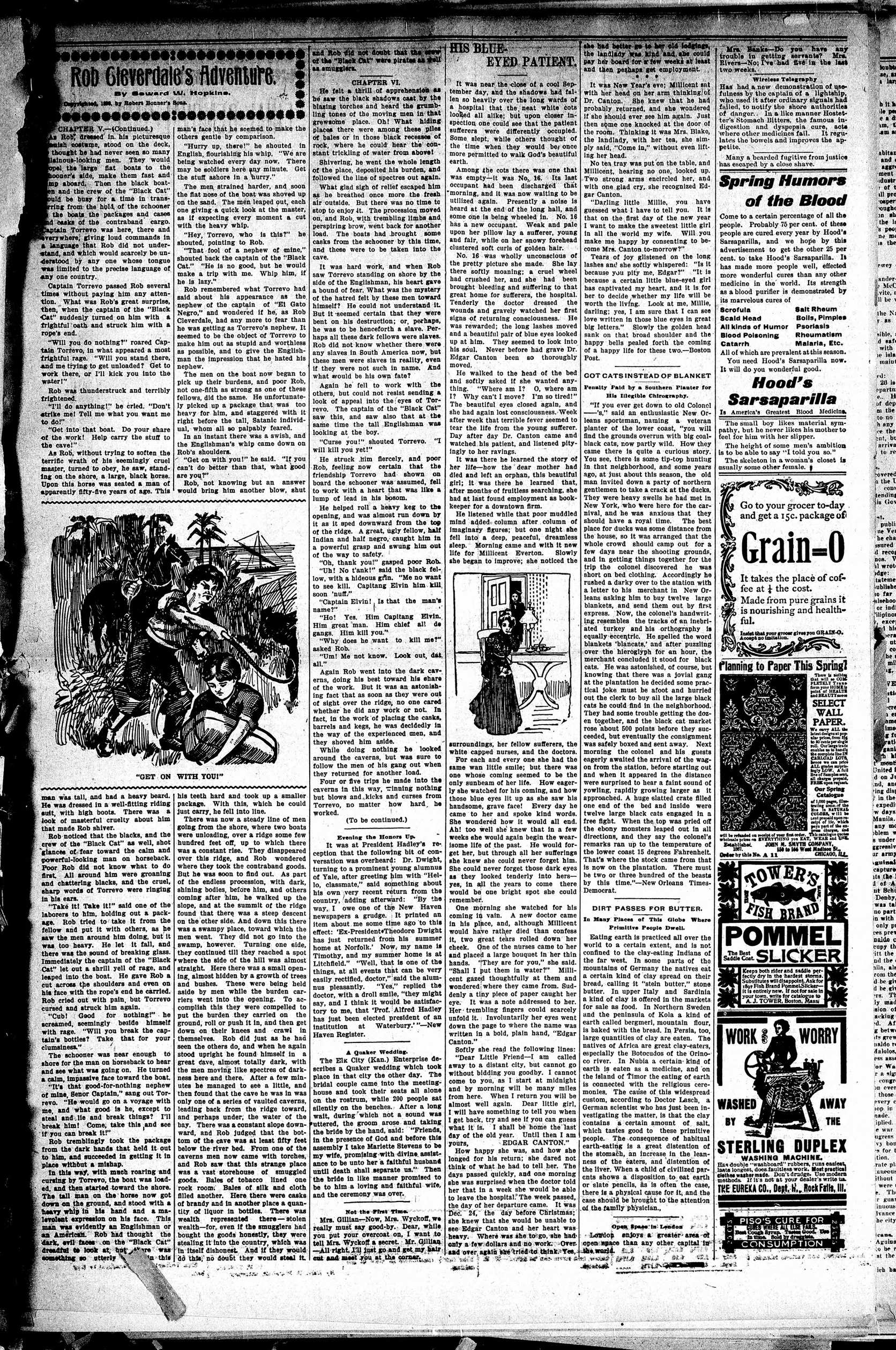
"GET ON
A boy is being pulled down by a horse. Another boy is sitting on the ground, holding a ball. The background features palm trees and a ship.
"GET ON WITH YOU!"
man was tall, and had a heavy beard. He was dressed in a well-fitting riding suit, with high boots. There was a look of masterful cruelty about him that made Rob shiver. Rob noticed that the blacks, and the crew of the "Black Cat" as well, shot glances of fear toward the calm and powerful-looking man on horseback. Poor Rob did not know what to do first. All around him were groaning and chattering blacks, and the cruel, sharp words of Torrevo were ringing in his ears.
"Take it! Take it!" said one of the labors to him, holding out a package. Rob tried to take it from the fellow and put it with others, as he saw the men around him doing, but it was too heavy. He let it fall, and there was the sound of breaking glass. Immediately the captain of the "Black Cat" let out a shrill yell of rage, and leaped into the boat. He gave Rob a cut across the shoulders and even on his face with the rope's end he carried. Rob cried out with pain, but Torrevo cursed and struck him again.
"Cub! Good for nothing!" he screamed, seemingly beside himself with rage. "Will you break the captain's bottles? Take that for your clumsiness."
The schooner was near enough to shore for the man on horseback to hear and see what was going on. He turned a calm, impassive face toward the boat. "It's that, good-for-nothing nephew of mine, Senior Captain," sang out Torrevo. "He would go on a voyage with me, and what good is he, except to steal and lie and break things? I'll break him! Come, take this, and see if you can break it!" Rob tremblingly took the package from the dark hands that held it out to him, and succeeded in getting it in place without a mishap. In this way, with much roaring and curing by Torrevo, the boat was loaded, and then started toward the shore. The tall man on the horse now got down on the ground, and stood with a heavy whip in his hand and a malevolent expression on his face. This man was evidently an Englishman or an American. Rob had thought the dark, evil faces on the "Black Cat" dreadful to look at but it was something so utterly in this
```markdown
```
man's face that he seemed to make the others gently by comparison.
"Hurry up, there!" he shouted in English, flourishing his whip. "We are being watched every day now. There may be soldiers here any minute. Get the stuff ashore in a hurry."
The men strained harder, and soon the flat nose of the boat was shoved on the sand. The men leaped out, each one giving a quick look at the master, as if expecting every moment a cut with the heavy whip.
"Hey, Torrevo, who is this?" he shouted, pointing to Rob.
"That fool of a nephew of mine," shouted back the captain of the "Black Cat." "He is no good, but he would make a trip with me. Whip him, if he is lazy."
Rob remembered what Torrevo had said about his appearance as the nephew of the captain of "Ei Gato Negro," and wondered if he, as Rob Cleverdale, had any more to fear than he was getting as Torrevo's nephew. It seemed to be the object of Torrevo to make him out as stupid and worthless as possible, and to give the Englishman the impression that he hated his nephew.
The men on the boat now began to pick up their burdens, and poor Rob, not one-fifth as strong as one of these fellows, did the same. He unfortunately picked up a package that was too heavy for him, and staggered with it right before the tall, Satanic individual, whom all so palpably feared.
In an instant there was a swish, and the Englishman's whip came down on Rob's shoulders.
"Get on with you!" he said. "If you can't do better than that, what good are you?"
Rob, not knowing but an answer would bring him another blow, shut
A
his teeth hard and took up a smaller package. With this, which he could just carry, he fell into line.
There was now a steady line of men going from the shore, where two boats were unloading, over a ridge some few hundred feet off, up to which there was a constant rise. They disappeared over this ridge, and Rob wondered where they took the contraband goods. But he was soon to find out. As part of the endless procession, with dark, shining bodies, before him, and others coming after him, he walked up the slope, and at the summit of the ridge found that there was a steep descent on the other side. And down this there was a swampy place, toward which the men went. They did not go into the swamp, however. Turning one side, they continued till they reached a spot where the side of the hill was almost straight. Here there was a small opening, almost hidden by a growth of trees and bushes. These were being held aside by men while the burden carriers went into the opening. To accomplish this they were compelled to put the burden they carried on the ground, roll or push it in, and then get down on their knees and crawl in themselves. Rob did just as he had seen the others do, and when he again stood upright he found himself in a great cave, almost totally dark, with the men moving like spectres of darkness here and there. After a few minutes he managed to see a little, and then found that the cave he was in was only one of a series of vaulted caverns, leading back from the ridge toward, and perhaps under, the water of the bay. There was a constant slope downward, and Rob judged that the bottom of the cave was at least fifty feet below the river bed. From one of the caverns men now came with torches, and Rob saw that this strange place was a vast storehouse of smuggled goods. Bales of tobacco lined one rock room: Bales of silk and cloth filled another. Here there were casks of brandy and in another place a quantity of liquor in bottles. There was wealth represented there—stolen wealth—for, even if the smugglers had bought the goods honestly, they were stealing it into the country, which was in itself dishonest. If they would do this, no doubt they would steal it.
---
and Rob did not doubt that the news of the "Black Cat" were pirates as well as smugglers.
CHAPTER VI.
He felt a thrill of apprehension as he saw the black shadows cast by the blasting torches and heard the grumbling tones of the moving men in that grewsome place. Oh! What hiding places there were among these piles of bales or in those black recesses of rock, where he could hear the constant trickling of water from above!
Shivering, he went the whole length of the place, deposited his burden, and followed the line of spectres out again.
What glad sigh of relief escaped him as he breathed once more the fresh air outside. But there was no time to stop to enjoy it. The procession moved on, and Rob, with trembling limbs and perspiring brow, went back for another load. The boats had brought some casks from the schooner by this time, and these were to be taken into the cave.
It was hard work, and when Rob saw Torrevo standing on shore by the side of the Englishman, his heart gave a bound of fear. What was the mystery of the hatred felt by these men toward himself? He could not understand it. But it seemed certain that they were bent on his destruction; or, perhaps, he was to be henceforth a slave. Perhaps all these dark fellows were slaves. Rob did not know whether there were any slaves in South America now, but these men were slaves in reality, even if they were not such in name. And what would be his own fate?
Again he fell to work with the others, but could not resist sending a look of appeal into the eyes of Torrevo. The captain of the "Black Cat" saw this, and saw also that at the same time the tall Englishman was looking at the boy.
"Curse you!" shouted Torrevo. "I will kill you yet!"
He struck him fiercely, and poor Rob, feeling now certain that the friendship Torrevo had shown on board the schooner was assumed, fell to work with a heart that was like a lump of lead in his bosom.
He helped roll a heavy key to the opening, and was almost run down by it as it sped downward from the top of the ridge. A great, ugly fellow, half Indian and half negro, caught him in a powerful grasp and swung him out of the way to safety.
"Oh, thank you!" gasped poor Rob. "Uh! You tank!" said the black fellow, with a hideous gfm. "Me no want to see kill. Capitang Elvin him kill soon 'nuff." "Captain Elvin! Is that the man's name?" "Ho! Yes. Him Capitang Elvin. Him great man. Him chief all de gangs. Him kill you." "Why does he want to kill me?" asked Rob. "Um! Me not know. Look out, dat all." Again Rob went into the dark caverns, doing his best toward his share of the work. But it was an astonishing fact that as soon as they were out of sight over the ridge, no one cared whether he did any work or not. In fact, in the work of placing the casks, barrels and kegs, he was decidedly in the way of the experienced men, and they shoved him aside.
While doing nothing he looked around the caverns, but was sure to follow the men of his gang out when they returned for another load. Four or five trips he made into the caverns in this way, inning nothing but blows and, kicks and curses from Torrevo, no matter how hard he worked.
(To be continued.)
Evening the Honors Up.
Evening the Holiday
It was at President Hadley's reception that the following bit of conversation was overheard: Dr. Dwight, turning to a prominent young alumnus of Yale, after greeting him with "Hello, classmate," said something about his own very recent return from the country, adding afterward: "By the way, I owe one of the New Haven newspapers a grudge. It printed an item about me some time ago to this effect: 'Ex-PresidentTheodore Dwight has just returned from his summer home at Norfolk.' Now, my name is Timothy, and my summer home is at Litchfield." "Well, that is one of the things, at all events that can be very easily rectified, doctor," said the alumnus pleasantly. "Yes," replied the doctor, with a droll smile, "they might say, and I think it would be satisfactory to me, that 'Prof. Alfred Hadley has just been elected president of an institution at Waterbury.'"—New Haven Register.
A Quaker Wedding.
The Elk City (Kan.) Enterprise describes a Quaker wedding which took place in that city the other day. The bridal couple came into the meeting-house and took their seats all alone on the rostrum, while 200 people sat silently on the benches. After a long wait, during which not a sound was uttered, the groom arose and taking the bride by the hand, said: "Friends, in the presence of God and before this assembly I take Marielle Stevens to be my wife, promising with divine assistance to be unto her a faithful husband until death shall separate us." Then the bride in like manner promised to be to him a loving and faithful wife, and the ceremony was over.
Not the First Time
Mrs. Gillian—Now, Mrs. Wyckoff, we really must say good-bye. Dear, while you put your overcoat on, I want to tell Mrs. Wyckoff a secret. Mr. Gillian—All right, I'll just go and get my hair out and meet you at the corner.
It was near the close of a cool September day, and the shadows had fallen so heavily over the long wards of a hospital that the neat white cots looked all alike; but upon closer inspection one could see that the patient sufferers were differently occupied. Some slept, while others thought of the time when they would be once more permitted to walk God's beautiful earth.
Among the cots there was one that was empty—it was No. 16. Its last occupant had been discharged that morning, and it was now waiting to be utilized again. Presently a noise is heard at the end of the long hall, and some one is being wheeled in. No. 16 has a new occupant. Weak and pale upon her pillow lay a sufferer, young and fair, while on her snowy forehead clustered soft curls of golden hair.
No. 16 was wholly unconscious of the pretty picture she made. She lay there softly moaning; a cruel wheel had crushed her, and she had been brought bleeding and suffering to that great home for sufferers, the hospital. Tenderly the doctor dressed the wounds and gravely watched her first signs of returning consciousness. He was rewarded; the long lashes moved and a beautiful pair of blue eyes looked up at him. They seemed to look into his soul. Never before had grave Dr. Edgar Canton been so thoroughly moved.
He walked to the head of the bed and softly asked if she wanted anything. "Where am I? O, where am I? Why can't I move? I'm so tired!" The beautiful eyes closed again, and she had again lost consciousness. Week after week that terrible fever seemed to tear the life from the young sufferer. Day after day Dr. Canton came and watched his patient, and listened pityingly to her ravings.
It was there he learned the story of her life—how the dear mother had died and left an orphan, this beautiful girl; it was there he learned that, after months of fruitless searching, she had at last found employment as book-keeper for a downtown firm.
He listened while that poor muddled mind added: column after column of imaginary figures; but one night she fell into a deep, peaceful, dreamless sleep. Morning came and with it new life for Millicent Everton. Slowly she began to improve; she noticed the
surroundings, her fellow sufferers, the white capped nurses, and the doctors.
For each and every one she had the same wan little smile; but there was one whose little seemed to be the only sunbeam of her life. How eagerly she watched for his coming, and how those blue eyes lit up as she saw his handsome, grave face! Every day he came to her and spoke kind words. She wondered how it would all end. Ah! too well she knew that in a few weeks she would again begin the wearisome life of the past. He would forget her, but through all her sufferings she knew she could never forget him. She could never forget those dark eyes as they looked tenderly into hers—yes, in all the years to come there would be one bright spot she could remember.
One morning she watched for his coming in vain. A new doctor came in his place, and, although Millicent would have rather died than confess it, two great tears rolled down her cheek. One of the nurses came to her and placed a large bouquet in her thin hands. "They are for you," she said. "Shall I put them in water?" Millicent gazed thoughtfully at them and wondered; where they came from. Suddenly a tiny piece of paper caught her eye. It was a note addressed to her. Her trembling fingers could scarcely unfold it. Involuntarily her eyes went down the page to where the name was written in a bold, plain hand, "Edgar Canton."
Softly she read the following lines: "Dear Little Friend—I am called away to a distant city, but cannot go without bidding you goodby. I cannot come to you, as I start at midnight and by morning will be many miles from here. When I return you will be almost well again. Dear little girl, I will have something to tell you when I get back, try and see if you can guess what it is. I shall be home the last day of the old year. Until then I am yours. EDGAR CANTON."
How happy she was, and how she longed for his return; she dared not think of what he had to tell her. The days passed quickly, and one morning she was surprised when the doctor told her that in a week she would be able to leave the hospital! The week passed, the day of her departure came. It was 24, 24, the day before Christmas; she knew that she would be unable to see Edgar Canton and her heart was heavy. Where was she to go, she had only a few dollars and no work. Over and over again she tried to think Yes.
she had better go to her old ledgings, the landlady was kind and she could pay her board for a few weeks at least and then perhaps get employment.
It was New Year's eve; Millicent sat with her head on her arm thinking of Dr. Canton. She knew that he had probably returned, and she wondered if she should ever see him again. Just then some one knocked at the door of the room. Thinking it was Mrs. Blake, the landlady, with her tea, she simply said, "Come in," without even lifting her head.
No tea tray was put on the table, and Millicent, hearing no one, looked up. Two strong arms encircled her, and with one glad cry, she recognized Edgar Canton.
"Darling little Millie, you have guessed what I have to tell you. It is that on the first day of the new year I want to make the sweetest little girl in all the world my wife. Will you make me happy by consenting to become Mrs. Canton to-morrow?"
Tears of joy glistened on the long lashes and she softly whispered: "Is it because you pity me, Edgar?" "It is because a certain little blue-eyed girl has captivated my heart, and it is for her to decide whether my life will be worth the living. Look at me, Mille, darling; yes, I am sure that I can see love written in those blue eyes in great big letters." Slowly the golden head sank on that broad shoulder and the happy bells pealed forth the coming of a happy life for these two.-Boston Post.
GOT CATS INSTEAD OF BLANKET
Penalty Paid by a Southern Planter for His Illegible Chirigraphy.
"If you ever get down to old Colonel —s," said an enthusiastic New Orleans sportsman, naming a veteran planner of the lower coast, "you will find the grounds overrun with big coal black cats, now partly wild. How they came there is quite a curious story. You see, there is some tip-top hunting in that neighborhood, and some years ago, at just about this season, the old man invited down a party of northern gentlemen to take a crack at the ducks. They were heavy swells he had met in New York, who were here for the carnival, and he was anxious that they should have a royal time. The best place for ducks was some distance from the house, so it was arranged that the whole crowd should camp out for a few days near the shooting grounds, and in getting things together for the trip the colonel discovered he was short on bed clothing. Accordingly he rushed a darky over to the station with a letter to his merchant in New Orleans asking him to buy twelve large blankets, and send them out by first express. Now, the colonel's handwriting resembles the tracks of an inebriated turkey and his orthography is equally eccentric. He spelled the word blankets 'blancets', and after puzzling over the hieroglyph for an hour, the merchant concluded it stood for black cats. He was astonished, of course, but knowing that there was a jawful gang at the plantation he decided some practical joke must be afoot and hurried out the clerk to buy all the large black cats he could find in the neighborhood. They had some trouble getting the dozen together, and the black cat market rose about 500 points before they succeeded, but eventually the consignment was safely boxed and sent away. Next morning the colonel and his guests eagerly awaited the arrival of the wagon from the station, before starting out and when it appeared in the distance were surprised to hear a faint sound of yowling, rapidly growing larger as it approached. A huge slatted crate filled one end of the bed and inside were twelve large black cats engaged in a free fight. When the top was pried off the ebony monsters leaped out in all directions, and they say the colonel's remarks ran up to the temperature of the lower coast 15 degrees Fahrenheit. That's where the stock came from that is now on the plantation. There must be two or three hundred of the beasts by this time."—New Orleans Times-Democrat.
DIRT PASSES FOR BUTTER
Eating earth is practiced all over the world to a certain extent, and is not confined to the clay-eating Indians of the far west. In some parts of the mountains of Germany the natives eat a certain kind of clay spread on their bread, calling it "stem butter," stone butter. In upper Italy and Sardinia a kind of clay is offered in the market for sale as food. In Northern Sweden and the peninsula of Kola a kind of earth called bergmier, mountain flour, is baked with the bread. In Persia, too, large quantities of clay are eaten. The natives of Africa are great clay-eaters, especially the Botucodus of the Orinoco river. In Nubia a certain kind of earth is eaten as a medicine, and on the island of Timor the eating of earth is connected with the religious ceremonies. The cause of this widespread custom, according to Doctor Lisch, a German scientist who has just been investigating the matter, is that the clay contains a certain amount of salt, which tastes good to these primitive people. The consequence of habitual earth-eating is a great distention of the stomach, an increase in the leanness of the eaters, and distention of the liver. When a child of civilized parents shows a disposition to eat earth or slate pencils, as is often the case, there is a physical cause for it, and the case should be brought to the attention of the family physician.,
Open Space in London
London enjoys a greater area of
open space than any other capital in
the world.
Mr. Banks - Do you have any trouble in getting servants? Mrs. Rivers - No; I've had five in the last two weeks.
Wireless Telegraphy
Has had a new demonstration of usefulness by the captain of a lightship, who used it after ordinary signals had failed, to notify the shore authorities their Stomach Bitters, the famous indigestion and dyspepsia cure, acts where other medicines fail. It regulates the bowels and improves the appetite.
Many a bearded fugitive from justice has escaped by a close shave.
Come to a certain percentage of all the people. Probably 75 per cent. of these people are cured every year by Hood's Sarsaparilla, and we hope by this advertisement to get the other 25 per cent. to take Hood's Sarsaparilla. It has made more people well, effected more wonderful cures than any other medicine in the world. Its strength as a blood purifier is demonstrated by its marvelous cures of Scrofaul Salt Rheum Scald Head Boils, Pimples All kinds of Humor Psoriasis Blood Poisoning Rheumatism Catarrh Malaria, Etc.
Scrofula
Scald Head
All kinds of Humor
Blood Poisoning
Catarrh
All of which are prevalent at this season.
You need Hood's Sarsaparilla now.
It will do von wonderful good.
The small boy likes material sympathy, but he never likes his mother to feel for him with her slipper.
The height of some men's ambition is to be able to say "I told you so."
The skeleton in a woman's closet is usually some other female.
Variation from the ordinary form of the bogan run is to be found in the Russian "ice hills." The rigor of winter in northern Europe practically compels inhabitants of that region to find a form of amusement with which to hike away the dreary hours of those se-bound months. Hence, "ice hill articles" are now a national institution throughout the cear's dominions, and cheer functions they are, too. The ice hill" itself is prepared as follows: they erect a high wooden scaffolding having a rather steep slope from the up to the ground, and it is then covered with huge symmetrically shaped locks of ice placed side by side and instantly watered until they become a solid smooth mass. This artificial side is terminated by a long, narrow slain of ice, just broad enough to allow three sledges passing each other and sufficient length to enable a sleigh to run by its own impetus to the foot of the next hill. The hills and runs are usually bordered by fir trees, which are slightly hung with colored lights at light. On the day of the party the guests are conveyed to their host's house in special sleighs, and there supplied with rugs, furs and warm drinks, he better to fortify them against the intense cold. They then proceed to the hills and seat themselves by two in the long, narrow iron sides, which are rendered exceedingly comfortable reason of the quantity of cushions bread over them. Arriving at the end of the descent each man chooses a different partner for the return run, and een is the competition among the ten, each of them striving to secure the belle of the party as his companion. A good dinner is always provided by the host, and the post-prandial sport artificial light is often the most enjoyable and certainly the most picturesque portion of the whole entertainment.
MRS. ADAIR'S APPEAL
Mrs. Cornelia Adair, who is now in this country in the interests of the hospital ship Maine, which it may be remembered was provided by American women in England for the nursing ofounded British soldiers in the Boer war, is herself an American, being a daughter of the late Gen. Wadsworth, G. Genesee, N. Y., who fell at the battle of the Wilderness. The idea of fitting out a hospital ship originated with a Mrs. Blow, an American, and she, with lady Randolph Churchill, formed a committee of American women in London to carry it out. The sum of 155,000 was raised in a short time. At its juncture B. N. Baker, of Baltimore, president of the Atlantic Transport company, offered the steamship Maine and its crew to the committee, to be used as a hospital ship as long as the war lasted. This gift represented an outlay of between $15,000 and $20,000 a month. To equip the vessel the committee expended $125,000, and as it sets some $15,000 a month to keep the ship in service, Mrs. Adair, who in the presence of Lady Randolph Churchill, the head of the committee, comes to interest Americans in the work. Mrs. Adair is well known in the fashionable society of New York and newport. Her first husband was a Mr. Mitchle, of Boston. In 1867 she married John Adair, who was one of the great land magnates of Ireland and high sheriff of the County Donegal. She is very wealthy in her own right. Mrs. Adair, in an appeal to the Irish this country, mentions the fact that cars ago, when famine was raging in Ireland, her father chartered a ship,
MRS. CORNELIA ADAIR
MRS. CORNELIA ADAIR. led it with corn from his lands at meseo and sent it across the Atlantic help the starving peasantry.
Disease in the Dutch Navy. Uncle Sam's sailors in Philippine wars seem to have been particularly formate in escaping for the most part the seases which prey upon sailors of her navies in tropical waters. In e marine service in Holland in 1897 were admitted to the hospitals 904 malarial cases in an average length of 50,167. The record for that ar was unusual, the average for the preceding years having been only 000. In 1897 cholera caused 161 adaions to the hospitals, with 106 aths among the Europeans.
Unexplored Regions of the Earth.
Throughout the entire world there
about 20,000,000 square miles of un-
plured territory. In Africa there are
00,000 square miles; Arctic regions,
00,000; Antarctic regions, 53,000,000;
nerica, 2,000,000; Australia, 2,000,000;
Asia, 200,000, and various islands,
1,000
FOUR NELD FOR CONSPIRACY.
Mr. "Damage Syndicate"
Chicago March 22. The grand jury has indicted the following, who are accused of conspiracy to defraud the city of Chicago by the institution of fraudulent suits for damages: Dr. M. L. Ostrowski, Anton Grabowski, Ignats Der, Mrs. Anna Svehl, alias Peterson, alias Pietru. The evidence was furnished by City Attorney Andrew J. Ryan, John Golk and Mrs. Agnes Golk, mother and father of Ludwig Golk, a boy 9 years old, in whose behalf the suit for $25,000 damages for alleged injuries was filed in 1898. It was brought in the name of Agnes Golk, mother of the boy, as his "next friend." Mrs. Golk told the jury that she knew nothing about the case until months after it had been filed. It was alleged that the boy had fallen through a sidewalk on Dec. 22, 1897, and had sustained injuries to his spine and head which destroyed his power of speech. Mrs. Svehlia conducted a boarding-house at 666 West Fifteenth street, where seventeen other members of the "syndicate" organized, it is alleged, to defraud the city and large corporations by fraudulent damage suits aggregating $200,000, also lived in this house.
GOLDEN FEARS ASSASSINATION
Main Witness in the Goebel Case Is Guarded by Detectives
Lexington, Ky., March 22.—Sergt. F,
Wharton Golden, who has turned state's evidence in betraying the plot to kill William Goebel, is kept in seclusion at the home of a friend in the northern part of the city. Golden is haggard and worm. He fears assassination; and detectives will keep guard over the house in which he is staying until he leaves.
Wisconsin's New G. A. R. Commander,
Madison, Wis., March 22.—The death
of Gen. Harnden, commander department
of Wisconsin G. A. R., advances
to that office Samuel H. Tallmadge of
Milwaukee, a native of Chicago. Mr.
Tallmadge is 60 years of age, and is a
son of Mrs. Charlotte E. Mitchell, one
of Chicago's pioneer residents, now
nearly 80 years old. Commander Tallmadge has long been prominent in G. A. R. circles of Milwaukee and Wisconsin. He has been commander of Wolcott post of Milwaukee and was assistant adjutant general of the state
for several years.
Rockefeller Carry Town Election
Tarrytown, N. J., March 22. After one of the bitterest fights waged in the political history of Tarrytown, the Rockefellerers Tuesday gained a complete and decisive victory over their opponents, who insisted upon the high assessment. One of the campaign stories was that John D. Rockefeller would spend $50,000 improving his estate if the laboring class would support his ticket.
Archbishop Keane to Raise $1,000,000, St. Louis, Mo., March 22. Archbishop J. J. Keane, former pastor and one of the founders of the Catholic university at Washington, D. C., is in St. Louis, where he came to lecture on the subject of the university. The archbishop's mission is to raise $1,000,000 during the holy year and in 1901 for the endowment of professorships in the university.
White Is in Cape Town.
Grand Rapids, Mich., March 21—A letter has been received from Cape Town, South Africa, written by General William L. White, the indictor1 quartermaster general of the Michigan National Guard. Gen. White left this city last December.
Sibley Has La Grippa
Franklin, Pa., March 21.—Congressman Joseph Sibley is confined to his bed with a gripe. He came home Saturday to spend a few days with his family, and was attacked shortly after his arrival. His condition is not regarded as serious.
Consul Monaghan to Return
Bremen, March 22.—James C. Monaghan, United States consul at Chemnitz, has resigned, and will return to his home in Rhode Island to engage in business. He expects to be succeeded by his brother, Joseph Monaghan.
Disaster on the Dannbe
Bupadest, March 21—Twenty-four peasants were drowned today by the capsizing of a boat in which they were crossing the Danube River from Kalooga to Pays, during a gale.
Sir Edmund Fane Dice
London, March 21.—Sir Edmund Douglas Velch Tane, envy extraordinary and minister plenipotentiary to the court of Copenhagen, is dead in his sixty-third year.
Chicago Board of Trade
Chicago, March 20.—The following table shows the range of quotations on the board of trade today:
Closing—
Articles— High. Low. Mar.20.Mar.19.
Wheat—
May .. $ .66% $ .66% $ .66% $ .66%
July .. .67% .67% .67% .67%
Sept .. .67% .67% .67% .67%
Corn—
May .. .37% .37% .37% .37% .37%
July .. .37% .37% .37% .37% .37%
Sept .. .38% .38% .38% .38% .38%
Oats—
May .. .24% .24% .24% .24% .24%
July .. .23 .22 .22 .22 .22%
Pork—
May ..11.90 11.32% 11.40 11.42%
July ..11.35 11.12% 11.15 11.27%
Lard—
May .. 8.12% 8.02% 8.05 8.12%
July .. 8.22% 8.13% 8.13% 8.20
Sept .. 8.27% 8.23% 8.23% 8.20
Short Ribs—
May .. 8.17% 8.47% 8.20 8.18
July .. 8.26 8.10 8.12% 8.17%
Sept .. 8.37% 8.17% 8.17% ...
What the Friends of Mr. Belvel Says.
It has come to my knowledge that parties are making the statement that I am drawing a pension without warrant of law, or in the absence of disability. I only wish to say this is a lie reflecting more seriously upon this republican administration than upon myself. If anyone is curious to know the facts, he can learn them at the pension office in this city. They are a sufficient refutation to the culmany of the cowardly cur making the assertion. H. M. BELVEL.
COPYRIGHT
What the Friends
For the purpose of informing the citizens of Des Moines, Iowa, who H. M. Belvel, and apprising them of his entire fitness for the position of member of the city council, the following letters are published. While it is true they do not bear upon his candidacy for siderman of the third ward, it is also true that they overwhelmingly prove his honesty and his entire qualification for that or any other position of honor or trust, and he asks a careful perusal of them by the public, and will be entirely satisfied with the verdict at the polis next Monday:
FROM HON. J. W. FREELAND.
Corydon, Wayne county, Iowa, Oct. 30. W. H. Stackhouse, Esq, Dear Sir; I save a life last 30 years, both as boy and man; he grew up in this county, went to the war from the war in the war in the democratic party from that time up. He has received but few rewards for his laptr-in fact I know of none, except to be killed and dragged out by the great and good Fim.
If you have got anything to spare from the fullness of your present office, it is my opinion that you could not let it out to a more deserving democrat. Respectfully,
FROM DR. CHAPMAN.
Des Moines, Iowa, Oct. 25, 2013—W. H. Stackhouse, Davenport, Iowa—Sir: I am pleased to say to you that H. M. Belvel of this city is an unlifelong and zealous worker in the defense of the Constitution, a recognition by our party leaders. We would urge his appointment as stamp deputy in your department which would be very satisfactory to me and the democracy of this city. Respectfully, R. U. CHAPMAN, President U. S. Pension Board.
FROM SENATOR GREEN.
Stone City, Jones County, Iowa, Oct. 19, 1851-II, H. Stuckhouse, Dear Friend: A pleasure to get appointed as doorkeeper and was afterwards his second and groom in a new knocks at your door for the appointment of stamp clerk under your administration. I favor you will give it to the old soldier who is still fighting democratic battles. It is no less than the bearer, H. M. Belvel, and so if it is at all, A. GREEN, sincerely.
FROM HON. T. B. PERRY.
Alba, Ill., Oct. 18, 1883.—To whom it may concern: I am informed that Mr. H. M. Belvel is an applicant for appointment at Des Moines, the revenue office at Des Moines, and desire dorsement. I have to say in his behalf that I have been acquainted with him several years and know him to be a steadfast and consistent democrat and, as I be acquainted with him, I have no knowledge of the office to which he aspires. Respectfully, T. H. PELKY.
FROM HON THOS MAXWELL
WELL, Creation, Iowa, Oct. 21, 1838, Hearst St. Stackhouse, Davenport, Iowa: Dear Sir, I serve of Des Moines informes me that he 's clerk of the St. Stackhouse stamp clerk at Des Moines. Mr. selvel's standing and efforts as an active democrat in the state and I believe that his appointment state and I believe that his appointment give general satisfaction can cheerfully give satisfaction in cooperation tecphullyft, THOS, L MAXWELL,
Late dem. cand. Cong. 8th dist.
一
Lineville, I., Oct. 23, 1833—To Hon. W. H. Stuckhouse, Collector Internal Revenue, New York, where he served that M. H. M. Belvel, who formally sided in this county, is an applicant for the appointment. He is recommended in recommending him as an honest man. And during his stay in this county he was an active, energetic worker for the party, and he was a good friend to see him favored. Believing that the appointment will be worthily bestowed, we hope that you will give him the appoint-ment.
G. TAYLOR WRIGHT,
H. M. LOVETT,
W. O. MULLINUX,
A. L. ROCKHOLD,
F. E. N.G.
J. R. CRAWFORD,
R. E. MOLLESTON,
W. L. EVANS,
A. N. HANING.
FROM HON. L. R. BOLTER.
Logan, In., Oct. 16, 1838—To all whom this may concern: We are credibly informed that H. M. Belvel of De Moines, is a lawyer of the state office of that place. We know of no man in the state better fitted for the place or more deserving than he. For many years he was a lawyer of the state pen for the success of democratic principles and the democratic party. He is a cogent and read writer, one of the very best in the state, a demographer of the true expression of the valuable state order all circumstances. His early appointment would be highly gratifying to his many earnest democratic friends through his entire state and including the undersigned.
L. R. BOLTER,
Democratic state senator 34th district.
It has come to my knowledge that I am drawing a pension absence of djsability. I only wish seriously upon this republican admir anyone is curious to know the facts, office in this city. They are a suffice the cowardly cur making the asserti
There never was a duty that did not bring its own opportunity for doing good that never could have been done before, and never can be again—W. R. BOLTER.
---
White, light and wholesome bread, that delights the house wife when her baking is done is made from Falcon Flour. Pure and nutritious; milled from the finest blue stem spring wheat.
Bread made from Falcon Flour is of rich and tempting flavor and contains more nutrition to the pound than any other on the market.
Made and guaranteed only by Shannon & Mott Co., Des Moines, Iowa. For sale by leading grocers.
of Mr. Belvel Says.
Mallard, Ia., Oct. 23, 1893.—Hon. W. H. Stackhouse, Davenport, Ia.—Dear Sir: I have the honor to request the appointment of H. M. Belvel of Des Moines, Ia., as stamp deputy, who is an old army comrade; served in the same company (Company F, Thirty-fourth Infantry) with me during the war of the rebellion. Knew him intimately before, during the war and since, and know him to be a true democrat, a good and honorable citizen, zealous in the cause of democracy and competent to fill any position in your gift, and by giving the position to my old friend you will be conferring a lasting obligation on a "dyed-in-the-wool" democrat, and subscribs himself. Yours very truly,
FROM E. W. CURBY.
Leen, Iowa, Oct. 18, 1893—Hon. W. H. Stackhouse, Davenport, Iowa: Dear son I understand that H. M. Belvel of Des Moines is desirous of me and I have known ars, the travel for many years; he is, in fact, well known to the democrats of this part of the state, and in my opinion it would give great satisfaction if I have known to have him remembered in the way mentioned. His qualifications are first class. He is hardworking in every knight, and I believe would give perfect satisfaction. You truly, E. W. CURRY.
FROM SENATOR DODGE.
Burlington, Ia., Oct. 18, 1883—Hon. W. H. Stackhouse, Davenport, Ia.,—Dearest Sir: I am a stump clerk in your branch office at Des Moines. I am an applicant for the position of stump clerk in your branch office at Des Moines and am consider him an hostet and rightman, a sound democrat, a zealous party worker, and a devoted friend. I am an old soldier and has never incurred in his democratic faith so far as I know. I have appointed you as a recognizing a deserved person very truly. W. W. DODGE.
FROM GEN. S. L. GLASGOW
Burlington, in., Oct. 16, 1955—My Dear Mr. Stackhouse: I cheerfully recommend to you the appointment of Mr. H. M. Beaver at office at that place. I have known many years and believe hi to be relatable and thoroughly trustworthy. In addition, it gives me pleasure. Personally should he receive the appointment yours. S. L. GLASGOW.
FROM CATO SELLS
Vinton, Iowa, Oct. 17, 1833.—Hon. W. H. Stackhouse, Dayenport, Iowa: Dear Sir—I am informed that H. M. Belvel of Des Moines is a candidate for stamp clerk and I wish to endorse his candidacy and recommend his appointment.
Mr. Belvel is a good man and a democrat, was a Union soldier and is now doing good work for the party as a newspaper correspondent, Respectfully.
FROM COL JOSEPH EIROEK
FROM COL. JOSEPH EIBOECK
H. Stackhouse, Davenport, Iowa. Dear Sir:
You are doubtless aware that H. J. Belvey
Molice office of the internal revenue
department, for which position I can heartily
competent and reliable man, who is at
same time eminently competent for the
place you hold, sold democrats be-
cause very truly yours.
Atlantic, Ia., Oct. 20, 1833—Hon. W. H. Stackhouse, Davenport, Ia., *Mear My Sirs* Mr. H. M. Belvel of Des Moines is a candidate for the chairperson of the board you. I have known Mr. Belvel for several years and know him to be a good, straight democrat, intelligent and achable person. He has a reputation by his unlitting loyals as Des Moines correspondent for many of the democratic papers of the state. Respectfully yours, CHAS. F. CHASE. Des Moines, Oct. 21, 1833—I endorse the above and neatly recommend Mr. Belvel's appointment. [HENRY KING] Proptetor, Des Moines Leader. I endorse the above. C. A. WALSH.
FROM E. B. EVANS.
Des Moines, Iown, Oct. 18, 1833. Hon. W. M. Moines, governor of Missouri, will take pleasure in presenting his appointment of Des Moines, Iowa, for stamp clerk. He has appointed the appointment would give entire satisfaction to the democratic party, which he has al-ported. I have the honor to be your truly
E. B. EVANS,
Secretary Polk Co. Com.
DOS FROM JUDGE JAS. G. DAY.
DMS Moines, lowes, Oct. 24, 1833-Hon. W. H. Stetson, Oct. 24, 1833-Hon. W. H. Dear Sir-1 understand that H. M. Belveld, Esq. of this city, is an applicant for the position of professor in the department sure in recommending him for the position which he seeks. He has been a very active member of the faculty of his facile and pungent pen has done much to advance its interests. I hope it may be found practicable to confer upon him the position which he seeks, very truly yours. JAMES G. DAY.
FROM HON DAN FINCH
Seattle, Wash., Oct. 20, 1883—Hon. W. H. Stackhouse, Collector Internal Revenue, Davenport, In.—Dear Friend: Away out here in my new home, learn with great pleasure of your appointment to the position you are so well calculated to fill, and I also learn that my friend, H. M. Belvel, is a candidate for the position of stamp collector under you. I trust you may find it convenient with your duty to give him the piece. Very truly yours, D. O. FINCH.
ge that parties are making the state-without warrant of law, or in the to say this is a lie reflecting more insistence than upon myself. If, he can learn them at the pensionicient refutation to the culinary of ion.
H. M. BELVEL.
A refractory domestic refused to leave when discharged by a Chicago housewife, but as she did not match that the lady who employed her must varnose she may be considered to have been fairly reasonable in view of her calling.
FINAL REMOVAL SALE.
Unless some accident not now looked for occurs, we will move into our
By the First Week in April.
In order to enter our
lutely clean stock we w
Reductions in all lines.
announced in the Fri
not fail to take advantage
We don't move every
have moved twice in th
In order to enter our New Store with an absolutely clean stock we will make some Unheard-of Reductions in all lines. These prices are to be announced in the Friday evening papers. Do not fail to take advantage of these great offers. We don't move every day, even though we will have moved twice in the past six months.
Watch the Daily Papers!
Harris-E
DES MOIN
Harris-Emery Co. DES MOINES, IOWA.
NOTICE OF EXPIRATION OF RIGHT OF REDEMPTION FROM TAX SALE.
To John Q. Thompson:
You are hereby notified that the following described real estate, situated in Polk county, Iowa, to-wit: Lot 14, block 3, Fairview additon, now included in and forming a part of the city of Des Moines, Iowa, was sold for taxes of 1893 on the 4th day of December, 1894 to J. S. Coskery. That the cirtificate of purchase thereof has been assigned to and is now owned by B. F. Loose, and has the right of redeeming will have the a treasurer's fee for said real estate will be made unless redemption from such sale be made within ninety days from the date of completed service of this notice. You will govern yourself accordingly.
Dated the 12th day of March, A. D. 1900.
B. F. LOOSE,
By Ezra D. Marshall, attorney.
The Rock Island Wall Map of the United States
In the best offered to the public. It is very large and specially adapted to school purposes. Every teacher or geography and every business office should have one. It will be sent post paid to any address on receipt of fifteen cents in postage stamps or ooin.
Address, JOHN SEBASTIAN, G. P. A., Chicago, Ill.
If troubled with rheumatism, give Chamberlain's Pain Balm a trial, It will not cost you a cent if it does no good. One application will relieve the pain. It also cures sprains and bruises in one-third the time required by any other treatment. Cuts, burns, frost-bites, quinsey, pain in the side and chest, glandular and other swellings are quickly cured by applying it Every bottle warranted. Price 25 and 60 cts. For sale by all Druggists.
NOTICE OF EXPIRATION OF RIGHT OF REDEMPTION FROM TAX SALE.
To J. P. Baumgardner:
You are hereby notified that the following described real estate, situated in Polk county, Iowa, to-wit: Lot 11, 1100 N. 10th St., forming a part of the city of Des Moines, Iowa, was sold for taxes of 1856, on the 5th day of December, 1896, to George G. Wright; that he assigned the same to D. F. Patton, trustee.
That the certificate of purchase thereof has been assigned and is now owned by B. F. Loose, and that the right of redemption will expire, and a treasurer's deed for said real estate will be made within ninety days from the date of completed service of this notice. You will govern yourself accordingly.
Dated November 23, A. D. 1899.
*Bcra Era* D. Marshall, BOSSE.
NOTICE OF EXPIRATION OF
RIGHT OF USE FROM
TAX, SALE
You are hereby notified that the following described real estate, situated in Polk county, Iowa, to-wit: Lot 12, Ozone Ridge, now included in and forming a part of the city of Des Moines, Iowa, was sold for taxes of 1895, on the 9th day of December, 1896, to George G. Wright, who assigned the same to D. T. Patton, trustee. That the certificate of purchase thereof has assigned to and is now owned by B. F. Loose, and that the right of redemption will expire, and a treasurer's deed for said real estate will be made unless redemption from such sale be made within ninety days from the date of completed service of this notice. You will govern yourself accordingly.
Dated the 22d day of November, A. D. 1895.
B. F. LOOSE.
By Era D. Marehall, attorney.
To I. B. Beumgardner:
NOTICE OF EXPIRATION OF
RIGHT OF REDEMPTION FROM
To J. B. Sheeley:
You are hereby notified that the following described real estate, situated in Polk county, Iowa, to-wit: Lot 15, block 4, Foundry addition, now included in and forming part of the city of Des Molines, Iowa, was sold for taxes of 1893, on the 4th day of December, 1913. O. C. Cooley assigned same to J. S. Coskey. That the certificate of purchase is now owned by B. F. Loose, and that the right of redemption will expire, and a treasurer's deed for said real estate will be made unless redemption from such sale be made within ninety days from the date of completed service of the deed. You will govern yourself accordingly.
Dated this 22d day of November, A. D. 1899.
B. F. LOOSE
By Era D. Marshall, attorney.
Explosives Connued and Unconducted
There is a widespread misapprehension in regard to the devastating effect of high explosives. When unconfined the effect even of large charges of them upon structures is comparatively slight. At the naval ordnance proving ground, so long ago as 1884, repeated charges of dynamite, varying from five pounds to 100 pounds in weight, were detonated on the face of a vertical target consisting of eleven one-inch wrought-iron plates bolted to a twenty-inch oak backing, until 440 pounds of dynamite had been so detonated in contact with it, and yet the target remained practically uninjured, while at Braamfontein the accidental explosion of fifty-five tons of blasting gelatin, which was stored in railway vans, excavated but 30,000 tons of soft earth. Thus at Fort Lee, on the Hudson, but two tons of dynamite placed in a chamber in the rock and tamped brought down 100,000 tons of the rock; at Lamberis, Wales, two tons and a half of gelatin dynamite, similarly placed, threw out 180,000 tons of rock, and at the Talcen Mawr, in Wales, seven tons of gunpowder placed in two chambers in the rock dislodged from 125,000 to 200,000 tons of rock.
The Area of Men:
A great man does not always attain a ripe old age; in fact, hardly half of the greatest men of modern and ancient times have reached the limit of age set by the Bible. Among statesmen: Mirabean was 42; Pitt, 47; Caasar, 55; Richelieu, 57; Cromwell, 59; Frederick the Great, 74; Disrael, 75; Bismarck, 83; Talleyrand, 84. Of great conquerors: Alexander the Great died at 32; Napoleon at 51; Hannibal at 33; Mariborough at 72; Blucher at 76; Wellington at 83; Xenophon at 86; Moltke at 91. The age of the decease of philosopher was: Spinola, 44; Decartes, 53; Aristotle, 62; Socrates, 61; Linnaeus, 70; Copernicus, 70; Galileo, 78; Kant, 79; Plato, 82; Newton, 84; Humboldt, 89. The longevity of great writers, poets, varies from Byron, 36, to Sophocles, 90. To painters death came at ages varying from Raphael at 27, to Titian at 99.
ALBIA NEWS
Miss Anna Thompson of Ottumwa is visiting at the home of her sister Mrs. Searcy.
The A. M. E. S. S. has started up again with a very good attendance, after the few months they were kept from meeting.
ing valiors Sunday.
Mr. and Mrs. E. P. Bailer were Hooke.
Stowe's Uncle Tom Cabin was in our town Saturday. It itinerary with 44 quite a number of colored people.
Mrs. Telbert is still confined to her bed.
At 49c a yard heavy crystal cord wash
silks—stripes, plaid, some in all
pure white.
At 75c a yard satin finished foulards
24 inches wide, in a host of newest
designs.
At 75c a yard solid colored taffeta with
unstitched stripes. A dozen pretty
shades.
At 90c a yard, striped novelty silks in
light and dark colors—some solid
with a cord running through.
pont twenty or more styles in all.
YOUNKE
$1 WEEKLY IN
LARGEST CIRCUL
POLITICAL PAPER
Always American
THE WEEKLY INTER
THE NEWS AND BEST C
Every Column is Bright,
YOUNKER BROAD
THE
WEEKLY INTER OCEAN
LARGEST CIRCULATION OF ALL
POLITICAL PAPERS IN THE WEST
ays American——Always Reprint
THE WEEKLY INTER OCEAN SUPPLIES ALL
THE NEWS AND BEST CURRENT LITERATURE
Column is Bright, Clean and Packed with
YOUNKER BROS.
THE WEEKLY INTER OCEAN SUPPLIES ALL
THE NEWS AND BEST CURRENT LITERATURE
The Literature of its columns is equal to that of the best magazines. It is interesting to the children as well as the parents.
THE INTER OCEAN is a WESTERN NEWSPAPER brings to the family THE NEWS OF THE WORLD readers the best and ablest discussions of all questions of full sympathy with the ideas and aspirations of Western per literature and politics from the Western standpoint.
$1.00—PRICE ONE DOLLAR PER YEAR
ENTER OCEAN is a WESTERN NEWSPAPER, a
ago to the family THE NEWS OF THE WORLD and
is the best and ablest discussions of all questions of the
sity with the ideas and aspirations of Western people a
and politics from the Western standpoint.
00—PRICE ONE DOLLAR PER YEAR—
THE INTER OCEAN is a WESTERN NEWSPAPER, and while it brings to the family THE NEWS OF THE WORLD and gives its readers the best and ablest discussions of all questions of the day, it is full sympathy with the ideas and aspirations of Western people and discusses literature and politics from the Western standpoint.
$1.00—PRICE ONE DOLLAR PER YEAR—$1.00
THE DAILY AND SUNDAY EDITIONS OF THE INTER OCEAN ARE THE BEST EVER SEEN IN THE WEST.
THE INTER OCEAN'S NEWS IS EXCLUSIVE.
Price of Daily by mail $4.00 per year
Price of Sunday by mail $2.00 per year
Daily and Sunday by mail $6.00 per year
---
We own and occupy the tallest mercantile building in the world. We have over 9,000,000 customers. Sixteen hundred clerks are constantly engaged filling out-of-town orders.
UR GENERAL CATALOGUE is the book of the people—it quotes the Jesse Prices to Everybody, has over 1,000 pages, 16,000 illustrations, and 50,000 descriptions of articles with prices. It costs 72 cents to print and mail each copy. We want you to have one. SEND FIITEEN CENTS to show your good faith, and we'll send you a copy FREE, with all charges payable.
The Affairs of Europe
are faithfully portrayed in the original and exclusive cable dispatches which THE CHICAGO RECORD prints daily from the leading capitals of the old world. This magnificent special service is in process of being greatly extended so as to include every important city in Europe; and it is supplemented by the full regular cable service of The Associated Press.
The Chicago Record, alone of all American newspapers outside New York city, now prints original and exclusive table dispatches daily from the leading capitals of Europe.
At 69c a yard, imported black taffeta,
21inches wide, that regularly sells
at 85c. Splendid weight and brilli-
lant color.
27-inch black taffeta, regularly $1.25,
for $1.00 a yard.
20-inch all black Peau de Sole at 68c a
a yard, regularly 89c a yard.
24-inch all black Peau de Sole regularly
$1.25 at $1.00 a yard; regularly $1.50
at $1.25 a yard.
R BROS.
THE
ATER OCEAN $1
ATION OF ALL
IS IN THE WEST
Always Republican
OCEAN SUPPLIES ALL
CURRENT LITERATURE
cean and Packed with News
TERN NEWSPAPER, and while it
VS OF THE WORLD and gives its
tons of all questions of the day, it is in
nations of Western people and discusses
standpoint.
DAR PER YEAR-$1.00
---
$1
MACON CITY, MO.
WESTERN COLLEGE NOTES.
Removal meeting has been closed now,
having a success as all students out
of this have been brought into the fold.
The quarantine which hung over Macon has been raised and the school all reopened.
Mississippi Daley Bell and Lucie T. Washington are indisposed.
The Sunday School of the Second
Baptist Church will give an entertainment
Friday.
Easter is close at hand and is realized
by the young ladies.
Miss L. L. Washington went to her
home in Liberty, Mo., last week to at-
tend the wedding of her sister.
Miss Etta Null is indisposed.
Mrs. E. L. Scruggs gave her second
reception to her musical students last
week.
The Athenum of the W. B. C. rendered
a very nice program after which refresh-
ments were served.
The Y. W. C. A. rendered a nice pro-
gram, Sunday.
Born, Sunday March 18, to Dr. and
Mrs. Carriona, a girl.
Miss Pearl Saunders returned from her home in Bucklin.
home in Buckton.
The Atheletic Association met last week and elected the following officers: T. B. Anson, Shelbina, Manager, H. E. Johnson, Fayette, Captain of number 1, J. C. Evans, Plattsburg, Captain of team number 2; they mean to defeat every team that they cross bats with this year.
Mr. Chas. B. Johnson, Class 1900, returned from his home in Callon, Thursday.
Mr. B. Chinn, Edgar and Eugene Smith Dr. Carrion, and Dr. Sexton visited the college this week.
Rev. Thompson, pastor of the Second Baptist Church preached an able sermon Sunday.
CEDAR RAPIDS BUDGETARIAN.
Quite a number of persons attended the fifth anniversary of the Ladies Industrial Circle last Thursday evening at the A. M. E. Church; each lady present was given a souvenir. A neat program was rendered after which refreshments were served and every one seemed to have a real good time.
Mrs. Ben Hawkins most elegantly entertained the members of the Choir and a few others last Tuesday evening a bountiful repast was served in three courses, much to the delight of the following: Msdames Minnie Brown, Flora Roberts, Mattie Wade, Belle Van Camp; Messrs. Geo.Wade, H. Brown, J. Van Camp, Rev. Bass, and R. Boney.
The Easter Chorus will practice each Tuesday and Friday evenings.
Ms. Recorders is appointed.
Through special invitation the A. M. E. Choir rendered same excellent music at the Sunshine Mission Sunday afternoon. Rev. Bass very ably addressed the meeting and received many favorable comments on his remarks.
Mrs. Archie Price is no better at this writing.
The Teacher's meeting will be held Thursday evening with Mrs. Della Marshall. The Sunday School will soon commence rehearsing for Easter.
Mrs. Harry Matin leaves this week for a visit to her parents at Bedford, Iowa.
Mrs. Forester is quite ill at her home on Oak Hill.
We learned from good authority that there will be a quite wedding on Ninth Avenue this week.
The parties who placed the Dynasties on the steps of St. Paul's Church, white, about a couple of weeks ago, have been captured and put under arrest; they were ever Bohenian men.
OTTUMWA.
A pleasing event in colorad society was the celebration of Mr. and Mrs. Wyatt Smith's twentieth wedding anniversary which occurred last evening at their home on Center Avenue; there was a number of Otumwa's foremost white families represented and the affair was a success in every way. Mr. and Mrs. Smith are among Otumwa's most highly esteemed colored people and have resided in the city for twenty years. They received many beauiful and costly presents. Elegant refreshments consisting oturkay, chicken, salad, ice cream, cake, and other delicacies were served; the floral decorations were carnations; Mr. and Mrs. Smith were assisted by Mr. and Mrs. Z. Taylor, Mrs. B. Gatrel, Misses May Campbell and Mesrs. J. Weeks, Wells, Powler those from out of town were Mr. and Mrs. G. Williams of Agency, and Mrs. A. G. Jackson of Sigourney, Iowa.
DAVENPORT REPORT.
Mr. Fred Wright of Sterling, Ill. is in our city and he is stopping at 106 E. Pleasant St. and expects to make this his home if he is successful in getting work. The Executive Board of the Iowa Baptist Association had a very prosperous session here last week and they seemed to like our city very much.
William Baker and J. T. Mabry was ordained as Deacons of the Third Baptist Church, March 14, by the executive board assisted by two visiting Ministers.
The ladies and friends of the Third Baptist Church gave a grand reception to the members of the Executive Board and visiting Ministers, March 15; Mrs. H. Applewhite was chairman, Mrs. E. J. Slanders was Secretary, Rev. M. J. Burton made the welcome address, and J. T. Mabry was Toast Master; it was held at Mrs. Sarah Allen's 101 Main St. and when the crowd seated at 3:30 A. M.
The minister openly declared that it was the grandest reception they had given to them as everything was free. We treat all alike who will be the next.
Mrs. Galloway entertained the executive board and several of her friends at her cozy home on W. 17, St. and us Mrs. Galloway is noted for being a royal entertainer; it is useless to mention the way they all were entertained; she was assisted by her daughter, Mrs. Flora King of Rock Island, Ill. and Miss Susie Cartet of this city.
Mt. Bert Chesterfield is reported better and is resting comfortably at his parents, Mr. Mrs. G. Chesterfield on Cherry and High Streets.
Mrs. Hughes gave a St. Patrick reception at her residence 723 1—2 Harrison St. a crowd was present the prize, which was to be given to the person dressing the greenest was won by Mrs. Wille Busey. J. T. Mabry, your humble agent and correspondent, is confined at this writing but hopes to be out again in a few days. Master Clemie Brown expects to make a visit to Muchakinoed in the near future to visit father, W. Brown, good luck to you, Master Clemie. Rev. J. W. Muse preached the ordination sermon and he also filled the Third Baptist input for Rev. Burton all day Sunday.
Messrs. F. Wright and J. T. Mabry were present at the Y. M. C. A. Sunday to hear Rev. Wizard of Fr. Dodge, addressed the young men made one of the finest talks that probably ever fell from the lips of man and it was very highly apperclated. Rev. E. Roey of Frasier, was appointed State Missionary by the board during their session here.
Dr. J.-M. Wilson,
THE EMINENT HEALER,
His wonderful cures are attracting
the attention of many. The afflicted
are flocking to him fo. relief, and are
being cured of their most stubborn
diseases. The blind receive theirs right;
the lame are made whole. Dr. Wilson
USES NO drugs or instruments, and
cures the largest per cent of patients
ever known. Many of his cures
surprise medical profession.
Fifth and Walnut streets, Seeberger Block. Des Moines, Iowa. Iowa 'Phone 263.
Broad Vestibule
First-Class Sleepers
DAILY—
Between Chicago and Sanfrancisco
WITHOUT CHANGE OF CARS.
Great
Rock Island
Route
Leave Chicago on Big 5 at 10:00 p.m.
All the best scenery of the Rocky Mountains and the Sierra Nevada by daylight in both directions.
These cars are carried on the limited trains of the Great Rock Island Route, Denever and Rio Grande (Seenic Route), Rio Grande Western and Southern Pacific.
Dining Car Service Through. Buffett Library Cars.
JOHN SEBASTIAN, G. P. A. Chicago.
NOTICE OF EXPIRATION OF RIGHT OF REDEMPTION.
To
(Being the person in possession of the real estate hereafter described) and to Mary B. Weeks, guardian, (in whose name the same is taxed.) You and each of you are hereby notified that on the ninth day of December A. D., 1890 the following described real estate to-wit: Lot three hundred and eleven (311) Mann's second addition to Lake Park, now included in and forming a part of the city of Des Moines and all within the county of Polk and state of Iowa, was sold for the then delinquent and unpaid tax of the year 1895 to A. H. Kelsey, that the undersigned is now the legal owner and holder of the certificate of purchase issued in pursuance of said sale and that the right of redemption will expire and a deed for the land be made unless redemption is made within ninety days from completed service hereof.
LOUIS MORGAN,
Owner and holder of certificate.
$2.75 BOXRAIN COAT
Says He Is Ready to Go at Any Time,
That His Life's Work is Done—
Russia is Better That He Has Lived
—Friend of the Czar.
Count Tolstol is reported to have
said recently that he felt the approach
of his last hours drawing nigh, and
that looking into the future he was
conscious of no such thing as the fear
of death. All his life Tolstol has been
trying to get at the bottom of things,
and woul he has changed much from
period to period, and expressed his
advanced views sometimes more radically
than at others, he may well feel
now in his seventy-second year that he
has accomplished much of permanent
value for the world, and that even
measured by his own high ideals, his
life has been worth the living.
The last twenty years of his career have been very different from the years that preceded them. There came a time when he changed from the pure literary man full of ideas about the right and the wrong and the worthless and the valuable in society, but expressing them always in novels and other forms of a primarily literary nature and began to preach and practice a life of Christianity modeled on the
COUNT TOLSTOL
New Testament as he interpreted it, far different from the ordinary Christianity of the churches. In his last book, however, "The Resurrection," he has presented in story form the fruits of his life experience of the various types of love. Tolstoi's family was very wealthy at one time, and the estates which he inherited were very large. In his early days, after service in the Crimean war, he lived for a time a wild life in St. Petersburg, reveling in all forms of dissipation. Wearying of it all, he married and settled down, but the more sober he grew the wider he opened his eyes to conditions of social life which he abhorred. After his novels, especially "Kreutzer Sonata," which dealt with moral problems, he wrote works giving his views of Christianity and religion. In the early 80's he was very radical in his mode of life, working daily with his hands, desiring to give his whole property to the poor and encouraging a simple and direct morality in those around him. He was almost intolerant in the vigor of his beliefs, but since then, though he has not changed his ideals, he has respected the mode of life in others in greater degree. Tolstoi has been of the greatest service to the Russian people at many times, and especially in the years of famine in 1891-92. For a time he administered the national relief funds. Despite his radical views, he long held the confidence of the czar. That did not save him, however, from a severe conflict with the holy synod of Russia over his religious views three years ago. The views of Tolstoi about war and his belief in non-resistance are well known, and it has been no surprise to hear from him lately as an ardent friend of the Boers, desirous of the humiliation of England.
A Shabby Looking Peer.
The duke of Norfolk, who has volunteered to resign the position of postmaster-general in the British cabinet with the idea of going to the front in South Africa, is one of the richest peers in England, as well as a leading representative of the Roman Catholic religion in the house of lords. He is noted for his kind heart and for his utter disregard for his personal appearance, relates the Chicago Tribune. So far is he from a proud and haughty disposition that he is known by the tenants on his estates as "Uncle Henry." Because of the poor clotten which he wears he has been the victim of some curious and amusing adventures. On one occasion he had engaged to distribute the prizes to the pupils of a convent. Instead of riding to the convent in state, he walked, and was met in the grounds by one of the sisters, who, judging from his appearance that he was an applicant for charity, expressed her sorrow that relief was not distributed on that day.
"I know, slater," said the duke, "but you do distribute prizes, and I have come to distribute them for you."
Naming Denmark's Kings
Denmark's kings for 384 years have all been named Christian or Frederick. This is not the result of accident. It is the law of Denmark that Christian must be succeeded by Frederick and Frederick by Christian. To attain this, and without the changing of names, in case of death or other reason, every Danish prince, no matter what other names he may receive, always includes Christian and Frederick.
How a Woman Adventurer Was Done to Play a High Role in London.
The history of Hon. Elizabeth Harriet Grieve, who flourished in England in 1773-74, illustrates a favorite method by which the old-time Britishens endeavored to secure snug places. This lady, who said that she was first cousin to Lord North, second cousin to the Duke of North, nearly related to Lady Fitzroy and a personal friend of Lord Gullford and Charles James Fox, drove about London in a handsome chariot, with footmen; her chariot stopped at the doors of great houses; she received great people at her own house, notably Charles James Fox; she also condescended to receive smaller people. The latter gave her large sums of money, in return for which she promised them places. One was to be a clerk in the virtualing office, one was to be a court waiter; one was to be a clerk in the admiralty; one was to be a "settled tidesman;" another was to have anything that happened to be going. Charles Fox assisted, unwittingly, at spreading the belief in the lady's powers and promises, because she frequently drove to her lodgings, and left his carriage outside for all the world to see. The reason was not friendship, but interest. He, too, received promises. He was at the moment inimpenious. The lady promised him a West Indian heiress, with $300,000. He called daily to inquire after his heiress with all the eagerness of a young lover. Alas! the heiress was never visible; she was even reported to be laid up with small-pox. Her visits were so useful to the Hon. Elizabeth that she actually lent him $1,500, a step which naturally made him believe more firmly in the West Indian. Of course, when the expectant men found that there was nothing for them they went to court and saw the magistrate. It came out, on investigation, that the lady was not in any sense honorable; that she was not related to any great people; that her history was a mass of lies, and that she was nothing more than an ex-convict recently returned from Virginia. They kept her in prison for a twelfemonth—the delay is not explained—and then banished her for seven years.
HEAVY GUNS DESTROY EARS.
Why So Many Artillerymen Suffer From
Defective Hearing.
The stunning report of each gun as it is fired is something that a stranger on the deck of a ship of war will long remember. There is an old saying, "deaf as a post." Now in the English navy this is changed to "deaf as a post captain." No man can go through a long series of gunnery practices without having his hearing seriously affected. Some men put cotton in their ears, but even this precaution does little to deaden the terrible shock. And if the firing of one or two guns has such a shattering power, what would be the effect if the whole armament were in action together? It is impossible to conceive the strain on nerve and senses of the rending concussion. If a visitor watches the firing of one of the monster nine-inch guns and then places himself beside one of the smaller pieces, the report made by the one will not appear much louder than that of the other. The extra distance to the muzzle of the big pieces discounts the sound. The only apparent difference between the two appears to be that the small pieces have a sharper, higher-pitched note, and that the six and nine-inch guns speak with more of a bellowing roar. One piece of advice may be given to any one who finds himself in the neighborhood of a gun in action. The noise will not have nearly the same effect if you are watching the gun as if the crash comes unexpectedly. Unconsciously nature prepares you to resist a shock which is known to be impending.
The Flight of Empress Eugenie
The true story of the flight of the Empress Eugenie from the Tuilleries will soon be published. It is now in the form of a manuscript left by Dr. T. W. Evans, the American dentist, who accompanied the Empress in her flight to England. Dr. Crane, who aided Dr. Evans in protecting Eugenie and accelerating her flight, says he only awaits a decision of the court before publishing this contribution to French history. The reason why it was not published during Dr. Evans' lifetime is because it deals hard blows at those who deserted the Empress in her hour of trial. Now that most of the chief actors in the drama of 1870 have passed away, the venerable ex-Empress has expressed the wish that this interesting manuscript be published.
An Encounter with a Mad Bulk
A telegram from Paris describes an encounter with a mad bull at Mont de Marsan. A woman was terribly injured, and an officer who went to her assistance with a drown sword was tossed several yards and badly hurt. A sergeant charged the animal with a fixed bayonet, but was knocked down and trampled upon, being frightfully mangled. The bull next charged the village omnibus, killing both the horses. Several villagers, armed with rifles, at length succeeded in killing it.
Nathen Hale's Schoolhouse
Nathan Hale's schoolhouse in New London, Conn., is attracting considerable attention at the present moment. The old house where he taught after leaving Yale College until the breaking out of the revolution, and where he made a patriotic speech to his scholars just before he joined the Continental army, is still standing, and the Connecticut society of the Sons of Samuel Revolution propose to raise it and restore N to its former
Once at a dinner party, where Gen. N. B. Foresh, commanding the confederate cavalry, had been invited as the guest of honor, a loquacious wigwam with hair of raven black, rudely interrupted the conversation by asking General Forrest why it was that his beard was still black while his hair was turning gray. With great politeness Forrest turned toward her. "I fear I can not give you a satisfactory answer," said he, "unless, possibly, the reason is that I have used my brain more than my jaw."
Deafness Cannot Be Cured by local applications, as they cannot reach the diseased portion of the ear. There is only one ear that is affected by normal nutritional remedies. Deafness is caused by an inflamed condition of the mucus lining of the Eustachian tube, a rummaging sound or imperfect hearing, and when it is entirely closed deafness is the result, and unless the inflammation can be relieved, a rummaging sound or imperfect condition, hearing will be destroyed forever; nine cases out of ten are caused by catarax, which is nothing but an inflamed condition of
We will give One Hundred Dollar for any case
that is not covered by Hall's Catarrh Cure. Send for
cure by Hall's Catarrh Cure.
The function of faith is to purify the conscience.
Keep looking young and save your hair, its color and shape will make your Balsam Hintenwuchs, the best cure for cornea. Iscite.
The usurer is a man who works a great hardship for all it is worth.
Coughing Leads to Consumption.
Kemp's Balsam will stop the cough at once. Go to your druggist to day and get a sample bottle free. Sold in 25 and 50 cent bottles. Go at once; delays are dangerous.
$25,000
FOR
Guessing New Census
Vigilance is frequently the price of property.
Are You Using Allen's Foot-Ease?
It is the only cure for Swollen, Smarting, Burning, Sweating Feet, Corns and Bunions. Ask for Allen's Foot-Ease, a powder to be shaken into the shoes. At all Druggists and Shoe Stores, 25c. Sample sent FREE. Address Allen S. Olmsted, LeRoy, N. Y.
One pound of cook will support an ordinary man in the water.
To the Nearest Correct One pour Guess received $3,000.00 ordinary to the Second 1,500.00 An indo to the Third 750.00 not have to the Fourth 1500.00 The sn to the Fifth 250.00 speed mar to the Sixth 200.00
To the Seventh 150.00
To the next 10, each $100, amounting to 1,000.00
To the next 50, each $50, amounting to 2,500.00
To the next 100, each $25, amounting to 2,500.00
To the next 500, each $10, amounting to 5,000.00
To the next 1,530, each $5, amounting to 7,650.00
Total number of prizes, 2197,
amounting to $25,000.00
In case of a the prizes are to be equally divided.
Subscription Price for the Weekly Enquirer (including Guess)
IS ONLY $1.00 A YEAR.
For further particulars address
Goo Sweet
Nothing Kill Rest
When you yourself. Nothing by as less which give repairs. No time of the mac body.
An independent man is one who does not have to ask favors. _____
The snail doubtless considers his speed marvelous.
Nothing Kills so Quickly as Loss of Sleep.
Rest Needed for Repairs. How to
Obtain it Without Fail.
When you don't sleep well, look out for
yourself.
Nothing breaks down a person so quickly
as loss of sleep, that boon of mankind
helves the exhausted system rest for
repairs.
No time for repairs means destruction
of the machinery. It is so with the human
You are nervous, have a load on your
work, and are anxious about anxiety and forebodings of evil, and roll
your head back.
Towards morning you have fitful nips from sheer exhaustion, awake in a cold sweat, unrefreshed, palid, trembling, in a mouth and a teeling of great weakness.
DR. ARNOLD'S COUGH
CURES COUGHS AND COLDS.
PREVENTS CONSUMPTION.
All Drugists, 25c.
FOR 14 CENTS
We wish to gain this year 200.00 new customers, and hence offer 1 Ping, City Garden Beet, 100 P. Barclays Emerald Cumberland, 100 La Orose Market Lettuce, 150 Strawberry Melon, 150 13 Day Radish, 100 KILLER
sweat,
with a ba
feeling of
it's your
els.
Keep yo
move prop
ful and re
attended t
The way
tive, harm
liver, stin
thartic. T
vent sour
late the bo
right as t
Go buy
what they
that will
It's your stomach, your liver. your bowels.
Keep your digestive organs all on the move properly and your sleep will be restful, washing and all repairs will be attended to. The way to do it is to use a mild, positive, harmless, hardness. They are Cascarese, Candy Cathartic. They make the liver lively, prevent your stomach, purify the blood, regulate the bowels, make all things clean, should be.
Do buy and try Cascarets to-day. It's
a great way to treat that will please you. All druggists, it
that will please you. All druggists, it
booklet and free sample. Address, Sterling
Remedy Co. Chicago, Montreal,
New York.
Two heads may be better than one, but the big head is usually enough.
DIPHTHERIA
AND
SCARLET FEVER
ARE
DANGEROUS
BUT
PERFECTLY
HARMLESS IF YOU USE
MUCO-SOLVENT
Scarlet Fever and Diphtheria both begin the same way,
in a sore throat; doctors are frequently unable to
disease them correctly until the disease has
developed. MUCO-SOLVENT cures the sore
throat and absolutely prevents devel-
opment by destroying the worm.
Our book, "Clues with Mothers",
contains information
that every parent
should know.
SENT
FREE
At Druggists, or we
express it prepaid
on receipt of price.
$50 per bottle.
MUCO-SOLVENT CO.
250 Dewport St.
CHICAGO, ILL.
Work Women Made Happy by Lydia R. Finkham's Vegetable Compound—Letters from Two Who Now Have Children.
"Dear Mrs. Pinkham: It was my ardent desire to have a child. I had been married three years and was childless, so wrote to you to find out
the re
lowing
vice at
E. P.
table ca
a bo
ho
fat
than
cine
F
nowing your kind aid
knowing and taking Lydia
E. Pinkham's Vegetable Compound. I
became the mother of
a beautiful baby
boy, the joy of our
home. He is a
fat, healthy baby,
thanks to your medicine.
—"MRS. MINDA
FINKLE, Roscoe,
N.Y.
From Grateful
Mrs. Lane
"DEAR MRS.
PINKHAM: — I
wrote you a letter
some time
bathing my cakes through my bowels and paddles through my bowels, headache and backache, felt tired and sleepy all the time, was troubled with the whites. I followed your advice, took your Vegetable Compound, and it did me lots of good. I now have a baby girl. I certainly believe I would have miscarried had it not been for Lydia E. Pinkham's Vegetable Compound. I had a very easy time; was sick only a short time. I think your medicine is a godsend to women in the condition in which I was. I recommend it to all as the best medicine for women."—Mrs. Mary LANE, Coytce, Penn.
The Weekly Enquirer is anxious to engage all the subscribers in a study of their own country. The Enquirer will send a letter to the national enquirer Company cash amounting to $30,000. It will, for solutions received of the United States, to be verified by the Director of the United States Census, give as follows:
ENQUIRER COMPANY, CINCINNATI, O.
Copyrighted 1999, Weekly Enquirer.
Write today. This is appears but once.
A war correspondent writes from South Africa to the London Daily Mail: "A certain gallant corp at Chieverse Camp provided the guard that should protect our precious beer till Christmas day. In the morning two dozen bottles were missing. 'Disgraceful' said the authorities; 'double the guard.' And they doubled it. Next day four dozen were missing."
Dearness Cannot Be Cured
F. J. CHENEY & CO, Toledo,
O. Sold by Drugs, 75c.
The best
Storing Leads to Consumption:
This is the CASCABET table
genuine Cascabets bears the
at the table before you buy
imitations and substitutes.
CCC
Negotiations Now Proceeding and the Free-Staters Reported Willing to Submit—Transvaalers Still Appear Determined to Fight.
London, March 23.—Possibly the most important war news of the day is contained in this dispatch from Cape Town to the Dally Mall: "I have just arrived here from Bloemfontein. I was informed that no further movement was probable for three weeks, as some negotiations were proceeding. I was unable to learn the nature of these negotiations or whether Sir Alfred Milner's departure from Cape Town had any connection with them. There is, however, every sign that the Free-Staters are anxious to give up, and it would not be surprising if the war collapsed quickly, for though there are no definite indications of the feelings of the Transvaalers, many stories are affoat to the effect that they are anxious to cease fighting."
No news is yet at hand indicating a renewal of the British advance from Bloemfontein. Gen. Roberts is evidently quietly accumulating stores and transports. When his preparations are completed, however, there is little doubt he will move with his usual tremendous energy. Lord Methuen's movements north of Kimberley are believed to be a prelude to the gathering of a column of 20,000 men, with Kimberley as a base, to strike eastward from Fourteen Streams into the Transvaal. Gen. Gatacre is sweeping through the country like a cyclone, with flying columns in all directions. His swiftness and strategy have proved of inestimable value to Lord Roberts. The main bodies of the Boers in the Free State are at Brantford and Kroonstad, but according to a Standard report in Bloemfontein, 4,000 Transvaalers from Colesbury are seeking to escape through the south of the state by way of the Basutoland border.
A curious story is reported this morning by the Times from Lourenco Marques, to the effect that a scheme has been effected for the amalgamation of the Transvaal and Free State. Mr. Kruger, it is said, is to be the first president of the federated states, while Mr. Steyn, as some solace for the loss of his presidential office, will receive the appointment of commander general of the Boer army.
SWITZERLAND SAYS NO TO IT.
Regretfully Declines to Mediate in South African War.
Berne, Switzerland, March 22.—The federal council has answered the Boer appeal for mediation as follows: "The Swiss federal council would have been pleased to co-operate in friendly mediation in order to end further bloodshed, but as the presidents of both South African republics have directly approached the British government in order to conclude peace on a basis indicated, and the British government has shown itself against the proposal, and as, furthermore, the British government has declared to the cabinet at Washington that it did not propose to accept the intervention of any power, the Swiss federal council, to its regret, must also renounce the idea of taking any steps on the lines of the request made by the presidents of the South African republics. There remains for the federal council, in the circumstances, nothing but to express its sincere wish that the belligerents will have succeeded, at no distant date, in finding a basis for an understanding honorable to both parties."
London, March 23.—The mayor of Portsmouth has received advices from Secretary of the Navy Long to the effect that an American squadron would certainly be sent to European waters later on.
Bostand Has Poseumonia.
Paris, March 23.—Edmond de Rostand, author of "Cyrano de Bergerac" and of "L'Aiglon," the new play just produced by Sarah Bernhardt, is ill with pneumonia.
Plague Spreading in India
Bombay, March 23.—The bubonic plague is spreading rapidly in Bengal. Last week there were 4,725 deaths from this cause.
Osman Pasha May Not Be Dead.
London, March 23.—The death of Osman Pasha, the famous Turkish general is not credited here. It was not printed in any London paper, nor has it appeared since, and there has been no confirmation of the story.
Government Bonds Lower.
New York, March 23.—Sales of new 2 per cent United States refunding bonds, "when issued," were made at 104 on the New York stock exchange Wednesday. Last week the bonds were quoted as high as 106½%. The bonds are falling to a level where the banks will want to buy them, and the decline will facilitate their use as a basis for circulation.
Kaiser Favors Open Door
Matter Favors Open Door
Berlin, March 23.—Emperor William entertained the ambassadors and their wives at luncheon Wednesday. Thrice he engaged United States Ambassador White in conversation, and he referred repeatedly to the "open door" policy in "China, which he emphatically espoused, saying: "We must all do our best to establish and maintain an open door there."
DARROW DEFENDS UNIONISM.
Levy Mayor Testifies Against Laws on Trusts and Combinations.
Chicago, March 23.—Clarence S. Darrow and Levy Mayor, attorneys representing antagonistic interests in industrial lines, were the principal witnesses before the industrial commission at the Auditorium hotel Wednesday. Mr. Darrow, who was the attorney for Eugene Debs during the American Railway union strike in Chicago, spoke from the standpoint of the workingman and replied to the statements made by Mr. Chalmers Tuesday. Mr. Mayer, promoter and leading trust and corporation attorney, held views radically opposed to those of Mr. Darrow, and the burden of his testimony was directed against the laws on trusts and combinations existing in Illinois. Both made strong arguments, although but little was said upon the present labor troubles in Chicago.
Lake Ice Has Increased.
Lake Ice Has Born.
Chicago, March 23—Reports indicate that the ice has increased in all the lakes during the past week. In Lake Superior the fields are larger and the ice has increased in thickness. In St. Mary's river the increase has been about two inches. In Green bay the ice fields, under the influence of strong westerly winds, moved over to the east shore, blocking the harbors south of Ludington. The ice in the straits has increased four inches during the past week. More ice is reported in northern Lake Huron than at any time this winter. The conditions in Lake St. Clair and the Detroit river remain the same. In Lake Erie there is an increased amount of ice from all reporting stations.
Police to Wear Moustaches
Police to Wear Mutilures.
Chicago, March 23.—The question now is whether policemen in the future, to be eligible to serve on the Chicago force, should wear mustaches, and police circles on the west side are in the throes of mental agony in an effort to solve the problem. They are wondering if Police Inspector John D. Shea has surrendered to the English. His St. Patrick's edict, coming so soon after Queen Victoria's edict that the soldiers of the British army should only wear mustaches, and having been uttered on the day when the shamrock was being worn on the breast of every Englishman at the request of her gracious majesty, has served to cast suspicion upon the patriotic sentiments of the inspector for the land of his birth.
More Plague in 'Frisco.
San Francisco, Cal., March 23—The health officers of this city and the entire Chinese quarter are in a state of great commotion owing to the discovery since Sunday of three more cases of the bubonic plague, all of which were fatal. Chinatown is white with chloride of lime as a result and none of the celestials are allowed to leave their quarters. Inspectors are on guard at all the railway depots, on the highways leading from the city, and at all the steamship docks. A rigid house-to-house inspection is in progress.
Used Lantern as Foot Warmer.
Peru, Ind., March 23.—Miss Kate Haimbaugh of Rochester started to drive to Letter's ford, and, as the weather was bitterly cold, she placed a lighted lantern at her feet under the robes. When a number of miles out from Rochester, the lantern caused the robes and her dress to catch fire, and the young woman came very near burning to death before she was able to tear off the burning wraps.
To Bnn City "As Jesus Would."
Moundsville, W. Va., March 23.—Parkinson has given out the information that he will soon adopt the Shelton plan for municipal government, and run the city "as Jesus would." The new move is the result of the religious meeting which has recently effected 600 conversions here. The minority is making a vigorous objection.
To Test the Law:
Indianapolis, Ind., March 23.—Smiley Chambers, counsel for the Republic steel trust in the suits brought by the state to compel the payment of wages weekly, made the first statement today regarding the position that the trust will take in the litigation. He says that the fight will be made on the ground that the law discriminates and that therefore it is unconstitutional.
Newspaper Man Fatally Shot.
Wichita, Kan., March 23.—Frank W. Elliott, editor of the Troy Times, a democratic weekly, was shot by an unknown assailant while leaving the Grand Island train at Troy Wednesday midnight. The person firing the shots was concealed behind some box cars. Elliott was seriously and probably fatally wounded.
Town in Possession of Mob.
Evansville, Ind., March 23—Citizens of Boonville are on guard ready to defend property and lives against a mob of union coal miners who are in possession of the town. The authorities have been warned not to interfere. In several fights tonight nonunion men were beaten.
Indicted for Barberous Infanteide.
St. Paul, Minn., March 23—Wednesday the grand jury at Anoka indicted Mrs. Blake and Daniel Mattison, charged with placing Mrs. Blake's baby in a red-hot coal stove and burning it alive, first having tried to dispose of it with poison. Six counts were returned in the indictment for murder.
Miners Want Weekly Pay Day.
Terre Haute, Ind., March 23—The United Mine Workers' convention of district No. 11, comprising most of Indiana, have decided in favor of demanding weekly pay and the privilege of buying their powder in the open market.
CHICAGO BARBER SHOT DEAD.
Waits Until His Victim Falls—Then He Vanishes, Leaving Little Clew to His Identity—Man Who Saw the Tragedy Thought a Joke Was Being Played.
Chicago, March 23—Robert W. Gilchrist, proprietor of a barber shop at 1764 Twenty-second street, was shot and instantly killed while preparing to shave a patron in his shop at 7:45 o'clock Wednesday night.
The assassin used a rifle, and the bullet, which entered Gilchrist's head back of the right temple and lodged under the skin back of the left ear, passed through the brain.
The identity of the assassin is unknown to the several witnesses of the murder, and the police have the aid only of a description in effecting his capture.
The method of the murder was deliberate. The assassin came to the door of the shop, opened it about half way, took a slow alm at his victim and fired. He then disappeared as silently as he came, before the men in the shop could recover from their astonishment and give pursuit. Gilchrist had not turned toward the door, and appeared unaware of the presence of the stranger. As the ball struck him he sank to the floor and expired.
S. G. Jeffries, a customer awaiting his turn, describes the affair as follows: "Gilchrist had adjusted the napkins about the man in his chair, and was standing behind it, with his side toward the door. I saw the stranger approach the door and, without any hesitation, open it. He carried a rifle. When he took aim at the barber I had no thought but that he was some friend of Gilchrist's playing a joke. He held the gun at aim for several seconds and then fired. Until I heard the shot I believed he was only joking, and expected to see him lower the gun and walk in. He watched Gilchrist sink to the ground, and then started to run away."
The police have received information which leads them to believe that jealousy may have been the motive of the crime. A man who was on intimate terms with the barber says the latter often spoke of an acquaintance with a married woman.
IFALOUS HUSBAND'S PLACARDS.
Posts Notice That His Wife Has Trans-
fered Her Affections.
Chicago, March 23.—When: Warren L. Bristal found that his photograph had been removed from the family album and the picture of another man inserted in its place he parted from his wife, and then advertised his troubles upon placards, when he posted on lamp posts and telegraph poles throughout Englewood. The card announced that Frank Kahn, a boarder, had usurped his place in his wife's affections.
THREE FOUND UNDER THE ICE.
Bodies of Clayson, Relife, and Olen, Klondike Men, Are Discovered.
Victoria, B. C., March 23.—The police have found the bodies of Clayson, Relife and Olen, the three men who have been missing since they left Dawson, in November last. They were found under the ice, some distance from the trail, and in possession of O'Brien, the man held on suspicion of being the murderer, were found a number of articles belonging to Relife, and in the cabin which he occupied, near the scene of the murder, the remains of some burned clothing.
Tar and Feathers for Fanatics.
Gretna, Neb., March 23.—A mob took Louis. Figg and wife, religious fanatics, from their beds at 11 o'clock Wednesday night and treated them to a coat of tar and feathers. For a year or more Figg, by some peculiar influence, induced several women to leave their husbands, homes and children and live with him. The women refused to return to their homes, saying that Figg was their God and their husbands the devils.
May Have Fooled Goebel Men.
Middlesboro, KY, March 23.—A telegram from Winchester says Wharton Golded, who it is claimed turned state's evidence and told who had assassinated Goebel, had "gold-bricked" Tom Campbell and Bob Franklin, attorneys for the democrats in the Goebel assassination case, and that Golden was there with Smith Hayes, "having a good time" with the money paid. "Golden, it is said, is laughing at the way he "worked" the democrats.
Convict's Innocence Proved.
Chicago, March 23.—Adelbert Swartz, who has served three years of a life sentence in a Michigan penitentiary, is about to be declared innocent of the crime for which he was convicted, and Inspector Hartnett has been asked to search for Henry Cowan, who is charged with the murder for which Swartz is paying the penalty.
Bertle Finch Exonerated.
Chicago, March 23.—A coroner's inquest conducted by Deputy Coroner Weckler promptly exonerated Bertle Finch, the 16-year-old boy who, while protecting his mother's life, shot and killed his drink-crazed father, George Finch.
Filipinos Defeat Americans.
Paris, March 23.—The Intertransluge has a telegram received by Agonillo, Aguinaldo's envoy, announcing that the Filipino general, Pavia, has routed the Americans near Cubat and taken the town.
Criticise the Mills as you will, they must be credited with the wonderful system of irrigation by which the wastes of the western states have been redeemed. On July 24, 1847, Brigham Young and his little band of pioneers began the construction of the first irrigation canal ever built in the United States.
Irrigation made of Utah's desert wilderness the garden spot of America. It is doing as much for Idaho, where the mountains are so located that ample valleys, and plains of millions of acres, may be easily and economically watered. On the Nile, in Italy, Spain and elsewhere in Europe, irrigation has prevailed for centuries. Indeed, 60 per cent of the world's breadstuff and cereals are grown by irrigation.
Where "the vine-clad hills and citron groves" around Vesuvius in sunny Italy are found, a great population has been sustained for many thousand years—and the land has never worn out—its wonderful vitality being due to underlying strata of lava which by some curious chemistry renders the soft immortal.
Idaho's wonderfully productive soil covers lava strata deposited by volcanoes long ago extinct. The rejuvenation of the land results not alone from this lava, but from rich fertilizers annually brought to it by the irrigation waters. It is almost an aphorism that land is good where sage brush grows. Marvelous must therefore be the fertility of Idaho, for everywhere the green of the sage is seen. Wheat, corn, oats, barley, alfalfa, timothy, rye, fax, tobacco, broom corn, sorghum, sweet and Irish potatoes, beets, cabbages, hops, and fruits, such as prunes, apples, pears, plums, peaches, cherries, apricots, nectarines, grapes and all of the small bush products, grow profusely. Particularly do the apple, pear and prune attain to perfection in size and flavor.
Alex. McPherson of Boise City realized $600 per acre from apples. Geo. L. Hall of Mountain Home sold $800 worth of peaches from one acre. T. J. Phifer of Boise City realized $900 from two acres of Italian prunes. Instances like these can be multiplied ad infinitum.
But Idaho does not depend entirely upon agriculture. Its mountains are filled with mining camps which furnish a home market for far more agricultural products than the state is now able to produce.
Snake River Valley contains 3,000,000 acres and some of the most pastoral scenes there presented are in the midst of gold placer mining operations. Many farmers there realize handsomely for work during spare hours—washing shining powdered gold from the river's bed.
In a state having so many productive portions to select from it is hard to suggest particular locations, but set-tlers will find room for any number of new homes.
Different state and private agencies are sending out printed information about Idaho. Perhaps the most conservatively prepared matter is that now emanating from the general passenger agent of the Oregon Short Line at Salt Lake City, Utah. This railroad permeates almost every agricultural region in the state and stands ready to furnish to homesekers every courtesy in the power of its officers.
At the present rate Idaho will soon be as thickly populated as Utah. It is in the same latitude as France, Switzerland, Portugal, Spain and Italy, and its climate is incomparable.
Vast timber areas furnish lumber of excellent quality. Cyclones and destructive storms never occur. The winters are short and people work out doors all the year. The annual death rate is the lowest of any state in the Union. Verly Idaho is a wonderful state and destined to become the home place of many times its present population.
"Brudrenn and sistahs," sternly said good old Parson Woolimin, after the collection had been taken up on a recent Sabbath morning, "before the hat was done parsed I expounded the request dat de congregasihun contribute accawdin' to deir means, an' I sho expectorated dat yo all would chip in magnanimously. But now, upon examinin' de collection, dat de录 who'e entire posse ob ye'am only the significant and pusillanimous sum ob sixty-free cents. An 'at dis junction dar ain't no casion for yo'all to look at Brudrner Slewfoot; what done circumambulated de hat around, in no sich auspicious manner; for, in de fast place, Brudrner Slewfoot ain't dat kind ob a man, an', in de second place, I done watched a hawk all de录 Noi'c it did not. all dat was fung in; an' I des wants to say dat, in my humble opinion, instead of contribute' accawdin' to yo means, yo'all contributed accawdin' to yo'meanness. De choir will now favor us wid deir reg'lar melodious ness"
During the Franco-Prussian War a well-known, English correspondent was sent to the front by his paper, and on one occasion, Von Moltke sent for him and said: "Mr. and such a day the German army will perform such and such a movement if that appears in the paper," (joining the paper) you will be shot. The news did not appear.
according to John Hays Hammond American engineer, whose activity shannonburg while associated with Rhodes mining interests at the of the Jameson raid in 1896, came costing him his life at the hands of Boers, America's sympathies in British-Boer conflict should not be Oom Paul, but with her majesty's. Mr. Hammond gave expression his view at a brilliant dinner given a few days since in Chicago. He use of the condition of affairs in the naval prior to the war and took opportunity to say that England as carrying on a just war and that Boers were wholly to blame for the present difficulty.
Mr. Hammond made the assertion that the Transvaal mining industry would never have achieved success were it not for the fact that English capital and American ingenuity became interested and entered the field. The outlanders, he said, were invited to the territory by Oom Paul, who, when they had served his purpose, denied them the right to exist there by reason of the oppressive laws he directed against them. The outlanders paid nine-tenths of the taxes and yet had little or no voice in the government owing to the franchise law. This law provides that the applicant must renounce in the first instance allegiance to all other countries; he is then under probation for a period of fourteen years, during which time he is liable to be called upon by the state for military duty. After the expiration of fourteen years he may secure citizenship, provided he obtains in writing a petition signed by two-thirds of the burghers in the district in which he resides, and provided furthermore that he receives the sanction of the president and executive council.
Do this law the outlanders objected and they were also dissatisfied with the jury system, which debarred them from serving on juries; the alien expulsion act, by which an outlander could be put over the border at any time without cause; the prohibition of free speech, to the maladministration of laws as to native labor, official corruption, and many other wrongs which, Mr. Hammond sald, became unbearable and eventually caused the war.
In Mr. Hammond's opinion, the present strife was forced upon President Kruger by his inability to longer control the widespread conspiracy he had built up against England. Oom Lal, said Mr. Hammond, was waiting for a rupture between Great Britain and some other power, when he would take his effort to attain independence, for many years the Boers were active-
pushing a scheme of conspiracy foriding the English from South Africa were buying guns, building fortifications and hiring foreign officers in capture of a conflict. That is wanted by the outlanders, Mr. Hammond, is the establishment of the principle that there shall taxation without representation. might be supposed that Mr. Hammond was prejudiced in the matter in of the English because of hisicipation in movements against Boers, but this view of the matter did be wrong, he claims. He spoke American, he said, and put the of the case plainly before his ears.
That Settled It
very is told of a very popular cavi-
ferer. He was being tried for
unness, and among other wit-
was his Irish orderly. The court,
to give the officer every
put several questions to this
with a view to eliciting any
that might be in his master's
When the orderly said that his
on going to bed, had expressed
to be called early, the members
court-martial were distinctly
A man who gave special in-
fons to he called early could not,
—they argued to themselves—
been drunk. Hoping to get favor-
articulars, the judge advocate put
her question. "And why did the
wish to be called early?" they
"Faith!' an' he told me it
because he was to be queen of the
'came the answer. That settled
Collier's Weekly.
Coffee in a New Form.
make a pill from your pocket, drop it in a cup of hot water, and in a twinkling of an eye have coffee as black as cur hat and as strong as a team of cherrons. That sounds like an ochryphal tale, but it is true. This new preparation of caffeine, which is do away with all the boiling and drying and fuss which make the coffee barely worth while, has just been recovered by two German chemists. If their expectations are realized the making of compound pellet, containing the coffee ingredients, along with the milk and sugar. This is only one of the almost incredible triumphs of German chemistry, which has already proved a quinine which cannot be disguised, so far as therapeutic qualifies, from the original article.
Danghten—"If I can't have Percy
Finkhadd for a husband, I want
nobody." Father—"Well, what's the dif-
ferent?"
Washington, March 14. After a debate, at times spitified, extending over parts of two days, the senate passed the Porto Rico relief law, carried $80,000,000, the president being authorized to use that sum for public education, public works and other governmental and public purposes. At the end of the amendment to the bill declaring that the constitution extends over Porto Rico by its own force, but it was lost by the decisive vote of 36 to 17.
HOUSE.
Only business of minor importance was transacted.
HOUSE.
Washington, March 17. House adopted a resolution to the memory of the late Senator Hayward of Nebraska, and as a further mark of respect adjourned.
SENATE.
Washington, March 19. The legislative, executive and judicial appropriation bill, carrying more than $50,000,000, was passed without debate. A commission to adjudicate and settle claims of the people of the United States growing out of the war with Spain was also passed without opposition.
HOUSE.
The pension appropriation bill was sent to conference and the house non-convened in senate amendments to Porto Rico appropriation bill.
Washington. March 30. The feature of the session was an address by Morgan on the Porto Rican bill. He said Porto Rico and the Philippines are already a portion of the United States. Were it not so we could not hesitate for them, Nor could we abandon without disgrace.
HOUSE.
Hull, chairman of the committee on military affairs, reported back from that committee the Secretary of War sent to the secretary of war to inform the house as regards the fortifications that may be constructed along the northern frontier of the United States and especially contiguous to Alaska. The committee, in response, sent a letter to Sulzer delivered a scathing documentation of the administration's pro-British course, charging that it did nothing without the consent of the Secretary Huy was taken upon request of Lore Sailsbury and defeated a concerto of the European powers to intervene in South Africa, and charging generally the English with the consent of the Secretary Huy menaced the peace and welfare of the country. The Solution was laid on the table, 110 to 17. The Loud bill to restrict the character of publications on sound rates as secondhand cover was adopted at length, but a vote was not reached.
SENATE.
Washington, March 21—Turner of Washington ton offered a resolution directing the secretary of war to inform the senate whether the sequestration of the sea in the vicinity of Cape Nome, Alaska, or in other Alaska waters, had been made to any of the states, and to authorize the theory of authority such grant was made. The resolution was adopted. Pettigrew secured the passage of a resolution directing the secretary of war to inform the senate of the qualifications of voters in the approaching elections in Cuba, who prepared them, the purpose of the election and who will have charged the additional urgent deficiency bill was passed.
HOUSE
Upon motion of Dulzell, a special committee of nine was appointed to consider all proposed legislation relative to the celebration of the one hundredth anniversary of the purchase of Loussac-debate upon the Loud bill, relating to second-class mail matter, there was a sharp exchange between McPherson of Iowa and Lentz of Ohio over a charge made by the former that the latrine attorney of the lobby which is fighting the bill otherwise the debate was without incident.
SENATE.
Washington, March 22.—A resolution by Allen requesting information as to tariff rates in force in the Philippines, Guam, Porto Rico and Cuba, and the amount collected in each instance, for the purpose of collecting petitions. Fetzer introduced a resolution calling upon the president for an itemized statement of the expenses of the Philippine commission, and each of its members, but Senator Davis objected to the resolution, and went over. The conference report on the Porto Rican appropriation bill was considered, but a vote was not resumed.
HOUSE.
After a spilted discussion extending over three days the Loud bill relating to second-class mail matter was re-committed by the house to-day to the committee on post offices. The majority in favor of the motion to recommence the measure will be regarded as unlikely that the measure will appear again during the present congress.
FRICK WINS VICTORY.
Reorganization of Carnegie Company Formed.
PITTSBURG, March 23.—The Carnegie Steel company, limited, becomes a stock company with a capital variously estimated at from $200,000,000 to $250,000,000, the famous "iron clad agreement" is wiped out, all litigation between the partners in the Carnegie company is dropped and H. C. Frick, the former president of the company, virtually secures all he has contended for. These facts are embodied in an authorized statement issued tonight by the Carnegie Steel company limited.
General Olivier's Flying Column Brings Gatacre to a Halt.
KROONSTADT, Orange Free State, March 20, via Pretoria, March 23. The Boers, commanded by General Olivier, have engaged the British troops under General Gatacre in the vicinity of Bethulic, repulsing the British with heavy loss and capturing many of them. Burghers are arriving here in great numbers. General Dewet arrived today.
American Ship Goes to China.
BERLIN, March 22.—The official agency has given out a Washington dispatch setting forth that an American warship has been sent to Taku which is intended to participate in an eventual joint naval demonstration should China persist in her refusal to suppress the sects hostile to the Christians.
Transvaal Troops Weakening.
LONDON, March 20.—A dispatch to the Daily Telegraph from Bloemfontein says:
“In a speech which he made here a few days before the British entered the town, President Kruger admitted that his men would be unable to keep in the field for another month.”
Macrum Summoned.
WASHINGTON, March 22.—The house committee on foreign affairs has decided to investigate the charges of exConsul Macrum to the Transvaal, relative to the opening of his official mail by British authorities. The committee has summoned him to appear.
Frost Kills Tennessee Crops.
CHATTANOOGA, Tenn., March 17. The worst to be feared by the fruit growers of eastern Tennessee and northern Georgia was realized in the cold wave Thursday night. Reports show the mercury dropped to 24 and everything was frozen over this entire section. Fruit growers lost heavily. Bridge Over the Modder Blown Up. BLOEMFONTEIN, March 21. The Boers blew up the railroad bridge over the Modder river, fourteen miles north, Sunday night. The law courts wage reopened Monday.
Dear Sir and Friend, We had a lucky trip, made good connections and got to Wetaskiwin Monday afternoon; stayed there all night, bought a pony and saddle for the boy and hired a three-seated rig for the balance of us, and got home to dinner next day; caught the boys cleaning up and getting ready to come after us. Wednesday the snow was all gone and we had bare ground and bright sunshine for a month, and it has been pleasant weather ever since. The ground is frozen about two feet and about six inches of snow—just enough for good sleighing. We had one cold spell in December. The thermometer went down to 32 below zero, but we did not suffer with the cold at all. We have worked every day all winter, are all well and feeling well; have built a log house 18x18, two log stables 16x18, and are now busy on a well. We have 10 cows, three other cattle and six head of horses. The boys send their best respects to Mr. Huchison, and say they will talk to him enough to pay for not writing when he gets up; will write you again next spring and tell you all about the winter. We all unite in sending you and family our best wishes and respects and hope this will find you all well.
Yours very respectfully,
(Signed) THOMAS TATE,
Duhamel, Alberta, Canada.
P. S.—It has not been down to zero
this month. It is 22 above now.
The man in a hole is not apt to take
a broad view of things.
Send for Choice Recipes
by Walter Baker & Co., Ltd. Dorchester, Mass.,
mailed free. Mention this paper.
Men used to bury their money, now
they sink it.
Plose's Care for Consumption has been a God-
send to me.—Wm. B. McClellan, Chester, Florida, Sept. 17, 1856.
Food for caeliant is not suited for
the stomach.
Dropsy treated free by Dr. H. H. Green's
Sons, of Atlanta, Ga. The greatest dropsy
specialists in the world. Read their adver-
tisement in another column of this paper.
'Wealthy Russians, after death, seek
their elders on alms.'
PUTNAM FADELESS DYES do not stain the hands or spot the kettle.
An underground railroad is to be constructed in Berlin at a cost of $25,000,000.
"Oh! How Happy I Am:"
"HOW HAPPY I AM to be able to say that I am free from pain after five years of severe suffering from neuralgia," writes Mrs. Archie Young, 1817 Oaks avenue, West Superior, Wils. "I am so thankful to be able to say that your '5 Drops' is the best medicine I ever got in my life. When I received it from you last November, I used some of it right away. The first dose helped me. It is impossible to explain how I was suffering from neuralgia. I thought no one could get worse and that death would soon come. I was very weak, and I hardly thought I could live to see my husband come back from his daily labor. Now I can say that I am free from pain, my checks are red, my appetite is good and I sleep well all night. Many of my friends are surprised, and say they will send for some '5 Drops.'" Sample bottles of this wonderful remedy 25c, large bottles, containing 300 doses, $1.00. For information write Swanson Rheumatic Cure Co., 164 E. Lake street, Chicago.
Some people who don't know what they want complain because they fail to get it.
TO CURE A COLD IN ONE DAY,
Take Laxative Bromine Tablets. All drugstores refund the money if it fails to cure 22c. E. W. Grove's signature on each box.
Do not sacrifice your principle whatever happens.
A man reading a book
A KNOCK OUT
There is more disability and
helplessness from
LUMBAGO
than any other muscular all-
ment, but
St. Jacobs Oil
has found it the easiest and
promptest to cure of any form
of
LAME BACK
From Factory to USER.
OUR PROFIT, Our
HIGH AIR MELBA
the Up-to-date Improvement
necessary Attach-
ment with choice of oak or walnut cabinet, is furnished
AUTOMATIC SLEE-
TLE. By empowerment the ablute is threaded through MELBA has a patent
ONE Profit. Our
Pewing Machine has all the
Up-to-Date Improve-
ments and Accessories
with choice of oak or wal-
ment, with the latest im-
provement in AROMATIC
BINDING SHUTTLE. By one movement
the shuttle is threaded
MELBA has the patent
COMPLETE set of best steel attachments, carefully
packed in a handsome VELTET lined case. Weight of
100 lbs. is shipped at first-class rate. The freight will
average about $1.00 within 30 miles of Chicago. The
packing is being HAND CARVED and highly finished, having
the heavy NICKEL-PLATED Ring Drawer Pole, co.
factory. A MELBA sale to us means a new friend
and a new friend. We are WOODEN, with
EAR WOOD, and USE. therefore we can afford to sell it on a close margin and fully GUARANTEE it for
D., with examination privilege, to any point in the U. S. on receipt of $8.00 with order. Price of 7-drawer
GUR SPRING CATALOGUE of 1,000 illustrated
pages will be sent on receipt of 10 cents, which
receipt of first order. This catalogue gives wholesale
PRINTED CATALOGUE and U.S. BASED.
John M. Beyne CO.
1857. 100-100 M. Madison St.
Order by this No. A 11
CHICAGO, IL.
The Chief Justice of Samoa Says Peruna is The Very Best Catarrh Cure.
Court Room Scene where Judge Chambers maintained the supremacy of the United States in Samoa. In a recent letter to The Peruna Medicine Co., Chief Justice Chambers says the following of Peruna: "I have tried one bottle of Peruna, and I can truthfully say it is one of the best tonics I ever used, and I take pleasure in recommending it to all sufferers who are in need of a good medicine. I can recommend it as one of the very best remedies for catarrh."
SPRING
HUMORS.
Complete External and
Internal Treatment
$1.25
Consisting of CUTICURA SOAP (25c.), to
cleanse the skin of crusts and scales and
soften the thickened cuticle, CUTICURA Oint-
ment (50c.), to instantly allay itching, irrita-
tion, and inflammation, and soothe and
heal, and CUTICURA RESOLVENT (50c.), to
cool and cleanse the blood. A SINGLE SET
is often sufficient to cure the most torturing,
disfiguring skin, scalp, and blood humors,
with loss of hair, when all other remedies fail.
Sold throughout the world. Porter D. & C. Corr., Props, Boston. How to Cure Spring Humors, free
THE
CUTICURA
RESOLVENT
CURES
SCROFOLOUS
CANCEROUS
CANKER
HUMORS
LIVER AND
KIDNEY
DISEASES
PURELY
MEDICINAL
PRICE 50 CENTS.
THIS SIDE UP
THE
GREAT SKIN CURE
Cuticura
PREPARED BY
BOSTON MASS. COURT, U.S.A.
REDUCED - FACSIMILE.
Cuticura
SOAP
MEDICINAL
TOILET
PRICE $1.25
Two-thirds of the sugar consumed throughout the world is produced from beets.
FITS Permanently Cured. Nofts or nervousness after first day's use of Dr. Kline's Great Norve Restorer. Send Kline's Great Norve Restorer to R. B. H. KLINF. 191-331 Arch St. Philadelphia, Pa.
When domestic affairs grow stormy the prudent man hides out.
Do Your Feet Ache and Burn?
Shake into your shoes Allen's Foot-Ease, a powder for the feet. It makes tight or New Shoes feel Easy. Cures Corns, Bunions, Swollen, Hot and Sweating Feet. At all Druggists and Shoe Stores, 25c. Sample sent FREE. Address Allen S.Olmsted, LeRoy, N. Y. Ambition is laudable, but sometimes quite dangerous.
Lane's Family Medicine
Moves the bowels each day. In order to be healthy this is necessary. Acts gently on the liver and kidneys. Cures sick headache. Price 25 and 50c.
Apples of discord are not a desirable fruit.
Mrs. Winslow's Soothing Syrup.
For children teething, softens the gums, reduces inflammation, allays pain, cures wind colds. 25c a bottle.
New York city has 206 veterans of the Mexican war, seven of the Indian wars and 15,000 of the civil war on the pension rolls.
WANTED
SOLDIERS
HOMESTEADS
The increases of all Federal Soldiers their widows or Brothers. FEED FILLING on less than 100 acres on or before J. H. P. J. J. no matter whether FINAL PROOF was made or not. I will buy a Address Comrade W. E. MOES, BOSTON, Denver, COLORADO.
DROPSY NEW DISCOVERY; gives quick relief and cures worst cases.
Book of testimonials and 10 DAYS' treatment FREE.
BH, BH, H, H, GREEN'S BONS, Bax R, Atlanta, Ga
PENSIONS Get your Pension DOUBLE E QUICK
Write CAPT. O'FARRELL, Pension Agent,
1425 New York Avenue. WASHINGTON, D.C.
MONEY
Union soldiers and widows of soldiers who made
acquisitions in the war of 1861 and 1862 (oacres not murder if bound or refranchised) if they have not sold their additional homestead
*ug district,&c.&c. EMPTY N. COPP, Washington, D. C.
EXCURSION RATES
to Western Canada and
secure 160 acres of the best
wheat-growing
area can be secured on application to Supt. of Ima-
lton for the undersigned. Spe-
cically conducted excursions will leave St. Paul, Minn., on the first and third Tuesday in each month, and specially low rates on all lines of railway are quoted for excursions leaving St. Paul, Minn., at Auburn, Antibulb, Sacramento and Alberta. N. Bartholomay, 35th Ft. St. De Moines, Iowa.
W. L. Chambers.
by the author of Peck's *Bad Boy and His Pa*
Over 200 pages of "laughs" full-page comic picture.
The funniest thing out. Paper covers 22c, cloth
56c. For more information, see newsletters, or
sent postpaid on receipt of price by
JAMIESON-HIGGINS CO. Publishers,
32 4Dear Born St., Chicago.
SALZER'S
ZEARED
CORN
This new, smallest, corn will re-
sow onionic corn, growing, yielding in
1899, in Minnesota, 400 bus. per acre.
BIG FOUR OATS
yields to the per acre, and you
can beat that!
SPELTZ
30 bus. per acre, and grain
and hay feed thirteenth of the stair
BARLEY, BEARLESS,
yields 1 bus. in N.Y. Wonderful
RAIN, BEARLESS,
Gives rich food for cattle,
sheep, swine, poultry, etc., at 350.
cattle. We earn it, and the Rape seed used in the U.S.
BROMUS INERMUS
Grows in earth, Grows in perfection in America everywhere.
Salzer warrants it!
THE MILLION DOLLAR
posted in the thirtieth week,
takes on earth, and Salzer Six
Weeks both will make you rich.
Imported wheat, and Fennel and
Farm Seeds in the world.
VEGETABLE SEEDS
Largest, choicest list in U.S.
Ground Seed is warranted to grow. 30 bus. per acre
east vegetables, postpaid. $1.00.
FOR 10c. STAMPS
and this new, smallest, corn will re-
sow onionic corn, growing, yielding in
1899, in Minnesota, 400 bus. per acre.
JOHN A. SALZER SEED CO.
LA CROSSE WIS.
```markdown
```
Iowa State Bystander.
BY BERTANDER PUB CO.
DES MOINES. IOWA.
RACE ECHOES.
Mrs. Theresa M. Rhodes of Boston Mass., is an embalmer and Funeral Director.
Mr. R. B. Fitzgerald of Durham N. C., has made his fortune in brick manufacturing.
A pamphlet by William Harvey, entitled, The Christain's Guide and sinner's Friend, is a late publication.
The wealthiest Negro in America is the Hon. Warren C. Coleman, of Concord, N. C., who with other associates built and put in operation one of the best equipped cotton mills in the South.
Harry Shepherd, of Minnesota has been appointed official photographer for the Negro exhibit to be made at Paris. Mr. shepherd is appointed at a salary of $4 a day and will be paid for every picture taken. He has gone to the South to begin work.
BURLINGTON BRIEFLETS
A benevolent Society will be organized at St. John's A. M. E. Church for the benefit of the colored citizens of Burlington Thursday evening.
Invitations are out announcing that Rev R. Knight of St. Mark's A. M. E. chuch, Milwaukee, Wis., and Mrs. Mary Webb of Burlington, will be married March 29.
Mrs. Jas. Higgins entertained the members of her Sunday School class last Saturday afternoon.
The Mite Missionary Society of St. John's A. M. E. Church will have a missionary Tea and Spelling Bee Tuesday evening March the 20th, at the parconage.
Mrs. Eliza Courtright and daughter Ada and Mrs. Holden are suffering with the grip.
Quite an interesting program will be rendered at the Birthday Social entertainment March 27.
Oliver Baptist church is still holding revival services. Rev. White of Saint Louis is in their midst, and services continue every night.
FROM AN IOWA BOY.
Below we print a letter from Clearance
Early, who is in the regular army, written
to his mother.
Ft. spain, Arizona, March 11,
Dear Mother, and Father:
Best Moines and best Moines.
Well you know this month ends one year for me and I have experienced all a Calvary Soldier's has to do, of course it was a little rough for me at first but every thing goes well now. Next month we start corbine practice now, my little horse pays no attention to my shooting but just goes as fast as he can around the mountain. I have learned a great deal since I have been here, I can ride any horse making good marks. I am just like any other circus man. I have learned to talk to the Indians in their language. I wish my Des Moines friends could see some of the sights out here in the mountains; last fall we took a march to the Ballie mountains, about one hundred and fifty miles from here coves are in the White Mountains and you see all kinds of trees and rocks of all colors. We said in the mountains fifteen days camping from place to place. I get awfully tired, we only drill once a day and are not very busy: I am glad Des Moines will soon have a Calvary Fort but I do not think any of our troops will go there. We have song service every Sunday evening, but I will be glad to get back to Des Moines frends.
Your Son,
CLARANCE EARLY.
Troop G. Ninth Calvary.
WANTED SEVERAL PERSONS FOR DISTRICT Office Managers in this state to represent me in their own and surrounding counties willing to help me with this work. Desirable employment with unusual opportunities. References exchanged. Enclosed additional address envelope. S.A. Park 348 Building Chicago.
It is very hard to stand idly by and see our dear ones suffer while awaiting the arrival of a doctor. An Albany (N. Y.) dairyman called at a drug store there for a doctor to come and see his child, than very sick with croup. Not finding the doctor in, he left word for him to come at once on his return. He also bought a bottle of Chamberlain's Cough Remedy, which he hoped would give some relief until the doctor should arrive. In a few hours he returned, saying the doctor need not come, as the child was much better. The druggist, Mr. Otto Scholz, says the family has since recommended Cham berlain's Cough Remedy to their neighboors and friends until he has a constant demand for it from that part of the country. For sale by all Drugrists
DOCTORS COMING TO DES MOINES
Three Months Services are Offered Free to all Who Call Before May 1.
A staff of eminent physicians and surgeons from the litchi medical institute have, at the urgent solicitation of a large number of patients under their treatment in Des Moines, decided to establish in this city a branch of the institute, in the Marquardt block, room 201 and 205, on the second floor.
The office will be open and ready to receive patients next Monday morning.
These eminent gentlemen have decided to give their services entirely free for three months (medicines excepted) to all invalids who call upon them for treatment between now and May 1st. These services consist not only of consultation, examination and advice, but also of all minor surgical operations.
The object in pursuing this course is to become rapidly and personally acquainted with the sick and afflicted, and under no consideration whatever will any charge be made for any services rendered for three months, to all who call before May 1st.
The doctors treat all forms of disease and deformities, and guarantee a cure in every case they undertake. At the first interview a thorough examination is made and if incurable you are frankly and kindly told so, also advised against spending your money for useless treatment.
Male and female weakness, catarrh and catarral deafness, also cancer, without pain or cutting; all skin diseases, rupture, and all diseases of the rectum are positively cured by their new treatment.
Dr. J. Boyd, the chief consulting surgeon of the institute will be in personal charge.
Office hours from 9 a. m. to 8 p. m.
No Sunday hours.
SPECIAL NOTICE—If you can not call send stamp for question blank for home treatment.
CHURCH AND CLERGY.
The Rev. J. Wilbur Chapman is to write the life of D. L. Moody.
Bishop Edsall has just completed a highly successful mission at Jamestown, N. D.
Tomkins Avenue Congregational church of Brooklyn raised over $27,000 for missions during the year.
The death roll in the Congregational ministry in Great Britain was unusually heavy during the year 1899.
A congress of the history of religions will be held at Paris, France during the first part of September next year.
The receipts of Plymouth church, Brooklyn, for the year make a total of $38,000, of which $17,000 is from pew rents.
The annual council of the South African churches was held at Graf Relnet, and owing to the preoccupations of the war, only thirty-eight delegates attended.
Since his resignation from the Church of the Pilgrims relief from care has conducted to a marked improvement in the health of the venerable Dr. R. S. Storrs.
Venice has had three international art exhibitions since 1835, and all of them have been successful. The last one, which closed on Nov. 13, occasioned the sale of $70,000 worth of paintings, 19 per cent of which went into the pockets of non-Italian artists.
Subscribe for the Bystander
NOTICE OF INCORPORATION.
Notice is hereby given that a corporation to be known as the Maple Leaf Mining company has been formed for pecuniary profit under the laws of the state of Iowa, with the principal place of business in the city of Des Moines, Polk county, Iowa.
The general nature of this corporation is to buy, lease or otherwise secure mines, mining lands or the material for the prospecting or working the same for gold or other precious minerals, and to sell or dispose of the products, the mines or mining lands or the materials used.
The authorized capital stock of this corporation is fifty thousand dollars, divided into shares of one dollar each, one-tenth to be paid in at par upon the issue of stock, the balance to be issued at the discretion of the board of directors.
The highest amount of indebtedness which this corporation may incur shall not at any one time exceed two-thirds of the capital stock and the private property of stockholders shall be exempt from corporate debts.
This corporation shall commence business upon the date of securing certificate from secretary of state and the subscription and payment of one-tenth of the capital stock, and shall continue for a period of twenty years unless sooner dissolved according to the two-thirds vote of all stock in interest.
The affairs of this corporation shall be conducted by a board of directors, composed of the president, vice-president, secretary, treasurer and three other members, all of whom are to be chosen at the annual election which is to be held on the first Tuesday in March. The present officers until March 6, 1900: are Fred A. Cope, president; Geo. P. Swartzel, vice-president; W. P. Henry, secretary, and N. P. Collins, treasurer, and G. H. Cook, Fred L. Wells, J. E. Crown, directors.
Signed this 36th day of February,
A London magistrate has just made from the bench a statement which, if it is duplicated by a competent court in this city, would or might have consequences terrible even to imagine. It seems that on one of the urban railways there had been a crowded train. A woman had tried to force her way into a compartment already fully occupied and her efforts had excited a mild protest from one of the passengers already seated. The protesting remarks were taken amiss by the woman's husband, a fight followed and then an arrest of the pursuous husband. It is not a matter of any consequence whether he or the other man was at fault for the scrimmage; what is at least interesting is the fact that the magistrate before whom the case came formally announced that nobody has a right to enter a railway carriage which is already full. Those who take tickets at the starting point, he said, are entitled to seats and tickets taken at intermediate stations are subject to there being room for the holders. If the company issues tickets in excess of the number of seats provided the holders may bring an action for damages, wait for the next train or demand the return of their money. Persons in a carriage which is full have a legal, as well as moral right to prevent others from endeavoring to enter it, and the sooner the public understands this the better, as no one has a right to inconvenience passengers already in their places. Such is the English law, according to this interpreter of it. Patrons of our own elevated, and surface cars are not likely even to ask if there is any such law in this country. They are so well habituated to traveling in cruel discomfort that the impulse to make effective protest against it has been lost.
PERSIAN RUGS OF IRISH MAKE
Deft Weavers on the Old Sod Turn Out
a Perfect Imitation.
Just a year ago some manufacturers of artistic textiles touring in Donegal resolved on establishing a place for the making of hand-tufted carpets of the description generally known as "Turkish" or "Persian." The peculiarity of this fabric is that from its nature it must be a hand production. The tufts are tied by the fingers in knots in longitudinal warps, which are stretched between two long parallel beams. The carpets are made to the size and shape of any room. The design is placed in front and the girls from three to a dozen, according to the size of the carpet, select the colors indicated row by row, which are tied, then bound down by "shoots" of woolen welt drawn across the entire width and beaten firm by small iron-toothed hammers. There is interesting variety and pleasure in the work, and it is such that individual skill and workmanship come largely into play. Altogether, it is just such an industry as suited to the rural districts of Ireland. No steam power is required and there is therefore no handicap on the commercial side by the absence of coal. The first year's experiment with the Irish girls has proved that they are admirably adapted for the work. The girls show a nimbleness of fingers and sharpness of eye for color and form that have quite astonished their teachers and they take to the work with a spirit and cheerfulness quite refreshing. So convinced are the promoters of its ultimate success that they have planned out a broad scheme that will spread the work all over the west of Ireland and give employment to many hundreds of girls and boys—London Furniture Record.
Mendicant Students.
Concerning the poorer students of Russia the Saturday Review says: Their mendency is passive rather than active. Unlike the mendicant friars, they never ask, but they know much will be given them. They know, too—strange fact in a strange country—that the university is open to all, irrespective of means or position. Thus the university becomes the poor Russian's golden opportunity, for here, as elsewhere, there are many posts, for which graduates alone are eligible. A stroll through the streets of Moscow during term time furnishes abundant evidence of the popularity of the university. The uncompromising military blue and green uniform which stamps the student, and which he can never, save under dire penalties, exchange for plain clothes, is to be met with at every turn. A few rich students are caught sight of driving; the many are on foot.
A Cát'a Long Jump
New York Correspondence Pittsburgh Dispatch: How fx can a cat jump without hurting itself was partially exemplified in Brooklyn. A pretty white cat ran up a tree to get away from a dog, and at last crawled out on a small branch at least sixty feet above the ground. The branch was not much more than a twig, and the cat could not turn around. She sat up on there the swaying limb and meowed. At last the twig broke, and down came the cat. She alighted on the ground on her feet, looked around for a moment, and then bounded away. Which shows that a sixty-foot drop does not hurt a Brooklyn cat, whatever it might do to cats of other places.
Bolidified Alcohol
The solidified alcohol which a Berlin firm has been sending out in a tin vessel intended to serve as a pocket lamp and stove, is reported to consist essentially of 68 per cent of alcohol, 20 of soap and 18 of water. A similar product is readily made by dissolving scraped tallow some in warm alcohol.
WANTED- SERVICED BANK AND
PERSONAL SERVICES
personnel persons in an agency
a. years and experience. Bachelor's degree
a. years and experience. Bachelor's degree
our services may be taken in any town. To
mainly offer work collected as a fee. Please
the DOMINION COMPANY. Dept. Chicago.
Danduff Cure and Hair Renewer. It will positively turn gray hair 'back to original color. Price 60 cents per bottle. I also keep the Burnett's Pile Cure, a great wonder, price 60 cents. G. W. BLACK, Osakeloa, Iowa.
TRUSSES, 65c, $1.25 AND UP
65c.
We are selling the very Great Truss made at FACTORY FRACES, less than one-third the price of the original. GUARANTEE TO FIT YOU PERFECTLY. Say it is New York Revereible Elastic Tress, illustrated above, cut this ad out and frame it with Weight. How long you have been ruptured, whether rupture is large or small, with the rupture, say whether rupture is on right or left side, whether rupture is on the front or back, if it is perfect and equal to the truss that will return your money.
WRITE FOR FREE TRUSS CATALOGUE. Our entire line of trusses, including the New $10.00 La Truss, $2.75 La Truss, $4.50 Roebuck and Co. CHICAGO ADDRESS: SHOERS, ROEBuck & Co.
EVERYBODY
KNOWSTHAT MUNGER'S LAUNDRY is the best in the city. Try them and be decided.
220 THIRD ST.
PHONE 579.
50 YEARS' EXPERIENCE
PATENTS
TRADE MARKS
DESIGNS
COPYRIGHTS & C.
Anyone sending a sketch and description may
invention is probably patentable. Communications
strictly bounded by Handbook on Patents
sent free, oldest agency for securing patent.
Patents taken through Munn & Co. receive
special notice, without charge, in
Scientific American.
A handsomely illustrated weekly. Largest circula-
tion, on request, on request. Tweet as an
outline of content. Four months, $1. Sold by newdealer.
MUNN & Co. 361 Broadway, New York
Branch Office, 52 F. St., Washington, D. C.
RAY & HARKINS, 1007 Center St is the best place to buy coal.
In the District Court of Iowa, in and
for Polk County.
A. C. Fisher, Plaintiff, vs. P. Fisher,
defendant.
To the above named defendant: You
are hereby notified that there is now
on file the petition of the plaintiff
above named in the office of the Clerk
of the District Court of Iowa, in and
for Polk county, claiming a divorce
from you on the ground of adultery
and that unless you appear thereto and
defend before noon of the second day
of the next term of said Court which
will commence at Des Moines, Iowa,
on the 5th day of March A. D., 1900, default
will be entered against you and
judgment rendered theroon.
A. L. STEELE,
Attorney for Plaintiff.
FAMILY, $119.00 and also everything in musical instruments at lowest wholesale prices. Write for Free Press Specialist
SEARS, BOUCHK & CO. (in). Fulton, Fusiones and Wayman KS, CHICAGO, ILL.
TANKS!
Water Tanks, Pine,
Cypress or Steel.
For stock, reservoir tanks, thresher tanks, either round, square or half round, or
any size, for all purposes, at lowest prices.
Only the best of material used. Kretchmer goods have a reputation.
Do not compare my work with the cheap good-for-nothing tanks which
the market is flooded with. Freight is only a small matter as tanks can
be shipped knocked down. Send for catalogue and price list.
Manufactured by E. KRETCHMER, - RED OAK, IOWA.
Also a full line of bee-keepers' supplies. - Send for catalogue and price list.
GUARANTEED 25 YEARS. With every FARLOR book, a written baiting 25 year warranty, by the manufacturer, for the repair it free of charge. Try it one month and we will guarantee it. All of these organs will be sold as $5.50. ORDER
OUR RELIABILITY IS ESTABLISHED If you deal with us with your neighborly use, we write the public notice, or Garn Bank, Bank of Chicago; or (german Bank, Bank New, City; or any other bank) have a capital of over $750,000, occupy entire building and employ nearly 1,200 people in our own office.
PLATON, $115.00 and up; also everything in musical instruments, organ, piano and musical instrument catalogue. Addition to SEARS, ROEBUCK & CO. (inc.), Fulton.
TAP
Water Tank
Cypress
For stock, reservoir tanks, thresher tanks, any size, for all purpure
Only the best of material used.
Do not compare my work with the market is flooded with. Freight be shipped knocked down. Send for
Manufactured by E. KRETC
Also a full line of bee-keepers' supplies
WANTED SEVERAL PERSONS FOR DIS
trict Office Managers in this state to represen
t the oppounent arrounding count
willings. Willing to pay yearly $800, payable weekly.
Desirable employment with unusual op
portions. Exchanged. Enclose
self addressed stamps to: S. A. Park,
$90 Caxton Building, Chicago.
Have you ever used
DAVIS' MECHANICS SOAP?
UNQUESTIONABLY
"The Greatest Dirt Killer."
200, a Box of 3 Cakes.
If not kept by your dealer, send
us his name.
In greatest friends are
Mechanics,
Machinists,
Printers,
Painters,
Farmers,
Miners,
and those
having dirty
work to do. It is not only
removes dirt
and stains
but also helps
soften and
integrates
another
Excellent
In Workshop,
In Kitchen,
For Toilet.
Agents wanted
in every locality.
E. M. DAVIS SOAP CO., Makers,
CHICAGO.
Subscribe for the Bystander.
MERRICK'S
PURE NON-ALCOHOLIC
FLAVORING POWDERS
are pure and economical. Scientifically compounded from the Pure Fruit Juices. They retain their delicate aroma, which is easily lost in alcoholic or liquid flavors.
Free from alcohol and all poisonous ingredients.
are pure and econom-
sciently compounded from the
Pure Fruit Juices.
They retain their delicate
aromas, which is easily lost in alcoh-
ol or liquid form.
Free from alcohol and all poisonous ingredi-
ents.
DELICATE, DAINTY, DELICIOUS.
ONCE TRIED, ALWAYS USED.
Normal Letters, a delightful toilet preva-
ration for beautifying the body.
Hamamelis Lotion, for chapped hands,
face, etc.
Normal Face Powder, the best on the
market; contains no mineral poisons.
Saponaceous Tooth Powder cleanses,
wipes away hardened tooth teeth; soothes,
heals and hardens the gums.
AGENTS WANTED.
MANUFACTURED BY
G. G. MERRICK & CO.
32-38 Clark St., CHICAGO, ILL.
SEND·O MONEY
GRADS RAPID GAINST NUMBERS SEWING MACHINE by feet.
You can examine it at your nearest freight depot perfectly and easily, as presented, equal to $80.00 and THE GREATEST RATE FOR
WHERE HE OFD, or Special Offer Price $15.90
and freight charges. Machine weights 130 pounds and
your own home, and we will return your钱 TO
your own home, and we will return your钱 TO
PARLOR CAR SERVICE TO CHICAGO AND DES MOINES.
The GREAT ROCK ISLAND ROUTE has improved the equipment of its daylight service between Chicago and Des Moines by the addition of Parlor Cars to its train, No. 1, Westbought, leaving Chicago at 9:00 a.m. daily except Sun-
CHURCH ANNOUNCEMENT
The Corinthian baptist Church—attached on 11th St. between Crocker and School St. Preaching; at 11 a.m.; Sunday School; at 8 o'clock Preaching at 8 p.m. Rev. B. bates, Pastor. St. Paul A. M. E.-Corner of Second and Center Streets. Preaching at 10:30 a.m. m.; Sunday School at 3 o'clock; Epworth League at 8 p.m. preaching at 8 p.m. F. J. Peterson, Pastor. First African Baptist Church—Corner School B sports. Rev. J. Underwood preaching 10:30 a.m.; Sunday school 8:30 p.m., Mrs. E. L. Noble, Superintendent; three People's meeting 7 p.m., preaching 7:30 p.m. Burns M. E.-East Second and Des Moines street—Sunday services, preaching at 11 a.m. and 4 p.m. Sunday School at Prayer and class meeting, Wednesday 8 p.m. W. H. Holmes, 8:30 Des Moines street. SECRET ORDERS. North Star Lodge, No. 2. A. F. A. M.-Meeters Hall—Rastafar and Walnut. F. J. Blagburn, W. M.; G. H. Cloggett, secretary. King Solomon Commandery, No. 6. Meets Second and Fourth Thursday in each month. Fred Jackson, M.G.; G. H. Cloggett, Becch.
Charity Hall, No. 2192, G. U. of O. O. F. Meets First Second, and Third Tuesday sunday. Follows with Walnut street. D. Burra, N. G.; P. Brown, P. S.
Naomi Court, No. 2—meets Second Monday in each month at Masonic hall. Mrs. J. H. Shirard, matron; Mrs. Fred Jackson, secretary.
Mt. Olive Court, No. 4—Meets First Tuesday of each month at Masonic hall. Mrs. Susan White, matron; Mrs. Flora Mayer, secretary.
Knightts and Ladies of Honor of the World. No 17M historic Lodge meets every January evening at Webster's Hall on the Center streets. Mrs. E. A. Wood. Prostor. Mrs Rose Johnson. Secretary.
$19.75
SEND ONE DOLLAR
We are here, and we will send you the CUTTING, PRELATLAND CUTTING, O.D. subject to examination. It is at your freight depot.
A center you may buy.
out the set of them and to use, and we will send you this NEW PRETLANDD GUTTER, by straight C. O., and send them to our examine time. You can examine it at your freight depot and if needed, you may send them to my other store where it is.
MORE HONEY, and one of the handcautions, strenged and and style of the order you are in. For the most part, the most common for the SEPAL STTER PELTS (0.76.0. and freight) and the $1.00 sent with order, or $10.16 and freight. This is the LATEST STTER FULL SERPORTLAND CUTTER GEAR made from selected second growth, hardcore, front throughout with heat. Norway from Singapore, but grade hardcore steel shoes. BOD made of best air-seasoned cutter stock, solid peddles, all joints garnerly mixed, glove, accrued and plated. PLANT is best possible manner, thoroughly rubbed out with pumice stone, highly polished, neatly striped and ornsamed. UPHOLD STERED in finest style, full spring removable. GEAR, heat dry, dry green hardcore, and LATEST and LATEST trimmed and finished. Weight about 175 lbs.
ORDER NOW, DON'T WAIT FOR SHOW. Only a limited number can be sold at $10.72. BEST BELAY A DAT. write for Free on $10.72. $11.75 to $21.60. SEARS, ROEBUCK & CO. (Inc.), China, China (Sours, Rockbock & Co., are thoroughly reliable, and more than $10.72.
We want you to subscribe for the Iowa State Bystanddee