Iowa State Bystander
Friday, June 8, 1900
Des Moines, Iowa
Page text (machine-generated)
IOWA
VOL. 6.
IOWA STATE BYSTANDER.
PUBLISHED EVERY FRIDAY BY THE BYSTANDER
PUBLISHING COMPANY, FIFTH AND LOCUST.
ROOM 405 MARQUARDT BLOCK.
IOWA 'PHONE 809.
OFFICIAL PAPER OF THE AFRO-AMERICAN PRO-
TECTIVE ASSOCIATION OF IOWA.
OFFICIAL PAPER OF THE MOST WORSHIPPUL
UNITED GRAND LODGE OF IOWA,
A. F. & A. M.
TERMS OF SUBSCRIPTION.
One year.....$1.50
Six months.....75
Three months.....50
All subscription payable in advance.
J. L, THOMPSON, EDITOR.
J. H, SHEPARD, MANAGER.
Send money by postoffice order, money
order, express or draft, to THE IOWA BRAWN
GYMNASER B Publishing Company
Communications must be written on one
side of the paper only and be of interest to
the public. "Brevity in the soul of wit,"
remember.
We will not return rejected manuscripts
aless accompanied by postage stamps.
IOWA'S LEADING COLORED PAPER.
CITY NEWS
CITY NEWS
The Bystander is six years old today.
Liteary every Tuesday evening at 8:30 P. M.; at Mt. Nebo Baptist church
Rev. Wright, of Boone was in the city the first of week on business.
The A. M. E. Sunday school, will picnic at Union Park on the 21st, all are invited to join them.
Mrs. C. S. Stewart, was elected delegate to represent the A. M. E. Sunday school at the Polk County S. S. Convention, which meets in Mitchelville on the 14th and 15th of this month.
Miss Bessie Stewart, is contemplating making her uncle and aunt M. and Mrs. John Bryan of North Dakota a visit in a few days, her little sister and brother, Ethel and Charles will accompany her.
The Rev. Joseph Coleman, of Oskaloosa preached an appreciative audience last Sunday evening at St. Paul.
Mr. H. S. Clay, left this week with a dithing party for a two weeks sojourn in the lakes in Minnesota, his son everett accompanied him.
Mrs. Joseph Hamilton, of Ottumwa arrived in the city this week, she will keep house for her son H. S. Clay in his absent.
Mr. D. Roy, who has been sick for several months is no better at this time.
Mrs. L. R. Palmer, the Grand Secretary of the Grand Court of H. of J. will leave on Monday for Ottumwa to attend the grand session which convent in that city.
There will be special services both morning and evening, next Sunday at the A. M. E. church all are invited.
Rev. T. A. Clark, filled the pulpit at the A. M. E. church last Sunday morning, the Rev. Clark is a very earnest speaker and he preached an interesting sermon.
Mother Carter, has been very sick at her rooms on B. St. for some time, she needs the attention of the friends
We received a letter from Bishop Grant, he is preparing to visit the churches in his district, in the near future.
Mr. J. E. Bell, one of the Rock Island's successful young men, was a visitor in our city, this week. He is employed on the Rock Island Ry. Co.
Rollen Weeks has been employed by D. M. Johnson's Clothing Co., where he formerly worked before he entered college.
Kinneth Hamilton went with the C. C. C. C. ball team to — city to play ball, Thursday.
The H. B. S. society, sent a telegram to Mrs. James H. Windsor at Milwaukee last Thursday congratulation her and the Iowa delegates for the firm stand they are taken in favoring the seating of Mrs. Ruffin as a delegate.
Willie Chas. Bell, of Iowa City, the best colored pupil in Iowa, and perhaps the best middle weight in Iowa, met Jack O'Brien, of Peiladelphia, last Thursday night, at the Athletic Park, but being outclassed, he lost in the second round, although he made a game fight, as no other Iowa man would fight O'Brien.
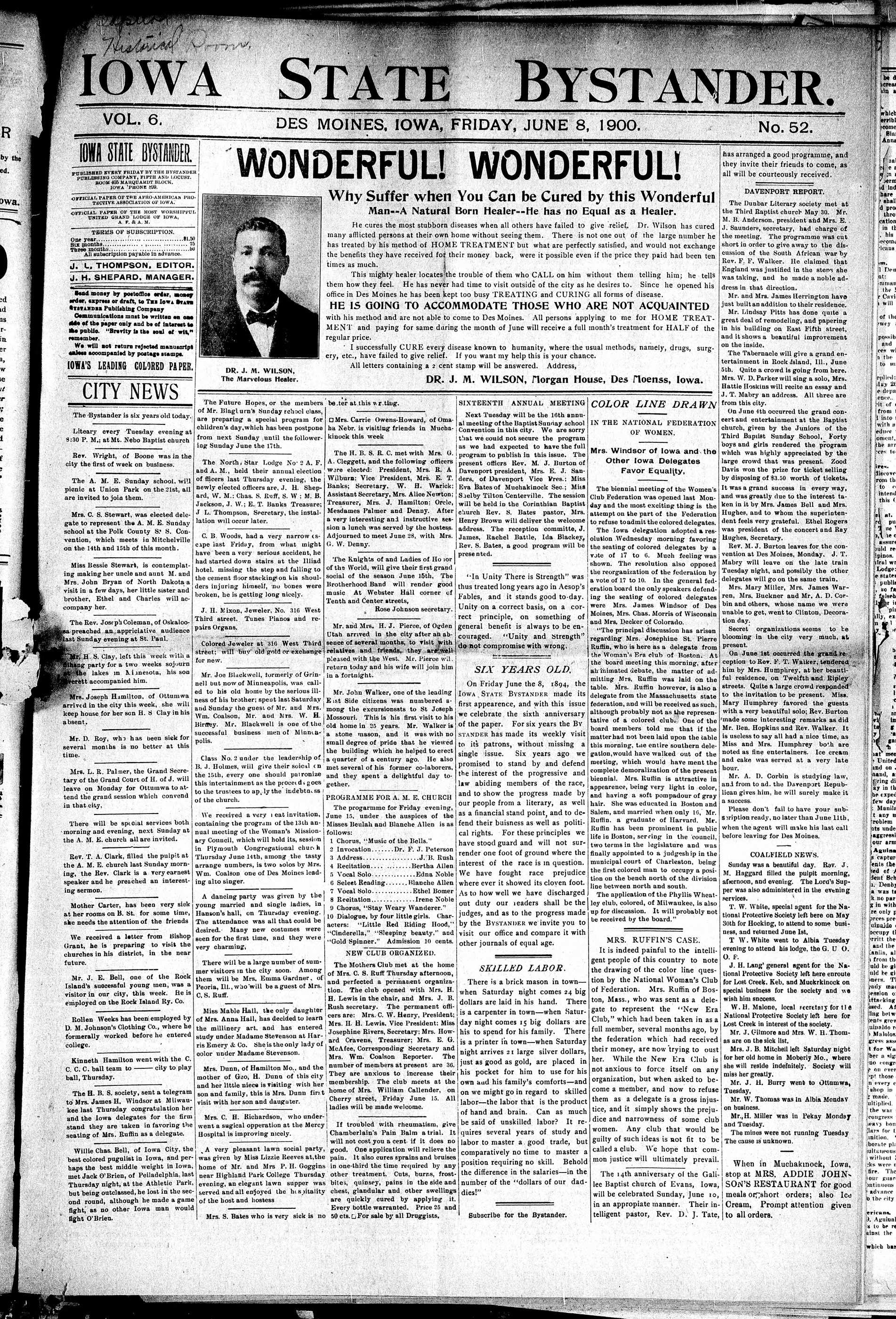
STATE BYST DES MOINES, IOWA, FRIDAY, JUNE 8, 1900.
WONDERFUL! WONDERFUL!
M. H. B.
DR. J. M. WILSON,
The Marvelous Healer.
The Future Hopes, or the members of Mr. Blaglurn's Sunday school class, are preparing a special program for children's day, which has been postpone from next Sunday until the following Sunday June the 17th.
The North, Star Lodge No. 2 A. F. and A. M., held their annual election of officers last Thursday evening, the newly elected officers are, J. H. Shepard, W. M.; Chas. S. Ruff, S. W; M. B. Jackson, J. W.; E. T. Banks Treasure; J L. Thompson, Secretary, the installation will occur later.
C. B. Woods, had a very narrow escape last Friday, from what might have been a very serious accident, he had started down stairs at the Illiad hotel, missing the step and falling to the cement floor stacking on his shoulders injuring himself, no bones were broken, he is getting long nicely.
J. H. Mixon, Jeweler, No. 316 West Third street. Tunes Planos and repairs Organs.
Colored Jeweler at 316 West Third street; will buy old gold or exchange for new.
Mr. Joe Blackwell, formerly of Grinnell but now of Minneapolis, was called to his old home by the serious illness of his brother; spent last Saturday and Sunday the guest of Mr. and Mrs. Wm. Coalson, Mr. and Mrs. W. H. Birney. Mr. Blackwell is one of the successful business men of Minneapolis.
Class No. 2 under the leadership of B. J. Holmes, will give their soical on the 15th, every one should patronize this entertainment as the proceeds goes to the trustees to aply the indebtness of the church.
We received a very neat invitation, containing the program of the 13th annual meeting of the Woman's Missionary Council, which will hold its, session in Plymouth Congregational church Thursday June 14th, among the tasty arrange numbers, is two solos by Mrs. Wm. Coalson one of Des Moines leading alto singer.
A dancing party was given by the young married and single ladies, in Hanson's hall, on Thursday evening. The attendance was all that could be desired. Many new costumes were seen for the first time, and they were very charming.
There will be a large number of summer visitors in the city soon. Among them will be Mrs. Emma Gardner, of Peoria, Ill., who will be a guest of Mrs. C. S. Ruff.
Miss Mable Hall, the only daughter of Mrs. Anna Hall, has decided to learn the millinery art, and has entered study under Madame Stevenson at Harris Emery & Co. She is the only lady of color under Madame Stevenson.
Mrs. Dunn, of Hamilton Mo., and the mother of Geo, H. Dunn of this city and her little niece is visiting with her son and family, this is Mrs. Dunn first visit with her son and daughter.
Mrs. C. H. Richardson, who underwent a surgical operation at the Mercy Hospital is improving nicely.
A very pleasant lawn social party, was given by Miss Lizzie Reeves at, the home of Mr. and Mrs P. H. Goggins near Highland Park College Thursday evening, an elegant lawn supper was served and all enjoyed the hospitality of the host and hostess
He cures the most stubborn diseases when all others have failed to give relief. Dr. Wilson has cured many afflicted persons at their own home without seeing them. There is not one out of the large number he has treated by his method of HOME TREATMENT but what are perfectly satisfied, and would not exchange the benefits they have received for their money back, were it possible even if the price they paid had been ten times as much.
This mighty healer locates the trouble of them who CALL on him without them telling him; he tells them how they feel. He has never had time to visit outside of the city as he desires to. Since he opened his office in Des Moines he has been kept too busy TREATING and CURING all forms of disease.
HE IS GOING TO ACCOMMODATE THOSE WHO ARE NOT ACQUAINTED with his method and are not able to come to Des Moines. All persons applying to me for HOME TREATMENT and paying for same during the month of June will receive a full month's treatment for HALF of the regular price.
I successfully CURE every disease known to humanity, where the usual methods, namely, drugs, surgery, etc., have failed to give relief. If you want my help this is your chance.
beter at this writing.
Mrs. Carrie Owens-Howard, of Omaha Nebr. is visiting friends in Muchakinock this week
The H. B. S. R. C. met with Mrs. G. A. Clegggett, and the following officers were elected: President, Mrs. R. A. Wilburn; Vice President, Mrs. E. T. Banks; Secretary, W. H. Warick; Assistant Secretary, Mrs. Alice Newton; Treasurer, Mrs. J. Hamilton; Orcle, Mesdames Palmer and Denny. After a very interesting and instructive session a lunch was served by the hostess. Adjourned to meet June 28, with Mrs. G. W. Denny.
SIXTEENTH ANNUAL MEETING
Next Tuesday will be the 16th annual meeting of the Baptist Sunday school Convention in this city. We are sorry that we could not secure the program as we had expected to have the full program to publish in this issue. The present officers Rev. M. J. Burton of Davenport president, Mrs. E. J. Sanders, of Davenport Vice Pres.; Miss Eva Bates of Muchakinock Sec.; Miss Saelby Tilton Centerville. The session will be held in the Corinthian Baptist church Rev. S. Bates pastor, Mrs. Henry Brown will deliver the welcome address. The reception committee, J. James, Rachel Battle, Ida Blackey, Rev. S. Bates, a good program will be
COLOR LINE DRAW
IN THE NATIONAL FEDERATION OF WOMEN.
Mrs. Windsor of Iowa and the Other Iowa Delegates Favor Equality.
The biennial meeting of the Womens Club Federation was opened last Monday and the most exciting thing is an attempt on the part of the Federates to refuse to admit the colored delegates. The Iowa delegation adopted a solution Wednesday morning favor the seating of colored delegates by
The Knights of and Ladies of Hoor of the World, will give their first grand social of the season June 15th. The Brotherhood Band will render good music At Webster Hall corner of Tenth and Center streets,
Mr. and Mrs. H. J. Pierce, of Ogden Utah arrived in the city after an absence of several months, to visit with relatives and friends, they are well pleased with the West. Mr. Pierce will return today and his wife will join him in a fortnight.
Mr. John Walker, one of the leading East Side citizens was numbered among the excursionsts to St Joseph Mosouri. This is his first visit to his old home in 25 years. Mr. Walker is a stone mason, and it was with no small degree of pride that he viewed the building which he helped to erect a quarter of a century ago. He also met several of his former co-laborers, and they spent a delightful day together.
PROGRAMME FOR A. M. E. CHURCH
The programme for Friday evening,
June 15, under the auspices of the
Misses Beulah and Blanche Allen is as follows:
1 Chorus, "Music of the Bells."
2 Invocation.....Dr. F. J. Peterson
3 Address.....J. B. Rush
4 Recitation.....Bertha Noble
5 Vocal Solo.....Edna Noble
6 Seleet Reading.....Blanche Allen
7 Vocal Solo.....Ethel Bomer
8 Recitation.....Irene Noble
9 Chorus, "Stay Weary Wanderer."
10 Dialogue, by four little girls. Characters:
"Little Red Riding Hood," "Cinderella," "Sleeping beauty," and "Gold Spinner." Admission 10 cents.
NEW CLUB ORGANIZED.
The Mothers Club met at the home of Mrs. C. S. Ruff Thursday afternoon, and perfected a permanent organization. The club opened with Mrs. H. H. Lewis in the chair, and Mrs. J. B. Rush secretary. The permanent officers are: Mrs. C. W. Henry, President; Mrs. H. H. Lewis, Vice President; Miss Josephine Rivers, Secretary; Mrs. Howard Cravens, Treasurer; Mrs. E. G. McAfee, Corresponding Secretary and Mrs. Wm. Coalson Reporter. The number of members at present are 30. They are anxious to increase their membership. The club meets at the home of Mrs. William Callender, on Cherry street, Friday June 15. All ladies will be made welcome.
If troubled with rheumatism, give Chamberlain's Pain Balm a trial. It will not cost you a cent if it does no good. One application will relieve the pain. It also cures sprains and bruises in one-third the time required by any other treatment. Cuts, burns, frostbites, quinsey, pains in the side and chest, glandular and other swellings are quickly cured by applying it. Every bottle warranted. Price 25 and 50 cts. For sale by all Druggists.
Next Tuesday will be the 16th annual meeting of the Baptist Sunday school Convention in this city. We are sorry that we could not secure the program as we had expected to have the full program to publish in this issue. The present officers Rev. M. J. Burton of Davenport president, Mrs. E. J. Sanders, of Davenport Vice Pres.; Miss Eva Bates of Muchakinock Sec.; Miss Saelby Tilton Centerville. The session will be held in the Corinthian Baptist church Rev. S. Bates pastor, Mrs. Henry Brown will deliver the welcome address. The reception committee, J. James, Rachel Battle, Ida Blackey, Rev. S. Bates, a good program will be presented.
"In Unity There is Strength" was thus treated long years ago in Aesop's Fables, and it stands good to-day. Unity on a correct basis, on a correct principle, on something of general benefit is always to be encouraged. "Unity and Strength" do not compromise with wrong.
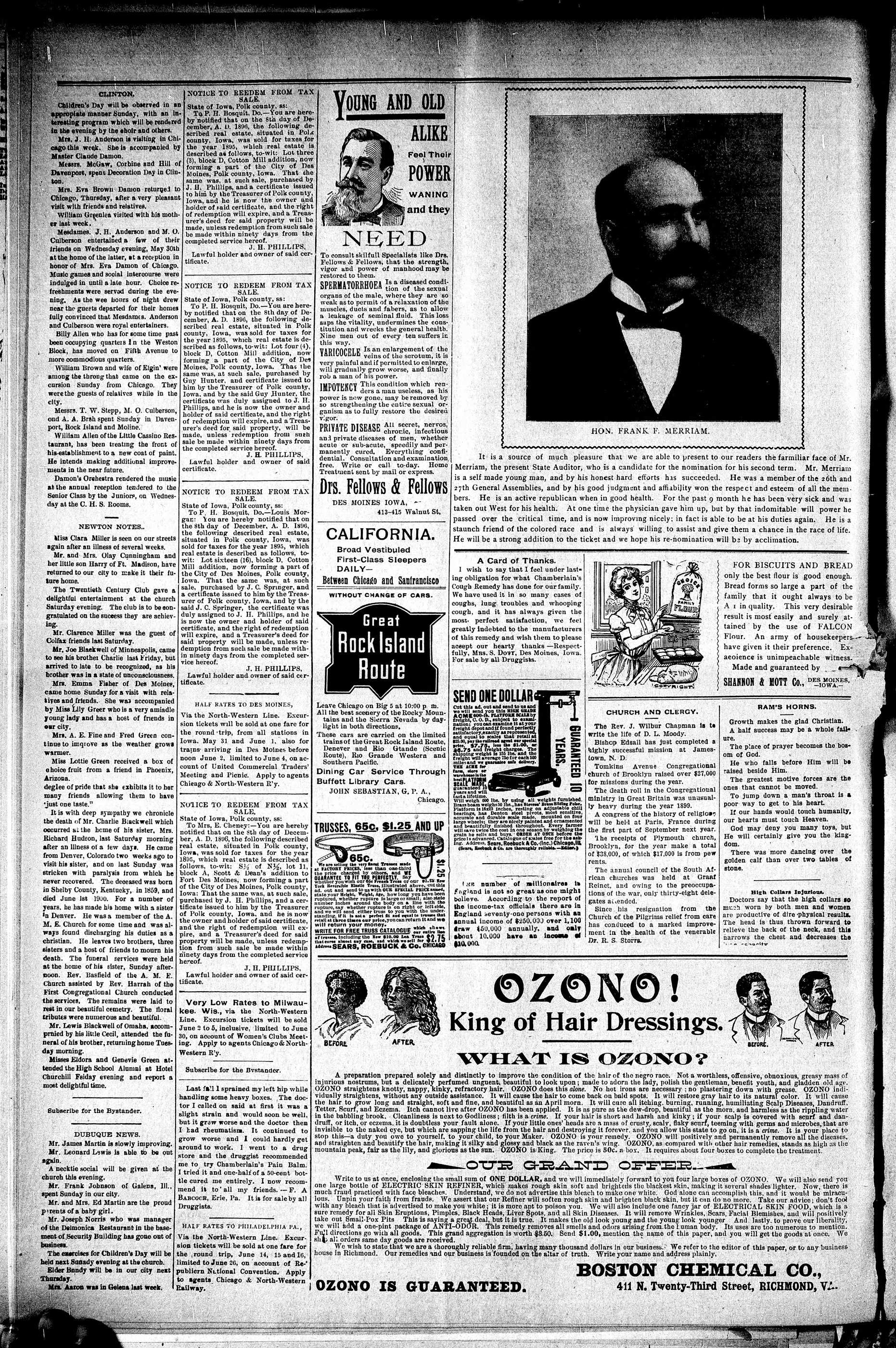
SIX YEARS OLD.
On Friday June the 8, 1894, the IOWA STATE BYSTANDER made its first appearance, and with this issue we celebrate the sixth anniversary of the paper. For six years the BYSTANDER has made its weekly visit to its patrons, without missing a single issue. Six years ago we promised to stand by and defend the interest of the progressive and law abiding members of the race, and to show the progress made by our people from a literary, as well as a financial stand point, and to defend their buisness as well as political rights. For these principles we have stood guard and will not surrender one foot of ground where the interest of the race is in question. We have fought race prejudice where ever it showed its cloven foot. As to how well we have discharged out duty our readers shall be the judges, and as to the progress made by the BYSTANDER we invite you to visit our office and compare it with other journals of equal age.
SKILLED LABOR.
There is a brick mason in town—when Saturday night comes 24 big dollars are laid in his hand. There is a carpenter in town—when Saturday night comes 15 big dollars are his to spend for his family. There is a printer in town—when Saturday night arrives 21 large silver dollars, just as good as gold, are placed in his pocket for him to use for his own aid his family's comforts—and on we might go in regard to skilled labor—the labor that is the product of hand and brain. Can as much be said of unskilled labor? It requires several years of study and labor to master a good trade, but comparatively no time to master a position requiring no skill. Behold the difference in the salaries—in the number of the "dollars of our daddies!"
Subscribe for the Bystander.
COLOR LINE DRAWN
IN THE NATIONAL FEDERATION OF WOMEN.
The biennial meeting of the Women's Club Federation was opened last Monday and the most exciting thing is the attempt on the part of the Federation to refuse to admit the colored delegates. The Iowa delegation adopted a resolution Wednesday morning favoring the seating of colored delegates by a vote of 17 to 6. Much feeling was shown. The resolution also opposed the reorganization of the federation by a vote of 17 to 10. In the general federation board the only speakers defending the seating of colored delegates were Mrs. James Windsor of Des Moines, Mrs. Chas. Morris of Wisconsin and Mrs. Decker of Colorado.
"The principal discussion has arisen regarding Mrs. Josephine St. Pierre Ruffin, who is here as a delegate from the Woman's Era club of Boston. At the board meeting this morning, after ah imimated debate, the matter of admitting Mrs. Ruffin was laid on the table. Mrs. Ruffin however, is also a delegate from the Massachusetts state federation, and will be received as such, although probably not as the representative of a colored club. One of the board members told me that if the matter had not been laid upon the table this morning, the entire southern delegation, would have walked out of the meeting, which would have ment the complete demoralization of the present biennial. Mrs. Ruffin is attractive in appearance, being very light in color, and having a soft pompadour of gray hair. She was educated in Boston and Salem, and married when only 16, Mr. Ruffin, a graduate of Harvard. Mr. Ruffin has been prominent in public life in Boston, serving in the council, two terms in the legislature and was finally appointed to a judgeship in the municipal court of Charleston, being the first colored man to occupy a position on the bench north of the division line between north and south.
The application of the Phyllis Wheatley club, colored, of Milwaukee, is also up for discussion. It will probably not be received by the board."
MRS. RUFFIN'S CASE.
It is indeed painful to the intelligent people of this country to note the drawing of the color line question by the National Woman's Club of Federation. Mrs. Ruffin of Boston, Mass., who was sent as a delegate to represent the "New Era Club," which had been taken in as a full member, several months ago, by the federation which had received their money, are now trying to oust her. While the New Era Club is not anxious to force itself on any organization, but when asked to become a member, and now to refuse them as a delegate is a gross injustice, and it simply shows the prejudice and narrowness of some club women. Any club that would be guilty of such ideas is not fit to be called a club. We hope that common justice will ultimately prevail.
The 14th anniversary of the Galilee Baptist church of Evans, Iowa, will be celebrated Sunday, June 10, in an appropriate manner. Their intelligent pastor, Rev. D. J. Tate,
No.52.
has arranged a good programme, and they invite their friends to come, as all will be courteously received.
DAVENPORT REPORT.
The Dunbar Literary society met at the Third Raptist church May 30. Mr. M. B. Anderson, president and Mrs. E. J. Saunders, secretary, had charge of the meeting. The programme was cut short in order to give away to the discussion of the South African war by Rev. F. F. Walker. He claimed that England was justified in the steps she was taking, and he made a noble address in that direction.
Mr. and Mrs. James Herrington have
just out here addition to their residence. Mr. Lindsay Pitts has done quite a great deal of remodeling, and papering in his building on East Fifth street, and it shows a beautiful improvement on the inside. The Tabernacle will give a grand entertainment in Rock Island, Ill., June 5th. Quite a crowd is going from here. Mrs. W. D. Parker will sing a solo, Mrs. Hattie Hoskins will recite an essay and J. T. Mabry an address. All three are from this city.
On June 8th occurred the grand concert and entertainment at the Baptist church, given by the Juniors of the Third Baptist Sunday School, Forty boys and girls rendered the program which was highly appreciated by the large crowd that was present. Zood Davis won the prize for ticket selling by disposing of $3.50 worth of tickets. It was a grand success in every way, and was greatly due to the interest taken in it by Mrs. James Bell and Mrs. Hughes, and to whom the superintendent feels very grateful. Ethel Rogers was president of the concert and Ray Hughes, Secretary.
Rev. M. J. Burton leaves for the convention at Des Moines, Monday. J. T. Mabry will leave on the late train Tuesday night, and possibly the other delegates will go on the same train.
Mrs. Mary Miller, Mrs. James Warren, Mrs. Buckner and Mr. A. D. Corbin and others, whose name we were unable to get, went to Clinton, Decoration day.
Secret organizations seems to be blooming in the city very much, at present.
On June 1st occurred the grand reception to Rev. F. T. Walker, tendered him by Mrs. Humphrey, at her beautiful residence, on Twelfth and Ripley streets. Quite a large crowd responded to the invitation to be present. Miss. Mary Humphrey favored the guests with a very beautiful solo; Rev. Burton made some interesting remarks as did Mr. Ben. Hopkins and Rev. Walker. It is useless to say all had a nice time, as Miss and Mrs. Humphrey both are noted as fine entertainers. Ice cream and cake was served at a very late hour.
Mr. A. D. Corbin is studying law, and I from to ad. the Davenport Republican gives him, he will surely make it a success.
Please don't fail to have your subscription ready, no later than June 11th, when the agent will make his last call before leaving for Des Moines.
COALFIELD NEWS.
Sunday was a beautiful day. Rav. J. M. Haggard filled the pulpit morning, afternoon, and evening. The Lord's Supper was also administered in the evening services.
T. W. White, special agent for the National Protective Society left here on May 30th for Hocking, to attend to some business, and returned June Ist.
T W. White went to Albia Tuesday evening to attend his lodge, the G. U. O. O. F.
J. H. Lang' general agent for the National Protective Society left here enroute for Lost Creek, Keb, and Muckrkinock on special business for the society and we wish him success.
W. H. Malone, local secretary for the National Protective Society left here for Lost Creek in interest of the society.
Mr. J. Gilmore and Mrs. W. H. Thomas are on the sick list.
Mrs. J. B. Mitchell left Saturday night for her old home in Moberly Mo., where she will reside indefinitely. Society will miss her greatly.
Mr. J. H. Burry went to Ottumwa, Tuesday.
Mr. W. Thomas was in Albia Monday on business.
Mr. H. Miller was in Pekau Monday and Tuesday.
The mines were not running Tuesday. The cause is unknown.
When in Muchakinock, Iowa, stop at MRS. ADDIE JOHNSON'S RESTAURANT for good meals or short orders; also Ice Cream, Prompt attention given to all orders.
PERSONALS.
The literary proclivities of King Oscar of Sweden and Norway led him to call on Henry James and Swinburne while in London recently.
Mrs. Capron, widow of the Rough Hider captain killed in the Spanish war, recently sailed for the Philippines for service as a Red Cross nurse.
Frank W. Hackett, the new assistant secretary of the navy, is a graduate of the Harvard class of '41, and is president of the Washington Harvard Alumni association.
One day recently the public library of Newburyport, Mass., received $20,000 from John Rand Spring, of San Francisco, and $4,500 by the will of the late Stephen W. Marston of Boston.
The death of Cross, the Liverpool animal dealer, removes the most extensive procurer of wild animals of modern times. He was the first to introduce rare beasts into European menageries.
Rev. John E. White of Raleigh, has been elected president of the Baptist Female University of that city. He is the secretary of the Baptist Mission Board, and one of the oldest Baptists in North Carolina.
A silver tablet in memory of John G. Whittier has been placed in the Quaker meeting house at Amesbury, Mass., where the poet once worshiped. The church was built in 1851, and the details of its construction were left by the society to the care of Mr. Whittier. Guatiel Pasha, who died in Constantinople recently at the age of eighty-four years, was for over half a century director of military music of the sublime porte. He was a native of Parma. His predecessor in office was Glusepe Donizetti, the brother of the great composer.
Winfield T. Durbin, Republican nominee for the governorship of Indiana, has had a varied career. Educated in a district school and a business college, he taught school for several years, then turned traveling salesman and finally became successful as a banker.
Professor Paul Haupt of Johns Hopkins university is making a special study of the ethnography of the Philippines, and has gone abroad to collect data on the subject. He believes the United States should follow the example of England, which has made a careful study of the habits and ideas of its colonies.
NUTS AS A CROP.
The raising of the edible nuts is one of the great industries of China.
Chestnuts are grown to the extent of about 500 tons, but not for export. Price ranges from $3 to $5 per hundredweight.
Hazelnuts are grown at a great distance, and only a few hundredweight reach Canton for sale. Price ranges from $4 to $6 per hundredweight.
The various nuts can be grown at great profit in the southern states of our union, and their cultivation will furnish an opportunity for many enterprise men.—Atlanta Constitution.
Walnuts are grown to the extent of about 1,000 tons, of which about 500 tons are exported. Price ranges from $3 to $7 per hundredweight. The above are only used as an adjunct food—nct as a regular article of diet.
A recent consular report gives much valuable information upon that article of production. Peanuts are grown around Canton to the extent of about 1,000 tons. About 100 tons were shipped to Canton this year for the purpose of expressing the oil. Price ranges from $2 to $3 per hundred-weight. Hazelnuts are occasionally eaten raw, more frequently cooked as below described. Peanuts and chestnuts always cooked. A quantity of sand, about the size of No. 2 shot, is heated in an iron pan over a wood fire. The nuts are stirred in the heated sand until sufficiently roasted. The sand, of course, may be used several times for this purpose.
POINTED PARAGRAPHS.
The contented liar uses a soft mattress. It is useless to advertise for a lost opportunity.
The chronic borrower invariably draws the line at trouble.
Negotiations are frequently opened up with the aid of a corkscrew.
Smiles and frowns are little things, but they are powerful for good or evil.
The love that dwells in a cottage could never thrive off terrapin and champagne.
Some husbands would do almost anything to render their wives unspeakably happy.
Don't get too self-important; the world will move on just the same after you are gone.
The only difference between repartee and impudence is in the size of the man who says it.
Never argue with women. The man who spins a yarn among silks and satins is sure to be worsted.
If a man ever becomes truly great it is usually the help of a devoted wife that is responsible for it.
THE NEWS IN IOWA
THE NEWS IN IOWA
RICH MAN'S DOUBLE CRIME.
C. D. Reinhart Kills His Wife and Fatally Wounds Himself.
ODEBALT, June 7.—Charles D. Reinhart, owner of the Reinhart flats in Sioux City, shot his wife three times and then put two bullets into his lungs. He will not survive. Reinhart and his wife had some angry words and he started to take her to relatives near Lakeview. When about half way on the road he committed the crime. The horse turned around and started back, being stopped a few minutes later near the home of Hon. Asa B. Smith. Mrs. Reinhart was dead and her husband sat in the buggy with his arm around her in an unconscious state. He revived later and stated that he had planned the deed deliberately. Reinhart owns 800 acres of land in Sac county. He has been a quiet, orderly citizen, and the deed surprises his acquaintances. Mrs. Reinhart was a fine woman and was highly respected. She was about 35 years old. Reinhart's age is 28.
SUSPENSION IS REPEALED.
Des Moines Criminal Taken Back to The Penitentiary.
DES MOINES, June 8.-Ollie Blair, who was grinned a suspension of sentence from the governor March 14, has been taken back to the penitentiary at Ft. Madison because of a violation of the conditions of the suspension. After Blair was ordered back to the penitentiary an attempt was made to declare him insane but the case has been dismissed. If indications of insanity develop at Ft. Madison the prisoners will be removed to Clarinda, where there is a department for criminal insane. Blair was sentenced for eight years in May, 1896, after being convicted of breaking an entry into a railroad car. For the past week he has been closely watched by the parndon clerk and was found to be drinking and keeping bad company, two direct violations of the terms of suspension.
BIG STRIKE AT MASON CITY.
Railroad Laborers Go Out for Higher Wages.
MASON CITY, June 8.—All of the men working on the construction gangs of the Iowa & Minnesota division of the Northwestern, about 300 in number, have gone out on a strike for higher wages. The men had been getting from $1.50 to $1.75, but had for some time been dissatisfied and by a prearrangement of forces they walked out in a body and refused to resume work until the raise of 25 cents a day which they ask for is granted. The work on the new yards and depots was progressing rapidly and the track was about to enter the city from the south. How long this will block work is uncertain, but it will have the effect of a serious set back unless the men can be persuaded to go back to work.
EX-CONGRESSMAN HOLMES INSANE.
Due to Financial Trouble and Continued Ill Health.
BOONE, June 7.—Hon. A. J. Holmes, formerly congressman from the Tenth Iowa district, has been declared insane and sent to the state hospital at Clarinda. The insanity commissioners found that the case was more serious than they had expected and the only question remaining for them was the determination of whether or not any relief might be obtained at the hospital for the insane. Dr. DeTar advised that the only hope rested with the hospital, and the board made an order for the transfer of Major Holmes to the hospital at Clarinda. The mental blight and misfortune of Major Holmes is the result of two causes: financial trouble and continued ill health.
FELL ACROSS HOT STOVE:
Frightful Accident to Mrs. M. M. Tahar of Fort Dodge.
FORT DOGE, June 7.—Mrs. M. M. Tabar, while engaged in washing clothes, received burns from which she may lose the use of her arm and may lose her life. She was removing the steaming clothes from the boiler when she was seized with an epileptic fit. She fell across the stove and her arm fell into the seething water of the boiler. It was fully two minutes; before her family found her in this position. Her body and arms were horribly burned and the hand and forearm literally parboiled. Opiates were administered to the agonized woman to relieve her sufferings.
Railroad Map Killed.
CRESTON, June 7.—Switchman Will Sandall was instantly killed in the Burlington yards by being run over by a switch engine. He was a member of the night force and had just gone to work. The first move the switch engine made resulted in his death, he missing the foot board. The entire engine passed over him, badly mangling him. He was a young man recently married.
New Railroad Incorporated.
CLINTON, June 5.—Articles of incorporation of the Clinton, Dubuque and Northwestern railroad have been filed at Clinton. The stockholders are H. W. Seaman, Clinton, G. Cates, Chicago; E. W. Boynton and W. S. Keefe, Davenport; William Konefck, Rock Island. The officers are: President. H. W. Seaman; vice-president, Cearles G. Gates; secretary and treasurer, E. W. Boynton. The articles of incorporation provide for building a railroad from Clinton to Dubuque, by way of Maquoketa and Farley.
DOLLIVER'S BOOM UNDER WAY.
Iowa Congressman Looked Upon as Sure
Nominee for Vice-President.
WASHINGTON, June 6—The Cook county republican club, of Chicago, will escent to the national convention the republican candidate for vice-president. E. M. Craig, president of the club, wired to Congressman Dolliver of Iowa, tending to him the support of that organization for vice-president, and requesting the privilege of escorting him to the convention with a special train, and the old Iowa State band on board to furnish the music. Mr. Craig said that the club special would go by way of Detroit, Buffalo, Niagara Falls, Scranton and Trenton. Mr. Dolliver was too modest to accept the offer, but Congressman Lorimer of Chicago, who received a copy of the message, wired back for the club to go ahead with its arrangements. Mr. Lorimer did not not without knowledge of what is likely to happen at Philadelphia. Mr. Dolliver is now the administration candidate for vice-president. The enthusiasm with which his name has been accepted in congress and throughout the country has been watched by president McKinley and other leaders, and the president has today suggested to some of those who are urging Dolliver's nomination that they keep his name to the front, as there is no man in the field more acceptable to him, as the head of the ticket, for second place. Senator Hanna has also sent word along the line that Dolliver is the man, and the Dolliver boom has taken the lead over all the others. Senators Allison and Gear, Speaker Henderson, and all the Iowa congressmen, are enthusiastic in their support of their colleague and his prospects for the nomination.
Rubnone Man to Be Hershel
DEBUQUE, June 6—George G. Perry, of Dubuque, has been appointed United States marshal for Alaska. He was formerly a member of the republican state committee. It is also stated that George Grance, of Dubuque, Senator Allison's former law partner, will be federal judge of Alaska.
Liberal Gift for Muscatine.
MUSCATINE, June, 6.—P. M. Musser, a well-known lumberman and banker of Muscatine, has presented the Public Library association with a building to be constructed by him at a cost of $20,000.
BREVITIES
Willis, Airhart, a switchman in the Northwestern yards at Boone, was recently caught between an engine and bad order car and crushed so badly about the hips that he died a few minutes after being taken to the surgeon's office. He leaves a family.
At New Hampton recently an 18-year-old daughter of F. M. F. Barber was nearly burned to death by the careless handling of a gasoline stove. She ran into the street in flames, and a passerby threw a rug over her, extenuating the flames. Mrs. Barber was also slightly burned, and the kitchen caught fire, but it was soon put out by the neighbors.
Mrs. Edward Ahort, of Dow City, became tired of her marital relations with her husband, Edward Ahort, and eloped with the hired man, named Lee. Mrs. Ahort told her husband that she was going home to visit her mother, but as the hired man drew his wages at about the same time, Mr. Ahort became suspicious and had a warrant sworn out for Lee and the sheriff started in pursuit.
A shooting affray occurred a few nights ago at a dance given at a new meat market, at Schleswig, in which Gus Buhs was shot by William Schroeder, one of the leading young business men of Schleswig. At first it was thought Buhs was not injured, but the latest report is that he may die. Schroeder has been arrested, but his hearing has been postponed until June 12, awaiting the recovery or death of Buhs.
Burglaries blew up the safe of the Sheldahl Savings bank with dynamite and stole about $1,000 in currency, making their escape. The bank had fortunately just sent $1,000 by express to the Central State bank at Des Moines, saving that amount. The bank loses nothing, having been fully insured in a bankers' casualty company. The bank is owned by wealthy farmers of the vicinity and the president is W. D. Schaal, cashier, R. F. Graeber. There is no clue to the burglar.
It is announced that Archbishop Keane, archbishop of Damascus, and late rector of the Catholic university in Washington, has been appointed to succeed Archbishop Hennessy as metropolitan of Dubuque. The bill creating him archbishop of Dubuque has been sent to Archbishop Keane, and Rome is awaiting the latter's acceptance or declination. The above statements are based upon information contained in a letter received by a local priest from a correspondent in Rome, who stands close to the authorities.
Belmond dispatch: Word was received from Eldora announcing the death of Ole Hill, a young man who was taken there from Belmond to the reform school in March. His case was an extraordinary one. His skin was devoid of pores and he could not sweat. That was the cause of his death. He was compelled to work in the sun, and in a few hours sucumbed, although the authorities had been informed that the man was taken from Belmond he evidenced insanity, and nearly every one thought he should have been taken to the insane asylum.
NEWS IN GENERAL
NEWS IN GENERAL
WAR HAS ONLY JUST BEGUN.
Declaration of President Kruger at Machadorp.
LONDON, June 8.—The executive offices of the Transvaal government are in a railway car which is shunted on a switch at Machadorp Station. President Kruger caused the interior of the coach to be reconstructed some time ago with a view to contingencies that have now arrived. A correspondent of the Daily Express, who went from Lorenzo Marquez to see President Kruger, was received by him. The president sat smoking a long pipe. He looked worried, but his bearing was quiet and determined. He did not make the least objection to being interviewed.
"Yes," said President Kruger, "it is quite true that the British have occupied Pretoria. This, however, does not end the war. The burghers are fully determined to fight to the last. They will never surrender so long as five hundred armed men remain in the country. I feel deeply encouraged by the fine work Steyn and DeWet are doing in the Free State." The correspondent suggested that the war was over, inasmuch as the capital had been taken. "The capital" exclaimed Mr. Kruger with energy. "What is a capital? It does not consist of any particular collection of bricks and mortar. The capital of the republic, the seat of government, is here in this car. There is no magic about any special site. Our country is invaded, it is true, but it is not conquered. The government is still effective."
SANCTIONED BY EMPRESS.
China's Dowager Supports the Boxer Movement.
SHANGHAI, June 6—The China Gazette says it has the highest authority for stating that the dowager empress ordered the Tsung Li Yamen to face all Europe rather than to interfere with the Boxer movement. Elsewhere it is asserted that the viceroy ordered the troops to oppose further landing of parties from foreign warships and that the troops now engaged in operations are designed to prevent further foreign re-inforcements from reaching Pekin.
TIEN TISN. June 6. A representative of the Associated Press visited Huang Tsun, on the Pekin-Tien Tsin railway, and found the station burned and two bridges damaged. An officer commanding Chinese troops said two hundred of his men bolted, and only fifty remained. These fought well, killing a number of Boxers. The bolting troops were badly cut up in an adjacent broken country. Sixty were killed or wounded. Bands of Boxers are patrolling the neighborhood. All Chinese railway employees are deserting their posts, and troops sent to guard the stations appear worse than useless. A guard of 250 sent to Fang Tai bolted at Lu Kou Chao when they heard of the trouble at Huang Tsung.
"BOXERS" ARE NOW IN CONTROL.
Have Flags With "Kill the Foreigners"
On Them.
LONDON, June 8.—Telegraphing from Tien Tsin under date of June 6, a correspondent says:
"I left Tien Tsin this morning en route for Kip, accompanied by General Nieh, supposed to be one of the best Chinese generals, with sixty six soldiers, and the balance of thirty-one miles. We found the plate-layers' cabins in flames and telegraph poles cut, and men were engaged in destroying others in the villages near the railway, where flags were hoisted, the inscription "Kill all foreigners."
"I saw smoke, evidently from the burning houses in the distance, but General Nihh refused to proceed further, being in mortal fear of the 'Boxers,' though the foreigners endeavored to persuade him to disentrain him, and that it is useless to fight the 'Boxers,' as other Chinese say they have seen 'Boxers' hit with bullets rise and run away. There seems little prospect of the resumption of traffic to Pelin unless foreign powers assume control of the railway until the Chinese government proves itself capable of managing communications with its capital."
BOERS ESCAPED WITH GUNS.
The Entire Army Successfully Retired From Pretoria.
LONDON, June 7.—Until the situation in the neighborhood of Pretoria is enlightened, officials here as well as others, will find difficulty in prognosticating Lord Roberts's immediate program. It appears evident the Boer commander-in-clerk, Botha, with all his guns, withdrew in good order, probably along the Delagoa Bay railroad, with a view of joining Kruger; the Transvaal forces will remain practically intact, with Kruger. Steyn, Botha and Reitz safe in a position to continue the direction of affairs. The fact that Kruger's wife and Botha's wife left Pretoria is an indication that the president does not count on a long resistance. In any case it will probably take Roberts a week to organize the campaign of pursuit.
COMMISSIONERS HAVE ARRIVED.
Philippine Commissioners Reach Manila
and Are Received by MacArthur.
MANIA, June 5.—The transport Hancock arrived Sunday after a fine voyage, having on board the new Philippine commission. The judges of the supreme court were the first visitors to the transport, and they were followed by General MacArthur's staff. The commissioners landed at noon. Two companies and the band of the Twentieth infantry and a battery of the Sixth artillery escorted them to the ayuntamiento, where they were received by General MacArthur.
IRISH FEOMANRY CAPTURED,
Lord Roberts Reports Surrender of the
Receipt.
Thirteenth regiment.
LONDON, June 6.—Following is the text of the dispatch from Lord Roberts announcing the disaster to the Thirteenth battalion of the Imperi 1 Yeomany, which numbered between 400 and 500 officers and men:
"Pretoria Station, June 5.—I regret to report that the Thirteenth Imperial Yeomany had to surrender to a very superior force of the enemy, on information of the battalion being attacked. I ordered Methuen to proceed with all need to its assistance.
"Methuen was thenen on the march, on the Helibron side of Kroonstad, and, half an hour after the receipt of my telegram on June 1, he started off. By 10 a.m. of the following day he hewed a hole five hours, but he was too late to rescue Colonel Sprague's yeomanry. "Methuen attacked the Boers, who were between 2,000 and 3,000 strong, and after a running fight of five hours completely routed the enemy. It is a very regretable circumstance. I think it must be very long before the Irish yeomanry are released from captivity."
BRITISH ARE IN PRETORIA
City Surrendered, But Few Prisoners Were Taken.
LONDON, June 6.—The war office has received the following from Lord Roberts:
"PRETORIA, June 5.—Just before dark yesterday the enemy were beaten back from nearly all the positions they had been holding, and Ian Hamilton's mounted infantry followed them to within two thousand yards of Pretoria, through which they retreated hastily. De Lisle then sent an officer with a flag of truce into the town, demanding its surrender in my name. Shortly before midnight I was awakened by two officials of the South African republic, Sandberg, military secretary to and general officer, and a general officer of the Boer army, who brought me a letter from Botha, proposing an armistice for the purpose of settling terms of surrender.
"I replied that I would gladly meet the commandant general the next morning, but that I was not prepared to discuss any terms, as the surrender of the town must be unconditional. I asked for a reply by daybreak, as I ordered the troops to march on the town as soon as it was ill he. "In his reply, Botha told me he had decided not to defend Pretoria and he trusted women, children and property would be protected. At 1 o'clock a.m. today, while on the line of march, I was met by three of the principal officers of the town, stating their desire to surrender the own. "It was arranged that Pretoria should be taken possession of by her majesty's troops at 2 o'clock this afternoon. "Mrs. Botha and Mrs. Kruger are both in Pretoria. Some few of the British prisoners have been taken and are now in Wateral. Over 100 of the officers are in Pretoria. The few I have seen are looking well."
NEW YORK DEMOCRATS.
Ex-Senator Hill in Control and The Chicago Platform Not Endorsed. NEW YORK, June 7.—The democratic state committee selected delegates at-large to the Kansas City convention as follows: David B. Hill, Richard Croker, Edward Murphy and Augustus Van Wyk. The platform adopted contains no reaffirmation of the Chicago platform of 1896, but a declaration that the party in the state will support the platform of the Kan-City convention. The platform declares against war taxes in time of peace, declares for parity of gold and silver as currency, demands abolition of all customs and tariffs between Porto Rico and the United States, condemns trusts and monopolies, and entangling alliances: demands just and liberal pension laws and election of United States senators by the people, and favors the nomination of William J. Bryan. The convention gave promise of being very stormy, but ended quietly. The particular feature of the convention was the domination of affairs by ex-Senator D. B. Hill. The silver men profess to be satisfied with the result.
BRABANT LOSES HEAVILY.
Several Parties Sent out by Him Captured by the Boers.
MAZERU, Basutoland, June 5.—Gen. Brabant's horse has been subjected to several captures at the hands of the Boers. Lieut. Rundle, with twenty men, while searching a farm house in the Ficksburg district, were captured. Two of the men were wounded. Lieut. Lees, and two men were captured while commanding. (Another patrol of body horse, numbering twenty men, while pursuing a small party of Boers were surrounded and captured. Count Gleichen sent thirteen men of the Provincial horse, under Lieut. Bowker, with flag of truce, to Senekel, to demand the surrender of that place. The Boers captured the entire party and after robbing the men of all but their clothing sent them to Urade, whence some of them managed to escape. Most of those who succeeded in eluding their guards, however, were recaptured.
SAN FRANCISCO, June 5. After five days in quarantine at Angel Island, Major General E. S. Otis, who arrived on the 30th from Manila, was allowed to land yesterday. Several cases of small pox on board the transport Meado were the cause of the quarantine and General Otis and all on board had to submit to vaccination.
Ex-Gov. Taylor Out of the Race.
LOUISVILLE, June 8. Ex-Governor William S. Taylor announces that he will not be a candidate for governor
The first accident insurance company was organized in England in 1845. The first in this country was established in 1863.
Electricity in Capsules
Is made from cheap chemicals, and when added to a certain quantity of water will furnish electricity enough to light a house or drive an automobile. But this is nothing compared to the strengthening power contained in a bottle of Hostetter's Stomach Bitters. It cures indigestion, dyspepsia, billiousness, liver and kidney troubles. Trees make a fresh start by turning over new leaves.
If you don't feel well today you can be made to feel better by making your blood better. Hood's Sarsaparilla is the great pure blood maker. That is how it cures that tired feeling, plimples, sores, salt rheum, scrofaile and catarrh. Get a bottle of this great medicine and begin taking it at once and see how quickly it will bring your blood up to the Good Health point. Hood's Sarsaparilla Is America's Greatest Blood Medicine.
Two cats on a back yard fence can improvise a nocturne that Chopin never dreamed of.
Examine carefully every bottle of CASTORIA, a safe and sure remedy for infants and children, and see that it
The Kind You Have Always Bought.
At Whakarewarewa, New Zealand, there are hwings, hot springs, boiling pools, mud volcanoes and waterfalls.
To Maple City Self Washing Soap for washing wollows or lace curtains. It is unequalled for washing ladies' shirt wais.
Lots of women dress shabbily in the morning because no one is around to see.
Ladies Can Wear Shoes.
One size smaller after Allen's Foot-Ease, a powder. It makes tight or new shoes easy. Cures swollen, hot, sweating, aching feet. ingrowing nails, corns and bunions. All drug stores and shoe stores. 25c. Trial package FREE by mail. Address Allen S. Olmsted, Le Roy, N.Y.
A woman's view of society depends on whether she is inside or outside.
Piso's Cure is the best medicine we ever used for all affections of the throat and lungs—W.M. O. ENDSLEY, Vanburen, Ind. Feb. 10, 1900.
Two tablespoonfuls of fluid equal one ounce.
A man with a mustache should not eat soup in public.
It is generally the largest woman in the car who has to crowd into the smallest space.
Three dangerous courses—the course of time, the course of true love and the race course.
In a card game a good deal depends on good playing—and good playing depends on a good deal.
In Asiatic Turkey there is a body of religionists who call themselves Yezidees, or devil worshipers. Believing that Satan is destined to be restored to heaven, they wish to keep on good terms with him, as they may need his friendly offices.
Mrs. Mary Dow Peavy, of South Boston, celebrated her 105th birthday on May 16. She enjoys good health, and her memory is just as clear as it was when she was a young woman. Each morning the papers are read to her, and she has followed the war in South Africa from the beginning.
Kemp's Balsam will stop the cough at once. Go to your druggist to-day and get a sample bottle free. Sold in 25 and 50 cent bottles. Go at once delays are dangerous.
Each package of PUTNAM FADE-LESS DYES colors either Silk, Wool or Cotton perfectly.
The man who thinks he knows everything should go to a night school.
Weary Women
Rest and help for weary women are found in Lydia E. Pinkham's Vegetable Compound. It makes women strong and healthy to bear their burdens, and overcomes those Ms. to which women are subject because they are women. Lydia E. Pinkham's Vegetable Compound
Is known from coast to coast. It has oured more slok women than any other medicine. Its friends are everywhere and they are constantly writing thankful letters which appear in this paper.
If you are puzzled write for Mrs. Pinkham's advice. Her address is Lynn, Mass. She will charge you nothing and she has restored a million women to health.
---
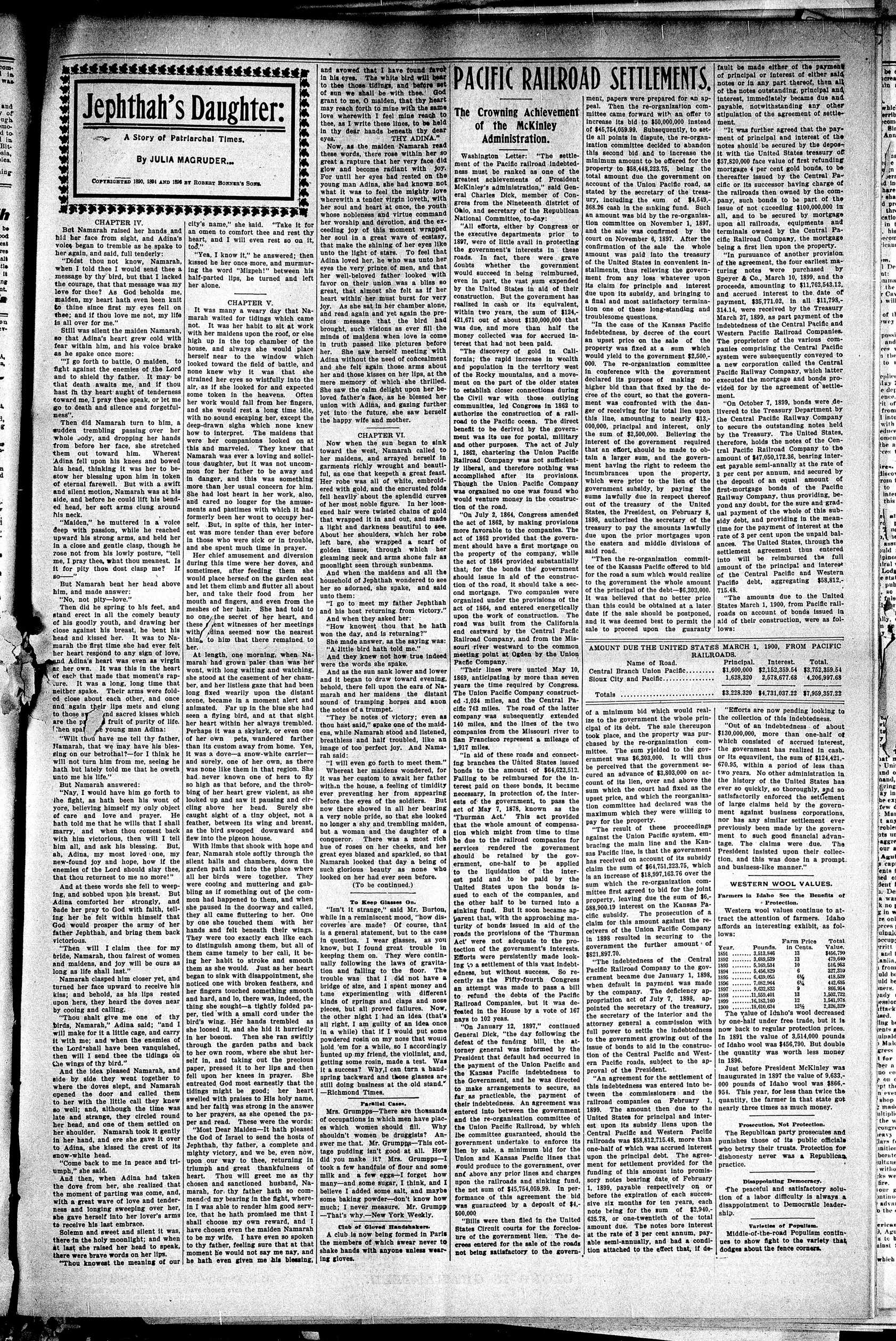
Jephthah's Daughter:
CHAPTER IV.
But Namarah raised her hands and hid her face from sight, and Adina's voice began to tremble as he spake to her again, and said, full tenderly:
"Didst thou not know, Namarah, when I told thee I would send thee a message by thy bird, but that I lacked the courage, that that message was my love for thee? As God beholds me, maiden, my heart hath even been knit to thine since first my eyes fell on thee; and if thou love me not, my life is all over for me."
Still was silent the maiden Namarah, so that Adina's heart grew cold with fear within him, and his voice brake as he spake once more:
"I go forth to battle, O maiden, to fight against the enemies of the Lord and to shield thy father. It may be that death awaits me, and if thou hast in thy heart awaits of tenderness toward me, I pray thee speak, or let me go to death and silence and forgetfulness."
Then did Namarah turn to him, a sudden trembling passing over her whole body, and dropping her hands from before her face, she stretched them out toward him. Whereat Adina fell upon his knees and bowed his head, thinking it was her to bestow her blessing upon him in token of eternal farewell. But with a swift and silent motion, Namarah was at his side, and before he could lift his bended head, her soft arms clung around his neck.
"Maiden," he muttered in a voice deep with passion, while he reached upward his strong arms, and held her in a close and gentle clasp, though he rose not from his lowly posture, "tell me, I pray thee, what thou meanest. Is it for pity thou dost clasp me? If so——"
But Namarah bent her head above him, and made answer:
Then did he spring to his feet, and stand erect in all the comely beauty of his goodly youth, and drawing her close against his breast, he bent his head and kissed her. It was to Narah the first time she had ever felt her heart respond to any sign of love, and Adina's heart was even as virgin her own. It was this in the heart of each that made that moment's rapture. It was a long, long time that neither spake. Their arms were folded close about each other, and once and again their lips mets and clung to those sweet and sacred kisses which are the precious fruit of purity of life. Then spake the young man Adina: "Wilt thou have me tell thy father, Jamarah, that we may have his blessing on our betrothal?—for I think he will not turn him from me, seeing he hath but lately told me that he oweth unto me his life."
But Namarah answered:
"Nay, I would have him go forth to the fight, as hath been his wont of yore, believing himself my only object of care and love and prayer. He hath told me that he wills that I shall marry, and when thou comest back with him victorious, then will I tell him all, and ask his blessing. But, ah, Adina, my most loved one, my new-found joy and hope, how if the enemies of the Lord should slay thee, that thou returnest to me no more!"
And at these words she fell to weeping, and sobbed upon his breast. But Adina comforted her strongly, and made her pray to God with faith, telling her he felt within himself that God would prosper the army of her father Jephthah, and bring them back victorious.
"Then will I claim thee for my bride, Namarah, thou fairest of women and maidens, and joy will be ours as long as life shall last."
Namarah clasped him closer yet, and turned her face upward to receive his kiss; and behold, as his lips rested upon hers, they heard the doves near by cooling and calling.
"Thou shalt give me one of thy birds, Namarah," Adina said; "and I will make for it a little cage, and carry it with me; and when the enemies of the Lord shall have been vanquished, then will I send the tidings on the wings of thy bird."
And the idea pleased Namarah, and side by side they went together to where the doves slept, and Namarah opened the door and called them to her with the little call they knew so well; and, although the time was late and strange, they circled round her head, and one of them settled on her shoulder. Namarah took it gently in her hand, and ere she gave it over to Adina, she kissed the crest of its snow-white head.
"Come back to me in peace and triumph," she said.
And then, when Adina had taken the dove from her, she realized that the moment of parting was come, and, with a great wave of love and tenderness and longing sweeping over her, she gave herself into her lover's arms to receive his last embrace.
Solemn and sweet and silent it was, there in the holy moonlight; and when at last she raised her head to speak, there were brave words on her lips.
"Thou knowest the meaning of our
city's name," she said. "Take it for an omen to comfort thee and rest thy heart, and I will even rest so on it, tood." "Yea, I know it," he answered; then kissed he her once more, and murmuring the word "Mizpeh!" between his half-parted ilps, he turned and left her alone.
CHAPTER V
It was many a weary day that Namarah waited for tidings which came not. It was her habit to sit at work with her maledicts upon the roof, or else high up in the top chamber of the house, and always she would place herself near to the window which looked toward the field of battle, and none knew why it was that she strained her eyes so wistfully into the air, as if she looked for and expected some token in the heavens. Often her work would fall from her fingers, and she would rest a long time idle, with no sound escaping her, except the deep-drawn sighs which none knew how to interpret. The maledens that were her companions looked on at this and marveled. They knew that Namarah was ever a loving and solicitous daughter, but it was not uncommon for her father to be away and in danger, and this was something more than her usual concern for him. She had lost heart in her work, also, and cared no longer for the amusements and pastimes with which it had formerly been her wont to occupy herself. But, in spite of this, her interest was more tender than ever before in those who were sick or in trouble, and she spent much time in prayer.
Her chief amusement and diversion during this time were her doves, and sometimes, after feeding them she would place herself on the garden seat and let them climb and flutter all about her, and take their food from her mouth and fingers, and even from the meshes of her hair. She had told to no one the secret of her heart, and these silent witnesses of her meetings with Adina seemed now the nearest thing to him that there remained to her.
At length, one morning, when Namarah had grown paler than was her wont, with long waiting and watching, she stood at the casement of her chamber, and her listless gaze that had been long fixed wearily upon the distant scene, became in a moment alert and animated. Far up in the blue she had seen a flying bird, and at that sight her heart within her always trembled. Perhaps it was a skylark, or even one of her own pets, wandered farther than its custom away from home. Yes, it was a dove—a snow-white carrier—and surely, one of her own, as there was none like them in that region. She had never known one of hers to fly so high as that before, and the throbbing of her heart grew violent, as she looked up and saw it pausing and circling above her head. Surely she caught sight of a tiny object, not a feather, between its wing and breast, as the bird swooped downward and flew into the pigeon house.
With limbs that shook with hope and fear, Naramah stole softly through the silent halls and chambers, down the garden path and into the place where all her birds were together. They were cooling and muttering and gabbling as if something out of the common had happened to them, and when she paused in the doorway and called, they all came fluttering to her. One by one she touched them with her hands and felt beneath their wings. They were too exactly each like each to distinguish among them, but all of them came tamely to her call, it being her habit to stroke and smooth them as she would. Just as her heart began to sink with disappointment, she noticed one with broken feathers, and her fingers touched something smooth and hard, and lo, there was, indeed, the thing she sought—a tightly folded paper, tied with a small cord under the bird's wing. Her hands trembled as she loosed it, and she hid it hurriedly in her bosom. Then she ran swiftly through the garden paths and back to her own room, where she shut her herself in, and taking out the precious paper, pressed it to her lips and then fell upon her knees in prayer. She entreated God most earnestly that the entailed might be earnestly that her heart swelled with praises to His holy name, and her faith was strong in the answer to her prayers, as she opened the paper and read. These were the words:
"Most Dear Malden—It hath pleased the God of Israel to send the hosts of Jephthah, thy father, a complete and mighty victory, and we be, even now, upon our way to thee, returning in triumph and great thankfulness of heart. Thou will greet me as thy chosen and sanctioned husband, Namarah, for thy father hath so commended my bearing in the fight, wherein I was able to render him good service, that he hath promised me that I shall choose my own reward, and I have chosen even the maiden Namarah to be my wife. I have even so spoken to thy father, feeling sure that at that moment he would not say me nay, and he hath even given me his blessing.
and avowed that that I have found thovt in his eyes. The white bird will bear to thee those tidlings, and before set of sun we shall be with thee. God grant to me, O malden, that thy heart may reach forth to mine with the same love wherewith I feel mine reach to thee, as I write these lines, to be held in thy dear hands beneath thy dear eyes. THY ADINA."
Now, as the maiden Namarah read these words, there rose within her so great a rapture that her very face did glow and become radiant with joy. For until her eyes had rested on the young man Adina, she had known not what it was to feel the mighty love wherewith a tender virgin loveth with her soul and heart at once, the youth whose nobleness and virtue command her worship and devotion, and the exceeding joy of this moment wrapped her soul in a great wave of ecstasy, that make the shining of her eyes like unto the light of stars. To feel that Adina loved her, he who was unto her eyes the very prince of men, and that her well-beloved father looked with favor on their union was a bliss so great, that almost she felt as if her heart within her must burst for very joy. As she sat in in her chamber alone, and read again and yet again the precious message that the bird had brought, such visions as ever fill the minds of maidens when love is come in truth passed like pictures before her. She saw herself meeting with Adina without the need of concealment and she felt again those arms about her and those kisses on her lips, at the mere memory of which she thrilled. She saw the calm delight upon her beloved father's face, as he blessed her union with Adina, and gazing further yet into the future, she saw herself the happy wife and mother.
CHAPTER VI.
Now when the sun began to sink toward the west, Namarah called to her maidens, and arrayed herself in garments richly wrought and beautiful, as one that keepeth a great feast. Her robe was all of white, embroidered with gold, and the encrusted folds fell heavily about the splendid curves of her most noble figure. In her loosened hair were twisted chains of gold that wrapped it in and out, and made a light and darkness beautiful to see. About her shoulders, which her robe left bare, she wrapped a scarf of golden tissue, through which her gleaming neck and arms shone fair as moonlight seen through sunbeams.
And when the maidens and all the household of Jephthah wondered to see her so adorned, she spake, and said unto them:
"I to meet my father Jephthah and his host returning from victory."
And when they asked her:
"How knowest thou that he hath won the day, and is returning?"
She mime answer, as the saying was: "A little bird hath told me." And they knew not how true indeed were the words she spake. And as the sun sank lower and lower and it began to draw toward evening, behold, there fell upon the ears of Namarah and her maldens the distant sound of tramping horses and anon the notes of a trumpet. "They be notes of victory; even as thou hast said," spake one of the maidens, while Namarah stood and listened, breathless and half troubled, like an image of too perfect joy. And Namarah said:
"I will even go forth to meet them." Whereat her maidens wondered, for it was her custom to await her father within m the house, a feeling of timidity ever preventing her from appearing before the eyes of the soldiers. But now there showed in all her bearing a very noble pride, so that she looked no longer a shy and trembling maiden, but a woman and the daughter of a conqueror. There was a most rich hue of roses on her cheeks, and her great eyes blazed and sparkled, so that Namarah looked that day a being of such glorious beauty as none who looked on her had ever seen before.
(To be continued.)
To Keep Glasses On.
"Isn't it strange," said Mr. Burton, while in a reminiscent mood, "how discoveries are made? Of course, that is a general statement, but to the case in question. I wear glasses, as you know, but I found great trouble in keeping them on. They were continually following the laws of gravitation and falling to the floor. The trouble was that I did not have a bridge of size, and I spent money and time experimenting with different kinds of springs and claps and nose pieces, but all proved failures. Now, the other night I had an idea (that's all right, I am guilty of an idea once in a while) that if I would put some powdered rosin on my nose that would hold 'em for a while, so I accordingly hunted up my friend, the violinist, and, getting some rosin, made a test. Was it a success? Why. I can turn a hand-spring backward and those glasses are still doing business at the old stand." -Richmond Times.
Parallel Cases.
Mrs. Grumpps—There are thousands of occupations in which men have places which women should fill. Why shouldn't women be druggists? Answer me that. Mr. Grumpps—This cottage pudding isn't good at all. How did you make it? Mrs. Grumpps—I took a few handfuls of flour and some milk and a few eggs—I forget how many—and some sugar, I think, and I believe I added some salt, and maybe some baking powder—don't know how much; I never measure. Mr. Grumpp—That's why—New York Weekly.
Club of Gloved Handshakers.
A club is now being formed in Paris the members of which sweater never to shake hands with anyone unless wearing gloves.
PACIFIC RAILROAD SETTLEMENTS.
The Crowning Achievement of the McKinley Administration.
Washington Letter: "The settlement of the Pacific railroad indebtedness must be ranked as one of the greatest achievements of President McKinley's administration," said General Charles Dick, member of Congress from the Nineteenth district of Ohio, and secretary of the Republican National Committee, to-day:
"All efforts, either by Congress or the executive departments prior to 1897, were of little avail in protecting the government's interests in these roads. In fact, there were grave doubts whether the government would succeed in being reimbursed, even in part, the vast sum expended by the United States in aid of their construction. But the government has realized in cash or its equivalent, within two years, the sum of $124,421,671 out of about $130,000,000 that was due, and more than half the money collected was for accrued interest that had not been paid.
"The discovery of gold in California; the rapid increase in wealth and population in the territory west of the Rocky mountains, and a movement on the part of the older states to establish closer connections during the Civil war with those outlying communities, led Congress in 1862 to authorize the construction of a railroad to the Pacific ocean. The direct benefit to be derived by the government was its use for postal, military and other purposes. The act of July 1, 1862, chartering the Union Pacific Railroad Company was not sufficiently liberal, and therefore nothing was accomplished after its provisions. Though the Union Pacific Company was organized no one was found who would venture money in the construction of the road.
"On July 2, 1864, Congress amended the act of 1862, by making provisions more favorable to the companies. The act of 1862 provided that the government should have a first mortgage on the property of the company, while the act of 1864 provided substantially that, for the bonds the government should issue in aid of the construction of the road, it should take a second mortgage. Two companies were organized under the provisions of the act of 1864, and entered energetically upon the work of construction. The road was built from the California end eastward by the Central Pacific Railroad Company, and from the Missouri river westward to the common meeting point at Ogden by the Union Pacific Company.
"Their lines were united May 10, 1869, anticipating by more than seven years the time required by Congress. The Union Pacific Company constructed 1,034 miles, and the Central Pacific 743 miles. The road of the latter company was subsequently extended 140 miles, and the lines of the two companies from the Missouri river to San Francisco represent a mileage of 1,917 miles.
"In aid of these roads and connecting branches the United States issued bonds to the amount of $64,622,512. Falling to be reimbursed for the interest paid on these bonds, it became necessary, in protection of the interests of the government, to pass the act of May 7, 1878, known as the 'Thurman Act'. This act provided that the whole amount of compensation which might from time to time be due to the railroad companies for services rendered the government should be retained by the government, one-half to be applied to the liquidation of the interest paid and to be paid by the United States upon the bonds issued to each of the companies, and the other half to be turned into a sinking fund. But it soon became apparent that, with the approaching maturity of bonds issued in aid of the roads the provisions of the 'Thurman Act' were not adequate to the protection of the government's interests. Efforts were persistently made looking to a settlement of this vast indebtedness, but without success. So recently as the Fifty-fourth Congress an attempt was made to pass a bill to refund the debts of the Pacific Railroad Companies, but it was defeated in the House by a vote of 167 nays to 102 yeas.
"On January 12, 1897," continued General Dick, "the day following the defeat of the funding bill, the attorney general was informed by the President that default had occurred in the payment of the Union Pacific and the Kansas Pacific indebtedness to the Government, and he was directed to make arrangements to secure, as far as practicable, the payment of their indebtedness. An agreement was entered into between the government and the re-organization committee of the Union Pacific Railroad, by which the committee guaranteed, should the government undertake to enforce its lien by sale, a minimum bid for the Union and Kansas Pacific lines that would produce to the government, over and above any prior lines and charges upon the railroads and sinking fund, the net sum of $1,754,059.99. In performance of this agreement the bid was guaranteed by a deposit of $4,500.000.
"Bills were then filed in the United States Circuit courts for the foreclosure of the government lien. The decrees entered for the sale of the roads not being satisfactory to the govern-
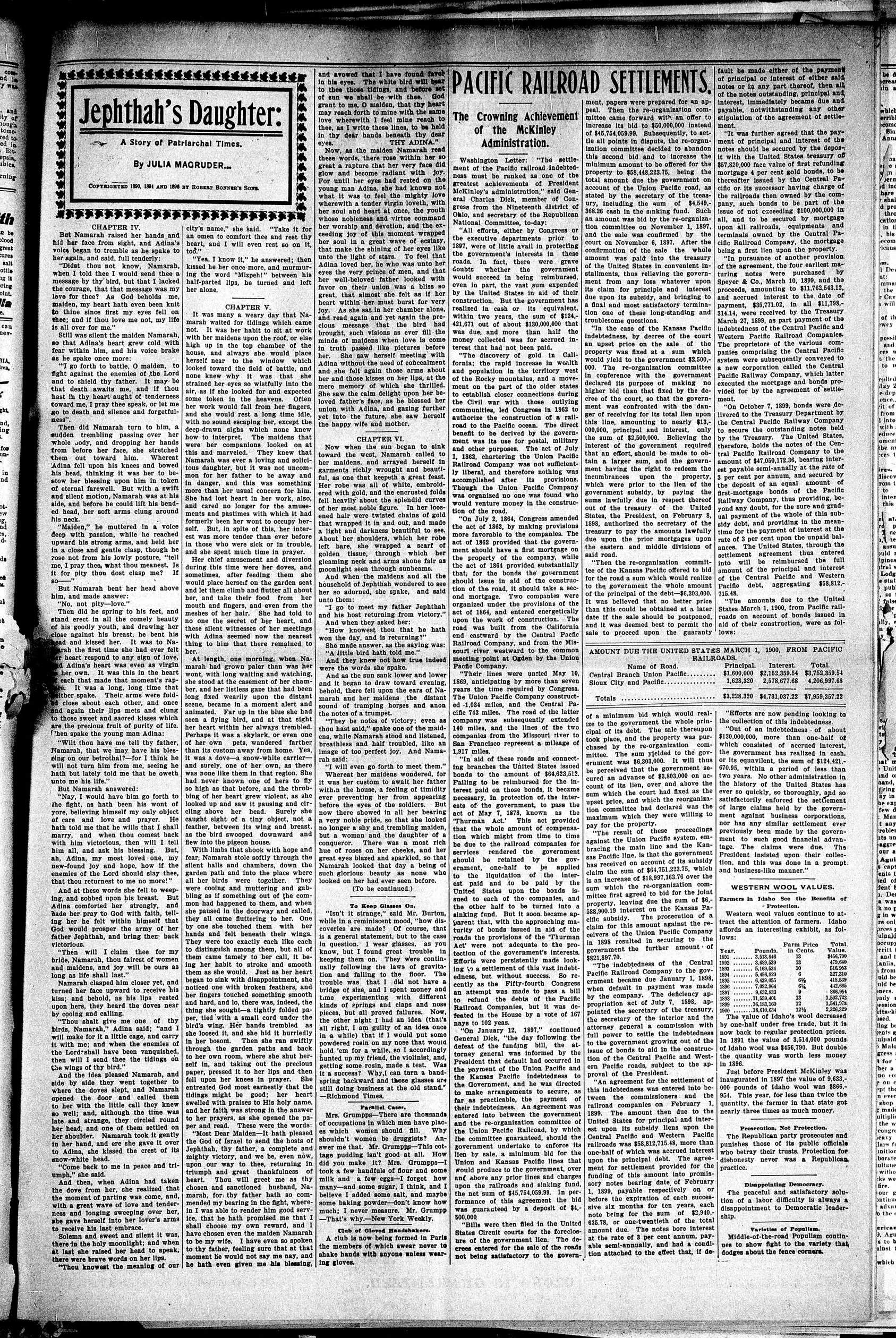
AMOUNT DUE THE UNITED STATES MARCH 1, 1900, FROM PACIFIC
RAILROADS.
Name of Road. Principal. Interest. Total.
Central Branch Union Pacific. $1,600,000 $2,152,359.54 $3,752,359.54
Sloux City and Pacific. 1,628,320 2,578,677.68 4,206,997.68
ment, papers were prepared for an appeal. Then the re-organization committee came forward with an offer to increase its bid to $50,000,000 instead of $45,754,058.99. Subsequently, to set all points in dispute, the re-organization committee decided to abandon this second bid and to increase the minimum amount to be offered for the property to $58,448,223.75, being the total amount due the government on account of the Union Pacific road, as stated by the secretary of the treasury, including the sum of $4,549,368.26 cash in the sinking fund. Such an amount was bid by the re-organization committee on November 1, 1997, and the sale was confirmed by the court on November 6, 1987. After the confirmation of the sale the whole amount was paid into the treasury of the United States in convenient installments, thus relieving the government from any loss whatever upon its claim for principle and interest due upon its subsidy, and bringing to a final and most satisfactory termination one of these long-standing and troublesome questions.
"In the case of the Kansas Pacific indebtedness, by decree of the court an upset price on the sale of the property was fixed at a sum which would yield to the government $2,500,-000. The re-organization committee in conference with the government declared its purpose of making no higher bid than that fixed by the decree of the court, so that the government was confronted with the danger of receiving for its total lien upon this line, amounting to nearly $13,-000,000, principal and interest, only the sum of $2,500,000. Believing the interest of the government required that an effort, should be made to obtain a larger sum, and the government having the right to redeem the incumbrances upon the property, which were prior to the lien of the government subsidy, by paying the sums lawfully due in respect thereof out of the treasury of the United States, the President, on February 8, 1898, authorized the secretary of the treasury to pay the amounts lawfully due upon the prior mortgages upon the eastern and middle divisions of said road.
"Then the re-organization committee of the Kansas Pacific offered to bid for the road a sum which would realize to the government the whole amount of the principal of the debt—$6,303,000. It was believed that no better price than this could be obtained at a later date if the sale should be postponed, and it was deemed best to permit the sale to proceed upon the guaranty
Totals
of a minimum bid which would realize to the government the whole principal of its debt. The sale thereupon took place, and the property was purchased by the re-organization committee. The sum yielded to the government was $6,803,000. It will thus be perceived that the government secured an advance of $3,803,000 on account of its lien, over and above the sum which the court had fixed as the upset price, and which the reorganization committee had declared was the maximum which they were willing to pay for the property.
"The result of these proceedings against the Union Pacific system, embracing the main line and the Kansas Pacific line, is that the government has received on account of its subsidy claim the sum of $64,751,223.75, which is an increase of $18,997,163.70 over the sum which the re-organization committee first agreed to bid for the joint property, leaving due the sum of $6,588,900.19 interest on the Kansas Pacific subsidy. The prosecution of a claim for this amount against the receivers of the Union Pacific Company in 1898 resulted in securing to the government the further amount of $621,897.70.
"The indebtedness of the Central Pacific Railroad Company to the government became due January 1, 1898, when default in payment was made by the company. The deficiency appropriation act of July 7, 1898, appointed the secretary of the treasury, the secretary of the interior and the attorney general a commission with full power to settle the indebtedness to the government growing out of the issue of bonds to aid in the construction of the Central Pacific and Western Pacific roads, subject to the approval of the President.
"An agreement for the settlement of this indebtedness was entered into between the commissioners and the railroad companies on February 1, 1899. The amount then due to the United States for principal and interest upon its subsidy liens upon the Central Pacific and Western Pacific railroads was $58,812,715.48, more than one-half of which was accrued interest upon the principal debt. The agreement for settlement provided for the funding of this amount into promissory notes bearing date of February 1, 1899, payable respectively on or before the expiration of each successive six months for ten years, each note being for the sum of $2,940, 635.78, or one-twelfth of the total amount. The notes bore interest at the rate of 3 per cent annum, payable semi-annually, and had a condition attached to the effect that, if de-
fault be made either, of the payment of principal or interest of either said notes or in any part thereof, then all of the notes outstanding, principal and interest, immediately became due and payable, notwithstanding any other stipulation of the agreement of settlement.
"It was further agreed that the payment of principal and interest of the notes should be secured by the deposit with the United States treasury of $7,820,000 face value of first refunding mortgage 4 per cent gold bonds, to be thereafter issued by the Central Pacific or its successor having charge of the railroads then owned by the company, such bonds to be part of the issue of not exceeding $100,000,000 in all, and to be secured by mortgage upon all railroads, equipments and terminals owned by the Central Pacific Railroad Company, the mortgage being a first lien upon the property.
"In pursuance of another provision of the agreement, the four earliest maturing notes were purchased by Speyer & Co., March 10, 1899, and the proceeds, amounting to $11,762,543.12, and accrued interest to the date of payment, $35,771.02, in all $11,785-314.14, were received by the Treasury March 27, 1899, as part payment of the indebtedness of the Central Pacific and Western Pacific Railroad Companies. The proprietors of the various companies comprising the Central Pacific system were subsequently conveyed to a new corporation called the Central Pacific Railway Company, which latter executed the mortgage and bonds provided for by the agreement of settlement.
"On October 7, 1899, bonds were delivered to the Treasury Department by the Central Pacific Railway Company to secure the outstanding notes held by the Treasury. The United States, therefore, holds the notes of the Central Pacific Railroad Company to the amount of $47,050,172.38, bearing interest payable semi-annually at the rate of 3 per cent per annum, and secured by the deposit of an equal amount of first-mortgage bonds of the Pacific Railway Company, thus providing, beyond any doubt, for the sure and gradual payment of the whole of this subsidy debt, and providing in the meantime for the payment of interest at the rate of 3 per cent upon the unpaid balances. The United States, through the settlement agreement thus entered into will be reimbursed the full amount of the principal and interest of the Central Pacific and Western Pacific debt, aggregating $58,812.715.48.
"The amounts due to the United States March 1, 1900, from Pacific railroads on account of bonds issued in aid of their construction, were as follows:
"Efforts are now pending looking to the collection of this indebtedness.
"Out of an indebtedness of about $130,000,000, more than one-half of which consisted of accrued interest, the government has realized in cash, or its equivilant, the sum of $124,421,670.95, within a period of less than two years. No other administration in the history of the United States has ever so quickly, so thoroughly, and so satisfactorily enforced the settlement of large claims held by the government against business corporations, nor has any similar settlement ever previously been made by the government to such good financial advantage. The claims were due. The President insisted upon their collection, and this was done in a prompt and business-like manner."
WESTERN WOOL VALUES.
Farmers in Idaho See the Benefits of
Protection.
Western wool values continue to attract the attention of farmers. Idaho affords an interesting exhibit, as follows:
Year. Pounds. Farm Price Total
Year. Pounds. In Cents. Value.
1851 3,513,846 13 456,790
1852 3,839,539 13 479,690
1853 5,458,164 13 475,600
1854 5,456,829 6 327,310
1855 6,439,055 6% 418,539
1856 7,062,964 6% 442,685
1857 9,622,833 9 885,954
1858 9,622,833 13 1,500,728
1859 16,153,190 12 1,541,974
1860 16,153,190 12 1,541,974
1861 16,153,190 12% 2,338,232
The value of Idaho's wool decreased by one-half under free trade, but it is now back to regular protection prices. In 1891 the value of 3,514,000 pounds of Idaho wool was $456,790. But double the quantity was worth less money in 1896.
Just before President McKinley was inaugurated in 1897 the value of 9,633,000 pounds of Idaho wool was $866,954. This year, for less than twice the quantity, the farmer in that state got nearly three times as much money.
Prosecution, Not Protection.
The Republican party prosecutes and punishes those of its public officials who betray their trusts. Protection for dishonesty never was a Republican practice.
Disappointing Democracy.
The peaceful and satisfactory solution of a labor difficulty is always a disappointment to Democratic leadership.
Varieties of Populism.
Middle-of-the-road Populism continues to show fight to the variety that dodges about the fence corners.
Jephthah's Daughter:
By JULIA MAGRUDER...
COPYRIGHTED 1890, 1894 AND 1896 BY ROBERT BONNER'S SONS.
But Namarah raised her hands and hid her face from sight, and Adina's voice began to tremble as he spake to her again, and said, full tendency:
"Didst thou not know, Namarah, when I told thee I would send thee a message by thy bird, but that I lacked the courage, that that message was my love for thee? As God beholds me, maiden, my heart hath even been knit to thine since first my eyes fell on thee; and if thou love me not, my life is all over for me."
Still was silent the maiden Namarah, so that Adina's heart grew cold with fear within him, and his voice brake as he spake once more:
"I go forth to battle, O maiden, to fight against the enemies of the Lord and to shield thy father. It may be that death awaits me, and if thou hast in thy heart awaits of tenderness toward me, I pray thee speak, or let me go to death and silence and forgetfulness".
Then did Namarah turn to him, a sudden trembling passing over her whole body, and dropping her hands from before her face, she stretched them out toward him. Whereat Adina fell upon his knees and bowed his head, thinking it was her to bestow her blessing upon him in token of eternal farewell. But with a swift and silent motion, Namarah was at his side, and before he could lift his bended head, her soft arms clung around his neck.
"Malden," he muttered in a voice deep with passion, while he reached upward his strong arms, and held her in a close and gentle clasp, though he rose not from his lowly posture, "tell me, I pray thee, what thou meanest. Is it for pity thou dost clasp me? If so——"
But Narahab bent her head above him, and made answer:
"No, not pity, love."
Then did he spring to his feet, and stand erect in all the comely beauty of his goodly youth, and drawing her close against his breast, he bent his head and kissed her. It was to Namarah the first time she had ever felt her heart respond to any sign of love, and Adina's heart was even as virgin as her own. It was this in the heart of each that made that moment's rapture. It was a long, long time that neither spake. Their arms were folded close about each other, and once and again their lips mets and clung to those skin and sacred kisses which are the prince fruit of purity of life. Then spake me the young man Adina: "Wilt thou have me tell thy father, Namarah, that we may have his blessing on our betrothal?—for I think he will not turn him from me, seeing he hath but lately told me that he oweth unto me his life."
"Nay, I would have him go forth to the fight, as hath been his wont of yore, believing himself my only object of care and love and prayer. He hath told me that he wills that I shall marry, and when thou comest back with him victorious, then will I tell him all, and ask his blessing. But, ah, Adina, my most loved one, my new-found joy and hope, how if the enemies of the Lord should slay thee, that thou returnest to me no more!" And at these words she fell to weeping, and sobbed upon his breast. But Adina comforted her strongly, and bade her pray to God with faith, telling her he felt within himself that God would prosper the army of her father Jephthah, and bring them back victorious.
"Then will I claim thee for my bride, Namarah, thou fairest of women and maldens, and joy will be ours as long as life shall last."
Namarah clasped him closer yet, and turned her face upward to receive his kiss; and behold, as his lips rested upon hers, they heard the doves near by cooling and calling.
"Thou shalt give me one of thy birds, Namarah," Adina said; "and I will make for it a little cage, carry it with me; and when the enemies of the Lord-shall have been vanquished, then will I send the tidings on the wings of thy bird."
And the idea pleased Namarah, and side by side they went together to where the doves slept, and Namarah opened the door and called them to her with the little call they knew so well; and, although the time was late and strange, they circled round her head, and one of them settled on her shoulder. Namarah took it gently in her hand, and ere she gave it over to Adina, she kissed the crest of its snow-white head.
"Come back to me in peace and trilumph," she said.
And then, when Adina had taken the dove from her, she realized that the moment of parting was come, and, with a great wave of love and tenderness and longing sweeping over her, she gave herself into her lover's arms to receive his last embrace.
Solemn and sweet and silent it was, there in the holy moonlight; and when at last she raised her head to speak, there were brave words on her lips.
"When knewest the meaning of our
CHAPTER IV
city's name," she said. "Take it for an omen to comfort shee and rest thy heart, and I will even rest so on it, tood." "Yea, I know it," he answered; then kissed he her once more, and murmuring the word "Mizpeh" between his half-parted lips, he turned and left her alone.
It was many a weary day that Narahar waited for tidings which came not. It was her habit to sit at work with her maidens upon the roof, or else high up in the top chamber of the house, and always she would place herself near to the window which looked toward the field of battle, and none knew why it was that she strained her eyes so wistfully into the air, as if she looked for and expected some token in the heavens. Often her work would fall from her fingers, and she would rest a long time idle, with no sound escaping her, except the deep-drawn sights which none knew how to interpret. The maidens that were her companions looked on at this and marveled. They knew that Narahar was ever a loving and solicitous daughter, but it was not uncommon for her father to be away and in danger, and this was something more than her usual concern for him. She had lost heart in her work, also, and cared no longer for the amusements and pastimes with which it had formerly been her wont to occupy herself. But, in spite of this, her interest was more tender than ever before in those who were sick or in trouble, and she spent much time in prayer.
Her chief amusement and diversion during this time were her doves, and sometimes, after feeding them she would place herself on the garden seat and let them climb and flutter all about her, and take their food from her mouth and fingers, and even from the meshes of her hair. She had told to no one the secret of her heart, and these sent witnesses of her meetings with dina seemed now the nearest tine to him that there remained to her.
At length, one morning, when Namarah had grown paler than was her wont, with long waiting and watching, she stood at the casement of her chamber, and her listless gaze that had been long fixed wearily upon the distant scene, became in a moment alert and animated. Far up in the blue she had seen a flying bird, and at that sight her heart within her always trembled. Perhaps it was a skylark, or even one of her own pets, wandered farther than its custom away from home. Yes, it was a dove—a snow-white carrier—and surely, one of her own, as there was none like them in that region. She had never known one of hers to fly so high as that before, and the throbbing of her heart grew violent, as she looked up and saw it pausing and circling above her head. Surely she caught sight of a tiny object, not a feather, between its wing and breast, as the bird swooped downward and flew into the pigeon house.
With limbs that shook with hope and fear, Namarah stole softly through the silent halls and chambers, down the garden path and into the place where all her birds were together. They were cooling and muttering and gabbling as if something out of the common had happened to them, and when she paused in the doorway and called, they all came fluttering to her. One by one she touched them with her hands and felt beneath their wings. They were too exactly each like each to distinguisht among them, but all of them came tamely to her call, it being her habit to stroke and smooth them as she would. Just as her heart began to sink with disappointment, she noticed one with broken feathers, and her fingers touched something smooth and hard, and lo, there was, indeed, the thing she sought—a tightly folded paper, tied with a small cord under the bird's wing. Her hands trembled as she loosed it, and she hid it hurriedly in her bosom. Then she ran swiftly through the garden paths and back to her own room, where she shut her self in, and taking out the precious paper, pressed it to her lips and then fell upon her knees in prayer. She entreated God most earnestly that the dittings might be good; her heart swelled with praises to His holy name, and her faith was strong in the answer to her prayers, as she opened the paper and read. These were the words:
"Most Dear Malden—It hath pleased the God of Israel to send the hosts of Jephthah, thy father, a complete and mighty victory, and we be, even now, upon our way to thee, returning in triumph and great thankfulness of heart. Thou will greet me as thy chosen and sanctioned husband, Namarah, for thy father hath so commended my bearing in the fight, wherein I was able to render him good service, that he hath promised me that I shall choose my own reward, and I have chosen even the maiden Namarah to be my wife. I have even so spoken to thy father, feeling sure that at that moment he would not say me nay, and he hath even given me his blessing,
CHAPTER V
and avowed that that I have found sweet in his eyes. The white bird will bear to thee those tittings, and before set of sun we shall be with thee. God grant to me, O malden, that my heart may reach forth to mine with the same love wherewith I feel mine reach to thee, as I write these lines, to be held in thy dear hands beneath thy dear eyes. THY ADINA."
Now, as the maiden Namarah read these words, there rose within her so great a rapture that her very face did glow and become radiant with joy. For until her eyes had rested on the young man Adina, she had known not what it was to feel the mighty love wherewith a tender virgin loveth, with her soul and heart at once, the youth whose nobleness and virtue command her worship and devotion, and the exceeding joy of this moment wrapped her soul in a great wave of ecstasy, that make the shining of her eyes like unto the light of stars. To feel that Adina loved her, he who was unto her eyes the very prince of men, and that her well-beloved father looked with favor on their union was a bliss so great, that almost she felt as if her heart within her must burst for very joy. As she sat in in her chamber alone, and read again and yet again the precious message that the bird had brought, such visions as ever fill the minds of maidens when love is come in truth passed like pictures before her. She saw herself meeting with Adina without the need of concealment and she felt again those arms about her and those kisses on her lips, at the mere memory of which she thrilled. She saw the calm delight upon her beloved father's face, as he blessed her union with Adina, and gazing further yet into the future, she saw herself the happy wife and mother.
CHAPTER VI
Now when the sun began to sink toward the west, Namarah called to her maidens, and arrayed herself in garments richly wrought and beautiful, as one that keepeth a great feast. Her robe was all of white, embroidered with gold, and the encrusted folds fell heavily about the splendid curves of her most noble figure. In her loosened hair were twisted chains of gold that wrapped it in and out, and made a light and darkness beautiful to see. About her shoulders, which her robe left bare, she wrapped a scarf of golden tissue, through which her gleaming neck and arms shone far as moonlight seen through sunbeams.
And when the maidens and all the household of Jephthah wondered to see her so adorned, she spake, and said unto them:
"I to go meet my father Jephthah and his host returning from victory."
And when they asked her:
"How knowest thou that he hath won the day, and is returning?"
She made answer, as the saying was: "A little bird hath told me." And they knew not how true indeed were the words she spake. And as the sun sank lower and lower and it began to draw toward evening, behold, there fell upon the ears of Namarah and her maidens the distant sound of tramping horses and anon the notes of a trumpet. "They be notes of victory; even as thou hast said," spake one of the maldens, while Namarah stood and listened, breathless and half troubled, like an image of too perfect joy. And Namarah said:
"I will even go forth to meet them." Whereat her maidens wondered, for it was her custom to await her father within the house, a feeling of timidity ever preventing her from appearing before the eyes of the soldiers. But now there showed in all her bearing a very noble pride, so that she looked no longer a shy and trembling maiden, but a woman and the daughter of a conqueror. There was a most rich hues of roes on her cheeks, and her great eyes blazed and sparkled, so that Naramar looked that day a being of such glorious beauty as none who looked on her had ever seen before.
(To be continued.)
To Keep Glasses On.
"In't it strange," said Mr. Burton, while in a reminiscent mood, "how discoveries are made? Of course, that is a general statement, but to the case in question. I wear glasses, as you know, but I found great trouble in keeping them on. They were continually following the laws of gravitation and falling to the floor. The trouble was that I did not have a bridge of size, and I spent money and time experimenting with different kinds of springs and claps and nose pieces, but all proved failures. Now, the other night I had an idea (that's all right, I am guilty of an idea once in a while) that if I would put some powdered rosin on my nose that would hold 'em for a while, so I accordingly hunted up my friend, the violinist, and getting some rosin, made a test. Was it a success? Why. I can turn a hand-spring backward and those glasses are still doing business at the old stand." -Bloomberg Times
Mrs. Grumpps—There are thousands of occupations in which men have places which women should fill. Why shouldn't women be druggists? Answer me that. Mr. Grumpps—This cottage pudding isn't good at all. How did you make it? Mrs. Grumpps—I took a few handfuls of flour and some milk and a few eggs—I forget how many—and some sugar, I think, and I believe I added some salt, and maybe some baking powder—don't know how much; I never measure. Mr. Grumpp—That's why. New York Weekly.
Club of Gloved Handshakers.
A club is now being formed in Paris the members of which sweater never to shake hands with anyone unless wearing gloves.
PACIFIC RAILROAD SETTLEMENTS
The Crowning Achievement of the McKinley Administration.
Washington Letter: "The settlement of the Pacific railroad indebtedness must be ranked as one of the greatest achievements of President McKinley's administration," said General Charles Dick, member of Congress from the Nineteenth district of Ohio, and secretary of the Republican National Committee, to-day:
"All efforts, either by Congress or the executive departments prior to 1897, were of little avail in protecting the government's interests in these roads. In fact, there were grave doubts whether the government would succeed in being reimbursed, even in part, the vast sum expended by the United States in aid of their construction. But the government has realized in cash or its equivalent, within two years, the sum of $124,421,671 out of about $130,000,000 that was due, and more than half the money collected was for accrued interest that had not been paid.
"The discovery of gold in California; the rapid increase in wealth and population in the territory west of the Rocky mountains, and a movement on the part of the older states to establish closer connections during the Civil war with those outlying communities, led Congress in 1862 to authorize the construction of a railroad to the Pacific ocean. The direct benefit to be derived by the government was its use for postal, military and other purposes. The act of July 1, 1862, chartering the Union Pacific Railroad Company was not sufficiently liberal, and therefore nothing was accomplished after its provisions. Though the Union Pacific Company was organized no one was found who would venture money in the construction of the road.
"On July 2, 1864, Congress amended the act of 1862, by making provisions more favorable to the companies. The act of 1862 provided that the government should have a first mortgage on the property of the company, while the act of 1864 provided substantially that, for the bonds the government should issue in aid of the construction of the road, it should take a second mortgage. Two companies were organized under the provisions of the act of 1864, and entered energetically upon the work of construction. The road was built from the California end eastward by the Central Pacific Railroad Company, and from the Missouri river westward to the common meeting point at Ogden by the Union Pacific Company.
"Their lines were united May 10, 1869, anticipating by more than seven years the time required by Congress. The Union Pacific Company constructed 1,034 miles, and the Central Pacific 743 miles. The road of the latter company was subsequently extended 140 miles, and the lines of the two companies from the Missouri river to San Francisco represent a mileage of 1,917 miles.
"In aid of these roads and connecting branches the United States issued bonds to the amount of $64,622,512. Falling to be reimbursed for the interest paid on these bonds, it became necessary, in protection of the interests of the government, to pass the act of May 7, 1878, known as the 'Thurman Act.' This act provided that the whole amount of compensation which might from time to time be due to the railroad companies for services rendered the government should be retained by the government, one-half to be applied to the liquidation of the interest paid and to be paid by the United States upon the bonds issued to each of the companies, and the other half to be turned into a sinking fund. But it soon became apparent that, with the approaching maturity of bonds issued in aid of the roads the provisions of the 'Thurman Act' were not adequate to the protection of the government's interests. Efforts were persistently made looking to a settlement of this vast indebtedness, but without success. So recently as the Fifty-fourth Congress an attempt was made to pass a bill to refund the debts of the Pacific Railroad Companies, but it was defeated in the House by a vote of 167 nays to 102 yeas.
"On January 12, 1897," continued General Dick, "the day following the defeat of the funding bill, the attorney general was informed by the President that default had occurred in the payment of the Union Pacific and the Kansas Pacific indebtedness to the Government, and he was directed to make arrangements to secure, as far as practicable, the payment of their indebtedness. An agreement was entered into between the government and the re-organization committee of the Union Pacific Railroad, by which the committee guaranteed, should the government undertake to enforce its lien by sale, a minimum bid for the Union and Kansas Pacific lines that would produce to the government, over and above any prior lines and charges upon the railroads and sinking fund, the net sum of $4,754,058.99. In performance of this agreement the bid was guaranteed by a deposit of $4,500,000.
"Bills were then filed in the United States Circuit courts for the foreclosure of the government lien. The decrees entered for the sale of the roads not being satisfactory to the govern-
ment, papers were prepared for an appeal. Then the re-organization committee came forward with an offer to increase its bills to $60,000,000 instead of $46,754,058.99. Subsequently, to set all points in dispute, the re-organization committee decided to abandon this second bid and to increase the minimum amount to be offered for the property to $58,448,223.75, the government on account of the Union Pacific road, as stated by the secretary of the treasury, including the sum of $4,549,368.26 cash in the sinking fund. Such an amount was bid by the re-organization committee on November 1, 1897, and the sale was confirmed by the court on November 6, 1897. After the confirmation of the sale the whole amount was paid into the treasury of the United States in convenient installments, thus relieving the government from any loss whatever upon its claim for principle and interest due upon its subsidy, and bringing to a final and most satisfactory termination one of these long-standing and troublesome questions.
"In the case of the Kansas Pacific indebtedness, by decree of the court an upset price on the sale of the property was fixed at a sum which would yield to the government $2,500,000. The re-organization committee in conference with the government declared its purpose of making no higher bid than that fixed by the decree of the court, so that the government was confronted with the danger of receiving for its total lien upon this line, amounting to nearly $13,000,000, principal and interest, only the sum of $2,500,000. Believing the interest of the government required that an effort, should be made to obtain a larger sum, and the government having the right to redeem the incumbrances upon the property, which were prior to the lien of the government subsidy, by paying the sums lawfully due in respect thereof out of the treasury of the United States, the Presideat, on February 8, 1898, authorized the secretary of the treasury to pay the amounts lawfully due upon the prior mortgages upon the eastern and middle divisions of said road.
"Then the re-organization committee of the Kansas Pacific offered to bid for the road a sum which would realize to the government the whole amount of the principal of the debt—$6,303,000. It was believed that no better price than this could be obtained at a later date if the sale should be postponed, and it was deemed best to permit the sale to proceed upon the guaranty
Name of Road.
Central Branch Union Pacific
Sioux City and Pacific
Totals
of a minimum bid which would realize to the government the whole principal of its debt. The sale thereupon took place, and the property was purchased by the re-organization committee. The sum yielded to the government was $6,303,000. It will thus be perceived that the government secured an advance of $3,803,000 on account of its lien, over and above the sum which the court had fixed as the upset price, and which the reorganization committee had declared was the maximum which they were willing to pay for the property.
"The result of these proceedings against the Union Pacific system, embracing the main line and the Kansas Pacific line, is that the government has received on account of its subsidy claim the sum of $64,751,223.75, which is an increase of $18,997,163.76 over the sum which the re-organization committee first agreed to bid for the joint property, leaving due the sum of $6,588,900.19 interest on the Kansas Pacific subsidy. The prosecution of a claim for this amount against the receivers of the Union Pacific Company in 1898 resulted in securing to the government the further amount of $621,897.70.
"The indebtedness of the Central Pacific Railroad Company to the government became due January 1, 1898, when default in payment was made by the company. The deficiency appropriation act of July 7, 1898, appointed the secretary of the treasury, the secretary of the interior and the attorney general a commission with full power to settle the indebtedness to the government growing out of the issue of bonds to aid in the construction of the Central Pacific and Western Pacific roads, subject to the approval of the President.
"An agreement for the settlement of this indebtedness was entered into between the commissioners and the railroad companies on February 1, 1899. The amount then due to the United States for principal and interest upon its subsidy liens upon the Central Pacific and Western. Pacific railroads was $58,812,715.48, more than one-half of which was accrued interest upon the principal debt. The agreement for settlement provided for the funding of this amount into promissory notes bearing date of February 1, 1899, payable respectively on or before the expiration of each successive six months for ten years, each note being for the sum of $2,940. 635.78, or one-twentieth of the total amount due. The notes bore interest at the rate of 3 per cent annum, payable semi-annually, and had a condition attached to the effect that, if de
fault be made either of the payment of principal or interest of either said notes or in any part thereof, then all of the notes outstanding, principal and interest, immediately became due and payable, notwithstanding any other stipulation of the agreement of settlement.
"It was further agreed that the payment of principal and interest of the notes should be secured by the deposit with the United States treasury of $75,820,000 face value of first refunding mortgage 4 per cent gold bonds, to be thereafter issued by the Central Pacific or its successor having charge of the railroads then owned by the company, such bonds to be part of the issue of not exceeding $100,000,000 in all, and to be secured by mortgage upon all railroads, equipments and terminals owned by the Central Pacific Railroad Company, the mortgage being a first lien upon the property.
"In pursuance of another provision of the agreement, the four earliest maturing notes were purchased by Speyer & Co., March 10, 1899, and the proceeds, amounting to $1,71,632,543.12, and accrued interest to the date of payment, $55,771.02, in all $11,798-314.14, were received by the Treasury March 27, 1899, as part payment of the indebtedness of the Central Pacific and Western Pacific Railroad Companies. The proprietors of the various companies comprising the Central Pacific system were subsequently conveyed to a new corporation called the Central Pacific Railway Company, which latter executed the mortgage and bonds provided for by the agreement of settlement.
"On October 7, 1899, bonds were delivered to the Treasury Department by the Central Pacific Railway Company to secure the outstanding notes held by the Treasury. The United States, therefore, holds the notes of the Central Pacific Railroad Company to the amount of $47,050,172.36, bearing interest payable semi-annually at the rate of 3 per cent per annum, and secured by the deposit of an equal amount of first-mortgage bonds of the Pacific Railway Company, thus providing, beyond any doubt, for the sure and gradual payment of the whole of this subsidy debt, and providing in the meantime for the payment of interest at the rate of 3 per cent upon the unpaid balances. The United States, through the settlement agreement thus entered into will be reimbursed the full amount of the principal and interest of the Central Pacific and Western Pacific debt, aggregating $58,812,715.48.
"The amounts due to the United States March 1, 1900, from Pacific railroads on account of bonds issued in aid of their construction, were as follows:
$3,228,320 $4,731,367.22 $7,959,357.22
"Efforts are now pending looking to the collection of this indebtedness.
"Out of an indebtedness of about $130,000,000, more than one-half of which consisted of accrued interest, the government has realized in cash, or its equivilent, the sum of $124,421.670.95, within a period of less than two years. No other administration in the history of the United States has ever so quickly, so thoroughly, and so satisfactorily enforced the settlement of large claims held by the government against business corporations, nor has any similar settlement ever previously been made by the government to such good financial advantage. The claims were due. The President insisted upon their collection, and this was done in a prompt and business-like manner."
WESTERN WOOL VALUES.
Farmers in Idaho See the Benefits of Protection.
Western wool values continue to attract the attention of farmers. Idaho affords an interesting exhibit, as follows:
The value of Idaho's wool decreased by one-half under free trade, but it is now back to regular protection prices. In 1891 the value of 3,514,000 pounds of Idaho wool was $456,790. But double the quantity was worth less money in 1896.
Just before President McKinley was inaugurated in 1897 the value of 9,633-000 pounds of Idaho wool was $866-054. This year, for less than twice the quantity, the farmer in that state got nearly three times as much money.
Prosecution. Not Protection.
The Republican party prosecutes and punishes those of its public officials who betray their trusts. Protection for dishonesty never was a Republican practice.
Disappointing Democracy.
The peaceful and satisfactory solution of a labor difficulty is always a disappointment to Democratic leadership.
Varieties of Populism.
Middle-of-the-road Populism continues to show fight to the variety that dodges at the fence corners.
CLINTON.
Children's Day will be observed in an appropriate manner Sunday, with an interesting program which will be rendered in the evening by the shoal and others.
Mrs. J. H. Anderson is visiting in Chicago this week. She is accompanied by Master Claude Damon.
Messrs. McGaw, Corbine and Hill of Davenport, spent Decoration Day in Clinton.
Mrs. Eva Brown Damon returned to Chicago, Thursday, after a very pleasant visit with friends and relatives.
William Greenlea visited with his mother last week.
Mesdames. J. H. Anderson and M. O. Culberson entertained a few of their friends on Wednesday evening, May 30th at the home of the latter, at a reception in honor of Mrs. Eva Damon of Chicago. Music games and social intercourse were indulged in until a late hour. Choice refreshments were served during the evening. As the wee hours of night drew near the guests departed for their homes fully convinced that Mesdames. Anderson and Culberson were royal entertainers. Billy Allen who has for some time past been occupying quarters In the Weston Block, has moved on Fifth Avenue to more commodious quarters. William Brown and wife of Elgin' were among the throng that came on the excursion Sunday from Chicago. They were the guests of relatives while in the city.
Messrs. T. W. Stepp, M. O. Culberson, on A. A. Brsh spent Sunday in Davenport, Rock Island and Moline.
William Allen of the Little Cassino Restaurant, has been treating the front of his establishment to a new coat of paint. He intends making additional improvements in the near future.
Damon's Orchestra rendered the music at the annual reception tendered to the Senior Class by the Juniors, on Wednesday at the C. H. S. Rooms.
NEWTON NOTES..
Miss Clara Miller is seen on our streets again after an illness of several weeks.
Mr. and Mrs. Olay Cunningham and her little son Harry of Ft. Madison, have returned to our city to make it their future home. The Twentieth Century Club gave a delightful entertainment at the church Saturday evening. The club is to be congratulated on the success they are achieving. Mr. Clarence Miller was the guest of Colfax friends last Saturday. Mr. Joe Blackwell of Minneapolis, came to see his brother Charlie last Friday, but arrived to late to be recognized, as his brother was in a state of unconsciousness. Mrs. Emma Fisher of Des Moines, came home Sunday for a visit with relatives and friends. She was accompanied by Miss Lily Greer who is a very amiable young lady and has a host of friends in our city.
Mrs. A. E. Fine and Fred Green continue to imqrove as the weather grows warmer.
Miss Lottie Green received a box of choice fruit from a friend in Phoenix, Arizona.
degree of pride that she exhibits it to her many friends allowing them to have 'just one taste.'
It is with deep sympathy we chronicle the death of Mr. Charlie Blackwell which occurred at the home of his sister, Mrs. Richard Hudson, last Saturday morning after an illness of a few days. He came from Denver, Colorado two weeks ago to visit his sister, and on last Sunday was stricken with paralysis from which he never recovered. The deceased was born in Shelby County, Kentucky, in 1859, and died June 1st 1900. For a number of years, he has made his home with a sister in Denver. He was a member of the A. M. E. Church for some time and was always found discharging his duties as a christian. He leaves two brothers, three sisters and a host of friends to mourn his death. The funeral services were held at the home of his sister, Sunday afternoon. Rev. Basfield of the A. M. E. Church assisted by Rev. Harrash of the First Congregational Church conducted the services. The remains were laid to rest in our beautiful cemetery. The floral tributes were numerous and beautiful.
Mr. Lewis Blackwell of Omaha, accom-
prised by his little Cecil, attended the funeral of his brother, returning home Tuesday morning.
Misses Eldora and Genevie Green att-
tended the High School Alumni at Hotel Churchill Friday evening and report a most delightful time.
Subseribe for the Bystander
DUBUQUE NEWS.
Mr. James Martin is slowly improving.
Mr. Leonard Lewis is able to be out again.
A necktie social will be given at the church this evening.
Mr. Frank Johnson of Galena, Ill., spent Sunday in our city.
Mr. and Mrs. Ed Martin are the proud parents of a baby girl.
Mr. Joseph Norris who was manager of the Delmonica Restaurant in the base-ment of Security Building has gone out of business.
The exercises for Children's Day will be held next Sunny evening at the church.
Elder Bandy will be in our city next Thursday.
NOTICE TO REEDEM FROM TAX SALE.
State of Iowa, Polk county, As:
To P. H. Bosquit. Do. You are hereby notified that on the 5th day of December, A. D. 1896, the following described real estate, situated in Polk county, Iowa, was sold for taxes for the year 1896, which real estate is described as follows, to-wit: Lot three (3), block D, Cotton Mill addition, now forming a part of the City of Des Moines, Polk county, Iowa. That the same was, at such sale, purchased by J. H. Phillips, and a certificate issued to him by the Treasurer of Polk county, Iowa, and he is now the owner and holder of said certificate, and the right of redemption will expire, and a Treasurer's deed for said property will be made, unless redemption from such sale be made within ninety days from the completed service hereof.
J. H. PHILLIPS,
Lawful holder and owner of said certificate.
NOTICE TO REDEEM FROM TAX SALE.
To P. H. Bosquit, Do.—You are hereby notified that on the 8th day of December, A. D. 1896, the following described real estate, situated in Polk county, Iowa, was sold for taxes for the year 1895, which real estate is described as follows, to-wit: Lot four (4), block D, Cotton Mill addition, now forming a part of the City of Des Moines, Polk county, Iowa. That the same was, at such sale, purchased by Guy Hunter, and certificate issued to him by the Treasurer of Polk county, Iowa, and by the said Guy Hunter, the certificate was duly assigned to J. H. Phillips, and he is now the owner and holder of said certificate, and the right of redemption will expire, and a Treasurer's deed for said property, will be made, unless redemption from such sale be made within ninety days from the completed service hereof.
J. H. PHILLIPS,
Lawful holder and owner of said certificate.
NOTICE TO REDEEM FROM TAX SALE.
State of Iowa, Polk county, ss:
To P. H, Bosquit, Do.-Louis Morgan:
You are hereby notified that on the 8th day of December, A. D. 1896, the following described real estate, situated in Polk county, Iowa, was sold for taxes for the year 1895, which real estate is described as follows, toowit: Lot sixteen (16), block D. Cotton Mill addition, now forming a part of the City of Des Moines, Polk county, Iowa. That the same was, at such sale, purchased by J. C. Springer, and a certificate issued to him by the Treasurer of Polk county, Iowa, and by the said J. C. Springer, the certificate was duly assigned to J. H. Phillips, and he is now the owner and holder of said certificate, and the right of redemption will expire, and a Treasurer's deed for said property will be made, unless redemption from such sale be made within ninety days from the completed service hereof.
J. H. PHILLIPS,
Lawful holder and owner of said certificate.
HALF RATES TO DES MOINES,
Via the North-Western Line. Excursion tickets will be sold at one fare for the round trip, from all stations in Iowa. May 31 and June 1, also for traps arriving in Des Moines before noon June 2, limited to June 4, on account of United Commercial Traders' Meeting and Picnic. Apply to agents Chieago & North-Western R'y.
NOTICE TO REDEEM FROM TAX SALE,
State of Iowa, Polk county, ss:
To Mrs. E. Cheney:—You are hereby notified that on the 5th day of December, A. D. 1896, the following described real estate, situated in Polk county, Iowa, was sold for taxes for the year 1895, which real estate is described as follows, to-wit: $1\frac{1}{2}$ of N$_{2\frac{1}{2}}$, lot 11, block A, Scott & Dean's addition to Fort Des Moines, now forming a part of the City of Des Moines, Polk county, Iowa: That the same was, at such sale, purchased by J. H. Phillips, and a certificate issued to him by the Treasurer of Polk county, Iowa, and he is now the owner and holder of said certificate, and the right of redemption will expire, and a Treasurer's deed for said property will be made, unless redemption from such sale be made within ninety days from the completed service hereof.
J. H. PHILLIPS.
Lawful holder and owner of said certificate.
Very Low Rates to Milwaukee. Wis., via the North-Western Line. Excursion tickets will be sold June 2 to 5, inclusive, limited to June 30, on account of Women's Clubs Meeting. Apply to agents Chicago & North-Western R'y.
Subscribe for the Bystander
Last fall I sprained my left hip while handling some heavy boxes. The doctor I called on said at first it was a slight strain and would soon be well, but it grew worse and the doctor then I had rheumatism. It continued to grow worse and I could hardly get around to work. I went to a drug store and the druggist recommended me to try Chamberlain's Pain Balm. I tried it and one-half of a 50-cent bottle cured me entirely. I now recommend it to'all my friends. —F. A BABCOOR, Erie, Pa. It is for sale by all Druggists.
HALF RATES TO PHILADELPHIA PA.,
Via the North-Western Line. Excursion tickets will be sold at one fare for the round trip, June 14, 15 and 16,
limited to June 26, on account of Republican National Convention. Apply to agents Chicago & North-Western Railway.
A preparation prepared solely and distinctly to improve the condition of the hair of the negro race. Not a worthless, offensive, obnoxious, greasy mass of injurious nostrums, but a delicately perfumed ungent, beautiful to look upon; made to adorn the lady, polish the gentleman, benefit youth, and gladden old age. OZONO straightens knotty, nappy, kinky, refractory hair. OZONO does this alone. No hot irons are necessary; no plastering down with grease. OZONO individually straightens, without any outside assistance. It will cause the hair to come back on bald spots. It will restore gray hair to its natural color. It will cause the hair to grow long and straight, soft and fine, and beautiful as an April morn. It will cure all itching, burning, running, humiliating Scalp Diseases, Dandruff, Tetter, Scurf, and Eczema. It cannot live after OZONO has been applied. It is as pure as the dew-drop, beautiful as the morn, and harmless as the rippling water in the babbling brook. Cleanliness is next to Godliness; filth is a crime. If your hair is short and harsh and kinky; if your scalp is covered with scurf and dandruff, or itch, or eczema, it is doubtless your fault alone. If your little ones' heads are a mass of crusty, scaly, flaky scurf, teeming with germs and microbes, that are invisible to the naked eye, but which are sapping the life from the hair and destroying it forever, and you allow this state to go on, it is a crime. It is your place to stop this—a duty you owe to yourself, to your child, to your Maker. OZONO is your remedy. OZONO will positively and permanently remove all the diseases, and straighten and beautify the hair, making it silky and glossy and the raven's wing. OZONO, as compared with other hair remedies, stands as high as the mountain peak, fair as the illy, and glorious as the sun. OZONO is king. The price is 50c. a box. It requires about four boxes to complete the treatment.
Write to us at once, enclosing the small sum of ONE DOLLAR, and we will immediately forward to you four large boxes of OZONO. We will also send you one large bottle of ELECTRIC SKIN REFINER, which makes rough skin soft and brightens the blackest skin, making it several shades lighter. Now, there is much fraud practiced with face bleaches. Understand, we do not advertise this bleach to make one white. God alone can accomplish this, and it would be miraculous. Umpin your faith from frauds. We assert that our Refiner will soften rough skin and brighten black skin, but it can do no more. Take our advice; don't fool with any bleach that is advertised to make you white; it is more apt to poison you. We will also include one fancy jar of ELECTRICAL SKIN FOOD, which is a sure remedy for all Skin Eruptions, Pimples, Black Heads, Liver Spots, and all Skin Diseases. It will remove Wrinkles, Scars, Facial Blemishes, and will positively take out Small-Pox Pits. This is saying a great deal, but it is true. It makes the old look young and the young look younger. And lastly, to prove our liberality, we will add a one-pint package of ANT1-ODOR. This remedy removes all smells and odors arising from the human body. Its uses are too numerous to mention. Full directions go with all goods. This grand aggregation is worth $8.50. Send $1.00, mention the name of this paper, and you will get the goods at once. We shall all orders same day goods are received.
We wish to state that we are a thoroughly reliable firm, having many thousand dollars in our business. We refer to the editor of this paper, or to any business house in Richmond. Our remedies and our business is founded on the atar of truth. Write your name and address plainly.
BENNETT
To consult skilful Specialists like Dr. Fellows & Fellows, that the strength, vigor and power of manhood may be restored to them.
SPERMATORRHOEA Is a diseased condition of the sexual organs of the male, where they are so weak as to permit of a relaxation of the muscles, duets and fabers, as to allow a leakage of seminal fluid. This loss saps the vitality, undermines the constitution and wrecks the general health. Nine men out of every ten suffers in this way.
VARICOCELE Is an enlargement of the veins of the scrotum, it is very painful and if permitted to enlarge, will gradually grow worse, and finally rob a man of his power.
IMPOTENCY This condition which renders a man useless, as his power is now gone, may be removed by so strengthening the entire sexual organism as to fully restore the desired vigor.
PRIVATE DISEASE All secret, nerves, chronic, infectious and private diseases of men, whether acute or sub-acute, speedily and permanently cured. Everything confidential. Consultation and examination free. Write or call to-day. Home Treatment sent by mail or express.
Drs. Fellows & Fellows
DES MOINES IOWA,
413-415 Walnut St.
CALIFORNIA.
Broad Vestibuled
First-Class Sleepers
DAILY—
Between Chicago and Sanfrancisco
WITHOUT CHANGE OF CARS.
Great
Rock Island
Route
Leave Chicago on Big 5 at 10:00 p.m.
All the best scenery of the Rocky Mountains and the Sierra Nevada by daylight in both directions.
These cars are carried on the limited trains of the Great Rock Island Route, Denever and Rio Glande (Scenic Route), Rio Grande Western and Southern Pacific.
Dining Car Service Through Buffett Library Cars.
We are selling the very best Trees made at FACTORY PRICES, less than one-third the price of a tree. We guarantee TO FIT YOU PERFECTLY. Whether you wish our See Frandsen or our aes, you can buy a tree at our store. We cut this tree, and out and send to us with OUR SPECIAL PRICE named, state your Weight, Height, age, how long you have been living, number inches around the body on a line with the rupture, say whether rupture is to you with the understanding, if it is not a perfect fit and equal to the trees that you have, you can return it and we will return your money.
WRITE FOR FREE TRUSS CATALOGUE which shows
all freases, including the New $10.00 Lea Truss $2.75
that curses almost any case, and which we sell for
ADDRESS SEARS, ROEBUCK & Go, CHICAGO
BEFORE AFTER
HON. FRANK E. MERRIAM
It is a source of much pleasure that we are able to present to our readers the farmiliar face of Mr. Merriam, the present State Auditor, who is a candidate for the nomination for his second term. Mr. Merriam is a self made young man, and by his honest hard efforts has succeeded. He was a member of the 26th and 27th General Assemblies, and by his good judgment and affability won the respect and esteem of all the members. He is an active republican when in good health. For the past 9 month he has been very sick and was taken out West for his health. At one time the physician gave him up, but by that indomitable will power he passed over the critical time, and is now improving nicely; in fact is able to be at his duties again. He is a staunch friend of the colored race and is always willing to assist and give them a chance in the race of life. He will be a strong addition to the ticket and we hope his re-nomination will be by acclimation.
OZONO! King of Hair Dressings.
WHAT IS OZONO?
OUR GRAND OFFER
I wish to say that I feel under lasting obligation for what Chamberlain's Cough Remedy has done for our family. We have used it in so many cases of coughs, lung troubles and whooping cough, and it has always given the most perfect satisfaction, we feel greatly indebted to the manufacturers of this remedy and wish them to please accept our hearty thanks — Respectfully, Mrs. S. Dovr, Des Moines, Iowa. For sale by all Drummists.
SEND ONE DOLLAR
Cut this ad, out and send to us and
ACME GROUP, PLATFORM SCALE by
freight, G.O.D., subject to exami-
tation. We will deliver freight depope and if found perfectly
satisfactory, exactly as represented,
at $25.00, the paid railroad our special
price, $77.95, less the $11.00.
We charge the charges. The shipping weight is 155 lbs. and the
freight will average 150 for each 150
lbs. we deliver to your warehouse is the
best platform
guaranteed in 10 years and will
will weigh 600 lbs. by using all weights furnished.
We guarantee that platform is 1434 inches, resting on adjustable chill
bearings, has Denton steel pivots, most sensitive,
platform is 1434 inches, resting on adjustable chill
large wheels; they are nicely painted and ornamented
and beautifully finished throughout. Every farmer
he gin he sells and buys. ORDER AT ONCE before the
price is advanced. CUSTOMER REQUESTS. ROUTE 1000, ROUTE 1000, ROUTE 1000, Chicago, IL.
(Stars, Beverage & Co. are thoroughly reliable--Editor.)
the number of millionaires in England is not so great as one might believe. According to the report of the income-tax officials there are in England seventy-one persons with an annual income of $250,000 over 1,100 draw $50,000 annually, and only about 10,000 have an income of $10,000.
411 N. Twenty-Third Street, RICHMOND, VA
CHOICE
FRAMILLE
FLOUR
COPYRIGHT
CHURCH AND CLERGY.
The Rev. J. Wilbur Chapman is to write the life of D. L. Moody.
Bishop Edsail has just completed a highly successful mission at James-town, N. D.
Tomkins Avenue Congregational church of Brooklyn raised over $27,000 for missions during the year.
The death roll in the Congregational ministry in Great Britain was unusually heavy during the year 1899.
A congress of the history of religion will be held at Paris, France during the first part of September next year.
The receipts of Plymouth church, Brooklyn, for the year make a total of $38,000, of which $17,000 is from pew rents.
The annual council of the South African churches was held at Graaf Reinet, and owing to the preoccupations of the war, only thirty-eight delegates attended. Since his resignation from the Church of the Pilgrims relief from care has conducted to a marked improvement in the health of the venerable Dr. R. S. Storra.
FOR BISCUITS AND BREAD only the best flour is good enough. Bread forms so large a part of the family that it ought always to be A1 in quality. This very desirable result is most easily and surely attained by the use of FALCON Flour. An army of housekeepers have given it their preference. Exaeoience is unimpeachable witness. Made and guaranteed by SHANNON & MOTT Co., DES MOINES, IOWA.
RAM'S HORNS.
Growth makes the glad Christian.
A half success may be a whole failure.
The place of prayer becomes the bosom of God.
He who falls before Him will be raised beside Him.
The greatest motive forces are the ones that cannot be moved.
To jump down a man's throat is a poor way to get to his heart.
If our hearts would touch humanity, our hearts must touch Heaven.
God may deny you many toys, but He will certainly give you the kingdom.
There was more dancing over the golden calf than over two tables of stone.
Doctors say that the high collars so much worn by both men and women are productive of dire physical results. The head is thus thrown forward to relieve the back of the neck, and this narrows the chest and decreases the size of the neck.
BEFORE. AFTER.
SUBSCRIBE FORTHE
lowa State Bystander
THE
OLNEST
COLORED
JOURNAL Iv
IOWA
and the leading paper in the North-west,
It Goes Into
76 Counties in lowa
29 States in the Union
2 Foreign Countries.
% *
Agents in 24 towns in Iowa and corres-
Pondence from many different states,
SEND-NO MONEY “1uenesos oj
a ceciemzesoutwien Desctaan ey
errant aint aureus Wl 315
cant eo.o0, cod Tuk GHLATIST EAKGA\% YOO sqummmurcue MUMbea ey Fa
ures mean OF; 327 Special Ofler Price $15.50 am ices es
Soden Soaps 8 acne welghe = poudemnathe treet win Sea
Sengetcaulereanmic cue HNC Rae ATS
SESS Marleereiearene naam as i
Se cei eata nha, Mega car Ane:
BEWARE OF IMITATIONS vomrcoce [fl al
SeSiaemctermiaeesceece a
THE BURDICK Ree seas, fe I oe:
ohare te, AU Se |
Seema te ict a
ieee Ea it
: Res} SOLID QUARTER SAWED OAK phorpEsEcAnNET nner,
iS ae cha eae rasan dae ag
Ps BY) zens sods recess a cy ter ante ptt ae
3p NPS BRN Seer erie orien ae teria
fig pg ees cet sitar an isreauice guimtctiae
HUD epee Sees oan ee ite teeta
PUL SiON secre tesren poreese meres nee ctr
Bon Siete ec hiven ai nacatnceriameenctas
. voy at CSTS VOU NOTHING See naercee area SS
SR Sea TG sited See cranes Jonny yee eno esas Oanen NSO.
wi, Mires, SEARS, ROEBUCK & CO; anc. Chicago, Us
DES MOINES PASSENGER TRAINS.
Oe en. ap
PB a uae Ln ko
iBEe ORR e sl GIRS
op a Ne Rope ia
Gi te coma ws
ep en tpn Uintat reste
Be Bi MAP at
ita pee ih eel Bi ea
HOE Rica thera taiaaih ts
higiew td agar am pm
Me BB ABR
299.0. mm... ‘Mall.........5...4:40 pm
PRs Masai
Seer me ne
cus onnat weetnnsHont
rMiegatarrasiesa em
SCT
eat ly ii tm
so iontmatone Giver
By Albla and Burlington Pass 1m
ranean Pune SB
eshetaremment's |B
idbowviee waste
pope Kl sed Boras gee
Gigkao Nowra Wain
Sapa SRS aN ee
SHIRE Gade Sep Sh
Bao eke ae AR
foam. cleo Wake tapes 909 m
Nee aye ae AL
shape more nian Bee 3:0 9m
oat
= SEND
23 Aas NO MONEY
Be GB seus
te Cee a A Me
= ee ee
2 Bua aves
5 yume
> / ‘Smainsane tori
rae
: Hse prey
; ena
MN et Sn
a eal
Pee settee
er | contains
Tia rela Pash cape its
Fe eeu, et cae da tt
hroughout with sarecan Suk Sach Rc gered, Very
siteeiey expr men creas gee
Serer aimee
ae eer vee
GEARS, ROFBUCK & SO. Z HOA 10
(CHURCH ANNOUNCEMENT.
The Corsathian naptist Church —mtuatpd on
Breachligt at ha, set Sunday Sobol at 8
Ociock Piveching si? rae
ors ates, Pastor.
St, Paul A. M. E.—Comerof Second and Center
Seeta Preaching at 0) a mes Suag
School at ‘ovclock: ‘Epworth League at?
Ditmipreaching av 8p. ta, 3, Polerson
antar?
Firat African Baptist Couret-comer Schoo}
‘ba fourth weer dhe onack past,
Preuching ie) m.: Sunday school £3) py
Bi MEME. Housten, Superintendent:
¥oling People's meting Y p. Ma preaching
Sii'pim.
Bara's Mi E.—East Second and, Des Motne
atieet sunday serscon, pronehing. at {Ca
Aum aod p. ma. ‘Sunday. Sebook at 12:0
Brayer and Ciase meeting. Wedneeday 8pm
‘Altare welcome! ov. GW, Holme, pastor,
29 Bes Moines stceer™
Mount Nevo Daptist Church. Second street
Seton Eneba aud Gad wvenuesuay
service, preaghiog ae i'm! Sunday Sel
135) p: mn. Superintendent, Rose. Jonson.
Preaching atb rma. Hew. J: H Dell, pastor,
SECRET ORDERS.
Mara: Sar” eae NO Sra AM Meee
‘Third Thursday in euch, month at Afaaoni
Hall=eaet Second ana Walnut. J. F. lag
burn, W.M; G. H.Cleggett, vecretary.
King Solomon Commandery, No. 6.—Meu
‘Segond and Fourth ‘Thursday in. éach movte
‘at Masonte hall. Frod Jackson, M.C.; G. H
Cleggett, Rec.
Charity Lodge, No. 2194, G. U. 0. of 0. F.—
‘Meets First Second and ‘Thira Puasday, euck
month at Odd Fellows bail oa West Sixt
and Walaut streets.” D. Burns, N, G.; F
Brown, 2.5.
Naomi Court, No, Smecta Second, Monday
Geach month at Masoule belly Mrs. J.
Shepard, matron; Mrv, Fred Jackson, secre
Mt, Olive Conrt, No. 4 —Meots First, Thureday
‘Qteaoh monta at Masoule hall,” Mrs. Susad
Write, mintzon; aes. Flore Aaja, sore
Kalahts and Ladtes of foaor of the World No
Tes Victoria’ Loige meets every Monday
eoning at Wabitsrn Hall coraet of. Touth
Ghaterstrects. Mrs, E, A. Wood. Proctor.
Yarn Went Joucena, Bscsetacr
*s MERRICK’S
PURE NON-ALCOHOLIO
SOT are pure and econom-
SETS Sg cal, Soentcally
= compounded trom tho
a Pare Frult Juices
Pua reecsil Ther retain tetra
—— cata arom, which is
Fe vata i) cosy sein atconot
pi) VANILLA io or tiquid favors.
Spa cass Free rom alcoheland
fe MBRRicn 8 CF at polocnous ingred
Et oats,
DELICATE, DAINTY, DELICIOUS.
ONCE TRIED, ALWAYS USED,
[Naoml Lotion, adslghtultllet presar
sugar tlie the Spent,
talistamells Lotiony for chapped hands,
‘Nomi Face Powder, the best on tho
gee, contig no sferal pesons
witton, and presrves tbo eu | Sontbo,
abst horudns tho gumse
AGENTS WANTED.
‘MANUPACTURED BY
|__ 0... MERRICK & CO.
32-38 Clark St., CHICAGO, ILL,
SHANK BROS.,
”
Funeral Directors
517, Mulberry St.
‘Telephones 696, 688 and 639.”
DES MOINES, = - - IOWA.
WA NieD—Sevunan paigwn AND
Nine coe ere ao aie
aeraso ileal sete cae! Sue
Heber re Aer
Bore ae eirie, SEMRIS, ena
Surtees as "bank fawn re
ie, Musas areata et eloe
‘TRE DOMINION COMPANY, Dept. . Chicago,
PARLOR CAR SERVICE TO CHIC:
AGO AND DES MOINES.
The GREAT ROCK ISLAND ROUTE
has improved the equipment of is day:
light service between Chicago and ‘Des
Moines by the aition of Parlor Car
to its tio, No, 1., Westbougd. leaving
Chicago at 9:00 a. m. daily except Sun-
EVERYBODY
KNOWSTHAT MUNGER'S LAUN-
DRY is the best in the city, ‘Try them
and be decided.
220 THIRD ST.
PRONE 579.
60 YEARS’
EXPERIENCE
Trace Masks
. ‘Copyricuts &c.
sorte nin SoEmTanTE A,
‘Auventlom fe neobably gases Come ung.
SGpe Han let ony or ner gute
snegalnice weout change"
Scientific American,
WANE Graeme ih nawedenione
veo
IUNN & Co,26:-0r New York
Sak
a a
j Wi
NUR
ie
LAN.
ia p :
aes \
d Bt
eet
aS 5 :
He a=
WANTER SEVERA I, PERSONS FO RDIS
ND Seine frying state fe
deere eee yeariy Sau parable weer
ly. Desirable employment with unusua! op
Foe ee nged or
Barcanien,fateceagss sera ee
STM aux
Sade $19.15 gp SENO ONE DOLLAR
Giada Sa sstsewitvectyes
Ze es
‘fe ons” Youu’ sxaming
RRO. ii eure
ACR) See
Se eee
ee ey, eden ie Metter
Baal grid at aie aera ae
maaacterat eri sudan tS Cea
ea eon eaten tae,
Hoan Gare curdaer kane tee ote se
Sbariees ween tos ara eae
Reiger toate raieep et
Pee Serena teat ote Sa
enh cea socresay cpetcns enaanas
ESR GieL nea ean race
Se aR Ot fe
SanuiacaaneWangnet rst
Saoun now. ont Walt FOR show.
aaa previ ecrireaerts tht
teaa7-d0. " SEARS, ROEBUCK & CO. (Inc.), Chicago.
Gear Rese ne re theron ae Sakae
a We want you to subscribe for
‘the Iowa State Bystanper.-@ll
Biave you ever used
DAVIS’ MECHANICS SOAP?
‘ UNQUESTIONABLY @
“The Createst Dirt Killer.”
+ 200, Box of 3 Cakes,
Tif not kept by your dealer, send
us his name.
Bends 100, for large full-steed cake.
Its greatest
an friends are
: ane
v/, Printers,
fl Fates
Miners,
Se Riviog ‘irty
FOAM « Nid) iss
Nate di Mcs | Screens
Pe 8ZA\, Wee | quickly, bur
i} Des 7 iN sree
fa] the shine
i ft) A) Mteeticne
NMS | otichen”
Tr 1001 Or alt mrcianics) Aponte wanted
DAIS MECHANICS SOAP Rag
OE M. DAVIS SOAP CO, mater,
a CHICAGO.
THE DOCTORS ERTEND
TRRIR TIME.
Owing to the Vast Number
< Who ‘Have. Been Unable to
see the British Doctors, these
Eminent Gentlemen Have Ex
tended the Time for Giving
* Their Services Free for three
Months to all Who call Be-
fore June loth.
Owing to the large number of inys-
ids who have called vpon the British
‘Doctors at the office room, 204 and 205
Marquardt Block, and who have been
‘unable to see them, these eminent
‘gentlemen have, by request, consented
to continue giving their services free
for three months to all invalids who
call opon them before June 10th.
‘These services will consist not only
of consultation, examination and ad-
vice,but also of all minor surgieal op-
erations.
‘The object in pursuing this course is
to become rapidiy and personally ac-
qnainted with the isick and afflicted,
and under no consideration whatever
will apy charges be made for any ser
vies rendered for three months, to all
who call before June 10th.
‘The doctors treat all forms of disease
and deformities, and guarantee a cure
in every case they undertake, At the
first interview a thorough examination
is made: and, if inearable you are
frankly and kindly told s0, also advis:
ed against spending your money for
useless treatment,
Male and female weakness, eatarrhal
deafness; also cancer without pain o
enttiog: all skin diseases, rupture anc
all diseases of the rectum are positively
cured by their treatment.
Dr. J. Boyd, the chief consulting sur
goon of the institute, is in persona
barge.
9:00 a. m, to 8:
Orrice Houns:$ 3008, tne
SPECIAL NOTICE—It you eanno
call, send stamp for question blank for
home treatment
EVANS ITEMS.
Rey. Brookins of Colon preached here
Sunday morning and evening.
‘The home of Me, and Mra Jerry
Wilson was crowded with young people
for the first time after along quarantine
Misses Hattie Parker and Emma
Johnson were entertaine at dinner by
Miss Maud Steele Sunday.
Many people attended the ball game
sunday.
Miss Ever Wilson will leave for Des
Moines Tuesday. ’
{School was dismissed the firat of
June for vacation, A nice progfamme
was rendered and quite a number were
present.
‘Phe choir practiced in the Baptist
church Monday night.
‘The White Ribbon club met Monday
afternoon at 2 o'eke:.
‘Those on the sick list are: Sam Wil-
son, Mesdames White and Washington.
‘Phe mem bers of the Second Baptist
chureh will celebrate th 14th annivers-
ary of the church June 10. At 11a. m.
a genoral covenant and spiritual reun-
fon of christians will take place. At
2:80 p. m, a special programme as fol-
Lows: Music, choir: Prayer, Jas, Reeves;
Music, Choir: Weleome Address—Why
we Invited You Here, Rev. J. D. Tate;
History of Church Since Organized;
Music, ‘Blest Be the Tie That Hinds”
ined by W. Hf, Clark; Sermon—Subject
“A Talking Man and the Power of His
Speech," J. A. Bingaman, pastor of the
Union Valley Baptist chureh, Mucha-
kinock: Music; Collection; song; Ad-
ministration of Ladies’ Supper. Come
friends from abroad for we will be glad
togreet you. Preaching at p. m. Ly
D. J. Tate.
BURLINGTON ROUTE EXCURSIONS
EXCURSION TICKETS VIA THE
Burlington Route. Reservations fo
sleeping car berths should be made
early with ticket agents.
NATIONAL ENCAMPMENT G. A.
R., Chscago. ‘Tickets on sale August
25,26, 27, 28 and 20,
REPUBLICAN NATIONAL CONVEN.
tion, Philadelphia, Pa. ‘Tiekets on
sale June 14, 15 and 16.
PROHIBITION NATIONAL CONVEN:
tion, Chicago, Ill. ‘Tickets on sale
June 25, 26 and 27.
ANNUAL MEETING, NATIONAL
Education association, Charleston, S.C.
ANNUAL INTERNATIONAL CON:
vention, Baptist Young People’ Unior
of America, Cincinnati, Ohio, ‘Ticket
on sale July 10, 11, 12 and 13.
BIENNIAL CONCLAVE KNIGHTS
of Pythias, Detroit, Mich. ‘Tickets on
sale August 25, 26, 27 and 28,
ANNUAL CONVENTION, YOUNG
Pecple's Christian Union of the Unitec
Presbyterian church of North America
Denver, Colo, Tyekets on sale July 2%
and 24,
SUMMER EXCURSIONS TO COL
orado, Utah, Black Hills, Yellow Stone
Park ‘and many other points in the
North, West and Northwest, Speeia
rates on certain dates.
NEW TRAIN TO CALIFORNIA
Daily Pullman Sleeper, Chicago to Sax
Francisco, and weekly tourist. sleeper
Chicago to Los Angeles, via the attrac
tive Denver and Rio Grande Route,
with its magnificent Colorado seenery
HOME SEEKEKS’ “EXCURSION
tickets on sale on the first and thir
‘Tuesdays of June, July and Augnst.
For particulars call upon
F, L. GANNAWAY,
City Passenger Agt.. 409 Locust St
Des Moines, Lowa.
Subscribe for the Bystander.
MARSHALLTOWN ITEMS.
Quite a number went to LeGrande
‘mill Decoration day and spent the day
fishing, ‘They returned with several
atrings of very nice fish.
Mr. Frank Miller is night fireman at
the Pilgrim hotel,
Mr. Jones who was sick all winter is
‘up and on a fair road to recovery. We
are glad to see him ouc again,
Miss Delia Howard and her mother
of Albion spent Sunday with her sister,
Mrs. G. L, Suter,
|. ‘The hobo elements giving Marshal
‘town a wide berth since the city is
furnishing them with work,
a law when they know iv is to be obey-
ea. We have seen the results of peo-
ple who break laws instead of obeying
them, ‘
| James Sellers, the pugulist, who
broke out of quarantine, returned to
see his wife and was caught and given
30 days in jail,
Mr. J. L, Wallace has gone to Chicago
to live, We are sorry he has gone, but
wish him Inek,
‘Mrs, Wheeler 1s talking of attending
Grand Court.
Parents should lools after their boys
and girls for the forces of darkness arc
getting in line to “way lay” every one
| they can.
| Some are maa because their actions
| are spoken of in these items, Well
| when you lear to behave yourselve:
on the streets I will stop writing of it.
Work sis @ little dull here and the
boys are trying todrink up all tbe beo
‘and whisky in the city, and then’ com
plain because they can't get work.
Mr. C. P. Gilmore is working at th
packing house.
‘The census enumerators thinks tha
the population of our lity will reael
16,000 or 17,000,
Marshalltown is a first-class city an
has more main lines of railroad, an
‘more passenger trains in 14 hours. thai
any city in Jowa, except Council Bluff
LOW ROUND ‘TRIP RATES TO
DAVENPORT.
‘The GREAT ROCK ISLAND ROUTE
Will sell tickets to Davenport and re-
turn for the Avnual Encampment of
the G. A. R., at rate of one fare for the
round trip, from all points in Iowa,
Dates of sale June 11, 12 and 3th and
on June 14th for trains arriving in
Davenport before noon on that date
good returning until June 16th 1900,
‘Take advantage of this opportunity. t
make a pleasant trip ata low rate. For
full information see your local ticket
“Agent.
JOHN SEBASTIAN, GP. A.,
Chicago, M1
MUCHAKINOCK NEWS.
‘Mrs. Carrie Ownes-Howard of Omaha
Neb. is visiting in our city at this
writing.
Mrs. Norn Ford of Ottinmwa is the
guest of Mrs. Mamie Biekley at. pres:
ent.
‘Thos. Turner died Monday evening,
June 4, after several weeks of illness
from a complication of diseases, Fun:
eral Tuesday at the A. M. E, ehureh
Rey, Williamson officiated, assisted by
Rev. Frank Walker of Pittsburg. Pa.
The M. C. Band of which he was
member turned out. He leaves a wite
and daughter and a hostof friends to
‘mourn his loss.
Miss Ella Calvert of Atlanta, Ga., is
the guest of Mrs, W. H. London,
Rev. Frank Walker of Pittsburg, Pa.
is visiting his brother and friends, He
preached two able sermons at the Bap
List ehuerh Sunday. .
Eyery body will go to Des ‘Moines
Tuly 12 on the Odd Fellows excursion.
‘The M,C, band has been engaged.
‘Yhere are quite a number of young
men here trying to locate the city o
Atlanta, Ga,
‘Phere was w very interesting pro
gramme at the A. M. E. chmreh Sun:
day evening, relative to the progress 0
of the Negro. Papers were read by
‘Mesdames J. H. McDonald, W. H. Lon
donand J. W. Riggs, which showec
‘conclusively that the Negro is progres:
ing.
Ht seeea ue. wel Mapa
fn Burlington the 30th ult, and th
: band as usual was highly applauded.
W 4 NTED SEVERAL PERSONS FOR DIS
‘wet Ofice Managers in this state to rep
eseng ein tel own wad aurroundiog con
es. Wi jeurly S00, payable week
Ip... Desirable employment. with unusual op
Pertunities. Roferences exchanged. - Encloe
Felt ecareniea stamped oavelope. S.A. Park
ears meet cave
Would Not Suffer So Again for
Fifty Times Its Price.
Tawoke tast night with severe pains
in my stomache. I never felt so badly
in all my life. When I came down to
wotk this morning I felt so weak 1
could hardly work. I went to Miller
& MeCurdy's drug store and they recom-
meuded Chamberlain's Cough Cholera
and Diarrhoea Remedy. It worked
like magic aud one dose fixed me al
‘right. It is certainly the finest thing
Lever used for stomach trouble. 1
shall not be without it in my home
hereafter, for I should not care to en.
dure the sufferings of last night for
fifty times its price—G. H. Wirsox,
Liveryman, Burgettstown, Washing
ton Co., Pa. This, remedy is for sale
‘by all Druggiste. .
J aaememerer ie se
pee
(a al
Saar i |
ere
ipa es 15
ed
Ca eae
et ie
O ik:
+ =a
aba or
Get your Gas Range now, so that
you will not have to wait long for
the necessary connections.
Last year during the ‘rash’ some
orders were unavoidably delayed:
‘This year’s business is trebling
that of last year’s, So take time by
the forelock.
YOUR MONEY BACK
if the Gas Rang purchased of us
‘works unsatisfactorilly and you re-
turn it within 30 days.
Gas Light Company,
413--415 Locust Street.
IOWA CITY BRIEFLETS.
SEaee: WES Se
Rev. E. D. Wilson, Pastor of the Sec-
‘ond Baptist Uhureh of Rook Island, gave
an entertainment mud debate Monday
night assisted by Lowa City's home talent,
Prof, J. W, MoNeil was to have buen the
‘opponent in the debate, but owing to a se-
vere sore throat, Mr. Gilbert Balloy was
appointed in his stead. He made a very
strong argament which won, the debate.
‘Phe Professor, however, made the closing
address in his usual forcible way. ‘The
en was, Resolve: ‘That water is
more foroible than wind.
Mis. Bear! Lytton Singleton left Satur-
day via Cedar Rapids for her home in
Golconda, Iiinois,
Mr. Gilbert Bailey is here ftom Cairo,
JIL, foran extended stay,
Prof. 8. Joe Brown of Marshall, Texas,
{is expected in our city soon to spend tho
summer,
Miss Hentlotta Jones of Albia, who has
been attending the 8. U. [.. left Wednes-
day for het home, Her many. friends re
ret to see her go and hope to see hor re-
turn next fal,
‘The Brown famlly moved from. 613. to
609 Towa Avenue this week.
‘Messrs, Chas, ‘Thompson of Wappello,
and Ed Carter of Muchakinock, went to
their espeotive homes Friday. Both
of these young men aro S, U. I. students.
Mr, ‘Thompson a sophomore and. Mr,
Carter © freshman, ‘They tead their
classes and we bslievd they will lead their
race in the future. ‘They will be heartily
welcomed when they return to resume
thoir studies next fall.
‘Messrs. Tom Saddler and Walter Mar-
tin of Codar Rapids made a business trip
to our city Inst week,
The ¥, W. C. A. Gymnasium Class
gave a very fine exhibition last ‘Thursday
‘evening at the Opera House, Miss Mag:
gle Mason being a member of the class
‘was one of the partieipants,
‘Mr, James Jones has moved to Ottum.
wa,
lowa City is jubilant because the By-
stander comes regularlh now. We hope
the good work: will continue.
Be
1. De
inwa
eno
gine
fos
foioad
eeu
itt
Vand
taniin
Nteon
jold-b
‘ald h
fei
oe
ttn
‘use.
tng b
feats
jut
> Mal
ress
{for
heer 0
yuo «
Pov
Bet
neve
fen
ma
‘atin
ithe
lars
sitio
‘borat
jotta
with
2k
re
how
‘nti
Pade
bine
3. As
isto
re
MT. PLEASANT NEWS.
Mr, Logan Brooks of Keokuk, Lowa,
was in the city last week attending the
gradtiating exercised of his cousin, Miss
Oneida Hedge.
‘Mrs, Nina Scott and sons, and Mrs.
Hackney, all of Minnnapotis, Minn. are
the guests of Mrs. Scott,s parents, Mr.
and Mrs, S. H. McCracken,
Mrs. George Logan and ber little
daughiers lett iast Saturday for Laclede,
Mo., to visit her sick mother. Mrs, To
gan lost her father about six weeks ago,
But sho did not reoeivethe sad intelligence
‘until ho had beeti dead about five weeks
Sho has the sympathy of the community.
‘Mra, Teresa Jones and son of Otumwa
were in the city last week on account of
the cerious illness of Mrs. Jones father,
Mr. Joe Arbuckle,
Mr. Henderson ‘Tansil is indispesed.
Abont all of Mt. Pleasant,s young men
have left town, some having gone to
Minneapolis, some to Omaha, and some
to parts unknown,
Our four young ladies who graduated
were the recipients of many beantifal
presents from their numerous triends.
‘We all hope this is not the end of their ed-
cation, but a ebginning of broader and
higher knowledge.
Little Glaeys and Jessie Anderson gave
a party Inst Monday to their friends.
Light refreshments were serve! sud all
departed in highest glee.
Mr. J. W. Fiddler,s barber shop was
burglarized last Friday’ night, and twen-
ty-five dollars worth of razors and: clip.
pers were stolen,
Mr. Wm. Spotts of “Yhe Burlington”
spont a few days with bis family,
‘Tne young ladies ofthe A.M. KS. 8
gave a jubiles concert last ‘Tesday eve-
ning to raise money to send the delegate
to theConvention which convenes ia
Keokuk, Iowa, June 14th and 16¢b.
‘Mr. Arbuckle is still quite sick.
```markdown
```
RACE ECHOES.
Edward W. Cosby, colored, is telegraph editor of the Buffalo, N. Y. Evening Times. He is, per haps the only colored man in America holding such a position.
Mrs. Nancy Washington, a colored woman of Boston, celebrated her 105 birthday recently. She has been married six times and is now a widow.
Robert Thompson, died recently at his home, Carlisle, Ky. leaving an estate valued at from $50,000 to $60,000. He was the wealthiest Negro in that section.
The will of Anna H. Sutton, (white) left an estate approximating $200,000, all went to relations except $15,00 bequeathed to the New York colored mission institute.
---
A colored prize fighter name Edward Teachout, was knocked down in Chicago last week in a boxing match, he never recovered from the blow. The autopsy held on the body shows he died of hemorrage of the brains.
...
The "Jim Crow" street cars are being boycotted by our people at Atlanta, Ga, . and it is estimated that there is a loss of $5,000 a month to the street railway Co.
---
Rev. R. C. Ranson, of Chicago has been selected by the bishops council of the A. M. E. conference recently held at Columbus, O., as delegate to the Methodist Ecumenical conference that will meet in London next year.
An attempt was made in August. ta Ga., some time ago to draw the color line on the street cars. The coloed people refused to ride upon the cars and the street car companies soon ceased to draw the color line. The same will be true in Atlanta if we do not yield to the discrimination.—Atlanta Age.
THE MEN WITH THE HOE.
Does the poet fairly represent the American farmer, after a thorough investigation of this question, there seems to be a pretty general consensus of opinion that he does not. While many of the verses may describe the tiller of the soil in the old world, but not the American farmer of today, and while many verses have as their basis the old time tiller of the soil, but they are intended to apply, in a greater sense to all who are forced to excessive physical labor to supply their wants or to quench the ambition of the mind, there are many thousand of such workers in this country, and in the broad sense we conceive them to be the men with the hoe.
There are thousands of this class, they can be found in the workshops, the factories as well as on the farms, but much less do we see it on the farms than in the cities and towns. The rich man whom the world calls the successful man is the man with the hoe, he has as a rule been so wrapped up in his money getting, that he has never looked beyond his own narrow horison, he seldem ever appears on the broad highway of thought, of art, or of sympathy for his fellow man,
In the great struggle for the mighty dollar, or a great name, does the merchant, the mechanic, the professional man, the politician, differ from the rich man, and as we see it they are the men with the hoe.
We know by experience that farming is at times hard, but the training and experience of those years have been valuable to us. The boy on the farm cannot help absorbing the honest qualities,
The above picture is a likeness of one of our well known and highly esteemed citizens, Robert N. Hyde, a successful business man, who will represent the 7th Congressional district in the National Republican Convention, at Philadelphia. this month, as alternate delegate. Mr. Hyde is quite prominent in city, county and state politics, having been many times a delegate to all of our state conventions. While with a limited education, he has risen by his common sense, honest dealings and good judgment to be considered influential in our state. He is the patentee of H. & H, and still owns a half interest; he also patented the Electric Fan and Carpet Cleaner which he daily operates successfully, and is business manager of the Moveable Calk Horse Shoe Co. He leaves next week for Philadelphia.
THE SPORTING GOODS SEASON IS OPEN
Base Ball, Tennis, Golf, Fishing
Athletic Supplies of all kinds,
mocks, Etc. New stock up to dat
"National Bicycl
And Our Repair Department Are Still in th
NATIONAL
HOPKINS BROS
316 Seventh St.
Base Ball, Tennis, Golf, Fishing Tackle, Athletic Supplies of all kinds, Hammocks, Etc. New stock up to date.
NATIONAL
EXCURSION TICKETS...
JUNE 5
JUNE 19
JULY 3
JULY 17
AUG. 7
AUG. 21
on these days to NE-
BRASKA, Kansas,
Denver and other Col-
orado points, Utah,
Montana, the Black
Hills, and other local
ties, and will be good
for twenty-one days
JUNE 20
JULY 9
JULY 17
AUG. 1
On other days during the summer round-trip tickets
sale to tourist points. The rate for these will be sh
er than the above and they will be good until Octo
See F. L. GANNAWAY, City Passenger Agent, for
CITY OFFICE 400 Locust St. Des Moines,
See F. L. GANNAWAY, City Passenger Agent, for Particulars. CITY OFFICE 400 Locust St. Des Moines, Iowa.
that surround him on every hand, he will unconceiously draw into his own being the wide expansiveness of the field, as well as as the calm and quiet dignity of the woods and the lofty ruggedness of the hills that surround him, the man who has spent his life in the city should envy him who has spent his amid the nourishing and strengthening influence of the farm. The farmer knows that he is a unit in the body politic, his voice at the polls determines affairs of state, the American famer is far above the farmer of other countries.
Who has harder row to hoe than the rich man has in watching his gold, the lawyer in holding his clients, the politician in keeping his followers in line, the laboring man in pleasing his employer, the merchant in holding his patrons, these are all men with the hoe and a much harder row than the farmer. The farmer of this country as a rule owns the land he cultivate, they have better income which enable them to live in better houses, eat better food, wear better clothing, spend more money for education, newspapers and good books.
In the above named section where the land is nearly all taken or being taken up by capitalists and home seekers, and trade unions debar the Negro, and the white Yankee think no disgrace to perform any kind of work from bootblacking on up, the negro meet with many difficulties in establishing and managing, successfully, a creditable business for himself. Yet, it can be said in praise of their splendid achievements that there are a few men in the Northwest who are successful in their business. I will mention only some of them as I am not personally acquainted with all of them. I am sorry to say.
In the city of Des Moines, there is, or was, two or three Afro-Americans engaged in what I considered a successful shoeshining business. They seemed to have everything with which to run the plant and knew how to do the work. They were cheerful and did their work with great dispatch. There is nothing to hinder those men from dignifying their business so as to enable them to hold their own in competition with their white brethren. I hope they will do so. In Keckus, there is another one of our men engaged in the shoe dressing business, by which he supports his family. I mention the new branch of business for encouragement. We must not despise the day of small things.
BARBERS.
We have quite a number of our men in the barber business. Among them I will mention F. Jones of Keokuk, George Jones and S. M. Cratic of Oakaloca, and T. E. Barton and Mr. Lewis of Des Moines. These men, as well as others not named, are holding their own, notwithstanding the sharp competition which the white man with every advantage that has been brought into the trade during the late years.
RESTAURANTS.
Some of the most successful restaurants in the State of Iowa is managed by Afro-Americans. Among them, I will mention Mr. Marshall Perkins, of Cedar Rapids, Mr. Culterson of Clinton, and Mrs. Anna Hall of Des Moines. Mr. Perkins is doing a splendid business. His rates are standard, his trade first class, and with him there is no color line, as his cooks, waiters and guests are of mixed-Indeed, Mr. Perkins is doing much to destroy race prejudice. I am told that Mr. Culbertson of Clinton is carrying on a very nice restaurant and confectionery business. Mrs. Anna Hall is one of the most plucky business women among us. She manages her business well, and often serves as many as seventy or eighty per person at one meal with but little help. She pays her bills, and is saving some money. She gives good substantial meals and has splendid trade. Doctors, lawyers preachers, teachers, editors, and men of other business and also fashionable ladies sit down to her table.
Our farmers next.
M. B.
And We are Equipped to Fix You Out at Righ. Prices in
"National Bicycles"
And Our Repair Department Are Still in the Lead.
HOPKINS BROS. 316 Seventh St.
One Fare for the Round Trip Plus $2.
On other days during the summer round-trip tickets will be on sale to tourist points. The rate for these will be slightly higher than the above and they will be good until October 31.
Tickets will be sold on these days to NEBRASKA. Kansas, Denver and other Colorado points, Utah, Montana, the Black Hills, and other localities, and will be good for twenty-one days
JUNE 20
JULY 9
JULY 17
AUG. 1
fishing Tackle, minds, Ham- o date.
"cycles"
all in the Lead.
ROS.,
Burlington
Route
Sickets will be sold on these days to Denver, Colorado Springs, Glenwood Springs, Utah, the Black Hills and Wyoming, and will be good until October 31.
tickets will be on will be slightly high- l October 31.
agent, for Particulars. Coines, Iowa.
THE WEEKLY INTER OCEAN
LARGEST CIRCULATION OF ALL POLITICAL PAPERS IN THE WEST
Always American——Always Republican
THE WEEKLY INTER OCEAN SUPPLIES ALL THE NEWS AND BEST CURRENT LITERATURE
Every Column is Bright, Clean and Packed with News
The Literature of its columns is equal to that of the best magazines. It is interesting to the children as well as the parents.
THE INTER OCEAN is a WESTERN NEWSPAPER, and while it brings to the family THE NEWS OF THE WORLD and gives its readers the best and ablest discussions of all questions of the day, it is in full sympathy with the ideas and asp rations of Western people and discusses literature and politics from the Western standpoint.
$1.00—PRICE ONE DOLLAR PER YEAR—$1.00
THE DAILY AND SUNDAY EDITIONS OF THE INTER OCEAN ARE THE BEST EVEN SEEN IN THE WEST.
THE INTER OCEAN'S NEWS IS EXCLUSIVE.
Price of Daily by mail.....$4.00 per year
Price of Sunday by mail.....$2.00 per year
Daily and Sunday by mail.....$6.00 per year
* Only the best of material used. Kretchmer goods have a reputation.
* Do not compare my work with the cheap good-for-nothing tanks which
the market is flooded with. Freight is only a small matter as tanks can
be shipped knocked down. Send for catalogue and price list.
TIME AND
so many different directions. "Foreign parts" are no longer foreign in the old meaning of the term. Europe, Africa, Asia, are "next door" to us. What happens there to-day we know to-morrow—if we read THE CHICAGO RECORD, whose Special Cable Correspondents are located in every important city in the world outside of the United States. No other American newspaper ever attempted so extensive a service; and it is supplemented by the regular foreign news service of The Associated Press. For accurate intelligence of the stirring events which are shaking the nations—of wars and rumors of wars—of the threatening dissolution of old governments and the establishment of new—of the onward sweep of the race in all parts of the world—the one medium of the most satisfactory information is the enterprising, "up-to-date" American newspaper, THE CHICAGO RECORD.
FREE A large map of the world on Meritor's Projection, about 32% x16 inches in size, beautifully printed in colors, with a large-scale map of Europe on the reverse side, will be mailed to any address free of charge. The map is available in cover postage and wrapping. The mans illustrate clearly how comprehensively the special cable service of THE CHICAGO RECORD covers the entire civilized world. Address THE CHICAGO RECORD, 151 Madison street, Chicago.