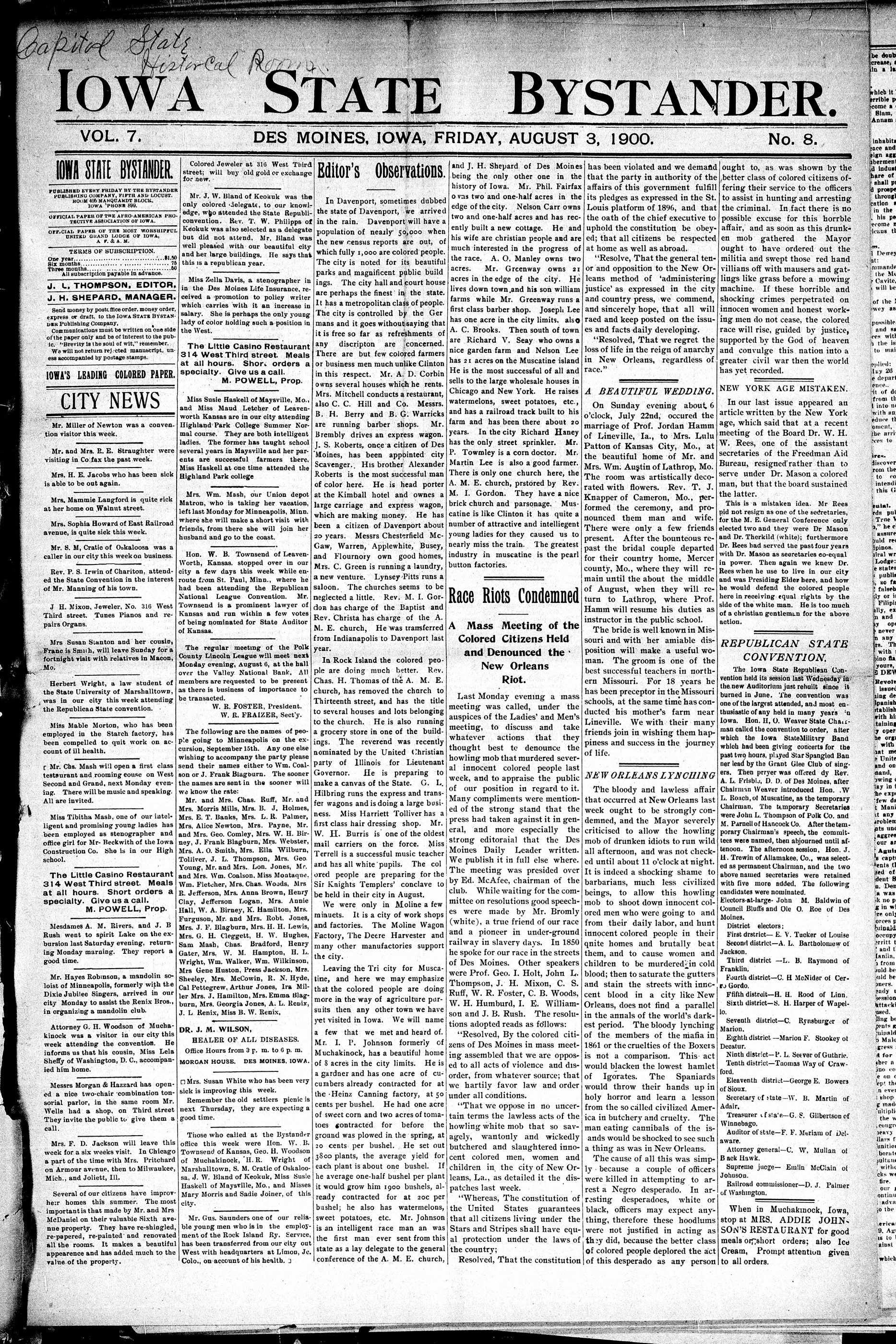
Iowa State Bystander
Friday, August 3, 1900
Des Moines, Iowa
Page text (machine-generated)
IOWA STATE BYSTANDER.
PUBLISHED EVERY FRIDAY BY THE BYSTANDER
PUBLISHING COMPANY, FIFTH AND LOCUST.
ROOM 405 MANQUAMD BLOCK,
IOWA 'PHONE' 889.
OFFICIAL PAPER OF THE AFRO-AMERICAN PRO-
TECTIVE ASSOCIATION OF IOWA.
OFFICIAL PAPER OF THE MOST WORSHIPFUL
UNITED GIAND LODGE OF IOWA,
A. F. & A. M.
TERMS OF SUBSCRIPTION.
One year. $1.50
Six months. 75
Three months. 60
Subscriptions payable in advance.
Send money by post office order, money order, express or draft, to the IOWA STATE BYSTANDER Publishing Company.
Communications must be written on one side of the paper only and be of interest to the pubic. "Brevity is the soul of wit," remember.
We will not return relied manuscript, unless accompanied by postage stamps.
IOWA'S LEADING COLORED PAPER
CITY NEWS
Mr. Miller of Newton was a convention visitor this week.
Mr. and Mrs. R. E. Straughter were visiting in Co.fax the past week.
Mrs. H. E. Jacobs who has been sick is able to be out again.
Mrs. Mammie Langford is quite sick at her home on Walnut street.
Mrs. Sophia Howard of East Railroad avenue, is quite sick this week.
Mr. S. M, Cratio of Oskaloosa was a caller in our city this week on business.
Rev. P. S. Irwin of Chariton, attended the State Convention in the interest of Mr. Manning of his town.
J H. Mixon, Jeweler, No. 316 West Third street. Tunes Pianos and repairs Organs.
Mrs Susan Stanton and her cousin, Franc is Smith, will leave Sunday for a fortnight visit with relatives in Macon, Mo.
Herbert Wright, a law student of the State University of Marshalltown, was in our city this week attending the Republican State convention.
Miss Mable Morton, who has been employed in the Starch factory, has been compelled to quit work on account of ill health.
Mr. Chs. Mash will open a first class testaurant and rooming couse on West Second and Grand, next Monday evening. There will be music and speaking. All are invited.
Miss Tibitha Mash, one of our intelligent and promising young ladies has been employed as stenographer and office girl for Mr. Beckwith of the Iowa Construction Co. She is in our High school.
The Little Casino Restaurant 314 West Third street. Meals at all hours. Short orders a specialty. Give us a call.
Mesdames A. M. Rivers, and J. B Rush went to spirit Lake on the exbursement last Saturday evening, returning Monday morning. They report a good time.
Mr. Hayes Robinson, a mandolin soloist of Minneapolis, formerly with the Dixie Jubilee Singers, arrived in our city Monday to assist the Renix Bros., in organizing a mandolin club.
Attorney G. H. Woodson of Muchakinock was a visitor in our city this week attending the convention. He informs us that his cousin, Miss Lela Sheffy of Washington, D. C., accompanied him home.
Messrs Morgan & Hazzard has opened a nice two-chair combination tonsorial parlor, in the same room Mr. Wells had a shop, on Third street They invite the public to give them a call.
Mrs. F. D. Jackson will leave this week for a six weeks visit. In Chicago a part of the time with Mrs. Pritchard on Armour avenue, then to Milwaukee, Mich., and Joliett, Ill.
Several of our citizens have improv their homes this summer. The most important is that made by Mr. and Mrs McDaniel on their valuable Sixth avenue property. They have re-shingled, re-papered, re-painted and renovated all the rooms. It makes a beautiful appearance and has added much to the value of the property.
```markdown
```
DES MOINES, IOWA, FRIDAY, AUGUST 3, 1900.
Colored Jeweler at 316 West Third street; will buy old gold or exchange for new.
Mr. J. W. Bland of Keokuk was the only colored delegate, to our knowledge, who attended the State Republic convention. Rev. T. W. Philipps of Keokuk was also selected as a delegate but did not attend. Mr. Bland was well pleased with our beautiful city and her large buildings. He says that this is a republican year.
Miss Zella Davis, a stenographer in in the Des Moines Life Insurance, received a promotion to policy writer which carries with it an increase in salary. She is perhaps the only young lady of color holding such a position in the West.
The Little Casino Restaurant 314 West Third street. Meals at all hours. Shor. orders a specialty. Give us a call.
Miss Susie Haskell of Maysville, Mo. and Miss Maud Letcher of Leavenworth Kansas are in our city attending Highland Park College Summer Normal course. They are both intelligent ladies. The former has taught school several years in Maysville and her parents are successful farmers there. Miss Haskell at one time attended the Highland Park college
Mrs. Wm. Mash, our Union depot Matron, who is taking her vacation, left last Monday for Minneapolis, Minn. where she will make a short visit with friends, from there she will join her husband and go to the coast.
Hon. W. B. Townsend of Leavenworth, Kansas, stopped over in our city a few days this week while enroute from St. Paul, Minn., where he had been attending the Republican National League Convention. Mr. Townsend is a prominent lawyer of Kansas and run within a few votes of being nominated for State Auditor of Kansas.
The regular meeting of the Polk County Lincoln League will meet next Monday evening, August 6, at the hall over the Valley National Bank. All members are requested to be present as there is business of importance to be transacted.
W. R. FOSTER, President.
W. R. FRAIZER, Sect'y.
The following are the names of people going to Minneapolis on the excursion, September 15th. Any one else wishing to accompany the party please send their names either to Wm. Coalson or J. Frank Biagburn. The sooner the names are sent in the sooner will we know the rate:
Mr. and Mrs. Chas. Ruff, Mr. and Mrs. Morris Mills, Mrs. B. J. Holmes, Mrs. E. T. Banks, Mrs. L. R. Palmer, Mrs. Alice Newton, Mrs. Payne, Mr. and Mrs. Geo Comley, Mrs. W. H. Birney, J. Frank Blagburn, Mrs. Webster, Mrs. A. O. Smith, Mrs. Ella Wilburn, Tolliver, J. L. Thompson, Mrs. Geo Young, Mr. and Mrs. Lon. Jones, Mr. and Mrs. Wm. Coalson, Miss Montaque Wm. Fletcher, Mrs. Chas. Woods, Mrs R. Jefferson, Mrs. Anna Brown, Henry Clay, Jefferson Logan, Mrs. Annie Hall, W. A. Birney, K. Hamilton, Mrs. Furguson, Mr. and Mrs. Robt. Jones, Mrs J. F. Blagburn, Mrs H. H. Lewis, Mrs G. H. Cleggett, H. W. Hughes, Sam Mash, Chas. Bradford, Henry Gater, Mrs. W. M. Hampton, H. L. Wright, Wm. Walker, Wm. Wilkinson, Mrs Gene Huston, Press Jackson, Mrs Sheeley, Mrs. McCowin, R. N. Hyde, Cal Pettegrew, Arthur Jones, Ira Miller Mrs. J. Hamilton, Mrs. Emma Blagburn, Mrs. Georgia Jones, A. L. Renix, J. L. Renix, Miss B. W. Renix,
HEALER OF ALL DISEASES.
Office Hours from 3 p. m. to 6 p. m.
MORGAN HOUSE. DES MOINES, IOWA.
Mrs. Susan White who has been very sick is improving this week.
Remember the old settlers picnic is next Thursday, they are expecting a good time.
Those who called at the Bystander office this week were Hon. W. B. Townsend of Kansas, Geo. H. Woodson of Muchakinock, H. R. Wright of Marshalltown, S. M. Cratio of Oskaloosa, J. W. Bland of Keokuk, Miss Susie Haskell of Maysville, Mo., and Misses Mary Morris and Sadie Joiner, of this city.
Mr. Gus. Saunders one of our reliable young men who is in the employment of the Rock Island Ry. Service, has been transferred from our city out West with headquarters at Limon, Je. Colo. on account of his health.
Editor's Observations
In Davenport, sometimes dubbed the state of Davenport, we arrived in the rain. Davenport will have a population of nearly 50,000 when the new census reports are out, or which fully 1,000 are colored people. The city is noted for its beautiful parks and magnificent public buildings. The city hall and court house are perhaps the finest in the state. It has a metropolitan class of people. The city is controlled by the Germans and it goes without saying that it is free so far as refreshments of any disciproton are concerned. There are but few colored farmers or business men much unlike Clinton in this respect. Mr. A. D. Corbin owns several houses which he rents. Mrs. Mitchell conducts a restaurant, also C. C. Hill and Co. Messrs. B. H. Berry and B. G. Warricks are running barber shops. Mr. Brembly drives an express wagon. J. S. Roberts, once a citizen of Des Moines, has been appointed city Scavenger. His brother Alexander Roberts is the most successful man of color here. He is head porter at the Kimball hotel and owns a large carriage and express wagon, which are making money. He has been a citizen of Davenport about 20 years. Messrs Chesterfield McGaw, Warren, Applewhite, Busey, and Flournory own good homes, Mrs. C. Green is running a laundry, a new venture. Lynsey Pitts runs a saloon. The churches seems to be neglected a little. Rev. M. I. Gordon has charge of the Baptist and Rev. Christa has charge of the A. M. E. church. He was transferred from Indianapolis to Davenport last year.
In Rock Island the colored people are doing much better. Rev. Chas. H. Thomas of the A. M. E. church, has removed the church to Thirteenth street, and has the title to several houses and lots belonging to the church. He is also running a grocery store in one of the buildings. The reverend was recently nominated by the United Christian party of Illinois for Lieutenant Governor. He is preparing to make a canvas of the State. G. L. Hilbring runs the express and transfer wagons and is doing a large business. Miss Harriett Tolliver has a first class hair dressing shop. Mr. W. II. Burris is one of the oldest mail carriers on the force. Miss Terrell is a successful music teacher and has all white pupils. The colored people are preparing for the Sir Knights Templers' conclave to be held in their city in August.
We were only in Moline a few minuets. It is a city of work shops and factories. The Moline Wagon Factory, The Deere Harvester and many other manufactories support the city.
Leaving the Tri city for Muscatine, and here we may emphasize that the colored people are doing more in the way of agriculture pursuits then any other town we have yet visited in Iowa. We will name a few that we met and heard of. Mr. I. P. Johnson formerly of Muchakinock, has a beautiful home of 8 acres in the city limits. He is a gardner and has one acre of cucumbers already contracted for at the Heinz Canning factory, at 50 cents per bushel. He had one acre of sweet corn and two acres of tomatoes contracted for before the ground was plowed in the spring, at 20 cents per bushel. He set out 3800 plants, the average yield for each plant is about one bushel. If he average one-half bushel per plant it would grow him 1900 bushels, already contracted for at 20c per bushel; he also has watermelons, sweet potatoes, etc. Mr. Johnson is an intelligent race man an was the first man ever sent from this state as a lay delegate to the general conference of the A. M. E. church,
and J. H. Shepard of Des Moines being the only other one in the history of Iowa. Mr. Phil. Fairfax ovas two and one-half acres in the edge of the city. Nelson Carr owns two and one-half acres and has recently built a new cottage. He and his wife are christian people and are much interested in the progress of the race. A. O. Manley owns two acres. Mr. Greenway owns 21 acres in the edge of the city. He lives down town and his son william farms while Mr. Greenway runs a first class barber shop. Joseph Lee has one acre in the city limits, also A. C. Brooks. Then south of town are Richard V. Seay who owns a nice garden farm and Nelson Lee has 21 acres on the Muscatine island He is the most successful of all and sells to the large wholesale houses in Chicago and New York. He raises watermelons, sweet potatoes, etc., and has a railroad track built to his farm and has been there about 20 years. In the city Richard Haney has the only street sprinkler. Mr. P. Towmley is a corn doctor. Mr. Martin Lee is also a good farmer. There is only one church here, the A. M. E. church, prstored by Rev. M. I. Gordon. They have a nice brick church and parsonage. Muscatine is like Clinton it has quite a number of attractive and intelleigent young ladies for they caused us to nearly miss the train. The greatest industry in muscatine is the pearl button factories.
Race Riots Condemned
A Mass Meeting of the Colored Citizens Held and Denounced the New Orleans
Last Monday evening a mass meeting was called, under the auspices of the Ladies' and Men's meeting, to discuss and take whatever actions that they thought best to denounce the howling mob that murdered several innocent colored people last week, and to appraise the public of our position in regard to it. Many compliments were mentioned of the strong stand that the press had taken against it in general, and more especially the strong editorial that the Des Moines Daily Leader written. We publish it in full else where. The meeting was presided over by Ed. McAfee, chairman of the club. While waiting for the committee on resolutions good speeches were made by Mr. Bromly (white), a true friend of our race and a pioneer in under-ground railway in slavery days. In 1850 he spoke for our race in the streets of Des Moines. Other speakers were Prof. Geo. I. Holt, John L. Thompson, J. H. Mixon, C. S. Ruff, W. R. Foster, C. B. Woods, W. H. Humburd, I. E. Williamson and J. B. Rush. The resolutions adopted reads as follows:
"Resolved, By the colored citizens of Des Moines in mass meeting assembled that we are opposed to all acts of violence and disorder, from whatever source; that we hartily favor law and order under all conditions.
"That we oppose in no uncertain terms the lawless acts of the howling white mob that so savagely, wantonly and wickedly butchered and slaughtered innocent colored men, women and children in the city of New Orleans, La., as detailed it the dispatches last week.
"Whereas, The constitution of the United States guarantees that all citizens living under the Stars and Stripes shall have equal protection under the laws of the country; Resolved. That the constitution
has been violated and we demand that the party in authority of the affairs of this government fulfill its pledges as expressed in the St. Louis platform of 1896, and that the oath of the chief executive to uphold the constitution be obeyed; that all citizens be respected at home as well as abroad.
"Resolve, That the general tenor and opposition to the New Orleans method of 'administering justice' as expressed in the city and country press, we commend, and sincerely hope, that all will raed and keep posted on the issues and facts daily developing.
"Resolved, That we regret the loss of life in the reign of anarchy in New Orleans, regardless of race."
A BEAUTIFUL WEDDING.
On Sunday evening about 6 o'clock, July 22nd, occured the marriage of Prof. Jordan Hamm of Lineville, Ia., to Mrs. Lulu Patton of Kansas City, Mo., at the beautiful home of Mr. and Mrs. Wm. Auştin of Lathrop, Mo. The room was artistically decorated with flowers. Rev. T. J. Knapper of Cameron, Mo., performed the ceremony, and pronounced them man and wife. There were only a few friends present. After the bounteous repast the bridal couple departed for their country home, Mercer county, Mo., where they will remain until the about the middle of August, when they will return to Lathrop, where Prof. Hamm will resume his duties as instructor in the public school.
The bride is well known in Missouri and with her amiable disposition will make a useful woman. The groom is one of the best successful teachers in northern Missouri. For 18 years he has been preceptor in the Missouri schools, at the same time has conducted his mother's farm near Lineville. We with their many friends join in wishing them happiness and success in the journey of life.
NEW ORLEANS LYNCHING
The bloody and lawless affair that occurred at New Orleans last week ought to be strongly condemned, and the Mayor severely criticised to allow the howling mob of drunken idiots to run wild all afternoon, and was not checked until about 11 o'clock at night. It is indeed a shocking shame to barbarians, much less civilized beings, to allow this howling mob to shoot down innocent colored men who were going to and from their daily labor, and hunt innocent colored people in their qite homes and brutally beat them, and to cause women and children to be murdered in cold blood; then to saturate the gutters and stain the streets with innocent blood in a city like New Orleans, does not find a parallel in the annals of the world's darkest period. The bloody lynching of the members of the masfa in 1861 or the cruelties of the Boxers is not a comparison. This act would blacken the lowest hamlet of Igorates. The Spaniards would throw their hands up in holy horror and learn a lesson from the so called civilized America in butchery and cruelty. The man eating cannibals of the islands would be shocked to see such a thing as was in New Orleans.
The cause of all this was simply because a couple of officers were killed in attempting to arrest a Negro desperado. In arresting desperadoes, white or black, officers may expect anything, therefore these hoodlums were not justified in acting as they did, because the better class of colored people deplored the act of this desperado as any person
No. 8.
ought to, as was shown by the better class of colored citizens offering their service to the officers to assist in hunting and arresting the criminal. In fact there is no possible excuse for this horrible affair, and as soon as this drunken mob gathered the Mayor ought to have ordered out the militia and swept those red hand villians off with mausers and gattings like grass before a mowing machine. If these horrible and shocking crimes perpetrated on innocen women and honest working men do not cease, the colored race will rise, guided by justice, supported by the God of heaven and convulge this nation into a greater civil war then the world has yet recorded.
NEW YORK AGE MISTAKEN.
In our last issue appeared an article written by the New York age, which said that at a recent meeting of the Board Dr. W. H. W. Rees, one of the assistant secretaries of the Freedman Aid Bureau, resigned rather than to serve under Dr. Mason a colored man, but that the board sustained the latter.
This is a mistaken idea. Mr Rees pid not resign as one of the secretaries, for the M. E. General Conference only elected two and they were Dr Mason and Dr. Therkild (white); furthermore Dr. Rees had served the past four years with Dr. Mason as secretaries co-equal in power. Then again we knew Dr. Rees when he use to live in our city and was Presiding Elder here, and how he would defend the colored people here in receiving equal rights by the side of the white man. He is too much of a christian gentleman for the above action.
REPUBLICAN STATE CONVENTION.
The Iowa State Republican Convention held its session last Wednesday in the new Auditorium just rebuilt since it burned in June. The convention was one of the largest attended, and most enthusiastic of any held in many years in Iowa. Hon. H, O. Weaver State Chairman called the convention to order, after which the Iowa State Military Band which had been giving concerts for the past two hours, played Star Spangled Banner led by the Grant Glee Club of singers. Then prayer was offered by Rev. A. L. Frisbjl, D. D. of Des Moines, after Chairman Weaver introduced Hon. W. L. Roach, of Muscatine, as the temporary Chairman. The temporary Secretaries were John L. Thompson of Polk Co. and M. Parnell of Hancock Co. After the temporary Chairman's speech, the committees were named, then abjourned until afternoon. The afternoon session, Hon. J. H. Trewin of Allamakee, Co., was selected as permanent Chairman, and the two above named secretaries were retained with five more added. The following candidates were nominated.
Electors-at-large- John M. Baldwin of Council Bluffs and Ole O. Roe of Des Moines.
District electors;
First district—E. V. Tucker of Louise
Second district—A. L. Bartholomew of Jackson.
Third district—L. B. Raymond of Franklin.
Fourth district—C. H McNider of Cero Gordo.
Fifth distruit—H. H. Rood of Linn.
Sixth district—S. H. Harper of Wapello.
Seventh district—C. Rynsburger of Marion.
Eighth district—Marion F. Stookey of Decatur.
Ninth district—P. L. Seever of Guthrie.
Tenth district—Taomas Way of Crawford.
Eleventh district—George E. Bowers of Sioux.
Secretary of state—W. B. Martin of Adair.
Treasurer of state—G. S. Gilbertson of Winnebago.
Auditor of state—F. F. Meriam of Delaware.
Attorney general—C. W. Mullan of Back Hawk.
Supreme jucie—Emlin McClain of Johnson.
Railroad commissioner—D. J. Palmer of Washington.
When in Muchakmock, Iowa,
stop at MRS. ADDIE JOHNSON'S RESTAURANT for good meals or short orders; also Ice Cream. Prompt attention given to all orders.
---
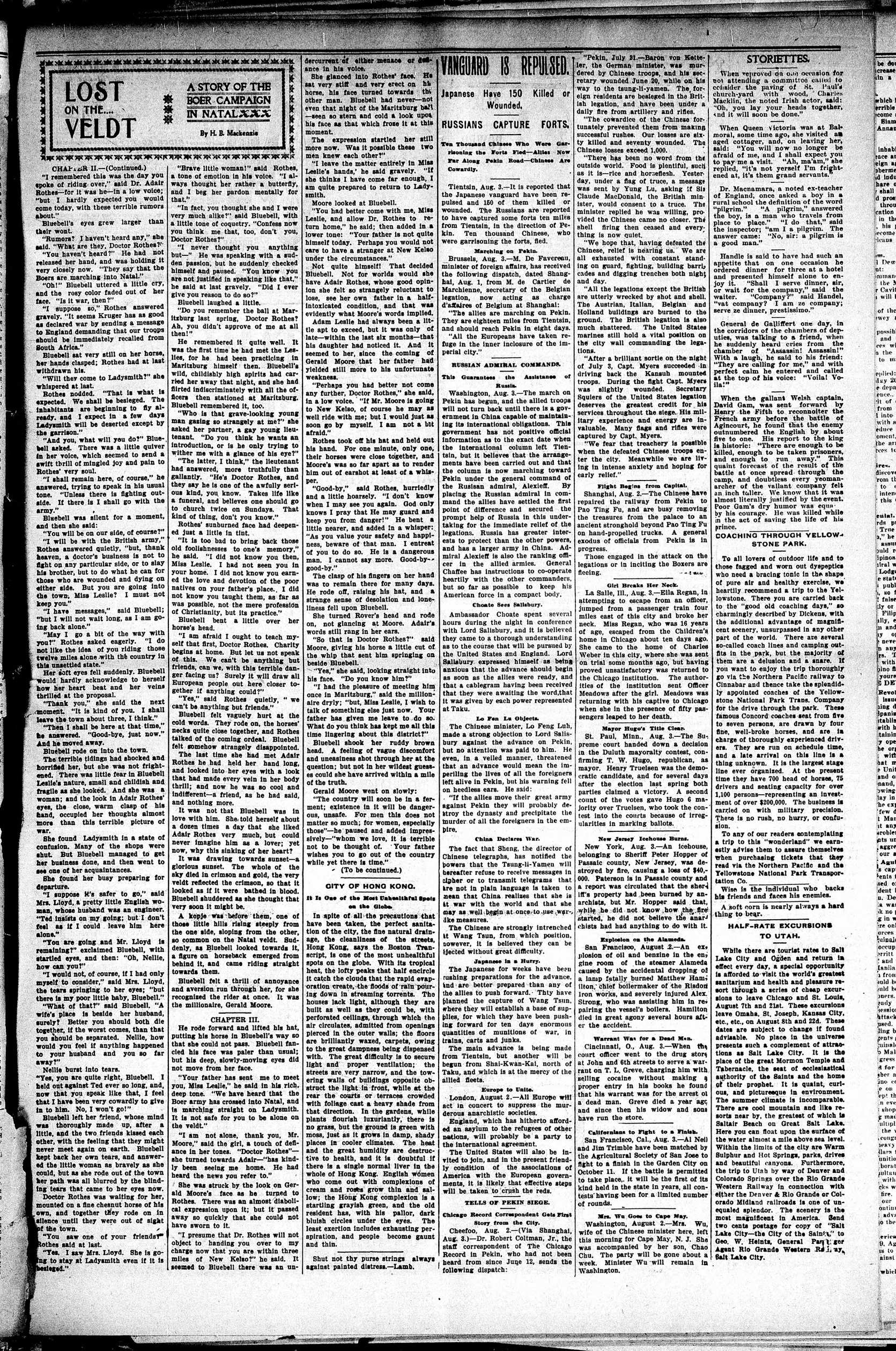
CHAP. 40 RI. II. (Continued.)
"I remembered this was the day you spoke of riding over," said Dr. Adair Rothes—for it was he—in a low voice;
"but I hardly expected you would come with these terrible rumors about."
Bluebell's eyes grew larger than their wont.
"Rumors? I haven't heard any," she said. "What are they, Doctor Rothes? "You haven't heard?" He had not released her hand, and was holding it very closely now. "They say that the Boers are marching into Natal."
"Oh!" Bluebell uttered a little cry, and the rosy color faded out of her face. "Is it war, then?"
"I suppose so," Rothes answered gravely. "It seems Kruger has as good as declared war by sending a message to England demanding that our troops should be immediately recalled from South Africa."
Bluebell sat very still on her horse, her hands clasped; Rothes had at last withdrawn his
"Will they come to Ladysmith?" she whispered at last.
Rothes nodded. "That is what is expected. We shall be besieged. The inhabitants are beginning to fly already, and I expect in a few days Ladysmith will be deserted except by the garrison."
"And you, what will you do?" Bluebell asked. There was a little quiver in her voice, which seemed to send a swift thrill of mingled joy and pain to Rothes' very soul.
"I shall remain here, of course," he answered, trying to speak in his usual tone. "Unless there is fighting outside. If there is I shall go with the army."
Bluebell was silent for a moment, and then she said:
"You will be on our side, of course?"
"I will be with the British army."
Rothes answered quietly, "but, thank heaven, a doctor's business is not to fight on any particular side, or to slay his brother, but to do what he can for those who are wounded and dying on either side. But you are going into the town, Miss Leslie? I must not keep you."
"I have messages," said Bluebell;
"but I will not wait long, as I am going back alone."
"May I go a bit of the way with you?" Rothes asked eagerly. "I do not like the idea of you riding those twelve miles alone with the country in this unsettled state."
Her soft eyes fell suddenly. Bluebell would hardly acknowledge to herself how her heart beat and her veins thrilled at the proposal.
"Thank you," she said the next moment. "it is kind of you. I shall leave the town about three. I think."
"Then I shall be here at that time," he answered. "Good-bye, just now." And he moved away. Bluebell rode on into the town. The terrible tidings had shocked and horrified her, but she was not frightened. There was little fear in Bluebell Leslie's nature, small and childish and fragile as she looked. And she was a woman; and the look in Adair Rother's eyes, the close, warm clasp of his hand, occupied her thoughts almost more than this terrible picture of war.
She found Ladysmith in a state of confusion. Many of the shops were shut. But Bluebell managed to get her business done, and then went to see one of her acquaintances.
She found her busy preparing for departure.
"I suppose it's safer to go," said Mrs. Lloyd, a pretty little English woman, whose husband was an engineer. "Ted insists on my going; but I don't feel as if I could leave him here alone."
"You are going and Mr. Lloyd is remaining?" exclaimed Bluebell, with started eyes, and then: "Oh, Nellie, how can you?" "I would not, of course, if I had only myself, to consider," said Mrs. Lloyd, the tears springing to her eyes; "but there is my poor little baby, Bluebell." "What of that?" said Bluebell, "A wife's place is beside her husband, surely? Better you should both die together, if the worst comes, than that you should be separated. Nellie, how would you feel if anything happened to your husband and you so far away?"
Nellie burst into tears.
"Yes, you are quite right. Bluebell. I held out against Ted ever so long, and, now that you speak like that, I feel that I have been very cowardly to give that to him. No, I won't go!" Bluebell left her friend, whose mind was thoroughly made up, after a little, and the two friends kissed each other, with the feeling that they might never meet again on earth. Bluebell kept back her own tears, and answered the little woman as bravely as she could, but as she rode out of the town her path was all blurred by the blinding tears that came to her eyes now. Doctor Rothes was waiting for her, mounted on a fine chestnut horse of his own, and together they rode on in silence until they were out of sight of the town.
"You saw one of your friends!" Rothes said at last.
"Yes, I saw Mrs. Lloyd. She is going to stay at Ladysmith even if it is bested."
A STORY OF THE
BOER CAMPAIGN
IN NATAL XXX
By H. B. Mackenzie
"Brave little woman!" said Rothes, a tone of emotion in his voice. "I always thought her rather a butterfly, and I beg her pardon mentally for that."
"In fact, you thought she and I were very much allike?" said Bluebell, with a little tone of coquery. "Confess now you think me that, too, don't you, Doctor Rothes?"
"I never thought you anything but—" He was speaking with a sudden passion, but he suddenly checked himself and paused. "You know you are not justified in speaking like that," he said at last gravely. "Did I ever give you reason to do so?"
Bluebell laughed a little.
"Do you remember the ball at Martitburg last spring, Doctor Rothes? Ah, you didn't approve of me at all then!"
He remembered it quite well. It was the first time he had met the Leslies, for he had been practicing in Martzburg himself then. Bluebell's wild, childishly high spirits had carried her away that night, and she had flirted indiscriminately with all the officers then stationed at Martzburg. Bluebell remembered it, too.
"Who is that grave-looking young man gasging so strangely at me?" she asked her partner, a gay young lieutenant. "Do you think he wants an introduction, or is he only trying to wither me with a glance of his eye?" "The latter, I think," the lieutenant had answered, more truthfully than gallantly. "He's Doctor Rothes, and they say he is one of the awfully serious kind, you know. Takes life like a funeral, and believes one should go to church twice on Sundays. That kind of thing, don't you know." Rothes's sunburned face had deepened just a little in tint.
"It is too bad to bring back those old foolishnesses to one's memory," he said. "I did not know you then, Miss Leslie. I had not seen you in your home. I did not know you earned the love and devotion of the poor natives on your father's place., I did not know you taught them, as far as was possible, not the mere profession of Christianity, but its practice."
Bluebell bent a little over her horse's head.
"I am afraid I ought to teach myself that first, Doctor Rothes. Charity begins at home. But let us not speak of friends, can we, with this terrible danger facing us? Surely it will draw all European people out here closer together if anything could?" "Yes," said Rothes quietly, "we can't be anything but friends."
Bluebell felt vaguely hurt at the cold words. They rode on, the horses' necks quite close together, and Rothes talked of the coming ordeal. Bluebell felt somehow strangely disappointed.
The last time she had met Adalain Rothes he had held her hand long, and looked into her eyes with a look that had made every vein in her body thrill; and now he was so cool and indifferent—a friend, as he had said, and nothing more.
It was not that Bluebell was in love with him. She told herself about a dozen times a day that she liked Adalair Rothes very much, but could never imagine him as a lover; yet now, why this sinking of her heart?
It was drawing towards sunset—a glorious sunset. The whole of the sky died in crimson and gold, the very velid reflected the crimson, so that it looked as if it were bathed in blood. Bluebell shuddered as she thought that very soon it might be.
A kopje was 'before' them, one of those little hills rising steeply from the one side, sloping from the other, so common on the Natal veldt. Suddenly, as Bluebell looked towards it, a figure on horseback emerged from behind it, and came riding straight towards them.
Bluebell felt a thrill of annoyance and aversion run through her, for she recognized the rider at once. It was the millionaire, Gerald Moore.
CHAPTER III
He rode forward and lifted his hat, putting his horse in Bluebell's way so that she could not pass. Bluebell fancied his face was paler than usual; but his deep, slowly-moving eyes did not move from her face.
"Your father has sent me to meet you, Miss Lesile," he said in his rich, deep tone. "We have heard that the Boer army has crossed into Natal, and is marching straight on Ladysmith. It is not safe for you to be alone on the veldt."
"I am not alone, thank you, Mr. Moore," said the girl, a touch of defiance in her tones. "Doctor Rothes" she turned towards Adair—"has kindly been seeing me home. He had heard the news you refer to."
She was struck by the look on Gerald Moore's face as he turned to Rothes. There was an almost disoblational expression upon it; but it passed away so quickly that she could not have sworn to it.
"I presume that Dr. Rothes will not object to handing you over to my charge now that you are within three miles of New Kelso." he said. It seemed to Bluebell there was an un-
dercurrent of other menace or distance in his voice.
She glanced into Rothes' face. He sat very stiff and very erect on his horse, his face turned towards the other man. Bluebell had never—not even that night of the Maritsburg ball—seen so stern and cold a look upon his face as that which froze it at this moment.
The expression startled her still more now. Was it possible these two men knew each other?
"I leave the matter entirely in Miss Leslie's hands," he said gravely. "If she thinks I have come far enough, I am quite prepared to return to Lady-smith.
Moore looked at Bluebell.
Moore looked at Bluebell.
"You had better come with me, Miss Leslie, and allow Dr. Rothes to return home," he said; then added in a lower tone: "Your father is not quite himself today. Perhaps you would not care to have a stranger at New Kelso under the circumstances."
Not quite himself That decided Bluebell. Not for worlds would she have Adair Rothes, whose good opinion she felt so strangely reluctant to lose, see her own father in a half-intoxicated condition, and that was evident what Moore's words implied. Adam Leslie had always been a little apt to exceed, but it was only of late—within the last six months—that his daughter had noticed it. And it seemed to her, since the coming of Gerald Moore that her father had yielded still more to his fortunate weakness.
"Perhaps you had better not come any further, Doctor Rothes," she said, in a low voice. "If Mr. Moore is going to New Kelso, of course he may as well ride with me; but I would just as soon go by myself. I am not a bit afraid."
Rothes took off his hat and held out his hand. For one minute, only one, their horses were close together, and Moore's was so far apart as to render him out of earshot at least of a whisper.
"Good-by," said Rothes, hurriedly and a little hoarsely. "I don't know when I may see you again. God only knows I pray that He may guard and keep you from danger!" He bent a little nearer, and added in a whisper: "As you value your safety and happiness, beware of that man. I entreat of you to do so. He is a dangerous man. I cannot say more. Good-by--good-by."
The clasp of his fingers on her hand was to remain there for many days. He rode off, raising his hat, and a strange sense of desolation and loneliness fell upon Bluebell.
She turned Rover's head and rode on, not glancing at Moore. Adair's words still rang in her ears.
"So that is Doctor Rothes?" said Moore, giving his horse a little cut of the whip that sent him springing on beside Bluebell.
"Yes," she said, looking straight into his face. "Do you know him?
"I had the pleasure of meeting him once in Martitzburg," said the millionaire dryly; "but, Miss Leslie, I wish to talk of something else just now. Your father has given me leave to do so. What do you think has kept me all this time lingering about this district?
Bluebell shook her ruddy brown head. A feeling of vague discomfort and uneasiness shot through her at the question; but not in her wildest guesses could she have arrived within a mile of the truth.
Gerald Moore went on slowly:
"The country will soon be in a ferment; existence in it will be dangerous, unsafe. For men this does not matter so much; for women, especially those"—he paused and added impressively—"whom we love, it is terrible not to be thought of. Your father wishes you to go out of the country while yet there is time."
*(To be continued.)*
CITY OF HONG KONG.
It Is One of the Most Unheathful Spots on the Globe.
In spite of all the precautions that have been taken, the perfect sanitation of the city, the fine natural drainage, the cleanliness of the streets, Hong Kong, says the Boston Transcript, is one of the most unhealthful spots on the globe. With its tropical heat, the lofty peaks that half encircle it catch the clouds that the rapid evaporation create, the floods of rain pouring down in streaming torrents. The houses lack light, although they are built as well as they could be, with perforated ceilings, through which the air circulates, admitted from openings pierced in the outer walls; the floors are brilliantly waxed, carpets, owing to the great dampness being dispensed with. The great difficulty is to secure light and proper ventilation; the streets are very narrow, and the towering walls of buildings opposite obstruct the light in front, while at the rear the courts or terraces crowded with follicle cast a heavy shade from that direction. In the gardens, while plants flourish luxuriantly, there is no grass, but the ground is green with moss, just as it grows in damp, shady places in cooler climates. The heat and the great humidity are destructive to health, and it is doubtful if there is a single normal liver in the whole of Hong Kong. English women who come out with complexions of cream and roses grow thin and salow; the Hong Kong complexion is a startling grayish green, and the old resident has, with his pallor, dark blush circles under the eyes. The least exertion includes exhausting perspiration, and people become gaunt and thin.
Shut not thy purse strings always against painted distress.—Lamb.
Japanese Have 150 Killed or Wounded.
RUSSIANS CAPTURE FORTS.
Ten Thousand Chinese Who Were Gar-
lisoning the Forts Fled—Allies Now
Far Along Pekin Road—Chinese Are
Cowardly.
Tlentsin, Aug. 3.—It is reported that
the Japanese vanguard have been
replused and 150 of them killed or
wounded. The Russians are reported
to have captured some forts ten miles
from Tlentsin, in the direction of Pekin. Ten thousand Chinese, who were garrisoning the forts, fled.
Marching on Pekin.
Brussels, Aug. 3.—M. De Favereau, minister of foreign affairs, has received the following dispatch, dated Shanghai, Aug. 1, from M. de Cartier de Marchienne, secretary of the Belgian legation, now acting as charge d'afairee of Belgium at Shanghai: "The allies are marching on Pekin. They are eighteen miles from Tientsin, and should reach Pekin in eight days. "All the Europeans have taken refuge in the inner incision of the imperial city."
RUSSIAN ADMIRAL COMMANDS.
This Guarantees the Assistance of Russia.
Washington, Aug. 3.—The march on Pekin has begun, and the allied troops will not turn back until there is a government in China capable of maintaining its international obligations. This government has not positive official information as to the exact date when the international column left Tientsin, but it believes that the arrangements have been carried out and that the column is now marching toward Pekin under the general command of the Russian admiral, Alexieff. By placing the Russian admiral in command the allies have settled the first point of difference and secured the prompt help of Russia in this undertaking for the immediate relief of the legations. Russia has greater interests to protect than the other powers, and has a larger army in China. Admiral Alexieff is also the ranking officer in the allied armies. General Chaffee has instructions to co-operate heartily with the other commanders, but so far as possible to keep his American force in a compact body.
Chonte Sees Sallsbury.
Ambassador Choate spent several hours during the night in conference with Lord Salisbury, and it is believed they came to a thorough understanding as to the course that will be pursued by the United States and England. Lord Salisbury expressed himself as being anxious that the advance should begin as soon as the allies were ready, and that a cablegram having been received that they were awaiting the word, that it was given by each power represented at Taku.
Lo Fen Lu Objecta-
The Chinese minister, Lo Feng Luh, made a strong objection to Lord Salisbury against the advance on Pekin, but no attention was paid to him. He even, in a veiled manner, threatened that an advance would mean the imperiling the lives of all the foreigners left alive in Pekin, but his warning fell on heedless ears. He said: "If the allies move their great army against Pekin they will probably destroy the dynasty and precipitate the murder of all the foreigners in the empire.
China Declares War.
The fact that Sheng, the director of Chinese telegrams, has notified the powers that the Tsung-li-Yamen will bereafter refuse to receive messages in cipher or to transmit telegrams that are not in plain language is taken to mean that China realizes that she is at war with the world and that she may as well begin at once to use wartime measures. The Chinese are strongly entrenched at Wang Taun, from which position, however, it is believed they can be fected without great difficulty.
Japanese in a Hurry.
The Japanese for weeks have been rushing preparations for the advance, and are better prepared than any of the allies to push forward. Thy have planned the capture of Wang Tsun, where they will establish a base of supplies, for which they have been pushing forward for ten days enormous quantities of munitions of war, in trains, carts and junks.
The main advance is being made from Tientsin, but another will be begun from Shai-Kwan-Kal, north of Taku, and which is at the mercy of the allied fleets.
Europe to Unite.
London, August 2.—All Europe will act in concert to suppress the murderous anarchistic societies. England, which has hitherto afforded an asylum to the refugees of other nations, will probably be a party to the international agreement. The United States will also be invited to join, and in the present friendly condition of the associations of America with the European governments, it is likely that effective steps will be taken to crush the reds.
TELLS OF PEKIN SIEGE.
Chicago Record Correspondent Gets First Story from the City.
Cheefoo, Aug. 2.—(Via Shanghai, Aug. 3.)—Dr. Robert Coltman, Jr., the staff correspondent of The Chicago Record in Pekin, who had not been heard from since June 12, sends the following dispatch:
"Pekin, July 21.—Baron von Ketterer, the German minister, was murdered by Chinese troops, and his secretary wounded June 20, while on his way to the tung-li-yamen. The foreign residents are besieged in the British legation, and have been under a daily fire from artillery and rifles.
"The cowardice of the Chinese fortunately prevented them from making successful rushes. Our losses are sixy killed and seventy wounded. The Chinese losses exceed 1,000.
"There has been no word from the outside world. Food is plentiful, such as it is—rice and horsehose. Yesterday, under a flag of truce, a message was sent by Yung Lu, asking if Sir Claude MacDonald, the British minister, would consent to a truce. The minister replied he was willing, provided the Chinese came no closer. The shell firing then ceased and every thing is now quiet.
"We hope that, having defeated the Chinese, relief is nearing us. We are all exhausted with constant standing on guard, fighting, building barricades and digging trenches both night and day.
"All the legations except the British are utterly wrecked by shot and shell. The Austrian, Italian, Belgian and Holland buildings are burned to the ground. The British legation is also much shattered. The United States marines still hold a vital position on the city wall commanding the legations.
"After a brilliant sortle on the night of July 3, Capt. Myers succeeded in driving back the Kansuau mounted troops. During the fight Capt. Myers was slightly wounded. Secretary Squiers of the United States legation deserves the greatest credit for his services throughout the siege. His military experience and energy are invaluable. Many flags and rifles were captured by Capt. Myers.
"We fear that treachery is possible when the defeated Chinese troops enter the city. Meanwhile we are living in intense anxiety and hoping for early relief."
Flight Begins from Capital:
Shanghai, Aug. 2.—The Chinese have repaired the railway from Pekin to Pao Ting Fu, and are busy removing the treasures from the palace to an ancient stronghold beyond Pao Ting Fu on hand-propelled trucks. A general exodus of officials from Pekin is in progress. Those engaged in the attack on the legations or in inciting the Boxers are fleeing.
Girl Breaks Her Neck
La Salle, Ill. Aug. 3. -Ella Regan, in attempting to escape from an officer, jumped from a passenger train four miles east of this city and broke her neck. Miss Regan, who was 16 years of age, escaped from the Children's home in Chicago about ten days ago. She came to the home of Charles Weber in this city, where she was sent on trial some months ago, but having proved unsatisfactory was returned to the Chicago institution. The authorities of the institution sent Officer Meadows after the girl. Meadows was returning with his captive to Chicago when she in the presence of fifty passengers leaped to her death.
Mayer Hugo's Title Clean
St. Paul, Minn., Aug. 3.—The Supreme court handed down a decision in the Duluth mayoralty contest, confirming T. W. Hugo, republican, as mayor. Henry Truelsen was the democratic candidate, and for several days after the election last spring both parties claimed a victory. A second count of the votes gave Hugo 6 majority over Truelsen, who took the contest into the courts because of irregularities in marking ballots.
New Jersey. Icehouse Burns.
New York, Aug. 3.—An icehouse, belonging to Sheriff Hopper Hopper of Passaic county, New Jersey, was destroyed by fire, causing a loss of $40,000. Paterson is in Passaic county and a report was circulated that the Sheriff's property had been burned by anarchists, but Mr. Hopper said that, while he did not know how the fire started, he did not believe the anarchists had had anything to do with it.
Explosion on the Alameda.
San Francisco, August 2.—An explosion of oil and benzine in the engine room of the steamer Alameda caused by the accidental dropping of a lamp fatally burned Matthew Hamilton, chief bollermaker of the Risdon iron works, and severely injured Alex. Strong, who was assisting him in repairing the vessel's boilers. Hamilton died in great agony several hours after the accident.
Warrant Was for a Dead Man
Cincinnati, O. Aug. 3—When the court officer went to the drug stores at John and 6th streets to serve a warrant on T. L. Greve, charging him with selling cocaine without making a proper entry in his books he found that his warrant was for the arrest of a dead man. Greve died a year ago and since then his widow and sons have run the store.
California to Fight to a Flush
San Francisco, Cal. Aug. 3. Al Neill and Jim Trimble have been matched by the Agricultural Society of San Jose to fight to a finish in the Garden City on October 11. If the battle is permitted to take place, it will be the first of its kind held in the state in years, all contests having been for a limited number of rounds.
Mrs. Wu Goes to Cape May
Washington, August 2.—Mrs. Wu, wife of the Chinese minister here, left this morning for Cape May, N. J. She was accompanied by her son, Chao Chu. The party will be gone about a week. Minister Wu will remain in Washington.
When reproved on a committee for not attending a committee called to consider the paving of St. Paul's church-yard with wood, Charles Macklin, the noted Irish actor, said: "Oh, you lay your heads together, and it will soon be done."
When Queen victoria was at Balmoral, some time ago, she visited an aged cottager, and, on leaving her, said: "You will now no longer be afraid of me, and I shall expect you to pay me a visit. "Ah, ma'am," she replied, "it's not myself I'm frightened at, it's them grand servants."
Dr. Macnamara, a noted ex-teacher of England, once asked a boy in a rural school the definition of a word "a pilgrim," answered the boy, is a man who travels from place to place. "I do that," said the inspector; "am I a pilgrim. The answer came: "No, sir: a pilgrim is a good man."
Handle is said to have had such an appetite that on one occasion he ordered dinner for three at a hotel and presented himself alone to enjoy it. "Shall I serve dinner, sir, or wait for the company," said the waiter. "Company?" said Handel, "vat company? pizzerie company; serve ze dinner, prestissimo."
General de Galliert one day, in the corridors of the chambers of deputies, was talking to a friend, when he suddenly heard cries from the chamber of "Assassin! Assassin! With a laugh, he said to his friend, "I will be perfect calm he entered and called at the top of his voice: 'Voila! Voila!'
When the gallant Welsh captain, David Gam, was sent forward by Henry the Fifth to reconnoiter the French army before the battle of Agincourt, he found that the enemy outnumbered the English by about five to one. His report to the king was "the most important to be killed, enough to be taken prisoners, and enough to run away." This quaint forecast of the result of the battle at once spread through the camp, and doubtless every yeoman-archer of the vallant company felt an inch taller. We know that it was almost literally justified by the event, too. Gam's army, by his manners, He was killed while in the act of saving the life of his prince.
COACHING THROUGH VELLOW
STONE PARK.
To all lovers of outdoor life and to those fagged and worn out dyspthetics who need a bracing tonic in the shape of pure air and healthy exercise, we heartily recommend a trip to the Yellowstone. There you are carried back to the "good old coaching days," so charmingly described by Dickens, with the additional advantage of magnificent scenery, unsurpassed in any other part of the world. There are several so-called coach lines and camping outfits in the park, but the majority of them are a delusion and a snare. If you want to enjoy the trip thoroughly go via the Northern Pacific railway to Cinnabar and thence take the splendidly appointed coaches of the Yellowstone National Park Trans. Company for the drive through the park. These famous Concord coaches seat from five to seven persons, are drawn by four fine, well-broke horses, and are in charge of thoroughly experienced drivers. They are run on schedule time, and a late arrival on this line is a thing unknown. It is the largest stage line ever organized. At the present time they have 700 head of horses, 75 drivers and seating capacity for over 1,100 persons—representing an investment of over $200,000. The business is carried on with military precision. There is no rush, no hurry, or confusion.
To any of our readers contemplating a trip to this "wonderland" we earnestly advise them to assure themselves when purchasing tickets that they read via the Northern Pacific and the Yellowstone National Park Transportation Co. _____
Wise is the individual who backs his friends and faces his enemies.
A soft corn is nearly always a hard thing to bear.
HALF-RATE EXCURSIONS
TO UTAH.
While there are tourist rates to Salt Lake City and Ogden and return in effect every day, a special opportunity is afforded to visit the world's greatest sanitarium and health and pleasure resort through a series of cheap excursions to leave Chicago and St. Louis, August 7th and 21st. These excursions leave Omaha, St. Joseph, Kansas City, etc., etc., on August 8th and 22d. These dates are subject to change if found advisable. No place in the universe presents such a complement of attractions as Salt Lake City. It is the place of the great Mormon Temple and Tabernacle, the seat of ecclesiastical authority of the Saints and the home of their prophet. It is quaint, curious, and picturesque in environment. The summer climate is incomparable. There are cool mountain and like resorts near by, the greatest of which is Saltair Beach on Great Salt Lake. Here you can float upon the surface of the water almost a mile above sea level. Within the limits of the city are Warm Sulphur and Hot Springs, parks, drives and beautiful canyons. Furthermore, the trip to Utah by way of Denver and Colorado Springs over the Rio Grande Western Railway in connection with either the Denver & Rio Grande or Colorado Midland railroads is one of unequaled splendor. The scenery is the most magnificent in America. Send two cents postage for copy of "Salt Lake City—the City of the Saints," to Geo. W. Heinls, General Pastry Agent Rio Grande Western Railway, Salt Lake City.
A NEW BOOK.
One Hundred Distinguished Leaders, is the title of a beautiful book, containing elegantly executed half-tone portraits and up-to-date life-sketches of one hundred of the leading colored men and women of the United States. The book sells for 25 cents a copy. It should find ready sale in every community where race pride is manifested.
The book containi portraits of such men as Bishop H. M. Turner, Booker T. Washington, the educator, the late Hon. Frederick Douglass, Paul Laurence Dunbar, the poet, E. A. Johnson, the historian, W. S. Scarboough, the Greek Scholar.
TERMS TO AGENTS.
Agents are wanted everywhere to sell this book. In lots of ten or more copies, agents are furnished the book at ten cents a copy; but for less than ten copies the regulas price, 25 cents, must be sent. Send all orders to CHARLES ALEXANDER, Tuskegee Institute, Tuskegee, Ala. All money should be sent by Pose Office Money Order.
A Mother Tells How She Saved Her Little Daughter's Life.
I am the mother of eight children and have had a great deal of experience with medicines. Last summer my little daughter had the dysenty in its worst form. We thought she would die. I tried everything I could think of, but nothing seemed to do her any good. I saw an advertisement in our paper that Chamberlain's Colic, Cholera and Diarrhoea Remedy was highly recommended and sent and got a bottle of it at once. It proved to be one of the very beet medicines we ever had in the house. It saved my little daughter's life. I am anxious for every mother to know what an excellent medicine it is. Had I known it at first it would have saved me a great deal of anxiety and my little daughter much suffering—Yours truly, Mrs. Geo. F. Burdick, Liberty, R. I. For sale by all Druggists.
Explosives Confined and Unconfined.
There is a widespread misapprehension in regard to the devastating effect of high exposives. When unconfined the effect even of large charges of them upon structures is comparatively slight. At the naval ordnance proving ground, so long ago as 1884, repeated charges of dynamite, varying from five pounds to 100 pounds in weight, were detonated on the face of a vertical target consisting of eleven one-inch wrought-iron plates bolted to a twenty-inch oak backing, until 440 pounds of dynamite had been so detonated in contact with it, and yet the target remained practically uninjured, while at Braamfontein the accidental explosion of fifty-five tons of blasting gelatin, which was stored in railway vans, excavated but 30,000 tons of soft earth. Thus at Fort Lee, on the Hudson, but two tons of dynamite placed in a chamber in the rock and tamped brought down 100,000 tons of the rock; at Lamberis, Wales, two tons and a half of gelatin dynamite, similarly placed, threw out 180,000 tons of rock, and at the Talcen Mawr, in Wales, seven tons of gunpowder placed in two chambers in the rock dislodged from 125,000 to 200,000 tons of rock.
The Ages of Men.
A great man does not always attain a ripe old age; in fact, hardly half of the greatest men of modern and ancient times have reached the limit of age set by the Bible. Among statesmen: Mirabean was 42; Pitt, 47; Caesar, 55; Richelle, 57; Cromwell, 59; Frederick the Great, 74; Disraeli, 75; Bismarck, 83; Tallyrand, 84. Of great conquerors: Alexander the Great died at 32; Napoleon at 51, Hannibal at 33, Marlborough at 72, Blucher at 76, Wellington at 83, Xenophon at 86, Moltke at 91. The age of the decease of philosophers was: Spinoza, 44; Descartes, 53; Aristotle, 62; Socrates, 70; Linnaeus, 70; Copernicus, 70; Galileo, 78; Kant, 79; Plato, 82; Newton, 84; Humboldt, 89. The longevity of great writers, poets, varies from Byron, 86, to Sophocles, 90. To painters death came at ages varying from Raphael at 37. to Titian at 99.
RAM'S HORNS.
Growth makes the glad Christian.
A half success may be a whole failure.
The place of prayer becomes the bosom of God.
He who falls before Him will be raised beside Him.
The greatest motive forces are the ones that cannot be moved.
To jump down a man's throat is a poor way to get to his heart.
If our hands would touch humanity, our hearts must touch Heaven.
God may deny you many toys, but He will certainly give you the kingdom.
There was more dancing over the golden calf than over two tables of stone.
WHAT IS TO BE DONE?
This is the question that is bothering the State Board of Agriculture, for the demand for space for the coming State Fair is so great that it will be impossible to supply it with present buildings. In machinery, especially, there is such a demand it is contemplated erecting a new building and then many exhibitors will have to use tents and some will show without cover.
Stock Exhibits at the State Fair--The late date of closing the entries may have been a mistake, but if exhibitors will make their wants known in time barns will be provided, and it now seems probabe that all the barns will be taken, for many new stock men have notified the management that they will be there with stock, so if all the old exhibitors apply for space there will be some extra work required to supply shelter for stock. The management have heretoofed adhered to the plan of giving old exhibitors options on stalls formerly occupied, and will do so this year if application is made in time, but the pressing demand for stalls will compel assignment, so application should be made at once if former space is desired, otherwise new exhibitors will be assigned places and some old exhibitors will have to accept new places. The new classes and premiums generally please exhibitors and many old exhibitors have given notice that they will be at the fair this year.
Midway-As the exposition feature has been a growing feature of the State Fair, a full-fledged Midway will be admitted this year. This will not be under the control of the State Fair proper, except so far as to give space and see that nothing improper is admitted. Special care has been taken to exclude all fake shows and the persistence with which they have sought admission shows that even fakes take.
Amusements—The amusement features for the State Fair are set out in a folder recently printed and will be sent to all who apply for it, but the fireworks feature has not been particularly set out, but the program is being arranged and will surpass any thing ever before seen in the state. Some special set pieces will need to be seen to be appreciated. There will be a change of program each day and evening, including change in fireworks program. Later a special folder will be prepared setting out more particularly the program, or at least, the fireworks part.
Dates of the Fair—Some confusion of dates has resulted from the advertisement of special features. The fair begins on Friday, August 24, and the first two days are preparation days. Sunday is a day of rest and the gates will be closed, except to those having stock or other things requiring attention. Monday Des Moines Day—While Monday is Des Moines Day everybody will be welcome and there will be splendid program, including some rare treats in the afternoon and evening programs, and especially so in fireworks.
Stock Exhibits-An improvement worthy of special mention will be free raised seats for those who wish to see the stock show and as expert judges will be employed it will pay, not only stock men, but others, to see, and especially as this will be done in the afternoon and with comp, portable seats without cost.
Amphitheater Seats—Backs have been put on the seats and the amphitheater whitened up, so as to improve the appearance and afford greater comfort to visitors. Seats will be free for Soldier Day program, for the Republican Rally and for the Democratic Rally. At the afternoon attractions, and for the evening, including the fireworks only the old charge of twenty-five cents will be made, and when the greater comfort of seats with backs, and the better program that will be given is taken into consideration, it will be seen that much more comfort can be had, and much more can be seen for the cost than any before. Full information will be given on all matters relating to the State Fair by the secretary. The premium list and folders give nearly everything desired in the way of information about the fair, and the Bureau of Information in this city will supply information as to places to stay. If parties do not wish to camp on the grounds.
Soldiers' Day at the Fair—The State Fair management regret that the National Encampment occurs during the State Fair, but parties can attend the fair Monday and Tuesday, leaving after the attractions and fireworks Tuesday night, and get to the National Encampment in time for the opening session, missing only the parade, or, if they wish, to see the parade then they can return in time to see the fair from and after Wednesday.
Advertising the Fair—More and a better class of advertising matter is being sent out than was sent last year, and present indications warrant the belief that the fair will be larger and better than last year, which was a record-breaker, so far as results to exhibitors and balance in favor of the society.
The secretary announces that he will glayly send folders and catalogue.
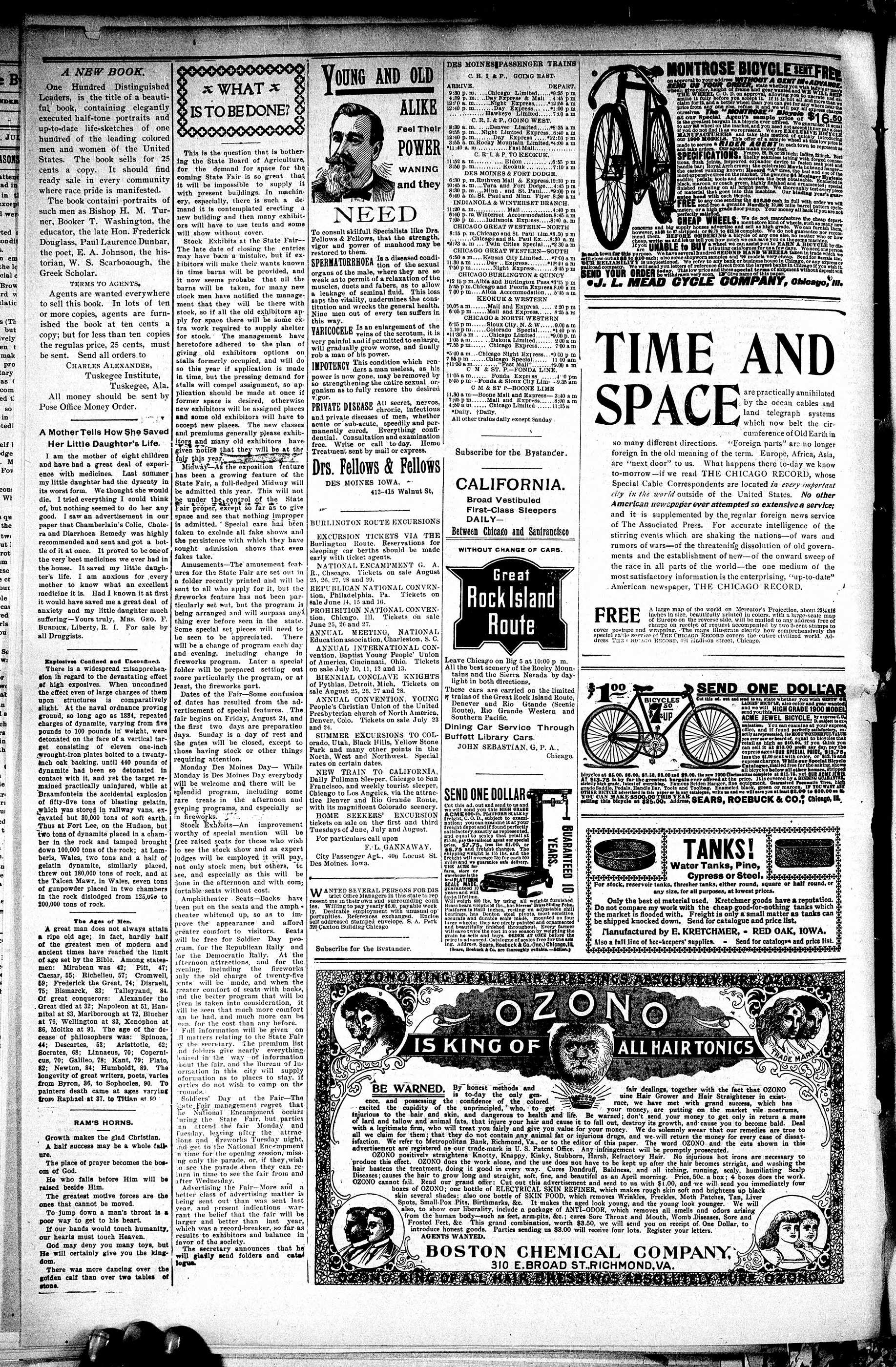
OZONO KING OF ALL HAIR DRESSINGS ABSOLUTELY PURC OZONO
IS KING OF ALL HAIR TONIGS
BE WARNED. By honest methods and is to-day the only gen-ence, and possessing the confidence of the colored excited the cupidity of the unprincipled, who, to get injurious to the hair and skin, and dangerous to health and life. Be warned; don't send your money to get only in return a mass of lard and tallow and animal fats, that injure your hair and cause it to fall out, destroy its growth, and cause you to become bald. Deal with a legitimate firm, who will treat you fairly and give you value for your money. We do solemnly swear that our remedies are true to all we claim for them; that they do not contain any animal fat or injurious drugs, and we will return the money for every case of dissatisfaction. We refer to Metropolitan Bank, Richmond, Va., or to the editor of this paper. The word OZONO and the cuts shown in this advertisement are registered as our trade-mark in U. S. Patent Office. Any infringement will be promptly prosecuted.
OZONO positively straightens Knotty, Knappy, Kinky, Stubborn, Harsh, Refractory Hair. No injurious hot irons are necessary to produce this effect. OZONO does the work alone, and the use does not have to be kept up after the hair becomes stright, and washing the hair hastens the treatment, doing it good in every way. Cures Dandruff, Baldness, and all itching, scaly, humiliating Scalp Diseases; causes the hair to grow long and straight, soft, fine and beautiful as an April morning. Price, 50c. a box; 4 boxes does the work. OZONO cannot fail. Read our grand offer: Cut out this advertisement and send to us with $1.00, and we will send you immediately four boxes of OZONO; one bottle of ELECTRICAL SKIN REFINER, which makes rough skin soft and brightens up black skin several shades; also one bottle of SKIN FOOD, which removes Wrinkles, Freckles, Moth Patches, Tan Liver Spots, Small-Pox Pits, Birthmarks, &c. It makes the aged look young, and the young look younger. We will also, to show our liberality, include a package of ANTI-ODOR, which removes all smells and odors arising from the human body—such as feet, arm-pits, &c.; cures Sore Throat and Mouth, Womb Diseases, Sore and Frosted Feet, &c. This grand combination, worth $3.50, we will send you on receipt of One Dollar, to introduce honest goods. Parties sending us $3.00 will receive four lots. Register your letters.
AGENTS WANTED.
BOSTON CHEMICAL COMPANY,
310 E. BROAD ST., RICHMOND, VA.
OZONO KING OF ALL HAIR DRESSINGS ABSOLUTELY PURC OZONO
J. W. H.
NEED
To consult skilful Specialists like Dr. Fellows & Fellows, that the strength, vigor and power of manhood may be restored to them.
SPERMATORRHOEA Is a diseased condition of the sexual organs of the male, where they are so weak as to permit of a relaxation of the muscles, ducts and fabers, as to allow a leakage of seminal fluid. This loss saps the vitality, undermines the constitution and wrecks the general health. Nine men out of every ten suffers in this way.
VARICOCELE Is an enlargement of the veins of the scrotum, it is very painful and if permitted to enlarge, will gradually grow worse, and finally rob a man of his power.
IMPOTENCY This condition which renders a man useless, as his power is now gone, may be removed by so strengthening the entire sexual organism as to fully restore the desired v.gor.
PRIVATE DISEASE All secret, nervos, and private discases of men, whether acute or sub-acute, speedily and permanently cured. Everything confidential. Consultation and examination free. Write or call to-day. Home Treatment sent by mail or express.
Drs. Fellows & Fellows
DES MOINES IOWA,
413-415 Walnut St.
BURLINGTON ROUTE EXCURSIONS
EXCURSION TICKETS VIA THE Burlington Route. Reservations for sleeping car berths should be made early with ticket agents.
NATIONAL ENCAMPMENT G. A. R., Chscago. Tickets on sale August 25, 26, 27, 28 and 29.
REPUBLICAN NATIONAL CONVENTION, Philadelphia, Pa. Tickets on sale June 14, 15 and 16.
PROHIBITION NATIONAL CONVENTION, Chicago, Ill. Tickets on sale June 25, 26 and 27.
ANNUAL MEETING, NATIONAL Education association, Charleston, S. C.
ANNUAL INTERNATIONAL CONVENTION, Baptist Young People' Union of America, Cincinnati, Ohio. Tickets on sale July 10, 11, 12 and 13.
BIENNIAL CONCAVE KNIGHTS of Pythias, Detroit, Mich. Tickets on sale August 25, 26, 27 and 28.
ANNUAL CONVENTION. YOUNG People's Christian Union of the United Presbyterian church of North America, Denver, Colo. Tickets on sale July 23 and 24.
SUMMER EXCURSIONS TO COLORADO, Utah, Black Hills, Yellow Stone Park and many other points in the North, West and Northwest. Special rates on certain dates.
NEW TRAIN TO CALIFORNIA, Daily Pullman Sleeper, Chicago to San Francisco, and weekly tourist sleeper, Chicago to Los Angeles, via the attractive Denver and Rio Grande Route, with its magnificent Colorado scenery.
HOME SEEKERS' EXCURSION tickets on sale on the first and third Tuesdays of June, July and August.
For particulars call upon
F. L. GANNAWAY,
City Passenger Agt. 400 Locust St.
Des Moines, Iowa.
WANTED SEVERAL PERSONS FOR DIS
trict Office Managers in this state to rep
resent me in the town and surrounding coun
tries. Will pay nearly 600 payable wo-
ply. Desirable employment with unusual op
portunities. References exchanged. Encloe
self addressed stamped envelope. S. A. Park
330 Caxton Building Chicago
Subscribe for the livestander.
ARRIVE
9:30 p. m. ...Chicago Limited. ...*0:38 p. m.
4:89 p. m. ...Day Express & Mail ...*4:48 p. m.
12:50 f. m. ...Night Express. *12:58 a. m.
12:40 f. m. ...Night Express. *1:00 a. m.
Hawkeye Limited. ...7:00 a. m.
C. R. I. & P. GOING WEST
8:30 a.m. .....Denver Limited.....*8:35 a.m.
9:55 p.m. .....Night Limited Express.....6:40 a.m.
12:40 p.m. .....Day Express .....*12:50 p.m.
3:55 a.m. Rocky Mountain Limited.....*4:00 a.m.
*11:40 a.m. .....Fast Mall.....
C.R.I. & P.TO KEOKUK.
11:53 a.m. .....Eidon .....6:55 p.m.
3:50 p.m. .....Keokuk .....7:10 a.m.
DES MOINES & FORT DODGE.
6:30 p. m. Ruhven Mail & Express; 13:10 p. m
10:45 a. m. Tara and Fort Dodge; 4:45 p. m
8:30 p. m. Minn. and St. Paul; 9:00 p. m
4:00 a. m. St. Paul and Minn. Flyer; 8:30 a. m
INDIANOLA & WINTERSET BRANCH.
11:20 a. m. Mail; 4:40 p. m
6:40 p. m. Winterset Accommodation; 8:45 a. m
7:05 p. m. Indinola Express; 8:40 a. m
CHICAGO GREAT WESTERN- NORTH
8:15 p. m. Chicago and St. Paul Lim; 8:30 p. m
Chicago and St. Paul Exx. 8:30 a. m
*2:30 a. m Special; *2:30 a. m
CHICAGO GREAT WESTERN
CHICAGO BURLINGTON & QUINCY
*12 p 15 m* Albia and Burlington Pass. *3.15 p 15 m*
*5.55 p m* Chicago and Peoria Express. *8.00 a m*
*7.00 p m* Albia Accommodation. *5.45 a m*
KEOOKUK & WESTERN
10.05 a m* Mall and Express. *2.20 p m*
*6.05 p m* Mall and Express. *8.25 a m*
CHICAGO & NORTH WESTERN
*6.15 p m* Sloux City, N. & W. *9.00 a m*
*11.30 a m* Chicago Special. *4.14 p m*
*10.30 a m* Chicago Limited. *9.00 a m*
*10.30 a m* Chicago Limited. *2.00 a m*
*7.55 p m* Chicago Express. *7.00 a m*
*5.49 a m* Chicago Night Express. *6.00 p m*
*7.56 p m* Chicago Special. *11.00 a m*
†11.30 a m* "Fast Mail"* *19.00 a m*
*M & ST & FONDA LINE*
11.05 a m* Fonda. *4.00 p m*
*5.45 p m* Fonda & Sloux City Lim. *9.35 a m*
C M & ST & BOOLEAN
11.30 a m—Boeo Mall and Express. *3.40 a m*
*7.35 p m* Mall and Express. *8.00 a m*
*4.50 a m* Chicago Limited. *11.15 a*
*Daily* †Daily.
Subscribe for the Bystander.
Broad Vestibuled
First-Class Sleepers
DAILY—
Between Chicago and Sanfrancisco
WITHOUT CHANGE OF CARS.
Great
Rock Island
Route
Leave Chicago on Big 5 at 10:00 p.m.
All the best scenery of the Rocky Mountains and the Sierra Nevada by daylight in both directions.
These cars are carried on the limited
trains of the Great Rock Island Route,
Denever and Rio Glande (Scenic
Route), Rio Grande Western and
Southern Pacific.
Dining Car Service Through
Buffett Library Cars.
JOHN SEBASTIAN, G, P. A.,
Chicago.
SEND ONE DOLLAR
Cut this ad, out and send to us and
we will send you this HIGH GRADE
ACME 600-lb. PLAYBOOK SCALE by
fright. C.O.D. subject to exam-
mation; you can examine it at your
freight depot and find property
inventory and equal to scales that retail at
the price. $7.75, less the $6.60, or
$6.75 and freight charges. The
jumping weight is 15 lbs. and the
freight will average 750 for each 600
miles and we guarantee safe delivery.
farm, store or
best PLATFORM
SCALE MADE
for your needs
years and will
fast, all fittings
brass beam weights 50 lbs, has 'Sierens' Brass Braiding Felt,
brass beams, has Denton steel pivots, most sensitive,
accurate and durable scale made, mounted on four
steel rods, beautifully finished throughout. Every farmer
will save twice the cost in one season by weighing the
scale at the price is advanced. Catalogue of scales free for the
sake. Address, Sears, Roebuck & Co. (inc), Chicago, IL
G OF ALL HAIR DIRE
OZ
KING OF
**SPECIFICATIONS** **TO** **USE** Sheily seamless treadmill; Indies, 22.5 inch. **Connections** flush john, improved engine device to eastern and handle bark; royal Ackron crown; the celebrated Mavra hub and range. **Accessories** hand rail; royal Ackron crown; the celebrated Mavra hub and range. One of the most expensive trees on the market. The genuine $400 saddle; pedal; tools and accessories the best obtainable. Enlarge pedal; pedal; tools and accessories the best obtainable; special nickeling on all bright parts. We should test every piece of material that goes into this machine. Our blinding year's warranty bond with each bicycle.
**FREE** on one session. No reservation. In full with order we will
mortery, or a high grade floor floor. Your money all back if you are not
mortery.
CHEAP WHEELS. We do not manufacture the cheap departmental market and which makes a new supply houses advertise and sell as high grade. We can furnish them stripped, or only to $15 to $15 complete. We do not guarantee nor recommend ORDER ORDERA a bicycle of any one also contains tape or how and let us tell you how much we can pay you on the same machine. We can outsource several hundred SECOND HAND WHEELS taken in trade which we offer to you. What happens there to-day we know the read THE CHICAGO RECORD, whose correspondents are located in every important outside of the United States. No other paper ever attempted so extensive a service;imented by the regular foreign news service and Press. For accurate intelligence of the which are shaking the nations—of wars and of the threatening dissolution of old govern-ntablishment of new—of the onward sweep of parts of the world—the one medium of the information is the enterprising, "up-to-date" paper, THE CHICAGO RECORD.
map of the world on Mercator's Projectlon, about 33½ x 16 size, beautifully printed in colors, with a large-scale map on the back, with a marked base, a tree of receipt of request accompanied by two copies of the map. The maps illustrate clearly how comprehensively the CHICAGO RECORD covers the entire civilized world. Ad. 11 Lindson street, Chicago.
concerns and big supply houses advertise and sell as high grade. We can furnish them, however, at $60 to $70 stripped: or $92.75 to $12.50 complete. We do not guarantee nor recommend them. BEFORE ORDERING a bicycle of any one else, no matter who or how cheap, write us and let us tell you how much we can save you on the same machine. If you UNABLE TO BUY a wheel we can assist you to EARN A BIOYOLE by dis-
are each town for this form. We have several hundred BECOND BAND WHEELS taken in town will close out at us to $10 each. We also shop samples and 99 models very cheap. Send for Bargains! URE RELIABILITY is unquestionable. We offer express or postal country. We offer the option of reference direct from the largest banks in Chicago. If you express or postal country, send your order to: SEND YOUR ORDER today. This low price and these special terms of shipment without deposit will be withdrawn very soon. Give name of this paper.
J. L. MEAD CYCLE COMPANY, Chicago, ill.
so many different directions. "For foreign in the old meaning of the term are 'next door' to us. What happens to-morrow—if we read THE CHICAGO Special Cable Correspondents are city in the world outside of the U.S. American newspaper ever attempt and it is supplemented by the reg. of The Associated Press. For acc stirring events which are shaking the rumors of wars—of the threatening events and the establishment of new the race in all parts of the world—most satisfactory information is the American newspaper, THE CHICAGO FREE
A large map of the world on M. in the in size, beautifully pruned of Europe on the reverse side, with charge on receipt of request cover postage and wrappier. The maps illustrate special cable service of THE CHICAGO RECORD cover dress THE CHICAGO RECORD, 131 Lindson street, C
TIME AND SPACE are practically annihilated by the ocean cables and land telegraph systems which now belt the circumference of Old Earthin
so many different directions. "Foreign parts" are no longer foreign in the old meaning of the term. Europe, Africa, Asia, are "next door" to us. What happens there to-day we know to-morrow—if we read THE CHICAGO RECORD, whose Special Cable Correspondents are located in every important city in the world outside of the United States. No other American newspaper ever attempted so extensive a service; and it is supplemented by the regular foreign news service of The Associated Press. For accurate intelligence of the stirring events which are shaking the nations—of wars and rumors of wars—of the threatening dissolution of old governments and the establishment of new—of the onward sweep of the race in all parts of the world—the one medium of the most satisfactory information is the enterprising, "up-to-date" American newspaper, THE CHICAGO RECORD.
FREE A large map of the world on Mercator's Projection, about 38½¼ inches in size, beautifully printed in colors, with a large-scale map of Europe on the reverse side, will be mailed to any address free of charge on receipt of request accompanied by two 3-cent stamps to cover postage and the cost of our comprehensive the special cable service of THE CHICAGO RECORD covers the entire civilized world. Address TU2 CHICAGO RECORD 115 Indiana street, Chicago.
$1.00
BICYCLES
50
7 UP
SEND
Cut this ad, cut and
bicycles at $1.00, $8.00, $7.50, $8.00 and $9.00, the new 1900 Chevrolet
Fiat 500. It is the first bicycle to be made in America and is the first
bicycle with a strictly high grade, latest of everything. Famous Belden Hanger, fine
grade Saddle, Pedals, Handle Bar, Tools and Toolbag. Enamelled
STREET CYCLE advertised in white enamel, with an ad and a
YOU CAN MAKE $500.00 THIS YEAR
selling this bicycle at $25.00. Address, SEARS, RO
bicycles at $15.00, $26.00, $7.50, $8.00 and $9.00, the new 1900 Cincinnati's complete at $11.75, yet OUR ACME JEWEL AT $13.75 is by far the greatest bargains ever offered at the price. It is covered by a BINDING GUARANTEE, strictly high grade, latest of everything. Famous Belden Hanger, fine equipment. Guaranteed Pneumatic Tree, high grade Saddle. Pedals. Handle Bar. Tools and Toolbag. Enameled black, green or maroon. IF YOU WANT ALL OTHER BICYCLE advertised in this paper or in any catalogue, write us and we will save you at least $2.00 to $10.00 on $10.00. YOU CAN MAKE $3500.00 THIS YEAR selling this bicycle at $25.00. Address: SEARS, ROEBUCK & CO., Chicago, Ill.
and $3.00, the new 1600 Chimneyless fireplace, is offered at the price. It is covered by a BIMMING GUARANTEE, famous Belden Hanger, fine equipment. Guaranteed Foosmile Tires, high and Toolbag, Enameled black, green or masonite. If you wish, with us and we will pay you $2.00 or $10.00 on its address, SEARS, ROEBUCK & CO., Chicago, Ill.
TANKS!
Water Tanks, Pine
Cypress or S
For stock, reservoir tanks, thresher tanks, either
any size, for all purposes, at lo
Only the best of material used. Kretchn
Do not compare my work with the cheap go
the market is flooded with. Freight is only
be shipped knocked down. Send for catalog
Manufactured by E. KRETCHMER,
Also a full line of bee-keepers' supplies. - S
Only the best of material used. Kretchmer goods have a reputation.
Do not compare my work with the cheap good-for-nothing tanks which
the market is flooded with. Freight is only a small matter as tanks can
be shipped knocked down. Send for catalogue and price list.
Manufactured by E. KRETCHMER, - RED OAK, IOWA.
Also a full line of bee-keepers' supplies. - Send for catalogue and price list.
concerns and big
however, at 60 to
mind the B12
cheap, write us
if you
```markdown
```
LADIKS' BICYCLE, also color and gear wanted, and we will HIGH GRADE 1900 MODEL send youth.
ACME JEWEL BICYCLE by express C. O.
D. subject to express animalism. You can examine at your express office, and if found perfectly satisfactory, exactly are represented, the HOST WONDERFUL VALUE you ever saw or heard of, equal to bicycles that retails as high as $40.00, if you think you can sell it at $10.00 profit any day, pay the express agent OUR SPECIAL PRICE, $13.75 less the $1.00 sent with order, or $12.15 and express charges. While our Special Bicycles Catalogue, mailed free for the asking, shows all bicycles below all other houses, stripped
Iowa State Bystander
and the leading paper in the North-west.
76 Counties in Iowa
29 States in the Union
2 Foreign Countries.
24 towns in Iowa and corres-
from many different states.
Agents in 24 towns in Iowa and correspondence from many different states.
The Corinthian baptist Church—situated on 11th, st. between Crocker and School Sts. Preaching; at 11 A. M.; Sunday School; at 13 o'clock Preaching; at 7 M. . . . Rev. S. Bates, Pastor.
St. Paul A. M. E.—Corner of Second and Center Streets. Preaching at 10:30 a. m.; Sunday School at 3 o'clock; Epworth League at 7 p. preaching at 8 p. m. F. J. Peterson, pastor.
First African Baptist Church—Corner School Four streets. Rev. F. Lomack pastor. Preaching 10:40 a. m.; Sunday school 3:30 p. m., Mr. M. E. Housten, Superintendent: Young People's meeting 7 p. preaching 800 p. m.
Burn's M. E.—East Second and Des Moines street—Sunday services, preaching at 11 a. m.; School Street, 19:30 Prayer and Class meeting, Wednesday 8 p. m. All are welcome. Rev. C. W. Holmes, pastor. 220 Des Moines street.
Mount Nebo Baptist Church—E. Second street. between Lucent and Grand avenue—Sunday service, preaching at 11 a. m.; School Street, 19:30 Prayer and Class meeting, Rose Johnson. Preaching at 8 p. m. Rev. J. H. Bell, pastor.
North Star Lodge, No. 8, A, F. A-M. Meets
Third Thursday in each month at Masonic
Hall—East Second and Walnut. J. F. Blag-
burn, W. M.; G. M. H.Clegget, secretary.
King Solomon Commandery, No. 3—Meets Second and Fourth Thursday in each month at Masonic hall. Frud Jackson, M.; C. G.; H. Ovegge, Rec.
Joseph J. Lodge, No. 2192, G. U. of O. of F.—Meets First, Second and Third Tuesday each month at Odd Fellows hall on West Sixth and Walnut streets. D. Burns, N. G.; F. Brown, P.S.
Mount Court, No. 3—Meets Second Monday in each month at Masonic hall, Mrs. J. H. White, matron; Mrs. Fred Jackson, secre tary.
Mt. Olive Court, No. 4—Meets First Thursday of each month at Masonic hall, Mrs. Susan White, matron; Mrs. Flora Majors, secre tary.
Knights and Ladies of Honor of the World No. 178 Victoria Lodge-meets every Monday evening at the Bailiary Hall of Tenth Court, aboard Mrs. A. Wood. Proctor, Mrs. Rose Johnson. SEE ADVERTISING.
WANTED-SEVERAL BRIGHT AND honest persons to represent us as Managers in this and close by counties. Salary $2000 more. Position permanent. Enclose address and stamped envelope. No less salary. Position permanent. Our references, any bank in any town. It is mainly office work conducted by a licensed office. Enclose addressed stamped envelope. THE DOMINION COMPANY. Dept. 3, Chicago.
KEOKUK ROUTE
A.C. GOODRICH, Vice Ppr. & Goul' Mgr.
A. M.CHAIR, Goul' Ppr. & Pmn. Agents.
W.C. GOODRICH, Asst. Gue'l Ppr. & Pmn. Agents.
KEOKUK
KEOKUK
KEOKUK
CAINSVILLE
LEON MEZ.
Wm. R. R.
Quilcy
St. JOSEPH
KANSAS CITY
OMAHA
KANSAS CV,
ST. LOUIS, DEORIA,
CHICAGO.
ATCHISON
KANSAS CITY
ST. LOUIS
TRUSSES, 65c, $1.25 AND UP
65c.
We are selling the very finest Trusses made
at FACTORY PRICES, less than one-third the
price of ST. LOUIS, PEORIA,
CHICAGO.
WE QUARRANTE TO FIT YOU PERFECTLY. Say
whether you wish our French Trusse or our
$1.25 price. Find a Trusse, close, cut this
ad, out and send to us with OUR SPECIAL PRICE named,
state your Height, Weight, Age, how long you have
hair, whether rupture is large or small, also state
number inches around the body on a line with the
surement, say whether rupture is on line with you
the understanding, if it is not a perfect fit and equal to trusses that retail at three times our price, you can return it and we
MERRICK'S
PURE NON-ALCOHOLIC
FLAVORING POWDERS
$19.75
SENORONE DOLLAR
eat this ad out and send to us, and we will send you this NEW PORTLAND CUTTER, by freight C. O.D., subject to examination. You can examine it at your freight depot and if you need equal money, cutter you can buy elsewhere at 50 PKR CENT.
MORE HONEY, and one of the handsom, strongest and best stylish cutters you ever saw, pay the freight agent OUR SPECIAL OFFER PRICE, $19.75, and freight charges, less the $1.00�, with order.
This is the RATING STAYS CULTURE PRIZE PORTLAND CUTTER. SEAL made from selected second growth hickory, ironed throughout with best Norway Iron, Higgins' best grade hardings steel shoes. BODY made of best air-seasoned cutter stock, solid panels, all joints carefully fitted, giued, screwed and plugged. PAINTED in best possible manner, thoroughly rubbed, cut off, brushing and brushing, nearly spared and ornamented. UPHOLSTERED in finest style, full spring removable cushions, heavy dark green body cloth. SHAFTS well trimmed and finished. Weight about 175 lbs.
AGENTS WANTED.
Iron Highland best
of all joints carefully
all joints carefully
PAINTED in best
with pumice
and ornamented.
spring removable
with STAINLESS
wall 175 lbs.
FOX 100 W.
FOX 107.25. 3027
Catalogue - $16.75
ORDER NOW. DON'T WAIT FOR SNOW.
Unity's limited number can be sold at $1.75, DON'T
WAIT FOR SNOW at $2.50, or $3.50 at $1.75.
17-40. SEARS. NOBUECK & CO. (inc). Chicago.
Snow. Research & Co. are relatively reliable.-Editor.
2021
SECRET ORDERS.
$19.75
You assume no risk when you buy Chamberlain's Colic Cholera and Diarrhoea Remedy. All Druggists will refund your money if you are not satisfied after using it. It is everywhere admitted to be the most successful remedy for Bowel complaints and the only one that never fails. It is pleasant safe and reliable.
2.1.8 BRANCH COAT
HOLDS 4.00 QWATER
PROOF MASK $2.75
SEND NO MONEY. Cut this ad. out,
state your height and weight, and send to us.
lance your height and breast, taken over
lance around body at breast, taken over
lance around chest, close up under arm, and
we will keep you dry. Call C.O.B., subject to examination.
Examiner will be it on at your nearest
express office, express delivery as represented and the most wonderful
description you can give equal to any east you can buy for
$3.00, pay the express agent GER
RENTAL PRICE, $2.75, and express charges.
SEARS.
SEARS, ROE
THIS MACKINTOSH is latest 1900 style, easy fitting, made from heavy waterproof, tan color, genuine Davis Covert Cloth; full length, double breasted, Sager velvet collar, fancy plaid lining, waterproof sewed seams. Suitable for both Palm or Overseat, and guaranteed GREATEST VALUE over offered by us or any other house. For Free Cloth Samples of Men's Mackintoshes up to $5.00, and Made-to-Measure Suits and Overcoats at from $5.00 to $10.00, write for FREE SAMPLE BOOK No. 90K. © Address, BUCK & Co. (Inc.) CHICAGO.
50 YEARS' EXPERIENCE
PATENTS
TRADE MARKS DESIGNS
COPYRIGHTS & C.
Anyone sending a sketch and description may quickly ascertain our opinion free whether an invention or product is patented. Our attorneys strictly confidential. Handbook on Patents sent free. Oldest agency for securing patents. Patents taken through Mann & Co. receive special notice, without charge, in the Scientific American.
A handsomely illustrated weekly. Largest collection of patented products. Cormark a career at Mann & Co. receive special notice, without charge, in the Scientific American.
A handsomely illustrated weekly. Largest collection of patented products. Cormark a career at Mann & Co. receive special notice, without charge, in the Scientific American.
MUNN & Co. 3618 Broadway, New York
Branch Office, 652 F. St., Washington, D.C.
WRITE FOR FREE ITRUST CATALOGUE which shows all the stores, including the New $4,000 Leu Time line. Matches almost any case, and we sell for $2.75 ADDRESS SEARS, BUREUCK & CO, CHICAGO
Wood's Kit-Non-Reflctic Flowering
PURE
VANILLA
FURNISHED BY
MERRICK & CO.
CREAM, N.L.
are pure and economical. Scientifically compounded from the Pure Fruit Juices. They retain their delicate aroma, which is easily lost in alcoholic or liquid flavors. Free from alcohol and all poisonous ingredients.
DELICATE, DAINTY, DELICIOUS. ONCE TRIED, ALWAYS USED.
Naomi Lotion, a delightful toilet preparation for beautifying the complexion.
Hamamac Lotion, for chapped hands, face or neck.
Naomi Face Powder, the best on the market; containing no mineral poisons.
Saponaceous Tooth Powder cleanses, whitens, and preserves the teeth's soothes, heals and hardens the gums.
Subscribe for the Bystander.
517 Mulberry St.
Telephones 686, 688 and 689.
DES MOINES, -- -- IOWA.
EVERYBODY
KNOWSTHAT MUNGER'S LAUNDRY is the best in the city. Try them and be decided.
220 THIRD ST.
PHONE 579.
And all Who call at the British Medical Institute, 204 and 205 Marquardt Block, prior to August 30th will have their cases Studied by Several of Them without Charge and without Money.
Owing to the large number of invalids who have called upon the British Doctors at the office room, 204 and 205 Marquardt Block, and who have been unable to see them, these eminent gentlemen have, by request, consented to continue giving their services free for three months to all invalids who call upon them before August 30th.
These services will consist not only of consultation, examination and advice, but also of all minor surgical operations.
The object in pursuing this course is to become rapidly and personally acquainted with the sick and afflicted, and under no consideration whatever will any charges be made for any services rendered for three months, medicine excepted, to all who call before August 30th.
The doctors treat all forms of disease and deformities, and guarantee a cure in every case they undertake. At the first interview a thorough examination is made; and, if incurable you are frankly and kindly told so, also advised against spending your money for useless treatment.
Male and female weakness, catarrhal deafness; also cancer without pain or cutting; all skin diseases, rupture and all diseases of the rectum are positively cured by their treatment.
Dr. J. Boyd, the chief consulting surgeon of the institute, is in personal charge.
OFFICE HOURS: 9:00 a.m. to 8:00 p.m. No Sunday Hours.
SPECIAL NOTICE—If you cannot call, send stamp for question blank for home treatment
WANTED SEVERAL PERSONS FOR RDIS trict Office Managers in this state to represent me in their own and surrounding counties. Willing to pay yearly $800, payable weekly. Dearly compliments with annual opportunities. References exchanged. Enclose self-addressed stamped envelope. S. A Park, 920 Caxton Building, Chicago
The soothing and healing properties of Chamberlain's Cough Remedy, its pleasant taste and prompt and permanent cures, have made it a great favorite with the people everywhere. For sale by all Druggists.
In the District Court of the State of Iowa, in and for Polk County:
Alma Owen
vs.
Riley Owen
Original Notice.
To the above named defendant: You are hereby notified that on or about the 5th day of August, A. D., 1900, there will be a petition filed against you in the Clerk's office of the District Court of Polk county, Iowa, by Alma Owen, of Des Moines, Iowa, asking that she be divorced absolutely from the bonds of matrimony that is now and heretofore existing between you and the above named plaintiff: on the grounds of wilful desertion for a period of more than two years prior to the filing of this petition, all without her knowledge or consent or just cause on her part. And now unless you appear and make a defense in said petition on or before the 17th day of September, A. D., 1900, which is the first day of the September, 1000 Term, judgment will be entered against you, as prayed in the foregoing petition. And the cost of the court in the proceedings in the case.
J. B. RUSH,
Attorney for plaintiff
"The Greatest Dirt Killer."
20c, a Box of 3 Cakes.
If not kept by your dealer, send us his name.
Send 10c, for large full-sized cake.
Its greatest friends are
Mechanics,
Machinists,
Printers,
Painters,
Farmers,
Miners.
CARTE
MUSEUM
OF
ART
and those having dirty work to do.
removes dirt
and stains it quickly, but soffees and
the skins.
Cheap Excursion Rates to Colorado.
On June 19, 20, July3, 9 & 17,
and August 1, 7 & 21, tickets
from Chicago and points east of Missouri River, and on June 19, 21,
July 3, 7, 8, 9, 10, 17, 18,
and August 2, 7 & 21, from Missouri River points, to Denver, Colorado
Springs, Manitou Pueblo, Salt Lake City and Ogden, Utah, ond return,
will be sold by the
GREAT ROCK ISLAND ROUTE
At rate of--
One Regular Fare Plus $2.00 for Round Trip.
Return Limit October 31, 1900
SPECIAL TRAINS
ONE NIGHT OUT TO COLORADO will
leave Chicago at 4:45 p. m. for excursions of June 20, July 9, and 17,
and August 1st. Tickets also good
on regular trains.
ONLY DIRECT LINE TO COLORADO
SPRINGS AND MANITOU
Take advantage of these cheap rates and spend your vacation in Colorado. Sleeping Car Reservations may be made now for any of the excursions. Write for full information and the beautiful book "COLORADO THE MAGNIFICENT"—sent free. JOHN BOSTIAN JR. B.A. Chicopee
JOHN SEBASTIAN, G. P. A., Chicago
NERVOUS WEAKNESS CURED.
VIRTUMA is a French treatment for both sexes that is positively guaranteed to cure IMPOTENCY vitality and vigor, restoring the desires, ambitions and aspirations of youth and health, fitting for success and happiness in business; professional, social and married life. $2 a package or 3 for $5. Ask your druggist, but refuse cheap substitutes. Sent anywhere prepaid on receipt of price and guaranteed by the Kidd Drug Company, Elgin, Illinois.
Retail and wholesale by Hurlbut & McArthur, Des Moines, la. Full line of rubber goods; name what you want.
HOCKING, IOWA
Strangers are often seen on our streets. Mr. and Mrs. Conner are Happy parents of a new baby girl. Quite a number of people are sick, those who are confined to their rooms are Mr. Conoway, Mrs. Burke, and Mrs. Gordon. Mr. Pannel and Mr. Daniels are out again. Mr. and Mrs. Chas. Carey, gave birthday party in honer of their son Elmer, last Friday, evening. It was well attend- and those who were present, say they had a nice time, and would like to go again. We are proud to say that we have a good orchestra, which is improving by the instructions received of Mr. W. Oliver of Colfax. We are also informed that they have new uniform.
OTTUMWA NEWS.
Thirty-eighth anniversary, Sept. 25th, 1900, Emancipation Proclamation Celebration, given under the auspices of the colored citizens of Ottumwa. Committee on arrangements:—
Wm. Bailey, Pres; Wm. Howard, Vice Pres; J. Hopkins, Sec. The public is cordially invited to attend. Good speaking, good music, and pleanty of athletic sport.
The Methodist Sunday School will have their annual picnic Thursday.
Mrs. M. Davis entertained at ten few at tea a few friends Sunday, evening, in honor of Mrs. E. Gardner, of Peoria, Ill.
Mr Geo. E. Taylor of Oskaloosa, is in the city, the guest of Rev. Jones.
Quite a number of our young men attended the Hedrick races today.
Miss Nettie Singer leaves Wednesday, or Des Moines, where she expects to make her future home.
The members of the second Baptist church will give an entertainment Aug. 2n1.
Mrs. H. Spotts gave a party for the little folks, in honor of Mabel, her youngest daughter.
The Sewing circle of the Second Badtist church was to meet last week, but only a few of the members responded. This is a goob work. All members should attend more regular in order to encourage non-members.
Mrs. Carpenter has been real poorly, but is improving.
Miss Bura Canady returned to her home in Oskaloosa.
Mrs. Gardner left for Minneapolis, on the Burlington.
FRASER.
Mr. Luther Allen, is in our minst again He arrived last Tuesday from Braidwood Ill. He is looking better than when he left in May. Mr. J. Bennett, left Tuesday evening for Pueblo, Col , and from their to his home in Joliet, Ill. where he will remain for awhile. The ladies of Fraiser, organized a Sewing Circle last Thursday. The following officers were elected. Pres. Mrs. J. Underwood, Vice Pres. R. Lewis, Sec. Mac Colman, Chap. Rev. Undewood, Trea.
C. Barder, Custody R. Allen. Their next meeting will be at Mrs. J. Underwood's. Mr. Isaac Balaain, left Monday for Seatonville, Ill. His family will join him in eight or ten days.
Mr. Jennins met with bad luck Monday. His house caught fire, but all of his house hold goods were saved.
Quite a number of our people were in Boone, Monday, to the Circus.
Any one having items that they wish published, please leave them with Mabel Coleman.
CEDAR RAPIDS BUDGETARIAN.
It is quite warm in the Rspids at present.
Mrs. Alonza Wade, of Springfield, Ill., arrived in our city last Thursday night to visit Geo H. Wade and family.
The Trolley party given last Thursday night, by madames LaVell and Wade, was a pleasant affair. Every one aboard seemed to have had an enjoyable time. There were over fifty persons present Mr. and Mrs. Jef. Adam Clay, are rejoicing over the arrival of a fine son, born on the 22nd. inst. Mrs. Clay was formerly Miss Etta Davis. There is some talk of a Sunday School picnic, we have not as yet learned the particulars, but have been informed that it will be in Iowa City. Mr. and Mrs. Geo. H. Wade, sent out invitations for an afternoon reception Aug. 2nd. from 3 until 6 o'clock, it honor of Mrs. Alonzo Wade, of Springfield, Il. We were very much pained to learn of the death of Mr. Anthony of Boone. The family has the profound sympathy of many friends in Rapids.
Messra. Stepp and Wallace, have organized a class in art. The scholars are progressing nicely, and promises to produce some of the leading potrait artists in the country.
Mr. Forester, has returned from Denmark, Ia., where he went to burry his wife.
ALBIA NEWS.
Messrs, Jones and Butler with madam Jones and Butler, also Rev. Searey visited in Coalfield Sunday.
Mr. and U. S. Jones of this city celebrated their fifth anniversary, on the twenty-fourth of July, at their home. A number of visitors from out of the city were present, also many invited guest from town. A nice supper was served, and all present seemed to enjoy themselves. Some very pretty and also valuable presents were received.
Madam Riggs and MacDonald, with Mrs. MacDonald's little daughter, were in Albia last Tuesday and Wednesday Mrs. MacDonald and Mrs. Nelson of Hiteman spent Sunday at the parental home.
Rev. Walden of Hocking preached for Rev. Searey at the A. M. E. church Sunday.
LINEVILLE ITEMS.
The colored people of Mercor Co. Mo) Will celebrate as Mercor, Mo. Aug. 16th. Messrs. Winston Reed and David Osbon of Bloomfield, Ia. came down on the 25th. for a visit with relatives and friends.
Mr. Sylvester Walles, of Henry, Mo., after spending several weeks with relatives at this place, departed on the 30th. for his home.
Mr Henry Downing of this place, who recently had a limb amputated as a result of an injury sustained some months ago, while handling wood, seems to be doing quite well at this writing.
On 8th, 22nd. inst. at Lathrop, Mo., occurred the marriage of Prof. Hamm, principal of the Lathrop, school, to Mrs. Lulu Patton, of Kansas City. The ceremony was performed at the beautiful residence of Mr. and Mrs. Wm. Austiu of that city. Rev. J. T. Knapper of Cameron, Mo., officiated. Prof. and Mrs. Hamm were the guest of Mr. and Mrs. Whittew of Ravanna on the 29th.
CLINTON.
Messrs. Albert James and John Robinson are at home on their annual visit with their parets, Mr. and Mrs. Jas. Robinson, in Lyons.
Three of the children of Cassius Clay are ill with typhoid fever. We hope nothing serious will ensue.
Damon's orchestra rendered delightful music at a party in Clinton Friday night.
A most delightful social was given at Bethel church on last Friday evening, by band number 1. The attendance was small, and those present report a good time.
Mrs. A. B. Stump returned to her home in Chicago, Saturday, after a pleasant visit at the Bash residence on 8th Ave.
Late advises from I. W. Stepp' in Gedar Rapids, report that gentleman as doing a good business. He will soon leave for Muhakinock, to further the interests of his profession.
Miss Herndon of Laurel, Miss , is spending the summer in Clinton. Quartely meeting will be held on the ls: Sunday in Aug. Rev. Holly will be assisted by the Pastor from Davenport, as Elder Bundy will be absent as usual.
MT. PLEASANT NEWS.
Miss Mary Moseley is home from Otto uwa, where she has been with her sister, Mrs. L. Sheldon, Mr. J. A. Carter, is on the sick list. Miss Artie May Jimerson, and Mr. Dan
Harris, were married last Sunday, 12.50 P. M. at the residence of Mr. and Mrs. Emerson Jones. Rev. Rhinehart officiating. Mr. Ray Mason is home from an extended trip to Minneapolis, Minn. The Sir Knights of Tabor, are preparing to celebrate here, Aug. 14th. Excursions from bifurent parts of the state are expected here. Rev. Hawkins, of LaGrange, Mo., oc. cupped the pulpit at the 3rd. Baptist church last Sunday and Monday evening. Stewardess of the A. M. E. church held an entertainment at the church last Thursday evening.
KNOXVILLE NOTES.
Mrs. Henry Mason and granddaughter Neil Morris, of Ottumwa, were in the city this week. While here they were the guest of Mrs. W. P. Bird.
Mr. and Mrs. F. F. J. Jeffers. have moved to Knoxville to remain here indefinitely
Mr. and Mrs. Pope visited Mrs. Lucinda Cooper this week.
Miss Jessie Jeffers, returned to the parental home after a visit in the country.
Marion County Fair, 7th to 10th inst.
We hope to see it well attended by the colored people.
Miss Scotia Jeffers, returned to her home today after a long and delightful visit in Oskaloosa,
Miss Myrtle Cooper, contemplates a visit in Charlton, soon.
A large number of persons went to Ft. Madison Sunday on the steamer, "Ottumwa Bell," to attend the camp meeting carried on there by Rev. Phelps of the Seventh street church of this city.
Sunday was Trustee's rally day at the A. M. E. church. Oae hundred and Fifty-seven dollars ($157.00) were raised and the members hope to raise the entire mortgage debt in the near future.
The Basket meeting at Wild Cat Springs Sunday promises to be a grand success.
Rev. Timothy Reeves left for Burlington Junction, Mo., Tuesday, to be gone until the latter part of the week.
Rev. T. L. Smith, formerly pastor of the Pilgrim's Rest church, was in the city last.
Mrs. Earnest Summers has returned from a pleasant visit to her former home in Ashley, Mo.
Mrs. Carrie Bryant still continues to be quite sick.
After a pleasant visit with her sister Miss Carrie Smith has gone to Palmyra Mr. Chas. Ball met with a serious injury recently, while handling a heavy steve it was dropped on his foot, cutting it severely. It will keep him in for some time.
Miss Mayme Jackson is home from St. Joseph, Mo.
Mr. Chas. Tebeau and Miss Kate Owens were visiting in Springfield, Ill. last week.
The Lee County Normal Institute is in session in the High school building. Those of our teachers in attendance are Misses Draine and Sadie A. Benth-
Miss Carrie Taylor, who has been in Denver, Col., for some time has returned home.
Tuesday evening July 31, occurs the marriage of Miss Nettie Washington to Mr. Burt Kebo, at the home of the bride's parents. A large number of invitations were issued and it is to be an elaborate affair.
Relatives in the city have received word that Mrs. Anna Bland, who went to St. Paul recently, is quite sick. She is expected home as soon as she is able to travel.
Mr. W. E. Fine was on the sick list last week.
About thirty of Newtonites attended the Epworth League assembly at Colfax last Sunday.
Mr. Roy Hale departed last Wednesday for an extended visit with relatives in St Joseph and Oregon, Mo.
Mr. and Mrs. Fred Green spent Sunday with relatives in Grinnell. They returned home Monday accompanied by Mrs. Henry Lucas, who will visit in our city indefinitely.
Mrs John Anderson and little daughter came from Davenport Friday to be the guest of Newton friends and relatives.
Miss Amelia Banks of Colfax is visiting Miss Rosie Pillow.
Mr. John Wilson of Davenport spent a few days in our city last week.
Mrs. Jason Green and family were the guests of Mrs. Battles in Colfax last Thursday.
Mrs. John Hale has been quite ill, but is better at this writing.
Mesdames. Moore and Miller attended the League in Colfax last Thursday.
The annual S. S. picnic will be held at Lamb's grove, Wednesday Aug. 1.
LADIES DON'T WORRY.
"Dr. Le Dues Genuine French Female Regulator" is positively guaranteed and mailed by Kidd Drug Co., Elgin, Ill., to remove and relieve Monthly Stoppages, Female irregularities, Suppressed Menstruation, obstructions and suppressions, from whatever course, or send free medicine until cured if guaranteed lot does not releive. Sent on receipt of price, $2 a package or $5.00 Retail and wholesale of Hurlbut & McArthur, Des Moines. Full line of rubber goods: name what you want.
Martin, Gilbertson, Nierram, Mullan, McClain and Palmer Are Nominated.
Des Moines, August 2.—The greatest civic triumph in the history of Des Moines was completed at 11 o'clock yesterday foroon when the republican state convention assembled in the great Auditorium which burned on Sunday, June 17, was reconstructed by Des Moines energy officials fully fully operational several days ago. The big hall was roofed and seated, the ceiling plastered, and the walls beautifully draped with flags, bunting and portraits of the great leaders of the republican party, living and dead. To the right and left of the stage were hung Rosserell, while small pictures of Grant, Sherman, Lincoln, Allison and Henderson were hung in pronounced places. Back of the stage, enfolded in American flags, was a large portrait of Major Edwin H. Conger, United States minister to China, and at an opportune moment, amid cheers, the enthusiastic thousands and accorded such a demonstration as only the heartiest affection could inspire.
The caucuses over, the convention assembled slowly in the Auditorium. The day was bright and warm, almost an ideal day for a convention; and there was noticeable enthusiasm among the delegates. The delegates was done in apparent mechanical fashion, so well had the committee done its work. There was no delay or friction. Large banners designated the district seatings on the first floor. Visitors were given use of the balcony and gallery.
After the call to order by State Chairman Weaver the Grant Club Glee club sang "We are Ready, Mack and Teddy," following which Dr. A. L. Friisie, of Plymouth Congregational church, offered prayer. The Glee club sang "We Know Our Business" and an encore number, and the secretary read the official call.
Chairman Weaver introduced the temporary chairman of the convention, W. L. Roach, of Musselman Congregational Church for the occasion. He spoke at considerate length, as follows:
Mr. Chairman and Gentlemen of the Convention: I am profoundly grateful for the assistance of my chiefman. In accepting the responsibilities which come with this distinction, I am grateful that I am neither lawyer nor statesman, simply an ordinary, every day business man, and I confidently rely upon the prosecution of the Iowa republican audience, and the justness of our common cause to atone for violations of which I am painfully conscious.
The outcome of the campaign of 1909 will either be the destruction of Bryanistic Prosperity and Bryanistic rule cannot exist at the same time. Bryanism is popularized by hatred of success. The principles and policies of Jefferson and Jackson have no abiding place in Bryanism. Will Bryanism disregard of the known facts of history he prostitutes their illustrious names in support their socialistic theories of government?
The time was when the democratic party stood for the least possible amount of liberty to the individual. In recent years, since the party has become tainted, or more correctly speaking, since it surpassed the party's position in their stead the vagaries of populism, it has become the champion of every impractical and exploded ims, every visions of the future, and it has become thoroughly saturated with the socialistic spirit, which is antagonistic to individual achievement, and the trumpet of which would be decisively defeated order.
I am of the opinion that the constant appeal of all parties to the government will not vanish as brought with it some consequences which are to be regretted, are here. It is the political party can do for the individual. It is as true today as it has been in the past and it will work out his own career. The most the political party can do is to contribute to the security, protection against pauper competition and to insure security to personal security. The party does not make men prosperous; she makes it possible for them to be prosperous. He trains and willing hands do the rest.
A steady effort has for years been made to array all labor organizations against the injustices that sometimes has succeeded and sometimes failed. The republican party recognizes the wisdom of all labor organizations in their common advancement, for the improvement of the conditions of their compensation, for the improvement of their compensation. While grave mistakes have been made in the name of labor, they also course for bots, and the one which is in harmony with my understanding of republican principle, is the practicality of interest. Anything which tends to lift the laboring man, to improve his efficiency, constitutes a positive boon to the employer. Unreasonable demands, disregard for law and the commission of the labor great injury—and should prove most instructive in the future. The laboring man, with his liability and the less he they pay to the manufacturers of discord and the more they cultivate interest in the capital the greater will be their prosperity. Under conservative leadership, profiting by the mistakes of laboring men, in my humble judgment, will prove in the future, as it has proven in the past, one of the powerful agencies for their advancement.
The Republican Party a Friend of Toll
The republican party is persistently charged with being the enemy of the men who tell, and the culture of almost continuous republican rule. It is an absolutely incontrovertible fact that the averages of the best world, in this republican year, 1900, American labor is the best paid, best housed, and best trained among the highest possibilities and the greatest power in the history of the republic. In 1900, the charge emanated from the democratic national committee that if President McKinley produced classes of Americans would be absolutely crushed by the money power through the agency the republic had to support. In 1900 with their discredited prophecies of '90. Universal prosperity under the administration during universal distress and suffering during the last democratic administration is an unanswered question. Mr. Bryan presches the doctrine of hate. William McKinley stands for the proposition that capital labor are bound by mutuality.
He stands for the doctrine of tolerance, harmony and co-operation. Destroying capital and injuring the people who tolls, Capital assaulted is never active, enterprising, or adventuresome. He never waged war. The experience of the people during the last three administrations demonstrates that the capital, labor share alike, both in prosperity and distress. By the incompetency and uncertainty of the public administration, countless millions of values disappeared; all classes were made poor. We believe that the republican party is responsible for the inequality in the distribution of wealth. He and his party stand for the theory that the successful careers of the American merchant class are the results of conspiracies against the masses of the people. The republican party brand this contention.
No higher tribute could be paid to the government of the United States than to the people of the United States, in the humblest home in America growing up and developing under republican politics, in the most frugal and industry, prompted by laudable ambition, using the brains with which to rise to positions of the highest influence and the greatest power. That this nation institutes, On the contrary, it constitutes the most powerful incentive to those who lower walks of life to look up, to put forth their best efforts; the knowledge that a possible birth of birth of republican barter and that under republican policies the enjoyment of hard earned rewards will be secured and productive factors in the progress of our people.
Result of Bryan Triumphs.
It matters not how high and noble may be the motives of Mr. Bryan, and it is not important that he should be sectioned. If he should triumph at the November, neither himself nor his party could escape the disastrous consequences of his actions. He has indulged in wholesale denunciation of the exalting order of business and government, they have reiterated every fallacy of his position. American politics, the spirit of which was John P. Altgeld, who stands for all that is dangerous and revolutionary, some American politician, or the enemies they make. In Mr. Bryan's case, he cannot escape responsibility for the crimes he committed, and he brings him and his party an impossible task. The safe conduct of the national affairs of the great republic during the war is the most patriotic statesmanship. If President McKinley and the republican party are again placed in power, the highest importance, will be few and simple as compared with the situation which he has to face and deal with every question with which the republican party would be confronted, and in addition to that, with the government into new and dangerous fields.
The Trust Problem.
The trust question has been one of absorbing interest to the American people, and a desperate effort to make political capital in connection with this question. They claim the republican party is responsible for the trust question from the democrats, and there have recently been some very embarrassing developments in connection with the trust question from the democrats, leading to the embarrassment of the republican party, true to its history, frankly and courageously recognizes the importance neither the creator, creature, friend or defender of monopoly. She recognizes it as one of the highest duties of government, in every possible manner any and all attempts of organized capital to plunder the government, and argument in this connection on the part of those charged with the responsibilities of the government, concerns the last congress were prevented from taking a most important step for the enlargement of the federal government to deal with this problem. In defeating the proposed constitutional amendment the Bryanians who seek to make political conflation of insligence.
It is a great complex problem to devise ways and means by which the government, the state, and President McKinley and future republican congresses will welcome the aid of the federal government in the framing of legislation upon that question. In connection with no question of recent intent, there has been more microrepresentation or microinformation than there has been in the past. I attempt to make the republican party responsible for the so-called trusts. Long ago, many of which never existed, many of which never, in an existence, many of which never have been done. Many have failed to perfect their organizations and many others are clearly doomed to early disintegration by reason of the operation of the natural laws of business.
Causes of Consolidation.
The causes which have given life to the movement for consolidation in manufacturing and commerce have been and are the same. The movement even business, though, is in the direction of improvement, in the effort to neflect achievement in material affairs has marked modern progress than the accomplishment of economy in the production of goods, and the necessities and comforts of life.
Those institutions in the business world which attempt to rob the people will accomplish economies by reason of superior or other operation of the natural laws of business. On the other hand, those which accomplish economies by reason of superior or other operation of the natural laws of business have the wisdom to share the benefits with producers and consumers, will enjoy the most prosperous and permanent economies, not only as beneficent but also as indulgent, no matter how large they may be. For such institutions the republican party of the state is sworn to consulate monopoly she is sworn to do battle. If there has been any partisan responsibility for the craze for consolidation of the last democratic administration must bear that responsibility. Nearing the close of that administration hundreds of thousands of the verge of bankruptcy, and they had to choose between surrendering their individual character in an effort to accomplish the consolidation and thus be able to live, or surrender to the alternative of bankruptcy. Avarice has also played an important individual avarice no party is responsible.
Great credit is due the republican administration, speaking through Attorney General Robert F. Kennedy, to the American people to beware of investments in the securities of the society, the treasury, the treasured dangers possible in connection with the consolidation of business enterprise from the purchase by the people of the securities of those organizations has been made possible by the most important development was the attitude taken by the great monologue of this character, demonstrating refusing to promote numberless enterprises of this character, demonstrating refusing to promote numberless enterprises complaining more for the destruction of the trust movement in one day than all of the democratic orators have done in the past, and humble judgment, will do in the future.
Attitude Toward German-Americans
One of the most florid features in connection with the German campaign is our attitude toward the Germans can voter. With much assurance they are claiming throughout the country that this is a part of their nationalistic a part and contributed so much to the success of the cause of sound money and the welfare of the German people with Mr. Bryan in 1890. The entire course of the Bryanian democracy since 1896, including the convention and their course since then, is an insult to the intelligence and integ- briety inflexion class.
The attitude of the Bryanistic party toward the German-American voter was low. Mayor Rose of Milwaukee, a representative German-American citizen, to act as party convention, because he was a believer in sound money, substituting in his place a piping-voiced populist from Colonel Rose. The German-American voters were against free silver in '86 and will be against business sense told them that it was a rulous and dishonest policy and subsequent events have proven the soundness of the position they took at that. The distinctive characteristics of the neotonic German-American society are integrity, and no class American citizens have less use for populism than they. The distinctive characteristics have not only reiterated the doctrine of free currency upon the ratio of 16 to 1, but have twice written it in the form of a currency which they have given to no other issue. It is idle to tell people of Iowa that it is unimportant in this camp because the currency is as much at stake today as ever. It is entirely possible for the complex of the senate of the United States to make the passage of the free coinage legislation not only possible, but absolutely certain should Mr. Bryan triumph in No. 10.
There are over 100,000 of the voters of this state holding membership in various membership largely recruited from those of moderate means, men who work for the state government, and women William Jennings Bryan and his followers say twice in the Kansas City platform for the state to benefit for which they have paid good money, in two. There are millions of dollars on deposit in the banks of the state to those who toll. Let them not forget that Bryan stands committed to destroy one-half of the state's money, and that his party has the power. Let every veteran who wore the blue remember a vote Bryan made. Bryan made this pension than one-half. And every voter in this great state who has not forgotten the injunction of the dead, with his mother, with the admonition of that matchless voice ringing in their ears says, "Iowa go to the polls in November and bury beyond hope of resurrection the dishonest Bryantian doctor of 16 to 1. In attempting to cover up their advocacy of the free coinage of silver by the false cry of democratic leaders deceive only themselves.
Imperialism Discussed.
What is this imperialism to which the Bryanites attach such dire consequence? When and where did it begin? What confluence did it have with the McKinley or his party? Did it begin in Manila harbor when Dewey delivered the crushing blow to the Spanish squadron there? If so, it was uplaid by the attack on this country. Did it begin when the American army raised the Stars and Stripes on the island of Luzon in the Pacific? Did it have its origin in any of the acts of the army or navy located upon Philippine soil or in Philippine waters pre-dominantly occupied by the unqualified endorsement of an overwhelming majority of the American people. Did it have origin in the treaty of peace with the United States in status of this government in those islands? It so, it had the ardent and unasked for support of William Jennings Bryan, the anti-imperialist candidate
If he honestly believed it was wise and proper to ratify the treaty of peace and security in the islands, his subsequent course is absolutely indefensible. The only specific thing he could do was to claim him in criticism of the administration in connection with the Philippines, was that congress failed to pass a resolution assur- ing that we intended to do right by them, etc.
Justice Will Be Done Filipinos.
The history of the republican party is a sufficient earnest that justice will be done the people of those islands, and that everything possible for their education and advancement will be done. Passing resolutions for the benefit of a treacherous dictator and a few ambitious usurpers is not one of the specialities of the republican party. Agree to this point, his followers are intended to whip this great nation in recognition of his government. We have fought back. What kind of a government have we refused to recognize?
Nothing as dictatorial as the government of Agulnaldo has happened in years until Bryan took the Kansas City convention by the neck and made them put 15 to 1 in their platform twice.
Article X of the constitution promulgated by Agulnaldo reads as follows:
"The president of the government is the personification of the Philippine people, and as such he cannot be held responsible for any act whilst he holds that position. His position is irrevocable until the revolution shall triumph, unless extraordinary circumstances should compel him to tender his resignation to congress, in which case only, congress shall elect whomoverset any other fitted."
Article XXIV reads as follows:
"The resolutions of congress shall not be binding until they have received the
sanctionor of the president of the government. When the said president shall consider a resolution under the constitution, he shall state his reasons to congress for opposition to its execution, and if congress still insists on outvote it on his own responsibility." Is not that government without the consent of the governed? Aginaldo proclaims that the office indefinitely, exempt from accountability for any act, and having the power of absolute veto of the legislative acts of the government, this is the kind of government of which the people of Luzon have thus far been deprived by the American policy of restraint in those matters under the authority of the United States.
The certain road to the enlightenment
the general government in the Philippines
is through the judiciary. It not through a band of conspirators,
not through a band of authorities
of this government, which we have been
to be mercenary, having previously sold
the government for a money consideration.
The Cry of Militarism.
The cry of militarism has been raised in that platform and much stress has been placed upon it, the idea being to influence that portion of our population of foreign birth or derivation, who have been in the past, or their ancestors, subject to the burdens of maintaining a great standing army. The history of the republican party clearly demonstrates her loyalty to the spirit of our institutions. At the close of the great civil war she promptly disbanded an army of over 1,000,000 men. The moment peace was restored that mighty army was released from service, and under the auspices of the republican party was achieved one of the most marvelous transitions from the ways of war to those of peace in the world's history. The spirit of the legislation of the last congress in connection with the army was of a most conservative character, and is proof beyond all question of the determination of the republican party to restrain the growth of the army beyond the limitations of absolute necessity.
One thing the republican party never will do; she never will commit an act of national cowardice. There will be a sufficient amount of militarism in her policy to defend the rights of the humblest American citizen anywhere in the world, and she will not stop to figure the cost in defending the rights and avenging the wrongs of her people. Thank God, there is one thing which can be said of the republican party and has been true every day and hour of her history; she never has given encouragement or hope to any person who ever fired on that flag. No enemy of this country ever looked forward with hope, expecting aid and comfort from a republican victory. I wish as much could be said of the Bryanistic democracy.
McKinley and Expansion.
President McKinley showed the highest consideration and sollicitude for the opinions of the工商ers of the people in shaping the policy of this government at the close of the Spanish war. He sought council from the wisest men in both parties, and from them turned to the people for the confirmation or rejection of the policy of expansion. He came to the board of the public and populous cities of the two parties found the magic word "expansion" upon every lip. He wrote it in the American policy in obedience to the command of the people. We have expanded.
The full measure of the possible benefits, or the extent of the difficulties with which we may be confronted in the development of the islands, cannot be made. That the islands we have acquired possess great natural wealth there can be no doubt. That they are of commanding importance in connection with the extension of American commerce is universally conceded. The commerce of the Pacific is in its infancy, and by reason of our geographical location and wonderful achievements it may be made. We can easily become the� a control factor in the future commerce of the great sea.
The demand for extended markets is universal, and American expatriates ship in connection with the great natural wealth of our nation, possessing valuable results for prosperity at home and honorable achievement abroad. American leaders results for prosperity American. The republican party stands for the courageous course. The American is the honoror. One fact seems clear beyond question: that the interests of the American people will be greatly affected by the power the president and party who have inaugurated this policy, who believe in the responsibilities of the responsibilities which it entails.
Kansas City Platform.
Much is contained in the Kansas City platform about the constitution and the Declaration of Independence. As I stated in the first chapter, we have less a constitutional one. There are, however, some facts in reference to the democratic interpretation of the Constitution, one book to every intelligent person in this country. In the first place we all know that had the democratic interpretation applied there would be no United States of America today, and upon the ruins of this great nation we would no longer be a warring states. We also know that their interpretation* of the constitution prevailed the war for the preservation of the union.
and the further know that their interpretation of the constitution would have precluded the possibility of the benefits of the great protective system which has been the foundation of the industrial development and the prosperity of the masses of the American people during this generation. In the light of the fact no sanad man would be the safety of the institution when in republicanism, and in this connection it is appropriate to say that the republican party has never tried to reverse the work of the supreme court.
This same platform, read by that famous defender of the equality of man, "Pitchfork" Tillman of South Carolina, lays great stress upon the situation the republican party has trampled upon in an inspiring scene it must have been to witness the gentleman from South Carolina proclaiming the virtues of the Declaration of Independence, while his recent declaration in the senate of the United States was still fresh in the minds of the people, proclaiming in that high place that the rights of the colored citizens of the state were and would be denied them, and it necessary to accomplish that end.
The insincerity of the Kansas City convention upon this question was made by the delegates, who knew the known facts of history were necessary to convict them, by the fact that this charge of tyranny and disregard of the constitution against the republican party was heartily cheered and unanimously voted for by the delegates from those states in the convention. The equality of the southern negro before the law, but have also appropriated to themselves the political power and influence of the southern guardians to the southern negro.
Theory of Consent Ignored.
The republican party came into existence battling for the rights of men, and for the rights of women, worthy of being trusted in dealing with an inferior race, judged by its history, it is the republican party.
The government without the consent of the governed has time and again been infringed upon, and finally shot to pieces by the boys in blue on the southern battlefields of the civil war. In that great conflict the states of the north and south have been the states of the south to the kind of government they wanted, but they said in the last century that they must recognise the principles of humanity and the rights of man in your domestic and the mouths of monkeys and the mouths of thousands of precious lives and countless treasure a decent Christian government against their consent and to their grow
benefit and to the lasting honor of the nation
In addition to the violation of the constitution and the repudiation of the Declaration of the republic is claimed to be our purpose. Governments are conducted by men. The acts which shape their course, the actions which constitute the repudiation is being violated, the Declaration of Independence being ignored and the life of the republic being endangered, who are the guilty ones and to whom we turn for deliverance and protection?
If the charge of the Bryantians is true, William B. Benson, son of William and David B. Henderson, the republican speaker of the national house of congress from Iowa and James Wilson in the cabinet, are conspiring against the life of the republic. And if the democratic contention is true, William B. Benson, son of Weaver and Altsgeid, Pitchford Tilman and Tammany Dick. The people of this dilution, have not ceased to mourn the recent loss of one of the greatest charmers of the politics of William McCain, who was a loyal and uninchilling supporter of the politics of William McCain, whose life was devoted to the interests of the common people, from whose ranks he rose to a position of common counsel in no populistic vision tell an Iowa audience that the career of "Old Business" chose the nation for which he lived and died. The democratic platform of 1900 is a standpoint of the immortal dead. The republic and the interests of the masses are safe in the hands of the nation, which have given to the councils of the nation.
Iowa to Be Congratulated.
Iowa has great cause for congratulation. No state stands so high in the councils of the nation. No western state can compare with Iowa. No state can compare with the one she is held abroad. Under the splendid leadership of Leslie M. Shaw, Iowa has become the banner sound money state in the west. His leadership has helped the affairs of the state and his high repute throughout the nation have placed, not only the republicans, but the people of Iowa in the governor's seat.
The first to last in all things pertaining to the Spanish-American war. President McKinley has been a president who has been the national, the most important man in the nation. He, more than any one, tried to avert the war. His far-feeling statewide activity is enabled his own role in the military of the nation at its close, and his experience as a soldier gave him a true knowledge of the horrors of war. Mr. McInnes, the principal officer of the�ी, then then been one so thoroughly entitled to the approval of all patriotic men, and there is much consolship in the service of the war that the administration of the martyred Lincoln was much more bitterly assailed by the fault-finding party than he has seen in the administration. He is not a parallel of the history of the country in the promptness and ability with which he has been a firm and a firmly upheld every promise. His administration has given us sound money, a tariff law for Americans, lower rates of interest, and a tax on the country. He has been a strong one of the nation, government in the history of the nation, government in the two bonds selling at a premium in the treasury and had a good time of the prosperity. Against demonstrated efficiency and demonstrated incompetence no doubt can exist as to the greatness of the country. He has always been a method of the matchless personality of William McKinley, he have that of the man who is the ideal of every patriotic man. A great number of world-famous men have been the nation. Born in high position, he has chosen the simple ways of the common people as his main and the most important. He has been a firm and a firmly upheld the massymathy of his sympathy with his heroic patriotism, his incorruptible character and his unglubbish character, and his magnificent ticket we have a voice from Nebraska and a reminiscence from Illinois. Iowa was given not less than 1800 years of life, but the soldier statesman McKinley and Roosevelt.
At the conclusion of Chalrman Roach's address the selections made by the district caucuses were reported as follows:
**MANENT ORGANIZATION**
First district—Rice H. Bell of Lee.
Second district—W. M. Morris of Muscatine.
Third district—W. H. Torbert of Duquebue.
Fourth district—H. A. Kratzenberg of Worthington.
Fifth district—C. A. Gray of Marshall.
Sixth district—J. W. Carr of Poweshiek.
Seventh district—C. F. Curtis of Story.
Eighth district—B. E. Eckert.
Ninth district—Slas Wilson of Cass.
Tenth district—George W. Hanna of Kossuth.
Eleventh district—W. W. Cornwall of Clare.
Fifth district—F. G. Pierce of Clayton.
Sixth district—W. H. Needham of Keokuk.
Seventh district—George W. Clark of Dallas.
Eighth district—H. M. Towner of Adams.
Ninth district—Asmus Boys of Audubon.
Tenth district—C. J. A. Ericson of Burlington.
Eleventh district—F. T. Piper of O'Brien.
CREDENTIALS.
First district—Washington Mulan of Henry.
Second district—F. B. Caulson of Iowa.
Third district—S. Sobe of Butler.
Fourth district—Ed Collins of Worth.
Fifth district—H. L. Brettherland of eCdar.
Seventh district—W. A. Nickel of Monroe.
Eighth district—John Shambaugh of Madison.
Fifth district—W. W. Hill of Page.
Ninth district—E. M. Hopkins of Guthrie.
Tenth district—C. J. Martin of Greene.
Eleventh district—S. D. Rineker of Lyon.
VICE PRESIDENTS.
First district—Sam Salts of Jefferson.
Second district—John H. Stevenson of Jackson.
Third district—George H. Richardson of Woodbury.
Fourth district—Ed Collins of Mitchell.
Fifth district—E. B. Primrose of Tama.
Sixth district—B. F. Carroll of Davis.
Seventh district—J. M. Anderson of Warren.
Eighth district—C. F. Howell of Appanose.
第九 district—J. B. Rockefellow of Cass.
Tenth district—Lewis Larson of Hancock.
Eleventh district—William Ehlers of Woodbury.
The band played patriotic airs while the audience was gathering for the afternoon session. Considerable difficulty was experienced in seating the delegates, as outsiders had entered early and pre-empted delegates' seats. The audience at the afternoon was well advanced before the security was secured on the main floor for the first time and the disorder due to the excitement of the balloting soon followed. Four hundred tickets mysteriously disappeared, and were in the hands of people with the ability to hold them, greatly to the embarrassment of the maengers of the convention.
When Chairman Roach was ready to call the convention to order, the Auditorium boxes were occupied by ladies and distinguished gentlemen, and there was a sprinkling of women among the visitors occupied seats in the balcony and gallery.
The committee on credentials report-
ed every county represented and no
contests.
W. H. Torbett of Dubuque, chairman
of the committee on permanent organization, reported, recommending Sen-
ator J. H. Trewin of Allamakee county
for permanent chairman and the fol-
lowing additional officers:
Secretary—W. C. Elliott of Audubon.
Assistant secretaries—T. W. Purcell of
Polk, John L. Thompson of Polk, C. E.
Rogers of Grundy, A. L. Denlo of Buena
Vista, A. V. Proudfoot of Warren, C. H.
McNiden of Cerro Gordo and C. T. Rains-
burg of Poweshiek.
Reading clerks—James M. Wilson of
Centerville, and Eugene Anderson of
Washington.
The committee further recommended the adoption of the following rules: that the vote to be voted in its regular turn at roll call. That no changes be made in the bailer and that same has been recorded by the secretary. That there be no nominating speeches. A suggestion to do away with informal ballots was voted down. It was decided that the permanent chair requested to make a short speech of not more than five minutes, that the convention might not be hampered. A motion to include a recommendation that nominations be made by roll call districts was tabled. The report of the committee was adopted.
Temporary Chairman Chairman Roach named Senator Allen, H. M. Lette and J. G. Berrylah as a committee to escort Permanent Chairman Trewin to the office. Mr. Trewin was introduced and spoke as follows:
"Gentlemen of the Convention: This great honor has come to me entirely unexpected and unsolicited. No man asked and answered over a republican convention without filled with just pride. The speech that was made this morning I wish to commend to all thoughtful people even those who asked for action has arrived. Gentleman, what is your pleasure?"
The brief address pleased the audience and asked who would cheered at the conference. A long line of people to the difficulty in securing order, the delegates' seats were all occupied and the aides were still full of delegates. The ushers were unable to produce order and the arms requested the delegates to indicate all outsiders that they might be expelled from the seats. Before this operation was completed the audience was allowed to watch the Permanent Trewin ordered a ballot for the nomination of secretary of state.
W. B. Martin of Adair, was nominated for secretary of state on the third ballot.
After the nomination of Martin for secretary of state, Congressman Thomas Hedge, chairman of the committee on resolutions, was introduced to make his report. He explained that two supplemental resolutions had been passed in the platform proper. The first, relating to the death of Scriator Gear, follows:
The republicans of Iowa have assembled a committee to sorrow, the death of our distinguished follow citizen, John Henry Gear. No man in the state was closer to the hearts of the people than in public life after them more loyally, faithfully and unintingly, no one was truer to every public service in the discharge of every duty. His public career forms a part of the history of our country, we recognize u loss to the state and nation.
The resolution was adopted by a rising vote.
The second supplemental resolution expressed interest in the welfare of Martin Conger and his faculty. It follows:
In the remote east, among a strange and alien people, in scenes of terror and violence, the governor of Iowa, is now representing, not only the honor of his country, but the dignity of his people, the people of his friends and neighbors of whatever faith, earnestly pray for the safety and immediacy of his people, that the day may come speedily when in his own home he may receive the assurances of the government, the ever-increasing interest and regard. The resolution was adopted by a unanimous vote. The resolution's proper, which are the shortest in the history of the republic, party in Iowa, were read, as follows:
Iowa republicans, meeting in this, the proudest era of the republic and state, grafted the role of the pre-eminent position they hold in the councils of the nation and the party, commend and endorse the Iowa republicans in their role as representatives; they endorse and commend the wise and successful administration of Governor Leslie M. Shaw in state politics; they present for the present campaign than the national platform of Philadelphia, Iowa, and the republicans of Iowa republicans. The republicans of Iowa have no apologies to make for that platform, nor for the candidates who have been elected to the Theodore Roosevelt. It asks for those candidates the support of every citizen who has at heart the welfare of this convention not only the loyal support of every republican, but of every voter of the state who desires the prosperity of our country and the progress of the commonwealth.
Emilin McClain, chancellor of the law department of the State university, was nominated for supreme judge on the fourth ballot. The candidates were John McClain, who had been through McClain had a lead, which he continually increased until his nomination. After the second ballot, Jones county withdrew the name of Judge McClain, and he was nominated for the fourth ballot the Linn county delegation, which stood sponsors for Clark's candidacy, withdrew his name and cast Linn's thirty votes for McClain. However, thirty-eight third ballot, Co伦尔 Clark had a small, but intensely loyal, constituency. They supported him because of his recognized fitness for the position, and stood loyalty to three ballots. He possessed, however, no reserve strength. By the rank and file of the delegates he was regarded as a too recent recruit, to republicanism and not made a thorough canvass of the state. The scenes during the balloting for supreme judge were the most exciting of the afternoon. The Johnson county Second district district court, in the largest, and had worked hard for their candidate. One or two university men were to be found in nearly eagle delegation, and in some they were more numerous. The other three balls and cheers for McClain and college yells made it necessary for Chairman Trewin to repeatedly command a restoration of order. The court has been on tap at the courts since Saturday and reached a climax during the balloting, seemed infective, and as delegation after delegation swung to his stance. Joined in the court, he earnestly as who have worked for the chancellor since the beginning.
Senator Berry moved the nomination of D. J. Farmer for railroad commissioner by acclamation, and a motion calling for a special vote was approved. The convention then adjourned.
There is not an evil which will endure a hundred years.
There is always good fishing in troubled waters.
World to End This Year.
This is the recent decision of one of the societies of the world, and while there are few people who believe this prediction, there are thousands of clans who not only believe, but know that Hostetter's Stomach Bitters will cure dyspepsia, indigestion, constipation or liver and kidney troubles. A trial will certainly convince.
When a baby cries without shedding any tears it is generally reasonably safe to spank him.
Best for the Bowels
No matter what ails you, headache to a cancer, you will never get well until your bowls are put right. CASCARETS help nature, cure you without a gripe or pain, produce easy natural movements, cost you just 10 cents to start getting your health back. CASCARETS Candy Carthec, the genuine, put in up metal boxes, every tablet has C. C. C. stamped on it. Beware of imitations.
About 50 per cent of the school boys of the District of Columbia use tobacco in some form.
The Great Labor Saver
Is Maple City Self Washing Soap. Try it once and you will use no other. All grocers sell it. Take no substitute.
To marry for money and miss it is less painful than to marry for love and miss it.
Knowing the merits of the preparations of the J. & C. Maguire Medicine Company of St. Louis, Mo., we take pleasure in stating to the public that they have succeeded in furnishing the Army and Navy. Established in 1841 they have steadily grown in favor with the public, not having one failure to report in fifty-nine years. Their Benne Plant, Cundurango, etc., have become household words. They are now sold by all druggists. Ask for booklet free, and if you ever get the Diarrhea, Dysentery, or Cholera-Morbus, give Benne Plant a trial, and you will be convinced. Every article made by the Maguire Medicine Company is guaranteed to do what is claimed for it.
Some men have no taste, but if the color is all right they take changes on it.
Indian Crows Railroading
The Chicago, Burlington & Quincy Railroad is building a line in Montana down into the Big Horn Basin toward Yellowstone Park, and as the Crow Indian reservation is near at hand, a contract has been made with the red men for grading a section of roadbed. The managers of competitive lines there/an to enter a complaint to the Western Passenger Association, making the charge that the Burlington has made a deal with the "Scalpers." Teplitz, a small watering place in Bohemia, chains the honor of being Gen. Cronej's birthplace.
CROPS IN NEBRASKA.
There is a broad smile on the face of nearly every farmer in Nebraska, because of the satisfactory crop conditions in that remarkable state. In the northwest drouth has seriously injured the wheat yield. In the south again there has been more or less damage, but in Nebraska they have had seasonable, heavy rains, and not too much of them.
A full crop of oats and wheat will, from present indications, be followed by a bumper crop of corn. During the past week heavy rains all over the state have put this crop in fine condition, and it may break the record.
The expectation is that great numbers of people will go to Nebraska this fall, when the cheap harvest excursion rates are in effect, to investigate the country and confirm by actual experience the stories of prosperity so often heard. The tendency is on the part of renters, everywhere in the east, to seek homes beyond the Missouri river, where land is cheap ad so very productive.
The prettiest bathing suits are always found above the sea level.
Sweat and fruit acids will not discolor goods dyed with PUTNAM FADELESS DYES.
A conceived young lady says the men are a covet-us lot.
Are You Using Allen's Foot-Ease?
It is the only cure for Swollen, Smarting, Burning, Sweating Feet, Combs and Burrows. Ask for Allen's Foot-Ease, a powder to snake into the shoes. At all Druggists and Shoe Stores, 25c. Sample sent FREE. Address Allen S. Olmsted, LeRoy, N. Y.
A domestic broil is not a very sat, infactory thing for dinner.
ST. MARY'S ACADEMY,
Notre Dame, Indiana.
We call the attention of our readers to the advertisement of St. Mary's Academy which appears in another column of this paper. The 46th year opens September, 4th, 1900. We do not need to expatriate upon the scholastic advantages of St. Mary's for the catalogue of the school shows the scope of work included in its curriculum, which is of the same high standard as that of Vassar and Bryn Mawr, and is carried out faithfully in the class rooms. We simply emphasize the spirit of earnest devotion which makes every teacher at St. Mary's loyally strive to develop each young girl attendant there into the truest, noblest, and most intelligent womanhood. Every advantage of equipment in the class rooms, laboratories and study rooms, every care in the matter of food and clothing, and exceptional excellence of climatic conditions—all of these features are found at St. Mary's, in the perfection of development only to be obtained by the consecration of devoted lives to educational Christian work, in a spot favored by the Lord.—The Fin Arts Journal.
Don't be too critical—with other people, that is to say. You can't be too critical with yourself.
THE RED SIGNAL:
Amid the sea a tower of stone,
In sunshine and in storm,
Reposes in its strength alone,
A solitary form.
A steadfast form, though wild the night,
Its calm, unfinching eye
Greets with a bright and cheering light
The ships that pass it by.
MURRY up a bit of supper, mother," cried Robert Douglas. "We've got news of a wreck, and I've got to go down with a clicker." "But, Robert. I was going to have hot muffins, and they're not light yet. You're two hours early." "Give me a piece of bread, then, and some cold meat. I'm sorry for the muffins, but I can't wait." "I'm sorry, too," said Mrs. Douglas, rising, and laying aside her knitting. "I had planned ham and eggs besides." "Too bad; but the boys will be ready in half an hour, and I must be on hand. Ugh." And he shrugged his shoulders, as if in anticipation of the cold, hard task before him, as he followed his mother from the cozy sitting room into the pantry. "Give me whatever there is ready," he said, "and I'll put a crust in my pocket. We may be out pretty much all night."
"What was the accident?" she asked, moving back and forth as she placed the things upon the table. "A broken axle an a big freight gone to smash. It's in a bad place, too, down in the Thread Valley, where the road is very crooked."
"I'm afraid it's going to snow."
"I know it is. It's snowing already. But you know it grows warmer when it begins to snow."
"Not with a northeast wind like this."
"Don't you worry, mother. I'll wrap up well, and I'm tough as a bear," he said, laughing gaily.
His ruddy face, clear eyes and wiry figure bore out his assertion. But it was quite as much his cheery courage that gave him strength as it was hardness of muscle or stoutness of frame.
"I'll make you a good cup of tea, Robert," said Mrs. Douglas, as he sat down to what seemed to her a cheerless meal, a cup of tea being to her the very essence of comfort.
"Oh, never mind; this is all right," he answered, heartily, as he helped himself with the eager and undiscriminating appetite of youth.
But in a few minutes a steaming and fragrant cup was beside his plate.
"Don't be anxious if I'm not back till morning," he said. "Tell Tom Carpenter to stop on his way home to give you the latest news. Good-by, mother," as he rose from his chair to go. "Cook yourself a good supper and have Anna Olda come and stay with you, so you won't be lonesome."
Mrs. Douglas watched his free, young step as he went down the walk to the railway station, which was very near, and in full sight.
"No mother has a better boy," she said to herself, as she wiped the tears that were sure to fill her eyes whenever Robert left her for more than his usual daily absence.
The house where Robert and his mother lived was very humble, yet cozy, clean and attractive. His small wages as an assistant telegraph operator was all they had to live upon, but his mother's prudence and his steady industry made that sufficient for their unpretentious wants.
When Robert got to the station he found the wrecking train about to start. He was to open and operate an additional telegraph office at or near the scene of the disaster, for the purpose of working trains past the obstruction.
The accident had happened seventeen miles or more away, at a point where the road followed the tortuous winding of the River Thread. The bluffs along the line there were very steep and there were several bridges across the noisy and turbulent little stream. There could hardly have been a worse place for an accident, as the approaches either way were around sharp curves.
When the rescue train, with its ponderous appliances for hoisting and prying and lifting, had reached the spot, it was Robert's duty to climb a telegraph pole, make the necessary attachments with wires and clamps, and to establish his office at its foot.
He improvised a rude shelter with some rails and a blanket, made a chair for himself and with a few stones heaped together, set up his instrument and was ready for duty. It was Saturday night, and but few trains except the regular night express were running.
The road had a double track along that division, and the disabled freight was on the right hand, or the one taken by the down trains, while the relief cars were on the up track. When one of the up trains was due, this one would switch off and let it pass. Robert kept up communication with the nearest stations at either head, and the work of opening the road went on very satisfactorily.
It promised to be less difficult than had been at first apprehended, and it began to look as if by midnight both lines would be clear.
A snowstorm had set in with blinding fury. The men who were actively at work did not mind it so much, but Robert seemed likely to be buried under the weight of the damp, heavy-falling flakes. The night express was due at 1
I its foot is firm where surges shock; With never-weary care, It silent marks the hidden rock For all who venture there.
So, when against him billows beat, On eyes are hurled, A strong man holds heavy feet A clear face to the world!
A clear face to the world!
—New York Weekly.
o'clock. Before that time the last big piece of breakage had been removed, and when Robert got the signal, seventeen miles away, that the express waited, his orders were, "Let her come on." He flashed the answer back with a great sense of relief that his tedious, benumbing night's task was about ended.
He was just preparing to pack his instrument, and to get his other traps together, ready for the start home, when he heard a terrible crash. He could see a hurried moving of lights through the thick ice of snow, and could hear excited voices calling and vociferating.
Presently one of the men came running to him with a breathless "Hold the express at Hawley!" "My orders were to let her come on," he replied.
"But, hold her, hold her, for heaven's sake! A derrick has fallen right across the track!" "Click, click," went the little instrument under Robert's active fingers. "Hold the express!"
"She started five minutes ago," came instantly back.
There was no time to be lost. Robert did not wait. He seized a red lantern and started up the road. He must meet the express as far away as possible, for in those days there were no air-brakes, and it would take some distance for the train to slacken speed and come to a halt, since it would, of course, be running at full speed.
The snow was still coming down in blinding sheets; it seemed as if the storm's fury had increased, if that were possible.
Not a line of rail was visible, but only the softly-heaped ridges where the wheels of the last train that passed had outlined the track.
Robert set out with frantic energy, plowing his way through the damp masses, struggling over the uneven surfaces of the ties, and slipping and floundering to such a degree that it seemed as if he made no progress at all.
His lantern shed such a faint gleam that he was afraid, no matter what his effort, the engineer would not be able to see it—a mere spark through the whirling snow that enveloped it. He had started none too soon, for, with his senses painfully strained, he was certain he felt the first vibrations of the on-coming wheels. It was like a spur he did not need, for he was already putting forth his utmost strength. It was, indeed, the vibration sent along the hidden rails, for presently he heard a distant, muffled rumble as the train crossed a bridge. Inches seemed of value in this crisis, and he plunged forward as many more steps as he dared before taking a stand to make his despairing signal. As the sounds approached and became distinctly audible, he planted himself firmly between the rails and waited for the first break of the headlight through the white storm to swing his red warning.
Nearer came the train, flying along at throbbing speed and now almost upon him, its panting breath echoing from the deep sides of the rocky cut at either hand. Then its great headlight gleamed vaguely upon him like a pale moon.
Robert swung his lantern in a wide, slow circle at first, and then faster and faster as the engine's glowing eyes became more and more distinct. There was no answering whistle. They did not see it.
He leaped over the rail into a ditch alongside, and from that scrambled to the opposite bank, screening and finging his arms wildly about as if his puny voice could be heard above all that roar.
No answer yet.
The full rays of the headlight were on him, and the engine nearly abreast, when with a final vehement swing he let go the handle of his lantern and hurled it headlong into the window of the engineer's cab. As he did so, he sank helpless upon the ground.
In a second there was a terrific shriek of the whistle, and Robert could hear the grinding of the brakes. That he was not too late, that the train would be saved, were his last thoughts as he became unconscious. Presently he was aware of moving lights about him, of voices and of somebody trying to lift him up and stand him on his feet.
"Wake up, Robert. What's the matter? Where is your lantern?" said a kindly voice.
It was Sandy Olds, the fireman. Was it all a dream. No, for the snow still fell, and he was chilled and wet and weary.
"The express?" he gasped.
"She stopped with the tip of her nose just at the derrick," was answered, in the same questioning tone.
"Why—why didn't she whistle?" asked Robert, to cry from exhaustion, and still dazed and excited. Sandy shook him a little, and tried again to get him on his feet.
But they'd stand up, Robert. Robert. We want to be sitting house. Robert tried and partied with them. That's right. Brace up, and well carry you back to the train. You're
clean tucked out. We'll tell you all about it when you're thawed out."
As soon as Robert had staggered forward a few steps the life seemed to return to his limbs. He refused to be carried, but let a comrade assist him at either side.
"You spotted that cab window, Robert," said Sandy, "and the engineer got a black eye, too. You needn't say anything, but it's my private opinion he was asleep."
"I whirled my light till I saw they weren't going to pay any attention to it, and then I slung it at them," said Robert.
"We know you did. The engineer allowed he saw the light, and that when he whistled 'down brakes', the brakechain snapped, and flew up and hit him on the cheek. But I laughed, because I found that red lantern of yours smashed all to flinters in the cab."
Robert had never appreciated before how comfortable warmth and kindness were, for both waited him when they reached their own caboose.
The train men made a bunk for him until the express had got on its way, where they made him lie and rest. They looked after his clicker for him, got it aboard, and when they reached the home station helped him to his mother's door.
Robert's friend, Sandy Olds, had suspected the truth. The engineer of the express afterward confessed that, feeling half sick that night, and chilled with the storm, he had taken a drink to live him up a little, and the result had been the drowsiness that had nearly cost him not only his own life, but the lives of all aboard his train.
When that red lantern came crashing through the glass into his face, he had almost automatically pulled the whistle for down-braces, which had brought them to a timely halt.-Golden Days.
What the Fancy Does.
"That reminds me indirectly of a little chop-house I used to go to," said a friend who heard the picture dealer's plaint. "It was a most delightful place. You sat down in a sort of shead, with lumber and things plump up in all the corners, and if you didn't look out the table was always liable to collapse. The proprietor's specialty was beefsteak. They were served piping hot on old chipped plates, and were the best beefsteaks that ever happened—great massive porterhouses, two inches thick, delicate crinkled brown on the outside and deep, deep-grained red all the way through. You could carve the tenderloin of those steaks with the edge of your fork, and the meat simply melted in your mouth. The establishment was clean—at least the table and everything pertaining to it was scrupulously so. I was told about it in strict confidence by a friend and used to go there whenever I wanted a steak. In turn I sent others, and it was working up quite a business when I was called out of town for about six months. When I returned I made a bee-line for the little chop-house, and to my surprise found it replaced by an up-to-date cafe, with mirror, wall panels and oak furniture. The same man was running it, and nearly as I could judge the same waiter brought me exactly the same kind of steak. Yet somehow it wasn't the same. It tasted differently from the steaks I used to get on the cracked plates and eat sitting on a broken-backed chair. Something was gone. Some subtle essence had evaporated. I was better served than in the old times, and the place was vastly more comfortable—but I never went back. I was told the former customers fell off one by one. In two months the cafe was closed."—New Orleans Times-Democrat.
Feeling the Parson.
Clergymen are seldom overpaid, and to most of them the occasional fees bestowed by generous and happy bridegrooms are items of considerable moment. It is easy to sympathize with a certain Yorkshire clergyman who, after pronouncing a couple man and wife, was asked by the groom what the charge was.
The parson, according to Spare Moments, told him that there were no fixed charges in such matters, but that he might give what he thought proper.
The clergyman protested that he could not accept a fee of such a character. It would be quite impossible. The bride and groom went home, and the marriage must have turned out very happily, for before a month was over the parson received a crate containing a fine greyhound pup, accompanied by a note from John, saying that Maria had proved such a treasure that he was glad to give the dog for nothing.
Only One Tree in the Square.
In Nassau, the capital city of the Bahama Islands, they say "the tree in the public square," not the trees. Now, the public square of Nassau is quite as large as that of most cities of the size, but there is only one tree in it, and that tree literally fills the square and spreads the shade over all the public buildings in the neighborhood. For it is the largest tree in the world at its base, although it is hardly taller than a three-story house. It is variously known as a ceba, or a silk cotton tree, but the people of the low islands of the West Indies call it the hurricane tree. For no matter how hard the wind blows it cannot disturb the mighty buttressed trunk of the ceba.
A Much Wanted Explanation.
Half the time when you hear a man calling another man a "hog," it is only because the second man has got what the first man would get if he could.
—New York Press.
BOOKLETS FREE
SAMPLE BOOTLES BY MAIL
J. & C. MACUIRE'S EXTRACT
PCURES Colic, Choiceria Morbus, Diarrhea, Dysentery and Bowel Complaints. NEVER FAILS. In the market since 1841. Recommended by leading Physicians. Used by our Army, and Navy. Sold by Drugstores.
J. & C. MACUIRE MEDICINE CO. St. Louis, Mb.
PISO'S CURE FOR
PCURES WHERE ALL USE FAILS.
Best Cure Good Use. Use in time. Sold by druggers.
CONSUMPTION
It allotted with J. Thompson's Eye Water
DENSION
JOHN W. MORRIS
Successful. P. Morrison, D.C.
J. Paul E. Examine. D.C. Pension Bureau.
37th civil war. I.D. Indicating claims, atty since
RECREATION AND HEALTH.
Both Can Be Secured at the Indiana Mine
and Exploration Indiana
Like the young man in springtime, whose fancy "lightly turns to thoughts of love," when summertime comes we all turn our thoughts to the consideration of the important question of where we shall go for rest, recreation and health.
There are all kinds of health and pleasure resorts throughout this broad land of ours, some of them, unfortunately, anything but what their names imply, and apparently operated for no other purpose than to relieve the invalid and pleasure seeker, financially. So much so is this the case that it is indeed gratifying to the one seeking rest and recuperation from the cares of the business and social world, as well as the pain racked invalid, who is fortunate enough to discover a place where to use a popular expression, he "gets his money's worth."
One of the most interesting, picturesque and delightful places in this country is unquestionably the resort known as the Magno Mud and Lithia Water Cure, located at Indiana Mineral Springs, Indiana. Here come the overworked business man, the worn out devotee of society and the professional man on the verge of nervous prostration, as well as the sufferer from rheumatism, kidney and skin diseases for which the baths are especially beneficial. The place is also largely patronized by those who only seek pleasure and recreation, its location making it particularly adapted for this purpose. There are many romantic and beautiful spots and places of interest in the vicinity and it would be hard to find a section of country containing so many beautiful drives. The country is very hilly, but the roads are all graveled and kept in good condition. This is one of the things that makes the place especially attractive to those afflicted with rheumatism, as driving is about the only outdoor pleasure one crippled with rheumatism can indulge in. Some of the cures effected are really marvelous and many who have gone to the Magno Mud Cure as a last resort have returned home within a few weeks filled with renewed health and strength.
The accommodations, service, table and attendance is all that can be desired and the rates very reasonable indeed. The Springs is under the able management of Major H. L. Kramer and a postal card inquiry addressed to him will bring complete detailed information as well as a copy of the "Mudlavia Magazine," a unique and interesting publication.
There are 100 cents in the dollar and there are also many dollars without sense.
Are Your Clothes Discolored?
If so use Maple City Soap. It will restore them again. All grocers sell it.
Many a train of thought should participate in a head-end collision.
Hall's Catarrh Cure Is a constitutional cure. Price, 75s.
Dogs are not dentists, but they sometimes insert teeth.
Important to Mothers.
examine carefully every bottle of CASTORIA, a safe and timely remedy for infants and children, and see that
If moral science does not interest us we are unfortunate either in our teachers or in ourselves.
A rural editor says the lay of the hen lays all over that of the poet.
To be thrice happy, use Russ' Bleaching Blue. don't be deceived by fraudulent imitations, bold by all grocers.
A frugal, rich father and a spend-thrift son.
Laplanders think nothing of covering 150 miles a day on their skates.
Remove the cause that make your hair lifeless and gray with PARKER's Hair Balam.
HINDKECHENS's the best cure for corns. 15cte.
A cat in gloves will never be able to catch rats.
Have you ever experienced the joyful sensation of a good appetite? You will if you show Adams' Pepin Tutt Frutt.
Better throw stones at random rather than idle words.
What a difference there is between a sportsman and a sport.
Stop Your Hair from Falling.
Coke Dandruff Cure will positively cure dandruff and keep hair from falling. $11.00.
"Filthy hucre" doesn't mean gold. It means bank bills after they have been in circulation for a dozen years.
I am sure Pleo's Cure for Consumption saved my life three years ago. Mrs. Tros. Romins.
Maple Street, Norwich, N. Y., Feb. 17, 1900.
Economy, we regret to say, is never the fashion.
Mrs. Winston's Soothing Syrup.
For children teething, soften the gums, reduces inflammation, pain in gums wind cools. Soa a bottle.
When the mist turns to rain the umbrella is very often missed.
Marquette, on Lake Superior, is one of the most charming summer resorts reached via Chicago, Milwaukee & St. Paul Railway. Beautiful, beautiful, beautiful scenery, good hotels and complete immunity from hay fever, make a number outing at Marquette, Mich., very attractive from the standpoint of health, rest and comfort.
For a copy of "The Lake Superior Country," containing a description of Marquette and the copper country, adhere to the website www.marquette.com to pay postage, Geo. H. Hefford, General Passenger Agent, Chicago, Ill.
A life of pleasures is the most unpleasant life in the world.
When You Buy Soap
Insist on getting the genuine Maple Clay Soap. All grocers sell it.
Be a philosopher, but amidst all your philosophy, be still a man.
Ladies Can Wear Shoes.
One size smaller after using Allen's Foot-Ease, a powder. It makes tight or new shoes easy. Cures swollen, hot, sweating, aching feet, ingnails, corns and bunions. All drugstores and shoe stores. Scc. Trial package FREE by mail. Address Allen S. Olmsted. Le Roy, N.Y.
Quick may be pronounced quicker by adding two letters to it.
Ladies who take pride in beautiful, clean white clothes should use Rust Bleaching Blue Reface imitations. Sold by all grocers.
The devil is always polite upon first acquaintance.
Painful Periods
are overcome by Lydia E. Pinkham's Vegetable Compound.
Fifty thousand happy women testify to this in grateful letters to Mrs. Pinkham.
Menstruation is a severe strain on a woman's vitality. If it is painful something is wrong which
Lydia E. Pinkham's Vegetable Compound
will promptly set right; if excessive or irregular write to Mrs. Pinkham, Lynn, Mass., for advice.
Evidence abounds that Mrs. Pinkham's advice and medicine have for many years been helping women to be strong. No other advice is so unvaryingly accurate, no other medicine has such a record of cure.
EDUCATIONAL.
MADRID
THE UNIVERSITY OF NOTRE DAME,
NOTRE DAME, INDiana
Ossasie, Letters, Economics and History,
Journalism, Art, Science, Pharmacy, Law,
Education, Architecture.
Department. Preparatory and Commercial
Courses. Baccalaureate students & special rates
Rooms Free. Junior or Senior Year, Collegiate
Students. Bachelor's Degree. St. Edward's Hall, for boys under 18.
The 87th Year will open September 4b, 1900
Catalysts. REV. A. MORRISSEY, C. S. C. President.
ST. MARY'S ACADEMY
ST. MARY'S ACADEMY
NOTRE DAME, INDIANA
Conducted by the Sisters of the Holy Cross, Chartered 1855. Thorough English and Classical education. Regular Collegiate Degrees.
Department students carefully prepared for Collegiate course, Physical and Chemical Laboratories well equipped. Conservatory of Music and the Arts of the University of Boston. Graduation of graduate of Boston Normal School of Gymnastics. Catalogue free. The 46th year opens Sept. 4, 1900. Address.
DIRECTRESS OF THE ACADEMY,
St. Mary's Academy, - Notre Dame, Indiana
$83-33 Monthly Salary
payable weekly with exp-
pense. Payable to Women or Men to send us in their own state; to take charge of solicitation. NO INVESTMENT REQUIRED. This is a INVOLVES NO CANYAXING position.
INVOLVES remitted in advance and salary forwarded ESSARY. Give references. Enclose stamp.
Address: Mgr. MCU-OPERATIVE CO. Star Blvd. Chicago W. N. U., Des Moines, No. 31-1000