Iowa State Bystander
Friday, October 18, 1901
Des Moines, Iowa
Page text (machine-generated)
IOWA
The Royal Six have invitations out for a very elaborate dancing party, to be given Oct 29, 1901, at the Marquette hall. Burchard and his orchestra will be in attendance. This invitations must be presented at the door.
The voters of Saylor Township are planning for a big rally, Friday, Nov 1st, at Saylor mines. Good music will be furnished and every body is expect to be there. The speakers are Hon. C. C. Dowell, John J. Holloran and John L. Thompson. On the evening of Oct. 21, Messers Charles Mackenzie and H. R. Wright will addres the voters of Four Mile Township at Carbondale. A special invitation is extended to the ladies to be present at each of these meetings.
"For three days and nights I suffered agony untold from an attack of cholera morbus brought on by eating cucumbers," says M. E. Lowther, clerk of the district court, Centerville, Iowa. "I thought I should surly die, and tried a dozen different medicines but all to no purpose. I sent for a bottle of Chamberlain's Colic, Cholera and Diarrhoea Remedy and three doses relieved me entirely." This remedy is for sale by all Druggists.
Advantage of the large and appreciative audience was taken Tuesday evening to organize a literary society. The congregation had come out to extend a formal reception to the pastor and his wife. The church was too full to make any success of organizing, so Mr. Humburd was elected temporary chairman, Miss Zella Davis secretary and a committee appointed on permanent organization, which will report next Friday night.
After the lecture of Grand Master Brown to the members of North Star lodge, A. F. & A. M. last Wednesday evening, the Grand Master was entertained in a social way. Each member brought a basket of good things which were spread upon a table, around which all could gather, with that freedom one enjoys when the rules etiquette and the form of serving in courses is dispensed with. Each one
---
VOL. 8.
IOWA STATE BYSTANDER.
PUBLISHED EVERY FRIDAY BY THE BYSTANDER
PUBLISHING COMPANY, FIFTH AND LOCUST.
ROOM 100, FIRST LOCK.
IOWA 'BROON 899.
OFFICIAL PAPER OF THE AFRICAN-AMERICAN PRO-
TATIVE ASSOCIATION OF IOWA.
OFFICIAL PAPER OF THE MOST WORSHIPFUL
UNITED GRAND LODGE OF IOWA, A. F. & A. M.
TERMS OF SUBSCRIPTION.
J. L. THOMPSON, EDITOR.
J. H. SHEPARD, MANAGER.
Send money by post office order, money order,
express or draft, to the IOWA STATE BYSTANDER
Publishing Company.
Communications must be written on one side
of the paper only and be of interest to the pubic.
"Brevity is the soul of wit," remember
We will not return rejected manuscript, unless
accompanied by postage stamps.
CITY NEWS
Mr. and Mrs. Peter Hudlin have returned from Chicago.
Mrs. Thomas McDaniel has bee sick this week but is better now.
Mrs. Fitch, who has been very sick is improving slowly at this writing.
Mrs. H. McCraven entertained a few of her friends at supper Wednesday evening.
Mr. Wm. Weeks returned from Ottumwa last week and expects to remain here.
Harding Ice Cream is always best and suits the people. Phones 647.
762 Ninth street.
Mrs. E. J. Butts and her mother-in-law were pleasant callers at our office last Tuesday.
Miss Nettie Singer entertained about 20 young people last Wednesday night at the home of Mr. James Woods.
Mrs. W. H. Humburd is able to be up again, which is good news to her many friends.
Miss Pearl White, who went to Chicago, returned last week to attend Seni-Om-Sed and visitrelatives.
All republican voters should attend the different meetings and help the G. O. P. by your presence and vote.
Stephen Ewing of Minneapolis, who has been visiting in our city the past week, returned home last Tuesday night.
Mrs. Maggie Hayes of Newton is in the city visiting her grand daughter, Mrs. A. C. Fisher of 1335 Mulberry street.
Miss Eliza Morton of 1548 Des Moines street is very ill at this writing. We hope that she may recover soon.
Rev. J. W. Heath of our city has been called to pastor the Baptist church at Bloomfield. He will begin Nov. 1.
In our last week's article about Mr. Banks' mother, the name of the place where she was born should have been in Maryland, and died at Bestor, Miss. her home.
Cheap Rates Again to the West.
On Oct. 15th, Nov. 19th and Dec. 17th 190t, the Northern Pacific will sell Home-seekers excursion tickets to points reached via its liue, at one fare plus $2.00 for the round trip. For further information regardidg rates write G. D. Rogers, D. P. A., N. P. R., No. 403 Locust St., Des Moines, Ia., or address Chas. F. Fee, G. P. & T. A., N. P. R., St. Paul, Minn.
Miss Jessie Walker, one of Marshall-town's talented young ladies, spent several days last week in our city, the guest of Mrs. H. Warricks.
DR. A. G. EDWARDS.
IOWA PHONE 1081 MUTUAL PHONE 460
(Office) Miles' Drug Store
OFFICE HOURS: {9 to 10 a. m.
2 to 4 p. m.
7 to 9 p. m.
Over 764 West Ninth Street.
Mrs. B. J. Holmes returned home
Tuesday, after a very pleasant visit
with her friend Mrs. James Johnson of
Kansas City.
Mrs. W. J. Williams has moved to 903 Center street, where she will remain a few days and then remove near to the city.
J. H. Mixon, Jeweler, No. 312 West Third street, tunes Pianos and repairs Organs,
was free to help his own plate, after which the table was cleared and cigars passed around and short speeches, social conversation and smoking was indulged in. This meeting will be long remembered by those present.
Mrs. Jacob (Lamb of South Muscatine, the occasion being her birthday. Refreshments were served and all report a pleasant evening.
There are several strangers in the city attending the carnival.
Mrs. Mayweather and daughter were muscatine visitors Thursday.
Miss Edna Sanford has returned to Oskaloosa, after spending a week with her parents on New York avenue, north-east Des Moines.
Misses Effie Findley and Jennie Hardy of Oskaloosa were the guests of Mrs. Wm Buckner carnival week. They returned home Monday. The young ladies enjoyed their visit and hope to return to our city again soon.
St. Paul's A. M. E. Church.
The pas. or, Rev. Horace S. Graves, of St. Paul A. M. E. church, corner of Second and Center streets, will preach Sunday evening from the subject,
"The Sacredness of the Secular."
When in Oskaloosa, Iowa, stop at Mr. Peter Williams, No. 216 North A street, for good meals and room.
Mrs. C. F. Topsin of Marquisville called at our office last Saturday and paid her subscription. She has been one of our readers for several years. We would be very glad if other subscribers would do, as she has done.
Mr. Gus Saunders of Lima, Colo., passed through our city last week, enroute for Colorado from Chicago where he spent his vacation. Mr. Saunders use to have headquarters here.
Miss Ida Palmer and Master Tommy Newton of Burlington, who have been visiting with their sister and mother Mrs. Alice Newton, returned home last Saturday after a short but pleasant visit.
Presiding Elder Malone has notified Rev. Graves of St. Paul A. M. E. church that he will be in the city on the 27, to hold the first quarterly meeting.
Mr. Wm. Coalson was in Mt. Pleasant Wednesday with Governor Shaw, who made a political speech to the republicans of Henry county. Mr. Coalson formerly there and has a host of friends in that city.
MACK BRADLEY, Pres.
J. H. WOODS, Sec
JOHN McClain, Floor Manager
ARTHUR JONES, Treas
Republican Rally.
was free to help his own plate, after which the table was cleared and cigars passed around and short speeches, social conversation and smoking was indulged in. This meeting will be long remembered by those present.
If the burglar does not get your money the coal man will.
The republican party was never more thoroughly united than they are today, and the only question is will they give Mr. Cummins 100,000 or more.
President Roosevelt is giving much of his time to the race question in the South.
The democrats expect factional fight in the republican ranks, but Mr. Cummins' course has united all forces, and all will work for an increase majority.
The new woman has advanced another step. Mary McElroy was arrested in Englewood, Ill., for running a "blind pig" saloon. Will there be no professions for men only.
While so much attention is being given to the suppression of anarchism, those forms which show themselves in lynching and college hazing ought to receive the first attention of society.
Will the colored voters north of Mason and Dixon line show the people that they praise the right of franchise by going to the polls and casting their votes.
The time has not come when come when the colored voter can cast his vote with the northern wing of democracy, not while the southern democrats are disfranchising his brother in the South.
New York, Oct. 14.—Samuel McFarland, a gunner's mate on the ship Wisconsin, was in Jersey City today endeavoring to find Murray Watkins, to inform him that he has inherited a large fortune. Watkins was honorable discharged recently from the navy. Lieutenant William P. C. Muir of the Wisconsin, McFarland said, had received a cable message from London saying that Watkins' father had died in London, leaving Murray an estate in England valued at $25,000 and property in Flordia worth $17,000 and had sent McFarland to look him up.
According to McFarland, who is a Negro, Murray Watkins had spent eighteen years in the navy. He began as a cabin boy, and when discharged was a gunner's mate of the first class. He was considered one of the best shots in the navy and had received several medals for his markmanship. At the outbreak of the Spanish war he was on the flagship New York. He was transferred to the battleship Indiana, on which he served during the battle of Santiago. He was at a thirteen-inch gun when the Cristobol Colon came out of the harbor and he fired the first shot which struck the Spanish cruiser. He fired the shot at a distance of 10,500 yards, and according to McFarland, won the credit of having sunk the Colon and received a gold medal from the government therefor.
MUSCATINE NEWS.
A change has been made in our pastor, Rev. J. W. Malone has been appointed Presiding Elder of this District and Rev. P. P. Taylor pastor of this plkce. Little James Barnes is quite sick. Friday evening a few friends surprised
Mrs. Jacob Lamb of South Muscatine, the occasion being her birthday. Refreshments were served and all report a pleasant evening.
There are several strangers in the city attending the carnival.
Mrs. Mayweather and daughter were muscatine visitors Thursday.
The party given by Miss Boyd and Mr. Evans Wednesday evening proved to be a splendid affair. Every one were at their best. The evening was pleasantly spent in music, games and social conversation. Delicious refreshments were served by Mesdames Ousley, White and Lee. The guests departed at a late hour voting Miss Boyd and Mr. Evans royal entertainers.
The Dunbar club will give a grand celebration Jan, 1, 1902.
Monday evening last the Dunbar society tendered Rev. and Mrs. Gordon a reception at the A. M. E. church. There were about fifty present. The tables were beautifully decorated by Misses Alice Phoenix and Florence White. Toasts were given and reverend and wife responded in their usual pleasant manner. Rev. Gordon and wife left for Ottumwa Thursday morning. We sincerely regret their departure and wish them success in their new field of labor.
Rev. Malone, our new pastor, delivered his first sermon Sunday evening.
Mrs. Joseph Carr is suffering with rheumatism.
Miss Emma Boyd and Mr. Robert Evans will entertain their friends at the home of Mr. and Mrs. Tomley Wednesday evening. Oct. 9.
Willie Brooks of Burlington arrived in the city last week and will spend the winter here. His many friends welcome him back.
The H. D. I. T. H. club will give a box social and literary entertainment at the A. M. E. church Thursday evening.
The Dunbar met in business session Friday evening at the home of Mrs. Baines.
Mes. Rosetta Wtason entertained at dinner Sunday Rev. and Mrs. Malone.
First Bricks in North America. The first bricks made on North American soil were manufactured by the colonists of Virginia in 1612. They were used in building the church at Jamestown and the residences of the governor and the more important citizens. A portion of Jamestown church is still standing, and the bricks of which it was built are in good preservation and appear to have been well made.
New Fancy in Binga.
A change from the multitude of jew- eled rings that everybody wears is the fancy for plain, broad gold ones, innocent of stones or toooling, with a date in simple square figures. One woman who does not consider sentiment old-fashioned wears three, the first with the year of her engagement, the second with the year of her marriage and the third with that of the birth of her younger son.
The Fastening Penny
When you engage a servant or make a bargain in China it is not considered binding until the "fastening penny" has been paid. Although his bad faith is notorious in some matters, yet, to do him justice, when once this coin has been paid by you the Chinaman, coolie or shopman, will generally stick to his bargain, even if the result to him be loss.
Dog Parted the Fencers.
A friend, accompanied by his colle, recently called on M. Prevost at the artist's studio in Paris. After an hour's chat the men decided to fence a while. Scarcely had the bout begun when the dog, thinking his master attacked, flew at it host, knocking him down and out in short order. The fencing-mast was all that saved the artist from an even worse injury, for the indignant collie was pulled from his victim with the greatest difficulty.
Paul Du Challin's Explorations:
Perhaps the only living explorer who is equally familiar with the dark places of equatorial Africa and the "land of the midnight sun" is Paul Du Challus. The mysterious fascination of the "dark continent" lured him from an east African counting-house when he was quite a young man, and he was away four years, returning with a live gorilla as a trophy. Then he went far north, and his fascination of manner and kindness of heart won him hundreds of friends.
Shower Baths for Boys.
The experiment is being tried in a large New York public school of giving the boys shower baths in the basement. The equipment is such that each boy can have a bath once in two weeks—a good deal oftener than the boys would bathe otherwise. The baths are taken in recess time, and the institution is said to be popular.
which has been made up since our Opening... MISS. SUSIE BRADLEY, 507 Locust Street.
POLICE STATION Opposite Mission. A police station has been established opposite a mission house of the Baptist Missionary Society in Palestine, so that all entering the house may be watched. This is to hinder any Moslems who might wish to hear of Christianity from coming under the missionary's influence.
LITERARY NOTES.
E. Nasbit's new story, which will be published in the autumn, will have the queer title, "The Wouldbegoods."
S. R. Crockett's new book, "Love Idylls," will be published soon. It will be uniform in size with "An Englishwoman's Love Letters."
Maurice Thompson's "Alice of Old Vinceennes" is to be published in Great Britain, as is also "The Story of Eva," the Chicago novel by Will Payne.
Few persons are aware, even in England, that a privately printed collection of unpublished writings from the pen of Robert Louis Stevenson is about to be issued.
In Dr. Minot J. Savage's new book, "The Passing and the Permanent in Religion," the author tries to make clear the great positive elements of religion which cannot pass away.
Henry James was recently told that Sarah Grand, the novelist, says she was 14 years old before she ever learned to read or write. "She hasn't learned to write even yet," he remarked.
Edmund Gosse is about to become a publisher. His first venture will be a collection of the poems of his friend Austin Dobson which have been written since July, 1899, when the last edition of his collected poems was published. The new book will contain about thirty pieces, among them being poems on the war and on the late queen. Mr. Gosse intends to charge $3.20 for each copy.
A new book on "Modern Strategy," which is said to be a work of importance, will be published soon. It is the work of Capt. Walter H. James of the British army. It is a treatise on the strategy of today and deals with the effect which railroads and telegraphs and the increase of newspapers have had on war. The campaigns chosen to illustrate it are chiefly taken from the Napoleonic wars and those of recent times. At the end of the book a chapter has been added on the effect of modern weapons upon tactics.
IN A NUTSHELL!
in size, not counting colonies, the European powers stand in this order: Russia, Austria, Germany, France, United Kingdom, Italy.
TRICK OF VOICE.
now One Lawyer Koepsa the Judge from
Sleeping
There is said to be a lawyer in Philadelphia who possesses a trick of the voice to which a certain measure of his success in United States Supreme court practice is due. The trick consists in waking a judge. Whether it is a common practice for the high dignitaries of the federal supreme bench to indulge in a nap in the course of a long and tedious argument, such happenings are not unknown, and it is well for an able logician of the bar to be prepared for it. The trick of waking a sleepy judge would seem to be something in the nature of slamming a law book under his nose or connecting his personality with the current of an electric battery. But the trick is explained as purely a matter of sound involved in the skillful control of the voice. It is said that a barrister practiced in the art and rhetoric of addressing the bench can gather all the waves of sound from his throat into a focus and deposit it in the orifice of the judge's ear with the general effect of a bomb. The trick, however it is accomplished, is said to have been worked repeatedly with success on the late Judge McKennan, whose habit of going to sleep on the bench was once a notorious subject of comment in the litigation over the Berliner telephone patients. This queer trick of the voice while it is said to be the peculiar property of one celebrated lawyer, is probably attempted often with varying success by others.—Philadelphia Record
Japan's Exports and Imports
In 1868 Japan's export and import
made amounted altogether to 26,246,
45 yen, or silver dollars. In 1890 it
captured the figure of 435,282 yen.
---
OF PATTERN HATS
been made up
opening...
E BRADLEY,
Just Street.
CAUSES SURPRISE.
Councilicut Man Declares His Ascense
In Mark The
ment Is Much Too Low.
Robert M. Bruce, one of the millionaires of Greenwich, Conn., a former cotton broker and a friend of E. C. Benedict, has caused surprise by appearing before the board of assessors of the town and asking them to have his assessment raised 50 per cent, says the New York Sun. He said that he had never paid any attention to the making out of his list of taxable property, leaving it with the assessors. He had looked the matter up recently and had decided that he was not paying all that he should into the town treasury and he asked for the raise. The assessors promised to comply with his wishes and it is understood that they will raise the taxes of all other millionaires there to some extent. Mr. Bruce's example is the subject of much comment. For many years past Greenwich has raised $30,000 by taxation, and has spent $30,000 more than it raised. The debt has rolled up to nearly $400,000. The town appointed an investigating committee and the members reported that more money must be raised by taxation. Fixing up the taxes last fall was put over until next spring. The assessors figured up the amount of taxable property and an increase of the tax rate seemed probable. Persons who have looked up the matter say that there appears to be one law for the poor man and another for the rich man. The law says that each property owner must put in a true list of the real value of all property, real and personal, but the general rule among persons of moderate income has been to pay on 60 per cent of all value. The millionaires in some instances have not paid on 10 per cent of the property.
He Collects Antique Statuary.
Stanford White is one of the largest collectors of antique statuary in America. Not only is his house in Grammarcy park, New York, a veritable museum of Greek and Roman art, but the lawn is now filled to overflowing with other examples.
Odd Names in Virginia
One county of West Virginia has among its political subdivisions the Slab Fork, the Marsh Fork, the Shady Spring, the Clear Fork and the Trap Hill districts. Another has the Pipe Stem and the Jumping Branch districts.
Queer Japanese Custom.
At the birth of a Japanese baby tree is planted that must remain untouched until the marriage of the child. When the nuptial hour arrives the tree is cut down and the wood is transformed into furniture.
Ingenuity.
The following ingenious mode of crossing a river was once displayed by a kafir, who had for some time stood watching the vain attempts of a party of soldiers to cross the stream at a time when to ford it was attended by considerable danger. After smiling at their efforts with that sardonic expression remarkable among those savages, he quietly raised a heavy stone, placed it on his head and then walked, with perfect ease, through the torrent to the opposite side.
Sober Second Thought.
Tom—"Was it hard to tell Miss Autumnal you loved her?"
Jack—"Not half so hard as it was to explain matters after I got sober."—Chicago News.
If we could only look at our own troubles as philosophically as we do at those of others happiness would go
The Merchant of Venice
A Venetian merchant who was folling in the lap of luxury was accosted upon the Rialto by a friend who had not seen him for many months. "How is this?" cried the latter; "when I last saw you your gaberdine was out at elbows, and now you sail in your own gondola." "True," replied the merchant, "but since then I have met with serious losses, and been obliged to compound with my creditors for ten cents on the dollar. Moral—Composition is the life of trade.—Lanigan's Fables.
Sweetmeats for Wives
At the "stag dinner" of the Fishmongers' company in London each man gets a casket of sweetmeats to carry home to his wife. And the outside caskets make neat workbaskets.
---
ORDER IS LIKE DEWEY'S.
Day in Court of Inquiry—Lieutenant Edward McCauley, Jr., Proves to be an Excellent Witness for Schley—Captain Cook's Explanation.
Washington, D. C., Oct. 18.—"Give them hell, boys. Fire when you are ready." These were Rear Admiral Schley's orders during the battle of Santiago and his expressions used to encourage the men. Lieutenant Edward McCauley, Jr., the signal officer of the Brooklyn and aid to Schley, when questioned at the court of inquiry as to the Commodore's bearing during the battle, said he was perfectly cool and steady, and that Schley was on the platform outside the conning tower. In order to encourage the officers and men of the Brooklyn Schley walked about the deck, and several times told the men at the guns to "Give them hell." When the young officer told of Schley's expressions the entire courtroom was convulsed with laughter, in approval of the Commodore's orders, and Admiral Dewey and his associates joined in the laughter. The president of the court seemed to think that Schley had acquitted himself admirably on this occasion, and it was with difficulty he restrained himself.
Same Order as Given by Dewey.
Same Order as Given by Dewey.
It was a curious coincidence that Schley's order at Santiago to "Fire when you are ready," was identical with that used by Dewey himself at Manila when, in giving orders for the battle, he said: "When you are ready, Gridley, you may fire."
It is stranger still that not only were the orders of the two commanding officers identical, but the results of both actions were similar. At Manila the Spanish fleet was destroyed without the loss of an American ship or man, while at. Santiago the Spanish squadron was annihilated without the loss of an American ship and only one man of the American fleet lost his life.
Steadily the developments in the case are weakening the charges made against Rear Admiral Schley, and one by one the specifications of the precept are crumbling to pieces under the cumulative evidence presented to the court.
When questioned as to Schley's bearing on the day of the battle, McCaulay promptly answered: "He was perfectly cool and steady. He was on the temporary platform outside the conning tower. To encourage his officers and men he said, 'Give them hell.'"
Reasons for Delay in Trip.
Leutenant McCaulley made it quite plain by reading from the signal book of the Brooklyn that the delay in reaching Santiago was not only caused by bad weather, the breaking down of the collier, the stopping of the squadron to permit the smaller craft to overtake the fighting ships, but that on May 26 the Texas signaled the flagship requesting that the squadron steam slowly on that day as some of the cone heavens had been excused from duty. This was done, and this incident alone was responsible for much of the delay, as the speed at some times was no greater than four miles.
Two Others Describe Battle.
Commander Mason, the executive officer of the Brooklyn, and Lieutenant Charles Webster, the watch officer of the Brooklyn, each told the story of the battle and of the events from the selling of the flying squadron from Key West to the destruction of the Colon. Their stories tallied in almost every particular with that of Captain Cook, and it is a significant fact that the officers of the Brooklyn through the thick of the battle agree upon all important points, while the department's witnesses vary greatly.
Schley Ever Cool and Steady.
Speaking of the bearing of Schley, Commander Mason said he saw the Commodore during the entire battle, his conduct was "excellent in every particular. He was calm, collected and brave."
While Captain Cook occupied the witness stand for the purpose of correcting his testimony, Mr. Hanna asked him:
"Did the flying squadron, when proceeding from Cienfugos to Santiago proceed with all dispatch?"
"Throwing out of consideration the surrounding circumstances and conditions that have already been testified to, I should say no."
Mr. Rayner—By putting in the surrounding circumstances and conditions you would say "yes," would you not+ "Yes."
Leutenant Commander Seare said the colliers off Santiago had been sent a distance out each night in different directions on account of the fear of torpedo attacks.
Ten Desert Training Ship.
Kiel, Oct. 18.—When the United States training ship Buffalo sailed from here ten members of the crew failed to join their ship in time and were left behind. The commander of the Buffalo offered a reward of $40 each for the capture of the deserters
THE NEWS IN IOWA
DES MOINES SALOONS WIN OUT.
Judge Bishop Decides the Petition of Consent is Legal.
Des Moines, Oct. 16.—Judge Bishop overruled every objection to the legality of the February statement of consent under which the saloons of Des Moines are at present operating, and in a sweeping decision, touching the two vital questions in controversy, swept every argument from under the appellants, forcing them to an appeal to the supreme court.
The court took up the first question relating to the matter of canvass by the board of supervisors, holding, as Judge Holmes, that the December petition had never properly come before the board and that, therefore, there was nothing to prevent a canvass of the second or February statement.
This left the second and last question and the only hope of the appellants in the hands of the court—the question to the moral character of those who attested to the signatures on the February statement. Judge Spurrier placed a number of witnesses on the stand for the purpose of impeaching the character of such attestants, claiming that the number included men who did not meet the requirements of the code in that respect. This evidence was objected to by Attorney Read on the grounds that in entering into a stipulation Judge Spurrier indicated the geninine to sufficient instrument valid. In ruling upon this objection which gave a sweeping victory to the saloons, Judge Bishop said:
"I interpret the law requiring the names of attestants to be persons of good repute simply directory, and not at all mandatory, and as long as the signatures are admitted to be genuine by both opposing counsels it makes little difference whether the circulators are reputable citizens or otherwise. I shall sustain the objections."
The decision of Judge Bishop is considered a body blow to the temperance element and while an appeal taken to the supreme court a decision there cannot be hoped for inside of a year, during which time the saloons will have had time to prepare a number of valid instruments.
SIMON STEFFEN HEAVILY MULCTED
Pays $900 for Unwittingly Violating Law Against Impure Butter.
Algona, Oct. 16.—Simon Steffen, a Kossuth county farmer, has just paid $900 for unwittingly violating the law against sale of butter not strictly pure. He ships his butter direct to Chicago and one day recently when the refrigerator car came along, Mrs. Steffen, who is an ignorant woman, placed some pure tallow on top of the butter in one of the tubs which was not quite full. She did not mix it with the butter, but placed it on top so that it could be separated and sold separately. In a few days a detective came from Chicago and investigated the case, and later Deputy Collector Sage came from Grundy Center and demanded payment of $300 for violation of the oleomargarine law, and that Steffen take out a license for sale of oleomargarine under penalty of being taken to Chicago for trial. Steffen raised $900 for mortgaging his land and the debt of Worcester Steffen's neighbors found out what Steffen's neighbors found out what and threatened to commence suit against the collector for extortion and to recover part of the money, on the claim that Steffen was under no obligation to take out a license and that he personality was not responsible for the fault.
Held for Horse Stealing
Centerville, Oct. 16.—Frank Branan, proprietor of the Barker hotel at Promise City, is in custody here for horse stealing, and it is alleged he has been the head of a gang of thieves operating along the Iowa-Missouri line for some years. He is accused of taking a horse belonging to a man in this town, which was traced to Mystic, where it is said Branan sold it and took a note in part payment. Most of the horses stolen have been sent into Missouri. The last gang of horses in the part of the state is broken up by the hungering ringleader many years ago and there is such strong sentiment all along the state line against horse stealing that in case the practice is not broken up the people will again resort to the hemp rope.
Cuts Down Prosecutions.
Des Moines, Oct. 18.—Advices received from officials of the federal court now in session at Kookuk show that Judge Smith McPherson is continuing his strict crusade against the bootleggers in this district, and that he intends putting an end both to the wholesale prosecutions of petty bootleggers and other offenders as well. Judge McPherson sprung a good sized sensation on convening the federal court at Kookuk this week by his instructions to the grand jury and his attining of the new policy to cut down the number of preliminary hearings and of indictments, the deal summarily with the offenders who have been adjudged guilty in all the branches of the court and are taken before the judge for sentence.
Mrs. Conger goes to Valina.
Des Moines, Oct. 18.—Mrs. Edwin C. Conger, wife of the minister to China, left Des Moines today en route to San Francisco, from which place she will sail on Monday on the steamship American Maru for China.
Sues for Breach of Promise
Waterloo, Oct. 14.—Miss Bertha Beckens of Tama county has sued John B. Schohr for $5,000 damages for breach of promise. Her attorneys are Courtwright and Arbuckle of this city. Three times was the wedding postponed and no preacher or groom appeared. She was formerly a student of the business college here and later a school teacher in Tama county. The defendant is a young business man of Tama. An attachment for $2,400 has been placed on his goods.
Charity should begin at home—whether it is a rented home or not.
Supreme Court Upholds Law for Collection of Taxes on Unassessed Property Des Moines, Oct. 13. The supreme court has sustained the constitutionality of the tax ferret law. It was declared to be retroactive, but penalties may not be collected for any time prior to 1897, when the law took effect, though the enforcement of the collection of the taxes themselves may be made. The court said that the law does not permit contract enforcement rights if it be applied retroactively. The court holds that the mere fact that the taxes were not assessed on the omitted property does not defeat the law, for the obligation to the county is not a new one. The subsequent listing of the omitted property is merely the correction of an error. The right of the property owner to be not defeated by the subsequent listing because his rights will be proven actually by the court in any event. The law is held to be uniform in its application. It is a part of the generally established and enforced system of taxation which does have uniform application. "It is uniformity of burden," says the court, and not identity of method of enforcement which is required by institutional principles. For the penalty to be applied for time when the rule is to be for time since then, the court is Interest in is the nature of a penalty and must be in the nature of a penalty and must be granted by this rule. A new trial is granted the administrators of the lower court should have given the defense a jury trial instead of treating the case as one of equitable cognizance. The court decides that the law of proof must be the county, says the court, "to think it is not open to the court to impose taxes for previous years on the mere assumption that money and credits were omitted from taxation without any evidence on the mere assumption that the taxing officers for those years was erroneous as to specific classes of property." Such a situation would add to the horrors of dissolution says the court.
POLK COUNTY COURT HOUSE.
Controversy Finally Settled by the Su-
prany Court.
Des Moines, Oct. 15.—The supreme court, on second appeal, has decreed in effect that the $500,000 court house that is to be erected by Polk county shall be erected on the site of the old structure. The court affirmed the decision of Judge Bishop in the case of J. B. Windsor vs. Polk county, the board of supervisors and Treasurer McKay. This is an action brought in the lower court to compel the board of supervisors to canvass a petition rescinding the action of the county in voting $400,000 bonds for the erection of a new court house, to restrain the sale of unsold bonds, the use of proceeds accruing from the county those already marketed, the construction of a court house and the levying of a court fee the payment of bailissus for this purpose. Whether or not the McGrew or rescission petition had properly come before the board was the vital question, and the supreme court, in affirming Judge Bishop in this matter, left no grounds for an injunction.
The decision removes all barriers from the construction of a court house on the old site and eliminates every obstacle in the way of beginning the erection of the new building. Work on the latter will begin at once. Every ruling of the lower court was upheld, leaving no possible grounds for the river fronters to continue the controversy.
Lucas County Murder Mystery.
Chariton, Oct. 18.—The friends of Joseph Buchanan, the man who was found Saturday morning near Columbia with his head cut open and a bloody ax lying by his side, are taking steps to ferret out the mystery of his death. Columbia friends have already raised $600 to apply on a reward for the conviction of the murderer. They expect the county board of Marion county to offer an additional reward, and G. R. Dawson, of Columbia, a close friend of the murdered man, is in Des Moines endeavoring to get the governor to offer an additional reward. They expect to have a reward of $1,200 offered for the conviction of the guilty party. The man Buchanan is now known to have had $600 in his cabin at the time of his murder.
Getting Ready for the Big Deal
Burlington, Oct. 17—Articles of incorporation of the Chicago, Burlington & Quincy Railway company have been approved to purchase $1,000,000,000. The object is to acquire lines and property of the Burlington system composed of the Chicago, Burlington & Quincy Railroad company of Illinois and numerous other roads and branches in western states and combine them under one company. The intention is not given out, but it is thought the intention is to turn the consolidation over to the Morgan-Hill syndicate.
Bank at Rudd Robbed of $1,500
Mason City, Oct. 16.—The safe of the bank at Rudd was blown open by dynamite and the robbers secured fifteen hundred dollars in currency. They facilitated their escape by a hand car and took to the woods just before the attack. Rudd is a small town in Floyd county, sixteen miles east of this city.
Woman Burned to Death.
Cedar Falls, Oct. 18—Fire, started by a gasoline stove, burned Mrs. Broder Anderson to death and destroyed the residence. An effort was made to rescue the woman, but she was hemorrhaged by flames and could not be reached.
O'Brien County Land Case
Sioux City, Oct. 14.-Twelve more of the famous O'Brien county land cases have been transferred to the United States court from the state courts. This makes forty of these cases pending in the federal court of the northern district of Iowa, and six are still pending in O'Brien county. The plaintiffs in the twelve suits just transferred live in Ramsey county, Minnesota, and claim title to thousands of acres under purchase from the Sioux City & St. Paul railroad. The defendants are in possession and claim to be homesteaders.
NEWS IN GENERAL
SCHLEY COURT OF INQUIRY
Washington, Oct. 13.—The Schley court of inquiry held but one session yesterday, adjourning at 1 o'clock until Monday, in order to give those engaged in connection with the inquiry an opportunity for recuperation. Captain Chadwick concluded his testimony and Lieutenant Commander Sidney A. Staunion, who served on the New York as an assistant to Captain Chadwick as chief of staff for Admiral Sampson, and Lieutenant Nathan C. Twinning, formerly of the Iowa, were introduced as new witnesses.
Washington, Oct. 15.—Yesterday in the Schley court of inquiry, Judge Advocate Lemly concluded presentation of testimony for the government and the first of Admiral Schley's witnesses was produced. Captain Francis A. Cook, who commanded the initial then commodore), tagship, the Brooklyn, during the Santiago campaign, and who acted, though unofficial, in the capacity of chief of staff for the commodore, was on the witness stand the greater part of the day. He was followed by Lieutenant Commander William F. Fullman, who was senior watch officer on the New Orleans during the war, former Commodore Joseph Beale, who was an officer the Harvard, translated the cipher dispatches between Commodore Schley and the navy department carried by that vessel. Among these dispatches was that sent by Commodore Schley May 28, expressing his regret at not being able to obey the orders of the department and explaining the reason why he could not be dispatched discrepancies between the original draft of the dispatch and the official print of it, and these Mr. Beale explined.
Lieutenant Beale was the last of the government witnesses, although Captain Lemly explained that he would reserve the right to call others if occasion should demand that he do so. He had no sooner retired than the first witness for Admiral Schley was called. This proved to be the pilot, John Nixon, who old Saul to Mr. Bard, 26, 1895, that he did not believe the Spanish fleet under Cervera was in the harbor at Santiago.
Washington, Oct. 16.—Only one new witness was heard in detail by the Schley court of inquiry yesterday. This was Lieutenant Commander James H. Sears, who was Admiral Schley's flag lieutenant during the Spanish war. He gave a detailed account of the entire Cuban campaign, including the brief siege of Cienfuegos and the bombardment of a flying squadron in search of coal, the blockade of Santiago, the reconnaissance and the bombardment of the Cristóbal Colon May 31, and the battle off Santiago July 3, when Cervera's fleet was destroyed. He expressed the opinion that in the battle of July 3 it had been the Viscaya's intention to ram the Brooklyn.
Mr. Rayner sought to secure the introduction of the brief report of the battle of July 3, which Commodore Schley presented for commission to the secretary of the navy. It was stated that Commodore Sears had taken this dispatch ashore to be cabled to the secretary but that it never had reached that official.
The dispatch was ruled out on the ground that as it was not received it was not an official communication. Washington, Oct. 17.—The officers of Admiral Schley's flagship, the Broken Bay, the ship of the Schley court of inquiry for the entire day yesterday. The proceedings began with the recall of Captain Cook and Lieutenant Commander Scars, both of whom made material additions to their former testimony, and they were followed in succession by Commander N. F. Mason, who was executive officer of Broken Bay, Lieutenant Edward McCauley Jr., who was signal officer, and Lieutenant Charles Webster, who had charge of the forward gun battery of the Brooklyn during the battle off Santiago and was a watch officer on board that ship. Captain Cook's, new testimony related to the uncoupling of the Brooklyn's engines and to theoy of the Brooklyn's engines from Cienfugos to Santiago, explaining in some detail the cause of the slow progress made on that occasion.
Commander Sears spoke again of the conversation as having taken place between himself and the officers of the Massachusetts in the wardroom of that vessel on May 31, in which he was alleged to have said that it had been difficult to get Commodore Schley up to the point of undertaking the bombardment of the Colon, and he again denied that he had anything reflecting upon his superior officer. Commander Mason and Lieutenants McCauley and Webster all gave accounts of the engagement of July 3. Mr. McCauley insisted in detail the signals made in connection with that historical engagement at the instance of Commodore Schley. When asked if Commodore Schley had said anything during the battle for the enourage of the men, this witness replied: "Give 'em hell, bullies." All these witnesses testified that the conduct of the Commodore when under fire was cool and courageous.
Fatal Hunting Accident
Dubuque, Oct. 16.—Walter E. Rawlings, while out hunting, shot himself with a gun which he thought had not been loaded. His body was riddled with shot and he died instantly. **Hakers' Strike Very Grave.** Paris, Oct. 17.—A dispatch from flome, which the government sensor would not pass and which had to be mailed to the frontier, describes the strike of the bakers as a grave affair. The people of Florence and Milan are in need of bread. The government is supplying the master bakers with food from the public service, but their output is not at all adequate to the demand. Dr. Presley M. Rixey, Mrs. McKinley's physician, has been in the navy twenty-seven years. He holds the rank of medical inspector.
NINE HUNDRED LEAPERS IN HAWAII
Report Has Been Received From Chief
Officer Coffer.
Washington, Oct. 17.—There are now 909 lepers and 41 clean persons at the Molokai leper settlement in Hawaii, according to a report just received from Chief Quartermaster Officer Coffer, in charge of the marine hospital work in Hawaii. All these are housed, clothed, fed and governed for $80,000 a year. The report praises the hopeful and cheerful way in which these people resign themselves to their fate and points out that such contentment can thrive only on a comfortable mode of life and good treatment. Surgeon Coffer reports that he made careful inquiries as to the chance for the infection of the clean persons working among the lepers and that the general opinion existed that in time they would become lepers. In the last ten years, however, only three residents have become lepers. The board of health has initiated a new system for pre-operative care and friends from embracing and kissing each other by marching the visitors immediately from the steamer landing to a corral with a double fence. The friends are compelled to remain inside this enclosure and the lepers gather around and talk through the bars. Visitors are permitted at any time under this system, instead of once a year as formerly. The results of known exposure to leprosy, says the report, show an uncertainty as to the chances of individual infection which makes the disease one of the most difficult to operate against. Women are said to be less liable to it than men. The three oldest patients at the settlement arrived in 1874, 1875 and 1879, respectively.
GAGE OUTLINES HIS VIEWS
Financial Convictions of the Secretary of the Treasury.
Milwaukee, Wis., Oct. 17.—At the meeting of the American Bankers' association Secretary Gage spoke as follows:
"Permit me to summarize into several brief propositions an expression of my own financial convictions.
"First—I believe it to be the most desirable that the demand liabilities of the government known as legal tender notes should be put in the way of retirement and cancellation.
"Second—I believe that this can be accomplished without any burden of interest cost to the public treasury.
"Third—I believe that our system of bank note circulation can be and ought to be so modified as to make it more responsive to commercial and industrial requirements, without any infringement of the rights of holders.
"Fourth—I believe that beyond acting as a guardian and trustee for the people in relation to national banks, the government guaranty to bank note issues should cease.
"Fifth—I believe that the public monies in excess of a reasonable working balance for daily use should be deposited in national banks. That a simple and safe distribution of funds can be devised I have no doubt.
"Sixth—I believe that in periods of national peace and prosperity the public revenue should be somewhat in excess of public expenditure, and that the surplus revenue should be applied to the reduction of the public debt."
"Presenting some statistical facts showing the present strong and satisfactory condition of the national finances, Mr. Gage, in conclusion, said:
"Looked at from the standpoint of true statesmanship, it would appear that the present is the most propitious hour in all our history, and as favorable as any period we may hope for in the future, to enter upon reasonable and judicious measures to eliminate all elements of financial weakness which experience has brought to light, and to perfect our now faulty system of currency."
BRIGAND BAND BREAKS UP.
Miss Stone and Her Companion Are in $p$ Subterranean Retreat.
Sofia, Oct. 16.—Although the time fixed by the brigands who abducted Miss Eilen M. Stone, the American missionary, for the payment of the ransom demanded expired a week ago, no one has appeared at Shamakoff to claim the money or to announce the fate of the captive. It is now learned that the band has dissolved, but that Miss Stone is kept under surveillance at some distance from the frontier. This is due to snow and cold weather, rendering the mountains uninhabitable. The officer has to arrest Sarafoff, former president of the Macdonian committee, who is suspected of complicity in the kidnapping, are still unavailing. The failure is due to the sympathy of the inhabitant and local authorities.
The parents of Madame Tsilka, the Bulgarian teacher who was captured by brigands with Miss Ellen M. Stone, the American missionary, have received another letter from their daughter urging the step already taken, namely, stopping the military pursuit, because the brigands threaten to kill her and immediate death in case of danger to themselfs. The writer says that she Miss Stone are hidden in a subterranean retreat and are treated courteously. She also says the only means of securing their release is repay the ransom demanded. It takes a girl to understand her father! it takes a father not to understand his boy.
Duelling to Be Extirpated.
London, Oct. 17.—So many and so scandalous have been the duels on the continent of late that Prince Alphonse of Bourbon, grandson of Charles IV of Spain and brother of Don Carlos, the pretender to the Spanish throne, has interested himself in a movement to put a stop to the custom. Prince Carl of Loewenstein and many other high officials of varied creeds, politics and nationalities are associated with him in this undertaking, and a call has just been issued for a meeting to be held in Leipsie on October 19.
The Polk county board of supervisors has voted a pass to Ireland to Patrane, formerly of Elkart township, now an inmate of the county house, Kane will go to his old home in the interior of Ireland. Seven years ago Kane made his first application for Kane. His request was looked upon as a joke. The following year he made another application. This was refused and the same thing happened another year. His requests were repeatedly ignored until recently. It will the board begin to figure it. It cost $5 per month to keep Kane at the farm. That is equivalent to $90 per year. He will live at least five years longer, which would mean an expenditure of $300. A ticket to Ireland will cost the county less than $150. The idea of transportation is looked upon with favor by the board and dependents who desire to return to their native land to die may be accommodated with a free pass by the county.
In the biennial period, 1896-1900, there were 646 cases of smallpox in Iowa, according to the report of Secretary J. F. Kennedy, of the state board of health just filled with Governor Shaw and 4,448 cases in the biennial period 1900-1901. In the first period there were deaths in five cases and thirteen deaths in the last period. Allotment there were 432 cases and 25 deaths. Secretary Kennedy is of the opinion that the smallpox of this winter will not be more extensive or more deadly than that of the last two years. But six counties in the state escaped epidemics of the disease in the last four years. They were Delaware, Grundy, Jackson, Mills, Louisa and Warren. Hamilton county suffered the worst during the quindrenium, having 432 cases, Appaloosa and 393; Gutthee, 228; Webster, 137; Humboldt, 181; Wapello, 137; Monona, 181; Wapello, 137; Cass, 107; while none of the other counties had to exceed 100 cases. Deaths curred as follows: Lyon county, 6; Cass, Jefferson, Poweshiek, 2; ench Appanoose, Benton, Buena Vista, Cordo Gordo, Davison, Fremont, Henry Lucas, Marshall, Monona, Plymouth Scott, Story, Wright, 1 each.
The Des Moines, Iowa Falls and Northern Railroad company has filed a trust deed to the Colonial Trust company of New York, conveying its property to secure a bond issue. This is the company that is now engaged in the construction of a railroad between Des Moines and Iowa Falls. The matures in thirty years and provides an issue of bonds at the rate of $16,000,000 per mile, the bonds to be delivered by and the money turned over to the railroad company as fast as the road is completed. It is understood that arrangements have been made for financing entire road, together with extensions that may be made beyond Iowa Falls in conformity with the plan of the company to build eventually to Osage. The company has now completed and has in operation a line ten miles out
o. Iowa Falls and will be operated trains to a junction with the Milwaukee road this fall. Next spring it is intended to complete the road to Berwick, from which point trains will be operated to Des Moines over the Great West Side until such a time as the company can cure an adjustment of differences encountered in securing right of way into Des Moines.
The annual report of the civil engineer, Charles Francis, to the state board of health has been filed with Governor Shaw. It says that St. Louis can have no complaint against Chicago on account of the sewage that passes by St. Louis via the Illinois river and the Mississippi, for St. Louis is emptying her sewage into the Mississippi to be carried on down by other cities. He asserts, however, that such a method of disposing of sewage is "wholly wrong, and, as it is entirely unnecessary in that section, it is very nearly criminal." Engineer Francis predicts that eventually cities will be compelled by federal statutes to keep their sewage of rivers. His solution of the problem would be to establish of filtration plants. For Davenport, a typical city of 40,000, which disposes of its sewage by sewers entering the Mississippi and her garbage by dumping it by boat into the current of the river, he would buy 120 acres accessible and at a reasonable price. In sixty acres he would establish eight filter beds of seven and one-half acres each. This would enable each bed to work one day and rest seven. The plant would filter and dispose of the sewage of a city of 60,000 people indefinitely. He entered from the bus should be unpunctured. The other sixty acres of the farm he would irrigate with the rich sewage and use for truck gardening, the revenues from which would support the sewage disposal plant.
Stuart, Oct. 17.—Osborn W. Diégnan, the hero of 1898, who with Hobson sunk the Merrimae in Santiago harbor, has written to friends here that he was about to retire from the navy on account of his health. He is now in the hospital at Mare island, where he has been ill with nervous mania for some weeks. Diégnan was manatee to boatswain, and held the highest office possible in the navy without a naval academy education.
Herr Most surely New York
Herr Most Given One Year.
New York, Oct. 15. Johann Most,
the unarchist, was sentenced to one
year in the penitentiary yesterday in
the special sessions, publishing in his
issue the official, an alleged sedition article on
the day following the shooting of the
late President McKinley.
The article in question was entitled
"Murder Against Murder."
In his defense, Most claimed that
the paper containing the article was
published ready for distribution before the president asked that it was a quotation from an article published fifty years ago and
republished by him fifteen years ago.
..The Filibusters of Venezuela.. Or the Trials of a Spanish Girl.
By SEWARD W. HOPKINS.
Copyrighted 1900 by Robert Bonner's Sons.
(CHAPTER VI.—(Continued.)
Thus they talked, Gomez all the time conducting the defense of the castle against its owner, and at the same time keeping Philip and Don Juan with him, and their interest centered in the fight.
An hour passed, and burned powder on each side was the only result achieved.
Don Juan began to grow impatient. "Of what use is this?" he exclaimed. "The fools will play with those guns all day and all night. This kind of warfare grows monotonous. When they get weary they will depart, only to annoy us again."
"What would you advise, Don Juan?" asked Philip.
"Attack! Drive them! Cut them down! It is only by destroying this army of Salvarez that we can carry our banners from this place toward Carneus."
"It is so," said Philip, "Gomez, why not attack?"
"It can be done," said Gomez, darting look of hatred at Garza.
It was not the desire of Gomez just then to shorten the battle. Mattazuo had not yet returned from the evil errand upon which he had been sent. But the commands of Philip must be obeyed.
Then it was that Salvarez was startled by the shouts of his men.
From the battlements outside the castle came a company to drive the besiegers away.
Salvarez shouted out an order to his soldiers. They had been impatiently waiting for the time to come when rifles and pistols could be used in the defense of their country, instead of cannon, which accomplished nothing.
They rallied around their courageous leader.
A voiley was fired, and a dozen of the men of Philip lay dead, and a score wounded. Yet the remainder did not slacken the speed at which they advanced.
They returned the fire.
Several of the soldiers of Salvarez tell.
Salvarez gave the command to fire again.
The advancing enemy now, instead of coming straight for Salvarez, made for the trees and found shelter.
Then began a sort of guerrilla fighting, neither side gaining the advantage. Firing by volleys was out of the question. Every man found a tree and fired from behind it whenever he saw the head of an enemy.
This lasted a half-hour.
Then Mattazudo appeared near the group of officers around Philip of Aragon.
"It it is done, She is safe," he whispered in the ear of Gomez. Gomez turned to Philip. "It has lasted long enough," he said. "I will now show your majesty how to deal with those who oppose you." He gave the word to Mattazudo.
The two hundred Zambos under the command of the rascally half-breed swept out of the battlements, and gaining the rear of Salvarez, began an attack.
Men of the republic fell by dozens. "It is of no use," said Salvarez. "Our men cannot hold out. We cannot hope to win. Another time, and the castle shall be ours."
He gave the order to retreat.
His men, being familiar with the ground, melted away from before the Zambos, and when there were no more soldiers to pursue, the Zambos returned to the castle.
Philip, Gomez and Don Juan stood and watched the return of their army from the scene of its second victory. "We are invincible," said Philip. "You are king," said Don Juan.
"If this is our last match, shall we use it now, or save it for another time."
Medworth had asked this question when Tempest had handed him the match in the underground passage where the Americans had lost their way in the darkness.
They felt along the moist, slippery walls, and slowly made their way from one cavernous chamber to another, but without success. After several hours at this work they seemed to have accomplished nothing.
And, in fact, they had not accomplished anything.
The caverns in which they were were not under the castle of Salvarez. But they were not far away from it.
From the entrance at the river bank to the opening in the foundation walls the way was crooked enough. One needed to be familiar with the passage to find his way.
Medworth and Tempest were at least two hundred feet from the true passage, and were going round and round, following upon their own footsteps.
"We shall die here," said Medworth.
"We have no food."
"Don't weaken," said Tempest.
"Keep a stiff upper lip and perserver in the search."
Again they tried to find the entrance, but did not succeed.
Meanwhile, what of Salvarez?
When he retreated from the Zambos he picked up his wife and daughter, and withdrew to a safe distance from the castle to allow his soldiers time to recuperate. He remained here until nightfall;
"Fire!" he commanded.
They returned the fire.
This lasted a half-hour.
CHAPTER VII.
The Powder Mine
then, with a half dozen of his bravest officers, he left his wife and Jacinta with the army, and stealthily made his way toward the castle.
"General," said one of his companions, "you have a plan."
"Yes," he said, a desperate one. One that grieves me, but which seems necessary. I am convinced that we cannot recapture the castle."
"Then what do you propose?"
"To blow it up. Under the castle is a powder magazine. No one but myself, my wife and daughter know of its existence. There is a way to reach it that I alone know. There is a secret passage to my castle from the river. We will enter here and lay a powder train, and blow the enemies of the republic off the earth."
Silently they worked their way along, keeping a sharp lookout for the sentinels of the enemy.
They carried lanterns, but these were not lighted. They were for use in the secret passage.
Salvarez succeeded in guiding his men to the entrance. They entered.
"Look," said Medworth, clutching Tempest's arm. "A light!"
What he saw was the gleaming, dancing reflections of a lantern on the walls near him.
"Some one is coming," said Tempest; "keep quiet."
They heard the sound of footsteps, then of voices.
"Come," said Medworth, in a whisper, "let us see if they are enemies or friends."
Following the light, it was not difficult for them to find Salvarez and his companions.
"Do not get too near," said Medworth.
"It is Salvarez," said Tempest.
It is salvarez, said Tempest.
"Never mind if it is," replied Medworth, whose mind was acute and alert again.
"By keeping in the shadow we can easily watch them, and we may learn something that will prove to be an advantage."
Tempest knew what was in his companion's mind, and subsided. They stealthily followed Salvarez and his officers, keeping always in the darkest shadow. As there was no light except from the lanterns the officers carried, they could not, of course, see anything beyond the range of their rays, while the Americans, standing out of reach of the dull flame, could easily discern every move the Venezuelans made.
Salvarez led the way direct to where a wall of masonry seemed to effectually obstruct the passage.
But the general, after feeling around a moment, found a loose stone and removed it. It was then easy to make an opening large enough for a man to enter.
Salvarez led the way. The others followed close after him.
Medworth and Tempest remained at the wall, peering through the opening to see what the others were doing.
Salvarez led the way straight to a round powder magazine made of cement.
The Americans did not know what this was, and the Venezuelans spoke in so low a tone that nothing could be gained from their conversation.
But Medworth and his companion were not left long in ignorance of the errand that had brought Salvarez under the walls of his castle.
"They are going to fire the magazine," said Medworth. "That's powder."
The officers worked a while at the magazine, making a connection. Then they carefully laid a train of powder from it toward the hole they had made in the foundation wall.
Medworth and Tempest kept back in the shadows and let them complete their arrangements.
"It is ready," said Salvarez at last. "Much as I love my home, I love my country more. I sacrifice my castle that the enemies of the republic shall be destroyed. Tonto and Adda, when we are safely away, touch a match to the powder and flee for your lives out of the passage. Come, you others, let us hurry, so that the work of vengeance may not long be delayed."
He, with four of his companions, started away, leaving the other two to obey his orders.
"Now!" said one of these, after a few minutes spent in waiting.
"Now!" said Medworth, aloud. The Americans made a rush. The two officers found themselves seized in the iron grasp of men more powerful than they.
"Take the lantern! Take the matches!" said Medworth.
One of the officers had taken a metallic match-box from his pocket. Medworth seized this. Tempest grasped one of their lanterns, leaving them one to light their way out of the passage.
"Now go," said Medworth to the officers. "Tell General Salvarez that his plot has been discovered. Tell him not to try this game again."
Released from the hands of the Americans, the two officers fled from the place.
"Well!" said Tempest, wiping the perspiration from his face, "that was done very neatly, but why it was done I haven't yet got through my skull. Why didn't you let them blow the castle to pieces? What do you care for that gang of loons?"
"Nothing," said Medworth. "But Lola Garza is in that castle. Would you have her blown to pieces with the rest?"
"By Jove!" said Tempest, soberly. "I never thought of that!"
There was trouble in the Castle of Salvarez.
The battle over, the victorious troops had given themselves up to feasting and drinking to celebrate the defeat of Salvarez.
The coronation of Philip had been postponed. The battle had interfered, and the troops were not now in a condition to realize the glory of such an event.
While the eating and drinking, smoking and the singing of Spanish songs went on among the soldiers, Philip sat alone in the library of Salvarez, now called the council room of the king.
His reveries were interrupted by the entrance of Don Juan, who burst in upon him like a whirlwind.
"I am undone!" he cried. "There is an enemy among us."
Philip, seeing the frenzied look on Garza's face, started to his feet.
"What do you mean, Garza? Speak! What has happened?"
"Lola, my daughter!" gasped Don Juan, unable to say more.
"What of her?" demanded Philip, placing his hand on the hilt of his sword.
"She is gone from the castle!" Don Juan walked back and forth nervously. "I went to her room a moment ago. I found her door ajar. She was not there. I sought her everywhere in the castle. She is not here. Now that I think of it, I have not seen her since the battle."
"Nor I," said Philip, turning pale. "What do you think has become of her?"
"I think—I am sure—some one has taken her away. My fears were not groundless, as you see."
"I can suspect no one else. I have already spoken to you about my suspicion of him."
"I know. Where is Gomez now?"
"I do not know. I have not seen him."
"Send for him. Let us see what he has to say. If Gomez has taken her away, he must die."
"Yes—he must die—by my hand," said Don Juan.
An orderly was called.
"Request General Gomez to come here at once," said Philip.
The orderly saluted.
"General Gomez is not in the castle, your majesty," he said.
A quick look of intelligence flashed between Don Juan and Philip.
"Do you know where he has gone?"
"No, you majesty. He left some time ago. He ordered his horse, and said nothing about his destination or the time of his return.
"Did he go alone?"
"He went alone."
"Very well. You may go."
The orderly withdrew.
"What shall we do?" asked Philip.
"I must follow Gomez," said Don Juan.
"I would advise that you remain here, and act as if nothing had happened. If you should leave the castle, the alarm would in some way reach Gomez. I shall ride out and find him."
"Go, then, and if you find he has been a traitor, shoot him."
Don Juan left the castle.
"Bring me a horse at once," he said to the orderly.
The horse was brought.
"Do you know which way General Gomez went from here" asked Don Juan.
"He started toward the south," was the reply.
(To be continued.)
WASPS BENEFIT THE FIGS.
Insects Are Necessary to the Fruit's Successful Cultivation
The long-continued effort to produce the Smyrna fig of commerce in California has been crowned with success. The history of the experiment is interesting. It began over twenty years ago with importation of cuttings from Asia Minor. Figs have been produced from these and other imported cuttings, but they were not the famous white fig of commerce. The credit of producing the latter in California belongs to George C. Roeding of Fresno. Until this summer every true Smyrna fig tree planted in California which bore fruit failed to mature it; the figs were unfertilized and withered and dropped. It was finally discovered that the fertilization of this fig depended upon the service of the blastophaga wasp, whose habitat is in the capril, or wild fig. The latter was imported and thrived amazingly, but the blastophaga did not accompany it. Special importations of the wasp followed, but it thrived only for a season on the capril fig and then disappeared. It was assumed that it could not survive our winters. Last year the department of agriculture took the matter in hand. A fresh consignment was imported and its care intrusted to Mr. Roeding. Last April the young insect colony emerged in full force from the first capril cot, entered the second, emerged again, and then took possession of the Smyrna fig trees, the fruit on which was ready for fertilization. Mr. Roeding reports that this experiment has been perfectly successful. A ton of the fruit has already been picked from his trees and the entire crop will yield five or six tons more. Mr. Roeding believes that the blastophaga has come to stay and he expects that California will be enriched soon with another industry.—Chicago News.
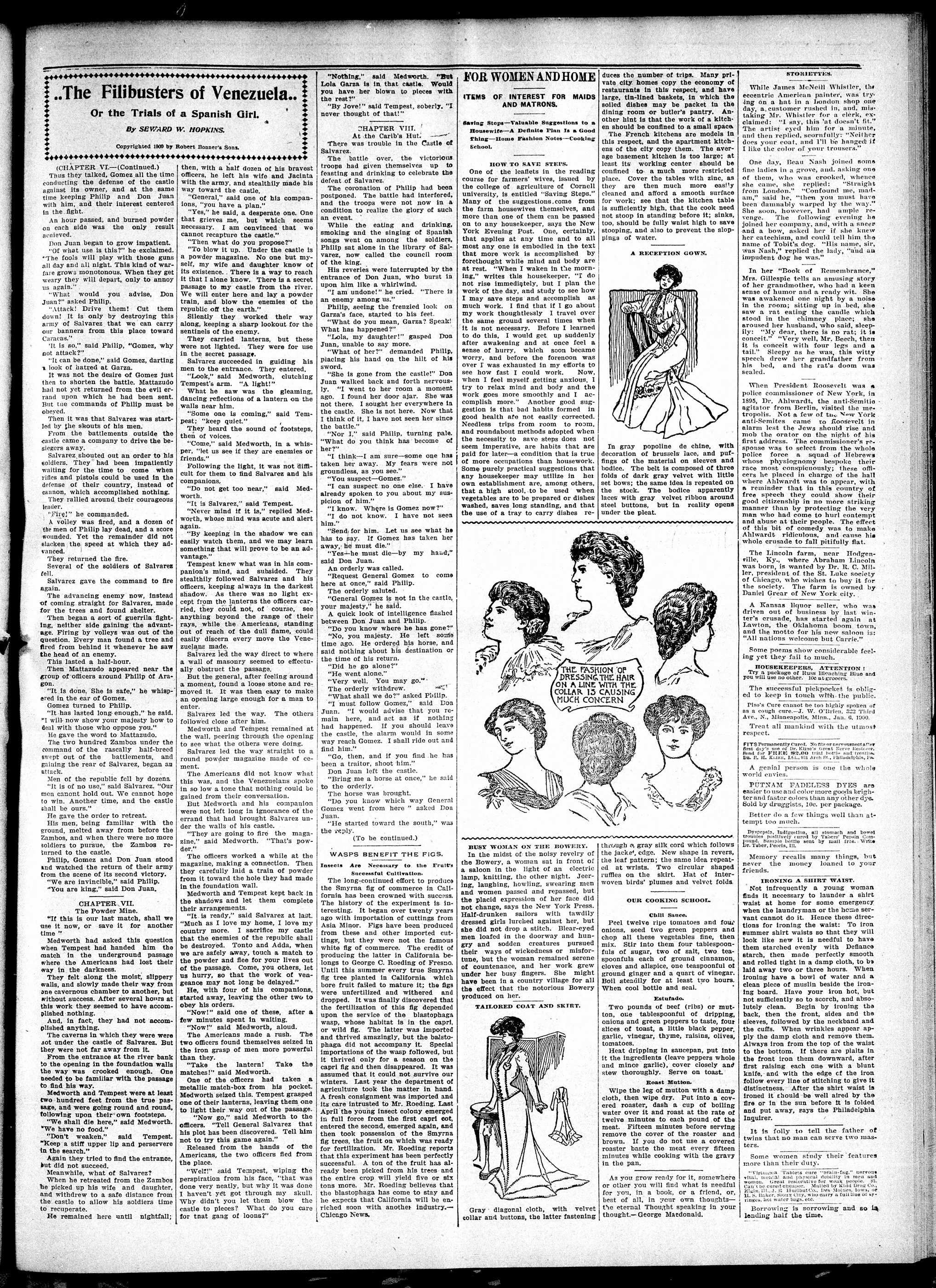
THE FASHION OF
DRESSING THE HAIR
ON A LINE WITH THE
COLLAR IS CAUSING
MUCH CONCERN
---
ITEMS OF INTEREST FOR MAIDS
AND MATRONS.
Saving Steps—Valuable Suggestions to a Housewife—A Definite Plan Is a Good Thing—Home Fashion Notes—Cooking School.
HOW TO SAVE STEPS.
One of the leaflets in the reading course for farmers' wives, issued by the college of agriculture of Cornell university, is entitled "Saving Steps." Many of the suggestions.com from the farm housewives themselves, and more than one of them can be passed on to any housekeeper, says the New York Evening Post. One, certainly, that applies at any time and to all most any one is embodied in the text that more work is accomplished by forethought while mind and body are at rest. "When I waken in the morning," writes this housekeeper, "I do not rise immediately, but I plan the work of the day, and study to see how I may save steps and accomplish as much work. I find that if I go about my work thoughtlessly I travel over the same ground several times when it is not necessary. Before I learned to do this, I would get up suddenly after awakening and at once feel a sense of hurry, which soon became worry, and before the foremono was over I was exhausted in my efforts to see how fast I could work. Now, when I feel myself getting anxious, I try to relax mind and body and the work goes more smoothly and I accomplish more." Another good suggestion is that bad habits formed in good health are not easily corrected. Needless trips from room to room, and roundabout methods adopted when the necessity to save steps does not seem imperative, are habits that are paid for later—a condition that is true of more occupations than housework. Some purely practical suggestions that any housekeeper may utilize in her own establishment are, among others, that a high stool, to be used when vegetables are to be prepared or dishes washed, saves long standing, and that the use of a tray to carry dishes re-
THE FASH
DRESSING
ON A LINE
COLLAR 15
MUCH COI
BUSY WOMAN ON THE BOWERY.
In the midst of the noisy revelry of the Bowery, a woman sat in front of a saloon in the light of an electric lamp, knitting, the other night. Jeering, laughing, howling, swearing men and women passed and repassed, but the placid expression of her face did not change, says the New York Press. Half-drunken sailors with tawdily dressed girls lurched against her, but she did not drop a stitch. Blear-eyed men loafed in the doorway and hungry and sodden creatures pursued their ways of wickedness or misfortune, but the woman remained serene of countenance, and her work grew under her busy fingers. She might have been in a country village for all the effect that the notorious Bowery produced on her.
TAILORED COAT AND SKIRT.
A
Gray diagonal cloth, with velvet collar and buttons, the latter fastening
duces the number of trips. Many private city homes copy the economy of restaurants in this respect, and have large, tin-lined baskets, in which the soiled dishes may be packet in the dining room or butler's pantry. Another hint is that the work of a kitchen should be confined to a small space. The French kitchens are models in this respect, and the apartment kitchens of the city copy them. The average basement kitchen is too large; at least its working center should be confined to a much more restricted place. Cover the tables with zinc, as they are then much more easily cleaned and afford a smooth surface for work; see that the kitchen table is sufficiently high, that the cook need not stoop in standing before it; sinks, too, should be fully waist high to save stooping, and also to prevent the sloppings of water.
A RECEPTION GOWN.
In gray popoline de chine, with decoration of brussels lace, and puffings of the material on sleeves and bodice. The belt is composed of three folds of dark gray velvet with little set bows; the same idea is repeated on the stock. The bodice apparently laces with gray velvet ribbon around steel buttons, but in reality opens under the pleat.
MION OF
THE HAIR
WITH THE
CAUSING
NCERN
through a gray silk cord which follows the jacket, edge. New shape in revers, the leaf pattern; the same idea repeated at wrists. Two circular shaped ruffles on the skirt. Hat of interwoven birds' plumes and velvet folds.
OUR COOKING SCHOOL
Chili Sauce.
Peel twelve ripe tomatoes and four onions, seed two green peppers and chop all these vegetables fine, then mix. Stir into them four tablespoonfuls of sugar, two of salt, two teaspoonfuls each of ground cinnamon, cloves and allspice, one teaspoonful of ground ginger and a quart of vinegar. Boil steadily for at least two hours. When cool bottle and seal.
Estufado.
Two pounds of beef (ribs) or mutton, one tablespoonful of dripping, onions and green peppers to taste, four slices of toast, a little black pepper, garlic, vinegar, thyme, raisins, olives, tomatoes.
Heat dripping in saucepan, put into it the ingredients (leave peppers whole and mince garlic), cover closely and stew thoroughly. Serve on toast.
Roast Mutton.
Wipe the leg of mutton with a damp cloth, then wipe dry. Put into a covered roaster, dash a cup of boiling water over it and roast at the rate of twelve minutes to each pound of the meat. Fifteen minutes before serving remove the cover of the roaster and brown. If you do not use a covered roaster baste the meat every fifteen minutes while cooking with the gravy in the pan.
As you grow ready for it, somewhere or other you will find what is needful for you, in a book, or a friend, or, best of all, in your own thoughts—the eternal Thought speaking in your thought.—George Macdonald.
---
```markdown
```
While James McNeill Whistler, the eccentric American painter, was trying on a hat in a London shop one day, a customer rushed in, and, mistaking Mr. Whistler for a clerk, exclaimed: "I say, this 'at doesn't fit.' The artist eyed him for a minute, and then replied, scornfully: "Neither does your coat, and I'll be hanged if I like the color of your trousers."
One day, Beau Nash joined some fine ladies in a grove, and, asking one of them, who was crooked, whence she came, she replied: "Straight from London." "Confound me, madam," said he, "then you must have been damnably warped by the way." She soon, however, had ample revenge. The following evening he joined her company, and, with a sneer and a bow, asked her if she knew her catechism, and could tell him the name of Tobit's dog. "His name, sir, was Nash," replied the lady, "and an impudent dog he was."
In her "Book of Remembrance," Mrs. Gillespie tells an amusing story of her grandmother, who had a keen sense of humor and a ready wit. She was awakened one night by a noise in the room; sitting up in bed, she saw a rat eating the candle which stood in the chimney place; she aroused her husband, who said, sleepily: "My dear, there is no rat; it is conceit." "Very well, Mr. Beech, then it is conceit with four legs and a tail." Sleepy as he was, this witty speech drew her grandfather from his bed, and the rat's doom was sealed.
When President Roosevelt was a police commissioner of New York, in 1895, Dr. Ahlwardt, the anti-Semitic agitator from Berlin, visited the metropolis. Not a few of the New York anti-Semites came to Roosevelt in alarm lest the Jews should rise and mob the orator on the night of his first address. The commissioner's response was to select from the whole police force a squad of Hebrews whose physiognomy bespoke their race most conspicuously; these officers he placed in charge of the hall where Ahlwardt was to appear, with a reminder that in this country of free speech they could show their good citizenship in no more striking manner than by protecting the very man who had come to hurl contempt and abuse at their people. The effect of this bit of comedy was to make Ahlwardt ridiculous, and cause his whole crusade to fall pitifully flat.
The Lincoln farm, near Hodgenville, Ky., where Abraham Lincoln was born, is wanted by Dr. R. C. Miller, president of the St. Luke society of Chicago, who wishes to buy it for the society. The farm is owned by Daniel Grear of New York city.
A Kansas liquor seller, who was driven out of business by last winter's crusade, has started again at Lawton, the Oklahoma boom town, and the motto for his new saloon is: "All nations welcome but Carrie."
Some poems show considerable feeling yet they fail to much.
HOUSEKEEPERS. ATTENTION!
Try a package of Russ Leaching Blue and you will use no other. 100 at grocers.
The successful pickpocket is obliged to keep in touch with the public.
Piso's Cure cannot be too highly spoken of as a cough cure. - J. W. O'Brien. 322 Third Ave., N. Minneapolis, Minn. Jan. 6, 1900.
Treat all mankind with the utmost respect.
FITS Permanently Cured. No flats or nervousness after first day's use of Dr. Kline's Great Nerve Restore. For FREE $2.400 gift bottle and creatin. Dr. P. H. Kalken, Ldn. $19 Arch St., Philadelphia, Pa.
A genial person is one the whole world envies.
PUTNAM FADELESS DYES are easier to use and color more goods brighter and faster colors than any other dye. Sold by druggists, 10c. per package.
Better do a few things well than attempt too much.
Dryspsie, Indigestion, all stomach and bowel troubles positively cured by Tabsin Pepsin Compound. Sample bottle to mail free. Write Dr. Tabsin, Florida, fl.
Memory recalls many things, but never the money loaned to your friends.
IRONING A SHIRT WAIST:
Not infrequently a young woman finds it necessary to launder a shirt waist at home for some emergency when the laundryman or the home servant cannot do it. Hence these directions for ironing the waist: To iron summer shirt waists so that they will look like new it is needful to have them starched evenly with Defiance starch, then made perfectly smooth and rolled tight in a damp cloth, to be laid away two or three hours. When ironing have a bowl of water and a clean piece of muslin beside the ironing board. Have your iron hot, but not sufficiently to scorch, and absolutely clean. Begin by ironing the back, then the front, sides and the sleeves, followed by the neckband and the cuffs. When wrinkles appear apply the damp cloth and remove them. Always iron from the top of the waist to the bottom. If there are plaits in the front iron them downward, after first raising each one with a blunt knife, and with the edge of the iron follow every line of stitching to give it distinctness. After the shirt waist is ironed it should be well aired by the fire or in the sun before it is folded and put away, says the Philadelphia Inquirer.
It is folly to tell the father of twins that no man can serve two masters.
Some women study their features more than their duty.
"Victoria Tadkins cure "brain-fug" nereous vital, mental and physical dignity in men and women. Great restorative for wank people. s2. can to cure "brain-fug" by kind Dr. Drux. K. Ekin J. Jal, J. R. Hurthput Co., J. Lee Morris, Love Co., H. I. Saker, Soxity Co., who carry a full line of springs, hot water bags, etc.
Borrowing is sorrowing and so la lending half the time.
CH4
MODES FOR WOMEN
Fur "ties" are shown in great variety. The old-fashioned name is "bon." Mink and marten are also used for these ties. Whole chinchilla blouses will be desirable for dress wear.
Erine, it need hardly be said, is
mademoiselle's choice.
As for madame, it's either sable Persian lamb, broadtail, or mink.
Never were styles in furs more captivating than those in the first exhibits this season.
Matrons like them for any and all times, while the younger contingent is prone to make soft eyes at them for evening wear.
It will still be modish to have the large revers and collar faced with a contrasting fur, sable, marten, and chinchilla being first favorites.
While jackets and the longer coats always find buyers, the blouse form will be the more chic. Jackets with tails, however, are graceful if perfectly fitted.
Sealskin, broadtail, and Persian lamb are first choice for coats. The first-named is always beautiful and not likely to become common by reason of cheapness. Both Persian lamb and broadtail, in addition to their wondrous beauty, boast the virtue of completing a black costume most effectively.
The finest of these this year are in table, either perfectly straight or a bit shaped at the back, and with two tails and two feet dangling from the center back. Two tails finish the ends, coming to the knees, while one may have two more on each side, the front just above the bust line, if the cost doesn't count.
Every sort of fox is to be had from the cheap and cheery "reddy" to the fairly priceless silver fox. In black the only truly beautiful tie is of black lynx.-Chicago Journal.
HELPFUL SUGGESTIONS
An improvement on the square wash cloth in general use is a mitten of Turkish toweling large enough to slip easily off and on, or one knit of rather coarse twine on coarse needles. These mitten wash cloths may be saturated with salt water and dried for use in the friction salt bath.
To drive out moths use a mixture of one quart of alcohol, one ounce each of carbolic acid crystals and camphor, a quarter of an ounce each of oil of cedar and oil of eucalyptus. Keep the bottle well corked. Put some of the liquid into an atomizer and spray the place where moth appear.
A good everyday furniture polish is a mixture of equal quantities of turpentine and paraffin oil. Rub on with a woolen cloth and then polish with a fresh woolen cloth, and rub finally with a piece of soft linen. If cushioned chairs or sofas are rubbed with this, be careful that it does not touch the covering. Any furniture polish will leave a little mark on the covering if allowed to touch it.
We frequently hear of explosions of lamps and coal oil stoves. A certain amount of inflammable vapor is given off from kerosene oil. The lower the grade of oil the greater the quantity of vapor. If the reservoir in the lamp or stove has stood partially filled for many hours the space that is not filled with oil may become filled with vapor. When the lamp is lighted a gust of air may carry the flame down to this inflammable gas, and an explosion is the result. The safeguards are: Purchase the best quality of oil; it is the cheapest in the long run; trim and fill the lamp every day, and do not burn the lamp until practically all the oil is exhausted. There is also danger of explosion when the wick is not large enough to fill the wick-holder.
STAGE WHISPERS
James Lackaye, who has one of the chief character roles in "York State Folks," Arthur Sidman's new pastoral comedy, was the original Martin Berry with James A. Herne in "Shore Acres."
Refane says that if her daughter wants to go on the stage she will let her do so in England. She has been educated in that country, and speaks English as if it were her own language.
It is said in Paris that an operetta by Audran, the composer who died recently, called "Le Cure Vincent," which has never yet been performed, will be produced at the Galte Theater next year.
Charles Dalton, the English actor, who will be remembered in the leading role of "The Sign of the Cross," will appear in New York at Christmastime, in a dramatization of "The Helmet of Navarre."
Julia Marlowe is contemplating an appearance as "Joan of Acre." Sarah Bernhardt lost money and reputation on a version of that subject, and another one helped to break the heart of Fanny Davenport.
FUNNYGRAPHS.
"Is Dorothy's 'den' artistic?" "Artistic? I think so. You can't take a step in it without knocking over something Oriental."—Puck.
She—I sometimes wonder whether all those things you said to me were true. What difference does it make? We both believe them.—Life.
"She finds fault with her husband's salary, they say." "Yes, she says it isn't like her father used to make."—Philadelphia Evening Bulletin.
She—it's no use bothering me, Jack.
I shall marry whom I please.
He—That's all I'm asking you to do, my dear. You please me well enough.—Punth
2000
HOPKIN SEVEN
HOPKINS=SEARS CO.,
Lord Halsbury, the Lord Chancellor of England, is the son of Dr. Stanley Lees Giffard, who was editor of the London Standard for twenty-seven years. His grandfather, a noted Dublin politician of the union period, John Giffard, had for more than a generation the sole editorial control of the Dublin Journal, which had been started and for fifty years edited by George Faulkner, the friend of Swift and Chesterfield.
When you cannot sleep for coughing it is hardly necessary that any one should tell you that you need a few doses of Chamberlain's Cough Remedy to allay the irritation of the throat and make sleep possible. It is good. Try it. For sale by all Druggists.
---
WANTED-TRUSTWORTHY MEN AND women to travel and advertise for old estabs. library, #760 a year and expenses, all payable in cash. No canvassing required. Give referen- ce and enclose self-addressed stamped envelopes. Address Manager, 353 Cauk Bldg., Chicago
A Curious Deed.
A curious deed is on file in Northumberland county, Pennsylvania, according to the Sunbury Republican. It bears date of October 9, 1793. In a series of wherecases it traces the ownership of the land conveyed from the Creator of the earth, who "by parole and livery of seizin did enfeoff the parents of mankind, to-wit, Adam and Eve, of all that certain tract of land called and known in the planetary system as the earth," down through the ages to the maker of the deed.
Great Britain's Population.
Great Britain and Ireland, according to the compiled census returns, has a population of about 42,000,000. The exact figures are: England, 30,805,466; Wales, 1,720,609; Scotland, 4,471,957; Ireland, 4,456,546; the Isle of Man, 54,758; and the Channel Islands, 95,841, making a total of 41,605,177. To this is added an estimate of 400,000 for the men in the army, navy and merchant service abroad and for the troops serving in South Africa.
Old Style Comes Back
Glazed chintz in exact reproduction of the patterns in use forty years ago is again coming into favor for walk and furniture covering and is exceedingly quaint and cool looking with trails of old-fashioned flowers on a chalk white background. This material is exceedingly durable and after a couple of years' service for furniture covering, it may be reglazed and is as good as new.
Ornamental Designing:
The trades in which the ornamental designer is chiefly employed are the various branches of the textile industry, as the manufacture of cotton prints, carpets, curtain materials, dress goods, etc., and also wall paper and oll-cloth. The salary of a designer of course varies according to his capabilities, but one with artistic taste and originality is always well paid.
Chair of Historical Research
The Italian government has created at the Royal University in Rome a chair for the advancement of historical research in connection with medieval and modern art. The new chair was created through the efforts of Prof. Venturi, who for the last eleven years has been in charge of the medieval and modern art classes at the university.
Two Calamitous Fires.
The two most calamitous fires ever known anywhere in the world occurred in the United States within thirteen months of each other. In the first of these, in Chicago, on October 8-9, 1871, the property loss was $200,-000,000, and in the second, in Boston, November 9, 1872, $80,000,000 of property was consumed.
United States Cities
The census taken on June 1, 1900,
gives the population of the ten largest
cities in the United States as follows:
New York, 3,437,202; Chicago, 1,698-
575; Philadelphia, 1,293,697; St. Louis,
575,238; Boston, 560,892; Baltimore,
508,957; Cleveland, 351,768; Buffalo,
352,387; San Francisco, 342,782; Cincinnati,
325,902.
An Invisible Ink:
Among the Romans an invisible ink was made with the milky juices of certain plants. Its manufacture was a state secret, death be denounced to any who should disclose it, and all important dispatches from the capital to the provinces, or vice versa, were written in this ink.
Date of Shakespeare's Birth:
Considerable uncertainty prevails regarding the date of Shakespeare's birth. Tradition points to April 23, old style, corresponding to our May 5th, as the date. This is in accord with the statement made by the late Sir Walter Besant in his magazine article.
A Big Rose Tree.
There is a rose tree with a trunk two feet and nine inches in circumference, in a Ventura garden, in California. It is a Lamarque, has been growing a quarter of a century, and yielded over 21,000 blooms in 1895.
Planting Rubber Trees.
The rubber trees is to be introduced into India by the British government The Mexican rubber tree has been selected as the beat, and a large shipment of seeds has just been made to Madras.
FOOT BALL.
A few Bicycles to close out at cost Come Early.....
Some of the Odd Tricks of Liquid Air
Liquid air is, perhaps, the coldest
thing in the world. It is so sold that a
cake of ice is like a fierce fire as com-
pared with it, for a kettle of liquid air
placed on a cake of ice will boil just
as water boils over a hot fire. It
freezes mercury so hard that one can
drive nails in it. The story is told that
Mr. Charles E. Tripler, the experi-
menter in liquid air, recently took a
quart can of the remarkable substance
with him on a visit to a friend. On
the way he stopped in a restaurant to
eat a beefsteak The waiter brought
in a hot broiled steak and placed it in
front of Mr. Tripler. As soon as the
waiter's back was turned Mr. Tripler
hastily opened the can and exposed the
meat to the liquid air. Instantly the
steak was frozen hard as a rock. When
the waiter came back his customer
complained that the steak was frozen.
So the waiter called the head waiter,
and the head waiter blamed it all on
the cook and the cook was at loss to
explain, and the result was that the
frozen steak was taken back into the
kitchen as a mysterious curiosity. A
new steak was broiled for Mr. Tripler
and this one he ate with much relish.
G. ave Filling Device.
A device for use in constructing graves, the invention of Henry D Cameron, of Burlington, Iowa, is designed to fill the grave with earth after the coffin has been lowered, and to conceal as far as possible the actual throwing of the dirt upon the coffin, the most trying termination of the grave ceremony to the bereaved mourners. It consists of a receptacle, with detachable sides and bottom, and a gate in the latter sc arranged as to be capable of being opened to allow the contents to fall. The front is a flexible curtain, extending from the top to the gate, and designed to prevent the earth within from being seen. This receptacle is filled with earth previous to the ceremony and carried to a convenient point. When all is over and the grave is to be filled, the receptacle is placed over it, and the gates opened, thus gently closing the last sad scene in a much more fitting manner than the seemingly cold-hearted return of the earth with a spade.
Imigration from Europe.
More immigrants are said to be are riving from Europe this year than ever before. Most of them come from southern Europe and Scandinavia. Italy furnishes the largest quota this season. Most of them are coming west to work on railroad extensions of the Burlington, Union Pacific and Great Northern. Italians, it is said, are the best track workers that can be obtained, and they are replacing the Chinese heretofore employed by the railroads on the Pacific coast.
Latest Fad of Critics
The latest fad of critics, the New York Press says, is to rebel against the names of months. They point out that it is absurd for Europeans and Americans of today to dedicate one-sixth of the year to the memory of Julius Caesar and Augustus, to name a third after heathen gods and goddesses, to have two months of doubtful nomenclature, and to designate the remaining four by misleading numericals, September being obviously ninth and not seventh in order.
"Papering Up" Silk Goods.
Silk goods should not be folded in white paper, as the chloride of lime used in bleaching the paper will impare the color of the silk. Brown or blue paper is better; yellow India paper is better still. Silk intended for dress should not be kept in the house long, as lying in folds causes it to crack or split. White satin dresses should be pinned up in blue paper, with coarse brown paper on the outside, sewed together at the edges.
Lord Chancellor of England.
Bargrins on Guns,
Revolvers, Etc.
Playing Cards, Games, Etc.
CHURCH ANNOUNCEMENT.
The Corinthian baptist Church —situted on St. Wt. between Crocker and School Sts. Preaching; at 11 a.m. Sunday School; at 12 o'clock Preaching at 9 a.m. School; Rev. S. Bates, Pastor.
St. Paul A. M. E. —Corner of Second and Center Streets. Preaching at 10:30 a.m. m.; Sunday School at 3 o'clock; Epworth League at 7 p.m.; preaching at 8 p.m. m., L. J. Phillips, pastor.
First African Baptist Church —Corner School Preaching at 10:30 a.m.; Sunday school at 2:30 p.m., Mr. M. E. Housten. Superintendent: Young People's meeting 7 p.m., preaching 800 p.m.
Burn's M. E. —East Second and Des Moines School. Preaching at 10:30 a.m.; Sunday School at 3:30 a.m. and 4 p.m.; Sunday School at 19:30. Prayer and Class meeting, Wednesday 8 p.m. All are welcome. Rev. C. W. Holmes, pastor.
Mount Nebo Baptist Church —E. Second Street, between Lncust and Grand avenue—Sunday service, preaching at 11 a.m.; Sunday School at 12:30 p.m., Superintendent, Rose Johnson. Preaching at 8 p.m. Rev. J. H Bell, pastor.
Tabernacle Baptist Church Mission —Situted on 95 East Lncust School; at 12 o'clock Preaching at 9:00 a.m.; preaching at 8 p.m. Rev. J. R. Winchin pastor.
SECRET ORDERS
North Star Lodge, No. 3, A. F.A.M. —Meets First Thursday in each month at Masonic Hall, W. fourth in Arts avenue, J. H. Shepard, W. S. Runt, J. M. Heggget, Rec.
Ring Solomon Commandery, No. 6 —Meets Second and Fourth Thursday in each month at Masonic hall. Frud Jackson, M. G.; G. H. Cleggget, Rec.
Nassau County, No. 3 —meets Second Monday in each month at Masonic hall, Mrs. J. H. Shepard, matron; Mrs. Fred Jackson, secretary.
Mt. Olive Court, No. 4 —Meets First Thursday for each month at Masonic hall. Mrs. Susan Wheat, matron; Mrs. Flora Majors, secretary.
Charity Lodge, No. 2192, G. U. of O. F. —Meets First, Second and Third Tuesday each month, and Fellows hall on West Sixth and Walnut streets. D. Burns, N. G.; F. Brown P. S.
H. H. of F. S., No. 333 of G. U. of O. F. —Convenes the first and third Thursday in each month, and Fellows hall on West Sixth and Walnut streets. D. Burns, N. G.; F. Brown P. S.
H. H. of F. S., No. 333 of G. U. of O. F. —Convenes the first and third Thursday in each month, and Fellows hall on West Sixth and Walnut streets. D. Burns, N. G.; F. Brown P. S.
Knights and Laddes of Honor of the World No 178 Victoria Lodge—meets every Monday evening at Webster's Hall, corner of Tenth Court, M. N. G. Mrs. G. L. Williams, W. R.
Mrs. Rose Johnson, Secretary.
Broad Vestibuled
First-Class Sleepers
DAILY-
Great Rock Island Route
Leave Chicago on Aug 5 at 10:00 p.m.
All the best scenery of the Rocky Mountains and the Sierra Nevada by daylight in both directions.
These cars are carried on the limited trains of the Great Rock Island Route, Denever and Rio Grande (Scenic Route), Rio Grande Western and Southern Pacific.
Dining Car Service Through Buffett Library Cars.
JOHN SEBASTIAN, G. P. A.,
Chicago.
THE GILBERT
Chop -- House
BY EXPERIENCE COOKS.....
Short Orders and Meals.
Nice Furnished Rooms
By Day or Week.....
221 S. Market St. Ottumwa, Ia.
Under the Pennsylvania election law votes are not counted for the candidate, but for the ticket or tickets on which his name appears. In the Chester county election all parties agreed upon Joseph Hemphill for common pleas judge, and this is the way the official vote was declared: Joseph Hemphill, republican, 8,162 votes; Joseph Hemphill, democrat, 4,371 votes; Joseph Hemphill, fusion, 1,643 votes; Joseph Hemphill, scattering, 374 votes.
Harmless Powder.
Oatmeal mixed with water makes a most soothing face wash, as well as softening and whitening the skin. It should, however, be sparingly used by those with large pores, which it is apt to clog. Fine oatmeal, or oatmeal flour, forms a very good face powder, and is, of course, absolutely free from the harmful ingredients of many expensive powders.
Moving.
This is what Captain Beall says to day
court and bighight my boyhood days,
laced a chronic catarror of the stomach which
a failure of my case you took hold of it a
of catarror for seven years, and I want the w
Very respectfully yours,
people we have cured, among them: H. C. Ch
Hirt, Pastor St. John's Lutheran Church De
per month includes all medicines for the
and all admissions of the Hose, Throat, and
bubbles. Consultation free by mail or at office
Symptom Sheets with Dr. McLean's M
REE to any Address, and Is of Great Val
undreds of testimonial letters from cured path
COPELAND MEDICAL INSTITUT
Dr. C, M. McLean, Chief Consulting
606 Walnut St., D
what Captain Boall says to-day: Dr. C. M. McLean
bigholded my boyhood days and cursed me, and when
catarrh of the stomach which was killing me, and when
of my case you took hold of it and cured me. I have not
for seven years, and I want the world to know it."
Very respectfully yours, GEORGE BEALL
we cured, among them: H. C. Harrell of Harris, Emery,
St. John's Lutheran Church, Des Moines, Iowa.
All medicines for the cure of Catarrh, Defnase,
options of the Knee, Throat, and Lungs; also Stomach, Liver
sultation free by mail or at office.
Sheets with Dr. McLean's Monograph on Deafness
y Address, and Is of Great Value to the Afflicted.
stimonial letters from cured patients.
AND MEDICAL INSTITUTE,
C. M. McLean, Chief Consulting Physician,
606 Walnut St. Des Moines, Iowa.
My sister Doctor, after it occurred, said Dr. C. M. McLean bood, and after it had produced a chronic catarrh of the stomach which was killing me, and when all the other doctors had made a failure of my case you took hold of it and cured me. I have not had a pain or ache or a sign of catarrh for seven years, and I work very hard. Very respectfully yours, GEORGE BEALL
My Dear Doctor, "After catarraph had blighted hood, and after it had produced a chronic catarraph all the other doctors had made a failure of my eye had a pain or ache or a sign of catarraph for seven very
We refer the afflicted to people we have cured, at Dry Goods Co.; Rev. Wirt, Pastor St. John's. The treatment at $5.00 per month includes all Hay Fever, Bronchitis, Asthma, and all afflictions of Sorel, Kidney, and Bladder troubles. Consultation Blunk and Symptom Sheets wri- and Catarraph Sent FREE to any Address
The book also contains hundreds of testimonial le
THE COPELAND MEN
Dr. C, M. McL.
We refer the affected to people we have cured, among them Harris, Emery, Dr. Dennis, and Dr. John Church, Des Moines Church, Des Moines, Mo. The treatment at $5.00 per month includes all medicines for the cure of Catarrh, Deafness, Hay Fay, Bronchitis, Asthma, and all afflictions of the Nose, Throat, and Lungs; also Stomach, Lung, Kidney, L鼻, and Bladder; and Diarrhea. We also offer a $10.00 per month treatment of Horns and Exertion sheets with Dr. McLean's Monograph on Deafness.
Consultation Blank and Symptom Sheets with Dr. McKenna on Monograph on Deafness and the Addicted. The book also contains hundreds of testimonial letters from cured patients.
GOOD LITERATURE
folders, booklets, etc., are tastefully gotten up and are valuable for what they contain. Here is a partial list of what
MR. CHAS. S. FEE, General Agent, St. Paul, Minn., will send, upon receipt of prices given and money or express orders, silver opportunity to obtain good descriptive publication, beautifully illustrated in color. This number treats particularly of Northern Pacific's Trademark, the Cuomontana, and the Yellowstone Park. ORLAND-unity publication containing a comp of Northern Pacific Trademark. The are wonderland 1901 are used in miniature FROM YELLOWSTONE-used wild flowers from Yellowstone Park. Real flowers in their natural colors. Beautiful souvenir—ten specimens of flower illustrations of Park scenery. NATIONAL PARK-age book in strong flexible covers, gape, illustrated, pocket size, a competitive of the World's Wonderland. BRAINIER- pocket-size book, 72 pages, in sturge, printed on heavy paper. descriptive the highest peak in the United States—of a glacial nature.
SUBSCRIBE FOR THE
State Bystar
THE OLDEST COLORED JOURNAL IN IOWA
reading paper in the North
Is Into
HAS. S. FEE, General Passenger
St. Paul, Minn., will send out, carefully upon receipt of prices given. Any combination or express orders, silver or stamps will be easy to obtain good descriptive reading matter.
beautifully illustrated in color member treats particularly of the Send Pacific's Trademark, the Custer Six Cents and the Yellowstone Park.
location containing a complete Pacific Trademark. The artis- Send and 1001 are used in miniature. Four Cents.
LOWSTONE—flowers from Yellowstone Parkers in their natural colors. A Send evenir—ten specimens of flowers Fifty Centsations of Park scenery.
MARK—in strong flexible covers, good stated, pocket size, a compend- Twenty-five Cents the World's Wonderland.
size book, 72 pages, in strong on heavy paper, descriptive of Twenty-five Cents speak in the United States—Cents glacial nature.
RIBE FOR THE
State Bystander
THE WILDEST FLORED INNAL IN IOWA
paper in the North-west.
to
MR. CHAS. S. FEE, General Passenger Agent, St. Paul, Minn., will send out, carefully mailed, upon receipt of prices given. Any combination and/or express orders silver or stamps will b
Agent, St. Paul
mailed, upon recei-
tion can be made, andnoney or expre-
cepted.
This is a fine opportunity to obtain
for little or nothing.
WONDERLAND 1901—
An annual publication, beautiful,
and half-tone. This number tree
history of the Northern Pacific's
Battlefield in Montana, and the Y
MINIATURE WONDERLAND—
A neat and dainty publication co-
history of the Northern Pacific Tie
tic covers of the wonderland 1901.
WILD FLOWERS FROM YELLOWSTONE—
A book of pressed wild flowers fr
showing the real flowers in the
dainty and beautiful souvenir—tea
and six full page illustrations of f
YELLOWSTONE NATIONAL PARK—
A new 112-page book in strong
paper, plain type, illustrated, poo-
ium and descriptive of the World's
CLIMBING MOUNT RAINIER—
An illustrated pocket-size book
flexible covers, printed on heavy
an ascent of the highest peak in
outside of Alaska—of a glacial na
SUBSCRIBE
Iowa State
THE
OLDEN
COLOR
JOURNAL
IOW
and the leading paper
It Goes Into
This is a fine opportunity to obtain good descriptive reading matter for little or nothing.
WONDERLAND 1901—
An annual publication, beautifully illustrated in color and half-tone. This number treats particularly of the Send history of the Northern Pacific Trademark, the Custer Six Cents Battlefield in Montana, and the Yellowstone Park.
MINIATURE WONDERLAND—
A neat and dainty publication containing a complete history of the Northern Pacific Trademark. The artis- Send tie covers of the wonderland 1901 are used in miniature. Four Cents
WILD FLOWERS FROM YELLOWSTONE—
YELLOWSTONE NATIONAL PARK
A new 112-page book in strong flexible covers, good paper, plain type, illustrated, pocket size, a compendium and descriptive of the World's Wonderland.
CLIMBING MOUNT RAINIER
An illustrated pocket-size book, 72 pages, in strong flexible covers, printed on heavy paper, descriptive of an ascent of the highest peak in the United States—Cents outside of Alaska—of a glacial nature.
76 Counties in Iowa
29 States in the Union
2 Foreign Countries.
Agents in 24 towns in Iowa and
pondence from many different
24 towns in Iowa and from many different
nns in Iowa and corres- many different states.
Agents in 24 towns in Iowa and correspondence from many different states.
A handsome but simple frame house at Lawrence, Long Island, surrounded by some five acres of land, is the quiet retreat where the tired Wall street magnate, Russell Sage, has enjoyed his summers for many years. Here he is a typical Long Island farmer in old clothes and straw hat. Many a man farming for a base living could gain information in his own business from Russell Sage. He has no use for orchids, and costly fads, but he watches the development of every field within a radius of many miles about his country home. In the stable are half a dozen horses, raised and broken to harness by the great financier, and he shows the delight of a boy in hitching them up and driving over the country roads. There are a goodly number of domestic pets. It may be said that there are two Russell Sages, one the financier familiar to New York, the other the man of leisure in his country home.
Sullivan's Instruments Sold Well.
Sixteen of the violins and violoncellos owned by the late Sir Arthur Sullivan were recently sold for $1,800. The greatest prize realized for any one of the instruments was $850, which was paid for a violoncello by Joseph Guarnerius.
---
---
J.
FOR ALMOST
NOTHING MR.
In 1981 Capt. Beall's days seemed to be numbered. His friends had given him a new job, and he carried a Captain's stripes during the war who later became a Chief of Police was great beyond "But Capt. McLean did not treat" by Dr. McLean's New Treatment. The family doctors and his friends were moved to a new hospital and living monument of what Dr. McLean
The Northern Pacific is noted among railways for its advertising matter. Its pamphlets,
For sprains, Swellings and lameness there is nothing so good as Chamberlain's Pain Balm. Try it. For sale by all Druggists.
ORCH AND CLERGY.
The Rev. J. Wilbur Chapman is to write the life of D. L. Moody.
Bishop Edsall has just completed a highly successful mission at James-town, N. D.
Tomkins Avenue Congregational church of Brooklyn raised over $27,080 for missions during the year.
The death roll in the Congregational ministry in Great Britain was unusually heavy during the year 1899.
A congress of the history of religions will be held at Paris, France during the first part of September next year.
The receipts of Plymouth church, Brooklyn, for the year make a total of $38,000, of which $17,000 is from pew rents.
The annual council of the South African churches was held at Graaf Relnet, and owing to the preoccupations of the war, only thirty-eight delegates attended.
Since his resignation from the Church of the Pilgrims relief from care has conducted to a marked improvement in the health of the vendor Dr. R. S. Storra
Sure cure for piles. Others have been cured, why not you? I have had remarkable success in effecting pile cures. I guarantee from 1 to 3 boxes to cure any case of piles. Read the following testimonial:
I have had piles for fifteen years. I have used all kinds of salves and had two surgical operations performed without any permanent relief. I have been entirely cured by using Burnett's Pile Salve. L. R. GENEVA, Meat Merchant, Oskaloosa, Iowa, April 8, 1806
Only 50 cents a box, or upon receipt of 56 cents I will forward a box to any part of the United States. For further information see me.
PROF. T. L. BURNETT,
402 South Jackson Street,
Mt. Pleasant, Iowa.
WANTED - TRUSTWORTHY MEN AND women to travel and advertise for old establishes a 30% acre year end expenses, all payable in cash. No caivassing required. Give references and enclose address-addressed stamped envelopes. Address Manager, 385 Caxton Bldg. chicago.
EVERYBODY
KNOWSTHAT MUNGER'S LAUNDRY is the best in the city. Try them and be decided.
Maine Office 211-215 NINTH St
Branc. Office 504 MULBERRY St.
PHONE 579.
SHANK BROS.,
Funeral Directors
517 Mulberry St.
Telephones 686, 688 and 689.
DES MOINES, IOWA.
SUBSCRIBE NOW
FOR 30 DAYS THE FREEMAN
will be sent to any address for one year.
for $100. Sample copies on application.
Write for list of premiums. Address
THE FREEMAN,
INDIANAPOLIS, INDIANA
A digest of all the news of the race, on all questions and from all parts of the country.
IT IS IN THE LEAD!
...DO YOU READ...
THE FREEMAN?
If not. Why not?
The Leading Paper
of THE RACE.
50 YEARS' EXPERIENCE
PATENTS
TRADE MARKS DESIGNS
COPYRIGHTS & C.
Anyone sending a sketch and description may quickly ascertain our opinion free. Communications strictly confidential. Handbook on Patents strictly confidential. Handbook on Patents taken through Munn & Co. receive special notice, without c.argo, in the
Scientific American.
A handsomely illustrated weekly. Interest promotion payable promptly. Ticket $2 a year; four months. $1. Sold by all newdealers.
MUNN & Co. 3618 E. oakway, New York
Branch Office, 625 F. St., Washington, D. C.
Counting Years in Japan.
Mr. B. Mayehatake, a young Japanese who has been studying in Chicago, gives an explanation of the method by which time is reckoned in the chrysanthemum land. The Japanese year begins on our January 1, but instead of counting from the birth of Christ a reckoning is made from the reign of Japan's first emperor, Zimu. Our 1901 is the year 2561 in Japan. When a new ruler mounts the throne a distinctive name is given to his reign and a sort of petty calendar is kept of the years of his government, as we keep track of the age of our republic, writing in legal documents: "Year of our Lord 1901, and of the independence of the United States the 125th." The name for the present mikado's rule, which began thirty-three years ago, is Meiji. This word is pronounced Mayze, and means "peaceful government." Therefore, the current year in Japan is Meiji 34 as well as Zimu 2561.
We want you to subscribe for the IOWA STATE BYSTANDER
An Old Lady's Mistake.
Cardinal Gibbons was formerly a frequent visitor to Cape May and usually took long walks morning and afternoon by the seashore. He always wore his cardinal's skull cap of scarlet silk, of which an inch or so showed below the rim of his silk hat. One afternoon while he was on the board walk an old lady stopped him and said: "Excuse me, sir, but the lining of your hat has sipped down in the back." The cardinal thanked her gravely, but as soon as she left laughed heartily at her mistake.
Do you want
FURNITURE
Go to a
RELIABL
Where you get
Honest Goods &
FURNITURE, CA
CHASE
712-714 WAL
THE Best Stove
OTTUMWA NEWS.
Mrs. Ida Brown left for Chicago last week for a short visit among friends.
Mrs. Walter Davis was called to Moberly, Mo., to attend her brother's funeral Edgar Terrell, who resided with his mother and father, Geo. and Susan Terrel Mr. and Mrs. James Hamilton was called to Des Moines to attend the funeral of their son, Henry Hamilton, who died very suddenly in the northern part of the state.
Mrs. I. Gordon arrived last week. She is the wife of Rev. Gordon, who is now the minister of the A. M. E. church. We wish Rev. Gordon success.
Miss Burnice Davis was very ill last Thursday, but is up again at this writing.
Mrs. Holden arrived from Chicago last Thursday Oct. 10, in which she enjoyed a very pleasant visit with her sister, Mrs. Carrie White of W. 50th street and other friends.
Mrs. Eliza Woods passed through our city Monday for points near Denver, Colo.
Mr. Wm. Alexander, a brother of Frank Alexander is here visiting his brother and friends. We wish him a pleasant time while in our city.
Mr. Charley Smith, who lives near Des Moines, is here visiting friends. May he enjoy his visit and call again.
The Grand Master, I. L. Brown, was with us on the 8th of this month and gave us a grand lecture. We ask the Grand Master of the A. F. & A. M. to call again his presence is useful.
Mr. Church Purtham died Monday, Oct. 14, 1901. This is the 3rd death in their family in 2 months—mother, sister and brother. C. Purtham was a hard working young man and liked by all. He was only sick three weeks. Funeral Wednesday.
Hon. Geo. H. Woodson of Muchainock and Atty. S. Joe Brown of Albia were in our city Friday, Oct. 11, on legal business. The two attorneys were successful. and Atty. Woodson left on the evening train at 7:30 for his home Atty. Brown will stay for a few days with friends. They called at Atty. S. E. Holton's office while in the city and conversed over boy-hood days.
Mrs. Alexander of Evans was in our city last week visiting her sister Mrs. Ella Jefferson.
Mr. Wm. Weeks did not stay as long in our city as we had hoped for. He was called to Des Moines to follow his trude, in which he was pleased to go. We wish him success.
Mrs. Ella Jefferson spent a few days in Creston last weeks visiting relatives and friends.
There was a quarrette that sang out to the Orphine, consisting of three ladies and one gentleman, which was enjoyed by a large crowd.
Mrs. Hotace Massey is in our city for a short visit.
Mrs. Carrie Buckner of Shelbina, Mo., was in our city Sunday and called on Mrs. S. E. Holden, where she remained until the 8:30 p.m. C. B. & Q. departed Evans, in which she will join her husband there and make it her tutuea home.
Miss Mary Hicks died at her home Friday Oct. 11, 1901. May it be a lesson to those of her friends, and may they think of it and remember that they have to pay the same debt and prepare for such Rev. J. H. Jones of the Second Baptist church returned from Hawkins Sundag, but he left Tuesday for Evans for a short stay.
Mrs. Ella McDonnell and Miss Peckley Burk lert for Des Moines Monday. Mr. and Mrs. Ben Baker will leave for forebush this week.
KEOKUK NOTES.
Rev. Bingaman preached his introductory sermon at the Seventh Street Baptist church Sunday morning; many is attendance.
Rev. Greene of Pilgrim Rest Baptist church will move his family to the city this week, where they will make it their future home.
Rev. Phelps is in the city on business.
Mrs. Emma Teabeau and son Ralph, Mesdames Lewis and Kellis are visiting friends in St. Louis.
Mrs. Mary Bland, Miss Carrie Galnes and Bersha Alden are visiting Peoria.
Mr. Wilbert Johnson, Miss Jesie Johnson and Mrs. Grant Jackson spent Thursday in Quincy attending the street fair.
Mr. Paul Owens has returned to St. Joseph, Mo., after several days visit with folks and friends. We now understand why a certain lady on Blondeau street was all smiles
Miss Crystal Teabeau has returned to
St. Paul, after several months visit with her grand parents, Mr. and Mrs. Henry Teabeau, and friends.
Miss Mills of Tennessee has returned home after several days visit with her uncle Selby Johnson.
Miss Haydie Buckner of Monroe City spent Sunday in the city with her friend, Garnet Teabeau.
Mrs. Reeves and children left for Minneapolis, where they will join Rev. Reeves and make it their future home.
Miss Anna Hunt stole a march on her many friends by marying Mr. Perkins and leaving the same night for Sherdan, their home.
Miss Sadie Benthan is still on the sick list.
Mrs. Ophelia Wilson has returned to the city from Centerville.
Mr. William Hampton of Des Moines is in the city on business.
Mrs. T. L. Smith has moved to Spring field.
THE NEWS FROM BUXTON.
Rev. Williamson has returned from conference and is to be our pastor for another year.
The Methodist people are holding services regularly in their new church. Work has commenced on the Baptist church. Rev. Williamson's text for next Sunday evening will be the "Holy City." Mr. E. L. Smith will sing the solo, the Holy City. The song services at the A. M. E. church were well attended Sunday evening; the choir took the time Mr. E. L. Smith sang the beautiful solo, the "Holy City." The solo by Miss Wilson was well rendered, as was also the one sang by Mrs. Humbles. Mr. Washington and Mr. Smith sang, "The Cross and Crown" which every body enjoyed, and the selections by the choir were well rendered.
ALBIA NOTES.
Members and friends of the A. M. E. church gave a surprise party on Rev. W. A. Searcy and wife on Monday evening at the parsonage, before their leaving for their home in Clinton.
Miss Bessie Owens of Ottumwa and Mrs. Eubanks of Buxton have been taking teachers' examination in Albia for the last week. They are two applicants for the Buxton school.
The Odd Fellows gave an entertainment in their hall on Saturday evening.
A number of Hilton and Aallist Pit men were in town Saturday. Mrs. Susie Snoddy has been visiting in Kansas City the past week. Mrs H. Jones and daughter, Mrs. Meadows entertained a number of friends at 4 o'clock lunch Monday afternoon.
It Happened in a Drug Store.
"One day last winter a lady came to my drug store and asked for a brand of cough medicine that I did not have in stock," says Mr C. R. Grandin, the popular druggists of Ontario, N. Y. "She was disappointed and wanted to know what cough preparation I could recommend. I said to her that I could freely recommend Chamberlain's Cough Remedy and that she could take a bottle of the remedy and after giving it a fair trial if she did not find it worth the money to bring back the bottle and I would refund the price paid. In the course of a day or two the lady came back in company with a friend in need of a cough medicine and advised her to buy a bottle of Chamberlain's Cough Remedy. I consider that a very good recommendation for the remedy." It is for sale by all Druggists.
Calch Powers and Number "13."
Powers, the Kentuckian convicted of complicity in the murder of Goebel, may be excused if he put some faith in the idea that thirteen is an unlucky number. He was nominated for office June 13, 1899; arraigned July 13, 1900, as one of thirteen conspirators named; was defended by thirteen lawyers; his sweetheart was the thirteenth witness; the evidence showed that 1,300 soldiers were ready to defend him; he gave Culton $1,300 to pay the expenses of the mountaineers; he took $1,300 with him when he fled: the evidence closed Aug. 13.
Republican Ticket
For Governor,
ALBERT B. CUMMINS,
of Des Moines.
For Lieutenant Governor,
JOHN HERRIOTT,
of Stuart.
For Judge of Supreme Court,
S. M. WEAVER,
of Iowa Falls.
For Railroad Commissioner,
E. C. BROWN,
of Sheldon.
For Superintendent of Public Instruction.
R. C. BARRETT,
of Osage.
COUNTY TICKET.
For Senator,
C. C. DOWELL
For Sheriff,
GEO. H. MATTERN.
For County Superintendent.
C. C. THORNBURG.
For Member of Board of Supervisors,
Lee Township,
JOHN LOVERIDGE
For Member of Board of Supervisors,
Des Moines Township,
FRANK MORRIS
AS TRUE AS GOSPEL
There is always compensation. Our angels go out that our archangels may come in.
Unhappy is the man for whom his own mother has not made all other mothers venerable.
It is poor wit who lives by borrowing the words, decisions, mein, inventions and actions of others.
What an absurd thing it is to pass over the valuable parts of a man, and fix our attentions on his infirmities.
Virtue will catch as well as vice by contact; and the public stock of honest, manly principle will daily accumulate.
A greater value should be set on having received instructive and useful lessons than of possessing great store of wealth; for the latter is transitory good, the former is durable.
There is scarcely a generalization for one sex which does not apply equally to the other, so perfectly alike in nature are men and women. The difference is only in circumstances.
Hears Woman on Suffrage:
The Connecticut house of representatives took a recess recently in order to give Mrs. Isabella Beecher Hooker an opportunity to address the members on woman suffrage. She was given a respectful hearing and was heartily applauded, but the measure was defeated as usual.
Swiss Rifle Uncle.
The Swiss Rifle Union has no less than 4,000 sections spread all over the country, with a total of 120,000 members, says a Lucerne correspondent. Every fourth year this union organizes a grand rifle meeting, at which prizes are given.
White List for Managers:
New York, like London, is to have a "white list" of theatrical managers. An organization calling itself the Women's anti-vice committee has come into existence, and its avowed purpose is to protect the chorus girl. The manager who is on the list will be there because the committee will have decided that he treats chorus girls of his company properly. Public placarding with the aim of public boycott will be the fate of the manager who does not get a certificate of high moral rating—Chicago Tribune.
Quaker 4 In Coba
One of the curiosities of Cuba is a Quaker meeting-house which has been erected at Gibara, near Santiago. The congregation of Friends is said to number over two hundred.
One Fare Plus $2.00 for the Round Trip
One Fare Plus $2.00 for the Round Trip
Is the rate the Northern Pacific will make to western points reached via its line, on account of Home-seskers excursions. Selling dates will be Oct. 15, Nov. 5 and 19 and Dec. 3 and 17. For further information write G. D. Rogers D. P. A., N. P. R., No. 503 Locust St., Des Moines, Ia., or address Chas. S. Fee, G. P. & T. A., N. P. R., St. Paul, Minn.
Fastest on Home Stretch
A statistician has discovered that the average business walk in New York is a mile in twenty minutes, and the church-going walk is a mile in twenty-five minutes. The fastest walk is that of the homeward-bound Brooklynites, a mile in eighteen minutes.
A novel vacation trip is being taken by Banker Jenkins and a party of eleven friends, from Carrollton, Kas. They are traveling across the state of Colorado in an old-style prairie wagon behind relays of oxen spans.
University Extension for St. Helena.
St. Helena is to have a university extension. The Cape University is going to send examiners to the island for the young Boer prisoners who are studying to enter the university.
Dabbs of Four Great Cities.
New York City's debt is now $233.
$422,000. The debt of Chicago is $26.
000,000. of Philadelphia is $43,000,000, and of Boston is $44,000,000. The oldest cities have the largest debts.
Damage-Suit Lawyers' Wealth.
A lawyer named Patterson died a few days ago in Brooklyn, leaving about $1,000,000, nearly all made by conducting damage suits in cases of accidents and personal injuries, the defendants being chiefly street railroad and similar corporations.
Poems by King James I.
An interesting literary discovery is reported from Oxford, where a number of hitttero unknown poems by King James I. have been found in the Bodleian library. They are stated to be undoubtedly genuine and bear the royal autograph.
The Kansas wheat belt centers around Wichita. Within a hundred mile radius of the town fully 60 per cent of the wheat of Kansas was raised, while in seventeen counties of southern and central Kansas 60 per cent of the yield was reaped. In northern Kansas but little wheat is raised.
TY, New York. Real Coral the Chester. A store in New York which makes a specialty of fancy articles for women's wear recently displayed in a window two chains of coral beads. One was of round, smoothly polished beads and bore the legend, "limitation coral, 65 cents." The other, of tagged, uncut coral, was marked, "Real coral, 25
Canon Hobson, the founder of the Policeman's Christian association, has arrived at New York. This association was founded eighteen years ago in a cellar in Liverpool. It had three members at the start, but today has over 100,000 throughout Great Britain and her colonies. He comes over to visit his sister in Fulton, Oswego county, New York.
Baron BENVENUTO d'Alessandro, an italian, has invented a means of checking the force of waves by means of nets made of waterproof hemp. One recently tried with success at Have was 360 feet long and fifty feet wide, with meshes eleven inches apart. The nets will break the waves at sea, and will also be a bulwark for hydraulic works against heavy surf.
Policeman* Christian Association.
John and Mary Burkett, of Kokomo, ind., began marrying each other about forty years ago, and have kept it up at intervals ever since. They have had three divorces and four weddings, neither having wedded another in the meantime. Kokomo also reports another couple, Henry and Myrtle Moln, who have been married to each other three times, and are now living
A Chicago broker recently found a postal card in his morning mail reading as follows: "Dear Sir, Please buy me five thousand shares of People's Gas at 50 cents and sell the same at $1.15. After deducting your commission you may remit the balance in a registered letter. You're respectfully, Mrs. Blind. P. S.-My future patronage depends upon the promptness with which you act in executing the above
The first stamps to be issued by the British government bearing the imprint of King Edward VII. will be a set for use in the Transvaal, says a London newspaper. The government designers are now at work on the pattern, which is understood to be a profile of his majesty on a background of deep cammine. At the same time the imprint of the King when Prince of Wales has been used by one or two of the colonies.
A monument to the late Rev. Biljah Kellogg, the preacher and writer of books for boys, is projected in Maine, and three towns are laying claim to its location-Portland, the city of his birth; Brunswick, where he was educated, and Harpswick, the little seaside town where he preached for so many years and where he died. Some of his friends suggest that the monument be erected in Portland and memorial tables be placed in Brunswick and Harpswell.
Transvaal Gets Now Stamps First.
The two surviving daughters of Dr. Livingstone recently opened the extension of Livingstone College at Leyton, England, founded eight years ago for training in medicine and surgery those missionaries about to depart for far away stations where they would be called up to play the part of doctors as often as that of priest. It was because Livingstone himself was such a splendid example of the medically trained missionary that the fine college at Leyton was ected to his memory.
Work of Livingstone's Daughter
---
STORYETTES.
It is said that the Indians gave to the first eastern immigrants who reached California the name of "Wo-hah," formed from "who-haw," the sound they heard the drivers produce when they shouted to their oxen. When Oliver Goldsmith was one day asked regarding James Boswell, "Who is this Scotch cur at Johnson's heels?" the author of "The Good-Natured Man" characteristically responded: "You are too severe. He is not a cur, he is only a bur. Tom Davits flung him at Johnson in sport and he has the faculty of sticking."
One day in a London tobacconist's shop, Sandow, the strong man, was handed some change, and in the middle of it he saw something that looked like a bad shilling. He pushed it back across the counter. "I think that one is bad," he said. "Nonsense," said the shop keeper, with an incredulous air. He took up the shilling and tried it in the little brass coin-tester that war screwed to the side of the counter. Then he tendered it again. "It's quite good," he said, "I can't bend it." Sandow smiled and took it between his finger and thumb. "You can't bend it! May I try?" he asked. "Certainly," said the man, with a grin. The strong man pressed the tip of his forefinger toward the tip of his thumb, and the spurious coin bent like tissue paper. "Well," said the tobacconist, dumfounded, "it looks like a wrong 'un after all. Perhaps you will accept another?" And Sandow did.
President Porfirio Diaz of Mexico gained national prominence and won his spurs at the battle of Puebla, where the liberal forces made a gallant but ineffectual stand against the French who had invaded Mexico for the purpose of erecting a throne for Maximilian. Notwithstanding that the Mexican forces were defeated, their defense against superior numbers was so gallant that the anniversary of the battle of the 5th of May became a national holiday in Mexico. A brusque American once asked the President: "Why do you Mexicans celebrate a defeat, when you know that the French finally took Puebla?" President Diaz with a twinkle in his eye, replied: "Perhaps we imitated the Americans even to the extent of celebrating our defeats, for I have been told that the British defeated the colonists at Bunker Hill, and yet you built a monument to commemorate the event."
SERMONETTES ON M'KINLEY.
The President's home was ideal, and his loyalty as a disciple of Jesus Christ was notable.Rev. D. McLeod, Presbyterian, Washington, D. C.
The heroic spectacle of that Christian deathbed is an example for all time of how a Christian man may meet the issues of life and death.—Rev. C. J. Young, Puritan, New York City.
Above all, McKinley was a Christian, exemplifying in his daily life the sublime power and excellency of the principles of Christianity—Rev. Dr. Chapman, Methodist, Washington, D. C.
The simple truth is this, anarchy is atheism. It is the denial of any overruling Providence and the refusal to recognize any God whose will is law.—Rev. Dr. Huntington, Episcopalian, New York City.
President McKinley is dead, but he lives in the lives and in the hearts of all decent people as a man who was true to his God, his country and his manhood.—Rev. C. L. Twing, Episcopallan, Brooklyn, N. Y.
The doctrine that humanity could exist, that order and civilization could be maintained without law and order, as the disciples of anarchy assert, is one of the wildest notions.—Rev. Dr. Drachman, Rabbi, New York City.
There is a national grief, and there must needs be a national lesson. What is this horde which finds a harbor among us, and who, to further their own principles and ideas, strike at the innocent and lay them low? They are a class with diseased minds, on evil bent.—Rev. R. M. Kemp, Episcopallan, New York City.
BILLPOSTING IN FRANCE.
The landlord, usufructuary or tenant in chief, has always the right to oppose any posting on his house and he can take down all posters placarded without his permission.
All placarding, done knowingly, of posters which do not contain the names, profession and address of the author and printer is punished by imprisonment of from six days to six months. This punishment is reduced to a fine if the printer's name be disclosed.
If the contents of a poster incite to crime or misdemeanors, if they be contrary to morality, the distributors, printers or authors will be punished with a fine of from 16 to 500 francs, imprisonment from one to twelve months and the confiscation of the posters.
No private individual may placard posters on public monuments or on places destined to receive official posters—penalty 100, francs. Posting is not allowed on walls of buildings bearing the legend "Stick no bills."—Chicago Chronicle.
IN A NUTSHELL
The demand for electrical ventilators in India is ahead of the supply. Electrical apparatus used in mining in this country is estimated to be worth about $100,000,000. Paving experiments are to be made in Havana with vitrified bricks, granite squares and sandstone blocks.
```markdown
```
ROBBERS FIGHT POSSES
Four Shot as Result of Safe Blowing in Indiana.
Citizens of Howell, a Small Town Near
Evansville, Have a Lively Time—One
Supposed Burglar Likely to Die from
His Wounds.
Evansville, Ind., Oct. 18.—As the result of a safe blowing early in the morning at Howell, just below Evansville, four burglaries and Marshal Sumper of Howell. The latter was shot in the knee and will probably lose his leg. One supposed robber, giving the name of Hirry McCarrill, Nashville, Tenn., is in a hospital, probably fatally injured. Another, William Dunn, also claiming Nashville as his home, is wounded and in custody. The third was shot, but carried away by his companions and has not been found. Early in the morning burglars entered a business house at Howell, applied nitroglycerin to the safe, blew it open, partly wrecked the building, and got away with nearly $200. While Marshal Sumper and Bernard, a proprietor of the store robbed, gave chase, others aroused the townspeople and asked aid of Evansville. Sumper and Bernard followed the thieves a mile or more and overtook them. A duel of firearms followed between the pursuers and pursued. It was quite dark, and fighting was at a disadvantage. Sumper was wounded and reeled into a ditch. One robber was shot and fell on the road. The other two disappeared. Bernard hastened back to town for help and a conveyance. In his absence Sumper saw the wounded robber carried away by his companions, but could offer no interference. By this time nearly the entire population of Howell was abroad, and joined several Evansville detectives in man hunt. The people divided into posses, and one of them came upon the fleeing robbers. Shots were again exchanged, and the thieves once more escaped. A conventional woods enabled them to elude their pursuers. The searchers increased as the light of day appeared. The country was being searched in all directions. About 7 o'clock a freight train was pulling out of Howell, when two men suddenly emerged from high weeds and climbed on the cars. A brakeman called to a possse some distance away: "Here are the robbers!" The crowd became excited, and as the men climbed the sides of two cars the posse opened fire. Both men fell back into the weeds and were captured. One stranger, who gave his name as McCarrill, was shot through the body, and had to be taken to a hospital. Dumm, the other, was wounded, but not dangerously.
ROBBERS MAKE THREATS
A Racine Official Receives a Very Mysterious Letter.
Milwaukee, Oct. 17.—Charles R. Carpenter, cashier of the Commercial and Savings Banks of Racine, has received a mysterious letter proposing that he unite with the writers of the communication in robbing the bank. One-third of the nooty is promised him, but a refusal to accept the proposal of the would-be robbers, the letter states, will result in the kidnapping of his 10-year-old son, Russell, or in personal injury to himself or wife.
Mr. Carpenter, who is in this city as a delegate to the convention of the American Bankers' Association, states that he will pay no attention to the letter, but both Mr. Carpenter and his wife, who is here with him, fear that the threats of the plotters will be carried out.
The letter was well printed with lead pencil upon stationery provided by the Hotel Racine, and the writing was evidently done by a man of more than ordinary intelligence.
Mr. Carpenter consulted Chief of Police Janssen of this city yesterday and was told that a dozen Milwaukeeans had received similar letters within the last few months and nothing had come of them. The mayor of Racine also advised not to worry, that several other citizens had received similar letters. Mrs. Carpenter declares that in spite of these assurances she intends to keep a close watch upon her children.
WORK OF BOLD CRIMINALS.
Terrorize Saloon Inmates and Hold Up a Station Agent.
Seattle, Wash., Oct. 17.—Five armed highwaymen up hold a saloon in the suburb of Ballard last night, opened a fuselade of revolver shots on the inmates, escaped in the smoke and a few minutes later sandbagged and robbed M. J. Davies, the Great Northern station agent. In all they secured $150, most of which was secured from Mr. Davies. The robbery was characterized by great boldness, only one of the men wearing a mask. All were armed with large caliber revolvers and seemed reckless of consequences.
Three of the highwaymen entered the saloon and held up the inmates. When they had completed their work they retreated to the door and commenced shooting. No one was injured. The whole party then retreated and encountered Davies in a side street. All escaped.
SUSPECTED ROBBERS CAUGHT.
Four Men Arrested for Complicity in
Burglary, Homicide
Utica, Ohio. Out. Men suspe-
sited of having been implicated in the
attempted bank robbery at Danville
are under arrest here. The quartet
was surrounded, being found asleep in Sidney Bell's barn. They were brought to fall here by armed men, awaiting the arrival of the Knox county sheriff. One of the men arrested threw away a loaded 38-caliber revolver and a coll of dynamite fuse and some caps, all of which was recovered. The men claim to be tramps and tell a story of travels which is known to be false.
One of the men is a red-headed individual who has papers and a Cleveland bricklayers' union card, all bearing the name of William Fowler. He is much excited, while the others of the gang seem cool. The men with the fuse will not talk.
Crack Post Office Safe.
Moodus, Conn., Oct. 17.—Burglaries cracked a safe in the postoffice here some time after midnight and departed unseen and unheard by any of the residents with $4,000 worth of stamps and $10 in cash from the money drawer and the postal funds. No mail in the office was disturbed. The postoffice occupies part of a business block in the center of the town. Entrance was gained by forcing in the front door. With the aid of tools which they secured from a blacksmith shop in the village they smashed the combination lock of the safe and blew the door off with nitroglycerin. Blankets stolen from a stable were wrapped about the safe to muffle the sound of the explosion.
THREATEN JUDGE'S LIFE.
Presiding Officer in Powers' Murder
Trial Is in Danger
Georgetown, Ky., Oct. 17.—The friends of Judge Cantrill are guarding him closely, as it is reported that threats have been made against his life. Mrs. Cantrill ordered a cot to be taken to the courthouse for the judge, as he is not in good health. As the man entered the courthouse he was compelled to elbow his way through a crowd of mountaineers.
"What's that judge for?" asked one of them.
"For Judge Cantrill," replied the man.
"Take it on. That man will need that cot before he gets through with this trial," said one of the men.
The man left the cot in the office of the master commissioner and hurried back to tell Mrs. Cantrill what he had heard. Mrs. Cantrill notified Commonwealth Attorney Franklin, and all possible arrangements were then made, looking for the safety of Judge Cantrill.
Frank Heeney, who saw Goebel fall, was the first witness in the trial of Caleb Powers. Graham Freeland described "the crowd from the mountains" and told of a meeting in the agricultural building at which it was proposed that "they go to the Capital hotel and get Goebel, the ———."
THE CONVENTION ADJOURNS.
Rock River Conference Finishes Its Work at Eynston.
Evanston, Oct. 17.—The Rock River conference adjourned at 12:30 o'clock, having completed the business of the sixty-second annual session. Bishop McCabe read the list of appointments;
L. J. Burling of Freeport was made presiding elder of the Freeport district in place of Elder Van Horne.
Samuel Eargney of Wilmette was appointed presiding elder of the Rockford district, vice F. A. Hardin.
The Chicago Western district receives Fred H. Sheets of Chicago as presiding elder, in place of J. M. Caldwell.
A. T. Horn of De Kalk, goes to the Dixon district as presiding elder, to take the place of Grever C. Clark.
The morning's session was occupied chiefly with routine business, the most important being the report of the Hoover committee, which announced that Mr. Hoover was cleared of the charges. However, the business methods of the American Home Finding association were censured.
FEUD IN BRITISH ARMY.
Members of Rival Regiments at Alder shot Fight with Bayonets.
London, Oct. 17.—The long-standing feud between the Durham and Worcester regiments of infantry culminated last night in a serious affray at Aldershot, when the Worcesters, with fixed bayonets and ball cartridges, attacked the quarters of the Durhams. Seve's fighting followed, during which many of the men were injured. A number of Durhams suffered from dangerous bayonet wounds.
Mrs. Conger Going to China.
Des Moines, Ia., Oct. 17—Mrs. Edwin C. Conger, wife of the minister to China, will leave Des Moines Friday morning, en route to San Francisco, from which place she will sail on Monday on the steamship American Maru for China. She is being entertained by her niece, Miss Mary Pierce, who was with the Congers during the siege in Pekin.
China in Normal State.
Victoria, B. C., Oct. 17.—W. W. Rockhill, the commissioner who represented the United States in the negotiations between the allies and China, arrived by the steamship Empress of Japan on his way to Washington. Affairs in China have resumed their normal state, the commissioner said in an interview.
Children at White House.
Washington, D. C., Oct. 17,—Quentin Rocosevelt, aged 4, the baby of the presidential family, and Archie, aged 7, have arrived in Washington. With the exception of Miss Ethel, the eldest child, all the children are now in the White House.
BANK REFORM IS URGED
A. B. Stickney Says New System Is Necessary.
GAGE GIVES HIS APPROVAL
Bankers' Convention in Milwaukee Stirred by the Presentation of Radical Ideas on Financial Laws—Stickney Says Panics Can Be Prevented.
Milwaukee. Wis., Oct. 18.—Rational revision of the banking system of the United States by the repeal of the Subtreasury laws, the abolishment of Subtreasures, and the establishment of a central bank with tributary branches scattered throughout the country, was urged upon the American Bankers' association today by President A. B. Stickney of the Chicago Great Western Railway company of New York. His remarks and reform suggestions carried weight with the convention, and the tacit endorsement they received was intensified by Lyman J. Gage, Secretary of the United States Treasury, commended Mr. Stickney upon his position, and revoked his declaration that there is need for banking legislation in the United States. Assuming the position that panics can be prevented, Mr. Stickney made a plea that
M.
MYRON T. HERRICK.
(Selected for President of the American Bankers' Association.)
the people be aroused to an appreciation of the American banking system. "There are no classes of people so much interested in the introduction of a system which has capacity to continuously exercise the banking function as debtors and laborers," he said, "and I wish I had the ability to establish this fact in the minds of these people." Mr. Stickney reviewed the great panies this country has suffered, particularly the one of 1993, and said it was due entirely to a restriction of the banks' function of "swapping credits." He warned his hearers against satisfaction with these days of "universal trust and confidence," declaring that the country had not yet grown so rich that there would never be another period of distrust. "Some of the enormous quantity of bubble wealth which is now being created will sooner or later collapse," he said, "and such a collapse should affect nobody but the bubblers, but without a system of banks which can sustain legitimate credits there will follow a panic which will abandon the market of intrinsic values, ruin debtors, deprive laborers of employment, and create general distress."
Then came the declaration in which Mr. Stickney made recommendations for the reform of the banking system. "A banking system for a great country like the United States requires a central bank," he said, "with a head in the chief commercial city; with branches in each of the commercial centers, which shall constitute the head and backbone of the system. This central bank should be the bank of the banks, and the bank of the government. The Subtreasuries should be abolished. The central bank should hold the gold reserve of all of the banks of the nation. The reserves of the other banks should consist of credits on the ledger of the central bank.
Selection of Officers.
New officers for the trust section were selected, as follows: Chairman, John S. Williams, Richmond; Va.; vice chairman, John E. Borne, New York City; members of executive committee for three years, E. A. Potter, Chicago; Louis L. Stanton, New York, and F. J. Wade, St. Louis.
Twenty Killed by a Typhoon.
Manila, Oct. 18.—The worst typhoon in ten years has been raging the past few days. Its center has been about sixty miles from Manila. Eight miles of railway have been destroyed, and half of north and central Luzon has been submerged. A majority of the telegraph lines have been damaged and government and other vessels have suffered, twenty persons being killed in Manila Bay. The town of Baler has been demolished.
Knights of Pythias Elect.
Springfield, Ill., Oct. 18.—The Grand Lodge of Knights of Pythias devoted to-day's session to the election of officers, which resulted as follows: Grand chancellor, Charles Henry Cushing, Chicago; grand vice chancellor, James Henry Barkley, Springfield; grand keeper of records and seal, Henry Palmer Caldwell, Chicago; grand prelate, William Grant Edens, Galesburg.
Used Tobacco for a Century.
St. Joseph, Mo., Oct. 18.—Mrs. Ann Taylor, one of the historic characters of this city and state is dead, aged 110 years. For more than a century she had been addicted to the use of tobacco and liquor.
EIGHT HURT IN ACCIDENT.
W. W. Bond of Chicago, Roadmaster of
St. Fountain Road, Will Die.
Tloga Wis. Oct. 18.—Eight men were injured, three probably fatally, in a peculiar accident on the St. Paul road here. The injured are: W. W. Bond, Chicago, road master, skull crushed, will die; John Conley, Belolt, cut about head and body, badly bruised, will die; Larry Connors, Avalon, ribs crushed, serious cuts on head and injured internally, probably will die; Alva Rokenbraut, Tloga, cut about head and bruised; Richard Donohue, Darlen, cuts on head and body; Andy Higgins, Avalon, cuts on head and back; Will Finley, Antigo, head cut and leg injured; Mike Shea, Chicago, cut about head and back injured. A crew under Roadmaster Bond and Trainmaster H. E. Carroll of Chicago was unloading a dump car of gravel on a curve, when the car tipped over rolling down a thirty foot embankment. The injured men were hurled against the heavy stone work forming the side of the dump. The men were taken to Janesville for medical attention.
NO NEWS ABOUT MISS STONE.
Authorities in Washington Believe Though, This Is Good News. Washington, Oct. 18.—Washington is without official news of the situation of Miss Ellen M. Stone. Secretary Eddy of the legation at Constantinople and Consul General Dickinson at Sofia, are making determined efforts to locate her. Apparently they have not been successful, for they have not communicated with the State Department. The authorities, however, insist that no news is good news. When assured that pursuit by the government troops has been stopped, it is believed here that the brigands will renew negotiations with Mr. Eddy for Miss Stone's liberation. Sofia, Bulgaria, Oct. 18.—During the night another letter from Miss Ellen M. Stone's companion, Mme. Tsilka, was found posted at her parents' door, announcing that Mme. Tsilka had given birth to a child and that both the infant and the mother were doing well.
Rhode Island Republican Ticket
Rhode Island Republican Ticket.
Providence, R. I., Oct 18—The Rhode Island Republican convention made the following nominations: Governor, William Gregory of Wickford; lieutenant governor, Charles Dean Kimball of Providence; secretary of state, Charles P Linnett of Providence; general treasurer, Walter A. Read of Gloucester; attorney general, Charles F. Stearns of Pawtucket. The platform, among other things, calls upon Congress to readjust representation in the electoral college upon the basis of actual voting population, declares anarchy should be dealt with by both state and federal legislation, condemns lynching "as a foul blot on our civilization," and advocates an Isthmian canal and legislation to build up the merchant marine.
Maimed in Drake Class Rush.
MARRIED IN TRADE CLASS RUSH.
Des Moines, Oct. 18.-Half a dozen students were injured in the second class rush of freshmen and sophomores. The more seriously hurt were: Charles Coffman, sophomore, knee sprained; Will Heck, sophomore, kicked in head; unconscious for an hour; Charles McVey, freshman, rib broken; Thomas Moore, sophomoe, heart affected. The trouble started at chapel, when the classes began a running fire of verbal challenges, whereupon Dean Bell, fearing trouble in chapel, advised the students to go to the campus. The freshmen won the struggle.
Claims Ownership of Island.
Honolulu, Oct. 18.—Suit was begun against the United States by George B. McClellan for possession of quarantine island, in Honolulu harbor, McClellan claims the island under a title that was at one time recognized by the Hawaiian government, but which was afterward by the same government declared to be a mere fishing title. The island is about thirty-six acres in extent and has long been used for quarantine purposes.
Navy Estimates Made Public
Washington, Oct. 18.—The estimates for the navy for the fiscal year ending June 30, 1903, have been made public at the Navy Department. The total amount is $98,190,948, against $77,924,555 appropriated for the current year. The chief increases are $2,500,000 for the construction, $2,000,000 for armor and $129,355 in the appropriation for yards and docks.
Iowa Canners May Pool.
Marshalltown, Iowa, Oct. 18.—Representatives of twenty canning companies in Iowa and one in Nebraska are in secret session at Cedar Rapids to formulate plans for the organization of a trust embracing all the principal plants west of the Mississippi. It is proposed to have a paid-up capital of $1,000,000 and to complete the organization within two weeks.
Will Appeal Sugar Decision
New York, Oct. 17—Attorney E. A. Bigelow will go to Baltimore and file his appeal from the decision against the importers of Judge Morris of the United States circuit court for the district of Maryland in the case of Robert F. Down against the United States, one of the Russian sugar bounty cases.
Report on Apple Crop.
New York, Oct. 18.—The apple crop of 1901, according to the final report of the American Agriculturist, is placed at 23,000,000 barrels, against 48,000,000 barrels one year ago, and nearly 70,000,000 barrels in the bumper crop year of 1896.
MAN AND WIFE ASPHYXIATED.
Brother of Latter May Have Caused the Double Death.
New York, Oct. 17 — William Joyce and his wife, who had been married seven months, were asphyxiated during the night at the home of Mrs. Joyce's parents in Brooklyn.
Joseph Duff, 19 years old, brother of Mrs. Joyce, believes he was the unintentional cause of the tragedy. Mr. and Mrs. Joyce, who lived in Manhattan, had spent the evening at the home of the Duffs, and were asked to remain over night. They were given the sleeping room usually occupied by Joseph Duff, who was away from home during the evening. When the young man went to his room and lit the gas Joyce spoke to him and explained the situation, whereupon Joseph turned out the gas and went to another apartment to sleep. He thinks that in his confusion at finding his room occupied he may have turned on the gas after the light had been extinguished. The grief of young Duff is overwhelming.
BEST MEN TO OFFICE.
Roosevelt's Policy as Regarded by Senator Morgan of Alabama.
Washington, Oct. 17.—Senator Morgan of Alabama, who was one of President Roosevelt's callers, talked with the President about the prospects of the Nicaragua canal bill at the coming session of congress.
The president told Senator Morgan that he would submit to the senate a new treaty on the subject which more nearly met his views than the first Hay-Paucefone treaty, but he did not go into particulars.
Speaking of the president's policy in regard to southern appointments, Senator Morgan said: "It is the policy of reconciliation, the policy of appointing the best men to office."
DAILY MARKET REPORT.
Chicago Board of Trade.
Wheat— Open. High. Low. Close.
Oct . . . $ 691/ $ 691/ $ 681/ $ 681/
Dec . . . $ 701/ $ 701/ $ 701/
May . . . $ 731/ $ 731/ $ 731/
Corn—
Oct . . . $ 561/ $ 561/ $ 561/
Dec . . . $ 561/ $ 561/ $ 561/
May . . . $ 581/ $ 581/ $ 581/
Oats—
Oct . . . $ 351/ $ 351/ $ 351/
Dec . . . $ 351/ $ 351/ $ 351/
May . . . $ 371/ $ 371/ $ 371/
Pork—
Oct . . . $ 13.75 / $ 13.75 / $ 13.75
Jan . . . $ 15.10 / $ 15.221/ $ 15.10 / $ 15.15
May . . . $ 15.25 / $ 15.321/ $ 15.20 / $ 15.221/
St. Louis, Oct. 18.—The capital in the new St. Louis base ball club of the American League, it is reported, will be principally controlled by St. Louisans. Those who are back of the new "browns" are said to be Guslie Busch, Zach Tinker and George Heckel. Messrs. Busch and Tinker will hold the greater interest in the club. The rest of the capital will come from Chicago and Milwaukee. Fifty thousand dollars will be raised in St. Louis. The capital stock will be about $75,000. The organization of the club contemplates the election of Mat Killilea of Milwaukee as President.
Disturbances In Spain Grow;
Madrid, Oct. 18.—An extraordinary meeting of the cabinet was held under the presidency of the queen regent, to consider the outbreaks in Seville and elsewhere. Fresh disturbances are reported at Seville. A mob that was storming the convent of St. Savior was dispersed by troops, but not until the door of the convent had been burned. Martial law will probably be extended to other towns where revolutionary disorders are occurring.
New York Doctor Disappears.
New York, Oct. 18—Friends of Dr. George S. Gagnon of this city are alarmed over his disappearance. Dr. Gagnon left the city last spring after informing his friends that he intended to build a hotel at West Baden, Ind. He left instructions for the shipment of his horses to that place. Recently James Renwick, who represented Dr. Gagnon in the matter, received word that the horses and carriages are still in the freight yards at West Baden.
Illinois Women's Club Federation.
Decatur, Ill., Oct. 18.—A wide range of subjects, from food to philanthropy, and pictures to politics, was discussed in the opening day's sessions of the State Federation of Women's Clubs. Mrs. Thaddeus P. Stanwood, the president, presided. The address of welcome by Mrs. Florence McConnell, president of the Decatur Women's Club, was a masterpiece.
Telegraphic Clicks.
County treasurer of Mansfield'd brings suit against the estate of John Sherman for $227,124 back taxes, covering period since 1896.
Z. N. Estes & Co. of Memphis, cotton factors, file petition in bankruptcy, scheduling assets of $125,000, liabilities $97,000.
David M. Wolf, bookkeeper for the First National Bank of Tyrone. Pa. confesses the ersbzeblement of $12,000 of the bank's funds.
Walter N. Dimmel, formerly chief clerk in the San Francisco mint, is sentenced to two years' imprisonment for misappropriation of public funds.
Annie Rogers, alias Maude Williams, arrested at Nashville, Tenn., charged with attempting to pass forged bank notes supposed to have been stolen in the Great Northern express robbery in Montana last July, declines to talk. Railway officials say her premature arrest upsets their plans to 'capture the entire gang.
Beware of Clammina for Catastrophy
Contain Mercury,
As mercury will surely destroy the sense of smell and completely derange the whole system when the system is through the mucous surface. Such articles should never be used except prescriptions from reputable physicians, and damage they will do is tenfold to the best of the public's besties from them.
Cure, manufactured by J. Hail's Canada, is the best to the best. To the best, O., contains no mercury, and is taken directly along the đường of the system. In the most various surfaces of the system, in buy and play, there are the most�-to-be-governed by F. J. Cheney & Co. Testimonials free. Sub by Dr. J. Cheney, price 75 per bottle.
Hals's Family Pills are the best.
Mrs. George Whipple, a niece of Daniel Webster, says that when Webster was visiting in the country at the same time, a little church morning and evening. A fellow senator said to him: "Mr. Webster, I am surprised that you go twice on Sunday to hear a plain country preacher, when you pay little attention to far able sermons in Washington." "In Washington," Webster replied, "they preach to Daniel Webster, the statesman, but this man has been telling Daniel Webster, the sinner, of Jesus of Nazareth and it has been helping him."
Once, when the secretary of war, Elihu Root, had approved a punishment of an offender in the Philippines with a severity which seemed somewhat disproportionate to the crime, a visitor ventured to ask him whether he did not consider such a penalty a good deal like the old law of England which hanged a man for stealing a sheep. "Certainly," was the answer, "and we impose it in the same spirit, not as an expiatory sacrifice, but as a preventive. The thief hanged, not because a stolen sheep was regarded as worth a human life but in order that more sheep should not be stolen."
Mrs. Madison's Case
Polk City, Ia., Oct. 14th. - For over ten years Mrs. Elizabeth P. Madison a respected lady of this place has suffered most severely with Kidney trouble complicated with derangements of the bowels and liver. Rheumatism another painful result of deranged Kidneys added its tortures to her burden of pain.
Treatments and medicines without number were tried; physicians are exhausted their skill, but all to no purpose.
At this stage of the case a treatment of Dodd's Kidney Pills was resorted to and the results were simply miraculous, from the very first box improvement was noticed and the continued treatment resulted in a complete cure.
This remarkable cure created a decided sensation in the neighborhood because of the complications of the case as well as its severity and apparent hopelessness.
Upon investigation Dodd's Kidan Pills are found to be the only reason that has ever cured Bright's Disease. Diabetes or Dropsy and these hitherto incurable diseases are readily conquered by this remarkable repaired.
Millions of sufferers use Wizard Oil for pain every year and call it blessed. Ask the drugrist. He knows.
TRADING MARK
EVERY MAN
WOMAN AND CHILD
who suffers from
Rheumatism
should use
St. Jacobs Oil
It Conquers Pain, acts like
maetc, and has no equal on
earth as a pain killer.
Price, 25c and 50c.
SOLD BY ALL DEALERS IN MEDICINE
North Dakota has just harvested a wonderful crop of wheat and flax. Repeated from the various railway points in the "Soo" Line show yields of 38 bushels per acre and from 15 to 18 bushels of flax per acre. Flax is not bringing $1.25 per bushel. Most of the crop was raised on newly broken that the first crop pays the farm and the second pays a handsome profit. There is still plenty of good free government land open for entry; also good openings to go into business in the north along the "Soo" Line. In the south along the "Casseday" Line and the vernaculars, write to R. W. Casseday, Land Agent, "Soo" Line Minnesota, Minn.
HANDSOME AMERICAN LADY, indebted husband, Address Miss E. 87 Market St. Chicago.
Nature's Precious Remedy DR. O. PHELPS BROWN'S PREGIOUS HERBAL OINTMENT
He curses the Forests We Tread Address Dr. O. P. BROWN 88 W. Newburgh.
Nature's Priceless Remedy
DR. O. PHELPS BROWN'S
PRECIOUS
HERBAL
OINTMENT
It Cures Through the Pores
Address Dr. O. P. Brown, 60
SAV
HEAT ADD
by attaching BUY
your stone pipe.
34.50. Your dear
direct from us.
W. J. E.
302 CHEVROLET
HEAT ADDITIONAL ROOM
by attaching BUNKER'S FUEL ECONOMIZER
your stove pipe. Saves one-third room.
Your dealer will supply you. If one
room is not available, call 800-222-2222.
Grand-Niece of Ex-President James K. Polk, Writes to Mrs. Pinkham Saying:
"DEAR MRS. PINKHAM: I have been married for nearly two years, and so far have been blessed with a child. I have, however, suffered with a complication of female troubles and pain, menstruation, until very recently.
MARY C.
"The value of Lydia E. Pinkham's Vegetable Compound was called to my attention by an intimate friend, whose life had simply been a torture with inflammation and ulceration, and a few bottles of your Compound cured her; she can hardly believe it herself to-day, she enjoys such blessed health. I took four bottles of your Compound and consider myself cured. I am once more in fine health and spirits; my domestic and official duties all seem easy now, for I feel so strong I can do three times what I used to do. You have a host of friends in Denver, and among the best count. Yours very gratefully."—Mrs. DA L. ROSER, 326 18th Ave., Denver, Col.—$5000 forfet if above testimonial is not
If you are ill, don't hesitate to get a bottle of Lydia E. Pinkham's Vegetable Compound at once, and write to Mrs. Pinkham, Lynn, Mass., for special advice—it is free.
THE BEST
WATERPROOF CLOTHING
IN THE WORLD
BEARS THIS TRADE MARK
TOWER'S
FISH BRAND
MADE IN BLACK AND LIGHT
TAKE NO SUBSTITUTES
ON SALE EVERYWHERE
CATALOGUES FREE
SHOWING FULL LINE OF
GARMENTS AND HATS
A.J. TOWER CO. BOSTON, MASS. 45
Sozodont
Tooth
Powder 25¢
Good for Bad Teeth
Not Bad for Good Teeth
Sorodont Liquid 25c Large Liquid and Powder 75c All stores or by mail for the price. Sample for postage 20.
HALL & RUCKEL, New York.
PATENTS No charge for examination and opinion on patentability of inventions. PROMPT
RELIABLE. EST. 1969. No bogus "guarantees" or refund schemes. Unqualified references. Hand book, etc., free. R. R. S. A. E. E. D. G. E. Y.
Patent Attorneys, Washington, D. C.
$3.00 DOUGIAS W.D.
For More Than One Quarter of a Century
The reputation of W. L. Douglas $3.00 and $3.50 shoes for style, comfort and wear has excelled all other makes sold at these prices. This excellent reputation has been won by merit alone. W. L. Douglas shoes have to give better satisfaction than others. $3.50.
For more information on the reputation for the best $3.00 and $3.50 shoes must be maintained. The standard has always been placed so high that the wearer receives more value for his money in the W. L. Douglas $3.00 and $3.50 shoes than he can get elsewhere.
W. L. Douglas sells more $3.00 and $3.50 shoes than any other two manufacturers.
W. L. Douglas $3.00 Gilt Edge Line cannot be equalled at any price.
Commando of Five Hundred Men Penetrates a Rich Country.
Capetown, Oct. 18.—The invaders have reached the sea, a commando of 500 men having penetrated through the rich great Berg river valley to Hopefield and Saldanha bay, northwest of Capetown. The republicans have secured a number of recruits and considerable quantities of supplies. General French is directing operations against them.
Capetown, Oct. 18.—In a brief fight at Twenty-four flowers, near Piquetberg, yesterday, Captain Bellew and four other British were killed and several others wounded. The British having surprised several camps, the Boers are now in the habit of shifting camps by night. Lately the British columns, after long night marches, have arrived at their objectives only to find the Boers gone. British columns penetrating into the Orange Rivery colony miles from railways find fields of maize and freshly plowed lands, the Boers making off at their approach and returning when the columns pass on. The herds on the high veldt still seem to be numerous. The Boers are living on cattle and meailles stored in out-of-the-way places.
CHANCE FOR GERMANY.
Two War Vessels to Be Dispatched to the Venezuelan Coast.
Berlin, Oct. 18.—The German cruiser Valke, accompanied by another war vessel of the imperial navy, will be dispatched at once to Venezuela waters to re-enforce the cruiser Veneta, which is already there.
This action is the result of the attack made last week upon German sailors by Venezuelans. It is regarded with much complacency by the jingoes, who have been clamoring for interference in South and Central America, and the present occasion is emphasized as a splendid opportunity for the gaining of a foothold there by the imperial government.
In the port cities of Hamburg and Bremen the interest in the departure of the two warships is at fever heat. The newspapers of these towns are urging a quick and decisive action on the ground that Caracas, having once been German territory, must still be regramed as such.
These incidents are causing much
discussion in Berlin, the general feeling
being one of a distinctively jingo
character.
RHODES MAY STRIKE HARD BLOW
New York, Oct. 15.—Business associates of Cecil Rhodes make no secret of their belief that his correspondence with Mr. Schnadhorst in regard to the famous cheek for £5,000 forms by no means the best card which the Cape ex-premier has to play against his liberal opponents, says the Tribune's London correspondent. They assert that this sensation is as nothing compared with what will follow if Mr. Rhodes is forced to reply to the charges which are being made against him. It is hinted that he is in a position to disclose the financial relations between certain officials of the liberal organization and Mr. Kruger. The liberals, for their part, believe Mr. Rhodes endeavored to bribe Mr. Schnadhorst by offering to make him a present of a number of shares in the chartered company of South Africa.
CUDAHY PULLS DOWN REWARD.
Omaha City Council Also Likely to Wittdraw Its Offer of Reward.
Omaha, Oct. 15.—Edward A. Cudahy 5r. yesterday withdrew the reward of $25,000 which he offered ten months ago for the arrest of the kidnapers of his son. The reward is withdrawn unconditionally and the notice will be printed in the afternoon papers.
At the suggestion of Mr. Cudahy and at the request of Chief Donahue the city council will take up the matter at its regular meeting and it is expected will withdraw the offer of $25,000 for the arrest of the kidnapers.
SCHLEY COURT OF INQUIRY.
Washington, Oct. 18.—The presentation of Admiral Schley's side of the controversy was continued before the Schley court of inquiry yesterday, eight witnesses being examined. Of these five were ensigns, and the entire eight had served on board the Brooklyn with Admiral (then commodore) Schley.
The first of the day's witnesses was Lieutenant Charles Webster who had begun his testimony Wednesday. He was followed by Lieutenant Commander T. D. Griffin, who had charge of the powder division on the Brooklyn during the fight off Santiago, and was succeeded by Insigns C. A. Abele, John Haligan, Jr., Ulysses S. Macy, James M. Hand and Ralph N. Marble. The last witness of the day was Medical Director Paul Fitzsimmons, who was chief surgeon of the flying squadron.
While Ensign Haligan was on the stand Mr. Rayner sought to bring out information as to the position of the American ships in sight at the beginning of the battle of July 3, but Judge Advocate Lemly objected on the ground that the question was intended to show the absence of the New York, and the interrogatory was withdrawn. Ensign Marble stated that he had heard Captain Sigsee tell Commodore Schley, when he came aboard the Brooklyn on May 26, that the Spaniards were not at Santiago.
It is claimed that since 1875 over 400 of the richest and loveliest American heiresses have married titles.
Washington, Oct. 12.—Five members of the cabinet, Secretary Long, Secretary Hitchcock, Secretary Wilson, Attorney General Knox and Postmaster General Smith were present at today's meeting, which was devoted largely to the consideration of appointments under the various departments. The question of southern appointments generally came up, and the president reiterated his policy of appointing republicans, if suitable applicants could be found, and, if not, of appointing gold democrats. His policy in this respect meets the approval of the cabinet.
FREE FOR TOBACCOTAGS
All have their day and some have
not a few nights, too. _____
FALLING HAIR STOPPED.
Saldness Cured by Destroying the Parasite Germ That Causes It.
Baldness follows falling hair, falling hair follows dandruff, and dandruff is the result of a germ digging its way into the scalp to the root of the hair where it saps the vitality of the hair. To destroy that germ is to prevent as well as cure dandruff, falling hair, and, lastly, baldness. There is only one preparation known to do that. Newbrows Herpicide, an en elicited scientific discovery. Wherever it has been tried it has proven wonderfully successful. It can't be otherwise, because it utterly destroys the dandruff germ. "You destroy the cause, you remove the effect."
The noisiest man in Manayunk rejoices in the name of Sil Lentz.
YELLOW CLOTHES ARE UNSIGHTLY Keep them white with Russ Bleaching Blue. Get the genuine. All grocers. 10c.
The cart naturally precedes the horse when a back-up is necessary.
DO YOUR CLOTHES LOOK YELLOW? Then use Defiance Starch, it will keep them white-16 oz. for 10 cents.
It isn't any use to build castles in the air unless you own a balloon.
FROM
"STAR"
"HORSE SHOE"
"SPEARHEAD"
"STANDARD NAVY"
"J. T."
"PIPER HEIDSIECK"
"BOOT JACK"
"DRUMMOND' NATURAL LEAF"
"OLD PEACH & HONEY"
"NOBBY SPUN ROLL"
"JOLLY TAR"
"E. RICE, GREENVILLE"
"GRANGERTWIST"
2. GRANGER Twist Tags being equal to one of others mentioned.
"Good Luck," "Cross Bow," "Old Honesty," "Master Workman," "Sickle," "Brandywine," "Planet," "Neptune," "Razor," "Tennessee Cross Tie," "Ole Varginy."
will include many articles not shown here. It will contain the most attractive List of Presents ever offered for Tags, and will be sent by mail on receipt of postage—two cents. (Catalogue will be ready for mailing about January 1st, 1902.)
Our offer of Presents for Tags will expire Nov. 30th, 1902.
CONTINENTAL TOBACCO COMPANY.
New York and Return $31.00
via Cincinnati, Richmond, Va., Old
Point Comfort, New York and Buffalo.
18-hour ocean trip. For scenery, historic interest and business, the best. Address W. E. Conklyn, C. & O. Ry., 234 Clark St., Chicago.
"Beware," said the potter to the clay, and a little later it was ware.
Mrs. Winslow's Boothing Syrup.
For children teething, pours the gums redness inflammation, allays pain, curses wind colic, 23c a bottle.
Bankrupts are broken, but idiots are only cracked.
Ask your grocer for DEFIANCE STARCH, the only 16 oz. package for 10 cents. All other 10-cent starch contains only 12 oz. Satisfaction guaranteed or money refunded.
The man who loves his home also loves his city.
ALL UP TO DATE HOUSEKEEPERS use Defiance Cold Water Starch, because it is better and 4 oz. more of it for same money.
The contrary man is always on the fence ready to jump either way.
W. N. U. Des Moines, No. 42—1901.
WANTED. All general and special offices of the district may be authorized on behalf of the thontic life of President McKinley; also giving lives of our other martyrs. President, Lincoln, Garfield; complete inside history of the villainous workings of the anarchistic societies; professor Mary K. McKinley; complete history of the American Revolution; and a straight guaranteed salary to those in the advanced positions. You must have a better opportunity to make big money quickly and easily than you have today. You can make $500 per month for the next 6 months pushing this marvelous history of a great and good man. You can now write the iron is hot. Do not delay, for every day is worth from $20 to $20 you will bear in mind. You will be able to earn more than the retail price of the book. Many of these concerns that are advertising McKinley may give their books from us. We advise you to order from us, and thus deal directly with the manufactures. Give given, freight paid. Write today and send 10 cents for postage on free it.
MAN WANTED
AT ONCE
With rig to sell Poultry Mixture; straight salary, $3,000 a month; year's contract; weekly pay. Address with army. EURKA MFG. Co., Dept. 4, East St. Louis, Mo.
DROPSY NEW DISCOVERY
quick relief and curvy weight
case. Book of teolimonials and 30 DAYS treatment
PAUL H. K. GREEN'S BONE, Don X. Atkins, Gm.
S1000. SALARYAE
The opportunity of your life. We want a lady or pentagoned
relegation in the United States. Our
world over good people have
studied in the world in the world
with some willing to work, with
goes for particulars. RARATV CHENPUL SUGAR
S.H.O. Clark Street, Colum.
"Ten Mother I'll Be There"
Our married president's message is his dying mother, fulfilled
heaven. Mostlytheic song of the century! "By
Home." "Sing of Columbia," "by Home to Mother," "for the Wall�man" "Finest She" Music she each or all
songs she
see, hold only by "Sing Me"
McCALLIP MUSIC CO.
COLUMBIA, e.
Agents wanted
FRILLS OF FASHION.
Variations in children's gowns bloom out from time to time, even though they are very slight, and small girls rival their mothers in their ambition to keep up to date.
Soft wool materials make up very prettily in this way. In figured French flannel the collar may be made of the same and trimmed with rows of narrow braid or velvet ribbon. Skirts of the small gowns are usually plain, but the older girls have some sort of trimming, either tucks, stitched bands, ruffles or velvet folds, stitched on.
The long-waisted mode, in which the waist line rounds down low in front, is conspicuously evident among the gowns for girls over 10 years of age, and the small gowns for dainty little girls of 6 imitate this fashion as much as possible by having the long waist all around. Guipme dresses, which never seem to go out of style, are suitable for all ages, from 6 to the more mature years of middle age.
Bolero jackets are very popular in the kingdom of small costumes, and the attempt to produce the effect of stole ends is seen in one little gown, where narrow lace reverses are carried down the entire length of the front, as shown in the illustration. Another pretty effect is made by two box plaits in front, one at either side from the yoke to the hem, and two in the back, giving a long effect to the waist, which is defined with a narrow velvet belt ending in small velvet rosettes at either side of the front on the plaits. The skirt gathers on to the waist between the plaits, which apparently are a continuation of those in the waist. A sailor collar of lace covers the shoulders in the back and opens in front over a voke of tucked white silk or batiste.
Thin gowns of point d'esprit for party wear are variously trimmed with ruches, ruffles, lace insertion and rows of colored satin ribbon. A pretty feature of the small girl's costume is the coat and hat to match.—New York Sun.
Pronard Highway for Bicycles.
A perfect highway from New York to San Francisco, in as near a straight line as it is possible to make it, with a width of 120 feet, for the use of automobiles and bicycles, as well as for the use of the farmer, is a thing that the Automobile club of America will try to bring about. The subject was seriously discussed at a banquet, in honor of members of the National Highway Commission, at the Waldorf-Astoria. in New York, when plans were made and the route announced. Besides a direct path from New York to San Francisco, passing through Chicago, St. Louis, Kansas City, Omaha and Ogden, the club wants a highway along each coast. Congress will be asked to appropriate one-third of the expense, and the states, counties, townships and cities en route will be asked to pay the rest; the owners of property benefited to donate the right-of-way. The club and highway commission have on their list of membership the names of some of the foremost men of America.
Orange Free State Flag.
The Orange Free State flag is a simple rectangle of vivid orange. An orange tree in full fruit is the most distinctive feature of the arms of the Orange Free State. Beneath the tree are on one side a lion and on the other a number of oxen. An ox-wagon similar to that on the Transvaal arms and three suspended horns complete the whole. "Spes Bona"—good hope—is written underneath the arms of Cape Colony, the chief feature of which is a lion rampant. A figure of Hope surmounts the shield, the "supporters of which are a couple of native animals."
What a Girl Did.
A girl named Ackerman, aged 14, daughter of an English laborer, has just completed her education. She has never missed being present since the school was opened, and in completing her 3,451 attendances is said to have walked 6,000 miles. She has passed every standard successfully and in the three subjects on first grade drawing obtained "excellent" prizes in free-hand and model, as also in the three stages of the specific subjects, literature, domestic economy and animal physiology, and in one stage in physical geography. She has also obtained 26 other prizes for good attendance, sculpture, knitting etc
Palmist Retires a Millionaire.
Count Hamong, better known in the United States as Cheiro, the palmist, has retired from the business a millionaire, writes a Paris correspondent. The only known man to make a million telling fortunes has bought a chateau in the champagne country, where he has gone to cultivating vines.
Candidate Not Tell Keech
A young woman at Conway Springs Kan., advertised for a husband and the advertisement was answered by a young farmer living near Pratt. Correspondence followed and in time the pair became engaged. Recently the young fellow went to see his lady love for the first time. When he arrived at her house and before he could salute her she scanned him over critically and said: "I can never marry you. You are three inches shorter than my ideal and we never could live happily." And that ended the affair.
DES MOINES PASSENGER TRAINS
C. R.I & P., GOING EAST.
ARRIVE
9 30 pm ..... Chicago Limited ..... *9 35 pm
1 16 pm ..... Day Express & Mail ..... *1 20 pm
1 16 pm ..... Mail Express ..... *1 20 pm
18 10 pm ..... Day Express ..... *1 24 pm
19 10 pm ..... Hawkeye Limited ..... *7 00 am
C. R. I & P., GOING WEST
8 20 am ..... Denver Limited ..... *6 35 am
9 55 am ..... Night Limited Express ..... *6 40 am
4 00 am ..... Day Express ..... *4 00 am
3 55 am ..... Rocky Mountain Limited ..*4 00 am
11:40 am ..... Fast Mail ..... *11 49 am
C. R. I & P. TO KEOKUK
11:30 am Eldon. 6:55 pm
3:50 pm Keokuk. 7:10 am
DES MOINES & FORT DODGE.
6:35 pm Buthen Mail & Express. 12:10 pm
10:45 am Tara and St. Louis. 12:10 pm
10:45 am Tara and St. Louis. 9:00 pm
10:45 am St. Paul and Minky. 8:30 am
WINTERSET BRANCH.
11:20 am Mall. 4:40 pm
8:50 pm Mall. 7:30 pm
8:50 pm Freight. 8:45 pm
CHICAGO,GREAT WESTERN-NORTH
CHICAGO GREAT WESTERN - SODA
6 80 am ..... Kansas City, limited ..... *14 40 am
6 90 am ..... Kansas City, limited ..... *14 40 am
7 90 am ..... Night Express ..... *8 45 am
CHICAGO BURLINGTON & QUINCY
*12 15 pm ..... Albia and Burlington Pass. *15 15 pm
5 40 pm ..... Albia Passenger ..... 8 00 am
7 00 pm ..... Albia Accustomer ..... 5 45 am
KEOHURG WESTERN
PASSEGGER'S MAINS LEAVE STATION,
10 95 am ..... Mall and Express ..... 12 40 pm
5 80 am ..... Mall and Express ..... 8 25 am
CHICAGO & NORTH WESTERN
6 15 pm ..... Sloux City, N. & W
1 15 pm ..... Colorado Special ..... *14 30 am
4 15 pm ..... Colorado Special ..... *14 30 am
11 55 am ..... Dakota Limited ..... *13 30 am
+7 20 pm ..... Chicago Express ..... 7 00 am
+7 30 pm ..... Chicago Special ..... 11 55 am
+7 30 am ..... Chicago Express ..*14 40 am
10 50 am ..... Omaha & Pa. Express ..*8 00 am
WABASH RAILWAY
8 15 am ..... St. Louis Passenger ..*6 45 am
9 15 am ..... St. Louis Eastern Ex ..*6 30 am
C. M. and St. P.-Fonda Line.
7 20 am ..... Sloux City ..*4 05 am
10 50 am ..... Fonda and Sloux City Lim. ..*9 05 am
C. M. & ST.-BOONE LIME
1 25 pm ..... Boone Mall and Express ..... 3 40 pm
7 10 pm ..... Mall and Express ..... 7 40 am
4 50 am ..... Chicago Limited ..... 19 40 pm
11 00 am ..... Chicago Express ..... 11 00 am
12 45 pm ..... Sloux City & Omaha ..... 2 00 am
*Daily. †Daily.
All other trains daily except Sanday
Cheaper Than Ever
COLORADO AND UTAH
Daily to Sept. 10th, 1901.
VIA THE
GREAT
ROCK ISLAND
ROUTE
VIA THE
ROUND TRIP RATES
FROM
Chicago to Denver, Colorado Springs
and Pueblo
$25.00 Aug. 1 to 10 $34.50 July 10 to 31
Sedt. 1 to 10 Aug. 11 to 31
Similar reduced Rates on same dates to
other Colorado and Utah Tourist
Points.
Rates from other points on Rock Island
Route proportionately lower on
same dates of sale.
Return Limit October 31, 1901
Rocky Mountain Limited
Leaves Chicago daily at 1:00 p.m. arriving
Driver 4:41 p.m. Colorado Springs (Manitou)
4:30 p.m next day.
ONLY ONE NIGHT OUT
See your Agent for details and Colorado literature
or address
JOHN SEBASTIAN, G. P. A, CHICAGO.
IOWA'S BEAUTIFUL LAKE REGION
Lake Okoboji and Spirit Lake most favorably reached by the quickest route, the C. M. & St. P. Ry. New summer schedul now in effect. Two fast express trains each way daily with dining cars, serving all meals enroute, A la Carte. Excursions and low rates now in effect. Ticket office 410 Walnut. Train arrive and depart from Union Station.
BLACK SKIN REMOVER
REGISTERED
IN
PATENT OFFICE
U.S.
BEFORE
AFTER
both in a box for $1, or three boxes for $2. Guaranteed to do what we say and to be the "best in the box." One box is all that is required if used as directed.
A WONDERFUL FACE BLEACH.
A PEACH-Like complexion obtained if used as directed. Will turn the skin of a black or brown person four or five shades lighter, and a maltato person perfectly white. In forty-eight hours shade the skin in spots but bleaches out white, the skin in spots but bleaches out white, the skin mainning beautiful without continual use. Will remove wrinkles, freckles, dark spots, pimples or bumps or black heads, making the skin very soft and smooth. Will remove spots removed without harm to the skin. When the color you wish, stop using the preparation.
THE HAIR STRAIGHTENER
that goes in every one dollar box is enough to make anyone's hair grow long and straight, and makes the hair soft and, highly permeated and makes the hair soft and, highly permeated and makes our customers say one of our dollar boxes is worth ten dollars, yet we sell it for one dollar a bag. Any person sending us one dollar in a letter or Post-Office money order, express money order or registered letter, we will send it through the mail and sent it by express. Sent C. O. L., it will come by express. 250, extra. In any case where it fails to do what we claim, we will return the money or send a box free of charge, that no one will know contents except receiver.
Subseribe for the Bystander.
Even crumbs are bread.
Opportunity makes the thief.
Faint praise is akin to abuse.
Short flax makes long thread.
Power often goes before talent.
Death does not blow a trumpet.
Gray hairs are death's blossoms.
Praise a fair day in the evening.
Alone in counsel, alone in sorrow
A short cut is often a wrong cut.
New comers are always welcome.
Every bird needs its own feathers.
Let every bird sing its own note.
Trust everybody, but thyself most.
We must suffer much, or die young
Every man thinks his copper is gold
Every wind is against a leaky ship
Unwilling service earns no thanks
A woman's first counsel is the best
He that courts injury will obtain it
He who flees proves himself guilty
Do not wade when you see no bottom.
It is bad to lean against a falling wall.
Better the child cry than the mother sigh.
We must sow even after a bad harvest.
An ill-tempered dog has a scarred nose.
Never let fools see half finished work.
Big words seldom go with good deeds.
It is folly to fear what one cannot avoid.
He is easy to lure who is ready to follow.
Little sorrows are loud, great ones silent.
Riches are often abused, but never refused.
Every fool thinks he is clever enough.
Under white ashes lie often glowing embers.
A thankless man never does a thankful deed.
It is the raised stick that makes the dog obey.
It is hard to pay for bread that has been eaten.
WISE AND OTHERWISE.
Love and philosophy are sworn enemies.
Old age commands respect—except in poultry and jokes.
Some men are in advance of their age, but women are always a few year behind it.
The failure of a bank may not upset the depositor, but he is apt to lose his balance.
You have to give some men a sound thrashing before you can command their respect.
No matter how erect a general may be he is apt to learn more or less on his staff.
The girl who used mucilage to keep her hair in curl has been much stuck-up ever since.
Perhaps some people talk to themselves because they find it impossible to interest any one else.
In order to retain her youth and popularity all a girl has to do is acquire a fortune and remain single.
The average man does just as many queer things when he isn't in love as when he is, but they are less conspicuous.
What a merry old place the earth would be if it were to lose its atmosphere. All bodies would then lose their gravity.
Says a rural editor: "We trust our subscribers will pardon us for appearing a day late this week. Our wife borrowed our scissors to cut our son's hair."
Sherry in the Coffee
A little sherry and also coffee added to chocolate very much improvis the drink. A tablespoonful of sherry and four of clear, strong coffee to six cupfuls of chocolate is about the right proportion. Both should be added after the chocolate is taken from the fire.
Police Need Language Drill:
At the suggestion of a Chicago justice of the peace a school is to be opened in that city in which policemen will be taught elementary grammar, so that they can express themselves more clearly on the witness stand.
Baltimore's City Bacteriologist.
Dr. William Lloyd Stokes, bacteriologist of the city of Baltimore, has been elected a member of the faculty of the College of Physicians and Surgeons in that city, and has been given the chair of pathology.
Ex-Gov. Morrill of Kansas owns what is said to be the largest apple orchard in the world. When work now in progress has been completed, the orchard will contain 64,000 trees.
Ellijah and "Dr." Dowle Compured,
"I am Ellijah," says "Dr." Dowle. One difference that suggests itself is that whereas Ellijah was fed by the ravens, Dowle is fed by the gulls—New York Herald.
You assume no risk when you buy Chamberlain's Colic, Cholera and Diarrhoea Remedy. All Druggists will refund your money if you are not satisfied after using it. It is everywhere admitted to be the most successful remedy in use for bowel complaints and the only one that never fails. It is pleasant safe and reliable.
FORECAST OF FASHIONS.
A fishn effect of Hamburg is pretty on a wash frock.
Lawn collars with colored borders are the latest fad.
Very long waisted effects are now the fashion for small children. Black grenadines, both plain and figured, are offered in great varieties. A popular style of trimming for the street and everyday hat is the draped silk scarf. Gainsborough and Duchess of Devonshire hats appear among the high-priced millinery. Rich, dull black is exceedingly becoming to golden-haired, fair-complexioned women.
Costly netted fringes add greatly to the grace of the sweeping, clinging gowns of soft fabrics.
Long, unlined sleeves are again the mode of evening gowns. They are made long over the hands.
Entire gowns of crape for either the street or the house are exceedingly handsome, and always becoming.
Plaited and flounced skirts will be worn the entire summer season for morning, afternoon and evening.
French challis and sheer nun's velling are two very favorite materials in the preparing of the summer outfit.
Black and white is perhaps the most favored combination of the season, and some lovely effects are to be seen in simple materials.
All waists have a becoming fullness at the front and skirts are extra full at the bottom. Puff effects are also noticeable on the sleeves.
Striking-looking parasols are those made of silk of broad pronounced stripes, running around the upper part of the parasol, while the lower part is of chiffon and silk. Mercerized sateens, which very closely resemble satin fouled, and soft silk and linen mixtures in dainty colorings, striped, dotted, and plain of surface, are among the favored materials for shirt waists for morning wear this spring.
HAPPY TIT-BITS.
"Poor Matie, her marriage was a disappointment." "Was it?" "Oh, yes; she didn't get half the nice presents she counted on."
"You are not addicted to any kind of athletics, are you?" "Athletics?" Gracious man, I earn a good living for a family of seven.
"The doctor says I must go away for a change of climate," said Mrs. Dukane. "If that's all you need," replied Dukane, "stay right here, and the change of climate will come to you."
"Walt a minute," she said to the young man. Now, the young man, being a wise party, immediately went to the telephone and told his friends he would possibly be with them in two hours.
Mistress—Bridget I am tired of your carelessness. Only look at all that dust lying about on the furniture; it is six months old at the very least. Maid (very dignified)—Then it is no fault of mine. You knows, very well, mum, that I have been with you only three months.
WHAT THE LAW DECIDES.
A loan made to a married woman on her credit, although she gave notes therefor payable to her husband, which are void, is held in National bank vs. Tyndale (Mass.), 51 L. R. A. 447, to sustain an action at law against her estate upon the common counts for money lent or money had and received. Bona-fide residence of the plaintiff in a suit for divorce is held, in Bell vs. Pell, U. S. Adv. Sheets 551, to be necessary to give jurisdiction of a suit for a divorce against a resident of another state, and a recital of facts necessary to give jurisdiction is held not to be conclusive on the courts of another state.
Actual notice of proceedings for divorce in a court of the state which has always been the domicile is held, in Atherton vs. Atherton, U. S.Adv. Sheets 544, not to be necessary to bind a non-resident defendant if reasonable efforts to give her actual notice are required by the state statutes and are actually made.
ODDS AND ENDS.
There are now fifty-eight factories, with 250,000 horse-power in the French Alps.
The number of Japanese at present living in the United States is estimated at 35,000.
The population of the German empire includes 3,000,000 who use the Polish language.
The Neodesha (Kas.) Register has a report of a shale bed that shows the prints of horses' feet, shod.
In New Hampshire the state government pays a bounty on dead grasshoppers at the rate of $1 a bushel.
"Tartar" morocco is the leather of which the new card cases and purses are made. The colors are delicate and artistic.
Although the letter carriers have been ordered to wear shirt waists, they are not forbidden to deliver mail in wrappers.
Ex-Empress Eugenie of France is not only godmother to the children of an immense number of personal friends, but also to 3,384 of her husband's subjects who were born on March 16, 1858, the day that her son, the ill-fated prince imperial, first saw the light.
TOCALIFORNIA
Through first-class and Tourist Sleeping Cars to points in California and Oregon every day in the year.
Lowest Rates, Shortest Time on the Road, Finest Scenery. Only route by which you can leave home any day in the week and travel in tourist cars on fast trains all the way. For descriptive pamphlets and full informatio inquire of nearets
Chicago & North-Western R'y.
THE AMERICAN MONTHLY REVIEW OF REVIEWS
THE AMERICAN MONTHLY REVIEW OF REVIEWS is the one important magazine in the world giving in its pictures, its text, in its contributed articles, editorials and departments, a comprehensive, timely record of the world's current history. Not the enumeration of mere bare facts, but a comprehensive picture of the month, its activities, its notable personalities, and notable utterances. The best informed men and women in the world find it indispensable.
There are many readers in your locality who have yet to learn of its usefulness. We wish to establish active agents in every city and township in the country. We will pay liberally for energetic effort in the subscription field. Leisure moments can be utilized with substantial increase of income. Make a list of the persons in your locality who should have the "Review of Reviews," and send to us for agent's terms, sample copies, and working outfit. Then solicit their subscriptions. It is a compliment to approach a person with a subscription proposition for the "Review of Reviews," and consequently orders are easily secured. This is the active subscription season. Make application at once, naming your references.
DRS. FELLOWS & FELLOWS
WE CURE for life. Skin Diseases, Blood Poison, Swelling, Ulcers, Sores, Gonorrhoeae and
Gleet, and all Private Diseases cured or money returned. 84-page book sent free;
also question blanks. by our method. Don't let this affliction run along. Our 20 years' expori-
tance in its successful treatment is a guarantee to you that we are able to handle
your case in person or by mail. All medicines sent well packed and free from gaze.
DRS. FELLOWS & FELLOWS. Des Moines, Iowa.
Corner 4th and Walnut Sts, over Iowa National Bank
THE WEEKLY INTER OCEAN $1
LARGEST CIRCULATION OF ALL POLITICAL PAPERS IN THE WEST
Always American——Always Republican
THE WEEKLY INTER OCEAN SUPPLIES ALL THE NEWS AND BEST CURRENT LITERATURE
Every Column is Bright, Clean and Packed with News
The Literature of its columns is equal to that of the best magazines. It is interesting to the children as well as the parents.
THE INTER OCEAN is a WESTERN NEWSPAPER, and while it brings to the family THE NEWS OF THE WORLD and gives its readers the best and ablest discussions of all questions of the day, it is in full sympathy with the ideas and aspirations of Western people and discusses literature and politics from the Western standpoint.
$1.00—PRICE ONE DOLLAR PER YEAR—$1.00—
THE DAILY AND SUNDAY EDITIONS OF THE INTER OCEAN ARE THE BEST EVER SEEN IN THE WEST.
THE INTER OCEAN'S NEWS IS EXCLUSIVE.
Price of Daily by mail.....$4.00 per year
Price of Sunday by mail.....$2.00 per year
Daily and Sunday by mail.....$6.00 per year
M.
Every Thursday
Located in Des Moines in 1869. After many years in the medical field, I have become a Certified Chronic, Nervous and Special Diseases. Cure guaranteed or money refunded. All medicines furnished ready for use from our own laboratory. No detention from business. Patients at a distance can be treated. Patients at home can gaze or breakage. Charges low. Thousands of patients cured. Aga and experience are important. State your case plainly. Send letters, etc. Consultation free and confidential, personally or by letter.
SEMINAL WEAKNESS AND SEXUAL DEBILITY, producing losses, pimples and blotches on the face, rushes of menstruation, and loss of sexual power, loss of manhood, cured far life. We cure above diseases and make you fit for marriage.