Iowa State Bystander
Friday, November 29, 1901
Des Moines, Iowa
Page text (machine-generated)
Republican Chairman Wanted an Army
Ahead to Brickleby.
Officer Advanced to Brigadier.
New York, Nov. 27—President Roosevelt gave Senator the first rebuke just after the Ohio election. This fact became known yesterday. The senator had just come to Washington flushed with the recent republican victory in Ohio and in a frame of mind to demand anything that pleased him at the hand of the president. He repaired to the White House and after a very short wait was ushered into the presence of Mr. Roosevelt. He explained what he wanted. It was a little thing for Hanna, simply a request that a favorite army officer be advanced to the rank of brigadier general. Senator Hanna approached Mr. Roosevelt as if the appointment would be had merely for the asking. But he found the president willing to argue the matter and had started out along that line when he president with a wave of the hand motioned him to subside.
"It is no use, Mr. Senator, for you to talk any longer," the president said. "I simply will not do it, and that is all there is about it. I have refused every senator who called to see me on similar missions and I must refuse you. It is not worth while to argue about the matter."
Senator Hanna, without even bidding the president adieu, hurried from the room. The incident is important, as being the first between the president and the chairman of the republican national committee.
A HOLOCAUST IN DETROIT
Boiler Explosion Causes a Loss of Twenty-six Lives.
Detroit, Nov. 26. Twenty-six men are dead, five of them unidentified and that identity is almost impossible, and twenty-four other men are lying in the serious hospitals of the city suffering from terrible cuts and burns and other injuries, all results of the explosion of one of the boilers in the Penberthy Injector company's large plant at the corner of Abbott street and Brooklyn avenue, at 9:30 o'clock yesterday morning.
In addition a dozen or more of the employees who suffered comparatively slight injuries, aside from the shock, were taken directly to their homes. Eighteen men and boys have not as yet been located either at their homes or at the hospitals. The unidentified bodies account for five of the three, and the officers of the company say they feel positive that the major portion of the remaining thirteen are at their homes.
The Penberthy Injector company's plant occupied a half square at the corner of Abbott street and Brooklyn avenue. It was composed of two brick buildings, separated by a sixteen-foot alley. The rear building, in which the boiler was located and which was completely destroyed was 30 inches in height, fifty-four feet in depth and 100 feet wide. The boiler room was located at the northwest corner of the building, on the first floor. It was in this building that most of the manufacturing was done. There were four boilers in the plant, two horizontal ones which furnished steam for the engines, and two vertical boilers, which were used for the heating. It was the horizontal boiler that was in use which exploded and caused the awful loss of life.
The crash came without the slightest warning. Those in the front building said it seemed like the concussion of an immense cannon. The floors bulged upward and then crashed down with their heavy loads of machinery and foundry apparatus. Walls, roof and all dropped into a shallow mass of debris. Houses rocks made were broken by the concussion, and flying bricks filled the 'neighoring yards. A dense cloud of dust arose, and as it settled, and was succeeded by denser clouds of smoke and steam, agonizing cries began to come from the heap of tangled wood, metal and brick. Those who were only partly buried frantically dug themselves out, and then as energetically turned to digging for their comrades broke out, deeper, deeper, broke out almost immediately, and the horror of the fire was added to the sufferings of the imprisoned ones.
```markdown
```
A large number of the victims were haunted before the rescuer could reach them.
UNITED STATES INTERFERES.
Troops Landed at Panama to Project Lathman Transit.
Colon, Nov. 26.—An armed guard of marines from the United States battleship Iowa has re-established transit across the isthmus, and details from the Iowa's marines are now protecting each passenger train. There has been fierce fighting at Empire Station, on the railroad line between Panama and Colon, between the insurgents and the troops of the Colombian government, with very heavy losses on both sides.
REVOLUTION IN COLOMBIA.
Alberals Getting Control of the Most Important Points.
New York, Nov. 25.—The Herald's Colon, Columbia, correspondent cables the following: "It is announced by the insurgents that one of their leaders, General Victoriano Lorenzo, with 1,500 men, is advancing toward Cherrora from Penonome, which is about twenty-five miles away from the former place. General Herrura, a Liberal chief, reports that there is another force of insurgents, about 600 men, near Panama.
Dr. Hannah E. Longshore, the first woman to practice medicine in Philadelphia, died there in her eighty-second year.
Atorney Mullan & Pickett of Watersloe are having a transcript of the evidence in the Hoot case made for presentation to the supreme court. Hoot is serving a sentence at Anamosa for attempting to dynamite his wife. The year allowed by law for the appeal has almost expired. W. F. Reynolds, a traveling representative of a local music house, has been arrested at Sioux Falls, S. D., by an officer from Ireton, on a charge of having ordered Samuel Broffer to clerkman, whose body was found October 28 last in a corn field near Ireton. Reynolds protested his innocence.
Des Moines college will on January 1 be able to say that the $60,000 required for the endowment fund has been raised, and that the additional sum of $25,000 will therefore be received from John D. Rockefeller, who several months ago pledged that amount with the provision that the college people secure the sixty thousand. Rockefeller gives through American Baptist Association society. It is said that after these two large amounts in hand, a Des Moines citizen will give $10,000. The total will be close to $90,000, a portion of which will probably be used for erection of a new college building.
The case of the state vs. Walter W. Ames, indicted on the charge of larceny by embezzlement, has been concluded at Dubuque. The indictment alleged that Ames on July 21, 1989, while manager of the Iowa Mutual Building Funding Association, received $32.99 for and on account of the association and converted the money to his own use without consent of the association. The case has been ably handled on both sides by best legal talent in Dubuque. Owing to the illness of one of the jurymen, both sides agreed to proceed with eleven jurymen. The jury brought in a verdict of guilty. The case has attracted a great deal of attention.
Thomas J. Phillips, recent democratic candidate for governor, who recently kicked R. H. Moore, editor of the Ottumwa Herald, was before Justice Campbell, charged with assault and battery, and was found guilty. He was fined $25 after pleading guilty, and was bound over to keep the peace under a bond of $100, which was signed by Mr. Phillips' son, John Phillips, of Ottumwa. Mr. Phillips appealed the assault and battery case to the district court. Mr. Moore stated that he was not through with Mr. Phillips yet—in fact, that he had barely got started. He reported that he was awarded Attorney C. W. Whitmore to prepare papers for filing a damage case, alleging as grounds the summilation brought upon him by being kicked by a politician.
The most serious reports of smallpox in Iowa for this season, outside of the Indian reservation in Tama county, come from Black Hawk county, which adjoins Tama on the north. Secretary accomedy of the state board of health has received a report that in Poyner township, which lies east of Waterloo along the Cedar river, there are now twenty-six families quarantined. He had previously received reports of smallpox in six families in Cedar township and one family in Big Creek township, same county, and informal reports that smallpox exists in Fox and Barclay townships. The local local authorities, however, receive the situation and ama are carefully guarding against a spreading of the disease. Nothing new has been received from the Indian reservation in regard to the situation there.
A movement has been started to construct a system of canals, using the Des Moines river for the purpose, from Keokuk to Des Moines. The plan is to ask an appropriation from congress for the purpose. John S. Emery of Des Moines is pushing the scheme and called on business men at Ottumwa a few days ago to enlist their aid in the matter. Arrangements are being completed to get an appropriation from Iowa to allow them for preliminary survey. It is proposed to transport as far as Des Moines, using barges and having them handled by tugs, in order that the scheme would not be objectionable on account of the many bridges between the two cities. If successful, it will open the corn and coal markets, and move wholesalers to ship goods and compete with the Mississippi river using points.
Because he published the name of Thomas J. Phillips, ex-candidate for governor on the democratic ticket, in his non-partisan weekly society paper, the Saturday Herald, after being warned not to do it, R. H. Moore, an old-time democratic editor, was knocked by Phillips at a meeting and after listening to berating was kicked. No arrests were made. Moore maintained silence as to Phillips during the recent campaign, but after it was over he classed Phillips with Cato Sells and whorls as probable nominees for senator. Phillips is said to have taken offense and written a letter to Moore, cancelling his subscription to the herald and forbidding the use of his name in the paper. Moore reproduced the letter in his next issue with whorls and not again gave Phillips' name in his last issue, and Phillips accosted the editor on the street and told him verbally not to publish his name as he had written, and when Moore didn't listen, kicked him. Moore didn't retaliate and went on to his office.
On the receipt of this message Dr. A. M. Linn of Des Moines was appointed to confer with Indian Agent Malin and to take whatever measures are necessary. Dr. Linn is given full authority by the board to act as he sees fit. Worlen Smith, son of Rev. E. B. Smith of Washington, was accidentally shot and badly wounded while hunting on the Ben Miller farm, southwest of invre. Smith was in range of the shotgun fired by Harry of some hazel brush at some wild game. About sixty shot took effect in the fleshy part of both legs above the knee.
Dairy Business in 1901 Fell Off Considerably.
Des Moines, Nov. 25.—A decrease in the dairy business of Iowa is shown by the fifteenth annual report of the state dairy commissioner's office, just submitted to the governor by State Dairy Commissioner B. P. Norton. Not only was there a falling off in the number of cremeries, but the numbers of pounds of butter made dropped over 3,000,000 pounds.
Speaking of the decrease in the business in 1901, Mr. Norton said it was attributed to the fact that stock brought a good price and farmers, generally, were prosperous, Under such conditions there was invariably a tendency to deal less and less with milk and butter, on account of the trouble involved to the farmer in caring for large numbers of milch cows and the further difficulty in finding suitable and reliable help in this work.
The report shows a tendency to the centralization of creameries, the number of small creameries gradually decreasing and the number of larger institutions gradually growing. The report recommends several important changes in the laws pertaining to the state dairy commissioner's office.
State Dairy Commissioner Norton now has a deputy, H. R. Wright, and an assistant, F. W. Bouska. The office of assistant was created by the last legislature. The duties of the assistant pertain largely to the inspection of creameries. The report shows that in numerous creameries there is defective sanitization, absolutely bad from a sanitary viewpoint. More assistants are said to be needed and two or three more will be asked for from the next legislature. As many as can be obtained are said to be needed, but it is thought this number can be had. Another change will be asked for in regard to the law governing the report of the state dairy commissioner. Under the present system there is much delay in going report to the state dairy commissioner, and its report is delayed from six months to a year. The report recommends that the time when the report of the dairy commissioner has to be made shall be definitely fixed and that failure of owners of creameries to report by a special time shall be made an offense triable by a justice of the peace. This can be accomplished by adding to the report is the new now is the offense is an indictable one. Owing to the long delay made necessary a prosecution is seldom begun.
A change is also desired in the law pertaining to test bottles. It is recommended in the report that the dairy commissioner shall furnish the standard for tests in all cases and that all test bottles used shall pass through his office. This will not increase the cost of tubes and will in many cases, another suggestion is that creameries provide patrons with a statement of the business done and that buttermakers be examined and given certificates of competency.
Frank Bullis, a prominent stock buyer of Estherville, had both legs cut off at the knees by a B., C. R. & N. switch engine. His recovery is doubtful.
Lying upon a bed of pain, surrounded by fifth and squalor, Mrs. W. O. Mitchell of Springdale related to Matron Thurston of Sioux City a tale of abuse and cruelty which in its details strangely resembles the Ben McKnight case and may yet result as fatally. Mrs. Mitchell expects within a month to become a mother. A few days ago, the suffering woman and her little daughter relate, the brute husband jerked her out of bed, plucked her head against the wall. So cruel was the treatment accorded their mother that the children ran to the home of neighbors half a mile away.
Mrs. Thomas Williams, a well known woman of Fort Dodge, was caught while in the act of shoplifting in the Weiss dry goods store. When caught, the woman had taken ribbons and laces to a considerable amount and had placed them in the breast of her coat. Her sleeves were also found stuffed with valuable fabrics. The woman was suspected for some time, but there was no definite proof. All the stores in the city have been victimized by her to some extent. She has been diligently bolted in her apartment, which have been practiced for a considerable time. The officers found large quantities of valuables at her home when the search was made.
The cases against all of the indicted county officials of Marshall county, which indictments caused a sensation when announced a few days ago, have been dismissed. The trial of Supervisors Hargrave and Williams was commenced, but the court refused to admit testimony which was deemed essential by the prosecution, and as soon as it was ruled out the county attorney dismissed the cases. They were accused of having made a deal with the Northwestern railroad by which the county did about $400 worth of grading which ought to have been done at the company's expense. It was shown that the members of the board and other county officials intervened in the mileage捏捏 in this way. But the prosecution could not form the connection between the work and the mileage books and the cases were thrown out. The 16-year-old boy of J. Young broke through the ice on the 'Coon river at Sac City and before help could arrive, had succumbed to the effects of the ice cold water and sank for the last time.
A very serious accident happened at the roundhouse at Eldon when Jack Schillinger was scaled very badly. His back, from the neck to below the hips and both arms are burned. His condition is considered very critical. Schillinger was in the fire box of an engine compartment, allowing the hot water to escape and terribly burning the imprisoned man.
AT THE STATE CAPITAL
Des Moines, Nov. 29, 1901.
In the United States court Max Kroskopf, formerly deputy postmaster at Marshalltown, and who was indicted on a charge of failure to deposit postal funds, entered a plan of guilt as charged. The case was continued for judgment until the next term and the defendant released on a bond of $400, signing his own bond.
The Mutual Insurance association of Iowa elected the following officers: President, R. J. Young, Owlwein; secretary and treasurer, J. E. Brooks of Greenfield; delegates to the national convention, H. A. Gareau of Emmet county and W. P. Dewey of Sac county. The convention voted down a motion to endorse a valued policy oill.
The state canvassing board has canvassed the vote on supreme judge, state superintendent and railroad commissioner and announced the result officially. The pluralities for the republican ticket follow: Cummins, 83,184; Herriott, 83,651; Weaver, 83,-200; Barrett, 83,240; Brown, 82,422. The legislature will canvass the vote on governor and lieutenant governor.
Adjustant General Byers has shipped to the Tama Indian reservation, near Toledo, two large national guard hospital tents and a number of cots with which an improved hospital for the care of the smallpox patients on the reservation is to be erected. The shipment was made as the result of investigations made by Dr. A. M. Linn, member of the state board of health, and upon request by the Linn filed with Dr. J. F. Kennedy, secretary of the state board of health, his report, a typewritten document of three pages. Dr. Linn says that help has come to the Indians at a very late date, but that he believes some lives can be saved. The worst problem before the state board of health, he says, is how to go about the renovation of the reservation. After a conference with Governor Shaw it was decided that the state board had no right to burn the blankets and goggings of the Indians about taking the matter up with the department of the interior and getting authority from them, so that the Indians might be supplied with clean blankets and clothing, thus preventing the further spread of the disease.
A consolidated statement of the expenses of all state offices from January 1, 1900, to July 1, 1901, has been prepared by Secretary A. H. Davidson of the executive council. It has been compiled from the items reported by the officers and officers are required by law to make to the executive council. The statement shows that the aggregate office expenses for the period for the different state officers exceeded half a million dollars. The exact total was $567,693.08. The total sum in fees and other expenses and the total expenses same period was $293,119.92. The following are the different items making up the aggregate office expenses: Salaries and clerk hire.....$290,$15.08 Contingent expenses ..... $12,973
age .....
Office expenses .....
Articles and printing on
contract .....
Printing by state printer
Billing by state printer
P. per used by state printer
Other expenses .....
Traveling expenses .....
The total amount paid per annum for schools has increased more than $1,000,000 since 1896, says State Superintendent Barrett in his biennial report. The number of students required to supply the schools is 1,123 greater in 1901 than in 1896. The schools are now nearly $2,500,000. The report says: "In cities and towns there have been marked growth and improvement. The high schools are now, as a general rule, well equipped and supplied with teachers well educated for their special work. There is also a larger number than usual of grade teachers qualified thoroughly for teaching in a superior manner. With us," said a college president only recently, 'it is now a question of refusing to receive more students or of enlarging our capacity.' This condition may not exist at all higher institutions, but evidence is before us to show that it does in many. The great material prosperity of the people is reflected in the selfs of the advantages offered by our higher institutions, and this they are doing in larger numbers than ever before."
Against Shlp Subsidy Bill.
Washington, Nov. 27.—At the meeting of the cabinet the president impressed upon his ministers his views on the Hanna-Payne ship subsidy bill. He expressed himself as unfavorable to the bill as presented at the last session of congress, saying that the bill would not permit steamship lines. His idea is that legislation for the upbuilding of the merchant marine should be general in character, giving to small and large shipbuilding concerns like consideration. The last bill, as drafter by former Senator Edmunds, does not meet with the president's views, and the bill will be amended to the opening of congress, which will eliminate all the objectionable features of the Hanna-Payne scheme.
Continental Misapprehension Feared.
London, Nov. 27.—The temporary occupation of the isthmus by the United States troops is regarded with apprehension in London. It is recognized that America is acting in accordance with her strict diplomatic rights, but it is by no means certain that continental powers look upon the matter with a friendly eye.
“Continental apprehension” remarks the telegram, “is so far justified that the time must come sooner or later when the American forces will land to stay.”
American Soldiers Show Great Bravery in Battle
Manila, Nov. 27—Second Lieutenant Fourth Lois J. L. Van Schaick, of the Fourth infantry, while scouting with a few men of that regiment, met 150 insurgents who had attacked and sacked the hamlet of Siuraac, near Cavite. Upon seeing the Filipinos, Van Schaick ordered his men to charge them. The command was obeyed, and Van Schaick, being mounted, reached the insurgents sixty yards in advance of his men. He killed three of them with his revolver. An insurgent fired his rife point blank at Van Schaick at four paces, but missed. Lieutenant Van Schaick was then knocked from his horse. He jumped to his feet and engaged in a hand-to-hand conflict with the enemy, using the butt of his revolver. He sustained two severe wounds, one of which nearly severed his wrist. At this point the lieutenant's men arrived, rescued him and put the insurgents to flight. Van Schaick is in the military hospital at Manila, and is doing well. He has already been commended for a presence of honor for bravery a previous engagement. General Hughes, commander of the department of the Visayas, reports that negotiations are about completed for the surrender of the insurgent leader Samson on Bohil island. This surrender will doubtless end the revolt against American authority in Bohil, as Samson is acknowledged to be the best insurgent leader there.
POINTS OUT BRITISH FATUITY.
Sir Thomas Rold Quotes an Americap
Airbnb Member on Hoar War.
Cabinet Member on Boer War. London, Nov. 27—Sir Thomas Wemys Reid, the author and editor, in an article entitled "A Message From America," in the December number of the Nineteenth Century and After will quote "one of the most distinguished members of the cabinet as saying: do not take you in England realize the depth of South Africa outside of your own country on the subject of the African war, nor the extreme gravity of the situation which that feeling has brought into existence. "I am not speaking of American feeling, which is largely on your side, but the more friendly we are to England the more anxious we are to see you extricated from the meshes of the net in which you are now caught. It is terrible to think of the pitifulness of the suffering suffaced by universal humanity, owing to the effacement of England for two years and the consequent absence of her influence from the side of justice and progress."
Sir Thomas further says the member of the cabinet in question told him that almost daily appeals were being made to the government of the United States by representatives of European powers to take some step to end the war. These representations from the ministers of the powers were made unofficially, although the United States government well knew their respective governments were backing them therein.
VICTORY FOR LIBERALS.
Fierce Fighting Between Opposing Forces in Colombia.
Colon, Colombia, Nov. 29.—The government forces, 300 strong, under General Alban, on reappearing at Buena Vista Wednesday afternoon, opened fire on the liberal forces under Colonel Barrera. The latter were not entrenched, but having the choice of ground, occupied the top of a small hill at Buena Vista. The fighting, which was of the most savage nature, loaded with immigrants, and 5 other coaches were smashed and burned, ping, when the government forces, owing to the great loss they had sustained, were compelled to give way a hundred men were killed or wounded, the bodies lying all along the road. A tainting to peaching Buena Vista, was unable to pass, owing to the pile of corpses blocking its passage. About twenty wounded men were taken to Panama on the evening train. The liberal loss was insignificant. It is said to be less than a dozen men.
Colon, Colombia, Nov. 29.—Generals Alban and Jeffries arrived here and were received at the railway station by the guards of the United States gunboat Machias and the British second-class cruiser Tribune. The government commanders have doubtless come here to arrange terms for discontinuing the struggle. The commanders of the warships, Colonel Shaler, the superintendent of Colonel Daphros, the retainer of General Duphros, Day, the liberal commander; the British consul, General Alban and General Jeffries are now in conference at Colonel Shaler's office.
United States Chief Performer.
London, Nov. 27.—"The course of events in Central America," says the Pall Mall Gazette, "is showing how inevitable it is that the United States should be the principal performer in this isthmian game, and that it is just as well that their government understands differences and be working amicably together for the preservation of an 'open door.'"
McGovern Knocked Out.
Hartford, Conn., Nov. 29. "Young Corbett won the featherweight championship from Terry McGovern in the second round.
Mourning hides a multitude of other feelings.
Stead Says England Should Lose.
New York, Nov. 26. Wm. T. Stead, lecturing in London, said that he thanked God that Germany and Europe were bold enough to call baby murder a crime.
"Compared with England's conduct," he exclaimed, "Herod's shaghline of the imnocent was saintlike. Great Britain ought to be unjust war. In the American war we employed redskins just as we have loosed Kaffirs against the Boers, and thank God we were beaten."
The easiest way to get a hen out of a garden is slow bib shoer."
Detroit, Mich., Nov. 28—Two heavily loaded passenger trains on the Wabash railroad collided on-att a full speed one mile east of Seneca, the second station west of Adrian. The westbound train of two cars, loaded with immigrants and burned, with the result of awful loss of life and fearful injuries to a majority of its passengers. The eastbound train, the Continental limited, suffered in scarcely less degree. The track in the vicinity of the wreck was strewn with dead and dying.
The track at the point where the collision occurred was straight and at first the officials could not understand how the accident could have happened. No one which ordinarily is aware of leave Detroit. At 2:30 o'clock, was two hours late, leaving at 4:20. The two trains met at Montpelier, O., according to schedule, but No. 4 had orders to meet No. 3 at Seneca. The blame is therefore placed on the conductor or engineer of No. 4.
Had this train been held at Seneca the accident would not have occurred. The train was due at Seneca at 6:43, according to the change in the schedule, but apparently orders to wait were disobeyed and the probabilities are that the true story will never be told, as the train crews undoubtedly met instant death.
The trains came together one mile east of Seneca, under a full head of steam. All but the two rear coaches on No. 13, the westbound train, were disobeyed and the coach on No. 4 was telescoped. Five of the cars of train No. 13 caught fire and are still burning.
The loss of life is estimated at 100 on this train. The loss of life on No. 4 is said to be twenty-five. Engine No. 88 of train No. 13 exploded and engine 609 on No. 4 turned over into a ditch.
Detroit, Mich., Nov. 29.—When night fell over the scene of Wednesday's awful calamity on the Wabash railroad near Seneca, Mich., those who had been investigating the disaster had found nothing to altar the estimate of about eighty lives lost as a result of the collision.
Superintendent George M. Burns of the vision on which the wreck occurred assists that the estimates are too high.
"I do not consider," said he, "that the total death list will exceed twenty."
However, in support of the larger estimate, it is pointed out that there are now fourteen passengers known to be dead. The bodies of eight of these have been recovered and it is considered that the fragments of other bodies, now in the morgue at Adrian, will account for many more than the twelve dead necessary to make up Superintendent Burns' estimate of twenty. In addition to the comparatively few fragments recovered and sent to the morgue, those who were early on the scene say that many more pieces were discovered which crumbled to powder while they were being removed. The unapparent men who were at the scene of the wreck and loaded with immigrants, and 5 other say that the official list does not bear out the statement of the passengers nor evidence of the horrible loss of life which they witnessed at the spot where the accident occurred.
The Free Press say that the loss of life was in round numbers 100 and that the statements made by the Italian immigrants on train No. 13 bear out this claim. These immigrants say that there were about 125 women aboard the train and that only about twenty-five of them escaped. While there are only ten of them known to be dead it is asserted that the other ninety were bounded to the wreckage and that the removal of the wreckage the bodies crumbled to dust which was scattered by the wind which seized them. The deaths of these dead are ever known it will be when friends make inquiry for them and in many instances this seems highly improbable.
ALBAN MARCHES ON COLON
Liberals Retreat Before the Colom-
bian General
Colon, Colombia, Nov. 27. "The overdue passenger train, with a marine guard on board, has just arrived here." The train brings news to the effect that General Alban with about 300 government troops has crossed Barbacoa bridge, and is continuing his march to Colon. He is now at Tavernilla, where he is resting. The liberal forces continue to retreat before him. They explain their retreat by saying they have no ammunition. All of the fighting yesterday occurred at Balbacoa bridge.
Passengers by the delayed train assert that fully one hundred conservatives were killed and wounded during the fighting there and that the liberal losses were insignificant. The liberals are now approaching Gatun station (about five miles from Colon) and it is believed a decisive engagement will probably be fought today at Monkey Hill cemetery, distant one mile from the limits of Colon. The trains which left here yesterday afternoon for Panama with the Iowa marines and the passengers from the steamer Orizaba were delayed in transit, but reached Panama safely. Reports current here that General Pinzon had bombarded Portobello have been found to be unauthentic.
Washington, Nov. 20.—A delegation of Cuban called the president and presented the petition adopted by the industrial organizations of the islands, urging upon his attention the necessity of reduction of American tariff upon Cuban products, particularly upon sugar and tonicace. The secretary of war and other officials were also called upon. The petition goes on to say that the economical situation in which the Island of Cuba is placed is such that the remedies admit of no delay.
Whisky is never too old to drink. Neither are some men.
Autumn Leaves
Rustling, quivering downward,
Bronze, and ruby, and gold,
Drifting over the forest paths,
Lying fold on fold.
Leaves that wore in springtime
A dainty emerald dress,
That vagrant summer breezes
Swayed with faint caress.
I watch them floating slowly
Through the autumn hours,
In tender pity fluttering
Over the dying flowers.
Oh, leaves, whose fresh, young beauty
Burst bravely forth in May,
That now, with age grown yellow,
Drift down in death today.
Your life is done and over—
In each calm country lane
Falls, through the quiet hours,
A gold and crimson rain;
For, with faint touch caressing,
October's sun still weaves
His burning, brilliant splendor
Into the dying leaves.
Temple More.
Looting of China.
BY CLARENCE L. BEALMEAR.
(Copyright, 1901, by Daily Story Pub. Co.)
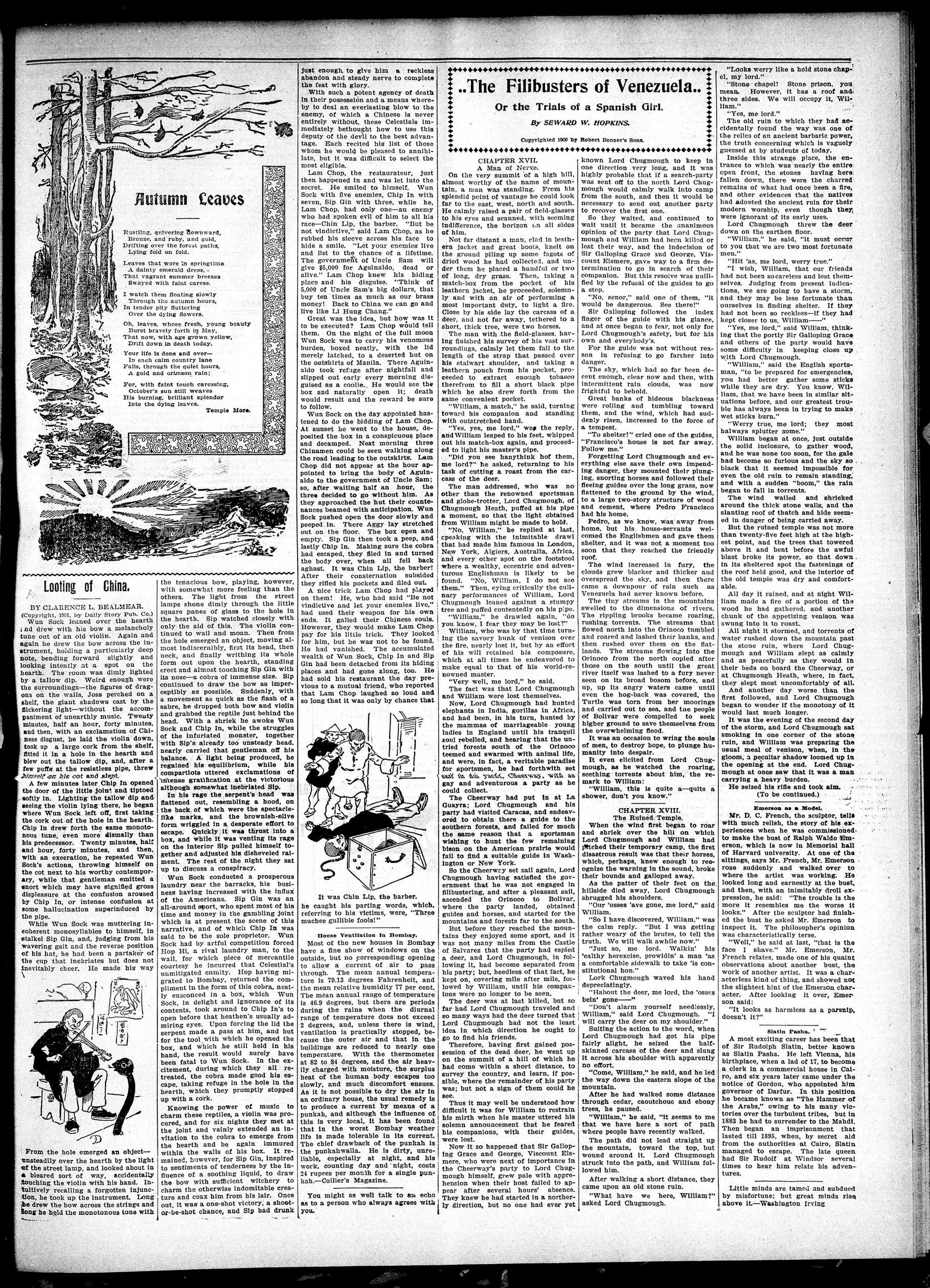
Wun Sock leaned over the hearth and drew with his bow a melancholy tune out of an old violin. Again and again he drew the bow across the instrument, holding a particularly deep note, bending forward slightly and looking intently at a spot on the hearth. The room was dimly lighted by a yellow dip. Weld enough were the surroundings; the figures of dragons on the walls, Joss perched on a shelf, the giant shadows cast by the flickering light—without the accompaniment of unearthly music. Twenty minutes, half an hour, forty minutes, and then, with an exclamation of Chinese disgust, he laid the violin down, took up a large cork from the shelf, fitted it in a hole in the hearth and blew out the tallow dip, and, after a few puffs at the resistless pipe, threw himself on his cot and slept.
A few minutes later Chip In opened the door of the little joint and tipped softly in. Lighting the tallow dip and seeing the violin lying there, he began where Wun Sock left off, first taking the cork out of the hole in the hearth. Chip In drew forth the same monotonous tune, even more dismally than his predecessor. Twenty minutes, half and hour, forty minutes, and then, with an exerction, he repeated Wun Sock's actions, throwing himself on the cot next to his worthy contemporary, while that gentleman emitted a snort which may have signified gross displeasure at the confusion aroused by Chip In, or intense confusion at some hallucination superinduced by the pipe.
While Wun Sock was muttering incoherent monosyllables to himself, in stalked Sip Gin, and, judging from his wavering gait and the reverse position of his hat, he had been a partaker of the cup that inebriates but does not inevitably cheer. He made his way
蛇神
蛇神
蛇神
From the hole emerged an object—unsteadily over the hearth by the light of the street lamp, and looked about in a bleared sort of way, accidentally touching the violin with his hand. Intuitively recalling a forgotten injunction, he took up the instrument. Long he drew the bow across the strings and long he held the monotonous tone with
the tenacious bow, playing, however, with somewhat more feeling than the others. The light from the street lamps shone dimly through the little square panes of glass to the hole in the hearth. Sip watched closely with only the aid of this. The violin continued to wail and moan. Then from the hole emerged an object, moving almost indiscernably, first its head, then neck, and finally writhing its whole form out upon the hearth, standing erect and almost touching Sip Gin with its nose—a cobra of immense size. Sip continued to draw the bow as imperceptibly as possible. Suddenly, with a movement as quick as the flash of a sabre, he dropped both bow and violin and grabbed the reptile just behind the head. With a shriek he awoke Wun Sock and Chip In, while the struggles of the infuriated monster, together with Sip's already too unsteady head, nearly carried that gentleman off his balance. A light being produced, he regained his equilibrium, while his compartiets exclaimed of intense gratification at the victorious although somewhat nebriated Sip.
In his rage the serpent's head was flattened out, resembling a hood, on the back of which were the spectacle-like marks, and the brownish-elive form wriggled in a desperate effort to escape. Quickly it was thrust into a box, and while it was venting its rage on the interior Sip pulled himself together and adjusted his disheveled ralment. The rest of the night they sat up to discuss a conspiracy.
Wun Sock conducted a prosperous laundry near the barracks, his business having increased with the infux of the Americans. Sip Gin was an all-around sport, who spent most of his time and money in the gambling joint which is at present the scene of this narrative, and of which Chip In was said to be the sole proprietor. Wun Sock had by artful competition forced Hop Hi, a rival laundry man, to the wall, for which piece of mercantile courtesy he incurred that Celestial's unmitigated enmity. Hop having migrated to Bombay, returned the compliment in the form of this cobra, neatly enclosed in a box, which Wun Sock, in delight and ignorance of its contents, took around to Chip In's to open before that heathen's usually admiring eyes. Upon forcing the lid the serpent made a pass at him, and but for the tool with which he opened the box, and which he still held in his hand, the result would surely have been fatal to Wun Sock. In the excitement, during which they all retreated, the cobra made good his escape, taking refuge in the hole in the hearth, which they promptly stopped up with a cork.
Knowing the power of music to charm these reptiles, a violin was procured, and for six nights they met at the joint and vainly extended an invitation to the cobra to emerge from the hearth and be again immured within the walls of his box. It remained, however, for Sip Gin, inspired to sentiments of tenderness by the influence of a soothing liquid, to draw the bow with sufficient witchery to charm the otherwise indomitable creature and coax him from his lair. Once out, it was a one-shot victory, a shoot-or-be-shot chance, and Sip had drunk
just enough to give him a reckless abandon and steady nerve to complete the feat with glory. With such a potent agency of death in their possession and a means whereby to deal an everlasting blow to the enemy, of which a Chinese is never entirely without, these Celestials immediately bethought how to use this deputy of the devil to the best advantage. Each recited his list of those whom he would be pleased to annihilate, but it was difficult to select the most eligible.
Lam Chop, the restaurateur, just then happened in and was let into the secret. He smiled to himself. Wun Sock with five enemies, Chip In with seven, Sip Gin with three, while he, Lam Chop, had only one—an enemy who had spoken evil of him to all his race—Chin Lip, the barber. "But be not vindictive," said Lam Chop, as he rubbed his sleeve across his face to hide a smile. "Let your enemies live and list to the chance of a lifetime. The government of Uncle Sam will give $5,000 for Aguinaldo, dead or alive." Lam Chop knew his hiding place and his disguise. "Think of 5,000 of Uncle Sam's big dollars, that buy ten times as much as our brass money! Back to China we can go and live like Li Hung Chang."
Great was the idea, but how was it to be executed? Lam Chop would tell them. On the night of the full moon Wun Sock was to carry his venomous burden, boxed neatly, with the lid merely latched, to a deserted hut on the outskirts of Manila. There Aguinaldo took refuge after nightfall and slipped out early every morning disguised as a coolie. He would see the box and naturally open it; death would result and the reward be sure to follow.
Wun Sock on the day appointed hastened to do the bidding of Lam Chop. At sunset he went to the house, deposited the box in a conspicuous place and decamped. Next morning three Chinamen could be seen walking along the road leading to the outskirts. Lam Chop did not appear at the hour appointed to bring the body of Aguulaldo to the government of Uncle Sam; so, after waiting half an hour, the three decided to go without him. As they approached the hut their countenances beamed with anticipation. Wun Sock pushed open the door slowly and peeped in. There Aggy lay stretched out on the floor. The box open and empty. Sip Gln then took a peep, and lastly Chip In. Making sure the cobra had escaped, they filed in and turned the body over, all fell back aghast. It was Chin Lip, the barber! After their consternation subsided they riffed his pockets and filed out.
A nice trick Lam Chop had played on them! He, who had said "Be not vindictive and let your enemies live," had used their weapon for his own ends. It galled their Chinese souls. However, they would make Lam Chop pay for his little trick. They looked for him, but he was not to be found. He had vanished. The accumulated wealth of Wun Sock, Chip In and Sip Gin had been detached from its hiding places and had gone along, too. He had sold his restaurant the day previous to a mutual friend, who reported that Lam Chop laughed so loud and so long that it was only by chance that
It was Chin Lip, the barber.
It was Chip, the barber
he caught his parting words, which,
referring to his victims, were, "Three
muchee gullible fools!"
House Ventilation In Bombay.
House Ventilation in Bombay.
Most of the new houses in Bombay have a fine show of windows on the outside, but no corresponding opening to allow a current of air to pass through. The mean annual temperature is 79.13 degrees Fahrenheit, and the mean relative humidity 77 per cent. The mean annual range of temperature is 46.9 degrees, but there are periods during the rains when the diurnal range of temperature does not exceed 2 degrees, and, unless there is wind, ventilation is practically stopped, because the outer air and that in the buildings are reduced to nearly one temperature. With the thermometer at 82 to 84 degrees, and the air heavily charged with moisture, the surplus heat of the human body escapes too slowly, and much discomfort ensues. As it is not possible to dry the air in an ordinary house, the usual remedy is to produce a current by means of a punkah, and although the influence of this is very local, it has been found that in the worst Bombay weather life is made tolerable in its current. The chief drawback of the punkah is the punkahwalla. He is dirty, unreliable, especially at night, and his work, counting day and night, costs 24 rupees per month for a single punkah—Collier's Magazine.
You might as well talk to an echo as to a person who always agrees with you.
..The Filibusters of Venezuela.. Or the Trials of a Spanish Girl.
By SEWARD W. HOPKINS.
Copyrighted 1900 by Robert Bonner's Sons.
On the very summit of a high hill, almost worthy of the name of mountain, a man was standing. From his splendid point of vantage he could look far to the east, west, north and south. He calmly raised a pair of field-glasses to his eyes and scanned, with seeming indifference, the horizon on all sides of him.
Not far distant a man, clad in leather jacket and great boots, knelt on the ground piling up some fagons of dried wood he had collected, and under them he placed a handful or two of long, dry grass. Then, taking a match-box from the pocket of his leather jacket, he proceeded, solemnly and with an air of performing a most important duty, to light a fire. Close by his side lay the carcass of a deer, and not far away, tethered to a short, thick tree, were two horses.
The man with the field-glasses, having finished his survey of his vast surroundings, calmly let them fall to the length of the strap that passed over his stalwart shoulder, and taking a leather pouch from his pocket, proceeded to extract enough tobacco therefrom to fill a short black pipe which he also drew forth from the same convenient pocket.
"William, a match," he said, turning toward his companion and standing with outstretched hand.
"Yes, yes, me lord," was the reply, and William leaped to his feet, whipped out his match-box again, and proceeded to light his master's pipe.
"Did you see hanythink hof them, me lord?" he asked, returning to his task of cutting a roast from the carcass of the deer.
The man addressed, who was no other than the renowned sportsman and globe-trotter, Lord Chugmough, of Chugmough Heath, puffed at his pipe a moment, so that the light obtained from William might be made to hold.
"No, William," he replied at last, speaking with the inimitable drawl that had made him famous in London, New York, Algiers, Australia, Africa, and every other spot on the footstool where a wealthy, eccentric and adventurous Englishman is likely to be found. "No, William, I do not see them." Then, eying critically the culinary performances of William, Lord Chugmough leaned against a stumpy tree and puffed contentedly on his pipe. "William," he drawled again, "do you know, I fear they may be lost?" William, who was by that time turning the savory hunk of venison over the fire, nearly lost it, but by an effort of his will retained his composure, which at all times he endeavored to make equal to that of his world-reowned master. "Very well, me lord," he said. The fact was that Lord Chugmough and William were lost themselves.
Now, Lord Chugmough had hunted elephants in India, gorillas in Africa, and had been, in his turn, hunted by the mammas of marriageable young ladies in England until his tranquil soul rebelled, and hearing that the untried forests south of the Orinoco teemed and swarmed with animal life, and were, in fact, a veritable paradise for sportsmen, he had forthwith set sail in his yacht. Cheerway, with as gay and adventurous a party as he could collect.
The Cheerway had put in at La Guayra; Lord Chugmough and his party had visited Caracas, and endeavored to obtain there a guide to the southern forests, and failed for much the same reason that a sportsman wishing to hunt the few remaining blison on the American prairie would fail to find a suitable guide in Washington or New York.
So the Cheerwy set sail again, Lord Chugmough having satisfied the government that he was not engaged in fillbustering, and after a pleasant sail, ascended the Orinoco to Bolivar, where the party landed, obtained guides and horses, and started for the mountains and forests far to the south. But before they reached the mountains they enjoyed some sport, and it was not many miles from the Castle of Salvarez that the party had espied a deer, and Lord Chugmough, in following it, had become separated from his party; but, heedless of that fact, he kept on, covering mile after mile, followed by William, until his companions were no longer to be seen. The deer was at last killed, but so far had Lord Chugmough traveled and so many ways had the deer turned that Lord Chugmough had not the least idea in which direction he ought to go to find his friends.
Therefore, having first gained possession of the dead deer, he went up on the summit of a hill of which he had come within a short distance, to survey the country, and learn, if possible, where the remainder of his party was; but not a sign of them could he see.
Thus it may well be understood how difficult it was for William to restrain his mirth when his master uttered his solemn announcement that he feared his companions, with their guides, were lost.
Now it so happened that Sir Galloping Grace and George, Viscount Elsmer, who were next of importance in the Cheerway's party to Lord Chugmough himself, grew pale with apprehension when their host failed to appear after several hours' absence. They knew he had started in a northerly direction, but no one had ever yet
CHAPTER XVII.
A Man of Nerve.
known Lord Chugmough to keep in one direction very long, and it was highly probable that if a search-party was sent off to the north Lord Chugmough would calmly walk into camp from the south, and then it would be necessary to send out another party to recover the first one.
So they waited, and continued to wait until it became the unanimous opinion of the party that Lord Chugmough and William had been killed or lost their way, and the indecision of Sir Galloping Grace and George, Viscount Elsmere, gave way to a firm determination to go in search of their companion. But this resolve was nullified by the refusal of the guides to go a step.
"No, senor," said one of them, "it would be dangerous. See there!"
Sir Galloping followed the index finger of the guide with his glance, and at once began to fear, not only for Lord Chugmough's safety, but for his own and everybody's.
For the guide was not without reason in refusing to go farther into danger.
The sky, which had so far been decent enough, clear now and then, with intermittent rain clouds, was now frightful to behold.
Great banks of hideous blackness were rolling and tumbling toward them, and the wind, which had suddenly risen, increased to the force of a tempest.
"To shelter!" cried one of the guides, "Francisco's house is not far away. Follow me."
Forgetting Lord Chugmough and everything else save their own impending danger, they mounted their plunging, snorting horses and followed their fleeing guides over the long grass, now flattened to the ground by the wind, to a large two-story structure of wood and cement, where Pedro Francisco had his home.
Pedro, as we know, was away from home, but his house-servants welcomed the Englishmen and gave them shelter, and it was not a moment too soon that they reached the friendly roof. The wind increased in fury, the clouds grew blacker and thicker and overspread the sky, and then there came a downpour of rain such as Venezuela had never known before.
The tiny streams in the mountains swelled to the dimensions of rivers. The rippling brooks became roaring, rushing torrents. The streams that flowed north into the Orinoco tumbled and roared and lashed their banks, and then rushed over them on the flatlands. The streams flowing into the Orinoco from the north copied after those on the south until the great river itself was lashed to a fury never seen on its broad bosom before, and up, its angry waters came until even the hog-back was covered, the Turtle was torn from her moorings and carried out to sea, and the people of Bolivar were compelled to seek higher ground to save themselves from the overwhelming flood.
It was an occasion to wring the souls of men, to destroy hope, to plunge humanity into despair.
It even elicited from Lord Chugmough, as he watched the roaring, seething torrents about him, the remark to William:
"William, this is quite a—quite a shower, don't you know."
CHAPTER XVIII.
The Ruined Temple
When the wind first began to roar and shriek over the hill on which Lord Chugmough and William had pitched their temporary camp, the first disastrous result was that their horses, which, perhaps, knew enough to recognize the warning in the sound, broke their bounds and galloped away.
As the patter of their feet on the hillside died away, Lord Chugmough shrugged his shoulders.
"Our 'osses' ave gone, me lord," said William.
"So I have discovered, William," was the calm reply. "But I was getting rather weary of the brutes, to tell the truth. We will walk awhile now."
"Just so, me lord. Walkin' his 'ealthy herexcise, prowidin' a man 'a comfortable sidewalk to take 'is constitutional hon."
Lork Chugmough waved his hand depreciatingly.
"Habout the deer, me lord, the 'osses bein' gone——"
"Don't alarm yourself needlessly, William," said Lord Chugmough.
"I will carry the deer on my shoulder."
Suiting the action to the word, when Lord Chugmough had got his pipe fairly alight, he seized the half-skinned carcass of the deer and slung it across his shoulder with apparently no effort.
"Come, William," he said, and he led the way down the eastern slope of the mountain.
After he had walked some distance through cedar, caoutchouc and ebony trees, he paused.
"William," he said, "it seems to me that we have here a sort of path where people have recently walked.
The path did not lead straight up the mountain, toward the top, but wound around it. Lord Chugmough struck into the path, and William followed him.
After walking a short distance, they came upon an old stone ruin.
"What have we here, William?" asked Lord Chugmough.
---
"Looks werry like a hold stone chapel, my lord."
"Stone chapell. Stone prison, you mean. However, it has a roof and three sides. We will occupy it, William."
"Yes, me lord."
The old ruin to which they had accidentally found the way was one of the relics of an ancient barbaric power, the truth concerning which is vaguely guessed at by students of today.
Inside this strange place, the entrance to which was nearly the entire open front, the stones having here fallen down, there were the charred remains of what had once been a fire, and other evidences that the natives had adopted the ancient ruin for their modern worship, even though they were ignorant of its early uses.
Lord Chugmough threw the deer down on the earthen floor.
"William," he said, "it must occur to you that we are two most fortunate men."
"Hit 'as me lord, worry true."
"I wish, William, that our friends had not been so careless and lost themselves. Judging from present indications, we are going to have a storm, and they may be less fortunate than ourselves in finding shelter. If they had not been so reckless—if they had kept closer to us, William—"
"Yes, me lord," said William, thinking that the portly Sir Galloping Grace and others of the party would have some difficulty in keeping close up with Lord Chugmough.
"William," said the English sportsman, "to be prepared for emergencies, you had better gather some sticks while they are dry. You know, William, that we have been in similar situations before, and our greatest trouble has always been in trying to make wet sticks burn."
"Werry true, me lord; they most halways splutter some."
William began at once, just outside the solid incclosure, to gather wood, and he was none too soon, for the gale had become so furious and the sky so black that it seemed impossible for even the old ruin to remain standing, and with a sudden "boom," the rain began to fall in torrents.
The wind wailed and shrieked around the thick stone walls, and the slanting roof of that carried and hide seemed in danger of being carried away.
But the ruined temple was not more than twenty-five feet high at the highest point, and the trees that towered above it and bent before the awful blast broke its power, so that down in its sheltered spot the fastenings of the roof held good, and the interior of the old temple was dry and comfortable.
All day it rained, and at night William made a fire of a portion of the wood he had gathered, and another chunk of the appetizing venison was swung into it to roast.
All night it stormed, and torrents of water rushed down the mountain past the stone ruin, where Lord Chugmough and William slept as calmly and as peacefully as they would in their beds on board the Cheerway, or at Chugmough Heath, where, in fact, they slept most uncomfortable of all. And another day worse than the first followed, and Lord Chugmough began to wonder if the monotony of it would last much longer.
It was the evening of the second day of the storm, and Lord Chugmough sat smoking in one corner of the stone ruin, and William was preparing the usual meal of venison, when, in the gloom, a peculiar shadow loomed up in the opening at the end. Lord Chugmough at once saw that it was a man carrying a heavy burden.
He seized his rifle and took aim.
(To be continued.)
Emerson as a Model:
Mr. D. C. French, the sculptor, tells with much relish, the story of his experiences when he was commissioned to make the bust of Ralph Waldo Emerson, which is now in Memorial hall of Harvard university. At one of the sittings, says Mr. French, Mr. Emerson rose suddenly and walked over to where the artist was working. He looked long and earnestly at the bust, and then, with an inimitably droll expression, he said: "The trouble is the more it resembles me the worse it looks." After the sculptor had finished the bust he asked Mr. Emerson to inspect it. The philosopher's opinion was characteristically terse.
"Well," he said at last, "that is the face I shave." Mr. Emerson, Mr. French relates, made one of his quaint observations about another bust, the work of another artist. It was a characterless thing of thing, and showed not the slightest hint of the Emerson character. After looking it over, Emerson said:
"it looks as harmless as a parsnip,
doesn't it?"
Slatln Pasha. $ ^{2} $
A most exciting career has been that of Sir Rudolph Sinatin, better known as Sinatin Pasha. He left Vienna, his birthplace, when a lad of 17, to become a clerk in a commercial house in Caliro, and six years later came under the notice of Gordon, who appointed him governor of Darfur. In this position he became known as "The Hammer of the Arabs," owing to his many victories over the turbulent tribes, but in 1883 he had to surrender to the Mahdil. Then began an imprisonment that lasted till 1895, when, by secret aid from the authorities at Cairo, Sinatin managed to escape. The late queen had Sir Rudolph at Windsor several times to hear him relate his adventures.
Little minds are tamed and subdued by misfortune; but great minds rise above it—Washington Irving
```markdown
```
Work of Livingstone Daughters
The two surviving daughters of Dr.
Livingstone recently opened the ex-
tension of Livingstone College at Ley-
ton, England, founded eight years ago
for training in medicine and surgery
those missionaries about to depart for
ar away stations where they would be
called up to play the part of doctors
as often as that of priest. It was because
Livingstone himself was such a splen-
dial example of the medically trained
missionary that the fine college at
Leyton was erected to his memory.
Boy Story-Writer's Honor
A monument to the late Rev. Elijah Kellogg, the preacher and writer of books for boys, is projected in Maine, and three towns are laying claim to its location—Portland, the city of his birth; Brunswick, where he was educated, and Harpswell, the little seaside town where he preached for so many years and where he died. Some of his friends suggest that the monument be erected in Portland and memorial tablets be placed in Brunswick and Harpswell.
Transvaal Gets New Stamps First. The first stamps to be issued by the British government bearing the imprint of King Edward VII, will be a complete set for use in the Transvaal, says a London newspaper. The government designers are now at work on the pattern, which is understood to be a profile of his majesty on a background of deep carmine. At the same time the imprint of the King when Prince of Wales has been used by one or two of the colonies.
One Woman in Business
A Chicago broker recently found a postal card in his morning mail reading as follows: "Dear Sir—Please buy five thousand shares of People's Gas at 95 cents and sell the same at $1.15. After deducting your commission you may remit the balance in a registered letter. Yours respectfully, Mrs. Bland. P. S.—My future patron depends upon the promptness with which you act in executing the above order."
Married Each Other Often
John and Mary Burkett, of Kokomo, Ind., began marrying each other about forty years ago, and have kept up at intervals ever since. They have had three divorces and four weddings, neither having wedded another the meantime. Kokomo also reports another couple, Henry and Myrtle Mohn, who have been married to each other three times, and are now living happily.
Waves Checked by Nets.
Baron Benvenuto d'Alessandro, an Italian, has invented a means of checking the force of waves by means of nets made of waterproof hemp. One recently tried with success at Havre was 360 feet long and fifty feet wide, with meshes eleven inches apart. The nets will break the waves at sea, and will also be a bulwark for hydraulic works against heavy surf.
Policeman's Christian Association.
Canon Hobson, the founder of the policeman's Christian association, has arrived at New York. This association was founded eighteen years ago in a cellar in Liverpool. It had three members at the start, but today has over 100,000 throughout Great Britain and her colonies. He comes over to visit his sister in Fulton, Oswego county, New York.
Real Coral the Cheaper.
A store in New York which makes a specialty of fancy articles for women's wear recently displayed in a window two chains of coral beads. One was of round, smoothly polished beads and bore the legend, "Imitation coral, 65 cents." The other, of ragged, uncut coral, was marked, "Real coral, 25 cents."
Wheat Belt Around Wichita.
The Kansas wheat belt centers around Wichita. Within a hundred- mile radius of the town fully 60 per cent of the wheat of Kansas was raised, while in seventeen counties of southern and central Kansas 50 per cent of the yield was reaped. In north- Kansas but little wheat is raised.
Damage-Sult Lawyer's Wealth.
lawyer named Patterson died a
days ago in Brooklyn, leaving
about $1,000,000, nearly all made by
conducting damage suits in cases of
accidents and personal injuries, the
attendants being chiefly street rail-
road and similar corporations.
Poems by King James L.
An interesting literary discovery is reported from Oxford, where a number of hitherto unknown poems by King James I. have been found in the Bodleian library. They are stated be undoubtedly genuine and bear the royal autograph.
Traveling with Qx Teams.
A novel vacation trip is being taken by Banker Jenkins and a party of seven friends, from Carrolton, Kas. They are traveling across the state of Colorado in an old-style prairie wagon behind relays of oxen spans.
University Extension for St. Helena.
St. Helena is to have a university extension. The Cape University is going to send examiners to the island for the young Boer prisoners who are studying to enter the university.
Debt of Four Great Cities.
New York City's debt is now $283,-
$42,000. The debt of Chicago is $26,-
$80,000, of Philadelphia $43,000,000, and
Boston $54,192,000. The oldest citi-
ties have the largest debts.
BILLINGS' PHILOSOPHY.
It costs less to agree with a phool than to differ with him.
All men owe much more to chance than they are willing to admit.
Men who luv the least to make munny, luv the most to spend it.
Old age iz a perch whare all the akes, sorrows and ills ov life cum to roost.
Obstinacy mite be excusable in a wize man, but wize men are never obstinate.
The best friend and the worst enemy than enny man haz got iz his consilience.
Luv, which is simply the result ov fear, will turn to hate the fust good chance it gits.
Thare is nothing that God luvs more, and nothing that makes us all feel better, than thankfullness.
The man who won't proffitt bi the experiences ov others, ain't a going to proffitt mutch bi hiz own.
Take all the folly and foolishness out ov this world, and there would be but little excitement, and no fun at all in living in it.
When the bottom does fall out of a simply comik fool, he all goes to pieces in such a way that he never kan be mended agin.
All human natur luvs to tak the chances. Thare is grate fun in seeing how near yu can go to a mule's heels without gitting highsted.
I have no doubt thare iz a perfecktly honest man in the world sumwhate, but I will travel 250 miles to see him, and giv 10 dollars for the sight after I git thare.
To lie well a man must have a greasy tongue, a level face, and abuv all a smart memory, so that he can tell the same lie at least twice alike out ov 3 times.
A true kritick iz like a bee; he hunts for funny, and nothing else, wherever he lights.-Josh Billings in New York Weekly.
HOUSEWIFE SUGGESTIONS.
A few drops of turpentine in hot starch adds luster to ironed linen.
Arrowroot tied in a thick cotton rag and boiled with linens and cottonts imparts an odor to them that is pleasing.
English pottery with Dutch mottoes seems an anomaly and rather incongruous, but the effect is quaint and attractive. Candlesticks with strange birds and beasts appeal to the eye.
Silk and linen are woven together to make the handsomest table damask. Sometimes the goods is brought out in mauve, gold and white and an especially pretty pattern was all in soft rosy pink.
A shelf supported by brackets and from which falls a curtain is a good scheme to conceal a radiator. Then the shelf may be embellished by a large brass or copper pot or a few pieces of bric-a-brac.
To avoid wrinkling bodices and jackets they should be hung on frames such as men use for their coats, winding the frames first with cloth or silk, upon which, if desired, orris or other sachet powder may be sprinkled.
Little used matting, as in spare chambers or upper summer rooms, should be swept very clean, then wiped with a cloth wrung out of sweet milk.
Do this once a year—it keeps the straw live and to a degree pliant. If the milk wash is used in a living room or on a plaazza, follow it by wiping with very hot clear water to keep the floor from drawing files.—Chicago News.
PEOPLE'S QUEER WAYS.
In the extreme north and extreme south of England some remains can be traced of the old style of harvest home, which was usually celebrated during September. The emblem of it was the kern-baby, or, as it is called in the north, the kirn-dolly, a tiny sheaf made of the last stalks of grain cut, tied with bright ribbon and carried home by the harvest queen, to be afterward hung on the wall of the great straw barn, while the harvesters feasted on boiled mutton and potatoes and home-brewed beer and then danced till morning.
A party of Bedouin Arabs, with camels, horses and donkeys, which camped for some weeks at the zoological gardens in Vienna, took with them, when they left for Tresse, seven Viennese brides, to whom they will be married with Arabian rites upon reaching their destination. All the women had property. Thirty others who wanted to take up a desert life were rejected because of their poverty. A traveler in Abyssinia writes: "We here found quite a new currency—thin bands of iron, 2 feet long, 1 inch wide, sixteen of which go to the Abyssinian dollar. They are called 'dorma.'"—Chicago News.
ITEMS OF INTEREST.
South Dakota has more Indians (11,000) than any other state. Of the territories Indian Territory has 56,000 and Arizona 25,000.
The common measure of road distance in Greece is the pike, three-quarters of an English yard, 1,000 pikes being about 750 yards.
The orange tree is very fruitful; a single tree will produce 20,000 oranges fit for use. A good lemon tree will produce 8,000 lemons.
By the advice of eminent oculists, the authorities of Munich have decided no longer to use gas or petroleum for lighting school rooms.
A curious custom prevails in Korea. If a man meets his wife in the street he ignores her presence and passes her as if she were a stranger
Sold at all drug stores. Price, 25c. in large cans-Contains One Month's Treatment. If your druggist does not keep it he will get it for you, or we will mail it to any address, securely wrapped on receipt of 30c. in stamps or silver. For testimonials and full information, address
Luman Nature Exemplified.
An Aitchison father who has a lazy worthless son sent him adrift on Saturday at noon, saying he never wanted to se him again. The young man's mother carried on in a pitiful way, but the father was inexorable, the young man must get out and shift for himself. The young man went away saying he would return a rich man some day and make his father ashamed of himself. His mother said he was a noble boy, and swooned. That night at 6 o'clock the kitchen door opened softly, and the young man came in, carrying a small armful of wood. When supper was ready he took his usual place at the table, and ate with his customized appetite. The father said nothing, but the mother waited on her son with unusual care, as though he had returned with the fortune he had talked at noon.—Aitchison Globe
The Merchant of Venice
A Venetian merchant who was lolling in the lap of luxury was accosted upon the Rialto by a friend who had not seen him for many months. "How is this?" cried the latter; "when I last saw you your gaberdine was out at elbows, and now you sail in your own gondola." "True," replied the merchant, "but since then I have met with serious losses, and been obliged to compound with my creditors for ten cents on the dollar. Moral.—Composition is the life of trade."—Lanigan's Fables.
"I have used Chamberlain's Colic Cholera and Diarrhoea Remedy and find it to be a great medicine," says Mr. E S. Phipps, of Poteau, Ark. "It cured me of bloody flux. I cannot speaktoo highly of it." This remedy always wins the good opinion, if not praise, of those who use it. The quick cures which it effects even in the most severe cases make it a favorite ev-ey where. For sale by all Druggists.
Caleb Powers and Number "13."
Caleb Powers and Number 13.
Powers, the Kentuckian convicted of complicity in the murder of Goebel, may be excused if he put some faith in the idea that thirteen is an unlucky number. He was nominated for office June 13, 1899; arraigned July 13, 1900, as one of thirteen conspirators named; was defended by thirteen lawyers; his sweetheart was the thirteenth witness; the evidence showed that 1,300 soldiers were ready to defend him; he gave Culton $1,300 to pay the expenses of the mountainers; he took $1,300 with him when he fled; the evidence closed Aug. 13.
NOTICE OF EXPIRATION OF RIGHT OF
REDEMPTION.
To the Chicago Great Western Railroad, formerly the Chicago St. Paul and Kansas City Railroad, and J. N. McDowell:
You and each of you are hereby notified that on the 6th day of December, 1898, the following described real estate to-wit: Lot Twenty-five (25) Bennett Place, except railroad right of way, in Des Moines, Polk County, Iowa, according to the recorded plat thereof, was sold for the then delinquent and unpaid taxes for the years 1895, 1896 and 1897 to the undersigned and that the undersigned is the legal owner and holder of the said certificate of purchase issued in pursuance of the aforesaid sale, and that the right of redemption will expire and a deed issued for said land, unless redemption is made within ninety days from the date of the completion of this service.
Des Moines, Iowa., Oct. 29, 1901.
J. L. SANDS,
Owner of said certificate.
NOTICE OF EXPIRATION OF RIGHT OF
REDEMPTION.
To the Chicago Great Western Railroad, formerly the Chicago St. Paul and Kansas City Railroad, and W. W. Sovereign:
You and each of you are hereby notified that on the 6th day of December 1898, the following described real estate to-wit: Lots 23 and 24, Bennett Place, except railroad right of way, in Des Moines, Polk County, Iowa, according to the recorded plat thereof, was sold for the then delinquent and unpaid taxes for the years 1895, 1896 and 1897 to the undersigned, and that the undersigned is the legal owner and holder of the said certificate of purchase issued in pursuance of the 'aforesaid sale and that the right of redemption will expire and a deed issued for said land, unless redemption is made within ninety days from the date of the completion of this service.
Des Moines, Iowa, Oct. 29, 1901.
J. L. SANI
Owner of said cerlifiate.
BENOAD VINCENT
Nelson's Straightline
FREE FROM ALL INJURIOUS CHEMICALS.
GUARANTEED PERFECTLY HARMLESS.
Nelson's Straightine Not only straightens the hair, but, by nourr-
ing it, licking the roots, prevents it from falling out, removes Dandruff cares it,
gives a long and Beautiful Head of Hair. It is used and highly endorsed by a
people in all sections of this country. We guarantee Straightine to be free
from all injurious chemicals, and cannot injure the hair. Straightine does
not take off hair, and can be left off after time, or contin-
ued as long as desired. Thousands of testimonials on file.
The Corinthian baptist Church —situated on 11th St. between Crocker and School. Sts. Preaching; at 11 A. M.; Sunday School; at 12 o'clock Preaching; at 10 A. M.; Sunday School; at 12 o'clock Preaching; at Rev. B. Stes, pastor.
St. Paul A. M. E. —Corner of Second and Center St. Preaching; at 10:30 a. m.; Sunday School at 3 o'clock; Epworth League at 7 p. m.; preaching at 8 p. m. L. J. Phillips, pastor.
First African Baptist Church —Corner School and Fourth streets. Rev. F. Lomack pastor. Preaching 10:30 a. m.; Sunday school 9:30 p. m., Mr. M. E. Housten. Superintendent; Young People's meeting 7 p. m., preaching 800 p. m.
Burn's M. E. —East Second and Des Moines Sunday services, preaching at 11:00 a. m. and 4 p. m. Sunday School at 12:30 Prayer and Class meeting, Wednesday 9:30 p. m. All are welcome. Rev. C. W. Holmes, pastor. 290 Des Moines street.
Mount Nebo Baptist Church —E. Second Street, between second and third streets, preaching at 11 a. m.; Sunday School 12:30 p. m., Superintendent, Rose Johnson. Preaching at 8 p. m. Rev. J. H. bell, pastor.
Ternaclemb Baptist Church Mission —Situated over 605 East Locust street. Preaching 11 a. m.; Sunday School 9:00 a. m.; preaching at 8 p. m. Rev. J. R. Winchb, pastor.
SECRET ORDERS.
North Star Lodge, No. 3, A, F. A. M. -Meets First Thursday in each month at Masonic Hall, W. Court, Court avenue. J. H. Shepard, W. Court, Court avenue. Solomon Commandery, No. 6 -Meets Second and Fourth Thursday in each month at Masonic hall. Frud Jackson, M. C.; G. H. Cleggett, Rec.
Naomi Court, No. 3 -meets Second Monday in each month at Masonic hall, Mrs. J. H. Shepard, matron; Mrs. Fred Jackson, secretary.
Mt. Olive Court, No. 4 -meets First Thursday of each month at Masonic hall, Mrs. Susan White, matron; Mrs. Flora Majors, secretary.
Olity Court, No. 2192, G. U. of O. F. -Meets First, Second and Third Tuesday each month at Odd Fellows hall on West Sixth and Walnut streets. D. Burns, N. G.; F. Brown P. S.
H. H. of R., No. 329 of G. U. of O. F. -Convince and third Thursday in each month, promptly at 8 o'clock. Mrs. B. J. Holmes, M. N. G. Mrs. G. L. Williams, W. R. Knights and Ladies of Honor of the World No. 178 Victoria Lodge-meets every Monday evening at Webster's Hall, corner of Tenth Avenue and Wood. Proctor; Mrs Rose Johnson, Secretary.
CALIFORNIA.
Broad Vestibuled First-Class Sleepers DAILY- Between Chicago and Sanfrancisco
Great Rock Island Route
Leave Chicago on Big 5 at 10:00 p. m.
All the best scenery of the Rocky Mountains and the Sierra Nevada by daylight in both directions.
These cars are carried on the limited trains of the Great Rock Island Route, Denever and Rio Grande (Scenic Route), Rio Grande Western and Southern Pacific.
Dining Car Service Through Buffett Library Cars.
JOHN SEBASTIAN, G. P. A.,
Chicago.
THE GILBERT
BY EXPERIENCE COOKS....
Short Orders and Meals.
Nice Furnished Rooms
By Day or Week.....
221 S. Market St. Ottumwa, Ia.
50 YEARS' EXPERIENCE
PATENTS
TRADE MARKS DESIGNS
COPYRIGHTS & C.
Anyone sending a sketch and description may quickly ascertain our opinion free. Neither invention is probably patentable. Communications strictly confidential. Handbook on Patents sent free. Oldest name for securing patents. Patents taken through Munn. & Co. receive special notice, without carga, in the
Scientific American.
A handsomely illustrated weekly. Largest circulation of any scientific journal. Terms, $3 a year; four months, $L Sold by all newdealers.
MUHN & Co. 361Broadway, New York
Branch Office, 025 F St., Washington, D.C.
Nelson's St
Makes KINKY CURLY Hair
The Ideal HAIR
This is what Captain Beall says 50 days: Dr. C. M. McLennan, Dear Doctor.—"After catarrh had bigged me, and after it had produced the catarrh of the stomach which was killing me, all the other doctors had made it a failure of my case you took hold of it and cured me. I have not had a pain or ache or a sign of catarrh for seven years, and I want the world to know it." Very respectfully yours, GEORGE BEALL
We refer the afflicted to people we have cured, among them: H. C. Harris, of Harris, Emery, Dry Goods Co.; Rey. Dr. Wirt, Pastor St. John's Lutheran Church, Des Moines, Iowa.
The treatment at $8.00 per month includes all medicines for the cure of catarrh, Dechasse, Hay Fever, Bronchitis, Asthma, and all affections of the Hose, Throat, and Lungs; also Stomach, Liver, Spleen, Kidney, and Bladder troubles. Consultation free by mail to Kyle's, McLean's, Monarchs.
This is a fine opportunity to obtain good descriptive reading matter for little or nothing.
WONDERLAND 1901—
An annual publication, beautifully illustrated in color and half-tone. This number treats particularly of the Send history of the Northern Pacific's Trademark, the Custer Six Cents Battlefield in Montana, and the Yellowstone Park.
MINIATURE WONDERLAND—
A neat and dainty publication containing a complete history of the Northern Pacific Trademark. The arti- Send tic covers of the wonderland 1901 are used in miniature. Four Cents
WILD FLOWERS FROM YELLOWSTONE—
WILD FLOWERS FROM YELLOWSTONE
A book of pressed wild flowers from Yellowstone Park showing the real flowers in their natural colors. A Send dainty and beautiful souvenir—ten specimens of flowers Fifty Cents and six full page illustrations of Park scenery.
YELLOWSTONE NATIONAL PARK—
A new 112-page book in strong flexible covers, good paper, plain type, illustrated, pocket size, a compendium and descriptive of the World's Wonderland. Send Twenty-five Cents
Iowa State Bystander
NELSON MANUFACTURING CO., 1333-1335 E. Franklin St., Richmond, Va.
O
By Dear Doctor. "After catarrh had blighted
good, and after it had produced a chronic failure of catarrh
all the other doctors had made a failure of catarrh
had a pain or ache or a sign of catarrh for seven yea
Very
We refer the afflicted to people we have cured, and
Dry Goods Co.; Rev. Dr. Wirt, Pastor St. John's.
The treatment at $5.00 per month includes all
Hay Fever, Bronchitis, Asthma, and all affections of the
Sorel, Kidney, and Bladder troubles. Consultation
Consultation Blank and Symptom Sheets wi
w and Catarrh free to any Address
The book also contains hundreds of testimonial le
THE COPELAND MED
Dr. C, M. McL
6
GOOD LITERATURE
FOR ALMOST folders, ten up contain.
NOTHING MR. CHAS. S. Agent, St. Paul mailed, upon receipt can be made, andnoney or exp accepted.
This is a fine opportunity to obtain for little or nothing.
WONDERLAND 1901—
An annual publication, beautiful and half-tone. This number tre
In 1894 Capt. Beall's days seemed to be numbered. His friends had given him up to the army, and he carried a Captain's stripes during the war, who later became a Chief of Police was later named "beyond." But Capt. Beall did not die; he ed by Dr. McLean's New Treatment, and his friends were amazed. Seven years later he living monument of what Dr. McLean
Captain Beall says to-day: Dr. C. M. MOLHAM
gilted my boyhood days and cursed my ear
tarr of the stomach which was killing me, and when
my case you took hold of it and cursed me. I have not
any years, and I want the world to know it.
Very respectfully yours,
GEORGE BEALL
ared, among them: H. C. Harris, of Harris, Emery,
John's Lutheran Church, Des Moines, Iowa.
des all medicines for the cure of Catarrh, Emery,
ins of the Moss, Throat and Lung; also Stomach, Liver,
fat for the office.
sets with Dr. McLean's Monograph on Deafness,
and is of Great Value to the Afflicted.
onicial letters from cured patients.
MEDICAL INSTITUTE,
M. McLean, Chief Consulting Physician,
GOG Walnut St. Des Moines, Iowa.
RE The Northern Pacific is noted
among railways for its adver
tising matter. Its pamphlets,
builders, booklets, etc., are tastefully got up and are valuable for what they maintain. Here is a partial list of what S. S. FEE, General Passenger for Paul, Minn., will send out, carefully receipt of prices given. Any combination express orders, silver or stamps will be able to obtain good descriptive reading matter.
Beautifully illustrated in color, the treat is particularly of the Pacific's Trademark, the Custer and the Yellowstone Park.
Containing a complete Pacific Trademark. The artisanal 1001 are used in miniature. Four Cents.
STONE—Flowers from Yellowstone Park in their natural colors. A small—ten specimens of flowers of Park scenery.
Strong flexible covers, good pockets, pocket size, a compendium of World's Wonderland. Cents.
The book, 72 pages, in strong heavy paper, descriptive of travel in the United States—special nature.
SIBE FOR THE
State Bystander
THE
DEST
COLORED
NATIONAL IN
IOWA
Paper in the North-west.
KO
Counties in Iowa
States in the Union
Foreign Countries.
Cents in Iowa and corres-
many different states.
Chesapeake
AFTER USING.
treatment. If your druggist does
he will mail it to any address, ser-
dress
5 E. Franklin St., Richmond, Va.
WRITE AT ONCE FOR TERMS
The World's Wonder Indian Pile Cure!
Sure cure for piles. Others have been cured, why not you? I have had remarkable success in effecting pile cures. I guarantee from 1 to 3 boxes to cure any case of piles. Read the following testimonial:
I have had piles for fifteen years. I have used all kinds of salves and had two surgical operations performed without any permanent relief. I have been entirely cured by using Burnett's Pile Salve. L. R. GENEVA, Meat Merchant, Oskaloosa, Iowa, April 8, 1896.
Only 50 cents a box, or upon receipt of 56 cents I will forward a box to any part of the United States. For further information see me.
PROF. T. L. BURNETT,
402 South Jackson Street,
Mt. Pleasant, Iowa.
WANTED—TRUSTWORTHY MEN AND
women to travel and advertise for the
established business, including
$780 a year and expenses, all payable
in cash. No cavassing required. Give refer
ences and enclose self-addressed stamped envelopes. Address Manager, 38 Caxton Hldg.
Chicago.
EVERYBODY
KNOWS THAT MUNGER'S LAUNDRY is the best in the city. Try them and be decided.
Maine Office 211-215 NINTH St
Branc Office 504 MULBERRY St.
PHONE 579.
SHANK BROS..
Funeral Directors
517 Mulberry St.
Telephones 686, 688 and 689.
DES MOINES, - IOWA.
IT IS IN THE LEAD!
....DO YOU READ.....
THE FREEMAN?
If not. Why not?
The Leading Paper
of THE RACE.
NEWSY, SPICY & EDUCATING
A digest of all the news
of the week, on all ques-
tions and from all parts
of the country.
SUBSCRIBE NOW
FOR 30 DAYS THE FREEMAN
will be sent to any address for one year
for $1.00. Sample copies on application.
Write for list of promotions. Address
THE FREEMAN,
INDIANAPOLIS, INDIANA
Counting Years in Japan.
Mr. B. Mayehatake, a young Japanese who has been studying in Chicago, gives an explanation of the method by which time is reckoned in the chrysanthemum land. The Japanese year begins on our January 1, but instead of counting from the birth of Christ a reckoning is made from the reign of Japan's first, emperor, Zimu. Our 1901 is the year 2561 in Japan. When a new ruler mounts the throne a distinctive name is given to his reign and a sort of petty calendar is kept of the years of his government, as as we keep track of the age of our republic, writing in legal documents: "Year of our Lord 1901, and of the independence of the United States the 125th." The name for the present mikado's rule, which began thirty-three years ago, is Meiji. This word is pronounced Mayee, and means "peaceful government." Therefore, the current year in Japan is Meiji 34 as well as Zimu 2561.
We want you to subscribe for the Iowa STATE BYSTANDER.
An Old Lady's Mistake
Cardinal Gibbons was formerly a frequent visitor to Cape May and usually took long walks morning and afternoon by the seashore. He always wore his cardinal's skull cap of scarlet silk, of which an inch or so showed below the rim of his silk hat. One afternoon while he was on the board walk an old lady stopped him and said: "Excuse me, sir, but the lining of your hat has slipped down in the back." The cardinal thanked her gravely, but as soon as she left laughed heartily at her mistake.
WANTED—TRUSTWORTHY MEN AND women to travel and advertise for old established house of solid wood and expenses, all payable in cash. No canvassing required. Give references and enclose self-addressed stamped and Address Manager, 33 Cox Bldg. Chicago.
First Bricks in North America
The first bricks made on North American soil were manufactured by the colonists of Virginia in 1612. They were used in building the church at Jamestown and the residences of the governor and the more important citizens. A portion of Jamestown church is still standing, and the bricks of which it was built are in good preservation and appear to have been well made.
NOTICE OF EXPIRATION.
To Myrtle A. and F. M. Swain:
You are hereby notified that the following described real estate, situated in Polk county, Iowa, to-wit: Lot 19 of Gray's subdivision of lot 61, Brooks, & Co.'s addition to city of Des Moines, was sold for the taxes of 1896 on the sixth day of December, 1897, to B. F. Loose, that the certificates of sale thereof are now owned by B. F. Loose, and that the right of redemption will expire, and a treasurer's deed for said land will be made unless redemption from such sale be made within ninety days from the date of completed service of this notice. You will govern yourself accordingly.
Dated nineteenth day of October, A. D. 1901.
NOTICE OF EXPIRATION OF RIGHT OF REDEMPTION FROM TAX SALE
To Ira L. A. Ward:
You are hereby notified that the following described real estate, situated in Polk county, Iowa, to-wait: Lot 57 T. M. Walker's addition to city of Des Moines, was sold for taxes of 1896 on the seventh day of December 1897, to B. F. Loose, that the certificate of purchase thereof has been assigned to any is now owned by B. F. Loose and the right of redemption will expire, and a Treasurer's deed for said real estate will be made unless redemption from such sale be made within ninety days from the date of completed service of this notice. You will govern yourself accordingly.
Dated fifteenth day of October, 1901. B. F. LOOSE.
To remove a troblesome corn or bunion; First soak the corn or bunion in warm water to soften it, then pare it down as closely as possible without drawing blood and apply Chamberlain's Pain Balm twice daily: rubbing vigorously for five minutes at each application. A corn plaster should be worn for a few days, to protect it from the shoe. As a general liniment for sprains, bruises, lameness and rheumatism, Pain Balm is unequaled. For sale by all Druggists.
Quakers in Cuba.
One of the curiosities of Cuba is a Quaker meeting-house which has been erected at Gibara, near Santiago. The congregation of Friends is said to number over two hundred.
One Fare Plus $2.00 for the Round Trip
Is the rate the Northern Pacific will make to western points reached via its line, on account of Home-seskers excursions. Selling dates will be Oct. 15, Nov. 5 and 19 and Dec. 3 and 17. For further information write G. D. Rogers D. P. A., N. P. R., No. 503 Locust St. Des Moines, Ia., or address Chas. S. Fee, G. P. & T. A., N. P. R., St. Paul, Minn.
NOTICE OF EXPIRATION OF RIGHT
OF REDEMPTION FROM TAX SALE.
To S. S. Arntz:
You are hereby notified, that the following described real estate, situated in Polk County, Iowa, to-wit: S. 1/ 10 of N. 1/ 10 Lot Five (5) Block Seventeen (17) Town of Sheldahl, Iowa, was sold for taxes of 1896, '95, '94, '93, '92 and '91 on the Sixth day of December, 1897 to B. F. Loose, that the certificate of purchase is now owned by B. F. Loose, and that the right of redemption will expire, and a Treasurer's Deed for said real estate will be made unless redemption from such sale be made within ninety days from the date of completed service of this notice. You will govern yourself accordingly.
Dated sixteenth day of October, A.
D. 1901. B. F. LOOSE.
B. F. Gibson at 10:30 a.m.
NOTICE OF EXPIRATION.
To Administration Trust & Securety Co.
You are hereby notified, that the following described real estate, situated in Polk County, Iowa, to-wit: Lot Fifty-one (51) Block Two (2) Home Park Addition to city of Des Moines, Iowa, was sold for the taxes of 1896 on the Seventh day of December 1897 to B. F. Loose, that the certificates of sale thereof are now owned by B. F. Loose and that the right of redemption will expire, and a Treasurer's Deed for said land will be made unless redemption faom such sale be made within ninety days from the completed service of this notice. You will govern yourself accordingly.
Dated 19th day of October, A. D., 1001
B. F. LOOSE.
By E. F. Gibson, storney.
NOTICE OF EXPIRATION.
To J. R. Kellison and Elizabeth J. Madison:
You are hereby notified, that the following described real estate, situated in Polk County, Iowa, to-wit: Lot Four (4) Block Eighteen (18) original town of Polk City, Iowa, was sold for the taxes of 1895, 1896, 1897 on the Fifth day of December, 1898 to J. L. Sands, and that the right of redemption will expire, and a Treasurer's Deed for said land will be made unless redemption from such sale be made within ninety days from the date of completed service of this notice. You will govern yourself accordingly.
Dated Seventh day of November, A.
D., 1901. J. L. SANDS.
Fastest on Home Stretch.
A statistician has discovered that the average business walk in New York is a mile in twenty minutes, and the church-going walk is a mile in twenty-five minutes. The fastest walk is that of the homeward-bound Brooklynites, a mile in eighteen minutes.
Variations in children's gowns blossom out from time to time, even though they are very slight, and small girls rival their mothers in their ambition to keep up to date.
Soft wool materials make up very prettily in this way. In figured French flannel the collar may be made of the same and trimmed with rows of narrow braid or velvet ribbon. Skirts of the small gowns are usually plain, but the older girls have some sort of trimming, either tucks, stitched bands, ruffles or velvet folds, stitched on.
The long-waisted mode, in which the waist line rounds down low in front, is conspluously evident among the gowns for girls over 10 years of age, and the small gowns for dainty little girls of 6 imitate this fashion as much as possible by having the long waist all around. Guimpe dresses, which never seem to go out of style, are suitable for all ages, from 6 to the more mature years of middle age.
Bolero jackets are very popular in the kingdom of small costumes, and the attempt to produce the effect of stole ends is seen in one little gown, where narrow lace revers are carried down the entire length of the front, as shown in the illustration. Another pretty effect is made by two box plaits in front, one at either side from the yoke to the hem, and two in the back, giving a long effect to the waist, which is defined with a narrow velvet belt ending in small velvet rosettes at either side of the front on the plaits. The skirt gathers qn to the waist between the plaits, which apparently are a continuation of those in the waist. A sailor collar of lace covers the shoulders in the back and opens in front over a yoke of tucked white silk or batiste.
Thin gowns of point d'esprit for party wear are variously trimmed with ruches, ruffles, lace insertion and rows of colored satin ribbon. A pretty feature of the small girl's costume is the coat and hat to match.—New York Sun.
ORIGINAL NOTICE
In the District Court of the State of Iowa, in and for Polk county:
Birdie Gay vs John Gay } January Term, A. D. 1901.
To John Gay: You are hereby notified that on or before the 15th day of December, A. D. 1901, there will be a petition on file in the Clerk's office of the district court, in and for Polk County, Iowa, claiming of you a divorce from the bonds of matrimony that is now existing between you and plaintiff, on the grounds of desertion without a cause, and such other relief as may be just and equitable, and unless you appear and make defense thereto, on or before noon of the 7th day of January, A. D. 1902, which is the second day of the said January of 1902 term of court, which is held at the court house at Des Moines, Polk county, Iowa, default will be rendered against you and decree rendered thereon as prayed for in the petition, dated this the 21 day of November, A. D. 1901, J. B. RUSH,
Attorney for plaintiff.
NOTICE OF EXPIRATION
To Estin Week:
You are hereby notified that the following described real estate, situated in Polk county, Iowa, to-wit: Lot Thirteen (13) Block B, Des Moines Co. addition to town of Polk City, Iowa, was sold for the taxes of 1895, 1896, 1897 on the Fifth day of December 1898 to J. L. Sands. That the certificate of sale thereof has been assigned to and is now owned and held by J. W. Riggles, and that the right of redemption will expire, and a Treasurer's Deed for said land will be made unless redemption from such sale be made within ninety days from the date of completed service of this notice. You will govern yourself accordingly. Dated 22nd day of November, A. D. 1901. J. W. RIGGLES,
Swiss Ride Unis.
The Swiss Rifle Union has no less than 4,000 sections spread all over the country, with a total of 120,000 members, says a Lucerne correspondent. Every fourth year this union organizes a grand rifle meeting, at which prizes are given.
Sherry in the Coffee
A little sherry and also coffee added to chocolate very much improv is the drink. A tablespoonful of sherry and four of clear, strong coffee to six cupfuls of chocolate is about the right proportion. Both should be added after the chocolate is taken from the fire.
Police Need Language Drill.
At the suggestion of a Chicago justice of the peace a school is to be opened in that city in which policemen will be taught elementary grammar, so that they can express themselves more clearly on the witness stand.
Dr. William Lloyd Stokes, bacteriologist of the city of Baltimore, has been elected a member of the faculty of the College of Physicians and Surgeons in that city, and has been given the chair of pathology.
World's Largest Apple Orchard.
Ex-Gov. Morrill of Kansas owns what is said to be the largest apple orchard in the world. When work now in progress has been completed, the orchard will contain 64,000 trees.
Elljah and "Dr." Dowle Compured,
"I am Elljah," says "Dr." Dowle. One difference that suggests itself is that whereas Elljah was fed by the ravens, Dowle is fed by the gulls.—New York Herald.
FORECAST OF FASHIONS.
A fchu effect of Hamburg is pretty on a wash frock.
Lawn collars with colored borders are the latest fad.
Very long waisted effects are now the fashion for small children.
Black grenadines, both plain and figured, are offered in great varieties.
A popular style of trimming for the street and everyday hat is the draped silk scarf.
Gainsborough and Duchess of Davonshire hats appear among the high-priced millinery.
Rich, dull black is exceedingly becoming to golden-haired, fair-complexioned women.
Embroidered pongees appear beautiful in the excellence of their fiber and needleworked design.
Costly netted fringes add greatly to the grace of the sweeping, clinging gowns of soft fabrics. Long, unlined sleeves are again the mode of evening gowns. They are made long over the hands. Entire gowns of crape for either the street or the house are exceedingly handsome, and always becoming.
French challis and sheer nun's veling are two very favorite materials in the preparing of the summer outfit. Black and white is perhaps the most favored combination of the season, and some lovely effects are to be seen in simple materials. All waists have a becoming fullness at the front and skirts are extra full at the bottom. Puff effects are also noticeable on the sleeves. Striking-looking parasols are those made of silk of broad pronounced stripes, running around the upper part of the parasol, while the lower part is of chiffon and silk. Mercerized sateens, which very closely resemble satin foulard, and soft silk and linen mixtures in dainty colorings, striped, dotted, and plain of surface, are among the favored materials for shirt waists for morning wear this spring.
HAPPY TIT-BITS.
"Poor Matie, her marriage was a disappointment." "Was it?" "Oh, yes; she didn't get half the nice presents she counted on."
"You are not addicted to any kind of athletics, are you?" "Athletics?" Gracious man, I earn a good living for a family of seven.
"The doctor says I must go away for a change of climate," said Mrs. Dukane. "If that's all you need," replied Dukane, "stay right here, and the change of climate will come to you."
"Wait a minute," she said to the young man. Now, the young man, being a wise party, immediately went to the telephone and told his friends he would possibly be with them in two hours.
Mistress—Bridget I am tired of your carelessness. Only look at all that dust lying about on the furniture; it is six months old at the very least. Maid (very dignified)—Then it is no fault of mine. You knows, very well, mum, that I have been with you only three months.
WHAT THE LAW DECIDES.
A loan made to a married woman on her credit, although she gave notes therefor payable to her husband, which are void, is held in National bank vs. Tyndale (Mass.), 51 L. R. A. 447, to sustain an action at law against her estate upon the common' counts for money lent or money had and received. Bona-fide residence of the plaintiff in a suit for divorce is held, in Bell vs. Bell, U. S. Adv. Sheets 551, to be necessary to give jurisdiction of a suit for a divorce against a resident of another state, and a recital of facts necessary to give jurisdiction is held not to be conclusive on the courts of another state.
Actual notice of proceedings for divorce in a court of the state which has always been the domicile is held, in Atherton vs. Atherton, U. S. Adv. Success will, and to be necessary to bind a non-resident defendant if reasonable efforts to give her actual notice are required by the state statutes and are actually made.
ODDS AND ENDS.
There are now fifty-eight factories, with 250,000 horse-power in the French Alps.
The number of Japanese at present living in the United States is estimated at 35,000.
The population of the German empire includes 3,000,000 who use the Polish language.
The Neodesha (Kas.) Register has a report of a shale bed that shows the prints of horses' feet, shod.
In New Hampshire the state government pays a bounty on dead grass-hoppers at the rate of $1 a bushel.
"Tartar" morocco is the leather of which the new card cases and purses are made. The colors are delicate and artistic.
Although the letter carrières have been ordered to wear shirt waists, they are not forbidden to deliver mall in wrappers.
The Burmese Soung.
The Burmese sound is a harp, the body being modeled like a boat, with a long, high prow. The Instrument has a scale rom low A in the bass clef to F in the G clef. It is used to accompany vocal music.
---
DANISH PROVERBS.
Even crumbs are bread.
Opportunity makes the thief.
Faint praise is akin to abuse.
Short flax makes long thread.
Power often goes before talent.
Death does not blow a trumpet.
Gray hairs are death's blossoms.
Praise a fair day in the evening.
Alone in counsel, alone in sorrow
A short cut is often a wrong cut
New comers are always welcome.
Every bird needs its own feathers.
Let every bird sing its own note.
Trust everybody, but thyself most.
We must suffer much, or die young.
Every man thinks his copper is gold.
Every wind is against a leaky ship
Unwilling service earns no thanks.
A woman's first counsel is the best.
He that courts injury will obtain it.
He who flees proves himself guilty.
Do not wade when you see no botom.
It is bad to lean against a falling wall.
Better the child cry than the mother sigh.
We must sow even after a bad harvest.
An ill-tempered dog has a scarred nose.
Never let fools see half finished work.
Even he gets on who is drawn by oxen.
Big words seldom go with good deeds.
It is folly to fear what one cannot avoid.
He is easy to lure who is ready to follow.
Little sorrows are loud, great ones silent.
Riches are often abused, but never refused.
Every fool thinks he is clever enough.
Under white ashes lie often glowing embers.
A thankless man never does a thankful deed.
It is the raised stick that makes the dog obey.
It is hard to pay for bread that has been eaten.
WISE AND OTHERWISE.
Love and philosophy are sworn enemies.
Old age commands respect—except in poultry and jokes.
Some men are in advance of their age, but women are always a few years behind it.
The failure of a bank may not upset the depositor, but he is apt to lose his balance.
You have to give some men a sound thrashing before you can command their respect.
No matter how erect a general may be he is apt to learn more or less on his staff.
The girl who used mucilage to keep her hair in curl has been much stuck-up ever since.
Perhaps some people talk to themselves because they find it impossible to interest any one else.
In order to retain her youth and popularity all a girl has to do is acquire a fortune and remain single.
The average man does just as many queer things when he isn't in love as when he is, but they are less conspicuous.
What a merry old place the earth would be if it were to lose its atmosphere. All bodies would then lose their gravity.
Says a rural editor: "We trust our subscribers will pardon us for appearing a day late this week. Our wife borrowed our scissors to cut our son's hair."
TRICK OF VOICE.
now One Lawyer Keeps the Judge From
There is said to be a lawyer in Philadelphia who possesses a trick of the voice to which a certain measure of his success in United States Supreme court practice is due. The trick consists in waking a judge. Whether it is a common practice for the high dignitaries of the federal supreme bench to indulge in a nap in the course of a long and tedious argument, such happenings are not unknown, and it is well for an able logician of the bar to be prepared for it. The trick of waking a sleepy judge would seem to be something in the nature of slamming a law book under his nose or connecting his personality with the current of an electric battery. But the trick is explained as purely a matter of sound involved in the skillful control of the voice. It is said that a barrister practiced in the art and rhetoric of addressing the bench can gather all the waves of sound from his throat into a focus and deposit it in the orifice of the judge's ear with the general effect of a bomb. The trick, however it is accomplished, is said to have been worked repeatedly with success on the late Judge McKennan, whose habit of going to sleep on the bench was once a notorious subject of comment in the litigation over the Berliner telephone patients. This queer trick of the voice, while it is said to be the peculiar property of one celebrated lawyer, is probably attempted often with varying success by others.—Philadelphia Record.
Godmother on Wholesale Scale.
Ex-Empress Eugenie of France is not only godmother to the children of an immense number of personal friends, but also to 3,384 of her husband's subjects who were born on March 16, 1856, the day that her son, the ill-fated prince imperial, first saw the light.
1
It is said that the Indians gave to the first eastern immigrants who reached California the name of "Wo-hah," formed from "whoa-haw," the sound they heard the drivers produce when they shouted to their oxen.
When Oliver Goldsmith was one day asked regarding James Boswell, "Who is this Scotch cur at Johnson's heels?" the author of "The Good-Natured Man" characteristically responded: "You are too severe. He is not a cur, he is only a bur. Tom Davies flung him at Johnson in sport and he has the faculty of sticking."
One day in a London tobacconist's shop, Sandow, the strong man, was handed some change, and in the middle of it he saw something that looked like a bad shilling. He pushed it back across the counter. "I think that one is bad," he said. "Nonsense," said the shop keeper, with an incredulous air. He took up the shilling and tried it in the little brass coin-tester that war screwed to the side of the counter. Then he tendered it again. "It's quite good," he said, "I can't bend it." Sandow smiled and took it between his finger and thumb. "You can't bend it! May I try?" he asked. "Certainly," said the man, with a grin. The strong man pressed the tip of his forefinger toward the tip of his thumb, and the spurious coin bent like tissue paper. "Well," said the tobacconist, dumfounded, "it looks like a wrong 'un after all. Perhaps you will accept another?" And Sandow did.
President Porfrio Diaz of Mexico gained national prominence and won his spurs at the battle of Puebla, where the liberal forces made a gallant but ineffectual stand against the French who had invaded Mexico for the purpose of erecting a throne for Maximilian. Notwithstanding that the Mexican forces were defeated, their defense against superior numbers was so gallant that the anniversary of the battle of the 5th of May became a national holiday in Mexico. A brusque American once asked the President: "Why do you Mexicans celebrate a defeat, when you know that the French finally took Puebla?" President Diaz with a twinkle in his eye, replied: "Perhaps we imitated the Americans even to the extent of celebrating our defeats, for I have been told that the British defeated the colonists at Bunker Hill, and yet you built a monument to commemorate the event."
SERMONETTES ON M'KINLEY.
The President's home was ideal, and his loyalty as a disciple of Jesus Christ was notable.Rev. D. McLeod, Presbyterian, Washington, D. C.
The heroic spectacle of that Christian deathbed is an example for all time of how a Christian man may meet the issues of life and death.—Rev. C. J. Young, Puritan, New York City.
Above all, McKinley was a Christian, exemplifying in his daily life the sublime power and excellency of the principles of Christianity.—Rev. Dr. Chapman, Methodist, Washington, D. C.
The simple truth is this, anarchy is atheism. It is the denial of any overruling Providence and the refusal to recognize any God whose will is law.—Rev. Dr. Huntington, Episcopallian, New York City.
President McKinley is dead, but he lives in the lives and in the hearts of all decent people as a man who was true to his God, his country and his manhood.—Rev. C. L. Twing, Episcopalian, Brooklyn, N. Y.
The doctrine that humanity could exist, that order and civilization could be maintained without law and order, as the disciples of anarchy assert, is one of the wildest notions.—Rev. Dr. Drachman, Rabbi, New York City.
There is a national grief, and there must needs be a national lesson. What is this horde which finds a harbor among us, and who, to further their own principles and ideas, strike at the innocent and lay them low? They are a class with diseased minds, on evil bent.—Rev. R. M. Kemp, Episcopalian, New York City.
BILLPOSTING IN FRANCE.
The landlord, usufructuary or tenant in chief, has always the right to oppose any posting on his house and he can take down all posters placarded without his permission.
All placarding, done knowingly, of posters which do not contain the names, profession and address of the author and printer is punished by imprisonment of from six days to six months. This punishment is reduced to a fine if the printer's name be disclosed.
If the contents of a poster incite to crime or misdemeanors, if they be contrary to morality, the distributors, printers or authors will be punished with a fine of from 16 to 500 francs, imprisonment from one to twelve months and the confiscation of the posters.
No private individual may placard posters on public monuments or on places destined to receive official posters—penalty 100 francs. Posting is not allowed on walls of buildings bearing the legend "Stick no bills."—Chicago Chronicle.
IN A NUTSHELL.
The demand for electrical vegetators in India is ahead of the supply. Electrical apparatus used in mining in this country is estimated to be worth about $100,000,000. Paving experiments are to be made in Havana with vitrified bricks, granite squares and sandstone blocks.
CANAL COMMISSION REPORT
Nicaragua Route Is the Best and
Cheapest.
by the Panama Route the Cost Is Estimated at $853,374,858, and in Addition the Canal Concession Would Cost the United States $109,141,000.
The Interoceanic Canal Commission's report is in favor of the Nicaragua route and it will be submitted to Congress before the holidays. Here is the report in full:
The investigations of this commission have shown that the selection of "the most feasible and practicable route" between the Nicaragua and Panama locations. Furthermore, the complete problem in that location and that with locks. The Panama route is feasible for a sea level canal, although both are entirely practicable there. The route required to complete a sea level canal on the Panama route, probably more than that that could be found with locks, includes it from favorable consideration, aside from other serious features of its construction. It is the inclusion of this commission that makes the route locks should be adopted. A comparison of the principal physical features, both natural and man-made, than some points of similarity. Both routes cross the continental divide less than ten miles, summit being about double the height of that in Nicaragua.
Both Routes Require Costly Dams.
For more than half its length the location of each route on the Atlantic side is slow from whose drainage basin is the only source of water supply for the production about twenty feet in elevation—Panama being the lower—are formed by lakes natural in the one case and artificial in the other. The waterways and water ways for their regulation and for the impounding of surplus waters to creating demands during low water seasons. The investigations made in conjunction with Nicaragua have demonstrated that the lake affords an inexhaustible water supply of 600,000 cubic meters of material proposition, on the other hand, for the Panama route, to form Lake Bohio to yield a water supply for a traffic of 600,000 cubic meters of material mentioned when needed by an amount sufficient for more than four times that of the river. For all practical purposes this may be considered an unlimited supply practical operation of a ship canal is concerned, therefore, the water supply The difficulties disclosed and likely to be encountered in the construction of the dams are less at Conchuda, on the Nicaragua route. Both dams, however, are practicable, but the cost of that at one-half more than that at Conchuda.
Commission Desires a Perfect Structure.
Panama Has Railroad in Operation.
A well equipped railroad is in operation along the coast and existing conditions there afford immediate accommodation for a large force (or more) to be transported to natural harbor at either end. At both the Atlantic and Pacific terminal, a bridge created by the removal of material at low prices and by the construction of a finished design. An excellent roadstead, protected by islands, already exists at the terminal, created for either harbor construction or maintenance. At Colon, the Atlantic terminal harbor already exists. It has afforded harbor accommodations for many years, and for many harbor construction times in each year are liable to damage ships or force them to put to sea. Consequently, it creates a suitable harbor at the entrance of the canal, which can be easily entered and complete protection to shipbuilding with.
```markdown
```
Excavation Work Compared.
The completion of the harbors, as planned for both resorts would yield but the resorts would either be the sole source of advantages, including those of maintenance and operation, a probably necessary source of advantages, in the sense of a harbor at each terminus of the Panama Canal, and an isthmus will make it practicable to commence work there, after the concessionary plan has been collected and in place and the working force organized. This period is estimated at two years, so as to include also the port plant and the harbor bors terminal and railroad facilities. The work of excavation on the Nicaragua Canal, at Conchuda, at Tamaribo and in the divide west of the lake. On the Panama Culebra, and Emperor cakes, which are
Method for Concentrating Blood.
A cheap and rapid method for concentrating the enormous quantities of blood collecting in abattoirs has been invented recently. The blood is injected into an oven-shaped chamber, open at the top, and brought into contact with a current of hot air ascending from below. All the water is evaporated in this manner, and the blood powder is carried to the receiving chamber. The product thus obtained is tasteless, and contains 78.4 per cent of digestible albumen.
practically one. As a rule, distributed work affords a greater number of available points of attack, contributing a quicker completion, but requiring a case set. As may exist can be successfully met with suitable organization and efficient appliances.
Labor Scarce There.
The time required for constructing the Miraquag Canal will depend largely on the promptness with which it is brought to Nicaragua, housed and organized with the locations of heaviest work along the route, and the lake probably will require the longest time of any single feature of construction. It contains 18000 cubic feet of water, or a little less than 10 per cent of the total work of all classes included. With accurate estimates that it can be completed in four years, this indicates, under reasonable allowance for ordinary delays, the force of work required to secure a practically concurrent execution of all portions of work on the route. The work must be executed within six years after its being started, exclusive of the two years necessary for securing and organizing of the great force of laborers needed, largely foreigners, so as to adjust the excavation to such a definite program of close fitting parts in a practically unpopulated area, and would prolong the time required for completion. The greatest single feature of work on the Panama Canal is the cubic section, amounting to about 43,600 cubic yards of hard clay, much of which is classed as soft material, and all of all classes of material to be removed.
Eight Years Required.
It is estimated that this cut can be completed in eight years, with allowance for ordinary delays, with preparation and for unforeseen delays, and that the remainder of the work can be finished within a concentration of work on this route and its less amount will require a smaller cut to the Nicaragua route. Hence the difficulties and delays involved in securing them will be correspondingly smaller, while the total length of the Nicaragua route, from sea to sea, is 183.96 miles, while the total length of the Nicaragua route, from land to sea, is 184.96 miles, and on the harbors and entrances, is 72.78 miles for the Nicaragua route, and 70.51 miles for the Nicaragua route. The length of sailing line in Lake Nicaragua is 70.51 miles, while that in Lake Guatemala is 70.45 miles. The Nicaragua route in the canalized San Juan is 39.37 miles. The preceding physical features of the work to be done in the construction of waterways along the two routes will be done on the Nicaragua route on the canal on the Nicaragua route is $48,680,704 more than that of completing the work. This measure acquires the latter property. This sum measures the difference in the magnitude of the obstruction of the two canals and covers all physical considerations, such as the greater or lesser depth of cuts, the presence or absence of natural harbors, the presence or absence of a road to be done. The estimated annual cost of maintaining and operating the Nicaragua route will be $10,000,000 for the corresponding charges for the Panama Canal.
Panama Route Shorter.
The Panama route would be 124.5 miles shorter, from sea to sea, than the Nicaragua route. It would have less summit elevation, fewer thick�ت, and less time for less time. The estimated time of a deep draft vessel to pass through is about twelve hours for three months. This period is not as well as the Nicaragua. These periods are practically the measure of the relative advantages of the two canals as water was not as high as two. Two to one, not entirely, because the risks to vessels and the dangers of delay are greater in a canals. The risk of loss is lower in the items of risk and delays. The time required to pass through the canals needs to be taken as a result of one of the vessels to make their voyage between terminal ports. Compared on this basis, the Nicaragua has an average average rate of all transisthiman, commercial, except that originating or ending on the vessel was as much as the Nicaragua would be as much as the Swahili port. The United States is most interested, that between our Pacific ports and Atlantic ports, Europe and the United States, the port is shorter by one day. The same advantage exists between our Atlantic ports and the洋海port. The port is always always in the range of the Nicaragua route. It is nearly two days. For commerce between North America and South America, the canals are shorter but about two days. The Nippon gulf ports and the west coast of South America are the most common to the Nicaragua route, but the more favorable one for sailing vessels, because they are under no need. The Nicaragua is also a material matter, as a sailing ships are rapidly being displaced by the canals. The canals are more likely to be simply a means of communication between the two oceans. The route has been a very long and complex process. The years and a railroad has been in operation there for nearly fifty years; but this is affected by the changes of the country through which the route passes are such that no considerable developmeness is possible. The construction of a canal. In addition to its use as a means of communication between two canals, the Nicaragua route would bring Nicaragua and a large portion of Costa Rica and other Central American countries. The most common with the United States and with Europe. The ultimate business relations that would be established with the supply of the United States during the period of construction by the expenditure of vast sums of money in these states, the cost of the American products and manufacturing taxes would be likely to continue after the completion of the work, to the benefit of the country.
In other interests, the country
Nicaragua the Healthier.
The Nicaragua route lies in a region of sparse population and not in a pathway of much trade or movement of people. Conditions productive of much sickness do not exist. On the other hand, a considerable population is being existed on the Panaquana route and it lies in a pathway of comparatively large trade, along which currents of moving people from infected places sometimes converge, thus creating conditions favorable to epidemics. Existing conditions indicate hygienic advantage for the Nicaragua. Although it is probable that less effective sanitary measures must be taken during construction in the one case than in the other. The cost of constructing a canal by the Nicaragua route and of completing the Panaquana, without including the other accounting the concessions from the different governments is estimated as follows:
Nicaragua.....$189,864,002
Panama.....144,233,358
For a proper comparison there must be added to the latter the cost of acquiring the rights and property of the New Panama Canal Company. This commission has estimated the value of these costs as well as recommended by it at $10,000,000. In order to exercise the rights
SCRAPS.
To be vain of one's rank or place,
is to show that one is below it—Stanislaus.
At all seasons of the year 5 o'clock
in the morning is the coldest hour of
the twenty-four.
We are made ridiculous less by our
defects than by the affection of qual-
ities which are not ours.
This year's harvest in the south of
Ireland is stated to be the best experi-
enced for a quarter of a century.
necessary for the construction of the canal and for its management after completion of the United States territory from sea to sea sufficient in area for the convenient and efficient accomplishment of these tasks. The line of territory to protect the line from unlawful acts of all kinds to insure sanitary control and to render police jurisdiction over less than five miles wide on each side of the center line of the canal, or ten miles wide on each side of the state lines within whose territory the two routes lie authorizing the United States to occupy its territory of the canal. When it has been determined to undertake the work and the route has been selected by the Vijangon and Costa Rica for such occupation must be obtained before the inauguration of the enterprise, and one or more concessions to the enterprise. The republic must arrange by any existing concessions or treaty obligations, and are free to grant to the United States the occupies of these ends, and in December, 1800, demonstrated their willingness to have their territory occupied by the resident to accomplish the construction and provide for the ownership of the proposed canal when it is resident. The resident is authorised to law acquire the necessary control and authority.
Colombia Not Free.
States Must Be Compensated.
In each case there must be added the cost of obtaining the use of these other privileges as may be necessary for the construction and operation of the canal and for the different states will ask for granting these privileges is now unknown. There is a shorter canal line, more complete knowledge of the country through which it is located, and operation, in favor of the Panama canal, but the price fixed by the Panama canal and franchises is so unreasonable that its acceptance cannot be recommended by this commission. The canal and franchises are developed by the investigations made by the commission, the actual situation as now is, and the commission is offered by the New Panama Canal Company, this commission is of the opinion that the canal is valuable route for an isthmian canal to be "under the control management and ownership of the Nicaragua route.
THE MINORITY REPORT:
George Morrison of the Canal Commis-
Following is a summary of the minority report of George S. Morrison of the Nicaraguan Canal as to which I can suggest no evidence that the location for the Nicaraguan Canal as one to which I can suggest no evidence that the location for the Nicaraguan Canal does not make enough provision for unknown conditions and contingencies. The cost of the work on both the Nicaraguan Canal and the same unit prices and with the addition of the same percentage of the cost of the water, Sanitation and General Contingencies." The excavation of the Panama Canal has been determined to be length, and the character of the material to be removed can be examined in position. Of the Nicaragua route the character of material has been determined by borings which, though unusually complete, contain the information that is visible at Panama.
At Panama there are fair harbors at born census of the canal that are fully adaption and connected by a railroad in high condition, the country is settled and connected for a large working force are there. Before the eastern section of the Nicaragua canal was created at Greytown, convenient lines of transportation which do not now exist are built to the minimum of housing and caring for a large laboring population, nearly all of which must be the preliminary engineering has been done at Panama and the general contingencies for the construction of modeling modified estimates of completing the Panama Canal would be $7,000,000 less than the cost of building the Nicaragua Canal. A panama route two concessions must be extinguished before such rights can be acquired. They are the contract of the Panama canal that must hold its present rights, and the Wyss concessions, under which the French canal companies have been operating. They must be simply an extinguishment of their rights; the authority to build the canal for a large new treaty with the republic of Colombia.
The Panama route has advantages over the carriage route of construction, in the form of operation and in intelligence when done, while its use is less likely to lead to local international commerce. The Panama government is to build an isthmian canal the Panama route is the best. The French rights must first be extinguished. They may pay for such extinguishment will be salvage to the French. If these rights are fulfilled the Nicaragua route is available.
GEORGE S. MORRISON
Steel Roofs.
A new patent steel roofing will shortly be placed on the market, and it is asserted that this product will completely displace galvanized iron for roofing purposes. The system of manufacture consists of steel strips bent cold in the press, the covering being formed of plain galvanized sheets bent back on the edges and locked into tubular rafters. Works for the manufacture of this product on a large scale are being constructed at Darlington, England.
Cheese-Making Area Enrolment. A few years ago it was believed that the area in which cheese could be made was comparatively limited. A strip of country including New England, New York, Ohio, Indiana, Wisconsin, and southern Canada was believed to be well adapted to the curing of cheese, while the regions a little to the north and south were debarred from ever going into the industry by reason of a too high or too low temperature. Within a few years, however some remarkable things have occurred. Cheese has been ripened and cured in places outside the supposed limit. While at the Tennessee Experiment Station this summer the writer had the pleasure of inspecting the cheese-making plant of the Tennessee Agricultural College. Professor Soule says that cheese is ripened perfectly in that region; the same is doubtless true of all the mountain region of the south. Since it has been discovered that the cheese-ripening process goes on in cold weather as well as warm the ripening of cheese in the far north is made possible. The supposed area suitable to cheese making has been always governed by the temperature for cheese ripening. The proper control of the curing room settles that question once for all. Doubtless if the dairying area is ever pushed to the gulf the cheese-making area will go with it—Farmers' Review.
To Increase the Use of Wool.
To Increase the Use or Wool.
The legislative committee of the National Live Stock Association has prepared a bill providing for the inspection of woolen goods and shoddy and for the proper stamping of the same. Congress will be asked to pass it at its next session. By the provisions of this bill all manufacturers of goods or fabrics of any kind whatsoever made in imitation of woolen goods or fabrics, or goods which when so made are calculated or intended to be sold as woolens or woolen goods, not made wholly of new or unused sheep's wool, shall so mark, label or tag such goods as that they may be readily distinguished from genuine wools. That such mark, label or tag shall be so attached to such goods or fabrics as that it cannot be detached except by design; and such label shall accurately state in plain printed letters and figures the constituent fibers or other materials or substances of which it is composed, or the relative portion or per cent of each. Provision is also made for heavy fines for the manufacturers that evade the law and also for all tailors and retailers that handle without marks goods requiring marking. Were such a law passed, its vigorous enforcement would be equally beneficial to the purchasers of clothing and to the producers of wool.
Pine Apple Producing Regions.
The flavor of the pineapple is agreeable that no one has to acquire a taste for it. Pineapples are on the market throughout the year, but those sold at other times than during the main crop season are too high priced a luxury for the average man. The main shipping season is from the middle of April to the middle of July. The area in the United States adapted to their cultivation is considerable and can be greatly extended. The largest tract of pineapple land is in Florida. Pineapples can also be produced profitably on some land in southern California. Although all of Porto Rico and the Hawaiian Islands are free from frost, the soil and climate are not uniformly adapted to their production. There is more land in the Philippines adapted to the production of pineapples than will be utilized for several generations. The pineapple supply of the United States is contributed to by Porto Rico, the Bahama Islands, Jamaica, San Salvador and Trinidad.
Not long ago a man made the remark to the writer that "without doubt most of the food sold as butter is oleomargarine." The writer replied that he was most certainly mistaken, as the amount of butter made is greatly in excess of the counterfeit. Last year there was made in this country not less than 1,400,000,000 pounds of butter and about 100,000,000 pounds of oleomargarine. This means fourteen times as much honest butter as of the bogus article.
Level-Headed Child.
A lady was recently reading to her little son the story of a little fellow whose father was taken ill and died, after which he set himself diligently to work to assist in supporting himself and his mother. When she had finished the story she said: "Now, Tommy, if pa were to die, wouldn't you work to keep mamma?" "Why, no," said the little chap, not relishing the idea of work. "What for? Ain't we got a good house to live in?" "Oh, yes, my dear," said the mother, "but we can't eat the house, you know." "Well, ain't we got plenty of things in the pantry?" continued the young hopeful. "Certainly, dear," replied the mother, "but they would not last long, and what then?" "Well, ma," said the young incorrigible, after thinking a moment, "wouldn't there be enough to last until you got another husband?"
Ten Year's Progress.
The net result in respect of speed is that while ten years ago the highest sustained ocean speed was 20.7 knots, it is now 23.51 knots; the highest speed for large warships was 22 knots, and is now 23 knots on a trial of double the duration of those of ten years ago; the maximum speed attained by any craft was 25 knots, as compared with 36.581 knots now; while the number of ships over 20 knots was eight in 1891, and is fifty-eight now.—London Engineering.
for Health
dii C. Pinkham
Years for Health
Lydia C. Pinkham
How Truly the Great Fame of Lydia E. Pinkham's Vegetable Compound Justifies Her Original Signature.
m's Vegetable Compound. The worst forms of Female Complaints, all Ovation and Ulceration, Falling and Displacement, frequent Spinal Weakness, and is peculiarly Life. Types of Backache and Leucorrhoea than any is ever known. It is almost infallible in such cells tumors from the Uterus in an early stage as any tendency to cancerous humors. Or Painful Menstruation, Weakness of the tating, Flooding, Nervous Prostration, Headly yields to it. Pain, weight, and backache, instantly reared by its use. Under all circumstances it laws that govern the female system, and is as
It will entirely cure the worst forms of Female Complaints, all Ovarian troubles, Inflammation and Ulceration, Falling and Displacement of the Womb, and consequent Spinal Weakness, and is peculiarly adapted to the Change of Life.
It has cured many cases of Backache and Leucorrhea than any other remedy the world has ever known. It is almost infallible in such cases. It dissolves and expels tumors from the Uterus in an early stage of development, and checks any tendency to cancerous humors.
Irregular, Suppressed or Painful Menstruation. Weakness of the Stomach, Indigestion, Bloating, Flooding, Nervous Prostration, Headache, General Debility quickly yields to it.
Womb troubles, causing pain, weight, and backache, instantly relieved and permanently cured by its use. Under all circumstances it acts in harmony with the laws that govern the female system, and is harmless as water.
It quickly removes that Bearing-down Feeling, extreme lassitude, "don't care" and "want-to-be-left-alone" feeling, excitability, irritability, nervousness, Dizziness, Faintness, sleeplessness, flatulency, melancholy or the "blues" and backache. These are sure indications of Female Weakness, or some derangement of the Uterus, which this medicine always cures.
Kidney Complaints and Backache of either sex the Vegetable Compound always cures.
No other female medicine in the world has received such widespread and unqualified endorsement. No other medicine has such a record of cures of female troubles.
Those women who refuse to accept anything else are rewarded a hundred thousand times, for they get what they want—a cure. Sold Druggists everywhere. Refuse all substitutes.
The cousins of Menzo Shaul of Herkimer, N. Y., are coming into existence with the fecundity of rabbits all over the country. He died recently, leaving $21,000 to be divided among his third cousins, meaning, as he expressed himself, of those related to me as cousins. There are already 370 persons, from various parts of the United States, who have sent in their claims to the estate.
Alaskan dogs are called malamutes, and are a cross between a dog and a wolf. About two months after birth they are trained to draw little wagons, and soon become very useful. They do not bark, but utter a melancholy howl. They have long hair, and can sleep in the open air with the mother in the textile clothes zero. Their usual food is fish and seal blubber. They are fed once a day, usually at night.
Since the 1st of March 100 men have been engaged in killing mosquitoes about Havana in every known way, and the result is stated to be that, instead of having 52 deaths from yellow fever and 32 from malarial fever, the average in September, there were only two deaths from yellow fever and three from malaria during the past September. No smallpox has occurred in a year, and there were scarcely any cases of other infectious diseases.
CANADA'S CAPITAL AROUSED.
Never Was There Such Excitement—Physicians' Association Trying to Explain.
Ottawa, Canada, Nov. 25th.—This city is stirred up as never before. Some seven years ago the local papers published an account of a man named George H. Kent of 408 Glimour street, who was dying of Bright's Disease and who at the very last moment after several of our best physicians had declared he couldn't live twelve hours, was saved by Dodd's Kidney Pills.
People who know how low Mr. Kent was refused to believe that he was cured permanently and the other day in order to clinch the matter the papers published the whole case over again and backed up their story by sworn statements made by Mr. Kent, in which he declares most positively that in 1894 he was given up by the doctors and that Dodd's Kidney Pills and nothing else saved him, and further that since the day that Dodd's Kidney Pills sent him back to work seven years ago, he has not lost a single minute from his work. (He is a printer in the American Bank Note Printing Company.) Mr. Kent is kept quite busy during his spare hours answering inquiries personally and by letter, but he is so grateful that he counts the time well spent. Indeed he and his wife have shown their gratitude to Dodd's Kidney Pills in a very striking way by having their little girl—born in 1896—christened by the name of "Dodd's."
Altogether it is the most sensational case that has ever occurred in the history of medicine in Canada and the perfect substitution of every detail leaves no room to doubt either the completeness or the permanency of the cure.
The local physicians have made the case of Kent and Dodd's Kidney Pills the subject of discussion at several of the private meetings of their association.
The best lighted street in the world is the famous thoroughfare of Berlin, Unter-den-Linden. It is illuminated by three lines of electric lights, which are separated by two lines of linden trees.
**YELLOW CLOTHES ARE UNSIGHTLY**
Keep them white with Russ Bleaching Blue. Get the genuine. All grocers, 10c.
He who despises mankind will never get the best out of either others or himself.—Tocqueville.
Ask your grocer for DEFIANCE
STARCH, the only 10 oz. packages for
10 cents. All other 10-cent starch
contains only 12 oz. Satisfaction
guaranteed or money refunded.
Age ever looks backward; youth
forward; so the two never see the
same scenery of life.
ANOTHER WONDER OF SCIENCE.
Biology has Proved that Dandruff is Caused
by a Germ.
Science is doing wonders these days in medicine as well as in mechanics. In medicine the human race has been troubled with dandruff or which hair preparation has heretofore proved a successful cure until Newbrow's put on the market. It is a scalp preparation that kills the germ that causes dandruff by digging into the scalp to get at the root, where it saps the vitality, causing itching scalp, falling hair and finally nausea. Without dandruff hair must grow luxuriously. Herpicide at all drugs. It is the only destroyer of dandruff.
We get old trying to stay young, but we do not stay young trying to be old.
Don't fold unlaundered curtains.
Don't cool tomatoes in the ice box.
Don't buy "cheap" lines as they are
the dearest.
Don't use "cheap" soap in the laundry as it costs the most.
Don't use a starch that will produce that harsh crackling effect, but go to your grocery and order Defiance Starch. 16 ounce package for 10 cents. Made by Magnetic Starch Co., Omaha, Neh.
Boston is so well pleased with portable school houses that forty-three are in use this year.
FITS Permanently Cured. No fits or new curtains first day of use. Free restorer history. Free FREE $2.00 trial restorer. Dr. P. H. Klink, 931 Arch St., Philadelphia, Ph.
Last year Uncle Same turned out new coins worth $136,000,000, of which $99,000,000 were gold.
DEFIANCE STARCH
should be in every household, none so good, besides 4 oz. more for 10 cents than any other brand of cold water starch.
A fruit tree in Bristol, Penn., bears two different kinds of apples and four different varieties of pears, namely, the Bartlett, the Duchesse, the Catharine and the Seckel.
Deafness Cannot Be Cured
by local applications, as they cannot reach the diseased portion of the ear. There is only one way to cure deafness, and that is by constitutional remedies. Denfness is caused by an inflamed condition of the mucus lining of the Eustachian Tube. When this tube is inflamed you have a rumbling sound or imperfect hearing, and when it is entirely closed deafness is the result, and unless the inflammation can be taken out and this tube restored to its normal condition, hearing will be destroyed forever; nine cases out of ten are caused by catarrh, which is nothing but an inflamed condition of the mucus surfaces.
We will give OneHundred Dollars for any cases of Denfness (caused by catarrh) that cannot be cured by Hall's Catarrh Cure. Send for circulars, free.
F. J. CHENEY & CO., Toledo, O.Sold by Druggists, 750.
Hall's Family Pillis are the best.
The "newsboy" on the Santa Fe's Lawrence-Ottawa (Kan.) branch is at urchin of seventy-two years.
Matt J. Johnson's 6688
has cured thousands of rheumatism. It will cure you. Try It. All drummists.
The studied hypocrisy of men has driven me to doubt everything but man's simple ignorance.
DO YOUR CLOTHES LOOK YELLOW?
Then use Defiance Starch, it will keep them white—16 oz. for 10 cents.
The desires not gratified on earth are the pigments with which men paint the skies of their heaven.
Ask your grocer for DEFIANCE STARCH, the only 16 oz. package for 10 cents. All other 10-cent starch contains only 12 oz. Satisfaction guaranteed or money refunded.
The hope of being elected to public office has saved many a politician from the penitentiary.
"WHAR DEW I CUM IN?"
[Being the Soliloquy of a Farmer on the Free Raw Sugar Question.]
"Thar's a mighty lot er talkin' about farmers 'n thar rights,
'N the wonderful prosperity that beet growin' invites.
Thar's a heap er foolish crowin' n the 'beats' begin ter shout
'n holer fer the Tariff ter keep free raw sugar out!
But I notis that the beet-producien' farms are very few,
An' the farmers through the country ain't got much ef it ter dew.
The hull land ain't a-raisin' beets, n ain't goin' ter beet.
Beet growin's right fer sum, I guess—but, whar dew I cum in?
The farmer gits four dollars now fer every ton o' beets—
A hansom price, I must allow—but hidin' sum deceits.
Beet sugar manyfacterens admit es they hew found
Thet "granylated" costs 'em sunthin' like tew cents a pound.
In fact that leaves a profit on which they'd greatly thrive—
And—if it kin be sold for three, why should we pay 'em FIVE?
It seems ter me es that's a game that's mighty like a skin—
But—if that's any benefit—waal—whar dew I cum in?
When Uncle Sam's in want o' cash we're glad ter help him out,
'N we'll stand all the taxes thet are needed, never doubt,
But when his pocket-book's well lined an' nary cent he lacks,
Et seems ter me his duty's ter repeal the sugar tax.
Them fellers wot is interested sez its to protect
the beet-producin' farmer thet the duty they collect,
But I guess the explanation es a little bit too thin—
The sugar maker,—he's all right;—but—whar dew we cum in?
Take off raw sugar duty an' the price will quickly fall,
To everybody's benefit, fer sugar's used by all.
The poor will bless the Government thet placed it in thar reach—
('n millions of our citizens free sugar now besech)
The dealer 'll be delighted—less expenditure fer him—
More demand n' bigger profits—which at present are but slim.
An' the farmer 'll be as well paid as he ever yet hes ben—
But he'll buy his sugar cheaper—that's whar he an' I'll cum in.
Now, what's the sense er reason of the sugar tax to-day,
When our treasury's a-bulgin' an' we hev no debts ter pay?
The duty on raw sugar's Fifty million every year—
An' the people's got ter pay it—that's a fact that's very clear
Fifty million! Great Jerusalem! Ter protect beet magnates, too,
Why should they tax ALL the people—just her help a scattered FEW?
And the FEW? Beet-sugar MAKERS! Don't it really be a sin
Thus ter help an' fill thar coffers? Whar dew you an' I cum in?
The farmer growin' beets has got a contract price for years,—Free raw sugar wouldn't hurt him, an' of it he hes no fears. But mebbe, like myself—he's also growing fruit so nice—Ter preserve it—at a profit—he needs sugar—at a price! The repealing of the duty surely cuts the price in two—Thet'll make a mighty difference, neighbor, both ter me an' you! Let the sugar manyfacturer make such profits as he kin—Ter him it may seem right enuff—but whar dew I cum in?
An' I ain't a-goin' ter swaller all the arguments they shout Thet the farmers need protection—an' must bar raw sugar out. Common sense is plainly showin' that the people in the land Want raw sugar free in future—an' its freedom will demand. 'Tis a tax no longer needed—hateful to the public view,—Taxing millions of our people to enrich a favored few. They can't blind me any longer with the foolish yarns they spin,—While they're busy makin' money—whar dew you and I come in?
I'm a-goin' ter keep on hustlin', talkin', pleadin' with my frends,—Ain't no sense in lettin' others gain that selfish privet ends. I'm a-goin' ter write ter-morrer to my Congressman 'nd say Thet he ougher do his best ter kill that tax without delay! Feller-farmers, do your utmost—whether you grow beets or not To repeal the tax on sugar—you can but improve your lot! Cheaper sugar helps your pocket, greater blessings you can win—When we've three-cent granylated—that's whar you an' I come in!"
---
Topsy-Turby Lana
Nature is all turned topsy-turvy in iceland. Most people regard the island simply as an out-of-the-way spot of no particular consequence to anybody under the sun, yet it supports a frugal, industrious and pious people. It has almost a right to be called fireland, for there frost and fire are strangely mingled. The lofty mountains, towering skyward, are clad with snowfields and glaciers, yet at the same time send forth fire and steam and molten rock. At times the eruption bursting forth suddenly melts the ice and snow on the mountain sides and great floods rush down into the valleys. On the cooled surface of the lava flow ice and snow accumulate, and then perhaps a new flow of lava covers up the ice without melting it. The ice is thus shut up in a great natural icehouse, and may be so preserved for thousands of years. Dr. Geikie mentions a case in which a layer of ice occurs between two beds of lava in a geological section. The antiquity of such a bed of ice is to be measured in thousands and tens of thousands of years.
On a smaller scale is the famous Elshohle, a natural icehouse not far from Casselburg, in the Elifel. There on the hottest day in summer ice is to be found. The ice is famous, and was
IS ANY PIANO TOO GOOD?
"The following communication refers to an editorial which appeared in The Presto two weeks ago:
"Chicago, October 19, 1901.—The Presto, City.—Gentlemen: In The Presto of October 10th, in an article entitled "Ethics of the Profession," you state that a prominent Chicago salesman, when asked his opinion of a certain piano sold by a competitive house, used these words: "I consider it a beautiful piano, in my opinion it has only one fault—it is really, truly and intrinsically too good, so beautifully it is made and so expensively is it produced."
"Now I think that is pretty strong language to use about any piano, for I was not aware that perfection in piano building had been reached, and even a perfect piano will not be too good, you know. I am curious to know to what piano this salesman referred. Very truly yours, F. F. B." "In answer to the above we will say that when the salesman used the language as quoted in The Presto of October 10th he was referring to the A. B. CHASE piano; manufactured by the A. B. CHASE CO., of Newark, Ohio.
"The correspondent who signs himself F. F. B is perfectly correct when he intimates that perfection has not been reached in piano building, and, of course, speaking literally, no piano is 'too good' from an artistic standpoint. But when the salesman used those seemingly strong words about the A. B. CHASE piano, he was speaking from the standpoint of a man who looks largely to the dollars and cents alone. He was a man of wide experience in the retail piano trade, and was perfectly familiar with the tactics of some anegged high grade piano makers, who cheapen their product in places where none but the rigid investigation of an expert can
always served at the table of the elector of Cologne.
"Dry Smoking."
A physician had to wait the other day for two hours in an office building. As he sat in idleness a man with a fresh but unlighted cigar in his mouth came into the room and began to talk. He talked a long while, and then he went out again. He returned at the end of an hour, and the cigar, still unlighted, was still in his mouth. The physician said afterward to the man in whose office he was waiting: "Does your friend often go about with an unlighted cigar in his mouth as he has been doing this afternoon?" The other answered: "Often? Oh, always. He is never without that ornament." "Well," said the physician, thoughtfully, "it's a strange thing to say, but I wouldn't bet on your friend's sanity a year hence." "Why not?" asked the other. "Because I have seen so many paretics who had this habit of 'dry smoking,' as the thing is called, that I have come to regard the habit almost as a sign of incipient paresis. Lombroso regards it as such a sign, and so does the English allenist, Maudslay. Look out for your friend. Watch him very closely."—Philadelphia Record.
detect it when the piano is new. He is a man who understands every phase of piano construction and to his eyes it seemed money given away, to put the quality in the soul of the piano, as well as into the finish and the case and the action, etc., etc. And he thought he discovered in the piano mentioned above a vast amount of skill and workmanship and money, which the buyer perhaps would never fully appreciate unless he or she in after years stopped and compared the piano with others."
You have an opportunity to obtain one of these "WONDERPUL," HIGH Grade pianos, direct from the factory, at the manufacturer's prices, on trial, to be returned without expense to you if not perfectly satisfactory. For catalogue and ful particulars address The A. B. CHASE CO., Norwalk, Ohio; or their Iowa representative, Nathan Lord, 1620 Sixth avenue, Des Moines Iowa.
Tests in the cultivation of potatoes, made last year, show that, whether planted whole or cut, the large potatoes gave the biggest yields in every case; but when the financial results were looked into, it was found that the biggest profit was made by planting whole large potatoes, and the next largest profit from whole small ones.
The cattle king of Australia owns more than a million acres of farm land, and leases about a million more. He is an Irishman named Samuel McCaughey, who in 1856 landed in Australia almost penniless. One of his farms, on the Darling Downs, is forty miles long and thirty-six miles wide. His chief business is raising sheep.
The metric system of weights and measures was adopted by France in 1790, by Holland in 1816, by Belgium in 1820, and by Sweden in 1889.
HAD NEWSPAPER SENSE.
An Incident That Admirably Illustrates That Quality.
Walter B. Stevens, the secretary of the Louisiana Purchase Exposition, for which St. Louis is making great preparations, was for many years connected with the Globe-Democrat and was an especial favorite of Joe McCullugh, its chief editor. Since 1883 Mr. Stevens has been a Washington correspondent, and was recognized as one of the best of the corps. On one occasion when Mr. Stevens was in St. Louis Mr. McCullagh was entertaining some visitors in his office, when the conversation turned upon the difference between men of equal intelligence in the matter of seeing more than appeared on the surface of common things.
"Why, I have a man in this office," Mr. McCullagh declared, "who can beat the world at such a game. I'll show you what he can do."
He called through the speaking tube and Mr. Stevens responded in person. "Mr. Stevens," said the editor, "I have got to have something to fill about a column and a quarter in tomorrow's paper. I wish you would go out into the street and write up the first thing you come across. Don't stay more than 30 minutes. I need you for another assignment after you are through with this."
At the stroke of the half hour in walked Stevens with a batch of copy in his hand.
"I haven't quite finished that article," he remarked, "but it will take me but a little while more."
"Oh, very well," said Mr. McCullagh, winking slyly at his guests, "but be as quick as you can about it."
It was not very long before Stevens returned, laid the finished manuscript on his chief's desk, took his further orders and retired, whereupon Mr. McCullagh and his friends examined what he had written.
Mr. Stevens, it seems, had walked as far as the nearest corner, where a new building was in process of erection. Apparently there was nothing to be seen more than anyone could see in any unfinished building. He was probably the only passer-by who stopped and watched proceedings, and he talked with the contractor on the curbstone about the little dummy which was running up and down by steam, supplying the bricks and mortar to the masons on the upper floors.
His article was a light but thoughtful essay on "The Passing of the Hod Carrier."
ATHLETICS AND BEAUTY.
Exercise Is Better Than Physic to Imp prove One's Looks.
American women are beginning to realize that if they would preserve the charms with which nature has endowed them they must pay attention to physical exercise. But there is danger in excess of athleticism. One journal goes so far as to declare athleticism tends to overdevelop the muscle and produces coarseness, and that in their pursuit of exercise women lose their beauty and grace. The deteriorating influences of athleticism are made responsible, too, according to the same authority, for a new order of untidy, clumsy and badly dressed women. In the case of the girls of the Neiss family of athletes this theory is at once and most emphatically dispelled. The oldest, Hermine, although barely 20, is a splendidly built woman. Her pretty rounded and well-developed arms must be stronger than many a man's, but there is not the slightest suspicion of that exaggerated outline which so often distinguishes the athlete. She attributes her unbroken health to this constant round of exercise. The suggestion that a strict course of diet was necessary to keep them in good training amused these German girls not a little. They have to regulate their meals, however, but like and eat whatever is good. A good hearty breakfast, luncheon between the afternoon and evening performance and the principal meal in the evening after their work is over is the order of their day. With their meals these gymnasts, like others of their sex, take red wine and occasionally champagne, but they would scorn the idea that they needed any influence to give them pluck and courage. They do not know the meaning of fear.—Chicago News.
Guizot's Father.
Guizot lived through the most eventful periods of modern France. He was born in 1787 amid the mutterings of the revolution. Guizot's parents were married by a prescribed Protestant pastor, and his birth was never legally registered. His father, who was an advocate, used his talent for public speaking in the interests of the persecuted Protestants, and became a marked man. After living for several weeks in danger of his life, he was at last arrested, unwillingly enough, by a gendarme who knew and respected him. "Shall I let you escape?" said the man. "Are you married?" replied M. Guizot. "Yes, I have two children." "And so have I," replied the prisoner, "but you would have to pay for me; let us go on." They went on, and M. Guizot died on the scaffold a few days later. At this time Francois, the future statesman, who was the elder of the two children, was six and a half years old, and always preserved the recollection of going to see his father in prison, or what was euphremistically called the house of justice.—Gentleman's Magazine.
It is expected that the railway now being built to connect Valparaiso with the Rio de la Plata will be completed in five or six years.
His left hand is the place of honor.
SYRUP OF FIGS IS AN EXCELLENT FAMILY LAXATIVE- IT IS REFRESHING TO THE TASTE AND ACTS PLEASANTLY AND GENTLY. IT ASSISTS ONE TO OVERCOME HABITUAL CONSTIPATION PERMANENTLY
With many millions of families Syrup of Figs has become the ideal home laxative. The combination is a simple and wholesome one, and the method of manufacture by the California Fig Syrup Company ensures that perfect purity and uniformity of product, which have commended it to the favorable consideration of the most eminent physicians and to the intelligent appreciation of all who are well informed in reference to medicinal agents.
Syrup of Figs has truly a laxative effect and acts gently without in any way disturbing the natural functions and with perfect freedom from any unpleasant after effects.
In the process of manufacturing, figs are used, as they are pleasant to the taste, but the medicinally laxative principles of the combination are obtained from plants known to act most beneficially on the system.
To get its beneficial effects buy the genuine-Manufactured by California Fig Syrup
Louisville, Ky. San Francisco, Cal. New York, NY.
In the real estate business deeds speak louder than words.
MONEY AND THE BAILROADS
The prosperity of American railroads in these days of low rates and fast service is due largely to the scientific reduction in the cost of operating. Some years ago when the western roads built into new and undeveloped territory there seemed to be an element of risk attached to it, and money could only be borrowed at high rates of interest. Seven per cent construction bonds were sold at a discount, but now that the country has developed and the railroads by good management have established a large and growing business, money can be had for about three per cent, and so it is found profitable to expend large sums in improvements which make it possible to save money in daily operation.
The Burlington System of 8,000 miles for instance, has during the past two years spent hundreds of thousands of dollars in reducing grades and eliminating curves, the result being that heavier trains can be hauled with the same engine power, besides making travel far more comfortable and also less dangerous, thus reducing materially the loss incident to claims for damage and injury.
Saying mean things is the one bad habit cultivated most assiduously by the average woman.
There is no trick in dyeing. You can do it just as well as any one if you use PUTNAM FADELESS DYES. Boiling the goods for half an hour is all there is to it. Sold by druggists, 10c. package.
Whisky is never too old to drink. Either are some men.
Stops the Cough and Works Off the Cold
The easiest way to get a hen out of a garden is slow but shoo'er.
For weakness, stiffness and soreness in aged people use Wizard Oil. Your druggist knows this and sells the oil.
The lineage of Queen Victoria is traceable directly back to William the Conqueror.
HOUSEKEEPERS, ATTENTION!
Try a package of Russ Bleaching Blue and you will use no other. Ice at grocers.
A bent pin on a chair is no joke if you can't see the point.
WE HAVE HEARD OF IT BEFORE
WE HAVE HEARD OF IT BEFORE
There is no necessity for us to suffer pain and endure useless agony. There is no necessity for all alces and paines for Rheumatism, Gout, Lumbago, Neuralgia, Sciatica, Pleurisy, Soreness, Stiffness, Headache, Backache, Pains in the Limbs and Pains in the Feet, that remedy is
St.Jacobs Oil
It never falls. It acts like magic. Instantaneous relief from pain always follows. It has cured thousands of cases which had been given up as incurable illness. convince any sufferer that St.Jacobs Oil
Price, 25c and 50c.
SOLD BY ALL DEALERS IN MEDICINE.
The Housewife's Hope is in Good Soap
USE Diamond "C" Soap
TRADE MARK
AN HONEST, PURE TALLOW SOAP.
THE CUDAHY PACKING COMPANY, SOUTH OMAHA, NEB.
BEAUTIFUL PREMIUMS FOR THE WRAPPERS.
PREMIUM LIST MAILED FREE.
SEND FOR IT.
For More Than a Quarter of a Century the reputation of W. L. Douglas is constantly applied, continually made by merits made sold at these prices. This excellent reputation has been won by merits made in these shoes. To keep shoes in stock on other $5.00 and $3.00 shoes because his reputation for the best $5.00 and $3.00 shoes must be maintained.
Add by 63 Douglas Stores in American cities selling direct from factory to wearer at one profit; and best shoe dealers everywhere.
W. L. DOUGLAS
$3.50 SHOES $3.00
UNION MADE
The standard his always been placed to high that the shoes receive more in the W. L. Douglas $5.00 and $6.00 shoes than he can get elsewhere. W. L. Douglas makes and sells more $5.00 and $6.00 shoes than any other two manufacturers in the world. Fast Color Eyelids Used.
W. L. Douglas $3.00 and $2.50 shoes are made of the same high-grade leathers used in $5.00 and $6.00 shoes and are just as good in every way. Heist having W. L. Douglas shoes with name price stamped on bottom. Shoes and eyewear cover receipt of price and contents additional for carriage. Take measurements of foot as shown; state style desired; size and weight down, plus or cap toe; heavy, medium or light sole.
W. L. DOUCLAS, Brockton, Mass.
FISO'S CURE FOR DOUGLAS WHERE ALL CLEAR FINS. Best Cough Syrup. Tastes Good. Use in time. Sold by druglists.
CONSUMPTION
PATENTS
No charge for examination and opinion on patentability of inventions. FORM.
RELIANCE. EST. 1889. No bogus "guarantees or "furniture schemes." Unqualified reference. His book. R. S. L. LAMB. Patent attorneys. Washington, D. G.
In fancy dancing it's easy to get lost in the shuffle.
I do not believe Piso's Cure for Consumption has an equal for coughs and colds.—John F. Boyer, Trinity Springs, Ind., Feb. 15, 1900.
No man's destiny can be judged till destiny has ended him.
Mrs. Winslow's Soothing Syrup.
For children teething, softens the gums, reduces inflammation, allays pain, curbs wind colic. 25c a bottle.
Isn't it too bad that dissipation doesn't prolong life.
THE JEWETT
"Best in the World" and NOT BUILT BY A TRUST.
JEWETT
"Best in the World" and NOT BUILT BY A TRUST.
Home Office and Factory,
618 LOCUST ST., DES MOINES, IOWA.
"ALL WRIGHT-FOR MORE THAN HALF A CENTURY"
WRIGHT'S
INDIAN VEGETABLE
Cure Headache, Constipation, Chills and Fever, and all Bili-
um Complaints. All Drugs. Price $25 cents a Box.
WRIGHT'S INDIAN VEGETABLE PILL CO., New York.
You can save money on shipments of house-
hold goods, wares and merchandise of all kinds
in Washington and Colorado. Write for rates to the
BLUE LINE TRANSFER CO.
(INCORPORATED)
DES MOINES, - - - - - IOWA.
MINNESOTA FARM LANDS. Write for
HILPRET & WATERMAN EikRiver, Minn.
I Have a Good Well Improved farm for sale in Douglas County, Kansas, for $30.00 per acre. A. V. Sharp, Lawrence, Kansas.
DROPSY NEW DISCOVERY; gives quick relief and cures worm cases. Book of ten illustrated 40 DAYS Treatment FREE. DR. H. H. GREENS $809, Box E, Atlanta, the
HOWE SCALES
BEST
In The World
ALL KINGS FOR
ALL PURPOSES
Write for Free Catalog.
The only scale with ball bearings.
BORDEN & SELLECK CO. 40, Lake St. CHICAGO
A Fortune Waiting For You
In the fertile valleys of sunny Kansas, beautiful Oklahoma and magnificent Texas, or in the irrigated fields and mines of Colorado, New Mexico and Arizona.
It's there!—Dig for it!
To see the country
join homeseekers' excursions
December 3 and 17.
Only one fare for round trip plus $2.00.
Santa Fe
Address Gen. Pass. Office. A. T. & S. F. Rly. Chicago
W. N. U., Des Moines, No. 49-1901.
ope is in Good Soap
---
Btrd Fans in Vogue.
The newest and prettiest fan is quite small and composed of feathers from the breast of pheasant or the peacock. At the same time the tiny fan of lace or painted gauze, elaborately spangled, holds its own in fashion's favor. As a matter of fact, really good fans never look old-fashioned, and one wonders why a girl who has a large sum to expend upon her trousseau does not invest in a beautiful fan—a genuine antique, if possible; if not, a modern work of art.
Trees on the Webster Farm
The trees now growing on the farm (near Franklin, N. H.) where Daniel Webster was born are to be cut up into friction matches, a manufacturing company having paid $2,800 for the standing timber upon it. The legislature of New Hampshire refused at its late session to pay $3,000 for the entire farm, though many patriotic citizens of the state petitioned to have it preserved as a perpetual memorial of New Hampshire's greatest son.
Birds Which Rise Early.
The greenfinch is the earliest riser among the bird family. It begins to pipe about 1 o'clock in the morning. The blackcap begins at 2:30. It is nearly 4 o'clock before the blackbird appears. It is heard half an hour before the thrush, and the chirp of the robinb begins about the same length of time before that of the wren. The house sparrow and the tomtit take the last stage of the list.
Commands Polar Expedition.
Emperor William appointed Professor Erich Drygalski to command the German south polar expedition. The objective point of the expedition is Kerguelen and thence southward. In case the south polar iand is discovered a scientific station is to be erected and maintained for at least one year. The expedition must return in the spring of 1904 at the latest.
Binding an Agreement in China.
When you engage a servant or make a bargain in China, it is not considered binding until "the fastening penny" has been paid. Although his bad faith is notorious in some matters, yet, to do him justice, when once this coin has been paid by you the Chinaman, coolie or shopman will generally stick to his bargain, even if the result to him be loss.
Wives of Henry VIII.
Three of the six wives of Henry VIII. of England bore the name of Catharine, viz.; Catharine of Aragon, his first wife; Catharine Howard, his fifth, and Catharine Parr, his sixth and last, who survived him several years. The others were Ann Boleyn, his second; Jane Seymour, the third; and Ann of Cleves, the fourth.
Serving Fruit Raw.
Three points must be observed in serving the raw fruit; first, it must be ripe; second, free from any indications of decay or fermentation, and last, but not least, to enhance the enjoyment of this delightful gift of nature it must be served ice cold. A suggestion of green adds greatly to the enjoyment of the fruit.
An Enormous Diamond.
The largest cut diamond belongs to the Rajah of Mattan (Borneo), its weight being 276 carats and its value about $25,000,000. The second largest cut diamond is the Star of the South, found by a poor negress in Brazil. It weighs 254 carats and was once known as the Dudley diamond.
Burning Coal Mine
The "burning mountain" of Montet, in Aveyron, France, which is often mistaken for an active volcano, because a pillar of cloud rises from it by day and a pillar of fire by night, is in reality a coal mine which has been burning for several years.
Test for Diamonds.
For diamonds a good test is that of hardness. A genuine diamond cannot be sacrificed by a file or by quartz, and a ruby should stand a similar test; but emerald is not much harder than quartz and cracks easily.
Do Not Gratify Weakness
If thou wouldst conquer thy weakness, thou must never gratify it. No man is compelled to evil; his consent only makes it his. It is no sin to be tempted, but to be overcome.—William Penn.
Placer Miner Is a Girl
In the Mojave desert mining camp of Burstun, Cal., Miss Short, 16 years old, has located one of the best claims. She works all the dirt with a dry washer and is said to average $6 a day.
A friend, accompanied by his collec recently called on M. Prevost at the artist's studio in Paris. After an hour's chat the men decided to fence a while. Scarcely had the bout begun when the dog, thinking his master attacked, flew at is host, knocking him down and out in short order. The fencing-mast was all that saved the artist from an even worse injury, for the indignant collie was pulled from his victim with the greatest difficulty.
SAYLOR ITEMS.
Wedding bells are still ringing in Saylor. Mr. Francis started them, Mr. Williams followed him and now Mr. O. Emanuel thinks he is able to stand the same. J. S. whats wrong with you? We are waiting for you. Rev. and Mrs Bates and a number of of others were entertained at dinner the 17 by the Garret brothers. The members of the church of Saylor are preparing a program for the 28, after which the ladies will serve refreshments. Mr. and Mrs. Baker are anticipating a trip to Marshalltown to spend the holidays. Mr. Jacob Madison has moved to colfax Mr. Basfield is on the slick list, Miss Marie Emanuel of Centerville is in Saylor visiting her father and brother.
The young men of Saylor have organized a band, under the careful management of Henry Madden. They are now ready and waiting for their instruments, which will soon be here.
8 30 am. . . Denver Limited. . . *8* 35 am
9 55 pm. . . Night Express. . . *8* 35 am
10 55 am. . . Day Express. . . *8* 15 pm
3 55 am. . Rocky Mountain Limited. . *4* 00 am
11:40 am. . . Fast Mail. . . *11* 49 am
DES MOINES & FORT DOOGE
6 35 pm. Ruthven Hall & Express. 12 30 pm.
8 15 pm. Minn. and St. Louis. 4 4 pm.
8 15 pm. Minn. and St. Louis. *$0 30 pm.
4 45 am. St. Paul and Minn. Flyer. 8 30 am.
WINTERSET BRANCH.
11 20 pm. Mail. 4 40 pm.
11 20 pm. Mail. 7 20 pm.
6 40 pm. Freight. 8 45 am.
CHICAGO GREAT WESTERN-NORTH
8 15 pm. Chicago and St. Paul Lim. *$30 pm.
Chicago and St. Paul Ex. 8 30 pm.
8 15 pm. Chicago and St. Paul Ex. 8 30 pm.
CHICAGO GREAT WESTERN-SOUTH
6 50 am. Kansas City Limited. *$10 am.
6 30 am. Day Express. *$10 am.
7 50 pm. Night Express. 8 45 pm.
CHICAGO BURLINGTON & QUINCY
*18 pm. Albia & Burlington Pass. *15 pm
5 40 pm. Albia Passenger. 8 00 am
7 00 pm. Albia Accommodation. 5 45 am
KEOKUK & WESTERN
PASSENGER TRAINS LEAVE Q STATION.
0 35 am. Mail and Express. 12 40 pm
5 50 pm. Mail and Express. 8 25 am
CHICAGO & NORTH WESTERN
6 15 pm.....Sioux City, N. & W.....9 10 am
1 15 pm.....Colorado Special.....4 10 pm
*6 40 am.....Chicago Limited.....*9 30 pm
*1 55 am.....Dakota Limited.....*3 20 am
*7 29 pm.....Chicago Express.....7 09 am
*7 30 pm.....Chicago Special.....11 05 am
*7 20 pm.....Omaha Express.....9 10 am
*7 20 am.....Chicago Express.....*4 40 pm
*10 50 am.....Omaha & Pa Exprese.....8 00 am
WABASH RAILWAY
8 15 am.....St. Louis Passenger.....16 45 pm
9 15 pm.....St. Louis Eastern Ex.....16 30 am
C. M. and St. P. —Fonda Line.
7 20 pm.....Storm Lake Express.....4 05 pm
1 05 pm.....Fonda & Sioux City Lim.....9 05 am
1 25 pm ..... Boone Mall and Express ..... 3 40 pm
7 10 pm ..... Mail and Express ..... 7 40 am
4 50 am ..... Chicago Limited ..... 9 40 am
11 00 am ..... Chicago Express ..... 11 00 am
11 00 am ..... Sioux City & Omaha ..... 5 00 am
*Daily, †Daily, †Daily
All other traals daily except Sandy
CARRIER PIGEONS
Their Use on Land and Sea Is Steadily Increasing.
Here is a new word for you, columbophilism. It means raising and training messenger pigeons. Within the last few years this industry has grown wonderfully. The governments of Belgium, Germany, France and the United States are training these birds to serve as messengers from army stations. The United States makes use of them more especially from ships. Nearly every one of our big ships carries a coop of homing pigeons, as they are called, which are released as occasion demands, and almost without exception the birds go with unerring swiftness to their home on shore, carrying a tiny tube fastened to one leg, which contains a message written on the thinnest of paper. They can be depended upon to go a hundred miles at a speed of fifty miles an hour when they are three years old. Special attention has recently been paid in France to the use of carrier pigeons by the cavalry. The bird is placed in a wicker tube lined with hair to deaden the effect of the jolting. Three such tubes can be carried in a basket, which is attached to the rider's shoulders in the same way as a knapsack. The bird's feet are drawn up and its wings are folded when it is placed in the tube, and a light form of folding cage is carried, in which the birds can rest and eat during a halt. Twelve men are sent every year from the French cavalry ranks to attend a course of instruction in the treatment and handling of pigeons at the military pigeon station at Vangirard. The sense that guides the pigeon back to its home is as much a mystery now as it ever was. When set at liberty, it immediately rises in the air in a spiral, higher and higher, as if getting its bearings, thaw it goes in the right direction. A nightfall the bird goes into camp near water, and early next morning resumes the journey...Little Chronicle.
Britain Degenerating Physical
According to Arnold White, an English critic, the inhabitants of the British Isles are degenerating physically.
He bases his conclusions on the results of recruiting for the Boer war.
In the Manchester district alone 8,000 out of 11,000 men who offered themselves for military service were certified unfit to endure a soldier's life.
Soltan Doctors Himself.
The Sultan of Turkey is devoted to the study of chemistry and has given a good deal of time to the study of medicine, a study which he first took up because of fears that his life was in danger from poison. He now doctors his own alliments so long as they are not of a serious nature.
All Druggists guarantees every bottle of Chamberlain's Cough Remedy and will refund the money to anyone who is not satisfied after using two-thirds of the contents. This is the best remedy in the world for la gripe, coughs, colds, croup and whoopin cough and is pleasant and safe to take. It prevents any tendency of a cold to result in pneumonia.
No Fashion: Many Styles.
As if to prove conclusively the infinite number of ways in which a comparatively simple thing may be done, note the various fashions in which men hold their cigars in their mouths. Every man seems to work out his own way of smoking a cigar, evolving it slowly from the first time, when he placed it carefully in the middle of his mouth and blew the smoke out as if he were whistling. There is no accepted conventional standard; no fashion, but many styles—New York Post.
Where Sedan Chairs Survive.
Will it be believed that the Sedan chair still exists in a bustling town not far from Paris—in Orleans? In this pretty city, says a Paris newspaper, especially on Sundays at the hour of mass, the classic Sedan chair, as it was known to the gallants of the Eighteenth century, is borne through the streets by robust carriers, its occupants being aged people and invalids, to whom the jolting of a carriage is intensely disagreeable.
Cocoaputs at Their Best
Before the shell of the cocoanut becomes thick and hard and while the meat is soft and about the consistency of clabber, many of the nuts are gathered and sold upon the street corners of South American cities and in the drink shops. The nuts are cut open with a machete. The milk proves a most refreshing drink, while the meat is eaten with a spoon, or more often with a sliver cut from the shell.
The Imitation "Benben."
The imitation "Reuben," clad in a linen duster and carrying a carpetbag, no longer fools the people in New York streets. Time was when such a man, if he had a guilleless expression, and concealed his advertising dodge long enough, could collect a crowd anywhere; nowadays, people who are much in the streets have become too "wise."—New York Press.
Coffee a Barometer.
Drop a lump of sugar in a cup of hot coffee, watch the bubbles rise without disturbing the coffee. If they collect in the middle the weather will be fair. If they adhere to the cup, foaming a ring, rain will fall. If they separate, floating in unfixed position, it is a sure sign of changeable weather. Picnickers, watch your cup of coffee in the morning.
Kind to the Negroes.
R. B. Weddington, a Union county, North Carolina, farmer who died recently, lived in the kindiest relations with the negroes, and in his will he gave three tracts of land to three of his faithful colored servants, leaving money to others. The remainder of his estate, amounting to 1,660 acres, he bequeathed to the Methodist church
Gain of Some Cities:
In the ten years between 1890 and 1900, Passaic, N. J., gained 113 per cent in population; Butte, Mont., 184; Superior, Wis., 160; Newcastle, Pa., 185; Seattle, Wash., 88; Waterbury, Conn., 60; St. Joseph, Mo., 96; East St. Louis, Ill.; 95; Jacksonville, Fla., 65, and South Omaha, Neb., 222 per cent
Self-Supporting Students.
It is worth noting in these days that in the graduating class at the University of Vermont this year was a young woman who supported herself doing housework through the entire four years' course, and a young man who supported himself by working at his trade of stone-cutter.
Britain's Population and Owr
Forty-one and one-half millions of people are now crowded into the United Kingdom. A similar density of population in the United States would mean a total population in this country, excluding the dependencies, of about one billion thirty-six millions.
Objected to Being in Novel.
Dan Godfrey, the famous British band-leader, has recently obtained damages for libel from a publisher and a woman author for putting him into a novel, also an injunction against the further publication of the book.
British Coal Fields.
South Wales raises more coal than any other part of Great Britain, nearly 29,000,000 tons a year. Twenty-seven millions come from Midland collieries and 26,000,000 from York and Lincolnshire.
Odd Advertising in Chicago.
The following advertisement appears in a Chicago paper: "Young men having a large circle of friends exerting their influence can obtain their fall clothes free of charge. Address, etc."
Demand for Meerschaum Pipes
Among retail dealers, it is said that the demand for meerschaum pipes and holders has greatly decreased in the last few years. French briar has supplanted it in popularity.
COLD INDEED.
Some of the Odd Trikes of Liquid Air
Liquid air is, perhaps, the coldest thing in the world. It is so sold that a cake of ice is like a fierce fire as compared with it, for a kettle of liquid air placed on a cake of ice will boil just as water boils over a hot fire. It freezes mercury so hard that one can drive nails in it. The story is told that Mr. Charles E. Tripler, the experimenter in liquid air, recently took a quart can of the remarkable substance with him on a visit to a friend. On the way he stopped in a restaurant to eat a beefsteak. The waiter brought in a hot broiled steak and placed it in front of Mr. Tripler. As soon as the waiter's back was turned Mr. Tripler hastily opened the can and exposed the meat to the liquid air. Instantly the steak was frozen hard as a rock. When the waiter came back his customer complained that the steak was frozen. So the waiter called the head waiter, and the head waiter blamed it all on the cook and the cook was at a loss to explain, and the result was that the frozen steak was taken back into the kitchen as a mysterious curiosity. A new steak was broiled for Mr. Tripler and this one he ate with much relish.
AS TRUE AS GOSPEL
There is always compensation. Our angels go out that our archangels may come in.
Unhappy is the man for whom his own mother has not made all other mothers venerable.
It is poor wit who lives by borrowing the words, decisions, mein, inventions and actions of others.
What an absurd thing it is to pass over the valuable parts of a man, and fix our attentions on his infirmities.
Virtue will catch as well as vice by contact; and the public stock of honest, manly principle will daily accumulate.
A greater value should be set on having received instructive and useful lessons than of possessing great store of wealth; for the latter is transitory good, the former is durable.
There is scarcely a generalization for one sex which does not apply equally to the other, so perfectly alike in nature are men and women. The difference is only in circumstances.
IOWA'S BEAUTIFUL LAKE REGION
Lake Okoboji and Spirit Lake most favorably reached by the quickest route, the C. M. & St. P. Ry. New summer schedule now in effect. Two fast express trains each way daily with dining cars, serving all meals enroute, A la Carte. Excursions and low rates now in effect. Ticket office 410 Walnut. Train arrive and depart from Union Station. tf
Cheaper Than Ever
TO
COLORADO AND UTAH
Daily to Sept. 10th, 1901.
VIA THE
GREAT
ROCK ISLAND
ROUTE
ROUND TRIP RATES
FROM
Chicago to Denver, Colorado Springs
and Pueblo
$25.00 Aug. 1 to 10 $34.50 July 10 to 31
Sedt. 1 to 10 Aug. 11 to 31
Similar reduced Rates on same dates to
other Colorado and Utah Tourist
Points.
Rates from other points on Rock Island
Route proportionately lower on
same dates of sale.
Return Limit October 31, 1901
The Superb New Train
Rocky Mountain Limited
Leaves Chicago daily at 1:00 p.m. arriving
Denver 4:45 p.m. Colorado Springs (Manitou)
4:30 p.m next day.
ONLY ONE NIGHT OUT
See your Agent for details and Colorado literature or address
JOHN SERASTIAN, G. P. A, CHICAGO.
Proposed Highway for Bicycles.
A perfect highway from New York to San Francisco, in as near a straight line as is possible to make it, with a width of 120 feet, for the use of auto mobiles and bicycles, as well as for the use of the farmer, is a thing that the Automobile club of America will try to bring about. The subject was seriously discussed at a banquet, in honor of members of the National Highway Commission, at the Waldorf-Astoria in New York, when plans were made and the route announced. Besides a direct path from New York to San Francisco, passing through Chicago St. Louis, Kansas City, Omaha and Ogden, the club wants a highway along each coast. Congress will be asked to appropriate one-third of the expense, and the states, counties, townships and cities en route will be asked to pay the rest; the owners of property benefited to donate the right-of-way. The club and highway commission have on their list of membership the names of some of the foremost men of America.
---
DAILY EXCURSIONS
TO CALL
Through first-class and To
California and Oregon
PERSONALLY COND
Every
Lowest
Shortest Time
Finest
Only route by which y
the week and travel in to
way. For descriptive pamph
of nearets
Chicago & North
THE
AMERICAN
REVIEW OF
THE AMERICAN MONTHLY
is commended by Statesmen. F
others prominent in the world
nation in sifting the actual news from
tation of current events in their just a
freedom from daily-paper sensational
want to know what the world is doing
to judge from the letters received f
comprehensive, and labor saving to
timely contributions on important t
writers. Its reviews of other maga
work. It is profusely illustrated.
These letters will enable all thou
of its value to them:
CALIFORNITH first-class and Tourist Sleeping Cars to California and Oregon every day in the year NALLY CONDUCTED EXCU
TO CALIFORNIA Through first-class and Tourist Sleeping Cars to points in California and Oregon every day in the year. PERSONALLY CONDUCTED EXCURSIONS
Every Thursday
Lowest Rates,
shortest Time on the Road
Finest Scenery.
Only route by which you can leave home any
week and travel in tourist cars on fast trains.
For descriptive pamphlets and full information
sets
NO & North-Western
THE
AMERICAN MONTHLY
REVIEW or REVIEWS
AMERICAN MONTHLY REVIEW OF REVIEWS
commended by Statesmen, Professional men and those
prominent in the world's activities, for its fine or
great actual news from conflicting report and the
ent events in their just proportion. They comment
what the world is doing find it an intellectual nec-
on in the letters received from hundreds. Its edi-
tions, and labor saving to the busy man or wom-
bins on important topics are by the best-of-
reviews of other magazines give the best of the
profusely illustrated.
letters will enable all thoughtful men and women
to them:
Lowest Rates, Shortest Time on the Road, Finest Scenery. Only route by which you can leave home any day in the week and travel in tourist cars on fast trains all the way. For descriptive pamphlets and full informatio inquire of nearets
THE AMERICAN MONTHLY REVIEW OR REVIEWS THE AMERICAN MONTHLY REVIEW OF REVIEWS is commended by Statesmen, Professional men and thousands of
others prominent in the world's activities, for its fine discrimination in sifting the actual news from conflicting report and the presentation of current events in their just proportion. They comment on its freedom from daily-paper sensationalism. All men and women who want to know what the world is doing find it an intellectual necessity, to judge from the letters received from hundreds. Its editors are comprehensive, and labor saving to the busy man or woman. Its timely contributions on important topics are by the best-informed writers. Its reviews of other magazines give the best of their best work. It is profusely illustrated. These letters will enable all thoughtful men and women to judge of its value to them.
PRESIDENT
"I know that through its columns views have been presented to me that I could not otherwise have had access to; because all earnest and thoughtful men, no matter how widely their ideas diverge, are given free utterance in its columns." — Theodore Roosevelt
EX-PRESIDENT
"I consider it a very valuable addition to my library."
—Grover Cleveland.
"It is a publication of very great value. I have sometimes found there very important matter indeed which I should not otherwise have discovered."—George F. Hear, U. S. Senator, Massachusetts.
Send for particulars as to how it of books for 50 cents a month.
The Review of
13
DRS. FELLOW
particulars as to how it can be had with an invaluable so cents a month.
The Review of Reviews Company
13 ASTOR PLACE, NEW YORK
FELLOWS & FELLOWS.
Located in Des Moines in 1889. After a regular practice, we shall use our Chronicle, Mercury and Special Diseases. Cure gum refunded. All medicines furnished ready for laboratory. Nodetention from business for access by willful and extenuated medicines. Gaze or breakage. Thousands Age and experience are important. Consultation free and easily or by letter.
SEMINAL WEAKNESS AND SEXUAL producing losses, pimples and blotches on the blood to the head, pains in back, forgetfulness on society, loss of sexual life. We cure above diseases and make your life Skin Diseases, Blood Poison, Swellings, Soreness, and all Private Diseases cured or money returned. 84 pts. by our method. Don't let this affair run along. Or in its successful treatment is a guarantee to you that we will or by mail. All medicines sent well packed and free from FELLOWS & FELLOWS.
Des Moines
Corner 4th and Walnut St., over Iowa National Bank.
Send for particulars as to how it can be had with an invaluable set of books for 50 cents a month.
The Review of Reviews Company
13 ASTOR PLACE, NEW YORK
DRS. FELLOWS & FELLOWS
Located in Des Moines in 1869. After many years in the regular hospital, we were treated by Dr. Chronic, Nervous and Special Diseases. Cure guaranteed or money refunded. All medicines furnished ready for use from our owls laboratory. Nodetention from business. Patients at a distance of 100 miles. Cure of gaze or breakage. Charges low. Thousands of patients cured. Age and experience are important. State your case plainly. Send for terms, blanks, etc. Consultation free and confidential, personally or by letter.
SEMINAL WEAKNESS AND SEXUAL DEBILITY, producing losses, pimples and blotches on the face, rushes of blood, loss of sexual power, loss of manhood, cured for life. We cure above diseases and make you fit for marriage. We cure men with sexual problems. We cure in from nine to fifteen days. We annually cure hundreds, leaving them in an
WE CURE for life. Skin Diseases. Blood R
Gleet. and all Private Diseases cu
also question blanks.
STRICTURE cured by our method. Don't le
ence in its successful treatmen
your case in person or by mail. All medicines
DRS. FELLOWS & FELLO
Corner 4th and Waluut St
WE CURE for life. Skin Diseases, Blood Poison, Swellings, Ulcers, Sorcs, Gonorrhoea and
also question beating. all Private Diseases cured or money returned. 84-page book sent free;
STRICTURE cured by our method. Don't let this affliction run along. Our 30 years' expel-
ence in its successful treatment is a guarantee to you that we are able to handle
your case in person or by mail. All medicines sent well packed and free from gaze.
DRS. FELLOWS & FELLOWS. Des Moines, Iowa.
Corner 4th and Walnut Sts., over Iowa National Bank.
New Fancy in Rings.
A change from the multitude of jeweled rings that everybody wears is the fancy for plain, broad gold ones, innocent of stones or tooling, with a date in simple square figures. One woman who does not consider sentiment old-fashioned wears three, the first with the year of her engagement, the second with the year of her marriage and the third with that of the birth of her younger son.
Dalries of New York.
Outside of the business of supplying New York with city milk, the farmers of New York state have an investment of $43,450,000 in cows, and a corresponding amount in dairy farms and fixtures—an amount not less than $150,000,000.
What a Guy Did
A girl named Ackerman, aged 14, daughter of an English laborer, has just completed her education. She has never missed being present since the school was opened, and in completing her 3,451 attendances is said to have walked 6,000 miles. She has passed every standard successfully and in the three subjects on first grade drawing obtained "excellent" prizes in freewand and model, as also in the three stages of the specific subjects, literature, domestic economy and animal physiology, and in one stage in physical geography. She has also obtained 26 other prizes for good attendance, sculpture, knitting, etc
Subscribe for the Bys
A. H.
LIFORNIA Tourist Sleeping Cars to points in gon every day in the year. DUCTED EXCURSIONS
best Rates,
time on the Road,
Scenery.
In you can leave home any day in tourist cars on fast trains all the plets and full informatio inquire
North-Western R'y.
ON MONTHLY REVIEWS
ONLY REVIEW OF REVIEWS
Professional men and thousands of child's activities, for its fine discrimin-ion conflicting report and the presen-er proportion. They comment on its moralism. All men and women who find it an intellectual necessity, from hundreds. Its edificals are to the busy man or woman. Its topics are by the best-informed magazines give the best of their best thoughtful men and women to judge
"I am a constant reader of the 'Review of Reviews', and appreciate it very highly indeed. I think it a very important part of my library, and practically a necessity for one in public life."—F. B. Foraker, U. S. Senator, Cono.
"It is one of the best and most satisfactory publications of the day."—Charles W. Fairbanks, U. S. Senator, Indiana.
"I do not have a great deal of time to read magazines, but I take pleasure in saying that the 'Review of Reviews' is among the number which finds a place on my table each month."—James K. Jones, U. S. Senator, Arkansas.
BLACK SKIN, REMOVER.
REGISTERED
IN
PATENT OFFICE
U.S.
BEFORE
AFTER
A Wonderful Face Bleach.
AND HAIR STRAIGHTENER.
both in a box for $1, or three boxes for $2. Guaranteed to do what we say and to be the "best in the world." One box is all that is required if used as directed.
A WONDERFUL FACE BLEACH.
A PEACH-LIME complexion oblited if used as directed. Will turn the skin of a black or brown person four or five shades lighter, and a mutator person perfectly white. In forty-eight hours shade or two will be noticeable. It does not turn the skin of a brown person beautiful without continual use. Will remove wrinkles, freckles, dark spots, pimples or bumps or black heads, making the skin very soft and smooth. Small pox pits, tan, liver spots return. Wash with warm water and the color you wish with the purification.
THE HAIR STRAIGHTENER
that goes in every one dollar box is enough to make anyone's hair grow long and straight, and keeps it from falling cut. Highly perumed and makes the hair soft and easy to comb. Many of our customers say one of our dollar boxes is worth ten dollars, yet we sell it for one dollar a box. THE NO-NELL thrown in free. Any person sending its one dollar in a letter or Post-Office money order express money order or registered letter, we will send it through the mail postage prepaid; or if you want it sent C. O. L., it will come by express. 25c. extra. In any case where this is what we claim, we will return the money or send a box free of charge. Packed so that no one will know contents except receiver.
CRANE AND CO., 122 west Broad Street,
RICHMOND, VA.
Subscribe for the Bystander.