Iowa State Bystander
Friday, January 31, 1902
Des Moines, Iowa
Page text (machine-generated)
IOWA
The Drury Singing club, under the direction of G. I. Holt, rendered several selections at the First Baptist' church, Cor. of Eighth and High, last night, the Mothers' Congress having been holding services at this church and the club was invited to sing for them.
Mr. I. M. Jones, our big policeman who was appointed under MacVicar and re-appointed by Mayor Hartenbower, and was dismissed sometime ago, was re-appointed last week. He is perhaps the largest policeman in America. He is 6 feet 4 inches high and weighs 280 pounds. We are glad to see him returned to the force.
BE CAREFUL WHO YOU
ASSOCIATE WITH.
There are a few young men who have blowed into our city in the last few months, claiming different cities as their homes, and it is an easy matter, after being in their presence for a few minuets, to tell what vocation they follow for a living. These same people have enough nerve to call at the homes of our best people and attempt to pose as a gentleman, and some of our young girls will entertain such persons. It is time that we should stop mingling with such people, because if you continue, the same germs that infest their character will become ingested into yours. So don't associate with every one that has a smooth tongue and wears good clothes and spends money free. Remember that it requires more than that for a good character.
Clinton Shaving Parlor.
HENRY CURTLEY S. E. MORGAN
Pursuiont to call the new colored club which was recently organized, met last Monday night and perfected its organization by adopting the constitution and by laws, and elected the following officers for six months: President, John L. Thompson; First Vice, Clifford Williams; Second Vice, J. E. Todd; Secretary, H. R. Wright; Ass't. Sect., F. Douglas; Treasurer, Chas. Bradford; Executive Committee, E. T. Banks, E. S. Morgan, Wm. Tomlin, Jno. Railey and E. G. Brown. Their next meeting will be the second Monday evening in February, at which time all members are invited to be present to map out the work of the club.
Take Your Meals at the PEOPLE'S SHORT ORDER LUNCH ROOM
In Turkestan every wedding engagement begins with the payment of a substantial consideration to the girl's parents. It a girl jilts her lover the engagement gift has to be returned, unless the parents have another daughter to give as a substitute.
```markdown
```
VOL. 8.
IOWA STATE BYSTANDER.
PUBLISHED EVERY FRIDAY BY THE BYSTANDER PUBLISHING COMPANY, FIFTH AND LOUST.
ROOM 405 MARQUARDt BLOCK.
IOWA PHONE 809.
OFFICIAL PAPER OF THE AFRO-AMERICAN PROTECTIVE ASSOCIATION OF IOWA.
OFFICIAL PAPER OF THE MOST WORSHIPFUL UNITED GRAND LODGE OF IOWA, A. F. & A. M.
TERMS OF SUBSCRIPTION.
One year ..... $1.50
Six months ..... $7.50
Three months ..... $0
All subscription payable in advance.
J. L. THOMPSON, EDITOR.
J. H. SHEPARD. MANAGER.
Send money by post, face order, money order, express or draft, to the IOWA STATE BYSTAN-
BER PUBLISHING COMPANY
Communications must be written on one side of the paper only and be of interest to the public. "Brevity is the soul of wit." remember
We will not return rejected manuscript, unless accompanied by postage stamps.
CITY NEWS
Mr. Harry Crews is sick this week.
Mr. W. H. Humburd has quite a painful finger.
Clinton Shaving Parlor, 202 W. 4th wants your patronage.
H. R. WRIGHT, Attorney at Law, room No. 212 Iowa Loan & Trust Bldg.
Mr. N. E. Mrrton's home is quarantine with the small pox. Ed Morton has it.
J. H. Mixon, Jeweler, No. 312 West Third street, tunes Pianos and repairs Organs.
Mrs. Frank Johnson has been confined to her room this week by sickness.
Remember that for a little less then 20 per week you can get the BYSTANDER for one year.
Mr. Henry Sheeley, second head waiter at the Savery Hotel, is quite sick at his home this week.
Mrs. Nelson Watkins of Albany, Mo., who has been visiting her children in Iowa, returned home Tuesday.
Mr. Clay Lewis, a city policeman under MacVicar, was appointed on the force again last week.
The lives of Richard Allen, Abe Lincoln and Fred Douglas were the subject of pulpit treatment by the A. M. E. pastor this month.
I. E. Williamson was in Mt. Pleasant the first of this week looking after some legal business. He returned home yesterday.
Don't forget to give me a call. Equal Rights Barber Shop and Bath Rooms, 320 West Third street. Bath rooms open until 12 on Sundays.
CHAS. J. Roy, Prop.
Arthur Scurry, a nephew of H. H. Lewis, of Xenia, Ohio, who has been visiting here several weeks, returned home this week.
The Iroquoia club met at Mr. R. N. Hyde. A good program was rendered. Mr. Scurry made a short address to the club. The next meeting will be held with Miss Ressie Jackson on Eighth St.
Sunday is decision day in the S. S.
The pastor, superintendent and teachers will impress on the pupil's mind the necessity of coming to Christ. The pastor will give a special address at 3 Velock.
Rev. Timothy Reeves writes that there have been no glaring events happened in connection with St. Peter's church work, yet he will meet the boys at Oskaloosa next September.
The pastor of the A. M. E. church will present to Bco. Joseph Shepard, leader of class No. 1, a handsome book or having raised the largest amount of money on quarterly meeting day.
And you wont go to waste for lack of proper food. Cooking to order in home style.
voice Line of Cigars and Tobacco.
MRS. I. M. JONES Prop.
318 W. Third Street.
Don't forget to send in your order for the Bystander while it is only $1.00 for twelve months.
The services at the St. Paul A. M. E. church Sunday. The pastor, Rev. Horace S. Graves will preach, morning subject at 10:30, "Forgetting the Things of the past." Subject for 7:30, "And on His Head were many Crowns."
When in Oskaloosa, Iowa, stop at Mr. Peter Williams, No. 216 North A street, for good meals and room.
FOR MARKET MASTER.
Elsewhere in this issue of the Iowa STATE Bystander we publish the announcement of Thad S. Ruff as a candidate for Maket Master. Mr. Ruff needs no introduction to the republican voters of Des Moines and Polk county, having served in the councils of that party as a delegate to its county and state conventions, and as a member of its registration and election boards. He is a graduate of the Atlantic High School, a skilled mechanic and a member of Typographical Union No. 118 of this city. He is mak-
FOR POLICE JUDGE.
M. Aylesworth, who is better known as Judge Aylesworth, is a strong candidate for Police Judge. He was born in 1843 in the Empire state; came to Polk county in 1882; has always been a working man. He never held any elective office except his present office which he is serving the last half of his second term. He is a staunch republican, a friend to all classes and special friend to the colored race; tried and found true. He belongs to several secret societies, among which are: The Masonic fraternity, also Chapter
FOR CITY SOLICITOR.
The name of Mr. M. East Des Moines is a candidate for Police Judge. Mr. Cohen is by birth, having been born here in Des Moines when he went to University where he got the law department. He entered into the practice and has remained every year, never held an elective office he is assistant city sailing a good republican, well would if elected deal
CHEAP RATE VIA WABASH.
On the 4th and 18th February the Wabash will sell Homeseekers tickets to points in thirty-two states and territories. Any person looking for a home or location should write for pamphlets, rates, etc. to S. W. Flint, Passenger & Ticket Agent, Des Moines Iowa.
IOWA STATE CLUB
NOTICE-All non-sectarian ladies' clubs are earnestly requested to prepare to send delegates to the Iowa State Federation of Colored Women, which will meet at Ottumwa in May. For further particulars address Mrs. HELENA DOWNEY,
Patronize the
202 West Fourth St.
BARBERS:
NEW REPUBLICAN CLUB MEETING.
Must Buy Off Girl's Parents.
FOR MARKET MASTER.
Elsewhere in this issue of the Iowa STATE BYSTANDER we publish the announcement of Thad S Ruff as a candidate for Maket Master. Mr. Ruff needs no introduction to the republican voters of Des Moines and Polk county, having served in the councils of that party as a delegate to its county and state conventions, and as a member of its registration and election boards. He is a graduate of the Atlantic High School, a skilled mechanic and a member of Typographical Union No. 118 of this city. He is making the race for Market Master on his merit, ability and reputation as a citizen and republican. Mr Ruff has never asked or held an elective office and now his friends believe that it is time that the party reward him for the active service he has rendered the party and other candidates. He is a good speaker, a member of the colored Republican League recently organized. He is secretary of North Star Lodge No. 2, A.F. & A.M. His friends will appreciate any support rendered him.
1
7
FOR CITY SOLICITOR.
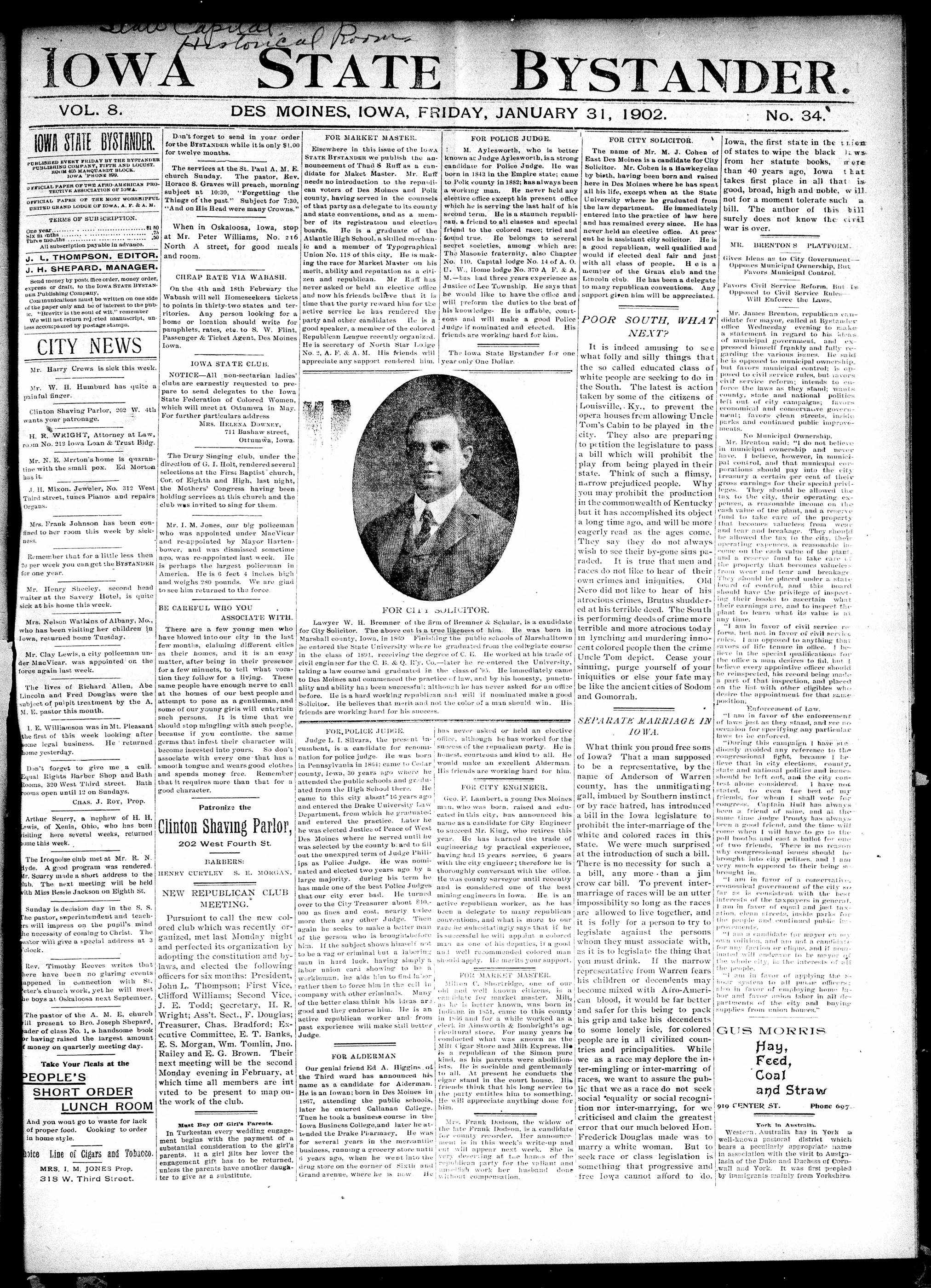
Lawyer W. H. Bremner of the firm of Bremner & for City Solicitor. The above cut is a true likeness of Marshall county, Iowa, in 1869. Finishing the public he entered the State University where he graduated from in the class of 1891, receiving the degree of C. E. H. civil engineer for the C. B. & Q. R. Y., Co.—later he re-taking a law course and graduated in the class of 1895 to Des Moines and commenced the practice of law, quality and ability has been successful; although he has not before. He is a hard working republican and will if Solicitor. He believes that merit and not the color of a friends are working hard for his success.
Lawyer W. H. Bremner of the firm of Bremner & Schular, is a candidate for City Solicitor. The above cut is a true likeness of him. He was born in Marshall county, Iowa, in 1890. Finishing the public schools of Marshalltown he entered the State University where he graduated from the collegiate course in the class of 1891, receiving the degree of C. E. He worked at his trade of civil engineer for the C. E. & Q. Ry. Co.-later he re-entered the University, taking a law course and graduated in the class of 195. He immediately came to Des Moines and commenced the practice of law, and by his honesty, punctuality and ability has been successful; although he has never asked for an office before. He is a hard working republican and will if nominated make a good Solicitor. He believes that merit and not the color of a man should win. His friends are working hard for his success.
FOK, POLICE JUDGE.
Judge L. I. Silvaara, the present incumbent, is a candidate for renomination for police judge. He was born in Pennsylvania in 1864; came to Cedar county, Iowa, 30 years ago where he attended the public schools and graduated from the High School there. He came to this city about 16 years ago and entered the Drake University Law Department, from which he graduated and entered the practice. Later he he was elected Justice of Peace of West Des Moines where he served until he was selected by the county board to fill out the unexpired term of Judge Phillips as Police Judge. He was nominated and elected two years ago by a large majority, during his term he has made one of the best Police Judges that our city ever had. He turned over to the City Treasurer about $10,000 as fines and cost, nearly twice more than any other Judge. Then again he seeks to make a better man of the person who is brought before him. If the subject shows himself not to be a vag or criminal but a laboring man in hard luck, having simply a labor union card showing to be a workman, he aids him to find labor rather then to force him in the cell in company with other criminals. Many of the better class think his ideas are good and they endorse him. He is an active republican worker and from past experience will make still better Judge.
Our genial friend Ed A. Higgins, of the Third ward has announced his name as a candidate for Aiderman. He is an Iowa; born in Des Moines in 1867, attending the public schools, later he entered Callanan College. Then he took a business course in the Iowa Business College, and later he attended the Drake Pharmacy. He was for several years in the mercantile business, running a grocery store until 6 years ago, when he went into the drug store on the corner of Sixth and Grand avenue, where he is now. He
---
FOR ALDERMAN
M. Aylesworth, who is better known as Judge Aylesworth, is a strong candidate for Police Judge. He was born in 1843 in the Empire state; came to Polk county in 1882; has always been a working man. He never held any elective office except his present office which he is serving the last half of his second term. He is a stunner republican, a friend to all classes and special friend to the colored race; tried and found true. He belongs to several secret societies, among which are: The Masonic fraternity, also Chapter No. 110, Capital lodge No. 14 of A. O. U. W., Home lodge No. 370 A. F. & A. M.—has had three years experience as Justice of Lee Township. He says that he would like to have the office and will preform the duties to the best of his knowledge. He is affable, courteous and will make a good Police Judge if nominated and elected. His friends are working hard for him.
The Iowa State Bystander for one year only One Dollar.
1910
um of Bremner & Schular, is a candidate true ligeness of him. He was born in ing the public schools of Marshalltown he graduated from the collegiate coursegree of C. E. He worked at his trade of.—later he re-entered the University, the class of '95. He immediately came tice of law, and by his honesty, punctu-though he has never asked for an office an and will if nominated make a good ot the color of a man should win. His s.
has never asked or held an elective office, although he has worked for the success of the republican party. He is honest, courteous and kind to all. He would make an excellent Alderman. His friends are working hard for him.
FOR CITY ENGINEER.
Geo. F. Lambert, a young Des Moines man, who was born, raised and educated in this city, has announced his name as a candidate for City Engineer to succeed Mr. King, who retires this year. He has learned the trade of engineering by practical experience, having had 15 years service, 6 years with the city engineer; therefore he is thoroughly conversant with the office. He was county surveyor until recently and is considered one of the best mining engineers in Iowa. He is an active republican worker, as he has been a delegate to many republican conventions, and what is more to our rage he unhesitatingly says that if he is successful he will appoint a colored man as one of his deputies, if a good and well recommended colored man should apply. He merits your support.
FOR MARKET MASTER.
Milton C. Shortridge, one of our old and well known citizens, is a candidate for market master. Milt, as he is better known, was born in Indiana in 1851, came to this county in 1866 and for a while worked as a clerk in Ainsworth & Bonbright's agricultural store. For many years he conducted what was known as the Milt Cigar Store and Milt Express. He is a republican of the Simon pure kind, as his parents were abolitionists. He is sociable and gentlemanly to all. At present he conducts the cigar stand in the court house. His friends think that his long service to the party entitles him to something. He will appreciate anything done for him.
Mrs. Frank Dodson, the widow of the late Frank Dodson, is a candidate for county recorder. Her announcement is in this week's write-up and cut will appear next week. She is very deserving at the hanois of the republican party for the valiant and unselfish work her husband done without compensation.
BYSTANDER.
FOR POLICE JUDGE.
FOR CITY SOLICITOR.
The name of Mr. M. J. Cohen of East Des Moines is a candidate for City Solicitor. Mr. Cohen is a Hawkeyeian by birth, having been born and raised here in Des Moines where he has spent all his life, except when at the State University where he graduated from the law department. He immediately entered into the practice of law here and has remained every since. He has never held an elective office. At present he is assistant city solicitor. He is a good republican, well qualified and would if elected deal fair and just with all class of people. He is a member of the Grant club and the Lincoln club. He has been a delegate to many republican conventions. Any support given him will be appreciated.
POOR SOUTH, WHAT
NEXT?
It is indeed amusing to see what folly and silly things that the so called educated class of white people are seeking to do in the South. The latest is action taken by some of the citizens of Louisville, Ky., to prevent the opera houses from allowing Uncle Tom's Cabin to be played in the city. They also are preparing to petition the legislature to pass a bill which will prohibit the play from being played in their state. Think of such a flimsy, narrow prejudiced people. Why you may prohibit the production in the commonwealth of Kentucky but it has accomplished its object a long time ago, and will be more eagerly read as the ages come. They say they do not always wish to see their by-gone sins paraded. It is true that men and races do not like to hear of their own crimes and iniquities. Old Nero did not like to hear of his atrocious crimes, Brutus shuddered at his terrible deed. The South is performing deeds of crime more terrible and more atrocious today in lynching and murdering innocent colored people then the crime Uncle Tom depict. Cease your sinning, purge yourself of your iniquities or else your fate may be like the ancient cities of Sodom and Gomorrah.
SEPARATE MARRIAGE IN IOWA.
What think you proud free sons of Iowa? That a man supposed to be a representative, by the name of Anderson of Warren county, has the unmitigating gall, imbued by Southern instinct or by race hatred, has introduced a bill in the Iowa legislature to prohibit the inter-marriage of the white and colored races in this state. We were much surprised at the introduction of such a bill. There is no necessity for such a bill, any more than a jim crow car bill. To prevent inter-marriage of races will be an utter impossibility so long as the races are allowed to live together, and it is folly for a person to try to legislate against the persons whom they must associate with, as it is to legislate the thing that you must drink. If the narrow representative from Warren fears his children or descendents may become mixed with Afro-American blood, it would be far better and safer for this being to pack his grip and take his descendents to some lonely isle, for colored people are in all civilized countries and principalities. While we as a race may deplore the inter-mingling or inter-marring of races, we want to assure the public that we as a race do not seek social 'equality or social recognition nor inter-marrying, for we criticised and claim the greatest error that our much beloved Hon. Frederick Douglas made was to marry a white woman. But to seek race or class legislation is something that progressive and free Iowa cannot afford to do.
No. 34.
Iowa, the first state in the union of states to wipe the black laws from her statute books, more than 40 years ago, Iowa that takes first place in all that is good, broad, high and noble, will not for a moment tolerate such a bill. The author of this bill surely does not know the civil war is over.
MR. BRENTON'S PLATFORM.
Gives Ideas as to City Government—Opposes Municipal Ownership, But Favors Municipal Control.
Favors Civil Service Reform, But Is Opposed to Civil Service Rules—Will Enforce the Laws.
Mr. James Brenton, republican candidate for mayor, called at Bystander office Wednesday evening to make a statement in regard to his ideas of municipal government, and expressed himself frankly and fully regarding the various issues. He said he is opposed to municipal ownership, but favors municipal control; is opposed to civil service rules, but favors civil service reform; intends to enforce the laws as they stand; wants county, state and national politics left out of city campaigns; favors economical and conservative government; favors clean streets, inside parks and continued public improvements.
No Municipal Ownership
Mr. Brenton said: "I do not believe in municipal ownership and never have. I believe, however, in municipal control, and that municipal corporations should pay into the city treasury a certain per cent of their gross earnings for their special privileges. They should be allowed the tax to the city, their operating expenses, a reasonable income on the cash value of the plant, and a reserve fund to take care of the property that becomes valueless from wear and tear and breakage. They should be allowed the tax to the city, their operating expenses, a reasonable income on the cash value of the plant, and a reserve fund to take care of the property that becomes valueless from wear and tear and breakage. They should be placed under a state board of control, and this board should have the privilege of inspecting their books to ascertain what their earnings are, and to inspect the plant to learn what its value is at any time.
"I am in favor of civil service reform, but not in favor of civil service rules. I am opposed to anything that savors of life tenure in office. I believe in the special qualifications for the office a man desires to ful, but I believe every appointive officer should be reinspected, his record being made a part of that inspection, and placed on the list with other eligibles who desire the appointment for that same position.
Enforcement of Law.
"I am in favor of the enforcement of laws just as they stand, and see no occasion for specifying any particular laws to be enforced."
"During this campaign I have steadily avoided any reference to the congressional fight, because I believe that in city elections, county, state and national politics and issues should be left out, and the city contest alone considered. I have not stated, to even the best of my friends, for whom I shall vote for congress. Captain Hull has always been a friend of mine, and at the same time Judge Proudty has always been a good friend, and the time will come when I will have to go to the poll booths and cast a ballot for one of two friends. There is no reason why congressional issues should be brought into city politics, and I am very much opposed to their being so brought in.
"I am in favor of a conservative, economical government of the city so far as is consistent with the best interests of the taxpayers in general. I am in favor of equal and just taxation, clean streets, inside parks for the people and continued public improvements.
"I am a candidate for mayor on my own volition, and are not a candidate for any faction or clique, and if nominated will endevor to be mayor of the whole city, in the interests of all the people.
"I am in favor of applying the school system to all private officers; also in favor of employing home labor and favor union labor in all departments of the city and buying supplies from union houses."
GUS MORRIS
919 CENTER ST. Phone 697.
York in Australia.
Western, Australia has in York a well-known pastoral district which bears a peculiarly appropriate name in association with the visit to Austrglasia of the Duke and Duchess of Cornwall and York. It was first peopled by immigrants mainly from Yorkshire
A
We should all respect wisdom, especially our own.
A swallow flying for home, made 140 miles at the rate of 128½ miles an hour.
Russia is talking about abolishing flogging in the army and this is—let's see—1902.
It is not true that there are microbes in Philadelphia's drinking water. Microbes can't live in it.
That extraordinary empress is back in Pekin with the smile of a seraph and 300 carts of silver.
Careful screening of yellow fever patients in Havana last year practically banished the disease from the city.
Canton, Ohio, has a man who can smoke through his left ear. Ohio never would listen to outside advice.
Capt. Hobson has declined to discuss the story that he is going to run for congress—which looks as if it might be true.
The man who invented the word "kleptomania" saved a lot of well-to-do families from disgrace.—Chicago Record-Herald.
"The Lord loveth whom he chasteneth." So does Rudyard Kipling, lord of lesser dominions by the right and might of genius.
Sir Thomas Lipton has ordered shamrock III. As we have said before, "Sir Tom is a jolly good fellow," and "dead game sport."
There is a large stock of gold in the British treasury uncalled for. At least it has not yet heard the appealing voice of the war department.
A real princess who is living in Paris does her own housework. Let us hope she is endeavoring to start a new fad and that it will "take."
A Michigan scientist has made the interesting discovery that the soul is located in the spine. Alas for the henpecked man, who has no backbone!
Mr. Chamberfain ought to learn that even when it is a stained glass house the occupant needs to be cautious about throwing stones.—Detroit Free Press.
Watch that fellow on the corner. He is modestly booming himself for the next presidential nomination. The woods of every city in the land are full of them.
In order to encourage them to keep on kicking against American competition, the American Shoe company is furnishing footwear to half the people of England.
Edward Everett Hale urges young men to converse with intellectual superiors. His advice isn't intended for young men who have just gone through college.
Miss Metcalf, the successful Chicago writer of fiction, declares that all her ideas, plots and inspirations come while she is asleep. They come by the mince pie route.
A proud Parisian bacteriologist has discovered the bacillus that causes the hair to turn white. Anybody can be that kind of a bacteriologist by worrying hard enough.
The aunt and sister of the Columbia university professor who served a summons on that learned gentleman in a pie, are following dignified precedent. Death serves many a summons in a pie.
A German ship that is now building will break the record for crossing the Atlantic. It is always well to announce these things in advance, because the performance may not come up to the advertisement.
Lord Alfred Douglas has resented the snub given him by the Metropolitan club of Washington by writing a sonnet on America. In time we may hope to recover from the blow, but it is a cruel revenge.
Chicago Record-Herald: Mrs. Patrick Campbell says she finds that American women are the happiest in the world. Perhaps those with whom Mrs. Patrick has been associating have had unusual luck of late in keeping their cooks.
The new postmaster general has declared himself in favor of greatly extending the rural free mail delivery system. While much has already been accomplished in this direction, it is hardly a beginning on the immense field. While the cities are entitled to the best of service, the country must not be neglected.—Omaha Bee.
The Prussian government is figuring on buying a coal mine for the purpose of fighting the coal trust. If the trusts dig their own graves they cannot make a row about having to occupy them.
THE NEWS IN IOWA
THE NEWS IN IOWA
KILL THE FERRET LAW.
Senator Healy Proposes a Measure to That Effect.
Des Moines, Jan. 28.—Senator Healy has introduced a bill to abolish tax ferret collection of taxes. It provides that no action for the recovery of taxes on omitted personal property be begun unless brought within the year in which the property should be assessed. This not only kills the tax ferret proposition, but it prevents the county treasurer from listing omitted personal property except in the year when the assessor's listed it. If it shall be discovered on January 1 half a million dollars and credits have been omitted from the assessment of the previous year no action can be begun under this law to recover taxes on that property. Senator Healy regards the tax ferret law as extremely vicious. He says that it has resulted in widespread wrong and injustice; that, but, the poorer, of people, as a rule, have been the victims of crimes. He believes that the cases in which rich men have been compelled to pay taxes on omitted property are extremely rare. Under the judicial construction of the present law property omitted during five years may be newly listed and assessed and taxes on it collected. By this limit this is out of order, unless the property is omitted in the year it ought to be assessed no action to recover taxes on it can be begun.
Something of a controversy arose in the senate upon the introduction of the bill as to whether it should go to the committee on judiciary or the committee on ways and means. Senator Healy, chairman of the judiciary committee, who introduced the bill, requested that it go to his committee, while Senator Junkin, chairman of ways and means, thought it should go to the tax committee. The bl. went to the judiciary committee.
RETAIN COAL RIGHTS.
State Fair Directors Decide Not to Sell Them.
Des Moines, Jan. 29.—The committee appointed to investigate concerning the sale of the coal fields underlying the state fair grounds reported at the meeting of the board of agriculture against the proposition. After summing up the results of the investigation, they recommended that no steps be taken to secure legislation which will enable the board to sell the vein. While it is conceded that there is a valuable deposit of coal, it is not thought advisable to dispose of the same at the price it would command at present. A synopsis of the report follows.
First—We found that there is a $3/2 or 4-foot vein of coal.
Second—It is from 100 to 200 feet below the surface and the condition of the roof is such that mining is advisable under the present buildings and fixtures of the grounds.
Third—The coal price is from $25 to $100 per acre, including surface rights, such as railroads, street ears, etc.
Fourth—Before an offer can be made the land must be prospected.
Fifth—The land wouldn't bring sufficient money to pay for the prospecting. It will bring more money in the near future than at present.
We therefore recommend that no steps be taken to secure legislation to enable the board to sell the coal underlying the state fair grounds.
MOTHERS VISIT LEGISLATURE
Congress at Des Moines Entertained in Executive Parlors.
Des Moines, Jan. 31.—Two hundred delegates and officers attending the Mother's Congress convention in Des Moines visited the legislature yesterday afternoon. Upon invitation Mrs. Isaac Lea Hillis, president of the congress, addressed the senate, a seat in which her father, General Cyrus Bussey, resigned forty years ago to lead The membership of the board is so the Third Iowa Cavalry. She urged the member votes of the votes of the president, Governor and Mrs. A. B. Cummins tendered the visitors a reception in the executive parlors immediately after the call upon the legislature, and the remainder of the afternoon was spent in the state historical building where a reception was held. Last night Judge L. G. Kinne, of the state board of control presided at a meeting of the congress devoted to the discussion of Iowa's care of Miles and delinquents. The aid of the state industrial schools, Judge Robinson of the board of control and Judge C. A. Bishop of Des Moines addressed the meeting.
Newton Gets Carnegie Library
Newton, Jan. 20.—Newton has been offered ten thousand dollar library building by Andrew Carnegie. The board of library trustees is in receipt of a letter from Mr. Carnegie in which he has offered the amount necessary to erect the building providing a site is secured and that the citizens or library board will guarantee a thousand and dollar support per year for maintenance. A meeting was held and the proposition will be excepted.
Killed While Hunting.
Creston, Jan. 31.—August Strey, an aged and highly respected German resident of this city, met death three miles south of this city, while out hunting by the accidental discharge of a shotgun. He was carrying the gun at full cock when the hammers caught in some manner. The load entered the right side of his head, causing instant death.
She Gets $6,000 For Heart.
Onawa. Jan. 30.—A case which has excited much attention is that of Mary Christianson vs. John Spaulding, administrator of the estate of rank bp. he added a 9-month sentence. The jury returned a verdict in favor of the plaintiff, giving her $6,000.
Sanitarium Destroyed by Fire.
Cedar Rapids, Jan. 29.—The sanctarium at Anamasa, conducted by sisters of charity, a large three story and basement stone building, was burned. All people in the building were completely. One fireman was painfully injured. The fire was of unknown origin. Many people hold courts of inquiry over other people's affairs.
GIVEN A WARM WELCOME
LEGIBLATURE ROYALLY RECEIVED AT THE STATE NORMAL
Dedicatory Exercises Held in the Auditorium of the New Main
Cedar Falls, Jan. 31—Nearly 300 members of the legislative party yesterday attended the dedicatory exercises of the new building of the state normal school. Upon the arrival of the train at Cedar Falls the legislators were given an enthusiastic reception. They were met at the depot by the mayor, city council and a large crowd of citizens, and accorded a hearty and sincere welcome. A merry throng of school children carrying flags and flowers formed an interesting part of the procession. The lawmakers then filled the street cars which were waiting for them and were taken to the normal school. Here a formal occasion was tendered to legislators. By president and the members of the normal faculty, and immediately following it came the dinner in the big dining hall of the normal school, a banquet which could hardly have been surpassed in excellence.
About 3 p. m., the guests began to assemble in the large auditorium of the new building, which by the time the exercises commenced was packed with people. As the members of the general assembly entered the room, they were greeted with cheers and the waving of colors. The governor, please tenant governor, informed the student and the leading members of the legislature, whose positions on committees gave them a special relation to the school, were given special yells in which their names formed a prominent part. On the stage were seated, besides members of the glee clubs, Governor Cummins, Lieutenant Governor Herriott, Speaker Eaton, State Superintendent Barrett, Secretary of State Martin, and several members of State Superintendent Barrett, presided by the board of trustees, presided. Addresses were delivered by Superintendent Barrett, President Seerley and Governor Cummins.
The new main building which is being dedicated by various exercises this week is a handsome and up-to-date structure. Its exterior walls are faced with Bedford stone and mottled pressed brick, and its design is in the renaissance style. It has a Fronton and a S肋梁. It is located in the center of 146 feet. Under the auditorium, in the basement, is the men's gymnasium, 70 by 76 feet. On all floors in addition to the auditorium there are fifty class rooms, recitation rooms and offices, and six large society halls. The main entrance has three flights of stone steps, passing under a handsome porch. A lavatory is considered perfect. The building has three different divisions, the north and south wings and the central section. On the first and second floors in the north wing are the primary and grammar grades of the training department, while the south wing is entirely given over to class rooms for the normal department, twenty two class rooms, which are of com-
The new building was made possible by the Twenty-eighth general assembly when it appropriated $100,000 for an additional building at Cedar Falls.
FOR NEW SIOUX CITY BISHOP.
Vice Rector Garrigan of Catholic University is Selected.
Sioux City, Jan. 30.—Authoritative announcement of the appointment of Very Rev. Phillip J. Garrigan, vicector of the Catholic University at Washington, to be bishop of the diocese of Sioux City, has been received in a telegram from Washington. Father Garrigan is requested to the bishop, probably will take place so that he may assume charge of the diocese at Easter. The new bishop is an aggressive man, just past middle age. For thirteen years past he has been connected with the Catholic University in an administrative capacity as assistant treasurer and he has successfully helped to deal with the financial questions of the institution. He is a native of Ireland and was educated in the public schools of Massachusetts, in St. Charles College, Maryland, and a provincial seminary. He was ordained to the priesthood June 11. The diocese will include the western half of the present archdiocese of Dubuque and will have a Roman Catholic population of about 35,000.
SERVICES FOR A MARTYR.
Tribute Paid to the Late President McKinley
Canton, O., Jan. 30—Cantonians paid loving tribute to the late President McKinley in a memorial meeting at the Tabernacle last night, which was participated in by people in all waists of life so a number that overtaxed the big enclosure, where many of the same people had so often listened to the words of their old friend and neighbor. The chief orator of the meeting was Hon. William Dudley Foulke of Indiana, a warm personal friend of the late president, recently selected by President Roosevelt for membership on the civil service commission.
Lewis Toddhunter Dies at Indianola, Indianola. Jan. 31—Hon. Lewis Toddhunter died at home in this city at the age of 85. He was stricken with paralysis on Saturday and never regained consciousness. Mr. Toddhunter was a member of the constitutional convention of Iowa, which adopted the present constitution.
Grinnell Has New President.
Grinnell, Jan. 30.—The trustees of Iowa College met in this city and unanimously elected Daniel F. Bradley. D. D., of Rapid Lapland, Mich., to the presidency of the college and Pro J. H. T. Mann as dean of the faculty.
Date of Hanging is Set.
Sloux City, Jan. 30—Harry Hortman, the young man who was convicted of killing Miss Florence Porchia beheaded to hang at Cherokee, March 12, 1903.
THE LEGISLATURE.
Des Moines, Jan. 27.—Harriman introduced the resolution to increase the number of house members to 115; Garst introduced a bill to make the governor's salary $7,100 instead of $4,100, and his private secretary's salary $1,900 instead of $1,500, to go into effect in 1904; Healy introduced a bill eliminating tax ferrets; Lister proposed a bill to prevent marriage of divorces within six months after divorce; Lewis proposed an excellent state depository bill to secure interest on state funds.
House.—Important bills were introduced as follows: By Huron, to provide for the removal of parties subjected to quarantine to contagion hospitals only on order of magistrate; by McNie, appropriating $9,700 to college for the aid and assistance of city chiefs power to acknowledge instruments; by Sokol, appropriating $27,790 to the penitentiary at Anamosa; by Temple, to establish an appellate court of three judges to have jurisdiction in all cases where amount involved does not exceed $3,000, but over no constitutional questions; by Colcio, a habitual criminal act, and resolution of the senate, the senate representatives and increasing the number of representatives to 115 was introduced by Temple.
Des Moines, Jan. 23.—Senate.—Fitchpatrick introduced the Greeley redistricting bill of the preceding day. Hayward introduced the bill to punish husbands for failing to support their wives, and Ball introduced a bill to legalize all acts done by city councils without a majority vote. Appropriation bills for Marshalltown and Mt. Pleasant were not approved. Ball will increase the support of the Soldiers' Home to meet the higher prices for supplies.
House.—N. E. Kendall introduced a concurrent resolution providing for the appointment of a commission by the governor to investigate into the causes of explosions in mines. The commission is to consist of two operators, four superintendents, ten miners and the mine appointees. It is to report on eight days and is to report to the legislature this session. The resolution went over to be acted on Wednesday. Important bills were introduced as follows: By Blakemore, to require a record of all assignments of mortgages, in order that they may be assessed; by Calderwood, providing penalty of six months in support for any damage, in order that life and family if he is able to do so; by Carden, appropriating $105,950 to the Mt. Pleasant hospital; by Cummings, providing for five days' notice in garnishment proceedings; by Cummings, appropriating $75,100 for Soldiers' Home at Marshalltown; by Dunham, a compulsory education law requiring all children between and to attend school at the city year and providing for truant officers; by Hughes, an anti-pass bill, prohibiting the issuance of passes to public officers, fines of $100 to $1,000 being prescribed; by Larrabee, giving superior courts to cities of 5,000 inhabitants; by Sweelee, to appropriate $5,000 to the Women's and Babies' Home at Sloux City; by Bueno City, to the $2,000 limit on incorporation fees; by Willett, providing that county attorneys may return indictments if defendants consent.
Des Moines, Jan. 29.—Senate. The senate adopted a rule prohibiting employees or itself or its committees from lobbying members; spent two hours debating the Blancharu bill to extend authority to vote taxes n. aid of railroads to the electric trolley lines projects to the woman's reading of the woman's suffrage constitutional amendment. Senator Garst introduced a bill to extend the time of making the railroad assessment from March 25 to August 1. Senator Spaulding proposed a bill compelling the listing of mortgages for taxation of the real estate covered in the bill to be exempted to the extent of their equity.
House.—In the house the normal school bill was referred to the appropriations committee, after two unsuccessful efforts by Warren to have the report of the normal school committee adopted. This committee recommended a message. Important bills were introduced as follows: By Coburn, making it a crime for a tenant to sell grain on which his landlord had a lien, without a written order from the landlord; appropriation bills for the institutions at Glenwood and Ft. Madison; a bill repealing the penalty for the failure to viding for three terms of the supreme court each year, and salaries of $6,000 for the judges, and a bill increasing the salaries of district judges from $2,500 to $4,000; by Haselquist, exempting the property of soldiers from taxation to the amount of $800 whether personality or real estate and credits to the amount of $1,500 belonging to heads of families should be exempt from taxation.
COMMITTEE IS IN FAVOR.
Majority of Members are For Red districting
Des Moines, Jan. 28.—A canvass of the house committee on congressional districts reveals the fact that a majority of the republican members are favorable to redistricting. The committee consists of twenty-seven members, two republicans from each of the congressional districts, and five democrats, the democrats are counted as favoring redistricting. Adding the five democratic members to the majority of the republicans who are in favor of redistricting the house committee will have a clean working majority in favor of new congressional districts.
No meetings of the committee have been held as yet on account of the fact that it is to redistricting have been presented to the house. As soon as there is any work for the committee to do a meeting will be called and the opinions of the members learned.
The only fear expressed by those who are radically in favor of redistricting is that while the house committee has a good working majority favorable to the measure it may not be possible to get the members to agree on any certain plan, and if this cannot be done redistricting may go by default simply because its friends will be unable to get together on any one project.
Indications Point to Pacific of Philippines.
Manila, Jan. 31.—The general outlook for pacification in the archipelago, everywhere outside the island of Samar, has never been more favorable, the original outbreak of the Filipino insurrection than at the present time.
The insurgents have been broken up into small bands and are everywhere fleeing for shelter. They surrender daily, are captured or are killed. The policy of reconcentration and the stern measure of closing the ports commerce is accomplished of them headed of them General Chaffee still hopes that by the end of February the island of Samar alone will remain not pacified.
TAX REDUCTION FAVORED
HOUSE COMMITTEE MAKES A FA-
VORABLE REPORT.
The Only Tax to Remain Will be the Tax on Mixed Flour—Unanimous Report Ordered.
Washington, Jan. 31.—The house committee on ways and means has unanimously authorized Cairnman Payne to report a bill repealing all the Spanish war revenue taxes, except the tax on mixed flour.
The repeal is to take effect July 1, 1902, except the duty on tea, which is to take effect January 1, 1903. Chairman Payne made a statement showing that the total reduction would be $7,000,000 annually. The delay in the repeal of the tax on tea is to enable those who have stock on hand to dispose of them before the appeal takes effect. Mr. Payne says that the country will start upon the next fiscal year with $174,000,000 available cash. An amendment was offered by Mr. Newlands to except from the repeal the tax on petroleum and sugar refiners, and by Mr. Richardson to repeal the customs duties on trust goods. Both were deflected by party members. Mr. Newlands' amendment also provided for a tax of one-tenth of the gross receipts of all corporations whose annual receipts exceed $10,000,000.
The repeal will affect the remaining special taxes imposed by the war, viz: On bankers, brokers, grain dealers, pawn brokers, custom house brokers, theaters, museums, circuses, etc., billiard rooms and bowling alleys, playing cards, dealers in tobacco. The reduction on fermented alipers that on tobacco will be below: that on tobacco and snuff will be 3 cents, bringing the rate back to 6 cents per pound, as before the war. The rate on cigars and cigarettes was changed last year, but the further change now made will bring the rates back to those existing prior to the war. The repeal under schedule A of the law will include the tax on bonds, debentures, etc., certificates of deposit, bills of lading, certificates of profit, brokers' contracts, custom house entries, warehouse receipts, steamboat passage tickets.
The repeal under schedule B will include the tax of 1 cent per pint bottle of wine and 2 cents on bottles over a pint. The legacy tax will also come off. The other reductions include the excise tax on persons and firms engaged in refining petroleum and sugar, special tax of banks and banks. The rate on beer, now $1.60 per barrel, will be brought down to $1. The present tea duty is 10 cents per pound, and this will be repealed.
RIPPEY HAS A FIRE
Loss of $40,000 Sustained by Merchants in That Town.
Ripley, Jan. 29. -Fire originating in the basement of the Ripley Mercantile Company at 1 o'clock a. m. destroyed nearly $40,000 worth of property. Four brick buildings were burned to the ground and several others more or less damaged. Fire is supposed to have originated from the explosion of a lamp or an oil stove in the basement of the Ripley store where it is known they kept them burning to protect some vegetables from the cold. Mrs. Lovejoy, who with her husband and children, occupy rooming quarters in the basement, was the first to discover the flames, which were then bursting from the basement.
P. M. Osborne's drug store across the street from the Rippey block was in imminent danger at one time. The entire plate glass front was mashed in and the weatherboarding burned from the frame work on one side. The Rippey hotel plate glass front was mashed in and the borne drug store caught at an early hour, but quick, snappy work on the part of the fire department saved this building. It is owned by the Charles Kabler estate, of Des Moines and is fully covered by insurance. A barber shop also belonging to P. M. Osborne was skipped because the fire several times, but the department was able to save it from destruction.
The following losses, or estimated losses and insurance are reported: Dr. Lovejoy, office and household fix-
Dr. Lovejoy, office and household fixtures: $1,000. No insurance. Bullock & Cramer, contents, $6,000. Partially covered by insurance. Bullock & Cramer block, owned by Dr. Lovejoy, $3,000. Insurance $800.
Nippie Mercantile Company, contents,
$12,000. Partially covered by insurance.
Nippie block, owned by A. P. Gilland,
$5,000. Partially covered by insurance.
Commercial bank, contents and building owned by F. Westley, $5,000. Par
Convicted of Complicity in Murder of Governor Goehel.
Frankfort, Ky., Jan. 31.—The jury in the case of Jim Howard, charged with complicity in the murder of Governor Goebel, returned a verdict of guilty against the prison and fixed his punishment. He was Howard's second imprisonment. The first one having resulted in a death sentence. A new trial was granted
MISS STONE IS FREE.
Report to That Effect is Current in London, but Unverified.
London. Jan. 30.—A special telegram to a morning paper states that Ash Stone has been set free. The affair is not verified from any other source.
Washington, Jan. 24.—Senate. An animated and prolonged discussion was precipitated in the senate today over the right of army officers to criticise utterances made in the senate or elsewhere on the conduct of affairs in elsewhere on the conduct of affairs in the Philippines. At times it became acrimonious, officers in the Philippines being taken sharply to task statements attributed to them in disaffected Manila. Rising to a question of privilege early in the session, Dubois, of Idaho, had read an Associated Press dispatch from Manila, in which Gen. Wheaton was quoted as criticizing some utterances of Prof. Schurman in a speech delivered in Boston. Dubois thought the president in the circumstances, would be warranted in reprimanding Gen. Washington for his criticisms. He declared that such comment upon the action of the senate was "outrageous and indecent," and that the minority had uttered enough of the blackmail. The debate thus precipitated, took a wide range, aodge, of Massachusetts, Spooner, of Wisconsin, and others maintained that no newspaper utterances ought to be accepted as the basis of a reprimand of any officer unless it were supported by an investigation indicating the accuracy of the report.
Washington. Jan. 28.—Senate—Senator Nelson's bill creating a department of commerce, which passed the senate today, was amended in various particulars. Probably the most important of the amendments was one changing the title to read "The Department of Commerce and Labor." The bill, designed for a secretary, who is to be a member of the cabinet, an assistant secretary, and also another official and clerks necessary, the proposed department is especially aligned with the collection and distribution of statistical information and with the development and fostering of foreign and domestic commerce. In the department there is to be a new bureau of manufactures, and many bureaus now included in other departments, are transferred to this new department, including the life saving service, the light house service, the marine hospital service, the boatbiss inspection service, and the bureaus of navigation, of shipping and of immigration, as well as the control of the fisheries and the Chinese exclusion questions, all now within the jurisdiction of the treasury department, the fish commission and the census bureau. The department also is given jurisdiction over the consular service, as well as to commerce. Just before the adjournment of the senate Senator Spooner duced a substitute for the Nicaraguan canal bill. The new bill is a practical authorization to the president of the United States to choose between the Panama and the Nicaraguan routes.
Washington, Jan. 29.---Senate. For an hour today the senate had under discussion the proposition whether censorship of press dispatches exists in Manila. While no such turbulent event has occurred, the debate for a time was very spirited. The secretary of war was quoted as saying that no 'press censorship now existed in t.e. Philippines and a letter from General Greely, chief signal officer of the army, was presented the statement officially that making the statement officially that no censorship of press dispatches and that "the press is entirely free." It was contended by the opposition that a press censorship did exist, in the Philippines, and that copies of every news dispatch filed with the cable authorities. That it was maintained, constituted a virtual censorship. Culom, chairman of the committee on foreign relations, delivered an extended and carefully prepared speech on the history of the reciprocity negotiations. A bill providing for the use of U.S. military forces vented by its naval officers while engaged in its service and covered by letters patent was passed.
House—Henry, of Connecticut, reported the oleomargarine bill from the committee on agriculture. With the report were submitted the views of the minority of the committee and the substitute offered by them. No business of importance was transacted. Washington, Jan. 30.—Senate. Today's session of the senate was entirely of the tumultuous scenes which characterized the sessions of the past three days. After the Philippine tariff measure was taken, Tillman delivered a speech delivered almost entirely to a discussion of the part his state took in the war for the colonies. Incidentally, he referred occasionally to the pending bill, drawing morals, as he said, for the benefit of the majority that they might be applied to the Phillipines.
House.-The house today passed the bill. or the creation of a permanent census bureau. The friends of the civil service law, who were opposed to making the employees of the bureau eligible for transfer or retention in the permanent organization. The bill also provides for a manufacturing census in 1905, and for a collection of statistics annually. Early in the session a bill was passed for the protection of the lives of miners in the territories.
SAYS THE SOUL MAY DIE
Parkhurst Overrides the Presbyterian
Theory of Immunity
New York, Jan. 28—In a sermon on "immortality," the Rev. Dr. Charles H. Parkhurst, in the Madison Square Presbyterian church declared against the popular evangelical belief that all souls are immortal. He expressly gave it as his opinion that the Scriptures do not teach immunity of the soul from death, and that the soul must be taken care of in this life else it will perish utterly, either at the death of the body or after a longer or shorted period of the life beyond the grave. Dr. Parkhurst said in part:
"There is nothing in the Script or in things that encourage us to feel that a soul can be kept from dying any more than a body, unless it is taken care of. There is no warrant from the Bible or from men for supposing that a saint carries with itself a policy of eventual obliteration."
The sermon is attracting some attention owing to the fact that most Presbyterians adhere to a belief in the doctrine of immortality of the soul.
The Diamond Bracelet
Author of East Lynne, Etc.
(CHAPTER IV.—Continued.)
"It cannot be lost," returned Lady Sarah. "You are sure you put it out, Alice?"
"I am quite sure of that. It was lying first in the case, and—"
"Yes, it was," interrupted Hughes. "That was its place."
"And consequently the first that I took out," continued Alice. "I put it on the table; and the others around it, near to me. Why, as a proof that it lay there—"
What was Alice going to add? Was she going to adduce a proof that Gerard Hope had taken it up, and it had been a subject of conversation between them? If so, recollection came to her in time, and she faltered and abruptly broke off. But a faint, horrible dread, to which she would not give shape, came stealing over her, and her face turned white, and she sank on a chair trembling visibly.
"Now look at Alice!" uttered Frances Chenievix; "she is going into one of her agitation fits."
"Don't allow yourself to be agitated, Alice," cried Lady Sarah; "that will do no good. Besides, I feel sure the bracelet is all safe in the case; where else can it be? Fetch the case, Hughes, and I will look for it myself." Hughes whisked out of the room, inwardly resenting the doubt cast upon her eyesight.
"It is so strange," mused Alice, "that you did not see the bracelet when you came up."
"It was certainly not there," resumed Lady Sarah.
"Perhaps you will look for yourself now, my lady," cried Hughes, returning with the jewel box in her hands. The box was well searched. The bracelet was not there.
"This is very strange, Hughes," uttered Lady Sarah.
"It's very ugly, as well, my lady," answered Hughes, in a lofty tone, and I'm thankful to the presiding geniuses which rule such things that I was not in charge when it never would have taken place, for I can give guess how it was." "Then you had better," said her ladyship, curtly.
"If I do," returned Hughes, "I shall offend Miss Seaton."
"No you will not, Hughes," cried Alice. "Say what you please; I have need to wish this cleared up."
"Then, miss, if I may speak my thoughts, I think you must have left the key about. And there are strange servants in the house, you know, my lady; there's that kitchen's maid only came in it when we did, and there's the new under butler."
"Hughes, you are wrong," interrupted Alice. "The servants could not have touched the box, for the key never was out of my possession, and you know the lock is a Bramah. I locked the box last night in Lady Sarah's presence, and the key was not out of my pocket afterwards until you took it from thence this morning."
"The key seems to have had nothing to do with it," interposed Frances Cheneyix. "Alice says she put the diamond bracelet on the table with the rest; Lady Sarah says when she went to the table after dinner it was not there; so it must have been in the intervening period that the—the disappearance took place."
"And only a few minutes to do it in!" ejaculated Lady Sarah. "What a mystery!"
"I beats conjuring, my lady," said Hughes. "Could any visitor have come upstairs?"
"I did hear a visitor's knock while we were at dinner," said Lady Sarah. "Don't you remember, Fanny? You looked up as if you noticed it."
"Did I?" answered Lady Frances, in a careless tone.
And that moment Thomas happened to enter with a letter, and the question was put to him. "Who knocked?"
His answer was ready.
"Sir George Danvers, my lady. When I said the Colonel was at dinner, Sir George began to apologize for calling, but I explained that you were dining earlier than usual because of the opera."
"Nobody else called?"
"Nobody knocked but Sir George, my lady."
"A covert answer," thought Alice; "but I am glad he is true to Gerard."
"What an untruth!" thought Lady Frances, as she remembered the visit of Alice's sister. Thomas' memory must be short."
All the talk—and it was much prolonged—did not tend to throw any light upon the matter, and Alice, unhappy and ill, retired to her own room. The agitation had brought on a nervous and violent headache, and she sat down in a low chair and bent her forehead on to her hands. One belief alone possessed her; that the unfortunate Gerard Hope had stolen the bracelet. Do as she would she could not put it from her; she kept repeating that he was a gentleman, that he was honorable, that he would never place her in so painful a position. Common sense replied that the temptation was laid before him, and he had confessed his pecuniary difficulties to be great; nay, had he not wished for this very bracelet—that he might make money—
CHAPTER V.
A knock at the door. Alice lifted her sickly countenance and bade the
"Nobody else called?"
CHAPTER V.
intruder enter. It was Lady Frances Chenevif.
"I came to—Alice how wretched you look? You will torment yourself into a fever."
"Can you wonder at my looking wretched?" returned Alice. "Place yourself in my position, Frances; it must appear to Lady Sarah as if I—I had made away with the bracelet. I am sure Hughes thinks so."
"Don't say unorthodox things, Alice. They would rather think that I had done it, of the two, for I have more use for diamond bracelets than you."
"It is kind of you to try and cheer me," sighed Alice.
"Just the thing I came to do. And to have a bit of a chat with you as well, if you will let me."
"Of course. I will let you."
"I wish to tell you I will not mention that your sister was here last evening. I promise you I will not." Alice did not immediately reply. The words and their hushed tone caused a new trouble to arise within her—one which she had not glanced at. Was it possible that Lady Frances could imagine her sister to be the
"Lady Frances Chenevix!" burst forth Alice, "you cannot think it! She! my sister—gulty of a despicable theft! Have you forgotten that she moves in your own position in the world? that our family is scarcely inferior to yours?"
"Alice, I forgive you so misjudging me, because you are not yourself just now. Of course, your sister cannot be suspected. I know that. But as you did not mention her when they were talking of who had been here, I supposed you did not wish her name dragged into so unpleasant an affair, and I hastened up to say there was no danger from me that it would be."
"Believe me, she is not the guilty party," returned Alice, "and I have more cause to say so than you think for."
"What do you mean by that?" briskly cried Lady Frances. "You surely have no clue?"
Alice shook her head, and her companion's eagerness was lulled again.
"It is well that Thomas was forgetful," remarked Lady Frances. "Was it really forgetfulness, Alice, or did you contrive to telegraph him to be silent?"
"Thomas only spoke the truth. At least, as regards my s.ster., she hastily added, "for he did not let her in."
"Then it is all quite easy, and you and I can keep our own counsel."
Quite easy, possibly, to the mind of Frances Chenevix, but anything but easy to Alice, for the words of Lady Frances had introduced an idea more repulsive and terrifying even than the one which cast the guilt to the door of Gerard Hope. Her sister acknowledged that she was in need of money, "a hundred pounds or so," and Alice had seen her coming from the back room where the jewels lay. Still—she take a bracelet! It was preposterous. Preposterous or not, Alice's torment was doubled. Which of the two had been the black sheep? One of them it must have been. Instinct, sisterly relationship, reason and common sense, all combined to turn the scale against Gerard. But that there should be a doubt at all was not pleasant, and Alice started up impulsively and put her bonnet on.
"Where now?" cried Lady Frances.
"I will go to my sister's and ask her—and ask her—if she saw any stranger here—any suspicious person in the hall, or on the stairs," stammered Alice, making the best excuse she could.
"But you know you were in the drawing rooms all the time, and no one came into them, suspicious or unsuspicious; so how will that aid you?"
"True," murmured Alice, "but it will be a relief to go somewhere or do something."
Alice found her sister at home. The latter instantly detected that something was wrong, for her suspense, illness and agitation had taken every vestige of color from her cheeks and lips.
"Whatever is the matter, Alice?" was her greeting, "you look just like a walking ghost."
"I felt that I did," breathed poor Alice, "and I kept my veil down in the street, lest I might be taken for one and scare the people. A great misfortune has befallen upon me. You saw those bracelets last night spread out on the table?"
"Yes."
"They were in my charge, and one of them has been abstracted. It was of great value; gold links holding diamonds."
"Abstracted!" uttered the eldest sister in both concern and surprise, but certainly without the smallest indications of a guilty knowledge.
"How?"
"It is a mystery. I only left the room when I met you on the staircase, and when I went upstairs to fetch the letter for you. Directly after you left Lady Sarah came up from dinner, and the bracelet was not there."
"It is incredible, Alice. And no one else entered the room at all, you say? No servants? no——"
"Not any one," interrupted Alice, determined not to speak of Gerard Hope.
"Then, child, it is simply impossible," was the calm rejoinder. "It must have fallen on the ground or been mislaid in some way."
"It is hopelessly gone. Do you remember seeing it?"
"I do remember seeing amidst the rest a bracelet set with diamonds; but only on the clasp, I think. It—"
"That was another; that is all safe. This was of fine gold links, interspersed with brilliants. Did you see it?"
"Not that I remember. I was there scarcely a minute, for I had only strolled into the back room just before you came down. To tell you the truth, Alice, my mind was too fully occupied with other things to take much notice even of jewels. Do not look so perplexed; it will be all right. Only you and I were in the room, you say, and we could not take it."
"Oh!" exclaimed Alice, clasping her hands and lifting her white, beseeching face to her sister's, "did you take it? In—sport; or in—oh, surely you were not tempted to take it for anything else? You said you had need of money."
"Alice, are we going to have one of your old scenes of excitement? Strive for calmness. I am sure you do not know what you are implying. My poor child, I would rather help you to jewels than take them from you."
"But look at the mystery."
"It does appear to be a mystery, but it will no doubt be cleared up. Alice, what could you have been dreaming of to suspect me? Have we not grown up together in our honorable home? You ought to know me if any one does."
"And you really know nothing of it?" moaned Alice, with a sobbing catching of the breath.
"Indeed I do not. In truth I do not. If I could help you out of your perplexity I would thankfully do it. Shall I return with you and assist you to search for the bracelet?"
"No thank you. Every search has been made."
Not only was the denial of her sister fervent and calm but her manner and countenance conveyed the impression of truth. Alice left her in expressly relieved, but the conviction that it must have been Gerard returned to her in full force.
"I wish I could see him!" was her mental exclamation.
And for once fortune favored her wish. As she was dragging her weary limbs along he came right upon her at the corner of a street. In her eagerness she clasped his arms with both her hands.
"I am so thankful," she uttered. "I wanted to see you."
"I think you most wanted to see a doctor, Alice. How ill you look!"
"I have cause," she returned. "That bracelet, the diamond that you were admiring last evening—it has been stolen; it was taken from the room."
"Taken when?" echoed Mr. Hope, looking her full in the face—as a guilty man would scarcely dare to look.
"Then, or within a few minutes. When Lady Sarah came up from dinner it was not there."
"He took it?" he repeated, not yet recovering his surprise.
"I don't know," she faintly said.
"It was under my charge. No one else was there."
"You do not wish me to understand that you are suspected?" he burst forth with genuine feeling. "Their unjust meanness cannot have gone to that length!"
(To be continued.)
A. STRONG PEOPLE.
Innuits of Alaska Are Classed Among Very Hungry People.
It now seems probable that not all the Innuits of Alaska are so small as has been supposed. Indeed, if one is to believe the tales of travelers who visited an island south of Bering Sea, these Indians must be classed among the tallest people in the world. The travelers' story is given in Popular Science News: On King's Island Indians were found who by their physical characteristics belong to the Innuit or Eskimo family, having small black eyes, high cheek-bones and full brown beards which conceal their lips. The majority of the men are over six feet high and the women are usually as tall as and often taller than the men. These women are also wonderfully strong. One of them carried off in her birch bark canoe an eight-hundred pound stone, for use as an anchor to a whale boat. When it reached the deck of the vessel it required two strong men to lift it, but the Innuit woman had managed it alone. Another woman carried on her head a box containing two hundred and eighty pounds of lead. Both men and women are also endowed with remarkable agility. They will outrun and outjump competitors of any other race who may be pitted against them. Their strength is gained from very poor food, and they frequently travel thirty or forty miles without eating anything. They live on carrion fish and sea oil. The fish, generally salmon, are buried when caught, to be kept through the winter and dug up as consumption requires. When brought to the air they have the appearance of sound fish, but the stench from them is unbearable. In the matter of dwellings these Eskimos are peculiar. Their houses are excavated in the sides of a hill, the chambers being pierced some feet into the rise, and walled up with stones on three sides. Across the top of the stone walls poles of driftwood are laid and covered with hides and grass and lastly with a layer of earth. These odd dwellings rise one above another, the highest overlooking perhaps forty lower ones. Two hundred people live in the village.
Forget the good thou hast done, and
do better.
He who incurs no envy possesses
no happiness.
Is a beautiful, high prairie until it approaches the Nibrora river, when it becomes broken and hilly. The prairie land is rich in every possibility, is well watered and in an elegant climate. It is on the branch line of the Fremont, Elkhorn and Missouri Valley railroad, which leaves the main line at Norfolk and ends at Verdigre. The Fremont, Elkhorn and Missouri Valley Railroad has recently determined on an extension from Verdigre to Nibrora, and thence into or through Boyd county, which is its year is the banner of corn yield, state, television, now being surpassed and located, and will be pushed as soon as spring will permit. It will open up markets and railroad facilities to a splendid section of the state heretofore isolated and difficult of access. Land, improved, sells at $20 to $30 per acre and some even higher than that; unimproved land from $10 to $20 per acre.
Average yield of corn this year (1901) was 20 bushels per acre. Price at Creighton was 30 to 35 cents per bushel. Twenty per cent will be marketed and the balance fed in the corn. Some wheat was grown, but an estimate of the total yield cannot be gotten.
Hay for local feeding purposes was raised, but not marketed. No alfalfa was grown in the county, or no significant amount.
Creighton is the largest town in the county, and has 1,000 population. All lines of business are well represented, as are all religious denominations. Good schools are well supported. The town is backed up by an excellent country around it. Niobrara, the county seat, is situated on the mouth of the river, where it empties into the Missouri river.
Marla de Medici.
Maria de Medici, the second wife of Henry IV, who married her in 1600 a year after his divorce from Margaret of Valois, was an Italian beauty, petite and dark. She was hot-tempered and her intolerance of her husband's infidelities caused constant domestic bickling. Her voice was shrill, and when angry she raised it almost to a scream, so that when the king and queen were engaged in a domestic argument everybody in the house knew all about it.
Steam Farming Machinery.
In no locality has modern steam farming machinery been applied with such effectiveness as upon the grain ranches of southern California. On one ranch the engine used to draw the machinery is of fifty horse-power, and has drive wheels eight feet high. It consumes twelve barrels of oil every day, and its operation requires the services of seven men. In plowing, fifty-five furrows are turned over at one time, covering a breadth of forty feet.
Daughters of Revolution Lost Fight.
The old blockhouse of Ft. Duquesne, in Pittsburg, is to be cut off from the public by the closing of several streets in the interest of a syndicate desiring to construct warehouses in the vicinity. The streets are to be closed under city ordinance, passed against the protest of the Daughters of the Revolution, who made an effort to keep a highway open for the use of visitors
Poulsoners Compared by States.
The state in which there are the least number of government pensioners is Nevada, in which they number only 275. There are 800 in Wyoming and 850 in Utah. Ohio and Pennsylvania together have 210,000—only 10,000 less than the total number of persons engaged in the federal service of the United States at home and abroad.
Most Understand State Papers.
The young queen of Holland, like the late Queen Victoria, absolutely refuses to sign any paper which she does not understand. If she cannot make out the meaning of it herself she sends for the minister from whose department it comes or some other competent official and asks him to explain it to her.
Flames for Mold-Servants
"The day will yet come when the maid-servant will demand piano privileges. It will be a revival then," observes the Boston Journal. As it remembers history, in Queen Bess' tim, the maid-servant who could sing and play the harpsichord was not forced to sit all day in an employment office.
Growing Fruit Indoors
Work has begun in the Salt River valley on a great plan for the growing of citrus fruit indoors. The project involves the roofing of more than 1,000 acres of orange, lemon and pomelic trees, and is undertaken by the Territorial Association of Citrus Fruit Growers.
Beds for the Very Poor.
It is the practice in Berlin, when any poor person dies and leaves no heir, to have the bed disinfected and stamped by the official stamp of the Town Council. In this way a large number of beds are collected and are then lent to the very poor.
EDITORIAL WIT AND WISDOM.
Mr. Yerkes' $10,000,000 electrification of London will be something dazzling. —Boston Herald.
According to the charges of his brother-in-law, Elder Dowie is a divine stealer. —Washington Post.
The London papers are plunging into the Schley controversy just as in England hadn't troubles of its own —Kansas City Star.
The payment of $80,000,000 of Spanish war claims would also tend to remind us of the ingratitude of the Cubans. —Washington Post.
The Fruits & a Farmer Can Rake
From Farmers' Review: What fruit can a farmer raise for his own use with the least trouble? I would say apples, pears, cherries, for long-lived trees; peach and plum, particularly; Wild Goose, Abundance, Fool's Pride (for plie), Lombard and Burbank plums for quick results in tree fruits. Quinces of the orange variety are easily grown and the trees are productive. He can grow the Houghton, Downing, Pearl and Red Jacket goosberries, and for currants, Fay, Pomona, Red Cross and White Grape. Among the blackcapberries I would name Snyder, Stone's Hardy and Erie. Among the blackcap raspberries he will find Kansas, Gregg and Columbian of value; for reds I recommend Loudon and Scarlet Gems. Strawberries are very productive but need a great deal of care and culture to give good results. Huckleberries and barberries (an excellent substitute for cranberries) are very productive here, even under neglect. No plant will do well and raise itself; the better culture, the better results.
The Farmers' Review has asked the question, "How shall we encourage the raising of fruit on the farm?" I answer (a) By citing the experience of many successful growers in all sections, having them tell how they accomplished these results; (b) by teaching through farm papers practical plant physiology, as well as some of the simple facts of culture, also pointing out the diseases and how to cope against them; (c) by encouraging the planting of varieties of known merit, leaving experiments with new and fancy sorts to our experiment stations; (d) since fruit growing pays better than anything else on the farm, farmers should be encouraged to make it a department of their vocation, the same as poultry or stock.
I have been asked this question,
"How many farmers in your vicinity
raise all the fruit their families can
use?" In answer I will say less than
one in ten; but in this respect con-
ditions are very rapidly improving.—J. W. Griesemer, Tazewell County, Illinois.
Irrigation in the Humid States
Irrigation in the Humid States.
Dr. A. C. True, Director of the Office of Experiment Stations at Washington, says: During the past two years more miles of irrigation canal have been built and more money expended for pumping plants to furnish water for irrigation in the state of Louisiana than in any of the arid states. The application of irrigation to growing rice has raised the value of large areas of land from $5 and $10 an acre to $50 or $100 an acre, and promises to make the United States an exporting instead of an importing country so far as this product is concerned. At the request of those interested, Mr. Frank Bond, irrigation expert, has been detailed to aid in the solution of the problems created by this new form of agriculture along the Gulf coast, and Mr. George H. Keeney is making similar investigations along the Atlantic seaboard. In the Mississippi Valley provision for the experimental use of water in irrigation was begun in 1900 Wisconsin under the direction of Prof. F. H. King, and in Missouri under the direction of Prof. H. J. Waters. The work in New Jersey, inaugurated the year previous, has been continued. The severe drought of 1901 has given a more than local interest to these efforts to provide a water supply, whenever needed, for the lands of the humid states. The director of the Missouri experiment station states that their irrigation experiments are being watched by the farmers of that state with more interest than any work previously attempted by that station.
8klmmilk in the Hog Ration
At the Utah station some experiments made in feeding skim milk to hogs resulted in the following conclusions being drawn:
Skim milk when fed in combination with grain makes a very valuable food for hogs at all periods of their growth, but particularly so during the earlier periods.
Skim milk and grain in combination make a much more economic ration for hogs than either milk alone or grain alone.
When fed in combination with grain, skim milk has 63 per cent greater feeding value than it has when fed alone.
The hogs fed on the milk and grain ration made much more rapid gains than either those fed on milk alone or grain alone.
When the skim milk and grain were fed in the proportion of three pounds or less of skim milk to one of grain, the return for the skim milk was greater than when a larger proportion was fed.
Hogs fed on milk alone gained very slowly and did not keep in good health; in some cases they were off their feed so frequently that a change of feed had to be made. The milk and grain fed hogs, however, without exception, kept in good health.
Young hogs fed on grain alone did not do well and appeared to make poor use of the food they ate.
Those hogs fed on milk alone or grain alone when on pasture did much better than hogs similarly fed in small pens.
Wisconsin Fences.
From Farmers' Review: The old rail and board fences are disappearing in this locality and being replaced by wire. For several years past barbed wire has been used, but of late woven wire and a combination of woven wire built on the ground and a barbed wire on top. Cedar posts cost from 4 to 5 cents apiece. In most of the fences here the posts are put in ten feet apart. The old rails are cut into firewood.—S. J. Shannon, Brown County, Wisconsin.
OLD JOE, THE NIGHT WATONMAN
(From the Pall Mall Gazette, London.)
How often on returning home late on a dreary winter's night has our sympathy gone out to the poor old night-watchman as he sat huddled up over his cage fire, overlooking the excavations which our city council in their wisdom or otherwise, allow the different water companies to make so frequently in our congested streets. Iu all weathers and under all climatic conditions, the poor old night-watchman is obliged to keep watch over the companies' property, and to see that the red lights are kept burning. What a life, to be sure; what privations and hardships; no wonder they have aches and pains, which nothing but St. Jacob's Oil can alleviate.
"Old Joe" is in the employ of the Lambeth Water Works, and is well and favorably known. He has been a night-watchman for many years, in the course of which he has undergone many experiences. What with wet and cold, he contracted rheumatism and sciatica, which fairly doubled him up, and it began to look a serious matter for old Joe whether he would much longer be able to perform his duties, on which his good wife and himself depended for a livelihood; but as it happened, a passerby, who had for some nights noticed Old Joe's painful condition, presented him with a bottle of St. Jacob's Oll, and told him to use it. Old Joe followed the advice given; he crawled home the next morning and bade his wife rub his aching back with the St. Jacob's Oll "a gentleman gave him," and undoubtedly his wife did rub, for when old Joe went on duty at night he met his friend and benefactor, to whom he remarked: "Them Oils you gave me, Guw'nor, did give me a doing; they was like pins and needles for a time, but look at me now," and old Joe began to run and jump about like a young colt. All pain, stiffness and soreness had gone; he had been telling everybody he met what St. Jacob's Oll had done for him. Old Joe says now he has but one ambition in life, and that is to always to be able to keep a bottle of St. Jacob's Oll by him for he says there is nothing like it in the world.
St. Jacob's Oll serves the rich and the poor, high and low the same way. It has conquered pain for fifty years, and it will do the same to the end of time. It has no equal, consequently no competitor; it has many cheap imitations, but simple facts like the above tell an honest tale with which nothing on earth can compete.
"What would you do if you woke up some morning to find that you had inwarded $100 dollars?" "I'd turn over on the other side and try to dream it again."
THE CLASSES OF FREIGHT.
No one has ever attempted to enumerate the various kinds of persons carried in passenger cars on a transcontinental railway—such as how many men, women and children; how many Whites, Negroes, Indians and other races; how many natives and eligers; or how many Democrats and Republicans.
In the matter of freight, though, the various items carried are frequently tabulated, throwing side lights of the products, industries and wants of widely separated communities. The Santa Fe for, example, during the last fiscal year carried 3,430,000 tons of agricultural products, 1,115,000 tons of animal products, 3,435,000 tons of mineral products, 889,000 tons of manufactured articles, 600,000 tons of merchandise and 425,000 tons of miscellaneous stuff. The most important items are in order named: Bituminous coal, wheat, livestock, lumber, stone and sand, merchandise, corn, ores, fruits and vegetables, cement and brick, flour and cotton. What is dug out of the ground equals what is raised on top of it. Animal products are nearly as important as manufactured articles. The least important item is tobacco. The apples of household goods exceed those of liquors. Agricultural implements are on a par with wagons and carriages.
When you ship anything on the
Ship, finally gets into this annual
round-up.
Coquettes are like weather vanes
only fixed when they become rusty.
The World Wide Popularity
of the famous Hot Springs, of Arkansas, for heath-restoring properties has brought thousands of invalides from all quarters of the world to partake of its restorative waters. The season opened January 1 and no winter resort offers better facilities for rest and curative advantages than Hot Springs, Ark. The Springs are under the control of the U. S. government, which guarantees moderate charges and good treatment at the baths. The quickest and most comfortable route for the people of the West and North-West is the Iowa Central. Very low precipitation in often over this line. For full information adress ticket agents or Geo. S. Batty, G. P. & T. A., Marshalltown, Iowa. The demand for sincerity is far in excess of the visible supply.
General William Joyce Sewell, who passed away in Camden, N. J., on December 27, was a generous friend and in equally good hater, as was shown by his treatment of Colonel Scovel, who had dared to dispute lil's authority in Camden politics. One time, when he had things over sufficiently to make it possible, he ventured to ask Sewell to send him a pass to San Francisco. The pass came by return mail. "But, general," Scovel exclaimed, at an early morning call at the West Jersey railway office the next day, "the pass is only to San Francisco. There is no other general roared, 'I'm willing to send you to California, but I'll be d—— if I help you to get back again.'"
There are few houses over seventeen km high, but there is one in Donipham county, Kansas, w. ch measures twenty hand, and weighs 2,412 pounds. The owner is a farmer named Stout.
The heaviest snow of the season fell her Saturady, the measurement being eight inches. Many of the young people are taking advantage of the beautiful and are out sleighing.
Sir Knight Johnson of Omaha, Neb., who inspected the Tabernacle of the I. O. O. F. was tendered a banquet Thursday night by the daughters of the Tabernacle.
Mrs. R. Hearns was taken suddenly ill on the steets while down town Wednesday evening and was cared for in a near by drug store.
The Ladies' Improvement society met with Mrs. J. W. Norris Thursday afternoon.
The Ladies' Thimble club will meet with Mrs. H. Jewell Wednesday afternoon.
There will be a grand entertainment at the Mt. Zion Baptist church next Tuesday evening.
Mrs. W. H. Speece is getting along nicely but is unable to be out.
Mrs. Kate Comely came down from Winnebago, Minn., last Tuesday to visit with her mother, Mrs. W. R. Kearns, and son Henry.
Mr. and Mrs. Peter Waples of Springfield, Ill., have come to our city to reside. We welcome them in our midst.
It is said that Cupid is out once more and the wedding bells will soon ring.
Those on the sick list are, namely: Mesdames R. H. Rerns, J. Washington, M. Morgan and little Laura Askew.
Mr. W. A. Watkins, who is a soldier in the Philippine Islands, arrived in our city Friday on a three months' furlough to visit with his wife and friends.
The Mother's Favorite
Chamberlain's Cough Remedy is the mother's favorite. It is pleasant and safe for children to take and always uses. It is intended especially for coughs, colds, croup and whooping cough, and is the best medicine made for these diseases. There is not the least danger in giving it to children for it contains no opium or other injurious drug and may be given as confidently to a babe as to an adult. For sale by all Druggists.
ORIGINAL NOTICE
In the District Court of the State of Iowa, in and for Polk County.
Katherine Bullard
vs.
James H. Bullard
1902.
To James H. Bullard: You are hereby notified that on or before the 8th day of February, A. D. 1902, there will be a petition on file in the Clerk's office of the District, Court in and for Polk county, Iowa, claiming of you a divorce from the bonds of matrimony that is now existing between you and plaintiff, on the grounds of desertion without a cause, and such other relief as may be gust and equitable, and unless you apear and make defense thereto, on or before noon of the 4th day of March, A. D. 1902, which is the second day of said March 1902 term of court, which is held at the court house at Des Moines, Polk county, Iowa, default will be rendered against you, and decree renedered thereon as prayed for in the petition.
Dated the 28 day of January A. D., 1902.
J. B. RUSH.
A Prominent Chicago Woman Spedks.
Prof. Roxa Tyler, of Chicago, Vice-President, Illinois Woman's Alliance, is speaking of Chamberlain's Cough Remedy says: "I suffered with a severe cold this winter which threatened to run into pneumonia. I tried different remedies but I seemed to grow worse and the medicine upset my stomach. A friend advised me to try Chamberlain's Cough Remedy and I found it was pleasant to take and it relieved me at once. I am now entirely recovered, so I doctor's bill, time and suffering, and I will never be without this splendid medicine again." For sale by all Dr. Argists.
Second Hand Goods of all
Kinds, Bought, Sold and
Exchanged.
102-104-106 East Walnut.
He Concerts Antique Statuary.
Stanford White is one of the largest collectors of antique statuary in America. Not only is his house in Grammar park, New York, a veritable museum of Greek and Roman art, but the lawn is now filled to overflowing with other examples.
Odd Names in Virginia
One county of West Virginia has among its political subdivisions the Blab Fork, the Marsh Fork, the Shady Spring, the Clear Fork and the Trap Hill districts. Another has the Pipe Stem and the Jumping Branch distri
Oneer Japanese Custom
At the birth of a Japanese baby tree is planted that must remain untouched until the marriage of the child. When the nuptial hour arrives the tree is cut down and the wood is transformed into furniture.
Sullivan Instruments Sold West.
Sixteen of the violins and violoncellos owned by the late Sir Arthur Sullivan were recently sold for $1,800. The greatest prize realized for any one of the instruments was $250, which was paid for a violoncell by Joseph Guarnerius.
ANNOUNCEMENT CARDS.
Please announce my name as a candidate for Mayor of Des Moines, subject to the republican city convention.
James P. Patrick.
I hereby announce my name as a candidate for City Assessor, subject to the republican city convention.
Jacob G. Beck.
Please announce me as a candidate for the office of County Recorder, subject to the decision of the republican county convention.
Mrs. Frank W. Dodson.
Please announce my name as a candidate for Police Judge, subject to the decision of the republican convention.
L. I. Silvara.
I hereby announce myself as a candidate for City Treasurer for my second term, subject to the city primaries.
Please announce my name as a candidate for Alderman of Fourth ward, subject to the decision of republican city convention. E. Van Dyck.
Please announce my name as a candidate for City Solicitor, subject to the republican convention.
W. H. Bremner.
Please announce my name as a candidate for Alderman at Large of Lee Township, subject to the city primaries.
E. F. Whitney.
I hereby announce my name as a candidate for Police Judge, subject to the republican city convention.
C. M. Aylesworth.
I hereby announce my name as a candidate for City Solicitor, subject to the decision of the city convention.
M. J. Cohen.
I hereby announce myself as a candidate for Market Master of the city of Des Moines, subject to republican primaries.
Thad. S. Ruff.
I hereby announce my name as a candidate for Alderman of the Third ware, subject to the decision of the republican convention.
Please announce my name as a candidate for City Park Commissioner, subject to the republican primaries.
E. J. Fairall.
Please announce my name as a candidate for City Mayor, subject to the republican convention.
James M. Brenton.
I hereby announce my name as a candidate for Market Master, subject to the city convention.
Milton G. Shortridge
ORIGINAL NOTICE.
In the District Court of the State of Iowa, in and for Polk county.
John E. Mason
vs.
Cora E. Mason.
March term A. D. 1902
To Cora E. Mason: You are hereby notified that on or before the 8th day of February, A. D. 1902, there will be a petition on file in the Clerk's office of the District Court, in and for Polk county, Iowa, claiming of you a divorce from the bonds of matrimony that is now existing between you and plaintiff, on the grounds of desertion without a cause, and such other relief as may be just and equitable, and unless you appear and make defense thereto, on or before noon of the 4th day of March of 1902 term of court which is held at the court house at Des Moines, Polk county, Iowa, default will be rendered against you and degree rendered thereon as prayed for in the petition.
Dated the 28th day of January A. D. 1902.
J. B. RUSH.
ORIGINAL NOTICE.
In the District Court of the State of Iowa, in and for Polk county:
Birdie Gay
vs
John Gay
March Term, A. D. 1902.
To John Gay: You are hereby notified that on or before the 8th day of February, A. D. 1902, there will be a petition on file in the Clerk's office of the district court, in and for Polk County, Iowa, claiming of you a divorce from the bonds of matrimony that is now existing between you and plaintiff, on the grounds of desertion without a cause, and such other relief as may be just and equitable, and unless you appear and make defense thereto, on or before noon of the 4th day of March, A. D. 1902, which is the second day of the said March of 1902 term of court, which is held at the court house at Des Moines, Polk county, Iowa, default will be rendered against you and decree rendered thereon as prayed for in the petition, dated this the 11 day of January, A. D. 1902
Attorney for plaintiff.
NOTICE OF EXPIRATION
You are hereby notified, that the following described real estate, situated in Polk County, Iowa, to-wit: Lot Thirteen (13) Block B. Des Moines Iowa's Addition to town of Polk City. Iowa, was sold for the taxes of 1895, 1896 and 1897 on the Fifth day of December, 1898 to J. L. Sands. That the certificate of sale thereof has been assigned to and is now owned and held by J. W. Religel, and that the right of redemption will expire, and a Treasurer's Deed for said land will be made unless redemption from such sale be made within ninety days from the date of completed service of this notice. You will govern yourself accordingly. Dated Seventh day of November, A.D., 1901. J. W. REIGEL.
New Jersey's Constitution
The present constitution of the state of New Jersey, adopted in 1844, has remained unchanged for fifty years and remains practically the same as when first adopted. The term of the governor of New Jersey, which expires in December, is three years, and New Jersey is now the only state in the country which adheres to the three years' term.
Sold at all drug stores. Price, 25c $ in large cans—Contains One Month's Treatment. If your druggist does not keep it he will get it for you, or we will mail it to any address, carefully wrapped on receipt of 50c, in stamps or silver. For testimonials and full information, address
Burlington Route
WYOMING
COLORADO
KENT
The Corinthian baptist Church - situated on
the Church and School Sts.
Preschlag; at 11 A.M.; Sunday School; at 12
o'clock. Preschlag, at 7 P. M.
Rev. T. L. Griffin, Pastor.
St. Paul A. M. E.-Second and Center
Streets. Preaching at 10:30 a. m.; Sunday
School at 8 o'clock; Epworth League at
p. m.; preaching at 8 p. m. L. J. Phillips,
pastor.
First African Baptist Church—Corner School
and Fourth streets. Preaching. E. L. Eckhart pastor.
Preaching at 11:00 a. m.; Mr. M. E. Houston. Superintendent:
Young People's meeting 7 p. m.; preaching
800 p. m.
Burn's M. E.-East Second and Des Moines
street.—Sunday services, preaching at 11:00
p. m.; Superintendent: Praver and Class meeting, Wednesday 8 p. m.
Are welcome. Rev. C. W. Holmes, pastor.
220 Des Moines street.
Mount Nebo Baptist Church—E. Second street,
between Lncust and Grand avenue—Sunday
service, preaching at 11 a. m.; Sunday School
19:30 p. m.; Superintendent: Praver and Class meeting,
Rev. J. H. Belt pastor.
Tubercle Baptist Church Mission—Situated
over 605 East Locust street. Preaching 11 a. m.; Sunday School 9:00 a. m.; preaching at
8 p. m.
Rev. J. R. Winbush, pastor.
SECRET ORDERS.
North Star Lodge, No. 2, A. F. A. M.—Meets First Thursday in each month at Masonic Hall—Fourth and Court avenue, J. H. Shepard, M. T. H. Court, secretary.
Hs. Solomon Commandery, No. 4—Meets Second and Fourth Thursday in each month at Masonic hall. Fred Jackson, M. G. C. H. Cleggett, Rec.
Naomi Court, No. 3—meets Second Monday in each month at Masonic hall, Mrs. J. H. Shepard, matron; Mrs. Fred Jackson, secretary.
Mt. Olive Court, No. 4—Meets First Thursday of each month at Masonic hall, Mrs. Susan White, matron; Mrs. Flora Majors, secretary.
Clarke Lodge, No. 202 G. U. O. of F.—Meets First, Second and Third Tuesday each month at Odd Fellows hall on West Sixth and Walnut streets. D. Burns, N. G.; F. Brown P. S.
H. H. of R., No. 380 of G. U. O. of F.—Comes First, Second and Third Tuesday each month, promptly at S. o'clock, Mrs. B. J. Holmes, M. N. G. G. L. Williams W. J. Knights and Ladies of Honor of the World No. 178 Victoria Lodge-meets every Monday evening at Webster's Hall corner of Tenth Century Hall, E. A. Wood. Proctor Mrs. Rose Johnson, Secretary.
What a guy. Did
A girl named Ackerman, aged 14, daughter of an English laborer, has just completed her education. She has never missed being present since the school was opened, and in completing her 3,451 attendances is said to have walked 6,000 miles. She has passed every standard successfully and in the three subjects on first grade drawing obtained "excellent" prizes in free-hand and model, as also in the three stages of the specific subjects, literature, domestic economy and animal physiology, and in one stage in physical geography. She has also obtained 26 other prizes for good attendance, sculpture, writing etc.
Dalria of New York
Outside of the business of supplying New York with city milk, the farmers of New York state have an investment of $43,450,000 in cows, and a corresponding amount in dairy farms and fixtures—an amount not less than $150,000,000.
P. W. H.
Nelson's Straightine
FREE FROM ALL INJURIOUS CHEMICALS.
GUARANTEED PERFECTLY HARMLESS.
Nelson's Straightline Not only straightens the hair, but, by nourishing it, lishing the roots, presents it from falling out, removes Dandruff care it hair, and long and Beautiful reads of Hair. It is used and highly endorsed by the best people in all sections of this country. We guarantee Straightline to be free from all injurious chemicals, and cannot injure the hair. Straightline does not make the hair sticky or cummy, and is highly perfumed. Straightline does not require treatment. It treats hair and continues as long as desired. Thousands of testimonials on time, or continued as long as desired.
Great
Rock Island
Route
Yeave Chicago on Log 5 at 10:00 p.m.
Till the best scenery of the Rocky Mountains and the Sierra Nevada by daylight in both directions.
These cars are carried on the limited trains of the Great Rock Island Route, Denever and Rio Grande (Scenic Route), Rio Grande Western and Southern Pacific.
Dining Car Service Through Buffett Library Cars.
JOHN SEBASTIAN, G. P. A. Chicago.
EVERYBODY
KNOWS THAT MUNGER'S LAUNDRY is the best in the city. Try them and be decided. Maine Office 211-215 NINTH St Brane Office 504 MULBERRY St. PHONE 579.
50 YEARS' EXPERIENCE
PATENTS
TRADE MARKS DESIGNS
COPYRIGHTS & C.
Anyone sending a sketch and description may quickly assert our opinion free whether an invention is genuinely valuable. Commission is strictly confidential. Handbook on Patents sent free. Obtains a fee for securing patents. Patent office, Lake Michigan & Co. receive special needs, without charge, in the Scientific American. A handsomely illustrated weekly. Largest circulation of any scientific journal. Terns, $3 a year; four months, $4. Sold by all new dealers. MUHN & Co. 368 Broadway, New York Branch Office. 125 F St., Washington, D.C.
SHANK BROS.,
Funeral Directors
517 Mulberry St.
Telephones 686, 688 and 689.
DES MOINES, - IOWA.
Nelson's St
DRS. FELLOWS & FELLOWS
WE CURE for life. Skin Diseases, Blood Poison, Swellings, Ulcers, Sores, Gonorrhea and Glecet, and all Private Diseases cured or money returned. 84-page book sent free; also question blanks.
STRICTURE cured by our method. Don't let this affliction run along. Our 29 years of experience.
Iowa State Bystander
and the leading paper in the North-west.
Agents in 24 towns in Iowa and correspondence from many different states.
NELSON MANUFACTURING CO., 1833-1835 E, Franklin St., Richmond, Va.
JOHN H. BURKE
Aged in Den Motines in 1890. After many years in the regular nurse's office, our time to the treatment of Chronic, Nervous and Special Diseases. Curious about or moneys refunded. All medicines furnished ready for use. Patients at a dawn treated by mail and express. Business. Patients at a dawn treated by mail and express. Business. Where free from gaze or breakage. Charges low. Thousands of cured, aged, experienced are important. State your case your state. Good interment etc. Consultation free and confidential, personally or by letter.
SEMINAL WEAKNESS AND SEXUAL DEBILITY, producing piles, pimples and blotches on the face, rushes of blood to the head, pains in back, forgetfulness, illness, aversion to society, loss of sexual power, loss of manhood, aid for life. We cure above diseases and make you fit for marriage.
SUBSCRIBE FOR THE
State Bystander
THE
OLDEST
COLORED
JOURNAL IN
IOWA
leading paper in the North-west
es Into
76 Counties in Iowa
29 States in the Union
2 Foreign Countries.
A.
AFTER USING.
The Month's Treatment. If your druggist does
or you, or we will mail it to any address, ser-
mation, address
D., 1333-7335 E. Franklin St., Richmond, Va.
RATION. WRITE AT ONCE FOR TERMS.
STEAM LAUNDRY
Iowa Phone 839. 531-533 Sixth Ave.
We carry the choicest stock of High Grade Coals in the City
NUMA BLOCK AND COLFAX LUMP
Retail Office 515 W. Sixth Ave. Iow Phone 49. Mutual Phone 4359.
BLACK SKIN REMOVER.
REGISTERED
PATENT OFFICE
U.S.
BEFORE AFTER
timore township, was destroyed by fire January 24. The household goods were also destroyed.
Mr. Spencer Clark, who lived with his three daughters on Vernon street had the misfortune to have his house and furniture destroyed by fire at an early hour last Tuesday morning. The occupants barely escaped.
Mr. Pemins, of Farfington, attended the funeral of his uncle, J. H. Mos
AND HAIR STRAIGHTENER
both in a box for $1, or three boxes for $2. Guaranteed to do what we say and to be the "best in the world." One box is all that is required if used as directed.
A WONDERFUL FACE BLEACH.
A PEACH-LIKE complexion obtained if used as directed. Will turn the skin of a black or brown person four or five shades lighter, and a muitio person perfectly white. In forty-eighthousa shade or two will be noticeable. It does not turn the skin in spots but bleaches out white, the skin remaining beautiful without continual use. Will remove wrinkles, freckles, dark spots, pimples or bumpers or black heads, making the skiu very soft and smooth. Small pox pits, tan, liver spots removed without harm to the skin. When you get the color you wish, stop using the preparation.
THE HAIR STRAIGHTENER.
that goes in every one dollar box is enough to make anyone's hair grow long and straight, and it makes the hair soft and easy to comb. Many of our customers say one of our dollar boxes is worth ten dollars, yet we sell it for one dollar a bar. Any person sending us one dollar in a letter or Post Office money order, express money order or registered letter, we will send it through the mail. Anyone who wants to send C. O. E., it will come by express, 25c. extra. In any case where it fails to do what we claim, we will return the money or send a box free of charge, that no one will know contents except receive.
Beat Out of an Increase of His
A Mexican war veteran and prominent editor writes: "Seeing the advertisement of Chamberlain's Colic, Cholera and Diarrhoea Remedy, I am reminded that as a soldier in Mexico in '47 and '48, I contracted Mexican diarrhoea and this remedy has kept me from getting an increase in my pension for on every renewal a dose of it restores me." It is unequalled as a quick cure for diarrhoea and is pleasant and safe to take. For sale by all Druggists.
RED OAK BITS.
Mr. J. W. Woolson, who has been employed in Mr. Connor's barber shop for several months in this city, has resigned his position. He expects to leave here in a few days for Chicago, Ill., where he will start in business for himself.
MT PLEASANT ITEMS
M.T. PLEASANT ITEMS.
The death of Mr. J. Henry Mosley, which occurred in Keokuk January 24, was a great shock to his many friends and relatives. About three weeks ago Mr. Mosley had a corn on one of his toes pared with an old razor was used, too deep a gash was cut and finally blood poison sat. Amputation of his foot was advised, but dreading the operation he kept putting it off, until finally when he made up his mind and was taken to Keokuk January 20, it was found that his limb must be taken off above the knee in order to save his life, but even then it was too late. The operation was performed the 21st, and on the 24th his death occurred. The funeral was held from the Second Baptist church Monday afternoon, the deceased having been a devout member of that church since 1864. Very appropriate words were by Rev. Boiling of the Baptist church, Rev. Barton of the M. E. church and Rev. Ferribee of the A. M. E. church. Rev. Ferribee also conducted the Old Fellow services. A wife and four children, J. Edward and Charles of Montana, Earl of Chicago, Mamie of St. Louis and Mrs. Shepherd of this city, and his stepdaughter, Mrs. Shelton also of this city, survive him and have the sympathy of their many friends.
Mrs. Wesley Trimbles is on the sick list.
Charles McCracken is home and is poor in health.
Mr. Perkins of Farmington attend guest of Miss Arkwick.
guest of Mrs Mowatt.
Mr. Charles St. Clair was down from Lockridge the first of the week.
Last week was the "week of prayer" at the Baptist church. Revival
timore township, was destroyed by fire January 24. The household goods were also destroyed.
Mr. Spencer Clark, who lived with his three daughters on Vernon street, had the misfortune to have his house and furniture destroyed by fire at an early hour last Tuesday morning. The occupants barely escaped.
Mr. Pernius, of Farfington, attended the funeral of his uncle, J. H. Mosley.
KEQKUK NOTES.
Mr. Charles H. Williams, foreman of the Tri-State Can factory, a gentleman, a scholar and a man, left for his home in Baltimore, Md., last Wednesday. For twelve years Mr. Williams had moved among Keokuk's best people and they had begun to claim him as a Keokuk product. Mr. Williams was a prime favorite with the ladies and in their presence he was a perfect Chesterfield. Here indeed was a remarkable man. He is believed to have been the first colored man in the West to advocate the doctrine of Henry George. Shortly after coming to this city Mr. Williams associated himself with Union Lodge No. 1, A. F. and A. M., and was advanced from the lowest to the highest position within the gift of the lodge. On learning of his intended departure his brother Masons were called from "labor to refreshments." At 9 o'clock Toastmaster B. L. Anderson called the guests to the banquet table. When the gustatory centers of these "fellows of the craft" had been fully satisfied then began the magnificent efforts of the disciples of Cicero. The chiefs of the east inflated their lungs and made the walls ring with hosannas for Charles H. Williams. Never had Union lodge witnessed so noble an exhibition of brotherly love as on this occasion. Most truly is the Master Mason a great man.
The revival services at the A. M. E. church began Sunday night with Dr. Francis J. Peterson in charge. It is said that Mr. Charley Williams has left St. Joseph, Mo., and is now in Des Moines. Dr. Peterson preached a remarkable sermon Sunday morning in which he declared that "the work of the Christian begins in his own home." There are some colored people who would have us believe that their work is everywhere else. Mr. Louis Wilson says that Mr. Chas. Teabeau has begun to eat chiliens so that he can pour forth his soul in poetical gems when he goes to see his Keytessville girl. Tuesday evening the Iroquois club gave a dancing party for Mr. Chas. H. Williams, who left for Baltimore Wednesday, Keokuk's smart set was out en masse and the evening was one of rare pleasure.
The revival meeting at the Pilgrim Rest Baptist church closed Friday night with success and eight for baptism.
The revival has begun at the Servant's Church with Rev. Benjamin in charge.
Mr. Paul Gilstrap and mother, Mrs. Douglas, of St. Louis, have returned home, where Mrs. Douglas is visiting her mother, Mrs. Davis, Mrs. Douglas is now very sick, which her many friends hope is not serious.
Miss Bertha Hunt entertained several of her friends at whist on Thursday night. Refreshments were served.
ALBLA NEWS.
Rev. Ed. G. Jackson has been spending the greater part of this week in Clarinda helping with revival meeting.
Mrs. G. A. Davis returned home Tuesday from Garden Grove where she spent a few weeks with her daughter, Mrs. Martin.
On Wednesday evening a few of the young people gathered at the home of Mrs. Geo. Hollingsworth for a taffy pulling.
Mrs. G. A. Reed was in town from Hilton, also Geo. Taylor on Saturday.
Mrs. G. A. Davis spent Saturdays in Hilton with her daughter, Ada Reed.
Saturday evening a social was given at the Musonic hall by the Masons.
There are always quite a number of strangers in our town.
Mr. and Mrs. Johnson are rejoicing over the arrival of a baby girl at their home.
J. B.
FOR PARK COMMISSIONER.
Mr. E. J. Fairall, an old and highly esteemed citizen, is Park Commissioner; he having served two terms, one a show nomination. Mr. Fairall was born in Ohio in 1838, came to and has lived here every since. He attended the public Ohio. He followed the business of contractor and builder and has since then been in the real estate business. At pre of the Park Board. He had performed his duty so well as Board that in 1896 the Republican party nominated him by Democratic party endorsed the nomination. He is careful considers the claims of everyone. He has always been publican, and has never held an elective office, except City and a member of the East Side School Board, of which he friends say that he is entitled to the support of all the p secretary has been highly satisfactory to the Board.
Mr. E. J. Fairall, an old and highly esteemed citizen, is a candidate for city Park Commissioner; he having served two terms, one a short term, asks a renomination. Mr. Fairall was born in Ohio in 1838, came to Des Moines in 1863 and has lived here every since. He attended the public school of Zanesville, Ohio. He followed the business of contractor and builder until 12 years ago, and has since then been in the real estate business. At present he is the secretary of the Park Board. He had performed his duty so well as a member of the Board that in 1896 the Republican party nominated him by acclimation and the Democratic party endorsed the nomination. He is careful and painstaking and considers the claims of every one. He has always been a hard working republican, and has never held an elective office, except City Councilman in 1874 and a member of the East Side School Board, of which he was president. His friends say that he is entitled to the support of all the people, as his work of secretary has been highly satisfactory to the Board.
FOR ALDERMAN AT LARGE.
The name of Mr. E. F. Whitney is announced by his friends as a candidate for Alderman at Large of East Des Moines to succeed Mr. John Loveridge. He was born in Poweshiek county, Iowa, in 1860, attending the public schools until 16 years old; he then went to Grinnell High School. Came to Des Moines in 1880 and worked in the Wholesale Drug Co. In 1880 he went into the retail drug business for himself, where he has been every since. He Was elected as member of the East Side school board 3 years ago and is now its president. He is a good republican, and by his honesty are close attention to business has succeeded until he maintains the highest respect by his acquaintances.
NEWS FROM BUNTON.
A real snow storm visited us Saturday and Sunday a cold wave struck us, so now we have real winter.
Last Sunday, the 19th occurred the marriage of Ms. Harry Franklin to Miss Annie Greene. The ceremony was performed by the Rev. C. L. Brookings, only n few friends and the relatives were in attendance. After the ceremony a delightful wedding tea was served by Miss Anna Gibbons. Mr. Geo. Willis, deputy postmaster at Buxton, was the out-of-town guest. Both of the contracting parties live in Muchakinock.
Mr. and Mrs. Joe Brooks entertained at dinner Sunday Mr. and Mrs. Thomas Patton of Boone. Mr. and John F. Washington and little Miss Bernice Margaret.
A series of meeting are now in progress at St. John's chapel A. M. E. church.
Died, at the home of his parents, Mr. and Mrs. John Greene, their son Benny. Benny has been quite sick for some time, just lingering on the threshold of the great beyond. Death came Saturday the 25th. It is a sad blow to his parents and many friends. Mr. and Mrs. John Greene have a host of sorrowing friends who will bow with them in deepest sympathy in this sad hour of death and parting. Smallpox has made its appearance at the home of Prof. A. R. Jackson. Those affiliated are getting along nicely.
DAVENPORT, IOWA.
Special to the Institution.
Mrs. Chas, Winsor has been quite sick with tonsilitis but is much better now.
The Odd Fellows gave their public installation at the Armory hall Jan.
osteemed citizen, is a candidate for city two terms, one a short term, asks a re-lito in 1838, came to Des Moines in 1863 attended the public school of Zanesville, tractor and builder until 12 years ago, the business. At present he is secretary his duty so well as a member of the nominated him by acclimation and theion. He is careful and painstaking and has always been a hard working re-office, except City Councilman in 1874 Board, of which he was president. His support of all the people, as his work of to the Board.
22. The Household of Ruth was also publicly installed on the same evening.
Mrs. Lizzie Harris has just returned from Monmouth, Ill., after the sad incident of laying to rest a sister.
Mrs. Ben Berry was called away Tuesday on account of the death of her brother Charley. Charley was once a barber in our city and leaves many friends to mourn him.
Miss Mabel Hill, a bright and promising girl, is among those that received diplomas from the grammar school this year and her many friends will wish her much success in the next four years in the high school. She is the only colored graduate for this time.
Mr. Fred Wright made a quick trip home from Des Moines, returning next day.
Mr. Arthur Moss of Fairfield, Iowa, is visiting in Davenport this week.
W. D. Parker is in Des Moines on business.
MUSCATINE NEWS
Owing to the severe cold weather there were not many people at church Sunday. Two weeks from Sunday will be quarterly meeting at this place.
Mr. Joseph Carr is reported as being somewhat better. Mrs. Edward Baines had a slight attack of the gripe last week. She is better at this writing.
We hear some of our young men are organizing a quartette. Mrs. Wm. Greenway is reported sick. Friends and members of the A. M. E. church agreeably surprised Presiding Elder Malone last Wednesday evening, the occasion being his seventy-first anniversary. Remarks were made in behalf of the guests by Messrs. L. P. Johnson and Wm. Greenway and Mrs. Groomes. Elder Malone responded in his usual pleasing manner. The evening was spent in social conversation and music. Refreshments were served by Misses Cusley and White and Mr. Walter Seay. The guests departed with a cordial invitation to "come again" by Elder Malone. The Stewardess will give an entertainment at the A. M. E. church Thursday evening. A musical program and debate will be rendered.
The D. Y. W. Y. K. club will give a reception Tuesday evening Jan. 28. "WE" girls are waiting for a sleigh ride. The lystander should be in the home of every colored family. Will all delinquent subscribers have their back dues ready by Saturday, Feb. 5, as the agent will call at that date. It is easier to pay a small debt than a large one.
DR. A. G. EDWARDS.
IOWA PHONE 1081
(Office) MUTUAL PHONE 400
Miles' Drug Store
OFFICE HOURS: { 9 to 10 a. m.
10 to 4 p. m.
7 to 9 p. m. }
Over 764 West Ninth Street
Chile Seeks Steamship Line.
Senor Salvador Cafiero has presented to the Chilean government a project for a new fast line of steamers between the Pacific and Mediterranean ports, with headquarters at Valparaiso and a capital of a quarter of a million sterling in 20,000 shares, a subvention to be granted on condition that the steamers should be armed as cruisers in war time.
Rosettl. Percepted Intrusion
Rosettil Resented Intrusion.
Toward the latter part of Dante Gabriel Rossetti's life he rarely left his house and garden and preferred to see his friends and acquaintances by appointment. Woe betide the too intrusive stranger. It is said that one day an enterprising man called, duly armed with a letter of introduction, and the servant was nearly yielding to the impulsive stranger, whereupon the painter of "Dante's Dream" leaned over the banister and said, in a firm, mellifluous voice, "Tell the gentleman that I am not at home."
J. P. Morgan's Dream in Boyhood:
J. P. Morgan's Dream in Boyhood.
"The dream of my boyhood days," observed J. Pierpont Morgan to a friend recently, "was to be a farmer and have the finest stock in the world—the dolce far niente of the farmer's life was my fancy." "Well, you have your farm and your stock—to say nothing of stocks," retorted the friend. "Well, but I am the man of all work, and I haven't got the dolce far niente; and can't buy it either, big a price as I might be willing to pay for it."—New York Times.
Sellers Want to Keep Warm
Crews of several big oil tankers now at Point Breeze have appealed to the consuls of their various countries for assistance to secure the electrical heating of the vessels, and have made threats to desert unless their condition is ameliorated. No fire of any kind is allowed on board of these vessels. Most of them have electric plants for lighting and the sailors argue that heating arrangements can be installed cheaply.
Gamblers Are Superstitious.
Habitual gamblers are perhaps the most superstitious persons in the world. They invariably carry little portable mascots in their pockets, and it would be impossible to persuade them to enter into a game of chance if by some inadvertence their mascots were not with them. Lumps of lead, coins, snake rattles, locks of hair, cauls, bits of bone, hairpins, are some of these charms.
Fairy Tales Becoming Reallities.
The century is beginning with the great achievement of wireless telegraphy. With what it will end passes the imagination of man if progress into the secrets and resources of nature continue at the same rate. We have already realized in common business life some of the wonders of the ancient fairy tales.—Baltimore American.
The Partridge Detested in Turkey.
In Turkey the partridge is detested because once it betrayed the prophet to his enemies, and its legs are red because they were dipped in the blood of Hassan. If a man kills a panther he is imprisoned for twenty-four hours and then is handsomely rewarded. The crane is respected and it is a crime to kill it.
Tricky Dentist's Punishment
A Berlin dentist was sentenced the other day to five years' imprisonment, a fine of 1,000 marks ($233) and five years' loss of titles and privileges, for overcharging, cheating and injuring his patients as wel las compelling them to sign contracts while under the influence of anaesthetics.
Carnegie's Coat of Arms.
Andrew Carnegie's coat of arms shows a reversed crown surmounted by a liberty cap. A weaver's shuttle and a shoemaker's knife are upon the escutcheon, Scotch and American flags are the supporters, and below is the legend, "Death to Privilege."
Wheat for Semi-Arid Districts
Wheat-growing in the semi-arid districts of the west has been rendered less uncertain, it is thought, by the introduction of macaroni and several other varieties of wheat, which have already given promise.
New York's Civil Service.
Next year's appropriation for the civil service commission of New York city is $86,000. The state expends for the same purpose $40,000 of which $2,450 is for printing and $11,000 for postage.
Early Definition of Saunterer
A saunterer is believed by some etymologists to have originally signified a man without lands, such a person naturally wandering to and fro in search of employment.
Postors in Congress.
There is one physician in the present senate and four physicians in the present house of representatives. There is one clergyman in the present house of representatives.
Population's Rate of Increase.
Population's Rate of Increase. Such has been the increase in population in civilized countries that the space occupied by one person a century ago must now contain three.
Feud Exists in Wyoming.
Wyoming has 35,000,000 acres of good grazing lands. There are about 1,000,000 cattle and 3,000,000 sheep in the state. Between the cattle men and sheep men exists a feud that not infrequently leads to murder. Sheep, as you may or may not know, feed in so close order that when a flock has fed over a range, not a spear of grass remains. Cattle browse at random, and leave behind more than they eat, so that the range may provide sustenance for two or three herds, one following the other.
Filling, Make, Good Servants.
An army officer who recently returned from our Pacific possessions says: "The Filipinos, whatever may be their faults, make the best servants in the world, if you can cure them of petty thievery. Overcome that, and you have an ideal servant. At home here we are confronted everlastingly by the servant-girl proposition. Bring the Filipino men here and the servant girl will be a dead issue. The men are small, active and not afraid of work. They could be trained to do general housework, just as the Chinese do out on the Pacific."
No Fashion; Many Styles.
As if to prove conclusively the infinite number of ways in which a comparatively simple thing may be done, note the various fashions in which men hold their cigars in their mouths. Every man seems to work out his own way of smoking a cigar, evolving it slowly from the first time, when he placed it carefully in the middle of his mouth and blew the smoke out as if he were whistling. There is no accepted conventional standard; no fashion, but many styles.-New York Post.
Where Sedan Chair Survive.
Will it be believed that the Sedan chair still exists in a bustling town not far from Paris—in Orleans? In this pretty city, says a Paris newspaper, especially on Sundays at the hour of mass, the classic Sedan chair, as it was known to the gallants of the Eighteenth century, is borne through the streets by robust carriers, its occupants being aged people and invalids, to whom the jolting of a carriage is intensely disagreeable.
Cocoaputs at Their Best
Before the shell of the coconut becomes thick and hard and while the meat is soft and about the consistency of clabber, many of the nuts are gathered and sold upon the street corner of South American cities and in the drink shops. The nuts are cut open with a machete. The milk proves a most refreshing drink, while the meat is eaten with a spoon, or more often with a silver cut from the shell.
The Imitation "Renbon."
The imitation "Reuben," clad in a linen duster and carrying a carpetbag, no longer fools the people in New York streets. Time was when such a man, if he had a guileless expression, and concealed his advertising dodge long enough, could collect a crowd anywhere; nowadays, people who are much in the streets have become too "wise."—New York Press.
Coffee a Barometer.
Drop a lump of sugar in a cup of hot coffee, watch the bubbles rise without disturbing the coffee. If they collect in the middle the weather will be fair. If they adhere to the cup, forming a ring, rain will fall. If they separate, floating in unfixed position, it is a sure sign of changeable weather. Plencklers, watch your cup of coffee in the morning.
Kind to the Negroes.
R. B. Weddington, a Union county, North Carolina, farmer who died recently, lived in the kindiest relations with the negroes, and in his will he gave three tracts of land to three of his faithful colored servants, leaving money to others. The remainder of his estate, amounting to 1,660 acres he bequeathed to the Methodist church
Gain of Some Cities
In the ten years between 1890 and 1900, Passaic, N. J., gained 113 per cent in population; Butte, Mont., 184; Superior, Wis., 160; Newcastle, Pa., 185; Seattle, Wash., 88; Waterbury, Conn., 60; St. Joseph, Mo., 98; East St. Louis, Ill.; 95; Jacksonville, Fla., 65, and South Omaha, Neb., 222 per cent.
Self-Supporting Students
It is worth noting in these days that in the graduating class at the University of Vermont this year was a young woman who supported herself doing housework through the entire four years' course, and a young man who supported himself by working at his trade of stone-cutter.
Britain's Population and Ours.
Forty-one and one-half millions of people are now crowded into the United Kingdom. A similar density of population in the United States would mean a total population in this country, excluding the dependencies, of about one billion thirty-six millions.
Obigated to Being in Navel
Dan Godfrey, the famous British band-leader, has recently obtained damages for libel from a publisher and a woman author for putting him into a novel, also an injunction against the further publication of the book.
British Coal Fields
South Wales raises more coal than any other part of Great Britain, nearly 29,000,000 tons a year. Twenty-seven millions come from Midland collieries and 26,000,000 from York and Lincolnshire.
Odd Advertising in Chicago
The following advertisement appears in a Chicago paper: "Young men having a large circle of friends exerting their influence can obtain their fall clothes free of charge. Address, etc."
Demand for Meerschaum Pipes. Among retail dealers, it is said that the demand for meerschaum pipes and holders has greatly decreased in the last few years. French briar has supplanted it in popularity.
McKinley Memorial Day January 29
McKinley Memorial Day, January 29, has been generally observed throughout the country with every mark of sorrow and respect which a grateful people could pay to the memory of one who had deserved well of them. Services were held Sunday in churches of almost every denomina-
Mrs. McKinley.
tion, and the fund for the erection of a suitable monument to commemorate the public services and private virtues of the distinguished statesman reached a figure far in excess of the amount hoped for by the committee which had the work in charge. The details of the dastardly crime at Buffalo, which robbed the American people of a devoted servant, are too fresh in the public mind to need recapitulation, but an account of the president's last day on earth and the noble and Christian fortitude with which he met his fate, is appropriate at this time. The sorrowful scenes enacted around the house of Mr. Milburn, president of the Buffalo exposition, where the president died, have had few parallels in our history.
The last day, which ended in despair was begun in hope. The ills that came on Friday afternoon, when the organs of digestion refused to handle the solid food that had been taken earlier in the day, had seemingly been overcome by midnight, and when the new day came it found the president relieved and resting.
Hope that had suddenly dropped from the high place which it had held began to revive. The healing of the wounds had progressed favorably, general conditions were in the main satisfactory, and the immediate future of the case seemed to hold no threat. The physicians who had been in almost constant attendance during the night parted, and the watch in the sickroom was reduced. Suddenly there was a failure of the heart, which for several days had been manifesting signs of weakness, and the president sank toward unconsciousness. This was at 2 o'clock in the morning. There was an immediate application of restoratives, and a general call was sent to the absent physicians and nurses. Digitalis, strychnia and saline solution were administered to the patient, but there was no immediate response to treatment. The physicians admitted that he was desperately ill.
Secretary Cortelyou decided to send for the relatives and close friends of the president, the vice president and the members of the cabinet. Those
Miss Grace MacKenzie.
The Philadelphia nurse who attended the president.
within reach were called by telephone or messenger and telegrams were rushed to those who had left the city.
The first of the messages went out at 2:30 o'clock and within half an hour the Milburn house began to fill again.
The serious condition of the president and the general call sent out gave rise to a general feeling of alarm that was never again allayed.
Desperate measures were resorted to in order to stimulate the heart, and the sinking spell was over by 4 o'clock. It was decided to continue the treatment, and the physicians laid their greatest hope on weathering the day. It was agreed that if the wounded man could be carried for twenty-four hours his chances would be very favorable, for the wounds were healing splendidly. It was decided to summon Dr. W. W. Johnston of Washington and Dr. E. G. Janeway of New York, heart specialists, and telegrams were hurriedly sent asking that they come at once. Before dawn a dozen of the relatives and friends of the president arrived at the Milburn house. They assembled in the drawing-room, where they waited for tidings from the sick room. The physicians assur-
ed them that the president had a fighting chance for his life and all day they clung to the hope that in the end victory would be his. Hundreds of visitors came during the morning, and if the police had not kept the streets clear and barred entrance to Delaware avenue, there would have been thousands. Senator Hanna came from Cleveland by special train. Other friends arrived by regular trains, and all through the day they came in increasing numbers. Their regret and sympathy were profound. The day developed but little encouragement for them, however.
During the forenoon the president made a slight gain, and held it well into the afternoon. His physicians announced that they had given him nourishment, and it was thought that possibly there was a chance for a further gain of strength. It was known, however, that he was in a very serious state, and every interest centered in the sick room, where the struggle was in progress. Suddenly, at 5 o'clock in the afternoon, there was a repetition of the heart attack, and those in the presence of the stricken man knew that the end was at hand. This knowledge soon spread to the street, and the waiting newspaper men bulleted it to the world. Every one who came from the house was besought for an expression as to the
1
J.
The Late President KeKinley.
state of the president. Each succeeding report was worse than its predecessor, and the official bulletins were absolutely without hope.
Words of consolation to his wife were the last that passed the president's lips, and they came after a general "good-by" said to the American people, whom he loved so well and of whose manhood he was so fine a type.
Those present in the room when the president died were: Dr. Rixey, Abner McKinley, Mrs. Sarah Duncan, Miss Helen McKinley, Miss Mary Barber, Miss Sarah Duncan, Lieutenant James F. McKinley, W. C. Duncan, T. M. Osborn, Colonel Webb C. Hayes, Comptroller Charles G. Dawes, Colonel W. C. Brown, Secretary Corteloy, John Barber, Miss Grace MacKenzie, the chief nurse, and three orderlies.
The president had continued in an unconscious state since 8:30 p. m. Dr. Rixey remained with him until death came. The other doctors were in the room at times, and then repaired to the front room, where their consultations had been held.
FAREWELL TO HIS WIFE.
President Tells Her, "God's Wife, Not Ours, He Done."
When, on Friday afternoon, the President asked for his wife, they went
J. S.
PROPOSED SITE OF THE $500,000 M'KINLEY MEMORIAL AT CANTON. The Monument is to be erected on the Top of the Hill Above the Roadway Skirting the River.
to the room across the hall, where she sat with Mrs. McWilliams. She was helped into her husband's room by Mrs. McWilliams, but Mr. McKinley had again fallen into unconsciousness. After waiting a few moments, she obeyed the suggestion of those about, and went back to her room, leaving the doctors free to resume their efforts. And then, one by one, those in the house, the President's brother, Abner, Secretary Root, Secretary Wilson, Secretary Hitchcock, Mrs. McKinley's sisters, and the others went into the room of death for the last look. Each looked at the form on the bed; some went no further than the doorway and turned away. The sight of that brave face looking so like death caused them to weep. Not one person, man or woman, who came back downstairs but was weeping, and some of the men were sobbing almost hysterically.
About 8 o'clock Mr. McKinley recovered consciousness, and again whispered Mrs. McKinley's name. Once more they led her in and placed her in a chair beside the bed. They saw that he was conscious, and turned away. "It's the last flickering of the lamp before light goes out," whispered Dr. McBurney.
Mrs. McKinley took her husband's hand. His eyes opened. He spoke sev-
J.
eral sentences. Those near caught only one: "Good-by, good-by. It is God's will; let his will, not ours, be done." It was a long leave taking, and, finally, they carried her half-fainting to her room. News of what was happening went down stairs and out into the street. It was received everywhere with tears.
"They are saying good-by to each other," people whispered in the streets, all along the crowded blocks near the house. Every one was thinking of what the life of these two had been, of the intense, beautiful devotion each to the other, of what a tender, chivalrous lover-husband he was.
It was impossible to think of this and then of the scene in that room upon which the thoughts of the whole world were centered, without feeling the eyes grow hot under the lids and a lump come into the throat. In that room it was, for the moment, not the head of the mightiest nation on earth who was dying, it was a husband and lover standing by the dark river and giving the last look of love to that sad, lonely, invalid woman, to whom his smile and cheerful words were literally the breath of life.
Mrs. McKinley was with the President much of the time Friday. Gently as he could, Dr. Rixey told her of her
```markdown
```
```markdown
```
husband's relapse early in the morning. The physicians decided during the night that she should not be awakened. But with the morning, when hope was all but gone, Dr. Rixey went
J.G.MILBURN
J.G. MILBURN
President of the Pan-American exposition, at whose residence President McKinley died. He was standing at the right hand of the president when the shots were fired.
into Mrs. McKinley's room and told her the truth.
PRESIDENT M'KINLEY'S CAREER
Incidents in the Life of the Dead Soldier and Statesman.
The following is a history of the late President's life:
Jan. 20, 1843—Born at Niles, Trumbull County, Ohio.
Jan. 29, 1860—Entered Allegheny College, Meadville, Pa.
June 11, 1861—Enlisted as private, Company E, Twenty-third Ohio Volunteer Infantry.
Sept. 24, 1862—Promoted from Commissary Sergeant to Second Lieutenant for bravery at battles of South Mountain and Antietam.
Feb. 7, 1863—Commissioned First Lieutenant.
July 25, 1864—Promoted Captain, battle of Kernstown.
March 14, 1865—Brevetted Major by President Lincoln for gallant service.
July 26, 1865—Mustered out of service.
March, 1867—Admitted to the bar at Warren, Ohio, after studying law at Albany, N. Y.
March, 1869—Elected Prosecuting Attorney, Stark County, Ohio.
November, 1876—Elected to Congress.
November, 1888—Re-elected to Congress for the seventh time.
Jan. 11, 1892—Inaugurated Governor of Ohio.
Nov. 3, 1896—Elected President of the United States.
June 21, 1900—Renominated for President.
Nov. 6, 1900—Re-elected President of the United States.
March 4, 1901—Inaugurated.
Assassinated Sept. 6, 1901.
Died Sept. 14, 1901.
A press clipping bureau in New York has completed a collection of newspaper clippings for Senator M. A. Hanna covering everything printed in the editorial columns of the press of the United States and England relating to the death of William McKinley. No king or uncrowned ruler ever received so many attributes of love and esteem, not only from the press of his own country, but from all over the world. This remarkable collection covers 12,000 editorial comments on the death of the late President, and is mounted on heavy gray card board and bound in four volumes, in full morocco.
New Field for Women
In not a few of the granite cutting yards in Aberdeen, Scotland, female draughtsmen (or draughtswomen) are employed. This opens up a new field for female skill, and demonstrates once more that women are filling with considerable success avocations which formerly belonged exclusively to men. In England and France, if not in Scotland, lady architects are not uncommon, and display considerable skill in monumental drawing.
HOLLAND SENDS A NOTE
Dutch People Anxious to Bring About Peace in South Africa.
London, Jan. 29.—The government leader, A. J. Balfour, announced in the house of commons that no overtures for peace had been received from any one authorized to speak in behalf of the Boers. A communication was, however, received late Saturday from the Dutch government which is now under consideration. Mr. Balfour hoped shortly to lay the communication and the reply to it before the house.
The government of Holland has offered in the most friendly terms to help in bringing about peace in South Africa. In applying to the British government the Dutch government suggests that it might be permitted to act as a sort of diplomatic agent for the Boer delegates. The government, however, disavows any attempt at intervention and does not mention any terms.
It was learned by a representative of the Associated Press that the British government infers that it would not have been approached unless the Dutch authorities were convinced that the Boer delegates now in Europe were willing to accept the cardinal points of the British peace terms so frequently announced in parliament.
Lord Landsdowne, the foreign secretary, replied in friendly terms to the Netherlands proposal, but instituted inquiries in order to ascertain the extent of the powers delegated to Mr. Kruger and the other Boer representatives in Europe to act in behalf of the burghers in the field. Great doubt is expressed at the foreign office here as to whether any negotiations carried on by the Boer delegates through the Dutch government or other channels will prove effectual. If satisfactory guarantees in this respect can be secured negotiations will begin immediately. The doubt in regard to the authority of Mr. Kruger and others to speak for the fighting burghers is perceptible in the statement Mr. Balfour made in the house of commons today, as detailed above.
HE SAW THE BATTLE.
Eye Witness of the Naval Contest Between Colon and U. S. Colombia
New York, Jan. 30.—The steamship finance which has arrived from Colon brought as a passenger, Commandant Louis Bourgeois, of the Geodetic service of the French army, Who witnessed the naval engagement in the harbor, Panama on January 18. Commandant Bourgeois watched the battle from a warehouse roof. The Padilla opened with every roof and circled around to Lautaro. General Alban, on the Lautaro, was killed on the first discharge of the Padilla's guns. Commandant Bourgeois said he could see the men on the decks of both ships plainly and while the Padilla seemed to be crowded with men, the government ship was short handed. The Padilla was firing every gun, while the other ship being short-handed was only able to respond with her Gatling guns. The Lautaro received a terrible fire. The Padilla went round and round her, raking her fore and aft until the gunboat was a dismantled hulk. The men on the government boat fought nobly but the odds against them were too great. Even while the flames were raging the soldiers on the Lautaro kept firing their guns until they were forced to jump overboard. Two hours after the fight began the Lautaro sank and her boilers blew up with a great roar.
According to Bourgeois, the crew of the Liberal gunboat made no attempt to rescue the crew of the other ship, who were vainly attempting to swim in the harbor and whose cries for help could be heard on shore.
REAPPORTIONMENT.
Harriman Introduces a Joint Resolution in the Senate.
Des Moines, Jan. 28.—Senator Harciman has introduced in the senate a joint resolution calling for the reapportionment of the state for legislative purposes. The resolution does not provide for any changes in the senate, but provides for each county being a district and that the number of representatives cannot exceed 115 in number. This resolution passed the Twenty-sixth and Twenty-seventh general assemblies and was voted upon, but owing to the Australian ballot system did not pass.
Pacific Cable.
Washington, Jan. 29.—By a vote of 8 to 7 the house committee on commerce decided in favor of government construction, operation and maintenance of a Pacific cable, and ordered a favorable report on the bill of Representative Corliss, of Michigan, providing the details of such a government undertaking. At the meeting today the bill was amended so as to provide that the government cable shall be of American make, if this can be supplied according to the highest standard, and at a cost not exceeding 10 per cent above foreign manufacture.
Sentence is Reduced.
Charles City, Jan. 28.—Loren Bone of Mason City, who was on trial here for manslaughter, pleaded guilty and was sentenced to eight years in the penitentiary and the payment of $1,000. A previous trial he had been sentenced to sixty years. He had served two years. Securing a new trial he got a change of venue to this court, with the result as above stated. A drunken fight with a neighbor, whom he killed about three years ago, was the origin of the matter.
Kid Noble Arrested
Guthrie, O. T., Jan. 31—Sheriff Porter of Enid has arrested Kid Noble. wanted in Muscatine, Ia., for alleged murder, and is holding him for the Iowa officers.
Skull Crushed by a Piano
Mason City, Jan. 30.—A piano fell on the head of Jas Smith, a well known drayman, crushing his skull fatally.
Down in Guatemala, says the New York Herald, the natives are quite as punctilious and formal, from the highest to the lowest, as they are in old Spain.
Even in such a simple thing as giving the height with the hand of a boy, a pig or a chicken, though the same hand be used in measuring the distance from the ground, the way the hand is held must be entirely different in each case.
MILWAUKEE ENGINE ESTABLISHES
A RECORD FOR FAST TAXELING
Distance from Chicago to the Wisconsin City Covered in 87 Minutes—Best Time Hitherto Made Was One Hour and Thirty-Two Minutes.
One of the Milwaukee's new mammoth engines has broken the record between Milwaukee and Chicago. On New Year's eve the new compound Atlantic type engine, No. 921, made the eight-five and two-tenths miles from Chicago to Milwaukee in eighty-seven minutes, or one hour and twenty-seven minutes. The previous record is said to have been one hour and thirty-two minutes and the fastest schedule of the Milwaukee calls for the run in one hour and forty-five minutes. During three and four-tenths miles of the distance between Caledonia and Lakewood the train maintained a speed of a trifle over 102 miles per hour. The distance between these two stations, three and four-tenths miles, was made in exactly two minutes.
Considering the fact that no preparation was made for the run, and considering the conditions, the run is remarkable. The train left Chicago at 10:15 p. m., twenty minutes late, the engine hauling six sixty-foot mail and express cars, and arrived at Milwaukee at 11:42, just two minutes late. The two terminals required slow time and there were slow downs for five railway crossings, one full stop at Western avenue, but no stops for water.
Edgebrook to Stowell, seventy-two miles, was covered in sixty-five minutes, or at the rate of sixty-six and one-half miles per hour. The distance from Wadsworth to Western Union Junction, nineteen miles, was made in sixteen minutes, or at the rate of seventy-one and one-quarter miles per hour. Engine No. 921 has a loaded weight of 290,000 pounds; drivers, 84% inches in diameter; a tender capacity of 19,000 pounds of coal and 7,000 gallons of water. The run by detail was as follows:
| Miles from Chicago | Time. |
| :--- | :--- |
| Chicago | 10:15 p.m. |
| Pacific Junction | 5:4 | 10:27 p.m. |
| Edgebrook | 1:13 | 10:34 p.m. |
| Windows | 3:23 | 10:53 p.m. |
| Wadsworth | 4:29 | 11:04 p.m. |
| Western Union Junc. | 6:18 | 11:29 p.m. |
| Stowell | 8:32 | 11:39 p.m. |
| Milwaukee | 8:52 | 11:42 p.m. |
VICKSBURG VETERANS VISIT
The Old Battle Grounds and the New
Oriental Mardi Gras.
The surviving veterans of the Campaign and Siege of Vicksburg and their friends will please note that the Illinois Central Railroad Company will run a low-rate excursion to the New Orleans Mardi Gras, with a two nights and a day stopover at Vicksburg, leaving Chicago at 6:10 p. m., Freeport at 9:40 a. m., St. Louis at 10:15 p. m., Cincinnati at 6:00 p. m., and Louisville at 9:40 p. m., on Tuesday, February 4. Both Standard Pullman and Excursion Sleepers will be run from Chicago and from Cincinnati and Louisville to New Orleans; and in addition Excursion Cars will be run from Freeport and from St. Louis to New Orleans. The price per double berth, whether occupied by one or two people, will be as follows to New Orleans: In Standard Sleepers from Chicago, $3.00; from Cincinnati and from Louisville, $7.00; in Excursion Cars from Chicago and from Freeport, $3.50; from St. Louis Cincinnati and Louisville, $3.00.
Applications for berths should be made as follows, accompanied by the price of same, on or before January 28. For the Chicago and Freeport Cars, to J. F. Merry, A. G. P. A., Dubuque, Iowa; for the St. Louis Car, to C. C. McCarty, D. P. A., 308 N. Broadway, St. Louis, Mo.; for the Cincinnati Car, to F. W. Harlow, D. P. A., Arcade and Vine street, Cincinnati, Ohio; for the Louisville Car, to W. J. McBride, C. P. & T. A., Fourth and Market streets, Louisville, Ky.
This will be a great trip, and every veteran, every son and daughter of a veteran, and everybody else who wants a good time, should at once apply for their sleeping car accommodations.
The price of berths as quoted above includes the two nights at Vicksbury, and this special excursion will arrive at New Orleans Friday morning, February 7, in ample time to secure rooms at nominal prices, and to take in the attractions in and about the city before the Carnival of fun and frolic that begins Monday morning, February 10. Write the nearest of the undersigned at once for a copy of "Historical Vicksburg," "Survivors of the Vicksburg Campaign," and the "Tourist Guide to New Orleans." For specific train rates (which will be the special Mardi Gras rates), limits, etc., consult your home ticket agent, or address the nearest of the undersigned:
J. F. Merry, A. G. P. A., Dubuque, W. A. Kellond, A. G. P. A., Louisville; C. C. McCarty, D. P. A., St. Louis; F. W. Harlow, D. P. A., Cincinnati.
Guest (impatiently)—"Say, waiter, how long have you been employed here?" Walter—"Bout a week, sah." Guest—"Oh, is that all! Then I must have given my order to some other waiter."
Some farmers put four horses to mighty small loads of wood.
**RUSS BLEACHING BLUE** should be in every home. Ask your grocery for it and take no substitute. Do a package.
"Kape alive, Mike! We're rescuin' ye." Voice from the debris—"Is big Clancy op there湿 ye?" "Sure he is." "Asst him wud he be so kind as't step aff the rooins. I've enough on top av me wud outh him."
Eighty-five per cent of the quinine product of the world comes from Java.
FREE! WORK APRON PATTERN
EVERY WORKAN needs a worth of a green, hot and cool food to make it. This one is. In its postage, it is taken a 9-10 y/a, of most, and, in some cases, only two times. Small, medium and large size. Steps already. PICKS, pours and, to any way, p�ing only $2.35 for a full pack. Subserv筋的。
The paper is a 20-page Illustrated home paper for women. Aged with bright stories and well-edited documents on better documenting, e-mail with gets. Reporting policy raising. Illustrated events of the month, one. This is a special price just to introduce the paper. Pattern and paper both must be only 20 cents. Send it once to the
PEOPLE'S POPULAR MONTHLY. $15
SOZODONT
PERFECT LIQUID DENTIFRICE FOR THE
TEETH AND BREATH
25c EACH
SOZODONT
TOOTH POWDER
HALL & RUCKEL NEW YORK
affects, with Thompson's Eye Water
sole eye, one
Are you married? If not, why not marry any hethers? We will give the tanss add-ons to you. We will give them a new one to you if so. The same thing is to you, as you know. We have from $10,000 to $27,000 in cash. We send one of the names for all the giveback fees and for all and take your choice. Each fee is the most favored. WHY NOT MARRY BICH! Address, CON'S STOGA CORRESPONDENCE CLUB, Drawer 877, Lancaster, Pa.
RED RIVER VALLEY
FOR SALE at low-
est prices. Good
farms from $8 to
$27 per acre sc-
cording to location
for list and map. Many of these
farms will double in value in 12 months.
F.W. FLANDERS, Warren, Minn., Oshir First-st. Bank
JUST THINK OF IT
Every farmer his own landlord, no incanbrances, his bank account increasing year by year, and value increasing stock increasing, spudiencelimates excellent schools and churches, low taxation, high prices for cattle and grain, low railways, and every possible comfort. This is the
condition of the farmer in Western Canada—Province of Manitoba and districts of Assinibolou, Saskatchewan and Alberta. Thousands of Americans are now settled there. Reduced rates on all railways for homeseekers and settlers. New districts are being opened up each year. The new forty-page Atlas of Western Canada sent free to all applicants. F. Pedley, Superintendent of Immigration, Ottawa, Canada. B. Bartholomew, Canadian Government Agent, 300 Fifth St., Des Moines, Iowa.
PIT AND POST
Being A Magazine
Of The Markets For
Traders and Investors
We publish a new monthly magazine called "Pit and Post," which should be in the hands of every investor or trader in securities, grain, and provisions. It can be had for the asking.
KNIGHT, DONNELLEY & CO.
217 LA SALLE ST.
ROTUNDA OF THE ROCKERY
MEMBERS:
NEW YORK STOCK EXCHANGE
CHICAGO STOCK EXCHANGE
CHICAGO STOCK EXCHANGE
NEW YORK COFFEE EXCHANGE
SALZERS
SEEDS
Beardless Barley
is proficient prolific, yield-
ful. Just 100 pounds of it
Orleans Co. New York, 100
hundred pounds everywhere. That pays.
20th Century Oats.
Produce by our producing
from 500 to 800 bus. acres.
Salzer's Oats are war-
riors of the field. The U. S. A. Dept.
will supply you very best that pays.
Three Eared Corn.
So much good grain at
extremely probable at pre-
cedent price, corn. Make sure
producer very careful.
Marvel Wheat
planted over 60 bus. per acre. We also
really want Wheat, which jumps
on our farms 63 bus. per acre.
Spitz.
Greatest cereal food on
the earth. We produce
tens magnificent hay per
pay.
Victoria Rape
makes is possible to grow
beautiful crops. We also
really want Rape, which jumps
on our farms 63 bus. per acre.
Bromus Inermis.
Most wonderful grass of
the earth. Produce of hay and lots of
grain, and we sell it everywhere. Soils
are found wherever soil is
warmed. That pays.
$0.00 for 100.
We sell great farm seeds. Bee
crops and hay. We sell samples, containing Thomas
Headed Kale, Tootlek, Happ,
Almo, Ginkgo, Goldfish and
$0.00 to get a starter together with
other seeds.
SALZERS MAGIC CRUSHED SHELLS.
Best on earth. Sell at $1.50 per 200 lb. bag.
$8.75 for 800 lb. bag. $5.50 for 1,000 lb.
John A Salzer Seed Co.
LA CROSSE WIS.
12 FREE
INVALUABLE
TO WOMEN
These present products of a famous specialist.
Can be aidd by any druggist. No medicine to sell.
Address EDM & 00., 187 Madison St. CHICAGO.
PISO'S CURE FOR
CURES WHERE ALL ELSE FAIL.
Roots of all diseases. Use in
drugs by druggists.
CONSUMPTION
*
First tramp—"Did you hear about that new law for teachin' the school children about the effects of liquor?" Second tramp—"Yes. If they'd only provide for the appointment of a terrible example for each school, at a big salary, you and I might have struck a snap."
Backstop—"I'm glad to see that you are making a name for yourself as an author, old man." Scribble (modestly)—"Yes. Honors are being heaped on me. Why, it was only yesterday that I learned that my latest book had been thrown out of the Boston libra.y."
"You said you were hungry," remarked the kind hearted woman, reproachfully, "and yet when I gave you a quarter a little while ago you went to a saloon instead of a restaurant." "Yesm," admitted the hobo; "you see this here way. I was hungry and this twenty-five cents worth of whiskey 'I'll make you mug in hungry, but twenty-five cents worth of grub won't make me forget 'a thirsty.'"
He—"My dear, we have cause for congratulation. I have just received notice of an unexpected increase of ten dollars per month in my wages." She—"You dear, sweet, lovely old boy. How perfectly charming you are when under the influence of the X-raise." So ancient is the city of Damascus, in Syria, that there it no record of its origin in any written histories.
Is Diabetes Curable?
Halo, Ind., Jan. 27th.—In answer, Mrs. L. C. Bowers of this place has this to say:
"I had Kidney Trouble which, neglected, finally ran into Diabetes; my teeth all got loose and part of them came out; I passed from one and a half to two gallons of water in twenty-four hours, and such a burning sensation attended it that I could hardly bear it. I lost forty pounds in flesh and was very much discouraged.
"Two doctors treated me and I took every Kidney Medicine I could hear of, but got no relief whatever from anything till I began to use Dodd's Kidney Pills.
"Seven boxes of this remedy drove away every symptom I have mentioned."
It will not help to pray for heavenly illumination after you have blown out the candle of sense.
The greatest of professional athletes use Wizard Oil for a "hub-down." It softens the muscles and prevents soreness.
All flesh may be as grass; not so
however, with all widows.
WHEN YOU BUY BLUEING
instist on getting Russ Bleaching Blue. Don't
take a cheap imitation. All grocers, 100.
Cassidy~ "Why don't you ate yer dinner?"
Casey~ "Shure, this is Froiday,
a'ol W'monderin." Cassidy~ "What
are ye wonderin?" Casey~ "It turid
soup fish whin' it's made out o' yeal?"
This Will Interest Mothers
Mother Gray's Sweet Powders for Children, used by Mother Gray, a nurse in Children's Home, New York, Fortress Teeth, Teeth Disorder, Stomach Troubles and destroy worms. At all druggists', 25c. Sample FREE. Address Allen S. Glimson, LeRoy, N. Y. Some newspapers are so modest they can hardly show their type face.
FROM SASKATCHEWAN, WESTERN CANADA
In a letter written from Prince Albert, Saskatchewan, one of the districts of western Canada, by Henry Laughlin to Dr. C. T. Field of Chase, Michigan, and which appeared in the Reed City (Michigan) Clarion, appeared the following:
"If any one should ask you how I like it up here, tell them I am perfectly well satisfied; for me it is just the place. I have as good a piece of land as ever laid outdoors. Wouldn't exchange it for the whole of Lake County, or at least the township of Chase.
"Of course, I have not been here very long, but as much of the country as I have seen it cannot be beat anywhere. We had as good crops here last fall as I ever saw, and everything gets ripe in good shape. We had as good rice potatoes as I ever ate in my life. There is no better place for stock on the continent than here. Horses and cattle will do as good running out all winter here as they do where they are fed all winter there. Have built me a residence and now all I want is a wife to keep house for me. I have some breaking already done on my place, but next summer I intend to have more done and then I will be ready for business.
"We have had a very fine winter so far. It has not been much below zero, if any, excepting about a week in the middle of November. It has been quite cold the past day or two. We are in log shanties, and they are just muddied up on the outside, and nothing has frozen on the inside as yet. There is no wind or rain, just nice steady weather all the time." Apply to any agent of the Canadian government.
Some "experts" have little ability and much confidence.
MISCALLED "HAIR TONICS".
Meet Hair Preparations are Morely Scalp
Irritants, of No Value.
Most hair preparations are merely scalp irritants, miscalled hair tonics. When hair is brittle, lustreless and begins to break, it is often the result of its deadly work at the root, sapping the vitality. Since science discovered that dandruff is a germ disease there has been only one preparation put on the market: the well-known destroyer of the germ, and that is Newbro's Herpicide. It allays itching instantly, destroys the germ; and the falling hair stops, and the hair regurgitates for Herpicide. It allays itching instantly; makes hair grow.
It is easy for a rich man to impress a poor neighbor.
Ask your grocer for DEFIANCE STARCH, the only 16 oz. package for food storage. All the oil in the starch contains only 12 oz. Satisfaction guaranteed or money refunded.
NOTES FROM THE CAPITAL
Des Moines. Jan. 31, 1902. J. C. Milliman, chairman of the St. Louis fair commission representing Iowa, has filed with Governor Cummins an estimate showing the scope and plan of the exhibit of this state at St. Louis on a $250,000 basis, as designed by the commission. The body recommends that the $250,000 be spent as follows:
5,000
100,000
5,000
9,000
20,000
3,000
2,200
15,000
1,500
3,000
16,000
4,000
1,000
3,000
6,000
1,500
6,000
6,000
1,000
7,000
4,000
5,000
12,000
5,000
8,000
3,000
15,000
Preliminary promotion ..... $
Building and plumbing ..... Architect
Commissioners ..... Superintendents and employees.
Secretary, bookkeepers and stenographers
Telegraph, telephone and express
Printing, stationery and postage.
Postoffice and mail carrier
Collecting exhibits
Agricultural and horticultural
Dairy
Aplary
Forestry and minerals
Manufactures and machinery
Fine arts
Educational
Historical and woman's de-
wiring building
Broadcast information
Live stock
Secretary davidson of the executive council has drafted, with the approval o. the executive council, bills for two important changes in the laws relating to the taxation of telephone telegraph, and express companies. Under the present laws the companies make their annual reports to the auditor of state. In practice, however, the reports are compiled by the secretary of the executive council and the assessments are certified out by the secretary of the executive council. The bills provide that the reports shall be made to the secretary of the council instead of the auditor of state. A secretary be appointed additions to the bill for the taxation of telephone and telegraph companies, and a similar one is drafted for the law relating to express taxation. The effect would be to require the companies to submit to the county auditor of each county profile maps, showing the extent of their line or route in the county by the government subdivision of forty acres. The maps will also be required to show the companies subdivisions to shall be made. Possession of profile maps of this kind enable the county auditor, it is believed, to certify out the assessment on any county by taxing o. districts with the least possible trouble. In order to assure the preparation of the profile maps the bills contain the provisions authorizing the county auditor to have the county surveyor make a map as required for each company growing property in county, the expense thereof to be added to the collected of the company by the county. The bills are intended to lessen some of the most serious difficulties that were encountered in the assessment of the telegraph, telephone and express companies last year.
The state board of control will ask the legislature to fix the per capita support fund of the Cherokee Insane Hospital at $15. This is $2 in excess of the per capita at the other hospitals. But the board also recommends that the $2 be made a charge against the state treasury and that it be met by general taxation instead of by the counties which will send patients to the Cherokee institution. Unless the legislature does adjust the matter in that way the counties of northwest will well meet some of the considerable discrimination. In this distinction, indeed, has extended, already, over a number of years under the present and past system. For several years the per capita at Clarinda was much larger than at the other hospitals, also, and the northwestern counties of the state sent their patients to that institution. Besides paying this extra support for their insane above that paid by other counties, the northwestern counties of the state sent their insane and their convicts, much further than any other counties. For this reason the representatives in the legislature from that section and the board urge that in the case of Cherokee the counties be put on an equal basis at the beginning. The board of control hopes, also, that if this plan is followed by the legislature, at this time, it will lead, eventually, making all of the insane insane hospitals and the support payable direct from the state treasury instead of by counties. An emergency appropriation of $138,000 for Cherokee furnishing, etc., has been introduced in the senate.
State Superintendent Barrett has drafted a measure providing for the examination of teachers by county boards of examiners along the line formulated by the educational council of the State Teachers' Association. Copies of this measure have been forwarded to all the members of the legislative committee of the association, accompanied by questions asking for suggestions along certain lines. As soon as this measure is drafted to the satisfaction of all the members of the council, there are 5,189,000 Hebrews in Russia, according to the latest census returns. Of all the newspapers published in the world, 68 per cent are in the English language. The number of government officials in France is 416,000. Fifty years ago it was 188,000.
Rev. Dr. Charles Nichols, who achieved notoriety by publishing a list of whom he regarded the elite of society in the United States, has been overwhelmed with orders from lycceum bureaus and lecturing associations to define his views of what American society should consist.
the legislative committee, it will be introduced in the legislature. There is some doubt as to its passage on account of the opposition of the county superintendents. It provides that the examining board small consist of the county superintendent and two members to be appointed by him and confirmed by the board of supervisors. It is comparatively easy to secure legislation so far as it affects the three educational institutions of the state, for when they are visited by the members of the legislature the value of legislation is obtained. It is difficult to secure legislation for the public schools, because they make no great showing, and the legislators have no opportunity to visit them, except individually. Mr. Barrett says it is very difficult to interest the members of the legislature in the public schools, and to this fact he attributes difficulty in securing needed legislation.
Gilbert B. Pray of Des Moines, formerly clerk of the supreme court of Iowa, has offered the state historical department his Indian collection, said to be one of the most extensive and most valuable collections of Indian relics in the country. For instance, there is included in the collection a large number of Navajo blanacs, the other materials are worth $160 to $200. They are woven by the Indians so carefully and so closely that a blanket held at the four corners will hold water. There are a great many relics in the collection which have been gathered from various localities and which are invaluable as historical evidences of these people. Mr. Pray has spent a great many years collecting the items he attained manhood, in the formation of this collection. It is understood that he proposes to give it to the department outright.
A joint convention of the Twenty-ninth general assembly met in the hall of the house of representatives on the afternoon of the 29th, and held memorial exercises in honor of the fifty-ninth birthday of President Wilhelm Kunzik (1813-1891), a man of visitors were present and the hall and galleries were crowded. The address in memory of the president was delivered by Governor A. B. Cummins. All of the exercises were simple, but impressive. At the close a collection was taken up for the McKinley memorial fund and $103.50 was contributed.
Governor Cummins has announced his list of aides. He has not yet made public the appointments of members of the pharmacy commission and member of the state board of health. The list is as follows: Hon. I. B. Santee of Darbury. Truman A. Potter of Mason City, Charles E. Mitchell of Mason City, Charles E. Mitchell of Walter M. Davis of Iowa City, C. W. Bopp of Hawkeye, Herbert M. Biglow of Grundy Center.
Governor Cummins has announced the appointment of Dr. J. H. Sams of Clarion, Iowa, to succeed Dr. J. C. Shrader, of Iowa City, whose term as a member of the state board of health has expired. Dr. Shrader was not a candidate for appointment. He is the only practitioner in the state. He has served in the capacity of a member of the state board of health for seventeen years past, and now retires of his own volition; his successor is identified with the class of physicians known as regulars, the same as Dr. Shrader. Dr. Sams is a comparatively young physician, he having come to the state university in 1892. He is appointed for a term of seven years, arranged that one term expires or January 31 of each year.
MOTHERS VISIT LEGISLATURE
Congress at Des Moines Entertained in Executive Parlors.
Des Moines, Jan. 31.—Two hundred delegates and officers attending the Mother's Congress convention in Des Moines visited the legislature yesterday afternoon. Upon invitation Mrs. Isaac Le Hillis, president of the congress, addressed the senate, a seat in the House, the generalcy of Cusset Bussey, resigned party year ago. The membership of the board is so the Third Iowa Cavalry. She urged the member to vote for bills for the protection of the rights of children. Governor and Mrs. A. B. Cummins tendered the visitors a reception in the executive parlors immediately after the call upon the legislature, and in the House the legislature was spent in the state historical building where a reception was held. Last night Judge L. G. Kinne, of the state board of control presided at a meeting of the congress devoted to the discussion of Iowa's care of child delinquents. Superintendents Miles and Fitzgerald of the state industrial schools, Judge Robinson of the control and Judge C. A. Bishop of Des Moines addressed the meeting.
REAPPORTIONMENT.
Harriman Introduces a Joint Resolution in the Senate.
Des Moines, Jan. 28.—Senator Harriman has introduced in the senate a joint resolution calling for the reapportionment of the state for legislative purposes. The resolution does not provide for any changes in the senate, but provides for each county being a district and that the number of representatives cannot exceed 115 in number. This resolution passed the Twenty-sixth and Twenty-seventh general assemblies and was voted upon, but owing to the Australian ballot system did not pass.
A Baltimore engraver has put the alphabet on the head of a common pin. The work took only an hour and a half.
Mrs. David B. Stamp, of Finchville, N. Y., who celebrated her 108th birthday recently, lived at Fishkill when Fort Fultons steamboat made its first stop. She remembers the incident well and enjoys telling of the excitement the spectacle caused in the village.
"Did you come back for something you forgot?" asked Mrs. Darley, when her husband returned to the house a few minutes after leaving. "No, my dear," replied he. "I came back for something I remembered."
There is more Catarrh in this section at the end, and until the last few years was put together, and until the last few years was supposed to be incurable. For a great many years doctor-protected remedies, and by constantly failing to cure with local treatment, pronounced it incurable. It also has been widely used in constitutional treatment. Hall's Catarrh Cure, man-made disease, and therefore requires constitutional treatment. Hall's Catarrh Cure, which is the only constitutional cure on the market, it is taken internally in doses from 10 drops to 100 drops. It also has mucous surfaces of the system. They offer one hundred dollars for any case it fails to cure. F. J. CHENEY & CO, Toledo, Ohio Sold Hall's Family Pills are the best.
The better a man thinks he is the more foolish he acts.
To Cure a Cold in One Day.
Take Laxative Bromo Quinine Tablets. All drugstores fund money if it fails to cure 2bc.
At times, all of us insist on being miserable.
Piso's Cure cannot be too highly spoken of as a cough cure.-J. W. O'Brien, 322 Third Ave., N., Minneapolis, Minn., Jan. 6, 1900.
There is evidently electricity in a corn field, which produces shocks.
Don't Be Racked To Pieces
with rheumatism. One bottle of MATT
J. JOHNSON'S 6088 will work wonders.
A woman usually has the best or
the worst of it.
PUTNAM FADELESS DYES color
silk, wool or cotton perfectly at one boiling. Sold by druggists, 100. per package.
Brakemen call a jug of whisky a "crate of snakes."
In Winter Use Allen's Foot-Face
In Winter Use Allen's Foot-Ease, a powder. Your feet feel uncomfortable, nervous, and often cold and damp. If you have Chilblains, sweating, sore feet or tight worms, try Allen's Foot-Ease. Sold by all druggists and shoe stores, 25c. Sample sent FREE. Address Allen S. Olmsted, Le Roy, N. Y.
There are some things worse than inclement weather.
Mrs. Winstow's Soothing Syrup. For children teething, softens the gums, reduces inflammation, allays pain, curbs wind colic. 25c bottle.
Money can always make the mare go in time to lift the purse.
Principles are better than precepts.
Women Rarely Fall.
To take advantage of a cheap article of household value. But wise women want to know if the low-priced article has merits. Defiance starch costs far less than any other starch and gives far better satisfaction in the laundry. Makes linen look like new. Order at your grocers. Made by Magnetic Starch Co., Omaha, Neb.
Some people love soulful eyes, others admire blue.
SALZER'S LIGHTNING CABBAGE.
This is the earliest cabbage in the world and a regular gold mine to the market gardener and farmer.
By the way, there is lots of money to be made on cariest cabbage. berts, peas, radishes, cucumbers are the like
```markdown
```
For 16c. and this Notice the John A. Salzer Seed Co. Lafayette, Wla. will send you their mammoth catalog and 150 kinds of flower and vegetable seeds. Market gardeners' catalog, 15 postage. W. N. U. Nobody begs for the core of the apple of discord.
OKLAHOMA 500 HOMESTEAD CLAIMS For Sale. DICK T. MORGAN. EI Reno, O. T.
The Greatest Business University in the West 16 Specializes in the Faculty, 1,000 Students Annually Graduates assisted in securing positions. Rates consistent with the quality of instruction. For large, illustrated catalogue of plants. Capital City Commercial Office, Des Moines Iowa.
"OPPORTUNITY" a 20-page illustrated monthly magazine, for one year, and our special "Good News" magazine, for one year, with information about the fine climate, rich land, magnificent crops and grand opportunities of the wonderful Northwest, for ONLY TEN CENTS IN SILVER, if you mention this paper.
(BUT UP IN COLLAPSIBLE TURNS)
and any other plaster or will not bulbert the most delicate skin. The pain-all-ying and curative qualities of this article are wonderfully effective in the treatment of anchach at once and relieve headache and chach at once, and it mend it the best and safest external counter fertility known, also as an external cure for the achach and chach and all rhematic, neuralgic and gonny complaints. A trial will prove what we claim to be the best of your preparations in the household. Many people say "it is the best of all your preparations." Price 15 cents, at all druggists or other dealers, or by phone. We will send you a tube by mail. No article should be accepted by the public unless the same carrier will send you a tube by mail.
CHESEBROU MFG. CO.
17 State Street, NEW YORK CITY.
HAS NO EQUAL.
DEFIANCE
TRADE
MARK
DEFIANCE
IN QUALITY & QUANTITY
STARCH
16 oz.
REQUIRES NO COOKING
PREPARED FOR
LAUNDRY PURPOSES ONLY
MANFACTURED BY
MAGNETIC STARCH MFG CO
OMAHA, NEB.
KIDNEY TROUBLES.
Mrs. Louise M. Gibson Says
That This Fatal Disease Is
Easily Cured by Lydia E.
Pinkham's Vegetable
Compound.
"DREAR Mrs. PINKHAM: — I felt very
discouraged two years ago, I had suffer
so long with kidney troubles and
other complications, and had taken so
much medicine without relief that I
began to think there was no hope for
me, and so good to me, but
what is life without health? I wanted
to be well.
MRS. LOUISE M. GURSON.
"Lydia E. Pinkham's Vegetable Compound cured me and made me well, and that is why I gladly write you this, and gladly thank you; six bottles was all taken, together backache and my kidney trouble went, never to return; the burning sensation I had left altogether; my general health was so improved I felt as young and light and happy as at twenty. — Mrs. Louise Gunson, 4813 Langley Louse, Louis Gunson, 45000 forselt if above testimonial is not genuine.
If you feel that there is anything as all unusual or puzzling about your case, or if you wish confidential advice of the most experienced, write to Mra. Pinkham, Lynn, Mass., and you will be pleased to hear from Dr. W. C. PAYNE, Marshalltown, Iowa.
GALLSTONES CURED—Immediate relief and Dr. W. C. PAYNE, Marshalltown, Iowa.
DROPSY NEW DISCOVERY: gives quick relief and cures worms cause. Book of treatment, FREE. Dr. H. GREEN'S CURE, Bost. Atlantic, Ga.
UNIVERSITY APPLE The best and
worst for the North-
west. Does not blight; keeps all winter best in quality.
COMPASS CHERRY hardy; ori-
ginal in Minnesota. Fruit nearly one inch in diam-
eter. Trees bear next year after planting.
Send for FREE Catalogue.
MINNETONKA NURSERY CO., Excelsior, Minn.
FOR WEAK, EYES AND EYELIDS
INFLAMED
Price 25 Cents, All Drugsists.
WRIGHT'S INDIAN VEGETABLE PILL CO., New York
WANTED, 10,000 MEN
To purchase hardy fruit trees, small fruit,
grapes, roses, shrubs, evergreens, forest trees,
e.ct. Spray pumps with formula for sale.
Do or write us direct.
50 TRUSTWorthY SALESMEN WANTED
DES MOINES NURSERY CO.
Mention this des Moines, Iowa.
$ 3.00
W.I. DOUGLAS
SHOES $ 3.50
UNION MADE.
W.I. DOUGLAS
$ 3.50.
SHOES
AND THE
BEST
IN THE
WORLD
FOR MEN
THE WORLD'S GREATEST SHOE MAKER
Sold by @ Douglas Store and the best shoe dealers
available in New York. Price stamped by W. I.
Douglas's name and price stamped on bottom.
Notice increase of sales in table below:
1898 = 448,108 Pairs.
1899 = 898,183 Pairs.
1900 = 1,259,754 Pairs.
1901 = 1,566,720 Pairs.
Business More Than Doubled In Four Years.
THE REASONS:
Baskets and sells more men's $2.00 and
$3.00 shoes than any other two man's. In the world,
$1.00 shoes than any other man's. In the world,
side with $2.00 and $0.00 shoes of other makers, are
found to be just as good. They will wear two
pairs of ordinary $2.00 and $0.00 shoes.
Made of the best leather, including Patent
Corona Aid, Corona Cott, and National Kangaroo.
Fast Color Spotted and Always Black. Heels used.
W. L. Douglas $4.00 "Gilt Edge Line" cannot be equaled.
W. L. Douglas $4.00 "Gilt Edge Line" cannot be equaled.
W. L. Douglas $4.00 "Gilt Edge Line" cannot be equaled.
Defiance Starch is easy
to use—needs no cooking—simply mix it with
cold water.
W. N. U., Des Moines, No. 5. 1902
Defiance Starch is easy
to use—needs no cooking—simply mix it with
cold water.
It is the cheapest. A 16 ounce package for 10 cents—that is one-third more than you can get of any other starch.
If your grocer does not keep it send us his name and we will send you one trial package free.
First Lake Superior Ore.
The first discovery by white man of the iron ore of the Lake Superior region was made September 16, 1844 near the eastern end of Teal lake, in northern Michigan, by William A. Burt, a deputy surveyor of the general government. In June, 1845, the Jackson Mining Company was organized at Jackson and in the same year it secured possession of the celebrated Jackson iron mountain. The ore from this mountain was first used in a bloomery at Jackson and afterward in 1847 and subsequently in bloomeries in northern Michigan.
In the Woman Suffrage States.
In the Woman suffrage movement
The four states in which woman suffrage is established, Colorado, Utah, Idaho, and Wyoming, are noted for the radical changes which they made in declarations of political preference. In 1896 the fusionists carried Colorado by 134,000 majority. A year later they had 3,900. Utah gave Bryan 33,000 majority in 1896, and four years later went against him by 2,100. Wyoming was carried by the Republicans in 1892, by the fusionists in 1896, and by the Republicans again in 1800.—New York Sun.
Establishment of Divorce.
Divorce was established in Germany in 1875. From 1881 to 1885 the yearly number of divorces was about 8,000, while of late years it exceeds 10,000. In England divorce was established in 1857. During the years 1858-1892 the annual number was about 200; in 1894 about 550; in 1898 about 650. In Austria, where only non-Catholics can apply for a divorce, the number of demands for divorce increased 25 per cent in four years, and in Belgium about 20 per cent in four years.
Plague in Many Lands.
The plague during the year has been reported in the following countries: Cape Colony and Egypt, in Africa; Arabia, the Argentine Republic, Australia, Brazil, China, England, Formosa, Germany, Hawaiian Islands, Japan, Madagascar, Paraguay, Philippine Islands, Mauritius, Portugal, Reunion, Russia, Scotland, Straits Settlements, Turkey and Wales—probably a wider dissemination than has ever been known in the history of the world.
Cost of New York Police.
The police department and the board of education continue to be the New York city departments requiring the largest expenditure of public money. For 1902 the appropriation for the police department is $11,350,000 and for the school department $19,263,000, subject to a reimbursement by the state of $1,260,000, which will bring the school expenses this year to $18,000,000, approximately.
Reminder for Forgetful Persons:
Conspicuously posted near the exit of a Rumford Falls (Me.) dry goods store, is the query in bold print, "Have you forgotten anything?" In the half dozen odd years that the sign has hung there it has saved innumerable return trips for forgotten parcels and done away with months of worry on the part of customers with short memories.
There are said to be from 8,000 to 10,000 men in Chicago who have been admitted to the practice of law, but only about half of them are actively at work in the profession. The others have gone into mercantile and financial employments, in some cases from necessity, and in others from choice.
A New York man says he drinks electricity in water and it has made him ten years younger in a twelve-month. It restored his teeth, his sight, his hair, his lost vitality. He declares shift a glassful of the water as he prepares it will produce sufficient electric force to ring a small bell.
"Observation Automobiles."
A line of "observation automobiles" is to be run in Washington, D.C., for the benefit of visitors. Each vehicle carries twenty-two passengers and will be accompanied by a lecturer on points of interest at the capital. The fuel is kerosene and the motive power steam.
To Offset Heat at St. Louis
An air-cooling system on a vast scale is to be tried at the St. Louis exposition. Great fans will bring down a current of cold air from a height of 800 feet above the earth and pour it over the grounds on hot days.
Sanitary Inspection for Delta
In view of the instinctive fondness of little girls for kissing their dolls, the Lancet thinks more attention should be paid to the source of the material used in making and stuffing them.
Italian statistics show the emigration to America has reached the figure of 160,000 annually. About half of these return eventually to Italy; the rest remain in the United States.
Japan's Exports and Imports.
In 1868 Japan's export and import trade amounted altogether to 26,246,-145 yen, or silver dollars. In 1890 it reached the figure of 425,384,620 yen.
Had Seen Enough of Show.
An Oklahoma paper tells of a farmer who went to town and thought he would treat himself by attending an opera. 'He went up to the ticket window and planked down a $5 gold piece and asked for a good seat. The show was the "Forty Thieves." The ticket agent showed out a ticket and a dollar in change. Picking up the dollar the farmer started out of the building. "Hold on!" called the ticket seller, "you've forgotten your ticket." "Keep it, dyer yer," replied the farmer. "I don't care to see the other thirty-nine."
A Patrick Henry in Congress
A Patrick Henry in Congress.
For a number of years Mississippi has sent a Patrick Henry to congress. He does not claim, as many Patrick Henrys do, to be the only and sole lineal descendant of the immortal patriot, but he comes from that famous branch of the family just the same. Mr. Henry is the nephew of Patrick Henry, who represented the seventh district in the last two congresses. For nearly 160 years the eldest son in the Henry family has been named Patrick in honor of the great Virginian — Washington Times:
The Teacher Failed.
In a school for colored children there was a little boy who would persist in saying "have went." The teacher kept him in one night and said: "Now, while I am out of the room you may write 'have gone' fifty times." When the teacher came back he looked at the boy's paper and found the task completed. Fifty times had the little darkey written the words "have gone." But alas, upon the other side of the paper is written, "I have went home."
Faith and Works.
One day recently a Berkeley student in one of Professor L. Dupont Style's classes came into the recitation room so late that the English teacher made a mild remonstrance at the extreme tardiness of the young man. "Professor," replied the young fellow in excusing himself, "my watch was slow. I shall have no faith in it after this." "My dear fellow," said Style, "what you need is not faith, but works."—San Francisco Wave.
Talented Princess.
The most interesting member of the Danish Court is the Princess Waldemar. She is an artist, her special line being scenes from animal life, and judges declare that, if she had been stimulated by necessity, she might have rivaled Rosa Bonheur. She is to be found in her studio every morning, brush in hand, and clad in a long painter's blouse, at 7 o'clock, absorbed in her favorite occupation.
Reading for the Blind.
Representative Dayton of West Virginia recently introduced a bill in the House providing that books, pamphlets and other matters in raised characters for the use of the blind shall be transmitted through the mails to blind readers and returned to depositories free of charge. This matter must be sent in unsealed packages not weighing over seven pounds.
California Scorp Pennies
They haven't any use for pennies in California. In Los Angeles they circulate a little, owing to the fact that many Eastern people have made that town their adopted home. Everywhere else in the state these small coins are scorned because they are thought of too little financial significance.
Arizona's Application for Statehood.
The application of Arizona for admission to the rights of statehood is based less upon its growth in population than in wealth and manufactures. By the census of 1870 the investment in manufactures in Arizona was only $150,000. In 1880 it was $270,000, in 1890 $615,000, and last year $10,100,000.
"Knole Sam's" Marine Hospitals.
The government owns and operates twenty-one marine hospitals and operates two additional hospitals in leased buildings (New York and Dutch harbor, Aiaca). There are besides 115 relief stations, where patients receive hospital or dispensary treatment.
Swedish Dynamite Gun.
A Swedish officer named Elmein has invented a dynamite gun, which is said to be capable of piercing double the thickness of steel penetrable by any other known gun. The gun has been bought for the Swedish navy.
Justice Phillimore of England, the other day declared that modern church-goers are "oncers," not "twicers," "while non-church-goers are either "has-beeners" or "never-wasers."
Persian Ladies Dress Like English.
The British consul-general at Mehed reports that the Persian ladies are adopting the English style of dress, and that all articles of ladies clothing are in great demand there.
Saved Half Hig Wages
One of the large dry goods stores in Montgomery, Ala., is owned by a colored man who began life as a porter and made it a rule never to save less than half his wages.
Possibly Green or White
A Kansas City man's full dress suit was stolen one night recently and the detective who was sent to investigate the case asked, "What color was it?"
MUTUAL PHONE 624
IOWA PHONE 644
Even crumbs are bread.
Opportunity makes the thief.
Faint praise is akin to abuse.
Short flax makes long thread.
Power often goes before talent.
Death does not blow a trumpet.
Gray hairs are death's blossoms.
Praise a fair day in the evening.
Alone in counsel, alone in sorrow
A short cut is often a wrong or
New comers are always welcome.
Every bird needs its own feathers.
Let every bird sing its own note.
Trust everybody, but thyself most.
We must suffer much, or die young.
Every man thinks his copper is gold
Every wind is against a leaky ship
Unwilling service earns no thanks
A woman's first counsel is the best
He that courts injury will obtain it
He who flees proves himself guilty
Do not wade when you see no bop
It is bad to lean against a falling wall.
Better the child cry than the mother sigh.
We must sow even after a bad harvest.
An ill-tempered dog has a scared nose.
Even he gets on who is drawn by oxen.
Big words seldom go with good deeds.
It is folly to fear what one cannot avoid.
He is easy to lure who is ready to follow.
Little sorrows are loud, great ones silent.
Riches are often abused, but never refused.
Every fool thinks he is clever enough.
Under white ashes he often glowing embers.
A thankless man never does a thankful deed.
It is the raised stick that makes the dog obey.
It is hard to pay for bread that has been eaten.
WISE AND OTHERWISE.
Love and philosophy are sworn enemies.
Old age commands respect—except in country and jokes.
Some men are in advance of their age, but women are always a few year behind it.
The failure of a bank may not upset the depositor, but he is apt to lose his balance.
You have to give some men a sound thrashing before you can command their respect.
No matter how erect a general may be he is apt to learn more or less on his staff.
The girl who used mucilage to keep her hair in curl has been much stuck-up ever since.
Perhaps some people talk to themselves because they find it impossible to interest any one else.
In order to retain her youth and popularity all a girl has to do is acquire a fortune and remain single.
The average man does just as many queer things when he isn't in love as when he is, but they are less conspicuous.
What a merry old place the earth would be if it were to lose its atmosphere. All bodies would then lose their gravity.
Says a rural editor: "We trust our subscribers will pardon us for exposing a day late this week. Our wife borrowed our glasses to cut our son's hair."
The Fastering Penny.
When you engage a servant or make a bargain in China it is not considered binding until the "fastening penny" has been paid. Although his bad faith is notorious in some matters, yet, to do him justice, when once this coin has been paid by you the Chinaman, coolie or shopman, will generally stick to his bargain, even if the result to him be loss.
Ingenity.
The following ingenious mode of crossing a river was once displayed by a kafir, who had for some time stood watching the vain attempts of a party of soldiers to cross the stream at a time when to ford it was attended by considerable danger. After smiling at their efforts with that sardonic expression remarkable among those savages, be quietly raised a heavy stone, placed it on his head and then walked, with perfect ease, through the torrent to the opposite side.
Sober Second Thought
Tom—"Was it hard to tell Miss Autumnal you loved her?"
Jack—"Not half so hard as it was to explain matters after I got sober."—Chicago News.
If we could only look at our own troubles as philosophically as we do at the of others happiness would
OFFICE AND YARDS
416 SEVENTH STREET.
Cheaper Than Ever
TO
COLORADO AND UTAH
Daily to Sept. 10th, 1901.
VIA THE
GREAT
ROCK ISLAND
ROUTE
VIA THE
ROUND TRIP RATES
FROM
Chicago to Denver, Colorado Springs
and Pueblo
$25.00 Aug. 1 to 10 $31.50 July 10 to 31
Sedt. 1 to 10 Aug. 11 to 31
Similar reduced Rates on same dates to
other Colorado and Utah Tourist
Points.
Rates from other points on Rock Island
Route proportionately lower on
same dates of sale.
Return Li. It October 31, 1901
Leaves Chicago daily at 1:00 p.m. arriving Denver 4:45 p.m. Colorado Springs (Manitou) 4:30 p.m. next day.
ONLY ONE NIGHT OUT
See your Agent for details and Colorado literature or address
JOHN SEBASTIAN, G. P. A, CHICAGO.
W. L. MORRIS
Is Our FLORIST
Is Our
600 Walnut Street.
DES_MOINES, IOWA.
DES MOINES PASSENGER TRAINS
C.R.I & P., CONCESS ST.
ARRIVE
9:30 am ... Chicago Limited ... *9:35 am
11:10 pm ... Downtown Express & Mail ... *11:45 am
11:10 pm ... Night Limited ... *12:01 am
12:31 pm ... Day Express ... *12:48 am
9:10 pm ... Hawkeye Limited ... *7:00 am
C.R.I. & P., GOING WEST
8:30 am ... Denver Limited ... *8:25 am
9:55 pm ... Night Limited Express ... *9:45 am
3:55 am ... Rocky Mountain Limited ... *4:00 am
*11:40 am ... Fast Mail ... *11:49 am
C.R.I. & P. TO KEOKUK.
11:20 am ... Eldon ... 6:55 pm
3:50 pm ... Keokuk ... 7:10 pm
DES MOINES & FORT DODGE.
6:55 pm ... Rothen Mall & Express ... 12:10 pm
8:55 pm ... Tara and Fort Dogue ... 4:45 pm
8:55 pm ... Nina and St. Louis ... *9:00 pm
6:45 am ... St. Paul and Minn. Flyer ... 8:30 am
WINTERSET BRANCH.
11 30 am ..... Mall ..... 4 40 pm
8 50 am ..... Express ..... 7 20 am
6 40 pm ..... Freight ..... 8 15 am
CHICAGO GREAT WESTERN-NO
8 15 pm ..... Chicago City and St. Paul Ex ..... 8 30 am
*2 30 am ..... Twin Cities Special ..*2 30 am
CHICAGO GREAT WESTERN-SOUTH
6 50 am ..... Kansas City Limited ..*7 00 am
*2 30 am ..... Day Express ..*1 40 am
7 50 am ..... Night Express ..... 8 45 am
CHICAGO BURLINGTON & QUINCY
*12 pm. Albia and Burlington Pass. *12 pm
5 40 pm. Albia Passenger. *8 00 am
7 00 pm. Albia Accommodation. *5 45 am
KEOOUK & WESTERN
PASSENGER TRAINS LEAVE Q STATION,
10 35 am. Malt and Express. *12 40 pm
5 50 pm. Malt and Express. *8 25 am
5:50 pm
CHICAGO & NORTH WESTERN
11 am
15 pm ... Sloux City, N. & W. ... 9:10 am
15 pm ... Colorado Special ... 4:14 pm
5:40 pm ... Chicago Limited ... 4:30 pm
10 am ... Detroit Express ... 5:20 pm
7:20 pm ... Chicago Express ... 7:00 pm
7:20 pm ... Chicago Special ... 11:05 pm
7:20 pm ... Omaha Express ... 6:10 pm
10 am ... Chicago Express ... 8:00 am
10 am ... Omaha & Pa Express ... 8:00 am
WABASH RAILWAY
8:15 am ... St. Louis Passenger ... 6:45 pm
9:15 pm ... St. Louis Eastern Ex ... 6:20 am
C. M. and St. P.-Fonda Line.
7:20 pm ... Storm Lake Express ... 4:05 pm
10 am ... Storm Lake Express ... 4:05 am
C. M. & St. P.-FONNE LINE.
125 pm .. Boone Mall and Express .. 3:40 pm
7 pm .. Walnut and Express .. 4:00 am
4:50 pm .. Chicago Limited .. 9:40 pm
11:00 am .. Chicago Express .. 11:00 am
12:40 pm .. Sioux City & Omaha .. 2:00 am
*Daily* *Daily*
All other trains daily except Sanday
---
All Druggists guarantees every bottle of Chamberlain's Cough Remedy and will refund the money to anyone who is not satisfied after using two-thirds of the contents. This is the best remedy in the world for la gripe, coughs, colds, croup and whoo is pleasant and safe to take. It prevents any tendency of a cold to result in pneumonia.
Caleb Powers and Number "13."
Powers, the Kentuckian convicted of complicity in the murder of Goebel, may be excused if he put some faith in the idea that thirteen is an unlucky number. He was nominated for office June 13, 1899; arraigned July 13, 1900, as one of thirteen conspirators named; was defended by thirteen lawyers; his sweetheart was the thirteenth witness; the evidence showed that 1,200 soldiers were ready to defend him; he gave Culton $1,300 to pay the expenses of the mountaineers; he took $1,300 with him when he fled; the evidence closed Aug. 13.
---
THE AMERICAN MONTHLY REVIEW OF REVIEWS is commended by Statesmen. Professional men and thousands of others prominent in the world's activities, for its fine discrimination in sifting the actual news from conflicting report and the presentation of current events in their just proportion. They comment on its freedom from daily-paper sensationalism. All men and women who want to know what the world is doing find it an intellectual necessity, to judge from the letters received from hundreds. Its editors are comprehensive, and labor saving to the busy man or woman. Its timely contributions on important topics are by the best-informed writers. Its reviews of other magazines give the best of their best work. It is profusely illustrated.
These letters will enable all thoughtful men and women to judge of its value to them:
Send for particulars as to how it can be had with an invaluable set of books for 50 cents a month.
The Review of Reviews Company
13 ASTOR PLACE, NEW YORK
CAPT. GEORGE BEALL.
This is what Captain Beall says to day: DR. C. M. McLean My Dear Doctor. "After catarh had bightened my boyhood and cursed my manhood, and after it had produced a chronic catarh of the stomach with a curse me, I have not all the other doctors had made a failure of my eyes and cursed me. I have not had a pain or ache or a sign of catarh for seven years, and I want the world to know it." VERY respectfully yours. GEORGE BEALL We refer the afflicted to people we have cured, among them: H. C. Harris, of Harris, Emery, Dry Goods Co.; Rev. Wirt, Pastor St. John's Lutheran Church, Des Moines, Iowa. The treatment at $5.00 per month includes all medicines for the cure of Catarh, Deafness, Hey Fever, Bronchitis, Asthma, and all afflictions of the Nose, Throat, and Lung; also Stonem, Lions, Kidney, Widney, and Bladder troubles. Consultation free by mail or office.
Consultation Blank and Symptom Sheets with Dr. McLean's Monograph on Deafness and Catarrch SENT FREE to any Address, and is of Great Value to the Allflicted. The book also contains hundreds of testimonial letters from cured patients.
PRESIDENT
"I know that through its columns views have been presented to me that I could not otherwise have had access to; because all earnest and thoughtful men, no matter how widely their ideas diverge, are given free utterance in its columns."—Theodore Roosevelt
EX-PRESIDENT
"I consider it a very valuable addition to my library." —Grover Cleveland.
"It is a publication of very great value. I have sometimes found there very important matter indeed which I should not otherwise have discovered." —George F. Hear, U. S. Senator, Massachusetts.
J.
S5 Per Month
Variations in children's gowns bloom out from time to time, even though they are very slight, and small girl rival their mothers in their ambition to keep up to date.
Soft wool materials make up very prettily in this way. In figured French flannel the collar may be made of the same and trimmed with rows of narrow braid or velvet ribbon. Skirts of the small gowns are usually plain, but the older girls have some sort of trimming elfter tucks, attached bands, ruffles or velvet folds, stitched on.
The long-waisted mode, in which the wrist line rounds down low in front is conspicuously evident among the gowns for girls over 10 years of age and the small gowns for daffy little girls of 6 intimate this fashion as much as possible by having the long wals all around. Gulpem dresses, which never seem to go out of style, are suitable for all ages, from 6 to the more mature years of middle age.
Bolero jackets are very popular in the kingdom of small costumes, and the attempt to produce the effect of stollen ends is seen in one little gown, where narrow lace reverses are carried down the entire length of the front, as shown in the illustration. Another pretty effect is made by two box plaits in front, one at either side from the yoke to the hem, and two in the back, giving a long effect to the waist, which is defined with a narrow velvet belt ending in small velvet rosettes at either side of the front on the plaits. The skirt gathers on to the waist between the plaits, which apparently are a continuation of those in the waist. A sailor collar of lace covers the shoulders in the back and opens in front over a voke of tucked white silk or batiste.
Thin gowns of point d'esprit for party wear are variously trimmed with ruches, ruffles, lace insertion and rows of colored satin ribbon. A pretty feature of the small girl's costume is the coat and hat to match.—New York Sun.
Human Nature Exemplified.
An Atticison father who has a laziness worthless son sent him adrift on Saturday at noon, saying he never wanted to see him again. The young man mother carried on in a pitiful way, out of the father was inexorable, the young man must get out and shift for after self. The young man went away saying he would return a rich man on a day and make his father ashamed of himself? His mother said he was a noble boy, and swamped. Then night at 6 o'clock the kitchen door open softly, and the young man came to carrying a small armful of wood. When supper was ready he took his place at the table, and are with his customed appetite. The father is nothing, but the mother wanted an son with unusual care, as though he had returned with the fortune he had talked about at noon—Atticison Gods.
"I am a constant reader of the 'Review of Reviews', and appreciate it very highly indeed. I think it a very important part of my library, and practically a necessity for one in public life"—F. B. Foraker, U. S. Senator, Omaha.
"It is one of the best and most satisfactory publications of the day"—Charles W. Fairbank, U. S. Senator, Indiana.
"I do not have a great deal of time to read magazines, but I take pleasure in saying that the 'Review of Reviews' is among the number which finds a place on my table each month"—James K. Jones, U. S. Senator, Arkansas.
it can be had with an invaluable set
of Reviews Company
3 ASTOR PLACE, NEW YORK
GEORGE BEALL,
Pol Police, Des Moines, Iowa
In 1894 Capt. Beall's days seemed
to be numbered. His friends had given
him up to die, and the man who carried
a rifle had been shot and the war was
who later became a Chief of Police was
rapidly passing to the "great beyond."
But Capt. Beall did not notice; he was
cured by Dr. McLean's New Treatment.
The family doctors and his friends were
amazed. Seven years have passed and
bounds, a living monument of what Dr. McLean
Cptain Beall says today: Dr. C. M. McLamBain, porch bedroom days and cursed my mouth of the stomach which was killing me, and when case you took hold of it and cursed me I have not in years, and I want the world to know it." very respectfully yours. GEORGE BEALL, among them: M. C. Harnes of Iowa, Emery, Church of Des Moines, Iowa, all medicines for the cure of Catarrh, Deafness of the Nose, Throat, and Lung; also stomach, Liver, free by mail or at office. with Dr. McLean's Monograph on Deafness, and is of Great Value to the Allied letters from cured patients. EDUCIAL INSTITUTE, IcLean, Chief Consulting Physician, 606 Walnut St. Des Moines, Iowa,
LITERARY NOTES.
E. Nesbit's new story, which will be published in the autumn, will have the queer title, "The Wouldbegoods."
S. R. Crockett's new book, "Love Idylls," will be published soon. It will be uniform in size with "An Englishwoman's Love Letters."
Maurice Thompson's "Alice of Old Vincennes" is to be published in Great Britain, as is also "The Story of Eva," the Chicago novel by Will Payne.
Few persons are aware, even in England, that a privately printed collection of unpublished writings from the pen of Robert Louis Stevenson is about to be issued.
In Dr. Minot J. Savage's new book, "The Passing and the Permanent in Religion," the author tries to make clear the great positive elements of religion which cannot pass away.
Henry James was recently told that Sarah Grand, the novelist, says she was 14 years old before she ever learned to read or write. "She hasn't learned to write even yet," he remarked.
Edmund Gosse is about to become a publisher. His first venture will be a collection of the poems of his friend Austin Dobson which have been written since July, 1899, when the last edition of his collected poems was published. The new book will contain about thirty pieces, among them being poems on the war and on the late queen. Mr. Gosse intends to charge $3.20 for each copy.
A new book on "Modern Strategy," which is said to be a work of importance, will be published soon. It is the work of Capt. Walter H. James of the British army. It is a treatise on the strategy of today and deals with the effect which railroads and telegraphs and the increase of newspapers have had on war. The campaigns chosen to illustrate it are chiefly taken from the Napoleonic wars and those of recent times. At the end of the book a chapter has been added on the effect of modern weapons upon tactics.
IN A NUTSHELL.
in size, not counting colonies, the European powers stand in this order: Russia, Austria, Germany, France, United Kingdom, Italy.
White List for Managers:
New York, like London, is to have a "white list" of theatrical managers. An organization calling itself the Women's anti-vice committee has come into existence, and its avowed purpose is to protect the chorus girl. The manager who is on the list will be there because the committee will have decided that he treats chorus girls of his company properly. Public placarding with the alm of public boycott will be the fate of the manager who does not get a certificate of high moral rating — Chicago Tribune.
CHICAGO 214200