Iowa State Bystander
Friday, February 7, 1902
Des Moines, Iowa
Page text (machine-generated)
IOWA
Take Your Meals at the PEOPLE'S SHORT ORDER Miss D Pleasant illness or Don't
```markdown
```
VOL. 8.
IOWA. STATE BYSTANDER.
PUBLISHED EVERY FRIDAY BY THE BYSTANDER
PUBLISHING COMPANY, FIFTH AND LOCUST.
ROOM 405 MARSHALL BLOCK.
IOWA PHONE 808.
OFFICIAL PAPER OF THE AFRIC-AMERICAN PROTECTIVE ASSOCIATION OF IOWA.
OFFICIAL PAPER OF THE MOST WORSHIPFUL UNITED GRAND LODGE OF IOWA, A. F. & A. M.
One year. $1.60
Six moths. $3.00
Three months. $5.00
All subscription payable in advance.
J. L. THOMPSON, EDITOR.
J. H. SHEPARD, MANAGER.
Send money by post office order, money order,
express or draft, to the Iowa STATE BYSTAN-
DER Publishing Company.
Communications must be written on one side
of the paper only and be of interest to the pub-
ic. "Brevity is the soul of wit," remember
We will not return rejected manuscript, un-
less accompanied by postage stamps.
CITY NEWS
Jeff Logan went with the Senators to Cedar Falls.
Clinton Shaving Parlor, 202 W. 4th wants your patronage.
Miss Nettie Franklin returned to Clarinda last Friday.
H. R. WRIGHT, Attorney at Law, room No. 212 Iowa Loan & Trust Bldg.
J. H. Mixon, Jeweler, No. 312 West Third street, tunes Pianos and repairs Organs.
Mrs. Fitch, who has been sick for some time, is improving. Her many friend will be glad to know this fact.
The subscription rate to the Bystander, at $1.00 per year will close on the 10th of this month.
Mr. W. F. Humburd, a nephew of W. H. Humbard, of Marceline, Mo., arrived our city last week to make this city his home. We welcome young Humburd.
Mrs. C. B. Woods who has been very sick at her home for several days, is much better at present and her friends are hopeful of her recovery.
Mr. A. J. Vaughn who has been sick for several months does not seem to improve very much, yet his many friends earnestly hope for his recovery soon.
Sunday night the pastor of the A. M. E. church will preach from the subject, "The Excellency of the Knowledge of the Resurrection of Christ."
The Iroquois club will meet with Miss Effie Wade at 778 West Ninth street, Feb. 13. The question: Resolved that education is essential to success in life; will be discussed by the members.
Mr. Chas. Richardson has been confined to his bed on the account of sickness for the past week. Later. His condition is very critical at the time of going to press.
When in Oskaloosa, Iowa, stop at Mr. Peter Williams, No. 216 North A street, for good meals
Mrs. Jessie Allen and Master Clyde Sanford of Oskaloosa are in the city visiting Mrs. Allen's parents, Mn. and Mrs. Lee Allen of North Ninth street.
Mr. Walted J. Yates presented to the Rev. R. Jackson a cap last week. Mrs. Topson also gave him a pair of glasses. The reverend is very thankful to them for their generosity.
The third monthly informal of the Mite Missionary Society was held Tuesday at the parsonage, and by far the most interesting and successful of all. Long before the people stopped coming the ladies had sold all their dinner. A neat sum was cleared.
LUNCH ROOM
And you wont go to waste for lack of proper food. Cooking to order in home style.
Choice Line of Cigars and Tobacco
MRS. I. M. JONES Prop.
318 W. Third Street.
STATE
Mr. E. W. Thompson is on the sick list this week.
Mrs. U. S. Jones of Albia, who was summons to the bed-side of her sick sister, Mrs. C. B. Woods, arrived in the city last Sunday.
Mr. B. J. Holmes, who was stricken with paralysis last October, is gaining use of the strickened limbs, which in the course of nature will return slowly.
Mr. L. B. Callender, an attorney at law, is a candidate for police judge. He is well known.
Judge Prouty, H. R. Wright, John L. Thompson, will address the voters of the Third ward and Second precinct at at Webster's Hall, Saturday night.
Mr. C. S. Stewart is one of the trial jurors for this term of the district court. Sunday was decision day in the A. M. E. Sunday School and the superintendent, officers and teachers were made glad over the decisions made by many of the school to step out for Christ.
ODD FELLOWS ATTENTION
For the annual State Meeting, Department Council, patriarchs Militant, I. O. O. F., at Marshalltown, Iowa, Feb. 20-21, 1902, the Iowa Central Railway will sell excursion tickets at rate of fare and one-third from all points in Iowa. For full information call on local agent ar address Geo. S. Batty, G. P. & T. A., Marshalltown, Iowa.
SAYLOR MINES ORGANIZE A
PROUTY CLUB.
The citizens, with a few white republicans met last Wednesday evening to hear Judge Proust, candidate for the republican nomination for congress. The other speakers were Rev. Henry McCravens and John L. Thompson. Each made a good speech and the audience was much enthused. After the speaking was over a Prouty club of about forty was organized by eleting A. Burrell, President; E. M. Hendrix, Secretary.
Mr. W. H. Hodges and Fred Wright employees at the legislature accompanied the members on their trip to the State Normal School at Cedar Falls. The latter in speaking how well they were treated by the students and white people while there. Says there was no discrimination, no difference on account of color. Mr. Wright said I felt more like saying I am really an American citizen after all. Quite a complimentary mention was given them in the Waterloo daily paper.
Ten ladies of the A. M. E. church have been appointed chairman of as many special committees, which will cover every phase of the church work. The object of the committee is to form a systematic and organized force of work for the church. About sixty ladies have been assigned who don't belong to any of the other auxiliaries The Presidents are: Mesdames Cleggett, Banks, Palmer, Shepard, Humburd, Williamson, Fletcher, Tayor, McDownal, Berney, Diskson, and Hall. The enthusiasm over this work is great and already captains are arranging for entertainments, and many others asking what they are to do; all expressing willingness.
Patronize the
Clinton Shaving Parlor,
202 West Fourth St.
DARBERS:
HENRY CURTLEY S. E. MORGAN.
CHEAP RATE VIA WABASH.
On the 4th and 18th February the Wabash will sell Homesceekers tickets to points in thirty-two states and territories. Any person looking for a home or location should write for pamphlets, rates, etc. to S. W. Flint, Passenger & Ticket Agent, Des Moines Iowa.
Miss Della Norris was called to Mt. Pleasant last week on account of the illness of her aunt.
Don't forget to give me a call. Equal Rights Barber Shop and Bath Rooms, 320 West Third street. Bath rooms open until 12 on Sundays.
CHAS. J. Roy, Prop.
Notice to all members of the colored Republican League or Des Moines are requested to turn-out next Monday evening, Feb. 10th, as matters of importance are to be discussed.
```markdown
```
J. B.
HIS CAREER AND QUALIFICATIONS.
It is a pleasure for us to be able to pro-
county and the entire Seventh Congress,
Prouty of Des Moines, who is a candidate
Hull from the Seventh district. Jud-
Iowa, 48 years ago, and was raised on a
education. Afterwards he attended the
graduating he taught Latin 4 years in the
elected a member of the legislature; he
lature. He settled in Marion county, we
several years. Later he moved to De-
law, forming the partnership of Earl & A-
attention and honesty has arisen until
in Des Moines. While in the college he
the contest at Cedar Rapids between the
prize, and in 1877 won the second prize
Madison. Wis.
It is worthy of note how many men
prominence in the political affairs of the
present governor of Wisconsin; Richa-
and Albert S. Beveridge, senator from L
positions on merit and ability.
He has made an able, upright, conso-
an energetic, upright poor boy may acco-
Prouty is made of that kind of stuff tha-
ed. His early hardships, privations and
with masses of the people, and his integ-
and confidence of the strong and influ-
race for congress this year against Capt-
people and all oppressed humanity.
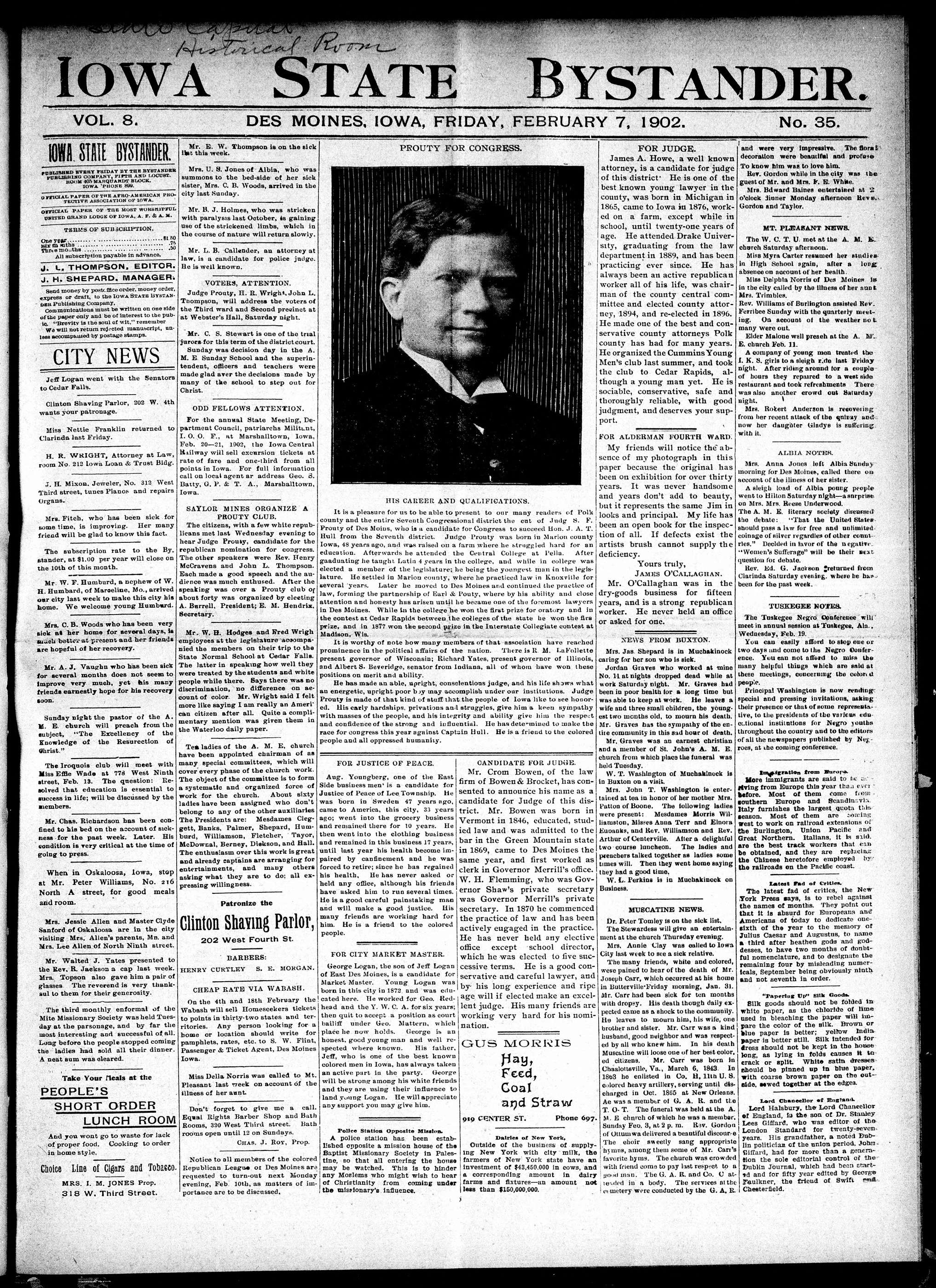
It is a pleasure for us to be able to present to our many readers of Polk county and the entire Seventh Congressional district the cut of Judg S. F. Prouty of Des Moines, who is a candidate for Congress to succeed Hon. J. A. T. Hull from the Seventh district. Judge Prouty was born in Marion county Iowa, 48 years ago, and was raised on a farm where he struggled hard for an education. Afterwards he attended the Central College at Pella. After graduating he taught Latin 4 years in the college, and while in college was elected a member of the legislature; he being the youngest man in the legislature. He settled in Marion county, where he practiced law in Knoxville for several years. Later he moved to Des Moines and continued the practice of law, forming the partnership of Earl Pouty, where by his ability and close attention and honesty has arisen until he became one of the foremost lawyers in Des Moines. While in the college he won the first prize for oratory and in the contest at Cedar Rapids between the colleges of the state he won the first prize, and in 1877 won the second prize in the Interstate Collegiate contest at Madison, Wis.
It is worthy of note how many members of that association have reached prominence in the political affairs of the nation. There is R M. LaFollette present governor of Wisconsin; Richard Yates, present governor of Illinois, and Albert S. Beveridge, senator from Indiana, all of whom have won these positions on merit and ability.
He has made an able, upright, conscientious judge, and his life shows what an energetic, upright poor boy may accomplish under our institutions. Judge Prouty is made of that kind of stuff that the people of Iowa like to see honored. His early hardships, privations and struggles, give him a keen sympathy with masses of the people, and his integrity and ability give him the respect and confidence of the strong and influential. He has determined to make the race for congress this year against Captain Hull. He is a friend to the colored people and all oppressed humanity.
FOR JUSTICE OF PEACE.
Aug. Youngberg, one of the East Side business men is a candidate for Justice of Peace of Lee Township. He was born in Sweden 47 years ago, came to America, this city, 33 years ago; went into the grocery business and remained there for 10 years. He then went into the clothing business and remained in this business 17 years, until last year his health become impaired by cannibalism and he was forced to retire; since he has regained his health. He has never asked or held any office, although his friends have asked him to run several times. He is a good careful painstaking man and will make a good justice. His many friends are working hard for him. He is a friend to the colored people.
---
FOR CITY MARKET MASTER.
George Logan, the son of Jeff Logan of East Des Moines, is a candidate for Market Master. Young Logan was born in this city in 1872 and was educated here. He worked for Geo. Redhead and the Y. W. C. A. for six years; then quit to accept a position as court bailiff under Geo. Mattern, which place he now holds. George is an honest, good young man and well respected where known. His father, Jeff, who is one of the best known colored men in Iowa, has always taken an active part in the party. George will be strong among his white friends and they are using their influence to land young Logan. He will appreciate any support you may give him.
Police Station Opposite Mission
A police station has been established opposite a mission house of the Baptist Missionary Society in Palestine, so that all entering the house may be watched. This is to hinder any Moslems who might wish to hear of Christianity from coming under the missionary's influence.
present to our many readers of Polk national district the cut of Judg S. F. for Congress to succeed Hon. J. A. T. Judge Pronty was born in Marion county farm where he struggled hard for an in the Central College at Pella. After the college, and while in college was being the youngest man in the legisher where he practiced law in Knoxville for Jes Moines and continued the practice of Pronty, where by his ability and close became one of the foremost lawyers who won the first prize for oratory and in the colleges of the state he won the first in the Interstate Collegiate contest at members of that association have reached the nation. There is R. M. LaFollette and Yates, present governor of Illinois, Indiana, all of whom have won these felicitous judge, and his life shows what amplellish under our institutions. Judge at the people of Iowa like to see honoror struggles, give him a keen sympathy and ability give him the respect essential. He has determined to make the main Hull. He is a friend to the colored
CANDIDATE FOR JUDGE
Mr. Crom Bowen, of the law firm of Bowen & Brocket, has consented to announce his name as a candidate for Judge of this district. Mr. Bowen was born in Vermont in 1846, educated, studied law and was admitted to the bar in the Green Mountain state in 1869, came to Des Moines the same year, and first worked as clerk in Governor Merrill's office. W. H. Flemming, who was Governor Shaw's private secretary was Governor Merrill's private secretary. In 1870 he commenced the practice of law and has been actively engaged in the practice. He has never held any elective office except school director, which he was elected to five successive terms. He is a good conservative and careful lawyer, and by his long experience and ripe age will if elected make an excellent judge. His many friends are working very hard for his nomination.
GUS MORRIS
Hay,
Feed,
Coal
and Straw
919 CENTER ST. Phone 697.
Outside of the business of supply ing New York with city milk, the farmers of New York state have an investment of $43,450,000 in cows, and a corresponding amount in dairy farms and fixtures—an amount not less than $150,000,000.
FOR JUDGE.
James A. Howe, a well known attorney, is a candidate for judge of this district. He is one of the best known young lawyer in the county, was born in Michigan in 1865, came to Iowa in 1876, worked on a farm, except while in school, until twenty-one years of age. He attended Drake University, graduating from the law department in 1889, and has been practicing ever since. He has always been an active republican worker all of his life, was chairman of the county central committee and elected county attorney, 1894, and re-elected in 1896. He made one of the best and conservative county attorneys Polk county has had for many years. He organized the Cummins Young Men's club last summer, and took the club to Cedar Rapids, although a young man yet. He is sociable, conservative, safe and thoroughly reliable, with good judgment, and deserves your support.
FOR ALDERMAN FOURTH WARD.
My friends will notice the absence of my photograph in this paper because the original has been on exhibition for over thirty years. It was never handsome and years don't add to beauty, but it represents the same Jim in looks and principal. My life has been an open book for the inspection of all. If defects exist the artists brush cannot supply the deficiency.
Yours truly.
JAMES O'CALLAGHAN.
Mr. O'Callaghan was in the dry-goods business for fifteen years, and is a strong republican worker. He never held an office or asked for one.
NEWS FROM BUXTON.
Mrs. Jas. Shepard is in Muchakinock caring for her son who is sick.
Jordan Graves who worked at mine No. 11 at nights dropped dead while at work Saturday night. Mr. Graves had been in poor health for a long time but was able to keep at work. He leaves a wife and three small children, the youngest two months old, to mourn his death. Mr. Graves has the sympathy of the entire community in this sad hour of death.
Mr. Graves was an earnest christian and a member of St. John's A. M. E. church from which place the funeral was held Tuesday.
W. T. Washington of Muchakinock is in Buxton on a visit.
Mrs. John T. Washington is entertained at tea in honor of her mother Mrs. Patton of Boone. The following ladies were present: Mesdames Morris Williamston, Misses Anna Terr and Elnora Euoanks, and Rev. Williamson and Rev. Arthur of Centerville. After a delightful two course luncheon. The ladies and preachers talked together as ladies some times will. Then they went home saying they had a good time. W. L. Perkins is in Muchakinock on Business.
MUSCATINE NEWS
Dr. Peter Tomley is on the sick list. The Stewardess will give an entertainment at the church Thursday evening. Mrs. Annie Clay was called to Iowa City last week to see a sick relative.
The many friends, white and colored, were pained to hear of the death of Mr. Joseph Carr, which occurred at his home in Butterville-Friday morning, Jan. 31. Mr. Carr had been sick for ten months with dropsy. His death though daily expected came as a shock to the community. He leaves to mourn him, his wife, one brother and sister. Mr. Carr was a kind husband, good neighbor and was respected by all who knew him. In his death Muscatine will loose one of her best color, ed citizens. Mr. Carr was born in Chaalottsville, Va., March 6, 1843. In 1863 he enlisted in Co. H, 11th U. S. colored heavy artillery, serving until discharged in Oct. 1865 at New Orleans. Ae was a member of G. A. R. and the T. O. T. The funeral was held at the A. M. E church of which he was a member, Sunday Foal, 3, at 2 p. m. Rav. Gordon of Ottumwa delivered a beautiful discourse. The choir sweetly sang appropriate hymns, among them some of Mr. Carr's favorite hymns. The church was crowded with friend come to pay last respect to a good man. The G. A. R. and Co. C attended in a body. The services at the cemetery were conducted by the G. A. R
No. 35.
and were very impressive. The floral decoration were beautiful and profuse. To know him was to love him. Rev. Gordon while in the city was the guest of Mr. and Mrs. F. E. White. Mrs. Bdward Baines entertained at 2 o'clock jianer Monday afternoon Revs. Gordon and Taylor.
MT. PLEASANT NEWS
The W. C. T. U. met at the A. M. E. church Saturday afternoon.
Miss Myra Carter resumed her studies in High School again, after a long absence on account of her health.
Miss Delphia Norris of Des Moines is in the city called by the illness of her aunt Mrs. Trimbles.
Rev. Williams of Burlington assisted Rev. Ferribee Sunday with the quarterly meeting. On account of the weather not many were out.
Elder Malone will preach at the A. M. E. church Feb. 11.
A company of young men treated the I. K. S. girls to a sleigh ride last Friday night. After riding around for a couple of hours they repaired to a west side restaurant and took refreshments. There was also another crowd out Saturday night.
Mrs. Robert Anderson is recovering from her recent attack of the quinzy and now her daughter Gladys is suffering with it.
ALBIA NOTES.
Mrs. Anna Jones left Albia Sunday morning for Des Moines, called there on account of the illness of her sister.
A sleigh load of Albia poung people went to Hilton Saturday night—a surprise on Mrs. Mrs. Reese Underwood.
The A. M. E. literary society discussed the debate: "That the United States should pass a law for free and unlimited coinage of silver regardless of other countries." Decided in favor of the negative. "Women's Sufferage" will be their next question for debate.
Rev. Ed. G. Jackson $returned from Clarinda Saturday evening, where he has been for the past week.
TUSKEGEE NOTES
The Tuskegee Negro Conference will meet in annual session at Tuskegee, Ala., Wednesday, Feb. 19.
You can easily afford to stop one or two days and come to the Negro Conference. You can not afford to miss the many helpful things which are said at these meetings, concerning the colored people.
Principal Washington is now sending special and pressing invitations, asking their presence or that of some representative, to the presidents of the various educational institutions for Negro youths throughout the country and to the editors of all the newspapers published by Negroes, at the coming conference.
Imiteration from Europe
Immigration from Europe. More immigrants are said to be living from Europe this year than ever before. Most of them come from southern Europe and Scandinavia. Italy furnishes the largest quota this season. Most of them are coming west to work on railroad extensions of the Burlington, Union Pacific and Great Northern. Italians, it is said, are the best track workers that can be obtained, and they are replacing the Chinese heretofore employed by the railroads on the Pacific coast.
Latest End of Critics
The latest fad of critics, the New York Press says, is to rebel against the names of months. They point out that it is absurd for Europeans and Americans of today to dedicate one-sixth of the year to the memory of Julius Caesar and Augustus, to name a third after heathen gods and goddesses, to have two months of doubtful nomenclature, and to designate the remaining four by misleading numericals, September being obviously ninth and not seventh in order.
"Papering Up" Silk Goods
Silk goods should not be folded in white paper, as the chloride of lime used in bleaching the paper will impare the color of the silk. Brown or blue paper is better; yellow India paper is better still. Silk intended for dress should not be kept in the house long, as lying in folds causes it to crack or split. White satin dresses should be pinned up in blue paper, with coarse brown paper on the outside, sewed together at the edges.
Lord Chancellor of England
Lord Halsbury, the Lord Chancellor of England, is the son of Dr. Stanley Lees Giffard, who was editor of the London Standard for twenty-seven years. His grandfather, a noted Dublin politician of the union period, John Giffard, had for more than a generation the sole editorial control of the Dublin Journal, which had been started and for fifty year edited by George Faulkner, the friend of Swift and Chesterfield.
---
DES MOINES. IOWA
It is so hard to be good when there is nothing by but conscience to smile approval.
The country is facing a pickle famine. That is not our fault—that is sour misfortune.
Nicaragua is being advised to bring suit against Panama for alienating Uncle Sam's fickle affections.
Equipped as he is with a system of handy signals, Marconi has no use for postal cards or messenger boys.
According to unofficial census returns the inhabitants of the prairie dog towns still number millions.
The fog will have to lift from London streets before anybody will buy tickets for the coronation parade.
Now that Li Hung Chang sleeps with his fathers China has grown bold enough to talk real sassy to Russia.
A St. Paul woman is complaining because her husband threw a dog at her. Why didn't she lam him with the cat?
French scientists want the world to get its time from Paris, but Connecticut clockmakers will protest against this.
The man who laid in his winter's supply of coal in the fall does not object to being classed as one of the has bins.
Mrs. Astor is changing her citizenship to Rhode Island in the expectation that her taxes will be small, to match the state.
Since the discoverer of pepsin has found it necessary to die every dyspeptic in the land will shed a tear over his memory.
New York has the largest collection of butterflies in the world, and they are not all in the Museum of Natural History, either.
If those Canadians who are going around the world in a canoe are wise they will carry their relief expedition along with them.
Prince Henry is buying presents to distribute in this country, but it isn't likely that he will be able to get away without slighting a few of us.
From the way the European countries talk now it is surprising that they could restrain themselves from coming over to help us lick Spain.
Must eat only crackers and skimmed milk; mustn't drink, mustn't smoke. No healthy "Man With a Hoe" need covet John D. Rockefeller's billions.
Americans needn't lose any sleep over that threatened European customs union. Too many cooks spoil the broth. The earth is ours and the fatness thereof.
Owing to the extraordinary expense of the grand entree in Pekin the other nations of the earth must be prepared for a heavy advance in the price of fireworks this year.
Except the one underneath, Australia is the hottest country on record. The Australian farmer has to feed his chickens on cracked ice to keep them from laying boiled eggs.
In order to escape going to jail a New Jersey man married a woman from whom he stole. A woman sometimes strikes on a fine way of making the punishment fit the crime.
It speaks well for the financial condition of the great Northwest that a bank in Great Falls, Mont., can lose $75,000 through the embezzlement of its cashier and still remain solvent.
Mr. Rockefeller has just given $100,000 to a New York college. But Dr. Harper isn't worrying. He has good reason for believing that there is fully $26,000 more where that came from.
Dr. Knopf of the New York Academy of Medicine, has discovered a disease called "Phthislophobia." It is a form of madness brought on by trying to make the first two consonants enter into the pronunciation.
Cold, hard and other forbidding qualities. Thus Curtis Brown, London correspondent, writes about Rudyard Kipling as his private letters show him. More than one struggling penny-a-liner can prove that Kipling has one of the most brotherly hearts that God ever put pulse into. And this is good, clean, simple truth, which is more or less at the bottom of things.
A ban forbidding Russian students to form associations of more than ten has been removed and the government hopes for great things from the concession. No wonder Russian students were always in rebellion when they were certain to come in conflict with the police if they formed a college eleven.
A white murderer down in Tennessee protests against "being hanged on the same scaffold and on the same day as a negro." This is drawing the color line up to the choking point.
---
THE NEWS IN IOWA
THE NEWS IN IOWA
INVOLVES MUCH LAND.
Senate Judiciary Committee Introduces Important Bill.
Des Moines, Feb. 7.—A bill that created no small stir among the lawyers of the senate and that is farreaching in its possible effect, has been introduced from the senate judiciary committee. Some time ago a decision of the supreme court was made to the effect that in cases where the wife had conveyed the power of attorney to her husband or vice versa, to dispose of a dowry interest in land, and to husband, sold such land, such sale invalid.
The decision excited the deepest interest for the reason that a great amount of land has been disposed of in precisely this way and enormous interests are at stake. The decisionuced proposes only to indicate the title where the husband who has disposed of his land is still living. Theso entitled:
A bill for an act to validate certain conveyances of real estate in which the husband or wife conveyed the congenant dower interest of the other spouse.
It reads: "No conveyance heretofore made, wherein the husband or wife conveyed or contracted to congenant dower interest of the other spouse, shall be held invalid because the same controverses the provisions of section 3154 of the code and all such conveyances are hereby legalized and made effective, provided: That this act shall not affect titles where the dower interest has already vested in the dower the taking effect of the act and that this act shall not affect the right of parties in any pending litigation."
WANTS THE COMMON LAW.
Harriman Has a Call Which is Likely to Meet With Congenition.
Des Mores, Feb. 27 — Senator Harriman has introduced a bill proposing to change the law relating to the control of surface water. Senator Harriman wants the civil law which now governs this matter in Iowa, changed to the common law, and means to take a firm stand for such a change. His measure, he has written, will with it think it is right. At present the civil law governing the disposition of surface water makes it impossible for the owner of any land to drain its surface in such a manner that it will be to the detriment of a neighbor's property. That is, not allowed to make the drainage in such a way that the water will empty to adjoining land beyond his own boundaries.
Senator Harriman wants this law changed to what is known as the common law, that any owner of property may drain the surface in a manner to suit his own convenience, even though it may be to carry such surface water onto the land of another. He has obtained information regarding the states which now have the common law on this subject, and has a number of arguments which he considers overwhelmingly in favor of the bill. Among the states which now have the law which Senator Harriman is seeking to get for Iowa are Connecticut, Indiana, Kansas, Maryland, Massachusetts, Maine, Maine, New York, Rhode Island, Vermont and Wisconsin. The measure will unquestionably meet with opposition. It was referred to the committee on public lands.
FOUR BURNED TO DEATH.
Woman and Three Children Victims of Fire at Waterloo.
Waterloo, Feb. 6.—Fire last night, caused by the overturning of a lamp, resulted in the death of Mrs. Ed Kushner and two children, a girl of 11 and a boy of 9. One oneeighty fire was actually burned. The children were playing around, a table on which a glass lamp was standing. It was pulled to the floor and blazing oil spread to the clothing of the mother and children. The terrorized mother made no attempt to get out of the house, but she clamped her little ones to her while the flames spread about them. Firemen succeeded in saving four of the family without serious injury, but the others were so horribly burned that death soon followed. The accident occurred when a clock clock was dead when taken from the ruins of the house, but the mother lived until 3 o'clock a. m.
Linhoff Tells His Story.
Mason City, Feb. 7.—August G. Linhoff, husband of Mrs. L. K. Linhoff, charged with the murder of Edwin C. Bromley, was on the stand all of yesterday in the Linhoff trial. His testimony was repetition of the stories he devised in the part and he told in minute detail of the various squabbles which the families in the past. The only sensational incident of the afternoon was when he told of the killing of Bromley by a friend and Bromley made a rush at him and that following Bromley came Mrs. Bromley with a club. He says that Mrs. Bromley threw the club and that it struck him upon the head, momentarily stunning him. When he recovered his senses he found himself clinched with Bromley by fire. He was the revolver. He did not know at the time how many shots were fired.
Bist In a Colored Church.
Marshalltown, Feb. 7.—Members of the African M. E. church became involved in a quarrel with their pastor. The latter drew a revolver, but did not fire. The whole congregation, men and women, joined in the fight. A lot of the police station who arrested the leaders. A large number were injured.
Gasoline Engine Explodes.
Mason City, Feb. 4.—The St. Paul and Minneapolis elevator at Meservey was destroyed by fire. The cause of the explosion was a gasoline engine. The loss is $10,000, and 6,000 bushels of grain.
Mr. Phillips Pays His Fine.
Ottawa, Feb. 7.—T. J. Phillips, former candidate for governor, was fined twenty-five dollars in the district court for kicking Editor Moore several weeks ago. He pleaded guilty.
Difference of opinion is the greatest common divisor.
Senator Harper's Bill to be Introduced This Week.
Des Moines, Feb. 4.—Senator Harper will have his biennial election bill introduced in the house sometime during the present week, and will endeavor to secure a poll of the lower branch of the assembly as to the feeling in regard to the matter.
In the senate he says he has been assured by a large number of the members that the measure is a good thing, and he believes that there will be no difficulty in securing favorable action at the hands of the committee or by the senate itself. We withhold large proponents of new memebers from certain, as upon other questions which have been before the legislature during past sessions.
Senator Harper's bill cures a number of the defects of the Titus amendment. The legislature is to meet in odd-numbered years instead of even numbered, as at present. If the amendment passes the Twenty-ninth and Thirtieth general assemblies it will be voted upon at the general election of 1904. The next election after that will then be in 1906. Governor Cummins' two terms will expire in January, 1906, but his second term, with all others expiring in that year, will be extended to 1907, and their successors elected in the fall of 1906.
The Thirtieth general assembly will meet in 1904, while the Thirty-first will meet in 1905, the year following, and then each second year thereafter. Members of the general assembly elected in 1903 will serve through two sessions, the Thirtieth and the Thirty-first.
DES MOINES TO VACCINATE.
Mayor Empowered to Employ Twent
ty Four, Physicians
Des Moines, Feb. 4.—Upon the adoption of a resolution submitted by Alderman Dorr to the city council, sitting as the board of health, Mayor Hartenbower and a committee composed of Alderman Dorr, Brereton and Hanger have been empowered to employ 24 physicians to enforce compulsory vaccination of all persons exposed to smallpox. It is further ordered by the city that the pupils of all schools and employees of all public buildings, factories and houses be vaccinated. At a meeting of the mayor, this committee it decided to employ three extra physicians at once, two for the west side and one for the east side, for the purpose of detecting exposed persons and vaccinating those exposed. City schools are to be visited and vaccination of all scholars made compulsory to attendance at school. In case any persons or families resist effort to vaccinate, the home of such family is to be placed under quarantine for seventeen days and the expenses of quarantine assistance against that arranged for is needed, it is the intention to add to the force as required. Every measure possible will be exercised as a precaution against further spread of the disease and to control it, as it now exists throughout the city.
SUBCOMMITTEE IS NAMED.
Senate Takes Steps toward Railway Legislation
Des Moines, Feb. 4.—For the first time since the general assembly opened there are visible symptoms of a movement toward the reform of the railway assessment laws. At a meeting of the senate ways and means committee yesterday afternoon the subject was brought up by Senator Healy. He called attention to the fact that the outgoing and incoming governors had pointed out defects in the present laws on railway assessments and that Lieutenant Governor Herrillo had done nothing. He said that wherever he was done ought to emanate from the senate ways and committee, and a motion he made to consider the subject was adopted.
Senator Healy said further he had nothing prepared to submit on the subject and suggested it be referred to a sub-committee to investigate and report to the main committee. Chairman Junkin, in the chair, carried out and the sub-committee selected, in addition to Junkin, consists of Senators Healy, Lewis and Porter. It is understood this sub-committee will make an inquiry into the need of changes in the railway assessment facilities exist they will lay them before the main committee. Out of this may grow the drafting of a committee bill making reforms in railway assessments.
KILLED IN COLLISION.
Stockmen on Illinois Central Train Were Asleen.
Dubuque, Feb. 4.—A rear-end collision at 3:45 a.m. on the Illinois Central at Apple River, Ill., a station thirty miles east of here, resulted in the death of four stockmen, while six were seriously injured. The dead: W. F. Pancake, Wall Lake, Iowa; H. F. Pancake, Wall Lake, Iowa; Chris Ferndon, St. Asgar, Iowa; C. R. Blunt, Charles City, Iowa.
The seriously injured: W. Cameron, Dundee, Ill., badly crushed, not expected to live; F. J. Jordan, Dunlap, Iowa, injured about ribs and back; D. Lawler, Wall Lake, Iowa, injured the chest and legs. Slightly injured: J. J. Morehead, Dunlap, Iowa; W. J. Evans, Dunlap, Iowa; unknown man.
None of the trainmen were injured as they heard the train approaching and jumped. The stockmen were all asleep in the bunk car when the collision occurred, their death and injuries resulting from being crushed in front of them with surgeons was sent out from here and the injured are all being cared for at Apple River.
Chokes to Death on Peanut.
Sinus City, Feb 6.—Roy Hay, the 14-month old son of D. W. Hay of Moville, choiced to death on a peanut. The child attempted to swallow the nut, but it caught in the throat so as to prevent breathing. The child died while a physician was trying to remove the obstruction.
Man Is Burned to Death.
Oskaloosa, Feb. 6.—James McGeey was burned to death in the destruction of his house at Evans. The rest of the family escaped. They lost everything.
THE LEGISLATURE.
Des McKines, Feb. 3.—Senate—No business of importance was transacted. Arthuraud's bill to repeal the statute permitting the voting of aid to railways, and Hayward's bill to remove the 1 per cent discriminating tax on foreign insurance companies were the only measure proposed.
House.—Larrabee of Fayette introduced a resolution endorsing the Hoar bill regarding government by injunction, and moved that it be referred to the committee on federal matters of Marion offered an amendment resolution regarding the St. Louis exposition restricting the appropriation for that purpose to $100,000. Four bills were passed, one of them providing for semi-annual inspection of mines. Several bills were authored by the House in opposing $60,000 for a state arsenal and adjutant general's building
Des Molines, Feb. 4.—Senate. Among bills introduced were the following: By .ayward, to convert the Knoxville home for the blina into a female reformatory; by Courtright, giving a standard form of official bond; this is designed to compel surety companies to give straight bonds instead of insurance policies; Garst, by request, prohibiting farmers' fire, hali, windstorm, tornado and accident associations from suing palp up policies; by Alexander, to improve the assessment of property in special charter cities at 25 per cent of its actual value; by Alexander, to allow savings banks to accept twenty times their capital stock in deposits.
Appropriation bills were proposed as follows: For St. Louis, $250,000; for Clarinda, $69,700; for Knoxville reformatory, $18,000; for completing historical building, $300,000. The senate appropriations committee decided to report favorably the bill giving Cherokee $138,000 for furniture, etc. House.—Warren's resolution to limit the St. Louis appropriation to $100,000 was sent to the committee on appropriations, which is equivalent to killing it. Bill to permit city of Des Moines to lend $50,000 to the water works company was passed. A resolution opposing an amendment to Knoxville, the 15th was carried. A number of bills of importance were introduced.
Des Moines, Feb. 5.—Senate. The bill for an emergency appropriation of $138,000 for the completion, equipment and furniture of the Cherokee insane hospital was passed without opposition. Among bills ... oduced three fellowships. Hickory would provide a department in one of the hospitals of the state for the treatment of dispensarians, inbirates and persons addicted to excessive use of narcotics; by Smith, requiring reports o. railroads to executive council to be uniform, and to cover gross and net earnings on business originating in Iowa, Iowa, terminating Iowa, or out of Iowa wwally outside or inside Iowa.
House.—The house today memorized congress to pass the Lacey bill to indemnify the states for payments made on account of purchase of swamp lands at $1.25 an acre. This includes about 1,000,000 acres in Iowa. English introduced a bill providing for reports to be made by railway companies to the executive council. The plan outlined is practically the same as that outlined by Governor Cummins in his inaugural.
Des Moines, Feb. 6.—The senate accepted an invitation to visit Knoxville and inspect the abandoned home for the blind buildings on the 15th. Trewin's bill to codify and republish the session laws since 1897 passed. Kendall's resolution for a commission to investigate recent mine explosions in Iowa was adopted. Among bills in Indiana were: the State Highway Hopkins appropriate $37,000 to erect on state fair grounds, fire proof stock pavilion 175x225 feet, with a show ring 170x120 and a seating capacity of 4,000; by Young of Washington, to appropriate $55,000 for monuments to Iowa troops at Lookout Mountain and Missionary Ridge; a commission to locate position to be named from the eleven Iowa organizations in the battles of Chattanooga, Fourth Fifth, Fifth Sixth, Seventh Fifth, Sixth, Twenty-sixth, Thirtieth and Thirty-first Iowa regiments and First Iowa battery were there.
House.—Wise offered a joint resolution to amend the constitution by providing for biennial elections. A large number of bills of minor importance were introduced. Carter filed a motion to amend the constitution in voting to request the Iowa delegation to vote for the Lacey swamp bill.
ENGLAND'S SCANDAL.
England Was Offered Advice of
American Army Horse Expert.
London, Feb. 5.—In the house of commons Major Arthur Lee (conservative, formerly British attache with the United States army during the Korean war) an Irish attache at Washington) said Great Britain had been offered the services of the chief horse expert of the United States army, as adviser in the purchase of American horses for the British army. A civil aviation was made during a heated debate on the remount question, when Major Lee said:
"The accredited representative of the war office, Colonel Wardrop, the attache at Vienna, was given no opportunity of showing what knowledge he possessed of the resources of the country, in the same way I, being military attache at Washington, was not informed of buying horses in the United States, I learned from the American newspapers that British officers had been sent to buy horses, but I was not informed who they were, nor was I asked to give them such assistance as my position implied that I was competent to give. At the time I had the opportunity, not the good one, of giving the services of the chief horse expert of the United States army, as adviser. I called the suggestion to the war office, but I received no reply."
Chinese Indemnity Paid.
Fekin, Feb. 3.—The first monthly installment of the Chinese indemnity, amounting to 1,820,000 tales, has been Commissioners Powers at Shanghai.
NOTES FROM THE CAPITAL
Des Moines. Feb. 6. 1902.
Governor Cummins has announced the appointment of Dr. J. H. Sams of the University of Iowa to Dr. Shrader, of Iowa City, whose term as a member of the state board of health has expired. Dr. Shrader was not a candidate for appointment. He is one of the oldest and best known practitioners in the state. He has served in the capacity of a member of the state board of health for ten years past, and now retires of his own volition; his successor is identified with the class of physicians known as regulars, the same as Dr. Shrader. Dr. Sams is a comparatively young physician, he having completed a state university in 1892. He is appointed for a term of seven years, arranged that one term expires on January 31 of each year.
The board of agriculture has decided to erect a $35,000 column on the state fair grounds. The building will contain five rooms and will be an extensive affair. The board has not the funds to erect the building at present and will ask the legislature to appropriate the amount. It is expected that the facility will be experienced in getting the appropriation. The board also decided to build an addition to the present horticultural building which will be for the exclusive use of flower exhibits. It will cost about $1,500.
The Iowa State Congress of Mothers elected the following officers for the etsuing year:
President, Mrs. Isaac Lea Hillis, of Des Moines; first vice-president, Mrs. J. A. Schmidt, of Muscatine; second vice-president, Mrs. Cato sells, of Vinton; third vice-president, Mrs. J. W. Cory, of Spencer; recording secretary, Mrs. Edyne Payne Parsons, of Moines; corresponding secretary, Mrs. J. A. Schmidt, of Muscatine; treasurer, Mrs. Riggs, of Audubon; auditor, Mrs. N. Darnell, of Centerville.
Four men are now under sentence of death in Iowa. Governor Cummins is quoted as declaring that he has no conscientious scruples against the death penalty, and indicates that he will sign the death warrants if the court shall finally sustain the death penalty. He is also the presence of death at the present time are: Albert Phillips, Lewis Brooks, Marry Hortman and Richard Williams. Phillips and Brooks are the two bank robbers who, at Albert City, Buena Vista County, on November 16, killed John Sundbald, a prominent man who was a prisoner in a posse attempting to arrest the men as being connected with a bank robbery at Greenville in Clay county a few days previous. Harry Hortman on November 30 shot and killed Florence Porter, of Cherokee. The shooting was the most infamous former Hortman's sweetheart. Richard Williams, colored, on Sunday December 8, 1901, at Buxton, south of Oskaloosa, shot and killed Wm. Sharper, (white). The shooting was without provocation. Williams was flourishing a gun at the time and was endeavoring to break Brooks and Phillips are to be executed on December 19, 1902; Hortman on January 28, 1903; and Williams on March 13, 1903.
"I have not yet estimated carefully, but in my opinion the passage of my bill reducing the width of highways in Iowa to fifty feet from the present legal sixty-six feet, will save to the people of the state more than 500,000 acres of tillable land. This represents nothing of the value of productiveness which it represents annually," said Representative William L arrabee in an interview. Mr. Larrabee believes that the chances for the passage of his bill are reasonably good, and he expects to press it before the attention of the committees in the legislature with all the energy it which proposition is one that will receive the support of all the farmers of the state, whose valuable possessions will be increased to the amount mentioned and the rights of the public and the traveling farmer not affected in any particular. A highway fifty feet wide is as easily traveled as one sixty-six feet wide. Mr. Larrabee is inexpert, and he implies that the words "sixty-six" in section 1483 of the code shall be amended to read "fifty." While the act does not provide specifically as to the ownership of this land, it provides that the center of the roads now existing shall be the center of the new roads. This means in brief that the owners abutting on highways will gain eight feet more than the length of the fence that they own on the present highways. As a general proposition it may be said that roads now exist every half mile in every direction in this state; that is to say, there are 600 roads running north and south and 400 roads running east and west. This makes 240,000 miles of roads and 1,000 miles of roads gives to the farmers a stride of 240 feet wide, or practically 500,000 acres, which at $50 makes $25,000,000.
Representative John Hughes, of Iowa county, states that he will not introduce a two-cent fare bill during this session. He believes that all of his efforts will be required to push he anti-pass bill which he has already introduced, and he does not believe it would be much legislation of the same nature during the same session. He did not introduce the anti-pass bill as asy as he intended, but considered the matter fully, and Over one-third the land in Great Britain is owned by members of the house of lords.
Two millions of two-penny meals are daily supplied to the London poor by a large virtualizing company. The food is plentiful, well cooked, cleanly served, and the hungry multitude enjoy them. A bridegroom in Binghampton, N. Y., became so confused during the ceremony that he held cut his finger the long time the clergyman said. With this he wed. The bride added to his fusion by audibly exclaiming: "George. I never thought you were so stupid."
decided finally that in order to meet the wishes of his people he can to follow out what he believes to be his proper course he ought to introduce the bill and devote all of his efforts to secure its passage. While he believes that the two-cent fare bill would be an excellent companion bill for the anti-pass bill, he does not feel equal to the task of pushing both the same time he hopes that someone will introduce the two-cent fare bill, and if it should be introduced he should support it to the best of his ability. "Highes declares it to be his conviction that if the railroads would quit distributing passes they could easily afford to reduce the fare to two cents per person."
MRS. CONGER SPOKE
SHE REPRESENTED LADIES OF
DIPLOMATIC CORPS
Empress Dowager of China Also Made a Speech and Wept Copiously.
Peking, Feb. 3.—The dowager empress, the emperor and the empress, Saturday afternoon, received the ladies and children of the members of the diplomatic corps in the private apartments of the palace. The audience was the most revolutionary event since the return of the court to Peking. The exclusiveness of Chinese royalty and the prejudices against the meeting of the sexes was waived and the reception was less formal than is usual in European courts.
The dowager empress occupied the throne, with a brilliant assemblage of princesses and court ladies about her. The emperor was seated upon a small platform in the center of the room. The visitors upon entering bowed twice to the dowager empress. Mrs. Conger, wife of United States Minister Conger, as doyessness of the diplomatic corps, read a speech, which was translated by Secretary Williams.
"We heartily congratulate you and the imperial court that the situation which led you to abandon your beautiful capital has been so happily resolved, that you are now permitted to return in freedom and peace. The events of the past two years must have been as painful to you as to the rest of the world, but the stint of the experience may be eliminated by the establishment of franker, more trustful of the Chinese and the other people of the earth. The world is moving toward, the tide of progress can not be stayed, and it is hoped that China will join with the great sisterhood of nations in the grand march.
"The recent imperial edicts give promise of great good to your people and to your vast empire."
The dowager empress' reply was exceedingly friendly in tone. It was in part as follows:
"Last year the discussions in the palace and the revolution, which compelled our hasty departure; but it is a great gratification to us that our return to the capital has caused such rejoicing in China and abroad."
Baron Calkann, the Austrian minister and doyne of the diplomatic corps, presented all of the ladies to the dowager empress, who took the hand of each of them. They were next presented to the emperor, who sent them with them. The guests then retired to an anteroom. The dowager empress, entering this room, grasped Mrs. Conger's hand, which she held for some minutes, trembling, weeping and sobbing loudly, and exclaiming in broken sentences that the attack upon the legations was a terrible mistake and that she repented it bitterly. Mrs. Conger assured her that the past would be forgotten. Bracelets and rings of great value were then placed upon Mrs. Conger's wrists and fingers. Following the reception a banquet was given, the dowager empress sitting at the head or the principal table, with Mrs. Conger and Mme Uchida upon each side. The emperor was the only man present, except China to Great Britain, who knelt beside the dowager empress and interpreted what she said.
The dowager empress talked animatedly. She said that China would abandon her policy of isolation and adopt the best features of western life and would send many students abroad. Every lady of the visiting party was given a pair of jeweled bracelets and a solitaire pearl ring, besides other souvenirs.
Sire at Waterloo caused by the overturning of a lamp, resulted in the death of Mrs. Eu Kushner and two children, a girl of 11 and a boy of 9. One other child was fatally and three seriously burned. The children were bound in a chair, which a glass lamp was standing. It was pulled to the floor and blazing oil spread to the clothing of mother and children. The terrorized mother made no attempt to get out of the house, but nudded in a corner of the room clasping her hands to the ceiling, the spray spread about them. Firemen succeeded in saving four of the family without serious injury, but the others were so horribly burned that death soon followed. The accident occurred about 9 o'clock. Two of the children were dead, when the mother lived until 3 o'clock a.m. The husband and father was in Cedar Rapids when the accident occurred.
Frank Cherney, a bridge builder, employed on the Eagle Point bridge, at Dubuque, slipped and fell to the ice, a distance of 70 feet. He was taken to Finley hospital, where he died.
The motto of the editor is "keep to the write."
Benjamin F. Parker, of Kalamazoo Mich., is the proud possessor of a horse that chews tobacco. The name of the horse is Alice Maud, and she has account of 2,200.
A London physician suggests the running of motor cars at a speed fully up to the legal limit as a means of administering the open air treatment to consumptives.
A London school teacher received the following letter from the father of one her pupils: "The Teacher, Mrs. Prizz, from staying home. He had one menus to oblige his father."
The Diamond Bracelet
CHAPTER V—(Continued.)
"I trust not, but I am very unhappy. Who could have done it? How could it have gone? I left the room when you did, but I only lingered on the stairs watching—if I may tell the truth—whether you go out safely, and then I returned to it. Yet, when Lady Sarah came up from dinner it was gone."
"And did no one else go into the room?" he repeated. "I met a lady at the door who asked for you; I sent her upstairs."
"She went in for a minute. It was my sister, Gerard."
"Oh, indeed, was that your sister? Then she counts as we do for nobody in this. It is strange. The bracelet was in the room when I left it——"
"You are sure of it?" interrupted Alice drawing a long breath of suspense.
and speech, and her: "There's young lady," smile. "I'm no believe some as such. Just self and tell me recollect of the I put the br Alice Seaton, underneath the indicate it she was almost The diamond I placed here, the middle of 'and the rest and before it.' It was wort others, I believe cial.
"Much more, The officer
"I am. When I reached the door I turned round to take a last look at you, and the diamonds of that particular bracelet gleamed at me from its place on the table." "Oh, Gerard! is this the truth?"
"It is the truth, on my sacred word of honor," he replied, looking at her agitated face and wondering at her words. "Why else should I say it? Good-by, Alice, I can't stay another moment, for here's somebody coming I don't care to meet."
He was off like a shot, but his words and manner, like her sisters, had conveyed their conviction of innocence to the mind of Alice. She stood still, looking after him in her dreamy wonderment, and was jostled by the passers-by. Which of the two was the real delinquent? One of them must have been.
A little man was sturding about his library with impatient steps. He wore a faded dressing gown, handsome once, but remarkably shabby now, and he wrapped it closely around him through the heat of the weather was intense. But Colonel Hope, large as were his coffers, never spent upon himself a superfluous farthing, especially in the way of personal adornment; and Colonel Hope would not have felt too warm, cased in sheep-skins, for he had spent the best part of his life in India, and was of a chilly nature.
The Colonel had that afternoon been made acquainted with an unpleasant transaction which had occurred in his house. The household termed it a mystery; he, a scandalous robbery; and he had written forthwith to the nearest chief police station, demanding that an officer might be dispatched back with the messenger to investigate it. So there he was, waiting for his return in impatient expectation, and occasionally halting before the window to look out on the busy London world.
The officer at length came and was introduced. The Colonel's wife, Lady Sarah, joined him then, and they proceeded to give him the outlines of the case. A valuable diamond bracelet, recently presented to Lady Sarah by her husband, had disappeared in a singular manner. Miss Seaton, the companion to Lady Sarah, had temporary charge of the jewel box, and had brought it down the previous evening, Thursday, this being Friday, to the back of the drawing room, and laid several pairs of bracelets out on the table ready for Lady Sarah, who was going to the opera, to choose which she would wear when she came up from dinner. Lady Sarah chose a pair, and put, herself, the rest back into the box, which Miss Seaton then locked and carried to its place upstairs. In the few minutes that the bracelets lay on the table the most valuable one, a diamond, disappeared from it.
"I did not want this to be officially investigated; at least, not so quickly," observed Lady Sarah to the officer. "The Colonel wrote for you quite against my wish."
"And so have let the thief get clear off, and put up with the loss!" cried the Colonel. "Very fine, my lady."
"You see," added her ladyship, explaining to the officer "Miss Seaton is a young lady of good family, not a common companion; a friend of mine, I may say. She is of feeble constitution, and this affair has so completely upset her that I fear she will be laid on a sick bed."
"It won't be my fault if she is," retorted the Colonel. "The loss of a diamond bracelet, worth two or three hundred guineas, is not to be hushed up. They are not to be bought every day. Lady Sarah!"
The officer was taken to the room whence the bracelet disappeared. It was a back drawing room, the folding doors between it and the front standing open, and the back window, a large one looking out upon some flat leads—as did all the row of houses. The officer seemed to take in the points of the double room at a glance; the door of communication, its two doors opening to the corridor outside, and its windows. He looked at the latches of the two entrance doors, and he leaned from the front windows, and he leaned from the one at the back. He next requested to see Miss Seaton, and Lady Sarah fetched her—a delicate girl with transparent skin and looking almost too weak to walk. She was in a visible tremor, and shook as she stood before the stranger.
He was a man of pleasant manners
CHAPTER VI.
and speech, and he hastened to assure her: "There's nothing to be afraid of, young lady," said he, with a broad smile. "I'm not an ogre; though I do believe some timid folks look upon us as such. Just please to compose yourself and tell me as much as you can recollect of this."
"I put the bracelets out here," began Alice Seaton, laying hold of the table underneath the window, not more to indicate it than to steady herself, for she was almost incapable of standing. "The diamond bracelet, the one lost, I placed here," she added, touching the middle of the table at the back, "and the rest I laid out round, and and before it."
"It was worth more than any of the others, I believe," interrupted the official.
"Much more," growled the Colonel. The officer nodded to himself, and Alice resumed:
"I left the bracelets and went and sat down at one of the front windows——"
"With the intervening doors open, I presume."
"Wide open, as they are now," said Alice, "and the other two doors shut. Lady Sarah came up from dinner almost directly, and then the bracelet was not there."
"Indeed! You are quite certain of that."
"I am quite certain," interpoiled Lady Sarah, "I looked for that bracelet, and, not seeing it, I supposed Miss Seaton had not laid it out. I put on the pair I wished to wear and placed the others in the box and saw Miss Seaton lock it."
"Then you did not miss the bracelet at that time?" questioned the officer.
"I did not miss it in one sense, because I did not know it had been put out," returned her ladyship. "I saw it was not there."
"But did you not miss it?" he asked.
"I only reached the table as Lady Sarah was closing the lid of the box," she answered. "Lady Frances Chenex-vix had detained me in the front room."
"My sister," explained Lady Sarah. "She is on a visit to me, and had come with me up from dinner."
"You say you went and sat in the front room," resumed the officer to Alice, in a quicker tone than he had used previously. "Will you show where?"
Alice did not stir; she only turned her head towards the front room, and pointed to a chair a little drawn away from the window.
"In that chair," she said. "It stood as it stands now."
The officer looked baffled.
"You must have had the back room full in view from thence; both the door and the window."
"Quite so," replied Alice. "If you will sit down in it, you will perceive that I had an uninterrupted view, and faced the doors of both rooms."
"I perceive so from here. And you saw no one enter?"
"No one did enter. It was impossible they could do so without my observing it. Had either of the doors been only quietly unlatched, I must have seen."
"And yet the bracelet vanished!" interposed Colonel Hope. "They must have been confounded deep whoever did it; but thieves are said to possess slight of hand."
"They are clever enough for it, some of them," observed the officer.
"Rascally villains. I should like to know how they accomplished this."
"So should I," significantly returned the officer. "At present it appears to me incomprehensible."
There was a pause. The officer seemed to muse; and Alice, happening to look up, saw his eyes stealthily studying her face. It did not tend to reassure her.
Your servants are trustworthy; they have lived with you some time?" resumed the officer, not apparently attaching much importance to what the answer might be.
"Were they all escaped convicts, I don't see that it would throw light on this," retorted Colonel Hope. "If they came into the room to steal the bracelet, Miss Seaton must have seen them."
"From the time you put out the bracelets to that of the ladies coming up from dinner, how long was it?" inquired the officer of Alice.
"I scarcely know," panted she, for, what with his close looks and his close questions, she was growing less able to answer. "I did not take particular notice of the lapse of time; I was not well yesterday evening."
"Was it half an hour?"
"Yes—I dare say—nearly so."
"Miss Seaton," he continued, in a brisk tone, "will you have any objections to take an oath before a magistrate—in private, you know—that no person whatever, except yourself, entered either of these rooms during that period?"
CHAPTER VII.
Had she been requested to go before a magistrate and testify that she, herself, was the guilty person, it could scarcely have affected her more. Her cheeks grew white, her lips parted, and her eyes assumed a beseeching look of terror. Lady Hope hastily pushed a chair behind her, and drew her down upon it.
"Really, Alice, you are very foolish to allow yourself to be excited about nothing," she remonstrated; "you would have fallen on the floor in another minute. What harm is there in
CHAPTER VII
taking an oath—and in a private room? You are not a Chartist, or a Mormon—or whatever the people call themselves, who profess to object to oaths, on principle."
The officer's eyes were still keenly fixed on Alice Seaton's, and she covered visibly beneath his gaze.
"Will you assure me, on your sacred word, that no person did enter the room?" he repeated, in a low, firm tone, which somehow carried her to the terrible belief that he believed that she was trifling with him.
She looked at him, gasped, and looked again; and then she raised her handkerchief in her hand and wiped her damp and aisy face.
"I think some one did come in," whispered the officer in her ear; "try and recollect." And Alice fell back in hysteria.
Lady Sarah led her from the room, herself speedily returning to it.
"You see how weak and nervous Miss Seaton is," was her remark to the officer, but glancing at her husband. "She has been an invalid for years, and is not strong like other people. I felt sure we should have a scene of some kind; that is why I wished the investigation not to be gone into hurriedly." "Don't you think there are good grounds for an investigation, sir?" testily asked Colonel Hope of the officer.
"I must confess I do think so," was the reply.
"Of course, you hear, my lady. The difficulty is, how can we obtain the first clue to the mystery."
"I do not suppose there will be an insurmountable difficulty," observed the officer. "I believe I have obtained one."
"You are a clever fellow, then," cried the Colonel, "if you have obtained it here. What is it?"
"Will Lady Sarah allow me to mention it—whatever it may be—without taking offense?" continued the officer, looking at her ladyship.
She bowed her head, wondering much.
"What's the good of standing upon ceremony?" peevishly put in Colonel Hope. "Her ladyship will be as glad as we shall be to get back her bracelet; more glad, one would think. A clue to the thief! Who can it have been?"
The detective smiled. When men are as high in the police force as he, they have learned to give every word its due significance. "I did not say a clue to the thief, Colonel; I said a clue to the mystery."
"Where's the difference?"
"Pardon me, it is indisputably perceptible. That the bracelet is gone, is a papable fact; but by whose hands it went, is as yet a mystery."
"What do you suspect?"
"I suspect," returned the officer, lowering his voice, "that Miss Seaton knows how it went." There was a silence of surprise; on Lady Sarah's part, of indignation.
"Is it possible that you suspect her?" uttered Colonel Hope.
"No," said the officer, "I do not suspect herself; she appears not to be a suspicious person in any way; but I believe she knows who the delinquent is, and that fear, or some other motive, keeps her silent. Is she on familiar terms with any of the servants?" "But you cannot know what you are saying!" interrupted Lady Sarah. "Familiar with the servants! Miss Seaton is a gentlewoman, and has always moved in high society. Her family is little inferior to mine, and better—better than the Colonel's," concluded her ladyship, determined to speak out.
(To be continued.)
WOMAN WHO RIDES HORSEBACK.
St. Louis for some time past has been greatly exercised regarding a fairquestrienne who has appeared daily on the fashionable drives around Lafayette park riding her steed bareback and astride. Her identity was known to few and the majority marveled greatly at her skill in managing her spirited steed and at her temerity in setting at defiance the accepted customs of her sex. With her blonde hair dressed pompadour, and her blue eyes flashing with exhilaration, clad in a clinging wrapper, wearing neither hat nor gloves, she goes forth daily for an equestrian stunt that astonishes the avenue. The identity of the fair horsewoman has finally become known to the public at large. She is Miss Jessie Goodpasture and belongs to an excellent family. She knows a good horse when she sees one, but she never refuses a ride on any animal that is offered, no matter how sorry a plug he may be. She prefers a horse with much spirit and plenty of speed, and she does not object at all to one that tries to throw her. "I have never been thrown," she says, "and I don't fear being thrown. I guess I can stay on any horse that comes along. I never rode a bucking broncho, though. I have heard of Miss Bossie Mulhall of Oklahoma and the way she rides horse and ropes cattle. Well, I suppose she is a pretty good rider, but I can ride a little myself. When Buffalo Bill was here two years ago I rode in his parade. I also rode in his show with the general turnout of riders. But I like riding astride better than on a sideaddle." Miss Jessie went from Springfield, Ill, to St. Louis eight years ago. She has never owned a horse, but depends upon acquaintances for her mounts. Whenever a boy rides past the alley in the rear of her home she craves the privilege of riding his horse. Then the neighbors witness a daring exhibition. "I don't know why I am so fond of riding," she said. "I guess I was just born that way. I'd rather ride than do anything else on earth. I just must ride."—Chicago Chronicle.
Christian science is said to be popular among art students in the Latin quarter of Paris.
Washington, Feb. 2.—Senate: Another spit debate, with the Philippine tariff bill as the text, was precipitated in the senate today, as the result of some statements made by Carmack, democrat, of Tennessee, in the course of an extended speech on the general Philippine question. It was the Tennessee senator's first speech in the senate, and he was given notably good attention on both sides of the chamber. But without hand and with carciness, and eloquence. At the conclusion of his address, which had been listened to by many of his former colleagues in the house of representatives, Beveridge of Indiana, challenged some of his statements. The debate which ensued was very lively for a few minutes, taking on a political phase which proved particularly interesting to the senator. He provided evidence as well as the galleries. Beveridge and Tillman of South Carolina, became involved in a heated colloquy in which the exchanges were as hot as both senators could make them. Prior to the taking up of the Philippine bill, the measure providing for an increase in the salaries of the United States judges was under discussion for an hour. In the course of Judge Arthur H. Noves, of the district court of Alaska, was drawn upon to show why some judges should not be given the increase.
House.—The house devoted today to general debate upon the oleomargarine bill. The opponents of the measure attempted to filibuster against it at the opening of the session, but were beaten by more than a two-thirds vote. The speakers today were Henry of Connecticut. Haskins of Vermont and Graff of Illinois, in favor of the measure, and Graff of New York. The measure of Illinois, Burleson of Texas, and Clayton of Alabama, in opposition to it. Those who antagonized the bill favored the adoption of the substitute, which is designed to prevent the fraudulent sale of oleomargarine under the guise of butter.
Washington, Feb. 4.—Senate. After a brief discussion today the senate passed the bill providing for a 25 per cent increase in the salaries of United States judges. All amendments were voted down, including one to increase the salaries of cabinet officers from 12,000 to 12,500. During the remainder of the day's session the urgent deficiency appropriation bill was under consideration, the Philippine tariff measure being laid aside temporarily. Hansbrough, of North Dakota, made a spiritless appeal to the senate, the district court of Alaska, and Alexander McKenzie, upon whom an attack was made in the senate yesterday. This precipitated a long discussion of the Noyes case, legal and technical rather than personal. No objection was made to the project, but the discussion will be continued under the latitude allowed when appropriation bills are pending.
House.—Debate on the olomargarine bill continued today in the house and the prospects are that a vote will not be reached earlier than July 14, the opponents of the bill are making the opponents of the bill so as the presentation of argument is concerned. The speakers today wore Tompkins, of New York; Robb of Missouri; Knap, of New York; Bates, of Pennsylvania; Davidson, of Wisconsin; Driscoll, of New York; Sebelius, of New York; Favor, of Cowhes, of Missouri; Landon, of Texas; Grosvenor, of Ohio, and Kleber, of Texas, against the bill.
Washington, Feb. 5. —Senate.—Throughout today's session the senate had under consideration the urgent deficiency appropriation bill, and just before adjournment passed it substantially in the shape in which it was reported to the senate by the committee. During the early part of the session the judge Judge Arthur H. of the case of the whip Joshua and Alexander McKenzie and others was discussed. McCumber, of North Dakota, delivered an elaborate speech in defense of Judge Noyes and Mr. McKenzie. He paid a high personal tribute to both men, characterizing them as men of fine character, eminent ability and sterling integrity, in which they had been charged. Incidentally he criticised the circuit court of appeals of San Francisco for permitting itself to be influenced by prejudice and bias. He became involved in a colloquy with Tillman, who said he appeared in the novel attitude of defense the third time in State indictment. The South Carolina senator had intimated that he would deliver a speech on the Noyes case, but at the conclusion of McCumber's speech he contented himself practically with putting into the congressional record the decision of the circuit court of appeals of San Francisco in the context of controversy and McKenzie's a brief speech Stewart reviewed the case, speaking strongly against Noyes and his actions in Alaska.
House.—An agreement was reached in the house today whereby the oleo-margarine bill will be brought to a vote after two more days of consideration, one to be devoted to general debate and one to debate under the oleo-margarine bill, which continued in desultory fashion without special incident, the speakers being Kluttz of North Carolina, McLeary of Minnesota, Eddy of Minnesota and Crowley of Illinois for, and Allen of Kentucky, Scott of Kansas, Moon of Tennessee and Bontelle of Illinois will be appointed and will be laid aside to permit action on the legislative, executive and judicial appropriation bills.
Washington, Feb. 6.—Senate. For four hours the senate had the Philippine tariff bill under discussion. The measure was completed, so far as the Philippine committee is concerned, all of the committee amendments being adopted. Several other amendments, however, will be offered, one or two being pending. Toward the close of the session the discussion became heated. In response to a resolution offered several days ago by Rawlins, of Utah, the secretary of war transcribed the details of the enacted by the Philippine commission. They were read in full and immediately drew the fire of the opponents of the government's Philippine policy. Hoar, of Massachusetts, expressed his astonishment that such law should be enforced by the government au-
thorities. Foraker, of Ohio, had read from the revised statutes of the United States the laws of congress relating to the crime of treason and simulated the laws of the United States and said that the acts passed by the Philippine commission were almost identical in their language with the laws enacted by congress in the days of the American republic, and that there was nothing unproceded or unusual about them.
The Ohio senator was interrupted continually and had several warm colloquies with senators who were opposing him. In one of them he announced with great earnestness that the American army would never return from the Philippines until it returned victorious, and that gentlemen in and out of congress, rail about it in the fight against the enemy, understand that fact. In conclusion of the debate, Hoar poured oil on the troubled waters of the senate, saying that men might well differ on any of the great questions now before the country, but that all were thoroughly loyal to the country and were doing their duty as they saw it. House.—The house spent the day on the legislative, executive and judicial appropriation bill. Very rapid progress was made, 74 of the 130 pages of the bill being disposed of before adjournment. No debate on the development during the consideration of the bill and no amendments of importance were adopted.
NOT A FORCE BILL.
But Republican Committee Will Look Into Charge in Full.
Washington, Feb. 6.—Representative Crumbater of Indiana, author of the resolution presented to the republican caucus Monday night, and to be further considered at a caucus next Monday night, authorizes the following statement as to the general purposes of the movement to correct any impression that it is in the nature of a "Force bill." The resolution presented to the caucus is designed to secure a full and thorough investigation of the suffrage question, not only in the South, but in all the states that have imposed material restrictions upon manhood suffrage. There is a general belief that a number of states have disfranchised a large number of their citizens; that the colored population by the operation of state laws, is entirely eliminated in quantity, and yet it counts in apportionment representation among the states.
"It is the general belief that the southern states have at least thirty-five representatives in the house and the electoral college resting upon a fictitious basis. If this be found true in fact, and representation be reduced to a mere fictitious requirement, it would go a long way towards settling the race question."
CUBA INVITED TO COME IN.
Joint Resolution Introduced by Representative Newlands.
Washington, Feb. 6.—Representative newlands of Nevada, of the ways and means committee, who was the author of the resolution annexing Hawaii, has introduced a joint resolution inviting the republic of Cuba to become a part of the United States, first as a territory, and then as a state, of Cuba; second as a state of Cuba; also, authorizing a 25 per cent reduction of duties on the present crop of Cuban sugar, in consideration of Cuba's granting preferential rates to the United States. The resolutions confine the 25 per cent reduction to the provisions prior to January 1, 1903. The provision as to annexation is as follows:
"That in the meantime the republic of Cuba is invited to become a part of the United States of America, and her people to become citizens of the United States, with the assurance that Cuba will be entitled at first to a territorial form of government under the constitution and laws of the United States, with a delegate in congress to make a decision that the mate stachood will be granted when, in the judgment of the congress, it is advisable to adm. Cuba, including such other West India islands belonging to the United States as may be deemed advisable, as a single state in the union, to be called the state of Cuba."
TAKES DEWETE LAST GUN.
Kitchener Elated Over the Boer Chase.
London, Feb. 6.—The British pursuit of General Dowet has been successful to the extent that his last gun has been captured and Commandant Wessels, one of his principal lieutenants, has been routed. Lord Kitchener sent the news in a dispatch from the army, saying: "Byng's column, while proceeding toward Liebenburgvel, after a night march, attacked and routed a considerable force of the enemy under Commandant Wessels. We captured a fifteen pounder and a pomp taken from Firman's column, and also a Boer rifle. We captured a hundred hind, and three wagons of ammunition, 130 horses and 100 mules. The Boer casualties were five men killed, six bounded and twenty-seven captured.
"Among the killed was Field Coronet vessels. Among the prisoners is Captain Muler, of the Staats artillery. The enemy was scattered. Our casualties were slight. "The national scouts, near Middleburg, (Cape Colony) captured thirteen prisoners. "Plumer, near Amersfoort (Transvaal) captured seven prisoners and 500 head of cattle.
SULTAN WOULD KILL HIM.
Brother-in-Law of the Ruler Is Sent
enforced to Death
Constantinople, Feb. 7.—Damal Mahud Pasha, a brother-in-law of the sultan, has been sentenced to death. Mahud has long been prominent in the young Turk movement and was recently expelled from Greece at the age of 18. He went to Rome and the sultan requested his expulsion from Itlay. It was refused, but Mahud went to Paris, where he remains in safety. All the sultan's blandishments failed to induce him to return to Constantinople, so the criminal court was instructed to arrest him and try the fugitive by default, with the result that he was condemned to death.
LETTER FROM SEC. SHAW.
Concerning Deposits of Government
Funds at Interest
Washington. Feb. 5. —Secretary Shaw's first communication on financial legislation is contained in a letter to Representative Sulzer of New York, concerning the latter's bill to deposit government funds at interest in national banks throughout the country. It says:
I find on my desk awaiting my arrival your letter of January 17, referring to house joint resolution 112, and asking information as to the amount of interest which the government would have realized had the proposed law been adopted as a part of the national banking law. If the surplus money in excess of fifty millions working capital had been deposited in clearing house cities in proportion to the relative capital of each bank because of the amount of interest a prior lien upon the bank's assets, the government would have lost nothing, and if the government had realized 2 per cent upon the funds so deposited it would have received $32,000,000. Aided in this way the banks referred to would have been able to increase credit accommodations to compete in the sum of $200,000,000. This computation was at the instance of my predecessor (one year ago) and was based upon quarterly rather than daily balances. I think some provision for the deposit of surplus funds belonging to the United States government with national banks upon security other than government bonds would be wise, though the amount of these as a portion of the amount of capital and surplus contained in the bill. I also question the wisdom of mandatory provisions of law. On the contrary, I think there should generally be a fair latitude of discretion. Authority to act in a given line is generally sufficient.
NO INVERVENTION.
ENGLAND REPLIES TO THE DUTCH OVERTURES.
Only in South Africa Can Negotiations For Peace be Entered
London, Feb. 5.—The British government replied to Dr. Kuyper, the Dutch premier, that if the Boers in the field desire to negotiate for peace, negotiations can be entered into; but, only in South Africa. The British government adheres to its intention not to accept the intervention of any foreign power.
The text of the reply of Lord Lansdowne of British foreign secretary to the communication of the Netherlands, is as follows:
"THE FOREIGN OFFICE, Jan. 29—Sir: You were good enough to lay before me, January 25th, a communication from the Netherlands government in which it was proposed that, with the object of bringing the war to an end, the Belgian government might grant a safe conduct of the Boer delegates now in Holland, for the purpose of enabling them to confer with the Boer leaders in South Africa. It is suggested that after a conference, the delegates might return to Europe with power to conclude a treaty of peace with this country; and the Netherlands government should this event, they might, at a later stage, be instrumental in placing the Boer plenipotentiaries in relation with plenipotentiaries who might be appointed by his majesty's government.
"The Netherlands government intimate that if this project commends itself to his majesty's government they are prepared to make the suggested visit to South Africa.
"It may therefore be inferred that the communication I received was made on the responsibility of the Netherlands alone, and without authority from the Boer delegates or leaders. His majesty's government has given it their best consideration and whilst fully appreciative of the motives of humanity which led the Netherlands government to make this proposal, they felt they must adhere to a factual and publicly announced by them some months ago at the commencement of hostilities, by the Boers, that it is not their intention to accept intervention of any power in South Africa.
"If the Boer delegates themselves desire a request for a safe conduct before his majesty's government there is no reason why they should not do so. But his majesty's government, obliquely, are not in a position to express an opinion on any such application until they have received it and are aware of the precise nature and grounds whereon the request is made.
"I may, therefore, point out that it is not at present clear to his majesty's government that the delegates retain any influence over the representatives of the Boers in South Africa, or have any voice in their councils. They are stated by the Netherlands government that no one will be allowed once or instruction of a later date than March, 1900. His majesty's government on the other hand, understood that all the powers of the government, including these of negotiation, were now completely vested in Mr. Steyn, for the Boers of the Orange River colony, and Mr. Schalkburger, for those in the Transvaal. If this is so, it is evident that the quickest and most satisfactory means of settlement is by direct communication with the Boer commander-in-chief of his majesty's forces, who has already been instucted to forward immediately any offers he may receive for consideration of his majesty's government.
"In these circumstances his majesty's government has decided that if the Boer leaders should desire to enter negotiations for the purpose of bringing the war to an end, these negotiations must take place, not in India, in South Africa. It should, moreover, he borne in mind that if the Boer leaders are to occupy time in visiting South Africa, in consulting with Boer leaders in the field and in returning to Europe for the purpose of making known the results of their errand, a period of at least three months would elapse, during which institutions may be prolonged and much human suffering, perhaps, needlessly occasioned.
"I have," etc.
(Signed)
"Landstdowne."
Please announce my name as a candidate for Alderman at Large of Lee Township, subject to the city primaries E. F. Whitney.
I hereby announce my name as a candidate for Police Judge, subject to the republican city convention.
C. M. Aylesworth.
I hereby announce my name as a candidate for City Solicitor, subject to the decision of the city convention.
M. J. Cohen.
I hereby announce myself as a candidate for Market Master of the city of Des Moines, subject to republican primaries.
Thad. S. Buff.
I hereby announce my name as a candidate for Alderman of the Third ware, subject to the decision of the republican convention.
I hereby announce my name as a candidate for Justice of Peace of Lee Township. East Des Moines, subject to county convention.
Please announce my name as a candidate for City market Master, subject to the republican city convention.
George Logan.
Please announce my name as a candidate for Alderman of Sixth ward, subject to the city primaries
W. H. Brereton.
Hello Central, connect me with the republican voters of the Fourth ward. I want their unanimous support at the republican primaries for Alderman.
James O'Callaghan.
I hereby announce my name as a candidate for City Park Commissioner, subject to the city primaries.
W. W. Welday.
I hereby announce my name as a candidate for Alderman of Fifth ward, subject to the city republican convention.
Fred F. Balzer.
J.
FOR CITY SOLICITOR.
W. C. Strock, the present assistant City Solicitor, a for city solicitor. For about a year, he was second in duties of that office being the prosecution of cases in the then and for about three years, he has been assistant become familiar with all the legal affairs of the city, office for which he is now a candidate, should aid him and if elected, it will be a benefit to the City, and the work continued without the interruption and delay. Mr. Strock Law Department of Drake University and practiced law years prior to his connection with the legal department friends are working very hard for his nomination.
W. C. Strock, the present assistant City Solicitor, announces his candidacy for city solicitor. For about a year, he was second assistant solicitor, the duties of that office being the prosecution of cases in the Police Court. Since then and for about three years, he has been assistant city solicitor, and has become familiar with all the legal affairs of the city. His experience in the office for which he is now a candidate, should aid him in securing election, and if elected, it will be a benefit to the City, and the work of the office can be continued without the interruption and delay. Mr. Strock is a graduate of the Law Department of Drake University and practiced law in this City for several years prior to his connection with the legal department of the City. His friends are working very hard for his nomination.
COUNTY.
I hereby announce my name by the request of my many friends, as a candidate for Congress from the 7th Congressional District.
S. F. Prouty.
Please announce me as a candidate for the office of County Recorder, subject to the decision of the republican county convention.
Mrs. Frank W. Dodson.
Mr. Crom Bowen is a candidate for judge of the district court.
I hereby announce my name as a candidate for justice of the peace of Des Moines township, subject to the decision of the county convention.
Zell G. Roe.
The name of James A. Howe is before the republican voters of this county for one of the judges of this district.
I hereby announce my name as a candidate for county attorney, subject to the republican convention.
Jesse A. Miller.
The name of W. H. McHenry is announced as a candidate for judge.
I hereby announce my name as a candidate for county recorder, subject to the Republican county convention.
B O. Hanger.
Please announce my name as a candidate,e for constable of Lee township subject to the county convention. M. J. Donohue.
Notice is hereby given that at the annual meeting of the stockholders of the Dempster Manufacturing Co., held in Des Moines, Iowa, on the 20 day of January, 1903, it was resolved to give the Board of Directors authority to increase the capital stock of the said corporation to $150,000, and that Section 1 of Article 3, of the First Amedment to Articles of Incorporation be stricken out and the following adopted as a substitute thereof, to-wit:
"The capital stock of this Corporation, to-wit, Dempster Manufacturing Co., authorized to be issued, is One Hundred and Fifty Thousand Dollars ($150,000 00), divided into fifteen hundred (1500) shares, of which three-fourths (3/4) or eleven hundred and twenty-five (1125) shares shall be known as common stock and one-fourth (1/4) or three hundred and seventy-five (375) shares may be issued as preferred stock."
Signed by the Dempster Manufacturing Co., at Des Moines, Iowa, this 28th day of January, A. D., 1902.
DEMPSTER MANUFACTURING Co.
By A. R. DEMPSTER, President.
By J. H. COCHRANE, Secretary.
ORIGINAL NOTICE
In the District Court of the State of Iowa, in and for Polk county:
Birdie Gay
vs
John Gay
March Term, A. D. 1902.
To John Gay: You are hereby notified that on or before the 8th day of February, A. D. 1902, there will be a petition on file in the Clerk's office of the district court, in and for Polk County, Iowa, claiming of you a divorce from the bonds of matrimony that is now existing between you and plaintiff, on the grounds of desertion without a cause, and such other relief as may be just and equitable, and unless you appear and make defense thereto, on or before noon of the 4th day of March, A. D. 1902, which is the second day of the said March of 1902 term of court, which is held at the court house at Des Moines, Polk county, Iowa, default will be rendered against you and decree rendered thereon as prayed for in the petition, dated this the 11 day of January, A. D. 1902.
The Iowa State Bystander for one year only One Dollar.
NOTICE.
Attorney for plaintiff.
!i
Sold at all drug stores. Price, 25c. in large cans—Contains One Month's Treatment. If your druggist does not keep it he will get it for you, or we will mail it to any address, serve curely wrapped on receipt of 30c. in stamps or silver. For testimonials and full information, address
NELSON MANUFACTURING CO., 1335-7335 E. Franklin St., Richmond, Va.
AGENTS CAN MAKE BIG MONEY SELLING THIS WONDERFUL PREPARATION. WRITE AT ONCE FOR TERMS
Burlington Route
FOR CITY ASSESSOR.
The above cut is that of Chas. W. Schramm of Eighth and School street who is a candidate for City Assessor. He was born in Iowa in 1861, came to Des Moines 32 years ago, and has lived in the same precinct every since. Mr Schramm has been in the grocery business on Ninth and School for the past 25 years, having retired last year. He has always taken an active part in the party, giving his labor and time for the good of the party, and has never asked or held an elective office, and always contended that the colored people are deserving of recognition. He is well qualified and his friends are working very hard for him. He solicit your support.
Fate Delays an Undertaking.
At the time of his death the late Puvis De Chavannes was at work on a series of frescoes for the Pantheon. The painter Cazin, who was intrusted with the completion of the work, died in his turn. The frescoes are now to be finished by one of Puvis De Chavanne's favorite pupils.
ORIGINAL NOTICE
In the District Court of the State of Iowa, in and for Polk County, March Term, A. D. 1902.
Mrs Mattie Jones, Plaintiff, versus John A. Jones, defendant.
To John A Jones: You are hereby notified that on or before the 20th day of February, A. D. 1902, the petition of plaintiff in the above entitled cause will be filed in the office of the Clerk of the District Court of the State of Iowa, in and for Polk County, Iowa, claiming of you an absolute divorce on the grounds of wilful desertion. For full particulars see the petition when on file in the above named court, and unless you appear thereto and defend before noon of the second day of the next term, being the March term of said Court, which will commence at Des Moines, on the 3rd day of March, 1902, default will be entered against you and judgment and decree rendered thereon.
Dated this 29 day of January 1902.
I. E. WILLIAMSON.
Attorney for Plaintiff.
BEFORE USING
Nelson's Straightline
FREE FROM ALL INJURIOUS CHEMICALS.
GUARANTEED PERFECTLY HARMLESS.
Nelson's Straightine
Not only straightens the hair, but, by nourishing it, ishing the roots, prevents it from falling out, removes Dandruff itching it, prevents Diseases, and gives a long and Beautiful Head of Hair. It is used and high in people in all sections of this country. We guarantee Straightine to be free from all injurious chemicals, and cannot injure the hair. Straightine does not make it痒y or gummy, and is highly perfumed. Straightine does not require the hair to be soft, long, and still, or continued as long as desired. Thousands of testimonials on file.
CALIFORNIA.
Broad Vestibuled First-Class Sleepers DAILY-
Great Rock Island Route
Veave Chicago on Big 5 at 10:00 p.m.
Till the best scenery of the Rocky Mountains and the Sierra Nevada by daylight in both directions.
These cars are carried on the limited trains of the Great Rock Island Route, Denever and Rio Grande (Scenic Route), Rio Grande Western and Southern Pacific.
Dining Car Service Through Buffett Library Cars.
JOHN SEBASTIAN, G, P. A.,
Chicago.
EVERYBODY
KNOWS THAT MUNGER'S LAUNDRY is the best in the city. Try them and be decided.
Maine Office 211-215 NINTH St
Brane Office 504 MULBERRY St.
PHONE 579.
50 YEARS' EXPERIENCE
PATENTS
TRADE MARKS DESIGNS
COPYRIGHTS & C.
Anyone sending a sketch and description may quickly ascertain our opinion free whether an invention is probably patentable. Communications strictly confidential. Handbook on Patents sent free. Obey a society's securing part. Patents taken by Leroy Munn & Co. receive special notice, without c-argue, in the
Scientific American.
A handsomely illustrated weekly. Impress- cation of any scientific journal. Ternus, $3 a year; four months, $L Sold by all newsdealers.
MUNN & Co. 361B roadway, New York
Branch Office, 625 F St., Washington, D. C.
SHANK BROS.,
Funeral Directors
517 Mulberry St.
Telephones 686, 688 and 689.
DES MOINES, IOWA.
Nelson's St
DRS. FELLOWS & FELLOWS
WE CURE for life. Skin Diseases, Blood Poison, Swellings, Ulceria, Sores, Gonorrhoea and Gleit, and all Private Diseases cured or money returned. 86-page book sent free; also question cured by our method. Don't let this affliction run along. Our 20 years' experience in its successful treatment is a guarantee to you that you are able to handle your case in person or by mail. All medicines are well packed and free from gase.
DRS. FELLOWS & FELLOWS, Des Moines, Iowa.
Corner 4th and Walnut Sts., over Iowa National Bank.
Iowa State Bystander
and the leading paper in the North-west.
Agents in 24 towns in Iowa and correspondence from many different states.
NELSON MANUFACTURING CO., 1338-1385 E. Franklin St., Richmond, Va.
J. B.
After many years in the regular practice in Des Moines in 1899, I came to the treatment of Chronic, Nervous and Special Diseases. Cure or mortise or refunded. All medicines furnished ready for use from the pharmacy. Patients at a distance treated by mail and express. Medicines free from gaze or breakage. Charges low. Thousands of patients experience are important. State your case plainly. Referral form etc. Consultation free and confidential, personally or by letter.
SENIAL WEAKNESS AND SEXUAL DEBILITY.
producing losses, plumps and brittles on the face, rushes of blood to the head, pains in back, forgetfulness, aversion to society, loss of sexual power, loss of manhood, or life. We cure above diseases and make you fit for marriage.
76 Counties in Iowa
29 States in the Union
2 Foreign Countries.
24 towns in Iowa and corres
from many different states.
C. C.
AFTER USING.
Month's Treatment. If your drugstreet closes
you, or we will mail it to any address, section,
address
1333-7333 E. Franklin St., Richmond, Va.
STEAM LAUNDRY
We carry the choicest stock of High Grade Coals in the City NUMA BLOCK AND COLFAX LUMP Retail Office 515 W. Sixth Ave. Low Phone 49. Mutual Phones 1359.
ORIGINAL NOTICE.
In the District Court of the State of Iowa, in and for Polk county.
John E. Mason
vs
Cora E. Mason.
To Cora E. Mason: You are hereby notified that on or before the 8th day of February, A. D. 1002, there will be a petition on file in the Clerk's office of the District Court, in and for Polk county, Iowa, claiming of you a divorce from the bonds of matrimony that is now existing between you and plaintiff, on the grounds of desertion without a cause, and such other relief as may be just and equitable, and unless you appear and make defense thereto, on or before noon of the 4th day of March of 1002 term of court which is held at the court house at Des Moines, Polk county, Iowa, default will be rendered against you and decree rendered thereon as prayed for in the petition.
Dated the 28th day of January A. D.
1002
J. B. RUSH,
Attorney for plaintiff
ORIGINAL NOTICE.
In the District Court of the State of Iowa, in and for Polk County.
Katherine Bullard
vs.
James H. Bullard
March term, A. D.
1902.
To James H. Bullard: You are hereby notified that on or before the 5th day of February, A. D. 1902, there will be a petition on file in the Clerk's office of the District, Court in and for Polk county, Iowa, claiming of you a divorce from the bonds of matrimony that is now existing between you and plaintiff, on the grounds of desertion without a cause, and such other relief as may be just and equitable, and unless you appear and make defense thereto, on or before noon of the 4th day of March, A. D. 1902, which is the second day of said March 1902 term of court, which is held at the court house at Des Moines, Polk county, Iowa, default will be rendered against you and decree rendered thereon as prayed for in the petition.
Dated the 28 day of January A. D.
1902. J. B. Riley
Attorney.
CHURCH ANNOUNCEMENT
The Corinthian Baptist Church - situated on
19th St. between Crocker and School Sts.
Preaching; at 11 a. M.; Sunday School; at 12
o'clock Preaching; at 7 p. M.
Rev. T. L. Griffin, Pastor.
St. Paul A. M. E. - Corner of Second and Center
Streets. Rev. F. Lomack pastor.
Preaching at 3 o'clock. Epworth School at
p. m.; preaching at 8 p. m. L. J. Phillips,
pastor.
First African Baptist Church - Corner School
and Fourth streets. Rev. F. Lomack pastor.
Preaching 10:30 a. m.; Sunday school 9:30
p. m., Mr. M. E. Housten. Superintendent;
Young People's meeting 7 p. m., preaching
8:00 p. m.
Burn's M. E. - East Second and Des Moines
street; preaching at 7 a. m.; Sunday School at
a and 4 p. m.; Sunday School at 13:30
Prayer and class meeting, Wednesday 8 p. m.
All are welcome. Rev. C. W. Holmes, pastor,
220 Des Moines street.
Mount Nebo Baptist Church - E. Second street,
between Lucust and Grand avenue - Sunday
service, preaching at 11 a. m.; Sunday School
19:30 p. m.; Superintendent, Preaching
Preaching, Rev. J. H. Bell, pastor.
Tabernacle Baptist Church Mission - Situated
9:30 East Locust street. Preaching 11 a. m.; Sunday School 9:00 a. m.; preaching at
8 p. m.
Rev. J. R. Winoush, pastor.
SECRET ORDERS.
Norta Star Lodge, No. 3, A, F. A.M. - Meets First Thursday in each month at Masonic Hall - Fourth and Court avenue. J. H. Shepard, M. H. Shepard, M. H. Shepard.
K. Solomon Commandery, No. 3, Meets Second and Fourth Thursday in each month at Masonic hall. Frodd Jackson, M. C.; G. H. Cleggett, Rec.
Naomi Court, No. 3 - meets Second Monday in each month at Masonic hall, Mrs. J. H. Shepard, matron; Mrs. Fred Jackson, secre tary.
M. Olive Court, No. 4 - Meets First Thursday of each month at Masonic hall. Mrs. Susan White, matron; Mrs. Flora Majors, secre tary.
Crazy Lodge, No. 2192, G. U. O. of O. F. Meets First, Second and Third Tuesday each month at Odd Fellows hall on West Sixth and Walnut streets. D. Burns, N. G.; F. Brown P. S.
H. H. of R., No. 339 of G. U. O. of O. F. - Convenes and third Thursday in each month, promptly at 8 o'clock. Mrs. B. J. Holmes, M. N. G. Mrs. G. L. Williams, W. K.
Knights and Ladies of Honor of the World No 178 Victoria Lodge-meets every Monday evening at Webster's Hall corner of Tenth Court, and B. A. A. Wood. Proctor. Mrs Rose Johnson, Secretary.
Kalsara's Wish Gratified.
The wish of the kaiser has forced the electric road for Unter den Linden, Berlin's beautiful boulevard and main thoroughfare, underground.
Born, to Mr. and Mrs. J. Clay, a fine baby girl. Mr. Clay is all smiles, nowadays.
Mr. and Mrs. Charlie Searcy, of Des Moines, are visiting Mr. Searcy's parents of this city.
Mr. and Mrs. John Green, of Tipton, Iowa, have moved to the Rapids to make is their future home
Why! of course the ground hog saw his shadow; so look out for some breezy weather.
There is lots of sickness among the people here.
Mrs. G. H. Brown is visiting in Marion this week.
Mr. Wm. Robinson is employed at Jackson's barber shop. This shop is an equal rights shop and that is what we need—more of them.
Mr. S. L. Terry, the well known young colored man was again elected delegate to the district conference which meets in Des Moines, May 27 28. This makes about six times that this young man has had the honor of being elected to the district conference. March on S. L.
W. H. Milligan was elected alternate.
Mrs. Bernice Pearsonus has returned from her trip in the south, where she has been visiting her parents. She reports a fine time.
Miss Hattie Martin, a bright and promising girl is one of the many that entered High School this year, and her friends wish her all the success possible during her next four years in high school.
She is the only colored pupil in her class.
The Christian Endeavor will give an entertainment on the 12th of February. An excellent program will be rendered. All are invited.
Mr. O. B. Clare is carrying on quite a business in his neat and cozy restaurant on Third street.
Mr. and Mrs. Wm. Robinson entertained Mr. and Mrs. S. L Terry and little Theresa May, at 6 o'clock dinner, Saturday evening.
A surprise party was given on Rev. Boyd and family last Thursday evening. About a dozen or more of his Christian friends remembered him in the way of good things to eat. They report a nice time. The Rev. says come hgain.
Mr. William Laura is a student in the Coe College here. He is a very smart young man, and will graduate this June.
CLINTON ITEMS.
Jesse Mitchell of Fulton was shaking hands with his Clinton friends Sunday. Quarterly meeting was held Sunday. Considering the cold weather that prevailed the services were well attended. What might have proved a very serious accident, took place one day last week when David Greene, in company with a friend while seated in a buggy at the C, & N.W. railroad crossing, waiting for a freight train to clear the crossing, without warning was ran into from the rear by a run away horse, throwing them both from their vehicle. Their buggy was a total wreck. Mr. Greene while not seriously hurt, was confined for two days to his room as a result of bruises sustained and a general shaking up. His friend was less fortunate, hiving two ar three ribs broken.
The old reliable, J. W. Malone, arrived in the city Saturday, preached two eloquent sermons on Sunday, morning and afternoon; held love feast Monday night and closing the second quarterly meeting with a session of the quarterly conference He left for Dubuqua Tuesday to hold his quartetly conference that night.
The ladies industrial society of the Second Baptist church is progressing nicely, holding their meetings at the homes of members each week.
The rites of Baptism was conferred Sunday upon Mrs. Greenlea and Mrs. Dodson, they having recently united with the Second Baptist church of this city.
Au entertainment is announced for Thursday evening in the way or a drama, at the Second Baptist church. A good time is anticipated.
W. H.
Attorney W. H. McHenry is a candidate for one judges of this district. He was born forty-two years ago and was educated in this city. He graduated from the high school here afterwards attending the Iowa Agricultural college at Ames, where he graduated, and later from the law department of Drake University. He then went into the practice of law in this city, where he has
FOR ALDERMAN.
Mr. W. H. Brereton, our popular E nomination as alderman from the Si born in England in 1858, and came to A ten years. After attending the public stor and builder, which by his good n union labor and employs only union good record as Councilman; always lo would his own affairs. He is chairman Mr. Brereton is an active republican w his experience as Councilman he will no returned to the Council.
Mr. W. H. Brereton, our popular East Side Alderman, is a candidate for renomination as alderman from the Sixth ward, for his second term. He was born in England in 1838, and came to America, this city, when he was a lad of ten years. After attending the public schools he followed the trade as contractor and builder, which by his good management has succeeded. He favors union labor and employs only union men to work for him. He has made a good record as Councilman; always looking to the interest of the people as he would his own affairs. He is chairman of the smallpox and bridge committee. Mr. Brereton is an active republican worker; always been a republican and by his experience as Councilman he will now make a better one. He should be returned to the Council.
DR. A. G. EDWARDS
Physician and Surgeon.
IOWA PHONE 1081
(Office) MUTUAL PHONE 460
Miles' Drug Store
OFFICE HOURS: {8 to 10 a. m.
2 to 4 p. m.
7 to 9 p. m.
Over 764 West Ninth Street.
AS TRUE AS GOSPEL
There is always compensation. Our angels go out that our archangels may come in.
Unhappy is the man for whom his own mother has not made all other mothers venerable.
It is poor wit who lives by borrowing the words, decisions, mein, inventions and actions of others.
What an absurd thing it is to pass over the valuable part of a man, and fix our attentions on his infirmities.
Virtue will catch as well as vice contact; and the public stock of honest, manly principle will daily accumulate.
A greater value should be set on having received instructive and useful lessons than of possessing great store of wealth; for the latter is transitory good, the former is durable.
There is scarcely a generalization for one sex which does not apply equally to the other, so perfectly alike in nature are men and women. The difference is only in circumstances.
Chloe Seeks Steamship Line.
Senor Salvador Cañero has presented to the Chilean government a project for a new fast line of steamers between the Pacific and Mediterranean ports, with headquarters at Valparaiso and a capital of a quarter of a million sterling in 20,000 shares, a subvention to be granted on condition that the steamers should be armed as cruisers in war time.
FOR JUDGE.
been ever since, except a few years away in Arkansas. While there he served as judge of the Circuit Court for a few months. Mr. McHenry is a good speaker, an able lawyer and will if nominated and elected, make a just and good judge. His father was judge here many years ago. He is well known by the colored race and has tried many cases for them.
DERMAN.
Last Side Alderman, is a candidate for rexth ward, for his second term. He was america, this city, when he was a lad of schools he followed the trade as contra- management has succeeded. He favors men to work for him. He has made a liking to the interest of the people as he of the smallpox and bridge committee. worker; always been a republican and by how make a better one. He should be
Watch Given by Walter Raleigh:
Among the bequests of the late Dr. Edmund Croker of Lisnabrin House, Tallow county, Waterford, Ireland, is a gold watch which Sir Walter Raleigh gave to the infant son of Richard Croker, the direct ancestor of Dr. Croker, in 1589. Sir Walter was sponsor to the infant son, who was named Walter, and to whom the watch was given. Until a few years ago the watch kept excellent time, although the case was worn to the thinness of silver paper.
Judge Has a Good Voice.
William Jefferson Pollard, known as "the stentor of all Missouri," is now judge of the Fourth District Court of St. Louis. His voice, which is described by an enthusiastic local paper as "weird, wonderful, witching, powerful as the basso profundo, penetrating as Gabriel's silver trumpet, and sweet as an Aeolian harp," won him the position of reading clerk in the Missouri State Assembly, and in many city and state Democratic conventions. He was also one of the reading clerks in the Democratic national convention at Chicago in 1896.
Two Radical for Arkansas.
The Hot Springs citizen who shot two men because they refused to drink with him pleads self-defense. But even in Arkansas it is hardly to be assumed that a man who declines to take a drink is so dangerous a madman that the safety of others depends on his being shot on sight.—Louisville Courier-Journal.
Subscribe for and read the Bystander.
Sullivan's Instruments Sold Well
Sixteen of the violins and violoncellos owned by the late Sir Arthur Sullivan were recently sold for $1,800. The greatest prize realized for any one of the instruments was $350, which was paid for a violoncello by Joseph Guarnerius.
Rossetti Executed Intrusion.
Toward the latter part of Dante Gabriel Rossetti's life he rarely left his house and garden and preferred to see his friends and acquaintances by appointment. Woe betide the too intrusive stranger. It is said that one day an enterprising man called, daily armed with a letter of introduction, and the servant was nearly yielding to the impulsive stranger, whereupon the painter of "Dante's Dream" leaned over the banister and said, in a firm, mellifluous voice, "Tell the gentleman that I am not at home."
J. P. Morgan's Dream in Boxhood
"The dream of my boyhood days," observed J. Pierpont Morgan to a friend recently, "was to be a farmer and have the finest stock in the world—the dolce far niente of the farmer's life was my fancy." "Well, you have your farm and your stock—to say nothing of stocks," retorted the friend. "Well, but I am the man of all work, and I haven't got the dolce far niente; and can't buy it either, big a price as I might be willing to pay for it"—New York Times.
Crews of several big oil tankers now at Point Breeze have appealed to the consuls of their various countries for assistance to secure the electrical heating of the vessels, and have made threats to desert unless their condition is ameliorated. No fire of any kind is allowed on board of these vessels. Most of them have electric plants for lighting and the sailors argue that heating arrangements can be installed cheaply.
Gamblers Are Superstitious.
Habitual gamblers are perhaps the most superstitious persons in the world. They invariably carry little portable mascots in their pockets, and it would be impossible to persuade them to enter into a game of chance if by some inadvertence their mascots were not with them. Lumps of lead, coins, snake rattles, locks of hair, cauls, blits of bone, hairpins, are some of these charms.
Fairy Tales Becoming Reallties
The century is beginning with the great achievement of wireless telegraphy. With what it will end passes the imagination of man if progress into the secrets and resources of nature continue at the same rate. We have already realized in common business life some of the wonders of the ancient fairy tales.—Baltimore American.
The Partridge Detested in Turkey.
The Tarriage Destroyed in Turkey
In Turkey the partridge is detested because once it betrayed the prophet to his enemies, and its legs are red because they were dipped in the blood of Hassan. If a man kills a panther he is imprisoned for twenty-four hours and then is handsomely rewarded. The crane is respected and it is a crime to kill it.
Tricky Dentist's Punishment
A Berlin dentist was sentenced the other day to five years' imprisonment, a fine of 1,000 marks ($2238) and five years' loss of titles and privileges, for overcharging, cheating and injuring his patients as wel las compelling them to sign contracts while under the influence of anaesthetics.
Carnegie's Coat of Arms.
Andrew Carnegie's coat of arms shows a reversed crown surmounted by a liberty cap. A weaver's shuttle and a shoemaker's knife are upon the escutcheon, Scotch and American flags are the supporters, and below is the legend, "Death to Privilege."
Wheat for Semi-Arid Districts.
Wheat-growing in the semi-arid districts of the west has been rendered less uncertain, it is thought, by the introduction of macaroni and several other varieties of wheat, which have already given promise.
New York's Clyll Service.
Next year's appropriation for the civil service commission of New York city is $86,000. The state expends for the same purpose $40,000. of which $2,450 is for printing and $11,000 for postage.
Early Definition of Saunterer.
A saunterer is believed by some etymologists to have originally signified a man without lands, such a person naturally wandering to and fro in search of employment.
Dostors in Congress.
There is one physician in the present senate and four physicians in the present house of representatives. There is one clergyman in the present house of representatives.
Population's Rate of Increase
Such has been the increase in population in civilized countries that the space occupied by one person a century ago must now contain three.
Foud Erlate la Wyoming
Wyoming has 35,000,000 acres of good grazing lands. There are about 1,000,000 cattle and 3,000,000 sheep in the state. Between the cattle men and sheep men exists a feud that not infrequently leads to murder. Sheep, as you may or may not know, feed in so close order that when a flock has fed over a range, not a spear of grass remains. Cattle browse at random, and leave behind more than they eat, so that the range may provide sustenance for two or three herds, one following the other.
Filipinos Make Good Servants.
An army officer who recently returned from our Pacific possessions says: "The Filipinos, whatever may be their faults, make the best servants in the world, if you can cure them of petty thievery. Overcome that, and you have an ideal servant. At home here we are confronted everlastingly by the servant-girl proposition. Being the Filipino men here and the servant girl will be a dead issue. The men are small, active and not afraid of work. They could be trained to do general housework, just as the Chinese do out on the Pacific coast."
No Fashion: Many Styles.
As if to prove conclusively the infinite number of ways in which a comparatively simple thing may be done, note the various fashions in which men hold their cigars in their mouths. Every man seems to work out his own way of smoking a cigar, evolving it slowly from the first time, when he placed it carefully in the middle of his mouth and blew the smoke out as if he were whistling. There is no accepted conventional standard; no fashion, but many styles—New York Post.
Where Sedan Chairs Survive
Will it be believed that the Sedan chair still exists in a bustling town not far from Paris—in Orleans? In this pretty city, says a Paris newspaper, especially on Sundays at the hour of mass, the classic Sedan chair, as it was known to the gallants of the Eighteenth century, is borne through the streets by robust carriers, its occupants being aged people and invalids, to whom the jolting of a carriage is intensely disagreeable.
Coconuts at Their Best
Before the shell of the cocoanut becomes thick and hard and while the meat is soft and about the consistency of clabber, many of the nuts are gathered and sold upon the street corners of South American cities and in the drink shops. The nuts are cut open with a machete. The milk proves a most refreshing drink, while the meat is eaten with a spoon, or more often with a sliver cut from the shell.
The Imitation "Renben."
The imitation "Reuben," clad in linen duster and carrying a carpet bag, no longer fools the people in New York streets. Time was when such a man, if he had a guileless expression, and concealed his advertising dodge long enough, could collect crowd anywhere; nowadays, people who are much in the streets have become too "wise."—New York Press.
Coffee a Barometer.
Drop a lump of sugar in a cup of hot coffee, watch the bubbles rise without disturbing the coffee. If they collect in the middle the weather will be fair. If they adhere to the cup, forming a ring, rain will fall. If they separate, floating in unfixed position, if is a sure sign of changeable weather, Plcnickers, watch your cup of coffee in the morning.
Kind to the Negroes.
R. B. Weddington, a Union county, North Carolina, farmer who died recently, lived in the kindliest relations with the negroes, and in his will he gave three tracts of land to three of his faithful colored servants, leaving money to others. The remainder of his estate, amounting to 1,660 acres, he bequeathed to the Methodist church
Gain of Some Cities
In the ten years between 1890 and 1900, Passaic, N. J., gained 113 per cent in population; Butte, Mont., 184; Superior, Wis., 160; Newcastle, Pa. 185; Seattle, Wash., 88; Waterbury, Conn., 60; St. Joseph, Mo., 96; East St. Louis, Ill.; 95; Jacksonville, Fla., 65, and South Omaha, Neb., 222 per cent.
Self-Supporting Students
It is worth noting in these days that in the graduating class at the University of Vermont this year was a young woman who supported herself doing housework through the entire four years' course, and a young man who supported himself by working at his trade of stone-cutter.
Britain's Population and Ours.
Forty-one and one-half millions of people are now crowded into the United Kingdom. A similar density of population in the United States would mean a total population in this country, excluding the dependencies, of about one billion thirty-six millions.
Objected to Being in Novel.
Dan Godfrey, the famous British band-leader, has recently obtained damages for libel from a publisher and a woman author for putting him into a novel, also an injunction against the further publication of the book.
British Coal Fields.
South Wales raises more coal than any other part of Great Britain, nearly 29,000,000 tons a year. Twenty-seven millions come from Midland collieries and 26,000,000 from York and Lincolnshire.
Odd Advertising in Chicago.
The following advertisement appears in a Chicago paper: "Young men having a large circle of friends exerting their influence can obtain their fall clothes free of charge. Address, etc."
Demand for Meerschaum Pipes. Among retail dealers, it is said that the demand for meerschaum pipes and holders has greatly decreased in the last few years. French bblar has subplanted it in popularity.
BRAHAM LINCOLN
BACKWOODSMAN
Yours truly, Abraham Lincoln
STATESMAN
part of the bottom extending over the dam, he "rigged-up" an equally strange piece of machinery for tilting and holding it while the water ran out. All New Salem was assembled on shore, watching the progress of this singular experiment—and with one voice affirm that Abe saved the boat; although nobody is able to tell us precisely how. The adventure turned Abe's thoughts to the class of difficulties, one of which he had just surmounted, and the result of his reflections was "an improved method for lifting vessels over shoals." Offutt declared, that when he got back from New Orleans, he would build a stairboat for the navigation of the Sangamon, and make Abe the captain; he would build it for runners for ice,
and rollers for shoals and dams, for with "Abe in command, by thunder, she'd have to go."
and rollers for shoals and dams, for with "Abe in command, by thunder, she'd have to go."
Born Commander of Men.
N incident, occurring during the Black Hawk war, well illustrates the character, manliness and chivalrous generosity of Mr. Lincoln.
One day an old Indian found his way into the
One day an old Indian found his way into the camp, weary, hungry and helpless. He professed to be a friend of the whites; and, although it was an exceedingly perilous experiment for one of his color, he ventured to throw himself upon the mercy of the soldiers. But the men first murmured, and then broke out into fierce cries for his blood. "We have come out to fight the Indians," said they, "and by God we intend to do it!" The poor Indian, now, in the extremity of his distress and peril, did what he ought to have done before; he threw down before his assailants a soiled and crumpled paper, which he implored them to read before his life was taken. It was a letter of character and safe-conduct from Gen. Cass, pronouncing him a faithful man, who had done good service in the cause for which an army was enlisted. But it was too late; the men refused to read it, or thought it a forgery, and were rushing with fury upon the defenceless old savage, when Capt. Lincoln bounded between them and their appointed victim. "Men," said he, and his voice for a moment stilled the agitation around him, "this must not be done; he must not be shot and killed by us." "But," said some of them, "Lincoln knew that his own life was now in only less danger than that of the poor creature that crouched behind him. During the whole of this scene Captain Lincoln seemed to "rise to an unusual height" of stature. The towering form, the passion and resolution in his face, the physical power and terrible will exhibited in every motion of his body, every gesture of his arm, produced an effect upon the furious mob as unexpected perhaps to him as to any one else. They paused, listened, fell back, and then sullenly obeyed what seemed to be the voice of reason, as well as authority. But there were still some murmurs of disappointed rage, and half-suppressed exclamations, which looked toward vengeance of some kind. At length one of the men, a
---
HE birthday of Abraham Lincoln brings to every American citizen feelings of reverence such as perhaps arise on the natal day of but one other man who ever served the nation. Particularly in the west, which gave to the country the great statesman, whose patriotic services Americans will always
HE birthday of Abraham Lincoln brings to every American citizen feelings of reverence such as perhaps arise on the natal day of but one other man who ever served the nation. Particularly in the west, which gave to the country the great statesman, whose patriotic services Americans will always remember with gratitude, should the day be an honored one. Reminiscences of the life of this most distinguished son of Illinois will be welcome reading now.
Venus in a Daffy.
INCOLN'S extended reputation as a wrestler and fighter frequently led him into combats which he would willingly have avoided. One of these encounters is thus described:
P
Scarcely had Lincoln reached Coles County, and begun to think what next to turn his hand to, when he received a visit from a famous wrestler, one Daniel Needham, who regarded him as a growing rival, and had a fancy to try him a fall or two. He considered himself "the best man" in the country, and the report of Abe's achievements filled his big breast with envious pains. His greeting was friendly and hearty, but his challenge was rough and peremptory. Abe valued his popularity among "the boys" too highly to decline it and met him by public appointment in the "greenwood" at Wabash Point, where he throw him twice with so much ease that Needham's pride was more hurt than his body. "Lincoln," said he, "you have thrown me twice, but you can't whip me." "Needham," replied Abe, "are you satisfied that I can throw you? If you are not, and must be convinced through a threshing, I will do that, too, for your sake." Needham had hoped that the youngster would shrink from the extremity of a fight with the acknowledged "buly of the patch;" but finding him willing, and at the same time magnanimously inclined to whip him solely for his own good, he concluded that a bloody nose and a black eye would be the reverse of soothing to his feelings, and therefore surrendered the field with such grace as he could command.
Lincoln as a Voyageur.
F Lincoln's trip down the Mississippi on a floatboat innumerable tales have been told. Perhaps the best of these describes the voyage which he made in the employ of a merchant named Oufft:
O
Loaded with barrel-pork, hogs, and corn, the boat set out from Sangam-town as soon as finished. Mr. Offutt was on board to act as his own super-cargo, intending to pick up additions to his stock along the banks of the two Illinois rivers down which he was about to pass. On the 19th of April they arrived at New Salem, a little village defined to be the scene of the seven eventful years of Mr. Lincoln's life, which immediately followed the conclusion of the present trip. Just below New Salem the boat "stuck," for one night and the better part of a day on Butledge's mill-dam—one end of it hanging over the dam, and the other sunk deep in the water behind. Here was a case for Abe's ingenuity, and he exercised it with effect. Quantities of water were being taken in at the stern, the lading was sliding backwards, and everything indicated that the rude craft was in momentary danger of breaking in two, or sinking outright. But Abe suggested some unheard-of expedient for keeping it in place while the cargo was shifted to a borrowed boat, and then, boring a hole in that
N incident, occurring during the Black Hawk war, well illustrates the character, manliness and civilous generosity of Mr. Lincoln.
mother? The apprehension in her 'heart' was well grounded. She 'saw him no more.' When Mr. Herndon rose to depart, her eyes again filled with tears; and, wringing his hands as if loth to part with one who talked so much of her beloved Abe, she said, 'Good-by, my good son's friend. Farewell.'"
"Mr. Lincoln's first appearance on the stump, in the course of the canvass, was at Pappsville, about eleven miles west of Springfield, upon the occasion of a public sale by the firm of Poog & Knap. The sale over, speechmaking was about to begin, when Mr. Lincoln observed strong symptoms of inattention in his audience, who had taken that particular moment to engage in what Mr. James A. Herndon pronounces 'a general fight.' Lincoln saw that one of his friends was suffering more than he liked in the melee; and, stepping into the crowd, he shouldered them sternly away from his man, until he met a fellow who refused to fall back; him he seized by the nape of his neck and the stat of his breeches, and tossed him 'ten or twelve feet easily.' After this episode—as characteristic of him as of the times—he mounted the platform, and delivered, with awkward modesty, the following speech:
"Gentlemen and Fellow Citizens, I presume you all know who I am. I am humble Abraham Lincoln. I have been solicited by many friends to become a candidate for the legislature. My politics are short and sweet, like the old woman's dance. I am in favor of a national bank. I am in favor of the internal-improvement system and a high protective tariff. These are my sentiments and political principles. If elected, I shall be thankful; if not, it will be all the same."
"In these few sentences Mr. Lincoln adopted the leading principle of the Whig party—Clay's 'American System' in full. In his view, as we shall see by another paper from him when again a candidate in 1834, the internal-improvement system required the distribution of the proceeds of the sales of the public lands amongst the states. He says nothing of South Carolina, of nullification, of disunion; and on these subjects it is quite probable his views were like Mr. Webster's, and his sympathies with Jackson. The opinions announced in this speech, on all the subjects touched by the speaker, were as emphatically Whig as they could be made in words."
Lincoln's Great Heart.
O
ered painfully while he worked, Lincoln watched him a few moments and asked him what he was to get for the job. Ab answered "one dollar," and, pointing to his naked and suffering feet, said that he wished to buy a pair of shoes. Lincoln seized the axe, and, ordering the boy to comfort himself at the nearest fire, chopped up "the house" so fast that Ab and the owner were both amazed when they saw it done. According to Mr. Rutledge, "Ab remembered this act with the liveliest gratitude. Once he, being a cast-iron Democrat, determined to vote against his party and for Mr. Lincoln; but the friends, as he afterwards said with tears in his eyes, made him drunk, and he voted against Abe. Thus he did not even have an opportunity to return the noble conduct of Mr. Lincoln by this small measure of thanks."
little bolder than the rest, but evidently feeling that he spoke for the whole, cried out, "This is cowardly on your part, Lincoln." Whereupon the tail captain's figure stretched a few inches higher again. He looked down upon these varlets who would have murdered a defenceless old Indian, and now qualified before his single hand, with lofty contempt. The oldest of his acquaintances, even Bill Green, who saw him grapple Jack Armstrong and defy the bullies at his back, never saw him so much "aroused" before. "If any man thinks I am a coward, let him test it." said he. "Lincoln," responded a new voice, "you are larger and heavier than we are." "This you can guard against; choose your weapons," returned the rigid captain. Whatever may be said of Mr. Lincoln's choice of means for the preservation of military discipline, it was certainly very effectual in this case. There was no more disaffection in his camp, and the word "coward" was never coupled with his name again. Mr. Lincoln understood his men better than those who would be disposed to criticise his conduct. He has often declared himself, that his life and character were both at stake, and would probably have been lost, had he not at that supremely critical moment forgotten the officer and asserted the man. To have ordered the offenders under arrest would have created a formidable mutiny; to have tried and punished them would have been impossible. They could scarcely be called soldiers; they were merely armed citizens, with a nominal military organization. They were but recently enlisted, and their term of service was just about to expire. Had he preferred charges against them, and offered to submit their differences to a court of any sort, it would have been regarded as an act of personal pusillanimity, and his efficiency would have been gone forever.
HE debt which the great President owned to his stepmother for her tender care and constant love was always gratefully acknowledged. A pathetic picture of this gentle lady in her last days is given as follows:
"Mrs. Lincoln was never able to speak of Abe's conduct to her without tears. In her interview with Mr. Herndon, when the sands of her life had nearly run out, she spoke with deep emotion of her own son, but said she thought that Abe was kinder, better, truer, than the other. Even the mother's instinct was lost as she looked back over those long years of poverty and privation in the Indiana cabin, when Abe's grateful love softened the rigors of her lot, and his great heart and giant frame were always at her command. 'Abe was a poor boy,' said she, 'and I can say what scarcely one woman—a mother—can say in a thousand. Abe never gave me a cross word or look, and never refused, in fact or appearance, to do anything I requested him. I never gave him a cross word in all my life. * * * His mind and mine—what little I had—seemed to run together. * * * He was here after he was elected President.' (At this point the aged speaker turned away to ween, and then, wilping her eyes with her apron, went on with the story. 'He was dufful to me always. I think he loved me truly. I had a son, John, who was raised with Abe. Both were good boys; but I must say, both now being dead, that Abe was the best boy I ever saw, or expect to see. I wish I had died when my husband died. I did not want Abe to run for President; did not want him elected; was afraid somehow—felt in my heart; and when he came down to see me, after he was elected President. I still felt that something told me that something would befall Abe, and that I should see him no more.'
'Is there anything in the language we speak more touching than that simple plaint of the woman whom we must regard as Abraham Lincoln's
INCOLN'S unique methods of campaigning are thus described by an eye-witness. This was on the occasion of his first nomination as a legislative candidate:
L
NE cold winter day, Lincoln saw a poor fellow named "Ab Trent" hard at work chopping up "a house," which Mr. Hill had employed him to convert into firewood. Ab was barefooted and shiv-
ELDEST DAUGHTER OF PRESIDENT GOING TO ENGLAND.
Will Lodge in the Royal Palace Wear Royal Purple and Golden Coronets.
Washington, Feb. 1.—Notwithstanding that President Roosevelt does not confirm the statement that Miss Roosevelt will accompany Whiteclaw Reid and his suite to the coronation of King Edward vII., it is generally understood in the inner circles that he has consented.
It is stated today on good authority that Miss Roosevelt will sail with the paranormal embassador Reid on June 5. Mr. Chota embassadordyone communicated with to ascertain what costume would be necessary for Miss Roosevelt.
According to her station as the dau-
ger of the head of one of the
greatest powers in the world she would
be received with most distinguished
honor. Court etiquette will be bind-
ing upon her. Miss Roosevelt would
be one of piece in a young lady merely
in the state of Maryland, the
American ambassador. The hard and
fast rules of a monarchy make it
necessary that she should be recognized
completely or not at all.
Those who know foreign customs
say that Miss Roosevelt would rank
with the princesses of the blood, next
to those in immediate succession to
a prince.
She attends the coronation she
will, therefore, wear a robe of crim-
son, or, as it is called, royal purple.
She will be distinguished from the
peersess by additional bands of
ermine and miniver. The princesses
will, or course, wear golden coronets.
Miss Roosevelt will be conspicuous
among this group by the tact that her
fair young head will not be adorned
with a crown and be adorned stray
berry leaves. This iswing to the
fact that her father's dignity is not
hereditary.
According to court etiquette another honor is in store for Miss Roosevelt, that of lodging at one of the royal palaces. It will be impossible for her to travel incognito, as is often the custom of royalty. Immediately her presence is known in London the fact will be recognized by the royal family, and every mark of attention and honor will be observed. The visit of Prince Henry to the United States is not exactly a parallel case. While a blood relative of the kaiser, he is not directly descended from the reigning sovereign. Therefore the honor paid to Miss Roosevelt will equal that which would be paid to the eldest daughter of Emperor william or the czar himself.
In its possibilities for the exchange of international compliments, the visit of Miss Roosevelt far exceeds in importance that of Prince Henry of Prussia, the opus commemorating the international amity and cordiality are greater in the fact that she is a young girl, and the felicitations will be of a much more subtle character.
Miss Roosevelt has asked this favor of her father as a birthday gift on the occasion of becoming 18 years of age. Her father finds it difficult to refuse her request.
SHAW GOES INTO OFFICE
SUCCCEEDS GAGE AS SECRETARY OF THE TREASURY.
Parting Between the Retiring Chief and His Subordinates Was Affecting
Washington. Feb. 3-At 10:30 o'clock Saturday, in the presence of the chief officers of the treasury department, Senator Dolliver and nearly all of Iowa's delegation in the lower house of congress, and other friends, Former Governor Leslie M. Shaw of Iowa took the prescribed oath of office as secretary of the treasury, succeeding Lyman J. Gage. The oath was administered by Justice Shiras of the United States Supreme Court in the largest of the secretary's office rooms in the treasury building. As soon as the ceremony was concluded Secretary Shaw was warmly congratulated by each person present upon his succession to his high office. The retiring secretary was among the first to be given the oath, and "Mr. Secretary, I congratulate you, and wish for your administration the highest possible degree of success." Secretary Shaw responded: "I thank you, sir, most sincerely, and if my successor be anything like that of my predecessor I shall be fully satisfied." The new and retiring secretaries then received all of the clerks and officials in the treasury building. The secretary of the treasury Secretary Gage has the love and respect all the officials and clerks of the department to a remarkable degree, as was shown in their leave-taking.
Many eyes were wet and voices trembled as the chief they had known and loved so well was grasped by the hand probably for the last time. Secretary Gage remained in conferance and an offer or more and then left the department. He will go to New York to remain a few days in the course of two or three weeks will go to Florida for a rest of two or three months. From that time his movements have not definitely decided upon, but it is also her proclivity to return to Chicago and accept the presidency of a large trust company in that city.
Mrs. C. F. McCarty was struck by a Burlington engraver at Albia. Her leg was so badly crushed that it had to be amputated. Her death is probable.
The following advertisement recently appeared in a London paper: "MILK—If the individual who milked off my doorstep this morning will be good enough to do the door on the occasion of his performance, I will give him a dose of rum to put in. Milk taken on cold mornings and an enamel stomach, is likely to injure the internal economy of outdoor workers, Address, etc." It is said that one of David B. H. Hill first lawsuits was a non-jury case which the opposing counsel was of the best attorneys. New York state. Hill gave a speech which he about three hours. It was speech as might be expected from young lawyer, and it was very well court. After he had finished his opposition and said: "it please the court, intend to help the example of my young friend, submit the case without argument. Hill lost the case.
Avoid Show Blockades
in your trip to California Points
Dalegro, Los Angeles, Pasadena and B
Frisco—by booking your ticket on
the Iowa Central and the Santa
route. Besides saving you a
daily time in the trip, you will enjoy
palatial comforts of the popular
iforia Limited," certainly one of
the most luxuriously appointed traine
s the town. For rates, information
on accommodated booklets on
"Land of Flowers" address, Geo.
Batty, G. P. & T. A., Marehallou
Iowa.
The poet who writes about a fro
ing precipice must be thinking of
brow of a hill.
YELLOW CLOETS ARE UNSIGHT
Keep them white with Rush Bleaching
Get the genuine. All grocers, 10c.
The less luck a man has the m
he despises it.
The fellow who laughs and grate usually finds that the laugh turned on him.
*Starches Crack Clothes.*
There is nothing so annoying as women as the breaking of ironed good after coming from the laundry. The blame is often laid to the iron whereas the fault is in the starch. The use of Defiance starch is an alternative. It gives a soft glossy finish and looks like new. Sells for less, goes farther, 15 ounces for 10 cents. All your grower for it. Made only by Magnetic Starch Co., Omaha, Neb.
The best part of winning is seeing the other fellow lose.
The Handsomest Calendar of the Season.
The Chicago, Milwaukee & St. Paul Railroad Co. has issued a beautiful calendar in six sheets 12x14 inches each sheet having a ten-color picture of a popular actress —reproductions of water colors by Leon Moran. The original paintings are owned by and the calendars are issued under the Railway Company's copyright. A limited edition will be sold at 25 cents per carder of six sheets. Will be mailed on receipt of price. F. A. Miller. General Passenger Agent, Chicago.
The lamp post stands in its own light.
I do not believe Pike's Cure for congestion has an equal for彩 and color. John F. Boyer, Trinity Springs, Ia. Pa. 15. 1000.
Strange as it may seem, the body is a very idle person.
FITS PERSUENTLY CURIOUS. No fitter or organizer is available for FREE. $2.00 trial bottle and send for FREE. L. H. KLANG, L. M. ARCH 11, Thibault 8.
A Christian tree is like a wilde its the trimmings that cost.
One thing sure, you won't want tobacco
you take "Tobacco cure." One table
takes a chew for a few days makes tobacco reg
nant to both taste and smell. This is a
good way to treat a patient before a grade
of tobacco users have testified to it dawn
the last seven years. It is a scientific
procedure that takes care of the harmless and pleasant to take, extensive
endorsed by physicians and chemists, and eight per cent of cures. Although never be
verified until 1921 its fame as a cure has
been built up by its inventor. One box completes a cure. Send prepaid
receipt of one dollar and nity cents. Cares
Tobacco Cure Co. Carthage, Mo.
A man can't contract some hail
too much.
Garfield Tea cures constipation.
In the illustrated history there are
plenty of drawn battles.
A PETRIFIED FOREST.
Almost everyone has heard of the
petrified forest in Arizona, but few
know that it is comparatively easy to
access to visitors.
The distance from the railroad is be seven miles and at the station Adana, on the Santa Fe, a few miles of Holbrook, Mr. Albert Stevenen maintains a small inn, accommodates about ten people and provides a spinn wagon outfit and several saddle pants for those who desire to visit the forest. The old pleneer, Adam Hanna, was in the sense that John Hance made the Grand Canyon, made the Petrified Forest, has moved away.
At the forest there are hundreds sections of tree trunks of various sizes and in variegated colors lying onposed on the plain or half buried in the hillsides. There are several extinct volcanoes in the vicinity of the forest and about two miles from the railway station are the ruins of an Aztec settlement and curious hieroglyphs carved on rock.
Stop-overs are granted at Adamam on through railroad and Pullman tails where the holders desire to visit the Petrified Forest.
A gypsy woman that belonged to a tribe that camped near Tipton, ins told the fortune of Warren Warrioton, a farmer. Among other things she informed him that there was treasure concealed on his farm. few days later when he was driven through a dilapidated gateway, his wagon struck a post, breaking down and uncovering a teakettle which contained $1,000 in gold.
Ask Sick Eight Years with Female Trouble and Finally Cured by Lydia E. Pinkham's Vegetable Compound.
Dear Mrs. Pinkham:—I have or in my life given a testimonial fore, but you have done so much for that I feel called upon to give you a unsolicited acknowledgement of
A
resident of Oakland Woman's Riding Club,
a wonderful curative value of Lydia
Pinkham's Vegetable Compound. For eight years I had female
couple, falling of the womb and other
implications. During that time I was
ore or less of an invalid and not much
od for anything, until one day I
and a book in my hall telling of
cures you could perform. I became
terested; I bought a bottle of Lydia
Pinkham's Vegetable Compound and was helped; I continued its
and in seven months was cured, and
no that time I have had perfect
ath. Thanks, dear Mrs. Pinkham
main, for the health I now enjoy."—
m. JENNIE O'DONNELL 278 East 31st
Chicago, Ill. — $5000 forfeit if above
timonial is not genuine.
Women suffering from any
arm of female ills can be cured
Lydia E. Pinkham's Vegetable
Compound. That's sure.
Mrs. Pinkham advises sick wom-
free. Address, Lynn, Mass.
The Greatest Business University in the West
specialists in the Beauty, 1,600 Students Annually
adults assisted in searing positions. Rates conten-
tent with the quality of instruction. For large,
interested students, call Capital City
Memorial College, Des Moines, Iowa.
GUT THIS OUT
We will send you a Seven-
same and we will send you FREE a trial
box of
GROWN SKIN SALVE
Gauranteed to cure Eczema, Salt Rum,
Barber's Icht, Tetr. r. Scald Head, Erysople-
ticies and all Diseases of the Skin. Man-
ufactured and all Diseases of the Skin. GRACE
MEDICAL CO., Des Moines, Ia.
"ALL WRIGHT FOR MORE THAN HALF A CENTURY"
WRIGHT
PILLS
INDIAN
VEGETABLE
Core Headers, Constipation, Chills and Fever, and all Ill Ions Complaints. All Drugs. Price 28 cents a Box. WRIGHT'S INDIAN VEGETABLE FILL CO., New York.
NIVERSITY APPLE The best and hardiest tree est. Does not blight; keeps all winter best in quality. Perfectly hardy, origi- nated in Iowa. Fruit nearly one inch in diameter. bears next year after planting. Sond for FREE Catalogue.
INNETONKA NURSERY CO., Excelsior, Minn.
The BYSTROM Gasoline Lamps
For use in Homes, Stores, Churches, Halls, Factories, and all places where a superior light is desired at a small cost.
A lamp that has been tested. A lamp that is guaranteed to give you satisfaction. A Burner without an equal on which you can rely.
If you have a lamp that is not giving good results, buy one of our Burners and you will have a satisfactory light. Our mantles are the strongest and best. Our eps are approved by the Iowa State Board of health and conform to all Insurance Understaff rules. If your dealer is not handling our eps correspond with us. Catalogues and names named on application. Good Agents Wanted! BE HYSTROM CAS LAMP CO., 89 & 91 Kinzie St., CHICAGO, ILL.
It is a special flower seed are found in more garden, and on more farms than any other. We own and operate over 500 acres for the production of our choice seeds. In our garden we make the following unprecedented offer:
For 1G Cents Postpaid
12 magnificent earlest melons,
16 soils glorious tomatoes,
15 spiced best citrus,
15 splendid best sorts,
15 gorgeously beautiful flower seeds,
in all 800 kinds of flowers and flowers of charming flowers and lots and lots of choice vegetables and lots and lots of choice vegetables and telling all about Teasite and Pea Oats seed at 0cc. a pound, etc., all only for 10c. in stamps. Write to-day.
JOHN A. SALZER SEED CO.,
La Crose, Wis.
The Housewife's He
USE
Diam
TRADE MARK
AN HONEST, PURE TALL
THE CUDAHY PACKING COMPANY,
PISO S CURE FOR
The reasons of this paper will be pleased to learn that there is at least one dreaded disease so scarred has been able to cure in all its stages and that the cure is the only positive cure now known to the medical fraternity. Catarrh being a constitutional disease, the Hall's Catarrh Cure is taken internally, setting directly upon the blood and mucous surges of the spleen, the blood and mucous surges of the disease, and giving the patient strength by building up the constitution and foundation of the disease, and giving the priors have so much faith in its curative powers that they offer One Hundred Dollar for that it fails to cure. Send for list of Testimonial.
Address F. J. CHENBY & CO., Toledo, Q.
Sold by druggists 70c.
Hall's Family Pills are the best.
About the time we have perfected
our plans of how to live we have
to begin to plan how to die.
Garfield Headache Powders are especially adapted
to the needs of nervous women. Try them.
Counterfelt money is a thing of the
passed.
Matt J. Johnson's 6088
has cured thousands of rheumatism. It
will cure you. Try it. All druggists.
A bill may be pretty steep and still
be on the level.
SPLIT, BRITTLE, DULL HA'R.
All Come from Dandraff, which is Caused by a Germ.
Split hair, harsh hair, lusterless hair, brittle hair, falling hair, all owe their origin to dandruff, which is caused by a measly little microbe that burrows into the scalp, throwing up the cuticle into dandruff scales and sapping the vitality of the hair at the root, causing the several discarded conditions of the hair till it finally falls out. Modern science has discovered a remedy to destroy the dandruff microbe, which is combined in any dandruff apoplete and may be of any drugist. Allays itching instantly and makes hair soft as silk. Take no substitute; nothing "just as good."
The fellow who gets the reputation of a cheap skate doesn't cut much ice.
Landseekers' Excursions
to Virginia, North and South Carolina.
Good farm and stock lands cheap. Nor tormadoes or heavy winters. For pamphlets and excursion rates address W.E. Conklyn, N.W. P. Agt. C. & O. Ky., 234 Clark St., Chicago.
Some men resemble lobsters, they turn red when they find themselves in hot water.
PUTNAM FADELESS DYES do not stain the hands or spot the kettle (except green and purple). Sold by druggists, 10c. per package.
With some people even the smallest troubles come in large size.
Garfield Headache Powder! 1 Powders are sold for loc. 1 Powder cures a headache.
It is usually the unlucky person who believes most in luck.
609 acres rich black pigs; ideas ranch or dairy. Dickinson, N.D. $1,600, 600 down; coal or tax; luxurious grass, abundant water. A. Mears, Minneapolis, Minn.
A watch may give tick but a wise jeweler doesn't.
WET WEATHER HATS
MADE BY THE MAKERS OF
ONLINE
EVERYWHERE
FREE
CATALOGUES
OF
GARMENTS
AND
HATS
TOWER CO.
BOSTON
MAIL
TOWER'S
FISH BRAND
SLICKERS
HAVE THE SAME POINTS
OF EXCELLENCE AND GIVE
COMPLETE SATISFACTION
(PUT IN COLLESSIBLE TUBES)
A quality plaster and will not blister or any other plaster and will not blister the most delicate skin. The pain-alaying and curative qualities of this article are wonderful for the cochleate and the oculus. We recommend it as the best and safest external counter-irritant known, also as an external remedy for all rhinitic, allergic, neurologic and gout complaints. A trial will prove what we claim for it, and it will be found to be invaluable in the treatment of all rhinitic, allergic, neurologic and gout complaints." Price 15 cents, at all druggists or other dealers, or by sending this amount to us in postage stamps with the address: 17 State Street, NEW YORK CITY.
CHESEBROUGH MFG. CO.
17 State Street, NEW YORK CITY.
WOMEN
Send to Women's Santiam. Des Moines, Iowa, name and address of the slok and afflicted you know and receive beautiful present free.
PILES
Coatipation, Indigestion permanently cured. A blessing to Sufferers, immediate address Le Chaire Medicine Co., Chicago, IL.
for 1001 now the talk of it is by no means phenom-
al. Manitoba and districts of Assinibinia, Saskat-
chaque, the most wonderful grain producing coun-
ries in the world. In hold, the highest pos-
sess.
THOUSANDS of Americans are annually making this their home, and they succeed as they never did before. Many have served with the aid and secure a farm and home in Western Canada. Low rates and special privileges to homeseekers and settlers. The handsome forty-page atlas of certain South sentry units applies. Apply for rates, &c. to F. Pedley, superintendent of Immigration, Ottawa, Canada, or to N. Bartholomew, Canadian Government Agent, 806 Fifth St., Des Moines, Iowa.
and "C"
Soap
BEAUTIFUL
PREMIUMS
FOR THE
WRAPPERS.
32-Page, fully
Illustrated
Premium Book
Mailed FREE
for the asking.
SOUTH OMAHA, NEB.
OKLAHOMA 500 HOMESTEAD CLAIMS for Sale.
DICK T. MORGAN. EI Reno, O. T.
GALLSTONES CURED—Immediate relief and permanent cure. No operation.
DR. W. C. FAYNE, Marshalltown, Iowa.
LESSON VII. FEB. 16; ACTS 5: 33-42
—THE SECOND PERSECTION.
Golden Text—"Blessed Are They Which
Are Persecuted for Righteousness"
Sake: For Theirs Is the Kingdom of
Heaven—"Notes on Persecution.
I. The Occasion of the Persecution.—Vs. 12-16. Distinguish between the Cause and the Occasion of the persecution. The Cause, whose rank, power, authority, honor and income might be affected by the success of the gospel; and whose conscience would accuse them of the murder persecution. The Occasion was the success of the gospel; the great numbers of converts, the transformation of their character, their teachings, their generosity, and the many things done by them to relieve disease, sorrow and poverty. The leaders had their choice of two ways: they could try to stop the progress of those who were doing these things. They chose the latter way. The Apostles' Action in Persecution.—Vs. 12-16. Write a fearless preaching of the gospel, just as if they had been no threats. They did not hide their
"I might under a bushel," but placed it on a candlestick, they were a city set on a hill, and the other train was on the other side, as quietly as possible, and brought them before the court. They were afraid of mob violence. "Godiness converts men to God," he said. "I'm not under the power of the words," he said. "We have filled Jerusalem with your doctrine. How much better will Jerusalem with God be in the world of those things with which it had been filled." This man's blood. It was plain that if Jesus was the Messiah, the rulers had been rulers of the nation, and the will of the salvage that stirred them so deeply. God gave the apostles in this way another opportunity to preach the gospel to the rulers, who could not have been reached in any other way.
"We ought to obey God rather than men." The consciences of the Sanhedrim approved of the principle, however, the first from the formation. He charges the rulers with lighting against God. The apostles were patriots; they were on-the side of the God of their others and the rulers who were the same against him. The rulers had done the same before, but had failed. God had given life to him whom they had killed. And exale him who was the only man who had been lost to him when they were in the room for hope and for salvation. They and their nation could be saved. That this was true was proved by a double and unfeasible, the apostles, and the holy spirit.
The Persecutors fighting against God, Vs. 32-40. 33. "They were cut to the heart." Their consciences set their intentions, willing to obey them. Their souls were a battlefield of conflicting passions. The voice of the spirit was speaking to them. It is not religion that disturbs the same mind as the accusations "And look counsel." Not fail to show the supernatural greatness of how they might learn the truth, not how they might be saved from sin, but how they would put out the fire, or destroying the accuser would bring innocence to the accused. "Then stood," up one in the council, a Pharisee, a son of Saul, a son of Hillel would put out the fire, or destroying the accuser would bring innocence to the accused. "Be very careful what you do. Look at the matter from every point of view. Gamaliel proceeds to take example from the recent history of the Jews from which he learned how to proceed in the present case.
"Refrain from them or these men." Do not try to kill them or to intertwine with them of human origin, of worldly purpose, carried on by only human power. "It will come to nought." Such work as the apocryphae and the apocryphae unless God was in it. The whole Roman power would rise against any inurrection or any attempt to raise up a new emperor whom could well leave the apostles to them.
"But if it be of God, ye cannot overthrow it." You will be laboring in vain. "Lest," if you undertake to prosecute it, "possibly the emperor even to fight against God." That is a battle in which no man can win.
And when they had . . . beaten them." St. Paul, as he tells us in 2 Cor. 11: 24, was five times flogged by the Jews. "And," commanded . . . them," that would be good.
Rejoicing in Persecution--Vs. 41, 42. "Set before your pupils the magnificent boldness of Peter and a certain rest in the nothing more sublime in literature. Never fail to show the supernatural greatness of Scripture characters. God's people are the greatest greatness in connection with him in the Bible and out of it." The apostles were "dignified by indignity, honored by the Lord," and that can do cannot degrade them."
"And they departed, rejoicing that they were counted worthy to suffer shame for his name," R. V., "the Name." In this they obeyed Christ, who in his beaitude bade them rejoice and be exceeding glad when men persecuted them. (1) When bad men hate and oppose us, we have reason to believe that we have some active goodness and are not living in vain, it places us among the saints and prophets and martyrs. (2) "Great shall be the reward in heaven," for it gives an opportunity of gaining the heavenly character and spirit, the heavenly capacity for joy. Only through battlefields can come victory and crowns. (3) It gives an opportunity to express our love to Jesus; to prove it to him, to ourselves, and to the world.
"They ceased not."
Not that persecution always has in it an element of meanness. It is the strong overbearing the weak, not in intellect or power, but in numbers and popular power.
The Treatment of Error. The sentiment of Gamaliel is full of wisdom in regard to the treatment of error. Jesus himself said, "Father not hallowed, shall be rooted up" (Matt. 15: 13). For (1) the very way to exalt error into notice, and to confirm it, ceases to cease in shortest, and unkind manner, (2) Error, if left alone, will often die away itself. The interest of men in it will often cease as soon as the ceases to be opposed; and the interest of men in it will cease as soon as the expire. It is not so with truth. (3) This does not mean that error is to do all the talking, and truth never attempt to set the truth in place. The truth is positive. In the presence of error preach the truth, and live the gospel, taking as little notice of the error as possible. One revival of religion is worth a book, but the most books full of unanswerable arguments.
Perscription a Failure. The one way to overcome evil is by good. Only moral persuasion is possible. But persuasion in the end usually helps the good. It is a sieve that sifts out the shiat from wheat, the bad seed from the both the community and the indiscipline. Mary a man's plety shines brighter, and his strength is increased by opposition.
In Massachusetts 44 per cent of the population are native born of native parents, and 56 per cent are foreigners.
ODDS AND ENDS.
Of all money transactions in England 97 per cent are transacted by checks, only 3 per cent by notes and gold.
"Johnnie, what do you want me to buy you for Christmas?" "How much money you got?"—Cleveland Plain Dealer.
The number of eggs in cold storage in the United States on October 15 was 720,000,000, in value about $10,000,000 worth.
THE CHILDREN ENJOY
Life out of doors and out of the games which they play and the enjoyment which they receive and the efforts which they make, comes the greater part of that healthful development which is so essential to their happiness when grown. When a laxative is needed the remedy which is given to them to cleanse and sweeten and strengthen the internal organs on which it acts, should be such as physicians would sanction, because its component parts are known to be wholesome and the remedy itself free from every objectionable quality. The one remedy which physicians and parents, well-informed, approve and recommend and which the little ones enjoy, because of its pleasant flavor, its gentle action and its beneficial effects, is—Syrup of Figs—and for the same reason it is the only laxative which should be used by fathers and mothers.
Syrup of Figs is the only remedy which acts gently, pleasantly and naturally without griping, irritating, or nauseating and which cleanses the system effectually, without producing that constipated habit which results from the use of the old-time cathartics and modern imitations, and against which the children should be so carefully guarded. If you would have them grow to manhood and womanhood, strong, healthy and happy, do not give them medicines, when medicines are not needed, and when nature needs assistance in the way of a laxative, give them only the simple, pleasant and gentle—Syrup of Figs.
Its quality is due not only to the excellence of the combination of the laxative principles of plants with pleasant aromatic syrups and juices, but also to our original method of manufacture and as you value the health of the little ones, do not accept any of the substitutes which unscrupulous dealers sometimes offer to increase their profits. The genuine article may be bought anywhere of all reliable druggists at fifty cents per bottle. Please
CALIFORNIA FIG SYRUP CO.—is printed on the front of every package. In order to get its beneficial effects it is always necessary to buy the genuine only.
Stops the Cough and
Works Off the Cold
Laxative Bromo Quinine Tablets. Price $10.
What has become of the old fashioned corpse that smelled the campfire?
Send to Garfield Tea Co., Brooklyn, N. Y., for samples of Garfield Tea and Headache Powders—two invaluable remedies.
Sense and beauty, like truth and novelty, are rarely combined.
Florida Excursions
via Virginia, and Carolina Winter Resorts and Charleston Exposition, Hot Springs, Od. Point Comfort, Southern Pines. For information address W. E. Conklyn, N. W. P. Agt. Chespakeko and Ohio Ry., 234 Clark St., Chicago.
Postage stamps are egotistical when they get stuck on themselves.
HOUSEKEEPERS, ATTENTION!
Try a package of Russ Bleaching Blue and you will use no other. Do not grocers.
Actions may speak louder than words, but they don't lie as loud.
There are several openings for lawyers in Texas. In that state there are forty counties which are without lawyers. When need arises for legal advice, the residents of these sections have to go outside of their counties to engage lawyers.
Sawdust, combined with certain chemicals, makes excellent floring. The combination is the secret of a German chemist. This flooring is firm, smooth and fireproof. Its chief advantage, besides its cheapness, lies in the fact that it is impervious to sound.
Dr. Daniel Freeman of Gage Co., Nebraska, is known as the "first homesteader." He is living on the first farm the government gave away under the homestead act. His home is about five miles west of Beatrice. His original entry, of 160 acres, has expanded until it is now a well stocked farm of 1,200 acres.
The "beautiful blue Danube" is a fake and a delusion. A cold-blooded scientist watched the river for an hour each day during a whole year. He found the water to be brown 11 times; yellow, 46; dark green, 59; light green, 45; grass green, 25; greenish grey, 69; other shades of green, 110; and that it never had anything like a beautiful blue tint.
Farmer Finds A Friend.
Nadeau, Mich., Feb. 3d.—Mr. Nelson De Rosier of this place, a prosperous farmer, sixty-one years of age, has suffered for years with Kidney Trouble.
He has tried many medicines, but found nothing to relieve him until he began to use Dodd's Kidney Pills, and he has found this remedy to be a friend indeed. He says:
"I thank God that there is one medicine in the world that does help weak and sick humanity. I would earnestly advise every one who has Kidney Trouble to use Dodd's Kidney Pills. They have given great satisfaction in our family."
Wherever Dodd's Kidney Pills have been used according to directions, they have not failed to cure all Kidney Troubles, Bright's Disease, Dropsy, Rheumatism, Lumbago and Backache.
A friend in need is a friend—who usually wants to borrow a fiver.
Mrs. Winslow's Soothing Syrup.
For children teething, softens the gums, reduces inflammation, always pain, curse wind colic. See a bottle.
Making money is easier after you learn how to lose it.
Garfield Tea, the herb medicine, curse constipation, sick headache and liver disorders.
A British physician asserts that early baldness in men is largely due to the wearing of plug hats.
ST. JACOBS OIL
Comforting, Soothing, Kills Pain Instantly, Nothing So Good!
DON'T STOP TOBACCO
Suddenly, it injures the nervous system to do so. Use BACO-CURU
and it will tell you when to stop as it takes away the desire for tobacco.
You have no right to ruin your health, spoil your digestion and poison
your breath by using the filthy weed. A guarantee in each box. Price
$1.00 per box, or three boxes for $2.50, with guarantee to cure or
at all good Druggists or direct from us. Write for free booklet.
money refunded. At all good Druggists or direct from us
EUREKA CHEMICAL CO.,
SALZER'S Superior For-
VICTORIA RA
About 10 miles ahead of Dewart East
business, in vigor and nourishing qua-
mity and allure of the land, and marmalate
mattle all over America at marvellously prolific. Salzer's cata-
tory.
Giant Incarnate Crop
It possess a Invariant crop three fo-
within six weeks after seeding a
and lots of pasturage all summer.
Will do well anywhere
dist cheap.
Grass, Clovers and
Fodder Plant
Our catalogo is bristful of throughly t
such as Thousand Headed Kale, Desertis, p
green sodder perennials, Icacacia, p
and a tons of laryx forage, Billion Dollar Grass.
Salzer's Grass Mint
Fielding 6 tons of magnificent hay and an endless amount of
Dromus Incorenia—6 tons of
The great grass of the century, growing wherever soil is found.
Any wide awake American maidner or farmer, is invited to your
receipt of but 10 cents postage.
Our Catalogo 6 tons for post.
JOHN A. SALZER SEED COMPANY
SALZER'S Superior FODDER PLANTS
VICTORIA RAPE
About 10 miles ahead of Dwarf Essex Rape in business, in vigor and nourishing quality. It makes it possible to grow ripe and fresh and cattle oil over America at a bib. It is marvelously prolific. Salzer's catalog tells.
Giant Incarnate Clover
Produces a luxurious crop three feet tall within six weeks after seeding and lots and lots of pasturage all summer long besides. Will do well anywhere. Price dirt cheap.
Grass, Glovers and Fodder Plants
Our catalogo is brimful of thoroughly tested farm seeds such as Thousand Headed Kale; Teasite, producing 50 tons of green fodder per acre; Pea Oat; Spelt, with its 88 bulbs of grain and 4 tons of hay per acre; Mulberry Dormant. Salzer's Grass Mixture
Yielding 6 tons of magnificent key and an endless amount of postage on any farm in America.
Drenna Incarnate—6 tons of May, per Acre
The great grass of the century, produced wherever soil is found. Our great catalogue, worth $100 to any wide make American garden or farmer, is sold to you with many farm seed samples, upon receipt of but 10 cents postage.
Catalogalions 6 cents for postage.
JOHN A. SALZER SEED COMPANY, La Crosse, Wis.
CHILDREN ENJOY
$15 A WEEK AND EXPENSES for men with rises to introduce our Poultry Compound to salary. We mean this: Kulcose stamp, EUREKA MFG, CO., Dept. W, Eat St. Louis, IL. WE PAY $20 a Week and EXPENSES to men with rises to introduce our Poultry Compound. Send stamp, ACME MFG CO., East St. Louis, IL. NO FAKE SALARY offer, but big commission to acquire to introduce Success Foultry Mixture. SUCCESS MFG, CO., Dept. N, East St. Louis, IL. W. N. U., Des Moines, No. 6—1902.
Baco Curo
DON'T S
Suddenly, it injures the and it will tell you when You have no right to rui your breath by using the $1,000 box, or three
HAS NO EQUAL.
DEFIANCE
TRADE MARK
DEFIANCE IN QUALITY & QUANTITY
STARCH
REQUIRES NO COCKING
PREPARED FOR
LAUNDRY PURPOSES ONLY
16 OZ.
MANUFACTURED BY
MAGNETIC STARCH MFG CO
OMAHA, NEB.
DROPSY. NEW DISCOVERY. quickkick and euro cases. Book of testimonial and 10 DAY break. FRI. M. H. GREENS SONS, Box B, Altona. INDEPENDENTLY wealthy young would assist kind husband in business need marry soon. Address C, Box 88, St. Louis, Mo. $20 A WEEK Straight salary and penses to men with rig to introduce our country Mixture in country; year's course Monarch Mtg. Co., Box 1644 Springfield,
TOP TOBACCO
nervous system to do so. Use BACO-CURC
stop as it takes away the desire for tobacco
in your health, spoil your digestion and poison
healthy weed. A guarantee in each box. Price
boxes for $2.50, with guarantee to cure or
correct from us. Write for free booklist.
O., La Crosse, Wis.
BAY FODDER PLANTS
MIA RAPE
At Dwarf Essex Rapein
milking quality. It
grow swine and sheep
America at 10. It is
Salzer's catalog Gls.
Canate Clover
crop three feet tall
for sowing, producing
grain all summer long
well anywhere. Price
Movers and
New Plants
Dwarfly pastured farm seeds
Teosinte, producing tons of
peppers, with its 18 bushels of grain
Dollar Grass, etc., etc.
Mass Mixtures
less amount of pasturage on cary farm in Americen.
Corns or Hay per Acre
It is found. Our plant catalogue, worth $10 to
enrolled to you with many farm seed samples, upon
cents for postage.
COMPANY, La Crosse, Wis.
When you buy starch just buy starch alone—not starch and premiums. Premiums are cheap things that may help to sell a starch but they don't make it any cheaper. "Defiance" brand of starch is the cheapest because the package is the largest sold for 10 cents—16 ounces for 10c—and it is the best starch made.
If your grocer does not keep it send us his name and we will send you one trial package free.
---
[Picture of a woman with dark hair and a light face, wearing a dark dress with a high collar.]
FOR COUNTY RECORDER.
Mrs. Frank W. Dodson, who is a candidate for the office of County Recorder is the widow of Frank W. Dodson, who for fifteen years labored earnestly and conscientiously for the Republican principles in which he believed. If he had lived the Republican party would have honored him by selecting him as one of the District Judges. His untimely death has prevented this reward. It seems, but just, that now his little family should receive, at the hands of the public, the same generous, unsetfish consideration, which he always gave to any who came to him for needed aid or encouragement.
People who are supporting Mrs. Dodson feel that by education and experience she is well fitted to discharge the duties of the office to the entire satisfaction of the public. She is a graduate of the High School at Kingston, Penn., was a student at Wyoming Seminary, and is also a graduate of the Pennsylvania State Normal School at Bloomsburg. She taught four years in the public schools of Pennsylvania.
Powers, the Kentuckian convicted of complicity in the murder of Goebel, may be excused if he put some faith in the idea that thirteen is an unlucky number. He was nominated for office June 13, 1899; arraigned July 12, 1900, as one of thirteen conspirators named; was defended by thirteen lawyers; his sweetheart was the thirteenth witness; the evidence showed that 1,300 soldiers were ready to defend him; he gave Culton $1,300 to pay the expenses of the mountaineers; he took $1,300 with him when he fled; the evidence closed Aug. 13.
He Collects Antique Statuary.
Stanford White is one of the largest collectors of antique statuary in America. Not only is his house in Grammarcy park, New York, a veritable museum of Greek and Roman art, but the lawn is now filled to overflowing with other examples.
Odd Names in Virgola
One county of West Virginia has among its political subdivisions the Slab Fork, the Marsh Fork, the Shady Spring, the Clear Fork and the Trap Hill districts. Another has the Pipe Stem and the Jumping Branch districts.
Queer Japanese Custom.
At the birth of a Japanese baby tree is planted that must remain untouched until the marriage of the child. When the nuptial hour arrives the tree is cut down and the wood is transformed into furniture.
BLACK SKIN REMOVER
REGISTERED
IN
PATENT OFFICE
U.S.
BEFORE
AFTER
both in a box for $1, or three boxes for $2. Guaranteed to do what we say and to be the "best in the world." One box is all that is required if used as directed.
A WONDERFUL FACE BLEACH.
A PEACH-Like complexion obtained if used as directed. It is a person four or five shades lighter, and a mutatto person perfectly white. In forty-eight shades shade or two will be noticeable. It does not turn the skin red, but it makes the maining beautiful without contourual use. Will remove wrinkles, freckles, dark spots, pimples or bumps or black heads, making the skin very soft and smooth. Will move without harm to the skin. When you get the color you wish, stop using the preparation.
THE HAIR STRAIGHTENER
that goes in every one dollar box is enough to make anyone's hair grow long and streak, and it makes the hair soft and easy to comb. Many of our customers say one of our dollar boxes is worth ten dollars, yet we sell it for one dollar a box. Any person sending us one dollar in a letter or Post Office money order, express money order or registered letter, we will send it through the mail properly, or we will send it C. O. E., will come by express, 25c. In any case where it to do what we claim, we will return the money or send a box free of charge. Packed so that no one will know contents except receiver.
CRANE AND CO.,
122 west Broad Street,
RICHMOND, VA
the last year in the Central High School at Piymouth. In 1887 she came West with her husband and has resided here ever since.
For two years she taught a school workingmen in the Anthracite mining regions, men who were past the time in life in which they were paivileged to take advantage of the public night school for boys.
To those who may hesitate to support Mrs. Dodson, because of the fear that it is hard to get a woman out of office, we can say that she may be relied upon to act, not contrary to her husband's Republican ideas, and those who knew Frank Dodson are well aware of his attitude towards, even his friends, who aspired to long continued terms, for other then legislative offices.
Mr. Dodson was a personal friend to the colored people, also ye editor has had several occasions to know this He was a student of Drake Law School with A. L. Bell. He was an admirer of Abraham Lincoln and named his son Lincoln. If Mrs. Dodson is of his ideas our race will be well cared for.
M. B.
FOR ALDERMAN
Mr. E. Van Dyck, a plummer, who is a candidate for alderman of the Fourth ward, is one of the successful young men of our city. He was born in Iowa in 1969, came to Polk county in 1879, received a common school education; followed the plumming business, has always favored organized labor, is a Union man, was VicePresident of the Plummer's Union. He also employed colored Union men. He has never held any elective office, but has been an honest, hard working man, and by his good judgment and integrity will make a good alder-
What a Gun Did.
A girl named Ackerman, aged 14, daughter of an English laborer, has just completed her education. She has never missed being present since the school was opened, and in completing her 3,451 attendances is said to have walked 6,000 miles. She has passed every standard successfully and in the three subjects on first grade drawing obtained "excellent" prizes in free-hand and model, as also in the three stages of the specific subjects, literature, domestic economy and animal physiology, and in one stage in physical geography. She has also obtained 26 other prizes for good attendance, sculpture, writing ete
New Jersey's Constitution:
The present constitution of the state of New Jersey, adopted in 1844, has remained unchanged for fifty years and remains practically the same as when first adopted. The term of the governor of New Jersey, which expires in December, is three years, and New Jersey is now the only state in the country which adheres to the three years' term.
MUTUAL PHONE 624
IOWA PHONE 644
REFLECTIONS OF A BACHELOR
Some cheeks are as red as others are painted.
Money makes the mare go and women make the money go.
What a woman loves is to her at once beautiful and noble.
No woman wants to know anything; all she needs is to believe.
The happiest marriages are the ones which haven't come off yet.
The way to get the true value of money is not to get the money.
It may be just an accident, but usually soft hearts go with soft wits.
A lazy woman is in danger of sin because it is too much trouble to escape it.
A woman's logic moves backward just like a crawfish, but it doesn't go so straight.
Give a woman your love and she will overlook some mighty serious moral deficiencies.
Maybe some men don't tell lies because they know nobody would believe them under any circumstances.
Lots of men who would never dream of jumping off a sixteen-story building go into politics without the slightest qualms.
It's the man who says he believes women should have the right to vote who raises the ceiling off the dining-room if once in a month she has the breakfast that she likes.
Just about the time you feel sure you have made a woman understand all about our electoral college she asks you with the sweetest smile in the world if its diplomas admit you to the bar.
No woman will ever admit that she got beaten at a bargain except when she got her husband.—New York Press.
PHOTOISMS.
It is the man behind the camera that counts.
The road to photographic success is not macadamized.
The only way to take good photographs is to take poor ones.
The first baby and the first photograph are not to be lightly spoken of.
A poor view well taken is more satisfactory than a good view poorly taken.
"Think twice before you speak" and three times before you press the button.
If plates and films were not so cheap there would be fewer poor pictures taken.
"Three feet make one yard," but be careful of your perspective or it may take only two.
Don't smile at an infant just before making the exposure—babies are subject to convulsions.
The most necessary adjunct for an amateur and one not sold in any dealer's outfit is brains.
Never "snap shot" a notable personage without previous permission—his face is private property.
At present the "fuzzygraph" may be "a thing of beauty," but, thank goodness, it won't be "a joy forever."
When photographing the young man with the incipient mustache, the skillful use of the etching tool on the negative will make him your friend for life—A. J. Cramp in Chicago Record-Herald.
POINTED PARAGRAPHS.
Pensions—The silver linings of war clouds.
A business man takes no note of time—if he can get spot cash.
Many an embalmed thought has been buried in the waste basket.
Charity is but one of the many things that should begin at home.
Domestic quarrels are the coupon torn from the bonds of matrimony.
Opportunities that have passed seldom come back to the man who waits.
It is not so much what a man knows as what he does not tell that counts.
A Cupid can only puncture a man's brain with the first shot the rest is easy.
There is more than one way to shuffle off this mortal coil. That's why doctors often disagree.
Poor Jonah must have felt considerably down in the mouth after being taken in out of the wet.
The lazy man consoles himself with the shopworn adage about the race not always being to the swift. Nothing takes the conceit out of coquette like bumping up against a masculine heart that is unbreakable. Time waits for no man, but man has to wait at least an hour when a woman tells him to wait just a second. Chicago News.
NEW ORNAMENTS.
A pepper box in the shape of a swai in old Dutch silver. Flower holders in the shape of white glass storks with pink legs and bill. Mounted as a stick pin, a single pink rose petal, in the center a whole pearl
A soft pillow, made of yellow and red cigar ribbons with a black satir ruffle. Jewel boxes in silver filagree work heart shaped, and lined with pale blue velvet.
OFFICE AND YARDS
416 SEVENTH STREET.
Cheaper Than Ever
TO
COLORADO AND UTAH
Daily to Sept. 10th, 1901.
VIA THE
GREAT
ROCK ISLAND
ROUTE
VIA THE
ROUND TRIP RATES
FROM
Chicago to Denver, Colorado Springs
and Pueblo
$25.00 Aug. 1 to 10 $31.50 July 10 to 31
Sedt. 1 to 10 Aug. 11 to 31
Similar reduced Rates on same dates to
other Colorado and Utah Tourist
Points.
Rates from other points on Rock Island
Route proportionately lower on
same dates of sale.
Return Li it October 31, 1901
Leaves Chicago daily at 1:00 p.m. arriving
Dinervr 4:45 p.m. Colorado Springs (Manitou)
4:30 p.m next day.
ONLY ONE NIGHT OUT
See your Agent for details and Colorado litera-
ture or address
JOHN SEBASTIAN, G. P. A, CHICAGO.
W. L. MORRIS
Is Our
FLORIST
609 Walnut Street.
Is Our
IOWA
DES MOINES, IOWA.
DES MOINES PASSENGER TRAINS
C. R I & P., GOING FAST
ARRIVE
9:30 am ... Chicago Limited ... *9:35 am
4:59 pm ... Day Express & Mail ... *4:55 am
11:16 pm ... Night Limited ... *12:01 am
13:31 pm ... Day Express ... *12:48 am
9:10 pm ... Hawkeye Limited ... *7:00 am
C. R. I & P., GOING WEST
8:30 am ... Denver Limited ... *8:35 am
9:55 pm ... Night Limited Express ... *6:40 am
4:00 pm ... Day Express ... *4:15 am
3:55 am ... Rocky Mountain Limited ... *4:00 am
*11:40 am ... Fast Mail ... *11:49 am
C. R. I & P., GOIKUK.
11:30 am ... Eldon ... *6:55 am
3:50 pm ... Kookuk ... *7:10 am
DES MOINES & FORT DUDGE:
6 35 pm. Ruthven Bath & Express. 12 10 pm.
8 15 pm. Minn. and St. Louis. 4 40 pm.
6 45 am. St. Paul and Minn. Flyer. 8 30 am.
WINTERSET BRANCH.
11 20 am. Mail. 4 40 pm
8 50 pm. Express. 7 30 am
6 40 pm. Weight. 8 30 am
MAGGIE WESTERN-NORTH.
CHICAGO GREAT WESTERN-NORTH
8 15 pm...Chicago and St. Paul Lim...8 30 pm
...Chicago and St. Paul Ex...8 30 pm
...2 38 pm...Twin Cities Special...2 30 am
CHICAGO BURLINGTON & QUINCY
*12 pm am. Albia and Burlington Pass. *33 pm am.
5 40 pm am. Albia Accommodation. *5 45 am
7 00 pm am. Albia Accommodation. *5 45 am
KEOUK KU & WESTERN
PASSENGER TRAINS LEAVE Q STATION,
10 35 am am. Mail and Express. *12 40 pm am.
5 50 pm am. Mail and Express. *8 25 am
CHICAGO & NORTH WESTERN
6 15 pm am. Stoux City, N. & W. *9 10 am am.
11 pm am. Chicago Limited. *9 70 am am.
115 am am. Dakota Limited. *13 20 am am.
7 20 pm am. Chicago Express. *7 00 am am.
7 20 pm am. Omaha Express. *9 10 am am.
7 20 pm am. Omaha Express. *9 10 am am.
10 50 am am. Omaha* & Pa Express. *6 00 am
WABASH RAILWAY
8 15 am am. St. Louis Passenger. *6 45 am am.
9 15 am am. St. Louis Eastern Ex. *6 30 am am.
C. M and S. P. - Fonda Lime
7:20 pm ..... Storm Lake Express ..... 4:05 pm
1:05 pm ..... Fonda & Sloux City Limit ..... 9:05 am
C. M & ST S. BOONE LIME
12 pm - Boom Mall and Express ... 34 40 am
7 10 pm - Mall and Express ... 40 am
4 50 am - Chicago Limited ... 40 40 am
11 60 am - Chicago Express ... 11 60 am
12 45 pm - Siusxu City & Omaha ... 2 00 am
4 daily
All other trains daily except Sanday
Second Hand Goods of all
Kinds, Bought, Sold and
Exchanged.
FIKE & FIKE
Des Moines Second-Hand
Book Dealers
102-104-106 East Walnut.
The Connecticut house of representatives took a recess recently in order to give Mrs. Isabella Beecher Hooker an opportunity to address the members on woman suffrage. She was given a respectful hearing and was heartily applauded, but the measure was defeated as usual.
Japan's Exports and Imports.
In 1868 Japan's export and import trade amounted altogether to 26,246,445 yen, or silver dollars. In 1890 it reached the figure of 435,331,620 yen.
THE AMERICAN MONTHLY REVIEW OR REVIEWS
THE AMERICAN MONTHLY REVIEW OF REVIEWS is commended by Statesmen. Professional men and thousands of others prominent in the world's activities, for its fine discrimination in sifting the actual news from conflicting report and the presentation of current events in their just proportion. They comment on its freedom from daily-paper sensationalism. All men and women who want to know what the world is doing find it an intellectual necessity, to judge from the letters received from hundreds. Its editors are comprehensive, and labor saving to the busy man or woman. Its timely contributions on important topics are by the best-informed writers. Its reviews of other magazines give the best of their best work. It is profusely illustrated. These letters will enable all thoughtful men and women to judge of its value to them:
Send for particulars as to how it can be had with an invaluable set of books for 50 cents a month.
The Review of Reviews Company
13 ASTOR PLACE, NEW YORK
CAPT. GEORGE BEALL,
Chief of Capitol Police, Des Moines, Iowa
This is what Captain Beall says to day: Dr. C. M. McLaughlin
My Dear Doctor,—"After catarrh had bledged my boyhood days and cursed my ma-
ood, and after it had produced a chronic catarrh of the stomach which was killing me, and when
all the other doctors had made a failure of my case you took hold of it and have seen
had a pain or ache or a sign of catarrh for seven years, and a world to know it.
Very respectfully yours.
GEORGE BEALL
We refer the afflicted to people we have cured, among them: H. C. Harris, of Harris, Emery,
Dry Goods Co.; Dr. Rev, Dr. Pastur, St. John's Lutheran Church, Des Moines, Iowa.
Dry Goods Co.; Rev. Dr. Vern, Pastor St. John's Lutheran Church, Des Moines, Iowa.
The treatment at $5.00 per month includes all medicines for the cure of Catarrh, Deafness, Hey Fayer, Bronchitis, Asthma, and all affections of the Nose, Throat, and Lunge; also Stomach, Lung, Bowel, Kidney, and Bladder troubles. Consultation free by mail or email.
N.Y. Monarch's Monarch on Deafness
Sower, Mishna
Concern on Blank and Symptom Sheets with Dr. McLean's Monograph on Desafes
Caterain and Corrath sent FREE to any address, and is of Great Value to the Admitted.
PRESIDENT
"I know that through its columns views have been presented to me that I could not otherwise have had access to; because all earnest and thoughtful men, no matter how widely their ideas diverge, are given free utterance in its columns."—Theodore Roosevelt
EX-PRESIDENT
"I consider it a very valuable addition to my library."—Grover Cleveland.
"It is a publication of very great value. I have sometimes found there very important matter indeed which I should not otherwise have discovered."—George F. Hoar, U. S. Snater, Marachzettets.
%
$5 Per Month
FRILLS OF FASHION.
Variations in children's gowns blow som out from time to time, even though they are very slight, and small girls rival their mothers in their ambition to keep up to date.
Soft wool materials make up very prettily in this way. In figured French flannel the collar may be made of the same and trimmed with rows of narrow braid or velvet ribbon. Skirts of the small gowns are usually plain, but the older girls have some sort of trimming either tucks, stitched bands, ruffles or velvet folds, stitched on.
The long-waisted mode, in which the w. 1st line rounds down low in front is conspicuously evident among the gowns for girls over 10 years of age and the small gowns for dainty little girls of 6 imitate this fashion as much as possible by having the long wals all around. Guimpa dresses, which never seem to go out of style, are suitable for all ages, from 6 to the more mature years of middle age.
Bolero jackets are very popular in the kingdom of small costumes, and the attempt to produce the effect of stollen ends is seen in one little gown, where narrow lace reverses are carried down the entire length of the front, as shown in the illustration. Another pretty effect is made by two box plaits in front, one at either side from the yoke to the hem, and two in the back, giving a long effect to the waist, which is defined with a narrow velvet belt ending in small velvet rosettes at either side of the front on the plaits. The skirt gathers on to the waist between the plaits which apparently are a uniformation of those in the waist. A sailor collar of lace covers the shoulders in the back and opens in front over a yoke of tucked white silk or batiste.
Thin gowns of point d'esprit for party wear are variously trimmed with ruches, ruffles, lace insertion and rows of colored satin ribbon. A pretty feature of the small girl's costume is the coat and hat to match.—New York Sun.
An Atchison father who has a laziness son sent him adrift on Saturday at noon, saying he never wanted to se him again. The young man's mother carried on in a pitiful way, but the father was inexorable, the young man must get out and shift for himself. The young man went away saying he would return a rich man someday and make his father ashewed on himself? His mother said he was a noble boy, and swooned. That night at 6 o'clock the kitchen door open softly, and the young man came in carrying a small armful of wood. Who supper was ready he took his place at the table, and ate with his customed appetites. The father said nothing, but the mother waited on the son with unusual care, as though he had returned with the fortune he had talked about at noon.—Atchison Globe
"I am a constant reader of the 'Review of Reviews', and appreciate it very highly indeed. I think it a very important part of my library, and practically a necessity for one in public life"—F. B. Foraker, U. S. Senator, Oaxa.
"It is one of the best and most satisfactory publications of the day."—Charles W. Fairbanks, U. S. Senator, Indiana.
"I do not have a great deal of time to read magazines, but I take pleasure in saying that the 'Review of Reviews' is among the number which finds a place on my table each month."—James K. Jones, U. S. Senator, Arkansas.
it can be had with an invaluable set
of Reviews Company
ASTOR PLACE, NEW YORK
GEORGE BEALL,
Pol Police, Des Moines, Iowa
In 1894 Capt. Beall's days seemed
to be numbered at the front, and gave
him to die, and the man who wore
a Captain's stripes during the war, and
who later became a Chief of Police was
imply passed away beyond.
He Capt. Beall did not die, the causer
by Dr. McLean's New Treatment
The family doctors and his friends were
amazed, and years later passed away
a monument of what Dr. McLean
Captain Beall says to day: Dr. C. M. McLennan met my boyfriend, and nursed me and his son, which was killing me, and when case you took hold of it and cured me, I have not in years, and I want the world to know it." very respectfully yours, GEORGE BEALL, among them: H. C. Harris, of Harris, Emery, his Lutheran Church, the Mountains, Iowa. all medicines to the cure of Catarrh, Dacron on free by mail or at office. also Stomach, Lions on free by mail or at office. with Dr. McLean's Monograph on Dacron, and is of Great Value to the Allied. all letters from cured patients. MEDICAL INSTITUTE, McLean, Chief Consulting Physician, 606 Walnut St. Dee Molines, Iowa
LITERARY NOTES.
E. Nesbitt's new story, which will be published in the autumn, will have the queer title, "The Wouldbegoods." S. R. Crockett's new book, "Love Idyls," will be published soon. It will be uniform in size with "An Englishwoman's Love Letters." Maurice Thompson's "Alice of Old Vincennes" is to be published in Great Britain, as is also "The Story of Eva," the Chicago novel by Will Payne. Few persons are aware, even in England, that a privately printed collection of unpublished writings from the pen of Robert Louis Stevenson is about to be issued. In Dr. Minot J. Savage's new book, "The Passing and the Permanent in Religion," the author tries to make clear the great positive elements of religion which cannot pass away.
Henry James was recently told that Sarah Grand, the novelist, says she was 14 years old before she ever learned to read or write. "She hasn't learned to write even yet," he remarked.
Edmund Gosse is about to become a publisher. His first venture will be a collection of the poems of his friend Austin Dobson which have been written since July, 1899, when the last edition of his collected poems was published. The new book will contain about thirty pieces, among them being poems on the war and on the late queen. Mr. Gosse intends to charge $3.20 for each copy.
A new book on "Modern Strategy," which is said to be a work of importance, will be published soon. It is the work of Capt. Walter H. James of the British army. It is a treatise on the strategy of today and deals with the effect which railroads and telegraphs and the increase of newspapers have had on war. The campaigns chosen to illustrate it are chiefly taken from the Napoleonic wars and those of recent times. At the end of the book a chapter has been added on the effect of modern weapons upon tactics.
IN A NUTSHELL.
in size, not counting colonies, the European powers stand in this order: Russia, Austria, Germany, France, United Kingdom, Italy.
White List for Managers.
New York, like London, is to have a "white list" of theatrical managers. An organization calling itself the Women's anti-vice committee has come into existence, and its avowed purpose is to protect the chorus girl. The manager who is on the list will be there because the committee will have decided that he treats chorus girls of his company properly. Public placarding with the aim of public boycott will be the fate of the manager who does not get a certificate of high moral rating—Chicago Tribune.
```markdown
```