Iowa State Bystander
Friday, February 14, 1902
Des Moines, Iowa
Page text (machine-generated)
IOWA STATE BYSTANDER.
PUBLISHED EVERY FRIDAY BY THE BYSTANDER
PUBLISHING COMPANY, FIFTH AND LOUSE.
HOUSE #183, MANSION AUDIT BLOCK.
IOWA 899.
OFFICIAL PAPER OF THE AFRO-AMERICAN PROTECTIVE ASSOCIATION OF IOWA.
OFFICIAL PAPER OF THE MOST WORSHIPFUL
UNITED GRAND LODGE OF IOWA, A. P. & A. M.
TERMS OF SUBSCRIPTION.
One year.
Sixth mths.
Three mths. the
All subscription payable in advance.
J. L. THOMPSON, EDITOR.
J. H. SHEPARD, MANAGER.
Send money by post, fax, order, money order,
express or draft, to the IOWA STATE BYSTANDER
Publishing Company.
Communication must be written on one side
the cover only and be of interest to the pub-
lic. "Brevity is the soul of wit." remember
We will not return ref-ited manuscript,
unless accompanied by postage stamps.
CITY NEWS
CITY NEWS
Wm. Tomlin is now employed by the Capital City Gas Light Co.
Clinton Shaving Parlor, 202 W. 4th wants your patronage.
Which is the "man of mystery," Roilen Weeks, Wm. Midgett or Arthur Jones?
H. R. WRIGHT, Attorney at Law, room No. 212 Iowa Loan & Trust Bldg.
G. I. Holt has been suffering with a nervous attack this week which prevented him from discharging his postal duties.
J. H. Mixon, Jeweler, No. 312 West Third street, tunes Pianos and repairs Organs.
Mrs. G. W. Denney, of Eighteenth and Grand avenue, gave a 5 o'clock dinner to a number of her friends Tuesday afternoon.
Don't forget to give me a call. Equal Rights Barber Shop and Bath Rooms, 320 West Third street. Bath rooms open until 12 on Sundays.
CHAS. J. Roy, Prop.
Since the D. M. City R'y. Co. have been running their cars 30 minutes later of nights than they formally did, it is hard to decide who compliments the change the most, Prince Walker or John Coalson, as walking is not very good now.
The Iroquois club met at the home of Miss Eile Wade on Ninth street, Thursday afternoon. After the discussion of the question "Resolved that education is essential to success in life" the club adjourned to meet with Miss Louise Clay on Eleventh street.
The Mt. Olive Court No. 4. Heriones of Jericho was called to order Friday, Feb. 7, by the G. M. A M., Mrs. L. K. Palmer, and the following officers were elected: Mrs. Eila Wilburn, M. A. M.; A. M. Midgett, Secretary; Mrs. Julia Taylor, Treasurer; Geo. S. Taylor Joshua; Mrs. D. Barney, I. K G.; Ars. J. Morris, O. K. G. The Court will convene first Friday of each month.
Revival meetings will commence at the A. M. E. church in March.
The interest among the new clubs continues to grow.
Special service at the A. M. E. church Sunday night.
Mrs. Shepard and others of the old choir will sing selections. Miss Fannie Hardrick, who for some time was a student at Wilberforce of Indianapolis, Ind., will be head waitress and will serve the congregation to salad. The service will be a novel one and is hoped will be very fruitful.
Subject for Sunday morning, "Hold Fast That Which Thou Hast, That No Man Take Thy Crown."
Attorney J. B. Rush went to Hilton Tuesday on legal business.
Republican county primaries are Friday, March the 7th, and the city primaries Monday, March, the 10th.
Mrs. Harrison Gould is very sick this week.
Mrs. C. B. Woods, who has been so sick, is convalescent.
The Patrick Colored Republican club of the Fourth ward held a rousing meeting last Wednesday evening at Mr. John Earley's barber shop. Quite a number were out and several made speeches. Mr. Earley is president.
Mr. Chas. Richardson, who is very low, is not much improved at this writing.
STATE
A Prouty club was organized last Saturday night at Webster hall on Tenth and Center, with Chas. K. Gillcrist (white) president and C. B. Woods, secretary.
A club of ladies, called the Trustee Aid No. 1, was organized at the parsonage last Saturday. Their object is to assist the trustees of the A. M. E. church. Mrs. Geo. H. Cleggett, president; Mrs. H. S. Graves, secretary, and Mrs. J. L. Thompson, treasurer.
Thad Ruff, our colored candidate on the West Side, is gaining ground fast. His speeches at the different clubs are making him votes.
MARRIED.
On last Sunday at the home of Mr. and Mrs. Jordan in Omaha, occurred the marriage of Miss Georgia Blagburn and Mr. James Kroger of Kansas City. The bride is the youngest daughter of Mr. and Mrs. Lewis Blagburn of this city and has large acquaintance. We with her many friends and relatives extend congratulation.
CLUB ELECT OFFICERS.
The Eureka Social club met at the home of J. C. Williams last Wednesday evening. The following officers were elected: Pres. J. C. Williams; Vice Pres. Mrs. Hudlin; Treasurer, H. W. Hughes; Sec. E. W. Thompson; Critic, Mrs. H. W. Hughes, John J. Whittier is the poet to be discussed at the next meeting which will be Thursday night at the home of Mrs. Hudlin.
H. B. S. READING CIRCLE.
The H. B. S. R. C. Celebrated their eleventh anniversary at the residence of Mr. and Mrs. J. F. Blagburn, Thursday night. Mrs. Fred Jackson, the president, made the welcome address; Mrs. A. G. Edwards read an excellent and well prepared paper; Mrs. R. A. Wilburn gave the history of the club; Mrs. J. F. Blagburn sang a beautiful solo and Mrs. Pulmer read the Oracle. Delicate refreshments were served. The husbands and several invited guests were present.
ABRAHAM LINCOLN.
Nearly a century ago, Feb. 12, 1809, was born in a lowly hovel on the blue grass plains of Kentucky an Anglo son, who was destined to leave his impression so indelebly on humanity that in all ages and all times his name and natal day would be honored an eulogized by all loving mankind. Born in poverty, raised up in want on the prairies of Illinois and the free air of liberty, he studied his lessons at night by candle light and by day he split rails for a living. Thus he went on, as you well know the story, until he became the last tower for freedom; the last apostle of human liberty; the last resting place for heavens delight. As John Brown, Lovejoy Garrison, Sumner and Wendall Phillips had all gone, but we see this giant stand inimitable amid storm, magnificent amid ruin, until he broke the shackles of slavery from 4,000,000 of colored people and several millions of white belongs. Then we see him martyrred by the hand of a cruel assassian. Yet the work of the great emancipator was done. He was the first and only martyred president for the cause of freedom and human liberty. May all humanity, and more especial our race seek to cheerish his memory, revier his name; hand it down, coming posterity in song and poetry, for great lessons are taught in his life.
DIED.
The passing away of Mrs. Hattie Mitchell last Monday evening at 9:15 o'clock, at her home, 316 West Seventh street, removed from the community one of the earlier settlers and best known women in this city, where she has spent almost her entire life, having moved to this city with her mother in the early sixties from Chariton, Mo., while a small girl. It was here she received her education, grew to womanhood and was afterward married to Dr. W. Michel. She was a woman sufferer for 10 years with a complication of diseases, having embraced the Christian religion a number of years ago, and while in health she was an active worker in the A. M. E. church. She was born in 1859. Besides her husband she leaves an aged mother, two sisters, Mrs. Theodore Williams of this city and Miss Eva Robinson of Minneapolis, and a host of other relatives and friends to mourn her loss. The funeral held from A. M. E. to D. Friday at 2:30 P.M. H. S. Graves officiating. A large number of friends were out to pay their last respects to the deceased. The floral offerings were many and beautiful.
WILLIAM H. HARRIS
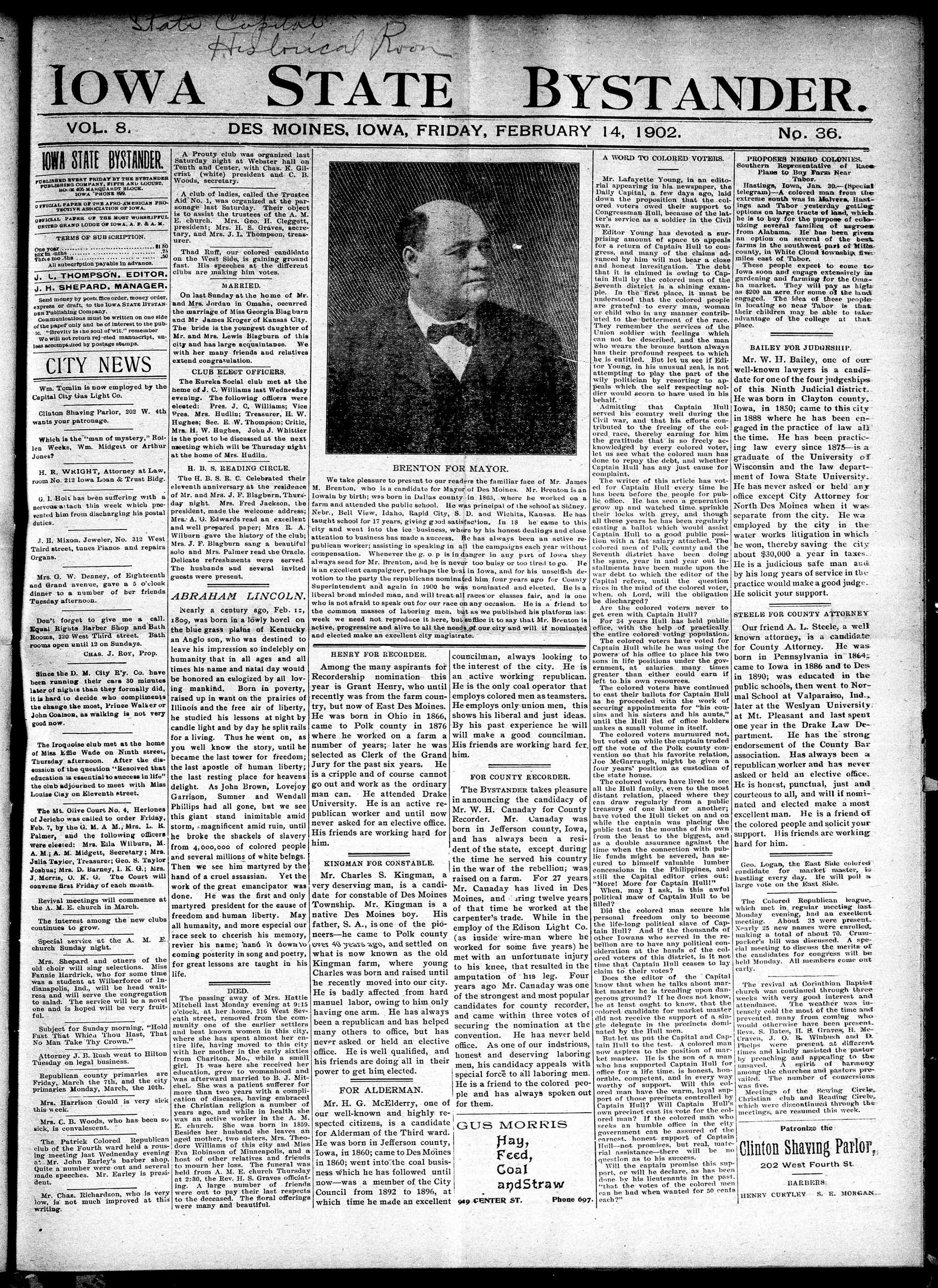
BRENTON FOR MAYOR.
We take pleasure to present to our readers the family M. Brenton, who is a candidate for Mayor of Des Moines Iowa by birth; was born in Dallas county in 1865, we farm and attended the public school. He was principal of Nebr., Bell View, Idaho, Rapid City, S. D. and Widt taught school for 17 years, giving good satisfaction. In city and went into the ice business, where by his horr attention to business has made a success. He has always publican worker; assisting in speaking in all the campa compensation. Whenever the g. o p is in danger in an always send for Mr. Brenton, and he is never too buisy is an excellent campaigner, perhaps the best in Iowa, andotion to the party the republicans nominated him four Superintendent and again in 1900 he was nominated liberal broad minded man, and will treat all races or cla who is not afraid to speak out for our race on any occasion the common masses of laboring man, but as we publ week we need not reproduce it here, but suffice it to s active, progressive and alive to all the needs of our city and elected make an excellent city magistrate.
We take pleasure to present to our readers the familiar face of Mr. James M. Brenton, who is a candidate for Mayor of Des Moines. Mr. Brenton is an Iowaan by birth; was born in Dallas county in 1865, where he worked on a farm and attended the public school. He was principal of the school at Sidney, Nebr., Bell View, Idaho, Rapid City, S. D. and Wichita, Kansas. He has taught school for 17 years, giving good satisfaction. In 18 he came to this city and went into the ice business, where by his honest dealings and close attention to business has made a success. He has always been an active republican worker; assisting in speaking in all the campaigns each year without compensation. Whenever the g. o. p. is in danger in any part of Iowa they always send for Mr. Brenton, and he is never too buisy or too tired to go. He is an excellent campaigner, perhaps the best in Iowa, and for his unselfish devotion to the party the republicans nominated him four years ago for County Superintendent and again in 1900 he was nominated and elected. He is a liberal broad minded man, and will treat all races or classes fair, and is one who is not afraid to speak out for our race on any occasion. He is a friend to the common masses of laboring men, but as we published his platform last week we need not reproduce it here, but suffice it to say that Mr. Brenton is active, progressive and alive to all the needs of our city and will, if nominated and elected make an excellent city magistrate.
HENRY FOR RECORDER.
Among the many aspirants for Recordership nomination this year is Grant Henry, who until recently was from the farm country, but now of East Des Moines. He was born in Ohio in 1866, came to Polk county in 1876 where he worked on a farm a number of years; later he was selected as Clerk of the Grand Jury for the past six years. He is a cripple and of course cannot go out and work as the ordinary man can. He attended Drake University. He is an active republican worker and until now never asked for an elective office. His friends are working hard for him.
KINGMAN FOR CONSTABLE.
Mr. Charles S. Kingman, a very deserving man, is a candidate for constable of Des Moines Township. Mr. Kingman is a native Des Moines boy. His father, S. A., is one of the pioneers—he came to Polk county over 40 years ago, and settled on what is now known as the old Kingman farm, where young Charles was born and raised until he recently moved into our city. He is badly affected from hard manuel labor, owing to him only having one arm. He has always been a republican and has helped many others to office, but has never asked or held an elective office. He is well qualified, and his friends are doing all in their power to get him elected.
FOR ALDERMAN.
Mr. H. G. McElderry, one of our well-known and highly respected citizens, is a candidate for Alderman of the Third ward. He was born in Jefferson county, Iowa, in 1860; came to Des Moines in 1860; went into the coal business which he has followed until now—was a member of the City Council from 1892 to 1896, at which time he made an excellent
readers the familiar face of Mr. James mayor of Des Moines. Mr. Brenton is an enny in 1863, where he worked on a le was principal of the school at Sidney. S. D. and Wichita, Kansas. He has satisfaction. In 18 he came to this where by his honest dealings and close. He has always been an active ren all the campaigns each year without in danger in any part of Iowa they never too buisy or too tired to go. He best in Iowa, and for his unselfish denim him four years ago for County was nominated and elected. He is a at all races or classes fair, and is one once on any occasion. He is a friend to, but as we published his platform last, but suffice it to say that Mr. Brenton is needs of our city and will if nominated distrate.
councilman, always looking to the interest of the city. He is an active working republican. He is the only coal operator that employs colored men as teamsters. He employs only union men, this shows his liberal and just ideas. By his past experience he will will make a good councilman. His friends are working hard for him.
FOR COUNTY RECORDER.
The BYSTANDER takes pleasure in announcing the candidacy of Mr. W. H. Canada for County Recorder. Mr. Canada was born in Jefferson county, Iowa, and has always been a resident of the state, except during the time he served his country in the war of the rebellion; was raised on a farm. For 27 years Mr. Canada has lived in Des Moines, and during twelve years of that time he worked at the carpenter's trade. While in the employ of the Edison Light Co. (as inside wire-man where he worked for some five years) he met with an unfortunate injury to his knee, that resulted in the amputation of his leg. Four years ago Mr. Canada was one of the strongest and most popular candidates for county recorder, and came within three votes of securing the nomination at the convention. He has never held office. As one of our indistinct, honest and deserving laboring men, his candidacy appeals with special force to all laboring men. He is a friend to the colored people and has always spoken out for them.
GUS MORRIS
Hay,
Feed,
Coal
andStraw
949 CENTER ST. Phone 697
BYSTANDER.
Mr. Lafayette Young, in an editorial appearing in his newspaper, the Daily Capital, a few days ago, laid down the proposition that the colored voters owed their support to Congressman Hull, because of the latter's service as a soldier in the Civil war.
Editor Young has devoted a surprising amount of space to appeals for a return of Captain Hull to congress, and many of the claims advanced by him will not bear a close and honest investigation. The debt that it is claimed is owing to Captain Hull by the colored men of the Seventh district is a shining example. In the first, the colored people are grateful to every man, woman or child who in any manner contributed to the betterment of the race. They remember the services of the Union soldier with feelings which can not be described, and the man who wears the bronze button always has their profound respect to which he is entitled. But let us see if Editor Young, in his unusual zeal, is not willing to play the part of the wily politician in the appeals which the self respecting soldier would scorn to have used in his behalf.
Admitting that Captain Hull served his country well during the Civil war, and that his efforts contributed to the freeing of the colored race, thereby earning for him the gratitude that is so freely accrued to the colored forces. Let us see what the colored man has done to repay the debt, and whether Captain Hull has any just cause for complaint.
The writer of this article has voted for Captain Hull every time he has been before the people for public office. He has seen a generation grow up and watched time sprinkle their locks with grey, and though all these years he has been regularly casting a ballot which would assist Captain Hull to a good public position with a fat salary attached. The colored men of Polk county and the Seventh district have been doing the same, year in and year out installations have been made upon the capital referrals of the Capital referrals, until the question rises in the mind of the colored voter, when, oh Lord, will the obligation be discharged? Are the colored voters never to get even with Captain Hull?
For 34 years Hull has held public office, with the help of practically the entire colored voting population. The colored voters have voted for Captain Hull while he was using the powers of his office to place his two sons in life positions under the government, at salaries many times higher than he could earn if left to his own resources. The colored voters have continued to cast their ballots for Captain Hull as he proceeded with the work of securing appointments for "his cousins and his sisters and his aunts," until the Hull list of office holders makes a small volume in itself. The colored voters murmured not, but voted on while the captain traded some of his votes in a convention so that his favorite relation, Joe McGarraugh, might be given a four years' position as custodian of the state house.
The colored voters have lived to see all the Hull family, even to the most distant relation, placed where they can draw regularly from a public treasury of one kind or another; have voted the Hull ticket on and on while the captain was placing the public text in the mouths of his own from the least to the biggest, and as a double assurance against the time when the connection with public funds might be severed, has secured to himself valuable lumber concessions in the Philippines, and still the Capital editor cries out: "More! More for Captain Hull!" When, may I ask, is this awful political maw of Captain Hull to be filled? Did the colored man secure his personal freedom only to become the life-long political slave of Captain Hull? And if the thousands of other Towans who served in the rebellion are to have any political consideration at the hands of the colored voters of this district, is it not time that Captain Hull ceases to lay claim to their votes?
Does the editor of the Capital know that when he talks about market master he is treading upon dangerous ground? If he does not know, he at least ought to know, that the colored candidate for office has a support of a single delegate in the precincts dominated by the Hull men.
But let us put the Capital and Captain Hull to the test. A colored man now aspires to the position of market master. He is the son of a man who has supported Captain Hull for office for a life time, is honest, honorable, competent, and in every way worthy of support. Will this colored man have the warm, loyal support of those precincts controlled by Captain Hull? Will Captain Hull own precinct cast its vote for the colored man? If the colored man who seeks an humble in the city government he assured of the honest support of Captain Hull—not promises, but real, material assistance—there will be no question as to his success. Will the captain promise this support, or will he declare, as has been done by his lieutenants in the past, "that the votes of the colored man can be had when wanted for 50 cents each?"
NO. 36.
PROPOSES NEGRO COLONIES.
Southern Representative of Race Plans to Buy Farm Near Tabor.
Hastings, Iown, Jan. 30.—(Special telegram)—A colored man from the extreme south was in Malvern, Hastings and Tabor yesterday getting an opinion of land, which he is to buy for the purpose of uizing several families of agrogr from Alabama. He has been given an option on several of the best farms in the southwest of Mills county, in White Cloud township five miles east of Tabor.
These people expect to come to Iowa soon and engage extensively in gardening and farming for the Omaha market. They will pay as high as $200 an acre for some of the land engaged in the task of these people in locating so near Tabor. Their children may be able to take advantage of the college at that place.
BAILEY FOR JUDGESHIP.
Mr. W. H. Bailey, one of our well-known lawyers is a candidate for one of the four judgeships of this Ninth Judicial district. He was born in Clayton county, Iowa, in 1850; came to this city in 1888 where he has been engaged in the practice of law all the time. He has been practicing law every since 1875—is a graduate of the University of Wisconsin and the law department of Iowa State University. He has never asked or held any office except City Attorney for North Des Moines when it was separate from the city. He was employed by the city in the water works litigation in which he won, thereby saving the city about $30,000 a year in taxes. He is a judicious safe man and by his long years of service in the practice would make a good judge. He solicit your support.
STEELE FOR COUNTY ATTORNEY
Our friend A. L. Steele, a well known attorney, is a candidate for County Attorney. He was born in Pennsylvania in 1864; came to Iowa in 1886 and to Des in 1890; was educated in the public schools, then went to Normal School at Valparaiso, Ind. later at the Weslyan University at Mt. Pleasant and last spent one year in the Drake Law Department. He has the strong endorsement of the County Bar association. Has always been a republican worker and has never asked or held an elective office. He is honest, punctual, just and courteous to all, and will if nominated and elected make a most excellent man. He is a friend of the colored people and solicit your support. His friends are working hard for him.
Geo. Logan, the East Side colored candidate for market master, is hustling every day. He will poll a large vote on the East Side.
The Colored Republican league, which met in regular meeting last Monday evening, had an excellent meeting. About 35 were present. Nearly 25 new names were enrolled, making a total of about 70. Crumpacker's bill was discussed. A special meeting to discuss the merits of the candidates for congress will be held Monday. All members come out early.
The revival at Corinthian Baptist church was continued through three weeks with very good interest and attendance. The weather was intensely cold the most of the time and prevented many from coming who would otherwise have been present. Rees, S. Bates, H. H. Graves, H. McCraven, J. O. R. Wimbush and D. Phelps were present at different times and kindly assisted the pastor by preaching and appealing to the unsaved. A spirit of harmony among the churches and pastors prevailed. The number of conversions was five.
Meetings of the Sewing Circle, Christian club and Reading Circle, which were discontinued through the meetings, are resumed this week.
HENRY CURTLEY S. E. MONGAN
```markdown
```
DES MOINES. IOWA
A telescoped train is also an offensive kind of railway merger.
The only chance the Indian has to avoid a hair cut is to learn to play football or the piano.
If the sale of lecture notes at Harvard is stopped some Harvard students will have to get to work.
In some of the remote mining camps of the Northwest a sack of flour is almost equivalent to a sack of gold.
A Chicago man shot five times at his wife, wounding her slightly. He is probably a French duelist in disguise.
A Chicago woman has told her sorrows in song, and in consequence her friends are always saddest when she sings.
When the country is in danger the country yells for a strong president. At other times the temptation is to yell at him.
One of the good signs of the times is the steadily decreasing interest in prize fights, or rather in the men who talk prize fight.
No thrifty ghost will be tempted to place himself on exhibition before the French academy of science for the paltry prize of $2,000.
Fitzjames turns out to be another of Sybil Sanderson's misfits. Perhaps all Sybil's affections went overboard on that very rough passage to Europe.
A new form of reciprocity has been developed in New York, where the women threaten to close the churches unless the men shall close the saloons.
A man of Wooster, Ohio, is mourning the death of a parrot that he has had for sixty-one years. It is to be hoped that Polly was prepared to die.
When he gets right down to business there is more provocation in one square inch of Kipling's rhyme than in a square mile of anybody's else's prose.
New York fixed the responsibility for the tunnel disaster with a promptness that has pleased everybody excepting the directors on whom the burden has been placed.
Miss Susan B. Anthony says women will quit getting married as they become more intelligent. As we can draw on Europe for population it doesn't matter much.
Parisian women are boycotting English governesses because the English women are too stupid to see the primitive humor of the ribald anti-English political cartoon.
In Paris "The Love Letters of an Englishwoman are considered inflammatory. The love letters of the Frenchwoman of the French novel are a devouring conflagration.
China is to employ modern business methods. This will make it necessary to materially increase the size of the typewriting machines or abolish some of the Chinese characters.
As the meetings of the trustees of the Carnegie institution are likely to come in the midst of the hunting season, Mr. Cleveland has declined to serve as a member of the board.
It is thought that the revised estimate now being prepared of the temperature of the sun will place it close to 11,600 degrees Fahrenheit. No one will care to see the exact figures.
John F. Dryden, who has won in the long contest for election as United States senator from New Jersey, is a Farmington, Me., man. New England men have a faculty for getting there.
It does not seem to have occurred to the committee of arrangements in charge of Prince Henry's visit to this country that he might not like the rapid pace they have scheduled for him.
Senator Tillman should institute an investigation of the cear for his dastardly conduct in exiling a Russian editor who inscribed a violent philippic against the house of Alexander and Nicholas.
There is a concerted movement against the docking of horses' tails in Maryland which is likely to take the shape of legislation. Let us hope the lawmakers may show the possession of horse sense.
Indigestion and dyspepsia appear to be the prevailing complaints at Harvard according to the report of the medical authority at the university. It is usually thus among students Ever since Thomas Carlyle threw his breakfast out of the window aspirants for intellectual prominence have cultivated a more or less impaired digestion.
M. Berry is telling his brothers of the French chamber of deputies that "we made the United States free." Over here we have all along been under the impression that George Washington and a few other insignificant patriots had a little to do with the freedom.
Colorado now has a locomotive made of her own iron and fed by her own oil. Under such circumstances she ought to have no trouble in getting steam for a great spurt up the mountain of Progress.
Asks for Authority to Use Part of
Funds for Dedication
Funds for Decision Des Moines, Feb. 10.—The Iowa commission for the erection of monuments on the battlefield of Chuah, made a report to Governor Cummins Saturday. From the report it appears that the commission has entered into contract for a state monument, the contract price being $24,000. It has also entered into a contract for eleven regimental monuments, the contract price being $18,051. It has paid out $65.35 for designs, plans, blue prints and minor items, making a total of $43,216.30 that is considered needful for the immediate work of erecting the monuments. The personal expenses of the commission up to this time have been $1,256.67. The appropriation of the Twenty-eighth general assembly for the erection of monuments on Shiloh together with the expenses of the commission, was $50,000. Of this $2,000 was for the expenses of the committee and $48,000 monument fund. Taking out of the monument the items mentioned, except the one of $1,256.67, there remains a balance of $4,783.65. In making the contracts for the monuments the commission has had in mind appropriate dedicatory services on the completion of the work. The commission in its to the governor dwelt and the need of suitable dedicatory archives and said that it should authorize to use the materials in the monument fund for such purposes. It advised the governor that it desired legislation as would it discretion in the matter.
The governor sent the report to the legislature, together with a communication from himself, in which he related the facts. He says that on the commission consulting with him advised that, while he regarded the dedication of so worthy and valuable a work as important to the work it required not under the terms of the act of the Twenty-eighth general assembly, making the appropriation, approve the proposed expenditure for dedication. He advised the commission to submit the facts to the general assembly, asking for authority to use so much of the unexpended monument fund appropriation as might be necessary to defray the expenses of all officers, and providing advice, that provision be made for the actual expenses of a committee of the commission incurred in supervising the work of the contractors during the construction of the monuments.
REVOLUTIONARY MEASURE.
Hobart's Plan to Improve Country Roads
Des Moines, Feb. 10.—Senator Hoart of Cherokee, has introduced in the senate what is regarded by the friends of the good roads movement as the most practicable measure on this subject that has been taken up in the legislature with a serious chance of becoming a law in a long time. It proposes to do away with the present motorway and make the county a unit for all road work, with the county supervisors as the responsible authority.
The bill provides for repealing a good deal of the present road law and enacting a new law in its place. There may be levied a county tax of not over one mill, to be expended by the supervisors wherever they choose, except that taxes paid by cities and towns shall be expended on roads inside the cities of the counties, leaving the councils may direct. Aside from this county tax there shall be a levy of not over four mills, to be expended by the supervisors, but the part paid by each township shall be expended within its limits. Thus the supervisors can adopt a general system of road work which will be worked out to satisfactory results, something impossible under the present law. A supervisor of road work, who shall be an expert road builder, is provided for, to be named by the supervisors.
This bill has the support of the mail carriers' association of the state, and is said to be in favor among the farmers generally, among whom much sentiment has been aroused in favor of better roads because of the demands of the rural postal routes.
COLLATERAL INHERITANCE.
Supreme Court Decides That the Law Is Not Retroactive.
Des Moines, Feb. 11.—The supreme court handed down a decision affecting the collateral tax law. It is held that the law is not retroactive as to tax on property of which the title had become vested in collateral heirs previous to the amendment to the law enacted by the last session of the legislature. The decision has no bearing upon future tax, though several cases withheld awaiting the decision of the court are involved.
The case is John Herriott, treasurer of the state, vs. L. F. Potter, administrator of the estate of John Lawson who died in Pottawattamie county, September 7, 1896. The death of the decedent was before the original act took effect. Real estate consisting of a 280 acre farm was left to collateral heirs. The question raised was whether the title fully vested in them so that the subsequent amendment providing for notice of appraisalse would become retroactive and cure the want of notice provided for in the original case. It is held by the court that the right of possession had become vested in the heirs before the amendment was enacted by the legislature and because the right had so vested a law that would undertake to deprive this right would be unconstitutional. The decision of the Pottawattamie county court against the state would be unconstitutional.
Prove Family Into Gold.
Ft. Dodge, Feb. 14.—F. F. Sabo, a farmer residing near this place, is said to have driven his wife and five children from their home into the snow. They were compelled to walk five miles harefooted. He is also said to have choked his wife into a state of almost insensitivity.
When two philosophers quarrel it is merely a sago brush.
REPRESENTATIVE DUNHAM
INTERODUCES A RESOLUTION.
Declares Present Site and Buildings Are being Rapidly Outsourced
Des Mcines, Feb. 11.—The State University at Iowa will seek a new campus on an elevation in the country and abandon the present campus to use by the medical, dental and pharmacy departments exclusively, if the resolution introduced in the legislature by Representative Dunham is endured by the present and succeeding general assemblies.
The enthusiasm, prolonged applause and congratulations that attended the introduction of the resolution and the speech in its support by Mr. Dunham, formal and unexpectedly strong spontaneous sentiment in favor of the change.
Mr. Dunham argued that the present site of the university and the present buildings are being rapidly outgrown and that if Iowa is to place itself on a footing with other big state universities, more ground and more buildings are a necessity. He recommends that improvements be made with the ultimate end in view of leading the literary, law and design departments on a much larger campus near the campus outside the present limits. Coming assemblies are urged to bear this in mind in making appropriations and ordering improvements. The resolution was adopted by the house under suspension of the rules as follows:
"Whereas, the interests of this state demand that there shall be within her borders educational institutions which shall be recognized among the leading institutions of the bishop's station, and by the record o. her best and virtues of the present, is worthy of the best of the best.
"Whereas, the university of the state is and always has been looked upon as the ideal of the citizens as a place for the proper education and fitting of her sons and daughters for the battle of life, and.
"Whereas, owing to an unfortunate location of our State University on too limited an area in the heart of a city, limited in for growth or for the erection of commodious and artistic placement of proper buildings for the uses of such school with the proper intellectual atmosphere which should surround a great educational institution and can only be attained when the same is somewhat removed from the busy parts of life, and.
"Whereas, the buildings now belonging to the state at the State University can be used by the medical, dental and pharmaceutical departments of said university; therefore,
"Resolved, that the appropriations committee be instructed to take these matters into consideration in arranging for the disposition of the state funds; that said school should be dealt with liberally at present as to her needs for expenses, but that the appropriation should be made with the ultimate end in mind, medical, dental and pharmaceutical departments all buildings now on the State University campus and procuring on the bluffs across the river to the west, or on the beautiful rolling lands surrounding the University city, and removed from its business portions, a commodious and proper campus and erecting thereon buildings which shall be an honor to the state and a credit to the guardians of her interests; and that all matters of her interests should be carried to capably consider this proposition and report to the house any suggestions which would be feasible to reach the end desired."
Des Moines, Feb. 14.—The Harriman joint resolution for a reapportionment of the senatorial and representative districts of the state passed the senate with only two votes against it. Blanchard, who was the only one to oppose the resolution on the floor of the senate, voted on actively on the final ballot in order that he might file an amendment for reconsideration. The final vote on the resolution stood 40 to 2. Bishop and Craig voting in the negative. These are the two members who voted in committee against reporting the resolution favorably.
The Harriman resolution passed two former sessions of the legislature and went to a vote of the people at the general election in 1900. It was defeated at the polls, its friends allege because of being overlooked by the voters on the Australian ballot. According to this resolution the senatorial districts of the state will not be changed. In making the reapportionment of the representative of the state is to be divided by the number of counties and the result is to be the ratio of representatives. Every county having one and three-fifths times this ratio shall be entitled to an additional representative, up to the maximum limit, which as the bill passed is fixed as 110.
As the bill originally came from the committee the maximum limit was 115. Under this the membership of the house might reach 115 if the application was approved. In explaining the bill stated that he had no fears that the representation would ever reach this figure, but as a safeguard he would offer an amendment fixing the limit at 110.
This was adopted and then Blanchard proposed an amendment which would make the basis for an additional representative in any county conditional upon a population one and one-half times the ratio of representation rather than one and three-fifths. He spoke at length in support of this amendment, but it was defeated by a vote of 8 to 34. Blanchard, Brighton, Bishop, Brooks, Craig, Townsend, Bishop, Harper and Hayward voted in favor of the Blanchard amendment. The bill then went to a vote and was passed.
The saloonkeepers at Dubuque are not paying much attention to the orders issued by the Knights of Fidelity in regard to closing the saloons. It is claimed that members of the order were the first to disregard the order.
Washington, Feb. 10.—Senate. Throughout nearly the entire session of the senate today the Philippine tariff bill was under consideration. Turner, of Washington, concluded his speech begun last Friday on the legal and constitutional phases of the Philippine question. He held, in the main, that as the Filipinos had established an independent government in the islands prior to the fall of Manila, the United States under the triple statute of unconstitutional law had no right in the islands. He denounced the Philippine commission as puppets of the executive, and declared their so-called laws are not enacted in the interest of the people of the islands. The commission, said he, does only what they are told to do by the president and secretary of war. Turner referred to the Philippine sedition act as not only unconstitutional, but as a "relie of barbarism, too black even for the most despotic and tyrannical government that the House of Congress had with." The house amendment to the urgent deficiency bill, relating to the opening of state claims, was agreed to, which passed the bill.
Washington, Feb. 11—Senate. A stirring debate on the general Philippine question was precipitated in the senate late today, the principal participants being Platt, of Connecticut, and Hoar, of Massachusetts. Teller, of Colorado, had concluded for the day his argument against the enactment of the pending Philippine tariff bill. In response to some statements he had made, Platt directed the senate's attention to the efforts as he viewed it, maintaining that great progress was being made by the government in subduing the insurrection. He referred to the elections for municipal offices in various cities of the islands and to the establishment of schools for the education of Filipino children. Hoar ridiculed the statements of Platt, and in a facetious vein adverted to the efforts of the government to control the Filipino people. The remarks of the Massachusetts senator aroused Platt, who delivered a notable speech, in the course of which he referred to Hoar in pretty sharp terms. His speech was listened to by senators on both sides of the chamber with profound attention. In conclusion he paid eloquent tribute to the efforts of the United States to carry the proclamation of a treaty to control territory where it had control. In his reply Hoar delivered an incisive criticism of the action of the Philippine commission, declaring that he had been taught to judge men rather by their actions than by their words, and by this standard he could not judge the Philippine commissioners with any degree of favor. Early in the day the senate passed a resolution to establish an international amendment changing the time of the presidential inaugurations and the termination and commencement of congress from the 4th of March to the last Tuesday of April.
House.—The voting on amendments to the oleomargarine bill in the house today indicated a considerable change of sentiment since last congress, when the bill had 106 majority, and that the opposition to the measure has gained strength. While the passage of the bill is not endangered, it is not likely that the majority tomorrow, when the final vote is taken, will exceed thirty. The opposition today was strong enough in committee of the whole to adopt two important amendments, one providing that whining in the bill should be construed to prevent the manufacture and sale of oleomargarine in any state, for consumption entirely within such state, and the other to provide for the inspection and branding of renovated or process bitter.
Washington, Feb. 12.—Senate. With the exception of a Feb. 12—Senate. crash between Lodge and Patterson over the matter of admission of representatives of the press to the investigation which the Philippine committee is conducting, the discussion of the Philippine tariff bill in the Senate today was quiet. The Colorado senator desired that all newspaper men be admitted to the committee hearings, declaring that as now conducted they were of a star chamber character. He said his recollection was that he had heard that the committee hearings be entirely secret. This drew the fire of the Massachusetts senator, who indignantly denied that he had suggested anything of the kind. He insisted that the reports made of the hearings by the three associations were accurate and fair to both sides of the controversy. A communication from the secretary of war, transmitting a memorial of the federal party of the Philippine Islands in support of American rule in the islands, called from Mr. Patterson the statement that the federal party had obtained its control in the Philippines by promising to the Philippines that they would be audited immediately in United States. Teller occupied the attention of the sonate during the greater part of today's session and has not yet concluded his speech. Turner, of Washington, presented a memorial from the National Anti-Trust League enumerating certain trusts and combinations which the memorial sets forth were operating in conflict with the Sherman anti-trust law. He said that the petition stated that the existence of these so-called trusts had been called to the attention of the attorney general of the United States with a request that the machinery of the executive be set in motion with the view of the destruction of the trusts, but thus far nothing had been done. The petition prayed that congress take action in vindication of its law.
House.—The house passed the oleomargarine bill. There was no division on the final passage, the real test of strength having been made on a motion to recommit, which was defeated by a majority of 34. The provision to require the inspection and branding of renovated butter, which was adopted in committee of the whole yesterday, was retained today on an aye and nay vote.
Washington. Feb. 13.—Senate.—While no definite agreement has been reached, a vote on the Philippine tariff bill seems to be in sight. It appears likely, judging from a discussion of the subject late in the day session, that the vote may be had next
week, although the matter is yet involved in some uncertainty. Teller, of Colorado, concluded his speech today. He urged strongly that the Philippines be given the fullest possible measure of self-government, the United States simply maintaining a protectorate over the island. He said he would prefer that the United States show absolutely and without condition from the archipelago than that the present war should be continued. Mitchell, of Oregon, delivered a carefully prepared speech in support of his amendment to reduce the tariff duties upon Philippine products coming into the country to 50 per cent of the Dingey rates, maintaining that congress owed this concession to the Pacific coast states as well as the Philippines. House.—The house today unanimously adopted a resolution, proposing an amendment to the constitution of the United States for the election of senators by direct popular vote. There was no demand for time to debate the resolution. This is the fourth time the house has adopted a similar resolution. Two bills of general importance were passed by the house of Congress of the time being devoted to minor business. One was a senate bill to provide for the payment of the claims of confederate officers and soldiers whose horses, side arms and baggage were taken from them by union soldiers, contrary to the terms of the surrender of Lee's and Johnson's armies. The amount to be paid under the bill was limited to $90,000. The other as well as confederate Spartan claims commission authority to send for persons and papers and to punish for contempt. Corliss, who is the author of a bill for a government cable from San Francisco to Manila, delivered a speech in opposition to the laying of such a cable by a private corporation.
SHOULDER TO SHOULDER
ENGLAND AND JAPAN AGREE TO
STAND TOGETHER.
The First Important Alliance Between
Western and an Acatic Race
A Western and an Abatic Race. London, Feb. 12.—An important parliamentary paper was issued last night giving the terms of a practical alliance between Great Britain and Japan for the preservation of China and Korea. The paper covers a dispatch sent by *ord Lansdowne*, the secretary of state for foreign affairs, January 30, to the British minister at Tokio, Sir Claude M. MacDonald, and comprises a signed copy of the agreement.
In explanation the paper says the agreement may be regarded as an outcome of the events of the past two years. Throughout the Boxer troubles Great Britain and Japan had been in close and uninterrupted communication and actuated by similar views. "We each desire," said Lord Lansdowne, "the integrity and independence of the Chinese empire should be preserved and that there should be no disturbance of the territorial status quo, either in China or the adjoining regions."
The agreement was signed in London January 30. Both governments declare themselves to be nirtely uninfluenced by any aggressive tendencies in either country.
The agreement provides, however, that in case either Great Britain or Japan in connection with any prospective interests, should become involved in a war with another power, the other contracting party will maintain strict neutrality and use its efforts to prevent other powers from joining in the hostilities against its ally.
If, in the above event, any other power or powers should join in hostilities against that ally, the other contracting party will come to its assistance and conduct war in common and make peace in mutual agreement with the other.
The agreement takes effect immediately and is to remain in force for five years.
This is the first important alliance between a western and a yellow or Asiatic race and comes as a startling surprise to the public. Although the idea of an alliance with Japan is really to meet with general approval, the outcome of this sensational departure will be awaited with no little anxiety. It is regarded as a direct move against Russia, and to explain the abandonment of the colony of Wei Hal Wei.
TREATY SUITS AMERICA
Anglo-Japanese Agreement Joins With Our Policy.
Washington, Feb. 14.—Mr. Takahira, the Japanese minister to Washington, called at the state department and notified Secretary Hay of the signature of the treaty between Great Britain and Japan, binding the two nations to joint action to maintain the integrity of China and Korea. The assent of the United States is not necessary to this agreement, but if it were it would probably not be withheld, for it is pointed out that the treaty is precisely in line with the aims of the state department as fully expressed in the note published by it from time to time by the states that there has been no joint action as between the United States and the two powers named, yet it is a fact that the preamble to the new treaty might be regarded as almost a paraphrase of the position of the United States toward the Manchurian question as annunciated in Secretary Hay's note to theussian ambassador here.
SECRETARY HAY MAY RETIRE
Said to Be Displaced at President's
Independent Action.
Washington. Feb. 12.-Secretary
Hay's retirement from the cabinet is
believed to be a matter of only a few
weeks. The secretary is known to be
chagrined over the proposed trip of
Prince Henry of Prussia not only because he was not consulted before
President Roosevelt indicated to the German ambassador that Prince Henry would be extended a cordial welcome, but because he regards the whole proceeding with discontent. The president has adopted new lines of diplomacy that diverge widely from those followed by Mr. Hay during the last administration, and has exhibited a tendency to extend a cordial friendship to the representatives of all the powers and not confine those attentions to one representative.
Boer Plan of Campaign.
Brussels, Feb. 12.—The plan of campaign drawn up by Dr. Mueller, the former consul of the Orange Free State in Holland, who is now on his way to New York with dispatches from the Boer delegates in Europe to President Roosevelt, includes the formation of two standing committees. One, more or less political, will include the pro-Boer senators and representatives and other prominent men, who it is claimed, already have promised co-operation. The other and larger body will be chiefly concerned in the collection and forwarding of money for the Boer cause.
Indiana Republicans Nominate.
Portland, Ind., Feb. 12.—George W. Cromer of Muncie was nominated for Congress by the Republicans of the Enghth Congressional district of Indiana yesterday afternoon after thirteen ballots. The resolutions deployed the death of President McKinley, praised the administration of President Roosevelt, the work of Senators Fairbanks and Beveridge and Congressman Cromer.
Canadian Paper Duty Reduced.
Ottawa, Ont., Feb. 12.—The government has decided to reduce the custom duty on news printing paper from 25 per cent to 15 per cent ad valorem. This is the result of Justice Tschacher's inquiry into the charge of the Canadian Press association that there was a combination among the paper manufacturers.
Mountains Rich with Gold.
Tucson, Ariz., Feb. 12. -Reliable mining men who have returned from the Gasiluro Mountains confirm the stories of wealth of gold which has been reported to have been discovered there. They say the gold lode rises 250 feet vertically and its entire width, 150 feet, shows remarkable values in gold.
Engineer Went to Sleep.
Pittsburgh, Feb. 12.—On duty for thirteen hours and so tired out that he slept at his post was the sensational evidence given by Engineer William Jackson yesterday to the coroner, who is investigating the fatal collision on the Pittsburgh, Fort Wayne and Chicago railroad near Haysville.
Charged with Bank Conspiracy.
David City, Neb., Feb. 12—George S. Gould was arrested at Bellwood last night and brought to this city charged with conspiracy in connection with the failure of the Platte Valley bank at Bellwood. He is the third of the Gould brothers to be placed under arrest.
Gage Will Go to New York.
Washington, Feb. 12.—Ex-Secretary
of the Treasury Gage has accepted the
presidency of the United States Trust
Company of New York, and will take
up his duties in that city in a few
weeks. This information does not
come from Mr. Gage, but may be relied
upon as authentic.
Wame St. Louis Landlord
Bainne
St. Louis, Feb. 12.—Because he neglected to furnish buildings with fire escapes and life lines, J. W. Gillham, proprietor of the Empire hotel, was yesterday held responsible for the deaths of the eleven persons who lost their lives when the hotel was burned last Sunday morning.
Palatinal Indiana House Burned.
Fort Wayne, Ind., Feb. 12.—Brookside, the palatial suburban home of Millionaire John H. Bass, a mile west of this city, was burned to the ground yesterday morning. The house was the most beautiful in northern Indiana, it is said. The loss is estimated at $200,000.
Filming Leader Captured.
Filipino Leader Captured
Manila, Feb. 12.—A brother of Malvar, the insurgent leader, has been captured. He was chief surgeon of the Batangas insurgents. A strong insurgent post has been captured near Calamba, Laguna province. It is believed this post was formerly Malvar's headquarters.
Woman Got Diplomatic Appointment
Paris, Feb. 12.—Mile, Jeanne De Villeneuve has been appointed secretary of the French consulate general in New York. Mile, De Villeneuve, who belongs to an old family of Provence, has been a governmental clerk for nine years.
Aurora Physician Indicted.
Aurora, Ill., Feb. 12.—The Kans county grand jury yesterday returned a true bill against Dr. Charles A. Woodward of Aurora for the murder of Myrtle Gale, who died in this city on Jan. 22 from an alleged criminal operation.
United States Transport Raised.
Manilla, Feb. 12.—The United States
transport Wright, which was wrecked
Nev. 28 last, by striking an unchar-
ted rock at the entrance of San Jacinto
harbor and sinking in fifteen feet
of water, has been successfully raised.
The Diamond Bracelet
CHAPTER VII.—Continued.)
"Madam," said the officer "you must be aware that in an investigation of this nature, we are compelled to put questions which we do not expect to be answered in the affirmative. Colonel Hope will understand what I mean when I say that we call them 'feelers.' I did not expect to hear that Miss Seaton had been on familiar terms with your servants (though it might have been), but that question, being disposed of, will lead me to another. I suspect that some one did enter the room and make free with the bracelet, and that Miss Seaton must have been cognizant of it. If a common thief, or an absolute stranger, she would have been the first to give the alarm; if not on too familiar terms with the servants she would be as little likely to screen them. So we come to the question—who could it have been?"
"It is not p have taken the Sarah.
"No, it is no ice." "And that to mention his.
"What did dered the Colo
"It was not believe he one of the momen front window, was at the do
"I think you Alice," observe tone.
"Knowing he house, I did not dere the Colo the excuse All not my place.
"I presume clerently near t
"May I inquire why you suspect Miss Seaton?" coldly demanded Lady Sarah. "Entirely from her manner; from the agitation she displays." "Most young ladies, particularly in our class of life, would betray agitation at being brought face to face with a police officer," urged Lady Sarah.
"My lady," he returned, "we are keen, experienced men; and we should not be fit for the office we hold if we were not. We generally do find lady witnesses betray unaciness, when first exposed to our questions, but in a very short time, often in a few moments, it wears off, and they grow gradually easy. It was not so with Miss Seaton. Her agitation excessive at first, increased visibly, and it ended as you saw. I did not think it agitation of guilt, but I did think it that of conscious fear. And look at the related facts; that she laid the bracelets there, never left them, no one came in, and yet the most valuable one vanished. We have many extraordinary tales brought before us, but not quite so extraordinary as that."
CHAPTER VIII.
The Colonel nodded approbation; Lady Sarah began to feel uncomfortable.
"I should like to know whether any one called whilst you were at dinner," mused the officer. "Can I see the man who attends to the hall door?" "Thomas attends to that," said the Colonel, ringing the bell. "There is a side door, but that is only for the servants and tradespeople." "I heard Thomas say that Sir George Danvers called while you were at dinner," observed Lady Sarah. "No one else. And Sir George did not go upstairs." The detective smiled. "If he had, my lady, it would have made the case no clearer."
"No," laughed Lady Sarah, "poor old Sir George would be puzzled what to do with a diamond bracelet."
"Will you tell me," said the officer, wheeling sharply around upon Thomas when he entered, "who it was that called here yesterday evening while your master was at dinner? I do not mean Sir George Danvers; the other one."
Thomas visibly hesitated; and that was sufficient for the lynx-ey officer. "Nobody called but Sir George, sir," he presently said.
The detective stood before the man staring him full in the face with a look of amusement.
"Think again, my man," quoth he.
"Take your time. There was some one else."
The Colonel fell into an explosion; reproaching the unfortunate Themas with having eaten his bread for five years, to turn around upon the house and its master at last, and act the part of a deceitful, conniving wretch, and let in that swindler—
"He's not a swindler, sir," interrupted Thomas.
"Oh, no, not a swindler," roared the Colonel, "the only steals diamond bracelets."
"No more than I steal 'em, sir," again spoke Thomas. "He's not capable, sir. It was Mr. Gerard."
The Colonel was struck speechless; his rage vanished and down he sat in a chair, starling at Thomas. Lady Sarah colored with surprise.
"Now, my man," cried the officer, why could you not have said it was Mr. Gerard?
"Because Mr. Gerard asked me not to say he had been, sir; he is not friendly here just now, and I promised him I would not. And I'm sorry to have had to break my word."
checkmated Colonel. "Gerard Hope." "But as Thomas says, he is no swindler." remarked Lady Sarah; "he is no thief. You may go. Thomas." "No. sir." stormed the Colonel, "fetch Miss Seaton here first. I'll come to the bottom of this. If he has done it Lady Sarah, I will bring him to trial, though he is Gerard Hope." Alice came back leaning on the arm of Lady Frances Chenevix; the latter having been dying with curiosity to come in before. "So the mystery is out, ma'm," began the Colonel to Miss Seaton; "it appears this gentleman was right and that somebody did come in; and that somebody the rebellious Mr. Gerard Hope." Alice was prepared for this, for Thomas had told her Mr. Gerard's visit was known; and she was not so agitated as before. It was the fear of its being found out, the having to conceal it, which had troubled her.
CHAPTER VU1
The detective smiled.
"It is not possible that Gerard can have taken the bracelet," uttered Lady Sarah.
"No, it is not possible," replied Alice. "And that is why I was unwilling to mention his having come up."
"What did he come for?" thundered the Colonel.
"It was not an intentional visit. I believe he only followed the impulse of the moment. He saw me at the front window, and Thomas, it appears was at the door, and he ran up."
"I think you might have said so, Alice," observed Lady Sarah, in a stiff tone.
"Knowing he had been forbidden the house, I did not wish to bring him under the Colonel's displeasure," was all the excuse Alice could offer. "It was not my place to inform against him."
"I presume he approached sufficiently near the bracelets to touch them, had he wished?" observed the officer, who, of course, had now made up his mind upon the business—and upon the thief.
"Ye—s," returned Alice, wishing she could have said no.
"Did you notice the bracelet there after he was gone?"
"I cannot say I did. I followed him from the room when he left, and then I went into the front room, so that I had no opportunity of observing."
"The doubt is solved," was the mental comment of the detective officer.
The Colonel, hot and hasty, sent several servants various ways in search of Gerard Hope, and he was speedily found and brought. A tall and powerful young man, very good-looking.
"Take him into custody, officer!" was the Colonel's impetuous command.
"Hands off, Mr. Officer—if you are an officer!" cried Gerard, in the first shock of surprise, as he glanced at the gentlemanly appearance of the other, who wore plain clothes, "you shall not touch me unless you can show legal authority. This is a shameful trick. Colonel—excuse me—but as I owe nothing to you, I do not see that you have any such power over me." The group would have made a fine study; especially Gerard; his head thrown back in defiance, and looking angrily at everybody.
"Did you hear me?" cried the Colonel.
"I must do my duty," said the police officer, approaching Gerard; "and for authority—you need not suppose I should act, if without it."
"Allow me to understand, first," remarked Gerard, haughtily, eluding the officer. "What is it for? What is the sum total?"
"Two hundred and fifty pounds!" growled the colonel. "But if you are thinking to compromise it in that way, young sir, you will find yourself mistaken."
"Oh, no fear," retorted Gerard. "I have not two hundred and fifty pence. Let me see; it must be Dobbs. A hundred and sixty—how on earth do they slide the express up? I did it, sir, to oblige a friend."
"The duce you did!" exchoked the colonel, who but little understood the speech, except the last sentence. "If ever I saw such a cool villain in all my experience!"
"He was awful hard up," went on Gerard, "as bad as I am now, and I did it. I don't deny having done such things on my own account, but from this particular one I did not benefit a shilling."
CHAPTER IX.
His cool assurance and his words struck them with consternation.
"Dobbs said he'd take care I should be put to no inconvenience—and this comes of it! That's trusting your friend. He vowed to me, this very week, that he had provided for the bill."
"He thinks it only an affair of debt," screamed Lady Frances Chonevix. "Oh, Gerard! what a relief! We thought you were confessing."
"You are not arrested for debt, sir," cried the officer, "but for felony."
"For felony!" uttered Gerard Hope. "Oh, indeed. Could you not make it murder?" he added, sarcastically.
"Off with him to Marlborough street, officer!" cried the exasperated colonel, "and I'll go with you and prefer the charge. He scoffs at it, does he?"
"Yes, that I do," answered Gerard, "for whatever pitfalls I may have got into in the way of debt and carelessness, I have not gone into crime."
"You are accused, sir," said the officer, "of stealing a diamond bracelet."
"Hey!" uttered Gerard, a flash of intelligence rising to his face as he glanced at Alice. "I might have guessed it was the bracelet affair, if I had had my recollection about me." "Oh, oh," triumphed the colonel in sneering jocularity, "so you expected it was the bracelet, did you? We shall have it all out presently." "I heard of the bracelet's disappearance," said Mr. Hope. "I met Miss Scaton when she was out this morning and she told me it was gone." "Better make no admissions," whispered the officer in his car. "They may be used against you." "Whatever admissions I may make, you are at liberty to use them, for they are truth," haughtily returned Gerard. "Is it possible that you do suspect me of taking the bracelet, or is this a joke?" "Allow me to explain," panted Alice, stepping forward. "I—I did not ac-
CHAPTER 1X
cuse you, Mr. Hope; I would not have mentioned your name in connection with it, because I am sure you are innocent; but when it was discovered that you had been here I could not deny it."
"The charging me with having taken it is absurdly proposterous" exclaimed Gerard, looking first at his uncle and then at the officer. "Who accuses me?"
"I do," said the colonel.
"Then I am very sorry it is not somebody else instead of you, sir."
"Explain. Why?"
"Because they would get a kindly horsewhipping.
"Gerard," interrupted Lady Sarah, "do not treat it in that light way. If you did take it say so and you shall be forgiven. I am sure you must have been put to it terribly hard; only confess it and the matter shall be hushed up."
"No, it sha'n't, my lady!" cried the colonel. "I will not have him encouraged—I mean felony compounded."
"It shall," returned Lady Sarah, "it shall indeed. The bracelet was mine, and I have a right to do as I please. Believe me, Gerard, I will put up with the loss without a murmur, only confess, and let the worry be done with." Gerard Hope looked at her; little trace of shame was there in his countenance. "Lady Sarah," he asked, in a deep tone, "can you indeed deem me capable of taking your bracelet?" "The bracelet was there, sir, and it went, and you can't deny it!" uttered the colonel. "It was there, fast enough," answered Gerard. "I held it in my hand for two or three minutes, and was talking to Miss Seaton about it. I was wishing it was mine, and saying what I should do with it." "Oh, Mr. Hope, pray say no more," involuntarily interrupted Alice. "You will make appearances worse." "What do you want to screen him for?" impetuously broke out the colonel, turning upon Alice. "Let him say what he was going to say."
"I do not know why I should not say it," Gerard Hope answered, in, it must be thought, a spirit of bravado or recklessness, which he disdained to check. "I said I should spout it." "You'll send off to every pawnshop in the metropolis, before the night's over, Mr. Officer!" cried the choking colonel, breathless with rage. "This beats brass." "But I did not take it any more for having said that," put in Gerard, in a graver tone. "The remark might have been made by any one, from a duke downwards, if reduced to his last shifts, as I am. I said if it were mine; I did not say I would steal to do it. Nor did I." "I saw him put it down again," said Alice Seaton, in a calm, steady voice.
"Allow me to speak a word, colonel," resumed Lady Sarah, interrupting something her husband was about to say. "Gerard, I cannot believe you guilty; but consider the circumstances. The bracelet was there; you acknowledge it; Miss Seaton left the apartment when you did, and went into the front room; yet when I came up from dinner, it was there no longer." The colonel would speak. "So it lies between you and Miss Seaton," he put in. "Perhaps you would like to make believe she appropriated it." "No," answered Gerard, with flashing eye. "She cannot be doubted. I would rather take the guilt upon myself than allow her to be suspected. Believe me, Lady Sarah, we are both innocent."
(To be continued.)
POUND FOOLISHNESS.
Not Always Economy to Buy in Large
Quantities.
One of the commonest forms of pound foolishness is countenanced by many high authorities. This is the purchase of certain household provisions in large quantities. Few writers on domestic topics fall to lay stress upon the economy of buying groceries in bulk. That sugar and flour, potatoes and apples should be bought by the half or whole barrel, cereals or the case, butter by the tub, and other things in like proportion, is one of the early precepts in the "Young Housekeeper's Complete Guide to Domestic Economy." The ignorant young things buy the provisions first and the experience afterward. The flour grows musty, the cereals develop weevils, the potatoes and apples rot long before they can be eaten, and the cook exercises a lavishness in the use of butter and sugar she would never show were they bought in such limited amounts that the housekeeper could hold close watch over them. Even after these events the young mistress feels as if she were absolutely reckless and no manager at all when she so far departs from household law as to buy food in small quantities.—Independent.
Evidence to the Contrary
"Do you think that a man is always better off for a college education?" "No," answered the housewife, rather sharply. "This morning I asked a man who came around with a wagon whether he had any nice fresh eggs. He merely looked at me reproachfully and said: "Madam, might I be permitted to observe that fresh eggs are always nice eggs, and nice eggs are always fresh?"—Washington Star.
Long Enough for Any One.
Teacher—How many of my scholars can remember the longest sentence they ever read? Billy—Please, mum, I can. Teacher—What? Is there only one? Well, William, you may tell the rest of the scholars the longest sentence you ever read. Billy—Imprisonment for life—Stray Stories.
Losers are always in the wrong.
ADDRESS DELIVERED BEFORE
MARQUETTE CLUB, CHICAGO.
On the Program at the Annual Banquet of the Club on Lincoln's Birthday.
Chicago, Feb. 13—Following is the response to the toast of "Abraham Lincoln" by Lafayette Young, Editor of the Des Moines Capital, at the Marquette club banquet, Chicago, Illinois, last night:
Mr. Toastmaster and gentlemen of the Marquette Club:
The life of Lincoln from 1800 to 1853 covered the greatest events in the formative period of the Republic.
The life of Lincoln, the birth, temporary existence and destruction of ideas, experiments and theories. In the various states there were men of great contending for and againstisms and ideas that eventually had to be fought out before progress could begin.
Between the close of the Revolution and the dedication of the Bunker Hill monument, they must have a patriotic spirit. But between the years 1833 and 1860 scarcely a voice was raised in behalf of a patriotism that compounded national ideas and national idea had few advocates. The people of this then scattered settlement were drifting. There were great men and women fighting for lesser purposes. The statesmen were like the explorers having little idea what they were looking for and little what to do with it when they found it.
After the year 1825 the poison put into the veins of American life began to show itself. Agitators for liberty were active; the pamphleteer was abroad; Uncle Tremay's son was irritating to the man's clean War was fought; the Missouri Compromise was repealed; the Dred Scott decision was rendered; John Brown made his raid. The Jamestown poison was attempting to break through the veins. It was admirably the effective of men; affected the sermons and prayers of the church, made the great Calhoun a sectionalist. Webster faltered. Few men in public life were superior to popular conditions. Great Intentions and inams were still, and the national differences were growing. Now and then the politician raised his voice in the interest of the freedom that was finally to come. The majority were weak enough to trim their sails. When slavery was endured to the black people, the his garments about him and put away all other purposes except the determination to maintain his herished institution. He read and re-read the Bib's which said, "Servants be obedient to your own rights." He was a firm attacment to the nation, was on his side, that slavery was in existence when the embattled farmers fired their shot. In the face of the aggressive slave power the Whig party faltered and finally disappeared. But the old man of the life was a man of the future had a glimpse of what the future ought to bring. But out of the disagreements and discord events were maturing. The Jamestown poison could no longer be restrained; it must not be made by any person. If it were doing nothing more is we producing the unrest of guilty consequences.
Purposes were not well matured even at the election time in 1860. But the people gathered in the spring of that year to work together in effort to get together after nearly forty years of minor distractions. In that great wigwam after full and fair debate the comprises of men made the platform and the Providence of God made the monarchy. The purposes of the monarchy were dimly in the rising sun of the new era. "God bless Abraham Lincoln". It seems strange to a new generation that human slavery was ever tolerated. State laws were the main vision of a true nation of stalwart men possessing consciences and a belief in God while the black man was held in bondage. Strange also that even Webster could have had a vision of a great nation of stalwart men posed to the lash. It was a strange Providence that called a Jew to lead in the overthrow of the religion of a great people and that called a poor American youth from the home of poverty to the black man.
Forty years the country sought to exist and maintain the Union was compromises and concessions, by provisions and court decisions. But the hour of the crisis was very being stopped as of the end of the year, and then it was fostering almost from the beginning was to break or be lanced. The country was ripening for the final conflict. The storm cloud was gathering. Popular thought was working for a leader. Figured as seeking a champion it knocked at the door of the country. Seward, of New York; it greeted the dignified Bates of Missouri; it considered the great Chase of Ohio; also the learned McIain; but finally turned awayfrom all those and the death of the home of the country; one who was born in the dark and bloody ground with the courage of the land that gave him birth; with a strength typified by the trees of Inliana which his boyhood knew; and the death of the good and treated of the breadth of the prairies of Illinois in whose sunshine his nature had drawn its strength for the duties and purposes of the coming years; the pioneer experienced in war, trained in legislation, and in the new, a rich life affairs, at home in debate, the incrimination of eloquence, philosophy and common sense, the embodiment of the spirit of the new world—Abraham Lincoln. Statismanship is common sense applied to policies; generalism is common sense applied to the war. The new leader was both statesman and general.
Days of '61 were glorious. Yorktown may have marked the Christmas of the Republic Appomattox was its Emperor, and his host lived, contended and died. The Civil War did more for America, north and south, than all the years of the Republic had before done. It destroyed the purposes of the people on national life. It was the beginning of American greatness. The world learned of the courage of Americans north and south. Some one it crowded four centuries of progress into four years of war.
The death of Lincoln in the hour of the country's glory saved his great nature, the discords leading to the rebellion—taking no part until he saw that "Why do you call the fast bicycle rider a scorer?" "Because he goes at a hot pace, makes pedestrians boiling mad, warms up the police, gets roasted in court, and then thinks the whole thing a burning shame."
"Doesn't it make you the least bit envious to see what elegant furniture Mrs. Eyefly is putting into her house next door?" "It will be sold by the sheriff within six months—and I will be there to buy."
"What did papa say?" "He showed me the door." "And what did you say?" "I said it was certainly a very handsome door, but not what I had come to talk about. That made him laugh, and a minute later you were mine."
curs were to be defined and the political battle was to finally have a real purpose, suffering in his great heart because he believed that the country could not endure too great for the small purposes immediately following the war as he had been too great for some of the small disputes leading to it. When he died at the hand of an assassin his sympathies were all wrong and his one moment of sentiment. He was the one American in whose heart there ever lived thoughts of the Blue and the Gray. But the unification of the Republic, the reservation of the Union, of hearts and hearts of one nation, the birth of 1885 were ended. But in 1888, when the Spaniards blew up the Maine. By that shock the country was electrified and the work of Lincoln and the boys in blue was complete. The old flag of the S.A.U. as well as the North.
It flogged over the trenches in Cuba, and over the sons of the Blue and the Gray. The fathers were at Vicksburg, the sons were at Santiago. In memory of the sons of the Blue and the Gray play "Dixie," and the "Bonnie Blue Flag"; "We are Coming Father Abraham 600,000 More"; while the new bands of the new republic played "The Stars are Shining," and "He's a Hot Time in the Old Town"; but whether in memory or in life they were "Tenting on the Old Camp Ground." It was the old camp ground of nationality, and Union until the men and women of the north and south gathered together around the graves of our Spanish-American dead in the War of 88. Out of all our wars; have come triumphs and the glories of the new republic. Every American gun for one hundred and twenty-five years has hit higher than aimed. The great range has been unerring; that civilization has been station; manly's nursery where the race is to be improved. Lincoln passed away at the hour of his triumph. He had lived to see the blight removed from the great plant kingdom; and verdure had been restored to the leaf.
Lincoln's place in history is secure. He shined in the hearts of his countrymen that no American audience has ever felt presentment on the American stage.
One historian relates that in the great war a young soldier, who had been sentenced to death for going to sleep at his post was pardoned by our great President Abraham Lincoln, the of the young soldier was found dead on the field of Fredericksburg. In the pocket of his blue coat was found a picture of the President with these words written beneath it in the soldier's own hand. God bless Abraham Lincoln. The president gave that Lincoln was called for the duties that came to him; that all his life work previous to 61 was marked out as an education fitting him for the duties that should come upon him when he joins the test. Civilization and nationality required the abolition of slavery. The war was unavoidable. Lincoln has gone to his reward. The country is in its glory. Through all the coming centuries, the manhood is wherever true manhood is admired the world will say, "God bless Abraham Lincoln."
The fellow who gets the reputation of a cheap skate doesn't cut much ice.
One of the worst fires that has occurred in Boone for many a month, almost ruined the entire stock of furniture of the Mann Bros., furniture store a few days ago. The loss will be about $5,000. The entire stock was valued at $12,000. The insurance is about $6,000.
Three men have been arrested for complicity in the whitecapping raid on the Emmet house at Estherville. The men are Charles Peterson, Wm. Sanford and L. Young. Peterson and Sanford were given preliminary examinations and were bound over to the grand jury. It is probable that more arrests will be made, as the officers have clews to the identity of the offenders. The public is much wrought up over the affair, and a determined fight will be made to push the unlawful. The offense was taking Detective Downey, of Chicago, from his room in the hotel, horsewiping him and driving him forth onto the prairie, where he nearly froze to death. He was suspected of being a "spotter" seeking evidence against the saloons.
Harry Fields was fined $125 and costs by Justice Hilderbrand of Waterloo for violating the state game law. Fields killed six qualls and the penalty was the maximum, $20 each. He admitted killing the birds, but as he is a taxidermist in the employ of the state normal school at Cedar Falls, he might be told for scientific purposes. It is the first case of the kind ever brought up in Iowa, so there were no decisions to guide the ruling. The law provides that song birds may be killed for specimens, but makes no provision for game birds. Fields has served notice of appeal. He is being backed by the directors of the normal school. Three birds were killed so that the three specimens will cost the school $44 each if the justice's ruling is not set aside.
By a vote of nine to eight the house judiciary committee decided to make a report recommending the anti-pass bill for passage, and the report has been made. The fight will now come on the floor of the house. It is conceded that it will pass as few of the legislators desire to go on record as opposing a measure of this bill, and that the bill are not disposed to be so sanguine of the continued life of the bill after it gets into the hands of the judiciary committee. Some idea of the difference of the members of the house in being brought into close contact with the Hughes bill may be had from the fact that of the twenty-seven members of the judiciary committee, ten absent members, who was to give it consideration, and the balance by unanimous vote declared that the vote should not be made public, of the individual members.
A peculiar epiphath is engraved on a monument in Sleepy Toll cemetery, Tarrytown, N. Y. It reads thus: "Here lies the body of little Jane, who ran out styly and played in the rain; she caught the measles and it struck inside, and in less than four short weeks she died." In one respect Watson of Canton, Ohio, is a wonder. While boxing with a friend he received a staggering blow on the left ear. A few days later, while smoking, he discovered that he could make smoke come from that ear. The doctors believe that a fracture of the tympanum is the cause.
Horticultural Observations.
At the last meeting of the Illinois State Horticultural Society President Dunlap made the remark that he had just visited the meeting of the Central Horticultural Society held 200 miles away, and had picked up points that would be worth hundreds of dollars to him the coming year. This shows the value of these meetings to the fruit growers. Mr. Dunlap is a veteran in fruit growing and has been attending horticultural meetings for a good part of his life. Yet he finds each meeting valuable. Now, if he needs to attend such conventions, what can be said of the ordinary fruit grower who never attended such a meeting in his life? It is astonishing that more fruit raisers do not make an effort to be present at these meetings.
---
With the approach of spring men are thinking about the work to be done in the garden and orchards. Not the least important is the transplanting of trees and plants. In this work one thing should not be forgotten and that is to keep the roots moist while out of the ground. There are some trees and plants that may not be injured greatly by having the roots dry out, but so many are injured that it is safe to keep the roots of all moist. Many times strawberry plants are dug and allowed to 'lie exposed to the wind and sun. The roots become thoroughly dry. When they are repiplanted the planter wonders why they do not grow. With evergreen trees dry roots are fatal. The rootlets exude a gummy substance that dries with the drying roots. When replanted this gummy substance prevents all action of water on the roots. In the transplanting of evergreens therefore dry roots should be especially avoided.
---
We are pleased to see the growth of sentiment in favor of the use of boxes in the packing and marketing of apples. We believe that this will greatly increase the consumption of that fruit. California has set the style on this and some of the states east of the Rocky Mountains are rapidly following the example of that state. The orchardists of Colorado are using boxes in large numbers. The fruit raisers there to some extent get the benefit of the reputation California has built up, for the eastern buyers do not stop to distinguish between Colorado and California apples, so long as they are in boxes. Up to the present time, however, only the fancy fruit is thus packed, the poorer grades going in barrels. It would doubtless, however, be an advantage to the buyers to have all apples in boxes.
Mixed Grains for Dairy Cows
From Farmers' Review: I moved cato the farm where I now reside, adjoining the limits of Owasso, about nine years ago. Prior to that I had resided in the city, so that while here my work has been mostly to find a method that would be paying and permanent, as raising grain and marketing direct did not give me profit, and four years last November, after investigating the various farm industries presented I bought 17 cows and started these as an experiment for profit or loss. The first winter I fed corn and oats mixed and ground with fair, but not satisfactory, results. During the winter or spring I saw the statement in an agricultural paper where a man had raised 105 bu. millet and buckwheat on three acres and gave it much prise as a crop and for feed. The following spring I sowed 15 acres of the above grains mixed and have done so every season since, not failing to have a good crop every year.
The millet assists in holding the buckwheat up to ripen and in so doing I cut with binder and harvest with same treatment as wheat and oats, also tirrush the same. Then if cut a little on the green side the straw of both makes excellent fodder for stock. In my first feeding I found the grain (oats and corn) too strong for milch cows. Then I mixed oats, millet and buckwheat and at once noted an increase of milk and have so fed since with the exception of very short intervals, feeling assured that milch cows require several kinds of grain mixed and fed together and that buckwheat is a kind that increases the flow of milk. I try to have the above grains about one-quarter each in feeding.
I am wintering 21 milch cows, and sell the milk to factory. Only a part in milking now (9 to calf within next 90 days) and those milking will bring me a return this month of nearly $100. All the cows have been fed on grain as herein stated—hay and cornstalks for fodder, grain twice each day and salted each time when fed grain. I should state that I sow usually the last week in June, mixing the grains, 6 quarts millet to 13 quarts buckwheat per acre. The grains can be separated after threshing, through a fanning mil as readily as corn and buckwheat can be. These grains ripen in same time.—C. E. Hershey, Shiawassee County, Michigan.
Double Matings.
From Farmers' Review: One of the most usual mistakes in breeding fowls is "double matings." This encourages extremes in color, one color for the male and another for the female. With some breeds, like the Barred Plymouth Rocks, the standard makes no difference in the color of a male and female. Why should we not breed any breed of fowls as near the same color as possible? Of course people that practice "double matings" charge us "single maters" with doing the same as they do, which is not the case. We must guard against extremes.
Luther Reynolds, Vermilion County, Illinois.
Never "snap shot" a notable personage without previous permission—his face is private property.
Please announce my name as a candidate for Alderman at Large of Lee Township, subject to the city primaries E. F. Whitney.
I hereby announce my name as a candidate for Police Judge, subject to the republican city convention.
C. M. Aylesworth.
I hereby announce my name as a candidate for City Solicitor, subject to the decision of the city convention.
M. H. Cohen.
I hereby announce myself as a candidate for Market Master of the city of Des Moines, subject to republican primaries.
Thad. S. Ruff.
I hereby announce my name as a candidate for Alderman at Large, subject to the decision of the republican convention.
W. C. Strock, now assistant city solicitor, is a candidate for City Solicitor, subject to decision of republican primaries.
I hereby announce my name as a candidate for Justice of Peace of Lee Township, East Dea Moines, subject to county convention.
Aug. Youngberg.
Please announce my name as a candidate for City market Master, subject to the republican city convention.
George Logan.
Please announce my name as a candidate for Alderman of Sixth ward, subject to the city primaries.
W. H. Brereton.
Hell o Central, connect me with the republican voters of the Fourth ward. I want their unanimous support at the republican primaries for Alderman.
James O'Callahan.
I am a candidate for the office of Police Judge, subject to the republican primaries.
L. B. Callender.
John H. Hill announces himself as a candidate for city assessor, subject to the republican convention.
Please announce my name as a candidate for alderman of the First ward, subject to the decision of the city primaries.
B. F. Prunty.
John W. Budd, at the request of his friends, has announced himself as a candidate for the nomination of city engineer, subject to the republican primaries.
I hereby announce my name as a candidate for alderman of the Second ward, subject to the decision of the republican primaries.
John Connolly.
I hereby announce my name by the request of my many friends, as a candidate for Congress from the 7th Congressional District.
S. F. Prouty.
Mr. Crom Bowen is a candidate for judge of the district court.
The name of James A. Howe is before the republican voters of this county for one of the judges of this district
The name of W. H. McHenry is announced as a candidate for judge.
The name of Hugh Brennan is announced as a candidate for Judge of the district court. The only East Side candidate for such a place.
I am a candidate for District Judge, subject to the decision of the republican county primaries.
I hereby announce my name as a candidate for the office of District Judge, subject to the decision of the reublican primaries and convention,
L. Kinkead.
Please announce me as a candidate for the office of County Recorder, subject to the decision of the republican county convention.
Mrs. Frank W. Dojson.
I hereby announce my name as a candidate for justice of the peace of Des Moines township, subject to the decision of the county convention.
Zell G. Roe.
I hereby announce my name as a candidate for county attorney, subject to the republican convention.
Jesse A. Miller.
I hereby announce my name as a candidate for county recorder, subject to the Republican county convention.
B. Q. Hanger.
I hereby announce myself as a candidate for re-election for the office of Justice of Peace, subject to the republican convention. W. A. Tris.
I am a candidate for County Attorney, subject to the republican county primaries. A. L. Steele.
I hereby announce myself as a candidate for re-nomination as Justice of the Peace of Des Moines Township; having served one term. F. E. Duncan.
Mr. W. H. Canaday announces himself as a candidate for County Recorder subject to the will of the republican county primaries.
I hereby announce myself as a candidate for the position of Constable of Des Moines Township, subject to the primaries to be held on March 7.
I am a candidate for the office of district judge, subject to the decision of the republican primaries and convention. John J. Hailoran.
I hereby announce myself as a candidate for county clerk, subject to the action of the republican primaries. B. F. Coffin.
Benjamin J. Fuller announces himself as a candidate for justice of the peace of Des Moines township, subject to the will of the republican primaries.
I hereby announce myself as a candidate for the office of district judge, subject to the decision of the republican primaries. Nelson Royal.
Feud Exists in Wyoming.
Wyoming has 35,000,000 acres of good grazing lands. There are about 1,000,000 cattle and 3,000,000 sheep in the state. Between the cattle men and sheep men exists a feud that not infrequently leads to murder. Sheep, as you may or may not know, feed in so close order that when a flock has fed over a range, not a spear of grass remains. Cattle browse at random, and leave behind more than they eat, so that the range may provide sustenance for two or three herds, one following the other.
Watch Given by Walter Raleigh.
Among the bequests of the late Dr. Edmund Croker of Lisnabrin House, Tallow county, Waterford, Ireland, is a gold watch which Sir Walter Raleigh gave to the infant son of Richard Croker, the direct ancestor of Dr. Croker, in 1589. Sir Walter was sponsor to the infant son, who was named Walter, and to whom the watch was given. Until a few years ago the watch kept excellent time, although the case was worn to the thinness of silver paper.
1
Sold at all drug stores. Price, 25c. in large cans—Contains One Month's Treatment. If your druggist does not keep it he will get it for you, or we will mail it to any address, securely wrapped on receipt of 30c. in stamps or silver. For testimonials and full information, address
NELSON MANUFACTURING:CO., 1333-1335 E. Franklin St., Richmond, Va.
AGENTS CAN MAKE BIG MONEY SELLING THIS WONDERFUL PREPARATION. WRITE AT ONCE FOR TERMS
Burlington Route
WYOMING
COLORADO
KENT
5
Mr. John H. Hill is a candidate for city assessor. He has lived in this city for the past 37 years and for 25 years he has followed the trade as carpenter and builder. At present he is one of the court bailiffs in the district court. He is a good, hard working republican, has been a delegate to many of the city and county conventions, was councilman for 3 years in North Des Moines when it was separate from the city. He is honest, careful and qualified for the office his friends are working hard for his nomination.
Too Radical for Arkansas.
The Hot Springs citizen who shot two men because they refused to drink with him pleads self-defense. But even in Arkansas it is hardly to be assumed that a man who declines to take a drink is so dangerous a madman that the safety of others depends on his being shot on sight.—Louisville Courier-Journal.
Subscribe for Bystander.
ORIGINAL NOTICE.
In the District Court of the State of Iowa, in and for Polk County, March Term, A. D. 1903.
Mrs. Mattie Jones, Plaintiff, versus John A. Jones, defendant.
To John A Jones: You are hereby notified that on or before the 20th day of February, A. D. 1902, the petition of plaintiff in the above entitled cause will be filed in the office of the Clerk of the District Court of the State of Iowa, in and for Polk County, Iowa, claiming of you an absolute divorce on the grounds of wilful desertion. For full particulars see the petition when on file in the above named court, and unless you appear thereto and defend before noon of the second day of the next term, being the March term of said Court, which will commence at Des Moines, on the 3rd day of March, 1903, default will be entered against you and judgment and decree rendered thereon.
Dated this 29 day of January 1902.
I. E. WILLIAMSON.
Attorney for Plaintiff
BEFORE USING.
Nelson's Straightine
FREE FROM ALL INJURIOUS CHEMICALS.
GUARANTEED PERFECTLY HARMLESS.
Nelson's Straightine Not only straightens the hair, but, by nourishing the roots, prevents it from falling out, removes Dandruff cares it from itching, long and Beautiful Head of Hair. It is used and highly endorsed by the best people in all sections of this country. We guarantee Straightine to be free from all injurious chemicals, and cannot injure the hair. Straightine does not make it gummy or gummy and hardly perfumed. Straightine does not require the use of hair dye, and can be kept in time, or continued as long as desired. Thousands of testimonials on file.
Broad Vestibuled
First-Class Sleepers
DAILY-
Between Chicago and Sanfrancisco
WITHOUT CHANGE OF CARS.
Great
Rock Island
Route
weave Chicago on big 5 at 10:00 p.m.
fill the best scenery of the Rocky Mountains and the Sierra Nevada by daylight in both directions.
These cars are carried on the limited trains of the Great Rock Island Route, Denever and Rio Grande (Scenic Route Grande Western and Southern Pacific.
Southern Pacific. Dining Car Service Through Buffett Library Cars.
EVERYBODY
KNOWS THAT MUNGER'S LAUNDRY is the best in the city. Try them and be decided.
Maine Office 211-215 NINTH St
Branc Office 504 MULBERRY St.
PHONE 579.
50 YEARS' EXPERIENCE
PATENTS
TRADE MARKS DESIGNS
COPYRIGHTS & C.
Anyone sending a sketch and description may
be granted a patent. Inventions
invention is probably patentable. Communications
strictly confidential. Handbook on Patents
sent to Office of the Court of Accounting p. 1.
Patents taken through Munn & Co. receive
special notice, without c.arge, in the
Scientific American.
A handsome illuminated weekly. For the
calculation of any scientific journal. Terms, $ 3 a
year; four months, $ 1. Sold by all newdealers.
MUNN & Co. 361Broadway, New York
Branch Office, 65 F. St. Washington, D. C.
SHANK BROS.,
Funeral Directors
517 Mulberry St.
Telephones 686, 688 and 689.
DES MOINES, - IOWA.
Nelson's St
Makes KINKY HA
WE CURE for life. Skin Diseases Blood Cancers Ulcers, Sores, Gonorrhoea and Gleec, and all Private Diseases cured or money saved. 54-page book sent free also question blanked by our method. Don't let this addiction run along. Our 30 years expert STRICTURE ence in its successful treatment is a guarantee to your sake to handle your case in person or by mail. All medicines are well packed and free from taxes. DRS. FELLOWS & FELLOWS. Des Moines, Iowa. Corner 4th and Walnut St., over Iowa National Bank.
and the leading paper in the North-west.
Agents in 24 towns in Iowa and correspondence from many different states.
NELSON MANUFACTURING:CO.,1833-1835 E. Franklin St., Richmond, Va.
BENNETT
After many years in the regular practice at Des Moines in 1893, I am all our time to the treatment of Chronic, Nervous and Special Diseases, guaranteed or not refunded. All medicines furnished ready for our own laboratory. Nodetreatment from business. Patients in distress. Medicines sent everywhere for disease gaze or breakage. Charges levied on patients of age and experience are important. State laws place plainly. Send for terms, blanks, etc. Consultation free and confidential, personally or by letter.
SEMINAL WEAKNESS AND SEXUAL DEBILITY, producing losses, plumps and blotches on the face, rushes of blood to the head, pains in back, forgetfulness, baskiness, sensation to society, loss of sexual power, loss of manhood, life and health, you fit for marriage.
WARICOGELE, practically, and permanently cured by our method in from fire to fire.
SUBSCRIBE FOR THE
State Bystander
THE
OLDEST
COLORED
JOURNAL IN
IOWA
reading paper in the North-west.
As Into
76 Counties in Iowa
29 States in the Union
2 Foreign Countries.
24 towns in Iowa and corres-
from many different states.
Daisy
AFTER USING.
Month's Treatment. If your druggist does
you, or we will mail it to any address, se-
lation, address
1333-1335 E. Franklin St., Richmond, Va.
ATION. WRITE AT ONCE FOR TERMS
STEAM LAUNDRY
We carry the choicest stock of High Grade Coals in the City
NUMA BLOCK AND COLFAX LUMP
Retail Office 515 W. Sixth Ave. Low Phone 49.
Mutual Phone 1359.
In the District Court of the State of Iowa, in and for Polk county:
John E. Mason
vs
Cora E. Mason.
March term A. D. 1002
To Cora E. Mason: You are hereby notified that on or before the 8th day of February, A. D. 1002, there will be a petition on file in the Clerk's office of the District Court, in and for Polk county, from the bonds of matrimony that is now existing between you and plaintiff, on the grounds of desertion without a cause, and such other relief, as may be just and equitable, and unless you appear and make defense thereon, on or before noon of the 4th day of March of 1002 term of court jurisdiction, on the court house at Des Moines, Polk county, Iowa, default will be rendered against you and degree rendered thereas as prayed for in the petition.
Dated the 28th day of January A. D.
1903
Attorney for plaintiff
ORIGINAL NOTICE.
In the District Court of the State of Iowa, in and for, Polk County.
Katherine Bullard
vs.
James H. Bullard
March term, A. D. 1903.
To James H. Bullard: You are hereby notified on or before the 5th day of February, A. D. 1903, there will be a petition on file in the Clerk's office of the District, Court in and for Polk county, Iowa, claiming of you a divorce from the bonds of matrimony that is now existing between you and plaintiff, on the grounds of desertion without a cause, and such other relief as may be just and equitable, and unless you appear and make defense thereto, on or before noon of the 4th day of March, 1902, which is the record of said March 1902 term of court, which is held at the court house at Des Moines, Polk county, Iowa, default will be rendered against you and decree rendered thereon as prayed for in the petition.
Dated the 28 day of January A. D.
1902. J. B. RUSH.
CHURCH ANNOUNCEMENT
The Corinthian Baptist Church - situated on 11th St. between Crocker and School St. between Crocker and H 14 st.; Sunday School; at 10:30 clock. Preaching at 7 p. M. Rev. T. L. Grifth, pastor.
St. Paul A. M. E.-Corner of Second and Center Street; at 3 clock; Epworth Leaf at 4 p. m.; preaching at 8 p. M. L. J. Phillips pastor.
First African Baptist Church - Corner School and Fourth streets. Rev. F. Lomack school at 3 clock. Epworth Leaf at 4 p. m. Mr. M. E. Houston. Superintendent Young People's meeting 7 p. m., preaching 800 p. m.
Burke St. E. East Second and Des Moines street.-Sunday services, preaching at 11:00 a. m and 4 p. m. Sunday School at 12:30 a. m and 4 p. m. Sunday School at 5 p. m. All are welcome. Rev. C. W. Holmes, pastor 300 Des Moines street.
Mount Nebo Baptist Church - E. Second street between Lucust and Grand avenue.-Sunday services 12:30 p. m. Superintendent, Rose Johnson Preaching at 8 p. M. Rev. J. H. bell, pastor.
Tabernacle Baptist Church Missina -Situate over 605 East Locust Street. Preaching at 8 p. M. Rev. J. W. Winning, pastor
SECRET ORDERS.
North Star Lodge, No. 2, A. F. A. M.—Meet First Thursday in each month at Mason Hall—Fourth and Court avenue. J. H. Sheard, W. M.; T. S. Ruff, secretary.
King Solomon Comandery, No. 6.—Meet Second and Fourth Thursday in each month at Mason Hall. Fred Jackson, M. C.; G. P. Oleggetti, Rec.
Naomi Court, No. 3—Meets Second Monds in each month at Mason Hall, Mrs. J. Shepard, matron; Mrs. Fred Jackson, secretary
Mt. Olive Court, No. 4—Meets First Thursdays of each month at Mason Hall, Mrs. R. Wilburn, matron; Mrs. George M. Auger, secretary.
Clarity Lodge, No. 1192, G. U. O. of O. F. Meeta First, Second and Third Tuesday each month at Odd Fellows hall on West Sirt and Walnut streets. D. Burns, N. G.; Brown P. S.
H. H. of R., No. 389 of G. U. O. of O. F.—Convenies the first and third Thursday in each month, promptly at 8 o'clock. Mrs. B. Holmes, M. N. G. Mrs. G. L. Williams, W.
Knights and Ladies of Honor of the World N 178 Victoria Lodge—meets every evening on Webster's Hall corner of Tent Crest streets. Mrs. E. A. Wood, Proctor Mrs. Hoge, Johnson, Secretary
Kelsey's Wish Gratified.
The wish of the kaiser has forced the electric road for Unter den Linden Berlin's beautiful boulevard and main thoroughfare, underground.
PEOPLE
STEAM L
Shirts.....
Collars.....
Cuffs.....
Iowa Phone 839.
Coal
Is
King
We carry the choicest stock of
NUMA BLOCK AND
Retail Office 515 W. Six
LYNCH FOR JUSTICE OF PEACE
Mr. C. J. Lynch, one of the old and highly respected East Side citizens, has decided to become a candidate for Justice of Peace of Lee Towship. He was born in Virginia in 1848; came to this city 20 years ago and went into the grocery business, where he has remained ever since. The store is known as the Thompson & Lynch grocery, on East Sixth. He has by his strict business qualities and conservative judgment made a success in business. He is and has been a member of the East Side School Board, and has made a good member of the board. He is a good republican worker, a friend to the colored people and solicit their support.
J. B.
MILLER FOR COUNTY ATTORNEY.
We present today the picture of Jesse A. Miller, candidate for the republican nomination for county attorney. Mr. Miller is a native of Iowa. He received his education in the common schools of the state and graduated from the law department of the State university in the spring of 1891. He is known to practically all of our readers as a prominent and successful attorney, who during the Polk ten years practice at the Polk attorney office shown his interest in the people of our race. He is a son of Col. A. J. Miller of Oxford, who for four long years fought for the freedom of our race. In 1895 he was appointed assistant attorney general of Iowa and for more than three years filled the office creditable to himself, his party and the state. He has always been a republican and has during his entire residence in this county taken an active interest in advancing the cause of the republican party. Four years ago he was a candidate for the position of senator. That was within a few months of being nominated. Since then his strength has very materially increased and his friends now claim that his nomination this year is assured. He is friendly with the colored people and will consider them the same as anyone else.
BETHEL A. M. E. CHURCH
KFCKUJKCWA.
Corner of Fourteen and Bloody Street,
Pastor F. J. Peterson D. D. Residence
1318 Fulton Street.
Services Preaching 10:30 a.m and 7:20 p.m.
Class 19:30 a.m Sunday School
Class 19:30 a.m. Prayer Meeting
Wednesday 7:30 p.m. Class meeting Friday
7:30 p.m. All are welcome to these services.
Physician and Surgeon.
KINKEAD FOR JUDGESHIP.
It is with a degree of pleasure that we are to announce in this weeks' issue the name of Col. L. Kinkead, who is a candidate for one of the judges of this Ninth district. He was born in Ohio; came to Iowa in 1855, settled in Knoxville where he remained until he moved here in 1892. When the civil war broke out and Lincoln issued his call for volunteers, young Kinkead at the tender age of 15 offered his patriotic soul for the maintenance of our flag and country. He enlisted in the Eighth Infantry, serving 2 years and 7 months, until wounded in battle. He participated in many of the large battles. His fitness is evidenced by his record in the different courts; having had an extensive practice in the State and Federal courts. By his long experience in the practice and his good judgment would make an excellent judge. He is a friend of the colored people.
PRUNTY FOR ALDERMAN.
Our highly esteemed citizen from University Place, Mr. B. F. Prunty, is a candidate for alderman from the First ward. He is the present alderman fromtha t ward, who is filling out the unexpired term of the late Mr. Fagen. He was born in Illinois in 1841, came to this state in 1845, went on the farm, where by hard toil and honest work he succeeded. He now owns a beautiful stock farm. He moved to this city about six years ago. He is an old soldier. He enlisted in the Fourteenth Iowa and spent three years in suppressing the rebellion. He has always been a republican. He is honest, careful and merits your support.
The card of W. A. Tris appears today, announcing him as a candidate for the renomination for the office of justice of the peace in Des Moines township. Mr. Tris requires no introduction to the people of Des Moines, as his past record of service in that office has been clean and satisfactory, showing him possessed of a knowledge of the law necessary for the proper discharge of the duties of a district judge having tried, the people are already assured of what they will receive by his reelection a fair and honest administration of justice. That he will receive a strong support is clearly manifest, and that he will is deserving of every vote he will receive no one familiar with his character will for one moment deny.
L. B. Callendar, a strong candidate, makes his formal announcement for the office of police judge before the republican primaries. Mr. Callendar is well known by the colored people of Des Moines and especially by the older residents. Some years ago when he was a justice of the peace of Des Moines he had with him in his office George Cleggett, a colored man. Mr. Callendar has many times and in different ways proven himself a personal and true friend to the colored men and now the colored men, when they have an opportunity, can remember him. He has always been an active republican worker. In his youth he worked hard at manual labor. He is a member of different fraternal orders and is a member of tae Masonic fraternity and being a Knight Templar. Mr. Callendar has been for some years a practicing attorney and is a graduate of tae Masonic degree. His University. His friends are working hard for him. He is every day alike and is an all round first class man and when elected he will make an able judge.
AS TRUE AS GOSPEL
There is always compensation. Our angels go out that our archangels may come in.
Unhappy is the man for whom his own mother has not made all other mothers venerable.
It is poor wit who lives by borrowing the words, decisions, mein, inventions and actions of others.
What an absurd thing it is to pass over the valuable parts of a man, and fix our attentions on his infirmities.
Virtue will catch as well as vice by contact; and the public stock of honest, manly principle will daily accumulate.
A greater value should be set on having received instructive and useful lessons than of possessing great store of wealth; for the latter is transitory good, the former is durable.
There is scarcely a generalization for one sex which does not apply equally to the other, so perfectly alike in nature are men and women. The difference is only in circumstances.
Judge Has a Good Voice.
William Jefferson Pollard, known as "the stenator of all Missouri," is now judge of the Fourth District Court of St. Louis. His voice, which is described by an enthusiastic local paper as "weird, wonderful, witching, powerful as the basso profundo, penetrating as Gabriel's silver trumpet, and sweet as an Aeolian harp," won him the position of reading clerk in the Missouri State Assembly, and in many city and state Democratic conventions. He was also one of the reading clerks in the Democratic national convention at Chicago in 1896.
we are to announce in this weeks' issue candidate for one of the judges of this issue to Iowa in 1855, settled in Knox here in 1892. When the civil war will for volunteers, young Kinkead at the soul for the maintenance of our flag and country, serving 2 years and 7 months, died in many of the large battles. His are different courts; having had an extension. By his long experience in the old make an excellent judge. He is a
JOHNSON FOR CONS. LABLE.
Mr. J. F. Johnson, who is a strong candidate for constable of Des Moines township, was born in this county in 1854 on a farm, where he was raised and educated in the public school. He moved to Des Moines and followed the trade of teamster. He is a union man, a member of the labor union, a treasurer, to which he has been elected five times. He has also served on some important committees in the union. He is an active republican worker, a delegate several times to the convention, an Odd Fellow, and is in the prime of life, well equipped to discharge the duties of the office of laborer. He is a member of the colored laborers and has them in their union.
Everything seems to be progressing in Saylor.
Mrs. Corbett and brother were called to the death of her sister, Mrs. Bessie Beasley, Tuesday, after several days returning to their home. There is quite a good deal of sickness in Saylor.
Saylor seems to have had quite a number of misfortunes lately. Last Thursday Mr. Albert Strenter and Mr. R. Brown had a collision and one of the best mules the company had was killed. This was done at 9:30. Mr. Brown took out another mule and before twelve o'clock had crippled him. Mr. Brown came to the place where the other boys were and said his time was to be next. The boss driver, Mr. C. C. Nash, had his foot smashed. Mr. Garrett was kicked the same day but is able to be out again.
The wedding bells will soon ring in Saylor.
Mr. E. M. Hennick delivered a wonderful lecture in the church Sunday. Everyone is invited to attend the Sunday school.
Mr. and Mrs. Baker will read a paper on "Why We Are Christians" next Sunday. There are some young girls in West Des Moines that visit the Saylor mines whose conduct is such that the people of Saylor think their rooms is more desirable than their company.
Take Your Meals at the
PEOPLE'S
SHORT ORDER
LUNCH ROOM
And you wont go to waste for lack of proper food. Cooking to order in home style.
Choice Line of Cigars and Tobacco.
MRS. I. M. JONES Prop.
318 W. Third Street.
CHEAP RATE VIA WABASH.
On the 4th and 18th February the Wabash will sell Homeseekers tickets to points in thirty-two states and territories. Any person looking for a home or location should write for pamphlets, rates, etc. to S. W. Flint, Passenger & Ticket Agent, Des Moines Iowa.
ODD FELLOWS ATTENTION.
For the annual State Meeting, Department Council, patriarchs Militant, I. O. O. F., at Marshalltown, Iowa, Feb. 20-21, 1002, the Iowa Central Railway will sell excursion tickets at rate of fare and one-third from all points in Iowa. For full information call on local agent or address Geo. S. Batty, G. P. & T. A., Marshalltown Iowa.
Chile Seeks Steamship Line.
Senor Salvador Caffero has presented to the Chilean government a project for a new fast line of steamers between the Pacific and Mediterranean ports, with headquarters at Valparaiso and a capital of a quarter of a million sterling in 20,000 shares, a subvention to be granted on condition that the steamers should be armed as cruisers in war time.
SAYLOR
BUXTON.
Prof Jackson is again at his post in the store.
Last Sunday night the choir at St. John's A. M. E. church gave a special song service. Quite a number turned out. The choir now owns the "Mother." The shinging of the choir in solos, duets and quartettes was well received. Mr. Washington, the choir director, has in store a richer treat the next special service of the choir.
One of the Mayes got a foot hurt in the mine Saturday.
in the nine Saturday.
Paris Smith is slowly improving
from a severe sickness.
A glorious meeting was held Sunday
at Mt. Zion Baptist church. W.
W. Carey was ordained a deacon.
MT PLEASANT
Miss Florence Jackson of Keokuk arrived in the city last week to attend the I. W. U. conservatory of music.
Mr. Charles Wade of London, Eng., was in the city last week looking after his grandmother's property. He returned to Chicago Friday, and will soon return to England again, taking his grandmother, Mrs. Davis, with him. Both Mrs. Davis and Mr. Wade formerly lived here.
Rev. Bingamon returned to Keokuk Saturday to spend Sunday with his own congregation.
Rev. Ferribe went to Burlington Sunday to assist Rev. Williams with quarterly meeting.
On account of the illness of his wife, Elder Malone did not come here Tuesday night, but will come next week.
Rev. Douglas of Burlington was up this week assisting Rev. Bowling and Rev. Bingaman with the revival meeting. Much interest is being taken by some.
Mrs. Gertrude Mosley went to Oskaloosa last week.
Rev. Bowling was in Keosauqua Monday to preach a funeral of a former friend. Mr. and Mrs. George Harris entertained Mr. Wade at dinner last Thursday. The sick list increases. Invitations are out for the second anniversary of the I. K. S. club.
CLINTON.
Rev. P. P. Taylor of Muscatine is in the city to spend the week with his family. A song service will be given at Raleigh Sunday evening.
Bethel church on Sunday evening.
J. Culbertson is a recent addition to our subscription list of the Bystander.
We have not said anything for some time relative to the delinquents, but we will now say that a remittance to the managers of the Bystander will be highly appreciated. This business, like all others, needs money to keep it going.
Rev. Russell preached at the Baptist Church on Sunday.
Tickets are being circulated for the entertainment course which will be given this spring and summer.
Mrs. W. A. Searcy was the victim of a surprise party last Wednesday evening, in honor of her birthday anniversary.
The election of trustees for the ensuing year will take place Monday night.
Y. P. C. society will give a game pie social on Wednesday evening at the church.
A very pleasing program was rendered at the Second Baptist church on Thursday evening.
SIOUX CITY.
We believe the old adage is true, and the groundhog has seen his shadow. The weather tells the story. Rev. W. H. Speese went to Yankton, S. D., Saturday to hold services Sunday.
Mr. T. Ferguson is able to be out after being quite ill with the typhoid pneumonia.
There will be a valentine social at the A. M. E. church Friday evening, February 14th, given by the Sunday school.
Mrs. M. Smith and children have the measles. Some of the members are quite sick. They have our sympathy.
Mrs. Jessie Minnerweather of Butte City, Mont., has arrived in our city to make this her home. She and Mrs. Kate Comely expect to open a hairdressing parlor in the near future.
The Mt. Zion Baptist church, under the pastorate of Rev. W. A. Maggett has demonstrated his ability as an intellectual preacher and also a financier. During the past month with about nineteen members he held a fundraiser on dollars one hundred being donated by friends. He deserves great praise.
At the Kentucky oyster supper on Tuesday evening a gold ring which was offered for a prize to the best looking young lady was carried off by Miss Agnes Lashy.
The ladies pleasure club will meet with Mrs. A. Morgan Friday afternoon.
The memorial service of the deceased Moses Dickson, founder of the I. O. O. T., will be held at the A. M. E. church Sunday afternoon at 3 o'clock. Rev. W. H. Speese will preach the sermon.
The Ladies' Improvement society gave a parlor social at the home of Mrs. J. W. Norris last Thursday evening. A nice time was had by all present and a neat sum taken in. Two out of amusing young people of the city Miss Learn Gordon and Mr. John Patterson, were quietly married in their cozy home Saturday evening in the presence of a few friends. Rev. W. A. Maggett officiated. We wish them much happiness all through life.
There was a surprise party on Mrs. M. Thompson Friday evening. All departed for their homes at a late hour, voting that they had had a jolly good time. The Thimble club of the Mt. Zion Baptist church will meet with Mrs. Fred Baker Wednesday afternoon. Mr. B. Starks and family have moved from Chicago to reside in our city. We are glad to welcome them.
Subscribe for and read the Bystander.
Filipinas Make Good Servants.
An army officer who recently returned from our Pacific possessions says: "The Filipinos, whatever may be their faults, make the best servants in the world, if you can cure them of petty thievery. Overcome that, and you have an ideal servant. At home here we are confronted everlastingly by the servant-girl proposition. Bring the Filipino men here and the servant girl will be a dead issue. The men are small, active and not afraid of work. They could be trained to do general housework, just as the Chinese do out on the Pacific coast."
No Fashion! Many Styles.
As if to prove conclusively the infinite number of ways in which a comparatively simple thing may be done, note the various fashions in which men hold their cigars in their mouth. Every man seems to work out his own way of smoking a cigar, evolving slowly from the first time, when he placed it carefully in the middle of his mouth and blew the smoke out as if he were whistling. There is no accepted conventional standard; no fashion, but many styles.—New York Post.
Where Sedan Chairs Surround
Will it be believed that the Sedan chair still exists in a bustling town not far from Paris—in Orleans? In this pretty city, says a Paris newspaper, especially on Sundays at the hour of mass, the classic Sedan chair, as it was known to the gallants of the Eighteenth century, is borne through the streets by robust carriers, its occupants being aged people and invulids, to whom the jolting of a carriage is intensely disagreeable.
Cocoanut at Their Best
Before the shell of the cocanut becomes thick and hard and while the meat is soft and about the consistency of clabber, many of the nuts are gathered and sold upon the street corners of South American cities and in the drink shops. The nuts are cut open with a machete. The milk proves a most refreshing drink, while the meat is eaten with a spoon, or more often with a silver cut from the shell.
The Imitation "Benben"
The imitation "Reuben," clad in a linen duster and carrying a carpet bag, no longer fools the people in New York streets. Time was when such a man, if he had a gulleless expression, and concealed his advertising dodge long enough, could collect a crowd anywhere; nowadays, people who are much in the streets have become too "wise."—New York Press.
Coffee a Barometer
Drop a lump of sugar in a cup of hot coffee, watch the bubbles rise without disturbing the coffee. If they collect in the middle the weather will be fair. If they adhere to the cup, forming a ring, rain will fall. If they separate, floating in unfixed position, it is a sure sign of changeable weather. Picnickers, watch your cup of coffee in the morning.
Kind to the Negroes.
R. B. Weddington, a Union county, North Carolina, farmer who died recently, lived in the kindiest relations with the negroes, and in his will he gave three tracts of land to three of his faithful colored servants, leaving money to others. The remainder of his estate, amounting to 1,660 acres he bequeathed to the Methodist church
Gain of Some Cities
In the ten years between 1890 and
1900, Passaic, N. J., gained 113 per
percent in population; Butte, Mont., 184;
Superior, Wis., 160; Newcastle, Pa.
185; Seattle, Wash., 88; Waterbury,
Conn., 60; St. Joseph, Mo., 96; East
St. Louis, Ill.; 95; Jacksonville, Fl.
65, and South Omaha, Neb., 222 per
cent.
Self-Supporting Students
Self-supporting graduates.
It is worth noting in these days that in the graduating class at the University of Vermont this year was a young woman who supported herself doing housework through the entire four years' course, and a young man who supported himself by working at his trade of stone-cutter.
Britain's Population and Ours.
Forty-one and one-half millions of people are now crowded into the United Kingdom. A similar density of population in the United States would mean a total population in this country, excluding the dependencies, of about one billion thirty-six millions.
Objected to Being in Novel.
Dan Godfrey, the famous British band-leader, has recently obtained damages for libel from a publisher and a woman author for putting him into a novel, also an injunction against the further publication of the book.
British Coal Fields.
South Wales raises more coal than any other part of Great Britain, nearly 29,000,000 tons a year. Twenty-seven millions come from Midland collieries and 26,000,000 from York and Lincolnshire.
Odd Advertising in Chicago.
The following advertisement appears in a Chicago paper: "Young men having a large circle of friends exerting their influence can obtain their fall clothes free of charge. Address, etc."
Demand for Meerschaum Pipes.
Among retail dealers, it is said that the demand for meerschaum pipes and holders has greatly decreased in the last few years. French brier has supplanted it in popularity.
for no are H thood in sed
NOTES FROM THE CAPITAL
Des Moines, Feb. 13, 1002.
Custodian J. D. McGarrall has filed his last annual report with Governor Custodian. It is a lengthy document, covering the same polls as usual, the question of repairs and improvements which have been made on the building and about the offices, containing an inventory of the state's furniture and equipment and other matters of interest pertaining to the state's property.
Governor Cummins announced the appointment of Fletcher Howard on the state pharmacy commission. Mr. Howard's re-appointment is not a surprise to those familiar with the situation. He was bitterly opposed by the silver democrats on the ground that he was not entitled to consideration as a member of the democratic party. Mr. Howard proved, however, that he had always voted the democratic ticket and had always contributed the democratic coalition funds, although he was a 16-to-1 adherent. Mr. Howard is the only democratic member of the board. The law does not require that the board shall be non-partisan, though by custom it has been made so.
The State Grocers' association has succeeded in getting its bill introduced in the house. Representative Head took charge of the measure. It provides that 10 per cent of a man's wages may at any time be subject to punishment. The present law provides that a man's wages are not subject to garnishment under a term of more than three months. This bill will meet with opposition from the labor unions, although many of the labor leaders are in favor of it.
H. H. Abrams is confident that his bill for the establishment of an in-obrigate hospital will be passed by the legislature this year. It has been introduced in both house and by considerable offices with considerable care. He believes that a majority of the members are in favor of it. It is not the intention to establish a separate hospital for inebriates, but merely to have a ward or cottage.
Auditor of State Merriman has issued anukmatum to a number of the big foreign fire insurance companies that have paid to the treasurer of state the 3½ per cent tax required by law but have done so under protest. Unless their protests are withdrawn the auditor has notified them they will be refused certificates to transact business in Iowa for the current year. The companies that are affected are the following, all companies organized or incorporated outside of the United States: Liverpool and London and Globe, Prussian National Insurance company, North British and Mercantile Insurance company of London and Edinburgh. London Assurance corporation of London, the Imperial company, limited, of England, Lion Fire Insurance company of Hartford (United States branch), Northern Assurance company, limited, of London, Atlas Assurance company, limited, of London, Scottish company, Norwich Union Fire Insurance society of England.
Representative Sweeley, of Woodbury county, has decided to divide his telephone bill, which met an unfavorable reception in the committee on municipal corporations. It will be divided into three bills and he hopes to be able to secure the passage of one of them at least. The first bill will be for municipal ownership. The second will give cities the right to regulate prices charged for service. This measure is likely to pass. Many of the members of the committee who opposed the other sections are in favor of this one. A third bill will require companies to connect with each other for telephone service between towns. If Sweeley is most interested and this is also the portion that has met with the greatest opposition from all the companies, Mr. Sweeley believes, however, that he will be able to do more with the different measures separated than with them all embodied in one bill.
The most important measure of railroad legislation which has been introduced so far in this session is the amendment to the present law offered by Senator Hogue, which in effect compels railroads to furnish as much information as they may demand. Senator Hogue declares that the purpose of the bill is this very thing, that is, to force the railroads to furnish cars to every man who asks for them. This is to say that if the railroad has not the cars demanded, it must procure them. It means that a refusal to furnish cars cannot be made by a railroad company.
Senator Crossley's bill for primary elections is attracting considerable attention in the legislature and several members of the committee on elections have expressed themselves as in favor of leaving it optional as the law requires. Our law, however, is that all political parties will be required to hold their conventions the same day.
"The bill reported by the house committee on school for the consolidation of independent school districts is along practically the same lines as suggestions made by State Superintendent Berrett. It provides for the consolidation of independent districts in the following manner: At the request of ten voters residing in each of the districts which it is proposed to join together an election is to be call."
"Why do you call the fast bicycle rider a scorer? "Because he goes at a hot pace, makes pedestrians boiling mad, warns up the police, gets roasted in court, and then thinks the whole thing a burning shame."
"Doesn't it make you the least biterious to see what elegant furniture Mrs. Beyly is putting into her house next door?" "Not a bit. My husband says it will be sold by the shoriff within six months—and I'll be there to buy." "And what did you show me the door?" "And what did you say?" "I said it was certainly a very handsome door, but not what I had come to talk about. That made him laugh, and a minute later you were mine."
ed, and if at this election a majority of the votes cast are in favor of uniting the districts another election is to be called to choose a board of directors for the new district. If the districts consolidated have a total population of less than 500 they are to be governed by a board of directors consisting of three members, and more than 500, by a board of five members. The bill also provides for school townships and civil partnerships may be organized as independent districts in the same manner. This does not apply to cities and towns which constitute districts of themselves. Another bill has been introduced providing for the transportation of pupils.
OSTEOPATHS WIN SUIT
STATE BOARD OF HEALTH MUST
RECOGNIZE THEM.
Not in Province of Board to Establish Requirements of Osteoplasty Not
Des Moines, Feb. 10.—Judge Holmes of the district court, in the case of C. L. Parsons vs. the state board of medical examiners, handed down an opinion in which he held that the plantiff was entitled to a writ of manumus directive. The court issued a certificate permitting him to practice osteopathy in this state.
Plaintiff brought the suit as a test case for the Still college of this city, to whose graduates the board had refused to issue certificates, claiming that it was not up to the standard required by the board.
The court finds that the refusal of the board to issue the plaintiff a certificate was based upon the fact that the board had adopted on December 29, 1898, a schedule of minimum requirements for schools of osteopathy and that this was in conflict with chapter 69 of the act of Twenty-seventh general assembly regulating the model of osteopathy in Iowa, in which as the general assembly had therein provided what the requirements should be and it was only left for the board to determine whether the school from which the plaintiff holds a diploma complied with the provisions of this act.
The court found further that the refusal of the board of medical examiners to issue the certificate to plaintiff was based upon an investigation which had not covered the question of whether the school was within the requirements of the statute or not; that it was not within the province of the board to determine more than whether the school was a school of good repute and whether the course of study comprised a term of at least twenty months of four terms of five months each as provided in the statute and included the branches of study named in the statute.
The court found that those practicing osteopathy are not within the provisions of the statute relating to the practice of medicine, surgery and obstetrics.
The defendant having raised the question of the constitutionality of the act referred to on the ground that it permits osteopathic physicians to practice their profession without having pursued the same course of study as is required of persons attempting to cure diseases by the administration of drugs or by the practice of surgery, and was therefor in violation of section 6, of article I of the constitution, which provides that all laws of a general nature shall have a uniform operation and that the general assembly shall not grant to any citizen or class of citizens privileges of immunities which upon the same basis will belong to all citizens, the court finds that every citizen of the state can, if he so desires, bring himself within the provisions of the act and thus secure the privileges provided therein, and for this reason the act is held to be not in violation of this section of the constitution.
The court finds that the act of the board in refusing the certificate was arbitrary and that therefore the writ should issue.
REVOLUTIONARY MEASURE.
Hobart's Plan to Improve Country Roads.
Des Moines, Feb. 10.—Senator Hobart of Cherokee, has introduced in the senate what is regarded by the friends of the good roads movement as the most practicable measure on this subject that has been taken up in the legislature with a serious chance of becoming a law in a long time. If the county has a good method of organized road districts and to make the county a unit for all road work, with the county supervisors as the responsible authority.
The bill provides for repealing a good deal of the present road law and enacting a new law in its place. There may be levied a county tax of not over one mill, to be expended by the supervisors wherever they choose, except that taxes paid by cities and towns shall be expended on roads inside the cities or towns, or leading into them, as the councils may direct. Aside from this county tax there shall be a levy of not over four mills, to be expended by the supervisors, but, as part paid by the councils, within its limits. Thus the supervisors can adopt a general system of road work which will be worked out to satisfactory results, something impossible under the present law. A supervisor of road work, who shall be an expert road builder, is provided for, to be named by the supervisors.
This bill has the support of the mail carriers' association of the state, and is said to be in favor among the farmers generally, among whom much sentiment has been aroused in favor of better roads because of the demands of the rural postal routes.
A peculiar epitaph is engraved on a monument in Sleepy Tollow cemetery, Tarrytown, N. Y. It reads thus: "Here lies the body of little Jane, who ran out slyly and played in the rain; she caught the measles and it struck inside, and in less than four short weeks she died."
In one respect John Watson of Canton, Ohio, is a wonder. While boxing with a friend he received a staggering blow on the left ear. A few days later, he was stabbed in the face, that he could make smoke come from that ear. The doctors believe that a fracture of the tympanum is the cause.
He Could Not Touch His Wife's Dinners, and They Were "Fits for a King."
So writes our esteemed friend Mr. Frank Chambers of 9 Bennett street. Chiswick: "For over two years I suffered agonies from indigestion and became reduced to a mere shadow of my stalwart self. I would return home from my business feeling so faint that I could hardly drag one leg after the other. My dear wife did all she possibly could to tempt me with dainty dishes, and as I entered the house I sniffed and thought: 'Oh, how good; I know I can eat that!' But alas! no sooner had I eaten a few mouthfuls, when I felt sick; severe pains shot through my chest and shoulder blades, my eyes swam and everything seemed black, I became alternately hot and cold, and got up from such a dainty dinner heartily sick of living, and feeling I was a sore trial to everybody. I may mention that I was also very much troubled with scaly skin, and often bulb. But one evening I noticed my wife seemed more cheerful than usual. I questioned her and found she had been reading a pamphlet she had received of men afflicted just as I was, and who had been oured by Vogeler's Compound. Said she, 'What gives me more faith in it is that it is made from the formula of an eminent physician now in active practice in the West End of London, so I am sure it is no quack thing.' 'All right, dear, let's have a bottle,' said I. After taking the contents of the first bottle, I felt very much better, and determined to give this remedy a fair trial, and I can positively assure you that a few bottles made a new man of me. I can sleep well, eat anything, and thoroughly enjoy life. I have told several of my friends whom I knew were suffering the same as myself, and they all wish me to say that they are like new men. I sincerely bless the great physician who gave you the formula of Vogeler's Curative Compound, and also yourselves for making its virtues known to a suffering public."
The proprietors (The St. Jacob's Oil,
Ltd., Baltimore) will send a sample
free to any one writing to them and
mentioning this paper.
The man who discovered kissing
was too tickled to take out a patent
on it.
We cannot always forget the things we would like to.
DANDRUFF WON'T WASH OUT.
The Germ That Causes It Has to Be Destroyed, to Cura Dandruff.
Many a woman spends an hour twice a week scouring her scalp, thinking scrubbing off the scurf will cure the sanddust of two hours a week at the sanddust of 40 years, she has spent 200 days of 12 hours each, or two-thirds of a year of her life, in that vain hope; vain, because you can't dandruff without killing the sanddust and the only preparation on earth that will do that is Nowrew's "Herpicide"--also a delightful hair dressing, and thorough antiseptic against all contagion from use of other's hair brushes.
If a young man possesses real estate he can find some girl to share his lot.
Definance Starch is put up 16 ounces in a package, 10 cents. One third more starch for same money.
Isn't it strange how many Willies there are in the world?
This Will Interest Mothers.
Mother Gray's Sweet Powders for Children, used by Mother Gray, a nurse in Children's Home. New York, cure Feverishness, Teething Disorders, Stomach Disorders, Digestive Disorders, Drugsize. 28c. Sample FREE. Address Allen S. Olmsted, LeRoy N, Y.
Some men may fail in business, yet wed an helix.
THE KANSA S PEOPLE ARE IN LOVE WITH WESTERN CANADA.
They Say the Land There Is the Finest on Earth.
A great number of delegates have been influenced through the agency of Mr. J. S. Crawford, the Canadian government representative at Kansas City, to visit western Canada, and whether from Missouri or Kansas the story is always the same—the they are pleased with the new country being opened up. Isaac H. Levagood writes from Didsbury, Alberta, as follows:
"I met three delegates from Kansas yesterday at Didsbury, and took them home with me and took them out in the afternoon and showed them some of the finest land that lays on top of God's green earth. They are more than pleased with this country. They stayed with me last night; this morning I took them to Didsbury, and they went on north. When they come back they are coming to my place and I am going to help them to run some lines and they are going to locate in sight of my house. There have been over 1,200 acres of land changed hands here in our neighborhood this spring. When I located here last fall I was the furthest back of any of the setters; to-day I am in the center of the settlement. We have thirty-six children that are of school age in our district, and we will have our school district organized next month, when we will proceed to build our schoolhouse. The longer we stay here the better we like the country; that is the way with everybody here, they all seem to be satisfied and doing well. I have talked with a great many men here and they told me that they had less than $50 when they got here, and today they have got 160 acres of good land and five or six hundred dollars' worth of stock. Crops are looking fine here. I think this will be a good winter wheat country. One of my neighbors has a small piece and it looks fine."
THE LEGISLATURE
Des Moines, Feb. 10—Senate.—By a vote of 30 to 12 the senate Saturday passed the Blanchard bill authorizing the people to vote taxes in aid of the construction or electric truck less. It authorized the issuing of watered stock by the corporations which secure the taxes was voted into the bill unanimously. Some of the opponents of the measure predict that it will fall in the house. Senator Crossley in debate Saturday said the passage of bills of this character would soon make Iowa the New Jersey of the west. The Teachout bills authorizing Des Moines to lend the water works company the site for the army post passed the senate, unanimously, Saturday, and as soon as the bills are signed by the governor and published the loan will be legal and may be effected by the city council. The bill making taxes on property in the hands of receivers a preferred claim was passed without opposition. Among bills introduced were the following: By Hopkins, opening a new town-eighth general assembly which compelled teaching of vocal music in the schools; by Hobart, repealing sections 1528-1568, respecting working of roads. The bill makes each county a road district, under supervision of the board of supervisors; a general levy of 1 mill is authorized, the part raised in cities and towns being expended therein under direction of the council; a mill levy is authorized, the part raised in towns being expended therein; a road supervisor is created for one year terms, at $3 per day. The supervisors may contract to the lowest bidder to do the work.
House.—A communication from governor respecting the report of the Shiloh commission was filed. On motion of Stuckslager the message was referred to a special committee of three to draft a bill in accordance with its provisions. Three bills of minor importance were passed. A motion to reconsider the action by which the bill to abolish days of gance was defeated was filed by Temple and Payne. Among bills introduced were the following: By Langan, to establish a barbers' examining board of three to license barbers; by Calderwood, permitting boards of supervisors in counties of over 30,000 to increase the salaries of county recorders to $2,000; by Moore, amending the military code of Iowa, providing that the Iowa National Guard shall consist of four regiments of infantry, one signal company, and at the discretion of the governor-in-charge, two troops of cavalry and two artillery. If a requisition is made by the president the governor shall order into service the National Guard. Enlistments in the guard are to be from one to three years. Bill is a general revision of the code on minor points.
Des Moines, Feb. 10.—Senate. The senate passed the Hogue bill to compel railroads to furnish freight cars to all shipers upon demand; the bill is intended to stop all discriminations. Several other bills of minor importance were passed. Among bills introduced were the following: By Hobart, to amend section 308, making salary of county attorneys in counties of 15,000, $1,000; in counties of 15,000 to 30,000, $1,200; between 30,000 and 40,000, $2,000; by Smith, creating a four-year commission of three members to superintend the construction of approximately 2,500 thereafter; by Moisberry, to establish a barbers' examining board and to license practitioners of the profession.
House.-Sweet of Bremer offered a concurrent resolution that the speaker of the house and the president of the senate declare the two houses adjourned sine die March 20. The resolution carried without a dissenting vote. A motion was made to accept the report of the committee recommending for indefinite postponement H. F. 66, by Larrabee, providing that the width of roads be reduced from 66 to 50 feet. Larrabee asked for a roll call, which resulted in the adoption of the report by a vote of 56 to 26. Bealer's bill permitting state and savings banks to make payments to additional state was passed. Among bills introduced was one by Sweet authorizing school boards to elect teachers and superintendents for a term of three years.
Des Molues, Feb. 11.—Senate.—Senator Ball, of Johnson county, introduced a bill in the senate Tuesday extending to electric lines all of the present statutes relating to steam railroads. This measure is sweeping in its provisions, but it especially exempts street car lines from the application of the railroad laws. Hubbard's bill making the maximum penalty for having burglar's tools in possession five years in the penitentiary, was passed. Senator Townsend introduced a bill, by request, prohibiting reinsurance of risks held by Iowa insurance companies in Iowa insurance companies. It is alleged that weak companies secure the business of weak concerns in Iowa, to avoid the payment of the discriminative taxes, which they would be compelled to pay if they did business in Iowa in their own name.
House.—The bill by English, which has the sanction of Governor Cummins, requiring railroad companies to report separately the earnings on their Iowa business an. other business, was reported out for passage by the house ways and means committee. The committee on schools decided to report for passage the bill for compulsory education of children under 14 years of age. The Buchanan bill proposes the sale of cocaine, was passed. A bill was introduced requiring railroad companies to pay their employees semi-monthly.
Des Moines, Feb. 12.—The biennial election amendment was made a special order for Friday. The bill to permit banks and trust companies to act as guardians, executors, receivers, assignes, etc., came up and a sharp debate ensued in which Healy,rewin, Garst took part. It was referred to the judiciary committee. Three bills by Healy were passed. To them, the governor ordered the devisees, and legates of an estate of claims filed against it by executors or administrators; requiring divorce petitions to be filed at least ten days before the first day of the term of court at which the uearing is had; and to legalize trans-
fers of real estate in which one spouse has acted under power of attorney of the other. Among bills introduced were the following: By Hayward, requiring franchises to be offered to the highest bidder; by Garst, to defae and tax, freight line and equipment commissions; railroads are now assessed and taxed.
House.—The Fields-Cottrell contest was decided in favor of Fields. Kerr of Grundy offered a resolution in memory of Abraham Lincoln, which was adopted. Whiting of Monona presented resolutions in memory of Hon-Lemuel R. Boiton, which were adopted after brief talks by Messrs. Whiting and Temple concerning the life of the deceased. The bill providing for the retention of inmates of the Girl's Industrial school until they are 21, was passen. Among bills introduced were the following: By Koontz, providing that the words railway, railway company, railway corporation, railroad, railroad company, etc., shall apply to railroads operated by electricity; by Hamann, amending section 2020 and providing that interurbans railways now have, including the right to condemn a right of way not to exceed 100 feet in width; also providing that the board of supervisors may permit the railway to run along the public highway if two-thirds of the owners of abutting property consent. Also provides that interurbans may incorporate for fifty years and may cross railway tracks.
Des Moines, Feb. 14—Senate. The senate passed the Harriman resolution to amend the constitution and increase the number of representatives to 110. It also provides for a reapportionment of the senatorial districts of the state. This resolution has been introduced in the house by Representative Temple. The senate committee on constitutional amendments reported the woman suffrage amendment for passage. There was practically no opposition to it in the committee, only one vote being needed. The bill, anthorizing savings banks to receive deposits and make loans to twenty times instead of ten times their capital stock, was passed. Among bills introduced were the following: By public health committee, to amend section 5272, giving the state board of health power over local conditions over which local boards do not exercise control; by Trewin, to amend section 120 requiring the secretary of state to certify to departments of the state quarterly the character and amount for printing and binding for department to be used as the basis for the statement of expenditures of money by the department; by Wilson, to amend section 5702, to provide that convict made goods shall not be sold in Iowa in competition with Iowa made goods.
House.—The house passed the following bills: By Buchanan, regulating speed and providing for registry of automobiles; by Marshall, providing that attorneys may be appointed to defend and may receive compensation for the loss of property with indicated misdemeanors; by Edwards, prescribing a penalty of from ten years to life imprisonment for kidnapping for the purpose of ransom.
OLEO BILL PASSES HOUSE.
Materially Modified After Leaving Committee
Washington, Feb. 14—As finally passed, the oleomargarine bill is somewhat modified from the form in which it was reported from the committee on agriculture. It makes oleomargarine or imitation butter or cheese transported into any state or territory for use, sale or consumption therein, subject to the laws of such state or territory, notwithstanding that it may be introduced in original packages, and imposes a tax of 10 cents per pound on oleomargarine made in imitation of the cheese that shall be called "low." When not made in such imitation the tax is reduced to $ \frac{1}{4} $ of 1 cent per pound.
The second section is intended to prevent deaciers, hotel proprietors, restaurant and boarding house keepers from coloring the uncolored article, by making any person who colors the product and then sells, or furnishes it to owners, a manufacturer within the meaning of the act. Penalties for violation of the act are a fine of not less than $50 nor more than $500 and imprisonment for not less than thirty days. In the new section, relating to the inspection and branding of renovated butter, is as follows:
"That the secretary of agriculture is hereby authorized and required to cause a rigid sanitary inspection to be made from time to time, and at such times as he may deem necessary, of all factories and storehouses where butter is renovated, and all butter is suspected in the same manner and to the same extent, and that meat products are now inspected. The quantity and quality of butter renovated shall be reported monthly. All renovated butter shall be designated as such by marks, brands and labels, and the words 'renovated butter' shall be printed on all packages thereof, in such manner as may be prescribed by the secretary of agriculture, to be sold only as renovated butter. No butter. All shall be shipped or transported from one state to another, or to foreign countries, unless inspected as provided in this section."
FIGHT AGAINST SMALLPOX.
Des Molnes, Feb. 14—At the meet
in New York, on Feb. 14, 2005,
languages were adopted, and folklore
Resolved, That the city clerk notify all schools and private or parochial colleges to prohibit the attendance of pupils or scholars or allowing pupils to attend any of the exercises of schools unless upon showing a certificate from a reputable physician that he or she has been vaccinated by inoculation successfully within the past two years. Also that all managers of hotels, boarding houses, business houses or stores be requested to require employees to show a certificate that he or she has been vaccinated by a reputable physician by inoculation successfully within two years, that all churches, theaters and lodges, e.c. be ordered closed until further notice, and all members of the city council, fire and police departments be included in the order of vaccination, and that all public gatherings and political meetings be prohibited.
In London on New Year's Day, a burglar, having carried off five thousand pounds' worth of jewelry, all the silver, and a large sum of ready money, pinned a note on the hearth-rug wishing its rightful owners "Many happy returns of the day."
It is related that a Chinaman of forty years, whose aged mother logged him every day, once shed tears in the company of one of his friends. Why do you weep? he was asked. "All things are not as they used to be," answered the devoted son; "the poor woman's arms grow feebler every day!"
Some years ago at a Mardi Gras ball at the Hopkinson of Art, a man masked, approached a woman, masked, and asked her for a dance, as is considered right and proper. "Mardi Gras. 'But I don't know you, sir,' and the lady in her most iest tone. 'Well, I'm taking as big a risk as you are,' retorted the man.
A tender-hearted youth was once present at an Oxford supper, where the fathers of those assembled were being roundly abused for their parsimony in supplying for their long-term sons. He lifted up his voice in mild protest, "after all, gentlemen," he said, "let us remember that they are our fellow-creators."
Jacob A. Ris tells of an Irish teamster who went to the priest in a fright; he had seen a ghost, church wall as he passed it in the night, what was it like?" asked the priest, "if like nothing so much as a big aisle," said Patrick, wild-eyed. "Go home, Pati and he easy," replied the priest, soothingly, "you've only seen your own shadow."
Thomas Bailey Aldrich once received a pathetic letter in a feminine hand nouncing the death of a little daughter, and asking if he would not send in his own hand writing a verse or two from the book. Aldrich used the grief of the household, Aldrich saw it dilled in the shop of an autograph dealer, a good round price attached thereto.
Senator Cullom, of Illinois, was asked by a correspondent why the Committee on Foreign Relations had enjoined secrecy on the text of the new treaty with Great Britain, when the text of the treaty was printed in all the morning papers; "Just so, just so," said the senator; "that's the reason the injunction of secrecy was placed upon the treaty. We knew that if we made it public at once not a paper in the country would print its full text."
Others see your faults whether you do or not.
A New Holtch
During the coming winter the Harvey system will open the finest railway hotel in the Southwest—the new Hotel Alvarado, at Albuquerque, N. M. Like the Castaneda, at Las Vegas, the Alvarado will be a fine structure in California mission style, with every modern convenience. This hotel will afford a luxurious stopping place on the transcontinental journey. The hotel will be the $90,000 Indian curio exhibit, comprising specimens of pottery, baskets, blankets silverware, etc. made by the Indians of New Mexico, Arizona and California. Many of these curios are very old and can not be duplicated.
A discreet friend is often more to be desired than an over-arid one.
The Handsomest Calendar of the Season.
The Chicago, Milwaukee & St. Paul Railroad Co, has issued a beautiful calendar in six sheets 12x14 inches, each sheet having a ten-color picture of a popular actress—reproductions of water colors by Leon Moran. The original paintings are owned by and the calendars are issued under the Railway Company's copyright. A limited edition will be sold at 25 cents per calendar of six sheets. Will be mailed on receipt of price. F. A. Miller, General Passenger Agent, Chicago
Even the pipe of peace is sometimes loaded.
Don't keep the match box in a closet.
Don't fold unlaundered curtains.
Don't cool tomatoes in the ice box.
Don't buy "cheap" lines as they are the nearest.
Don't use "cheap" soap in the laundry as it costs the most.
Don't use a starch that will produce that harsh crackling effect, but go to your grocer and order Defiance Starch. 16 ounce package for 10 coats. Made by Magnetic Starch Co., Omaha, Neh.
Women laugh oftener from a sense of duty than from a sense of humor.
How's This?
We offer One Hundred Dollars reward for
case of Catarach that cannot be cured by Hair
removal.
F. J. CHENEY & CO. Props. Toledo. We, the undersigned, have given our support and belief in the perfectly honorable in all business transactions and financially able to carry out any obligations made by them. The wholesale Drugsurg, Toledo O.; Walding, Klimnan & Marvin, Wholesale Drugsurg. Toledo, Ohio. We take internally, directly upon the blood and mucous saliva of the system. Testimonials sent free. 750 per bottle. We will fill the bottles. Fillups will fill the bottles.
A gentleman is not always a man who wears a tall hat.
Landseekers' Excursions
to Virginia, North and South Carolina
Good farm and stock lands cheap. Nor-
tic andoes or heavy windows W. E. Cockin,
W. N. P. Agt. C. & O. Ry., 234 Clark St.
Chicago.
The depth of beauty often depends
upon the thickness of the paint.
Try One Package.
If "Defiance Starch" does not please
you, return it to your dealer. If
does, you get one-third more for
the same money. It will give you sa-
faction and will not stick to the front.
Do not put upon Truth too much
drapery.
THE BEST LAUNDRY WORK
is done by the use of Russ Bleaching Blue. All
producers. Get the genuine.
A great man is one who has the people with him.
SISTERS OF CHARITY
Use Pe-ru-na for Coughs, Colds, Grip and Catarrh-A Congressman's Letter.
LONDON.
Dr. Hartman receives many letters from Catholic Sisters all over the United States. A recommend recently received from a Catholic institution in Detroit, Mich., reads as follows:
Detroit, Mich., Oct. 8, 1901.
Dr. S. B. Hartman, Columbus, Ohio:
Dear Sir---"The young girl who used the Peruna was suffering from laryngitis, and loss of voice. The result of the treatment was most satisfactory. She found great relief, and after farther use of the medicine we hope to be able to say she is entirely cured." SISTERS OF CHARITY.
This young girl was under the care of the Sisters of Charity and used Peruna for catarh of the throat with good results as the above letter testifies.
From a Catholic institution in Ohio comes the following recommend from the Sister Superior: "Some years ago a friend of our institution recommended us use D Hertz Perunha as excellent remedy for the influenza of which we then had several cases which threatened to be of a serious character. "We began to use it and experienced such wonderful results that since then Perunha has become our favorite medicine, catarrh, cough and bronchitis."
SISTER SUPERIOR.
Dr. Hartman, one of the best known physicians and surgeons in the United States, was the first to formulate Peruana. It was through his genius and perseverance that it was introduced to the medical profession of this country.
UNIVERSITY APPLE The best and hardest tree west. Does not blight; keeps all whiter in best quality.
COMPASS CHERRY Perfectly hardy, origi- nate in Minnesota. Fruit nearly one inch in diameter. Trees bear next year after planting.
Send for FREE Catalogue.
MINNETONKA NURSERY CO., Excelsior, Minn.
FOR WEAK,
INFLAMED
Price 25 Cent. All Drugsists.
WRIGHT'S INDIAN VEGETABLE PILL CO., New York
GET A HOME
320 ACRES FOR $1,000
Secure a HOMESTEAD and buy adjoining quartets from us on Easy Terms.
Purple Lands
Railroads
Black Leaf
Towns
Churches
Clay Subsoil
Good Schools
Cheap Fuel
Low Railroad Rates
FREE LIVERY TO SHOW the land
Banks and dealers will maintain profit;
8,000 quartes $3.50 to $10 per square. Write to-day.
HACKNEY-BOYNTON LAND CO.
ST. PAUL, MINN.
$300
W. DOUGLAS
SHOES $3.50
UNION MADE.
WILDOUGLAS
$ 3.50.
SHOES
ARE THE
BEST
IN THE
WORLD
FOR MEN
THE WORLD'S GREATEST SHOE MAKER
Sold by 19 of Douglas Stores and the best shoe dealers everywhere, AUTOMOTIVE HOME, the grandma's W. L. Douglas manne and price stamped on bottom.
Notice increase of sales in table below:
1899 = 749,708 Pairs.
1899 = 808,182 Pairs.
1900 = 1,259,754 Pairs.
1901 = 1,566,720 Pairs.
Business More Than Doubled in Four Years.
THE REASONS:
1. You have a man and sell more men's $9.00 and $1.00 shoes than any other two man's in the world.
2. W. L. Duplessis $2.00 and $2.00 shoes placed side by side with $9.00 and $1.00 shoes of other makes, are sold in two pairs of ordinary $9.00 and $1.00 shoes.
3. Made of the best leather, Including Patent Orange leather, Coward Col., and National Kremato.
4. Fast Color Paints and Always Black Books used.
5. W. L. Douglas $4.00 "Wild Edge Dust" cannot be equated.
6. Shoes W. L. Douglas, Brockton, Mass.
PISO'S CURE FOR
GUES WHERE ALL ELSE FAILS,
Best Gough Syrup. Tastes Good. Use in time. Sold by druggists.
CONSUMPTION
The following letter is from Congressman Meckison, of Napoleon, Ohio: The Peruana Medicine Co., Columbus, O. Gentlemen: — "I have used several bottles of Peruana and feel greatly benefited thereby from my entarch of the head, and feel encouraged to believe that its continued use will fully eradicate a disease of thirty years' standing."
M. A. M.
If you do not receive prompt and satisfactory results from the use of Peruna, write at once to Dr. Hartman, giving a full statement of your case, and he will be pleased to give you his valuable advice gratis.
Address Dr. Hartman, President of The Hartman Sanitarium, Columbus, O.
CALLSTONES CUESED Immediate relief and permanent assistance is needed. Dr. W. C. FAXNE, Marshalltown, Iowa.
DROPSY NEW DISCOVERY, gives unanticipated and unusual cases. Book of testimonies and 10 DAY's treatment FREE. Dr. H. H. GREEN'S SONS, Box E, Atlanta, Ga.
$20 A WEEK Straight salary and expenses to men with rig to introduce their young wife to year's conduct; weekly pay. Address with copy to Monarch Mfg. Co., Box 1635 Springfield, Ga.
CUT THIS OUT and mail to us with a 2-cent coupon and we will send you FREE a trial box of
CROWN SKIN SALVE
Guaranteed to cure Exema, Salt Rheum,
Barbers' Itch, Tetter, Scaid Head, Erysipes
Las. Files and all Diseases of the Skin. Man-
sured with guarried by GRACE
MEDICAL CO., Des Moines, IA.
WANTED, 10,000 MEN
To purchase hardy fruit trees, small fruits,
grapes, roses, shrubs, evergreens, forest trees,
e.c. Spray pumps with formula for sale. De-
sultipate catalogue FREE. See our salesmen
or write us direct.
50 TRUSTWORTHY SALESMEN WANTED
DES MOINES NURSERY CO.,
Mention this paper. Des Moines, Iowa.
The Greatest Business University in the West
16 Specialists in the Faculty, 1,000 Students Annually
Graduates assisted in securing positions. Rates con-
solidated with the quality of instruction. For large,
illustrated catalogue, address Dept. D, Capital City
Commercial College, Des Moines, Iowa.
THE IOWA NOT A LEADER
AMONG INCUBIATORS.
Ask for our Free 1992
Book and Special
Iowa Prices with
Freight Freqad.
SAMPLE FREE—Be your own physician. Use the
STANDARD GRANULES!
each hand. Made with amphibious material. Use the
Solid direct from the laboratory. FIFTY
dozes for thirty cents. Constitution permanently
cured by Granule. Use by No. 20. The best remedy on earth for the Grape or cold is our Granule No. 37.
Address for FREE SAMPLE
THE COMPANY
THE STANDARD GRANULE COMPANY,
39 S. Sangamon St., Chicago.
THE GENUINE
TOWER'S
FISH BRAND
POMMEL
SLICKER
BLACK OR YELLOW
WILL KEEP YOU DRY
NOTHING ELSE WILL
LOOK FOR ABOVE TRADE MARK. TAKE NO SUBSTITUTES.
CATALOGUES FREE
REASONS FOR PANAMA ROUTE.
Admiral Walker Says Distance Is
Shorter and Curved Fewer.
Carter and Coates
Washington. pp. 10—Admiral
Walker enriched his testimony before
the senate committee on interoceanic
canals.
The examination was with reference to the reasons why the canal commission changed its recommendations from the Nicaragua to the Panama route. The reasons given by the witness for this change, summed up, are that the Panama route is much shorter and that it has fewer curves and not those curves which do exist are used in the canal. He also added a arguague route. He also said he believed that with proper quarantine regulations the health conditions of the region along the Panama line could be much improved. He did not consider the present condition from a health point of view as bad. The questions bringing out these points were largely asked by Senator Hanna, who also made inquiries concerning the water supply for the Panama canal and the difficulties in the way of constructing a dam at Bohio. With reference to the construction of the Water sale, no doubt that the engineering difficulties could be overcome, and he also expressed the opinion that the water supply would be ample. He also said that the harbor at Panama could be maintained at a nominal cost.
Senator Morgan questioned the witness at length with reference to the commission's investigation of the power of the new Panama canal company to transfer the property and give clear title. In reply to all the questions on this line Admiral Walker said he had been satisfied in a general way that the new Panama canal company property to the United States with acceptable title, but that he was not a lawyer and that he felt satisfied, in case the recommendation of the commission to accept the Panama route should be favorably acted upon by congress, the president would be assured by competent legal advice of the genuineness of the title before accepting the transfer. "We only recombine the Panama canal as a profitable and feasible" he said, "by which we meant that we considered the engineering proposition as practicable and the diplomatic negotiations as feasible."
SPECIAL ACT IS OPPOSED.
Minority Report on the Anti-Anarchist Bill.
Washington, Feb. 10.—Representative Lankam of Texas, democratic member of the house judiciary committee, has presented a minority report on the bill for the protection of of the president against assault and conspiracy. While agreeing with the idea that the United States should not be made an asylum for anarchists and insurgents, he mentions that yet he dissented from giving the president protection not accorded to other citizens. As to this he said:
"I deny the proposition that one honest and law abiding man's life is any more sacred than of another. Any officer of our government is but the servant of the people and 'the servant cannot be greater than his lord.' The holding or possession of office does not of itself render any man incapable or immune from human suffering or suffering from man among us can do wrong. There is no such thing as royalty or titled nobility or hereditary prerogative in the United States. With us there are no artificial distinctions and one good man is as much as another, and as much sanctity surrounds the life of one as it does that of another. The murder o, the humbleest citizen in our land is just as henious, just as felonious, as that of the greatest or most distinguished. Murder is murder upon whomsoever afflicted and a human life is so sacred as that of the greatest. The life of the highest officer in the country or that of any ambassador of a foreign government is no more precious in the sight of God than is that of the humbleest and most insignificant resident of our great republic."
He pointed out that both Guilete and Cozigosz, presidential assassins, have met death. He holds also that the states should deal with the subject and that this federal law probably would magnify the importance of assassination in the distempered fancy of those seeking to destroy rulers.
TOOK THE TOTAL COMMAND.
British Loss Was Ten Officers and Men Wounded.
Johannesburg, Feb. 11.—At 11 o'clock last Tuesday night col. Kelweich, having ascertained the whereabouts of Commandant Albert Laager at Grusfontein, sent men to capture the Boers and immediately stamped the horse of the Boers with pompoms and well directed rifle fire. The Boers were completely surprised and after a short reply to the British attack practically the total command fell into the hands of the attacking force, who captured 131 prisoners, and including Commandant Landrost and Polsfield and Cornet Duplessia, seven Boers were killed and twelve were wounded, nearly all belonging to the Krugers. The Boers now practically accounted for. The Scottish horse took the main part in the affair and acted with great gallantry. The British loss was ten officers and men wounded.
Colorado's Sympathy With Boers.
Denver, Feb. 10.—The house adopted joint resolutions expressing sympathy with the Boers and appealing to President Roosevelt and congress to take immediate steps to end the war in South Africa. The house also adopted resolutions appealing to congress not to repeal the tariff on sugar.
Uniform goodness is heaven's only livery.
The flood at Mahanoy City, Pa., so terrified a black mule that the animal turned gray with fright. He was employed in the Maple Hill colliery.
A policeman in Winsted, Conn., John E. Dardis, had a hot time for a little while on a recent morning. As the weather was cool, he hurriedly to a winter pair of trousers, and left home early. He had gone two blocks, he felt several aches from his thigh to his ankle. Rushing into a clothing store to investigate, he discovered that a number of hornets had nested in one leg of his trousers.
Don't Trifle With Rheumatism.
USE MATT J. JOHNSONS 698. Curse
quickly, safely and permanently.
The average man finds it much
easier to pay compliments than debts.
Ask your grocery for DEFIANCE
STANCH, the only 16 oz. package for
10 cents. All other 10-cent starch
contains only 12 oz. Satisfaction
guaranteed or money refunded.
It is wonderful how quickly a wife
forgives a husband.
In Winter Use Allen's Foot-Ease,
a powder. Your feet feel uncomfortable,
nervous, and often cold and damp. If
you have Chillblains, aventuring score feet
from the floor, you can help. For ease,
Sold by all druggists and shoe stores,
25c. Sample sent FREE. Address
Allen S. Ormsted, Le Roy, N. Y.
A French scientist claims to have discovered that laziness in mankind is caused by bacteria. Now he is experimenting with drugs which he hopes will kill the microbes of laziness and permit the man to become industrious and energetic, and eager to earn a good living. We fear there are many people who are so fond of indolence that they will never willingly let the innocent little microbes be harmed.
Philadelphia boasts of a settler called Bill, who recently aroused a sleeping family in a burning house, when delay would have meant death, and then himself carried a little child to safety. Bill was asleep at the foot of the stairs on the first floor, shortly after midnight, when the house caught on fire, when the family aroused him, the family was still sleep, and unconscious of danger. He instantly bounded upstairs, barking furiously at every step, until he reached the rooms of his owners, Mr. and Mrs. Charles Shannon, and tugged at the bedclothes with his teeth. Mr. Shannon awoke, and, alarmed by the smoke, leaped out of bed, but before he could get into his clothes the dog had caught the night. Breas of Elvina, a six-year-old daughter of the to the floor and bore her out into the hallway, where the parents took the child from him and carried her into the street.
A. Strong Statement.
Star, Wis., Feb. 10th.—Mr. Samuel S. Hook, one of the most highly respected residents of this neighborhood, has given a very hearty recommendation to Dodd's Kidney Pills, a remedy recently introduced here. He says: "I have been a sufferer from Kidney Disease for some time and found nothing to help me till I began to use Dodd's Kidney Pills. They gave me almost immediate relief, and I am now well. I have recommended them to many friends and in every case with splendid results. "They are the very best pills for all kinds of alliments, but especially for Kidney Complaints." This is a very strong statement, and coming from a gentleman of Mr. Hook's standing and reputation, it has had a tremendous influence in Vernon county.
The man who is sandbagged and robbed of every penny is knocked cessless.
We promise that should you use PUTNAM FADLESS BYES and be dissatisfied from any cause whatever, to refund 10c, for every package.
MONROE Drug Co., Unionville, Mo.
It may be a good thing to blow your own horn, but do not toit it too much.
Defiance Starch is guaranteed bigost and best or money refunded. 16 ounces, 10 cents. Try it now.
Few people like to go to bed in the dark.
Mrs. Winstow's Soothing Syrup.
For children not sleeping, soothe their pain. Information, always pain, cure=wind colic. 25c bottle.
The hobby is sometimes successfully used for trick riding.
To Cure a Cold in One day.
Take Laxative Bromine Quinine Tablets. All druggists refund money if it fails to cure. 25c.
Too much pleasure often results in a great deal of pain.
Florida Excursions
via Virginia and Carolina Winter Resorts and Charleston Exposition, Hot Springs, O.D. Point Comfort, Southern Pines. For information address W. B. Conklyn, N. W. P. Clemsenke and Ohio Ry., 234 Clarst St., Chicago.
Never ask a man in the dark what time it is.
ARE YOUR CLOTHES FADED?
Use Russ Bleaching Blue and make them white aga-n. Ioc. At all good grocers.
The tramp is doing business at the old stand.
I am sure Piso's Cure for Consumption saved my life three years ago—Mrs. Thos. Robbins, Maple Street, Norwich, N. Y., Feb. 17, 1300.
Hushands had to do the proposing, but wives do the disposing.
Ask your grocer for DEFIANCE STAICH, the only 16 oz. package for 10 cents. All other 10-cent starch contains only 12 oz. Satisfaction guaranteed or money refunded.
OKLAHOMA 500 HOMESTEAD CLAIMS for Sale.
DICK T. MORGAN, Reno, O. I.
PILES Co. Confiliation. Indication permanency required. Receiver. Prevent to use. Trial Bri. Pro. Address Lea Clare Medico Co., Chicago, Ill.
A substitute for and superior to mustard or any other plaster, and will not blister the mst delicate skin. The pain-allaying and curative qualities of this article are wonderful. It will stop the toothache at once, and relieve headache and sciatica. We recommend it as the best and safest external counter-irritant known, also as an external remedy for pains in the chest and stomach and all rheumatic, neuralgia and gouty complaints. A trial will prove what we claim for it, and it will be found to be invaluable in the household. Many people say "It is the best of all of your preparations." Price is 6 cents, at all druggists or other dealers, or by sending this amount to our postage stamps we will send you a tube by mail. No article should be accepted by the public unless the same carries our label, as otherwise it is not genuine. CHESESEROUGH MFG. CO.
MRS. HENRY HARRIS
Mrs. L. A. Harris, a Prominent Member of a Chicago Woman's Political Club, tells how Ovarian Troubles may be Cured without a Surgical Operation. She says:
"Doctors have a perfect craze for operations. The minute there is any trouble, nothing but an operation will do them; one hundred dollars and costs, and included in the costs are pain, and agony, and often death.
"I suffered for eight years with ovarian troubles; spent hundreds of dollars for relief, until two doctors agreed that an operation was my only chance of life. My sister had been using Lydia E. Pinkham's Vegetable Compound for her troubles, and been cured, and she strongly urged me to let the doctors go and try the Compound. I did so as a last resort; used it faithfully with the Sanative Wash for five months, and was rejoiced to find that my troubles were over and my health restored. If women would only try Lydia E. Pinkham's Vegetable Compound first, fewer surgical operations would occur."—Mrs. L. A. HARRIS, 278 East 31st St., Chicago, Ill.
$5000 FORFEIT IF THE ABOVE LETTER IS NOT GENUINE
When women are troubled with irregular, suppressed or painful menstruation, weakness, lencorrhea, displacement or ulceration of the womb, that bearing-down feeling, inflammation of the ovaries, backache, bloating (or flatulence), general debility, indigestion, and nervous prostration, or are beset with such symptoms as dizziness, faintness, assittude, excitability, irritability, nervousness, sleeplessness, melancholy, "all-gone" and "want-to-be-leave-alone" feelings, blues, and hopelessness, they should remember there is one tried and true remedy. Lydia E. Pinkham's Vegetable Compound at once removes such troubles.
BEE KEEPERS. Large Ca. along showing up-to-date Hive and supplies. FIRK. NSWWANDER. Les Moines, Iowa.
365
Daily Papers for
$1.50
Less Than Half a Cent a Day
The Des Moines DAILY NEWS. has added a large Sunday edition to its weekly publication. It has published 25 days in the year, the other Des Moines edition in the summer. The other Des Moines edition is a magnificent pepper, lavishly illustrated with beautiful half-tone pictures and is a great feature of interest to every member of the community. The Sunday edition of DAILY NEWS, including the Sunday edition of MONTHS., &c for 6 MONTHS., &c for 3 MONTHS., &c for 1 MONTH. Terms apply when the time is out. No other Iowa daily newspaper is out. No other Iowa daily newspaper is out. The lowest-priced daily in the world, it gives the full leased-wire dispenses, daily market appraisal, latest news of cotton grass and the low legislature, and all the news of all the world condensed for the business.
The new century is crowded with thirteenth
women, and with the world's project. THIS NEWB,
THIS NEWB,
SALZERS New 22
BEST WHEEL SOIL
QUE
TREAT
Here are some
Heilton earth, N
Collington earth, N
Prizes as the biggest y
least and most valuable
minted Apricot seeds
Mr. Lester tested, Salzor's wore
Mr. Raveney Quinney, N
Revolution's on growing an
Revolution's on growing an
Dirt clean. In the swim nod,
your neighbors the cooling fall for
Salzor's Marvel Wish
The only saying what on earth that
and treasured and ever贮藏 in the
ront wheat, yielding on our farms, 61
SP
The most marvelous cereal red hay foe
of grain and 4 tons of rich hay per acre
WESTA
We are the largest grower and our stric
all money making vegetable in the
counts and up a pound. Catalonia to
FAR 180
Our great care in yielding 199 bushels, our Tri-
cur potassium, yielding 600 bushels
mature. By producing 4 pints.
Out with its 8 tons of ha
of green folder per acre
that 500 to any
farmer, with 10 pints
receipt of
JOHN A SALZERS
HAS NO EQUAL.
DEFIANCE
TRADE MARK
DEFIANCE IN QUALITY & QUANTITY
STARCH
16 OZ.
REQUIRES NO COOKING
PREPARED FOR
LAUNDRY PURPOSES ONLY
MANUFACTURED BY
MAGNETIC STARCH MFG CO
OMAHA, NEB.
---
10WA FARMS $4 PER
CASH BALANCE JOURNAL MAILBACK
$2500
IS WHAT YOU CAN SAVE
We make all kinds of skincare
Also B.I.B. Pumps
And Windatils.
BECKMAN BROS., DES MOINES, IOWA
Hustling Agents Wanted
$1,000 Accident and Fault Policy, $6.00 Weekly
Accident, Accident or Fault $2.00 per year. Sell at
TRAVELERS GUARANTY CO., Columbia, OAH.
BUTTER MARKERS Finest scented granulated
butter in five minutes. Buy
butter in package 12%. FRASER &
FOLLOITI, $8 W. Chicago, Chicago
"Defiance" Starch gives a beautiful, stiff and lasting finish to the goods, and makes them look like new.
A cold water starch—needs no cooking—easy to use.
Does not stick—does not streak on colored goods.
If your grocer does not keep it send us his name and we will send you a trial package free.
---
E. F. Sallenback is a republican earl man he worked very hard to get the best work, such as doing chores, sawing and legiate course of Iowa College in 1880. Drake University and graduated from since. In 1896 he was president of You from a family of republican. He has lived public office and if elected promises fair and just way, with malice toward the colored man or any other man.
TURNER FOR ALDERMAN.
E. F. Sallenback is a republican candidate for Police Judge. As a young man he worked very hard to get the best education possible and pay for it by work, such as doing chores, sawing wood, etc., and graduated from the collegiate course of Iowa College in 1880. In 1893 he entered the Law College of Drake University and graduated from it in 1896 and has practiced here ever since. In 1896 he was president of Young Men's Republican club, and came from a family of republican. He has lived in Des Moines 20 years, never held public office and if elected promises to perform the duties of this office in a fair and just way, with malice toward none. He will not be prejudiced against the colored man or any other man.
Our well-known and highly esteemed boiler maker, Robert Turner, is a candidate for Alderman of the Fifth ward. He was born in Scotland in 1851; came America and this city in 1881, where he has lived every since, following his trade, that of
House Hold of Ruth will give an entertainment at the home of Mrs. H. Snoddy Saturday evening.
Number of people were in from Hilton Saturday to attend the Odd Fellows meeting.
Mr. and Mrs. Purtum and Miss Ella Washington moved from Albia to Dee Moines this week.
Rew. H. Skanes was in town Saturday. He was to lecture at the court hous,
On account of the strike a number of miners were off and in town last week.
Electric Combs Stops Falling
Hair, Cure Dandruff and
Straightens Kinky and
Curley Hair.
WE want lady or men agents
in every town. You can
sell one of these Electric
Combs in every family.
Sample to introduce 40 cents
Acorns are dropping every
thursday to get this agency
$4.00 to $6.00 a Day Easy.
ELECTRIC COMB CURE CO.
956 Good Block, Des Moines, Iowa.
The Swiss Rifle Union has no less than 4,000 sections spread all over the country, with a total of 120,000 members, says a Lucerne correspondent. Every fourth year this union organizes a grand rifle meeting, at which prizes are given.
Original meaning of Prejudice
Prejudice was originally nothing more than a judgment formed beforehand, the character of such judgments being best indicated by the present meaning of the word.
Miss Helen Kellar is an Alabama girl. She was born in Tuscumbia, and the people of Alabama have always been proud of her wonderful career.
RACE ECHOES.
RACE ECHOES.
There are 1,322 colored persons in the United States who are firstclass type writers.
There are 7,496 colored men in the United States who are firstclass engineers.
Chas. W. Anderson, of New York at present Auditor of Race Tracks in that state, is a candidate for the Haytian Mission and has an excellent chance of being appointed.
S. Colridge Taylor, the young African composer, will visit Washington this month for the purpose of staging his operetta "Hiawatha." He will be the guest of Paul Lawrence Dunbar the Negro poet many of whose poems Mr. Taylor has set to music. The young musician now resides in London and has had the benefit of the best musical training.
Henry O. Tanner, who has won such a high place with his brush that some of his paintings have been bought by the French Government, has made a tour of the Holy Land, for the purpose of studying the scenes and places most closely connected with the history of Bible times. The result of his trip is a series of remarkable paintings, depicting some of the most familiar incidents in the Bible, which will first be shown in the Ladies' Home Journal.
FOR COUNTY AUDITOR.
Our genial friend Fred A. Cope, the present incumbent, is a candidate for his second term as County Auditor. Fred was born in Iowa in 1867; came to Polk county in 1886. He attended Drake University, afterwards he attended Iowa Business college from which he graduated, and later he graduated from the Law Department of Drake. He taught school for awhile. He is an active republican worker; was selected as deputy auditor in 1891 and has worked there all the time. Now he is only asking for his second term.
ORIGINAL NOTICE
In the District Court of the State of Iowa, in and for Polk county:
Birdie Gay
vs
John Gay
March Term, A. D. 1902.
To John Gay: You are hereby notified that on or before the 8th day of February, A. D. 1902, there will be a petition on file in the Clerk's office of the district court, in and for Polk County, Iowa, claiming of you a divorce from the bonds of matrimony that is now existing between you and plaintiff, on the grounds of desertion without a cause, and such other relief as may be just and equitable, and unless you appear and make defense thereto, on or before noon of the 4th day of March, A. D. 1902, which is the second day of the said March of 1902 term of court, which is held at the court house at Des Moines, Polk county, Iowa, default will be rendered against you and decree rendered thereon as prayed for in the petition, dated this the 11 day of January, A. D. 1902.
J. B. RUSH.
Attorney for plaintiff.
Typhoid Killing British Soldiers.
During the first three months of this year there were, among the British troops in South Africa, 6,258 cases of typhoid fever, 1,060 of which proved fatal.
BLACK SKIN REMOVER:
REGISTERED
PATENT OFFICE
U.S.
BEFORE
AFTER
both in a box for $1, or three boxes for $2. Guaranteed to do what we want and to be the "hustle in the box." One box is all that is required if used in directed.
A WONDERFUL FACE BLEACH.
A PEACH-Like complexion obtained if used as directed. Will turn the skin of a black or brown person four or five shades lighter, and a mulatto person six or seven. Forty-eight hours shade or two will be noticeable. The skin in spots but bleaches out white, the skin remains beautiful without continual use. Will maintain color or block heads, making the skin pimpley or smooth. Small pox pits, tan, liver spots removed without harm to the skin. When you get the color you wish, stop using the preparation.
THE HAIR BRAIGHTENER.
that gives one dollar box is enough to make someone one dollar box is enough to keep it from falling. Highly perfumed and makes the hair soft and easy to comb. Many makes one dollar box is one of our dollar boxes is worth ten dollars, one of our dollar boxes is worth two dollars, one of our dollar box is a box. THE NO-MEEL thrown in free.
Any person sending us one dollar in a letter or
expressing money order, express money order or
registering a person through the mail
postage prepaid; or if you want it, sent C. O. D.
will come by express. $2c.见本信。
In any case where it fails to do what we claim,
we will return the money or send a box free of
charge. Packed so that no one will know
contents except receiver.
M. B.
FOR POLICE JUDGE.
republican candidate for Police Judge. As a young man he get the best education possible and pay for it by mores, sawing wood, etc., and graduated from the college in 1880. In 1893 he entered the Law College of graduated from it in 1896 and has practiced here ever president of Young Men's Republican club, and came man. He has lived in Des Moines 20 years, never held elected promises to perform the duties of this office in a malice toward none. He will not be prejudiced against another man.
M. B.
Electric Combs Stops Falling
Hair, Cure Dandruff and
Straighten Kinky and
Curley Hair.
WE wantlady or men agents
in every town. You can
sell them to electric
Combs in every family.
Sample to introduce 40
Agents are dropping every
agent to get this agency.
A Day Easy.
Rally nothing
armed before-
ch judgments
the present
COAL
REX COAL
Sellers of low-
FRED MO
Kellar.
an Alabama
cumbia, and
have always
ful career.
MUTUAL PHONE 824
IOWA PHONE 644
ALBIA NOTES
AGENTS WANTED!
Swiss Rifle Unleq.
boiler manufacturer. He is thorough at his trade and by hard work, good judgment and close attention to business has been successful, which with his ripe age would make him an ideal alderman. He has always been aepublican and his many friends are working very hard for him.
NOTICE.
Notice is hereby given that at the annual meeting of the stockholders of the Dempster Manufacturing Co., held in Des Moines, Iowa, on the 20 day of January, 1902, it was resolved to give the Board of Directors authority to increase the capital stock of the said corporation to $150,000, and that Section 1 of Article 3, of the First Amedment to Articles of Incorporation be stricken out and the following adopted as a substitute thereof, to-wit:
"The capital stock of this Corporation, to-wit, Dempster Manufacturing Co., authorized to be issued, is One Hundred and Fifty Thousand Dollars ($150,000 00), divided into fifteen hundred (1500) shares, of which three-fourths (%) or eleven hundred and twenty-five (1125) shares shall be known as common stock and one-fourth (%) or three hundred and seventy-five (375) shares may be issued as preferred stock."
Signed by the Dempster Manufacturing Co., at Des Moines, Iowa, this 28th day of January, A. D., 1902.
DEMPSTER MANUFACTURING Co.
By A. R. DEMPSTER, President.
By J. H. COCHRANE, Secretary.
Japan's Exports and Imports.
In 1868 Japan's export and import
trade amounted altogether to 26,246,
445 yen, or silver dollars. In 1890
reached the figure of 435,838 820 yen.
MUTUAL PHONE 624
IOWA PHONE 644
Dog Parted the Fencers.
A friend, accompanied by his collee, recently called on M. Prevost at the artist's studio in Paris. After an hour's chat the men decided to fence a while. Scarcely had the bout begun when the dog, thinking his master attacked, flew at is host, knocking him down and out in short order. The fencing-mast was all that saved the artist from an even worse injury, for the indignant collee was pulled from his victim with the greatest difficulty.
Cheaper Than Ever
TO
COLORADO AND UTAH
Daily to Sept. 10th, 1901.
VIA THE
GREAT
ROCK ISLAND
ROUTE
ROUND TRIP RATES
Chicago to Denver, Colorado Springs and Pueblo
$25 00 Aug. 1 to 10 $31 50 July 10 to 31
Sedt 1 to 10 Aug. 11 to 31
Similar reduced Rates on same dates to other Colorado and Utah Tourist Points.
Rates from other points on Rock Island
Route proportionately lower on same dates of sale.
Return Li 17 October 31, 1901
Leaves Chicago daily at 1:00 p.m. arriving Denver 4:44 p.m., Colorado Springs (Manitou) 4:30 p.m next day.
ONLY ONE NIGHT OUT
See your Agent for details and Colorado literature or address
JOHN SEBASTIAN, G. P. A, CHICAGO.
W. L. MORRIS
Is Our
FLORIST
Is Our
602Wa11 reet.
IOWA.
DES MOINES PASSENGER TRAINS
C. R.I & P., GOING EAST.
ARRIVE
9:30 pm Chicago Limited. *45 am
11:16 pm Day Express & Mail. *45 am
11:56 pm Night Limited. *12 01 am
12:31 pm Day Express. *12 48 am
9:10 pm Hawkeye Limited. *7 00 am
C. R. I & P., GOING WEST
8:30 am Denver Limited. *6 35 am
4:00 am Night Express. *4 15 am
4:00 am Day Express. *4 15 am
3:56 am Rocky Mountain Limited. *4 00 am
*11:40 am Fast Mail. *11 49 am
C. R. I & P. TO KEOKUK.
11:30 am Eldon. *6 55 pm
3:50 pm Keuku. *7 10 am
DES MOINES & FORT DODGE.
6:36 pm Ruthven Mail & Express. 12 00 pm
8:15 pm Minn. and St. Louis. 4 4 pm
8:15 pm Minn. and St. Louis. 4 00 pm
8:40 pm St. Paul and Mlin. Flyer. 8 30 am
WINTERSET BRANCH.
11:20 am Mail. 4 40 pm
8:50 pm Express. 7 20 pm
6:40 pm Freight. 8 45 am
CHICAGO GREAT WESTERN-NORTH.
8:15 pm Chicago and St. Louis. 4 40 pm
8:15 pm St. Paul and Exc. 8 30 pm
*2 23 am Twin Cities Special. 2 20 am
CHICAGO GREAT WESTERN-SOUTH
6 50 am .. Kansas City Limited .. 7*00 am
M 30 am .. Day Express .. 14*00 am
7 50 pm .. Night Express .. 8 45 pm
CHICAGO BURBANK & QUINCY
CHICAGO BURLINGTON & QUINY
*12 15 pm. Albia and Burlington Pass. *3 15 pm
5 40 pm. Albia Passenger. 8 00 am
7 00 pm. Albia Passenger. 5 45 am
KEOKUN & WESTERN
PASSENGER TRAINS LEAVE Q STATION,
10 35 am. Mali and Express. 12 40 am
5 50 pm. Mali and Express. 8 25 am
CHICAGO & NORTH WESTERN
CHICAGO & NORTH WEST
6 15 pm ..... St. Louis N. & W. ..... 9 10 am
6 15 pm ..... Colorado Special ..... 9 10 am
6 40 am ..... Chicago Limited ..... 9 30 am
6 15 am ..... Dakota Limited ..... 13 20 am
7 20 pm ..... Chicago Express ..... 11 05 am
7 20 pm ..... Chicago Express ..... 11 05 am
7 20 pm ..... Omaha Express ..... 9 10 am
7 20 am ..... Chicago Express ..... 9 40 am
10 60 am ..... Omaa'a & Pa Express ..... 8 00 am
WABASH RAILWAY
8 15 am ..... St. Louis Passenger ..... 6 45 am
9 15 am ..... St. Louis Passenger ..... 10 30 am
C. M and St. P.-Fonda Line.
7 20 pm ..... Storm Lake Express ..... 4 05 am
1 05 pm ..... Fonda & Sioux City Limo ..... 9 05 am
C. M & ST-P-BOONE LIME
1 25 pm ..... Boone Mall and Express ..... 3 40 pm
7 10 pm ..... Mall and Express ..... 4 00 am
4 50 am ..... Chicago Limited ..... 11 00 am
12 49 pm ..... Sioux City & Omaha ..... 2 00 am
*Daily †Daily
All other trains daily except Sunday
Second Hand Goods of all
Kinds, Bought, Sold and
Exchanged.
FIKE & FIKE
Des Moines Second-Hand
Book Dealers.
102-104-106 East Walnut.
AL
COMPANY
a's Best Coal.
PRISMER.
OFFICE AND YARDS
416 SEVENTH STREET.
THE AMERICAN MONTHLY REVIEW or REVIEWS
THE AMERICAN MONTHLY REVIEW OF REVIEWS is commended by Statesmen, Professional men and thousands of others prominent in the world's activities, for its fine discrimination in sifting the actual news from conflicting report and the presentation of current events in their just proportion. They comment on its freedom from daily-paper sensationalism. All men and women who want to know what the world is doing find it an intellectual necessity, to judge from the letters received from hundreds. Its editors are comprehensive, and labor saving to the busy man or woman. Its timely contributions on important topics are by the best-informed writers. Its reviews of other magazines give the best of their best work. It is profusely illustrated.
These letters will enable all thoughtful men and women to judge of its value to them:
Send for particulars as to how it can be had with an invaluable set of books for 50 cents a month.
The Review of Reviews Company
13 ASTOR PLACE, NEW YORK
CAPT. GEORGE BEALL,
This is what Captain Beall says to day: Dr. C. M. McLennan
My Dear Doctor. "After catarh had bightened my boyhood days and cursed my ma-
ood, and after it had produced a chronic catarh of the stomach which was killing me, and when
all the other doctors had made a failure of my case you took it, I have not
had a pain or ache or a sign of catarh for several years. I want the world to know!"
Very respectfully yours.
GEORGE BEALL
We refer the afflicted to people we have cured, among them: H. C. Harris, of Harris, Emery,
Dry Goods Co.; Rev. Dr. Wirt, Pastor St. John's Lutheran Church, Des Moines, Iowa.
The treatment at $5.00 per month includes all medicines for the cure of catarh, Dearness,
day Fever, Bronchitis, Asthma, and all afflictions of the Nose, Throat, and Lungs; also Stomach, Lice,
louse, Kidney, and Bladder troubles. Consultation free by mail or at office.
Consultation Blank and Symptom Sheets with Dr. McLean's Monograph on Deafness and Catarrh Sent FREE to any address, and is of Great Value to the Afflicted.
The book also contains hundreds of testimonial letters from cured patients.
"I know that through its columns views have been presented to me that I could not otherwise have had access to; because all earnest and thoughtful men, no matter how widely their ideas diverge, are given free utterance in its columns." —Theodore Roosevelt
EX-PRESIDENT
"I consider it a very valuable addition to my library."
—Grover Cleveland.
"It is a publication of very great value. I have sometimes found there very important matter indeed which I should not otherwise have discovered." —George F. Hoar, U. S. Senator, Massachusetts.
Send for particulars as to how of books for 50 cents a month.
The Review
J.
My Dear Doctor. "After catarrh had bighood, and after it had produced a chronic catarrh all the other doctors had made a failure of my, had a pain or ache or a sign of catarrh for seven.
We refer the afflicted to people we have cured Dry Goods Co. by Rev. Dr. Wirt, St. John. The treatment at $.00 per month includes day fever, Bronchitis, Asthma, and all ailments of Lovely, Milky, and Blister troubles. Consultatic Consultation Blank and Symptom Sheets and Catarrh Bent FREE to any Add. The book also contains hundreds of testimonials.
THE COPELAND M
Dr. C, M. M
FRILLS OF FASHION.
Variations in children's gowns bloom out from time to time, even though they are very slight, and small girrival their mothers in their ambition to keep up to date.
Soft wool materials make up verprettily in this way. In figured French channel the collar may be made of the same and trimmed with rows of narrow braid or velvet ribbon. Skirts of the small gowns are usually plain, but the older girls have some sort of trimming either tucks, stitched bands, ruffles or velvet folds, stitched on.
The long-waisted mode, in which the b. 1st line rounds down low in front is conspicuously evident among the gowns for girls over 10 years of age, and the small gowns for dainty little girls of 6 imitate this fashion as much as possible by having the long wails all around. Guimpe dresses, which never seem to go out of style, are suitable for all ages, from 6 to the mormature years of middle age.
Bolero jackets are very popular in the kingdom of small costumes, and the attempt to produce the effect of stolls is seen in onlittle gown, where narrow lace revers are carried down the entire length of the front, as shown in the illustration. Another pretty effect is made by two box plaits in front, one at either side from the yoke to the them, and two in the back, giving a long effect to the waist, which is defined with a narrow velvet belt ending in small velvet rosettes at either side of the front on the plaits. The skirt gathers on to the waist between the plaits, which apparently are a continuation of those in the waist. A sailor collar of lace covers the shoulders in the back and opens, in front over a roke of tucked white silk or batiste.
Thin gowns of point d'esprit for party wear are variously trimmed with ruches, ruffles, lace insertion and rows of colored satin ribbon. A pretty feature of the small girl's costume is the coat and hat to match.—New York Sun.
An Atchison father who has a lazy worthless son sent him adrift on Saturday at noon, saying he never wanted to se him again. The young man's mother carried on in a pitiful way, but the father was inexorable, the young man must get out and shift for himself. The young man went away saying he would return a rich man some day and make his father ashamed of himself? His mother said he was a noble boy, and swoooned. That night at 6 o'clock the kitchen door opened softly, and the young man came in carrying a small armful of wood. When supper was ready he took his usual place at the table, and ate with his customed appetite. The father said nothing, but the mother waited on his son with unusual care, as though he had returned with the fortune he had talked about at noon—Atchison Globe
---
"I am a constant reader of the 'Review of Reviews,' and appreciate it very highly indeed. I think it a very important part of my library, and practically a necessity for one in public life."—J. B. Foraker, U. S. Senator, Oslo.
"It is one of the best and most satisfactory publications of the day."—Charles W. Fairbanks, U. S. Senator, Indiana.
"I do not have a great deal of time to read magazines, but I take pleasure in saying that the 'Review of Reviews' is among the number which finds a place on my table each month."—James K. Jones, U. S. Senator, Arkansas.
it can be had with an invaluable set
of Reviews Company
ASTOR PLACE, NEW YORK
GEORGE BEALL,
Pol Police, Das Moines, Iowa
In 1834 Capt. Beall's days seemed
to grow so rapid that he
him up to die, and the man who carried
a Captain's stripes during the war, and
who later became a Chief of Police was
awarded. Several years passed and
But Capt. Beall did not die; he was
cured by Dr. McLean's Now Treatment.
The family cootors and his friends were
awarded. Seven years have passed and
a living monument of what Dr. McLean
Stain Beall says today: Dr. C. M. McLennan, in days and cursed my mouth of the stomach which was killing me, and when case you took hold of it and cured me I have not years, and I want the world to know it." I respectly yours, GEORGE BEALL, among them: H. Harper of Moines, Emary, Lutheran Church, Des Moines, Iowa, and I will care for the cure of Catarrh, Deafness, of the Nose, Threat, and Lungs; also Stomach, Lies, a free by mail or at office. With Dr. McLean's Monograph on Deafness, and is of Great Value to the Afflicted. Letters from cured patients.
EDICAL INSTITUTE,
eLean, Chief Consulting Physician,
606 Walnut St. Des Moines, Iowa
LITERARY NOTES.
E. Nesbit's new story, which will be published in the autumn, will have the queer title, "The Wouldbegoods."
S. R. Crockett's new book, "Love Idylla," will be published soon. It will be uniform in size with "An Englishwoman's Love Letters."
Maurice Thompson's "Alice of Old Vincennes" is to be published in Great Britain, as is also "The Story of Eva," the Chicago novel by Will Payne.
Few persons are aware, even in England, that a privately printed collection of unpublished writings from the pen of Robert Louis Stevenson is about to be issued.
In Dr. Minot J. Savage's new book, "The Passing and the Permanent in Religion," the author tries to make clear the great positive elements of religion which cannot pass away.
Henry James was recently told that Sarah Grand, the novelist, says she was 14 years old before she ever learned to read or write. "She hasn't learned to write even yet," he remarked.
Edmund Gosse is about to become a publisher. His first venture will be a collection of the poems of his friend Austin Dobson which have been written since July, 1899, when the last edition of his collected poems was published. The new book will contain about thirty pieces, among them being poems on the war and on the late queen. Mr. Gosse intends to charge $3.20 for each copy.
A new book on "Modern Strategy," which is said to be a work of importance, will be published soon. It is the work of Capt. Walter H. James of the British army. It is a treatise on the strategy of today and deals with the effect which railroads and telegraphs and the increase of newspapers have had on war. The campaigns chosen to illustrate it are chiefly taken from the Napoleonic wars and those of recent times. At the end of the book a chapter has been added on the effect of modern weapons upon tactics.
IN A NUTSHELL.
An size, not counting colonies, the European powers stand in this order: Russia, Austria, Germany, France, United Kingdom, Italy.
White List for Managers.
New York, like London, is to have a "white list" of the theatrical managers. An organization calling itself the Women's anti-vice committee has come into existence, and its avowed purpose is to protect the chorus girl. The manager who is on the list will be there because the committee will have decided that he treats chorus girls of his company properly. Public placarding with the alm of public boycott will be the fate of the manager who does not get a certificate of high moral rating.-Chicago Tribune.
---