Iowa State Bystander
Friday, February 21, 1902
Des Moines, Iowa
Page text (machine-generated)
STATE BYSTANDER.
IOWA VOL. 8.
OFFICIAL PAPER OF THE APRO-AMERICAN PROTECTIVE ASSOCIATION OF IOWA.
OFFICIAL PAPER OF THE MOST WORSHIPFUL UNITED GRAND LODGE OF IOWA, A. F. & A. M.
```markdown
```
IOWA STATE BYSTANDER.
PUBLISHED EVERY FRIDAY BY THE BYFWANDER
PUBLISHING COMPANY, FIFTH AND LOCUST.
BOOM 405 MANQUAND BLOCK.
IOWA. PHONE 899.
TERMS OF SUBSCRIPTION.
One year ..... $1.60
six in mths ..... 75
Three months ..... 50
All subscription payable in advance.
Send money by post, fax, order, money order, express or draft, to the IOWA STATE BYSTANDER Publishing Company.
We will not return reflected manuscript, unless accompanied by postage stamps.
CITY NEWS
Chas. Richardson is some better this week.
Miss Elizabeth Miller is very sick at this writing.
Mrs. J. B. Rush has been quite ill the past week with la grippe.
Harry Hull has accepted a position at the Savery hotel.
Mrs. Gus Comley is quite sick yet. She does not seem to improve much.
Rev. Irwin of Indianola, an employee of the senate, spent last Sunday at his home.
Mrs. Harrison Gould is able to be out again, which is good news to her many friends.
Wm. Thompson, one of the employees of the senate, spent last Sunday at his home in Otumwa.
Rev. Robert Jackson left last Tuesday evening for Mahaska county to spend a couple of weeks.
Mr. I. E. Williamson has been employed by City Assessor French as one of the deputies in the office.
The city library has been closed and all the books are to be returned at once so that they may be fumigated.
Kenneth J. Aamilton gave a dancing party at Cycling hall Wednesday night About fifty couple were present. Kromers orchestra furnished music.
Don't forget to give me a call. Equal Rights Barber Shop and Bath Rooms, 320 West Third street. Bath rooms open until 12 on Sundays.
The announcement of O. C. Riddle for constable appears in our announcement columns, also that of C. A. Calkins for alderman from First ward.
The A. M. E. church did not hold services Sunday, but the parsonage was filled up to a late hour Sunday night.
Mrs. Chas. Comley of Webster City, who was called here to attend the funeral of Mrs. Mitchell, returned home Tuesday.
The little infant daughter of Mr. and Mrs. Wm. Russ has been quite sick for the past two week, but is somewhat improved at present.
Edgrur Burton was sent to the county farm for treatment last Monday; the commissioners of insanity having determined that he was insane.
As the quarantine has been raised and public meetings are allowed to go on again, there will no doubt be several public meetings held in the city next week.
Miss Mabel Mitchell of Wellston, Oklahoma, sister of Mrs. Gus Watkins, arrived in the city to remain indefinitely.
Mr. and Mrs. A. C. Fisher of 1335 Mulberry street, are rejoicing over the arrival of a ten pound baby girl last Tuesday evening. Mother and daughter doing nicely.
Commenting upon the Iowa Central's new passenger depot at that place, the Mason City Times Herald declares that "the exterior is no indication at all of its interior. It is very well arranged and its furnishings are really quite artistic."
H. R. WRIGHT, Attorney at Law,
room No. 212 Iowa Loan & Trust Bldg.
Elmer Richardson has been employed by Mr. Blair the florist, as delivery boy.
Mrs. J. H Mixon has been quite sick the past fortnight, but is improving nicely this week.
Mr. Chas. Comley came down from Webster City last week to attend the funeral of Mrs. Hattie Mitchell.
Miss Eva Robinson of Minneapolis,
Minn., who was called here to the death of her sister Mrs. B. J. Mitchell last week, returned home Thursday evening.
A rousing Prouty meeting was held last Wednesday evening out at Klondike mines. About 125 were present. The speakers were Judge Prouty, Rev. McGraven, Lieutenant E. G. McAfee, Atty. J. B. Bush and John L. Thompson. A Prouty club was organized.
Hattie Nelson of Oskaloosa, who pleaded guilty to the charge of making an assault upon Rev. O. A. Johnson with intent to do great bodily injury, was fined $300 and cost and is committ- to jail until paid.
A CARD OF THANKS.
I wish to thank my many friends, and especially the Christian Workers for the kindness and assistance shown me during the illness and death of my beloved wife. R. G. WINDSOR.
Mrs. Harris entertained class No. 1 of the A. M. E. Sunday School, Tuesday Feb. 11, with a few invited guests from class No. 2, each girl inviting a boy. An enjoyable time was had by all, and they departed at 10 o'clock feeling that they had been royally entertained. The young people were served by the Misses Wade, Williams, Hyde and Clay.
LOW RATES VIA C. M. & ST. P.
RAILWAY.
Home Seekers Rate first and third Tuesday of each month to many points in West, Northwest and South. Settlers Rates every day in March and April to points in Colorado, Utah, Idaho, Montana, Oregon, Washington and California. Settlers rates to Minnesota and North Dakota March 10th, 11th, 13th, 25th, April 1st and 8th. Call at or address City Ticket office 410 Walnut street for all information.
Services at the St, Paul A. M. E. church Sunday as usual. Pastor will speak in the morning from the subject announced in the BYSTANDER last week, and the special order of service arranged for last Sunday night will be held. As the evening congregations are usually very large, it is hoped that the members of the church will occupy the front seats to avoid the embarrassment of bringing those who come in late up front.
CARD OF TAANKS.
We wish to extend our heartfelt thanks and sympathy to our neighbors and friends for their kind and generous assistance during the death and burial of Mrs. B. J. Mitchell.
B. J. MITCHELL
MRS. THEO. WILLIAMS
MRS. CHAS. COMLEY
MRS. MATILDA GOLDEN
MISS EVA ROBINSON
I am the local representative for the Colored American Magazine; any one wishing to subscribe please drop me a card and I will call.
J. FRANK BLAGBURN,
202 W. Fourth Street.
Mr. J. H. Mixon, our jewelry, received the sad intelligence this week of the sudden death of his mother in Salem, Ala. He could not reach home in time for the burial Mr. Mixon has the sympathy of his friends here.
The colored Republican League will hold its regular meeting next Monday evening, at the court house, All members are requested to be present at 8 o'clock sharp. Business of importance may come up. By order of the president and secretary.
Captain J. A. T. Hull returned last Sunday from Washington, D. C., to take charge of his canvass for renomination to congress. He has opened headquarters in the Manhattan building, and has selected Mr. John McKay Sr. to manage his campaign. There could have been no better man selected then Mr. John McKay, as he is honest, earnest and a good clean campaigner.
Subscribe for the Bystander.
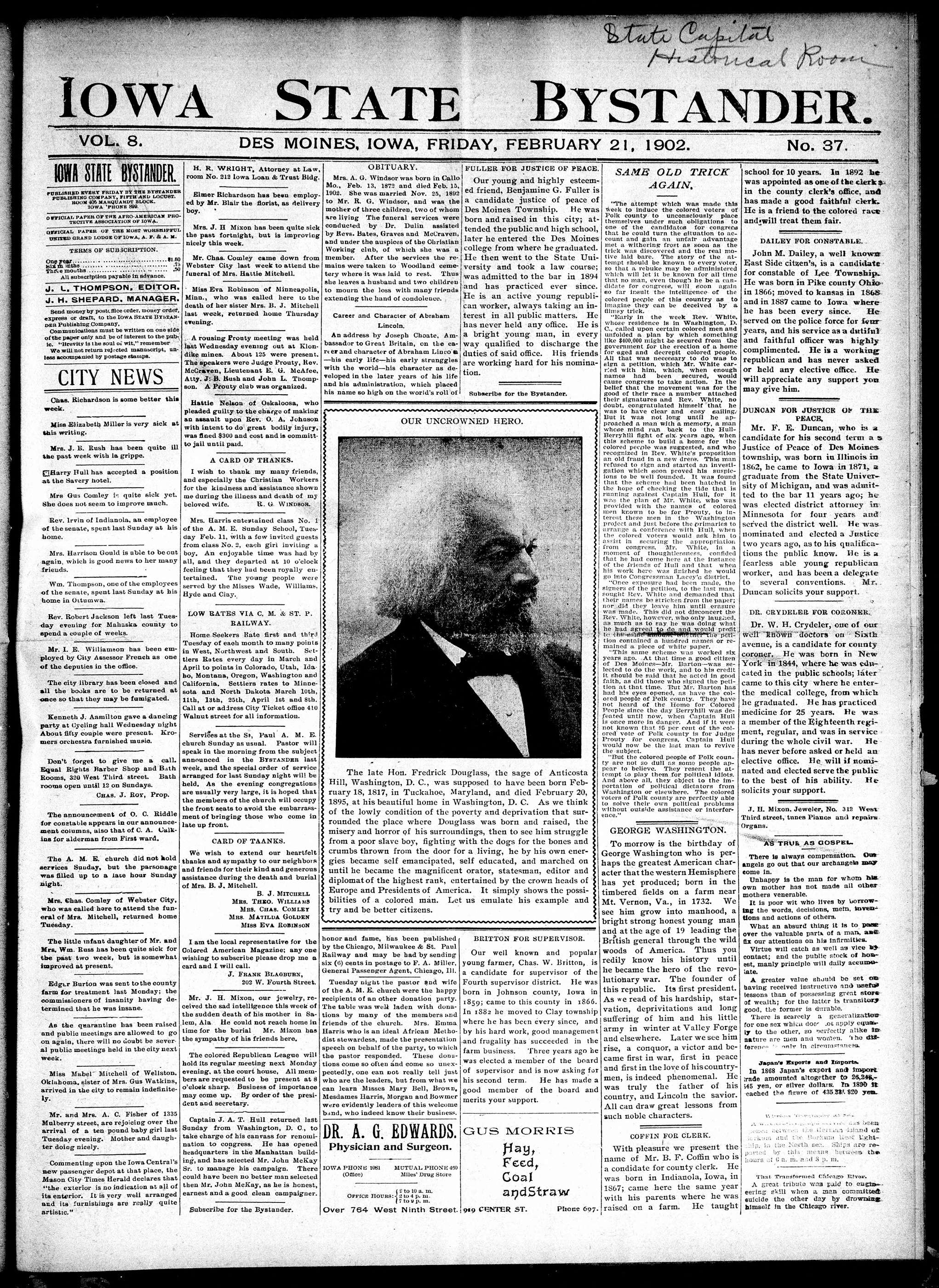
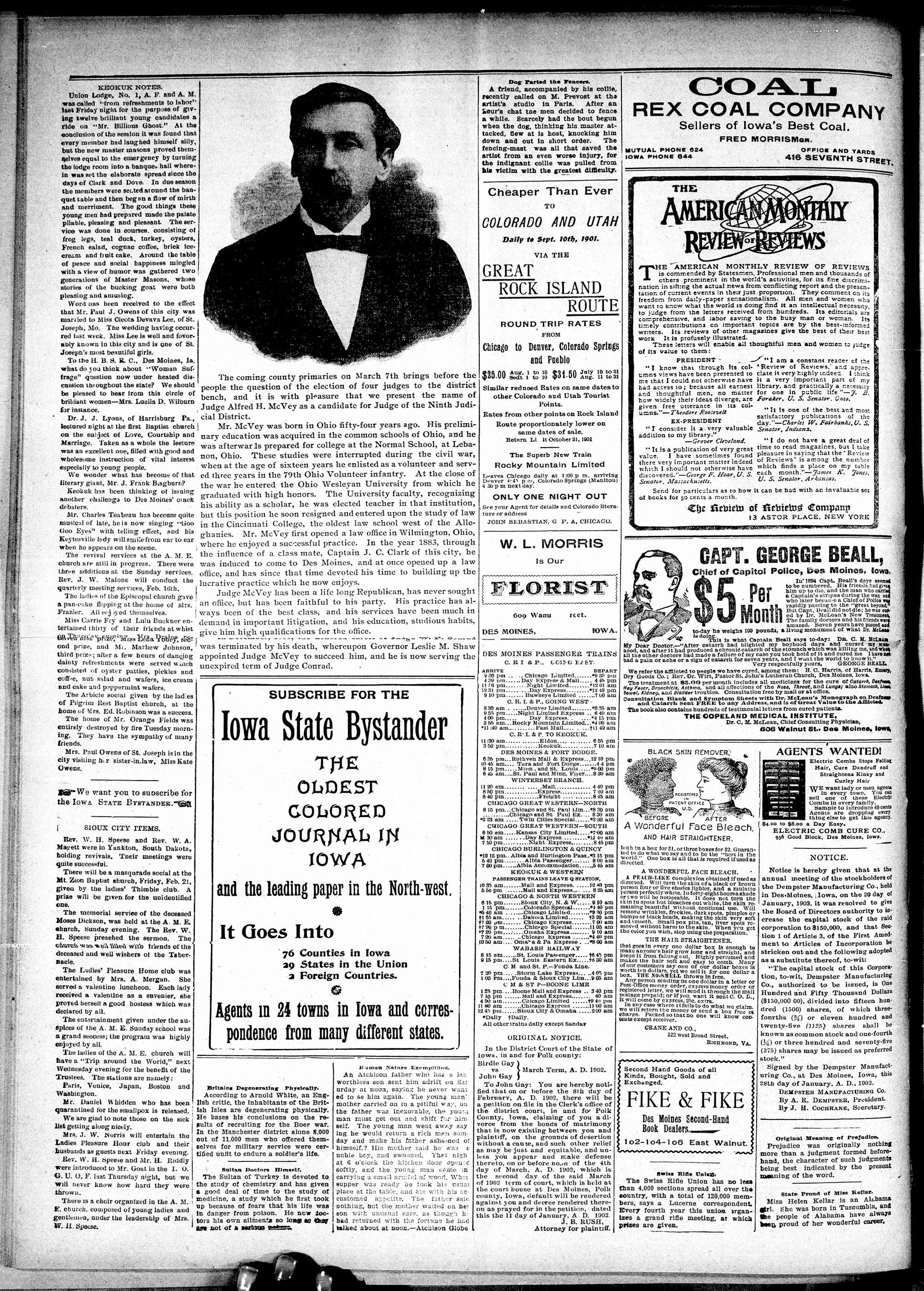
[Pictured is a black-and-white portrait of Frederick Douglass, a prominent African-American abolitionist and writer. He is depicted with a full white beard and mustache, wearing a dark suit with a white shirt and a black bow tie. Douglass is known for his influential writings on slavery and his role in the abolitionist movement.]
The late Hon. Fredrick Douglass, the sage of Anticosta Hill, Washington, D. C., was supposed to have been born February 18, 1817, in Tuckahoe, Maryland, and died February 20, 1895, at his beautiful home in Washington, D. C. As we think of the lowly condition of the poverty and deprivation that surrounded the place where Douglass was born and raised, the misery and horror of his surroundings, then to see him struggle from a poor slave boy, fighting with the dogs for the bones and crumbs thrown from the door for a living, he by his own energies became self emancipated, self educated, and marched on until he became the magnificent orator, statesman, editor and diplomat of the highest rank, entertained by the crown heads of Europe and Presidents of America. It simply shows the possibilities of a colored man. Let us emulate his example and try and be better citizens.
Mrs. A. G. Windsor was born in Callo Mo., Feb. 13, 1872 and died Feb. 15, 1902. She was married Nov. 25, 1892 to Mr. R. G. Windsor, and was the mother of three children, two of whom are lying The funeral services were conducted by Dr. Dulin assisted by Revs. Bates, Graves and McCraven, and under the auspices of the Christian Working club, of which she was a member. After the services the remains were taken to Woodland cemetery where it was laid to rest. Thus she leaves a husband and two children to mourn the loss with many friends extending the hand of condolence.
Career and Character of Abraham Lincoln.
An address by Joseph Choate, Ambassador to Great Britain, on the career and character of Abraham Lincoln—his early life—his early strungles with the world—his character as developed in the later years of his life and his administration, which placed his name so high on the world's roll of
The late Hon. Fredrick De Hill, Washington, D. C., was su ruary 18, 1817, in Tuckahoe, M. 1895, at his beautiful home in W. of the lowly condition of the po rrounded the place where Doug misery and horror of his surround from a poor slave boy, fighting crumbs thrown from the door for gies became self emancipated, until he became the magnificent diplomat of the highest rank, em Europe and Presidents of Ameri bilities of a colored man. Let try and be better citizens.
honor and fame, has been published by the Chicago, Milwaukee & St. Paul Railway and may be had by sending six (6) cents in postage to F. A. Miller, General Passenger Agent, Chicago, Ill.
Tuesday night the pastor and wife of the A. M. E. church were the happy recipients of an other donation party. The table was well laden with donations by many of the members and friends of the church. Mrs. Emma Harris who is an ideal African Methodist stewardess, made the presentation speech on behalf of the party, to which the pastor responded. These donations come so often and come so unexpectedly, one can not really tell just who are the leaders, but from what we can learn Misses Mary Bell, Brown, Mesdames Harris, Morgan and Bowmer were evidently leaders of this welcome band, who indeed know their business.
DR. A. G. EDWARDS.
Physician and Surgeon.
IOWA PHONE 1081
(Office)
MUTUAL PHONE 490
Miles' Drug Store
OFFICE HOURS: { 9 to 10 a. m.
2 to 4 p. m.
7 to 9 p. m.
Over 764 West Ninth Street.
FULLER FOR JUSTICE OF PEACE.
Our young and highly esteemed friend, Benjamin G. Fuller is a candidate justice of peace of Des Moines Township. He was born and raised in this city; attended the public and high school, later he entered the Des Moines college from where he graduated. He then went to the State University and took a law course; was admitted to the bar in 1894 and has practiced ever since. He is an active young republican worker, always taking an interest in all public matters. He has never held any office. He is a bright young man, in every way qualified to discharge the duties of said office. His friends are working hard for his nomination.
Subseribe for the Bystander.
DOWNED HERO.
Bouglass, the sage of Anticosta supposed to have been born February, and died February 20, Washington, D. C. As we think poverty and deprivation that surpass was born and raised, the buildings, then to see him struggle with the dogs for the bones and for a living, he by his own energetic educated, and marched on orator, statesman, editor and entertained by the crown heads of America. It simply shows the possibility emulate his example and
BRITTON FOR SUPERVISOR.
Our well known and popular young farmer, Chas. W. Britton, is a candidate for supervisor of the Fourth supervisor district. He was born in Johnson county, Iowa in 1859; came to this county in 1866. In 1882 he moved to Clay township where he has been every since, and by his hard work, good management and frugality has succeeded in the farm business. Three years ago he was elected a member of the board of supervisor and is now asking for his second term. He has made a good member of the board and merits your support.
GUS MORRIS
Hay,
Feed,
Coal
andStraw
919 CENTER ST. Phone 697.
8 tute Capital
SAME OLD TRICK AGAIN.
"The attempt which was made this week to induce the colored voters of Polk county to unconsciously place themselves under such obligations to one of the candidates for congress that he could turn the situation to account and gain an unfair advantage met a withering frost as soon as the trick was discovered and the real motive laid bare. The story of the attempt should be known to every voter, but it may be demonstrated which will let it be known for all time that no man, even though he be a candidate for congress, will soon again so far insult the intelligence of the colored people of this country as to imagine they can be deceived by a flimsy trick.
"Early in the week Rev. White whose residence is in Washington, D.C., called upon certain colored men and unfolded a plan by which something like $400,000 might be secured from the government for the erection of a home for aged and decrepit colored people. All that was necessary to do was to sign a petition, which Mr. White carried with him, which he enough names and had been secured, cause congress to take action. In the belief that the movement was for the good of their race a number attached their signatures and Rev. White, no doubt, congratulated himself that he was to have clear and easy sailing. But it was not long until he approached a man with a memory, a man whose mind ran back to the Hull-Berryhill fight of six years ago, when this scheme to build a home for the colored people was suggested, and who recognized Rev. White's proposition he recognized. Rev. White refused to sign and started an investigation which soon proved his suspicions to be well founded. It was found that the scheme had been hatched in the hope of checking the tide that is running against Captain Hull, for it was the plan of Mr. White, who was provided with the names of colored men known to be for Prouty, to interest these men in the Washington project and just before the primaries to change a conference with Hull, when the president would assist in securing the appropriation from congress. Mr. White, in a moment of thoughtlessness, confided that he had come here at the instance of the friends of Hull and that when his work here was finished he would go into Congressman Lacey's district.
"Once exposure had been made, the signers of the petition, to the last man, sought Rev. White and demanded that their names be stricken from the paper; the petition was made. This did not disconcert the Rev. White, however, who only hunged, as much as to say he was doing what he had agreed to do and would profit to the same Innocent Neither the petition contained a hundred names or removed a piece of white paper. This man entered the cabin six years ago. At that time a good citizen of Des Moines—Mr. Barton—was selected to do the work, and to his credit it should be said that he acted in good faith, as did those who signed the petition at that time. But Mr. Barton has ordered people of Polk county. They have not heard of the Home for Colored People since the day Berryll was defeated until now, when Captain Hull is once more in danger. And if it were not known that 95 per cent of the colony's note of Polk county is for Judge Prouty congress, Captain Hull would now be the last man to revive the subject.
"But the colored people of Polk county are not so dull as some people appear to believe. They resent the attempt to play them for political idios. And above all, they object to the importation of political dictators from Washington elsewhere. The colored people of Polk county are not able to solve their own political problems without outside assistance or interference."
GEORGE WASHINGTON.
To morrow is the birthday of George Washington who is perhaps the greatest American character that the western Hemisphere has yet produced; born in the timbered fields on a farm near Mt. Vernon, Va., in 1732. We see him grow into manhood, a bright strong honest young man and at the age of 19 leading the British general through the wild woods of America. Thus you redily know his history until he became the hero of the revolutionary war. The founder of this republic. Its first president. As we read of his hardship, starvation, deprivitations and long suffering of him and his little army in winter at Valley Forge and elsewhere. Later we see him rise, a conquor, a victor and became first in war, first in peace and first in the love of his countrymen, is indeed phenomenal. He was truly the father of his country, and Lincoln the savior. All can draw great lessons from such noble characters.
COFFIN FOR CLERK.
With pleasure we present the name of Mr. B. F. Coffin who is a candidate for county clerk. He was born in Indianola, Iowa, in 1867; came here the same year with his parents where he was raised on a farm. He taught
---
No.37. school for 10 years. In 1892 he was appointed as one of the clerks in the county clerk's office, and has made a good faithful clerk. He is a friend to the colored race and will treat them fair.
DAILEY FOR CONSTABLE
John M. Dailey, a well known East Side citizen's, is a candidate for constable of Lee Township. He was born in Pike county Ohio in 1866; moved to kansas in 1868 and in 1887 came to Iowa where he has been every since. He served on the police force for four years, and his service as a dutiful and faithful officer was highly complimented. He is a working republican and has never asked or held any elective office. He will appreciate any support you may give him.
DUNCAN FOR JUSTICE OF THE PEACE
Mr. F. E. Duncan, who is a candidate for his second term as Justice of Peace of Des Moines township, was born in Illinois in 1862, he came to Iowa in 1871, a graduate from the State University of Michigan, and was admitted to the bar 11 years ago; he was elected district attorney in Minnesota for four years and served the district well. He was nominated and elected a Justice two years ago, as to his qualifications the public know. He is a fearless able young republican worker, and has been a delegate to several conventions. Mr. Duncan solicits your support.
DR. CRYDELER FOR CORONER.
Dr. W. H. Crydeler, one of our well known doctors on Sixth avenue, is a candidate for county coroner. He was born in New York in 1844, where he was educated in the public schools; later came to this city where he enter the medical college, from which he graduated. He has practiced medicine for 25 years. He was a member of the Eighteenth regiment, regular, and was in service during the whole civil war. He has never before asked or held an elective office. He will if nominated and elected serve the public to the best of his ability. He solicits your support.
J. H. Mixon, Jeweler, No. 312 West Third street, tunes Pianos and repairs Organs.
AS TRUE AS GOSPEL
There is always compensation. Our angels go out that our archangels may come in.
Unhappy is the man for whom his own mother has not made all other mothers venerable.
It is poor wit who lives by borrowing the words, decisions, metn, inventions and actions of others.
What an absurd thing it is to pass over the valuable parts of a man, and fix our attentions on his infirmities.
Virtue will catch as well as vice by contact; and the public stock of honest, manly principle will daily accumulate.
A greater value should be set on having received instructive and useful lessons than of possessing great store of wealth; for the latter is transitory good, the former is durable.
There is scarcely a generalization for one sex which does not apply equally to the other, so perfectly alike in nature are men and women. The difference is only in circumstances.
Japan's Exports and Imports
In 1868 Japan's export and import trade amounted altogether to 26,248-
145 yen, or silver dollars. In 1890 it captured the figure of 435,328 yen.
A watercraft service has been opened between the Gerritra island of Mokkana and the Borkum island lightship, in the North sea. Ships are reported by this means between the hours of 6 a.m. and 8 p.m.
That Transformed Chicago Rivor.
A great tribute was paid to engineering skill when a man committed suicide the other day by drowning himself in the Chicago river.
¥: %
Towa State Bystander.
by BYSTANDER PUR. CO.
‘DES MOINES, ae : IowA
pes MONS
Manes Fon of OMsiat Onion
Congresen un Fitzgerald of New
York is poking fun at the Indian com-
missioners’ order prescribing the style
of haircut and the color of paint to be
used by Indians. Mr. Fitzgerald says
he wants more information. —“~ want
to nd out whether an Indien. must
‘wear @ plug hat, white shirt, his hair
Pompatour and’ patent leather shoes
before he can secure his rations,” said
Mr. Fitegerald. “I don’t think the
latest order specifies whether the In-
ian must refer to his clothing aa
‘pants,’ ‘breeches’ or ‘trousers.’ Con-
Frees inust ettle that question.”
eee
aocemeat for Tov! comin
‘A movement is on foot in indian
apolis to erect_a monument to. Lev
Coffin, who in the stirring times im-
mediately preceding the civil war was
at the head of the Indiana orsantza-
loa connected with the “underground
allroad,” through the~ medium of
Wwhich hundreds ot negrocs escaped
From slavory to the north, Ac. Cofin
died near Cincinnati in 1877. While
living ta Newport he alded tn the es
cape of Eliza Harris of “Uncle Tom's
Cabin” fame.
Be oe Oe
One of the most expert chauffeurs is
Washington is Representative Josept
Sibley of Pennsylvania. He has an au
tomobile and each morning when con-
gress is in session takes it up the ave-
nue to the east front of the capitol, and
then turns it over to an attendant.
‘Mr. Sibley is so expert that he can cut
figure eights and do other fancy stunts
in steering the machine.
++ ——_
Disappointed the Father.
Lewis Nixon, the new Tammany
leader, a hard worker himself, telle this
story of Edison’s industry: A fond
parent, who was a great stickler for
Punctuality, took his son to visit the
great clecirician, Just before leaving
he asked Mr. Edizon to give the boy a
word of advice. “My boy,” said the
inventor, “never look at the clock.”
—
Teaches His Children Trades.
Dr. C. H. Roberts, a retired millio
atre of Poughkeepsie, N. ¥., had a
his maxim that “no man has a right
to consume more than he produces,’
and, living up to that principle, he
educated his children’s hands as well
as their heads, and when they lex
school he required each to leara 2
trade.
——+-2
ated: i
It is sald that the present Lord Lyt-
ton has inherited to a great extent the
brilliancy of bis father and grandfath-
er. Of his speech, seconding the speech
from the throne, Lord Rosebery de:
clared in the house of lords that it was
the best ever delivered in his hearing
ea such an occasion.
‘Bias eae Sickccunes Ganwas:
John Cannan of Williamsport, Pa.,
4s about to be placed on the pension
list by the Reading railroad, after con:
tinuous service of fifty years, during
which time be has been off duty but
twelve days. Even that was through
Mness, from which he suffered las!
year.
——
Is Dol g Good Work.
Former Governor Frank W. Rollins
of New Hampshire ts the enthusiastic
president of the Society for the Pro:
tection of New Hampshire Forests
Although the society is less than
year old the results of the missionary
‘work have become evident already.
> ——
Hangary Hopes to Rain Cotton,
Hengary hopes to be able to reise
cotton although the warm season is
only five months long and the plant re-
guires seven months to rigoz. The
diicuity is to be overcome by special
preparation of the sced and by add-
ing ingredients to the soll.
+2
aidieniae Gr diiiadera Weiwenas
The revolver with which President
‘Mc¥inley was shot was a 32-caliber
and since that time dealers have no-
ticed an increase in the number of
calls for weapons of that caliber, and
it is said, of the particular make used
by te assassin.
Antomobile for Farmers.
A Colorado man is said to have in-
vented an automobile for the use of
farmers, It is a machine which can
‘be operated by gasoline or electricity,
and {t adapted to plowing, sceding,
cultivating or harvesting.
Mot) Pen nad Weapon.
The Roman stylus was often made
heavy, that ft might be used as
weapon. It was with such a styius as
this that Cacsar defended himself
when attacked by the conspirators,
Henry Watterson a BMusteian,
Henry Welterson is a fairly goot
musician and it was at one tice 1
gerious question with him as to whet-
er he ehould take up music or journsl-
jem as a profession.
New Fork Government Expensive.
The expenses of the elty of Loniton
this year amount to $80,000,000, 2nd
those of the city of New York, as pro
vided for a the budget, to $97,000,000.
se
Cunbabtias Seaenesieal Bem.
Dr. McConnell! says some of the
theological seminarics need a shaking
up, and says that their aim seems 10
bee qnencity rather than avelity.
THE NEWS IN [OWA
EXAMINE COUNTY TREASURERS.
Furry Bill Passed the House After
LE cor ear
Des Moines, keb. 18—The Furry
oill, providing for the appointment of
public examiners, defining the duties
and fixing the compensation thereot,
end providing for a uniform system
of keeping the books of county treas
brers, passed the house, after slight
amendment, by a vote of 67 to 27, with
six members absent or not voting.
‘The bill provides for the appoint:
ment of three examiners by the gov:
ernor, Who shall inspect the office of
county treasurers and require a unt:
form system of bookkeeping by such
officers, ‘The exammers are to receive
‘a salary of $5 per day and their ex-
penses.
‘This bill was-introduced in tne last
session by Eaton of Mitchell, now
‘speaker of the house. When the Dill
was called up yesterday the author.
Farry, spoke in its behalf, and urged
the passage of a measure of this kind.
Durham of Delaware and Hawk of
Jasper were also in favor of the meas-
ure. Head of Green offered an amend-
ment, which was adopted, requiring
county auditors aiso to keep uniform
sets of books.
Blakemore of Taylor was against
the bill because he did not, believe
that it would prevent defalcations. He
said tnat he knew of several instances
where county treasurers had gotten
away with funds when their books
were pronounced by the boards of
supervisors to be inthe best possible
condition.
Pipher of Cass replied, stating that
in many cases county supervisors did
not know the difference between the
credit and debit sides of a ledger,
and were entirely incompetent to go
over the books of the county treasur-
er and know anything of the condition
when they had finished. He also be-
Heved that supervisors would work
several days in checking up accounts
in an office at a salary almost as large
as would be pafd an expert who would
easily complete the work in one-half
or one-fourth the time.
FATAL WRECK NEAR ELDORA.
Four persons Killed on the lowa
Central.
Eldora, Feb. 18—An_ exceedingly
fatal and disastrous wreck on the Iowa
four miles south of here, and as a re-
sult four lives were lost’and property
exceeding $20,000 in value was des-
toyed. ‘The following {s the list of
dead: John White, engineer of pas-
senger, ved et Oskaloosa; William
Frude, engineer, ved at Keithsburs;
Bud Obule, fireman, lived at Marshall:
town: Frank Patten, fireman, lived at
Liscomb.
It is plleged that Engineer Frude
had orders to take a single engine
and proceed to Eldora to relieve a
“dead” fre.ght engine, 2nd that he was
ordered to wait at Gilford for the
south-bound passenger. It is suppos-
ed that he disobeyed orders, as he
had left Gifford and met the passenger
on a sharp curve one mile ont of Gif-
ford, Both trains were going at a rate
of thirty miles an hour, and it is on
account of Engineer John White stay-
ing at his post on the passenger and
reversing his engine at the cost of his
own life that more lives were not
lost, as there were a number of pas-
sengera on the train.
NO ANARCHISTS FOR 1OWA.
See ee eee eben se soma
in the Murder.
Des Moines, Feb. 19.—Such charac:
ters as Emma Goldman and other an-
archists who figured in the recent
assassination of President McKinley
of the United States ere made crim
inals by an act. which passed the
house yesterday. ‘The bill in question
was introduced by Campbell and pro-
vides that if any person hire, employ,
advise, counsel oF ald the person to
commit murder he shall, whether such
murder be committed or net, be im-
prisoued in the penitentiary not more
than twenty years or fined not excecd-
ing $1,090, o both, at the discretion of
‘the court,
Tie bill had no opposition what-
ever. It was explained by Chairman
Clarke, of the judiciary commettee,
that the bill was directed at anarchists
and that it would make it a felony
for such people to issue publie or
private statements to incite murder.
ELEVEN MEN ROBBED BY Two.
| Robeers Hotd Up Gambling House at
‘Gidea as Mawk Fackion.
Clinton, Feb. 19.—The gambling
house of Cullen Flanagan was held
up at 1 o'clock a. m. and robbed, as
were the eleven inmates and players.
‘Two men with kandkerchiets over
their faces opened the door and made
the occupants of the room stand with
faces to a wall and hands over thelt
heads until the thieves empii@™ the
money drawers, took the pocketbooks,
diamonds, watches, ote., of the gam-
blers. After the robbers had joked
with their vietims about sending their
diamonds back and promising to give
a dollar to the one men who had noth-
Ing, they left, the one carrying the
plunder being given five ‘minutes’
Start. ‘The raid occupied but a few
minutes. The robbers, who were
strangers kere, are supposed to have
crossed the river on the ice.
BANK WRECKED AT BROOKS.
Pesce Pursues and Captures Three
Armed Men.
Corning, Feb. 19.—The bank at
Brocks, four mites west ef Corning,
was wrecked by safe blowers between
Zand 4 oelock a.m. Mo money was
Secured; the three men wero captured
by & posse of mon who surrounded a
schoolhouse, two and one-half miles
south of Brooks. ‘The sheriff from
Corning was notified. He went out
and brought them in ard caged them
in jail. ‘They were well armed and
had dynamite, nitroglycerine. _ fuses,
arilis and all ‘the regular ouift of a
bank burglar.
Poiscned by Chicken Pic.
Mason City, Feb. 19.—The entire
family of George Hain, a farmer iv.
ing couth’of this city, was poisoned
by partaking too frecly of a chicken
pie. Mr. Hain did noz eat any of the
ple and escaped the Hiness, but his
vife and two ehiidron were talcen vio
lently ill within an hour efter dinner
and every symptom of poison was
present. All will probebly recover.
RAILWAY TAX STATUTE
SUB-COMMITTEE PLAN BASED UP.
‘ON STOCKS AND BONDS.
Claim is Made That If Passed It Wit
Materially Add to Revenue of
ee ities
Des Moines, Feb. 20.—The senate
sub-committee apointed to draft a re
form measure covering railroad tax:
ation in Iowa completed its work yes
terday and submitted its report to the
senate ways and means committee as
a whole. The report embodies a short
statement by the committee and the
draft of the two bills, one supplement.
‘al tothe other, embodying changes In
the present method of railroad taxa.
tion in the state.
‘The bills as drawn by the sub-com.
mittee are not sensational in character,
although they cover the subject in a
‘way which fs believed will bring about
not only a more equitable system of
taxation of the railroads in Iowa, but
will also ‘increase the revenue from
this source materially.
‘The senate sub-committee consists
of Senators Junkin, Healy, Lewis and
Porter. Much interest centered about
this report and information pertain.
Ing thereto was eagerly sought by the
members as soon as it was known
that it had been made public.
‘The main bill embodies the stocks
and bonds test of valuations, allowing
discretion to be exercised by the ex
ecutive council such as the committee
believes fs necessary in order to in-
sure the constitutionality of the meu-
sure. The other bill provides for the
appointment of a competent statisti
cian by the governor to make an in-
vestigation and report certain data
including the cost, present value and
other information’ respecting proper-
ties assessed by the executive coun:
cil and especially pertaining to rail.
road propertics in the state. ‘The first
report from this officer is to be made
by Noyemoer 1, 1903, and others at
such times as the governor may re-
quire.
In speaking of the measures which
were submitted to the Ways and means
committee, a leading member of the
sub-committee said: “The two bilis
today submitted by the sub-committee
on Ways and means will reach the
senate, if at all, as committee bills.
‘The fall committee will go over the
bills secticn by section and perfect
them by means of amendments and
such alterations as to make them re-
flect the views of the committee. In
this preparation thus far, very help-
ful suggestions have been made by
both Governor Cummins and Lieuten-
ant Governor Herriot. tough itis
but fair to them to say tnat neither
has sought to influence the committer
as to any particular feature of the
bills, and to no one have the bilis
veen submitted before they were fn-
ally completed and copies typewritten
for the meeting of the full commitee.”
COMPULSORY EDUCATION.
Dunham's Bill io. Adopted by an
Mnaemisue Weaistiies
| Des Moines, Feb. 20.—By a vote of
84 to 9 the Dunham compulsory educa-
tional bill passed the house yester-
day. The votes against the measure
do not necessarily mean personal
antagonism to compelling the attend.
ance of children at scicols, but rather
that the constituency of the opposing
legislators demanded that the bill not
pass because of the fear that it would
menance private or parochial Institu-
tions. However, the bill has been
amended In an endeavor to meet
all such objections, and preclude the
| possibuity of petty uyanny or annoy.
ance from over-zealous officers. “The
opposition as recorded by the roll call
was as follows: Colelo, Cruikshank,
Dodds, Frudden, Hilsinger, Koontz,
Langan of Crawford, Larrabee and
Marshail,
‘There were severa! amendments of
/a corrective character to the original
| bill before it was put on its passage.
| Then the author spoke at some length
regarding the measure. Among other
| things he called attention to the fact
| that In Towa there are between 700.
{900 and $00,000 children hetweon the
ages of 7 and 14 years affected by the
provisions of the Dill. He further
stated that the number enrolled Is
| about £00,000 and those rexularly at-
tending school only avout, 300,000. He
| then called attention to the fact that
j the taxes paid for the support of the
school were annually about sixty per
cone of the entire amount paid in the
| state and that the expenditures about
| $9,000,000. When this is taken into
cousideration, sald the speaker, it will
be readily seen that the people have
aright to demand of parent: that they
make good citizens of their children
by seeing that they are given an edu.
cation.
‘Another argument in favor of the
law made by Mr. Dunham, is that it
will obviate the necessity’ o a child
labor law for the reason that it gives
to the truant officers the right to visit
shops and factories and compel at-
tendance at some school all employes
who come within the provisions. The
Dill also provides fora truant. school
and the teaching of manual training
|to all that can not be interested in
Se
MT. AYR MURDER TRIAL.
Jury Returned Verdict of Murder in
Second Degree.
Mt. Ayr, Fe. 20.—The verdict of
the jury in the Hunter case ended the
longest and most important criminal
trial in the history of the county, re-
sulting In conviction for the highest
degree of crime ever recorded here.
‘the trial bogan seven and one-half
days ago. ‘The jury reported a verdict,
aiter 26 hours of deliveration. and
found Hunter guilty of murder in the
second degree. Hunter killed Homer
Holland as a result of a dispute over
gambling.
Fire at Cedar Falls.
Waterloo, Feb. 19—Fire at Cedar
Falls destroyed property valued at
34,500, ‘The fire is supposed to have
besa of incendiary origin, but as it
had obtained considerable headway
when discovered there is no clew. A
letge Iwmber shed belonging to the
Tonwsond & Merrill Lumber Company
and a livery barn belonging to Del
Burr were consumed. ‘The barn con
toined a number of valuable horses,
which were rescued with difficulty.
Insurance on the whole loss amounted
to about $1,000.
THE LEGISLATURE.
192 was made a special order for Tucs-
day at 10:30. It extends the power of
‘the state board of hesith over local
tles In which the local boards fail to
enforce quarantine and vaccination In
contagious diseases. A quorum was
present during none of today's ses-
sion. §S. F, 217 was introduced by
Harriman and went to agriculture.
It relates to and provides for draining
swamp lands in lowa.
House—The bill increasing the sup-
port fund of the College for the Blind
at Vinton to $22 per month for nine
months in the year, was taken up
and discussed, but owing to the small
number of members present action
was postponed until Thursday. Fields
called up H. F, 190, amending section
1547 of the code, to prohibit the taking
of fish from the Big Sioux river except
with hook and Ine. The bill passed.
Wilson of Buena Vista called up H. F.
121, removing the limit on fees to be
charged by the secretary of state for
filing articles of incorporation. At
pregont the maximum fee is $2,000.
‘The bill passed.
Wright called up H. F. 195, amend-
ing section 106 of the code, relative
to the time of settlement of the aud-
itor of the state with the treasurer of
state, making it at definite periods.
‘The bill passed. Among the bills in-
troduced were the following: Pro-
viding that express companies shall
make reports to executive council at
same time as telephone companies;
making appropriation increasing the
per capita allowance for the inmates
of the Industrial School at Eldora
from $9 to $11 per month; providing
for a bacteriologist, who ‘shall be a
physician and director of the state
board of health bacteriological labor-
atory, and who is to receive a salary
of $5,000 per year; increase appropri-
ation’ for health" department from
$0,000 to $7,000 per year.
Des Moines, Feb. 17.—Senate—Sev-
eral legalizing acts were passed. A
Dill was introduced in the senate pro-
viding for a fishway over the Bona-
parte dam in the Des Moines river,
which now prevents Mississippi river
fish’ from coming north.
House—In the house, the time was
aevoted to a discussion of the Cum:
mings bill to increase the salaries of
the supreme judges from $4,000 to
36,000. An amendment to place it at
$5,000 was defeated by a narrow mar-
gin, The house judiciary committee
decided to report for passage the bill
defining habitual criminals and which
Is designed to reach persons engaged
in safe blowing. It is the measure
fathered by A. U. Quint, of the Bank-
ers’ Mutual Casualty company.
Des Moines, Feb. 18—Senate—Wil-
son, democrat, introduced a resolu
tion calling for a report from tne com-
mittee on federal relations on the
memorial referred to that committee
and directed to congress, urging the
passage of the Hoar bili to restrict
issuance of injunctions in time of
strikes. A resclution was introduced
directing the appropriation committee
to report all bills before March 1, with
a view to early adjournment.” The
senate passed the board of keaith bill
to give the state board full power to
interfere in local conditions when 1o-
cal boards fail to preserve quarantine,
ete. The bill to authorize three year
contracts with teachers was sent back
40 the committee on schools.
House.—The house passed the Dill
by Campbell, of Fremont county, mak-
ing it a crime punishable by twenty
years’ imprisonment to hire, employ,
advise or solicit other persons to com‘
mit murder. It was explained in de-
bate that the Dill was designed to pro-
tect the president in particular and
other officials in general from attacks
by anarchists on Iowa soll. The Furry
bill creating three official state ac-
countants to examine the offices of
the county treasurers of Iowa annual-
ly was passed. The house sent back
to the committee on compensation of
public officers the bill which had been
debated for two days to increase the
salaries of the six supreme judges
from $4,009 to $6,000. The committee
decided’ to recommend the _ bill's
amendment to make the salary $5,000.
Des Moines, Feb. 19.—Senate.—The
senate adopted Wilson's resolution
calling for a report from its federal re-
lations committee with respect to the
resolution endorsing the Hoar bil for
the restriction of strike Injunctions.
Later the committee unanimously de.
cided to report the resolution for in:
definite postponement. A bill to re-
quire insurance companies to pay the
face value of their policies in case of
loss by fire was introduced by Brigh-
ton. It is in the form of -ae valued
policy bill passed by the last lesis-
lature and vetoed by Governor Shaw.
‘The Lister bill, providing that persons
coming into Towa cannot secure. di-
vorces on grounds which were not
cause for divorce in the state from
which they come, was passed.
House—The house killed the
Hughes anti-pass bill Wednesday by
voting to table an amendment pro-
Iibiting ministers and priests from
accepting passes, the tabling of which
carried the biil with it. ‘The vote was
53 to 44. A moton to lift from the
table was defeated 54 to 41, It ts
said the measure will be introduced in
the senate. Representative Carter
introduced a bill providing for 2-cont
passenger fares on all Towa railroads.
‘The English ill drafted by Governor
Cummins. requirmg railroads to re-
port thei? earnings with reference to
the Ore: Of Shels Business: was:
lution be referred to the cominittee
on federal relations, which was done
LONG 18 READY TO RETIRE.
Close of Schley Caso Wil! Permit Him
ee
See eee
‘Washington, Feb. 21—Now that the
Schley matter has been settled of-
ficially, it is understood that Secro-
tary Long feels he 1s at liberty to
carry out the project cherished by
him’ in the last year by President
McKinley's administration to retire to
private life. However, this 1s not ex
pected to ensue at once, for there
is no certain knowledge of what may
follow in congress, notwithstanding a
strong belief by ‘the administration
that the case it settled beyond re-
vival. Therefore it is understood
that the change In the cabinet circle
will not take place before the ad:
journment of the present session of
congress, and perhaps not until next
autumn,
OUR SLAP AT RUSSIA.
ROOSEVELT AND HAY TO BACK
ENGLAND AND JAPAN.
English-Japanese Pact Was Submitted
to Them Before Being Made Pub-
lic and Endorsed.
Chicago, Feb. 21—The Tribune
prints the following special cublegrain
from Peking, China, under date of
February 19th: A’ sensation was
caused in diplomatic circles here today
when it became known that the Uni-
ted States, through Secretary of
State John'Hay, had sent a note to
the Russian and'Chinese governments
closely along the lines of the Anglo-
Japanese treaty of January 30th.
‘The note is a distinct warning to
both China and Russia that the United
States will not permit the integrity
or the empire to be molested in favor
of one nation to the detriment of an-
other.
The note, which practically endorses
the English treaty with Japan, says:
“Washington, D. C., Feb. "1—An
agreement whereby China gives any
corporation or company the executive
right or privilege of opening mines,
establishing railways or in any other
way industriallly "developing Man-
ehuria can be viewed but with the
| gravest concern by the government of
|the United States.
| “It constitutes a monopoly, which is
a distinet breach of the stipulations
of the treaties conchided between
| Chine and foreign powers, and thereby
‘seriously affects the rights of Ameri-
Jean citzens.
| ‘It restricts their rightful trade,
|exposing it to he discriminated against,
interfered with or otherwise jeopard:
|ized, and strongly tends to permanent-
y impairing China's sovereign rights
Jin this part of the empire, while it
seriously interfere with her ability to
meet her international obiigations.
“Furthermore. such a concession on
China's part. would undoubtedly be
followed by demands from other pow-
ers for similar equally extensive ad-
vantages elsewhere in the Chinese em
pire, and the inevitable result. must
‘be the complete wreck of the policy
of absolute equality of treatment to
all nations respecting trade naviga-
tion and commerce within the em-
pire’s confines.
“On the other hand, the attainment
by one power of such’ extensive privi-
leges for the commercial organs of its
nationality conflicts with the assur-
ances repeatedly conveyed to this gov-
ernment by the imperial Russian min-
istry of foreign affairs of the imperial
government's intention to follow the
policy of the open door, as advocated
by the government ot’ the United
States, and accepted by all the treaty
powers having commercial interests
in the empire.
“It is for these reasong that the
government of the United States, now
‘as formerly animated by the sincer
est desire of insuring to the whole
world the benefits of full and fair in-
tercourse between China and the na-
tions on equal footing of equal rights
and advantages to all, submits the
above to the earnest consideration
of the imperial governments of Russia
and China, confident that they will
adopt such measures as will relieve
the just and natural anxiety of the
United States.”
The Tribune prints the following
special from Washington: “It has
been understood here from the out-
set that the terms of the British-Jap-
anese agreement to preserve the in-
tegrity of China was submitted in_ad-
vance to President Roosevelt and Sec-
retary Hay and approved by them.
“Following out the traditional pol-
fox, however, of avoiding entangling |
alliances, the United States positively
declined to become a party. to oF
actual agreement concerning China.
“When Lord Cranborne, in the Brit-,
ish parliament last week declared
that there was no doubt the British-
Japanese agreement would commend
the full approval of the United States,
he spoke by authority.
“The agreement between Great
Britain and Japan was dated January
30th. ‘There is, therefore, deep sig-
nificance that on February Ist, two
days after the treaty was signed, this
country sent to Russia a_note ‘prac-
tically adopting the principle of the
treaty as the policy of the United
States. ‘The agreement between Great
Britain and Japan is largely a military
one and provides for a joint use of
foroon in cass: of hostilities”.
2,000 KILLED IN EARTHQUAKE.
Details of the Shamaka D'saster Are
. Slowly Arriving.
Baku, ‘'rans-Caucasia, Feb, 18.—De-
tails whien are slowly arriving from
Bebu Shamaka, shows that 2,000 per-
sons, mostly women and children per-
ished as a result of the earthquake
last _week and that four thousand
houses were destroyed.
‘Thirty-four villages of the country
surrounding Shamaka also stiffered.
To add to the terrors of the neigh:
Dorhood, a volcano near the village of
Marasy, castward of Shamaka, has
broken ‘into active eruption. A great
crevasse has appeared from whence
immense flames 2d streams of love
are being thrown out. The course of
the river Geonchaika has been altered’
in consequence of its bed being dam
med with carth which has been dis-
turbed by the earthauake,
Pattalions of guards and detach-
ments of soldiers with tonts have beon
dispatched to Shamaka to aid in the
work of resene.
‘The Red Cross society is active in
alleviating. distress.
KNOX ACTS WW
Attorney General to Attack
Northern Securities Com:
pany in Courts,
BY ORDER. OF THE PRESIDENT,
Claim Made that the Sherman Avt-tros
Law Was Broken by the Cousolidaucy
of the Northern Yaclie and oe
worthera Hallways.
Washington, Feb. 20.—Attorney Gens
eral Knox gave out this statement yes,
terday:
“Within a very short time a bil win
be filed by the United States to teat
the legaltty of the merger of the
Northern Paciile and Great Norther
systems through the instrumentality ot
the Northern Securities company,
Some time ago the President request.
ed an opinion as to the legality of nis
merger and I have recently given him
one to the effect that in my judgment
it violates the provisions of the Sher
man act of 1890; whereupon he directeg
that guitable action should be taken tp
have the question judiclously deter.
mined. 5
“A Dill in cquity is now In course of
preparation which will be filed withis
a very short time which will ask thet
the merger affected through the ex.
change of shares of the Northern ge.
eurities company for shares of the two
railroad companies be dissolved ang
such shares ordered re-exchanged to
restore the stocks of the two railroad
companies to their original holders,
‘The two railroad companies, the
Northern Securities company, J. Pier.
pont Morgan, and James J. Util, ang
their associate stockholders in the two
companies will be defendants in the
bill, ‘The district in which the proceed
ings will be instituted has not yet been
determined, Most likely it will be jp
Minnesota.”
‘The Attorney General did not dtecusy
the process by which he arrived at the
conclusion, but it is known that he be
Heves that the merger of the Northern
railway systems docs not differ in any
essential principles from the combinw
tions heretofore held by dhe courts
exist potentially, at least, in restraint
of trade and as destructive of compat.
tion,
It fs pointed out that the Supreme
court decided adversely in the trans-
Missouri case and the Joint Trafic 25-
sociation case. The point is alco
made that the ShernYan anti-trust law
takes no account of the intention of |
the persons forming companies simitar
to those cited; it prohibits a combina.
tion which affords the power, whether
the power be used or not, to contrat
rates and destroy competition. The At-
torney General holds that under the
clreumstances the government's duty is
to proceed against the railway merger.
The bill will probably be filed within
‘< caaaee
TROOPS FIRE ON RIOTERS.
Two Hondred S310 to Have leo Kes
iat Barcolonn
Madrid, Feb. 20.—It is alleged that
already 200 persons have been killed
and. 100 wounded In the conflicts be
tween troops and strikers at Barcelons
‘The authorities are accused of con-
cealing the real figures. There have
been many cases Where armed strikes
concealed themselves and "sniped” te
troops. At San Martin, a suburb of
Barcelona, the strikers fired from the
housetops on the troops. The latte”
thereupon fired at the balconies, ig
a woman and child. In ono con
inthe center of the town ve. me
were killed and three wounded, The
owner of a factory was stabbed and
killed by the strikers. The strikers
threaten to use dynamite unless the
falroad companies stop runsts
trains,
Sotdlers Flaed for Golo to charch
Cheyenne, Ws0,, Feb. 20—Twent
soldiers ot the Eighteenth Infantry
were fined $2 each for being absent at
church beyond the time specified for
their return. The soldiers were give
leave of absence until evening roll
call, for which they failed to appear.
‘They attended evening service at @
Yocal church and this action oft
court-martial was the result.
—$<—___—____———
Berlin, Feb. 20.—"“Germany and tit
United States are dwelling in brotherly
tranquillity in the south sea,” seid Dr.
Solf, the governor of German Samos.
who has arrived in Berlin on sit
months" leave of absence. “The inter-
national situation in Samoa is abso~
lutely cloudless, and the ever-present
possibility of native feuds susgest?
only a remote prospect of strife.
evi Z Leiter Seriously Dh.
Washington, Feb, 20.—Levi 2. Leiter
is seriously ill at his home in Dupont
Cirele with rheumatic gout, accom:
panied by fever. Three physicians
held a consultation in regard to. bis
case. His condition is not critical,
but gives rise to some anxicty-
Kentucky Confederate Home.
Frankfort, Ky., Feb. 20.—The state
senate yesterday by unanimous vote
adopted a bill offered by Senator Cole
man’ of ‘Trimble County making 22
annual appropriation of $10,000 for the
eNstablishment of a home for indigest
confederate soldiers of Kentucky.
. Fire Low at DoGraf, Ohio
Bellefontaine, 0., Feb. 20.—Fie
which started in Stwart’s livery barn
at De Graff, Ohio, eaused 2 loss of
$100,000.
The Diamond Bracelet
Author of East Lynne, Etc.
CHAPTER IX—(Continued.)
"The bracelet could not have gone without hands to take it, Gerard," replied Lady Sarah. "How else do you account for its disappearance?"
"I-I believe there must be some misapprehension, some great mistake in the affair altogether, Lady Sarah. It appears incomprehensible now, but it will be unravelled."
"Ay, and in double-quick time," wrathfully exclaimed the Colonel. "You must think you are talking to a pack of idiots, Master Garard. Here the bracelets was spread temptingly out on a table, you went into the room, being hard up for money, fingered it, wished for it, and both you and the bracelet disappeared. Sli"—turning sharply to the officer—"did a clearer case ever go before a jury?"
Gerard Hope hit his lip. "Be more just, Colonel," said he. "Your own brother's son steal a bracelet!"
"And I am happy my brother is not alive to know it," rejoined the Colonel in an obstinate tone. "Take him in hand, Mr. Officer; we'll go to Marlborough street. I'll just change my coat, and—"
"No, no, you will not!" cried Lady Sarah, laying hold of the dressing gown and the Colonel in it; "you shall not go nor Gerard either. Whether he is guilty or not, it must not be brought against him publicly. He bears your name, Colonel, and so do I, and it would reflect disgrace on us all."
"Perhaps you are made of money, my lady. If so, you may put up with the loss of a £250 bracelet. I don't choose to do so."
"Then, Colonel, you will, and you must. Sir," added Lady Sarah to the detective, "we are obliged to you for your attendance and advice, but it turns out to be a family affair as you perceive, and we must decline to prosecute. Besides, Mr. Hope may not be guilty."
Alice rose and stood before Colonel Hope. "Sir, if this charge were preferred against your nephew, if it came to trial, I think it would kill me. You know my unfortunate state of health; the agitation, the excitement of appearance to give evidence, would be—I cannot continue; I cannot speak of it without terror; I pray you, for my sake, do not prosecute Mr. Hope." The Colonel was about to storm forth an answer, but her white face, nor heaving throat, had some effect even on him. "He is so doggedly obstinate, Miss Seaton. If he would but confess and tell where it is, perhaps I'd let him off." Alice thought somebody else was obstinate. "I do not believe he has anything to confess," she deliberately said; "I truly believe that he has not. He could not have taken it, unseen by me; and when we quitted the room, I feel sure the bracelet was left in it."
"It was left in it, so help me heaven!" uttered Gerard.
"And now I've got to speak," added Frances Cheney. "Colonel, if you were to press the charge against Gerard, I would go before the magistrates and proclaim myself the thief. I vow and protest I would, just to save him, and you and Lady Sarah could not prosecute me, you know."
"Do you well to stand up for him!" retorted the Colonel. "You would not be quite so ready to do it, though, my Lady Fanny, if you knew something I could tell you."
"Oh, yes, I should," returned the young lady with a vivid blush.
The Colonel, beset on all sides, had no choice but to submit; but he did so with an ill grace, and dashed out of the room with the officer, as fiercely as if he had been charging an enemy at full tilt.
"The sentimental apes these women make of themselves!" cried he in his polite way, when he had got him in private. "Is it not a clear case of guilt?" "In my private opinion, it certainly is," was the reply; "though he carries it off with a high hand. I suppose, Colonel, you still wish the bracelet to be searched for?" "Search in and out and high and low; search everywhere. The rascal! to dare even to enter my house in secret!" "May I inquire if the previous breach with your nephew had to do with money affairs?" "No," said the Colonel, turning more crusty at the thoughts called up. "I fixed up a wife for him and he wouldn't have her; so I turned him out of doors and stopped his allowance." "Oh," was the only comment of the police officer.
It was in the following week, and Saturday night. Thomas, without his hat, was standing at Colonel Hope's door, chatting to an acquaintance when he perceived Gerard come tearing up the street. Thomas' friend backed against the rails and the spikes, and Thomas himself stood with the door in his hand, ready to touch his hair to Mr. Gerard as he passed. Instead of passing, however, Gerard cleared the steps at a bound, pulled Thomas with himself inside, shut the door and double locked it. Thomas was surprised in all ways. Not only at Mr. Hope's coming in at all, for the Colonel had again harshly forbidden the house to him, and the servants to admit him, but at the sud-
CHAPTER X.
denness and strangeness of the action.
"Cleverly done," quoth Gerard, when he could get his breath. "I saw a shark after me, Thomas, and had to make a bolt for it. Your having been at the door saved me."
Thomas turned pale.
"Mr. Gerard, you have locked it, and I'll put up the chain, if you order me, but I'm afeared it's going agin the law to keep out them detectives by force of arms."
"What's the man's head running on now?" returned Gerard. "There are no detectives after me; it was only a seedy sheriff's officer. Pshaw, Thomas! there's no worse crime attached to me than a slight suspicion of debt."
"I'm sure I trust not, sir; only master will have his own way."
"Is he at home?"
"He's gone to the opera with my lady. The young ladies are upstairs alone. Miss Seaton has been ill, sir, ever since the bother, and Lady Frances is staying at home with her." "I'll go up and see them. If they are at the opera, we shall be snug and safe." "Oh, Mr. Gerard, had you better go up, do you think?" the man ventured to remark. "If the Colonel should come to hear of it——" "How can he? You are not going to tell him, and I am sure they will not. Besides, there's no help for it; I can't go out again for hours. And, Thomas, if any demon should knock and ask for me, I am gone to—to an evening party up at Putney; went out you know by the side door." Thomas watched "him run up the stairs, and shook his head. "One can't help liking him, with it all; though where could the bracelet have gone to if he did not take it?"
The drawing rooms were empty, and Gerard made his way to a small room that Lady Sarah called her "boudoir." There they were—Alice buried in the pillows of an invalid's chair, and Lady Frances careening about the room, apparently practicing some dancing step. She did not see him; Gerard danced up to her, and took her hand, and joined in it.
"When the cat's away the mice can play," eried Gerard, treating them to a step.
"Mr. Hope," remonstrated Alice, lifting her feeble voice, "how can you indulge these spirits while things are so miserable?"
"Sighing and groaning won't make them light," he answered, sitting down on a sofa near to Alice. "Here's a seat for you, Fanny, come along," he added, pulling Frances to his side. "First and foremost, has anything come to light about that mysterious bracelet?"
"Not yet," sighed Alice. "But I have no rest; I am in hourly fear of it."
"Fear!" uttered Gerard in astonishment. Alice winced and leaned her head upon her hand; she spoke in a low tone.
"You must understand what I mean, Mr. Hope. The affair has been productive of so much pain and annoyance to me, that I wish it could be ignored forever."
"Though it left me under a cloud," said Gerard. "You must pardon me if I cannot agree with you. My constant hope is that it may all come to daylight; I assure you I have specially mentioned it in my prayers."
"Pray don't, Mr. Hope," reproved Alice.
"I'm sure I have cause to mention it, for it is sending me into exile; that and other things."
"It is guilty only who flee, not the innocent," said Frances. "You don't mean what you say, Gerard."
"Don't I! There's a certain boat advertised to steam from London bridge wharf tomorrow, wind and weather permitting, and it steams me with it. I am compelled to fly my country."
"Be serious and say what you mean."
"Seriously, then, I am over head and ears in debt. You know my uncle stopped my allowance in the spring and sent me—metaphorically—to the dogs. I had a few liabilities, and they have all come down upon me. But for this confounded bracelet affair, there's no doubt the Colonel would have settled them; rather than let the name of Hope be dubiously bandied by the public; he would have expended hisire in growls and have gone and done it. But that is over now, and I go to take up my abode in some renowned colony for desolate English, beyond the pale of English lock-ups. Boulogne or Calais, or Dieppe or Brussels I may see; and there I may be kept for years."
Neither of the young ladies answered immediately; they saw the facts were serious, and that Gerard was only making light of it before them.
"How shall you live?" questioned Alice. "You must live there as well as here; you cannot starve."
"I shall just escape the starving. I have got a trifle, enough to swear by, and keep me on potatoes and salt. Don't you envy me my prospects?"
"When do you suppose you may return?" inquired Lady Frances; "I ask it seriously, Gerard."
"I know no more than you, Fanny. I have no expectations but from the Colonel. Should he never relent, I am caged for good."
"And so you ventured here to tell us this, and bid us good-by?"
"No; I never thought of venturing
here; how could I tell that the bassaw would be at the opera? A shark set on me in the street, and I had to run for my life. Thomas happened to be conveniently at the door, and I rushed in, and saved myself."
"A shark!" uttered Alice, in dismay, who in her inexperience had taken his words literally—"a shark in the street!"
Lady Frances Chenevix laughed.
"One with sharp eyes and a hooked nose, Alice, speeding after me on two legs, with a polite invitation from one of the law lords. He is watching on the opposite side now."
"How shall you get away?" exclaimed Frances.
"If the bashaw comes home before 12 Thomas must dispose of me somewhere in the lower regions; Sunday is free for us, thank goodness. So please make the most of me, both of you, for it is the last time you will have the privilege. By the way, Fanny, will you do me a favor? There used to be a little book of mine in the glass book-case in the library; my name in it and a mottled cover; I wish you would go and find it for me."
CHAPTER XI
Lady Frances left the room with alacrity. Gerard immediately bent over Alice, and his tone changed.
"I have sent her away on purpose. She'll be half an hour rummaging; for I have not seen the book there for ages. Alice, one word before we part. You must know that it was for your sake I refused the marriage proposed to me by my uncle; you will not let me go into banishment without a word of hope, a promise of your love to lighten it."
"Oh, Gerard," she eagerly said, "I am so glad you have spoken; I almost think I should have spoken myself, if you had not. Just look at me."
"I am looking at you," he fondly answered.
"Then look at my hectic face, my constantly tired limbs, my sickly hands; do they not plainly tell you that the topics you would speak of must be barred topics to me?"
"Why should they be? You will get stronger."
"Never. There is no hope of it. Many years ago, when the illness first came on me, the doctors said I might get better with time; but the time has come, and come, and come, and—gone, and only left me a more confirmed invalid. To an old age I cannot live; most probably but a few years; ask yourself, Gerard, if I am one who ought to marry and leave behind a husband to regret me; perhaps children. No, no."
"You are cruel, Alice."
"The cruelty would be, if I selfishly allowed you to talk of love to me; or, still more selfish to let you cherish hopes that I would marry. When you hinted at this the other evening when than wretched bracelet was lost, I reproached myself with cowardice in not answering more plainly than you had spoken. I should have told you, Gerard, as I tell you now, that nothing, no persuasion from the dearest person on earth shall ever induce me to marry."
"You dislike me. I see that."
"I did not say so," answered Alice, with a glowing cheek. "I think it very possible that—if I could ever allow myself to dwell on such things—I should like you very much, perhaps better than I could like any one."
"And why will you not?" her persuasively uttered.
"Gerard, I have told you. I am too weak and sickly to be other than I am. It would only be deceiving myself and you. No, Gerard, my love and hopes must lie elsewhere."
"Where? he eagerly asked.
Alice pointed upwards.
"I am learning to look upon it as my home," she whispered, "and I must not suffer hindrances to obscure the way. It will be a better home than even your love, Gerard."
Gerard Hope smiled.
"(To be continued.)"
GIRL WHO GOT PRETTIER.
An Embarrassing Misunderstanding
The friends of the Hon. Carter Harrison should take him Into some quiet nook and inform him that "the man of destiny" business has been overworked.—Washington Post.
Washington. Feb. 15—Senate—During the entire session of today the senate had under consideration the bill establishing a permanent census office. It was not completed, but an agreement was reached to take it up again immediately after the executive session that is to be held on Monday next for the consideration of the Danish bill. The next day, of course, was over the transfer to the classified service of the employees of the census office who are to be retained in the permanent establishment. It involved the entire civil service question and the debate covered much of the ground that was raised in the pressional debates. After considerable discussion in which the whole service system was threshed over, Lodge's amendment was rejected and an amendment offered by Gallinger declaring that persons who had served as soldiers in any war in which the Senate had been involved had widows of such soldiers, shall have the preference in the matter of certification was adopted.
Washington, Feb. 17.—Senate. After an extended debate, the senate today passed the bill establishing a permanent census office. The discussion related principally to the collection and publication by the director of the census of the statistics respecting the production of cotton. Mr. Allison vigorously opposed the provision, maintaining that the cotton statistics gathered by the department of agriculture were accurate and accurate, no necessity existed for their duplication. Despue his opposition, the provision was inserted in the bill. Several other bills of importance on the calendar were passed, among them one extending the charters of national banks. Aldrich, chairman of the finance committee, explained that the census would be sent to national banks, but simply enabled those whose charters were about to expire to renew them.
house.—The unexpected happened in the house today when the bill to repeal the war revenue taxes was passed unanimously without a word of debate. This action was the outcome of a challenge thrown down by Richardson, of Tennessee, the minority leader, after the adoption by a strict party vote, of a special order for the consideration of the bill, which was passed tomorrow afternoon but cut off all opportunity to offer amendments, except such as had been agreed upon by the ways and means committee. The adoption of the rule had been preceded by a stormy debate, in the course of which the democrats protested against the application of the "gag," which Hay, of Virginia, expresses as a way to prevent the expression not only the democrats, but by some of the republicans, attention being especially directed toward Babcock of Wisconsin, the father of the bill to amend the steel schedule of the present tariff law. They also charged that such a method of procedure was minimizing the influence of the house and making it simply to register the decrees of the few who supported the program on the ground that the issue presented for the repeal of the war revenue taxes should not be complicated with other matters. At the same time he gave notice that he should press his own bill at the first opportunity. Dalzell, of Pennsylvania, scored a point against the minority by recalling the time under democratic control of the Wilson tariff bill had been forced through without being read. When the vote was adopted by a vote of 158 to 120, Richardson, to emphasize the fact that debate on the bill could accomplish nothing, and that deliberation upon it would be fruitless, asked unanimous consent that the bill be placed upon its passage. Not an objection was voiced and the affirmation was given. Even the number, was cast in the affirmative, and thus quietly and unanimously came the end of what at one time promised to be one of the most exciting contests of the session.
Washington, Feb. 18—Senate. It was agreed by the senate today that a final vote on the Philippine tariff bill and the pending amendments should be taken next Monday afternoon at 4 o'clock. The only stipulation made by the minority was that last day's debate should be devoted to speeches not exceeding fifteen minutes in duration. Senator Wellington, of Maryland, spoke today in opposition to the pending bill, and Stewart, of Nevada, in support of the measure. Wellington's address conveyed Philippine question generally. He set forth his call for forceful. He always had been a republican, he said, a believer in the system of protection, and a supporter of the gold standard currency; but he had come to the parting of the ways with his party in 1898 when it developed its "imperialistic tendencies." He opposed the pending tariff bill because he did not think congress had the right to enact legislation by which people were taxed without representation and governed without their consent. He instituted a made brief and constitutional port of the authority of congress to hold the Philippines and to provide a proper government for their inhabitants.
House.—The speech of Wheeler, of Kentuck, on last Friday when he bitterly assailed Secretary Hay and Lord Pauncefoote and criticised the official preparations for the reception of Prince Henry, had a sequel in the house today during the debate on the Indian appropriation bill. Gillet, of Massachusetts, in a half hour's speech, declared that the intemperance of Wheeler's language carried its own condemnation. Nevertheless he (Gillet) grievously deplored such an affront to a foreign country. During the speech he speeched in Democrats—Robinson, Indiana. Thayer, of Massachusetts—disclaimed any sympathy with Wheeler's utterances. These disclaimers drew from Talbert, of South Carolina, the statement that he desired to snare in the responsibility of the speech, every word of which, he said, he endorsed. Wheeler himself subsequently replied to Gillet, reaffirming what he said and declaring that he would stand by his words, whether they were discreet
or not. He read a number of letters, telegrams, and one cablegram from London, commending his utterances. The incident was the feature of the day. Earlier in the session Hill, of Connecticut, and Shaforth, of Colorado, discussed the former's bill to redeem silver in gold. Burleson, of Texas, criticised the president for changing his position on trusts. Washington, Feb. 19.—Senate.—The senate continued the consideration of the Philippine tariff bill today, the main speeches being made by Burrows of Michigan, for the bill, and by O'Brien of Mississippi, against it. Though Mitchell of Oregon, Foraker of Ohio, Mallory of Florida, and Tillman of South Carolina all look more or less part in the general debate on the subject.
House. Again today the general debate on the Indian appropriation bill was devoted almost entirely to extraneous topics. As on yesterday, the issue raised by Wheeler, of Kentucky, a few days ago, came in for considerable attention and was the feature of the session. Bromwell, republican, of Ohio, took the role of Illinois' nois; Kern of Illinois, democrat, and Fleming, a Georgia democrat, added their views to the literature on the subject.
Washington, Feb. 20.—Senate.—With the exception of a ten minutes given to routine business, the senate today devoted its entire session to the Philippine question. Patterson, of Colorado, one of the minority members of the Philippine committee, delivered his first extended speech in the senate, and was given a most attentive and careful hearing. He discussed the importance of enacting by the Philippine commission, vigorously attacking the authority of the commission to enact and enforce such laws. He maintained that congress alone had the power to put in force enactments of that character. He compared information furnished by the executive departments of the government with some of the statements of Governor Taft in the committee with respect to the capabilities of the Philippine people, and declared, with some heat, his belief that Governor Taft misrepresented the true situation in the islands for motives of the 6,000,000 Christians in the Philippines were Protestant Christians, the cruelties practiced on them by the American authorities would have to be addressed. He also stated that he able to withstand the wrath of the Methodists, Baptists and Presbyterians of this country, Nelson, of Minnesota, presented a legal and constitutional argument in support of this government's action in the Philippine archipelago, and sharply criticised Mr. Patterson for injecting into the controversy the question of sectarianism. McCumber, of North Dakota urged that a congress should not blind the future now by a declaration of definite policy regarding the Philippines, as it was desirable that all possible information should be in hand before a permanent policy was determined upon.
House.—The house spent the day working on the Indian appropriation bill. Forty-two of the sixty-two pages were disposed of. Several amendments were adopted, but none of much importance.
PRESIDENT ORDERS SUIT BEGUN.
Attorney General Knox Will Try to
Defeat Northern Railroad
Merger.
Washington, Feb. 21.—Within a very short time a bill will be filed by the United States to test the legality of the merger of the Great Northern and Northern Pacific railway systems through the instrumentality of the Norwegian Services company. In speaking of the matter, Attorney General Knox said: "Some time ago the president requested my opinion as to the legality of the merger, and I have recently given him one to the effect that, in my judgment, it violates the provisions of the Sherman act of 1890, whereby the merger should be taken to have the question judicially determined."
New York, Feb. 21.—The decision of the administration in Washington to test the legality of the Nortnera Securities company came upon the stock market with a shock. The weakening effect was already manifest in the American department of the London market before the opening here yesterday. The New York stock market opened n a semi-demoralized condition. Very large blocks of stock were unloaded in all directions at acute declines. Naturally the stocks of the transcontinental railways as being directly interested were most affected, but large losses were shown in other stocks where speculation for the rise has been extended, the coalers, the hip doctor, and the no-trains practices showing sharp losses. Great Northern preferred dropped $5\frac{1}{2}$ Tennessee Coal 4 and Union Pacific, Southern Pacific, St. Paul, Missouri Pacific, Sugar, Metropolitan St. Rly, Reading and Atchison from 2 to over 3 points. Many stocks in the miscellaneous list including United States Steel stocks showed losses of a point or over.
ENGLISH TROOPS CAUGHT
The Wily Boers Spring the Usual Trap on Then.
London, Feb. 1.—A detachment of the Scotch greys (second dragoons), one of Great Britains crack dragoon regiments, has been cut up by the Boers at Kilpdam. Major C. W. M. of the infantry was sheer wiser severely wounded, two men were killed and six were wounded, and forty-six captured.
The news was received from Lord Kitchener, in a dispatch dated Pretoria, Wednesday, February 19th. The Scot greys formed a part of General Gilbert Hamilton's column. The latter, while moving on Nigle, February 19th, moved to Kipi-dam. The Scot greys became detached, were surrounded and cut off. General Hamilton was unable to dislodge the Boers from their position, so he continued his march towards Nigel. The Boers released the Scots greys who had been made prisoners. Poor Jonah must have felt considerably down in the mouth after being taken in out of the wet.
---
Of all the branches of photography landscape is the most popular with amateurs; not that it is the easiest, but because an ever varying field is open to picture makers. A few simple rules for success are indicated in the March Dellineator in the first of a series on "Pictorial Photography," by Juan C. Abel, former editor of the Photographic Times. A number of remarkable examples of landscape photography are reproduced and emphasize the points made in the text.
The World's Work for February publishes entire, for the first time in America, Rudyard Klipspring's "The Islanders," which has raised a veritable frenzy in business England. Frank Norris, the author of the "Octopus," in an article entitled "The Frontier Gone at Last," shows how the Anglo-Saxons have at last encircled the globe with conquest.
Country Life in America for February is an enlarged number of this beautiful magazine of the world out-of-doors, representing the new expansion of American life to the country. "In Garb of White," the frontpiece, is a remarkable picture of a New England woods road in winter. Apparently the St. Nicholas has made a change pleasing to its readers in substituting a "long short-story" complete in each number for the usual installment of a serial. At all events, the change has been followed by a gratifying increase in the subscription list, and the new publisher certainly been chosen to present. In sketch of Dr. Nicholas Murray Bulker, the new president of the Columbia University contributed to the Review of Reviews for February, the fact is brought out that Dr. Butter has delivered important educational addresses in every one of the fifty states and territories of the Union.
"Held for Orders," tales of railroad life by Frank H. Spearman, has just been issued by the McClure Publishing Co. New York. The scene is a mountain division in the far west, where a locomotive is on occurrence. In recognizing the men who meet these emergencies—types of the large class of brave, competent, resourceful railroad employees—these stories pay a long-due tribute. There are stories by the switchman, the wagoner, the shrike, the dispatched the nightman, the mechanic and the traimaster, and all are well told.
The same publishers issue "Jack Racer," by Henry Somerville, with decorations by Anne Goldwaite. The young man who gives this breezy name to Henry Somerville's story of a typical western town is a refreshing, impertable chap, just the fellow to win hearts every day in the week, if the heart is not in it. The fact does not meet with the approval of the sedate old ladies, and among the gossips has somewhat of of a reputation as a ne'do-well. But this does not worry Jack. He is admired by the young men, adored by the girls, the hero of the small boys. All the phases of life in Pekin, its magnates, its beaux, its belles, its Cantata of Esther, and its politics are involved in the progress of his fortunes and the development of his love for the girl who all depicted in a way so vivid and full of kindly humor that the book will appeal to everyone who has known or who wants to know a life which is admirable in its simplicity. The story is a little lesson in its optimism.
The current number of the Ladies' Home Journal contains Ira D. Sankey's latest hymn, which is called "A Song of Heaven and Homeland." The words of this hymn were written by the well-known poet, Ellen E. Rexford, and they have been most beautifully set to music by Mr. Sankey for the magazine which now presents the hymn. Dr. S. Weir Mitchell, the author of "Hugh Wynne," has written for the Century Magazine a group of very young teenagers in each a sort of flashlight upon some phase of life. The first of these, "A Man and a Woman," appears in the February number.
The February American Boy (Sprague Publishing Co., Detroit Mich.), comes to us suggestive of winter in its front cover illustration of boys coasting. The stories in this number will prove highly interesting to a live boy, and will not prove uninteresting to grown folks. They are: "The Great Konebece Hill Race," "The Whole Boy Nine," "A Story for Little Boys," "Fun and Profit in Trapping," "A Case of Mistaken Identity," "Trooper Sker," and "Working My Way Around the World." Among the articles helpful to boys are: "Boys, Get Strong," "Some Boys I Have Seen," "Familiar Talks With Boys," "For Boys to Think About," and "George Washington the Boy." In "The Second Municipal Election in Greater New York," in the Atlantic for February, Edward M. Shepard gives a remarkable summary of the recent history of the New York city, charmers of the law candidates, and leaders, he states his own reasons for the stand that he took, closes with a message full of hope and good wishes for his successful competitor, Mr. Low.
John Jacob Astor was asked one day what was the largest amount of money he had ever made in one transaction. This he declined to answer, but said he would tell the largest sum that he failed to make. With De Witt Clinton and Gouverneur Morris, he said, he had planned to buy Louisiana from France and sell it to the United States government, retaining the public domain and changing two and one half million of commission. They changed their minds and Mr. Astor said that he lost thirty millions of dollars by failing to go into the deal. Uniform goodness is heaven's only livery. The flood at Mahanoy City, Pa., so terrified a black mule that the animal turned gray with fright. He was employed in the Maple Hill colliery.
A policeman in Winsted, Conn,
John E. Dardis, had a hot time for a
little while on a recent morning. As
the weather was cool, he hurriedly
put on a winter pair of trousers, and
he walked over to the door, gone
two blocks, he felt several stings
from his thigh to his ankle. Rushing
into a clothing store to investigate, he
discovered that a number of hornets
had nested in one leg of his trousers.
RES: 4
: Announcement Cards.
Cc 1 T Y | Faery, senouDse my pene
= idat iv er! sarge,
PRIMARIES, MARCH 7. | West. Des Srotnen tubiecs ¢© the de
to th iblican city convention.
Soe James P. Patrick,
1 hereby announce my name as 8
candidate for city Assessor, sabjock to
‘¢ republican eity convention.
ST ‘Jacob G. Beck.
Please announce my same as 8 can-
didate for Police Judge, subject to the
“decision of the republican convention.
LL Silvers,
1 hereby announce myself as a candi-
-date for City Treasurer tor my second
Berm, subject to the city primaries.
Harry F, Gross.
Vicase announce my same as 8 can-
<aidate for Alderman of Fourth ward,
Gudject to the decision af republican
-oity convention. B. Van Dyck.
© Phoase anmonnce my name as a can-
didate tor City Solicitor, subject to the
aepublicen convention.
W. H. Bremner.
Picase ennounce my name ns @ can
didate for Alderman at Large of Lee
Teeaship, subject to the city primaries
BF, Whitney.
X hereby announce my name as a
atidate for Police Judge. subject to
‘he cepublican cily convention.
OM. Aylesworth.
I hereby announce my mame as 4
eandidnie for City Solicitor, subject to
the decssien of the city convention.
M. H. Cohen.
I kereby announce myself as 2 candi-
date for Market Master of the city of
Des Moines, sabject to republican pri-
macics. Toad. S. Ruff.
Thereby unnounce my name as 2
candidate for Alderman of the Third
ware, subject to the decision of the
xepublican convention.
Wa. A. Higgins.
Please announce my name as & can-
didate for City Park Commissioner,
subject to the republican primaries.
B. J, Bairalt.
Please unnoance my mame as 8 can-
-didate for City Mayor, subject to the
republican convention.
James M. Brenton.
E leceby ansounce my name asa
candidate for Marke: Master, subject
the city convention.
Milton ©. Shortridge,
I acecby unnounce my name as B
eandifaie for Gity Kogineer, subject
‘és the republican city primaries.
Geo. F, Lambert.
Please wnmounc2 my namo as @ can-
@idate for City Assessor, subject to the
ity convention.
Chas. W. Schramm.
W. G. Btrodk, now assistant city so-
Heitor, is « candidate for City Solicitor,
subject (o decision of republican pri-
macios.
Thereby announce my name as a
candidate for Juntive of Peace of Lee
Tewuship, Bast Des Moines, subject to
county convention.
Aug, Youngberg.
Picass zunonnee my name ua 2 can-
igate for City market Master, subject
za the regutlioan city convention.
George Logan.
Picasc ennounce my mame 28 @ can-
didate for Alderman of Sixth ward,
Bubjoct (a the city primaries
W. H. Brereton.
I hereby announce my nnme as a
oandidate for Gity Parl Commissioner,
a ubject to the city primaries.
w. W. Welday.
Thereby announce my namo as a
candidate for Alderman of Fifth ward,
gu bjeet to fhe clty copublican conven-
tien- Fred F. Balzer.
Please eu nounce my name as a can-
didats (0° Alderman of the ‘Third |
ward subject to the decision of the!
zopublican convention.
Hf, @. McBlderry.
Please « nnannce my name as a can-
didate for Alderman of the Fifth ward,
subject tv the repablican convention.
Kobert ‘Larner,
Lam wropublican candidate for the
off sa of Police Judge, and [ wan: your
wote. 1.’ #. Sallenvack.
Please ea nounce my name ap ® cau-
@idato for Alder:asn of Wifth ward,
sabject to the decision of the republi-
ean conren tion. John Harley.
E_am a candidate for the office of
Police Jule, subject to the republi-
can primaries.
L. B. Callender.
Jown B. Will announces himself as
a candidate for city assessor, subject
fe the copublican conveation.
Ploase amnoumce my name as a
exndidate for alderman of the First},
ward, subjoct ta the decision of the],
<ity primucies. B. FPrunty. |
John WF. Gudd, at the request of
bic friends, tas’ announced himself)
we a candidate for the nomination of,
city eagincor, subject to the repub-
ieee privaricn.
To hereby apmoance my name as a!
eandidale for alderman of the Second |
ward, wuhject to the decision of the |.
republicun primaries.
Toba. Deenate:
I hereby announce my name asa
candidate for Alderman at Large, for
West Des Moines,subject to the decis-
jon of republiean city primaries.
Geo. M. King.
pi Sens AS eee
PRIMARIES, MARCH 7.
Es te a ca ae aa Me rie alana
announced his name as one of the can-
didates for Judge of the District Court,
subject to the republican convention.
C..P, Holmes. —
{hereby announce my uame by the:
request of wy many friends, as & can-
Gidate for Congress from the 7th Con-
gressional District.
8. F. Pronty. |
Mr. vrom Bowen is a candidate for
judge of the district court. )
‘The name of James A. Howe is be-
fore the republican voters of this coun-
ty for one of the judges of this district.
The name of W. H. McHenry is cal
nounced as a candidate for judge. |
The nsme of Hugh Brennan is an-
nonneed as e candidate for Judge of
he district court. ‘The only East Side
candidate for such a place.
I atm a candidate for District Judge,
subject to the decision of the republi-
can county primaries.
W. H. Bailey.
Thereby announce my name as a
candidate for the office of District
Judge, subject to the decision of the
redublican primaries and convention,
L, Kinkead.
I hereby announce myself as a can-
didate for the office of district judge,
subject to the decision of the re-
publican primaries. Nelson Royal.
I am a candidate for the office of
district judge, subject to the decision
of the republican primaries and con-
vention. John J. Hailoran.
"Please announce me as a candidate
for the office of County Recorder, sub-
ject to the decision of the republican
county convention, :
Mrs, Frank W. Dodson.
{ hereby announce my name as a
candidute for justice of the peace of
Des Moines township, subject to the
decision of the county convention.
Zell G. Boe.
I hereby announce my nameasa can-
Gidate for county attorney, subject to
the republican convention,
Jesse A. Miller.
I hereby announce my name as a
candidate for county recorder, subject
to the Republican county convention.
B. 0, Hanger.
Please announce my name as a can-
didate for Justice of Peace of Des
Moines Township, subject to the re-
publican primacies and convention.
©. ©. Carter.
hereby announce my name as a
candieate for County Auditor for my
second term, subject to the convention.
Fred A. Cope.
Please announce my name as a can-
didate for Constable of Des Moines
township, subject to the republican
convention. © S. Kingwan.
I hereby announce my name as can-
didate fur County Recorder, subject to
republican convention.
Grant Henry.
Please announce my name as a can-
didate for Justice of Peace of Lee
Township, subject to the county con-
vention, ©. J. Lyneh.
_Lhereby announce myself as a can-
didate for re-vlection for the office of
Justice of Peace, subject to the repub-
tican convention. W. A. Tris. |
Tuma candidate for County Attor-|
ney, subject to the republican county
primaries. ‘A. L, Steele.
I hereby announce myself as 8 can-
didate for re-nomination as Justice of
the Peace of Des Moines Township;
baving served one term
¥. EB. Duncan.
Mr. W. H. Canaday announces him-
self as « candidate for County Recorder
subject to the will of the republican
vounty primuries.
_Chereby announce myself as a can- |
lidate for the position of Constable of
Des Moines Township, subject to the
srimaries to be held on March 7.
J. B. Johnson.
Thereby announco inyself as a can-
date for county cletle, subject. to |
he action of the republican _ pri-/
naries. B. F. Coffin.
Benjamin J. Fuller announces him-
elf as a candidate for justice of the|
ace of Des Moines township, sub- |
ect to the will of the republican pri-|
aaries.
I hereby announce my name asa |:
andidate for Supervison of the Fourth |,
istrict for my second term, subject to
he convention. Obas. W. Britton. |
I hereby announce my name as a|’
andidate for Constable of Lee Town- |.
hip, subject to the convention.
John M. Dailey.
Please announce my name as a ean- |‘
idate for County Recorder, subject to i ‘
ne decision of the republican county
onvention. F. A. Tomlinson. — | ‘
r
Please announce my name as a ean-
Wate for County Coroner, subject to |‘
1e republican primaries. ,
Dr, W. It Grydeler. |
Please announce my name as a ean-
= ARER SRRORRES BY HAS SO m Sent
_ Subscribe for and read the By-
slander.
| Tra. = 2 ats 4
$ g&&% Nelson’s D>
oo es NN
eee —— lige, SS ’
3 HINKY pag Ga Ba ‘
= ge Mapes (BRN
\ oN Pieler NN
S N PAPERS ad WN
é' “=<f ‘lll The Ideal HAIR DRESSING. ee =a
eels wh + BREE From ave rxsuniovs onercazs. EY, rac \ ANA
i» Beside SE GUARANTEED PERFEOTLY UARMLESS. id AANA ne a Gules
E Yyfyf S 2 i i, i We a7 HNO CNS TS nla
Eo Yj % ) Nelson’s Straightine Netonyctraishtens the naty but, by noure WW EAs NN BR g
: Yj fA but, removes Dandruff, cures itching: irritating Seclp Diseases! cord ee eee BOY oes SES &
yl fons and Beautiful Head of Hatr ii is used and Meky caduredyekebaa SMO MMOLE) (oe, a
> tio poopie in all sections of thts countrs,, We sucrantee tiraighiinetone res WAAR RMO/// 7G
< = _Y Za WOE make the halerctlcky on guesmiyr ana bs bighty perfunteds SMe niee tS SSE UE é
¢ Barone Usisn, Linuted'as long ae desired. “‘Fhonsancs of tostimontate oy her Avram Usixe: é
@ Sold at ail drug stores. Price, 25a. i Jars pepe Conteive dre Morthia Peextrx!, Tj your druggist docs &
eee eee ees ee Oe ios keep tt he will zat Ht far you. Sr un Dl Tinik ff ee eee
curely wrapped on receipt of 0c. in stamps or silver. For tostimenials and fuli information, address g
WELSON MAARUFADTCRING CO., 1222-1285 EB. Franklin Si, Mohmond, Yao 3
MB~ AGENTS CAN MAKE BIG MONEY SELLING THIS WONDERFUL PREPARATION. WRITE At ONCE FOR TERMS %
FOR COUNTY RECORDER.
‘The BysTAnpeEr takes pleasure
in announcing. the ‘candidacy of
Mr. W. H. Canaday for County
Recorder. Mr. Canaday was
born in Jefferson county, Iowa,
and has always been a resi-
dent of the state, except during
the time he served his country
in the war of the rebellion; was
raised on afarm. For 27 years
Mr. Canaday has lived in Des
Moines, and during twelve years
of that time he worked at the
carpenter's trade, While in the
employ of the Edison Light Co.
(as inside wire-man where he
worked for some five years) he
Dire eae
ee ae
oa ie ie AMIR re ar
bse nes ‘
5 rr. pa
ne
ie a é
‘SoS Ye a)
aes ee eee
Py CR
; .
ae eet
aes ne
Pe
OT ge
aN Ape. ieee ai at gee 2
Pe gs Fa or es ial
met with an unfortunate injury
to his knee, that resulted in the
amputation of his leg. Four
years ago Mr. Canaday was one
of the strongest and most popular
candidates for county recorder,
and came within three votes of
securing the nomination at the
convention. He is an industrious,
honest and deserving laboring
man, his candidacy appeals with
special force to all laboring men.
He is a friend to the colored peo-
ple and has always spoken out
for them.
TRICK OF VOICE.
mow One Lawyer Keeps the Judcr f>om
Bleaving.
‘Here is said to be a lawyer In Phil-
adelphia who possesses a trick of the
voice to which a certain measure of his
success in United States Supreme court
practice is due. The trick consists In
waking a judge. Whether It is a com-
mon practice for the high dignitaries
of the federal supreme bench to in-
duige in a nap in the course of a long
and tedious argument, such happen-
Ings are not unknown, and it is well
for an able logician of the bar to be
prepared for it. The trick of waking a
sleepy judge would seem to be some-
thing in the nature of slamming a law
book under his nose or connecting his
personality with the current of an
electric battery. But the trick 15 ex-
plained as purely a matter of sound
Involved in the skilful control of the
voice, It 1a said that a barrister prac-
ticed in the art and rhetoric of address-
Ing the bench can gather all the waves
of sound from his throat Into a focus
and deposit it in the orifice of the
Judge's ear with the general effect of a
bomb. The trick, however it 1s ac-
complished, is said to have been worked
repeatedly with success on the late
Judge McKennan, whose habit of going
to sleep on the bench was once a no-
torfous subject of comment in the liti-
gation over the Berliner telephone pat-
ents, This queer trick of the voice,
while It is said to be the peculiar prop-
erty of one celebrated lawyer, is prob-
ably attempted often with varying suc-
cass by others—-Philadelphia Record.
Subscribe ror Bystander.
Dispoves of @ Half-Million,
‘The will of George N. Kennedy, ox-
justice of the supreme court of Mary-
land, disposes of property valued at
more than $500,900. Syracuse univers-
lty receives about $40,000 and several
local charities get $5,000 each.
a ae
CALIFORNIA.
Broad Vestibulea
First-Class Sleepers
DAILY—
Between Chicago and Santrancisey
ee eo ll |
| es
WITHOUT CHANGE oF cans
a |
Veave Chicago on Iig 5 at 10:00 p.m,
‘JIl the best scenery of the Rocky’ Mom
tains and the Sierra Nevuda by dap.
light in both directions, ¥
‘These cars are carried on the limitea
trains of theGreat Rock Isiand Rowe
Denever and Bio "Grande. (Seen
mate), Rio Grande Werte
Southern Pacific. = a
Dining Car Service Through
Buffett Library Cars.
JOHN SEBASTIAN, G. P. A,
Chicago
Mr. C. J. Lynch, one of the old and highly respected East Side
citizens, has decided to become a candidate for Justice of Peace of
Lee Township. He was born in Virginia in 1848; came to this
city 20 years ago and went into the grocery business, where he
has remained ever since. The store is known as the Thompson
& Lynch grocery, on East Sixth, He has by his strict business
qualities aud conservative judgment made a shccess in business.
He is and has been a member of the East Side School Board, and
has made a good member of the board. He isa good republican
worker, a friend to the colored people and solicit their support.
EVERYBODY
KNOWSTHAT MUNGER'S LAUN-
DRY is the best in the city, Try them
and be decided.
Maine Office 211-215 NINTH gp
Brane Office 504 MULBERRY st, |
PHONE 579.
Oe ee
ee oe
ele ee
a Mai eS
Re oe ss
cee RO
Ee 3 Fee
a or A Ci aes
gee Se os oo
oe ee
ee ROO Oe
pre Me ee
ee ee ee
ee en
SRR iin SSC ena RN ee ee SRR
g BO gel ae ee aa ee
Le ae ge a oe
Ce eee ee “eae ie
EASE TESS eC Sata
ee eee 6
RIT ret ia) REE ie AE appre Ries Rae eit ge he te Nera tie S..
a 50 YEARS’
Gai EXPERIENCE‘
ATENTS
: a > ad ce 5
. ‘rape Marks
Desicns,
Copyricuts &c.
Anyone sendin: a sketch and descr ntion toy
fivenclon fs ponobly patentable: “conse
| EE Mee ite ae
seBirenes, taken Circus Stans eS ae
Scientific American,
Achebe toni dali
fis Cen nat
361Broadway,
GAN 3, Go,2erener New York
ee
SHANK BROS.,
Funeral Directors
517 Mulberry St,
Telephones 656, 688 and 689.
DES MOINES, - IOWA
ORIGINAL NOTICE,
In the District Court of the State of
Iowa, in and for Polk Cvuunty, Mareb
‘Term, A. D. 1902,
Mrs. Mattie Jones, Plaintiff, versus
John A. Jones, defendant,
To John A. Jones: You are hereby
notified that on or before the 20th day
of February. A. D. 1902, the petition
of plaintiff in the above entitled cause
will be filed in the office of the Clerk
of the District Court of the Stute of
Iowa. in and for Potk County, fowa,
claiming of you an absolute divorce on
the grounds of wilful desertion. For
full ‘particulars see the petition when
on file in the above named court, and
unless you appear thereto and defen
before noou of the second day of th
next term, being the March termo
said Court, whieh will commence a°
Des Moines, on the 3rd dav of March
1902, defauit will be entered against
you and judgment and decree rendered
thereon.
Dated this 29 day of January 1902.
1. -E. WILLIAMSON,
‘Attorney for Plaintiff.
GODFREY FOR ALDERMAN.
The friends of Col. A. J. Godfrey has brought his name out as
a candidate for Alderman of the Third Ward.
HIROKO LOL eRe Keoreoxto Hi oXt ones + Rit FL oLEO TL OLHO Lier oLEoKEOnt exterior
Located in Des Moines in 1860. After many years in the
Tp Fygalas practice, we now devote ail our time to the treatment of
Sh ARR Crronte, Marvoue Gait Special Diseases, “Cure guaranteed of money
b > funded. "Ail medicines turaishe: for use trom our o
‘ Bieter, Nodetention trom business. Patients at a distance
\ Heated By mailand express. Medicines sent everywhere tree {70%
(me pas gazoor bicalage. “Charges low. ‘Ehousands of patients cured,
a aS * ge and experience are important. State your case plainly. Send
Gy forterms, blanks, ete. Consultation tree ad coniideatial, person:
Se
fa s
Lam SEMINAL WEAKNESS AND SEXUAL DEBILITY,
POSE producing losses, pimples and blotches on the face, rushes o
gb e KS Mcteiisaaay pinni and pens on me og amet
ZC IIS siosee soc idee ot sexual power, ous of taannood, ented fat
PS life, Wecure above disesses.and make you Mt for marriage:
7 WSS gee radically and permanently cured by our
De Fe VARICOCELE metnodia trom ave to uiteon daze, Wo an
RG at a ‘nually cure hundreds, leaving them in am
REE, OT eed (17) “absolutely vigorous and healthy condition:
forlife. Skin Diseases, Blood Poison, Swellings, Ulcers, Sores, Gonorrhoes ang
CURE
Geet, and all Private Diseases cured or money returned, '&-page book sent free;
Also question blanks,
STRICTURE siretpyommettoed, , Doo't et rns amction run along, |Our 90 yenre' expert
CTURE ence intissucveanrii trontmont is a guarantee to vou that Go ave able to seals
your case inperson or by mall. all medicines cent well packed aid treo from gaze.
DRS. FELLOWS & FELLOWS, Des Moines, lowa.
Corner 4th and Waluut Sts,, over Yowa National Bank.
Po tenreententectetterertetiened piteceLettextetkerteciertertextexney?
Plan for Reducing Flesh.
‘The newest plan for reducing the
flesh exacts no particular self-denfal.
Those who are anxious to try its ef-
fects need renounce only water with
their meals. But they are required to
make up for the water they avoid at
meals by the amount to be drunk dur-
ing the day. Not less than two quarts
of water is the daily allowance. The
results are soon noticed and are said
to be as lasting as those of any other
method of reduction.
THE SINGER SEWING-MACHINE HAS BEEN MADE FOR MORE THAN 50 YEARS
AND IS STILL BEING MADE AT THE RATE OF
It is constantly improved and represents the best skill in the art. The sure means of avoiding trouble and loss is to GET A SINGER, thus you deal directly with the leading sewing-machine manufacturers of the world, having an unequaled experience and an unrivaled reputation—the strongest guarantee of excellence of product and fair dealing in its sale.
We carry the choicest stock of High Grade Coals in the City
NUMA BLOCK AND COLFAX LUMP
Retail Office 515 W. Sixth Ave.
Iowa Phone 49.
Mutual Phone 1359.
And you wont go to waste for lack of proper food. Cooking to order in home style.
Choice Line of Clgars and Tobacco.
MRS. I. M. JONES Prop.
318 W. Third Street.
ORIGINAL NOTICE.
In the District Court of the State of Iowa, in and for Polk county.
John E. Mason
vs.
Cora E. Mason.
March term A. D. 1902
To Cora E. Mason: You are hereby notified that on or before the 8th day of February, A. D. 1902, there will be a petition on file in the Clerk's office of the District Court, in and for Polk county, Iowa, claiming of you a divorce from the bonds of matrimony that is now existing between you and plaintiff, on the grounds of desertion without a cause, and such other relief as may be just and equitable, and unless you appear and make defense thereto, on or before noon of the 4th day of March of 1902 term of court which is held at the court house at Des Moines, Polk county, Iowa, default will be rendered against you and degree rendered thereon as prayed for in the petition.
Dated the 28th day of January A. D.
1902. J. B. RUSH,
Attorney for plaintiff
ORIGINAL NOTICE.
In the District Court of the State of Iowa, in and for Polk County.
Katherine Bullard
vs.
James H. Bullard
March term, A. D.
1902.
To James H. Bullard: You are hereby notified that on or before the 8th day of February, A. D. 1902, there will be a petition on file in the Clerk's office of the District, Court in and for Polk county, Iowa, claiming of you a divorce from the bonds of matrimony that is now existing between you and plain-siff, on the grounds of desertion without a cause, and such other relief as may be just and equitable, and unless you appear and make defense thereto, on or before noon of the 4th day of March, A. D., 1902, which is the second day of said March 1902 term of court which is held at the court house at Des Moines, Polk county, Iowa, default will be rendered against you and degree rendered thereon as prayed for in the petition.
Dated the 28 day of January A. D., 1902.
J. B. RUSH,
ATTORNEY for plaintiff.
CHURCH ANNOUNCEMENT.
The Corinthian Baptist Church - situated on 1st St., between Crocker and School St.
Preaching; at 11 A.M.; Sunday School; at 12 o'clock Preaching; at 7 P. m.
Rev. T. L. Grith, Pastor.
St. Paul M. E. - Corner of Second and Center Streets.
Preaching; at 11 A.M.; Sunday School at 3 o'clock; Epworth p. m.; preaching at 8 p. m. L. J. Phillips, pastor.
First African Baptist Church - Corner School and Fourth streets. Rev. F. Lomack pastor.
Preaching 10:30 a.m.; Sunday school 3:30 p. m.; Epworth I. Quintet. Superintendent; Young People's meeting 7 p. m.; preaching 800 p. m.
Burn's M. E. - East Second and Des Moines street.-Sunday services, preaching at 11:00 a. m. and 4 p. m.; Sunday School at 12:00 a. m.; Sunday services, teaching,uesday 8 p. m.
All are welcome. Rev. C. W. Holmes, pastor.
Des Moines street.
Mount Nebo Baptist Church - E. Second street, between Lucust and Grand avenue-Sunday service, preaching at 11 a. m.; Sunday School 12:30 p. m., Superintendent; Rose Johnson.
Preaching at 8 p. m. Rev. J. H Bell, pastor.
Tabernacle Baptist Church Mission - Situated between East Locust street. Preaching 11 a. m.; Sunday School at 8 p. m.
Rev. J. R. Winnow, pastor.
SECRET ORDERS
North Star Lodge, No. 3, A, F. A.M. —Meets First Thursday in each month at Masonic Hall, Fourth Court avenue, J. H. Shepard, and W. E. R. Ruff, secretary.
Ring Solomon Commandery, No. 6 —Meets Second and Fourth Thursday in each month at Masonic hall, Frud Jackson, M. C.; G. H. Cleggett, Rec.
Naomi Court, No. 3 —meets Second Monday each month at Masonic hall, Mrs. J. H. Shepard, matron; Mrs. Fred Jackson, secretary.
Mt. Olive Court, No. 4 —Meets First Thursday of each month at Masonic hall, Mrs. R. A. Wilburn, matron; Mrs. Georgia Middett secretary.
Charles Lodge, No. 2192, G. U. O. of O. F. Meets First, Second and Third Tuesday each month at Odd Fellows hall on West Sixth and Walnut streets. D. Burns, N. G.; F. Brown P. S.
H. H. of R., No. 339 of G. U. O. of O. F. Concludes first and third Thursday each month, promptly at 8 o'clock, Mrs. B. Holmes, M. N. G. M. G. L. Williams, W. R. Knights and Ladies of Honor of the World No. 178 Victoria Lodge—meets every Monday at 8 o'clock, corner of Tenth Center streets, Mrs. E. A. Wood. Proctor. Mrs Rose Johnson, Secretary.
BETHEL A. M. E. CHURGH
KEQUK IOWA
Corner of Fourteen and Blondau Street,
Pastor F. J. Peterson D. D, Resdence
1318 Fulton Street.
Services Preaching 10:30 a.m and 7:30 p.m
Church of the Sunday School 2:30 p.m christian
Endevour Wednesday 7:30 p.m, Class meeting Friday
7:30 p.m. All are welcome to these services
Chloe Seeks Steamship Line.
Senor Salvador Cafiero has presented to the Chilean government a project for a new fast line of steamers between the Pacific and Mediterranean ports, with headquarters at Valparaiso and a capital of a quarter of a million sterling in 20,000 shares, a subvention to be granted on condition that the steamers should be armed as cruisers in war time.
TEST OF TIME.
THE ADVANTAGE OF PERMANENCY.
Statistics show that less than 'Five merchandise
issues in each One Hundred are successful.
come and go and are forgotten.
Merch machines are sold only by THE SINGER
MANUFACTURING Co., dealing directly from
to user.
SINGER COMPANY IS PERMANENT AND
IS REPRESENTATIVES ARE ALWAYS AT
AND TO CARE FOR SINGER MACHINES.
is an important consideration to the pur-
of a sewing-machine.
THE CHURCH OF THE NUNS
AGED MEMBERS OF THE HOME. AT CHICAGO ILLINOIS.
Brief Sketch of the Institution Given by An Iowa Woman-Its Growth and Future Aspirations.
There are many indications of a higher ambition in every walk of life among the negroes of the United States. The march of civilization is slow under the most favorable conditions and environments, and while the public gaze may be directed to one thing alone there are a thousand elements centering into and forming a component part of a grand and progressive whole. Few people, who do not read first-class negro journals, books and magazines, have any conception of the progress that is being made along the constantly broadening highway of improvement. The Register presents an article on "Home for Aged Negroes" and is indebted to Mrs. Julia Blagburn-Hudlin for the information therein contained. Mrs. Hudlin's home has been in this city for more than twenty-five years. She attended the public schools here and in Iowa and other cities her father has been a faithful and trusted Mr. J. S. Polk for more than a quarter of a century. Mrs. Hudlin asks for and should receive the energetic and material support of the negroes of Iowa in mak-
MRS JULIA BLAGBURN-HUDLIN,
817 Eleventh St., Des Moines, Ia.
ing the exposition a success as well as in building up a home of greater capacity for aged and indigent negroes of the Northwest. It should be a matter of pride to every negro in the state, and he should see that he himself gives aid to the work so well begun by the women. Iowa should have a memorial and senior center of this state has already enlisted in the cause of this institution. The brief report of the home, as given by Mrs. Julia Blagburn-Hudlin, follows: A short while ago I made a visit through a greater section of the northwestern countryside, enclosing the documents of the colored people along the lines of charity. Traveling through
AGED MEMBERS OF THE H
Minnesota from Iowa and back to Chicago. I chanced to meet an old friend, of whom I made the marmay as the matriarch of the family. I misgive to the relatives of a loved citizen of Keokuk, Iowa, some intelligence upon my return as to the party in town, to visit this institution, to please to visit this institution. Upon reaching the House for Aged and Infirm Colored People, located upon one of the most manmade places interested and made inquiry for Amathea Menroac. I found that she had died sometime past. I can begh shown through the institution I became deeply impressed with the character of the inmates, whose ages range
100
HOME FOR AGED NEGROES.
from 60 to 120 years, and after making a careful investigation, upon our return to the office I inquired as to the first formation of the institution, and its facts. There was a home for aged and infirm colored people, known as the Unity Home, and during the course of events the institution decided to move the decision was reached that the institution should be moved to Glencoe, Ill., and when the proposition was stated to the inmates of the institution, seven of them refused to move. Home for Aged and Infirm Colored People was formed through the efforts of Mrs. Garvella Smith and Mrs. J. C. Snowden, with the assistance of Mrs. J. C. Snowden, incurred on Forty-sixth street, between Indiana and Prairie avenues. Chicago, on September 22d, 1897. By hard struggle and perseverance, the inmates grew, and as time passed on a greater interest came from the public in general, un-
An association was formed and a board of directors elected therefrom, of which Dr. Daniel H. Williams, ex-surgical president; Johanna C. Snowden, secretary; Joseph H. Hodlun, treasurer, and Gabrielle Smith, superintendent. Dr. Williams served as president during the year 1975, after which time Major John C. Buckner, a member of the Thirty-fifth Congress of Illinois, served two terms as president, with the same corps of officers. In 1901 James W. Camp succeeded as president of the institution. Under the careful management of the institution, it has steadily defended an uphill battle that has commanded the attention of the charity-loving people of Chicago and the northwest. A short time has given to an honorable Christian burial. The institution is every way non-sectarian and its doors stand open to worthy people of every race and nationality. Of the committee on ways and means, composed of the following well known persons, J. H. Forter, Mrs. J. P. Stewart, Mrs. J. Dearatherage, Mrs. J. Sabato, Mrs. J. W. Smith, S. R. Johnson, Mrs. R. Smith and Mrs. Agnes Moody, efforts are making to broaden every scope of the institution, that other deserving persons may have ample room to attend. They are endeavoring to establish an endowment fund and purchase 75 feet of property adjoining. After careful consideration of the many ways to secure the necessary funds, an industrial Exposition to be known as the Middle States and Mississippi Valley Exposition, to be held from
OME, AT CHICAGO ILLINOIS.
August 14, to September 14, 1982, which carries with it a two-fold object—first to show the section, and second, to endow this most worthy charity. The management is endeavoring to show the progress of the American negro form of education, and to form principles of education. Realizing that this is a stupendous effort, it began to enlist the best brain of the race to accomplish the purposes set forth herein. We come this distinguished class of workers.
The commissioners on education are: Prof. W. S. Scarborough, of the Willefordforce University, Ohio; Prof. W. H. Blythe, of the Seminary, John Hope, of the Baptist College, of Atlanta, Ga.; W. D. Byrd, of the Meharrane College; W. H. Council, of Normal, Ala.; T. Thos. Fortune, of Crawford, Ct.; M. Thos. Kansas Ct.; M. Mo.; Prof. W. William Roseboro, of Nashville, Tem.; Geo. Klox, of Indiana; Amanda Smith, of Illinois; C. H. Parrish, of Kentucky. The state commissioners, J. R. A. Consul general, St. Louis State minister and consul general to Liberia, of St. Joseph, Mo.; Judge D. Augustus Straker, of Michigan; Shelton Morris Minor, of Wisconsin; Mrs. Julia Hill, of Missouri; Mrs. Hill of Mississippi; Hon. Anthony Overton, of Kansas; J. Madison Vance, of Louisiana; Hon. F. L. McGhee, of Minnesota; Prof. Harrison, of Tennessee; William Pratt, of Kansas, of Kentucky; Dr. Thomas W. Anselm of Ohio; Rev. Charles W. Newton, of Georgia.
TRAIN TOOK ITS OWN PHOTOGRAPH.
A large, handsome engraving, 18x28 inches, has been made of "The Burlington's Number One" while going at 60 miles an hour between Chicago and Denver. It is the best picture of a train in motion ever taken, and "the train took the picture itself." This is explained in a folder which will be sent free on application. Price of large engraving 20 cents. Postage stamps will do. Address P. S. Eustis, General Passenger Agent, C. B. & Q. Ry., 209 Adams street, Chicago. 3-37.
```markdown
```
It is a pleasure to present the name of Judge Holmes, who is a candidate for re-election to succeed himself as one of our judges of the District Court. The Judge is so well known to the people, courts and attorneys of this county that we cannot add any thing to his merits; having served this District continuously, longer than any one judge. He has by his good judgement, honest justice and hard work that he does while on the bench appeal most earnestly to the people. He is a close student and conscientious in all his decisions, with but few reverses when appeal is taken to the Supreme Courts. As he is the only present elective judge that desire re-election. His many friends hopes an almost unanimous endorsement of his candidacy for one of the Judges.
BRENNAN FOR JUDGE.
Mr. Hugh Brennan, a highly esteemed lawyer from East Des Moines, has announced his name as a candidate for one of the Judges of this Ninth judicial district. Ma. Brennan came to this city 25 years ago and has practiced law in this city a quarter of a century. During all of these 25 years as a practitioner he has delt honest and honorable with his clients; working always to do the best he could for them, and by his honest manhood and frugality has saved a little for himself and family. He was elected city solicitor from 1890 to 1894 and made a good city officer—punctual and at his post of duty. He is the only candidate from the East Side that is asking for judgeship, and it has always been the custom to give one of the four places to an East Side lawyer. The late Judge Conrad having served so long and well. Mr. Brennan is a staunch republican and will make a good judge.
BALLORAN FOR JUDGE.
Mr. John J. Halloran is a candidate for judge of the District court. He is a Des Moineite; born here in 1869, attending the common public schools; graduated from the Drake University Law Department in the class of 1895, as a valedictorian, and has been practicing every since. He was secretary of the Republican County Committee in 1896; and he has always been a staunch republican, a hard worker for the party. He was selected by the Township board of trustees as justice of peace to fill out the unexpired term; then he was reelected for a full term, and in 1901 was employed by the county board as their legal adviser and was selected again this year unanimously. His many friends are using all honorable means for his nomination. While justice four cases were appealed from his court to the district court that reversed his opinion, but when they were taken on to the Supreme Court, the Supreme Court sustained Mr. Holloran's opinion.
ROYAL FOR JUDGE
Among the many aspirants for judges of this Ninth district is our old and highly esteemed citizen, Nelson Royal, who without a doubt is one of the best equipped, scholastically, of any of the candidates. He was born in the state of Massachusetts and educated in the common and High Schools there. He then entered Yale from which he graduated from the law department in 1883 and entered the Drate Law Department as teacher for 8 years. He has been in constant practice for 20 years. When North Des Moines was separate from the city he was the North Des Moines treasurer for six years, also a member of the school board. He is a staunch republican and has been a delicate to different city county and state conventions. By age, education and experience he is eminently qualified and would make a good judge.
MT. PLEASANT NEWS.
Mrs. Elias McNeal and son, Thornton, have returned from a three week's visit in Des Moines.
Mr. Spencer Clark and family moved Cedar Rapids, last week.
Rev. Wilson, of Keokuk, came up last week to assist in the revival meetings of the Baptist church. He remained over until this week. Rev's Bingamon and Douglas returned to Krokuk and Burlington last Saturday. Several members have been added to the church.
Mrs. Susan's grandson was in Burlington last week, attending the meeting of the Grace M. Allen Industrial school. He was elected one of the secretaries.
Mr. and Mrs. George Green are the happy parents of a new born baby.
Mrs. Calvin St. Clair was a Lockridge
---
visitor the flask of the week.
Miss Myrtle Aabuckle was unfortunate enough to burn her face very badly one day last week.
The condition of Mrs. Fannie Jones still remains serious.
Mrs. Martha Burnaugh has been confined to her room for nearly a week.
The friends of Mrs. Sarah Trimbles were glad to see her on the streets again last Sunday.
Mrs. Robert Hackley has returned from Kansas City, after an extended visit with her sister.
Miss May Carter is suffering from an attack of rheumatism.
ALBIA NOTES.
A crowd of young people went out to Hilton on Wednesday evening, a surprise on Mrs. Henrietta Underwood. Rev. T. L. Griffith, of Des Moines is in our city for a short visit. He preached at the A. M. E. church, Sunday night. Messrs. V. S. Jones and Burt Jones, spent a part of this week in Ottumwa. Mrs. Nora Grayson, Adline Boals and Will Randolph, of Hitenan, spent Sunday at Albin.
CLINTON ITEMS
The social given by the Y. P. C. society on Wednesday evening, was a success socially and financially.
Ambrose Shaffer, who has made his home with Geo Martin, at 202 Third St. for the past four months since coming to Clinton, passed away last Thursday morning at 9:30, after a two-month illness with tuberculosis. Deceased at time of death was aged 41 years. He was unmarried and had no relatives. The funeral was held Friday at 2:30 with interment in Springdale cemetery.
A good sized congregation was in attendance at Bethel church, Sunday night, to listen to the song service program rendered upon that occasion by the choir and others.
Married—Miss Artelia Luckey and Mr. Joe Davis were united in marriage on Sunday, afternoon. The wedding w quiet, none but the intimate friends bein present.
Trustees for the ensuing year will be elected on Monday night for the A. M. E. church.
F. E. McNeil is home from an extended trip through the southern states. He reports a very pleasant trip. He had the mistrustome to lose a valuable horse one day last week.
GARRIER PIGEONS
Their Use on Land and Sea Is Standing Increasing.
Here is a new word for you, columbophilism. It means raising and training messenger pigeons. Within the last few years this industry has grown wonderfully. The governments of Belgium, Germany, France and the United States are training these birds to serve as messengers from army stations. The United States makes use of them more especially from ships. Nearly every one of our big ships carries a coop of homing pigeons, as they are called, which are released as occasion demands, and almost without exception the birds go with unerring swiftness to their home on shore, carrying a tiny tube fastened to one leg, which contains a message written on the thinnest of paper. They can be depended upon to go a hundred miles at a speed of fifty miles an hour when they are three years old. Special attention has recently been paid in France to the use of carrier pigeons by the cavalry. The bird is placed in a wicker tube lined with hair to deaden the effect of the jolting. Three such tubes can be carried in a basket, which is attached to the rider's shoulders in the same way as a knapsack. The bird's feet are drawn up and its wings are folded when it is placed in the tube, and a light form of folding cage is carried, in which the birds can rest and eat during a halt. Twelve men are sent every year from the French cavalry ranks to attend a course of instruction in the treatment and handling of pigeons at the military pigeon station at Vangirard. The sense that guides the pigeon back to its home is as much a mystery now as it ever was. When set at liberty, it immediately rises in the air in a spiral, higher and higher, as if getting its bearings, the way it goes in the right direction. Nightfall the bird goes into camp near water, and early next morning resumes the journey.—Little Chronicle.
White List for Managers:
New York, like London, is to have an "white list" of theatrical managers. An organization calling itself the Women's anti-vice committee has come into existence, and its avowed purpose is to protect the chorus girl. The manager who is on the list will be there because the committee will have decided that he treats chorus girls of his company properly. Public placarding with the aim of public boycott will be the fate of the manager who does not get a certificate of high moral rating.-Chicago Tribune
Delicately formed and gently reared, women will find, in all the seasons of their lives, as maids or wives or mothers, that the one simple, wholesome remedy which acts gently and pleasantly and naturally, and which may be used with truly beneficial effects, under any conditions, when the system needs a laxative —is Syrup of Figs. It is well known to be a simple combination of the laxative and carminative principles of plants with pleasant, aromatic liquids, which are agreeable and refreshing to the taste and acceptable to the system when its gentle cleansing is desired.
Many of the ills from which women suffer are of a transient nature and do not come from any organic trouble and it is pleasant to know that they yield so promptly to the beneficial effects of Syrup of Figs, but when anything more than a laxative is needed it is best to consult the family physician and to avoid the old-time cataracts and loudly advertised nostrums of the present day. When one needs only to remove the strain, the torpor, the congestion, or similar ills, which attend upon a constipated condition of the system, use the true and gentle remedy —Syrup of Figs—and enjoy freedom from the depression, the aches and pains, colds and headaches, which are due to inactivity of the bowels.
Only those who buy the genuine Syrup of Figs can hope to get its beneficial effects and as a guarantee of the excellence of the remedy the full name of the company—California Fig Syrup Co.—is printed on the front of every package and without it any preparation offered as Syrup of Figs is fraudulent and should be declined. To those who know the quality of this excellent laxative, the offer of any substitute, when Syrup of Figs is called for, is always resented by a transfer of patronage to some first-class drug establishment, where they do not recommend, nor sell false brands, nor imitation remedies. The genuine article may be bought of all reliable druggists everywhere at 50 cents per bottle.
Rheumatism
Neuralgia, Sciatica,
Lumbago, Sprains,
Bruises, Soreness,
Stiffness.
25c and 50c
T
G
For use in Homes, Stores, Churches, Halls, Factories, and all places where a superior light is desired at a small cost.
A lamp that has been tested.
A lamp that is guaranteed to give good light.
A Hammer without an equal on which you can rely.
If you have a lamp that is not giving good results, buy one of our Barners and you will have a satisfactory light.
Our mantles are the strongest and best. Our lamps are approved by the Iowa State Board of Health and conform to all Insurance Underwriters rules. If your dealer is not handling our lamps correspond with us. Catalogues and names placed on application. Good Agents Wanted.
THE BARNERS & CO. INC. 60 Hirgro St., CHICAGO, IL.
CAPSICUM VASELINE
(PUT UP IN COLLAPSIBLE ZUBES)
A substitute for and superior to mustard or
mustard delicate skin. The pain-altaying and
curative qualities of this article are wonder-
ful, beneficial and牙ache at once, and
reassures bedside and toothache at once.
It is the best and safest external
counterpart to all medications. When con-
taminated in the chest and stomach
and all chemicals, neuralgia and gouty com-
plaints. A trial will prove to be invaluable
in the household. Many people say "it is
the best of all your preparations." Price 12
and 15 dollars, or other. We proudly
address this amount to in postage stamps
we will send you a tube by mail. No article
carries our label, as other articles it is not
exclusive. CHEBSERHOM MFG. CO.
17 State Street, NEW YORK CITY.
GREEN RAPE COSTS
25 cents!
per TON
Greatest, Cheapest Food
on Earth for Sheep, Swine,
Cattle, etc.
Billion Dollar Gress
will positively give you rich, 12-ton
of hay and lots of pasture per acre,
with 200,000 acres of 200-acre
corn, 200,000 acres of pasture), etc.
For the Notice and 10c,
we call big catalog and 10a farm
November, fairly many of you go a barn
and Vegetable Seed and catalog.
AVOID FRAUDULENT IMITATIONS
Use the genuine Rush Bleaching Blue
and preserve your clothes. All grocers, 100.
The price of liberty is eternal vigilance—and it is always payable in advance.
Sufferers from Kidney Trouble
Should not fall to read the advertisement of the Church Kidney Cure Co., 406 Fourth avenue, New York, appearing in this paper.
Disinterested enthusiasm is a good thing if you know how to work it.
Deafness Cannot Be Cured
by local applications, as they cannot reach the diseased portion of the car. There is only one choice of the car's exterior, a universal remedies. Deafness is caused by an inflamed condition of the mucus lining of the Eustachian tube in a rambling sound or imperfect hearing, and when it is entirely closed deafness is the result, and unless the inflammation can be controlled, the condition, hearing will be destroyed forever; nine cases out of ten are caused by cataract, and only an inflamed condition of the mucus surface.
We will give One Hundred Dollars for any case
you contend for. The money cannot be
contended by Hall's Calary Cure. Cure for
circulars, free.
J. CHENEY & CO., Toloid, O.
D. by Drugs Lists, 75c.
Hall's Family Fills are the best.
A business man takes a note of
their cash, then cashs it.
Landsseekers' Excursions
to Virginia, North and South Carolina.
Good farm and stock lands cheap. Nor-
tornadoes or heavy winters. For pamphlets
and excursion rates address W. E. Conklyn,
N. E. Agt. C. & O. Ry., 224 Clark St,
Chicago.
Always listen to a person capable
of imparting knowledge.
Superior quality and extra quantity
must win. This is why Defiance Starch
is taking the place of all others.
A man is not necessarily idle because he is not objectively performing labor.
FREE
A NEW CURE FOR
KIDNEY AND BLADDER
Diseases, Rheumatism, etc.
Disorders of the Kidneys and Bladder cause Bright's Disc Bilateral Disease. Graves' Pain in the Back, Bladder Disorders, difficult or too frequent passing water, Dropsy, etc. For these diseases a Negative urinary tract is found in a botanical discovery, the wonderful Kava-Kava Shrub, called by botanists, the piper methylstigmum, from the Ganges River, East India. It has the Jas. Thomas, No. 120 E St. N. W., Washington, D.C. extraordinary record of 1,200 hospital cures in 30 days. It acts directly on the Kidneys, and cures Uric Acid, Lithates, etc., which cause the disease.
Boy, John H. Watson, testifies in the New York World, that it has saved him from the edge of the deep water, suffering when passing water. Mr. James Thomas, Esq. of the Board of Review Bureau of Pensions, instructed that he had suffered fatal Kidney Trouble after many physicians had failed and he had given up all hope of recovery. Ind. I. was cured of Chronic Rheumatism, Kidney and Bladder Disease of ten years standing by more. South Desert Friend, Mass. and Mrs. James Young, Kent, Ohio, also testify to its wonderful recovery and allied disorders peculiar to womanhood. That you may judge the value of this Great discovery for yourself, we will send you One Hundred Thousand Dollars and cured yourself you will recommend it to others. It is a Sure Specific and can not fail. Address Tho. It is Care Company, 408 Fourth Ave., New York.
Scribbe “Do you think your new novel will sell?” Stubbus “Sell? yes since; I've hired a Chicago man to come forward and claim the plot.”
“Have you got what they call tabedy hote dinners at this eatin' house?” asked the man in the bearskin coat. “No, sir.” Stepping to the door, he beckoned to somebody on the outside: “Come in, Mandy,” he said; “they eat in English here.”
First Farmer “Has that lawsuit between you and Haicede been settled yet?” Second Farmer “Yes, and so are the lawyers.” First Farmer “How do you mean?” Second Farmer “They're settled on our farms.”
Mrs. Hirem Offen “How long were you in your last place?” Applicant was there on a month, ma'mAm. Mrs. Hirem Offen “What was the trouble?” Applicant “The trouble was, ma'mAm, that I was took sick, an Oi couldn't get away any sooner.”
Mrs. Gush—"How do you do, Manda? How did you like the reading of Browning at the club last night?" Mrs. Bluff—"Oh, pretty well. But I didn't like the way her dress hung." Mrs. Gush—"Nor I, either. And it seemed to me that she might have held the book more gracefully."
He Clinched It
Erie, Kans., Feb. 17th.-In July of 1900, W. H. Ketchum of this place was suddenly seized with a violent pain in his back. He says he supposed it was a "stitch" and would soon pass away, but it lasted five months and caused him great soreness, so that he was barely able to get out of bed. He became alarmed and consulted a doctor which only increased his anxiety and did him no good.
A friend who had some experience advised him to use Dodd's Kidney Pills. Mr. Ketchum began with six pills a day and in a week was well and the soreness all gone. However, this did not satisfy him, for he says: "I thought I would clinch the cure with another box and I did. I have had no recurrence of the trouble since and as this is over a year ago I am thoroughly convinced that Dodd's Kidney Pills have completely curd me."
Lots of married people in the world pose as danger signals to those who are single.
They Out It.
Florida Excursions
via Virginia and Carolina Winter Resorts and Charleston Exposition, Hot Springs, Old Point Comfort, Southern Pines. For information address W. E. Conklin, N. W. P. Agt. Chesapeake and Ohio Ry., 234 Clark St., Chicago.
The little a man wants here below he likes to have above the ordinary.
UPHOLDS M'KINLEY VIEW
PRESIDENT ROOSEVELT'S DECISION ON SCHLEY APPEAL.
Holds That Rewards Recommended by McKinley Were Substantially Just.
Washington, Feb. 20.—The president has made the following statement public:
"White louse, Feb. 19, 1902—I have received the appeal of Admiral Schley to the navy department. I have examined both with the utmost care, as well as the preceding appeal to the secretary of the navy, have read through all the evidence for the court and the statements of the counsel for Admirals Sampson and Schley; have examined all the official reports of every kind in reference to the Santiago campaign, copies of the log books and signal books, and the testimony before the court of claims, and have also personally had before me the four surviving captains of the two admirals, which were actively engaged at Santiago.
"It appears that the court of inquiry was unanimous in its findings of fact and unanimous in its expressions of opinion on most of its findings of fact. No appeal is made to me from the verdict of the court on these points where it was unanimous. I have, however, gone completely over satisfied with the points also, am satisfied that on the whole the court did substantial justice.
"It should have specifically condemand the failure to enforce an efficient blockade at Santiago while Admiral Schley was in command. On the other hand, I feel that there is a reasonable doubt whether he did not move his squadron with sufficient force from Port. The court is a unit in condemning Admiral Schley's action on the point where it seems to me he most gravely erred; his 'retrograde movement' when he abandoned the blockade and his disobedience of orders and misstatements of facts in relation thereto. It should be remembered, however, that he did not act in actions which the court censures occurred five weeks or more before the fight itself, and it certainly seems that if Admiral Schley actions were censurable he should not have been left as second in command under Admiral Sampson. His offenses were in effect condoned when he was not called to account for them. Admiral Schley fought the fight, in an official letter to the department, alluded for the first time to Admiral Schley's 'reprehensible conduct' six weeks previously. If Admiral Schley was guilty of reprehensible conduct of a kind which called for such notice from Admiral Sampson, then Admiral Sampson ought not to have left him as senior office of the navy when he was on duty in March 31 of July when (Sampson) steamed away on his proper errand of communication with General Shafter.
"We can, therefore, for our present purposes, dismiss consideration of so much of the appeal as relates to anything except the battle. As regards this, the point raised in the appeal is between Admiral Sampson and Admiral Schley as to which war entailed to the credit, if either of them were really entitled to any unusual and preeminent credit by any special exhibition of genius, skill and courage. The court could have considered both of these questions, but as a matter of fact it unanimously excluded evidence offered upon them and through hearer Admiral Sampson's sue at all; and in view of such exclusion the majority of the court acted with entire propriety in not expressing any opinion on these points. The matter has, however, been raised by the president of the court. Moreover, it is the point upon which Admiral Schley in his appeal lays most stress and which he have therefore, carefully investigated this matter also and have informed myself upon it from the best sources of information at my command."
The president then quotes the facts as set forth in the statements of the captains in their official reports and testimony. He then proceeds as follows:
The question of command is in this case nominal and technical. Admiral Sampson's ship, the New York, was seen at the outset of the fight from all the ships except the Brooklyn. Four of these five ship captains have testified that they regarded him as present and in command. He signaled close as soon as the ship first Spanish ship appeared, but his signal was not seen by any American vessel. He was actually under fire from the forts and himself fired a couple of shots at the close of action with the torpedo boats, in addition to signaling the Indiana just at the moment that the action not a single order from him was received by any of the ships that were actively engaged.
"Admiral Schley at the outset of the action hoisted the two signals of 'clear ship' and 'close in,' which was simply carrying out the standing orders of Admiral Sampson as to what should be done if the enemy's ships attempted to break out of the harbor, and to attack the first portion of the fight at the mouth of the harbor and until after he had made his loop and the Spanish ships were fleeing to the westwar., not another American ship noticed a signal from him. When the western pursuit had begun the Oregon, and the Oregon only, noticed and repeated one of his signals of command. The captain of the Oregon then regarded him as in command, but did not in any
Ville enjoying a good book in the parlor one after noon, the Rev. Clinton Locke, who was for nearly a half century rector at Grace Episcopal church in Chicago, noticed a woman coming in the door, not steps away, he immediately depicted, a doctor, precipitately, leaving his wife to meet the caller. After a half hour had passed, Dr. Locke came out of his study and listened at the head of the stair. Hearing nothing below, he called down to his wife: "Has that horrible old bore gone yet?" The caller said: "Yes, I have to go to the emergency, however, and she called back: 'Yes, dear, she went nearly an hsr ago. Mrs. A. is here now.'"
shape or way execute any movement or action of any kind whatsoever in accordance with any order from him. "In short, the question as to which of the two men, Admiral Sampson or Admiral Schley, was at the time in command is of merely nominal character. Technically Sampson commanded the fleet, and Schley, as usual, the western division. The actual fact, the important fact, is that after the battle was joined, not a helm was shifted not a gun was fired, not a boat or a gun was put on the engine room aboard any ship engaged, in obedience to the order of either Sampson or Schley, save on their own two vessels. It was a captain's fight.
"Therefore the credit to which each is entitled rests on matters apart from the claim of nominal command over the squadron; therefore, so far as the actual fight was concerned, neither one nor the other in fact exercised any command. Sampson was hardly more than technically in the fight. His real claim for credit rests upon his work as commander-in-chief; upon the excellence of the blockade; upon the preparedness of the squadron; upon the leadership of the ships; head-on in a semi-circle around the harbor, and the standing orders in accordance with which they instantly moved to the attack of the Spaniards when the latter appeared. For all these things the credit is his.
"Admiral Schley is rightly entitled, as is Captain Cook, to the credit of what the Brooklyn did in the fight. On the whole she did well; but I agree with unanimous findings of the three admirals who composed the court of inquiry as to the loop." It seriously marred the Brooklyn's official record in recovery of the one grave mistake made by any American ship that day. Had the Brooklyn turned to the westward; that is, in the same direction that the Spanish ships were going, instead of in the contrary direction, she would undoubtedly have been in more 'dangerous proximity' to them. But it would have been more dangerous for them as well as for a planking of dan or a beetle too big weighed by those whose trade it is to dare greatly for the honor of the flag. Moreover, the danger was certainly not as great as that which in the self-same moment menaced Wainwright's fragile craft as he drove forward against the foe. It was not, in my judgment, as great as the danger to which the Texas was exposed by the attack, but it caused both the Brooklyn and Texas materially to lose position, compared to the fleeing ships. But after the loop had once been taken Admiral Schley handled the Brooklyn manfully and well. She and the Oregon were thenceforth the headmost of the American vessels, though the Iowa certainly and seemingly the Texas also, did as much in hammers to the Brooklyn and Teresa; while the Indiana all her eastward position and crippled machinery permitted. In the chase of the Colon the Brooklyn and Oregon share the credit between them.
"Under such circumstances it seems to me that the recommendations of President McKinley were eminently proper and that so far as Admiral Sampson and Admiral Schley were concerned it would be necessary to have made other recommendations. Personally I feel that in view of Captain Clark's long voyage in the Oregon and the condition in which he brought her to the scene of service as well as the way he actually managed her before and during the fight, it would have been well to have given him the same advancement that was given Wahwright, having his given Wahwright entitled to receive more than any of the other commanders, and that it was just to Admiral Sampson that he should receive a greater advance in numbers than Admiral Schley—there was nothing done in the battle that warranted any unusual reward for either. In short, as regards Admiral Sampson and as regards that which and Admiral Schley had substantial justice and that there would be no warrant for reversing his action.
"Both Admiral Sampson and Admiral Schley are now on the retired list. In concluding their report the members of the court of inquiry, Admirals Dewey, Benham and Ramsay, unite in stating that they recommend no further action be had in the matter. With this recommendation I most heartily concur. There is no excuse whatever from either side for any further agitation of this unhappy controversy. To keep it alive wounds merely do damage to the navy and to the country.
(Signed.) "Theodore Roosevelt."
One morning after the hand-organs got hold of it "Washington Post March." John Philip Sousa, the across an Irishman playing the march at dargell-like pace, which set his teeth on edge. Snatching the nandle of the organ away from, him Sousa exclaimed, angrily: "My heavens, man! Why don't you play it with a little energy. There's nobody dead on this block." The Irishman stood by, open mouthed wonder, as Sousa dashed through the measures at a rattling pace. "Who are you, anyhow?" he exclaimed at length. "I am Mr. Sousa," explained the bandmaster; "I composed that march. Don't mind my giving you a friendly partner. The Irishman played with his features wreathed in smiles. Next morning an enormous placard appeared about his neck. It was printed in red ink, and ran as follows: "A pupil of Sousa."
It pays better to sing in grand opera than in Grand Rapids.
We cannot always forget the things we would like to.
With the dealer in second hand goods it is never too late to mend.
In "Lives of the Lustrious," a biographical dictionary just issued in England, it is said that when Hall Caine, whose resemblance to Shake- York on a trip landed in New York on a trip, was accosted by the late Ignatius Donn- iy, a stranger to him, with the words: "Lord Bacon, I presume." Some o the late Randolph Churchill's friends once tried to have Lord Salisbury reinstate his erratic element. Salisbury listened to them titilately and asked: "Have any of you ever had a 'cumbrush' the back of your neck?" "No." was the reply. "Well I have," retorted his lordship, "and I don't want another."
UNOLE SAM BUILDS A TOWN.
Navy Department to Construct Houses at Olongapo Naval Station.
Uncle Sam is going to build a town. It will be constructed at Olongapo, the site of the proposed naval station on Subig Bay, Philippine Islands, says the Washington Times.
Such action is believed to be necessary in order to provide labor for the plant. Plans for the town are being prepared by Rear Admiral M. T. Endicott, chief of the bureau of yards and docks.
Rear Admiral Endicott points out that many shipbuilding corporations have been compelled to build towns in the vicinity of their plants. They rest the houses at a nominal figure to their employees. The latter elect their mayor and other officers.
The plans of the department also propose the construction of a railroad which shall connect Manila and Olongapo.
Mixed History
The juvenile son of an army officer made a strange mixture of the history of George Washington the other day. A visitor called during the absence of his parents, and to entertain the children and instill a lesson of manly honor and patriotism told them the famous stories of the liberty bell and the cherry tree. The sion of the soldier was much interested, but the details got badly twisted in his head. When his father returned home he was told of the fine story the visitor had told about the father of his country "Washington must have been a wonderful man," said the boy. "He smashed the liberty bell with his little hatchet and his father whipped him with a cherry tree for telling a lie." It took paterfamilias some time to straighten things out.
Remarkable Sheen
A Kirkby Stephen correspondent telegraphs: "On Dec. 9 last Mr. Wm. Pratt, a well-known cattle dealer of Garsdale, had a large flock of sheep on Dent Fell, just above Hawes Junction. The sheep were gathered in just before the recent snowstorm, but one sheep escaped the dogs and got back on to the fells, where it was buried in the snow on the following day. On Tuesday last, twenty-two days afterward, the shepherds found the sheep in a crevasse. It had just thawed on the snow, but was able to walk home a distance of a mile and a half. The same sheep was under the snow for ten days in the November storm. Mr. Pratt declares that he will never part with that animal as long as it lives." London Telegraph.
Many British Warships Built.
More British warships have been built this year than stand to the credit of any previous twelve months. Six battleships, ten armored cruisers, three sloops, two gunboats, two "destroyers," four torpedo boats and five submarine boats make up the record. Most of the vessels were built on the Clyde, but, in addition to new work, the five royal dockyards extensively repaired and reftitted twenty other warships and overhauled both the reserve and channel squadrons. The dockyards were as busy as they could be, but the resources of the great private yards were far from overtaxed. All of them could have done more, except, perhaps, the armor-plate makers.
Depew Collects a Fresh Joka
Senator Depew was treading very cautiously on the icy pavement as a stout party sailed around the corner and struck a sliding track, relates the New York Times.
"Gracious!" exclaimed Mr. Depew, who feared that the man had broken a leg, and was much relieved to discover that he had not. "It is very fortunate that you did not fall with your legs under you."
"I should not have fallen had they been under me," retorted the unfamiliar, acridly.
And Mr. Depew went chuckling on his way with a fresh one in his collection.
PUTNAM FADELESS DYES do not spot, streak or give your goods an evenly dyed appearance. Sold by drugstores, 10s. per package.
When it is silks with the wife it is sulks with the husband.
Ask your grocer for DEFIANCE STAIRCH, the only 16 oz. package for 10 cents. All other 10-cent starch contains only 12 oz. Satisfaction guaranteed or money refunded.
Two bores derive little amusement when together.
LOW RATES TO THE NORTHWEST
Beginning March 1st, and every
thereafter during the Great Northern
Railroad will sell one way second-class
settlers' tickets at very high prices.
The Great Northern main line west
of St. Paul and Minnesota. Low rate
will also be made in connection with
the Great Chicago.
The rate from St. Paul, Minnesota
and other Eastern terminals, will
be made to points in Washington,
$2.50 to $5. The rate from Chicago to Monta la points is from $3.00 to $5. The rate from Washington is $3. Equality low rates will be made to other stations released by the Great Northern Railway and its
The journey must begin on the day sale of the ticket, and tickets to less points on the Northern Railway west of and including Shawne. This is the best option, but who will investigate the many advantages offered them in the great Northen railway? Northern is given by the agent of the Great Northern Railway, or those duties are offered there can secure full illustration information in reference to land width crops, etc. by writing to the street, Chicago, or to F. I. Whitney, G. P. & T. A. Great Northern Railway, St. Paul, Minn.
Charity is but one of many things that should begin at home.
Union Lodge, No. 1, A. F. and A. M. was called "from refreshments to labor" last Friday night for the purpose of giving twelve brilliant young candidates a ride on "Mr. Billious Ghost." At the conclusion of the session it was found that every member had laughed himself silly, but the new master masons proved themselves equal to the emergency by turning the lodge room into a banque. hall where in was set the elaborate spread since the days of Clark and Dove. In due season the members were seated around the banquet table and then began a flow of mirth and merriment. The good things these young men had prepared made the palate pliable, pleasing and pleasant. The service was done in courses, consisting of frog legs, teal duck, turkey, oysters, French salad, cognac coffee, brick ice cream and fruit cake. Around the table of peace and social happiness mingled with a view of humor were gathered two generations of Master Masons, whose stories of the bucking goat were both pleasing and amusing.
Word has been received to the effect that Mr. Paul J. Owens of this city was married to Miss Cleota Devava Lee, of St. Joseph, Mo. The wedding having occurred last week. Miss Lee is well and favorably known in this city and is one of St. Joseph's most beautiful girls.
To the H. B. S. R. C., Des Moines, Ia, what do you think about "Woman Suffrage" question now under heated discussion throughout the state? We should be pleased to hear from this circle of brilliant women—Mrs. Luella D. Wilburn for instance.
Dr. J. J. Lyons, of Harrisburg Pa., lectured night at the first Baptist church on the subject of Love, Courtship and Marriage. Taken as a whole the lecture was an excellent one, filled with good and wholesome instruction of vital interest especially to young people.
We wonder what has become of that literary giant, Mr. J. Frank Bagburn? Keokuk has been thinking of issuing another challenge to Des Moines' crack debaters. Mr. Charles Teabean has become quite musical of late, he is now singing "Goo Goo Eyes" with telling effect, and his Keytesville lady will smile from ear to ear when he appears on the scene. The revival services at the A. M. E. church are still in progress. There were three additions at the Sunday services. Rev. J. W. Malone will conduct the quarterly meeting services, Feb. 16th. The ladies of the Episcopal church gave a pan-cake flipping at the home of Mrs. Frazier. All enjoyed themselves.
Miss Carrie Fry and Lulu Buckner entertained thirty of their friends at whistle on Thursday prize; Miss Lena Poley, second prize, and Mr. Marhew Johnson, third prize; after a few hours of dancing dainty refreshments were served which consisted of oyster patties, pickles and coffee, nut salad and wafers, ice cream and cake and peppermint wafers.
The Article social given by the ladies of Pilgrim Rest Baptist church, at the home of Mrs. Ed. Robinson was a success.
The home of Mr. Orange Fields was entirely destroyed by fire Tuesday morning. They have the sympathy of many friends.
Mrs. Paul Owens of St. Joseph is in the city visiting her sister-in-law, Miss Kate Owens.
We want you to subscribe for the Iowa STATE BYSTANDER.
SIOUX CITY ITEMS.
Rev. W. H. Speese and Rev. W. A. Magett were in Yankton, South Dakota, holding revivals. Their meetings were quite successful.
There will be a masquade social at the Mt. Zion Baptist church, Friday, Feb. 21, given by the ladies' Thimble club. A prize will be given for the unidentified one.
The memorial service of the deceased Moses Dickson, was held at the A. M. E. church, Sunday evening. The Rev. W. H. Speese preached the sermon. The church was well filled with friends of the deceased and well wishers of the Tabernacle.
The Ladies' Pleasure Home club was entertained by Mrs. A. Mergan. She served a valentine luncheon. Each lady received a valentine as a suvenir, she proved herself a good hostess which was declared by all.
The entertainment given under the auspices of the A. M. E. Sunday school was a grand success; the program was highly enjoyed by all.
The ladies of the A. M. E. church will have a "Trip around the World," next Wednesday evening for the benefit of the Trustees. The stations are namely:
Paris, Venice, Japan, Boston and Washington.
Mr. Daniel Whidden who has been quarantined for the smallpox is released.
We are glad to note those on the sick list getting along nicely.
Mrs. J. W. Norris will entertain the Ladies Pleasure Hour club and their husbands as guests next Friday evening. Rev. W. H. Speese and Mr. H. Riddly were introduced to Mr. Goat in the I. O. G. U. O. F. last Thursday night, but we will never know how hard they were thrown. There is a choir organized in the A. M. F. church, composed of young ladies and gentlemen, under the leadership of Mrs. W. H. Speese.
J.
The coming county primaries on March 7th brings before the people the question of the election of four judges to the district bench, and it is with pleasure that we present the name of Judge Alfred H. McVey as a candidate for Judge of the Ninth Judicial District.
Mr. McVey was born in Ohio fifty-four years ago. His preliminary education was acquired in the common schools of Ohio, and he was afterwar is prepared for college at the Normal School, at Lebanon, Ohio. These studies were interrupted during the civil war, when at the age of sixteen years he enlisted as a volunteer and served three years in the 79th Ohio Volunteer infantry. At the close of the war he entered the Ohio Wesleyan University from which he graduated with high honors. The University faculty, recognizing his ability as a scholar, he was elected teacher in that institution, but this position he soon resigned and entered upon the study of law in the Cincinnati College, the oldest law school west of the Alleghanies. Mr. McVey first opened a law office in Wilmington, Ohio, where he enjoyed a successful practice. In the year 1883, through the influence of a class mate, Captain J. C. Clark of this city, he was induced to come to Des Moines, and at once opened up a law office, and has since that time devoted his time to building up the lucrative practice which he now enjoys.
Judge McVey has been a life long Republican, has never sought an office, but has been faithful to his party. His practice has always been of the best class, and his services have been much in demand in important litigation, and his education, studious habits, give him high qualifications for the office. was terminated by his death, whereupon Governor Leslie M. Shaw appointed Judge McVey to succeed him, and he is now serving the unexpired term of Judge Conrad.
SUBSCRIBE FOR THE
Iowa State Bystander
THE
OLDEST
COLORED
JOURNAL IN
IOWA
and the leading paper in the North-west.
It Goes Into
76 Counties in Iowa
29 States in the Union
2 Foreign Countries.
Agents in 24 towns in Iowa and correspondence from many different states.
Britains Degenerating Physically.
According to Arnold White, an English critic, the inhabitants of the British Isles are degenerating physically. He bases his conclusions on the results of recruiting for the Boer war.
In the Manchester district alone 8,000 out of 11,000 men who offered themselves for military service were certified unit to endure a soldier's life.
Sultan Doctors Himself.
The Sultan of Turkey is devoted to the study of chemistry and has given a good deal of time to the study of medicine, a study which he first took up because of fears that his life was in danger from poison. He new doctors his own ailments so long as they not of a serious disease.
Human Nature Exemplified.
An Atchison father who has a last worthless son sent him adrift on Sat urday at noon, saying he never wanted to se him again. The young man' mother carried on in a pitiful way, on the father was inexorable, the young man must get out and shift for him self. The young man went away saying he would return a rich meadow and make his father ashewed on himself.? His mother said he was a noble boy, and swoooned. That night at 6 o'clock the kitchen door opened softly, and the young man came in carrying a small armwood of wood. When supper was ready he took his usual place at the table, and ate with his customed appetite. The father said nothing, but the mother waited on her son with unusual care, as though he had returned with the fortunes he had talked about at noon.—Atchison Globa
A friend, accompanied by his collie, recently called on M. Prevost at the artist's studio in Paris. After an hour's chat the men decided to fence a while. Scarcely had the bout begun when the dog, thinking his master attacked, flew at is host, knocking him down and out in short order. The fencing-mast was all that saved the artist from an even worse injury, for the indignant collie was pulled from his victim with the greatest difficulty.
Cheaper Than Ever
TO
COLORADO AND UTAH
Daily to Sept. 10th, 1901.
VIA THE
GREAT
ROCK ISLAND
ROUTE
VIA THE
ROUND TRIP RATES
FROM
Chicago to Denver, Colorado Springs
and Pueblo
$25.00 Aug. 1 to 10 $34.50 July 10 to 31
Sedt. 1 to 10 Aug. 11 to 31
Similar reduced Rates on same dates to
other Colorado and Utah Tourist
Points.
Rates from other points on Rock Island
Route proportionately lower on
same dates of sale.
Return Li it October 31, 1901
Leaves Chicago daily at 1:00 p.m. arriving Denver 4:44 p.m. Colorado Springs (Manitou) 4:30 p.m next day.
ONLY ONE NIGHT OUT
See your Agent for details and Colorado literature or address
JOHN SEBASTIAN, G. P. A, CHICAGO.
W. L. MORRIS
Is Our
FLORIST
609 Wanu street.
Is Our
DES MOINES.
DES MOINES PASSENGER TRAINS
C. R I & P., GOING EAST.
ARRIVE
4 10 pm ... Chicago Limited. ... DEPART
4 30 pm ... Day Express & Mail. ... 4 45 pm
11 16 pm ... Night Limited. ... *12 01 am
13 21 pm ... Day Express. ... *12 48 pm
9 10 pm ... Hawkeye Limited. ... 7 00 am
C. R. I & P., GOING WEST
8 30 am ... Denver Limited. ... *8 35 am
4 00 pm ... Night Limited Express. ... 6 40 am
4 00 pm ... Day Express. ... *4 00 am
3 55 am ... Rocky Mountain Limited. ... *4 00 am
*11 40 am ... Fast Mail. ... +11 49 am
C. R. I & P. TO KEOKUK.
11:30 am ... Eldon. ... 6 55 pm
3 50 pm ... Keokuk. ... 7 10 am
DES MOINES & FORT DODGE.
6 35 pm ... Ruthven Mall & Express. ... 12 10 am
10 45 am ... Tara and Fort Douge. ... 4 4 pm
8 45 am ... Minti Parks. ... *4 00 am
8 45 am ... St. Paul and Minn. Flyer. ... 8 30 am
WINTERSET BRANCH.
11 20 am ... Mall. ... 4 40 pm
8 50 pm ... Express. ... 7 20 am
8 40 pm ... Freight. ... 8 45 am
CHICAGO GREAT WESTERN-NORTH
8 15 am.....Chicago and St. Paul Lim....*8 30 am
.....Chicago and St. Paul Ex.
*8 30 am.....Twin Cities Ex.
*8 30 am
CHICAGO GREAT WESTERN-SOUTH
6 50 am.....Kansas City Limited....*7 00 am
M 30 am.....Day Express....*1 40 am
7 50 am.....Night Express....8 45 am
CHICAGO BURLINGTON & QUINCY
*12 15 pm ... Albia and Burlington Pass. *15 15 pm
5 40 pm ... Albia Passenger ... 8 00 am
7 00 pm ... Albia Accommodation ... 5 45 am
KEOKUK & WESTERN
PASSENGER TRAINS LEAVE Q STATION,
10 35 am ... Mail and Express. ... 12 40 pm
5 50 pm ... Mail and Express. ... 8 25 am
CHICAGO & NORTH WESTERN
6 15 pm ..... Sloux City, N. & W. ..... 9 10 am
11 pm ..... Chicago Limited. ..... *9 30 am
*54 10 am ..... Chicago Limited. ..... *9 30 am
*15 15 am ..... Dakota Limited. ..... *3 20 am
*72 10 pm ..... Chicago Express. ..... 7 00 am
11 pm ..... Chicago Limited. ..... *11 30 am
*72 10 pm ..... Omaha Express. ..... 9 10 am
7 20 am ..... Chicago Express. ..*4 40 am
10 50 am ..... Omaha & Pa Express. ..*6 00 am
WABASH RAILWAY
8 15 am ..... St. Louis Passenger. ..*6 45 am
9 15 pm ..... St. Louis Eastern Ex. ..*6 50 am
C. M. and St. F- Ponda Line.
7 20 pm ..... Fonda & Sloux City Lim. ..*4 05 am
1 05 pm ..... Fonda & Sloux City Lim. ..*9 05 am
C. M & ST- B- BOOONE LIME
12 pm lm . Boone Mall and Express .. 3 40 pm
7 10 pm lm . Mail and Express .. 40 am
4 50 am . Chicago Limited .. 19 40 am
100 am . Chicago Express .. 11 00 am
120 am . Sidney City & Omaha .. 200 am
*Daily † Daily
All other trains daily except Sunday
ORIGINAL NOTICE.
In the District Court of the State of Iowa, in and for Polk county:
Birdie Gay
vs
John Gay
March Term, A. D. 1902.
To John Gay: You are hereby notified that on or before the 5th day of February, A. D. 1902, there will be a petition on file in the Clerk's office of the district court, in and for Polk County, Iowa, claiming of you a divorce from the bonds of matrimony that is now existing between you and plaintiff, on the grounds of desertion without a cause, and such other relief as may be just and equitable, and unless you appear and make defense thereto, on or before noon of the 4th day of March, A. D. 1902, which is the second day of the said March of 1902 term of court, which is held at the court house at Des Moines, Polk county, Iowa, default will be rendered against you and decree rendered thereon as prayed for in the petition, dated this the 11 day of January, A. D. 1902.
J. B. RUSH.
Attorney for plaintiff.
THE AMERICAN MONTHLY REVIEW OR REVIEWS
THE AMERICAN MONTHLY REVIEW OF REVIEWS is commended by Statesmen, Professional men and thousands of others prominent in the world's activities, for its fine discrimination in sifting the actual news from conflicting report and the presentation of current events in their just proportion. They comment on its freedom from daily-paper sensationalism. All men and women who want to know what the world is doing find it an intellectual necessity, to judge from the letters received from hundreds. Its editorials are comprehensive, and labor saving to the busy man or woman. Its timely contributions on important topics are by the best-informed writers. Its reviews of other magazines give the best of their best work. It is profusely illustrated.
These letters will enable all thoughtful men and women to judge of its value to them:
Send for particulars as to how it can be had with an invaluable set of books for so cents a month.
CAPT. GEORGE BEALL
Chief of Capitol Police, Des Moines, Iowa,
My Dear Doctor.—"After catarrh had blighted my boyhood days and cursed my mahood, and after it had produced a chronic catarrh of the stomach which was killing me, and when all the other doctors had made a failure of my case you took hold of it and ordered me have had a pain or ache or a sign of catarrh for several days to know it. Very respectfully yours, GEORGE BEALL
We refer the afflicted to people we have cured, among them: H. C. Harris, of Harris, Emery, Dry Goods Co.; Rey, Dr. Wirt, Pastor St. John's Lutheran Church, Des Moines, Iowa.
MUTUAL PHONE 624
IOWA PHONE 644
THE
AMERICAN
REVIEW
THE AMERICAN MONTH
is commended by Statesmen,
others prominent in the work
nation in sifting the actual news fro-
tation of current events in their just
freedom from daily-paper sensation
want to know what the world is doin
to judge from the letters received
comprehensive, and labor saving
timely contributions on important
writers. Its reviews of other mag
work It is profusely illustrated.
These letters will enable all th
of its value to them:
"I know that through its columns views have been presented to me that I could not otherwise have had access to; because all earnest and thoughtful men, no matter how widely their ideas diverge, are given free utterance in its columns."—Theodore Rooswelt
EX-PRESIDENT
"I consider it a very valuable addition to my library."—Grover Cleveland.
"It is a publication of very great value. I have sometimes found there very important matter indeed which I should not otherwise have discovered."—George F. Hoar, U. S. Senator, Massachusetts.
Send for particulars as to how
of books for 50 cents a month.
The Review of
13
CAPT.
Chief of Capit
$5 M
to-day he weighs 100
is doing.
This is what Ca
My Dear Doctor.—"After catarrh had bright
hood, and after it had produced a chronic catarrh
all the other doctors had made a failure of my
had a pain or ache or a sign of catarrh for seven
We refer the afflicted to people we have cured
Dry Goods Co.; Rev. Dr. Wirt, Pastor St. John.
The treatment at $5.00 per month includes
Hay Fever, Bronchitis, Asthma, and all inflections
Sore, Mucine, and Bladder troubles. Consultation
Consultation Blank and Symptom Sheets
and Catarrh SAVE FREE to any Addi
The book also contains hundreds of testimonials
THE GOPELAND M
Dr. C. M. I
BLACK SKIN REMOVER
REGISTERED
IN PATENT OFFICE
U.S.
BEFORE
AFTER
both in a box for $1, or three boxes for $2. Guaranteed to do what we say and to be the "best in the world." One box is all that is required if used as directed.
A WONDERFUL FACE BLEACH.
A PEA (pillow) complexion obtained if used as directed. Will turn the skin into a person four or five shades lighter, and a mutable person perfectly white. In forty-eight hours shade or two will be noticeable. It does not turn the skin to a beautiful without continual use. Will remove wrinkles, freckles, dark spots, pimples or bumps or black heads, making the skin very soft. Will turn tan, liver spots removed without harm to the skin. Will color the you wish, stop using the preparation.
THE HAIR STRAIGHTENER
that goes in every one dollar box is enough to make anyone's hair grow long and straight, and makes the hair soft and easy. Highly permed and makes the hair soft and easy. Many of our customers say one of our dollar boxes is worth ten dollars, yet we sell it for one dollar a box, as shown in free. Any person sending us one dollar in a letter or Post-Office money order, express money order or registered letter, we will send it through the mail we want you to sent C. O. L. It will come by express. 25% of the money in any case where it fails to do what we claim, we will return the money or send a box free of charge. Packed so that no one will know contents except receiver.
CRANE AND CO.,
122 west Broad Street,
RICHMOND, VA.
Second Hand Goods of all
Kinds, Bought, Sold and
Exchanged.
FIKE & FIKE
Des Moines Second-Hand
Book Dealers.
102-104-106 East Walnut.
Swiss Rifle Unisex
The Swiss Rifle Union has no less than 4,000 sections spread all over the country, with a total of 120,000 members, says a Lucerne correspondent. Every fourth year this union organizes a grand rifle meeting, at which prizes are given.
OFFICE AND YARDS
416 SEVENTH STREET
IN MONTHLY REVIEWS
FAMILY REVIEW OF REVIEWS
Professional men and thousands of
old's activities, for its fine discrimi-
m conflicting report and the presen-
sion proportion. They comment on its
malism. All men and women who
find it an intellectual necessity,
from hundreds. Its editorials are
to the busy man or woman. Its
topics are by the best-informed
jazines give the best of their best
noughtful men and women to judge
"I am a constant reader of the 'Review of Reviews', and appreciate it very highly indeed. I think it a very important part of my library, and practically a necessity for one in public life"—J. B. Foraker, U. S. Senator, Onso.
"It is one of the best and most satisfactory publications of the day."—Charles W. Fairbanks, U. S. Senator, Indiana.
"I do not have a great deal of time to read magazines, but I take pleasure in saying that the 'Review of Reviews' is among the number which finds a place on my table each month."—James K. Jones, U. S. Senator, Arkansas.
GEORGE BEALL,
tol Police, Des Moines, Iowa.
In 1804 Capt. Beall's days seemed to be numbered. His friends had given him up to die, and the man who carried a Captain's stripes during the war, and who became Chief of Police, rapidly passing to the "great beyond." But Capt. Beall did not die; he was cursed by Dr. McLean's New Treatment. The family doctors and his friends were amazed. Seven years have passed as pounds, a living monument of what Dr. McLean
captain Beall says to-day: Dr. C. M. McLanah begs you, and cursed me of your the stomach which was killing me, and was case you took hold of it and cured me. I have not an years, and I want the world to know it." Very respectfully yours, GEORGE BEALL, d. among them: H. C. Harris, of Harris, Emory, n. Lutheran University of Iowa, Iowa. He served for the curs of Cottert, Desfrain of the Rose, Threat, and Lungs; also Stomach, Lice on free by mail or at office. w with Dr. McLean's Monograph on Deafness, and is of Great Value to the Allotted, all letters from cured patients. MEDICAL INSTITUTE, McLean, Chief Consulting Physician, 605 Walnut St. Des Moine, Iowa
Electric Combs Stops Falling
Hair, Cure Dandruff and
Straightens Kinky and
Curley Hair
```markdown
```
WE want lady or men agents in every town. You can sell one of these Electric Combs in every family.
Sample to introduce 40 cents Agents are dropping everything else to get this agency a Day Easy.
$.$.00 to $.$.00 a Day Easy.
$.$.00 to $.$.00 CURE CO.
$.$.00 Good Block, Des Moines, Iowa.
NOTICE.
Notice is hereby given that at the annual meeting of the stockholders of the Dempster Manufacturing Co., held in Des-Molines, Iowa, on the 20 day of January, 1903, it was resolved to give the Board of Directors authority to increase the capital stock of the said corporation to $150,000, and that Section 1 of Article 3, of the First Amedment to Articles of Incorporation be stricken out and the following adopted as a substitute thereof, to-wit:
"The capital stock of this Corporation, to-wit, Dempster Manufacturing Co., authorized to be issued, is One Hundred and Fifty Thousand Dollars ($150,000 00), divided into fifteen hundred (1500) shares, of which three-fourths (3/4) or eleven hundred and twenty-five (1125) shares shall be known as common stock and one-fourth (1/4) or three hundred and seventy-five (375) shares may be issued as preferred stock."
Signed by the Dempster Manufacturing Co. at Des Moines, Iowa, this 28th day of January. A. D., 1903.
DEMPSTER MANUFACTURING Co.
By A. R. DEMPSTER, President.
By J. H. COCHRANE, Secretary.
Original Meaning of Prejudice
Prejudice was originally nothing more than a judgment formed beforehand, the character of such judgments being best indicated by the present meaning of the word.
Miss Helen Kellar is an Alabama girl. She was born in Tuscumbia, and the people of Alabama have always been proud of her wonderful career.