Iowa State Bystander
Friday, September 18, 1903
Des Moines, Iowa
Page text (machine-generated)
IOWA STATE BYSTANDER.
VOL. 10.
THE
PROGRESSIVE TOWN.
A Brief History of the Thriving
Mining Town of Buxton.
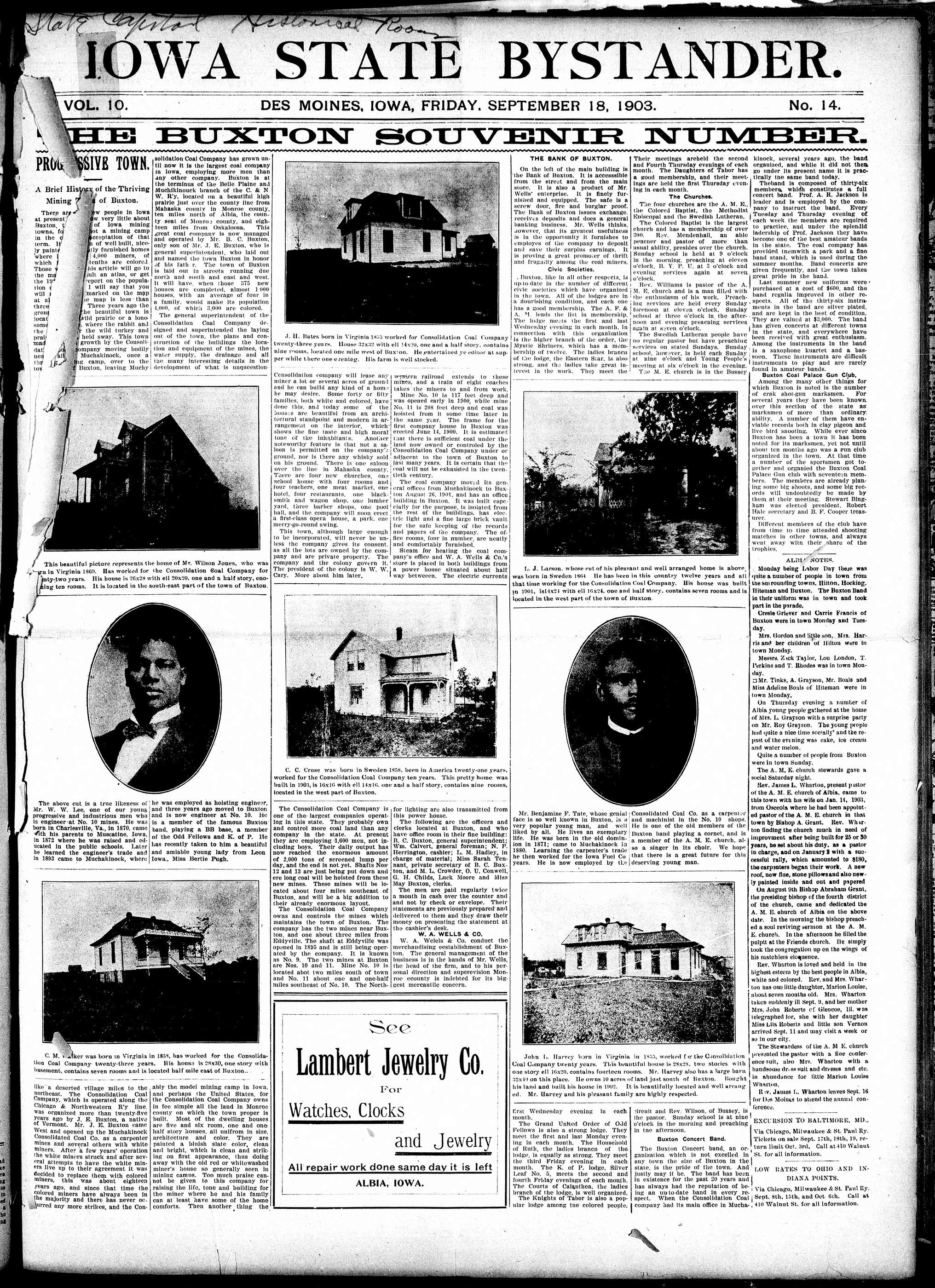
new people in Iowa very little about Iowa mining not a mining camp acceptance of man of well built, nicely furnished homes 4,000 miners, of tenths are colored this article will go to cult an atlas, or get report on the population will say that you marked on the map the map is less: than. Three years ago the beautiful town is wild prairie or a lone, where the rabbit and the wild turkey and held sway. This town growth by the Consul-company moving bodily Mankhinckon, once a camp, over to the Buxton, leaving Muchy
This beautiful picture represents the town in Virginia 1869. Has worked for twenty-two years. His house is 26x28 in being ten rooms. It is located in the
THE HOME OF THE MAYFIELD MUSEUM
This beautiful picture represents the home of Mr. Wilson Jones, who was in Virginia 1869. Has worked for the Consolidation Coal Company for twenty-two years. His house is 26x28 with ell 29x20, one and a half story, enclosing ten rooms. It is located in the south-east part of the town of Buxton.
A. B.
The above cut is a true likeness of Mr. W. W. Lee, one of our young progressive and industrious men who is engineer at No. 10 mines. He was born in Charlesville, Va., in 1870, came with his parents to Muscatine, Iowa, in 1872 where he was raised and educated in the public schools. Later he learned the engineer's trade and in 1893 came to Muchakinock, where
C. M. Walker was born in Virginia tion Coal Company twenty-three year basement, contains seven rooms and is
THE HOME OF THE MISSING MAN
C. M. Valker was born in Virginia in 1838, has worked for the Consolidation Coal Company twenty-three years. His house is 29x20, one story with basement, contains seven rooms and is located half mile east of Buxton...
like a deserted village miles to the northeast. The Consolidation Coal Company, which is operated along the Chicago & Northwestern Ry line, was organized more than twenty-five years ago by J. E. Buxton, a native of Vermont. Mr. J. E. Buxton came west and opened up the Muchaknock Consolidated Coal Co. as a carpenter mines and several others with white miners. After a few years' operation the white miners struck and after several attempts the white miners live up to their agreement it was decided to replace them with colored miners, this was about eighteen years ago, and since that time the colored miners have always been in the majority and there has never occurred any more strikes, and the Con-
ably the model mining camp in Iowa, and perhaps the United States, for the Consolidation Coal Company owns in fee simple all the land in Monroe county on which the town proper is built. Most of the dwelling houses are five and six room, one and one half story houses, all unifrom in size, architecture and color. They are painted a blish slate color, clean miners and several others with white miners. After a few years' operation the white miners struck and after several attempts the white miners live up to their agreement it was decided to replace them with colored miners, this was about eighteen years ago, and since that time the colored miners have always been in the majority and there has never occurred any more strikes, and the Con-
---
solidation Coal Company has grown until now it is the largest coal company in Iowa, employing more than any other company. Buxton is at the terminus of the Belle Plaine and Muchiklouk branch of the C. & N. W. R'y, located on a beautiful high prairie just over the county line from Mahaska county in Monroe county, ten miles north of Albia, the county seat of Monroe county, and eighteen miles from Osloaoska. This great coal company is now managed and operated by Mr. B. C. Buxton, only son of Mr. J. E. Buxton, who is general superintendent, who laid out of his father the town Buxton in honor of his father, and who is laid out in streets running due north and south and east and west. It will have when those 375 new houses are completed, almost 1,000 houses, with an average of four in a family, would make its population 4,000, of which 3,000 are colored.
The general superintendent of the Consolidation Coal Company designed and superintended the laying out of the town, the plans and construction of the buildings the location and equipment of the mines, the water supply, the drainage and all the many interesting details in the development of what is unquestion-
the home of Mr. Wilson Jones, who was the Consolidation Coal Company for with ell 20x20, one and a half story, eno south-east part of the town of Buxton.
he was employed as hoisting engineer, and three years ago moved to Buxton and is now engineer at No. 10. He is a member of the famous Buxton band, playing a BB base, a member of the Odd Fellows and K. of P. He has recently taken to him a beautiful and amiable young lady from Leon Iowa, Miss Bertie Pugh.
in 1858, has worked for the Consolida-
s. His house is 28x30, one story with
located half mile east of Buxton..
ably the model mining camp in Iowa, and perhaps the United States, for the Consolidation Coal Company owns in fee simple all the land in Monroe county on which the town proper is built. Most of the dwelling houses are five and six room, one and one-half story houses, all uniform in size, architecture and color. They are painted a bluish slate color, clean and bright, which is clean and striking on first appearance, thus doing away with the old red or whitewashed miner's house so generally seen in mining camps. Too much praise cannot be given to this company for raising the life, tone and building for the miner where he and his family can at least have some of the home comforts. Then another thing the
```markdown
```
THE HOME OF THE MIDDLE SCHOOL
J. H. Bates born in Virginia 1833 worked for Consolidation Coal Company twenty-three years. House 32x22 with ell 1470, one and a half story, contains nine rooms, located one mile west of Buxton. He entertained ye editor at supper while there one ezening. His farm is well stocked.
J. H. Bates born in Virginia 1833 worked for Consolidation Coal Company twenty-three years. House 32x22 with ell 1470, one and a half story, contains nine rooms, located one mile west of Buxton. He entertained ye editor at supper while there one ezening. His farm is well stocked.
THE HOME OF THE MAYFIELD MAYFIELD MAYFIELD
C. C. Cruse was born in Sweden 1858, been in America twenty-one years, worked for the Consolidation Coal Company ten years. This pretty home was built in 1903, is 16x16 with ell 14x16, one and a half story, contains nine rooms, located in the west part of Buxton.
C. C. Cruse was born in Sweden 1858, been in America twenty-one years, worked for the Consolidation Coal Company ten years. This pretty home was built in 1903, is 16x16 with ell 14x16, one and a half story, contains nine rooms, located in the west part of Buxton.
Lambert Jewelry Co.
All repair work done same day it is left
ALBIA, IOWA.
Consolidation company will lease any miner a lot or several acres of ground and he can build any kind of a home he may desire. Some forty or fifty families, both white and colored, have done this, and today some of the houses are beautiful from an architectural standpoint and modern in arrangement on the interior, which shows the fine taste and high moral tone of the inhabitants. Another noteworthy feature is that not a saloon is permitted on the company's ground, nor is there any whisky sold on his ground. There is one saloon over the line in Mahaska county. Taere are four new churches, one church, four rooms and four teachers, one meat market, one hotel, four restaurants, one black smith and wagon shop, one lumber yard, three barber shops, one pool hall, and the company will soon erect a first-class opera house, a park, one merry-go-round swing.
This town, although large enough to be incorporated, will never be unless the company gives its consent, as all the lots are owned by the company and are private property. The company and the colony govern it. The president of the colony is W. W. Cary. More about him later.
C. C. Cruse was born in Sweden worked for the Consolidation Coal Co. built in 1903, is 16x16 with ell 14x16. on located in the west part of Buxton.
The Consolidation Coal Company is one of the largest companies operating in this state. They probably own and control more coal land than any company in the state. At present they are employing 1,600 men, not including boys. Their daily output has now reached the enormous amount of 2,000 tons of screened lump per day, and the end is not yet. Shafts Nos 12 and 13 are just being put down and ere long coal will be hoisted from these new mines. These mines will be located about four miles southeast of Buxton, and will be a big addition to their already enormous layout.
The Consolidation Coal Company owns and controls the mines which maintains the town of Buxton. The company has the two mines near Naxxon and the other mine from Eddyville. The shaft at Eddyville was opened in 1855 and is still being operated by the company. It is known as No. 9. The two mines at Buxton are Nos. 10 and 11. Mine No. 10 is located about two miles south of town and No. 11 about one and one-half miles southeast of No. 10. The North-
Lambert J
western railroad extends to these mines, and a train of eight coaches takes the miners to and from work. Mine No. 10 is 117 feet deep and was opened early in 1900, while mine No. 11 is 208 feet deep and coal was hoisted from it some time later in same year. The frame for the first mine was built by the Buxton erected June 14, 1900. It is estimated that there is sufficient coal under the land now owned or controlled by the Consolidation Coal Company under or adjacent to the town of Buxton to last many years. It is certain that the coal will not be exhausted in the twentieth century. The coal company moved its general offices from Muehaknock to Buxton August 26, 1901, and has an office building in Buxton. It was built especially for the purpose, is isolated from the city by a light and a fine large brick vault for the safe keeping of the records and papers of the company. The office rooms, four in number, are neatly and comfortably furnished.
Steam for heating the coal company's office and W. A. Wells & Co.'s store is placed in both buildings from the same location in both ways between. The electric currents
1858, been in America twenty-one years, company ten years. This pretty home was one and a half story, contains nine rooms,
for lighting are also transmitted from this power house.
The following are the officers and clerks located at Buxton, and who have office room in their fine building: B. C Buxton, general superintendent; Wm. Calvert, general foreman; N. P. Herrington, cashier; L. M. Hadley, in charge of material; Miss Sarah Tennant, private secretary of B. C Buxton, and M. L. Crowder, O. U. Conwell, G. H. Childs, Luck Moore and May Buxton, clerks.
The men are paid regularly twice an hour in cashier at the counter and not by bank or envelope. Their statements are previously prepared and delivered to them and they draw their money on presenting the statement at the cashier's desk.
W. A. WELLS & CO.
W. A. Welels & Co. conduct the merchandising establishment of Buxton. The general management of the business is in the hands of Mr. Wells, the head of the firm, and to his personal direction and supervision Monroe economy is indebted for its biggest mercantile concern.
ewelry Co.
THE HISTORY OF THE HOME
L. J. Larson, whose cut of his pleasant and well arranged home is above, was born in Sweden in 1864. He has been in this country twelve years and all that time working for the Consolidation Coal Company. His house was built in 1901, is14x24 with ell 16x34, one and half story, contains seven rooms and is located in the west part of the town of Buxton.
(1)
THE HOME OF THE MIDDLE SCHOOL.
John L. Harvey born in Virginia in 1855, worked for the Consolidation Coal Company twenty years. This beautiful house is 28x28, two stories with one story ell 16x20, contains fourteen rooms. Mr. Harvey also has a large barn 32x40 on this place. He owns 10 acres of land just south of Baxton. Bought his land and built his house in 1902. It is beautifully located and well arranged. Mr. Harvey and his pleasant family are highly respected.
THE BANK OF BUXTON.
On the left of the main building is the Bank of Buxton. It is accessible from the street and from the main store. It is also a product of Mr. Wells' enterprise. It is finely furnished and equipped. The safe is a screw door, fire, and burglar proof. The Bank of Buxton issues exchange, receives deposits and does a general banking business. Mr. Wells thinks, however, that its greatest usefulness is in the opportunity it furnishes to employees of the company to deposit and save their surplus earnings. It is proving a great promoter of thrift and frugality among the coal miners.
Civic Societies.
Buxton, like in all other respects, is up-to-date in the number of different civic societies which have organized in the town. All of the lodges are in a flourishing condition, and each one has a good membership. The A. F. & A. M. leads the list in membership. The lodge meets the first and last Wednesday evening in each month. In connection with this organization is the higher branch of the order, the Mystic Shriners, which has a membership of twelve. The ladies branch of the lodge, the Eastern Siar, is also strong, and the ladies take great interest in the work. They meet the
L. J. Larson, whose cut of his pleaser was born in Sweden 1864. He has been that time working for the Consolidation in 1901, is14x24 with ell 16x24, one and located in the west part of the town of
Mr. Benjamin F. Tate, whose genial face is so well known in Buxton, is a very popular young man, and well liked by all. He lives an exemplary life. He was born in the old domination in 1871 and graduated in 1880. Learning the carpenter's trade he then worked for the Iowa Fuel Co. years. He is now employed by the
John L. Harvey born in Virginia Coal Company twenty years. This bea oae story ell 16x20, contains fourteen re 32x10 on this place. He owns 10 acres his land and built his house in 1902. Ed. Mr. Harvey and his pleasant fami
first Wednesday evening in each month.
The Grand United Order of Old
Fellows is also a strong lodge. They
meet the first and last Monday evening
in each month. The Household
of Ruth, the ladies branen of the
lodge, is equally as strong. They meet
the third Friday evening in each
month. The K. of P. lodge, Silver
Leaf No. 5, meets the second and
fourth Friday evenings of each month.
The Courts of Calanthea, the ladies
branch of the lodge, is well organized.
The Knights of Tabor is also a popu-
lar lodge among the colored people.
Their meetings archeld the second and Fourth Thursday evenings of each month. The Daughters of Tabor has a good membership, and their meetings are held the first Thursday evening in each month.
The Churches
The four churches are the A. M. E. the Colored Baptist, the Methodist Episcopal and the Swedish Lutheran. The Colored Baptist is the largest church and has a membership of over 300. Rev. Mendenhall, an able peacener and pastor of more than usual ability, presides over the church. Sunday school is held at 9 o'clock in the morning and at 10 o'clock, B. R. Y. P. U. at 3 o'clock and evening services again at seven o'clock. Rev. Williams is pastor of the A. M. E. church and is a man filled with the enthusiasm of his work. Preaching services are held every Sunday foronow at eleven o'clock. Sunday school at three o'clock in the afternoon and evening preaching services again at seven o'clock. The Swedish Lutheran people have no regular pastor but have preaching services on stated Sundays. Sunday school at nine o'clock in the afternoon and Young People's meeting at six o'clock in the evening. The M. E. church is in the Russey
ant and well arranged home is above, in this country twelve years and all in Coal Company. His house was built half story, contains seven rooms and is Buxton.
Consolidated Coal Co. as a carpenter and machinist in the No. 10 shops. He is one of the old members of the Buxton band playing a cornet, and is a member of the A. M. E. church, also a singer in its choir. We hope that there is a great future for this deserving young man.
in 1855, worked for the Consolidation beautiful house is 28x25, two stories with rooms. Mr. Harvey also has a large barn of land just south of Buxton. Bought it is beautifully located and well arranging are highly respected.
circuit and Rev. Wilson, of Bussey, is the pastor. Sunday school is at nine o'clock in the morning and preaching in the afternoon.
Buxton Concert Band.
The Buxton Concert band, an organization which is not excelled in any town the size of Buxton in the state, is the pride of the town. And justly may it be. The band has been in existence for the past 20 years and has always had the reputation of being an up-to-date band in every respect. When the Consolidation Coat company had its main office in Mucha-
No.14.
knock, several years ago, the band organized, and while it did not then go under its present name it is practically the same band today. The band is composed of thirty-six members, which constitutes a full concert band. Prof. A. R. Jackson is leader and is employed by the company to instruct the band. Every Tuesday and Thursday evening of each week the members are required to practice, and under the splendid leadership of Prof. Jackson they have become one of the best amateur bands in the state. The coal company has provided them with a park and a fine band stand, which is used during the summer months. Band concerts are given frequently, and the town takes great pride in the band.
Last summer new uniforms were purchased at a cost of $600, and the band regalia improved in other respects. All of the thirty-six instruments in the band are silver plated, and are kept in the best of condition. They are valued at $3,000. The band has given concerts at different towns in the state, and everywhere have attended the concert enthusiasm. Among the instruments in the band is a saxophone kuartet and a bassoon. These instruments are difficult instruments to play and are rarely found in amateur bands.
Buxton Coal Palace Gun Club.
Among the many other things for which Buxton is noted is the number of crak shot-gun marksmans. For several years they have been known over this section of the state as marksmans of more than ordinary ability. A number of them have enviable records both in clay pigeon and live bird shooting. While ever since Buxton has been a town it has been noted for its marksmans, yet not until about ten months ago was a club organization in the town. At that time a number of the sportsmen got together and organized the Buxton Coal Face gun club with seventeen members. The members are already planning some big shoots, and some big records will undoubtedly be made by them at their meeting. Stewart Bingham was elected president. Robert Hale secretary and B.F. Cooper treasurer.
Different members of the big club have from time to time attended shooting matches in other towns, and always went away with their share of the tronhies.
ALBU NOTES.
Monday being Labor Day these was quite a number of people in town from the surrounding towns, Hilton, Hocking, Hiteman and Buxton. The Buxton Band in their uniform was in town and took part in the parade.
Creslie Griever and Carrie Francis of Buxton were in town Monday and Tuesday.
Mrs. Gordon and little son, Mrs. Harris and her children of Hilton were in town Monday.
Messrs. Zick Taylor, Lou London, T. Perkins and T. Rhodes was in town Monday.
Mr. Tinks, A. Grayson, Mr. Boals and Miss Adeline Boals of Hiteman were in town Monday.
On Thursday evening a number of Albia young people gathered at the home of Mrs. L. Grayson with a surprise party on Mr. Roy Grayson. The young people had quite a nice time socially' and the repast of the evening was cake, ice cream and water melon. Quite a number of people from Buxton were in town Sunday. The A. M. E. church stewards gave a social Saturday night.
Rev. James L. Wharton, present pastor of the A. M. E. church of Albia, came to this town with his wife on Jan. 14, 1903, from Osceola where he had been appointed pastor of the A. M. E. church in that town by Bishop A. Grant. Rev. Wharton finding the church much in need of improvement after being built for 25 or 50 years, he set about his duty, as a pastor in charge, and on January 2 with a successful rally, which amounted to $180, the carpenters began their work. A new roof, new flue, stone pillows and also newly painted inside and out and papered. On August 9th Bishop Abraham Grant, the presiding bishop of the fourth district of the church, came and dedicated the A. M. E. church of Albia on the above date. In the morning the bishop preached a soul reviving sermon at the A. M. E. church. In the afternoon he filled the pulpit at the Friends church. He simply took the congregation up on the wings of his matchless eloquence.
Rev. Wharton is loved and held in the highest esteem by the best people in Albia, white and colored. Rev. and Mrs. Wharton has one little daughter, Marion Louise, about seven months old. Mrs. Wharton taken suddenly ill Sept. 9, and her mother Mrs. John Roberts of Glencoe, Ill. was telegraphed or, she with her daughter Miss Lila Roberts and little son Vernon arrived Sept. 11 and may visit a week or so in our city.
The Stewardess of A. M. E. church presented the pastor with a fine conference suit, also Mrs. Wharton with a handsome dress suit and dresses and etc. in abundance for little Marion Louise Wharton.
Rev. James L. Wharton leaves Sept. 16 for Des Moines to attend the annual conference.
EXCURSION TO BALTIMORE, MD.
Via Chicago, Milwaukee & St. Paul Ry.
Tickets on sale Sept. 17th, 18th, 19, return limit Oct. 3rd, Call at 410 Walnut St. for all information.
LOW RATES TO OHIO AND INDIANA POINTS.
Via Chicago, Milwaukee & St. Paul Ry.
Sept. 15th, 13th, and Oct 6th. Call at 410 Walnut St. for all information.
FUNFUL MORNING EVERY TUESDAY FOR THE EYEWATCHERS
BOOK ON MAGAZINE BLOCK
OFFICIAL PAPER OF THE BOOK WORKSHOP
GRAND LOCKS OF LOVA, R. & A. M.
TERMS OF SUBSCRIPTION
Paper
No. 12
No. 13
No. 14
All subscription payable in advance.
S. L. THOMPSON, EDITOR,
J. H. SHEPARD, MANAGER.
Read money by post, free order, money order,
express or death, to the IOWA BRASS BRYANSON
Publishing Company.
Communications must be written on one side
of this paper only and be of interest to the pub-
lisher.
"Diversity is the soul of wit." remember.
We will not return rejected manuscript, as
amended by postage stamp.
Advertising rates for display Adds
80 cents per inch, for each insertion.
Three to six months contract 15 cents
per inch.
Local advertising 10 cents per line for each insertion, cou-
munity and secret societies where admission is
charged, one-half of the above men-
ualized rates.
For professional, legal
and announcement cards, yearly con-
sumes and certain terms are given on a
special all advertising is to be
paid in advance.
We are prepared to do first-class job
work so reasonable prices. All of our
work is guaranteed.
The Iowa STATE BITTENBANK in the old African-American museum, which was published in 1866 and is read by nearly all the colored people of Iowa, has a corresponding fellowship hall.
Alba ..... Miss May Davis
Cedar Rapids ..... Mrs. Adaldele Davis
Clinton ..... A. Bush
avenport ..... John T. Mahoney
Koolee ..... Miss Artisla Fields
Mt. Pleasant ..... Miss Iona Mason
Muscatine ..... Miss Fannie Groomes
Marshalltown ..... H. C. Walker
Mankunckh ..... Mrs. Pearl Thomas
Mississippi ..... Mrs. J. C. Toliver
Brock Island ..... Mrs. C. J. Toliver
Sloux City ..... Mrs. Etta Grant
Moline, Ill ..... Mrs. James Higgins
Boone ..... Mrs. Mary Coleman
Dubuque ..... Mrs. D. R. Bassfield
Ewton ..... Mrs. P. F. Bassfield
Ewton ..... Mrs. S. Bates
Washington ..... Mrs. James Redd
Galeaburg and Knoxville, Ill.
Mrs. Geo. Wade
Chicago, Ill....Mrs. K. O. Tillman
Burlington....O. C. Folks
WONDERFUL DISCOVERY
THE NEW YORK TIMES AFTERNOON
OZONIZED OX MARROW
THE ORIGINAL-CORPENTER
The only purpose in the world that makes
the world more beautiful is from falling
into the river. We have over 40 years and need
to build. Get the Original Gearset
for the hair straight, soft and beautiful. Our
new collection is for those who love to
work. We offer two beaches, we pay all
the fees. Write your name and shores policy of
service.
BO YEARS' EXPERIENCE
PATENTS
TRADE MARKE
DESIGNS
COPYRIGHTS &
Anyone sending a sketch and description may quickly ascertain our orientation from a file or a file's version to probably potentially. Communities are strictly confidential. Hundlwork on Tastics and free, is just a agency for recurring that one. Patients taken Language Muit in Co. receive special notice, without e.g. are, in the
Scientific American.
A handcomely Illustrated weekly. Larcest ets selection of any scientific document. Terus, $3 a year four months, $1. Gold by all newredors
MUN & Co. 381 Broadway, New York Branch Office, 65 F. St. Washington, DC
50 Years
This is our record. From a small beginning we have grown until our factories now cover many acres. Many of our machines sold forty to fifty years ago are still giving their users faithful service. Do anything be more conducive of the machines and more productive? Did you ever hear of any other machine with such a record?
Note a few of the many superior points of the
The Rotary Hook displaces the old, out-of-date, unmechanical and troublesome shuttle.
The Frictionless ball bearings and perfect mechanical construction enable it to be operated with one-third less exertion than is required by ordinary machines. The Woods whals a shuttle machine sews two.
It makes the most elastic and most perfect stitch whether sewing light or heavy goods.
With our superior attachments the greatest variety of work is possible.
Do not make the mistake of buying a sewing machine until you have given the Wheeler & Wilson No. 9 trial.
Alaskans Like Bacon.
Alaska natives have developed a great fondness for bacon, hard bread, canned beef and other foods of like nature.
Jay Cooke Has Birthday.
Jay Cooke, the noted financier of a generation ago, celebrated his eighty-third birthday recently.
Paris Police.
The Paris police coat the government $7,000,000 a year.
What Has Been Going on During the Past Week.
ROBBER RESISTS AN OFFICER
Stolen Goods Were Found In His Room and He Makes a Dash for Freedom—Got Officer's Gun and Fired Twice.
Marshalltown, Sept. 17. The finding of fur boas near Jackson street yesterday led to the arrest of two persons charged with the theft of $2,000 worth of furs from H. Singer Monday night, when warrant was issued for the home of Tom Lowery, (colored), 703 Jackson street, and Officers Mike Clark and William Lage detailed to search the premises. When they entered the house they found a cloak valued at $75 hidden in a bed. As soon as this was found a colored man named Austin ran from the room, followed by Officer Lage, who fired three shots but failed to hit. Austin ran to the victim, the glucose works and in wounds.
The officer took the buggy of the mail carrier and followed, overtaking Austin and arresting him. While he was searching his man he laid his revolver on the buggy seat. Austin made a lunge, and light for its possession took place. The officer felled his man but it required both hands to hold him and the gun could not be taken from him. The negro fired two shots with the revolver close to the head of the officer, but was warded off by Lage's arm, the gun. The shots and is badly powder-burst. The head claazed his head.
Officer Clark meanwhile took the woman in charge and searched the house. At about 6 last evening the goods were found hidden in hay in the barn in the rear of the house. It was then recovered, as there are twenty-nine pieces in the police court. Lowery was arrested for harboring them and being implicated. Austin has a bad record, and is reported to have come to the police station. It was necessary to place handcuffs on Austin to get him to jail.
WALLACE TO COMMAND POST.
He is of Fifteenth Cavalry, Now in the Philippines.
Washington, Sept. 18.—It has been given out officially at the war department that the Des Moines army post buildings will be ream to receive the first consignment of troops the latter part of November. It has also been given out the Fifteenth cavalry, in command of Colonel Wallace, now in the Philippines, to the Des Moines post. The companies are not named. The post will be back from the Philippines the latter part of November and will go immediately to the post. As the post will be regimental, the commanding officer will be commanded by the commander. At the quartermaster's department it is officially announced that all buildings of the post will be completed before the beginning of another year, so the post will be possible to send a full regiment of the post to Des Moines early next summer.
LOVE IN QUARANTINE.
Romance From Doctor's Regulations at Eldora.
Eldora, Sept. 18.—About a month ago, the family of Charles Roberts, in this city, were quarantined on account of diphtheria. Visiting the family at the time the physician diagnosed the child, the family established was Quill McCall, a young farmer boy who was courting one of the daughters of the family. He, of course, was then and there a prisoner, possibly a prisoner, and the next weeks he had alumna opportunity to woo his sweetheart. And now that the quarantine has been raised, a wedding has just taken place and McCall and Miss Etta McCall have been minister could be found and as soon as the danger card was taken down and the quarantine raised by Hertil Officer Young. The sick child of the family has been recovered and no one else has been for her, and McCall has a wife in the bargain.
DIED AFTER BIG SPREE.
Wood Alcohol and Whisky Kill a Dubuque Man.
Dubuque, Sept. 18.—After drinking alcohol and whisky incessantly for two days, FredBindelwander, a clam fisher in the Mississippi, died alone in a boat during the night. Yesterday morning when a woman went over to his house boat to wake him she found his lifeless body. Bindelwander was formerly a resident of Dubuque and he was involved in several years he has been engaged in clam fishing in the river. About a week ago he started drinking heavily. He drank whisky at first, but a few days ago took to alcohol and for the second time drank the latter. He was seen about his house boat during Tuesday.
BANK OF RHODES LOOTED
Door of Outer Vault is Blown Off and
$800. Taken
Marshallown, Sept. 17.—The Banks of Rhodes was robbed Tuesday night of $500 in silver, the burglaries gained by the robbers were boring a hole through the roof. The outer door of the vault was blown off by some powerful explosive and all of the money in that compartment was gone. The authorities were ful in gaining access to the inner safe, which contained all the funds in the bank, which made a total of $100,000. The authorities are absolutely without a clue to the identity of the robbers.
SRIVER SUES FOR $90,000
Cherry's Sale to Rock Island Results
Winteret, Sept. 17.—A. B. Shriver, trustee has brought suit against F. B. Shriver for the loss of his claims is due him and his associates as their share of the money Cherry received from the Rock Island road. F. B. Shriver also claims for the Des Moines and Southern. Cherry says he bought out Shriver's interest long before the float sale was
OLD OFFICERS REQUESTED.
First Annual Meeting of the Western
Iowa Interurban Company.
Des Moines, Sept. 16.—The Western Iowa interurban Railway company held its first annual meeting in Des Moines last night. The old officers were elected as follows: President—John A. Nash, Audubon, Vice-President—Almer Stern, Logan, General Manager—H. H. Pol, Des Moines Treasurer—Clyde E. Brenton, Dallas Center. Secretary—C. R. Benedict, Shelly, Executive Committee—John A. Nash, Audubon, General Manager—H. H. Pol, Directors—B. F. Kauffman, Des Moines, and Messrs. Nash, Stern, Pol, Brenton and Weeks and a man to be named by Shelly county. The Shelly stockholders were not able to be at the meeting because the authorizing them to name their member of the board. It is stated that it will be G. W. Cullison of Harlan who served in the preliminary organization in that capacity. It was put on the board of directors in the place of J. W. Davis of not yet decided to go into the proposition and has no representation on the board of directors at present. Mr. Davis was appointed to committees in the place of Mr. Cullison.
The engineer of the company, James Wilson, is now working at Guthie Center and was not present at the meeting. General Manager Pol, however, has weekly reports from him which were gone over by the meeting. He is making progress on the report. He reaches Logan, the report will be made to the stockholders and officers and estimates will then be made of the cost of the road.
INSURANCE MERGER PROCEEDS
Injunction Case Dismissed and All Obstacles Removed.
Des Moines, Sept. 15.—The legal obstacles to the $50,000 insurance merger of the Northwestern Life and Savings company of Des Moines and the Northwestern National Life Insurance company of Mapleau hills have been removed by a dismissal of the injunction suit brought against the Des Moines company by a score of 10. The company filed fire files in the injunction case and all the papers were withdrawn by Thomas A. Cheshire, attorney for the defendant Des Moines company, and an entry was made on the court to dismiss the case. The company been dismissed in its entirety. The dismissal was signed by John Shortley, one of the petitioning shareholders of Dallas county and the plaintiffs' attorneys, Carr, Hewitt, Parker and Wright. The defendant company's attorneys endeavored to keep the dismissal secret for fear that other shareholders would bring suit and thus place further obstacles to the merger in their way. News of the dismissal leaked the story of the court records confirm the news.
The merger of the Northwestern Life and Savings company of Des Moines and the Northwestern National Life Insurance company of Des Moines, or so ago, $3,000,000 being said to have been the transfer price. The Des Moines company had insurance contracts and policies outstanding to the amount of $4,000,000, company to the amount of $4,000,000, so that $50,000,000 worth of contracts were involved in the transfer.
**DES MOINES-AMES INTERURBAN**
Dev Moines Interurban Railway Company to Parallel North-Western.
Des Moines, Sept. 16.—The Des Moines Interurban Railway company is projecting a new interurban line thirty-five miles in length between Des Moines and Ames to parallel and intersect with the Chicago & Northwestern railway.
It is said that the road will be built next year. Right of way is now reported to have been purchased by agents of the company from Des as far north as Ankeny and arrangements completed with the Des Moines Street Railway company whereby it will extend the Walker street line in East Des Moines a distance of one mile at once from the corner of East Fourteenth street. It is proposed to build this line along Fourteenth street in time extending it to the county poor farm. It is then proposed that the interurban company take up the work and build the line through Saylorville, Oralabar, Ankeny, Crocker, Pelk City, Sheldahl, Slater and Kelly to Ames.
This extension will be one of the greatest yet contemplated by the interurban company. It is said that residents in this vicinity have offered every inducement to the company to build, making reasonable prices on their property through which the right of way will run.
The Des Moines Interurban Railway company planned many extensions for this year. They were not carried out because of the high prices of materials and grading. The company had to pay $100,000 for Winterst extensions for this year and only the sky high prices prevented. Ties are said to have risen 25 percent in the past year. Grading and ballasting costs an increase of almost as much as the weather blew. The wet weather has caused work to progress slowly. OLD CRIME BEING PROBED
OLD CRIME BEING PROBED.
Clinton Saloonkeeper Arrested for
Participation in Eur Robbery
Clinton, Sept. 18.—A sensation was created here when the police arrested Michael Couroy, a saloon keeper, on the charge of being an accessory in the Grossman fur robbery here sixteen months ago. The robbery was one of the most successful cases it took place on the afternoon of Decoration day, but the theft was not learned until the next morning. The goods stolen were valued at $7,500. A fur dealer in Des Moines was arrested for the crime, but proved himself innocent. He was arrested a man named Hall of Chicago was implicated in the robbery. However, he was also wanted for crime in Illinois and was sentenced to the penitentiary for the Illinois offense and is now in prison. However, he was acquitted by a grand jury and also at the preliminary hearing to be held Saturday.
The grand jury is also investigating several robberies which have been committed here during the past few years and it is said arrests will follow which will cause a sensation here, because of the hardened criminal, was arrested for robbing the residences of Dr. Hamilton and Dr. Fischer. He entered a plea of not guilty and made a written statement, giving information, it is said, of all the other recent robberies in this city. The officials have been questioned and have witnessed witnesses from all parts of the state and even from Omaha and Chicago.
Prof. Olin, of State College at Ames,
Conducting Experiments...
Ames, Sept. 17.—Some very inter-
esting wheat breeding and growing
experiments are being conducted by
Prof. W. H. Olin, who has charge of
the work in farms crops at I. S. C.
The object of the experiments is to
determine hardy and vigorous varieties
suitable to Iowa winters. It is
believed that a variety can be found
or bred that if sowed at the proper
time will endure the hard winters of
Iowa.
Tests are being conducted to determine the right time to sow wheat. On each Saturday is September and the first Saturday of October, five in all, tenth acre plots are sowed slide the results of each sowing compared. For the determination of the variety, seven varieties will be tested. Turkey黄, the variety that has stood the field tests for a test of a term of years at I. Iowa, the variety, a unit by which the relative values of each variety will be measured. Other varieties that will be used are the Padin, which has stood several winter tests at Ames; Minnesota No. 550 and Minnesota No. 529, two years ago; Turkey Red imported in 1801 and probably more vital than the seed at Ames and the Kharkov, both from the Kansas experiment station. The latter has come from the Hays sub-station in Kansas, and the Malakof, a variety imported from Russia from the Black sea region.
Field crops tests will be made of each variety, the seed being carefully selected. Also field crop nursery condition tests will be made in founden boxes. The seedlings in the foundation beds are sowed with one thousand hand selected seeds, with five inch spaces between each seed. The contigener beds include one hundred seeds in each bed planted at five inch spacing. The seeds in all carefully selected and hand picked, only the plumpest and most perfect being used. In the spring the tests of varieties will be continued by crossing each variety with the other of the varieties to form a good hybrid suitable to Iowa, climatic conditions.
PROF. KENNEY'S TRIP.
Will Study Animal Husbandry in the West
Ames, Sept. 18.—Prof. W. J. Kennedy, of the animal husbandry department at Ames, has arranged to make an extensive trip through Montana, Idaho, Washington and Oregon. The trip will extend from the first of October and cover a period of several weeks. During this trip, Prof. Kennedy proposes to study the existing horse and sheep range conditions in connection with the range sheep and horse experiments being conducted by the state Department of Agriculture and the United States department of agriculture. While in Spokane, Wash., Prof. Kennedy will judge horses and cattle at the Washington state fair held at Spokane. The animal husbandry students have been in great demand as judges in county fairs in Iowa. Thirty-eight have judged in Iowa, three in Minnesota, three in Illinois, two in South Dakota, three in Missouri and one in Nebraska.
The cattle that have been at Odeholt the last two years being used in the feeding tests are to be shipped in a couple of weeks. Five hundred cattle have been used in the tests to determine comparative values of light and heavy rations and various foods, and also in the acclimation tests of cattle from southern regions.
Another experiment that has been conducted by the animal husbandry department relative to the feeding value of soft corn is almost completed. A bulletin on this test is to be issued in about a week.
Sharon Crown II, a fine 15-month-old Shorthorn bull owned by the college, was recently sold for a fence price. The animal was purchased by R. M. Gunn, of Buckingham, Iowa.
WHISKY CAUSES A DEATH.
William Henry Refused a drink to Jim Lobbins and Was Killed.
Oaksaoloo, Sept. 15. Another homicide has been one near Burton. This time the trouble happened in Mahaska county at what is familiarly known as the "White Man of advanced age," was killed by a colored man, Jim Lobbins. Lobbins struck the old man on the head with a piece of timber, a two-bour. The slow crushed the victim. The attack upon Henry of Oaksaoloo was a pike o'clock Sunday morning and the old man died about 6 o'clock in the evening. It is said that he has gone to Hamilton. Sheriff Cricket was notified Monday morning and he and County Judge at once that Lobbins had dismembered
Lobbins, who is about 30 years of age, was at the livery stable of his father, John Lobbins. Henry and a companion were sitting front of a chair, and the man was taking a drink and his companion took a drink from a bottle and were seen by the colored man. He went across the street and demanded drink and refused a drink. The colored man became very angry and almost frantic in the violence of his wrath at being refused. He glanced around for something to throw or with which he tried to escape. He was piled in a wasted building material that was lying near. He sprang for this and made for the old man before an asault was sustained by a truck. Henry was assisted by a timbering old man fell upon the spot. Lobbins throw the stick aside, turned and walked away. He took the little time before an action was taken toward the arrest of the murderer and he was given plenty of opportunity to escape. The people who had learned of the assault did not seem to comprehend the gravity of
CHEMICALS KILLED BABIES
Ottumwa, Sept. 17—City Physician La Force is going after milk men who are using formaldehyde to preserve milk. He says that of the death of infants here last month, an per cent were from being fed with milk in which preservatives were placed by dealers. Porl French, milk man, pleaded guilty to using formaldehyde in his milk, and paid a $25 fee.
Valuable Furs Stolen
Marshalltown, Sept. 16.—Valuable fur coats, boas and unmade skins valued at about $2,500 were stolen from the fur store of H. Singer, 206 East Main street. Entrance was gained through a trunk above the rear of the building. The valuable in stock, being otters, offers fox martins and sables. No clue.
NOTES FROM THE CAPITAL
Des Moines, Sept. 1
One hundred and seventy-one divorce cases appear the new bar district court and that many families will ask Judge Howo to hear their grievances and settle all differences by severing the matrimonial cord. Last summer Judge Howo gave notice of housecleaning work when all of the old case in which no notice of trial was filed or a snowing made by the representing attorneys were taken from the house. After four weeks there has been a steady filing of petitions for separations, and there promises to be as much, if not more, work done before Judge Howo has announced there will be no more secret divorce proceedings. Those who wish a decree will be required to comply with proper court hours and introduce their evidence if they wish decisions.
The announcement that a new pottery is to be in Eldora is taken in manufacturing circles as indicative of a tendency toward the development of one of Iowa's sources of wealth which has hitherto been practically untouched. Iowa is rich in pottery and has a long tradition in the vicinity of the coal beds deposits of clay are always found. It is not lack of material which has heretofore held the pottery business of the pottery industry in the way of establishing potteries seems to have been the difficulty of competing with the output of the Ohio potteries, and also with the pottery business in the state. It has been on the market at a price decidedly discouraging to the friends of the potteries. Local brick men state that the best potteries clay which can be sourced in the state is pottery was early in operation in Des Moines. It was owned by a man named Weeks, and went out of business two years ago. Later another pottery was started, but this has since been superseded by unfacing conduits for the laying of electric cables. So far as can be learned there is no immediate prospect of the development of the city. It is stated that the combination which controls the majority of the potteries of the country is also a powerful obstacle to the starting of independent pottery businesses in a few potteries in Iowa which are doing a thriving business. The largest of these is located at Fort Dodge. Rich deposits of clay are also found in the pottery business in Wapelle and Henry counties, all of which are worked to some extent.
State Superintendent R. C. Barrett, in a decision just rendered, reversed the ruling of the county superintendent of Johnson county in the case of Rose Frank vs. Rural Independent School District No. 6. Sharon township, Johnson county, Miss Frank was dismissed by the board of trustees of the school district, and the school has been guilty of inhuman treatment of pupils, such as pulling their hair, and pounding their heads and faces with her fast. She was discharged by the board of trustees, and the appeal to the county superintendent, the action of the board was affirmed. The state superintendent on investigation found that the specific charge was that she struck one of her pupils. Amher Amish, on the back and top of the head with her fast. The boy had a headache and was sick that night, albeit at the recess following his punishment. Superintendent Barrett found that there was nothing to show that the boy's illness was due to the punishment inflicted by the teacher, who was not guilty of indulgence. The superintendent states that he does not feel called upon to determine or to certify to the aptness of the appellant, Miss Frank, the truthfulness of the charges or the reasonableness of the punishment. He holds that the punishment is entitled to the support of the board in an impartial trial before being discharged. On the grounds that she has not been given these, he reverses the case.
Major J. A. Olmsted, who has had charge of the military department of the Iowa State Normal school, has received notice of his being detailed to the Iowa National Guard, which will necessitate his removal to Des Moines. He will make the change in a few weeks. His successor there will be determined in a few days.
An exhibit of the educational products of the state will be made in Des Moines in December. The suggestion has been made to the Commercial exchange by F. J. Sessions, who has charge of the exhibit to be made at the state exhibit at the St. Louis exposition. It is suggested by Mr. Sessions that the Commercial exchange be larger than the displayed products of all the schools of the state, including pictures of the buildings. From this exhibit it is the intention to select the cream for the exhibit to be made at St. Louis. The suggestion has been adopted by the exchange, and Milo Ward, the secretary, has been instructed to rent a room.
Some of the trotley roads in Indiana are to have sleeping cars. The first line to be that equipped was between Indianapolis and Columbus, Ohio, a distance of two hundred miles.
Low fares prevail on the railroads of Japan. This is because about one-half of them are owned and run by the government. What's the restaurant?—Well, weiter, what have you got? Walter—"Beafstef and fish—but the fish is all out. Which'll you have?"
Mrs. Blokey, Jr. (who is of a romantic turn)—"Mylit the moon lovely, glitterin' on the waves! It does one's heart good to see it." Mr. B (Blokey & Son)—"Ahh and wouldn't you like to see 'Blokey & Son's Pickles' printed right across it, big enough for all the world to read with the naked eye?"
When Chinese parents arrive at about the age of fifty-five their affectionate sons and daughters club together and give them each a coffin, and wish them many happy returns of these gifts. These receptacles are used for the food for which they were intended. Coffins are to be seen in many houses in some of them being utilized as wardrobes. Just before they have hived, five thousand bees weight about one pound; but when they come to their lives from the fields and flowers all in honey, they weigh about three pounds.
Hendel
in the seventh century a horse of uncouth warriors crossed the Danube, subduged the Slaves, and their descendants have since occupied that part of the Balkan peninsula now known as Bulgaria. They are without an early history, their origin being shrouded in the mystery of the cast. They lost their original language, but kept their name—the Bulgars. They are intelligent, vigorous, hardy and progressive.
Most of the Bulgarians are small farmers, cultivating from one to six acres, and having large flocks and herds which graze at large, for theoretically the state owns all the land, and the people are simply tenants with perpetual leases, descending from generation to generation.
Most of the natives wear unshorn
WOMAN LIVED OVER CENTURY.
Passed Through Many Historical
Events During Long Life.
The funeral of Mrs. Samuel Dutton, of Philadelphia, Pa., was held September 15, and with the interment there passed a woman who had lived the whole of the nineteenth century, had heard the battle of Waterloo, and had been in immission in times before. She was born in Philadelphia October 25, 1800, and was a daughter of Mr. Houard, a French merchant.
In 1815 she accompanied her father on a trip to Europe, and happened to be in Brussels when the Waterloo cannonade was heard that broke up the famous battle. She married Count Cabada, a Spaniard, and lived until his death in Clenfuegos, Cuba, where they owned a vast estate. A son, Frederic Cabada, served with distinction in the civil war and was afterward, during the Cuban insurrection of 1868, garaged an order of the Spanish government.
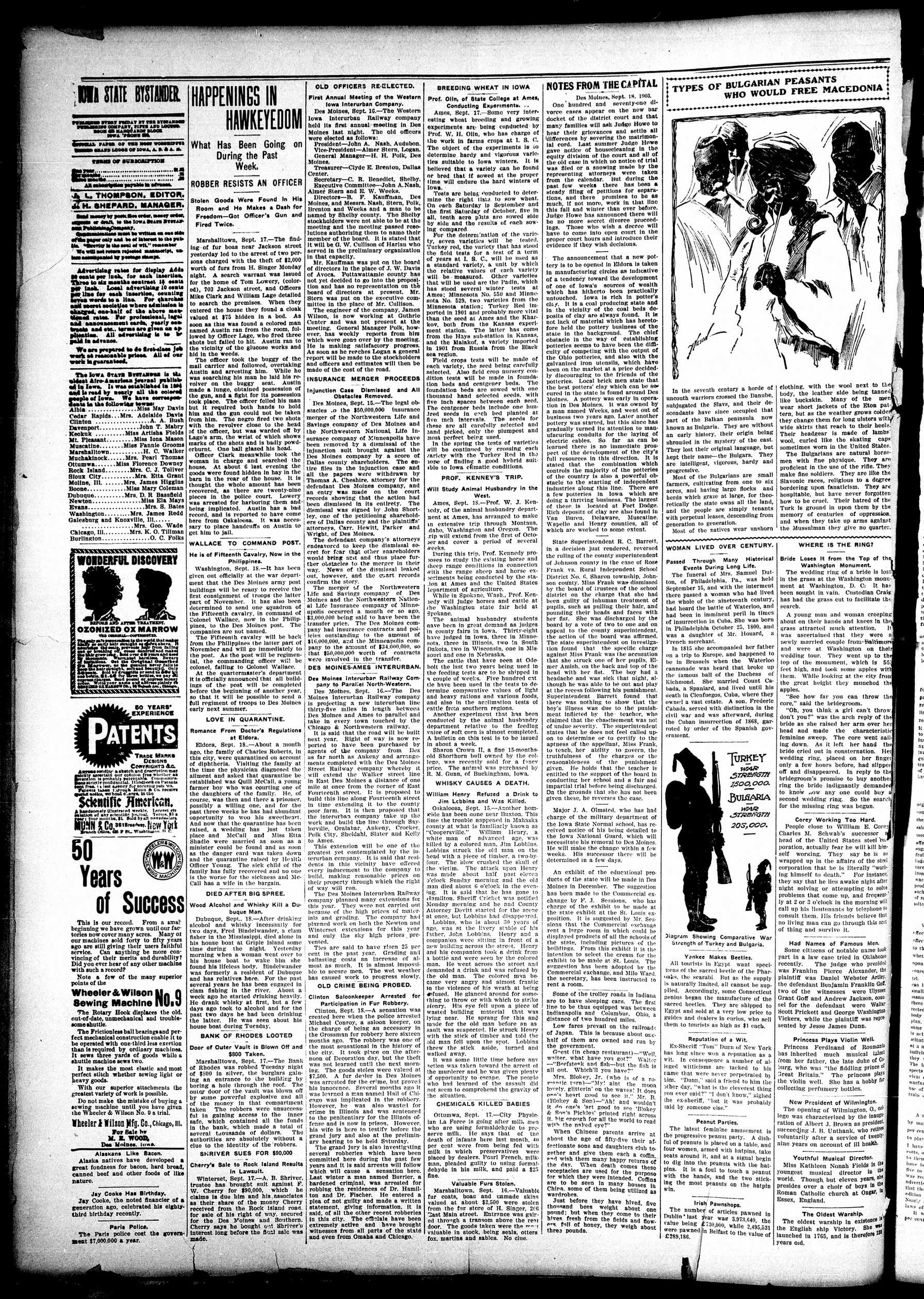
TURKEY
WAR
STRENGTH
1500,000.
BULGARIA
WAR
STRENGTH
205,000.
Diagram Showing Comparative War
Strength of Turkey and Bulgaria.
All tourists in Egypt want specimens of the sacred beetle of the Pharaohs, the scarab But as the supply is naturally limited, all cannot be supplied. Accordingly, some Connecticut genius began the manufacture of the sacred beetles. They are shipped to Egypt and sold at a very low price to guides and dealers in curios, who sell them to tourists as high as $1 each.
Reputation of a Wit
Ex-Sherif "Tom" Dunn of New York has long since won a reputation as a wit. In consequence a number of alleged witticisms are tacked to his name that were never perpetrated by him. "Dunn," a saint friend to him the other day, "what is the cleverest thing ever said?" "I don't know," sighed the ex-sherif, "but it was probably said by someone else."
Peanut Parties.
The latest feminine amusement is the progressive peanut party. A dishful of peanuts is placed on a table, and four women, armed with hatpins, take seats around it, and at a signal begin to dig into the peanuts with the hatpins. It is a foul to touch a peanut with the hands, and the two sticking the most peanuts on the hatpin win.
Irish Pawnshops.
The number of articles pawned in Dublin 'last year was 3,573,640, the value being £30,000, while 2,495,531 were pawned in Belfast to the value of £298,188.
clothing, with the wool next to the body, the leather side being tanned, like buckskin. Many of the men wear short jackets of the Eton pattern, but as the weather grows colder they change them for long sleeves with wide skirts that reach to their heels. Their headgear is made of lamb's wool, curled like the skating caps sometimes worn in the United States.
The Bulgarians are natural horsemen with fine physique. They are proficient in the use of the rife. They make fine soldiers. They are like the Shavonic races, religious to a degree bordering upon fanatism. They are hospitable, but have never forgotten to be cruel. Their hatred of the Turk is ground in upon them by the memory of centuries of oppression, and when they take up arms against the Musulman they give no quarter.
Bride Loses it from the Top of the Washington Monument. The wedding ring of a bride is lost in the grass at the Washington monument at Washington, D. C. It has been sought in vain. Custodian Craig has had the grass cut to facilitate the search. A young man and woman creeping on their hands and knees in the grass attracted much attention. It was ascertained that they were a newly married couple from Baltimore and were at Washington on their wedding tour. They went up to the top of the monument, which is 55 feet high, and took some apples with them. While looking at the city from the great height they munched the apples. "See how far you can throw the core," said the bride.
"Oh, you think a girl can't throw don't you?" was the arch reply of the bride as she raised her arm over her head and made the characteristic feminine sweep. The core went sailing down. As it left her hand the bride cried out in consternation. Her wedding ring, placed on her finger only a few hours before, had slipped off the dislays and bridegroom's promise to buy another ring the bride indignantly demanded to know how any one could buy a second wedding ring. So the search for the missing ring was begun.
Cerax Working Too Hard
Corey Working Too Hard.
will close to William E. Corey
Charles M. Schwab's successor a
head of the United States steel
corporation, actually fear he will kill him
self, worrying. They say he has
appalled by the steel
corporation that he is literally "wor-
king himself to death." For instance,
they say that he lies awake night after
nothing solving or attempting to solve
problems that come up, and frequently
at 2 or 3 o'clock in the morning will
call up his lieutenants by telephone
to consult them. His friends believe that
no living man can go through this sort
of thing and survive it.
Had Names of Famous Men. Some citizens of notable name took part in a law case tried in Oklahoma recently. The judge who presided was Franklin Pierce Alexander, the plaintiff was Daniel Webster Arley, the defendant Benjamin Franklin Gate, the witnesses were Grant Gate and the attorney counsel for the defendant were Walter Scott Prickett and George Washington Vickers, while the plaintiff was represented by Jesse James Dunn.
Princess Blaze Violin Well
**Princess Plays Violin Well**
Princess Ferdinand of Romania has inherited much musical talent from her father, the late Duke of Courg, who has the highest price of Great Britain. The princess plays the violin well. She has a hobby for collecting perfumery bottles.
**New President of Wilmington.**
The opening of Wilmington, O., college was characterized by the inauguration of Albert J. Brown as president, succeeding J. B. Unthank, who retires voluntarily after a service of twenty-nine years on account of ill health.
**Youthful Musical Director.**
Miss Kathleen Nonah Fields is the youngest musical director in the world. Though but eleven years, she presides over a choir of boys in the Roman Catholic church at Ongar, in Essex, England.
The oldest warship in existence is the English ship Victory. She was launched in 1765, and is therefore 119 years old.
Judge Prouty Speaks on the Trust Problem at An Combinations Which Advance Prices and Oppress the People Cannot Be Tolerated Old Settlers' Reunion The Spirit of Individual Liberty the Life and Safety of the Republic
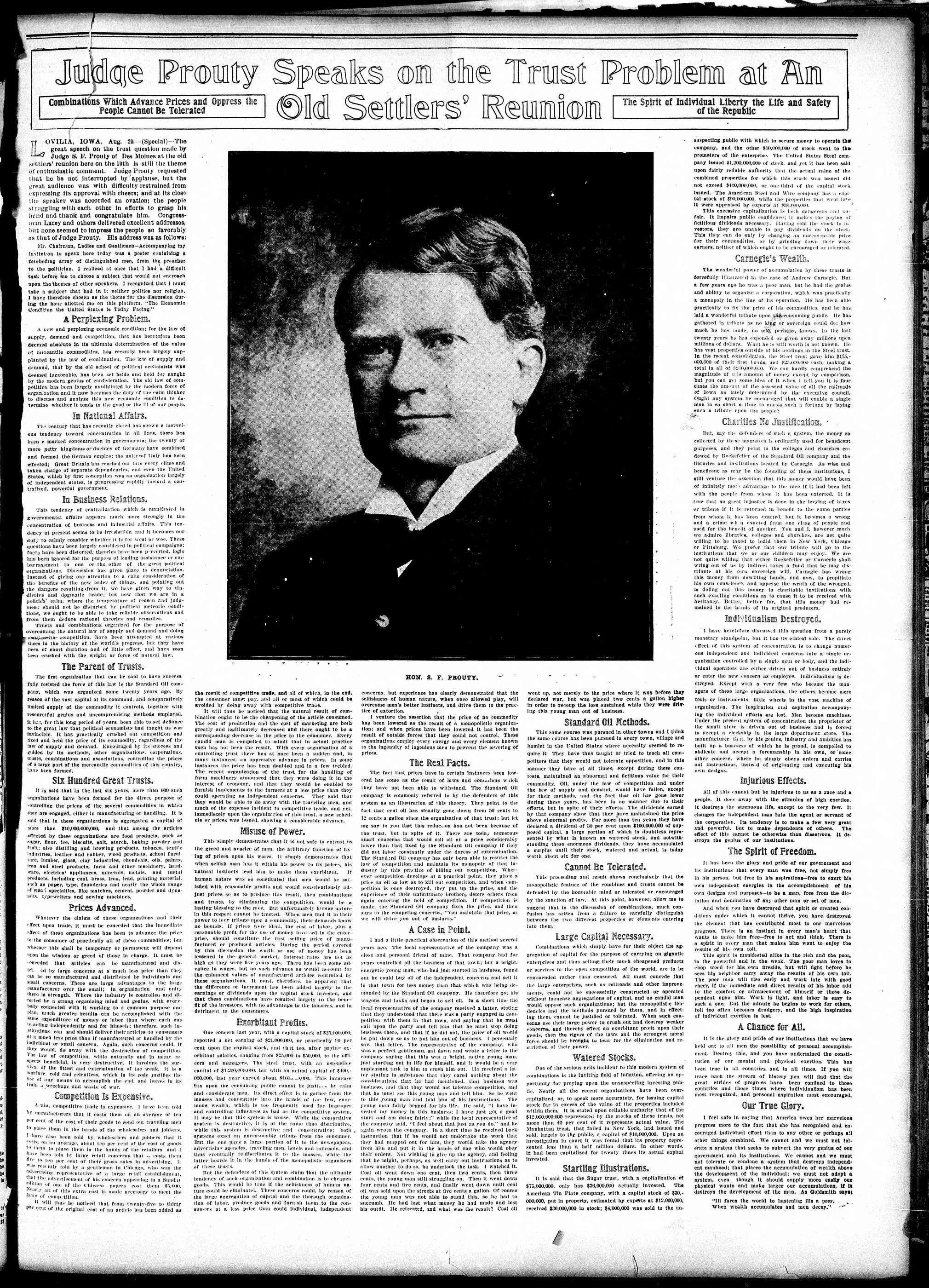
OVILIA, IOWA, Aug. 29.—(Special)—The great speech on the trust question made by Judge S. F. Prouty of Des Moines at the old settlers' reunion here on the 19th is still the theme of enthusiastic comment. Judge Prouty requested that he be not interrupted by applause, but the great audience was with difficulty restrained from expressing its approval with cheers; and at its close the speaker was accorded an ovation; the people struggling with each other in efforts to grasp his hand and thank and congratulate him. Congressman Lacey and others delivered excellent addresses, but none seemed to impress the people so favorably as that of Judge Prouty. His address was as follows: Mr. Chairman, Ladies and Gentlemen—Accompanying my invitation to speak here today was a poster containing a foreboding array of distinguished men, from the preacher to the politician. I realized at once that I had a difficult task before me to choose a subject that would not enouch upon the themes of other speakers. I recognized that I must take a subject that had in it neither politics nor religion. I have therefore chosen as the theme for the discussion during the hour allotted me on this platform. "The Economic Condition the United States is Today Facing."
A Perplexing Problem.
A new and perplexing economic condition; for the law of supply, demand and competition, that has hereforebe been deemed absolute In its ultimate determination of the value of mercantile commodities, has recently been largely supplanted by the law of combination. The law of supply and demand, that by the old school of political economists was deemed inexorable, has been set aside and held for naught by the modern genius of confederation. The old law of competition has been largely uninitiated by the modern force of mercantile commodities, that by the modern genius of confederation to discuss and analyze this new economic condition to determine whether it tends to the good or the ill of our people.
In National Affairs.
The century that has recently closed has shown a murre-
tous tendency toward concentration in all lines, there has been a marked concentration in government; the twenty or more petty kingdoms or duches of Germany have combined and formed the German empire; the unity of Italy has been effected; Great Britain has reached out into every eline and taken charge of separate dependencies, and even the United States has been an organization largely of independent states, in progress rapidly toward a centralized, powerful government.
In Business Relations.
This tendency of centralization which is manifested in governmental affairs appears much more strongly in the concentration of business and industrial affairs. This tendency at present seems to be irresistible, and it becomes our duty to calmly consider whether it is for weal or woe. These questions have been largely considered in political campaigns, facts have been distorted; theories have been prevented, logics has been ignored for the purpose of lending assistance or embarrassment to one or the other of the great political organizations. Discussion has given place to denunciation. Instead of giving our attention to a calm consideration of the benefits of the new order of things, and pointing out the dangers resulting from it, we have given way to vindictive and dogmatic tirade; but now that we are in a political' calm, where the temperature of reason and judgment should not be disturbed by politician meteoric conditions, we ought to be able to take reliable observations and from them deduce rational theories and remedies. Prists and combination theories and purposes of overreaction have been of little significance and doing a competitive competition, have been attempted at various times in the history of the world's progress, and they have been of short duration and of little effect, and have soon been crushed with the weight or force of natural law.
The Parent of Trusts.
The first organization that can be said to have successfully resisted the force of this law is the Standard Oil company, which was organized some twenty years ago. By reason of the vast capital at its command, and comparatively limited supply of the commodity it controls, together with resourceful gelus and uncompromising methods employed, it has, for this long period of years, been able to defiance to the great law that political economists had taught us was inviolable. It has practically crushed out competition and held the price of its commodity, regardless of the law of supply and demand. Encouraged by its success and guided by its methods, other organizations, corporations, trusts, combinations and associations, controlling the prices of a large part of the mercantile commodities of this country, have been formed.
Six Hundred Great Trusts.
It is said that in the last six years, more than 400 such organizations have been formed for the direct purpose of controlling the prices of the several commodities in which they are engaged, either in manufacturing or handling. It is said that in these organizations is aggregated a capital of more than $10,000,000,000, and that among the articles affected by these organizations are food products, such as sugar, flour, lee, biscuits, salt, starch, baking powder and fruit; also distillations and bewing products, tobacco, textile industries, leather and rubber, wood products, school furniture, lumber, glass, clay industries, chemicals, oils, paints, and steel products, farm and other machinery, hardware, electrical appliances, minerals, metals, and metal products, including coal, brass, iron, lead, printing material, such as paper, type, foundries and nearly the whole range of small' specialties, like matches, cement, powder and granular, typewriters and sewing machines.
Prices Advanced.
Whatever the claims of these organizations and their effect upon trade, it must be conceded that the immediate effect of these organizations has been to advance the price to the consumer of practically all of these commodities; but whether this shall be temporary or permanent will depend upon the wisdom or greed of those in charge. It must be conceded that articles can be manufactured and distilled by large concerns at a much less price than they can be so manufactured and distributed by individuals and small concerns. There are large advantages to the large manufacturer over the small; in organization and mutly there is strength. Where the industry is controlled and directed by a strong organizing mind and genius, with every body connected with it working to a common purpose and plan, much greater results can be accomplished with the expenditure of money or labor than where each one is acting independently and for himself; therefore, such institutions, and can should deliver their articles to consumers at a much less price than if manufactured or handled by the individual or small concern. Again, such concern could, if they would, do away with the destruction of competition. The law of competition, which is the most beneficial, is very destructive. It involves the survival of the fittest and extermination of the weak. It is a warfare, cold and relentless, which in its code justifies the use of any means to accomplish the end, and leaves in its train a wreckage and waste of war.
Competition Is Expensive.
A min. competitive trade is expensive. I have been told by manufacturers that it costs them on an average of ten per cent of the cost of their goods to send out traveling men to place them in the hands of the wholesalers and jobbers. I have also been told by wholesalers and jobbers that it costs, on an average, about ten per cent of the cost of goods to them to be in the hands of the retailers and I have been told by larger firms five to ten per cent of their gross sales in advertising. It was recently told by a gentleman in Chicago, who was the advertising representative of a large retail establishment, that the advertisement of his concern appearing in a Sunday newspaper of one of the Chicago paper costs them $3,000. Nearly of this extra cost is made necessary to meet the laws of commerce. It will thus be noticed that from twenty-five to thirty per cent of the original cost of an article has been added as
M. H.
the result of competitive trade, and all of which, in the end, the consumer must pay, and all or most of which could be avoided by doing away with competitive trace. It will thus be noticed that the natural result of combination ought to be the chenping of the article consumed. The cost of production and the cost of marketing are both greatly and legitimately decreased and there ought to be a corresponding decrease in the price to the consumer. Every instance of the organization of a controlling trust has at once been a sudden and, in many instances, an oppressive advance in prices. In some instances the price has been doubled and in a few trebled. The recent organization of the trust for the handling of farm machinery announced that they were doing it in the interest of economy, and that they would be enabled to furnish implements to the farmers at a less price than they could operating as independent concerns. They said that the expense incident to the handling man and much of the expense incident to competitive trace immediately upon the organization of this trust, a new schedule or prices was issued, showing a considerable advance.
Misuse of Power.
This simply demonstrates that it is not safe to entrust to the greed and avarice of man, the arbitrary function of fixing of prices upon his wares. It simply demonstrates that when selfish man has it within his power to fix prices, his natural instincts lead him to make them exertible. If human nature was so constituted that men would be satisfied with reasonable profits and would conscientiously adjust prices so as to produce this result, then combinations and trusts, by eliminating the competition, would be a lasting blessing to the race. But unfortunately human nature in this respect cannot be trusted. When men find it in their power to levy tribute upon a commodity, their demands know no bounds. If prices were idle, the cost of labor, plus a reasonable profit for the use of money invested in the enterprise, should constitute the first selling price of manufactured or produced articles. During the period covered by this discussion the worth or use of money has been determined, the worth or interest rates are not as high as they were five years ago, and the value in wages, but no such advance as would account for the enhanced values of manufactured articles controlled by these organizations. It must, therefore, be apparent that the difference or increment has been added largely to the earnings or dividends upon the capital stock invested, and that these combinations have resulted largely to the benefit of the investors, with no advantage to the inbears, and in detriment to the consumers.
Exorbitant Profits
One concern last year, with a capital stock of $25,000,000, reported a net earning of $21,000,000, or practically 10 percent upon the capital stock, and that too, after paying exorbitant salaries, ranging from $2,000 to $20,000, to the officers and managers. The steel trust, with an ousible capital of $1,200,000,000, but with an actual capital of $400,000,000, last year earned about $160,000,000. This linenace tax upon the consuming public cannot be justified by calm and considerate men. Its direct effect is to gather from the masses and concentrate into the heads of the few enormous wealth, which is too frequently used for lilipop and controlling influences as bad to the competitive system. It may be that this system is worse. While the competitive system is destructive, it is at the same time distributive, while this system is destructive and concentrative; both systems exact an unreasonable tribute from the consumer. But the one pays a large portion of it to the newspapers, advertisers agencies, traveling men, hotels and railroads, and thus eventually distributes it to the masses, while the latter hears it in the hands of the monopolistic organizers of these trusses.
But the defenders of this system claim that the ultimate tendency of such organization and combination is to cheap goods. This would be true if the selfishness of human nature could be removed, the wrong could be reasoned for, the wrong of capital and the wrong of labor, produce goods and furnish them to the consumers at a less, price than could individual, independent
concerns, but experience has clearly demonstrated that the selfishness of human nature, when once allowed play, will overcome men's better instincts, and drive them to the practice of exertion. I venture the assertion that the price of no commodity has been lowered as the result of a monopolistic organization; and when prices have been lowered it has been the result of outside forces that they could not control. These organizations employ every energy and every element known to ingenuity of ingenuous men to prevent the lowering of prices.
The Real Facts.
The fact that prices have in certain instances been lowered has come as the result of laws and conventions which they have not been able to withstand. The Standard Oil company is commonly referred to by the defenders of this system as an illustration of this theory. They point to the fact that coal oil has steadily gone down from 50 cents to 12 cents a gallon since the organization of that trust; but let me say to you that this reduction has not been because of the trust, but in spite of it. There are today, numerous small concerns that would sell oil at a price considerably lower than that fixed by the Standard Oil company if they did not labor constantly under the duress of extermination. The Standard Oil company has only been able to restrict the law of competition and maintain its monopoly of that industry by this practice of killing our competitors. In the point of view of the oil point, they place a price on oil so low as to kill out competition, and when competition is once destroyed, they put up the price, and the experience of their unfortunate brothers deters others from again entering the field of competition. If competition is made, the Standard Oil company fixes the price, and then says to the competing concerns, "You maintain that price, or we will drive you out of business."
A Case in Point.
I had a little practical observation of this method several years ago. The local representative of the company was a close and personal friend of mine. That company had for years controlled all the business of that town; but a bright, energetic young man, who had just started in business, found out he could buy oil of the independent concerns and sell it in that town for less money than that which was being demanded by the Standard Oil company. He therefore got his wagons and tanks and began to sell oil. In a short time the local representative of the company received a letter, stating that they understood that there was a party engaged in company calls upon the town, and saying in company calls upon the party and said to step along business there, and that if he did not, the price of oil would be put down so as to put him out of business. I personally saw that letter. The representative of the company, who was a perfect gentleman, sat down and wrote a letter to the company saying that this was a bright, active young man, just starting out in life for himself, and it would be a very unpleasant task to him to crush him out. He received a letter stating in substance that they cared nothing about the considerations that he had mentioned, that business was business, and that they would not tolerate competition, and that he must see this young man and tell him. So he went to this young man and told him of his instructions. The company asked him to invest my money in this business; he just got a good start and am doing falsely; while the local representative of the company said, "I feel about that just as you do," and he again wrote the company. In a short time he received instruction that if he would not undertake the work that they had mapped out for him, they would take the agency from him and put it in the hands of one who would obey their orders. Not wishing to give up the agency, and feeling that he might, perhaps, as well carry out instructions as to allow another to do so, he undertook the task. I watched it. Coal oil went down one cent, then two cents, then three cents, the young man still struggling on. Then it went down four cents and five cents, and finally went down until coal off was sold upon the streets at five cents a gallon. The company asked him to buy it, so he had to succumb. He had lost what money he had made and lost his outfit. He retreated, and what was the result? Coal oil
went up, not merely to the price where it was before that declared war, but was placed two cents a gallon higher in order to recoup the loss sustained while they were driving this young man out of business.
Standard Oil Methods.
This same course was pursued in other towns and I think the same course has been pursued in every town, village and hamlet in the United States where necessity seemed to require it. They have thus taught or tried to teach all competitors that they would not tolerate opposition, and in this manner they have at all times, except during these contexts, maintained an abnormal and fictitious value for their commodity. Oil, under the law of competition and under the law of supply and demand, would have fallen, except for their methods, and the fact that oil has gone lower during these years, has been in no manner due to their efforts, but in spite of their efforts. The dividends eruced by that company show that they have maintained the price above abnormal profits. For more than ten years they have declared a dividend of 30 per cent upon $100,000,000 of supposed capital, the amount of which they have supported when it is known as watered stock, and notwithstanding these enormous dividends, they have accumulated a surplus until their stock, watered and actual, is today worth about six for one.
Cannot Be Tolerated.
This proceeding and result shows conclusively that the monopolistic feature of the combines and trusts cannot be defended by the honorable mind or tolerated or encouraged by the sanction of law. At this point, however, allow me to suggest that in the discussion of combinations, much confusion has arisen from a failure to carefully distinguish between the two different properties or elements entering into them.
Large Capital Necessary.
Combinations which simply have for their object the aggregation of capital for the purpose of carrying on gigantic enterprises and thus selling their much cheapened products or services in the open competition of the world, are to be commended rather than censured. All must concede that the large enterprises, such as railroads and other improvements, could not be successfully constructed or operated without immense aggregations of capital, and no could man would oppose such organizations; but the monopolistic tendencies and the methods pursued by them, and in effect them, cannot be justified or tolerated. When such concerns use their large power to crush out and destroy weaker concerns, and to destroy profit-generating industries, the tigers of the laws and the strongest moral force should be brought to bear for the elimination and resurrection of their power.
Watered Stocks.
One of the serious evils incident to this modern system of combinations is the inviting field of inflation, offering an opportunity for preying upon the unsuspecting investible public. Nearly all the recent organizations have been overcapitalized, er, to speak more accurately, for issuing capital stock far in excess of the value of the properties included within them. It is stated upon reliable authority that of the $12,000,000,000 represented by the stocks of these trusts, not more than 40 per cent of it represents actual value. The Manhattan trust, that failed in New York, had issued and sold, largely to the public, a capital of $10,000,000. Upon an investigation in court it was found that its property represented less than a half million dollars. In other words, it had been capitalized for twenty times its actual capital invested.
Startling Illustrations.
It is said that the Sugar trust, with a capitalization of $75,000,000, only has $36,000,000 actually invested. The American Tin Plate company, with a capital stock of $30,000,000, put in property, estimated by expents at $12,000,000, received $30,000,000 in stock; $4,000,000 was sold to the un-
suspecting public with which to secure money to operate the company, and the other $10,000,000 of stock went to the promoters of the enterprise. The United States Steel company issued $1,250,000,000 of stock, and yet it has been sold upon fairly reliable authority that the actual value of the combined properties for which this stock was issued did not exceed $100,000,000, or one-third of the capital stock issued. The American Steel and Wire company has a capital stock of $80,000,000, while the properties that went into it were appraised by experts of $80,000,000. This excessive capitalization is dangerous and unfair. It impairs public confidence; it makes the paying of fictitious dividends necessary. Having sold the stock to investors, they are unable to pay dividends on the stock. This they can do only by charging an unreasonable price for their commodities, or by grinding down their wage earners, neither of which ought to be encouraged or tolerated.
Carnegie's Wealth.
The wonderful power of accumulation by these trusts is forcefully illustrated in the case of Andrew Carnegie. But a few years ago he was a poor man, but he had the genius and ability to organize a corporation, which was practically a monopoly in the line of its operation. He has been able practically to fix the price of his commodities, and he has laid a wonderful tribute upon the consuming public. He has gathered in tribute as no king or sovereign could do; how much he has made, no one perhaps, knows. In the last twenty years he has expended or given away millions upon millions of dollars. What he is still worth is not known. He has vast properties outside of his holdings in the Steel trust. In the recent consolidation, the Steel trust gave him $155,400,000 of their first bonds, and $250,000,000 cash, making a total in all of $230,000,0.0. We can hardly comprehend the magnitude of this amount of money except by comparison, but you can get some idea of it when I tell you it is four times the amount of the assessed value of all the railroads of Iowa as lately determined by the executive council. Ought any system be encouraged that will enable a single man in so short a time to amass such a fortune by laying such a tribute upon the people?
Charities No Justification.
But, say the defenders of such a system, the money so collected by these magnates is ordinarily used for beneficent purposes, and they point to the colleges and churches endowed by Rockefeller of the Standard Oil company and the libraries and institutions located by Carnegie. As wise and beneficent as may be the founding of these institutions, I still venture the assertion that this money would have been of infinitely more advantage to the race if it had been left with the people from whom it has been extorted. It is true that no great injustice is done in the levying of taxes or tribute if it is returned in benefit to the same parties from whom it has been exacted, but it becomes a wrong and a crime when exacted from one class of people and used for the benefit of another. You and I, however much we admire libraries, colleges and churches, are not quite willing to be taxed to build them in New York, Chicago or Pittsburgh. We prefer that our tribute will go to the institutions that we or our children may enjoy. We are not quite willing that either Rockefeller or Carnegie shall wring out of us by indirect taxes a fund that he may distribute at his own sovereign will. Carnegie has wring his authority for furnishing halls, and now to propitiate his own conscience, and to reward the work of others is doing out this money to charitable institutions with such exacting conditions as to cause it to be received with hesitancy. Better, better far, that this money had remained in the hands of its original producers.
Individualism Destroyed.
I have herefore discussed this question from a purely monetary standpoint, but it has its ethical side. The direct effect of this system of concentration is to change numerous independent and individual concerns into a single organization controlled by a single man or body, and the individual operators are either driven out of business entirely or enter the new concern as employees. Individualism is destroyed. Except with a very few who become the managers of these large organizations, the others become mere tools or instruments. Little wheels in the vast machine of organization. The inspiration and aspiration accompanying the individual efforts are lost. Men become machines. Under the present system of concentration the proprietor of the small store is driven out of business and is forced to a leadership in the large department store. This manufacturer that, by his own efforts, industry ordered built up a business of which he is proud, is compelled to abdicate and accept a foremanship in his own, or some other concern, where he simply obeys orders and carries out instructions, instead of originating and executing his own designs.
Injurious Effects.
All of this cannot but be injurious to us as a jace and as a people. It does away with the stimulus of high exertion. It destroys the strenuous life, except to the very few. It changes the independent man into the agent or servant of the corporation. Its tendency is to make a few very great and powerful, but to make dependents of others. This effect of this cannot be otherwise than disastrous. It destroys the genius of our institutions.
The Spirit of Freedom.
It has been the glory and pride of our government and its institutions that every man was free, not simply free in his person, but free in his aspirations—free to exert his own independent energies in the accomplishment of his own designs and purposes—to be a man, free from the dictation and domination of any other man or set of men.
And when you have destroyed that spirit or created conditions under which it cannot thrive, you have destroyed the element that has contributed most to our marvelous progress. There is an instinct in every man's heart that wants to make him free—free to act and think. There is a spirit in every man that makes him want to enjoy the results of his own toil.
This spirit is manifested alike in the rich and the poor, in the powerful and in the weak. The poor man loves to chop wood for his own fireside, but will fight before he sees his neighbor carry away the results of his own toil. The poor man will rise early and work late with good cheer, if the immediate and direct results of his labor add to the comfort or advancement of himself or those dependent upon him. Work is light, and labor is easy to such a person. His immediate begins to work for others, toll too often becomes drudgery, and the high inspiration of individual exertion is lost.
A Chance for All.
It is the glory and pride of our institutions that we have held out to all men the possibility of personal accomplishment. Destroy this, and you have underminded the constitution of our mental and physical exertion. This has been true in all countries and in all times. If you will trace back the stream of history you will find that the great strides of progress have been confined to those countries and those times where individualism has been most recognized, and personal aspiration most encouraged.
Our True Glory.
I feel safe in saying that American owes her marvelous progress more to the fact that she has recognized and encouraged individual effort than to any other or perhaps all other things combined. We cannot and we must not tolerate a system that seeks to subvert the very genius of our government and its institutions. We cannot and we must not tolerate or condone a system that destroys independent manhood; that places the accumulation of wealth above the accumulation of labor; that even though it should supply more easily our physical wants and make larger our accumulations, if it destroys the development of the man. As Goldamth says, "Ill fares the world to hastening lilis a prey. When wealth accumulates and men decay."
THE PEOPLE.
I will now give a brief synopsis of a few of her people that is not elsewhere mentioned. Anderson Perkins and his son, Lewis, owns the only hotel. It is a nice frame structure with nineteen rooms. His son, Lewis, is making a good business man. He plays the saxophone in the band. His father was post master of Muchaknock for four years. Hobe A. Armstrong is one of the wealthiest men of the camp. He owns a large market. He also owns the market in Muchaknock and a nice 200-acre farm; has bought a 40-acre farm just east of Buxton where he is building a beautiful residence.
Reuben Gaines is another man that has accumulated money very fast. He owns 80 acres joining the town proper; has a nice residence and several other houses that he rents and for business. Mr. J. L. Loblins runs the livery barn, see ad elsewhere. Mr. Benj. Blingoman store. He is a first rate. W. J. Jackson is another hard working man. He now has charge of a gang of men constructing the new shaft. Mr. W. C. Rhodes is the proprietor of the only billard hall which is 30x100 feet, five tables, one barber chair. He is doing well. Mr. Molotius Rhodes and family was one of the unfortunate victims of the cyclone. He lost his home, one son and many ed one daughter and assisted him all of the assistance that could be done. Below we insert just one letter to show how they were respected.
Muchy, June 13, 1903.
Mr. and Mrs. Rhodes:
Please accept these as a token of our love and friendship towards you in your sad misfortune. From the F. B. W. Club.
Mrs. C. R. Foster, Press.
Canie Corp, Sec'y.
All the members of the club:
Mr. and Mrs. Rhodes desire to extend their thanks for the kind greeting and tokens sent by the club. Wishing them success.
Signed.
Mr. and Mrs. Rhodes.
Mr. Thomas and Jackson are running a restaurant and chop house. They have a good trade. Mr. W. W. Briggs is the justice of the peace. He is an intelligent, good, high-minded citizen and was recently appointed the new attendant of Burton to succeed Miss Anna Willis, who recently married; she will continue to be his deputy. Mr. T. A. Coleman is one of the familiar faces.
Mr. W. London, one of the leading men of Buxton, is a faithful clerk in the W. A Wells store and has charge of the hardware department. His brother, E. A. London is also clerk there. They are the oldest colored clerks in the store. Prof. A. R. Jackson is a clerk in the store and a teacher of the Buxton Cornet Band. Prof. Jackson is one of the best colored band masters in the state. See his picture in the band cut.
Mrs Reeves is the only colored girl clerking in the Company store. She is congenial and accomodating.
Mr. Neely is the youngest in point of service. He is a graduate from the Pharmacy college in Chicago and is making a valuable man, as he is willing, active and courteous to all. He has a bright future before him.
Rev. R. A. Williams, the pastor of the A M. E. church, is a very great hustler. He is editor of a new colored paper called The Buxton Eagle, which from a typographical point is excellent and the editorials ars good. It is supported by a company of good men, and we hope will succeed.
Rev. C. H. Mendenhall, the bright young pastor of the Baptist church has organized a company to run a newspaper. They have bought their outfit entirely new, at a cost of $1000 00, and have issued The Buxton Gazette which is a credit to the town, and as good men are in the company we feel sure it will succeed as it is a deserving undertaking.
Mrs J. W. Riggs is one of the leading and influential society ladies in Buxton and an active church worker, also Mesdames Adda Johnson, Ruben Gaines, W. H. London, E. A. London, Reasby and J. H. Lewis.
MADE THE PLEA TOO STRONG
Two Over-Zealous Youngsters Work
at Theirmses Out of a job
themselves out of a job.
The working members of a family consisting of a father and two sons found themselves out of employment. After a diligent search, the youngest son found employment on the Roxborough filter plant, helping to dig the excavations.
On the completion of the first day's work he asked Mr. McNicholi to give his brother a job. The contractor, ever in the alert for good men, asked the young man if his brother could do as much work as he, and on the strength of this recommendation the elder brother was engaged.
The next day both brothers went to McNicholi and pleaded to have their rather put on the job.
"Can your father do as much work as either of you boys?" asked McNichol
"Yes" answered the brothers; "he can do as much work as both of us together."
"Very good," replied McNichol.
"Send your father around in the
morning and you two stay at home."—
Philadelphia Ledger.
Less Noise on the Fourth.
There are many symptoms of a growing desire on the part of adult Americans for a reformed observance of the Fourth. The feeling is quite general that juvenile America has been allowed to exaggerate the explosive features of our great national festival and that something may be well done to celebrate the day in ways that mean more and sound less. —New York World
Before Rome Was Founded.
In one of the tombs recently excavated in the Roman Forum a vase was discovered, the inscriptions on which show that it belongs to the twelfth century before Christ, or 400 years before the reputed date of the founding of Rome. Signor Boni, the director of the excavations, believes the tomb to be a relic of a city which existed and had disappeared before Rome was founded.
THE HOME OF THE HIGH SCHOOL.
Mr. J. C. Smith, whose nice home appears above, was born in Ireland 1847, came to America forty-five years ago, worked for the Consolidation Coal Company off and on thirty years. House 24x29 with ell 12x14, contains five buildings in south part of Buxton. He also owns four acres of land.
ENGLAND AND AMERICA
London Receives Black Gentlemen on Terms of Perfect Social Equality.
IN THE BRITISH ISLES.
This article was taken from a writer to the Chicago Tribune: Dissatisfied American colored folk should go to England, where the open hand of equality is held out to the negro. Of course, every negro is not considered the equal of the white Englishman, but the black man of more or less gentlemanly bearing who dresses well and has a modicum of education has far better opportunities for social progress than would be accorded him even in the nothern states. There is nothing mysterious about England's position toward the black man. The hords of skinned races which help well the population of the empire have accustomed the inhabit of the British islands to look on the black men as "fellow subjects."
Black soldiers fight side by side with white comrades in war time. It has been found that trenches are as easily filled by whites as by black "Tommies." Though the East Indian, with his dark skin, is distinctly different from the Numidian type of black man, yet the people in the "right little tight little island" do not take this fact into consideration.
consideration. In London the equality of the white and black people is most pronounced. Negroes may dine without comment at
Mr. J. C. Smith, whose nice home ap came to America forty-five years ago Company off and on thirty years. H rooms; located in south part of Buxton.
any of the restaurants in the metropolis. Indeed, it is not at all an uncommon sight to see a negro as black as the proverbial ace of spades leading to the dining table of a fashionable restaurant a white woman apparently of the highest culture—at least, so far as dress and bearing are concerned. At almost any social function one may meet colored men from West Africa and the United States. They are always well dressed and their department is beyond reproach. It is not so long since there was given at the Holborn restaurant, one of London's most select establishments a great banquet to the west of West Africa. Sir Alfred L. Jones was the honored guest of the vening. Sir Alfred stuck the greatest interest in the Holborne dinner, and did not mind in the least being wedged in between two negroes from the west coast of Africa. There were hundreds of other well known Englishmen at this dinner, and every one of them sat beside a negro guest.
Could such a banquet have taken place anywhere within the limits of the United States? How many persons of recognized social standing would have accepted invitations to any dinner where upwards of 150 negroes were to be present? Excuses to invitations to such a dinner would have been wonderfully ingenuous, and it is doubtful if many would have accepted. During the past few months Mr. W. T. Stead, editor of the Review of Reviews, has been giving at homes to his various friends at his offices Friday afternoons. Not long since a number of negroes were invited to an at home. Among others was D. E. Tobias, a colored man from South Carolina. Tobias was called for an address, and he chose for his subject: "The Superiority of the Blacks over the Whites."
In Mr. Stead's audience were possibly 150 persons, mostly ladies. Mr. Stead himself did everything in his power to make it plain to all that he regarded Tobias and his friends as quite on the same social level as the white people who had come to the at home. Tobias and his friends openly challenged the superiority of the white race over the black, and said a great many pointed things which sounded strangely to some of the assemblage.
But the position of the negro in England is on a far more solid foundation than merely receiving invitations to at homes.
He has the entre of all schools of learning, the museums, the libraries and indeed everywhere. One of the most selected academies of law in the world is the Temple Law School. Yet, studying at this famous law school are many negroes. Some are from the Bar bases, others from West Africa, and elsewhere.
Intermarriage between blacks and whites in England is not looked upon with any other sentiment than that of vague curiosity by those who do not exactly approve such proceedings. Indeed, many of the servant class in England seem to think that "nice black men" make the best of husbands. It is quite usual for colored butlers in English families to marry white cooks and chambermaids. At the British museum reading room many black men have entrance tickets and they receive every attention from the white attendants who have charges of the books. Every prince is accorded them, and there is absolutely no distinction as to color. This is, of course, as it should be in a place like the reading room, which is patronized by students from all over the world. Malcolms of London colored men are served with drink by the pretty barmaids, with the same alacrity—or a little more, perhaps—than is shown the white customer. There recently appeared in the Daily Telegraph an advertisement for a stenographer, "colored preferred." So it
---
seems, even in the higher lines of work the negro is making his way in England.
KEOKUK NOTES
Miss Crystal Teebau of St. Paul, Minn., is visiting her grandmother, Mrs. H. Teebau.
After an illness of only a few days Mr. Mi chel Brooks died Sept. 3 at his home, 1127 Orleans street. Mr. Brooks was one of our old and highly respected citizens. He was a member of the Seventh Street Baptist church, and always to be found in his pew when he is in service in that church. He leaves to mourn him a wife, three daughters and two sons in Keokau and a daughter in Hamilton, Ill.
Wednesday evening, Sept. 2, a large company of invited guests witnessed the marriage of Miss Lenora Rita K ndrick to Mr. Harold Ashby. The bridal party entered the church to the strains of a wedding march played by Mrs. A. J. Fields. The bride was accompanied by her father, the groom by his mother. Little Pearl Ashby, the ring bearer, carried the ring as a basket draped in white satin. As the parly left the church she scattered white asters before the bride. The bride wore white silk mull and carried a cluster of bridal roses. After the service the church they entertained at of their friends at the home of the bride's parents. Mr. and Mrs Ashby are at home at 1423 Franklin street.
Mrs. Jennie Harkes left last week for Des Moines. She will stay until after the annual field games entertained a number of big friends at Association hall Tues.
appears above, was born in Ireland 1847, so worked for the Consolidation Coal House 24x26 with ell 12x14, contains five He also owns four acres of land.
day evening, Sept. 15, in honor of his fifteenth birthday. Otie was the recipient of many beautiful presents. The young people passed the evening
Rev. Lewis left Monday to attend the A. M. E. conference in Des Moines. Mr. Sike Fox is very low at this writing.
MUSCATINE NOTES.
Mrs. R. E. Ousley and Mrs. Mary Bain is on the sick list. Mrs. Fred Motts of Washington is in the city visiting her son Robert.
Rev. Peterson and wife have gone to Des Moines to attend the annual conference.
Mrs. I. P. Johnson entertained at dinner Sunday Mrs. Motts of Washington, Mrs. Burns of Oskaloaosa and Mesdames Lizzie Carr, Connie Carr, Alice Thompson and Mr. Nelson Lee.
Mrs. Slimmons went to Omaha last week to attend the funeral of her
Mrs. F. Motts, Mr. and Mrs. Townsy and Mrs. A. Thompson were guests of Mrs. R. Watson at supper Tuesday evening.
Miss Lottie Williams, after spending several months in this city, has returned to her home in Dixon, Mo.
Mr. and Mrs. Martin Lee have returned to their home in Buxton an extended visit with their daughter, Mrs. Shackleford.
Miss Nola Walker is getting along as well as could be expected after an operation last Wednesday.
Mrs. Anna Clay has gone to Des Moines to attend the conference and visit her son, Charles Clay. She may decide to make that city her future home.
The collector will make her last call next week before sending in her report. Try to assist in making it a good one.
**ECHOES FROM ROCK ISLAND.**
Mrs. Wm. H. Moore returned home Monday after a very pleasant two weeks' visit with friends in Chicago.
Rev. S. B. Walkup preached his farewell seminary Sunday night at the A. M. E. church. The reverend and his esteemed wife will leave for the annual conference in Des Moines Tuesday morning.
Mrs. C. J. Toliver returned home Tuesday night from a five weeks' visitwith friends and relatives in the West. Her friend, Mrs. Matthews who accompanied her, departed for her home in St. Paul after a delightful week. The Big Four Pleasure club is preparing to give another of their swell dancing parties the last of the month. These young men are surely win-in an enviable reputation for themselves for give select affairs.
Mr. and Mrs. James Toliver are nicely domiciled in a cozy cottage on Tenth street and Seventh avenue where they will be delighted to receive their many friends.
The many friends of Mrs. J. Busue of Moline are very sorry that such a accident has occurred, and are truly glad that she is improving as fast as can be expected under the existing circumstances.
Mr. J. Harris, the most popular "bachelor" in the trilices, returned to Rock Island last Monday. His numerous friends are receiving him with open arms and especially the young ladies. Mr. Harris has been in Chicago and other cas.ern points since last November.
We must admit that one of the most pleasant club affairs we have attended for some time was the reception tendered us under the auspices of the Monday night club, and as hostess Mrs. J. B. Rush while in club composed of married ladies and their husbands, and no one club in our estimation has ever accomplished more good for their race than this club, considering its few years of existence. The weather never becomes too warm nor too cold for this club to meet every Monday night. Why
1860
Mr. Leonard Roberts is one of Buxton's respected citizens, was born in the "Old Dominion" state in 1850, has worked for the consolidation Coal Company twenty-three years. His house is 21x29, two stories with ell 10x18, containing pine rooms, was built in 1902. Located in the south-east part of Buxton.
Mr. Leonard Roberts is one of Buxton's respected citizens, was born in the "Old Dominion" state in 1850, has worked for the consolidation Coal Company twenty-three years. His house is 21x29, two stories with ell 10x18, containing pine rooms, was built in 1902. Located in the south-east part of Buxton.
THE HOME OF THE MAYOR
Mr. R. T. Jones Born in Tennessee in 1849, worked for the Consolidation Coal Company two've years. This nice house was built in 1901, 22x24, one and a half story, contains eight rooms. In south-east part of Buxton.
Buy The German Heater and Keep Warm
DOES NOT BURSE ON COVER IS OPEN
DRAFT TUBETS
DRAFT TUBETS
FOR ANY KIND OF COAL OR COVE
BASE HEATER
BLOOM WARMER
GERMAN HEATER.
Majestic Ranges
are perfect bakers
All kinds of
Hardware
and
Stoves...
The Place to Buy
Goods
is it that this club manifests, more interest in the work than so many of our women's clubs? Is it because they include gentlemen among their number? We are afraid such is the case. To all the women's clubs of Iowa we would say, let not this club cellapse in our efforts, let it not scale the heights and reach that coveted goal which we are striving so hard to reach. The author once wrote: The race is not to the swift man the battle to the strong, but to the person who perseveres. This club is persevering in its every effort and let our women's clubs be equally so. Long live the clubs of Iowa; b:n;t nearest our heart lies the Monday Night club wherein the men are striving so hard to support the women in "Lifting as they climb."
CLINTON HAPPENINGS
Miss Eva Brown left for her home in Chicago Tuesday after a visit with Clinton friends.
Cinton Heights
Mrs. Henrietta Brown is confined
to a account of illness.
to her home on account of illness.
Rev. Searcy preached his farewell sermon Sunday night. A program was rendered which was considered quite interesting. From the reports read by the pastor its was learned that he had made a decided effort in his own behalf in the past few days, having received an amount of assistance from persons in our city. it is to be neglected by the officials numbers that an equally strong effort had not been put forth in the interest of the cause in general, as matters would be in far better shape. A good pastor is necessary in more ways than one in Clinton.
Bey. P. P. Taylor left Tuesday
Mr. Leonard Roberts is one of Bux
"Old Dominion" state in 1850, has work
twenty-three years. His house is 21x2
nine rooms, was built in 1902. Located
night for Des Moines to be in attendance at the annual conference. Rev. Searay left for the same place Tuesday morning. Miss Bells Brown of Chicago is the guest of her mother, Mrs. Hienrietta Brown. David Winfield and Wm. Jackson are recent new subscribers to the Bystander. The subscription list in this city is gaining goodly proportions. The wives of the mother of the Masonic hall are the客人 a supper at the lodge room on Tuesday evening of last week. A pleasant time was so-nr. by those present. Bethel A. M. E. church choir sang for the first time Sunday night in several months. We hope circumstances
```markdown
```
may be such that they may be able to continue.
CEDAR RAPIDS NOTES
Miss Alice Claire has returned to her home in Syracuse, N. Y., after spending a few weeks with her sister, Mrs. J. Young.
Mrs. Addie Perkins and son have gone to Macomb, Ill.
Miss Audry Morgan has returned to her home in St. Louis after spending a year with her grandmother, Mrs. E. C. Thomas.
Mrs. W. Rasberry is on the sick list.
Mr. E. C. Thomas has gone to St. Louis on business.
Mrs. T. Persons gave a pleasant surprise party on Monday afternoon in house of Miss Bird of Chicago.
The J. Salmo Yates club will give a Kensington at the home of Mrs. A. Boyd.
Mr. Charles Boon, Jr., is expecting to take a trip soon to Ottumwa.
SIOUX CITY.
Rev. J. H Burton, pastor of the Mt. Zion Baptist church, has been attending the Baptist Association the past week, which convened at Centerville, Iowa. Mrs. J. H. Baker and little daugher, Gladys, left for Yankton, S. D., Monday to take in the fair.
Mr. Jackson Askew left for Yankton, S. D., Tuesday to visit the state fair.
Miss Mammie Webb left for her home at Canton, S. D. Tuesday. She has been visiting her cousin Mrs. Newton Williams the past week.
Mr. Edith Watkins left for her home
Buxton's respected citizens, was born in the
banked for the consolidation Coal Company
16, two stories with ell 10x19, containing
d in the south-east part of Buxton.
at Minneapolis, Minn., last Thursday, she was accompanied by her little niece and nephew. Mr. R. E. Cage is dangerously ill with malaria at his home.
pneumonia at his home
Rev. E. G. Jackson left for annual Conference Tuesday, which will be held at Des Moines.
Mrs. A. Jordan left for Des Moines Wednesday to visit the annual Conference
The Watkins Cornet band gave a band concert Monday evening at Thompson's hall. The proceeds to go to the pastors.
Mrs. Helen Stovall and little son Bee S. left for Kansas City Sunday to visit her mother.
M. M. Tolson of Cheerokee, Iowa is visiting in the city.
[Black man in formal attire, wearing a suit and bow tie, with a serious expression.]
Willie W. Jones, whose cut appears above, is one of Buxton's progresses and aspiring young men. was born in Oskaloosa in 1881, educated in the common public schools; moved with his mother to Muchakinock, and to Buxton two years ago. He is an active member of the International Order of Twelfth and was its District Grand Mentor for two years, and was perhaps the young man ever elected to such high office in Iowa or America—when elected he was only 20 years of age. Mr. Jones will soon lead one of Ds. Moines fair girls, the matrimonial alter. There is a bright future for Mr. Jones.
THE FASHION OF THE TWO CENTURIES
MILLIONAIRES
But not an hour of the day passes that our doors don't open to the Miner, the Farmer, the Railroader, the Driver, or Mechanic of some sort.
To these men we extend a cordial invitation to call and see the good, durable and stylish appearing Clothing we have bought for their special use.
Suits. Overcoats and Trousers.
Not poor cheap stuff
song—but rather, Su
good, durable and hard
teed in every respect,
able prices as,
$6, $7.50, $1
MR. WO
We want your trade,
no risk here—for its
satisfied.
CLEVEN
not poor cheap stuff made to be sold for
long—but rather, Suits and Overcoats fr
ood, durable and handsome fabrics. Guar-
ced in every respect, and sold in such reas
able prices as,
$7.50, $10, $12.50,
MR. WORKINGMAN
We want your trade, and you'll certainly t
o risk here—for its money back if you are
satisfied.
CLEVER BROS.,
Not poor cheap stuff made to be sold for a song—but rather, Suits and Overcoats from good, durable and handsome fabrics. Guaranteed in every respect, and sold in such reasonable prices as,
$6, $7.50, $10, $12.50, $15.
MR. WORKINGMAN
We want your trade, and you'll certainly take no risk here—for its money back if you are not satisfied.
South Side Square.
JOHN
MILL
JOHNSON'S
FINE
MILLINER
And Ladies' Furnishings.
ALBIA, IOW
North Side of Square.
LBIA. IOW North Side of Square.
ALBIA. IOWA. North Side of Square.
[N.B. If you have relatives or friends visiting in the city or going to make a visit, please inform us we solicit all your local news—Ed.
W. H. Jackson of Buxton was an over Sunday visitor in the capital city.
Hert Williams returned from his western business trip last Friday.
Miss Selma Stanton spent last Sunday in St. Joseph.
Miss Bessie Woodward left last Monday for Deodwood, S. D. for an extended visit.
When you need any printing done call and see us—no trouble to show samples or quote prices.
A BARGAIN.
$50.00 Victor Talking Machine for
$25.00. Ten inch records $5.00 per
doz. Geo. J. Wilson,
411 Walnut St.
Mrs. Geo. Dunn returned home last
Saturday from a several weeks visit in
various towns in Missouri.
Perey Townsend who has been in
different cities in Minnesota for more
than a year, returned to Des Moines
Saturday night looking hale a hearty.
Mesdames Eva Crump and Daisy
Johnson of Ottumwa are the guests of
mr. and Mrs. R. N. Hyde this week.
Wm Coalson left for Muscatine
Chursday night with Gov. Cummins to
attend the encampment of the National
Guards.
While in Oskaloosa, Ia., stop at Emanuel Lobbins' Lunch Room; also furnished rooms. Good service at reasonable rates. 311 Rock Island avenue.
Misses Ada Hyde, Ella Harris and Pearl Hammitt gave a party last Friday night at the home of Ada Hammitt. Inch and dancing was enjoyed after which refreshments were served by Misses Lily Fields and Pearl Hammitt. A good time was reported.
L. B. Blagburn; Master Joseph and Margaret LaCour went to Colfax Sunday afternoon with Mr. Peter Hudlin. The party enjoyed a pleasant ride on the Interurban Ry.
Edward W. Thompson will be in buxton Saturday and Sunday to represent the HYSTANDER, stopping at the etel Perkins, all desiring copies of the aper call there.
Mrs Wm. Coalson who has been visiting with Mr. and Mrs. John Reeler in Mason City for the past week returned Tuesday, and left Wednesday evening for Chicago to visit with her uncle and brother.
Miss Nina Hamilton who has been very sick of appendicitis, is reported a little better at this writing, which is very gratifying to her many friends.
The emancipation proclamation will be celebrated in Albia and Mt. Pleasant September 22, and a large crowd is expected from surrounding towns. Good speaking and interesting programs. Everybody invited.
NEW RESTAURANT.
The Oxford Cafe has just opened its doors for service. Good meals, short orders or boarding.
Ethel Stewart is in the city attending Franklin School, she is in the 8th grade and will go to high school next year, while attending school she will make her home with her sister Mrs. H. W. Hughes, 939 11th Street.
Mr. Emmet Woods and Mrs. Rosa Johnson were united in marriage last Wednesday evening at the home of Mr. and Mrs Henry Sheeley, both parties reside in the city. The bride was formally Miss Rosa Terry, may happiness and success be theirs.
Your
Patronage
is Kindly
Sollicited at
the new
Jewell Restaurant
just opened at the corner of
W. Second and Walnut
MEALS SERVED AT 15 CENTS.
Under management of
R. N. HYDE
and
MISS MARY MONTAGUE
Subscribe for the Bystander
HOME VISITORS' EXCURSION TICKETS TO INDIANA AND OIHO,
Via the North-Western line, will be sold at reduced rates on four Tuesdays,
Sept. 1, 8, 15 and Oct. 6, limited to return within 30 days from date of sale.
For particulars as to territory to which excursion tickets may be sold,
etc., apply to agents Chicago and North-Western R'y.
A Des Moines Man Hurt and Robbed.
After having worked in a Minnesota harvest field for several weeks, James Epperson, a colored man of Des Moines was brutally beaten and robbed while onroute for his home.
Epperson had saved from his earnings in the wheat fields $70, and with a friend started across the country for a railroad station. The friend had $55. They met two men who ordered them to throw up their hands. Epperson's friend willingly gave up his money, but the Des Moines man decided to fight for his. The result was that he had to be taken to the hospital for treatment for his wounds. He has just returned with considerable experience but in need of a job. -Register Leader
THE SALE OF PIANO PLAYERS INCREASING
The Special Sale of Piano Players and Organ
AT W. W. KIMBALL CO'S.
Has Awakened Great Interest in These Goods and Many Sales Were Made in Past Few Days.
The prices that we are making is causing many who are slightly interested to think the matter over and after doing so come back and buy one of our elegant players. The fact that our player is so easily operated and makes music that satisfies even the greatest artists, is what first surprises and pleases the customers, then the price and amount of music given with each machine usually settles the question.
Then as to organs.
organis.
We have nearly all the best makes represented at our sale, and at prices that never were lower. Think of it: Beautiful high top organs with large mirror for only $30.00 to $40.00 others good for beginners at $5.00 to $20.00. Beautiful new seven octave piano, cased organ, that sold for $125.00 to $140.00, now at $72.50 to $82.50. One beautiful mogany self-player with two dozen rolls of music, price $200.00, now only $125.00. Square pianos $15.00 to $50.00. Slightly used uprights at about one-half original price. The latest sheet music only 19 cents; 20 cents by mail. W. W. KIMBALL COMPANY.
802 Walnut Street.
C. B. McNERNEY, Manager.
SUIT OR OVERCOAT TO ORDER
NO MORE $15 NO LESS
WORLD'S LARGEST TAILORS
56 Stores in America 16 Stores in Europe
A THOUSAND STYLES
A BINGLE PRICE
Fit and Satisfaction Guaranteed
The Glasgow 710 WALNUT ST.
DES MOINES
Physician and Surgeon.
OWA PHONE 1081
(Office)
MUTUAL PHONE 400
Miles' Drug Store
OFFICE HOURS:
9 to 10 a.m.
12 to 4 p.m.
7 to 9 p.m.
Over 764 West Ninth Street.
CHURCH SERVICES.
Congregational Church.—The communion service at the Congregational church tomorrow morning will be full of interest and blessing to the church and congregation. Members will be received and special music will be rendered. Mrs. Coalson of DeMohn's, whose singing is most sympathetic and worshipful, will favor the congregation with a solo from "The Messiah." Miss Bly he was "The Messiah." Miss Bly he is appreciated in our own church, and whose rendition of sacred music is of the highest order, will sing a solo—Mason City Globe-Gazette.
The Wabash railroad will give one of their popular excursions to St. Louis, Mo. Friday, September 25. The train leaves Des Moines at 9 o'clock p. m, arriving in St. Louis at 9 o'clock next morning. Returning on any regular train until Sunday evening at 7:30, when the special returns. This is a great chance to visit the world's fair city.
Newman & Lewis Contractors. Builders and General Jobbers...
923 West Fourteenth Street
YOUR TRADE IS SOLICITED.
CHEAP EXCURSION TO THE SOUTH
On Oct 20th the Kansas City Southern Ry (Port Arthur Route) will run a cheap excursion from Kansas City and all stations in Missouri and Kansas to Lake Charles, Shreveport, Beaumont and Port Arthur. The rate for the round trip will be $15 00, limited to 21 days from date of sale. good to stopover on going trip at all points en trout, provided final destination is reached inside of 15 days from date of sale. This exceptionally low rate, together with liberal stopover privileges allow should insure a great crowd, especially in view of the fact that this is the most delightful season of the year to visit the Southland. Similar low rates will probably be placed in effect from points north and east of Kansas City: ask your ticket agent.
Every effort will be made by the Company to secure the safety and comfort of its patrons. All inquiries relative to desirable locations to visit or other information will be cheerfully furnished. Address either S. G. Warner, G. P. & T. A., F. E. Roesler, T. P. & I A. or J. H. Morris, T. P. A., Kansas City, Mo.
1
Mr. Lewis Carey, one of the substantial and leading citizens of Buxton. His write up appeared in this paper some time ago.
Mr. Lewis Carey, one of the substantial and leading citizens of Buxton. His write up appeared in this paper some time ago.
COLUMBIA STATION
Mr. C. O. Carlson was born in Sweden 1863, been in America twenty years, worked for Consolidation Coal Company fifteen years. House built in 190', 14x26 with eel 102,28, one and a half story, contains eight rooms, located in the north-east part of Buxton.
The Edwards Studio..
Groups, Lawn Parties, Etc.
Baby Pictures a Specialty,
Albia, . . . Iowa.
North Side Square.
Thomas Bros. Drug Company
We respectfully invite the attention of our readers to the NEW DRUG STORE of Thomas Bros. This firm is known to hundreds of people who formerly lived at Muchakinock, and bought drugs, cigars, and stationary from these polite and accommodating brothers. Their Muchakinock store is yet in operation together with their new establishment in Buxton, and we do not believe that any one will make mistake by having their prescriptions filled at this up-to-date establishment. J C. Thomas has been in the pharmacy business for many years and is well experienced. The young man, Alfred Thomas, who will have charge of the Buxton store is a product of Drake University.
Hon. N. E. Kendall, the brilliant young man from Lucas county, who was recently nominated to the house of representatives for the third term, thus attesting his popularity and streng'h in his home county, as he beat his competitor by a large majority. He is a Hawkeyeborn, born in Lucas county in 1868, where he was reared and educated in the common schools, studied law under Stewart Bros. in Charlion, la, admitted to the bar in 1890, and came to Abla in 1887 and has been practicing law ever since 1890. He was elected county judge in 1890 and served until 1897, when he was elected to the house of representatives. His work in the legislature has been an open book and he has been very influential in shaping legislation in the last two sessions. He was elected as chairman in the last republican convention. His speech and executive ability has established him as an orator as a public man, and there is no better qualified young man in the Sixth district than Hon. N. E. Kendall. He is a good man and friend of the common people and deserves all the encouragement that can be given.
OBITUARY.
Mr. Fulton T. Washington died at Denver, Col., last Friday morning at 5 o'clock of consumption, he had only been confined to his room about 3 weeks. Mr. Washington was born in Atchison County Mo. Mar. 27, 1872, he was a resident of this city and for several years was messenger for the Citizens National Bank, but was compelled to resign that position on account of his health. He went to Denver less than a year ago thinking that in higher altitude his health would improve. At the time of his death he was an employee of the Pullman Company. Mr. Washington leaves a wife, father two sisters and a brother, with a host of friends to mourn his death. The remains were brought here for burial. The funeral services were held at the
The famous Buxton Concert Band which has recently joined the National Musical Union of America.
Corinthian Baptist Church last Monday afternoon. Charity Lodge No. 2192 of Odd Fellows, of which he was a member, had charge of the funeral. A large number of his friends were there to pay their last tribute of respect.
Lots of Work for Idie Hands.
Loud and urgent are the calls from western farms and orchards for scores of thousands of wage earners for the harvesting of the crops and the garnering of the fruits. But too many idlers, tramps and beggars in our cities, and in the country regions also, turn deaf ears to such appeals and refuse tempting opportunities to earn honest and comfortable living. The vagrant spirit, the "dead-beat" desire to get along without working, is too conspicuous everywhere.—New York Tribune.
WE SEND GREETING:
The Fall Clothing question is now an all important matter for consideration and we take great pleasure in cordially inviting every Man, Boy and Parent who will have Clothing, Shoes, Hats, or Furnishing Goods to buy during the coming season to call on us for the purpose of looking at and examining the new lines we are showing. We are now showing new fall lines of Hats, Shoes, Neckware and Men's,
Boys and Children's Clothing,
all Spick-Span and new. To show our NEW STYLES affords us great satisfaction, and to you a great assistance in buying. For Ladies', Misses, and Children's Cloaks, Furs for Ladies, Men and Children. The latest creations and very large variety
Biggest,
Oldest,
Best.
Joeb
THE PIONEER CLOTHIER
Biggest,
Oldest,
Best.
ALBIA, IOWA.
I invite all my old customers and scilicit new ones to call and see me. Fit and Workmanship guaranteed. HARRY WOLF, The Tailor.
A complete line of suit and pants patterns for fall and winter—including all the latest fabrics in plaids, stripes
ED
THE TAILOR.
terms for fall and
in plaids, stripes
...$20.00 up
...$6.00 up
NELSONS
STRAIGHTINE
THE
LATEST DISCOVERY
FOR MAKING
KNOTTY, KINKY, CURLY HAIR, STRAIGHT.
BEFORE
AFTER
Enclose $1.00 and this Coupon and we will send you
2 Boxes Nelson's Straightline, 50
1 Box Nelson's Scalp and Hair Cleaner, 25
1 Cake Nelson's Complexion Soap, 25
1 Electro-Magnetic Hair Brush, $2.00
Guarantee—If goods are not perfectly satisfactory, return at our expense and get your money back.
a New Season
AT HARRY WO A complete line of suit winter—including all the
JUST ARRIVED
THIS BRUSH
THE ELECTRO-MAGNETIC HAIR BRUSH
IN ORDER TO INTRODUCE THIS BRUSH
Treatment, we will, for a short while, give a sorted order of only $1.00 worth of goods. Cut $1.00, and goods and Brush will be sent you pre
and we
NELSON'S STRAIGHTINE is the Straightener made. It not only sting the roots, causes it to grow long and dandruff, cures irritating, itching scalp, pliable, and makes it easy to comb. Stfectly harmless. Straightine is used an every State in the Union. As a Hair D and bergamot, as it does not make the cents a can at all drugstores, or sent by 30c. in stamps or silver. For testimonial
BRUSH FREE
The Latest Invention in
... HAIR BRUSHES.
By its use Electricity in a
mild form is applied directly
to the roots of the Hair.
RETAIL PRICE: $2.00.
BE THIS BRUSH with our wonderful Straightline
short while, give one of the Brushes free with an as-
sistance of goods. Cut out Coupon and send it to us with
will be sent you promptly.
STRAIGHTLINE is the original and only reliable Hair
e. It not only straightens the Hair, but by nourish-
ing to grow long and beautiful. Straightline remove-
ing, itching scalp diseases, keeps the Hair soft and
easy to comb. Straightline is guaranteed to be per-
fect. It is used and endorsed by the best people in
As a Hair Dressing it is superior to castor oils
does not make the Hair sticky or gummy. Price, 2
stores, or sent by mail to any address on receipt of
For testimonials and full information, address
IN ORDER TO INTRODUCE THIS BRUSH with our wonderful Straightine Treatment, we will, for a short while, give one of the Brushes free with an assorted order of only $1.00 worth of goods. Cut out Coupon and send it to us with $1.00, and goods and Brush will be sent you promptly.
NELSON'S STRAIGHTINE is the original and only reliable Hair Straightener made. It not only straightens the Hair, but by nourishing the roots, causes it to grow long and beautiful. Straightine removes dandruff, cures irritating, itching scalp diseases, keeps the Hair soft and pliable, and makes it easy to comb. Straightine is guaranteed to be perfectly harmless. Straightine is used and endorsed by the best people in every State in the Union. As a Hair Dressing it is superior to castor oil and bergamont, as it does not make the Hair sticky or gummy. Price, 25 cents a can at all drugstores, or sent by mail to any address on receipt of 30c. in stamps or silver. For testimonials and full information, address
and we
50
25
25
2.00
perfectly use and
NELSON MANUFACTURING CO., Richmond, Va.
---
and plain colors.
THE EAST SWEPT BY A STORM
President Roosevelt, on the Way to New York, Is Overtaken by the Storm, and His Boat Was in Great Danger.
New York, Sept. 17.—Greater New York and it environs for several miles in all directions were visited yesterday by the fiercest wind and rain storm known hereabouts in years. The sale culminated at noon in a wind velocity of 54 miles an hour. Apparently solid sheets of water drove across the city, and the weather bureau registered 1.59 inch precipitation in two hours. Then the storm subsided.
Several persons were injured by being blown off fire escapes and wagons, or by being forced against walls by the onslaught of the storm, and not a few of them are in hospitals, nursing bruises and cuts, but no deaths have been reported.
The gale was especially severe at sea, causing havoc to the shipping town the bay, where many vessels were sun; or wrecked. The worst of the damage was reported from Staten Island. The entire fleet of the Staten Island Yacht club, at anchor, was either sunk or wrecked.
The hurricane burst with cyclonic force on the center of the city, loosening the 250-foot spire of St. Bartholomew Protestant Episcopal church in Madison avenue. The steeple of the South Congregational church in Brooklyn was also loosened. Trees were torn up, and the streets of the city were littered with signs. Telegraph and telephone wires above ground were broken in all parts of the metropolitan district. The storm in the upper bay was the worst experienced in many years.
The tug boat James Kay was blown on Hogsback rock in Hell Gate and was wrecked. The captain and crew saved themselves by swimming to Wards Island. Scores of plate glass windows along Broadway were broken, the vicinity of the Flatiron building on Twenty-third suffering severely in this respect. The Flatiron itself forty windows were smashed. Occupants of the building said they felt the huge structure sway in the gale and many were so badly damaged that they left the building. An express wagon was blown over while turning the Flatiron corner and the driver and James Billings, who was crossing the avenue, were both seriously hurt. A score of others were more or less injured in this neighborhood. Gustav Kleidman of Queensborough, N.J., was killed by coming in contact with live trolley wires that had fallen in the streets.
A big three-masted schooner and an American barkentine collided off Stapleton and were swept in toward the King dock, where they may go to pieces. The gale was so heavy and the sea running so high that no one could swim. The crew assisted. The wind blew down telegraph and electric light poles, and some of the trolley lines were forced to discontinue service.
PRESIDENT IN DANGER.
Caught in Hurricane on Way From
Custer Bay on New York
New York, Sept. 17.—While enroute from Oyster Bay to New York on the naval yacht Sylph, President Roosevelt passed through a terrifying wind and rain in storm danger. Loss of vessel was in the after the Sylph had entered Long Island sound, she ran into a terrific wind and rain storm. The storm increased in severity rapidly, and off Fort Schuyler it developed into a hurricane. The wind blew, according to an estimate made by Lieutenant Preston, commander of the Sylph, at the rate of 65 miles an hour (95 km/h), pitched heavily, and off Willett's Point listed very sharply to starboard. The president and his guests had been forced to go below, and beyond a drenching none of them suffered inconvenience. The storm became even more severe as the vessel neared Hell Gate. The waves and wind swept the deck, making it almost impossible for the sailors to remain on deck for the rest of the day. Movable on deck had to be closed down to prevent its being swept over board.
In Hell Gate, a quarter of a mile off the port bow of the Sylph, a tug boat, having in tow a large three-masted schooner, was capsized by the wind and waves. She sank stern foremost, but did not settle completely out of sight for perhaps five minutes. A small boat from the tug put off with the crew. Lieut. Preston wished to band by to render such assistance to the tug crew as he could, but Captain Braun of the schooner told who at the watch declared it would be foolhardy for the Sylph to attempt a rescue in such a storm; that she almost certainly would be wrecked herself in the attempt.
THIRTY-SIX DROWNED.
Hurricane Fatal to Many Brave Sailor
Lads
Norfolk, W. Va., Sept. 18.—The British steamship Roxy, Bayle, Shields, which arrived here yesterday from Port English, has on board Domingo Reybaryar, the only survivor of the crew of twenty-two men on the British steamship Mexico, which founterished with all on board off the Florida coast on Tuesday night. Reybaryar caught a piece of wreckage and managed to keep up until he was seen by the crew of the ship. Damarisinotta, Maine, Sept. 18.—Fifteen men lost their lives in the violent gale which raged off the coast during Wednesday night. The Gloucester mackerel seling schooner George F. Elmunds, in command of Captain Willard G. Poole, the owner, struck on the eastern side of Pemaguid Point and was smashed to pieces. Fourteen the crew of sixteen perished on the breakers. The schooner Sadie and Lillian, Captain Hardy, of Prospect, bound from Sussex Bay to Bostons, struck the Pemaguid Point and had her bottom knocked out on the rocks. Captain Hardy was drowned, but his crew of two men were rescued.
TRY TRY. TRY._TRY AGAIN
ENGLAND
IRELAND
MUST STAND ALONE.
Bulgaria Cannot Expect Assistance
From the Powers
Sofia, Sept. 18.—The German representative here has addressed a note to the Bulgarian government, in accordance with declarations of Russia and Austria, saying that Bulgaria cannot expect assistance from any power in the event of war with Turkey, and that the Austro-Hungarian reform plan will be applied. The Austrian representative, in insisting on the necessity for Bulgaria remaining calm, declared that if the principality was powerless to prevent the passage of insurgent bands into Macedonia, Austria and Russia would take note of her powerlessness and charge Turkey to exercise her rights, and her territory against foreign incursions and maintain order in the interior.
Dispatches from Ukuub announce that since the calling out of the Turkish reserves the situation in the villaet has grown worse. The Austrian and Russian consuls are reported to have asked their ambassadors at Constantinople to demand that the porter disband the reserves or maintain discipline among them. Since the response was unrestricted pillaging and murders have been reported daily. The consuls are powerless. The Autonomy publishes the names of 33 villages in the villaet of Monastir, which were recently destroyed by regular troops and Bashi-Bazouks and also announces that the monastery of the Holy of Holies, near Olhidride, has been destroyed. At the monastery Turkish soldiers killed an entire family, the Bulgarian priest, his children and his grandchildren, 35 persons in it. The foreign office here has received reliable information that the Turks have destroyed the town of Kastoria, thirty-six miles south of Monastir, and have massacred the population.
The report of a massacre at Kastoria comes from sources admitting of little doubt, though the details are lacking. It was received with the caution that it is not the The population of Kastoria numbers about 10,000 persons and the massacre of such a number in one place, if the report be true, exceeds anything which has occurred in Macedonia. At the present critical moment, when the massacre is the effect of the report of such stupendous slaughter may be most serious.
RUSSIA WILL HAVE TO MOVE.
London, Sept. 16.—The Associated Press is informed that Japan and Great Britain have exchanged views on the latest demands made by Russia on China and that they decided to protest separately to the Polin government against their acceptance. In case this should prove fruitless and Russia continues the occupation of Manchuria, Japan proposes to break off the negotiations with Russia for a definition of their respective rights in Manchuria and Corea, and to demolish the Petersburg government that it order the evacuation of Chinese territory.
"We cannot permit the postponement of the evacuation," said the Japanese authority, "for Russia would utilize the additional time to strengthen her fleet and army in the far east. Already her naval tonnage there is equal to ours. Public sentiment in Japan is deeply stirred by Russia's failure to carry out her naval tonnage there." Russia demands the withdrawal of her troops on the date fixed a year ago.
Pekin, Sept. 16.—Chi Hung Tung, director of commerce, is urging the ministers to use their influence with Prince Ching, the president of the foreign office, to reject the latest Russian proposals regarding the evacuation of Manchuria. He fears that Ching will accept them unless pressure is brought to bear on him. M. Uchida, the Japanese minister here has warned Ching against the acceptance of the Russian proposition.
SULTAN OF SULU MOVES
Leaves American for British Territory—Now at Straits Settlement.
Washington, Sept. 17,—Unele Sam no longer counts among his subjects the sultan of Sultn. With his six wives, his retinue of slaves and the resplendent dattoes which make up his retinue, he has removed to Singapore, though young, he is a total political man.
The reason for his departure is said to be his weakening grasp upon the throne, due to the American invasion and to the fact that he has no male heirs. He appreciated the situation, assisted no doubt by his own people, and so moved to the Straits Settlement.
THE BUBONIC PLAGUE IS RIFE
Hundred Cases in Tondo, Philippines and Eighty Persons Die.
Manila, Sept. 17.—One hundred cases of bubonic plague are reported in Tondo, the most northern and populous suburban district of this city. Of these eighty have had a fatal termination. Twelve cases with nine deaths are also reported from Cebu in the province of Visayas. Cholera is prevalent in all parts of the islands, the result of an absence of rain.
Crime Holds Sway in Beirut
Beirut, Sept. 18.—Business is still suspended, notwithstanding the change in the governorship, and it will take a long time to restore confidence. Robberies and murders are the order of the night, if not of the day, and the security on the part of both Europeans and native residents is very great.
JOE CHAMBERLAIN LEAVES CABINET
CABINET WON'T LAST LONG
Appeal to Country Cannot Be Long Delayed, and It Is Believed That the Liberal Party Will Be Returned to Power.
London, Sept. 18.—The official announcement of the resignations of Mr. Chamberlain and two other members of the cabinet, which were announced by the Associated Press earlier in the day, was made late last night at Downing street in the following communication:
"The following ministers, have tendered their resignations, which have been accepted by the king: Right Hon. Joseph Chamberlain, secretary for the colonies; Right Hon. C. T. Ritchie, chancellor of the exchequer, and Lord George Hamilton, secretary for India."
The retirement of Colonel Secretary Chamberlain, which precipitated the most dramatic crisis and the bitterest party struggle since his secession from Mr. Gladstone's home rule cabinet was unknown and unsuspected in London until the official announcement was issued late at night. It is understood that the resignations of some other members of the cabinet are imminent, and that Lord Balfour of Burleigh, secretary for Scotland, has actually resigned, although the fact has not yet been formally given out. Lord Lansdowne, the last night for Balmeral, whither Premier Balfour and his brother are also expected to proceed immediately.
In the conservative clubs last night the manner in which the crisis was projected was almost as great a surprise as in liberal quarters. Curiosity centers on the attitude of the Duke of Devon, the whose resignation has been fully expected. It was supposed by some that he would take the present opportunity of retiring from politics on the ground of his advanced years. As to the reconstruction of the cabinet no great interest is excited, although the political prophets are already busy appointing Austen Chamberlain chancellor of the exchequer, the Earl of Selborne as secretary for the colonies, etc., because it is recognized as impossible that an appeal to the country can be much longer delayed, and the general opinion is that in the present shattered condition of the unionist party the liberals will be returned to power.
BULGARIANS GET READY.
Twenty Thousand Soldiers Mobilized
On the Turkish Frontier
Sofia, Bulgaria, Sept. 16.—No important step is likely to be taken at the present critical juncture, pending the return to the capital of Prince Ferdinand and a reply from the powers or some intimation from them in response to Bulgaria's note. The air here is filled with rumors of mobilization. It is alleged that the first three divisions of the army have been called out. In official quarters, however, it is declared that the only step actually decided upon is the summoning to colors of the first three divisions, who retired from the army during the war, and the force of some 100,000 men who will be chiefly employed in strengthening the troops along the frontier.
It is expected that a week will suffice to enable the ministry to judge of the extent to which its final appeal to the powers is likely to prove successful. The powers will be able to decide whether the Bulgarian note will bring any decisive results, but there is every disposition to recognize the sincerity of the ministry's attitude and its complete justification for issuing such a document, in view of the immense turkey is gathering in threatening clear proximity to the Bulgarian frontier.
Sofia, Sept. 16.—Replying to notes of the Turkish representative here in which it was alleged that the insurrection in Macedonia was the work of Bulgaria bands who had crossed the frontier, the Bulgarian government has resisted the insurrection, and claimed the history of the insurrection and claimed that the outbreak was the direct result of the existing form of government in Macedonia, which had forced the youth of the country to flee abroad and gradually organize the insurrection. Bulgaria also declined all responses, which, it is declared, are due to the persecution of the Bulgarian population.
Wrecks Strew Florida Coast.
Havana, Sept. 16.—The captain of the steamer Vigilancia, which has arrived here, reports many wrecks sighted on the Florida coast, one of them being ten miles north of Jupiter, where a schooner was wrecked. Her crew is ashore. Farther south a Standard Oil barge was broken in two. Still farther south a fourmasted schooner was ashore.
PETER J.
The McKinley monument, which was unveiled at Toleo, Ohio, September 14, is a square column of gray granite bearing the inscription "William McKinley" cut on its face. On the four sides his life history is briefly recited. The shaft is surmounted
Circumstances Under Which "Star Spangled Banner" Was Written.
Francis Scott Key, whose "Star Spangled Banner" has been officially declared the national anthem of the United States, was born in Frederick county, Maryland, August 1, 1779. He was the son of an officer in the Revolutionary army, and after being graduated from St. John's college, in 1798, he became a lawyer. His famous poem was written in 1814, when, as an agent for the exchange of prisoners sent by President Madison, he saw from a British vessel the bombardment of Baltimore. All night shot and shell rained upon the city; as the morning broke, Key looked eagerly through the smoke to see whether the Stars and Stripes still floated above Fort McHenry. The flag was there, unharmed, and in exultation Key penned the well-known lines. Key's
FRANCIS SCOTT KEY
death occurred at Baltimore in 1843. A monument to him was unveiled at Frederick, in 1887.
Turned Century: Still Healthy
Wolf Weissmann of Hoboken, N. J., celebrated his one hundred and third birthday last week. He had spent the day electioneering down town and on his return home drank a couple of goblets of wine and smoked a pipe. Smoking, however, he says does not agree with him, and he intends to abandon the habit. He was born at Kishineff, Russia, but left there in 1824 on account of the persecutions to which his race—the Jewish—were subjected.
South Africa His New Field
Rev. Alexander Francis, the American clergyman at St. Petersburg, who achieved much credit for the capable manner in which he administered the famine relief funds sent to Russia during the famine of 1892, proposes to forsake the mission he founded in the Russian capital and go to South Africa.
Vanderbilt Feud Healed.
It is stated upon excellent authority that the reconciliation between members of the family of Mrs. Cornellus Vanderbilt, which began only last spring, when Mrs. Vanderbilt called upon Mr. and Mrs. Cornellus Vanderbilt at the Waldorf-Astoria, in New York, is now nearly if not quite complete.
Draw Revolutionary Pensions
Five widows and daughters of soldiers who served in the revolutionary war are now drawing pensions from the United States government. Their names and ages are: Hannah Newell Barrett, 103; Esther S. Damon, 89; Sarah C. Hurlbutt, 85; Rebecca Mayo, 90, and Rhoda Augusta Thompson, 82.
Left Him the Soap.
Edward F. Healey, a San Francisco reporter, was robbed of all the cash in his possession, $6.30, by footpads the other day. He had a cake of soap on his person which was overlooked by the robbers, or perhaps purposely left in his possession, because his assailants had no use for it.
by a heroic bronze statue of the late President weighing 1,800 pounds. The statue itself is eight feet high. The monument was erected with the contributions of 26,000 residents of the city of Toledo and the surrounding country. AROUND EARTH IN FORTY DAYS.
Banker Expects to Accomplish Trip in That Time.
P. M. Spencer, president of the Cleveland (Ohio) National bank, who, above all things, takes delight in travel, has under contemplation an attempt to go around the world in 40 days. The present record for a complete journey around the world is fifty-four days and seven hours, but Mr. Spencer believes that the long journey can be accomplished in a little over a month.
The plans of Mr. Spencer have not been arranged as to detail, and before the date of departure is decided upon every effort will be made to get the route so laid out that only the unexpected will prevent delays. The proposed globe girdler is now in communication with persons in different parts of the world, and the course of the journey is being gradually put into shape.
As has been the case with all persons who have tried to circle the world in record time, Mr. Spencer anticipates the most difficult part of the whirl will be through parts of Russia. If he can make good connections in Russia he does not see anything in the way of an accomplishment of the trip in forty days. With good luck in the matter of connections it is roughly figured that the trip can be made from Yokohama, Japan, to Moscow, Russia, in eight days; Moscow to Vladivostok, twelve days; Vladivostok to Niicho, two days; Nicho, to Yokohama, a half a day; Yokohama to San Francisco, twelve days, and San Francisco to Cleveland, four and one-half days. If this schedule can be adhered to the trip will be made in a little over thirty-nine days and all records badly broken.
Former Slaves in Dewey
A most interesting event took place the other evening at Sherwood, the pretty suburban home of Robert Logan at Salem, Va. It was a reunion of the former slaves of Nathaniel Burwell, grandfather of Mr. Logan. At the close of the civil war Mr. Burwell had on his splendid plantation near Salem, consisting of two thousand acres, more than a hundred contented and loyal slaves. About thirty of these were present at the reunion, the rest having died. The former slaves of Mr. Burwell are noted for their thrift, their honesty and their unfailing politeness. They are as loyal to-day to the family as they were in the grand old days "fo' de wa."
President's Gift to Smithsonia
President Roosevelt has sent to the Smithsonian institution a small, stuffed mouse, which the president captured on his last western trip and stuffed and mounted himself. The mouse is of an uncommon species and is regarded as a valuable addition to the institution's exhibits, yet the directors, if they had been consulted, might have chosen a mountain lion rampant.
Use of Pigeons.
The experiments made in the German army with carrier pigeons having been satisfactory, every warship leaving Kiel or Wilhelmshaven will hereafter carry a consignment of pigeons, to be released at varying distances from the land stations. It is estimated that the birds have sufficient endurance to fly home over a distance of about 186 miles from land.
Prominent in Law at Ninety
ninety-one.
Albert Ware Paline of Bangor, Mca, who has just passed his ninety-first birthday, is still in the active practice of his profession, the law. He is president of the Maine Telegraph company. He says that since he became of age he has voted at every presidential election but one that when President Zachary Taylor was elected.
California Fruits in Cormor
In German markets California prunes and apricots are rapidly supplanting the products of France and Italy. The California fruit is cheap and its flesh brighter and more solid.
HUMOR
OF THE DAY
Daring in the Extreme.
"You spoke very admiringly of that man's courage."
"Yes."
"But he never was a soldier or a fireman or a policeman."
"No. But he eats mushrooms that he has gathered himself."
Befitting a Waitress.
Polk—She took part in your amateur play, didn't she?
Jolk—Oh, yes, she took the part of a waitress.
Polk—What sort of a costume did she wear?
HIS PRAYER ANSWERED.
Lonely Individual—Ah, but I am lonely. I have lost forever my dear Angela. I would that some good fairy might send me a fair damself to hold once more on my lap.
"Ah, but this is too much."
Making Game of Him.
A solitary sportsman, his gun under his arm, was wandering down a country lane when he met a small boy making for school.
"I say, my boy," he remarked, "is there anything to shoot down here?" The boy looked around for a moment, and then answered, with eagerness: "Yes, sir. There's the schoolmaster coming over the hill."
The Bone of Contention.
"One government insists on pulling me one way," said the sultan, glomely, "and the next is tugging in the opposite direction." The eminent counsellor bowed his head as an indiscrement of the opinion.
"Well, what I want to know is this, What am I in this Turkey; the wish bone?"
Home Violence
Sam—Yeas, Ah was in de great 'aitahs' strike.
Remus—Was dere eny violence?
Sam—Ah shud say so. When Ah went home widout eny wages mah wife rapped rae wid a broomstick en shet do doah.
The assistant—No; but I found out what he didn't want.
The draper—What? How dare you?
The assistant—And I sold it to him—Stray Stories.
And They Got off at Jersey.
P.A.L.
Izaak Walton-Gosh, but I'll bet Noah was glad there was only two skeeters on the Ark!
Hopeless Case
"If you weren't so lazy you wouldn't be so possimistic."
"Oh, nonsense!"
"Why don't you make hay while do sun shines and—"
"Huh! If I tried to do that it'd just be my luck to get sunstruck."
Col. Kentuck—Guess you haven't been reading what happened at Heppner, St. Louis and those places lately, have you?
Pressing It Home.
"Are marriages made in heaven, mana?" asked little Tessie.
"Some of them are, dear?"
"Where was your made, mana?"
Had a Substitute.
Dinglehatz—ls your friend Wiggle-worth a deep thinker?
Snicklefritz—No, indeed. He's married.
---
AT BED TIME I TAKE A PLEASANT HERR DRINK
THE NEXT MORNING I FEEL BRIGHT AND NEW AND MY COMPLEXION IS BETTER.
My doctor says it acts greatly on the stomach, liver and kidneys and is a pleasant drink. And a fruit is prepared for use as easily as ice. It is called "Lamer's Tea" or
LANE'S FAMILY MEDICINE
all drugstore or mail mails, and buy it to
lay. Lane's & Family Medicine moves the
nurse's address, O. F. Woodward, Rue, R. K.,
SOZODONT TOOTH POWDER
For 58 years the Dentist of
Quality. Absolutely Non-Acid
No Waste. No Grit
New Patent Top Can 25c
"ALL SIGNS FAIL IN A DRY TIME.
THE SIGN OF THE FISH NEVER FAILS
IN A WET TIME.
Remember this when you buy Wet
Weather Clothing and look for the
name TOWER on the buttons.
This sign and this name have stood
for the BEST during sixty-seven
years of increasing sales.
If your dealer will not supply you write for
free catalogue of black or yellow water-
proof oilated coats, slickers, suits, hats,
and horse goods for all kinds of wet work.
A. J. TOWER CO. THE
TOWER'S
BOSTON, MA, U.S.A.
TOWER CANADIAN CO.
TORONTO, CAN. LIMITED
W. L. DOUGLAS
$3.50 & $3 SHOES
UNION MADE.
You can save from $3 to $5 yearly by
wearing W. L. Douglas $3.50 or $3 shoes.
They equal those
that are bought
you from $4.00
to $5.00. The immense
sales of W. L.
Douglas shoes proves
over all other retailers.
PETER H.
Sold by retail shop
dealers everywhere.
Look for mano and
price on button.
Do You Want 100 acres of S. D. Land to the World's Fair at S. Lords for $1,000; or $100 acres of S. D. Land for $1,650; or a half Island Owner Buffalo for $1,000; or a bourne courier, the Friary Hall Association of Redfield, Redfield, S. D., and they will evolution to put how to get them.
Buy a house in Madison county, two acres in Iowa Farms, two acres in bourne courier, and good bargains. Use us for the bourne and fixed farm list in Western Iowa como much detail. HAMILTON BROS. Winterset,
1,360 ACRES of land twenty miles south of Waukee, two acres in Iowa Farms, two acres in bourne courier, All rich black Red River Valley soil; level and fertile. Will sell all together in quarter sections. One piece near this sale for $1,650; another for $170.00. G. H. OTIS, owner, Fargo, North Dakota
Why spend the best of your day working for other
companies? We can help you get $8.00 to $30.00 per hour anywhere in the
NORTE DAKOTA OR CANADA. Ask all the questions
you need to know to book a PAYMENT INNERTAINMENT.
PAULSON INVESTMENT CO.
233 Nicollet Ave., Minneapolis, Minn.
MICHIGAN LANDS
40 acres or 40,000 acres
Large and small tracts. Wholesale and retail, for fruit raising, stock raising and general farming. 100 percent profit in special bargains. Seed for circulars Michigan Land Association, Manistee, Mich.
WE have recently purchased 70,000 acres of Michigan Duct and Texas Counties Missouri and Kansas and greens of Oklahoma. Three Counties attracting the attention of the work accountants. We also have the ability to work well to raise all kinds of grain and
WE have recently purchased 70,000 acres of land in Iowa and Texas Counties Missouri and Kowa and Dent and Texas Counties. These Counties are rapidly aircreating the attention of the agricultural adaptability of their wool to the fruits, and on account of their elegant climate, *For our customers* hattman *J.D.*, *F. Paul, Knaus*.
Nicholas himself because fruits, and on account he did not go to The Elephant elephant clinic for a land Land Co. 600-609 Manhattan Blvd. St. Paul, Min.
GOOD HOMES GOOD HOMES
In Norton Co. X, Dakota K, 800 to 1800, one crop pays for best farm in Nerfburg dairy country. Abundance of coal, Railroads, towns, markets, churches, schools, home, care, mines, or Good House Co. 514 Endicott Blvd. St. Paul, Minn.
A man is holding a bunch of wheat.
If you want a farm in the collar wheat bed, write "for your land" on the back of your book. WE ALTR" giving descriptions of the finest farmland to sell your land we obtain highest prices for it. Our land is beautiful. We buy it free. Don't buy or sell land till you see us.
Varied Land & Inv. Co.
NY PAD, MINN.
FREE TO WORK
PAXTINE TOILET
To your cleaning, to your toilet, to your book, with book absolutely, to your pamphlet, to your vince any Women all, to your antique.
ANTIQUE
O WOMEN
To prove the healing and cleaning power of Pantry women, mail a large trial package with book of instructions to a样品 sample, but a large package, enough to toon women all over the country are praising Pantry for what it has done in local areas.
all inflammation and discharges, wonderful as a
cleaning vaginal douche, for more throat, nasal
cataract, as a mouth wash and to remove tartar
and whiten the teeth. Send today, a postal card
will do.
Sold by druggists or sent postpaid by us. 60
cent larger box, fabrication gummed.
THE R. PAYTON CO., Boston, Mass.
214 Columbus Ave.
When Answering Advertisements
Kindly Mention This Paper.
PISO CURSOR FOR
CURES WHERE ALL ELSE FAIL.
Best Cough Sympt. Good. Use
in time. Sold by druggists.
CONSUMPTION
HER DRESS.
Take up the picture; gaze
On what she used to wear
In foolish, olden days—
See how she fixed her hair.
The things she wears to-day
Long hence may make men smile—
A year from now we may
Laugh at this summer's style.
Take up the picture
And let you paint
A fond fidelity
In spite of what s
Ah, lovely ones, I
"was deed that
And not the foolish
The world has m
THE STUD
MARRIAGE
BY WM. W. REEVES.
Copyrighted, 1907, by The Authors Publishing Company.
"It makes me nervous to think of it," said the old druggist, as we gathered around the cheerful fire one winter evening. "Yes, it was a close call.
"I was ambitious those days, and I determined before leaving the university to make a mark for myself in the field of chemistry, and you may be sure I was working hard.
"In those early days, liquified carbonic acid agas was merely a laboratory experiment, and high explosives, outside of gun cotton, were comparatively unknown.
"It was in this field that I was working, and it was due to the premature explosion of a mixture akin to nitro-glycine that I think I owe my life."
follow, which consults the epidermis from cera, or in other warts the entire chest of a intervening thin membrane of the various ores served while the pat. It was thus that Agpy into the secrets and observe the trair soul.
It was clear the and it is a fact that
"Attending the university at the time was a student by the name of Agathos, a Greek he certainly was, and his stupendous intellect made him always a welcome companion, in fact, he and I were quite chummy, and when I was not busy with chemistry, we were solving knotty problems concerning the construction of the universe.
"On the night that my hair turned gray," continued the doctor—glancing at the still raven locks of his wife, who sat opposite, "I had kept the nature of my secret well, and not even my student friends knew the dangerous composition in the huge beakers which I was manipulating.
"I think the hour was 11 p. m., or thereabouts, and I was alone in the recesses of the main laboratory, busy with combination of nitrates and carbon, when hearing a step, I turned and saw the face of my friend Agathes.
"For some moments he watched me as I observed the thermometer in the nitric bath, and then we engaged in conversation.
"Brown," he murmured, "I have today separated a new alkaloid, from the plant, coca-erythroxylon, and its effects on the human system are truly remarkable—here, try a dose; tasteless as water, I assure you; and, fool that I was, I took the proffered glass of water, into which he dissolved a fine white powder, and I have always regretted that I did so.
"The subtle drug paralyzed every muscle of my body and bereft of the power of speech; I was like one in a trance; my intellect, however, was unimpaired—nay, even stimulated, and my eyesight was good, for all I could not turn my eyes in their sockets.
"It was at this juncture I learned that I was alone with a madman!"
"Defly he removed the paraphernalia from an operating table, and lifting me bodily, I was soon lying on the marble slab, as if a subject for the clinic.
"Now, I could hear him mutter, I shall soon test the material qualities of the human soul—but I must have those dissecting instruments;' and while he was gone I was engaged in the most agonizing reflections.
"I remembered that in all our previous discourse on life and immortality he had argued that the human soul, if there was one, was as material as the heart or lungs, or other organs of the body, and, being a close student of vivisection, he maintained the soul could, under proper conditions, be isolated and observed previous to its flight, at the exact instant
"Here, try a dose; tasteless as water, I assure you."
of dissolution. It was clear, then, that I was the subject chosen for this terrible experiment!
"Valyn I tried to cry aloud, but my jaws were as firmly locked as if rigormortis had actually set in. I tried to move, but I experienced only the horrible emotions of one about to be buried alive!
"It was clear enough to me that he had obtained this flendish idea from an old lonian manuscript, written in the fifth century before the advent of Christ, clearly the work of a monk, by name Koryphanos, for I had read the theorem time and again, and was surprised at its absurdity.
"Thus it was that I was somewhat prepared for the terrible operation to
e; gaze
to wear
ays—
her hair.
e—see!
ur swore
he wore.
guess
made you fair,
dress,
made you wear,
-New York Herald.
NT'S STORY.
follow, which consisted of removing the epidermis from the entire viscera, or in other words, in stripping the entire chest of everything but the intervening thin membrane, so the action of the various organs could be observed while the patient was yet alive. It was thus that Agathos expected to pry into the secrets of the Almighty and observe the transit of the human soul. It was clear the Greek was crazy, and it is a fact that insane persons
A man carrying a drum
A blinding flash, a jar that must have shaken the building to its foundation.
always select their dearest friends for victims.
"At last I heard his footfalls swiftly coming along the empty aisles, flanked on either hand with racks of phials, retorts and glassware of all kinds, and I could well see my finish.
"I could discern the subtle odor of ether, and as he stooped over me, his eyes burned almost with the fury of a lion!
"His next act was to defy remove all covering from my chest and for an instant he listened attentively to the beating of my heart. Next he began to sharpen those murderous looking surgical knives, of which he had a goodly supply, and having completed this task to his satisfaction, he uncorked a large bottle of ether, the only known anesthetic of that time, and began saturating a sponge with it, when a strange sputtering sound from the direction of the rack where I had been conducting my experiment caused him to desist.
"Already I saw salvation in sight, for, as the student of even elementary chemistry knows, concentrated acids heat violently when they combine with other substances, even with water, and I knew the mixture of nitrocarbon (I was using the light hydrocarbon, turpentine, instead of glycerine) with powerful nitric acid, had gone too long without attention. An explosion was likely to occur at any moment.
"Anyhow, I reflected, I had much rather be blown to atoms than to be cut up piece-meal while yet alive. While the sputtering continued Agathos regarded it with an air of uncertainty, as if undecided what to do with the mess.
"The insidious drug with which I was charged—it must have been cocaine—was beginning to leave me, so that I was able to partly turn, and I am since thankful I turned my back in the right direction, else I would have been blinded.
"Agathos was bending over my apparatus, which contained a full quart of substance more powerful and even more unstable than nitro-glycerine, when, the cooling bath not being renewed, it exploded by reason of the excess of heat.
"There was a blinding flash, a jar that must have shaken the building to its foundations, and amid the sound of crashing glass I lost consciousness.
"Weeks and weeks, I am told, I hovered at death's door with brain fever, from which I finally emerged alive, due to the skill of my nurse, the lady you see sitting across the table there—my wife.
"There was scarcely a bottle or pane of glass in the laboratory that was not broken to fragments, and thousands of dollars' worth of fine instruments were rendered useless.
"Agathos was blown complete" to atoms, and I am told it was with difficulty that enough of his remains could be found to give decent burial.
"When I recovered completely I was placed in the sweat box by the faculty to ascertain the cause of the explosion; but as you may surmise, they never learned the exact formula of that dangerous composition.
"My once black hair turned to snowy white, and for a long time afterward I would wake with a sort of nightmare to experience the sensation of cold steel penetrating my vitals.
"The immortality of the soul, or its very existence may remain in doubt, but it will be the fifth century parch-
ment that came near sacrificing me to the cause of science, and I never regard its uncial text without a shudder."
HOW THEY READ THE PAPER.
Varying Departments Which Interest Different People
"Very old persons," said an observer, "nearly always, on unfolding their newspapers, turn to the personal columns. This is because, in the first place, they are more likely to find news of their friends there than in the news columns or in any other part of the paper; and, because, in the second place, they are interested in personal matters—they have the subject so much in their minds.
"Young girls turn first to the society news and weddings, and after that to the fashions. Young men of the healthy, open-air sort, turn first to the sporting news; while boys universally turn to this page, too. The actor, of course, reads the dramatic columns, and the writer the book reviews; but neither of these departments, I fancy, does any part of the disinterested public consult first of all.
"The elderly gentleman of pompous appearance reads the 'leaders' first; while his corpulent, cheerful wife reads the recipes on the 'household page. Some clergymen read the wills of the dead, to see what charities have been remembered with bequests. There are many people who read the crimes, the scandals and the shocking accidents first. Poets, as a rule, will not read the newspapers at all.
WHY SHE LIKED VENUS
Housemaid's Preference Had Very Practical Basis.
"A practical point of view will influence even an artistic judgment," said the lady with the Burne-Jones chignon, "as I discovered the other day when my new servant seemed to take such interest in the objects of art in my parlor as no maid of the many who have preceded her in the house ever showed. Pleaseed with her really intelligent interest in my pictures and brio-a-brace, I took pains to show her the best points of each object, and really I found the task a pleasant and unique experience. But I wish now that I had not asked her, as I did at the end of the impromptu exhibition, which of the objects she liked best.
"This is the one I like best, ma'am, said Mary, pointing with her feather duster to the armless Venus of Milo.
"Well," thought I, 'this is getting more and more interesting. Here is Mary showing high artistic judgment.'
"And why do you like the Venus best, Mary? I asked, anxious to hear her estimate of the famous statue.
"Why, sure, ma'am, it's the aisleest to doost!" replied Mary, and I hastily closed the private view."
HOW THE MINE WAS NAMED
Mean Man Had Object in Acceding to Wife's Request.
Up in the Black Hills of South Dakota is a mine with a peculiar name. This is the way it came to be christened:
A prospector and his wife were one day strolling over the hills on a little excursion. In stepping from one rock to another the man chanced to dislodge a piece of stone. As he picked up the chipped rock to toss it away his eye fell on a little thread of yellow. It was gold.
When the mine had been staked out and the claim filed at the land office the question of a name was raised. His wife asked him to call it after her.
The man smiled sweetly.
"It is just as you say; the mine shall be named in your honor."
And from that day to this one of the richest gold mines in the Middle West goes by the endearing name of "Holy Terror."
Wherever the breezes carry
The language that Shakespeare spoke,
The chambers of progress echo
The knight of Irish joke,
Wherever the sun is bying
With the warmth of the Celtic soul
From the beliefs of truth, the dirges
For scorn and for falshood roll.
In a land that is strange in its humor,
Everyone self in its mirth,
The fife on the conquered and friendless
And the rough burlesque had their
birth.
Like the plague that journeys in vessels
This tasteless derision spread,
And the scorn of a realm then building
Was heaped on the builders' head.
But the shackles on Celtic effort,
The walls by the tyrant laid,
After ages, at length lie shattered
On the highways a new age made.
In the regions whose name should be
Five.
The dawn of a new day broke.
As a mist from our race it is rolling
The curse of the Irish kite.
-Thomas J. Regan in The Pilot.
Wife Encourages Russell.
The wife of T. W. Russell, the brilliant agitator, was a woman of great courage, and much of her husband's success is due to her encouragement. When the news of the election in South Tyrone reached Dublin a friend called on her and advised not to have a couple of policemen stationed in front of the temperance hotel of which she and her husband were the owners, on the ground that the mob would probably come around and wreck the building. She refused to do any such thing; had every room in the house illuminated and the blinds pulled up. Then she sat in a window where she could be seen plainly from the street and waited for something to happen. But nothing did.
History of Sunday's Roast
Evidently a person of resource and one who knows how to make the best of things, a cheery woman, thus narrates the history of her Sunday's joint:
For Surday's dinner we can boast we have a leg of mutton roast; On Monday, if the truth be told, We eat it with some pickles cold On Tuesday we some slices fry; On Wednesday we make a pie; On Thursday we, to cut a dash, Do make of it a savory hash; And that our meat may longer last, On Friday we proclaim a fast. On Saturday, all tastes to suit, We crack the bones and make some
Mothers,do you know
STORIETTES
A Western congressman was asked if he did not think President Roosevelt certain to reected, barring any "big mistake" the candidate might make. "Yes," was the reply, "but let me tell you that the biggest mistake he possibly could make would be to allow the crops to fall next year."
A friend of Edward MacDowell attended a recital given by a mediocre teacher's pupils, and when he met the American composer, he remarked: "I heard one of the pupils, a little girl of eight, play your 'To a Wild Rose,' The composer sighed dejectedly, "I suppose," MacDowell remarked, "that she pulled it up by the roots."
During the protracted sessions of the Parnell commission, Justice Day habitually sat with closed eyes. It was commonly supposed that his lordship was sleeping, and the late Sir Frank Lockwood, observing that the learned judge was very much awakened by a little tiff between the president and Sir Charles Russell, exclaimed, quite audibly: "This is the dawn of Day!"
Chauncey M. Depew declares that when King Edward, as Prince of Wales, visited the United States, the old Duke of Newcastle used to scan the accounts of expenditure. At the hotel he be one day found a charge which he couldn't make out. "What's that charge for?" asked the duke of the hotel proprietor. "For making such a damned fuss," was the immediate reply.
General Nelson A. Miles says that during the civil war there was one conscription fakir who made thousands of dollars before the authorities restrained him. This rascal would send letters broadcast, wherein he said he would communicate for two dollars a sure means of escaping the conscription. Letters, enclosing two-dollar notes, poured in on him, and in reply to each letter he would send a printed slip reading: "Join the nearest volunteer regiment."
A Boy's victo. y.
Crossroads, Tenn., Sept. 14. *Orbra Young*, the ten-year-old son of Lester Young of this place, is a bright boy, and one who is very well liked by all who know him.
For some years Orbra has suffered a great deal with a form of Kidney Trouble which was very annoying, and which made him miserable all the time. He had to get up three or four times every night, almost all his life. His father heard of a remedy called Dodd's kidney Pills, and bought some for the little fellow with the result that he is now completely cured of the old trouble. He says:
"Dodd's Kidney Pills soon gave me great relief, and now I can sleep all night without having to get up. We will always praise Dodd's Kidney Pills."
There are many children suffering from Kidney and Urinary troubles. These disorders should be promptly corrected. Dodd's Kidney Pills is a safe and sure remedy for all such derangements.
Master Orbra Young conquered his troubles and made a well boy of himself by using Dodd's Kidney Pills, and any one may do the same by the same means.
Parents should see to it that their children are given a fair chance in life, and there is nothing that can undermine the health of a growing child as much as Kidney and Urinary derangements.
It would be easier to tolerate the man who grins and bears it if it were not for the grin.
$1.00 BIG 500-POUND STEER; RANGE OFFER.
If you have a range made in the world, and are willing to have it placed in your own home on three months free, you will receive a Rockefeller and Chicago, and you will receive free by return mail a big picture of the steel stove, you will also receive the most wonderful $1.00 steel range offer, in offer that places the home in your family, such an offer that no family in the land, no matter what their circumstances with the best cooking or heating stove made.
A man may become ignorant by
reading too much.
Mrs. Whitlow's Scotching Syrup.
For children teething, keep the gum relieves in
inflammation, allay pain, curse wind colic. 2cc a boute.
Social salvation must have spiritual
foundations.
**FELLOW CLOTHES ARE UNSIGHTLY**
Keep him white with Russ Bleaching Blue.
Get the genuine. All grocers, 10c.
No, Maude, dear; the rubber in a Turkish bath doesn't always talk rubbish.
MOTHER AND BABY
that a perfectly healthy baby never cries. When the little one does cry there's something wrong, and generally it's the stomach. Paregoric, Soothing Syrups, Cordials, Teething Syrups and Pain Killers contain opium and morphine. Don't use them. They are harmful—costly too. Such drugs constipate and derange the digestive organs.
Dr. Caldwell's Syrup Pepsin
is pleasant to take, augments and supplies the natural digestive ferment, acts as a gentle laxative, makes and keeps babies in health and good humor. A trial will convince you.
GENTLEMEN: For constipation I would cheerfully recommend Dr. Caldwell's Syrup Pepsin. My little girl, aged eight months, had been troubled since birth with constipation, and reading of your valuable medicine I concluded to try it, and I can recommend it highly to mothers for immediate relief. Only two ten-cent bottles cured my baby.
MRS. C. C. PLUREY.
Nothing equals Kra-Nol for Headaches, 25c, and 10c. Samples free, Lawrence Drug Co., Des Moines, Ia.
Speaking of votes, it isn't quality, but quantity, that counts.
Don't Suffer. E. Z. Food Comfort will cure your tender, sweating, burning feet, and remove it without injury. You can deal with the dealer, or send 25c to F. R. McCarthy, Jefferson, Iowa.
It costs a merchant lots of money not to advertise.
Send 50c for package of Sueel's-Thy-Oil. It it does not incur your CZEMR will refrain you from SUEEL MEDICINE GO Des Moines, Iowa.
A woman may say "There's no use talking," but she never thinks so.
Superior quality and extra quantity must win. This is why Defiance Starch is taking the place of all others.
No woman is a heroine in the eyes of her cook.
FITE Permanently Cured. No oil or naissance arrives until the bottle is opened. Send for FREE $2.00 trial bottle and irradiation. Dr. E. H. Klink, Ltd., 831 Arch St. Philadelphia, Pa.
Contentment is not knowing what you would like to have.
PUTNAM FADELESS DYES color more goods, per package, than others.
Bachelors may lead blissful lives, but you can't make a spinster believe it.
Plao's Cure is the best medicine we ever used for all affections of the throat and lungs.-Wm. O. Endesley, Vanburen, Ind., Feb. 10, 1900
Man's superiority over animals is further shown by the fact that they can't swear when they get mad.
San Francisco, October 20-23, 1903.
The Santa Fe offers for the above named occasion rates so low as to make the trip possible for everybody. Ticket limits are ample, and full provision has been made for inexpensive side rides. The rates are open to all, whether delegates or not. For full particulars address Geo. T. Nicholson, P. T. M., Santa Fe Ry., Chicago.
Ada—"Do you get much exercise?" May—"Why, yes. I have no mald, and I have a waist that buttons in the back."
No chromosomes or cheap premiums, but a better quality and one-third more of Defiance Starch for the same price of other starches.
Bad luck generally follows in the wake of bad habits.
A New Oklahoma Line
On Sept. 2, M. K. & T. Ry. will begin the operation of its new line from Oklahoma City, to Agra, Okla., a distance of 55 miles, through the towns of Witcher, Arcadia, Luther, Fallis, Carney and Tryon. The line opens up a magnificent agricultural country of surprising possibilities—a country bound to be the homeseekers' Mecca for several years. By October 1st the line will be completed through to Bartlesville, Indian Territory, giving the M. K. & T. Ry a direct line between Oklahoma City and Kansas City, St. Louis and all important points north and east.
An actress doesn't always fare well on her farewell tour.
If money makes the mare go, what makes the money go?
Wife—"I wish we had a nice large country place, where I could give a lawn-party." Husband—"Just for the pleasure of inviting some of your friends, ch?" Wife—"Well, yes; and the pleasure of not inviting some."
"Doctor," said the sweet young thing, "I've been told that eating cucumber will remove freckles." "So it will. under one condition," replied Dr. Gruff. "And what is that?" "That the freckles are on the cucumbers."
Magnet Pile Killer Cures Piles.
When some men have to walk home on a very wide surest it takes them all night to get there.
To the housewife who has not yet become acquainted with the new things of everyday use in the market and who is reasonably satisfied with the old, we would suggest that a trial of Defiance Cold Water Starch be made at once. Not alone because it is guaranteed by the manufacturers to be superior to any other brand, but because each 10c package contains 16 ozs, while all the other kinds contain but 12 ozs. It is safe to say that the lady who once uses Defiance Starch will use no other. Quality and quantity must win.
It is no use to pray for a thing if you do not work for it.
Beware of Ointments for Catarrh
that Contains Mercury.
as mercury will surely destroy the sense of smell and complexing the change of whole system when entering it through the mucous surfaces. Such articles should never be used except on prescriptions from reputable physicians, as the damage they will do is ten fold to the good you can possibly derive from them. Hall's Catarrh Cure, manufactured by F. J. Cheney & Co., Toledo, O., contains no mercury, and is taken internally, acting directly upon the blood to the mucous surfaces of the system. In buying Hall's Catarrh Cure be sure you get the genuine, it is taken internally and made in Toledo, Ohio, by F. J. Cheney & Co. Testimonials free.
Sold by Druggists. Price 78 per bottle
Hall's Family Pill is the best.
There is more coal in Montana and Wyoming than in Pennsylvania.
Stops the Cough and Works Off the Cold
Laxative Bronco Quinine Tablets. Price 250.
A married man always resents advice from a bachelor.
TONE'S
Always in packs
though bulk spices
natural strength,
lined boxes. A
M cup be
inates
g to
beaten
pail.
I cup
ginger
Beams to
Serves with
Recipe B
When food does
Tone's Spices.
In package
in our 20.
All are in
TONE'S
Des Moines
We provide
Tone's Spices
Always in packages, are economy even though bulk spices seem cheaper. Greatest natural strength, preserved in waxed paper lined boxes. A nice dessert dish is Ginger Pudding
4 cup better breadmilk, with 4 cups lined sugar. Whisk in one egg with 3 teaspoons Tone's African Ginger teaspoon, baking powder. Mix and sift 3 cups parsley salt. Mix and sift 3 cups parsley salt. If cup milk, if cup powdered ginger cut in small pieces. Ream two hours in a well buttered Server with Double Scoop. (see "Spice Recipe Booklet.)
When food doesn't taste right, get a sift Tone's Spices.
Tone's Coffee
In packages for flavor's sake. Flavor in our 25, 35, 30, 35 and 40 cent pads. All are high grade.
At All Grocers
TONE BROTHERS
Des Moines Iowa
We guarantee everything we manufacture.
10¢
Tone's Spices
Always in packages, are economy even though bulk spices seem cheaper. Greatest natural strength, preserved in waxed paper lined boxes. A nice dessert dish is
Ginger Pudding
4 cup butter creamed with ¼ cup of granulated sugar. Whisk in one egg well beaten. 8 teaspoons Tone's African Ginger. 6 teaspoon baking powder. 6 teaspoon salt. Mix and gift ½ cup pastry door. I cup milk. If cup powdered sugar, ginger cut in small pieces.
Serve two hours in a well buttered mound. Serve with Double Splash. (See "Spicy Talks" Recipe Booklet).
When food doesn't taste right, get a supply of Tone's Spices.
Tone's Coffee
In packages for flavor's sake. Flavor varies in our 80, 25, 50, 80 and 40 cent packages. All are high grade.
At All Grocers
TONE BROTHERS
Des Moines, Iowa
We guarantee everything we manufacture.
TONE BROS SPICES
AFRICAN GINGER
A furnace
```markdown
```
Every tidy housekeeper appl clothes and linens. No stare so good a finish as Defiance S free of the chemicals which o never sticks to the iron or break. It does not rot them 16 ounces of the best starch Get Defiance.
tidy housekeeper appreciates nicely its oils and linens. No starch under the surface a finish as Defiance Starch. It is able of the chemicals which other starches can stick to the iron or causes the cloak. It does not rot them. For 10 cents' ounces of the best starch that can be Defiance.
Every tidy housekeeper appreciates nicely starched clothes and linens. No starch under the sun gives so good a finish as Defiance Starch. It is absolutely free of the chemicals which other starches contain. It never sticks to the iron or causes the clothes to break. It does not rot them. For 10 cents you get 16 ounces of the best starch that can be made. Get Defiance.
THE DEFIANCE STARCH CO.,
OMAHA, NEB.
you kn baby never cries. When the and generally it's the stomach. hing Syrups and Pain Killers c
ou know cries. When the little one does only it's the stomach. Paregoric, Sooth and Pain Killers contain opium a
B. E. FOOT COMFORT Cures Sore,
Sweating and Aching feet. Price 25c.
F. R. McCarthy, Jefferson, Iowa.
There is certainly enough money
spent on the road to ruin to keep it
in excellent shape.
HOUSKEEPERS, ATTENTION!
Try a package of Ross Bleaching Blue and
you will no longer be able to eat groceries.
A fool is a man who laughs at his
own folly
Magnet Pile Killer Cures Piles.
Many a man goes to the bad because he attempts to pose as a good follow.
W. N. U., Des Moines, Ia., No. 38—1903
STORE
AIR LIGHTING
SYSTEM
1000 $\frac{1}{2}$ CENT
CANDLE
POWER
LIGHT AT
LOCAL AGENTS WANTED
IN ENTER COUNTY.
We manufacture 25 different air store,
Street and Home Lighting. Don't waite
Write to-day for full particulars and catalogue.
WHITE MFG. CO.,
WHITE MFG. CO.,
1911 MIGST ST. CHICAGO, IL.
appreciates nicely starched starch under the sun gives ice Starch. It is absolutely each other starches contain. It or causes the clothes to them. For 10 cents you get starch that can be made.
now he little one does cry Paregoric, Soothing contain opium and
PREPARE TO ENTER THE
DOOR OF OPPORTUNITY.
In this American age of commercial, industrial and educational rage there are many things that the American people as a whole, need, namely: The American people need more loyalty to one another, more love for struggling humanity, and more christian sympathy, but what our race need more than anything else we need educated young men and women with a united hand and an honest heart. We need good true men in the commercial and industrial world, so when the door of opportunity is open we will be prepared to enter. It is true that our race like many other races, have been abused, buffeted, scorned and mistreated, but this will not always be, there is a better day coming, a brighter star of hope when men will consider worth, honesty, morality and qualification rather then color. I am an optimist. I believe that the door of opportunity and hope is gradually opening. Therefore parents teach your children the true paths of virtue, honesty, industry and usefulness. Teach them to obey at home or abroad, teach them to shun evil association and bad company, teach them not to loaf their time away in cities on street corners or making boisterous noise, but be civil, courteous and kind to all. Teach them to abstain from using tobacco, cigarettes, whisky or visiting these gambling games. When our parents impress those high moral principles upon our young we will accomplish more and be better qualified to enter the great door of opportunity and hope which awaits us in the bright future.
MASONIC TEMPLE.
The Colored Masons of Springfield, have commenced to build and when completed will be a credit to any class or nationality or city. The building will be a three story with 40-foot front, by 72 feet in length with basement, two store rooms on ground floor; on second floor large hall which can be used for concerts, dances or any purpose, with lodge rooms on the third floor which can accommodate two separate lodges on the same evening with a seating capacity of 200. The building will be well ventilated, the building will be completed by January 1st, 1904. The Masons intend to give to the citizen two of the best entertainments evdri given in the city. First at the laying of the corner stone and at the dedication of the Temple, which will consist of a concert by the best talent in the state and conclude with a banquet with full orchestra, with tickets $4.00.
BUXTON SOUVENIR NUMBER
In this Buxton souvenir number we have tried to tell the plain facts and truth about this beautiful town. The editor went there in person and spent several days talking and meeting the people. Therefore this write up and cuts are real, true from my own personal knowledge. Many of the miners told me that they came to this camp with no money, clothes or property, and now by their honesty and frugality they have either a nice comfortable home or a house and lot in some other town, or a good size bank account, which to me was very cheerful news, then the good business judgment and kind courteous treatment that the owners of the company and store gives one was much encouraging. I must speak of Mr. B. C. Buxton, W. A. Wells and N. P. Harrington (white) are gentlemen to all honest deserving callers and their advice and treatment could not be better. They are liked by the thousands who know them. There is no better company for men colored to work for I dare say in the Unitdd States.
This edition we hope will stimulate our race to act honest and be punctual with their employer, where ever they may be and your worth will be appreciated. We hope that the many readers who will read this will tell their
friends to move there if they want to make big money, live in a quiet intelligent good camp, and may it continue to lead on and set a high example for other camps.
LIBERIA GIVES PROMISE OF RICHES.
Reports Discovery of Diamonds and Other Stones in Negro Republic.
New York, Aug. 18. —The republic of Liberia, which as an experiment on behalf of the Negro has not been much to boast of, may have better times in store as a new field for white enterprise, says a Herald dispatch from London. It is officially stated by Mr. Hayman, consul general of the republic in London, that diamonds have been discovered in the country, and following this it is now announced that a prospecting party sent out by the West African Gold Concessions company, limited, has returned with fine specimens of corundum in the form of both rubies and sapphires.
IOWA BAPTIST ASSOCIATION
The Iowa Baptist Association held its twenty-fifth session with the Second church of Centerville from September 10th to 11th. On Tuesday the Ministers and Deacon held its meeting and discussed many interesting topics. On Wednesday the Women's Home and Foreign Mission convention held a most profitable session. On Thursday the Association began with devotional exercises, the Moderator's annual address and the annual sermon by Rev. J. W. Crushshon. The entire session was most harmonious, and spiritual. Three sermons were preached each day.
The following officers were elected: Moderator, Rev T. L. Griffith, Des Moines.
Vice Moderator, Rev M. J. Burton, Sioux City.
Recording Secretary, Rev. S. M. Smothers, Davenport
Corresponding Secretary, Rev J. W. Crushbison, Keokuk.
Treasurer, Rev. S. Bates, Evans.
Members Executive Board: Rev. C. H. Mendenhall, Buxton, Rev. J. H. Jones, Ottumwa.
The Association will prosecute its work more vigorously by co-operating with the Baptist State Association. It will make a diligent effort to assist the Seventh Street church of Keokuk in its struggle to pay off the church debt. Other matters of great concern have been considered. The next meeting will be held at Mt. Pleasant. The total money raised was $215.50.
What Our Subscribers Say.
Corning, Iowa. —Editor. Dear Sir,
Enclose $1.50 as stated in your bill
had forgotten when I commenced
taking the BYSTANDER, hence did not
remit sooner. Hope this will not occur
again.
Sigourney, Iowa — Mr. Thompson
Dear Sir: I intended to send you $100
but I can't this morning. I will send
you $20 this time. I will keep biting
off until I get it all atep. I will try
very hard to pay you all by the last of
this month.
IOWA STATE BYSTANDER; Des Moine;
Gentlemen: Enclose berew with I send
you check for $1.50 in payment of my
subscription to the BYSTANDER to Feb.
26, 1964.
Yours very truly.
JAMES A. HOWE.
Judge of District Court.
WANTED—SEVERAL PERSONS OF
character and good reputation in each
state (one in this county required) to
represent and adornise old established
weekly business house of solid financial
standing. Salary $21.00 weekly
with expenses additional all payable
in cash direct each Wednesday from
head offices. Horse and carriage furnished
when necessary. References.
Enclose self addressed envelope. Colonial.
332 Dearborn St., Chicago.
HOMESEEKERS' EXCURSION
One-way rate with two dollars additional, for round trip tickets on sale the first and third Tuesdays of every month, with limit for return twenty-one days from date of sale. See ticket agents of Minneapolis & St. Louis for information as to rates, ete or address.
A. B. CUTTE, G. P. & T. A.
Minneapolis, Minn.
TEXAS, OKLAHOMA,
INDIAN TERRITORY
AND BACK
$15.00 SEPTEMBER 15.
FINAL LIMIT OCT. 6.
VIA
Missouri. Kansas & Texas Railway
Ask Nearest Ticket Agent
Or Write
T. B. COOKERLY, D. P. A.
Des Moines, Iowa.
VERY LOW RATES TO BALTIMORE, MD..
Via the North-Western Line. Excursion tickets will be sold Sept. 17, 18 and 19, with very favorable return limits, on account of annual meeting I. O. O. F. Grand Lodge. Apply to Agents Chicago North-Western R'y.
SUFFRAGE CLUB ON LYNCHING
Resolutions Depict the Growing Tendency Toward Mob Violence in America.
The Poll leal Equality club met at the Kirkwood last week and elected delegates to the state convention of suffrage held in Ponce on the 6th, 7th and 8th of October, and adopted resolutions on the race problem. The club is devoting particular attention at this time to the race problem and had two papers on that subject last week. These were read by Mrs. Haggs on the subject of "The Early Anti-Slavery and Suffrage Worker" and by Mrs. Amy Crawford on the topic "Poor Phases of Race Question." The papers were discussed with much interest.
Resolutions Adopted.
Whereas, The present epidemic in this country of mob violence against the Afro-American race together with a denial in certain states of their right to vote, is a menace to the security and well being of ten million people directly concerned and not less dangerous to our country at large, and Whereas, The object of legal punishment is not to gratify revenge or lust for torture, but to prevent the prisoner's repetition of the crime, and Whereas, The best method yet known to determine who deserves punishment is a fair deliberate trial by a jury. Whereas, The first requisite to fair courts is fair laws made by the votes of all citizens within their jurisdiction, and Whereas, The original woman's rights movement grew out of women's work in behalf of the negro race and we are no less humane and intelligent than we were fifty years ago, there-
Resolved, That the Political Equality club of Des Moines, Iowa, abhors the prevailing epidemic of negro lynching burning and torturing as the deepest: disgrace to our nation save the massacre and torture of Filipinos since the abolishment of slavery, and we earnestly urge the congressman from Iowa to use their constitutional powers to oblige men where they will in force, and to restore the ballot to them where it is now withheld, as the only means of returning to law and decency.
ANNUAL CONFERENCE OF THE
A. M. E. CHURCH IN SESSION.
Monday, Sept. 14, the Lads' Mite Missionary society opened its annual session with the president, Mrs. M. C. Malone, in the chair. After some preliminary work in organizing papers and reports were read which were very encouraging and an increase in creat in missionary work in general. The financial report was far ahead of previous years. In the afternoon the following officers were selected for the ensuing year.
Mrs. Thiaman of the Institute Church of Pittsburgh was selected to represent the Iowa society at the next national meeting to be held in Pittsburgh, Pa. next November. All the old officers were reelected, Mrs. M. C. Malone, president, for the thirteenth time. A few changes were made in the executive board.
President—Mrs. M. C. Malone of Kookuk.
First vice president—Mrs. H. H. Thompson of Chicago.
Second vice president—Mrs. Ann Williams of Osceola.
Third vice president—Mrs. Mollie
Higgins of Moline, Ill.
116985
responding secretary—Mrs. G. M. Tillman of Chicago.
Treasurer—Mrs. J. C. Anderson of Chicago.
Executive board—Mrs. Nora Taylor of Chicago, chairman; Mrs. I. N. Dan tels of Chicago, Mrs. S. Wright of Iowa city, Mrs. J. H. C. Marie Mash of Des Moines, Mrs. N. J. Ferribe of Galesburg, Ill., and Mrs. I. J. Phillus of Charlinda, Ia.
DELEGATES CHOSEN TO THE
QUADRENNIAL.
Galesburg is Selected as Place of Nex Meeting.
Dr. A. J. Carey of Quinn chapel, Chicago, Dr. R. C. Ransom of the institutional church, Chicago, and Rev. Horace S. Graves of St. Paul's church, Des Moines, were selected as the delegates to the quadrennial conference of the A. M. E. church that meets in Chicago next May after considerable of a flight, Dr. Carey and Dr. Ramsey, were selected for final and Rev. Graves on the second. The alternates selected are Rev. T. Reeves, Rev. J. C. Anderson and Rev. I. N. Daniels. The entire morning was given to reports of the different departments of the church and the selection of delegates and alternates and the place of the next annual meeting to be held the third Wednesday in September. Calebsburg, Wisconsin, was the most of the reports are incomplete but the "dollar fund" amounts to $2,500. The dollar fund represents the amount contributed by the members of the churches at one dollar each. There are seventy-five churches in the district and the number converted during the past year was 995 The Ladies' Mite Mission society is the largest of the past year. Of this sum sixty per cent, $432, will go to the home missions and forty per cent to foreign missions, or $288.
Bishop Abraham Grant, D. D., of Indianapolis, Ind., presided at all sessions of the conference and by his godly spirit rules the meeting. The bishop is well versed in parliamentary laws and the meetings move along smoothly and the work is transacted with but little confusion.
BUXTON NEWS.
Our public schools opened last Monday. Hundreds of bright boys and girls were wending their way to the school houses. The teachers are Mrs. W. H. Landon, Miss Gertie Lewis, Miss Elnora Eubank and Miss Eva Bates.
Miss Daisy Long is teaching a private school this year. Her scholars felt sorry to lose her, but she saw fit to change.
A number of the Mt. Zion people went to Albia Sunday to be present at the organization of a Baptist church there.
Mr. and Mrs. Lucas have the sympathy of their friends and neighbors in their sad bereavement. Their loving babe was called from this to a more blissful land.
M. W. Cook entertained at dinner Monday Mrs. Mildred Augusta of Omaha.
Rev R. H. Williams, pastor of St. John's A. M. E. church, departed Tuesday for Des Moines to attend the annual conference. He has been feeding this flock for four years—two years in Muchknock and two years in Bux-
ton. He has lived the life of a Christian gentleman in our community and if the bishop sees fit to return him we will be pleased, but if he is sent to other work we recommend him as a true Christian and one fully competent of entaining any congregation, no matter how inelligent they are. Born—To Mr. and Mrs. Thomas Canada a son.
Mary Mase Mase spent a few days in
Muchy last week. We all like to go
over and look at Muchy sometimes.
It still seems like home.
The Peo and Baker restaurant is
now numbing success. We wish
the young men success.
Again we have to say murder was committed near our town, and as before, on the Sabbath day. Somebody is responsible for this dreadful Sabbath breaking. Of course it goes out to the world the murder was in Buxton, but it is not true. It was not in Buxton, neither was it a Buxton man that committed the murder. It was a very sad affair, as we learn. William was an assistant to the judge who understand that is the name of the murdered man, was about 52 years of age, a very quiet man and held in high esteem by those who knew him. He was not a bad man, sometimes drank a little hard. It is said he was considered a very nice man but that day he was in bad company. The man who did the dreadful deed is said to be a hard customer, and truly it seems that he must be as hard as men get to be. At this writing the man who committed the deed is still at large. The good business people in William's will want them. They want to see the man captured and dealt with according to the law, and if they break the laws of our state and country let them pay the penalty. All we want is just what we merit; if it is death, then let the law decide the matter, and we as people are willing to abide by the decision.
MT. PLEASANT.
Mr. Arthur Dorch has gone to St. Louis, Mo. to remain undoubtedly.
Mr. and Mrs. Clay Reed were in Burlington last week visiting their daughter, Mrs. Fay Martin.
Mrs. Geo. Logan has returned from a very pleasant trip with her husband in Aurora and with Mrs. Wun. Douglas in Chicago.
Misses Oaeiba and Ethel Hedge are home from a pleasant visit with relatives in Keokuk.
Mr. and Mrs. Wun. Pickins of West Point, Ia., spent several days in the city last week, the guest of Mrs. Packins grandmother, Mrs. Lidia Clay.
Rev. and Mrs. Bolden, Miss Ida White Meadness H. Poston and B Robinson attended the Iowa Bapist Association.
Rev. R. Wilson delivered a farewell address to a large crowd last Sunday evening, especially good were his remarks on woman and her influence on the race.
Mr. Wim. Burnsaugh white out fishing has week was accidentally positioned by some poison weed. It was impossible for him to see Sunday but the swelling has gone down and he is able to see once more. Rev. R. Wilson has gour to Des Moines to attend conference
TESTIMONIAL.
Dear Sirs—I have now been using your Original Ozonized Ox Marrow for three months and am simply delighted with the great improvement in my hair. My friends ask me what I am using and I am only to pleased to recommend Ozonized Ox Marrow to them as the improvement in my hair speaks for itself of the virtues of your great hair remedy. Please find inclosed $2.50 for which please send me six bottles by express prepaid. Yours truly, J. G. Carroll, Campti, La, Dec. 8, 1902. The Original Ozonized Ox Marrow straightens kinky hair and makes it smooth, soft and beautiful. Only 50 cents abottle shipped, express paid, upon receipt of price. Address Ozonized Ox Marrow Co., 76 Wabash avenue Chicago, Ill.
BOONE
J. W. Starks spent last week in Minnesota and Dakota. The result of his trip was the purchase of a piece of land in in Minnesota where he might possibly make his future home.
Miss Florence Payne agter a few days respite, is again confined to her bed with asthma.
The colored people of Boone are said to be muscats for good picnic weather. Our picnic on Sept. 3 was a perfect success in every particular. Everybody brought large well filled baskete (which is then a sun spring of a picnic.) Everybody had the greatest abundance to eat, for both dinner and supper, and everybody brought home a sufficiency for the next day. The picnicians hit upon a site recently deserted by children from des Moines who had been enjoying an outing at the ledges. These same canners had left their seats and tables which were instantly appropriated by our party and lent a novelty to the occasion.
Mrs. Virginia Johnson still remains quite ill with rheumatism.
Chas. Anthony took charge of Eddy D. at the Ogden fair last week.
Mr. Lewis Williams has given up the janitorship of the Elks Club rooms and Luther Robinson has accepted the same.
Mr. P. C. Parks of the Ames Agricultural college addressed a small but very appreciative audience at the church on Thursday night last. His subject was, "Why the Negro Needs Educating" and was delivered in a manner and style to exactly meet the needs of the Boone people. sRefreshments were erased after the close of the address.
Mrs. Lizzie Scroggins returned last week from a several weeks visit in Des Mosnes and Saylor.
Rev. and Mrs. Fordleft Saturday morning for Saylor. They will not return to Boone before the adjournment of conference.
FT. MADISON NOTES.
Mr. John Woods is very ill at the home of his brother, Mr. H. Woods.
Mrs. Lizzie Holmes and Mr. Edward McKane spent Sunday in Denmark.
There were no services at the Second
Baptist church Sunday on account of the pastor, Rev. Homes.
Sunday was quarterly meeting day at the A. M. K. church.
Mrs. B. C. Winfrey and Rev. Homes returned home Monday from Centerville, where they have been attending the Association.
Mrs. Nellie Castleman will leave soon for Chicago where she will make her future home.
Rev. M. Payton prescheduled his farewell Sunday. He has very many friends in the city who are sorry to see him leave.
Mrs Mary Stewart tand daughter Agnes have returned from Davenport. Presiding Elder Malore was in the city Sunday. Mr. Harvey Po ell has returned from Kentucky where he spent several months.
SPECTACLES HADE TO FIT ANY EYES. DESEASES OF THE EYE-EAR-NOSE & THROAT CURED EYES TESTED FREE
DR. DUNCAN.OCULIST DES. MOINES. IOWA.
602 West Walnut Street.
BURLINGTON, IOWA.
Mr. and Mrs. Doc Holmes or Ft. Madison spent Sunday with Mr. and Mrs. A. L. Drew.
Friends of Mrs. Cora Majors will be paired to hear of her serious illness at her home in South Hill.
Mrs. Sophia Bird's condition is improving slowly.
The Tabernaise entertainment at the Dew home Thursday night was a grand success.
Quite a number traveled through the storm Monday night to attend the reception green in honor of Rev. Williams.
Quite a number of Burlington went to Museeine on the steamer Jacob Richtman
LOW RATES WEST
Via Chicago, Milwaukee & St. Paul Ri.
Sept. 15th to Nov. 30th, 1903 tickets will be sold to many western point at
very low rates. Call at 410 Walnut St.
WASHINGTON, IOWA.
Boy C. Wright left Tuesday morning for Conference.
Mrs. A G. Clark of Oakaloosa arrived Saturday evening for an extendep visit at the home of her daughters Mr. and Mrs. Wesley Moore.
Mrs. E D. Motts has returned from a month's visit at Chicago.
The Missionary social at the church last night evening was well attended.
Just one week morethe paving of the square will be completed.
Special Reduced Excur-
Will be in effect from all points on the Chicago & North-Western Railway for the occasions named below:
Ogden and Salt Lake City, Utah.
Sept. 15th to 15th. National Irrigation Congress.
Denver, Colorado Springs, Pueblo,
Oct. 7th to 11th. Brotherhood of
St. Andrew.
Detroit, Mich., Oct. 16th to 22nd.
Christian Church National Conventions.
San Francisco and Los Angeles.
Cal., Oct. 20th to 23. American Bankers' Convention.
For information as to rates, dates of
sale, etc., of these or other occasions
call up the ticket agent of the North-
Western Line.
ARNIVE DEPART
10 05 pm Chicago Limited. *10 15 pm
11 05 pm H. L. M. Limited. *11 10 pm
11 55 pm Rock Island Express. *12 10 pm
9 00 pm Rocky Mount Limited. *9 00 am
9 00 pm Rocky Mount Limited. *7 30 am
C. R. I. & P. GOING WEST
8 37 am Denver Limited. *8 37 am
9 30 am Night Limited Express. *6 50 am
9 30 am Rocky Mountain Limited. *4 00 am
3 30 am Rocky Mountain Limited. *4 00 am
11 10 am Fast Mail. *12 01 pm
C. R. I. & F. BOOKU
11 05 am Eldon. *7 00 pm
3 05 pm Keokuk. *6 44 pm
10 45 pm Keokuk. *11 55 am
DES MOINES & FORT DOOE.
6:35 pm. Ruthen Hall & Express. 12:10 pm.
8:15 pm. St. Paul and St. Louis. 9:00 pm.
4:55 am. St. Paul and Mim. Flyer. 8:30 am.
WINTERSET BRANCH.
11:25 am. Mall. 4:40 pm.
8:50 pm. Express. 7:25 am.
4:55 am. Freight. 8:45 am.
CHICAGO IBIRRATION & QUINCY
Trains Leave Union
7:12 pm. Peoria & Chicago. 7:45 pm.
*11:25 pm.*
8:55 pm. Abla Accommodation. 5:45 pm.
10:40 am. Omaha & Pac Coast. 12:15 pm.
10:40 am. Omaha & Pac Coast. 12:15 pm.
CHICAGO & NORTH WESTERN
CHICAGO & NORTH WESTERN
6:45 am ..... St. Louis Passenger ..... 6:45 pm
2:25 pm ..... Colorado Special ..... *4:20 pm
5:40 am ..... Chicago Limited ..... *10:10 am
am ..... Chicago Express ..... 7:00 am
am ..... Chicago Express ..... 7:00 am
7:25 pm ..... Chicago Special ..... 11:45 am
7:29 pm ..... Omaha Express ..... 9:10 am
7:29 pm ..... Omaha Express ..... 9:10 am
7:25 pm ..... Omaha & Minneapolis Ex ..... 8:10 am
WARAH RAILWAY
8:15 am ..... St. Louis Passenger ..... 6:45 pm
9:00 pm ..... St. Louis Eastern Ex ..... 6:45 pm
CHICAGO MILWAUKEE & ST. PAUL
12 30 am *Pacific Express* 5 40 pm
12 30 am *Pacific Express* 5 40 pm
7 25 am *Storm Lake Express* 5 40 pm
7 25 am *Storm Lake Express* 5 40 pm
35 arr *Chicago Flyer* *5 40 pm
15 55 pm *Sioux City & Spalding Lake Ex* 19 41 am
15 55 pm *Sioux City & Spalding Lake Ex* 19 41 am
11 15 am *Hoone Mall* 7 30 am
14 00 pm *Onaha & Sioux City* 14 55 am
14 00 pm *Onaha & Sioux City* 14 55 am
14 00 pm *Modrud Local* 12 90 am
14 55 pm *Chicago Limited* 11 15 am
*Daily.* *Daily.*
All other trains daily except Sunday
Dairies of New York.
Outside of the business of supplying New York with city milk, the farmers of New York state have an investment of $43,450,000 in cows, and a corresponding amount in dairy farms and fixtures—an amount not less than $150,000,000.
The Corinthian Baptist Church – situated on 10th St. between Crocker and School, preaching at 10:30 a.m.; School at 10:30 a.m.; clock preaching at 7 p.m. Rev. T. L. Griffith, pastor.
St. Paul A. M. E.-Corner of Second and Center Streets. Preaching at 10:30 a.m.; Sunday School at 3 o'clock; League at 10:30 a.m.; Sunday School at 3 o'clock; preaching at 8 p.m. Hotzie S. Graver pastor.
First African Baptist Church–Corner School and Fourth streetteens. Rev. F. Lomack pastor. Preaching at 10:30 a.m.; Sunday school at 9:30 p.m., Mr. M. E. Huston; Superintendent; people's meeting 7 p.m., preaching at 8:00 p.m.
Barn's Church M. E. Church–Corner of 10th and Crocker St.-Church services, preaching at 10:30 a.m.; Sunday School at 9:30 p.m.; Epworth League 7 p.m; Sunday; Prayer and Class meeting every Wednesday at 8 p.m.
O. A. Johnson, pastor, 8:00 10th St.
Tabernacle Baptist Church Mission –Situation at Sunday School 9:00 a.m.; preaching at 8 p.m.
Rev. J. K. Winch pastor.
North Star Lodge. No. 9. A. F. & A. M.-Meets First Thursday in each month at Mascot St. streets. H.ould. W. M. K. R. J. Hamilton secretary.
King Solomon Commandery. No. 5 - Meets Fourth Thursday in each month at Mascot hall. J. E. Todd. M. C.; H. R. Wright. Rec.
Naidom Rec. No. 3 - meets Second Monday at Mascot hall. Mrs. L. W. Doyne. Matron; Mrs. J. H. Sheepard, secretary.
M. Ocee Rec. No. 4 - Meets First Thursday in each month at Mascot hall. Mrs. R. A. Wiburn. matron; Mrs. Georgia Midget secretary.
Craig Rec. No. 392. G. U. O. of F. O. F.-Meets First, Second and Third Tuesday each month at Old Fellows hall on West sixth street. H. S. Brown N. G.; Lincoln Brown P. S.
H. H. of R. No. 390 of G. U. O. of F. O. F.-Meets the second and fourth Thursday in each month promptly at bookstore. J. R. Pooleman. N. R. 6 Mrs. Sash Rush. Artic Tahereau Rec. No. 172 - meets first and third Tahereau in each month at Mascot St. streets. Mary Holmes C. P.; Mrs. Jennette B. Wilkinson. Sec. Mrs. Marta Woods, assistant
Feed Barn
Livery and Feed Barn
the only Livery and Feed Barn will give the public first class service. Daily hack line in the afternoon, meeting all the C. B. Hamilton. Will make drives on application.
We have the only Livery and Feed Barn in Buxton and will give the public first class and prompt service. Daily hack line in the morning and afternoon, meeting all the C. B. & Q. trains at Hamilton. Will make drives to any town upon application.
J. L. LOBBINS
Our Great Special — Complete
WORTH FIVE DOLLARS. ONLY $1.00
BEAUTY OUTFIT
"Ozono"
THE SWEET-SCENTED KIND OF HAIR TONICS
MOST RAPID HAIR-GROWER IN EXISTENCE
HARMLESS-RELIARLF-SUPREME
READ! READ!
Colored People OF THE WORL
POSITIVELY straightens, lengthen and bearthes the most stout, trouble, some, refractory, early, happy hair. It never falls to straighten and can be absolutely relied upon to produce an abundant and luxurious growth of soft-line, plent, silky, long, flowing hair. Every person who uses OZONO is certain to have BEAT-TEL WAVY THICK BLACK GLASSY HAIR, so plant and abundant that it can be easily dressed in any prevailing style. It can be the hair to grow quickly on the temples and all hard spots. Ozone is a positive cure for daffrauff, scurit, rich, tetter and all diseases of the scalp. It turns grey, aided and dis-elected hair to a jet, GLASSY BLACK. It cannot fall to lengthen, STRAIGHT & and bearthes the hair. Ozone is positively guaranteed to give perfect salt-fraction to all who are it. It cannot fall. Thousands of straighted customers scattered all over the world unite in saying that Ozone is true to all that is claimed for it. Ozone is king of all hair tenics. The price of Ozone is a box. It takes four boxes to
The price of Ozono is $50 a box. It takes four boxes to complete the treatment. No hot, irony are used. No side-testing down with grease, omone alone and unadded absolutely perfects the hair, making it as Nature intended it to be—long, soft, straight and beautiful. Ozono prevents tailing, breaking and splitting, brittle hair.
CUT OUT THIS ADVERTISEMENT and also some to us with it, and immediately upon receipt of some will send to you (no matter where you may live) four large boxes of Ozono, worth $600, $600. We will also send you one large package of Ozono (genuine $2 per shampoo), worth $600, acknowledged the greatest shampoo ever formulated. We will also include a cake of Purity Seal & Soap, worth $40. This soup is absolutely pure and undamidated and is made especially for use on the hand, and is very good. It is the most essential to address it to the above great offer we will send to you on the EMBASE TO FING OF TRIT, consisting of one large in of Infectious. Massage. Stream.
actively worth $1. This exquisite preparation WHITNS THE RARKST SKIN immediately upon application. It is simply rubbed well into the skin, allowed to remain a few moments and then rubbed off. It comes off in rolls, bringing with it all the dead, dark skin and cottons substances, removing the dark p�as of the skin. When a skin much bleviter in a few minutes. Used according to directions. I WILL REHARTIES A PTH BEST KN FOLD FOR THE TREATMENT AND PINK TREATMENT. We will also include a large-size jars of our Electrical skin Food, worth jars which cures all skin. We will also include a large-size, pimples, tan, freckles and all fat-in-superfections. It makes the old look young and the young look younger, and lastly, to prove our liberality, we will include a package (one pint.) of Anti-Odor, with Zinc, which removes all shells and odors from the human body, such as feet, arm, pits, etc. Also cures some throat, sore mouth, and so on. I will not be a part of the OLDs' PREPARATION (9 packages in all womb troubles).
REHARTIES TO YOU ON RECEIPT OF ONLY $1. This great offer made to introduce HONEY GOOD. Send money by registered letter or by money order out-of-line as any postoffice or express office. Write YOUR name and address plainly, and address.
BOSTON CHEMICAL CO. 310 E. BROAD ST. RICHMOND, VA.
The Standard of Excellence
The average woman cannot discriminate justly between machines, so far as their mechanical construction is concerned, but she can always wisely judge their work.
ALL THE ESSENTIAL QUALITIES OF A FAMILY SEWING MACHINE ARE MOST PERFECTLY COMBINED IN . . .
SIMPLICITY
so it can be easily
adjusted, and won't
get out of order.
STABILITY
so that it will bear
the longest with the
least repairs.
SPEED
so that it will do the
most work with the
least effort.
STYLE
so that it will be
an ornament to the
homes.
SINGER WORK IS ALWAYS GOOD WORK.
This is why Singer Machines maintain their supremacy all over the world, making the Singer trade-mark a reliable guarantee of perfection.
OFFICES IN EVERY CITY IN THE WORLD:
Local Office: 708 Walnut Street, Des Moines, Iowa.
Mr. J. W. Walker and sister Mrs. R. J. Wright are at Des Moines attenting the conference.
Rev. Green and Mrs. R. Rebecca Cobb are at home from the Baptist Association. They re, ort the best session for many years.
Mr. Fred Wright son of R. J. Wright of this city had his leg broken in Davenport last week.
Mr. I. L. Brown retuanced from Dubuque Monday.
Cards are out for a water melon party at Mrs. I. L. Brown's Friday evening.
Miss Reeves of Des Moines is in the city visitang.
Mr. Laurence Jones leaves Monday for the Iowa State University at Iowa City to take a four years college course.
DAVENPORT ITEMS.
(Special to bystander.)
Mr. and Mrs. E. Green of 225 E. 4th St very peacefully entertained last Friday evening Sept. 17th Mrs. Lydia Burnaugh, Mrs. Jennie Washington, Mrs. Hugues and Mrs. Frank Johnson of Des Moines, Mrs. Chas, Anderson of Rock Island, Ill. and Mr. Jeffers of Chicago. A short Mucui program was rendered after which dainty refreshments were served. At a late hour the guests departed for their respective homes asking wagging Mr. and Mrs. Green as being among the first and best entertainers of the city. Mrs. Lodda Burnaugh spent a weeks visit in one city with her sister, Mrs. J. Washington who resides at the Kimble house. She made for her self many friends during her stay, we regret that she could not stay with us longer.
BEFORE
Our Great
Special
Offer
SECRET ORDERS.
Buxton, Iowa.
AFTER