Iowa State Bystander
Friday, June 10, 1904
Des Moines, Iowa
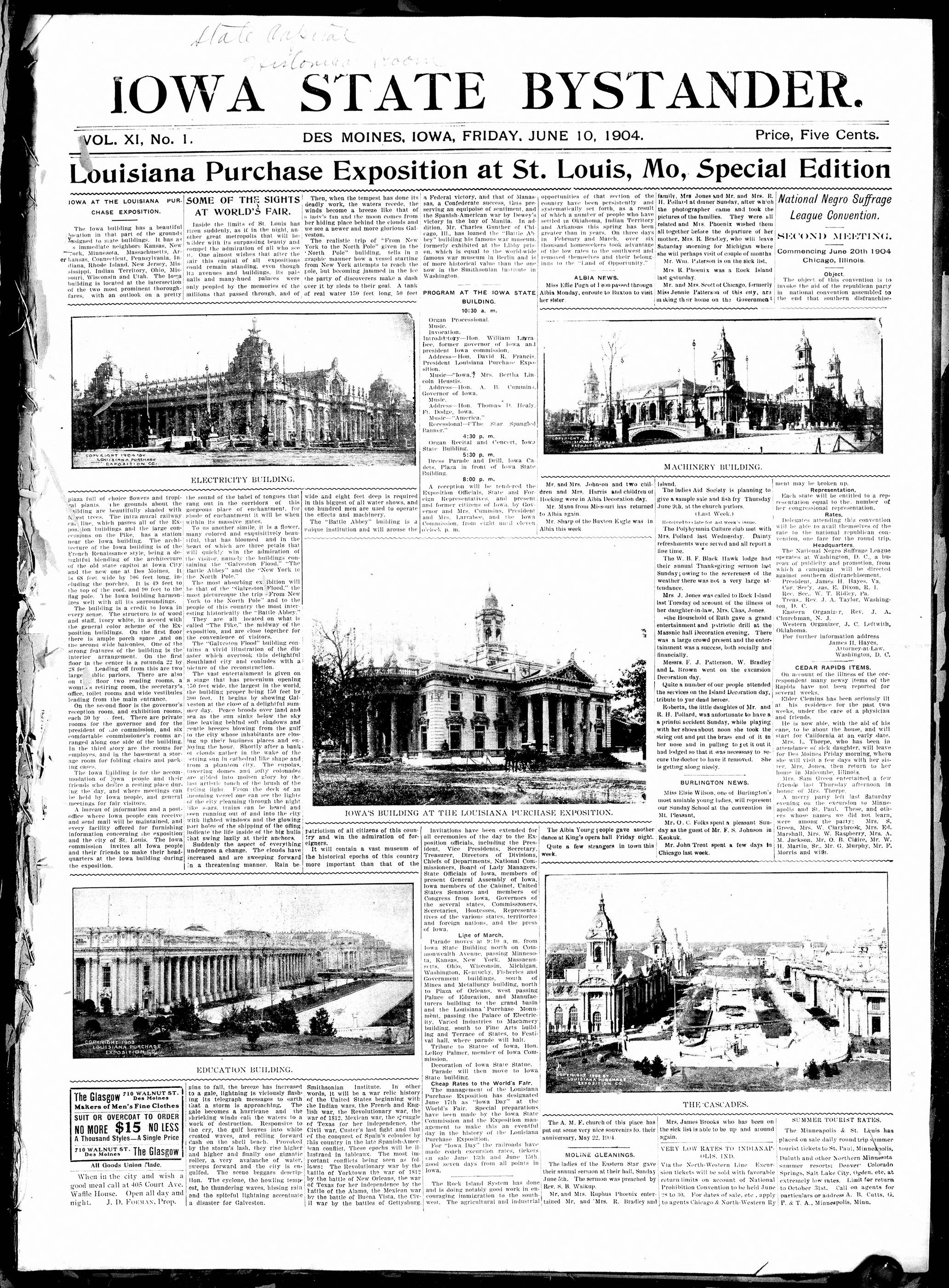
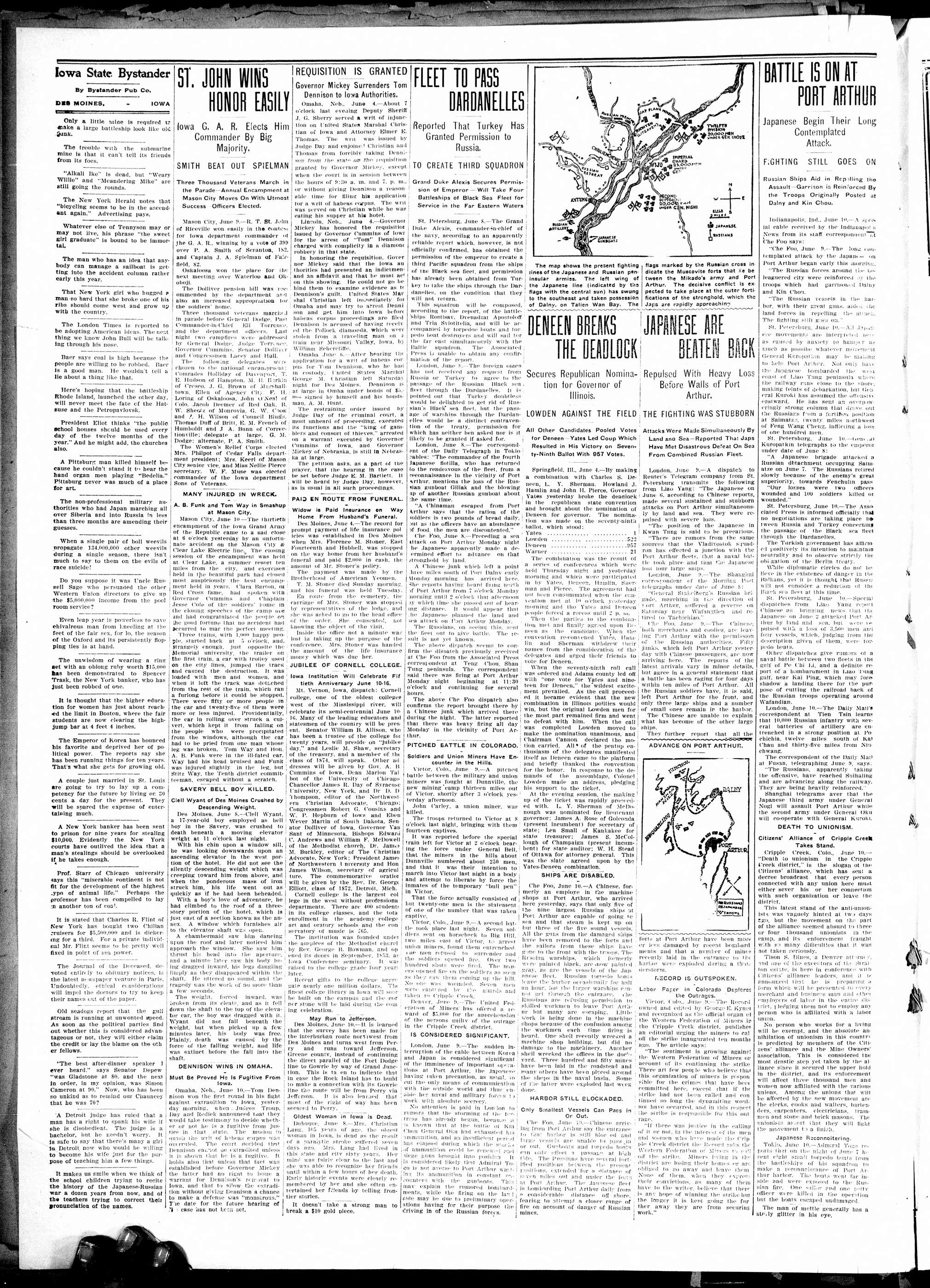
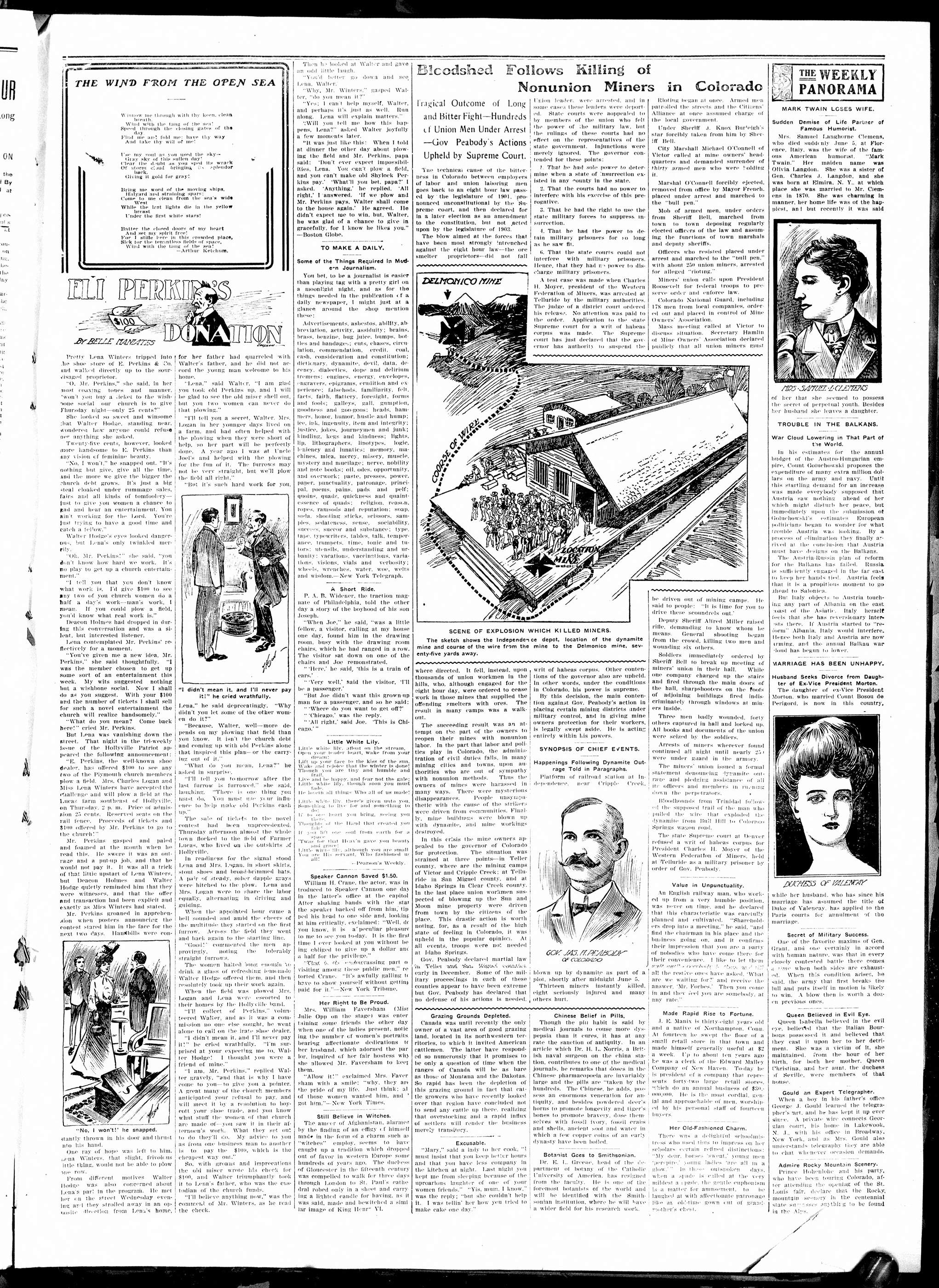
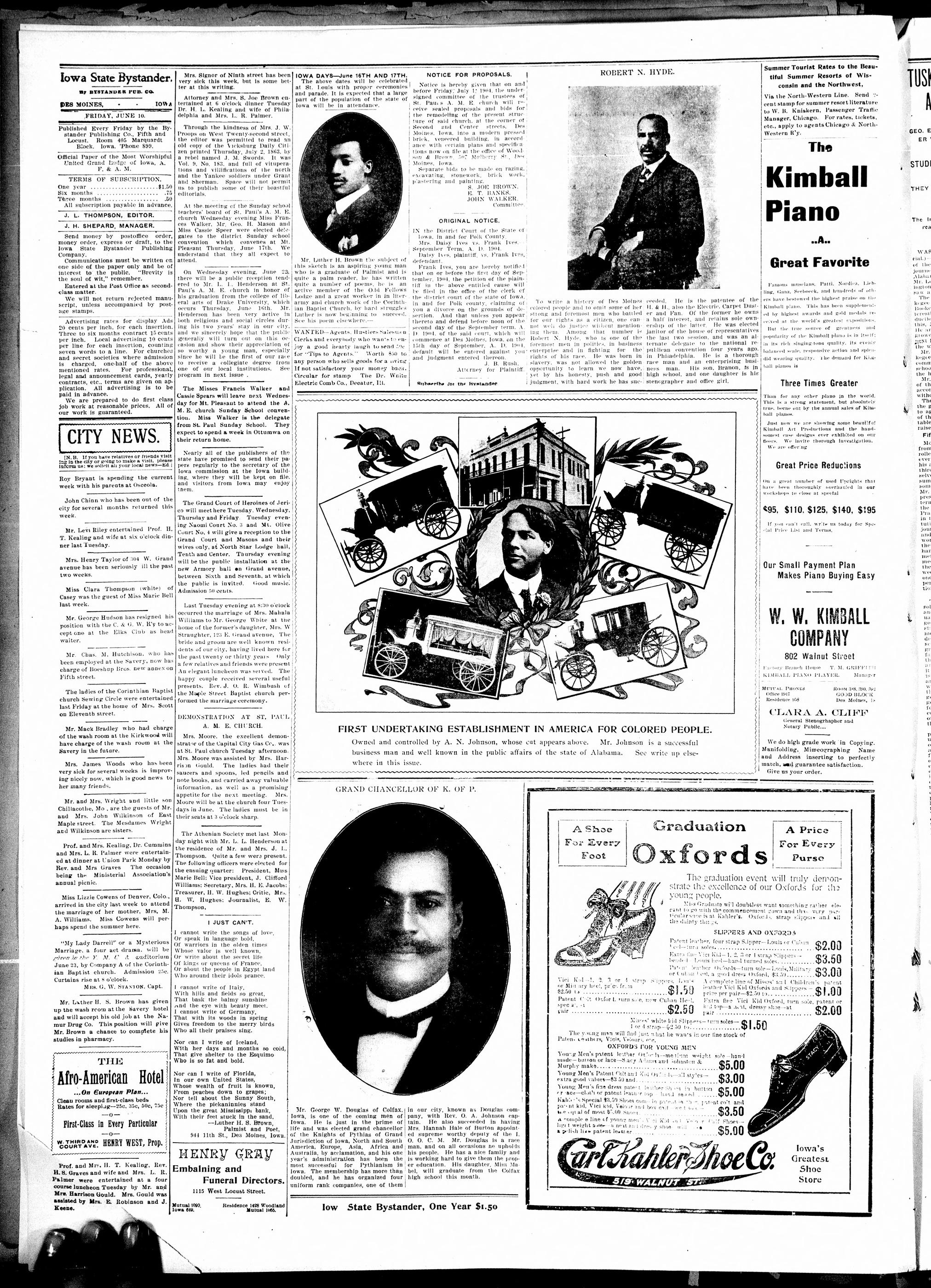
Page text (machine-generated)
IOWA STATE BYSTANDER.
Louisiana Purchase Exposition at St. Louis, Mo, Special Edition
CONGRESS INTERNATIONAL
LOUISIANA PUBLIC
EXPOITION CO.
COPYRIGHT 1903
LOUISIANA PURCHASE
EXPOSITION CO.
VOL. XI, No. 1.
Louisiana
IOWA AT THE LOUISIANA PUR.
CHASE EXPOSITION.
The Iowa building has a beautiful
location in that part of the grounds
assigned to state buildings. It has as
s immediate neighbors Kansas, New
ork, Minnesota, Massachusetts, Ar-
kansas, Connecticut, Pennsylvania,
Oklahoma, Missouri, Mississippi,
Indian Territory, Ohio, Missouri,
Wisconsin and Utah. The Iowa
building is located at the intersection
of the two most prominent thorough-
fares, with an outlook on a pretty
CONGESTANT INDUSTRIAL
LOUISIANA PURCHASE
EXPOSITION CO.
plaza full of choice flowers and tropical plants, the grounds about the building are beautifully shaded with a few trees. The intra mural railway car line, which passes all of the Exposition buildings and the large concessions on the Pike, has a station near the Iowa building. The architecture of the Iowa building is of the French Renaissance style of the tightly blending of architecture and architecture and the new one at Des Moines. It is 68 feet wide by 106 feet long, including the porches. It is 49 feet to the top of the roof, and 90 feet to the ting pole. The Iowa building harmonizes well with all its surroundings.
The building is a credit to Iowa in every sense. The structure is of wood and staff, ivory white, in accord with the general color scheme of the Exposition buildings. On the first floor there is ample porch space, and on the second wide balconies. One of the strong features of the building is the interior arrangement. On the first floor in the center is a rotunda 22 by 28 feet. Leading off from this are two large public parlors. There are also on the floor two reading rooms, a woman's retiring room, the secretary's office, toilet rooms and wide vestibules leading from the main entrance. On the second floor is the governor's room and exhibition rooms, each 20 by feet. There are private rooms for the governor and for the president of the commission, and six comfortable commissioner's rooms arranged along one side of the building. In the third story are the rooms for employees, and in the basement a storage room for folding chairs and packing cases.
The Iowa building is for the accommodation of Iowa people and their friends who desire a resting place during the day, and where meetings can be held by Iowa people, and general meetings for fair visitors.
A bureau of information and a postoffice where Iowa people can receive and send mail will be maintained, and every facility offered for furnishing information concerning the exposition and the city of St. Louis. The Iowa commission invites all Iowa people and their friends to make their headquarters at the Iowa building during the exposition.
COPYRIGHT 1903
LOUISIANA PURCHASE
EXPOSITION CO.
The Glasgow 710 WALNUT ST.
Des Moines
Makers of Men's Fine Clothes
SUIT OR OVERCOAT TO ORDER
NO MORE $15 NO LESS
A Thousand Styles—A Single Price
710 WALNUT ST.
Des Moines
The Glasgow
All Goods Union Made.
When in the city and wish a good meal call at 405 Court Ave. Waffle House. Open all day and night. J. D. FOEMAN, Prop.
State Ancient
AT WORLD'S FAIR.
Inside the limits of St. Louis has risen suddenly, as if in the night, another great metropolis that will be wilder with its surpassing beauty and compel the admiration of all who see it. One almost wishes that after the fair this capital of all expositions could remain standing, even though its avenues and buildings, its palaces and many-hued palaces were only peopled by the memories of the millions that passed through, and of
ELECTRICITY BUILDING.
the sound of the babel of tongues that rang out in the corridors of this gorgeous place of enchantment, for abode of enchantment it will be when within its massive gates.
To us another simile. It is a flower, many colored and exquisitively beautiful, that has bloomed and in the heart of which are three petals that will quickly win the admiration of the visitor, namely the buildings containing the "Galveston Flood." "The battle Abbey" and the "New York to the North Pole."
The most absorbing exibition will be that of the "Galveston Flood," the most picturesque the trip - From New York to the North Pole - and to the people of this country the most interesting historically the "Battle Abbey."
They are all located on what is called "The Pike," the midway of the exposition, and are placed together for the purpose of visual experience.
The "Galveston Flood" building contains a vivid illustration of the disaster which overtook this delightful Southland city and concludes with a picture of the reconstruction.
The vast entertainment is given on a stage that has procenium opening 150 feet wide, the largest in the world, the building proper being 150 feet by 300 feet. It begins by showing Galveston at the close of a delightful summer day. Peace broods over land and buildings, leaving behind soft shadows and gentle breezes blowing from the gulf to the city whose inhabitants are closing up their business places and enjoying the hour. Shortly after a bank of clouds gather in the wake of the setting sun in cathedral like shape and from a phantom city. The cupolas, towering domes and softy colonades are gilded into molten glory by the last artistic touch of the brush of the falling light. From the deck of an apartment building, the city gleams through the night like sails, trains can be heard and seen running out of and into the city with lighted windows and the glowing port holes of the shipping of the offing indicate the life inside of the big hulls that swing lazily at their anchors.
Suddenly the aspect of everything undergoes a change. The clouds have increased and are sweeping forward in a threatening manner. Rain be-
THE PALACE OF THE ATHENSIAN MUSEUM
EDUCATION BUILDING.
gins to fall, the breeze has increased to a gale, lightning is viciously flashing its telegraph messages to earth that a storm is approaching. The gale becomes a hurricane and the shrieking winds call the waters to a work of destruction. Responsive to the cry, the gulf heaves into white crested waves, and rolling forward cash on the shell beach. Provoked by hostile water, the high tide and higher and finally one gigantic roller, a very avalanche of water sweeps forward and the city is engulfed. The scene beggars description. The cyclone, the howling tempest, he thundering waves, hissing rain and the spiteful lightning accentuate a disaster for Galveston.
---
DES MOINES, IOWA, FRIDAY, JUNE 10, 1904.
---
CITY COURT
IOWA'S BUILDING AT THE LOUISIANA PURCHASE EXPOSITION
Then, when the tempest has done its deadly work, the waters recede, the winds become a breeze like that of a lady's fan and the moon comes from her hiding place behind the clouds and we see a newer and more glorious Galveston. A realistic trip of "From New York to the North Pole" given in the "North Pole" building, tells in a graphic manner how a vessel starting from New York attempts to reach the pole, but becoming jammed in the fce the party of discoverers make a dash over it by sleds to their goal. A tank of real water 150 feet long, 50 feet
```markdown
```
wide and eight feet deep is required in this biggest of all water shows, and one hundred men are used to operate the effects and machinery. The "Battle Abbey" building is a unique institution and will grow the
IOWA'S BUILDING
patriotism of all citizens of this country and win the admiration of foreigners. It will contain a vast museum of the historical epochs of this country more important than that of the
THE RAILWAYS
Smithsonian Institute. In other words, it will be a war relie history of the United States beginning with the Indian wars, the French and English war, the Revolutionary war, the War of 1812, Mexico, and the gruggle of Texas for her independence, the Civil War's last fight and that of the conquest of Spain's colonies by this country in the late Spanish-American conflict. These epochs will be illustrated in tableaux. The most important conflicts being seen as follows: The Revolutionary war by the battle of Yorktown the war of 1812 by the battle of New Orleans, the war of Texas for her independence by the battle of the Alamo, the Mexican war by the battle of Buena Vista, the Civil war by the battles of Gettysburg
---
a Federal victory, and that of Manassas, a Confederate success, thus preserving an equipoise of sentiment, and the Spanish-American war by Dewey's victory in the bay of Manila. In addition, Mr. Charles Gunther of Chicago, IL., has loaned the "Battle Abey" building his famous war museum, formerly exhibited at the Liberty prison, which is equal to the world-wide famous war museum in Berlin and is of more historical value than the one now in the Smithsonian Institute in Washington.
PROGRAM AT THE IOWA STATE BUILDING.
Organ Processional.
Music.
Invocation.
Introductory—Hon. William Lara-
bee, former governor of Iowa and
president Iowa commission.
Address—Hon. David R. Francis,
President Louisiana Purchase Exposition.
Music—"Iowa," Mrs. Bertha Lincoln
Houstis.
Address—Hon. A. B. Cummins,
Governor of Iowa.
Music.
Address—Hon. Thomas D. Healy,
Ft. Dodge, Iowa.
Music—"America."
Recessional—"The Star, Spangled
Panner."
4:30 p. m.
Organ Recital and Concert, Iowa
State Building.
5:30 p. m.
Dress Parade and Drill, Iowa Ca-
dets, Plaza in front of Iowa State
Building.
8:00 p. m.
A reception will be tendered the Exposition Officials, State and Foreign Representatives, and present and former citizens of Iowa, by Governor and Mrs. Cummins, President and Mrs. Larrabee, and the Iowa Commission, from eight until eleventh clock p.m.
AT THE LOUISIANA PURCH
Invitations have been extended for all ceremonies of the day to the Exposition officials, including the President, Vice Presidents, Secretary, Treasurer, Directors of Divisions, Chiefs of Departments, National Commissioners, Board of Lady Managers, State Officials of Iowa, members of present General Assembly of Iowa, Iowa members of the Cabinet, United States Senators and members of Congress from Iowa. Governors of the various states, Commissioners, Secretaries, Hostesses, Representatives of the various states, territories and foreign nations, and the press of Iowa.
Line of March.
Parade moves at 9:10 a.m. from Iowa State Building north on Commonwealth Avenue, passing Minnesota, Kansas, New York, Massachusetts, Ohio, Wisconsin, Michigan, Washington, Kentucky, Fisheries and Government buildings, south of Mines and Metallurgy building, north to Plaza of Orleans, west passing Palace of Education, and Manufacturers building to the grand basin and the Louisiana' Purchase Monument, passing the Palace of Electricity, Varied Industries to Machinery building, south to the building and Terrace of States, to Festival Hall, and parade will halt. Tribute to Statue of Iowa, Hon. Leo Roy Palmer, member of Iowa Commission. Decoration of Iowa State Statue. Parade will then move to Iowa State building.
Cheap Rates to the World's Fair.
The management of the Louisiana Purchase Exposition has designated June 17th as "Iowa Day" at the World's Fair. Special preparations have been made by the Iowa State Commission and the Exposition management to make this an eventful day in the history of the Louisiana Purchase Exposition.
For "Iowa Day" the railroads have made coach excursion rates, tickets on sale June 12th and June 15th, good seven days from all points in Iowa.
The Rock Island System has done and is doing notably good work in en- encouraging immigration to the south-west. The agricultural and industrial
---
COPYRIGHT NEW YORK
LONDON AND NEW YORK
KEEP DISTRICT CO.
COPYRIGHT 1928 BY
LOUISIANA CIVILIAN
EXPOSITION CO.
opportunities of that section of the country have been persistently and systematically set forth, as a result of which a number of people who have settled in Oklahoma, Indian Territory and Arkansas this spring has been greater than in years. On three days in February and March, over six thousand homesseekers took advantage of the low rates to the southwest and removed themselves and their belongings to the "land of Opportunity."
ALBIA NEWS.
Miss Ellie Pugh of Leon passed through Albia Monday, enroute to Buxton to visit her sister.
COPYRIGHT 1929 BY
LOUIS A. MORGAN
PREPASTURE CO.
Mr. and Mrs. Johnson and two children and Mrs. Harris and children of Hocking were in Albia Decoration day. Mr. Mann from Missouri has returned to Albia again. Mr. Sharp of the Buxton Eagle was in Albia this week
IASE EXPOSITION.
The Albia Young people gave another dance at King's opera hall Friday night. Quite a few strangers in town this week.
POST MICHIGAN INSTITUTE
LOUISIANA PROMOTIVE
LEGISITION CO.
The A. M. F. church of this place has put out some very nice souvenirs to, their anniversary, May 22, 1904.
MOLINE GLEANINGS.
The ladies of the Eastern Star gave their annual sermon at their hall, Sunday June 5th. The sermon was preached by Rev. S. B. Walkup. Mr. and Mrs. Ruphus Phoenix entertained Mr. and Mrs. R. Bradley and
family, Mrs Jones and Mr. and Mrs. R. H. Pollard at dinner Sunday, after which the photographer came and took the pictures of the families. They were all related and Mrs. Phoenix wished them all together before the departure of her mother, Mrs. R. Bradley, who will leave Saturday morning for Michigan where she will perhaps visit of couple of months. Mr. Wm. Paterson is on the sick list. Mrs R. Phoenix was a Rock Island last gatiday. Mr. and Mrs. Scott of Chicago, formerly Miss Jennie Patterson of this city, are making their home on the Government
MACHINERY BUILDING.
The ladies Aid Society is planning to give a sample sale and fish fry Thursday June 9th, at the church parlor.
(Last Week)
Received to late for last week's issue.
The Polishynia culture club met with Mrs. Pollard last Wednesday. Dainty refreshments were served and all report a fine time.
The W. B. F. Black Hawk lodge had their annual Thanksgiving sermon last Sunday, owing to the severeness of the weather there was not a very large attendance.
Mrs J. Jones was called to Rock Island last Tuesday od account of the illness of her daughter-in-law, Mrs. Chas, Jones.
→ the Household of Ruth gave a grand entertainment and patriotic drill at the Massine hall Decoration evening. There was a large crowd present and the entertainment was a success, both socially and financially.
Messrs. F. J. Patterson, W. Bradley and L. Brown went on the excursion Decoration day.
Quite a number of our people attended the services on the Island Decoration day, tribute to yur dead heroes.
Roberta, the little daughters of Mr. and R. H. Pollard, was anfortunate to have a priniti accident Sunday, while playing with her shoes about noon she took the stingg out and put the brass end of it in her nose and in pulling to get it out it had lodged so that it was necessary to secure the doctor to have it removed. She is getting along nicely.
BURLINGTON NEWS
Miss Elsie Wilson, one of Burlington's most amiable young ladies, will represent our Sunday School at the convention in Mt. Pleasant.
Mr. O. C. Folks spent a pleasant Sunday as the guest of Mr. F. S. Johnson in Keokuk.
Mr. John Trent spent a few days in Chicago last week.
The image provided is too blurry to accurately recognize any text or details. It appears to be a grayscale photograph of a large building with multiple levels, featuring architectural details such as columns and domes. The perspective is from a high angle looking down the length of the building.
Mrs. James Brooks who has been on the sick list is able to be up and around again.
VERY LOW RATES TO INDIANAPOLIS, IND.
Via the North-Western Line Excursion tickets will be sold with favorable return limits on account of National Prohibition Convention to be held June 25 to 30. For dates of sale, etc., apply to agents Chicago & North-Western Ry
Special Edition
National Negro Suffrage League Convention.
SECOND MEETING.
Commencing June 20th 1904
Chicago, Illinois.
Object
The object of this convention is to invoke the aid of the republican party in national convention assembled to the end that southern disfranchise
G.
Each state will be entitled to a representation equal to the number of her congressional representation.
Rates.
Delegates attending this convention will be able to avail themselves of the rate to the national republican convention, one fare for the round trip.
Headquarters
The National Negro Struggle League operates at Washington, D. C., a bureau of publicity and promotion, from which a campaign will be directed against southern disfranchisement.
President, James H. Hayes, Va.
Cor, Secy', jas, E. Dixon, R. I.
Rec. Sec., W. T. Ridley, Pa.
Treas., Rev. J. A. Taylor, Washington, D. C.
Eastern Organizer, Rev. J. A.
Churchman, N. J.
Western Organizer, J. C. Leftwith,
Oklahoma.
CEDAR RAPIDS ITEMS
On account of the illness of the correspondent many newsy items of the Rapids have not been reported for several weeks.
Elder Clemins has been seriously ill at his residence for the past two weeks, under the care of a physician and friends.
He is now able, with the aid of his cane, to be about the house, and will start for California at an early date.
Mrs. L. Thorpe, who has been in attendance of sick daughter, will leave for Des Moines Friday morning, where she will visit a few days with her sister, Mrs. Jones, then return to her home in Malcolme, Illinois.
Mrs. Sam Green entertained a few friends last Thursday afternoon in honor of Mrs. Thorpe.
A merry party left last Saturday evening on the excursion to Minneapolis and St. Paul. These, and others whose names we did not learn, were among the party: Mrs. S. Green, Mrs. W. Charybrook, Mrs. Ed. Marshall, Mrs. W. Raspberry, Mrs. A. M. Jackson, Mr. O. B. Claire, Mr. W. H. Martin, Sr. Mr. G. Murphy, Mr. F. Morris and wife.
THE STREETS OF MALAYA
been on around
ANAP-
Execur-
vorable
national
old June
, apply
extern Ry
SUMMER TOURIST RATES.
The Minneapolis & St. Louis has placed on sale daily round trip summer tourist tickets to St. Paul, Minneapolis, Duluth and other Northern Minnesota summer resorts: Denver Colorado Springs, Salt Lake City, Ogden, etc, at extremely low rates. Limit for return to October 31st. Call on agents for particulars or address A. B. Cuts, G. P. & T. A., Minneapolis, Minn.
Iowa State. Bystander
By Bystander Pub Co.
DES MOINES, - IOWA
Only a little mine is required to make a large battleship look like old junk.
The trouble with the submarine mine is that it can't tell its friends from its foes.
"Alkali Ike" is dead, but "Weary Willie" and "Meandering Mike" are still going the rounds.
The New York Herald notes that "bicycling seems to be in the ascendant again." Advertising pays.
Whatever else of Tennyson may or may not live, his phrase "the sweet girl graduate" is bound to be immortal.
The man who has an idea that anybody can manage a sailboat is getting into the accident column rather early this year.
That New York girl who hugged a man so hard that she broke one of his ribs should come west and grow up with the country.
The London Times is reported to be adopting American ideas. The next thing we know John Bull will be talking through his nose.
Baer says coal is high because the people are willing to be robbed. Baer is a good man. He wouldn't tell a lie about a thing like that.
Here's hoping that the battleship Rhode Island, launched the other day, will never meet the fate of the Hatsuse and the Petronavlovsk.
President Eliot thinks "the public school houses should be used every day of the twelve months of the year." And he might add, the churches also.
A Pittsburg man killed himself because he couldn't stand it to hear the hand organ men playing "Bedelia." Pittsburg never was much of a place for art.
The non-professional military authorities who had Japan marching all over Siberia and into Russia in less than three months are amending their guesses.
When a single pair of boll weevils propagate 134,000,000 other weevils during a single season, there isn't much to say to them on the evils of race suicide!
Do you suppose it was Uncle Russell Sage who persuaded the other Western Union directors to give up the $5,000,000 income from the pool room service?
Even leap year is powerless to save eighvilous man from Neeling at the feet of the fair sex, for lo, the season of the Oxford and its persistently flopping ties is at hand.
The unwisdom of wearing a ring set with an oblong ruby worth $15,000 has been demonstrated to Spencer Trask, the New York banker, who has just been robbed of one.
It is thought that the higher education for women has just about reached the limit in Boston, where the fair students are now clearing the high-jump bar at 4 feet 4 inches.
The Emperor of Korea has bounced his favorite and deprived her of political power. The reports say she has been running things for ten years. That's what she gets for growing old.
A couple just married in St. Louis are going to try to lay up a competency for the future by living or 20 cents a day for the present. They will be spared the expense of entertaining much.
A New York banker has been sent to prison for nine years for stealing $10,000. Evidently the New York courts have outlived the idea that a man's stealings should be overlooked if he takes enough.
Prof. Starr of Chicago university says this "miserable continent is not fit for the development of the highest type of animal life." Perhaps the professor has been compelled to lay in another ton of coz!
It is stated that Charles R. Flint of New York has bought two Chilian cruisers for $5,500,000 and is dickering for a third. For a private individual Mr. Flint seems to be pretty well fixed in point of sea power.
The Journal of the Deceased, devoted entirely to obituary notices, is the latest newspaper venture in Paris. Undoubtedly, ethical considerations will impel the doctors to try to keep their names cut of the paper.
Old seadogs report that the gulf stream is running at unwonted speed. As soon as the political parties find out whether this is considered advantageous or not, they will either claim the credit or lay the blame on the other fellows.
"The best after-dinner speaker I ever heard," says Senator Depew "was Gladstone at 80, and the next in order, in my opinion, was Simon Cameron at 90." Now, who has been so unkind as to remind our Chaucey that he was 70?
A Detroit judge has ruled that a man has a right to spank his wife if she is disobedient. The judge is a bachelor, but he needn't worry. It is safe to say that there's many a girl in Detroit now who would be willing to become his wife just for the purpose of teaching him a few things.
It makes us smile when we think of the school children trying to recite the history of the Japanese-Russian war a dozen years from now, and of the teachers trying to correct their pronunciation of the names.
ST. JOHN WINS HONOR EASILY
SMITH BEAT OUT SPIELMAN
Three Thousand Veterans March in the Parade-Annual Encampment at Mason City Moves On With Utmost Success Officers Elected.
Mason City, June 9—R. T. St. John of Riceville won easily in the contest for Iowa department commander of the G. A. R. winning by a vote of 399 over P. A. Smith of Seranton, 182, and Captain J. A. Spielman of Fairfield, 82.
Oskaloosa won the place for the next meeting over Waterloo and Okoboji.
The Dolliver pension bill was recommended by the department and also an increased appropriation for the soldiers' home.
Three thousand veterans marched in parade before General Dodge, Pass Commander-in-Chief Eli Torrence and the department officers. Last night two campfires were addressed by General Dodge, Judge Torrence Governor Cummins, Senator Dollier and Congressman Lacey and Hull. The following delegates were chosen to the national encampment: Conrades Holliday of Davenport, T. E. Hudson of Hampton, M. E. Birkin of Cresco, J. G. Brown of Meshkintown, Ellen of Agency City; F. H. Loring of Oskaloosa, John O Neal of Colo. Jacob Deemer of Red Oak, B. Shegz Monrovia, G. W. Cook and H. Wilson of Chelsea, W. H. Thomas of Biffle, E. M. French of Humboldt and J. A. Bunn of Correctionville; delegate at large, G. M. Dodge; alternate, P. A. Smith. The Women's Relief Corps elected Mrs. Philipot of Cedar Falls department president; Mrs. Keerl of Mason City senior vice, and Miss Nellie Pierce secretary, W. F. Muse was elected commander of the Iowa department Sons of Veterans.
MANY INJURED IN WRECK.
A. B. Funk and Tom Way in Smashup at Mason City.
Mason City, June 10—The thirtieth encampment of the Iowa Grand Army of the Republic came to a sad close at 6 o'clock yesterday by an unfortunate accident on the Mason City & Clear Lake Electric line. The closing session of the encampment was held at Clear Lake, a summer resort ten miles from the city, and exercises held in the beautiful park had closed most auspiciously the best encampment held in years. Clara Barton, or Governor Cummins, and stolen with Governor Cummins and Jesse Cole of the soldiers' home in the closing speeches of the camp are and had congratulated the people on the good fortune that no accident had occurred to mar the perfect meeting.
Three trains, with 1,000 happy peo
ple, started back at 5 o'clock, and
strangely enough, just opposite the
Memorial university, the trailer on
the first train, a car with trotley used
on the city lines, jumped the track
and caused the destruction. It was
loaded with men and women, and
when it left the track was detached
from the rest of the train, which ran
a furling before it could be stopped.
There were fifty or more people in
the car and twenty-five of them were
more or less injured. Providently,
the train was on its way to vert, which kept it from falling on
the people who were precipitated
from the windows, although the car
had to be pried from one man whose
leg was broken. Tom Way and Hon.
A. B. Funk were in the ill-fated car,
Way had his head bruised and Funk
was injured slightly in the leg, but
Stitz Way, the Tenth district committe-
eeman, escaped without a serach.
SAVERY BELL BOY KILLED.
Ciell Wyant of Des Moines Crushed by
Descending Weight.
Des Moines, June S.—Cell Wyant, a 17-year-old boy employed as a bell boy in the Savery, was crushed to death beneath a moving elevator weight at 11 o'clock last night. With his chin upon a window sill, he was looking downwards upon an ascending elevator in the west portion of the hotel. He did not see the silently descending weight which was creeping toward him from above, and upon the floor of the room from struck him, his life went out as quickly as if he had been healed. With a boy's love of adventure, he had climbed to the roof of a three-story portion of the hotel, which is just east of a section known as the annex. A window which furnishes air to the elevator shaft was open. A chambermaid saw him dancing upon the roof and later noticed him approach the window. She saw him thrust his head into the aperture, and a minute later saw his body being ragged, his eyes dangling from his mouth, and his disheveled shaft. He uttered no sound, and the tragedy was the work of no more than a few seconds.
The weight, forced inward, was broken from its cleats, and as it fell down the shaft to the top of the elevator car, the boy was dragged with it. Wyant did not fall beneath the weight, but when picked up a few minutes later, his body was free. Plainly, death was caused by the force of the falling weight, and Life extinct before the fall into the shaft.
DENNISON WINS IN OMAHA
Must Be Proved He Is Fugitive From Iowa.
Omaha, Neb., June 10—Tom Dennison won the first round in his fight against extradition to Iowa, yesterday morning, when Judges Troup, Day and Redick announced that they would take testimony to decide whether or not he is a fugitive from justice in that state. The motion to owe the writ of habeas corpus was overruled. The court decided that Dennison cannot be extradited unless it is shown that he is a fugitive. It holds also that unless that fact was established before governor Mickey Roe did no further to leap a warrant for Dennison's removal to Iowa, and for Dennison's removal to Iowa, and that allow the extradition without giving Dennison a chance to make a defense was "impossous." The date for the future hearing of $\textcircled{3}$ case has not been set.
Omaha, Neb., June 4. About 7 o'clock last evening Deputy Sheriff J. G. Sherry served a writ of injunction on United States Marshal Christian of Iowa and Attorney Elmer E. Thomas. The writ was issued by Judge Day and enjoined! Christian and Thomas from forcibly taking Dennison from the state on the requisition granted by Governor Mickey, except when the court is in session between the hours of 9:30 a.m. m. and 7. p. m., or without giving Dennison a reasonable time for filing his application for a writ of habeas corpus. The writ was served on Christian while he was eating his supper at his hotel. Lincoln, Neb., June 4. —Governor Mickey issued the warrant that the registrar by Governor Cummins of Iowa for the arrest of "Tom" Dennison charged with complicity in a diamond robbery in that state.
In honoring the requisition, Governor Mickey said that the Iowa auctions had presented an indictment and an indictment and that he must act on this showing. He could not go behind them to examine evidence as to Dennison's guilt. United States Marshal Christian left immediately for Omaha and may try to arrest Dennison and get him into Iowa before haiches corpus proceedings are filed. Dennison is accused of having receded the Pollock diamonds, which were stolen from a traveling man on a train near Missouri Valley, Iowa, by William Schercliffe. Omaha June 6. After hearing the application for a writ of injunction corpus Dennison, he heed in custody. United States Marshal George M. Christian left Saturday night for Des Moines. Dennison is at large in Omaha under bonds of $4,000 signed by himself and his husband, A. M. Hunt.
The restraining order issued by Judge Day of the criminal court, a most unheard of proceeding, executed its functions and the "king of gamblers and consort of thieves" arrested on a warrant executed by Governor Cummins of Iowa, and Governor Mickey of Nebraska, is still in Nebraska at large. The petition asks, as a part of the prayer, that the hearing in the case be set before Judge E. M. Bartlett. It will be heard by Judge Day, however, as is usual in all such proceedings.
PAID EN ROUTE FROM FUNERAL
Widow is Paid Insurance on Way
Home From Husband's Funeral.
Des Moines, June 4.—The record for prompt payment of life insurance policies was established in Des Moines on June 14, 1915. Fourteenth and Hubbell, was stopped on the way home from her husband's funeral and paid $2,000 in cash, the amount of Mr. Stoner's policy.
The payment was made by the Brotherhood of American Yeomen. T. M. Stoner died Sunday morning, and his funeral was held Tuesday. En route from the cemetery, the carriage of Mrs. Stoner was stopped by representatives of the bodge, and locked up in the office of the order. She consulted, not knowing the object of the visit. Inside the office not a minute was lost in taking up the purpose of the conference. Mrs. Stoner was handed the amount of the life insurance money which was due her.
JUBILEE OF CORNELL COLLEGE.
Beth Anniversary June 10, 1910.
Mt. Vernon, Iowa, dispatch: Cornel college, one of the oldest colleges west of the Mississippi river, will celebrate its semi-centennial June 10, 1910. Many of the leading educators and statesmen of the country will be pres ent. Senator William B. Allison, who has been a trustee of the college for only a year, will speak "day" and Leslie M. Shaw, secretary of the treasury, and a member of the class of 1874, will speak. Other ad dresses will be given by Gov. A. B. Cummins of Iowa, Dean Marion Tailot of the University of Chicago Chancellor James R. Day of Syracuse University, New York, and Dr. D. R. Thompson, editor of the Northwestern Christian Advocate, Chicago; Congressman Robert G. Cousins and Heppner, William and Weaver, William of South Dakota, Senator Dolliver of Iowa, Governor Van Sant of Minnesota, Bishops Edward C. Andrews and William F. McDowell of the Methodist church, Dr. James M. Buckley, editor of The Christian Advocate, New York; President James of Northwestern University and Hon James Wilson, secretary of agriculture. The commemorative orator will be given by the Rev. Dr. George Elliott, class of 1872, Detroit, Mich. Cornell college is the largest college in the country and has 400 departments. There are 400 students in its college classes, and the tota enrollment in the academy college art and oratory schools and the conservatory of music is 765.
The institution was founded under the auspices of the Methodist church by Rev. George B. Bowman, and opened its doors in September, 1853, as Iowa Conference seminary. It was raised to the college grade four years later. Recept gifts to the college aggregate nearly one million dollars. The finest college library in Iowa will soon be built on the campus and the corner stone will be laid during the coming celebration.
May Run to Jefferson.
Des Moines, June 10—It is learned that the survey has been made for the interburban route northwest from Des Moines and turns west from Perry and runs toward Jefferson, Greene county, instead of continuing the direct parallel of the Fort Dodge line to Gowrie by way of Grand Junction. This is taen to indicate that in case the Rock Island has to build to make a connection with its Gowrie line the route will be from Perry villa, it is also learned that most of the riage of way has been secured to Perry.
Oldest Woman in Iowa is Dead.
Dubuque, June 8—Mrs. Christian Lang, 165 years of age, the oldest woman in Iowa, is dead as the result of a paralytic stroke suffered seven times this state and city fifty years. Her mind was fairly clear to the last and she was able to recognize her friends until within a few hours of her death. Early historic events were clearly remembered by her and she often entertained her friends by telling frontier stories.
It doesn't take a strong man to break a $10 gold piece.
FLEET TO PASS
DARDANELLES
Reported That Turkey Has Granted Permission to Russia.
TO CREATE THIRD SQUADRON
Grand Duke Alexis Secures Permission of Emperor — Will Take Four Battleships of Black Sea Fleet for Service in the Far Eastern Waters
St. Petersburg, June 8. — The Grand Duke Alexis, commander-in-chief of the navy, according to an apparently reliable report which, however, is not officially confirmed, has obtained the permission of the emperor to create a third Pacific squadron from the ships of the Black sea fleet, and permission has already been obtained from Turkey to take the ships through the Dardanelles, on the condition that they will not return.
This squadron will be composed, according to the report, of the battleships Rosistav, Devenadzat Apostolov and Tria Sviotietla, and will be accompanied by torpedo boats and torpedo boat destroyers and will sail for the far east simultaneously with the Baltic squadron. The Associated Press is unable to obtain any confirmation of the report.
London, June 8. — The foreign once has not received any request from Russia or Turkey to agree to the passage of the Russian Black sea舰 (Dardanelles) through Dardanelles pointed out that Turkey doldness would be delighted to get rid of Russian's Black sea fleet, but the passage of warships through the Dardanelles would be a distinct contravention of the treaty, permission for which has neither ben asked nor is it likely to be granted if asked for.
London, June 8.—The correspondent of the Daily Telegraph in Tokyo tables: "The commander of the fourth Japanese flotilla, who has returned to the rendezvous of the fleet, from a reconnaissance in the vicinity of Port Arthur, mentions the loss of the Russian gunboat Gillak and the blowing up of another Russian gunboat about the same time. The Japanese escaped from Port Arthur says that the ration of the soldiers is two pounds of bread daily, out as the officers have an abundance of food, the men are discontented." The Che, June 8.—Preceding a sea attack on Port Arthur Monday night he Japanese apparently made a determined effort to advance on that stronghold by land.
A Chinese junk which left a point three miles south of Port Dalry early Monday morning has arrived here. She reports having heard firing north of Port Arthur from 7 eclock Monday morning until 2 eclock that afternoon she has passed out of hearing distance. She reports that the Japanese planned the land and sea attack on Port Arthur Monday.
The Russians, on seeing this, sent the fleet out to give battle. The result is not yet known.
The above dispatch seems to confirm the dispatch previously received at Che Foo from the Associated Press correspondent at Teng Chon, Shan Tung peninsula. The correspondent said there was firing at Port Arthur Monday night beginning at 11:30 o'clock and continuing for several hours.
The above Che Foo dispatch also confirms the report brought there by a Chinese junk which arrived there during the night. The latter reported that there was heavy firing all day Monday in the vicinity of Port Arthur.
PITCHED BATTLE IN COLORADO
Soldiers and Union Miners Have Encounter in the Hills.
Victor, Colo., June 9.—A pitched battle between the military and union miners was fought at Dunnville, the new mining 'camp thirteen miles out of Victor, shortly after 3 o'clock yesterday afternoon. John Carley, a union miner, was killed.
The troops returned to Victor at 8 o'clock last night, bringing with them fourteen captives.
It was reported before the special train left for Victor at 2 o'clock bearing the force under General Bell, that the miners in the hills about Dunnville numbered about 250 men, and that it was their intention to march into Victor last night in a body armor to liberate by force the miners of the temporary 'bull pen' in Victor.
That the force actually consisted of but twenty-one men is the statement of one of the number that was taken captive.
Victor, Colo. June 9.—A second battle took place last night. Seven soldiers on horseback to Big Hill two miles east of Victor, to arrest union miners, found them entrenched, one men refused to surrender and the soldiers opened fire. Over two hundred shots were fired. The miners opened fire on the soldiers as soon as they saw them coming up the hill. No one was wounded. Seven men were captured by the guards and taken to Cripple Creek. Denver, June 9.—The United Federation of Miners has offered a reward of $5,000 for the amphibious of the persons guilty of the outrage in the Cripple Creek district.
IS CONSIDERED SIGNIFICANT.
London, June 9.—The sudden interruption of the cable between Korea and Japan is considered significant of the imminence of important operations at Port Arthur, the Japanese having taken precaution, as usual, to cut the only means of communication with the outside world and thus create military forces to work with absolute control. No attention is paid in London to rumors that the storming of the fortress has already begun, because it is known that at the battle of Kim Cheng General Okin had exhausted his ammunition, and an insufficient period has elapsed during which the stocks of ammunition could be renewed; part siege gains brought into position. It is considered likely that Admiral Tosio is not averse to Port Arthur wastes being used in constant counter-attacks with the enemy may explain the rumored bombardments, while the firing on the hard gate may be due to preliminary operations having for their purpose the driving in of the Russian forces.
RUSSIAN TRENCH
SAP PLANK NORTHWEST
HENSTEN
(LITZLAVEN)
CHILLIEMONGEN
RUSSIAN REFREAT
ANTUINGER
RUSSIAN ARTILLERY
JAPANESE GUNBOATS
TWELFTH DIVISION
SOCOMPANION
UNDER GEN. INOHE
IMPERIAL GUARD
SOCOMPANION
UNDER GEN.
SECOND DIVISION
20,000 PART
UNDER GEN. NISHI
ELEAD
2 MILES
JAPANESE
RUSSIANS
The map shows the present fighting lines of the Japanese and Russian peninsular armies. The left wing of the Japanese line (indicated by this flags with the central sun) has swung to the southeast and taken possession of Dalny, on Talien Wan Bay. The
DENEEN BREAKS
THE DEADLOCK
Secures Republican Nomination for Governor of Illinois.
LOWDEN AGAINST THE FIELD
All Other Candidates Pooled Votes for Deneen. Yates Led Coup Which Resulted in His Victory on Seventy-Ninth Ballot With 957 Votes.
Springfield, Ill., June 4.—By making a combination with Charles S. Deneen, L. Y. Sherman. Howland J. Hamlin and John H. Pierce, Governor Yates yesterday broke the deadlock in the republican state convention about the nomination of Deneen for governor. The nomination was made on the seventy-ninth ballot, which stood:
Yates 1
Lowden 522
Deneen 957
Warner 21
Warner ..... 21
The combination was the result of a series of conferences which were held Thursday night and yesterday morning and which were participated in by Yates, Deneen, Humlin, Sherman and Pierce. The agreement had not been consummated when the convention met at 10 o'clock yesterday morning and the Yates and Deneen people forced a recess to 2 p. m. Then the parties to the combination met and finally agreed upon Deneen as the candidate. When the convention recessed Yates than Humlin and Sherman withdrew names from the consideration of the delegates and urged their friends to vote for Deneen.
When the seventy-ninth roll call was ordered and Adams county led off with "one vote for Yates and nineteen for Deneen," the wildest excitement prevailed. As the call proceeded it became evident that the new combination in Illinois politics would win, but the original Lowden men for the most part remained firm and went to defeat with him. When the call was completed Lowden moved to the convention manumont, and Chairman Cannon, deferred the motion carried. All * of the party's enthusiasm of the delegates manifested itself as Deneen came to the platform and briefly thanked the convention for the honor. In response to the demands of the assemblage, Colonel Lowden made an address, pledging his support to the ticket.
At the evening session, the making up of the ticket was rapidly proceeded with. L. Y. Sherman of McBrounough was nominated for lieutenant governor; James A. Rose of Golconda (present incumbent) for secretary of state; Len Small of Kankakee for state; James A. S. McCollough of Champaign县 was nominated for state auditor; W. H. Stead of Ottawa for attorney general. This was the slate agreed upon by the Yates-Deneen combination.
SHIPS ARE DISABLED
Che Foo, June 10.—A Chinese, formerly an employee in the machine shops at Port Arthur, who arrived here yesterday, says that only five of the nine largest Russian ships at Port Arthur are capable of going to sea and that steam is kept up on but three of the five sound vessels. All the guns from the damaged ships, as are the forts and the sailors from these ships, gone to the front with the troops. The Russian warships, which formerly were painted black, are now painted gray, as are the vessels of the Japanese fleet. Russian torpedo boats leave the harbor occasionally for half an hour, but the larger warships cannot get through the entrance, the skilled warships to leave Port Arthur but many are escaping. Little work is being done in the machine shops because of the confusion among the workmen each time fireing is heard. One shell recently wreaked a machine shop building, but did no damage to the machinery. Another shell wrecked the offices in the doe-vard. Three hundred and fifty mines, many others have been placed around the ships in the naval basin. Some of the latter were exploded last week done.
HARBOR STILL PLOCKADED.
Only Smallest Vessels Can Pass in Or Out.
Che Foo, June 15—Chinese arriving from Port Arthur say the entrance to that harbor is still blooed and large vessels are unable to pass in or out. Gunboats and torpedo boats can only effect a passage at high tide. The Russians have several fortified positions between the present positions, extended for a distance of seven miles out and under the force at Port Arthur. The Japanese fleet is bombarded Port Arthur daily from a considerable distance off shore, fearing to attempt a closer range of fire on account of danger of Russian mines.
flags marked by the Russian cross indicate the Muscovite forts that lie between the Mikado's army and Port Arthur. The decisive conflict is expected to take place at the outer fortifications of the stronghold, which the Japs are rapidly approaching
JAPANESE ARE BEATEN BACK
Repulsed With Heavy Loss Before Walls of Port Arthur.
THE FIGHTING WAS STUBBORN
Attacks Were Made Simultaneously By Land and Sea—Reported That Jaws Have Met Disastrous Defeat On Sea From Combined Russian Fleet.
London, June 9.—A dispatch to Reuter's Telegram company from St. Petersburg transmits the following from Liao Yang: "The Japanese on June 6, according to Chinese reports, made several sustained and stubborn attacks on Port Arthur simultaneously by land and sea. They were repulsed with severe loss.
"The position of the Japanese in Kwan Tung is said to be precarious.
"There are rumors from the same sources that the Vladivostok squadron has effected junction with the boat Arthurot that a naval boat took the place and that the Japanese lost four large ships.
London, June 9.—The Shanghai correspondent of the Morning Post telegraphs under date of June 8:
"General Stakeherg's Russian brigade, marching in the direction of Port Arthur, suffered a reverse on Saturday near Wafangtien and returned to Tachichiao."
The Cfo, June 9.—The Chinese, both merchants and cooleys, are leaving Port Arthur with the permission of the Russian authorities. Fifty junians, who have been away a year with Chinese passengers, are now arriving here. The reports of the latest arrivals vary in minor details, but agree in a general statement that a battle has been raging for four days within ten miles of Port Arthur. All the Russian soldiers have, it is said, left Port Arthur for the front, and only three large ships and a number of small ones remain in the harbor. The Chinese are unable to explain what has become of the other large ships.
They further report that all the ADVANCE ON PORT ARTHUR
KINGCHOL
MANHATTAN
PALLEL
BENQUARLING
DALLEY
PORT
ARTHUR
RUSSIA
GREAT BRITAIN
TRACPS
forts at Port Arthur have been more eries damaged by recent bombardments and that a number of mines recently held in the entrance to the fort were exploded during a thunderstorm.
RECORD IS OUTSPOKEN.
Labor Pager in Colorado Deptoer
the Outrages.
Victor, Cole, June 9.—The Recorder owned and edited by George E. Kyren and recognized as the official organ of the Western Federation of Miners in the Cripple Creek district, publishes an editorial urging the miners to call off the strike inaugurated ten months ago. The article says:
"The sentiment is growing against the Western Federation of Miners or account of its continuing the strike. There are few people who believe that this organization of miners is responsible for the crimes that have been committed here, except that if the strike had not been called and continued so long the dynamiting would not have occurred, and in this respect the strike is responsible for this outrage.
"If there was justice in the calling of it or not, in the interest of the men and women who have made the Cripple Creek district the Record with the Western Federation of Miners to cut off the strike. Miners living in the district are losing their homes or are engaged to go away and leave them None of them, when they express their convictions, as many of the have to the writer, believe that there is any hope of winning the strike but the longer it is kept going the forther away they are from securing work."
BATTLE IS ON AT PORT ARTHUR
Japanese Begin Their Long Contemplated Attack.
FIGHTING STILL GOES ON
Russian Ships Aid in Repelling the Assault—Garrison is Reinforced By the Troops Originally Posted at Dalny and Kin Chou.
Indianapolis, Ind., June 10.—A special cable received by the Indianapolis News from its staff correspondent at the Foo says:
"Che Foo, June 9.—The long contemplated attack by the Japanese on Port Arthur began early this morning.
"The Russian forces around the be-leaguered city were reinforced by the troops which had garrisoned Dalny and Kin Chou.
"The Russian vessels in the harbor, with their great guns, aided the land forces in repelling the attack. The fighting still goes on."
St. Petersburg, June 19.—All Japanese movements are interpreted because caused by anxiety to hamper as much as possible whatever movement General Kurupatin may be making to help Port Arthur. Not only have the Japanese bombarded the west coast of Liao Tung peninsula where the railway runs close to the shore, making feints of debarkation, but General Kurupatin has assumed the offensive eastward. He has sent an overpoweringly strong column that drove out the Russians from a fortified position at Saimatzai, twenty miles northwest of Feng Wang sheng, infiltrating a loss of the enemy.
St. Petersburg, June 10.—toem at Kurupatin telegraphs to the emperor under date of June 8.
"A Japanese brigade attacked a Russian detachment occupying Samatze on June 7. The Russians retired slowly because of the enemy's great superiority, towards Fenchulin pass. "Our losses were two officers wounded and 100 soldiers killed or wounded." St. Petersburg, June 10.—The Associated Press is informed officially that no negotiations are taking place between Russia and Turkey concerning the passage of the Black sea fleet through the Dardanelles. The Turkish government has affirmed positively its intention to maintain morality and to observe strictly the obliquity of the Born canary. While diplomatic trips may not be involve in the existence of danger in the Bulkers, yet it is thought that Russia will not consider a reduction of the Black sea fleet at this time.
St. Petersburg, June 10.—Special dispatches from Liao Yang report Chinese as bringing news that the Japanese on June 2 attacked Port Arthur by land and sea, but were repulsed with a loss of 3,500 men and four vessels, which, judging from the description given of them, were top priority. Other dispatches give rumors of a naval battle between two fleets in the Gulf of Pe Chi Ll, and a definite report of a bombardment in Liao Tang Gulf, near Kai Ping, which may force shadow a landing there for the purpose of cutting the railroad back of the Russian troops operating around Wafandian. London, June 10.—The Daily Mail* correspondent at Tien Tsin learns that 10,000 Russian infantry with several artillery are encircled in a strong position. To Chichia, twelve miles south of Kai Chau and thirty-five miles from Nüchang.
The correspondent of the Daily Mail at Fusan, telegraphing June 9, says: "The Russians, apparently taking the offensive, have reached Suhlang and are advancing along the railway. They being heavily reinforced, Shanghai will attack the Japanese third army under General Nogi will assault Port Arthur while the second army under General Oku will co-operate with General Kuroki.
DEATH TO UNIONISM.
Citizens' Alliance of Cripple Creek Takes Stand.
Cripple Creek, Colo., June 10.—"Death to unionism in the Cripple Creek district," is the slogan of the Citizens' alliance, which has sent a decree broadcast that every person connected with any union here must either sever his or her connection with such organization or leave the district.
The latest stand of the anti-unionists was vaguely hinted at two days ago, but the movement on the part of the alliance seemed absurd to three or four thousand unionists in the camp, and its enforcement traught with so many difficulties that it was not taken seriously.
Tison S. Dines, a Denver attorney, and one of the executors of the Stratton estate, is here in conference with Citizens' alliance leaders, and it is announced that he is preparing a form which will be presented to every merchant and business man and other unionists in the citizens' alliance, pledging them not to employ any person who is affiliated with a labor union.
No person who works for a living will be exempt, and the absolute annihilation of unionism in this country is predicted by members of the Citizens' alliance and the Mine Owners' association. This is considered the most drastic step yet taken by the alliance since it secured the upper hold in the district, and its enforcement will affect three thousand men and women now affiliated with the various unions. Among the unions that will be affected by the new movement are the clerks, cooks and waiters, bartenders, carpenters, electricians, traymen and stone and brick masons. The unionists assert that they will fight the movement to a finish.
Japanese Reconnoitering
Tokio, June 16—Admiral Togo reports that on the night of June 7 he sent eight small torpedo boats from the battleships of his squadron to make a reconnaissance of Port Arthur harbor. The boats went far inside and were exposed to the Russian fire. One sailor and one petty officer were killed in the operation but the boats escaped undamaged.
The man of mettle generally has a steely glitter in his eye.
THE WIND FROM THE OPEN SEA
Window me through with thy keen, clean breath.
Wind with the ting of the sea!
Speed through the closing gates of the day.
Find me app! fold me have thy way
And take thy will of me!
Use my soul as you used the sky—
Gray sky of this sunken day!
Climb chub as you sped its wrack
Of storm cloud bringing ♡ splendor back.
Giving it gold for gray!
Bring me word of the moving ships,
Holyard and clean spars!
Come to me clean from the sea's wide West
White cloud last lights die in the yellow breast
Under the first white stars!
Batter the closed chest of my heart
And set my spirit free!
For I stifle here in this crowded place,
Sick for the temnitude fields of space,
Wind with the ting of the sea!
Arthur Ketchum.
ELI PERKIN'S DONATION
BY BELLE NANATES
Pretty Lena Winters tripped into the shoe store of E. Perkins & Co. and walked directly up to the sour-visaged proprietor.
"O. Mr. Perkins," she said, in her most coaxing tones and manner, "won't you buy a ticket to the wish-one social our church is to give Thursday night—only 25 cents?"
She looked so sweet and winsome that Walter Hodge, standing near, wondered how anyone could refuse our anything she asked.
Twenty-five cents, however, looked more handsome to E. Perkins than any vision of feminine beauty.
for her father had quarreled with Walter's father, and he did not a cord the young man welcome to his home.
"Lena," said Walter, "I am glad you took old Perkins up, and I will be glad to see the old miser shell out but you two women can never do that plowing."
"I'll tell you a secret, Walter. Mr. Logan in her younger days lived on a farm, and had often helped with the plowing when they were short of help, so her part will be perfect done. A year ago I was at Uncle Look's, and helped with the plowing."
"No, I won't," he snapped out. "It's nothing but give, give all the time, and the more we give the bigger the church debt grows. It's just a big steal choked over runnage sales, fairs and all kinds of tomatoery—just to give you women a chance to gad and hear an entertainment. You ain't working for the Lord. You're just trying to have a good time and catch a fellow."
Walter Hodge's eyes looked dangerous, but Lona's only twinkled mercy.
"Oh, Mr. Perkins!" she said, "you don't know how hard we work. It's no play to get up a church entertainment."
"I tell you that you don't know what work is. I give $100 to see any two of you church women do a half a day's work—man's work, I mean. If you could plow a field, you'd know what real work is."
Deacon Holmes had dropped in during this conversation and was a silent, but interested listener.
Lena contemplated Mr. Perkins' reflectively for a moment.
"You've given me a new idea, Mr. Perkins," she said thoughtfully. "I was the member chosen to get up some sort of an entertainment this week. My wits suggested nothing but a wishbone social. Now I shall do as you suggest. With your $100 and the number of tickets I shall sell for such a novel entertainment the church will realize handsomely."
"What do you mean? Come back here!" cried Mr. Perkins.
But Lena was vanishing down the street. That night in the tri-weekly issue of the Hollyville Patriot appeared the following announcement: "E. Perkins, the well-known shoe dealer, has offered $100 to see any two of the Plymouth church members plow a field. Mrs. Charles Logan and Miss Lena Winters have accepted the challenge and will plow a field at the Lucas farm southeast of Hollyville on Thursday, 2 p.m. Price of admission 25 cents. Reserved seats on the rail tie. Proceeds of tickets and $100 offered by Mr. Perkins to go to the church."
Mr. Perkins gasped and paled and foamed at the mouth when he read this. He swore it was an outrage and a put-up job, and that he would not pay it. It was all a trick of that little upstart of Lena Winters, but Deacon Holmes and Walter Hodge quietly reminded him that they were witnesses, and that the offer and transaction had been explicit and exactly as Mies Winters had stated.
Mr. Perkins groaned in apprehension when posters announcing the contest stared him in the face for the next two days. Handbills were con-
M. H.
"No, I won't!" he snapped, stantly thrown in his door and thrust into his hand.
One ray of hope was left to him. Lena Winters, that slight, frivolous little thing, would not be able to plow one row.
From different motives Walter Hodge was also concerned about Lena's part in the program. He met her on the street Wednesday evening and they strolled in an opposite direction from Lena's home.
for her father had quarreled with Walter's father, and he did not accord the young man welcome to his home.
"Lena," said Walter, "I am glad you took old Perkins up, and I will be glad to see the old miser shell out, but you two women can never do that plowing."
"I'll tell you a secret, Walter. Mrs. Logan in her younger days lived on a farm, and had often helped with the plowing when they were short of help, so her part will be perfectly done. A year ago I was at Uncle Joel's and helped with the plowing for the fun of it. The furrows may not be very straight, but we'll plow the field all right."
"But it's such hard work for you,
H. W.
"I didn't mean it, and I'll never pay it!" he cried wrathfully.
"I didn't mean it, and I'll never pay it!" he cried wrathfully.
Lena," he said deprecatingly. "Why didn't you let some of the other women do it?"
"Because, Walter, well—more depends on my plowing that field than you know. It isn't the church debt and coming up with old Perkins alone that inspired this plan—or the carrying out of it."
"What do you mean, Lena?" he asked in surprise.
"I'll tell you to morrow after the last furrow is furrowed," she said, laughing. "There is one thing you must do. You must use your influence to help make old Perkins cash up."
The sale of tickets to the novel contest had been unprecedented. Thursday afternoon almost the whole town flocked to the field of Farmer Luces, who lived on the outskirts of Hollyville.
In readiness for the signal stood Lena and Mrs. Logan, in short skirts, stout shoes and broad-brimmed hats. A pair of steady, sober dapple grays were hitched to the plow. Lena and Mrs. Logan were to share the labor equally, alternating in driving and guiding.
When the appointed hour came a bell sounded and amid the cheers of the multitude they started on the first furrow. Across the field they went and back again to the starting line. "Good!" commented the men approvingly, noting the tolerably straight furrows.
The women waited long enough to drink a glass of refreshing lemonade. Walter Hodge offered them, and then居然 took up their work again.
When the field was plowed Mrs. Logan and Lena were escorted to their homes by the Hollyville band.
"I'll collect of Perkins," volunteered Walter, and as it was a commission no one else sought, he went alone to call on the irate shoe dealer, "I didn't mean it, and I'll never pay it!" he eried wrathfully. "I'm surprised at your expecting me to, Walter Hodge! I thought you were a friend of mine."
"I am, Mr. Perkins," replied Walter gravely, "and that is why I have come to you—to give you a pointer. A great many of the church members anticipated your refusal to pay, and will meet it by a resolution to boycott your shoe trade, and you know what stuff the women of that church are made of—you saw it in their afternoon's work. What they set out to do they'll do. My advice to you as from one business man to another is to pay the $100, which is the cheapest way out."
So, with groans and imprecations the old miser wrote his check for $190, and Walter triumphantly took it to Leon's father, who was the custodian of the church funds. "I'll believe anything now," was the comment of Mr. Winters, as he read the check.
Then he looked at Walter and gave an odd little laugh.
"You'd better go down and see Lena, Waltar. "Why, Mr. Winters," gasped Waltar, "do you mean it?" "Yes; I can't help myself, Waltar, and perhaps it's just as well. Run along, Lena will explain matters." "Will you tell me how this happens, Lena?" asked Walter joyfully a few moments later. "It was just like this: When I told at dinner the other day about plowing the field and Mr. Perkins, papa said: 'Don't ever expect impossibilities, Lena. You can't plow a field, and you can't make old Shylock Perkins pay.' 'What'll you bet, pet,' I asked. 'Anything,' he replied, 'All right,' I answered. 'If we plow and Mr. Perkins pays, Walter shall come to the house again.' He agreed. He didn't expect me to win, but, Walter, he was glad of a chance to give in gracefully, for I know he likes you." Boston Globe
TO MAKE A DAILY.
Some of the Things Required in Modern Journalism.
You bet, to be a journalist is easier than playing tag with a pretty girl on a moonlight night, and as for the things needed in the publication of a daily newspaper, I might just at a glance around the shop mention these:
Advertisements, asbestos, ability, abbreviation, activity, assidity; brains, brass, benzine, bug juice, bumps, bottles and bandage; cuts, chases, circulation, commendation, credit, coal, cash, consideration and constitution; dictionary, dynamite, devil, data, deficiency, dielectics, dope and delirium tremens; engines, energy, envelopes, engravers, epigrams, eruption and experience; falsehools, familiarity, felt, faets, faith, flattery, forsight, forms and tools; galleys, gall, gumption, goodness and goo-goo; heads, hammers, honor, humor, hustle and hump; ice, ingenuity, item and integrity; justice, jokes, journeymen and junk; kindling, kegs and kindness; lights, lithographers, linotypes, logic, lenency and lunatics; memory, machines, mica, mercy, misery, muscle, mystery and nuclage; nerve, nobility and note books; oil, odes, opportunity, and workwork; paste, presses, power, paper, punctuality, patronage, principal, poems, pains, pads and pelf; quoins, quads, quickness and quintessence of quads; religion, reason, ropes, ramsods and reputation; soap, sofa, shooting sticks, scissors, samples, sodateness, sense, sociability, success, sucrer and substance; type, tape, typewriters, tables, talk, temperature, trumpets, time, tonic and tutors; utensils, understanding and urbanity; vacations, vaccinations, variations, visions, vials and verbosity; wheels, wrenches, water, woe, wels and wisdom.—New York Telegraph.
A Short Ride
P. A. B. Widener, the traction magnate of Philadelphia, told the other day a story of the boyhood of his son Joseph.
"When Joe," he said, "was a little fellow, a visitor, calling at my house one day, found him in the drawing room, busy with the drawing room chairs, which he had ranged in a row. The visitor sat down on one of the chairs and Joe demonstrated.
"Here,' he said, 'this is a train of cars."
"Very well,' said the visitor, 'I'll be a passenger."
"But Joe didn't want this grown-up man for a passenger, and so he said:
"Where do you want to get off?"
"Chicago,' was the reply.
"All right,' said Joe. 'This is Chicago.'
Little White Lily.
Little white lily, afloat on the stream,
Open your tender heart, wake from your
dream: Lift up your face to the kiss of the sun,
Wake and rejoice that the winter is done.
Though you are they and humble and fruit
Live and be happy, and four not the gale:
Little white lily, though soon you must
He loveth all things Who all of us made!
Little white bird, there's given into you,
Something to live for and something to
It to one heart you bring, seeing you
There, on the hand that created you
Fall. If you lift one soul from earth for a
space.
Twits for that Heaven gave you beauty and grace!
little while he, although you are small
You are his servant. Who fashioned us
Speaker Cannon Saved $1.50
Speaker Cannon Saved $1.50.
William H. Crane, the actor, was introduced to Speaker Cannon one day in the latter's office at the capitol. After shaking bands with the star the speaker backed off from him, tiped his head to one side and, looking at him critically, exclaimed: "Well, do you know, it is a peculiar pleasure to me to see you to-day. It is the first time I ever looked at you without being obliged to give up a dollar and a half for the privilege."
"Text is & excessing part of visiting among these public men," retorted Crane. "It's awfully galling to have to show yourself without getting paid for it."—New York Tribune.
Her Right to Be Proud.
Mrs. William Faversham (Miss Julie Opp on the stage) was entertaining some friends the other day when one of the ladies present, noticing the number of women's portraits bearing affectionate dedications to her husband, which adorned the parlor, inquired of her fair hostess why she allowed Mr. Faversham to keep them.
"Allow it!" exclaimed Mrs. Faversham with a smile: "why, they are the pride of my life. Just think: all of these women wanted him, and got him."—New York Times.
Still Believe in Witches.
The anger of Afghanistan, alarmed by the finding of an effigy of himself mad* in the form of a charm such as "witches" employ, seems to have caught up a tradition which dropped out of favor in western Europe some hundreds of years ago. The dueless of Gloucester in the fifteenth century was compelled to walk for three days through London to St. Paul's cathedral robed only in a sheet and carrying a lighted candle for having, as it was said, made and bewitched a similar image of King Henry VI.
COOPSE OF WIRE
LOCATION
MILK
be driven out of mining camps,
said to people: "It is time for you
drive these scoundrels out."
SCENE OF EXPLOSION WHICH KILLED MINERS.
The sketch shows the Independence depot, location of the dynamite mine and course of the wire from the mine to the Delmonico mine, seventy-five yards away.
Upheld by Supreme Court.
The technical cause of the bitterness in Colorado between employers of labor and union laboring men goes back to an eight hour law passed by the legislature of 1901, pronounced unconstitutional by the Supreme court, and then declared for in a later election as an amendment to the constitution, but not acted upon by the legislature of 1903.
The blow aimed at the forces that have been most strongly 'intrenched against the eight hour law'—the ore smelter proprietors—did not fall
DELMONICO MINE
COURSE OF WIRE
SCENE OF EXPLOSION
The sketch shows the Independence mine and course of the wire from the enty-five yards away.
where directed. It fell, instead, upon thousands of union workmen in the hills, who, although engaged for the eight hour day, were ordered to cease work in those mines that supplied the offending smelters with ores. The result in many camps was a walk-out.
The succeeding result was an attempt on the part of the owners to reopen their mines with nonunion labor. In the part that labor and politics play in Colorado, the administration of civil duties falls, in many mining cities and towns, upon authorities who are out of sympathy with nonunion methods. Thus the owners of mines were harassed in many ways. There were mysterious disappearances. People unsympathetic with the cause of the strikers were driven from communities. Finally, nine buildings were blown up with dynamite, and nine workings destroyed.
In this crisis the mine owners appealed to the governor of Colorado for protection. The situation was strained at three points—in Teller county, where are the mining camps of Victor and Cripple Creek; at Telluride in San Miguel county, and at Idaho Springs in Clear Creek county. In the last place union workmen suspected of blowing up the Sun and Moon mine property were driven from town by the citizens of the place. This drastic action is worth noting, for, as a result of the high state of feeling in Colorado, it was upheld in the popular opinion. At all events, troops were not needed at Idaho Springs. Gov. Peabody declared martial law in Teller and San Miguel counties early in December. Some of the military proceedings in each of these counties appear to have been extreme but Gov. Peabody has declared that no defense of his actions is needed.
Grazing Grounds Depleted. Canada was until recently the only owner of a vast area of good grazing land, located in its northwestern territories, to which it invited American cattlemen. The latter have responded so numerously that it promises to be only a question of time when the ranges of Canada will be as bare as those of Montana and the Dakotas. So rapid has been the depletion of this grazing ground in fact that cattle growers who have recently looked over that region have concluded not to send any cattle up there, realizing that overstocking and a rapid influx of settlers will render the business merely transitory.
Excusable.
"Mary," said a lady to her cook, "I must insist that you keep better hours and that you have less company in the kitchen at night. Last night you kept me from sleeping because of the uprearous laughter of one of your women friends." "Yis, mum. I know," was the reply; "but she couldn't help it. I was tellin' her how you tried to make cake one day."
Nonunion Miners in Colorado
Union leaders, were arrested, and in some cases these leaders were deported. State courts were appealed to by members of the union who felt the power of the military law, but the rulings of these courts had no effect on the representatives of the state government. Injunctions were merely ignored. The governor contended for these points:
1. That he had sole power to determine when a state of insurrection existed in any county in the state.
2. That the courts had no power to interfere with his exercise of this preogative.
3. That he had the right to use the state military forces to suppress insurrection.
4. That he had the power to detain military prisoners for so long as he saw fit.
6. That the state courts could not interfere with military prisoners. Hence, that they had no power to discharge military prisoners.
A test case was made when Charles H. Moyer, president of the Western Federation of Miners, was arrested at Telluride by the military authorities. The judge of a district court ordered his release. No attention was paid to the order. Application to the state Supreme court for a writ of habeas corpus was made. The Supreme court has just declared that the governor has authority to suspend the
WHICH KILLED MINERS.
ce depot, location of the dynamite mine to the Delmonico mine, sev-
writ of habeas corpus. Other contentions of the governor also are upheld. In other words, under the conditions in Colorado, his power is supreme. By this decision, the main contention against Gov. Peabody's action in placing certain mining districts under military control, and in giving mine owners protection for their workers, is legally swept aside. He is acting entirely within his powers.
SYNOPSIS OF CHIEF EVENTS
Happenings Following Dynamite Out-
rage, Told in Paragraphs.
Platform of railroad station at Independence, near Cripple Creek.
GOV. JAS. HUP. ABDOL
OF COLORADO
blown up by dynamite as part of a
plot, shortly after midnight June 5.
Thirteen miners instantly killed,
eight seriously injured and many
others hurt.
Though the pin habit is said by medical journals to cause more dyspepsia than it cures, it has at any rate the sanction of antiquity. In an article which Dr. H. L. Norris, a British naval surgeon on the china station, contributes to one of the medical journals, he remarks that doses in the Chinese pharmacopoeia are invariably large and the pills are "taken by the hundreds." The Chinese, he adds, possess an enormous veneration for antiquity, and besides powdered deer's horns to promote longevity and tiger's bones to promote bravery, dose themselves with fossil ivory, fossil crabs and shells, ancient soot and water in which a few copper coins of an early dynasty have been boiled.
Botanist Goes to Smithsonian
Dr. E. L. Greese, head of the department of botany of the Catholic University of America, has resigned from the faculty. He is one of the foremost botanists of the world and will be identified with the Smithsonian institution, where he will have a wider field for his research work.
Rioting began at once. Armed men patrolled the streets and the Citizens' Alliance at once assumed charge of the local government.
Under Sheriff J. Knox Burdeigh's star forcibly taken from him by Sheriff Bell.
City Marshall Michael O'Connell of Victor called at mine owners' headquarters and demanded surrender of thirty armed men who were holding it.
Marshal O'Connell forcibly ejected, removed from office by Mayor French, placed under arrest and marched to the "bull pen."
Mob of armed men, under orders from Sheriff Bell, marched from town to town deposing regularly elected officers of the law and assuming the functions of town marshals and deputy sheriffs.
Officers who resisted placed under arrest and marched to the "bull pen," with about 250 union miners, arrested for alleged "rioting."
Miners' union calls upon President Roosevelt for federal troops to preserve order and enforce law.
Colorado National Guard, including 178 men from local companies, ordered out and placed in control of Mine Owners' Association.
Mass meeting called at Victor to discuss situation. Secretary Hamlin of Mine Owners' Association declared publicly that all union miners must
be driven out of mining camps. He said to people: "It is time for you to drive these scoundrels out."
Deputy Sheriff Alfred Miller raised rifle, demanding to know whom he means. General shooting began from the crowd, killing two men and wounding six others.
Soldiers immediately ordered by Sheriff Bell to break up meeting of miners' union in their hall. While one company charged up the stairs and fired through the main doors of the hall, sharpshooters on the roots of adjoining buildings fired indiscriminately through windows at miners inside.
Three men badly wounded, forty others captured in hall and locked up. All books and documents of the union were seized by the soldiers.
Arrests of miners wherever found continued all night until nearly 25 were under guard in the army.
The miners' union issued a formal statement denouncing 'lynamite outrage and pledging assistance of all its officers and members in running down the perpetrators.
Bloodhounds from Trinidad followed the supposed trail of the man who pulled the wire that exploded the dynamite from Bull Hill to Colorado Springs wagon road.
The state Supreme court at Denver refused a writ of habeas corpus for President Charles H. Moyer of the Western Federation of Miners, held at Telluride as a military prisoner by order of Gov. Peabody.
Value in Unpunctuality
An English railway man, who worked up from a very humble position, was never on time, and he declared that this characteristic was carefully planned and cultivated. "Shareholders drop into a meeting," he said, "and find the chairman in his place and the business going on, and it confirms their impression that you are a party of nobodies who have come there for their convenience. I like to let them wait and come back," he said all the restive ones have asked. "What are we waiting for?" and receive the answer, "Mr. Forbes." Then you come in and they feel you are somebody, at any rate."
Made Rapid Rise to Fortune
J. E. Manix is thirty-eight years old and a native of Northampton, Conn. At fourteen he swept the floor of a small retail store in that town and made himself generally useful at $2 a week. Up to about ten years ago he was a clerk of the Edward Malley Company of New Haven. To-day he is president of a company that represents forty-two large retail stores, which do an annual business of $30,000,000. He is the most cordial, genial and approachable of men, worshiped by his personal staff of fourteen buyers.
Her Old-Fashioned Charm:
There was a delightful schoolmistress who used thus to impress on her scholars certain refined distinctions: "My dear, forsces 'sweet,' young men 'perspire,' young ladies 'are all in a glow.'" In these outspoken days, when a shade is called at the very mildest a shade, the gentle euphonism is a matter for amusement, to be laughed at with affectionate patronage like an old-time gown cut of grandmother's chest.
THE WEEKLY PANORAMA
MARK TWAIN LCSE5 WIFE.
Sudden Demise of Life Partner of Famous Humorist.
Mrs. Samuel Langhorne Clemens, who died suddenly June 5, at Florence, Italy, was the wife of the famous American humorist, "Mark Twain." Her maiden name was Olivia Langdon. She was a sister of Gen. Charles J. Langdon, and she was born at Elmira, N. Y., at which place she was married to Mr. Clemens in 1870. She was charming in manner, her home life was of the happiest, and I but recently it was said
1895 - SATIET - J. CLEUTENS
of her that she seemed to possess the secret of perpetual youth. Besides her husband she leaves a daughter.
TROUBLE IN THE BALKANS
War Cloud Lowering in That Part of the World
In his estimates for the annual budget of the Austro-Hungarian empire, Count Gonchowski proposes the expenditure of many extra million dollars on the army and navy. Until this startling demand for an increase was made everybody supposed that Austria saw nothing ahead of her which might disturb her peace, but immediately upon the submission of Gonchowski's estimates European politicians began to wonder for what trouble Austria was looking. By a process of elimination they finally arrived at the conclusion that Austria must have designs on the Balkans. The Austria-Russia plan of reform for the Balkans has failed. Russia is sufficiently engaged in the far east to keep her hands tied. Austria feels that it is a propitious moment to go ahead to Salonica.
But Italy objects to Austria touching any part of Albania on the east coast of the Asiatic. Italy herself feels that she has reversionary interests there. If Austria started to "reform" Albania, Italy would interfere, Hence both Italy and Austria are now forming, and the annual Balkan war "bond has begun to lower."
MARRIAGE HAS BEEN UNHAPPY.
Husband Seeks Divorce from Daughter of Ex-Vice President Morton. The daughter ex-Vice President Morton is married to the daughter de Perlgrand, is now in this country,
DREHESS OF VALENAY
while her husband, who has since his marriage has assumed the title of Duke of Valence, has applied to the Paris courts for annulment of the marriage.
Secret of Military Success
One of the favorite maxims of Gen. Grant, and one certainly in accord with human nature, was that in every closely contested battle there comes a time when both sides are exhausted. When this condition arises, he said, the army that first breaks the bill and puts itself in motion is likely to win. A blow then is worth a dozen previous ones.
Queen Believed in Evil Eye.
Queen Isabella believed in the evil eye, believed that the Italian Bourbons possessed it and believed that they cast it upon her to her detriment. She was a victim of it, she maintained, from the hour of her birth, for both her mother, Queen Christina, and her aunt, the duchess of Seville, were members of that house.
Could an Expert Telegrapher
When a boy in his father's office George J. Gould learned the telegrapher's art, and he has kept it up ever since. A private wire connects Georgian court, his home in Lakecook, N. J., with his office in Broadway, New York, and as Mrs. Gould also understands telegraphy they are able to chat whenever occasion demands.
Admire Rocky Mountain Scenery.
Arnold Hockey and his party,
Prince Holophene, who have been touring Colorado, after attending the opening of the St. Louis fair, declare that the Rocky mountain scenery in the centennial state surpasses anything to be found in the Alps.
Iowa State Bystander.
BY BYSTANDER PUB. CO.
DES MOINES, IOWA
FRIDAY, JUNE 10.
Published Every Friday by the Bystander Publishing Co., Fifth and Locust, Room 405 Marquardt Block, Iowa. Phone 899.
Official Paper of the Most Worshipful United Grand Lodge of Iowa, A. F. & A. M.
TERMS OF SUBSCRIPTION.
One year ..... $1.50
Six months ..... 75
Three months ..... 50
All subscription payable in advance.
J. L. THOMPSON, EDITOR.
J. H. SHEPARD, MANAGER.
Send money by postoffice order, money order, express or draft, to the Iowa State Bystander Publishing Company.
Communications must be written on one side of the paper only and be of interest to the public. "Brevity is the soul of wit," remember. Entered at the Post Office as second-class matter.
We will not return rejected manuscript, unless accompanied by postage stamps.
Advertising rates for display Ads 20 cents per inch, for each insertion. Three to six months contract 15 cents per inch. Local advertising 10 cents per line for each insertion, counting seven words to a line. For churches and secret societies where admission is charged, one-half of the above mentioned rates. For professional, legal and announcement cards, years contracts, etc. terms are given on application, advertising is to be paid in advance.
We are prepared to do first class job work at reasonable prices. All of our work is guaranteed.
CITY NEWS.
[N.B. If you have relatives or friends visit
ing in the city or going to make a visit, please
inform us: we solicit all your local news—Ed.
Roy Bryant is spending the current
week with his parents at Osceola.
John Chinn who has been out of the
city for several months returned this
week.
Mr. Levi Riley entertained Prof. H.
T. Kealing and wife at six o'clock dinn
ner last Tuesday.
Mrs. Henry Taylor of 304 W. Grand
avenue has been seriously ill the past
two weeks.
Miss Clara Thompson (white) of
Casey was the guest of Miss Marie Bell
last week.
Mr. George Hudson has resigned his position with the C. & G. W. R'y to accept one at the Elks Club as head waiter.
Mr. Chas. M. Hutchison, who has been employed at the Savery, now has charge of Boeshup Bros. new annex on Fifth street.
The ladies of the Corinthian Baptist church Sewing Circle were entertained last Friday at the home of Mrs. Scott on Eleventh street.
Mr. Mack Bradley who had charge of the wash room at the Kirkwood will have charge of the wash room at the Savery in the future.
Mrs. James Woods who has been very sick for several weeks is improving nicely now, which is good news to her many friends.
Mr. and Mrs. Wright and little son Chillacothe, Mo., are the guests of Mrs. and Mrs. John Wilkinson of East Maple street. The Mesdames Wright and Wilkinson are sisters.
Prof. and Mrs. Kealing, Dr. Cummins and Mrs. L. R. Palmer were entertained at dinner at Union Park Monday by Rev. and Mrs Graves The occasion being the Ministerial Association's annual picnic.
Miss Lizzie Cowens of Denver, Colo., arrived in the city last week to attend the marriage of her mother, Mrs. M. A. Williams. Miss Cowens will perhaps spend the summer here.
"My Lady Darrell" or a Mysterious Marriage, a four act drama, will be given in the Y. M. C. A auditorium June 23, by Company A of the Corinthian Baptist church. Admission 25c. Curtains rise at 8 o'clock.
MRS. G. W. STANTON, Capt.
Mr. Luther H. S. Brown has given up the wash room at the Savery hotel and will accept his old job at the Namur Drug Co. This position will give Mr. Brown a chance to complete his studies in pharmacy.
THE
Afro-American Hotel
...On European Plan...
Clean rooms and first-class beds
Rates for sleeping—25c, 35c, 50c, 75c
First-Class in Every Particular
W. THIRD AND COURT AVE. HENRY WEST, Prop.
Prof. and Mrs. H. T. Kealing, Rev.
H. S. Graves and wife and Mrs. L. R.
Palmer were entertained at a four course luncheon Tuesday by Mr. and Mrs. Harrison Gould. Mrs. Gould was assisted by Mrs. E. Robinson and J. Keene.
Mrs. Signor of Ninth street has been very sick this week, but is some better at this writing.
Attorney and Mrs. S. Joe Brown entertained at 6 o'clock dinner Tuesday Dr. H. L. Kealing and wife of Philadelphia and Mrs. L. R. Palmer.
Through the kindness of Mrs. J. W. Proops on West Twenty second street, the editor was permitted to read an old copy of the Vicksburg Daily Citizen printed Thursday, July 2, 1863. by a rebel named J. M. Swords. It was Vol. 9, No. 183, and full of vituations and vilifications of the north and the Yankee soldiers under Grant and Sherman. Space will not permit us to publish some of their boastful editorials.
At the meeting of the Sunday school teachers' board of St. Paul's A. M. E. church Wednesday evening Miss Frances Walker, Mr. Geo. H. Mason and Miss Cassie Speer were elected delegates to the district Sunday school convention which convenes at Mt. Pleasant Thursday, June 17th. We understand that they all expect to attend.
On Wednesday evening, June 22, there will be a public reception tendered to Mr. L. L. Henderson at St. Paul's A. M. E. church in honor of his graduation from the college of liberal arts of Drake University, which occurs Thursday, June 18th. Mr. Henderson is very active in both religious and social circles during his two years' stay in our city, and we sincerely hope that the public generally will turn out on this occasion and show their appreciation of so worthy a young man, especially since he will be the first of our race to receive a collegiate degree from one of our local institutions. See program in next issue.
The Misses Francis Walker and Cassie Spears will leave next Wednesday for Mt. Pleasant to attend the A. M. E. church Sunday School convention. Miss Walker is the delegate from St. Paul Sunday School. They expect to spend a week in Ottumwa on their return home.
Nearly all of the publishers of the state have promised to send their papers regularly to the secretary of the state, the law commission, where they will be kept on file, and visitors from Iowa may enjoy them.
The Grand Court of Heroes of Jerico will meet here Tuesday, Wednesday, Thursday and Friday. Tuesday evening Naomi Court No. 3 and Mt. Olive Court No. 4 will give a reception to the Grand Court and Masons and their wives only, at North Star Lodge hall, Tenth and Center. Thursday evening will be the public installation at the new Armory hall on Grand avenue, between Sixth and Seventh, at which the public is invited. Good music. Admission 50 cents.
Last Tuesday evening at 8:30 o'clock occurred the marriage of Mrs. Mahala Williams to Mr. George White at the home of the former's daughter, Mrs. W Straughter, 123 E. Grand avenue. The bride and groom are well known residents of our city, having lived here for the past twenty or thirty years. Only a few relatives and friends were present. An elegant luncheon was served. The happy couple received several useful presents, Rev. J. O. R. Wimbush of the Maple Street Baptist church performed the marriage ceremony.
DEMONSTRATION AT ST, PAUL
A. M. E. CHURCH.
Mrs. Moore, the excellent demonstrator of the Capital City Gas Co., was at St. Paul church Tuesday afternoon. Mrs. Moore was assisted by Mrs. Harrison Gould. The ladies had their saucers and spoons, led pencils and note books, and carried away valuable information, as well as a promising appetite for the next meeting. Mrs. Moore will be at the church four Tuesdays in June. The ladies must be in their seats at 3 o'clock sharp.
Thr Athenian Society met last Monday night with Mr. L. L Henderson at the residence of Mr. and Mrs. J. L. Thompson. Quite a few were present. The following officers were elected for the ensuing quarter: President, Mrs Marie Bell; Vice president, J. Clifford Williams; Secretary, Mrs. H. E. Jacobs; Treasurer, H. W. Hughes; Critic, Mrs. H. W. Hughes; Journalist, E. W. Thompson,
I JUST CAN'T
I cannot write the songs of love,
Or speak in language bold,
Of warriors in the olden times
Whose valor is well known,
Or write about the secret life
Of kings or queens of France,
Or about the people in Egypt land
Who around their idols prance.
I cannot write of Italy,
With hills and fields so great,
That bask the balmy sunshine
And the eye with beauty meet.
I cannot write of Germany,
That with its woods in spring
Gives freedom to the merry birds
Who all their praises sing.
Nor can I write of Iceland,
With her days and months so cold
That give shelter to the Esquimo
Who is so fat and bold.
Nor can I write of Florida,
In our own United States,
Whose wealth of fruit is known,
From peaches down to grapes;
Nor tell about the Sunny South,
Where the pickaninners stand
Upon the great Mississippi bank,
With their feet stuck in the sand,
—Luther H. S. Brown,
Palmist, and Root
Mutual 1090. Residence 1428 Woodland
Iowa 699. Mutual 1065.
IOWA DAYS—June 16TH AND 17TH.
The above dates will be celebrated at St. Louis with proper ceremonies and parade. It is expected that a large part of the population of the state of Iowa will be in attendance.
Mr. Luther H. Brown the subject of this sketch is an aspiring young man who is a graduate of Palmist and is quite a palm reader, he has written quite a number of poems, he is an active member of the Old Fellows Lodge and a great worker in in literary army and church work of the Corinthian Baptist Church, by hard struggles Luther is now beginning to succeed. See his poem elsewhere.—
WANTED—Agents. Hustlers salesmen Clerks and everybody who wants to enjoy a good hearty laugh to send $50 for "Tips to Agents." Worth $50 to any person who sells goods for a living If not satisfactory your money base. Circular for stamp The Dr. White Electric Comb Co., Decatur, I1.
FIRST UNDER
Owned and con-
business man an-
where in this is
FIRST UNDERTAKING ESTABLISHED
Owned and controlled by A. N. Job
business man and well known in the
where in this issue.
THE MOTOR CITY OF BROOKLYN
Owned and controlled by A. N. Johnson, whose cut appears above. Mr. Johnson is a successful business man and well known in the public affairs of the state of Alabama. See write up elsewhere in this issue.
GRAND CHANCELLOR OF K. OF P.
[Name]
[Name]
Mr. George W. Douglas of Colfax, Iowa, is one of the coming men of Iowa. He is just in the prime of life and was elected grand chancellor of the Knights of Pythias of Grand Jurisdiction of Iowa, North and South America, Europe, Asia, Africa and Australia, by acclamation, and his one year's administration has been the most successful for Pythianism in Iowa. The membership has more than doubled, and he has organized four uniform rank companies, one of them
low State Bystan
New State Bystander, One Year S
low State Bystander, One Year $1.50
NOTICE FOR PROPOSALS
Notice is hereby given that on and before Friday, July 1, 1904, the undersigned committee of the trustees of St. Pauls A. M. E. church will receive sealed proposals and bids for the remodeling of the present structure of said church, at the corner of Second and Center streets, Des Moines, Iowa, into a modern pressed brick, veneered building, in accordance with certain plans and specifications now on file at the office of Woodson & Brown 502 Mulberry St., Des Moines. Separate bids to be made on dressing, excavating, stonework, brick work, plastering and painting.
ORIGINAL NOTICE
IN the District Court of the State of Iowa, in and for Polk County
Mrs. Daisy Ives vs. Frank Ives—September Term. A. D. 1904.
Daisy Ives, plaintiff, vs. Frank Ives, defendant.
Frank Ives, you are hereby notified that or before the first day of September, 1904, the petition of the plaintiff in the above entitled cause will be filed in the office of the clerk of the district court of the state of Iowa, in and for Polk county, claiming of you a divorce on the grounds of desertion. And that unless you appear thereto and defend before noon of the second day of the September term. A. D. 1904, you are hereby notified at Des Moines Iowa, on the 15th day of September, A. D. 1904, default will be entered against you and judgment entered thereon.
Subscribe for the Hyatander
TAKING ESTABLISHMENT
controlled by A. N. Johnson, whose
and well known in the public affair
issue.
[Name]
in our city, known as Douglas company, with Rev. O. A. Johnson captain. He also succeeded in having Mrs. Hannah Hale of Burton appointed supreme worthy deputy of the I. O. O. C. M. Mr. Douglas is a race man, and on all occasions he upholds his people. He has a nice family and is working hard to give them the proper education. His daughter, Miss Mabel, will graduate from the Colfax high school this month.
Under, One Year $1.50
S. JOE BROWN
E. T. BANKS
JOHN WALKER
Committee
J. B. Rush.
Attorney for Plaintiff.
M. B.
ceeled. He is the patentee of the H. & H., also the Electric, Carpet Duster and Fan. Of the former he owns a half interest, and retains sole ownership of the latter. He was elected janitor of the house of representatives the last two session, and was an alternate delegate to the national public convention four years ago in Philadelphia. He is a thorough race man and an enterprising business man. His son, Branon, is in high school, and one daughter is his stenographer and office girl.
DLORED PEOPLE.
Jason is a successful
See write up else-
Graduation
IN AMERICA FOR COLORED PEOPLE
but appears above. Mr. Johnson is a successful
ers of the state of Alabama. See write up else
Oxfords
The graduation event
strate the excellence of our
young people.
Miss Graduate will doubtless w
can't go with the commencement
tournament is at Kabler's. Oxford
the dainty things.
```markdown
```
Patent leather, four strap Slipper—
heel-tie soles.
Extra fine Vivid Kit, 1, 2, 3 or 4 Istra
beaded.
Louis heed—hand turned s.
Patent leather, 0 Needs—turn sole-
or Cutton leather, a dress Oxford.
Vici Kid-1, 2, 3 or 4 strap Slippers, Louis or
or Murray bree, price from
$2.50 to
$1.50
Patent Cult. Oxford. turn sore, new Cuban Heel,
spec a t
vair
$2.50
Nisee's white kid Slipper
for 4 strap or $2.50 to.
The young man will find just what he wants in
Patent leather, Visis, Velours etc.
OXFORDS FOR YOUNG MEN
Young Men's patent leather Oxford is medium w
made—button or lace—Saray Alabas and Johnston
Murphy make.
Young Men's Patent Cult. and Kid Oxford, all sty
extra good values $3.50 and.
Young Men's fine dress patent leather Shoes in
or ace-cloth or patent leather top, hard seamed
Kaiko's Special $3.50 Shoes to patente
the parent kid, Visi kid, Velours and box cut weet so
we all of most $3.50 shoes.
A couple of young men
Miss of white kid Slippers - turn soles - $1.50
10 or a strap - $2.50 to
and just what he wants in our fine stock of
our shoes.
DOS FOR YOUNG MEN
Ar Ortebly - medium weight sole - hand
by Alams and johnston &
$5.00
and Kid Ortebly - all styles -
and.
best leather Shoes in button
other top - hand seamed
comes in patent on the patent coat and
and box cut - wet soe -
and
The young man will find just what he wants in our fine stock of Patent coats, Vixis, Velour coats.
OXFORDS FOR YOUNG MEN
Young Men's patent leather Oxford 3-motion weight sole—hand made—button or lace—Sacy Ahmers and Johnston & Murphy make..... $5.00
Young Men's Patent Cotton and Kid Oxford 3-motion styles—extra good values—$3.50 and..... $3.00
Young Men's fine dress patent leather shoes in button or lace—cloth or patent leather top—hand sewed..... $5.00
Kahler's Special $3.50 Shoes com—to patent in patent coat and patent kid, Vixie kid, Velour and box extras—wet sew—$3.50
A complete line of young men's Vixie Kid and Velour Cot Shoes—light weight sole—net and diy shoe will..... $5.00
Carl Kahler Shoe Co.
519 WALNUT ST.
To write a history of Des Moines colored people and to omit some of her strong and foremost men who battled for our rights as a citizen, one can not well do justice without mentioning them. Among that number is Robert N. Hyde, who is one of the foremost men in politics, in business enterprise and in fighting for the rights of his race. He was born in slavery, was not allowed the golden opportunity to learn we now have, yet by his honesty, push and good indement, with hard work he has suce
A Shoe For Every Foot
W. W. KIMBALL
COMPANY
---
aduation event will truly demon- excellence of our Oxford's for the role.
auto will doubtless want something rather elec- the commencement down and thus very past kahler's. Oxford's, strap slippery and all.
The graduation event will truly demonstrate the excellence of our Oxfords for the young people. Miss Graduate will doubtless want something rather elegant to go with the commencement down and the very particulars are at Kabler's. Oxfords, strap slippers, and all the dainty things.
SLIPPERS AND OXFORD5
four strap Slipper - Louis or Calon $2.00
Kid - 1, 2, 3 or 1 strap Slippers - wheel-hand turned soles $3.50
Oxoads - turn sole - Louis, Military a good dress Oxford, $3.50
complete line of Misses' and Children's patent her Vici Kid Oxford and Slippers - $1.00 per pair - $2.50 to
rafa fine Vici Kid Oxford, turn sole, patent or top-a coat, dressy shoe-at $2.00
Iowa's
Greatest
Shoe
Store
Summer Tourist Rates to the Beautiful Summer Resorts of Wisconsin and the Northwest,
Via the North-Western Line. Send cent stamp for summer resort literature to W. B. Kniskern, Passenger Traffic Manager, Chicago. For rates, tickets, etc., apply to agents Chicago & North-Western R'y.
The
Kimball Piano
..A..
Great Favorite
Famous musicians, Patti, Nordica, Liebling, Ganz, Seebock, and hundreds of others have bestowed the highest praise on the Kimball piano. This has been supplemented by highest awards and gold medals received at the world's greatest expositions. But the true source of greatness and popularity of the Kimball piano is in itself in its rich singing tone quality, its evenly balanced scale, responsive action and spiceless wearing quality. The demand for Kimball pianos is
Three Times Greater
Than for any other piano in the world.
This is a strong statement, but absolutely
borne out by the annual sales of Kimba
ball pianos.
Just now we are showing some beautiful
Kimba Art Productions and the hand-
somest case designs ever exhibited on our
campus through investigation.
We are offering
Great Price Reductions
On a great number of use Upholsters that have been thoroughly overloaded in our workshops.
<$95, $110, $125, $140, $195
If you can't call, write us today for Special Price List and Terms.
Our Small Payment Plan Makes Piano Buying Easy
802 Walnut Street
Factory Branch House T.M. GRIFFELL
KNEMBLE PLANO PLAYER. Manager
MUTUAL PHONES
Office 167
Residence 658
ROOM 388, 280, 38
GOOD BLOCK
Des Moltes, [ ]
MUTUAL PHONES ROOM 388, 388, 388
Office 1917 GOOD BLOCK
Residence 358 Des Moines, 14
CLARA A. CLIFF
General Stenographer and
Notary Public...
We do high grade work in Copying,
Manifolding, Mimeographing Name
and Address inserting to perfectly
match, and guarantee satisfaction.
Give us your order.
A Price For Every Purse
$2.00
$3.50
$3.00
percent
$1.00
percent
$2.00
$1.50
STAGY
Co.
Iowa's
Greatest
Shoe
Store
TUSKEGEE DOES A WORLD OF GOOD
GEO. E. ROBERTS PRAISES BOOK
E. WASHINGTON'S SCHEME.
STUDENTS ARE A FINE LOT
THEY MAKE GOOD CITIZENS AFTER GRADUATION.
The Influence of the School is Already Marked in the Southern
---
WASHINGTON, D. C, June 2.—(Special). George E. Roberts, director of the mint, who, with Mrs. Roberts, journeyed in a special car to Tuskegee Alabama, last week as the guests of Mr. Leigh Hunt, has returned to Washington much impressed with what he encountered. The object of Mr. Hunt's visit to Tuskegee is to have a talk with Mr. Booker Washington with a view to increasing a few sports in cotton production. This is the first time this, Mr. Hunt was entirely successful. He arranged with a dozen degreed cotton growers, men or reputation, who will next fall go to the Soudan and take up the work. Mr. Roberts arrived in Tuskegee a day or two before the annual commencement of the great industrial school of which Booker Washington is the head and moving spirit. Mr. Roberts says no one can conceive of accomplishment and is accomplishing without personally visiting the school. The institution comprises 2,200 acres, the greater portion of which is devoted to agriculture. A considerable portion of the potatoes and vegetables required for the tables, are raised on the farm.
Fifteen Hundred Students Enrolled.
More than 1,500 students, ranging from 14 years of age upward, are enrolled, both sexes being admitted, and every student is working to the limit of his ability to "make good." Pully two thirds of the students support themselves, either by working during the summer, in a work environment in the institution Mr. Roberts says he was much impressed with the earnestness and determination of the students to make the most of the opportunity afforded. Practically every trade and occupation requires a degree, and graduates are turned out journeymen in every sense of the term and capable of performing any class of work in their line. Mr. Roberts says there were contractors from Birmingham and other points at the commencement of their training in mechanics, who are paid in all cases the full scale. The class guarded last week numbered eighty-nine, and every one of them is qualified to render expert service in their particular avocac
What the Graduates Do.
The institute employs a man whose sole business it is to keep a tab on men and women who have previously graduated from the institute. This man goes here and there, asserting their own mode of living in Eicho, with a view to determining the work policies of the school. It is polished out that if the graduate tells you the school are not responsible for those who have completed the course and gone to work on their own account, it is possible to obtain information that is very valuable in sharing the course and policy information for future reports. Roberts is the school for future reports of the traveling man were generally very satisfactory, at least as good as would be the reports of one following the graduates of the ordinary college, and that probably 90 per cent successful in their line of employment.
The feature of the visit, which appears to have made a deep impression upon Mr. Roberts, was the graduation of the class of eighty-time young men and women, who were to form any work in their several lines of employment. The exercises were quite similar in every way to the ordinary college commencement, including the examination of the dictionary and remarks. Mr. Roberts says the orations were of an extremely high order and compared favorably with the papers of graduates in northern college, and the nature, such as "After Tuskegee What?" There was nothing in the commencement from beginning to end that did not reflect the greatest credit individual participant and the institution. The tuition to the institute is free, but students must pay their own personal expenses, including board. The students must pay the grounds and board is very reasonable. In some case students are paid for the work they do, particularly in case the institution is receiving pay for the
No Politics in Curriculum.
The two questions of politics and social equality are entirely out of the curriculum of the institute. Politics is never mentioned at the s'u'en's have no thought of social equality and are not working to that end. On the contrary they are sensible young people, who have become thoroughly embailed with the spirit of the institution as diectress and inspired by Mr. Washington to the end of this time for his colored man, who is to work on his own destiny, broke the most of himself and pass up the questions of society, social equality and politics. Mr. Washington has been the first thing to with the fact that the first thing the negro must do is to prove that he has the stuff in him to take care of himself, govern himself and be a man among men. A mechanism for a firmness of the state is to do or to merchant. Who he has worked out that problem is will be time for him to give attention to politics and social questions.
Mr. Roberts says the effect of the school is felt in the country districts about Tuskegee. The country people seem to have absorbed the Washington spirit they are better dressed, better behaviour, but both fathers, and lve under highland land than the average
Mr. Washington personally superintends the institute, although of course the actual work of instruction is performed by a large number of his Washington he spends much of his time soliciting the funds necessary to carry on the work. The investment represents an outflow of approximately $2,000,000, and is the result of practically all the faculty of this remarkable man, whom Mr. Roberts says has unquestionably solved the regro problem, so far as the negro is personally concerned, provided the colored man is willing to follow the line by whom the famous Tuskegee educator. Mr. Roberts was much impressed with the nature of the land in the vicinity of Tuskegee, which he says is either too poor or too rich, and cultivated in Iowa farmer who might be sight-seeing in that section, to go home and add $25 per acre to the price of his land
Postive, bet; comparative, better, superlative, better not.
EDITORIALS.
IOWA.
Of Iowa we love, of Iowa we write, of Iowa we live in. Our great task to set forth in so brief a space, its discovery, settlement, geographical and topographical features, its geology, minerals, climate, rivers, its agricultural and commercial advantages with its educational and intellectual development, is indeed a pleasant duty, but a task so great that we fear the attempt.
Iowa so named by its aboriginal inhabitants signified, "This is the Land." The first white men who saw the vast prairie of Iowa was Louis Juliet and Jacques Marquette with a few French settlers in the year 1673, 231 years ago. Through the wise action of Thomas Jefferson the famous treaty known as the Louisiana Purchase in 1803, France then ceded all her possessions along the Mississippi river to the Rocky Mountains to the United States. Iowa was a part of this purchase and was organized as a separate territory in 1838 by an act of Congress. The rush of settlers to its broad landscapes, the glory of its sunshine, the purity of its waters and the fertility of its roling prairies was so inviting that people from across the seas rushed to this rich alluvial soil, and within only 13 years after the first white settler pitched his cabin on the banks of the "Father of Waters," she was admitted into the Union as a state, with a population of 192,-214 free people.
Iowa is located as the centrifugal state, midway between the surf beaten coast of New England and the gold washed coast of California, and half-way from the Gulf tidal coast to the shores of the great lakes on the north. She is located right in the heart of the richest, freest, greatest agricultural and most powerful nation on earth; the brightest star in the galaxy of American states. Here nestled between the Mississippi and Missouri rivers nearly 3,000,000 of the most enlightened people in America, with the lowest per cent of illiteracy to the known world, with less than one-half per cent of her people unable to read or write; with over 12,000 miles of railroad, covering the state like a net work, bearing the products and cereals from every village and hamlet; with 5 universities 25 colleges and 6 seminaries. Iowa is noted for her blue grass palace at Creston, corn palace at Sioux City, coal palace at Ottumwa and flax palace at Forest City; with her varied industries such as mining, dairing, farming and stock raising and many other things that I cannot enumerate. With her free public schools, free libraries and equality to all races, where the door of opportunity is open to all in this, the fairest, grandest and brightest star in these union of states.
DECORATION DAY.
Last week the scycle of time brought us around to decoration day, when we go with sad steps and mourning hearts to the grave of our loved ones or our dead soldiers, lying in the cemetery or little grave yard, and bedeck the little mound with flowers, coming from the living friends. The old comrades are much delighted at the opportunity to pay reverence to their fallen comrades. We decorated the graves of the heroes who fought for the maintenance of the Union and persecution of our glorious flag. We honor the soldier, both living and dead; those who died on long weary marches, those who died in hospitals of pains, those who died in the prison pens, those who died on field of battle or on bivouac or drowned in the watery swamps of the vallies. They fought for liberty, equality and justice—the three grandest prizes in human activity. We share their sorrows and sufferings in all the engagements. Then as the ages role on let us ever be willing and ready to hallow their name in song and poetry, in love and music.
SPECTACLES MADE TO FIT ANY EYES
DESASES OF THE
EYE-EAR-NOSE & THROAT CURED
EYES TESTED FREE
DR.DUNCAN.OCULISE
DES MOINES, IOWA.
602 West Walnut Street.
LITERARY NOTES.
The forty-fourth annual commencement of the Iowa state university is from June 10 to 15, inclusive, as a beautiful invitation conveys these facts to us. Also during that week the Alumni association will hold their annual meeting.
We were the recipient of a very unique and pretty commencement invitation sent by Miss Mabel A. Douglas, the daughter of G. W. Douglas, who well represents our race. Her subject is "Self Reliance." We extend to you our good word of cheer.
Next week Drake University will give her annual commencement in all of her departments, continuing more than a week. Only one coedged man will represent the race with cap and gown, and that is Mr. L. L. Henderson. See mention elsewhere.
We acknowledge a beautiful invitation to attend the 36th commencement of Howard University at Washington, D. C. This university was founded in 1887 for the education of youth in liberal arts and sciences. There were special days for each of her ten distinct colleges. It is perhaps one of the greatest universities for the education of colored youths, Rev. John Gordon, D. D., formerly an Iowa man, is now its president.
Every lover of art should see the reproductions in the June Cosmopolitan of the wonderful paintings in the Paris Pantheon. For many years the first painters of France have been at work on an historical series to adorn this building, and the best of their endeavors form the illustrative material for an article on the French Westminster Abbey.
All of the most important articles in the Review of Reviews for June are the contributions of experts. An admirable summary of "What Stanley Lived to See Accomplished in Africa" is furnished by Mr. Cyrus A. Adams, the geographical writer on the staff of the New York Sun; President Charles F. Thwing writes suggestively on "Sending a Son to College": Leutentian Joseph A. Bae, U. S. A. gives his observations, as a cavalry officer of those unique troopers, the C. Arthur Warren describes "The Funeral of a Steam," and Mr. J. A. Kingman writes on "The Automobile in Business"; Librarian Elmendorf, of Bufalo, defines "The Work of a Modern Public Library"; Professor E. R. A. Seligman contributes a paper on the special franchise tax in New York, and Professor Carl C. Plenh writes on the taxation of bank franchises in California. Each of these articles is the work of a man who has expert knowledge of the topic on which he writes.
The leading articles of the June "Twentieth Century Home" are "At Me life in the World's Greatest Zoo," by William R. Stewart, which describes the new Zoological Gardens in Bronx Park. New York: "Compliments and Flattery," by Rafford Pyke; "Oriental Rugs - How to Select and Care for Them," by H. K. Samuelian; "An Outing of the Mazimas," by W. G. Steel; "Hunting the Wild Flowers," by Mary Evans Francis; "What is the Ideal Bedroom?" by Hemlet Sing Archer; "Women in Philanthropy," by J. L. Harbour; "Self-Sacrifice," by Elisa Besh, M. Glimer; "The Evolution of My Lady's Merchief," by Ella Adela Flatcher; "Some Problems for Mothers and Youth in Village Life," by M. V. Oshea; "Baroness Hayashi," by Emily Hope Westfield; "Physical Training for Children," by Dr. Watson J. Savage. Fiction is contributed by Clinton Dangerfield, Hemrietta G. Rowe, Tom Mason and Mary Sutherland Wils. The interesting departments are conducted by John Ribbed Walker (Home Education), James H. Canfield (The World's Five Hundred Best Books), Harry Thurston Peek (Book Reviews), W. B. Kaempfert (Laboratory of the Lichen). Catherine Markham (The Month, Works, and Mrs. N. M. Slater (Studies in home Dressmaking).
A REMARKABLE MAN.
In another part of this paper we present the cut of A, N. Johnson of Mobile, Ala, with a cut of his building, the history of this successful man.
A. N. Johnson, the only colored delegate at large from this state, was one of the most striking figure among the colored delegates to the recent republican state convention. A brief sketch of Johnson will be of interest. He is a native of Perry County and a graduate of the school at Marion and Talludega and was a railway postal clerk for three years, having been admitted under the civil service rules. To use his own language, his mother "was as poor and humble as ever a servant was." Johnson now resides at Mobile, where he is editor of the Mobile Weekly Press. He has been a member of every republican state convention for sixteen years, with one exception, and was at one time republican nominee in Dallas county for the legislature. In 1886 he was a delegate from the First district of the republican national convention and the one that was his party's nominee for congress in that district. He was a delegate at large to the republican national convention in 1900.
Johnson is a shrewa business man. He owns his newspaper and plant, is proprietor of what he declares is the first negro undertaking shop in America, occupies the most commodious business house located at Mobile of any negro in Alabama, and does a business exceeding $15,000 a year. He has good credit and carries a large life insurance. Johnson also established in Mobile the largest drug store owned by a negro in this state. He is a man of remarkable habits. He does not drink gay alcoholic drinks, nor tea, nor coffee, and does not use tobacco in any form. He is a member of the church and has a wife and two sons, and the latter, as he says, "are being taught to work as well as learn books."
THROAT BLAGBURN.
E. Tracey Blagburn, born May 31, 1877, in Des Moines, educated in public schools, first colored man employed in the city engineer's office under Frank Pelton, remained during his term, two years; was reappointed by Higgins in 1897, serving his term; was appointed to the position of Budd, the present engineer, and is now serving in the capacity of draughtsman. He is a member of
MARSHALLTOWN NEWS.
Mr. Bradley passed through the city Tuesday on route to Mason City with Governor Cummins.
Mr. and Mrs. Ed. Williamson of Chicago has returned to the city again to make their future home, he being employed at the Stodard hotel.
Mrs. R. J. Wright is attending holiness camp meeting at Des Moines. Mr. Chas, Glmore, Jr., of Grinnell, spent Sunday in the city visiting relatives and friends.
Miss Grace Brown entertained at juncheon Mr. Albert Walker and sister, Jessie, and Miss Nora Ferguson, after which music and conversation wished well. Mr. Andrew Waldron's youngest son had the sad misfortune to disobey his hip Sunday by falling off a chair upon which he was sitting.
Miss Mary Reeves of Des Moines is in the city to remain indefinitely, on account of her brother's illness. Rev. Green has made a few changes in the church lately.
JOHN H. HARRIS
Mr. I. M. Jones one of the successful men in business in our city. He was born in Alabama in 1843 educated in Booker T. Washington School, Tusgegee Industrial College, he was a coal miner formally till he came to Polk County about 1896, in 1887 and 1899 was a member of the City Police and made one of the best officers. He is propriator of the Peoples Restaurant of which he and his judicious wife has made a success, he owns two first class barber shops and other property. Mr. Jones was a candidate for president of the board of good men. He is a mister man and rest to the best interest of his people, is a sociable and pleasant man to meet.
[Picture of a man in a suit with a bow tie].
The subject of this sketch reads like a romance. Mr. Jack A. Taylor, born in slavery in Mississippi, in 1846, ran away from slavery after the fall of Vicksburg, but was captured by bloodhounds and taken back. He escaped again, landed safely in the Union army with a pair of pants and shirt, and was cut off by brigon and was turned loose with no money and no education. He started to paddle his own canoe alone. Mr. Taylor now has a comfortable home and several valuable houses and lots that he rents.
Long Time Prime Minister:
Sir Robert Walpole held the unbeaten record of having been prime minister of England for, in all, twenty-one years.
[Picture of a man in formal attire with a mustache and a bow tie. The background is plain, and the portrait is oval-shaped.]
the North Star Lodge and was recently elected senior deacon, the youngest man ever thus honored. He is married and has a lovely family of two nice boys and an amable wife. He is a brother to J. Frank Blagburn, who was city market master. Tracy is one of the most accurate draughtsmen in that office and the future we hope will be bright for him.
[Picture of a man in a suit with a bow tie].
The above ent represents one of the best known young men in Iowa and the west. John L. Thompson, editor of the Iowa State Stbyander, and a practicing attorney. An Iowa product born on his father's farm in Decatur county, Iowa, in 1869, he was educated in the district schools, later attending Calhoun Normal College or one of the many colleges in Iowa Business College, graduating in 1890. He then taught school in Missouri a few years. Entering Drake University, he took two-year courses in philosophy and two in law,
CLINTON, IOWA.
Mrs. Lynna Milligan visited in Clinton last week the guest of Mrs. Brown on Eleventh avenue. Our city is increased in population by the addition of two young men—Mr. Brooks of Oak Park, IL, and Chas. Thompson of Ottumwa. The latter is a brother of Mrs. W. A. Searle. O. K. Cooper and Miss Alice Simpson arrived home Saturday from Chicago, where they have been making an extended visit.
Several hundreds of Clinton people were afforded a rare treat Tuesday noon, when that precious relic of revolutionary lines, the ancient Liberty Bell, passed through this city from Philadelphia en route to the World's Fair city. It was a day long to be remembered by the hundreds of chic buildings that were walled off the itinerary, so the stop here was an agreeable surprise. Thomas M. Armstrong, a member of the city council of Philadelphia, in a neat patriotic address presented it to Clinton people in behalf of the city from which it came. From the depot platform the great rent in the side of the bell was plainly visible. On the train, which consisted of a private car, four Pullmans, a baggage car and the special car on which the bell is borne, were taken to the train station and wife and forty other Philadelphiaans. While here souvenirs in the way of buttons, badges and books were trefully distributed.
Although the weather was very in- element on Friday evening, a fair- sized crowd attended the Sunday school social given for the benefit of the convention delegate. Another social will be given this week for the same purpose.
Subscribers to the Bystander will please bear in mind that the time of the year for the Bystander collector to make his appearance on his annual rounds is near at hand. See to it as soon as possible that your obligations are cancelled with the local repres- tative before the collector gets here.
THE NEGRO IN IOWA.
In 1840 there were about 20 colored people in Iowa 16 of these were held as slaves according to the slave laws of the United States. In 1900 accorded 17,000 colored people with only 1 percent of these people now unable to read and write which is a very creditable showing when only emerged from slavery about 40 years ago. Iowa was the first state in the Union after Lincoln's proclamation to wipe the black laws off the Stauates Books. She has always been in spirit the home of the free and the land of the brave. The door of opportunity so far as public utilities are concerned is open to all she knows, no special war or privileges to her citizen. Here opportunity has been presented to men and women of our race to enjoy perhaps more nearly all the blessings and freedom that the Declaration of independence guarantee, but as a race we are not united in Iowa as we should be or as our race are in other states. We all should work for unification and brotherly love and the uplift of the race.
The strawberry and ice cream social at the A. J. E. church last Wednesday and evening, given by Class No. 2, was a financial success. The CC's met with Mrs. Jas. Read last Tuesday evening, an original poem was read by Mrs. G. D. Daniels "The Thief." Messrs. Ralph and Robert Mottet entertained at cards last Friday evening.
The box social at the church last Thursday evening was well attended. Mr. J. D. Daniels has improved his residence by adding a beautiful porch.
DR. A. G. EDWARDS.
OWA PHONE 1081 MUTUAL PHONE 46
(Office) Miles' Drug Store
[Image of a man with a mustache and a suit]
where he graduated in class of 1895. He was admitted to practice, and was only colored, man ever elected to an official position in the Iowa state senate, that of file clerk, where he served two terms and during the special session. He has spoken over Iowa on public and political occasions, has been a delegate to many state republican conventions, and won a gold medal in the state congressional test. He is now special deputy county treasurer, the only colored man thus honored, a member of Masonic fraternity and the Congregational church.
Edinger's Studio
240K.P.BLocK
DES MOINES, IOWA
To Date Photographs
Up to Date People.....
A NEGRO LIBRARY FREE!
Do you want a negro library of four volumes containing the sum total of
negro knowledge, negro literature, negro progress and negro achievement
in fact, three four books contain everything that anybody could wish to know
about the negro race. They are:
The Edin
Up To Date
For Up to D
THE Edinger's Studio
240K.P.BLock
DES MOINES, IOWA
Up To Date Photographs
For Up to Date People....
Do you want a niger library of four volumes containing the sum total of niger knowledge, niger literature, niger progress and niger achievement? In fact, it is like King that anybody could wish to know about the niger race. They are:
FIRST "The Progress of a Race or the Advenantance of the American Negro" by Prof. W. M. Cromgrain, Clark University, Atlanta, Ga. Price, $1.75.
PROF. The Story of My Life and Work," by Dr. Booker T. Washington. Price, $1.50.
THIRD "Twentieth Century Literature or a Cyclopedia of Thought" written by 100 of America's Greatest Narratives. Edited by Dr. D. W. Cup. Price, $2.50.
FOURTH "Golden Thoughts on Chastity and Precedence," by Prof. J. W. Glosen and Dr. W. J. Truitt. Price, $1.50.
AGENTS WANTED Do you want the agency for one or more of the above libraries? You can make an agency can get it are making from $5.00 to $10.00 a day. We pay big benefits to bookkeeper. Write for full partici-
J. L. NICHOLS & CO., Naperville, Illinois
THIRD "Twelfth Century Negro Literature or a Cyclopaedia of Thought" written by 100 of America's Greatest Negroes. Edited by Dr. D. W. Cup. $2.50.
FOURTH "Golden Touches on Chastity and Procreation," by Prof. J. W. Gibson and Dr. W. Truit. $1.50.
AGENTS WANTED
Banks. If you get the Abbot Account from $100
free, Agents in the field are making from $5.00
covered t and send Quilt Free. Write for full participation
at once. Don't hesitate we mean what we say.
Passenger Traffic Manager Sebastian has recently compiled a vast amount of data bearing on the business openings of Oklahoma, Indian Territory and New Mexico and is in a position to answer almost any question that may be asked him. So far-reaching is this information that Mr.
Sebastian can, on request, tell the prospective settler not only what land is worth in any portion of the south west, but he can give him an accurate description of farms that are for sale as well as a list of the business requirements of every town and city on the line of the Rock Island System.
---
WASHINGTON, IOWA
Office Hours: 8:10 a.m.
2:04 p.m.
7:09 p.m.
Office 818 Park Street.
Bookers Mother Playing
SPECIAL EXCURSION RATES TO
COLORADO, UTAH AND THE
BLCK BILLS
Via the North-Western Line. Beginning June 1st excursion tickets will be sold to Denver, Colorado Spring, Pueblo, Salt Lake City, Hot Springs, Deadwood Lerd and Custer, S. D., etc., good to return until October 31. A splendid opportunity is offered for an enjoyable vacation trip. Several fine trains via the North-Western Rv.
Dr. Lew Arntz
JOHN H. BURKE
DR. LEW ARNTZ
Office Upstairs Opposite Street (or Waiting Room.
Office Hours Sunday 10 to 12.
Iowa Phone 605.
If you have eye troubles or headache you should read the following testi-
they may change your mind if you are skeptical and better your condition.
W. Emerson Youtz, a highly accomplished young man who is well known among the music loving people of Des Moines, Iowa, and sustains quite a reputation as a vocal so o' st, suffers no more with his eyes, which seemed at one time would have blotted out his future happiness.
Des Moines, Iowa, March 10, 1964. About four years ago I had to visit school, on account of my eyes failing and it seemed as though all ropes for the future were gone. I had at that time devoted considerable time to veoied culture and music which profession I intended to follow, but for a while gave up in despair on account of failing vision. One day about three years ago, a friend, knowing my condition gave me a circular containing several testimonials from several very prominent people of Des Moines and vicinity, some of whom I was personally acquainted with, and had been given up as memorable, and whose vision had been restored by the use of special ground glasses prescribed by Dr. Low Arntz of this city. On the strength of
W. EMMON YOUTZ
boss I consulted the doctor who after a careful examination of my eyes he insisted that I be stored to a medical condition by the use of special lenses which would have to be brought to fit each one separately. He told me that he had the glasses found to order who had the lenses found to order. The doctor made his words good, and the glasses have finally restored my vision. The doctor thanked me for the kindness to the Dr. Azizz for the interest he has taken to have my eyes now free of the glasses and made me over the tears and tears and tears and troubles.
Chivalry
The chivalry of Europe is, in great measure, a product of the Saracen chivalry which entered Europe in two streams flowing through Constantinople and through Spain.
Sebastian can, on request, tell the prospective settler not only what land is worth in any portion of the southwest, but he can give him an accurate description of farms that are for sale as well as a list of the business requirements of every town and city on the line of the Rock Island System.
---
O
Home and Reception Wear
Limerick lace is lavishij used in this Parisian model gown exhibited at the spring Salon de Style of the International Society of Dressmakers, to whom courtesy for this reproduction is due. The lace, backed with chiffon, appears between bouillonles of rose-red pink taffetas. These fashion the yoke to which the blouse is shirred, a band of shirred tux ornamented with olive buttons passing across the bust and confining the fulness of the sleeves on the inner seam.
Pongee With Velvet and Lace.
Ponges in all colors is a notable favorite of fashion, but is never more attractive than in the undyed shade, that is neither yellow nor tan, which was the one chosen for this smart gown. The soft silk lends itself to the plats in both waist and skirt with singular success and the lovely tone is greatly enhanced by the touches of brown chiffon velvet and the trimming of ceru lace. The blouse is a most becoming one and includes shoulder extensions that give breadth without exaggeration while it is closed invisible
1
Design by May Manton.
at the front and left shoulder seam. The **skirt** is both new and graceful and is cut in twelve gores with extensions on each that form the fan plains. To make the gown for a woman of medium size will be required, for waist 4 yards of material 21, 3¾ yards 27 or 2 yards 44 inches wide, with ¾ yards of velvet for belt and trimming; for skirt 16¾ yards 21 or 8¼ yards 44 inches wide when material has figure or nap; 12 yards 27 or 6¾ yards 44 inches wide when material has neither figure nor nap.
New Lingerie
The very lightest pink and blue batiste is in favor for underclothing. It washes well and is not by any means so ruinously expensive as silk. French women stow these delicate articles in what is called a lingerie basket, covered with cretonne and trimmed with ruchings and lace, interlined with plain color in harmony with its contents. This forms quite a pretty adjunct to my lady's chamber, and the cover is generally wadded, a large, flat bat on the top. Ribbons form the hinges, but there are pockets inside for holding sash bags, which give the different articles a delightful aroma. In these baskets these dainty garments are not in any way crushed, and sometimes they are divided in four and have a series of trays for each kind of lingerie. It should be large enough to hold a petticoat at the base, and the corset covers are stowed away under straps of ribbon in the lid. These baskets are mostly of wicker, and are rather a pretty present to give a bride, or, indeed, to any friend.
A Fish Net Photograph Holder.
She bought a coarse fish net fish and tacked it taut on a wall. Then the four corners of the photographs were tucked into the mesh of the net and held tight. While the net affords no protection from dust, flies and inquisitive fingers, in this day of inexpensive photography pictures come and go with amazing frequency, and one often lays aside a photograph which has grown out of date for a new one of the same person.
Summer Shoes.
Shoes in a light champagne shade will be much seen this summer, adorned with chiffon or embroidered in the prevailing tones of the costume. Distinctly novel are the tongueless shoes, the stockings showing through the lacing, although lacing is rather a mismomer, for they are fastened by the most lovely ribbons imaginable, terminating in a large bow near the toe. The smartest tongueless shoes have a perforated pattern. Naturally, with the hose so much in evidence, only the very prettiest designs are worn.
Alum in Rinsing Water
Alum used in the rinsing water will prevent green from fading. A handful of salt will set blue. Oxgall is used for gray or brown. Haywater, made by pouring boiling water over hay, is excellent for washing tan or brown linen; when this is not used the garments will soon look faded and bleached.
To Clean Brass Beds
To clean a badly tarnished brass or iron bedstead, wash well with sal-soda and rub with lemon juice or strong vinegar. After this has been thor-
10
Smart Gown of Pongee and Coat for Morning Wear That Is Both Comfortable and Pretty—Light Colors in Favor for Dainty Lingerie.
oongly washed off with plain water, apply a paste of pulverized rotten stone and sweet oil. Rub this off when it is well dried and polish with whiting and a chamois skin.
With the Housewife
Dampen crushed-looking chiffon lightly with gin, then iron it while damp.
Kitchen towels should be washed out every day after the dinner things are washed and boiled at least once a week.
An egg whisk made of wire set in a wooden handle is a necessity in every kitchen. It is required for clearing soup, beating whites of eggs, cream and to make chocolate froth. To clean bamboo furniture rub with a small brush, dipped in warm water and salt. The salt prevents the bamboo becoming yellow. Clean wicker chairs and Japanese and Indian matting in the same way. Directly a saucepan is empty and taken from the fire, fill it with cold water. When time allows, add a piece of soda and boil out the vessel. Saucepans treated like this are easy to wash and always in good order when wanted.
New Eads for Summer Girl
New Fads for Summer Girl.
That bewitching creature known as the Summer Girl, who comes each year to charm us anew, plans to introduce this season many new fashion fads. She is studying more than ever every little detail of her dress, and her aim is to look a finished picture. She orders her hat to match her frock, and then—not content with this—she selects her parasol, her veil and her gloves to carry out perfectly the color harmony of her costume.
The majority of her gowns for summer time wear will be in delicate tirts. Already she is showing a preference for faint gray, ivory tints and the palest of greens. The fabrics she selects are soft and silky, and the greater number of them are transparent. In place of serge and chevion, she will wear the new silky, supple mohair or Sicilienne, and she specially favors the voiles and the soft, pliable taffetas. Her gowns will be elaborate, but never will their elaboration interfere with their artistic effect.
Lace Medallions for Hosiery Trimming
A pair of lace medallions, left over from the summer frock, can be put to excellent use in trimming stockings to match the gown. For instance, with a pongee gown piped with
DOTTED LAWN
No material is prettier for little girls than simple lawn and no bing makes a smarter or more tasteful trimming than collar and accessories of plain material embroidered by hand. This very charming little frock is white, ring-dotted with blue, and is combined with a cape collar, standing collar and cuffs of plain white linen which are buttonholed at their edges and embroidered in a simple design with white mercerized cotton thread. The dress is eminently simple and attractive and is laid in wide
ner
brown and trimmed with lace medallions, a plain pair of tan lace stockings were made very smart by the use of lace medallions, one just above each instep. They were first applauded on the stockings with silk thread, in very fine stifches, then the lace beneath was cut away, and the edges of the stocking buttonhole stitched closely and finely to the wrong side of the medallion. Worn with brown suede shoes, they gave a dainty finishing touch to the costume.
For Morning Wear
House coats that are loose and entirely comfortable without being in the least careless are always in demand and make most delightful garments for morning wear. This one fulfills all the requirements and is box plaited below a smoothly titted tux over which the big collar is arranged. The sleeves are plain and in bell style but finished with the frills which are always becoming and the entire garment is one quite certain to give ample satisfaction. As illustrated the material is flowered dimly with collar of tucking and frills of embroidery, but various c. combinations can be made. The quantity of material required for
Design by May Manton
the medium size is $41_{2}$ yards 21. $41_{2}$ yards 27. $31_{2}$ yards 32 or $21_{4}$ yards 44 inches wide.
Cool Drink for Invalids.
A deliciously cool and refreshing drink for an invalid is orange pulp served in a glass. To prepare it you cut the fruit in halves crosswise and scoop out the pulp, rejecting all the seeds and white fiber. A sharp knife may be used to aid in the process, so that the delicate globules may be broken as little as possible. Sprinkles with sugar and stand the glasses on ice for ten minutes. Pineapple syrup may be added to give zest.
WITH EMBROIDERY.
tucks in both waist and skirt, which not alone serve as trimming but give additional body to the material. The waist is plain across the shoulders and at the back but full at the front and blouses slightly over the belt while the sleeves form large puffs be low the elbows and the skirt is straight, gathered at its upper edge and joined to the waist by means of a narrow belt. The quantity of material required for the medium size, 10 years, is 7 yards 21, 5½ yards 27 or 4½ yards 44 inches wide, with ½ yard of linen for collar and cuffs.
Starting from Brussels, there are three ways of reaching the battlefield of Waterloo—by rail, by steam tramcar, or by coach. The trip by coach is decidedly preferable, as one gets an excellent opportunity to see the country and observe farm and village life in Belgium. The field of Waterloo is about twelve miles from Brussels, and he coach fare there and back is surely reasonable enough, seven francs, about $1.40, with an extra franc for he driver.
battlefield is the Mound of the Belgian Lion. The mound rises 200 feet above the surface, and so much earth is taken for its erection that the original level of the ground for nearly mile around has been lowered seven feet. On top of the mound, upon granite pedestal, is the enormous Belgian lion, weighing nearly twenty eight tons, and made from cannon captured from the French during the conflict. It is a simple, dignified and distinctive monument of the great battle.
If the road to Waterloo, after leaving the park, were only as comfortable to the body as the beauties of Nature are to the eye, the limit of perfection would be reached. Every foot of the road, except a narrow strip on one side. Is stones as to occasion such a prodigious amount of looting that the
Belle A
CARTE D'ARCHIVES
Belle Alliance.
mere memory is misery. It is, therefore, a grateful relief to the passengers to clamber down from their seats and enjoy the freedom of pedestrians when the driver pulls up for his first stop at an unprepossessing looking inn in the unplecturesque village of Waterloo. This inn, moreover, is the first war museum that the tourist encounters, and, although he may refuse the liquid refreshment that a bustling French woman stands ready to provide, he cannot gracefully escape the payment of his first extra half-fare for the inspection of Waterloo souvenirs.
The battle was fought from three to five miles beyond, but the village of Waterloo has given its name to that momentous struggle of June 18, eighty nine years ago, because it was the Duke of Wellington's headquarters previous to the battle, and many of his letters and despatches were sent from this inn. On that account, it is one of those places which must be seen when doing the battle field. The museum consists of two rooms immediately over the ground floor. One is very small and contains nothing of interest. The other is considerably larger. Scores of old muskets, sabres and other destructive weapons are suspended from the walls. In glass cases, amid a jumble of minor reliies, are two or three skulls and a number of small bones, plonged up in 1855 grusome reminders, indeed, of that fearful carnage that has made the year 1851 memorable. All these, however, are of secondary interest, compared to the three great reliies in the room—two old bedsteads and one miserable tattered arm chair. The latter, was the Duke of Wellington's chair when he occupied the room, and a small desk is also shown, which is said to have been used by him.
The Duke slept in one of the beds previous to the battle, although not on the eve of the conflict, for he was at the famous ball given by the Countess of Richmond in Brussels. Upon the other bed, Col. Sir Alexander Gordon, one of Britain's most popular officers, died a few hours after being brought, mortally wounded, to the house, Leav
Monument
Monuments on Field.
ing the unattractive village of Waterloo, with its dirty children, whose only diversion seems to be to run after the coach and keep up an incessant cry for centimes, the journey is continued along the same road which was tramped by thousands of the allied troops on their way to action. Within less than two miles, the little village of Mount St. Jean is reached. This formed the center of the allied forces, and a mile beyond marked some of the fiercest fighting of the day. The farm of La Haye Sainte was close by, and that was the only position occupied by the allied troops that Napoleon captured. A little less than a mile beyond the village are two moments, one to the memory of Col Gordon and the other in honor of the Hannoverian officers of the German Legion. A few yards beyond this spot and towering over everything else on the
---
battlefield is the Mound of the Belgian Lion. The mound rises 200 feet above the surface, and so much earth was taken for its erection that the original level of the ground for nearly a mile around has been lowered several feet. On top of the mound, upon a granite pedestal, is the enormous Belgian Lion, weighing nearly twenty-eight tons, and made from cannon captured from the French during the conflict. It is a simple, dignified and majestic monument of the great battle that shaped the destiny of Europe for the 19th century. A splendid view of all the points of interest over the wide field is obtained from its summit. The land presents no sharp features be yond slightly undulating hills, and it is cultivated almost entirely with grain. When seen in the harvest sea
liance.
son the yellow gently-waving tops, spread over hundreds of acres, present a wonderfully peaceful restful sight, and it is difficult to imagine that this is the graveyard of over 29,000 human beings.
Waterloo has always had a peculiar fascination for old soldiers, and ever since the days of Major Cotton one or more retired British soldiers have passed the closing years of their lives there, cking out a fairly comfortable subsistence as guides. The dean of his class now is an old but cheerful member of a Highland regiment. He wears an imposing costume of brown, heavily trimmed with black braid. His little cane is never at rest as he points hurriedly here and there over the field in the midst of his fluent description of all the military tactics employed by the opposing armies. It is a genuine pleasure to accompany Lim to Hongmont, for the intensity of interest, which he infuses into his words recalls the fearful charges of the French and their heroic repulse by the British with startling vividness. The care that is bestowed upon the ruins of Hongmont to keep them in a properly ruinous condition is also of material aid in these reminiscences of 1815.
The usual half-hour admission is extracted before entering the gate of the chateau. In America the term chateau would be simplified into that a farm-house. None of the beauties, ancient or modern, that the word chateau anticipates is to be seen. The buildings are very plain and are occupied by farming people. The old chapel, now separated from the main house, is one of the most interesting of the ruins. The French shells fire to a portion of the chateau, and before they were extinguished one end of the chapel was burned and the wooden crucifix over the altar was scourched. To this day it is said that the flames stopped when they reached the figure of Christ. The figure has always remained in its original place but a wire screen now protects it, for about two years ago some tourists cut off one of the legs. The image has been repaired, but a closer watch is kept over the ruins of Hougmont.
s on Field.
The brick wall surrounding the inner orchard is still perforated with the same holophiles through which the British fire now moved down the French as they came up to the very muzzle of the arms come, indeed, lining up on the wall only to need instant death. The French never got inside the orchard. Napoleon sacrificed the souls of his best troops in a vain effort to capture this improvised fortress. It is the key to the British position, it was one of the most important points. Had Napoleon been successful, it would have enabled him to turn the flank of the allied army, and instead of St. Helena a renewed residence of the Toulliers would undoubtedly have awaited him.
We learn wisdom from failure more than from success; we often discover what will do by finding out what will not do. Farned Smiles.
---
Remarkable Automata Made For the
Chapter XIV
An extraordinary piece of mechanism was constructed for the amusement of Louis XIV when a child. It consisted of a small coach drawn by two horses, in which was the figure of a lady, with a footman and page behind. According to the account given by M. Camus, the constructor, this coach being placed at the extremity of a table of a determinate size, the coachman smacked his whip, and the horses immediately set out, moving their legs in a natural manner. When the carriage reached the edge of the table it turned on a right angle, and proceeded along that edge till it arrived opposite to the place where the King was seated. It then stopped, and the page, getting down, opened the door, upon which the lady alighted, having in her hand a petition, which she presented with a curtssey. After waiting some time she again curtsey, and re-entered the carriage; the page then resumed his place, the coachman whipped up his horses, which began to move, and the footman, running after the carriage, jumped up behind it. Louis XIV had an automaton opera in five acts, with fresh scenes for each, it measured 1614 inches in breadth, 12 inches 4 lines in height and 1 inch 3 lines in thickness for the working of the machinery.
Korean Guide Post.
This is the sort of thing the traveler in Korea constantly runs across in his travels on the public highway. In-
cidentally only is it a guide post. Its principal use is to frighten away evil spirits with which the country is believed to swarm.
---
A Still in a French Church Spire.
An interesting discovery has just been made at Queuez, (Lozezre) France, by some customs officials. As the result of anonymous information they climbed into the spire of the church, and after a careful search found a still which, although dating from the seventeenth century, was yet in a perfect state of preservation and capable of being worked. Naturally, the requirements of the law with regard to apparatus of this description had not been compiled with in this case but who was the offender? The view in charge of the building? The sacristan who visited weekly? Interrogated, the former declared that he had only recently come into the parish and had never set foot in the spire. He was therefore totally ignorant of the existence of the incriminating vessel. The sacristan, however, could not allege so valid an excuse and his explanation not being considered satisfactory, he will be proceeded against.
Life Size Rickshaw.
Among the 450 pieces of Japanese miniature art comprising a memorial gift to Princeton was a carving in ivory this exact size.
Case Puzzles Surgeons
A curious discovery was made by Dr. Conzens of West Ham (Eng.) hospital, in a post-mortem examination of a laborer and ex-soldier, named Edwin Quince of Manor park. Quince broke his leg for the fourth time a few months ago, and after ten weeks in hospital he had an attack of pleuria, and died from *too low*. While removing the organs of the neck after death, Dr. Conzens was surprised to fire a piece of metal, about a quarter of an inch in diameter and 1¼ inches long. It was neither corroded nor oxidized, and there was nothing to show how the metal got into the neck. The metal had nothing to do with the cause of death, neither had the broken leg. Quince died from lockjaw, but here was nothing to indicate its origin.
Tomb Many Centuries Old
A discovery of considerable interest to antiquaries was recently made at Branecapeth, Durham, England. While some workmen were engaged in the Pitt House quarry, they came across a stone vault, five feet long and two feet wide, covered by a slab. On removing the slab human remains were discovered, which crumbled to dust immediately they were disturbed, leaving a part of the skull and four teeth, together with the remains of a bangle and jing in such a condition that they could not be removed. Archaeologists who have examined these artifacts have expressed the opinion that the remains are those of a man who lived in the fourth or fifth century.
Esquimaux' Appetites
The Espiniaux have enormous appetites. An Arctic explorer relates that he saw a boy eat ten pounds of solid food and drink a gallon and a half of liquid with much gusto. This some explorer observes an adult eat ten pounds of meat and two candies at a meal. Sir F. Philips tells how a lot of seventeen years ate twenty-four pounds of beef in twenty-four hours.
25,000 SETTLERS TO TAKE CLAIMS
ROSEBUD RESERVATION MECCA
F LAND SEEKERS FROM
EASTERN CITIES.
The management of the Chicago, Milwaukee & St. Paul railway is plan- to carry between 20,000 and 25,000 people to the Rosebud Indian reservation in South Dakota, to be opened by the United States government for settlement late next month. A very large percentage of the land-seekers will come from the crowded sections of the east, and special trains will be run from this city to accommodate them and those from the central west who participate in the drawing of lots.
President Roosevelt's proclamation specifies approximately 382,000 acres to be distributed to the lucky ones in tracts of 160 acres each. This means that there will be about 2,400 quarter-sections parceled out. Judging from the inquiries being received by the railroads directly interested, it is believed that more than 50,000 people will try for the lucky lots on the day of the drawing.
Many of the unhucky ones will return to their old haunts, but the railroads believe that thousands of them will buy lands in districts adjacent to the reservation. The industrial department of the St. Paul system is planning to care for the disappointed men by arranging for them to visit other lands. Frederic A. Miller, general passenger agent of the St. Paul said: "We are receiving an average of 40, inquiries a day from all parts of the east and central west, and after the first of next month this average will certainly be at least a thousand. It will be one of the greatest movements of the kind in the history of the nation, for the Rosebud lands are about the last of the government's desirable farming property to be opened for development.
"Nothing will be left undone to care for the great crowds, and every attention will be shown both the lucky and the unlucky ones. We expect a big movement of farmers from the cramped parts of the east, and many of these men are going to South Dakota determined to take up settlement whether they get free lands or not. I believe that such places as Yankton, Godds, Platte and Chamberlain are to become good, hustling, substantial cities, and that within a very short time. Much important building for these towns has already been planned and the structures will be put up to stay."
Some men marry windows because they are too lazy to do the counting themselves.
Use "Cabo" Ploor Finish. Write to Chas. Nackel&Sons Paint House, Davenport, la.
A Mormon once argued polygamy with Mark Twain. The Mormon insisted that polygamy was moral, and defied Twain to cite any passage in the Scripture that forbade the practice. "Well," said the humorist, "how about that message that tells us no man can serve two masters?"
F. Hopkinson Smith, the author and artist, told this mother-in-law yarn at Washington, D. C., the other evening: "Arrah, you're lookin' very sad," said Pat O'Hollihan, addressing his friend Denis, the other day. "Olive lost my mother-in-law. I tell you its hard to lose your mother-in-law!" "Hard," exclaimed Pat; "b'gorrah, it's almost impossible!"
Paderewski stood festooned over the back of a carved oak chair at an evening reception with the purring of much femininity around him. One insignificant woman, after allocating all her friends by snatching a three minute talk with him, prepared to move away. "I beg that you will stay, make me laugh," Paderewski said. "The choly of Poland's swains and his personal cunt patient in his coles. 'You are the only lady in the room to night who has not asked me how I feel when I play.'"
Electrical Engineering
Moravia, N. Y., June 6, Mr. Benjamin Wilson, a highly respected resident of this place, came very nearly losing his wife and now that she is cured and restored to good health his gratitude knows no bounds. He says: "My wife has suffered everything with Sugar Diabetes. She has been sick four years. She doctored with two good doctors but kept growing worse. The doctors and she could not live. She failed from 200 pounds down to 130 pounds. This was her weight when she began to use Dodd's Kidney Pills, and row she weighed 190, is well and feeling stronger every day.
"She used to have rheumatism so bad that it would raise great bumps all over her body and this is all gone too.
"Dodd's Kidney Pills are a God-send to those who suffer as my wife did. They are all that saved her. We can't praise them enough."
With the advent of universal peace there will be nothing left for the military man but marriage.
Free to Twenty-five Ladies.
The Defiance Starch Co. will give 25 ladies a round trip ticket to the St. Louis Exposition, to five ladies in each of the following states: Illinois, Iowa, Nebraska, Kansas and Missouri who will send in the largest number of trade marks cut from a ten cent, 16-ounce package of Defiance cold water laundry starch. This means from your own home, anywhere in the above named states, These trade marks must be mailed to and received by the Defiance Starch Co. Omaha, Nebr., before September 1st, 1904. October and November will be the best months to visit the Exposition. Remember that Defiance is the only starch put up 16 oz. (a full pound) to the package. You get one third more starch for the same money than of any other kind, and Defiance never sticks to the iron. The tickets to the Exposition will be sent by registered mail September 5th. Starch for sale by all dealers. It is useless to worry; but it is useless to tell a woman that it is useless to worry.
[Illustration of a woman with a headband and a dress, set against a starry background. The woman's face is clearly visible, and she appears to be looking slightly to the side.]
To be a successful wife, to retain the love and admiration of her husband should be a woman's constant study. Mrs. Brown and Mrs. Potts tell their stories for the benefit of all wives and mothers.
"DEAR MRS. PINHAM: — Lydia E. Pinkham's Vegetable Compound will make every mother well, strong, healthy and happy. I dragged through nine years of miserable existence, worn out with pain and weariness. I then noticed a statement of a woman troubled as I was, and the wonderful results she had had from your Vegetable Compound, and decided to try what it would do for me, and used it for three months. At the end of that time I was a different woman, the neighbors remarked it, and my husband fell in love with me all over again. It seemed like a new existence. I had been suffering with inflammation and falling of the womb, but your medicine cured that and built up my entire system, till I was indeed like a new woman. — Sincerely yours, Mrs. CHAS. F. BROWN, 21 Cedar Terrace, Hot Springs, Ark., Vice President Mothers' Club."
Suffering women should not fail to profit by Mrs. Brown's experiences; just as surely as she was cured of the troubles enumerated in her letter, just so surely will Lydia E. Pinkham's Vegetable Compound cure other women who suffer from womb troubles, inflammation of the ovaries, kidney troubles, nervous excitability, and nervous prostration. Read the story of Mrs. Potts to all
ham, Lym, Mass, and you will be advised free of charge. Lydia E. Pinkham's Vegetable Compound has cured and is curing thousands of cases of female troubles—curing them inexpensively and absolutely. Remember this when you go to your druggist. Insist upon getting
A
When Answering Advertisements Kindly Mention This Paper.
LAST CHANCE FOR A HOME FROM UNCLE SAM.
Send 50 cents for map and full information, Rosebud and Great Sloux Reservation.
C. D. Tidrick, U. S. Commis'er, Chamberlain, S. D.
A fine farm to exchange for work horses.
Tone's Ground Cloves make things baked, pickled or preserved, "go right to the spot"; always in packages.
```markdown
```
10 cents at grocers.
The famous mills of Tone Bros., Des Moines, Iowa, manufacture every kind of Spice and preserve its purity in hygienic packages. Sold by grocers at 10 cents.
TONEBROS SPICES
TONE & GROUND CLOVES
```markdown
```
A Large Trial Box and book of instructions absolutely Free and Postpaid, enough to prove the value of Paxtine Toilet Antiseptic
Paxtine is in powder form to dissolve in water—non-poisonous and antiseptic antiseptics containing alcohol which irritates itchiness and has no cleaning properties. The contents of the box more Antiseptic Solution—lasts longer—good for irritation in the family and does moreorgodiany antiseptic preparation you can use.
Paxline is in powder form desiccated water—non-poisonous and trans superior to liquid antiseptic alcohol which irritates inflamed surfaces, and have no cleansing properties. The composition of every box makes it more durable—lasts longer—goes further—has more uses in the family and does antiseptic preparation you can buy.
The formula of a noted Boston physician, and used with great success as a Vaginal Wash, for Leucombrica, Pelvic Catarh, Nasal Catarh, Sore Throat, Sore Eyes, Cuts, and all soreness of mucus membrane.
In local treatment of female ill Paxline is invaluable. Used as a Vaginal Wash to challenge the world to produce its equal for thoroughness. It is praised in cleansing and healing pumps, which require discharges.
All leading drugstores keep Paxim; price, for a box; if you does not, send to us for it. Don't take a substitute — the one you need. Write for the Free Box Bldg. of Dartmouth to-day. B. PAXTON CO., 5 Pope Bldg, Boston, Mass.
BEGGS' BLOOD PURIFIER
CURSATS catrure of the stomach.
900 DROPS
CASTORIA
A Vegetable Preparation for Assimilating the Food and Regulating the Stomachs and Bowels of
INFANTS/CHILDREN
Promotes Digestion, Cheerfulness and Rest. Contains neither Opium, Morphine nor Mineral. NOT NARCOTIC.
Design of OLD DR. SAMUEL PITCHER
Pamphin Sand-
Alex. Sawrey
Rubella Salty-
Anthony Salty
Jasperine
Diarrhoea Salty
Milk Salty
Cinnamon Salty
Whiskey Flavor
Aperfect Remedy for Constipation, Sour Stonach, Diarrhoea Worms, Convulsions, Feverishness and LOSS OF SLEEP.
Fac Simile Signature of
Charles H. Flitcher
NEW YORK.
EXACT COPY OF WRAPPER.
CASTORIA
For Infants and Children.
The Kind You Have Always Bought
Bears the Signature of
Charles H. Flitcher.
In Use For Over Thirty Years
CASTORIA
THE GENTAUR COMPANY, NEW YORK CITY.
"DEAR MRS. PINEMHAM:—During the early part of my married life I was very delicate in health. I had two miscarriages, and both my husband and I felt very badly as we were anxious to have children. A neighbor who had been using Lydia E. Pinkham's compound and used me to try it, and did it well. Jason felt that my appetite was increasing, the headaches gradually decreased and finally disappeared, and my general health improved. I felt as if new blood coured through my veins, the shuggish tired feeling disappeared, and I became strong and well.
"Within a year after I became the mother of a strong healthy child, the joy of our home, you certainly have a spacious remedy, and I would love to have you.—Sincerely yours, Mrs. ANXA Porrs, 510 Park Ave., 100 Springs, Ark."
If you feel that there is anything at all unusual or puzzling about your case, or if you wish confidential advice of the most experienced writer to Mrs. Pink
900 DROPS
CASTORIA
A Vegetable Preparation for Assimilating the Food and Regulating the Stomachs and Bowels of INFANTS & CHILDREN
Promotes Digestion. Cheerfulness and Rest. Contains neither Opium, Morphine nor Mineral. NOT NARCOTIC.
Pamper of Old Dr. SAMUEL PITCHER
Pamphin Sand -
Alice Savage -
Rachel Salem -
Andrew Salem -
Pamper of Old Dr. SAMUEL PITCHER
Wormy Sand -
Wilson Salem -
Gregory Salem -
Wilkinson Salem
Aperfect Remedy for Constipation, Sour Stomach, Diarrhoea, Worms, Convulsions, Feverishness and LOSS OF SLEEP.
Fac Single Signature of
Charles F. Pitcher.
NEW YORK.
EXACT COPY OF WRAPPER.
BINDER
Farmers wanted as agents.
make
hunger
more
and
organize
military
PENSIONS to Civil War Veterans. Honorably
discharged with 90 days' rest, 86 at
62 years of age, 88 at 63, 84 at 60, 82 at 72, 80 at
newly-married and
and Wilson, 281th St. Washington, D.C. Ect. 1906.
ROSEBUD RESERVATION MAPS.
Largest complete map published. Copy of Presid-
ent's preamble. Send to W. H. FINE, N.
Boatland Land Co. Brownsville, T.
THE DAISY FLY KILLER
electrostatic will kill the fleas on
homes in dining room, sleeping room and places
where they live. trouble will not set them
off. Try them once and
without them, then keep
them free. HAIRS D SOME,
BUT NOT W. V.
DANY
TICKETS
Don' t
miss it.
On-day.
Masa.
BILDER
ch.
PISIO'S CURSE FOR
CORES WHERE ALL ELSE
CORES WHERE ALL ELSE
in time. Soil by drugs.
CONSUMPTION.
---
Colonel Henry Higginson has a residence in Cambridge, not far from Harvard University, to which he has given so much both of effort and money. For a next door neighbor he had the priest of a large Catholic parish. It is related that last summer the family cow of the priest's establishment looose, wandered over into the Higginson garden, and made a meal of whatever green staff attracted her attention. The priest came over to anologize. Colonel Higginson heard him, then remarked: "That's all right, father. I don't mind a Catholic cow, but please do not let the Papal built goose." Before marriage a girl elicited a man's neck; after marriage she walks on it.
DON'T TRAIN ANY CHANCES.
Russ Bleaching Hildes does the best work. All good grocers. 100. Avoid cheap imitations.
Even the fellow who lives in an attic may look down on his neighbors.
To the housewife who has not yet become acquainted with the new things of everyday use in the market and who is reasonably satisfied with the old, we would suggest that a trial of Defiance Cold Water Starch be made at once. Not alone because it is guaranteed by the manufacturers to be superior to any other brand, but because each the package contains 16 ozs, while all the other kinds contain but 12 ozs. It is safe to say that the lady who once uses Defiance Starch will use no other. Quality and quantity must win.
A Russian is not of age until he is twenty-six.
Passo's Care is the best medicine we ever used in all infections of the throat and bursa. W. O. Lansley, Vanburen, Ind, Feb 19, 1894.
It is better for one to be defeated in a mainly fight than to win by other means.
Mrs. Winslow's Soothing Shrimp.
For churning eggs, softening the eggs reduces 19mm of heat, which works well when cold.
Mexico produces about 48,000,000 pounds (cf cotton annually).
Deafness Cannot Be Cured
by local applications, as they cannot reach the diseased portion of the ear. There is only one way to cure deafness, and that is by constitutional remedies, such as the use of the mucous lining of the Rodentian Tube. When this tube is infiltrated you have a humming sound of mucous that is the result, and assess the inflammation can be taken out and that it will not be its normal course will be destroyed by a catarh, which is nothing but an inflamed condition of the mucous surfaces. The case of out are catarh will not be cured by Hail *Gatrarh T cure*. Send for circulars. Sold by Dragees, 150. Take Hail's Family Kit for consultation.
FITS The Filipino eatigs have no fit or nervousness after first day's use of Dr. Kruse's Great Nervor Restorator. Dr. B. H. Kilde, 524 Arch Street, Philadelphia, F4.
Love is an appetizer, but money pays the check.
GOOD HOUSEKEEPERS use the best. That is why they buy Russ Bleaching Blue. All good grocers. The oval is the only gem which can be counterfeitted. Its delicate tints cannot be reproduced.
Common sense is probably so-called because it isn't common.
No chromos or cheap premiums, but a better quality and one-third more of Defiance Starch for the same price of other starches.
Some people never grow wiser without also becoming sadder.
CASTORIA
For Infants and Children.
The Kind You Have
Always Bought
Bears the
Signature
of
Chat H. Hitchens.
In
Use
For Over
Thirty Years
CASTORIA
THE GENTAUR COMPANY, NEW YORK CITY.
TWINE
AUGUST POST, Moulton, Iowa.
A woman is far more heroic than a man—as any shoe dealer will tell you.
TRUSSES Elastic Stockings, Etc.
Flavell, Philadelphia, Fo.
THE WALSTON SANATORIUM
ALL SURGICAL AND CHRONIC DISEASES CURED
66 Ninth Ave. BEN WOLF, 100W, and for catalog
OLD AGE PENGONES.
United a recent order of the commission of Pem-
sonal Surgeons, and the surgeon has discharged
quarterly and hospitalized a patient. Write to
custodian or entitled to pensions. Write to
Jones, M. Ace, Washington, D. C.
Retrievers: 1 Trader, National Bank.
LEWIS'S SINGLE
BINDER
THE BEST QUALITY
STRUGHLY'S CIGAR ALWAYS RELIABLE
Your jacket or direct from Factory, Fashion, Ili.
---
NAPLES THE CITY OF THE SIREN
SPECIAL CORPESPONDENCE
It is natural for the traveler who approaches this city by the sea, especially if he prefers the firm land to the useless ocean, to consider any shore he touches endowed with some charm. Add to this, that Naples dispatches with Constantinople the honor of possessing the most beautiful site of any city to Europe. And when one has climbed the height that leans to the tomb of Virgil, hard by the grotto of Pelligrio, and looks down over the city, rising like an ancient amphitheater on the slopes of the hills that encircle the azure bay, with Vesuvius in the distance, its smoky plume tading into the blue, the sight is one that brings a great joy with it such
Twelfth Century Fountain
COLLEZIONE DI SAN MARCO
Twelfth Century Fountain, Church of San Martino, as few scenes do that meet the eye of men. Forms and colors harmonize; a dreamy haunt, luminous and tender, enraps the scene. The thoughts go wandering vaguely over the expanse of sea, and away to the right in the purple hollow of the mountain you know that there lies that wondrous revelation of ancient life—the resurrected city of Pompeii.
And farther still up on this road you pass by the entrances of numerous villas built upon the precipitous side of the hill that overhangs the smooth, mirror-like bay. This, too, is a suburb of the Naples that the stranger knows, and in some cases owns. The beau ideal of a happy life to many Italians, especially those who cultivate one or other of the fine arts, is to have a villa at Posillipo, where they may pass the final years of their lives.
streets. in the newer city, where the serious and affairs are conducted, the wide and splendid, the swing and showy with a bright color and gilding Neapolitans love. Memor or Milan come to one in the fine buildings, the spai and the gallery and brilliant whole scene. The vista at ning or the end of one streets is charming. O there is the sea; on an mental mountain whose waters shine like jewels of the bright sum.
Down in the splendid the Villa Nazionale, a white marble statues cop great masterpieces of Rome, and under the shades and semitr
The people of the place, the wealthy nobles—the princes and dukes and marquises—have some share in this beautiful city. Even the innumerable army of "cavalieri" must live somewhere in Naples, and breathe its air; and the working people, the dealers, the vendors who perambulate the streets, and those others who depend apparently upon chance for their daily food, have to find shelter in this large city.
The character of the population in its diversity is indicated by the various buildings of the city. Here, close to the royal palace, rises the Theater San Carlo, huge, grandiose, stately and heavy with the weight of its wealth and dignity—a grand temple to the lyric muse. However it stands in comparison with other theaters, it is a noble structure without, and within its six tiers of boxes, its wide proscenium and spacious stage, make it one of the finest theaters in Europe, while its musical record goes
Old Street
CARRERA
Old Street in Napica
from the early half of the eighteenth century to the present time.
There is much that is peculiar and picturesque about this people. They group admirably; as you pass along the poorer streets and come upon an open sunlighted space you find the women sitting around the sheep deows, engaged in work or indulging in gossip. Here, in such streets as this, and that other high street the Palmetto at Santa Lucia that looks like Jacob's ladder, without the angels are asking and descending—the poorer people of Naples live. In many cases they have but sleeping places for the night; their day is passed in the sunshine; they live on little, and not absolutely happy, are so nobly cheerful as to deceive a tenderhearted philanthropist.
The movement of life, the multitudes hurrying to and fro, the bustle and the rumor of comparatively profitees labor, which fill the streets and squares and squares of Naples, are what distinguishes it from other cities. In Naples the sounds never cease. The
2017
city, said one who went seeking quiet on these sunny scenes, scares not to rest either by day or night. When darkness comes down, and you might expect silence to prevail, the twangling of a unit is heard, and the caucus voice of a belated servender breaks upon your car. Or it is some homeward-bound wild reveller, attempting to lighten his path with song; but he murders the tune, and there is a wink uncertainty in the notes that affects the music.
Night or day, it is always the same—nose, sheating, cracking of whips loud as pistol shots, ringing laughter and the eries of the many vendors of all sorts of things who go about the
n, Church of San Martino.
streets. in the newer parts of the city, where the serious and important affairs are conducted, the streets are wide and splendid, the stores glittering and showy with a display of bright color and gilding such as the Neapolitans love. Memories of Paris, or Milan come to one in looking on the fine buildings, the spacious streets and the gallery and brilliancy of the whole scene. The vista at the beginning or the end of one of these streets is charming. On one side there is the sea; on another a monumental mountain whose abundant waters shine like jewels in the rays of the bright sun.
Down in the splendid gardens of the Villa Nazionale, where, amid white marble statues copied after the great masterpieces of Greece and Rome, and under the shade of palms and cedars and semi-tropical plants, rich and poor may wander. Over the low sea wall to the left the tiry waves of the Mediterranean may be seen gently caressing the shore and making a murmur rather than a splash. Between the dark branches of the thickly planted flexes you get glimpses of the sea, and beyond in the shining distance the dreamlike form of Capri's high hills form a darker blue outline against the blue sky. To the stranger who dwells in Naples for a short time the Villa Nazionale, with its silent charm and with all that induces to feed the imagination, becomes a place of resort.
There are other resorts for the tourist in search of the picturesque or histrical. On the side of a hill overlooking the city, and surrounded by choice gardens, stands the Palace of Capo di Monte, a charming spring and summer retreat. It was built for King Charles III, who reigned here from 1734 to 1759. But perhaps the
THE RAIN
most pervading of the memories that are attracted to this palace concentrate around the person of Gioacchino Murat, at one time, through the disposition of his brother-in-law, the Emperor Napoleon I. king of Naples. Indeed, other royal residences in Naples and its immediate vicinity, such as the grandifose royal palace of the city and the smaller royal villa at Portail, are closely associated with this monarch, once a postillion for the visitors to his father's inn, then a soldier of fortune, finally the dashing and unguarded cavalry officer, the husband of Napoleon's sister Caroline, and finally king of Naples.
Force Co-eds to Sing.
A hand of male students at Ripon college, in Wisconsin, way hid a party of "coeds," who had been out to sere-male members of the faculty, and forced them to sing before permitting them to go.
Co-operative Cigar Factory.
Cigarmakers of Boston, Mass, have started a co-operative cigar factory.
DOCTOR ADVOCATED OPERATION PE-RU-NA MADE KNIFE UNNECESSARY.
MRS. EVA BARTHO, 133 East 129th St., New York City, N. Y., writes: "I suffered for three years with leucorrhea and ulceration of the womb. The doctor advocated an operation which I decoded very much, and strongly objected to go under it. Now I am a changed woman. Perma curved my cook's arm and I lost it taking it, as I decoded an operation so much. I am today in perfect health and have not felt so well for fifteen years. — Mrs. EVA Bartho,
Mrs. Senator Roach, of Larkmore, N. Dak.; Mrs. Senator Warren, of Cheyenne, Wyo.; Belva Lockwood and Mrs. General Longstreet, of Washington, D. C., are among the prominent ladies who indorse Peruna.
Miss Helen Robof, Kaukuma, Wis, writes:
"Several times during the past two years or more my system has been greatly in need of a tonic, and at those times Peruna has been of great help in building up the system, restoring my appetite and securing restful sleep." - Helen Robof
His Murial Armitage: 36 Greenwood and Wyo.; Mich. District Organizer of the Royal Templars of Temperance, writes as follows:
"I suffered for five years with interne
irregularities, which brought on hysteria
and made me a physical wreck. I tried
doctors from the different schools of
medicine, but without any perceptible
charge in my condition. In my despair
I tried to get better, but I never
me to try Peruana, and promised good
results if I would persist and take it
regularly. I kept this up for six months,
and steadily gained strength and
health, and when I had used fifteen
bottles I considered myself entirely
cured. I am a grateful, happy woman
today." -Miss Muriel Armitage.
Miss Lacey M. Riley, 33 Davenport St.
, 2022
"I wish to add my indulgence to
thousands of other women who have
been cured through the use of Peruana.
I suffered for five years with severe
Primary agriculture schools are
now established in twelve cities of
Saxony.
PO: FOR ROSEBUD RESERVATION.
Registration begins July 5. Ends 11. Fifteen years
experience in vakhana land openings. My
work experience in vakhana land openings. My
work experience in vakhana land openings. My
work experience in vakhana land openings.
DINI K. BOGER, Bommer, South Bavaria.
DINI K. BOGER, Bommer, South Bavaria.
A woman who never thinks of anything but dress is more ornamental than useful.
Save Your Oilcloth and Linoleum
By giving them a coat of "Calo." For particiaries write to Chas, Nacceel & Sons, Davenport, IA.
superior quality and extra quantity must win. This is why Defiance Starch is taking the place of all others.
If afterthoughts are the best why can't we have them first.
DO YOU COUGH DON'T DELAY TAKE KEMP'S BALSAM THE BEST COUGH CURE It Cures Cold, Coughs, Bore Threat, Croup, Infuenza, Whoooping Cough, Bronchitis and Asthma. A certain cure for consumption in first stages, and a certain In advanced stages. Last once. You will see the excellent effect after taking the first dose. Sold by desers everywhere. Large bottles 25 cents and 50 cents.
FREE Advice about Des Moines, securing and selling patents. Thomas G. Orwig & Co., IOWA
"THE STANDARD" SCALES
"Quality Higher Than Price."
STANDARD SCALES SUPPLY CO.LTD.
7218, Mumbai St, PH: 6490.
more room, less ice. Whitt Spruce, Enamel, or Opal Glass Hintings. Ask your dealer for them or write for catalogue and prices. HERRICK REFRIGERATOR CO. Factory, WATERLOO, IOWA.
"From the cradle to the baby chair"
HAVE YOU A BABY?
If so, you ought to have a
PHOENIX
WALKING CHAIR
"AN IDEAL GELF-INSTRUCTOR"
OUR PHOENIX WALKING Chair
holds the child securely, preventing those painful falls and bumps which are so frequent when baby learns to walk.
AN AURA NURSE.
The chair is provided with a movable, sanitary cloth seat, which supports the weight of the child and prevents bow-legs and spinal trembles; it also has a table attachment which enables baby to find amusement in its toys, etc., without outstretched arms.
"As indispensable as a cradle."
It is so constructed that it prevents soiled clothes, sickness from drafts and floor germs, and is recommended by physicians and endorsed by pleasure and baby.
Combines pleasure and utility. No baby should be without one.
Call at your furniture dealer and ask to see one.
MANUFACTURED ONLY BY
PHOENIX CHAIR CO.
FHEBOYSON, WIS.
Can only be had of your furniture dealer.
W. N. U., Des Moines, Ia., No. 24-1904
MRS. EVA BARTHO.
backache, and when weary or worried in the least I had prolonged headache. I am now in perfect health, enjoy life and have neither an ache or pain. I have not been sick since I was born. It is no longer question as to whether Peruna can be relied on to cure all our cases. During the many years in which Peruna has been put to test in all forms and stages of acute and chronic catarrh, no one year has put this remedy to greater test than the past year. Peruna has been suffering with any form of female weakness would write to Dr. Hartman, Columbus, Ohio, and give him a complete description of their symptoms and the peculiarities of their troubles, he will immediately reply with complete directions for treatment, free of charge. address Dr. Hartman, President of The Hartman Sanitarium, Columbus, Ohio
SLEEP For Skin Tortured Babies and Rest For Tired Mothers
In Warm Baths with
Cuticura
SOAP
And gentle anointings with CUTICURA Ointment, the great Skin Cure, and purest and sweetest of emollients. It means instant relief and refreshing sleep for tortured, disfigured, itching, and burning babies, and rest for tired, fretted mothers, when all else fails.
THE NORTH-WESTERN LINE
NEW HOMES IN THE WEST
Almost a half million acres of the fertile and well-watered lands of the Rosebud Indian Reservation, in South Dakota, will be thrown open to settlement by the government in July. These lands are best reached by the Chicago & North Western Railway's direct through lines from Chicago to Roosevelt, S. D. All agents 60 tickets via this Line. Special low rate
HOW TO GET A HOME
send for a copy of pamphlet give full information as to dates of opening and how to secure info sets of land at national root, with full descripter, resources, tools, set ads and churches, opportunities for business openings, railway rates, etc., free on application.
W. B. KNUSKERN,
Passive Traffic Manager,
CHICAGO, ILL
w3s6
Money Back For The Asking.
GREAT SACRIFICE SALE
Saturday's excitement intense. They came in wagons, in carriages, on foot. Why? The Des Moines public knows a good thing when they see it.
Anticipating our Fall shipments from our New York Factory, we must make room, we must and will close out our entire stock of Spring and Summer Clothing for Men, Boys and Children AT RETAIL, amounting to about Fifty Thousand Dollars at LESS THAN COST of manufacture, and rather than carry this stock over for next season we will sacrifice it to the consumer direct. Our stock is replete with the latest Spring Novelties. No shelf-worn stock; no job lots; all our suits were made for this season. Not going out of the wholesale business. We came here to stay. The only chance in a life-time. Our loss---your gain; nothing reserved. Money cheerfully refunded for any purchase taken home and not found satisfactory.
Manufacturer of Clothing, New York and Des Moines. One Block East of Post Office. One Block South of Walnut St. 313 WEST COURT AVENUE. Des Moines, Iowa.
RACE ECHOES.
An olive tree containing 1,000 incandescent electric lights is a part of an olive oil display in the Agricultural building at the World's Fair.
In an examination for clerkship in the Cincinnati postoffice, Elbie James E. French, co-founder first in the order of per cent. There were 55 applicants, 8 of whom were colored.
The president has appointed as consul at Puerto Cabello, Venezuela, Jerome B. Peterson, of Brooklyn, N. Y. He is one of the proprietors of the New York Age, and clerk of the vestry of St. Phillip's P. E. church, the second oldest Episcopal church in the country.
Another colored man has passed first examination for a commission as lieu Frederick A. Robinson, a colored pa-Parker, of tse Tenth Cavalry, son of the late Rev. W. . Parker, who was at one time pastor of a church at Wilmington, Delaware.
Vaugh Ray, a colored man of Cameron, Texas, died and left an estate of $15,000, in addition to which he was insured for $2,000.
Frederick A. Robinson, a colorer patrolman at Cambridge, Mass., after 20 years of faithful service has been promoted to a sergeanty.
Captain Chas. Young, of the Ninth Cavalry, has been selected for military attache to Hayti and San Domingo.
It was indeed fitting that Sergeant Wm. Carney, one of the bravest of the black soldiers of the 54th Mass. regiment, should be the orator for the colored post at the monument of Col. Shaw, one of the bravest of the white officers of the colored regiments.—The Guardian.
Sporting News says that George Dixon is still the acknowledged champion featherweight, from the fact that he has never been whipped at the scale which divides his class from the lightweight ranks.
There is a colored league in Louisiana consisting of four base ball clubs the "Tutti Fruiti", "Eclipse", "Lamberts" and "All Stars". This league was successfully conducted last season in the city of New Orleans, the "Eclipse" team winning the pennant.
Perhaps the fastest short stop in college base ball today is Clarence Matthews, who plays that position on the Harvard University team. Matthews has the distinction of being the only colored member of the team, of which he is assistant captain. He is a member of the senior class.
Mr. Robert Penkett, a colored blacksmith in the carriage works of William H. Howe, Philadelphia, Pa., has invented an axle setter which promises to be very practical and useful. Mr. Penkett has all of his drawings, and has applied for a patent, and has protected all of his patent rights. Flat-ing offers have been made to him, yet he has not given them consideration. The works, and it has proved to be a perfect article. He expects to have them on the market in a very short time.
is what J. N. WOLK & CO. will do for any purchase not satisfactory at the
We refer you to the Century Savings Bank, Cor. 5th and Walnut, for what we say goes.
in the history of Des Moines. A $50,000 wholesale stock to be sold one suit to anyone and everyone.
LUTHER L. HENDERSON.
It it indeed a pleasure that we are permitted to present the history and cut of a very promising self made young man, Mr. Luther L. Henderson, who has finished his course and will receive his diploma June 16 from the liberal arts college, with a degree of B. Ph.
He was born in Missouri March 29, 1873 on a farm, and attended the dis-
O
trict school until he was 16. His parents moved to Fulton, Mo., where he entered High School, graduating from there in 1891 with first honors. Then he took a normal course at Lincoln Institute, where he led his class, graduating in 1895, and was class validictorian. He then taught school six years; one year as principal of Martinsburg, three years principal of Ironton school and two years as first assistant in the High School at Fulton, Mo., after which he with his parents moved to Oklahoma, where they now live. In 1902, Mr. Henderson still seeking more knowledge, entered Drake University from which he will graduate next week. He is an intelligent and industrious young man, having worked his way through school. We trust that he will soon become one of our race's able men.
Seventeen-year-old Florence Davis has earned the distinction of being the first negro girl to become valedictorian of a graduating class of a Chicago public school. She is a member of the senior class of the South Division, high school and has excelled the other 93 members in the four years' course.
***
Lincoln Institute, Jefferson City, Mo. The board of regents has appropriated $10,000 for a heating plant, $600 has been allowed for the summer school. $1,000 has been allowed for a library. State Superintendent Carrington and President B.P. Allen will select the books. Prof. DuBois has been invited, and is expected to give a course of lectures at the forthcoming summer school. President Allen and several other members of the faculty attended the opening exercises of the World's Fair. Rev. J.E. Moreland, general secretary of the Y.M.C.A., was recently a guest at the Lincoln Institute, Jefferson City, Mo. President Allen of Lincoln Institute is in
LONDON EXPO CENTRE
great demand as a commencement orator; he recently returned from the convention of the Association of College Presidents held in Baltimore.
OBITUARY.
JOHN T. MABRY
It is with a degree of sadness that we chronicle the death of a young man whose future was rich with better things, John T. Mabry who died May 31 at his hone in Davenport, was born in Barnessville, Ga., in 1875, and was educated in the common schools of Georgia and Alabama; later he attended the Alabama State College. He was foreman for the Schaef Asphalt Co., and came to Keb, Iowa where he worked in the mines, later going to Davenport. He was an active member of the Baptist church, where he rose very fast, holding nearly all offices in the church and Sunday School.
In 1900 Mr. Mabry was appoint- janitor of the city hall and in 1900 city scavenger, which position he was holding at the time of his death. He was a member of the Odd Fallow- and was holding his second term as D. G. M. of the district
VIEW OF EXPOSITION GROUNDS LOOKING FROM WEST AVENUE.
Grand Lodge of Iowa: was also a member of the Galesburg, Ill., Patriarchy, which order came over in a body and with his home lodge, Eureka, conducted the funeral, which was held from the Baptist church and attended by all the city officials. Rev. Samuel Bates of Clarinda conducted the funeral, assisted by Revs. S. M. Smothers, Boyd and Searcy of Moline and Parker of Rock Island, Ill. His realitives could not be found. Mr. Mabry had been sick for the past six months with consumption and during this seige he proved himself a faithful christian.
382,000 ACRES
of Government Lands open for Settlement in the Rosebud Indian Reservation, South-Eastern South Dakota.
The Chicago & North-Western Riy is the direct line to Bonesteel, on the reservation border. Copy of pamphlet "New Homes in the West," containing maps and full information as to the allotment of these fertile lands and how to reach them furnished by any agent of the North-Western Line or will be mailed to any address on receipt of two (2) cents in postage, by L. F Berry, Gen. Agt. C. & N. W. R'y 101 Walnut St., Des Moines, Iowa.
The above cut is a true likeness of O. W. Curtis, a very deserving and ambitious young man who has the unique honor of being the first-colored man to graduate from the Under-taking College last week. He was born in Fort Scott, Kansas, in 1876 where he attended the common school later going to Springfield, Ill., where he graduated from the high school. He was a member of the Oscar J. Dunn camp of Sons of Veterans, the only
J. B.
colored camp then in the United States.
He was a member of Company H, 8th
Inkins, in the Spanish-American war,
and served ten months in Cuba and
was promoted to battalion sergeant.
He came to Iowa with his parents,
who now live across the river, three
half-miles miles Boone, Indiana.
Young Curtis will soon enter the
undertaking business in this state,
perhaps in Buxton. We wish you success.
DUBUQUE ITEMS.
Mr. Willie Rose has gone to Chicago, Mr. and Mrs. Louis Christopher and daughter have moved to Rockford, ill. Mr. Jackson of Chicago is here and will take the place of Mr. Christopher in the employ of Rhombrom brothers. Mr. Charley Jones is running a launch for Mr. William Bradley. Mrs. Moore, son and daughter are here from Livingston, Wisconsin, and are the guests of Mr. and Mrs. Lamberts. Mrs. Ellen Bartlett left last month for her home in Kansas City. She was informally entertained by the Social club.
Mr. Samuel Parker still hunts for a housekeeper. The population of Dubuque is still on the decrease. There are 21 women, 17 children, 30 men and a few strangers, making a total of not more than 75 colored people. We haven't a young lady in our number. Mable Green is the nearest, she being 12 years old and will enter high school next year. Mr. Ruth Bridges has opened a chrippy parlor in the Wales hotel. Mrs. Charley Lewis is slowly improving. The missionary Sunday school will have their picnic June 21 at Stewart's park, and the Womna's Social club will have their annual picnic at the same time. All are invited to join us.
The subject of this sketch is Mr. N. Robert Watkins, one of the coming young men in engineering who recently passed the highest grade at the state board's examination for hoisting engineers. In fact, out of eight students who passed only one other passed, and the other six failed, Mr. Watkins was born in
December, 1879, in Kentucky, but moved with his parents when but a babe to Kansas, then to Albany, Mo. About twenty years ago he was not permitted to attend the common school of Albany, as there were no separate schools, so his parents had to send him to the St. Joseph public school. He is a practical engineer, having passed the examination for stationary engineer in St. Joseph, Mo. He has lived in Des Moines for one
ROBERT WATKINS
year, and is now engineer at Norwood
ville mines. When the Spanish
American war came young Robert
joined Company K, Seventh U. S. Vol.
April, 1898, and stalked peace was
declared, and he was killed. He
is very quiet and makes
friends readily. We predict success
for him in the iron world.
thing when they
out our entire
and Dollars at
to the consumer
made for this
ss---your gain;
Open
Decoration
Day
Till 12:30