Iowa State Bystander
Friday, August 23, 1907
Des Moines, Iowa
Page text (machine-generated)
IOWA STATE BYSTANDER.
VOL. XIV, No. 12.
CITY NEWS.
[N.B. If you have relatives or friends visit
in the city or get to make a visit, please
inform us, we solicit your local news. -D.]
Mrs. D. Roy contides quite poorly.
Miss Alice Stark passed through our
city Tuesday enroute to her home in Boone.
Mrs Will Goldwell of Correllton, Mo.
is visiting her cousin, Mrs. Gee. Wella
of 2005 5th street.
Monday at one o'clock at the home of
Mrs. Emma Fisher, 128 Ridge street,
a three course lunchon was served to
Mr. J. C. Whitsett and Miss Virgie
Whitsett.
The Negro Lyceum Association will
give a public program at the Corinthian
Baptist church September the 9th.
See program in next week's issue.
Miss Pauline Sellers of Fostoria, Ia.
is in the city attending the fair, the
guest of Mrs. B. N. Hyde.
Mr. John Whitsett and daughter,
Miss Virgie, who have been the guests
of Mr. and Mrs. J. L. Thompson, left
Thursday for Newton.
Miss Garnett Hamilton of Centerville
arrived in the city last week to make
her future home with Mr. and Mrs.
James Hamilton, her grand-parents.
Mr. Frank Bryant and Miss Bessie Peniston left. Tuespay morning for Gallatin. Mo., after spending a few days with the former's brother, Sam Bryant.
The band concert given under the direction of Mr. Harrison Gould at the A M E. church on Monday night was a grand success. Prof. Goggins and his band deserves our highest praise.
Tuesday Mr. and Mrs. R. N. Hyde contributed to the entertainment of Miss Virgie Whitssitt, while in the city by serving a four course luncheon at their home. 831 13th street.
Mrs. Gertrude Shackleford entertained as three course luncheon last week Rev. and Mrs. W. Sampson Brooks and Rev M. I. Mordon. She was assisted in serving by Mrs. Ruth Shelton.
Mrs R. N. Hyde received the sad news of the death of her niece, Mrs. Susie White of Vincennes, Ind. The funeral was held Wednesday at that place.
The hospitality of the home of Mrs. Charles Ruff was extended to Miss Virgie Whitssitt at a six o'clock dinner Tuesday evening. Covers were laid for eight and the house was decorated with fall flowers, the color scheme being yellow and brown.
it is rumored that our only colored physician, Dr A. G. Edwards, has decided to locate in Omaha, Neb, ere soon and he will leave the capital city of Iowa.
Sunday morning Mr. Gus Watkins availed himself of the opportunity to serve breakfast to Mr. J. C. Whitsett and daughter Virgie, at his home on Zineline avenue.
On the evening of August 10th to a six o'clock tea Mrs. Green, 1050 14th street, was host to a number of ladies and gentlemen in honor of Miss Virgie Whitsett. Among the other guests present were Messrs Tate of Oskaloosa and Whitsett of Indianapolis.
Mrs Sam Bryant entertained Mrs. Alvin Neff and daughter Nora at lunchon. The afternoon was spent visiting. At one time Miss Nora was a pupil of Mrs. Bryant at Osceola.
August 11th Mrs. W. H. Birney entertained at a four course dinner Rev. H. W. Porter, Mr. Gus Warkins and Miss Virgie Whitsett.
J. L. Thompson re'urned home last Saturday from Topeka, all smiles, as he secured the next meeting of the Western Press Association, and assisted the other Iowa delegates to the Business Men's League in making Iowa felt.
On Friday August 16, the young people enjoyed a very delightful picnic given at Greenwood Park by Miss Marie Belli, in honor of Miss Viggle Whitette. The out of town guests were the Misses Douglass of Colafx.
310 West Grand Ave.
C. S. RIVERS, PROPRIETOR.
Dru Cleaning,
Dueing and Pressing of
Ladies' and Gents' Clothing.
REPAIRING NEATLY DONE.
The great Iowa State Fair opens today and closes the Slat inst.
Mrs. John Bryant left her home Saturday after spending a week visiting her son.
Do not forget that our city collector, Miss Ethel Stewart, is calling on our delinquent subscribers. Please pay up.
While in Des Moines Miss Virgie Whitsett was indebted to Mr. Mr. B H Hyde and Mr and Mrs. Wm Coalson for drives over the beautiful city.
Miss Emerald Hamilton of Chicago, Ill., the grand child of Mr. and Mrs. James Brooks, will spend a week visiting during the fair, the guest of Mrs. Hamilton.
Saturday evening at the paisonage, 731 Ninth street. Mrs. Rev. W. Sampson Brooks gave a dinner party. The house and dining table were tastefully decorated with beautiful garden flowers. Miss Virgie Whitsett and father were the guests of honor.
Mrs. J. B. McCray and her daughter Hattie, of Chicago, Ill., arrived in our city Monday to be the guest of Mr. and Mrs. J. S. LaCour, Seventeenth and Carpenter avenue, for ten days. Mrs. McCray is one of the white city real society ladies.
Miss Ethel Comley, the daughter of Mr. and Mrs. Chas, Comley of Webster City, will spend fair week in our city, the guest of Miss Ada Hyde on 13 h street.
Thomas Bass, the famous horse trainer and High School horse owner from Mexico, Mo., will arrive in our city this week to exhibit his fine horses at the Iowa State Fair next week.
Miss Lulu Jackson, one of the winsome young daughters of the Mr. and Mrs. Fred Jackson, returned home last Friday from a few weeks visit in Chicago, Ill. She reports having a very enjoyable visit in that great city.
The regular monthly meeting of the officers and directors of the Negro Republican club of Polk County at 567 Mulberry street Tuesday Aug. 27 at 8 o'clock p.m. All officers and directors are urged to be present as there are some matters of importance to come before the Board at this meeting. By order of Chas Cousin, chairman, J. C. Williams, secretary.
The regular monthly meeting of the Local Afro American Council will be held at St. Paul's A M E church Thursday evening August 29th at 8 o'clock. The subject for discussion will be "The Negro in Business," 1 d by Mr E S. Morgan, Mr L. H. Smith of New York will also be present and address the meeting. The public are cordially invited to attend. By order of S. Joe Brown Pres. Mrs. Mattie Warricks Sec.
Monday from 3 to 5 p. m., 1304 West 18th street, the home of Mrs. J. L. Thompson was the scene of a orillian gathering of ladies. The occasion being a reception given by her for her guest. Miss Virgile Whitsett of the Hoosier metropolis. Dainty refreshments were served and choice music added much to the pleasure of the affair.
Corinthian Church Announcement
Rev. D. E. Murff will be with us Sunday August 25. As is well known Rev. Murff has returned to this country from Africa. He will preach at 11 a.m., 3 p.m. and 8 p.m. He will tell his experiences as a missionary and exhibitors from the far off country. Bro. Murff is pastor of the Shilo Baptist church of Cape Town, S. Africa, and Moderator of the S. African Baptist Association. His wife has remained in Africa while he is here. Let every body come and hear him. Bring your dinner basket and stay all day.
Negro Lyceum Society.
The Des Moines Negro Lycme Association' met Tuesday evening at the home of Miss Francis Walker, 1623 East Lyon street. The program consisted of a debate, "Resolved that the Japanese government should declare war against the United States for discriminating against them." This was affirmed by Messrs. Branham Hyde and H. W. Hughes; denied by Messrs. J. C. Williams and Wm. Shackleford. The judges, Miss Tolliver, Miss Taylor and Mr. Graves, decided eleven points for the affirmative and twelve for the negative. The club then adjourned to meet August 27 with Miss Ada Hyde. 821 13th street. Program: Life and character of Booker T. W. Washington, Miss Pearl Tolliver; Washington's standing as an orator. Miss Estelle Wilburn; Washington's school at Tuskegee, Miss Grace Taylor. Debate Resolved that Washington has exerted greater influence upon the advancement of the Negro race than DuBois Affirmative Mason Hall and Miss Francis Walker. Negative Jesse Graves and Mrs. S. Joe Brown.
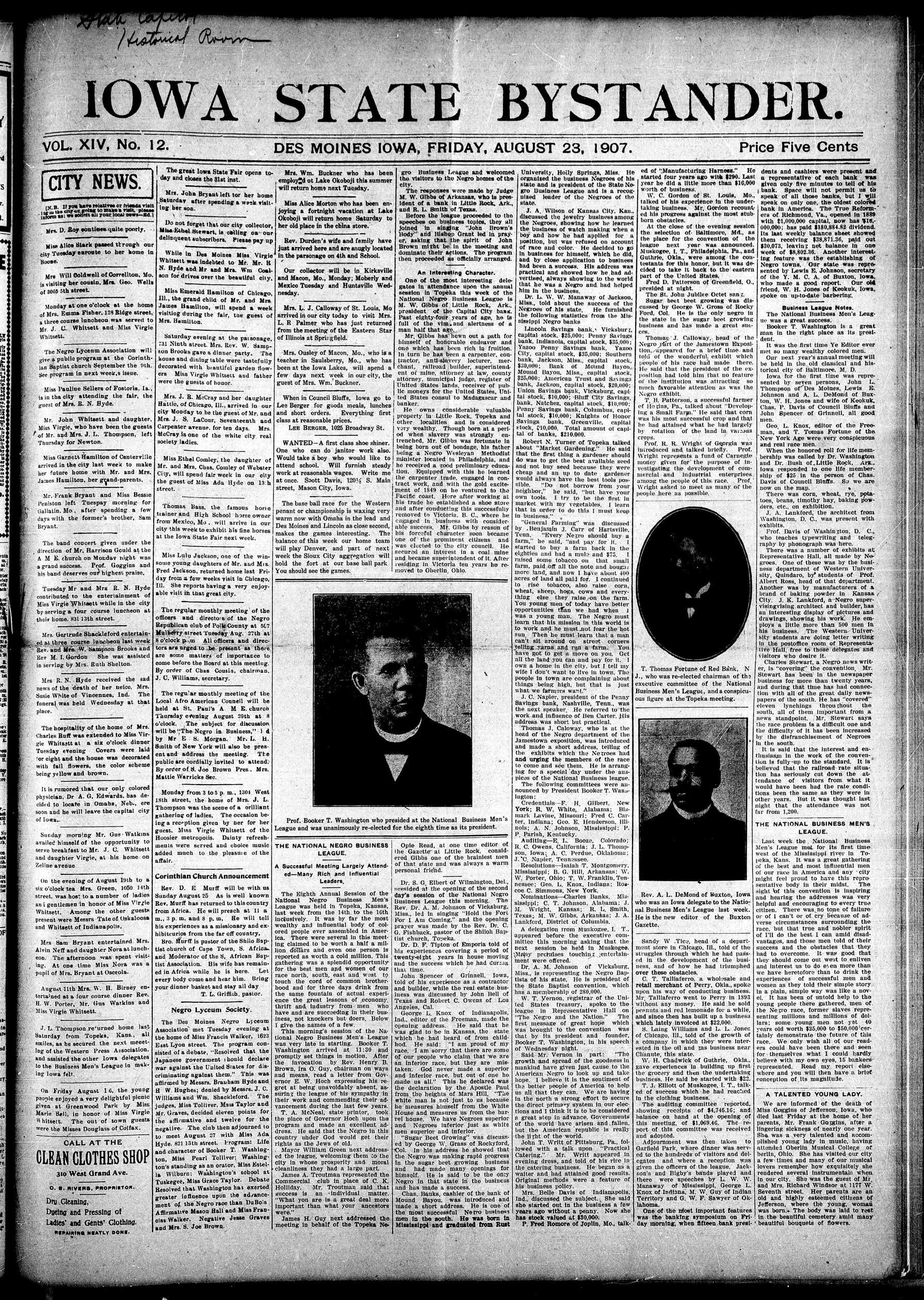
Prof. Booker T. Washington who presided at the National Business Men's League and was unanimously re-elected for the eighth time as its president.
Mrs. Wm. Buckner who has been employed at Lake Okoboji this summer will return home next Tuesday.
Miss Alice Morton who has been enjoying a fortnight vacation at Lake Okoboji will return home Saturday to her old place in the china store.
Rev. Durden's wife and family have just arrived here and are singly located in the parsonage on 4th and School.
Our collector will be in Kirksville and Macon, Mo., Monday; Moberly and Mexico Tuesday and Huntsville Wednesday.
Mrs. L. J. Calloway of St. Louis, Mo arrived in our city today to visit Mrs. L. R Palmer who has just returned from the meeting of the Eastern Star of Illinois at Springfield.
Mrs. Ousley of Macon, Mo., who is a teacher in Saulberry, Mo., who has been at the Iowa Lakes, will spend a few days next week in our city, the guest of Mrs. Wm. Buckner.
When in Council Bluffs, Iowa go to Lee Berger for goods meals, lunches and short orders. Everything first class at reasonable prices.
LEE BERGER, 1025 Broadway St.
WANTED - A first class shoe shiner.
One who can do janitor work also.
Would take a boy who would like to attend school. Will furnish steady work at reasonable wages. Write me at once. Scott Davis, 120½ S. Main street, Mason City, Iowa.
The base ball race for the Western penant or championship is waxing very warm now with Omaha in the lead and Des Moines and Lincoln as close second, makes the games interesting. The balance of this week our home team will play Denver, and part of next week the Sioux City aggregation will hold the fort at our base ball park You should see the games.
Prof. Booker T. Washington who pro-
League and was unanimously re-elected
THE NATIONAL NEGRO BUSINESS
LEAGUE.
James A. Troutman represented the Commercial club in place of C. K. Holliday. Mr. Troutman said that success is an "individual matter." "What you are is a great deal more important than what your ancestors were." James H. Guy next addressed the meeting in behalf of the Topeka Ne-
gro Business League and welcomed the visitors to the Negro homes of the city.
The responses were made by Judge W. M. Gibbs of Arkansas, who is president of a bank in Little Rock, Ark, and R. L. Smith of Texas. The responses were received to the speeches on business topics, they all joined in singing "John Brown's Body" and Bishop Grant led in prayer, asking that the spirit of John Brown might be in the meeting and dominate their actions. The program then proceeded as officially arranged.
An Interesting Character.
One of the most interesting delegates in attendance upon the annual session in Topeka this week of the National Negro Business League is M. W. Gibbs of Little Rock, Ark. Eighty-four years of age, he is full of the vim and alertness of a man half that age.
Mr. Gibbs has hewn a path for himself of honorable endeavor and one which has been rich in fruition. In turn he has been a carpenter, constructionman, railroad builder, superintendent of mine, attorney at law, county attorney, municipal judge, register of United States lands, receiver of public monies for the United States, United States consul to Madagascar and banker.
He was considerable valuable property in Little Rock, Topeka and other localities and is considered very wealthy. Though born at a period when slavery was strongly entrenched, Mr. Gibbs was fortunate in being born out of bondage, his father being a Negro Wesleyan. Methodist he received a good preliminary education. Equipped with this he learned the carpenter trade, engaged in contract work, and with the gold excitement of 1849 he ventured to the Pacific coast. Here after working at his trade he established a shoe store. He was also a teacher and a friend he received to Victoria, B. C., where he engaged in business with considerable success. Mr. Gibbs by reason of his forceful character soon became one of the prominent citizens, and was elected to the council. He secured an interest in a coal mine in the vicinity of Itafo after residing in Victoria ten years he removed to Oberlin, Ohio.
resided at the National Business Men's for the eighth time as its president.
Ople Read, at one time editor of the Gazette at Hittle Rock, considered Gibbs one of the brainiest men of that state and was always a warm personal friend.
Dr. S. G. Elbert of Wilmington, Del., presided at the opening of the second day's session of the National Negro Business League this morning. The Rev. R. D. M. A. Johnson of Vicksburg, Dr. M. A. lel in singing "Hold the Fort, Hold the Fort," and praying that the prayer was made by the Rev. Dr. C. G. Fishback, pastor of the Shiloh Baptist church, Topeka. Dr. D. F. Tipton of Emporia told his experiences covering a period of twenty-eight years in house moving success which he had curried that time. John Spencer of Grinnell, Iowa, told of his experience as a contractor and builder, while the real estate business was discussed by John Bell of Robert C. Owens of Los Angeles Cal.
George L. Knox of Indianapolis, Ind., editor of the Freeman, made the opening address. He said that he was glad to be in Kansas, the state which he had heard of from childhood. He said: "I am proud of my race. I am sorry that there are some who are an inferior race, but they are mistaken. God never made a superior and inferior race, but out of one he made us all." The he declared was the declaration by the Apotheke Paul from the heights of Mars Hill. "The white man is not just to us because he measures himself from the bottom of the barrel. We have Negroes superior and Negroes inferior just as whites men superior and inferior." "Sugar Beet Growing" was discussed by George W. Grass of Rockyford, Col. In his address he showed that the Negro was making rapid progress in the sugar beet growing business in the state, himself. He is said to be the only Negro in that state in the business and has made a success.
Chas. Banks, cashier of the bank of Mound Bayou, was introduced and made a short address. He is one of the most successful Nero business men in the south. He was born in Mississippi and graduated from Rust
University, Holly Springs, Miss. He organized the business Negroes of his state and is president of the State Negro Business League and is a recognized leader of the Negroes of the state. A. Wilson of Kansas City, Kans., discussed the jewelry business among the Negroes, showing how he learned the business of watch making when a boy and how he had applied for a position, but was refused on account of race and color. He decided to go in business for himself, which he did, and close application to business that he had practiced and showed how he had advertised, always showing to the world that he was a Negro and had helped him in the business. Dr. L. W. W. Manaway of Jackson, miss., told about the success of the Negroes of his state. He furnished the following statistics from the Mississippi Negroes.
Lincoln Savings bank, Vicksburg, capital stock, $25,000; Penny Savings bank, Indianola, capital stock, $35,000; Yazoo Penny Savings bank, Yazoo City, capital stock, $35,000; Southern bank, Jackson, Miss, capital stock, Bank of Mound Bayon, Mound Bayon, $25,000; American Trust and Savings bank, Union Savings bank, Vicksburg, capital stock, $10,000; Bluff City Savings, bank, Natchez, capital stock, $10,000; Penny Savings bank, Columbus, capital stock, $10,000; Knights of Honor Savings, Knights of Honor, capital stock, $10,000. Total amount of capital of banks, $20,000.
Robert N. Turner of Topeka talked about "Market Gardening." He said that the first thing a gardener should do was to get the best available seed and not buy seed because they were and an up to date gardener would always be able to grow it. "Do not borrow from your neighbor," he said, "but have your own tools. I try to be the first in market with my vegetables. I learn that in order to do this I must keep in business." "Genius Farming" was discussed by Benjamin J. Carr of Hartville, Tenn. "Every Negro should buy a farm," he said, "and pay for it. I started to buy a farm back in the eighties and had a mule and $75. I raised some tobacco on that small farm and off all the note and bougainvillea and had acres of land all paid for. I continued to rise tobacco, also raise corn, wheat, sheep, hogs, cows and everything else they raise on the farm. You young men of today have better opportunities than we had when I was a child. I learn that this mission in this world is to work and he must not fear the hot sun. Then he must learn that a man can't sit around on street corners telling yarn and run a farm. You have got to get a move on you. Get a new home and learn to own a home in the city, but I tell my wife I don't want to live in town. The people in town are complaining about things being high, but that is just what we farmers want." J. C. Napain, president of the Penny Savings bank, Nashville, Tennessee, was the first person to work and influence of Ben Carter. His address was short but practical.
Thomas J. Caloway, who is at the head of the Negro department of the Jaunestown exposition, was introduced and made a short address, telling of the exhibits which the Negroes had and urging the members of the race for a special day under the auspices of the National Business league. The following committees were announced by President Booker T. Washington: Credentials—F. H. Gilbert, New York; W. White, Alabama; Bibnark Lavine, Missouri; Fred C. Carter, Indiana; Geo. E. Henderson, Illinois; A. N. Johnson, Mississippi; P. Parish, Kaucity. Auditing—E. L. Booze, Colorado; R. C. Owens, California; J. L. Thompson, Iowa; A. C. Perdue, Oklahoma; J. Curley, Tennessee. Reconciling Montgomery, Mississippi; B. G. Hill, Arkansas; W. W. Porter, Ohio; T. W. Franklin, Tennessee; Geo. L. Knox, Indiana; Roose C. Simmons, New York. Nominations—Charles Banks, Mississippi; C. T. Johnson, Alabama; J. M. Wright, Kansas; R. L. Smith, Tennessee; Geo. L. Knox, Indiana; J. A. Lankford, District of Columbia. A delegation from Muskogee, I. T., appeared before the executive committee this morning asking that the next session be held in Muskogee. Many prizes touching entertainment were offered. Dr. A. M. Johnson of Vicksburg, Miss., is representing the Negro Baptist president of the State Baptist convention, which has a membership of 280,000.
W. T. Vernon, registrar of the United States treasury, spoke to the league in Representative Hall on "The Negro and the Nation." The first message of great hope which was brought to the league by its president and founder, Booker T. Washington, in his speech of Wednesday night.
Said Mr. Vernon in part: "The growth and spread of the goodness in mankind have given just cause to the American Negro to look up and take the better people of America to help us all that they can. We are having in the north a strong effort to secure the direct primary system in our elections and I think it is to be considered a great step in advance. Governments of the world have arisen and fallen. The best public is really the right of the world.
John T. Writt of Pittsburg, Pa., followed by a talk upon "Practical Catering." Mr. Writt appeared in evening dress, and told of his rise in the catering business. He began as a waiter and had attained good results. He became a feature of his business policy.
Mrs. Belle Davis of Indianapolis, Ind., discussed the subject. She said she started out in the business a few years ago without a penny. Now she has stock valued at $30,000. We talk
P. Fred Romore of Joplin, Mo., talk
Prof. R. R. Wright of Georgia was introduced and talked briefly. Prof. Wright represents a fund of Carnegie money given for the purpose of investigating the development of commercial and industrial enterprises among the people of this race. Prof. Wright asked to meet as many of the people here as possible.
T. Thomas Fortune of Red Bank, N. J., who was re-elected chairman of the executive committee of the National Business Men's League, and a conspicuous figure at the Topeka meeting.
Rev. A. L. DeMond of Buxton, Iowa who was an Iowa delegate to the National Business Men's League last week. He is the new editor of the Buxton Gazette.
Sandy W. Tice, head of a department store in Chicago, Ill., told of the struggles through which he had passed in the development of the business, and of how he had triumphed over these obstacles.
C. T. Tallaferoer, a wholesale and retail merchant of Perry, O.K., spoke upon his way of conducting business. Mr. Tallaferoer went to Perry in 1893 and sold pennants and red lemonade for a while, and since then has built up a business which lately invoiced at $22,000. S. Laing Williams and L. L. Jones of Chicago, Ill., told the growth of a company in which they were interested, and gas business near Chianute, this state. W. H. Chadwick of Guthrie, Okla., gave experiences in building up first the grocery and then the undertaking business. He said he started with $2.25 and then went on to succeed of success which he had reacquired in the clothing business. The auditing committee reported, showing receipts of $4,745.16; and balance on hand at the opening of this meeting, of $1,069.46. The reacquired committee was received and adopted. Adjournment was then taken to Garfield Park, where dinner was served to the hundreds of visitors and delegates, and where a reception was held for the guests. The cools and Biggs' bands played and there were speeches by L. W. Manaway of Mississippi, George L. Knox of Indiana, M. W. Guy of Indian Territory and G. W. Sawyer of Oklahoma. The most important features was the banking symposium on Friday morning, when fifteen bank press
```markdown
```
Price Five Cents
He dents and cashiers were present and a representative of each bank was given only five minutes to tell of his bank. Space will not permit us to speak of all those banks, but I will speak on only one, the oldest colored bank in America. The True Reformers of Richmond, Va., opened in 1889 with $1,000,000 capital, now has $10,000,000; has paid $180,854.82 dividend. Its last weekly balance sheet showed them receiving $38,871.36, paid out $30,073, leaving net balance in one week of $8,802.36. Another interesting feature was the establishing of Negro towns. Our state was represented by Lewis E. Johnson, secretary of the Y. M. C. A. of Buxton, Iowa, who made a good report. Our old friend, W. H. Jones of Keokuk, Iowa, spoke on up-to-date barbering.
Business League Notes.
The National Business Men's League was a great success.
Booker T. Washington is a great man in the right place as its president.
It was the first time Ye Editor ever met so many wealthy colored men. He was the first national meeting will be held in the old classical and historical city of Baltimore, M. D.
Iowa for the first time was represented by seven persons, John L. Thompson of Des Moines, Lewis E. Johnson and A. L. DeMond of Buxton, W. H. Jones and of Keokau, Chas, P. Davis of Council Bluffs and John Spencer of Grinnell, all good men.
Gee, L. Knox, editor of the Freeman, and T. Tomas Fortune of the New York Age were very conspicuous and real race men.
When the honored roll for life membership was called by Dr. Washington and Dr. Bush of Little Rock, Ark. We were the membership of $25 in the person of Chas. Davis of Council Bluffs. So we are now on the man.
There was corn, wheat, rye, potatoe, beans, timothy hay, baking powders, etc., on exhibition.
J. A. Lankford, the architect from Washington, D. C., was present with exhibits
J. A. Davis of Washington, D. C., who teaches typewriting and telegraph by phonograph was here.
There was a number of exhibits at Representative Hall, all made by Negroes. One of these was by the business department of Western University, Quindara, by student J. A. Lankford, by department. Another was by manufacturers of a brand of baking powder in Kansas City. J. K. Lankford, a Negro supervising architect and builder, has an interesting display of pictures and drawings, showing his work. He employs a little more than 40 students. University students are doing letter writing in the postoffice room of Representative Hall, to those delegates and visitors who desire it.
Charles Stewart, a Negro news writer, is "covering" the convention, Mr. Stewart has been in the newspaper since 1910, and during that time has had connection with all of the great daily newspapers of the south. He has "covered" eleven lynchings throughout the south, all of them important from a news standpoint. Mr. Stewart says the race problem is a difficult one and of it has been increased by the disfranchisement of Negroes in the south.
It is said that the interest and enthusiasm in the work of the convention is fully-up to the standard. It is believed that the railroad rate situation has seriously cut down the attendance of visitors from what it was in the past, and the realities been the same as they were in other years. But it was thought last night that the attendance was not far from 1,200.
THE NATIONAL BUSINESS MEN'S LEAGUE
Last week the National Business Men's League met for its first time west of the Mississippi river in Topeka, Kans. It was a great gathering of the best and most influential men in the country, and many might feel proud to have this representative body in their midst. The sight of this convention is inspiring and hearing the addresses was very helpful and encouraging to every true citizen. There was no tone of failure over the course of the circumstances surrounding the race, but that true and noble spirit of I'll do the best. I can amid disadvantages, and those men told of their success and the obstacles that they had to overcome. It was good that they should come out west to entwine with the men of the community we have heretofore to drink the experiences of successful men and women as they told their simple story in a plain, simple way was like a novel. It has been of untold help to the young people there gathered, men of the community senting millions and millions of dollars; some young men not yet 40 years old worth $25,000 to $50,000 certainly demonstrate the future of this race. We only wish all of our readers could have been there and seen for themselves what eyes 15 bankers represented. Read my report elsewhere and you will then have a brief conception of its magnitude.
A TALENTED YOUNG LADY.
We are informed of the death of Miss Goggins of Jefferson, Iowa, who died last Friday at the home of her parents, Mr. Frank Goggins, after a lingering sickness of nearly one year. She was a very talented and accomplished young lady in music, having been born in a small city of birth, Ohio. She has visited our city a few times and many of our musical lovers remember how exquisitely she rendered several instrumentals when in our city. She was the guest of Mr. and Mrs. Richard Windsor at 117 W. Seventh street. Her parents are an old and highly esteemed citizens of Jefferson, where the young, woman was born. She is in the beautiful cemetery amid many beautiful bouquets of flowers.
The man who invented the Teddy bear has been arrested for an entirely different crime.
Some Spanish anarchist has started the story that the queen of Spain writes poetry.
A Georgia preacher announces that there must be no hell. Must be cloudy in Georgia nowadays.
Hell is in the sun, according to a greacher. The sun has certainly been acting like that this year.
King Chulalongkorn of Sham is going to visit us. Won't he be great picking for newspaper poets?
Mark Twain, probably wears that white suit to match his hair. That involves less trouble than changing the color of the hair.
A Harvard graduate is walking to San Francisco. He says it is on a wager, but probably the facts are that he wants to get there.
Kink Edward is one of the few men who can afford to tutorain 7,000 guests at one time and take his chances with the souvenir hunters.
What a fine, hearty laugh Englishmen will have in about five years from now when some of Mark Twain's jokes have begun to dawn on them!
Don't quarrel about nature, gentlemen writers about the beasts of the fields and the birds of the air. She is old enough to take care of herself.
Psychic epilepsy is the latest excuse for shooting up the town. Psychic confinement on psychic bread and water should be tried as a cure.
Thirty thousand gypsies are to be banished from Hungary, and it is reported that they may come to this country. They will make a mistake if they come now. The advent of the automobile has made horse trading untractive, and the fortune-telling business has almost completely gone over to people who do not pretend to have any gypsy blood in their veins.
It seems like a curious reversal of ocular conditions when the west comes to the east to get buffaloes, with which to replenish its stock. Yet that is just what has happened. The owner of a big ranch in Oklahoma, relates the Troy, (N. Y.) Times, has purchased a collection temporarily located at the Bronx zoological gardens, and the animals will be shipped to the new owner's home. The transaction involves a buffalo hunt, but with a difference.
When the king of Italy was told that a son had been born to the wife of Lloyd C. Griscom, the American ambassador in Rome, he exclaimed: "I had always believed that ambassadors were blessed only with grand sons!" Ambassadors, as well as senators, used to be old men, but this all seems to have been changed. Ambassador Griscom is only 34 years old, and it will be many years before he is a grandfather; and there are many men in the senate less than 50.
Another man 101 years old has wed his first sweetheart, now 100 years old. This is getting to be quite a fad. The man or woman who doesn't get married on his or her one hundredth birthday is very much behind the times. There is nothing like starting the second century right. Many a man who looks back regrettely as memories of his first sweetheart are recalled would be willing to marry the girl provided she would consent to wait until his one hundredth birthday. The natives of the Tonga or Friendly islands, off the east side of New Zealand, are said to be the finest in physique of any on earth. The average height of the males is five feet ten inches. Many of them are over six feet. They weigh from 160 to 300 pounds, and are very straight, being built in proportion. The women average a greater height than the women themselves. They have fine figures and average from 100 to 160 pounds in weight. They are of a copper color, straight-haired and with features which made the Greeks famous.
Congress is to be called upon to transform the United States into the emblance of the garden of Mistress Mary, the "quite contrary" you g lady who raised "columbines all in a row." The Columbine association is perfecting plans to petition the national legislature to make the columbine the national flower. One of its members, a professor of botany, maintains that no flower would be more appropriate, as the name comes from the Latin word meaning "a dove, the world's emblem of peace—a name given to this flower because one common form of it resembles a group of doves."
There seems to be a growing disposition among sportsmen to give the hunted animal a fair chance. Few hunters will now defend the pursuit of deer at night with a jack-light, a method of hunting in which the animal has little chance for his life. Mr. Cleveland, a hunter and fisherman, as well as a former president, has lately conferred with sportsmen fishing with night lines, and has urged that humane persons whose friends thus violate the principles of sportsmanship should express in some way their condemnation of such conduct.
The waiters in convention in New York have decided not to abolish the tipping system, because the object of their organization is "to raise the social standing and increase the individual culture and refinement of the waiter." It is contended that to do this the waiter must have money for books and paintings and statuary and travel. From this point of view the more expensive waiter a dime at the close of the meal, or a badly served dinner can feel himself in the same class of philanthropists with Andrew Carnegie.
TAFT TALKS OF RACE ISSUE
AND THE DEMOCRACY.
Is of Opinion That When Negroes Become Respected Business Men Suffrage Will Be Accordeed.
Lexington Ky., Aug. 23.—With a discussion of the race problem, general political issues from the southwestern point and an appeal to Kentucky's population and other southeners to come to the aid of the republicans in support of those principles which he believed they favored. Secretary of War William O. Hearn opened the state campaign in this city.
Calling attention to what he called the south's lack of representation in the councils of the nation, the chief justice of the court, "because a single issue has made the south the perpetual tail of the democratic party so that however small the northern head, it wags the tail of the south," he shadows an issue that circumstances ought to have long removed from political controversy, to blind its solidity to the democratic party, no matter what principals or candidates that party "selected."
He called attention to the prosperity of Kentucky's developing industry, and he pressed the belief that many Kentuckians who favored a protective tariff had blindly voted the democratic ticket from the feeling of the
After mentioning the various means of disfranchising voters, declaring that such laws were proper if applied with equal fairness to both black and white, he expresses his confidence in the citizens under the leadership of such men as Booker T. Washington would "become respected business members of the communities in which they live and when they exercise independence of judgment in respect to politics," he adds. "Initially, the right to vote will be accorded them and they will exercise a far more useful influence as intelligent and solid members of the community for the benefit of their race than the right to vote. The man he exercised had been allowed to vote. In this way, through devious ways which cannot be justified or approved, we may still reach a result that will square with the requirements of the federal constitution, every political and economic right and will confer great benefit upon the colored race."
STANDPATTERS WILL FIGHT.
The Utterances of Chairman Payne Are Significant.
Washington, D. C., Aug. 23—Chairman Payne of the house ways and means committee delivered himself of some utterances on tariff revision that make it clear that he has no thought of revision before the president is informed that he is not willing to commit himself to revision after that election. He said that he considered that there was general consent among republicans to the proposition that it would be on the eve of a presidential election. When asked if there would be a revision after the presidential election, he said: "I think the republican national convention will decide that the president should favor revised revision after election, he merely said: "I have great confidence in a republican convention and in a republican congress. I am willing to abide by the decision of the republican congress in any question relating to party policies."
He added there were no hard times in New York state. Factories were running full time and every man who wanted employment could have it. Mr. Payne's caution tone about reopening the factory has long other developments among standdatters, are making it more and more plain that tariff revision has plenty of obstacles yet ahead of it, and that the high tariff forces have not by any means been an overhauling of schedules after the presidential election.
Attorney General Bonaparte has conferred with Special Counsel Frank B. Kellogg and Charles B. Morrison over the Standard Oil dissolution suit. Mr. Bonaparte's activity in the suit has further served to strengthen the oil monopoly to smash the oil monopoly and also to bring criminal prosecutions against the leading Standard Oil magnates for violation of ti Sherman law.
TO MARK INDIAN WIFE'S GRAVE.
The Body of Mrs. Sam Houston Was
Routed in Indian Territory
Fortune in Indian territory.
Fortune in Indian territory—The federal government has sent to the national cemetery at this place a stone monument to mark the grave of Gen. Sam Houston, first president of the republic of Texas, who lived for a number of years among the Cherokee Indians in Indian Ter-
Tallahassee Rogers died in 1833, five years after General Houston left the Cherokeees and went to Texas. Her body was bured at Wilson's rock, close to the Arkansas river, about eight miles from the present town of Muldrow. J. F. Holden, editor of the Gibson Post, found the grave of Houston's Indian body, the body to the national cemetery of Fort Gibson, giving it interment. In what is known as the "officers' circle".
GRANITE BLOCKS ARE PLACED
Work on New State Capitol Building
New To Go On in Barrard
Madison, Wis., Aug. 22—The first granite blocks of the new $8,000,000 capitol of Wisconsin have been laid and the work will hereafter be rushed as rapidly as possible. Eight large blocks are in position. Some of the blocks weight over a ton, and require the use of a derrick. All of the blocks are dressed and ready to be placed in position.
Planning for Great Labor Meet.
Norfolk, Va. Aug. 23—The executive committee of the American Federation of Labor has arrived here for the purpose of completing arrangements for the Federation Nov. 12. The committees will hold daily sessions till the arrangements are perfected.
ARE PHYSICIANS' PRESCRIPTIONS
NOSTRUMS?
To one not qualified, and few laymen are, to discriminate intelligently between physicians' prescriptions, proprietary medicines and nortrums, it may seem little more of a crime to hint even that physicians' prescriptions are not easily manner related to examination, nevertheless, an impartial examination of all the facts in the case leads irreasibly to the conclusion that every medicinal preparation compounded and dispensed by a physician is, in the strict sense of the word, a nostrum, and that the average, ready-prepared proprietary remedy is superior to the average specially-prepared physicians' prescription.
What is a nostrum? According to the Standard Dictionary a nostrum is "a medicine the composition of which is kept a secret." Now, when a physician compounds and dispenses with his own hands a remedy for the treatment of a disease—and it is authoritatively stated that probably 60 percent of all physicians' prescriptions in this country are so dispensed—the names and quantities of the ingredients which constitute the remedy are not made known to the patient. Hence, since its composition is secret, the remedy or prescription is unquestionably, in the true meaning of the word, a Simpure nostrum. Furthermore, the prescription compounded by the average physician is more than likely to be a perfect blem—replete with therapeutic, physiologic and chemical incompatibilities and bearing all the marks of pharmaceutical incompetency; for it is now generally admitted that unless a physician has made a special study of pharmacy and passed some time in a drug store for the purpose of gaining a practical knowledge of modern pharmaceutical methods, he is not fitted to compound remedies for his patients. Moreover, a physician who compounds his own prescriptions not only deprives the pharmacist of his just necessity, but he also does so for the patients; for it is only by the detection and elimination of errors in the prescriptionists that the safety of the public can be effectively shielded from the criminal blunders of ignorant physicians.
Nor can it be said that the average physician is any more competent to formulate a prescription than he is to compound it. When memorized or directly copied from a book of "favorite prescriptions by famous physicians," or from some text-book or medical journal, the prescription may be all that it should be. It is only when the physician is required to originate a formula on the spur of the moment that his incompetency is distinctly evident. Seemingly, however, the physicians of the United States are little worse than the average British physician for instance. The average Materia Medica and Pharmacy, Edinburgh, launceting in the Medical Magazine the passing of the prescription and bemoaning the fact that seldom does he find a "final man" able to devise a prescription even in "good contracted Latin."
And what, it may be asked, is the status of the written prescription—the prescription that is compounded and dispensed by the pharmacist—is it, too, a nostrum? It may be contended that the patient, with the written formula in his possession, may learn the character of the remedy prescribed. So, possibly, he might if he understood Latin and was a physician or a pharmacist, but as he usually possesses no professional training and is not practically a dead secret to him. Furthermore, the average prescription is so badly written and so greatly abbreviated that even the pharmacist, skilled as he usually is in dechiphering medical hieroglyphs, is constantly obliged to interview prescribers to find out what actually has been prescribed. It may also be contended, that inasmuch as the formula is known to both physician and pharmacist the prescription cannot therefore be a secret. But with equal truth it might be called nostrum is not a secret since it is known to both proprietor and manufacturer; for it must not be forgotten that, according to reliable authority, 95 per cent. of the proprietors of so-called patient medicines prepared in this country have their remedies made for them by large, reputable manufacturing pharmacists. But even should a patient be able to recognize the names of the ingredients mentioned in a formula he would only know half the story. It is seldom, for instance, that alcohol is specifically mentioned in a prescription, for it is usually contained in the form of distillate extracts, as are a great many other substances. It is evident, therefore, that the ordinary formulated prescription is, to the average patient, little less than a secret remedy or nostrum.
On the other hand, the formulae of neatly all the proprietary medicines that are exploited exclusively to the medical profession as well as those of a large percentage of the proprietary remedies that are advertised to the public are published in interstates) are published in a full. Under the Food and Drugs Act, every medicinal preparation entering interstate commerce is now required to have the proportion or quantity of alcohol, opium, cocain and other habit-forming or harmful ingredients which it may contain plainly printed on the label. As physicians' prescriptions are made, cocain and other herbicides they are practically exempt under the law. And if it be necessary for the public to know the composition of proprietary remedies, as is contended by those who through-
An elderly woman entered a shop and asked to be shown some tablecloth. The woman brought a pile and showed them to her, but she she had seen those clothes suited her. "Haven't you something new?" she asked. The man then brought another pile and showed them to her. "These are the newest patterns," he said. "You will notice the edge runs right round the border and the center is in the middle."Dear me, yes. I will take half a dozen of them," said the woman.
norance or for mercenary reasons are opposing the sale of all household remedies, why is it not equally necessary for patients to know the composition of the remedy prescribed by a physician? Does any same person believe that the opium in a physician's prescription is less potent or less likely to create a drug habit than the opium in a proprietary medicine? What is the difference between addicts and cocaine-frauds have been made through the criminal carelessness of important physicians than by any other means.
Unquestionably, there are a number of proprietary remedies on the market the sales of which should be prohibited, and no doubt they will be when the requirements of the Food and Drugs Act are rigidly enforced; many are frauds, pure and simple, and some are decidedly harmful. Of the average proprietary remedy, the most bitter that it is dismayably better than the average physicians' prescription; for not only is its composition less secret, but it is prepared for the proprietor by reputable manufacturing pharmacists in magnificently equipped laboratories and under the supervision and advice of able chemists, competent physicians and skillful pharmacists. It should not be considered strange, therefore, that so many physicians prefer to prescribe these ready-prepared proprietary remedies rather than trust those of their own devising.
JUST THE MASS AS CURRENCY.
Third Son Felt He Had Nothing to Reproach Himself with.
William Knoepfel, of St. Louis, has invented and hopes to patent a secret plowing method for the cure of baldness. "A genine cure for baldness," said Mr. Knoepfel the other day, should make a man very rich. Why, men grow rich on fake cures. It is amazing, it really is, whatakes some of these cures are. Yet there'money in them." Mr. Knoepfel gave a loud, scornful laugh. "In their crookedness they remind me," he said, "of the third son of the old eccentric person you have heard the story. Well, you know, he has fortune equally to his three sons. But the will contained a strange provisor. Each heir was to place $100 in the coffin immediately before the interment. A few days after the interment the three young men met and discussed the queer proviso and its execution. 'Well,' said the oldest son, 'my conscience is clear. I put my hundred in the coffin in clean, new notes.' My conscience is clear, too,' said the second son. I put in my hundred in gold'." The third son, self with, said the third son. I had no cash at the time, though, so I wrote out a check for $200 in poor, dear father's name, placed it in the coffin' and took in change the $200 in currency that I found there."
PUSHED THE BEAR ASIDE.
Surveyor Tells of Experience He Does
Not Care to Repeat.
To walk right up to a monster bean and try to shove it out of the way and then escape without so much as a scratch is an experience of a lifetime. Harry I Engelbright found it so a few days ago in Diamond canyon, above Washington, says a Nevada City correspondent of the Sacramento Bee. The young man, son of Congressman Engelbright, has just returned from the upper country, where he has been doing some surveying, and related his husband's work. It was on dusk, at the close of the day's work. In the brushful trail he saw protruding what he thought were the hind quarters of some stray bovine. He walked up and gave the brute a shove. It came to its haunches with a snort that made his hair rise and caused him to beat a haasty retreat. The big brute looked around and then shuffled off into the woods. It was either alpine or else so busy eating ants from an old log that it failed to hear the young surveyor, whose footsteps were heard in the thick carpet of pine needles. Later it was learned that the same bear, a monster cinnamon, had killed a dog earlier in the day. The dog ventured too close and with one blow of its paw the big beast sent it hurting yards away, dead as a doorall.
Magnifying Choir Leader's Voice.
In the old village of Braybrook in Northamptonshire, England, is a monster trumpet, five six inches in length, and having a bell-shaped end two feet one inch in diameter. The trumpet is made up of ten rings, which in turn are made up of smaller parts. The use of this trumpet—only four of the kine are known to exist at the present time—is the voice of the leader in the choir and summer people to the church service. At the present time neither the choir nor the service is in need of this extraordinary "musical instrument," but the vicar of the church lakes carc, of the ancient relic and is fond of showing it to all visitors.
Painfully Exact.
A New England man tells of a prosperous Connecticut farmer, painfully exact in money matters, who married a widow of Greenwich possessing in her own right the sum of $10,000. Shortly after the wedding a ...and met the farmer, to whom he offered congratulations, at the same time observing: "It's a good thing for you, Malachi, a marriage that means $10,000 to you." "Not quite that, Bill" said the farmer, "not quite that." "Why," exclaimed the friend, "I understood there was every cent of $10,000 in it for you!" "He had to pay $2 for a marriage license," said Malachi.
Wit.
A witty, man is a dramatic performer; in process of time he can no more exist without applause than he can exist without air; if his audience be small, or if they are inactive, or if he possesses him of any portion of his admirers he all over with him—he slackens and is extinguished. The applause of the theater on which he performs is a essential to him that he must obtain it at the expense of decoy, friendship and good feeling —Sydney Smith.
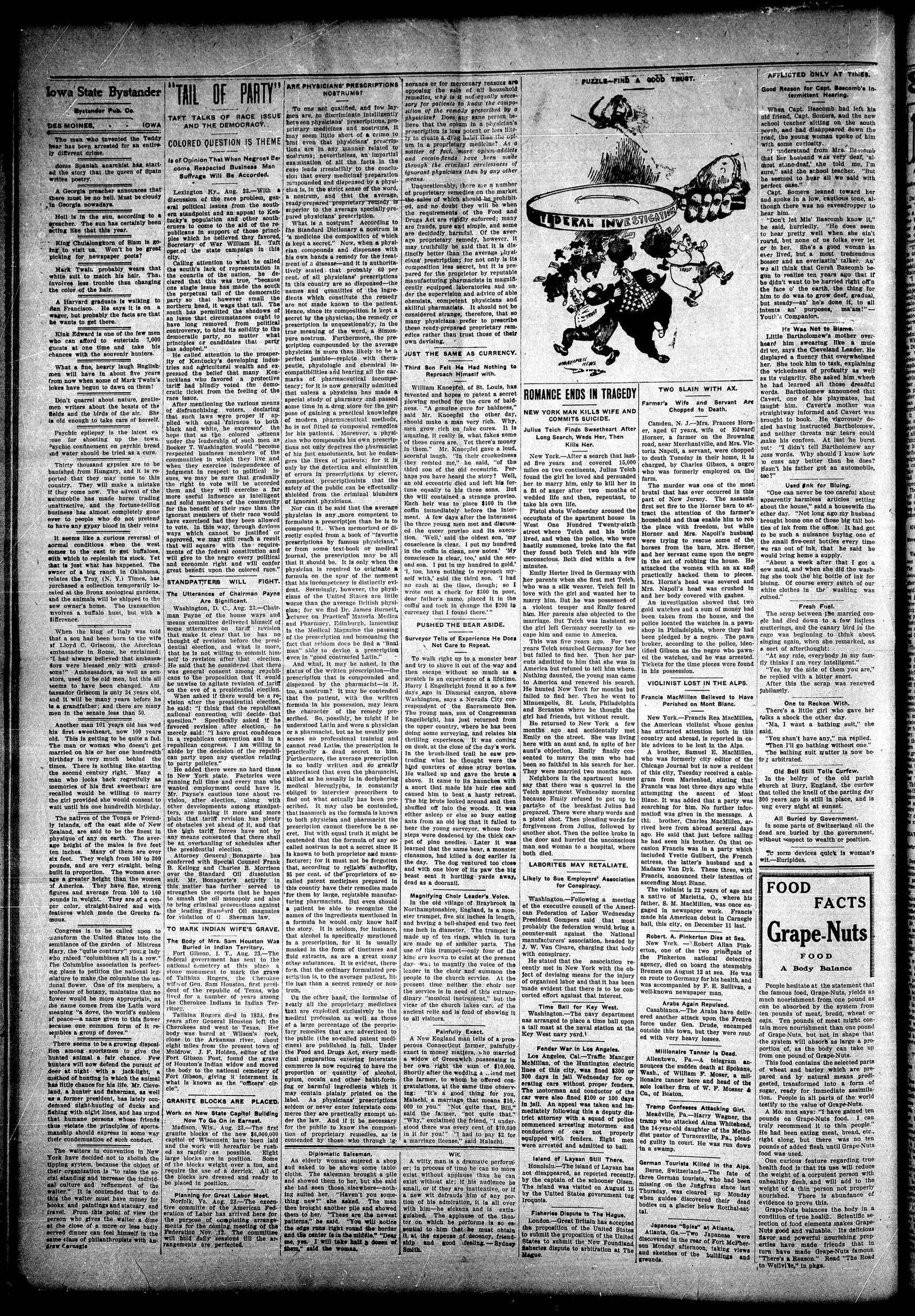
PUZZLE—FIND A GOOD TRUST.
FEDERAL INVESTIGATION
MIDWAY PAPER'S NEWS
ROMANCE ENDS IN TRAGEDY
NEW YORK MAN KILLS WIFE AND COMMITS SUICIDE.
Julius Teich Finds Sweetheart After Long Search, Weds Her, Then Killa Her.
New York—After a search that lasted five years and covered 15,000 miles on two continents, Julius Teich found the girl he loved and persuaded her to marry him, only to kill her in a fit of anger after two months of wedded life and then, repentant, to take his own life.
Pistol shots Wednesday aroused the occupants of the apartment house in West One Hundred Twenty-six street where Teich and his bride lived, and both were hastily summoned, broke into the flat they found both Teich and his wife unconscious. Both died within a few minutes.
Emily Hertzer lived in Germany with her parents when she first met Tetch, who was a silk weaver. Tetch fell in love with the girl and wanted her to marry him. But he was possessed of a violent temper and Emily feared him. Her parents also objected to the marriage. But Tetch was insistent so the girl left Germany secretly to escape him and came to America. This was five years ago. For two years she but failed to find her. Then her parents admitted to him that she was in America but refused to tell him where. Nothing daunted, the young man came to America and renewed his search. He hunted New York for months but failed to find her. Then he went to Minneapolis, St. Louis, Philadelphia and Scranton where he thought the girl had friends, but without result. He returned to New York a few months ago and accidentally met Emily on the street. She was living here with an aunt and, in spite of her aunt's objection, Emily finally conceived. She had been so faithful in his search that they were married two months ago.
Neighbors in the apartment house say that there was a quarrel in the Telch apartment Wednesday morning because Emily refused to get up to partake of the breakfast Julius had prepared. There were sharp words and a pistol shot. Then pleading words for forgiveness from Julius, followed by another shot. Then the police broke in the door and hurried the unconscious man and woman to a hospital, where both died.
LABORITES MAY RETALIATE.
Likely to Sue Employers' Association for Conspiracy.
Washington.—Following a meeting of the executive council of the American Federation of Labor Wednesday President Gompers said that most probably the federation would bring a counter-attack. National manufacturers' association, headed by J. W. Van Cleave, charging that body with conspiracy.
He stated that the association recently met in New York with the object of devising means for the injury of organized labor and that it has been made evident that there is to be concerted effort against that interest.
Time Ball for Key West.
Washington.—The navy department has arranged to place a time ball upon a tall mast at the naval station at the Key West navy yard.
Fender War in Los Angeles.
Los Angeles, Cal.-Trail Manager McMillan, of the Huntington electric lines of this city, was fined $300 or 300 days in jail Wednesday for operating cars without proper fenders. The notorian and conductor of the car were also fined $100 or 100 days in jail. In appeal was taken and immediately following this败诉 of police attorney with a following of police commenced arresting motors and conductors of cars not properly equipped with fenders. Eight men were arrested and admitted to bail.
Island of Layan Still There.
Honolulu—The Island of Layan has not disappeared, as reported recently by the captain of the schooner Olsen. The island was visited on August 15 and United States government tug Iroquois.
Fisheries Dispute to The Hague.
London — Great Britain has accepted
the proposition of the United States
to submit a motion of the United
States to submit the FOUNDATION
saberies dispute to arbitration at The
Mague.
TWO SLAIN WITH AX.
Farmer's Wife and Servant Are Chopped to Death.
Camden, N. J.-M. Frances Horner, aged 67 years, wife of Edward Horner, a farmer on the Browning road, near Merchantville, and Mrs. Victoria Napoll, a servant, were chopped to death Tuesday in their home, it is charged, by Charles Gibson, a negro who was formerly employed on the farm.
The murder was one of the most brutal that has ever occurred in this part of New Jersey. The assassin first set fire to the Horner barn to attract the attention of the farmer's household and thus enable him to rob the place with freedom, but while Horner and Mrs. Napoll's husband were trying to rescue some of the horses from the barn, Mrs. Horner of her servant caught up with the negro in the act of robbing the house. He attacked the women with an ax and practically hacked them to pieces. Mrs. Horner's head was severed and Mrs. Napoll's head was crushed in and her body covered with gashes.
An investigation showed that two gold watches and a sum of money had been taken from the house, and the police located the watches in a pawnshop in Philadelphia, where they had been pledged by a negro. The pawn broker, according to the police, identified the watches, and the police arrested, tickets for the time pieces were found in his possession.
VIOLINIST LOST IN THE ALPS.
Francis MacMillen Believed to Have Perished on Mont Blanc.
New York — Francis Rea MacMillen, the american violinist whose genius has attracted attention both in this country and abroad, is reported in cable advises to be lost in the Alps.
A brother, Samuel E. MacMillen, who was the University of Chicago Journal but is now a resident of this city, Tuesday received a cabelogram from Marlenbad, stating that Francis was lost three days ago while attempting the ascent of Mont Blanc. It was added that a party was searching for him. No further information was given in the message. A thi: brother, Charles MacMillen, arrived here from abroad several days ago. He said that just before sailing he had seen his brother. On that occasion Francis was in a party which included Forrester, the French actress, the latter's, and a Madame Van Dyk. These three, with Francis, announced their intention of ascending Mont Blanc.
The violinist is 22 years of age and a native of Marietta, O., where his father, S. M. McMillen, was once engaged in newspaper work. Francis made his American debut in Carnegie hall, this city, on December 11 last.
Robert. A. Pinkerton Dies at Sea. New York. — Robert Allan Pinkerton, one of the two principals of the Pinkerton national detective agency, died on board the steamship Bremen on August 12 at sea. He was en route to Germany for his health, and was accompanied by F. E. Sullivan, a well-known newspaper man.
Arabs Again Repulsed. Casablanca. — The Arabs have delivered another attack upon the French force under Gen. Drude, encamped outside this town, but they were routed with very heavy losses.
Millionaire Tanner Is Dead.
Allentown, Pa.—A telegram announces the sudden death at Spokane, Wash., of William F. Moser, a millionaire tanner here and head of the sole leather firm of W. F. Mosser & Co., of Boston.
Tramp Confesses Attacking Girl.
Meadville, Pa.—Harry Wagner, the tramp who attacked Alma Whitehead, the 14-year-old daughter of the Methodist pastor of Turnersville, Pa. pleaded guilty in court. He was run down in a swamp.
German Tourists Killed in the Alps.
Berne, Switzerland—The fate of three German tourists, who had been missing on the Jungfrau since last Thursday, was cleared up Monday when guides discovered their dead bodies on a glacier below Rotthal-satal.
Japanese "Spies" at Atlanta.
Atlanta, Ga.—Two Japanese were discovered in the rear of Fort McPherson Monday afternoon, taking views and sketches of the buildings and greens.
APFLICTED ONLY AT THRES.
Good Reason for Capt. Bascomb's Intermittent Hearing.
When Capt. Bascomb had left his old friend, Capt. Somers, and the new school teacher sitting on the south porch, and had disappeared down the road, the young woman spoke of him with some curiosity.
"I understand from Mrs. Bascomb that her husband was very deaf, almost stone-deaf," she told me, I am sure," said the school teacher. "But he seemed to hear all we said with perfect ease."
And capt. Somers leanced toward her and aped in a spoke in low, cautious tone, although there was no eavesdropper to hear him.
"Don't let Mis' Bascomb know it," he said, hurriedly. "He does seem to hear pretty well when she ain't round, but none of us folks ever or to her. She's a good woman as ever lived, but a most tremendous bosser and an everlasting talker. An' was all thinkin' ten years ago that if he didn't want to be harried right off in the face o' the earth, the thing for him to do was to grow deef, gradual, but steady—an' he done it, to all intents an' purposes, ma'am!" —Youth's Companion.
He Was Not to Blame.
Little Bartholomew's mother overheard him swearing like a mute child, and displayed a fluency that overwhelmed her. She took him to task, explaining the wickedness of profanity as well as its vulgarity. She asked him where he had learned all those dreadful words. Bartholomew announced that Cavert, one of his playmates, had taught him. Cavert's mother was straightway informed and Cavert was brought to book. He vigorously denied having instructed Bartholomew, having threats for teammates make his confess. At last he burst out: "I didn't tell Bartholomew anyuss words. Why should I know how to cuss any better than he does? Don't his father got an automobile, too?"
Used ink for Bluing.
"One can never be too careful about apparently harmless articles setting about the house," said a housewife the other day. "Not long ago my husband brought home one of those big tail bottles of ink from the office. It had got to be a nuisance buying one of the small five-cent bottles every time we ran out of ink, that he said he would bring home a supply. "I bought a week after that I got a sow ear, and when she did the washing she took the big bottle of ink for bluing. Of course every stitch of our white clothes in the washing was cuined."
Fresh Fuel.
The scrap between the married couple had died down to a few listless muttersing, and the canary bird in the cage was beginning to think about singing again, when she remarked, as a sort of afterthought:
"At any rate, everybody in my family thinks I am very intelligent." "Yes, by the side of them you are," he replied with a bitter snort. After this the scrap was renewed publilyed.
**One to Reckon With.**
There's a little girl who gave her talks a shock the other day. "Ma, I want a bathing suit," she said. "You shan't have any," ma replied. "Then I'll go bathing without one." The bathing suit matter is now being arbitrated.
**Old Bell Still Toll's Curfew.**
In the belly of the old parish church at Bury, England, the curfew that toiled the knell of the parting day 300 years ago is still in place, and is ung every night at sunset.
**All Buried by Government.**
In some parts of Switzerland all the dead are buried by the government, without aspect to wealth or position.
The form devices quick is woman's wit—Euripides.
FOOD
FACTS
Grape-Nuts
FOOD
A Body Balance
People hesitate at the statement that the famous food, Grape-Nuts, yields as much nourishment from one pound as can be absorbed by the system from ten pounds of meat, bread, wheat or eats. Ten pounds of meat might contain more nourishment than one pound of Grape-Nuts, but not in shape that the system will absorb as large a proportion of, as the body can take up from one pound of Grape-Nuts.
This food contains the selected parts of wheat and barley which are prepared and by natural means predigested, transformed into a form of sugar, ready for immediate assimilation. People in all parts of the world testify to the value of Grape-Nuts.
My message "I have gained ten pounds on Grape-Nuts food. I can truly recommend it to thin people."
He had been eating meat, bread, etc. right along, but there was no ten pounds of added flesh until Grape-Nuts food was used.
One curious feature regarding true health food is that its use will reduce the weight of a corpulent person with unhealthy flesh, and will add to the weight of a thin person not properly nourished. There is abundance of evidence to prove this. Grape-Nuts balances the body in a condition of true health. Scientific selection of food elements makes Grape-Nuts good and valuable. Its delicious flavor and powerful nourishing properties have made friends that in turn have made Grape-Nuts famous. "There's a Reason." Read "The Road to Walt's Well." in press.
IOWA STATE NEWS
Events of Recent Occurrence Throughout the Commonwealth.
ALLISON IS CANDIDATE.
Senate Statement Is Given Out At Dubuque.
Debogue—Senator William B. Alli-
m Thursday announced that he will be a candidate to succeed himself in the United States senate. The sen-
ate gave a formal announcement of the candidacy to The Associated
following words:
GROUND UNDER STREET CARRIAGE
Carriage Run Down and Quartette
Are Dragged Under Wheels.
Oskaloosa—In one of the most hor-
rible street car accidents which ever
happened in Iowa, a mother and babee
were fatally injured Tuesday evening
while another woman and her young
child were badly hurt.
The injured:
Press Associated Press is authorized to announce that I will be a candidate before the primaries for the presidential nomination of the candidate, and senators should succeed myself. I will invariably so indicated to friends when interrogated on the subject, and I have supposed it generally so understood throughout the state that it having not been introduced in certain quarters lately that there was doubt on the subject, I just that justice to all calls for this state statement. It was been little doubt which the senator Iowaowa would be a candidate, yet the heads of the senator are gild of the candid announcement, and the senator has been by political friend that further delay in the matter would injure his prospects and it is stated that hers besides National Committee Hart of Council Boilves have
It is thought by his friends that an announcement will end newspaper gossip of potential candidacies all other besides that of Governor Cummins, and it is at least hoped so his friends. No statements are becoming as to how active a campaign the senator will pursue, but it is confidently believed that he will be the stump if his opponent does not that consummation is generally expected here.
Those not committed to the senator will hasten to point out that if doubt is arisen, it is because the senator delayed making a definite public statement up to this time.
IOWA HAS SUGAR FACTORY.
Downty Plant To Cost $650,000-600
Tons of Soil Per Day
TONS OF BETTS Per Day.
Waverly. - Waverly is soon to possess the only sugar factory in Iowa. the store house is practically completed and work on the mills and parts of the big plant is being easily pushed. The store house is far long by 60 feet wide, and are stories high, and is built of iron and steel. The factory building proper will be of about the same dimensions the house, and warehouse high. The machine shop on the boiler room is also a large build-
the plant when completed will request an investment of from $500, to $50,000. It is to be used in manufacture of sugar from beets or potatoes. The capacity of the factory will be from 500 to 600 tons of beets per day. Several thousand acres of soil are being cultivated this season, and the company agreed that the factory will be ready to make the beets into sugar this winter. The factory pays farmers $5 per ton for beets delivered at the factory. The beets are grown in the acre will be an average crop when farmers become, educated growing the beets to the hast adage. It has been demonstrated that the beets grown in those grown in Michigan, Wisconsin.
This country produces only about a third of the sugar that it contains. Iowa people pay out $7,000. It would be better for sugar. It would reserve several acres of the Wavery factory to supply sugar used in Iowa.
ATH OVERTAKE8 PROFESSOR
interact Tuberculosis at Operating Table Seven Years Ago;
Dr. Moines.—After suffering for ten years with tuberculosis continued while operating upon a colorized doctor, Dr. Benjamin Kittleman, a member of the faculty in the department, and Dr. Mary the university, died Wednesday afternoon at the home of his grandmother, Eliza Kittleman, 528 West seventh street.
Kittleman was graduated in the department at Drake University with a degree afterward he was made an usable instructor in pathology and a lecturer in the dental school. was attacked with tuberculosis a before graduating and on occasion was unable to practice profession.
the disease spread rapidly over body and affected his lower limbs the glands in his neck. He suffers abuse pain but kept on with work as possible and soon himself as an instructor writer for medical journals. Dr. Mary was then three years old by the mother, Mrs. Alice Kittleman, gave him.
TWO ENGINES WRECKED.
Freights Train Collide on Long Stretch of Straight Track.
Moines—Two Great Western
trains collided head on near
west Fifth Street and seven cars
detailed and ditched. Crews of
trains jumped and, aside from a
brides received on alighting,
was injured. The accident ocean
on a stretch of track that is
half a mile and was due
minimum understanding of orders.
Bathound No. 103 met No.
which was just 100 yards. No.
209 had not gained much
way and the incoming freight
training about twenty-five miles
each engineer saw the
direction of the opposing train,
and the a bridge. They were
to stop the train, but the
trains and the engines came
with a crash. Five flat and
cars broke from the train of
200 and turned into the
trains. The engines were badly
already in an effort will be
to repair them at the local
house.
GROUND UNDER STREET CAR.
Carriage Run Down and Quartette Are Dragged Under Wheels.
Oakaloosa—In one of the most horrible street car accidents which ever happened in Iowa, a mother and babe were fatally injured Tuesday evening, while another woman and her young child were badly hurt.
The Injured:
Mrs. Belle Padgett of Oakaloosa, hip and right leg crushed; leg amputation; will die.
Gretta Padgett, aged 3 years; right leg and right arm cut off by wheels; will die.
Mrs. Lillian Mayer of Eddyville; hip badly cut, face gashed, body bruised.
Helen Mayer, aged 3 years; face and arm cut and bruised.
The two women and their babies were on the way to Chataquina at 6:30 o'clock tonight and had arrived at the corner of South Market street and Fourth avenue when they started to turn in behind a car going in the same direction and pushed car behind the first they did not turn. The was the cause of the awful accident. The intention of the party in the vehicle was plain to the few who saw the course of events. Turning in behind a pushed car, the rear wheels of the vehicle passed the rails, when the off wheel caught in the track.
Behind them the motorman changed his goog and the horse grew frightened, he walked, balked, reared and pushed backward.
The car struck the buggy, knocked it over and crumpled it up. Horse, carriage and the four unfortunate women and children were dragged the shovel 100 feet before the agonized motorman brought the car to a stop.
One of the horrified spectators was Margaret Donnelly, a Des Molnes woman who is living here as a trained nurse in Mercy hospital. She promptly took the tragedy in hand, taking the house with the youngest baby out of the room, was terribly malmed, two limbs having been cut by the wheels. Then she came back and directed the measures taken for the others until the doctors came.
The condition of Mrs. Padgett, who is the sole resident, Robe Donnelly prominent resident here, is regarded as hopeless. It was necessary to amputate the leg at the hip joint at once for the leg had 'been horribly crushed in several places. Her sister, Mrs. Mayer, and the latter's daughter, are less seriously hurt, but the leg was still severely shocked. The motorman is exonerated from blame by witnesses of the affair and by Mrs. Mayer.
FRANK BAIRD AT LIBERTY.
Man Who Sent "Bill" Richardte te
Des Moines—Frank Baird, who turned state's evidence and sent "Bill" Richards, formerly United States marshal, to the penitentiary for fifteen years, has just been paroled by the board of paroles and pardons. Notice that Baird has been given his liberty has been received by Attorneys Sullivan and Sullivan, who were attorneys for Baird. Baird, it was remembered, was willed to a farmer near Knoxville. They were discovered and in the fight that followed Baird received a full charge from a shotgun in one side of the face, maiming him terribly. While this suffering was not a murder, the latter was tried and sent up. Baird was likewise given a stiff term at Ft. Madison. He has now served about four years. The condition laid down in the parole is that Frank Brother John Baird, placed on a death sentence, shall look after him. To that place the paroled convict will go immediately.
HOMAN GIRL WEDS PEYTON.
Groom Liable to Imprisonment for Action.
Des Molnes.—Disregarding court orders, the wide open doors of jails and insane asylums and the wishes of her parents, James C. Peyton a woman of long service, married pretty Katherine Homan, an Ingersoll avenue beauty, at Manitou, Colo. Monday. The news of the marriage came to the girl's mother as the culmination of a long struggle up to persistent pursuit of the beautiful girl by the ex-gambler. The marriage is the sequel to the most curious courtship on record at least in the Iowa courts. It began with a fight, lingered up with police court episodes, court proceedings, insane hearings and violated injunctions. In his marriage of Miss Human Peyton is violating an injunction with the judge, a few months ago, and is liable to a heavy fine and jail sentence.
Academic Frank G. Geotell and Miss Nelle Tool of this city, both very prominent and popular young people, changed the date of their marriage after the wedding announcements were sent out, because their friends frightened them to send flowers to them, and then to give them a helium-moon trip.
He talked it over with the young woman, and stealing a march on their friends, they were married here at half past ten o'clock the night before the day set for the wedding, and a half hour later were on their way to Chicago.
Elks Charter a Train.
Davenport—The Davenport lodge of Elks has voted to charter a special train to convey its 150 members and a brass band to Des Monies to attend the meeting of the State Elks' association September 18 and 19. The Davenport Elks will all wear uniforms made specially for the occasion.
Local lodge No. 298 of the order today closed a deal whereby for a consideration of $27,000 it has secured a property 80x150 feet on Fourth street, opposite the city hall, on which to erect a new club building.
Unable to Do Even Housework Because of Kidney Troubles
Mrs. Margaret Emmerich, of Clinton St., Napoleon O., says: "For fifteen years I suffered from kidney troubles. My back pained me terribly. Every turn or move caused sharp, shooting pains. My eyesight was poor, dark spots appeared and I had dizzy spells. For ten years
from kidney troubles.
My back palmed me terribly. Every time we cried sharp, shooting palms. My eyesight was poor, dark spots appeared before me, and I had dizzy spells. For ten years I could not do housework, and for two years did not get out of the house. The kidney secretions were irregular, and doctors were not helping me. Doctor Kidney Pills brought me quick relief, and finally cured me. They saved my life."
Sold by all dealers. 50 cents a box. Foster-Milburn Co., Buffalo, N. Y.
CAME PRETTY FAST FOR PAT.
At That, He Had Had Only What the Doctor Ordered.
A Philadelphia physician says that not long ago he was called to see an Irishman, and among other directions told him to take an ounce of whisky three times a day. A day or so later he made another visit and found the man, while not so sick, undeniably drunk.
"How did this happen?" the physician demanded of Pat's wife, who was hovering about solicitation.
"Sure, dochter, an 'tis just what you ordered, an 'n' no more, that he had," she protested.
"I said one ounce of whisky three times a day; that could not make him drunk," the physician said. "He has had much more than that."
"Divil a drop more, dochter, dear," she declared. "Sure an 'n' didn't drink, but an ounce was no oint wint to the drug store an 'a' asked, an 'l' lad—he's a broth of a boy, too—told me that an ounce was 16 drams and Pat has had tighter regular, an 'n' no more!"—Harper's Weekly.
Sheer white goods, la fact, any fine wash goods when new, owe much of their attractiveness to the way they are laundered, this being done in a manner to enhance their textile beauty. Home laundering would be equally satisfactory if proper attention was given to starching, the first essential to achieve this strength to stiffen, without thickening the goods. Try Defiance Starch and you will be pleasantly surprised at the improved appearance of your work.
Late Already.
Five minutes after the tardy gong had struck, the principal of the school was walking through the lower hall when he saw a pudgy little fellow scammering toward the first grade room as fast as his fat legs could carry him. "See here, young man, I want to talk to you," called the principal to the late comer. "I hain't got time to talk to you; I'm late already," replied the breathless beginner as the door of his classroom closed—The Circle.
A Country Marvel.
The little fresh air boy was comfortably quartered in a farm house near the salt water for his summer's outing. The first day he strolled down the road to the marshes and he stared in astonishment at the cat-tails growing there. Then turning around to a native of the place who was accompanying him he said: "Gosh; I didn't know that sagswegs仓 on sticks."
Left Army for Pork Trade
Aladar Stolinicki, an aristocrat
leutenant, of a Hungarian hussar re-
gnent, has resigned his commission to
the Hungarian army and is in
Budapest. He says he can not
live on his pay—$400 a year—and that
he considers a man of intelligence
and energy can do well in the pork trade.
Yes. Yes.
"I suppose," said Mrs. Tartleigh,
"when you die you expect to meet all
your husbands?"
"You are very rude," retorted Mrs.
Muchwedde. "When I die I expect to
go to heaven."-Young's Magazine.
Man does what he can, and bears
what he must, and the name by which
he calls the result is left to each to
decide; a clever man calls it happiness.
-Goethe.
Only love can keep out bitterness; love is stronger than the world's unkindness. -Georke Ellot.
To Pour in Coffee When It Acts as a Vicious Enemy.
Fasters have gone without food for many days at a time but no one can go without sleep. "For a long time I have not been sleeping well, often lying awake for two or three hours during the night but now I sleep sound every night and wake up refreshed and vigorous," says a Calif. woman.
"Do you know why? It's because I used to drink coffee but I finally cut it out and began using Postmum. Twice since then I have drank coffee and both times I passed a sleepless night, and so I am doubly convinced coffee caused the trouble and Postmum removed it. My brother was in the habit of drinking coffee three times a day. He was troubled with sour stomach and I would often notice him getting soda from the can to relieve the distress in his stomach; lately hardy a day passed without a dose of soda for relief.
"Finally he tried a cup of Postum and licked it so well he gave up coffee and since then has been drinking Postum in its place and says he has not once been troubled with sour stomach."
Even after this lady's experience with coffee her brother did not suspect for a time that coffee was causing his sour stomach, but easily proved it.
Coffee is not suspected in thousands of cases just like this but it's easily proved. A ten day's trial works wonders.
"There's a Reason."
Read the famous little book, "The Road to Willeville," in pks.
900 DROPS
CASTORIA
ALCOHOL 3 PER CENT.
A Vegetable Preparation for Asimilating the Food and Regulating the Stomachs and Bowels of
INFANTS & CHILDREN
Promotes Digestion, Cheerfulness and Rest. Contains neither Opium, Morphine nor Mineral.
NOT NARCOTIC.
Repair of Old De-SMELTITTER
Premium Soil -
Beech Wood -
Beech Wood -
Beech Wood -
New Land -
Comfortable Place.
Aperfect Remedy for Constipation, Sour Stomach, Diarrhea, Worms, Convulsions, Feverishness and LOSS OF SEEP.
Fac Simile Signature of
Char. H. Flitchus
NEW YORK.
At 6 months old
35 Doses—35 CENTS
Guaranteed under the Food an
Exact Copy of Wrapper.
CASTORIA
For Infants and Children.
The Kind You Have Always Bought
Bears the Signature of
Char. H. Flitchus.
In Use
For Over Thirty Years
CASTORIA.
THE CENTAUR COMPANY, NEW YORK CITY.
"A BUSINESS EDUCATION IS A RATING INVESTMENT"
THE OMMERCIAL SCHOOL
of DRAKE UNIVERSITY
A Strong Faculty An Ideal Location
Excellent Courses
The Business Course
The Shorthand Course includes instruction in Shorthand and Tyrraring, Penmanship, Business Law, Forms and Correspondence, Manifolding, Tabulating, the use of the Photographic (which is coming into quite general use for business correspondence) diction, etc., so that the student completing the course is able to fully discharge the duties developing upon the office stonegreper.
The Advanced Business Course includes the work outlined in the Business and Shorthand Course with additional work in English, Accounting, Shorthand Writing, Office Practice, Commercial Geography, etc. It requires about two years for its completion and any other modeling this course is a credible manner will have no difficulty in securing and holding a good position.
EXPENSES are REASONABLE—not as high as in many business schools. Send for catalog, Address.
DRAKE UNIVERSITY, Des Moines, Iowa
17. INTERNATED IN OTHER LOGS OF SCHOOL WORK, WRITE US
FULLY UP WITH THE TIMES.
Oklahoma City Surpriased Narrow-
Minded New Yorker.
Oklahoma amazes an easterner. The
wide, asphalted streets, the plate glass
fronts of department stores, the clean
sidewalks, the well-dressed, unhurried
shoppers, the final, the metropolitan
air you find in Oklahoma City, for
example, seem marvels to find in a
territory only 17 years old. But do not
say go.
A New Yorker who went there on business complained that fate was thrusting him into a wilderness, and his Oklahoma associates could not reassure him. But coming down to breakfast the first morning, at his hotel in Oklahoma City, he stared around in wonder as he entered the dining-room. "This," he exclaimed, "this is Oklahoma! Why, do you know?" concluding, "I ever found a porcelain bathub in my room." "Well," said an Oklahomaan, drilly, "don't you have those in New York!" BABY TORTURED BY ITCHING.
Rash Covered both and Feet—Would Cry Until Tired Out—Speedy Cure by Cucicura.
"My baby was about nine months old when she had rash on her face and feet. Her feet seemed to irritate her most, especially nights. They would cause her to be broken in her rest, and sometimes she would cry until she was tired out. I had heard of so many cures by the Cuticura Remedies that I thought I would give them a trial. I had seen a wound in a few hours, and before I had used one box of the Cuticura Ointment her feet were well and have never troubled her since. I also used it to remove what is known as 'cradle cap' from her head, and it worked like a charm, as it cleansed and healed the scalp at the same time. Mrs. Hattie Currier, Thomaston, Me, June 9, 1906."
Not His Element.
"And if I give you money," said the philanthropist, "will you promise to go and take a bath?"
Redface Leary drew himself up to his full height.
"A bath? And is it a mermaid you take for me?" he cried bitterly.
"How did you come here?" said one Mexican bull to an old acquaintance, as they met in the arena.
"How?" replied the other, with a glance around. "I may say I was roped in."
Capsules of your Druggist. 25c.
Norman Lichty Mig. Co., Des Moines, Ia.
Beautiful is the activity that works for good and the stillness that waits for good—Collyer.
My way is to go straight forward and aim at what is right—Bishop Asbury.
900 DROPS
CASTOR
A. Big Loser.
Mrs. Myles—I see the 24-year-old son of a land dry goods man is a bankrupt, having managed to get rid of $2,160,000 since he came of age. Mrs. Styles—Oh well, boys will be bored. Mrs. Myles—Well, this looks as if a boy had an ambition to be a bridge whistler.
CHEAP IRRIGATED LAND.
Grand opening Sept. 8 under Carey Act. Little Snake River Valley, Routt County, Colo. $25.50 per acre for land and water. $5.25 per acre down. Excursion rates. Routt County Development Co. 814 17th St, Denver, Colo.
**Pronounce The Rapidly.**
The vicar of Dwgyfylch-cum-Pennaemnair told the royal commission of the church in Wales recently that the landlord of Fleetwood, Llanfugl-cum-Tresgan, Llandyfum-cum-Llanfair and Arlechweed.
Shake Into Your Shoes
Shake Into Your Shoes
Albert's Foot-Ease. It lures painful,wollen,
smarting feet in a way that makes new shoes
easy. Sold by all Druggists and Shoe Stores.
Address A. S. Olmsted. Le Roy, N. Y.
Prosperous France.
The wealth of France is estimated at forty-two thousand millions.
Mrs. Window's Soothing Syrup.
For children in infancy, reduce in
summation, ally pain, cure wind colds. See a bottle.
Let thy discontents be thy secrets.
—Franklin.
A life in continual need is half-death.
—German.
DODD'S
KIDNEY
PILLS
FOR ALL KIDNEY DISEASES
FOR RHEUMATISM
FOR BRIGHT'S DIESEASE
DIABETES BACKKIN
1875 "Guarantee"
ulates, strengthens and restores women's health and is invaluable in preparing women for child-birth and during the period of Change of Ownership. Third, the great volume of unsolicited and grateful testimonials on file at the Pinkham Laboratory at Lynn, Mass., many of which are from time to time being published by special permission, give absolute evidence of the value of Lynn E. Dinkin's vegetable Compound and Mrs.
Lydia E. Pinkham's Vegetable Compound
For more than 30 years has been curing Female Complaints, such as Dragging Senations. Weak Back, Falling and Displacements, Inflammation and Ulceration, and Organic Diseases, and it dissolves and expels Tumors at an early stage.
Mrs. Pinkham's Standing Invitation to Women
Women suffering from any form of female weakness are invited to write Mrs. Pinkham, Lynn, Mass, for advice. She is the Mrs. Pinkham who has been advising sick women free of charge for more than 20 years, and before her death, she was a gyda E. Pinkham, back to health. Thus she is especially well qualified to guide sick women back to health. Write today, don't wait until too late.
Of course you know I am doing my own
work yet and getting on fine too the great
Mike I have a decision of a time write
My obstructed ironing, and by the may
Must tell you are. I look such a time with
iron sticking, declared would never
attempt it again. Was telling my new do
neighbor I have asked if iron using
defiance Stork. So said No. So the
Guerin The Enquiry for the following
Milk. It is just long, with this short
I am do my ironing in one half the
time it is actually given to use if
the may it iron after over the clothes
Never sticks. One grinds before I
know it. Sometimes work I look
in few iron pieces.
You must try it. Reference work
comes in 16 02 packages home price
as the other in 12 02 packages. And
truly it is no effort to iron with
it. Defiance - Learning by your Duty
MILLIONS
Menarch
DESSERTS
NO
Flavoring Extracts.
WANTED
A good agent in this county to sell our productions to the consumers. Write for application blanks at once. A profitable and permanent position. Address,
STOP WOMAN AND CONSIDER
First, that almost every operation in our hospitals, performed upon women, becomes necessary because the patient is sick. Backache, Irregularities, Displacements, Pain in the Side, Dragging Sensations, Dizziness and Sleeplessness. Second, that Lydia E. Pinkham's Vegetable Compound, made from native roots and herbs, has cured more cases of female illms than any other medicine.
---
THEATRE
Vegetable Compound
en curing Female Complaints, such as
skin, Falling and Displacements, In-
organic Diseases, and it dissolves
ing Invitation to Women
term of female weakness are invited to
advice. She is the Mrs. Pinkham who
receives charge for more than twenty
dollars her mother-in-law, Lydia E. Pink-
especially, well qualified to guide sick
day, don't wait until too late.
Sunday, 10
now some doing my own
work on fine to the first
week of a time with
arriving; and by the may
knot such a time with
declared would never
two filling my new do
need if more work
soil No. 10. We like
right for the following
it only with this stock
arriving in one half it
really seem to use it
after over the cloths
from finished them I
stores with stock
yes it requires stock
stockages home prices
or packages. And
want to iron with
carrying your vales
UNITED
unity to sell our productions
e for application blanks at
permanent position. Address,
BROS. MONARCH
LABORATORY
WECONSIN, U. S. A.
GLAS
IS BEST IN
THE WORLD
FOR
in prose W. L.
prices a well
$3.50 shoes
manufacturer,
in by more people
because of their
earing qualities.
dale for each part
not looked after by
prints, forenam and
engages paid to the
be excelled.
Brockton, Mass.,
better no made you
shape, fit better.
other make
prices cannot be equated at any price.
this name and price stamped on bottom, take
penalties shoes. If he enlisted supply you, send
all Catalog free. W.L.Douglas, Brockton, Mass.
TEXAS
OKLAHOMA
AND
INDIAN TERY.
You Will Prosper in the
Southwest
If you purchase a farm
now, while the land is
cheap, you will soon see
grow up around you a community of prosperous, energetic men, who, like yourself, have seen the possibilities of the Southwest farmer, and have taken advantage of them. This very condition, which is rapidly forming all over the Southwest, makes the value of land increase rapidly, to the certain profit of those who own it. The Southwest will be as well settled in a few short years as the older States are today, and those who see this condition now will have cause to rejoice then. *
VERY LOW RATES
will be in effect from the North, on the first and third tuesdays of each month, to Texas, Oklahoma and Utah. You will be able to & be able to land? Go and see the country for yourself. Write me now for particulars, address
W. S. ST. GEORGE,
General Passenger Agent,
504 Wainwright Blvd.,
Milwaukee, WI. Mo.
W. S. ST. GEORGE,
General Passenger Agent,
504 Walnwright Blvd.,
St. Louis, Mo.
PIT & PITLESS SCALES.
For Steel and Wood Frames, £2 an.
We make all you buy.
We have you money. Also
lumps and Wind Mills.
BREAK BACK. See Notice.
BEDFORD, IOWA.
On last Thursday evening at 8:15 p.m. at the residence of Mr. and Mrs. Greene Lucas occurred the wedding of their daughter, Roberta, to Mr. Willam E. Bailey of Buxton, Iowa. The parlor was beautifully decorated. At the appointed hour the bride and groom appeared, marched to the parlor, where the ceremony was conducted. Roberta, the bride, entered the ceremony all retired to the dining hall, where a four-course wedding supper was served, and after congratulations from those present, wishing the bride and groom a happy life, all went to their respective homes. The bride and groom will be at home in Buxton after the 24th of August. The presents received from their friends were useful and beautiful. Persons from out of town were: Miss Minnie Holt, Miss Prudie Powell, Savannah, Mrs. Lora Baker and daughter, Beulah, of Buxton, Iowa, Mr. Fred Porter of Corning, Iowa, Mr. Henry Johnson and son, Freed, of Mebel, Mabell of Buxton, Iowa, Mr. Richard Johnson and daughter, Frances, of Gravity, Iowa, Miss Lulu Woodard of Rankin-ILL, Masters Leon and Roscoe Peterson of Clarinda, Iowa.
Last Sunday was the pastor's, Rev. J. D. Peterson, D. D., last visit to us for this conference year. He winds up his year in a hall of success. His closing service was largely attended. Nearly all of the colored people of our city were present. Reports from every department of the church were read, which showed marvelous improvements, and a vote was taken to send a petition for his return to us was unanimous by all present. Members and friends speak loud to his praise. God bless him.
Miss Gertrude Lucas will return to Jefferson City, Mo., Institute to finish for her graduation, which will be next summer, class 1908. We hope her a bright future.
Leon and Roscoe Peterson returned home on last Saturday, after a very pleasant visit.
St. Joseph, Mo—Special to Bystander—The Fourteenth Annual session of the St. Joseph District Convention convened at St. Joe on the above named date. The session was interesting from the opening to the closing. Dr. Dr. McAllister presided. The following officers were elected: Secretary—Rev. J. H. McAllister. Assistant Secretaries—Rev. H. T. Reeves and M. L. Mackay.
Treasurer—Rev. O. A. Johnson
Many stirring and eloquent speeches and sermons were delivered, Many dean and well prepared papers were read, the most notable one perhaps the "Bible of Death," by Dr. J. Will Jackson. The paper was profound in its thought, wide in its research and so broad in its view that it was said by men of reliability that were such a paper read before some bodies the reader would surely receive the degree of doctor of historical literature. Dr. Caldwell of the A. M. E. church welcomed the convention on behalf of the city, Mrs. J. L. Hayes delivered a flowery address to the congregation, and Mrs. V. R. Jones welcomed the convention on behalf of the church. All of the addresses were delightful as well as beneficial
The presiding elder's report contained much to interest all. He reported that there are 22 charges in this district, 2,150 members, 19 local preachers, 138 acquisitions during the past year, 31 buildings valued at $33,988; 16 parsonages valued at $3,860; indebended on church property being $22,078, which showed that the pastor was not a member of this district is keeping step with its movement. Among the eminent divines present were Drs. A. H. Higgs, J. H. McAllister, J. Will Jackson, J. M. Harris, W. H. H. Brown, the nester of Nerro Methodism in the state of Missouri, and Prof. H. L. Billings, formerly of Cy. R. Smith College, but now of Wiley University at Marshall, Texas. Prof. Billings is a scholar orator, lawyer and linguist of some note, speaking seven languages fluently. The session was well attended despite counter attractions operating against it.
Thus at 5 p. m. Saturday ended one of the most memorable and notable conferences in the history of Methodism.
HAD AN AWFUL TIME
But Chamberlain's Colic, Cholera and Diarrhoea Remedy Cured Him.
It is with pleasure that I give you this unsolicited testimonial. About a year ago who I had a severe case of measles I got caught out in a hard rain and the measles settled in my stomach and bowels. I had an awful time and had it not been for the use of Chamberlain's Colic, Cholera and Diarrhoea Remedy I could not have possibly lived but a few hours longer, but thanks to this remedy I am now strong and well. I have written the above through simple gratitude and shall always speak a good word for this remedy.—Sam H. Gwin, Concord, Ga. For sale by all druggists.
MT. PLEASANT.
Messrs. Tracy Hughes and Herbert Graham of Burlington were in our city Thursday and Friday to attend the county fair.
Messrs. Chas. Cicle, Orville Coalson and Crawford of Fairfield were in our city Thursday.
Messrs. Garfield and Horace Foster of Farmington visited their sister, Mrs. Edgar Beecher, last week.
Mrs. G. M. Harris entertained at dinner Sunday in honor of Mrs. C. E. Beckley of Keokuk.
Mr. and Mrs. Rufus Keith of Burlington have been visiting the former's brother.
Mrs. S. D. Miller and son returned to the home of her aunt, Mrs. Maggie McNeal, after a short visit in Chicago.
Mrs. Jane Taylor came home Sunday morning, after a prolonged stay in Chicago. She was accompanied by her daughter, Mrs. Marla Thompson.
Mr. Clay Reed made a business trip to West Point one day last week.
Mr. Pearl Thornton arrived in our city Tuesday.
Mrs. Everett Reed came in Tuesday, August 20th, from Keosauqua for a week's visit with relatives. She was accompanied by Miss Maude
Last Week of Our Sale
800 Pairs Of Women's Oxfords
To Be Sold Between Now and Saturday Night at
Half Price!
LADIES' OXFORDS
$2.00 Oxfords ..... $1.00
$2.50 Oxfords ..... $1.25
$3.00 Oxfords ..... $1.50
$3.50 Oxfords ..... $1.75
$4.00 Oxfords ..... $2.00
LADIES' CANVAS OXFORDS
$2.00 White or Gray..... $1.00
$2.50 White or Gray ..... $1.25
$3.00 White or Gray ..... $1.50
WALKER SHOE CO.
613 Walnut Street
DES MOINES' MARKETING PALCE WE DELIVER INSIDE FAIR GROUNDS.
The pastor's rally, which was in charge of the stewardesses of the A. M. E. church Sunday, August 18, was a success.
Rov. Bolling of Burlington preached at the Baptist church Sunday.
SIOUX CITY ITEMS.
The members of the A. M. E. church will give a lawn social at the church Friday, August 23, for the benefit of the trustees.
There was an entertainment at the Mt. Zion Baptist church Tuesday evening.
Elder Newman of Council Bluffs was our city over Sunday and filled the pulpit at the A. M. E. church all day Sunday, returning home Monday. He was the guest of Mr. and Mrs. Joseph Norris
Died, at her home last Thursday afternoon, Mrs. Laura B. Patterson, from an operation which was performed a week ago. She was ready and willing to meet the time and the end of her life was peaceful. Her husband was at the bedside and a host of friends when her end came. She was born in Missouri and was 29 years old at the time of death. She leaves to mourn her death husband, mother, sister and a host of friends. The funeral was held from the A. M. E. church, of which she was a member. The Rev. Newman of Council Bluffs officiated. Interment in Logan Park cemetery. The family have our sympathy. Mrs. Murphy of St. Louis arrived in our city Saturday, summoned here by the death of her daughter. Mrs. Laura Patterson. Mr. Chas, F. Williams came home Wednesday from Aberdeen, S. D. Newton Williams came home Saturday from Anamosa, where he had been called by his brother, Walter Williams, who is seriously ill of consumption.
Mrs. C. E. Stubbelfield is able to be up and around again, much to the joy of her friends.
Mr. and Mrs. Edward Askew came down from Mitchell, S. D. Tuesday. They had decided to live again in our city.
Master George Smith is ill with stomach trouble.
Mrs. Mary Cooper of St. Paul is visiting her mother, Mrs. Harriet Tyler, Mr. Wily Johnson of Clarksville, Teen, is visiting at the evidence of Mr. and Mrs. J. Johnson. Mrs. Mary Emanuel is on the sick list.
Mrs. Henry of Quincy visited in our city last week.
Mrs. Rice of St. Louis was up to attend the funeral of Mrs. Eva Mitchell.
Mrs. Johnson and daughter, Miss Lena, have returned, after a very pleasant visit in St. Joseph, Mo., with relatives and friends.
Mr. and Mrs. J. E. Johnson entertained Monday evening in honor of her guest, Mr. W. B. Johnson, who donated for Dubuque Tuesday afternoon.
Mrs. John Bruce left Saturday evening for Minneapolis, Minn., where she expects to make her home.
Mrs. Fred Graham has returned to
To Be Sold E
Ha
LADIES' OXF
$2.00 Oxfords .....
$2.50 Oxfords .....
$3.00 Oxfords .....
$3.50 Oxfords .....
$4.00 Oxfords.....
WALKER
613 Wa
DES MOINES' MAR
WE DELIVER INSIDE
McQu
312-14-16-18-2
Enormous Quantit
Unequaled
Un
2 dozen Evergreen Corn.....15c
Fancy ripe Tomatoes, patissé.....22c/4c
Green Peppers, 2 dozen.....15c
Extra Chianapoles.....16c
Fancy Fitting Apples, 2 for.....15c
Fancy Fitting Apples, basket.....20c
Potatoes, extra fancy, peck.....25c
Fancy Slicing Tomatoes, basket.....10c
California Plums, basket.....40c
Mammoth plums, dozen.....12c/4c
2 choice Michigan Celery.....5c
3 fancy Michigan Celery.....10c
Mammoth Michigan Celery.....5c
One $.00 certificate free with each
sack flour.
Gold Medal Flour.....$1.44
Marshall's Best Flour.....5c
Pure Food Flour.....$1.30
McQuaid's "No 100" Flour.....$1.30
McQuaid's Best Flour.....$1.29
McQuaid's Special Flour.....$1.19
No. 11 Special.....$1.09
Rose Brand Flour.....$1.00
2 sacks White or Yellow Meal.....25c
**PEACHES! PEACHES!**
Fancy, bushel.....$2.74
Fancy, peck basket.....75c and 80c
Fancy Peaches, per basket.....22c
LEMONS. LEMONS.
24c. 44c. Doz.
"No. 100" Brand high grade Teas
and Coffees, all guaranteed to give
the very best care, qualities and
quality.
Special Fornoons this week. A Fancy Japanese cup and saucer free with each purchase of $1.33 in our Tea and Coffee Dept.
5 pounds Ispresso Coffee.....$1.00
4 pounds Leader Coffee.....$1.00
5½ pounds "No. 100" Coffee.....$1.00
M.
The above cut is Chas. F. Davis, one of our successful men of Council Bluffs, Iowa. He was born in Harrodburg, Ky., in 1867, emigrated to Kansas in 1881, then to Iowa in 1894, where he runs
her home in Keokuk.
her home. Mrs. S. Rose left for her home in Springfield, after a very pleasant visit with her relatives and friends. Lizzie Conals and Miss S. Harrison of Louisiana have returned to their homes, after a two weeks' visit in our city. Mrs. H. Ann entertained the Industrial Art club Thursday.
CHICAGO, 4LL.
Miss Hope I. Dunmore entertained a few friends in honor of Miss Gortrude Williams on Thursday last at Miss Williams' residence, 4050 South Maplewood avenue. The house was decorated in red and green. Games and dancing were features of the afternoon and a very dainty luncheon was enjoyed by all present. Miss Dunmore and Miss Crowe presided at the piano. All the guests departed with but one regret, that the after- non was over.
COUNCIL BLUFFS ITEMS.
Mr. Joe Tannahill and wife were called to Lincoln, Neb., last week to attend the funeral of his brother's wife.
[Rev. M. G. Newman was called to Sloux City Sunday to preach a funeral sermon for the late Mrs. Laura Beatrice Patterson.
The Silver Leaf Social club has issued one hundred and fifty invitations for a pink and white reception to take place August 29th at the A.
Last Week of
800 Pairs Of Women
Between Now and Saturday
Golf Price
ORDS
$1.00
$1.25
$1.50
$1.75
$2.00
LADIES' CANVAS
$2.00 White or G
$2.50 White or G
$3.00 White or G
R SHOE CO.
Nut Street
MARKETING PALCE
THE FAIR GROUNDS.
Quaid's
20 Seventh St.
ties!
Prices!
equaled Variety!
All 80c varieties "No. 100" Tea
per pound..... 80c
All 60c varieties Perfection Tea.
pound..... 45c
$5.00 certificate free with $1.00 purchase.
Double coupon on $0.00 purchase.
With $1.00 Granulated Sugar. $1.00
With $0.00 order. *Including $1.00
purchase in Tea and Coffee Dept.
(Exclusive of sugar.)
22 lbs. Granulated Sugar..$1.00
with $3.00 Order.
Water melons.....20c and 25c
Home Killed Meats, Fresh Salt and
Smoked Fish.
Domestic and Imported Cheese.
No. 1, Skimmie Meats, pound.....17c
No. 1, Hams, pound.....16c
Extra Bacon, pound.....16c and 18c
Pot Roasts, pound.....18c and 19c
Pot Roasts, pound.....7c and 16c
Round Steak, pound.....12c and 16c
Stirflein Steak, pound.....15c and 12c
Porterhouse Steak, pound.....16c and 18c
New Limber Cheese, pound.....17c
New Brick Cheese, pound.....19c
Block Swiss Cheese, pound.....20c
Imported Swiss Cheese, pound
40c
Marmalade, inch.....15c, quartz
½ gal.
Pickling Spice, pound.....22c
2 bars Palm Olive soap.....15c
2 bars Calmlet soap.....15c
Washing Powder, free with 5 bars Galvanic soap
7 bars Ivory Soap.....25c
7 bars White Laundry Soap.....27c
7 bags O'Clock Powder.....25c
7 pigs O'Clock Powder.....25c
(Extra certificate with order.)
---
Every One Can Have Straight Hair by using RomoCo Hair Dressing, which is a liquid dressing that will straighten any head of hair ever grown. Stops falling hair, stops breaking and splitting hair, allays itching, cures dandruff and other scalp diseases. Read what Mrs. Dugat says:
Romoco Remedy Co., Des Moines, Iowa.
Dear Sirs:— I have used four bottles of your dressing and can truthfully say it is the best, I ever used. My hair is as straight since using it has grown at least three inches. I think all colored people should use it. I gladly give my consent to you to publish this letter if you so desire, as I am ever ready to recommend your dressing to all colored people. Yours Respt.
Mrs H. C. Dugat, Dayton, Texas.
This dressing is guaranteed to contain no harmful drugs and not to change the color of the hair. It will make the hair soft, glossy and straight. Price 50c. Prepared by
AGENTS WANT- ROMOCO REMEDY CO. DES MOINES EVERYWHERE
The Home Protective Association wants to enlarge its field force. We want men and women of character for our representatives, and if they are willing to work, we have a proposition that will win. We are 4 years old. Our plan is the best seller in existence today. Our management is honest and up-to-date.
We Court Investigation and Publicity
We are the only Negro insurance company doing business in this line. As to the way we treat our field force, we refer to the men who have been with us from the start. If you want to work insurance and secure a position that will in the end give you an honorable and lucrative place among the workers of the world, write to day to
a truck garden. He owns 20 acres in the suburbs of the city, also a restourant, barber shop, rooming house and saloon. He is an industrial and entertising man. He has a hard working wife and lovely family and at the present rate he is now going will soon be well fixed. He is a race man.
M. E. church, in honor of the Rev. M. G. Newman and wife.
Rev. G. W. Wright of the Mt. Moriah Baptist church in Omaha was calling on friends Monday in the Bluffs. Rev. Wright is ready to start his new brick church.
Mrs. M. Chatman conducted the spiritual services at the A. M. E. church Sunday, in the absence of the pastor.
Rev. Newman returned from Sloux City Monday. He reports of having a good, pleasant time and speaks very highly of the Sloux City people.
Remedy for Diarrhoea. Never Known to Fall.
"I want to say a few words for Chamberlain's Colie, Cholera and Diarrhoea Remedy. I have used this preparation in my family for the past five years and have recommended it to a number of people in York county and have never known it to fail to effect a cure in any instance. I feel that I cannot say too much for the best remedy of the kind in the world."—S. Jemison, Spring Grove, York County, Pa. This remedy is for sale by all druggists.
The evangelist, Mrs. Lee, is holding services this week at the A. M. E church.
Mrs. Stella Sims of Washington, D
Our Sale
en's Oxfords
Day Night at
ce!
WAS OXFORDS
Gray.....$1.00
Gray.....$1.25
Gray.....$1.50
C., is visiting relatives in the city.
Mrs. Sallie Shelton and children,
Blanche, Hattle and Walter, of Chicago, are visiting at the Lewis Wallace home.
Rev. Penn returned Saturday night.
Every One Can Have Sing, which is a liquid dressing that will Stops falling hair, stops breaking and spruff and other scalp diseases. Read whi Romoco Remedy Co., Des Moines, lo Dear Sirs:— I have used truthfully say it is the best, I ever used, has grown at least three inches. I the gladly give my consent to you to publish ever ready to recommend your dressing
from a visit at Champaign, IL.
John Sims of Washington, D. C.
will visit at Washington this week in
his way home from Oskaloosa, where
he has been visiting for two weeks.
He accompanied the results of his
son, Fred, to Oskaloosa from Washington, D. C.
Miss Lucy Lindsay and Thos. Motts of Chicago visited in the city a few days last week.
Misses Lucy Lindsay of Chicago, Nora and Helen Motts of Washington and Mr. A. G. Clark of Oksakoba spent Monday of last week visiting at the Henry Rhodes home near West Chester.
Jim Redd and Fred Turner visited friends in Chicago a few days last week.
Saturday, August 10, Mrs. G. W. Black and daughter, Ruth, Mrs. F. D. Motts and daughters, Helen and Nora, and Mr. and Mrs. N. L. Black went to attend the funeral of Mr. Fred Sims, which occurred at that place on Sunday August 11.
Fred Sims was born at Indiana, Iowa, about 39 years ago and died at Washington, D. C., August 7, 1967. He was the son of Mr. and Mrs. John Sims, who resided in Oskaloosa for many years before moving to Washington, D. C. Fred's early life was spent in Oskaloosa, he having graduated from the high school and the business college at Oskaloosa. At the time of his' death he was a stenographer in the navy department, a notary public and a lawyer, having graduated in law from the Howard University at Washington, D. C. The cause of his death was nervous prostration. He was married to Stella T. Black in this city June 22, 1994, who survives him, together with his father, John Sims, and sister, Miss Dora Sims, and sister, Miss Ora Remain, who accompanied him by Mr. John Sims and Mrs. Stella Sims from Washington, D. C., and Miss Lucy Lindsay of Chicago. Mrs. Geo/Black and Ruth have returned home from Oskaloosa.
Mr. and Mrs. N. L. Black expect to visit in Chicago in the near future. F. D. Motts visited in Ottumwa last week.
A son was born to Mr. and Mrs. Robt. Crump at Yoke, North Dakota, about two weeks ago. Mrs. Crump will be better known as Miss Minnie Campbell and dupa Campbell is all she will these days.
Rev. Penn goes to conference in about two weeks and he wishes everybody to be up in their conference dues. But Washington will make a good showing.
CEDAR RAPIDS
Last Thursday evening the Misses Pearl Hickman and Helen Martin were hostesses of a party given at the home of the latter. About twenty young people were present and all report a good time.
Mr. W. H. Martin, Jr., was confined to his home a few days this week with illness.
Rev. Richard Holly delivered an excellent sermon at Bethel A. M. E. church Sunday evening.
The J. S. Y. was entertained last Wednesday by Mrs. R. L. Thompson. Mrs. G. Roper of St. Louis was a visitor and gave the club an interesting talk. After business the ladies were at the table was beautifully trimmed with Japanese decorations and covers laid for ten. Mrs. Thompson was assisted by the Misses Goldie Green and Lela Warren
The people of Cedar Rapids are heartily sorry to learn of the preparations of Mr. and Mrs. W. H. Raspberry to leave for Minnesota, where they will make their future home. They have been residents of the city for a number of years and will leave a host of friends, who will regret their departure.
Mrs. Alfred Smith was a Clinton visitor last week.
Mrs. E. C. Thomas and daughter, Mrs. A. J. Gray, returned last Wednesday evening from a pleasant visit in Ottumwa.
On Monday evening, August 26, at the meeting of Mrs. McDavis will be the second of a series of socials given by the J. S. Y. The third will be September 2, on the evening of Labor Day, at the home of Mrs. Robert Thompson on Seventh Avenue.
Mrs. Bass of Decatur, IL., who has been the guest of Mr. and Mrs. W. H. Raspberry for the past three weeks, returned to her home last Tuesday.
Mr. and Mrs. Thomas Lowery returned last week from a pleasant visit in Colaf.
Mr. Lewis Boyd has had a siege of rheumatism, but is much improved at present.
Miss Helen Martin entertained about a dozen young people Sunday afternoon complimentary to the Messrs. A. Green and F. Sims of Toledo, Iowa.
For an Impaired Appetite.
To improve the appetite and strengthen the digestion try a few doses of Chamberlain's Stomach and Liver Tablets. Mr. J. H. Seltz, of Detroit, Mich. says; "They restored my appetite when impaired, relieved me of a bloated feeling and caused a pleasant and satisfactory movement of the bowels." Price 23 cents. Samples free. For sale by all druggists.
ALBIA NEWS.
Mr. and Mrs. Parker and family and Mrs. Mary Harris and family spent Sunday at Hilton.
Mrs. Grayson and Miss Ester spent Sunday in Hilton. . .
Sunday in Hirshon
Quite a number of Buxton and
Hocking people were in Albia to
Pawnee Bill's show Friday.
Miss Harris of M. Pleaseant is
visiting her grandmother in this city.
There are some few strangers in
our town.
A. B.
Miss Virgile Whitsett, formerly of Newton, Iowa, but now a teacher in the public schools of Indianapolis, Ind., and has been for the past six years, who is now visiting in our city. Her father is with her. While the Hoosier state is their home now, yet the Hawke-ye state still claims them.
Iowa State Bystander.
BY BYSTANDER PUB.
DES MOINES, IOWA
FRIDAY, AUGUST 23.
Official paper of the M. W. U. Grand Lodge of Iowa, A. F. & A. M., Iowa State Federation of Colored Women and International Grand Congress of Heroines of Jericho of America.
Published every Friday by the BYSTANDER Publishing Co. Des Moines, Ia. 'lowa' phone 855.
One year ..... $1.50
Six months ..... 75
Three months ..... 50
All subscription payable in advance.
J. L. THOMPSON, EDITOR.
J. H. SHEPARD, MANAGER.
Entered at the Post Office as second-class matter.
ORIGINAL NOTICE
In the District Court of the State of Iowa, in and for Polk County.
Nellie Wilkerson, defendant.
To the Above Named Defendant:
You are hereby notified that on or before the 29th day of August, A. D. 1907, the petition of plaintiff in the above entitled cause will be filed in the office of the Clerk of the District Court of the State of Iowa, in and for Polk County, Iowa, claiming of you a divorce from the bonds of matrimony on the ground of desertion; and unless you appear thereto and defend on the second day of the next term, ending the September term of said Court, which commence at Des Moines on the 9th day of September, 1907, default will be entered against you and judgment and decree rendered thereon.
In the District Court of the State of Iowa, in and for Polk County. September Term, A. D. 1907. Myrtle Bass, plaintiff, Versus Sylvester Bass, defendant. To the Above Named Defendant:
You are hereby notified that on or before the 29th day of August, A. D. 1907, the petition of plaintiff in the above entitled cause will be filed in the office of the Clerk of the District Court of the State of Iowa, in and for Polk County, Iowa, claiming of you a divorce from the bonds of matrimony on the ground of desertion; and unless you appear thereto and defend before noon of the second day of the next term, being the September term of said Court, which will commence at Des Moines on the 9th day of September, 1907, default will be entered against you and judgment and decree rendered thereon.
S. Joe Brown,
Attorney for Plaintiff.
"Three years ago we had three doctors with our little boy and everything that they could do seemed in vain. At last when all hope seemed to be gone we begin using Chamberlain's Colic, Cholera and Diarrhoea Remedy and in a few hours he began no improve. Today he is as healthy a child as parents could wish for."—Mrs. B. J. Johnson, Linton, Miss. For sale by all druggist
Don't Have Short Hair.
Romoco will grow your hair and a the same time straighten it. Try a bottle. Price 50c. Agents wanted everywhere Romoco Remedy Co., box 187, Des Moines, Ia.
FORT MADISON.
Mrs. Lucy King and Mrs. Banister gave a birthday dinner at 106 New Jersey avenue, honor of their faith. Mrs. Banister had Sunday, August 18th. The occasion was highly enjoyed by all. The table was just laden with good things. The friends all wished Mr. Stewart many such occasions. There was about fourteen present. All had a god time and departed to their homes well pleased.
NEW RAILROAD
UXCHANGE . . .
Lindsey Pitts, Prep.
FINE WINES, LIQUORS, CIGARS
In Acordance with the Pure
Food Laws of the U. S.
214 Front Street.
Phoke 619.
Davenport,
lowe
Dr. E. A. LEE
DENTIST.
Dinth and Park Sts.
Seamless Gold Crowns.
Bridges and Plate work
a Specialty.
EXAMINATIONS FREE.
Suits to Order $15 to $40.
Trousers to Order $3.50 to $12
Moses D. Lawrie
Tailor and Cleaner.
Swell line of Misfit Suits always
on hand. Cleaning, Dyeing, Press-
ing and Repairing a Specialty.
TELEPHONE 1604
212 Francis St. St. Joseph, No.
Eczema.
Eczema.
For the good of those suffering wi
eczema or other such trouble, I wish
say, my wife had something of the
kind and after the doctors reu
dies for some time concluded to u
Chamberain's Salve, and it proved
be better than anything she had tried
For sale by all druggist.
In the district court of Folk count state of Iowa.
September term, A. D. 1967.
Maryland.
To the above named defendant, William M. Jones:
You are hereby notified that the will be on or before the 25th day of August, 1907, filed in the office of the clerk of the district court of Po County, Iowa, the petition of the plaintiff, Mrs. Eveline L. Jones, will claims from you an absolute divorce from the bonds of matrimony now existing between you, on the grounds of cruel and inhuman treatment, and less you appear thereto and defender noon of the second day of the September 1907, court, which will commence in B. Molins, Polk county, Iowa, on the 9 day of September, 1907, default will be entered against you and judge and decree rendered thereon.
Dated this 6th day of August, 1907
J. B. Rush,
Attorney for Plaintiff.
When in Burlington
Stop at
CAFE DE FAY
MEALS AT ALL HOURS.
Furnished Rooms and Board
by Day or Week.
Wines, Liquor and Cigars
FATE MARTIN, Proprietor.
108-108
JEFFERSON
Burlington, Ia.
FORB'S
HAIR POMADE
Formerly known as
"OZONIZED OX MARROW"
**SO STRAIGHTENED KINNY OR CURLEY**
This can be put in any way. You can be put in a very large dress. **NO DRESS** HAIR FORMAL is formally known as the only safe preparation known to us that allows us to show above. It uses makes the most stylish plimples and easy to comb. These results be obtained from one treatment a year. The use of Ford's Hair Formal removes and oily hair. Oranges or oranges nourishing the skin, gives it new life and hardens hair. It also helps gentlemen and children. Ford's antipollution lines about 150, and label, "GONZILIZO BASES, Passee Office, in NJ." Be sure to buy SOPA and PLANE. Because of institutions, you must put only in ODG, and is made in Ohio and by us. The gown has a backage. Refrain all others. Full directions for drugs or deodorants. If your drugstore or wholesale store offers one, buy it. Ford's for air blower, express paid. We pay postage and delivery. Writer's name and address plainly to
The Ozonized Ox Marrow Co.
(None genuine without my signature)
Charlie Ford Coil
152 E. KINZIE ST., CHICAGO, IL.
Agents wanted everywhere.