Iowa State Bystander
Friday, April 14, 1911
Des Moines, Iowa
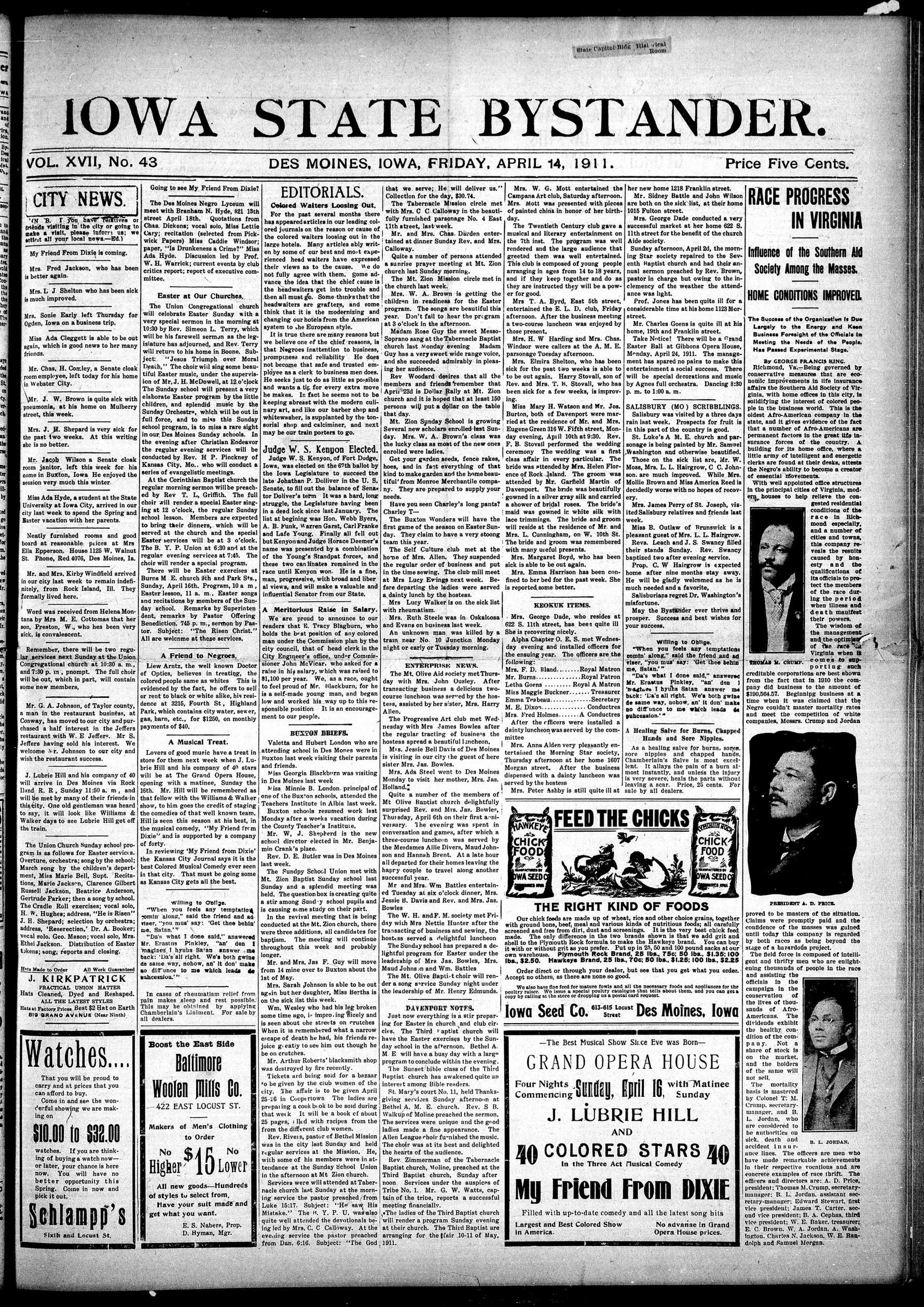
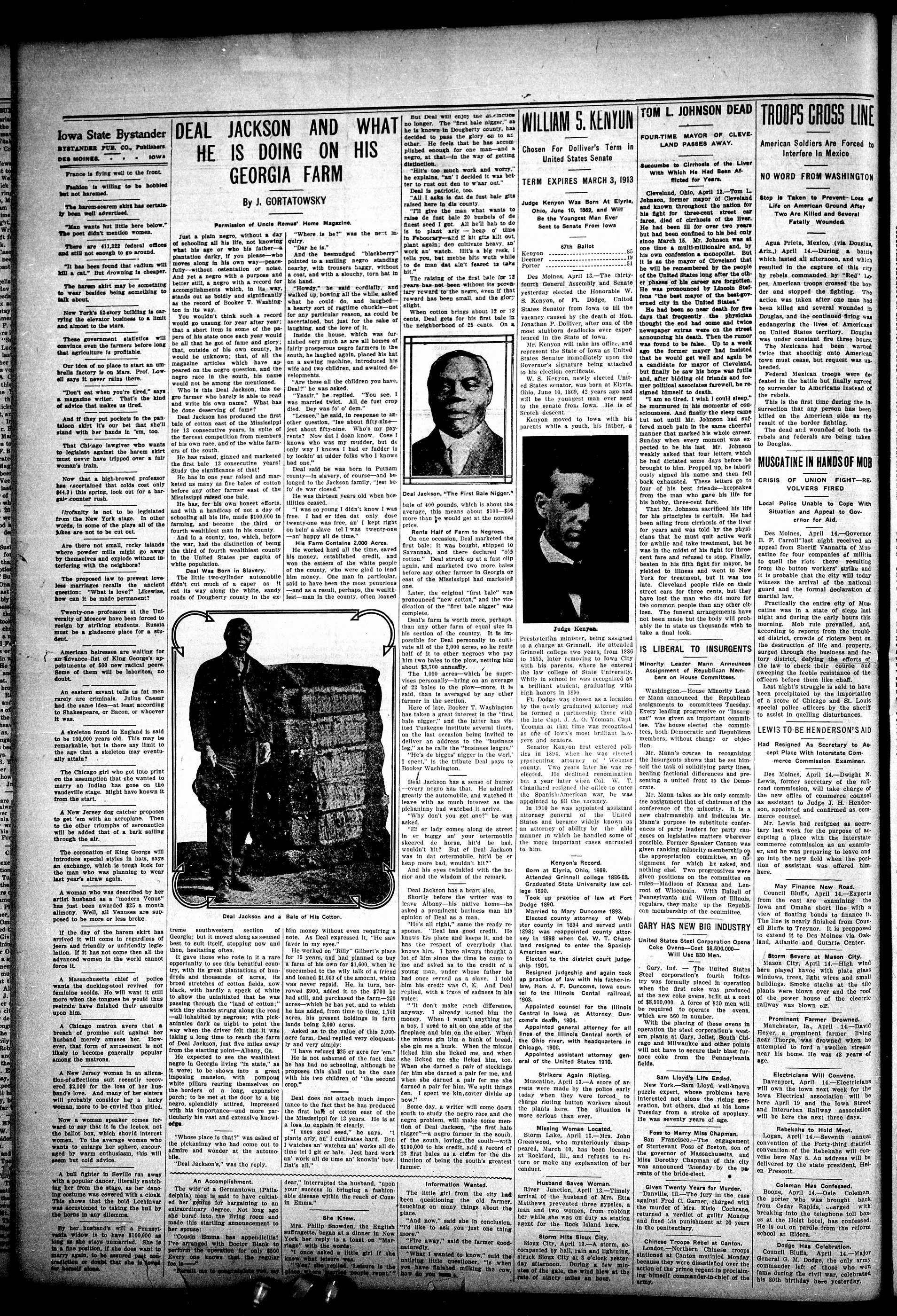
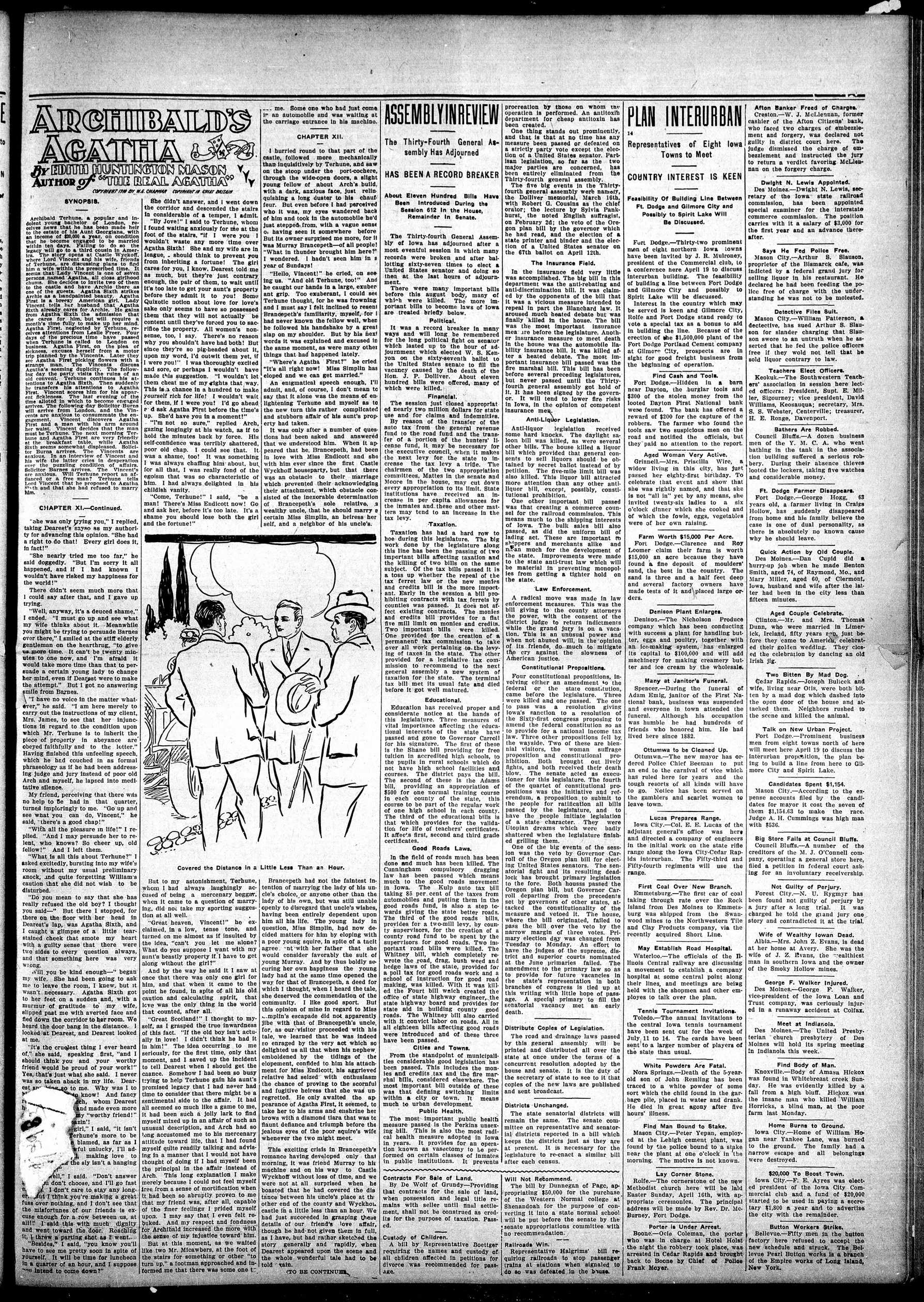
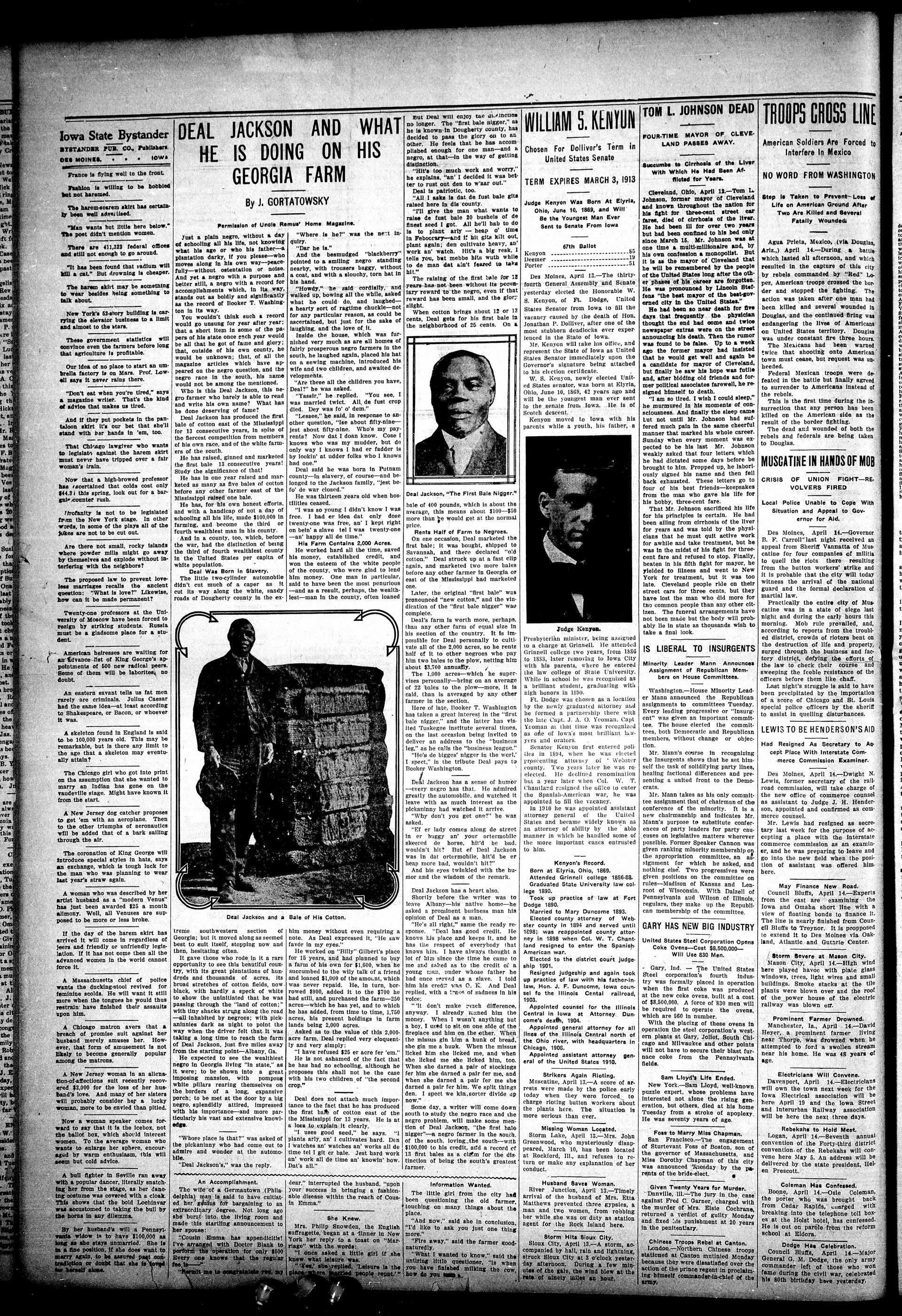
Page text (machine-generated)
IOWA STATE BYSTANDER.
VOL. XVII, No. 43
CITY NEWS.
(N B. I. You have relatives or friends visiting in the city or going to make a visit, please inform us; we collect all your local news.-Ed.)
My Friend From Dixie is coming.
Mrs. Fred Jackson, who has been better again.
Mrs. L. J Shelton who has been sick is much improved.
Mrs. Sonie Early left Thursday for Ogden, Iowa on a business trip.
Miss Ada Cleggett is able to be out again, which is good news to her many friends.
Mr. Chas, H. Comley, a Senate cloak room employee, left today for his home in Webster City.
Mr. J. W. Brown is quite sick with pneumonia, at his home on Mulberry street, this week.
Mrs. J. H. Shepard is very sick for the past two weeks. At this writing she is no better.
Mr. Jacob Wilson a Senate cloak room janitor, left this week for his name in Buxton, Iowa He enjoyed the session very much this winter.
Miss Ada Hyde, a student at the State University at Iowa City, arrived in our city last week to spend the Spring and Easter vacation with her parents.
Neatly furnished rooms and good board at reasonable prices at Mrs Ella Epperson. House 1125 W. Walnut St. Phone, 24076, Des Moines, Ia.
Mr. and Mrs. Kirby Windfield arrived in our city last week to remain indefinitely, from Rock Island, Ill. They formally lived here.
Word was received from Helena Montana by Mrs M. E. Cottomas that her son, Preston W., who has been very sick, is convalescent.
Remember, there will be two regular services next Sunday at the Union Congregational church at 10:30 a.m. and 7:30 p. m., pnpmpt. The full choir will be out, which in part, will contain some new members.
Mr. G. A. Johnson, of Taylor county, a man in the restaurant business, at Conway, has moved to our city and purchased a half interest in the Jeffers restaurant with W. E Jeffers. Mr S. Jeffers having sold his interest. We welcome Mr. Johnson to our city and wish the restaurant success.
J. Lubrie Hill and his company of 40 will arrive in Des Moines via Rock Island R. R., Sunday 11:50 a.m. and will be met by many of their friends in this city. One old gentleman was heard to say, it will look like Williams & Walker days to see Lubrie Hill get off the train.
The Union Church Sunday school program is as follows for Easter services. Overture, orchestra; song by the school; March song by the children's department. Miss Marie Bell, Supt. Recitations, Marie Jackson, Clarence Gilbert Russell Jackson, Beatrice Anderson, Gortrude Parker; then a song by school. The Cradle Roll exercises; vocal solo. H. W. Hughes; address, "He is Risen" J. H. Shepard; selection by orchestra; address, "Reselection." Dr. A. Booker; vocal solo. Geo. Mason; vocal solo, Mr. Elsick Jackson. Distribution of Easter tickets; song, reports and closing.
Hats Made to Order All Work Guaranteed
J. KIRKPATRICK
PRACTICAL UNION HATTER
Hats Cleaned. Dyed and Reshaped.
ALL THE LATEST STYLES
ALL THE Hats at Factory Prices Best $2 Hat on Earth
Hats a Factory Price Near Ninth
BIG GRAND AVENUE (Near Ninth)
Watches.....
That you will be proud to
carry and at prices that you
can afford to buy.
Come in and see the wonderful showing we are making on
$10.00 to $32.00
watches. If you are think-
ing of buying a watch now—
or later, your chance is here
now. You will have no
better opportunity this
Spring. Come in now and
pick it out.
Schlampp's
Sixth and Locust St.
Going to see My Friend From Dixie?
The Des Moines Negro Lyeum will meet with Branham N. Bray, 821 138 street April 18th. Quotations from Chas. Dickena; vocal solo, Miss Letlie Cary; recitation (selected from Pickwick Papers) Miss Caddie Windsor; paper, "Is Drunkenness a Crime" Miss Ada Hyde. Discussion led by Prof. W. H. Warrick; current events by club critics report; report of executive committee.
Easter at Our Churches.
The Union Congregational church will celebrate Easter Sunday with a very special sermon in the morning at 10:30 by Rev. Simeon L. Terry, which will be his farewell serman as the legiature has adjourned, and Rev. Terry will return to his home in Boone. Subject: "Jesus Triumph over Moria Death." The choir will sing some beautiful Easter music, under the supervision of Mr. J, H. McDowell, at 12 o'clock. The Sunday school will present a very elaborate Easter program by the little children, and splendid music by the Sunday Orchestra, which will be out in full force, and to miss this Sunday school program, is to miss a rare sight in our Des Moines Sunday schools. In the evening after Christian Endeavor the regular evening services will be conducted by Rev. H P. Pinckney of Kansas City, Mo., who will conduct a series of evangelical meetings. At the Corinthian Baptist church the regular morning sermon will be preached by Rev T. L. Griffith. The full choir will render a special Easter singing at 12 o'clock, the regular Sunday lesson. Members are expected to bring their dinners, which will be served at the church and the special Easter services will be at 3 o'clock. The B. Y. P. Union at 6:30 and at the regular evening services at 7:45. The choir will render a special program.
There will be Easter exercises at Burns M. E. church 9th and Park Sts., Sunday, April 16th. Program, 10 a.m. Easter lesson, 11 a.m. Easter songs and recitations by members of the Sunday school. Remarks by Superintendent, remarks by Pastor Offering Benediction, 745 p. m., sermon by Pastor. Subject: "The Risen Christ." All are welcome at these services.
A Friend to Negroes.
Liew Arntz, the well known Doctor of Optics, believes in treating, the colored people same as whites. This is evidenced by the fact, he offers to sell or rent to black or white alike, his residence at 3215, Fourth St, Highland Park, which contains city water, sewer, gas, barn, etc., for $1250, on monthly payments of $40.
A Musical Treat.
Lovers of good music have a treat in store for them next week when J. Lubie Hill and his company of 40 stars will be at The Grand Opera House, opening with a matinee, Sunday the 16th. Mr. Hill will be remembered as that fellow with the Williams & Walker show, to him goes the credit of staging the comedies of that well known team, Hill is seen this season at his best, in the musical comedy, 'My Friend from Dixie' and is supported by a company of forty.
In reviewing 'My Friend from Dixie' the Kansas City Journal says it is the best colored Musical Comedy ever seen in that city. That must be going some as Kansas City gets all the best.
Willing to Oblige.
"When you feels any temptation comin' along, said the friend and ad visitor, "you mus say: 'Get the beehin' me. Satan." "Do what I done said," answered Mr. Erastus Pinkley, "an 'don' I imagines I hybrus Satan answer me back: 'Do all its right. We both swine do same way, notoh, an 'it don' make so diffence to me which leads to suhcension." In cases of rheumatism relief from pain makes sleep and rest possible. The book is obtained by applying Chamberlain's liniment. For sale by all dealers.
Boost the East Side
Baltimore
Woolen Mills Co.
422 EAST LOCUST ST.
Makers of Men's Clothing
to Order
No $15 No
Higher Lower
All new goods—Hundreds
of styles to select from.
Have your suit made and
get what you want.
E. S. Nabers, Prop.
D. Hyman, Mgr.
DES MOINES, IOWA, FRIDAY, APRIL 14, 1911.
EDITORIALS.
Colored Walters Loosing Out. For the past several months there has appeared articles in our leading colored journals on the reason or cause of the colored waiters loosing out in the large hotels. Many articles ably written by some of our best and most experienced head waiters have expressed their views as to the cause. We do not fully agree with them. Some advance the idea that the chief cause is the headwaiters get into trouble and then all must go. Some think that the headwaiters are grafters, and some think that it is the modernizing and changing our hotels from the American system to the European style. It is true there are many reasons but we believe one of the chief reasons, is that Negroes inattention to business, promptness and reliability. He does not become that safe and trusted employee as a clerk to business men does. He seeks just to do as little as possible and wants a tit for every extra move he makes. In fact he seems not to be keeping abreast with the modern culinary art, and like our barber shop and whitewasher, is supplanted by the torsorial shop and calciminer, and next may be our train porters to go.
Judge W. S. Kenuon Elected
Judge W. S. Kengon Excited
Judge W. S. Kengon, of Fort Dodge,
Iowa, was elected on the 67th ballot by
the Iowa Legislature to succeed the
late Johathan P. Dolliver in the U. S.
Senate, to fill out the balance of Senat
tor Doliver's term. It was a hard, long
struggle, the Legislature having been
in a dead lock since last January. The
list at beginning was Hon. Webby Eyers,
A. B. Funk, Warren Gars, Carl Franke
and Lafe Young. Finally all fell out
but Kenyon and Judge Horace Deemer's
name was presented by a combination
of the Young's Standpat forces, and
these two can limitures remained in
the race until Kenyon won. He is a fine,
man, progressive, with broad and liberal
views, and will make a valuable and
influential Senator from our State.
A Meritorious Raise in Salary.
A Meritorious Raise in Salary.
We are proud to announce our readers that E. Tracy Blagburn, who holds the best position of any colored man under the Commission plan by the city council, that of head clerk in the City Engineer's office, under Commissioner John McVicar, who asked for a raise in his salary, which was raised to $1,100 per year. We, as a race, ought to feel proud of Mr. Blackburn, for he is a self-made young man, and began low and worked his way up to this responsible position. It is an encouragement to our people.
BUNSTON BRIEFS.
Valetta and Hubert London who are attending school in Des Moines were in Buxton last week visiting their parents and friends.
Miss Georgia Blackburn was visiting in Des Moines last week
Miss Minnie B. London, principal of one of the Buxton schools, attended the Teachers Institute in Albia last week.
Buxton schools resumed work last Monday after a weeks vacation during the County Teacher's Institute.
Mr. W, J. Shepherd is the new school director elected in Mr. Benjamin Crank's place.
Rev. D. E. Butler was in Des Moines last week.
The Sundpy School Union met with Mt. Zion Baptist Sunday school last Sunday and a splendid meeting was held. The question box is creating quite a stir among Sundy school pupils and is causing some study on their part.
In the revival meeting that is being conducted at the Mt. Zion church, there were three additions, all candidates for baptism. The meeting will continue throughout this week and probably longer.
Mr. and Mrs. Jas F. Guy will move from 14 mine over to Buxton about the 1st of May.
Mrs. Sarah Johnson is able to be out again but her daughter, Miss Bertha is on the sick list this week.
Wm. Wesley who had his leg broken some time ago, is improving nicely and is seen about the streets on crutches. When it is remembered what a narrow escape of death he had, his friends rejoice greatly to see him out though he be on crutches.
Mr. Arthur Roberts' blacksmith shop was destroyed by fire recently.
Tickets are being sold for a bazaar 'o be given by the club women of the city. The affair is to be given April 25-26 in Coupertown. The ladies are preparing a cook book to be said during that week. It will be a book of about 25 pages, filled with recipes from the from the different club women.
Rev. Rivers, pastor of Bethel Mission was in the city last Sunday and held regular services at the Mission. He, with some of his members were in attendance at the Sunday School Union in the afternoon at Mt Zion church.
Services were will attended at Tabernacle church last Sunday at the morning service the pastor preached from Luke 15:17. Subject: "He saw His Mistake." Y. the P. U. was also quite well attended the devotionals being led by Mrs. C. C Calloway. At the evening service the pastor proceeded from Dan. 6:16. Subject: "The God
that we serve; He will deliver us.' Collection for the day, $0.74. The Tabernacle Mission circle met with Mrs. C C Calloway in the beautifully furnished parsonage No. 4 East 11th street, last week. Mr. and Mrs. Chas. Darden entertained at dinner Sunday Rev, and Mrs. Calloway. Quite a number of persons attended a sunrise prayer meeting at Mt. Zion church last Sunday morning. The Mt. Zion Mission circle met in the church last week. Mrs. W. A. Brown is getting the children in readiness for the Easter program. The songs are beautiful this year. Don't fail to hear the program at 3 o'clock in the afternoon. Madam Rose Guy the sweet Messo-Soprano sang at the Tabernacle Baptist church last Monday evening. Madam Guy has a very sweet wide range voice, and she succeeded admirably in pleasing her audience. Rev Wood desires that all the members and friends remember that April 23d Dollary Rally at Mt. Zion church and it is hoped that at least 150 persons will put a dollar on the table that day. Mt. Zion Sunday School is growing Several new scholars enrolled last Sunday. Mrs. W. A. Brown's class was the lucky class as most of the new ones enrolled were ladies.
Get your garden seeds, fence rakes, hoes, and in fact everything of that kind to make garden and the home beautiful from Monroe Merchant company. They are prepared to supply your needs.
Have you seen Charley's long pants? Charley T—
The Buxton Wonders will have the first game of the season on Easter Sunday. They claim to have a very stoong team this year.
The Self Culture club met at the home of Mrs. Allen. They suspended the regular order of business and put in the time sewing. The club mill meet at Mrs Lucy Ewings next week. Before departing the ladies were served a dainty lunch by the hostess.
Mrs Lucy Walker is on the sick list with rheumatism.
Mrs. Ruth Steele was in Oskaloosa and Evans on business last week. An unknown man was killed by a train near No. 10 Junction Monday night or early or Tuesday morning.
ENTERPRISE NEWS
The Mt. Olive Aid society met thursday with Mrs. John Ouseley. After transacting business a delicious two-course lunchon was served by the hostess, assisted by her sister, Mrs. Harry Allen.
The Progressive Art club met Wednesday with Mrs James Bowles after the regular tracting of business the hostess spread a beautiful luncheon.
Mrs. Jessie Bell Davis of Des Moines is visiting in our city the guest of here sister Mrs. Jas. Bowles.
Mrs. Ada Steel went to Des Moines Monday to visit her mother, Mrs. Jas. Holland.
Quite a number of the members of Mt Olive Baptist church delightfully surprised Rev. and Mrs. Jas. Bowles. Thursday, April 6th on their first a anniversary. The evening was spent in conversation and games, after which a three-course luncheon was served by the Meadames Allie Divers, Maud Johnson and Hannah Brent. At a late hour all departed for their homes leaving the hapy couple to travel along another successful year.
Mr and Mrs. Wm Battles entertained Tuesday at six o'clock dinner, Mrs. Jessie B. Davis and Rev. and Mrs. Jas. Bowles
The W. H. and F. M. society met Friday with Mrs Nettie Hunter after the transacting of business and sewing, the hostess served a delightful luncheon
The Sunday school has prepared a delightful program for Easter under the leadership of Mrs Jas. Bowles, Mrs. Maud Johnson and Wm. Battles
The Mt. Olive Bapti-t choir will render a song service Sunday night under the leadership of Mr. Henry Edmunds.
DAVENPORT NOTES.
Just now everything is a stir preparing for Easter in church and club circles. The Third baptist church will have the Easter exercises by the Sunday school in the afternoon. Bethel A. M. E will have a busy day with a large program to conclude within the evening. The Sunset bible class of the Third Baptist church has awakened quite an interest among Bible readers.
St. Mary's court No. 11, held Thanksgiving services Sunday afternoon at Bethel A. M. E. church. Rev. S B Walkup of Moline preached the sermon. The services were unique and the good ladies made a fine appearance. The Allen League choir funished the music. The choir was at its best and delighted the hearts of the audience.
Rev. Zimmerman of the Tabernacle Baptist church, Woline, preached at the Third Baptist church, Sunday after noon. Services under the auspices of Tripe No. 1. Mr. G. W. Watts, captain of the tripe, reports a successful meeting financially.
The ladies of the Third Baptist church will render a program Sunday evening at their church. The Third Baptist are arranging for the fair 10-11 of May, 1811.
BYSTA
APRIL 14, 1911.
Mrs. W. G. Mott entertained the Campa Art club, Saturday afternoon. Mrs. Mott was presented with pieces of painted china in honor of her birthday.
The Twentieth Century club gave a musical and literary entertainment on the 7th inst. The program was well rendered and the large audience that greeted them was well entertained. This club is composed of young people arranging in ages from 14 to 18 years, and if they keep together and do as they are instructed they will be a power for good.
Mrs. T. A. Byrd, East 5th street, entertained the E. L. D. club, Friday afternoon. After the business meeting a two-course luncheon was enjoyed by those present.
her new home.
Mr. Sidney are both on the 1015 Fulton st.
Mrs. George successful maid 11th street for Aide society.
Sunday after ing Star society enth Baptist t pastor in char clementy of tance was light.
Prof. Jones considerable t street.
Mr. Charles home, 19th and
Mrs. H. W Harding and Mrs. Chas. Windsor were callers at the A. M. E. parsonage Tuesday afternoon. Mrs. Elmira Shelton, who has been sick for the past two weeks is able to be out again. Harry Stovall, son of Rev. and Mrs. T. H. Stovall, who has been sick for a few weeks, is improving.
Miss Mary H. Watson and Mr. Jos. Burton, both of Davenport were married at the residence of Mr. and Mrs. Eugene Green 318 W. Fifth street, Monday evening, April 10 at 9:30. Rev. F. B. Stovall performed the wedding ceremony The wedding was a first class affair in every particular. The bride was attended by Mrs. Helen Florence of Rock Island. The groom was attended by Mr. Garfield Martin of Davenport. The bride was beautifully gowned in a silver gray silk and carried a shower of bridal roses. The bride's maid was gowned in white silk with lace trimmings. The bride and groom will reside at the residence of Mr. and Mrs. L. Cunningham, on W, 10th St. The bride and groom was remembered with many useful presents.
Mrs. Margaret Boyd, who has been sick is able to be out again. Mrs. Emma Harrison has been confined to her bed for the past week. She is reported some better.
Mrs. George Dade, who resides at 622 S. 11th street, has bees quite ill She is recovering nicely.
Alpha Chapter O. E. S. met Wednesday evening and installed officers for the ensuing year. The officers are the following:
Mrs. F. D. Bland.....Royal Matron
Mr. Burns.....Royal Patron
Letha Goens.....Royal A Matron
Mise Maggie Buckner.....Tressurer
Emma Twebau.....Secretary
M. E. Dixon.....Conductures
Mrs. Fred Holmes.....A Conductures
After the officers were installed a dainty luncheon was served by the committee.
Mrs. Anna Alden very pleasantly entertained the Morning Star society, Thursday afternoon at her home 1607 Morgan street. After the business dispensed with a dainty luncheon was served by the hostess
Mrs. Peter Ashby is still quite ill at
HAWKEYE
CHICK
FOOD
OWA SEED O
FEED THE CHICKS
HAWKEYE
CHICK
FOOD
DOWA SEED CO.
THE RIGHT KIND OF FOODS
Our chick feeds are made up of wheat, rice and other choice grains, together with ground bone, beef, meal and various kinds of nutritious foods; all carefully measured from dirt dust and screens. It is the very best food made. The only difference in the two brands shown is that we add grit and shell to the Plymouth Rock formula to make the Hawkeye brand. You can buy it with or without grit as you prefer. Put up in 25, 50 and 100 pound sacks at our warehouse. Plymouth Rock Brand, 25 lbs. 75c; 50 lbs. 1.35; 100 lbs. $2.50. Hawkeye Brand, 25 lbs. 70c; 50 lbs. $1.25; 100 lbs. $2.25
Order direct or through your dealer, but see that you get what you order.
Accept no others, as there are none so good.
We also have fine feed for mature fowls and all the necessary foods and appliances for the poultry ruler. We also have antipodes and antipodes for the cove being called as at the store or dropping us a postal card request.
—The Best Musical Show Since Eve was Born—
GRAND OPERA HOUSE
Four Nights Sunday, April 16, with Matinee Commencing Sunday
J. LUBRIE HILL
AND
40 COLORED STARS 40
In the Three Act Musical Comedy
My Friend From DIXIE
Filled with up-to-date comedy and all the latest song hits
Largest and Best Colored Show in America.
No advance in Grand Opera House prices.
KEOKUK ITEMS.
AND
Pr
her new home 1218 Franklin street.
her new home 1215 Franklin Street.
Mr. Sidney Battle and John Wilson are both on the sick list, at their home 1015 Fulton street.
Mrs. George Dade conducted a very successful market at her home 622 S. 11th street for the benefit of the church Aide society.
Sunday afternoon, April 2d, the morning Star society repaired to the Seventh Baptist church and had their sermon preached by Rev. Brown, pastor in charge but owing to the inclemency of the weather the attendance was light.
Prof. Jones has been quite ill for a considerable time at his home 1123 Morstreet.
Mr. Charles Goens is quite ill at his home, 19th and Franklin street.
Take Notice! There will be a Grand Easter Ball at Gibbons Opera House, Monday, April 24, 1911. The management has spared no pains to make this entertainment a social success. There will be special decorations and music by Agnes full orchestra. Dancing 8:30 p. m. to 1:00 a. m.
SALISBURY (MO) SCRIBBLINGS.
Salisbury was visited by a three days rain last week. Prospects for fruit is in this part of the country is good.
St. Luke's a M. E. church and parsonage is being painted by Mr. Samuel Washington and otherwise beautified.
Those on the sick list are, Mr. W. Moss, Mrs. L. L. Hairgrow, C. C. Johnson are much improved. While Mrs. Mollie Brown and Miss America Reed is decidedly worse with no hopes of recovery.
Mrs. James Perry of St. Joseph, visited Saliibury abbies and friends last week.
Miss B. Outlaw of brunswick is a pleasant guest of Mrs. L. L. Hairgrow.
Revs. Leach and J. S. Swancy filled their stands Sunday. Rev. Swancy baptized two after evening service.
Prop. C. Wgrow is expected home after nine months stay away.
He will be gladly welcomed as he is much needed and a favorite.
Saliiburians regret Dr. Washington's misfortune.
May the Bystander ever thrive and prosper. Success and best wishes for your success.
"When you feels any temptations comin' along," said the friend and ad viser, "you must say 'Get the beehin me, Satan.'"
"Da's what I done said," answered Mr. Erawus Pinkley, "an' den I bragges I hyhuis Satan answer me back: 'Da's all right. We both gwine do same way, notow, an' it don't make so difference to me which leads de phecassion."
A Healing Salve for Burns, Chapped Hands and Sore Nipples.
As a healing salve for burns, sore, sore nipples and chapped hands, Chamberlain's Salve is most excellent. It allays the pain of a burn almost instantly, and unless the injury is very severe, heals the parts without leaving a scar. Price, 25 cents. For sale by all dealers.
THE CHICKS
ANTHONY HUCK
CHICK FOOD
IOWA SEED CO.
Willing to Oblige
Price Five Cents.
Influence of the Southern Aid Society Among the Masses.
The Success of the Organization is Due Largely to the Energy and Keen Business Foresight of the Officials in Meeting the Needs of the People. Has Passed Experimental Stage.
By GEORGE FRANCIS KING.
Richmond, Va.-Being governed by conservative measures that are economic improvements in life insurance affairs the Southern Aid Society of Virginia, with home offices, is solidifying the interest of colored people in the business world. This is the oldest Afro-American company in the state, and it gives evidence of the fact that a number of Afro-Americans are permanent factors in the great life insurance forces of the country. A building for its home office, where a little army of intelligent and energetic clerks are found at their desks, attests the Negro's ability to become a creator of essential movements. With well appointed office structures in the principal cities of Virginia, modern houses to help relieve the congested residential conditions of the race in Richmond especially, and a number of cities and towns, this company reveals the results caused by honesty and the qualifications of its officials to protect the members of the community during the period when illness and death manifest their powers.
JOHN H. BURKE
The wisdom of the management and the optimism of the race in Virginia when it comes to supporting such creditable corporations are best shown from the fact that in 1910 the company did business to the amount of $190,564.57. Beginning business at a time when it was claimed that the Negro couldn't master mortality rates and meet the competition of white companies, Messrs. Crump and Jordan
PRESIDENT A. D. PRICE
proved to be the masters of the situation. Claims were promptly paid and the confidence of the masses was gained until today this company is regarded by both races as being beyond the stage of a harvardds project. The field force is composed of intelligent and thrifty men who are enlightening thousands of people in the race and assisting the officials in the campaign in the conservation of the lives of thousands of Afro-Americans. The dividends exhibit the healthy condition of the company. Not a share of stock is on the market, and the holders of the same will not sell.
PABLO MAYORAL
the mortality basis is mastered by Colonel T. M. Crump, secretary-manager, and B. L. Jordan, who are considered to be authorities on death and accident in a sur-face lines. The officers are men who have made remarkable achievements in their respective vocations and are concrete examples of race thrift. The officers and directors are: A. D. Price, president; Thomas M. Crump, secretary-manager; B. L. Jordan, assistant secretary-manager; Edward Stewart, first vice president; James T. Carter, second vice president; B. A. Cephas, third vice president; W. C. Jordan, a surgeon; E. B. Jordan, W. A. Jordan, a Washington, Charles N. Jackson, W. E. Randolph, and Samuel Morrison.
BUC
varia
the
name
the
name
Cr
neww
st to
We
wick
ring
M
um
time
Wr
t k.
case
beast
cells
Neww
ex at
later
amer
P.
re
"St
Lac
last
we
ve
this
this
as
the
ich
r. I
R. M
as to
F. A
state
the
book
ch
a
R. F
as to
w. H
and
st. brou
and
ant
of the
the
hear
aa.
ja.
be.
3. W
how
In
are
er
er
wr
Por
C
ex
section
To
the
rame
PI.
Om
mt to
Al
J. er
cit
dong
billy
Rob
the
E.
ay,
y, b
and
EN
W.
and
Tou
A. A
T
T
A. A
France is flying well to the front.
Fashion is willing to be hobbled but not haremed.
The harem-scarem skirt has certainly been well advertised.
"Man wants but little here below." The poet didn't mention women.
There are 411,222 federal offices and still not enough to go around.
"It has been found that radium will kill a cat." But drowning is cheaper.
The harem skirt may be something to wear besides being something to talk about.
New York's 52-story building is carrying the elevator business to a limit and almost to the stars.
These government statistics will convince even the farmers before long that agriculture is profitable.
Our idea of no place to start an umbrella factory is on Mars. Prof. Lowell says it never rains there.
"Don't eat when you're tired," says a magazine writer. That's the kind of advice that makes us tired.
And if they put pockets in the pantaloon skirt it's our bet that she'll stand with her hands in 'em, too.
That Chicago lawgiver who wants to legislate against the harem skirt must never have tripped over a fair woman's train.
Now that a high-browed professor has recertified that colds cost only $44.31 this spring, look out for a bargain counter rush.
Irofanity is not to be legislated from the New York stage. In other words, in some of the plays all of the jokes are not to be cut out.
Are there not small, rocky islands where powder mills might go away by themselves and explode without interfering with the neighbors?
The proposed law to prevent love-less marriages recalls the ancient question: "What is love?" Likewise, how can it be made permanent?
Twenty-one professors at the University of Moscow have been forced to resign by striking students. Russia must be a gladsome place for a student.
American heliresses are waiting for an advance list of King George's appointments of 500 new radical peers. Some of them will be laborites, no doubt.
An eastern savant tells us fat men rarely are criminals. Julius Caesar had the same idea—at least according to Shakespeare, or Bacon, or whoever it was.
A skeleton found in England is said to be 100,000 years old. This may be remarkable, but is there any limit to the age that a skeleton may eventually attain?
The Chicago girl who got into print on the assumption that she wanted to marry an Indian has gone on the vaudeville stage. Might have known it from the start.
A New Jersey dog catcher proposes to get 'em with an aeroplane. Then to the other triumphs of aeronautics will be added that of a bark sailing through the air.
The coronation of King George will introduce special styles in hats, says an exchange, which is tough luck for the man who was planning to wear last year's straw again.
A woman who was described by her artist husband as a "modern Venus" has just been awarded $25 a month alimony. Well, all Venues are supposed to be more or less broke.
If the day of the harem skirt has arrived it will come in regardless of jeers and friendly or unfriendly legislation. If it has not come then all the advanced women in the world cannot force it.
A Massachusetts chief of police wants the ducking-stool revived for feminine scolds. He will want it still more when the tongues he would thus restrain have finished their assaults upon him.
A Chicago matron avers that a breach of promise suit against her husband merely amuses her. However, that form of amusement is not likely to become generally popular among the matrons.
A New Jersey woman in an alienation-of-affections suit recently recovered $2,000 for the loss of her husband's love. And many of her sisters will probably consider her a lucky woman, more to be envelied than pitied.
Now a woman speaker comes forward to say that it is the icebox, not the ballot box, which should interest women. To the average woman who wants to enlarge her sphere, encouraged by warm enthusiasm, this will seem but cold advice.
A bull fighter in Seville ran away with a popular dancer, literally snatching her from the stage, as her dancing costume was covered with a cloak. This shows that the bold Lobovinar was accustomed to taking the bull by the horns in any dilemma.
By her husband's will a Pennsylvania widow is to have $100,000 as her estate and unmarried. She is in the fine position, but she must marry again, to be assured post congratulation or doubt that she is loved for herself alone.
DEAL JACKSON AND WHAT HE IS DOING ON HIS GEORGIA FARM
By J. GORTATOWSKY
Permission of Uncle Remus' Home Magazine.
Just a plain negro, without a day of schooling all his life, not knowing what his age or who his father—a plantation darky, if you please—who moves along in his own way—peacefully—without ostentation or noise. And yet a negro with a purpose and better still, a negro with a record for accomplishments which, in its way, stands out as boldly and significantly as the record of Booker T. Washington in its way.
"Where is he?" was quiry.
"Dar he is."
And the besmudgee pointed to a smiling in nearby, with trousers a coat, and with a slouched hand.
"Howdy," he said walked up, bowing all what he could do, a hearty sort of ragtin.
You wouldn't think such a record would go unsung for year after year; that a short item in some of the papers of his state once each year would be all that he got of fame and glory; that, outside of his own county, he would be unknown; that, of all the magazine articles which have appeared on the negro question, and the negro race in the south, his name would not be among the mentioned.
Who is this Deal Jackson, this negro farmer who barely is able to read and write his own name? What has he done deserving of fame?
Deal Jackson has produced the first bale of cotton east of the Mississippi for 13 consecutive years, in spite of the fiercest competition from members of his own race, and of the white farmers of the south.
He has raised, ginned and marketed the first bale 13 consecutive years! Study the significance of that!
He has in one year raised and marketed as many as five bales of cotton before any other farmer east of the Mississippi raised one bale.
He has, for his own honest efforts, and with a handicap of not a day of schooling all his life, made $100,000 in farming, and become the third or fourth wealthiest man in his county. And in a county, too, which, before the war, had the distinction of being the third of fourth wealthiest county in the United States per capita of white population. Deal Was Born in Slavery. The little two-cylinder automobile didn't cut much of a caper as it cut its way along the white, sandy roads of Dougherty county in the ex-
THE NEW YORK TIMES
THE BAY OF THE BAY
Deal Jackson and a Bale of His Cotton.
treme southwestern section of Georgia; but it moved along as seemed best to suit itself, stopping now and then, hesitating often.
It gave those who rode in it a rare opportunity to see this beautiful country, with its great plantations of hundreds and thousands of acres, its broad stretches of cotton fields, now black, with hardly a speck of white to show the uninitiated that he was passing through the "land of cotton;" with tiny shacks strung along the road—all inhabited by negroes; with pickaninles dark as night to point the way when the driver felt that it was taking a long time to reach the farm of Deal Jackson, just five miles away from the starting point—Albany, Ga.
him money without note. As Deal express favor in my eyes."
He worked on "Bil for 15 years, and he a farm of his own fauceted to the w and loaned $1,000 of was never repaid. the $900, added had still, and purchases acres—which he has he added, has been, from acres, his present lands being 2,000 a
Asked as to the w acre farm, Deal reply and very simply: "I have refused $2.
He expected to see the wealthiest negro in Georgia living in "in state," as it were; to be shown into a great imposing mansion, with pompous white pillars rearing themselves on the borders of a long, expansive porch; to be met at the door by a big negro, splendidly attired, impressed with his importance—and more particularly his vast and extensive knowledge.
"Whose place is that?" was asked of the pickaninny who had come out to admire and wonder at the automobile.
"Deal Jackson's," was the reply.
An Accomplishment.
The wife of a Germantown (Philadelphia) man is said to have cultivated her gaudius for bargaining to an extraordinary degree. Not long ago she burst into the living room and made this startling announcement to her spouse:
"Cousin Emma has appendicitis!
I've arranged with Doctor Blank to perform the operation for only $600
Every one knows that the regular fee is——"
"Permit me to engrannicate you my
"Where is he?" was the next inquiry.
"Dar he is."
And the besmudged "blackberry" pointed to a smiling negro standing nearby, with trousers baggy, without a coat, and with a slouchy, torn hat in his hand.
"Howdy," he said cordially, and walked up, bowing all the while, asked what he could do, and laughed—a hearty sort of ragtime chuckle—not for any particular reason, as could be ascertained, but just for the sake of laughing, and the love of it.
Inside the house, which was furnished very much as are all homes of fairly prosperous negro farmers in the south, he laughed again, introduced his wife and two children, and awaited developments.
"Are these all the children you have, Deal?" he was asked.
"Tassir," he replied. "You see, I was married twict. All de fust crop died. Dev was fo' o'd."
"Lessee," he said, in response to another question, "I see about fifty-nine—just about fifty-nine. Who's my payments? Now dat I doan know. Cose I knows who was my mudder, but de only way I knows I had ead radder is by lookin' at udder folks who I knows had one."
Deal said he was born in Putnam county—In slavery, of course—and belonged to the Jackson family, "jest befo' de war closed."
He was thirteen years old when hostilities ceased.
"I was so young I didn't know I was free. I had er idea dat only dose twenty-one was free, an 'i' kept right on bau' a slave tel I was twenty-one—an 'happy all de time."
His Farm Contains 2,000 Acres.
He worked hard all the time, saved his money, established credit, and won the esteem of the white people of the county, who were glad to lend him money. One man in particular, said to have been the most penurious—and as a result, perhaps, the wealthiest—man in the county, often loaned
```markdown
```
him money without even requiring a note. As Deal expressed it, "He saw favor in my eyes."
He worked on "Billy" Gilbert's place for 15 years, and had planned to buy a farm of his own for $1,600, when he succumbed to the wily talk of a friend and loaned $1,000 of the amount, which was never repaid. He, in turn, borrowed $900, added it to the $700 he had still, and purchased the farm—250 acres—which he had, and to which he has added, from time to time, 1,750 acres, his present holdings in farm lands being 2,000 acres.
Asked as to the value of this 2,000 acre farm, Deal replied very eloquently and very simply:
"I have refused $25 er acre fer 'em."
He is not as ashamed of the fact that he has had no schooling, although he proposes this shall not be the case with his two children of "the second crop."
Deal does not attach much importance to the fact that he has produced the first ball of cotton east of the Mississippi for 12 years. He is at a loss to explain it clearly.
"I uses good seed," he says. "I plants arly, an' cultivates hard. Den I watches an' watches an' works all de time tel I git er bale. Jest hard work an' work all de time an' knowin' how. Dat's all."
dear," interrupted the husband, "upon your success in bringing a fashionable disease within the reach of Cousin Emma."
Mrs. Philip Snowden, the English suffragette, began at a dinner in New York her reply to a toast on "Marriage" with the words: "I once asked a little girl if she knew what leisure was.
"Yes," she replied. "Lieure is in the place where married people run."
But Deal will enjoy the inconclusive no longer. The "first bale niger," as he is known in Dougherty county, has decided to pass the glory on to another. He feels that he has accomplished enough for one man—and a negro, at that—in the way of getting distinction.
"Hit's too much work and worry," he explains, "an 'I can decided it was better to rust out den to waar out."
Deal is patriotic, too.
"All I asks is dat de fust bale gits raised here in dis county.
"I'll give the man what wants to raise de fust bale 20 bushels of de finest seed I got. All he hab to do is to plant airty — heap o' time in February—and if it gits kilt out, plant again; den cultivate heavy, an' work an' watch. Hit's a big resk. I tell you, but metbe hits wuth while to de man dat ain't feared to taka hit."
The raising of the first bale for 15 years has not been without its secondary reward to the negro, even if that reward has been small, and the glory slight.
When cotton brings about 12 or 13 cents, Deal gets for his first bale in the neighborhood of 25 cents. On a
JOHN H.
bale of 400 pounds, which is about the average, this means about $100—$50 more than he would get at the normal price.
Rents Half of Farm to Negroes.
Hents Hair of Farm to Negroes.
On one occasion, Deal marketed the first bale; it was bought, shipped to Savannah, and there declared "old cotton." Deal struck up at a fast clip again, and marketed two more bales before any other farmer in Georgia or east of the Mississippi had marketed one.
Later, the original "first bale" was pronounced "new cotton," and the vindication of the "first bale nigger" was complete.
Deal's farm is worth more, perhaps, than any other farm of equal size in his section of the country. It is impossible for Deal personally to cultivate all of the 2,000 acres, so he rente half of it to other negroes who pay him two bales to the plow, netting him about $3,700 annually.
The 1,000 acres—which he supervises personally—bring on an average of 22 bales to the plow—more, it is said, than is averaged by any other farmer in the section.
Here of late, Booker T. Washington has taken a great interest in the "first bale nigger," and the latter has visited Tuskegee Institute several times, on the last occasion being invited to deliver an address to the "business leg," as he calls the "business league." "He's de biggs' nigger in the world," I spect, "is the tribute Deal pays to Booker Washington.
Deal Jackson has a sense of humor —every negro has that. He admired greatly the automobile, and watched it leave with as much interest as the plekianinny had watched it arrive.
"Why don't you get one?" he was asked.
"Ef er lady comes along de street in er buggy'an your ortermobile skeeled de horse, hit'd be bad, wouldn't hit? But Ef Deal Jackson was in dat ortermobile, hit'd be heap more bad, wouldn't hit."
And his eyes twinkled with the humor and the wisdom of the remark.
Deal Jackson has a heart also.
Shortly before the writer was to leave Albany—his native home—he asked a prominent business man his opinion of Deal as a man.
"He's all right," same the ready response.
"Deal has good credit. He knows his place and keeps it, and he has the respect of everybody that knows him. I have always thought a lot of him since the time he came to me and asked as to the credit of a young man, under whose father he had once served as a slave. I told him his credit was C. K. And Deal replied, with a trace of sadness in his voice:
"It don't make much difference, anyway. I already bump him the money. When I wusn't anything but a boy, I used to sit on one side of the fireplace and him on the other. When the missus gin him a hunk of bread, she gin me a hunk. When the missus licked him she licked me, and when she licked me she licked me, too. When she darned a pair of stockings for him she darned a pair for me, and when she darned a pair for me she darned a pair for him. We split things den. I spect we kin, sorter divide up now."
Some day, a writer will come down south to study the negro race and the negro problem, will make some mention of Deal Jackson, "the first bale nigger"—a negro farmer in the south, of the south, loving the south—with $100,000 to his credit, and a record of 13 first bales as a claim for the distinction of being the south's greatest farmer.
The little girl from the city had been questioning the old farmer, touching on many things about the place.
"And now," said she in conclusion, "I'd like to ask you just one thing more."
"Fire away," said the farmer good-naturedly.
"What I wanted to know," said the unloving questioner, "is when you have finished milking the cow, how do you
Chosen For Dolliver's Term in United States Senate
TERM EXPIRES MARCH 3, 1913
Judge Kenyon W was Born At Elyria,
Ohio, June 10, 1869, and Will
Be the Youngest Man Ever
Sent to Senate from Iowa
67th Ballot
Kenyon ..... 85
Deemer ..... 19
Porter ..... 51
Des Molnes, April 13.—The thirty-fourth General Assembly and Senate yesterday elected the Honorable W. S. Kenyon, of Ft. Dodge, United States Senator from Iowa to till the vacancy caused by the death of Hon. Jonathan P. Dolliver, after one of the most stubborn deadlocks ever experienced in the State of Iowa.
Mr. Kenyon will take his office, and represent the State of Iowa as United States Senator immediately upon the Governor's signature being attached to his election certificate.
W. S. Kenyon, newly elected United States senator, was born at Elyria, Ohio, June 10, 1869, 42 years ago and will be the youngest man ever sent to the senate from Iowa. He is of Scotch descent.
Kenyon moved to Iowa with his parents while a youth, his father, a
PETER H.
Judge Kenyon.
Presbyterian minister, being assigned to a charge at Grinnell. He attended Grinnell college two years, from 1880 to 1883, later removing to Iowa City with his parents, where he entered the law college of State University. While in school he was recognized as a brilliant student, graduating with high honors in 1890.
Ft. Dodge was chosen as a location by the newly graduated attorney and he formed a partnership there with the late Capt. J. A. O. Ycoon. Capt Ycoon as that time was recognized as one of Iowa's most brilliant lawyers and orators.
Senator Kenyon first entered politics in 1894, when he was elected prosecuting attorney of Webster county. Two years later he was reelected. He declined renomination but a year later Col. W. T. Chantland resigned the office to enter the Spanish-American war, he was appointed to fill the vacancy.
In 1910 he was appointed assistant attorney general of the United States and became widely known as an attorney of ability by the able manner in which he handled some of the more important cases entrusted to him.
Kenyon's Record.
Born at Elyria, Ohio, 1869.
Attended Grinnell college 1886-88.
Graduated State University law college 1890.
Took up practice of law at Fort Dodge 1890.
Married to Mary Duncome 1893.
Elected county attorney of Webster county in 1894 and served until 1998; was reappointed county attorney in 1898 when Col. W. T. Chantland resigned to enter the Spanish-American war.
Elected to the district court judgeship 1901.
Resigned judgeship and again took up practice of law with his father-in-law, Hon. J. F. Duncome, Iowa counsel to the Illinois Central railroad, 1903.
Appointed counsel for the Illinois Central in Iowa at Attorney. Duncome's death, 1904.
Appointed general attorney for all lines of the Illinois Central north of the Ohio river, with headquarters in Chicago, 1908.
Appointed assistant attorney general of the United States 1910.
Strikers Again Biting
Muscatine, April 13—A score of arrests were made by the police early today when they were forced, to charge rioting button workers about the plants here. The situation is more serious than ever.
Missing Woman Located
Storm Lake, April 13.—Mrs. John Greenwood, who mysteriously disappeared, March 10, has been located at Rockford, Ill., and refuses to return or make any explanation of her conduct.
Husband Saves Woman.
River Junction, April 13.—Timely arrival of the husband of Mrs. Etta Matthews prevented three gypsies, a man and two women, from robbing her while she was on duty as station agent for the Rock Island here.
Storm Hits Sioux City.
Sioux City, April 13.—A storm, accompanied by hall, rain and lightning, struck Sioux City at 3 o'clock yesterday afternoon. During a few minutes of the gale, the wind blew at the rate of ninety miles an hour.
TOM L. JOHNSON DEAD
TOM L. JOHNSON DEAD
FOUR-TIME MAYOR OF CLEVE- LAND PASSES AWAY.
Succumbe to Cirrhosis of the Liver With Which He Had Been Af- flicted for Years.
Cleveland, Ohio, April 12.—Tom L. Johnson, former mayor of Cleveland and known throughout the nation for his fight for three-cent street car fares, died of cirrhosis of the liver. He had been ill for over two years but had been confined to his bed only since March 15. Mr. Johnson was at one time a multi-millionaire and, by his own confession a monopolist. But it is as the mayor of Cleveland that he will be remembered by the people of the United States long after the other phases of his career are forgotten. He was pronounced by Lincoln Stefens "the best mayor of the best-governed city in the United States."
He had been so near death for five days that frequently the physician thought the end had come and twice newspaper extras were on the street announcing his death. Then the rumor was found to be false. Up to a week ago the former mayor had insisted that he would get well and again be a candidate for mayor of Cleveland, but finally he saw his hope was futile and, after bidding old friends and former political associates farewell, he resigned himself to death.
"I am so tired. I wish I could sleep," he murmured in his moments of consciousness. And finally the sleep came but not until Mr. Johnson had suffered much pain in the same cheerful manner that marked his whole career. Sunday when every moment was expected to be his last Mr. Johnson weakly asked that four letters which he had dictated some days before be brought to him. Propped up, he laboriously signed his name and then fell back exhausted. These letters go to four of his best friends—keepsakes from the man who gave his life for his hobby, three-cent fare.
That Mr. Johnson sacrificed his life for his principles is certain. He had been alling from cirrhosis of the liver for years and was told by the physicians that he must quit active work for awhile and take treatment, but he was in the midst of his fight for three-cent fare and refused to stop. Finally, beaten in his fifth fight for mayor, he yielded to illness and went to New York for treatment, but it was too late. Cleveland people ride on their street cars for three cents, but they have lost the man who did more for the common people than any other citizen. The funeral arrangements have not been made but the body will probably lie in state as thousands wish to take a final look.
IS LIBERAL TO INSURGENTS
Minority Leader Mann Announces Assignment of Republican Members on House Committees.
Washington.—House Minority Leader Mann announced the Republican assignments to committees Tuesday. Every leading progressive or "Insurgent" was given an important committee. The house elected the committees, both Democratic and Republican members, without change or objection.
Mr. Mann's course in recognizing the Insurgents shows that he set himself the task of solidifying party lines, healing factional differences and presenting a united front to the Democrats.
Mr. Mann takes as his only committee assignment that of chairman of the conference of the minority. It is a new chairmanship and indicates Mr. Mann's purpose to substitute conferences of party leaders for party caucuses on legislative matters wherever possible. Former Speaker Cannon was given ranking minority membership on the appropriation committee, an assignment for which he asked, and nothing else. Two progressives were given positions on the committee on rules—Madison of Kansas and Lenroot of Wisconsin. With Dalzell of Pennsylvania and Wilson of Illinois, regulars, they make up the Republican membership of the committee.
GARY HAS NEW BIG INDUSTRY
United States Steel Corporation Opens
Coke Ovens—Cost $8,500,000
Will Use 830 Men.
Gary, Ind. — The United States
Steel corporation's fourth
Industry was formally placed in operation
when the first coke was produced
at the new coke ovens, built at a cost
of $8,600,000. A force of 830 men will
be required to operate the ovens,
which are 560 in number.
With the placing of those ovens in
operation the steel corporation's western
plants at Gary, Gallip, Southe
Chicago and Milwaukee and other points
will not have to secure their blast furnace
coke from the Pennsylvania
fields.
Sam Lloyd'd Life Ended.
New York.—Sam Lloyd, well-known puzzle expert, whose problems have interested not alone the rising generation, but others, died at his home Tuesday from a stroke of apoplexy. He was seventy years of age.
Foss to Marry Miss Chapman.
San Francisco.—The engagement of Sturtevant Foss of Boston, son of the governor of Massachusetts, and Miss Dorothy Chapman of this city was announced Tuesday by the parents of the bride-elect.
Given Twenty Years for Murder.
Danville, Ill.—The jury in the case against Fred C. Garner, charged with the murder of Mrs. Elsie Cochrane, returned a verdict of guilty Monday and fixed his punishment at 20 years in the penitentiary.
Chinese Troops Rebel at Canton. London.-Northern Chinese troops stationed at Canton mutinied Monday because they were dissatisfied over the action of the prince regent in proclaiming himself commander-in-chief of the army,
American Soldiers Are Forced to Interfere In Mexico
NO WORD FROM WASHINGTON
Step is Taken to Prevent Loss of Life on American Ground After Two Are Killed and Several Fatally Wounded
Agua Prieta, Mexico, (via Douglas, Ariz.) April 14.—During a battle which lasted all afternoon, and which resulted in the capture of this city by rebels commanded by "Red" Lopez. American troops crossed the border and stopped the fighting. The action was taken after one man had been killed and several wounded in Douglas, and the continued firing was endangering the lives of Americans on United States territory. Douglas was under constant fire three hours. The Mexicans had been warned twice that shooting onto American town must cease, but request was unheeded. Federal Mexican troops were defeated in the battle but finally agreed to surrender to Americans instead of the rebels. This is the first time during the insurrection that any person has been killed on the American side as the result of the border fighting.
The dead and wounded of both the rebels and federals are being taken to Douglas.
MUSCATINE IN HANDS OF MOR
MUSCATINE IN HANDS OF MOR
CRISIS OF UNION FIGHT—REVOLVERS FIRED
Local Police Unable to Cope With Situation and Appeal to Governor for Aid.
Des Moines, April 14.—Governor B. F. Carroll'last night received an appeal from Sheriff Vannatta of Muscatine for four companies of militia to quell the riots there resulting from the button workers' strike and it is probable that the city will today witness the arrival of the national guard and the formal declaration of martial law.
Practically the entire city of Muscatine was in a state of siege last night and during the early hours this morning. Mob rule prevailed, and, according to reports from the troubled district, crowds of rioters bent on the destruction of life and property, surged through the business and factory district, defying the efforts of the law to check their course and sweeping the feeble resistance of the officers before them like chaff.
Last night's struggle is said to have been preplaceted by the importation of a score of Chicago and St. Louis special police officers by the sheriff to assist in quelling disturbances.
LEWIS TO BE HENDERSON'S AID
Had Resigned As Secretary to Accept Place With Interstate Commerce Commission Examiner.
Des Moines, April 14—Dwight N. Lewis, former secretary of the railroad commission, will take charge of the new office of commerce counsel as assistant to Judge J. H. Henderson, appointed and confirmed as commerce counsel.
Mr. Lewis had resigned as secretary last week for the purpose of accepting a place with the interstate commerce commission as an examiner, and he was preparing to leave and go into the new field when the position of assistant was offered him here.
May Finance New Road.
Council Bluffs, April 14—Experts from the east are examining the Iowa and Omaha short line with a view of floating bonds to finance it. The line is nearly finished from Council Bluffs to Treynor. It is proposed to extend it to Des Moines via Oakland, Atlantic and Guthrie Center.
Storm Severe at Mason City. Mason City, April 14.—High wind here played havoc with plate glass windows, trees, light wires and small buildings. Smoke stacks at the tile plants were blown over and the roof of the power house of the electric railway was blown on.
Prominent Farmer Drowned. Manchester, Ia., April 14—David Heyer, a prominent farmer living near Thorpe, was drowned when he attempted to ford a swollen stream near his home. He was 48 years of age.
Electricians Will Convene. Davenport, April 14—Electricians will own the town next week for the Iowa Electrical association will be here April 19 and the Iowa Street and Interurban Railway association will be here the next three days.
Rebekahs to Hold Meet.
Logan, April 14.—Seventh annual convention of the Forty-third district convention of the Rebekahs will convene here May 5. An address will be delivered by the state president, Helen Prescott.
Coleman Has Confessed.
Boone, April 14.—Odie Coleman, the porter who was brought back from Cedar Rapids, charged with breaking into the telephone toll boxes at the Holst hotel, has confessed. He is out on parole from the reform school at Eldora.
Dodge Has Celebration.
Council Bluffs, April 14.—Major General G. M. Dodge, the only army commander left of those who won fame during the civil war, celebrated his 80th birthday here yesterday.
ARCHIBALD'S
AGATHA
BY EDITH HUNTINGTON MASON
AUTHOR OF "THE REAL AGATHA"
COPYRIGHT 1912 BY W. K. CHAPMAN. COPYRIGHT IN GREAT BRITAIN
CHAPTER XI.—Continued.
"she was only trying you," I replied, taking Dearest's sayso as my authority for advancing this opinion. "She had a right to do that! Every girl does it, in fact!"
"She nearly tried me too far," he said doggedly, "But I'm sorry it all happened, and if I had known I wouldn't have risked my happiness for the world!"
"There didn't seem much more that I could say after that, and I gave up time." "Well, anyway, it's a deuced shame," I ended, "I must go up and see what my wife thinks about it. Meanwhile you might be trying to persuade Barnes over there," I smiled at the stiff elderly gentleman on the hearthrug, "to give us more time. It can't be twenty minutes to one now, and I'm afraid it would take more time than to persuade a certain young lady to change her mind, even if Deapst were to make the attempt. But I got no answering smile from Barnes. In the matter whatever," he said, "I am here merely to carry out the instructions of my client, Mrs. James, to see that her injunctions in regard to the condition upon which Mr. Terhune is to inherit the piece of property in insecurity are obeyed faithfully and to the letter." Having finished this unfeeling speech, which he had couched in as formal phraseology as if he had been addressing judge and jury instead of poor Arch and myself, he lapsed into the介质 silence.
My friend, perceiving that there was no doubt in that quarter, turned implacably to me. "Go up and see what you can do, Vincent," he said, "there's a good chan!"
"With all the pleasure in life!" I replied. "And I may persuade her to relent, who knows? So cheer up, old fellow!" And I left them.
"What is all this about Terhune?" I asked excitedly, bursting into my wife's room without my usual preliminary knock, and quite forgetting William's caution that she did not wish to be dislabeled.
"Do you mean to say that she has really refused the old boy? I thought you said—" But there I stopped, for there on the floor with her head in Dearest's lap, was Agatha Sixth, and I caught a glimpse of a little tear-stained cheek that smoke my heart with a guilty sense that there were two sides to every question always, and that something here was very wooled. Will you be kind enough—" began my wife. She had been going to ask me to leave the room, I knew, but it wasn't necessary. Agatha Sixth got to her feet on a sudden and, with a murmur of gratitude to my wife, slipped past me with a wet face and fied down the corridor to her room. We heard the door bang in the distance. I looked at Dearest, and Dearest looked at me.
"It's the cruelest thing I ever heard of," she said, speaking yet, "and I should not be proud of your work!" Yes, that just what she said. I never was taken aback in my life. Dearest was going to me. Why was I to
8
to know! And fancy
h, whom Dearest
h, and made even more
my "worthy friend!"
sain!'
girl! I said, "it isn't
fetuine more to be
blamed, as far as I
unfulucky, I'll ad-
making love to
the sly isn't a hanging
well," I said. "Don't answer
in don't choose, and I'll go fast
a, I don't care to stay any longer.
But I think you're making a great
fuss over nothing, and I don't see that
the misfortunes of our friends is excuse
enough for a row between us, at all!" I said this with much dignity
and went toward the door. Resching
it, I threw a paring shot as I went.
"Besides," I said, "you know you'll
have to see me pretty soon in spite of
yourself. It will be time for luncheon
in a quarter of an hour, and I suppose
you intend to come down!"
THE MEN'S WEEKLY
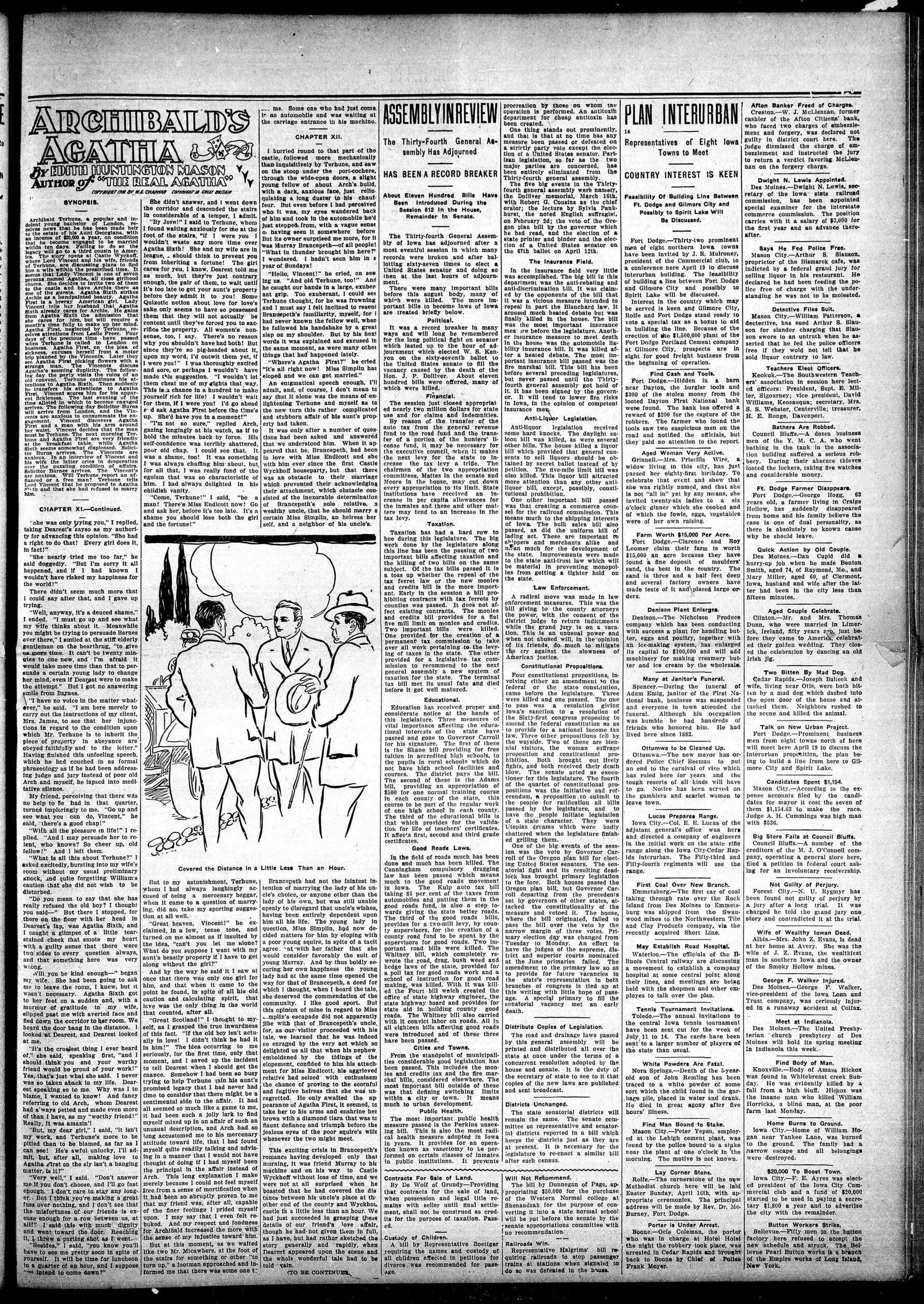
Covered the Distance in a Little Less Than an Hour.
She did not answer, and I went down the corridor and descended the stairs in considerable of a temper, I admit. "By Jove! I said to Teruhine, whom I found waiting anxiously for me at the foot of the stairs, "if I were you I waste any more time over Agatha Shipman wife in a league, _should think to press my pass from inheriting a fortune! The girl cares for you, I know. Dearest me told me as much, but they're just contrary enough, the pair of them, to wait until it's too late to get your gunt's property before they admit it to you! Some Quixotic notion about love for love's sake only seems to have so possessed me, that will not actually be content until they get rid of it fronce the property. All women's non-sense, too, I say. There's no reason why you shouldn't have had both! But since they're pigheaded about it, upon my word, I'd outwit them yet, if I were you! " I was thoroughly excited and sore, or perhaps I wouldn't have made this suggestion. "I wouldn't let them cheat me of my weights to make yourself rich for life! I wouldn't for them, if I were you! I go ahead e'd ask Agatha First before the time's up. She'd have you in a moment!"
"I'm not so sure," replied Arch, gazing longingly at his watch, as if to hold the minutes back by force. His self-confidence was terribly shattered, poor old chap. I could see that. It was a moment of realization. I was always chaffing him about, but for all that, I was really fond of the egolism that was so characteristic of him. I had always delighted in his childish vanity.
"Come, Teruhun!" I said, "be a man! There's Miss Endicott now! Go! You're going to it's too into it, it's a shame you should both the girl and the fortune!"
Covered the Distance in a
But to my astonishment, Terhune, whom I had always laughingly accused of being a mercenary beggar, when it came to a question of marrying, did not take my sporting suggestion at all well.
"Great heaven, Vincent!" he explained, in a low, tense tone, and turned on me almost as if insulted by the idea, "can't you let me alone? What do you suppose I want with my aunt's beauty property if I have to get along without the girl?" And by the way he said it I saw at once that there was only one girl for him, and that when it came to the point he found, in spite of all his old caution and calculating spirit, that love was the only thing in the world that counted, after all.
"Great Scotland!" I thought to myself, as I grasped the true inwardness of this fact. "If the old boy isn't actually in love! I didn't think he had it in him!" The idea occurring to me seriously, for the first time, only that moment, and I saved up the incident to tell Dearest when I should get the chance. Somehow I had been so busy trying to help Terhane gain his aunt's promised legacy that he had time to come outside there might be a side side side to the affair. It had all seemed so much like a game to me, it had been such a jolly lark to find myself mixed up in an affair of such an unusual description, and Arch had so long accustomed me to his mercenary attitude toward life, that I had found myself quite readily talking and advising in a manner that I would not have thought of doing if I had myself been the principal in the affair instead of Arch. This long explanation I make merely because I could not feel myself free from a sense of loneliness, but obviously proven to me that my friend was, after all, a cop of the finer feelings I prided myself upon. I may say that I even felt rebuked. And my respect and fondness for Archibald increased the more with the sense of my injustice toward him. But at this moment, as we waited like two Mr. Micawbers, at the foot of the stairs for something or other "to turn up," a footman approached and informed me that there was some one t
- me. Some one who had just come
to the carriage entrance in the machine
the carriage entrance in the machine
CHAPTER XII.
I hurried round to that part of the castle, followed more mechanically than inquisitively by Terhane, and saw on the stool under the port-cochere, through the wide-open doors, a slight young fellow of about Arch's build, with a dark, anxious face, just reinquiring a long duster to his chaufour. But even before I had perceived a long duster to his chaufour of him and took in the automobile had just stepped from, with a vague sense, o having seen it somewhere before. But its owner surprised me more, for it was Murray Branepech—of all people! "What in thunder brought him here?" I wondered. I hadn't seen him in a year of Sundays!
"Hello, Vincent!" he cried, on seeing us. "And old Terhane, too!" I heard our caught in a large, exuberant ant grip. Too exuberant, I could see Terhane thought, for he was trowning Branepech. "And you, Terhane, Branepech's familiarity, myself, for I had never known the fellow well, when he followed his handshake by a great slap on my shoulder. But by his next words it was explained and excused in the same moment, as were many other things that had happened lately.
"Where's Agatha First?" he cried "It's all right now! Miss Simlin has eloped and we can get married."
An enigmatic speech enough, I admit, and, of course, I don't mean to say that it alone was the means of enlightenment and myself as to the new turn this rather complicated and stubborn affair of his aunt's property had taken.
It was only after a number of questions had been asked and answered that we understood him. When it appeared that he, Brancephte, had been in love with Miss Endicott and she with him ever since the first Castle Wykhoff houseparty, but that there was an obstacle to their marriage which prevented their acknowledging their attachment and determining consequences to an acceptable arrangement of Brancephte's sole relative, a wealthy uncle, that he should marry a certain Simplim, an heiress her self, and a neighbor of his uncle's.
Little Less Than an Hour.
Brancephce had not the faintest intention of marrying the lady of his uncle's choice, or anyone other than the lady of his own, but was still unable openly to disregard that uncle's wishes, having been entirely dependent upon him all his life. The young lady in question, Miss Simpli, had now decided matters for him by eloping with a poor young squirrel. In spite of a tacit agreement, she would consider favorably the suit of young Murray. And by thus holdly securing her own happiness the young lady had at the same time opened the way for that of Brancephce, a deed for which I thought, when I heard the tale, she deserved the commendation of the community. I like good sport. But this opinion of mine in regard to Miss .mplin's escapade did not apparently appeal to me, for as our visitor proceeded with his tale, we learned that he was indeed enraged by the very act which so delighted us all that when his nephew, emboldened by the tidings of the elopement, confided to him his attachment for Miss Endicott, his aggrieved relative had seized with enthusiasm the chance of proving to the scornful and fugitive helpless that she was unregretted. He owed her the money. He答应 take her to his arms and enshrine her brows with a diamond tiar that was to defiance defiance and triumph before the jealous eyes of the poor squirre's wife whenever the two might meet.
This exciting crisis in Brancepeeth the romance having developed only that morning, it was friend Murray to his machine and on his way to Castle Wyckhon without loss of time, and we were not at all surprised when he met the young man, a distance between his uncle's place at the other end of the county and Wyckhon, castle in a little less than an hour. He had just succeeded in grasping these details of our friend's love affair, though he had not given them in full, as I have, but had rather sketched the scene. The young man appeared upon the scene and the whole wonderful tale had to be told vain.
(TO BE CONTINUED)
The Thirty-Fourth General Assembly Has Adjourned
HAS BEEN A RECORD BREAKER
About Eleven Hundred Bills Have Been Introduced During the Session 612 in the House, Remainder in Senate.
The Thirty-fourth General Assembly of Iowa has adjourned after a most eventful session in which many records were broken and after balletting sixty-seven times to elect a United States senator and doing so then at the last hours of adjournment. There were many important bills before this august body, many of which were killed. The more important bills introduced in the Session 612 of Iowa are treated below briefly.
Political.
It was a record breaker in many ways and will long be remembered for the long political fight on senator which lasted up to the hour of adjournment which elected W. S. Kenyon on the slxy-seventh ballot senate to fill the vacancy caused by the Hon. J. P. Dolliver. About eleven hundred bills were offered, many of which were killed.
Financial.
The session just closed appropriated nearly two million dollars for state claims and indemnities. By reason of the high auto tax from the general revenue fund to the road fund and the transfer of a portion of the hunters' lily fees, the necessary for the executive council, which limits the next levy for the state to increase the tax levy a trifle. The chairman of the two appropriation committees is senate and Moore in the house, must approve every appropriation to its limit. State institutions have received an increase in per capita allowances for these taxes and these and other masters may tend to an increase in the tax levy.
Taxation.
Taxation has had a hard row to hoe during this legislature. The big work done by the legislature along with the important bills affecting the two important bills the killing of two bills on the same subject. Of the tax bills passed it is a toss up whether the repeal of the tax feefees law or the new monies credits or credits of the bill prohibit. Early in the session a bill prohibiting contracts with tax ferrets by counties was passed. It does not affect existing contracts. The monies credits five limit on monies and credits. Two important bills were killed. One provided for the creation of a permanent tax commission to take levying of taxes in the state. Then provided for a legislative tax commission to recommend to the next general assembly a new system of taxation for the state. The terminal system was unfair, fat, and died before it got well matured.
Educational.
Education has received proper and considerate notice at the hands of this legislature. Three measures of vital importance affecting the educational interests of the state have Carroll for his signature. The first of these is the Shane bill providing for free tuition in accredited high schools, to the pupils in rural schools which do not have high school facilities and courses. The district pays the bill, and the department adams bill, providing an appropriation $500 for one normal training course in each county of the state, this course to be part of the regular work of one high school in each county. The third of the educational bills is that which provides for the validation of teachers' certificates. It affords first, second and third grade certificates.
Good Roads Laws.
In the field of roads much has been done and much has been killed. The Cunningham compulsory dragging law has been passed which means much to the good roads movement and taking 85 per cent of the taxes from automobiles and putting them in the good roads fund, is also a step towards giving the state better roads, bills, provides for a two-mill levy, bills, supervisors, for the creation of a county road fund to be spent by the supervisors for good roads. Two important road bills were killed. The road, wrote the road, drag, bush weed and hedge laws of the state, provided for a poll tax for good roads work and a school of instruction for good road making, was killed with it was killed. Portsmouth office of state highway engineer, the state highway board and provides for road aid in building county good roads. The Whitney bill also carried the labor on roads. All in all eleven billion of good roads were introduced and of these three have been passed.
Cities and Towns.
From the standpoint of municipalities considerable good legislation has been passed. This includes the monies and credits tax and the fire marshal bills, considered elsewhere. The fees that define switching of these wires that defining switching limits within a city or town. It means much to urban development.
Public Health
The most important public health measure passed is the Perkins unsexing bill. This is also the most radical health measure adopted in Iowa in years. It provides for an operation known as vasectomy to be performed on certain classes of inmates in public institutions. It prevents
Contracts For Sale of Land
By De Wolf of Grundy—Providing that contracts for the sale of land, when possession and legal title remains with the land must settle, shall not be construed as its for the purpose of taxation. Passed.
Custody of Children.
Custody of Children
A bill by Representative Boettger
requiring the names and custody of
all children affected in petitions for
divorce was recommended for passage.
procreation by those on whom the operation is performed. An antitoxin department for cheap antitoxin has been created.
One thing stands out prominently, and that is that at no time has any minister of health given a strictly party vote except the election of a United States senator. Partisan legislation, so far as the two major parties are concerned, has been entirely eliminated from the Thirty-fourth general assembly. The Thirty-fourth general assembly were namely, the Dolliver memorial, March 16th, with Robert G. Cousins as the chief orator; the lecture by Sylvia Pankhurst, the noted English suffragist, on February 2d; the veto of the Oregon plan bill by the governor which he has read, and the election of a state minister and bishop, the election of a United States senator on the 67th ballot on April 12th.
The Insurance Field.
In the insurance field very little was accomplished. The big bill in this department was the anti-betting and anti-discrimination bill. It was claimed that the insurance company it was a vicious measure intended to repeal in part the Blanchard law. It aroused much heated debate but was finally killed in the house. The bill was the most important insurance law in the United States, and insurance measure to meet death in the house was the automobile liability insurance bill. It was killed after a heated debate. The most important insurance law passed was the fire marshal bill. This has been before several preceding legislatures, but never passed until the Thirty-fourth general assembly got hold of it. It has been signed by the governors of the states to lower fire risks in Iowa, in the opinion of competent insurance mea.
Anti-Liquor Legislation.
Anti-liquor legislation received some hard knocks. The daylight salon bill was killed, as were several other bills. The house killed a liquor bill, and the Senate sent to sell liquors should be obtained by secret ballot instead of by petition. The five-mile limit bill was also killed. This liquor bill attracted more attention than any other anti-liquor bill, and it was possibly, constitutional prohibition. One other important bill passed was that creating a commerce counsel for the railroad commission. This means much to the shipping interests. The bulk sales bill also passed as an amendment to the lading act. These are important to shippers and merchants alike and much for the development of the state. Improvements were made to the state anti-trust law which will be in preventing monopolies from getting a tighter hold on the state.
Law Enforcement
A radical move was made in law enforcement measures. This was the bill giving to the county attorneys the power, with the consent of the district judge to return indictments while the grand jury is on a vacancy. This is an unusual power and when not in office, the opinion of its friends, do much to investigate the cry against the slowness of American justice.
Constitutional Propositions
Four constitutional propositions, involving either an amendment to the federal or the state constitution, came before the legislature. Three were killed and one passed. The one killed was Andrew J. Iowa's sanction to a resolution of the Sixty-first congress proposing to amend the federal constitution so as to provide for a national income tax law. Three other propositions fell by visual interviews. Two of these are biennial visions, and the other proposition and constitutional prohibition. Both brought out lively fights, and both received their death blow. The senate acted as executioner for this legislature. The fourth proposition was the initiative and referendum, a proposition to submit to the people for ratification all bills passed by the legislature, and to have the people initiate legislation of the state character. They were topical in the legislature, badly shattered when the legislature finished grilling them.
One of the big events of the session was the veto by Governor Carroll of the Oregon plan bill for electing United States senators. The senating deadlock has brought primary legislation to the fore. Both housses passed the Oregon plan bill, but Governor Carroll departing from the precedents set by governors of other states, attacked the constitutionality of the bill, and called for a new where the bill originated, failed to pass the bill over the veto by the narrow margin of three votes. Primary election day was changed from Tuesday to Monday. An effort to hold the supreme, district and superior courts at the June primaries failed. The amendment to the primary law so as to provide for future vacancies in the state's representation in both branches of congress is tied up at what is called the age. A special primary to fill the senatorial vacancy met an early death.
Distribute Copies of Legislation.
The road and drainage laws passed by this general assembly will be printed and distributed all over the state at once under the terms of a concurrent resolution adopted by the house and senate. It is the duty of the legislature to see to it that copies of the new laws are published and sent broadcast.
Districts Unchanged.
The state senatorial districts will remain the same. The senate committee on representative and senatorial districts reported in a bill which keeps the districts just as they are at present. It is necessary for the legislature to re-enact a similar bill after each census.
Will Not Recommend.
The bill by Dunnegan of Page, appropriating $50,000 for the purchase of the Western Normal college at Shenandoah for the purpose of converting it into a state normal school will be put before the senate by the senate appropriations committee with no recommendation.
Railroads Win.
Representative Halgrima's bill requiring railroads to stop passenger trains at stations when signaled to do so was defeated in the house.
COUNTRY INTEREST IS KEEN
Feasibility Of Building Line Between Ft. Dodge and Glimore City and Possibly to Spirit Lake Will Be Discussed.
Fort Dodge—Thirty-two prominent men of eight northern Iowa towns have been invited by J. R. Mulrone, president of the Commercial club, to a conference here April 19 to discuss interurban building. The feasibility of building a line between Fort Dodge and Glimore City and possibly to Spirit Lake will be discussed.
Interest in the country which may be served is keen and Glimore City, Rolfe and Fort Dodge stand ready to vote a special tax as a bonus to aid in building the line. Because of the creation of 400,000 plant of the Fort Dodge Portland cement company at Glimore City, prospects are in sight for good freight business from the beginning of operation.
Find Cash and Tools
Fort Dodge—Hidden in a barn near Dayton, the burglar tools and $200 of the stolen money from the looted Dayton First National bank were found. The bank has offered a reward of $200 for the capture of the robbers. The farmer who found the tools saw two suspicious men on the road and two notified the officials, but they paid no attention to the report.
Aged Woman Very Active.
Grinell—Irms. Priscilla Wire, a widow living in this city, has just passed her eight-first birthday. To celebrate that event and show that she was rightly named, and that she is not "all in" yet by any means, she invited twenty-six ladies to a six o'clock dinner which she cooked and of which the fowls, eggs, vegetables of her own raising.
Farm Worth $15,000 Per Acre
Farm Worth $15,000 Per Acre.
Fort Dodge—Clarence and Roy Loomer claim their farm is worth $15,000 an acre because they have found a fine deposit of moulders' sand, the best in the country. The sand is three and a half feet deep and several factory owners have made tests of it and placed large orders.
Denison Plant Enlarges
Denison—The Nicholson Produce company which has been conducting with success a plant for handling butter, eggs and poultry, together with an ice-making system, has enlarged its capital to $100,000 and will add machinery for making creamy butter and ice cream by the wholesale.
Many at Janitor's Funeral.
Spencer.--During the funeral of Adam Emg,监勋 of the First National bank, business was suspended and everyone in town attended the funeral. Although his occupation was humble he had hundreds of friends who honored him. He had lived here since 1882.
Ottumwa to be Cleaned Up.
Ottumwa—The new mayor has ordered Police Chief Beeman to put an end to the carnival of vice which has ruled her for years and the tough resorts of all kinds will have to go. Notice has been scribed on the gambles and scarlet women to leave town.
Lucas Prepares Range
Iowa City—Col. E, E. Lucas of the adjunct general's office was here and directed a company of engineers in the initial work on the state rife range along the Iowa City-Cedar Rapids interurban. The Fifty-third and Fifty-fourth regiments will use the range.
First Goal Over New Branch
Emmettsburg—The first car of coal taking through rate over the Rock Island from Des Moines to Emmettsburg was shipped from the Swanwood mines to the Northwestern Tile Mountains. The recently acquired short Line,
May Establish Road Hospital
Waterloo.—The officials of the Illinois Central railway are discussing a movement to establish a company hospital at some central point along their lines, and meetings are being held to discuss other employees to talk over the plan.
Tennis Tournament Invitations
Tennis Tournament Invitations.
Toledo.-The annual invitations to the central Iowa tennis tournament were sent out for the week of July 11 to 14 and been sent to a larger number of players of the state than usual.
White Powders Are Fatal
Nora Springs._Death of the 5-year-old son of John Remiling has been traced to a white powder of some sort which the child found in the garment and in water and drank. He died in great agony after five hours' illness.
Find Man Bound to Stake
Mason City—Peter Yepan, employed at the Leheng cement plant, was the police bound to a spike near the plaza bound to a fence morning. The motive is not known.
Lay Corner Stone
Lay Corner Stone.
Rolfe. The cornerstone of the new Methodist church here will be laid Easter Sunday, April 16th, with appropriate ceremonies. The principal address will be made by Dr. Dr. McBurney, Fort Dodge.
Porter is Under Arrest.
Bone.—Ocle Coleman, the porter who was in charge at Hotel Holst the night the robbery took place, was arrested in Cedar Rapids and brought back to Bone by Chief of Police Frank Moyer.
Afton Banker Freed of Charges
Creston.—W. J. McLennan, former
cashier of the Afton Citizens' bank,
who faced two charges of embezzlement
and forgery, was declared not
guilty in district court here. The
jury dismissed the charge of embezzlement and instructed the jury to return a verdict favoring McLennan on the forgery charge.
Dwight N. Lewis Appointed.
Des Moines.—Dwight N. Lewis, secretary of the Iowa state railroad commission, has been appointed special excuse for the forgery commission. The position carries with it a salary of $3,000 for the first year and an advance thereafter.
Says He Fed Police Free
Says He Fed Police Free.
Mason City.-Arthur S. Slauson,
proprietor of the Blankmarc cafe, was indicted by a federal grand jury for selling liquor in his restaurant. He declared he had been feeding the police free of charge with the understanding he was not to be molested.
Detective Files Suit
Mason City—William Patterson, a detective, has sued Arthur S. Slaunson for slander charging that Slaunson swore to an untruth when he asserted that he was the police officers who killed him, that he sold liquor contrary to law.
Teachers Elect Officers.
Keoulk—The Southwestern Teachers' association in session here lected officers: President, Supt. E. Miler, Sigourney; vice president, David Miles; president, David Miles; S. S. Webater, Centerville; treasurer, H. E. Ronge, Davenport.
Bathers Are Robbed.
Council Bluffs—A dozen business men of the Y. M. C. A. who went bathing in the tank in the association building suffered a serious robbery. During their absence thieves took their wives and five watches and considerable money.
Ft. Dodge Farmer Disappears.
Ft. Dodge Farmer Disappear.
Fort Dodge.-George Hogg, 63 years old, a farmer living in Craig's Hollow, has suddenly disappeared from home and his family believe the case is one of dual personality, as there is absolutely no known cause why he should leave.
Quick Action by Old Couple
Quick Action by Old Couple.
Des Moines—Dan Cupid did
hurry-up job when he made Benton
Smith, aged 74, of Raymond, Mo., and
Mary Miller, aged 60, of Clermont,
Iowa, husband and wife after the
latter had been in the city less than
fifteen minutes.
Aged Couple Celebrate
Clinton—Mr. and Mrs. Thomas Dunn, who were married in Limerick, Ireland, fifty years ago, just before they came to America, celebrated their golden wedding. They closed the celebration by dancing an old Irish jig.
Two Bitten By Mad Do
Dodge. Cedar Rapids—Joseph Bulkeley and wife, living near Oils, were both bitten by a mad dog which danced into the open door of the house and attacked them. Neighbors rushed to the scene and killed the animal.
Talk on New Urban Project.
Fort Dodge—Prominent business men from eight towns north of here will meet here April 19 to discuss the interurban partnership, the plan being to build a line from here to Gilmore City and Spirit Lake.
Candidates Spent $1,154.
Mason City.—According to the expense accounts filed by the candidates for mayor it cost the seven of them $1,154.63 to make the race. Judge A. H. Cummings was high man with $536.
Big Store Fails at Council Bluffs. Council Bluffs—a number of the creditors of the M. J. O'Connell company, operating a general store here, filed a petition in federal court asking for an involuntary receivership.
Not Guilty of Perjury.
Forest City—N. U. Rygmyr has been found not guilty of perjury by a jury after a long trial. It was charged he told the grand jury one story and contradicted it at the trial.
Wife of Wealthy Iwan Dead.
Albia—Mrs. John Z. Evans is dead at her home at Avery. She was the wife of J. Z. Evans, the wealthiest man in southern Iowa and the owner of the Smoky Hollow mines.
George F. Walker Injured.
Des Molines—George F. Walker, vice-president of the Iowa Loan and Trust company, was curiously injured in a runaway accident at Colfax.
Meet at Indiolaire.
Des Molines—The United Presbyterian church presbytery of Des Molines will hold its spring meeting in Indiolaire this week.
Find Body of Man
Knoville—Body of Amasa Hickox was found in Whitebreathe creek Sunday. He was evidently killed by a fall from a high bluff. Hickox was one of the men who killed William Horrick, the farm owner, at the poor farm last Monday.
Home Burns to Ground
Iowa City—Home of William Hogan near Yankee Lake, was burned to the ground. The family had a narrow escape and all belongings were destroyed.
$20,000 To Boost Town.
Iowa City—F. E. Ayres was elected president of the Iowa City Commercial club and a fund of $20,000 started to be used in paying a secretary $1,800 a year and to advertise the city with the remainder.
Button Workers Strike.
Bellevue—Fifty men in the button factory here refused to accept the new schedule and struck. The Bellevue Pearl Button works is a branch of the Empire works of Long Island, New York.
Iowa State Bystander
BYSTANDER PUB. CO., Publishers.
DES MOINES. IOWA
France is flying well to the front.
Fashion is willing to be hobbled but not haremed.
The harem-scarum skirt has certainly been well advertised.
"Man wants but little here below." The poet didn't mention women.
There are 411,322 federal offices and still not enough to go around.
"It has been found that radium will kill a cat." But drowning is cheaper.
The harem skirt may be something to wear besides being something to talk about.
New York's 52-story building is carrying the elevator business to a limit and almost to the stars.
These government statistics will convince even the farmers before long that agriculture is profitable.
Our idea of no place to start an umbrella factory is on Mars. Prof. Lowell says it never rains there.
"Don't eat when you're tired," says a magazine writer. That's the kind of advice that makes us tired.
And if they put pockets in the pantaloon skirt it's our bet that she'll stand with her hands in 'em, too.
That Chicago lawgiver who wants to legislate against the harem skirt must never have tripped over a fair woman's train.
Now that a high-browed professor has recertained that colds cost only $44.3 this spring, look out for a bargain counter rush.
Irofanity is not to be legislated from the New York stage. In other words, in some of the plays all of the fakes are not to be cut out.
Are there not small, rocky islands where powder mills might go away by themselves and explode without interfering with the neighbors?
The proposed law to prevent loveless marriages recalls the ancient question: "What is love?" Likewise, how can it be made permanent?
Twenty-one professors at the University of Moscow have been forced to resign by striking students. Russia must be a gladess place for a student.
American helplesses are waiting for an advance list of King George's appointments of 500 new radical peers. Some of them will be laborites, no doubt.
An eastern savant tells us fat men rarely are criminals. Julius Caesar had the same idea—at least according to Shakespeare, or Bacon, or whoever it was.
A skeleton found in England is said to be 100,000 years old. This may be remarkable, but is there any limit to the age that a skeleton may eventually attain?
The Chicago girl who got into print on the assumption that she wanted to marry an Indian has gone on the vaudeville stage. Might have known it from the start.
A New Jersey dog catcher proposes to get 'em with an aeroplane. Then to the other triumphs of aeronautics will be added that of a bark sailing through the air.
The coronation of King George will introduce special styles in hats, says an exchange, which is tough luck for the man who was planning to wear last year's straw again.
A woman who was described by her artist husband as a "modern Venus" has just been awarded $25 a month alimony. Well, all Venuses are supposed to be more or less broke.
If the day of the harem skirt has arrived it will come in regardless of jeers and friendly or unfriendly legislation. If it has not come then all the advanced women in the world cannot force it.
A Massachusetts chief of police wants the ducking-stool revived for feminine scolds. He will want it still more when the tongues he would thus restrain have finished their assaults upon him.
A Chicago matron avers that a breach of promise suit against her husband merely amuses her. However, that form of amusement is not likely to become generally popular among the matrons.
A New Jersey woman in an alienation-of affections suit recently recovered $2,000 for the loss of her husband's love. And many of her sisters will probably consider her a lucky woman, more to be envied than pitied.
Now a woman speaker comes forward to say that it is the icebox, not the ballot box, which should interest women. To the average woman who wants to enlarge her sphere, encouraged by warm enthusiasm, it will seem but cold advice.
A bull fighter in Seville ran away with a popular dancer, literally snatching her from the stage, as her dancing costume was covered with a cloak. This shows that the bold Lochinvar was accustomed to taking the bull by the horns in any dilemma.
By her husband's will a Pennsylvanian widow is to have $100,000 as long as she stays unmarried. She is in a fine position, if she does want to marry again, to be assured past contradiction or doubt that she is loved her herself.
DEAL JACKSON AND WHAT HE IS DOING ON HIS GEORGIA FARM
By J. GORTATOWSKY
Permission of Uncle Remu' Home Magazine.
Just a plain negro, without a day of schooling all his life, not knowing what his age or who his father—a plantation darky, if you please—who moves along in his own way—peacefully—without ostentation or noise. And yet a negro with a purpose and better still, a negro with a record for accomplishments which, in its way, stands out as boldly and significantly as the record of Booker T. Washington in its way.
"Where is he?" was quiry.
"Dar he is."
And the besmudged pointed to a smiling nearby, with trousers a coat, and with a slouched his hand.
"Howdy," he said walked up, bowing all to what he could do, a hearty sort of ragtim
You wouldn't think such a record would go unsung for year after year; that a short item in some of the papers of his state once each year would be all that he got of fame and glory; that, outside of his own county, he would be unknown; that, of all the magazine articles which have appeared on the negro question, and the negro race in the south, his name would not be among the mentioned.
Who is this Deal Jackson, this negro farmer who barely is able to read and write his own name? What has he done deserving of fame?
Deal Jackson has produced the first bale of cotton east of the Mississippi for 13 consecutive years, in spite of the fiercest competition from members of his own race, and of the white farmers of the south.
He has raised, ginned and marketed the first bale 13 consecutive years! Study the significance of that!
He has in one year raised and marketed as many as five bales of cotton before any other farmer east of the Mississippi raised one bale.
He has, for his own honest efforts,
and with a handicap of not a day of
schooling all his life, made $100,000 in
farming, and become the third or
fourth wealthiest man in his county.
And in a county, too, which, before
the war, had the distinction of being
the third of fourth wealthiest county
in the United States per capita of
white population.
Deal Was Born in Slavery.
The little two-cylinder automobile
didn't cut much of a caper as it
cut its way along the white, sandy
roads of Dougherty county in the ex-
THE NEW YORK TIMES
THE BIG BANK
Deal Jackson and a Bale of His Cotton.
treme southwestern section of him money without Georgia; but it moved along as seemed note. As Deal express best to suit itself, stopping now and favor in my eyes.
then, hesitating often. He worked on "BI
It gave those who rode in it a rare opportunity to see this beautiful country, with its great plantations of hundreds and thousands of acres, its broad stretches of cotton fields, now black, with hardly a speck of white to show the uninitiated that he was passing through the "land of cotton;" with tiny shacks strung along the road—all inhabited by negroes; with pickaniennies dark as night to point the way when the driver felt that it was taking a long time to reach the farm of Deal Jackson, just five miles away from the starting point—Albany, Ga.
He expected to see the wealthiest negro in Georgia living "in state," as it were; to be shown into a great imposing mansion, with pompoug white pillars rearing themselves on the borders of a long, expansive porch; to be met at the door by a big negro, splendidly attired, impressed with his importance—and more particularly his vast and extensive knowledge.
"Whose place is that?" was asked of the pickaninny who had come out to admire and wonder at the automobile.
"Deal Jackson's," was the reply.
An Accomplishment.
The wife of a Germantown (Philadelphia) man is said to have cultivated her genius for bargaining to an extraordinary degree. Not long ago she burst into the living room and made this startling announcement to her spouse:
"Cousin Emma has appendicitis! I've arranged with Doctor Blank to perform the operation for only $600. Every one knows that the regular fee is——
"Where. is he?" was the next inquiry.
"Dar he is."
And the besmudged "blackberry" pointed to a smiling negro standing nearby, with trousers baggy, without a coat, and with a slouchy, torn hat in his hand.
"Howdy," he said cordially, and walked up, bowing all the while, asked what he could do, and laughed—a hearty sort of ragtime chuckle—not for any particular reason, as could be ascertained, but just for the sake of laughing, and the love of it.
Inside the house, which was furnished very much as are all homes of fairly prosperous negro farmers in the south, he laughed again, placed his hat on a sewing machine, introduced his wife and two children, and awaited developments.
"Are these all the children you have, Deal?" he was asked.
"Tassir," he replied. "You see, I was married twict. All de fust croped. Dew was fo' o' dem."
"Lessee," he said, in response to another question, "I see about fifty-nine—just about fifty-nine. Who's my payments? Now dat I doan know. Cose I knows who was my mudder, but do only way I knows I had e radder is by lookin' at udder folks who I knows had one."
Deal said he was born in Putnam county—in slavery, of course—and belonged to the Jackson family, "jest befo' de war closed."
He was thirteen years old when hostilities ceased.
"I was so young I didn't know I was free. I had er idea dat only dose twenty-one was free, an' I kept right on her a slave tel I was twenty-one—an' happy all de time."
His Farm Contains 2,000 Acres.
He worked hard all the time, saved his money, established credit, and won the esteem of the white people of him money. One man in particular, said to have been the most penurious—and as a result, perhaps, the wealthiest—man in the county, often loaned
```markdown
```
him money without even requiring a note. As Deal expressed it, "He saw favor in my eyes."
He worked on "Billy" Gilbert's place for 15 years, and had planned to buy a farm of his own for $1,600, when he succumbed to the wily talk of a friend and loaned $1,000 of the amount, which was never repaid. He, in turn, borrowed $900, added it to the $700 he had still, and purchased the farm—250 acres—which he has yet, and to which he has added, from time to time, 1,750 acres, his present holdings in farm lands being 2,000 acres.
Asked as to the value of this 2,000-acre farm, Deal replied very eloquently and very simply:
"I have repaid $25 e arce fer 'em."
He is not ashamed of the fact that he has had no schooling, although he proposes this shall not be the case with his two children of "the second crop."
Deal does not attach much importance to the fact that he has produced the first bark of cotton east of the Mississippi for 13 years. He is at a loss to explain it clearly.
"I uses good seed," he says. "I plants arly, an' I cultivates hard. Den I watches an' watches an' works all de time te I git er bale. Jest hard work an' work all de time an' known' how. Dat's all."
dear," interrupted the husband, "upon your success in bringing a fashionable disease within the reach of Cousin Emma."
Mrs. Philip Snowden, the English suffragette, began at a linner in New York her reply to a toast on "Marriage" with the words;
"I once asked a little girl if she knew what leisure was.
"Yes, she replied. 'Leisure is the place where married people report.'"
But Deal will enjoy the distinction no longer. The "first bale bale" as he is known in Dougherty county, has decided to pass the glory on to an other. He feels that he has accomplished enough for one man—and a negro, at that—in the way of getting distinction.
"Hit's too much work and worry," he explains, "an 'an' decided it was better to rust out den to w'aar out." Deal is patriotic, too.
"All I asks is dat de fust bale gits raised here in ds county.
"I give the man what wants to raise de fust bale 20 bushels of de finest seed I got. All he'l hab to do is to plant arly 'a' o' time in February and if it gits kill out, plant again; and den cultivate heavy, an' work an' watch. Hit's a big resk, I tells you, but mebbe hits wuth while to de man dat ain't feared to take hit."
The raising of the first bale for 12 years has not been without its primary reward to the negro, even if that reward has been small, and the glory slight.
When cotton brings about 12 or 13 cents, Deal gets for his first bale in the neighborhood of 25 cents. On a
M.
Deal Jackson, "The First Bale Nigger," bale of 400 pounds, which is about the average, this means about $100—$50 more than he would get at the normal price.
Rents Half of Farm to Negroes.
On one occasion, Deal marketed the first bale; it was bought, shipped to Savannah, and there declared "old cotton." Deal struck up at a fast clip again, and marketed two more bales before any other farmer in Georgia or east of the Mississippi had marketed one.
Later, the original "first bale" was pronounced "new cotton," and the vindication of the "first bale nigger" was complete.
Deal's farm is worth more, perhaps, than any other farm of equal size in his section of the country. It is impossible for Deal personally to cultivate all of the 2,000 acres, so he rents half of it to other negroes who pay him two bales to the plow, netting him about $3,700 annually.
The 1,000 acres—which he supervises personally—bring on an average of 22 bales to the plow—more, it is said, than is averaged by any other farmer in the section.
Here of late, Booker T. Washington has taken a great interest in the "first hale nigger," and the latter has visited Tuskegee Institute several times, on the last occasion being invited to deliver an address to the "business leg," as he calls the "business league." "He's de bigges' nigger in the worl," I spect, is the tribute Deal pays to Booker Washington.
Deal Jackson has a sense of humor—every negro has that. He admired greatly the automobile, and watched it leave with as much interest as the plekaninny had watched it arrive.
"Why don't you get one?" he was asked.
"Ef er lady comes along de street in er buggy an' your ottermobile skewed de horse, hit'd be bad, wouldn't hit? But ef Deal Jackson was in dat ottermobile, hit'd be ear heap more had, wouldn't hit?" And his eyes twinkled with the humor and the wisdom of the remark.
Deal Jackson has a heart also. Shortly before the writer was to leave Albany—his native home—he asked a prominent business man his opinion of Deal as a man.
"He's all right," same the ready response. "Deal has good credit. He knows his place and keeps it, and he has the respect of everybody that knows him. I have always thought a lot of him since the time he came to mo and asked as to the credit of a young man, under whose father he had once served as a slave. I told him his credit was C. K. And Deal replied, with a trace of sadness in his voice:
"It don't make much difference, anyway. I already loaned him the money. When I wusn't anything but a boy, I used to sit on one side of the fireplace and him on the other. When the missus gin him a hunk of bread, she gin me a hunk. When the missus licked him she licked me, and when she licked me she licked me, too. When she darned a pair of stockings fer him she darned a pair fer me, and when she darned a pair fer me she darned a pair fer him. We split things den. I spect we kin, sorter divide up now."
Some day, a writer will come down south to study the negro race and the negro problem, will make some mention of Deal Jackson, "the first hale nigger"—a negro farmer in the south, of the south, loving the south—with $100,000 to his credit, and a record of 13 first bales as a claim for the distinction of being the south's greatest farmer.
The little girl from the city had been questioning the old farmer, touching on many things about the place.
"And now," said she in conclusion, "I'd like to ask you just one thing more."
"Fire away," said the farmer good-naturedly.
"What I wanted to know," said the untiring little questioner, "is when you have finished milking the cow, how do you
Chosen For Dolliver's Term in United States Senate
TERM EXPIRES MARCH 3, 1913
Judge Kenyon Was Born At Elyria
Ohio, June 10, 1889, and Will
Be the Youngest Man Ever
Sent to Senate From Iowa
67th Ballot
Kenyon ..... 85
Deemer ..... 19
Porter ..... 51
Des Molnes, April 13.—The thirty-fourth General Assembly and Senate yesterday elected the Honorable W. S. Kenyon, of Ft. Dodge, United States Senator from Iowa to fill the vacancy caused by the death of Hon. Jonathan P. Dolliver, after one of the most stubborn deadlocks ever experienced in the State of Iowa.
Mr. Kenyon will take his office, and represent the State of Iowa as United States Senator immediately upon the Governor's signature being attached to his election certificate.
W. S. Kenyon, newly elected United States senator, was born at Elyria, Ohio, June 10, 1869, 42 years ago and will be the youngest man ever sent to the senate from Iowa. He is of Scotch descent.
Kenyon moved to Iowa with his parents while a youth, his father, a
1910
Judge Kenyon.
Presbyterian minister, being assigned to a charge at Grinnell. He attended Grinnell college two years, from 1889 to 1883, later removing to Iowa City with his parents, where he entered the law college of State University. While in school he was recognized as a brilliant student, graduating with high honors in 1890.
Ft. Dodge was chosen as a location by the newly graduated attorney and he formed a partnership there with the late Capt. J. A. O. Ycoan, Capt. Ycoan at that time was recognized as one of Iowa's most brilliant lawyers and orators.
Senator Kenyon first entered politics in 1894, when he was elected prosecuting attorney of Webster county. Two years later he was reelected. He declined renomination but a year later when Col. W. T. Chanlaund resigned the office to enter the Spanish-American war, he was appointed to fill the vacancy.
In 1910 he was appointed assistant attorney general of the United States and became widely known as an attorney of ability by the able manner in which he handled some of the more important cases entrusted to him.
Kenvon's Record.
Born at Elyria, Ohio, 1869.
Attended Grinnell college 1886-88.
Graduated State University law college 1890.
Took up practice of law at Fort Dodge 1890.
Married to Mary Duncome 1893.
Elected county attorney of Webster county in 1894 and served until 1998; was reappointed county attorney in 1898 when Col. W. T. Chantland resigned to enter the Spanish-American war.
Elected to the district court judgement 1901.
Resigned judgeship and again took up practice of law with his father-in-law, Hon. J. F. Duncome, Iowa counsel to the Illinois Central railroad, 1903.
Appointed counsel for the Illinois Central in Iowa at Attorney. Duncome's death, 1904.
Appointed general attorney for all lines of the Illinois Central north of the Ohio river, with headquarters in Chicago, 1906.
Appointed assistant attorney general of the United States 1910.
Strikers Again Bioting
Muscatine, April 13.—A score of arrests were made by the police early today when they were forced to charge rioting button workers about the plants here. The situation is more serious than ever.
Missing Woman Located.
Storm Lake, April 13.—Mrs. John Greenwood, who mysteriously disappeared, March 10, has been located at Rockford, Ill., and refuses to return or make any explanation of her conduct.
Husband Saves Woman.
River Junction, April 13.—Timely arrival of the husband of Mrs. Etta Matthews prevented three gypsies, a man and two women, from robbing her while she was on duty as station agent for the Rock Island here.
Storm Hits Sloux City.
Sloux City, April 13. A storm, accompanied by hall, rain and lightning, struck Sloux City at 3 o'clock yesterday afternoon. During a few minutes of the gale, the wind blew at the rate of ninety miles an hour.
TOM L. JOHNSON DEAD
FOUR-TIME MAYOR OF CLEVE-
LAND PASSES AWAY.
Succumbs to Cirrhosis of the Liver
With Which He Had Been Af-
flicted for Years.
Cleveland, Ohio, April 12.—Tom L.
Johnson, former mayor of Cleveland
and known throughout the nation for
his fight for three-cent street car
fares, died of cirrhosis of the liver.
He had been ill for over two years,
but had been confined to his bed only
since March 15. Mr. Johnson was at
one time a multi-millionaire and,
by his own confession a monopolist. But
it is as the mayor of Cleveland that
he will be remembered by the people
of the United States long after the other
phases of his careers are forgotten.
He was pronounced by Lincoln Stefens "the best mayor of the best-governed city in the United States."
He had been so near death for five days that frequently the physician thought the end had come and twice newspaper extras were on the street announcing his death. Then the rumor was found to be false. Up to a week ago the former mayor had insisted that he would get well and again be a candidate for mayor of Cleveland, but finally he saw his hope was futile and, after bidding old friends and former political associates farewell, he resigned himself to death.
"I am so tired. I wish I could sleep," he murmured in his moments of consciousness. And finally the sleep came but not until Mr. Johnson had suffered much pain in the same cheerful manner that marked his whole career. Sunday when every moment was expected to be his last Mr. Johnson weakly asked that four letters, which he had dictated some days before be brought to him. Propped up, he laboriously signed his name and then fell back exhausted. These letters go to four of his best friends—keepsakes from the man who gave his life for his hobby, three-cent fare.
That Mr. Johnson sacrificed his life for his principles is certain. He had been ailing from cirrhosis of the liver for years and was told by the physicians that he must quit active work for awhile and take treatment, but he was in the midst of his fight for three-cent fare and refused to stop. Finally, beaten in his fifth fight for mayor, he yielded to illness and went to New York for treatment, but it was too late. Cleveland people ride on their street cars for three cents, but they have lost the man who did more for the common people than any other citizen. The funeral arrangements have not been made but the body will probably lie in state as thousands wish to take a final look.
IS LIBERAL TO INSURGENTS
Minority Leader Mann Announces Assignment of Republican Members on House Committees.
Washington.—House Minority Leader Mann announced the Republican assignments to committees Tuesday. Every leading progressive or "Insurgent" was given an important committee. The house elected the committees, both Democratic and Republican members, without change or objection.
Mr. Mann's course in recognizing the Insurgents shows that he set himself the task of solidifying party lines, healing factional differences and presenting a united front to the Democrats.
Mr. Mann takes as his only committee assignment that of chairman of the conference of the minority. It is a new chairmanship and indicates Mr. Mann's purpose to substitute conferences of party leaders for party caucuses on legislative matters wherever possible. Former Speaker Cannon was given ranking minority membership on the appropriation committee, an assignment for which he asked, and nothing else. Two progressives were given positions on the committee on rules.-Madison of Kansas and Lenroot of Wisconsin. With Dalzell of Pennsylvania and Wilson of Illinois, regulars, they make up the Republican membership of the committee.
GARY HAS NEW BIG INDUSTRY
United States Steel Corporation Opens
Coke Ovens—Cost $8,500,000
Will Use 830 Men.
Gary, Ind. — The United States
Steel corporation's fourth
industry was formally placed in operation
when the first coke was produced
at the new coke ovens, built at a cost
of $8,500,000. A force of 830 men will
be required to operate the ovens,
which are 560 in number.
With the placing of the ovens in
operation the steel corporation's western
plants at Gary, Joliet, South Chicago
and Milwaukee and other points
will not have to secure their blast furnace coke from the Pennsylvania
fields.
New York.—Sam Lloyd, well-known puzzle expert, whose problems have interested not alone the rising generation, but others, died at his home Tuesday from a stroke of apoplexy. He was seventy years of age.
Foss to Marry Miss Chapman.
San Francisco.—The engagement of Sturtevant Foss of Boston, son of the governor of Massachusetts, and Miss Dorothy Chapman of this city was announced Tuesday by the parents of the bride-elect.
Given Twenty Years for Murder.
Danville, ill.—The jury in the case against Fred C. Garner, charged with the murder of Mrs. Elise Cochrane, returned a verdict of guilty Monday and fixed his punishment at 20 years in the penitentiary.
Chinese Troops Rebel at Canton. London. Northern Chinese troops stationed at Canton mutinied Monday because they were dissatisfied over the action of the prince regent in proclaiming himself commander-in-chief of the army.
TROOPS CROSS LINE
American Soldiers Are Forced to Interfere In Mexico
NO WORD FROM WASHINGTON
Step is Taken to Prevent Loss of Life on American Ground After Two Are Killed and Several
Agua Prieta, Mexico, (via Douglas, Ariz.) April 14.—During a battle which lasted all afternoon, and which resulted in the capture of this city by rebels commanded by "Red" Lopez, American troops crossed the border and stopped the fighting. The action was taken after one man had been killed and several wounded in Douglas, and the continued firing was endangering the lives of Americans on United States territory. Douglas was under constant fire three hours. The Mexicans had been warned twice that shooting onto American town must cease, but request was unheeded. Federal Mexican troops were defeated in the battle but finally agreed to surrender to Americans instead of the rebels. This is the first time during the insurrection that any person has been killed on the American side as the result of the border fighting.
The dead and wounded of both the rebels and federals are being taken to Douglas.
MUSCATINE IN HANDS OF MOB
MUSCATINE IN HANDS OF MOB
CRISIS OF UNION FIGHT—REVOLVERS FIRED
Local Police Unable to Cope With Situation and Appeal to Governor for Aid.
Des Moines, April 14.—Governor B. F. Carroll'last night received an appeal from Sheriff Vannatta of Muscatine for four companies of militia to quell the riots there resulting from the button workers' strike and it is probable that the city will today witness the arrival of the national guard and the formal declaration of martial law.
Practically the entire city of Muscatine was in a state of siege last night and during the early hours this morning. Mob rule prevailed, and, according to reports from the troubled district, crowds of rioters bent on the destruction of life and property, surged through the business and factory district, defying the efforts of the law to check their course and sweeping the feeble resistance of the officers before them like chaff.
Last night's struggle is said to have been precipitated by the importation of a score of Chicago and St. Louis special police officers by the sheriff to assist in quelling disturbances.
LEWIS TO BE HENDERSON'S AID
Had Resigned As Secretary to Accept Place With Interstate Commerce Commission Examiner.
Des Moines, April 14.—Dwight N. Lewis, former secretary of the railroad commission, will take charge of the new office of commerce counsel as assistant to Judge J. H. Henderson, appointed and confirmed as commerce counsel.
Mr. Lewis had resigned as secretary last week for the purpose of accepting a place with the interstate commerce commission as an examiner, and he was preparing to leave and go into the new field when the position of assistant was offered him here.
Council Bluffs, April 14—Experts from the east are examining the Iowa and Omaha short line with a view of floating bonds to finance it. The line is nearly finished from Council Bluffs to Treynor. It is proposed to extend it to Des Moines via Oakland, Atlantic and Guthrie Center.
Storm Severe at Mason City, Mason City, April 14—High wind here played havoc with plate glass windows, trees, light wires and small buildings. Smoke stacks at the tile plants were blown over and the roof of the power house of the electric railway was blown on.
Prominent Farmer Drowned. Manchester, In., April 14—David Heyer, a prominent farmer living near Thorpe, was drowned when he attempted to ford a swollen stream near his home. He was 48 years of age.
Electricians Will Convene.
Davenport, April 14—Electricians will own the town next week for the Iowa Electrical association will be here April 19 and the Iowa Street and interurban Railway association will be here the next three days.
Rebekahs to Hold Meet.
Logan, April 14—Seventh annual convention of the Forty-third district convention of the Rebekahs will convene here May 5. An address will be delivered by the state president, Helen Prescott.
Coleman Has Confessed.
Boone, April 14—Olsie Coleman, the porter who was brought back from Cedar Rapids, charged with breaking into the telephone toll boxes at the Holst hotel, has confessed. He is out on parole from the reform school at Eldora.
Dodge Hae Celebration.
Council Bluffs, April 14—Major General G. M. Dodge, the only army commander left of those who won fame during the civil war, celebrated his 80th birthday here yesterday.
ARCHIBALD'S
AGATHA
BY EDITH HUNTINGTON MASON
AUTHOR OF "THE REAL AGATHA"
CHAPTER XI.—Continued.
"She was only trying you," I replied, taking Dearest's sayso by my authority for advancing this opinion. "She had a right to do that! Every girl does it, in fact!"
"She nearly tried me too far," he said doggedly. "But I'm sorry it all happened, and if I had known I wouldn't have risked my happiness for that the day before."
There didn't seem much more that I could say after that, and I gave up trying.
"Well, anyway, it's a deuced shame," I ended. "I must go up and see what my wife thinks about it. Meanwhile you might be trying to persuade Barnes over there," I smiled at the stiff elderly gentleman on the hearthring, "to give us more time. It can't be twenty minutes to one now, and I'm afraid it would take more time than that to perceive her mind, even if Dearest was to make the attempt." But I got no answering smile from Barnes.
"I have no voice in the matter whatever," he said. "I am here merely to carry out the instructions of my client, Mrs. James, to see that her injunctions in regard to the condition upon which Mr. Terhune is to inherit the piece of property in abeyance are obeyed faithfully and to the letter." Having finished this unfeeling speech, which he had couched in as formal phraseology as if he had been addressing judge and jury instead of poor old Arch and myself, he lapsed into meditative silence.
My friend, perceiving that there was no help to be had in that quarter, turned imploringly to me. "Go up and see what you can do, Vincent," he said, "there's a good chap."
With all the pleasure in life! I replied, "And I may persuade you to reel, what happens. So cheer up, old fellow!" And I left them.
"What is all this about Terhune?" I asked excitedly, bursting into my room without my usual preliminary knock, and quite forgetting Williams' caution that she did not wish to be disturbed.
"Do you mean to say that she has really refused the old boy? I thought you said—" But there I stopped, for there on the floor with her head in Dearest's lap, was Agatha Sixth, and I caught a glimpse of a little tear stained cheek that smoothed my heart. I saw it twice; then two sides to every question always, and that something here was very wong. will you be kind enough—" began my wife. She had been going to ask me to leave the room, I knew, but it wasn't necessary. Agatha Sixth got to her feet on a sudden and, with a murmur of gratitude to my wife, elipped past me with averted face and we down the corridor to the room. We down the door bang in the distance, looked at Dearest, and Dearest looked at me.
"It's the cruelest thing I ever heard of," she said, speaking first, "and I should think you and your worthy friend would be proud of your work!" Yes, that's just what she said. I never was taken aback in my life. Dearest speaking to me. Why was I to blame, I wanted to know! And fancy referring to old Arch, whom Dearest had a ways padded and made even more of than I have, as my "worthy friend!" Really, it was amazin'! "But, my dear girl," I said, "it isn't my work, and Terune's more to be pitted than to be blamed, as far as I can see! He's awful unlucky, I'll admit, but after all, making love to Agatha first on the sly isn't a hanging matter, is it?!" I said. "Don't answer me if you choose, and I will go fast enough. I don't care to stay any longer. But I think you're making a great fuss over nothing, and I don't see that the misfortunes of our friends is excuse enough for a row between us, at all!" I said this with much dignity and went toward the door. Reaching it, I threw a marking shot as I went.
"Besides," I said, "you know you'll have to see me pretty soon in spite of lunch for lunchmen for lunchmen in a quarter of an hour, I suppose "you intend to come down?"
THE MEN'S WEEKLY
Covered the Distance in a Little Less Than an Hour.
She did not answer, and I went down the corridor and descended the stairs in considerable of a temper, I admit. "By Joney!" I said to Teruhine, whom I found waiting anxiously for me at the foot of the stairs, "If we were you, I would be you." Agatha Sixth! She and my wife are league, should think to prevent you from inheriting a fortune! The girl cares for you, I know. Dearest told me as much, but they're just contrary enough, the pair of them, to wait until it's too late to get your aunt's property before they admit it to you! Some Quixotic notion about love for love's sake only seems to have so possessed me, the pair of them content until they've forced you to surrender the property. All women's nonsense, too, I say. There's no reason why you shouldn't have had both! But since they're so pigheaded about it, upon my word, I'd outwit them yet, if I were you! "I was thoroughly excited and sore, or perhaps I wouldn't have made this suggestion. "I wouldn't let them cheat me of my rights that way, upon yourself rich for life! I wouldn't wait for them, if I were you! I go ahead s'd ask Agatha First before the time's up. She'd have you in a moment!"
"I'm not so sure," replied Arch, gazing longingly at his watch, as if to hold the minutes back by force. His self-confidence was terribly shattered, poor old chap. I could see that. It was a man who was always chaffing him about, but for all that, I was really fond of the egosion that was so characteristic of him. I had always delighted in his childish vanity.
"Come, Terhune!" I said, "be a man! There Miss Endicott now! Go back to the room it's too late! It's a shame you should both the girl and the fortune!"
Covered the Distance in a
But to my astonishment, Terhune, whom I had always laughingly accused of being a mercenary beggar, when it came to a question of marrying, did not take my sporting suggestion at all well.
"Great heaven, Vincent!" he exclaimed, in a low, tense tone, and turned on me almost as if insulted by the idea, "can't you let me alone? What do you suppose I want with my aunt's besty property if I have to get along without the girl?"
And by the way he said it I saw at once that there was only one girl for him, and that when it came to the point he found, in spite of all his old caution and calculating spirit, that love was the only thing in the world that counted, after all.
"Great Scotland!" I thought to myself, as I grasped the true inwardness of this fact. "If the old boy isn't actually in love! I didn't think he had it in him!" The idea occurring to me seriously, for the first time, only that moment, and I saved up the incident to tell Dearest when I should get the chance. Somehow I had been so busy trying to help Terborne yain his aunt's promised legacy that I had never had time to consider that I had been sentimental side such a game to me, I had been such a jolly lark to find myself mixed up in an affair of such an unusual description, and Arch had so long accustomed me to his mercenary attitude toward life, that I had found myself quite readily talking and advising in a manner that I would not have thought of doing if I had myself been the principal in the affair instead of Arch. This long explanation I make merely because I could not feel myself free from a sense of mortification when it had been so abruptly proven to that my friend that I had felt the feelings I prided myself upon. I may say that I even felt rebuked. And my respect and fondness for Archbishop increased the more with the sense of my injustice toward him. At this of my injustice toward him. like two Mr. Micawares, at the foot of the stairs for something or other "turn up," a footman approached and informed me that there was some one to
... me. Some one who had just come
is an automobile and was waiting at
the carriage entrance in his machina.
I hurried round to that part of the castle, followed more mechanically than inquisitively by Terhune, and saw on the stoop under the port-cochere, through the wide-open doors, a slight young fellow of about. Arch's build, a man of great stature, clashing a long duster to his chauftet. Four, even before I had perceived who it was, my eyes wandered back of him and took in the automobile he'd just stepped from, with a vague sense. have seen it somewhere before. But its owner surprised me more, for it Murray Brancker, a man of "what" whimsy, brought him here? I wondered. I hadn't seen him in a year of Sundays!
"Hello, Vincent!" he cried, on seeing us. "and Old Terhune, too!!" And he caught our hands in a large, exuberant grip. Too exuberant, I could see Terhune thought, for he was frowning and I must say I felt inclined to resent Branosepeth's familiarity, myself, for I had never known the fellow well, when he followed his handshake by a great slap on my shoulder. But by his next words it was explained and excused in the same moment, as were many other things that had happened lately.
"Where's Agatha First?" "it's all right now! Miss Simplin has eloped and we can get married." I admit, and, of course, I don't mean to say that it alone was the means of enlightening Terhune and myself as to the new turn this rather complicated and stubborn affair of his aunt's property had taken.
It was only after a number of questions had been asked and answered that we understood him. When it appeared that he, Brancephte, had been in love with Miss Endicott and she with him ever since the first Castle Wyckhoff housepain, but that there was an obstacle to their marriage which prevented the marriage from happening, which obstacle consisted of the inexorable determination of Brancephte's sole relative, a wealthy uncle, that he should marry a certain Simplin, an heiress her self, and a neighbor of his uncle's.
Little Less Than an Hour.
Brancepeth had not the faintest intention of marrying the lady of his uncle's choice, or anyone other than the lady of his own, but was still unable openly to disregard that uncle's wishes, having been entirely dependent upon him all his life. The young lady in question, Miss Simplin, had now decided matters for him by eloping with the lady of his own, but agreed "not with her father that she would consider favorably the suit of young Murray. And by thus boldly securing her own happiness the young lady had at the same time opened the way for that of Brancepeth, a deed for which I thought, when I heard the tale, she deserved the commendation of the community. I like good sport. But this opinion of mine in regard to Miss .mplin's escapade did not apparently involve the visit of her, for our visitor proceeded with his tale, we learned that he was indeed so enraged by the very act which so delighted us all that when his nephew emboldened by the tidings of the elopement, confided to him his attachment for Miss Endcott, his aggrieved relative had seized with enthusiasm the chance of proving to the scornful and fugitive heir that she was unregreted. He only awaited the apology to take her to his arms and enshrine her brows with a diamond tiara that was to faunt defiance and triumph before the jealous eyes of the poor squirre's wife whenever the two might meet.
This exciting crisis in Brancepeth's romance having developed only that morning, it was friend Murray to his machine and on his way to Castle Wykhoff without loss of time, and we were not at all surprised when he boasted that he had covered the disastrous accident in the simple's place, another end of the county and Wykhon, castle in a little less than an hour. He had just succeeded in grasping these details of our friend's love affair, though he had not given them in full, as I have, but had rather sketched the story generally and rapidly, when Dearest appeared upon the scene and the whole wonderful tale had to be told vainly.
TO BE CONTINUED
The Thirty-Fourth General Assembly Has Adjourned
HAS BEEN A RECORD BREAKER
About Eleven Hundred Bills Have Been Introduced During the Session 612 In the House, Remainder In Senate.
The Thirty-fourth General Assembly of Iowa has adjourned after a most eventful session in which many records were broken and after balletting sixty-seven times to elect a United States senator and doing so then at the last hours of adjournment. There were many important bills before this August body, many of which were killed. The more important bills of Iowa are treated briefly below.
Political.
It was a record breaker in many ways and will long be remembered for the long political fight on senator which lasted up to the hour of adjournment which elected W. S. Kenyon on the sixty-seventh ballot to the United States senate to fill the vacancy caused by the death of Senator D. Dollier. About eleven hundred bills were offered, many of which were killed.
Financial.
The session just closed appropriated nearly two million dollars for state use and for claims and indemnities, and appropriated the general revenue fund to the road fund and the transfer of a portion of the hunters' license fund, it may be necessary for the state to increase the tax levy to the state to increase the tax levy a tride. The chairmen of the two appropriation committees, Mattes in the senate and the House, agree that every appropriation to its limit. State institutions have received an increase in per capita allowances for the inmates and these and other maltreats tend to an increase in the tax levy.
Taxation.
Taxation has had a hard row to hoe during this legislature. The big work done by the legislature along with the other important bills affecting taxation and the killing of two bills on the same subject. Of the tax bills passed it is a toss up whether the repeal of the tax fee bill or the new monies credit bill on the new monies credit early. In the session a bill prohibiting contracts with tax ferrets by counties was passed. It does not affect existing contracts. The monies credit bill prohibits five mill limit on monies and credits. Two important bills were killed. One provided for the creation of a permanent tax commission to tax the state and levying of taxes in the state. The other provided for a legislative tax commission to recommend to the next general assembly a new system of taxation. The tax bill met its usual fate and died before it got well matured.
Educational.
Education has received proper and considerate notice at the hands of this legislature. Three measures of vital importance affecting the educational interests of the state have passed the governor's Cabinet for signature. The first of these is the Shane bill providing for free tuition in accredited high schools, to the pupils in rural schools which do not have high school facilities and courses. The district pays the bill. The second, the state's bill providing for appropriations $500 for one normal training course in each county of the state, this course to be part of the regular work of one high school in each county. The third of the educational bills is that which provides for the valuation of teachers' certificates. It offers first, second and third grade certificates.
Good Roads Laws.
In the field of roads much has been done and much has been killed. The Cunningham compulsory dragging law has been passed which means much to the good health of the city. Kupi auto tax bill taking 85 per cent of the taxes from automobiles and putting them in the good roads fund, is also a step towards giving the state better roads. Two important provisions are the provided for a two-mill levy, by county supervisors, for the creation of a county road fund to be spent by the supervisors for good roads. Two important provisions are the provided for a two-mill levy, which completely rewrote the road, drag, bush weed and hedge laws of the state, provided for a poll tax for good roads work and a school of instruction for good road work. The Fourth bill, which completely rewrote the office of state highway engineer, the state highway board and provides for state aid in building county good roads. The Whitney bill also carried through all eleighteen bills affecting good roads were introduced and of these three have been passed.
Cities and Towns.
From the standpoint of municipalities considerable good legislation has been passed. This includes the monies and credits tax and the fire marshal bills, considered elsewhere. The laws that define switching limits within a city or town. It means much to urban development.
Public Health.
The most important public health measure passed is the Perkins unsexing bill. This is also the most radical health measure adopted in Iowa and elsewhere. It provides for an open-ended known as vasectomy to be performed on certain classes of inmates in public institutions. It prevents Contracts For Sale of Land. By De Wolf of Grundy—Providing that contracts for the sale of land, when possession and legal title remains with seller until final settlement, shall not be construed as credits for the purpose of taxation. Passed. Custody of Children. A bill by Representative Boeiger requiring the names and custody of all children affected in petitions for divorce was recommended for passage.
procreation by those on whom the operation is performed. An antitoxin department for cheap antitoxin has been established. One thing stands out prominently, and that is that at no time has any measure been passed or defeated on a strictly party vote except the election of the president, the national legislation, so far as the two major parties are concerned, has been entirely eliminated from the Thirty-fourth general assembly. Thirty-fourth general assembly were namey, the Dolliver memorial, March 16th, with Robert G. Cousins as the chief counsel. Thirty-fourth general assembly burst, the noted English suffragist, on February 2d; the veto of the Oregon plan bill by the governor which he had read, and the election of a state of the United States and the election of a United States member of the 67th ballot on April 12th.
The Insurance Field.
In the insurance field very little was accomplished. The big bill in this department was the anti-rebating and anti-discrimination bill. It was claimed that the insurance company was a vicious measure intended to repeal in part the Blanchard law. It aroused much heated debate but was finally killed in the house. The bill was the most important insurance bill in the history of the country and insurance measure to meet death in the house was the automobile liability insurance bill. It was killed after a heated debate. The most important insurance bill in the history of the country and fire marshal bill. This bill has been before several preceding legislatures, but never passed until the Thirty-fourth general assembly got hold of it. It has been signed by the governors of the states to lower fire rates in Iowa, in the opinion of competent insurance mea
Anti-Liquor Legislation.
Anti-liquor legislation received some hard knocks. The daylight salon bill was killed, as were several other bills. The house killed a liquor bill, and the state killed a bill meant to sell liquors should be obtained by secret ballot instead of by petition. The five-mile limit bill was also killed. This liquor bill attracted more attention than any other anti-liquor bill, except, possibly, constituting a significant part of the one important bill passed was that creating a commerce counsel for the railroad commission. This means much to the shipping interests of Iowa. The bulk sales bill also included a bill to laod a acting act. These are important to shipers and merchants alike and much for the development of the state. Improvements were made to the state anti-trust law which will be material in preventing monopolies, getting a tighter hold on the state.
Law Enforcement.
A radical move was made in law enforcement measures. This was the bill giving to the county attorneys the power, with the consent of the district judge to return indictments while the grand jury is on a vacation. This is an unusual power and function of the court of its friends, do much to mitigate the cry against the slowness of American justice.
Constitutional Propositions
Four constitutional propositions, involving either an amendment to the federal or the state constitution, came before the legislature. Three were killed and one passed. The one who gave a resolution giving Iowa's sanction to abolish the Sixty-first congress proposing to amend the federal constitution so as to provide for a national income tax law. Three other propositions fell by the wayside. Two of these are biennial propositions, and the fourth proposition and constitutional prohibition. Both brought out lively fights, and both received their death blow. The senate acted as executioner for this legislature. The fourth proposition was the initiative and referendum, a proposition to submit to the people for ratification all bills passed by the legislature, and to have the people initiate legislation. Utopian dreams which were badly shattered by the legislature finished grilling them.
One of the big events of the session was the veto by Governor Carroll of the Oregon plan bill for electing United States senators. The senators' vote has brought primary legislation to the fore. Both housss passed the Oregon plan bill, but Governor Carroll departing from the precedents set by governors of other states, attacked the constitutionality of the bill, and argued where the bill originated, failed to pass the bill over the veto by the narrow margin of three votes. Primary election day was changed from Tuesday to Monday. An effort to tie the governor to the supreme, district and superior courts occurred at the June primaries failed. The amendment to the primary law so as to provide for future vacancies in the state's representation in both branches of congress is tied up at what will be the next stage. A special primary to fill the senatorial vacancy met an early death.
Distribute Copies of Legislation
The road and drainage laws passed by this general assembly will be printed and distributed all over the state at once under the terms of a concurrent resolution adopted by the house and senate. It is the duty of the legislature to see to it that copies of the new laws are published and sent broadcast.
Districts Unchanged.
The state senatorial districts will remain the same. The senate committee on representative and senatorial districts reported in a bill which keeps the districts just as they are at present. It is necessary for the legislature to re-enact a similar bill after each census.
Will Not Recommend.
The bill by Dunnegan of Page, appropriating $50,000 for the purchase of the Western Normal college at Shenandoah for the purpose of converting it into a state normal school will be put before the senate by the senate appropriations committee with no recommendation.
Ballroads. Win.
Railroads WHAT
receive railroads *Halgrims* bill
required railroads to stop passenger
trains at stations when signaled to
do so was defeated in the B-mus.
COUNTRY INTEREST IS KEEN
Feasibility Of Building Line Between Ft. Dodge and Glimore City and Possibly to Spirit Lake Will Be Discussed.
Fort Dodge—Thirty-two prominent men of eight northern Iowa towns have been invited by J. R. Mulrone, president of the Commercial club, to a conference here April 19 to discuss interurban building. The feasibility of building a line between Fort Dodge and Glimore City and possibly to Spirit Lake will be discussed.
Interest in the country which may be served is keen and Glimore City, Rolfe and Fort Dodge stand ready to vote a special tax as a bonus to add in building the new location of the erection the $1,500,000 plant of the Fort Dodge Portland Cement company at Glimore City, prospects are in sight for good freight business from the beginning of operation.
Find Cash and Tools
Fort Dodge--Hidden in a barn near Dayton, the burglars钱 and $200 of the stolen money from the looted Dayton First National bank were found. The bank has offered a reward of $200 for the capture of the robbers. The farmer who found the tools saw two suspicious men on the road and notified the officials, but they paid no attention to the report.
Aged Woman Very Active.
Grinellin—Mrs. Priscilla Wire, a widow living in this city, has just passed her eight-first birthday. To celebrate that event and show that she was rightly named, and that she is not "all in" yet by any means, she invited twenty-six ladies to a six o'clock dinner which she cooked and of which the fowls, eggs, vegetables were of her own raising.
Farm Worth $15,000 Per Acre.
Fort Dodge—Clarence and Roy Loomer claim their farm is worth $15,000 an acre because they have found a fine deposit of moulders' sand, the best in the country. The sand is three and a half feet deep in several factories that made tests of it and placed large orders.
Denison Plant Enlarges
Denison—The Nicholson Produce company which has been conducting with success a plant for handling butter, eggs and poultry, together with an ice-making system, has enlarged its capital to $100,000 and will add machinery for making creamy butter and ice cream by the wholesale.
Many at Janitor's Funeral.
Spencer—During the funeral of Adam Emig, janitor of the First National bank, business was suspended and everyone in town attended the funeral. Although his occupation was humble he had hundreds of friends who honored him. He had lived here since 1882.
Ottumwa to be Cleaned Up
Ottumwa.-The new mayor has ordered Police Chief Beeman to put an end to the carnival of vice which has ruled here for years and the tough resorts of all kinds will have to go. Noice has been scriven on the gamblers and scarlet women to leave town.
Lucas Preparce Range
Iowa City.—Col. E. E. Lucas of the adjutant general's office was here and directed a company of engineers in the initial work on the state rife range along the Iowa City-Cedar Rapids interurbant. The Fifty-third and Fifty-fourth regiments will use the range.
First Coal Over New Branch
First Coast Over New Branch.
Emmetsburg—The first car of coal taking through rate over the Rock Island from Des Moines to Emmettsburg was shipped from the Swanwood mines to the Northwestern Tile and Clay Products company, via the recently acquired Short Line.
May Establish Road Hospital.
Waterloo—The officials of the Illinois Central railway are discussing a movement to establish a company hospital at some central point along their lines, and meetings are being held there by other employees to talk over the plan.
Tennis Tournament Invitations
Tennis Tournament invitations.
Toledo—The annual invitations to the central Iowa tennis tournament have been sent to the state. July 11 to 14. The cards have been sent to a larger number of players of the state than usual.
White Powders Are Fatal.
Nora Springs._Death of the 5-year-old son of John Remling has been traced to a white powder of some sort with the child found in the garment jacket in water and after death. He died in great illness after five hours' illness.
Find Man Bound to Stake
Mason City—Peter Yepan, employed at the Lehch cement plant, was found by the police bound to a spike in the wall of the building morning. The motive is not known.
Lay Corner Stones
Rolfe—The cornerstone of the new Methodist church here will be laid Easter Sunday, April 16th, with appropriate ceremonies. The principal address will be made by Rev. Dr. McBurney, Fort Dodge.
Porter is Under Arrest.
Boone—Ocle Coleman, the porter who was in charge at Hotel Holst the night the robbery took place, was arrested in Cedar Rapids and brought back to Boone by Chief of Police Frank Moyer.
---
Afton Banker Freed of Charges.
Creston.—W. J. McLennan, former cashier of the Afton Citizens' bank, who faced two charges of embezzlement and forgery, was declared not guilty in district court here. The judge dismissed the charge of embezzlement and instructed the jury to return a verdict favoring McLennan on the forgery charge.
Dwight N. Lewis Appointed
Dwight N. Lewis Appointed.
Des Molines.—Dwight N. Lewis, secretary of the Iowa state railroad commission, has been appointed special examiner for the interstate transportation. The commission carries with it a salary of $3,000 for the first year and an advance thereafter.
Says He Fed Police Free.
Mason City.—Arthur S. Slusau, proprietor of the Bismarck cafe, was indicted by a federal grand jury for the killing of a man he declared he had been feeding the police free of charge with the understanding he was not to be molested.
Detective Files Suit
Mason City—William Patterson, a detective, has sued Arthur S. Slauson for slander charging that Slauson sword to an untruth when he asked for the sword to be free if they wold not tell that he sold liquor contrary to law.
Teachers, Elect, Officers
Keokuh...The Southwestern Teachers' association in session here lected officers: President, Supt. E. Miler, Sligourney; vice president, David Haimenko; teacher S. S. Wabena; Centerville treasurer, H. E. Renge, Davenport.
Bathers Are Robbed
Council Bluffs—A dozen business men of the Y. M. C. A., who went bathing in the tank in the association building suffered a serious robbery. During their absence thieves looted the lockers, taking five watches and considerable money.
Ft. Dodge Farmer Disappears.
Fort Dodge—George Hogg, 63 years old, a farmer living in Craig Hollow, has suddenly disappeared from home and his family believe the case is one of dual personality, as there is absolutely no known cause why he should leave.
Quick Action by Old Couple.
Des Moines—Dan Cupid did hurry-up job when he made Benton Smith, aged 47, of Raymond, Mo., and Mary Miller, aged 60, of Clermont, Iowa, husband and wife after the latter had been in the city less than fifteen minutes.
Aged Couple Celebrate
Clinton—Mr. and Mrs. Thomas Dunn, who were married in Limerick, Ireland, fifty years ago, just before they came to America, celebrated their golden wedding. They closed the celebration by dancing an old Irish jig.
Two Bitten By Mad Dog.
Cedar Rapids, Joseph-Paul and wife Jimmy, both bitten by a snake and dog which dashed into the open door of the house and attacked them. Neighbors rushed to the scene and killed the animal.
Talk on New Urban Project
Fort Dodge - Prominent business men from eight towns north of here will meet here April 19 to discuss the interurban proposition, the plan being to build a line from here to Gilmore City and Spirit Lake.
Candidates Spent $1,154.
Mason City—According to the expense accounts filed by the candidates for mayor it cost the seven of them $1154.83 to make the race. Judge A. H. Cummings was high man with $536.
Big Store Fails at Council Blues.
Council Blues—A number of the creditors of the M. J. O'Connell company, operating a general store here, filed a petition in federal court asking for an involuntary receivership.
Not Guilty of Perjury
Forest City—N. U. Rygymr has been found not guilty of perjury by a jury after a long trial. It was charged he told the grand jury one story and contradicted it at the trial.
Wife of Wealthy Jowan Dead
Albis—Mrs. John E. Evans, is dead at her home at Avery. She was the wife of J. Z. Evans, the wealthiest man in southern Iowa and the owner of the Smoky Hollow mines.
George F. Walker injured.
Des Miles—George F. Walker, vice-president of the Iowa Loan and Trust company, was seriously injured in a runaway accident at Colafx.
Meet at. Indiarola
Des Moines—The United Presbyterian church presbytery of Des Moines will hold its spring meeting in Indianapolis this week.
Find Body of Man.
Knoxville—Body of Amasa Hickox was found in Whitebread creek Sunday. He was evidently killed by a fall from a high bluff. Hickox was the insane man who killed William Horricks, a blind man, at the poor farm last Monday.
Home Burns to Ground.
Iowa City—Home of William Hogan near Yankee Lane, was burned to the ground. The family had a narrow escape and all belongings were destroyed.
$20,000 to Boost Town.
Iowa City—F. E. Ayres was elected president of the Iowa City Commercial club and a fund of $20,000 started to be used in paying a secretary $1,800 a year and to advertise the city with the remainder.
Button Workers Strike.
Bellevue—Fifty men in the button factory here returned to accept the new schedule and struck. The Belevue Pearl Button works is a branch of the Empire works of Long Island, New York.
f ALBIA SEWS
Mr Jeffers of Des Moines was the
guest of Mrs E. Grayson two days last
week.
Rev. and Mes. Rell and Dorcia Bel
‘ef Clarinds visited friencs in Albia a
flaw days of this week.
‘Mise Duvis of Ottamwn is the guest
‘of Mise Orn and Mildved Lewis «few
Gays of this week.
Mrs. B. T Lewis was howtess to the
‘Stewantess Aid society, Monday, after-
oon
Mra E. Botler entertained at six
efeleek lunch Monday. the presidine
Eiier Gord of Ottrmwa, Rev. J. B-
and Mes. Bell and Uorcia of Clarinde,
Rev. and Mra. Maniey and Evangelist,
Miss Lanra Schofield.
‘Miss Adak Davis has retarned from a
‘six months visit with relatives in Des
‘ver, Colorado
Mrs. Allse Bowman was hostess te
the Dunbar club ox Tharsday after-
a
Mes. Virginia Barnes of Hocking was
in Albia Saturday,
Me. and Mrs. Boy Grayson and 200,
Ben, of Hocking, were in Albia Scn-
dey.
CEDAR RAFiis Saws
‘Mra M. F. Lowery who has been
quite iB, was taken to Morey hospita’
last Wednesday. and is zeported get
fog slong as well as coa'd be exp-eted.
Mes & V. Holly retarned last week
fram Chicago, where she spent the wint
@. We were indeed giad to see ber
back.
‘Mrs Allie Marshall made 2 fyicg
trip to Olewis to spend a few days with
her mother.
Mr. Otis Thorpe was busy Sonday,
taking photos of his friends.
‘The Young Men's elu» will give their
Easter Ball, #t Canfcld’s hall Admis-
sion $1.00 coapie.
‘The One Effort clat heid a successful
meeting at the home of the president,
Mrs. Hattie Raspberry, entertained by
Mrs. Joyce. After the meeting ad-
Journed the hostess served a two-cours+
Iancheon Next week the club will
meet at Mrs. 5. V. Holly.
Sanday was the the third quarterly
meeting at Bethet A.M. EL charch.
Presiding Eider Phillips preached an
‘exellent sermon throughout the dey.
‘The meetings were well attended
Christian Endeavor at 6:2) o'clock
was lead by Mr. George Tyler.
Mrs Gertrude Tyler lost her mother,
last Wednesday morning, after a few
daysiloess. The remains were taken
to Tipton for borial. We extend our
heart felt sympathy to the bereaved
family.
‘The Elks will give their Easter Ball
at their rovms on Frst avenue, Second
airect Admission S0e per eouple.
Presiding Elder Phillips held quarter-
Iyconference, Monday night at Bethel
A.M E.chareh.
Mrs Delia Varsball has been on the
‘sick list bot much better and was seen
at church last Sanday night Also Mrs.
‘Mae Terry is able to be out again.
‘Mrs, Ella Lucas is arren3ing for the
Easter exercise at the Christian En-
deavor Four Sunday at 6:2) o'clock
‘Mrs Holly of Monmouth, LIL, is vie-
iting at the bome of Mrs. Richard
Hicks on &th street.
‘The City Federation will give a eel
eale, Monday, Mav Ist, under the lend-
ership of Mrs. Hattie Warren. We
hope that each ard every ore will look
forward to that date.
Few of the delegates are sending in
their names. Lets not be slow about
that, Send in your names at once, in|
order that we will not be deceived |
‘When a medicine must be given to
young children it should be pleasan"
to take. Cramberlain's Cough Reme.
dy is made from loaf sugar, and tie
roots used In preparation give It =
flayor similar to maple syrup. makin
Mt plessant to take. It has no supe
wlor for colds, croup and whooping
‘cough. For sale by all dealers,
CLINTON iZAPPEKTYGS.
The Stewardess gave a fish fry at the
church April 5th, which was fairl)
patronized.
Mrs. W. A. Searcyof Monmouth, Ill.
‘was in the city lust week, called here
by the serious condition of her brother,
Otis Thompson.
Mrs. Jesse Mitchell of Fulton was s
Clinton visitor last week.
Mrs. A. A Bash is much improve*
of her illness of several days duration,
of rheumatism which effected her hear’
‘The wedding bells pealed fourth tl eir
Jubilani tones in onr city for the sec-
‘nd time rince the new year, on Satur.
day evening April 1st; not #8 an April
fobl joke, but as a reality, for it was
then that Geo, W. Slater, Jr. of Aurora
Neb, made Vies Missouri Dozier hi-
wife at her home, 833 Harrison strect.,
‘The Rev. S. # Moore officiated in the
Presence of the immediate members of
her family. The bride has spent »
Jarge portion of her life in Clinton
She is a graduate of the Clinton Hi; h
School, taking also a short curse in
Howard University, Washington, D. ©.
‘The groom is. devoted to the lecture
field, taleing on several sut jects. Af-
ter apending a few days in Clinton they
‘Willleave for Nebraska where they
‘will make their futrre home, carrying
with them the best wishes of the By-
stander and friends.
Mra D. 0. Greene of Chicago left
forher home, after a ten days,
it with her sister, Mrs. A. A. Bush
family.
_ One of the most beautiful ceremonies
Appropriate to Palm Sundsy was the
removal of all that was mortal of the
ine wre Henrietta Brown, who parsed
Away in January, from the receiving
vault, and tenderly consigned to its
Inst resting place in the family lot ir
Springdale cemetery, Rev. 8. B
Moore conducted the simple but beau
Hifal service, Those present from out
af the ¢ y were Mr. and wre, Jock
Brynat, Mrs, Era. Casey of Chicago
ud W.J.BrownofElgin
(Colored Musical Comedy in Oma.
ha’s Finest Theatre.
‘The Musical Comedy—“My Friend
from Dixie"”—whiet is the attraction at
The Grand Sunday, Monday, Trexday
and Wednesday, is now filling an ex-
gaqnamect st the besotifal palace of
arasement, Bracitia Theatre in Omaha
Tris theatre is one of the grandest
theaters in America, and it stould be a
pleasure to Mr. 3. Labrie Hill and bis
company t know that the reputation
which they have earnad this season in
‘My Friend Prom Ditle bas been the
means of securing s dat io the grand-
est theatre ever played in = Colored
company.
COLFAX NOTES.
| The Midland Jabilee singers gave 2
lemeert in the the First Methodist
jevareh last Friday evening and were
grented by a large aadience.
Rev Saunders of Oralabor oeeapied
the pulpit of Bethel Baptist charch last
Sunday
‘Thoweon the sick list are Miss Min-
nie Alexander and Mr. Linzy Robi-son.
Spring City Hoasebold of Rath initi
ated fire candidates last Satarday even-
ing. After which a sumptous laneh
wis served which was greatly enjoyed
bby all.
|, Last Thursday evening a large rom.
| ber of friends gathered at the home cf
| Mr. W. D. Miller in response to an in-
| itation from Mrs Miller, to celebrate
the 20th biethday anniversary of her
kusband. The‘oceasion was an enjoy-
able one. The evening was spent in
‘eoversation. An elaborate two eourre
Luoeheon was served by the hostess,
assisted by Mrs. Lonnie Brocks. The
guests departed at a late boar leaving
ing a namber of rememberances und
‘wi hing Mr. Miller many more returns
of his natal day.
Mr Edd Clark of the capital city was
a guest at the parental home last week
Mr 5. Owen Redmon, a student of
Iowa College at Grinnell, was a guest
this many Colfax friends last week.
Mr. Prank Hackley, the popular ton-
sorial artist of Hotel Colfax, has gone
to Chieago to remain indefinitely.
Miss Edith Terrell returned to her
school work in Oskaloosa last Sunday
alter spending a weeks vacation with
her parents and friends in the Spring
City.
Miss Sadie Oakley departed for Des
Moines last Thursday where she will
make her fature home.
Mrs. WB. Battles gave a pleasant
cial at her home last Saturday even-
ing. The proceeds was given to the
Mission Circle.
Mr. and Mrs. Clarence Miller of New-
ton were guests at the W. D. Miller
home last Sundry.
Mrs. C.H Holmes and baby Mary
are visiting relatives and friends in this
city. Mr. Holmes spent Sunday with
them, revurning home Monday,
Mr. Lonnie Brooks, Miss Ethel Ter-
rell Mrs. Knox nnd S. A. Spears were
‘eapital city visitors last Saturday.
Mr and Mrs. J. W. Holmes enter-
tained the members of the Household
‘of Rath at their home last Tuesday
evening, complimentary to Mrs. Lizzie
Wilson, who departed Wednesday for
Minneapolis where she will make her
fature heme. The evening was spent
in Music and games. A two course
luncheon was served by the hrstess
‘The A M. E. 8. S. gave an enter-
tinment Saturday evening. The pro-
czeds are to be used in defraying the
expense of the children to Newton
where a union Easter program will be
given.
Mrs. J. H. Brordos was-hostess to
the ladies Mission Circle last Thursday
afternoon. After the transaction of
Constipation brings many ailments
‘y its train and is the primary cavae
of much sickness. Keep your bowels
~egular madam, and yon will escape
~any of the ailments to which women
re subfsct. Constipation is a very
simple thing, but lke many things,
t may lead to serious conseanences
“ature often needs a little assistance
vnd when Chamberlain's Tablets are
iven at the first indication, much d's
‘ress and suffering may be avoided.
nae We ait deatana:
eS oe Sei ere
$300 REWARD
Don’t let the tailor or ready
made man tell you that we can-
not make you a suit to order for
$15.00—which is satisfactory—
They will say it can’t be done.
The British Woolen Co offers
$500.00 Reward if you can name
any one in the U. S. who will
make you as good a suit, and will
show you as fine a selection of
woolens in quality, style and
workmanship as we do.
Don’t let them fool you, but
call and convince yourself,
We now have our complete
line of Spring and Summer wool-
ens for your inspection.
Suit or Overcoat to Order
9% STORES IN THE U. S
WOOLEN CoO.
M. Crocker, 500 W. Locus
. Manager Crocker Bldg.
All Goods Union Made
Ruski :
basiners an elaborate Easter Lancheoe
was served by the hostess
Mz. and Mrs. reoce have returned
‘to their home is Hot Springs. Ark.
We regret very mech to lose these
estimabe people and hope they may
decide to retarn to oar city.
The members of the Séission Circle
fave 20 enjoyable social at the how
of Mrs. W. D. Miller last Monday ever-
ina. Each lady had earned one dollar
and entertained their friends ty tell-
‘ing how they earned the money. Re-
freshmnts were served and a nest
‘som was realized
The many friends of Mr. and Mrs. S.
Joe Brown of Des Voines regret to
hear of her serioes iliness and hope
for a speedy recovery.
Mr George W. Lacas, the popaler
undertaker of Des Moines, spenta few
hoars in our city Tuesday visiting
friends.
‘Our baby cries for Chamberiain’s
Cougs Remedy,” writes Mrs. TB
Kendrick, Rasaca, Ga “ft fs the best
cough remedy on the market for
coughs, colds and croup. For sale by
al deaters
KEOKUK NOTES.
Mr. Arthor Pry was a Ft. Madison
visitor over Sanday.
Mrs. A. J. Fields returned home Mor-
day morning from Grand Rapids, Michi-
gan, where she was called by the illness
snd death of her brother, Jerome tiland,
Mrs. A. J. Starnes of Kansas City,
Kansas, is visiting at the home of her
sister, Mrs Wm. Gress 1312 High St.
Mrs. nis Kelis is quite ili at her
home 1017 Fulton St. Friends hope for
her speedy recovery.
Mrs Mil ie Sanders is very ill at her
home 1312 Morgan street. She is a
kindly old lady and friends wish for ker
a speedy recovery.
Miss Nettie Kebo gave a very suc-
cessfal lenten tea ather home 1410 Mor-
gan street.
Mr. Hampton Woodard, very pleas.
antly entertained Electa chapter No
46, 0 E, S. at his home I6th and Mor-
gan street, after the business was
transacted, a splendid luneheon wes
served.
GALESBURG. ILL.
Miss Ella MeGraw is the guest of her
sister Mrs, RE. Lyons.
Mrs. Sandy Smith, who was teken to
the cottage hespital is improving very
slowly.
Born, Wednesday morning to Mr.
and Mrs, Ed Turpin, a daughter,
"Wer on the remodeling of Allen
chapel has begun and services are now
held in the Odd Fellows hall.
Mrs. SB Moore entertained at din-
ner, Wednesday, in honor of her hus-
band, Rev. S, B. Moore of Clinton, who
who is here on business Among these
present were Rev Tyler, Rev. Bess,
vessrs. Wikins, Kidd, Wilson, Wells
and Chas. Anderson.
"Miss Lyda Crawford and Mr. Gilbert
Lewis were quietly married, Thureday
afternoon by Rev. B. Alard Smith st
the Baptist church. Mr. and Mrs Lewis
will make their home for the present
with the bride’s parents.
For Constipation.
Mr. LH. Farnham, a prominent drug-
elst of Spirit Lake, lowa, says: Cham-
berlain’s Stomach’ and Liver Tablets
ate certainnly the best thing on the
market for constipation.” Give these
bits a tral. You are certain to
fird them agreeable and pleasant in
ect. Price, 25 cents. Samples free.
For sale by all dealers.
h ALS
TMs
| 8 7 } U
an” y
THE OLD RELIABLE DRESSING FOR
KINKY OR CURLY HAIR.I'S USE MAIES
‘STUBBORN, HARSH HAIR SOFTER, MORE.
PLIABLE AND GLOSSY, EASY TO COMB AND
OT OPIN ANY STYLE THE LENGTH WILL
PERMIT. WRITE FOR TESTIMONIES, TELLING
HOW THIS REMARKABLE REMEDY MAKES
SHORT, INKY HAIR GROW LONG AND
WAVY, BEST POMADE ON THE MARKET
FOR DANDRUFY CHING OF THE SCALP
‘AND FALLING OUT OF THE HAIR.
BEWARE OF IMITATIONS, GET THE
CGEMVINE.PUT UP IR 2S+ARD 50+ BOTTLES |
wm CHARLES FORD'S
NAME ON. EVERY PACKAGE.
* SOLD BY DRUGGISTS.
TF YOUR DRUGGIST CANNOT SUPPLY
YOUWE WILLSEND IT TO YOU DIRECT
‘AT THE FOLLOWING PRICES, SMALL SIZED
BOTTLE,25¢ LARGE SIZED BOTTLE.SO+
THE OZONIZED OX MARROW CO.
216 LANE ST.DEPT.. 935 GHICAGO,ILL.
AGENTS WANTED. “
3t. Joseph go to
;
LTankfard’s Cafe
Lunch, Meals and
Short Orders
Served at all Hours
Home Cooking Home Mad:
a Specialty. fies.
mb Langan, robe,
21234 S, 8th St, St. Josep!
Opposite P, 0. My,
Lame Shoulder is nearly alway’
ape husky ley tone fap ap
eg rs
vation of ‘lain’s Liniment
For sale by all dealers,
Tools for the Garden and Lawn — Poultry Supplies
INCUBATORS——BROODERS .
Foods, Remedies, Louse Powder and Liquids, Sprays—
Everything for the Garden and Poultry Yard,
THE EAST SIDE SEED STORE
DES MOINES SEED STORE |
409 and 411 East Pifth Street
‘Phoae 1253 East Catalogue Free
NEW CHAPTER IN
HUMAN HISTORY
First Universal Races Congress
Wil Mari Its Beginning
PERSONNEL OF THE ASSEMBLY.
Pe om oie and Aim of
London —For the frst time in buman
nistory there i m clear prospect of eae
tomuva ideal acimatiog al peoples,
sod thos the beasrifal oft bope of the
trocbersoud of cations and races is at
tase moving appredabiy toward real
tation, "What tetter menae of cele
venting the birth of the new era o@
brasting ailde prejuiices 224 sasit
choos ot correcing. misuadersand
ingp than by mea ad women foc
Sn and. wot, whke ant soowhite
Seccing an friends aod equa ia
reat congress?
We therefore earcestiy appa to all
_bost especialy to symjanzers 13
the tar aod neat east ani Ja Alvis
ced Ameria to take the uimat ef
fort tp attend perwealy the ft cal
Wemal races cvogress in London Jair
i
: I
pee
ey 7
ES
aN
¥ 7
ee
Src
Pe ao
oe
oy smart raxowise, 0) amuro sup ox,
amewr 0) Ana
25 to 29 inclusive and convert it into
an imposing and worid moving demon-
stration in favor of interracial good
wil,
‘The congress is truly what it pur-
ports to be—an assembly of members
of all the races of the world. Accord-
ingly there ate papers on China, Ja-
pan, Turkey, Persia, the Jewish race,
india, Exypt, Haiti, the American Ne-
gro and Indian and the Negro of West
and South Africa.
Hindu Scholar Will Open Program.
In every one of these cases, we wish
it to be noted, the paper is written by
a member of the particular people oF
Face concerned, while the very first
paper of the congress is by a Hindu
scholar, the congress executive recog-
nizing that It might thus show fts ap-
preciation of the east. Ex orlente lux.
It will rejoice the hearts of those
‘who believe in interracial harmony to
know that tt fs not the few, the de-
spied or the eccentrie who are co-
cperating in this congress, but the
many, the honored and the experl-
enced. Among the supporters, very
many of whom have welcomed with
the greatest enthusiasm the idea of
holding such a congress and who be-
tong to no less than fifty countries,
are thirty presidents of parliament,
the majority of the members of the
permanent court of arbitration and of
ize delegates to the second Hague
centetence, twelve British governors
aud eight British prime ministers,
many statesmen and ambassadors,
over forty colonial bishops, some 130
prefessors of International law, the
leading anthropologists and sociolo-
gists, the officers of the majority of
the council of the tnterparliamentary
unit, not to particularize a multitude
of ether distinguished personages.
Henreforth it will be impossible to
Gcuy that there exists a solld body of
opiniss among the most hizhly placed
Pud the most hizhly cultured in favor
of jusi. respectful and friendly rela-
{cus between the peoples of the east
mvt Cave of the west, between the 50
catied whites aud the £0 called colored,
dea Cae very remarkable unanimity in
tegard to fundamentals among thedis-
Hincuished writers of papers will em-
phasize this,
Object and Aim of the Congress.
The object of the congress, which
will be held f1 the University of Lon-
Aon, tata discnes.in. the teht of med
“exp knowledge and the modern com
Sdeace the geaersi reluibes subait
fag between these varias peoples
with a view to encouraging between
them a fuller understending. the most
friendly feelogs and x beartier co
operation.
‘Political femmes of the hoar will be
suoordinated to this comprebensive
cod. in the firm belief that ben once
Bostual respect la established didical-
ties of every type will be sympathet-
fealty approached and readily solved.
We call oa every one who chances to
see this appeal to forward the Algh
‘and Loly cause of this congress by be-
coming a ceater of propaganda. by at-
tending the coaference and by Indue-
fog aseciations end pablic bodies te
be represented.
‘The American auriliary committee
Inciades the names of many distio-
guished Americans lke Jane Addams.
Jobs Graham Brooks President
Faunce. Hamilton Holt. George Foster
Peabody. Hon. Josepb Choate, Hon
Horace Porter, Lyman Abbott and An-
drew Carnerie.
‘The fall program may be obtained
free of charze and post free by writ-
log to the secretary of the coneress,
Mr. G. Spiller. South Hl Park,
hampstead. London. Enstand.
The following are the writers of pa-
pers:
‘Wa Ting Fang (on China), Tongo
Takebe and Ternaki Koberashi (on
Jaran). Abmed Said Bey (on Turkey).
Hadji Mira Yehra (on Persian
Zenrwill ion the Jewish race), G. EK
Gokbale (on India). Mohammed Sou-
roar Res (on Exspit). General Legitime
(oa Haltt), W. E. B. Du Bols (on the
American Nezto), Charles A. Eastman
(on the American Indianw. Tengo Ja-
baru (on the Soath African natives) J.
Mens Sarban (on the West African
natives.
BALTIMORE EDITOR’S PLEA
FOR DAILY NEWSPAPER
Weekly Paper Too Slow For Modern
‘Strenuous Times, Says Macbeth.
Tingh E. Macbeth, editor of the Bal-
timore (Md) Times, is a Srm believer
In the necessity of a national Negro
daily paper. He says that the weekly
paper Is too slow for these strenuous
times in America, and that the present
circumscribed position of the American
Negro demands that he bave some or-
gan for defense as well as to chroaicle
bis dally happenings of an upward
trend.
Mr, Macbeth has given the subject
of a race dally much attention and ex-
presses bimself as follows:
“The absolute necessity for some
great daily organ to be published by
the race grows more apparent as the
days pess. I am well aware of the ex-
Istence of the 200 odd weekly Journals
among us, and I am happy to sey that
they hav® rendered the race sizual
service, but must Insist that I believe
that the weekly paper falls for the
most part to meet the demands of the
day When events thousands of miles
away are known as soon as they oc-
cur.”
‘After stating how the modern daily
‘bas trained the people to demand fresh
news. he went on to say:
“The American Negro has uncon-
sclousl been trained in this eaviron-
ment of quick news service. He ea-
geriy scans bis daily paper for world
happenings, and bis only regret ts that
the white press either fgnores bim or
publishes race bappenings in a biased
form. In other words the modern
dally does not want to present the best
side of the race.
“I am quite sure that we can or-
ganize as admirable a news service for
our papers as that for the whites, and
the race will support a national daily
organ of merit. Numerous letters and
offers of support that I have recelved
from varions sections of the country
attest that fact, and I am ready to
venture in the project If enough of-
fers of financial and other assistance
eS es
Se ee ee
In bis address at the dedicatory ex-
ercises of the Lane Tabernacle Colored
Methodist Episcopal chureh in St. Lou-
fs recently Bishop Isaac Lane fs re-
ported as buving said that race strife
was the greatest work of the devil
because it poisoned men's hearts and
minds and instigated confilct. He said,
however, that ligt was breaking
through the darkness of ignorance and
sin and that the dawn of a new Amer
fcan civilization was at band when
men would acknowledge the common
brotherhood of man and the father-
hood of God.
Influential Musioal Organization.
‘We doubt if there fs an organization
of vocalists in the northern or New
England section of the country which
commands wider attention than the
North Side Choral club of Pittsburg.
The public functions of the club are
alwass liberally patronized. To main-
tain its already popular place in the
publle eye the members are at present
busily engaged in rehearsing for thelr
annual concert, which Is to be held
some time fn May. Gade's “Spring
Messenger” is the subject selected for
the cantata this year,
Helpful Features of Y. M. C. A. Work.
One of the new features of the edu-
cational department of the Carlton
avenue branch of the Young Men‘s
Christian association in Brooklyn is
the lecture bureau. Practical talks or
flustrated lectures are given weekly
on Wednesday evening. This depart-
ment {s supervised by Dr. Walter A.
Jackson, The emplorment bureau Is
in charge of Mr. Arthur T.. Comither,
who has secured positions for over
thirty mer and boys within the past
three meethe,
me ae PE THE ORIGINAL
ue ios —
Sai cu
ies a eee |
eee “ es a Wc rer Oar Has,
ies oa £8 SE a Now Let Us Grow
[Reese a GOWER RY,
(Pasar ee ae with
y, Ea if Fe Seay vo
5 ccc. Wa
ee Be PORO
ere a ee meee TRADE MARK
eR a AROISTERED.
When we first began our wonderful work of growicg all kinds, all qualities,
all lengths, and ali conditions of hair. even to the growing of hair on bald
places of the head, many nersces scorned the ‘ea that such a thing was poss
ble; but we bave grown the bair for hundreds; rapidly achieving success, Tha
proof of the value of our work is that we are being imitated and largely by
persons whose own hair we have actually grown and the forther fact that they
have very frequently mentioned us when trying to sell their goods (saying that
theirs is the same or “just as good") or referred to PORO. We advise you t@
use only PORO Guir Grower, (the oldest and best of its kind.) See that the
ame PORO is on every box, not genuine without it, Prepared only by Mrm
4M. POPE.
Beware of imitationa,
Call, or address mail to
MRS, A. M. POPE-TURNBO, -
3100 Pine Street. ‘St. Louls, Bo.
7 PUT MONEY IN BANK AND
P FISTULA==""“warr UNTIL GURED—«
Rectal Diseases Cured Without a surgical operation. No Chlor-
oform, Ether or other ‘general anaesthetic used, CURE GUAR-
ANTEED to last. EXAMINATION FREE. Write for book oa
Piles and Rectal Diseasea with names and testimonials (FREE)-
DR. C. Y, CLEMENT 9
Co th and Locast St” (Marquardt Bigg) DES MOINES OWA
| (eS WANTED-A RIDER AGENT:
: a EACH TOWN district toride and exhibit a sample Latest Model
Ce BN ame areas sonae ond ex a eamrle Latest Most
ee ees
BUDA ie ecitey ceils i seta worove ox yout
Ticgre We titosngent tarda ie comer os ZO
PNY resis orcrtannitie tam ont reek eee
| NN ice eeeccsmee aries
ele eek any ental, eek
A ‘We furnish the ‘grade bicycles it is
eM FACTORY PRICES io tear aatearaiee
PMB MRA TD et acer cont, on ares te Sis ebro
Lia om picicis™*oS hor ou este seerees qnarentr bead ome
JF Wires soit ou recive our catsiarves and lenrm our Unbeard ot foe?
Ey Vou Wilt Be ASTONISHED Sey crater
Iegaogreneeny Shera, WelSaneds canon fae Seen
plcvete DeAL ems, you cua atl out bicjOes uniae Fear ooe eee TTR ee Pe
GY) SESGnD WARS SICVELES. we 60 wot reesury nantueond od lee tt erat are
BOLSTER Site eee eae
GOASTER-BRAKES, ctzcorarsizacrcscanez shat ood ret pc, 20
$ 90 Hedgethorn Puncture-Proof § 4 80
H A SAMPLE PAIR
| Self-healing Tires 4, SAmere pare
Tega nn rioters gage ee
Boeke eren ch acm ore a
NOMORE TROUBLEFROM PUNCTURES | carga cnty Ln
SESS iso te en eA
DESCRIPTION: }S3c\ slice, Ie eee NEN
Tialng, Teg, Gurable and lined insiue with @ascemumeeibees Mad i]
iva sell ot erate ete Gea es
Beesercethon sitting ths Sic'Tal eres if
faa tuner o cer fn tatsoed SESBEEe [tien the nickrannersrsat
sie uamtome auroras Gp Migiamaramenes
ph ctlney reepunctarerstdpe gales leg EB, foorevont rim cutting. Tue
Rubs toured sie neutmsc aera WP sae gert el ashs ook
‘4s $10.00 per pair, but foradvertising ITDOSeS ' ro ‘EASY
abla stp fciorg pesto Cp TSE SS AR peri Ath eta sipeed ame
SEEREE arctan tress CO, co asprcral Toes nae aa
eivnmeranracoey tice italy as reprecsiad. 9 ucamt
Setanta per iciee Ver ree ce eueare mie remearmun cant
ress otra vty seemnay aa saaeee een ae
Sess Gee cer er vice cs monaco reer miae
a Sere segs su pase Se eh eakebares Sooo itt cena a P
Te VOU REED fates PS se Ste cayerres sme
Bissett orrtmtronr eg ts sn eats ncaa poe ee
"bot write ase postal r. OO Or: rh ora pair of
DO NOT WATT si fonme aggre ress areas
J. CMEAD CYCLE COMPANY, CHICAGO, ILL.
ls D .
International Conference for the
Negro.
WEDNESDAY, THURSOAY AND FRIDAY,
"ApRit. 17, 18 axp 19, 1912,
| For years past I have had in mind to
invite from different parts of the worid
|—from Barope, Africa, the West Indies
‘and North and South America—persons
[who are actively interested. or directly
Engaged as missionaries, or otherwise,
in the work that is going on in Africa
and elsewhere for the education and uf-
bailding of Negro peoples.
"For this parpose it has been determ-
ined to hold at Toskegee Institute, Ala-
‘bams, Wednesday, Thursday and Pri-
day, April 17, 18 and 19, 1912; a little
‘more than a pear from this time, 1
International Conference on the Negro.
‘Such a Conference as this will offer the
the opportunity for those eng>ged in
any kind of service in Africa, or the
countries atove mentioned, to becone
m re intimately acquainted with the
work and the problems of Africa and
these other countries. Such a meeting
will be valaable and helpful, also, in s0
far as it will give opportunity for a
general interchange of ideas in orgeni-
Zing and systematizing the work of
e lucation cf the native peoples in Afii-
ca and elsewhere and the preparation
of teachers for that work.
‘The object of calling this Conference
at Tuskegee Institute is to efford an
opportunity for stzdying the methocs
employed in helping the Negro people
of the United States, with a view of
deciding to what extent Tuskegee ard
Harpton methotls may be applied to
conditions in there countries, 28 weil 25
to conditions in Africa.
Tt is hoped that numbers of peorle
representing the different governments
interested in Africa and the West Ir-
dies, as well as representatives from
the United States, and the countries of
South America, will decide to attend
this Conference Especially is it urged
that missionary and other workers in|
these various countries be present ard
take an active part in the deliberations
of the Conference.
Those who come to Tuskegee proper-
ly accredited will be welcomed and en-|
tertained as guests of the institution
and will be under no expense durirg |
their stay here. |
| Booker T. Washington, Principal, —
‘Tuskegee Normal and Industrial Ins,
| ‘Tuskegee Institute, Alabama. —
BYSTANDER FUB. CO, Publisher
OES MOINES, s 2s tows,
DES BONER ae e Owe
FRIDAY, APRIL 14, 1911.
iss Fee ee eee
Omicial paper of the M. W. U. Gran;
Lodge of lows, A. F. & A. M., ang
Internationa! Grand Congress
Heroines of Jericho of Ameria,
and Western Baptist Association
ess See oe
Publianed every Friday by the By
stander Publishing Company, Deq
Moines, Jowa. Office in Chemica}
building, corner Seventh and Me}.
berry streets. lows phone, wi,
aut 899.
Pict aE Ea
JOHN L. THOMPSON, EDITOR.
J. H. SHEPARD, MANAGER.
“Entered at the postollicr as sce
ond ‘elass matter.
ond Stlane mstiete oe
‘Advertising rates for display iq
20 cents per inch, for each inserti. q/
Three to six months’ contract, 1j
cents per inch. Local advertising
0 cents per line for each Insertion
‘ounting seven words to a line. Foy
churches and secret societies whery
aimiesion Is charged, one-balt of
ne above-mentioned Fates. Por pro.
ressional, legal and announcement
cards, yearly contracts, ete.,. terms
are given on application. All age
srrtbtak is en-Ne Dalit baeance
N. B.—Uorrespougents: — Picase
mail your letters that contain news
for publicaticn not later than Tues
day night to insure publication for
he current week: and sign yosr
name, not for publication, but that
we may know who writes the news
Communications puwat be wriieg
on one side of the paper only and
be of interest to the public. “Brey.
ty is the soul of wit,” remember
‘We will not return rejected man-
script, unless accompanied By por
tage stamps.
‘TenMS GF SUDSUKIP..ON,
Me YORE ......---seseeseens SLE
Three months 20. ses 80
All subscriptions payable ia ad.
ance.
Send money by postoffice order,
money order, express or draft. ta
she Towa State Bystander Compan
Des Moines, Iowa
Jones & Lucas
FUNERAL DIRECTORS
The very best service
guaranteed. Prices the
lowest - - = -
Cails answered prompt-
ly day or night. No
extra charges for dis-
tance—Reverse all
hone charges.
Phone East 2548.
Office 519 East Court Des Moines, la,