Iowa State Bystander
Friday, December 1, 1911
Des Moines, Iowa
Page text (machine-generated)
IOWA STATE BYSTANDER.
CITY NEWS
N B. I you have relatives or
members in the city or going
to make a visit, please inform, us.
we will all your local news—Ed.
J. C. Anderson of Clive, spent Sunday
in Colfax, Iowa.
Mr. Samuel James, who was hurt
in the mines, is able to be up, and
around again.
Mr. D. T. Mosley and daughter Edith
spent Sunday in Enterprise, visiting
friends.
The M. C. T. Club will meet with
Mrs. Chas. Turner, 1901 Washington
street, Monday. Ohio is elected.
Geo. Laws, who is working at
Odgen, spent Saturday in our city visiti
ing his family.
Mrs. G. H. Edmunds and daughter
of Enterprise, spent Saturday in the
capitol city, the guest of Mr. and Mrs.
D. T. Mosley, 1936 East Fifteenth
street.
Mrs. Wm. Hammett left Tuesday
for Mexico, Mo., to spend Thanksgiving
with her daughter, Mr. and Mrs.
J. C. Thompson of that place.
Mr. and Mrs. D. T. Mosley enter-
tained at Thanksgiving dinner Thursday,
Mrs. P. S. Irvin and daughter,
Jenelle, Mrs. D. Brown and Mrs.
Amanda Weekly. A very fine time is
reported.
Mr. Chocklett has remodeled his
home on Arthur street, until it is now
a complete modern, up-to-date home,
a credit to Highland Park.
Miss Perkins left Wednesday for her old home in Buxion to eat turkey with her parents. She own our fashionable hair dressing parlors on Tenth and Center.
Mr. J. G. Yancy has just completed his new house on Thirteenth street, and it is now ready for renting. It is located adjoining another house and lot that he owns. Mr. Yancy is one of our successful men of our city.
The entertainment given last Monday evening at the A. M. E. church by Mrs. S. Joe Brown, was well attended and a neat sum realized. The prize in the baby show was was by Little Harbor, the daughter of Mr. and Mrs. Andy Brown. Billards and Pool.
229 West Third street
Luther H. S. Brown, Prop.
Hon. John B. Sullivan, state senator from Polk county, who has seen so very sick and who was operated upon in a hospital in Minnesota where he remained several weeks, has returned home and regained his usual good health for which his many friends are glad to hear, and to see him again on the streets in our city.
Rev. S. B. Moore, the new presiding elder of the A. M. E. church for the Des Moines district made his first quarterly visit in and around Des Moines the past two weeks. He will be visiting the Bystander office a pleasant call. He seems to be a very interesting unassuming Christian man equipped for his work.
The Miss Mae Smith song recital, given last Friday evening at the Congregational church, was fairly well attested, owing to there being so many other attractions the same week. Miss Smith delighted her audience with her splendid singing. She is only a student yet, but she possesses a sweet voice well under control. Miss Bertha Allen, one of her leading pianists, accompanied her. She also played two of her beautiful selections; and Clyde Glass, the boy wonder on the piano, also favored the audience with an instrumental selection. We bespeak for Miss Smith a great future.
The Savoy Cafe
304 W. GRAND AVE.
304 W. GRAND AVK.
First Class Restaurant. Meals and
sales served at all hours
Home cooked. You are invited
to give us a call.
Nectar 8 room cottage, almost new, 2 lots, $450, $100 cash and $10 per month.
2 room house adjoining and 2 lots for $450, $100 cash and $8 per month.
4 room brick house, 50 foot lot. So 8th street, near Sevatopol car line, $800, $100 cash and $10 per month.
A dandy 8 room house, modern except heat; barn, shade and fruit, $2500.00, $500 cash, balance monthly payments.
Martha Realty Company 200 Capital City Bank Bldg Phone 366 Maple.
Every family has need of a good, reliable illimnent. For sprains, bruises soreness of the muscles and rheumatic pains there is none better than Chamberlain's. Sold by all dealers.
I have used your Pomade. Its the best thing I ever used for making curly hair lie smooth. I have not finished my first bottle, but can see wonderful rolls. Please Mrs. Louise E. Hayes of Flinville, S. C.
Try Ford's Hair Pomade for harsh stebbons and unruly hair and Ford's Royal White Skin Lotion for the complexion. Ask your doctor for them. Be sure and get the gamine (Ford's manufactured by the Ozoniz) Ox Mettow Company, Chicago, IL.
Y. C. M. C. A. NOTES
Those who failed to hear the address by Presiding Elder S. B. Moore at the Young Colored Men's Christian association last Sunday missed one of the best address of the series. The speaker took for his subject the "Positive and Negative Forces in Man" manner the leading reading and manner hold the respect attention of the good sized audience present during his entire address.
Next Sunday will be popular meeting day and two very important phases of human life will be discussed by Miss Martha Looftier and Mrs. Joe Brown. The former writer will present the latter on the "Lives we Live." Mrs. John Wilson and Mr. Douglas Miller will render solos. Ladies especially invited.
CITY LITERARY NOTICE.
Te last meeting of the City Literary convention previous to the Inter-State association will be held at the residence of Professor H. H. Wuricks 1065 West Thirteenth street, Monday evening, December 4.
It is absolutely necessary that all delegates or visitors who expect to go names to this meeting in order that should either be present or send their names to this meeting in order that the transportation committee may provide for their entrance and at Wichita, at this meeting the list will be made up and all other details for the trip arranged for. The fare for the round trip is $17.20. Board and lodging at Wichita 75e per day. Any person desiring to do so is cordially invited to join the party and go on the Inter-Steep state tour. The group will be invited to the Great Western Ry. Tuesday evening, December 20, at 10 o'clock. By order.
S. JOE BROWN. President.
Union Congregational Church, Tenth and Park Streets
Prenching 10:30 7:30, Sunday School
12 m. Morning discourse, "Jesus Before Pilate"
You are cordially invited to worship with us. Excellent choir services.
The Cosmopolitan Literary Society's Mammoth Musical Production, "THE GIRLS OF 1912," at Young Colored Men's Christian Association Auditorium Ninth and Park streets, Thursday Evening, Dec. 7th, 8:30 o'clock. Admission on ceas
The Sewing Circle met at the parsonage at Sister-Bell Friday night, where a luncheon was served and a neat sum was raised. The Ladies' Aid of Wesley Chapel church held a reception in honor of Rev. Lee and Sister Mrs. Smith, of Topeka, Kan, last Thursday night.
Mrs. Hattie Lewis Mitchell of Chicago, will visit at the home of Mrs. Robt. Johnson for two weeks.
Mrs. Bell Bush entertained Mrs. Hattie and Mrs. Robt at 6 o'clock dinner Friday. Four courses were served.
Sunday was Stewards' day at A M. E. church. Rev. Bell preached the morning sermon and a special program was rendered in the evening, and the young ladies gave some special remarks and were nicely applauded by the Stewards.
Sunday school has increased from ten to thirty by having it at 3 o'clock in the afternoon. The young people appreciate it by being on time. There are quite a large number who have in attendance to where our parents first started us and then branch out into the lesson, for you could learn something new every time you come.
Homer Johnson was an over Sunday visitor at Mr. H. Spotts' home in Ottumwa. Good to luck you.
Thanksgiving services at 11 o'clock at Shorters A. M. E. church. Come out and give thanks for the many blessings for the past year.
Mr. Zimmerman, who has been here for the past ten days selling The Popular and Critical Bible Encyclopedic Book, has been there. He hems, in almost all the homes. He leaves for Albia and Buxton Tuesday.
ALBIA NEWS.
Mrs. Oscar Roper has been visiting her parents in Oskaloosa the past week.
Mr. and Mrs. Roy Grayson and son, Bennie, of Hocking, spent Saturday and Sunday with his wife, the Rev. R. B. Manly and Mrs. Manly spent Thanksgiving day in Buxton with friends.
Mrs. Nora Grayson and Burt Jones of Hiteman was in Alba Wednesday. Thanksgiving services will be held at the A. M. E. church Thanksgiving day service.
Mrs. W. H. Gordon and Mrs. Lewdon edmond will to Des Moines on Wednesday to spend the day and to visit with friends.
Mrs. Joe Robeson, of Hocking, was in Alba Sunday attending services. The Trustees Aid met with Mrs. Hirsch and Mrs. of this week. Also the Missionary club met on Monday with Mrs. Jones.
The Literary club had on some splendid features this week aside from their debates. They produced an original play. This Tuesday night a supper will be given.
Attorney cost him again in Abia trying various cases.
Mr. and Mrs. Luke Mosely, Mr. and Mrs. Andrew Stovall, of Hiteman has been attending court this week.
ENTERPRISE ITEMS.
Mr. G. H. Helford received home Thursday from West Virginia, where he has been attending to business.
The Mission society met at Mrs. Hirsch last Monday. After all business was transacted a day ago.
DES MOINES, IOWA, FRIDAY, DECEMBER 1, 1911.
luncheon was served and they ad- journed to meet at Mrs. Ada Harris'.
journaled to meet at Mrs. Ada Harris'. The Aid society met with Mrs. Grant White. The society is progressing nicely. Mr. George Lewis, our constable, is very ill at this writing.
Mr. William Spivy announces his widding, which is to take place Thanksgiving day.
Mr. Eddie Brown and Miss Glirtrude Barber were married last Saturday hale in the home of the bride.
Mr. W. W. Piper gave impromptu birthday party in honor of Mrs. Izra Hickman Saturday night. The evening was spent in games, after which a dainty luncheon was served.
Miss Hazel Brazzelton spent last week in our city visiting her mother, Mrs. Roman.
Mr. Spencer Cummons spent Sunday at our city visiting her mother, Mrs. Roman.
The Mr. Olive Sunday school had a very nice program Sunday morning.
Miss Blanch Allen has organized a Sunday school choir. We wish her great success.
Mr. and Mrs. H. Allen was in Des Moines last Friday attending to business.
Miss Edith Moseley of Des Moines was visiting her sister, Mrs. Fay Mc-Million, Sunday.
Mrs. Will Graham, of Oralabor, was a visitor in our city Saturday.
CLARINDA NOTES
Revival services are now being carried on at the A. M. E. church Mra Fannie Oliver the great evangelist of Burton, is assisting Rev. Rivers in these meetings and great success is being done. Rev. W. Evans, pastor of the St. Mary's Church of this city was in Bedford on business. Miss Katie Johnson visited in Creston last week.
Miss Vania Jones, who has been on the sick list the past week, is able to be out again.
Miss Anna Reeves of Des Moines is the guest of Miss Susia Lee. Mrs. M. Battle of Garden Grove is visiting Gibson. Mr. Charles Parrot of Essex, visited at the Baker house Sunday.
DAVENPORT NOTES.
The Third Baptist church will have a big fair running from December 12 until the 15, under the management of the Willing Workers of that church.
M. J. Burton, state missionary will fill the pulpit of the Third Baptist church Thasksgiving, and the first Sunday in December. The members of the church should be commented for their faithfulness. Rev. A. F. A. McCoy who was to be with them last Sunday did berealment true to their Christian duty and held services just the same. The Campatana Art club was entertained by Mrs. Cecil Carter in honor of her birthday Wednesday.
The Third Baptist Sunday school entertained the public beautifully and successfully in their Rosebud drill.
Mr. and Mrs. William Shepherd of Grand avenue entertained the following friends at dinner Sunday: Rev. and Mrs. Stovall, Mr. and Mrs. D. S. Johnson, Mrs. C. H. Marshall and Mrs. J. Brown of Des Moines, who was to among the guests was called home on urging business.
The services at the A. M. E. church Sunday were grand in every particular. Quite a number of worshipers in Oberland were among the gathering.
The fuel and light committee is arranging to give a men's concert on December 8. There will be a grand chorus of twenty-five voices.
Rev. T. B. Stovall with his choir conduct services at the county jail on December 8. Under the auspice of the W. C. T. U.
The A. M. C. P. E. committee will give a Xmas sale December 19.
The Allen League Choir sang beautifully at Wynn's Chapel, Rock Island, Sunday. The choir sing every evening at the Christian Endeavor. Mr. Eddie Sample left the city Sunday to visit his aunt at Toledo, Ohio.
**KEOKUK NOTES.**
Mr. David James was in New Boston last week; from there accompanied by Mr. Chas. Buckner, he made a flying business trip to the home of Mr. Jno. Bailey near Angyle Young in connection with the pending lawsuit. Mr. James has not yet been admitted to the bar but there are times when his explosion of bottled up vocabulary oratory would be apocalyptic. He may be of service to plaintiff as a substitute advisor.
Miss Barbara Woods entertained a number of her friends at a birthday party last Tuesday evening at her home on the Hilton road. She has returned after an absence for several weeks. Miss Ellen Wilkinson will spend Thanksgiving day at Ft. Madison as the gust of the Misses Harper. Mrs. Mary Ann Bennett expects to leave soon for a visit with relatives and friends in Chicago. She will spend Saturday and Sunday of last week with her sister Miss Jesse, at New London, Mo.
An occurrence which is not a rare one was witnessed at the Union station last Sunday evening when about a dozen of Keokuk's young men purchased tickets for Ft. Madison. Mrs. Thomas, getting left entered the station with the speed of Danatch, evidently he did not wish to be the skiddoo number and was in too big a hurry to think of the biblical maxim, "The last shall be first."
Mrs. Georgia Webster has returned from Des Moines where she was called in the bedside of her sister. Mr. Lee Thomas has returned from Des Moines where he was in attendance of the marriage of his daughter, Marguerite, to Mr. Ollie Buckner. His wedding comes as a surprise to Coquitlam where the young couple has been having been reared here. They will reside in Ft. Dodge.
The Willing Workers of Pilgrims Rest church have arranged to present a moving picture entertainment the 28th of December, entitled, "The Pasadena Holy City," and "Road to Ruin." The Sunday school of Bethel seems alive with interest. The attendance increases each Sabbath. The banner classes are the Willing Workers, the Allan Knights, the Allen Knights, taught by Mrs. Annie Alden. The Sunday school will serve refreshments once a month gratis to all members.
Rev. Johnson of Waterloo, Iowa, preaches the Pilgrims rest church Sun-School. The Pilgrims rest church will preach Thanksgiving services.
Mrs. Rosa Bowman is reported ill at this writing.
Mr. Geo. Foster, who has been ill for so long is slowly improving.
Union services will be held at Bethel Thanksgiving day at 8 p. m. the following program will be renamed.
Prelude
Hymn—O, God Our Help in Ages Past.
Invocation—Rev. C. A. Collins.
Hymn—A Charge to Keep I Have Reading of Proclamation—Rev. W. A. Bruce.
Hymn My Country Tie of Thee.
Scripture Lesson—Rev. D. W. Anderson.
Prayer.-Rev. L. A. Joplin.
Hymn
Paper, "Thanksgiving"—Mrs. F. D. Blam.
Paper, D. W. Anderson.
Violin Solo, F. D. Fields.
Solo - Miss E. K. Henderson.
Sermon.-Rev. W. J. Brown.
Offertory
Benediction.-Rev. Jonathan Brewer.
He be served under the offices of the presiding officer.
The members of the stewardess board regret very much that Mrs. Martha Glens, who has been a member for so long and an ardent worker is soon leave for Missouri to resire indefinitely.
Rev. J. W. Brown delivered two able and inspiring sermons last Sunday to the members of his congregation. The Seventh street church has at its head a real optimist, a man of courage, and a courage of his own convictions.
Mr. and Mrs. Carter of Fairfield have located in our city. They are a valuable addition to the choir at Bethel.
Robert Scott is nursing a lacecored thumb, the result of his inexperience in being familiar with the scientific art of opening kettle bottles.
Miss Cleo Larson and Miss Madah Larson were married in a clock diner last Sunday evening by Mr. and Mrs. Ernest summers.
BUXTON ITEMS.
mrs. Henrietta Jones romalns
curses but very little, if any
improvement.
Mice Vieelt Step was shopping in Albia last week.
Mrs. W. A. Brown has been confined to her room about ten days with quinzy. She is much better at the Secretary Tucker was in Albia last week on business.
Elisha Scales, who has been in Elora for about a year, has returned to Buxton.
The executive board of the Iowa-Nebraska association will meet in Brunswick, D.C., on April 15, a splendid program is being prepared.
Ree. Lee assisted Rev. Woodard in a six days meeting last week which netted Rev. Lee $25.00, and Rev. Woodard three additions to the church—one a candidate for baptism.
Mr. Slie Hackney have a splendid subject at the B. Y. P. U. last Sunday evening. He gave us many important facts about China and her people.
The Bell Tower on Mt Zion Baptist church is almost ready for the bell. The inclement weather has greatly hindered the carpenters, thus the bell work but it is hoped that the bell will be in place in time to ring for the Thanksgiving service. The members and friends are still coming in with their dollars so that, when the work is finished the money will be in hand waiting.
The young people enjoyed themselves at roller skating last Monday
evening in the Y. M. C. A. auditorium.
A fire broke out in Kirkpatrick's jewelry repair shop in the Thomas block Sunday night about 12 o'clock, and but for the heroic work of EO the building and probably the whole block would have been burned. The fire caught Mr. Fitzpatrick's bed from an oil stove that was being used in the room in which he slept. Doubless the stove had been left too near the bed, thus causing the bed cloth to become soaked. Mr. Fitzpatrick awoke the room was so full of smoke that he barely escaped suffocating. Ed Green, who was passing by on his way home, heard Mrs. Thomas yell fire and he rushed in, breaking in the front door, and succeeding in taking on the stove, and several others on the floor. On fire and burning very rapidly. By this time Al Thomas came in with fire extinguisher and put out the remaining blaze. Mr. Kirkpatrick was slightly burned on the face and hands, but no other serious damage was done. One who knew of the heroic work of Ed Green was patting him on the back, saying "brave boy."
Night school began in Y. M. C. A. last week with a few men and boys enrolled. Miss Hester Carter is teaching. Miss Lester Carter received a paralytic stroke last week, the entire left side was rendered useless. By the careful treatment of her son, Dr. E. A. Carter, and his partner, Dr. Early, she is much improved at this writing. Mrs. W. J. Jones is convalescing. Mrs. W. J. Reeves are housekeeping new at No. 2 East Tenth.
Miss. Lleona Ewing suffered greatly last week with a severe sore throat. She was hospitalized. Mr. Joseph Sorrell, who had his amputated some months ago, does not
State Capitol Blvd Historical Room
improve very fast for some cause.
His relatives and friends are still hospitable.
His fact has just been made known to ye correspondent that Mr. Chas.
Oliver and Miss Bessie Jones were married about a week or ten days ago, so we wish them a happy and prosperous even if they did steal a march on us.
The last quarterly meeting for St. John's charge, Boone, Iowa, under the pastorate of Wm. Wm. H. Stark, was Thursday, Thursday, and Rev. S. B. Moore, presiding elder of Des Moines district, officiating. Good reports were made. The discourse was well-tried, highly appreciated and will be remembered for a long time.
CEDAR RAPIDS NEWS.
Mr. Jeff Thompson, of Mucatine, spent Sunday with his brother, Mr. Robert Thompson. His effort club had a successful meeting at the home of Mrs. Allie Marshalls. The Christian Endeavor is doing nicely under the leadership of Mr. Thompson. The Guards met at the home of Mrs. Nelson, on Eighth avenue, entertained by Mrs. Adelah Ferkins.
Rev. Hackley and wife are moving this week and will soon be settled to receive their many friends on Seventeenth avenue east. Rev. Hackley gave a surprise party on her husband on last Wednesday night. About fourteen couples were present. The evening was spent in playing games. Mr. Jackson received many beautiful presents. After a light luncheon, Mrs. Hackley and Mrs. Harry Horne, the guests departed to their homes. Mrs. Jennie Robinson and Mrs. Fannie Hawkins were visitors at Laporte, la., the guests of Mr. and Mrs. Christian. Mrs. Lucas is on the slick list. Mrs. Narcillin Jackson and Mr. Robert Thompson visited in Anamoe last week and reported a fine time. Miss Fannie Perkins left for Oklahoma City, where she will be united in the King. We extend to her best wishes. Mrs. Harry Horne and the Boone children left Tuesday night for Ottumwa and thence to Chillicothe, Ms. Hattie Warren entertained the Coach at her home on last Wednesday. Mrs. Buckles, on Third street, is slightly improving. Mr. and Mrs. McDavis visited their daughter, Mrs. Lena Green, last week. Sunday school will be at 10 a.m. the following day. Endeavor at: 6:30 p. m. preaching at night 7:30 p. m. We trust that each of the services will be well attended.
The colored men of this city have organized themselves into a political club and will call themselves the officers were elected as follows: President, J. B. Nelson; Vice President, George Tyler; Secretary, M. E. La Rentz; Assistant Secretary, J. H. Flowers.
Thanksgiving services were held at Bethel A. M. E. church, and also Thanksgiving dinner was served by the staff. Keep in mind the bazaar to be given by the One More Effort club.
Mrs. Jessie Smith was quite ill on last Thursday and had to call in the doctor.
OTTUMWA ITEMS.
Thursday evening, November 23, a number of the members of the Mt. Zion A. M. E. church surprised Rev. and Mrs. M. J. Gordon by having a "Found party" at the parsonage, all the members were not present, but the few who were there had a nice time and a good lunch was served by some of the ladies.
Mr. and Mrs. Wells Fowler, Plum street, entertained quite a few young people in honor of the birthday of Mrs. W. B. Wallace, all the recipients of many beautiful presents. A luncheon was served to the guests and at a late hour they departed for their homes.
Mr. Frank W. Bailley, Grant street, left Saturday night for Lincoln, Neb., after a two weeks' vacation.
Ottawa was held at the Second Baptist church at Mr. Pleasant, Tuesday, November 21. She was the granddaughter of Mr. and Mrs. Joe Arbulec of that city.
The Faithful Few society will meet with Mr. and Mrs. Joe Weeks, next Thursday evening, December 7. Mrs. W. B. Wallace, Marion street has had a very painful hand this week. She had the misfortune to break about an inch of a needle off in her hand. It required the attention of a physician.
Mrs. Elizabeth McMann, of Fairview, who has been confined to her home for some time is improving a hair.
Mrs. Harriett Benton, 321 West Division street, is feeling poorly at this writing.
MINISTERIAL ALLIANCE.
The regular meeting of the Ministerial Alliance convened at the A. M. church at 9:00 a.m. on Saturday afternoon at 29:00 e'clock. The attendance was good and the Alliance discussed several subjects of vital public interest. The pastors are getting together and realize the necessity of union among themselves in meeting the needs of the people. The church and religious life of the people. Rev. S. B. Moore, presiding elder of the Des Moines district of the A. M. E. church, was introduced and delivered a most excellent address. The pastor was invited to Monday in December at the parsonage through the pastor's invitation.
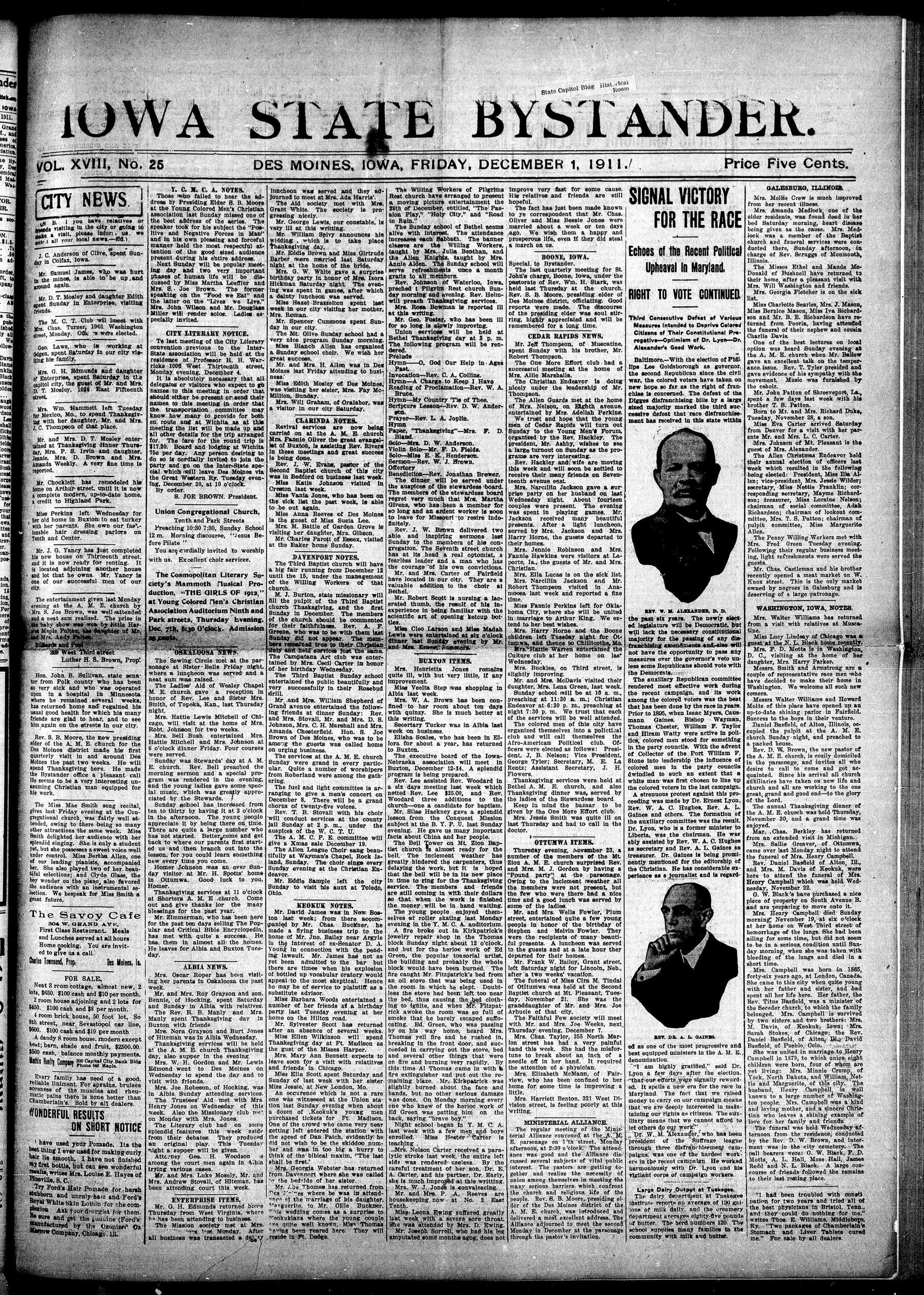
SIGNAL VICTORY FOR THE RACE
Echoes of the Recent Political Upheaval in Maryland.
RIGHT TO VOTE CONTINUED.
Third Consecutive Defeat of Various Measures Intended to Deprive Colored Citizens of Their Constitutional Pre-rogative—Optimism of Dr. Lyon—Dr. Alexander's Good Work.
Baltimore.—With the election of Phillips Lee Goldsborough as governor, the second Republican since the civil war, the colored voters have taken on new hope so far as the right of franchise is concerned. The defeat of the Digges disfranchising bills by a large sized majority marked the third successive defeat that race disfranchise-ment has received in this state within
MR. W. M. Alexander D. D.
the past six years. The newly elected legislature will be Democrat, but will lack the necessary constitutional majority for the passing of any disfranchising amendments and also will not have the opportunity to pass any measures over the governor's veto unless some Republicans should vote with the Democrats.
The Republican committee rendered most effective work during the recent campaign, and its work among the colored voters was the best that has been done by the race in years. Prior to 1950, when Isaac Myers, Caumann Gaines, Bishop Wayman, Thomas Chester, William F. Taylor and Hiram Watty were active in politics, colored men stood for something in the party councils. With the advent of Collector, leadership the influence of colored men in the party councils dwindled to such an extent that a white man was first chosen to line up the colored voters in the last campaign. A strenuous protest against this proceeded was made by Dr. Ernest Lyon. Rev. W. A. C. Hughes, Rev. A. L. Gaines and others. The formation of the auxiliary committee was the result. Dr. Lyon, who is a former minister to Liberia, was the chairman of the bishopy assembly, A. A. C. Hughes and Rev. A. L. Gaines as treasurer. Dr. Gaines is being prominently mentioned for the editorship of the Christian. He has considerable experience as a journalist and is regard-
NEW DR. A. CANTY
REV. DR. A. L. GAINES,
ded as one of the most progressive and best equipped ministers in the A. M. E. denomination.
"I am highly gratified," said Dr. Lyon a few days after the election,
"that our efforts were signally rewarded. It spells a new era for the race in Maryland. The fact that we raised money to carry on our campaign means that we are deeply interested in maintaining our rights as citizens. The auxiliary means that we cannot afford to let others do our work."
Dr. W. M. Alexander, who has been president of the Suffrage league through three districts emceement campaigns, was one of the hardest workers in the recent campaign. He worked harmoniously with Dr. Lyon and his vigilant corps of campaign workers.
Large Dairy Output at Tukkegee. The dairy department at Tukkegee institute reports an average of 130 gallons of milk dairy, and the creamery department averages eighty-five pounds of butter. The heed numbers 120. The school supplies many families in the community with milk and butter.
---
GALESBURG, ILLINOIS.
Mrs. Mollie Crew is much improved from her recent illness.
Mrs. Amanda Medlock, one of the older residents, was found dead in her Saturday morning, healed before being discharged. Mrs. Medlock was a member of the Baptist church and funeral services were conducted there, Sunday afternoon, an charge of Rev. Sergeus of Monmouth,
The Misses Ethel and Maude McDonald of Bushnell have returned to their home, a pleasant visit with Mrs. Will Washington and friends. Mrs. Georgia Fletcher is on the sick list. Miss Charlotte Searles, J. M.ason, Miss Bernice Mason, Miss Iva Richardson and Mr. B. E. Richardson have returned from Pooria, having attended the funeral of their nephew and cousin Owen. One of the best lectures on local option was heard Sunday evening at the A. M. E. church when Mr. Bailley gave an excellent talk on the temperance issue. Rev. T. Tyler presided and gave evidence of his sympathy with the music was furnished by the孝伯. Mr. John Patton of Shreveport, La., spent a few days last week with his brother T. S. Patton. Born on May 9, Mr. Richard Duke, November 28, a son. Miss Eva Carter arrived Saturday from Denver for a visit with her parents Mr. and Mrs. L. C. Carter.
Mrs. Johnson of Mt. Pleasant is the guest of Mrs. Alexander. The Allen Christmas Endeavor held their annual election of officers last week which resulted in the following being elected: President, Miss Ile Allen; vice-president, Mrs. Jessie Wilder; secretary, Miss Nettie Franklin; corresponding secretary, Mayme Richardson; treasurer, Mrs. Richardson; social committee, Adah Richardson; chairman of lookout committee, Mrs. T. S. Patton; chairman of pulpit committee, Miss Marguerite Allen.
The Penny Willing Workers met with Mrs. Fred Green Tuesday evening. Following their regular business meeting, light refreshments were served the guests. Mr. Chas. Castleman and his brother recently opened a meat market on Knox street. This is the only market owned by negroes in Galesburg and is deserving of a large patronage.
WASHINGTON, IOWA NOTES.
Mrs. Walter Williams has returned from a visit with relatives at Muscatine.
Miss Lucy Lindsay of Chicago was a guest at the N. L. Black home recently.
Mrs. D. C., visiting at the home of her daughter, Mrs. Harry Parken.
Messrs. Smith and Armstrong are a couple of representative race men who have decided to make their home in Washington. We welcome all such new comers.
Mrs. Walter Williams and Howard Motts of this place have opened up an up-to-date shining parlor in Fairfield. Success to the boys in their venture.
Daniel Bassfield, of Alton, Illinois, occupied the pulpit at the A. M. E. church Sunday night, and preached to the Rev. D. W. Brown, the new pastor of the A. M. E. church, is cozily domiciled in the parsonage, and invites all who desire to call to come and get acquainted. Since his arrival all church auxiliaries have taken on new life and are now well cared for, the great, grand and good end—to the glory of the Lord.
The annual Thanksgiving dinner of the A. M. E. church was held Thursday, November 30, and a grand time was enjoyed. Mrs. Caskery has returned from an extended visit in Michigan.
Mrs. Sallie Greaver, of Ottumwa, came over last Monday night to attend the funeral of Mrs. Henry Campbell.
Rev. Daniel Bassfield of Alton, Ill., and Mrs. M. Davis of Keokuk, were here to attend the funeral of a harry family which was held Wednesday, November 22.
G. W. Black's have purchased a nice piece of property on South Avenue B. and are preparing to move onto it. He is wearing a black shirt and morning: November 19, at six o'clock at her home on West Third street of hemorrhage of the lungs. She had been ailing for some time, but did not seem to be in a serious condition until Sunday morning, when she was taken with her of the lungs and died in a short time.
Mrs. Campbell was born in 1865, forty-six years ago, at London, Canada. She came to this city when quite young with her father and sister, and had spent all her life here. Her father, the Rev. Titus Basfield, was a minister of the Seceder church, to which the family belonged. Mrs. Campbell is survived by two sisters and two brothers: Mrs. Sarah Stokes, of Chicago; the Rev. Daniel Basfield, of Alton, Ill.; David Basfield, of Pueblo, Colo.
She was united in marriage to Henry Campbell in 1879, to which union eight children were born, four of whom are yet living: Mrs. Minnie Crump, of Joliet, Dakota, and Alam, of Fort Wayne, and Margaret of this village. The husband, Henry Campbell, is well known to a large number of Washington people. Mrs. Campbell was a kind and loving mother, and a sincere Christian who leaves a shining example of her devotion. The funeral was held Wednesday afternoon from the residence, conducted by the Rev. D. W. Brown, and interment was in the city cemetery. The pill bearers were: G. W. Black, F. D. Potts, A. Hall, Hose Hall, James Laine, and A. Hall, Rose Hall. A course of friends followed the remains to their last resting place.
"I had been troubled with conciation for two years and tried all of the best physicians in Bristol. Teen, and they could do nothing for me," writes Thos. E. Williams, Middlebury, Stomach and Liver Tablets cured me. "For sale by all dealers."
What a lot the infant emperor of China knows for his age!
Six comets are visiting the sun. Brimming the solar system?
As election in Switzerland seems to attract about as much attention as its navy.
Few headline writers can tell of a fall of snow without allusions to "The Beautiful."
A Texas town of 4,000 has not seen a wedding in three years, but has had two trailing parties.
It cost a Missouri man $35 to shoot a redbird and it could not have been such great sport, either.
About all that can be said in favor of a double chin is that it has some prestige in an argument.
Capt. Elmer Baldwin will try to locate the north pole in 1915. It may be a common junt by then.
Grapefruit is beginning to crowd out the cantaloupe, and the latter no doubt sees what its fate is to be.
The megaphone would be a valuable thing on the farm, where it could be used to call the hired man at 4 a.m.
The financial success of some of our popular actors is indicated by the amount of alimony they are able to pay.
We base our prediction of a long cold winter on the fact that this year's chestnut worms are fatter than usual.
Taxes have gone so high in Japan that the little nation may not feel like whipping anybody for several years to come.
On the Isthmus of Panama there are 4,788 bachelors and only 187 spinsters. Go south, young woman—go south!
College women do not indulge in divorce, says one of them. To the prospective marrier this should be warning enough.
Reports from Los Angeles indicate that a drunken woman with a loaded gun is as dangerous as a drunken Caucasian.
A masseur has been fined for practicing medicine. It will soon be unsafe to put a wet pet on a sick friend's brow.
The difference between a banquet and a dinner is that the former consist of a great deal of talk without much to eat.
They teach logic in colleges and yet the football scores when compared occasionally lead to some most logical results.
The preachers who decry baseball games their own batting average if they want to increase interest in their own work.
In Tucson eggs have been selling for 20 cents apiece. Burbank should hasten to develop a species of cactus that will lay eggs.
The men who plastered their auto number with mud and hurried away after a casualty have done the same to their consciences.
Cleveland has unveiled a statue of Wagner. At this distance it cannot be seen whether it is a status to Monson or to Wilhelm Richard.
Mrs. Majorle Gould Drexel's little daughter is set down as a $30,000,000 baby, but there are others that can not be bought at even that price.
There is a good deal of talk now about "paper-bag cooking," but without having tried it we shouldn't think a paper bag would taste good, no matter how it may be cooked.
A Kansas judge scoffs at the idea of love at first sight. Probably he is a girl givenlemma, fellows who keep the girls guiding even years and then marry in doubt.
It ought to be easy for a good many wives to get new sealskin coats this winter. An eastern court has granted a divorce to a woman because her husband concealed his real character from her when they were married.
A Frenchman who has become enthusiastic about baseball is going to try to make it the French National game. A boys' baseball game would be a Quaker meeting compared with two nines of excitable Frenchmen engaging in the sport.
Goats' milk comes strongly recommended as a new cure for Inebriety. Try it—on some friend.
"There will be no art in masculine fashion," says an English artist, "until men discard trousers." Tush! Look at the hats some of the men are wearing this year.
The Wrights have a new safety device for aviators. If it don't work, the Wrights have safety devices on elevators the rate of risk on aviators will not be reduced.
Queen Louise of Denmark, in 60 years old, but, being a queen, she does not look it.
Speaking of families which go to the dog, a Massachusetts woman wants a divorce because her husband insisted on keeping eighteen bowers in the kitchen.
There is in Boston a woman who believes her cat possesses the soul of a bird. Still, even that is perplexing not the most beautiful thing that is beheaded by a Boston woman.
AFRO-AMERICAN CULLINGS
Rev. R. D. Stinson preached in the colored Presbyterian church, corner of Fort and Houston street, in Atlanta. Among other things, he said: "If the high-class press and good people are to be believed, the negro is seeing daily the need of moral homes and school training and fully trusting in God, as our fathers and mothers are to believe. The negro depends on honorable employment of the youth. Our contribution to the communities' good and the negro's true elevation depends upon what is taught in the practical school house, the common-sense home and the purely moral church. These conditions can hardly be brought thoroughly into action without the proper class of men and women as leaders. Less can be said about imprisonment and more about a good and useful life; for say, what you will, there is a large class of our people who are taking advantage of the bad things they ought to shun, and they are proving most damaging to our well being and future happiness. The church, in the past, has meant everything good to us when we were trained and had no better sense than to work for the poor, when we are proving unincupation conduct and ornamental education and the subfurge of race trouble, too large a class of us are seeking to shift the responsibility of developing the right kind of habits and life, and we are deceiving no one more than we are destroying ourselves. Sad to say, this child race of ours has too many morally bad leaders, whose highest interest is sham honors, flixture and to play in the wrong end in the right. The Lord knows how to deliver the Godly out of temptations and keep the wicked until the day of judgment to be punished."
Do you take a negro newspaper? If not, why not? Negroes who never read negro newspapers are untrite to themselves and to the race. They see only one side of the race question, and lose interest in the race and in themselves. Reputable negro newspapers give the world the bright side, while most other journals paint a black picture. All negroes are not failures, neither are all negroes "black brutes." Some are men with souls, whose useful lives make brilliant pages, worthy to be read by any people. Suppose you subscribe to and read a negro paper, and thus get another side of the picture—The Negro Fortune Teller (Runnville, Ala.)
Booker Washington's message of hope gave the poor struggling negro of this state and of the country as for that, much inspiration at a time when it was distressing needed and highly appreciated. And we wish to say further that the sentiment those messages contained has too deeply rooted and grounded in the experience of the determined members of the race to ever be uprooted by those of the other race, who every now and then see the "nigger in the woodpecker" and thereby seek to raise the false cry of social equality, and thus seek to turn friendly sentiment against us—Western Star.
It is generally a worthless, loud-mouthed black loafer who is continually contending that the negro race never was anything, is now nothing, and never will amount to much. He is ignorant of the rise and fall of nations and races; consequently he can have no conception of the long stretch of years required for the development of the people. Every word in our painful privilege to hear such self-discounting rot we wish it were possible for the leopard to change his spots. Such a human cipher would look so becoming with the appropriate complexion of a road frog—Southern Life Magazine.
It has always been a mystery why apparently intelligent people, when at a concert or an entertainment of any high order, will laugh and talk while some singer or reader is trying to be heard. It is very ill-mannered and over a harsh good mood. It is entertainment is not to your liking, get up and go, but do not disturb those who do enjoy it and have paid for just that privilege—Chicago Defender.
The longer I live, the more deeply am I convinced that that which makes the difference between one man and another—between the weak and powerful, the great and insignificant—is energy—invincible determination—a power once formed, and then death or victory. This quality will do anything that is to be done in the world; and no balances, no circumstances, no oppo, tunfities will make one a man without it—Buxton.
Jack Johnson may meet Bombardier Wells in London, England, this fall. Hugh McIntosh is trying to get them together. "If Wells can keep away from Johnson for five rounds," said McIntosh, "he is sure to win, as I consider him one of the hardest hitting pugilists. I have ever seen. He's a wonder and we will have him in shape to annex the title by next autumn or winter."
We do not minimise the importance of economic well-being, but we do emphatically say that there is to be no abatement in church building. There should be no sacrifices of the religious precincts of the race to any material consideration. What the race is now is due to its devotion to the church and its future depends upon its financial resources. The money spent on non-events be used in the advancement of secular enterprise and by all means continue to build up the religion of our people—Sir of Zion.
Twenty-five million negroes in the new world. Great Scott! Who would have thought it? That number does not include the untold millions in Africa, mind you; but only those who live, move and have their being" in the new world. According to the American national painting scholar, as stated in his most recent book, "The Negro in the New World," these 25,000,000 negroes are distributed as follows: Thirty thousand in the Dominion of Canada; 10,000,000 in the United States; 5,756,000 in the West Indies; 117,000 in Central America; 60,000 in Venezuela and Colombia; 228,000 in the Guinea; 8,000 in the Angola; and 1,000 in the master of South America. How the thought that the 25,000,000 human beings in whose veins courses negro blood makes our heart leap and our mind speculate upon the destiny of this people—Birmingham American.
In a certain church a member was charged by another with a misdemeanor, and the minister requested that some member of the official board prefer a charge. Out of the nine members of the board not one felt inclined or would do so. The brother who had been charged with the misdemeanor happened also to be an official member of the same board; when he was advised of what was about to take place he challenged any member, please tell him. And if they did, he threatened to do the same against every member for the selfname crime. Needless to say, the charge has never been prefered, even unto this day. And why? Ask it of the winds.-Philadelphia Courant.
The Chicago Daily Tribune thinks it plausible that Europe has decided to divide northern Africa, in view of German and French activity in Morocco and Algeria, and Italian activity in Tripoli, but questions if this can be done without the possible dismemberment of Turkey and a possible Pan-Islamic uprising. We do not think Europe, with the assistance of America, is ready to challenge as Christian powers the Islamic powers of Asia and Africa to a death struggle. The latter powers are by far, numerically, the stronger, and modern methods of warfare and equipment are the common property of all of them. A religious war is the most dangerous of wars.
There has recently, been installed in the public square down an tjee water fountain with this sign attached, "For White People Only." One would scarcely have thought that the first official act of the honorable missioners of Mobile affecting the negroes would be an act of discrimination against the entire race. The negroes, like all other people of Mobile, looked forward to the commission form of government with the hope that conditions might be better for them along all lines and that much of the inconvenience and unnecessary restrictions, so far as he is concerned, might be done away with—Mobile Press.
The negroes in this country, chiefly at the south, have increased from four to ten millions. Of this number 40,000 own their own homes and 750,000 are farmers, owning 23,000 square miles of land. In the whole country there are 650,000,000 worth of property. Some towns in the south are inhabited solely by negroes. They have 445 banks in the United States, and in the south there are 30,000 negro teachers with an enrollment of 2,000,000 school children. Every negro in this country proudly owns a house, a school, a element of negroes has decided to become an important factor in the development of this south land.—Ex.
Dr. Booker T. Washington's appearance in the Alabama case at the White House was that of a patriotic citizen of Alabama, a defender of the civic privileges of his race and a foe to the reactionary forces that would relegate the negro to the background; Dr. Washington is in no sense a politician of Alabama, a public matter when an expression can do good. He does his duty as a wideawake American should. — Houston (Tex.) Freeman.
More than passing interest will be taken in the announcement that Prof. J. A. Martin, for 15 years principal of the Jackson public schools, has been elected to the presidency of the Alcorn college. Professor Washington, who has held the place since the last revolution, for revolutions at Alcorn are about as numerous as they are in Haiti. Prof. Martin is also president of the State Teachers' association.
We are permitting a horde of degenerates to breed among the boys. Parents should look after them carefully and remedy the condition of the minor cigarette flend and the juvenile criminal.
Get in readiness during the vacation period by preparing your boys and girls for school this fall. Their education and training mean much in the future.
Fifty thousand acres of Mississippi farm land have recently been bought by English and Dutch syndicates for the purpose of cotton production. Incidents of this sort are becoming frequent throughout the south. The negro should not ignore the meaning of these facts. He should leave off all foolishness, sell all he's got and buy a farm.
The wealth and livelihood of a nation is in the soil. More of our people should go to the farm and be good livers.
THE ELEMENTS OF CULTURE
Address of Dr. E. G. Hirsch the Faculty and Students of Tuskegee Institute.
DR. E. G. HIRSCH, WHO WAS A MEMBER OF THE ROSEWALD PARTY THAT RECENTLY VISITED TUSKEGEE INSTITUTE, MADE AN ELOQUENT ADDRESS BEFORE THE STUDENTS AND FACULTY OF THE SCHOOL.
Tuskegee, Ala.—Dr. Hirsch was born in Luxembourg, and was educated in Germany and in this country. He holds honorary degrees from several colleges, and has been a rabbit at the head of Jewish congregations in Baltimore and Chicago. He is at present of the association, Chicago. He has an professor of rabbanical literature and philosophy at the University of Chicago since 1892, and is an author of several books and monographs on biblical and religious subjects.
Doctor Hirsch's address follows:
"Doctor Washington, Ladies and Gentlemen;
"Like Mr. Rosenwald, I am under obligations to you. Our visit here has been a veritable inspiration. The great German poet, Goethe, remarked somewhere that what you desire in your younger days, you, generally attain only when old age is upon you. I have desired to see your institution from the beginning of your life in the meantime. I have grown old and what I desired in the younger days has come to me in its richfulness here when I am standing at the threshold of my life's evening tide. Therefore, I am personally under more obligations to you. You are solving a problem. Most of those in your race believe that you are solving a problem, that of your race alone' and for your race you are solving a problem. You are solving a problem of American life for all of us, and who knows but that you are solving it for the world at the same time?
"We have often in our churches read the opening chapter of Genesis, and I dare say, if I may judge by the general attitude mentally and morally of the world, we have failed to understand its essential message. That opening chapter tells us that God made man in his image and we have not understood what that old Hebrew story may have intended when it came to the great creator of the world. The Greeks had stories about the gods, but none of the Greek gods were ever pictured as working. They drank amphrosia, quaffed nectar; engaged in all sorts of intrigues and committed acts that the better civilization of later years refuses to mention in a society like this. That was the occupation of the Greek gods and many of our Americans today are much like the Greeks. Their ideal of life is to drink and make man, and that, to that, to not always nectar, to engage in all sorts of intrigues, and because they cannot carry on that life without having money, they have ceased to be monotheists, believers in one God, and have become moneytheists. That is, they defy money and they do not know what the use of money is; once in a while, however, a man arises who is able to teach the world what you can do with money; that it is not given to men for the purpose of drinking nectar and that it is a trust to an individual that through it he might bring hope and light to his fellow men groping upward and onward along the path of life.
"The Hebrew civilization begins with the story of God as a worker. He creates a conception that no other civilization ever advanced. God worked, and when he created man in his image he meant that man should work as God had worked." The Bible's proclamation is the sanctity of human labor, and it is not true that the hudsonianism of man's likeness to God. God worked and he placed man on earth to work as God had worked before him, and the sanctity of work is the gift, the sacred benediction with which this noble institution anoints your head. You came here to be consecrated priests in the temple of work and go out from here into the world messageers of this sacred benediction of all religion, gospel that flamed forth from Sinai and found sweeter and newer consecration on the lips of another son of Palestine, the gospel of labor. Have you ever thought of it—that great son of Palestine was a carpenter's son. He did not have a classical education, but he learned the lesson of life in his father's carpenter shop; he did not go to academies, but he went to the school where he ever message he had, he clothed it in the phraseology, not of the counting-room, and not of the drawing-room, but into the impressive vocabulary of the farmer and the artisan. In practicing and learning to practice the religion of labor, you become Christianized, in the spirit of the Great Teacher, and Judaized, in the spirit of the great Jewish prophet. As perhaps no other student of the Jewish tradition young men in this our country, you have the opportunity to become consecrated, to be uplifted and to be empowered.
"Culture, yes, culture, can come from the anvil and the hoe, from the shoemaker's bench, more potently than it ever came from the twiddle of
Joseph E. Menges of the city civil engineer's office was being entertained by some eastern traveling men during a recent visit he made in St. Louis, and the conversation drifted to points of interest in various cities, says the Indianapolis Star, the only Indianapolis representative, Mr. Menges was called upon to extol the virtues of his home town. He set forth ably upon his task. Recalling big industrial plants, fecal public
Cleoero and the singing even of the blind bard of Greece. To despise the practical things is to despise God's work. God made the world so. We have to work in the world, and to call that which is related to work beneath the notice or unworthy of the柔athy of cultured men and women utter blasphemy. culture, yes, what does culture mean? First, it means the larger vision, and can you not have that larger vision when you create something? Every working man and woman creates. Culture means joy in life. That greater joy can there be than the lessening? The world has lost that joy. The slavery of the factory, the din and tumult and strife of the city have crushed out all true joy in this, our age.
"A French writer recently said that the only one who was still true to the great mission and who understood the great variety of the gospel of joy in life was the artist. He created and found joy in his creation. He created and found joy in the artist. The man who creates has knowledge, deep knowledge of God's joy in life.
"The third element of culture is worthiness. He who creates something that is worth while, gains cultures. Every stroke of the hammer latened to bring forth something new is a declaration of man's worthiness. Every stroke of the hammer can never become an unworthy, an immoral or degraded being on earth.
"Men have tried in recent years to install the moral spirit in the public schools. They are even now debating and puzzling how they can teach the children the laws of righteousness. Take them into the work shop; there they will learn them. Unless you are true to your work, your work rises to curse you, for the work is so good, so righteousness and the sigh of the saw, as it goes through the wood, is a protest against man's untruthfulness.
"The final element of culture is sympathy. That ancient Greek culture which they made so much of in the old-fashioned colleges did not lead men to sympathize with one another, and from the Greeks to the Romans or the other is better than his brother or sister on account of some accident in his personal appearance. The old culture did not unite but divided humanity. The new culture of the work shop has in it the magic to bring men together. In the consecration of common work years the Greeks were helped by helping others. Every article produced by you is not merely of usefulness to you, but is of usefulness to me.
"You are being led here into the sanctuary of this new religion of work. This new religion of consecrated, creative work ought to fill your hearts with thankfulness. I congratulate you on the opportunity that are yours, the opportunities are larger than those that have come to the white children of many of the northern cities and to the black children of many a northern university town. Cease then complaining. You have nothing to complain of. Go your way proudly in the consciousness of your worth. Strive for worthiness and let those who will out of the emptiness of your heart be higher than you; learn from your life how poor is their judgment, how foolish their prejudice.
"I thank you for what you have taught me, for what we have learned from that one man who in these days of short-sightedness has had the vision. Without vision, the people perish. Be glad that he came among you, this great man of vision—your Moses in the wilderness, the old Moses died in the wilderness, he goes with you across the Jordan into the promised land."
TRUE REFORMERS OPTIMISTIC
MEMBERS OF THE ORDER HAPPY OVER THE REFUSAL OF UNITED STATES AND STATE COURTS TO APPOINT A RECEIVER AS ASKED BY CREDITORS—CONDITION OF ORDER IMPROVING.
Richmond, Va.—The refusal of the United States and state courts to appoint a receiver to take charge of the affairs of the true reformers has occasioned much jubilation among the members of the society from Grand Master Griffin down. The officers now assert without any hesitancy that it will not be many months before the business of the order will be in a healthy condition. In the former, the official organ of the order, speaking optimistically of the condition of the grand fountain, says in part:
"Out of the chaos of the past we are just beginning to see the light. To put the organization in the hands of receivers would be to cut off her revenues and thus bring disaster to thousands of negroes scattered over the country."
"A glance at the grand worthy secretary's statement will convince you that are doing the same time and all debts will be paid. The receipts vary from $500 to $1,000 daily, and claims are being paid as rapidly as possible. It will only be a short time, if the management is let alone, before the organization will be re-established on a firm basis than ever.
"The condition of the organization in a nut-shell is this: the new management is making a desperate effort to correct former mistakes and doing the right thing to creditors. Who could do more? There is not the least doubt that the order can be rehabilitated."
buildings and beautiful parks. Mr. Menges added his best for the last. He added the beautiful wallers' monument," he said. "It's the greatest monument this country, and second to none in the world. When you hear of a great monument what do you think of?" "Why, a graveyard, answered one of his listeners, who halls from Cleveland.
Only a busy woman will permit wrinkles to gather on her brow.
COLORED PEOPLE OF MACON COUNTY, ALABAMA, HELD IMPOSING EXHIBITION.
Tuskegee, Ala.—The Macon county fair, held in the town of Tuskegee recently, was one of the largest and most imposing exhibitions ever seen in this neighborhood. The Montgomery Advertiser carries a full account of the fair, and we are glad to quote in part from this account:
"Tuskegue, Ala.—With the cheering of hundreds and to the martial strains of music rendered by the four bands, the big parade which formed in the public square marched down South Main street to the fair grounds, where the formal opening of the Macon county agricultural fair took place. hundreds of people had arrived at the fair grounds and the big parade day long people continued to flock into the immense incroaches. Soon after entering the fair grounds President Drakeford of the association addressed the crowd. He spoke briefly, but in his few words manifested an earnest appreciation to the people of Macon county in responding so liberally to the cause and so zealously worked for during the past twelve months. He also had clergy everyone the city and engaged them the open arms of the city. Short addresses were followed by others, including several specially directed to the farmers.
"The opening of the fair was made one of the greatest events in the history of Tuskegee. From early sunrise until the opening hour people continued to pour in from the surrounding country, anxiously awaiting the time when the parade should move on toward the grounds. Promptly at ten o'clock the parade, composed of automobiles, buggies, wagons and pedestrians, began its outward march. In front were the city and county officials, followed by those of the fair association.
Smith Leads Parade.
The parade was led by Capt. N. Clark Smith and his famous band. The national alra were played and when "Dixie" was touched by the sixty pieces a thundering roar from thousands of throats greeted the musicians in response. Everybody possessed the real county fair spirit and worked to make it a great event. Practically all the citizens of city closed, and their occupants moved along with the great throng to witness the opening.
The exhibits in the agricultural department were larger and more varied than they have been at any fair herefore held here. They showed improvement in several respects, the most noticeable being that the farmers are raising a higher class of products than formerly. A common sight was to see stalks of cotton setting about in the different booths, some of them containing as many as 125 and 150 bolls. Immense stalks of corn with eight and ten fully matured earwere also common. In every instance the producers said that the improved variety is much easier and cheaper to raise than the inferior or common kind. All the way through the exhibits were excellent and were even better than were expected.
Fine Stock Raised.
In the past few years the farmers of Macon county have directed much of their time towards the raising of fine cattle, horses and hogs. In this department were exhibited some of the most beautiful specimens to be found anywhere, all of them being Alabama bred and raised in this county. Among the most noted exhibits was that of Mr. W. A. Reynolds of Warrior Stand in the lower portion of this county. He had at the fair several colts, mares and many fine chickens, many of them having taken first prize at other fairs in the state this season. All the offerings showed that the farmers are waking up to the fact that this is not only a great farming country, but one of the greatest stock raising sections of the south.
The exhibit of the Tuskegee Normal and Industrial institute attracted considerable attention. For several days the boys and girls of the school were hard at work arranging the several exhibits and they presented a most pleasing appearance. That which attracted the most attention was the corn exhibit. The manner in which the corn for this purpose was gathered was unique. Every negro farmer in the county contributed ten ears each and with this an immense pyramid of corn the immediate front part of the administration ing. All columns surrounding the pyramid had been covered with ears split in half and nailed on, presenting a pleasing and original design. The public schools of Tuskegee were also represented at the fair with different exhibits from the kindergarten up to the higher grades.
One-Armed Negro Had Exhibit.
A booth that attracted more than ordinary interest was that of a one-armed negro, Jim Mahone. In his exhibit he had practically everything that could possibly be raised in this climate at this season of the year, Watermelons, cucumbers, peppers, pumpkins, sweet corn, tomatoes and tomatoes, presents that app up a few years ago were attempted to be raised only in the spring. He is a very thrifty negro and is admired by many white friends here for his strict honesty and perseverance in making his own living and staying out of debt.
DEPEW'S BEST-COMPLIMENT.
Senator Depew, at a dinner in his honor in New York, said of his notable oratorical gift:
"I have received many compliments on my skill at after-dinner speaking, but the naivest compliment of all came from an upstate farmer.
Senator said he, you might have typed on your computer you might have pneumonia and recover, but if you have yellow fever and recover, but if y'er ever got lockwax you'd burst: "— Selphia Record.
HAVE LARGER PERCENTAGE OF WORKERS THAN WHITE AMERICAN, SAID PROF. R. R. WRIGHT, JR. AT BIG CONFERENCE OF CHARITIES IN BOSTON—PREJUDICE AND DISORMINATION ACCOUNT FOR RELATIVE INEFFICIENCY—LABOR UNION'S WORST FOEBS, BECAUSE IN THEM THE COLOR PREJUDICE IS MOST EFFECTIVE.
Boston, Mass.—At the final section meeting of the National Conference of Charities and Corrections "The Negro in industry" was the topic discussed at the "Standards of Living and Labor" section in Kingsley hall. The speakers were Prof. Kelly Miller of Howard university, Washington, and R. R. Wright of Philadelphia, Pa.
Professor Wright said in part:
The negroes have been workers in the north ever since the days of the first colonies and though they never have been a great factor, except in large cities, where 75 per cent of the northern negroes now live, they form a great mass of domestic and personal workers. In Pennsylvania, for instance, where the greatest number of northern negroes live, 59.3 per cent. of the males and 92.7 per cent. of the females were in domestic and personal service in 1900. It is sometimes said that negroes do not work, but statistics show them to comprise a much larger percentage of workers than their percentage of population would warrant. Negroes were, for example, only 2.6 per cent of the population of Pennsylvania, but were 3.3 per cent. of the workers. Negroes have made slow progress in the north, but this is due to two reasons—the low standard of efficiency among southern negroes, who have immigrated north, and the attitude of organized labor.
Low efficiency might be overcome more quickly if the unions were more friendly. The result is, if the efficient negro would go up, it must be in opposition to the labor union. This, of course, tends to make the negro a strike-breaker, but I am sure, an unwilling strike-breaker. Outside of the miners' union and those of hod-carriers, the negro has but little chance. In Chicago, for example, the negro in the busiest part of the city is quite spite of the unions. The same is true of the stockyards, where practically all the negro has gotten been in opposition to the union. In Pittburg, each step that the negro has made upward in the steel works, has been done as a strike-breaker. This is unfortunate. But to be fair, the trouble is not in unionism per se, but in the growing race prejudice which tends to make a farce of American democracy. Only unionism organizes its men and therefore their race prejudice has the force which organization always gives. Organizations non-union workmen must be vigorous, but must the negro out. The result of this is, that to be a foothold, the negro must work for a lower wage. This lowers the standard of living and tends to drag that of the white workman down.
Still, under the condition, the negro worker is gradually growing in importance in the north, especially as waiter, porter, domestic, worker on the streets, in municipal construction work, and in the large industries needing a large unskilled force. In the steel works they are a distinct force, also in the mines. In skilled mechacies they pursue the tasks of building masonry and the census showing an increase in northern cities.
The immigration of large numbers of negroes to the north and their segregation in large groups in certain sections of our cities has given rise to negro business men and professional men. So that today, many of the largest churches, hospitals and stores are in the north, and a much larger percentage of negro business men and professional men are in the south, in spite of the difficulty in the south, in spite of the difficulty in the north of a higher standard of efficiency to reach, than he has in the south.
While the industrial progress of the race has been great during the past 40 years—great enough to command the praise of the severest critic, yet the handicap of race prejudice cannot be overestimated. It is the greatest drawback of the negro, for it put before him a double standard—not merely efficiency, which he can reach, but also a standard of race which is impossible for him to reach, and which must discourage and demoralize him.
SOMETHING A SENATOR NEVER DOES.
Mr Heyburn of Idaho sometimes has trouble in getting a large audience of his fellows when he speaks on the floor of the senate. One day last July he rose to make a speech and, seeing that there were only three men besides himself in their places, he moved to adjourn. This was prevented by the assembling of a quorum of senators who had been sitting in the cloakrooms. In beginning his delayed speech, he said:
"I do not understand the conduct of senators. I have seen them under all phases. I have seen a senator leave this chamber when he should stay here to receive good advice. I have seen him leave this chamber when, by remaining, he could have given good advice. I have seen a senator do was to back out of the door in the middle of his own speech"—Popular Magazine.
HIS BIRTHDAY PRESENT.
"Jimmy," said Tommy, "what's the matter with you? You don't never go in for any fun nowadays."
"No; I'm feelin' good because I'm
goin' to have a birthday soon, an'
I want to git a present."
"Better not be too good, or mebbe
they won't give you nothin' but a
Bible."—Catholic Standard.
Reading maketh a full man—but
reading his marriage notice will soon
empty his pocket.
1,000,000 Negroes to Be Recruited from French African Colonies.
ARMY AND NAVY IS WEAK
FRENCH POPULATION STEADILY DEGREASING — WRITER SAYS BLACK MAN IS VALUABLE AS SOLDIER—GERMANY ALARMED.
Constant talk of a probable conflict between France and Germany, and the revelation that France's population in late years has dwindled to such an alarming extent that in the event of war the French would be compelled to put out an inferior army and navy to battle with the enemy, has caused the French government to seriously consider recruiting 1,000,000 black men from the French colonies. While the French are becoming enmeshed over the plan of France maintaining black military reserves, the other foreign powers do not take kindly to the idea of having to combat with negroes, knowing full well their value as warriors.
Among the ones who believe that France only hope on the battlefield in the future will be by recruiting from the French African colonies is Francis Gribble, a writer of reputation, who says:
"The population of that part of the French African colonies in which recruiting would be possible is estimated at 10,000,000; and there is reason to believe that the estimate is considerably under the truth. It is a population of fighting men—men who would much rather fight for their living than work for it. There would be no need to institute a system of universal service in order to compel them to come in. They would all gladly come in of their own accord, as volunteers, and the number of them who are able-bodied and of a fighting age is computed at about 1,000,000.
"One million men, be it observed, who could be recruited and trained, and kept ready for use in a European war—a reserve of men, that is to say, practically inexhaustible, and so situated that, as long as France, or her allies, kept the command of the sea, so enemy could possibly get at it and destroy it. A million men, too, whose fighting value is not to be denied.
It has sometimes been assumed that, because handfuls of white men have often scattered hordes of black men, therefore the black man would be of no use in a white man's war; but that is a miracle. Interior equipment and lack of organization easily account for these sensational defeats. If he is armed like an opponent that he will lead men to him, he is quite capable of standing up to white troops. He did so in the American war of secession, and in the American war with Spain, when the heights of San Juan were stormed by a black regiment Napoleon himself employed black troops in European warfare—a black regiment particularly distinguished itself at the siege of Sevilla, and afterward captured Franconia under the guidance of Victor Hugo. To storm the Malakoff, and were employed at Magna, and in Mexico. At least 3,000 of them served through the Franco-German war. Their bayonet战 Froeschwiller was one of the most brilliant feats recorded in the history of the war; for they actually preserved their morale after the regiment had lost 92 per cent. of its officers and 85 per cent. of its men. We may take it, therefore, that there nothing new or chimerical—nothing new or chimerical—of despair in the French people to employ black troops against Germany. and for no other power; and it is much more real than that yellow peril against the kaiser notily warned the western world.
"Presumably, too, it is a peril to which Germany is not altogether blind, and one not without its bearings on the course of the critical negotiations proceeding, at the moment of writing, with reference to the fate of the two countries in Morocco and the German demand for compensation in effect, a demand for the surrender of the surrender of the Black Reservoir. That is one reason why Germany is so eager, and so firm; that is also one of the reasons why France herself so obstinately reluctant to cede anything."
BEYOND HER DEPTH.
They were seated around the table partaking of watermelon, so the talk naturally turned to the luscious fruit. "It reminds me of a conversation which took place between two colored women," said one of the guests. "Mm-, but, Ah certainly does lobe watermelons," said one. "It sure does tinkle mala palate. How does you like watermelons, Sister Like?"
"Waal, Ah tells you, Sis Jane," returned the other. "Ah certainly does lobe watermelon, but Ah can't eats em."
"Waal, that, that too bad. What am de matter, Liza?"
"It am like dis, Sis Jane. I lobes watermelon, but Ah always gaf mah waukee vet when Ah cats 'em.'"—Milwaukee Free Press.
FARMYARD PHILOSOPHY.
Black Orp, Sr.-Ah, my boy, there is nothing stronger than a mother's love!
Young Black Orp- isn't there, by love! Have you ever had a peck at one of these onions?-Tatler.
THE RETORT CONVALESCENT.
Hospital intense-Aw you in pain, my man? Patient (irritably)-Aw, I'm in bed, and the pain seems to be in me-Judet.
On the 20th of August, 1910, I sailed from New York city for London, England. I had been given a leave of absence of two months from my work at Tuskegee, on condition that I would spend that time in some way that would give me recreation and rest. At one time it occurred to me that I should like to spend my vacation in the West Indies, looking into the condition of the portion of my race in that part of the world. After considering the matter, however, I finally came to the conclusion that I could, perhaps, learn more in Europe than I were else about the problems in which I was interested in particularly interested. I concluded that in Europe I would able to get an understanding to speak, of my own country and by making comparison with what I was able to see there, with what I knew of conditions at home, I should be able to get a clearer and more comprehensive view of the situation of my own people in America than I could in any other way.
Having settled upon Europe as the place to take my vacation, I determined to carry out a plan I had long had in mind of making myself acquainted with the condition of the poorer and working classes in Europe, particularly in those regions from which an ever increasing number of immigrants are coming to our country each year. To get acquainted with an individual, or those according to my experience, is to visit them at their work and in their homes, and in this way find out what is back of them.
So it was that I determined to make use of my stay in Europe to visit the people in their homes, to talk with them at their work and to find out everything I could.
I was curious, for one thing, to learn why it was that so many of these European people were leaving the country, and reared, in order to seek their fortunes in a new country and among strangers in a distant part of the world.
The majority of the people who reach this country as immigrants from Europe are, as one might expect, from the farming regions. They are farm laborers or tenant farmers. Furthermore, there exists, as I discovered, a very definite relation between the condition of agriculture and the agricultural peoples in Europe and the extent of emigration to this country. In other words, wherever in any part of Europe I found the condition of agriculture and the situation of the farm in Europe, I found that I invariably found emigration at the highest. On the other hand, wherever I visited a part of the country where emigration had, in recent years decreased, there I quite as invariably found that the situation of the man on the soil had improved.
What interested me still more was the fact that this improvement had been, to a very large extent, brought about through the influence of schools. Agricultural education has stimulated an intensive culture of the soil; this in turn has helped to multiply the number of small landowners and stimulate the organization of agriculture; the resulting prosperity has made itself felt not only in the country, but also in the cities.
Another matter in regard to which I hope to get some first-hand information during my stay abroad was what I may call the European, as distinguished from the American, race problem. I knew that in the south of Europe, a number of races of widely different origin and characteristics had been thrown together in close contact and in large numbers. I suspected that in this whirlpool of contending races and classes I should find problems—race problems and educational problems—different to be sure, but quite as complicated, difficult and interesting as in our own country.
There was another thing that made the trip I had outlined peculiarly attractive to me. I believed that I would find in some parts of Europe, peoples who in respect to education, opportunity and civilization generally, were much nearer the level of the people in the south than I was likely to find any where in America. I believed, also, that if I went far enough and deep enough, I should find even in Europe great numbers of people, who, in their homes, in their labor and in their manner of living, were little, if any, in advance of the negroes in the southern states. I wanted to study at first-hand, as far as I was able, the people who used to uplift the masses of the people who are at the bottom in the scale of civilization.
One of the first things I learned in Europe was the difficulty of merging the ordinary man and seeing and getting acquainted with the matters of every-day life. I soon discovered that the most difficult things to see are not the sights that every one goes to look at, but the common place things that no one sees. In order to carry out the plan I had in mind it was necessary for me to leave the ordinary beaten track of European travel and to plunge into regions which have not been charted and mapped, and where ordinary guides and guide-books are of little or no avail.
I set out from America, as I have said, to find the man farthest down. in a period of about six weeks I visited parts of England, Scotland, Germany, Austria-Hungary, Italy, Slcly, Poland and Denmark. I spent some
There is no other more promising feature of educational development at the present time in the United States than the steadily increasing attention given to teaching farmers' boys how to farm. To get out of the soil the greatest measure of production at the smallest cost of labor and outlay is probably, taken all in all, the most widely beneficial undertaking in which men may engage. To instruct tillers of the soil how this may be
time among the poorer classes of London and in several cities in Austria and Italy. I investigated, to a certain extent, the condition of the agricultural populations in Sicily, in Bohemia, Poland and Denmark. I saw much that was sad and depressing; but I saw much, also, that was hopeful. Imprimp. Bad as hope. Are, in some cases, not too think I visited any place where things are not better now than they were some two years ago.
I found also that the connection between Europe and America is much closer and more intimate than I had imagined. I am sure that very few persons in this country realize the extent to which America has touched and influenced the masses of the people in Europe. I think it is safe to say that no single influence which is today tending to change and raise the condition of the working people in the agricultural regions of Southern Europe is greater than the constant stream of emigration which is pouring out of Europe and back again into Europe. It should be remembered that not only do large numbers of these people emigrate to America, but many of these emigrants return and take with them not only money to buy lands, but new ideas, higher ambitions and a wider outlook on the world.
II—PETTICOAT LANE AND BETHNAL GREEN.
In the previous chapter I told of my purpose in visiting Europe. In the present chapter I shall tell something of my impressions of London, where my first extended observations were made.
The first thing that impressed me about London, was its size; the second was the wide division between the different elements in the population. London is not only the largest city in the world; it is also the city in which the segregation of the classes has gone farthest. The West End, for example, is the home of the King and the Count. Here are the Houses of Parliament, the British Museum, most of the historical monuments, the Art Galleries and nearly everything that is interesting, refined and beautiful in the lives of seven millions of people who make up the inhabitants of the city.
If you take a cab at Trafalgar Square, however, and ride eastward down the Strand through Fleet street, where all the principal newspapers of London are published, past the Bank of England, St. Paul's Cathedral and the interesting sights and scenes of the older part of the city, you come, all of a sudden, into a very different region, the center of which is the famous Whitechapel.
The difference between the East End and the West End of London is that East London has no monuments, but there are many lakes; no history—nothing that is interesting and attractive but its poverty and its problems. Everything else is drab and commonplace.
It is said that more than one hundred thousand of the people in this part of the city, in spite of all efforts that have been made to help them, are living on the verge of starvation. So poor and so helpless are these people that it was at one time, seriously proposed to separate them from the rest of the population and set them off in their own way, themselves where they could live and work entirely under the direction of the state. It was proposed to put this hundred thousand of the very poor under the direction and care of the state because they were not able to take care of themselves; and because it was declared that all the service which they rendered the community could be performed by the remaining portion of the population, so that they were, in fact, not help but a hindrance to the city as a whole.
I got my first view of one of the characteristic sights of the East End life at Middlesex street, or Petticoat Lane, as it was formerly called. Petticoat Lane is the center of the Jewish quarter, and on Sunday morning there is a famous market in this street. On both sides of the thorugh-fire, running northward from Whitechapel road until they lose themselves in some of the side streets, one sees a double line of push-carts, upon which every imaginable sort of ware, from wedding rings to cels in jelly, are exposed for sale. On both sides of these carved walls, there is a throne, though of bargain-hunters are pushing their way through the crowds, stopping to look over the curious wares in the carts or to listen to the shrill cries of some hawker selling pain killer or some other sort of magic or cure all.
Nearly all of the merchants are Jews, but the majority of their customers belong to the tribes of the Gentiles. Among others I noticed a class of professional customers. They were evidently artisans of some sort or other, who had come to pick out from the goods exposed for sale a piece of saw or some other sort of second-hand tool; there were others searching for useful bits of old iron, bolts, brass, springs, and other things of that sort which they would be able to turn to some use in their trade.
I spent an hour or more wandering through this street and the neighboring lane into which this petty pushcart trame had overflowed. Second-hand clothing, second-hand towels and second-hand day market, all kinds of worn-out and cast-off articles which had been fished out of the junk heaps of the city or
done is a far-reaching philanthropy. Perhaps in no other country in the world has there been a more wasteful坟陵 than in the United States since the white man displaced the red man. Now that we have reached a time when the demand of a swarming population for foodstuffs has practically overtaken home supply, we are suddenly compelled to consider how best we may provide for emergent future conditions. The obvious and the rational and entirely possible thing to do is to instruct our farmers that
thrust, out of the regular channels of trade, find here a ready market.
I think that the thing which impressed me most was not the poverty, which was evident enough, but the sombre tone of the whole proceedings. It was not a happy crowd, there were no bright colors and very little laughter. It was an ill-dressed crowd, made up of people who had long been accustomed to live, as it were, at second-hand, and, in close relations with the pawnbroker.
In the south it would be hard to find a colored man who did not make some change in his appearance on Sunday. The negro laborer is never so poor that he forgets to put on a clean collar or a bright necktie or something out of the ordinary out of respect for the Sabbath. In the midst of busy, busy things it was hard for me to remember that I was in England and that it was Sunday. Somehow or other I had got a very different notion of the English Sabbath.
Petticoat Lane is in the midst of the "sweating" district where most of the cheap clothing in London is made. Through windows and open doors I could see the pale faces of the garment makers bent over their work. There is much furniture made in this region, also, I understand. Looking down into some of the cellars as I passed I saw men working at the lates. Down at the end of the street was a bar room, which was doing a rushing business. The law in London is, as I understand, that travelers may be served at a bar in the street, but not others. To be a traveler, a "bona fide" traveler, you must have come from a distance of at least three miles. There were a great many travelers in Petticoat Lane on the Sunday morning that I was there.
This same morning, I visited Bethnal Green, another and a quite different quarter of the East End. There are a number of these different quarters of East End, like, Stephney, Poplar, St. George in the East, and so forth. Each of these has its peculiar type of population and its own peculiar conditions. Whitechapel is Jewish, St. George's in the East, and Poplar is Irish and Irish at the other but Bethnal Green is English. For nearly half a mile along Bethnal Green Road I found another Sunday market in full swing, and it was, if anything, louder and more picturesque than the one in Petticoat Lane. It was about one o'clock in the morning; the housewives of Bethnal Green were out on the street hunting bargains in meat and vegetables for the Sunday dinner. One of the most interesting groups I passed was crowded about a pushcart where three sturdy chairs were set up, their legs were reeling off bolt after bolt of cheap cotton cloth to a crowd of women gathered about their cart.
At another point a man was "knocking down" at auction cheap cuts of frozen beef from Australia at prices ranging from four to eight cents a pound. Another was selling fish, another crockery and a third tinware, and so through the whole list of household staples. The market on Bethnal Green road extends across a street called Brick Lane and branches off again from that into other and narrower streets. In one of these there is a market exclusively for birds, and another for various sorts of fancy articles, not of the first necessity. The interesting thing about all the traffic was that, although we were not able to exercise any sort of control over it, somehow the different classes of trade had managed to organize themselves so that all the wares d: one particular sort were displayed in one place and all the wares of another sort in another, everything in regular and systematic order. The streets were so busy and crowded that I wondered if there were any people left in that part of the town to attend the churches.
AWAITING WORLD-WIDE PEACE
Andrew B. Humphrey, secretary of the American Peace and Arbitration league, was discussing in New York the universal peace movement.
"This movement," he said, "has lately made gigantic strides, but, of course, we mustn't expect too much of it. We mustn't, like Peleg Shucks, expect to see universal peace come in our time.
"Peleg Shucks, you know, was thinking of buying an annuity. I guess, though," he said, thoughtfully one night at the general store—I guess I'll wait a while after purchasin'.
"Wot yer idea in waitin', Peleg" naked the storekeeper.
"Wall, ye see," said Peleg, "arten all them European nations take up this Carnegie-Taft arbitration and disarmment contract, guns is goin' to get tarnation cheap."
WILLING TO PAY.
The morning had been long and the arithmetic lesson particularly severe. Little Tommy Traddles had laboriously worked his way through a tantalizing maze of figures till his small head ached, and he now stood before his master with the result of his travail. "Return" said his instructor, curtly "Return to your desk and do it again!" Tommy glanced at the clock. "Please, sir," he asked, "how much am I out?" "Your result is twopence short of the correct total," was the reply. Tommy's hand sought the pocket which contained his most valued possessions. Swiftly he separated two coins from a piece of string, some more than a quarter. "Please, I'm in a hurry, sir," he said, "if you don't mind I'll pay the difference!"—London Idea.
they may hereafter make two blades of grass grow where one grew before. This is the task set before our agricultural colleges, and it is a pleasure to note that they are buckling down to their work in fine style, and that there is a constantly growing public appreciation of their efficiency.
Being well informed is quite as valuable as being brainy.
It is not necessary to remain up all night to be up with the times.
"BACK TO THE FARM"
NATIONAL BAPTIST UNION REVIEW WARNS RACE OF RESULTS OF MAD RUSH OF OUR PEOPLE TO THE CITIES.
The advice "Back to the farm" that has been sent and is now being heralded to the inhabitants of the congested centers of population, the great overcrowded cities, by the great molders and shapers of public opinion, the great statesmen, newspapers and magazines, is a piece of premonitive advice that is fraught with the future weal or woe of our common country, according to its acceptance or rejection. However the unthinking and casual observer may look at the matter, there is a serious aspect to it, nevertheless; and thoughtful observers whose ideas of future prosperity are deeply concerned about it. They draw their conclusions from the congested conditions of the cities made so by those who have and are now constantly leaving the farms, the mainstay and support for the well-being and prosperity of the municipal communities.
The thoughtful men of the times are well aware of the dire calamities that inevitably come if the good broad acres are left untilled and the eratwhile contented and happy swains pour themselves into the laps of the poor. The nondescript element from which are bred all sorts of idlers, black-legs and criminals. These sons and daughters of the soil, untutored in the devious ways of city life, soon drift to the lowest level and soon become the ready prey of the vileest and most loathsome diseases, which are Death write over their brief careers "fink," they assemble to the detriment of society.
The drift of our people from the rural regions and precincts that has been going on so rapidly for the few years past almost amounts to an exodus. The agricultural districts are being depopulated, while the cities and large towns are being surfeited. There are underlying causes that make possible this state of affairs, yet there are remedial adjustments for the years past and the educators and philanthropists can remedy to a large and appreciable degree the conditions that drive our people from the country into the cities and towns. The minister has, if he is what his calling implies, an influence over the members of his congregation such as no other man has, which gives him the power to direct them in buying and building comfortable homes and surrounding themselves with that which comes of thrift and industry, and building comfortable homes and happiness. If our ministers in the rural districts will but do their work, wholly and intelligently, they can check this feeling of the country on the part of many by showing the awful fate that befalls the major portion of those who leave opportunities that may be developed for the fluctuating and uncertain conditions of city life. The educator can do a telling service in inculcating an intelligent conception of the opportunities which the people have in a position to influence the impressionable period of their lives and can influence them to love and develop their surroundings, and that they are as much the architects of their fortunes and conditions in the country as they would be in the germ-infested cities and towns, and the philanthropist can find a place in the work of helping to instruct our people to stay in the country where they are, and good. The have the alluring that God himself assigned to man, and it is the healthiest and happiest of all professions, if one will but follow it intelligently as he would any other profession.
Not only is this the right time to impress upon the consideration of the negro people the importance of holding on to their country homes, but too great emphasis cannot be placed upon the importance of acquiring more land and more land and more homes and more homes. The day is coming when a failure to do this, remorse, like a great failure to do the wrong of those who failed. It will then be too late, but regret will nevertheless be your companion.
Let all of our ministers and educators, both of the country and city, move out in earnest effort to remedy the sore situation confronting them, in which our people are leaving the country to come to the towns and cities to die of tuberculosis and other infectious diseases in dens and hovels, and sunless basements. Other rages have movements on foot to check this situation, and concern that will be effective. This is a duty, sacred in every sense of that term, that we owe to the future well-being of posterity.
CLAY PIGEONS A LA MARYLAND.
There was recently presented to a newly married young woman in Baltimore such a unique domestic proposition that she felt called upon to seek expert advice from another woman, whom she knew to possess considerable experience in the cooking line. "Mrs. Jones," said the first mentioned young woman, as she breathtlessly entered the apartment of the latter. "I'm sorry to trouble you, but I must have your advice." "Mildly," she replied, "mear' my dear." "Why, I've just had a 'phone message from Harry, saying that he is going out this afternoon to shoot clay pigeons. Now, he's bound to bring a lot home, and I haven't the remotest idea how to cook them. Won't you please tell me?"—Llippincott's Magazine.
REVENGE IN MISSISSIPPI.
"I read of the terrible vengeance inflicted upon one of their members by a band of robbers in Mississippi last week."
"What did they do? Shoot him?"
"No; they tied him upon the railroad tracks."
"Awful. He was ground to pieces, I suppose?"
"Nothing like it. The poor fellow starved to death waiting for the next train." — Lippincott's magazine.
ANNA MARIA FISKER
MAKES BEQUESTS
Tuskegee and Hampton Institutes Receive $10,000 Each.
DAUGHTER OF HENRY CLAY
DECEASED RESIBED IN NEW
YORK FOR THREE-QUARTERS
OF A CENTURY-HELPED
AMBITIOUS YOUNG
PEOPLE.
Many colored persons and institutions are named beneficiaries in the will of the late Anna Maria Fisher, who died October 19, at her home, 59 Fleet place, Brooklyn, aged ninety-three years. The will was filed for probate Monday. The value of the estate is estimated at $65,000. Tuskegee and Hampton Park, Frank Gilbert, 15 Douglass street, Brooklyn, is named residuary legatee and executor without bond.
After directing that all funeral expenses and debts be paid the testatrix makes the following bequests: Hampton Normal and Agricultural Institute, $10,000; Taukeegue Normal and Industrial Institute, $10,000; Sloam Presbyterian Church, Brooklyn, $1,000; the Amanda Smith Orphan home, Harvey, ill, $1,000; Carlton avenue branch of the M. Y. C. A., $500; David J. Bruce, Brooklyn, $2,000; Mary E. J. Bruce, daughter of David J. Bruce, $2,000; Harriet and Lillian Shad, daughters of the late Dr. Furman Shad, Washington, D. C., $1,000 each; the Rev. William A. Alexander, Brooklyn, $500; Alice Louisa Brown, $500; Nathaniel B. Onley, Jacksonville, Fla.; George Bruce, Norwich, Conn., $500.
The witnesses to the will are the Rev. W. R. Lawton and W. R. Briggs, both of Brooklyn.
Mrs. Fisher was born in 1818 on the Clay homestead at Lexington, KY, and at the age of nineteen was married to Nathaniel Lewis, who also belonged to the Clay family. The couple ran away from Lexington and came to New York, living in New York city for twenty years, then moving to Brooklyn, where the deceased lived the balance of her life.
Upon leaving Kentucky Anna Lewis had about $800 and her husband had saved a similar sum. It was not long before they became engaged in different business enterprises and were very successful. After a happy married life Nathaniel Lewis died and the widow remained unmarried for 25 years. Her second husband, Benjamin Fisher, his wife, had moved so thoroughly she lived in the north for over three quarters of a century. Mrs. Fisher regarded herself as a southern woman, and in making bequests left sums to educational institutions in the south only, giving as her reason that the schools in the south were doing so much for the uplift of the race that they were deserving of her support.
During life Mrs. Fisher aided a large number of young people who were ambitious to go into business and purchase homes. She has been given give from $100,000 in those who wanted to own their own homes.
MRS. KNOX'S SECRETARY.
A clever young woman who is a member of the Washington staff of a Cleveland paper had occasion to call on Mrs. Knox the other day on a matter of important news. Mrs. Knox was not at home, the man servant who answered the bell informed the journalist.
"Well, hasn't she a secretary who can give me the information I am after?" persisted the newspaper woman.
"Certainly, madam," answered the footman, "this way please."
Leading the way along the hall, she ushered her into the presence of a very important looking person.
"Are you Mrs. Knox's secretary?" asked the newspaper girl.
The man laughed.
"I guess I am," he admitted. "I'm her husband, and I'm the secretary of state. What can I do for you?"
A TUBSLE WITH THE LAIRD.
Skibo Castle, where the chancellor of the exchequer is staying as the guest of Mr. Andrew Carnegie, has entertained several other prominent politicians. Among these is Lord Morley, with whom the Laird of Skibo has enjoyed a verbal tussle. It is said that one morning Lord Morley was asked by a fellow-guest at the castle how he had been spending his time. "Oh, he replied with a smile, 'just exposing some of Carnegie's sophisms!'" an hour later some one asked Mr. Carnegie if he had seen Lord Morley. "I guess he's laid up for repairs," was the reply. "I've been arguing with him."-London Chronicle.
TURNING NIGHT INTO DAY.
When the doors opened at the little Indiana theater a farmer wandered in and looked around.
"Ticket, please," said the door keeper.
"only thing I've got agin these here orpyrs," said the Hoooster, as he walked away. "is that they don't begin till bedtime."—Success Magazine.
"Ate it! Why, child, what kind did you get?"
"Chocolate ice cream. It was the coldest kind I could get."—Youngs-town Telegram.
Blessed is he who gives—and who keeps back the largest share
```markdown
```
Self-Reliant Tom
"Yes, we had a delightful time, of course," said young Mrs. Cliffon the morning after she and her husband returned from a few days' visit in the country. "The Thornton's were just as hospitable as they could be, but I doubt if Tom and I are ever invited to Rose Lodge again. I don't think we were a success as guests." "Why not?" asked her sister.
"Why, you see, Tom insisted on going out in our car. He was sure he knew the way and he simply wouldn't ask directions of any one. We went about forty miles out of our road and arrived at Rose Lodge late for an evening dinner, when we should have been there for a noon luncheon."
"That wasn't so bad," consoled her sister. "Almost anything is forgiven automobileists."
"Not quite everything. Still, if that had been the only exhibition of Tom's perversity in not asking about roads, the bad impression made by our tardy arrival might have worn off. But we accentuated it.
"The Hanscombs, you know, have a summer home a few miles distant from Rose Lodge, and when they heard we wore there they phoned an invitation for us to dine with them when we accepted the invitation to end out exactly how to go. And I spoke of it again as we were dressing Monday afternoon.
"Don't you worry, said Tom. I've looked it up on the neighborhood map and I could find my way there in the dark."
"But you know these country roads are so confusing," I persisted. "Don't you think it would be wise to ask Mr. Thornton?"
"All right, agreed Tom, nonchalantly, as we went to get the car out of the garage.
"I was moment or two I heard the horn talking for me. When I climbed into my seat I remarked that I hoped Mr. Thornton had given him minute directions.
"He wasn't around," answered Tom.
"Why didn't you ask the chaufeur?"
"I do wish, Alice," was Tom's crisp reply, that you wouldn't fuss about anticipated difficulties. If this little buzz wagon loses its way to the Hanscause I'll eat the carburateur.
"Naturally after that I dropped the tube and sat while I ventured to ask, 'Are you this is the right way?' when we turned on a very rough road.
"Of course, I'm sure," returned Tom. "We go on here for a mile and then turn south."
"That sounded all right, but we traveled on and without coming to a south turn and I began to be nervous. Do ask that man where we are," implored Tom, as we passed a farmer.
"Responsible!" he said. "I know where we are. Here is the turn now." He aimed the car into a narrow wood road.
"That doesn't look like a highway to me," I remarked.
"No, it's just a cut-off," replied Tom.
"I began to think that we might really know where he was, but when the road lost itself in a large pasture my doubts returned.
"Perhaps we did pass the real cut-off," mused Tom, casually. "We can run back and pick it up, all right."
"By that time it was growing dark, and then got out and lit the lamps, and then we went inside a main road and I meekly suggested that we inquire at a farmhouse which we saw in the distance.
"What's the use of going so far out of our way?" demanded Tom. Don't you see that I have my bearings now? I didn't see, but I refrained from telling him so.
"I should have thought that you would have told him so very pointedly" declared her sister.
Oh, he didn't say she isn't married to Tom. He's the best man in the world, but he--well, he thinks he's omniscient when it comes to knowing roads.
"At last Tom turned triumphantly into the driveway of a country house.
"We may be a trifle late, but were here all right," he said. Then he added:
"Great Scott! it's Rose Lodge! And Rose Lodge it was.
"Get into any trouble?" asked Mr. Thornton, rushing out onto the porch.
"Oh, no, we just thought your dinners were good enough for us," said Tom, with a weak effort at a joke.
"Mrs. Thornton's share of the laughter was rather mirtithless. I thought, and when we went into the dining room and a moment later I saw that our places were filled by two dinner guests. While Tom phoned some excuse to the Hancsombs, Mrs. Thornton and the mald crowded two more places in at the table." "So poor girl what did you do?" asked the girl sympathetically. "I certainly you have gave Mr. Tom a good scolding when you got a chance." "I fully intended to, but when we got to our room that night, he said, 'Well, we came pretty near having to dine off that carburetor after all, didn't we?' I just laughed."
Beams to Justify Superstition.
The opal associated with misfortune by Russians of both sexes, who should chance to see an opal among the goods displayed for purchase will buy nothing more that day, and it is a cruel fact that the Japanese, being under the rule of this country, be beholdy to, should be the nation to bring ill luck to the Russians during the disastrous war between these two countries.
Not a Real Patriot.
A man is not necessarily a patriot because he shuts his eyes to his nation's faults.
OPPORTUNITY TO LEARN TRADE
New Opening Afforded Through New York Barber School.
OPERATES ON LARGE SCALE.
Organized Two Years Age For the Purpose of. Training Men For Higher Efficiency In Business—The Institution Has Steadily Grown In Usefulness and Influence.
By CLEVELAND G. ALLEN.
New York-Situated in the heart of one of the busy sections of the city, at 2 Irvington street, is the New York Barber school, which has for its object the training of men for the barbers' trade. It was started two years ago and has had a steady growth. During this short period it has trained upward of 800 students, who have entered the business either as proprietors or as employees. The school term is six weeks.
The course of study embraces every phase of the trade. Particular attention is given to honing and strapping of razors, the different styles of hair cutting in relation to facial appearance, beard trimming, sizinging, massage and scalp treatment. Regular examinations are held for students who finish the prescribed course. Those who pass satisfactory examinations are given diplomas.
The roster of the school includes the names of men from almost all sections of the country. They are generally ambitious and anxious to prepare themselves thoroughly for the trade which they are to follow. Both white and colored men pursue the same studies. Regret has been expressed that a larger number of colored men do not take advantage of the excellent opportunities open to them through this school to better their condition along business lines.
J. B. Wise, who is a member of the faculty of the school, is one of the
NEW YORK BARBER SCHOOL.
most prominent young colored men in New York, which is his native home. He is a product of the public schools of the city. As a tonsorial artist Mr. Wise long ago hung his hat on a peg at the head of the profession. He wants men of the race to enroll in large numbers this winter, as the field for trained barbers becomes more inviting year by year.
Mr. R. D. Costello, a native of Iowa, but who chose New York as a residence many years ago, is a man of broad ideas in his work as a member of the faculty of the school. He harbors no prejudice or ill will toward the colored men of the school. He has taught the trade in many of the barber schools of the country with marked success. The students are given plenty of practice work in the department of the school which is maintained for that purpose.
In the actual work which leads to graduation the student is assigned to the last chair and is promoted step by step as he shows skill and competency until he reaches the first chair in line. He is then put in the pay department, where he is allowed half of the proceeds from his work. Many students earn good salaries in this department, which helps much toward their tuition and also aids them after graduation while selecting a place of employment or starting business for themselves as the case may be.
As a man of experience in the business the secretary-treasurer of the school ranks among the most progressive young colored man in New York Messrs. Costello and Wise have entire supervision of the course of instruction, and when a man leaves the school with a diploma given over their signatures, unless he is willfully negligent, he will have no trouble in finding employment or in starting a business of his own.
The Tuskegee Annual Conference.
The twenty-first annual session of the Tuskegee (Ala.) Negro conference will be held at Tuskegee for two days, beginning on Wednesday, Jan. 17 next. A feature of the first day will be a large mass meeting, to which all the people of the community are invited. The annual workers' conference will occupy most of the time on Thursday with matters of practical importance in the everyday life of the people.
Magic Hair Grower and Straightening Oil
MIEF JOHNSON & SOUTH
The most wonderful hair preparations on the market. When we see Magic we do not exaggerate, as you can see great results in the first few treatments. We guarantee Magic Hair grower to stop the hair once from falling out and breaking off, making harsh stubborn hair, and silky. Magic Hair Grower grows hair on bald places of the head, if you use these preparations once you will never be without them. Magic Hair Grower and straightening Oil are manufactured only by Mediam South & Johnson. We also do scalp treating.
MAGIC MARK GROWER 800 STRAIGHTENING OIL 850
All orders promptly filled; send 100 for postage. Money must see
pay all orders.
AGENTS WANTED - Write for participants
OLD' LANDMARK REMOVED.
Howard Orphan Aylum in New Home at Kings Park.
By N. BARNET DORMON.
The changing of the home site of the old Brooklyn Howard Colored Orphan anymlum from Dean street and Troy avenue, in Brooklyn, to Kings Park.
N. F., marks the passage from familiar view of one of Brooklyn's oldest charitable institutions. Under the able management of the late Rev. William F. Johnson the institution became a household word among Brooklynites. It cared for hundreds of orphan children yearly.
The asylum was supported mainly by contributions from the various churches of all Protestant denominations and through gifts from individuals. The building on Dean street became too small for the proper care of the children and the industrial work of the school many years ago, but it was not until 1910 that anything was done toward securing more suitable quarters. The trustees first secured a tract of 168 acres at St James, N. Y., but soon found that this would not be sufficient for buildings for industrial work, truck gardens and farm purposes.
Extending their investigations further they came upon the old Indian Head farm of 572 acres at Kings Park, which they purchased and where they have erected a group of cottages and other buildings for the use and carrying on of all departments of the work, with ample spare land for farming and gardening. The new buildings and grounds were recently dedicated with appropriate exercises by the trustees, other officials and a large concourse of friends of the institution from Brooklyn, New York and vicinity.
The Rev. James H. Gordon, the pres- superintendent, who took charge of the institution about ten years ago, has fully demonstrated his capacity as an honest, energetic and safe leader.
STARTLING CONDITIONS REVALED IN ALABAMA.
Public Sentiment Aroused in the North by Mr. Manning.
Public opinion in the north is being aroused by Hon. Joseph C. Manning of Alabama to the startling conditions of the suppressed white and black south. He shows, for example, that in Alabama the crop mortgage system, by which the poor man must mortgage his household effects and his growing crops at rulineous rates of interest to obtain living supplies, puts him in the power of the mortgage and leads directly to serfdom and peonage. Out of 700,000 children of school age but 200,000 white children, or about one-half, attend school. And of the 300,000 colored children only 80,000 attend
M.
school, and the school term in the country districts and towns is only three months in the year.
"This is not a race or black man's question," points out a committee which has taken up this subject. "It is a menace to the safety of republican government. It is futile to leave this matter to the south, where the only discussion of it tolerated is that side which fixes the evil more deeply upon the people. The way to reach the root of the wrong is through public opinion in the country at large.
Magic Hair Grower and
MARJOHNSON & SOUTH
The most wonderful hair preparations on the Magic we do not exaggerate, as you can see, few treatments. We guarantee Magic Hair grows once from falling out and breaking off; making hair and silky. Magic Hair Grower grows hair on hair you use these preparations once you will never be Hair Grower and Straightening Oil are manufactured. Beoth & Johnson. We also do scalp treating.
MAGIC HAIR GROWER SOO.
STRAIGHT
All orders promptly filled; send 10 for postal paper all orders AGENZE WANTED-Write
```markdown
```
And W M to sell us public opinion that W appeal to you for a hearing for Mr. Manning, who is well known in New England for his capability, earnestness and fearlessness and many years of devoted service for all the people of the south. His aim here is to place the facts, which have hitherto been studiously suppressed, before the country and leave it to apply proper remedies. For the safety of the whole country we ask you to share this work with us."
The committee that makes this appeal follows: Butler R. Wilson, Boston; Clement G. Morgan, Boston; Edgar P. Benjamin, Boston; John M. Burrell, Boston; Andrew W. Bush. New Bedford, Mass.; James H. Magnett, New Bedford, Mass.; Handy L. Duncan, Haverhill, Mass.; James E. Atus, Brockton, Mass.
Haiti's New Minister to United States. The Haitian government has recently appointed General Solon Henos minister to the United States, to succeed the Hon. H. Palus Sannon, whose official duties began with the Taft administration.
FOR THAT DULL FEELING AFTER EATING.
I have Chamborelain's Stomach and Liver Tablets for some time, and can testify that they have gone me more good than any tablets I have ever used. My trouble was a heavy dull feeling after eating-David Freeman, Kempt Nova Scotia. These tablets strengthen the stomach and improve the digestion. They also regulate the liver and bowels. They are far superior to pills but cost no more. Get a free sample at all drug store and see what a splendid medicine it
Rare Washington Portrait,
rare and curious mezzotint portrait
of George Washington in the library
of the late Lafayette S. Richardson
of Lowell, Mass., was auctioned on
last year in Boston. It is entitled
"George Washington, late president of
the United States of America, etc.,
and was published March 14, 1801, by
J. Hinton Lindon. It is a small folio
and is colored by hand. It looks as
much like George III. as it does the
Father of His Country. Baker, who
wrote the "Engraved Portraits of
Washington," says that only one im-
pression of this mezzotint has come
under the notice of the writer. It was
in neither the Clarkson nor the Car-
son sale of Washington portraits.
Insist on Yellow Flour.
Charles Christadoro, an expert on flour and grains, sounds the keynote of the new situation brought about by the bleached flour decision when he says in a communication to the editor commenting on the bleached flour decision: "The housewife will now in sion on yellow tinted or creamy flour and will learn to realize that a natural flour very white can in no manner compare with the creamy or yellow flour in so far as glutens and muscle building values are concerned.
"As from 85 to 90 per cent. of the large flour mills of the country wert using this bleaching process, the decision is far-reaching."—National Food Magazine
Mere Earthquakes in France, Toulon—Slight seismic shocks occurred again Monday in Draguignan, Vancisse and Puy-Ste-Raparada. No damage is reported, but the residents were pane-striken
Watches....
That you will be proud to carry and at prices that you can afford to buy.
watches. If you are thinking of buying a watch now— or later, your chance is here now. You will have no better opportunity this Spring. Crime in now and pick it out Schlampp's Sixth and Locust St.
```markdown
```
We carry everything in the latest
reasonable legal goods at the lowest
tices.
We make switches, puffs, trans-
formation curds, coronet braids, and
onbings made to order, matching
all shades a specialty. Send sample
f hair with all orders.
2405 Blondie Street
Phone Webster 800. Omaha, Neb.
HAIR GOODS
Our prices are reasonable and are goods are such that give satisfaction.
OUR DOLL HOSPITAL is complete aud we repair any old doll.
Doll Shoes, Slippers, Stockings, Arms, Hands and Feet
705 Locust St. 2nd door west of Chamberlain Hotel .2879 WALNUT
When you have a cold get a bottle of Chamberlain's Cough Remedy. It will soon fax you up all right and will ward off any tendency toward pneumonia. This remedy contains no opium or other narcotic and may be given as confidently to a baby as to an adult. Sold by all drugstores.
McCall's Magazine and McCall Patterns
McCall's Magazine and McCall Patterns
Have More Friends than any other magazine or patterns. McCall's is the reliable Fashion Guide monthly in one mill on one hundred thousand homes. Our pattern collection is made up of McCall Patterns, each issue is funful of varying short stiles and helpful information for women.
Save Money and Keep in Style for subscribing for McCall's Magazine at once. Only one month a year. Learning any one of the celebrated McCall Patterns free.
McCall Patterns Lead all others in style for dailies sell McCall Patterns. More than any other two make collections. More higher than any gifts. Buy from your dailies, or by mail from
McCALL'S MAGAZINE
236-246 W. 27th St., New York City
N-Sample Copy. Please see McCall's Catalogue Fees.
FOR PREVENTING AIR MIST FROM FALLING OUT, MURPHY AND FORM OF SCALE BEWARE OF INMEDIATELY, SET THE GYMNET, PUT UP IN 25* AND 50* BOTTLES WITH CHARLES FORD'S NAME ON EVERY PACKAGE.
FORD'S ROYAL WHITE
SKIN LOTION FOR THE COMPLEXION.
MAKES THE SKIN WHITER IMMEDIATELY UPON APPLICATION. WILL NOT IRRITATE THE MOST DELICATE SKIN. UNEXCELLED FOR ECZEMA, SALT RHEUM, PIMPLES, ROUGH SKIN AND FRECKLES.
SOLD BY DRUGSTORE. YOU CANNOT AT THE FOLLOWING Prices, SMALL SHEET BOTTLE 25* LARGE SHEET BOTTLE 50* THE OZONIZED MARROW CO.
232 LAKE ST. DEPT. 277
AGENTS WANTED.
When your feet are wet and cold,
and your body chilled through and
through from exposure, take a big
dose of Chamberlain's Cough Remedy,
bath your feet in hot water before
going to bed, and you are almost certain
to ward off a severe cold. For
sale by all druggists.
Crawford—Do the rich know how the other half live?
Crabshaw—After taking their money from them they must be able to turn some idea of how they are compelled to live.—Puck.
That Necessary
—for the thinking man—
for the busy business family; in shop
—for the thinking man—for the professional man—
for the busy business man—and his
family; in short, it's for You
25 cents
per copy
$3.00
a year
The Review
first, because it is a necessity—that is
the rule in magazine buying of A-
merica's intellectual aristocracy. It is
indispensable to the busy business
man, who must keep abreast of the
times, because it gives him the real
news of the day in concise, readable
form; it is invaluable to the thinking
man, who demands only the truth
and then draws his own conclusions,
because it gives him just plain,
straight facts.
It is helpful to the whole family.
In it you will find a monthly picture
OUR 1909-10
of all American in government is a money
year without first so far it if you a p
maximum magazine value for the lowest do
The Review of Review
of all American magazines in a money-wise way. You can't afford to order for next
year without first be paid. If you a book to superior agency service, and demand
maximum magazine value for the lowest price, write for it—today. It's free to YOU.
The Review of Reviews Company, New York
For Women
```markdown
```
25 cents per copy
GOODS
One We Have Ever Shown
Goodors, Transformations,
Half Wigs and Waves
any of the above in gray.
and are goods are such that give
is complete and we repair any
ings, Arms, Hands and Feet
FRANZ
of Chamberlain Hotel 2879 WALNUT
PHONE
INTER-STATE LITERARY AN-
NOUNCEMENT.
To the Presidents and Members of all Literary Societies of the Middle West:
This comes to inform you that the Inter-State Literary Association of Kansas and the West will hold its 21st annual session at Wichita, Kans.-Dec. 27-29, 1911. Any literary society that has been regularly organized for a period of three months, and has held at least twelve regular meetings this calendar year, is entitled to and hereby be entitled to participate thereto, one of whom may appear on the program, provided there are not more than three such societies in the same city.
In cities where there are more than three such societies, the delegates from these societies must meet and select not to exceed three of their number to appear on the program. The membership fee for new socle-
The membership fee for new societies is $1.50; for old societies, $1.00. Board and lodging 750 per day.
The program will be made up by a sub-committee on December 2ad, and each society must have in the hands of the corresponding secretary by said date, its membership fee, also the names and addresses of its delegates, and subject to the program member together with the unanuscripts of all its contestants. Contests in oratory, original poetry, original music, and in declamation will be held and cash prizes awarded as follows:
Oratory, first, $10; second, $5.
Music, first, $6; second, $4.
Poetry first, $6; second, $4.
Declaration first, $2.
No graduate in any subject will be admitted to that particular contest.
No paper or oration shall be more than ten minutes in length. Please bear this in mind when writing your production.
A special train will carry the delegates from Iowa, Kansas, Missouri and Nebraska. It will probably leave Des Moines sometime on Tuesday evening, December 26th, and it is earnestly desired that as many as can will join the party either at Des Moines, St. Joseph, Kansas City, Topeka, or some other point along the route. Attorney S. Joe Brown president, 507 Mulberry street, Des Moines, Iowa; Dr. J. R. A. Crossland, chairman 902 Frederick avenue, St. Joseph, Mo.; Mrs. W. L. Grant, corresponding secretary, executive committee, 1964 N. Fourth street, Kansas City, Kan.
An Irishman who had begun to improve photography went into a shop to purchase a small bottle in which to mix some of his solutions. Seeing one he wanted, he asked the chemist how much it would be. "W: " said the chemist, "it will be two, as it is but if you want anything in it, I won't charge you for the bottle." "Then" Pat Pat "a cook in it."
ary Magazine
for the professional man—
ness man—and his
rt, it's for You
THE
NESSARY
MAGAZINE
$3.00
a year
of Reviews
of men and affairs by Dr. Albert Shaw, in his comprehensive editorial, "Progress of the World;" a clever cartoon history of the month; book reviews; the gist of the best which has appeared in the other magazines and newspapers of the world; pithy character sketches; and interesting articles on the all-important topics of the day. Authoritative, non-partisan, timely and very much to the point, "it is a liberal education." is the way subscribers express it.
CATALOGUE
You can't afford to order for next
week to superior agency service, and demand
write for k-today. It's free to YOU.
News Company, New York
$ ^{10} $ Des Moines, Iowa.
$3.00 a year
Best Patent
TRADE MARK
REGISTERED
NT 366078
FALCON
FLOUR
Shannon & Mott Co.
Kes Monnes, Iowa
Milled under most
sanitary conditions
Falcon
Flour
is without
a superior
ask your
grocer
S
When we first begin our wonderful work of growing all kinds, all qualities all lengths, and all conditions of hair, even to the growing of hair on bald places of the head, many persons scorned the idea that such a thing was possible but we have grown the hair for hundreds; rapidly achieving success. The proof of the value of our work is that we are being imitated and largely by persons whose own hair we have actually grown and the further fact that they have very frequently mentioned us when trying to sell their goods (paying theirs is the same or "just as good") or referred to PORO. We advise you to use only PORO Hair Grower, (the oldest and best of its kind.) See that the name PORO is on every box, not genuine without it. Prepared only by Mam A. M. POPE.
FISTULA--PUT MONEY IN BANK AND
-WAIT UNTIL CURED--
Rectal Diseases Cured Without a surgical operation. No Chol
oform; Ether or other general anaesthetic used. CURE GUAR
ANTEED to last. EXAMINATION FREE. Write for book on
Piles and Rectal Diseases with names and testimonials (FREE).
DR. C. Y. CLEMENT
Oral, 8th and Lentest St. (Margaret Bina. 822 MONEY CENT.)
FOR ECZEMA, TETTER AND SALT RHEUM.
The intense tearing characteristic of these miliments is almost instantly allayed by Chamberlain's Salve. Many severe cases have been cured by it. For sale by all dealers.
A Friend to Negroes
Lew Arnts, the well known Doctor of Optics, believes in treating the colored people the same as whites. This is evidenced by the fact, he offers to sell or rent to black or white alike, his residence at 3215 Fourth St., Highland Park, which contains city water, sewer, gas, barn, etc for $1250, on monthly payments of $10.
and COIFFURES
All over the United States, Prepaid
ON APPROVAL
(Examination Free.)
HIGH CLASS HAIR GOODS.
MODERATE PRICES
Send sample of hair with a
few particulars; we will make
an artistic selection and guar-
antee satisfaction. We send
the hair to you prepaid on ap-
proval. If you find it perfect-
ly satisfactory and a bargain
remit the price. If not return
at our expense.
We offer a 22 inch switch,
like cut, of natural wavy hu
man hair to match any
ordinary shade..... $1.98
THE OLIVE HAIR CO.,
608 Nic. Ave., Minneapolis, Minn.
The quicker a cold is gotten rid of the less danger from pneumonia and other serious diseases. Mr. B. W. L. Hall, of Waverly, Va., says: "I firmly believe Chamberlains' Cough Remedy to be absolutely the best preparation on the market for colds. I have recommended it to my friends and they all agree with me." For sale by all dealers.
Ancient Uses of Bloodhounds.
Although the use of bloodhounds for tracking criminals still survives, another ancient use of these dogs seems to have died out. Bloodhounds were at one time often called upon to assist an army in the field, the forces with which the earl of Essex suppressed the Irish rebellion in the time of Elizabeth, for instance, being accompanied by 800 dogs. In the Scottish clan feuds and the wars between England and Scotland bloodhounds were regularly employed in tracking fugitive warriors, and both Wallace and Bruce were hunted in this manner. Wallace is said to have baffled his pursuers by killing a follower and leaving the corpse for the hound to find, while Bruce adopted the idea crusal plan of wading some distance down a stream and ascending a tree which overhung the water
DES MOINES. IOWA
FRIDAY, DECEMBER 1, 1911.
Official paper of the M. W. U. Grand
Lodge of Iowa, A. F. & A. M. and
International Grand Congress of
Herolines of Jericho of America
and Western Baptist Association.
Published every Friday by the Bp.
stander Publishing Company, Des
Moines, Iowa. Office in Chemicals
building, corner Seventh and Mab-
berry streets, Iowa phone, Wash-
nut 899.
JOHN L. THOMPSON, EDITOR.
J. H. SHEPARD, MANAGER.
Entered at the postoffice as sec-
ond class matter.
TERMS OF SUBSCRIPTION.
One year. $1.5
Six months. 7.5
Three months. 8.0
All subscriptions payable in ad-
vance.
Send money by postoffice order,
money order, express or draft, to
the Iowa State Bystander Company.
Des Moines, Iowa.
We are prepared to do first-class
job work at reasonable prices. All
of our work is guaranteed.
The Iowa State Bystander is the
oldest Afro-American journal pub-
lished in Iowa. It was established
in 1894, and is read by nearly all
the colored people of Iowa. We
have correspondents in the following towns:
Albia ..... Miss May Davis
Ft. Madison ..... Miss Lulu Williams
Okaloosa ..... Luella B Franklin
Oakland ..... N. L. Black
Burlington ..... Mrs. J. E. Johnson
Moberly, Mo. Mrs. M. Etta Bolden
M. Pleasant.
Miss Maudlin Burnaugh
Monmouth, Ill. Georgia Norwood
Galesburg, Ill. Mayme Richardson
Peoria, Ill. Miss Bell Lee
Davenport. Mrs. C. H. Marshall
St. Paul. Mrs. Q. H. Hicks
Minneapolis. H. K. Gibbs
Keokuk. A. J. Fields
Rock Island. Mrs. W. H. Moors
Moline, Ill. Miss Mable Tarwar
Sloux City. Miss Etta Grant
Clinton. A. A. Bush
Ottawa. Miss Lorena Vincent
Cedar Rapids. Mrs. H. B.
B—Correspondents: Please
mail your letters that contain news
for publication not later than Tuesday
night to insure publication for
the current week; and sign your
name, not for publication, but that
we may know who writes the news.
Communications must be written
on one side of the paper only and
be of interest to the public. "Bret-
ity is the soul of wit." remember.
We will not return rejected manuscript, unless accompanied by postage stamps.
Advertising rates for display ads 20 cents per inch, for each insertion Three to six months' contract, 11 cents per inch. Local advertising 10 cents per line for each insertion, counting seven words to a line. For churches and secret societies where admission is charged, one-half of the above-mentioned rates. For professional offices, two-thirds of the year's contracts, etc. terms are given on application. All advertising is to be paid in advance.
Falcon
Flour
is without
a superior
ask your
grocer
THE ORIGINAL
HAIB GROWER
We Grew Our Hair
Now Let Us Grow
Yours with
PORO
TRADE MARK
REGISTERED
work of growing all kinds; all qualities,
air, even to the growing of hair on bald
and the idea that such a thing was poor
hundreds; rapidly achieving success. The
that we are being imitated and largely by
grown and the further fact that they
ntry to sell their goods (paying that
referred to PORO. We advise you to
dest and best of its kind.) See that the
use without in. Prepared only by Men
imitation.