Iowa State Bystander
Friday, January 5, 1912
Des Moines, Iowa
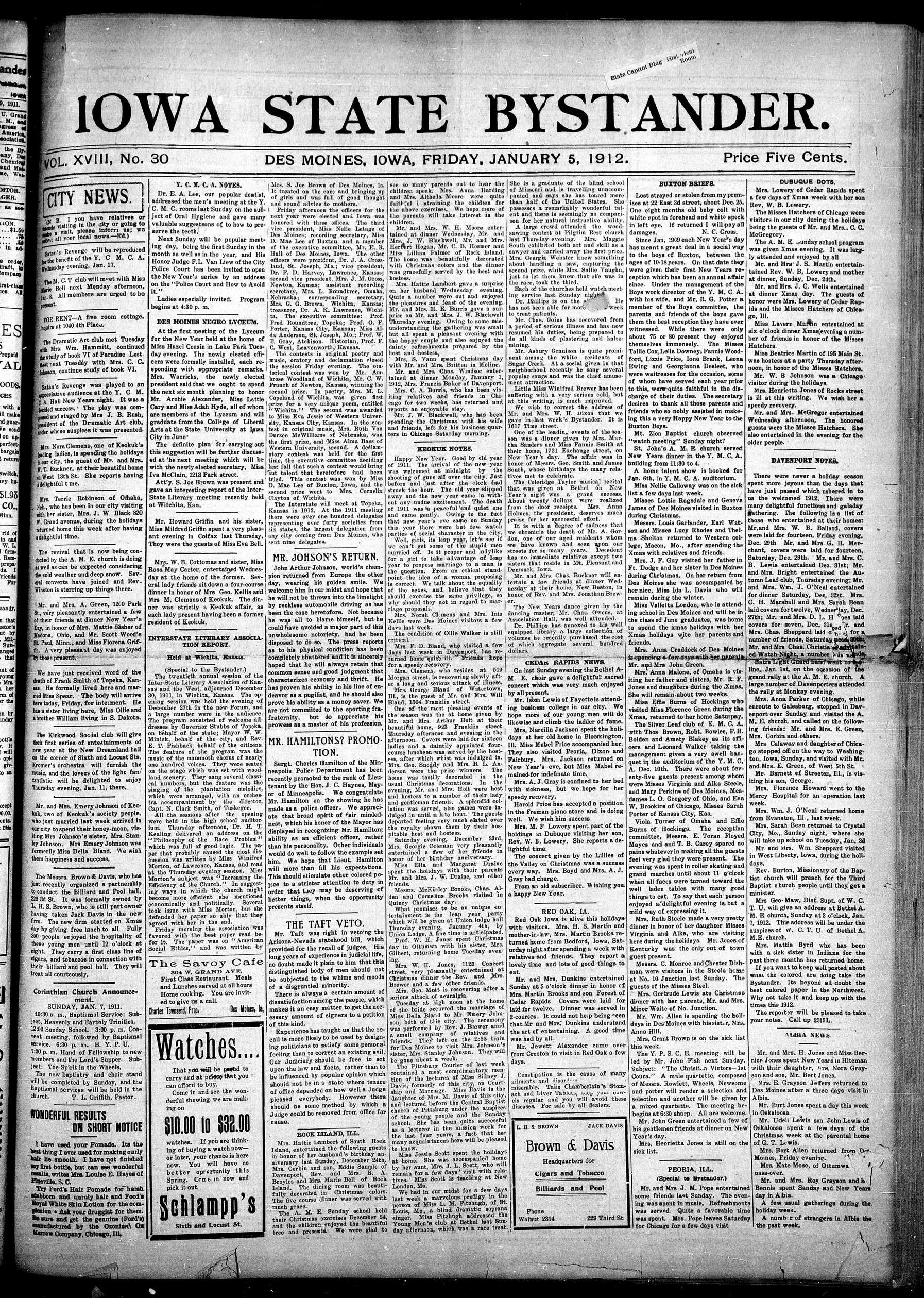
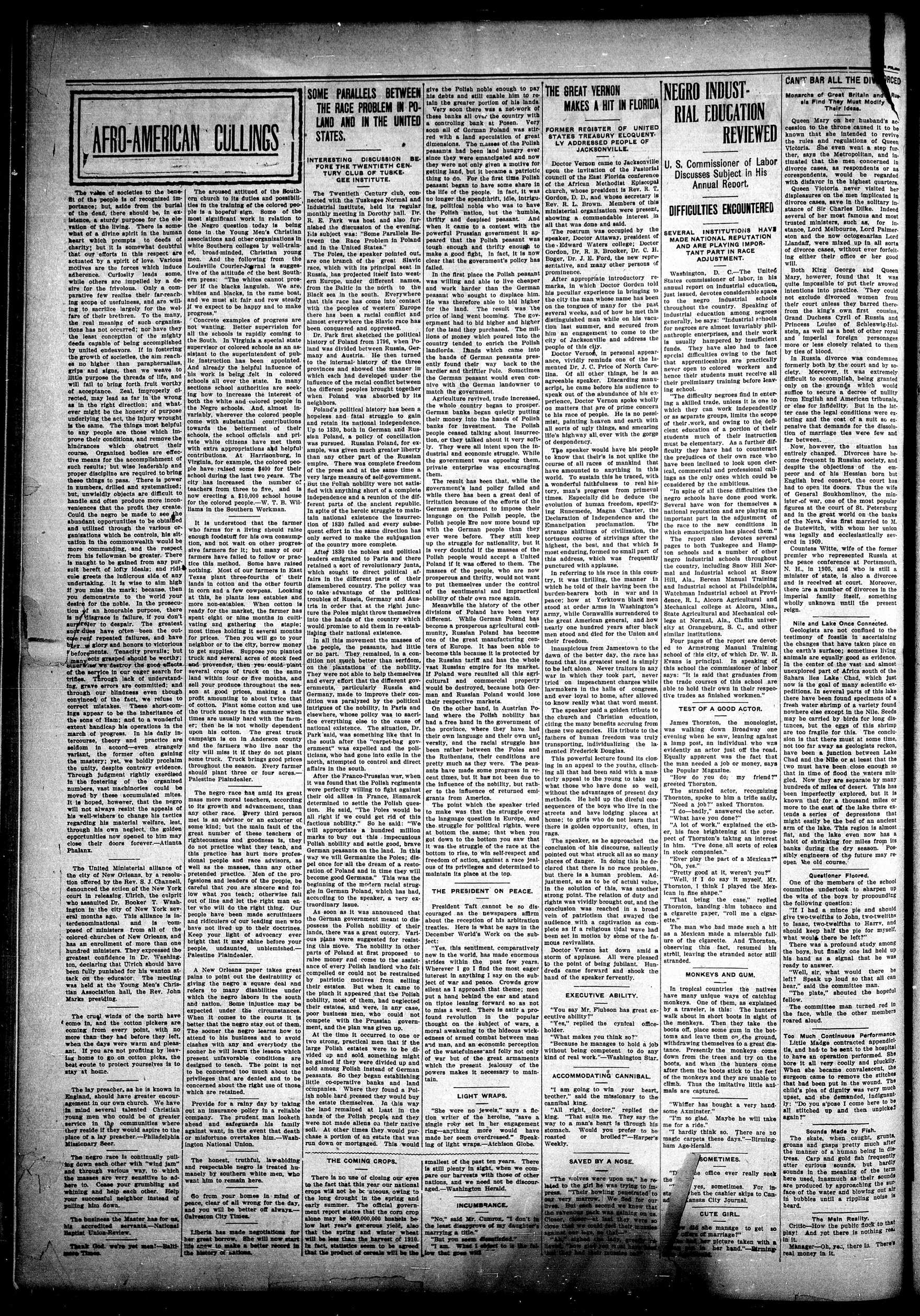
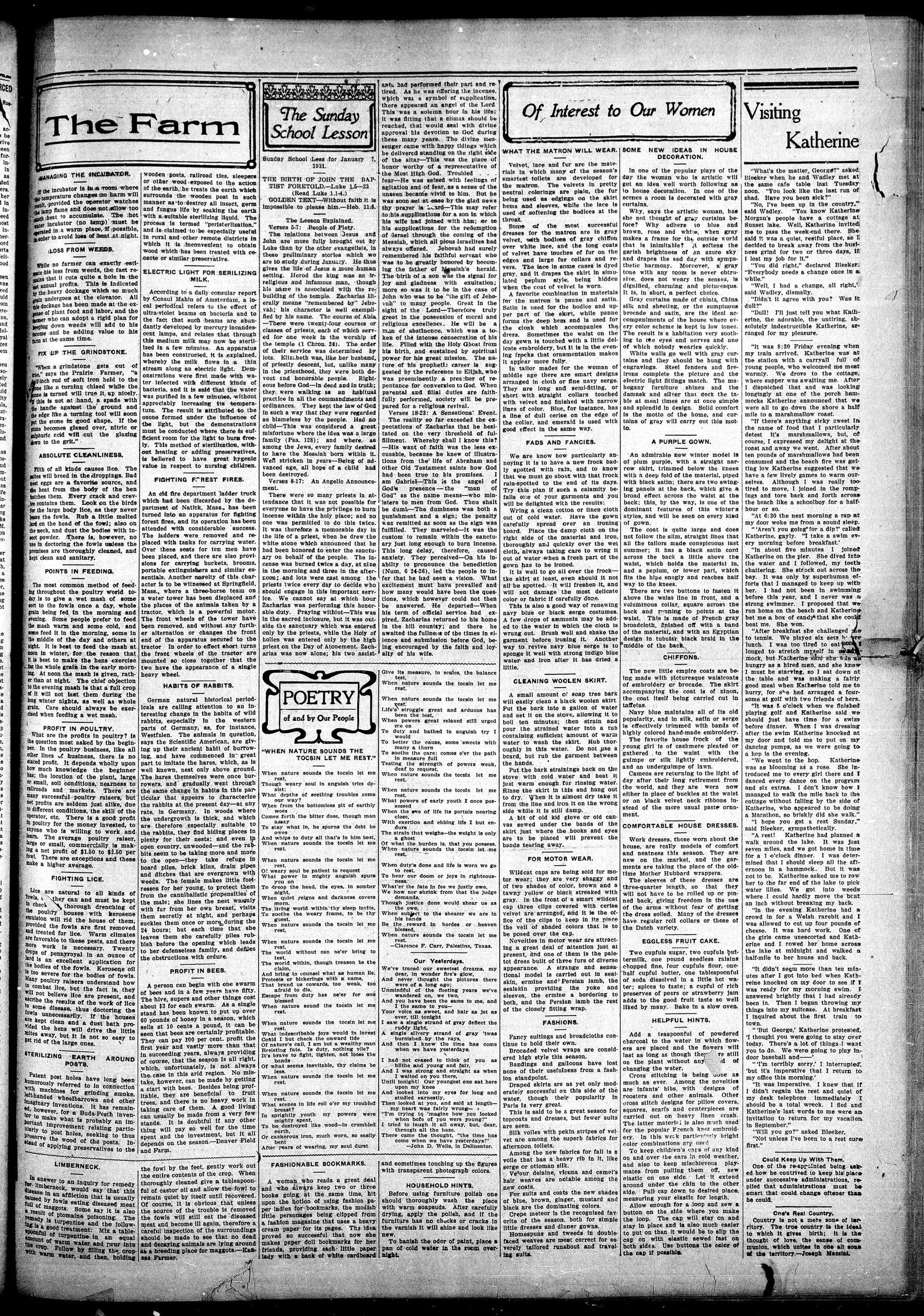
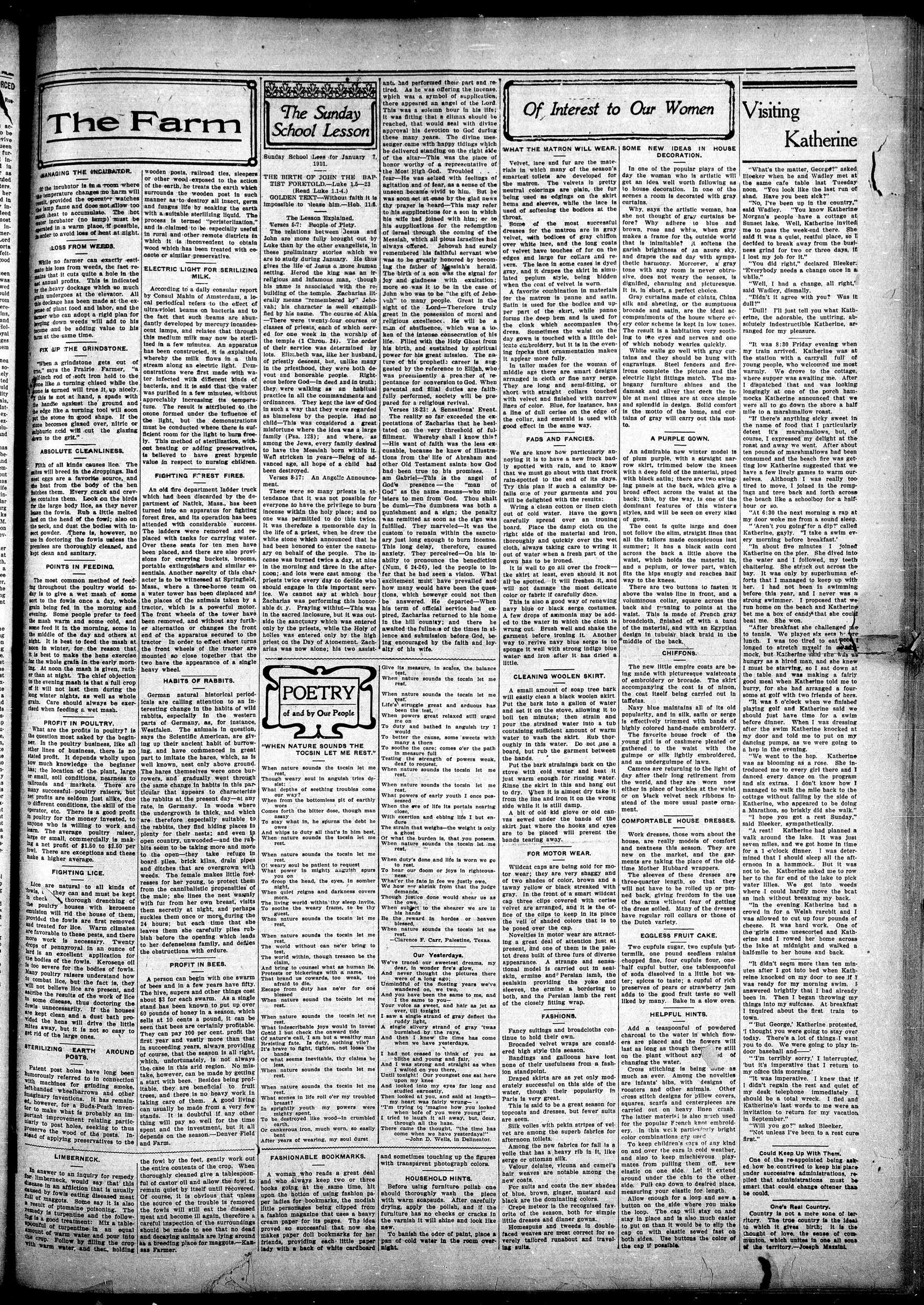
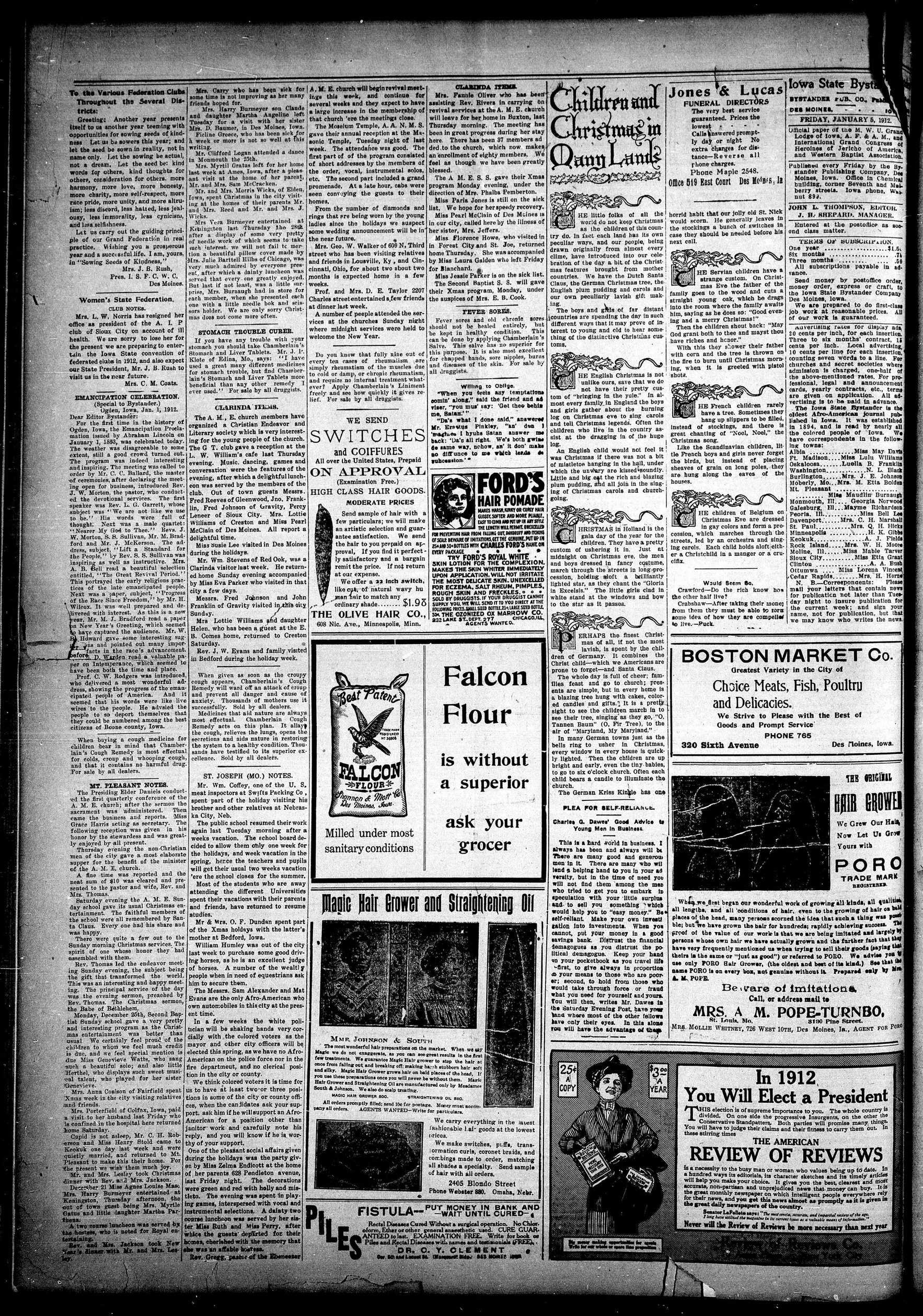
Page text (machine-generated)
IOWA STATE BYSTANDER.
VOL. XVIII, No. 30
CITY NEWS
N B. I you have relatives or visiting in the city or going to make a visit, please inform; we will attend all your local news.-Ed.)
Satan's Revenge will be reproduced for the benefit of the Y. C M. C. A. Wednesday evening, Jan. 17.
The M. C. T club will meet with Miss Marie Bell next Monday afternoon, Jan. 8. All members are urged to be present.
FOR RENT—A five room cottage. require at 1040 4th Place.
The Dramatic Art club met Tuesday with Mrs. Wm. Hammitt, continued a study of book VI of Paradise Lost. Next next Tuesday with Mrs. C. C. Johnson, continue study of book VI.
Satan's Revenge was played to an appreciative audience at the Y. C. M. C. A Hall New Years night. It was a decided success. The play was composed and staged by Mrs J. B. Rush, president of the Dramatic Art club, under whose auspices it was presented.
Mrs Nora Clemens, one of Keokuk's leading ladies, is spending the holidays in our city, the guest of Mr. and Mrs. W. T. Buckner, at their beautiful home in West 13th St. She reports having delightful t me.
Mrs. Terrie Robinson of Ohaha, Neh, who has been in our city visiting with her sister, Mrs. J. W Black 820 W. Grand avenue, during the holidays returned home this week after having a delightful time.
The revival that is now being conducted by the A. M. E. church is doing as well as can be expected considering the sold weather and deep snow. Several converts have joined and Rev. Winston is steering up things there.
Mr. and Mrs. A. Green, 1200 Park St. very pleasantly entertained a few of their friends at dinner New Year's Day, in honor of Mrs. Mattie Eisher of Madona, Ohio, and Mr. Scott Wood's St. Paul, Minn., and Miss Florena Griffin. A very pleasant day was enjoyed by those present.
We have just received word of the death of Frank Smith of Topeka, Kanas. He formally lived here and married Miss Spear. The body will arrive here today, Friday, for interment. He has a sister living here, Miss Ollie and a brother William living in S. Dakota.
The Kirkwood Social club will give their first series of entertainments of new year at the New Dreamland hall on the corner of Sixth and Locust Sts. Kromer's orchestra will furnish the music, and the lovers of the light fantasistic will be delighted to enjoy Thursday evening, Jan. 11, there.
Mr. and Mrs. Emery Johnson of Keokuk, two of Keokuk's society people, who just married last week arrived in our city to spend their honey-moon, visiting Mrs Johnson's sister, Mrs. Stanley Johnson, Mrs Emery Johnson was formerly Miss Della Bland. We wish them happiness and success.
The Messrs. Brown & Davis, who has just recently organized a partnership to conduct the Billiard and pool hall, 229 3d St. It was formally owned by L. H. S. Brown, who is still part owner having taken Jack Davis in the new firm. The new firm started on Xmas day by giving free lunch to all. Fully 300 people enjoyed the hospitality of these young men until 12 o'clock at night. They carry a first class line of cigars, and tobacco in connection with their billiard and pool hall. They will treat all courteously.
Corinthian Church Announcement.
SUNDAY, JAN. 7, 1911.
10:30 a.m. m., Baptismal Service: Subject, Heavenly and Earthly Trinities.
12:00 Sunday School. 3:00 p. m. Convent meeting, followed by Baptismal Service. 6:30 p. m. H. Y. P. U. 7:30 p. m. Hand of Fellowship to new members and the Lord's Supper. Subject: The Spirit in the Wheels.
The new baptistry and choir stand will be completed by Sunday, and the Baptismal services will be held in the church. T. L. Griffith, Pastor.
WONDERFUL RESULTS
I have used your Pomade. Its the best thing I ever used for making curly hair lie smooth. I have not finished my first bottle, but can see wonderful results, writes Mrs Louise E. Hayes of Pineville, S.C.
Try Ford's Hair Pomade for harsh stabborn and unruly hair and Ford's Royal White Skin Lotion for the completion. Ask your drugstret for them. Be sure and get the genuine (Ford's) manufactured by the Ozonizer On Marrow Company, Chicago, Ill.
Y. C. M. C. A. NOTES.
Dr. E. A. Lee, our popular死ist, addressed the men's meeting at the Y. C. M. C. rooms last Sunday on the subject of Oral Hygiene and gave many valuable suggestions of to how to preserve the teeth.
Next Sunday will be popular meeting day, being the first Sunday in the month as well as in the year, and His Honor Judge F.L. Van Lief of the City Police Court has been invited to open the New Year's series by an address on the "Police Court and How to Avoid it."
Ladies especially invited. Program begins at 3:00 p. m.
DES MOINES NEGRO LYCEUM.
DES MOINES NEIGHBOR LYCEUM
At the first meeting of the Lyceum for the New Year held at the home of Miss Hazel Cousin in Lake Park Tuesday evening. The newly elected officers were formally installed, each responding with appropriate remarks.
Mrs. Warricks, the newly elected president said that we ought to spend the next six month planning to honor Mr. Archie Alexander, Miss Lettie Cary and Miss Ada Hyde, all of whom are members of the Lyceum and will graduate from the College of Liberal Arts at the State University at Iowa City in June.
The definite plan for carrying out this suggestion will be further discussed at 'he next meeting which will be with the newly elected secretary, Miss Iva McIain, 1213 Park street.
Att'y. S. Joe Brown was present and gave an interesting report of the Inter-State Literary meeting recently held at Witchita, Kan.
Mr. Howard Griffin and his sister, Miss Mildred Griffin spent a very pleasant evening in Colfax last Thursday, They were the guests of Miss Eva Bell.
Mrs. W. B. Cottomas and sister, Miss Rosa May Carter, entertained Wednesday at the home of the former. Several lady friends sit down a four-course dinner in honor of Mrs Geo. Kellis and Mrs M. Clemons of Keokuk. The dinner was strictly a Keokuk affair, as each lady present having been a former resident of Keokuk.
INTERSTATE LITERARY ASSOCIATION REPORT.
Held at Wichita, Kansas.
(Special to the Bustarder)
(Special to the Bystander).
The twentieth annual session of the Inter-State Literary Association of Kansas and the University of Kansas, Dekalb, Kansas. The opening session was held the evening of December 27th in the new Forum, and a large number were in the audience. The program consisted of welcome addresses by Governor Stubbs of Topeka, on behalf of the state; Mayor W. W. Minick, behalf of the city, and Rev. W. Minick, behalf of the city. The feature of the program was the music of the mammoth chorus of nearly one hundred voices. They were seated on the stage which was set with woodland scenery. They sang several classical numbers, but the feature was the singing of the plantation melodies, which were arranged, with an orchestra accompanied by the drummer Gil Smith, of Tuskegee. All the sessions after the opening were held in the high school auditorium. Thursday afternoon, Dr. H. T. Kealing delivered an address on the "Philosophy of the Race Problem" which was full of good logic. The paper that probably caused the dissension was written by Winifred C. C. C. C. Kansas, and read at the Thursday evening session. Miss Morton's subject was "Increasing the Efficiency of the Church." In suggesting ways in which the church might become more efficient she mentioned economically and politically. Several took issue with Miss Morton, but she defended her paper so ably that they agreed with her mentioning the association was favored with the best paper read before it. The paper was on "American Social Ethics," and was written by
The Savoy Cafe
304 W. GRAND AVK.
First Class Restaurant. Meals
and Lunches served at all hours
Home cooking. You are invited
to give us a call.
Charles Townsend, Frog.
Des Moines, Ia.
Watches....
That you will be pleased to carry and at price that you can afford to buy.
Come in and see the wonderful showing we are making on
$10.00 to $32.00 watches. If you are thinking of buying a watch now—or later, your chance is here now. You will have no better opportunity this Spring. Come in now and pick it out
Schlampp's
Sixth and Locust St.
DES MOINES, IOWA, FRIDAY, JANUARY 5, 1912.
Mrs. S. Joe Brown of Des Moines, Ia.侍 on the care and bring up of girls and was full of good thought and sound advice to mothers.
Friday afternoon the officers for the next year were elected and Iowa was honored with three Miles. The third president, Nelle Lange of Des Moines; recording secretary, Miss D. Mae Lee of Buxton, a member of the executive committee, Mr. E. R. Hall of Des Moines, Iowa. The other officers were president, Dr. J. A. Crossland, St. Joseph, Mo.; vice president, Dr. P. D. Harvey, Lawrence, Kansas; president, Mr. E. R. Newton, Kansas; assistant recording secretary, Mrs. I. L. Roundtree, Omaha, Nebraska; corresponding secretary, Mrs. G. G. Brown, Wichita, Kansas; treasurer, Dr. A. K. Lawrence, Wichita. The executive committee: Prof. Fred Roundtree, Topeka; Prof. G. P. Porter, Kansas City, Kansas; Miss A. Underwood, Kansas; Prof. E. G. Erdschuh, Historian; Prof. F. C. West, Leavenson, Kansas.
see so many parents out to hear the children speak. Mrs. Anna Harding and Mrs. Althea Moore were quite faithful in training the children for the above exercises. We hope more of the parents will take interest in the children.
Mr. and Mrs. W. H. Moore entertained at dinner Wednesday, Mr. and Mrs. J. W. Blackwell, Mr. and Mrs. Herbert Hogan, Mr. C. B. Hosner and Miss Lillian Palmer of Rock Island. The home was beautifully decorated with Christmas colors and the dinner was gracefully served by the host and second prize, while Mrs. Sullie Vaughn, just to let them know that she was in the race, took the third.
Each of the churches held meeting service last Sunday night.
Dr. Phillips is on the week he has not been able for more to treat patients. Golus has recovered from a period of serious illness and has now resumed his duties, being prepared to do all kinds of plastering and kalso-mining.
The contests in original poetry and music, oratory and declamation closed the session Friday evening. The oral historical contest was won by Mr. Ambrose Woodland of Wichita, Mr. C. W Frunch of Newton, Kansas, winning the second prize in poetry, Mr. Ruth Van Durzee of Wichita, winning the first prize for a very unique poem, entitled "Wichita." The second was awarded to Miss Eva Jessie of Western University, Kansas City, Kansas. In the contest in original music, Mrs. Ruth Van Durzee McWilliams of Nebraska, won the first prize, and Miss Alma Bass of Western University, second. A deliatory contest was won for the first committee deciding last fall that such a contest would bring out talent that heretofore had been tried. This contest was won by Miss D. Mae Lee of Buxton, Iowa, and the second prize went to Mrs. Cornelia Clayton of Wichita.
The Interstate will meet at Topeka, Kansas in 1912. At the meeting there were over forty societies from six states, the largest delegation from any city coming from Des Moines, who sent nine delegates.
MR. JOHSON'S RETURN.
John Arthur Johnson, world's champion returned from Europe the other day, wearing his golden smile. We welcome him in our midst and hope that he will not be thrown into the limelight by reckless automobile driving as has been the case heretofore. Not because he was all to blame himself, but he could have avoided a major part of thiswholesome notoriety. had he been disposed to do so. The press reports as to his physical condition has been completely shattered and it is sincerely hoped that he will always retain that common sense and good judgment that characterizes economy and thrift. He has proven his ability in his line of endeavor as a pugilist, and he should also prove his ability as a money saver. We are not committed to the sporting fraternity, but do appreciate his prowess as a master of his profession.
MR. HAMILTONS? PROMOTION
Sergt. Charles Hamilton of the Minneapolis Police Department has been recently promoted to the rank of Lieutenant by the Hon. J. C. Haynes, Mayor of Minneapolis. We congratulate Mr. Hamilton on the showing he has made as a police officer. We appreciate that broad spirit of 'air mindedness, which his honor of the Mayor has displayed in recognizing Mr. Hamilton; ability as an efficient officer, rather than his personality. Other individuals would do well to follow the example set him. We hope that Lieut. Hamilton will more than fill his expectations. This should stimulate other colored poise to a stricter attention to duty in order that Liey may be deserving of better things, when the opportunity presents steelf.
THE TAFT VETO.
Mr. Taft was right in vetoring the Arizona-Nevada statehood bill, which provided for the recall of judges. His long years of experience in judicial life, no doubt made it plain to him that this distinguished body of men should not be subjected to the whims and moods of a disgruntled minority. There is always a certain amount of dissatisfaction among the people, which makes it an easy matter to get the necessary amount of signers to a petition of this kind. Experience has taught us that the recall is more likely to be used by designing politicians to satisfy some personal feeling than to correct an existing evil. Our Judiciary should be free to act upon the law and facts, rather than to be influenced by popular opinion which should not be in a state where tenure of office depended on how well a Judge pleased everybody. However there should be some method by which a Judge could be removed from office for cause.
ROCK ISLAND, ILL.
Mrs. Hattie Lambert of South Rock Island, entertained the following guests in honor of her husband's birthday anniversary last Sunday, December 24th. Mrs. Corbin and son, Eddie Sample of Davenport, Rev. and Eddie Sample of Broyles and Mrs. Marie Bock of Rock Island. The dining room was beautifully decorated in Christmas colors, five course dinner was served with much grease.
The A. M. E. Sunday school held their Christmas exercises December 24, and the children enjoyed the beautiful tree and presents. We were glad to
see so many parents out to hear the children speak. Mrs. Anna Harding and Mrs. Althea Moore were quite faithful i training the children for the above exercises. We hope more of the students will take interest in the children. Mr. and Mrs. W. H. Moore entertained at dinner Wednesday, Mr. and Mrs. J. W. Blackwell, Mr. and Mrs. J. W. Blackwell, Mr. and Mrs. Miss Lillian Palmer of Rock Island. The home was beautifully decorated with Christmas colors and the dinner was gracefully served by the host and hostess. Mrs. Jattie Lambert gave a surprise to her husband Wednesday evening. Quite a number were out and enjoyed the pleasures and feast of the evening. Mr. and Mrs. H. E. Burrie gave a surprise on Mr. and Mrs. J. W. Blackwell Thursday evening. Owing to some misunderstanding the gathering was same as the happy couple and also enjoyed the dainty refreshments prepared by the host and hostess. Mrs. S. Vann spent Christmas day with Mr. and Mrs. Britten in Moline, Illinois, and Mrs. Vann entertained at dinner Monday, January 1, 1912, Mrs. Francis Baker of Davenport.
Mrs. C. A. Burris, who has been visiting relatives and friends in Chicago for two weeks, has returned and reports an enjoyable stay. Mr. J. W. Blackwell, who has been spending the Christmas with his wife and friends, left for his business quarters in Chicago Saturday morning.
KEOKUK NOTES.
Happy New Year. Good by old year of 1911. The arrival of the new year was welcomed at midnight by the shooting of guns all over the city. Just before and just after that, the old year slipped away and the new year came in without any undue excitement. The death of 1911 was a peaceful and quiet one and came gently. Owing to the fact that new year's eve came on Sunday this year, there was a great and unequal piece of the character in the city. Well, girls, its leap year, let's see if we can't get some of the stupid men married off. Is it proper and ladylike for a girl to take advantage of leap year to propose marriage to a man is not a good idea. We point the idea of a woman proposing is correct. We talk about the equality of the sexes, and believe that they should exercise the same privilege, so why should they not in regard to marriage proposals. Clemens and Mrs. Inis Kellis were Des Moines visitors a few daws last week. The condition of Ollie Walker is critical. Mrs. E. D. Bland who visited a few daws week in Deportment, has returned quite ill. Friends hope for a speedy recovery. Mrs. Clemens, who resides at 519 Morgan street, is recovering slowly after a long and serious attack of illness. Mrs. George Bland of Watertown, Mrs. George Bland of Watertown, Mrs. Will Bland, 1044 Franklin street.
One of the most pleasing events of the season was the at home given by Mr. and Mrs. Arthur Holt at their beautiful home, 923 Franklin street Thursday afternoon and evening in the afternoon. Covers were half filled and four courses were filled four course luncheon was served by the hostess, after which whist was indulged in. Mrs. Gee, Snoddy and Mrs. B. L. Anderson were the prize winners. The home was tastily decorated in the usual Christmas decorations. In the evening, Mr. and Mrs. were invited to the mother of their lady and gentleman friend. A splendid collation was served, also games were indulged in until a late hour. The guests departed feeling very much elated over the royalty shown them by their hostile host and hostess. Saturday evening, 23rd, Mrs. and Mrs. were very pleasantly entertained a few of her friends in honor of her birthday anniversary. Miss Ella and Margaret Draine spent the holidays with their parents Mr. and Mrs. J. W. Draine, and other masters. McKinley Brooks, Chas. Aldae and Cornelius Brooks visited in Quincy Christmas day. What promises to be an unique entertainment is the leap party which will be given at Union lodge hall Thursday evening, January 4th, by Union Lodge. A fine time is at hand. Prof. W. H. W. of the Christmas day in Ottawa with his sister, Mrs. Gilbert, returning home Tuesday evening.
Mrs. W. H. Jones, 1123 Concert street, very pleasantly entertained at Christmas dinner the Rev. and Mrs Brewer and a few other friends.
Miss Geo. Mott is recovering after a serious attack of neuralgia.
Tuesday at high noon at the home of the bride occurred the marriage of Miss Della Blanche to Mrs. Johnson, both of her city. The ceremony was attended by Rev. J. Brewer amid a small company of relatives and friends. They left on the 2:55 train for Des Moines to visit Mrs. Johnson's sister, Mrs. Stanley Johnson. They will be gone about a week.
The Pittsburgh center of last week contains a complimentary menu of the lectures of Miss Sidney J. Davis, formerly of this city, on Courtship and Marriage. Miss Davis is the daughter of Mrs. M. Davis of this city, and lectured before the Central Baptist church of Pittsburgh under the Sunday school of the young person. She is quite successful in the mission work for the last four years, a fact that her many acquaintances here will be pleased to know.
Miss Jessie Scott spent the holidays at home. She is a man, accompanied home by her aunt J. M. L. Scott, who will be present a few days' visit with relatives. Miss Scott is teaching at New London, Mo.
We had in our midst for a few days last week a prodigious prology in person of Miss L. M. Fitzhugh of St. Louis, Mo., who is a soprano singer. Miss Fitzhugh addressed men's club at Bethel last Sunday afternoon, which was a rare treat.
She is a graduate of the blind school of Missouri and is travelling unaccompanied and says she has toured more than 100 countries and possesses a remarkably wonderful talent and there is seemingly no comparison for her natural instructive ability. A large crowd attended the woodsawing contest at Pilgrim Rest church in St. Louis, Missouri. South exhibited both art and skill as a sawyer and carried away the first prize, Mrs. Georgia Webster knew something about handling a saw, capturing the light and making it just to let them know that she was the race, the third.
Each of the churches held watch meeting service last Sunday night. Dr. Phillips is on the screen. He has not been able for more week to treat patients. He has recovered from a period of serious illness and has now resumed his duties, being prepared to do all kinds of plastering and kalsomining. Mr. Asbury Gramison is quite prominent among the white residents of northeast Nebraska in that neighborhood recently the same popular songs and was the chief amusement attraction. Little Miss Winifred Brewer has been suffering with a very serious cold, but at this writing, is much improved. We wish to correct the address of Mr. Sanders and the man that we gave in last week's Bystander. It is 1617 Time street. One of the leading events of the season was a dinner given by Mrs. Martha Sanders and Miss Fannie Smith at their home, 1721 Exchange street, on New Year's day. The affair was in South, whose birthdays the many relatives met to celebrate. The Coleridge Taylor musical recital that was given at Bethel on New Year's night was a grand success. About twenty dollars were realized from the money Anna Mina received, the president, deserves much praise for her successful effort. It is with a degree of sadness that we chronicle the death of Mr. A. Gordon, one of our aged residents who we have known and seen upon our streets for so many years. Decenten has no immediate relatives except two children in Mt. Fleasant and Denmark Iowa.
Mr. and Mrs. Chas. Buckner will entertain a few friends at dinner Wednesday at their home, New Boston, in honor of Rev. and Mrs. Jontain Brewer. The New Years dance given by the dancing master, Mr. Chas. Owens, at Association Hall, was well attended. Dr. Phillips has annexed to his well equipped library a large collection of volumes he recently purchased the cost of which aggregate several hundred dollars.
CEDAR RAPIDS NEWS
Gn last Sunday evening the Bethel A.M. E. choir gave a delightful sacred concert which was very much enjoyed by all present. Mr. Iolam Lewis of Fayette is attending business college in our city. We hope more of our young men will do likewise and climb the ladder of fame. Mrs. Narella Jackson spent the holidays at her old home in Bloomington, Miss Mabel Price accompanied her. They also visited Peoria, Dixon and Fairbury. Mrs. Jackson returned on New year's eve, but Miss Mabel remained for indefinite time. Mrs. A. J. Gray is confined to her bed with sickness, but we hope for her speed recovery.
Harold Price has accepted a position in the Freman piano store and is doing well. We wish him success.
Mrs. M. F. Lowery spent part of the holdins in Dubuque visiting her son, Rev. W. B. Lowery. She reports a delightful time.
The concert given by the Lillies of the Valley on Christmas was a success every way. Mrs. Boyd and Mrs. A. J. Gray had charge.
From an old subscriber. Wishing you a happy New Year.
RED OAK, IA.
Red Oak Iowa is alive this holiday with visitors. Mrs. H. S. Martin and mother-in-law, Mrs. Martin Brooks returned home from Bedford, Iowa, Saturday night after spending a week with relatives and friends. They report a lovely time and lots of good things to eat.
Mr. and Mrs. Dunkins entertained Sunday at 5 o'clock dinner in honor of Mrs. Martin Brooks and son Forest of Cedar Rapids. Covers were laid for laid for twelve. Dinner was served in 2 courses. It could not help be seen that Mr. and Mrs. Dunkins understand the art of entertaining. A good time was had by all.
Mr. Jewett Alexander came over from Creston to visit in Red Oak a few days.
Constipation is the cause of many ailments and disorder miserable. Take Chamberlain's Stomach and Liver Tablets, keep your oval regular and you will avoid these diseases. For sale by all dealers.
L. H. S. BROWN JACK DAVIS
Brown & Davis
Headquarters for
Cigars and Tobacco
Billiards and Pool
Phone
Walnut 2814 229 Third St
BUXTON BRIEF8.
Lost strayed or stolen from my premises at 22 East 3d street, about Dec. 25. One eight months old baby coft with white spot in forehead and whisko speck in left eye. If returned I will pay all damages. N. C. Cross.
Since Jan, 1999 each New Year's day has meant a great deal in a social way to the boys of Buxton, between the ages of 10-18 years. On that date they were given their first New Years reception which has been an annual affair since. Under the management of the Boys work director of the Y. M. C. A. with his wife, and Mr. R. G. Potter a member of the Boys committee, the parents and friends of the boys gave them the best reception they have ever witnessed. While there were only about 75 or 80 present they enjoyed themselves immensely. The Misses Tallie Cox, Lelia Downey, Fannie Woodford, Lizzie Kiss, Ione Brane, Leona Ewing and Georgia Desleet, who were waitresses for the occasion, some of whom have served each year prior to this, were quite faithful in the discharge of their duties. The secretary desires to thank all those parents and friends who so nobly assisted in making this a very Happy New Year to the Buxton Boys.
Mt. Zion Baptist church observed "watch meeting" Sunday night?
St. John's A. M. E church served New Years dinner in the Y. M. C. A. building from 11:30 to 4.
A home talent show is booked for Jan. 6th, in Y. M. C. A. auditorium. Miss Nellie Callaway was on the sick list a few days last week.
Misses Lottie Rogadale and Geneva James of Des Moines visited in Buxton during Christmas.
Messrs. Louis Garlander, Earl Watson and Misses Lucy Rhodes and Thela Shelton returned to Western college, Macon, Mo., after spending the Xmas with relatives and friends.
Mrs. J. F. Guy visited her father in Ft. Dodge and her sister in Des Moines during Christmas. On her return from Des Moines she was accompanied by her nice, Miss Ida L. Davis who will remain during the winter.
Miss Valletta London, who is attending school in Des Moines and will be in the class of June graduates, was home to spend the xmas holidays with her Xmas holidays wite her parents and friends.
Mrs. Anna Craddock of Des Moines is spending a few days with her parents. Mr. and Mrs John Green.
Mrs. Anna Malone, of Omaha is visiting her father and sisters, Mr. R. F. Jones and daughters the Xmas, She will remain about two weeks.
Miss Effie Burns of Hockings who visited Miss Florence Green during the Xmas, returned to her home Saturday.
The Silver Leaf club of Y. M. C. A. with Thos Brown, Robt. Bowles, P.H. Bolden and Amety Blakey as its officers and Leonard Walker taking the management given a very swan bauquet in the auditorium of the Y. M. C. A. Dec. 10th. There were about twenty-five guests present among whom were Misses Virginia and Alka Steele, and Mary Perkins of Des Moines, Mesdames L. O. Gregory of Ohio, and Eva W. Brookins of Chicago, Misses Sara Porter of Kansas City, Kas.
Viola Turner of Omaha and Eva Burns of Hockings. The reception committee, Messrs. E. Toran Floyd Mayes and T. B. Carey spared no paines whatever in making all the guests feel very glad they were present. The evening was spent in roller skating and grand marches until about 11 o'clock when all faces were turned toward the well laden tables with many good things to eat. To say that each person enjoyed a 'delightful evening' is but a mild way of expressing it.
Messrs. Ruth Sleele made a very pretty dinner in honor of her daughter Misses Virginia and Alka, who are visiting here during the holidays. Mr. Jones of Kentucky was the only out of town guest present.
Messrs. C. Monroe and Chester Dishman were visitors in the Steele home at No. 10 Junction last Sunday. The guests of the Misses Steel.
Mrs. Gertrude Lewis ate Christmas dinner with her parents, Mr. and Mrs. Minor Waite of No. Junction.
Mr. Wm. Allen is spending the holidays in Des Moines with his sist. Rt. Anna Hill.
Mrs. Grant Brown is on the sick list this week.
The Y. P. S. C. E. meeting will be led by Mr. John Fish next Sunday.
Subject: "The Christi. I Victors—1st Coura." A mile quartette, composed of Messrs. Rowlett, Wheels, Newsome and porter will render a selection and selection and another will be given by a mixed quartette. The meeting beegius at 6:30 sharp. All are welcome.
Mr. John Green entertained a few of his gentlemen friends at dinner on New Year's day.
Mrs. Henrietta Jones is still on the sick list.
PEORIA, ILL.
Mr. and Mrs. J. M. Pope entertained some friends last Sunday. The evening was spent in music. Refreshments was served. Quite a favorable time was spent. Mrs. Pope leaves Saturday for Chicago for a few days visit
DUBUQUE DOTS.
M. Lowery of Cedar Rapids spent a few days of Xmas week with her son Rev. W. B. Lowery.
The Misses Hatchers of Chicago were visitors in our city during the holidays being the guests of Mr. and Mrs. C. C. McGregory.
The A. M. E. Sunday school program was given Xmas evening. It was largely attended and enjoyed by all
Mr. and Mrs. J. S. Martin entertained Rev. W. B. Lowery and mother at dinner, Sunday, Dec. 24th.
Mr. and Mrs. J. C. Wells entertained at dinner Xmas day. The guests of honor were Mrs. Lowery of Cedar Rapids and the Misses Hatchers of Chicago, Ill.
Miss Lavern Martin entertained at six o'clock dinner Xmaeven a number of friends in honor of the Misses Hatchers.
Mr. W. B Johnson was a Chicago visitor during the holidays. Mrs. Henrietta Jones of Rocks street is ill at this writing. We wish her a speedy recovery. Mr. and Mrs. McGregor entertained Wednesday afternoon. The honored guests were the Misses Hatchers. She also entertained in the evening for the older people.
DAVENPORT NOTES
There were never a holiday season spent more joyous than the days that have just passed which ushered in to us the welcomed 1912. There were many delightful functions and galaday gathering. The following is a list of those who entertained at their homes: Mr. and Mrs. W. B. Ballard, covers were laid for fourteen, Friday evening, Dec. 29th Mr. and Mrs. G. H. Merchant, covers were laid for fourteen, Saturday, Dec. 29th Mr. and Mrs. C. B. Lewis entertained Dec. 31st; Mr. and Mrs. B. Bright entertained the Autumn Leaf club, Tourday evening; Mr. and Mrs. Wm. J. O'Neal entertained for dinner Saturday, Dec. 22st Mrs. C. H. Marshell and Mrs. Sarah Bean laid covers for twelve, Wedday午, Dec. 27th; Mr. and Mrs. D. L. H. uses laid covers for seven, Dec. 23rd and Mrs. Chas. Sheppard laid covers for a number of friends, Saturday午, Dec. 30th and Mrs. Chas. Christian was entertained Watch Night, a number was laid Batra Light Guard band went to live, Jan 1st, on the occasion of the grand rally at the A. M. E. church. A large number of Davenport attended the rally at Monkay evening. Mrs. Anna Parker of Chicago, while enroute to Galesburg, stopped in Davenport over Sunday and visited the A. M. E. church, and called on the following friends: Mr. and Mrs. E. Green, Mrs. Corbin and others. Mrs Calaway and daughter of Chicago stopped off on the way to Washington, Iowa, Sunday, and visited with Mr. and Mrs. E. Green, of West 5th St.
Mr. Barnett ef Streeter, III., is visiting his son, George.
Mrs. Florence Howard went to the Mercy Hospital for an operation last week.
Mrs. Wm. J. O'Neal returned home from Evanston, III., last week.
Mrs. Sarah Been returned to Crystal City, Mo., Sunday night, where she will take up school on Tuesday, Jan. 24
Mr and Mrs. Wm. Sheppard visited in West Liberty, Iowa, during the holidays.
Rev. Burton, Missionary of the Baptist church will preach for the Third Baptist church people until they get a minister.
Mrs Geo-Maw, Dist. Supt. of W. C. T. U. will give an address at Bethel A. M. E. church, Sunday at 8 o'clock, Jan. 19, 1912. This address will be under the auspices of w. C. T. U. of Bethel A. M. E. church.
Mattie Byrd who has been with a sick sister in Indiana for the past three months has returned home. If you want to keep well posted about what the colored are doing take the Bystander. Its beyond all doubt the best colored paper in the Northwest. Why not take it and keep up with the times this 1912.
The reporter will be pleased to take your notes. Call up 2151L.
ALBIA NEWS
Mr. and Mrs. H. Jones and Miss Berrice Jones spent New Years in Hiteman with their daughter, Mrs. Nora Grayson and son, Mr. Bert Jones.
Mrs. E. Grayson Jeffers returned to Des Moines after a three days visit in Albia.
Mr. Burt Jones spent a day this week in Oskaloosa.
Mr. Udell Lewis son John Lewis of Oskaloosa spent a few days of the Christmas week at the parental home of G. T. Lewis.
Mr. Bert Allen returned from Dr. Moines, Friday evening.
Mrs. Kate Mose, of Ottumwa pass-over.
Mr. and Mrs. Roy Grayson and a Bennis spent Sanday and New Years day in Albia.
A few usual gatherings during the holiday week.
A numb r of strangers in Albia the past week.
AFRO-AMERICAN CULLINGS
The United Ministerial alliance of the city of New Orleans, by a resolution offered by the Rev. S. J. Channel, denounced the action of the New York court in releasing Ulrich, the culprit who assaulted Dr. Booker T. Washington in the city of New York several months ago. This alliance is interdenominational and is composed of ministers from all of the colored churches of New Orleans, and has an enrollment of more than one hundred ministers. They expressed the greatest confidence in Dr. Washington, declaring that Ulrich should have been fully punished for his wanton attack on the educator. The meeting was held at the Young Men's Christian Association hall, the Rev. John Marks presiding.
The cruel winds of the north have come in, and the cotton pickers are coming from every point, with no more than they had before they left, when the days were warm and pleasant. If you are not profiting by leaving home to on cotton picks, the best route to protect yourselves is to stay at home.
The lay preacher, as he is known in England, should have greater encouragement in our own church. We have in mind several talented Christian young men who could be of greater service in the communities where they reside if they would aspire to the place of a lay preacher.—Philadelphia Missionary Seer.
The negro race is continually pulling down each other with "wind fam" and through various way, to which the masses are very sensitive to adhere to. Cease your grumbling and whining and help each other. Help your successful neighbor instead of pulling him down.
The business the Master has for us,
his accredited narrants—National
Baptist Union-Review.
Thank God, we're not men!—Baltimore-
Towns.
The aroused attituded of the Southern church to its duties and possibilities in the training of the colored people is a hopeful sign. Some of the most significant work in relation to the Negro question today is being done in the Young Men's Christian associations and other organizations in white Southern colleges by well-trained, broad-minded, Christian young men. And the following from the Louisville Courier-Journal is suggestive of the attitude of the best Southwestern colleges, white students, prepares if the blacks languish. We are, whites and blacks, in the same boat, and we must sit fair and row steady if we expect to be happy and to make progress."
Concrete examples of progress are not wanting. Better supervision for all the schools is rapidly coming to the South. In Virginia a special state supervisor of colored schools as an assistant to the superintendent of public schools is being felt. And already the helpful influence of his work is being felt in colored schools all over the state. In many sections school authorities are seeking how to increase the interest of both the white and colored people in the Negro schools. And, almost invariably, wherever the colored people are involved in the betterment of their schools, the school officials and private white citizens have met them with extra appropriations and helpful contributions. At Harrisonburg, in Virginia, for example, the colored people have raised some $400 for their school during the last two years. The increased amount of teachers and three to five, and is now erecting a $10,000 school house for the colored people—W. T. B. Williams in the Southern Workman.
It is understood that the farmer who farms for a living should raise enough foodstuff for his own consumption, and not wait on other progressive farmers for it; but many of our farmers have failed to follow or practice this method. Some have raised nothing. Most of our farmers in East Texas plant three-fourths of their lands in cotton and the other fourths in wheat, and at this, he plants less eatables and more non-eatables. When cotton is ready for the market, the farmer has spent eight or nine months in cultivating and gathering the staple; most times holding it several months for prices. Then you will go to your neighbor or to the city, borrow money to get supplies. Suppose you planted truck and several acres of stock feed, and then you could plant several crops of cotton or wheat within four or five months, and sell your produce throughout the season at good prices, making a fair profit amounting to about twice that of cotton. Plant some cotton and use the truck money in the summer when times are usually hard with the farmer; then he is not wholly dependent upon his cotton. The great truck campaign is on in Anderson county when the city will miss it if it does not plant some truck. Truck brings good prices throughout the season. Every farmer should plant three or four acres.—Palestine Plaindealer.
The negro race has amid its great mass more moral teachers, according to its growth and advancement, than any other race. Every third person met is an advisor or an exhorter of some kind; but the main fault of the great number of these teachers of righteousness and goodness is, they do not practice what they teach, and this practice has hurt more professional people and race advisors, as well as the masses, than any other pretended practice. Men of the prolegions and leaders of the people, be careful that you are sincere and follow that you teach, otherwise fall off the path. Our teacher who will do the right thing. Our people have been made scruffinizers and ridiculants of our leading men who have not lived up to their doctrines. Keep your light of advocacy ever bright that it may shine before your people, undaunted, unblemished.—Palestine Plaindealer.
A New Orleans paper takes great pains to point out the desirability of giving the negro a square deal and refers to many disabilities under which the negro labors in the south and nation. Some injustice may be expected under the circumstances. When it comes to the courts it is better that the negro stay out of them. The sooner the negro learns how to attend to his business and to avoid clashes with any and everybody the sooner he will learn the lesson which present unfavorable conditions are designed to teach. The point is not to be concerned too much about the privileges that are denied and to be concerned about the right use of those which are retained.
Provide for a rainy day by taking out an insurance policy in a reliable company. The prudent man looketh ahead and safeguards his family against want, in the event that death or misfortune overtakes him—Washington National Union.
The honest, truthful, law-abiding and respectable negro is treated humanely by southern white men, who want him to remain here.
Go from your homes in mind of peace, clear of all wrong for the day, and you will be better off always.—Galveston City Times.
Liberia has made negotiations for her great borrow. She will now start like snow to make a better record in the history of nations.
SOME PARALLELS BETWEEN THE RACE PROBLEM IN POLLAND AND IN THE UNITED STATES.
INTERESTING DISCUSSION BEFORE THE TWENTIETH CENTURY CLUB OF TUSKEE. GEE INSTITUTE.
The Twentieth Century club, connected with the Tuskegee Normal and Industrial institute, held its regular monthly meeting in Dorothy hall. Dr. R. E. Park was born here and attended the evening. Els subject was: "Some Parallels between the Race Problem in Poland and in the United States."
The Poles, the speaker pointed out, are one branch of the great Slavic race, which with its principal seat in Russia, has projected itself into western Europe, under different names, from the Baltic in the north to the Black sea in the south. Everywhere that this race has come into contact with the peoples of western Europe there has been a conflict and struggle between the Slavic race has been conquered, and conquered.
Dr. Park first sketched the political history of Poland from 1796, when Poland was divided between Russia, Germany and Austria. He then turned to the internal-history of the three provinces and showed the manner in which each had developed under the influence of the racial conflict between the peoples brought together when Poland was absorbed by its neighbors.
Poland's political history has been a hopeless and fatal struggle to gain and retain its national independence. Up to 1830, both in German and Russian Poland, a policy of conciliation was pursued. Russian Poland, for example, was given much greater liberty than any other part of the Russian empire. There was complete freedom of the press and at the same time a large measure of self-government. But the Polish nobility were not satisfied with anything short of a complete independence and a reunion of the different parts of the ancient empire. The struggle to maintain national existence the insurrection of 1830 failed and every subsequent effort in the same direction has only served to make the subjugation of the country more complete.
After 1830 the nobles and political leaders emigrated to Paris and there retained a sort of revolutionary junta, which sought to direct political affairs in the different parts of their dismembered country. The policy was to take advantage of the political troubles of Russia, Germany and Austria in order that at the right juncture the French would enter into the hands of the country which would promise to aid them in re-establishing their national existence.
In all this movement the masses of the people, the peasants, had little or no part. They remained, in a condition not much better than serfdom, on the plantations of the nobility. They were not able to help themselves and every effort that the different govt. made to improve their conditions, made to improve their condition was paralyzed by the political intrigues of the nobility in Paris and elsewhere, whose policy was to sacrifice everything else to the cause of national existence. The situation, Dr. Park said, was something like that in the south after the "carpet-bag government" was expelled and the polity of the north, attempted to control and direct affairs in the south.
After the Franco-Prussian war, when it was found that the Polish regiments were perfectly willing to fight against their old allies in France, Blismarck determined to settle the Polish question. He said, "The Poles would be right to fight against the old fictious nobility." So he said: "We will appropriate a hundred million marks to buy out this imbeculous Polish nobility and settle good, brave German peasants on the land. In this way we will Germanize the Poles; dispel one for all the dream of a restoration of Poland and in time they will become good Germans." This was the goal of the campaign gle in German Poland, which has had according to the speaker, a very extraordinary issue.
As soon as it was announced that the German government meant to dispossess the Polish nobility of their lands, there was a great outcry. Various plans were suggested for restitution of the Polish nobility, but parts of Poland at first proposed raise money and come to the assistance of every Polish landlord who felt compelled or could not be restrained by patriotic motives from selling their estates. But when it came to the pinch it appeared that the Polish nobility, most of them, had neglected the interests in any case, poor business men, who could not compete with the Prussian government, and the plan was given up.
At the time it occurred to one or two strong, practical men that if the large Polish estates were to be divided up and sold something might be gained if they were divided up and sold among Polish instead of German peasants. So they began establishing banks and land companies. Where the banks and land companies hard pressed they would be the estate themselves. In this way the land remained at least in the hands of the Polish people and they were not made aliens on their native soil. At other times they would purchase a portion of an estate that was run down or mortgaged. This would
There is no use of closing our eyes to the fact that this year our national crops will not be 'beneath, owing to the long drought in the spring and early summer. The official government report states that the corn crop alone may be 400,000,000 bushels before last year's generous yield, also that the spring and winter wheat will be less than the harvest of 1910. In fact statistics seem to be agreed that the product of cereals will be the
give the Polish noble enough to pay his debts and still enable him to retain the greater portion of his lands. Very soon there was a net-work of these banks all over the country with a controlling bank at Posen. Very soon all of German Poland was stirred with a land speculation of great dimensions. The masses of the Polish peasants had been land hungry ever since they were emancipated and now they were not only given a motive for getting land, but it became a patriotic thing to do. For the first time Polish peasant began to have some share in the life of the people. In fact, it was no longer the spendthrift, idle, intrigue, political noble who was to have the Polish nation, but humble and doze. It was peasant. And when it came to a contest with the powerful Prussian government it appeared that the Polish peasant was tough enough and thrifty enough to make a good fight. In fact, it is now clear that the government's policy has failed.
In the first place the Polish peasant was willing and able to live cheaper and work harder than the German peasant who sought to displace him. He was therefore able to bid higher for the land. The result was the price of land went booming. The government had to bid higher and higher for the land they purchased. The millions of money which poured into the country tended to enrich the Polish peasant. That which came into the hands of German peasants present found their way back to the harder and thrifter Pole. Sometimes the German peasant would even convince with the German landowner to match the government.
Agriculture revived, trade increased, the whole country began to prosper. German banks began quietly putting their money into the hands of Polish people ceased talking about insurrection, or they talked about it very softly. They were all intolerant to usury and were in a tangle. While the government was opposing them, private enterprise was encouraging them.
The result has been that, while the government's land policy failed and while there has been a great deal of irritation because of the efforts of the German government to impose their language on the Polish people, the Polish people are now more bound up with the German people than they ever were before. They still keep up the struggle for nationality, but it is very doubtful if the masses of the Polish people would accept a United Poland if it was offered to them. The masses of the people, who are now prosperous and thriftful, would not want to put themselves under the control of the sentimental and impractical nobility of their own race again.
Meanwhile the history of the other divisions of Poland have been very different. While German Poland has become a prosperous agricultural community, Russian Poland has become one of the great manufacturing centers of Europe. It has been able to become this because it is protected by the Russian tariff and has the whole vast Russian empire for its market. If Poland were reunited all this agricultural and commercial property would be destroyed, because both German and Russian Poland would lose their respective markets.
On the other hand, in Austrian Poland where the Polish nobility has had a free hand in the government of the province, where they have had great power and great variety, and the racial struggle has been rather between the Poles and the Ruthenians, their conditions are pretty much as they were. The peasants have made some progress in recent times, but it has not been due to the influence of the nobility, but rather to the influence of returned emigrants from America.
The point which the speaker tried to make was that the struggle over the language question in Europe, and the struggle for political rights, were at bottom the same; that when you got down to the bottom you saw that the struggle for freedom was bottom to rise to own self-respect and freedom of action, against a race jealous of its privileges and determined to maintain its place at the top.
THE PRESIDENT ON PEACE.
President Taft cannot be so discouraged as the newspapers affirm about the reception of his arbitration treaties. Here is what he says in the December World's Work on the subject: "Yes, this sentiment, comparatively new in the world, has made enormous strides within the past few years, to find and to eager interest in anything I say on the subject of war and peace. Crowds grow silent as I approach that theme; men put a hand behind the ear and stand on tiptoe leaning forward so as not to miss a word. There is astir a profound revolution in the popular thought on the subject of wars, a moral awakening to the hideous wickedness of armed combat between man and man, and an economic perception of the wastefulness and folly not only in the war but in the treaties which the present jealousy of the powers makes it necessary to maintain.
LIGHT WRAPS
"She wore no jewels," says a fiction writer of the heroine, "save a single ruby set in her engagement ring—anything more would have made her seem overdressed." Speaking of light wraps.—Atchison Globe. smallest of the past ten years. There is still plenty in sight, when we compare our harvests with those of other nations, and we need not be discouraged.—Washington Herald.
"No," said Mr. Cumrow. "I don't in the least disapprove of my daughter's marrying a title."
"But you seem disillusioned."
"I am. What I object to is the fat low that goes wild."
THE GREAT VERNON
MAKES A HIT IN FLORIDA
FORMER REGISTER OF UNITED STATES TREASURY EOLEQUENTLY ADDRESSED PEOPLE OF JACKSONVILLE.
Doctor Vernon came to Jacksonville upon the invitation of the Pastoral council of the East Florida conference of the African Methodist Episcopal Church president is Rev. R. T. Gordon, D. D., and whose secretary is Rev. R. L. Brown. Members of this ministerial organization were present, showing a commendable interest in all that was done and said.
The rostrum was occupied by the speaker, Doctor Attaway, president of the Edward Waters college, doctor Gordon, Dr. R. E. Kroger, C. H. Hoger, J. E. Ford, the new representative, and many other persons of prominence.
After appropriate introductory remarks, in which Doctor Gordon told his peculiar experience in bringing to the city the man whose name has been on the tongues of many for the past several weeks, and of how he met this distinguished man while he was secured from him an engagement to come to the city of Jacksonville and address the people of this city.
Doctor Vernon, in personal appearance, vividly reminds one of the lamented Dr. J. C. Price of North Carolina. Of all other things, he is an agreeable speaker. Discarding man script, he came before his audience to speak out of the abundance of his experience. Doctor Vernon spoke wholly on matters that are of prime concern to his race of people. He is no pessimist, painting heaven and earth with all sorts of ugly things, and smearing life's highway all, over with the gorge of despondency.
The speaker would have his people to know that theirs is not unlike the course of all races of mankind that have amounted to anything in this world. To sustain this he traced, with a wonderful faithfulness to real history, his progress from primeval times. Especially did he deduce the evolution of human freedom, specifying Runemede, Magna Charter, the Declaration of Independence and the Emancipation proclamation. The strange shiftings of civilization, the tortuous course of strivings after the highest, the best, and that which is most enduring, formed no small part of this address, which was frequently punctured with applause.
In referring to his race in this country, it was wrong, a manner in the course of the world having been the burden-bearers both in war and in peace; how at Yorktown black men stood at order arms in Washington's army, while Cornwallis surrendered to the great American general, and how nearly one hundred years after black men stood and died for the Union and their freedom.
Inauspicious from Jametown to the dawn of the better day, the race has found that its greatest need is simply to be left alone. Never traitors in any war in which they took part, never tricted on impeachment charges while lawmakers in the halls of congress, and ever loyal to home, after allowed to know really what that word meant. The speaker pulled in tribute to the victims of the Christian trial, citing the many benefits accruing from these two agencies. His tribute to the fathers of human freedom was truly transporting, individualizing the lamented Frederick Douglas. This powerful lecture found its closing in an appeal to the youths, clinching all that had been said with a masterly appeal to the young to take up what those who have done so well, without the advantages of present day methods. He held up the direful consequences of the streets and have lodging places at home; to girls who do not learn that there is golden opportunity, often, in rags.
The speaker, as he approached the conclusion of his discourse, saliently pointed out what struck all as so many places of danger. In doing this he declared that there is no race problem, but there is a human problem. Adjustment, so as to be of actual value, in the solution of this, was another strong point. The relation of duty and rights was vividly brought out, and the conclusion was reached in a broad audience with a capstone that swayed the audience with a capstone that as complete as a religious tidal wave had been set in motion by some of the famous revivals.
Doctor Vernon sat down amid a storm of applause. All were pleased to the point of being bultain. Hundreds came forward and shook the hand of the speaker fervently.
EXECUTIVE ABILITY.
"You say Mr. Flubson has great executive ability?"
"Yes," replied the cynical office holder.
"What makes you think so?"
"Because he manages to hold a job without being competent to do any kind of real work."—Washington Star.
"I am going to win your heart, brother," said the missionary to the cannibal king. "All right, doctor," replied the king. "That suits me. They say the wrist to mute the voice through his stomach. You would profuse so be roasted or broiled"—Harper's Weekly.
SAVED BY A NOSE
"The volves were upon us," he related to the girl he was trying to impress. "Their hollow penetrated to our very marrow. We had for our lives. But each second we knew that the revenant pack was gaining on us. Closer, closer—at last they were so close that we could find their muscled sigmoides in their mouths."
NEGRO INDUSTRIAL EDUCATION REVIEWED
U. S. Commissioner of Labor Discusses Subject in His Annual Report.
DIFFICULTIES ENCOUNTERED
SEVERAL INSTITUTIONS HAVE MADE NATIONAL REPUTATION AND ARE PLAYING IMPORTANT PART IN RACE ADJUSTMENT.
Washington, D. C.—The United States commissioner of labor, in his annual report on industry education, just issued, devoted considerable space to the industrial schools throughout the country. Speaking of industrial education among negroes generally, he says: "Industrial schools for negroes are almost invariably anthropic enterprises, and their work is usually hampered by insufficient funds. They have also had to face special difficulties owing to the fact that apprenticeships practically never open to college workers and students must receive all their preliminary training before leaving school.
"The difficulty negrews find in entering a skilled trade, unless it is one to which they can work independently or as separate groups, limits the scope of their work, and owing to the deficient education of a portion of their students much of their instruction must be elementary. As a further difficulty they have had to counteract the prejudices of their own race who have been inclined to look upon chemical, commercial and professional callings as the only ones which could be considered by them. All of these difficulties the negro schools have done good work. Several have won for themselves a national reputation and are playing an important part in the adjustment of the race to the new conditions in which emancipation has placed them."
The report also devotes several pages to both Tuskegee and Hampton schools and a number of other negro industrial schools throughout the country, including Snow Hill Normal and industrial school at Snow Hill, Ala. Berean Manual Training School at Philadelphia Watchman Industrial school at Providence, R. I., Alcorn Agricultural and Mechanical college at Alcorn, Miss., State Agricultural and Mechanical college at Normal, Ala., Claflin university at Orangeburg, S. C., and other similar institutions. Four pages of the report are devoted to Armstrong Manual Training school of this city, of which Dr. W. B. Evans is principal. In speaking of this school the commissioner of labor at the school that he instructed the trade courses of this school are able to hold their own in their respective trades as finished workmen."
TEST OF A GOOD ACTOR.
James Thornton, the monologist, was walking down Broadway one evening when he saw, leaning against a lamp post, an individual who was evidently an actor just off the road. Equally apparent was the fact that the man needed a job or money, says the Popular Magazine.
"How do you do; my friend?" greeted Thornton.
The stranger actor, recognizing Thornton's spoke to him a trifle sadly. "Need a job?" asked Thornton. "I do—badly," answered the actor. "What have you done?" "A lot of work," explained the other, his face brightening at the prospect of Thornton's taking an interest in him. "I've done all sorts of roles in stock companies." "Ever play the part of a Mexican?" "Oh, yes." "Pretty good at it, weren't you?" "Well, if I do say it myself, Mr. Thornton," I played the shape of the Mexican in fine shape. "That being the case," replied Thornton, handing him tobacco and a cigarette paper, "roll me a cigarette."
The man who had made such a hit as a Mexican made a miserable failure of the cigarette. And Thornton, observing this fact, resumed his stirl, leaving the stranded actor still stranded.
MONKEYS AND GUM
In tropical countries the natives have many unique ways of catching monkeys. One of them, as explained by a traveler, is this: The hunters walk about in short boots in sight of the monkeys. Then they take the boots off, place some gum in the bottoms and leave them on the ground, withdrawing themselves to a great distance. Presently the monkeys come down from the trees and try on the boots, and when the hunters come them the boots stick to the feet of the monkeys and they are unable to climb. Thus the imitative little animals are captured.
"Whifter has bought a very handsome Aximster."
"I'm so glad. Maybe he will take me for a ride." He skipped so. There are no magic carpets these days."—Birmingham Age-Herald.
yes, sometimes. For in-
hen the cashier skips to Can-
ansas City Journal.
Monarchs of Great Britain and Russia find They Must Modify Their Ideas.
Queen Mary on her husband's accession to the throne caused it to be known that she intended to revive the rules and regulations of Queen Victoria. She even went a step further to ensure the men concerned and intimated that the men concerned and divorce cases, as respondents or as correspondents, would be regarded with disfavor in the highest quarters. Queen Victoria never visited her displeasures on the men implicated in divorce cases, save in the solitary instance of Sir Charles Dilke. Indeed several of her most famous and most trusted ministers, such as, for instance, Lord Melbourne, Lord Palmerston and the now octogonarian Lord Macartan, have all sorts of divorce cases, without ever forfeiting either their office or good will.
Both King George and Queen Mary, however, found that it was quite impossible to put their avowed intentions into practice. They could not exclude divorced women from their court unless they barred them from the king's own first cousins, Grand Duchess Cyril of Russia and Successor Cyril of Hoholstein, well as a host of other heirs, and imperial foreign personages more or less closely related to them by ties of blood. In Russia divorce was condemned formerly both by the court and by society. Moreover, it was extremely difficult to accomplish, being granted only on the grounds which would suffice to secure a decree of nullity from English and American tribunals, or else for infidelity. But in the latter case, exerting and the cost of a suit so persuasive that demands for the dissolution of marriage ties were few and far between.
Now, however, the situation has entirely changed. Divorces have become frequent in Russian society, and despite the objections of the emperor and bred consort, the court has had to open its doors. Thus the wife of General Soukhomlinov, the minister-of war, one of the most popular figures at the court of St. Petersburg and in the great world on the banks of the Neva, was first married to M. de Butewitch, with whom her union was legally and ecclesiastically severed in 1909. Countess Witte, wife of the former prince who represented Russia at the peace conference at Portsmouth, N. H., in 1905, and who is still a minister of state, is also a divorce and is received at court. Moreover, there are a number of divorces in the imperial family itself, something wholly unknown until the present reign.
Nile and Lake Once Connected
Nile and Lake Once Connected. Geologists are not confined to the testimony of fossils in ascertaining the changes that have taken place on the earth's surface; sometimes living in the sediment, they are found in the center of the vase and almost unexplored part of Africa south of the Sahara lies Lake Chad, which just now is the goal of many scientific expeditions. In several parts of this lake there have been found specimens of a fresh water shrimp of a variety found nowhere else except in the Nile. Seeds may be carried by birds for long distances, but the eggs of this shrimp are too fragile for this. The conclusion is that there must at some time, not too far away as geologists reckon, have been a junction between Lake Chad and the Nile or at least that the two must have been close enough so that in time of flood the waters mingled. Now they are separate by many hundreds of miles of desert. This has been immensely explored, it has known more than millions of miles or more to the east of the lake there extends a series of depressions that might easily be the bed of an ancient arm of the lake. This region is almost flat, and the lake even now has a habit of shrinking for miles from its banks during the dry season. Possibly engineers of the future may reopen the old course.
Questioner Floored.
One of the members of the school committee undertook to sharpen up the wits of the boys by propounding the following question:
"I if I had a mince pie and should give two-twelts to John, two-twelts to Isaac, two-twelts to Harry, and should keep half the pie for myself, what would there be left."
There was a profound study among the boys, but finally one lad held up his hand as a signal that he was ready to answer.
"We will speak what would there be in him," Speak up loud so that all can hear," said the committee man.
"The plate," shouted the hopeful fellow.
The committee man turned red in the face, while the other members roared aloud.
Too Much Continuous Performance
Little Midge contracted appendicitis, and had to be sent to the hospital to have an operation performed. She bore it all very coolly and pluckly. When she became convalescent, surgeon came to remove the stitches that had been put in the wound. The child's plea of dignity was much much more dignified, indignantly: "Do you go up I come here to be all stitched up and then unpicked again!"
Sounde Made by Fish
Sounds Made by Fish.
The skate, when caught, grunts, groans and gasps pretty much after the manner of a human being in distress. Carp and gold fish, frequently alter curious sounds, but hardly sounds in the meaning of the term here used, inasmuch as their sounds are produced by approaching the surface of the water and blowing out air in bubbles until a rippling noise is heard.
The Main Reality.
Critic—How the public dock to that play! And yet there is nothing real in it.
Manager—Oh, yes, there in. There's real money in it.
The Farm
MANAGING THE INCUBATOR.
at the incubator is in a room where the temperature changes no harm will result, provided the operator watches the lamp flame and does not allow too much heat to accumulate. The shot end incubator (no knopf) must be operated in a warm place, if possible, in order to avoid loss of heat in night.
LOSS FROM WEEDS.
While no farmer can exactly ecte
mate his loss from weeds, the fact rea-
tions that it cuts quite a hole in the
annual profits. This is indicated
by the heavy dockage which so much
minus undergoes at the elevator. All
the dockage has been made at the ex-
pense of plant food and labor, and
the farmer who can adopt a rigid plan for
beeping down weeds will add to his
Income and be adding value to his
turn at the same time.
FIX UP THE GRINDSTONE.
When a grindstone gets out of one," says the Prairie Farmer, "a malachid rod of soft iron held to the bone like a turning chiseled while the bone is turned will true it, up nicely. If this is not at hand, a spade with the handle against the ground and the edge like a turning tool will soon put the stone in good shape. If the bone becomes glazed over, nitric or sulphuric acid will cut the glazing down to the grit."
ABSOLUTE CLEANLINESS.
Mith of all kinds causes lice. The mice will breed in the droppings. Bad nest eggs are a favorite source, and the heat from the body of the hen hatches them. Every crack and crevice contains them. Look on the birds for the large body lice, as they never leave the lice. Rub a little melted and on the head of the fowl; also on the neck, and dust the bodies with insect powder. There is, however, no use in doctoring the fowls unless the premises are thoroughly cleaned, and kept clean and sanitary.
POINTS IN FEEDING.
The most common method of feeding throughout the poultry world today is to give a wet mash of some sort to the fowls once a day, whole grain being fed in the morning and evening. Some people prefer to feed the mash warm and some cold, and some feed it in the morning, some in the middle of the day and others at night. It is best to feed the mash at noon in winter, for the reason that it is best to make the hens exercise for the whole grain in the early morning. At noon the mash is given, rather than at night. The chief objection to the evening mash is that a full crop of it will not last them during the long winter nights, as well as whole grain. Care should always be exercised when feeding a wet mash.
PROFIT IN POULTRY
What are the profits in poultry? is the question most asked by the beginner. In the poultry business, like all other lines of business, there is no stated profit. It depends wholly upon how much knowledge you have to beginner has; the location of the plants, large or small, soil conditions, near railroads and markets. There are many successful poultry raisers, but net profits are seldom just alike, due to different conditions, the skill of the operator, etc. There is a good profit in poultry for the money invested, to anyone who is willing to work and learn. The average poultry raiser, large or small, commercially, is making a net profit of $1.50 to $2.50 per fowl. There are exceptions and these make a higher average.
FIGHTING LICE.
Lice are natural to all kinds of fowls, they can and must be kept in check through drenching of the poultry houses with kerosene emulsion will rid the house of them, provided the fowls are first removed and treated for lice. Warm climates are favorable to these pests, and there more work is necessary. Twenty drops of pennyroyal in an ounce of hard is an excellent application for the bodies of the fowls. Kerosene oil is too severe for the bodies of fowls. Many poultry raisers understand how to combat lice, but the fact is, they not believe lice are present, and ascribe the results of the work of lice to some disease, thus doctoring the fowls unnecessarily. If the houses are kept clean and a dust bath provided the hens will drive the little mites away, but it is not so easy to get rid of the large ones.
STERILIZING EARTH AROUND POSTS.
Patent post holes have long been humorously referred to in connection with machines for grinding smoke, let alone wheelbarrows and other imaginative inventions. It has remained, however, a Buda-Pesh inventor to make what probably an important improvement, seeking particularly to post holes, seeker to preserve the wood of the posts. Instead of applying preservatives to the
In answer to an inquiry for remedy for limberneck, would say that this disease in an affliction that is usually caused by fowls eating diseased meat full of maggots. Some say it is also a result of pomaine poisoning. The remedy is turpentine and the following is a good treatment: Mix a poultice of turpentine in an equal amount of warm water and pour into the crop. Follow by filling the crop with warm water, and then, holding
wooden posts, railroad ties, sleepers or other wood exposed to the action of the earth, he treats the earth which surrounds the wooden post in such manner as to destroy all insect, germ and fungus life by soaking the earth with a suitable sterilizing liquid. The post is called the "perilization," and is claimed to be most useful in rural and other remote areas which it is inconvenient to obtain wood which has been treated with concrete or similar preservative.
ELECTRIC LIGHT FOR SERILIZING MILK.
According to a daily consular report by Consul Mahin of Amsterdam, a local periodical refers to the effect of ultra-violet beams on bacteria and to the fact that such beams are abundantly developed by mercury incandescent lamps, and relates that through this medium milk may now be sterilized in a few minutes. An apparatus constructed it is explained, whereby the water is streamed along an electric light. Demonstrations were first made with water infected with different kinds of bacteria, and it is said that the water was purified in a few minutes, without appreciably increasing its temperature. The result is attributed to the ozone formed under the influence of the light, but the demonstrations there is sufficient room for the light to be used. This method of sterilization, without heating or adding preservatives, is believed to have great hygienic value in respect to nursing children.
FIGHTING FOREST FIRES.
An old fire department ladder truck which had been discarded by the department of Natick, Mass., has been turned into an apparatus for fighting forest fires, and its operation has been attended with considerable success. The ladderers were removed and replaced with tanks for carrying water. Over these seats for ten men have been placed, and there are also provisions for carrying buckets, brooms, portable extinguishers and similar essentials. Another novelty of this character is to be witnessed at Springfield, Mass., a three-horse team on a water tower has been displaced by a tractor, which is a powerful motor. The front wheels of the tower have been removed, and without any further alternation or changes the front end of the apparatus secured to the tractor. In order to effect short turns the front wheels of the tractor are mounted so close together that the two have the appearance of a single heavy wheel.
HABITS OF RABBITS.
German natural historical periodicals are calling attention to an interesting change in the habits of wild rabbits, especially in the western parts of Germany, as, for instance, Westfalen. The animals in question, says the Scientific American, are giving up their ancient habit of burrowing, and have commenced in great part to imitate the hares, which, as is well known, nest only above ground. The hares themselves were once burrowers, and gradually went through the same change in habits in this particular that appears to characterize the rabbits at the present date. in Germany the hares where, as is well known, are thick, and which are therefore especially suitable to the rabbits, they find hiding places in plenty for their nests; and even in open country, unwooded—and the rabbits seem to be taking more and more to the open—they take refuge in board plies, brick kills, drain pipes and ditches that are overgrown with weeds. The female makes little forksies for her young, to protect them from the cannibalistic propensities of the male; she lines the nest waist with fur from her own home, with them secretly hiding, and perhaps doles over or more during the time once or more during the time that she leaves them she carefully piles rubbish before the opening which leads to her defenseless family, and defies the obstructions with ordele.
PROFIT IN BEES
A person can begin with one swarm of bees and in a few years have fifty. The hive, supers and other things cost about $3 for each swarm. As a single stand has been known to put up over 60 pounds of honey in a season, which sells at 10 cents a pound, it can be seen that bees are certainly profitable. They can pay 100 per cent, profit the first year and vastly more than that in succeeding years, always providing of course, that the season is all right, which, unfortunately, is not always the case in this arid region. No mistake, however, can be made by getting a start when we see. Besides being profitable, a start is beneficial to fruit trees, and there is no heavy work in living care of them. A good living can usually be made from a very few stands. It is doubtful if any other thing will pay so well for the time spent and the investment, but it all depends on the season—Denver Field and Farm.
the fowl by the feet, gently work out
the entire contents of the crop. When
thoroughly cleaned give a tablespoon-
ful of castor oil and allow the fowl to
remain quiet by itself until recovered.
Of course, it is obvious that unless
the source of the trouble is removed
the fowl will still eat the 'diseased
meat and become ill again, therefore a
careful inspection of the surroundings
should be made to see that no dead
and decaying animals are lying around
as a breeding place for maggots—Kan-
The Sunday
School Lesson
Sunday School Less for January 7,
1911.
THE BIRTH OF JOHN THE BAP-
TIST FORBETOLD.-Luke 1.5-23
(Read Luke 1.14.4)
GOLDEN TEXT-Without faith it is
impossible to please him.-Heb. 111.6.
The relations between Jesus and John are more fully brought out by Luke than by the other evangelists, in these preliminary stories which we are to study during January. He thus gives the life of Jesus a more human setting. Herod the king was an irreligious and infamous man, though his name is associated with the rebuilding of the temple. Zacharias literally means "remembered by" Jehovah; his character is well exemplified by his name. The course of Abia—There were twenty-four courses or classes for the priesthood, for one week in the worship of the temple (1 Chron. 24). The order of their service was determined by lots. Elizbeth was, like her husband, of priestly descent, but, unlike many in the priesthood, they were both devout and honorable people. Righteous before God—In deed and in truth; they were walking as an habitual practice in all the commandments and ordinances. They kept the law of God in such a way that they were regarded as blameless by the people. Had no great misfortune where considered the large was a large family (Psa. 128); and where, as among the Jews, every family desired to have the Messiah born within it. We fell stricken in years—Being of advanced age, all hope of a child had been destroyed.
Verses 8:17: An Angelic Announcement.
There were so many priests in attendance that it was not possible for everyone to have the privilege to burn incense within the holy place; and no one was permitted to do this twice. The priest was the one who drew the life of a priest, when he drew the white stone which announced that he had been honored to enter the sanctuary on behalf of the people. The incense was burned twice a day, at nine in the morning and three in the afternoon; and lots were cast among the priests every day to decide who should engage in this important service. We cannot say at which hour we perusing this honorable day. The priest was outside the sacred enclosure, but it was outside the sanctuary which was entered only by the priests, while the Holy of holies was entered only by the high priest on the Day of Atonement. Zacharias was now alone; his two assist
POETRY
of and by Our People
"WHEN NATURE SOUNDS THE
TOCSIN LET ME REST."
FASHIONABLE BOOKMARKS.
A woman who reads a great deal and who always keep two or three books going at the same time, hit upon the notion of using fashion paper ladies for bookmarks, the modish little personages being clipped from a fashion magazine that uses a heavy cream paper for its pages. This idea proved so successful that now she makes paper doll bookmarks for her friends, providing each little paper lady with a back of white cardboard
ant, had performed their part and retreated. As he was offering the incense, which was a symbol of supplication, there appeared an angel of the Lord. This was a solemn hour in his life; he was so moved that he reached, that could seal with divine approval his devotion to God during these many years. The divine messenger with happy tidings which he delivered standing on the right side of the star—This was the place of honor worthy of a representative of God.
fear—He was seldom with feelings of fear and of fear, as a sense of the unseen became vivid to him. But he was soon set at ease by the glad news thy prayer is heard—This may refer to his supplications for a son in which his wife had joined with him; or to his supplications for the redemption of Israel through the coming of the Messiah, which all plious Israelites had always offered. The Messiah had surely been his father, but he was to be greatly honored by becoming the father of Messiah's herald. The birth of a son was the signal for joy and gladness with exultation; more so it was to be in the case of John who was to be "the gift of Jehovah" to many people. Great in the sight of the Lord—Therefore truly great in the possession of moral and religious excellence. He will be a man of abstinence, which was a token of the intense consecration of his life. Filled with the Holy Ghost from his birth, and sustained by spiritual power for his great mission. The nature of his mission was governed by the reference to Elijah, who was preeminently a preacher of repentance for conversion to God. When parental and filial duties are faithfully performed, society will be prepared for a religious revival.
Verses 18:23 A Senatona'a Event. The reality so far exceeded the expected outcome of the situation on the very threshold of fulfillment. Whereby shall I know this?
—His want of faith was the less excusable, because he knew of illustrations from the life of Abraham and other Old Testament saints how God had been true to his promises. I am Gabriel—This is the angel of God's presence—the "man of God" as the name means—who ministers to men from God. Theshu shall be duml—The dumbness was both a punishment and a sign; the penalty was remitted as soon as the sign was fulfilled. They marveled—It was the custom to remain within the sanctuary just long enough to burn incense. This long delay before, caused the priest to perceive in his ability to pronounce the benediction (Num. 6 2426), led the people to infer that he had seen a vision. What excitement must have prevailed and how many would have been the questions, which however could not then be answered. He departed—When his term of official service had expired, Zacharias returned to his home in the hill country; and there he awaited the fulness of the times in silence and submission before God, being encouraged by the faith and loyalty of his wife.
When duty's done and life is worn we go to rest.
To hear our doom or joys in righteousness.
What the fate in fee we justify owe.
We how nor shrink from that the judge demands.
Though justice done would shear us as the owe.
When subject to the shearer we are in his hands.
Be the reward in hordes or heaven beaten.
When nature sounds the locin let me rest.
—Clarence F. Carr, Palestine, Texas.
Our Yeaterdays.
We've traced our sweetest dreams, my
dear, in wonder fire's glow,
And never thought the pictures there
were of a long ago;
Unminful of the fleeting years we've
wandered on, we two,
And we have come to me and
And then I knew the time has come
when we have yesterdays.
And I looked for long and studied earnestly,
then looked at you, and said at length-
my heart was fairly wrung—
"I'm going to magma look—
looked when he was young"
I tried to laugh it all away, but, dear,
through all the haze.
There came there, though the time has come when you yesterday!"
J. John D. Wells, in Delinhorn.
and sometimes touching up the figures with transparent photograph colors
Before using furniture polish one should thoroughly wash the piece with warm soapsuds. After carefully drying, apply the polish, and if the furniture has no chocks or cracks in the varnish it will shine and look like new.
To banish the odor of paint, place a pan of cold water in the room overnight.
Of Interest to Our Women
WHAT THE MATRON WILL WEAR.
Velvet, lace and fur are the materials in which many of the season's smartest toilets are developed for the matron. The velvents in pretty neutral colorings are plain, the fur being used as edgings on the skirt hems and sleeves, while the lace is used of softening the bodies at the throat.
Some of the most successful dresses for the matron are in gray velvet, with bodices of gray chiffon over white lace, and the long conts of velvet have lace of fur on the edges and arm fur collars and reins. The lace in some cases is dyed gray, and it drapes the skirt in simulated peplum style, being hidden when the coat of velvet is worn.
A favorite combination in materials for the matron is panne and satin. Satin is used for the bodice and upper part of the skirt, while panne forms the deep hem and is used for the cloak which accompanies the dress. Sometimes the waist on the day gown is touched with satin, but it is in the evening trunks that ornament makes it appear more fully.
In tailor mades for the woman of middle age there are smart designs arranged in cloth or fine navy serge. They are long and semi-fitting, or short with straight collars touched with velvet and finished with narrow lines of color. Blue, for instance, has a line of dull cilure on the edge of the collar, and emerald is used with good effect in the same way.
FADS AND FANCIES.
We are know how particularly annoying it is to have a new frock badly spotted with rain, and to know that we must go about with that frock rain-spotted to the end of its days. Try this plan if such a calamity befalls one of your garments and you will be delighted with the frock. We have the linen cloth out of cold water. Have the gown carefully spread over an ironing board. Place the damp cloth on the right side of the material and iron, thoroughly and quickly over the wet cloth, always taking care to write it out of water when a fresh part of the gown has to be ironed. It is well to go all over the frock—the skirt should not should it not all the spotted. It will freshen it, and will not damage the most delicate color or fabric if carefully done.
This is also a good way of renewing navy blue or black serge costumes. A few drops of ammonia may be added to the water in which the cloth is wrung out. Brush well and shake the garment before ironing it. Another way to revive navy blue serge is to sponge it well with strong indigo blue water and iron after it has dried a little.
CLEANING WOOLEN SKIRT.
A small amount of soap tree bark will easily clean a black woolen skirt. Put the bark into a gallon of water and set it on the stove, allowing it to boil ten minutes; then strain and pour the strained water into a tub containing sufficient amount of warm water to wash the skirt. Rub thoroughly in this water. Do not use a board, but rub the garment between the hands.
Put the bark straining back on the stove with cold water and heat it just warm enough to rising water. Rinse the water and then hang out and when it is almost dry take it from the line and iron it on the wrong side while it is still damp.
A bit of old kid glove or old canvas sewed under the bands of the skirt just where the hooks and eyes are to be placed will prevent the bands tearing away.
FOR MOTOR WEAR
Wildcat caps are being sold for motor wear; they are very shaggy and of two shades of color, brown and a tawny yellow or black streaked with gray. In the front of a smart wildcat cap three clips covered with cersei velvet are arranged, and it is the office of the clips to keep in its place the veil of shaded colors that is to be posed over the cap. Novelties in motor wear are attracting a great deal of attention just at present, and one of them is the patent dress built of the cersei appearance. A strange and sensual model is carried out in sealskin, ermine and Persian lamb, the sealskin providing the yoke and sleeves, the ermine a bordering to both, and the Persian lamb the rest of the closely fitted wrap.
FASHIONS
Fancy suitings and broadcloth continue to hold their own.
Brocaded velvet wraps are considered high style this season.
Bandings and gallons have lost none of their usefulness from a fashion standpoint.
Draped skirts are as yet only moderately successful on this side of the water, though their popularity in Paris is very great.
This is said to be a great season for topcoats and dresses, but fewer suits are seen.
Silk skirts with pekin stripes of velvet are among the superb fabrics for afternoon toilers.
Among the new fabrics for fall is a voile that has a heavy rib in it, like serge or ottoman silk.
Vetour delaine, viema and camel's hair weaves are notable among the new coats.
For silk and coats the new shades of orange, binger, mustard and black are the dominating colors.
Crepe meteor is the recognised favorite of the season, both for simple little dresses and dinner gowns.
Homepunts and tweeds in double faced weaves are most correct for severely tailored runabout and travel bag suits.
SOME NEW IDEAS IN HOUSE
DECORATION.
In one of the popular plays of the day the woman who is artistic will get an idea well worth following as to house decoration. In one of the scenes a room is decorated with gray curtains. It says the artistic woman, has she not thought of gray curtains before? Why adhere to blue and brown, rose and white, when gray makes a frame for the outside world that is infinitable? It softens the garish brightness of an azure sky and draps the sad day with sympathetic harmony. Moreover, a gray with any room is never obstructive, does not distract, dignified, charming and picturesque. It is, in short, a perfect choice. Gray curtains made of chiffon, China silk and sheeting, or the sumptuous brocade and saftn, are the ideal accompaniments of the house where every color scheme is kept in low lones. The result is a handmade very soothing and inviting interior and one of which nobody wears quickly.
White walls go well with gray curtains and they should be hung with engravings. Steel fenders and firebrons complete the picture and the electric light fittings match. The mahogany furniture shines and the damask and silver that deck the table at meal times are at once simple and splendid in design. Solid comfort is the motto of the home, and curtains of gray will carry out this motto.
A PURPLE GOWN.
An admirable new winter model is of plum purple, with a straight narrow skirt, trimmed below the knees with a deep fold of the material, piped with black satin; there are two swinging panels at the back, which give a broad effect across the waist at the back, and a narrow, dominant features of this winter styles, and will be seen on every kind of gown. The coat is quite large and does not follow the slim, straight lines that all the tailors made conspicuous last summer; it has a black satin cord across the back a little above the waist, which holds the material in, and the collar, or lower part, which fits the hips snugly and reaches half way to the knees. There are two buttons to fasten it above the waist line in front, and a voluminous collar, square across the back and running to points at the waist. This is made of French gray broadcloth, finished with a band of the material, and with an Egyptian black braid in the middle of the back.
CHIFFONS.
The new little empire coats are being made with picture鹅 waistcoats of embroidery or brocade. The skirt accompanying the coat is of nhnn, the coat itself being carried cut in taetas.
Navy blue maintains all of its old popularity, and in silk, satin or serge is effectively trimmed with bands of hairy yarn.
The favorite house frock of the young girl is of cashmere pleated or gathered, to the waist with the gulpe or silk lightly embroidered, and an underglume of lawn.
Cameos are returning to the light of day after their long retirement from the world, and they are worn now either in place of buckles at the waist or on black velvet neck ribbons instead of the more usual paste ornament.
COMFORTABLE HOUSE DRESSES.
Work dresses, those worn about the house, are really models of comfort and neatness this season. They are new on the market, and the garments are taking the place of the old-time Mother Hubbard wrappers. The sleeves of these dresses are three-quarter length, so that they will not have to be rolled up or pinched back, giving freedom in the use of the arms without fear of getting the dress soiled. Many of the dresses have regular roll collars or those of the Dutch variety.
EGGLESS FRUIT CAKE
Two cupuls sugar, two cupuls buttermilk, one pound seedless raisins chopped fine, four cupuls flour, one half cupuls butter, one tablespoonful of soda dissolved in a little hot water; spices to taste; a taste of lemon juice; a sweet raspberry juice adds to the good fruit taste so well liked by many. Bake in a slow oven.
HELPFUL HINTS.
Add a teaspoonful of powdered charcoal to the water in which flowers are placed and the flowers will last as long as though they re will sit on the plant without any need of changing the water.
Cross stitching is being done as much as ever. Among the novelties are infants' bibs, with designs of roosters and other animals. Other cross stitch designs for pillow covers, squares, scarfs and centerpieces are carried on heavy linen crush.
The latter materiary is also much used for the popular knot embroidery. In this week particularly bright color combinations are applied.
To keep the ears of any kind on and over the ears in cold weather, and to keep mischievous playmates from pulling them off, sow elastic on one side. Let it extend around under the chin to the other side. Pull cap down to desired place, measuring your elastic for length.
Allow enough for a loop and sew a button on the side where you make the loop. The cap will stay on and stay in place and is also much easier to put on than it would be to slip the cap on with elastic sewed fast on both sides. Use buttons the color of the cap if possible.
"What's the matter, George?" asked Bleeker when he and Wadley met at the same cafe table last Tuesday. "I was running run of shad. Have you been sick?"
"No, I've been up in the country," said Wadley. "You know Katherine Morgan's people have a cottage at Sunset lake. Well, Katherine invited me to pass the week-end there. She said it was a quiet, restful place, as from the mountains grind for two or three days, if I lost my job for it."
"You did right," declared Bleeker.
"Everybody needs a change once in a while."
"Well, I had a change, all right," said Wadley, dismally.
"Didn't it agree with you? Was it dull?"
"Dull! I'll just tell you what Katherine, the adorable, the untiring, absolutely indestructible Katherine, arranged for my pleasure.
"It was 8:30 Friday evening when my train arrived. Katherine was at the station with a carryall full of young people, who welcome me most. We drove to the cottage, when supper was awaiting me. After I dispatched that and was looking longingly at one of the porch hammocks Katherine announced that we were all to go down the shore a half mile to a marshmallow roast.
"If there's anything sicky sweet in the name of food that I particularly detest it's marshmallows, but, of course, I expressed my delight at the roast and away we went. After about ten pounds of marshmallows had been consumed and the beach fire was getting low Katherine suggested that we have a few lively games to warm ourselves. Although I was really too tired to move, I joined in the rompings and tore back and forth across the beach like a schoolboy for a half-hour. At 6:30 the next morning a rap at my door woke me from a sound sleep. "Arent you going for a dip?" called Katherine, gagly. "I take a swim every morning before breakfast."
"In about five minutes I joined Katherine on the pier. She dived into the water and I followed, my teeth chattering. She struck out across the bay. It was only by superhuman efforts that I managed to keep up with her. I had not been in swimming before this year, and I never was a strong swimmer. I proposed that we run home on the beach and Katherine bet me a box of candy that she could beat me. She won.
"After breakfast she challenged me to tennis. We played six sets by our lunch. I was too tired to eat but longed to stretch myself in a mock, but Katherine said she was as hungry as a hired man, and she knew I must be starving, so I sat down at the table and was making a fairly good meal when Katherine told me to hurry, for she had arranged a four-seater for us. "It was 5 o'clock when we finished playing golf and Katherine said we should just have time for a swim before dinner. When I was dressing after the swim Katherine knocked at my door and told me to put on my dancing pumps, as we were going to a hop in the evening.
"We went to the hop. Katherine was as blooming as a rose. She introduced me to every girl there and I danced every dance on the program and six extras. I don't know how I managed to the mile back to the cottage, but by the time Katherine, who appeared to be doing a Marathon, so briskly did she walk."
"I hope you got a rest Sunday," said Bleeker, sympathetically.
"A rest! Katherine had planned a walk around the lake. It was just seven miles, and we got home in time for a 1 o'clock dinner. I was determined that I should sleep all the afternoon in a hammock. But it was not to be. Katherine asked me to row a boat to the water lilies. We got into weeds where I could hardly move the boat an inch without breaking my back. "In the evening Katherine had a crowd in for a Welsh rabbit and I was allowed to cut up four pounds of cheese. It was hard work. One of the girls came unescorted and Katherine and I rowed her home across the lake at midnight and walked a half-mile to her house and back.
"It didn't seem more than ten minutes after I got into bed when Katherine knocked on my door to see if I was ready for my morning swim. I answered brightly that I had already been in. Then I began throwing my things into my suitcase. At breakfast I hurried about the first train to town
"But George," Katherine protested, I thought you were going to stay over today. There's a lot of things I want you to do. We were going to play indoor baseball and——"
"I'm terribly sorry, I interrupted, but it's imperative that I return to my office this morning."
"I'm imperative I knew that if I didn't regain the rest and quiet of my desk telephone immediately I should be a total wreck. I fled and Katherine's last words to me were an invitation to return for my vacation in September."
"Will you go?" asked Blecker.
"Not unless I've been to a rest cure first."
Could Keep Up With Them.
One of the re-apprised be asked how he contrived to keep his place under successive administrations, replied that administrations must be smart that could change offender than he could.
Country is not a more zone of territory. The true country is the ideal to which it gives birth; it is the thought of love, the sense of communion, which unites in all one soul of the territory—Joseph Maszik.
The Farm
MANAGING THE INCUBATOR.
If the incubator is in a room where the temperature changes no harm will result, provided the operator watches the lamp flame and does not allow too much heat to accumulate. The hot water incubator (no lamp) must be operated in a warm place, if possible, in order to avoid loss of heat at night.
wooden posts, railroad ties, sleepers or other wood exposed to the action of the earth, he treats the earth which surrounds the wooden post in such manner as to destroy all insect, germ and fungus life by soaking the earth with a suitable sterilizing liquid. The process is termed "peristerization," and is claimed to be especially useful in rural and other remote districts in
LOSS FROM WEEDS.
While no farmer can exactly entitle his loss from weeds, the fact remains that it cuts quite a hole in the at annual profits. This is indicated by the heavy dockage which so much pain undergoes at the elevator. All this dockage has been made at the expense of plant food and labor, and the farmer can adopt a rigid plan for bering down weeds will add to his income and be adding value to his time at the same time.
FIX UP THE GRINDSTONE.
"When a grindstone gets out of fire," says the Prairie Farmer, "a *inch inch* rod of soft iron held to the bone like a turning chiseled while the bone is turned will true it, up nicely. This is not at hand, a spade with the handle against the ground and the edge like a turning tool will soon put the stone in good shape. If the nose becomes glazed over, nitric or spheric acid will cut the glazing down to the grit."
ABSOLUTE CLEANLINESS.
Fifth of all kinds causes lice. The gills will breed in the droppings. Bad nest eggs are a favorite source, and the heat from the body of the hen hatches them. Every crack and crevice contains them. Look on the birds for the large body lice, as they never leave the fowl. Rub a little melted and on the head of the fowl; also on the neck, and dust the bodies with insect powder. There is, however, no use in doctoring the fowl unless the premises are thoroughly cleaned, and kept clean and sanitary.
POINTS IN FEEDING.
The most common method of feeding throughout the poultry world today is to give a wet mash of some sort to the fowls once a day, whole grain being fed in the morning and evening. Some people prefer to feed the mash warm and some cold, and some feed it in the morning, some in the middle of the day and others at night. It is best to feed the mash at noon in winter, for the reason that it is best to make the hen exercise for the whole grain in the early morning. At noon the mash is given, rather than at night. The chief objection to the evening mash is that a full crop if it will not last them during the long winter nights, as well as whole grain. Care should always be exercised when feeding a wet mash.
PROFIT IN POULTRY
PROFIT IN POULTRY.
What are the profits in poultry? is the question most asked by the beginner. In the poultry business, like all other lines of business, there is no stated profit. It depends wholly upon how much knowledge the beginner has; or the small, soil conditions, nearness to railroads and markets. There are many successful poultry producers, net profits are seldom just allied due to different conditions, the skill of the operator, etc. There is a good profit in poultry for the money invested, to anyone who is willing to work and learn. The average poultry raise, large or small, commercially is making a net profit of $1.50 to $2.50 per fowl. There are exceptions and these make a higher average.
FIGHTING LICE.
Lice are natural to all kinds of fowls, they can and must be kept in check through drenching of the poultry houses with kerosene emulsion will rid the house of them, provided the fowls are first removed and treated for lice. Warm climates are favorable to these pests, and there more work is necessary. Twenty drops of pennyroyal in an ounce of lard is an excellent application for the bodies of the fowls. Kerosene oil is too severe for the bodies of fowls. Many poultry raisers understand how to combat lice, but the fact is, they will not believe lice are present, and the results of the work of lice to some disease, thus doctoring the fowls unnecessarily. If the houses are kept clean and a dust bath provided the hens will drive the little mites away, but it is not so easy to get rid of the large ones.
STERILIZING EARTH AROUND POBTS.
Patent post holes have long been humorously referred to in connection with machines for grinding smoke, leftthumb wheelbarrows and other imaginative inventions. It has remained, however, that a Buda-PEa inventor to make waterproof, probably an important improvement, relating particularly to post holes, should preserve the wood of the posts. Instead of applying preservatives to the
In answer to an inquiry for remedy for limberneck, would say that this disease in an attention that is usually caused by fowling diseased meat full of maggots. Some say it is also a result of ptomato poisoning. The remedy is turpentine, the following is a good treatment: MY KNOWN poignant of turpentine, in an amount of warm water and pour into the crop. Follow by filling the crop with warm water, and then, holding
wooden posts, railroad ties, sleepers or other wood exposed to the action of the earth, he treats the earth which surrounds the wooden post in such manner as to destroy all insect, germ and fungus life by scaking the earth with a suitable sterilizing liquid. The wood is termed "periliterization," and is chosen to be especially useful in rural and other areas in which it is inconvenient to obtain wood which has been treated with coarse or similar preservative.
ELECTRIC LIGHT FOR SERILIZING MILK.
According to a daily consular report by Consul Mahin of Amsterdam, a local periodical refers to the effect of ultra-violet beams on bacteria and to the fact that such beams are abundantly developed by mercury incandescent lamps, and relates that through this medium milk may now be sterilized in a few minutes. An apparatus has been constructed, it is explained, whereby the milk flows in a thin stream along an electric light. Demonstrations were first made with water infected with different kinds of bacteria, and it is said that the water was purified in a few minutes, without appreciably increasing its temperature. The result is attributed to the ozone formed under the influence of the light, but the demonstrations must be conducted where there is sufficient room for the light to burn freely. This method of sterilization, without heating or adding preservatives, is believed to have great hygienic value in respect to nursing children.
FIGHTING FOREST FIRES.
An old fire department ladder truck which had been discarded by the department of Natick, Mass., has been turned into an apparatus for fighting forest fires, and its operation has been attended with considerable success. The ladderers were removed and replaced with tanks for carrying water. Over these seats for ten men have been placed, and there are also provisions for carrying buckets, brooms, portable extinguishers and similar essentials. Another nobility of this character is to be witnessed at Springfield, Mass., a three-horse team on a water tower has been displaced and the places an animal is trapped which is a powerful motor. The front wheels of the tower have been removed, and without any further alternation or changes the front end of the apparatus secured to the tractor. In order to effect short turns the front wheels of the tractor are mounted so close together that the two have the appearance of a single heavy wheel.
HABITS OF RABBITS.
German natural historical periodicals are calling attention to an interesting change in the habits of wild rabbits, especially in the western parts of Germany, as, for instance, Westfalen. The animals in question, says the Scientific American, are giving up their ancient habit of burrowing, and have commenced in great part to imitate the hares, which, as is well known, nest only above ground. The hares themselves were once burrowers, and gradually went through the same change in habits in this particular that appears to characterize the rabbits at the present time. In woods where the undergrowth is thick, and which are therefore especially suitable to the rabbits, they find hiding places in plenty for their nests; and even in open country, unwooded—and the rabbits seem to be taking more and more to the open—they take refuge in board plies, brick kilns, drain pipes and ditches that are overgrown with weeds. The female makes little fortresses for her young, to protect them from the cannibalistic propensities of the male; she lines the nest wagons with fur from her own body, then secretly a light, and perhaps a dense place or more during the 24 hours; but each time that she leaves them she carefully piles rubbish before the opening which leads to her defenseless family, and defies the obstructions with ordea.
PROFIT IN BEES
A person can begin with one swarm of bees and in a few years have fifty. The hive, supers and other things cost about $3 for each swarm. As a single stand has been known to put up over 60 pounds of honey in a season, which sells at 10 cents a pound, it can be seen that bees are certainly profitable. They can pay 100 per cent, profit the first year and vastly more than that in succeeding years, always providing of course, that the season is all right, which, unfortunately, is not always the case in this arid region. No matter take, however, can be made by creating a start with bees. Business being profitable, they are beneficial to fruit trees, and there are no heavy work in taking care of them. A good living can usually be made from a very few stands, is doubtful if any other thing will pay so well for the time and the investment, but it all depends on the season—Denver Field and Farm.
the fowl by the feet, gently work out
the entire contents of the crop. When
thoroughly cleanliness give a tablespoon-
ful of castor oil and allow the fowl to
remain quiet by itself until recovered.
Of course, it is obvious that unless
the source of the trouble is removed
the fowls will still eat the diseased
meat and become ill again, therefore a
careful inspection of the surroundings
should be made to see that no dead
and decaying animals are lying around
as a breeding place for maggots—Kansas
Farmer.
The Sunday
School Lesson
Sunday School Lees for January 7
1911.
THE BIRTH OF JOHN THE BAP
TIST FORETOLD.—Luke 1.5—23
(Read Luke 1.14.)
GOLDEN TEST—Without faith it is
impossible to please him—Hib. 11.6.
Verses 5-7: People of Flatty.
The relations between Jesus and John are more fully brought out by Luke than by the other evangelists, in these preliminary stories which we have given the life of Jesus a more human setting. Herod the king was an irreligious and infamous man, though his name is associated with the rebuilding of the temple. Zacharias literally means "remembered by" Jehovah; his character is well exemplified by his name. The course of Abia There were twenty-four courses or classes of priests, each of which served for one week in the worship of the temple (1 Chron. 24). The order of the priests was like a lot of lots. Elizabeth was like her husband of priestly descent, but, unlike many in the priesthood, they were both devout and honorable people. Righteous before God—in deed and in truth; they were walking as an habitual practice in all the commandments and ordinances. They kept the law of God in such a way that they were regarded as blameless by the people. Had no child—This was considered a great misfortune where the idea was a large family (Families 8) and, where, as with the Jesus ever more devout to have the Messiah born within it. Well stricken in years—Being of advanced age, all hope of a child had been destroyed.
Verses 8:17: An Angelic Announcement.
There were so many priests in attendance that it was not possible for everyone to have the privilege to burn incense within the holy place; and no one was permitted to do this twice. The priest was a memorial day in the life of a priest, when he drew the white stone which announced that he had been honored to enter the sanctuary on behalf of the people. The incense was burned twice a day, at nine in the morning and three in the afternoon; and lots were cast among the priests every day to decide who should engage in this important service.
We cannot say at which hour Zacharias was performing this honor; but we know that he was in the sacred Inclosure, but it was outside the sanctuary which was entered only by the priests, while the Holy of holies was entered only by the high priest on the Day of Atoneement. Zacharias was now alone; his two assist-
POETRY
of and by Our People
"WHEN NATURE SOUNDS THE
TOCSIN LET ME REST."
A woman who reads a great deal and who always keep two or three books going at the same time, hit upon the notion of using fashion paper ladies for bookmarks, the modish little personages being clipped from a fashion magazine that uses a heavy cream paper for its pages. The idea proved so successful that now she makes paper doll bookmarks for her friends, providing each little paper lady with a back of white cardboard
ants had performed their part and rested. As he was offering the incense, which was a symbol of supplication, there appeared an angel of the Lord. This was a solemn hour in his life; it was fitting that a climax should be reached, that would seal with divine approval his devotion to God during these many years. The divine messenger came with happy titlings which he delivered standing on the right side of the altar—This was the place of honor worthy of a representative of the Most High God. Troubled
fear—He was seldom with feelings of jealot and of fear, as a sense of the unseen became vivid to him. But he was soon set at ease by the glad news thy prayer is heard—This may refer to his supplications for a son in which his wife had joined with him; or to his supplications for the redemption of Israel through the coming of the Lord, all wars and all wars always offered. Johovah had surely remembered his faithful servant who was to be greatly honored by becoming the father of Moses's herald. The birth of a son was the signal for joy and gladness with exultation; more so it was to be in the case of John who was to be "the gift of Jehovah" to many people. Great in the sight of the Lord—Therefore truly great in the possession of moral and religious excellence. He will be a man of abstinence, which was a token of the intense consecration of his heart. He will be the gift of his birth, and sustained by spiritual power for his great mission. The nature of his prophetic career is suggested by the reference to Elijah, who was preeminently a preacher of repentance for conversion to God. When parental and filial duties are faithfully performed, society will be prepared for a religious revival.
Verses 18:23: A Senationa' event. The reality so far exceeded the expected. The event was not well-timed on the very threat to its fulfillment. Whereby shall I know this?
—His want of faith was the less excusable, because he knew of illustrations from the life of Abraham and other Old Testament saints how God had been true to his promises. I am Gabriel—This is the angel of God's presence—the "man of God" as the name means—who ministers to men from God. Thou shall be duml—The dumbness was both a punishment and a sign; the penalty was remitted as soon as the sign was fulfilled. They marveled—It was the custom to remain within the sanctuary just long enough to burn incense. This long delay, therefore, caused anxiety. They perceived—On his inability to pronounce the benediction (Num. 6 24:26), led the people to infer that he had seen a vision. What must he have prevailed and how many sins he had committed, which however could not then be answered He departed—When his term of official service had expired, Zacharias returned to his home in the hill country; and there he awaited the fullness: of the times in silence and submission before God, being encouraged by the faith and loyalty of his wife.
And looked into my eyes for long and studied earnestly,
There came the thought, "the time has come when we have yesterday!" —John D. Wells, in Delineator.
and sometimes touching up the figures with transparent photograph colors.
HOUSEHOLD HINTS.
Before using furniture polish one should thoroughly wash the piece with warm soapsuds. After carefully drying, apply the polish, and if the furniture has no checks or cracks in the varnish it will shine and look like new.
To banish the odor of paint, place a pan of cold water in the room overnight.
WHAT THE MATRON WILL WEAR.
Velvet, lace and fur are the materials in which many of the season's smartest toilets are developed for the matron. The velvets in pretty neutral colorings are plain, the fur being used as edgings on the skirt hems and sleeves, while the lace is used of softening the bodies at the throat.
Some of the most successful dresses for the matron are in gray velvet, with bodices of gray chiffon over white lace, and the long coats of velvet have large fur collars on the cuffs and large fur collars and returns. The lace in some cases is dyed gray, and it drapes the skirt in simulated peplum style, being hidden when the coat of velvet is worn.
A favorite combination in materials for the matron is panne and satin. Satin is used for the bodice and upper part of the skirt, while panne forms the deep hem and is used for the cloak which accompanies the dress. Sometimes the waist on the day gown is touched with a little delicate embroidery, but it is in the evening frckts that ornamentation makes it appear more fully.
In tailor makes for the woman of middle age the best smart designs arranged above or fine navy serge. The long and semi-fitting, or short with straight collars touched with velvet and finished with narrow lines of color. Blue, for instance, has a line of dull cilise on the edge of the collar, and emerald is used with good effect in the same way.
FADS AND FANCIES.
We are know how particularly annoying it is to have a new frock badly spotted with rain, and to know that we must go about with that frock rain-spotted to the end of its days. Try this plan if such a calamity befalls one of your garments and you will be delighted with the results: Place the damp cloth on the cloth out of cold water. Have the gown carefully spread over an ironing board. Place the damp cloth on the right side of the material and iron, thoroughly and quickly over the wet cloth, always taking care to wring it out of water when a fresh part of the gown has to be ironed. It is well to go all over the frock—the skirt at least should not it all be ironed. It will freshen it, and will not damage the most delicate color or fabric if carefully done.
This is also a good way of renewing navy blue or black serge costumes. A few drops of ammonia may be added to the water in which the cloth is wrung out. Brush well and shake the garment before ironing it. Another way to revive navy blue serge is to sponge it well with strong indigo blue water and iron after it has dried a little.
CLEANING WOOLEN SKIRT.
A small amount of soap tree bark will easily clean a black woolen skirt. Put the bark into a gallon of water and set it on the stove, allowing it to boil ten minutes; then strain and pour the strained water into a tub containing sufficient amount of warm water to wash the skirt. Rub thoroughly in this water. Do not use a board, but rub the garment between the hands. Put the bark strainings back on the stove with cold water and heat it just warm enough for rinsing water. Put the bark in this and hang out to dry. When it is almost dry take it from the line and iron it on the wrong side while it is still damp. A bit of old kid glove or old canvas sewed under the bands of the skirt just where the hooks and eyes are to be placed will prevent the bands tearing away.
FOR MOTOR WEAR.
Wildcat caps are being sold for motor wear; they are very shaggy and of two shades of color, brown and a tawny yellow or black streaked with gray. In the front of a smart wildcat cap three clips covered with cerise velvet are arranged, and it is the office of the clips to keep in its pince the vell of shaded colors that is to be posed over the cap. Novelties in motor wear are attracting a great deal of attention just at present, and one of them is the palet dress built of three furs of diverse appearance. The palet dress and similar model is carried out in seating model and Persian lamb, the seating providing the yoke and sleeves, the ermine a bordering to both, and the Persian lamb the rest of the closely fitted wrap.
Fancy suitings and broadcloths continue to hold their own.
Brocaded velvet wraps are considered high style this season.
Bandings and gallows have lost none of their usefulness from a fashion standpoint, but skirts are as yet only moderately successful on this side of the water, though their popularity in Paris is very great.
This is said to be a great season for topcoats and dresses, but fewer suits are seen.
Silk voles with pekin stripes of velvet are among the superb fabrics for afternoon dresses. Among the new fabrics for fall is a volle that has a heavy rib in it, like serge or ottoman silk.
Velour delaine, vicuna and camel's hair weaves are notable among the new coats. For suits and coats the new shades of blue, brown, ginger, mustard and black are the dominating colors.
Crepe meteor is the recognised favorite of the season, both for simple little dresses and dinner gowns.
Homespuns and tweeds in double-faced dresses are most correct for severely tailored runabout and travel
In one of the popular plays of the day the woman who is artistic will get an idea well worth following as to house decoration. In one of the scenes a room is decorated with gray curtains.
Why, says the artistic woman, has she not thought of gray curtains before? Why adhere to blue and brown, rose and white, when gray makes a frame for the outside world that is inimitable? it softens the garish brightness of an azure sky, and draps the sad day with sympathetic harmony. Moreover, a gray tone with any room is never obtrusive, does not weary the senses, is dignified, charming and picturesque. It is curtains, a perfect choice. Gray curtains, sheeting or the sumptuous brocade and satin, are the ideal accompaniments of the house where every color scheme is kept in low tones. The result is a habitation very soothing to the eyes and nerves and one of which nobody wearies quickly.
White walls go well with gray curtains and they should be hung with engravings. Steel fenders and firebrons complete the picture and the electric light fittings match. The mahogany furniture shines and the damask and silver that deck the table at meal times are at once simple and splendid in design. Solid comfort is the motto of the home, and curtains of gray will carry out this motto.
A PURPLE GOWN.
An admirable new winter model is of plum purple, with a straight narrow skirt, trimmed below the knees with a deep fold of the material, piped with black satin; there are two swinging panels at the back, which give a broad effect across the waist at the back; this, by the way, is one of the dominant features of this winter styles, and will be seen on every kind of gown.
The coat is quite large and does not follow the slim, straight lines that all the tailors made conspicuous last summer; it has a black satin cord across the back a little above the waist, which holds the material in, and a peplum, or lower part, which fits the hips smugly and reaches half way to the knees. Buttons to fasten it above the waist line in front, and a voluminous collar, square across the back and running to points at the waist. This is made of French gray brocodeloth, finished off with a band of the material, and with an Egyptian design in tubular black braid in the middle of the back.
The new little empire coats are being made with picturesque waistcoats of embroidery or brocade. The skirt accompanying the coat is of nikon, the coat itself being carried out in taftas. The blue maintains all of its old popularity, and in silk satin or serge is effectively trimmed with bands of highly colored hand-made embroidery. The favorite house frock of the young girl is of cashmere pleated or gathered to the waist with the gulpe or silk lightly embroidered, and an undergulpe of lawn. Camcams are returning to the light of day after their long retirement and the they are worn now either in place of buckles at the waist or on black velvet neck ribbons instead of the more usual paste ornament.
COMFORTABLE HOUSE DRESSES.
Work dresses, those worn about the house, are really models of comfort and neatness this season. They are new on the market, and the garments are taking the place of the old-time Mother Hubbard wrappers. The sleeves of these dresses are three-quarter length, so that they will not have to be rolled up or pinched back, giving freedom in the use of the arms without fear of getting the dress solled. Many of the dresses have regular roll collars or those of the Dutch variety.
EGGLESS FRUIT CAKE
Two cupuls sugar, two cupuls buttermilk, one pound seedless raisins chopped fine, four cupuls four, one half cupful butter, one tablespoonful of soda dissolved in a little hot water, spices to taste; a cupuls of rich butter, a cupuls of sugar adds to the good fruit taste so well liked by many. Bake in a slow oven.
HELPFUL HINTS
Add a teaspoonful of powdered charcoal to the water in which flowers are placed and the flowers will last as long as though they will reill on the plant without any need of changing the water.
Cross stitching is being done on much as ever. Among the novelties are infants' bibs, with designs of roosters and other animals. Other cross stitch designs for pillow covers, squares, scarfs and centerpieces are carried on heavy linen crush.
The latter material is also much used for the popular French knot embroidery. In this week particularly bright color combinations are used.
To keep children's ears of any kind out of the ears in cold weather, and also to keep mischievous playmates from pulling them off, sew elastic on one side. Let it extend around under the chin to the other side. Pull cap down to desired place, measuring your elastic for length.
Allow enough for a loop and sew a button on the side where you make the loop. The cap will stay on and stay in place and is also much easier to put on than it would be to slip the cap on with elastic sewed fast on both sides. Use buttons the color of the cap if possible.
"What's the matter, George?" asked Bleeker when he and Wadley met at the same cafe table last Tuesday noon. "You look like the last run of shad. Have you been sick?" "No, I've been up in the country," said Wadley. "You know Katherine Morgan's people have a cottage at Sunset lake. Well, Katherine invited me to pass the week-end there. She said it was a quiet, restful place, so I decided to break away from the business grind for two or three days, if I lost my job for it." She did right," declared Bleeker. "Everybody needs a change once in a while." "Well, I had a change, all right," said Wadley, dismally. "Didn't it agree with you? Was it dull?"
"Dull! I'll just tell you what Katherine, the adorable, the untrifling, absolutely indestructible Katherine, arranged for my pleasure.
"It was 8:30 Friday evening when my train arrived. Katherine was at the station with a carryall full of young people, who welcomed me most warmly. We drove to the cottage, where supper was awaiting me. After dinner we were holding longingly at one of the porch hammocks Katherine announced that we were all to go down the shore a half mile to a marshmallow roast.
"If there's anything sickly sweet in the name of food that I particularly detest it's marshmallows, but, of course, I expressed my delight at the roast and away we went. After about ten pounds of marshmallows had been consumed and the beach fire was getting low Katherine suggested that we have a few lively games to warm our hearts. All that I was really tired to move. I joined in the rumpumps and toe back and forth across the beach like a schoolboy for a half-hour or so.
"At 6:30 the next morning a rap at my door woke me from a sound sleep. "Aren't you going for a dip? called Katherine, gaily. "I take a swim every morning before breakfast." "In about five minutes I joined Katherine on the pier. She dived into the water and I followed, my teeth chattering. She struck out across the bay. It was only by superhuman efforts that she managed to keep me alive, be in swimming before this year, and I never was a strong swimmer. I proposed that we run home on the beach and Katherine bet me a box of candy that she could beat me. She won.
"After breakfast she challenged me to tennis. We played six seats here lunch. I was too tired to eat because I longed to stretch myself in a mock, but Katherine said she was as hungry as a hired man, and she knew I must be starving, so I sat down at the table and was making a fairly good meal when Katherine told me to hurry, for she had arranged a four-some at golf with two friends of hers. When I was going to be playing golf and Katherine said we should just have time for a swim before dinner. When I was dressing after the swim Katherine knocked at my door and told me to put on my dancing pumps, as we were going to a hop in the evening.
"We went to the hop. Katherine was as blooming as a rose. She introduced me to every girl there and I danced every dance on the program and six extras. I don't know how I managed to the mile back to the cottage without by the side of Katherine. As a teacher, so likely did she walk."
"I hope you got a rest Sunday," said Bleeker, sympathetically.
"A rest! Katherine had planned a walk around the lake. It was just seven miles, and we got home in time for a 1 o'clock dinner. I was determined that I should sleep all the afternoon in a hammock. But it was not to be. Katherine asked me to row her to the far end of the lake to meet her friends and to need where I could hardly move the beat an inch without breaking my back.
"In the evening Katherine had a crowd in for a Welsh rarebit and I was allowed to cut up four pounds of cheese. It was hard work. One of the girls came unescorted and Katherine and I rowed her home across the lake at midnight and walked a half-mile to her house and back.
"It didn't seem more than ten minutes after I got into bed when Katherine knocked on my door to see if I was ready for my morning swim. I answered brightly that I had already been in. Then I began throwing my things into my suitcase. At breakfast I learned about the first train to town
"But George," Katherine protested, I thought you were going to stay over today. There's a lot of things I want you to do. We were going to play indoor baseball and—"
"I'm terribly sorry; I interrupted, but it's imperative that I return to my office this morning."
was imperative. I knew that if I did not reach the rest and culet of my desk telephone immediately I should be a total wreck. I fled and Katherine's last words to me were an invitation to return for my vacation in September."
"Will you go?" asked Bleeker.
"Not unless I've been to a rest cure first."
Could Kepp Up With Them. One of the re-appointed being asked how he contrived to keep his place under the roof of an apartment that administrations must be smart that could change oftener than he could.
One's Real Country
Country is not a more zone of territory. The true country is the ideal to which it gives birth; it is the thought of love, the sense of communion, which unites in all one sense of the territory—Joseph Maximil
To the Various Federation Clubs Throughout the Several Districts:
Greeting: Another year presents itself to us another year teeming with opportunities for sowing seeds of kindness. Let us be sowers this year; and let the seed be bawn in reality, not in name only. Let the sowing be actual, not a dream. Let the seed be kind words for others, kind thoughts for others, consideration for others, more harmony, more love, more honesty, more charity, more self-respect, more race pride, more unity, and more altruism, less discord, less hatted, less jealousy, less immorality, less cynicism, and less selfishness.
Let us carry out the guiding principle of our Grand Federation in real practice. Wishing you a prosperous year and a successful life. I am yours, in "Sowing Seeds of Kidness,"
Mrs. J. B. Rush,
Pres. I. S. F. C. W. C.
Des Moines.
Mrs. L. W. Norris has resigned her office as president of the A. I. P. club of Sioux City on account of ill health. We are sorry to lose her for the present we are preparing to entertain the Iowa State convention of federated clubs in 1912, and also expect our State President, Mr. J. B. Rush to visit us in the near future.
Mrs. C. M. Coats.
EMANCIPATION CELEBRATION.
(Special to Bystander.)
Ogden, Iowa, Jan. 1, 1912.
Dean keltof byslande in the history of Odgen, town, the Emancipation Proclamation issued by Abraham Lincoln on January 1, 1853, was celebrated today. The weather was disagreeable to some extent, still a good crowd turned out. The program was indeed interesting and inspiring. The meeting was called to order by Mr. C. C. Ballard, the master of ceremonies for business, introduced Rev. J. W. Morton, the pastor, who conducted the devotional services. The first speaker was Rev. L. G. Garrett, whose subject was "We are not like we use to be." His words were full of thought. Next was a male quartet: "Nearer My God to Thee," Mr. M. Bradford and Mr. J. McKenon. The address, subject, "Lift a Standard for the People," by Rev. S. S. Sullivan is inspiring as well as instructive. Mrs. A. B. Gell read a beautiful selection entitled, "The Great Revival Period." This portrayed the early religious practices of the late emancipated people of the State of Ohio, of the State Since Freedom," by Mr. H. Wilcox. It was well prepared and delivered with interest. As this is a new year, Mr. M. J. Bradford read a paper on New Year's Greeting, which seemed to have captured the audience. Mr. W. H. Howard gave some interesting sugars and pointed out many important before. D. Warden read a valuable paper on Intemperance, which seemed to have been both the time and place.
Prof. C. W. Rodgers was introduced, who delivered a most wonderful address, showing the progress of the encamped people of America. And it seemed that his words were like wires to the wires to the wires to the people to the people to themselves that they could be numbered among the best citizens of Boone county, Iowa.
When buying a cough medicine for children bear in mind that Chamberlain's Cough Remedy is most effective for colds, croup and whooping cough, and that it contains no harmful drug. For sale by all dealers.
MT. PLEASANT NOTES.
The Presiding Elder Daniels conducted the first quarterly conference of the A. M. E. church; after the sermon the sacrament was administered. Then came the business and reports. Miss Grace Harris acting as secretary. The following reception was given in his honor by the stewardess and was greatly enjoyed by all present.
Thursday evening the non-Christian men of the church were most elaborate for the benefit of the minister of the A. M. E. church.
A fine time was reported and the neat sum of $10 was cleared and presented to the pastor and wife, Rev. and Mrs. Thomas.
Saturday evening the A. M. E. Sunday school gave its usual Christmas entertainment. The faithful members of the school were all remembered by Sanger. Every one had his share and was happy.
There were quite a few out to the Sunday morning Christmas services. The spirit of one whose honor they had assembled with them.
Rev. Thomas led the endeavor meeting Sunday evening, the subject being the gift that transformed the world. This was an interesting and engaging. The principle of the day was the sermon, precached by Rev. Thomas. The Christmas sermon, the Babe of Bebchelhe.
Monday, December 26th, Second Bapstist Sunday school gave a very pretty and interesting program as the Christmas entertainment was better than usual. We certainly feel proud of the children to show us how we feel special mention is due Miss Genevieve Wits, who sang such a beautiful solo; and also little Hertelt, who displays such sweet musical talent, who played for her sister Genevieve.
Mrs. Anna Cousen of Fairfield spent Karen's time in the city visiting relatives and friends.
Mrs. Porterfield of Colfax, Iowa, paid a visit to her husband last Friday who is confined in the hospital here returned home Saturday.
Cupid is not asleep, Mr. C. H. Roberet, who Stook Culd stole from Kookuk one day last week and were quietly married, and returned to Mt. Pleasant to make this their home. For the present we wish them much joy.
Mr. and Mrs. Leslie Toucher, too, will decorate the room. Jackson. December 21 Miss Agnes Louise Mousse Mrs. Harry Burnayner entertained at Kenington. Thursday afternoon, the out of town guest being Mrs. Myrtle Gates and little daughter Martha Par
A two course lunch menu was served by the chef, who is noted for Royal onelight.
Rev. and Mrs. Jackson took New
York dinner with Mr. and Mrs. Lea
Mrs. Carry, who has been sick for some time is not improving as her many friends hoped for.
Mrs. Harry Burmeyer son Claudie and daughter Angela left Angelina left Mrs. D. Bauer, in Des Moines, Iowa. Feline Greese, who has been sick for a week or more is not so well at this writing.
Mr. Clifford Logan attended a dance in Monmouth on May 25th. Greese left for her home last week at Ames, Iowa, after a pleasant visit at the home of her parent, Mr. and Mrs. Sam McCracken.
Mr. and Mrs. Morris Wicks, of Elden, Iowa, spent Christmas in the city where at the homes of their parents, Mrs. Reed and Mr. and Mrs. J. Wicka.
Mrs Vera Burmeyer entertained at Kettington last Thursday the 28th after a display of some very pretty of needle work of which seems to take much pleasure in the beautiful a pillow cover made by Mrs Julia Bartell Hills of Chicago, was very much admired by everyone present, after which a dainty luncheon was served that every one greatly enjoyed. But last if not least, was the surprise in store for each member, when she presented each one with a little needle bag and sisters holder. We are only sorry Christmas does not come more often.
STOMACH TROUBLE CURER.
If you have any trouble with your stomach you should take Chamberlain's Stomach and Liver Tablets. Mr. J. Klote of Edina, Edina, says: "I have used a great many different tablets for stomach Chamberlain's Stomach and Liver Tablets more beneficial than any other remedy I ever used." For sale by all druggists.
CLARINDA ITEMS.
The A. M., E. church members have organized a Christian Endeavor and Literary society which is very interesting for the young people of the church. The G. T. club gave a reception at the L. W. William's cafe last Thursday evening. Music, dancing, games and conversation were the features of the evening, after which a delightful lunch-on was served by the members of the club. Out of town guests Messrs. Fred Reeves of Gleenwood, Jno. Franklin, Fred Johnson of Gravity, Percy Leneer of Sioux City. Mrs. Lottie Williams of Creston and Miss Pearl McClain of Des Moines. All report a delightful time. Miss Susie Lee visited in Des Moines during the holidays. Mr. Wm Stevens of Red Ook, was a Clarinda visitor last week. He returned home Sunday evening accompanied by Miss Eva Parker who visited in that city a few days. Measures. Fred Johnson and John Franklin of Gravity visited in this city Sunday.
Mottle Williams and daughter Helen, who has been a guest at the E. B. Comes home, returned to Creton Saturday.
Rev. J. W. Evans and family visited in Bedford during the holiday week.
When given as soon as the crevy cough appears, Chamberlain's Cough Remedy ward off an attack of crop and prevent all danger and cause of anxiety. Thousands of mothers use it successfully. Sold by all dealers.
Medicines that aid nature are always most effectual. Chamberlain Cough Remedy acts on this plan. It allay the cough and the large open chest and aids nature in restoring the system to a healable condition. Thousands have testified to its superior excellence. Sold by all dealers.
ST. JOSEPH (MO.) NOTES.
Mr. Wm. Coffey, one of the U. S. meat inspectors at Swifts Packing Co. spent part of the holiday visiting his brother and other relatives at Nebraska City, Neb.
The public school resumed their work again last Tuesday morning after a weeks vacation. The school board decided to allow them only one week for the holidays, and week vacation in the spring, hence the teachers and pupils will get their usual two weeks vacation 'ere the school closes for the summer.
Most of the students who are away attending the different Universities spent their vacations with their parents and friends, have returned to resume studies.
Mr & Mrs. O. F. Dundan spent part of the Xmas holidays with the latter's mother at Bedford, Iowa.
William Humley was out of the city last week to purchase some good driving horses, as he is an excellent judge of horses. A number of the wealthy people when in need of equestrians ask him to secure them.
The Messrs. Sam Alexander and Mat Evans are the only Afro-American who own automobiles in this city at the present time.
In a few weeks the white politician will be shaking hands very cordially with the colored voters as the mayor and other city officers will be elected this spring, as we have no Afro-American on the police force nor in the fire department, and no clerical position in the city or county.
We think colored voters it is time for us to have at least two or three positions in some of the city or county offices, when the canidates ask your support, ask him if he will support an Afro-American for a position other than junior work and carefully note his reply, and you will know if he is worthy of your sumpor.
One of the pleasant social affairs given during the holidays was the party given by Miss Zelma Endicott at the home of her parents 628 Pendleton avenue, last Friday night. The decorations were green and red with holly and mistletoe. The evening was spent in playing games, interspersed with vocal and instrumental selections. A daisy two course luncheon was served by her sister Miss Ruth and Miss Perry, after while the guests depicted for their homes, charleshed with the memory that she was an affable hostess. Rev. Greg. pastor of the Eonesser
MME. JOHNSON & SOUTH
The most wonderful hair preparations on the market. When we say Magic Hair we do not grasinate, as you can see great results in the first few treatments. We guarantee Magic Hair grows on hard satin hair at once from falling out and breaking off, making hard satin hair soft and silky. Magic Hair Grower grows hair on bald places of the head. If you use these preparations once you will never be without them. Magic Hair Grower and Straightening Oil are manufactured only by M歇莱恩 South & Johnson. We also do scalp treating. STRAIGHTENING OIL ISO.
MAGIC HAIR GROWER SOO.
All orders promptly filled; send lie for postage. Many must accompany all orders. AGENTS WANTED—Write for payment.
Rectal Diseases Cured Without a surgical operation. No Chloroform, Ether or other general anesthetic used. CURE GUAR-ANTEED to last. EXAMINATION FREE. Write for book or Piles and Rectal Diseases with names and testimonials FREE.
DR. O. Y. CLEMENT
A. M. E. church will begin revival meetings this week, and continue for several weeks and they expect to have a large increase in the membership of that church 'are the meetings close. The Mosque Temple, A. A. N. M. S. gave their annual reception at the Masonic Temple, Tuesday night of last week. The attendance was good. The first part of of the program consisted of short addresses by the members of the order, vocal, instrumental solos, etc. The second part included a grand promenade. At a late hour, cabs were seen convoying the guests to their homes. From the number of diamonds and rings that are being worn by the young ladies since the holidays we suspect some wedding announcement will be in the near future. Mrs. GEO. W. Walker of 60 N. Third street who has been visiting relatives and friends in Louisville, Ky, and Cincinnati, Ohio, for about two about two months is expected home in a few weeks.
Prof. and Mrs. D. E. Taylor 2207
Charles street entertained a few friends
at dinner last week.
A number of people attended the services
at the churches Sunday night
where midnight services were held to
welcome the New Year.
Do you know that fully nine out of
every ten cases of rheumatism, are
simply rheumatism of the muscles due
to cold or damp, or chronic rheumatism,
and require no internal treatment whatsoever?
Apply Chamberlain's Liniment freely and see how quickly it gives relief. For sale by all druggists.
WE SEND
SWITCHES
and COIFFURES
All over the United States, Prepaid
ON APPROVAL
(Examination Free.)
HIGH CLASS HAIR GOODS
MODERATE PRICES
Send sample of hair with a few particulars; we will make an artistic selection and guarantee satisfaction. We send the hair to you prepaid on approval. If you find it perfectly satisfactory and a bargain remit the price. If not return at our expense.
We offer a 22 inch switch, like cut, of natural wavy hair to match any
Send sample of hair with a few particulars; we will make an artistic selection and guarantee satisfaction. We send the hair to you prepaid on approval. If you find it perfectly satisfactory and a bargain remit the price. If not return at our expense.
We offer a 22 inch switch, like cut of natural wavy hu man hair to match any ordinary shade.....$1.98
THE OLIVE HAIR CO.,
608 Nlc. Ave., Minneapolis, Minn.
Best Patent
TRADE MARK
PRODUCED BY
817 3406
FALCON
FLOUR
Gannon & Mott Co.
Dix Moines, Iowa.
Milled under most sanitary conditions
Magic Hair Grower
MME. JOHNSON & SOUTH
The most wonderful hair preparations on the Magic we do not exaggerate, as you can see few treatments. We guarantee Magic Hair grow once from falling out and breaking off making it hard and silky. Magic Hair Grower grows hair on hair you use these preparations once you will never be Hair Grower and Straightening Oil are manufactured South & Johnson. We also do scalp treating.
MAGIC HAIR GROWER 600. STRANG
All orders promptly filled; send 10c for postage pany all orders. AGENTS WANTED-Write
PILES
FISTULA--
Rectal Diseases Cured
oform, Ether or other g
ANTEED to last. EX.
Piles and Rectal Disease
DR. C.
Sr. 5th and Least St
FORD'S
HAIR POMADE
MAKES HAIR, KINKY OR CRINK HAIR
GLOSSY, SOFTER AND MORE PUJAMB,
EASY TO COME AND PUT IN ANY STYLE
THE LENGTH WILL PERMIT UNCROCLED
is without a superior
and Straightening Oil
In 1912
You Will Elect a President
THIS election is of supreme importance to you. The whole country is divided. On one side the progressive Insurgents, on the other the Conservative Standpatterns. Both parties will promise many things. You will have to judge their claims and their fitness to carry them out. In these stirring times
THE AMERICAN
REVIEW OF REVIEWS
is a necessity to the busy man or woman who values being up to date. In a hundred ways its editorial, its character sketches and its timely articles will help you make your choice. It gives you the best, clearest and most accurate, non-partisan and unprefixed news that money can buy. Is it the great monthly newspaper on which intelligent people everywhere rally for their news, and you get this news almost as promptly as it is given in the great daily newspapers of the country.
Senator LaPelle says: "The most sincere, accurate, and impartial review of the age. I have been allowed the magazine in its current times as a valuable means of information."
Never will the Review of Reviews be more necessary than next year
INPUT MONEY IN BANK AND
WAIT UNTIL CURED
Without a surgical operation. No Chlor-
ceral anaesthetic used. CURE GUAR-
DENATION FREE. Writer for book or
uses with names and testimonials FREE.
Y. OLEMENT
(Magazine Bldg.) DES MONEY JOURNAL
M. Fannie Nicole who has been assisting Rev. Rivers in carrying on revival services at the A. M. E. church will leave for her home in Buxton, last Thursday morning. The meeting has been in great progress during her stay here. There has been 37 members ad-ded to the church, which now makes an enrollment of eighty members. We feel as though we have been greatly blessed. The A. M. E. S. S. gave their Xmas program Monday evening, under the direction of Mrs. Phalba Pentemon.
Miss Paria Jones is still on the sick list. We hope for her speeds recovery.
liat. We hope for her speedy recovery. Miss Pearl McClain of Des Mines is in our city, called here by the illness of her sister, Mrs. Jeffers.
Miss Florence Howe, who visited in in Forest City and St. Joe, returned home Thursday. She was accompanied by Miss Laura Galden who left Friday for Blanchard. Miss Jessie Parker is on the sick list. The Second Baptist S. S. will give their Xmas program, Monday, under the auspices of Mrs. E. B. Cook.
FEVER SORES.
Fever sores and old chronic sores should not be healed entirely, but be kept in healthy condition. This can be done by applying Chamberlain's Salve. This salve has the superior effect of being the most excellent for chapped hands, sore nipples, buras and diseases of the skin. For sale by all drummers.
Willing to Oblige.
"When you tees any temptations comin' along," said the friend and adiser, "you mus' say: 'I done tell the beehs me, Satan.'"
"Da's what I done? answered Mr. Eraseau Pinkett, "ta'as dee I dese I hythe Satan answer me back: 'Do's all right. We're both gwine de same way, notch, an' it d'make no difuncce to me which leda to subcession."
FORD'S
HAIR POMADE
WEARS MEN'S AND WOMEN'S HAIR
GLOSE, BOTTER and MORE FLAIR.
EASY TO CHOSE and UP IN ANY STYLE
THE LENGTH WILL PERMIT BROKENED
FOR PREVENTIVE HAIR FROM FALLING OUT, DRIFFLEFED FOOTWEAR, AND CHEVRONS WITH CHEVRONS AND SO-BUTTLES WITH CHARLES FORD'S NAME ON EVERY PACKAGE.
TRY FORD'S ROYAL WHITE SKIN LOTION FOR THE COMPLEXION, MAKES THE SKIN WHITER IMMEDIATELY UPON APPLICATION. WILL NOT IRRITATE THE MOST DELICATE SKIN. UNEXCELLED FOR ECZEMA, SALT RHEUM, PIMPLES, ROUGH SKIN AND FRECKLES. SOLO BY DRUGGISTS. IF YOUR DRUGGIST CANNOT SUPPLY YOU, WE WILL SEND IT TO YOU DIRECT AT THE FOLLOWING PRICES, SMALL SIZED BOTTLE, 25% LARGE SIZED BOTTLE, 50% THE OZONIZED OX MARROW CO. 232 LAKE ST., DEPT. 277 CHICAGO, ILL.
Falcon Flour
ask your grocer
A
We carry everything in the latest fashionable hair- goods at the lowest prices.
We make switches, puffs, transformation curls, coronet braids, and combedmings to make order, matching all shades a specialty. Send sample of hair with all orders.
2405 Blondo Street
Phone Webster 880. Omma, Nehr.
horrid habit that the jolly old St. Nick would scorn. He generally leaves in the stockings a bunch of swimmers in his case should be needed before his next call.
family goes to the wood and cuts a straight young oak, which he drags into the room where the family awaits him, saying he does so: "Good evening and a merry Christmas!" Then the children shout back: "May God grant both to thee and mayst thou have riches and honor!" Then their father with corn and the tree is thrown on the fire to burn until Christmas morning, when it is greeted with pistol shots.
instead of stockings, and there is
a song of Noel, Noel," the
Christmas song.
Like the Scandinavian children, little French boys and girls never forget the birds, but instead of placing sheaves of grain on long poles, they are hung along the eaves of the houses.
cocession, which marches through the streets, led by an orchestra and singing carols. Each child holds aloft; either a Christchild in a manger or a crucifix. _____
ERHAPS the finest Christmas of all, if not the most lavish, is spent by the chil-
BOSTON M
Greatest Variet
Choice Meats
This is a hard world in business. I always has been and always will be. There are many good and generous men in it. There are many who will lend a helping hand to you in your ad verity, but in the time of need you will not find them among the men who tried to get you to embark in speculation with your little surplus money, something which would help you to be self-reliant. Make your own invest- tion into investments. When you cannot, put your money in a good savings bank. Distrust the financial demagogues as you distrust the polit-ical demagogue. Keep your hand on your pocketbook as you travel life
25¢
A
COPY
$3¢
A
YEAR
THE
RELEASE
OF
THE
TITLE
Children and Christmas in Many Lands
HE little folks of all the world do not keep Christmas we the children of this country
HE little folks of all the world do not keep Christmas as the children of this country do. In fast each land has its own peculiar ways, and our people, being drawn originally from almost every clime, have introduced the day a big bite of our celebration of the day a bill of the Christmas brought from mother countries. We have the Dutch Santa Claus, the German Christmas tree, the English plum pudding and carols and our own peculiarly lavish gift making.
The boys and girls of far distant countries are spending the day in such different ways that it may prove of interest to young and old to hear something of the distinctive Christmas customs.
HE English Christmas is not unlike ours, save that we do not hear their pretty cus-
HE English Christmas is not unlike ours, save that we do not have their pretty custom of "bringing in the yule." In almost every family, in England the boys and girls gather about the burning log on Christmas eve to sing carols and tell Christmas legends. Often the children who live in the country assist at the dragging in of the huge log.
An English child would not feel it was Christmas if there was not a bit of mistletoe hanging in the hall, under which the unwary are kissed soundly. Little and big cat the rich and blazing plum pudding, and all join in the singing of Christmas carols and church-going.
HRISTMAS in Holland is the gale day of the year for the children. They have a pretty
HRISTMAS in Holland is the gala day of the year for the children. They have a pretty custom of ushering it in. Just at midnight on Christmas eve, the men and boys dressed in fancy costume, march through the streets in long-procession, holding shoft a brilliantly colored hat. The Chloe in Excelis." The little girls clad in white at the windows and bow to the star as it passes.
ERHAPS the finest Christmas of all, if not the most lavish, is spent by the children of Germany. It combines the Christ child—which we Americans are prone to forget—and Santa Claus. The whole day is full of cheer; families feast and go to church; presents are simple, but in every home is a blazing tree hung with cakes, colored candles and gifts. It is a prefigured sight to see the Christmas march in to the tree, singing as they go," O, Tannen Baum" (O, Fir Tree), to the air of "Maryland, My Maryland."
In many German towns just as the
bells ring to usher in Christmas,
every window in every house is quickly
lighted. Then the children are up
bright and early, even the tiny babies,
to go to six o'clock church. Often each
child bears a candle to illuminate the
church.
The German Kriss Kindle has one
PLEA FOR SELF-RELIANCE.
Charles G. Dawes' Good Advice to
Young Men in Business.
first, to give always in proportion
you means to those who are poor;
second, to hold from those who
would take through force or fraud
what you need for yourself and yours.
You will then, writes Mr. Dawes,
in the Saturday Evening Post, have your
hand where most of the other fellows
have only their eyes. In this alone
you will have the advantage of them
THE ORIGINAL
HAIR GROWER
We Grew Our Hair
Now Let Us Grow
Yours with
PORO
TRADE MARK
REGISTERED.
When we first began our wonderful work of growing all kinds, all qualities, all lengths, and all 'conditions of hair, even to the growing of hair on half places of the head, many persons scorned the idea that such a thing was poor bleu; but we have grown the hair for hundreds; rapidly achieving success. The proof of the value of our work is that we are being imitated and largely by persons whose own hair we have actually grown and the further fact that they have very frequently mentioned us when trying to sell their goods (paying their theils in the same or 'just as good') or referred to PORO. We advise you to use only PORO Hair Grower, (the oldest and best of its kind.) See that the name PORO is on every box, not genuine without it. Prepared only by Mrs. A. M. POPE.
MRS. MOLLIE WHITNEY, 726 WEST 10TH, Des Moines, Ia., AGENT FOR PORO
C
HE Servian children have a strange custom. On Christmas Eve the father of the
F
HE French children rarely have a tree. Sometimes they hang up slippers to be filled.
7
HE children of Belgium on Christmas Eve are dressed in gay colors and form a pro
Would Beem So.
Crawford—Do the rich know how the other half live?
Crabshaw—After taking their money from them they must be able to form some idea of how they are compelled to live.—Puck.
Lodge of Iowa, A. F. & A. M. and
International Grand Congress of
Heroes of Jeroch of America,
and Western Baptist Association.
Published every Friday by the Bystander Publishing Company, Des Moines Iowa, in Chemical building, corner Seventh and Maberry streets. Iowa phone, Wabut 899.
JOHN L. THOMPSON, EDITOR.
J. H. SHEPARD, MANAGER.
Entered at the postoffice as second class matter.
TERMS OF SUBSCRIPTION.
One year. $1.50.
Six months. 71
Twelve months. 50
All subscriptions payable in advance.
Send money by postoffice order,
money order, express or craft, to the Iowa State Bystander Company
Des Moines, Iowa.
To be done to do first-class
job work at reasonable prices. All of our work is guaranteed.
Advertising rates for display ad
20 cents per inch, for each insertion.
Three to six months, contract, 18
days. For display ad, 10 cents per line for each insertion,
counting seven words to a line. For
churches and secret societies where
admission is charged, one-half of
the above-mentioned rates. For pro-
spective churches, cards, yearly contracts, etc., terms
are given on application. All ad-
vertising is to be held in advance.
The Iowa State Eystander is the older
administrator of the American
Institute in Iowa. It was establ-
ished in 1894, and is by readily all
the colored people of Iowa. We
have correspondents in the following towns:
Ft. Madison, Miss May Davis
Ft. Madison, Miss Lulu Williams
Oskaloosa, Luluella B. Franklin
Washington, N. L. Black
Burlington, Mrs. J. E. Johnson
Moberly, Mo. Mrs. M. Eta Golden
Miss Maudlin Burnaugh
Momouth, Ill. Georgia Norwood
Galesburg, Ill. Mayme Richardson
Peoria, Ill. Miss Bell Lee
Maryland, Ill. Mrs. C. G.
St. Paul. Mrs. Q. H. Hicks
Minneapolis. Mrs. H. K. Gibbs
Keckou. A. J. Fields
Rock Island. Mrs. W. H. Moore
Molline, Ill. Miss Mable Tarre
Sloux City. Mrs. Etta Grant
Ottumwa. Miss Lorena Vincent
Cedar Rapids. Mrs. H. Horne
N. B.—Correspondents: Please
mail your letters that contain news
for publication not later than Tuesday
day of publication. Mrs. H. Horne
current week; and sign your
name, not for publication, but that
we may know who writes the news.
MARKET Co.
in the City of
Fish, Poultry
S.
use with the Best of
Service
NE 765
Des Moines, Iowa.
THE ORIGINAL
HAIR GROWER
We Grew Our Hair
Now Let Us Grow
Yours with
PORO
TRADE MARK
REGISTERED.
work of growing all kinds, all qualities,
dr, even to the growing of hair on bald
the idea that such a thing was poor
andreds; rapidly achieving success. The
at we are being imitated and largely by
grown and the further foot that they
on trying to sell their goods (saying that
referred to PORO. We advise you