Iowa State Bystander
Friday, February 23, 1912
Des Moines, Iowa
Page text (machine-generated)
IOWA STATE BY STANDER.
VOL. XVIII, No. 37
CITY NEWS.
Mrs A. Harrison of Fourth street Place had a serious accident by cutting his inger Sunday morning
Mrs. J. R. White returned to her home in Oswego, Kans, after having spent several weeks as the guest of Mrs. J. B Rush.
The Dramatic Art club met Tuesday with Mrs. Chas. Turner They studied Book VII They meet next Tuesday evening with Mrs. H. Warricks on 13th street and finish book VI.
The Busy Bee Sewing club met Friday afternoon with Miss Wm. Johnson 1042 Fourth street Place. An enjoyable afternoon was reported after which a 3-course luncheon was served, assisted by Chas. Winslow.
The Corinthian Aid Society met last week with Mrs. Perkins. The English Oyster Supper was a success, realizing a neat sum and we thank those who patronized us. Adjourned to meet Friday for general cleaning at the church
Mrs. J. Hamilton just returned from an extended visit in Ottumwa, her former home. She reports a delightful time with her many friends, also reports the A. M. E. church in a prosperous condition, having recently had an addition of 35 new members.
The New Bizmark Lunch Room will be open for service Sunday, February 18. Meals served at all hours. Everything good to eat. Hours from 6 a.m to 12 b.m.
We announce the marriage of Mable Morton and Mr W. Coyle, both of this city. The marriage took place in Omaha Neb., Feb. 14th, and happy couple will make their future home at 12th and Park streets, where their friends are invited to call.
Miss Roxanna Durden was married last Sunday at the home of her sister, Mrs. J. B. Rush, on West 20th street, to Frank White of Oswego, Kansas. They will make their future home in Kansas City. Rev. T. L. Griffith performed the ceremony,
Mrs. P. S. Ervin, who has been on the sick list, is now much improved. On Wednesday evening Mrs. Will Austn of Oralabour kindly came in and spent the night with her.
On last Friday evening, Miss Catharine Windsor entertained a few of her friends at her home on West Seventh street. At the close of the enjoyable evening, dainty refreshments were served.
The J. U. B. W. club will give an evening with Fredrick Douglass at Union Congregational church, Monday, Feb. 26th. for the benefit of the Sunday school. The address of the evening by Atty. S. Joe Brown, A M., L. L. D. This is the same meeting that was called for last Monday evening, but owing to sickness of some of the committee it was postponed until next Monday. Those holding tickets for last Monday evening will be good next Monday. So everybody is invited to come.
MARKET ANNEX
113 West Locust Street
Pure and Wholesome Meat at
Market Prices. Open every day.
Remember you get the best meat
here at Market House Prices.
Give Us a Trial Order and be
Convinced
Mrs. Chas. Clay of Eighteenth street
was hostess to the birthday club, Feb.
21st. During the afternoon a program
was rendered, consisting of quotations
and readings from Washington. A paper
on the life of Lincoln was read by
Mrs. Harry Henderson; select reading
on the life of Washington by Mrs J, G.
Dellinger. The prizes in the Washing-
ton contest was won by Mesdames Jno.
Drew and Cottomas. The guestes were
all seated at one long table which was
decorated with flags and hatchets. The
club presented the hostess with a hand-
painted syrup pitcher and salad bowl
Rev, B. U. Taylor was present and made
some interesting remarks and gave
handsome advice to the club.
WONDERFUL RESULTS ON SHORT NOTICE
I have used your Pomade. Its the best thing I ever used for making curly hair lie smooth. I have not finished my first bottle, but can see wonderful results, writes Mrs. Louise E. Hayes of Pineville, S. C.
Try Ford's Hair Pomade for harsh stubborn and unruly hair and Ford's Royal White Skin Lotion for the complexion. Ask your druggist for them. Be sure and get the genuine (Ford's) manufactured by the Ozonize() Ox Marrow Company, Chicago, Ill.
Saturday evening, Feb. 17th, Miss Joanna Ervin entertained a few of her friends and schoolmates at a birthday party. It was the occasion of her sixteenth birthday. A very pleasant evening was spent, after which Rev and Mrs. Ervin received a pleasant surprise from a portion of Rev Ervin's two congregations at Carney and Oralabour. They wish to return their thanks for the many donations made.
On last Friday evening at the residence of the president, Mrs. S Joe Brown, the ladies of the Intellectual Improvement club entertained their husbands in honor of the anniversary of Fredrick Douglass. The house was very beautifully decorated in cut flowers and ferns, the color schemes being carried out. A trio composed of the following ladies opened the program. Mamesdanes J. H. McClain, Harvy Brown and F. P. Johnson. After a few remarks by Mrs. O. L. Glass, gave a brief discussion of the early life of Douglass and his mother. Mrs. Chas. Cousin gave an instrumental selection, Mrs. J. B. Rush read a paper on his remarkable career, Miss Martha Leffler read an Ode to Douglass, from Dunbar and Miss Frank P. Johnson sang a solo. After a few brief and interesting remarks by the guests, a delightful repast was served.
Barrett for School Treasurer.
Mr. W. E. Barrett announces his candidacy for the position of Treasurer of the Independent School District of Des Moines.
Mr. Barrett was the first candidate to announce himself on a platform of no-salary and interest on daily balances. He has lived in Des Moines thirty-two years, having been associated with the Valley National Bank thirty years of that time. He has educated four children in the Des Moines schools, and, having the interests of the schools and the tax-payers of the city at heart, he will, if elected, save the District the amount of the Treasurer's salary, $2400 for the term, and also give the District the benefit of the interest on daily balances of all school funds.
Mr. Barrett has taken the initiative in making these reforms, and the other candidates appear to have copied his ideas in this respect.
Well Known Attorney is Candidate for School Director.
Attorney C. D. Burkheimer, residing at No. 1525 West Eighteenth Street, is a candidate for School Director. Mr Berkheimer is one of the leading attorneys of Des Moines, and is particularly well qualified to discharge the duties which will be required of him as a member of the School Board. He stands for an economical administration of school affairs and a strict adherence to the requirements of the law. He has nothing to sell to the School District and is under no political obligations of any kind to any person or persons. He is a young men and is vitally interested in school affairs. When he becomes a member of the Board he will render services of the highest order and of the greatest practical value to the Independent School District of Des Moines. The school election will be held on March 11, 1912.
CEDAR RAPIDS NEWS
The T. J. Silome Yates club celebrated their tenth anniversary Feb. 7th, at the home of Mrs. E. C. Thomas. Invitations were extended to all clubs of the city. The club had a well prepared program for the afternoon, which was fitting for the occasion. The history of the club was read by Mrs. Adailh Perkins which was enjoyed by all welcome address was made by the former. President of the visiting clubs. Greetings were read from Mrs. A. M. Boyd who was its first president after its organization. After the rendering of the program the guests were seated in the living room where they were served with cream and cake. The birthday cake was placed in the center of the dining table which was a beautiful attraction. Extended from the chandelier was a canopy which the ends of purple and white ribbon extending to each corner of the table. Each of the guests marched out and received a piece of the birthday cake, served by Mrs. M. L. Joyce. At 5:30 the guest's departed wishing the Silome Yates club another happy birthday.
Lincoln-Douglass-Washington celebration was given under the auspices of the Imperial Art club. The program was of a patriotic nature and was well rendered, especially the solo by Mrs. A. M. Boyd, which was repeatedly called for and also the lives of those men served by the different members of the club. Mr. Kimbrough and Miss Garnette favored the guest with a view of their selections. Mrs. Hattie Warren played several of her selections during the evening of which every one is always delighted when she plays. After ta- program a social hour was had sandwiches and coffee was served. The gentlemen that were present presented a silver offering to the ladies of the club. The parlor was decorated in the National colors and the dining room in blue and yellow, the club colors. Out of town guests were Mrs. Warren, Mrs. Garrett and Mrs. Kimbrough or Chicago. After a late hour the guests
[Name not visible]
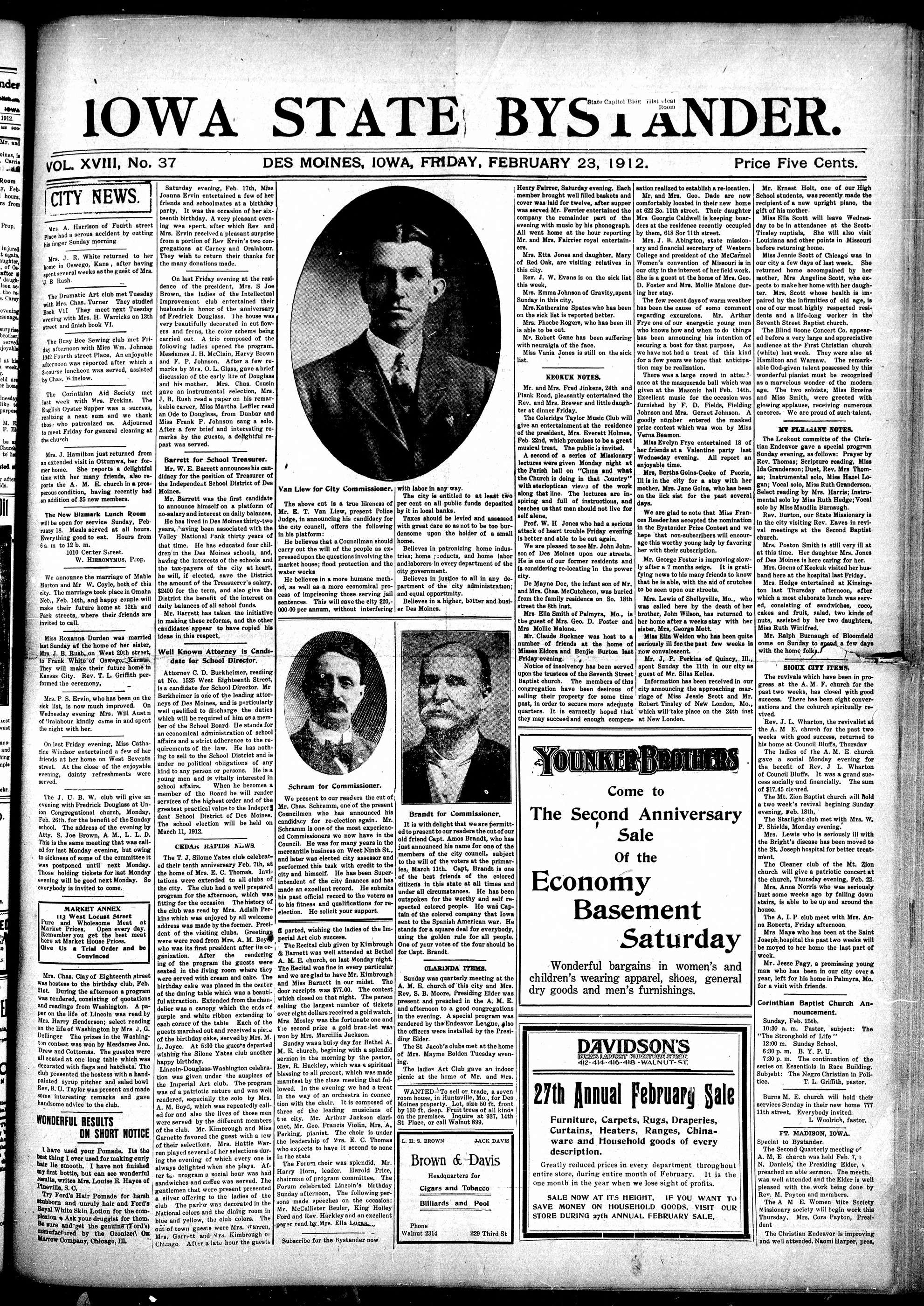
Van Liew for City Commissioner.
The above cut is a true likeness of Mr. E. T. Van Liew, present Police Judge, in announcing his candidacy for the city council, offers the following in his platform:
He believes that a Councilman should carry out the will of the people as expressed upon the questions involving the market house; flood protection and the water works.
He believes in a more humane method, as well as a more economical process of imprisoning those serving jail sentences. This will save the city $20,000 per annum, without interfering with labor in any way.
The city is entitled per cent on all public by it in local banks.
Taxes should be levied with great care so as to dense upon the he home.
Believes in patronizies; home products, and laborers in every de city government.
Believes in justice to partment of the city and equal opportunity.
Believes in a higher, er Des Moines.
Schram for Commissioner.
We present to our readers the cut of Mr. Chas. Schramm, one of the present Councilmen who has announced his candidacy for re-election again. Mr. Schramm is one of the most experienced Commissioners we now have in the Council. He was for many years in the mercantile business on West Ninth St., and later was elected city assessor and performed this task with credit to the city and himself. He has been Superintendent of the city finances and has made an excellent record. He submits his past official record to the voters as to his fitness and qualifications for re-election. He solicit your support.
parted, wishing the ladies of the Imperial Art club success.
The Recital club given by Kimbrough & Barnett was well attended at Bethel A. M. E. church, on last Monday night. The Recital was fine in every particular and we are glad to have Mr. Kimbrough and Miss Barnett in our midst. The door receipts was $77.00. The contest which closed on that night. The person selling the largest number of tickets over eight dollars received a gold watch. Mrs. Mosley was the fortunate one and the second prize a gold bracelet was won by Mrs. Marcillia Jackson.
Sunday was a buil-y day for Bethel A. M. E. church, in beginning with a splendid sermon in the morning by the pastor, Rev. R. Hackley, which was a spiritual blessing to all present, which was made manifest by the class meeting that followed. In the evening we had a treat in the way of an orchestra in connection with the choir. It is composed of three of the leading musicians of the city. Mr. Arthur Jackson claironet, Mr. Geo. Francis Violin, Mrs. A. Perking, pianist. The choir is under the leadership of Mrs. E. C. Thomas who expects to have it second to none in the state. The Forum choir was splendid. Mr. Harry Horn, leader. Harold Price, chairman of program committee. The Forum celebrated Lincoln's birthday Sunday afternoon. The following persons made speeches on the occasion: Mr. McCallister Beuler, King Holley Ford and Rev. Hackley and an excellent paper read by Mrs. Ella Lucas.
Subscribe for the Bystander now
The city is entitled to at least two per cent on all public funds deposited by it in local banks. Taxes should be levied and assessed with great care so as not to be too burdensome upon the holder of a small home. Believes in patronizing home industries; home products, and home labor and laborers in every department of the city government. Believes in justice to all in any department of the city administration; and equal opportunity. Believes in a higher, better and busier Des Moines.
Brandt for Commissioner
It is with delight that we are permitted to present to our readers the cut of our old friend Capt. Amos Brandt, who has just announced his name for one of the members of the city council, subject to the will of the voters at the primaries, March 11th. Capt. Brandt is one of the best friends of the colored citizens in this state at all times and under all circumstances. He has been outspoken for the worthy and self-respected colored people. He was Captain of the colored company that Iowa sent to the Spanish American war. He stands for a square deal for everybody, using the golden rule for all people. One of your votes of the four should be for Capt. Brandt.
CLARINDA ITEMS
Sunday was quarterly meeting at the A. M. E. church of this city and Mrs. Rev, S. B. Moore, Presiding Elder was present and preached in the A. M. E. and afternoon to a good congregations in the evening. A special program was rendered by the Endeavor League, also the officers were installed by the Presiding Elder.
The St Jacob's clubs met at the home of Mrs. Mayme Bolden Tuesday evening.
The ladies Art Club gave an indoor picnic at the home of Mr. and Mrs.
WANTED To sell or trade, a seven room house, in Huntsville, Mo., for Des Moines property. Lot, size 50 ft. front by 130 ft. deep. Fruit trees of all kinds on the premises. Inquire at 937, 14th St Place, or call Walnut 899.
L. H. S. BROWN JACK DAVIS
Brown & Davis
Headquarters for
Cigars and Tobacco
Billiards and Pool
Phone
Walnut 2314
229 Third St
---
Henry Fairrire, Saturday evening. Each member brought well filled baskets and cover was laid for twelve, after supper was served Mr. Ferrier entertained the company the remainder part of the evening with music by his phonograph. All went home at the hour reporting Mr. and Mrs. Fairrier royal entertainers. Mrs. Etta Jones and daughter, Mary of Red Oak, are visiting relatives in this city. Rev. J. W. Evans is on the sick list this week, Mrs. Emma Johnson of Gravity, spent Sunday in this city, Mrs.Katherine Spates who has been on the sick list is reported better.
Mrs. Phoebe Rogers, who has been ill is able to be out.
Mr. Robert Gane has been suffering with neuralgia of the face.
Miss Vania Jones is still on the sick list.
KEOKUK NOTES.
Mr. and Mrs. Fred Jinkens, 24th and Plank Road, pleasantly entertained the Rev. and Mrs. Brewer and little daughter at dinner Friday. The Coleridge Taylor Music Club will give an entertainment at the residence of the president, Mrs. Everett Holmes, Feb. 22nd, which promises to be a great musical treat. The public is invited. A second of a series of Missionary lectures were given Monday night at the Parish hall on "Chima and what the Church is doing in that Country" with steroplastic views of the work along that line. The lectures are inspiring and full of instructions, and teaches us that man should not live for self alone. Prof. W. H Jones who had a serious attack of heart trouble Friday evening is better and able to be out again. We are pleased to see Mr. John Johnson of Des Moines upon our streets. He is one of our former residents and is considering re-locating in the power city. De Mayne Doc, the infant son of Mr. and Mrs. Chas. McCutcheon, was buried from the family residence on So. 18th street the 8th inst. Mrs Ella Smith of Palmyra, Mo., is the guest of Mrs. Geo. D. Foster and Mrs Mollie Malone. Mr. Claude Buckner was host to a number of friends at the home of Misses Eldora and Benjie Burton last Friday evening.
Notice of insolvency has been served upon the trustees of the Seventh Street Baptist church. The members of this congregation have been desirous of selling their property for some time past, in order to secure more adequate quarters. It is earnestly hoped that they may succeed and enough compen-
YOUNKER
The Second Sale
Of
Economy
Base
Wonderful barges
children's wearing ap
dry goods and men's
Economy Basement Saturday
Wonderful bargains in women's and children's wearing apparel, shoes, general dry goods and men's furnishings.
DAVIDSON'S
IOWAS LARGEST FURNITURE STORE
412-414-416-418-WALNUT-ST.
27th Annual February
Furniture, Carpets, Rugs, Drape
Curtains, Heaters, Ranges, O
ware and Household goods of
description.
Greatly reduced prices in every department
entire store, during entire month of February
one month in the year when we lose sight of
Furniture, Carpets, Rugs, Draperies, Curtains, Heaters, Ranges, Chinaware and Household goods of every description.
Greatly reduced prices in every department throughout entire store, during entire month of February. It is the one month in the year when we lose sight of profits.
SALE NOW AT ITS HEIGHT, IF YOU WANT TO SAVE MONEY ON HOUSEHOLD GOODS, VISIT OUR STORE DURING 27th ANNUAL FEBRUARY SALE.
sation realized to establish a re-location.
Mr. and Mrs. Geo. Dade are now comfortably located in their new horse at 622 So. 11th street. Their daughter Georgie Caldwell is keeping boarders at the residence recently occupied by them, 618 Sor 11th street.
Mrs. J. B. Abington, state missionary and financial secretary of Western College and president of the McCarnel Women's convention of Missouri is in our city in the interest of her field work. She is a guest at the home of Mrs. Geo. D. Foster and Mrs. Mollie Malone during her stay.
The few recent days of warm weather has been the cause of some comment regarding excursions. Mr. Arthur Frye one of our energetic young men who knows how and when to do things has been announcing his intention of securing a boat for that purpose. As we have not had a treat of this kind for a few years we hope that anticipation may be realization.
There was a large crowd in attendance at the masquerade ball which was given at the Masonic hall Feb. 14th. Excellent music for the occasion was furnished by F. D. Fields, Fielding Johnson and Mrs. Gernet Johnson. A goodly number entered the masked prize contest which was won by Miss Verna Beamon.
Miss Evelyn Frye entertained 18 of her friends at a Valentine party last Wednesday evening. All report an enjoyable time.
Mrs. Bertha Goins-Cooke of Peoria, Ill is in the city for a stay with her mother, Mrs. Jane Goins, who has been on the lick sist for the past several days.
We are glad to note that Miss Frances Reeder has accepted the nomination in the Bystander Prize Contest and we hope that non-subscribers will encourage this worthy young lady by favoring her with their subscription.
Mr. George Foster is improving slowly after a 7 months seige. It is gratifying news to his many friends to know that he is able, with the aid of crutches to be seen upon our streets.
Mrs. Lewis of Shelbyville, Mo., who was called here by the death of her brother, John Wilson, has returned to her home after a weeks stay with her sister, Mrs. George Mott.
Miss Ella Weldon who has been quite seriously ill for the past few weeks is now convalescent.
Mr. J, P. Perkins of Quincy, Ill., spent Sunday the 11th in our city as guest of Mr. Silas Kelles.
Information has been received in our city announcing the approaching marriage of Miss Jessie Scott and Mr. Robert Tinsley of New London, Mo., which will take place on the 24th inst at New London.
BROTHERS
me to
Anniversary
ale
the
y
ment
Saturday
ains in women's and
apparel, shoes, general
furnishings.
February Sale
s, Rugs, Draperies,
s, Ranges, China-
old goods of every
every department throughout
month of February. It is the
we lose sight of profits.
Price Five Cents.
Mr. Ernest Holt, one of our High School students, was recently made the recipient of a new upright piano, the gift of his mother.
Miss Ella Scott will leave Wednesday to be in attendance at the Scott-Tinsley nuptials. She will also visit Louisiana and other points in Missouri before returning home.
Miss Jennie Scott of Chicago was in our city a few days of last week. She returned home accompanied by her mother, Mrs. Angeline Scott, who expects to make her home with her daughters. Mrs. Scott whose health is impaired by the infirmities of old age, is one of our most highly respected residents and a life-long worker in the Seventh Street Baptist church.
The Blind Boone Concert Co. appeared before a very large and appreciative audience at the First Christian church (white) last week. They were also at Hamilton and Warsaw. The remarkable God-given talent possessed by this wonderful pianist must be recognized as a marvelous wonder of the modern age. The two soloists, Miss Brosins and Miss Smith, were greeted with glowing applause, receiving numerous encores. We are proud of such talent,
NT PLEASANT NOTES
The Lrookut committee of the Christian Endeave gave a special program Sunday evening, as follows: Prayer by Rev. Thomas; Scripture reading, Miss Ida Granderson; Duet, Rev. Mrs Thomas; Instrumental solo, Miss Hazel Logan; Vocal solo, Miss Ruth Granderson. Select reading by Mrs. Harris; Instrumental solo by Miss Ruth Hedge; Vocal solo by Miss Maudlin Burnage. Rev. Burton, our State Missionary is in the city visiting Rev. Eaves in reival meetings at the Second Baptist church. Mrs. Poston Smith is still very ill at at this time. Her daughter Mrs. Jones of Des Moines is here caring for her. Mrs. Goens of Keokuk visited her husband here at the hospital last Friday.
band here at the hospital last friday.
Mrs. Hedge entertained at Kinslingon last Thursday afternoon, after which a most elaborate lunch was served, consisting of sandwiches, coco, cakes and fruit, salad, two kinds of nuts, assisted by her two daughters, Miss Ruth Wilfred.
Mr. Ralph Burnaugh of Bloomfield come on Sunday to spend a few days with the home folks.
SIOUX CITY ITEMS.
The revivals which have been in progress at the A. M. F. church for the past two weeks, has closed with good success. There has been eight conversations and the cochurn spiritually revived.
Rev. J. L. Wharton, the revivalist at the A. M. E. church for the past two weeks with good success, returned to his home at Council Bluffs, Thursadav
The ladies of the A. M. E. church gave a social Monday evening for the befeit of Rev. J L. Wharton of Council Bluffs. It was a grand success socially and financially. The sum of $17.45 cleared.
The Mt. Zion Baptist church will hold a two week's revival beginning Sunday evening, web.18th.
The Starlight club met with Mrs. W. P. Shields, Monday evening.
Mrs. Lewis who is seriously ill with the Bright's disease has been moved to the St. Joseph hospital for better treatment.
The Cleaner club of the Mt. Zion church will give a patriotic concert at the church, Thursday evening. Feb. 22.
The A. I. P. club meet with Mrs. Anna Roberts, Friday afternoon.
Mrs Maye who has been at the Saint Joseph, hospital the past two weeks will be moved to her home the last part of week.
Mr. Jesse Pagy, a promising young man who has been in our city over a year, left for his home in Palmyra, Mo. for a visit with friends.
Sunday, Feb. 25th.
10:30 a. m. Pastor, subject: The
"The Stronghold of Life"
12:00 m. Sunday School.
6:30 p. m. B. Y. P. U.
7:30 p. m. The continuation of the
series on Essentials in Race Building.
Subjebt: The Negro Christian in Politice.
T. L. Griffith, pastor.
Burns M. E. church will hold their
services Sunday in their new home 777
11th street. Everybody invited.
L Woolrich, fastor.
FT. MADISON, IOWA.
Special to Bystander.
The Second Quarterly meeting of
A. M. E church was held Feb. 7,
N. Daniels, the Presiding Elder, v
preached an able sermon. The meetin,
was well attended and the Elder is well
pleased with the work being done by
Rev. M. Payton and members.
The A M E. Women Mite Society
Missionary society will begin work this
Thursday, Mrs. Cora Payton, President
The Christian Endeavor is improving
and well attended. Naomi Harper, pres.
BYSTANDER JUB. CO. Publisher.
DE MOINEES. . . IOWA
ITOO MUCH FOR THE LAWYER
New a Michigan Congressman, Testifying as Lumber Expert, Blenced the Nolay Attorney.
There is a certain representative in congress from Michigan who was once summoned as a witness in a case being tried in Saginaw, the summons being based on his expert knowledge of the lumber business. It appears that the case was either or not merchantable lumber had been supplied a certain firm, as set forth in its contract with the party of the second part.
Representing the opposition there appeared a very voiceless lawyer who made up in noise what he lacked in argument. He would shout and roar and pound the table in front of him like an auctioneer.
"What," demanded the counsel in steturian tones of the witness, "what do you regard are merchantable numbers?"
"Lumber that may be sold at a profit," replied the imperturbable witness.
The lawyer pounded the table again, strutting about, shouting a good deal more, and finally came back at the witness in this wise:
"And what, sir, would you regard as merchantable grain?"
"I don't know anything about grain."
"Ah, you don't, you don't, eh? Well, then, what about merchantable fruit?"
"Nor fruit. I am a lumberman."
"Come, now, my dear sir. As to shale and mud, please you say that they were merchantable."
"They are products of the mills."
"Oh, hoo!" fairlyelled this lawyer this time. "Can you tell the honorable court whether you have any ideas at all about any kind of merchantable goods?"
"Oh, yes," replied the redoubtable witness. "A lawyer, for example, who tries his case with his brains—I should call him a merchantable lawyer, one who can handle with his mouth and his hands and feet, I should call him a cull!" That closed the cross-examination.—The Green Bag.
Reunited In Strange Way
While a scene in a play was being reproduced at a cinematograph theater at St. Petersburg the other day, a peasant and his wife in the audience recognized an actress in the scene as their long-lost daughter. The woman swooled, and her husband, shouting "My daughter!" tried to force his way behind the stage, expecting to find his daughter there. To convince him that his daughter was not there, the manager had the curtain drawn up. Then ringing up the firm from whom he had the film, the manager asked if he had the actress there and would set out for the theater at once. Soon after this information had been given to the audience a cab drove up with the actress, and parents and daughter had an affectionate meeting.
Makea Pet of Bantam.
Fashions in pets among society women are becoming as changeable as fashions in hats. A lady who has been seen on several occasions in the streets of London with a pretty little black bantam nestled in her arms, entered a West-end restaurant recently with her pet. While his mistress removed her pet, she was brought upon her knee and was afterward fed from the lady's hand with sugar crumbs. While at home the bantam is permitted to hop about the table, but in the restaurant his manners were beyond reproach.
Lottery Brize Bring Joy
The two great prizes of the Spanish Christmas lottery, amounting to $1,200,000 and $1,200,000 respectively, have been won by workmen. The first winning ticket was sold at Barcelona, and according to custom was divided into several shares among several owners. Ten parts of the ticket were bought by persons living as far away as Marseilles, and they will all share in the munificence of Fortune. The second prize ticket for $1,000,000 was bought by a factory proprietor, at Maurena, in Catalonia, and distributed among the workmen, who are overjoyed.
Swindled Again.
"By goe there ain't no chance to git ahead of these swindlers," complained Slas Hossbarnes.
"What's the matter now?" his wife asked.
"I sent a dollar to one of 'em for a recapt to keep hair from fallin' out and what you do 'spose he writes?" "I can't guess."
"Quarrel with your wife and git it pulled out."—Chicago Record Herald.
Expected.
"Father," said the small boy, "what is a reformer?"
"A reformer, my son," replied the statesman, "is a man who expects everybody to be economical and self-licensing except his own constitutions."
ita 8status
"I wonder why they attach so much importance to a coal strike." "Why; isn't it important?" "Why; it is." It is merely a minor occurrence.
Pardonable.
Adolphus Sniffers (out with Dolly
Dimple)—Pardon me for bowing to
that shabby old codger, but I feel
obliged to do it.
Dolly—Who is he?
Adolphus—He is the head of our
arm.
Rigid.
"What's the trouble?" inquired the
reader.
judge.
"This lady lawyer wants to make a motion," explained the clerk, "but her gown is too tight."
AFRO-AMERICAN CULLINGS
"The Star of Zion calls upon the Age to speak out with reference to a great celebration of our emancipation during the semi-centennial year of 1813."
We are glad to do this. In fact, this paper was the first to give publicity to the open letter of Prof. E. L. Blackshear of Prairie View, Tex., to Dr. Booker T. Washington, to take the lead in the movement for a national celebration of the fiftieth anniversary of negro freedom. We have given the movement our earnest support and have commended Prof. Blackshear's co-operation with Dr. Washington, Maj. Wright, Dr. J. W. E. Bowen, Maj. R. R. Nelson and others. It will be recalled probably by the will of the executive committee of the National Negro Business league considered this whole matter and reported to the negro press a series of recommendations. A reference to our files enables us to reprint the recommendations put forth by the executive committee of the National Negro Business League. They follow:
"The executive committee, after frankly discussing all phases of the matter, unanimously came to the conclusion that in view of the short time that remains, it would probably be impossible to hold a national exposition, such as was planned, that would reflect credit upon the race or show which has been made by the negro people during their freedom. For that reason, the memoranda which follow were unanimously adopted by the executive committee, and the suggestions contained there are earnestly recommended to the consideration of the negro people throughout the United States, namely:
"I. In view of the fact that the congress of the United States has thus far failed to make provision as suggested by President Taft in his minutes, that the emancipation of the fifthth anniversary of the emancipation of the negro in the United States.
"In view of the further fact that should congress now make an appropriation we fear the time would be too short to enable us to carry out a celebration in the form as first planned; "Thereafter we, the executive committee of the National Negro Business league, advise that the race should not await the expected action of congress, and suggest instead of the large central exposition as first planned, that the celebration should take the following form: "That the third week in October, 1912 be set aside for the celebration, and be known as Fiftieth Anniversary week." "That instead of a central exposition, the schools, churches and all other societies and organizations in each community unite and co-operate for the purpose of holding a local celebration; this celebration to take the form of an exposition of the progress in commercial, professional, moral, intellectual and religious directions made by the race in that community.
"4. We suggest that where it is possible these expositions be held in connection with existing county or state fair organizations; it will not be necessary to change the regular date for holding such county or state fairs.
"5. Wherever it seems feasible, the county or the state should be made the unit of organization for the celebration instead of the local community.
"6. We advise that especial effort be made to secure in addition to the physical exposition, a program appropriate to the needs of the literary speakers to be as far as possible the strongest and best men that can be obtained, north or south.
"7. We advise that wherever possible an effort be made to secure city, county or state aid to carry out the plans of the local committee.
"S. We suggest that, in case money is secured from congress, it be apportioned among the states, to be expended under the control of the governor, or some other state authority, in proportion to the number of colored people residing in the different commonwealths.
"S. We believe that the plans here outlined have several advantages over the proposed proposed: (a) First, it makes it possible to put the wincie race to work in planning and preparing for the expoitation and celebration suggested. (b) It will enable more people to see the progress the negro has made than would be possible if they had to travel many miles to some central exposition.
"10. In conclusion, we strongly urge that our people begin now to plan and prepare for the Fiftieth Anniversary week, and that this be made at once a means and an end to the world to the imminent progress the negro race in America has made during fifty years of freedom."
We believe that Dr. Washington and his executive committee should again get together and act upon the call from our men throughout the country for a more definite program than the above; such a recommendation.
In Washington no segregation law has been found necessary. Society here, as elsewhere, is self-distributive. People of like ideals, like means, and like interests, seek the neighborhoods and live in harmony, be white or black, Jew or Gentile. In public office, in street cars, stores, markets, galleries and museums, Washington is a mingle freely, without friction—and Washington is as essentially southern as Richmond, Norfolk, Atlanta or New Orleans. The restaurants, theaters and hotels could
tion should soon be forthcoming, and we have been informed that it will be—New York Age.
With all the impetus and pressure brought to bear in favor of industrial education of the negro, this being as it should, there still remains a great friendly feeling and cordial support in favor of the higher education of the negro. Each succeeding year brings a larger number to those colleges that stand for the broad and liberal education of the negro boy and girl.
In every state and in many of the large cities of the south, there are institutions that are turning out men and women heavily equipped for the higher duties of life and educa- opportunities afforded have been taken advantage of by thousands during the past 30 years.
White philanthropists have proven themselves friendly in founding these schools and colleges, and their sympathy has not lessened, for they are still giving healthy financial aid to worthy ones. The negro's ability to "make good" and public sentiment in this direction has been the cause of many splendid articles written by journalists of the white race, namely H. H. Kohlsaan, Chicago, Record Herald; Oscar Carrion Vilard, New York; Oscar Carrion Vilard, and in a few issues ago, The Outlook, with Lyman Abbott, editor-in-chief, and Theodore Roosevelt, contributing editor, has the following to say:
---
Dr. Washington clearly shows that the negroes are not dying out. His analysis of the preliminary statement issued by the director of the census is most convincing. The negroes have increased 11 per cent. during the last decade while the white people have increased about 15 per cent. The comparison may be disadvantageous to the negro when viewed as a comparison simply, but much of this disadvantage disappears when the large number of white immigrants and their natural increase for the decade is considered. Making all suitable deductions, it will not be found that the native whites exclusive of the immigrant have increased in numbers disproportionately with the negro. Go for the showing is better. But then it comes to the mounting up of totals for the negro is found to be a decreasing rather than an increasing element. This fact will assuredly rob many of our orators of their thunder and may eventually solve all the negro's problems by the engulfing power of overwhelming numbers. The negro must get busy if he would keep his numerical place in American life—Southern Plowman.
The colored man is waking up to the fact that God helps those who help themselves. He has discovered the winning card.
loosen up more than they do, without disturbing the peace. The shrewed negro, however, is taking advantage of the shortsightedness of the white man in this particular, and is building up places of his own—capitalizing race prejudice as it were.—Washington National Union.
The lower element of the Negro race is no more the representation of the lower element of other races—Holmes (Ark.) Inter State Reporter.
SAYS COLOR LINE IS DRAWN IN JAMAICA
DIFFERS FROM DE CORDOVA—THADDEUS L. M. 'DONALD MAINTAINS WEST INDIAN DOES NOT ENJOY SUPERIOR ADVANTAGES IN NATIVE LAND
Baltimore, Md.-Thaddeus L. M. Donald, a student at Morgan college and a native of Jamaica, West Indies, has attracted more than passing attention by challenging some of the statements of Counselor O'Connor De Cordova regarding conditions in the West Indies. Mr. McDonald contends that the West Indian, especially the Jamaican, does as a whole enjoy superior advantages in his native land, and the charge is made that the color line is drawn in the West Indies between the blacks and the mulattoes in Jamaica, according to Mr. McDonald's viewpoint, as follows:
"As a Jamaican I felt very much interested in the remarks of Mr. O'Connor D Cordova. The hundreds of West Indians, especially Jamaicans, who come to America yearly make their boasts of the superior advantages which they have in their native land doubtful; but when we hear a white men of intellectual attainment, they speak of the character speak of the negroes in the West Indies as enjoying the rights and privileges of a man, all doubts concerning the favorable conditions under which the negroes labor in the West Indies are likely to be removed. "The statement made by Mr. De Cordova that in the West Indies negroes are prominent in all walks of life is true. Mr. De Cordova further makes clear what he means by the word negro. He says, "The expression "negro" as it is accepted in this country and that is, I include in the term men of color, not black men only."
"This acceptance of the word nengro, as it is used in America, by Mr. De Cordova should be specially noticed since the man of color is not regarded as a negro in Jamaica. The mulattoes in Jamaica are considered a distinct people from the blacks or negroes. This distinction between the mulattoes and blacks in Jamaica is evident in its commercial, professional and social life. If the word nengro is used as a name, more than the fourths of the inhabitants of the island, was to be used in the same sense as it is used in the West Indies, the statement of Mr. De Cordova would be untrue.
"While the term negro, as it is accepted by the Mr. De Cordova, has made his statement, true, that negroes in Jamaica are prominent in all walks of life, we must not feel that Jamaica is a mecca for the negro. Mr. De Cordova is one I must respect and honor as a man with true sympathies and an earnest conviction in the integrity of my race; but he has made the fatal mistake of confounding the prosperity of the few with the welfare of the many. If the recognition of a few members of the black community is the standard for the relationship between the two races, then it can be said that the negro in the United States enjoys equal privileges with his white brother.
"Mr. De Cordova has cited specific cases in which negroes of Jamaica are highly recognized. But the same thing, or even more, can be said concerning negroes in America. Mr. De Cordova says: 'The church has among its officials as archdeacons and rectors men of color, who are revered and respected by all classes of the community.' The same thing is true in this country. There are archdeacons, rectors and bishops—black men, too, who are revered and respected. Mr. De Cordova also speaks of negro physicians who have white patients, lawyers who hold distinguished positions in the government and negroes as members of the leges and council of Jamaica. The comparison that has been just made between the negro clergyman in Jamaica and America is just as fitting in the cases of the negro physician, lawyer and statesman of America as in Jamaica.
"The gentleman has also mentioned that the negro occupies such positions as justice of the peace, Custos Roturulum, and member of the privy council, all of which are in the power of the governor, the chief executive of the island, to bestow on those whom he thinks fit. Allow me to say here that the negro occupies the island to fall to some negroes in Jamaica are only a blind to the real conditions of the negro in Jamaica, and in fact, it is a mere pretext to strengthen the disadvantages and injustices under which the black man of Jamaica is laboring. Who are these men of whom Mr. De Cordova has spoken? Rich men, in some cases learned men; and in most cases men who do not regard themselves as negroes in Jamaica, theirs to England and sometimes come to America, where they pass as white and even marry white women.
"It is this class of negroes chiefly that enjoys that much boasted social equality with the whites in the West Indies; this class that forms a small percentage of the negroes in Jamaica has been so carried away by the recognition of the white man that such
BHAKESPEARE'S COMPLEXION.
Ole Mammy Lise was dusting the southern woman's drawing room, says the New York Press. She came to a small bronze bust of Shakespeare and began carefully going over him with her rag.
"Mis Juliet, chile, who am dis mere gemmum."
"That is Shakespeare, Lise, a wonderful poet who died centuries ago."
"Dat him, mirs? Lor, I've done byear o' Mistah Shakespeare a lot
negue have lost all sympatisms with
them, and some of some cause they
have the forespots of.
"The recognition of the few negroes in Jamaica by the white man is more politic than humane. An extract from an article in the New York Herald called 'The White Man's Burden at Home,' dated May 29, 1905, which records the words of Sir Sydney McCormack, the naval officer of Jamaica, and at the time published colonial secretary of the island, might serve to illustrate the statement just mentioned. In the article the governor nor says 'The recognition of the mulatto race, socially and politically, as equal with the white and the cordial welcome of colored men and women into all avenues of traces and professions have created a mutual bond between the pure white races, and this bond saves the colony from the distinct cleavage and consequent friction which would exist.' Another statement of the governor, that might be worthy to mention, is this: 'The white Jamaican, whether foreign horn or Creole, has a prejudice which is scarcely to be differentiated from that of the American, and is not only only in so far as the colored man is individually inferior to the white man in capacity and achievement. The latter being equal, however, or regarded as equal, they meet upon terms of apparent equality.'
NEGRO INTERNATIONAL CONFERENCE BIG MEETING AT TUSKEGEE BEING PLANNED
Tuskegee, Ala.—The largest number of acceptances of invitations to be present in the International Conference on the Negro, to be held at Tuskegee institute, April 11, 2013, this going to be a most successful gathering.
All the important missionary societies in the United States and many societies in foreign countries will be represented, such as the American Board of Commissioners for Foreign Missions; Board of Foreign Missions of the Presbyterian Church; the Baptist Missionary society; the Central Missionary society; the Reformed Presbyterian Church; the Seventh Day Baptist Missionary society; the Board of Home Missions of the Presbyterian Church in U. S. A.; Woman's Home Missionary society of the Methodist Episcopal church; the American Woman's Baptist Home Mission society; the Board of Foreign Missions of the General Synod of the Evangelical Lutheran Church of the U. S. A.; Woman's Home Missionary, Presbyterian Church, U. S. A.; the Woman's Board of Missions of the Interior; the Woman's Board of Missions of the Canadian Congregational Church; the Regions Beyond Missionary Union with headquarters in London, England, will be represented by one of its secretaries; the Swenska Missions for bundets Exposition of Stockholm, Sweden; the Evangelical Missionary society of Germany; the Missionary Society V. by the president, Herr E. V. Johanssen, Bierlefeld, Germany.
The Venezuelan government will have a representative at the conference. Jamalaica, Porto Rico, the Danish West Indies and other West Indian islands will be representat. Mr. Samuel D. Bowden, manager of the industrial experiment station, Ongo Gunta Gunta district, of being present. Africa is going to be largely represented. Among those who will discuss conditions on that continent are Dr. Ernest Lyon, counsel general of the republic of Liberia to the United States; Dr. Roland P. Falken, chairman of the late American commission to Liberia; the Hon. F. E. R. Johnson, secretary of state, Monrovia, Liberia; the Hon. C. H. Johnson, president of the republic of Liberia; Rev. Isaiah Goda Sishua, president of the Ethiopian church, Queenstown, South Africa; Rev. Henry Reynard, secretary of the Ethiopian church, Johannesburg, South Africa; Mr. William C. Terrill, superintendent Inhambane district, Methodist Episcopal church, Portuguese East Africa; Mr. H. Scooter, missionary, Lumumba工业学院, West Africa, Mr. W. H. Plant, Kingston, Jamalaica, head master of the Titchfield school.
Other persons who will present papers to the conference age: Rev. Mark C. Hayford, a native worker from the gold coast of Africa, whose subject will be: "Educational Conditions on the Gold Coast of Africa," Dr. W. W. Shephard, "Twenty Years With the Bakuba and Baluba and Zap-po-Zap Cannibals in Central Africa," Mr. E. D. Morel, London, England, editor of the African Mall and secret of the Congo Reform association; the Rt. Rev. I. Olnwole, Lagos, Southern Nigeria, West Africa, "The Missionary and Trader in Relation to the Native," the Rt. Rev. W. Edmund Smith, "Hospital of Lebombo, whose Africa," "The Delights of Real Heathenism." In addition to all the above, the International Conference has provoked wide discussion throughout the country and promises to be of incalculable service in helping forward the cause of the native in Africa and the man of African descent wherever he may be found.
Under the circumstances and privations the negro has undergone he has done exceedingly well. He is now able to venture out into almost every available business concern—Palestine Plaindealer.
ob times. Ever body seems to know him. "Deed, I done hyear so much 'bout him d art allus thought he was a white gemmum."
TO HIS PERSONAL KNOWLEDGE.
Sergeant—What did you put that fortune-teller out of business for? Police Inspector—She's a humbly I trust the director, but what had become of the diamond pin he the other day and she gave me the wrong steer—Chicago Tribune
CONFERENCE AT TUSKEGEE IN
STITTLETON, MN.
HUNDRED PERSONS.
HUNDRED PERSONS.
Tuskegee, Ala.—The Workers' Conference followed the annual Tuskegee Negro Conference.
About 500 persons were present at the Workers' 'conference', which opened with singing "What a Friend We Have in Jesus," after scripture reading and prayer by President M. W. Gilbert of Selma university.
Dr. Washington at this point delivered an address characteristically strong and interesting.
Mr. M. N. Work stated the following:
"On yesterday the subject for the Farmers' Conference was, 'How I Have Improved My Farming.' The farmers told about the better houses they are now living in. The improved methods of cultivating the soil they are using, etc. We saw from this that the farmers are making money. We are making a great deal of money. The question naturally, 'How Can We Save Money? We are a year. We ought to save out of that amount $1,000,000 or $2,000,000.' Mr. Hines, Crenhsaw, Ala., said: "This is my third visit to Tuskegee in eleven years. I may deviate from my subject a little bit because I have very little education. I believe that the best way to invest money is to put it in land." He told of how he had bought three years ago a 100-acre farm on which he now owns a very little. He told of the difficulties a good schoolhouse and a good teacher, but they are trying to get together in that community and improve matters.
Prof. W. T. B. Williams, field agent of Jeanes and Laes Funds: "I had hoped to hear from the other folks on this subject. The only way that I am concerned in the investing of the peoples' money is as they invest it in the schools. I have been traveling around through Alabama trying to see what the people are doing. I can tell about my school work. I will tell about a couple of schoolhouses in Morgan county that the people of the community have built. In one place the基金会 team together and now they have a new schoolhouse coating $500 or $600. The colored people of the community had, of course, raised this money."
E. W. Chenault of Lexington, KY., said: "The one thing that all the people are interested in at the present time in my city is mining business. The colored people of the state of Kentucky recently bought a mine of coal and iron ore in the most prosperous portion of the coal region of Kentucky. They bought 1,400 acres of the best coal land in eastern Kentucky. This is being owned by our company. The mine is as close to the railroad as I am to the platform. We are now preparing to operate the mine and we hope to make it the biggest enterprise among our people in the United States with the exception of Tuskegee Institute." George H. Mays, Mound Bayou, Mississippi, said: "I am not a banker myself but have been for a long while associated with a gentleman. Mr Charles Banks, who has been associated with Dr. Washington and supports everything for the uplift of tundra and forests and helped in the coal campaign at this time in trying to interest people in some work we are doing at Mound Bayou, namely, our oil mill."
Dr. M. W. Gilbert, Selma University; I wish to say just at this point that we have a negro bank in Selma of which we are very proud. Before I speak about the bank, however, I wish to tell of two surprises I had in coming to Alabama. One of these is the large number of young people who are trying to get an education in this state. The situation is very hopeful. I don't know how the preachers are in other states, but in Alabama they have stopped making apologies for ignorance."
W. T. B. Williams said that these little schools that Dr. Gilbert objected to sprang up out of the necessity for better schools in local communities.
Dr. Washington asked Dr. Gilbert how much the colored people of Alabama contribute toward the support of Selma University. Dr. Gilbert said about $1,200, mostly from the ordinary people of the state of Alabama. Mr. P. C. Parks, Georgia, said "There is one way that the teacher and the preacher can help our people in saving. I was talking to a farmer the other day who once owned a farm worth $10,000. He educated five boys and in educating those boys lost his farm. One boy's education cost between $1,500 and $2,500; $250 of this was spent on the roads going from home. About $260 miles away from home. About $1,000; this amount was spent in the grades paring for college. That was $600 spent in education that could have been easily gotten at home if that amount and the $250 spent on the railroad had been used in improving the rural schools in the community."
Professor Parks said that he did not object to that. The trouble with the colored people in many communities was that they are working and paying for Baptist development, for Methodist interest when the community interest should be bigger than either Baptist or Methodist interest. I don't blame the farmer who is not willing to put his money into some institution 500 miles away instead of into the rural schools at home. Mrs. C. C. J. Walker, Indianapolis, Ind., said: "I feel, like the first
DICKENS SPELLED OUT DATE8.
With so many demands upon his pen one would expect to find Dickens availing himself of all possible brevities in his correspondence, at least. But a glance through his letters shows that he scorned all such opportunities and preferred to spell everything out. The days of the months, for example, are given in words instead of figures. "Monday, sixteenth January," "tuesday, seventh March," "Wednesday, twelfth April," "twenty-sixth
speaker, that the best way to save money is to invest it in property. That is what I have done. And another thing I believe in is, that in proportion as God blesses us we should reach and help our fellows."
Prof. James Dooley, of Brewton, said: "About five months ago we organized 250 acres of men and purchased 30 acres of land which we divided 30 acres of land which we divided into town lots and sold for $35 each and so much each month. Sixteen young colored men have purchased lots. Our property cost $,000. We have ten trustees and before a man can be a trustee he must make himself responsible for $100. The first day of January a note of $1,000 was raised and the banks loaned us the remaining $500, so that we were able to meet the notes.
"Our school started about five months ago with Moses Purifoy of Tuskegee Institute as teacher."
J. S. Shanklin, South Carolina, thought that one way the teacher and preacher could help the people to save was by teaching them to eat three good, plain meals a day, every day and make visitors welcome it they happened to come, to but avoid working hard all the week and then spending it all for a big Sunday dinner.
J. H. Garvin, of Winchester, Ky. said: "In teaching the people to save I believe we cannot do very much with people of my age. We should teach the boys and girls. I got an object lesson in this by watching the boys and girls who attend my school, and I saw the store around the corner to the little pickles and candy, and such. We calculated that they spent about $5 a day. At first the teachers did not believe it. We started a penny saving society and worked up interest with the boys and girls and with their parents. Our first deposit, I think was $17. At any rate, after we had been running six weeks we had to our credit $138.40. Just then the hollowed out box and we talked to the boys and girls because we knew they would want to draw the money out. There was a little rush and $60 was drawn out."
President John Hope, Atlanta Baptist college, said: "I don't believe I have any distinct message to give about saving. I can tell of the things that were done last year about getting $5,000 from colored people in Georgia for the support of schools that they don't think they have to give money to support. That is the class of schools that is supported by the missionaries'eties which are supposed our people to have all the money they want." Dr. Washington read a report of the Tuskegee Institute savings department, which was started in order to give the Tuskegee students and teachers a chance to save their money. Dr. Washington said that he would not bother the people with details for he himself just went down the list every morning to see that the amount specified on the report was in the bank. The report showed a deposit last Thursday morning at $19,000. He himself is the student'sion but belongs to the students, teachers and people of the community. Mr. Logan, Mr. Washington said, is president and cashier of the bank.
This bank not only gives the pupils a place to deposit their savings, but teaches them how to deal with banks, generally. It is surprising how many educated people don't even know how to deposit a check.
V. H. Tulane, cashier of the Montgomery Penny Savings bank, told some very amusing incidents of people not knowing how to deposit checks.
He thought the habit of saving can be taught by having a bank account and ascertaining every day how one stands in his accounts.
Dr. J. B. Lehman, of Edwards, Miss. delivered an interesting address on emphasizing the material, the industrial, the intellectual and the religious elements of education.
Other addresses were made by Miss White, principal of the Montgomery Industrial Institute; President Johnson of West Point, Miss; Professor Clark of Baton Rouge, La.; Professor Clark of Ky., Ky.; Presiding Elder Widom of Macon county, Alabama; Rev. William Rankins of Evergreen, Ala.; Rev. W. S. Cannon, of Atlanta, Ga.; H. A. Loveless of Montgomery, Ala.; Rev. Dr. Judkins of Montgomery, Ala.; Rev. Dr. Hicks of Uniontown, Ala., and Rev. W. H. Holloway of Talladega. The memorial was opened with an inspiring address, Dr. W. Inbur F. Crafts, secretary of the International Reform Bureau, of Washington, D. C.
ALL SHE ASKED
"The late Justice Harlan," said a Washington lawyer, "was an advocate of temperance in eating, in drinking, in the use of tobacco, in all things." "Justice Harlan, praising temperature at a lawyers' banquet, once told a story about a young wife who said to her husband:
"Jack, dear, I do wish you don't drink drinking! Every time you go to one of these banquets of yours you get up the next morning pale and tired; you won't eat anything; you just gump down nine or ten glasses of water. Do stop drinking, won't you, dear? I know it's bad for you."
"But all great men have been drinking men," Jack gushed. Look at Webster; look at Poe; look at Charles Lamb; look—
"Well," interrupted my wife, "you just promise, dear, that you'll quit drinking till you're great and I'll be satisfied."—Washington Star.
May," "Friday evening, nineteenth May." in this way are all his letters dated.
THE POWER OF BEAUTY.
"Brown's wife is a beautiful woman, isn't she?" "She surely is." "If I had a wife as beautiful as that she could buy me all the Christmas neckties she wanted to—and I'd wear 'em, by gum"—Cleveland Plain Dealer.
The Farm
HEATING THE ORCHARD
Orchard heaters have been in use in some parts of Europe for a great many years, their function being that of yarding off the destructive effects of an early frost, before the fruit has been gathered, but until recently these devices have not been given serious consideration by the fruit growers of this country. Suddenly their virtues were discovered, and now they are in general use in the growers' rooms. In most cases the growers devise their own apparatus, relying more on the smoke to keep off the frost than on the heat from the fires. Constant supervision was necessary when these fires were resorted to for the purpose of seeing that they were constantly supplied with fuel and this generally meant an all-night vigil. Among the implements of this character which have been recently placed on the market let it be one which is suitable the reason that they are of a good quality, but also sufficient smoke to make the necessary protective smoke over the trees, and it also has a capacity to afford two nights' protection without refilling the reservoir. The latter is of steel and holds four gallons. It is filled from the bottom while being held in a reversed position. The vacuum created regulates the flow of oil which passes through a tube into a burning pan. In most cases about fifty-fifty percent of the water are outside to the acre, and the claim is made that by their use the temperature has been held at 31 degrees outside of the zone or the influence of the heaters.
CORN AS POULTRY FOOD
Indian corn is undoubtedly the cheapest grain food that can be produced in this country—the farmer and villager almost invariably feed it to their fowls. But the idea has gained considerable currency that it is too fattening, and that continued feeding of the same produces billiousness or croffolous tendencies. There are poultry raisers who have fed corn to young and old and report good results. Other farmers have fed corn alone to bees with satisfactory egg returns, but in all cases these chickens and hens require a chance to have their feed from the fields and in the barnyard. From what is gathered in feeding corn in the kernel to be successful one must guard against overfeeding, and that is best accomplished by always having the corn before them. Then they do not eat more than they may need. If, however, this practice is pursued, the fowls should not be limited in range, so that they may not be prevented from obtaining enough other food and material also, and a supply of fresh water, as nature may supply of fresh water, as nature may be better for hens in confinement the needs of the flock and feed accordingly, and by adding oats and wheat to his corn better results may be obtained.
ARTIFICIAL WOOL FROM PLANTS.
Artificial wool is manufactured from jute and other plants of the same family, says the Scientific American. The stalks of the plant are soaked in water, as in the regular treatment of flax and hemp, and the outer fibers are removed by beating the stalks. After washing they are dried in the sun. The textile fabric which is thus obtained requires to be treated with an only substance or the like, as this one to make it supple. Mixtures of whale and other oils were first used in the process, but these give an artificial wool a bad odor so that it cannot be put on the kinds of uses. In a newer process caused by soap solution are used instead, and this appears to give more satisfactory salts. After drying, if necessary, the fard is carded and woven either alone or mixed with other fibers, such as kaffir, flax or cocoa fiber.
BIRD IS FARMER'S FRIEND
J. P. Gilbert of the University of Illinois said in a recent lecture on "Birds of the Farm and City," that the hunters of the cities who did not realize the value of birds to farm products made possible an annual loss from insects to crops and forests of the United States of $700,000,000. Mr. Gilbert is it due to the destruction of quail in Illinois that the potato bug is becoming such a pest; that quail on the table is few, few cents, but that quail on the farm worth many dollars; that every hawk and owl is worth on an average $30 to the state; that one "flicker" can eat 5,000 ants at a single meal; that the kingsfer is the most powerful fisher of the poultry yard in existence.
TANKAGE
Digester tankage is meat scraps from edible carcasses which have been inspected and passed as satisfactory for human consumption. It is especially prepared for feeding uses by tanking it under live steam, then drying it under high heat and finally grinding it.
FERTILIZERS IN THUNDER
Plain said that thunder is 'rarely board in winter, and that the great fertility of the soil is due to the frequency of the thunder rain in spring. Science has discovered the cause of the nonburthment in rain water to be due to the presence of great quantities of nitrogen and ammonia in the thunder rain and in hall.
Wonder how long the hyporite is going to leave that leaf under cover, that he turned a few weeks ago.
VALUES OF FERTILIZERS
Of rock phosphate, 250 pounds of phosphorus worth $30.
Of acid phosphate, 125 pounds of phosphorus valued at $15.
Of potassium chloride (murate of potash), 40 pounds of potassium worth $50.40.
Of potassium sulphate (sulphate of potash), 800 pounds of potassium worth $44.50.
Of kuniti 200 pounds of potassium, worth $12.
Of wood ashes (unbleached), 100 pounds of phosphorus and 100 pounds of potassium worth $7.20.
BALANCED RATION FOR EGG PRODUCTION.
A good balanced ration for laying hens can be made as follows: Kaffir corn, 100 pounds; meat scrap or ground cut bone, 10 pounds; alfalfa leaves or alfalfa meal, 10 pounds; oats, 10 pounds; gluten meal or oil cake meal, five pounds. The idea is to use Kaffir corn in place of wheat and Indian corn, presuming that Kaffir corn is more plentiful and cheaper than wheat or corn. Where the latter is as easily and as cheaply procured as Kaffir corn, we would feed equal portions of the three grains rather than all Kaffir corn. A very advantageous way of feeding Kaffir corn to chickens is to cut off the heads of corn and feed it to them in this manner. It will do them good in exercising while picking off the grain—Kansas Farmer.
ELECTRICALLY-CURED MEAT.
Some time ago we described in these columns an electrical method of curing hams, which was discovered by a Cincinnati packer. He found that by introducing an alternating current through the pickling brine the hams could be cured in from thirty to thirty-five days, as against 90 to 100 of the ordinary method. A large plant in Cleveland, Ohio, is now curing meat by this process. Ten 5,000-pound vats of meat are furnished is furnished by a 100-kilowatt generating plant. The plant generates direct current for use in various capacities, and a portion of it is converted into alternating current by means of a rotary converter, to provide the energy used in the curing vats.
TO RID POULTRY OF LICE.
Prof. F. S. Jacoby, poultry instructor at the College of Agriculture, Ohio State University, is recommending a lice powder which he says poultry will find effective in ridding their fowls of parasites. Directions for making the powder are as follows: Take $2\frac{1}{2}$ pounds of plaster of plars and put it in a pan. Then mix together three-fourths of a pint of oiline and one-fourth of a pint of cresol. Stir the plaster of paris while adding the fluid. When thoroughly mixed the mixture should be rather crumbly. Then it should be dried and sifted, then it is ready for use.
BEGIN HATCHING EARLY.
Now is the time to order the incubator and brooder. Avoid the spring rush. Try and get the batching eggs the day-old chicks or the stock just a little earlier than the other fellows. An early start is better than a late one. The trend in the future will be for earlier-hatched chicks. There is more time to attend to them, they escape the hot weather, and to a great extent the lice pest, and they mature in time to make the winter layers.
VALUE OF PHOSPHORIC ACID.
Phosphoric acid is the element that is most needed to form the corn kernel. This element should be present in corn soils in available form if good phosphoric acid is available. Corn soils is lacking in this element it may be supplied in this element phosphate.
ONE OF THE OLDEST OF VEGES TABLES.
Rhubarb, according to existing records, is a very old article of diet. The Chinese used it as far back at 2700 B C.
GETTING FERTILE EGG8.2
"Get good blood and take the best care of the males, so that eggs will be fertile, and you will always have a sale for eggs. Use incubators early in the season, and then use hens to hatch as soon as possible; they are surest and best. Do not let chicks run with individual hens, but give to the best mothers twenty or more hens, and coop them, letting the hens run free. Weak ones will not be lost in the wet grass, but will stag the coop."
The Sunday
School Lesson
Sunday School Lesson for February
15, 1912.
THE BAPTISM AND TEMPTATION
OF JESUS.
Golden Text—For in that he himself hath suffered being tempted, he is able to succor them that are tempted.
Heb. 2: 18.
Lesson Text—Mark 1: 9-13; Matt.
4: 1-11. Commit vs. 3. 4.
TIME.—A. D. 27. PLACE.—Bethany beyond Jordan and the Wilderness.
EXPOSITION.—I. The Baptism of Jesus, Mark 1: 11. 91. Jesus himself, the baptister "with the Holy Ghost and fire," comes to John to be baptized with water. Could anything make more plain the great importance of water baptism? (Matt. 3: 16). God made water baptism as a form by which Jesus could confess that he is a sinner, but now re-naissance sin; Jesus was not a sinner, but he took the sinner's place. (Ko. 8; 3; Cor. 5: 21, R. V.). When he had thus humbled himself God gave him the two-fold testimony, the visible dove and the audible voice (comp. Phil. 6; 8, 9; Luke. 9: 31-35). The dove was not a sign to himself stone, but to John as well (Jno. 1: 33). It was his own baptism with the Holy Spirit (comp. Luke 3: 21, 22 with 4; 14, 18 and Acts 10: 38), and indicated him as the one who should baptize others with the Holy Spirit (Jno. 1: 33; 3: 34, R. V.). The silence of the Broken Jesus was well pleased that he was found and willing to make his place. He spoke aloud from the open heavens. He proclaimed Jesus "my son, the beloved one" and he proclaimed his delight in him.
1. The Temptation of Jesus; 4: 1-11.
The moment of loftiest exaltation and clearest testimony is immediately succeeded by Satan's forstress assault; the baptism with the Holy Spirit by the repeated temptations of the "lust of the flesh," the "vain-glory of life" and the "lust of the eyes" (comp. 1 Jno. 2: 16 R. V.). Note well that it was the spirit who led Jesus into the wilderness to be tempted by the devil (cf. Mark 1: 12). The temptation was a necessary preparation for Christ's work, just as necessary as the baptism with the Holy Spirit (Heb. 2: 17, 18; 4: 15, 16). Note that Jesus' temptation was by the devil. It came from without, not within. The personality of the devil is clearly taught here. The temptation is a feast. The reality and completeness of Jesus' human nature are plainly seen, not only in that he was tempted, but in his hunger and the way in which the temptations were met and conquered. The preceding chapter has closed with a remarkable testimony to his divinity, this opens with an equally remarkable setting forth of his true humanity. The temptation covered the entire forty days (Luke 4: 1, 2)
POETRY
of and by Our People
HANDS OFF!
TO ONE ASLEEP.
Without the thunders of the city fade.
You, too at last, lapped in the great release.
Lean back shut lids; slowly all sounds decrease:
The mystery of sleep makes me afraid.
Are these the arms that about my heart were laid?
Are these the lips that clung, the fingers these?
So deep a division the disdainful peace Of temporal death between us two has made.
Even as death, into some world above me
the three temptations here recorded are the climax of all, and typical. He met temptation in such a state of physical weakness as would make resistance to temptation most difficult, and failure "most excusable," but he did not fail, and so now no man can plead adverse circumstances as a justification for wrongdoing. Satan appealed to Jesus through the medium of an appetite, the gratification of which was perfectly right, if it could be granted by right men and methuselah. The death of Jesus was most human and most hungry. The devil introduced this temptation as he did that of Eve in the garden, by suggesting a doubt of God's word. Here is where Satan always begins. He is great at putting "ifs" before God's statements. For Jesus to have done what Satan challenged him to do would have been (1) to have doubted God's word, and to have sought confirmation of it by a token; (2) to have taken himself out from under those human conditions, and voluntarily placed himself for our redemption (Phill. 2: 6; Besh. 2: 14). It would have involved the throwing up of his entire mission, the redemption of man by a divine person who had become real man. Essentially the sin to which Satan tempted our Lord is committed by men today when they take necessary out of the sphere of sacrifice and out of the sphere that is necessary that one Ive if he is to have saving power with his fellowmen. (3) It would have been to have God to supply his needs in lawful ways. Jesus met this and the two of the spirit, the Word of God. "It is written" was his constant reply. All his citations were from one book, Deuteronomy. No wonder the devil hates that book and has attired up such an assault upon it in our day. The devil himself quotes Scripture in the second temptation. But he misquoted it. He left out an important clause (see Ps. 9: 11, 12). One needs to watch the devil's descriptions of the nature of God to quote nearly as it reads, but not just as it reads. To have accepted this challenge would have been (1) to have doubted God's word by making an experiment to see if it would come as God had said, i.e. tempting God; (2) an act of spiritual pride, a mere display of trust in God with no other end to accomplish it. In the last temptation the devil appears in his true colors. He seeks worship for himself. That is the very essence of devilism. He would have the Son of God render to him that worship that is not of longer longing and tantalizing anticipation that was for Satan. Satan offered him the dominion by another road than by the cross. We must not (Matt. 16: 23, 24).
LEADING QUESTIONS—What is the principal lesson of Jesus' baptism? What does this lesson teach about Satan? About temptation? About Jesus Christ? About Scripture? About the work of the Holy Spirit? About the possibility of victory over Satan? About the way to overcome
THE USUAL WAY.
"There is much opposition to arbitration," says Ed P. Greer, "on the ground of national honor. It has been settled long ago that the way to settle a dispute honorably is to make a lot of widows and orphans." —Kansas City Star.
He has called you up beyond my utmost love.
O sweet, where are you, alas! where you fused?
Yet will I not call you back again to love me.
Nor waken you from that high peace, above.
These fears, these hopes uncom- forted.
—John Hall Wheelock, in the Forum.
When a man is at the top of the ladder it give him a good chance to see the outlook for those who have helped him get there.
Of Interest to Our Women
MAKING THE HOME BEAUTIFUL
When you go into a strange house what is the first thing you notice about your surroundings? Whether or not they are artistic. If the keynote of the home is refinement, expressed in good furniture, dainty hangings and pictures, we unconsciously base our opinion of the occupants upon these pleasing facts. In the home are willing to surround themselves with inartistic things, we judge, and usually correctly, that the beautiful plays a very minor part in their existence. The home is an outward expression of the inward refinement, or lack of it, of the woman who presides there. And it should be the object of every woman who has a home, no matter how small and unpretentious, to make it as beautiful as possible. This is only a useful, and impressively, too if one knows how
Let us consider the small flat first. Many women give up in despair at the thought of the cramped conditions which exist in the average apartment and declare that it is altogether impossible to achieve the artistic in four or five small rooms. This is a great mistake. Of course there are odda against beauty in an apartment, but if one goes about it in the right way a great deal of beauty may be the result.
Decorating a Small Flat.
In the first place, the woman who lives in a flat must purchase her furniture with an entirely different object in view than the dweller in the suburbs. As the apartments grow smaller the size and amount of the furniture diminishes, and the woman with taste must pick and choose with a fine discrimination if she wished to the room. The room which is most occupied needs the greatest amount of attention. Whether it be a parlor or a living room, it must be furnished to suit the tastes of every member of the family. This does not mean that it must contain necessarily a heterogeneous collection of all styles and patterns in chairs—not at all! But it does mean that no such extreme styles as Louis Quinze or mission work should be chosen for such a room. The lounging chairs should be selected with an eye to comfort first, afterwards to appearance.
If the room be small, the paper should be chosen with the greatest care. Dark reds and greens are used a great deal in the new apartment houses to very bad effect. Red should be used in the room because it has the peculiar quality of bringing the four walls together; of shutting in the room and decreasing its size 50 per cent. Yellow will be found quite as cheerful, and at the same time it seems to enlarge the room. It will be a summer, warm and bright in winter.
The constant use of a room would make it advisable to provide a large rug instead of the customary carpet. Especially in an apartment is this desirable, as the rug can be rolled back for the sweeping and may be taken up for beating with the greatest ease. For a room in which the wishes of the entire family are to be satisfied there must be, necessarily, a number of important items of furnishings in the same style, however, to retain harmony. Book shelves, or bookcases, are essential to almost every household. For a small room the shelves are preferable, as they may be suspended in such a way as to allow for another piece of furniture beneath. Bookcases take more space, and while they are more desirable if the room allows, still in a small room the amount of space taken might be used perhaps to greater advantage for something else. Another requirement of a living room is that a convenient size it may be placed directly beneath the book shelves. One with plenty of drawers will be found a convenient addition.
For a small room one cannot be too careful in choosing the curtains for the windows. Heavy overporters are foolish and absurd, a menace to health and eyesight. If porters can be abolished so much the better. Simple dimity or lawn curtains, with a border harmonizing with the colors of the room, are in good taste and the porters are the best. If the porters seem necessary, then chintz or cretonne in the room pattern is dainty and attractive.
Some women think it necessary to have the door porters the same as the overcurtains, but this does not always produce a good effect. Harmony of course must prevail, but it will be found a great relief to the eye if the porters are a contrast to the rest of the room.
For instance, if the wall paper or the room decorations are very plain, it is important to use a porter brimming敛. But if the walls are patterned somewhat gayly a plain pair of curtains will be found to balance the room beautifully.
It is frequently difficult to fix nails to the walls on which to hang pictures, owing to the powdery condition of the wall plaster, which causes the nails to fall out almost immediately. The best choice is to place the carver plane in the middle of wood and bore six holes in it. Then drily in this fine wood fine nails, so when
MACARONI WITH TOMATO SAUCE.
Having properly cooked and drained three-fourths of a pound of macaroni, put into a saucepan with one cup tomato sauce and the same quantity rich brown gravy. To make the tomato sauce, cut one carrot and one onion in slices and fry in a tablespoonful of tomato until brown. All two tablespoons of flour and when blended pour in one quart of tomatoes. Season with a little thyme, salt and pepper and simmer gently, for three-quarters of an
driven home they will protrude about a quarter of an inch. Knock in the nails and the strip of wood will be quite firm and the hooks screwed into the wall will hold a considerable weight.
RIBBON TRIMMING ON DRESSES.
The season's ribbons are used to make bodices, panels, boleros, casques and all sorts of collars and cuffs, and various blouse garniture. There is a marked and growing preference for girdles or ribbon. Some of the smartest of these girdles are of three or more breadths in paellet colors in messele or gaud ribbon, or in gaud or even seven colors. The belt is generally draped. In another style the ribbon is braided and in still another it is twisted.
Almost every kind of ribbon is used as trimming for party and evening wear. Floral ribbons are in high flavor, as are also bordered styles and two-tones, and all with some gold or silver. The color preference seems to be for a delicate shaded pattern on a light ground, and the width range from six to ten inches. Doubleface satin with a contrasting back, and about four inches wide, is made into very full double box plaited ruches sewn in the middle with a very pretty color effect. Gauze and gold or silver ribbons about five inches wide are shirred into conventional patterns over a cord, and fancy styles of every width and style are gathered around a muslin panel and full. Very narrow ribbons are largely used as panels, tablers and other trimming, or are put on like braid, in a pattern Rich and exquisite patterns on satin are used as panels, tablers and other trimming.
Advance spring styles from abroad show organdie and muellin dress designs lavishly trimmed with ribbons. There is an elaborate girdle or sash ribbon in almost every instance, and the ribbon is carried out in the velled corseau in huge rosettes, and for the scarf, hat and parasol.
THICK POTATO CREAM SOUP.
Boll and mash six large or eight small potatoes, and put them over the fire with three pints of boiling water. Smimmer 15 minutes, put through a vegetable press or colander to rub out the lumps and return to the pot with a teaspoonful of minced parsley, salt and pepper to taste, and cook for ten minutes, stirring from time to time to prevent scorching. Stir in the milk and the chopped heaping tablespoonful of flour wet up in cold milk, and when the soup has thickened, add a cupful of scalding milk.
Hot water bags should be blown full of air and the stopper screwed in tightly when they are not in use. This prevents the slides sticking together.
Always remove the cake of fat that settles on the top of cold soups. It allowed to remain the soup will turn sour more quickly than it otherwise would.
If when reading or sewing by lamp light a sheet of white paper is placed under the lamp it will be found that a far stronger light is shed all over the room.
Soap shavings, which may be bought by the quantity, are preferred to other kinds of soap by many housekeepers. They dissolve quickly and so expedite the making of suds.
To look well a hardwood floor must be kept in good condition. Oak floors should be polished once a week. First sweep off all dust and wipe thoroughly clean with a duster. Apply a polish made of two ounces of borax and one ounce of hard yellow soap; add enough turpentine to cover. Allow this to stand by the side of the stove until dissolved, stirring now and again. This must be rubbed in well and the floor then polished.
To clean plaster of paris figures, sprinkle them with a thick coating of starch and water. When this is dry the dirt will brush off with the dry powder.
Did you know that by turning a cauliflower head downward it cooks more quickly and improves in flavor?
Potatoes boiled in their skins make nice salad than those pared raw. Cold baked potatoes likewise make better fried potatoes than when cooked raw or boiled.
Ground glass globes, whether plain or figured, will be brighter and whiter if, after being washed in soap and water, they are rinsed and then allowed to drain instead of being wiped.
When about to boil milk in an enameled saucepan rinse it first with cold water; this prevents the milk from sticking and the saucepan escapes the inevitable scraping so disastrous to the enamel.
hour. Add a teaspoonful of sugar and strain through a coarse sieve. Add a few mushrooms, fresh or canned, and two tablespoons of tongue diced. The macaroni with salt and pepper, add a quarter pound grated fennel and pour the sauce and gravy over the macaroni. Serve very hot.
Lots of men are heartily sorry they are disappointing to their wives, but they are sorry enough to change their wives.
THEFT OF BIG SUM
Earl Standard, Former Iowa Boy,
Accused of Taking $149,000
Handsome Young Bank Clerk and Wife Were Popular In Society and Had Scores of Friends—Born in Fremont County.
Sidney, Feb. 23.—Earl Standard, a former resident of this county, is said to be wanted in Los Angeles, Cal., on charges of theft of $6000 from the American National bank, in which institution he has been employed as bookkeeper for the last five years.
Standard was born on a farm in Locust Grove township in the southeastern part of Fremont county and spent the first ten years of his life there. His parents then removed to California, where he found employment in a bank when he was 18 years old.
He was married fourteen months ago to Miss Jennie Smith. They maintained a handsome home and spent money with a lavish hand, buying Angora cats at $25 each, four bulldogs at $100 each, candy in $100 lots and other things in proportion. He left town in an auto, accompanied by his wife, and boy. The young man is 23 years old, tall, dark complexioned and handsome. His wife is small and pretty. She is 18 years old.
FIRST TRAIN ON NEW ROAD
About Two Thousand Citizens Greet Arrival of Muscatine North & South Line at Burlington.
Burlington, Feb. 23.—About 2,000 citizens, young and old, accompanied by a band, welcomed the first regular train of the Muscatine North & South into Burlington yesterday. The train was composed of four coaches packed to the platforms with citizens of towns en route. A delegation of about 100 business men from Muscatine and a band were on the train, likewise the full membership of the Oakville Commercial club. The two bands, local citizens and visitors paraded from the depot to the business section of the city, making a procession about six blocks in length.
College Trustees Meet
Mount Pleasant, Feb. 22—Iowa Wesleyan board of trustees is in session here today the meeting being the annual mid-year gathering. Improvement of the chapel building and the furthering of the seventieth year campaign now in progress grass are among the matters being discussed.
Preparing for Assembly
Storm Lake, Feb. 22.—Preparations are being made to hold the big Christian Endeavor assembly in this city in the summer. The territory included in Minnesota, South Dakota, Iowa, and Wisconsin, right after the close of Chautauqua.
Engineer Mansfield at Home
Clinton, Foehring—Douglas Mansfield, North Western engineer whose courage and quick wit saved the fast mail from being robbed by five bandits near Cedar Rapids early yesterdays. A team of students from the bullet wound in his arm.
Banker Sues for $50,000.
Charles City, Feb. 23.—F. W. Halnes former cashier of the Bank of Rudd, has instituted suit against H. F. Schnodler, banker of Nora Springs, and R. F. Darrow, present cashier of the Bank of Rudd, claiming damages to the amount of $50,000 for defaulm of character.
Dundee Vote Bond Jesus
Dundee, Feb. 22.—At the special election of the independent school district of Dundee the bond issue of $12,000 carried by a close margin. The amount to be raised by the bonds just voted will be used in the construction of a new high school building.
Man Must Submit To Test
Creston, Feb. 22.—Between now and the first of May all engine men, firemen, trainmen and yardmen on the Chicago, Burlington & Quincy system must submit to a severe medical test. It is expected the result will cause quite a shakeup in the different departments.
Church Is Left Property
Storm Lake, Feb. 22—Mrs. Helen Tolle, one of the old settlers of this city is dead, aged 84 years. Her husband was one of the first business men in Storm Lake. In her will she ordered that her property to the Methodist church.
Archbishop at Eagle Grove
Eagle Grove, Feb. 23.—Archbishop J. J. Keane of Dubuque conducted the ceremonies in which a class of 150 communicants were confirmed here. After the confirmation exercises the archbishop and fifteen visiting priests banqueted at the Occidental hotel.
Boe Out for State Senator
Forest City, Feb. 23.—Hon. L. W.
Boe of this city has announced himself
for state senator from this (Forty-first) district, comprising Mitchell,
Worth and Winnebago counties.
The Theater Beautiful.
In "The Little Sunbeam" which comes to the Des Molines Orpheum next week, Mrs. Gardner Crane has a force as full of rippling laughter as a sunbeam is of light. The action all takes place in a Pullman sieper. It would seem that all manner of athleto leats have been shown in vaudeville, but the famous Six Brackes have found something new. Harry Puck, who for 18 years was one of the famous "Two Pucks" is ably assisted by Miss Lewis, a well known soubrette.
Helen Bolden Dead.
Indianola, Iowa: Miss Helen Bolden,
daughter of Mr. ond Mra A, Bolden,
606 North A streot died at the home of
her parentaSaturday afternoon, follow-
‘ing an iliness of several months. The
faneral was held from the residence
‘Tuesday afternoon at 2:80 o'clock, the
Rey. Dr. E, M. Holmes, pastor of the
Methodist Episcopal chureh offiriating,
Miss Bolden waa a senior in the India-
nola high school, and would have gradu-
ato with her class next May. She was
‘a bright student and made a creditable
‘showing in all of her classes. She was
in ensely interested in school work,
and had planned to prepare herself for
the profeaston of teaching.
Out of respect to the memory of Miss
Holden, Prof. 0. E. Smith dismissed the
senior class Tuesday to attend the fun-
eral, ‘The pall bearers were members
of her class, and the music wes furn-
ished by her classmates
The many beautiful floral «ffe ings
from her classmates and Indianola
friends atest the esteem in which she
was held. During the iliness her room
was kept bright with flowers and green-
ery, gifts of her schoolmates The fol-
lowing obituary was read at the funeral:
Helen Mahala Bolden was born in Des
Moines, Lowa, November 17, 1892, Her
school life began when she was five
years of age. With the exception of
one and one-half years her entire life
was spent in Indianola. She was con-
verted at twelve years of age and wnit-
ed with the church at that time Al-
though of a retiring disposition, in her
quiet way she was always ready and
anxious to do what was right and to
live for her Mastar, She progressed
in her school work rapidly.
GALESBURG, ILL.
Fiaity Gases 4
Mr. Walter F. Tracy of Chiezgo is
spending a fow days with his sister,
Mrs. Preston Wallace.
Rev. Winston of Chicago has been
spending a few days here, the guest of
Rev, T. Tyler.
Mr, E. F. Mason is on the sick list.
While at his work Friday, Mr. Wash-
ington Berry was stricken with paraly.
sis, which caysed his death, Sunday
Mr. Rerry is well known here, this hav-
ing been his home for many years. He
was a prominent member of the Odd
Fellows and of the Second Baptist
church. Mr Berry is survived by his
wife, one son and one daughter. The
daughter Mrs. Mattie Ball arrived from
Denver, Monday morning. Funeral ser-
vices were held Tuesday afternoon at
the Baptist church in charge of Rev.
Scruggs of Monmouth assisted by Rev.
T. Tyler.
Mrs. E.J. MeGruder, sub-superinten-
dent of district number one, is plan-
ning for the annual one-day conference
fad Sunday school sonvepticn. All the
schools of the Keokuk dibtrict are to be
invited and it is of make the day
fitable one. convention will
a keld March With at Galesburg in Al-
Jen Chapel.
‘Mr. Marion Anderson was host toa
number of frinds Friday evening at his
home, it being his birthday. Many of
his friends brought handsome presents.
The evening was spent with dancing
and cards, Light refreshments were
served the guasts,
The Jol thfinders entertained
about for is at the Odd Fellows
hall Mon ing, ‘The time passed
quickly wit & various games ard music
A two e-urse luncheon was served by
the young Misses. ‘The party was cha-
peroned by Mrs, Ruth Fletcher and Mrs,
A.J. Crew.
At the local option mass meeting of
the ladies of the city whjch was held at
the (white) Baptist church a iarge
number were present. Mrs. Susan Al-
Ten was on the program and spoke of
the “Meaning of no Saloons to the Col-
ored People.” Mra, Allen’s apecch was
‘an exceptionally strong one and dréw
much applause from the vast gathering,
Mrs, Allen loses no opportunity to speak
against saloons as may be seen by the
following incident: Last week when
Jane Adams of Hull House appeared
here, Mrs, Allen was present at the
conclusion of Miss Adams remarks
which were alongsuffragist movements,
A white Prof. arose and asked, “if we
allow our women to vote what of the
Negro women? She will vote like her
man and all Negro men drink(?) ‘and
vate for saloons," Before Mrs. Adams
could reply Mrs. Allen was on her feet
and explained in a forcible manner that
the whites brought the curse of drink
and allowed it to flourish, but the Ne-
gro and especially the Negro women
will not vote for saloons. The applause
at the close of her speech was defean-
ing. The white man said no more,
Mrs. Anna Harmonisrecovering from
an attack of tonsilitis, .
BUXTON BRIEFS.
‘The church organ club will serve
lunch’ next Saturday afternoon an¢
evening at the Y. M. C. A.
‘The Self Culture club gave a valen
entine social at the home of Mra. I, M.
Hutchison, Feb. 14th,
Born to Mr, and Mr¥ Wm. Phillips,
Feb, 10th, a fine girl, mother and
daughter doing nicely.
At a Fairy Play given at St, Jobn’s
chureh Feb. 14th Misses Mae Tolson,
Pansy Lobbins and Andrew Logan were
slightly burned when an effort was
made to vse a tableau. Miss Mae Ida
Davis who was managing the play had
ther dreas burned. It was remarkable
to see the coolness and levelheadness
with which those girls managed the
fire, ‘They did not even cream.
‘Miss Lelia Downey has been off from
work two or three days this week on
‘account of illness, i
(Mra, A. Perkins is on the sick list
Mrs, AP. Sharp arrived home Satur-
day from Rothester, Minn,,, where she
has teen confined in the: hospital. She
is very much improved, 4”
‘Little Marguretie ‘Nightingale was.
THE FACT THAT
Ready-to-wear Merchandise
Harris-Emery's Underprice
Basement Than Anywhere
GIVES FORCE TO YOUR
ADVANTAGE IN. SHOPPING HERE.
out of echool several days with chicken
POS.
Miss Vetta Step is convalescing.
Mr, Edgar Toran and Miss Eliza Bates
who is and has been for several years a
teacher in the Buxton public schools,
were married last Wedneeday evening.
Rev. Woodard officiating Miss Bates
is a graduate of Oskaloosa High school
and Western college, Macon, Mo, Mr.
Toran has only been in Buxton abcut a
year but seems to have made many
friends during his stay here. We wich
the young couple many years of happy
married life,
Mra J. F. Guy ison the sick list this
week.
‘Mrs. 3. C. Rowlett is imp:oving.
About four hundren ~en assembled
at the ¥. M. C, A. Sunday afternoon
to hear Dr, E, A. Carter in anillustrat-
ed health talk on the subject: “Some
things men ought to know.”” It was,
without a question the best lecture of
its kind ever given under the auspices
of the Y. M. C. A. There were many
things said and illustrated that young
men showiti know, and it is hoped that
many ¢f the men present will profit by
‘thove, things.
~The special musie was furnished by
the Reasby Orchestra and Appolo Qua:-
tette. ‘The management hopes to have
Dr. Carter give another lecture next
month on Tubereulosis,
‘The Mt. Zion Mission circle met at
home of Mrs. W. E, Oliver last Thurs-
day. After a very splendid program,
Madam Oliver served the ladies a dain-
ty luncheon.
‘The news comesto ustoday (Monday)
of the death of tra, Eliza Cheatham,
who died at 2:30 p.m. She has been
sick some time, but has been confined
to her bed since about Xmas. She was
‘about eighty years old, and had many
children and grand-children living here}
Funeral arrangements have not been
made,
Mrs, J. R Blaney is very sick with
dropsy.
Little George Blaney was on the sick
list last week,
‘One of the best Missionary sermons
it has been Mt. Zion members privilege
to hear for some length of time, was
preached at 2:30 Sunday afternoon by
Rev. Woodward, Every christian who
heard that sermon and is still unwilling
to do his or her duty toward Missions—
well!
Mr, Pendleton is the new tenor singer
added to the Mt. Zion choir. Why, he
even talks tenor. .
Rev. R. L. Allen's services are taking
on new life in his afternoon meetings
at the ¥, M.C. A. His meetings are
being held from 1 to 2;30. Special fea-
tures every Sunday. .
‘Att'y James Spears addressed the
members of St. John’s church Sunday
evening. Little ‘Jimmy’ is a very
forcible speaker and always pleases his
audiences no matter what the subject
of his remarks may be.
‘Mrs Monroe entertained Miss Elnora
Eubanks of No 10 Junetion at supper
Wednesday evening,
Mr. J. W. McAdory while breaking
stone in the mine last week, was struck
in the eye with a small piece of it, then
in an effort to spray a car, his hand was
caught and two of his fingers mashed
Drs. Early & Carter dressed his wounds
and he is now feeling pretty good,
| FT. MADISON, IOWA.
\Syecial to Bystander.)
Miss Tena MeRay and sister, Mrs.
Reed left Sunday night for Carrolton,
Mo., having been called there on ac-
count of a sick sister,
The Valentine social at the Second
Baptist church was quite a success so-
cially and financialiy.
Mrs, Charles Eubanks has gone to
Chicago this‘week on business.
Rev. Jas. Bowles, pastor of the Sec-
ond Baptist church preached to a large
attendance Sunday morning and even-
ing. He is doing a good work here.
‘We hope for him great success in his
new field of labor.
Mrs. McClelland has been on the sick
list but is better-at this writing.
Mr. George Stewart, one of our young
men, met with an accident Saturday
evening, while driving, the horse be-
came frightened, ‘The rig was turned
over, while Mr. Stewart was on the in-
side, It is considered an act of fortune
that the driver was not thrown through
the broken window and dragged be-
péath, the rig.” But he.egcaped with a
low bad bruises. us (
MANUFACTURERS OF
Attificial Limbs C;
ee
‘Trusses, Shoulder Braces, Ar- A) A
tificial Arms, Apparatus for
Elevated Feet and Shortened NP C2, ‘A \)
Limbs, all kinds of Brace }j' ¢ Y
Work for Deformities. Crutch- be fh
es and Elastic Goods. fr Yt
Phone Walnut 5347 \@) ta Yi
. > fm
w. Seah st. Des Moines, la,
A r ———— 1 4] A
Money) r a1] Money
Maker r | ih i Saver
a,
ere A Singer. Sewing Machine in —R:3:3=
her home enables a woman to
<= 24 economize in many ways. This frees
EA reliable, ever-ready ascistant helps Frew
E224 to save dressmakers’ bills and BS
feasmaed seamstresses’ charges—its casy Eo——<
running saves strength, its quickness saves time—and
there is never any cost for repairs, always necessary
with the ordinary, thrown-together dealers’ machines.
a . .
Singer Sewing Machines
are unquestionably the most economical machines
you can buy, because they are built to last a lifetime,
and the largest and most reliable sewing machine
manufacturers in the world are directly responsible
for their permanent usefulness.
sincant coer Uncug dada oe sacra, ee
Singer Sewing Machine Co.,
704 W. Walnut Street Des Moines, Ia.
The Willing Worker club are prepar-
ing to have an old folks concert in the
near future,
Mr. Charles Thomas is carrying mail
for the Santa Fe and C. B. & Q. Roads.
He is the oldest colored mail carrier in
the city. He is one of our worthy citi-
VIVIAN L. JONES
Funeral Director
The very best service guaranteed
Prices the lowest - - - -
Calls answered promptly day or
night No extra charges for dis-
tance—Reverse all phone charges
.§ Maple 2548
Pron: } Rechdence Maple 689
519 Ease Geert Ave, ‘DAS Moin-s
Hlelto! Walnut 2735?
eng Sah
SS =H
Bae
WE LOAN MONEY
on furniture, pianos, horses, wagons teal estale,
personal property etc.
LOOK AT THESE RATES
$5.00 cost you 25¢
$10.00 “ SOc
$25.00 “ ." $1.25
. $60.00 $2.25
$100.00 “* + $4.00
“ Other amounts same proportion, No other charge.
Open Saturday Evenings till 8:30.
ANEW COMPANY
Star Loan Co.,
“The Firm That Saves You Money.””
107-108 Manhattan Bldg.
Between Walnut and Locust on West Flith Street.
“ «Phone Walnut 2735,
ENTERPRISE, 1OWA,
Mr Champ Crouter who has been
seriously ill at the home of his daughter
Mrs, Julia White, is improving quite
repay.
‘The Mission Circle did not meet last
week on account of the ladies eleven
‘o'clock prayer meeting.
_ Rev, Samuel Bates of Des Moines
preached a wonderful sermon Int Wed-
nesday evening.
We are expecting our pastor to be
with us cometime this week.
Mrs, Brown of Colfax is visiting her
sone, Robert and Eddie Brown,
Mrs. Charity Barber returned home
Inst week from Buxton where she was
alld to attend the funeral of her
mother.
Mre, Walte MeMillion is seriously ill
at her home.
The B, ¥. PU, did not meet last
Sunday. ‘They had a general class
thse tne teatead,
ALBIA NEWS.
Mrs, Udell Lewis of Oskaloosa left
Albia for her home on Friday after two
weeks visit with her sister, Mrs. Oscar
Ropar.
‘A couple of young men from Molden,
Iowa, attended the banquet here, Wed-
nesday evening.
Rey. and Mrs. R. B, Manley left
Thursday morning for Danville, lll., to
Visit her sister, Miss Lucy West from
Danville to Columbus, Onio, and on her
return she will atop off in Chicago.
Mr, and Mrs, Roy Grayson and son
Ben were in Albia on Sunday and on
Monday.
Mr, Burns of Hocking was in Albia
‘Thursday evening, also Mrd. Robinson,
Mra, Burns, idessrs, Edmond, W. H.
Gardon and others from Hocking.
Mr, Washington was in from the
country this week.
‘Still’ a few strangers in our town.
FT, MADISON.
Special to Bystander.
Mr. Hazel Wallace of Ft. Madison
and also graduate of Wilberforce Uni-
versity 1909, has just finished Chicago
University of Embalmer and Underte-
kers, We hope him much success. His
wife, Mrs. Susie Wallace is visiting in
Chicago and Milwaukee. We also hope
her a pleasant trip.
coLrax.
(Last week.)
Rev. W. H. Clark preached at Bethel
Baptist Church last Sunday.
Miss Lulu Nelson, of Des Moines, is
hoad nurse at the Victoria Hotel.
“Mr. J. J, Beasley mas a capital city
“visitor Monday.
Mr. aud Mrs, (, 0, ‘Terrell were
cilled to Des Moines to the bedside of
their sick daughter, Mrs. A, Brooks.
Miss Matti Welch has been suffering
the past week with neuralgia, but is
better at this writing.
| "We have on the sick list this week
‘Rev, W. H. Clark, Mrs. ©. Taylor, Mr.
'F, B, Brown, Mr. J, W. Holmes, Mrz.
'N. Bryant.
‘The Women's Home and Foreign Mis.
‘sion Circle met last Thursday afternoon
at the residence of Mfrs. F. B, Brown.
‘Mrs. J. W. Holmes is very sick at this
writing. \
Mrs. Charley Holmes has been visit
ing her paronts for the past. three
weeks and returned to her home this
week.
‘The Benevolent Club met last Friday
evening with Mrs. Bernie Crank,
Mr. L. Banks was a capital eiy visi
tor two days this week.
Mr. F. B, Brown was in Newton last
week on business.
The entertainment that was given
by the deacons and their wives was
largely attended at tho Odd Fellows
Hall, and @ neat sum realized to defray
the expenses of the church. It was a
success.
WASHINGTON NOTES.
Mr. and Mrs. Harvey Spencer, of
Eldon, are expected here soon for a
visit at the Horace Spencer home
Harvey stole a march on us and went
to Ottumwa and was married t
Miss Goodin of that place recently.
We wish for the newly wedded pai
long life and happiness.
Rev. D, W. Brown was the prin-
speaker at_a Lincoln Memorial at
Fairfield, February 12th, and nothing
but praise comes from his hearers in
regards to his “message to the people.”
Mr. and Mrs. Frank Moore and
son Carl, of Oskalosa, attended the
funeral of Migs Marie Redd, Feb-
ruary 12th.
‘A. L. Hall, who has been indis
posed with rheumatism, is convalesc-
ing.
Mr. and Mrs. Henry Rhodes have
moved to their new home on South
Avenue B,
Samuel “Hall is spending the winter
with relatives at Moline and Rock
Island, Ill.
Miss Nora Motts has returned to
Sigourney to resume her duties as
nurse.
Mrs. G. W. Black has returned
from a trip to Des Moines and a visit
with her sisters at Oskaloosa,
es FORD'S
(SA Id HAIR POMADE
race) iors mason cay in
Ne J) cass. sore le,
Kine Fee
SA ec er
Fo REVERTING Ham FROM FALLNG QT, ORI DTG
(FSA BEWARE OF IMITATIONS ET THE GENUINE, PUT UPN
bel denier! CHARLES FORD'S nue ON
ORY PACE oe ew
‘TRY FORD'S ROYAL WHITE °
SKIN LOTION FOR THE COMPLEXION.
MAKES THE SKIN WHITER IMMEDIATELY
UPON APPLICATION. WILL NOT IRRITATE
THE MOST DELICATE SKIN, UNEXCELLED
FOR ECZEMA, SALT RHEUM, PIMPLES,
ROUGH SKIN'AND FRECKLES. 0 «
SOLD BY ORUGGISTS. F YOUR ORUGCisT CANNOT
‘SUPALY YOU. WE WILL SEND I To YOU DIRECT AT THE
FeULoneng RCs SM SED BOTT 25<QARGE SUED BOT,
Sx THE OZONIZED.OX MARROW CO.
Bab Lake St bert 277 1 cHIAGOI,
CENTS WANTED.
Carefully selected choice healthy animals, killed under
personal care and sold at rock bottom prices.
SPECIAL DAILY
Soup Meat.............-7¢ | Pork Butts...........12Me
Boiling Beef. ......-.-.+-8¢ Side Pork..............10¢
Beef Roast......+......10¢ .| Pork Shoulder...........9
Sirloin Steak...-.....12%¢ | Spare Ribs.............10¢
Choice Cut Porterhouse. .14c Frankfort Sausage......10c
Flank Steak..........12}4¢ | Pork Sausage....-+.....10c
Rib Roast..............10¢ | Hamburger....++ ......1e
Pork Lion........-.-++-Lle | Home Rendered Lard..12%c
Pork Chops........--...12e | Boiled Ham............20¢
Phone Walnut 2254 221 Locust Street
. Ges ait Ste ay ee i Mae
Some ye peel oe mea eee eee
ee iigomecmr cs om iat maa
Boy SR Se EE oo
Peer bor eam |e aren)
SUS Cae E NE Sa ee reed een
RRA 2 nse” BO Pgs MT St:
PUPS ASUS TRIN eae ML StF +
VSR TREE 2 FORE rere oF i ae
ae eee |e ae
2 Bgige hale Ake |p erie
eee SS |e eee
Mair, Jonnson & Sowrn , :
‘The mont wonderfl har preparations cathe tearket. ‘When we wy [PA
Magic wo d0 hot extereria, en Jou can see sveet eaten te | CEE
few wentventa Wo gostante Magi Tile grower resp te haley [RMR
cece from fallngoot sod brecing of making bars ahora hte of {ARS
fandllly. Maxie Hair Grower grows hair on tald places ofthe head, | Sea
‘yon ue these preparations once you will never be withott them, Tae. | Se
Hats Grover and Straightening Oll are manufactured only by Mexdene: |p Rg
South & Johnson. We also do scalp treating. RAAT oe
‘gio thn OnoWER 800. ‘eravatrrenia Oss : a
All orders promptly filled; send 10e for postage. Money must acco- = =
baayallonere AGENTS WANTEDSWris for parton
= We enrry eves ything mn the ve
Be ince SUN] iestionnbie Hai goods at the lowe
Pisce 2
Poe:
Pe Ae hee 2g] We make switches, piffs, trans
aE certs cscs 4 urmation curis, coronet braids, at
Biases Beige] onbings made to order, matchi
Pere peORMMR CHE] wi chases a specialty. Send an
leant ies? SAR e uf hair with all orders,
feces eee 2405 Blondo Street
————— =] Phone Webster 880. Omaha, Nel
BOSTON MARKET Co.
Greatest Variety in the City of
Choice Meats, Fish, Poultry
and Delicacies.
We Strive to Please with the Best of
Goods and Prompt Service
PHONE 765
320 Sixth Avenue Des Moines, lows
oA ~ EISTULA=Pay When CUR
1 es AN! Rectal Diseases cured without a surgtes! ope
ation, No Chloroform, Ether or other en
’ anenathetic used CURE GUARANTEED to
Waint"Vow" Rook on PILES anit RECTAL, DISENGES AM Teer Mss
DR. C. Y. CLEMENT, 402, MAnqUAnDT BLDG, Des MoINes, lowA
"i f THR ORIGINS
ae eee |i fl
eeers anges VERE
a \
es ye BRR We Grew Our Hi
pee a ean HEORRRGE TE Now Let Us 0”
i 7 Bi Beet) Yours with
i ae ea
re i y
Ff ae aoe
I SER ae . Peru) = TRADE MA\
q pe ma eee Ae ‘BROISTENED:
When we Grat beau our wonderful work of growing all kinds, sll aus!
ail lengtha, and all conditions of bair, even to the growing of halt o®
places of the head, many yersows scorved the ivea that such » thing
ble; but we bave grown the bair for hundreds; rapidly acbieving: se
Proof of the value of our work ts thet we sre being imitated and 1s'ft
Persons whose own hair we have actually grown and the further fact ths!
have very frequently mentioned us when trying to soll their goods Re
‘heirs is the same or “just as good") or referred to PORO, We cares I
se only PORO atr Grower, (the oldest and beat of ite kind.) S¢*
tame PORO is on'every box, mot genuine without in Prepared ouly
4. POPR.
Beware of. imitations,
Call, or address mail to
MRS. A.M. POPE-TURNBO,
St, Louis, Mo, 810 Pine Street.
)MRS:-MoLtte WHITNEY, 726 West 1072, Des Moines, Ia., AGENT FOR"
Mrs. A. G, Clark, of Oskaloosa,
attended the funeral of Miss Marie
Redd.
Mr. Hayes Crayton_hias purchased
a nice piece of property on West Mad-
ison street. What does this mean, we
wonder? Can it be true that Cupid
is stealthily working on our young,
unsuspecting man?
Daniel Haynes is confined to his
bed now. His infirmity seems to be
getting the best of him.
Miss Marie Redd died Sunday
night, February 11, at 9:20 at the
home of her parents, Mr. and Mrs.
James Redd, 420 South Seventh ave
nue. She had been ill for thre
months with a complication of dis
eases. Ona Marie Redd was born in
Washington, October 17, 1889. She
had lived her whole life in this city
She taught « primary class in the A.
M. E. Sunday school, and was very
devoted to her church and her-home.
lowa State Byst
BYSTANDER ruB. CO,
One moINER «eC,
She was a good christian girl,
sides the parents. she is survived
one sister, Elizabeth Redd,
years of age. ‘The funeral was
Tuesday afternoon at the resi
conducted by the Rev. W. R. Savi
of the Second U. P, church,
Rev. D. W. Brown, who was to
charge of the service , was deta
at Fairfield by a late train. The
[vice was private. The pall
were Fred Turner, James Tu
‘Theodore Turner, Hayes Cray
Walter Williams and N. L. Bi
Interment was in Elm Grove
tery. There was a profusion of
ers from friends which told of
in esteem in which she was held
very pleasant and social affair,