Iowa State Bystander
Friday, March 1, 1912
Des Moines, Iowa
Page text (machine-generated)
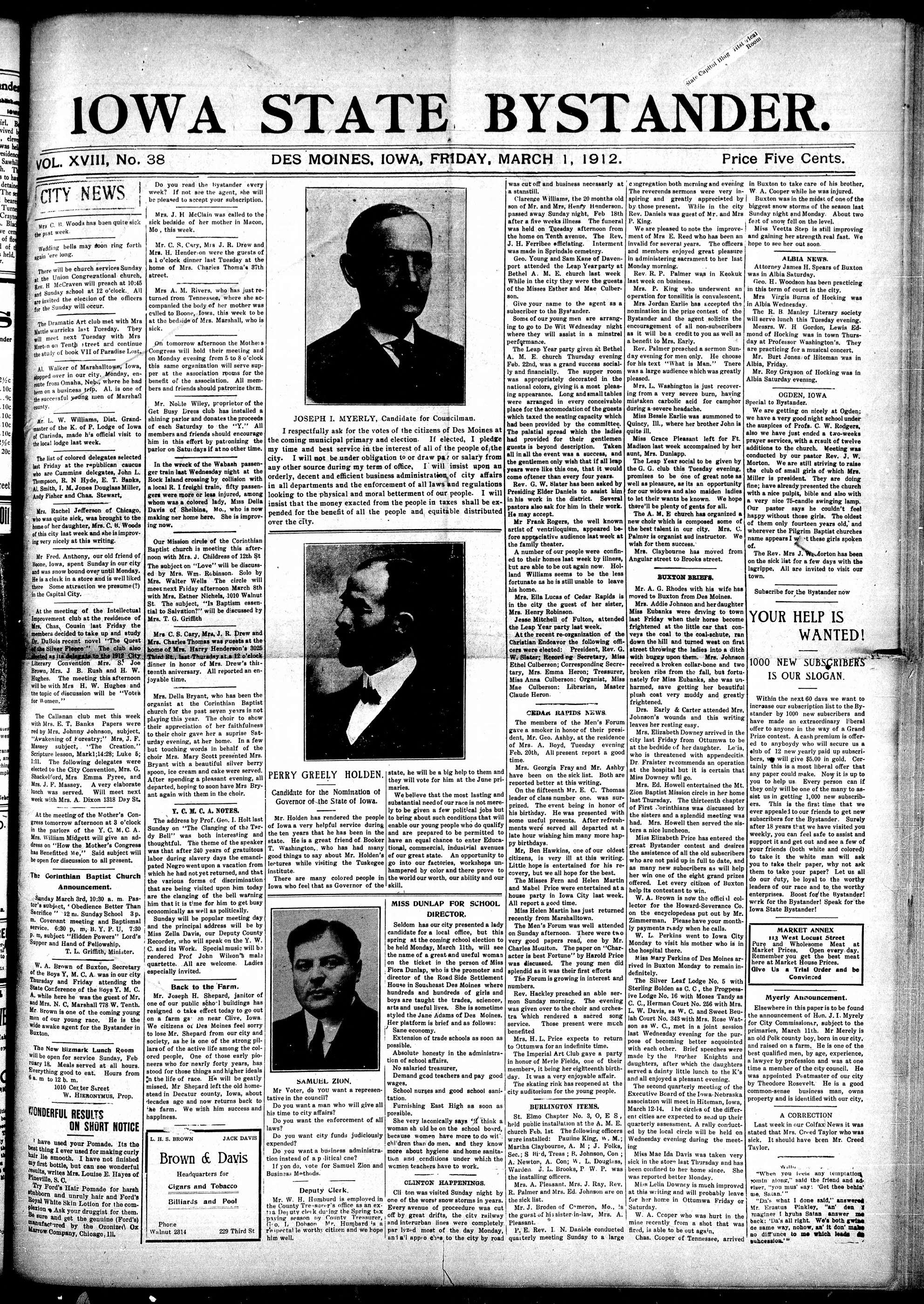
IOWA STATE BYSTANDER.
CITY NEWS
Mrs C. H. Wooda has been quite sick the past week.
Wedding bells may soon ring forth again 'ere long.
There will be church services Sunday at the Union Congregational church, Rev. H. McCraven will preach at 10:45 and Sunday school at 12 o'clock. All are invited the election of the officers for the Sunday will occur.
The Dramatic Art club met with Mrs Mattie warriors last Tuesday. They will meet next Tuesday with Mrs Morton on Tenth street and continue the study of book VII of Paradise Lost.
Al. Walker of Marshalltown, Iowa, stopped over in our city, Monday, enroute from Omaha, Neb., where he had been on a business trip. Al. is one of the successful young men of Marshall county.
Mr. L. W. Williams, Dist. Grandmaster of the K. of P. Lodge of Iowa of Clarinda, made h's official visit to the local lodge last week.
The list of colored delegates selected last Friday at the republican caucus who are Cummins delegates, John L. Thompson, R. N Hyde, E. T. Banks, Al. Smith, I. M. Jones Douglass Miller, Andy Fisher and Chas. Stewart,
Mrs. Rachel Jefferson of Chicago, who was quite sick, was brought to the home of her daughter, Mrs. C. B. Woods of this city last week and she is improving very nicely at this writing.
Mr Fred. Anthony, our old friend of Boone, Iowa, spent Sunday in our city and was snow bound over until Monday. He is a cleak in a store and is well liked there. Some attraction we presume (?) in the Capital City.
At the meeting of the Intellectual Improvement club at the residence of Mrs. Chas, Cousin last Friday the members decided to take up and study Dr. DuBois recent novel "The Quest of the Silver Fleece." The club also hosted as its delegate to the 1912 City Literary Convention Mrs. S. J. Joe Brown, Mrs. J. B. Rush and H. W. Hughes. The meeting this afternoon will be with Mrs. H. W. Hughes and the topic of discussion will be "Votes for Women."
The Callanan club met this week with Mrs. E. T. Banks Papers were red by Mrs. Johnny Johnson, subject, "Awakening of Forestry"; Mrs. J. F. Massey subject, "The Creation." Scripture lesson, Mark1;14:28; Luke 5; 1:11. The following delegates were elected to the City Convention, Mrs. G. Shackelford, Mrs. Emma Pyree, and Mrs. J. F. Massey. A very elaborate lunch was served. Will meet next week with Mrs. A. Dixon 1318 Day St.
At the meeting of the Mother's Congress tomorrow afternoon at 3 o'clock in the parlor of the Y. C. M. C. A. Mrs. William Midgett will give an address on "How the Mother's Congress has Benefitted Me," Said subject will be open for discussion to all present.
The Corinthian Baptist Church Announcement.
Sunday March 3rd, 10:30 a. m. Pastor's subject, "Obedience Better Than Sacrifice" 12 m. Sunday School 3 p. m. Covenant meeting and Baptismal service. 6:30 p. m. B. Y. P. 7:30 p. m. subject "Hidden Powers" Lord's Supper and Hand of Fellowship.
T. L. Griffith, Minister.
W. A. Brown of Buxton, Secretary of the Boys Y. M. C. A. was in our city Thursday and Friday attending the State Conference of the Boys Y. M. C. A. while here he was the guest of Mr. and Mrs. N. C. Marshall 778 W. Tenth. Mr. Brown is one of the coming young men of our young race. He is the wide awake agent for the Bystander in Buxton.
The New Bizmark Lunch Room will be open for service Sunday, February 18. Meals served at all hours. Everything good to eat. Hours from 6 a. m to 12 b. m.
1010 Center Street
W. HIERONYMUS, Prop.
I have used your Pomade. Its the best thing I ever used for making curly hair lie smooth. I have not finished my first bottle, but can see wonderful results, writes Mrs. Louise E. Hayes of Pineville, S.C.
Try Ford's Hair Pomade for harsh stubborn and unruly hair and Ford's Royal White Skin Lotion for the complexion. Ask your druggist for them. Be sure and get the genuine (Ford's) manufactured by the Ozonize() Ox Marrow Company, Chicago, Ill.
Do you read the bystander every week? If not see the agent, she will be pleased to accept your subscription.
Mrs. J. H McClain was called to the sick bedside of her mother in Macon, Mo., this week.
Mr. C. S. Cary, Mrs J. R. Drew and Mrs. H. Hender-on were the guests of a 1 o'clock dinner last Tuesday at the home of Mrs. Charles Thoma's 37th street.
Mrs A. M. Rivers, who has just returned from Tennessee, where she accompanied the body of her mother was called to Boone, Iowa, this week to be at the bedside of Mrs. Marshall, who is sick.
On tomorrow afternoon the Mother's Congress will hold their meeting and on Monday evening from 5 to 8 o'clock this same organization will serve super at the association rooms for the benefit of the association. All members and friends should patronize them.
Mr. Noble Wiley, proprietor of the Get Busy Dress club has installed a shining parlor and donates the proceeds of each party to the "Y." All members and friends should encourage him in this effort by patronizing the parlor on Saturdays if at no other time.
In the wreck of the Wabash passenger train last Wednesday night at the Rock Island crossing by collision with a local R. I freight train, fifty passengers were more or less injured, among whom was a colored lady, Miss Della Davis of Shelbins, Mo., who is now making ner home here. She is improving now.
Our Mission circle of the Corinthian Baptist church is meeting this afternoon with Mrs. J. Childress of 12th St The subject on "Love" will be discussed by Mrs. Wm. Robinson. Solo by Mrs. Walter Wells The circle will meet next Friday afternoon March 8th with Mrs. Ethet Nichols, 1010 Walnut St. The subject, "Is Baptism essential to Salvation?" will be discussed by Mrs. T. G. Griffith
Mrs C. S. Cary, Mrs. J. R. Drew and Mrs. Charles Thomas was guest at the home of Mrs. Harry Henderson's 3025 Third St., last Thursday at a 12 o'clock dinner in honor of Mrs. Drew's thirteenth anniversary. All reported an enjoyable time.
Mrs. Della Bryant, who has been the organist at the Corinthian Baptist church for the past seven years is not playing this year. The choir to show their appreciation of her faithfulness to their choir gave her a suprise Saturday evening, at her home. In a few but touching words in behalf of the choir Mrs. Mary Scott presented Mrs. Bryant with a beautiful silver berry spoon, ice cream and cake were served. After spending a pleasant evening, all departed, hoping to soon have Mrs Bryant again with them in the choir.
V. C. M. C. A. NOTES.
The address by Prof. Geo, I. Holt last Sunday on "The Clanging of the Tardy Bell" was both interesting and thoughtful. The theme of the speaker was that after 240 years of gratuitous labor during slavery days the emancipated Negro went upon a vacation from which he had not yet returned, and that the various forms of discrimination that are being visited upon him today are the clanging of the bell warning him that it is time for him to get busy economically as well as politically. Sunday will be popular meeting day and the principal address will be by Miss Zella Davis, our Deputy County Recorder, who will speak on the Y. W. C. and its Work. Special music will be rendered Prof John Wilson's male quartette. All are welcome. Ladies especially invited.
Back to the Farm.
Mr. Joseph H. Shepard, janitor of one of our public school buildings has resigned o take effect today to go out on a farm gate an near Clive, Iowa. We citizens of Des Moines feel sorry to lose Mr. Shepard from our city and society, as he is one of the strong pillars of the active life among the colored people. One of those early pioneers who for nearly forty years, has stood for those things and higher ideals in the life of race. He will be greatly missed, Mr Shepard left the old home-stead in Decatur county, Iowa, about decades age and now returns back to the farm. We wish him success and happiness.
L. H. S. BROWN JACK DAVIS
Brown & Davis
Headquarters for
Cigars and Tobacco
Billiards and Pool
Phone
Walnut 2814 229 Third St
JOSEPH I. MYERLY. Candidate for Councilman.
I respectfully ask for the votes of the citizens of Des Moines at the coming municipal primary and election. If elected, I pledge my time and best service in the interest of all of the people of the city. I will not be under obligation to or draw pay or salary from any other source during my term of office. I will insist upon an orderly, decent and efficient business administration of city affairs in all departments and the enforcement of all laws and regulations looking to the physical and moral betterment of our people. I will insist that the money exacted from the people in taxes shall be expended for the benefit of all the people and equitable distributed over the city.
M.
Candidate for the Nomination of Governor of the State of Iowa.
Mr. Holden has rendered the people of Iowa a very helpful service during the ten years that he has been in the state. He is a great friend of Booker T. Washington, who has had many good things to say about Mr. Holden's lectures while visiting the Tuskegee institute.
There are many colored people in Iowa who feel that as Governor of the
SAMUEL ZION.
Mr Voter, do you want a representative in the council?
Do you want a man who will give all his time to city affairs?
Do you want the enforcement of all laws?
Do you want city funds judiciously expended?
Do you want a business administration instead of a p lical cne? If you do, vote for Samuel Zion and Business Methods.
Deputy Clerk.
Mr. W. H. Humburd is employed in the County Treasurer's office as an extra Deputy clerk during the Spring tax paying season on County Treasurer, Mr. W. H. Humburd. He is repectful to worthy citizen and we hope him well.
state, he will be a big help to them and they will vote for him at the June primaries.
We believe that the most lasting and substantial need of our race is not merely to be given a few political jobs but to bring about such conditions that will enable our young people who do qualify and are prepared to be permitted to have an equal chance to enter Educational, commercial, industrial avenues of our great state. An opportunity to go into our factories, workshops unhampered by color and there prove to the world our worth, our ability and our skill.
MISS DUNLAP FOR SCHOOL
DIRECTOR.
Seldom has our city presented a lady candidate for a local office, but this spring at the coming school election to be held Monday, March 11th, will see the name of a great and useful woman on the ticket in the person of Miss Flora Dunlap, who is the promoter and director of the Road Side Settlement House in Southeast Des Moines where hundreds and hundreds of girls and boys are taught the trades, sciences, arts and useful lives. She is sometime styled the Jane Adams of Des Moines. Her platform is brief and as follows: Sane economy. Extension of trade schools as soon as possible. Absolute honesty in the administration of school affairs. No salaried treasurer, Demand good teachers and pay good wages.
School nurses and good school sanitation.
Furnishing East High as soon as possible.
She very laconically says "I think a woman sh old be on the school board, because women have more to do will children than do men, and they know more about hygiene and home sanitation and conditions under which the women teachers have to work.
CLINTON HAPPENINGS
Clii ton was visited Sunday night by one of the worst snow storms in years. Every avenue of procedure was cut off by great drifts, the city railway and interurban lines were completely parlyzed most of the day Monday, and all appoices to the city by road
was cut off and business necessarily at a stanstill.
Clarence Williams, the 20 months old son of Mr. and Mrs. Henry Henderson, passed away Sunday night, Feb 18th after a five weeks illness. The funeral was held on Tuesday afternoon from the home on Tenth avenue. The Rev, J. H. Ferribe efflicating. Interment was made in Sprindle cemetery.
Geo. Young and Sam Kane of Davenport attended the Leap Yearparty at Bethel A. M. E. church last week. While in the city they were the guests of the Misses Eather and Mae Culberson.
Give your name to the agent as a subscriber to the Bystander.
Some of our young men are arranging to go to De Wit Wednesday night where they will assist in a minstrel performance.
The Leap Year party given at Bethel A. M. E. church Thursday evening Feb. 22nd, was a grand success socially and financially. The supper room was appropriately decorated in the national colors, giving it a most pleasing appearance. Long and small tables were arranged in every conceivable place for the accomodation of the guests which taxed the seating capacity which had been provided by the committee. The palatial spread which the ladies had provided for their gentlemen guests is beyond description. Taken all in all the event was a success, and the gentlemen only wish that if all leap years were like this one, that it would come oftener than every four years. Rev. G. W. Slater has been asked by Presiding Elder Daniels to assist him in his work in the district. Several pastors also ask for him in their work. He may accept. Mr Frank Rogers, the well known artist of ventilloquism, appeared before appreciative audience last week at the family theater. A number of our people were confined to their homes last week by illness, but are able to be out again now. Holland Williams seems to be the less fortunate as he is still unable to leave his home. Mrs. Ella Lucas of Cedar Rapids is in the city the guest of her sister, Mrs. Henry Robinson.
Jesse Mitchell of Fulton, attended the Leap Year party last week. At the recent re-organization of the Christian Endovor the following officers were elected: President, Rev. G. W. Slater, Record ng Secretary, Miss Ettel Culberson; Corresponding Secretary, Mrs. Emma Heron; Treasurer, Miss Anna Culberson; Organist, Miss Mae Culberson; Librarian, Master Claude Heuer.
CEDA RAPIDS NEWS.
The members of the Men's Forum gave a smoker in honor of their president, Mr. Geo. Ashby, at the residence of Mrs. A. Boyd, Tuesday evening Feb. 20th. All present report a good time.
Mrs. Georgia Fray and Mr. Ashby have been on the sick list. Both are reported better at this writing.
On the fifteenth Mr. E. C. Thomas leader of class number one, was surprized. The event being in honor of his birthday. He was presented with some useful presents. After refreshments were served all departed at a late hour wishing him many more happy birthdays.
Mr. Ben Hawkins, one of our oldest citizens, is very ill at this writing. Little hope is entertained for his recovery, but we all hope for the best.
The Misses Fern and Helen Martin and Mabel Price were entertained at a house party in Iowa City last week. All report a good time.
Miss Helen Martin has just returned recently from Marshalltown.
The Men's Forum was well attended on Sunday afternoon. There were two very good papers read, one by Mr. Charles Moulton. The paper on "Character is best Fortune" by Harold Price was discussed. The young men did splendid as it was their first efforts.
The Forum is growing in interest and numbers.
Rev. Hackley preached an able sermon Sunday morning. The evening was given over to the choir and orchestra which rendered a sacred song service. Those present were much benefited Mrs. H. L. Price expects to return to Ottumwa for an indefinite time. The Imperial Art Club gave a party in honor of Merle Fields, one of their members, it being her eighteenth birthday. It was a very enjoyable affair. The skating rink has reopened at the city auditorium for the young people.
BURLINGTON ITEMS.
St. Elmo Chapter No. 3, O, E S,
held public installation at the A. M. E.
church Feb. 1st The following officers
were installed: Pauline King, W. M.
Martha Claybourne, A. M; J. Folks,
Sec.; S Biid, Treas; B. Johnson, Con;
A. Newton, A. Con; W. L. Douglass,
Warden. J. L. Brooks, P W. P. was
the installing officers.
Mrs. A. Pleasant, Mrs. J. Ray, Rev.
R. Palmer and Mrs. Ed. Johnson are on
the sick list.
Mr. J. Broden of Cameron, Mo., is
the guest of his sister-in-law, Mrs. A.
Pleasant.
P. E. Rev. I. N. Daniels conducted
quarterly meeting Sunday to a large
congregation both morning and evening
The reverends sermons were very inspiring and greatly appreciated by those present. While in the city Rev. Daniels was guest of Mr. and Mrs P. King.
We are pleased to note the improvement of Mrs E. Reed who has been an invalid for several years. The officers and members enjoyed great pleasure in administering sacrament to her last Monday morning.
Rev R. P. Palmer was in Keokuk last week on business.
Mrs. P. King who underwent an operation for tonsilitis is convalescent,
Mrs Jordan Earle has accepted the nomination in the prize contest of the Bystander and the agent solicits the encouragement of all non-subscribers as it will be a credit to you as well as a benefit to Mrs. Early.
Rev Palmer preached a sermon Sunday evening for men only. He choose for his text "What is Man." There was a large audience which was greatly pleased.
Mrs. L. Washington is just recovering from a very severe burn, having mistaken carbolic acid for camphor during a severe headache.
Miss Bessie Earle was summoned to Quincy, Ill., where her brother John is quite ill.
Miss Grace Pleasant left for Ft. Madison last week accompanied by her aunt, Mrs. Dunlapp.
The Leap Year social to be given by the G. G. club this Tuesday evening, promises to be one of great note as well as pleasure, as its an opportunity for our widows and also maiden ladies to let their wants be known. We hope there'll be plenty of gents for all. The A. M. E church has organized a new choir which is composed some of the best talent in our city. Mrs. C. Palmer is organist and instructor. We wish for them success. Mrs. Claybourne has moved from Angular street to Brooks street.
BUXTON BRIEFS.
Mr. A. G. Rhodes with his wife has moved to Buxton from Des Moines.
Mrs. Addie Johnson and her daughter Miss Eubanks were driving to town last Friday when their horse become frightened at the little car that conveys the coal to the coal-schute, ran down the hill and turned west on first street throwing the ladies into a ditch with buggy upon them. Mrs. Johnson received a broken collar-bone and two broken ribs from the fall, but fortunately for Miss Eubanks, she was unharmed, save getting her beautiful plush coat very muddy and greatly frightened.
Drs. Early & Carter attended Mrs. Johnson's wounds and this writing leaves her resting easy.
Mrs. Elizabeth Downey arrived in the city last Friday from Ottumwa to be at the bedside of her daughter. Leia, who is threatened with appendicitis, Dr. Frairare recommends an operation at the hospital but it is certain that Miss Downey will go.
Mrs. Ed. Howell entertained the Mt. Zion Baptist Mission circle in her home last Thursday. The thirteenth chapter of First Sorinthians was discussed by the sisters and a splendid meeting was had. Mrs. Howell then served the sisters a nice luncheon.
Miss Elizabeth Price has entered the great Bystander contest and desires the assistance of all the old subscribers who are not paid up in full to date, and as many new subscribers as will help her win one of the eight grand prizes offered. Let every citizen of Buxton help its contest to win.
W. A. Brown is now the official collector for the Howard-Severance Co. on the encyclopedae put out by Mr. Zimmerman. Please have your monthly payments ready when he calls.
W. L. Perkins went to Iowa City Monday to visit his mother who is in the hospital there.
Miss Mary Perkins of Des Moines arrived in Buxton Monday to remain indefinitely.
The Silver Leaf Lodge No. 5 with Sterling Bolden as C. C, the Propospive Lodge No. 16 with Moses Tandy as C. C., Herman Court No. 256 with Mrs. L. W. Davis, as W. C. and Sweet Beaula Court No. 343 with Mrs. Rose Watson as W. C., met in a joint session last Wednesday evening for the purpose of becoming better acquainted with each other. Brief speeches were made by the Brother Knights and daughters, after which the daughters served a dainty little lunch to the K's and all enjoyed a pleasant evening.
The second quarterly meeting of the Executive Board of the Iowa-Nebraska association will meet in Hiteman, Iowa, March 12-14. The circles of the different cities are expected to send up their quarterly assessment. A rally conducted by the local circle will be held on Wednesday evening during the meeting.
Miss Mae Ida Davis was taken very sick in the store last Thursday and has been confined to her home since. She was reported better Monday.
Miss Leila Downey is much improved at this writing and will probably leave for her home in Ottumwa Friday or Saturday.
W. A. Cooper who was hurt in the mine recently from a shot that was fired, is able to be out again.
Chas. Cooper of Tennessee arrived
Chas. Cooper of Tennessee. arrived
```markdown
```
in Buxton to take care of his brother, W. A. Cooper while he was injured. Buxton was in the midst of one of the biggest snow storms of the season last Sunday night and Monday. About two feet of snow fell on the level. Miss Veetta Step is still improving and gaining her strength real fast. We hope to see her out soon.
ALBIA NEWS.
Attorney James H. Spears of Buxton was in Albia Saturday. Geo. H. Woodson has been practicing in this term of court in the city.
Mrs Virgis Burns of Hocking was in Albia Wednesday.
The R. B Manley Literary society will serve lunch this Tuesday evening.
Messrs. W. H. Gordon, Lewis Edmond of Hocking was in town Thursday at Professor Washington's. They are practicing for a musical concert.
Mr. Burt Jones of Hiteman was in Albia, Friday.
Mr. Roy Grayson of Hocking was in Albia Saturday evening.
We are getting on nicely at Ogden; we have a very good night school under the auspices of Profa. C. W. Rodgers, also we have just ended a two-weeks prayer service, with a result of twelve additions to the church. Meeting was conducted by our pastor Rev. J. W. Morton. We are still striving to raise the club of small girls of which Mrs. Miller is president. They are doing fine; we already prepared the church with a nice pulpit, bible and also with a very nice 75-candle swinging lamp. Our pastor says he couldn't feel happy without those girls. The oldest of them only fourteen years old, and wherever the Pilgrim Baptist churches name appears I will these girls spoken of.
The Rev. Mrs J. W. dorton has been on the sick list for a few days with the lagripe. All are invited to visit our town.
Subscribe for the Bystander now
YOUR HELP IS WANTED!
1000 NEW SUBSCRIBERS IS OUR SLOGAN.
Within the next 60 daws we want to increase our subscription list to the Bystander by 1000 new subscribers and have made an extraordinary liberal offer to anyone in the way of a Grand Prize contest. A cash premium is offered to anybody who will secure us a club of 12 new years paid up subscribers, will give $5.00 in gold. Certainly this is a most liberal offer that any paper could make. Now it is up to you to help us. Every person can if they only will be one of the many to assist us in getting 1,000 new subscribers. This is the first time that we ever appeale to our friends to get new subscribers for the Bystander. Surely after 18 years that we have visited you weekly, you can feel safe to assist and support it and get out and see a few of your friends (both white and colored) to take it the white man will ask you to take their paper, why not ask them to take your paper? Let us all do our duty, be loyal to the worthy leaders of our race and to the worthy enterprises. Boost for the Bystander! wrk for the Bystander! Speak for the Iowa State Bystander!
MARKET ANNEX
113 West Locust Street
Pure and Wholesome Meat at
Market Prices. Open every day.
Remember you get the best meat
here at Market House Prices.
Give Us a Trial Order and be
Convinced
Mverly Announcement
Elsewhere in this paper is to be found the announcement in of Hon. J. I. Myrely for City Commissioner, subject to the primaries, March 11th. Mr Merely is an old Polk county boy, born in our city, and raised on a farm. He is one of the best qualified men, by age, experience, a lawyer by profession and was at one time a member of the city council. He was appointed Postmaster of our city by Theodore Rosevelt. He is a good common-sense business man, owns property and is identified with our city,
A CORRECTION
Last week in our Colafax News it was stated that Mrs. Creed Taylor who was sick. It should have been Mr. Creed Taylor.
"When you feels any temptation somin along," said the friend and ad-viser, "you mus' say: 'Get thee behin' me, Satan.'"
"Da's what I done said," answered Mr. Erastus Pinkley, "an' den I maginee I hyuhs Satan answer me back: 'Da's all right. We's both gwine de same way, nohow, an' it don' make no diff'nce to me which leads de subcession.'"
BYSTANDER PUB. CO., Publishers.
DES MOINES. IOWA
WHERE THE DIFFERENCE WAS
Little Old Lady Had Not Understood,
but, After All, Matter Was
Quite Simple.
A little old lady came into the station at Ames and asked for a ticket to Greenburg. "Thirty-nine," said the agent as she cut the ticket. "Twenty-nine," articulated the wom-
"hit my nose," exclaimed an amateur. "I was 40." "No," said the man, as he gave her the change. "it is just 39." The woman took the change and the ticket and sat down, but she did not put either change or ticket into her purse. She held them in her hand, and looked quite troubled. Finally she went to the agent again. "I am sure there is some mistake," she said. "I came from Greensburg yesterday and I paid 40 cents. The agent to the Greensburg is 39 cents," said the agent. "It's all right, madam," he added, in a reassuring way. Again she took her seat, but not for long. Again she came to the window and spoke to the agent: "Will you please explain to me why the rate from here to Greensburg is only 39 cents when the rate from Greensburg here is 40?" This was a question that the agent responded to, but the woman looked so distressed over the unexpected cent received in change that he felt sorry for her.
"Oh, it's down grade going that way you know," he explained, in a bust nesilike way.
"So it lsl!" she said, in a tone of enlightenment. Her face cleared at once. She put the change into her purse and in great content sat down to wait for her train - Youth's Company.
One-Seventh of World Goes to Mecca. The city of Mecca is the oldest place of resort in existence, yet all of the millions who have visited it not a score of Christians are known to have survived. No man of citizenship would save a man's life were he known to be a Christian within the sacred priests of the city, where the prophet himself decreed that no unbeliever should set foot.
Of the 220,000,000 Moslems in the world only 15,500,000 live under the Turkish flag, yet most of them are knowledgee the sultan of Turkey as their ralph, the successor of the Prophet. As Mohammed shrewdly fore saw, the Mecca pilgrimage binds to together disciples into a unity which could be effected in no other way. "Mecca," says Dr. Samuel M. Zwemen of Arabia, "has become the religious capital and the center of universal pilgrimage of one-seventh of the human race."
4 Apostle of Peace.
That incessant joker, M. Tristan Bernard, was chatting about the peace movement with some friends the other evening, and somebody remarked to him that peace at any price was quite an impossibility.
"For instance," he said, "If an 'apache' cornered you in the street because you hurt you, and took your watch and chain away."
"I don't think I would ever talk to him again," said Tristan Bernard quietly.
And a day or two back, as we were driving up the Champs Elysees together in an open, hbrse-drawn cab, a taxicab bumped into from behind. Tristan turned slowly around.
"My friend," he said to the chafter, "you want to go in and drive with us, but in by all means, but I warn you beforehand that we haven't got room for your car."-Paris Correspondence London Express.
Strange Methods of Smoking.
Strange are the variations of the strange habit that has become world wide in the last 400 years. The Negritos of the Philippines are cigar smokers and they are said to hold a cigar with the lighted end in their mouths. A nice cool smoke is not what they want. The Hottentot of Africa will sacrifice as much as any man for his smoke. He will sell his wife for tobacco. The Patagonian of the Straits of Magellan has a system of smoke swallowing by which he throws himself down on his stomach and secures a few moments of drugged ecstasy.
Success Assured.
"I can't see why I should attempt to produce your play," said the manager. "There seems to be nothing in it."
"The mayor of this town has promised me that he will threaten to stop it if you put it on," the eager young dramatist replied. "Hurrah! You put it in rehearsal at once, and the addition to being the author, I want you to be the press agent."
Bismarck's Hair on Sale.
Quite an outburst of indignation has arisen in Berlin over the action of a well-known co-founded named Rohrig, who is advertising the hair of Rohrig for sale. In the last eight years of the famous statesman's life Rohrig, with the assistance of a vaire, collected all the stray hairs of his mistrustful brother, made more than hundred in number, each of which, before being placed on the market, has been affixed to a bronze bust representing the German chancellor.
"I put a lot of work on that speech of mine," said the new member of Congress.
"Of course you did," replied the veteran; "after you, have been here a while you'll learn to put less work on your original speech and save your self for the explanations."
Thoughtful Observation.
Instructor—What most frequently becomes a woman?
The Other Fellow—A little girl—B Louis Post-Dispatch
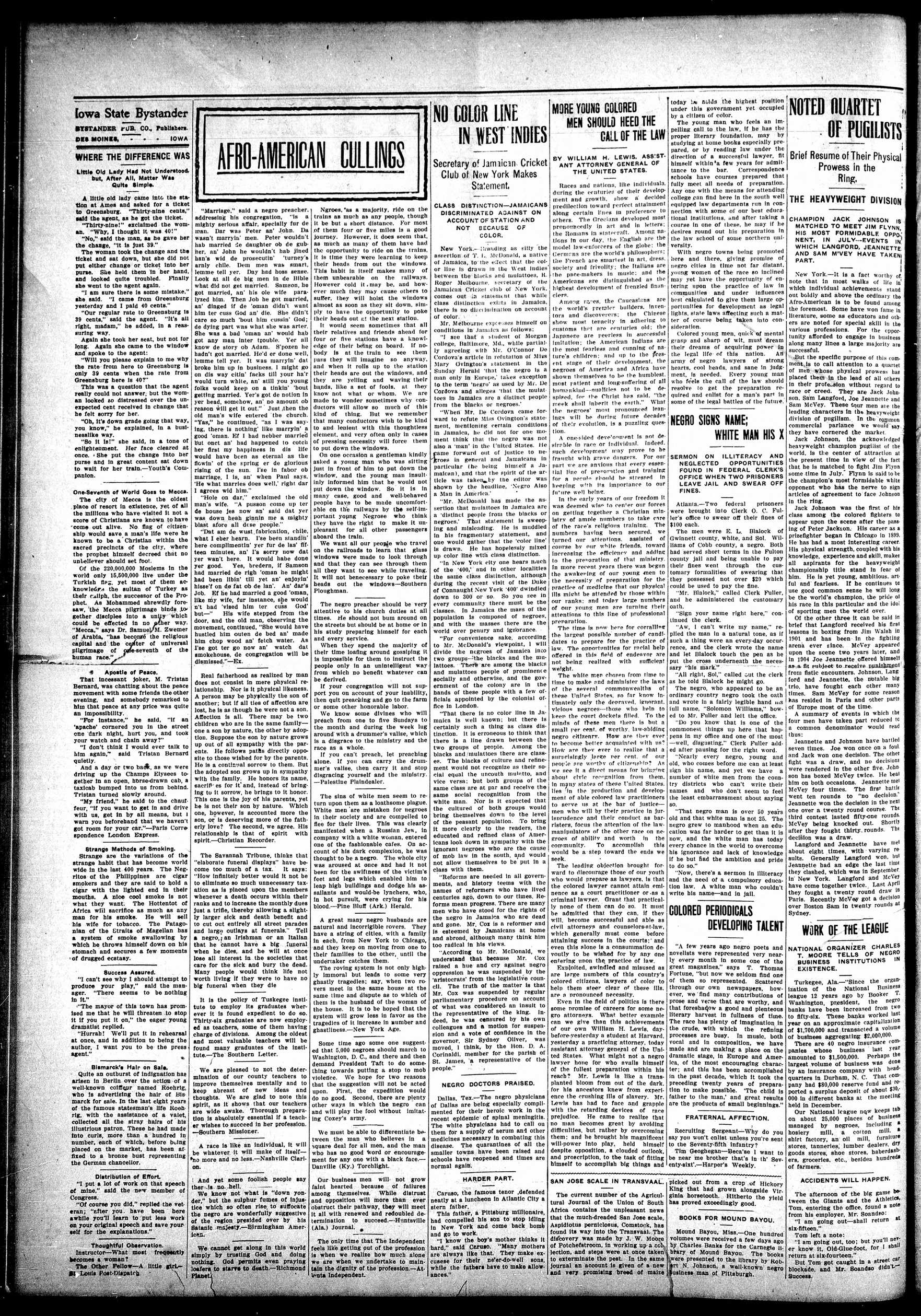
AFRO-AMERICAN CULLINGS
"M marriage," said a negro preacher addressing his congregation, "is a mighty serious affair, specially fur de man. Dar was Peter an' John. Dar wasn't marryin' men. Peter wouldn't hab married de daughter ob de gubher, an' John he wouldn't hab jinned hans' wid de prosecution' 'turnery' anrly chille. Dem men was smart, lemme tell yer. Day had hoss sense. Look at all de big men in de Bible what did not get married. Samson, he got married, an' his ole wife paralyzed him. The job he got married didn't want him tern curs God an' die. She didn't care so much 'bout him cussin' God; de dying part was what she was arter. She was a bad 'mou an' would hob got any man inter trouble. Yer all know de story ob Adam. S'pozen he hadn't got married. He'd er done well, lemme tell yer. It was marryin' d broke him up in business. I might go on this way citin' facks till your hair' would turn white, an' still you young folks would keep on a tinkin' 'bout getting married. Yer's got de not in yer head, somehow, an' no amount ob reason will get it out". Just, then the old man's wife entered the church. "Xas," he continued, "as I was saying, there is nothing like marryin' a good 'oman. If I had nebber married me, he met my happiness in dis life. I would have been as eternal as the flowin' of the spring er de glorious rising of the sun. 'I in fabor marriage. I is, an' when Paul says, 'He what marries does well', right dar I agrees wid him."
"Hole on dar," exclaimed the old man's wife. "A pusson come up ten de house jeew now an' said dat yet was down heath ginnin me a mighty blast afore all diese people." "Dat am de wust, fabrication, chille what I eber hear. I seew be standin here complimentin' yur fer de las' fifteen minutes, an' I sorry now day yer wan't here. It would have done yer good. Yes, bredern, if Samson had married de righon he might had been ibln' till yet an' enjoyhise' on ds fat de ob laen. "An'dar' Job. If he had married, ghe would n' had vised him ter cus God but-" His wife stepped from the door, and the old man, observing the movement, continued. "She would have hustled him outen de bed an' made him chop wood an' fetch water. As I seew ter go now an' watch dat smokehouse, de congregation will be dismissed."—Ex.
Real fatherhood as realized by man does not consist in mere physical relationship. Nor is it physical likeness. A person may be physically the son of another; but if all ties of affection are lost, he is as though he were not a son. Affection is all. There may be two children who are in the same family—one a son by nature, the other by adoption. Suppose the son by nature grows up out of all sympathy with the parents. He follows paths directly opposite to those wished for by the parents. He is a continual sorrow to them. But the adopted son grows up in sympathy with the family. He honors its name. He is not the son of the parents, to sorrow it, to sorrow it, to sorrow it. This one is the joy of his parents, yet he is not their son by nature. Which one, however, is accounted more the son, or is deserving more of the fatherly love? The second, we agree. His relationship is that of spirit with spirit—Christian Recorder.
The Savannah Tribune, thinks that "elaborate funeral displays" have become too much of a tax. It says: "How infinitely better would it not be to eliminate so much unnecessary taxation as is placed upon the members whenever a death occurs within their ranks and to increase the monthly dues just a trifle, thereby allowing a slight increase in the number to cut out entirely all street parades and large outlays at funerals." Tell a negro, an Irishman or an Italian that he cannot have a big funeral when he dies, and he will at once lose all interest in the societies that care for the sick and bury the dead. Many people would think life not worth living if they were to have no big funeral when they die.
It is the policy of Tunkegee institute to employ in colleges where students are expedient do and Thirty-six graduates are now employed as teachers, some of them having charge of divisions. Among the oldest and most valuable teachers will be found many graduates of the institute—The Southern Letter.
We are pleased to not the determination of our county teachers to improve themselves mentally and to keep abreast of new ideas and thoughts. We are glad to note this spirit, as it shows that our teachers are wide awake. Thorough preparation is absolutely essential if a teacher wishes to succeed in her profession. —Southern Missioner.
A race is like an individual, it will be whatever it will make of itself—no more and no less. —Nashville Clarion.
And yet some foolish people say ther is no hell.
We know not what is "down yonder," but the sulphur fumes of injustice which so often rise, to suffocate the negro are wonderfully suggestive of the region presided over by his Satanic majesty. —Birmingham American.
We cannot get along in this world simply by trusting God and doing nothing. God permits even praying to death to death - Richmond Planet.
Ngrees, 'as a majority, ride on the trains as much as any people, though it be but a short distance. For most of them four or five miles is a good journey. However, it does seem that, as much as many of them have had the opportunity to ride on the trains, it is time they were learning to keep their hands out from the windows. This habit in itself makes many of them unbarable on the railways, however, solo they are not. Even they may cause others to suffer, they will hoist the windows almost as soon as they sit down, simply to have the opportunity to poke their heads out at the next station.
It would seem sometimes that all their relatives and friends ahead for four or five stations have a knowledge of their being on board. If nobody is at the train to see them pass they will imagine so anyway, and when it rolls up to the station their heads are out the windows, and they are yelling and waving their hands, like a set of fools, at they know not what or whom. We are made to wonder why sometimes you condone will allow so much of this kind of behavior, and we remember that many conductors wish to be kind to and lendenit with this thoughtless element, and very often only in cases of pressing necessity will force them to put down the windows.
On one occasion a gentleman kindly asked a young man who was sitting just in front of him to put down the window, and the young man insultively informed him that he would not put down the window. So it is in many case, good and well-behaved people have to be made uncomfortable on the railways by the self-important young Negrose who think they are not smart enough for all other passengers aboard the train.
We want all our people who travel on the railroads to learn that glass windows were made to look through and that they can see through them all they want to see while traveling. It will not be necessary to poke their heads out the windows-Southern Ploughman.
The negro preacher should be very attentive to his church duties at all times. He should album around on the streets but should be at home or in his study preparing himself for each and every service.
When they spend the majority of their time loafing around gossiping it is impossible for them to instruct the people only in an unintelligent way from which no benefit whatever can be derived.
If your congregation will not support you on account of your inability, then quit preaching and go to the farm or some other honorable labor.
We know some divines who will preach from one to five Sundays to the month and during the week lag around with a drummer's valse, which is a disgrace to the ministry and the reason for your preach, let preaching alone. If you can carry the drummer's valse, then carry it and stop disgracing yourself and the ministry.
—Palestine Plaindealer.
The sins of white men seem to return upon them as a loathsome plague. White men are mistaken for negroes in their society and are compelled to flee for their lives. This was clearly manifested when a Russian Jew, in company with a white woman, entered one of the fashionable cafes. On account of his dark complexion, he was thought to be a negro. The whole city was aroused at once and had it not been for the swiftness of the victim's feet and legs which enabled him to leap high buildings and dodge his assailants and would-be lynchers, who in hot pursuit, were crying for his blood—Pine Bluff (Ark.) Herald.
A great many negro husbands are natural and incorrigible rovers. They have a string of cities, with a family in each, from New York to Chicago, and they keep on moving from one to their families to the other, until the underaker catches them.
The roving system is not only highly immoral but leads to some very ghastly tragedies; say, when two rovers meet in the same house at the same time and dispute as to which of them is the husband of the woman of the house. It is to be hoped that the system will grow less in favor as the tragedies of it increase in number and gaithlessness.—New York Age.
Some time ago some one suggested that 5,000 negroes should march to Washington, D. C., and then and then demand President Taft to do something towards putting a stop to mob violence. We hope for two reasons that the suggestion will not be acted upon. First, the expedition would do no good. Second, there are plenty other ways in which the negro can and will play the fool without imitating Coexy's army.
We must be able to differentiate between the man who believes in a square deal for all men, and the man who has no good word or encouragement for any one with a black face.—Danville (Ky.) Torchlight.
Our business men will not grow faint hearted because of failures among themselves. While distrust and opposition will more than ever obstruct their pathway, they will meet it all with renewed and redoubled determination to succeed.—Huntsville (Ala.) Journal.
The only time that The Independent feels like getting out of the profession is when we realize how much alone we are when we undertake to maintain the dignity of the profession.—Atta-uta Independent.
NO COLOR LINE IN WEST INDIES
Secretary of Jamaican Cricket Club of New York Makes Statement.
CLASS DISTINCTION-JAMAICANS DISCRIMINATED AGAINST ON ACCOUNT OF STATION AND NOT BECAUSE OF
New York—Standing as silly the assertion of York, L. McDonald, a native of Jamaica, to the effect that the color or line is drawn in the West Indies between the blacks and mulattoes, K. Roger Melbourne, secretary of the Jamaican Cricket club of New York comes out in statement that while class distinction exists in Jamaica, there is no discrimination on account of race. Mr. Melbourne expresses himself on conditions in Jamaica as follows: "I see that a student of Morgan college, Baltimore, Md., while partially agreeing with Mr. O'Connor Cordova's article in refutation of Miss Mary Ovlington's statement in the Sunday Herald that the negro is a man only in Europe, takes exception to the term negro" (Mr. De Vos, 1994). De Vos argues that the mulattoes in Jamaica are a distinct people from the blacks or negroes.
"When Mr. De Cordova came forward to refuse Misty Owington's statement, mentioning certain conditions in Jamaica, he did not for one moment think that the negro was not also a 'man' in the United States. He came forward out of justice to prove his innocence (the being himself a Jamaican), and that the spirit of the article was taken by the editor was shown by the headline, 'Negro Also a Man in America.' "Mr. McDonald has made the assertion that mutuates in Jamaica are a 'distinct people from the blacks or negroes.' That statement is sweeping and misleading. He, in his fragile statement, and no doubt aware that the "color line" is drawn, He has hopelessly mixed up color line with class distinction.
"In New York city one hears much of the '400', and in other localities the same class distinction, although during the recent visit of the Duke of Connaught New York '400' dwindled down to 300 or so. You see in every community there must be classes. In Jamaica the mass of the masses is composed of negroes, and with the masses there are the world over penny and ignorance. "For convenience sake, according to Mr. Donald's viewpoint, I will divide the negroes of Jamaica into two groups—the blacks and the mulattoes. There are among the blacks and mulattoes people of prominence socially and otherwise, and the government of these people with a few officials appointed by the colonial office in London.
"That there is no color line in Jamaica is well known; but there is certainly such a thing as class distinction. It is erroneous to think that there is a line drawn between the two groups of people. Among the blacks and mulattes there are classes. The blacks of culture and refinement would not recognize the race and vice versa; but both groups of the same class are at par and receive the same social recognition from the white man. Nor is it expected that the cultured of both groups would bring themselves down to the level of the peasant population. To bring it more clearly to the readers, the educated and refined class of Americans look down in sympathy with the ignorant. In the cause of law in the world, and would not allow themselves to be put in a class with them.
"Reforms are needed in all governments, and history teems with the names of reformers who have lived centuries ago, down to our times. Reformers mean progress. There are many men who have stood for the rights of the negro in Jamaica who are dead and gone. Mr. Cox is a reformer and is esteemed by Jamaicans at home and abroad, although many think him too radical in his views.
"According to Mr. McDonald, we understand that because Mr. Cox raised a hue and cry against negro oppression he was suspended by the 'aristocrats' from the legislative council. The truth is that the matter is that Mr. Cox was suspended by regular parliamentary procedure on account of being considered an insult to the representative of the king. Indeed, he was censured by his own colleagues and a motion for suspension and a vote of confidence in the governor, Sir Sydney Oliver, was moved, I think, by the Hon. D. A. Corinaldi, member for the parish of St. James, a representative of the people."
NEGRO DOCTORS PRAISED.
Dallas, Tex. "The negro physicians of Dallas are being especially complimented for their heroic work in the recent epidemic of spinal meningitis. The white physicians had to call them for a supply of serum and other medicines necessary for the treatment of the diseases. The towns of all the negro towns have been raised and schools have reopened and times are normal again."
HARDER PART.
Caruso, the famous tenor, defended neatly at a luncheon in Atlantic City a stern father.
This father, a Pittsburgh millionaire, had compelled his son to stop idling in New York and come back homb and go to work.
"I know the boy's mother thinks it hard," said Caruso. "Many mothers are always like that. They make excuses for their need-well behavior while the fathers have to make allow-
MORE YOUNG COLORED
MEN SHOULD HEED THE
CALL OF THE LAW
BY WILLIAM H. LEWIS, ASSISTANT ATTORNEY GENERAL OF THE UNITED STATES.
Races and nations, like individuals, during the centuries of their development and growth, show a decided predilection toward perfect attalment along certain lines in preference to others. The Greeks developed most pronouncedly in art and in letters; the Romans in stancecraft. Among nations in our day, the English and the model law-enforcers of the globe; the Germans are the world's philosophers; the French are the most art, dress, society and frivolity; the Italians are the craft-makers in music; and the Americans are distinguished as the highest development of frenzed financiers.
Among races, the Caucasians are the world's premier builders, inventors and discoverers; the Chinese show most tenacity in adhering to customs that are centuries old; the Japanese are persevering in succession limitation; the American Indians are counting of nature's children; and up to the present stage of their development, the negroes of America and Africa have shown themselves to be the humblest, most patient and long-suffering of all humankind—nations not to be deplored, for the Christ has said, "the meek shall inherit the earth." The negroes' most painful and least hurting future decades of their evolution is a puzzling question.
A one-sided development is not desirable in race or individual. Indeed, such development may prove to be fraught with grave dangers. For our part we are anxious that every essential line of preparation and training for a person should be stressed in order to importance to our future well being.
In the early years of our freedom we was deemed wise to center our forces on getting together a Christian ministry of ample numbers to take care of the race's religious training. The numbers having been secured, we turned our attentions, assisted course by our white friends, toward increasing the efficiency and to the preparation of ministry. The ministry there was begun the awakening of our young men to the necessity of preparation for the practice of medicine that our physicalills might be attended by those within our ranks; and today large numbers of our young men are turning their attentions to this line of professional preparation.
The time is now here for corraling the largest possible number of candidates to prepare for the practice of law. The opportunities for practice in this field of recovery are not being realized with sufficient weight.
The white men chosen from time to time to make and administer the laws of the several commonwealths of these United States, so far know intimately only the deprived, ignorant, vicious negress—those who help to keep the court dockets filled. To the minds of these men there is but a small per cent. of worthy law-subsiding negro citizenry. How are they ever to become white men? They ever to realize that a surprisingly large per cent of our people are worthy of citizenship? As we see it a direct means for bringing about civic recognition from them, in many states of these United States, lies in the production and development of able colored law practitioners to serve us at the bar of justice; men who will by their practice in jurisprudence and their conduct as barristers, focus the attention of the law-manipulators of the other race on new communities and their conduct to community. To accomplish this would be a step toward the ends we seek.
The leading objection brought forward to discourage those of our youth who would prepare as lawyers, is that the colored lawyer cannot attain eminence as a court practitioner or as a criminal lawyer. Grant that practically none of them can do so. It must be assumed that the colored lawyer will become successful and able as civil attorneys and counselors-at-law, which generally must come before attaining success in the courts; and even this alone is a consummation devotionly to be wished for by any one entering upon the practice of law. Exploited, swindled and misused as a larger threat, this country's colored citizen's lawyer of color to help them steer clear of these illa are a pronounced necessity.
Even in the field of politics is there some promise of careers for some negro attorneys. What better example can we give than this achievements of our own William H. Lewis, day-before-yesterday a student at Harvard, yesterday a practicing attorney, today assistant attorney general of the United States. What might not a negro lawyer hone for who avails himself of the fullest preparation within his reach? Mr. Lewis is like a transplanted bloom from out of the dark for his ancestors knew from experience the crushing slays of slavery. Mr. Lewis has had to face and grapple with the prejudice of race prejudice. He came to the conclusion no man becomes great by avoiding difficulties, but rather by overcoming them; and he brought his magnificent will-power into play, held himself despite opposition, a clouded outlook, and proscription, to the task of fitting himself to accomplish big things and
SAN JOSE SCALE IN TRANSVAAL
The current number of the Agricultural Journal of the Union of South Africa contains the unpleasant news that the much-dreaded San Jose scale, Aspidiotus periculus, Comstock, has found its way into the Transvaal. The discovery was made by J. W. Moore of Potchefstroom, in working up a collection, and steps were at once taken to exterminate the pest. In the same journal an account is given of a new and very promising breed of maize
today he holds the highest position under this government yet occupied by a citizen of color.
The young man who feels an impelling call to the law, if he has the proper literary foundation, may by studying at home books especially prepared, or by reading law under the direction of a successor, have within a few years for admittance to the bar. Correspondence schools have courses prepared that fully meet all needs of preparation. Any one with the means for attending college can find here in the south well equipped law departments run in connection with some of our best educational institutions, and after taking a course in one of these, he may if he desires round out his preparation in the school of some northern university.
With negro towns being promoted there and, giving promise of negro cities in time not far distant, young women of the race so inclined may yet have the opportunity of entering upon the practice of law in communities and under influences best calculated to give them large opportunities for development as legal lights, state laws affecting such a matter of course being taken into consideration. To help young men, quick of mental grass and sharp of wit, must dream their dreams of acquiring power in the legal life of this nation. An army of negro lawyers of strong hearts, cool heads, and sane in judgment, is needed. Every young man who feels the call of the law should resolve to get the preparation required and enlist for a man's part in some of the legal battles of the future.
NEGRO SIGNS NAME;
WHITE MAN HIS X
SERMON ON ILLITERACY AND NEGLECTED OPPORTUNITIES FOUND IN FEDERAL CLEKR'S OFFICE WHEN TWO PRISONERS LEAVE JAIL AND SWEAR OFF FINES.
Atlanta.—Two federal prisoners were brought into Clerk O. C. Fuller's office to swear off their fines of $100 each.
The men were E. L. Blalock of Gwinnett county, county, and Sol. Williams of Cobb county, a negro. Both had served short terms in the Fulton county jail and being unable to pay their fines went through the customary formalities of swearing that they possessed not over $20 which could be used to pay the fine.
"Mr. Blalock," called Clerk Fuller, and he administered the customary oath.
"Sign your name right here," continued the clerk.
"Aw, I can't write my name," replied the man in a natural tone, as if such a thing was an every-day occurrence, and the clerk wrote the name and let Blalock touch the pen as he put the cross underneath the necessary "his mark."
"All, Sol!," called out the clerk as he told Blalock he might go. The negro, who appeared to be an ordinary country negro took the cath and wrote in a fairly legible hand as full name, "Solomon Williams," bowed to Mr. Fuller and left the office. "Do you know that is one of the commonest things up here that happens in my office and one of the most—well, disgusting." Clerk Fuller added after pausing for the right word. Karly, who comes before, must at least sign his name, and yet we have a number of white men from the country districts who can't write their names and who don't seem to feel the least embarrassment about saying so.
"That negro man is over 50 years old and that white man is not 25. The negro gren was to manhood when an education was far harder to get than it is now, and the white man has today every chance in the world to overcome his ignorance and lack of knowledge if he but faid the ambition and pride to do so." "Now, there's a sermon in illiteracy and the need of a compulsory education law. A white man who couldn't write his name—and in fall.
COLORED PERIODICALS
DEVELOPING TALENT
"A few years ago negro poets and novelists were represented very nearly every month in some one of the great magazines," says T. Thomas Fortune, "but now we seldom find one of them so represented. Scattered through our own newspapers, however, we find many contributions of them that are worthy, and that foreshadow that we have a generous literary harvest in fullness of the. Race has plenty of imagination in the crude, with which the refining processes are busy. In music, both vocal and in composition, we have made and are making a place on the dramatic stage, in Europe and America, of the most encouraging character, and this has been accomplished in the work, which it took the preceding twenty years to prepare to make possible. The father to the man, and great results are the products of small beginnings."
FRATERNAL AFFECTION
Recruiting Sergeant—Why do you say you won't enlist unless you're sent to the Seventy-fifth infantry?
Geoghawk—Beca'we I want to be meant to be on his in 'h Seventy-sixt—Harper's Weekly.
picked out from a crop of Hickory King that had grown alongside Virginia hornetose. Hitherto the yield has proved exceedingly good.
BOOK8 FOR MOUND BAYOU.
Mound Bayou, Miss.—One hundred volumes were received a few days ago by Charles Banks for the Carnegie library at Mound Bayou. The books were presented to him by Robt N. Johnson, a well-known negro business man of Pittsburgh.
NOTED QUARTET OF PUGILISTS
THE HEAVYWEIGHT DIVISION
CHAMPION JACK JOHNSON IS MATCHED TO MEET JIM FLYNN, HIS MOST FORMIDABLE OPPONENT, IN JULY-EVENTS IN WHICH LANGFORD, JEANNETTE AND SAM MVEY HAVE TAKEN PART.
New York.-It is a fact worthy of note that in most walks of life in which individual achievements stand out boldly and above the ordinary the from mankind to be found among the foremost. Some have won fame in literature, some as educator and others are noted for special skill in the various professions. For the opportunity afforded to engage in business along many lines a large majority are successful.
But the specific purpose of this comment is to call attention to a quartet of men whose physical prowess has placed them in the lead of all others in their profession without regard to race or creed. They are Jack Johnson, Joe Doe Jeannette and Sam McVey. These four men are the leading characters in the heavyweight division of pugilism. In the ognim commercial parlance we would say they have cornered the market. Jack Johnson, the acknowledged heavyweight champion pugilist of the world, is the center of attraction at the present time in view of the fact that he is matched to fight Jim Frym some time in July. Frym is said to be the only opponent who has the nerve to sign articles of agreement to face Johnson in the ring.
Jack Johnson was the first of his class among the colored fighters to appear upon the scene after the passing of Peter Jackson. His career as a prizefighter began in Chicago in 1899. He has had a most interesting career. His physical strength, coupled with his knowledge, experience and skill, makes all aspirants for the heavyweight championship title stand in fear of him. He is yet young, ambitions, art and intellect. He is a man who uses good common sense he will long be the world's champion, the pride of his race in this particular and the idio of sporting men the world over. Of the other three it can be said in brief that Langford received his first lessons in boxing from Jim Walsh in 1901 and has been in the fighting arena ever since. McVey appeared upon the scene two years later, and in 1904 Joe Jeannette offered himself a fit subject to receive punishment as a fictile encounter. Johnson, Langford and Jeannette, the notable trio, have fought each other in the ring, and they or some reason has resided in Paris and other parts of Europe most of the time.
A summary of events in which the four men have taken part reduced to a common denominator would read thus:
Jeannette and Johnson have batted seven times. Joe won once on a foul and Jack won one decision. The other fight was a draw, and no decisions were rendered in the other five. Johnson has boxed McVey twice. He had him on both occasions, andmate met him. The first battle went ten rounds to "no decision". Jeannette won the decision in the next one over a twenty round course. The third contest lasted fifty-one rounds. McVey being knocked out. Shortly after they fought thirty rounds. The decision was a draw.
Langford and Jeannette have met about eight times, with varying results. Generally Langford won, Jeannette had an edge the last time they clashed, which was in September in New York. Langford and McVey last April they fought a twenty round draw in Paris. Recently McVey got a decision over Boston Sam in twenty rounds at Sydney.
WORK OF THE LEAGUE
NATIONAL ORGANIZER CHARLES T. MOORE TELLS OF NEGRO BUSINESS INSTITUTIONS IN EXISTENCE.
Turkegee, Ala.—"Since the organization of the National Business league 12 years ago by Booker T. Washington, president, the negro banks have been increased from two bankers to three. The banks worked last year on an approximate capitalization of $1,700,000 and transacted a volume of business aggregating $2,000,000.
There are 40 negro insurance companies whose business last year amounted to $1,500,000. Perhaps the largest volume of business was done by an insurance company with headquarterers in Durham, N. C. That company had $80,000 reserve fund and reported a surplus deposit of about $20,000 in banks at the meeting held in December.
Our National league nqw keeps kebs on about 25,000 places of business managed by negroes, including a hosiery mill, a cotton mill, shirt factory, an oil mill, oil store, tanneries, lumber store, calf stores, shoe stores, bearddressers, groceries, etc., besides hundreds of farmers.
ACCIDENTS WILL HAPPEN.
The afternoon of the big game between the Giants and the Athletics, Tom, entering the office, found a note from his employer, Mr. Soandso: "I am going out—shall return at six-fifteen." Tom left a note: "I am going out, too; but you'll never know it. Old-Glue-foot, for I shall return at six-fifteen." But Tom got caught in a street car blockade, and Mr. Soandso didn't
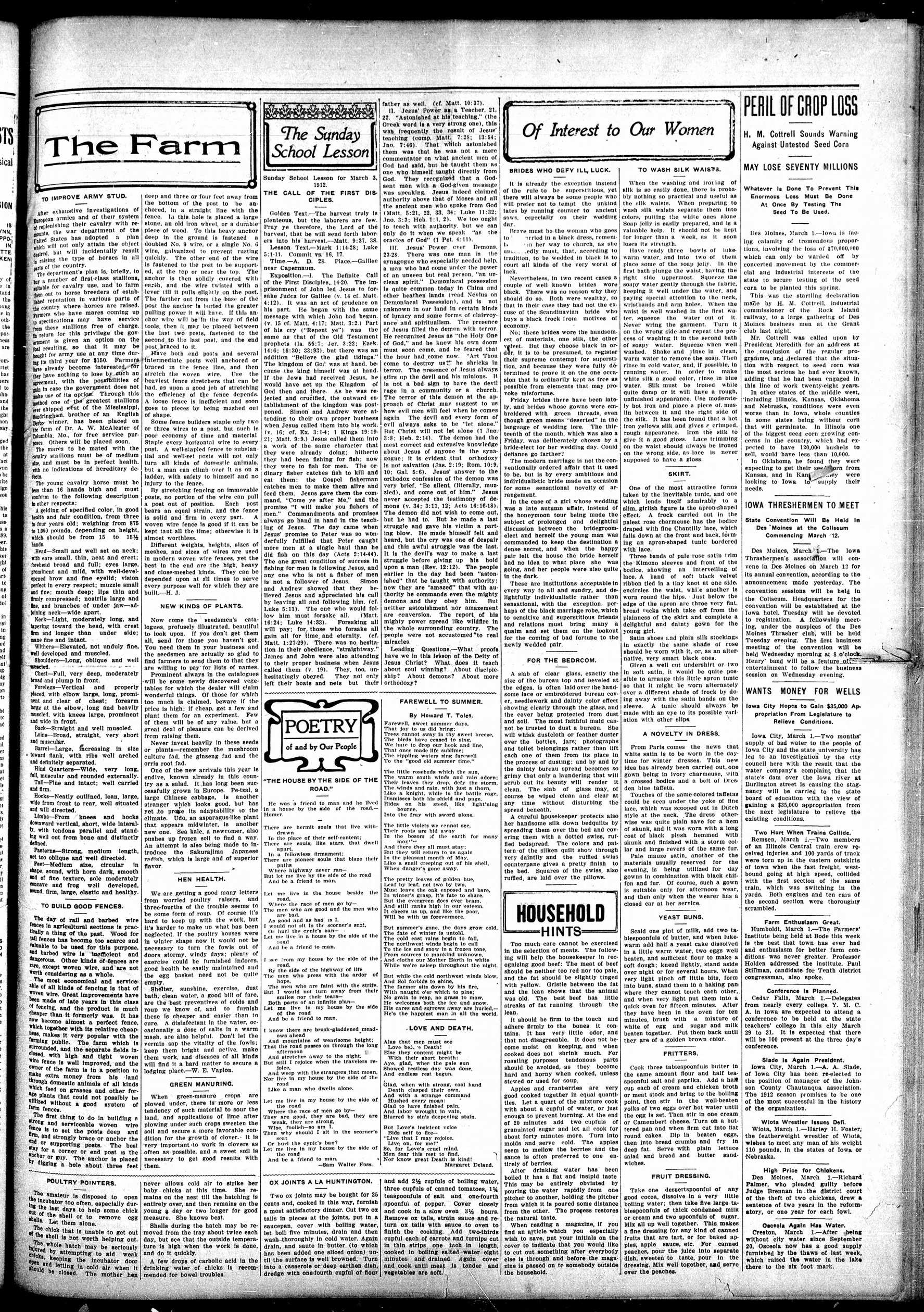
The Farm
‘ro IMPROVE ARMY STUD,
ine exhaustive Investigations of
Fyoepesn aries and of their system
PPerpienishing thelt cavalry with re:
ara the war department of ‘the
fied states bas adopted a plan
Tul wil not only attain the obsect
Bia, but will Incidentally result
“feising the type of horses in all
Pats ofthe cOUNKEY
erp “jepartment’s plan is, briefly, to
“qa niniber of first-class stallions,
Miatle for cavalry use, and to farm
fim out to horse breeders of estab:
Pit reputation in various parts of
fresontry where horses are raised.
ners who have mares coming up
Piecitcations may have service
fea these stallions free of charge.
-fesurn for this privilege the gov
Rust is given an option on the
tahvenulting, so that it may be
putt for army use at any thme dur
fy its third year for $160. Farmers
five already become fnterestedsf6r
ey have nothing to lose by.stich an
Mreement, with the possfbilities of
«fib in case the government does not
fie use of ite optiow. Through this
Pitted one of. the’ greatest stallions
Fir shipped. x@st_of the Mississipp!,
fuiringha. brother of an English
sSety winner, has been placed on
ie form of Dr. A. W. Mcalester of
Sfunbia, Mo., for free service pur-
“pres Oihers will be placed soon,
“Mie mares to be mated with the
‘gnalry stallions must be of medium
fie, and must be in perfect health.
wih no indications of hereditary de-
fete
The young cavalry horse must be
ves than 16 hands high and must
‘exform to the following description
fetter respects:
A gelding of specified color,” In good
Yaath and fair condition, trom three
to our years old; welghing from 875
10 1000 pounds, depending on height,
wiich should be from 15 to 15%
ands.
Head—Small and well set on neck:
vith ears small, thin, neat and erect:
foreead broad and full; eyes. large,
oninent and mild, with well-evel-
tyeaed brow and fine eyelid; viston
perfect In every respect; muzzle small
tnd fne: mouth deep; Ips thin and
fraly compressed; nostrils large and
fee, and branches of under jaw—ad-
fining neck—wide apart.
Neck—Light, moderately long, and
fupering toward the head, with crest
fm and longer than under side;
‘ne fine and intact.
Withers—Elevated, not unduly fine,
‘wl developed and muscled.
Shoulders—Long, oblique and well
Chest—Full, very deep, moderately
‘woud and plump fn front.
Foreless—Vertical and properly
Bees, with elbow large, long, proml-
tent and clear of chest; forearm
linge at the elbow, long and heavily
mucled, with knees large, prominent
tad wide tn front.
Back—Stralght and well muscled.
Voine—Broad, straight, very short
td muscular,
Barrel—Large, fhereasing in size
tovard fank, with ribs well arched
124 defintely separated
Hind Quarters—Wide, very long,
fil, muscular and rounded externally.
Tall—Fine and intact; well carried
184 frm.
Hocks—Neatly outlined, lean, large,
vite from front to rear, well situated
tad will directed,
Lnbs—From “knees and hocks
dornvard vertical, short, wide Intoral-
t, with tendons ‘parallel and stand-
ig well out from bone and distinctly
detned.
Pasterne—Strong, medium length,
tet too oblique and well directed.
Fee—Medium ize, circular tn
stape, sound, with horn dark, smooth
ted of fino texture, sole moderately
amare and frog wall developed,
found, firm, large, elastic and healthy.
TO BUILD GOOD FENCES.
‘The day of rail and barbed wire
{neces in agricultural sections te prac
tally a thing of the past. Wood fo
Hal fences has become too scarce and
Inlutbe to be used for this purpore
‘a barbed wire 1s Inefficient and
faxgerous, Other kinds of tences are
fre, except woven wire, and are not
Werth considering as a whole,
‘The most economical and. service
‘e of all Kinds of fencing fs that of
Woven wire. Great improvements have
been mado of Inte years in this class
ot fencing, and the product {much
ayer than tt formerly was, Tt has
ew become almost a perfect fence,
Walch together with ite relative cheap
teas, makes it very popular with the
farming pubic. Tho farm whlch {s
furounded, and the separate felds In
Gloted, with high and tight woven
‘wite fence is well improved, and the
Qaer of the tarm tn in & position to
Make extra money trom his land
{trough domestic animals of all kinds
Which feed on Srasses and other for-
‘Me plants that could not Possibly be
Ailized without a good system of
term tences.
The first thing to do in butlding s
{0% and serviceable woven wire
fence Is to set the posta deep and
fu, ond strongly brace or anchor the
‘24 or ‘supporting posts. The best
#8 for a corner or end post 1s the
fitter or guy. The anchor ts placed
© Algeing '& hole about three fect
pepe
POULTRY POINTERS,
18 amateur fs disposed to open
‘the incubator too often, especially dur-
RE the inst days to help some chick
Aner the shell or to remove exe
shells. Let them alone.
(The chick that is unable to get out
M the abell ix Rot worth helping out.
te whole hatch may be seriously
aatted by attempting to ald” weak
Sts, Keebing the. Incubator “door
We 4 letting In cold als when It
PAA Wa cinag Orr ann
deep and three or four feet away from
the bottom of the post to be an-
chored, in a straight line with the
fence. 1a this. hole is placed a large
stone, an old Iron wheel, of a durable
plece of wood. To this heavy anchor
deep in the ground is fastened a
doubled No. 9 wire, or a single No. 6
wire, galvanized to prevent rusting
quickly. ‘The other end of the wire
Is fastened to the post to be support-
ed, at the top or near the top. The
‘anchor is then solidly covered with
earth, and the wire twisted with a
lever ull it pulls aligitly on the post.
The farther out from the base of the
post the anchor ts turted the greater
pulling power it will Rave. If thly an-
chor wire will be tn the way of feld
tools. then it may be placed between
the last two posts, fastened to the
second to the last post, and the end
post, braced to it.
Have both end posts and several
Mntermediate posts well anchored or
‘braced in the fence line, and then
stretch the woven wire, Use the
heaviest fence stretchers that can be
had, as upon a good job of stretching
the eMciency of the fence depends.
A loose fence Is inefficient and soon
Koes to pieces by being mashed out
of shape.
Some fence bullders staple only two
or three wires to a post, but such Is
poor economy of time and material
Staple every horfzontal wire to every
post, A well-siapled fence to substan
tial and well-eet posts will not only
tura all kinds of domestic animals.
but_a man can climb over It as on a
ladder, with safety to himself and no
injury to the fence.
By stretching fencing on immovable
posts, no portion of the wire can pull
| post out of position, Each post
bears an equal strain, and the fence
fs solid and firm in every part. A
woven wire fence 1s good if It can be
kept taut all the time; otherwise It is
almost worthless.
Different weights, heights, sizes of
meshes, and sizes of wires are used
in modern woven wire fences, yet the
best in the end are the high, heavy
and close-meshed kinds. They can be
@epended upon at ail times to serve
every purpose well for whlch they are
laa teeta
NEW KINDS OF PLANTS.
Now come the seedsmen’s cata.
logues, profusely fMlustrated. beautiful
to look upon. if you don’t get them
all, send for those you haven't got,
You need them in your business and
the seedsmen are actually so glad to
find farmers to send them to that they
aro willing to pay'for lists of names.
Prominent always in the catalogues
will be some newly discovered vere
tables for which the dealer will claim
wonderful things. Of those for which
too much 1s claimed, beware if the
price ts high: if cheap. get a few and
plant them for an experiment, Few
of them will be of any value, but a
reat deal of pleasure can be derived
from raising them.
Never Invest heavily in these seeds
or plants—remember the mushroom
culture fad, the ginseng fad and the
orris root fad.
One of the new arrivals this year is
endive, known already in this coun:
try ag a salad. It-has long been suc:
cessfully grown in Europe. Pectsal, a
large Chinese cabbage, is another
stranger which looks good, but has
yet .to praje {ts adaptability 10 the
climate, Udo, an asparagus-like plant
that appears midwinter, is another
new one. Sea kale, a newcomer, also
pushes up frozen soll to find a’ way,
‘An attempt 1s also being made to In.
troduce the Sakurajima Japanese
radish, whlch te large and of superior
flavor. \
HEN HEALTH.
We are getting a good many letters
from worrled poultry raisers, and
three-fourths of the trouble seems to
be some form of roup. Of course It's
hard to keep up with tke work, but
Ws harder to make vp what bas been
neglected. If the poultry houses were
in winter shape now It would not be
necessary fo turn the fowls out of
doors stormy, windy days: plenty of
exercise could be furnished indoors.
ood health be easily mainteined and
the egg basket need not be quite
empty.
Shelter, sunshine, exercise, dust
bath, clean water, a good bill of fare,
are the best preventives of colds and
roup we know of, and to furnish
these Is cheaper and ensier than to
cure, A disinfectant in the water, oc-
caslonally a dose of salts In a warm
mash. are also helpful. Don't let the
vermin sap the vitality of the fowls:
Keep them bright and active, make
them work, and diseases of all kinds
‘will find It'a hard matter to secure @
lodging place—W. E. Vaplon.
GREEN MANURING.
When green-manure crops are
plowed under, there 1s more or less
tendency of stich material to sour the
Iand, and applications of lime after
plowing under such crops sweeten the
soll and secure a more favornble con-
dition for the growth of clover.» It ts
very Important-to work Jn clovers as
often as possible, and a sweet soll 18
necessary to get good results with
‘ihinee.
never allows cold air to strike her
Daby chicks at this time. She re
mains on the nest till the hatching ts
entirely over, and then remains on the
young @ day or two longer for good
measure, She knows best.
Shells during the batch may be re-
‘moved from the tray about twice each
day, but sca that the outside tempera-
ture ts high when the work {s done,
and do tt quickly.
‘A few drops of carbolic acid In the
drinking water of chicks 1s recom-
‘ghenided: for bowel troubles:
The Sanday
School Lesson\\
Sunday School Lesson for March 3,
1912,
THE CALL OF THE FIRST DIS-
CIPLES.
Golden Text—The harvest truly 1s
‘plenteous, but the laborers are. few.
Pray ye ‘therefore, the Lord of the
harvest, that he will send forth labor:
ets Into his hurvest.—Matt. 9:37, 38.
Lesson Text-—Mark 1:14.28; Luke
5:11. Commit vs. 16, 17
Time—A. D. 28. Place.—Galllee
near Capernaum.
Exposition —I. The Definite Call
of the First Disciples, 1420. ‘The Im-
prisonment of Join led Jesus to for-
sake Judea for Galllee (v. 14 cf. Matt
4:12). It was an act of prudence on
his part. He began with the same
message with which John had begun
(v.15 ef. Matt, 4:17; Matt, 3:2.) Part
of his ery ("Repent ye") was the
same as that of the Old Testament
prophets (Is. 65:7; Jer. 9:22: Ezek.
4:6; 18:80; 28:92), but there was an
addition “Belleve the glad tidings.”
‘The kingdom of Go’ was at hand. be
cause the king himself was at hand.
If the Jows had received Jesus, he
would have set up the Kingdom’ of
God then and there. As he was re-
Jected and crucified, the outward es-
tablishment of the Kingdom was post-
poned. Simon and Andrew were at:
tending to thelr own proper business
when Jesus called them into his work.
(v.16: ef. EX, 3:14: 1 Kings 19:19.
21; Matt, 9:9.) Jesus called them into
a work of the same character that
they were already doing: hitherto
they had been fishing for fish: now
they were to fish for men. The or
Ainary fisher catches fish to kill and
eat them; the Gospel fisherman
catches men to make them allve and
feed them. Jesus gave them the com-
mand, “Come ye after Me,” and the
promise "I will make you fishers of
men.” Commandments and promises
always go hand in hand in the teach-
Ing of Jeaus. The day came when
Jesus’ promise to Peter was 80 won-
@erfully fulfilled that Peter caught
‘more men at a single haul than he
did fish on this day (Acts 2:14-44).
The one great condition of success in
fishing for men Is following Jesus, and
‘any one who Is not a fisher of men
fg not a follower of Jesus. Simon
‘and Andrew showed that they be-
Veved Jesus and appreciated hie call
by leaving all and following him. (cf.
Luke 5:11). The one who would fol
low him must forsake all. (Matt.
16:24; Luke 14:93). Forsaking all
‘will pay: for, those who forsake all
gain all for time, and eternity. (cf.
Matt. 1:27.29). There was no, hesita-
tion in thelr obedience, “stralghtway.”
James and Jobn were also attending
to thelr proper business when Jesus
called them (¥. 18). They, too, un-
hesitatingly obeyed. ‘They’ not only
left their boats and nets but thetr
. —=_ 3
1 POETRY 1
of and by Our People
OR eS See ee ae
ROAD."
He was ‘a friend to man and he lived
na house’ by the side of the rond.—
Homer
‘here are hermit goule that lve with-
In the place of thelr self-content;
‘There are noula, Ike ‘stars, that dveell
‘apart,
In i feliowtess firmament:
‘there are ploneer souls that blaze thelr
paths
Where highway never ran—
‘But let me live by the side of the road
‘And be a felend to man,
Let me tive In te house beside the
road,
where ihe race of men go by
‘The men who are good and the men who
fare bad.
As good tid as bao T
1 feould not sit in the scorner's seat,
Oe huel the eynic's pan
a mie inhouse By the ald of the
And he m friend to man,
1 see srom my house by the side of the
oud.
hy the slde of the highway of life
‘The men Who press with the ardor of
hope,
‘rhe men who are faint with the strife
gut T "would not turn away from thelr
tmillem nor thelr tours
Both parts of an tnflnite plan—
Lat ime live. in my house by the age
of the road
‘And be'n friend to man.
1 know there are brook-gladdened_mend-
‘owes ahead e
And mountains of wearisome height:
‘That the road passes on through the long
‘atternoon é
And atrotelor away to the night,
But mill T rejolee when the travelers re-
jolee, |
Ana weep with the strangers that moan,
Nor live in my house by the side of the
road
ake’a man who dwells alone.
Let me live In my house by the alde of
the road
“where the race of men go by—
hey nre. wood, they are bad, they aro
‘veal, they re a{FONR,
wise, foollsh—so am T.
when why should Tait In the scorner's
‘or hurt the eynic's ban?
At melee in my house by the ale ot
the road
And be'a frlend to man. ‘
gam Walter Fess:
0X JOINTS A LA HUNTINGTON.
‘Two ox joints may be bought for 25
cents and, cooked in this way, furnish
fa most satisfactory dinner. Cut two ox
talls in pleces at the Joints, put in a
saucepan, cover with dolling water,
let boll five minutes, drain and then
wash-thoroughly In cold Water. Again
Grain, and saute in butter (to which
hhas been added one sliced onion) un-
il the surface ts well browned, Turn
into @ casserole or deep earthen dish,
dredge with one-fourth cupful of flour
father, a8 well. (Ct. yee
M1, Jeeua’ Power ag, 8 Teacher, 21.
22, “Astonished at hls teaching.” (the
Greek word Ina very strong one), this
way frequently the result of Jesus’
teaohing (comp, Matt, 7:28; 18:64;
Jno, 7:46). That wiilch astonished
them was that he was not a mere
commentator on what ancient inen of
God had xald, but he taught them as
one who himself taught directly from
God. They recognizéd that a God-
sent man with a God-given message
was speaking. Jesus indeed claimed
authority above that of Moses and all
the anelent men who spoke from God
(Matt, 5:21, 2%, 38, 94; Luke 11:22:
Jno. 3:3; Heb. 1:1. 2). We too ought
to teach with authority. but we can
‘only do ft when we speak “as the
oractes of God” (1 Pet. 4:11.
IM, Jesus’ Power ever Demons.
22.28. There was one man in the
aynagogue who especially necded help,
‘a inen who had come under the power
of an unseen but real person, “an un:
clean spirit." Demoniacal possession
fg quite common today in China and
othor heathen lands. (read Nevius on
Demoniacal Possession), and ts not
unknown In cur land in certain kinds
of lunacy and some forms of clairvoy.
ance and spiritualism. ‘The presence
of Jesus filled the demon with terror.
He recognized Jeaus as “the Holy One
of God,” and lie knew his own doom
must soon come, and te feared that
the hour had come now, "Art Thou
come to destroy us?” he shrieks In
terror. ‘The presence of Jesus always
tira up the devil and his minions. It
Is not a bad sign to have the devil
‘rage In a community or a church.
‘The terror of thls demon at the ap-
proach of Christ may suggest to us
how evil men will feel when he comes
again ‘The devil and every form of
‘evil always asks to be “let alone.”
‘But Christ will not let alone (1 Jno.
3:8; Heb, 2:14). The demon had the
‘most correct and extensive knowledge
about Jesus of anyone In the syna-
rogue; it Ia evident that orthodoxy
Is not salvation (Jas. 2:19; Rom, 10:9,
10; Gal, 6:6). Jesus’ answer to the
orthodox confession of the demon was
very brief, “Be allent (Iiterally, muz-
zled), and come out of him." Jesus
never accepted the testimony of de
mons (v. 34; 8:11, 12; Acts 16:16-18).
‘The demon did not wish to come out
but he had to. But he made a Iasi
struggle and gave his victim a part
ing blow. He made himself felt and
heard, but the cry was one of despair
and thie awful struggle was the last
It fs the devil's way to make a last
struggle before giving up his hold
upon a man (Rey. 12:12). The people
earlier in the day had been “aston
ished” that he taught with authority:
now they are “amazed” that with au-
thority he commands even the mighty
demons and they obey him. But
neither astonishment nor amazement
are conversion, The report, of bis
mighty power spread like wildfire tn
the whole surrounding country. ‘The
Deople were not necustemed “to rea
Leading Questions. —What _ proofs
have we In this letson of the Deity of
Jesus Christ? What, does it teach
about soul winning? About disciple
‘ship? About demons? About more
orthodoxy?
FAREWELL TO SUMMER.
mo Nenad T."Tolak
Farewell, sweet summer days,
‘That Joy to us did bring:
‘Trees cannot sway In thy aweet breeze,
‘The birda have ceaned to sink.
We hinte to drop our hook and tne,
‘That once made tie sublime:
‘The rippling waters sing farewell
"To the "good old summer time.”
The Mttle rosebude which the sun,
‘The warm south ‘winds and. ratn’ adorn:
Thelr Teaver they drop, defy the storm,
‘The winds and rain, with just a thorn,
Like a knight, whtie tn the battle rae,
Dismiases both ie shield and page,
Rigen on hls steed, like "ight'ning
‘bourne,
Into the fray with sword alone.
‘The litte violets we esnnot see,
‘Their roots are hid away
Inthe ‘bosom 3€ the earth for many
And there they all must stay:
‘But thes. wilt return to ue again
In the pleasant month of May
Like: ‘snail creeping out of his shell,
When danger's gone away.
‘The pretty: Leaver of golden hue,
Leat'by leat, not two by (0.
Must Teave the oak exposed and bare,
In winter's grasp, It's fate to share,
But the evergreen does ever bear,
And sll ranks high tn ‘ur esteem,
Te cheers ts up, and tke the poor,
‘Will be with Us forevermore,
But summer's gone, the days grow cold
‘The fato of winter ia untold.
‘Tho cold east raine begin to fall
‘The northwest winds begin to call
‘To the ice and snow In.a frozen tone,
From sources to mankind unknown.
And elothe our Mother Earth In white
White we're asieep throughout the night
But while the cold northwest winds biow,
‘Ana Sol forbide to ahine,
‘The farmer site down DY his tre,
With naught o'er which to pine:
No grain to reap, no grass to mow,
He ‘welcomes both the fee and. snow.
Hie cares and sorrows away are Hurled.—
Five the bapulent cain on a8 thy orarid.
-LOVE AND DEATH,
Alan that men must ace
Love bese Death!
Else they content. might be
‘With thelr ahort breath:
Aye, lad, wher the pale sun
Showed restless day waa done,
‘And’ endless ‘rest begun.
ina, when with strong, coo! hand
Denth ‘clasped thelr on,
And with 1 atrange command
Hushed every moun:
Glad to have Aalshed pain,
‘And labor wrought in vain
Blurred by ‘sin's deopentng stan.
But Love's insistent volee
Bide welt to fee
“Live that T'may rofolee.
Live on, for me!
80, for Love's cruel mind,
Men foar thie est. to nd, >
Nor know great Death ts kind!
‘Margaret Deland.
‘and add 2% cupfuls of boiling water,
three cupfuls of canned tomatoes, 1%
teaspoonfuls of salt and one-fourth
spoonful of pepper. Cover closely
‘and cook in a siow oven 3% hours,
Remove ox talis, strain sauce and re-
‘turn ox tails with sauce to oven to
fintsh the cooking. Add twothirds
‘cuptul each of carrota.and turnips eut
in thin strips. one. inch in length,
cooked in bolling saite’ water. eight
minutes and drained. Again cover
‘and. cook until mest is tender, and
‘vegetables are soft. Ns
Of Interest to Our Women
BRIDES WHO DEFY ILL, LUCK.
it fe already the exception instead
of tho. ule tobe. superstitious, Jet
there mill always be tonie peaple who
will prefer not to tempt. the unin
Tates by ronning counter to. ancient
sown, especially on thelr wedding
ay
rave must be the woman who goes
to’ verted tna binck dress, remem
te yu her way to chuireh, as ale
ta. cedly must, that, necordlng to
tradition, to be wedded In black In to
Court all Kinds of the very, worst of
tek
Nevertheless, In {wo recent cases &
couple of well known rides wore
binck, ‘There wae no reason why thes
howld do wo. Doth were wealthy, £
{hat In thelr ease they hid not the &
tune of the Scandinavian bride Who
thugs a black frock from motives” of
economy,
No, these brides wore the handsom
cst of materials, one silk, the other
sgn in hey choose bak I or
aGe IC te to be presumed, to register
their supreme. conterapt for” supers
tion, and because they were {lly dé
termined to prove It on the ode occk
ston that Is ordinarily kept as tree us
“poasble rom elements tat tay ro
‘Toke misfortune.
Friday brides there have boon late
ly. and brides whose gowns were om
broldered with green threads, even
though green means “deserted” in te
Hangnage of wedding lore, The thir
‘tenth af the month, which was also
Friday. was deliberately chosen bY 3
tridesiect for her wedding day. Covi
Aefiance go farther?
the madorn marriage Is not the com
ventlonally ordered affair that 1 used
to be, but is by every ambitious and
Individuallstle Bride inade an occasion
for some sensational ‘novelty of ar
rangement.
in the case of a girl whose wedding
was a late autumn wffalr, Instead 0
the Honeymoon tour belns made the
ubject of prolonged and delight
Aiscussion between the bridegroom
‘lect and herselt the young man ‘Was
commanded to Keep the destination
dense secret, and when. the app)
pair left the house the bride hersel
Ind no Idea to what place sho Wa
foing, and her people were also quite
tn the dark.
‘These are Insitutions acceptable in
every may to all and nundry, and ce
Highefully Inetvidvalistle rather than
fansational, with the exception. per
haps of the black marriage robe, wet
to senultive and superstitious friends
tnd relations must. bring. many
Qualm and set them on the lookout
for the coming of bad fortune to th
anly Wedded gale:
FOR THE BEDRCOM.
A slab of clear glass, exactly the
size of the bureau top and beveled at
the edges, {s often Inid over the hand-
some lace or embroidered bureau cov:
er, needlework and dainty color effeet
showing clearly through the glass, and
the cover belng protected trom dust
and soll, The most faithful mata can-
not be trusted to dust a bureau. She
will whisk dusteloth or feather duster
over the bottles, Jars; photographs
and tollet belongings rather than lift
each one of them from its place In
the process of dusting: and by and by
the dainty bureau spread becomes so
grimy that only a laundering that wilt
scrub out sts beauty will render tt
clean, ‘The sinb of ginss may, of
course be wiped clean and clear at
any Ume without disturbing the
spread beneath.
‘A careful housekeeper protects also
her handsome silk down bedquilts by
spreading them over the bed and cov:
ering them with a dotted swiss, ruf-
fled bedspread. The colors and pat-
tern-of the silken quilt show through
very daintlly and the ruffled swiss
counterpane gives a pretty finish to
the bed, Squares of the swiss, also
ruffled, are laid over the pillows.
‘Too much care cannot be exercised
fn the selection of meats. The follow:
ing will help the housekeeper In rec-
ognizing good beef: The meat of beef
should be nelther too red nor too pale,
and the fat should be slightly tinged
with yellow. Gristle between the fat
and the lean shows that the animal
was old. The best beef has little
streaks of fat running through the
ean,
it should be firm to the touch and
adhere firmly to the ones it con:
tains, It has very little odor, and
that not disagreeable. It does not be-
come molst on keeping, and when
cooked does not shrink much. For
roasting purposes tendonous parts
should be avolded, as they become
hard and horny when cooked, unless
stewed or used for soup.
‘Apples and cranberrles are very
good cooked together in equal quanti.
tles, Let a quart of the mixture cook
with about @ cupful of water, or just
enough to prevent burning. At the end
of 20 minutes add two cupfuls of
gramulated sugar and let all cook for
‘about forty minutes more. ‘Turn into
molds and serve cold. ‘The apples
seem to mellow the berries and the
sauce Js often preferred to one en-
rely of berries.
‘After drinidng water has been
dolled {t has a flat and insipid taste
‘This may be entirely obviated by
pouring the water rapidly from one
pitcher to another, holding tRe pitcher
from which It 1s poured some distance
from the other. The progess restores
the natural taste.
‘When reading a magazine, if you
find an article which you especially
wish (o save, put your initials on the
cover to indicate that you would tke
to cut out something after everybody
else fe through and before the maga:
nee passed on to somebody outa
‘the household.
TO WASH SILK WAISTS.
When the washing and iroring of
ilk is #0 ensily done, there tx proba:
bly nothing so practical and useful as
the silk waists. When preparing to
wash silk walsts separate them into
colors, putting tke white ones alone
‘Soap Jolly is esslly prepared, und 1s @
valuable help, It shonld not be kept
for longer than a week, as It soon
Tones Its atrength.
Haye ready three bowls of luke
warm water, and Into two of them
place some of the soap Jeliy. In the
first bath plunge the waist, having the
right side uppermost. Squeeze the
soupy water gently through the fabric,
keeping Mt well under the water, and
paying special attention to the neck,
wristbands and arm holes. When the
waist t well washed in the first wa-
ter, equeoze the water ot of I
Never wring the garment. ‘Turn it
fon the wrong side and repeat the pro:
cons of washing It In the second bath
Of soapy water. Squeeze when well
washed, Shake and inse in clean,
warm water to remove the goap. ‘Then
Finge In cold water, and, If possible, tn
running water, In order to make
white silk a good color, rinse in bine
water. Sk must be troned while
quite damp or it will have a rough,
unfinished appearance. Use moderate:
ly hot iron and place a piece of. mus:
lin between it and the right side of
the silk. It has been found that 4 hot
fron yeliows silk and gives r crimped,
rough appearance. Iron the silk to
give St a good gloss. Lace trimming
fon the waist should always be Ironed
fon the wrong side, as lace Is never
suppcesd to have: & s000.
‘SKIRT,
One of the most attractive forms
taken by the Inevitable tunic, and one
which lends {tself admirably to @
slim, girlish igure is the apron-shapett
effect. A frock carried out in the
paleat rose charmeuse has the bodice
draped with fine Chantilly Ince, which
falls down at the front and back, fo1m:
Ing an apromshaped tunic bordered
with lace.
‘Three bands of pale rose satin trim
the ‘Kimono sleeves and front of the
bodice, showing un Intervelling of
lace. A band of soft black velvet
ribbon tled In a tiny knot at one side.
encircles the waist, whi'e another ts
worn round the hips. Just helow the
edge of the apron are three very fat
broad tucks which take off from the
plainness of the skirt and complete a
delightful and dainty gown for the
young eit.
Satin shoes iad plain silk stockings
in exactly the same shade of rose
should be worn with it, or, as an alter:
native, very smart black ones.
Given a well cut undershirt or two
In soft satin, it would be quite pos:
sible to arrange this little apron tunic
80 that it might be worn alternately
over a different shade of frock by do-
ing away with the satin bands on the
sleove. A tunic should always he
made with an eye to its possible vark
ation with other slips. ‘
(A NOVELTY IN DRESS,
From Paris comes the news that
white satin Is to be worn in the day:
time for winter dresses. ‘This new
Idea has already been carried out, one
gown belng in tvory charmeuse, ‘vith
8 crossed bodice and a belt of ‘Dres
den blue taffeta.
Touches of the same colored tamfetas
could be seen under the yoke of tine
lace, which was scooped out In Dutch
style at the neck, ‘The dress other
wise was quite plain save for a hem
of skunk, and it was worn with a long
coat of black plysh hemmed with
skunk and finished with a storm col:
lar and large revers of the same fur.
Pale mauze satin, another of the
materials usually reserved for the
evening, 18 being utllized for day
gowns in combination with black chit
fon and fur. Of course, such a gown
[Is guitable only for afternoon wear,
and then only when the wearer has a
closed car at her service,
YEAST BUNS.
Scald one pint of milk, add two ta
blespoonfule of butter, and when luke-
warm add half a yeast cake dissolved
in a little warm water, two eggs Well
beaten, and sufficient flour to make a
soft dough; knead lightly, stand aside
over night or for several hours. When
very light pinch off little bite, form
Into buns, stand them in a baking pan
where they cannot touch each other,
and when very light put them Into 8
quick oven for fifteen minutes. After
they have been in the oven for ten
minutes, brush with a mixture of
white of egg and sugar and milk
beaten together. Put them back unt
they are of a golden brown color.
FRITTERS.
Cook three tablespoonfuls butter ta
the same amount flour and half tea-
spoonful galt and paprika, Add a hak
cup each of cream and chicken broth
for meat stock and bring to the boiling
point, then stir in the well-beaten
yolks of two eggs over hot water unttt
the ege {8 set. Then stir In one cream
‘or Camembert cheese. Turn on a but-
tered pan and when firm cut into tiat
round cakes, Dip in beaten eggs,
then into bread crumbs and fry in
deep fat. Serve with plain lettuce
salad and bread and butter sand-
wiebes.
FRUIT DRESSING.
‘Take one dessertspoontul of any
‘good cocoa, dissolve In a very Iittle
bolling water; then take five large ta-
Diespoontuls of thick condensed milk
or cream and two spoonfuls of sugar,
Mix all up well together. ‘This makes
fa fine dressing for any kind of canned
fruits that are tart, or for baked ap-
ples, apple sauce, etc. For canned
peaches, pour the Juice into separate
lsh, sweoten to. taste, pour in the
dressing, Mix well together, aud serve
“ovar the peaches: z
H. M, Cottrell Sounds Warning
Against Untested Seed Corn
MAY LOSE SEVENTY MILLIONS
Whatever 1s Done To Prevent This
Enormous Love Must Be. Done
‘At Once By Testing The
Seed To Be Used.
Des Moines, March 1.—lowa is face
ng calamity of tremendous propor
tions, {avolving the loss of $70,000,000
which can only bo warded of by
concerted movement by the commer-
cll and industrial interesta of the
state to secure testing of the seed
corn to be planted this spring.
‘This was the startling dectaration
mato by H. M. Cottrell, industriat
commissioner of the Rock Island
railway, (0 a Inrge gathering of Des
Moines’ business men at the Grant
club last night,
Mr, Cottrell was called upon by
President Meredith for an address at
the conclusion of the regular pro-
srosime, ond declared that the situa-
tion with respect to seed corn was
the most serious he bad ever known,
adding that he had been engaged in
this line of work twenty-eight years.
Im other states of the middle west,
‘including linois, Kansas, Oklahoma
fand Nebraska, conditions were even
worse than In Towa, whole counties
in some states beng without corn
‘that will germinate, In Iitinols one
‘of the biggest seed corn growing con-
cerns In the country, which had ex:
‘pected to have 120,000 bushels. to
ell, would have tess than 10,000,
“tn Oklahoma he found they were
expecting to get thelr see,ihorn from
Kansas ‘and n Kang oy were
looking to Towa td~aupply thelr
needs.
‘ow THRESHERMEN TO MEET
State Convention Will Be Held In
Des "Moines at the Coliseum
‘Chuang March AE
Des Moines, March’1—The lowa
Thrashermen's associdflon will con-
vene ia Des Moines on March 12 for
its onnual convention, according to tho
announcement made yesterday. ‘The
convention sessions will be beld in
the Coliseum. Headquarters tor tho
convention will be established at the
Towa hotel. ‘Tuesday will be devoted
to registration, A. fellowship met
ing, under tho auspiees of the Des
Moines Thrasher club, will be held
‘Tuesday evening. ‘The frst Dusiness
meeting of the convention will be
held Wednesday morning at 8 o'clock,
Henry’ band will be a feature.off==
entertainment to follow the business
session on Wednesday evening.
WANTS MONEY FOR WELLS
lowa City Hopes to Gain $25,000 Ap.
propriation From Legislature to
Relieve Conditions.
Jowa City, March 1—Two months!
supply. of bad water to the people of
Towa City and the state university has
ed to an Investigatioa by the city
council here with the result that the
Svater company's complaing that the
state's dam over the Towa river at
Burlington street 1s causing the stag-
nancy will be carried to the state
Doard of education with the view of
gaining 8. $35,000 appropriation {rom
the next legislature’ to relieve the
existing conditions,
‘70s: Wisc ee “Sos ened:
Remsen, March i—Two members
of an Mlinols Central train crew re-
celved injuries and 100 yards of track
wero torn up in the eastern outskirts
of town when the fast freight, west-
bound going at high speed, collided
with the first section of the same
train, which was switching in the
yards, Both engines and ten cars of
the second section were thoroughly
scrambled,
Farm Enthusiasm Great.
Humboldt, March 1—The Farmers’
Inatitute being held at Bode this week
fs the best that town has ever had
and enthusiasm for better farm con-
ditions was never greater. Professor
Holden addressed the institute. Paul
Stillman, candidate for Tenth district
congressman, also spoke.
Conference Is Planned.
Cedar Falls, March 1.—Delegates
from nearly every college Y. M. C.
A. in Iowa are expected to attend a
conference to be held at the state
teachers’ college in this clty March
29 to 31. It Is expected that there
will be 100 present at the three day's
conterence.
Slade Ie Again President.
Iowa City, March 1—A. A, Slade,
of Towa City has been reelected to
the position of manager of the John-
son County Chautauqua association.
Tho 1912 season promises to be one
of the most successful in the history
of the organization.
SE Ee
Wiota, March 1—Harley H. Foster;
the featherweight wrestler of Wiota,
“‘wlohes to meet any man of his welght
110 pounds, in the states of Iowa or
‘Nebraska,
High Price for Chlokens.
Des Moines, March 1.—Richard
Palmer, who pleaded gullty before
Judge Brennan inthe district court
of the theft of two chickens, drew a
sentence of two years In the reform:
tory, or one year for each fowl.
Osceola Again Has Water.
Creston, March 1—After jpelng
without city water since September
20, Osceola now has a good supply
furnished by the thaws of last week,
which raised the water in the Ike
‘there: to the six foot: mark.
Fenimore the two year old son of Mr. and Mrs. Roy Fiel's died last Saturday evening at 6 o'clock at the family residence 1727 Main street. The little one was sick but a few days with pneumonia. Of the immediate relatives there survives the little one aside from his parents a baby, brother Thurman Leroy, Mr. Frank Fields, grandfather, Mr. and Mrs. Samuel Webster great grand parents, Mr. Ed. Robertson grand father and a number of Uncles and aunts who have the deepest sympathy of a sorrowing concourse of friends. Little Fenimore was a sweet child, loved by all. Burial took place in the family lot in Oa'land cemetery.
Little angel thou art free from sorrow.
An the trials of each toils me day,
Free from all the cares we borrow
As we tread life's rugged way,
Your smiling face we'll see no more
But our Saviour's voice we must obey.
When the storm of life is o'er
We shall meet the some sweet day.
Rev. Wm. Brown, former pastor of Seventh street Baptist church was banqueted at the Frye restaurant last Wednesday at 1 oclock by the members of the Ministerial Alliance. A bountiful 3-course repast was served. The affair being complimentary to the Rev. Brown's expectancy to soon locate in another field. Those present were Revs. J. Prewer, D. W. Anderson, Collins, Lowe, Grant and David Cross.
Mr Joseph Fields of St. Louis, Mo,
arrived in the city Sunday evening to attend the funeral of his little uephew,
Fenemore Fields.
The snow storm that reached our city last Sunday evening is given credit for recent conjecture that Mr. Arthur Frye was a little premature in the announcement of his pre-arranged excursion plan.
One of the most social functions of the season was the Washington tea party that was enjoyed by a number of invited guests last Thursday evening at the home of Mr. and Mrs. Wm. Coleman 1213 Morgan street. The rooms were tastily decorated with flags. A large one which was draped with artistic effect was a gift of the guests. The table was decorated with flags interspersed with souvenir hatchets, each place card, beearing a patriotic emblem. The viands were such as would appeal to the most fastidious. At a late hour the guests felt loathe to depart with an expression of regret that Washington's birthday only came once a year.
Fire destroyed the property last Friday morning on Ninth and Main streets occupied by Luther Harden restaurant keeper. Mr. Wilson's barber shop and the Frye restaurant. Mrs Frye expects to continue in business if a desirable location can be secured. The ladies will all be given a chance to spend their money, Tuesday night at the Leap Year entertainment at Pilgrim's Rest church, under the auspices of the Willing Workers. Mr. J. O Boyd (white) addressed the Young Men's club at Bethel on the 18th inst. Much valuable information was gleaned by this forceful speaker. His pictures were varied and beautiful in effect, leaving an impression that reflects upon the inermen. We would that his talk might be printed in full. The young men of the Lecture club are to be congratulated upon the work they are doing.
An entertainment will be given at the Seventh Street Baptist church the 14th of March. It is hoped that a large attendance will be present an appeal is made to all sympathizers of the historic church, which was organized in 64 to come out and assist in what is properly a farewell within the walls of our present site.
Miss Marie Lewis has been suffering with a neuralgic tooth which has kept her out of school for several days.
Friends from out of town are invited to attend the Easter Ball gtven by the Jolly Bachelors. Wednesday, Apsil 17th: Committee, Chas. W. Owents, Ora S. Bates, Robt Scott, the condition of Sy. Boyd who has been seriously ill with typhoid fever at his home 1217. Morgan street for the past week is improving slightly.
Mr. William Rush is president of the Sunday lecture club They are giving some very interesting program.
As we are about to close our news for the week, we are informed of a surprise wedding whic occurred at the home of Mrs. Fannie Tavis. Monday afternoon in which Miss Jessie Johnson became the bride of Mr. Lewis Wilson. They are two well known young people and their many friends wish for them a long and happy married life. They will reside at 1211 Johnson street.
The Coleridge Taylor Music club held its regular monthly recital, Thursday evening, Feb. 22, at the home of Mr., and Mrs. Everet Holmes 316 North 12th street there was a splendid program and a large attendance. This being the anniversary of the birth of Geo. Washington. The home was tastily decorated with flags and hatchets were in evidence everywhere.
DAVENPORT NEWS.
There is a campaign on among the ministers of the city to improve church attendance. Twenty-three yellow colored boys ranging in age from fifteen to twenty have organized an athletic improvement club, with the following officers: Maison Cain, Pres., Webster E. Stovall, Vice-Pres., Lyman Shepard, Sec., Wm. Clark, Treas. The club will meet every Sunday afternoon, at Bethel A. M. E. church. Mrs. C. H. Marshall is manager. The boys will be installed in office March 6th. Mr. and Mrs. James Bailey will leave our city in a few days to take up their residence in Texas.
Mre. L. J. Phillips who has been visiti-
tress her husband Rev. L. J. Phillips at
Milwaukee Wis has, returned home delighted with her trip.
Rev. Toomey is having good success conducting the revival meetings at the Third Baptist church. Eleven have been added to the church. There are six candidates for baptism and will be baptised Sunday, March 3d.
Rev. Toomey has accepted the call extended to him by the Third Baptist church. The call was extended him Friday night. His family is here with him.
The Violet club was entertained by Mrs. James at the residence of Mrs. Cain.
Mr. and Mrs. Wm. O'Neal has been confined at their home on account of illness for the past ten days. Mrs. O'Neal has a very bad eye and Mr. O'Neal with stomach trouble. They are some better at this writing
Mrs. Horace Barquet of Chicago is visiting Mrs. Twiggs and her mother, Mrs. Jones who is still sick.
Mrs. D. S. Johnson and little Evangeline Garter were callers at the A.M.E. parsonage last Friday afternoon. They were also callers at the residence of Mr. M. M. McGaw and Mrs. Rosie Corbin on Gains street.
Mrs. L. A. Porter will preach his trial sermon, Thursday evening at the A. M. E. church.
Rev. T. B. Stovall was making his pastoreal calls this morning.
Mrs. D. S. Johnson entertained a few friends at birth day party last Thursday, from 3 to 5 p.m., she received quite a few pieces of hand painted china as tokens in honor of her birthday.
Master Allen Bean is one of the contestants for one of the prizes given by the Bystander. Hope all will help him.
VIVIAN L. JONES
Funeral Director
ST. JOSEPH (MO.) NOTES
One of the prettiest pre-lenten parties that has yet been given this season was the one given at the beautiful home of Mr. and Mrs. R. L. Scott 2205 Sylvanie street, on Monday night of last week (even though this is leap year) about twelve of our prominent men decided that it was time to have a select social party, after a few meetings they decided on the above date and place while a formal functions. Yet some very petty costumes were worn by the ladies during the evening. A number of vocal and instrumental solos were rendered, also checkers, whist and dancing was enjoyed after which refreshments were served. These men expect to form a nucleus for a permanent civic educational and social club. A club of that kind with good officers and membership would fill a long felt want in its city.
Mr. Thomas Winn has accepted a position at the Robinson & Son's garage. He is a very careful driver and no doubt will give them good service in demonstrating their automobiles. "Jolly-John Larkin" and company in their new play, "Royal Sam" made their initial appearance in this city recently, and they gave a good performance. Their costumes and their female voices were superior to the Smart Set Company. Mr. Salisbury, an aged Afro-American was found dead in bed at the home last Saturday morning at the home of his daughter, Mrs. Wheeler 915 Messaine St. This death was due to heart disease, according to the statement of the coroner.
The Art club gave one of their delightful entertainments at the home of one of its members, Mrs. N. E. Hicklin 2515 Jones St. last Thursday night a large number of their friends were present to enjoy the pleasures of that evening. Women only are members of this club which is one of the active ones in this city. Rev. Geo. R. Jackson, the Evangelist of Quincy, which is assisting Rev. w. J. DeBal, pastor of the Mason Temple M. E. church with the revival meetings. He is a good speaker and singer and are the meetings close no doubt a number of conversions will be secured
Rev, E. S, Willett formerly of Des Moines, Iowa, but now pastor of the Episcopal church at Kansas City, Mo. Father Willett conducted services at St. Mathias Mission last Sunday morning. In the afternoon he delivered a short address. Subject: "The Episcopal church is the best of all for colored people," and at 8 p. m., he was the principe speaker at the Ebenezer A. M. E church his subject being some needs of our race as one of the worst snow storms in years was raging Sunday afternoon and evening, hence the attend-
FORD'S
HAIR POMADE
MAKES HARSH, KUNNY OR CURLY HAIR
GLOSSY, SOFTER AND MORE PLUBLE,
EASY TO GAME AND PUT UP IN ANY STYLE
NRS. A.M. POPE TURNBO PORO COLLEGE, 3100 BINE
VIEW OF BUILDING
HALL
FRONT VIEW OF BUILDING
DRAWING ROOM
OFFICE
WAITING ROOM
GIRLS SEVING ROOM
OPERATING ROOM
GIRLS DINING ROOM
"PORO" COLLEGE is a well equipped modern four-story building located at 3100 Pine street, in the city of St. Louis, Mo. Mrs. A. M. Pope-Turnbo, the proprietress, is a specialist in the treatment of the scalp and the growing of luxuriant, beautiful hair. Her college contains the most modern electrical apparatus and hundreds of women and girls receive the best scientific treatment there daily. In addition to this excellet opportunity afforded the people of St. Louis and vicinity, there are, under personal supervision of Mrs. Pope-Turnbo, a number of young women and girls who are learning the fundamental scalp care and the use of scalp resurfacing and luxuriant hair growing. In her factory (which is directly connected with the institution), Mrs. Pope-Turnbo has the most modern equipment and uses the best materials in the manufacture of her many specialties.
ance was not very large. Father Willet is a very pleasant and logical speaker, and those present were pleased with his addresses, and with good weather, he can rest assured that a large audience will greet him when he returns to this city in the future.
DAVENPORT NOTES.
Sunday was the A. M. E. Stewardesses day rally the program was an old time Methodist meeting which proved to be all right spiritually and financially.
The Rev. Mr. Toamey is awakening quite an interest in the revival he is conducting at the Third Baptist church. Mrs. Toamey joined the Reverend last Friday evening.
The late Jno. H. Woodard died at the county farm Monday evening, February 19th. He was buried at Oakdale Cemetery Tuesday afternoon from M. E. Balling undertaking parlors.
The Willing Workers. P. E. committee met at the A. M. E. parsonage Tuesday afternoon. The chairman, Mrs. Ella Delward, was delighted over the secretary's report. Mrs. Lulu Watts is the secretary and she is a good one.
The Eastern Star met in a special call meeting at the residence of Mrs. B. B. Bright, Tuesday afternoon. Mrs. Hattie Lambert, of South Rock Island was a Davenport caller Tuesday all day. The fuel and Light committee will render a George Washington program at the Danish Brotherhood hall February 28th. Committee of some 30 persons will all appear in full Washington costume. Mr. and Mrs. Wm. O'Neal of W. 9th street are both on the sick list. Forty boys, ages from 9 to 18 years, have banded together for a better life. You will hear from them later.
Special to Bystander.
Miss Helen Martin of Cedar Rapids, Iowa, is in the city visiting at the home of Mr. and Mrs. J. L. Brown.
A dance was given February 14 by the Morgan brothers of Des Moines. Quite a crowd attended and all reported a good time.
Mr. Otis Swan continues to slowly improve. We hope to see him out soon.
Those who have been o nthe sick list for the past week are Mr. and Mrs. J. L. Brown; Mr. Earl Humphrey; Mrs. Charles Allen.
Mr. Carl Brown, Misses Helen Brown, Clara Carter, Hardenia Gilmore, spent Saturday and Sunday in Toledo, Iowa. A dinner party was given on Sunday. The other out-of-town guest was Mrs. Ora Hudson, of Council Bluffs.
Mrs. Earl Humpney called a meeting of ten ladies and started an Art club, the club hasn't been named yet. After the business a luncheon was served. Officers were elected as follows: Mrs. W. O. Crawford, president; Mrs. I. L. Brown, vice president; Mrs. E. A. Humphrey, secretary; Miss Mayme Rederick, treasurer. Committees on different work to be taken up will be chosen later. The next meeting will be at Mrs. I. L. Brown's, 805 Woodbury St.
Miss Jessie Walker has returned from an extended trip through the
Northern Artificial Limb Company
SINGER Simplicity
These are three of the distinctive features that combine to make the Singer the easiest sewing, longest lasting, and best sewing machine made.
There is nothing intricate or fragile about it.
are so simply operated that any one can sew perfectly upon them, so strongly constructed that the roughest kind of misuse can hardly get them out of order, and they last for a lifetime.
Singer Sewing Machine Co.,
704 W. Walnut Street Des Moines, Ia.
Carefully selected choice healthy animals, killed under personal care and sold at rock bottom prices.
The benefits derived from this institution do not end in St. Louis. In addition to her already large patronage at the college, she has established a number of branch offices and many agents throughout the United States are supplied with articles manufactured at "PORO" COLLEGE and use the scientific sanitary methods employed there. By this means—and on the real merits of "Poro" products—she has established a lucrative trade in all of the states, in Canada and in Mexico. Thus "PORO" is achieving a wonderful success by giving the people a complete scientific sanitary method for scalp and hair treatment. Her method of treatment has having the ability to prevent the spread of diseases, for it is a fact that hair in unsanitary condition carries germs of deadly diseases which often prove fatal to innocent persons coming in contact with them. It would be well for every
East. She reports a very pleasant time. Mr. and Mrs. Galloway Johnson are the last w ing fir
Northern Artificial
MANUFACTURERS OF
Artificial Limbs
8
Trusses, Shoulder Braces, Artificial Arms, Apparatus for Elevated Feet and Shortened Limbs, all kinds of Brace Work for Deformities. Crutches and Elastic Goods.
Phone Walnut 5347
312-314
W. Seventh St. Des Moines, la.
SINGER
Simplicity
Strength and D
These are three of the distinctive
to make the Singer the easiest sewing
best sewing machine made.
There is nothing intricate or fragile
Singer Sewing Mach
are so simply operated that any one of
them, so strongly constructed that
misuse can hardly get them out of o
a lifetime.
Singer Sewing Mach
704 W. Walnut Street
HOME KIL
MEA
Carefully selected choice healthy
personal care and sold at rock bottom
SPECIAL DAIL
Soup Meat.....7c
Boiling Beef.....8c
Beef Roast.....10c
Sirloin Steak.....12½c
Choice Cut Porterhouse 14c
Flank Steak.....12½c
Rib Roast.....10c
Pork Lion.....11c
Pork Chops.....12c
Phone Walnut 2284
Photo by Sexton, 2339 Market St. St. Louis, Mo.
home to adopt this scientific method of treatment thus insuring cleanliness of scalp and hair. If there is no agent in your city or town, Mr. Pope-Tambo will inquire upon applying her method of treatment to who write to her. Simply address a postal to "Poro" College, 3100 Pine St., St. Louis, Mo., and you will receive the desired information.
Visitors receive polite and courteous attention when visiting the institution.
A diploma from "Poro" College represents competency in this science.
The girls are given free access to the sewing room, office and kitchen that may economize their time; perhaps moments either by explaining the typewriter, by learning to prepare economic, meals all, of which are essential to an enterprising young woman of this age.
are the proud parents of a son born last week. Mother and baby are doing fine.
A boy and a girl
icity,
Durability
active features that combine
sewing, longest lasting, and
fragile about it.
Machines
any one can sew perfectly upon
that the roughest kind of
at of order, and they last for
Machine Co.,
Des Moines, Ia.
KILLED
ATS
healthy animals, killed under
bottom prices.
DAILY
Pork Butts .....12½c
Side Pork.....10c
Pork Shoulder.....9c
Spare Ribs.....10c
Frankfort Sausage.....10c
Pork Sausage.....10c
Hamburger.....10c
Home Rendered Lard.....12½c
Boiled Ham.....20c
SHER
221 Locust Street
Miss Helen Warn who has been on the sick list is much improved.
There will be a dance given at the A. O. U. W. hall, Feb. 28, 1912. All get ready to attend.
Little Glorene Humphrey drew the lucky number and won a beautiful silk crochet poke bonnet. It is a very beautiful piece of work.
The A. M. E. church had a supper at the residence of Mr. and Mrs. C. Wheeler. Quite a few attended and a nice time was reported.
Mrs. Ross, of Buxton, is visiting at the home of her daughter, Mrs. W. D. Crawford.
We have nineteen colored children going to school. All were promoted to higher classes this semester. Two are in high school.
Those who have entertained Miss Helen Martin are Misses Clara Carter, Hardena Gilmore and Mrs. Henry Flippings.
Mrs. E. A. Humphrey is planning to have her pupils give a recital soon.
OTTUMWA NOTES.
Mr. Langhorn Cheatham, of Buxton, is here having his eye treated by a specialist. A piece of kindling he was cutting flew in his eye.
Mrs. James Hamilton of Chicago has returned home after a short visit with relatives and friends.
The Faithful Few society will meet with Mr. and Mrs. Wells Fowler on Plum street.
Quite a few young people attended the Valentine ball in Oskaloosa.
The Gideon Band met Sunday afternoon at the A. M. E. church. The next meeting will be held Tuesday evening with Miss Alberta Horne. All members are urged to be present. The Gideons are planning to do a great work in the near future. Mr. C. H. Wilson is our president. Mrs. C. H. Wilson has returned home after visiting relatives and friends in Oskaloosa. A chicken pie supper was given Monday evening, January 26th from six to ten o'clock by the Trustees Aid of the A. M. E. church. Everybody came and enjoyed a good supper. Mrs. Mary Taylor cooked the supper. Little Miss Dicey Beverly has been quite ill with pneumonia, but she is getting along nicely at present. Mrs. Henry Casen is still confined to her home on N. Marion street.
Tuesday night Richard Allen's anniversary was celebrated. A short program was rendered and the evening was a successful one. Miss Bernadane of Rutledge, who attends school in Otumwa is ill at her home. We hope for a speedy recovery.
Piles FIST
All Recta-
tion. N
aneaethet
last a LIE
WRITE FOR BOOK ON PILES AND REC
DR. C. Y. CLEMENT, 402 MARQU
BOSTON M
Greatest Variety
Choice Meats,
and Delicacies
We Strive to Pleas
Goods and Prompt
PHONE
All Rectal Diseases cured without a surgical operation. No Chloroform, Ether or other general anaesthetic used. CURE GUARANTEED to last a LIFETIME. EXAMINATION FREE. AND RECTAL DISEASES WITH TESTIMONIALS MARQUARDT BLDG. DES MOINES, IOWA
WRITE FOR BOOK ON PILES AND RECTAL DISEASES WITH TESTIMONIAL
DR. C. Y. CLEMENT. 402 MARQUARDT BLDG., DES MOINES, IOWA
N MARKET Co.
t Variety in the City of
Meats, Fish, Poultry
acies.
to Please with the Best of
Prompt Service
PHONE 765
320 Sixth Avenue
New Subscribers!
IN PRIZES
be added to our mailing list, the
word those whose efforts shall
are the Subscribers
GREAT CONTEST
one to assist us in securing the
New Subscribers; if so ask your friend
or to subscribe and send in their
with your renewel for a year and tell
your votes to be counted for in the
friend and help us.
1000 New S
50000 IN
The subsrcibers to be added
Prizes to reward those
secure the S
IN OUR GREAT
W
WILL you be one to
1,000 New Subscri-
or neighbor to su
subscription along with your r
us who you want your vot
contest. Help your friend an
The subscribers to be added to our mailing list, the Prizes to reward those whose efforts shall secure the Subscribers IN OUR GREAT CONTEST WILL you be one to assist us in securing the 1,000 New Subscribers; if so ask your friend or neighbor to subscribe and send in their subscription along with your renewel for a year and tell us who you want your votes to be counted for in the contest. Help your friend and help us.
Our Prize Contestants:
A. A. BUSH.....118
MISS HAZEL F. CLARK.....118
BAKER DIXON.....118
W. L. JONES.....118
MISS MARGURITE PERRY.....118
MISS FRANCIS REEDER.....118
J. A. TOLBERT.....118
MR. EDWARD YOUNG.....118
ALLEN BEAN.....610
MISS BLANCH ALLEN.....610
MISS D. MAE LEE.....610
MISS LIZZIE PRICE.....610
MRS. JORDAN EARLY.....
Cit
A. W. BRANHAM.....118
REV. P. S. ERVIN.....118
MISS JOSEPHINE GRIFFITH.....118
Clinton, Iowa
118 W. Division St., Ottumwa, Iowa
Wilberforce, Ohio
115 Bradley St., Mason City, Iowa
1820 N. Main St., St Joe, Mo
1419 Fulton St., Keokuk, Iowa
Fayette, Mo
Braxton, Miss
616 Eastern Ave., Davenport, Iowa
Enterprise, Iowa
Buxton, Iowa
Puxton, Iowa
Burlington, Iowa
City
519 East Court Avenue
A. A. BUSH.....Clinton, Iowa
MISS HAZEL F. CLARK.....118 W. Division St., Ottumwa, Iowa
BAKER DIXON.....Wilberforce, Ohio
W. L. JONES.....115 Bradley St., Mason City, Iowa
MISS MARGURITE PERRY.....1820 N. Main St., St Joe, Mo
MISS FRANCIS REEDER.....1419 Fulton St., Keokuk, Iowa
J. A. TOLBERT.....Fayette, Mo
MR. EDWARD YOUNG.....Braxton, Miss
ALLEN BEAN.....616 Eastern Ave., Davenport, Iowa
MISS BLANCH ALLEN.....Enterprise, Iowa
MISS D. MAE LEE.....Buxton, Iowa
MISS LIZZIE PRICE.....Puxton, Iowa
MRS. JORDAN EARLY.....Burlington, Iowa
A. W. BRANHAM.....519 East Court Avenue
REV. P. S. ERVIN.....410 East Seventeenth Street
MISS JOSEPHINE GRIFFITH.....625 East Second Street
MISS NELLIE LETRIDGE.....668 Nineteenth Street
MISS LILLIAN NEAL.....1306 W. Twentith Street
MRS. J. H. WOODS.....1421 Park Street
MRS. H. P. GRAVES.....762 Twelfth Street
N. B. --Beginning next week we will run the number of votes of each contestant; so send in your subscribers with the money at once.
Published every Friday by the
bystander Publishing Company, Des
Moines, Iowa. Office in Chemical
building, corner Seventh and Mub-
berry streets. Iowa phone, Wet
nut 899.
JOHN L. THOMPSON, EDITOR.
J. H. SHEPARD, MANAGER.
Entered at the postoffice as seco-
nd class matter.
TERMS OF SUBSCRIPTION
One year.....$1.5
Six months.....$3.0
Three months.....$5.0
All subscriptions payable in ad-
vance.
Send money by postoffice order,
money order, express or craft, to
the Iowa State Bystander Company
Des Moines, Iowa.
Communications must be written
on one side of the paper only and
be of interest to the public. "Bre-
tivity is the soul of wit," remember.
We will not return reflected man-
uscript, unless accompanied by post-
age stamps.
Advertising rates for display aids
20 cents per inch, for each insertion.
Three to six months' contract, 10
cents per inch. Local advertising
10 cents per line for each insertion
counting seven words to a line. For
churches and secret societies when
admission is charged, one-half of
the fee mentioned rates. For professional, legal, and announcement cards, yearly contracts, etc. terms are given on application. All advertising is to be paid in advance.
The Iowa State Bystander is the oldest Afro-American journal published in Iowa. It was established in 1894, and is read by nearly all the colored people of Iowa. We have correspondents in the following towns:
Miss May Dale Oskaloosa. Luella B Franklin Washington. N. L. Blair Burlington. Mrs. J. E. Johnson M. Pleasant.
Mrs. M. Burnsage
Monmouth, Ill. Georgia Norwood
Galesburg, Ill. Mayne Richardson
Peoria, Ill. Miss Bell Lee
Davenport, Mrs. C. H. Marshell
St. Paul. Mrs. Q. H. Hick
Rock Island. Mrs. W. H. Moor
Moline, Ill. Miss Mable Tarres
Sloux City. Miss Etta Gran
Clinton. A. A. Bash
Ottawa. Miss Lorena Vincenzo
Cedar Rapids. Mrs. H. W. Holmes
Colafax. Mrs. J. W. Holmes
Buxton. W. A. Brown
Enterprise. Miss Blanche Allee
Clarinda. Miss Eva M. Parkes
Keukun. Mrs. A. J. Field
Ottumwa. Miss Hazel F. Clarke
Moberly, Mo. Mrs. M. Etta Bolese
Minneapolis. H. K. Gibb
Ft. Madison. Miss Luh Wiliam
City
Des Moines, Iowa.