Iowa State Bystander
Friday, April 5, 1912
Des Moines, Iowa
Page text (machine-generated)
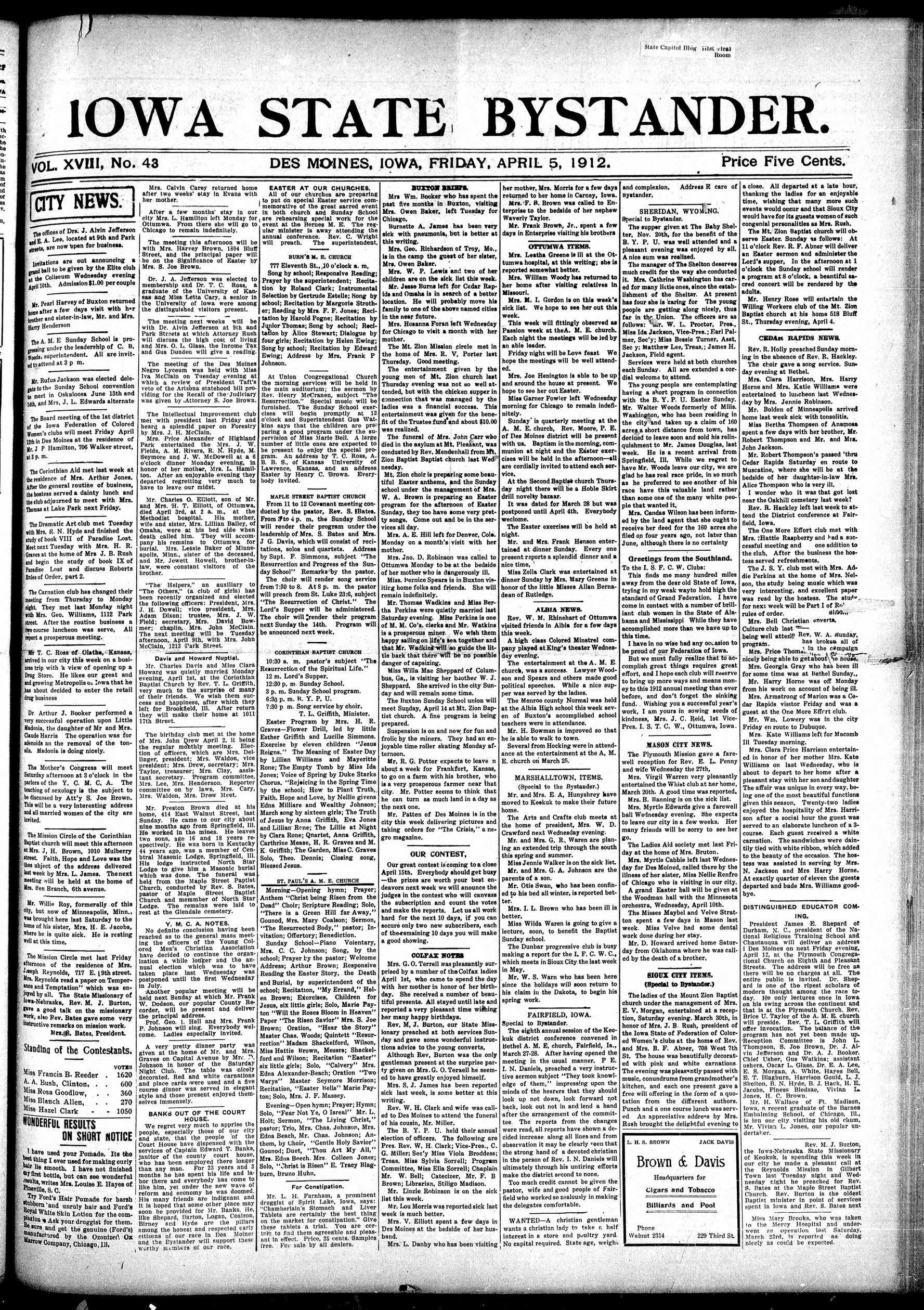
IOWA STATE BYSTANDER.
CITY NEWS.
The offices of Drs. J. Alvin Jefferson and E. A. Lee, located at 9th and Park streets, are now open for business.
Invitations are out announcing a grand ball to be given by the Elite club at the Coliseum Wednesday evening April 10th. Admission $1.00 per couple
Mr. Pearl Harvey of Buxton returned home after a few days visit with her brother and sister-in-law, Mr. and Mrs. Harry Henderson
The A. M. E Sunday School is progressing under the leadership of C. B. Woods, superintendent. All are invited to attend at 3 p.m.
Mr. Rufus Jackson was elected delegate to the Sunday School convention to meet in Oksaloosa June 13th and 14th, and Mrs. J. L. Edwards alternate
The Board meeting of the 1st district of the Iowa Federation of Colored Women's clubs will meet Friday April 12th in Des Moines at the residence of Mr. J P Hamilton, 706 Walker street, at 3 p.m.
The Corinthian Aid met last week at the residence of Mrs. Arthur Jones. After the general routine of business, the hostess served a dainty lunch and the club adjourned to meet with Mrs. Thomas at Lake Park next Friday.
The Dramatic Art club met Tuesday with Mrs. R. N. Hyde and finished the study of book VIII of Paradise Lost. Meet next Tuesday with Mrs. H. R. Graves at the home of Mrs J. B. Rush and begin the study of book IX of Paradise Lost and discuss Roberts Rules of Order, part 2.
The Carnation club has changed their meeting from Thursday to Monday night. They met last Monday night with Mrs. Geo, Williams, 1112 Park street. After the routine business a two course luncheon was serve, All report a prosperous meeting.
Mr. T. C. Ross of Olatha, Kansas, arrived in our city this week on a business trip with a view of opening up a Drug Store. He likes our great and growing Metropolis. Iowa that he has about decided to enter the retail drug business.
Dr Arthur J. Booker performed a very successful operation upon Little Madison, the daughter of Mr and Mrs. Claude Harris. The operation was for adenoids an the removal of the tonsils. Madison is doing nicely.
The Mother's Congress will meet Saturday afternoon at 8 o'clock in the parlor of the Y. C. M. C. A. The teaching of sexology in the subject to be discussed by Att'y S. Joe Brown. This will be a very interesting address and all married women of the city are invited.
The Mission Circle of the Corinthian Baptist church will meet this afternoon at Mrs. J. H. Brown, 1010 Mulberry street. Faith, Hope and Love was the thesis object of the address delivered last week by Mrs. L. James. The next meeting will be held at the home of Mrs. Pen Branch, 6th avenue.
Mr. Willie Roy, formerly of the city, but now of Minnesota, Minn., was brought here last Saturday to the home of his sister, Mrs. H. E. Jacobs, where he is quite sick. He is resting well at this time.
The Mission Circle met last Friday afternoon of the residence of Mrs. Joseph Reynolds, 717 E. [9th street. Mrs. Reynolds read a paper on Temperance and Temptation" which was enclosed by all. The Mission Station of Iowa-Nebraska, Rev. M. J. Burton, gave a good talk on the missionary work, also Rev. Bates gave some very instructive remarks on mission work.
Mrs. G. Bates, President.
Standing of the Contestants.
VOTES
Miss Francis B. Reeder . 1620
A. A. Bush, Clinton, . 600
Miss Rosa Goodlow, . 360
Miss Blanch Allen, . 270
Miss Hazel Clark . 1050
I have used your Pomade. Its the best thing I ever used for making curly hair lie smooth. I have not finished my first bottle, but can see wonderful results, writes Mrs. Louise E. Hayes of Pfluecher, S. C.
Try Ford's Hair Pomade for harsh stubborn and unruly hair and Ford's Royal White Skin Lotion for the complexion. Ask your druggist for them. Be sure and get the genuine (Ford's) manufactured by the Ozonizer! OxMarmoy Company, Chicago, Ill.
Mrs. Calvin Carey returned home after two weeks' stay in Evans with her mother.
After a few months' stay in our city Mrs. L. Hamilton left Monday for Ottawa. From there she will go to Chicago to remain indefinitely.
The meeting this afternoon will be with Mrs. Harvey Brown, 1804 Burl Street, and the principal paper will be on the Significance of Easter by Mrs. S. Joe Brown.
Dr. J. A. Jefferson was elected to membership and Dr. T. C. Ross, a graduate of the University of Kansas and Miss Letta Cary, a senior in the University of Iowa were among the distinguished visitors present.
The meeting next weeks will be with Dr. Alvin Jefferson at 9th and Park Streets at which Attorney Rush will discuss the high cost of living and Mrs. O. L. Glass, the Income Tax and Gus Dunson will give a reading.
The meeting of the Des Moines Negro Lyeumc was held with Miss Iva McClain on Tuesday evening at which a review of President Taft'seto of the Arizona statehood hill providing for the accounted tweeting day was given by Attorney S. Joe Brown.
The Intellectual improvement club met with president last Friday and heard a splendid paper on Forestry by Mrs. J. H. McClain.
The Intellectual improvement of Highland Park entertained the Mrs. J. W. Fields, A. M. Rivers, R. N. Hyde, M. Seymore and J. W. McDowell at a 6 o'clock dinner Monday evening, in honor of her mother, Mrs. L. Hamilton, who departed regretting very much to have to leave our midst.
Mr. Charles O. Elliott, son of Mr. and Mrs. H. T. Elliott, of Ottawa, died April 3rd, at 2 a.m., at the Methodist hospital. His mother, wife and sister, Mrs. Lillian Balley of Omaha, were at his bed side when death came alarms. They will remain in Omaha to Ottawa for burial. Mrs. Leslie Baker of Minneapolis, Minn., sister of the deceased, and Mr. Jewett Howell, brother-in-law, were constant visitors of the brother.
"The Helpers," an auxiliary to "The Others," (a club of girls) has been recently organized and elected the following officers: President, Mrs. J. H. Dowell; vice president, Mrs. Adam Dixon; trustee, Mrs. J. W. Field; secretary, Mrs. David McClain. The next meeting will be Tuesday afternoon, April 9th, with Mrs. John McClain, 1213 Park Street.
Davis and Howard Nuntial
Mr. Charles Davis and Miss Clara Howard was quietly married Monday evening, April 1st, at the Corinthian Baptist Church by Rev. T. L. Griffith, very much to the surprise of many of their friends. We wish them success and happiness, after which they will hold a field trip they will make their home at 1011 17th Street.
The birthday club met at the home of Mrs. John Drew April 2, it being the regular monthly meeting. Election of officers, which are Mrs. Delanger, professor, and Mrs. Rippei, professor; Mrs. Drew, secretary; Mrs. Taylor, treasurer; Mrs. Clay, assistant secretary. Program committee, Mrs. Lee, Mrs. Henderson. Reporter committee on by laws, Mrs. Cary, Waldon, Mrs. Drew Meet.
Mr. Preston Brown died at his home, 414 East Walnut Street, last Sunday. He came to our city about nine months ago from Springfield, Ill. He worked in the mines. He leaves two sons, age 16 and 18 years respectively. He was born to a member of Central Masonic Lodge, Springfield, Ill. His lodge instructed North Star Lodge to give him a Masonic burial which was done. The funeral was held from the Maple Street Baptist Church, conducted by the Street pastor, a member of the Street Baptist Church and member of North Star Lodge. The remains were laid to rest at the Glendale cemetery.
Y M C A NOTES
No definite conclusion having been reached as to the general mass meeting the officers of the Young Colored Men's Christian Association organized a white longer and the annual election which was to have taken place last Wednesday was postponed until the first Wednesday in July. The other popular meeting will be held next Sunday at that Mr. Frank W. Dodson, our popular County Recorder, will be present and deliver the principal address. And Mrs. Frank P. Johnson will sing. Everybody welcome. Ladies especially invited.
A very pretty dinner party was given at our party and Mrs. Johnson Capital Avenue by Mrs. P. Johnson in honor of the Saturday Night Club. The table was nicely decorated. Red and white carnations and place cards were used and a course of flowers were presented elegant and those present enjoyed themselves immensely.
BANKS OUT OF THE COURT HOUSE.
We regret very much to apprise the people, especially those of our city and state, that the people of the Court House have dispensed with the services of Captain Edward T. Banks, who has been employed there longer than any man. For 23 years and 3 months he has spent his life and labor and everybody has come to like him, yet under the new wave reform and economy we are indigent and it is hoped that some other place may soon be provided for Mr. Banks, He like Shepard, Barton, Logan, Coallon, Birney and Hyde are the pillars among the honest and the untruthful in Des Moines the Eystander will support these worthy members of our race.
DES MOINES, IOWA, FRIDAY, APRIL 5, 1912.
EASTER AT OUR CHURCHES.
All of our churches are preparing to put a special Easter service, a memorial of the great sacred event in both church and Sunday School are rehearsing special work for the event at the Bernes M. E. The regular minister is away attending the annual conference. Rev. C. Wright will preach. The superintendent,
BUSTON BRIDGE.
Mrs Wm. Booker who has spent the past five months in Buxton, visiting Mrs. Owen Baker, left Tuesday for Chicago.
Burnette A. James has been very sick with pneumonia, but is better at this writing.
her mother, Mrs. Morris for a few days returned to her car in Carney, Iowa. Mrs. F. B. Brown was called to Eterprise to the bedside of her nephe Waverly Taylor.
Mr. Frank Brown, Jr., spent a few days in Enterprise visiting his brother.
BURN'S M. E. CHURCH
777 Elenvent St., 10 J'clock a. m.
Song by school; Responsive Reading; Prayer by the superintendent; Recitation by Roland Clark; Instrumental Selection by Gertrude Estelle; Song by school; Recitation by Margorie Strother; Reading by Mrs. F. F. Jones; Recitation by Harold Pogne; Recitation by Junior Thomas; Song by school; Recitation by Alice Stewart; Dialogue by four girls; Recitation by Helen Ewing; Song by school; Recitation by Edward Ewing; Address by Mrs. Frank P Johnson.
---
At Union Congregational Church the morning services will be held in the main auditorium; the sermon by Rev. Henry McCrane, subject "The Resurrection." Special music will be furnished. The Sunday School exam will be held at 10 a.m. the o'clock and Superintendent Gus Wattkins says that the children are preparing a good program under the supervision of Miss Marie Bell. A large number of little ones are expected to be present to enjoy the special program. An address by T. C. Ross, A. William Bell, and L. Lawrence, Kannsa, and an address Easter by Henry C. Brown. Everybody invited.
MAPLE STREET BAPTIST CHURCH
MAPLE STREET BAPTIST CHURCH
From 11 to 12 Covenant meeting conducted by the pastor, Rev. S. Bates.
From 7 to 4 p. m. the Sunday School will render their program under the leadership of Mrs. S. Bates and Mrs. J. G. Davis, which will consist of祭坛, solos and quartets. Address by Supt. F. Simmons, subject "The Resurrection and Progress of the Sunday School!" Remarks by the pastor.
The choir will render song service from 7:30 to 8. At 8 p. m. the pastor will preach from St. Luke 26,36 subject "The Resurrection of Christ." The Lord's Supper will be administered. The choir will render their program next Sunday the 14th. Program will be announced next week.
CORINTHIAN BAPTIST CHURCH
10:30 a. m. pastor's subject "The Resurrection of the Spiritual Life." 12 m. Lord's Supper. 12:30 p. m. Sunday School. 3 p. m. Sunday School program. 6:30 p. m. B. Y. P. U. 7:30 p. m. Song service by choir. T. L. Griffith, Minister. Easter Program by Mrs. H. R. Graves—Flower Drill, led by little Easter Griffith and Lucille Simmons. Exercise by eleven children "Jesus Reigns." The Meaning of Easter Day by Lillian Williams and Mayerite Rone; The Empty Tomb by Miss Ida Jones; Voice of Spring by Duke Starke Chorus. "Rejicing in the Spring Time by the school; How to Plant Truth, Faith. Hope and Love, by Nellie gives Edna Milliare and Wealthy Johnson; March song by sixteen girls; The Truth of Jesus by Anna Griffith, Eva Jones and Lillian Rone; Qartet, The Lillie at Night by Clara Rone; Qartet, Anna Griffith, Carthine Mease, H. R. Graves and M. K. Griffith; The Garden, Miss C. Graves Solo. Theo. Dennis; Closing song, Blessed Jesus.
ST. PAUL'S A. M. E. CHURCH
Morning—Opening hymn; Prayer; Anthem "Christ being Risen from the Dead" Choir; Scripture Reading; Solo, "There is a Green Hill far away," Gound, Mrs. Mary Coalson; Sermon, "The Resurrected Body," pastor; Invitation; Offerment; Benediction.
Sunday School—Piano Volentary, Mrs. C. C. Johnson; Song, by the school; Prayer by the pastor; Welcome Address; Arthur Brown; Responsive Reading the Easter Story, the Death and Burial, by superintendent of the school; Recitation, "My Erand," Helen Brown; Exercises, Children for Jesus, six little girls; Solo, Marie Payton "Will the Roses Bloom in Heaven" Paper "The Risen Savior" Mrs. S. J Brown; Oration, "Hear the Story" Master Chas, Woods; Quintet "Resurction" Madam Shackleford, Wilson, Miss Hattie Brown, Messa; Shackleford and Wilson; Recitation "Easter" six little girls; Solo, "Calvery" Mrs. Edna Alexander-Boration; Oration "Two Marys" Master Seymore Morrison; Recitation, "Easter Bells" Marie Payton; Solo, Mrs. J. F. Massey.
Evening—Open hymn; Prayer; Hymn, Solo, "Fear Not Ye, O Alarm." Mr. L. Holt; Sermon, "The Living Christ," pastor; Trio, Mrs. Chas. Johnson, Mrs. Edna Beach, Mr. Chas. Johnson; Anthem, by choir, "Gentle Holy Savior" Gound; Duet, "Thou Art My All," Mrs. Edna Beach, Mrs. Colleen Jones; Solo, "Christ is Risen" E. Tracy Blagburn, Bruno Huh.
For Constipation.
Mr. L. H. Farnham, a prominent druggist of Spirit Lake, Iowa, says: "Chamberlain's Stomach and Liver Tablets are certainly the best thing on the market for constipation. Give these tablets to your patient to agreeable and pleasant in effect. Price, 25 cents. Samples free. For sale by all dealers.
BUKTON BRIDGE
Mrs Wm. Booker who has spent the past five months in Buxton, visiting Mrs. Owen Baker, left Tuesday for Chicago.
Burnette A. James has been very sick with pneumonia, but is better at this writing.
Mrs. Geo. Richardson of Troy, Mo., is in the camp the guest of her sister, Mrs. Owen Baker.
Mrs. W. P. Lewis and two of her children are on the sick list this week.
Mr. Jesse Burna left for Cedar Rapids and Oumha is in search of a better location. He will probably move his family to one of the above named cities in the near future.
Mrs. Hosanna Foran left Wednesday for Chicago to visit a month with her mother.
The Mt. Zion Mission circle met in the home of Mrs. R. V. Porter last Thursday. Good meeting.
The entertainment given by the young men of Mt. Zion church last Thursday evening was not so well attended, but with the chicken supper in connection that was managed by the ladies was a financial success. This entertainment was given for the benefit of the Trustee fund and about $10.00 was realized.
The funeral of Mrs. John Carr who died in the asylum at Mt. Pleasant, was conducted by Rev. Mendenhall from Mt. Zion Baptist Baptist church last Wednesday.
Mt. Zion choir is preparing some beautiful Easter ensembles, and the Sunday school under the management of Mrs. W. A. Brown is preparing an Easter program for the afternoon of Easter Sunday, they too have some very pretty songs. Come out and be in the services all day.
Mrs. A. E. Hill left for Denver, Cole. Monday on a month's visit with her mother.
Mrs. Jno. D. Robinson was called to Ottawa Monday to be at the bedside of her mother who is dangerously ill.
Miss. Jernice Spears is in Buxton visiting home folks and friends. She will remain indefinitely.
Mr. Thomas Wadkins and Miss Bertha Perkins were quietly married last Saturday evening. Miss Perkins is one of M. M. Co.'s clerks and W. Watkins is a prosperous miner. We wish them happy sailing on life's sea together and that Mr. Wadkins will so guide the little bark that there will be no possible danger of capizing.
Miss Willa Mae Sheppard of Columbus, Ga., is visiting her brother W. J. Sheppard. She arrived in the city Sunday and will remain some time.
The Buxton Sunday School union will meet Sunday, April 14 at Mt. Zion Baptist church. A fine program is being prepared.
Suspension is on and now for fun and frolic by the miners. They had an enjoyable time roller skating Monday afternoon.
Mr. R. G. Potter expects to leave n about a week for Frankfurt, Kansas, to go on a farm with his brother, who is a very prosperous farmer near that city. Mr. Potter seems to think that he can turn as much land in a day as the next one. Mr. Patten of Des Moines is in the city this week delivering pictures and taking orders for "The Crisis," a negro magazine.
OUR CONTEST.
Our great contest is coming to a close April 15th. Everybody should get buoy—the prizes are worth your best endeavors next week we will anounce the judges in the contest who will canvass the subscription and count the votes and make the reports. Let us all work hard for the next 10 days, if you can secure only two new subscribers, each of the remaining 10 days you will make a good showing.
COLFAX HOTEL
Mrs. G. O. Terrell was pleasantly surprised by a number of the Colfax ladies April 1st, who came to spend the day with her mother in honor of her birthday. She received a number of beautiful presents. All stayed until late and reported a very pleasant time wishing her many happy birthdays.
Rev, M. J. Burton, our State Missionary prescheduled at both services Sunday and gave some wonderful instructions advice to the young converts.
Although Rev, Burton was the only gentleman present at the surprise party given on Mrs. G. O. Terrell he seemed to have greatly enjoyed himself.
Mrs. S. J. James has been reported sick last week, is some better at this writing.
Rev. W. H. Clark and wife was called to Des Moines to attend the funeral of his cousin, Mr. Miller.
The B. Y. P. U. held their annual election of officers. The following are Pres Rev, W. H. Clark; Vice-Pres., C. G. Miller; Sec'y Miss Viola Broddes; Treas. Miss Sylvia Sorrell; Program Committee, Missella Sorrell; Chaplain W. Bell; Catecizer, Mr. F. B Brown; Librarian, Stiligo Madison.
Mr. Linzie Robinson is on the sick list this week.
Mr. Loris Morris was reported sick last week is much better.
Mrs. V. Elliott spent a few days in Des Moines at the bedside of her husband.
Mrs. L. Danby who has been visiting
her mother, Mrs. Morris for a few days returned to her home in Carney, Iowa. Mrs. F. B. Brown was called to Enterprise to the bedside of her nephew Waverley Taylor. Mr. Frank Brown, Jr., spent a few days in Enterprise visiting his brothers
OFTUMWA ITEM8:
Mrs. Leatha Greene is ill at the Ottumwa hospital, at this writing; she is reported somewhat better.
Mrs. William Woody has returned to her home after visiting relatives in Missouri.
Mrs. M. I. Gordon is on this week's sick list. We hope to see her out this week.
This week will fitingly observed as Passion week at the A. M. E. church. Each night the meetings will be led by an able leader.
Friday night will be Love feast. We hope the meetings will be well attended.
Mrs. Joe Henington is able to be up and around the house at present. We hope to see her out Easter.
Miss Garner Fowler left Wednesday morning for Chicago to remain indefinitely.
Sunday' is quarterly meeting at the A. M. E. church, Rev. Moore, P. E. of Des Moines district will be present with us. Baptism in the morning, communion at night and the Easter exercises will be held in the afternoon all are cordially invited to attend each service.
At the Second Baptist church Thursday night there will be a Hobble Skill drill novelly bazaar.
It was dated for March 28 but was postponed until April 4th. Everybody worelcome.
The Easter exercises will be held at night.
Mr. and Mrs. Frank Henson entertained at dinner Sunday. Every one present reports a splendid dinner and a nice time. Miss Zella Clark was entertained at dinner Sunday by Mrs. Mary Greene in honor of the little Misses Allan Bernadean of Rutledge.
ALBIA NEWS
Rev. W. M. Rhinehard of Ottumwa visited friends in Albia for a few days this week.
A high class Colored Minstrel company played at King's theater Wednesday evening.
The entertainment at the A. M. E. church, was a success. Lawyer Woodson and Spears and others made good political speeches. While a nice supper was served by the ladies.
The Monroe county normal was held at the Albia school this week seven of Buxton's accomplished school teachers were in attendance.
Mr. H. Bowman is improved so that he is able to walk to town.
Several from Hocking were in attendance at the entertainment at the A, M. E. church on March 25.
MARSHALLTOWN. ITEMS.
(Special to the Bystander.)
Mr. and Mrs. E. A. Hunyshey have moved to Keskuk to make their future home.
The Arts and Crafts club meets at the home of president, Mrs. W. D. Crawford next Wednesday evening.
Mr. and Mrs. G. R. Waren are planning an extended trip through the south this spring and summer.
Miss Jennie Walker is on the sick list.
Mr. and Mrs. G. A. Johnson are the parents of a son.
Mr. Otis Swan who has been confined to his bed all winter, is reported better.
Mrs. I. L. Brown who has been ill is better.
Miss Wilda Waren is going to give a lecture, soon, to benefit the Baptist Sunday school.
The Dunbarn progressive club is busy making a report for the I. F. C. W. C., which meets in Sioux City the last week in May.
Mr. W. S. Warn who has been here since the holidays will soon return to his claim in the Dakota, to begin his spring work.
FAIRFIELD JOWA
Special to Bystander
The eighth annual session of the Keokuk district conference convened in Botel A. M. E. church, Fairfield, In., March 27-28. After having opened the meeting in the usual manner, P E. I. N. Daniels, preached a very instructive sermon subject "They took knowledge of them," impressing upon the minds of the hearers that they should look up not down, look forward not back, look out not in and lend a hand after the arrangement of the committee. The reports from the changes were read, all reports have shown a decided increase along all lines and from observation it may be clearly seen that the strong hand of a devoted christian in the person of Rev. I. N. Daniels will ultimately through his untiring efforts make the district second to none. Too much credit cannot be given the pastor, wife and good people of Fairfield, who worked so zealously in making the delegates comfortable.
WANTED—A christian gentleman wants a christian lady to take a half interest in a store and poultry yard. No capital required. State age, weighs
and complexion. Address R care of Bystander.
SHERIDAN, WYOMING.
Special to Bystander.
The supper given at The Baby Shelter, Nov. 20th, for the benefit of the B. Y. P. U. was well attended and a pleasant evening was enjoyed by all. A nice sum was realized.
The manager of The Shelton deserves much credit for the way she conducted it. Mrs. Catherine Washington has carved for many little ones, since the establishment of the Shelter. At present have four she is caring for. The young people are getting along nicely, thus far in the Union. The officers are as follows: Mr. W. L. Proctor, Press, Miss Ida Jackson, Vie-Pres; Earl Palmer, Sec; y Miss Besie Turner, Asst. Sec; y Matthew Lee, Trees.; James H. Jackson, Field agent. Services were held at both churches each Sunday. All are extended a cordial welcome to attend. The young people are contemplating having a short program in connection with the B. Y. P. U. Easter Sunday. Mr. Walter Woods formerly of Mills. Washington, who has been residing in the city and taken up a claim of 160 acres a short distance from town, has decided to leave soon and his reinlishment to Mr. James Douglas, last week. He is a recent arrival from Springfield, Ill. While we regret to have Mr. Woods leave our city, we are glad he has real race pride, in so much as he preferred to see another of his race have this valuable land rather than some one of the many white people that wanted it. That Mrs. Candida Wilson has been informed by the land agent that she ought to receive her deed for the 160 acres she filed on four years ago, not later than June, although there is no certainty
Greetings from the Southland.
To the I. S. F. G. W. Clubs:
This finds me many hundred miles a way from the dear old State of Iowa, trying in my weak way to hold high the standard of Grand Federation. I have come in contact with a number of brilliant club women in the State of Alabama and Mississippi. While they have accomplished more than we have up to this time.
I have in no wise had any occasion to be proud of our Federation of Iowa.
be proud of our Federation of Iowa.
But we must fully realize that to accomplish great things requires great effort, and I hope each club will reserve to bring up more ways and means money to this 1912 annual meeting than ever before, and don't forget the sinking fund. Wishing you a successful year's work, I am yours in sowing seeds of kindness, Mrs. J. C. Reid, 1st VicePresident, I. S. T. C. W., Ottumwa, Iowa.
MASON CITY NEWS.
The Plymouth Mission gave a farewell reception for Rev. E. L. Penny and wife Wednesday the 27th.
Mrs. Myrtle Edwards give a farewell ball Wednesday evening. She expects to leave our city in a few weeks. Her many friends will be sorry to see her go.
The Ladies Aid society met last Friday at the home of Mrs. Bruton.
Mrs. Myrtle Cable left last Wednesday for Des Moine, called there by the illness of her sister, Miss Nelle Rifenro of Chicago who is visiting in our city. A grand Easter ball will be given at the Woodman hall with the Minnesota orchestra, Wednesday, April 10th.
The Misses Maybel and Velva Stratton spent a few days in Mason last week. Miss Velva had some dental work done during her stay.
Mr. D. Howard arrived home Saturday from Oklahoma where he was called by the death of a brother.
SIOUX CITY ITEMS.
(Special to Bystander.)
The ladies of the Mount Zion Baptist church under the management of Mrs. E. V. Morgan, entertained at a reception, Saturday evening, March 30th, in honor of Mrs. J. B. Rush, president of the Iowa State of Federation of Colored Women's clubs at the home of Rev. and Mrs. B. F. Abner, 708 West 7th St. The house was beautifully decorated with pink and white carnations. The evening was pleasantly passed with music, conundrums from grandmother's kitchen, and each one present gave a free will offering in the form of a quotation from the different authors. Punch and a one course lunch was served. An appreciative address by Mrs. Rush brought the delightful evening to
L. H. S. BROWN JACK DAVIS
Brown & Davis
Headquarters for
Cigars and Tobacco
Billiards and Pool
Phone
Walnut 2314 229 Third St.
```markdown
```
Price Five Cents.
Shelf of
and a
by all.
serves
ducted
as car-
establish-
ment
young
thus
are as
Press
a close. All departed at a late hour,
thanking the ladies for an enjoyable
time, wishing that many more such
events would occur and that Sioux City
would have for its guests women of such
congenial personalities as Mrs. Rush.
The Mt. Zion Baptist church will observe
Easter. Sunday as follows: At 11 o'clock Rev. R. F. Abner will deliver
an Easter sermon and administer the
Lord's supper. In the afternoon at 1
o'clock the Sunday school will render
a program at 8 o'clock, a beautiful sacred
concert will be rendered by the
adults.
Mr. Henry Rose will entertain the
Willing Workers club of the Mt. Zion
Baptist church at his home 518 Bluff
St. Thursday evening, April 4.
CEDArt RAPIDS NEWS
Rev. R. Holly preached Sunday morning in the absence of Rev. R. Hackley. The choir gave a song service. Sunday evening at Bethel.
Mrs. Clara Harrison, Mrs. Harry Horne and Mrs. Katie Williams were entertained to luncheon last Wednesday by Mrs. Jennie Robinson.
Mr. Bolden of Minnesota arrived home last week sick with tonsilitis.
Miss Bertha Thompson of Anamosa spent a few days with her brother, Mr. Robert Thompson and Mr. and Mrs. John Jackson.
Mr. Robert Thompson's passed 'thru Cedar Rapids Saturday en route to Muscatine, where she will be at the bedside of her daughter-in-law Mrs. Alice Thompson who is very ill.
I wonder who it was that got lost near the Oakkill cemetery last week?
Rev. R. Hackley left last week to attend the District conference at Fairfield, Iowa.
The One More Effort club met with Mrs. Hattle Raspberry and had a successful meeting and one addition to the club. After the business the hostess served refreshments.
The J. S. Y. club met with Mrs. Addie Perkins at the home of Mrs. Nelson, the study being music which was very interesting, and excellent paper was read by the hostess. The study for next week will be Part I of Re's rules of order.
Mrs. Bell Christian enverte.
Girl club lost
Mr. Wm. Lowery was in the city Friday en route to Dubuque. Mrs. Kate Williams left for Macomb III Tuesday morning. Mrs. Clara Price Harrison entertained in honor of her mother Mrs. Kate Williams on last Wednesday, who is about to depart to her home after a pleasant stay with her son and daughter The affair was unique in every way, being one of the most beautiful functions given this season. Twenty-two ladies enjoyed the hospitality of Mrs. Harrison after a social hour the guest was served to an elaborate luncheon of a 3-course. Each guest received a white carnation. The sandwiches were dainty tied with white ribbon, which added to the beauty of the occasion. The hostess was assisted in serving by Mrs. N. Jackson and Mrs. Harry Horne. At exactly quarter of eleven the guests departed and bade Mrs. Williams good-bye.
DISTINGUISHED EDUCATOR COM-
President James E. Shepard of Durham, N. C., president of the National Religious Training School and Chautaqua will deliver an address *Des Moines on next Friday evening,* the *International Church on Eighth and Pleasant Streets.* The address will be free as there will be no charges at all. The entire public is invited. Dr. Shepard will present his modern thought among the race today. He only lectures once in Iowa on his swing across the continent and that is at the Plymouth Church. Rev. Bruce U. Taylor of the A. Church in Chicago will offer invocation. The balance of the program has not yet been made up. Reception Committee is John L. Thompson, S. Joe Brown, Dr. J. Al-Charles, S. Joe Brown, Dr. Chief Usher, Gus Watkins; assistant usher, Oscar L. Gus, Dr. A. Lee, E. S. Morgan, A. White, Hayes Bell, E. T. Blagburn, Harrison Gould, L. J. Shelton, N. Hydie, B. J. Hack, H. E. Finley, F. Finley, Vivian L. Jones, H. C. Brown.
Mr. H. Wallace of Ft. Madison, Iowa, a recent graduate of the Barnes Embalming School, of Chicago, Ill., is ten our city visiting his old chum, Mr. Vivian L. Jones, our popular undertaker.
Rev. M. J. Burton the Iowa-Nebraska State Missionary of Keokuk, is spending this week in city life he made a pleasant call to the Reynolds Mission in Gilbert Town last Tuesday night and Wednesday night he preached for Rev. S. Bates at the Maple Street Baptist Church in Maple Ridge, a minister in point of services spent in Iowa and Rev. S. Bates next.
Miss Mary Brooks, who was taken to the Mercy Hospital and underwent March 23rd, is reported as doing nicely as could be expected.
BYSTANDER r/U.B. CO., Publishers.
DES MOINES. IOWA
TRACED BACK TO ARTICIANS
Deliver in History Find Beginnings of the Church Steeple Reach Far Into the Centuries.
There is a theory which finds the spire of the New England meeting house in the mountain peaks of Arabia.
Tracing back the process of evolution, we come first to London where the clear sky of the Great Fire gave Sir Christopher Wren his opportunity to experiment in steeples; and then to Venice, where the campanile is a shining example of a tower beside a church but separate from it; and then to Alexandria, where the famous light-house on the lale of Pharos contributed to the religion of Mamet both the form and the name of the minaret; and then to the "Tower of Babel" at Bostorp, and the zikkurats of the temples of Babylonia and Assyria.
A sikkurat is a huge quadrangular mass of brick, rising in diminishing stories as a child places a bib stone on it, and on that a smaller still—and ascended by a winding balustrated stair to a brine on top.
This, according to the theory, was the ritual equivalent of a mountain. Into the flat lands between the Tigris and Euphrates came the ancestors of the Babylonians and Assyrians out of the mountains of Arabia. There they had worshiped the storm-god, who dwelt upon the heights among the clouds; with whom they communed, like Moses, by climbing up and making their offerings and saying their prayers upon the summit. They there were mountains in their nature; they erect beside every temple a little mountain in the yard. Thus the sikurkut and then the minaret, and then the campanile, and then the steeple of the parish church—Atlantic.
Why Colonel Couldn't Help.
Misfortune overtook a veteran of the Civil war who had become rich after Lee's surrender. Everything left him and he was induced to apply for a pension.
The essential facts were to be presented by the other men of his command and their signatures to his petition were easy to get.
Still, the colonel's was the most valuable, because he had gone to the rescue of the applicant in one of those life-and-death pinches alike creditable to the two.
The colonel was located on a farm sent to Lockport, N. Y. He received the A two colony a singular lack of interthey all departed a pathy. The petitioner invited Mrs. Taylor meand it, and was im-Thursday night. Politically the citrunc Church Vern Equal had resulted in his also Friday a petitioner to one side, the commander of the regiment said:
"I know all that, but you can't well put my name down because, confidently, I'm applying for a pension myself—for loss of memory."
Philatollete Alarmed.
The introduction, as an experiment, of automatic machines for stamping letters by the London postoffice has excited much interest in Austria, and the chamber of commerce at Brunswick has commissioned to introduce the system Austria. Stamp collectors, however, are alarmed, as they fear that if this method of stamping letters is univerally adopted, and postage stamps consequently become obsolete, the public will no longer take an interest in postage stamps and existing collections will lose much of their value.
What About It?
With the caution of science, the two Germans who have been so successful with cancer in mice warn the world not to conclude yet that the terrible disease is about to be controlled in humankind. Suppose, however, that the optimistic view is right and that that man are the antivivisectionists of proud country going to stand idly by and let cancer be conquered without a blow on their part for the mice. They have introduced another "investigation" bill in the New York legislature, to substitute their judgment and knowledge for the knowledge and judgment of our best scientist, enough Bummer approaches; what are the humane societies doing for the protection of the mosquitoes and the files?-Collier's Weekly.
Fixed.
"Has Dinny got a stiddy job yit Mrs. Mulcahey" asked Mrs. Brannigan
"He has that," said Mrs. Mulcahey "They've sint him to the pintchinthey for twinty years."-Harper's Weekly.
A Walter
Diner—In it customary to tip the waiter in this restaurant?
Waiter—Why—ah—yes, sir.
Diner—then hand me a tip. I’ve waited three-quarters of an hour for that steak I ordered—Sacred Heart Review.
It's Nature.
"The officers arrested the photo-
grapher they suspected as he was
watched in his dark room."
"Hat hat A case of develo-
ment."
Word of Apology
"Republics are ungrateful," said the readymade philosopher.
"Well," replied Farmer Cortentos, "all the governments I ever read about got imposed on so often that you couldn't blame 'em for growin' sort o' cynical an suspicious."
Natural Affinities.
"Men have one thing in common with lamps when they stop gambling on the green."
"What's that?"
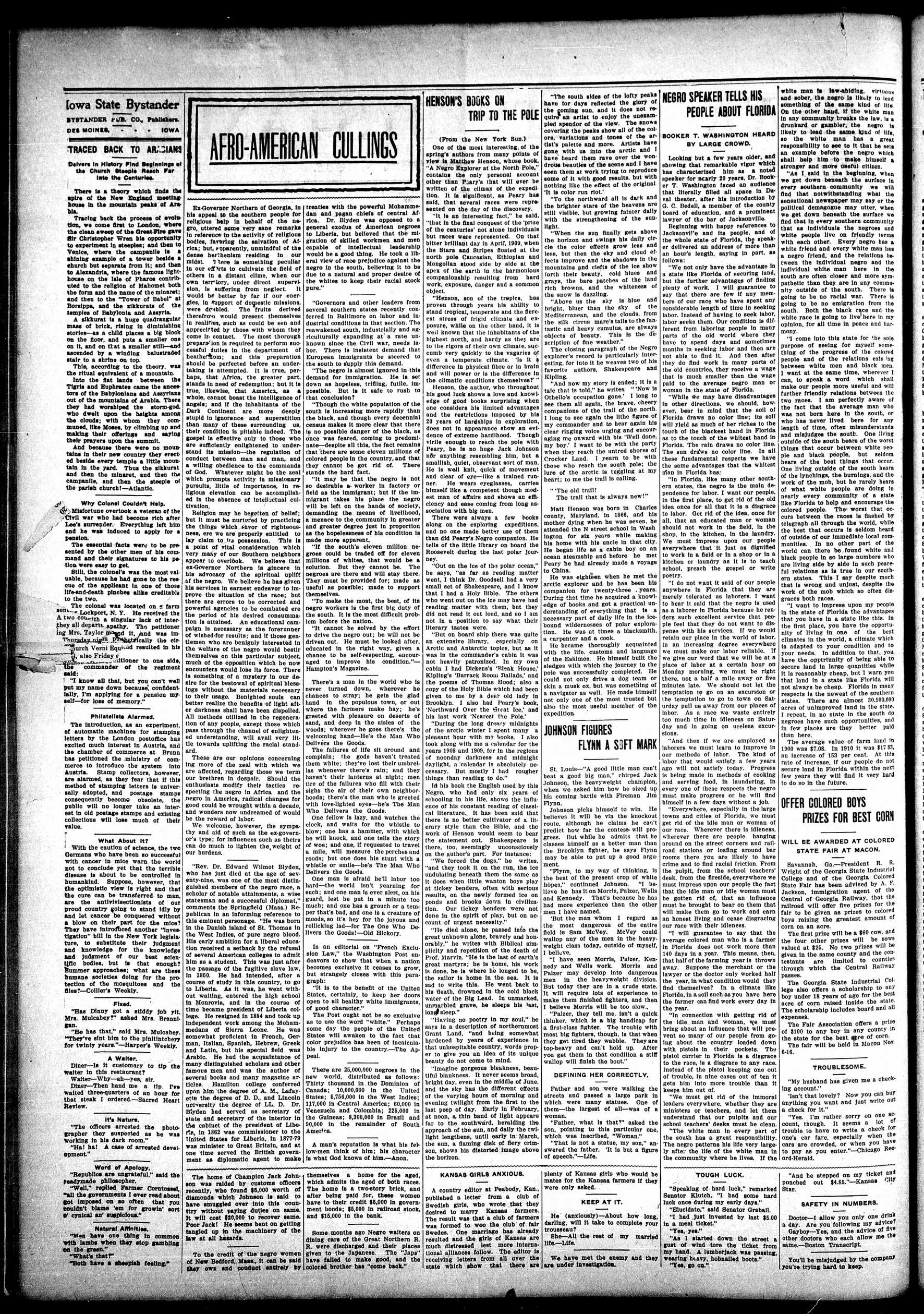
AFRO-AMERICAN CULLINGS
Ex-Governor Northern of Georgia, in his appeal to the southern people for religious help in behalf of the negro, uttered some very sane remarks in reference to the activity of religious bodies, favoring the salvation of Africa; but, apparently, unmindful of the dense heremianism living in our midst. There is something peculiar in our efforts to cultivate the field of African pastoral cline when own territory is directly affected, as suffering is from neglect. It would be better by far if our energies, in support of domestic missions, were decbled. The fruits derived therefrom would present themselves in realities, such as could be sen and appreciated by those with whom they come in contact. The most thorough preparation is required to perform successful duties in the department of heather; and this preparation should be perfect before an undertaking is attempted. It is true, perseverance is necessary, and stands in need of redemption; but it is true, likewise, that America, as a whole, cannot boast the intelligence of angels; and if the inhabitants of the Dark Continent are more deeply stupid in ignorance and superstition than many of these surrounding us, their condition is pitiful indeed. The gospel is effective only to those who are sufficiently enlightened to understand its mission—the regulation of conduct between man and man, and filling obedience to the commands of Old Testament, which prompts activity in missionary pursuits, little of importance, in religious elevation can be accomplished in the absence of intellectual cultivation.
Religion may be begotten of belief; but it must be nurtured by practicing the things which savor of righteousness, are we are properly entitled to lay claim to its possession. This is a point of vital consideration which very many of our Southern neighbors appear to overlook. We believe that ex-Governor Northern is gincer in his advocacy of the spiritual uplift of the negro. We believe he has given his services in earnest endearment to imitate the institution of the race; but there are errors in the way powerful agencies to be combated are the period of his desired consummation is attained. An educational campaign is necessary as the forerunner of wished-for results; and if those gentlemen who are benignly interested in the welfare of the negro would bestin themselves on this particular subject, much of the opposition which he now encounters would lose its force. There is something of a mystery in our desire for the bestowal of spiritual blessings without the materials necessary to their usage. Benighted souls can realize the benefits of light after darkness shall be in dispelled. All methods utilized in the renewal of any people, except those which pass through the channel of enlightened understanding, will avail very little towards uplifting the racial standard.
These are our opinions concerning ing more of the zeal with which we are affected, regarding those we term our brethren in despair. Should the enthusiasts modify their tactics respecting the negro in Africa and the negro in America, radical changes for good could be wrought within a decade, and wonders now undreamed of would be the reward of labor. We would be better, the symphethy and aid of such as the exgovernor or a'type; for influences such as theirs can do much to lighten the weight of our burdens.
"Rev. Dr. Edward Wilmot Blydon, who has just died at the age of seventy-nine, was one of the most distinguished members of the negro race, a scholar of notable attainments, a wise statesman and a successful diplomat," comments the Springfield (Mass.) Republican in an informing reference to this eminent personage. "He was born in the Danish island of St. Thomas in the West Indies, of pure negro blood. His early ambition for a liberal education received a setback by the refusal of several American colleges to admit him as a student. This was just after the passage of the fugitive slave law, which extended after course of study in the university to go to Liberia. As it was, he went without waiting, entered the high school in Monrovia, and in the course of time became president of Liberia college. He resigned in 1884 and took up independent work among the Mohamedans of Sierra Leone. He was somewhat proficient in French, German, Italian, Spanish, Hebrew, Greek and Latin, but his special field was Arabic. He had the acquaintance of many distinguished scholars and other famous men and was the author of several books and many magazine articles. Hamilton college conferred upon him the degree of A. M., Lafayette the degree of the degree of LL. D. Dr. Blydon had served as secretary of state and secretary of the interior in the cabinet of the president of Liberia, in 1862 was commissioner to the United States for Liberia, in 1877-79 was minister to Great Britain, and at one time served the British government as diplomatic agent to make
The home of Champion Jack Johnson was raided by customs officers recently, who found $5,000 worth of diamonds which Johnson is said to have smuggled over into this country without paying dutes on same. It will cost $20,000 to recover same. Poor Jack! He seems bent on getting tangled up in the machinery of the law at all hazards.
To the credit of the negro women of New Bedford, Mass, it can be said they own and conduct entirely by
treaties with the powerful Mohammed dan and pagan chiefs of central Africa. Dr. Blydon was opposed to a general exodus of American negroes to Liberia, but believed that the migration of skilled workmen and men capable of intellectual leadership would be a good thing. He took a liberal view of race persecution and the white race of pagan chiefs, believing it to be due to a natural and proper desire of the whites to keep their racial stock pure."
---
"Governors and other leaders from several southern states recently conferred in Baltimore on labor and industrial conditions in that section. The reawakened south, industrially and agriculturally expanding at a rate unknown since the Civil war, needs labor. There is insistent demand that European immigrants be steered to the south to supply this demand. There is insistent demand in this demand for immigration. He is set down as hopeless, trifling, futile, impossible. But is it safe to rush to that conclusion?
"Through the white population of the south is increasing more rapidly than the black, and though every decennial census makes it more clear that there is no possible danger of the black, as once was feared, coming to predominate—despite all this, the fact remains that there are some eleven millions of blacks and they cannot be got rid of. There stands the hard fact.
"It may be that the negro is not so desirable a worker in factory or field as the immigrant; but if the immigrant takes his place the negro will be left on the hands of society, demanding the means of livelihood, a menace to the community in greater and greater degree just in proportion as the hopelessness of his condition is made more apparent.
"If the south's eleven million negroes could be traded off to eleven millions of whites, that would be a solution. But they cannot be. The negroes are there and will stay there. They must be provided for; made as useful as possible; made to support themselves.
"It cannot be made the most, the best, of its negro workers is the first big duty of the south. It is the most difficult problem before the nation.
"It cannot be solved by the effort to drive the negro out; he will not be driven out. He must be looked after, educated in the right way, given a chance to be self-respecting, encouraged to improve his condition."—Hampton's Magazine.
There's a man in the world who is never turned down, wherever he chances to stray; he gets the glad hand in the populous town, or out where the farmers make hay; he's greeted with pleasure on deserts of sand, and deep in the aisles of the town, he meets the welcoming hand—he's the Man Who Delivers the Goods. The failures of life sit around and complain; the gods haven't treated them white; they've lost their umbrellas whenever there's rain; and they haven't their lanters at night; men tire of the failures who fill with their neighbors; hoods; the man who greeted with love-lighted eyes—he's The Man Who Delivers the Goods. One fellow is lazy, and watches the clock, and waits for the whistle to blow; one has a hammer, with which he will knock, and one tells the story of woe; and one, if requested to travel a mile, will measure the perches and his stout with a whistle or smile—he's The Man Who Delivers the Goods.
One man is afraid he'll labor too hard—the world isn't yearning for such; and one man is ever alert, on his guard, lest he put in a minute too much; and one has a grouch or a temper that's bad, and one is a creature of moods, so it's hey for the joyous and rollingick lad—for The One Who Delivers the Goods!—Old Hickory.
In an editorial on "French Exclusion Law," the Washington Post endeavors to show that when a nation becomes exclusive it ceases to grow, but strangely close with this paragraph:
"It is to the benefit of the United States, certainly, to keep her doors open to all healthy white immigrants of good character."
The Post ought not be so exclusive as to use the word "white." Perhaps some day the people of the United States will awaken to the fact that color prejudice has been of incalculable injury to the country.—The Appeal.
There are 25,000,000 negroes in the new world, distributed as follows: Thirty thousand in the Dominion of Canada; 10,000,000 in the United States; 5,756,000 in the West Indies; 117,000 in Central America; 60,000 in Venezuela and Colombia; 225,000 in the Guinea; 8,300,000 in Brazil and 90,000 in the remainder of South America.
A man's reputation is what his felt low-men think of him; his character is what God knows of him—Anon.
themselves a home for the aged, which admits the aged of both races. The home is a two-story brick and after being paid for, these women have to their credit $5,000 in government bonds; $5,000 in railroad stock and $15,000 in the bank.
Some months ago Negro waiters on dining cars of the Great Northern R. R. were discharged and their places given to the Japanese. The "Japs" have failed to make good, and the colored brother has "come back."
HENSON'S BOOKS ON
TRIP TO THE POLE
(From the New York Sun.)
One of the most interesting of the spring's authors from many points of view is Matthew Henson, whose book, "A Negro Explorer at the Nole Pole," contains the only personal account other than P.ary's that will ever be written of the climax of the expedition. It is significant, as Pary has said, that several races were represented in the book, "It is an interesting fact," he said, "that in the final conquest of the prize of the centuries" not alone individuals but races were represented. On that bitter brilliant day in April, 1909, when the Stars and Stripes floated at the north pole Caucasian, Ethiopian and Mongolian stood side by side at the apex of the earth in the harmonious relationship resulting from a hard work, exposure, danger and a common object.
"Henson, son of the tropics, has proven through years his ability to stand tropical, temperate and the fiercest stress of frigid climate and exposure, while on the other hand, it is well known that the inhabitants of the highest north, and hardy as they are to the rigors of their own climate, succum very quickly to the vagaries of climate change, and the difference in physical fibre or in brain and will power or is the difference in the climatic conditions themselves?"
Henson, the author, who throughout his good luck shows a love and knowledge of good books surprising when one considers his limited advantages and the restrictions imposed by his 20 years of hardships in exploration, does not in appearance show an evidence of extreme hardship. Though he is not a hardy man, Peary, he is no hunter Jack Johnson for anything resembling him, but a smallish, quiet, observant sort of man. He is well knit, quick of movement and clear of eye—like a trained runner. He wears eyeglasses, carries himself like a competent though modest man of affairs and shows an efficiency and ease coming from long association with big men.
There were always a few books along on the exploring expeditions, and no one made better use of them than Henson, who wrote tails of the little library on board the Roosevelt during the last polar journey.
"Out on the ice of the polar ocean," he says, "as far as reading matter went, I think Dr. Goodsell had a very small set of Shakespeare, and I know that I had a Holy Bible. The others went out on the ice may have had reading matter with them, but they did not read it out loud, and so I am not in a position to say what their literary tastes were.
"But on board ship there was quite an extensive library, especially on Arctic and Antarctic patterns, but as it was in the commander's cabin it was not her patronized. In my own book I read 'Black Bear Kiplinger's 'Barrack Room Bailads', and the poems of Thomas Hood; also a copy of the Holy Bible which had been given to me by a dear old lady in Brooklyn. I also had 'Peary's book, 'Northward Over the Great ice', and his last work 'Nearest the Pole.'
"During the long dreary midnights of the arctic winter I spent many a pleasant hour with my books. I also took along with me a calendar for the years 1908 and 1909, for in the regions of noonday darkness and midnight daylight, a calendar is absolutely necessary. But mostly I had rougher things than reading to do." In his book the English used by this author is twenty years of schooling in his life, shows the influence of his constant reading of classical literature. It has been said that there is no better cultivator of a literary style than the Bible, and the work of Henson would seem to bear the statement out. Shakespeare is there, too, seemingly unconsciously on the author's part. For instance: "We forced the dogs," he writes, "and they took it on the run, the ice undulating beneath them the same as it does when little wanton boys play at tickle benders, often with serious ponds and brooks down in civilization. Our tickle benders were not done in the spirit of play, but on account of urgent necessity."
"He died alone, he passed into the great unknown alone, bravely and honorably," he writes with Biblical simplicity and repetition of the death of Prof. Marvin. "He is the last of earth's great martyrs; he is home, his work is done, where he lived to be the sailor is home in the sea. It is sad to write this. He went back to his death, drowned in the cold black water of the Big Lead. In unmarked, unmarried grave, he sleeps his last, long sleep." "Having no poetry in my soul," he says in a description of northernmost Grant Land, "and being somewhat hardened, I have spent my career in hospitable country, words to give to you an idea of its unique beauty do you not come to mind.
"Imagine gorgeous bleakness, beautiful blankness. It never seems broad, bright day, even in the middle of June, and the sky has the different effects of the varying hours of morning and evening twilight from the first to the last peep of day. Early in February, at noon, a thin band of light appears far to the southward, heralding the approach of the sun, and daily the twilight lengths, until early in March, the sun, a flaming disk of fery crimson, shows his distorted image above the horizon.
KANSAS GIRLS ANXIOUS.
A country editor at Peabody, Kan., published a letter from a club of Swedish girls, who wrote that they desired to marry Kansas farmers. The result was that a club of farmers was formed to woo the club of fair Sweden. One marriage has already resulted and the girls of Kansas are much distressed lest more international alliances follow. The editor is receiving letters from all over the state which show that there are
"The south sides of the lotty peaks have for days reflected the glory of the coming sun, and it does not require an artist to enjoy the unexampled spender of the view. The snows covering the peaks show all of the colors, variations and tones of the artist's palette and more. Artists have gone with us into the arctic and I have heard them rave over the drous beauties of the scene and I have seen them at work trying to reproduce the beauty of mats, but with nothing like the effect of the original It is color run riot."
"To the northward all is dark and the brighter stars of the heavens are still visible, but growing fainter with the strengthening of the sunlight."
"When the sun finally gets above the horizon and swings his daily circle the color effects grow less and less, but then the sky and cloud effects improve and the ice in the mountains and cliffs the ice in the snow forth their cold blues and bares bare patches of the land rich brown, and the whiteness of the snow is dazzling.
"Above us the sky is blue and bright, bluer than the sky of the Mediterranean, and the clouds, from the silk cirrus mare's tails to the fantastic and heavy cumulus, are always objects of beauty. This is the description of fine weather."
The closing paragraph of the Negro explorer's record is particularly interesting, for it to it he tweaks two of his favorite authors, Shakespeare and Kipling.
"And now my story is ended; it is a tale that is told," he writes. "Now is Othello's occupation gone. I long to see them all again, the grave, cheery companions of the tail of the north. I long to see again the litle figure of my commander and to hear again his voice urging and encouraging me onward with his 'Well done, my boy.' I want to be with the party when they reach the untrud shores of Crocker Land. I yearn to be with those who reach the south pole; the lure of the arctic is tugging at my heart; to me the trail is calling.
"The old trail!
The trail that is always new!"
Matt Henson was born in Charles county, Maryland, in 1866, and his mother dying when he was seven, he attended the N street school in Washington for six years while making his home with his uncle in that city. He began life as a cabin boy on an ocean steamship and before he he had already made a voyage to China. He was eleven when he met the arctic explorer and he has been his companion for twenty-three years. During that time he acquired a knowledge of books and got a practical understanding of everything that is a necessary part of daily life he bound in his explorers. He was at times a blacksmith, a carpenter and a cook.
He became thoroughly acquainted with the life, customs and language of the Eskimos. He himself built the sledges with which the journey to the pole was successfully completed. He could not only drive a dog, team or skin a muskox or something of that kind, but well. He made himself not only one of the most trusted but also the most useful member of the expedition
JOHNSON FIGURES
FLYNN A SOFT MARK
St Louis."-A good little man can't beat a good斗牛," chirped Jack Johnson, the heavyweight champion, when we asked him how he sized up his coming battle with Fireman Jim Flynn.
Johnson picks himself to win. He believes it will be via the knockout route, although he claims he can't predict how far the contest will grow. He sees himself as a better man than the Brooklyn fighter, he says Flynn may be able to put up a good argument.
"Flynn, to my way of thinking, is the best of the present crop of white hopes," continued Johnson. "I believe he has it on Morris, Palzer, Wells and Kennedy. That's because he has had more experience than the other men I have named.
"But the man whom I regard as the most dangerous of the entire San Diego team, McVey could waddle any of the men in the heavyweight class today, outside of myself, I believe."
"I have seen Morris, Palzer, Kennedy and Wells work. Morris and Palzer may develop into dangerous men in the heavyweight division. But today they are in a crude state. It will require lots of experience to make them finished fighters, and then I believe Morris will be too slow." "Palzer, they tell me, isn't a quick thinker, which is a big handicap for a first-class fighter. The trouble with most big fighters, though, is that when they get tired they wabble. They are top-heavy and can't hold up. After you get them in that condition a stiff wallop will finish the bout."
DEFINING HER CORRECTLY
Father and son were walking the streets and passed a large park in which were many statues. One of them—the largest of all—was of a woman.
Father, what is that?" asked the son, wanting to this particular one, which was inscribed. "Woman."
"That is not a statue, my son," answered the father. "It is but a figure of speech."—Life.
plenty of Kansas girls who would be mates for the Kansas farmers if they were only asked.
KEEP AT IT.
he (anxiously)—About how long, did it take it to complete your project?
NEGRO SPEAKER TELLS HIS
PEOPLE ABOUT FLORIDA
NEGRO SPEAKER TELLS HIS
PEOPLE ABOUT FLORIDA
BOOKER T. WASHINGTON HEARD
BY LARGE CROWD.
Looking but a few years older, and showing that remarkable vigor which has characterized him as a noted speaker for nearly 20 years, Dr. Booker T. Washington faced an audience that literally filled all space in Dual theater, after his introduction by G. C. Bedell, a member of the county board of education, and a prominent lawyer of the bar of Jacksonville. Beginning with happy references to Jacksonville' and its people, and of the whole state of Florida, the speaker delivered an address of more than an hour's length, saying in part, as follows:
"We not only have the advantage in a state like Florida of securing land, but the further advantages of finding plenty of work. I will guarantee to say that there are few if any members of our race who have spent any considerable length of time in seeking labor. Instead of having to seek labor, labor seeks them. Our condition is different from laboring people in many parts of the old world where they have to spend days and sometimes months in seeking labor and then after they do find work in many parts of the old countries, they receive a wage that is much smaller than the wage paid to the average negro man or woman in the state of Florida.
"While we may have disadvantages in other directions, we should, however, bear in mind that the soil of Florida draws no color line; its soil will yield as much of her riches to the touch of the blackest hand in Florida as to the touch of the whitest hand in Florida. The rain draws no color line. The sun draws no color line. In all these fundamental respects we have the same advantages that the whitest man in Florida has:
"In Florida, like many other southern states, the negro is the main dependence for labor. I want our people, in the first place, to get rid of the old idea once for all that it is the labor. Get rid of the idea once for all that it is the dedicated man or woman should not work in the field. in the shop. in the kitchen. in the laundry. We must impress upon our people everywhere that it just as dignified to work in a field or in a shop or in a kitchen or laundry as it is to teach school, preach the gospel or write poetry.
"I do not want it said of our people anywhere in Florida that they are merely tolerated as laborers. I want to hear it said that the nego is used as a laborer in Florida because he renders such excellent service that people feel that they do not want to dispense with his services. If we would retain our place in the world of labor, in an increasing degree everywhere we must make our labor reliable. If we give our word that we will be at a place of labor at a certain hour on Monday morning, we must be right there, not a half a mile away or five minutes late. We should not let the temptation set on an occupation of transportation to go on town on Saturday pull us away from our places of labor. As a race we waste entirely too much time in idleness on Saturday and in going on useless excursions.
"And then if we are employed as laborers we must learn to improve in our methods of labor. The kind of labor that would satisfy a few years ago will not satisfy today. Progress is being made in methods of cooking and serving food. In laundering, in every one of these respects the negro must make progress or he will find success. "Everywhere, especially in the large towns and cities of Florida, we must get rid of the idle man or woman of our race. Wherever there is idleness, wherever there are people hanging around on the street corners and railroad stations or loafing around bar rooms there you are likely to have crime and to find racial friction. From the pulpit, from the school teachers' desk, from the fireside, everywhere we must impress upon our people the fact that the idle man or idle woman must be brought to bear on them that will make them go to work and earn an honest lease and cease disgracing our race with their idleness.
"I will guarantee to say that the average colored man who is a farmer in Florida does not work more than 140 days in a year. This means, then, that half of the farming year is thrown away. Suppose the merchant or the lawyer or the doctor only worked half the year, in what condition would they find themselves? In a climate like Florida, in a soil such as you have here the farmer can find work every day in the year.
"In connection with getting rid of the idle man and woman, we must bring about an influence that will prevent so many of our people from going about the country loaded down with pistols in their pockets. The carrier in Florida is a disgrace to the face, let a disgrace to you instead of the pistol keeping one out of trouble, in nine cases out of ten it gets him into more trouble than it keeps him out of.
"We must get rid of the immoral leaders everywhere, whether they are ministers or teachers, and let them understand that our pulpits and our school teachers' desks must be clean
"The white man in every part of the south has a great responsibility. The negro patterns his life very large and he is a great leader in the community, where he lives." If the
TOUGH LUCK.
"Speaking of hard luck," remarked Senator Klutch, "I had some hard luck once during my early days." "Elucidate," said Senator Graball. "I had just invested by last $5.00 in a meal ticket." "Yes, yes." "As I started down the street a gust of wind tore the ticket from my hand. A lumberjack was passing, wearing heavy, bobnalled boots." "Yes, go on."
white man is law-abiding, virtuous and sober, the negro is likely to lead something of the same kind of life. On the other hand, if the white man in any community breaks the law, is a drunkard or gambler, the negro is likely to lead the same kind of life, so the white man has a great responsibility to see to it that he sets an example before the negro which shall help him to make himself a stronger and more useful citizen.
"As I said in the beginning, when we get down beneath the surface in every southern community we will find that notwithstanding what the sensational newspaper may say or the political demogogue may utter, when we get down beneath the surface we find that in every community we find that the individual white people live on friendly terms with each other. Every negro has a white friend and every white man has a negro friend, and the relations between the individual negro and the individual white man here in the south are often closer and more sympathetic than they are in any community outside of the south. There is going to be no racial war. There is going to be no racial war. There is going to be no racial war. Both the black race and the white race is going to live here in my opinion, for all time in peace and harmony.
"I come into this state for the sole purpose of seeing for myself something of the progress of the colored people and of the relations exiting between white men and black men. I want at the same time, wherever I can, to speak a word which make our people more useful and will further friendly relations between the two races. I want to tell you that the average man who was not born here in the south, or who has never lived here for any length of time, often misunderstands and misjudges the south. One living outside of the south hears of the worst things that occur between white people and black people, but seldom hears of the best things that occur. One living outside of the south hears of the lynchings, the burnings, and the work of the mob. The people in such communities, nearly every community of a state like Florida to help and encourage the people. It helps and encourages between the races is flashed by telegraph all through the world, while the best that occurs is seldom heard of outside of our immediate local communities. In no other part of the world can there be found white and black people in so large numbers who are living side by side, as is true in our southern states. This I say despite much that is wrong and unjust, despite the work of the mob which so often disgraces both races.
"I want to impress upon my people in the state of Florida the advantages that you have in a state like this. In the first place, you have the opportunity of living in one of the best climates in the world, a climate which is adapted to your condition and to your needs. In addition to that, you have the opportunity of being able to secure land in large quantities while it is reasonably cheap, but I warn you that land in a state like Florida will not always be cheap. Florida in many respects is the newest of the southern states. There are almost 30,500,000 acres of unimproved land in the state. I repeat, in no state in the south of negroes have such opportunities, and in few places are they better paid than others.
The average value of farm land in 1900 was $7.08. In 1910 it was $17.33, an increase of 153 per cent. At this rate of increase, if our people do not secure land in Florida within the next few years they will find it very hard to do so in the future.
OFFER COLORED BOYS
PRIZES FOR BEST CORN
OFFER COLORED BOYS
PRIZES FOR BEST CORN
WILL BE AWARDED AT COLORED STATE FAIR AT MACON.
Savannah, Ga.—President R. R. Wright of the Georgia State Industrial College and of the Georgia Colored State Fair has been advised by A. P. Jackson, immigration agent of the Central of Georgia Railway, that the railroad will offer five prizes for the fair to be given as prizes to colored boys raising the greatest amount of corn on an acre.
The first prize will be a $60 cow, and the four other prizes will be sows valued at $25. No two prizes will be given in the same county and the contestants are limited to counties through which the Central Railway passes.
The Georgia State Industrial College also offers a scholarship to any boy under 18 years of age for the best acre of corn raised inside the state. The scholarship includes board and all expenses.
The Fair Association offers a prize of $100 to any boy in any county in the state for the best acre of corn.
The fair will be held in Macon Nov 6-16.
TROUBLESOME.
"My husband has given me a checking account."
"Isn't that lovely? Now you can buy anything you want and just write out a check for it."
"Yes. I'm rather sorry on one account, though. It seems a lot of trouble to have to write a check for one's car fare, especially when the cars are crowded, or when you have to pay as you enter."—Chicago Record-Herald.
"And he stepped on my ticket and punched out $4.85."—Kansas City Star.
Doctor—I allow you only one drink a day. Are you following my advice? Gayboy—Yes, and the advice of five other doctors who each allow me the same.—Boston Transcript.
You'll be misjudged by the company you're trying hard to keep.
a
T( NEGRO QUESTION BRINGS
CHURGHES TOGETHER
ve DENOMINATIONS OF THE
WntSBYTERIAN ORDER IN CON-
FERENCE UPON AMALGAMA.
Ton OF WORK FOR BLACK
TAN-COUTHERN _ PRESBYTE.
aA an MOVEMENT:
ine
= eo tee
= bo ee
cere
ay sic ae
ee es
eu ot oe 2 s
Ee. nee 2
worn fe oo :
sis thet ‘saat
Serie Bo =
wile a S
oe a penly alg : =
ipo oe
ay bo. . = : =
cbt a . = : ,
Soa as
et ite =
mae ate :
= : =! om eens
in x thete a os
Ee ore ok
is Or 3 oe : :
ieee Siac, ae
Es e : ae “the
on a os : = :
<7 bas = :
es att — : :
seers re =e
_— ce es Se
=n ees :
on of jdett Fa = E :
pees : = z
Bate ay a 2:
: : a oe : Negro. ‘the
a fone ty
: = lorthern een
ttt ea
re pee = =
= : i : : ‘; ‘the mis-
= = othe Cale
palpi! ee =a :
Soc a
& . ny ro | es =
iH : ne ae pss
Stee resbyt = :
york." xi :
a eat =
sank rhe “"Colore ak =
as ara .
cf to th vai =
on thin : ts i
ee ie - = :
Eee ma =
pon the et : = : .
, rhc ‘the on eas =
1h the rote =
Pe al church i “ =
pee =
ote is ear
aes io 8 pe ert bly ee
S : re =
: ath Soren ‘Boathe x = i :
o toe a et her te
; care. Sa : :
> fault of tere een :
takes, with her - : i :
‘ebur Ne ec ” mate oe : :
auctor te ane =e
and thern pr a sa a‘ :
= eae = =
= : - ta that mis-
‘emer rth eee =
x real em =
: 3 Ta “
de Neg on a : S :
ne seal ule ei 3
: : SS “ oben Nees
= : z meee i
= is rom son. ving 1e
: s : Hs wm ay ce
is ll a Ss
eet 7. aoe ie = s
te ten 3 : : s
“iat! me : :
} The entit ag " x
: esa rat mr =n : =
sa ep i =
= chur eg oo _ :
eee ea Oy am a :
ae es = = :
at cs
| oy ae
io tos =
Ss ro : :
ae {2 the sits. =
ee a
the Paes ral ane =
. Pitan al mothed hes a8
No dnp va : :
a wh an r i
= ms he S
ecre =e
a ss =a :
cen oe :
aint en ou aes :
ee se =
cE = “oa i i wis
At Wor \S80¢ In S¢ ety ‘a se
ae “ Te Yor = =
: wae Young aie :
coer aoa :
tea ot re thes oe
ket pen ‘thei. — ig:
ZS i =e e
is : :
B oe sc = 3
E santa nd Sm =
as =o = E
: eee
rs ‘cuca :
ee om a oo a
nin them cd Sr S
pote ae is
Der at owe =
The a ae er =
,mo fin in a =
pas aisha =
fir ne ee oa te
the mat oe rs :
eres a : 2
‘hh 8 rend : = : ’ :
ated at ‘ = = :
elfare. — =
=e ie
: “s i wench
re return :
eturn
m to
WORTH THE MONEY,
meciltorata paper has pubitshed
Ay'tulS2eCdates about the inte Den.
Me Spdacer of ‘Napa, who was noted
‘Be lawmaker, orator and lawyer. The
BONNE story te ones Gon day
MEY satered ‘ais omtce’ tn Napa a
Wien, ‘ooking well dressed’ Chinaman,
ihiook a chair anaprosecace atraight
foehe Plat “Your arerhie ene
MM lawreres ven esi meet
Te MEO 10. defend a Chivamaat™
POM cinerea.
dreds of instances, the best young
People of a community will seek to
Uplift the Negro, helping him to the
efficiency which must be the solution
of the race question, something like
© solution will have been achieved.
‘A Loulsville man, the Rev. Jobn
Little, understook this sort of thing
in his student days. It grew to such
Proportions that his industrial, edu-
cational and religious work for the
Negro became an enterprise demand:
ing his entire attention. He gives
Dart of ble time to addressing white
students throughout the South upon
the Negro question. None of the #0-
celal disabilities which attach to North-
ernera at work for the Negroes of the
South have applied to him, bis honor
is rather the greater among his fel-
low Southerners. Probably this. pro-
Posed union will alter the attitude of
the South toward all who work for
the olution of America’s great race
‘question,
Certainly, if the Philadelphia. con-
ference of ‘next month bears its ex-
ected frult, the effect upon the en-
hanced solfdurity of | Amertcan
churches, and upon the meeting of
one of the grent focial issues of the
day, will be beyond calculation.
Se rere Senne anna aee ene e
will hold its twelfth annual weeting
at Little Rock, Ark, Wednesday,
Thursday and Friday, August 16, 17
and 18, 1911. Those intending to be
Present should notify W. M. Alexan-
der, chairman committee on bomes,
504% West Ninth street, Little Rock,
‘Ark, a8.early as possible.
Governor George W. Donaghey ot
Arkansas is manifesting great tater
Jest in his coming meeting, and has
aanmuged the local league his entire wil:
Mngtiens to do everything possible
toward ninking a success: Governor
Donaghey, the Littlé Rock Chamber of
Commerce and the most Important
white cltizens of Little Rock joined
with the local league of Little Rock
4m Inviting the national ‘oFganisation
to Little Rock. The eltizens have all
ready begun to make extensive prep-
arations for this meeting.
‘The annual meeting of the National
Negro Business league are yearly tn:
‘creasing in value and helpfulness to
‘the race. ‘They bring progressive col
ored men and women together from
every section of the country, and af.
ford a chance to become acquainted
and exchange Ideas with each other.
Moreover, ‘the deliberations of the
meeting ‘and the opportunity which
the members other races are afford:
ed to learn of what the nego 1s do-
ing for himeelt, are helpful in the
highest degree. Lastly, the annual
vacation which every person usually
takes can be mide both inexpensive.
delightful and profitable by attendance
at these meetings of the National Ne-
‘gro Business league.
Hon. J, B, Bush, a member of the
‘executive committee of the national
organization, ts the leading spirit n
all of the actigities now being made
for the coming meeting, and Is, es-
pecially anxious to have northern
members of the league present tn
large numbers. “It Is no further trom
New York to Little Rock than It 1s
from Little Rock to New York, and
Arkansas has always been largely rep-
resented at every meeting of the 0s:
lonal organization.” Mr. Bush as.
sures the northern members that
the progress which the colored people
of Arkansas have made will. fully
‘warrant thelr coming south In large
numbers
‘The railroads have already consent-
ed to make an attractive rate for this
coming meeting, and delegates aro ex
peclally urged to give attention to
the matter of arranging for Pullman
or tourist car parties. Further Infor
mation will be furnished regarding
this feature within the next Week oF
ten days.
BOOKER T. WASHINGTON, Prest-
dent, Tuskegee Institute, Ala.
J.C. NAPIER, Chatrman’ Bxecutive
Committee, Washington, D. C.
EMMET J.’ SCOTT, Corresponding
‘Secretary, Tuskegee Institute, Ala.
When one is in any kind of business,
not temporary, but to stay there and
bulla it up, if be fe wise he will not
only make the effort to attract new
customers, Ukt will do what Iti
more necessary and tmportant, name
Iy, try to bold the old ones.
‘Unless the proprietor ts able “to de-
liver the goods,” the firm will (all to
attract the most valuable of all buy-
frs, the regular customers, and, of
course, will Bally go under
‘Tho question of holding customers
fs not solved merely by the exchange
fof honest goods at'tair prices—e
Question of the utmost consideration
Syut It 1s also necessary to. bring
into play a little tact that 1S based
tupon knowledge of buman nature.
"Sometimes an occurrence, or en
comission of apparent ltt importance,
such ae undue delay tn watting upon &
customer, without some explanation,
or neglecting to say to the purchaser,
ST thenke you," oF vitlmtzing him out
of two or three cents, because at the
‘me you have tho chance, may resit
in drivieg bis trade elsewhere,
LITERALLY.
Ho (atter being rejected) —Goodby,
but promise to be a sister to me.
Ghent wil, 1 accepted your brother
lame sight-—Variety Life.
hundred dollars.” The Chinaman sald
hhe would call again. A few days Inter
he returned to Spencer's offce, grave-
ly placed $500 {a coln on the desk be-
tore the astonished attorney snd sald:
“All ite, 1 Xill ‘tm." Spencer de-
fended and acquitted him—Kaneas
Oty Times.
Colored men are sometimes digcour-
aged; but now and then they find that
thelr own Weaknoss constitutes the
tnatn handicap to thelr success.—The
‘Pranet.
DOUGLASS? PLACE IN. HISTORY
BY DENNIG @, THOMPSON, BETH:
In summing up the life of Frederick
Douglass, it must be borne in mind
that be was the frat colored man to
ain any conalderable notoriety In the
affairs of the American people. It 1s
true that he came forward at a time
that afforded great opportunities for
fone of hls race who had more than
ordinary ability, and much that he ac
complished was due to this fact. He
was a natural product of hla age and
was largely developed by the pecultar
clreumatances by which he was sur
rounded. But he was, seemingly, the
Fight man in the right place, and he
‘arowe to the emergency, accomplish:
ing where ordinary men would have
failed with Itke opportunities, because
be was made of the right material.
From the most reliable information
obtainable, {t seems that Mr, Douglass
was born in Tuckthooe, Mé., during
February, 1817, on the 13th’ of the
month, according to historians, and
the year 1912 therefore marks the
ninety-fifth anniversary of his birth.
‘At the age of ten years Mr. Doug.
Jase was sent to Baltimore, where he
Tearned to read and write. He was
aided In his efforts for self-education
by William Lloyd Garrlson. During
the summer of 1841 he attended an
antislavery convention at Nantucket,
‘and made a speech which was so wel
recelved that he was offered the
agency of the Massachusetts Antl-
Slavery society. In this capacity be
traveled and lectured through the
New England states for:four years.
Large audiences were attracted by
hin graphic descriptions of slavery
‘and his eloquence of speech. At this
time be published his first book,
“Narrative of My Experience In Slav-
ery.” ‘
He went abroad fn 1845 and lec:
tured on slavery to enthusiastic audl-
ences in all the prominent cities of
Europe. In 1846 his friends in Eng-
land raised a purse of $750 to pur
chase his freedom in due form of
lew,
He remained two years in Grent
Britain and fm 1847 began the pub:
Meation of “Frederick Douglass’ Pa
per.” at Rochester, N. ¥., whose title
was afterward changed to the “North
Bear”
“My Bondage and Freedom” was
published in 1855.
‘When the Jobn Brown riots took
place in Virginia in 1859, he was sup-
posed to be implicated in these and
Governor Wise made requisition for
his arrest upon the governor of
Michigan, in which state be then was.
To avold arrest Mr. Douglass went
to England, where he remained for
elght ménths. He afterward re
turned to Rochester and resumed the
publication of his paper.
. Following close upon the abolition
‘of slavery, he discontinued the publi
cation of his paper and applied him.
self tothe preparation and delivery
‘of Tyceum lectures. During the latter
part of 1870, he again engazed tn
newspaper work, becoming editor of
the National Era, in Washington. of
which the publication was later con:
tinued by his sons, Lewis and Fred.
orlek.
‘The following year Mr. Douglass
was appointed assistant secretary to
the commission to San Domingo, and
upon his return President Grant ap.
pointed bim one of the territorial
counsels for the District of Columbia,
Tn 1872 he was elected presidential
clector-at-lorge for the state of New
York, and was appointed to carry the
electoral vote of the state of Wash
ington.
Tn 1876 he was\appointed United
States marshal for the District of Co:
lumbia, After this he became re
corder of deeds for the district. trom
which office he was removed by Presi
dent Cleveland in 1886. In the au
tumn of that year he revisited Eng
land to Inform the friends he bad
made while a fugitive slave of the
progress of the African race in Amer-
tea.
‘Upon hfs return to this’ country
President Harrison appointed him
minister to Hayt! In 1889. He was
sent to Hayt! In a United States man
of-war, erriving at Hayt! on the &th
of October. 1989, Just as the country
was emerging from one of the worst
revolutions that country had wit
nessed for years.
‘The government exlsting upon bis
arrival was simply provisional, and
even after the new president took of
fice there wes some delay in the ar-
rival and presentation of bie creden:
tials These cfreumstances gave rise
in the United States to persistent ru:
mora that the Haytlen government
bad refused to recelve Mr. Douglass
fon account of his color. They were
dented. however, and Mr. Douglass
was finally warmly recelved. The
Haytlon mintstry was the last post
tlon in the gift of the United States
held by Mr. Douglass. A
‘The Haytien government made an
appropriation of money in 1892 for
the Columbian exposition and appoint
ed Mr. Douglass the senior of her
two commissioners to the exposition,
‘AGas' ita ‘choes ta DOA bs cee af
AMONG THE BREAKERS.
‘Simeon Ford was talking to a New
York reporter about the breakages
that happen in hotels.
“an avert@e amount of breakage
you deat mind," he sald, “bet now
tnd then you happen on a walter or a
chambermaid whose breakages pact
all bounds of reason.”
Mr, Ford then recounted the break
ages achieved in one day by a cham
dermaid of this stamp.
“| found out after she left,” he end
‘Re Puke of Se Saueas Stores See
‘shown themselves in the rapid pros-
Teas of bis people throughout the
length and breadth of the country,
There were many underlying prin-
ciples in Mr. Douglass’ makeup that
impelled bim to choose the life that
was a0 well spent. There were very
fow people of any nationality at the
time of his boyhood possessed of that
degree of acumen with which fortune
favored him. As & boy be was dill
gent and persevering, for he knew
that Industry would enable the poor
eat to achieve honor, if not distinc:
ton.
It was the aim of young Douglass
to make a reputation not only for
himeelf, but for the race as well, and
he ressoned that the two most
precious things tha alde of the
grave were © man's reputation and
Ife. But he lamented the fact that
the most contemptible whisper could
deprive a man of his reputation, and
the weakest weapon of his life, In
view of this fact, he was always
more anxious to deserve a good name
than to possess it, as it taught. bim
to to live as not to be atrald to dle.
‘As Mr, Douglass grew Into man-
hood he ‘realized that character was
‘one of the greatest motive powers In
the world; in Ite noblest embodiments
it exemplifes human nature {nits
highest form, because {t exhibits man
at hin best.
‘Commonplace though it may _ap-
pear, this doing of one's duty embod-
fea the highest ideal of life and char-
acter, and Mr. Douglass felt at all
times that the highest and most sol:
‘emn duty of the citizen was the sup-
port of those principles that tend to
make the world better.
It ts hardly probable that Freder
fck Douglass will ever bo given the
eredit duo bim by the members of his
race, for the Invaluable service he
rendered it; in the minds of all Amer-
fean cftizens he built a monument
‘of perpetual fntereat that will be
handed down from generation to gen:
eration.
Generations Bay come and.go, but
the name of Douglass will live tor all
time; along with the leading states
men, buildings and leaders of Amer
fea not only, but of the world, bis
name will take front rank In history,
decause his life was an incentive and
encouragement to all downtrodden
and unfortunate human beings.
It ts possible to trace the evolution
of social organization and the prof:
ress of mankind along many differ
ing paths. Tho battles of progress
have been fought on many different
Mines, and under many names. One
Distorian traces the tise of civiliss
tlon in the “progress of religious
ideas.”
‘Another follows the gains made in
the direction of personal Uberty, the
enlarging opportunity and security of
the individual under the law. There
is an economic interpretation of hie
tory and a growth {llustrated in let
tere and the arts, There are great
names identified with any one of
these phases of progress—names be
fore which the world makes obeisance
for thelr service in advancing bu:
man Interests, each along bia own
powers. Douglass’ place, hqvever,
was in none of these categories.
His was not the work of a Moses
or of a Paul, a Montfort or a Hamp
den, n Cobden, a Shakespeare, or a
Michaelangelo. To find his historical
place we must turn to stil) another
phase of human society and ite ex-
panding life.
‘To Douglass belong much of the
honor of the solving of the many {n-
trleate problems that obtained at the
time of his rise in life, and when
Providence saw ft to call him from
his earthly Inbors it were as if every
wheel of industry had ceased to roll.
‘The great Douglass had gone. The
negro race knew not which way to
turn for a leader such as he bed
been, and while the race had within
ite ranks abundance of men and wom
en of talent that were, and are yet,
accomplishing along many lines, none
have ever been brought forward to
fll the space left vacant by Douglass.
He had filled a space peculiar only
to himself. He was one born to lead:
broad in his views and of liberal
thought, he was able to understand
the world and {ts people; he knew
what it required to get on In the
world: Rightly did he consider when
he said: “Men do not live by bred
alone; so with nations, they afe not
saved by art, but by honesty: not by
the gilded splendors of wealth, but by
the Mdden treasures of manly vir
tues; not by the multitudinous grat!
feations of the flesh, but by the celes
tal guidance of the spirit.”
Frederick Douglass was one of a
trlo of the greatest negroes the
world has ever produced. The others
are Toussaint L’Overture and Richard
‘Allen. The monument to L/Overture
{1s the black republle which he found-
‘ed and consecrated with his blood.
Richard Allen's monument le the
geaak Atelokn Stathaiiat cist it
AN OBJECT LESSON.
Denmark 1s perhaps the most re-
markable agricultural country inthe
world. She exports more agricultural
products than any other strip of coun-
try of similar area and supports 165
persons on each square mile of terri-
tory. The value of her exports ts nine
dollars each year for each cultivated
acre, A significant feature of Den-
mark's industrial organfzation {6 that
‘eight out of each ten farmors own the
land they cultivate. This may bave
something to do with the results at-
tained,
pan
ed, “that she wasn’t a genulm cham-
Dermaid at all, Sho was an elephant
trainer really, but she had been com-
pelled to give up that profession be
eause she couldn't handle the cle.
phants without breaking thelr tusks.”
‘The money you spend for fooltsh:
ness, why uot put in some bank? The
cold and rainy days are here, Have
you not thought and wished for those
nickels and dimes you spent 20 fool-
ably last summer?—Palestine Plain-
‘dealer.
BUSINESS: THE Wok OF
NEGRO BUSINESS LEAGUES
(Reprinted trom “Sparks,” Birming-
bam.)
it to to be regretted that we do
not have live, active, regular meet-
Ings in the local leagues throughout
the country, and yet it {8 true to say
that our leagues live at a dying rate.
We are forced to the conclusion that
there isn’t but one good reason why
Wo do not have regular, monthly well:
Attended meetings of the league, and
that 18, we do not understand {ta real
purpose. Now let us see,
In the frat place, the purpose of the
league 1s to educate ourselves in the
best business methods, In our league
meeting wo should have intelligent
lgcussions of the best methods of
buying and selling our products of our
ood becauso no man can succeed
Well in business unless he knows how
to buy goods to sult his customers, as
well as to buy them at such a price
as to sell them at a profit. This re-
quires a great deal of information con-
cerning the methods of the wholesale
houses and jobbers, as well as to be &
master of the quality of goods offered
for sale.
It Is an easy matter to purchase a
lot of goods and have them be refused
by your customers because of the
quality as well as the price in con-
trast with the goods offered by others.
It takes @ greut deal of thought and
study and natural adaptation to sell
our goods when they class up with
others both in quailty and price. in
many cases the purchaser relles large-
ly on the description and recommen-
dation of the goods by the seller, and
it he 18 not equal to the case bis goods
are often left in his store regardiess
of thelr merit and price. But {s should
be remembered by all the people who
“are offering goods for sale that the
league ts a schoolroom where they
fare to obtain all of this Information
by private study and public discussion,
and the sooner our business men will
Tearn that this part of thelr work 1s
88 important as getting a stock of
goods and offering thom for sale, the
Sooner they will reach a point in
business where they will be profitable
to themselves and their community.
Another important matter in the
success of the business 1s the way the
stock of the goods should be kept. A
erson may have a large stock of well
Selected, high-class goods, but if they
are not attractively Kept in clean
laces tho sale will be poor. And this
art of the work furnishes employ-
‘ment for intelligent and Interested
clerks all of the time, because it ts
often that when an article 1a properly
‘adjusted on the shelves it greatly alds
the clerks in its sale.
We also can be much protited. by
iscussing the various dimculties in
successful collections. For alter a
party has succeeded in all of his work
up to this point, if he fails to know
how to collect his bills and not offend
hig customers, he f6 still in danger of
‘going out of business, And how profit
‘able would a discussion of this kind be
‘among a large number at the league
who have a varled experience In this
part of the work. In the National Ne-
gro Business league they have the in:
telligence to give correct instruction
on these points, but not the time to go
Into detatle of this kind,
If there Is one thing more impor.
tant in the work of the league than
another I would say that It {8 the edu:
‘eation of public sentiment to the
point where the mass of the people,
fag well as the leaders, would not only
‘see that It fs helpful to race elevation
for them to give thelr trade to negro
business men and women, but also to
the point where they will be ashamed
and chagrined when it Is learned that
they are not dofug it. Public sent!
ment 1s a great judge, which stands
behind the people, so to speak, and
executes te laws. I went into a bank
recently where there was a colored
‘woman preparing to make a depostt,
but when she saw mo enter the door
she turned ber back on me to keep me
from seeing her pass book in her
hand. She was ashamed for me to
know that she was depositing in a
bank other than that of negroes. This
ig the way the mass of white people
feel about depositing money In negro
Danke, and this 1s the point to which
‘we must educate our people. The ree.
son this education {s necessary 1s that
the aggregation of the money owned
by the negroes Is necessary. Heing
exchided from assimilation in business
fon the base of merlt, we have got to
Dulld @ business pecullar to ourselves
for Its employment and its profit,
Recently a well known partner of s
brokerage house was seen rushing
relly downstairs Jn a Broad street
skyecraper. A frlerg stopped him and
asked the cause ofge hurry. “Why,
fino ellent of min'®8:epped tn to see
me for a moment and tho foo! office
boy ald not tell him {was In an tn-
fide office and ho left saying ho was
golng to be shaved, 80 1 am following
him “up.”
Tater the broker waa again met by
hie friend, who called out gonlaliy:
“Did you ‘find your customer In the
barber's?”
“Yes, old man, and ho gave me a
ton-share order in New York Central,”
twas tho triumphant reply.
"Tho friend sald nothing, but thought
an the more, for had not the same
broker refused to carry “a mere 60
shares of Union Pacife” for bim in
1800 on the plea that the firm did not
care for “odd lots?"—Wall Street
Jouraal
THE HORRID THING.
“phe aby kes to play with my
hair”
“But you don't trust him with tt
when you are out, do you?” {inquired
the caller.—Washington Star.
'AN OCTOPUS,
“rqnat sort of a chap is old Squat-
lop?”
Well, when you hold out two olg-
ars to bin, to offer him his choice,
be takes both.”—Chicago Tribune.
MONEY IN THE BANK
Have you ever stopped to consid.
fer what {t means to have money in
the bank? While most of us have
known that such things as savings
banks have been in daily operation
‘many years, it 1s surprising to note
that comparatively few people really
know anything about the saving bank
plan or what it means.
‘This has reference more particu.
larly to that class of our people who
‘aro wageearners and who have not
adopted the method of carrying on
thelr business through banks. They
seem to think that the amount of
tnioney they handle {a too small to
bother with a bank account, and that
‘on account of its smallness the banks
‘will not give them the same consider.
ation that Is given to a man with a
large account. That 1s an erroneous
notion, bowever.
Only in & general sort of a way do
the great majority of our wageearn-
ers realize that it 1s a good thing
“to haye money in a bank.” The fact
that this or that man can pay his bill
with a check, always inspires conf
dence, People say of euch a man,
“He has money In the bank.”
No matter how small one's earn:
ings may be, it Is a goud plan to adopt
Danking methods, It enables you to
tell exactly what you spend your mon:
ey for. In many transactions, {tis
both a record and a recelpt.
Mr. Workingman, Mr. Wago-earner,
do you realize that you can have mon:
ey in the bank without any material
effort at saying on your part? Sup
pose you save your dimes—just the
YOcent pleces you got when change
{s made in your dally purchases, or
payment of bills, You scarcely ever
miss a dime when you spend it. It fs
a small and elusive coin that silps
away from you before you know it.
Suppose one puts at least a dime
away—pute It in a savings bank, In
4 year's time these dimes will amount
to $86.50. Once in a while one may
have more than one dimo to spare In a
day, and it should go to the savings
bank account, also.
With anything Ike thrift one can
save more than $76 a year In dimes
alone.
It there 1s not a bank of our own
in your town, or nearby town, put
it in the other man’s savings bank
where you may get interest on your
deposit just the same.
‘Think {t over, red¥er, and if you
haven't a bank account already, star
‘one as soon as possible, and see
you cannot save more than one hun
red dollars worth of dimes before the
year ts ended. The ease with whict
it can be done will, doubtless, surprise
you, If you go at It In earnest.
You will ever afterwards, also b
thankful for the suggestion that causet
you to become Interested.
Who sald the negro wasn't a
shrewd trader? It is generally under-
stood that when a negro goes in for a
trade with a white man he comes out
worsted. But there are a number of
Montgomery county negroes who are
making © new record for thelr race.
Montgomery people eat a good many
cold storage eggs that are shipped Into
town from other places, but being good
judges of what 18 fit to eat they also
like good country eggs, or “yard alge.”
They don't mind paying from 36 to 40
cents a dozen for these eggs 80 long
as they know them to be fresh and
genulne, and, g0 long too, as eggs will
persist in remaining that bigh.
But who ilkes to buy fresh country
eggs and learn Inter that many of
them are cold storage exgs?
Well, whether Montgomery people
Iike {t or not, they have been doing It
—or some of them have, rather.
‘Some of the Montgomery county ne-
groes from the country wero sharp
enough to buy a supply of cold stor-
age exgs in this cfty at 20 and 25
cents a dozen, mix them with a few
fresh eggs and sell the lot as fresh
country egge at 35 and 40 cents—
Montgomery Dally Advertiser.
DUTCH APRONS.
No longer does the white apron of
transparent materials, trmmed with
frivolous ribbons and many lace frills,
relgn supreme as a skirt protector at
chafing dish parties. For the nonce
the Dutch apron 1s in possession of
the field anti every girl who cannot
afford one of the ‘mported specimens
made of dark blue, green, yellow or
red sateen, with a printed border in a
contrasting dull hue, that 1s half the
depth of the entire accessory, does
the next best thing and makes her
apron of whatever material she has
at hand.
‘The border, printed Holland sateen,
fs about 24 Inches wide, and bas tae
decoration along edge, and sbirring
It threo thmes across, thus forming a
half-inch frill and two half-inch deop
puffs against the front of the walst.
But materials other than the !mport-
ed Holland sateen are used and many
girls prefer the transparent tabliers
of darkchued chiffon or mousseline de
sole with a wide printed border, while
other apron @nakers are applying the
borders of foulards +0 plain-colored
surah or china silks.
‘The main thing {8 to have the foun:
dation of the apron—never longer
than 70 Inches when finlshed—of a
dark and dull shade and the border
of a decided pattern and an entirely
different color.
ANOTHER VICTIM TO DRESS.
What's the matter with the fellow's
fingers?”
Why, he went crazy over buttoning
his wife's watst
‘And why fhe up on the ladder?
Ho thinks be has the contract for
Duttoning the walst of the Statue of
Liberty Cleveland Plein Dealer,
When we war against the best that
fu In un, wo are fighting the very God
‘to whom we bend the knes.
8 —
Pride of Masonic Lodges of lowa
Goes Up in Flames at Boone
LOSS 1S MORE THAN $35,000
Structure Destroyed Completely Due
to Location Being Outslge of Fire
Protection. Limite. Although
Vallant Fight Was Made,
Boone.—Sparks from a chimney
dropping tn the cupola of the East:
ern Star-Maronic homo resulted in a
fire this afternoon which completely
destroyed the building, the pride of
the members of the two. lodges
throughout the central west. Only
the charred brick walls of the struc:
ture are standing tonight.
‘The home was located halt a mile
cast of the city, just outside the fire
Umits,-acd to ite location is due Ite
complete destruction. Firemen, Mas:
ons and citizens generally worked
hard to put out the fire, but could
do nothing toward saving the struc-
ture.
Hundreds of volunteers worked
hard to save everything they could,
Dut much furniture was destroyed.
The fire afd rapid work, and within
an hour all the woodwork in the
dullding was destroyed. “When the
great colonial pillars of the veranda
toppled over, carrying with them &
large portion of the roof, the sigue
‘was spectacular.
‘The loss {s probably more than
$95,000. The insurance 1s $20,500, of
which '$17,000 1s on the building and
$8,500 on ‘the contents,
POOR SEED CORN REPORTED
Had the Corn Examined Been Plant:
ed Without Testing the Farmers’
Loss Would Have Been Great.
‘Mason City—Nearly every county
tn the seston stood to lore $216,000,
According to’ Aguren im the bade of
the maragers of tno Western Electr
Telepone company, who have recelt-
ca vapors trom 110, farmore
Seats leva whe sealed eee pond
corn by. dvecion, of the coctpany.
Tho result of tho tot inflaton that
19 por cont of the ated ie bad, Had
dite gore een pleated without & ash
the fone ould bere: reached. ety
talra of nlllon dollar ko prac:
tially overy county inthe noribera
ter ut cours ert of here
SUNDAY BREAKS HIS RECORD
Opposition of Gity Counc of Wheel
ing Proves of Benefit as thown
fy Number ef Converts
Waterloo —The Rov. W. A. sunday,
a nauve of Tow, tas brown al ef
{his previous records im the ctmpatgn
{fut closed at Wheeling, Ye oes
where the city council passed an or
Ginanco arsine sng. acd. valgtety
Tao wuole number of convicts ea
34st. There! were, 14 onthe awk
day, and 731 at the last service. Nob
Sale were al teeonde beotan far coor
farts bal toe five wil gtarog WDiGh
amounted to $17,000 reached high tide
nor
selene cre.
Des Momes.—Hugh Van Felt, state
dairy expert in the employ of the
Towa State Dairy association has re-
signed his position to take charge of
a department for Kimvall's Dairy
Farmer, a Waterloo publication. Mr.
Van Pelt is succeeded in the state
association by E. S. Betell, who has
beeq first assistant under Mr, Van
Pelt.
Will Erect Ten Bridges.
New Hampton—The supervisors of
Chickasaw county will expend $12,000
on new bridges next summer. Seven
concrete bridges will be built at a
cost of $7,000, and three steel bridg-
es, one with a span of 100 feet, and
two with a span of sixty feet, at a
cost of $5,000.
Conference Is In Session, *
Cedar Falls—Tho annual confer
ence of the Evangelical chureh of
Towa convened here, Bishop Willlam
Horn of Cleveland, 0., gresiding. The
Des Moines Evangelical conference
held its last meeting and voted to
merge immediately with the Iowa eon-
ference.
Joins War on Loan Sharks.
Des Molnes—Loan sharks will not
get much sympathy from the Rock
Island road. Notices have been issued
to employes that the legal department
is at the disposal of worthy employes
who find themselves in the clutches
of the money lenders.
ad tie “Panik: wins nc:
Towa City.—J. L, Gillin, assistant
professor of economies at’ Iowa unt-
versity, has accepted the position as
head of the new social survey depart-
ment of Wisconsin university,
Milk Ordinance 1s Asked.
Fort Dodge.—Physicians’ have sign-
ed a petition asking tho clty counell
to pass an ordinance compelling deal-
ers in milk to have the lacteal fluid
clean. Tho doctors want the herds
tested and keep free from tubercu-
losis,
James Boyle 18 Mayor.
Kellogg—At tho council meeting
the two candidates who tied for may-
or at tho election decided the contest
by casting lots. James Boyle won tho
draw and was declared mayor,
Dean Brown to Visit lows,
Towa City.—The Roy, Charles Rey-
nolds Brown, dean of the Yalo divint-
ty school, and one of the state uni-
‘Yersity’s ‘most distinguished alumnt,
will return to the university for a vis-
st May 2 and 4,
Creston Utility Sold.
Creston.—A company of Chicago
‘and Detroit capitalists havo bought
the Creston Gas & Blectrlo Light
plant and have sent for 0, W.
Fay of Green Bay, Wie, to. tal
ee
KEOKUK NOTES.
Mr. Frank Downey, who was brought here from Monticello, Mo., to be treated for tubercular, died Wednesday night at Graham hospital. He leaves a widow. The remains was sent to Montecello, Thursday afternoon for burial.
Little Victor Mason Johnson who has been quite ill for the past week or two with pheumonias, is slowly recovering.
Rev. Brewer and Mr. Geo. Mott returned home Friday from Fairfield, Iowa, where they attended the District conference. Mr. Mott has the honor of being elected delegate to the annual conference which convenes in Sept.
There will be a celebration of the Holy Easter Sunday at 9:30 a.m. at the church of St. Mary the Virgin, corner of 14th and High to which everybody is cordially invited. The church will be decorated in potted plants and cut flowers.
The Rev. W. A. Bruce has excepted church in Jackson, Tenn. Rev. Bruce is recovering from a serious attack of Bronchitis. He will leave soon for his new field. We wish him success.
The trustees Ade Society will give a coffee party, April 18th, at the home of Mrs. Fielding Johnson's No. 213 N 14th to which all are invited.
Mr. Horace Craig left Sundy night St. Paul. He has accepted a position on the railroad
The date of the Great Home Talent Minstrels of which Arthur Frye is manager is April 11th and 12th, 1912, at the Association Hall, 14th High St. We hope this entertainment will be well patronized, as these young men have spared no pains to make it a success.
Mark Johnson is stage manager, F. D. Fields, musical director, and Wm. Martin, Sec'y.
Mr. W. H. Dixon, who sustained an injury to his shoulder and received several minor bruises a few weeks ago while alighting from a street car which resulted in his being incapacitated for a few days, has now fully recovered. Mrs. Laura Nichols of Clarkesville, Mo., who has been receiving treatment in the hospital here has improved to such an extent that she has been enabled to return to her home. Mrs. Emma Moseley of Louisiana, Mo., has been in the city for the past few weeks visiting her daughter, Mrs. Wm. Whitaker of No. 2003 Franklin St. The ladies of the Sunshine club very delightfully entertained last Saturday evening at the home of Mr. and Mrs. W. W. Gross The cast of characters that made possible the financial success. At present everybody is looking forward to Rev. Brewer's Old Folks concert and wondering who it is that plays the instrument on his teeth
One of the most pleasurable social events of the season was enjoyed by the younger society last Friday evening at a surprise given Mrs. Annie Alden at her home in the honor of her son Charles' 18th birthday anniversary. Games and music sped the time hastily after which a bountiful and delectable luncheon was served. Charles was the recipient of several beautiful and fond remembrances among them a handsome gold watch-fob. Each guest enjoyed cutting the delicacies, birthday cake, encircled with 18 assorted colored candles.
Mr. Emily J. Walker, who has been a resident of this city since the latter part of the fifties and was reputed to be one of the oldest colored women in Lee county, passed peacefully away into eternal rest. Last Wednesday night at the home of her daughter, Mrs. Dudley.Smith, who has so tenderly cared for her mother throughout her illness
—Mrs. Walker having been an invalid for several months past, besides her daughter she is survived by two sons in this city, Thomas and Ambrose, and a daughter, Mrs, Matilda Hutchins of Chicago. Mrs. Walker was a member of Pilgrim Rest Baptist church, where the funeral was held last Sunday afternoon.
Interest in the revival at Pilgrim Rest church is still increasing, 29 additions to date, nineteen of whom are converts. The buildings that were recently greatly damaged by fire on the 9th and Maine streets are now ready for occupancy. Luther Hardin is back at his old stand and the Frye restaurant will re-open in a few days.
Services will be observed at Bethel church every evening this week excepting Thursday. The young men's club will have charge of the Easter Sunday evening program.
The Drama entitled, among the Breakers that was given at association hall last Tuesday evening for the benefit of Bethel church, under the auspices of the Sunshine club, was largely attended. Mr. Geo. Ashby was the successful manager of the play. Too much credit cannot be given the participants. We feel justly proud of our home talent who rendered this classical production, Miss Francis Reeder was pianist and F. D. Fields, violinist. Total receipts, $75 70. Well, the election is over and political quietude is about to be restored among our present administration was retained with the exception of one commissioner.
Mrs. Agnes Craven has returned from old home at Anderson, Ind., after an absence of several months.
Mr.David McKeever of Bloomington, Ill., formally of Hamilton was in our city last week. He is now engaged in buying and selling fine horses.
Don't forget to demonstrate the fact that Keokuk is the Power City by supporting our worthy contestant, Miss Francis Reeder.
Ralph Tebeau, 3d baseman of the city high school base ball team has received an offer from Frank Leland of the Leland Giants best known colored base ball team in the country, offering him try-out. Ralph who is a promising athlete is one of the mainstays of the High school ball team and is regarded as one of the best track men in the school. The daily papers that should be accepted. His loss should be keenly felt by the school.
FORT MADISON NOTES.
The Willing Workers club met at the home of Mr. Ambrose Jackson, Friday evening, after the routine business a subject was discussed. Resolved that women are more powerful than men, from an educational stand point. Decided in the firmative.
The Rosebud club met at the home of Miss Harper, Thursday, and Monday evening with Mrs. James Bowles to arrange for an entertainment in the near future.
Mrs. Jane Young of Davenport is visiting at the home of Mr. and Mrs. Chas. Thomas for a short while.
Mrs. Clara Murphy was entertained at 5 o'clock dinner, Thursday, with Rev. and Mrs. Bowles and Mr. Hickenbottom at ltLe home of Mr. Charles Thomas. Mrs. Murphy left on the 8:15 train for Canada to make her home.
The Second Baptist church had an entertainment last Tuesday evening was a success socially and financially.
A Healing Salve for Burns, Chapped Hands and Sore Ningles.
As a healing salve for burns, sores, sore nipples and chapped hands Chamberlain's Salve is most excellent. It allays the pain of a burn almost instantly, and unless the injury is very severe, heals the parts with out leaving, scar. Price, 25 cents For sale by all dealers.
Sammer School.
Western University, Quindaro, Kansas, to operate a Summer School this summer, beginning June 10th, just after Commencement, and running six weeks, or until July 19th. The industries, manual training, pedagogy, psychology, and a special course in instrumental and public school music will be given by a selected Facility. Special lectures like Dr. L. B. Moore, of Howard University, and Prof. G. N. Gresham, of Kansas City, will he heard from time to time. The indications are that the attendance will be large from Missouri, Kansas, Oklahoma, Texas, Arkansas, Nebraska, Iowa and adjoining states. The location of Western University is one of surpassing beauty and President Kealing proposes to look after the social features of the session as well as the scholastic.
Why He Was Late.
"I met Smithson." "Well, that is no reason why you should be an hour late getting home to supper." "I know, but I asked him how he was feeling, and he insisted on telling me about his stomach trouble."
"Did you tell him to take Cham-
berlain's Tablets?"
"Sure, that is what he needs." Sold
by all dealers.
DAVENPORT NOTES:
(Continued from last week.)
Mrs. C. B. Lewis made a visit to Des Moines last week to arrange the program for the State Federation.
Rev, T. B. Stovall and D. S. Johnson the elected stewards will attend the Dist. Conference, which meets at Fairfield, Iowa, 27 and 28 of March.
Rev. Stovall will preach at Washington, Iowa, Tuesday evening, March 26.
The E. L. D. Club met at the A. M. E. parsonage, Monday afternoon, Mar. 18th.
The A. M. E. Sunday school is arranging to carry out their Missionary program this year to the letter.
The school will entertain the public Easter evening.
FORD'S
HAIR POMADE
HAIR HORSE, JUNKY OR CURRY HAIR
GLOSSY, SOFTER AND MORE PLURAL,
EASY TO GROW AND PUT UP IN ANY STYLE
THE LENGTH WILL PERMIT UNCROLLED
FOR PREVENTING HAIR FROM FALLING OUT, DUMMY AND FROZING
OF SCALE DEVENUE OF INITIATIONS, GET THE GENIUS, PUT UP IN
25S AND 50'S BOTTLES WITH CHARLES FORD'S NAME ON
EVERY PACKAGE
TRY FORD'S ROYAL WHITE
SKIN LOTION FOR THE COMPLEXION,
MAKES THE SKIN WHITER IMEDIATELY
UPON APPLICATION. WHITE
THE MOST DELIVERY, UNEXCEELLED
ROUGH SKIN AND FRECKLES.
SOLD BY DRUGGISTS. IF YOUR DRUGGIST CANNOT
SUPPLY YOU, WE WILL SEND IT TO YOU DIRECT AT THE
FOLLOWING PACKS, SMALL SIZED BOTTLES, 25'S LARGE SIZED BOTTLES,
50'S THE OZONIZED OX MARROW CO.
324 LAKE ST. DEPTH, CHICAGO, IL.
WANTED
You can easily save a hundred dollars this summer by raising your own vegetables on the one lot. It is important that you have good eds. We can supply these and all the necessary tools and supplies for a very moderate sum. We can large, help you beautiful as long as we help you greatly and we will send you one free on application, either in person or by card.
IOWA SEED CO.
613-615 Locust St. Des Moines, Iowa
Mr. James Bally, who moved his residence from Davenport to Texas some weeks ago made a flying trip in the city, Tuesday, on business, and took breakfast with Mr. and Mra. David Delward. The Clara Shepard Girls Improvement club is now preparing to entertain the public in the near future. This entertainment will be given to raise money to further the work of the club. The members will solicit the patronage of all well wishers of the tri-cities. Two comedies will be given entitled, "The Burgular Alarm" and "How Woomen Keep a Secret." The club has has only been in existence three months but the members have shown much interest in the work. The main object of the club is improvement.
President — Mrs. Clara Sheppard;
Vice-President, Mrs Marie Wilkerson;
Secretary, Miss Beulan Allen; Assist.
Secretary, Miss Bessie Gordon; Trea.
Miss Elizab t Cain; Mrs. Geo. Mott,
Mrs. Ruth, Mrs Maggie Phoenix and
Miss Teresa Adams together with the
president constitute a board of directors.
You will look a good while before you find a better medicine for coughs and colds than it can damage your cough. It not only gives relief—Try it when you have a cough or cold, and you are certain to be pleased with the prompt cure which it will effect. For sale by all dealers.
At the residence, 510 Broadway Thurs
day March 28 occurred the death of
Virgil Calvin Redd, of pneumonia, age
1 year 2 months and 15 days. Deceased
was the little son of Mrs. L. Shepherd
Funeral was held from the Second
Baptist church at 2:30 p. m. Saturday;
Rev. Bowles officiated. Interment at
Cherry Hill.
Mrs. Charles Eubanks entertained a
new friends at a six o'clock dinner
Tuesday in honor of Mrs. Jane Young
of Davenport. The table was beauti-
fully decorated with carnations
Mrs. James Sanders entertained Mrs
Jane Young of Davenport and Mrs.
Charles Thomas at a five o'clock din-
Wednesday. Covers were laid for five
and a five course dinner was served.
Rev. Bowles preached to a good con-
gregation Sunday morning. His effi-
cient wife is a great help in the work
among the women.
The Willing Workers met at the residence of Mrs. James Sanders Friday evening. A splendid program was rendered. The Rosebud club will meet Monday night at the home of Miss Louise Harper. Mrs. Ambrose Jackson was able to be to church Sunday. She has been
GRAND
List of Prizes to be
Prize No. 1. Sew
" " 2. Bicy
GRAND PRIZE CONTEST
List of Prizes to be given, also Rules governing the Contest
Prize No. 1. Sewing Machine (standard make.)
** 2. Bicycle (lady's or gentleman's)
** 3. Winchester Gun (take down.)
4. Schoe
5. Round
6. Gold
7. Gold
8. Set
A cash premium of $5.00 subscribers.
1st. Any person over 18 enter by simply sending their
2nd. No prizes will be and the highest one above 20,
highest, 2nd prize, and so on
3rd. Every new subscriber
" "
" old "
No other fractions
4th. The standing of e
the close of the contest, three
the votes and announce the w
4. Scholarship (Drake University, tea
5. Round Trip to Chicago {Any point East,
or West of the O
6. Gold Watch (lady's or gentleman's
7. Gold Ring (lady's or gentleman's.)
8. Set of Silver Knives and Forks (st
premium of $5.00 in Gold will be given to any
“ “ 4. Scholarship (Drake University, teacher's summer course.)
“ “ 5. Round Trip to Chicago {Any point East of the Missouri River or West of the Ohio River.
“ “ 6. Gold Watch (lady's or gentleman's.)
“ “ 7. Gold Ring (lady's or gentleman's.)
“ “ 8. Set of Silver Knives and Forks (standard make.)
A cash premium of $5.00 in Gold will be given to anyone securing 12 or more new subscribers.
many person over 10 years old, church, society, and only sending their names to the IOWA STATE TOO prizes will be given unless 20 or more New York one above 20 subscribers will secure the first prize, and so on. Every new subscriber for One Year will count 1 " " " " 6 months " " " " old " renew or pay up 1 years sub to other fractional year or payment will count the standing of each contestant will be published in contest, three prominent, disinterested person announce the winners.
1st. Any person over 10 years old, church, society, club or organization may enter by simply sending their names to the IOWA STATE BYSTANDER office.
2nd. No prizes will be given unless 20 or more New Subscribers shall be secured and the highest one above 20 subscribers will secure the first Grand Prize, and second highest, 2nd prize, and so on.
3rd. Every new subscriber for One Year will count 150 votes.
" " " " " 6 months " " " 60 "
" old " renew or pay up 1 years subscription will count 75 votes.
No other fractional year or payment will count in the contest.
4th. The standing of each contestant will be published from time to time and at the close of the contest, three prominent, disinterested persons will be selected to count the votes and announce the winners.
25+ A COPY
$3.00 A YEAR
THE MAYOR'S ENGLISH ENCYCLOPEDIA
FOR ENGLISH TIME USE
THE MAYOR'S ENGLISH ENCYCLOPEDIA
Big money making opportunities for agents
a Write for our whole or spare time proposition.
```markdown
```
```markdown
```
FT. MADISON, IOWA.
YOUNNER BANDS
Saturday Easter Sale
Will afford countless saving cpportunities in women's apparel, millinery, shoes and dress accessory. Come to the Basement Saturday.
When we first began our wonderful work of growing all kinds, all qualities all lengths, and all conditions of hair, even to the growing of hair on bald places of the head, many persons acorned the idea that such a thing was possible but we have grown the hair for hundreds; rapidly achieving success. The proof of the value of our work is that we are being imitated and largely by persons whose own hair we have actually grown and the further fact that they have very frequently mentioned us when trying to sell their goods (paying that theirs in the same or "just as good") or referred to PORO. We advise you to use only PORO Hair Grower, (the oldest and best of its kind.) See that the same PORO is on every box, not genuine without it. Prepared only by Mrs. A. M. POPE.
MRS. A. M. POPE-TURNBO.
St. Louis, Mo. 8190 Pine Street
You Will Elect a President
THIS election is of supreme importance to you. The whole country is divided. On one side the progressive Insurgents, on the other the hard-landed landowners, promise many things. You will have to judge their claims and their fitness to carry them out. In these stirring times
is a necessity to the busy man or woman who values being up to date. In a hundred ways its editorials, its character sketches and its timely articles will help you make your choice. It gives you the best, clearest and most accurate, information about the people and events in your monthly newspaper on which intelligent people everywhere rely for their news, and you get this news almost as promptly as it is given in the great daily newspapers of the country.
```markdown
```
EIGHT GRAND PRIZES
RULES
THE ORIGINAL
HAIR GROWED
We Grew Our Haita Now Let Us Grow Yours with
TRADE MARK
REGISTERED.
confided to her home all winter on account of ill health. The children of the Sunday school have arranged a fine program for Easter. The program will be rendered at the Second Baptist church at 2 p. m. and at the A. M. E. church at night.
JOHN L. THOMPSON, EDITOR
J. H. SHEFARD, MANAGER
Rev. and Mrs. Bowles were enter- at the home of Mrs. Anna Wilson Sat- atatd at six o'clock dinner.
Published every Friday by the Br
stander Publishing Company, Des
Moines, Iowa. Office in Chemical
building, corner Seventh and Meb
berry streets. Iowa phone, Wal-
nut 899.
Mrs. Jane Young has returned to her home in Davenport after a pleasant visit with friends and relatives.
"My little son had a very severe cold. I was recommended to try Chamberlain's Cough Remedy, and before a small bottle was finished he was as well as ever." writes Mrs. H. 23 Dowling Street, Sydney, Australia. This remedy is for sale by All dealers.
Entered at the postoffice as second class matter.
Saturday March 30th a son, mother and child doing nicely.
Mrs. Irene Shrurgis is able to be ou among us again we are glad to note.
A reception was tendered Mrs. J. B. Rush at the parsonage of Rev. and Mrs Abner Saturday evening.
SIOUX CITY ITEMS.
Sunday is Easter and a program will be rentered at both the Mt. Zion Baptist and A. M. E. churches.
Don't be surprised if you have an attack of rheumatism this spring. Just rub the affected parts freely with Chamberlain's Linilment and it will soon disappear. Sold by all dealers.
Mrs. J. B. Rush was guest of Mrs. Lina Coats while in the city.
Born to Mr. and Mrs. Chas. Watkins
willing to Opt in
"When you feels any temptation somin' alone," said the friend and ad viser, "you mus' say: 'Get thee behin' me. Satan.'"
VIVIAN L. JONES Funeral Director
"Da's what I done said," answered Mr. Erastus Pinkley, "an' den I imagine I hyuhs Satan answer me back: 'Da's all right. We're both gwine de same way, howow, an' it don' make no diffunce to me which leads de gubcession."
The very best service guaranteed
Prices the lowest - - - - -
Calls answered promptly day or
night No extra charges for distance—Reverse all phone charges
For rheumatism you will find nothing better than Chamberlain's Liment. Try it and see how quickly it gives relief. For sale by all dealers
PHONE: Maple Lake
Residence Maple 689
Office
519 East Court Ave.
Des Moines
FISTULA - Pay When CURED
All Rectal Diseases curved without a surgical operation
No Chloroform. Ebstein's general anaesthetic used. CURE GUARANTEED to last LIFETIME. EXAMINATION FREE. AND RECTAL DISEASES WITH TESTINALIST
MARGARET JACKSON DREW MOUNTS
Piles
Magic Hair Grower and Straightening Oil
THE LAND OF THE LORD
```markdown
```
The most wonderful hair preparations on the market. When we ask Magic we do not exaggerate, as you can see great results in the first few treatments. We guarantee Magic Hair grower to stop the hair a once from falling out and breaking off, making harsh stubborn hair and alllly. Magic Hair grower grows hair on bald places of the head, and alllly. Magic Hair grower grows hair on bald places of the head, Magic Hair Grower and Straightening Oil are manufactured only by Madison South & Johnson. We also do scalp treating. MAGIC HAIR GROWER 500. STRAIGHTENING OIL 850.
MAGIC HAIR GROW SOC. STRAIGHTENING OIL BSC.
All magic hair grow soc. and Ice for hair must accompany all orders
AGENTS W-Write for hair all orders
We carry everything in the latest fashionable lai- goods at the lowest rices.
```markdown
```
We make switches, puffs, transformation curls, coronet braids, and cones made to order, matching all shades a speciality. Send sample of hair with all orders.
2405 Blondie Street
Phone Webster 800. Omaha, Nebr.
We Strive to Please with the Best of Goods and Prompt Service
PHONE 765
320 Sixth Avenue Des Plain
Des Moines, Iowa
More Clothes and Better Clothes
s
This is What the Possession of a "Singer" Means to Every Woman
A Singer Sewing Machine enables a woman to cloth herself more elegantly, comfortably and abundantly on her allowance than would otherwise be possible, and at the same time affords her a fascinating employment and profitable pastime.
Singer Sewing Machines
do all kinds of sewing perfectly and easily, from the simplest mending to the making of the most elaborate gown—and they continue to give this satisfactory service for a lifetime.
Singer Sewing Machine Co.
704 W. Walnut St., Des Moines