Iowa State Bystander
Friday, July 5, 1912
Des Moines, Iowa
Page text (machine-generated)
IOWA STATE BYSTANDER.
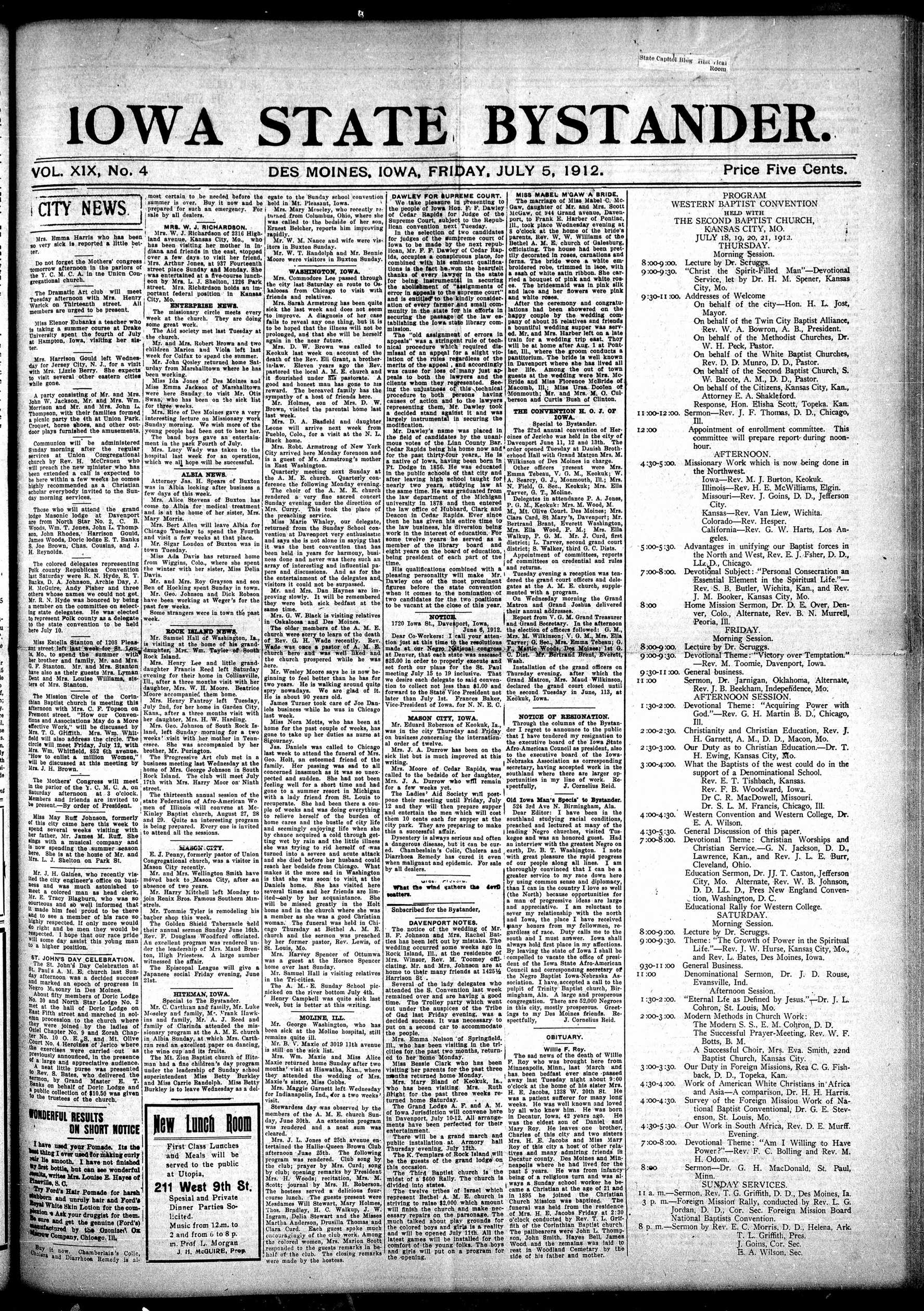
CITY NEWS
Mrs. Emma Harris who has been so very sick is reported a little better.
Do not forget the Mothers' congress tomorrow afternoon in the parlor of the Y. C. M. C. A. in the Union Congregational church.
The Dramatic Art club will meet Tuesday afternoon with Mrs. Henry Warkick on Thirteenth Street. All members are urged to be present.
Miss Elenor Eubanks a teacher who is taking a summer course at Drake University spent the fourth of July at Hampton, Iowa, visiting her sister.
Mrs. Harrison Gould left Wednesday for Jersey City, N. J., for a visit with Mrs. Lizzie Berry. She expects to visit several other eastern cities while gone.
A party consisting of Mr. and Mrs. John W. Jackson, Mr. and Mrs. Wm. Morrison and Mr. and Mrs. John L. Thompson, with their families formed a plea to the Union Park, Concord, horse shoes, and other outdoor plays furnished the amusements.
Communion will be administered Sunday morning, as the Union Congregational church by Rev. H. McCraun who will preach the new minister who has been extended a call is expected to be here within a few weeks he comes to the church as the Christian scholar everybody invited to the Sunday morning services.
Those who will attend the grand lodge Masonic lodge at Davenport, Mo. and New York, Woods, Wm. T., Jones, L. J. Thompson, John Rhodes, Harrison Gould James Woods, Dorle lodge E. T. Banks S. J. Woods, Chars. Cousins, and J. W. Woods.
SANO
The colored delegates representing Polk county Republican Convention last Saturday were R. N. Hyde, E. T. Banks, D. A. Johnson, Archive Day, J. M. Banks, and others whose names we could not get, R. M. N. Hyde was honored by being a member on the committee on selecting state delegates. He was elected to represent Polk county as a delegate to the state convention to be held here July 10.
Miss Estella Stanton of 1208 Pleasant street left last week for St. Louis, Mo. to spend the summer with her husband, the Rev. G. F. Stanton, Mr. and Mrs. Stanton have also as their guests Mrs. Lyman Dent and Mrs. Louise Willam, sisters of Mrs. Stanton.
The Mission Circle of the Corinthian Baptist church is meeting this afternoon with Mrs. C. F. Topson on Fremont street. "How our Conventions and Associations May do a more effective Work," will be discussed by Mrs. Whitfield will also address the circle. The circle will meet Friday, July 12, with Mrs. Wm. Whitfield, 852 6th avenue. "To enlist a million Women," will be discussed at this meeting by Mrs. J. H. Brown.
The Mothers' Congress will meet in the parlor of the Y. C. M. C. A. on Saturday afternoon at 3 o'clock. Members and friends are invited to be present—By order of President.
May Miss Mary Johnson, formerly of this city came here this week to spend several weeks visiting with her father, Mr. James M. Ruff. She is a musical company and is now a member of the church. She is at the home of Mr. and Mrs. L. J. Shelton on Park St.
Mr. J. H. Gaines, who recently visited the city engineer's office on business and was much astonished to meet a colored man as head clerk, Mr. E. Tracy Blagburn, who was so courteous and so well informed that it made him feel proud to be there and to see a member of his race so highly respected. If only more would he right and be men they would be respected. I hope that our race pride will some day assist this young man to a higher position.
57. JOHN'S DAY CELEBRATION.
The St. John's Day Celebration at St. Paul's A. M. E. church last Sunday afternoon was a decided success and marked an epoch of progress in Negro M'sonry in Des Molines.
About fifty members of Doric Lodge No. 30 and North Star Lodge No. 2 met at the hall of Doric Lodge on East Fifth Street and marched in solemn procession to the church where they were joined by the ladies of Ozel Chapter No. 9 and Zorah Chapter No. 10 O. E. S. and Mt. Olive Court No. 4. Heroines of Jerice where the exercises were carried out as previously announced, in the presence of a large and appreciative audience.
A neat little purse was presented to Rev. S. Bates, who delivered the sermon, by Grand Master E. T. Banks on behalf of Doric Lodge and a public collection of $10.50 was given to the trustees of the church.
I have used your Pomade. Its the best thing I ever used for making curly hair sleet. I have not finished my first bottle, but can see wonderful skins, writes Mrs. Louise E. Hayes of Pinville, S.C.
Try Ford's Hair Pomade for harsh stubborn and unruly hair and Ford's Royal White Skin Lotion for the compulsion. Ask your druggist for them. Sure and get the genuine (Ford's) manufactured by the Ozonizer! Oxarrow Company, Chicago, Ill.
Bay it now. Chamberlain's Colle, Cholera and Diarrhoea Remedy is al-
most certain to be needed before the summer is over. Buy it now and be prepared for such an emergency. For sale by all dealers.
MR. W. W. J. RICHARDSON.
Mrs. W. W. J. Richardson of 2316 Highland avenue, Kansas City, Mo, who has been visiting her mother in Indiana and friends in the east, stopped over a few days to visit her friend, Mrs. Arthur Jones, at 357 Fourteenth street place Sunday and Monday. She was entertained at a five-course lunchleton, 1236 Park street. Mrs. Richardson holds an important federal position in Kansas City, Mo.
ENTERPRISE NEWS.
The missionary circle meets every week at the church. They are doing some great work. The Aid society met last Tuesday at the church. Mr. and Mrs. Robert Brown and two children Marion and Viola left last week for Colafx to spend the summer. Mr. John Qosley returned home Saturday from Marshaltown where he has been working. Miss Ida Jones of Des Moines and Jackson of Marshaltown were here to visit Mr. Swan, who has been on the sick list for three weeks. Mrs. Bice of Des Moines gave a very interesting lecture on Missionary work Sunday morning. We wish more of the young people had been out to hear her. The band boys gave an entertainment at John's church. Mrs. Lucy Wady was taken to the hospital last week for an operation, which we all hope will be successful.
ALBIA NEWS
Attorney Jas. H. Spears of Buxton was in Albia looking after business a few days of this week.
Mrs. Alice Stevens of Buxton has come to Albia for medical treatment and is at the home of her sister, Mrs. Mary Morris.
Mary Morris will all leave Albia for Chicago Tuesday to spend the Fourth and visit a few weeks at that place.
Mr. Stirar of London of Buxton was in
Mir. Sigar Loudon of Buxton was in town Tuesday.
Miss Ada Davis has returned home from Wiggins, Colo., where she spent the inter with her sister, Miss Delia Davis.
Mr. and Mrs. Roy Grayson and Ben of Hocking spent Sunday in town.
Mr. Geo. Johnson and Dick Robson have been working at Weger's for the past few weeks.
The home strangers were in town the past week.
ROCK ISLAND NEWS.
Mr. Samuel Hall of Washington, Ia., in visiting at the home of his grandmother, Wm. Taylor of South Rock Island.
Mrs. Henry Lee and little grandmother Wm. Taylor of South Rock Island.
Mrs. Henry Lee Reed left Saturday evening for their home in Collinsville, Il., after a three months visit with her daughter, Mrs. H. Moore. Beatrice Mrs. Henry Fautroy left Tuesday, July 2nd, for her home in Garden City, Kan., after a three months visit with her daughter, Mrs. H. W. Harding.
Mrs. Geo. Johnson of South Rock Island. She was dulled morning for a two weeks' visit to the museum. She was accompanied by her brother, Mr. Purington.
The Progressive Art club met in a business meeting last Wednesday at the home of Mrs. George Johnson in South Rock Island. The club will meet July 11 with Mrs. Harry Moor on Ninth Street.
The thirteenth annual session of the state Federation of Afro-American Women of Illinois will convene at McKinley Baptist church, August 27, 2013. The program is being prepared. Every one is invited to attend all the sessions.
MASGN CITY
E. J. Penny, formerly pastor of Union Congregational church, was a visitor in Mason City recently. Mr. and Mrs. Wellington Smith have made a visit to Mason City, after an absence of two years. Mr. Harry Mitchell left Monday to join Renix Bros. Famous Southern Minstrels. Mr. Tommie Tyler is remodeling his barn shop the next week. Mr. and Mrs. Shirley Tateracle held their annual sermon Sunday June 16th. Rev. F. Douglas Woodford officiated. An excellent program was rendered under the leadership of Mrs. Maud Brenton, High Priestess. A large number witnessed the affair. The League will give a Japanese social Friday evening, June 21st.
HITEMAN IOWA
Mr. C. Carthan and family, Mr. Luke Moseley and family, M. Frank Hawkins and family, Mr. A. J. Reed and family of Clarinda attended the missive conference in August, at which Mrs. Carthan read an excellent paper on dancing, the wine cup and its fruits. The Mt. Zion Baptist church of Hittoman had a fine children's day program under the leadership of the Rev. Betty Burkley and Miss Carrie Randolph. Miss Betty Burkley is to leave Wednesday as a deli-
211 West 9th St.
legate to the Sunday school convention held in Mt. Pleasant, Iowa. Mrs. Mary Mosley, who recently returned from Columbus, Ohio, where she lived to the bedside of her son Eraset Becher, reports him improving rapidly.
Mr. W. M. Nance and wife were visi
itors in Buxton Sunday.
Mr. W. T. Randolph and Mr. Bennie Moore were visitors in Burton Sunday
WASHINGTON IOWA
Mrs. Commodore Lee passed through the city last Saturday en route to Oaklanda from Chicago to visit with friends and relatives.
Mrs. Sarah Armstrong has been quite able to improve. A diagnosis of her case fails to reveal any one thing, but it is to be hoped that the illness will not be prolonged, and that she will be herself again in the near future.
Mrs. D. W. Brown was called to Keckah to have on account of a degree of the illness her brother, inlaw, Eleven years ago the Rev. pastored the local A. M. E. church and it flourished under his pastorate. A good and honest man has gone to him reward. The bereaved family has the sympathy of a host of friends here.
Mrs. Holmes, son of D. M. W. Brown, visited the parental home last week.
Mrs. D. A. Bassfield and daughter Leone will arrive next week from Pueblo, Colo., for a visit at the N. L. Black home.
Mrs. Robt Armstrong of New York City will arrive here Monday foronon and is a guest of Mr. Armstrong's mother in East Washington.
Quarterly meeting next Sunday at the A. M. E. church. Quarterly conference the following Monday evening.
The chair of the A. M. E. church funeral day since concert Sunday evening until the direction of Mrs. Curry. This took the place of the preaching service.
Miss Maria Whaley, our delegate, returned from the Sunday School convention at Davenport very enthusiastic and proud. It was the best convention that has been held in years for harmony, business done and never was there such an array of interesting and influential papers and discussions. And as for the teachers, they were both visitors and visitors it could not be surpassed.
Mr. and Mrs. Dan Haynes are improving slowly. It will be remembered they were both sick bedfast at the school.
Mrs. G. W. Black is visiting relatives in Oakloake, and Des Moines.
The older members of the A. M. E. church were sorry to learn of the death of Rev. G. H. Wade recently. Rev. Wade was once a pastor of A. M. E. church here and was well liked and the church prospered while he was here. Mr. Wesley Moore says he is now beginning to feel better than he has for two years. He is walking around quite epy nowadays. We are glad of it. H. Wade was a nurse. James Turner took care of Joe Daniels business while he was in Chicago last week. Miss Nora Motts, who has been at home for the past couple of weeks, has taken up her duties as nurse at Sigmarova.
Jas. Daniels was called to Chicago last week to attend the funeral of Mrs. Geo. Holt, an esteemed friend of the family. Her passing was sad to all concern and was much sad so was unexcuseable. She was so feeling well for a short time and had gone to a summer resort in Michigan with a lady friend from St. Louis to recuperate. She had been there a couple of weeks and was doing everything she could do to help home carees and the bustle of city life and seemingly enjoy life when she by chance acquired a cold through getting wet by rain and the little illness she was trying to rid herself of was turned into a severe and acute attack she had to reach her bedside from Chicago. What makes it the more sad in Washington is that she was soon to visit, at the Daniels home. She has visited here several times and her friends are limited—only by her acquaintance. She is now a member of the church home and in the church where she was a member as she was a good Christian woman. The funeral was held in Chicago Thursday at Bethel A. M. E. church and the sermon was prescheduled for former pastor, Rev. Lewis, of St. Louis. Mrs. Harvey Spencer of Ottumwa was a guest at the Horace Spencer home over last Sunday. Mr. Samuel Hall is visiting relatives in the Tri-cities. Mr. E. Sunday School picnicked on the river bottom July 4th. Henry Campbell was quite sick last week, but is better at this writing.
MOLINE ILL
Mr. George Washington, who has been sick at the Moline hospital, still remains quite ill. Mr. George was of 3019 11th avenue is still on the slick list.
Mrs. Wm. Maxie and Miss Alice Maxie returned home Sunday after two months' visit at Hiwatha, Kan, where they attended the wedding of Mrs. Maxie's sister, Miss Cobbs. Alice Garnett gave a Wednesday for Indianapolis, Ind., or a two weeks' visit.
Stewardess day was observed by the members of the A. M. E. church Sunday, June 30th. An extension program was reended and a neat sum was collected.
Mrs. J. L. Jones of 28th avenue entertained the Hallie Queen Brown Club afternoon June 28th. The following program was rendered. Club song by the club; prayer by Mrs. Curt; song by club; opening remarks by President Robert Scott; journal by Mrs. H. Roberson. The hostess served a delicious four-course lunch. The guests present were Madames Will Stewart, Mary Holmes, Thos. Bradley, H. C. Walkup, J. W. Engram, Della Walker, Drusilla Thomas, and Clara Curt. Each guest spoke much encouragingly of the club work. Among the colored women, Mrs. Marion Scott responded to the guests remarks in behalf of the club. The closing remarks
DAWLEY FOR SUPREME COURT.
We take pleasure in presenting to the people of Iowa Hon. F. D. F. Lawley or Cedar Raphael Judge of the supreme court of Iowa to be made by the next republican convention next Tuesday.
In the selection of two candidates for judges of the supreme court of Iowa to be made by the next republican convention next Tuesday, occupies a conspicuous place, for combined with his eminent qualifications is the fact he won the heartfelt thanks of every lawyer in the state for being instrumental in securing the right to appeal the error in appeals to the supreme court* and is entitled to the kindly consideration of every farmer and small community in the state for his efforts in securing the passage of the law allowing the Iowa state library commission.
The "old assignment of errors in appeals" was a stringent rule of technical procedure which required disqualification of the rules regardless of the merits of the appeal, and accordingly was cause for loss of many just appeals to both the lawyers and the public in the interest of this technical procedure to both persons, having causes of action and to the lawyers representing them, Mr. Dawley took a decided stand against it and was largely instrumental in securing the identification.
Mr. Dawley's name was placed in the field of candidates by the unanimous votes of the Linn County Bar. He was elected in 1875 for the past thirty-four years. He is a native of Iowa, having been born in Ft. Dodge in 1856. He was educated in the public schools of that city and in the nearby two years, studying law at the same time. He was graduated from the law department of the Michigan university in 1878 and he entered the Deaconate in 1881. Deacon in Cedar Rapids. Ever since then he has given his entire time to the law business, his diversion being work in the interest of education. For many years he was a member of the library board and eight years on the board of education, being president of each part of the time. His qualifications combined with a pleasing personality will make Mr. Dawley one of the most prominent figures before the state convention of 1876. He was two candidates for the two positions to be vacant at the close of this year.
NOTICE
1720 Iowa St., Davenport, Iowa,
Dear Co-Workers: I call attention just at this time to the resolutions made at our Negro National congress at Denver, that each state was assessed $25.00 in order to properly execute and enforce the resolutions. We meeting July 15 to 19 inclusive. That we desire each delegate to said convention to collect not less than $1.00 and forward to the State Vice President not less than $1.00. Vice-President of Iowa, for N. N. E. C.
MASON CITY, IOWA
Mr. Eduard Roberson of Kookuk, Ia, was in the city Thursday and Friday on business, concerning the international order of twelve. He knew has been on the sick list but is much improved at this writing.
Mrs. Moore of Cedar Rapids, was called to the bedside of her daughter, who will remain for a few weeks yet. The Ladies' Aid Society will postpone their meeting until Friday, July 12 and they will then prepare supper and entertain the men which will cost at the city park. They are preparing to make this a successful affair.
Dysentery is always serious and often a dangerous disease, but it can be curbed. Chambishela's Colic, Cholera and comedy has curied it even when malignant and epidemic. For sale by all dealers.
Subscribed for the Bystander.
The notice of the wedding of Mr. B. F. Johnson and Mrs. Rachel Battles has been left out by mistake. The wedding occurred some weeks ago in Rock Island, Ill., at the residence of Mrs. Winsor, Rev. M. Toomey officiating. Mr. and Mrs. Johnson are at the residence of many friends at 145% Harrison St. Several of the S. lady delegates who attended the S. Convention last week remained over and are having a good time. The Trolley party which went out under the auspices of the Tribe of Gad last Friday evening, was a great success. It was wonderful put on a second car to accommodate the people.
Mrs. Emma Nelson of Springfield, Ill., who has been visiting in the trillegts for the past two months, returned home on Monday. Mrs. Miss Bland of Keokuk, Ill., who has been visiting Mrs. Ruth of Keokuk, will be three weeks returned home Saturday. The Grand Lodge A. F. and A. M. of Iowa Jurisdiction will convene here in Davenport, July 10-12. All arrangements have been perfected for their arrival. There will be a grand march and public installation at Armory hall Thursday evening, July 12th. The K. Templars of Rock Island will be the grand lodge on this occasion. The Third Baptist church is the midst of a $'000 Rally. The church is divided into states. The church represents of Israel which represent Bethel A. M. E. church is striving to raise $2,000 which amount will finish the church and make necessary repairs on the paragonism. The church is for the colored boys and girls is a reality and will be opened July 11th. All the latest games will be installed for the comfort of the young folks. The boys will put on a program for the opening.
MISS MABEL M'GAW A BRIDE.
The marriage of Miss Mabel C. McGaw, daughter of Mr. and Mrs. Scott McGaw, of 444 grand avenue, Davenport, to Frank E. Harber of Pontiac, ill, took place Wednesday evening at 8 o'clock in the夜市, the bank by R. W. Williams of the Bethel M. E. M. church of Galeston, officiating. The house had been prettily decorated in roses, carnations and ferns. The bride wore a white embroidered robe, trimmed in lace, with a saff of white satin ribbon. She carried a bouquet of pink and white roses, with a pink and white lilac and lace and her flowers were pink and white roses.
After the ceremony and congratulations had been showered on the happy couple by the wedding company, the couple bought a bouquet of wedding supper was served. Mr. and Mrs. Harber left on a late train for a wedding trip east. They will be at home after Aug. 1 at Pontic, ill., where the groom conducts a wedding service. They will be in Davenport where she has lived all her life. Among the out of town guests at the wedding were Mrs. McBride and Miss Florence McBride of Davenport. Mrs. McBride Monmouth; Mr. and Mrs. M. O. Culbertson and Curtis Bush of Clinton.
THE CONVENTION H. O. J. OF IOWA
Special to Bystander.
The 22nd annual convention of Heroines of Jericho was held in the city of Davenport June 11, 12 and 13th. The order opened Tuesday at Danish Brotherhood Hall with Grand Matron Mrs. M. W. Sørensen and Grand Matron Mrs. N. Other officers present were Mrs. Emma Tebeau, V. G. M. Kookuk; V. A. Searay, G. J. Monmouth, Ill.; Mrs. N. Field, G. Sec. Kookuk; Mrs. Ella Tarver, G. T. Moline.
Delegates in attendance P. A. Jones, P. M. Olive, M. Wood, M. Wood, M. Olive, M. Olive, Des Moines; Mrs. Clara Card, St Mary's, Davenport; Mr. Bertrand Brant, Everett Washington, Mrs. Ella Wood, P. M.; Mrs. Ella Walkup, P. G. M. Mr. J. Curl, first district; L. Tarver, second grand court district; S. Walker, third G. C. Dists. on behalf of the committee on membership of committees on credential and rules and returns.
Tuesday evening a reception was tendered the grand court officers and delegates at the A. M. E. church, supplemented with a program.
The grand court delivered the Grand Matron and Grand Joanna delivered their annual addresses.
Report from V. G. M. Grand Treasurer and Grand Secretary. In the afternoon the election of officers followed: G. M. Mrs. M. Wilkinson; V. G. M. Mrs. Ella F. Mattie Woods; Des Moines; lst G. C. Dist. Mr. Bertrand Brent, Everett, Wash. Installation of the grand officers on Thursday evening, after which the Grand Monarch, Amaud Wilkinson, and the grand chair, cliche, the second Tuesday in June, 11, at Kecku, Iowa.
NOTICE OF RESIGNATION
OBITUARY.
Willie F. Roy.
The sad news of the death of Willie F. Roy who was brought here from Minneapolis, Minn., last March and has been beded fast ever since passed away. His last visit to the home of his sister Mrs. H. E. Hacock, 1238 W. 20th St. He was a patient sufferer for many long weeks. He was well known and loved by all who knew him. He was born in Minneapolis and was the oldest son of Daniel and Mary Roy. He leaves one brother, Charles of this city and two sisters, Mrs. H. E. Jacobs and Miss Mary T. H. Jacobs and many admiring friends in Decatur county. Des Moines and Minneapolis where he had lived for the past 5 years. He was from infancy being of a religious turn and was became a Christian at the age of 21 and in 1895 he joined the Christian Church Mission was baptized. The funeral was held from the residence of the clock conducted by Rev. T. L. Griffith of the Corinthian Baptist Church the pallbearers were John L. Thompson son, John Smith, Hayley Bell, James Wood and Andrew Bell. Wood and Woodland Cathedral by the side of his father and mother.
On behalf of the White Baptist Churches,
Rev. D. D. Munro, D. D. Pastor.
Response, Hon. Elisha Scott, Topeka. Kan.
11:00-12:00. Sermon—Rev. J. F. Thomas, D. D., Chicago,
Ill.
5:00-5:30. Advantages in unifying our Baptist forces in the North and West, Rev. E. J. Fsher, D. D., LL.D. Chicago.
Education Sermon, Dr. JJ. T. Caston, Jefferson City, Mo. Alternate, Rev. W. B. Johnson, D. D. LLL, D., Pres New England Convention, Washington, D. C.
Denominational Sermon, Dr. J. D. Rouse, Evansville, Ind. Afternoon Session. "Eternal Lfe as Defined by Jesus." Dr. J. L. Cohron, St. Louis, Mo.
A Successful Choir, Mrs. Eva. Smith, 22nd Baptist Church, Kansas City.
4:30-5:30. Our Work in South Africa, Rev. D. E. Murff. Evening.
11 a. m.—Sermon, Rev. T. G. Griffith, D. D., Des Moines, Ia.
3 p. m.—Foreign Mission Rally, conducted by Rev. L. G.
Jordan, D. D., Cor. Sec. Foreign Mission Board
National Baptists Convention.
8 p. m.—Sermon by Rev. E. C. Morris, D. D., Helena, Ark.
T. L. Griffithl, Pres.
J. Goins, Cor. Sec.
E. A. Wilson, Sec.
State Capitol Blog Historical Room
```markdown
```
Price Five Cents.
Iowa State Bystander
BYSTANDER PUB. CO., Publishers.
DES MOINES. IOWA
New Mark Twain Produced His Literary Masterpiece, "The Adventures of Tom Sawyer."
As early as 1872 Mark Twain had contemplated one of the books that will longest preserve his memory, "The Adventures of Tom Sawyer." The successful result of "Roughing it" naturally made him cast about for other autobiographical material, and he remembered those days along the river front in Hannibal—his favorite features of the river. Blankenhip, the town boy, John Briggs and the rest. He recognized these things as material—pleasant, inviting material it was—and now in the cool luxury of Quarry Farm, at Hartford, Conn., he set himself to weave the fabric of his youth.
He found summer time always his best period for literary effort, and on a hillade just by the old quarry Mrs. Crane had built for him that spring a study—a little room of windows, somewhat suggestive of a pilot house—overlooking the long sweep of upland grass and the dreamlike city below. Vines were planted in the course of time would cover and embower it; there was a tiny fireplace for chill day. He worked steadily there that summer. He would go up mornings after breakfast, remaining until nearly dinner time—say, until 5 o'clock or after—for it was not his habit to eat luncheon. Albert Bigelow Paine in Harper's Magazine.
Summer House In Oak Tree
One of the finest and most remarkable trees in the state is the mammoth oak on the estate of William Barber in the town of Exeter. The tree is about eighteen feet in circumference at the base and five great branches which leave the trunk about twelve feet above the ground form the support for a spacious platform which in times past was used by the owner of the estate. The lowest of these branches, which forms the principal support for the platform, leaves the trunk of the tree almost at right angles and the others form a symmetrical dome which provides a canopy over a dancing platform which has been built beneath the tree on the ground.
The great oak formed an ideal retreat for gatherings of relatives and friends of the owner. It is located not far from Beach Point, which a few years ago paved a private retreat for a considerable number of summer visitors who made the summer house among the branches their favorite rendezvous.
Phylogeny of the Pipe
M. Wattville, a Paris scientist and amateur collector, who possesses the finest existing collection of pipes of all nations, publishes the following curious set of reflections, which he calls The Physiology of the Pipe.
"First-While the cigar and cigarette are cosmopolitan, the pipe is characteristic of a race.
"Second-The activity of a race is in proportion to the length of the stem of the pipe.
"Third-The shorter the pipe the more laborous the nation.
"Fourth—Inversely the longer the pipe the lazier the race.
"Fifth—The more frugal the nation the smaller the pipe it affects.
"Sixth—On the other hand a large pipebowl is a sign of a wasteful and sensual nation.
"Seventh—The mind of the race may be deduced exactly from its way of smoking.
"Eighth—Tell me what you smoke and I will tell you what you are."
Tea's Conquest of Rome.
Of all the conquerors that have come to Rome no one has gained such a complete victory as tea has won in the Italian capital. Twenty years ago the British and American tourists who came to Rome were catered to in the matter of tea in a rather shamafaced manner in the strangers' quarter near the Plaza di Spagna and "English tea rooms" was the legend to be known in a few windows hard by Cook & Son's offices.
Nowadays the palm lounges of the Grand and the Excelsior hotels at tea time are two of the sights of Rome, for all Roman society drinks tea abroad in the afternoons, and there are as many uniforms at 5 o'clock in the big hotels as there are at sundown on band days on the Pincen hill. All the big pastry cooks' shops in the Corso and the other principal streets now have "Afternoon Tea" in gold letters on their plate glass. You visit to a pastry cook's counter in the afternoon has always been an incident in the day of a Roman; but the present devotion to the teapot is a British habit imported by way of France—The Sketch.
Strange Freak of Wind.
Of the many freaks played by the wind that of a late date which lifted the nest of a sitting hen, made in an empty cracker box and depressed it hen and 13 eggs, on the top of a rural mail delivery box, a quarter of a mile away, was the mankind. The hen is the property of Miss Ida Erickson, and her from the ground, lift it 80 feet in the air and snailly leave it on the mail box undisturbed. The hen has settled down to her new location and will be left to hatch—Baltimore American.
The Fitness of Things.
"It seems to me that time should be represented by an old woman instead of an old man."
"Why?
"There is a saying, you know, that Time will tell."
Varying the Monetony.
"My doctor says I ought to ride a horse," said the indolent man.
"What for?"
"I don't know. Maybe he's tired of treating me for dyspepsia and wants a broken cellphone for a change."
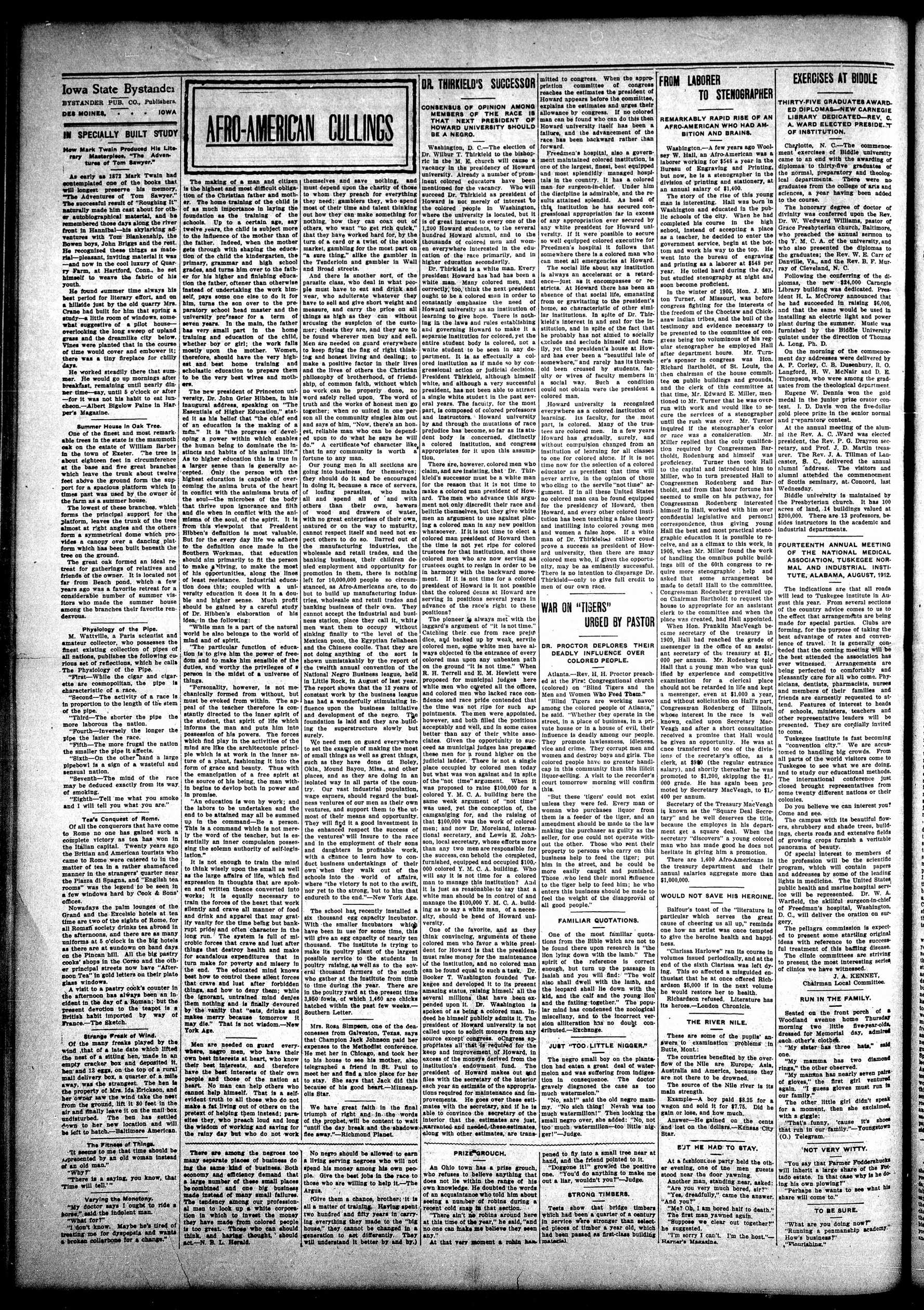
AFRO-AMERICAN CULLINGS
The making of a man and citizen is the highest and most difficult obligation of the Christian father and mother. The home training of the child is of as much importance in laying the foundation as the training of the schools. Up to the certain age, the child is given more to the influence of the mother than of the father. Indeed, when the mother gets through with shaping the education of the child the kindergarten, the primary, grammar and high school grades, and turns him over to the father for his higher and finishing education the father, oftener than otherwise instead of undertaking the work himself, pays some one one dollar to the preparatory school head master and the university pro-sssor for a term of seven years. In the main, the father has very small part in the home training and education of the child, whether boy or girl; the work falls mostly upon the mother. Women, therefore, should have the very highest scholastic education to prepare them to be the very best wives and mothers.
The new president of Princeton university, Dr. John Grier Hibben, in his inaugural address, speaking on "The Essentials of Higher Education," stated it as his belief that "the chief end of an education is the making of a man." It is "the progress of developing a power within which enables the human being to dominate the world." As to higher education this is true in a larger sense than is generally accepted. Only the person with the highest education is capable of overcoming the anima bruta of the heart in conflict with the animis bruta of the soul—the microbes of the body that thrive upon ignorance and filth and die when in conflict with the anima bruta of the soul from this viewpoint that President Hibben's definition is most valuable. But for the every day life we adhere to the definition once made in the Southern Workman, that education should aim primarily to fit the person to make a living, to make the most of his opportunities, along the lines of least resistance. Industrial education does this coupled with a universal education in life inible and higher sense. Much profit should be gained by a careful study of Dr. Hibben's elaboration of his idea, in the following:
"While man is a part of the natural world he also belongs to the world of mind and of spirit.
"The particular function of education is to give him the power of freedom and to make him sensible of the duties, and worthy the privileges of a person in the midst of a universe of the world.
"Personality, however, is not mechanically formed from without, but must be evoked from within. The appeal of the teacher therefore is constantly directed to the inner spirit of the student, that spirit of life which informs the man and puts him into possession of his powers. The forces which find play in the activities of the mind are like the architectonic principle which is at work in the inner nature of a plant, fashioning it into the form of grass and beauty. Thus with the growth and beauty of a tree spirit the source of his being, the man with in begins to develop both in power and in promise.
"An education is won by work; and the labors to be undertaken and the end to be attained may all be summed up in the command—Be a person. This is a command which is not merely the word of the teacher, but is easier to an inner compulsion possessing the solemn authority of self-legitation."
It is not enough to train the mind to think wisely upon the small as well as the large affaire of life, which find expression in thoughts that are spoken and written thence converted into works; it is equally necessary to train the forces of the heart that work slently and crave all manner of food and drink; it is equally vital to fancy villa for the time being but bankrupt pride) and often character in the long run. The system is full of microbic forces that crave and lust after things that destroy health and make for scandalous expenditures that in turn make for poverty and misery in the end. The educated mind knows best how to control these silent forces that crave and lust for forbidden things, and how to deny them; while they are forbidden, and enles them nothing and is finally overcome by the vanity that "ests" drinks and makes merry because tomorrow it may die." That is not wisdom—New York Age.
Men are needed on guard everywhere, negro men, who have their own best interests at heart, who know their best interests, and therefore have the best interests of their own people and those of the nation at heart. No man can help others who cannot help himself. That is a self-evident truth to all those who do not make a fat living out of others on the pretext of helping them instead; parallels they, who preach loud and long the wisdom of working and saving for the rainy day but who do not work
There are among the negroes too many separate places of business doing the same kind of business. Both economy and efficiency demand that a large number of these small places be combined and one big business made instead of many small failures. The tendency among our professional men to look up a white corporation in which to invest the money is too great. Those who can should think, and having thought, 'should act—N. B. L. Hergeld.
themselfs and save nothing, and must depend upon the charity of those to whom they preach for everything they need; gamblers they, who spend most of their time and talent thinking out how they can make something for nothing, how they can coax out of others, who want "to get rich quick," that they have worked hard for, by the turn of a card or a twist of the stock market, gambling for the most part on "a sure thing," alike the gambler in the Tenderloin and gambler in Wall and Broad streets.
And there is another sort, of the parasite class, who deal in what people must have to eat and drink and wear, who adulterate whatever they have to sell and give short weight and measure, and carry the price on all things as high as they can without arcing the suspicion of the customer; sheats they are, and they are to be found wherever men buy and sell. We must keep the flag of right thinking and honest living and dealing; to make a positive factor in their lives and the lives of others the Christian philosophy of brotherhood, of friendship, of common faith, without which no work can be properly done, no word safely relieved upon. The word of truth and the works of honest men go together; when so united in one person all the community singles him out and says of him, "Now, there is an honest, reliable man who can be dependable and a man who does not do." A certificate of character like that in any community is worth a fortune to any man.
Our young men in all sections are going into business for themselves; they should do it and be encouraged in doing it, because a race of servers, of loafing parasites, who make all and spend all of, and with others than their own, hewers of wood and drawers of water, with no great enterprises of their own, matured or on the way to maturity, cannot respect itself and need not exert themselves in the manufacturing industries, the wholesale and retail trades, and the banking business, their children denied employment and opportunity for promotion in them, there is nothing left for 10,000,000 people so circumcumbers, as Afro-Americans are, to do but to build up manufacturing industries, wholesale and retail trades and banking business of their own. They cannot accept the industrial and business station, place they call it, whit, and they cannot accept the sinking finally to 'the level of the Mexican peon, the Egyptian fellahean and the Chinese coole. That they are not doing anything of the sort is shown unmistakably by the report of the twelfth annual convention of the National Negro Business league, held in Little Rock, in August of last year. The report shows that the 12 years of constant work by the business league has had a wonderfully stimulating influence upon the business initiative of the foundation is laid and they are building the superstructure slowly but surely.
We need men on guard everywhere to set the example of making the most of small things as well as great things, such as they have done at Boley, Okla, Bayou Miss., and other places, and as they are doing in an isolated way in all parts of the country, we need men to wage earners, should regard the busiest ventures of our men as their own ventures, and support them to the utmost of their means and opportunity. They will find it a good investment in the enhanced respect the success of the ventures' will insure to the race and in the employment of their sons and daughters in profitable work with a chance to learn how to conduct business when they walk out of the schools into the world of affairs, where "the victory is not to the swift, nor yet to the strong, but to him that endureth to the end."—New York Age
The school has recently installed a six thousand egg capacity incubator. With the smaller incubators which have been in use for some time, this will give an egg capacity of nearly ten thousand. The institute is trying to make its poultry plant of the largest possible service to the students in poultry raising, as well as to the so-called thousand farmers of the south who gather at the institute from time to time during the year. There are in the poultry yard at the present time, 3,860 fowls, of which 1,460 are chickens hatched within the past few weeks. —Southern Letter.
Mrs. Rosa Simpson, one of the deaconsesses from Galveston, Texas, says that Champion Jack Johnson paid her expenses to the Methodist conference. He met her in Chicago, and took her to see him. He telephoned a friend in St. Paul to meet her and find a nice place for her to stay. She says that Jack did this because of his good heart—Minneapolis Star.
We have great faith in the final triumph of right and in. the words of the prophet, will be content to wait "until the day break and the shadows flee away."—Richmond Planet.
No negro should be allowed to earn a living serving negroes who will not spend his money among his own people. Give the best jobs in the race to those who are willing to help it—The Argus.
(Give them a chance, brother; it is all a matter of training. Having spent two hundred and fifty years in carrying everything they made to the "big house," they cannot be changed in a generation to not differently. They will understand it better by and by.)
---
DR. THIRKIELD'S SUCCESSOR
CONSENSUS OF OPINION AMONG MEMBERS OF THE RACE IS THAT NEXT PRESIDENT OF HOWARD UNIVERSITY SHOULD BE A NEGRO.
Washington, D. C.—The election of Dr Wilbur T. Thirkield as the bishop of Howard university. Except which will cause a vacancy in the presidency of Howard university. Already a number of prominent colored educators have been mentioned for the vacancy. Who will succeed Dr. Thirkield as president of Howard is not merely of interest to the colored people in Washington, where the university is located, but it is of great interest to every one of the 1,200 Howard students, to the several hundred Howard alumni, and to the thousands of colored men and women in the education of the race primarily, and in higher education secondly.
Dr. Thirkield is a white man. Every president Howard has had has been a white man. Many colored men, and correctly, too, think the next president ought to be a colored man in order to constantly emphasize the need of Howard university as an institution of learning to give him the ability to teach and rules establishing and governing Howard to make it a separate institution for colored, yet the entire student body is colored, not a white student to be seen in any department. It is as effectually a colored institution as if made so by congressional action or judicial decision. President Thirkield, although himself a white student, has not been able to attract a single white student in the past several years. The faculty, for the most part, is composed of colored professors and instructors. Howard university by and through the mutations of race prejudice has become, so far as its student body is concerned, distinctly a colored institution, and congress appropriates for it upon this assumption.
There are, however, colored men who claim, and are insisting, that Dr. Thirkeld's successor must be a white man for the reason that it is not time to make a colored man president of Howard. The men who advance this argument not only discredit their race and brittle themselves, but they give white men an argument to use against placing a colored man in any new position whatsoever. If it is not time to elect a colored man president of Howard then the time is not yet ripe for colored trustees for that institution, and those colored men who are now serving an trustees to resign in order to be in harmony with the backward move in the administration, and it is not time for Howard is it not possible that the colored deans at Howard are serving in positions several years in advance of the race's right to these positions?
The planner is always met with the laggard's argument of "it is not time." Catching their cue from race prejudice, and backed up by weak, servile colored men, some white men have always objected to the entrance of every colored man upon any unbeaten path on the ground "it is not time." When Terrence and M. Hewitt were promised to unclearties white men who were allotted all the offices, and colored men who lacked race confidence and race pride contended that the time was not ripe for such appointments. The men were appointed, however, and both filled the positions acceptably and well, and in some cases better than any of their white associates. Given the opportunity to succeed as municipal judges has prepared the men for unclearties in judicial ladder. There is not a single place occupied by colored men today but what was won against and in spite of the "not time" argument. When it was proposed to raise $100,000 for a colored Y. M. C. A. building here the same weak argument of "not time" was used, yet the conception of, the camgaming for, and the raising of, the men for, and now Dr. Moreland, international secretary, and Lewis E. Johnson, local secretary, whose efforts more than any two men are responsible for the success, can behold the completed, furnished, equipped and occupied $100,000 colored Y. M. C. A. building. Who will say it is not time for a colored man to manage this institution? And it is just as reasonable to say that the men can manage the $100,000 Y. M. C. A. building as to say a white man, of a necessity, should be head of Howard university.
One of the favorite, and as they think convincing, arguments of these colored men who favor a white president for Howard is that the president must raise money for the maintenance of the institution, and no colored man can be found equal to such a task. Dr. Booker T. Washington founded Tuskegee and developed it to its present amazing status, raising himself, all the several millions, that have been expended upon it. Dr. Washington is spoken of as being a colored man. Indeed he himself publicly admits it. The president of Howard university is not called upon to solicit money from any source except congress. oCgress appropriates all that is required for the keep and improvement of Howard, in excess of the money derived from the institution's endowment fund. The president of Howard makes out and gives each year an estimate of the appropriations required for maintenance and improvements. He goes over these estimates with the secretary, and if he is able to convince the secretary of the interior that the estimates are just, warranted and needed, these estimates, along with other estimates, are trans
An Ohio town has a prize grouch, who refuses to believe anything that does not lie within the range of his own knowledge. He doubted the words of a acquaintance who told him about seeing a recent cold snap in that section. "There aren't no robes around here at this time of the year," he said, and no one can make me believe they seen any."
mitted to congress. When the appropriation committee of congress reaches the estimates the president of Howard appears before the committee, explains the estimates and urges their allowance by congress. If no colored man can be found who can do this then the president will be allowed to fail, and the advancement of the race has been backward rather than forward.
Freedman's hospital, also a government maintained colored institution, is one of the largest, finest, best equipped and most splendidly managed hospitals in the country. It has a colored man for surgeon-in-chief. Under him the discipline is admirable, and the results attained splendid. As head of this institution he has secured congressional appropriation far in excess of any appropriation for Harvard university. If it were possible to secure so well equipped colored executive for Freedman's hospital it follows that somewhere there is a colored man who can meet all emergencies at Howard.
The social life about any institution is always an accelerator or a retardance—just as it encompasses or restricts. At Howard there has been an absence of that social life, emanating from the fact that according to the president's home, so characteristic of other similar institutions. In spite of Dr. Thirkeld's interest in and zeal for the institution, and in spite of the fact that he probably has not aimed to socially exclude andSECUSE himself and family, yet the president's house at Howard has ever been a "beautiful isle of somewhere," and rarely has its threshold been crossed by students, faculty members in a social way. Such a condition could not obtain were the president a colored man.
Howard university is recognized everywhere as a colored institution of learning. Its faculty, for the most part, is colored. Many of the trustees are colored men. In a few years Howard has gradually, surely, and without compulsion changed from an institution of learning for all classes to one for colored alone. If it is not time now for the school to admit a student that time will never arrive, in the opinion of those who citing to the servile "not time" argument. If in all these United States no colored man can be found equipped for the presidency of Howard, then Howard, and every other colored institution has been teaching a false theory and instilling into colored young men and women a false hope. If a white man of Dr. Thrikleka called could prove a success as president of Howard, he would be a man colored men who, if given the opportunity, may be as eminently successful. There is no intention to disarrange Dr. Thrikleka—only to give full credit to men of our own race.
WAR ON "TIGERS"
URGED BY PASTOR
DR. PROCTOR DEPLORES THEIR DEADLY INFLUENCE OVER COLORED PEOPLE.
Atlanta—Rev. H. H. Proctor preached at the First. Congregational church (colored) on "Bilind Tigers and the Men and Women Who Feed Them." "Bilind Tigers are working navoc among the colored people of Atlanta," he said. "They are working street, in a place of business, in a private house or in a house of evil, their influence is deadly among our people. They promote lawness, idleness, vice and crime. They corrupt men and women and destroy boys and girls. The colored people have no greater handicap in this community than this illicit liquor-selling. A visit to the reckoner's tomorrow morning will confirm this.
"But these 'tigers' could not exist unless they were fed. Every man or woman who purchases liquor from them is a feeder of the tiger, and an amendment should be made to the law making the purchaser as guilty as the seller, for one could not operate without the other. Those who rent their property to persons who carry on this business help to feed the tiger; but put them in charge and they could be more easily caught and punished. Those, who lend their moral influence to the tiger help to feed him; he enters this business should be made to feel the weight of the disapproval of all good people."
FAMILIAR QUOTATIONS.
One of the most familiar quotations from the Bible which are not to be found there upon research is "the lion lying down with the lamb." The spirit of the reference is correct enough, but turn up the passage in Isaiah and you will find: "The wolf also shall dwell with the lamb, and the leopard shall lie down with the lamb, and the fatting together." The popular mind has condensed the zoological miscellany, and to the incorrect version alteration has no doubt contributed.—Exchange
JUST "TOO LITTLE NIGGER."
The negro small boy on the plantation had eaten a great deal of watermelon and was suffering from indigestion in consequence. The doctor gravely diagnosed the case as too much watermelon."
"No, sah!" said the old negro mummy. "No such thing! Nevah was too much watermilion!" Then looking the small negro over, she added: "No, not too much watermilion—too little nigger—Judge."
opened to fly into a small tree near at hand, and the friend pointed to it. "Doggone it!" growled the positive one. "You'd do anything to make me out a lair, wouldn't you?"—Judge.
STRONG TIMBERS.
Tests show that bridge timbers which had been a quarter of a century in service were stronger than selected pieces of timber a year old, which had been passed as first-class building material.
REMARKABLY RAPID RISE OF AN AFRO-AMERICAN WHO HAD AMBITION AND BRAINS.
Washington.—A few years ago Woolsey W. Hall, an Afro-American was a laborer working for $548 a year in the Bureau of Engraving and Printing, but now, he is a stenographer in the division of printing and stationery, at an annual salary of $1,400.
The story of the rise of this young man is interesting. Hall was born in Washington and educated in the public schools of the city. When he had completed his course in the high school, instead of accepting a place as a teacher, he decided to enter the government service, begin at the bottom and work his way to the top. He went on to engraving an printing as a laborer at $648 per year. He told hard during the day, but studied stenography at night and soon become proficient.
In the winter of 1905, Hon. J. Milton Turner, of Missouri, was before congress fighting for the interests of the freedom of the Choctaw and Chickasaw indian tribes, and the bull of the testimony and evidence necessary to be presented to the committee of congress being too voluminous of his regular stenographer he employed Hall after department hours. Mr. Turner's sponsor in congress was Hon. Richard Bartholdt, of St. Louis, then chairman of the committee on buildings and grounds, and the clerk of this committee at that time, Mr. Edward E. Miller, mentioned to Mr. Turner that he was overrun with work and would like to secure the services of a stenographer until the rush was over. Mr. Turner inquired if the stenographer's color or race was a consideration. Mr. Miller replied that the only qualification required by Congressmen Bartholdt, Rodenburg and himself was proficiency. Turner then took hall to the meeting of the committee him in who turned in Hall to Congressmen Rodenberg and Bartholdt, and from that hour fortune has seemed to smile on his pathway, for Congressmen Rodenberg interested himself in Hall, worked with him over confidential legislative and personal correspondence, thus giving young Hall the best and most practical stenographic education it is possible to receive, and as a claim to this work, in 1908, when Mr. Miller found the work of handling the omnibus public buildings, and as a more stenographic help and asked that some arrangement be made to detail Hall to the committee, Congressman Rodenberg prevailed upon Chairman Bartholdt to request the house to appropriate for an assistant clerk to the committee and when the place was created, had Hall appointed.
When Hon. Franklin MacVeagh became secretary of the treasury in 1909, Hall had reached the grade of messenger in the office of an assistant secretary of the treasury at $1,000 per annum. Mr. Rodenberg told Hall that a young man who was qualified for examination for a clerical place should not be retarded in life and kept a messenger, even at $1,000 a year, and without solicitation on Hall's part, Congressman Rodenberg of Illinois, whose interest in the race is well known, called upon Secretary MacVeagh and after a short consultation received a promise that Hall would be given an opportunity. He was at once transferred to one of the divisions of the treasury's office, as a salary, $900 (the regular salary), and shortly thereafter he was promoted to $1,200, skipping the $1,000 grade. He has again been promoted by Secretary MacVeagh, to $1,400 per annum.
Secretary of the Treasury MacVengh is known as the "Square Deal Secretary" and he well deserves the title, because the employees in his department get a square deal. When the secretary "discovers" a young colored man who has made good he does not hesitate in giving him a promotion. There are 1,400 Afro-Americans in the treasury department and their annual salaries aggregate more than $1,000,000.
WOULD NOT SAVE HIS HEROINE
Balfour's toast of the "literature in particular which serves the great cause of cheering us all up," reminds one how an artist was once tempted to give the heroine health and happiness.
"Clarissa Harlowe" ran its course in volumes issued periodically, and at the end of the sixth Clarissa was left dying. The sixth affected a misguided enlistment that she offered Richardson $6,000 if in he would restore her to health.
Richardson refused. Literature has its heroes—London Chronicle.
THE RIVER NILE.
These are some of the pupils' answers to examination problems in Butte, Mont.: The countries benefited by the overflow of the Nile are Europe, Asia, Australia and America, because they are not there to be drowned. The source of the Nile river is its main strength. Example: A boy paid $2.25 for a wagon and sold it for $7.75. Did he gain or lose, and how much. Answer: He gained on the cents and lost on the dollars.—Kansas City
BJT HE HAD TO STAY.
At a fashionlone party held the other evening, one of the men guests stood near the door yawning. Another man, standing near, asked: "Are you very much bored, sir?" "Are, dreadfully," came the answer. "Me? Oh, I am bored half to death." The first man yawned again. "Suppose we clear out together!" he suggested.
"I'm sorry I can't. I'm the host."—
Harner's Magazine.
```markdown
```
THIRTY-FIVE GRADUATES AWARDED DIPLOMAS—N CARNEGIE LIBRARY DEDICATED—REV. C. A. WARD ELECTED PRESIDE. T OF INSTITUTION.
Charlotte, N. C.—The commencement exercises of Biddle university came to an end with the awarding of diplomas to thirty-five graduates of the normal, preparatory and theological departments. There were no graduates from the college of arts and sciences, a year having been added to the course.
The honorary degree of doctor of divinity was conferred upon the Rev. Dr. W. Wedward Williams, pastor of Grace Presbyterian church, Baltimore, who received the university sermon to the Y. M. C. A. of the university who also presented the diplomas to the graduates; the Rev. W. E. Carr of Danville, Va., and the Rev. B. F. Murray of Cleveland, N. C.
Following the conferring of the diplomas, the new $24,000 Carnegie Library building was dedicated. President H. L. McCrorey announced that he had succeeded in raising $6,000, and that the same would be used in installing an electric light and power fixture furnished by the Biddle University quinter under the direction of Thomas A. Long, Ph. D.
On the morning of the commencement day addresses were delivered by A. P. Corley, C. B. Dusenbury, R. O. Langtong, H. W. McNair and D. E. Thompson, who were among the graduates from the theological department.
Eugene W. Dennis won the gold medal for the violin contest. I. D. Davies won the five-gold piece prize in the senior normal and recital contest.
At the annual meeting of the alumni the Rev. A. C. Ward was elected president, the Rev. P. G. Drayon secretary, and Prof. J. D. Martin treasurer. The Rev. J. A. Tillman of Lancaster, S. C., delivered the annual alumni address. The visitors and alumni attended the commencement of Scotia seminary, at Concord, last Wednesday. Biddle university is maintained by the Presbyterian church. It has 100 acres of land, 14 buildings valued at $200,000. There are 13 professors, besides instructors in the academic and industrial departments.
FOURTEENTH ANNUAL MEETING
OF THE NATIONAL MEDICAL
ASSOCIATION, TUSKEGEE NOR-
MAL AND INDUSTRIAL INSTI-
TUTE, ALABAMA, AUGUST, 1912.
The indications are that all roads will lead to Tuskegee Institute in August this year. From several sections of the country advice comes to us to the effect that arrangements are being made for special parties. Clubs are forming, for the purpose of taking the best advantage of rates and opportunities, generally conceded that the coming meeting will be the best attended the association has ever witnessed. Arrangements are being perfected to comfortably and pleasantly care for all who come. Physicians, dentists, pharmacists, nurses and members of their families and friends are earnestly requested to attend. Features of interest to heads of schools, ministers, teachers and other legislative leaders will be presented. They are cordially invited to come.
Tuskegee institute is fast becoming a "convention city." We are accustomed to handling big crowds. From all parts of the world visitors come to Tuskegee to see what we are doing and to study our educational methods. The international conference just closed brought representatives from some twenty different nations or their colonies. How do we believe we can interest you? Come and see.
The campus with its beautiful flowers, shrubbery and shade trees, buildings, cherts roads and extensive fields of growing crops furnish a vertible panorama of beauty.
Of special interest to members of the profession will be the scientific program, which will contain papers and addresses by some of the leading lights in medicine. The United States public health and marine hospital service will be represented. Dr. W. A. C. Burke, surgeon-in-chief of Freedman's hospital, Washington, D. C., will deliver the oration on surgery.
The pellagra commission is expected to present some startling original ideas with reference to the successful treatment of this baming disease. The clinic committees are striving to present the most interesting series of clinics we have witnessed. J. A. KENNEY, Chairman Local Committee.
RUN IN THE FAMILY.
Sexted on the front porch of a Woodland avenue home Thursday morning two little five-year-olds, dressed for Memorial day, admired each other's clothes. "My sister has three hats," said one. "My mamma has two diamond time," the other observed.
my mother has nearly eight pairs of gloves" the first girl ventured again. "I guess gloves must run in our family." The other little girl didn't speak for a moment, then she exclaimed, with a giggle: "That's funny, 'cause it's shoes that run in our family."—Youngtown (O.) Telegram.
"You say that Farmer Fodderhuckens will inherit a large share of the Fotto estate. In that case why is he doing his own plowing?"
"Perhaps he wants to see what his share will come to."
TO BE SURE.
"What are you doing now?"
"Business penmanship academy."
How's business?
"Flourishing."
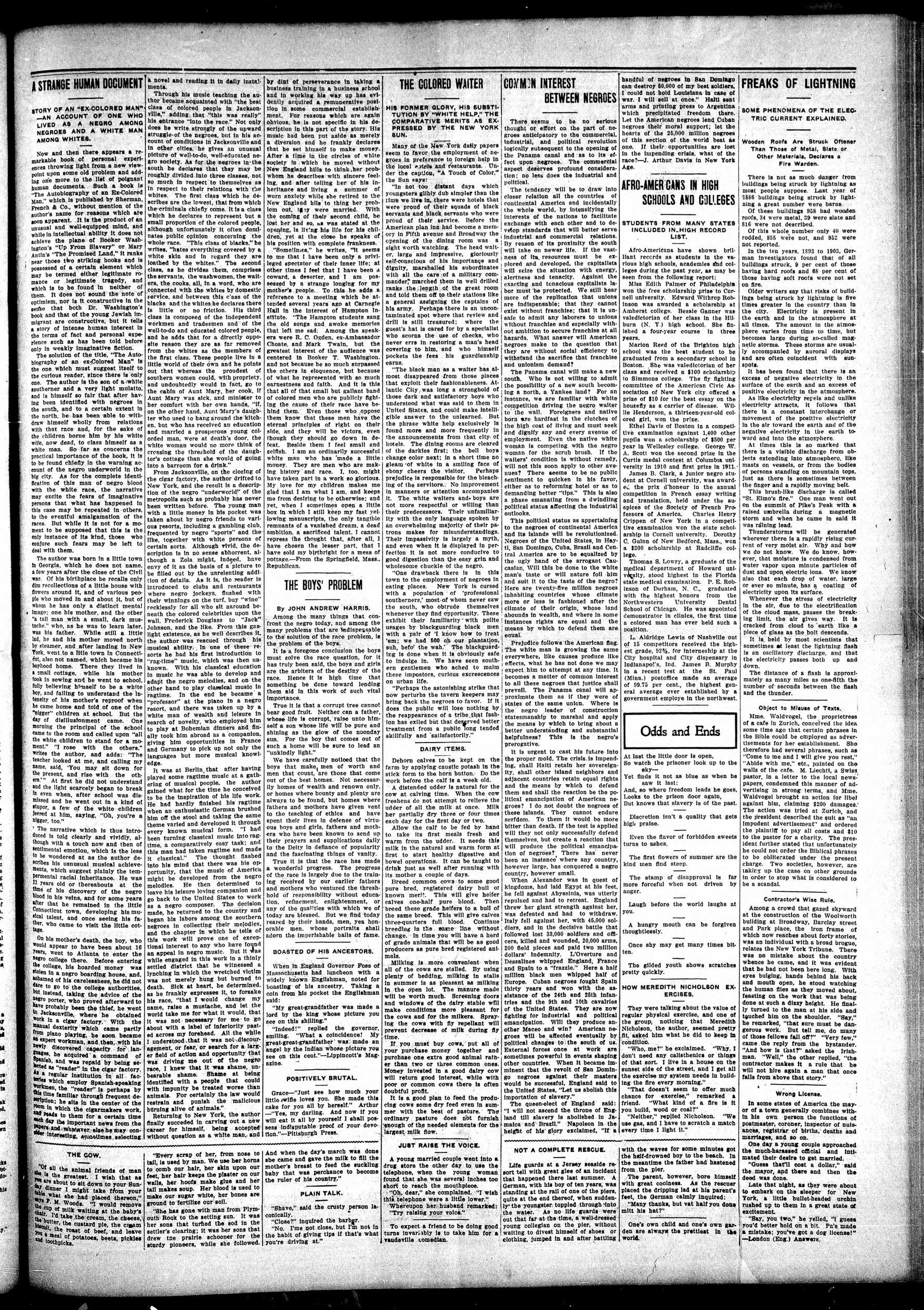
A STRANGE HUMAN DOCUMENT
STORY OF AN "EX-COLORED MAN"
—AN ACCOUNT OF ONE WHO
LIVED AS A NEGRO AMONG
NEGROES AND A WHITE MAN
AMONG WHITES.
Now and then there appears a remarkable book of personal experiences throwing light from a new view, point upon some old problem and adding one more to the list of polganian human documents. Such a book is "The Autobiography of an Ex-Colored Man," which is published by Sherman French & Co., without mention of the author's name for reasons which are soon apparent, well-equipped mind, and well-instructed intellectual ability it does not abble the plane of Booker Washington's "Up From Slavery" or Mary Antil's "The Promised Land," it ranks near those two striking books and is possessed of a certain element which may be termed either legitimate romance or legitimate tragedy, and which is to be found in neither of them. It does not sound the note of optimism, nor is it constructive in the sense that it is the book that of the young Jewish imam are constructive, but it tells a story of intense human interest in the terms of fact and personal experience such as has been told before only in weakly imaginative fiction.
The solution of the title, "The Autobiography of an ex-Colored Man" is the one which must suggest itself to the curious reader, since there is only one. The author is the son of a white southerner and a very light mulatto, and is himself so fair that after having been identified with negroes in the south, and to a certain extent in the north, he may be able to withhold wholly from relations with that race and, for the sake of the children borne him by his white wife, now dead, to class himself as a white man. So far as concerns the practical importance of the book, it is to be found chiefly in the warning account of the negro underworld in the big city. As for the complete identification of this man of negro blood with the white race, the narrative may excite the fears of imaginative persons that what has happened in this case may be repeated in others, the races. But while it is not for a moment to be supposed that this is the only instance of its kind, those who confuse such fears may be left to deal with them.
The author was born in a little town in Georgia, which he does not name, a few years after the close of the Civil war. Of his birthplace he recalls only recollections of a little house with flowers around it, and of various people who moved in and about it, but of whom he has only a distinct mental image; one his mother, and the other "a tall man with a small, dark mustache," who as he was to learn later, was his father. While still a little lad, he and his mother moved north and after landing in New York, went to a little town in but, also not named, which became his boyhood home. There they lived in a small cottage, while his mother took in sewing and he went to school, fully believing himself to be a white boy, and failing to understand the intensity of his mother's reproof when he came home and told one of the "bigger" children at school. But the day of disillusionment came. One morning the principal of the school came to the room and called upon "all the white children to stand for a moor," I rose with the others. writes the looked at me, and adds: "The teacher looked at me, and calling my name, said, "many shall down for the present, and rise with others." At first he did not understand and the light scarcely began to break in even when, after school was dismissed and he went in a kind of stupor, a few of the white children jeered at him, saying, "Oh, you're a bigger, too."
The narrative which is thus introduced is told clearly and vividly, although with a touch now and then of sentimental emotion, which is the less to be wondered at as the author describes his ususual musical achievements, which suggest plainly the temperial mental inheritance. He was 11 years old or thereabouts at the time of his discovery of the negro blood in his veins, and for some years after that he remained in the little Connecticut town, developing his musical talent, and once seeing his father, who came to visit the little cottage.
On his mother's death, the boy, who would appear to have been about 16 years, went to Atlanta to enter the negro college there. Before entering the college, his hounded money was stolen in a negro boarding house, and, ashamed of his carelessness, he did not want to go to the college authorities, but instead, taking the advice of the negro professor, who proved afterward to have probed been the thief, he went to Jacksonville to have the obtained work in a cigar factory. When manual dexterity which came partly from piano playing, he soon became an expert workman, and then, with his newly discovered capacity for languages, he acquired a command of Spanish, and was repaid by being selected as "reader" in the cigar factory, a regular institution in all faculties which employ Spanish-speaking workers. The "reader" is perhaps by this time familiar through frequent description; he sits in the center of the room in which the makers work, and reads to them for a few times each day the important news from the papers and whatever else he may interest, interesting, agitates, selecting
"Of all the animal friends of man she is the greatest. I wish that you are about to sit down to your Sunday dinner I might take from your table what she had placed thereon," says F. M. Woods. "I would remove the cup of milk waiting at the baby's chair. I take the cream, the cheese, the butter, the custard pie, the cream biscuit, the roast of beef, and leave you a meal of potatoes, beets, pickles and toothpicks.
a novel and reading it in daily installments.
Through his music teaching the teacher became acquainted with "the best class of colored people in Jacksonville," adding that "this was really" his entrance "into the race." Not only does he write strongly of the upward struggle of the negroes, but in his account of conditions in Jacksonville and in other cities, he gives an unusual picture of well-to-do, educated negroes. As for the negroes in the south he heeds the advice that they roughly divided into three classes, not so much in respect to themselves as in respect to their relations with the whites. The first class which he describes are the lowest, that from which the criminals chiefly come. It is a class which he declares to represent but a small proportion of the colored people, although unfortunately it often dominates public opinion concerning the whole race. "This class of blacks," he writes everything covered by a white, "all the crimes he loathed by the whites." The second class, as he divides them, comprises the servants, the washmen, the waiters, the cooks, all, in a word, who are connected with the whites by domestic service, and between this class of the blacks and the whites he declares there is little or no friction. His third class workmen and tradesmen and of the well-to-do and educated colored people, and he adds that for a directly opposed group of blacks from the whites as the members of the first class. These people live in a little world of their own and he points out that whereas the proudest of southern women could, with propriety, and undoubtedly would in fact, go to the cabin of Aunt Mary, her cook, if Aunt Mary was sick, and minister to her comfort with her own hands, "if on the other hand, Aunt Mary's daughter who used to hang around the kitchen, but who has received an education and married a prosperous wife, the white woman would no more think of crossing the threshold of the daughter's cottage than she would of going into a barroom for a drink."
From Jacksonville, on the closing of the clear factory, the author drifted to New York, and the result is a description of the negro "underworld" of the metropolis such as probably has never been written before. The young man with a little money in his pocket was taken about by negro students, including a gambling club, frequented by negro "sports" and the like, together with white persons of certain sorts. Although vivid, the description is in no sense aberrant, although a Zola might, Indeed, have envy of it as the basis of a picture to be filled out by the unrelenting addition of details. As it is, the reader is introduced to clubs and mats, pushed with their winships on the turf, buy "wine" recklessly for all who sit around the colored celebrities upon the wall. Frederick Douglass to "Jack" Johnson, and the like. From this gaslight existence, as he well describes it, the author was rescued through his musical ability. In one of these rescues he had his first introduction to tragedy to play. With his classical education in music he was able to develop and adapt the negro melodies, and on the other hand to play classical music in ragtime. In the end he became a "professor" at the piano in a negro resort, and there was taken up by a white man of wealth and leisure in search of novelty, who employed him to play at Bohemian dinners andally took him to theaters in France and Germany to pick up not only the languages but more musical knowledge.
It was at Berlin, that after having played some raltime music at a gathering of musical people, the author gained what for the time he conceived to be the inspiration of his life work. He had hardly finished his raltime when an enthusiastic German brushed him off the stool and taken the same theme varied and developed it through every known musical form. "I had been turning classical music into a comparatively easy task; and this man had taken raltime and made it classical," thought flashed in his mind that there was his opinion that the music of America might be developed from the negro melodies. He then determined to leave his leisure loving companion and go back to the United States to work as a negro composer. The decision made, he returned to the country and began his labors among the southern negroes in collecting their melodies, and the chapter in which he tells of this work will prove one of exceptional interest to any who work for an appeal in negro music but was while engaged in work in a thinly settled district, which the wretched victim not merely umed but burned to death. Sick at heart, he determined, as he frankly expresses it, to forsake his race, "that I would change my name, raise a mustache, and let the world take me for what it would, that it was not necessary for me to go about with a label of inferiority pasted across my forehead. All the while I understood, that it was not discouragement, or fear, or search for a larger field of action and opportunity that was driving me out of the negra race, I knew that I was unrecoverable. Shame at being idle with a people that could immunity be treated worse than immunity. For certainly the law would restrain and punish the malicious burning alive of animals."
Returning to New York, the author finally succeeded in carving out a new career for himself, being accepted without question as a white man, and
"Every scrap of her, from nose to tail, is used by man. We use her horns to comb our hair, her skin upon our feet, her hair keeps the plaster on our walls, her hoofs make glue and her tail makes soap. Her blood is used to make our sugar white, her bones are ground to fertilize our soil.
"She has gone with man from Plymouth Rock to the setting sun. It was her sons that turned out in the settler's truffle. Was her sons that drew true pride schooner for the strudy plumpers, while she followed.
by dint of perseverance in taking a business training in a business school and in working his way up has evidently acquired a remunerative position in some commercial establishment. For reasons which are again obvious, he is not specific in his description in this part of the story. His music had been put aside as merely a diversion and he frankly declares that he set himself to make money. After a time in the circles of white society in which he moved without New England hills to think, her probemhom he describes with sincere feeling, and after telling her of his inheritance and living a summer of worn anxiety while she retired to the New England hills to toing her profession. With the coming of their second child, he lost her and so, as was stated at the opening, is living his life for his children, yet at the close he speaks of his position with complete frankness.
THE BOYS' PROBLEM
BY JOHN ANDREW HARRIS.
Among the many things that confront the negro today, and among the many problems that are indispensable to the solution of the race problem, is the problem of the boys.
It is a foregone conclusion the boys must solve the race question, for it has truly been said, the boys and girls must solve the race problem, and race. Hence it is high time that something be done toward lending them aid in this work of such vital importance.
True it is that a corrupt tree cannot bear good fruit. Neither can a father, whose life is corrupt, raise unto himself a son whose life will be pure and shining as the glow of the noonday light, but that comes out of such a home will be sure to lead an "unkinkly light."
We have carefully noted that the boys that make men of worth and men that count, are those that come out of the best homes. Not necessarily homes of wealth and renown only, or homes where bounty and plenty are always to be found, but homes where fathers and mothers have given vent to the teaching of ethics and have spent their lives in defense of virtuous boys and girls, fathers and mothers who have been known to send up their prayers and supplications daily to the Delta in defiance of popularity and the fascinating things of vanity. We have seen that the race is a wonderful progress. The progress of the race is largely due to the training received by our earlier fathers and mothers who ventured the threshold of responsibility without education, refinement, enlightenment, or any of the qualities with which we of today are blessed. But we find today reared by their hands, men, men honorable men, whose portraits shall adorn the imperishable halls of fame.
BOASTED OF HIS ANCESTORS.
When in England Governor Foss of Massachusetts had luncheon with a widely known Englishman, noted for boasting of his ancestry. Taking a coin from his pocket the Englishman said: "My great-grandfather was made a lord by the king whose picture you see on this shilling." "Indeed," replied the governor, smiling. "WHAT coincidence! My great-grandfather was: made an angel by the Indian whose picture you see on this coat."—Lippincott's Magazine.
POSITIVELY BRUTAL.
Grace—"Just see how much your little swifte loves you. She made this cake for you all by herself." Arthur—"Yes, my darling. And now if you will eat it all by yourself I shall possess indulgence proof by your devotion."-Pittsburgh Press.
And when the day's march was done she came and gave the milk to fill the cup and to feed the suckling baby that was perchance to become the ruler of his country."
PLAIN TALK.
"Shave," said the crusty person laconicly.
"Close!" inquired the barber.
"No. I'm not close, but I'm not in the habit of giving tips if that's what you're driving at."
THE COLORED WAITER
HIS FORMER GLORY, HIS SUBSTITUTION BY "WHITE HELP," THE COMPARATIVE MERITS AS EXPRESSED BY THE NEW YORK SUN.
Many of the New York daily papers seem to favor the employment of negroes in preference to foreign help in the local stores and restaurants. Under the heading "A Touch of Color," the Sun says:
"In not too distant days which youngsters gibby dub simpler than the time we live in, there were hotels that were proud of their squads of black servants and black servants who were proud of their service. Before the American plan inn had become a memory in Fifth avenue and Broadway the opening of the dining room was a sight worth watching. The head waiter, large and impressive, gloriously self-conscious of his importance and dignity, marshalled his subordinates with all the care of a military commander, marched them in well drilled ranks the length of the great room and told them off to their stations like a general assigning the captain of a ship to a man who is unattained spot where that review and drill is still treasured; where the guest's hat is cared for by a specialist who scorns the use of checks, who never rests in restoring a man's head covering to him, and who himself pockets the fees his guardianship earns.
"The black man as a waiter has almost disappeared from those places that exploit their fashionableness. Atlantic City, was long a stronghold of those dark and satisfactory boys who understood what was said to them in United States, and could make intelligible answer to the unlearned. But the phrase white help exclusively is found more and more frequently in the announcements from that city; the girls who were the darkest first; the bell boys change color next; in a short time no gleam of white in a smiling face of ebony cheers the visitor. Perhaps prejudice is responsible for the bleaching of the servitors. No improvement in manners or attention accompanies it. The white waiters and boys are not more respectful or willing than their predecessors. Their unfamiliarity with the only language spoken by an overwhelming majority of their patrons makes for misunderstandings. Their impassivity is largely a myth, and the fact that the action it is not more conducive to good digestion than the easy grin and wholesome chuckle of the negro.
"One drawback there is in this town to the employment of negroes in eating places. New York is cursed with a population of 'professional southerners,' most of whom never saw the south, who obtrude themselves whenever they find opportunity. These exhibit their familiarity with polite urges by blackguarding black men with a pair of I. know how to treat 'em; he had 500 on our plantation, suh, befo' the wah." The blackguarding is done when it is obviously to indulge in. We have seen south em gentlemen who ached to main these immensely curious excrescences on our life.
"Perhaps the astonishing strike that now perturbs the tavern keepers may bring back the negroes to favor. If it does the public will lose nothing by the reappearance of a tribe that fashion has exiled but that deserved better treatment from a public long tended skillfully and 'satisfactorily."
DAIRY ITEMS
Dehorm calves to be kept on the farm by applying casteic potash in the stick form to the horn button. Do the work before the calf is a week old. A distended udder is natural for the cow at calving time. When the cow freshens do not attempt to relieve the udder of all the milk at once. Milk her partially dry three or four times each day for the first day or two. Handle to take its first meals fresh and warm from the udder. It needs this milk in the natural and warm form at first to start healthy digestive and bowel operations. It can be taught to drink just as well after running with its mother a couple of days. Breed common cows to some good pure bred, registered dairy bull or known merl. This will give heifer calves one-half pure blood. Then breed these grade heifers to a bull of the same breed. This will give calves three-quarter full blood. Continue breeding in the farm until time you will have a herd of grade animals that will be as good producers as pure bred registered animals.
Milking is more convenient when all of the cows are stalled. By using plenty of bedding, milking in stalls in summer is as pleasant as milking in the open lot. The manure made will be worth much. Screening doors and windows of the dairy stable will make conditions more pleasant for milking. If you purchase the cows with fly repellant will prevent decrease of milk during dry time. If you must buy cows, put all of your purchase money together and purchase one extra good animal rather than two or three common ones. Money invested in a good dairy cow will return good interest, while with poor or common cows there is often doubtful profit. We good plan to feed the producing cows some dry feed even in summer with the best of pasture. The ordinary pasture does not furnish enough of the needed elements for the largest milk flow.
JUST RAISE THE VOICE.
A young married couple went into a drug store the other day to use the telephone, when the young woman found that she was several inches too short to reach the mouthpiece.
"Oh, dear," she complained. "I wish this telephone were a little lower."
Whereupon her husband remarked: "Try raising your voice."
To expect a friend to be doing good turns invariably is to take him for a vaudeville comedian.
BETWEEN NEGROES
There seems to be no serious thought or effort on the part of negroes anticipatory to the commercial, industrial, and political revolution logically subsequent to the opening of the Panama canal and as to its effect upon negroes. The commercial aspect deserves profound consideration; no less does the industrial and political.
The tendency will be to draw into closer relation all the countries of continental America and incidentally the whole world, by intensifying the interests of the nations to facilitate exchange with each other and to develop standards that will better serve industrial and commercial relations. By reason of its proximity the south will take on newer life. If the vastness of its resources must be explored and developed, the capitalists will seize the situation with energy, alertness and tenacity. Against the exacting and tonicous capitalists labor must be protected. We still hear more of the replication that unions are indispensable; that they cannot exist without franchise. But without franchise laborers to unions without franchise and especially without ambition to secure franchise at all hazards. What answer will American negroes make to the question that they are without social efficiency to withstand the sacrifice that franchise and unionism demand?
The Panama canal will make a new south. Who is not willing to admit the possibility of a new south becoming a north, a Yankee land? For an instance, we are familiar with white competition driving the negro waiter to the wall. Foreigners and native workers harrassed in the hutches of the high cost of living and must seek and diggify any and every avenue of employment. Even the native white woman is competing with the negro woman for the scrub brush. If the waiter's condition is without remedy, will not this soon apply to other avenues? There seems to be no public sentiment to quicken in his favor, either as to reforming hotel or as to changing the way he acts in a phase emanating from a dwindling political status affecting the industrial outlooks.
This political status as appertaining to the negroes of continental America and its islands will be revolutionized. Negroes of the United States, in Hayti, San Domingo, Cuba, Brazil and Central America are to be equalized by the United States, as casasian. Will this be done to the white man's taste or will nature fill him and suit it to the taste of the negro? Here are twenty-five million negroes inhabiting countries whose climate more or less is fashioned after the climate of their origin, whose land abounds in wealth, and where in some instances rights are equal and the one by which to defend them are equal.
Prejudice follows the American flag. The white man is growing the same everywhere, like causes produce like effects, what he has not done we may expect him to attempt at any time. It becomes a matter of common interest that the Panama canal will prevail. The Panama canal will approximate them as if they were of states of the same union. Where is the negro leader of construction statesmanship to marshal and apply the means by which to bring about a better understanding and substantial change. This is the negro's preoperative.
It is urgent to cast his future into the proper mold. The crisis is impending, shall Haiti retain her sovereignty, shall other island neighbors and adjacent countries retain equal rights and the means by which to defend them and shall the reaction be the political emancipation of American negroes? I do not doubt the negroes of these islands. They cannot endure serfdom. To them it would be more bitter than death. If the test is applied will they not only successfully defend themselves but will themselves that will induce the political emancipation of negroes? There has never been an instance' where any country, however large, has conquered a negro country, however small.
When Alexander was in quest of kingsmen, had laid Egypt at his feet he fell against Abyssinia, was utterly repulsed and had to retreat. England threw her giant strength against her, was defeated and had to withdraw Italy fell against her, with 45,000 pounds repulsed and had followed lost 33,000 soldiers and officers, killed and wounded, 20,000 arms, 200 field pieces and paid two million dollars' indemnity. L'Overture and Dessalines whipped England, France and Spain to a "frazelle." Here a half million black men whipped half of Europe. Cuban negroes fought Spain thirty years and won with the assistance of the French and the 9th and 10th cavalries of the United States. They are now fighting for industrial and political emancipation. Will they produce another Maceo and win? American negroes will be affected eventually by political changes to: the south of us. External forces once at work are sometimes powerful in events shaping other countries. When it became imminent that we would fight against their masters would be successful, England said to the United States, "Let us abolish this importation of slavery."
The queen-elect of England said: "I will not ascend the throne of England till slavery is abolished in Jamaica." The king's height of his glory exclaimed, "I a
NOT A COMPLETE RESCUE.
Life guards at a Jersey seaside resort tell with great glee of an incident that happened there last summer. A German, with his boy of ten years, was standing at the rail of one of the pliers, quite at the end thereof, when suddenly the youngster toppled through into the water. As no life guards were out that far at the time, a well-dressed young colleague on the pier, without waiting to divest himself of shoes or clothing, jumped in and after battling
handful of negroes in San Domingo can destroy 60,000 of my best soldiers, I could not hold Louisiana in case of war. I will sell at once." Hali sent arms and printing press to Argentina which precipitated freedom there. Let the American negroes lend Cuban negroes their moral support; let the hearts of the 25,000 million negroes of this section of the world beat as one. If their opportunities are lost in the impending crisis, what of the race?-J. Arthur Davis in New York Age.
AFRO-AMERICANS IN HIGH SCHOOLS AND COLLEGES
AFRO-AMERICANS IN HIGH SCHOOLS AND COLLEGES
STUDENTS FROM MANY STATES
INCLUDED IN-HIGH RECORD
LIST.
Afro-Americans have shown brilliant records as students in the various high schools, academies and colleges during the past year, as may be seen from the following report:
Miss Edith Palmer of Philadelphia won the free scholarship prize to Coral University; Edward Wilhrop Robinson was awarded a scholarship at Amherst college. Bessie Ganner was valedictorian of her class in the Hillburn (N. Y) high school. She finished a four-year course in three years.
Marion Reed of the high school was the best student to be graduated from a secondary school in Boston. She was valedictorian of her class and received a $100 scholarship to Simmons college. The flying committee of the American Civic Association of New York city offered a scholarship to the housefly as a carrier of disease. Wille Henderson, a thirteen-year-old colored girl, won the prize.
Ethel Davis of Boston in a competitive examination against 1,400 other pupils won a scholarship of $500 per year in Wellesley college. George W. A. Scott won the second prize in the Curtis medal contest at Columbia university in 1901 and first prize in 1911. He was awarded a fellowship at Cornell university, was awarded the prix d'honneur in the annual competition in French essay writing and translation, held under the auspices of the Society of French Professors of America. Charles Henry Crippen of New York in a competitive examination won the state scholarship in Cornell university. Dorothy Johnn of New Bedford, Mass., won a $250 scholarship at Radcliffe college.
Thomas S. Lovry, a graduate of the medical department of Howard university, stood highest in the Florida state medical examination. P. E. Robinson of Durham, N. C., graduated with the highest honors from the Northwestern University Dental School of Chicago. He was appointed demonstrator in clinics, the first time a colored man has ever held such a position. L. Aldridge Lewis of Nashville out of the universities received the highest grade, 92%, for internship at the City hospital and City dispensary in Indianapolis'. Ind. James R. Murphy in a recent test at the St. Paul (Minn.) postoffice made an average of 99.75 per cent, the highest general average ever established by a government employee in the northwest.
Odds and Ends
At last the little door is open,
So watch the prisoner look up to the skv—
Yet finds it not as blue as when he saw it last:
And, so where freedom leads he goes,
Looks to the prison door again.
But knows that slavery is of the past.
Discretion isn't a quality that gets high praise.
Even the flavor of forbidden sweets turns to ashes.
The first flowers of summer are the kind men find steep.
The stamp of disapproval is far more forceful when not driven by anger.
Laugh before the world laughs at you.
A hungry mouth can be forgiven thoughtlessly.
Once shy may get many times bitten.
The gilded youth shows scratches pretty quickly.
HOW MEREDITH NICHOLSON EXERCISES.
They were talking about the value of regular physical exercise, and one of the group, noticing that Meredith Nicholson, the author, seemed pretty fit, asked him what he did to keep in condition.
"Who, me?" he exclaimed. "Why, I don't need any calisthenics or things of that sort. I am on the street, and I get all the exercise my system needs in building the fire every morning."
"That doesn't seem to offer much chance for exercise," remarked a friend. "What kind of a fire is it you build, wood or coal?"
"Neither," replied Nicholson. "We use gas, and I have to scratch a match every time I light it."
with the waves for some minutes got the half-drowned boy to the beach. In the meantime the father had hastened from the pier.
The parent, however, bore himself with great coolness. As the rescuer placed the dripping lid at his parent's feet, the German calmly inquired:
"Many thanks, but vat half you done mitt his hat?"
One's own child and one's own garden are always the prettiest in the world.
---
SOME PHENOMENA OF THE ELEC
TRIC CURRENT EXPLAINED.
Wooden Roofs Are Struck Often
Than Those of Metal, State or
Other Materials, Declares a
Fire Warden.
There is not as much danger from
buildings being struck by lightning as
meat people suppose. Last year of
1886 buildings being struck by lightning
great number were burned. Of
these buildings 958 and wooden
roofs, 34 were metal, 39 were slate and
$16 were not described.
Of this whole number only 40 were
rodded, 855 were not, and 952 were
not reported.
In the ten years, 1893 to 1903, German
investigators found that of all
buildings struck, 9 per cent of those
having hard roofs and 68 per cent of
thems having soft roofs were not set on fire.
Older writers say that risks of buildings being struck by lightning is five times greater in the country than in the city. Electricity is present in the earth and in the atmosphere at all times. The amount in the atmosphere varies from time to time, but becomes large during so-called magnetic storms. These storms are usually accompanied by auroral displays and are often coincident with sunstorms. It has been found that there is an excess of negative electricity in the surface of the earth and an excess of positive electricity in the atmosphere. As like electricity repels and unlike electricity attracts, it follows that there is a constant interchange or movement of the positive electricity in the air toward the earth and of the negative electricity in the earth toward and into the atmosphere. At times this is so marked that there is a visible discharge from objects extending into atmosphere, masts, masts of persons standing on mountain tops, just as there is sometimes between the finger and a rapidly moving belt.
This brush-like discharge is called "St. Elmo's fire." One man went out on the summit of Pike's Peak with a raised umbrella during a magnetic storm and when he came in said it warmed up and we had to throw the thunderstorms will be generated wherever there is a rapidly rising current of very moist air. Why and how we do not know. We do know, however, that moisture is condensed from water vapor upon minute particles of dust and upon electric ions. We know also that each drop of water, large enough to cover the coating of electricity upon its surface. Whenever the stress of electricity in the air, due to the electrification of the cloud mass, passes the breaking limit, the air gives way. It is cracked from cloud to earth like a piece of glass as the bolt descends. It is held by most scientists that sometimes at least the lightning flash is an oscillatory discharge, and that electricity passes both up and down.
The distance of a flash is approximately as many miles as one-fifth the number of seconds between the flash and the thunder.
Object to Mlsuse of Texts
Mme, Waldvogel, the proprietress of a cafe in Zurich, conceived the idea some time ago that certain phrases in the Bible could be employed as advertisements for her establishment. She therefore had several phrases, such as "Come to me and I will give you rest," "Abide with me," etc., painted on the walls of the cafe. M. Liechtf, a Swiss pastor, in a letter to the local newsagent of advertising in strong terms, and Waldvogel brought an action for libel against him, claiming $200 damages. The action was tried at Zurich, and the president described the suit as "an impudent advertisement" and ordered the plaintiff to pay all costs and $10 to the pastor for a charity. The president further stated that unfortunately he could not order the Biblical phrases in the cafe, and the present charge. Two societies have, are taking up the case on other grounds in order to stop what is considered to be a scandal.
Contractor's Wise Rule.
Among a crowd that gazed skyward at the construction of the Woolworth building at Broadway, Barclay street and Park place, the iron frame of which now reaches about forty stories, was an individual with a broad brogue, relates the New York Tribune. There was no mistake about the country when he came, and it was evident he had been a man with eyes bulging, hands behind his bed, and mouth open, he stood watching the human files as they moved about, feasting on the work that was being done at such a dizzy height. He finally turned to the man at his side and tucked him on the shoulder. "Say," he remarked, "that sure must be dangerous work. But tell me, do many of those fellows fall off?" "Very few," he replied, "apply from the bystander. And now he is the Irishman. "Well," the other repudiated, the contractor makes it a rule that he will not hire again a man that once falls from above that story."
Wrong License
In some states of America the mayor or a town generally combines within his own person the functions of postmaster, coroner, inspector of nuisances, registrar of births, deaths and marriages, and so on.
One day a young couple approached the much-harassed official and intimated their desire to get married.
"Guess that'll cost a dollar," said the mayor, and there and then the deed was done.
Late that night, as they were about to embark on the sleeper for New York, little bullet-headed urchim rushed up to them in a great state of excitement.
"Say, you two," he yelled, "I guess you'd better hold on a bit. Pa's made a mistake; you've got a dog license!" —London (Enn) Answers
Minnesota State Federation of Colored Women's
Afro-American Women's Federation of Minnesota hold a meeting at Pilgrim Baptist church, St. Paul, June 27-28. Motto: "Our Men, Women and Children."
President, Mrs. Nellie Francis, St. Paul.
1st vice-president, Mrs. Ida Sellers,
Minneapolis.
2d vice-president, Mrs. Ada Mathews,
Duluth.
Rec. Secy, Mrs. Mattle R, Hicks,
St. Paul.
Asst' See'y, Mrs. Hulda Kennedy,
Minneapolis.
Cor. Sec'y, Mrs. Ma Glenn, Minne-
apolis.
Treasurer, Mrs. Hester Keyes, Minneapolis.
Organizer, Mrs. Carrine Carter, St. Paul.
Historian, Mrs. Sadie Sample, Minneapolis.
Chaplain, Mrs. E. H. McDonald, St. Paul.
Editor, Mrs. Blanche Charleston, St. Paul.
Assistant Editors, Meadows Carrie Keyes, Minneapolis and Alice Johnson, Duluth.
Honorary Pres., Mrs. Ione E. Gibbs
Department Heads
Music, Mrs. Kate L. Smith, Minneapolis.
Literature, Mrs. Lenora Brown, St. Paul.
Arts and Crafts, Mrs. Tillie Brigham, Minneapolis. Mothers, Mrs. Mary B. Hatcher, St. Paul.
Philanthropic, Mrs. Jessie Williams, Duluth
Dunlun.
Junior. Mrs. Gussie L. Jones, St.
Stevens.
Legal, Mrs. Lula B. Chapman, St.
Paul.
Reciprocity, Mrs. Belle Hyatt, Minne-
apolis.
Signed: Mattie R. Hicka.
Rec. Secretary.
If you are a housewife you cannot
reasonably hope to be healthy or be
beautiful by washing dishes, sweeping
and doing housework all day, and craying
on the floor. You must get into the open air and
sunlight. If you do this every day and
keep your stomach and bowels in good
order by taking Chamberlain's Tablets
when needed, you should become both
healthy and beautiful. For sale by
ball
BUXTON BRIEFS.
Mrs. Jas, Shepherd received word Jart week that her father, Anthony Swan living near Charlottesville, Va., died at the age of 103 years. He was born Jan. 27, 1899. One of the daily papers of Charlottesville used almost two columns in a write-up concerning a very high and complimentary terms.
In the U. M. W. of A. election last Tuesday the following persons were elected: W. J. Shepherd, president, sued ceding Dane Tancy who held the place for about 6 years; W. H. Brown, financial secretary; F. Anderson, recording secretary; F. Anderson, result of the election was quite a surprise to many.
Mrs. Anna B. Carey left for Lake Okoboji last Thursday. Miss Georgia Williams, late from attending a Catholic school at St. Louis, accompanied
Mrs. Mary Dues left for Iowa City for an operation. Her many friends are very anxious about her and hopeful for an early recovery.
Miss Lanie Terrel, an ex-resident of Burton, but now living in Colfax and teaching in the Geo. R. Smith College at Sedalia, Mo., is in the city, the guest of her husband, Dr. John Eubanks is attending the Drake University Summer School in Des Moines. Mrs. Rose Jeeks, who is now in the hospital at Iowa City, is reported by her husband to be doing nicely.
birthday party for her husband, Prof. Richard Oliver, last Friday evening. The band of which Prof. Oliver is lead, some very sweet music with some very sweet music without his direction, which only shows that they have been well taught. The party was a very pleasant affair and the many presents enjoyed themselves immensely.
In the Popular Lady Contest given by the Miller Bros. Show Co. in their annual contest, the son won the prize which was a beautiful silver water set. There were more than a half dozen young ladies in the contest. You should have seen them all.
Miss Maida Davis left Monday for Salt Lake City, Utah, to visit indefinitely with her sister, Mrs. Anna Stallworth. Miss Davis will be greatly missed as she was a very enthusiastic, energetic worker in St. John's A. M. E. Church. Mr. John M. Young left Tuesday for Cleveland, Ohio, where he an iontipates making his future home. Mrs. Young will follow later. Mrs. Peter Abington and daughter, Miss Giorgianna Disleet, left Friday afternoon July 5 for Topeka, Kansas, where she will visit her brother, Mr. Andrew Jackson. Mr.W. E. Carter, who has been attending Western College studying for the Ministry, prepares this his Sunday evening. Those who heard it pronounced it a very good beginning.
The Sunday School Union met with the Tabernacle Church Sunday evening. A very interesting program was rendered. R. M. A. Booker, superintendent of the Sunday School read a paper on "What is the Best Method of Retaining Young Men in the Sunday School." The discussion was led by Rev. Mendenhall. The officers for the next six months were Mrs. A. B. Booker, president; Marshall Lowery, vice president, Mrs. Ada White, secretary, Mrs. Lillian Anderson, assistant secretary; Robt. Lowery, treasurer, Miss Tallie Cox, organist; W. A. Brown, chorister. He attended the school with the St. John's Sunday School the second Sunday in July. Messrs. Jack Garland and Henry Boles were slightly injured in the mines this week. The school was shot in the arm late Saturday night by the night operator at the C. & N. W. depot. It is stated that some fellows were stealing beer by at the time the firing was done at the other fellows and was followed by a large bullet. He was resting easy Monday.
Mrs. A. Perkins is very sick again and it is feared that she will have to make another trip to the hospital. Mrs. Moore, African, educated at the Christian Institute at St. John's Church Sunday evening. The Oreole Music Club met with Mildora Walker Monday afternoon. The club is studying the life of Mozart for the present. The Moore, general secretary of the Y. M. C. A. will sever his connection with the Buxton Association about Sept. 1st to take charge of the new Chicago association. It will be about a year or more before the new building will be erected but he will be given the opportunity to be organized until that time. The building and equipment will cost $180,000 when completed and will be one of the best buildings among colored men. Mr. W. W. Jones left Friday for Des Moines to enter the hospital where he will be operated on a dicitis. We will hit him a speedy recovery. Mrs. Chas. Moss who has been on the sick list is much improved and is able to be out again. Mr. P. U. choir is doing some nice work under the leadership of Rev. C. G. Green.
The Literary Society is progressing nicely. Rev. C. H. Mendenhall will address the society next monday evening—subject, "What a Young Man Should Know." There will be musical numbers on the program also. The mission of the Mission Circle, is still urging the members to attend the meetings and help enjoy the great blessings that those who attend are receiving.
When in Mason City stop at the
501 East 8th St.
Furnished Rooms and Meals.
Lunches or Short Orders at
all hours.
Cigars and Tobacco. Barber
Shop, Pool Hall and hot baths
Best of accommodations.
H. D. Green, Prop. Mason City
Just access from the M. and St. L. Depot.
KEOKUK NOTES.
Rev. Eli Grant, a retired minister of the A. M. E. church, who resided at 1608 Exchange street, died at St. John's hospital at 10:30 o'clock Thursday morning, when he died. For about two long years he was in the active ministry of the church. About eleven years ago his health failed and he retired from the activities of the work as pastor of a church and was placed by his convent preacher. He continued to fail and for about two years lad seriously suffered with kidney and bladder trouble. For more attentive treatment it was found advisable to remove him to the hospital for operation. After the operation he returned home as every one thought greatly improved, but such was not the case. He gradually grew worse and was taken the second time to the hospital where he died. He is survived by his wife, one daughter, Mrs. Emma Helfert and
The Phone Will Bring To You
The best laundry service possible. We employ only the most experience help and use. only the most modern machinery. If you want only the best you'll call maple 1447 and let us call for your next bundle. Family Washing For Pound
617 PHONE
East Ground Ave. Maple 1447
one granddaughter, Marjorie Hollert.
The funeral was held Saturday afternoon at 3:30 o'clock at the A. M. E. church amid a concourse of sorrowing widows. The choir of the church gentleman. He was a faithful member of the Knights of Tabor who had charge of the funeral. The remains were laid to rest in Oakland cemetery. The club of the A. M. E. church will give a lawn social at the home of Mr. and Mrs. John Craig, 1701 Franklin street, July 25. Everybody is invited.
Mr. A. Brewer and little daughter Mrs. F. left Sunday night for Chicago, to visit Mrs. Brewer's mother. They will be gone the rest of the summer.
Mrs. F. D. Fields left Tuesday morning for Milwaukee, Wis., to visit related participants. The annual excursion to Quincy which was given June 19 under the promotion of Mrs. Everett Holmes was a success, there being about fifty participants. It was an ideal day and a chance to entertain in Quincy by Mrs. F. G. Monday and Mrs. W. W. Fields.
The recital which was given at the A. M. E. church Friday night was a splendid success. Mr. Hamilton's ability as an elocutionist far exceeds any other teacher to listen to for some time. He will appear in the city again on the 18th of July at the A. M. E. church.
During the summer months mothers of young children should watch for any unnatural looseness of the bowels. When given prompt attention at this time serious trouble may be avoided. Chamberlain's Colic, Cholera and Diarrhoea Remedy can always be depended upon. For sale byall dealers.
CEDAR RAFTS NEWS.
The Culture Club gave a social at the home of Mrs. Horn Horn last Friday evening.
Vivian Horn Blackburn and daughter Vivian Horn, who have been visiting at the home of Mr. and Mrs. Arthur Jackson, returned to their home in Washington, D. C. Wednesday evening.
While in the city Mrs. Blackburn was guest of honor at several social affairs.
Mrs. A. Jackson on South Eighth street gave a six o'clock dinner in Mrs. Blackburns honor.
Mrs. Martin Brooks had Mr. and Mrs. William Robinson to dinner Sunday.
Mrs. A. M. Boyed was a visitor in Davenport last week.
Miss Fern Martin who has been quite sick is able to be around again.
Miss Byrd of Lagrange, Ill., is visiting at the home of Mrs. M. P. Lowery.
Mr. Andrew Graw and son Delmas have returned from Chicago and report a fine time.
There was a picnic in Riverside Park after a visit in honor of Mrs. William Blackburn and daughter. Those present were Meadames Blackburn, Jackson, Lowery, Byd, Fields, Searay, Rasberry, Jackson, Holly, and Misses Merle, Era, Nine Fields, Vivian Blackburn and Arthur T. Jackson.
Those in Mrs. Blackburn's honor last Monday Master Forrest Martin has accepted a position with the Independent Dye Works Co. Forrest is a bright boy and is helping his widowed mother right along.
Fred Sims of Toledo was in the city Monday.
Miss Minnie Ford entertained in honor of her sister-in-law, Mrs. Grace Borrow and Miss Janette Coleman of Lincoln, Neb., last Wednesday evening. The One More Effort Club pinicked in Riverside park last week. By Ed Marshall remains quite poory.
TWENTY-FIVE CENTS IS THE PRICE OF PEACE.
The terrible itching and smarting, incident to certain skin diseases, is almost instantly allayed by applying Chamberlain's Salve. Price, 25 cents. For sale by all druggists.
A SUCCESSFUL CONVENTION!
Continued from last week's report.
The afternoon session, the first paper of the Boys in Sunday School," by Miss Hopkins of Keokuk, then Rev. B. F. Hubbard gave a talk on "The Teacher's Relation to the Church;" then a paper entitled "What Method Can Be Used to Induce Regular Attendance in the School." Then, the different committees
THE MAYOR OF BROOKLYN
THE "PORO" SYSTEM of Scalp and Hair treatment is based on the latest scientific and sanitary methods, effecting a healthy scalp thus promoting a growth of beautiful hair. In connection with the treatment are made and sold exclusively by myself, having the exclusive right to that name; and I, alone, know the secret of the composition that bears that name. Our claim has always been that when the use of "PORO," the use of the "PORO," it will continue to do so if only the scalp and hair be kept clean. This sanitary method of treatment is also having the desired effect in helping to prevent the spread of diseases, for instance, by preventing the condition carries the germs of disease which often prove fatal to innocent persons coming in contact with them. For treatment, call on or address: Mrs. Mollie Whitney 729 10th St. Des Moines
made their reports. After some discussion each was adopted. The following officers were elected for the ensuing year:
Dist. Superintendent, M. O. Cubbertson, M. Assistant Dist. Sup., Mrs. Alice Thompson, Muscatine; Secretary, Miss Mayne Richardson, Galesburg, Ill.; Assistant Secy., Miss Marian Ritchie, Moline; Treasurer, Miss Louisiana Mason, M. Pleasant; Officer, President, Rev. T. Tyler of Galesburg, Ill.; Vice-president, Mrs. D. S. Johnson of Davenport; Secy., Miss Illa Allen, Galesburg, Ill.
OTTUMWA NEWS.
The A. M. E. S. s. plicant will be held Thursday, July 11th at Caldwell Park. The date will be set by 10th. The Baptist plicant will be held soon at Caldwell Park. The date has not been set yet.
Mrs. B. F. Abner of Sloux City has arrived in the city for a visit with Mrs. Mr. and Mrs. John Cheshire.
Last Tuesday night at the Second Baptist church there was an entertainment given by the Organ club. It was a success financially and socially.
Prayer meeting will be led by Miss Frances Wagner.
Last Thursday evening the Benevolent club met with Mrs. D. Myers on E. Div. St. Quite a few visitors were present and after the business session a lunch was served.
Miss Garner Fowler, formerly of Ottumwa, is in Washington, New York and expects to leave soon for Buffalo. Her present home is in Chicago.
Mr. and Mrs. Henry Williams entertained Rev. M. G. Newman of Oskaloosa to a sumptuous dinner Sunday.
Thursday evening there will be a lawn social—a Fourth of July celebration, given at the home of Mrs. Minnie Bibb on Fellow St. by the Stewardnesses. Every one invited to come.
Mr. John Henderson of Bloomfield spent Sunday in Ottumwa.
Next Sunday will be the Fourth quarterly meeting at the A. M. E. church. Rev. S. B. Moore, P. E., will arrive in the city this week.
Quite a few out of town people are expected to attend the 20th wedding anniversary of Mr. and Mrs. C. Har.
When in Davenport
Iowa go to
E. Green's
RESTAURANT
114 East 5th St.
Good Meals and Lunches
Everything First Class.
Cigars and Tobacco
E. GREEN. Prop. Davenpo
ANT.
St.
Lunches
Class.
obacco
Davenpo
FORD'S
HAIR POMADE
HARES MODEL HAIR ON CURVY HIR
CLOSER SOLDER AND MOKE BRILLIE.
EASY TO GROW AND PUT IN AN AUTY
THE LENGTH WILL PERMIT UNBREAKED
HELP FOR THOSE WHOHAVE STOMACH TROUBLE.
After doctoring for about twelve years for a bad stomach trouble, and spending nearly five hundred dollars for medicine and one box of feces, I inquired with wife one box of Chamberlain's Stomach and Liver Tablets, which did her so much good that she continued to use them and they have done her more good than all of the medicine I bought before - Samuel Boyer, Iowa. This medicine is for sale by all dealers. Samples free.
CAN'T BEAT IT
YOU CAN'T BEAT IT
Concerning Shipment
THERE is no b
goods, keeping
and getting rid of m
by the Bell telephone.
No other way is so f
pensive, so satisfactory, and
business man. It is the mo
a personal visit.
If your inquiry must ex
Long Distance service is ind
Shipments of Goods
how many cases came in on he ll
is no better way of locating
and keeping track of things, and
g rid of mountains of detail than
telephone.
way is so far-reaching, so quick, so inex-
sfactory, and so necessary to the progressive
It is the modern way and takes the place of
quiry must extend to distant points, the Bell
service is indispensable.
Concerning Shipments of Goods
how many cases came in on the II?
THERE is no better way of locating goods, keeping track of things, and getting rid of mountains of detail than by the Bell telephone.
No other way is so far-reaching, so quick, so inexpensive, so satisfactory, and so necessary to the progressive business man. It is the modern way and takes the place of a personal visit.
If your inquiry must extend to distant points, the Bell Long Distance service is indispensable.
IOWA TELEPHONE COMPANY
FISTULA—Pay When CURED
All Rectal Diseases cured without a surgical operation. No Chloroform, Ether or other general anesthetics used. CURE GUARANTEED to have a LIFETIME. GET INVESTMENT FREE
FILES AND RECTAL DISEASES WITH TESTINONIALS
T. 402 MARQUARDT BLDG., DES MOINES, IOWA.
Piles FIST
All Recti
ation. N
associated
last a L
WRITE FOR BOOK ON PILES AND REC
DR. C. Y. CLEMENT. 402 MARQU
FISTULA—Pay When CURED
All Rectal Diseases cured Without a surgical operation. No Chloroform. Ethanol or anesthetic used. CURE GUARANTEED to last a LIFETIME. CO-EXAMINATION FREE.
WRITE FOR BOOK ON FILES AND RECTAL DISEASES WITH TESTINIALS
DR. C. Y. CLEMENT, 402 MARQUARDT BLDG. DES MOINES, IOWA
OTTUMWA NEWS.
A. B.
HOWE TELEPHONE COMPANY
MILL DYER
BROOKLYN TELEPHONE & TELEMUNICIPAL
ry Owens, Tuesday, July 2d.
Mrs. A. G. Clark of Oakcloosa is a guest of Mr. and Mrs. James Johnson of South Ottumwa.
For soreness of the muscles, whether induced by violent exercise or injury, there is nothing better than Chamberlain's Liminet. This liminet also relieves rheumatic pains. For sale by all dealers.
OGDEN, IOWA.
Editor Iowa State Bystander: Colored miners are victors in the Ogden situation after sixteen months or nard struggle to break down the bars of race discrimination in the Ogden community and achieved a great victory at Ogden mines No. 1, located at Ogden. Mine No. 1 has always been operated by white miners, who have taken oath and obligation not to discriminate against any fellow white miners. Nationality. Unfortunately for the white miners he forgot this obligation and allowed his prejudice to overcome his intelligence and refused to work with the colored brother at this mine. Not only did he refuse the prejudice, but did not allow them in the little town of Ogden. At last the hard-fought battle is over and victory won and we as colored miners are here and to stay. The Pilgrim Baptist church is getting along with membership of thirty. The Sunday school shows great progress. We have also organized a choir in which Rev. S. D. Ward is instructor, also our missionary circle meets Thursday of each week. Mrs. Rev. Morton is president. Great interest is taken in this work by members of the
The Mothers' Progressive club is doing nicely in which mothers are greatly interested in behalf of our young girls, and we are proud to have an auxiliary of young girls known as
VIVIAN L. JONES
Funeral Director
The very best service guaranteed
Prices the lowest
Calls answered promptly day or
night No extra charges for distance—Reverse all phone charges
PHONE: Maple 2548
Residence Black 1658.
Office 519 East Court Ave.
Das Molnfer
FORD'S
HAIR POMADE
MAKES HAIR, JUNK OR CURRY
GLASSY, SOFTER AND MORE PLAIN.
EASY TO CND AND PUT UP IN ANY STYLE
THE LENGTH WILL PERMIT UNBUKLED
FOR CUSTOM HAIR MAKEUP
OF STAIR HAIR OR INSTITUTES. GET THE GUIDE. PUT UP IN
200 AND 50 BOOTIES WITH CHARLES FORD'S MAKEUP ON
EVERY EYELECAGE
• **TRY FORD'S ROYAL WHITE**
SKIN LOTION FOR THE COMPLEXION
UPPLISH APPLICATION. WILL NOT IRRITATE
THE MOST DELICATE SKIN. UNEXCEELLED
FOR ECZEMA, SALT RHEUM, PIMPLES
ROUGH SKIN AND PRECLEKS. • • •
SOLID BY DROGISTS. • • •
SOLID BY DROGISTS. SEND IT TO YOU DIRECT
AT THE FOLLOWING PONDS. SILVER BOTTLE, 1-LARGE BOTTLE
304. THE OZONEDO X OMARROW CO.
LAKE SILVER BOTTLE. CHICAGO
AGENTS WANTED.
Hot Home-Made Bread all day with those delicious home cooked meals. When in Chicago, Ill. Everybody eats at the
12 West 31st St. Near State St.
Columbia Hotel Bldg., Chicago
Moderate Prices Quick Service
Phones—Aldine 3368—Automatic 73-174
MADAME T. D. PERKINS
Scientific Scalp Specialist
Madame T. D. Perkins, of Denver, Col., who has spent the years in study of the scalp, is now interesting women all over the globe in the care of the hair and scalp. No matter how dark your skin is, Madame Perkins' Matchless Scalp Preparation and scientific method of treatment for cultivating, beautifying and growing the hair will grow your hair if there is no physical ailment to prevent. Her treatments have been successful where all others have failed. Have you written her? If not, and you want hair like her own, write her today. Be sure to enclose a four-cent stamp and write your name and address very plain if you expect a reply. Don't write unless you mean business. No agents wanted.
THIS TELLS THE STORY
COPYRIGHTED-1910.
Women! Stop! Wait! Listen! Read
If a Woman have long hair, it is a Glory to Her: I Cor., 11-15 Every Woman Can Have That Glory if She Wishes It This is for you. No more ironed hair, but soft, long, beautiful hair that need not be put on the dresser on retiring. Do you want this kind of hair? If so, write for particulars to Madame T. D, Perkins, the Scientific Scalp Specialist, of Denver, Colo., who is astonishing the world with her wonderful art of growing hair.
My own hair is my best advertisement. With these treatments my hair grew 17 inches in two years. It had remained one length (four inches) for 15 years. What I did for my hair I am doing for hundreds of others, and will do for you with my Matchless Scientific Scalp Preparations. My treatment stop falling hair or breaking off, cures split ends, removes dandruff and scalp scurf, causes the hair to grow long, no matter how short; soft, no matter how harsh; thick, no matter how thin; straight from the bulbs, no matter how kinky. First treatment will show wonderful improvement. Do not wait if you are interested in your hair. I give treatments all over the United States by mail, Write me at once. I send booklet of information, and testimonials of those taking my treatments when four-cent stamp is enclosed. I do not have agents. I need a personal history of your hair and scalp and your physical condition. All mail promptly answered when four-cent stamp is enclosed. I am the only woman of the race growing hair to-day who can show the public the real length my hair was when I first began treating it. Send for booklet if you mean business. You can secure these preparations only from me. None like them made in the world.
2. D. P. Scientific Scalp Preparation, Madame Perkins sole agent
Invest Your Money in Land COME TO OKLAHOMA
Homes, Lands and Opportunities in Plenty
the most rapidly growing city in the southwest. 600 per cent increase in population in last ten years
Well located, close in, all city improvements handy. Certain to increase in value promptly. Take advantage of this right now.
Write and ask us to send you literature and reserve a lot for you. No obligation to take it if you don't like it.
For a short time we will sell them at $75 each; $5 cash with order and then $5 per month.
No interest on deferred payments.
217 Flynn-Ames Bldg., Muskogee, Okla.
To good live men who can sell real estate we have an attractive agency proposition. Write us.
the Rosebud club. The girls are taking great interest in their work. From this auxiliary we have a club of young boys known as the Magellis blossoms. Our boys are doing fine. The ladies are practicing a drill for the near future, which will be given at the church. Mrs. Doc Taylor is still on the sick
Mrs. Doc Taylor is still on the sick list.
Frank Towns and family take their departure some time this week. The Knights of Tabor and Daughters Tabernacle have their annual sermon Sunday, June 16th.
L. H. S. BROWN JACK DAVIS
Brown & Davis
Headquarters for
Cigars and Tobacco
Billiards and Pool
Phone
Walnut 2314 229 Third St.
MADAME T.
Scientific Sc
4630 West 35th Avenue
Madame T. D. Perkins, of D. years in study of the scalp, is no globe in the care of the hair and a skin is, Madame Perkins' Matchle method of treatment for cultivation hair will grow your hair if there. Her treatments have been successful. Have you written her? If not, write her today. Be sure to enquire your name and address very plain unless you mean business. No agent.
THIS TELL COPYAID
Women! Stop! We!
If a Woman have long hair, in Every Woman Can Have It!
This is for you. No more tiful hair that need not be put on; want this kind of hair? If so, D, Perkins, the Scientific Scalp S is astonishing the world with her.
My own hair is my best advertise grew 17 inches in two years. It had reyears. What I did for my hair I am do for you with my Matchless Scientific S falling hair or breaking off, cures split causes the hair to grow long, no matter thick, no matter how thin; straight First treatment will show wonderful interested in your hair. I give treatme Write me at once. I send booklet of it taking my treatments when four-eight s I need a personal history of your hair. All mail promptly answered when four woman of the race growing hair to-day my hair was when I first began treating ness. You can secure these preparations in the world.
2. D. P. Scientific Scalp Prepa
BOSTON M.
Greatest Variety
Choice Meats, and Delicacies
We Strive to Please Goods and Prompt Phones
320 Sixth Avenue
Invest Your M
COME TO OKLA
Homes, Lands and O
Fifteen Cents a
a Property Own
JOIN L. THOMPSON, EDITOR
J. H. SHEFARD, MANAGER
Entered at the postoffice as second class matter.
Published every Friday by the Bystander Publishing Company, Des Moines, Iowa Office in Chemical building, corner Seventh and Maberry streets, Iowa phone, Waxut 899.
We are prepared to do first-class job work at reasonable prices. All of our work is guaranteed.
N. B.—Correspondents: Please mail your letters that contain news for publication not later than Tuesday night to insure publication for the current week, and give your name, not for publication, but that we may know who writes the news.
D. PERKINS
help Specialist
Denver, Col.
Denver, Col., who has spent now interesting women all over the scalp. No matter how dark your Mass Scalp Preparation and scientific ing, beautifying and growing the is no physical ailment to prevent.ful where all others have failed. and you want hair like her own, close a four-cent stamp and write if you expect a reply. Don't write its wanted.
LIS THE STORY
IGHTED-1910.
Wait! Listen! Read
it is a Glory to Her:—I Cor., 11-15
What Glory if She Wishes It
ironed hair, but soft, long, bea-
the dresser on retiring. Do you
write for particulars to Madame T.
specialist, of Denver, Colo., who
wonderful art of growing hair.
iment. With these treatments my hair
mained one length (four inches) for 15
ing for hundreds of others, and will do
scalp Preparations. My treatment stop-
ends, removes dandruff and scalp scurf,
how short; soft; no matter how harsh;
from the bulbs, no matter how kinky.
improvement. Do not wait if you are
ants all over the United States by mail,
formation, and testimonials of those
cent stamp is enclosed. I do not have agents,
and scalp and your physical condition.
cent stamp is enclosed. I am the only
who can show the public the real length
it. Send for booklet if you mean busi-
ness only from me. None like them made
ARKET Co.
in the City of
Fish, Poultry
me with the Best of
Service
E 765
Money in Land
LAHOMA
opportunities in Plenty
Day Makes You
er in Muskogee