Iowa State Bystander
Friday, October 4, 1912
Des Moines, Iowa
Page text (machine-generated)
IOWA STATE BYSTANDER.
VOL. XIX, No. 17
CITY NEWS.
Mrs. L. V. Denney, who has been so very sick, is somewhat improved.
Mr. and Mrs. John L. Thompson entertained Mr. Wm. Mash of Spokane, Wash., at dinner last week.
Mr. and Mrs. Adam Dixon entertained at dinner Miss Zella Davis last week.
Mrs. Williams will leave Saturday to visit several weeks in Clinton, Ia., with relatives.
Our collector will call at Enterprise and Buxton, Iowa, Saturday, Oct 12th, save enough money to pay up in full for the 1912 year.
Mr. Branham N. Hyde, left Saturday evening for Chicago, where he will visit two weeks the guest of his cousins Mr. and Mrs. Frank Pryor.
Born to Mr. and Mrs. Benny Branch a bouncing baby boy last Friday Sept. 30. Both mother and child doing well.
The May church Festival club will meet next Thursday evening with the President Miss. Gertrude Hyde.
The following program will be given Paper by Mrs. Theodore Bell to be discussed by the members and piano solo by Miss Letta Johnson.
Rev. B. U. Taylor, pastor of the A. M. E. church was returned to the Des Moines charge by the Bishop Lee at the conference, which was good news to his church people and all the Des Moines people love Rev. Taylor.
The Dramatic Art Club met Tuesday afternoon with Mrs. J. B. Rush and studied chapters 3, 4 and 5 of Job. Meet next week with Mrs. J. H. Brown. Lesson chapters 6-7-g of Job.
Mr. Tugg Wilson, an employee on the Chicago, Great Western Ry., is enjoying a vacation. He spent the past week in Buxton, visiting relatives and friends.
Mrs. S. Joe Brown Organizer of the State Federation of Colored Women's clubs, returned last Saturday afternoon from Clarinda where she had been attending the Executive Board meeting of the Federation. While there Mrs. Brown was successful in organizing a girl's club.
Don't forget the Fish Fry by the Missionary Society next Wednesday evening at 6 o'clock at the Union Congregational church, Mrs. J. B. Rush desires all ladies who are intered in the study of politics to meet at her residence Monday evening, Oct. 7, 1547 W. 20th Street.
Mrs. Harry Walden, 3028. 3rd. street entertained the birthday club at her home last Friday in honor of her birthday. Owing to the weather there were not many present, but all that were reported a good time. The Club presented her with a beautiful rug.
Mrs. F. P. Johnson entertained the Holt's Progressive Choral study club last Monday evening at her home, on 10th St. There were about thirty of the club present. The evening was spent in music. Refreshments was served by the hostess assisted by Mrs. Anderson White. Every one departed to their homes, hoping Mrs. Johnson would entertain many times.
The Missionary Society met Thursday afternoon at the home of the president, Mrs. F. P. Johnson, it being the first meeting in the month. Most the afternoon was spent in business. The party planned to have a Fish Fry next Wednesday at 6 o'clock, at the Union Congregational church. The remainder of the afternoon was spent in music, the society adjourned to meet next Thursday afternoon at which time the following program will be rendered: Song by society.
Paper—What the Missionary circle is to the church.
Mrs. Sophie Brumfield—Discussion led by Mrs. H. F. Jacobs.
Selection by the ladies quartette.
The Union Congregational Church
The Union Congregational Church
Morning Service 10:30, Sunday School
12. Evening Service 8, p.m. The Lords
Supper will be celebrated at the morning
service. It is hoped that the members
and friends of the church will be
present to share in the celebration and
service. The doors of the church will
be open to receive those wishing to join
the church. At evening service the
pastor will speak on the subject of the
christian home. This is he second topic
of a series of sermons bearing on
practical christianity. We welcome all.
Mr. E. S. Morgan, one of our well
known citizens, received the sad inte-
gence of the deat. of his oldest son,
William, who died in Palbury,
Neb. Sunday, Oct. 2, at 4 o'clock
a.m., after a long absence.
The remaines will be buried there.
William was 39 years of age and mar-
ried. He leaves a wife, one child,
a daughter 18 years of age; two brothers
and a loving father with a large
acquaintances to mourn his death.
Mrs. Harrison Gould, who left our city several months ago to spend the summer in New Jersey, where she was to visit her friend, Mrs. L. R. Palmer Berry, a former Des Molnes lady, has just returned home looking well and feeling much benefitted in her health. She says she enjoyed many side trips through New England while in New Jersey.
Mrs. Gus Watkins, who spent several weeks visiting in Chicago, Ill., Montreal, Canada, New York City, Boston, Mass., and other Eastern cities returned home last Sunday. Her husband met her in Chicago and accompanied her home. Miss Foe Richardson, who went with her, returned a week or so earlier. They report that he excelled time sightseeing in the great East.
Miss M. E. Smith of Cheyenne, Wyo., a student at the Boston Musical Conservatory, who gave a song recital last year on her way to Boston, will again appear only once in our city, and will enroute back to A. M. Boston and that will be at the A. M. Boston event October 11, in a grand song recital. Admission only 15 cents. Everybody should go and hear this young songster of our race, thereby encourage and in a small way assist her to pay a part of her expenses through this school.
The Lyceum.
Prof. Lawrence C. Jones and wife of Piney Woods Institute, Braxton, Miss. were present at the meeting of the Lyceum, Tuesday evening and Mrs. Jones favored the society with several select readings.
A communication was also read from the president, Miss Letta Cary stating that she had arrived in her new field of labor at Bishop college, in Marshall, Texas, and was much encouraged at the out-look and pleasant year's work. The next meeting will be with Mr. and Mrs. C. C. Johnson at 1004 13th St.
Corinthian Baptist Church
10:30 12 Morning service—Covenant meeting.
12 M. Snnday school.
1:30 Basket dinner.
3 p. m. Address to Women by Mrs.
D. E. Murff. All women, and girls over sixteen invited
6:30 p. m. B. Y. P. U.
7:30 p. m Mrs Murff will make
short talk. Lord's Supper,
T. L. Griffith, Minister.
The A. M. E. church will give a wet
come reception next Monday evening
to the return of F. B. U. Taylor.
The present guest as follows:
Opening song—Choir.
Prayer—Rev. M. Waldon
Address on behalf of Trustees—S.
Joe. Brown.
Joe Brown.
Address on behalf of Stewards—
Harrison Gould
Solo—Mrs. Florence Gaiter (white)
Address on behalf of Christian Endeavor—Miss Effie Mason.
Address by Stewardess, Board No
1—Mrs. J. L. Edwards.
Quartet—Mrs. C, C. Johnson, Miss Warrick, Mr. W. H. Warrick, J. H. Mason.
Address on behalf of Sunday school—Miss Zella Davis.
Instrumental solly—Cole Glass.
Address by Stewardess, Board No. 2—Mrs. C. A. Shaw.
2—Mrs. C. A. Shaw.
3—Prof. Geo. J. Halt.
Mrs. C. B. Woods will represent the Sewing Circle. The Choir will be represented by Miss Bessie Mason. C. B. Woods, master of ceremonies.
Get Ready for a Cold Winter.
If you haven't bought your stove yet, it is high time you were doing so, for the weather man says it is going to be mighty cold pretty soon. Chase & West, the furiture people, tell us they have a large stock of heaters and ranges at moderate prices and they'd like very well to sell you one. Drop in and see them and find out something to your benefit about prices and terms. The point is that if you buy there you'll get something that will be better, last longer and won't cost you any more.
MT. PLEASANT NOTES
The members of the A. M. E. are grieved very much at losing their beloved pastor, Rev. R. Thomas and wife who was sent to his appointment, Princeton and Kewaunee, but hope will be equally pleased with their present pastor, Rev. Towney.
Mr. J. Arbuckle, remains very ill at his home on West Henry St. His many friends hope for his speedy recovery.
Mrs. Treas. Jones of Bushington was called to the city last week on account of the serious illness of her father, Mr. J. Arbuckle.
Mr. Seigleman Nunnelly has gone to Canton for an indefinite stay.
Miss Ruth, grandson, has returned from a several week's visit in Chicago.
Mr. Harley Palmer has returned to Centerville after a two week's visit with his mother.
Mr. Jay Green has returned from Waverly, Iowa.
Mr. Ralph Burnaugh has returned to Bloomfield after a few days visit with his wife.
Mr. Arthur Burnaugh has returned after a several days trip in different cities in Iowa and Ils.
Rev. Thomas returned to look after his household goods.
Mr. Charles Watson has joined his wife and family after stucying for some time in Chicago.
More Earthquakes in France
Toulon—Slight seismic shocks occurred again Monday in Draguignan, Vancluse and Puy-Ste-Raparade. No damage is reported, but the residents were aware of the.
DES MOINES, IOWA, FRIDAY, OCTOBER 4, 1912.
ANNUAL CONFERENCE A SUCCESS.
The 30th annual session of the Iowa A. M. E. church Conference (now called the Chicago Conference by order of the General Conference held last May in Kansas City, Mo.) held its regular session in Galesburg, Ill., with Rev. T. Tyler and the new beautiful church, which had been rebuilt. The attendance was larger than at the congregation, the M. H. Bishop, Benjamin F. Lee, D. P. preside with dignity, decision, ability and Christian love, winning for himself friends in the great northwest. Rev. D. P. Roberts, treasurer, of Chicago and B. U. Taylor of Des Moines assisted in handling the finances of the Church. Rev. H. P. Jones of St. Paul was secretary. It was a good harmonious and beautiful session. Below we publish the list of appointments by districts. A new town we were unable to give the name of pastor.
The list of appointments to the various districts are as follows:
DES MOINES DISTRICT.
Rev. S. B. Moore, Presiding Elder.
Des Moines. B. U. Taylor.
Buxton—Rev. J. L. Wharton.
Ottumwa—Rev. R. W. H. Bank.
Chicago. W. H. Bank.
Alba—Rev. R. B. Manley.
Council Bluffs—Rev. J. H. Garrison.
Oksalawo—Rev. J. H. Bell.
Yankton and Sloux Falls—Rev. N. B. Jones.
Osceola, Charlton and Garden Grove—Rev. A. L. Johnson.
East Des Moines—Rev. H. M. Rivers.
CHICAGO, ILL., DISTRICT.
Rev, Timothy Reeves, Presiding Elda.
Bethel Chapel, Chicago—Rev. D. P.
Roberts.
Quinn Chapel, Chicago—Rev. W. D.
Cook:
Institutional Church, Chicago—Rev. A. J. Carey.
St. Stephen's Chicago—Rev. Jona than Brewer.
Wyman, Chicago—H. E. Stewart.
Mary's, Chicago—James Higgens.
St. John, Chicago—Rev. R. E. Wilson.
Aurora, Olla—Rev. D. E. Butler.
Hurley Park, Chicago—R. R. E. Cobb.
Gary, Ind.—Rev. L. J. Phillips.
Jollet, Ill.—Rev. W. Festiman.
ST. PAUL DISTRICT.
Rev. E. G. Jackson, Presiding Elder.
St. James, St. Paul—Rev. H. P.
Jones.
Evanson, Ill.—Rev. H. S. Graves.
St. Peters, Minneapolis, Minn.
Rev. T. W. Lewis.
St. James, Minneapolis, Minn.—Rev. E. R. Edwards.
Millwaukee, Wis.—Rep. J. S. Woods
Duluth, Wis.—Rep. T. Tyler.
Hato, Wis.—Rep. H. Gato.
Madison, Wis.—C. H. Thomas.
Belolt, Wis.—Rep. J. D. Peterson.
Glencoe, Ill.—Rep. John T. Merrett
Rockford, Ill.—Rep. M. P. Lewis.
Lake Forest and Waukegan, Ill.—Rev. E. G. Jackson.
Racine, Wis.—Rep. G. W. Mayes.
Batavia, Ill.—Rep. J. H. Forlieve.
Rev. I, N. Daniels, Presiding Elder,
Keokuk, Ia.-Rev. J. P. Sims.
Galesburg, Ill.-Rev. S. L. Birt.
Burlington, Ill.-Rev. S. I. Dowell.
Burlington, Rev. S. I. Dowell.
Cedar Rapids, Ia.—Rev. J. D. Peterson.
Monmouth, Ill.—Rev. W. A. Searcy
Davenport, Ia.—Rev. T. B. Stovall.
Rock Island, Ill.—Rev. W. H. Saunders.
Clinton, Ia.—Rev. Geo. W. Slater.
Washington, Ia.—Rev. D. W. Brown
Mt. Pleasant, Ia.—Rev. B. Lamery.
Muscatine, Ia.—Rev. R. L. Allen.
Ft. Madison, Ia.—Rev. M. Payton.
Iowa City, Ia.—Rev. B. F. Hubbard.
Meeting of Executive Board and Board of Directors of I. S. F. C. W. Clubs.
The Executive Board and the Board of Directors of the Iowa Federation of Colored Women's Clubs held their first meeting for this Club year in Clarinda. A large number of ladies were present at both sessions. The Board of Directors decided to have the outlines of the various chairmen printed in pamphlet form and send to each of the Federation Clubs. Excellent names for study in the various departments of the organization. At the Executive Board meeting the following district chairmen were named: Des Moines District—Mrs. J. B. Rush, chairman; Mrs. S. White, Indianola, assistant chairman; Davenport District—Mrs. Alice Thompson, Muscatine, chairman; Mrs. R. Bright, Davenport, assistant; Ottumwa District—Mrs. Emma Gardner, Otumwa, chairman; Mrs. H. M. Hutchison, Buxton, assistant; Sloux City District—Mrs. C. B. Lewis, Atlantic, chairman; Mrs. L. M. Coates, Sloux City assistant. The district chairmen will compose the committee for arranging the program for the State meeting in Davenport, May. 1913.
The following committee was appointed to incorporate the State Federation: Mesdames Thompson, Hamilton, Lewis and Gardner, the president being a member ex-officio. Mesdames Rush and Hamilton made favorable reports concerning the opening of the Industrial School for Girls the Ways and Means Committee submitted plans for a booster day in order to increase the sminking fund. The plans were endorsed by the board. A number of recommendations were accepted to be presented to the State body. Mrs. S. Joe Brown the State organizer, reported three new clubs, in Two Second district and one in the First. In the evening the ladies of the Study club gave a grand reception to the board member representing the college program was arranged. Mrs. Clark (White) an active club woman of Clarinda also a member of the Iowa Federation was present and made the welcome address in behalf of our fair club sisters. Mrs. Maud Jones gave the welcome address in behalf of the Study club. Both addresses were interesting and to the point. Vocal and instrumental selections, readings and essays made up the rest of the program. An apetizing banquet closed the evening on Saturday. On Saturday the members of the Board were entertained at the beautiful home of Mrs. Henry Johnson, in Gravity. A chicken dinner and an
automobile ride were the principle features.
GRADUATES OF VIRGINIA UNION UNIVERSITY HOLD MEETING IN HOUSING, TEXAS.
The members of the National Baptist Convention are graduates of the University, Richmond, Va, held their annual meeting last week in Houston, Tex., and elected officers and enjoyed a fine banquet.
The officers elected are:
Rev. T. L. Griffith, Des Moines, Ia; president; Rev. R. C. Judkins, Montgomery, Ala.; secretary; Rev. E. B. Gordon, Washington, D. C.; treasurer are program consistors of toasts that the university will present. The meeting was held at the home of Dr. and Mrs. B. J. Covington, 2219 Dowling street, and those present were: Rev. T. L. Griffith, Iowa; Rev. R. C. Julkins, Alabama; Rev. E. B. Gordon, Washington, D. C.; Rev. D. W. F. Graham, Philadelphia, Pa.; Rev. R. T. Frye, Springfield, Ohio; Rev. Dr. S. W. Bacote, Kansas City, Mo.; Rev. Dr. R. J. Hasson, Boston, Mass.; Rev. J. Hasson, Boston, Mass.; Rev. D. E. Murf, Rev. J. C. Mason, Bloxol, Miss; Prof. O. A. Fuller, Marsal, Tex.
Across the Big Muddy into the city of the Omahans. This is the metropolis of Nebraska, the home of the famous old war chiefs; where many of t. sir chiefs would meet and make out their line of battle against the pale face pirates as they termed the Afro-Americans, some doing well, some struggling to make a good citizen, and others doing nothing but to hang on the street corners and talk against those who are trying to succeed and are dragging the race downward.
Mr. H. K. Hilton has sold out his barber shop and has quit that trade, which he has followed for more than -5 years, and has started a factory to manufacture his new patent burglar proof window fastener, whichoids fair to be a very useful and serviceable invention. We wish him success.
Mr. E. S. Clemens is still head of the Mailing Clerk division in the Post Office, where he is the oldest employthere. He has been in the been in the service more than a quarter of a century.
W. H. Washington, a highly respected citizen, is still at the same place. He owns a beautiful place and has a lovely family.
Dr. A. G. Edwards, a former Des Moines physician, is still practicing here and doing well. He owns a valuable home.
Dr. A. G. Edwards, a former Des Moines family, Mr. and Mrs. J. S. LoCour, are living here. Mr. La Cour is still employed by the Ry Company. Their only daughter, Marguerite, just graduated from the Omaha High schools with special honors, which we of Iowa are glad to note. She will take a higher course. Miss La Cour is a talented young lady.
Leo T. Crockett is another Des Moines boy working at the Nebraska Clothing Co., doing well.
Rev. W. F. Botts, pastor of the Zion Baptist church, is making good here.
Mr. C. C. Trent is employed at the Colored fire station.
We must congratulate the colored people of Omaha in still keeping their colored fire station up to that high standard of efficiency. In fact we know of no other city in the Middle West which maintains an exclusive Jamaica. Hunted by colored men. Rev. John H. Williams still has the Episcopal Parish, doing well. Sloux City was our next stop. This busy city has about 1,000 colored people. Mr. C. C. Stubbleley is still carrying mail. He owns a nice home and has a lovely family. A fine man to meet. T. H. Sturgis is also still carrying mail. He is the oldest man in point of service there. He has been on for more than a quarter of century. Mr. W. P. Shields has the Franke Clothing House. He has at last taken unto himself a better half. Dr. J. Wilbur Norris is still doing a thriving business in his parlor in the street block. Mr. H. Hudson is employed by the Railway Co. The three Askew Bros. are all doing very well at their various places
KANE IS VERY SICK
Her Kane of our lodge is very sick and fever at his home on chestnut. Will you please notify the visiting and see his wife in regard to sick
lodge secretary in a fraternal order gets Bell Telephone of the sickness of a brother,
BROTHER KANE IS W
"Brother Kane o
with typhoid fever a
avenue. Will you pl
committee and see hi
benefit?"
When the lodge secre
word over the Bell Teleph
he acts promptly.
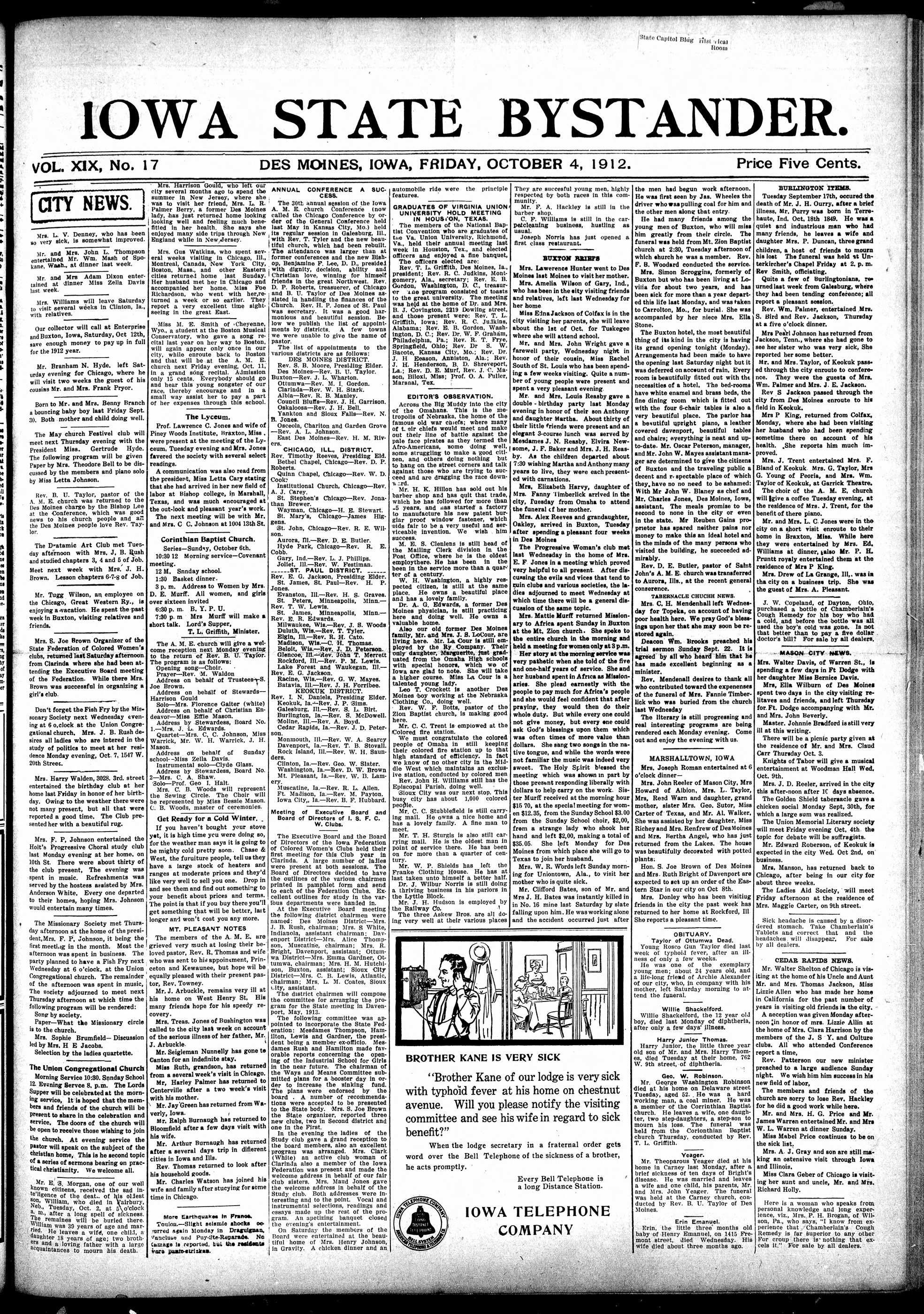
A man talks on the telephone. In the background, a family is sitting at a table.
"Brother Kane of our lodge is very sick with typhoid fever at his home on chestnut avenue. Will you please notify the visiting committee and see his wife in regard to sick benefit?" When the lodge secretary in a fraternal order gets word over the Bell Telephone of the sickness of a brother, he acts promptly.
IOWA TELEPHONE COMPANY
---
EDITOR'S OBSERVATION.
IOWA TELEPHONE COMPANY
TOWNE DISTANCE
TELEPHONE
MILL SYSTEM
IOWA TELEPHONE & TELEMARKET
They are successful young men, highly respected by both races in this community.
Mr. F. A. Hackley is still in the barber shop.
C. F. Williams is still in the carpetcleaning business, hustling as usual.
Joseph Norris has just opened a first class restaurant.
BUXTON BRIEF'S
Mrs. Lawrence Hunter went to Des Moines last Moines to visit her mother.
Mrs. Amelia Wilson of Gary, Ind., who has been in the city visiting friends and relatives, left last Wednesday for her home
Mrs. Edna Jackson of Colfax is in the city visiting her parents, she will leave about the 1st of Oct. for Tuskegee where she will attend school.
Mr. and Mrs. John Wright gave a farewell party, Wednesday night in honor of their cousin, Miss Rachel South of St. Louis who has been spending a few weeks visiting. Quite a number of young people were present and spent a very pleasant evening.
Mr. and Mrs. Louis Reasby gave a double - birthday party last Monday evening in honor of their son Anthony and daughter Martha. About thirty of their little friends were present and an elegant 3-course lunch was served by Mesdames J. N. Reasby, Elvira Newson, J. F. Baker and Mrs. J. H. Reasby. As the children departed about 7:30 wishing Martha and Anthony many years to live, they were each presented with carnations.
Mrs. Elizabeth Harvy, daughter of Mrs. Fanny 'imberlick' arrived in the city, Fuesday from Omaha to attend the funeral of her mother.
Mrs. Alex Reeves and grandaughter, Oakley, arrived in Buxton, Tuesday after spending a pleasant four weeks in Des Moines
The Progressive Woman's club met last Wednesday in the home of Mrs. E. F Jones in a meeting which proved very helpful to all present. After discussing the evils and vices that tend to quin clubs and various societies, the ladies adjourned to meet Wednesday at which time there will be a general discussion of the same topic.
Mrs. Mattle Murff returned Missionary to Africa spent Sunday in Buxton at the Mt. Zion church. She spoke to the entire church in the morning and held a meeting for women only at 3 p.m.
Her story at the morning service was very pathetic when she told of the five and one-half years of service. She and her husband spent in Africa as missionaries. She plead earnestly with the people to pay much for Africa's people and she would feel confident that after praying, they would then do their whole duty. But while every one could not give money, but every one could ask God's blessings upon them which was often times of more value than dollars. She sang two songs in the native tongue, and while the words were not familiar the music was indeed very sweet. The Holy Spirit blessed the meeting which was shown in part by those present responding liberally with dollars to help carry on the work. Sister Murff received at the morning hour $15.70, at the special meeting for women $12.35, from the Sunday School $3.00 from the Sunday School chair, $2,00, from a strange lady who shook her hand and left $2,00, making a total of $35.05. She left Monday for Des Moines from which place she will go to Texas to join her husband.
Mrs. W. R. Words left Sunday morning for Uniontown, Ala., to visit her mother who is quite sick.
Mr. Clifford Bates, son of Mr. and Mrs J. H. Bates was instantly killed in No. 16 mine last Saturday by slate falling upon him. He was working alone and the accident occurred just after
Every Bell Telephone is a long Distance Station.
State Capitol Blvd Historical Room
TAND
Pr
the men had begun work afternoon. He was first seen by Jas. Wheeles the driver who was pulling coal for him and the other men along that entry.
He had many friends among the young men of Buxton, who will miss him greatly from their circle. The funeral was held from Mt. Zion Baptist church at 2:30, Tuesday afternoon of which church he was a member. Rev. F. B. Woodard conducted the service. Mrs. Simon Scroggins, formerly of Buxton but who has been living at Lovilia for about two years, and has been sick for more than a year departed this life last Monday, and was taken to Carrolton, Mo., for burial. She was accompanied by her niece Mrs. Ella Stone.
The Buxton hotel, the most beautiful thing of its kind in the city is having its grand opening tonight (Monday). Arrangements had been made to have the opening last Saturday night but it was deferred on account of rain. Every room is beautifully fitted out with the necessities of a hotel. The bed-rooms have white enamel and brass beds, the fine dining room which is fitted out with the four 6-chair tables is also a very beautiful place. The parlor has a beautiful upright piano, a leather covered davenport, beautiful tables and chairs; everything is neat and up-to-date. Mr. Oscar Peterson, manager, and Mr. John W. Mayes assistant manager are determined to give the citizens of Buxton and the traveling public a decent and r-spectable place of which they have no need to be ashamed: With Mr John W. Blaney as chef and Mr. Charles Jones, Des Moines, Iowa, assistant. The meals promise to be second to none in the city or even in the state. Mr Reuben Gains proprietor has spared neither pains nor money to make this an ideal hotel and in the minds of the many persons who visited the building, he succeeded admirably.
Rev. D. E. Butler, pastor of Saltt John's A. M. E. church was transferred to Aurora, Ills., at the recent general congenerity.
Mrs. C. H. Mendenhall left Wednesday for Topeka, on account of having poor health here. We pray God's blessings upon her that she may soon be restored again.
Deacon Wm. Brooks preached his trial sermon Sunday Sept. 22. It is agreed by all who heard him that he has made excellent beginning as a minister.
Rev. Mendenall desires to thank all who contributed toward the expenses of the funeral of Mrs. Fannie Timberlick who was buried from the church last Wednesday
The literary is still progressing and real interesting programs are being rendered each Monday evening. Come out and enjoy the evening with us.
MARSHALLTOWN, IOWA
Mrs. Joseph Roman entertained at 6 o'clock dinner
Mrs. John Reeler of Mason City, Mrs Howard of Albion, Mrs. L. Taylor, Mrs. Resd Warn and daughter, grand mother, sister Mrs. Geo. Sutor, Miss Carter of Texas, and Mr. Al. Walker, She was assisted by her daughter, Miss Richey and Mrs. Renfrew of DesMoines and Mrs. Bertha Angel, who has just returned from the Lakes. The house was beautifully decorated with potted plants:
Hon. S. Joe Brown of Des Moines and Mrs. Ruth Bright of Davenport are expected to set up an order of the Eastern Star in our city on Oct 8th.
Mrs. Donley who has been visitig friends in the city the past week has returned to her home at Rockford, Ill She reports a pleasant time.
OBITUARY.
Young Rosco Gun Taylor died last week of typhoid fever, after an illness of only a few weeks.
He was one of the exemplary young men; about 24 years old, and a life-long friend of Archie Alexander in a company with his mother, left Saturday morning to attend the funeral.
WILLIE Shackelford
Willie Shackelford, the 12 year old boy, died last Monday of diphtheria, after only a few days' illness.
Harry Junior Thomas.
Harry Junior Thomas, the three year old son of Mr. and Mrs. Harry Thomas, died Tuesday at their home, 762 W. 9th street, of diphtheria.
Geo. W. Robinson.
Mr. George Washington Robinson died at his home on Delaware street Tuesday, aged 52. He was a hard working man, a coal miner. He was a member of the Corrinthian Baptist church. He leaves a wife, one daughter, two step-daughters, a step-son to his wife, and two children held from the Corrinthian Baptist church Thursday, conducted by Rev. T. L. Griffith.
Yeager
Mr. Theoparous Yeager died at his home in Carney last Monday, after a brief sickness of ten days of Bright's disease. He was married and leaves a wife and one child, his parents, Mr. Theoparous Yeager. He was held at the Carney church, conducted by Rev. B. U. Taylor of Des Moines.
Erin Emanuel
Erin, the little three months old baby of Henry Emanuel, on 1415 Fremont street, died Wednesday. His wife died about three months ago.
```markdown
```
Price Five Cents.
BURLINGTON ITEMS
Tuesday September 17th, occured the death of Mr. J. H. Ourry, after a brief illness, Mr. Purry was born in Terrehaute, Ind. Oct. 18th 1849. He was a quiet and industrious man who had many friends, he leaves a wife and daughter Mrs. P. Duncan, three grand children, a host of friends to mourn his lost. The funeral was held at Unterkircher's Chapel Friday at 2 p. m. Rev Smith, officiating.
Quite a few of Burlingtonians, returned last week from Galesburg, where they had been tending conference; all report a pleasant session.
Rev W. Palmer, entertained Mrs. S. Bird and Rev. Jackson, Thursday at a five o'clock dinner.
Mrs Peak Johnson has returned from Jackson, Tenn., where she had gone to see her sister who was very sick, She reported her some better.
Mr. and Mrs. Taylor, of Keokuk passed through the city enroute to conference. They were the guests of Mrs. Wm. Palmer and Mrs. J. E. Jackson.
Rev S Jackson passed through the city from De Moines enroute to his field in Keokuk.
Mrs P King, returned from Colfax, Monday, where she had been visiting her husband who had been spending sometime there on account of his health. She reports him much improved.
Mrs. J. Trent entertained Mrs. F. Bland of Keokuk Mrs. G. Taylor, Mrs G. Young of Peoria, and Mrs. Wm. Taylor of Keokuk, at Garrick Theatre. the choir of the A. M. E. church will give a coffee Tuesday evening, at the residence of Mrs. J. Trent, for the benefit of there piano. Mr. and Mrs. L. C. Jones were in the city on a short visit enroute to their home in Braxton, Miss. While here they were entertained by Mrs. Ed. Williams at dinner, also Mr. P. H. Prunt royalty entertained them at the residence of Mrs P. King. Mrs. Drew of La Grange, Ill., was in the city on a business trip. She was the guest of Mrs. A. Pleasant.
J. W. Copland of Dayton, Ohio, purchased a bottle of Chamberlain's cough remedy for his boy who had a cold, and before the bottle was all used the boy's cold was gone. Is not that better than to pay a five dollar doctor's bill? For sale by all dealers.
MASON CITY NEWS.
Mrs. Walter Davis, of Warren St., is spending a few days in Ft Dodge with her daughter Miss Bernice Davis.
Mrs.ella Wilburn of Des Moines spent two days in the city visiting relitaves and friends, and left Thursday for Ft. Dodge accompanying with Mr. and Mrs. John Beverly.
Master. Johnnie Bradford is still very ill at this writing.
There will be a picnic party given at the residence of Mr. and Mrs. Claude Carr Thursday Oct. 3.
Knights of Tabor will give a musical entertainment at Woodman Hall Wed, Oct. 9th.
Mrs. J. D. Reeler, arrived in the city this after noon after 10 days absence.
The Golden Shield tabernacle gave a chicken social Monday Sept. 30th, for which a large sum was realized.
The Union Memorial Literary society will meet Friday evening Oct, 4th the topic for debate will be suffragists.
Mr. Edward Roberson, of Keokuk is expected in the city Wed. Oct 2nd, on business.
Mrs. Manson, has returned back to Chicago, after being in our city for about three weeks.
The Ladies Aid Society, will meet Friday afternoon at the residence of Mrs. Maggie Carter, on 9th street.
Sick headache is caused by a disordered stomach. Take Chamberlain's and correct that and the headache will disappear. For sale by all dealers.
CEDAR RAPIDS NEWS
Mr. Walter Shelton of Chicago is visiting at the home of his Uncle and Aunt Mr. and Mrs. Thomas Jackson, Miss Lizzie Allen who has made her home in California for the past number of years is visiting old friends in the city. A reception was given Monday afternoon in honor of Mrs. Lizzie Allin at the home of Mrs. Clara Harrison by the members of the J. S. Y. and Culture clubs. All who attended Conference report a time. Rev. Patterson our new minister preached to a large audience Sunday night. We wish him success in his new field of labor. The members and friends of the church are sorry to lose Rev. Hackley for he did a good work while here. Mr. and Mrs. H. G. Price and Mr. James Warren entertained Mr. and Mrs W. L. Warren at dinner Sunday. Miss Mabel Price continues to be on the sick list. Mrs. A. J. Gray and son are still making an extensive visit through Iowa and Illinois. Miss Clara Geber of Chicago is visiting her aunt and uncle, Mr. and Mrs. Richard Holly.
Here is a woman who speaks from personal knowledge and long experience, viz. Mrs. P. H. Brogan, of Wilson, Pa., who says, "I know from experience that 'Chamberlain's Cough Remedy is far superior to any other For croup there is' nothing that excels it." For sale by all dealers.
Iowa State Bystander
BYSTANDER PUB. CO., Publishers
DES MOINES. . . . IOWA
WANTED TO PROVE INNOCENCE
Indicted Man Had It All Figured Out,
Though He Had,Rather Given
His Plan Away.
After the prohibitory law first went
into effect an Irishman in Ottawa
by the name of McCaslin was accused
of selling liquor contrary to the statutes. He was guilty, all right and
first man. He was guilty, but his lawyer persuaded him to fight the case. "Deny everything," said the lawyer, "make 'em prove it. They will have a lot of trouble doing that." The case was called before a justice of the peace and the prosecution was conducted by the county attorney. McCaslin himself consented to testify in his own behalf. When it came the turn of the prosecuting attorney to examine him he commenced as follows: "You are the defendant in this case, are you not?"
"Ol am not."
"Is your name Dennis McCaslin?"
"It is not."
"Did you on the Fourth of July—"
"Ol did not."
"What's the use awaitwin? Oi know what yez are goin' to ask."
By the court: "Don't answer, Mr McCaslin, till the county attorney has finished his question."
"All right, jo-dge. Let him fire away."
"Did you, Mr. McCaslin, on the Fourth day of July, at the town of Sciplo, in the county of Franklin, and state of Kansas, sell twelve bottles of beer?"
"Oi did not. How the h—I could Oi have sold twelve bottles whin Oi only tuck doon tin bottles and Oi brought back two wid me whin I came home?"
"That is sufficient," said the court, "you must will be $100."
"How on, joodge," said McCaslin, "ain't you goin' to give me anny trial?"
"Why, Mr. McCaslin," said the court, "you have already testified to your guilt."
"That may be thrue, yer honor, but I want to call your attention to this illegent array av witnesses who are pristine to testify that I didn't sell a drop. I propose to prove me own innocence, yer honor, by a preponderance av ividence."—Kansas City Journal
Placing the Blame.
The Hop, Champ Clark was much edified to overhear the following colloquy on a railway train on one occasion when he was on his way to open a political campaign: "Time was," observed one passenger, "when we had our country so well in hand we had a soldier who any office we cheese to nominate him for." "And you can't do it now?" asked a second passenger. "I should say not. The other fellows have beaten us horribly in the last two elections." "To what you do you attribute the change?" "My friend," said the first passenger convincingly, "I have been reached as a conclusion, because because when we had the power we elected too many brindle pupe."
Opened It Himself
Senor Gonzales Garza, under secretary of the interior of Mexico, is a matter-of-fact man who has the habit of holding his mouth open.
The other day Secretary of the Interior Gonzales walked into Garza's office and exclaimed: "Old chap, you know it." he replied Garza, not looking up from his writing, "I opened it myself this morning."
Mexico's National Dish
The poorer classes of Mexico use the tortilla not only as a food, but make it serve as fork and spoon. It is folded into a sort of scoop and used in eating beans, thick soup, rice, hash, or anything else usually lifted to the mouth with fork or spoon. Many of the poorer classes are not accustomed to the use of knife, fork or spoon. Tortillas are sold in large quantities in the market, fresh and hot, at six for one cent. They are considered a very nourishing article of food. Many laborers do a long, hard day's work on a diet of tortilla, beans, chili sauce and black coffee.
Won't Do!
"What's the matter with my plans for the new street cars?" he demanded.
"Matter!"! 'growled the magnate.
"Why, you've made the cross seats large enough for two to sit comfortably! Cut 'em down three inches, and slope 'em so that the outside passenger's slip off—and don't ever again start anything new on this company!"—Baltimore Evening Sun.
A Turner.
Mrs. Willis—Is your husband of a literary turn of mind?
Mrs. Gillies—Yes. Whenever an idea turns up, he turns it over in his mind, turns it out as a story, turns it in to an editor, who turns around and turns it down—Puck.
One or the Other.
Caller (admiring picture)—This isn't a family portrait, is it?
n isn't a family portrait, is it?
Mrs. Strucktill-Rich—O, dear, no;
that's either Dante or George Eliot,
but I always forget which.
Good Chance.
"Do you swear," said the counsel,
"that you will tell the truth, the
whole truth and—"
"Oh, how lovely," the fair witness
interrupted. "Shall I be allowed to
talk all the afternoon if I want to?"—
Stray Stories.
Going Some.
"In India brides of 12 are not un-
common."
"I don't expect to equal that reco-
rd," said the summer belle, "but so
far I've been the fancee of six."
AFRO-AMERICAN CULLINGS
The fifth annual convention of the National Association of Colored Graduate Nurses was in session recently in Richmond, Va. There were between forty and fifty nurses in attendance, coming from different sections of the country. Miss Mary F. Clarke, president of the association, presided over the deliberations of the body. There were many excellent papers read during the session, among which were "General Nursing," Miss Gussei V. Willam, superintendent of Richmond hospital; "Homes for Nurses," Mrs. W. A. Frazier, Washington, D. C.; "Mental Nursing," Mrs. Ada Franklin, Penlake,burg, N. "Speak Nursing," Mrs. Clarence Washington, D. C.; "Chronic Nursing," Miss Bessie Huer; "Nursing in America as a Profession," Miss E. Miller of Philadelphia. Others papers were read by Miss M. E. Baltimore, Harrison, Pa.; Miss M. A. Sandusky, Jacksonville, Fla.; Ida B. Eason, Virginia; Dr. W. H. Hughes, Richmond. "The Relation ship of the Nurse to the Physician." "The Mistakes of the Past and the Outlook for the Future," a round table talk, was one of the most interesting features of the convention. The address of welcome was made by Prof. D. Webster Davis. The response was by Miss Florence Fordham of Orangeburg, S. C. The officers elected were: Miss M. B. C. The officers elected were: Miss M. Davis, first vice-president; Miss E. C. Christie, Chester, Pa, second vice-president; Miss Florella Porter, Orangeville, S. C. recording secretary; Miss C. S. Morgan, corresponding secretary; Miss M. R. Tucker, treasurer. The installation address was made by Dr. H. L. Harris.
When a fellow finds fault about everybody, where is the fellow who doesn't find fault with him?
Women must work that some men may wee—those paid good salaries by some socialistic concern.
Life is not so short, but that there it always time enough for courtesy.—Emerson.
Woman has a smile for every joy and a tear for every sorrow.—Germain Francis Poulain de Saint Fox.
There is one thing that people won't stand in any man, and that is for him to feel that he is "above them."
The lesson of life is to believe what the years and the centuries say against the hours.—Emerson.
Only he who lives a life of his own can help the lives of other men—Phillus Brooks.
The dishonest man is apt to find the people a rather suspicious lot.
Many a man who is not perfect is a tolerably good fellow, and useful in a modest way.
If a man cares for his friends, as much as they care for him, believe him; but when he thinks they care more for him, he's only fooling himself.
The dancer who is to lecture upon how to attract men won't even need the illustrative art of dancing in her talks.
Three things a wise man will not trust—the wind, the sunshine of an April day, and woman's plighted faith. —Robert Southey.
The man who turns up his nose at slang doesn't realize that his nose is slangy at the moment.
Excess of passion and the force of love—arguments that which there can be none more powerful oft assuage the irritation of a woman's mind. -Titus Livius.
The reason why so few women are touched by virtue when in that they fail to love them when they have experienced love. -Francois De La Roche-faecaud.
Some time ago the question of putting negro policemen on the force was mooted. There was much diversity of opinion wherever discussed. There are those who believe that a colored officer might get killed, and they are very sollicitous as to his welfare. They have a perfect horror at the thought of an officer being killed if he be of African descent, but they have little or no concern about a colored man being shot to death in citizens clothes. There are those who think that a colored policeman should not arrest any one except colored people; while there are still others who think that being a policeman is a white man's job. None of these elements will ever do much toward restoring law and order in Dallas, where we live. During every time we have a duty, those charged with the responsibility of a good name for Dallas and preserving the same must rise above these petty notions and adopt measured and select men to carry those measures into effect without for a moment stopping to consider the question of the color or race of the man.
The Dallas Express wants to see negroes on the police force. We believe it will create a better feeling. The colored officer will necessarily spend much of his time with negroes. The better element of negroes will feel freer to help him hunt down a criminal than they will to help a white man. In other words, the city is entitled to the experiment. Let us try it. If it does no good we can stop it before it does much harm—Dallas (Tex.) Express.
From a standpoint of interesting clinics, instructive papers, attendance, entertainment and enthusiasm, the fourteenth annual season of the National Medical association, held at Tuskegee institute, was the most successful in the association's history. One of the activities of the session was the daily clinics, 499 persons going to the institute's hospital for medical and surgical attention, in four days.
The news that the leading colored physicians and surgeons of the country would gather at Tuskegee in annual session and conduct daily clinical led to one of the most extraordinary scenes ever witnessed at far-famed Tuskegee. For miles around negroes who had been suffering with some affliction for months, and in some cases, hied themselves to the institute to put themselves under the care of physicians who were deeply touched by the pathetic appeal for medical aid, and quite often did the patient leave the hospital greatly benefited by his visit. Some crippled and infirm walked from sixteen to eighteen miles to Tuskegee institute while others drove a distance of thirty miles. Nashville was chosen as the next place of meeting and Dr. J. A. Kenney of Tuskegee institute, was elected president at the annual election of officers, which resulted as follows: J. A. Kenney, M. D. Kearney, D. A. Ferguson, D. D. S. Rhondhm, Va. vice-president; Dr. C. A. Wilkerson, Mobile, Ala. second vice-president; Dr. J. R. Levy, Florence, M. C. treasurer; Dr. W. G. Alexander, Orange, N. J. secretary.
Edna G. Weaver, twenty years old, who took examination for seven different civil service positions open to women at Kansas City, holds first place in six of them and second place in the other.
Two things have recently stirred Chicago. First, the meeting of the Business League, and secondly, the generous gift to Negro education on the part of Julius Rosenwald. In some publications the gift of Mr. Rosenwald to Negro education has been misunderstood. It has been stated by several papers that this gift of $25,000 goes to Tuskegee, which is denied. More importantly is simply placed into the hands of Booker T. Washington to be distributed as he deems wise among the smaller schools of the south.
When you are disposed to be liberal nearly everybody will take advantage of you.
What is known as nervous prostration in the human family is known as fits in cats.
A man hates his enemies with more enthusiasm than he loves his friends.
Some big niggers satisfy their consciences by merely talking for race enterprises. They spend their money elsewhere—Old Hickory.
Women should be careful of their conduct, for appearances sometimes injure them as much as faults.—Abbe Girard.
Men declare their love before they feel it; women confess theirs only after they have proved it—Nicolas Valentin De Latena.
The angel in the house is fond of wings—on her latest outing hat.
Pride and purse are alliterative but not in agreement with daily needs.
The states of Queensland and New South Wales, Australia, are giving very considerable attention to government irrigation, mainly by means of artesian wells.
Alpine glaciers are receding and some of them are disappearing entirely. Some attribute this action to the boring of tunnels and building of mountain railways.
Two soles that beat as one is successful dancing, where two hearts might beat it and be thankful.
EMPRESS OF RUSSIA
MOST UNHAPPY QUEEN
From time to time the press of Europe and America has recorded
ie the press of Euhas recorded accounts of the alliances of the armies of the Ottoman Empire. The Russian press, even now that there is supposed to be no censorship in Russia, is forbidden to print anything concerning the imperial family's history. The official reports distributed by the official news bureau.
counts of the Russian empire. The Russian press, even now that there is supposed to be no censorship in Russia, is forbidden to print anything concerning the imperial family aside from the official ports distributed by the official news bureau.
From the various fragmentary reports it has become known that the Czarina, who had come to Russia with lofty ideals and a liberal western education, is an invalid and a martyr, alone in the Czar, misunderstood and tormented with melancholy and fear.
Now a chronicler, intimately familiar with the home life of the Russian Czar, has described only the sufferings of the woman who had hoped to reform the Czar.
Princess Alice of Hesse-Darmstadt, according to the biographer of the Czarina, lived amid ideal and idyllic surroundings throughout her childhood. When the princess became the Czarina of Russia she came to the Russian land at a time when the people, exhausted by the burden of absolutism, were returning from the military Alexander III. He hoped his hospice would be more merciful reign on the part of the new Czar, Nicholas, who was reported at that time to be a liberal.
The first day of the new reign was marked by the Khodnika tragedy, when thousands of people lost their lives amid the festivities. The tragedy made a profound impression upon the Czarina. It seemed to her a foreboding of a terrible future.
One evening while she was at work in her study the Czar entered. By his voice she knew that he was in a happy place. "Well, my dear," he said, "let me see how gifted people create their heavenly works."
"The things I am writing now do not satisfy me, either in contents or in form," she said.
"Never mind. Read anything you like, anything you consider your best," she said.
"I like most of my work at the time I am writing it," answered the empress, "but after a while I feel disillusioned."
"Well, read me some of your poems," begged the Czar. "I like poems when they are on them them."
He took up one of her notebooks and looked at the empress.
Then he read aloud: "In the soul of every human being there is chaos in which all things are justified, good and evil and mercy and cruelty." "That's pretty good," commented the Czar. He went on reading: "If we had enough courage we could have liberated ourselves and others from many vices, and we could have become as pure as children." "Do you know," remarked the Czar, "I prefer poems. You see I feel some what tired and it is rather difficult to digest these heavy thoughts. Poetry is different—it is like music—Tra-ta-ta-ta-ta-ta-!" The emperor showed him some of her poems. In one of her lines she expressed a doubt that their life could continue long without a change. The emperor paused. He was displeased and angry. "Well, that is my opinion," remarked the emperor.
"Then you do not have sufficient selfrespect!" he cried. "That is, I meant to say, you are too exacting. In other words, you must not forget that I—that you—that we. Do you understand me?" The empress shuddered nervously. The Cranfling the book aside and left to the room after a quarrel. She remained alone for a long time. And it was rumored in the palace that she was then planning to commit suicide.
SLANG OF A QUEEN
SHOCKS THE NOBILITY
Queen Amelie of Portugal, who frequently visits the Countess of Granard (Beatrice Mills of New York) at Forbes Hause and lunches occasionally with Mrs. Anthony Drexel, is given to using English slang with most amusing effect. On arriving for lunch, soon when after a hot spell there was a sudden cold, wet
Mills of New York) at Forbes House, and also lunches occasionally with Mrs. Anthony Drexel, is given to using English slang with most amusing effect. On arriving for lunch on time when a spell there was a sudden cold, wet snap, she wore a black fox stole, which she kept on in the drawing-room. Count Mendsoff, the Austrian ambassador, the Marquis de Dover, formerly the Portuguese minister; Prince Christopher of Greece and several others were present. During a lull in the conversation the queen replied to some remark of her hostess about her furs, in these words: "Yes, I had to put them on. It is sootly cold. But are they not beauty? My maid had put them away for the summer in some stinking stuff. The smell makes me slick."
A horrible pause ensued, and the
conversation over the room was
resumed.
Bitterness.
Chicago is to have a magazine devoted exclusively to verse. We don't know where it will find the poets, for the other magazines seem to be unable to locate any.—Philadelphia Record.
Removing Wine Stains
When wine has been spilled upon the tablecloth sprinkle it with salt until it is possible to take out the stain. When the cloth has been removed pour boiling water through the stain until it has disappeared.
MME. CAMILLE DU GAST
TO VISIT UNITED STATES
France's most versatile widow. Mme, Camille du Gast, has again cov-
cast, has again covered herself with political and philanthropic glory by 'carrying to a successful issue a difficult mission in Morocco, in intrusted to her by her foreign affairs and the ministry of agriculture. Mme. Du Gast is the tallest and one of the richest and most ac
political and phil- anthropic glory by 'carrying to a successful issue a difficult mission in Morocco, in trusted to her by the ministry of foreign affairs and the military department of agriculture. Mme. Du Gast is the tallest and one of the richest and most accomplished widows in Paris. Unlike most French women she is quite blonde, with a hint of Titian red in her hair. Though not her usual shade of youth, she appears from her trip in Morocco with the bloom of health and vigor fresh upon her.
Mme. du Gast is the widow of the former partner of Dufayel, one of the richest merchants in Paris and the owner of one of the few private residences in the City of Light which tourists and natives slike go to see. Mme. du Gast has been a widow for fully a score of years, and she and we have vainly sought by the first nobles of France. Among other aspirants was the Duke de Talleyrand, then Prince de Sagan. On one occasion the Duke chastised an unchivalrous judge who made inappropriate remarks about a masked portrait of Mme. du Gast. It is a most question whether Mme. du Gast or the Countess de Bearn ranks first among the wealthiest of Paris widows, but the former has the most tenants. For on her rent roll there are the names of the rooms of many accomplishments and is the best amateur pianist in Paris. Presently she is to tour the United States.
A strong advocate of an entente cordiale between the two republics, Mme du Gast believes the best way to develop it is by social, musical, literary, scientific and commercial intercourses. She was born in Paris and is president of the Society of Native-Born Parisians. Once a month this society gives a dinner at which Mme. du Gast presides. On these occasions typical Parisian wit, which has the finest flavor in the world, may be heard. The recent visit of Mme. du Gast Morocco was not her first. Two years ago, when M. Pichon was minister of foreign affairs, she visited that intercultural country. She saw the Sultan, gave him gifts from France and accepted the safe-conduct of his bodyguard. When she returned to Paris a book of hern on Morocco was published from the government printing presses.
Her recent trip was not devoid of adventure. She and her companion were about to be made prisoners by a Moorish band when Calds Al Flou and Guellough came upon the scene. Recognizing the great Frenchwoman, they not only prevented her capture, but also brought upon her friend, Mme. du Gast has brought back with her many studies of flora and fauna and of the industrial resources of Morocco; also wild animals that will be added to the collections of the Zoological gardens of Paris—the Jardin des Plantes and the Jardin d'acclimation.
That there has been a political and diplomatic side to Mme. du Gast's visit everyone knows, but its precise nature is secret. It is present Susan of Morocco and her visit helps greatly to smooth the rocky road of the French protectorate.
QUEEN OF SWEDEN'S GRANDSON AMBITIOUS
To many visitors to the Swedish capital during the Olympic games
the simplicity of life of the Swedish royal family came as a revelation. Yet, while their habits are democratic, they are all imbued with authority for the army, and all are attached to one or more regiments.
The queen herself sets the example by acting as honorary commanding officer of the Thirty-fourth Pommeranian Fusiliers, whose uniform she dons on ceremonial occasions.
Not only are her sons and brothers-in-law equally prominent in encouraging Swedish military arduor, but the crown prince's eldest son, Prince Gustave, though only six years old, is the merry honorary lieutenant of a cavalry regiment and is ambitious already to become commander-in-chief of the army.
The military tendency in his case is hardy on both sides, for his mother is the elder daughter of the Duke of Connaught and tremendously popular in Sweden. Her second son, little Prince Sigvard, aged five, also has military aspirations.
Just as England is ever haunted by the specter of a German invasion, so many Scandinavians believe that if Sweden's army comes to a clash it will be with the forces of the Czar, bending on making au outlet for Russia on the open Atlantic. "But this fact does not minimize the popularity of the Russian wife of the queen's second son. Prince Charles Wilhelm.
Time to Be Silent.
Especially when there is an exe-
ment rite in a community hold your
tongue. The time is ripe for scanal;
dive; every one talks, equally every
one repeats, and the simplest remark
is reported out of all semblance of
truth.
And Neither Mean Anything
A woman is always fond of talking about what she would do if she were a man, while a man contents himself to be a woman. He wouldn't do if he were a woman.
One Way of Doing It is To Forget Birthdays.
After All, They Are Only Grim Rim
minders of Life's Milestones
That Mark the Hard Path-
way to the End.
With all the advice that we are getting these days on how to remain youthful and how to grow old gracefully and kindred topics relating to the common desire to cut the acquaintance of Father Time, it is gratifying to note that a few exceptional persons have really mastered the secret and can get along without expert advice, remarks the Providence Journal. The secret, after all, is not buried deep. It contains most of the abilities that are possible, the annoying little matter of age. Any man is likely to stay comparatively young so long as he can succeed in actually forgetting how old he is.
Perhaps there are few who can really do this, but a case was reported in New York the other day. A man wafted himself brazely into the office where they keep the vital statistics in storage and announced that he wanted to find out how old he was. He was in a hurry for twenty years or so that he had entirely lost truck of his age. Now he was going to get married and he needed the information. He was not sure whether he was 41 or 48 years old, and he was both surprised and elated when the indisputable evidence of the records showed that he was only an even 40 years old, and the lease the lady," said he as he went out.
That illustrated the only true story of the way in which to cheat the advancing years. Keep busy! The life that is properly busy has no time to think about birthdays. The trouble is that nearly all of us establish the habit of thinking about birthdays in our juvenile years, when we are apt to count the passage of time somewhat impatiently, and it is hard to break the habit in later life, when the significance of a birthday impresses us with a reverse English. Our birthday gets into the minds of our relatives and intimate friends as a minor annual event, and to be celebrated with gifts and congratulations, and we are rounded up and forced to gaze regretfully at each milestone as we reach it with a crude attempt at a pleasant smile.
The joymakers radiate their gloom with painful reminiscences and with such inept remarks as "Well, we're getting along." "Hair's getting kind of thin, George, ain't it?" "Only six more years to go and then you'll be 50!" "I must say, you hold your age pretty well." Many of the remarks are intended to be complimentary or consolatory, but somehow they convey a subtle sting. After one has reached the suspicion that he is not to be the suspicion that a congratulatory utterance may be only a polite euphemism for "Get the book." The way to dodge these doubtful emotions is to keep busy, and sprinkle such things as birthdays liberally with a strong solution of oblivion.
Modern Towers of Babel
America is pre-eminently the land of the skyscrapers and New York city their especial location, though Chicago is coming well to the front as a competitor. In no other spot in the world is space at such a premium as in New York. The land area is so small for the population and for the amount of business to be done that the real estate value is enormous, hence space must be utilized and as a result we have the skyscrapers.
The Metropolitan Life insurance building, on the southeast corner of Madison square at Twenty-third street, hold supremacy in height till the erection of the Woolworth building. This huge campanile is 700 feet 3 inches high, and has 50 stories, with two acres more of floor space than the latest marvel. The Singer building, at the corner of Broadway and Liberty street, has a total height from the basement floor to base of flag staff of 742 feet, the height from the street to the main roof being 612 feet 1 inch. It has forty-one stories and nine and a half floors of floor space. Bankers' Trust company building, at the corner of Wall and Nassau streets, is 539 feet high, and has 39 stories. The Times building, at Forty-second street and Broadway, is 419 feet high and has 28 stories.—The Christian Herald.
Evll In Athletics.
Some of the big men in our navy have been making a study of the effects of athletics on the men in Uncle Sam's naval schools, and they say that spectacular and competitive athletics are bad for them. Too many of the men have serious after effects from the long, severe course of fitting themselves to lead in physical sports. Once the men are on the sea conditions are such that the system of exercises can not be kept up. The exertions are not kept in the framework and vitals of these athletes tend to degenerate when exercises are left off. Leading athletes become too fat and actually lose strength from the muscles going backward instead of staying at a standstill.
Auto Exports Large
About 20,000 automobiles was the export record of the United States during the six months of the present year, covering theories and parts this means $12,000,000.
Texan's Useful Invention
A Texas man has invented a very simple, but useful tool, that will twist tightly together two or more wires when drawn over them.
United States as Leader
The United States ranks first in pro-
duction exports and imports in six
countries.
Second Great City of Britain
Second great city of Britain.
Calcutta, with a population of nearly one million five hundred thousand,
is the second city of Great Britain.
"Laddie" a Perfect Example of the Shepherd Dog.
One of a Passing Type That Had Brains and Used Them—Belonged to Race That Is Now Fast Disappearing.
Laddie belonged to the race of old-fashioned collies or shepherd dogs now fast disappearing, remarks Our Dumb Animals. A writer in a recent magazine deplores the passing of these wonderfully sagacious and faithful collies, "since the advent of the modern sheep" type, believing the old-fashioned collie one of the finest dogs that ever came be the companion and helper of man."
Laddie was a fine example of this type, and in his seven years of devoted, delightful companionship and protection will always be remembered.
Laddie had the good fortune to live in the country, where, unlike his less happy brother of the city, so much hampered by the leash, he could enjoy with perfect freedom his greatest pleasure—a daily outing. Laddie was fitted with almost human reasoning and discriminated between the walking hats of his mistress and those worn when motoring, for, without a word being said, at the sight of the former he would show his delight in every way possible; but when the motor hat was brought forth Laddie would give it one look and in the most dejected and disappointed manner walk away and hide until his mistress was out of sight. True to his shepherd instincts, Laddie was always active in rounding up the family, especially at meal times. He would search the tractor, struggle to would search out the delivery truck, a little nap at the sleeve and gently pull, as if to say, "Dinner is ready! Why don't you come?"
Laddie knew Sundays from week days and could tell the time of day. When the old clock on the stair struck 6 in the morning he would walk into his master's room and put his head on the bed. At night, when the clock struck 10, the hour for the evening walk, he sought his master and used all his gentle arts to remind him of the time when falling the usual hints, he brought his master's glove and laid it on his lap, which act, very properly, had the desired effect.
Laddie preferred those who were mild of voice and manner; yet, while strongly showing his affection for those he loved best, he was too truly a gentleman to show decidedly his dislikes. The single exception was the garbage man and his dog.
No sleep of Laddie's was too deep to prevent him knowing when anybody left the house. He was able to help him the stant and was always where you expected to find him, a valuable trait and one that made his absence all the more keenly felt, when his home knew him no more.
Prussic Acid In Plants
The remarkable fact that considerable quantities of free prussic acid are accumulated in the living tissues of certain plants was observed by the late Dr. M. Treub, and there appears to be little doubt that this poisonous acid is actually utilized as food material by these plants. Some interesting details concerning the occurrence and function of prussic acid in the cherry laurel are given by Peche, who concludes from his observations that the prussic acid found in the leaves and other organs is produced as a direct result of carbon assimilation. The green leafless crop is supposed to light it, but it is not merely a product of the hydrolysis of glucosides. Peche found evidence that while part of the prussic acid enters into the building up of glucosides, some of it is transported in a labile form, probably in loose combination with a tannin, and is stored up in various tissues as a reserve food.—Nature.
Impressed on His Memory
impressed on this film
The way some of the boxing clubs
are围着 the boxing these nights
causes uneasiness to many, even
though there are firemen always on
the scene. "Do you ever think about
the Iroquois theater fire?" a newspaper
man asked Eddy Foy not long ago. "You bet I do, when I get in a place like this," replied the comedian,
who is, by the way, an ardent devotee of the fastic sport. "I seldom get in a crowded hall but that I peel my eyes for the red lights over the fire escape doors. The Iroquois fire, a long time ago, was a man who saw that can never forget it." Foy was on the screen when the tragic Chicago theater fire broke out—New York Tribune.
Old Scientist Rana Eugenics
Dr. Alfred Russel Wallace, like many others, does not approve of any of the "modern eugenic heresies that are being advocated." The aged scientist (Dr. Wallace is in his nineteenth year) feels a little sore on the point because he has been referred to as spending the evening of his days in furthering the teaching of eugenics.
"Wherever did I advocate any such preposterous theories?" Dr. Wallace asked scornfully. "Not a reference to any of the things not a word is used for identification of this scientific label. Why, never by word or deed have I given the slightest countenance to eugenics."—London Dispatch to New York Sun.
Not Even "Fonetic."
"Tim," inquired Mr. Riley, glancing up over the door of the postoffice, "what is the meanin' of thim letters, 'MDGCCXCVIII'" "They mean eighteen hundred an ninety-eight!" "Tim, don't it strike you that they 're carryin' this spellin' reform entirely too far?'—Youth's Companion.
Remember Home Land.
Japanese in America have contributed $2,200 for a creche for the children of the slums of Okayama.
GOOD ROADS
Boston Man Returns From Trip
Abroad and Tails of Superiority
of European Highways.
Well satisfied that the European
countries have little to teach this
country in the way of manufacture of
motor cars, J. H. MacAlman, president
of the Boston Automobile Dealers' association, returned recently.
It was a vacation trip for Mr. Mac Alman, but he took care to note the state of the motoring industry in the different countries and to observe the condition of the highways. While praising the magnificent systems of highways in Great Britain and on the Continent, where he found roads everywhere equal to our best, he is of the opinion that the magnificent care that is taken of them. The principal roads are under national control, and are never allowed to wear out. All along the main routes of travel there are posted at intervals men who have a supply of road material at hand, and when a hole appears in the road surface, the road repairers at once pound stone into it and stop the wear. The traffic over these roads is heavy out on none of the roads according to Mr. Mac Alman, is the traffic as heavy as that over a single road as the Revere Beach highway and other main avenues of more travel out of Boston. What struck him particularly forcible in England was the fact that no matter where he wanted to go there were first-class roads, due to the fact that England has been building good roads for centuries, while the good roads like in the United States is scarcely a score of years old.
ARRANGING, GRADE OF CREAM
Lack of Quality Has Long Been Detriment
mental Effects of the United States
Increased attention is being given in butter-producing districts to the grading of cream and the arranging of price schedules to conform more nearly with the real value of different grades of the product. Lack of quality has long been a serious detriment to the dairy interests of the United States, regardless of locality. The production of a higher quality of cream by the individual farmer has long been urged by the creamery operators as the prime necessity to the production of better butter. For the most part, however, creamy interests and creamery operations—have offered no particular inducement to the farmer to improve the quality of his product. Producing cream under the most improved conditions and keeping and delivering it in the best possible condition generally costs more work and more money than the production of an inferior product. As long as cream is paid for on a flat scale at so much per pound of butter fat regardless of condition, the great bulk of farmers are not going to spend money and effort to deliver a high-grade product at the creamery. However, a price difference is paid commensurate with the real difference in the matter becomes a question should, and there is a tangible object in delivering cream of high quality. There is just as much good, sound season back of grading cream as paying for it according to its relative value as there is in the grading of wheat and corn.
Storing Pumpkins in the Field.
You needn't expect to reap much profit from gorging your hogs and cattle on pumpkins for a few days during the harvest season, then cutting off their supply of this valuable feed for another whole year. Store your pumpkins in the field.
Pile the pumpkins in a row, as high and as wide as you wish, cover with hats and set up fodder on each side to the not only of three or four feet. This not only of ample protection from cold, but it ensures that a most profitable balanced ration by adding "the fruit of the vine" as you feed out the corn and fodder.
Filling the Orchard
The vacant places in an orchard caused by poor stock, injury in cultivation or borers, it may be as well to fill in with younger trees up to the age of about eight years. After that time the older trees will occupy the ground so fully with their root systems that young trees set make very small growth and seldom amount to much when they arrive at a bearing age.
If fruit trees are a good size and there is some wasteful fruit on the ground, or plenty of grass and weeds hate and there, to turn a few sheep in, it is more likely to do the ground good than harm. There must, however, be sufficient food somewhere to keep the young from getting hungry enough to get after the bark or twigs.
Spinach for Next Spring
If you want spinach for use in early spring, at the time when dandelion greens are ripe, sow seed in September or October. Frequently it does not winter well, especially if not protected by covering lightly with litter.
Treatment for Scaly Leg
The repulsive-looking scaly legs in chickens can be improved in appearance a whole lot by rubbing them at intervals of a few days with a salve made of equal parts of lard, sulphur and kerosea.
COST OF ROAD IMPROVEMENT
Secretary Wilson Shows That 300,000
Miles of Public Thoroughfares
Need Betterment.
According to information just made
public by the director of the office of
public roads, Indiana leads all the
states of the Union in mileage of 11
miles. Most of the improved
roads of Indiana and Ohio are
coposed of gravel and were, for the
most part, built by farmers in working
out the taxes. The eight leading good
roads states are: Indiana, Ohio, New
Wisconsin, Kentucky, Illinois,
California and Massachusetts.
The states which are leading in pro-
gressive road building are: New
York, Georgia, Washington, Missouri
South Carolina, Alabama, Pennsylvania,
vania, Tennessee, New Jersey, Florida
and Maryland.
That the nation-wide movement for the improvement of the public roads involves a large undertaking is indicated by information just made public, by the U. S. department of agriculture. Secretary Wilson shows that 300,000 miles of roads must be improved before the public road system can be considered really efficient. It is only within recent years that the movement for better roads has gained force. The consequences of delay are shown in the fact that there are now but 180,476 miles of improve roads in the country. These improve roads constitute 66 per cent. of the total mileage of all roads. Improved and unimproved It is clear that the percentage will have to be increased to 20 before traffic can be moved throughout the country with the minimum of wear and tear of horse, wagons and automobiles.
The French system of roads, long considered the best in the world, was bonded by Napoleon III. for $6,000,000, and something in the neighborhood of $12,775,000 has already been spent on that system. In this country diving to the great distances, it is probable that close to $2,000,000,000 road system to be spent before a proper road system is built. While the amount necessary to perfect a great road system seems fabulously large, it does not seem too large when it is divided among the various states and spread over a period of five, ten or fifteen years. When it is considered that New York state has bonded itself for $5,000,000 and that $5,000,000 a year is now being expended by that state, it will be seen that a nation-wide system might be perfected were all states to progress as rapidly. The states of Alabama and Florida have also made sand and gravel by building sand-clay roads, and this is very cheap and satisfactory type of road building.
The Window Garden Season
The window gardener's year begins in September, because that is the time to bring tender plants indoors, and because bulbs begin to arrive then.
The ideal is to have flowers indoors every day from the first frost of autumn until the last frost of spring. Bulbs alone will give flowers from Christmas to Easter. A little $2 collection of bulbs will give a spot of color daily if carefully selected and managed, but it is pleasant to have a roomful of bulbs—about 250 pots.
The most practical bulbs for Christmas bulbs are Roman hybrids and the paper white narcissus. Chinese sacred lilies will also bloom then if protected from drafts.
For February, plan to have crouses.
For March and April plan to have tulips, hyacinths and daffodils.
Asparagus Doubly Useful
Asparagus plant is hardy. It requires six weeks for the seed to germinate and come up. The young plants may be cultivated in rows or other garden vegetables, and set in permanent rows or beds this fall or spring.
The plants are very hardy. will stand all kinds of treatment, but will respond liberally to good treatment, and thrive in one place for ten or twenty years. The asparagus plant is doubly useful. The young shoots can be used for food, and the foliage branches for decoration. Sprays of asparagus are equaled by few other plants for their pleasing effect in decoration.
Good Roads.
Good roads are essential to the success of the farmer the world over. Poor roads are very costly; they cause the speedy wearing out of wagons, the loss of animals and the failure to market crops profitably. Good roads mean a greater ease in marketing, longer wear of farm wagons, more profit and more comfort. Good roads are not expensive; all roads can be improved at small cost in money, time and labor.
Avoid Weed Growth
If there is any part of your garden or fields that you do not wish to grow vegetables or staple crops on do not allow it to grow in weeds. Weeds are obnoxious, do not afford any profit or pleasure to the land owner and rob the soil of its fertility. Sow any unoccupied parts of your land in cowpeas or other legumes. It will pay you well.
Poor Fall Work.
Where the road is plowed and scraped up till it is so late in the fall, the dirt does not have time to pack and settle before it freezes, with the result that these newly-worked spots are not only rough throughout the entire winter, but they will be soft and difficult of travel all next spring.
The Weight of Eggs
The average weight of hens' eggs run from 15 to 24 ounces per dozen. A weight of 22½ ounces may be taken as a fair average for good-sized eggs, although a weight of 4 ounces is not unknown for single specimens.
For Tree Planting.
If you intend to plant a few choice trees next spring dig large holes for them in fall, fill them with manure, compost, or compost bark, and up to the desired depth of the tree.
Total Value in U. S. In 1899 and 1909 Compared.
Advance In Cereal Production Shows Only 1.7 Per Cent., While the Rise In Cost Is About 79.8 Per Cent.
Washington.—The total value of the crops of continental United States in 1999 was, in round numbers, $457,180,000,000, as compared with $2,999,999,000 in 1899. The increase was thus $2,488,000,000 or 83 per cent, according to a statement issued today by E. Dana Durand, director of the bureau of the census, department of commerce, showing these total results were carried on in the agricultural division of the bureau of the census, under the supervision of L. G. Powers, former chief statistician, and J. L. Coulter, expert special agent. The census has made no attempt to ascertain the total net value of farm products for 1999, including both that of crops and animal products. Merely to add the numbers of these two groups of products together would involve expensive duplication, since large quantities of the crops reported are fed to the animals on the farms and reported later as live stock products. It is impossible to ascertain accurately the amount of such duplication, and the attempt to do so, which was made at the twelfth census, was not considered satisfactory. For this reason the relative importance of these two agricultural productions of the United States cannot be determined precisely.
A large part of the extraordinary increase in the total value of farm crops between 1899 and 1909 is attributable to higher prices. This might be inferred from the fact that, while the acreage of crops with acreage reports increased only 9.9 per cent, the value of such crops increased 82 per cent. It also appears by comparing the percentages of increase in the quantity of the various individual crops with the percentages of increase in the value. Thus, for all cereals taken together, the production increased only 1.7 per cent, while the value increased 79.8 per cent; for hay and forage the production increased 23 per cent. and the value 70.2 per cent. (not counting cotton) the production increased 11.7 per cent and the value 117.3 per cent. A more precise calculation of the average increase in unit values of crops has, however, been made by the census.
For the individual crops for which both quantity produced and value were reported at both censuses, the average value per unit in 1899 was computed and this was multiplied into the quantity produced. For the total value which would have been reported for each crop in 1900 if the acreage value per unit had been the same as ten years earlier. For certain crops the values were not reported separately in 1899, and for certain other crops quantification were not used. This analysis covers nine-tenths of the crops of the country as measured by value.
The total reported value of the crops covered by the computation in 1899 was $2,691,679,000 and the total reported value of the same crops in 1909 was $4,934,490,000, an increase of $3.3 per cent. Had the prices of 1899 prevailed, however, the value of these crops in 1909 would have amounted to $2,962,358,000, or an increase of only 10 per cent. over 1899. The difference between $2,962,358,000 and $4,934,490,000, the amount added to the value of these crops in 1899 by reason of increase in prices over those of 1899, the average percentage of increase in prices being thus 66.6.
The figure just given, 10 per cent, as representing the excess of the value of the crops of 1909, on the basis of 1899 values, over the values of the same crops in 1899, is virtually a consolidated expression of the general increase in the quantity of crops produced. Covering, as it does, nineteenth of the crops of the country, it may properly be compared with the increase of 21 per cent. in the population of the United States between 1900 and 1910, which is evidently greater that the increase in the number of farms from 1900 to 1910 was 10.9 per cent, and the increase in the rural population, which includes places under 2.500, in addition to the agricultural population, was 11.2 per cent, the increase in urban population being 34.8 per cent.
FILIPINO WORK EXHIBITED
An exhibition of industrial methods from Philippine schools, prepared by the bureau of insular affairs, has been loaned to the public library of the District of Columbia, and is now set out for public view. The work done by boys and girls of the Philippines shown in the exhibit is a regular class room work. The idea of the school authorities in the Philippines is to make every boy and girl who completes even the primary course of study, an effective factor in the commercial affairs of the community. Included in the exhibit is some of the finest embroidery, which was turned out by the pupils of the primary schools. The display of baskets, for sale in the workshops, that the pupils are able to make commercial products, as these - articles in every way equal to those made in factories.
The Truth at Last
As there seems to have arisen some discussion as to where Moses was when the light went out, it might be well to inform inquirers that in debt—rather heavily—to the electric light company.—Judge.
Modern Clothes for Chinese
Traveling for an English firm that makes ready-made clothing, a drummer recently secured orders for $125,000 worth of "foreign" garments in Harbin, Manchuria. The clothes will be sold to the Chinese.
FIGHTING POPULATION GROWS.
There are in the United States today 20,473,884 men within the fighting age limit.
While the total population of the country has increased during the decade 21 per cent, males of millitia age have, in the same period, increased 26.5 per cent, and as a consequence they constituted a somewhat greater proportion of the total population in 1910 than they did in 1800. Of the total population in 1910, 22.3 per cent and all ages in 1910, 22.3 per cent were males of millitia age, the corresponding percentage for 1800 being 21.3.
The fact that males of mililita age increased more rapidly than the total population is accounted for in part by immigration, which has been, during the last decade, to a greater degree than in earlier years, predominantly male. Among immigrants the proportion eightteen in the population exceeds the proportion in those ages among natives, and consequently the northern and western states to which immigrants chiefly go have, as compared with the southern states, a greater proportion of their population males of mililita age. The eastern divisions, however, lose some part of their adult male population by immigration westward, and an effect of immigration in the higher percentages shown for the states of the Rocky mountain and Pacific coast regions.
As compared with the general average noted above for the country as a whole, of 22.3 per cent, males of militta age in 1910 formed 22.8 per cent of the total population in the four southern states taken together, and 19.9 per cent in the far western divisions, and 19.9 per cent in the three southern divisions taken together. The percentages in the individual northern states are with few exceptions close to the average for the country as a whole; in the far western states they are generally above and in the southern states generally below. Among the states the percentage for Wyoming is highest, males of militta age in 1910 constituting 37.4 per cent of the population. Other states with high percentages are Nevada, 35.9, Montana 32.8, Washington 29.8, Arizona 28.3, Oregon 28.3 and California 28.1; all of these states being in the mountain and Pacific coast regions. For North Carolina 17.8 is the lowest.
of the 20,473,684 males of mililta age in 1910, 2,156,861 were in the single state of New York. Of the increase for the decade amounting to 4,290,982, nearly one-fourth, 1,074,424, was in the middle Atlantic division, comprising the states of New York, New Jersey and Pennsylvania. The male population of mililta age in New York state increased 516,966, in Pennsylvania 382,703, in California 286,645, in Illinois 239,084, in Texas 205,759.
HAWAIIAN FORTIFICATIONS
"With the completion of the fortifications at Pearl Harbor, in Hawaii, the islands will be so fortified that no foreign foe, in my opinion, could gain an entrance," said A. J. Connell, a lawyer of Honolulu, when in the city recently. "The work on these fortifications is progressing splendidly, and it will not be long before it is completed.
"I have heard frequently since coming to the states that the Japanese are leaving Hawaii. I failed to find in my ten years' residence there that the number of yellow men is decreasing to any great extent. There are more Japanese men ever before, and it is true that most of the men have seen military service. They might not be termed 'trained soldiers', but they are good fighting men, and if the Jaws wanted to they could make a lot of trouble for the Americans in Hawaii. However, there apparently is no disposition on the part of the Japanese to have and I have no apprehension that we need fear any trouble from the Jaws. It is likely that the number of Japanese in Hawaii will decrease, for there are none coming in, and the disposition of the little people is to go back to their own country once they have acquired sufficient money on their own account, dollars is pretty near a competency for the average Japanese family.
"It is astonishing how much interested the younger Japanese are in the English schools. They are eager to obtain an education, and following their hours in the public schools they spend some time in Japanese schools We are getting most of our immigrants now from Portugal and Spain, and they make excellent laborers, particularly the former."
DID HIS DUTY.
Mounted Policeman Cullinane of the patrol police force, did clever detective work the other day. A suburban resident complained to Major Sylvester, superintendent of the police department, that bees were eating her grapes. Cullinane was asked to investigate. He went to the grape vines, saw the bees at work, went to a nearby store, got a pound of flour, returned and springled it on the busy bees. One by one the bedded bees flew away, going west. Cullinane mounted his horse and hour in the same place, and took them upon a bee bake, a mille away, and upon examination found the fouled bees. The owner of the grapes was given the name of the owner of the bees. What action the former will take against the latter or her bees is not known. The police officer had done his duty. There is no law in the District against bees eating grapes.
Mayflower Descendants
There are today throughout the United States several hundred descendants each of Miles Stansish, Governor Bradford, Richard Warren, John Holland and Elder Drew-ward, and worthy of their sires.
More Touching.
Etherical Creature—"So you hate our sex. Your life has probably never been touched by a woman." Prunus persica was once "Judga." My pocketbook was once—"Judga."
IMPORTANT PINCH OF SALT
So seemingly There Are Few Diapers to Which It Will Not Import an Excellent Flavor.
Few housewives, especially the little Mrs. Newlyweds, fully appreciate the value of the pinch of salt. Of course, everyone uses salt on meats, and in soups, entrees, vegetables, sauces, etc., but although the cook books do not always include it in recipes for cakes, pies and deserts, really, for soups, entrees and vegetables, the most dainty gelatine and whipped cream dessert to bread and butter pudding that is not greatly improved by it. You probably would not dream of putting it in a pot of tea, but if you try it you will find that it brings out the aroma of the tea, making it actually fragrant by neutralizing the flavor of the water. This will make it be and appease you, where the water is hard or has a mineral taste. It should always be used in coffee and cocoa. It imparts a mellow taste to coffee and makes the cocoa seem very much richer.
The delicate flavoring of all curtail desserts is enhanced by the magic pinch of salt. Put it in pies of all kinds. Use plenty of salt in the pie shortening, where only lard is used to shorten it. Meringues are improved by it.
At preserving time remember the pinch of salt, whether you are making preserves, jelly or marmalade. It simply puts the water where it belongs—in the background, and the fruit flavor stands out preeminently. It is a simple, ordinary, yet everyday, uses of a pinch of salt—Armour's Cook Book.
FOR PLUM OR GRAPE JELLY
Delicious Preserve Will Result If These Directions Are Faithfully Carried Out.
Put rice plums in a colander and pour boiling water over them; then put the fruit in a preserving kettle with barely enough water to cover, and boil until the plums are softened and the juice is plentiful. Strain off the juice and put it on to boil. Measure out a pound of sugar to every pound of the juice in the pans in the oven to heat until the juice has boiled for twenty minutes. Add the sugar then, stirring it in until dissolved and removing all scum as it rises, and pour into glasses boiled in hot water to prevent their breaking when the scalding fluid is poured in. A delicious jelly from wild grapes may be made in the same way, but, remember, if the jelly bag is squeezed out, the juice will be colder jelly. When the natural dripping seems about over, squeeze out all the pulp that will come through the mesh of the bag and use it for jam.
Peach Shortcake.
Sift one cup of four, one teaspoon of sugar, two teaspoons of baking powder and a saltspoon of salt. Mix as for biscuit dough two spoons of lard into the flour and with a spoon make a soft dough with a third (or little over) cup of milk. Pat out lightly on molding board and cut into five or six biscuits. Have some melted butter in a small pan and dip the top of the butter into the sugar and over into the pan ready to bake. Bake until nicely browned in hot oven; then cool each apart and place sweetened peaches between. Peel and slice ripe peaches rather fine, then crush with enough sugar to well sweeten. Serve with powdered sugar sprinkled over the tops; pass plenty of rich cream. (Level measures are used for the recipes.)
Preserved Half Reaches
Clingstone peaches are the best. Pare and cut them in halves. Remove the stones and cook the stones in water for twenty minutes. · Use the water for making syrup in which the peaches are to be cooked. For preserving, use as many pounds of sugar as there are pounds of fruit and one cupful of water to each pound of sugar. Use the sugar and water until the syrup is thick. Then drop few peaches at a time, until they are cooked. Put into jars which have been sterilized and seal them while they are hot.
Mutton Pie.
Boll one and one-half pounds of mutton from the forequarter with sliced onions and carrots. Boll six or eight potatoes. Make a cupful of mashed potatoes. Silice rest of potatoes and put them into baking dish with the mutton and the other vegetables. Add to the mashed potatoes one table-spoon butter, one-half cup flour (or enough to roll mixture out for a crust) and a level teaspoon of baking powder. Put this mixture over meat and bake in a quick oven until crust is brown.
DIII Pickles.
Wash the cucumbers and lay in water over night. In the morning pack tightly in jars and fill the holes with dill. Pour over a brine made as follows: Three quartes of water, one quart of vinegar and one large cupful of water. Pour over the pickles and pour over the sealers the sealers. The amount of dill is easily judged by the person, as no two people have the same taste.
Rice Croquettes:
Boll for 20 minutes one cup of well-washed rice in a pint of milk. Whip into the hot rice the following ingredients: Two ounces of butter, the same of sugar, a little salt. When slightly cool add the yolks of two eggs, beaten. If too stiff pour in a little more milk. When cold roll in small balls and dip into batten eggs. Roll in fine bread or cracker crumbs and fry the same as doughnuts. Serve very hot.
Sponge Cake.
Two eggs, beaten two minutes,
three-fourths cup of sugar beaten five
minutes, one-half cup of flour, with
which sift one-half teaspoonful baking
powder; beat two minutes; one
quarter cup of water (cold), one-quarter
cup more flour, one-quarter teaspoonful baking powder; beat one minute. Flavor with half a teaspoon
of vanilla or lemon extract.
PIG A SNAKE CHARMER
HE JUST LOOKS BOA CON-
STRICTOR IN EYE.
Zoo Guinea Thus Saves His Life—
Then Calls on Lizard, Who Never
Did Care for Him—Again
His Glare Wins.
New York.—A very fat guinea pig, a fuffy bit of white and brown, with snappy little beads of eyes that gaze out upon the world fearlessly, has furnished Raymond L. Ditmars, curator of the Zoological park in the Bronx, and Charley Snyder, his assistant, with another interesting puzzle, which they are still far from solving. The guinea pig was one of a fast increasing group which are from time to time killed off to replenish the snakes' bill of fare. The act which lifted this particular pig above the others of the family and brought it to the attention of Curator Ditmars and Snyder occurred when seven days ago he managed to get into the image of the guinea pig constrictors, and not only lived but so liked his experience that he sought further adventure in the retreat of the eight-foot monitor lizard.
The little animal was kept in a room at the north side of the reptile house, and back of the glass front inclusions containing the various members of the snake family. It was feeding time for certain of the big snakes, and Snyder, with a supply of fresh killed guinea pigs and rats, was in the narrow passageway back of the snake house feeding several Indian rattlers. The little brown and white pig, which had become accustomed to his quarrel with the keeper was working. The little animal was very inquisitive, but Snyder gave him no more than passing attention.
He gave the rattlesnake their allowance of food and stood for a few minutes washing them in the process of slowly swallowing their portions. Then he turned to the door of the boa constrictor cage, and as he opened it he saw a night which filled him with surprise. In some way the guinea pig had climbed up to the cage and gained entrance to it. Both snakes were hungry, for it had been several days since they had been fed, and one of their special delicacies is guinea pig. Yet neither had made any attempt to eat up fearless visitor, or Coyley caught sight of the little animal he comfortable position alongside the tail of the longest snake. The other snake, half coiled, he said, was regarding the pig with interest mixed with amazement. The guinea pig appeared to be content, and was sitting, regarding the half-coiled snake with a steady stare.
Evidently stimulated by his adventure in the boa constrictor cage, the pig went hunting more the day after his visit to the snakes. This time it got into the sun room at the east end of the reptile house. In this room are the reptiles that are sick in the process of shedding their skins. When Mr. Ditmars heard of this second visit, the pig was endeavoring to make friends with the big monitor lizard. Now the feeds upon eggs, which boil, shells and insects, does not feel ambiably disposed toward guinea pigs or rats. When discovered the little animal was sitting comfortably in front of the lizard, regarding it with a steady look that was returned with interest by the reptile. When Ditmars approached the lizard ambled forward, changing its course so as to move around the guinea pig.
The whole affair was so extraordinaire that Mr. Ditmars and his assistant are giving much study to it. Why two hungry snakes should refuse such a tempting morsel as a brown and white guinea pig, and not only reject him as an appetite satisfier, but show a desire to make friends with him, is so contrary to the natural course of events that both men are seeking a reason. The lizard, including what he calls a hypnotic eye and that in this the snakes recognized one of their own kind, and the lizard also found in the pig's store an all-compelling force.
TOO TICKLISH FOR ROBBERS
Kansas City, Mo.—Being ticklish saved Mrs. France Justine the other night from losing her purse to robbers and a meeting that might have been terrifying turned into an amusing affair. She was on her way home when two armed men commanded her to walk back with them to the shadow of a warehouse.
"We want money, that is all," they said. "So throw your hands up."
She obeyed and informed them that her purse was tucked in the top of her corset, under her arm. One of the men tore open her waist and thrust in a hand. It came out in a hurry to clasp over the woman's mouth, as she screamed "Don't!"
"I didn't mean to cry out that way," she laughed, as the hand dropped and gave her a chance to speak, "but I am awfully ticklish and I just can't stand it."
The continued efforts of the men to find the purse, while Mrs. Justine's protecting arm wouldn't stay up, throw her into it of laughter, which so disturbed the robbers that, as she sank to the pavement, they ran.
Fired Whole Force.
Batavia, Ill.—When he found one half of the police force intoxicated, and the other half talking to a young woman, while on duty, Mayor Greis fired them both and acted as police force himself.
Latest Dancing Thing
Short Beach, Conn.-The Ella Wheeler Wilcox guide is the latest thing in wierd dancing things. She invented it and gave it to the world at a big dancing party in her own home. It is said to be poetic.
X
CANNOT GET ANYBODY TO RENT
HAUNTED HOUSE.
One Nocturnal Experience With Ghosts Is Enough for the Landlord, and He Wants Somebody Else to Live There Now.
Kent, Conn.—Fifty dollars cash bonus and two months' rent free to body who will live not less than two months in this house."
Such is the sign which Ezra Blake, wealthy landowner, has put up on one of his houses in the negro quarter near here. Among negroes the house is reputed as "haunted." Up to a month ago it was never known to have any spiritual visitors. But the ten tenants, a couple named Jackson, after living in it for five years, had a ghostly visitor one night, and since them Mrs. Jackson declares that a ghost chased her up the back stairs, and Mr. Jackson corroborates her.
Jackson was first to hear queer noises, and he aroused his wife.
"Josephine," he called, "the 'suah an
fulful gour gour,' in 'de 'thull'."
Josephine listened, and there came to her ear a sound of low meaning, punctuated by sibilant whispering. Josephine trembled, but Jackson leaped out of bed. He said he'd "investigate the matter thoroughly." "Josephine," he said, "you go down cellar and see who'f that noise is. If you need any help, why jez call me, that's all, jez call me." Josephine demurred, but Jackson was firm; so Josephine went downstairs, while Jackson sat behind the wall. He didn't have long to wait. Josephine come back shrieking: "Muh God, it's arter me!" Jackson didn't wait to see what "it" was, but sprung through the window to the porch roof and "slid" down a post to the ground. The last Josephine saw of him he was sprinting up the road leading to their nearest negro neighbor. As he ran Josephine's shrieks were as wings to his legs. Jackson would have given 1000 to have had that ghost right then. What he would have done to it would have been a plenty.
As it was, he hoofed it right along to his neighbor's and told his story. Jackson and his neighbor returned to the house to rescue Josephine, but when they reached the house the shrieks had ceased. Evidently she was gone. Josephine waited a few yards away for the ghost. Presently young Joseph Johnson espied a filmy white figure flicking past the upstair window. He let飞 an apple. It hit the white-robed figure square in the face. The head was poked into the window. "Mose Johnson!" it shrieked. "Til smash your everlasting 'good-for-numl' nigger head for you." The voice of Josephine. And, in fact, as Mose did a quickstep up the road, Josephine darted down the back stairs. Nothing could induce Josephine to return, though her husband hinted to her that her attire was not quite the thing for the street. So the couple spent the rect of the night at a neighbor's house. Since then not a negro was in the threshold of the "haured house."
Blake recently spent considerable money repairing the place, and he says he does not propose to be "robust" in the house by a superstitious prejudice."
BLAMES FLIES FOR TYPHOID
Bacteriologist's Opinion of Recurrent Epidemics at Newark, Del.
Wilmington, Del.—The recurrent epidemics of typhoid fever at Newark, Del. are due to the spread of typhoid germs by files. There is no doubt about this.” This declaration was made today by Dr. Albert Robin, one of the foremost bacteriologists in the east and for four years bacteriologist in the state laboratory in connection with Delaware college at Newark, the town of Wilmington, continued: “The four years that I spent Newark enabled me to learn all about the town. The present outbreak of typhoid fever is traceable entirely to files. The town has no system of sewerage. As a result flth is not carried away; it remains on the surface and in cesspools. The water supply is absolutely pure.” When a single case of this dread disease manifests itself, especially in summer, it is not long before other cases of typhoid fever is because of the germs from the flth to the homes of prospective victims by crawling over their food.
"There are now upward of a dozen cases in the town, a majority of them being among colored people who have no screens in the windows of their homes. As long as Newark remains without a system of sewers just so long as the city is unable to provide the epidemics at intervals. It is not possible to kill all the files, but it is possible for the town to install sewers." When a serious epidemic of typhoid occurred at Newark a couple of years ago and caused a number of deaths the authorities of the town conducted an exhaustive investigation as to the origin without finding a member of the Delaware college faculty, died from the disease, as did several students.
Narrow Escape
Sommerville, N. J.-Reaching down for a drink from the rustic well or the J. D. Duke estate, Elida Hawk fell in and clung for an hour to the chain before she was rescued by a thirsty workman.
Hypnotized HIm.
New York—Standing for over two hours in a senseless state, Jos. Hagen, 24, was found in a street and when he was taken to a stranger who had hypnotized him.
MOLINE NEWS.
Miss Mayne Ritchie departed Sunday morning for Galesburg, Ill., or a week's visit with her friend, Miss Mayne Richardson.
Mr. Chester Relso departed Saturday for Aurora, Ill., where he went to.
Miss Ollie Maple departed for Galesburg, Ill., where she will be the guest of Mrs. Ogden.
Mr. and Mrs. Curd and Miss Clara Curd departed Sunday morning on a two weeks visit. They stopped in Galesburg on the second conference Sunday. They departed Sunday evening for Chicago, Ill.
Miss Harris of Minneapolis is at home for an extensive visit with her parents, Mr. and Mrs. Harris.
About twenty-five of our people attend the conference. They departed for their home Monny morning. Everybody reported a splendid time.
DAVENPORT, IOWA.
Beth. A. m. E. church members are rejoicing over the return of their pastor, Rev. T. B. Stowell and are preparing to a happy and prosperous year. Mrs. M. Dixon and Miss Mable Hosten attended the conference at Galesburg last week. They have been visitied by Mrs. M. Stowell will return to their home in le洛尔, Wis. Tuesday a. m. Rev. T. W. Lewis, pastor of St. Peters A. M. E. church, Minneapolis, Missouri and will visit friend He is on his way home from the conference. Mrs. R. Bright attended the Missionary meeting in session at Galesburg and returned home Sunday evening. Mr. and Mrs. Wm. Wee were callers at Mr. and Mrs. Geo. Hawkins Sunday afternoon. Mrs. Hawkins is still very ill. Mrs. Valentine is still very ill.
Rev. Touney of the 3rd Baptist church, who has been absent from his pulpit a few Sundays, has returned home. Geo. Mott of Keokuk is visiting his brother, Atty. W. G. Mott. The children had an out door meetup Sunday afternoon in the playgrounds. Devotionals were led by Mrs. Lucy Hopkins, Mrs. C. H. Maranda, Mrs. Amanda Chesterfield is visiting her sister Mrs. Woodard, in Keokru. Mrs. C. B. Lewis is preparing to go to Atlanta, Iowa, where she will reside in the near future. Georgia's parents returned home Monday from Quincy, Ill., where she has been visiting relatives and friends. Mr. and Mrs. Geo. W. Sister Jera, from Davenport last week on their way to the Conference in Galesburg.
Rev. Touney, pastor of the 3rd Baptist church, read a very interesting report Sunday from the association work at the University. The Ladies of the 3rd Baptist church organized a Missionary Society and elected the following Mrs. Elliza, Mott, president; Mrs. H. Johnson, representative; Mrs. C. H. Johnson, secretary.
The 36th Anniversary of the stewardess of the A. M. E. church was a decided success in every way. The paper read by Mrs. Hoskins en the eldest —to grand to be laid aside, and should be in every household.
CENTERVILLE, IOWA.
Rev. Samuel Johnson passed through the city last week on official business with the K. of P. Lodge of this city, Wise Toppkins, and Mrs. Wise Toppkins, also at the home of Rev. Evans and family.
Mr. David Price is very ill at this writing. His many friends are very anxious in regard to his recovery. Mrs. I. Bolden was taken seriously last last Thursday. She is much improved at this writing. Mr. Archie Gooding, who has been sick for the Christ last Saturday afternoon and says it is well his soul.
Mrs. Clara Jones of West Garfield street entertained at dinner last Sunday at Master Russell Noah entertained at dinner Deforest and Theodore Evans at the home of his parents on Bank street.
Sunday school has recently organized their choir with Miss Cornelius Smith as its president and Mrs. Slurry Bell as the organist. We hope for them much success.
Mrs. and Mrs. Clark and daughter of Mivvie and Mrs. Slurry Bell the second Baptist church Sunday
The Daughters of the Tabernacle are doing nicely. New members are being added at each meeting. The benevolent Society met Monday evening and everyone has her usual work under the direction of Mrs. A. L. Crittenden as its president. The Knights of Pythias are to be praised in the highest for the kindness and care they are responding to the needs of their sick, Brother Mr. Archie Gooding. Mrs. Mary Wells of East Jackson street is convalescing after a four months' illness with paralysis. The child is on the sick list, also Mrs. Mildred Mayfield of South 16th street. The Second Baptist church are soon to put in new lights. The contract will go to the Centerville Electric Light Co. Mrs. Annie Kernel left yesterday for a two weeks visit with her sister in St. Louis. Rev. and Mrs. Jno. Evans will celebrate Thursday evening, September 29th write Rev. J, W. Evans.
BUXTON, IOWA.
Mrs. L. B. Buckner of Fort Dodge Iowa, is in our city visiting her niece Mrs. H. Hutchins and Mrs. Burkett were Wednesday evening on Mrs. L. B. Buckner.
Mrs. Tansel entertained in honor of her niece Mrs. Hutchins the ladies report" a delightful time; we must say. Mrs. Tansel certainly knows how to cook." Miss Minnie Tansel furnished music, as assisted by Mrs. Joseph Stone of Des Moines' visiting her aunt, Mrs. James F. Guy, sister, Miss Ida Davis. Miss Florence Rouss of Quincy, III, is also visiting her aunt, Mrs. James F. Baker entertained at luncheon Wednesday.
Dr. D. E. Butler was a caller at the Guy home.
Mrs. Fanny Oliver was a caller at the Guy home.
Mrs. James F. Guy entertained a number of ladies at luncheon Thursday in honor of Mrs. L. B. Buckner.
B. Buckner left for Friday in Chicago, Ill., where she will spend a few days.
Mrs. Joseph Stone, Miss Florence Russ and Miss Ida Davis returned to Des Moines Saturday.
Miss Katherine Carter entertained
a party of young ladies and gents at bridge, whist at the home of her sister, Mrs. Guss Watkins. The dance that was given last Monday night might be messy. All report a delightful time.
More Than Enough is Too Much. To maintain health, a mature man must eat enough food to repair the waste supply energy and body heat. The habitual consumption of more food than is necessary for these purposes is the prime cause of stomach trouble. Children who kidneys. If troubled with indigestion, revise your diet, let reason and not appetite control and take a few doses of Chamberlain's Gomma and Liver Tubules and you can be right again. For sale by all dealers.
ENTERPRISE NEWS.
Rev. Bowlden, Mrs. Johnson, Mr. and Mrs. Harry Allen, returned home last week. Mrs. Harry Allen, Association. They report a nice time. The Mt. Olive Home and Foreign Missionary Society brought home the State Banner. The Missionary members feel quite proud of their host. Rev. and Mrs. James Bowles of Ft. Madison were in our city a few days last week, the guests of Mr. and Mrs. Harry Allen, Association. Rev. Bowls delivered a wonderful sermon last Wednesday night at the Mt. Olive Church. Mrs. G. W. Iwers returned home last week. Omaha, where she has been visiting her sister and attending the Association.
Mrs. W. D. Miller returned home from Newton Saturday.
Mrs. Hunter entertained Rev. and Mrs. Bowels at a six o'clock dinner last week.
We are very sorry our last week's news was not published because we feel so proud of the State Missionary manner which our delegates brought home from the Association.
The Missionary Society is doing a great work. We hope more of the ladies will join.
The Home Literary Society met last Monday night. The debate was "Resolved, that Education is More Genenica than Science," the affirmative, Mr. Jake Hickman and Mr. Lamont Fredrick, three; negative, Miss Fern Miller and Mrs. Gertrude Brown, two.
The B. 1. P. U. is getting along nicely.
Bowden preached two wonderful sermons Sunday.
Mrs. Nettle Hunter and grandson, Robert, are visiting her daughter, Mrs. Fowler in Murray.
Mrs. Fredrick and little daughter, Grace, are slaves were in the city Saturday.
Quite a number of people on the sick list at this writing.
mines last week is improving nicely.
The choir gave an entertainment last Saturday to get some new books as they are learning to sing quite well. Work every day and every one is happy because of it.
Mrs. Mosley and Mrs. Nancy Brown
the hosts of Mrs. Sorrel last Wednesday.
COLFAX, IOWA
Miss Edna Jackson left Sunday for Buxton for a short visit with her parents, after which Miss Edna expects center school at Tukuebe, Alabama.
Mrs. King of Burlington is visiting her husband, Mr. Peter King, at the Buxton school led by Mr. King, spent Sunday visit-in at the Capitol City.
Mr. J. N. Holmes spent Monday in Buxton attending to business matters.
Mrs. Murrell left Monday a. m. for Buxton, where she will give one of her interesting lectures.
Mrs. Taylor spent Sunday in Des Moines.
Rev. Tooney left Tuesday afternoon for his home in Davenport after spending several days in Cofax. He is progressing nicely, which makes Mr. Glass feel quite proud and that the good work may continue. Monday for her home in Burlington after spending Sunday with her husband.
Mr. Henry Banks was a Capitol City caller Monday.
Mrs. Nelle Terrell was a Capitol City visitor Friday. Ms. Smith spent the day Monday visiting Carl Vaugh, who is standing at the Battle House.
KEOKUK.
Rev. J. H. Helm of Pilgrims Rest Baptist church responded to a call at Saratoga, Mo., last Sunday morning, where he assisted in ordaining as pastor and brother of the Baptist church there.
We regret very much to chronicle the serious illness of Mr. Frank Fields at his home on Bank street. Mr. Fields is associated with Mr. Fields at 10th and Maine streets. His familiar personality and congenial greeting is greatly missed by his many friends who patiently wait and hope for an ultimate recovery. He is the new pastor assigned at Bethel church. Rev. Brewer, our former pastor, will be located in Chicago. Rev. Sim preached to us last Sunday morning and evening. A good number was in attendance. We gave us the rest of the work for the uplift of fallen humanity and obedience to the will of God. We pray that the blessings of ofr Divine Ruler may dwell wit us this conference year, and that the harmonious brotherly love dominate in our hearts.
A church conference is to be held next Tuesday evening in which every member is urged to be present. The members expected to proceed with their effort in endeavoring to raise funds to meet financial obligations. Mrs. Georgia Coleman is president of Society No. 1. Mrs. Jennie Freeman is president of Society No. 2. Rush is president of Society No. 3. Any one desiring to assist in this movement may apply to either of the presidents and receive a card upon giving them credit for contributions. Mr. Lute Hawkins suffered a very serious and painful accident a few days ago which might have terminated the Providence. A heavily loaded gassing pass over him in such a manner as to crush his body and arms. We have been informed at this writing he is somewhat improvising and we have experienced and we are thankful that Mr. Hopkins escaped so fortunately. Our sympathy is extended him and we hope that he may soon gain his normal condition and again be him.
Mrs. Amanda Chesterfield of Dava-
son and her sister, her
Mrs. Carrie Woodard.
Mrs. P. A. Jones, Miss Kittle Owens, Mrs. Anna Holm's, Mr. Whalen Green Mrs. F. P. D. Bland and guest, Mrs. Geo Young of Poecia, were among the members of the Holm remained at Galesburg for a few weeks' visit with friends. Mrs. Kittle Owens who is president of the Missionary society at Bethel cathurch is deserving of special praise because being out of the city a greater part of the year, activity among the members seemed to wane. Upon her return with a spirit of earnestness she succeeded in arousing the members of the cathurch, and as a result nearly $60 was raised. All credit to whom credit is due. The Dixie Chorus, a traveling troup composed of the personnel of eight young men have an engagement at church (white) next Tuesday evening.
A very dimuscatous and disgraceful affair occurred in our midst last Friday day evening near the corner of 11th Street, where a group committed outrage a trivial matter involving only a few cents. James Tucker, the murderer, and John Toffe, the victim are both comparatively well known, having arrived here within the past few months. A great influx of strangers who are employed on the big construction works. It is nothing new, but the fact that individuals who are connected with such a sensational crime be made to suffer the penalty. But unfortunately for us, our worthy law adding cliffs to the law made the object of contention by the narrow-minded Anglo-Saxon because of the reprehemanible individuals of our race. Race pride should enable us to recognize the individual in an individual as well as recognizing the inferior qualifications which are a menace to society. Our real worth in a community is merited by the standing and not by the color of skin.
Mr. Carl Guckner is going on crutches as the result of running a large nail in his foot. A few weeks prior he was nursing a sprained ankle. Ankle surgery. Sr. Dr. Guckner once mayor of our city, died last week at Excelsior Springs, Mo., where he had gone for the benefit of his health. He was a recognized friend to the colored people, having a large number in his employ. Mrs. Dennis, Mrs. Louis Wilson, Mrs. Fannie Stuart and Miss Margaret Buckner return last week from a two weeks' sojourn in Chicago. They attended the hospital of the hospitality accorded them by Mr. and Mrs. Hugh Hoskins, who are former residents of our city. Mr. and Mrs. Hoskins have many friends here who are glad to hear of their presence. Mr. Fred Holmes, James Scott and Everett Holmes spent last Sunday in Ft. Madison. We are glad to see our patrolman A. Neesle, out on the street again and to see what we can be able to return to his posisty of duty.
Why are some of our people so persistent in their effort to monopolize the street corners and in front of business places. Our intelligence should not us high above this standpoint, but rather judge in all things, and cultivate refinement if we would rise above the level of censure and criticism and become influential citizens.
We learn that Miss C.eo Larson is working in a department store in St. Paul to gratify her Miss Larson's former friend, she having gone to St. Paul to reside since the death of her grandmother.
SIOUX CITY ITEMS.
Our city is experiencing some very chilly weather for this time of season. It reminds us that winter is just over the hill. W. Dowden, pastor of the A. M. E. church, returned home Tuesday from the annual conference which convened at Galesburg Sept. 19. He has been appointed to Colfax and soon take up his work at that place. Mrs. Bessie Locus of St. Paul, Mira arrived in our city from Omaha Thursday, where she has been visiting her mother, Mrs. Carle Mills. Mills is a graduate of old friends and left Friday for Des Moines to visit before returning to her home. Mr. Freed Locus is home for a visit. He is coursing with the Tennessee Rats for some time. Mr. Robert Simpson left last weeks for St. Louis, Mo. where he will spend the winter with his uncle, Simpson. Mr. W. Thomas of Brule county, S. D., came to the city last week and expects to spend the winter here. Mrs. Amy Lashy of Selbina, Mo. arrived in the city Sunday for a visit with her daughter, Mrs. Cora Harriet and accompanied her by Mrs. E. Campbell.
when in Rock Island Everything Good To Eat Ice Cream Soda and Soft Drinks—Cigars and Tobacco
624-9th St.
C. E. Dickerson
Prop.
Rock Island, Ill.
CENTERVILLE NEWS ITEMS.
Rev. and Mrs. J. W. Evans celebrated their twelfth wedding anniversary Thursday evening, Sept. 26th, at their residence, 905 East Wilson street. The home was beautifully decorated with autumn leaves and cut flowers. About fifty guests were present.
Rev. J. W. Woods was chosen master of ceremonies and made some very interesting remarks. The Mes-dames Gladiater, Crittenden and Miss Hicker sang a beautiful duet. Mr. Schyler Jones gave a beautiful recitation from Emerson. Rev. Evans sang a solo. Many hearty congratulations were offered in honor of the Rev. and Mrs. Evans on their 12th year of married life. Mrs. Nathaniel Jeter and Mrs. Laura Bell sang Near-re my God to Thee. Mrs. Evans made a touching response to the kind congratulations that was given the host and hostess. Many beautiful presents of silk and fine linen were given to the Rev. and Mrs. Evans.
Those on the sick list are: Mrs. Wash. Deacon Price and Mr. Archie Gooding. The latter is not expected to live. Mr. James Gooding, father of Mrs. Wash. Deacon Price, Gooding, his sister, and Mrs. Salle Wright and Mr. Eliza Hubbard near Gelatines, all of Mason City, Ia., was called here last Saturday. The young man is still surviving. We belonged to Mr. and Mrs. Frank Morton entertained at dinner Sunny Rev. Evans and family. The ladies of the Second Baptist church are preparing to give a grand welcome to Mrs. and Mr. Robertson. The relatives of Mrs. Wash are here at her bedside, looking for her death at any hour. Sue was Jelighted at the arrival of her brother, Mr. Ed. Robertson, whom she had not seen for a while. Mr. E. Parker of Chicago passed through the city last week in charge of the general freight agent's car for the C. B. & Q. R. R. Co. He is a very looking man, with much talent and experience. He was in the employ of the company for 14 years, which speaks well of him.
ET MAD:SON NOTES
Mr. and Mrs. Frank Wedley, Galesburg, IL., are coily located at 307 Fifth street, this city. Mr. and Mrs. Wedley have returned to their home here after a month's vacation attending the Iowa and Neb Association and visiting friends and relatives in Iowa. Rev. Bowles will preach at the Second Baptist church held in Black, aged 11. Rev. M. Payton officiated at the wedding of two of our youthful residents Sunday, when William Shepherd asked the husband of Nekla Black, aged 11. Mrs. Wallace of Monmouth, IL., is visiting at the home of Mrs. Ambrose Jackson. Dickickenbotham was entertained at luncheon Sunday at the home of Mr. and Mrs. Charles Thomas, 327 second street. Rev. M. Payton has returned to work, but he has been here. He is doing a good work here and we are glad to have him with us. We hope for him great success this year.
If you have young children you have perhaps noticed that disorders of the stomach are their most common alliment. To correct this you will find Chamberlain's Stomach and Liver Labels excellent, and are pleasant to take, and mild and gentle in effect. For sale by all dealers
The Christian Culture club met at the home of Mrs. Emma Black last Thursday afternoon with the presiding officers, Mrs. Emma Black as chairman, Mrs. Myrtle Rhodes as Secretary, Mrs. D. W. Brown as Treasurer, Mrs. Jaa, Redd as chairman of the executive committee. The plans of the work for the winter were furnished by the corresponding secretary,
CLARINDA ITEMS
(Last week.)
Mra. Jessie Carlson left for Saturday for Glenwood where she will remain indext
The Great Wallace-Hagenback circus brought a number of strangers to our city last Wednesday.
Mr. and Mrs. Arthur Jones, Mrs. Maggie Lieu, Miss Gertrude Chappel and Mr. J. Wilson, all of Red Oak attended the fair in this city, Thursday.
Mr. Jack Arnet of Kansas City is guest at the Lewis Arnet home. Mr. Joe Howe left Saturday for an extended trip to Seattle Washington. Mrs. Etta Gimpson has returned to her home in Omaha. Mr. Charlie Pape of Tarkeo, Mo., was in our city Wednesday.
Miss Francis Johnson of Bedford attended the fair last Thursday.
Mrs. Lucy Brown who has been quite ill is better.
We are glad to note aunt Jane Jackson is better.
Last Tuesday afternoon at 1:30 o'clock occurred the wedding of M. Virgil Lewis and Miss Martha Oldam at the fair ground during the big Clairina fair. The ceremony was witnessed by a large assembly of people and the happy couple received many beautiful and useful presents. Dinner was served by Mr. and Mrs. Henry Farrer on the grounds and in the evening supper was given at the home of the bride's parents, Mr. and Mrs. Chas. Oldham at their home on Tenth St., only relatives of the couple were present. They will make their home with the bride's parents for the present. The groom is employed as trap drummer at the Bon-Ton theater of this city while the bride is one of our worthy ladies of this city. They received the best wishes of the
The very best service guaranteed
Prices the lowest - - - - - -
Calls answered promptly day or
night No extra charges for distance—Reverse all phone charges
of Mobile 0149
PHONE:) Maple 2245
Residence Black 1658.
Office Des Moines n
entire community in their long matri
mony of life.
CLARINDA ITEMS
Mr. and Mrs. John Williams of Creton have moved to this city.
Rev. J. S. Burton of Keokuk preached at the Second Baptist church Sunday.
Mr. L. W Williams made a business trip to Galesburg, Davenport and Buxton, last week.
Rev. J. Evans attended the Conference in Galesburg last week.
Mrs. Ira Mixon of Des Moines is the guest of Miss Anna taker of this city.
Mr. Emmett Stewart and Miss Lulu Baker spent Sunday in Hawleyville.
Miss Callie Arnett spent Sunday in Red Oak.
Mr. and Mrs, Henry Ferrier left last Thursday for a short visit in Kansas City.
For Chained Skin
Chapped skin whether on the hands or face may be cured in one night by applying Chamberains salve. It is used to burn burns, burns and scalds. Buy by all dealers.
FTUMWA NEWS
Rev and Mrs. M. I. Gorden returned Wednesday from Conference. The Rev. being returned for another year. Miss Bayou Gunn of Chicago arrived Wednesday called here by the serious illness of her brother. Roscoe Gunn, son Mrs. Ida Stevens and grandson of Mary Taylor, died at the Ottumwa Hospital, Thursday Sept 28 at 12:25 o'clock of typhoid fever. He was 24 years of age and leaves to mourn his loss, his mother, and grandmother, two sisters—Mrs. Bertha Shelby and Miss Bayou, besides other relatives and many friends who extend to the bereaved family their most sincere sympathy. The funeral was held at the A. M. E. church, Sunday afternoon conducted by the pastor, Rev. M. I. Gordon. The foral tributes were and beautiful, showing the high esteem in which the young man was held in the community. Interred in the Ottumwa cemetery.
Mrs. John Shelly and Miss Garner
Fowler came home from Chicago Friday
morning to attend the funeral of
their brother rnd cousin. Roscoe Gunn.
Ralph Hanson of Peoria came Friday
to attend the funeral of his cousin,
Roscoe.
Mrs. John Brown of Chicago came
Friday morning to attend the funeral
of her new, Roscoe Gunn.
Mrs. Price Alexander and son Archie
ORIGINAL NOTICE.
In the District Court of the State of Iowa, in and for Polk County, November Term, A. D. 1912. Robert Mash, Maintuff, Warren Sarah Mash, Defendant. To the above named defendant You are hereby notified that the petition of the plaintiff in the entitled cause is now filed in the District Court of the State of Iowa, in and for Polk County, Iowa, claiming of a divorce from the bonds of matrimony on the grounds of desertion and adultery, and unless you appear thereto and defend before noon of the November term of said Court, which will commence at Des Moines on the 4th of November, 1912, default will be entered against you and judgment and decree rendered there
福
P.O. College
3100 Pine St. St. Louis, Mo.
THE "PORO" SYSTEM OF Scalp and
Hair treatment is based on the latex,
hair foam and sanitary methods,
effecting a soft, smooth, promot-
ing a growth of beautiful hair.
The "Pore" preparations used in connection with the treatment are made and sold exclusively by myself, having a license to sell the name, I alone, know the secret of the composition that bears that name. Our claim has always been that when the hair begins to grow as the result of the treatment, we should continue to do so if only the scalp and hair be kept clean. This sanitary method of treatment is also having the desired effect in helping persons come in contact with it is a fact that hair in an unsterilized condition carries the germs of disease which often prove fatal to innocent persons coming in contact with them. For treatment, call on or address:
Mrs. Mollie Whitney
726 108 St. St. Des Moines
P
PILE and RECTAL
BOOK BENT FREE
Explains the Mild Medical Treatment for all Rectal Diseases. Contains scores of testimonials from persons cured years ago with whom you may correspond or go to see. My professional life has been devoted to the exclusive study and treatment of Rectal Diseases in Des Moines. Send for book today.
YOU CAN'T BEAT IT
of Highland Park, Des Moines, came in Saturday to attend the funeral of Roscoe Gunn. They returned to their home Menday day.
The supper that was to have been given by the By-Work Club, Friday evening, was potponed on account of the death of Roscoe Gunn who was a member of the club.
Mrs Nora Carson 364 North Marion St, is quite ill at her home.
Orvilla Sports of the Ry. Mail service left Monday night for Chicago.
The infant child of Mr. and Mrs. and Issac Patten who burned its little hands so badly a few weeks ago is recovering from its burns.
Ollie Alexander daughter of Frank Alexander is very sick with lung allment.
Mrs. Sarah Gooden is improved sufficiently to be removed from the hospital to her home but is still confined to her bed
Mr John Harris' remains in a critical condition.
The Emancipation Proclamation was celebrated at the Second Baptist church, Monday, September 28d, by the sewing circle. An excellent program was rendered. Four old soldiers were present and were given the chauqua salute. A good time was enjoyed by all.
Rev. James Bowles and wife spent a short time with Rev. Carr, while enroute to their home in Ft. Madison. He preached an excellent sermon, Wednesday night, at the second Baptist church.
Mrs. Birdie Graham, 518 Ogden St., entertained the Benefit club Thursday afternoon, Sept. 26. Covers were laid for fourteen. A very pleasant afternoon was spent, and the club yoked Mrs. Graham a first class hostess.
Mrs. Floscia Williams 623 Grove St., has been confined at home for the past week suffering for the past week suffering from asthma. We are glad to report her much better at this writing.
Mr. Z, A. Taylor had the misfortune to fall Sunday night injuring himself so that he is suffering a great deal of pain.
Archie Alexander was the guest of
of Ray Clark Sunday and Monday,
Mrs. Geo, McGill has returned from
a visit with relatives and Galesburg,
Ills.
MACON (MO.) NEWS
Rev. D. E. B. Gales is visiting his former home in Evanston, Ill.
Mr. Andrew Hoskins of Rock Island, is visiting relatives and friends in the city.
Mr. Thomas Angel an old resident of Macon, died at the home of his sister, Saturday, Sept. 28. Funeral was conducted by Rev Cross. He leaves to mourn their loss two sisters, a nephew a brother and a host of friends.
Mrs. Hannah Scruggs, gave a musical entertainment Friday evening in honor of the U. B. F, lodge. It was well attended and highly appreciated.
Little Ruth Henderson remained quite ill at her home in East Macon,
Miss Florence Gregory, the district M, N. G. was in our city on last Friday evening. She made an able address to the Household of Ruth. She was guest of Addie Harris, W. R. and P. H. Tidings, P. M. W. G.
Miss Lucy Harris was supprised by quite a number of her friends Monday evening, a pleasant evening was spent-Dr. J H. Garrett, president of Western college was appointed by Gov. YOU CAN
W. L. HARRISON, Prop
Best Patent
TRADE MARK
STEEL CO.
MT 30005
FALCON
FLOUR
Mannon & Matt Co.
Lake Moores, Sweat
Milled under most sanitary conditions
Iowa State Bystander
BYSTANDER FUR CO. PUBLISHER
DES MOINES, IA.
FRIDAY, OCTOBER 4, 1912.
JOHN L. THOMPON, KENTOR
J. H. SHIPFARD, MANAGER
Official paper of the M. W. U. Grass
Lodge of the M. W. A. M., and
International Grass Congress of
Heroines of Jaricho of America,
and Western Baptist Association.
Publishing, every
Public Library by the Bystander Publishing Company, Des Moines, Iowa. Office in Seventh and Eighth building, corner Seventh and Eighth street, Iowa phone. Wax nut $89.
Entered in second class matter
We will not return rejected manuscript, unless accompanied by postage stamps.
Send money by postoffice order, money order, express or draft, to the Iowa State Bystander Company, Des Moines, Iowa.
We are prepared to do first-class job work at reasonable prices. All of our work is guaranteed.
Advertising rates for display ad 20 cents per inch of each insertion. Thirty six inches on each inch. Local advertisement 10 cents per line for each insertion, counting seven words to a line. For churches and secret societies where admission is charged, one-half of the above-mentioned rates. For promotional announcements, yearly contracts, etc. are given on application. All advertising is to be in advance.
Hadley as delegate to the National Emancipation Proclamation at Washington, D. C., and left Monday night for that city.
Mrs. H. C. McGill, the hair dresser of the city is in Fayette on business.
Mr. John Bright is in Milan for an indefinite stay.
Pay your subscription in cash and not promise. Remember the editor has to live and printer has to be paid.
Mrs. Nannie Belle was in the city on business Tuesday.
Mrs. Elvira Smith who has been very sick is now improving as fast as a day of her age could expect. It is good news to her many friends.
When you have a bad cold you want the best medicine so as the best it will with a little delay as possible. Here is a drugstress opinion: "I have sold Chamberlain's Cough Remedy for fifteen years" says Enos Lolos of Saratoga, Ind., and recommends it the best on the market.
For sale by all dealers.
L. H. S. BROWN JACK DAVIS
Brown & Davis
Headquarters for
Cigars and Tobacco
Billiards and Pool
Phone
Walnut 2314 {229 Third St.
When in Keokuk,
Iowa, go to
Darden Hotel
Everything First Class Meals and Lunches at all hours.
No. 8 and 10 Main Street
R. H. DARDEN Prop. Keokuk
N'T BEAT IT
Hot Home-Made Bread all day with those delicious home cooked meals.
When in Chicago, Ill.
Everybody eats at the
12 West 31st St. Near State St.
Columbia Hotel Bldg., Chicago
Moderate Prices Quick Service
Phones-Aldine 3368-Automatic 73-174
Falcon
Flour
is without a superior
Ask your Grocer