Iowa State Bystander
Friday, December 27, 1912
Des Moines, Iowa
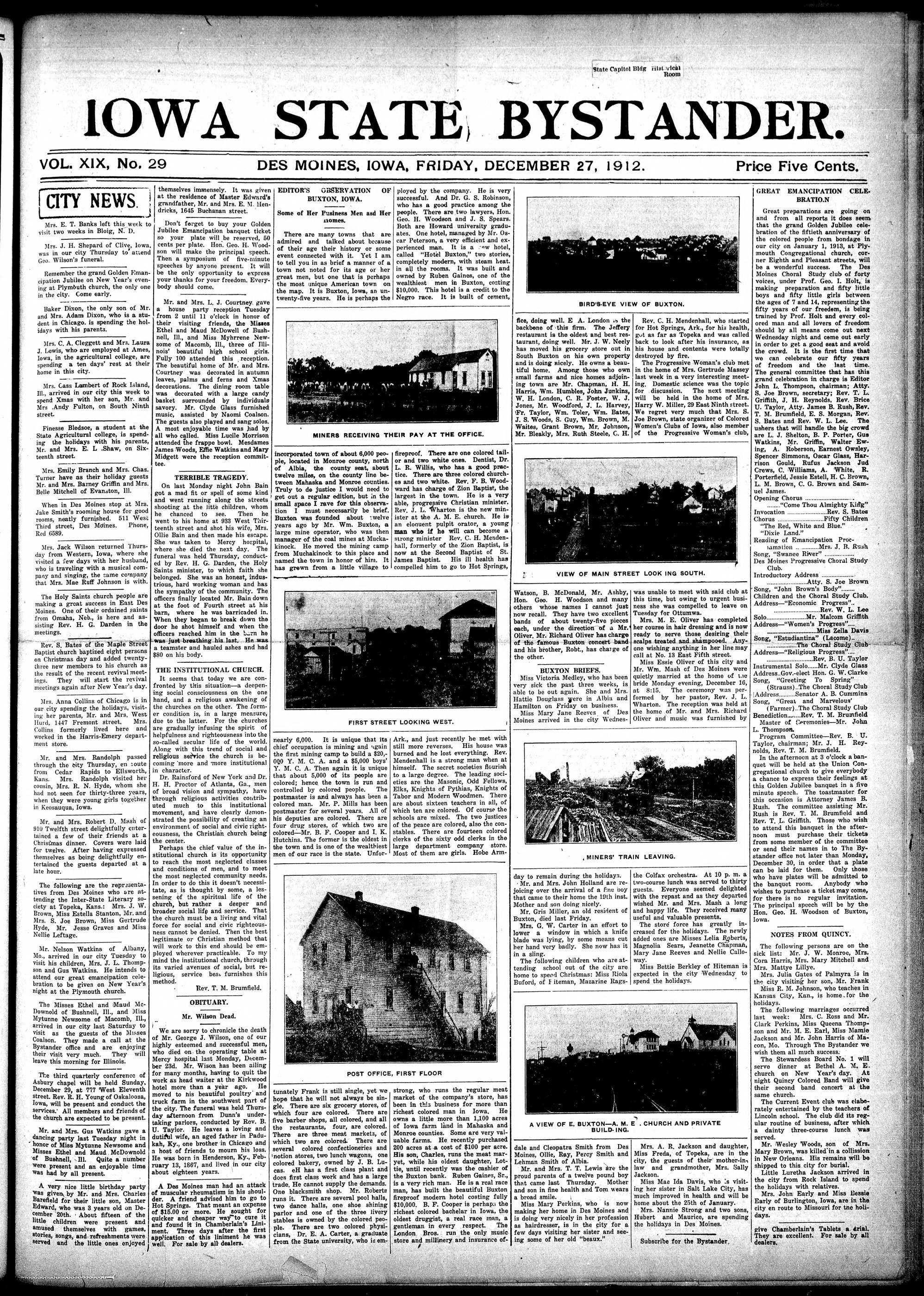
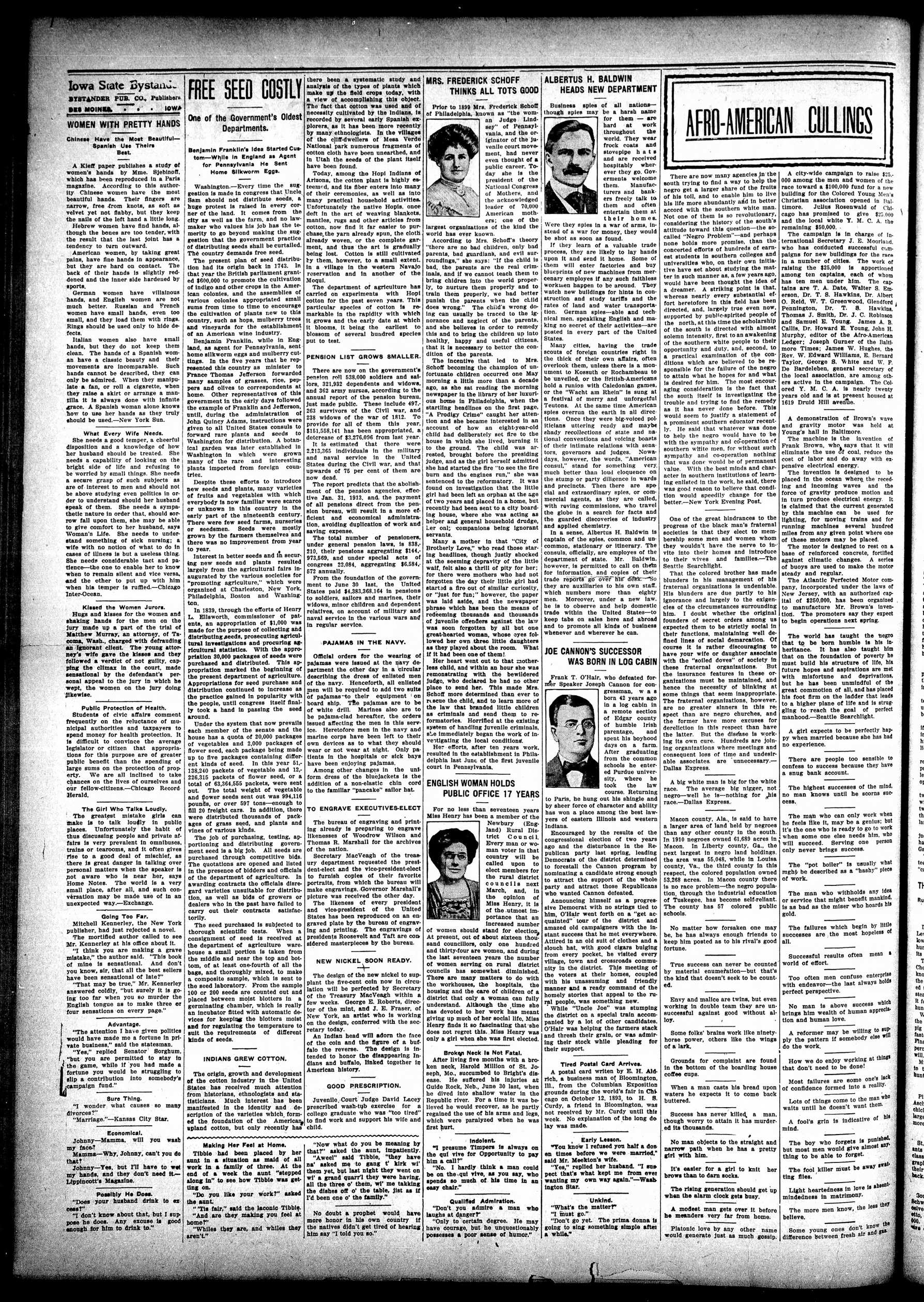
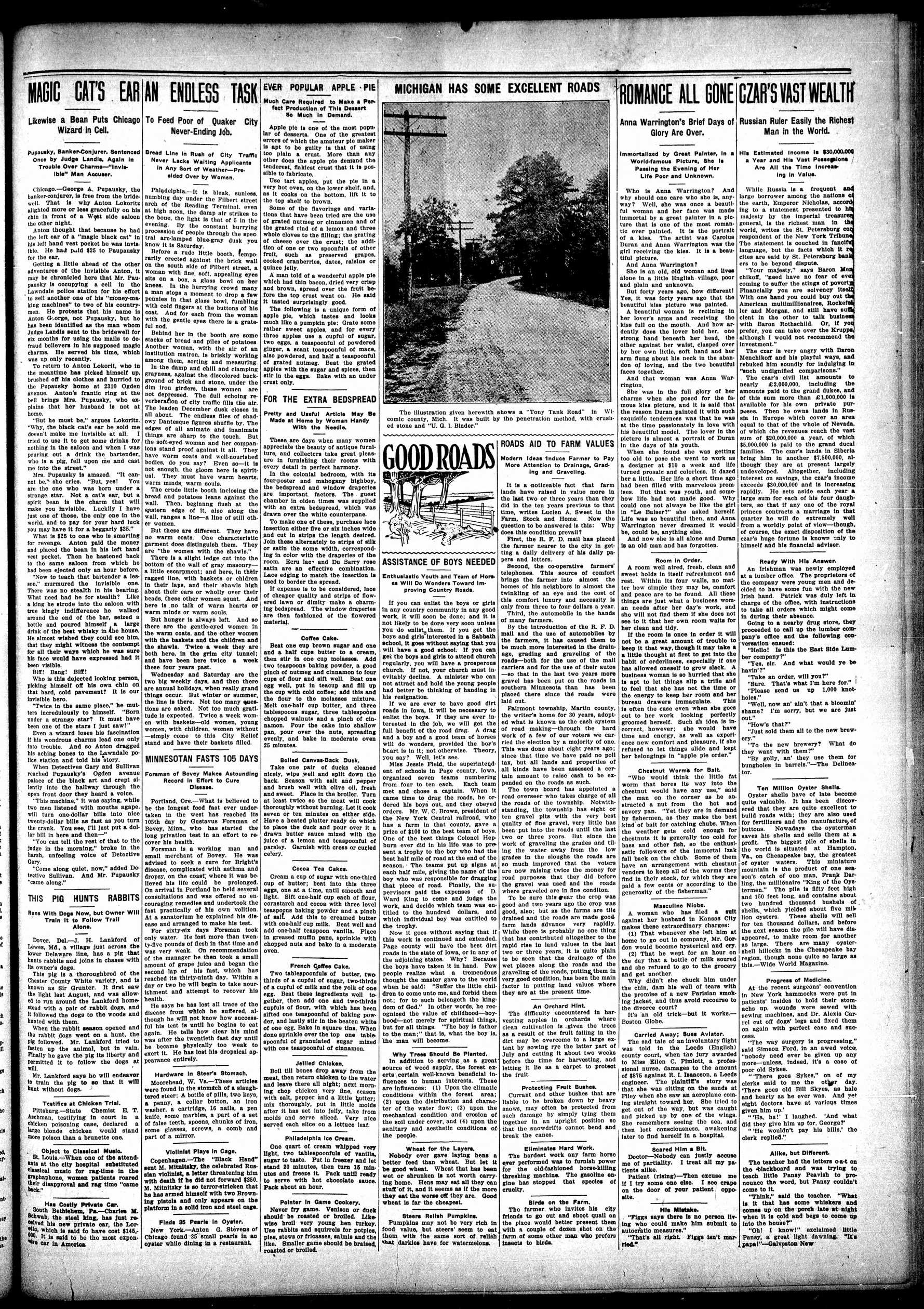
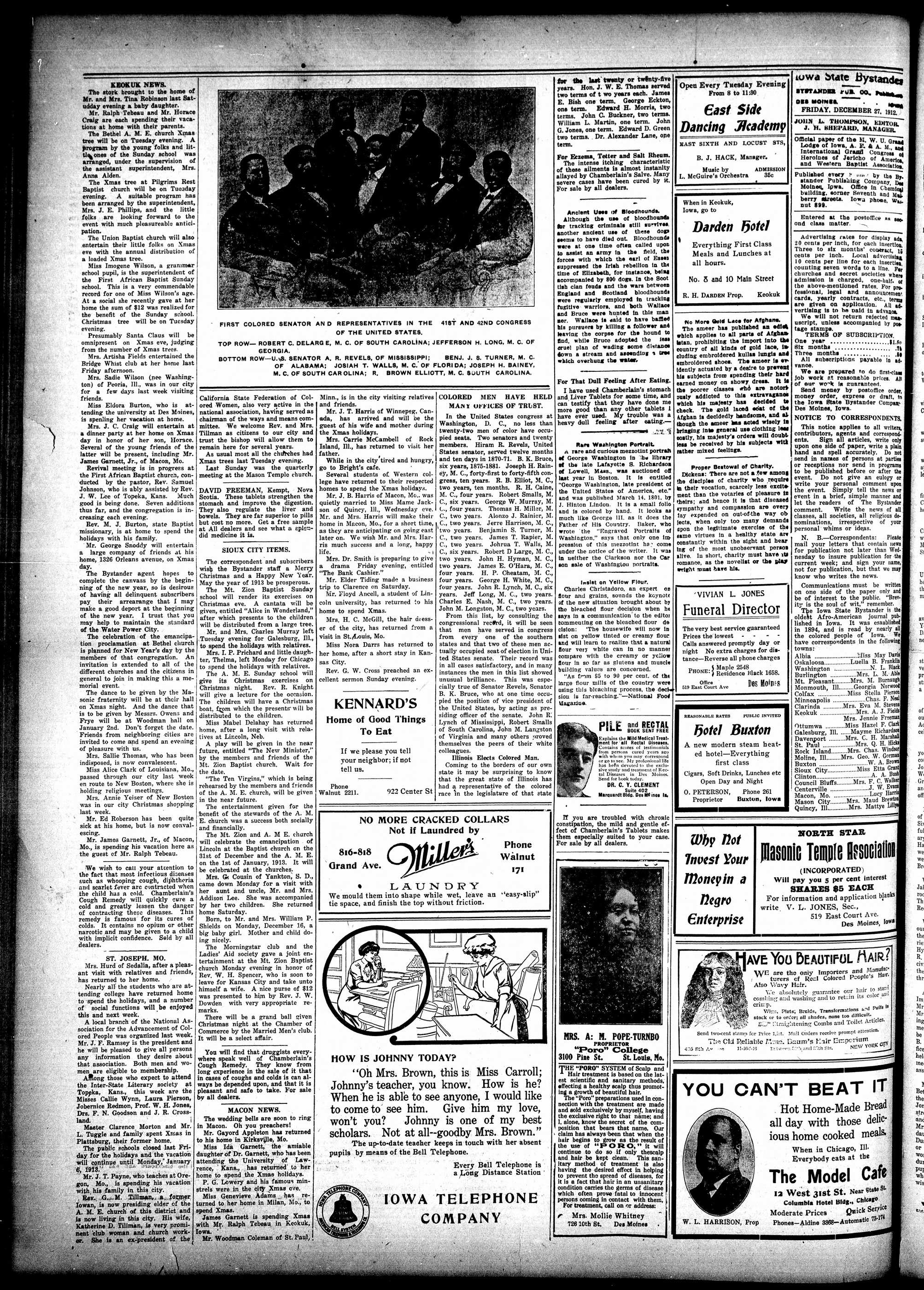
Page text (machine-generated)
IOWA STATE BYSTANDER.
VOL. XIX. No. 29
CITY NEWS
Mrs. E. T. Banks left this week to visit two weeks in Bloig, N. D.
Mrs. J. H. Shepard of Clive, Iowa, was in our city Thursday to attend Geo. Wilson's funeral.
Remember the grand Golden Emancipation Jubilee on New Year's evening at Plymouth church, the only one in the city. Come early.
Baker Dixon, the only son of Mr. and Mrs. Adam Dixon, who is a student in Chicago, is spending the holidays with his parents.
Mrs. C. A. Cleggett and Mrs. Laura J. Lewis, who are employed at Ames, Iowa, in the agricultural college, are spending a ten days' rest at their home in this city.
Mrs. Cass Lambert of Rock Island, Ill., arrived in our city this week to spend Xmas with her son, Mr. and Mrs. Andy Fulton, on South Ninth street.
Finesse Bledsoe, a student at the State Agricultural college, is spending the holidays with his parents, Mr. and Mrs. E. L. Shaw, on Sixteenth street.
Mrs. Emily Branch and Mrs. Chas. Turner have as their holiday guests Mr. and Mrs. Barney Griffin and Mrs. Belle Mitchell of Evanston, Ill.
When in Des Moines stop at Mrs. Jake Smith's rooming house for good rooms, neatly furnished. 511 West Third street, Des Moines. Phone, Red 6589.
Mrs. Jack Wilson returned Thursday from Western, Iowa, where she visited a few days with her husband, who is traveling with a musical company and singing, the same company that Mrs. Mae Ruff Johnson is with.
The Holy Saints church people are making a great success in East Des Moines. One of their ordained saints from Omaha, Neb., is here and assisting Rev. H. G. Darden in the meetings.
Rev. S. Bates of the Maple Street Baptist church baptized eight persons on Christmas day and added twenty-three new members to his church as the result of the recent revival meetings. They will start the revival meetings again after New Year's day.
Mrs. Anna Collins of Chicago is in our city spending the holidays, visiting her parents, Mr. and Mrs. West Hurd, 1447 Fremont street. Mrs. Collins formerly lived here and worked in the Harris-Emery department store.
Mr. and Mrs. Randolph passed through the city Thursday, en route from Cedar Rapids to Ellsworth, Kans. Mrs. Randolph visited her cousin, Mrs. R. N. Hyde, whom she had not seen for thirty-three years, when they were young girls together in Keosauqua, Iowa.
Mr. and Mrs. Robert D. Mash of 910 Twelfth street delightfully entertained a few of their friends at a Christmas dinner. Covers were laid for twelve. After having expressed themselves as being delightfully entertained the guests departed at a late hour.
The following are the representatives from Des Moines who are attending the Inter-State Literary society at Topeka, Kans.: Mrs. J. W. Brown, Miss Estella Stanton, Mr. and Mrs. S. Joe Brown, Miss Gertrude Hyde, Mr. Jesse Graves and Miss Nellie Leftage.
Mr. Nelson Watkins of Albany, Mo., arrived in our city Tuesday to visit his children, Mrs. J. L. Thompson and Gus Watkins. He intends to attend our great emancipation celebration to be given on New Year's night at the Plymouth church.
The Misses Ethel and Maud Mc-Downold of Bushnell, Ill., and Miss Mytunne Newsome of Macomb, Ill., arrived in our city last Saturday to visit as the guests of the Misses Coalson. They made a call at the Bystander office and are enjoying their visit very much. They will leave this morning for Illinois.
The third quarterly conference of Asbury chapel will be held Sunday, December 29, at 777 West Eleventh street. Rev. R. H. Young of Oskaloosa, Iowa, will be present and conduct the services.' All members and friends of the church are expected to be present.
Mr. and Mrs. Gus Watkins gave a dancing party last Tuesday night in honor of Miss Mytunne Newsome and Misses Ethel and Maud Mc-Downold of Bushnell, Ill. Quite a number were present and an enjoyable time was had by all present.
A very nice little birthday party was given by Mr. and Mrs. Charles Barefield for their little son, Master Edward, who was 3 years old on December 20th. About fifteen of the little children were present and amused themselves with games, stories, songs, and refreshments were served and the little ones enjoyed
themselves immensely. It was given at the residence of Master Edward's grandfather, Mr. and Mrs. E. M. Hendricks, 1645 Buchanan street.
Don't forget to buy your Golden Jubilee Emancipation banquet ticket so your plate will be reserved, 50 cents per plate. Hon. Geo. H. Woodson will make the principal speech. Then a symposium of five-minute speeches by anyone present. It will be the only opportunity to express your thanks for your freedom. Everybody should come.
Mr. and Mrs. L. J. Courtney gave a house party reception Tuesday from 2 until 11 o'clock in honor of their visiting friends, the Misses Ethel and Maud McDowell of Bushnell, Ill., and Myrhrene Newsome of Macomb, Ill., three of Illinois' beautiful high school girls. Fully 100 attended this reception. The beautiful home of Mr. and Mrs. Courtney was decorated in autumn leaves, palms and ferns and Xmas decorations. The dining room table was decorated with a large candy basket surrounded by individuals savory. Mr. Clyde Glass furnished music, assisted by Naomi Coalson. The guests also played and sang solos. A most enjoyable time was had by all who called. Miss Lucile Morrison attended the frappe bowl. Mesdames James Woods, Effie Watkins and Mary Midgett were the reception committee.
TERRIBLE TRAGEDY
On last Monday night John Bain got a mad fit or spell of some kind and went running along the streets shooting at the little children, whom he chanced to see. Then he went to his home at 933 West Thirteenth street and shot his wife, Mrs. Ollie Bain and then made his escape. She was taken to Mercy hospital, where she died the next day. The funeral was held Thursday, conducted by Rev. H. G. Darden, the Holy Saints minister, to which faith she belonged. She was an honest, industrious, hard working woman and has the sympathy of the community. The officers finally located Mr. Bain down at the foot of Fourth street at his barn, where he was barricaded in. When they began to break down the door he shot himself and when the officers reached him in the barn he was just breathing his last. He was a teamster and hauled ashes and had $80 on his body.
THE INSTITUTIONAL CHURCH.
It seems that today we are confronted by this situation—a deepening social consciousness on the one hand, and a religious awakening of the churches on the other. The former condition is, in a large measure, due to the latter. For the churches are gradually infusing the spirit of helpfulness and righteousness into the so-called secular life of the world. Along with this trend of social and religious service the church is becoming more and more institutional in character.
Dr. Rainsford of New York and Dr. H. H. Proctor of Atlanta, Ga., men of broad vision and sympathy, have through religious activities contributed much to this institutional movement, and have clearly demonstrated the possibility of creating an environment of social and civic righteousness, the Christian church being the center.
Perhaps the chief value of the institutional church is its opportunity to reach the most neglected classes and conditions of men, and to meet the most neglected community needs. In order to do this it doesn't necessitate, as is thought by some, a lessening of the spiritual life of the church, but rather a deeper and broader social life and service. That the church must be a living and vital force for social and civic righteousness cannot be denied. Then the best legitimate or Christian method that will work to this end should be employed wherever practicable. To my mind the institutional church, through its varied avenues of social, but religious, service best, furnishes this method.
Rev. T. M. Brumfield.
OBITUARY.
Mr. Wilson Dead.
We are sorry to chronicle the death of Mr. George J. Wilson, one of our highly esteemed and successful men, who died on the operating table at Mercy hospital last Monday, December 23d. Mr. Wison has been ailing for many months, having to quit the work as head waiter at the Kirkwood hotel more than a year ago. He moved to his beautiful poultry and truck farm in the southwest part of the city. The funeral was held Thursday afternoon from Dunn's undertaking parlors, conducted by Rev. B. U. Taylor. He leaves a loving and dutiful wife, an aged father in Padukah, Ky., one brother in Chicago and a host of friends to mourn his loss. He was born in Henderson, Ky., February 13, 1867, and lived in our city about eighteen years.
A Des Moines man had an attack of muscular rheumatism in his shoulder. A friend advised him to go to Hot Springs. That meant an expense of $15.00 or more. He sought for quicker and cheaper way to cure it and found it in Chamberlain's Liniment. Three days after the first application of this liniment he was well. For sale by all dealers.
EDITOR'S GISSERVATION
BUXTON, IOWA.
Some of Her Pusness Men asd Her
nomes.
There are many towns that are admired and talked about because of their age their history or some event connected with it. Yet I am to tell you in as brief a manner of a town not noted for its age or her great men, but one that is perhaps the most unique American town on the map. It is Buxton, Iowa, an untwenty-five years. He is perhaps the
MINERS RECEIVING THE
MINERS RECEIVING THEIR PAY AT THE OFFICE.
incorporated town of about 6,000 people, located in Monroe county, north of Albia, the county seat, about twelve miles, on the county line between Mahaska and Monroe counties. Truly to de justice I would need to get out a regular edition, but in the small space I rave for this observation I must necessarily be brief. Buxton was founded about twelve years ago by Mr. Wm. Buxton, a large mine operator, who was then manager of the coal mines at Muckakinock. He moved the mining camp from Muchakinock to this place and named the town in honor of him. It has grown from a little village to fireproof. There are one colored tree or and two white ones. Dentist, L. R. Willis, who has a good practice. There are three colored churches and two white. Rev. F. B. Worward has charge of Zion Baptist, the largest in the town. He is a v able, progressive Christian minister at the A. M. E. church. He an eloquent pulpit orator, a you man who if he will can become strong minister Rev. C. H. Mendel, formerly of the Zion Baptist, now at the Second Baptist of James Baptist. His ill health compelled him to go to Hot Springs.
THE MUSEUM OF THE WORLD
nearly 6,000. It is unique that its chief occupation is mining and again the first mining camp to build a $20,000 Y. M. C. A. and a $5,000 boys' Y. M. C. A. Then again it is unique that about 5,000 of its people are colored; hence the town is run and controlled by colored people. The postmaster is and always has been a colored man. Mr. P. Mills has been postmaster for several years. All of his deputies are colored. There are four drug stores, of which two are colored—Mr. B. F. Cooper and I. K. Hutchins. The former is the oldest in the town and is one of the wealthiest men of our race is the state. Unfor-
Ark., and just recently he met we still more reverses. His house burned and he lost everything. H. Mendenhall is a strong man when himself. The secret societies flour to a large degree. The leading societies are the Masonic, Odd Fello Elks, Knights of Pythias, Knights Tabor and Modern Woodmen. They are about sixteen teachers in all, which ten are colored. Of course schools are mixed. The two just of the peace are colored, also the cottables. There are fourteen color clerks of the sixty odd clerks in large department company store. Most of them are girls. Hobe A.
1910
POST OFFICE. FIRST FLOOR
tunately Frank is still single, yet we hope that he will not always be single. There are six grocery stores, of which four are colored. There are five barber shops, all colored, and all the restaurants, four, are colored. There are three meat markets, of which two are colored. There are several colored confectioneries and notion stores, two lunch wagons, one colored bakery, owned by J. B. Lucas. eH has a first class plant and does first class work and has a large trade. He cannot supply the demands. One blacksmith shop. Mr. Roberts runs it. There are several pool halls, two dance halls, one shoe shining parlor and one of the three livery stables is owned by the colored people. There are two colored physicians, Dr. E. A. Carter, a graduate from the State university, who is em-
ployed by the company. He is very successful. And Dr. G. S. Robinson, who has a good practice among the people. There are two lawyers, Hon. Geo. H. Woodson and J. S. Spears. Both are Howard university graduates. One hotel, managed by Mr. Oscar Peterson, a very efficient and experienced man. It is a new hotel, called "Hotel Buxton," two stories, completely modern, with steam heat. in all the rooms. It was built and owned by Ruben Gaines, one of the wealthiest men in Buxton, costing $10,000. This hotel is a credit to the Negro race. It is built of cement,
HEIR PAY AT THE OFFICE.
fireproof. There are one colored tailor and two white ones. Dentist, Dr. L. R. Willis, who has a good practice. There are three colored churches and two white. Rev. F. B. Woodward has charge of Zion Baptist, the largest in the town. He is a very able, progressive Christian minister. Rev. J. L. Wharton is the new minister at the A. M. E. church. He is an elocuent pulpit orator, a young man who if he will can become a strong minister. Rev. C. H. Mendenhall, formerly of the Zion Baptist, is now at the Second Baptist of St. James Baptist. His ill health has compelled him to go to Hot Springs,
Ark, and just recently he met with still more reverses. His house was burned and he lost everything. Rev. Mendenhall is a strong man when at himself. The secret societies flourish to a large degree. The leading societies are the Masonic, Odd Fellows, Elks, Knights of Pythias, Knights of Tabor and Modern Woodmen. There are about sixteen teachers in all, of which ten are colored. Of course the schools are mixed. The two justices of the peace are colored, also the constables. There are fourteen colored clerks of the sixty odd clerks in the large department company store. Most of them are girls. Hobe Arm-
THE HISTORY OF THE MUSEUM
strong, who runs the regular meat market of the company's store, has been in this business for more than richest colored man in Iowa. He owns a little more than 1,100 acres of Iowa farm land in Mahaska and Monroe counties. Some are very valuable farms. He recently purchased 200 acres at a cost of $100 per acre. His son, Charles, runs the meat marryet, while his oldest daughter, Lottie, until recently was the cashier of the Buxton bank. Ruben Gaines, Sr., is a very rich man. He is a real race man, has built the beautiful Buxton fireproof modern hotel costing fully $10,000. B. F. Cooper is perhaps the richest colored bachelor in Iowa, the oldest druggist, a real race man, a gentleman in every respect. The London Broos. run the only music store and millinery and insurance of
State Capitol Blvd Historical Room
BYST
CEMBER 27, 191
YSTAN
ER 27, 1912.
fice, doing well. E. A. London is the backbone of this firm. The Jeffery restaurant is the oldest and best restaurant, doing well. Mr. J. W. Neely has moved his grocery store out in South Buxton on his own property and is doing nicely. He owns a beautiful home. Among those who own small farms and nice homes adjoining town are Mr. Chapman, H. H. Harris, Wm. Humbles, John Junkins, W. H. London, C. R. Foster, W. J. Jones, Mr. Woodford, J. L. Harvey, Fr. Taylor, Wm. Toler, Wm. Bates, J. S. Woods, S. Guy, Wm. Brown, M. Waites, Grant Brown, Mr. Johnson, Mr. Bleakly, Mrs. Ruth Steele, C. H.
Rev. C. H. Mendenhall, who star for Hot Springs, Ark., for his heat got as far as Topeka and was called back to look after his insurance, his house and contents were totally destroyed by fire.
The Progressive Woman's club be in the home of Mrs. Gertrude Mas last week in a very interesting meeting. Domestic science was the topic for discussion. The next meet will be held in the home of M. Harry W. Miller, 29 East Ninth street. We regret very much that Mrs. Joe Brown, state organizer of Colo Women's Clubs of Iowa, also member of the Progressive Woman's cl
THE STREETS OF THE CITY
THE STREET
VIEW OF MAIN STREET LOOKING SOUTH.
Watson, B. McDonald, Mr. Ashby, Hon. Geo. H. Woodson and many others whose names I cannot just now recall. They have two excellent bands of about twenty-five pieces each, under the direction of a Mr. Oliver. Mr. Richard Oliver has charge of the famous Buxton concert band and his brother, Robt., has charge of the other.
was unable to meet with said club this time, but owing to urgent business she was compelled to leave Tuesday for Ottumwa.
Mrs. M. E. Oliver has comple her course in hair dressing and is ready to serve those desiring the scalps treated and shampooed. A one wishing anything in her line m call at No. 13 East Fifth street.
BUXTON BRIEFS.
Miss Victoria Medley, who has been very sick the past three weeks, is able to be out again. She and Mrs. Hattie Douglass were in Albia and Hamilton on Friday on business.
Miss Mary Jane Reeves of Des Moines arrived in the city Wednes-
100
MINERS' TRAIN LEAVING.
day to remain during the holidays.
Mr. and Mrs. John Holland are rejoicing over the arrival of a fine boy that came to their home the 19th inst. Mother and son doing nicely.
Mr. Gris Miller, an old resident of Buxton, died last Friday.
Mrs. G. W. Carter in an effort to lower a window in which a knife blade was lying, by some means cut her hand very badly. She now has it in a sling.
The following children who are attending school out of the city are home to speed Christmas: Miss Riola Buford, of Fiteman, Mazarine Rags-
A VIEW OF E. BUXTON—A. M.
BUILD-ING.
OF E. BUXTON—A. M. E . CHURCH AND PRIV
BUILDING.
dale and Cleopatra Smith from Des Moines, Ollie, Ray, Percy Smith and Lehman Smith of Albia.
Mr. and Mrs. T. T. Lewis are the proud parents of a twelve pound boy that came last Thursday. Mother and son in fine health and Tom wears a broad smile.
Miss Mary Perkins, who is now making her home in Des Moines and is doing very nicely in her profession as hairdresser, is in the city for a few days visiting her sister and seeing some of her old "beaux."
Mrs. A. R. Jackson and daughter Miss Freda, of Topeka, are in the city, the guests of their mother law and grandmother, Mrs. S. Jackson.
Miss Mae Ida Davis, who is visiting her sister in Salt Lake City, much improved in health and will home about the 25th of January.
Mrs. Nannie Strong and two sons Hubert and Maurice, are spending the holidays in Des Moines.
---
```markdown
```
2. Pr
Rev. C. H. Mendenhall, who started for Hot Springs, Ark., for his health, got as far as Topeka and was called back to look after his insurance, as his house and contents were totally destroyed by fire.
The Progressive Woman's club met in the home of Mrs. Gertrude Massey last week in a very interesting meeting. Domestic science was the topic for discussion. The next meeting will be held in the home of Mrs. Harry W. Miller, 29 East Ninth street. We regret very much that Mrs. S. Joe Brown, state organizer of Colored Women's Clubs of Iowa, also member of the Progressive Woman's club,
was unable to meet with said club at this time, but owing to urgent business she was compelled to leave on Tuesday for Ottumwa.
Mrs. M. E. Oliver has completed her course in hair dressing and is now ready to serve those desiring their scalps treated and shampooed. Anyone wishing anything in her line may call at No. 13 East Fifth street.
Miss Essie Oliver of this city and Mr. Wm. Mash of Des Moines were quietly married at the home of the bride Monday evening, December 16, at 8:15. The ceremony was performed by her pastor, Rev. J. L. Wharton. The reception was held at the home of Mr. and Mrs. Richard Oliver and music was furnished by
the Colfax orchestra. At 10 p. m. a two-course lunch was served to thirty guests. Everyone seemed delighted with the repast and as they departed wished Mr. and Mrs. Mash a long and happy life. They received many useful and valuable presents.
The store force has greatly increased for the holidays. The newly added ones are Misses Lelia Roberts, Magnolia Sears, Jeanette Chapman, Mary Jane Reeves and Nellie Calloway.
Miss Bettie Berkley of Hiteman is expected in the city Wednesday to spend the holidays.
E. CHURCH AND PRIVATE
Mrs. A. R. Jackson and daughter, Miss Freda, of Topeka, are in the city, the guests of their mother-in-law and grandmother, Mrs. Sally Jackson.
Miss Mae Ida Davis, who is visiting her freda in Salt Lake City, has much improved in health and will be home about the 25th of January.
Mrs. Nannie Strong and two sons, Hubert and Maurice, are spending the holidays in Des Moines.
Subscribe for the Bystander.
```markdown
```
Price Five Cents.
GREAT EMANCIPATION CELEBRATION.N
Great preparations are going on and from all reports it does seem that the grand Golden Jubilee celebration of the fiftieth anniversary of the colored people from bondage in our city on January 1, 1913, at Plymouth Congregational church, corner Eighth and Pleasant streets, will be a wonderful success. The Des Moines Choral Study club of forty voices, under Prof. Geo. I. Holt, is making preparation and fifty little boys and fifty little girls between the ages of 7 and 14 representing the fifty years of our freedom, is being trained by Prof. Holt and every colored man and all lovers of freedom should by all means come out next Wednesday night and come out early in order to get a good seat and avoid the crowd. It is the first time that we can celebrate our fifty years of freedom and the last time. The general committee that has this grand celebration in charge is Editor John L. Thompson, chairman; Atty. S. Joe Brown, secretary; Rev. T. L Griffith, J. H. Reynolds, Rev. Brice U. Taylor, Atty. James B. Rush, Rev. T. M. Brumfield, E. S. Morgan, Rev. S. Bates and Rev. W. L. Lee. The ushers that will handle the big crowd are L. J. Shelton, B. P. Porter, Gus Watkins, Mr. Griffin, Walter Ewing, A. Roberson, Earnest Owlsley, Spencer Simmons, Oscar Glass, Harrison Gould, Rufus Jackson Jud Crews, C. Williams, A. White, R. Porterfield, Jessie Estell, H. C. Brown, L. M. Brown, C. G. Brown and Samuel James.
Opening Chorus ..... "Come Thou Almighty King"
Invocation ..... Rev. S. Bates
Chorus ..... Fifth Children
Children
"The Red, White and Blue."
"Dixie Land."
Reading of Emancipation Proc-
Mon L. P. Stuhl
jamation ... Mrs. J. B. Rush
Song, "Swane River" .....
Des Moines Progressive Choral Study
Des Moines Progressive Choral Study Club.
Club.
Introductory Address ..... Atty. S. Joe Brown
Song, "John Brown's Body" ..... Children and the Choral Study Club.
Address—"Economic Progress" ..... Rev. W. L. Lee
Solo. Mr. Malcom Griffith
Address—"Women's Progress" ..... Miss Zella Davis
Song, "Estudiantina" (Lacome).
The Choral Study Club
Address—"Religious Progress"...
Rev. B. U. Taylor
Instrumental Solo...Mr. Clyde Class
Address. Gov.elect G. W. Clarke
Song, "Greeting To Spring"
(Sstraus).The Choral Study Club
Address...Senator A. B. Cummins
Song, "Great and Marvelous"
(Farmer).The Choral Study Club
Benediction...Rev. T. M. Brumfield
Master of Ceremonies—Mr. John
L. Thompson
Program Committee—Rev. B. U.
Taylor, chairman; Mr. J. H. Reynolds. Rev. T. M. Brumfield.
In the afternoon at 3 o'clock a banquet will be held at the Union Congregational church to give everybody a chance to express their feelings at this Golden Jubilee banquet in a five minute speech. The toastmaster for this occasion is Attorney James B. Rush. The committee assisting Mr. Rush is Rev. T. M. Brumfield and Rev. T. L. Griffith. Those who wish to attend this banquet in the afternoon must purchase their tickets from some member of the committee or send their names in to The St. stander office not later than Monday, December 30, in order that a plate can be laid for them. Only those who have plates will be admitted to the banquet room. Anybody who wishes to purchase a ticket may come, for there is no regular invitation. The principal speech will be by the Hon. Geo. H. Woodson of Buxton, Iowa.
NOTES FROM QUINCY.
The following persons are on the sick list: Mr. J. W. Monroe, Mrs. Cora Harris, Mrs. Mary Mitchell and Mrs. Mattye Lilly.
Mrs. Julia Gates of Palmyra is in the city visiting her son, Mr. Frank Miss R. M. Johnson, who teaches in Kansas City, Kan., is home for the holidays.
The following marriages occurred last week: Mrs. C. Ross and Mr. Clark Perkins, Miss Queena Thompson and Mr. M. E. Earl, Miss Mamie Jackson and Mr. John Harris of Macon, Mo. Through The Bystander we wish them all much success.
The Stewardess Board No. 1 will serve dinner at Bethel A. M. E church on New Year's day. At night Quincy Colored Band will give their second band concert at the same church.
The Current Event club was elaborately entertained by the teachers of Lincoln school. The club did its regular routine of business, after which a dainty three-course lunch was served.
Mr. Wesley Woods, son of Mrs. Mary Brown, was killed in a collision in New Orleans. His remains will be shipped to this city for burial.
Little Luretha Jackson arrived in the city from Rock Island to spend the holidays with relatives.
Mrs. John Early and Miss Bessie Early of Burlington, Iowa, are in the city en route to Missouri for the holidays.
give Chamberlain's Tablets a trial. They are excellent. For sale by all dealers.
WOMEN WITH PRETTY HANDS
Chinese Have the Most Beautiful—Spanish Use Theirs Best.
A Kieff paper publishes a study of women's hands by Mme. Sjebinoff, which has been reproduced in a Paris magazine. According to this authority Chinese women have the most beautiful hands. Their fingers are narrow, free from knots, as soft as the nails of the left hand a little long. Hebrew women have find hands, although the bones are too tender, with the result that the last joint has a tendency to turn outward. American women, by taking great pains, have fine hands in appearance, but they are hard on contact. The back of their hands is slightly redened and the inner side hardened by sports. German women have villainous hands, and English women are not vicious. French women and French women have small hands, even too small, and they load them with rings. Rings should be used only to hide defects.
Italian women also have small hands, but they do not keep them clean. The hands of a Spanish woman have a classic beauty and their movements are incomparable. Such hands cannot be described, they can only be admired. When they manipulate a fan, or roll a cigarette, when they hold a book, or tilting a tilt it is always done with infinite grace. A Spanish woman alone knows how to use her hands as they truly should be used—New York Sun.
What Every Wife Needs
She needs a good temper, a cheerful disposition and a knowledge of how her husband should be treated. She needs a capability of looking on the bright side of life and refusing to be worried by small things. She needs a secure grasp of such subjects as are of interest to men and should not be above studying even politics in oratory. She should understand how to speak of them. She needs a sympathetic nature in order that, should sorrow fall upon them, she may be able to give comfort to her husband, says Woman's Life. She needs to understand something of sick nursing; a wife with no notion of what to do in cases of illness is a useless thing. She needs considerable tact and pausing, when to remain silent and vice versa, and the other to put up with him when his temper is ruffled—Chicago Inter-Ocean.
Klased the Women Jurors
Hugs and kisses for the women and shaking hands for the men on the jury made up a part of the trial of Matthew Murray, an attorney, of Tacoma, Wash., charged with defrauding an ignorant client. The young attorney's wife gave the kisses and they followed a verdict of not guilty, capa- tioned by the jury's emotional by the defendant's personal appeal to the jury in which he wept, the women on the jury doing likewise.
Public Protection of Health
Students of civic affairs comment frequently on the reluctance of municipal authorities and taxpayers to spend money for health protection. It is difficult to convince the average legislator or citizen that appropriations for this purpose are of greater public benefit than the spending of large funds. We are all included in the chances on the lives of ourselves and our fellow-citizens.—Chicago Record-Herd.
The Girl Who Talks Loudly
The greatest mistake girls can make is to talk loudly in public places. Unfortunately the habit of thus discussing people and private affairs is very prevalent in ominibuses, trains or tearrooms, and it often gives rise to a good deal of mischief, as there is great danger in talking over personal matters when the speaker is not aware who is near her, says Home Notes. The world is a very small place, after all, and such conversation may be made use of in an unexpected way—Exchange.
Going Too Far
Mitchell Kennerley, the New York publisher, had just rejected a novel. The mortified author called to see Mr. Kennerley at his office about it.
"I think you are making a grave mistake" the author said. "This book of mine is sensational. And don't you know, sir, that all the best sellers have been sensational of late?" "That may be true," Mr. Kennerley answered coldly, "but surely it is going too far when you so murder the English tongue as to make three or four sensations on every page."
Advantage
"The attention I have given politics would have made me a fortune in private business," said the statesman. "Yes," replied Senator Sorghun. "I would have been fortunate in the game, while if you had made a fortune you would be struggling to slip a contribution into somebody's campaign fund."
Sure Thing
"I wonder what causes so many divorces?"
"Marriage."—Kansas City Star.
Economical.
Johnny—Mamma, will you wash my face?
Mamma—Why, Johnny, can't you do that?
Johnny—Yes, but I'll have to wet my hands, and they don't need it—Lippincott's Magazine.
Possibly He Does.
"Does your husband drink to excess?"
"I don't know about that, but I suppose he does. Any excuse is good enough for him to drink to."
---
FREE SEED COSTLY
One of the Government's Oldest Departments.
Benjamin Franklin's idea Started Custum-
While in England as Agent
for Pennsylvania He Sent
Home Silkworm Eggs.
Washington—Every time the sug-
sessment is made in congress that Uncle
Sam should not distribute seeds,
a huge protest is raised in every
corner of the land. It comes from the
city as well as the farm, and no lawmaker
who values his job has the tem-
tery to go beyond making plant practices
of distributing seeds shall be curtailed.
The country demands free seed.
The present plan of seed distribution
had its origin back in 1743. In
that year the British parliament granted
$600,000 to promote the cultivation
of indigo and other crops in the
American colonies, and the assemblies
of various colonies appropriated small
sums from time to time to encourage
the cultivation of plants not
this country, such as mulberry the trees
and incardios for the establishment
of an American wine industry.
Benjamin Franklin, while in England, as agent for Pennsylvania, sent home silkworm eggs and mulberry cuttings. In the five years that he represented this country as minister to France Thomas Jefferson forwarded many samples of grasses, rice, peppers and olives to correspondents at home. Other representatives of this government in the early days followed the example of Franklin and Jefferson, until, during the administration of John Quincy Adams, instructions were given to all United States consumers forward rare plants and seeds to distribution. A botanical garden was later established in Washington in which were grown many of the rare and interesting plants imported from foreign countries.
Despite these efforts to introduce new seeds and plants, many varieties of fruits and vegetables with which everybody is now familiar were scarce or unknown in this country in the early part of the nineteenth century. There were few seed farms, nurseries or seedmen. Seeds were mostly grown by the farmers themselves and there was no improvement from year to year.
Interest in better seeds and in securing new seeds and plants resulted largely from the agricultural fairs in connection with the various societies for "promoting agriculture," which were organized at Charleston, New York, Philadelphia, Boston and Washington.
In 1833, through the efforts of Henry L. Ellsworth, commissioner of patients, an appropriation of $1,000 was made for the purpose of collecting and distributing seeds, prosecuting agricultural investigations and procuring agricultural statistics. With the appropriation 30,000 packages of seeds were purchased and distributed. This appropriation marked the beginning of the present department of agriculture. Appropriation for seed purchase and promotion continued to increase as the practice gained in popularity with the people, until congress itself finally took a hand in passing the seed around.
Under the system that now prevails each member of the senate and the house has a quota of 20,000 packages of vegetables and 2,000 packages of flower seed, each package being made up to five packages containing different kinds of seed. In this year 51,138,240 packets of vegetable and 12,226,151 packets of flower seed, or a total of 63,364,501 seeds were sent to the total weight of vegetable and flower seeds sent out was 994,116 pounds, or over 597 tons—enough to fill 20 freight cars. In addition, there were distributed thousands of packages of grass seed, and plants and vines of various kinds.
The job of purchasing, testing, apportioning and distributing government seed is a big job. All seeds are purchased through competitive bids. The quotations are opened and listed in the presence of bidders and officials of the department of agriculture. In awarding contracts, the department is suitable for distribution, as well as bids of growers or dealers who in the past have failed to carry out their contracts satisfactorily.
The seed purchased is subjected to thorough scientific tests. When a consignment of seed is received at the department of agriculture warehouse a small portion is taken from the middle and near the top and both bottom and sides are mixed with bags, and thoroughly mixed, to make a composite sample, which is sent to the seed laboratory. From the sample 100 or 200 seeds are counted out and placed between moist blotters in a germinating chamber, which is really an incubator fitted with automatic desiccation devices and used for regulating the temperature to suit the requirements of different kinds of seeds.
INDIANS GREW COTTON.
The origin, growth and development of the cotton industry in the United States has received much attention from historians, ethnologists and statisticians. Much interest has been manifested in the identity and description of the varieties which formed the foundation of the American upland cotton, but only recently has
Making Her Feel at Home.
Tibble had been placed by her aunt in a situation as maid of all work in a family of three. At the end of a week the aunt "stepped along in" to see how Tibble was getting on.
"Do you like your work?" asked the aunt.
"The fair," said the laconic Tibble.
"And are they making you feel at home?
"Whiles they are, and whiles they aren't."
there been a systematic study and analysis of the types of plants which make up the field crops today, with a view of accomplishing this object. The success of such success cultivated by the Indians, is recorded by several early Spanish explorers, as it has been more recently by many ethnologists. In the villages of the cliff-dwellers of Mea Verde National park numerous fragments of cotton cloth have been unearthed, and the remains of the plant itself have been found.
Today, among the Hopi Indians of Arizona, the cotton plant is highly esteemed, and its fiber enters into many of their ceremonies, as well as into many practical household activities. Unfortunately the native Hopi, once deft in the art of weaving blankets, mantles, rugs and other articles from cotton, now weaves yarn already spun, the cloth chasquees yarn already spun, the complete garment, and thus the art is gradually being lost. Cotton is still cultivated by them, however, to a small extent. in a village in the western Navajo reservation and in another of the Moqul.
The department of agriculture has carried on experiments with Hopi cotton for the past seven years. This particular species of cotton is remarkable in its durability with which it grows and the early date at which it blooms, it being the earliest to blossom of several hundred species put to test.
PENSION LIST GROWS SMALLER.
There are now on the government's pension roll $23,000 soldiers and sailors, 321,928 dependents and widows, and 362 army nurses, according to the annual report of the pension bureau, just made public. These include 497,263 survivors of the Civil war, and 196,118 veterans who provide for all of them this year, $151,558,141 has been appropriated, a decrease of $2,376,096 from last year. It is estimated that there were 2,212,365 individuals in the military and naval service in the United States during the Civil war, and that upwards of 75 per cent of them are now dead. The report predicts that the abolishment of the pension agencies, effective Jan. 31, 1913, and the payment of all pensions direct from the pension bureau, will result in a more efficient and economical administration, avoiding duplication of work and saving expense.
The total number of pensioners, under general pension laws, is 838,210. their pensions aggregating $144,684, under special acts, congress 22,084, aggregating $5,854, 627 annually.
From the foundation of the government to June 30 last, the United States paid $4,383,368.164 in pensions to soldiers, sailors and marines, their widows, minor children and dependent relatives, on account of military and naval service in the various wars and in regular service.
PAJAMAS IN THE NAVY.
Official orders for the wearing of pajamas were issued at the navy department the other day in a circular describing the dress of enlisted men of the navy. Henceforth, all enlisted men will be required to add two suits of pajamas-to their equipment on board ship. The pajamas are to be of white drill. Marines also are to be baja-clad hereafter, the orders issued affecting the men in this service. Heretofore men in the navy and marine corps have been left to their own devices. Only men who do not wear at night. Only patients in the hospitals or sick bays have been enjoying pajamas. Among other changes in the uniform dress of the bluejackets is the addition of a non-elastic cinnord to the familiar "pancake" sailor hat.
TO ENGRAVE EXECUTIVES-ELECT
The bureau of engraving and printing already is preparing to engrave likenesses of Woodrow Wilson and Thomas R. Marshall for the archives of the nation.
Secretary MacVeagh of the treasury department requested the president-elect and the vice-president-elect to furnish copies of their favorite portraits, from which the bureau will make engravings. Governor Marshall's picture was displayed on a other day. Likenesses of every president and vice-president of the United States has been reproduced on an engraved plate by the bureau of engraving and printing. The engravings of presidents Roosevelt and Taft are considered masterpieces by the bureau.
NEW NICKEL SOON READY.
The design of the new nickel to supplant the five-cent coin now in circulation will be perfected by Secretary of the Treasury MacVeagh within a few weeks. George E. Roberts, director of the mint, and J. E. Fraser, of New York, an artist who is working on the design, conferred with the secretary today. The head will adorn the face of the coin and the figure of a buffalo the reverse. The design is intended to honor the disappearing Indians and buffalo, linked together in American history.
GOOD PRESCRIPTION
Juvenile, Court Judge David Lacey prescribed洗牙 tub exercise for a college graduate who was "too tired" to find work and support his wife and child.
"Now what do you be meaning by that?" asked the aunt, impatiently.
"Aweel" said Tibble, "they have na' asked me to gang t' kirk wi' them yet, but last night they went on wi' a grand quarrel they were having, all the three o' them, wi' me taking the dishes off o' the table, just as if I'd been one o' the family."
No doubt a prophet would have more honor in his own country if the natives didn't get tired of hearing him say "I told you so."
MRS. FREDERICK SCHOFF
THINKS ALL TOTS GOOD
Prior to 1899 Mrs. Frederick Schof
of Philadelphia, known as "the wom-
an Judge Lindsey" of Pennsylvania, and the originator of the juvenile compartment and never even thought of a public career. Today she is the president of the National Congress of Mothers, and the acknowledged leader of American mothers: one of the
sey" of Pennsylvania, and the originator of the juvenile court movement, had never thought of a public career. Today she is the president of the National Congress of Mothers, and the acknowledged leader of 70,000 American moths, one of the largest organizations of the kind the world bus. ages. known
According to Mrs. Schofl's theory "there are no bad children, only bad parents, bad guardians, and evil surroundings," she says: "If the child is bad, the parents are the real criminals, and if we cannot teach them to bring children into the world properly, we must train them properly, we bad better punish the parents when the child does wrong." The child's wrong doing can usually be traced to the ignorance and neglect of the parents, and she believes in order to remedy this and to bring the children up into healthy, happy and useful citizens. We must also better the condition of the children.
The incentive that led to Mrs. Schoff becoming the champion of unfortunate children occurred one May morning a little more than a decade ago, as she sat reading the morning newspaper in the library of her luxurious home in Philadelphia and outstretched her hand the first page, "A Prodigy Crime" caught her attention and she became interested in an account of how an eight-year-old child had deliberately set fire to the house in which she lived, burning it to the ground. The child was arrested, brought before the presiding judge, and sentenced to the fire "to see the fire burn and the engines run," she was sentenced to the reformatory. It was found on investigation that the little girl had been left an orphan at the age of two years and placed in a home, but recently had been sent to a city boarding house, where she was acting as helper and general household drudge, with companions being ignorant servants.
Many a mother in that "City of Brotherly Love," who read those starring headlines, though just shocked at the seeming depravity of the little wolf, felt also a thrill of pity for her; for there were mothers who had not forgotten the day their little girl had been born, and that she must or "just for fun"; however, the paper was laid aside, and the newspaper phrase which has been the means of redeeming thousands and thousands of juvenile offenders against the law was soon forgotten by all but one great-hearted woman, whose eyes followed her own three little daughters as they played about the room. What had been one child out to that motherless child, and within an hour she was remonstrating with the bewildered judge, who declared he had no other place to send her. This made Mrs. Schoff more determined than ever to rescue the child, and to learn more of the law that branded little children as criminals and send them to reformatories. Horrified at the existing law, she went to the school she immediately began the work of investigating the local condition.
Her efforts, after ten years work,
resulted in the establishment in Philadelphia last Junct of the first juvenile court in Pennsylvania.
ENGLISH WOMAN HOLDS
PUBLIC OFFICE 17 YEARS
For no less than seventeen years Miss Henry has been a member of the
Newbury (England) Rural District Council Every man or woman voter in that district will be called upon elect members for the rural district councils next March, and, in the opinion of Miss Henry, it is important that the number increased
MARY BROWN
of women should stand for election. At present, out of about sixteen thousand councillors, only one hundred and thirty-four are women, and during the last seventeen years the number of women serving on rural district councils has somewhat diminished. There are many matters to do with the workhouses, the hospitals, the schools and the queue of children of a district that only a woman can in truly understand. Although the time she has devoted to her work has meant giving up much of her social life, Miss Henry finds it so fascinating that she does not regret this. Miss Henry was only a girl when she was first elected.
Broken Neck Is Not Fatal. After living five months with a broken neck, Harold Million of St. Joseph, Mo., succumbed to Bright's disease. He suffered his injuries at Guide Rock, Neb. June 30 last, when he dived into a shallow cave in a Republic river. For a time it was believed he would recover, as he partly regained the use of his arms and legs, which were paralyzed when he was first hurt.
Indolent
"I presume Timperis is always on the qui vive for Opportunity to pay him a call." "No. You'd think a man could be the qui vive, as you say, who spends so much of his time in an easy chair."
Qualified Admiration
"Don't you admire a man who laughs at danger?" He may degree. He may have courage, but he unquestionably possesses a poor sense of humor."
ALBERTUS H. BALDWIN
HEADS NEW DEPARTMENT
Business spies of all nations-
though spies may be a harbah name
for them — are hard at work throughout the world. They wear frock coats and stovepipe hats to be hospitably wherever they go. Governments welcome them. Manufacturers and bankers freely talk to them and often entertain them at
for them hard work throughout the world. They wear frock coats and stovepipe hats and are received hospitably wherever they come to welcome them. Manufacturers and bankers freely talk to them and often entertain them at their homes. Were they spies in law, they would stead of a war for money, they would be shot as soon as found.
If they learn of a valuable trade process, they are likely to lay hands upon it and send it home. Some of them will enter factories and buy blueprints of new machines from mercury employees if any such faithless workmen happen to be around. They watch new buildings for hints in construction and study tariffs and the rates of land and water transportation. They learn the names of the men, speaking English and mucking no secret of their activities—are posted in every part of the United States.
Many cities, having the trade scouts of foreign countries right in the thick of their own affairs, often overlook them, unless there is a monument to Kossuth or Rochambue to be unveiled, or the British Americans hold a runion with Caledonian games, or the "Wach am Rhein" is sung at a festival of merry and unforgettle Teutons. At the same time American politicians are involved in negotiations. Once they were big-voiced politicians uttering ready and maybe recollections of state and national conventions and voicing boasts of their intimate relations with senators, governors and judges. Nowadays, however, the words, "American consul," stand for something very much better than loud eloquence on the stump or party diligence in wards and precincts. Then there are special and extraordinary spies, or comrades with reving commissions, who travel the globe in a search for facts and the guarded discoveries of industry and applied chemistry.
In a sense, Albertus H. Baldwin is captain of the spies, common and uncommon, stationary or itinerary. The consuls, officially, are employees of the department of state. Mr. Baldwin is a professor of information, and copies of their trade reports go over his desk. So they are auxiliaries to his own staff which numbers more than eighty men. Moreover, under a new law he is to observe and help domestic trade within the United States and abroad. He is a teacher and to promote all kinds of business whenever and wherever he can.
JOE CANNON'S SUCCESSOR
WAS BORN IN LOG CABIN
Frank T. O'Hair, who defeated former Speaker Joseph Cannon for con-
gressman, w a s born 42 years ago in a log cabin in a remote section of Edgar county of Kentucky of parentage, and spent his boyhood days on a farm. After graduating from the common schools he entered Purdue university and took the law course. Returning
gressman, w a b born 42 years ago in a remote section of Edgar county of humble Irish parentage, and spent his boyhood days on a farm. After graduating from the common schools he entered Purdue university, where he took the law course. Returning to Paris, he hung out his shingle and by sheer force of character and ability has won a place among the best lawyers of eastern Illinois and western Indiana. Encouraged by the results of the congressional election of two years ago and the disturbance in the Republican party last spring, leading Democrats of the district determined to forestall the Cannon program by mobilizing a candidate who would attract the support of the whole party and attract those Republicans who wanted Cannon defeated.
Announcing himself as a progressive Democrat with no strings tied to him, O'Hair went forth on a "get acquainted" tour of the district and amazed old campaigners with the instant success that he met everywhere. Attired in an old suit of clothes and a slouch hat, with good cigars bulging from every pocket, he visited every village, town and crossroads community in the district. This meeting of the voters at their homes, coupled with his knowledge and a ready command of the real stories that appeal to the rural people, was something new.
While "Uncle Joe" was stumping the district on a special train accompanied by a lot of other candidates, O'Hair was helping the farmers stack and thresh their grain, and was admiring their stock while pleading for their support.
Tired Postal Card Arrives
A postal card written by E. H. Aldrich, a business man of Bloomington, Ill., from the Columbian Exposition grounds during the world's fair in Chicago on October 12, 1893, to H. S. Curdy, a businessman, received by Mr. Curdy until this week. No explanation of the long delay was made.
Early Lesson.
"You know I refused you half a doz en times before we were married," said Mr. Meekton's wife. "Yea, 'replied her husband, 'I suspe- tored him from even wanting my own way again.'"—Wash lington Star.
UnkInd.
"Don't go yet. The prima donna is going to sing something simple after
AFRO-AMERICAN CULLINGS
There are now many agencies in the south trying to find a way to help the negro get a larger share of the fruits of his toll, and to enable him to live his life more abundantly and in better accord with the southern white man. Not one of them is so revolutionary, considering the history of the south's attitude toward this question—perhaps called "Negro Problem"—perhaps none holds more importance than the college students in southern colleges and universities on, on their own initiative have set about studying the matter in such manner as, a few years ago, would have been thought the idea of a dreamer. A striking point is that, whereas nearly every substantial effort heretofore in this field has been directed, and largely true to the support by public opinion of people of the south, time the scholarship of the south is directed with almost solemn intensity, first to an awakening of the southern white people to their opportunity and duty, and, second, to a practical examination of the conditions which are believed to be responsible for the failure of the negro to attain what he hopes for and what is desired for him. The most encouraging consideration is the south's investigation of the need and trying to find the remedy as it has never done before. This would seem to justify a statement of a prominent southern educator recently. He said that whatever was done to help the negro would have to be with the sympathy and co-operation of southern white men, for without such sympathy and co-operation nothing that was done would be of permanent value in southern institutions of learning enlisted in the work, he said, there was good reason to believe that condition would speedily change for the better.—New York Evening Post.
One of the great hindrances to the progress of the black man's fraternal societies is that they elect to membership some men and women whom they wouldn't have the nerve to invite into their homes and introduce to their wives and families.—The Seattle Searchlight.
That the colored brother has made blunders in his management of his fraternal organizations is undeniable. His blunders are due partly to his ignorance and largely to the exigencies of the circumstances surrounding him. I doubt whether the original founders of secret orders among us expected them to be stricty social in their functions, maintaining well defined lines of conduct, rather discouraging to have your wife or daughter associate with the "soiled doves" of society in these fraternal organizations. But the insurance features in these organizations must be maintained, and hence the necessity of blinking at some things that seem inappropriate. The fraternal organizations, however, are no greater sinners in this respect than are negro churches, and the former have more excuses for derision than the latter. But the disease is working its own cure. Hundreds are joining organizations where meetings and consequent loss of time and undesirable associates are unnecessary.—Dallas Express.
A big white man is big for the white race. The average big nigger, not negro—well he is—nothing for his race—Dallas Express.
Macon county, Ala., is said to have a larger area of land by negroes than any other county in the south. In 1910 negroes owned 61,689 acres in Macon. In Liberty county, Ga., the next largest in negro land holdings, the area was 55,048, while in Lousas county, Va., the third county in this respect, the colored population owned 53,286 acres. In Macon county there is no race problem—the negro population, through the industrial education of Tuskegee, has become self-reliant. The county has 57 colored public schools.
No matter how forsaken one may be, he has always enough friends to keep him posted as to his rival's good fortune.
True success can never be counted by material enumeration—but that's the kind that doesn't seek to be counted.
Envy and malice are twins, but even working in double team they are unsuccessful against good without alloy.
Some folks' brains work like ninety-horse power, others like the wings of a lark.
Grounds for complaint are found in the bottom of the boarding house coffee cups.
When a man casts his bread upon waters he expects it to come back buttered.
Success has never killed a man, though worry to attain it has murdered its thousands.
No man objects to the straight and narrow path when he has a pretty girl with him.
It's easier for a girl to knit her brows than to darn socks.
The rising generation should get up when the alarm clock gets busy.
A modest man gets over it before he meanders very far from home.
Platonic love by any other name would generate just as much gossip.
A city-wide campaign to raise $25,500 among the men and women of the race toward a $100,000 fund for a new building for the Colored Young Men's Christian association opened in Baltimore. Rosa Rosenbaum of Chicagoland raised $25,000 and the local white Y. M. C. A. the remaining $50,000.
The campaign is in charge of international Secretary J. E. Moorland, who has conducted successful campaigns for new buildings for the race in a number of cities. The work of raising the $2,000 is apportioned among ten captains, each of whom has ten men under him. The captain, Dr. T. S. Hawkins, Dr. Albert O. Reid, T. W. Greenwood, Glendron Pennington, Dr. T. S. Hawkins, Thomas J. Smith, Dr. J. C. Robinson and Samuel E. Young, James A. B. Callis, Dr. Howard E. Young, John M. Murphy, editor of the Afro-American Ledger; Joseph Gurner of the Baltimore Times; James W. Hughes, the Rev W. Edward Williams, E. Bernard Taylor, George S. White and W. P. Dear Bellehurst, general secretary of the local association, are active in the campaign. The Colored Y. M. C. A. is nearly twenty years old and is at present housed at 1619 Dul Hill avenue.
A demonstration of Brown's wave and gravity motor was held at Young's hall in Baltimore.
The machine is the invention of Frank Brown, who says that it will eliminate the use of coal, reduce the cost of labor and do away with expensive electrical energy. The invention is designed to be placed in the ocean where the recording and incoming waves and the heat from the sun and in turn produce electrical energy. It is claimed that the current generated by this machine can be used for lighting, for moving trains and for running machines several hundred miles from any given point where one of these motors may be placed. The motor is designed to rest on a base of reinforced concrete, fortified against climatic changes. A series of buoys are used to make the motor steady and regular. The aluminum-reinforced Motor company incorporated under the laws of New Jersey, with an authorized capital of $250,000, has been organized to manufacture Mr. Brown's invention. The promoters say they expect to begin operations next spring.
The world has taught the negro that to be born humble is his inheritance. It has also taught him that on the foundation of poverty he must build his structure of life, his future hopes and aspirations are met with misfortune and deprivations, but he has been unmindful of the great commotion of all, and has placed his foot firm on the ladder that leads to a higher plane of life and is struggling to reach the goal of perfect manhood—Seattle Searchlight.
A girl expects to be perfectly happy when married because she has had no experience.
There are people too sensible to confess to success because they have a snug bank account.
The highest successes of the mind, no man knows until he scorns success.
The man who can only work when he feels like it, may be a genius; but it's the one who is ready to go to work when some one else needs him, who will succeed. Serving one person only never brings success.
The "pot boiler" is usually what might be described as a "hashy" piece of work.
The man who withholds any idea or service that might benefit mankind, is as bad as the miser who hoards his gold.
The failures which begin by little successes are the most hopeless of all.
Successful results often mean a world of effort.
Too often men confuse enterprise with endeavor—the last always holds perfect perspective.
No man is above success which brings him wealth of human appreciation and human love.
A reformer may be willing to supply the pattern if somebody else will do the work.
How we do enjoy working at things that don't need to be done!
Most failures are some one's lack of confidence formed into a reality.
Lots of things come to the man who waits until he doesn't want them.
A fool's grin is indicative of his mind.
The boy who forgets is punished, but most men would give almost anything to be able to forget.
The fool killer must be away swatting files.
Light heartedness in love is absent-mindedness in matrimony.
The more men know, the less they
believe.
Some young ones don't know the
difference between fresh air and gas
MAGIC CAT'S EAR AN ENDLESS TASK
Likewise a Bean Puts Chicago Wizard in Cell.
Pupausky, Banker-Conjurer. Sentenced Once by Judge Landis, Again in Trouble Over Charms—"Invisible" Man Accuser.
Chicago.—George A. Pupausky, the banker-conjurer, is free from the bridewell. That is why Anton Lokoritz aligated more or less gracefully on his chin in front of a West side saloon the Anton night. He thought that because he had the left ear of a "magic black cat" in his left hand w vest pocket he was invisible. He had paid $25 to Pupausky for the ear.
Getting a little ahead of the other adventures of the invisible Anton, it may be chronicated here that Mr. Paupausky is occupying a cell in the Lawndale police station for his effort to sell one another of his "money-making machines" to two of his country-men. He protests that his name is Anton Gorge, not Pupausky, but he has been identified as the man whom Judge Lunge sent to the bridewell for six months for using the malts to defraud believers in his supposed magic charms. He served his time, was up only recently. To return to Anton Lokori, who in the routine time has picked himself up, brushed off his clothes and hurried to the Pupausky home at 2310 Gden avenue. Anton's frantic ring at the bell brings Mr. Pupausky, who explains that her husband is not at home.
"But he must be," argues Lokoritz. "Why, the black cat he ear he sold me doesn't make me invisible at all. I tried to use it to get some drinks for nothing in the saloon and when I was pouring out a drink the bartender, who is a pig, fell upon me and cast me into the street."
Mrs. Pupauky is amazed. "It cannot be," she cries. "But, yes! You are the one who was born under a strange star. Not a cat's ear, but a spirit bean in the charm, unclek! I have made you envious, unclek! I have the only one in the world, and to pay for your hard luck you may have it for a beggarly $25." What is $25 to one who is smarting for revenge. Anton paid the money and placed the bean in his left hand vest pocket. Then he hastened back to the same saloon from which he had been ejected only an hour before.
"to teach that bartender a lesson," murmured the invisible one. There was no stealth in his bearing. He was a king, a king he strode into the saloon with true kingly indifference he walked around the end of the bar, seized a bottle and poured himself, a large drink of the best whisky in the house. He almost wished they could see him that they might witness the contempt which he had insured his face would have expressed had it visible.
Biff! Bang! Biff!
Who is this dejected looking person, pleking himself off his own chin on that hard, cold pavement? It is our invisible hero.
"Twice in the same place," he muters incredulously to himself. "Born under a strange star? It must have been one of the stars I just saw!" Even a wizard loses his fascination if his wondrous charms lead one only into trouble. And so Anton dragged his ship down to the lava police station and told his story.
When Detectives Gary and Sullivan reached Pupusalky's Ogden avenue palace of the black art and crept silently into the hallway through the open front door they heard a voice.
"This machine," it was saying, while two men listened with mouths agape, will turn one-dollar bills into nine twenty-dollar bills as fast as you turn the crank. You see, just I will put a dollar bill in here and then —
"You can tell the rest of that to the morning," broke in the harsh, unfeeling voice of Detective Gary.
"Come along quiet, now," added Dote
"Come in, Van. And Pupusauk.
"come alone."
THIS PIG HUNTS RABBITS
Runs With Dogs Now, but Owner Will Train it to Follow Trail Alone.
Dover, Del.-J. H. Lankford of Lewes, Md., a village just across the lower Delaware line, has a pig that hunts rabbits and joins in chases with its owner's dogs.
This pig is a thoroughbred of the Chester County White variety, and is known as Sir Grunter. It first saw the light last August, and was allowed to run around the Lankford home-stead with a pair of rabbit dogs, and it followed the dogs to the woods and hunted with them.
When the rabbit season opened and the rabbit dogs went on a hunt, the pig followed. Mr. Lankford tried to fast up the animal, but in vain. Finally he gave the animal to it follow the dogs at will.
Mr. Lankford says he will endeavor to train the pig to so that it will hunt without dogs.
Testifies at Chicken Trial
Pittsburgh—State Chemist E. T. Aeschman, testifying in court in a chicken poisoning case, declared a large blonde chicken would stand more poison than a brunette one.
Object to Classical Music.
St. Louis—When one of the attendants at the city hospital substituted classical music for rag-time in the graphphone, women patients roared their disapproval and rag time "came back."
Has Costly Private Car.
South Bethlehem, Pa—Charles M. Schwab, the steel king, has just received his car, the "came back" which, it is said to have cost $145, $00. It is said to be the most expensive car in America.
To Feed Poor of Quaker City Never-Ending Job.
Bread Line in Rush of City Traffic
Never Lacks Waiting Applicants
In Any Sort of Weather—Pre-
sided Over by Women.
Philadelphia.—It is bloak, sunless,
numbing day under the Filbert street
arch of the Reading Terminal, even
at high noon, the damp air strikes
to the bone, the light is that of 5 in
the evening. By the constant hurry
procession of people through the spectral
are-lamped blue-gray dusk you
know it is Saturday.
Before a rudo little booth, temporarily erected against the brick wall on the south side of Filbert street, a woman with fne, soft, appealing eyes sits on a box, a glass bowl on her knees. In the hurrying crowd many a man stops a moment to drop a few pennies in that glass bowl, fumbling with cold fingers at the buttons of his coat. And for each from the woman with the gentle eyes there is a grateful nod.
Behind her in the booth are some stacks of bread and piles of potatoes. Another woman, with the air of an institution matron, is briskly working among them, sorting and measuring. A damp and chill and clamping grayness, but the discolored background of brick under the dim iron girders, these not depressed. The dull echo reverberation of city traffic fills the air. The leaden December dusk closes in all about. The endless files of shadow Dantesque figures shuffle by. The edges of all animate and inanimate things are sharp to the touch. But the man and her companions stand proof and are sure to have warm coats and well-nourished bodies, do you say? Even so—it is not enough, the gloom here is spiritual. They must have warm hearts, warm minds, warm souls. The crude little booth includes the bread and potatoes leans against the wall. Then, beginning flush at the edge of it, also along the wall, ransacks a line—a line of still other women.
But these are different. They have no warm coats. One characteristic garment does distinguish them. They are "the women with the shawls." There is a slight ledge cut into the bottom of the wall of gray masonry—a little escarpment; and here, in their ragged line, with baskets or children in their laps, and their shawls high about their ears or wholly over their heads, these other women squat. And here is no talk of warm hearts or warm minds or warm souls. And so there are, the genius always self. And so there are, the genius women in the warm coats, and the other women with the baskets and the children and the shawls. Twice a week they are both here, in the grim city tunnel; and have been here twice a week these four years past.
Wednesday and Saturday are the two big weekly days, and then there are annual holidays, when really grand things occur. But winter or summer, the line is there. Not too many questions are asked. Not too much gratitude is expected. Twice a week women with baskets—old women, young women, with children, women without—simply come to this City Relief
—simply come to this City Relle
stand and have their baskets filled
MINNESOTAN FASTS 105 DAYS
Foreman of Bovey Makes Astounding Record in Effort to Cure
Portland, Ore.—What is believed to be the longest food fast ever undertaken in the west has reached its 105th day by Gustavus Forsman of Bovey, Minn., who has started the long privation test in an effort to recover his health.
Forsman is a working man and small merchant of Bovey. He was advised to seek a cure for Bright's disease, complicated with asthma and dropsy, on his life, which it would have his life could be prolonged. On arrival in Portland he held several consultations and was offered no encouraging remedies and undertook the fast practically of his own volition. At a sanatorium he explained his disease and arranged to make his test. For sixty-six days Forsman took only water. He lost more than twenty-five pounds of flesh in that time and was very weak. On recommendation of the manager he then took a small amount of grape juice and began the second lap. He reached thirty-third day. Within a day he will begin to take a dose ofiment and attempt to recover his health.
He says he has lost all trace of the disease from which he suffered, although he will not know how successful his test is until he begins to eat again. He tells how clear his mind was after treatment, and he seems physically too weak to exert it. He has lost his dropical appearance entirely.
Hardware In Steer's Stomach
Moorehead, W. Wa.-These articles were found in the stomach of a slaughtered steer: a bottle of pills, two keys, a penny, a collar button, an iron washer, a cartridge, 16 nails, a pen knife, some spoon, a spoon, some spoon, chunks of iron, some glasses, screws, a comb and part of a mirror.
Violinist Plays In Cage
Copenhagen.—The "Black Hand" sent M. Mitnitzky, the celebrated Russian violinist, a letter threatening him with death if he did not forward $250. M. Mitnitzky is so terror-striken that he has armed himself with two Browning pistols and only appears on the platform in a solid iron and steel cage.
Elnda 85 Pearls In Oyster.
New York—Anton G. Blevens of Copenhagen, who dined in a restaurant, White, while dining in a restaurant.
EVER POPULAR APPLE·PIE
Much Care Required to Make a Perfect Production of This Dessert So Much In Demand.
Apple pie is one of the most popular of desserts. One of the greatest errors in making the anmatie pie maker is apt to bake too much, and too plain a crust. More than any other does the apple pie demand the tenderest, flakiest crust that it is possible to fabricate.
Use tart apples, put the pie in a very hot oven, on the lower shelf, and, as it cooks on the bottom, lift it to the top shelf to brown.
Some of the flavorings and variations have been tried are the use of grated tomato and of the grated rind of a lemon and three whole cloves to the filling; the grating of cheese over the crust; the addition of one or two spoonfuls of other fruit, such as preserved grapes, cooked cranberries, dates, raisins or quince.
A man told of a wonderful apple pie which had thin bacon, dried very crisp and brown, spread over the fruit before the top crust went on. He said it tasted good.
The following is a unique form of apple pie, which tastes and looks much like a pumpkin pie: Grate some rather sweet apples, and for every three apples use a cupful of sugar, two eggs, a teaspoonful of powdered ginger, a scant teaspoonful of mace, also powdered, and half a teaspoonful of grated nutmeg. Beat the grated apples with the sugar and spices, then stir in the eggs. Bake with an under crust only.
FOR THE EXTRA BEDSPREAD
Pretty and Useful Article May Be Made at Home by Woman Handy With the Needle.
These are days when many women appreciate the beauty of antique furniture, and collectors take great pleasure in bringing their rooms with every detail to their handyness.
In the colonial bedroom, with its four-poster and mahogany highboy, the bedspread and window draperies are important factors. The guest chamber in olden times was supplied with an extra bedspread, which was drawn over the white counterpane.
To make one of these, purchase lace insertion either five or six inches wide and cut in strips the length desired. Join these alternately to strips of silk or satin the some width, corresponding in color with the draperies of the room. The Barry rose satin are an effective combination. Lace edging to match the insertion is used to border the spread.
If expense is to be considered, lace of cheaper quality and strips of flowered lawn or dimity make a charming bedspread. The window draperies are then fashioned of the flowered material.
Coffee Cake.
Beat one cup brown sugar and one and a half cups butter to a cream, then stir in one cup molasses. Add two teaspoons baking powder, a good pinch of nutmeg and cinnamon to four eggs, whisk well, put in teacup and fill up the cup with cold coffee; add this and the flour to the molasses mixture. Melt one-half cup butter, and three tablespoons sugar, three tablespoons chopped walnuts and a pinch of cinnamon. Pour the cake into shells, pour over the nutmeg, sprinkling evenly, and bake in moderate oven 25 minutes.
Bolled Canvas-Back Duck
Take one pair of ducks cleaned
taken nicely, wipe well and split down the
back. Season with salt and pepper
and brush well with olive oil, fresh
and sweet. Place in the broiler. Turn
over and cook until thoroughly without burning. Let it cook seven or ten minutes on either side.
Have a heated platter ready on which
to place the duck and pour over it a
drawn butter sauce mixed with the
juice of a lemon and teaspoonful of
Garnish with cress or curled
celery.
Cocoa Tea Cakes
Cream a cup of sugar with one-third cup of butter; beat it into this three eggs, one at a time, until smooth and light. Sift one-half cup each of flour, cornstarch and cocoa with three level teaspoons baking powder and a pinch of salt. Add this to creamed butter with one-half cup milk. Beat well and add one-half teaspoon vanilla. Place in greased muffin pans, sprinkle with chopped nuts and bake in a moderate oven.
French Coffee Cake:
Two tablespoonfuls of butter, two-thirds of a cupful of sugar, two-thirds of a cupful of milk and the yolk of one egg. Beat these ingredients well together, then add one and two-thirds cupfuls of flour, with which has been sifted one teaspoonful of baking powder, and lastly stir in the beaten white of one egg. Bake in square tins. When do sprinkle over the top one tablespoonful of granulated sugar mixed with one teaspoonful of cinnamon.
Jellied Chicken
Boll till bones drop away from the meat, then return chicken to the water and leave there all night; next morning chop chicken very fine, season with salt, pepper, but in little bitter; after it has set into jelly, take from molds and serve sliced. Very nice served each slice on a lettuce leaf.
Philadelphia Ice Cream
One quart of cream whipped very light, two tablespoonfuls of vanilla, sugar to taste. Put in fresher and stand 20 minutes, then turn 15 minutes out. Cook until ready to serve with hot chocolate sauce. Pack about an hour.
Pointer In Game Cookery
Never try game. Venison or duck should be roasted or broiled. Like-wise broil very young hen turkey. Use rabbits and squirrels for potpies, pies, stews or tricissures, salmies and the like. Use rabbits and squirrels should be braised, roasted or broiled.
THE ROAD
The illustration given herewith shows a "Tony Tank Road" in Welcome county, Mich. It was built by the penetration method, with crushed stone and "U. G. I. Binder."
GOOD ROADS
ROADS AID TO FARM VALUES
Modern Ideas induce Farmer to Pay More Attention to Drainage, Grading and Graveling.
It is a noticeable fact that farm lands have raised in value more in the last two or three years than they did in the ten years previous to that time, writes Lucien A. Sweet in the Farm, Stock and Home. Now the question to be answered is this: Why does this condition prevail?
First, the R. F. D. mail has placed the farmer nearer to the city in getting a daily delivery of his daily papers and letters.
Enthusiastic Youth and Team of Horses
Will DIE Sunday toward Impe-
mentation
If you can enlist the boys or girls in any country community in any good work, it will soon be done; and it is not likely to be done very soon unless you do enlist them. If you get the boys and girls interested in a Sabbath school, it goes without saying that you will have a good school. If you can learn to give gifts to attend church regularly, you will have a prosperous church. If not, your church must inevitably decline. A minister who can not attract and hold the young people had better thinking of handing in his resignation. If we are ever to have good dirt roads in Iowa, it will be necessary to enlist the boys. If they are ever interested in the job, we will get the full benefit of the road drag. A drag boat will be necessary if you will do wonder, provided the boy's heart is in it; not otherwise. The theory, you say? Well, let's see.
Miss Jessie Field, the superintendent of schools in Page county, Iowa, organized seven teams numbering from four to ten each. Each team met and chose a captain. When it came time to drag the roads, he ordered his boys out, and they obeyed orders. Mr. W. C. Brown, president of the New York Central railroad, who has a farm in that county, gave a prize of $100 to the best team of boys. One of the best things Colonel Heburn ever did in his life was to present a trophy to the boy who had the best half mile of road at the end of the season. The teams put up sign for each half mile, giving off of the boy who was responsible for dragging the boy to a road. Finally, the supervisors paid the expenses of D. Ward King to come and judge the work, and decide which team was entitled to the hundred dollars, and which individual boy was entitled to the trophy.
Now it goes without saying that if this work is continued and extended. Page county will have the best dirt roads in the state of Iowa, or in any of the adjoining states. Why? Because the boys have taken it in hand. Few people realize what a tremendous thought the master gave to the world when he said: "Suffer the little children to come unto me, and forbid them the knot; not of God." In other words, he recognized the value of childhood-boyhood—not merely for spiritual things, but for all things. "The boy is father to the man;" that is, what the boy is, the man will become.
Why Trees Should Be Planted.
In addition to serving as a great source of wood supply, the forest exerts certain well-known beneficial influences to human interests. These are influences: (1) Upon the climatic conditions within the forest area; (2) upon the distribution and character of the water flow; (3) upon the mechanical condition and erosion of the soil under cover, and (4) upon the sanitary and aesthetic conditions of the people.
Wheat for the Layers
Nobody ever gave laying hens a better feed than wheat. But let it be good wheat. Wheat that has been wet or shrunken is not worth carrying home. Hens may eat all they can stuff of it, and it seems as if the more they eat the worse off they are. Good wheat is far the cheapest.
Stears Bellah Pumpkins
Pumpkins may not be very rich in food value, but steers' seem to eat them with the same sort of relish that darkkins have for watermelons.
ROADS AID TO FARM VALUES
Modern Ideas induce Farmer to Pay More Attention to Drainage, Grading and Graveling.
It is a noticeable fact that farm lands have raised in value more in the last two or three years than they did in the ten years previous to that time, writes Lucien A. Sweet in the Farm, Stock and Home. Now the question to be answered is this: Why does this condition help? First, the R. F. D. Mail has placed the farmer near to the city in getting a daily delivery of his daily papers and letters.
Second, the co-operative farmers' telephones. This source of comfort brings the farmer into almost the homes of his neighbors in almost the twinkling of an eye and the cost of this comfort luxury and necessity is only from three to four dollars a year.
Third, the automobile in the hands of many farmers.
By the introduction of the R. F. D. mall and the use of automobiles by the farmers, it has caused them to be much more interested in the drainage, grading and graveling of the roads. This might for the use of the mail carriers and for the use of their autos —so that in the last two years more gravel has been put on the roads in southern Minnesota than has been placed there since the roads were laid out.
Fairmont township, Martin County, the writer's home for 30 years, adopted what is known as the cash system of road making—through the hard work of a few of our voters we carried the election by a majority of one.
This was done about eight years ago; since that time we have paid no poll taxes, and all of the all kinds have been assessed a certain amount to raise cash to be expanded on the roads as such.
The town board has appointed a road overseer who takes charge of all the roads of the township. Notwithstanding, the township has eight or ten gravel pits with the very best condition, and has been put into the roads until the last two or three years. But since the work of graveling the grades and tiling the water in the sloughs the roads are so much improved that the voters are now raising twice the money for road maintenance. The gravel was used and the roads where graveled are in fine condition.
To be sure this *ear* the crop was good and two years ago the crop was good, also; but as the farms are tilted drained and the roads are made good farm lands advance very rapidly. While there is probably no one thing that has contributed altogether to the rapid rise in land values in the last two or three years, it plainly is that the drainage of the best places along the roads and the graveling of the roads, putting them in very good condition, has been the main factor in putting land values where they are at the present time.
An Orchard Hint:
The difficulty encountered in harvesting apples in orchards where clean cultivation is given the trees as a result of the fruit falling in the dirt may be overcome to a large extent by sowing rye the latter part of July and cutting it about two weeks before the time for harvesting, and letting it lie as a carpet to protect the fruit.
Protecting Fruit Buses
Current and other bushes that are liable to be broken down by heavy snows, may often be protected from such damage by simply tying them together in an upright position so their branches cannot bend and break the canes.
Eliminates Hard Work
The hardest work any farm horse ever performed was to furnish power for the old-fashioned horse-killing threshing machine. The gasoline engine has stopped that species of grumity.
Birds on the Farm
The farmer who invites his city friends to go out and shoot quail on the place would better present them with a couple of dozen shot on the farm of some other man who prefers insects to birds.
Anna Warrington's Brief Days of
Glory Are Over.
Immortalized by Great Painter, in a World-famous Picture, She is Passing the Evening of Her Life Poor and Unknown.
Who is Anna Warrington? And why should one care who she is, anyway? Well, she was once a beautiful woman and her face was made immortal by a great painter in a picture that is one of the most romantic ever painted. It is the portrait of a kiss. The artist was Carolus Duran and Anna Warrington was the girl receiving the kiss. It is a beautiful picture.
And Anna Warrington?
She is an old, old woman and lives alone in a little English village, poor and plain and unknown.
But forty years ago, how different! Yes, it was forty years ago that the beautiful kiss picture was painted.
A beautiful woman is reclining in the kiss full on the mouth. And how ardently the lover hold her, one strong hand beneath her head, the other against her waist, clamped by her own little, soft hand and her arm flung about his neck in the abandon of loving, and the two beautiful faces together.
And that woman was Anna Warrington.
She was in the full glory of her charms when she posed for the famous kiss picture, and it is said that the reason Duran painted it with such exquisite tenderness was that he was at the time passionately in love with his beautiful model. The lover in the image was of Duran in the days of this youth.
When she found she was getting too old to pose she went to work as a designer at $10 a week and life turned prosaile and colorless. It dazed her a little. Her life a short time ago had been filled with marvelous promises. But that was youth, and some life had not made good. Why did she not make good in "Le Baiser" she asked herself Life was so beautiful then, and Anna Warrington never dreamed it would be, could be, anything else.
And now she is all alone and Duran is an old man and has forgotten.
Room In Order.
A room well aired, fresh, clean and sweet holds in itself refreshment and rest. Within its four walls, no matter how simple they may be, comfort and peace are to be found. All these things are just what a business woman needs after her day's work, and she will not find them if she does not to it that her own room waits for her clean and tidy.
If the room is once in order it will not be a great amount of trouble to keep it that way, though it may take a little thought at first to get the habit of orderliness, if one the energy is to grow slack. A business woman is so hurried that she is apt to let things slip a trifle and to feel that she has not the time or the energy to keep her room and her bureau drawers immaculate. This is often the case even when she goes out to her work looking perfectly groomed herself. Such ah idea is incorrect, however; she would have time and energy, as well as experience new comfort and pleasure, if she refused to let things slide and kept her belongings in "apple pie order."
Chestnut Worm for Balt.
"Who would think the little fat worm that bores its way into the chestnut would have any use," said the man on the corner as he anstracted a nut from the hot and savory pan. "Yet they are in demand by fishermen, as they make the best kind of bait for catching chubs. When the weather gets cold enough for chestnut it is generally too cold for bass and other fish, so the enthusial followers of the immortal Izak fall back on the chub. Some of them have an arrangement with chestnut venders to keep all of the worms they find in their stock, for which they are paid a few cents or according to the generosity of the fisherman."
Masculine Niche
A woman who has filed a suit against her husband in Kansas City makes these extraordinary charges: (1) That whenever she left him at home to go out in company, Mr. Gordon would become hysterical and cry. (2) That he wept for an hour on the day that a bottle of milk sourced and she refused to go to the grocery and get another. Why did she chuck him under the chin when his well of tears with the promise of a new Parisian smoking jacket, and thus avoid recourse to the divorce court? It's an old trick—but it works—Boston Globe.
The hard tale of an involuntary flight was told in the Leeds (English) county court, when the jury awarded to Miss Ellen C. Pimlott, a professional nurse, damages to the amount of $775 against R. I. Isaacson, a Leeds engineer. The plaintiff's story was that she was sitting on the sands at Filey when she saw an airplane coming straight toward her. She tried to get out, but the airplane pulled up by one of the wings. She remembers seeing the sea, and then lost consciousness, awakening later to find herself in a hospital.
Scared Him a Bit.
Doctor—Nobody can justly accuse me of partiality. I treat all my patients alike.
Patient (rising)—Then excuse me if I try some one else. I see crape on the door of your patient opposite.
His Mistake.
"Piggs says there is no person living in the house, he submit to autocratic measures."
"That's all right. Figgs isn't married."
```markdown
```
Russian Ruler Easily the Richest Man in the World.
His Estimated Income is $30,000,000 a Year and His Vast Possessions Are All the Time Increasing in Value.
While Russia is a frequent and large borrower among the nations of the earth, Emperor Nicholas, according to a statement presented to his majesty by the imperial treasurer general, is the richest man in the world, writes the St. Petersburg con respondent of the New York Tribune. The statement is couched in fanciful language, but is hard to be said by St. Petersburg bankers to be beyond dispute.
"Your majesty," says Baron Monchikoff, "need have no fear of even coming to suffer the stings of poverty. Financially you are so solvency itself. With one hand you could buy out the American multimillionaire, but with the other you will have sufficient in the other to talk business with Baron Rothschild. Or, if you prefer, you can take over the Kruppa, although I would not recommend the investment."
The czar is very angry with Baron Monchikoff, and beheaded in painful ways, and rebuked him soundly for indulging in "such undignified comparisons."
The caar's civil list amounts to nearly £2,000,000, including the amounts paid to the grand dukes, and of this sum more than £1,000,000 is available for his own private purposes. Then he owns lands in Russia in Europe which cover an area equal to that of the whole of the country, and the vast sum of $2,000,000 a year, of which $5,000,000 is paid to the grand ducal families. The caar's in another in Siberia bring him in another $7,500,000, although they are at present largely undeveloped. Altogether, including interest on savings, the caar's income exceeds $3,000,000 and is increasing rapidly. He sets aside each year a large sum for each of his four daughters, so that if any one of them fails to pay his mortgage in that quarter he will do extremely well from a worldly point of view—though of course, the exact disposition of the caar's huge fortune is known only to himself and his financial adviser.
Ready With Hla Answer-
An Irishman was newly employed at a lumber office. The proprietors of the company were young men and decided to have some fun with the new Irish hand. Patrick was duly left in charge of the office, with instructions to take all orders which might come in during their absence.
Going to a nearby drug store, they proceeded to call up the lumber company's office and the following conversation ensued:
"Hello! Is this the East Side Lumber company?"
"Yes sir. And what would ye be have?"
"Take an order will you?"
"Sure. That's what I'm here for!"
"Please send us up 1,000 knot-holes."
"Well, now an' ain't that a bloomin' shame? I'm sorry, but we are just out."
"How's that?"
"Just sold them all to the new brewery."
"To the new brewery? What do they want with them?" "By golly, an' they use them for bungholes in barrels"—The Dellinea
Ten Million Oyster Shells.
Oyster shells have of late become quite valuable. It has been discovered that they are quite excellent to build roads with; they are also used for fertilizers and the manufacture of buttons. Nowadays the oysterman saves his shells and sells them at a profit. The biggest pile of shells in the world is situated at Hampton, Va. on Chessapeake bay, the greatest of oyster waters. The greatest of moults is the product of one sea mollusk, one of one man, Frank Darling, the millinard "King of the Oystermen." The pile is fifty feet high and 150 feet long, and contains about two hundred thousand bushels of shells, which yielded about five million oysters. These shells will sell for ten thousand dollars, and before the next season the pile will be appeared, and for another season there will be another. There are many oyster shell hillocks in the Chesapeake bay region, though none quite so large as this.—Wide World Magazine.
Progress of Medicine
At the recent surgeons' convention in New York hammocks were put in patients' insides to hold their stomachs up, wounds were sewed with sewing machines, and Dr. Alexis Carrel cut off dogs' legs and fixed them on again with perfect ease and success.
"The way surgery is progressing," said Simeon Ford, in an awful voice, "nobody need ever be given up any more—unless, indeed, it's a case of poor old Sykes.
"There goes Sykes," on of my clerks said to me the other day. "They goes old Bill Skyes, as haile and hearty as he was. And yet eight doctors have at various times given him up."
"Ha, ha!" I laughed. "And what did they give him up for, George?" "He wouldn't pay his bills," the clerk replied.
Allike, but Different.
The teacher had the letters c-t on the blackboard and was trying to teach little Pansy Pevish to pronounce the word, but Pansy couldn't come to it.
"Think," said the teacher. "What is it that has some whiskers and comes out of the porchate as light as it is cold and begs to come up into the house?" "Oh! I know!" exclaimed little Pansy, a great light dawning. "It's pana!" -Galveston New
The stork brought to the home of Mr. and Mrs. Tina Robinson last Saturday evening a baby daughter. Mr. Ralph Teebau and Mr. Horace Craig are each spending their vacations at home with their parents. The Bethel A. M. E. church Xmas tree will be on Tuesday evening. A program by the young folks and little ones of the Sunday school was arranged, under the supervision of the assistant superintendent, Mrs. Anna Alden. The Xmas tree at Pilgrims Rest Baptist church will be on Tuesday evening. A suitable program has been arranged by the superintendent, Mrs. J. E. Phillips, and the little folks are looking forward to the event with much pleasureable anticipation. The Union Baptist church will also entertain their little folks on Xmas eve with the annual distribution of a loaded Xmas tree.
Miss Imogene Wilson, a grammar school pupil, is the superintendent of the First African Baptist Sunday school. This is a very commendable record for one of Miss Wilson's age. At a social she recently gave at her home the sum of $12 was realized for the benefit of the Sunday school. Christmas tree will be on Tuesday evening.
Presumably Santa Claus will be omnipresent on Xmas eve, judging from the number of Xmas trees.
Mrs. Artisha Fields entertained the Bridge Whist club at her home last Friday afternoon.
Mrs. Sadie Wilson (nee Washington) of Peoria, Ill., was in our city for a few days last week visiting friends.
Miss Elda Burton, who is attending the university at Des Moines, is spending her vacation at home.
Mrs. J. C. Craig will entertain at a dinner party at her home on Xmas day in honor of her son, Horse. Several of the young friends of the latter will be present, including Mr. James Garnett, Jr., of Macon, Mo. Revival meeting is in progress at the First African Baptist church, conducted by the pastor, Rev. Samuel Johnson, who is ably assisted by Rev. J. W. Lee of Topeka, Kans. Much good is being done. Seven additions thus far, and the congregation is increasing each evening. Rev. M. J. Burton, state Baptist missionary, is at home to spend the holidays with his family. Mr. George Snoddy will entertain a large company of friends at his home, 1326 Orleans avenue, on Xmas day.
The Bystander agent hopes to complete the canvass by the beginning of the new year, so is desirous of having all delinquent subscribers pay their arrearange that I may make a good deport at the beginning of the new year. I trust that you may help to maintain the standard of the Water Power City. The celebration of the emancipation proclamation at Bethel church is planned for New Year's day by the members of that congregation. An invitation is extended to all of the different churches and the citizens in general to join in making this a memorial event. The dance to be given by the Masonic fraternity will be at their hall on Xmas night. And the dance that is to be given by Messrs. Owens and Frye will be at Woodman hall on January 2nd. Don't forget the date. Friends from neighboring cities are invited to come and spend an evening of pleasure with us.
Mrs. Sallie Thomas, who has been indisposed, is now convalescent. Miss Alice Clark of Louisiana, Mo., passed through our city last week en route to New Boston, where she is holding religious meetings. Mrs. Annie Yeiser of New Boston was in our city Christmas shopping last week. Mr. Ed Roberson has been quite sick at his home, but is now convalescing. Mr. James Garnett, Jr., of Macon, Mo., is spending his vacation here as the guest of Mr. Ralph Tebeau.
We wish to call your attention to the fact that most infectious diseases such as whooping cough, diphtheria and scarlet fever are contracted when the child has a cold. Chamberlain's Cough Remedy will quickly cure a cold and greatly lessen the danger of contracting these diseases. This remedy is famous for its cure of colds. It is so effective that other remedies areotic and may be given to a child with implicit confidence. Sold by all dealers.
ST. JOSEPH. MO.
Mrs. Hurd of Sedalia, after a pleasant visit with relatives and friends, has returned to her home. Nearly all the students who are attending college have returned home to spend the holidays, and a number of social functions will be enjoyed this and next week. A local branch of the National Association for the Advancement of Colored People was organized last week. Mr. J. F. Ramsey is the president and he will be pleased to give all persons any information they desire about that association. Both men and women are eligible to membership. Among those who expect to attend the Inter-State Literary society at Topeka, Kans., this week are the Misses Callie Wynn, Laura Plerson, Jobernice Redmon, Prof. W. H. Jones, Drs. F. N. Goodson and J. R. Crossland. Master Clarence Morton and Mr. L. Tuggle and family spent Xmas in Plattsburgh, their former home.
The public schools closed last Friday for the holidays and the vacation will continue until Monday, January 6, 1913.
Mr. J. T. Payne, who teaches at Oregon, Mo., is spending his vacation with his family in this city.
Rev. G. M. Tillman, a. former Lowan, is now presiding elder of the A. M. E. church of this district and is now living in this city. His wife, Katherine D. Tillman, is very prominent club woman and church worker. She is an ex-president of the
THE MUSIC FESTIVAL
FIRST COLORED SENATOR AND REPRESENTATIVES IN THE 41ST AND 42ND CONGRESS OF THE UNITED STATES.
TOP ROW—ROBERT C. DELARGE, M. C. OF SOUTH CAROLINA; JEFFERSON H. LONG, M. C. OF GEORGIA.
BOTTOM ROW—U.S. SENATOR A. R. REVELS, OF MISSISSIPPI; BENJ. J. S. TURNER, M. C. OF ALABAMA; JOSIAH T. WALLS, M. C. OF FLORIDA; JOSEPH H. BAINEY, M. C. OF SOUTH CAROLINA; BROWN ELLIOTT, M. C. SOUTH CAROLINA.
California State Federation of Colored Women, also very active in the national association, having served as chairman of the ways and means committee. We welcome Rev. and Mrs. Tillman as citizens to our city and trust the bishop will allow them to remain here for several years.
As usual most all the churches had Xmas trees last Tuesday evening.
Last Sunday was the quarterly meeting at the Mason Temple church.
DAVID FREEMAN, Kempt, Nova Scotia. These tablets strengthen the stomach and improve the digestion. They also regulate the liver and bowels. They are far superior to pills but cost no more. Get a free sample at All dealers and see what a splendid medicine it is.
SIOUX CITY ITEMS
The correspondent and subscribers wish the Bystander staff a Merry Christmas and a Happy New Year. May the year of 1913 be prosperous. The Mt. Zion Baptist Sunday school will render its exercises on Christmas eve. A cantata will be given, entitled "Alice in Wonderland," after which presents to the children will be distributed from a large tree. Mr. and Mrs. Charles Murray left Tuesday evening for Galesburg, Ill., to spend the holidays with relatives. Mrs. I. P. Prichard and little daughter, Thelma, left Monday for Chicago to spend the holidays with relatives. The A. M. E. Sunday school will give its Christmas exercises on Christmas night. Rev. R. Knight will give a lecture for the occasion. The children will have a Christmas boat, from which the presents will be distributed to the children. Miss Mabel Delahay has returned home, after a long visit with relatives at Lircrup, Neb.
A play will be given in the near future, entitled "The New Minister," by the members and friends of the Mt. Zion Baptist church. Wait for the date.
"The Ten Virgins," which is being rehearsed by the members and friends of the A. M. E. church, will be given in the near future.
The entertainment given for the benefit of the stewards of the A. M. E. church was a success both socially and financially.
The Mt. Zion and A. M. E. church will celebrate the emancipation of Lincoln at the Baptist church on the 31st of December and the A. M. E. on the 1st of January, 1913. It will be celebrated at the churches.
Mrs. G. Cousin of Yankton, S. D., came down Monday for a visit with her aunt and uncle, Mr. and Mrs. Addison Lee. She was accompanied by her two children. She returned home Saturday.
Born, to Mr. and Mrs. William P. Shields on Monday, December 16, a big baby girl. Mother and child doing nicely.
The Morningstar club and the Ladies' Aid society gave a joint entertainment at the Mt. Zion Baptist church Monday evening in honor of Rev. W. H. Spencer, who is soon to leave for Kansas City and take unto himself a wife. A nice purse of $12 was presented to him by Rev. J. W. Dowden with very appropriate remarks.
There will be a grand ball given Christmas night at the Chamber of Commerce by the Married Men's club. It will be a select affair.
You will find that druggists everywhere speak well of Chamberlain's Cough Remedy. They know from long experience in the sale of it that in cases of coughs and colds is can always be depended upon, and that it is pleasant and safe to take. For sale by all dealers.
MACON NEWS.
Mr. Gayord Appleton has returned to his home in Kirksville, Mo.
Miss Ida Garnett, the amiable daughter of Dr. Garnett, who has been attending the University of Lawrence, Kans., has returned to her home to spend the Xmas holidays.
P. G. Lowery and his famous minstrels were in the city Xmas ove.
Miss Genevieve Adams, has returned to her home in Milan, Mo., to spend Xmas.
James Garnett is spending Xmas with Mr. Ralph Tebesau in Keckuk, Iowa.
Mr. Woodman Coleman of St. Paul,
COLORED MEN HAVE HELD
MANY OFFICES OF TRUST.
In the United States congress at Washington, D. C., no less than twenty-two men of color have occupied seats. Two senators and twenty members. Hiram R. Revels, United States senator, served twelve months and ten days in 1870-71. B. K. Bruce, six years, 1875-1881. Joseph H. Rainey, M. C., forty-first to forty-fifth congress, ten years. R. B. Elliot, M. C., two years, ten months. R. H. Caine, M. C., four years. Robert Smalls, M. C., six years. George W. Murray, M. C., four years. Thomas H. Miller, M. C, two years. Alonzo J. Rainier, M. C., two years. Jerre Harrison, M. C, two years. Benjamin S. Turner, M. C., two years. James T. Rapier, M. C., two years. Johroa T. Walls, M. C, six years. Robert D Large, M. C, two years. John H. Hyman, M. C, two years. James E. O'Hara, M. C, six years. H. P. Cheatam, M. C, four years. George H. White, M. C, four years. John R. Lynch, M. C, six years. Jeff Long, M. C, two years. Charles E. Nash, M. C, two years. John M. Longston, M. C, two years.
From this list, by consulting the congressional record, it will be seen that men have served in congress from every one of the southern states and that two of these men actually occupied seat of election in United States senate. Their record was in all cases satisfactory, and in many instances the men in this list showed unusual brilliance. This was especially true of Senator Revels, Senator B. K. Bruce, who at one time occupied the position of vice president of the United States, by acting as presiding officer of the senate. John K. Lynch of Mississippi, Robert Smalls of South Carolina, John M. Langston of Virginia and many others proved themselves the peers of their white colleagues.
KENNARD'S Home of Good Things To Eat
Illinois Elects Colored Man.
Coming to the borders of our own state it may be surprising to know that the great state of Illinois has had a representative of the colored race in the legislature of that state
Phone Walnut 2211. 922 Center St
NO MORE CRACKED CO
Not if Laundred by
CKED COLLARS hundred by
Miller
LAUNDRY
We mould them into shape while wet, leave
tie space, and finish the top without friction
NDRY
cle wet, leave an "easy-slip"
without friction.
DAY?
this is Miss Carroll;
know. How is he?
e anyone, I would like
Give him my love,
y is one of my best
goodbye Mrs. Brown."
keeps in touch with her absent
telephone.
- LAUNDRY
We mould them into shape while wet, leave an "easy-slip" tie space, and finish the top without friction.
A
"Oh Mrs. Brown, this is M Johnny's teacher, you know. When he is able to see anyone, to come to see him. Give him won't you? Johnny is one scholar. Not at all--goodby M The up-to-date teacher keeps in touch pupils by means of the Bell Telephone. Every a Long
"Oh Mrs. Brown, this is Miss Carroll; Johnny's teacher, you know. How is he? When he is able to see anyone, I would like to come to see him. Give him my love, won't you? Johnny is one of my best scholars. Not at all--goodby Mrs. Brown." The up-to-date teacher keeps in touch with her absent pupils by means of the Bell Telephone.
TELEPHONE COMPANY
IOWA TELEPHONE
COMPANY
Minn., is in the city visiting relatives and friends.
Mr. J. T. Harris of Winnepeg, Canada, has arrived and will be the guest of his wife and mother during the Xmas holidays.
Mrs. Carrie McCambell of Rock Island, Ill., has returned to visit her father.
While in the city tired and hungry, go to Bright's cafe.
Several students of Western college have returned to their respected homes to spend the Xmas holidays.
Mr. J. B. Harris of Macon, Mo., was quietly married to Miss Mame Jackson of Quincy, Ill., Wednesday eve. Mr. and Mrs. Harris will make their home in Macon, Mo., for a short time, as they are anticipating on going east later on. We wish Mr. and Mrs. Harris much success and a long, happy life.
Mrs. Dr. Smith is preparing to give a drama Friday evening, entitled "The Bank Cashier."
Mr. Elder Tiding made a business trip to Clarence on Saturday.
Mr. Floyd Ancell, a student of Lincoln university, has returned to his home to spend Xmas.
Mrs. H. C. McGill, the hair dresser of the city, has returned from a visit in St. Louis, Mo.
Miss Nora Darrs has returned to her home, after a short stay in Kansas City.
Rev. G. W. Cross preached an excellent sermon Sunday evening.
If we please you tell your neighbor; if not tell us.
Phone Walnut 2211.
922 Center St
816-818
Grand Ave.
HOW IS JOHNNY TODAY?
NEW TELEPHONE COMPANY
BELL SYSTEM
NEW TELEPHONE COMPANY
Every Bell Telephone is a Long Distance Station
for the last twenty or twenty-five years. Hon. J. W. E. Thomas served two terms of t two years each. James E. Bish one term. George Eckton, one term. Edward H. Morris, two terms. John C. Buckner, two terms. William L. Martin, one term. John G. Jones, one term. Edward D. Green two terms. Dr. Alexander Lane, one term.
For Eczema, Tetter and Salt Rheum. The intense itching characteristic of these ailments is almost instanty allayed by Chamberlain's Salve. Many severe cases have been cured by it. For sale by all dealers.
Ancient Uses of Bloodhounds.
Ancient Uses in Bloodhounds
Although the use of bloodhounds for tracking criminals still survives, another ancient use of these dogs seems to have died out. Bloodhounds were at one time often called upon to assist an army in the field, the forces with which the earl of Essex suppressed the Irish rebellion in the time of Elizabeth, for instance, being accompanied by 800 dogs. In the Scottish clan feuds and the wars between England and Scotland bloodhounds were regularly employed in tracking fugitive warriors, and both Wallace and Bruce were hunted in this manner. Wallace is said to have baffled his pursuers by killing a follower and leaving the corpse for the hound to find, while Bruce adopted the less cruel plan of wading some distance down a stream and ascending a tree which overhung the water.
For That Dull Feeling After Eating.
I have used Chamberlain's stomach and Liver Tablets for some time, and can testify that they have done me more good than any other tablets I have ever used. My trouble was a heavy dull feeling after eating—
Rara Washington Portrait
A rare and curious mezzotint portrait of George Washington in the library of the late Lafayette S. Richardson of Lowell, Mass., was auctioned on last year in Boston. It is entitled "George Washington, late president of the United States of America, etc." and was published March 14, 1801, by J. Hinton Linden. It is a small folio and is colored by hand. It looks as much like George III. as it does the Father of His Country. Baker, who wrote the "Engraved Portraits of Washington," says that only one impression of this mezzotint has come under the notice of the writer. It was in neither the Clarkson nor the Carson sale of Washington portraits.
Insist on Yellow Flour.
Charles Christadoro, an expert on flour and grains, sounds the keynote of the new situation brought about by the bleached flour decision when he says in a communication to the editor commenting on the bleached flour decision: "The housewife will now in list on yellow tinted or creamy flour and will learn to realize that a natural flour very white can in no manner compare with the creamy or yellow flour in so far as glutens and muscle building values are concerned.
"As from 55 to 90 per cent. of the large flour mills of the country were using this bleaching process, the decision is far-reaching."—National Food Magazine.
PETER
PILE and RECTAL
BOOK SENT FREE
Explains the Mild Medical Treatment for all Reliable Diseases. Contains scores of testimonial cases with whom you may correspond or go to see. My professional life has been devoted to the excise and treatment of Recalled Disease and for those in Montes. Send for hook up.
DR. C. Y. CLEMENT
Suite 402
Marguardd Ridg. Des. No.154, Ia
If you are troubled with chronic constipation, the mild and gentle effect of Chamberlain's Tablets makes it easier to take your case. For sale by all dealers.
THE WOMAN WHO WAS THE LADY OF THE WORLD
THE "PORO" SYSTEM of Scalp and Hair treatment is based on the latest scientific and sanitary methods, effecting a healthy scalp thus promoting a growth of beautiful hair.
The "Poro" preparations used in connection with the treatment are made and sold exclusively by myself, having the exclusive right to that name; and I, alone, know the secret of the composition that bears that name. Our claim has always been that when the scalp is treated it will result of the use of "PORO," it will continue to do so if only the scalp and hair be kept clean. This sanitary method of treatment is also having the desired effect in helping to prevent the spread of diseases, for it is a fact that hair in an unsanitary condition carries the germs of disease which often prove fatal to innocent persons coming in contact with them. For treatment, call on or address:
Mrs. Mollie Whitney
726 10th St. Des Moines
Open Every Tuesday Evening
From 8 to 11:30
East Side Dancing Academy
EAST SIXTH AND LOCUST STS,
Music by ADMISSION
L. McGuire's Orchestra 35c
No More Gold Lace for Afghanis.
The ameer has published an edifice which applies to all parts of Afghanistan, prohibiting the import into the country of all kinds of gold lace, including embroidered kullas lungis and embroidered shoes. The ameer is evidently actuated by a desire to prevent his subjects from spending their hard earned money on showy dress. It is the poorer classes who are notoriously addicted to this extravagance which his majesty has decided to check. The gold laced coat of the Afghan is decidedly handsome, and although the ameer has acted wisely in bringing into general use clothing less costly, his majesty's orders will doubtless be received by his subjects with rather mixed feelings.
Dickens: There are not a few among the disciples of charity who require in their vocation, scarcely less excitement than the votaries of pleasure in theirs; and hence it is that diseased sympathy and compassion are every day expended on out-of-the way objects, when only too many demands upon the legitimate exercise of the same virtues in a healthy state are constantly within the sight and hearing of the most unobservant person alive. In short, charity must have its romance, as the novelist or the playwright must have his.
VIVIAN L. JONES
Funeral Director
The very best service guaranteed
Prices the lowest ----
Calls answered promptly day or
night. No extra charges for distance
—Reverse all phone charges
PHONE: Maple 2548
Residence Black 1658.
Office
519 East Court Ave
Des Moines
REASONABLE RATES PUBLIC INVITED
Hotel Buxton
O. PETERSON, Phone 261
Proprietor Buxton, Iowa
NORTH STAR
Masonic Temple Association
(INCORPORATED)
Will pay you 5 per cent interest
SHARES $5 EACH
For information and application blanks
write, V. L. JONES, Sec.,
519 East Court Ave.
Des Moines, Iowa
AVE YOU BEAUTIFUL HAIR?
WE are the only Importers and Manufacturers of Real Colored People's Hair.
Also Wavy Hair.
We absolutely guarantee our hair to sain
combing and washing and to retain its color and
crimp.
Witn, Plats; Breeds, Transformations and Pulls in
stock or to order; all shades, none too difficult.
Straightening Combs and Toilet Articles.
or Price List. Mail Orders receive prompt attention.
Table Mats. Baum's Hair Emperium
Between 5th and 10th Sts.
NEW YORK CITY
CAN'T BEAT IT
Send two-cent stamp for Price List.
The Old Reliable Mine. B
436 8th Avenue 11-163-18 Between
YOU CAN'T
Send twocent stamp for Price List. Mail Orders receive prompt attention.
The Old Reliable Mine. Baum's Hair Emporium
436 855 Avenue H-1650-18 Between 12th and 13th Sts. NEW YORK CITY
YOU CAN'T BEAT IT
W. L. HARRISON, Prop Phone
---
When in Keokuk, Iowa, go to
Everything First Class Meals and Lunches at all hours.
No. 8 and 10 Main Street
R. H. DARDEN Prop. Keok
Proper Bestowal of Charity.
A new modern steam heated hotel—Everything first class Cigars, Soft Drinks, Lunches etc Open Day and Night
Why Not Invest Your Money in a Negro Enterprise
H
A. B.
Published every month by the by
Bystander Publishing Company, Des
Moine, Ipwa. Office in Chemical
building, sorner Seventh and Mab
berry streets. Iowa phone, Waln
899.
Advertising rates for display ads. 20 cents per inch, for each insertion. Three to six months' contract, 15 cents per inch. Local advertising 10 cents per line for each insertion, counting seven words to a line. For churches and secret societies where admission is charged, one-half, of the above-mentioned rates. For professional, legal and announcement cards, yearly contracts, etc., terms are given on application. All advertising is to be valid in advance.
We will not return rejected manuscript, unless accompanied by postage stamps.
TERMS OF SUBSCRIPTION.
One year ..... $1.60
Six months ..... $7.00
Three months ..... $5.00
All subscriptions payable in advance.
We are prepared to do first-class job work at reasonable prices. All of our work is guaranteed.
Send money by postoffice order, money order, express or draft, to the Iowa State Bystander Company Des Moines, Iowa.
NOTICE TO CORRESPONDENTS
This notice applies to all writers, contributors, agents and correspondents. Sign all articles, write only upon one side of paper, write a plain hand and spell accurately. Do not send in names of persons at parties or receptions nor send in programs to be published before or after the event. Do not give an eulogy or write your personal comment upon the event. Simply tell the news or event in a brief, simple manner and let the readers of The Bystander comment. Write the news of all classes, all societies, all religious denominations, irrespective of your personal whims or ideas.
N. B.-Correspondents: Please mail your letters that contain news for publication not later than Wednesday to insure publication for the current week; and sign your name, not for publication, but that we may know who writes the news.
Communications must be written on one side of the paper only and be of interest to the public. "Brewity is the soul of wit." remember. The Iowa State Bystander is the oldest Afro-American journal published in Iowa. It was established in 1894, and is read by nearly all the colored people of Iowa. We have correspondents in the following towns:
Albia ..... Miss May Davis
Osaksoala ..... Luella B. Franklin
Washington ..... N. L. Black
Burlington ..... Mrs. L. M. A. Able
Mt. Pleasant ..... Mrs. M. Burnaung
Montmouth, Ill ..... Georgia Norwood
Colfax ..... Miss Stella Pierson
Minneapolis ..... Chas. F. Stevens
Clarinda ..... Mrs. Eva M. Stevens
Keoku ..... Mrs. A. J. Fields
Mrs. Jennie Freeman
Ottumwa ..... Miss Hazel F. Clark
Galesburg, Ill ..... Maya Richardson
Davenport ..... M. H. Marshal
Rock Island ..... Mrs. Q. H. Hicks
Moline, Ill ..... Mrs. Geo. W. German
Buxton ..... W. A. Brown
Sioux City ..... Miss Etta Grant
Clinton ..... A. A. Bush
Council Bluffs ..... Mrs. F. C. Walker
Centerville ..... J. W. Evans
Macon, Mo ..... Lucy Hardy
Mason City ..... Mrs. Maud Brewton
Quincy, Ill ..... Mrs. Matty Lillippe
Hot Home-Made Bread all day with those delicious home cooked meals. When in Chicago, Ill. Everybody eats at the
12 West 31st St. Near State St.
Columbia Hotel Bldg., Chicago
Moderate Prices Quick Service
Phones—Aldine 3868—Automatic 79-174