Iowa State Bystander
Friday, January 31, 1913
Des Moines, Iowa
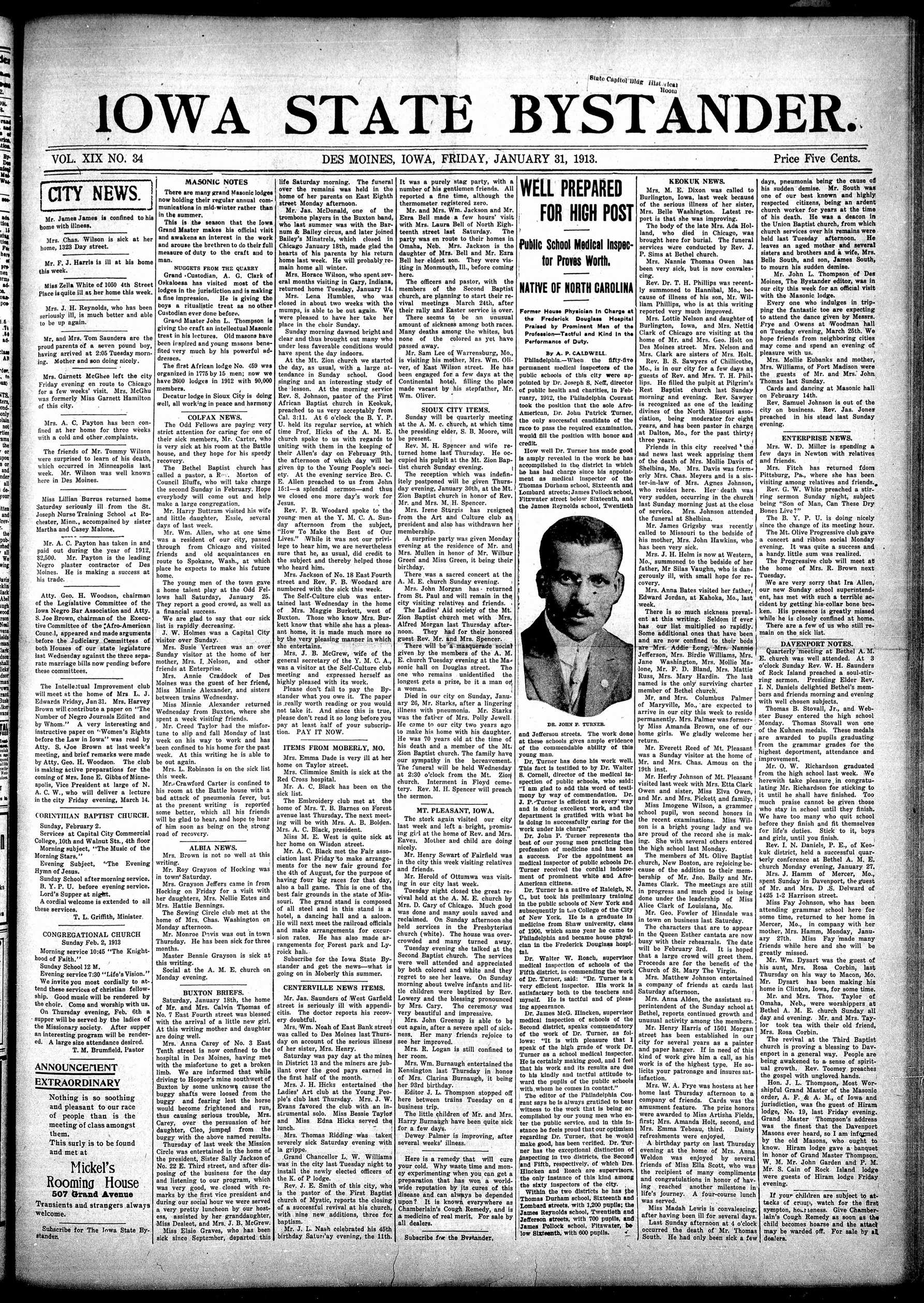
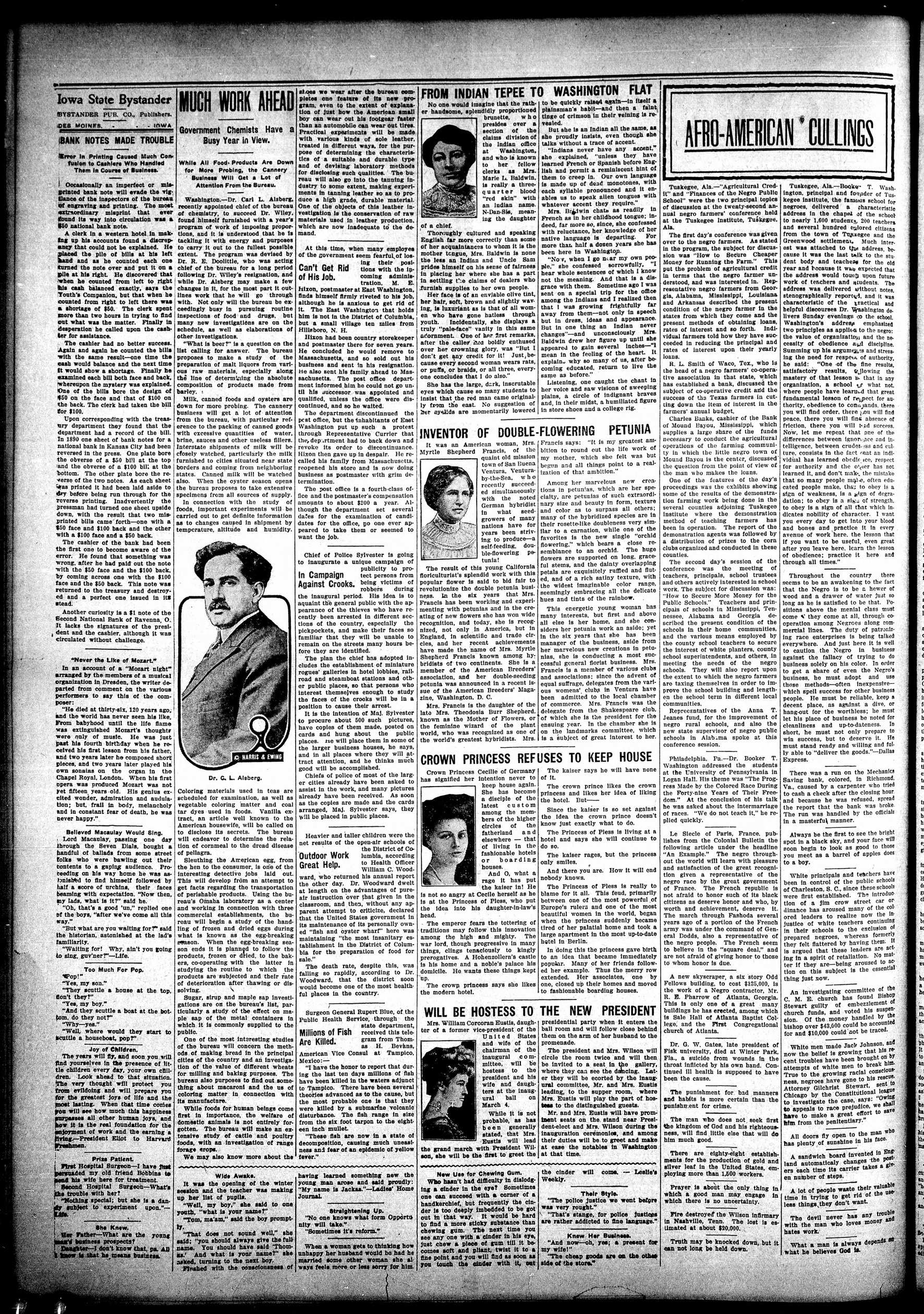
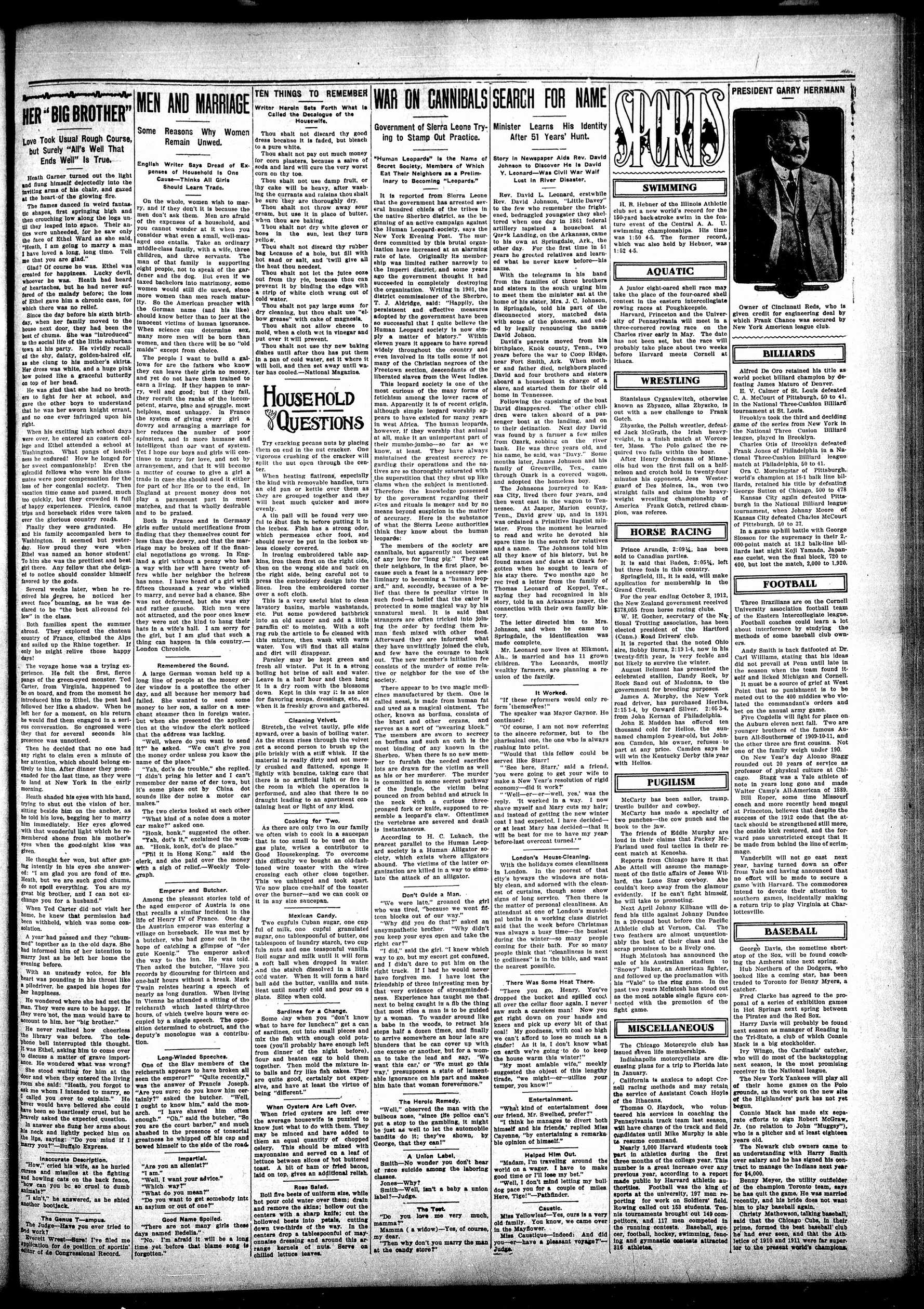
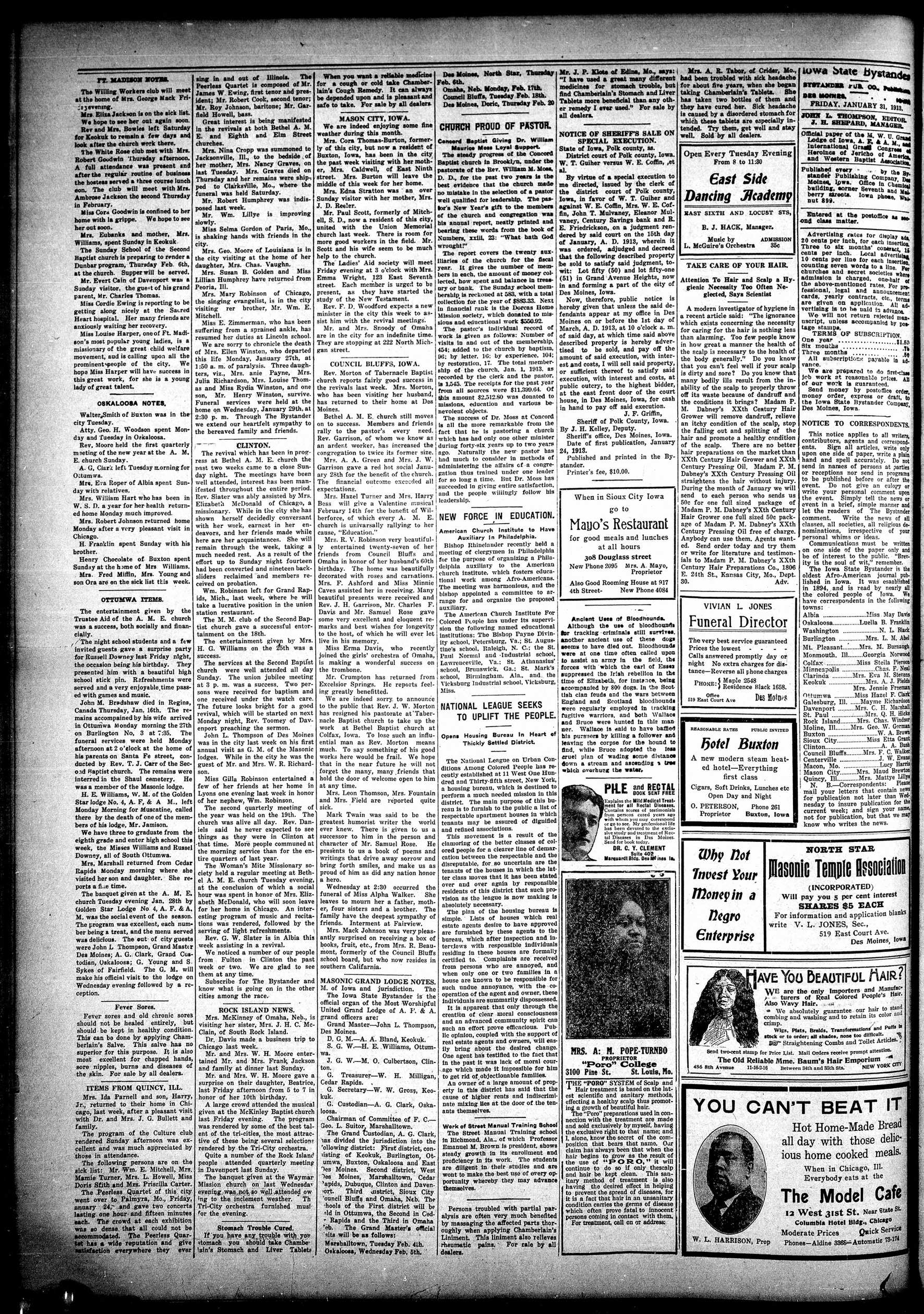
Page text (machine-generated)
IOWA STATE BYSTANDER.
VOL. XIX NO. 34
CITY NEWS
Mr. James James is confined to his home with illness.
Mrs. Chas. Wilson is sick at her home, 1323 Day street.
Mr. F. J. Harris is ill at his home this week.
Miss Zella White of 1050 4th Street Place is quite ill at her home this week.
Mrs. J. H. Reynolds, who has been seriously ill, is much better and able to be up again.
Mr. and Mrs. Tom Saunders are the proud parents of a seven pound boy, having arrived at 2:05 Tuesday morning. Mother and son doing nicely.
Mrs. Garnett McGhee left the city Friday evening en route to Chicago for a few weeks' visit. Mrs. McGhu was formerly Miss Garnett Hamilton of this city.
Mrs. A. C. Payton has been confined at her home for three weeks with a cold and other complaints.
The friends of Mr. Tommy Wilson were surprised to learn of his death, which occurred in Minneapolis last week. Mr. Wilson was well known here in Des Moines.
Miss Lillian Burrus returned home Saturday seriously ill from the St. Joseph Nurse Training School at Rochester, Minn., accompanied by sister Martha and Casey Malone.
Mr. A. C. Payton has taken in and paid out during the year of 1912, $2,500. Mr. Payton is the leading Negro plaster contractor of Des Moines. He is making a success at his trade.
Atty. Geo. H. Woodson, chairman of the Legislative Committee of the Iowa Negro Bar Association and Atty. S. Joe Brown, chairman of the Executive Committee of the "Afro-American Council," appeared and made arguments before the Judiciary. Committees of both houses of our state legislature last Wednesday against the three separate marriage bills now pending before these committees.
The Intellectual Improvement club will meet at the home of Mrs. L. J. Edwards Friday, Jan 31. Mrs. Harvey Brown will contribute a paper on "The Number of Negro Journals Edited and by Whom." A very interesting and instructive paper on "Women's Rights before the Law in Iowa" was read by Atty. S. Joe Brown at last week's meeting, and brief remarks were made by Atty. Geo. H. Woodson. The club is making active preparations for the coming of Mrs. Ione E. Gibbs of Minneapolis, Vice President at large of N. A. C. W., who will deliver a lecture in the city Friday evening, March 14.
CORINTHIAN BAPTIST CHURCH.
Sunday, February 2.
Services at Capital City Commercial College, 10th and Walnut Sts., 4th floor
Morning subject, "The Music of the
Morning Stars."
Evening Subject, "The Evening
Hymn of Jesus.
Sunday School after morning service.
B. Y. P. U. before evening service.
Lord's Supper at night.
A cordial welcome is extended to all
these services.
T. L. Griffith, Minister.
CONGREGATIONAL CHURCH
Sunday Feb. 2, 1913
Morning service 10:45 "The Knighthood of Faith."
Sunday School 12 M.
Evening service 7:30 "Life's Vision."
We invite you most cordially to attend these services of christian fellowship. Good music will be rendered by the choir. Come and worship with us.
On Thursday evening, Feb. 6th a supper will be served by the ladies of the Missionary society. After supper an interesting program will be rendered.
A large size attendance desired.
T. M. Brumfield, Pastor
ANNOUNCEMENT
EXTRAORDINARY
Nothing is so soothing and pleasant to our race of people than is the meeting of class amongst them.
This surly is to be found and met at
Mickel's
Rooming House
507 Grand Avenue
Transients and strangers always welcome.
Subscribe for The Iowa State By-standen.
MASONIC NOTES
There are many grand Masonic lodges now holding their regular annual communications in mid-winter rather than in the summer.
This is the season that the Iowa Grand Master makes his official visit and awakens an interest in the work and arouse the brethren to do their full measure of duty to the craft and to man.
NUGGETS FROM THE QUARRY
Grand-Custodian, A. G. Clark of Oskaloosa has visited most of the lodges in the jurisdiction and is making a fine impression. He is giving the boys a ritualistic treat as no other Custodian ever done before.
Grand Master John L. Thompson is giving the craft an intellectual Masonic treat in his lectures. Old masons have been inspired and young masons benefited very much by his powerful addresses.
The first African lodge No. 459 was organized in 1775 by 15 men; now we have 2600 lodges in 1912 with 90,000 members.
Decatur lodge in Sioux City is doing well, all working in peace and harmony
COLFAX NEWS.
The Odd Fellows are paying very strict attention for caring for one of their sick members, Mr. Carter, who is very sick at his room at the Battle house, and they hope for his speedy recovery.
The Bethel Baptist church has called a pastor, a R. Morton of Council Bluffs, who will take charge the second Sunday in February. Hope everybody will come out and help make a large congregation.
Mr. Harry Buttram visited his wife and little daughter, Essie, several days of last week.
Mr. Wm. Allen, who at one time was a resident of our city, passed through from Chicago and visited friends and old acquaintances en route to Spokane, Wash., at which place he expects to make his future home.
The young men of the town gave a home talent play at the Odd Fellows hall Saturday, January 25. They report a good crowd, as well as a financial success.
We are glad to say that our sick list is rapidly decreasing.
J. W. Holmes was a Capital City visitor over Sunday.
Mrs. Susie Vertrees was an over Sunday visitor at the home of her mother, Mrs. I. Nelson, and other friends at Enterprise.
Mrs. Annie Craddock of Des Moines was the guest of her friend, Miss Minnie Alexander, and sisters between trains Wednesday.
Miss Minnie Alexander returned Wednesday from Buxton, where she spent a week visiting friends.
Mr. Creed Taylor had the misfortune to slip and fall Monday of last week on his way to work and has been confined to his home for the past week. At this writing he is able to be out again.
Mr. Robinson is on the sick list this week.
Mr. Crawford Carter is confined to his room at the Battle house with a bad attack of pneumonia fever, but at the present writing is reported some better, which all his friends will be glad to hear, and hope to hear of him soon as being on the strong road of recovery.
ALBIA NEWS.
Mrs. Brown is not so well at this writing.
Mr. Roy Grayson of Hocking was in town Saturday.
Mrs. Grayson Jeffers came in from Hocking on Friday for a visit with her daughters, Mrs. Nellie Estes and Mrs. Hattie Bennings.
The Sewing Circle club met at the home of Mrs. Chas. Washington on Monday afternoon.
Mr. Monroe Davis was out in town Thursday. He has been sick for three months.
Master Bennie Grayson is sick at this writing.
Social at the A. M. E. church on Monday evening.
BUXTON BRIEFS.
Saturday, January 18th, the home of Mr. and Mrs. Calvin Thomas of No. 7 East Fourth street was blessed with the arrival of a little new girl. At this writing mother and daughter are doing well.
Mrs. Anna Carey of No. 3 East Tenth street is now confined to the hospital in Des Moines, having met with the misfortune to get a broken limb. We are informed that while driving to Hooper's mine southwest of Buxton by some unknown cause the buggy shafts were loosed from the buggy and fearing lest the horse would become frightened and run, thus causing serious trouble, Mrs. Carey, over the persuasion of her daughter, Cloo, jumped from the buggy with the above named results.
Thursday of last week the Mission Circle was entertained in the home of the president, Sister Sally Jackson of No. 22 E. Third street, and after disposing of the business for the day and listening to our program, which was very good, we closed with remarks by the first vice president and during our social hour we were served a very pretty luncheon by our hostess, assisted by her granddaughter, Miss Desleet, and Mrs. J. B. McGrew, Miss Elsie Graves, who has been invited to this
life Saturday morning. The funeral over the remains was held in the home of her parents on East Eighth street Monday afternoon.
Mr. Jas. McDonald, one of the trombone players in the Buxton band, who last summer was with the Barnum & Bailey circus, and later joined Bailey's Minstrels, which closed in Chicago January 18th, made glad the hearts of his parents by his return home last week. He will probably remain home all winter.
Mrs. Horace Wilson, who spent several months visiting in Gary, Indiana, returned home Tuesday, January 14.
It was a purely stag party, with a number of his gentlemen friends. All reported a fine time, although the thermometer registered zero.
Mr. and Mrs. Wm. Jackson and Mr. Ezra Bell made a few hours' visit with Mrs. Laura Bell of North Eighteenth street last Saturday. The party was en route to their homes in Omaha, Neb. Mrs. Jackson is the daughter of Mrs. Bell and Mr. Ezra Bell her oldest son. They were visiting in Monmouth, Ill., before coming here.
The officers and pastor, with the members of the Second Baptist
WELL PREPAY FOR HIGH
Public School Medicine Proves Worth
NATIVE OF NORTH O
Sunday morning dawned bright and clear and thus brought out many who under less favorable conditions would have spent the day indoors. At the Mt. Zion church we started the day, as usual, with a large attendance in Sunday school. Good singing and an interesting study of the lesson. At the morning service Rev. S. Johnson, pastor of the First African Baptist church in Keokun, preached to us very acceptably from Cal. 3:11. At 6 clock the B. Y. P. U. held its regular service, at which time Prof. Hicks of the A. M. E. church spoke to us with regards to uniting with them in the keeping of their Allen's day on February 9th, the afternoon of which day will be given up to the Young People's society. At the evening service Bro. C. E. Allen preached to us from John 15:1—a splendid sermon—and thus used one more day's work for Work. Rev. F. B. Woodard spoke to the young men at the Y. M. C. A. Sunday afternoon from the subject, "How To Make the Best of Our Lives." While it was not our privilege to hear him, we are nevertheless sure that he, as usual, did credit to the subject and thereby helped those who heard him. Mrs. Jackson of No. 18 East Fourth street and Rev. F. B. Woodard are numbered with the sick this week.
The Self-Culture club was entertained last Wednesday in the home of Mrs. Maggie Burkett, west of Buxton. Those who know Mrs. Burkett know that while she has a pleasant home, it is made much more so by the very pleasing manner in which she entertains.
Mrs. J. B. McGrew, wife of the general secretary of the Y. M. C. A., was a visitor at the Self-Culture club meeting and expressed herself as highly pleased with its work.
Please don't fail to pay the Bystander what you owe it. The paper is really worth reading or you would not take it. And since this is true, please don't read it so long before you pay at least half of your subscription. PAY IT NOW.
ITEMS FROM MOBERLY, MO.
Mrs. Emma Dade is very ill at her home on Taylor street. Mrs. Climmice Smith is sick at the Red Cross hospital.
Mr. A. C. Black has been on the sick list.
The Embroidery club met at the home of Mrs. T. B. Barnes on Forest avenue last Thursday. The next meeting will be with Mrs. A. B. Bolden. Mrs. A. C. Black, president.
Miss M. E. West is quite sick at her home on Wisdon street.
Mr. A. C. Black met the Fair association last Friday to make arrangements for the new fair ground for the 4th of August, for the purpose of having big race for that day, also a ball game. This is one of the best fair grounds in the state of Missouri. The grand stand is composed of all steel and in this stand is a hotel, a dancing hall and a saloon. He will next meet the railroad officials and make arrangements for excursion rates. He has also made arrangements for Forest park and Lyrick hall.
Subscribe for the Iowa State Bystander and get the news—what is going on in Moberly this summer.
CENTERVILLE NEWS ITEMS.
Mr. Jas. Saunders of West Garfield street is seriously ill with appendicitis. The doctor reports his recovery doubtful. Mrs. Wm. Noah of East Bank street was called to Des Moines last Thursday on account of the serious illness of her sister, Mrs. Henry.
Saturday was pay day at the mines in District 13 and the miners are jubilant over the good pays earned in the first half of the month.
Mrs. J. H. Hicks entertained the Ladies' art club at the Young People's club last Thursday. Mrs. J. W. Evans favored the club with an instrumental solo. Miss Bessie Taylot and Miss Edna Hicks served the lunch.
Mrs. Thomas Ridding was taken severely sick Saturday evening with la gripe.
Grand Chancellor L. W. Williams was in the city last Tuesday night to install the newly elected officers of the K. of P lodge.
Rev. J. E. Smith of this city, who is the pastor of the First Baptist church of Mystic, reports the closing of a successful revival at the church, with nine new additions, three for baptism.
Mr. J. L. Nash celebrated his 45th birthday Saturay evening, the 11th.
It was a purely stag party, with a number of his gentlemen friends. All reported a fine time, although the thermometer registered zero.
Mr. and Mrs. Wm. Jackson and Mr. Ezra Bell made a few hours' visit with Mrs. Laura Bell of North Eighteenth street last Saturday. The party was en route to their homes in Omaha, Neb. Mrs. Jackson is the daughter of Mrs. Bell and Mr. Ezra Bell her eldest son. They were visiting in Monmouth, Ill., before coming here.
The officers and pastor, with the members of the Second Baptist church, are planning to start their revival meetings March 24th, after their rally and Easter service is over. There seems to be an unusual amount of sickness among both races. Many die among whites, but none of the colored as yet have passed away.
Mr. Sam Lee of Warrensburg, Mo., is visiting his mother, Mrs. Wm. Olmer, of East Wilson street. He has been engaged for a few days at the Continental hotel, filling the place made vacant by his stepfather, Mr. Wm. Oliver.
SIOUX CITY ITEMS
Sunday will be quarterly meeting at the A. M. c. church, at which time the presiding elder, S. B. Moore, will be present.
Rev. M. H. Spencer and wife returned home last Thursday. He occupied his pulpit at the M. Zion Baptist church Sunday evening.
The reception which was indefinitely postponed will be given Thursday evening, January 30th, at the M. Zion Baptist church in honor of Rev. Mr. and Mrs. M. H. Spencer.
Mrs. Irene Sturgis has resigned from the Art and Culture club as president and also has withdrawn her membership.
A surprise party was given Monday evening at the residence of Mr. and Mrs. Mullen in honor of Mr. Wilbur Green and Miss Green, it being their birthday.
There was a sacred concert at the A. M. E. church Sunday evening.
John Morgan has returned from St. Petersburg and will be in the city visiting relatives and friends.
The Ladies' Aid society of the M. Zion Baptist church met with Mrs. Alfred Morgan last Thursday afternoon. They had for their honored guest Rev. Mr. and Mrs. Spencer.
There will be a masquerade social given by the members of the A. M. E. church Tuesday evening at the Masonic hall on Douglas street. The one who remains unidentified the longest gets a prize, be it a man of a woman.
Died in our city on Sunday, January 26, Mr. Starkes, after a lingering illness with pneumonia. Mr. Starkes was the father of Mrs. Polly Jewell. He came to our city two years ago to make his home with his daughter. He was 70 years old at the time of his death and a member of the Mt. Zion Baptist church. The family have our sympathy in the bereavement. The funeral will be held Wednesday at 2:30 o'clock from the Mt. Zion church. Interment in Floyd cemetery. Rev. M. H. Spencer will preach the sermon.
MT. PLEASANT IOWA
The stork again visited our city last week and left a bright, promising girl at the home of Rev. and Mrs. Eaves. Mother and child are doing nicely.
Mr. Henry Swart of Fairfield was in the city this week visiting relatives and friends.
Mr. Herold of Ottumwa was visiting in our city last week.
Tuesday night closed the great revival held at the A. M. E. church by Mrs. D. Gary of Chicago. Much good was done and many souls saved and reclaimed. On Sunday afternoon she held services in the Presbyterian church (white). The house was overcrowded and many turned away.
Tuesday evening she talked at the Second Baptist church. The services were well attended and appreciated by both colored and white and they regret to see her leave. On Sunday morning about twelve infants and little children were baptized by Rev. Lowery and the blessing pronounced by Mrs. Cary. The ceremony was very beautiful and impressive.
Mr. John Greenup able to be out again, after a severe spell of sickness. Her many friends rejoice to see her improved.
Mrs. R. Logan is still confined to her room.
Mrs. Wm. Burnaugh entertained the Kensington last Thursday in honors of Mrs. Clarina Burnaugh, it being her 93rd birthday.
Editor J. L. Thompson stopped off here between trains Tuesday on a business trip.
The little children of Mr. and Mrs. Harry Burnaigh have been quite sick for a few days. Dewey Palmer is improving, after several weeks' illness.
Here is a remedy that, will cure your cold. Why waste time and money experimenting when you can get a preparation that has won a worldwide reputation by its cures of this disease and can always be depended upon? It is known everywhere as Chamberlain's Cough Remedy, and a medicine of real merit. For sale by all dealers.
Subscribe for the Bystander.
BYSTA
JUARY 31, 1913.
WELL PREPARED
FOR HIGH POST
KE
Mrs. M. H.
Burlington, I,
of the serio
Mrs. Belle V
port is that t
The body o
land, who
Public School Medical Inspector Proves Worth.
NATIVE OF NORTH CAROLINA
Former House Physician In Charge at the Frederick Douglass Hospital Praised by Prominent Man of the Profession—Tactful and Kind In the Performance of Duty.
By A. P. CALDWELL
Philadelphia.—When the fifty-five permanent medical inspectors of the public schools of this city were appointed by Dr. Joseph S. Neff, director of public health and chardities, in February, 1912, the Philadelphian Court took the position that the sole Afro-American, Dr. John Patrick Cturner, the only successful candidate of the race to pass the required examination, will fill the position with honor and credit.
How well Dr. Turner has made good is amply revealed in the work he has accomplished in the district in which he has had charge since his appointment as medical inspector of the Thomas Durham school, Sixteenth and Lombard school; James Pollock school, Fitzwater street below Sixteenth, and the James Reynolds school, Twentieth
DR. JOHN P. TURNER.
and Jefferson streets. The work done at these schools gives ample evidence of the commendable ability of this young man.
Dr. Turner has done his work well. This fact is testified to by Dr. Walter S. Cornell, director of the medical inspection of public schools, who said: "I am glad to add this word of testimony by way of commendation. Dr. J. P. Turner is efficient in every way and is doing excellent work, and the particular is grilled with what is doing in successfully caring for the work under his charge." Dr. John P. Turner represents the best of our young men practicing the profession of medicine and has been a success. For the appointment as medical inspector of public schools Dr. Turner received the cordial endorsement of prominent white and Afro-American citizens. He is native of Raleigh, N.C. but took his preliminary training in the public schools of New York and subsequently in the College of the City of New York. He is a graduate in medicine from Shaw university, class of 1906, which same year he came to Philadelphia and became house physician in the Frederick Douglass hospital. Dr. Walter W. Roach, supervisor medical inspection of schools of the Fifth district, in commending the work of Dr. Turner, said: "Dr. Turner is the teacher. His work is satisfactory both to the teachers and myself. He is tactful and of pleasing appearance.
Dr. James McG. Hincken, superviseor medical inspection of schools of the Second district, speaks commendatory of the work of Dr. Turner, as follows: "It is with pleasure that I speak of the high grade of work Dr. Turner as a school medical inspector. He is certainly making good, and I feel that his work and its results are due to his kindly and tactful attitude toward the pupils of the public schools with whom he comes in contact." The editor of the Philadelphia Courant says he is always gratified to bear witness to the work that is being accomplished by our young men who enter the public service, and in this instance he feels proud that our optimism regarding Dr. Turner, that he would make good, has been verified. Dr. Turner has the exceptional distinction of inspecting in two districts, the Second and Fifth, respectively, of which Drs. Hincken and Roach are supervisors, the only instance of this kind among the sixty inspectors of the city. Within the two districts he has the Thomas Durham school, Sixteenth and Lombard streets, with 1,200 pupils; the James Reynolds school, Twentieth and Jefferson streets, with 700 pupils, and James Pollock school, Fitzwater, below Sixteenth, with 600 pupils.
Mrs. M. E. Dixon was called to Burlington, Iowa, last week because of the serious illness of her sister, Mrs. Belle Washington. Latest report is that she was improving. The body of the late Mrs. Ada Holland, who died in Chicago, was brought here for burial. The funeral services were conducted by Rev. J. P. Sims at Bethel church.
Mrs. Nannie Thomas Owen has been very sick, but is now convalescing.
Rev. Dr. T. H. Phillips was recently summoned to Hannibal, Mo., because of illness of his son, Mr. William Phillips, who is at this writing reported very much improved.
Mrs. Lottie Nelson and daughter of Burlington, Iowa, and Mrs. Netti Clark of Chicago are visiting at the home of Mr. and Mrs. Geo. Holt on Des Moines street. Mrs. Nelson and Mrs. Clark are sisters of Mrs. Holt.
Rev. B. S. Sawyers of Chillicothe, Mo., is in our city for a few days guests of Rev. and Mrs. T. H. Phillips. He filled the pulpit at Pilgrim's Rest Baptist church last Sunday morning and evening. Rev. Sawyer is recognized as one of the leading divines of the North Missouri association, being moderator for eight years, and has been pastor in charge at Dalton, Mo., for the past thirty three years.
Friends in this city received *the sad news last week apprising them of the death of Mrs. Mollie Davis of Shelbina, Mo. Mrs. Davis was formerly Mrs. Chas. Meyers and is a sister-in-law of Mrs. Agnes Johnson, who resides here. Her death was very sudden, occurring in the church last Sunday morning just at the close of service. Mrs. Johnson attended the funeral at Shelbina.
Mr. James Grigsby was recently called to Missouri to the bedside of his mother, Mrs. John Hawkins, who has been very sick.
Mrs. J. H. Helm is now at Western, Mo. summoned to the bedside of her father, Mrs Silas Vaughn, who is dangerously ill, with small hope for recovery.
Mrs. Anna Bates visited her father, Edward Jordan, at Kahoka, Mo., last week.
There is so much sickness prevalent at this writing. Seldom if ever has our list multiplied so rapidly. Some additional ones that have been and are now confined to their beds are Mrs. Addie Long, Mrs. Nannie Jefferson, Mrs. Birdie Williams, Mrs. Jane Washington, Mrs. Mollie Malone, Mr. F. D. Bland, Mrs. Mattie Russ, Mrs. Mary Hardin. The last named is the only surviving charter member of Bethel church.
Mr. and Mrs. Columbus Palmer of Maryville, Mo., are expected to arrive in our city this week to reside permanently. Mrs. Palmer was formerly Miss Amanda Brown, one of our home girls. We gladly welcome her return.
Mr. Everett Reed of Mt. Pleasant was a Sunday visitor at the home of Mr. and Mrs. Chas. Amous on the 19th inst.
Mr. Herffy Johnson of Mt. Pleasant visited last week with Mrs. Etta Clark Owen and sister, Miss Elva Owen, and Mr. and Mrs. Pickett and family.
Miss Imogene Wilson, a grammer school pupil, won second honors in the recent examinations. Miss Wilson is a bright young lady and we are proud of the record she is making. She with several others entered the high school last Monday.
The members of Mt. Olive Baptist church, New Boston, are rejoicing because of the addition to their membership of Mr. Jno. Baily and Mr. James Clark. The meetings are still in progress and much good is being done under the leadership of Miss Alice Clark of Louisiana, Mo.
Mr. Geo. Fowler of Hinsdale was in town on business last Saturday.
The characters that are to appear in the cantata are now busy with their rehearsals. The date will be February 2nd, is hoped that a large crowd will greet them. Proceeds are for the benefit of the Church of St. Mary The Virgin.
Mrs. Matthew Johnson entertained a company of friends at cards last Saturday afternoon.
Mrs. Anna Alden, the assistant superintendent of the Sunday school at Bethel, reports continued growth and unusual activity among the members.
Mr. Henry Harris of 1501 Morgan street has been established in our city for several years as a painter and paper hanger. If in need of this kind of work give him a call, as his work is of the highest type. He solicits your patronage and insures satisfaction.
Mrs. W. A. Frye was hostess at her home last Thursday afternoon to a company of friends. Cards was the amusement feature. The prizes were awarded to Miss Artisha Fields, first; Mrs. Amanda Holt, second, and Mrs. Emma Tebau, third. Dainty refreshments were enjoyed.
A birthday party on last Thursday evening at the home of Mrs. Anna Weldon was enjoyed by several friends of Missella Scott, who was the recipient of many compliments and congratulations in honor of having reached another milestone in life's journey. A four-course lunch was served.
Miss Madah Lewis is convalescing, after having been ill for several days. Last Sunday afternoon at 4 o'clock occurred the death of Mr. Thomas South. He had only been sick a few
KEQKUK NEWS.
Price Five Cents.
days, pneumonia being the cause of his sudden demise. Mr. South was one of our best known and highly respected citizens, being an ardent church worker for years at the time of his death. He was a deacon in the Union Baptist church, from which church services over his remains were held last Tuesday afternoon. He leaves an aged mother and several sisters and brothers and a wife, Mrs. Belle South, and son, James South, to mourn his sudden demise.
Mr. John L. Thompson of Des Moines, the Bystander editor, was in our city this week for an official visit with the Masonic lodge.
Every one who indulges in tripping the fantastic toe are expecting to attend the dance given by Messrs. Frye and Owens at Woodman hall on Tuesday evening, March 28th. We hope friends from neighboring cities may come and spend an evening of pleasure with us.
Mrs. Mollie Eubanks and mother, Mrs. Williams, of Fort Madison were the guests of Mr. and Mrs. John Thomas last Sunday.
Cards and dancing at Masonic hall on February 14th.
Rev. Samuel Johnson is out of the city on business. Rev. Jas. Jones preached in his stead last Sunday evening.
ENTERPRISE NEWS
Mrs. W. D. Miller is spending a few days in Newton with relatives and friends.
Mrs. Fitch has returned fdom Pittsburg, Pa., where she has been visiting among relatives and friends.
Rev. G. W. White preached a stirring sermon Sunday night, subject being "Son of Man, Can These Dry Bones Live?" The B. Y. P. U. is doing nicely since the change of its meeting hour.
The Mt. Olive Progressive club gave a concert and ribbon social Monday evening. It was quite a success and a handy, little sum was realized. The Progressive club will meet at the home of Mrs. R. Brown next Tuesday. We are very sorry that Ira Allen, our new Sunday school superintendent, has met with such a terrible accident by getting his collar bone broken. His presence is greatly missed while he is closely confined at home.
Quarterly meeting at Bethel A. M. E. church was well attended. At 3 o'clock Sunday Rev. W. H. Saunders of Rock Island preached a soul-stirring sermon. Presiding Elder Rev. I. N. Daniels delighted Bethel's members and friends morning and evening with well chosen subjects.
Thomas B. Stovall, Jr., and Webster Busey entered the high school Monday. Thomas Stovall won one of the Kuhn medals. These medals are awarded to pupils graduating from the grammar grades for the highest department, attendance and improvement.
Mr. O. W. Richardson graduated from the high school last week. We herewith take pleasure in congratulating Mr. Richardson for sticking to it until he shall have finished. Too much praise cannot be given those who stay in school until they finish. We have too many who quit school before they finish and fit themselves for life's duties. Stick to it, boys and girls, until you finish.
Rev. I. N. Daniels, P. E., of Keokuk district, held a successful quarterly conference at Bethel A. M. E. church Monday evening, January 27.
Mrs. J. Hamm of Mercer, Mo., presided Sunday in Davenport, the guest of Mrs. J. Hamm, S. Delward of 1425 1-2 Harrison street.
Miss Fay Johnson, who has been attending grammar school here for some time, returned to her home in Mercer, Mo., in company with her mother, Mrs. Hamm, Monday, January 27th. Miss Fay made many friends while here and she will be greatly missed.
Mr. Wm. Dysart was the guest of his aunt, Mrs. Rosa Corbin, last Thursday on his way to Macon, Mo. Mr. Dysart has been making his home in Clinton, Iowa, for some time. Mr. and Mrs. Thos. Taylor of Omaha, Neb., were worshippers at Bethel A. M. E. church Sunday all day and evening. Mr. and Mrs. Taylor took tea with their old friend, Mrs. Rosa Corbin.
The revival at the Third Baptist church is proving a blessing to Davenport in a general way. People are being awakened to a sense of spiritual growth. Rev. Toomey preaches the gospel with unglued hands.
Hon. J. L. Thompson, Most Worshipful Grand Master of the Masonic order, A. F. & A. M., of Iowa and jurisdiction, was the guest of Hiram Grand Master No. 19, last Friday evening. Grand Master Thompson's address was the finest that the Davenport Masons ever heard, so I am inforgotten by the old Masons, who ought to know. Hiram lodge gave a banquet in honor of Grand Master Thompson. W. M. M. John Garden and P. M. Mr. S. Cain of Rock Island lodge were guests of Hiram lodge Friday evening.
If your children are subject to attacks of cruju, watch for the first sympon, noisemess. Give Chamberlain's Cough Remedy as soon as the child becomes hoarse and the attack may be warded off. For sale by all dealers.
BANK NOTES MADE TROUBLE
Error in Printing Caused Much Con-fusion to Cashiers Who Handled Them in Course of Business.
Occasionally an imperfect or misprinted bank note will evade the vigilance of the inspectors of the bureau of engraving and printing. The most extraordinary misprint that ever found its way into circulation was a $50 national bank note.
A clerk in a western hotel in making up his accounts found a discrepancy that could not be explained. He placed the pile of bills at his left hand and as he counted each one turned the note over and put it on a pile at his right. He discovered that when he counted from left to right his cash balanced exactly, says the Company, but when he counted from right there was a shortage of 80. The账 spent more than two hours in trying to find out what was the matter. Finally in desperation he called upon the cashier for assistance.
The cashier had no better success. Again and again he counted the bills with the same result—one time the cash would balance and the next time it would show a shortage. Finally he examined each bill both face and back, whereupon the mystery was explained. One of the bills bore the design of $50 on the face and that of $100 on the back. The clerk had taken the bill for $100.
Upon corresponding with the treasury department they found that the department had a record of the bill. In 1890 one sheet of bank notes for a national bank in Kansas City had been reversed in the press. One plate bore the obverse of a $50 bill at the top of the obverse of a $100 bill, at the bottom of the other plate bore the reverse of the same bill as was printed it had been laid aside to dry before being run through for the reverse printing. Indvertently the presman had turned one sheet upside down, with the result that two misprinted bills came forth—one with a $50 face and $100 back and the other with a $100 face and a $50 back.
The cashier of the bank had been the first one to become aware of the error. He found that something was wrong, after he had paid out the note with the $50 face and the $100 back, by coming across one with the $100 face and the $50 back. This note was returned to the treasury and destroyed a perfect one issued in 1881 stead.
Another curiosity is a $1 note of the Second National Bank of Ravanna, O. It lacks the signatures of the president and the cashier, although it was circulated without challenge.
"Never the Like of Mozart."
In an account of the "Mozart night" arranged by the members of a musical organization in Dresden, the writer departed from comment on the various performers to say this of the composer:
"He died at thirty-six, 120 years ago, and the world has never seen his like. From babyhood until the life flame was extinguished Mozart's thoughts were only of music. He was just past his fourth birthday when he received his first lesson from his father, and two years later he composed short pieces, and two years later played his organ in the Chapel Royal, London. When his first opera was produced Mozart was not pet fifteen years old. His genius excited admiration and audulation; but, frail in body, melancholy and in constant fear of death, he was never happy."
Belleved Macaulay Would Sing.
Lord Macaulay, passing one day
through the Seven Dials, bought a
handful of ballads from some street
folks who were bawling out their
contents to a gaping audience. Proceeding on his way home he was as-
nobled to find himself followed by
half a score of orchins, their faces
beaming with expectation. "Now then,
myads, what is it?" said he.
"Oo, that's a good 'un'," replied one of
the boys, "after we've come all this
way."
"But what are you waiting for?" said
the historian, astonished at the lad's
familiarity.
"Waiting for! Why, ain't you going
to sing, guver'n?"—Life.
"Yes, my son."
"They scuttle a house at the top, don't they?"
"Yes, my boy."
"And they scuttle a boat at the bottom, do they not?"
"Why-yes."
"Well, where would they start to scuttle a houseboat, pop?"
**Joy of Children.**
The years will fly, and soon you will find yourselves in the presence of little children the life of your own children. Look ahead to that situation.
The very thought will protect you from evildoing and will preserve you for the greatest joys of life and the most lasting. When that time comes you will see how much this happiness purposes all other human joys, and how it is the real foundation for the enjoyment of work and the earning a living-President Eliot to Harvard Freemasons.
Prize Patient
First Hospital Surgeon—I have just persuaded my old friend Bobbins to send his wife here for treatment.
Second Hospital Surgeon—What's the trouble with her?
"Nothing special; but she is a dandy subject to experiment upon."—Lie.
She Knew.
Her Father—What are the young man's business prospects?
Daughter—I don't know that, pa. All I know is that he means business.
MUCH WORK AHEAD
Government Chemists Have a Busy Year in View.
While All Food-Products Are Down for More Probing, the Cannery Business Will Get a Lot of Attention From the Bureau.
Washington, Dr. Carl L. Alsberg, recently appointed chief of the bureau of chemistry, to succeed Dr. Wiley, found himself furnished with a year's program of work of imposing proportions, and it is understood that he is going to carry it out to the fullest possible extent. The program was devised by Dr. R. E. Doolittle, who was acting chief of the bureau for a long period following Dr. Wiley's resignation, and while Dr. Alsberg may make a few changes in it, for the most part it outlines work that he will go through. Not only will the bureau be exceedingly busy in pursuing routine business, but many new investigations are on the schedule, as well as elaborations of other investigations.
"What is beer?" is a question on the list calling for answer. The bureau proposes to make a study of the preparation of malt liquors from various raw materials, especially along the line of determining the absolute composition of products made from barley.
Milk, canned foods and oysters are down for more probing. The cannery handles the milk from the bureau, with particular reference to the packing of canned goods with excessive quantities of water, brine, sauces and other useless fillers. Interstate shipments of milk will be closely watched, particularly the milk furnished to cities situated near state borders and coming from neighboring states. Canned milk will be watched also. When the oyster season opens the bureau proposes to take extensive specimens from all sources of supply, including seafood, milk, foods, important experiments will be carried out to get definite information as to changes caused in shipment by temperature, altitude and humidity.
C. NARRIS & EWING
Dr. G. L. Alsberg.
Coloring materials used in teas are scheduled for examination, as well as vegetable coloring matter and coal tar dyes used in foods. Vanilla extract, an article well known to the American housewife, will be called on to disclose its secrets. The bureau will endeavor to determine the relation of cornmeal to the dread disease of pellagra.
Sleuthing the American egg, from the hen to the consumer, is one of the interesting detective jobs laid out. This will develop from an attempt to get facts regarding the transportation of perishable products. Using the bureau's Omaka laboratory as a center and working in connection with three commercial establishments, the bureau has been developing of frozen and dried eggs during what is known as the egg-breaking season. When the egg-breaking season ends it is planned to follow the products, frozen or dried, to the bakers, co-operating with the latter in studying the routine to which the products are subjected and their rate of deterioration after thawing or dissolving. Sugar, slurp and maple sap investigations are on the bureau's list, paralleling a study of the effect of maple sap of the metal containers in which it is commonly supplied to the public.
One of the most interesting studies of the bureau will concern the methods of making bread in the principal cities of the country and an investigation of the value of different wheats for milling and baking purposes. The bureau also purposes to find out something about macaroni and the us of coloring matter in connection with its manufacture. While foods for human beings come first in importance, the welfare of domestic animals is not entirely forgotten. The bureau will make an extensive study of cattle and poultry foods, with an investigation of range forage crops. We may also know more about the
It was the opening of the winter session and the teacher was making up her list of pupils. "What are you said to one youth, 'what is your name?' "Tom, ma'am," said the boy promptly.
"That does not sound well," she said; "you should always give the full name. You should have said 'Thomas.' And what is your name?" she asked, turning to the next boy. Flushed with the consciousness of
shoes we wear after the bureau complete one feature of its new program, even to the extent of explanation of just how the American small boy can wear out his footwear faster than an automobile can wear out tires. Practical experiments will be made with various kinds of sole leather, treated in different ways, for the purpose of determining the characteristics of a suitable and durable type and of devising laboratory methods for disclosing such qualities. The bureau will also go into the tanning industry to some extent, making experiments in tanning leather so as to produce a high grade, durable material. One of the objects of this leather investigation is this conservation of raw materials used in leather production, which are now inadequate to the demand.
At this time, when many employees of the government seem fearful of losing their positions with the in-coming administration, M. E.
Hixon, postmaster at East Washington, finds himself firmly riveted to his job, although he is an anxious to get rid of it. The East Washington that holds him is not in the District of Columbia, but a small village ten miles from Hilleboro, N. H. Hixon had been country storekeeper and postmaster there for seven years. He concluded he would remove to Massachusetts, and so sold out his business and sent in his resignation. He also sent his family ahead to Massachusetts. The post office department informed him he could not go until his successor was appointed and qualified, unless the office were discontinued, and so he waited. The department discontinued the post office, the inbultants of East Washington, such a protest through Representative Currier that the department had to back down and revoke its order to discontinuance. Hixon then gave up in despair. He recalled his family from Massachusetts, reopened his store and is now doing business as postmaster with grim determination.
The post office is a fourth-class office and the postmaster's compensation amounts to about $200 a year. Although the department set several dates for the examination of candidates for the office, po one ever appeared to take them or seemed to want the job.
In Campaign Against Crooks.
the inaugural period. His idea is to acquaint the general public with the appearance of the thieves who have recently been arrested in different sections of the country, especially the pickpockets, and make their faces so familiar that they will be unable to remain on the streets many hours before they are arrested. The plan the chief has adopted includes the establishment of miniature rogues' galleries in hotel lobes, railroad and steamboat stations and other public places, so that persons who interest themselves enough to study the faces of the crooks will be in a position to cause their arrest. It is the intention of Maj. Sylvester to procure about 500 such pictures, have copies of them made, posted on cards and hung about the public places. He also targets larger business houses, he says, and in all places where they will attract attention, and he thinks much good will be accomplished.
Chiefs of police of most of the larger cities already have been asked to assist in the work, and many pictures already have been received. As soon as the copies are made and the cards arranged, Maj. Sylvester says, they will be placed in public places.
Heavler and taller children were the net results of the open-air schools of
Outdoor Work Great Help.
ward, who returned his annual report the other day. Dr. Woodward dwell at length on the advantages of pure air instruction over that given in the classroom, and then, without any apparent attempt to criticize, declared that the United States government in its maintenance of its personally owned "fish and oyster wharf" here was maintaining "the most insanitary establishment in the District of Columbia for the preparation of food for sale."
The death rate, despite this, was falling so rapidly, according to Dr. Woodward, that the district soon would become one of the most healthful places in the country.
Millions of Fish Are Killed.
American Vice Consult at Tampico, Mexico:— "I have the honor to report that during the last ten days millions of fish have been killed in the waters adjunct to Tampico. There have been several theories advanced as to the cause, but no reliable one is that they were killed by a submarine volcanic disturbance. The fish range in size from the six foot tarpon to the eight inch mullet. "These fish are now in a state of decomposition, causing much uneasiness and fear of an epidemic of yellow fever." having learned something new the young man arose and said proudly: "My name is Jackas."—"Ladies" Home Journal.
When a woman gets to thinking how unhappy her husband would be had he married some other woman she always feels more or less sorry for him.
FROM INDIAN TEPEE TO WASHINGTON FLAT
INVENTOR OF DOUBLE-FLOWERING PETUNIA
CROWN PRINCESS REFUSES TO KEEP HOUSE
WILL BE HOSTESS TO THE NEW PRESIDENT
No one would imagine that the rath-
er handsome, splendidly proportioned
brunette, who presides over a
section of the claims division of
the Indian office
at Washington,
and who is known
to her fellow
clerks as Mrs.
Marie L. Baldwin,
is really a three-
dollar "red skin" with
an Indian name.
N-Dan-Sis, meaning
the daughter
brunette, with a presides over section of the claims division of the Indian office at Washington, and who is known to her fellow clerks as Mrs Marie L. Baldwin is really a three-quarter blood "red skin" with an Indian name N-Dan-Sis, meaning the daughter of a chief. Thoroughly cultured and speaking English far more correctly than some of her acquaintances whom it is the mother of the clerk, Mrs Baldwin is none the less an Indian and Uncle Sam prides himself on his sense of fairness in placing her where she has a part in settling the claims of dealers who furnish supplies to her own people.
Her face is an enviable olive tint, her hair, soft, brown and slightly waving, is luxuriant as is that of all women who have gone hatless through youth. Incidentally, she displays a smile and a playful demeanor. One of her first remarks, after the caller is boldly enthused over her crowning glory, was "But I don't get any credit for it! Just, because every second woman wears rats, or puffs, or braids, or all three, every one concludes that I do also." She has the large, dark, incurable eyes which cause so many students to be nervous. She came originally from the east. No suggestion of her雅als are momentarily lowered
It was an American woman, Mrs.
Myrtle Shepherd Francis, of the
ican woman, Mrs. Francis, of the quaint old mission town of San Bueno century San Juan, which recently succeeded simultaneously with the noted German hybridist in what seed growers of many nations have for years been striving to produce flowers, double-flowering petunia.
MARY C.
The result of this young California forculturist's splendid work with this popular flower is said to bid fair to revolutionize the double petunia business. In the six years that Mrs. Francis has been working and experimenting with petunias and in the creating of new flowers she has recognized, and today she is recognizing, the American, but in England, in scientific and trade circles, and her recent achievements have made the name of Mrs. Myrtle Shepherd Francis known among bridges of two continents. She is a member of the American Breeders association, and her double-seeding petunia was announced in a recent issue of the American Breeders Magazine, Washington, D. C. Mrs. Francis is the daughter of the late Mrs. Theodiosa Mrs. Shepherd, known as the flower of Flowers, or the plant wizard of the plant world, who was recognized as one of the world's greatest hybridists. Mrs.
Crown Princess Cecilia of Germany has signified her intention never to
intention never to keep house again. She has become the latest custom among the members of the higher circles of the fatherland and elsewhere — that is, fashionable hotels or boarding houses.
P
And O, what a rage it has put the kaiser in! He is not so angry at Cecile herself as he is at the Princess of Pless, who put the idea into his daughter-in-law's house. The emperor fears the totering of traditions may follow this innovation among the high and mighty. The war lord, though progressive in many things, clings tenaciously to kingly pregatives. A Hohenzollern's castle is his home and a noble's palace his domicile. He wants these things kept up. The crown princess says she likes the modern hotel.
Mrs. William Corcoran Eustis, daughter of a former vice-president of the
United States and wife of the chairman of the inaugural committee, will be hostess to the president and his sisters at the inaugural ball on March 4.
M.
While it is not probable, as has been generally stated, that Mrs. Eustace will attend the grand march to President Wilcox she will be the first to greet the
New Use for 10
Who has learned difficulty in dislodging
a cinder in the eye? Sometimes
one can succeed with a corner of a
handkerchief, but frequently the cinder
is too deep imbedded to be got
out in that way. It would be hard
to find a more sticky substance than
chewing gum. The next time you
see any one with a cinder, you
just soften it and plaint, twist it to a
fine point and you will find as soon as
you touch the cinder with it, eat
to be quickly raised again—in itself a plainman's habit—and then a faint tinge of crimson in their veining is revealed.
But she is an Indian all the same, as she proudly insists, even though she talks without a trace of accent.
"Indians never have any accent," she explained, "unless they have learned French or Spanish before English and permit a remissible hint of them to creep in. Our own language is made up of dead monosyllabes, with each syllable containing and it enables us to spell alien tongues with what they require." Their Highbwin chats as readily in French as in her childhood tongue; indeed, far more so, since she confessed with reluctance, her knowledge of her native language is departing.
For more than half a dozen years she has been here in Washington.
"No v, when I go near my own people," she confessed sorrowfully, "I hear whole sentences of which I know not the meaning. And that is a disgrace with them. Sometimes age is sent on a special trip for the office among the people I realized then that we are growing frightfully far away from them—not only in speech but in dress, ideas and appearance. But in one thing an Indian never changes"—and unconsciously Mrs. Baldwin drew her figure up until it appeared to gain several heirs. "I mean in the feeling of the heart. It means many of us, after becoming educated, return to live the same as before."
Listening, one caught the chant in her voice and saw visions of sweeping plains, a circle of indistinct indigent figures in store shoes and a college rig.
Francis says: "It is my greatest ambition to round out the life work of my mother, which she felt was but begun and all things point to a realization of that ambition."
Among her marvelous new creations in petunias, which are her specialty, are petunias of such extraordinary size and beauty in form, texture and color as to surpass all others; many of the hybridized species are in their resette-like doubleness very similar to a carnation, while one of the favorites is the new single "orchid flowering," which bears a close resemblance to an orchid. The huge flowers are supported on long, graceful stems, and the darkened overlapping petals are exquisitely dotted and fluted with rich satiny texture, with the widest imaginable color range seemingly embracing all the delicate bues and tints of the rainbow.
This energetic young woman has many interests, but first and above all else is her home, and she considers her potenita work an aside; yet in the six years that she has been manager of the business, aside from her marvelous work, she has been conducting a most successful general florist business. Mrs. Francis is a member of various clubs and associations; since the advent of equal suffrage, delegates from the various womens' clubs in Ventura have been admitted to the local chamber of commerce. Mrs. Francis was delegate from the club of womens' clubs where she is the president for the ensuing year. In the chamber she is on the landmarks committee, which is a subject of great interest to her.
The kaiser says he will have none of it.
The crown prince likes the crown princess and likes her idea of liking the hotel. But—
Since the kaiser is so set against the idea the crown prince doesn't know just exactly what to do.
The Princess of Pless is living at a hotel and says she will continue to do so.
The kaiser rages, but the princess only smiles.
And there you are. How it will end nobody knows.
The Princess of Pless is really to blame for it all. This feud, primarily between one of the most powerful Europe's rulers and one of the most powerful women in the world, began when the princess suddenly became tired of her palatial home and took a large apartment in the most up-to-date hotel in Berlin.
In doing this the princess gave birth to an idea that became immediately popular. Many of her friends followed her example. Thus the merry row was formed, and one, closed up their homes and moved to fashionable boarding houses.
presidential party when it enters the ball room and will follow close behind them on the arm of her husband to the promenade.
The president and Mrs. Wilson will circle the room twice and will then be invited to a seat in the gallery, where they can see the dancing. Later they will be escorted by the inaugural committee, Mr. and Mrs. Eustis the supper room, where Mrs. Eustis will play the part of hostess to the distinguished guests.
Mr. and Mrs. Eustis will have prominent seats on the stand near President-elect and Mrs. Wilson during the inauguration ceremonies, and among their duties will be to greet and make at ease the notables in Washington at that time.
the cinder will come. — Leslie's Weekly.
Their Style.
"The police justice we went before was very rough."
"That's stance, for police justices are rather addicted to fine language."
AFRO-AMERICAN CULLINGS
Tuskegee, Ala.—"Agricultural Credit" and "Finances of the Negro Public School" were the two principal topics of discussion at the twenty-second annual negro farmers' conference held at the Tuskegee Institute, Tuskegee, Ala.
The first day's conference was given over to the negro farmers. As stated in the program, the next event for discussion was the Secure Cheaper Money for Running the Farm." This put the problem of agricultural credit in terms that the negro farmer understood, and was interested in. Representative negro farmers from Georgia, Alabama, Mississippi, Louisiana and Arkansas described the present condition of the negro farmer in the states from which they come and the present methods of obtaining loans, rates of interest and so forth. The farmers who have succeeded in reducing the principal and rates of interest upon their yearly loans.
R. L. Smith of Waco, Tex., who is the head of a negro farmers' co-operative association in that state, which has established a bank, discussed the subject of co-operative credit and the success of the Texas farmers in cutting down the item of interest in the farmers' annual budget.
Charles Banks, cashier of the Bank of Mound Bayou, Mississippi, which supplies a large share of the funds necessary to conduct the agricultural operations of the farming community in which the little negro town of Mound Bayou is the center, discussed the question from the point of view of the man who makes the loans.
One of the features of the day's proceedings was the exhibits showing some of the results of the demonstration farming work being done in the several counties adjoining Tuskegee institute where the demonstration farms of the black farmers has been in operation. The report of the demonstration agents was followed by a distribution of prizes to the corn clubs organized and conducted in these counties.
The second day's session of the conference was the meeting of teachers, principals, school trustees and others actively interested in school work. The subject for discussion was: "How to Secure More Money for the Public Schools." Teachers and principals of schools in Mississippi, Tennessee, Alabama and Georgia describe the present conditions of the school home communities, and the various means employed by the county school teachers to secure the interest of white planters, county school superintendents, and others, in meeting the needs of the negro schools. They will also report upon the extent to which the negro farmers are taxing themselves in order to improve the school building and lengthen the school term in different local communities. Activities of the Anna T. Jeanes fund, for the improvement of negro rural schools, and also the new state supervisor of negro public schools in Alabama spoke at this conference session.
Philadelphia, Pa.-Dr. Booker T. Washington addressed the students at the University of Pennsylvania in Logan Hall. His theme was "The Progress Made by the Colored Race During the Forty-nine Years of Their Freedom." At the conclusion of his talk he was asked about the intermarriage of races. "We do not teach it," he replied quickly.
Le Siecle of Paris, France, publishes from the Colonial Bulletin the following article under the headline "An Example." The negro throughout the world will learn with pleasure and satisfaction of the great recognition given a representative of the negro race by the great government of France. The French republic is not afraid to honor such of its black citizens as deserve honor and who, by the example of the French army was under the command of General Dodds, also a representative of the negro people. The French seem to believe in the "square deal," and are not afraid of giving honor to those to whom honor is due.
A new skyscraper, a six story Odd Fellows building, to cost $235,000, is the work of a Negro contractor, Mr. R. R. of Atlanta, Georgia. This is only one of a great number of buildings he has erected, among which is Sale Hall of Atlanta Baptist College, and the First Congregational church of Atlanta.
Dr. G. W. Gates, late president of Fisk university, died at Winter Park, Fla., a suicide from wounds in the throat inflicted by his own hand. Continued ill health is supposed to have been the cause.
The punishment for bad manners and habits is more certain than the punishment for crime.
The man who does not seek first the kingdom of God and his righteousness, will find little else that will do him much good.
There are eighty-eight establishments for the production of gold and silver leaf in the United States, employing more than 1,500 workers.
Prayer is about the only thing in which a good man may engage in which there is no uncertainty.
Fire destroyed the Wilson infirmary in Nashville, Tennessee. The lost is estimated at about $20,000.
Truth may be knocked down, but it can not long be held down.
Tuskegee, Ala.—Booker T. W.ington, principal and founder of Tuskegee institute, the famous school for negroes, delivered a characteristic address in the chapel of the school to nearly 1,600 students, 200 teachers and several hundred colored citizens from the town of Tuskegee and the Greenwood settlement. Much interaction was attached to the address, because the student body and teachers for the old year and because it was expected that the address would touch upon future work of teachers and students. The address was delivered without notes, stenographically reported, and it was characteristic of the practical and helpful discourses Dr. Washington delivers Sunday evenings to the school. Washington's address emphasized two principles as applied to the negro: the value of the organization and the need to Summing up his arguments and striving the need for respect of authority, he said: "One of the fine results, following the mastery of that lesson in that in any organization, a school what not, where people have learned that great authority, obedience to commands, there you will find order, there you will find absence of power, now let me repeat that one of the differences between ignorance and intelligence, between cruden- and culture, consists in the fact that an individual has learned obedience, respect for authority and the order has not learned it, and don't make, the mistake that so many people make, that; to obey is a sign of weakness, is a sign of degradation; to obey is a sign of strength; to obey is a sign of which in the course of character, you every day to get into your blood and bones and practice it in every avenue of work here, the lesson that if you want to be useful, even great you after leave you learn, the lesson of obedience; practice it here and through all times."
Throughout the country there seems to be an awakening to the fact that the Negro is to be a hewer of wood and a drawer of water just so long as he is satisfied to be that. Positions above the mental class must come they come at all, through cooperation among Negroes along commercial lines. The duty of patrolling race enterprise, among the Negroes, is all just here it is well to caution the Negro in business against the fallacy of trying to do business solely on his color. In order to get a share of even the Negro's business, he must adopt and use those methods—often inexpensive—which spell success for other business people. He must be reliable, keep a decent place, as against a dive, and hang-out for the worthless; he must let his place of business be noted for cleanliness and upkeep, and may prepare to win success, but to deserve it. He must stand ready and willing and fully able to "deliver the goods"—Dallas Express.
There was a run on the Mechanics Saving bank, colored, in Richmond, Va., caused by a carpenter who tried to cash a check after the closing hour, and because he was refused, spread the report that the bank was broke. The run was handled by the officials in a masterful manner.
Always be the first to see the bright spot in a black sky, and your face will soon begin to look as good to those you meet as a barrel of apples does to a boy.
White principals and teachers have been in control of the public schools of Charleston, S. C., since these schools were first established. The introduction of a jim crow street car or dinance has aroused many of the ordered leaders to realize now the justice of white teachers, continuing in their schools to the exclusion of protected segregations, whereas formerly the felt collapsed by having them. It is argued that these leaders are acting in a spirit of retaliation. No matter if they are—being aroused to action on this subject is the essential thing just now.
An investigating committee of the C. M. B. church has found Bishop Stewart guilty of embezzlement of church funds, and voted his suspension. Of the money handled by the bishop over $43,000 could be accounted for and $10,000 could not be traced.
White men made Jack Johnson, and now the belief is growing that his recent troubles have been brought on by attempts of white men to break him. True to the growing racial consciousness, negroes have gone to the justice Attorney Gilchrist Stewart, sent to Chicago by the Constitutional league to investigate the case; says "Owing to appeals to race prejudice, we shall have to make a great effort to save him from the penitentiary."
All doors fly open to the man who has plenty of sunshine in his face.
A sandwich board invented in England automatically changes the posters each time its carrier takes a given number of steps.
A lot of people waste their valuable time in trying to get rid of the useless things, they don't want.
The devil never has any trouble with the man who loves money and hates work.
What a man is always depends on
what he believes God is.
Love Took Usual Rough Course,
but surely "All's Well That
Ends Well" Is True.
Heath Garner turned out the light
and fung himself dejectedly into the
inving arms of his chair, and gazed
at the heart-of the glowing fire.
The fames danced in weird fantastic
shapes, first springing high and
then crouching low along the logs until
they leaped into space. Their antics were unheeded, for he saw only the face of Ethel Ward as she said,
"Heath, I am going to marry a man
I have loved a long, long time. Tell me that you are glad."
Glad? Of course he was. Ethel was created for happiness. Lucky devil, whohever he was, had heard of
her death, but he had never sur-
faced the malady before; the loss
of Ethel gave him a chronic case, for
which there was no relief.
Since the day before his sixth birthday, when her family moved to the house next door, they had been the best of chums. She was "introduced" to the social life of the little suburban town at his party. He vividly recalled the shy, dainty, golden-haired elf, as she clung to his mother's skirts. Her dress was white, and a huge pink bow poised like a graceful butterfly on top of her head. She glad that she had no brothers to fight for her at school, and gave the other boys to understand that he was her sworn knight errant, and no one ever infringed upon his right.
When his exciting high school day were over, he entered an eastern college and Ethel attended a school at Washington. What pangs of loneliness he endured? How he longed for her sweet companionship! Even the splendid fellows who were his classmates were poor comparison for the men of the social society. Then vacation time came and passed, much too quickly, but they crowded it full of happy experiences. Plenics, cane trips and horse ridehorses were taken over the glorious country roads. Finally they were graduated. He and his family accompanied hers to Washington. It seemed but yesterday. How proud they were when Ethel was named an honor student! To him she was the prettiest and best girl there. Any fellow that she deliged to notice should consider himself a friend. Several weeks later, when he received her *degree*, he noticed her sweet face beaming, as he was declared to be "the best all-round fellow" in the class.
Both families spent the summer abroad. They explored the chateau country of France, climbed the Alps and sailed up the Rhine together. If only he might relive those happy days!
The voyage home was a trying experience. He felt the first, fierce pangs of the green-eyed monster. Ted Carter, from Virginia, happened to be on board, and from the moment he introduced him to Ethel, the pest had followed her like a shadow. When he left her for a moment, on his return he would find them engaged in a serious conversation. So engrossed were he for her, for the second his presence was unnoticed.
Then he decided that no one had any right to claim even a minute of her attention, which should belong entirely to him. After dinner they promised for the last time, as they were to land at New York in the early morning.
Heath shaded his eyes with his hand, trying to shut out the vision of her, sitting beside him on the anchor, as he told his love, begging her to marry him immediately. Her eyes glowed with that wonderful light which he remembered shone from his mother's eyes when the good-night kiss was given.
He thought her won, but after gazing intently in his eyes she answered: "I am glad you are fond of me, death, but we are such good chums, do spoil everything. You are my great big brother, and I can not exchange you for a husband."
When Ted Carter did not visit her home, he knew that permission had been withheld, which was some consolation.
A year had passed and they "chummed" together as in the old days. She had informed him of her intention to marry just as he left her home the evening before.
With an unsteady voice, for his heart was pounding in his throat like a piledriver, he gasped his hopes for her happiness.
He wondered where she had met the man. They were sure to be happy. If they were not, the man would have to account to him, her "big brother."
He never realized how cheerless the library was before. The telephone interrupted this thought. It was Ethel, who would over to discuss a matter of grave importance. He wondered what was wrong?
She stood waiting for him at the door and when they entered the living room she said: "Heath, you forgot to ask me whom I intended to marry, so called you over to explain." He would have believed she could have been so heartlessly cruel, but he bravely expected question. In answer she kneeled and lightly pecked him on the lips, saying: "Do you mind if I marry you?"—Buffalo Express.
Inaccurate Description
"How," cried his wife, as he hurried carses and missiles at the fighting and howling cats on the back fence, "how can you be so cruel to dumb animals?" "I sn't," he answered, as he shied another bootjack.
Everett Wrest—Gurel! I've filed me
application for de position of sportin'
editor of de Congressional Record.
Some Reasons Why Women
Remain Unwed.
English Writer Says Dread of Expenses of Household Is One Cause—Think All Girls Should Learn Trade.
On the whole, women wish to marry, and if they don't it is because the men don't ask them. Men are afraid of the expenses of a household, and you cannot wonder at it when you consider what even a small, well-managed one entails. Take an ordinary middle-class family, with a wife, three children, and three servants. The man of that family is supporting eight people, not to speak of the gardener and the dog. But even if we taxed bachelors into matrimony, some women would still die unwed, since the woman than men reach maturity. So the American preacher with the German name that he should know better than to jeer at the innocent victim of human ignorance. When science can determine sex, many more men will be born than women, and then there will be no "old maids" except from choice.
The people I want to build a gallows for are the fathers who know they can leave their girls no money, and yet do not have them trained to earn a living. If they happen to marry, well and good; but if they fail, they recruit the ranks of the incompetent, starve, pine and struggle, most helpless, most unhappy. In France the children every girl a dowry and arranging a marriage for her reduces the number of poor spinsters, and is more humane and intelligent than our want of system. Yet I hope our boys and girls will continue to marry for love, and not by arrangement, and that it will become a matter of course to give a girl a trade in case she should need it either part of her life or to the English school. The girls does not play a paramount part in most matches, and that is wholly desirable and to be praised.
Both in France and in Germany girls suffer untold mortifications from finding that they themselves count for less than the dowry, and that the marriage may be broken off if the financial negotiations go wrong. In England a girl without a dowry will have her marriage while her neighbor the helenr has none. I have heard of a girl with fifteen thousand a year who wished to marry, and never had a chance. She was not deformed, but she was sny and rather gauche. Rich men were not attracted, and the poor ones knew they were not the kind of girl I am. I am sorry for the girl, but I am glad that such a thing can happen in this country.—London Chronicle.
Remembered the Sound.
A large German woman held up a long line of people at the money order window in a postoffice the other day, and all because her memory had failed. She wanted to send some money to her son, a sailor on a merchant steamer then in foreign water, but when she presented the application she had received the clerk noticed that the address was lacking.
"Well, where do you want to send it?" he asked. "We can't give you the money order unless you know the name of the place."
"Yah, dot's de trouble," she replied. "I didn't bring his letter and I can't remember der name of der town, but it's some place out by China dot sounds like der noise a motor car makes."
The two clerks looked at each other. "What kind of a noise does a motor car make?" asked one.
"Honk, honk," suggested the other. "Yah, dot's it. exemplifies the woman's de place." "Filt it in Hong Kong," said the clerk, and she paid over the money with a sign of relief—Weekly Telegraph.
Emperor and Butcher
Among the pleasant stories told of the age of emperor Austria is one that recalls a similar incident in the life of Henry IV of France. One day the Austrian emperor was entering a village on horseback. He was met by a butcher, who had gone out in the hope of catching glimpses of the gute Koenig. The emperor asked how to the inn. He was told. Then asked the butcher, "Have you records by discoursing for thirteen and one-half hours without a break. Mark Twain relates hearing a speech of nearly as long duration. When living in Vienna he attended a sitting of the reichstrath which lasted thirty-three hours, of which five cuped the opportunity to speak single speech. The oppo-dered determined to obstruct, and the deputy's monologue was a contribution.
Long-Winded Speeches
One of the Slav members of the reichshrink appears to have broken all seen the emperor?" "Quite recently," was the answer of Francis Joseph. "Are you sure; do you know him certainly?" asked the butcher. "Well, I ought to know you, did the mov arch. "I have shaved him often enough." "Oh," said the butcher, "So you are the court barber, and much abashed in the presence of tonsorial greatness he whipped off his cap and bowed himself to the side of the road."
**Interpart.**
"Are you an alienist?"
"Yes."
"Well, I want your advice."
"Which way?"
"What do you mean?"
"Do you want to get somebody into an asylum or out of one?"
Good Name Spoiled.
"There are not many girls these days named Bedella." "I'm afraid," will be a long no. "Let me before that blame song is forgotten."
TEN THINGS TO REMEMBER
Writer Herelin Bets Forth What Is
Called the House of the
Housewife
Thou shalt not discard the good dress because it is faded, but bleach to a pure white.
Thou shalt not pay out much money for corn plasters, because a salve of soda and lard will cure the very worst corn on thy toe.
Thou shalt not use damp fruit, or thy cake will be heavy, after washing the currants and raisins thou shalt be sure they are thoroughly dry.
Thou shalt not throw away sour cream, but use it in place of butter, when thou are baking.
Thou shalt not dry white gloves or hose in the sun, lest they turn yellow.
Thou shalt not discard the rubber bag because of a hole, but fill with hot sand or salt, and 'twill give all the heat thou needest.
Thou shalt not let the juice coz out from thy plie, because thou can prevent it by binding the edge with a strip of white cloth wrung out of cotton.
Thou shalt not pay large sums for dry cleaning, but thou shalt use "elbow grease" with cake of magnolia.
Thou shalt not allow cheese to mold, when a cloth wet in vinegar and put over it will prevent. Thou shalt not use thy new baking dishes until after thou has put them in a pan of cold water, set it where it will boll, and then set away until water has cooled—National Magazine.
HOUSEHOLD QUESTIONS
Try cracking pecans nuts by placing them on end in the nut cracker. One vigorous crushing of the cracker will split the nut open through the center.
When heating flatirons, especially the kind with removable handles, turn an old pan or kettle over them as they are grouped together and they will heat much quicker and more evenly.
A tin pallet will be found very useful to shut fish in before putting it in the icebox. Fish has a strong odor, which permeates other food, and should never be put in the icebox unless closely covered.
In ironing embroidered table napkins, iron them first on the right side, iron them on the left side and back on the right side, be careful not to press the embroidery design into the linen. Iron the embroidered corner over a soft cloth.
This is a very useful hint to clean lavatory basins, marble washstands, etc. Put some powdered bathbrack into an old saucer and add a little paraffin oil to moisten. With a soft rag rub the article to be cleaned with this mixture, then wash with warm water. You will find that all stains and dirt will disappear and put green and fresh all winter. Put it in a strong boiling hot brine of salt and water. Leave in a half hour and then hang it in a dry room with the blossoms down. Kep in this way it is as nice for flavoring soups, dressings, etc., as when it is freshly grown and gathered.
Cleaning Velvet
Stretch, the velvet taut, pile side upward, over a basin of boiling water. As the steam rises through the velvet get a second person to brush up the pile briskly with a stiff whisk. If the material is really dirty and not merely crushed and flattened, sponge it lightly with benzine, taking care that there is no airflow, which the operation is performed, and also that there is no draught leading to an apartment containing heat or light of any kind.
Cooking for Two.
As there are only two in our family we often wish to cook in a saucepan that is too small to be used on the gas plate, writes a contributor to Good Housekeeping. To overcome this difficulty we bought an old-fashioned wire toaster with the wires crossing each other close together. This we unhinged and took apart. We now place one-half of the toaster over the burner—and we can cook on it in any size saucepan.
Mexican Candy.
Two cupfuls Cuban sugar, one cupful of milk, one cupful granulated sugar, one tablepoonful of butter, one tablespoon of laundry starch, two cupful nuts and one teaspoonful vanilla. Boil sugar and milk until it will form a soft ball when dropped in water, and the starch dissolved in a little cold water. When it will form a hard ball add the butter, vanilla and nuts. Beat until nearly cold and pour on a plate. Slice when cold.
Sardines for a Change.
Some day when you "don't know what to have for lunch" get a can of sardines, cut into small pieces and mix the fish with enough cold potatoes (you'll probably have enough left from dinner of the night before), flour and beaten egg to hold them together. Then mold the mixture into balls and fry like fish cakes. They are quite good, certainly not expensive, and have at least the virtue of being "different."
When Oysters Are Left Over
When fried oysters are left over the average housewife is puzzled to know just what to do with them. They may be minced and have added to them an equal quantity of chopped celery. This should be mixed with mayonnaise and served on a leaf of lettuce between slices of hot buttered toast. A bit of ham or fried bacon, laid on top, gives an additional relish.
Rose Salad.
Boll five beets of uniform size, while hot pour cold water over them; drain and remove the skins; hollow out the centers with a sharp knife; cut the hollowed beets into petals, cutting down two-thirds of the way. In the centers drop a tablepoonful of mayonnaise dressing and around this arrange kernels of nuts. Serve on skilled lettuce leaves.
WAR ON CANNIBALS SEARCH FOR NAME
---
Government of Sierra Leone Trying to Stamp Out Practice.
"Human Leopard" is the Name of
Secret Society, Members of Which
Eat Their Neighbors as a Preliminary to Becoming "Leopard."
It is reported from Sierra Leone that the government has arrested several hundred chiefs of the tribes in the native Sherbro district, as the beginning of an active campaign against the Human Leopard society, says the New York Evening Post. The murders committed by this brutal organization have increased at an alarming rate of late. Originally its members were the Imperial district, and some years ago the government thought it had succeeded in completely destroying the organization. Writing in 1901, the district commissioner of the Sherbro, T. J. Aldridge, said: "Happily, the persistent and effective measures adopted by the government have been so successful that I quite believe the Human Leopard society is now simply a matter of history. Within a few years it appears that the widely known country and even involved in its toils some if not many of the Christian negroes of the Freetown section, descendants of the liberated slaves from the West Indies.
This leopard society is one of the most curious of the many forms of fetishism among the lower races of man. Apparently it is of recent origin, although simple leopard worship appears to have existed for many years in west Africa. The human leopards, however, do not make it an unimportant part of their mumbo-jumbo—so far as we know, at least. They have always maintained the greatest secrecy regarding their operations and the natives are so thoroughly saturated with the superstition that they shut up like clams when the subject is mentioned. Therefore the knowledge possessed by the government regarding their rites and rituals is meager and by no means beyond suspicion in the case of any of what the Sierra Leone authorities think they know about the human leopards:
The members of the society are cannibals, but apparently not because of any love for "long pig." They eat their neighbors, in the first place, because such a feast is a necessary preliminary to becoming a "human leopard." and, secondly, because of a belief that there is peculiar virtue in such food—a belief that the eater is protected in some magical way by his unnatural meal. It is said that strangers are often tricked into joining the order by feeding them human flesh mixed with other food. Afterward they are informed what they have actually joined the club, and have the courage to back out. The new member's initiation fee consists of the murder of some relative or neighbor for the use of the society.
There appear to be two magic medicines manufactured by them. One is called ness, is made from human fat and used as a magical ointment. The other, known as borfina, consists of the heart and other organs, and serves as a sort of "swearing block." The members are sworn to secrecy on borfina and such an oath is the most binding of any known in the Sherbro. When there is no new member to furnish the needed sacrifice lots are drawn for the victim as well as his or her murderer. The murder is committed in some secret pathway of the jungle, the victim being pounced on from behind and struck in the neck with a curious three-pronged knife or stone, supposed to resemble a leopard's claw. Oftentimes a vertebrae are severed and death is instantaneous. According to H. C. Lukak, the nearest parallel to the Human Leopard society is a Human Alligator society, which exists where alligators abound. The victims of the latter organization are killed in a way to simulate the attack of an alligator.
Don't Guide a Man.
"We were late," grounded the girl who was tired, "because we went fifteen blocks out of our way."
"Why did you do that?" asked an unsympathetic brother. "Why didn't you keep your eyes open and take the right car."
"I did," said the girl. "I knew which way to go, but my escort gave confused, and I didn't dare to hit him on the right car. I had never would forever me. I have lost the friendship of three interesting men by that very evidence of strongmindedness. Experience has taught me that next to being caught in a fib the thing that most riles a man is to be guilded by a woman. To wonder around like a babe in the woods, to retract his steps half a dozen times, and finally to arrive somewhere an hour late are blunders that he can cause, for a woman one exasperates but for a woman to lead and say, "We want this car, or 'We must go this way,' presupposes a state of imitable ignorance on his part and makes him hate that woman forevermore."
The Heroic Remedy
"Well," observed the man with the bulbous nose, "since the police can't put a stop to the gambling, it might be just as well to let the automobile bandits do it; they've shown, by George, that they can!"
A. Union Label.
Smith—No wonder you don't hear of race suicide among the laboring classes.
Jones—Why?
Smith—Well, isn't a baby a union label?—Judge.
The Test
"Do you love me very much, mamma?"
Mamma (a widow)—Yes, of course, my dear.
"What don't you marry the man at the candy store?"
Minister Learns His Identity
After 51 Years' Hunt.
Story in Newpaper Aids Rev. David Johnson to Discover He Is David Y. Leonard—Was Civil War Walt Lost in River Disaster.
Rev. David L. Leonard, erstwhile Rev. David Johnson, "Little Davey" to the few who remember the frightened, bedraggled youngster they sheltered when one day in 1861 federal artillery apsized a houseboat at Qurk Landing, on the Arkansas, came to his own at Springdale, Ark, the other day. For the first time in 51 years he greeted relatives and learned what he never knew before—his name.
With the telegrams in his hand from the families of three brothers and sisters in the south urging him to meet the minister and at the home of his sister, Mrs. C. C. Johnson, in Springdale. His part of the disconnected story, matched data with the some of the pioneers, and ended by legally renouncing the name David Johnson.
David's parents moved from his birthplace, Knock county, Tenn., two years before the war to Coop Ridge, near Fort Smith, Ark. When mother and father died, neighbors placed David and four brothers and sisters aboard a houseboat in charge of a slave, and started them for their old husband. Following the causalizing of the boat David disappeared. The other children were taken aboard of a passenger boat at the landing, and on to their defination. Next day David was found by a farmer a few miles from Ozark, sobbing on the river bank. He was three years old, and his name, he said, was "Davy." Some months later, James Johnson, and his family moved to Ozark in 1835, and adopted Ozark in a covered wagon, and adopted the homeless boy.
The Johnson's journeyed to Kansas City, lived there four years, and then went east in the wagon to Tennessee. At Jasper, Marion county, Tenn., David grew up, and in 1891 was ordained a Primitive Baptist minister. From the moment he learned to read and write he devoted his spare time in the search for relatives and a name. The Johnson told him all they knew of his history, but he found names and dates at Ozark forgotten when he sought to learn of his stay there. Two months ago he recived a letter from the family of the head of the Koppel, Tex., saying they had recognized in his story, told in an Arkansas paper, the connection with their own family history.
The letter directed him to Mrs. Johnson, and when he came to Springdale, the identification was made complete.
Mr. Leonard now lives at Elkmont, Ackerman, and has 11 grown children. The Leonards, mostly wealthy farmers, are planning a reunion of the family.
It Worked.
"If these reformers would only reform 'themselves!'"
The speaker was Mayor Gaynor. He continued:
"Of course, I am not now referring to the sincere reformer, but to the pharsicalical one, the one who is always rushing into print, this fellow could be served like Starr!"
"See here, Starr," said a friend, "you were going to get your wife to make a New Year's resolution of rigid economy—did it work?"
"Well—er—well, yes," was the reply. It worked in a way. I now shave myself and Mary cuts my hair, and instead of getting the new haircut, that had expected, I have decided—that it will be best for me to have my year before-last overcast turned."
London's House-Cleaning.
With the holidays comes cleanliness in London. In the poorest of that city's byways the windows are notably clean, and adorned with the cleanest of curtains, though some show signs of long service. Then there is the matter of personal cleanliness. An attendant at one of London's municipal baths in a working class district said that the week before Christmas was always a busy time—the busiest during the winter—so many people coming for their bath. For so many people think that "cleanliness is next to godliness" is in the bible, and want the nearest possible.
There Was Some Heat There.
"There you go, Henry. You've dropped the bucket and spilled oil all over the cellar floor again. I never saw such a careless man! Now you get right down on your hands and knees and pick up every bit of that coal! My goodness, with coal so high we can't afford to lose so much as a clinder! As it is, I don't know what on earth you can do to keep the warm winter this time." "My most amable wife," meekly suggested the object of this lengthy tirade, "we might—er—utilize your temper, you know!"
Entertainment
"What kind of entertainment does our friend, Mr. Swelbel, prefer?" I "think he manages to divert both himself and his friends," replied Miss Cayenne, "by entertaining a remarkable opinion of himself."
Helped Him Out:
"Madam, I'm traveling around the
make good time or I lose my bet.
"Well, I don't mind letting my bull dog pass through miles of miles." — Pathfinder
Caustic
Miss Yellowleaf—Yes, ours is a very old family. You know, we came over in the Mayflower.
Miss Cautique—Indeed: Did you—er—have a pleasant voyage?"—Judda.
SPORTS
SWIMMING
H. B. Hebner of the Illinois Athletic club set a new world's record for the 150-yard back-stroke swim in the feature event of the Central A. A. U. swimming championships. His time was 1:50 4.5. The former record, which was also held by Hebner, was 1:52 4.5.
AQUATIC
A junior eight-oared shell race may take the place of the four-oared shell contest in the eastern intercollegiate rowing races at Poughkeepsie. The University of Pennsylvania will meet in a three-centered rowing race on the Charles river early in May. The date has not been set, but the race will probably take place about two weeks from Harvard meets Cornell at Ithaca.
WRESTLING
Stanislaua Cygalewitch, otherwise known as Zbyssko, alias Zbyssko, is out with a new challenge to Frank Gotch.
Zbyssko, the Polish wrestler, defeated McGratch, the Irish heavyweight, in a finish match at Worcester, Mass. The Pole gained the required two falls within the hour.
After Henry Ordemann of Minnesota had won the first fall on a half Nelson and crotch hold in twenty-four minutes his opponent, Jess Westerguard of Des Moines, la., won two straight fights and challenged the winning championship of America. Frank Gotch, retired champion, was referee.
HORSE RACING
Prince Arundle, 2:99\frac{1}{4}. has been sold to Canadian parties.
It is said that Baden, 2.05% left but three foals in this country. Springfield, Ill., it is said, will make application for membership in the Grand Circuit. For the year ending October 3, 1912, the New Zealand government received $78.050 from horse racing clubs. Bobby Bobby, the National Trotting association, has been elected president of the Hartford (Conn.) Road Drivers' club. It is reported that the noted Ohio sire, Bobby Bobby, 2:19-14, now in his twenty-fifth year, is very feeble and not likely to survive the winter. August Belmont has presented the celebrated stallion Fanny Rock, by Rochester Madonna, to the government for breeding purposes. James A. Murphy, the New York road driver, has purchased Hertha, 2:15-14, by Onward Silver, 2:05-34 from John Kernan of Philadelphia. John E. Madden has offered ten thousand cold for Hellos, the sun named champion 2-year-old, but Johnson Camden, on his return to Kentucky, Camden says he will win the Kentucky Derby this year with Hellos.
PUGILISM
McCarty has been sailor, tramp trostle builder and cowboy.
McCarty has made a specialty of two punches—the cow punch and the hook to the jaw.
The friends of Eddie Murphy are loud in their claims that Packey McFarland used foul tactics in their recent match at Kenosha.
Reports from Chicago have it that Abe Attell will assume the management of the fistic affairs of Jesse Willard, the Lone Star cowboy. Abe couldn't keep away from the glamour evidently. If he wasn't first himself, he will take a commotion.
April Johnny Kilbane will defend his title against Johnny Dundee in a 20-round bout before the Pacific Athletic club at Vernon, Cal. The two feathers are almost unquestionably the best of their class and the syrup promises to be a lively one.
Hugh McIntosh has announced the sale of his Australian stadium to "Snowy" Baker, an American fighter, and followed up the proclamation with his "Vale" to the ring game. In the past McIntosh has also made the most notable single figure connected with the promotion of the fight game.
MISCELLANEOUS
The Chicago Motorcycle club has issued seven life memberships. Indianapolis motorcyclists are discussing plans for a trip to Florida late in January. California is anxious to adopt Cornell racing methods and may retain the service of Assistant Coach Hoyle of the Ithacans. Thomas O. Haydock, who volunteered his services in coaching the Pennsylvania track will be the type of team last season, will drive the track and field facilities until Mike Murphy is able to resume command.
Nearly 1,000 Harvard students took part in athletics during the first three months of the college year. This number is a great increase over any previous year, according to a report made public by Harvard, the university's athletic department. The sports at the university, 197 men reporting for work on Soldiers' field. Rowing called out 153 students. Tennis tournaments brought out 149 competitors, and 117 men competed in the running contests. Baseball, soccer, football, hockey, swimming, fencing and amateur sports attracted 1,000 students.
M. B. H.
Owner of Cincinnati Reds, who is given credit for engineering deal by which Chicago traded by New York American league club.
BILLIARDS
Alfred De Oro retained his title as pocket球王billard champion by defeating Matsuro of Denver. E. V. Calmer of St. Louis defeated C. A. McCourt of Pittsburgh, 50 to 41 in the National Three-Cushion Billard tournament at St. Louis. Brooklyn took the third and deciding game of the series from New York in the National Three Cushion Billard league, playing at Philadelphia. Ora of Brooklyn defeated Frank Jones of Philadelphia in a National Three-Cushion Billard league match at Philadelphia, 50 to 41. Ora C. Morningstar of Pittsburgh, world's champion at 18-1斗 line billards, retained his title by defeating George Sutton of Chicago, 500 to 478 Kansas City agitated defeated Pittsburgh in the National Billard league tournament, when Johnny Moore of Kansas City defeated Charles McCourt of Pittsburgh, 50 to 37. In a game up-hill battle with George Slosson for the two-lane in their 2-10 victory at 18.2斗 line billards last night Kojima Yamada, Japanese cuetl, won the final block, 720 to 400 but lost the match, 2,000 to 1,920.
FOOTBALL
Three Brazilians are on the Cornell University association football team
Andy Smith is back flatfooted at Dr. Carl Williams, stating that his ideas did not prevail at Penn until late in the season when the team found itself and licked Michigan and Cornell. It must be a source of grief at West Point that no punishment is meted out to the 400 midfielder who violated the team's orders and bot on the annual army game. Five Cogdlegs will fight for place on the Auburn eleven next fall. Two are younger brothers of the famous Auburn All-Southernner of 1909-10-11, and the other three are first cousins. Not one of the family weigh up 190. On New Year's day Alonzo Stagg rounded out 20 years of professional culture at Chilton. Stagg was a Yale athlete of note in years long gone and made Walter Camp's All-American of 1899. Bill Roper, some time Missouri coach and more recently head mogul at Princeton, believes that despite the 1912 code that the attack should be strengthened still more, the onside kick restored, and the forward pass unrestricted except that it be made from behind the line of scrip-
Vanderbilt will not go east next year, having turned down an offer from Yale and having announced that no effort will be made to secure a game with Harvard. The commodores intend to devote their attention to games, incidents, making a return trip to play Virgins at Charlestonville.
BASEBALL
George Davis, the sometime shortstop of the Sox, will be found coaching the Amherst nine next spring. Hub Northern of the Dodgers, who looked like a coming star, has been traded to Toronto for Benny Myers, a catcher. Fred Clarke has agreed to the proposal of a series of exhibition games in Hot Springs next spring between the Pirates and the Red Sox. Harry Davis will probably be found next season as manager of Reading in the Tri-State, a club of which Connie Mack is a big stockholder. Ivy Wingo, the Cardinals' catcher, will do most of the backstopting next season, is the most promising receiver in the National League. The New York Yankees will play all of the home games on the Polo courts, as the work on the new site of the Highlanders' park has not yet begun. Connie Mack has made six separate efforts to sign Robert McGraw, Jr. (no relation to John "Muggay"), who is a pitcher and at least eighteen years old.
The Newark club owners came to an understanding with Harry Smith over salary and he signed his contract to manage the Indians next year for the team. Benny Meyer, the utility outfielder of the champion Toronto team, says he has quit the game. He was married recently, and his bride does not want him to play baseball again. Christy Mathowson, talking baseball, said that the Chicago Cubs, in their prime, could have the opportunity to oversee and that the Athletics of 1910 and 1911 were far superior to the present world's champions
FT. MADISON NOTES.
The Willing Workers club will meet at the home of Mrs. George McKillip evening.
Mrs. Eliza Jackson is on the sick list.
We hope to see her out again soon.
Rev and Mrs. Bowies left Saturday for Keokuk to remain a few days and look after the church work there.
The White Rose club met with Mrs. Robert Goodwin Thursday afternoon. A full attendance was present and after the regular routine of business the hostess served a three course lunch con.
The club will meet with Mrs. Ambrose Jackson the second Thursday in February.
Miss Cora Goodwin is confined to her home with her gripe. We hope to see her out soon.
Mrs. Eubans and mother, Mrs. Williams, spent Sunday in Keokuk
The Sunday School of the Second Baptist church is preparing to render a Dunbar program, Thursday Feb. 6th, at the church. Supper will be served.
Mr. Ewert Cain of Davenport was a Sunday visitor, the gue-t of his grand parent, Mr. Charles Thomas.
Miss Cordie Ewing is reporting to be getting along nicely at the Sared Heart hospital. Her many friends are anxiously waiting her recovery.
Miss Louise Harper, one of Ft. Madison's most popular young ladies, is a missionary of the great child welfare movement, and is calling upon all the prominent people of the city. We hope Miss Harper will have success in this great work, for she is a young lady of great talent.
OSKALOQSA NOTES
Walter,Smith of Buxton was in the city Tuesday.
Atty. Geo. H. Woodson spent Monday and Tuesday in Okalsoosa.
Rev. Moore held the first quarterly meeting of the new year at the A. M. E. church Sunday.
A. G. Clark left Tuesday morning for Otumwa.
Mrs. Era. Roper of Albia spent Sunday with relatives.
Mrs. William Hart who has been in W. S. D. a year for her health returned home Monday much improved.
Mrs. Robert Johnson returned home Monday after a very pleasant visit in Chicago.
H. Franklin spent Sunday with his brother.
Henry Chocolate of Buxton spent Sunday at the home of Mrs. Williams.
Mrs. Fred Miffin, Mrs. Young and son Ora are on the sick list this week.
OTTUMWA ITEMS.
The entertainment given by the Trustee Aid of the A. M. E. church was a success, both socially and financially.
The night school students and a few invited guests gave a surprise party for Russell Downey last Friday night, the occasion being his birthday. They presented him with a beautiful high school stick pin. Refresherments were served and a very enjoyable time passed with games and music.
John M. Bredshaw died in Regina, Canada Thursday, Jan. 16th. The remains accompanied by his wife arrived in Ottumwa Monday morning the 27th on Burlington No. 3 at 7:35. The funeral services were held Monday afternoon at 2 o'clock at the home of his parents on Santa Fe street, conducted by Rev. T. J. Carr of the Seco-2 baptist Church. The remains were interred in the Shaul cemetery. He was a member of the Masonic lodge.
H. E. Williams, W. M. of the Golden Star lodge No. 4, A. F. & A. M., left Monday Morning for Muscatine, called there by the death of one of the members of his lodge, Mr. Jamison.
We have three to graduate from the eighth grade and enter high school this week, the Mises Williams and Russell Downey, all of South Ottumwa.
Mrs. Marshall returned from Cedar Rapids Monday morning where she visited her son and daughter. She reports a fine time.
The banquet given at the A. M. E. church Tuesday evening Jan. 28th by Golden Star Lodge No. 4, A. F. & A. M. was the social event of the season. The program was excellent, each number being a treat, and the menu served was delicious. The out-of city guests were John L. Thompson, Grand Master Des Moines; A. G. Clark, Grand Custodian, Oksaloska; G. Young and S. Sykes of Fairfield. The G. M. will make his official visit to the church on Wednesday evening followed by a reception.
Fever Sores.
Fever sores and old chronic sores should not be healed entirely, but should be kept in healthy condition. This can be done by applying Chamberlain's Salve. This salve has no superior for this purpose. It is also most excellent for chapped hands, sore nipples, burns and diseases of the skin. For sale by all dealers.
ITEMS FROM QUINCY, ILL.
Mrs. Ida Parnell and son, Harry, Jr., returned to their home in Chicago, last week, after a pleasant visit with Dr. and Mrs. J. G. Bullett and family.
The program of the Culture club rendered Sunday afternoon was excellent and was much appreciated by those in attendance.
The following persons are on the sick list: Mr. Wm. E. Mitchell, Mrs. Mamie Turner, Mrs. L. Howell, Miss Doris Sifth and Mrs. Priscilla Carter. The Peerless Quartet of this city went over to Palmyra, Mo., Friday, annuary 24-, and gave two concerts lasting one hour and fifteen minutes each. The crowd at each exhibition was so dense that all could not be accommodated. The Peerless Quartet has a wide reputation and give satisfaction everywhere they ever
---
sing in and out of Illinois. The Peerless Quartet is composed of Mr. James W Ewing, first tenor and president; Mr. Robert Cook, second tenor; Mr. Roy Johnson, baritone; Mr. Garfield Howell, bass. Great interest is being manifested in the revivals at both Beltel A. M. E. and Eighth and Elm Street churches. Mrs. Nina Cropp was summoned to Jacksonville, IL, to the bedside of her mother, Mrs. Nancy Graves, on last Tuesday. Mrs. Graves died on Thursday and her remains were shipped to Clarksville, Mo., where the funeral was held Saturday. Mr. Robert Humphrey was indisposed last week. Mr. Wm. Lillye is improving slowly. Miss Selma Gordon of Paris, Mo., is shaking hands with friends in the city. Mrs. Geo. Moore of Louisiana is in the city visiting at the home of her daughter, Mrs. Chas. Vaughn.
Mrs. Susan B. Golden and Miss Lillian Humphrey have returned from Peoria, Ill.
Mrs. Mary Robinson of Chicago, the singing evangelist, is in the city visiting rer brother, Mr. Wm. E. Mitchell.
Miss E. Zimmerman, who has been suffering from a sprained ankle, has resumed her duties at Lincoln school. We are sorry to chronicle the death of Mrs. Ellen Winston, who departed this life Monday, January 27th, 150 a.m. of paralysis. Three dancers, Mrs. Richard, Mrs. Payne, Mrs. Jailia Richards, Mrs. Louis Thomas and Miss Rydia Winston, and one son, Mr. Henry Winston, survive. Funeral services were held at the home on Wednesday, January 29th, at 2:30 p. m. Through The Bystander we extend our heartfelt sympathy to the bereaved family and friends.
CLINTON.
The revival which has been in progress at Bethel A. M. E. church the past two weeks came to a close Sunday night. The meetings have been well attended, interest has been manifested throughout the entire period. Rev. Slater was ably assisted by Mrs. Elizabeth McDonald of Chicago, a missionary. While in the city she has shown herself decidedly conversant with her work, earnest in her endeavors, and her friends made while here are her acquaintances. She will remain through the week, taking a much needed rest. As a result of the effort up to Sunday night fourteen had been converted and nineteen backsliders reclaimed and members received on probation. Wm. Robinson left for Grand Rapids, Mich., last week, where he will take a lucrative position in the union station restaurant. The M. M. club of the Second Baptist church gave a successful entertainment on the 18th.
The entertainment given by Mrs. H. G. Williams on the 25th was a success.
The services at the Second Baptist church were well attended all day Sunday. The union jubilee meeting at 3 p. m. was a success. Two persons were received for baptism and one received under the watch care. The future looks bright for a good revival, which will be started on next Monday night, Rev. Toomey of Davenport preaching the sermon.
John L. Thompson of Des Moines was in visit as he first aired as G. M. of the Masonic lodges. While in the city he was the guest of Mr. and Mrs. W. R. Richardson.
Miss Gilla Robinson entertained a few of her friends at her home in Lyons one evening last week in honor of her nephew, Wm. Robinson.
The second quarterly meeting of the year was held on the 19th. The church was alive all day. Rev. Daniels said he never expected to see things as they were in Clinton at that time. More people communed at the morning service than for the entire quarters of last year. The Woman's Mite Missionary society held a regular meeting at Bethel A. M. E. church Tuesday evening, at the conclusion of which a social hour was spent in honor of Mrs. Elizabeth McDonald, who will soon leave for her home in Chicago. An interesting program of music and recitations was rendered, followed by the serving of light refreshments.
Rev. G. W. Slater is in Albia this week assisting in a revival.
We noticed a number of our people from Fulton in Clinton the past week or two. We are glad to see them at any time.
Subscribe for The Bystander and know what is going on in the other cities among the race.
ROCK ISLAND NEWS.
Mrs. McKinney of Omaha, Neb., is visiting her sister, Mrs. J. H. C. McClain, of South Rock Island. Dr. Davis made a business trip to Chicago last week. Mr. and Mrs. W. H. Moore entertained Mr. and Mrs. Frank Jackson and family at dinner last Sunday. Mr. and Mrs. W. H. Moore gave a surprise on their daughter, Beatrice, last Friday afternoon from 5 to 7 in honor of her 10th birthday. A large crowd attended the musical given at the McKinley Baptist church last Friday evening. The program was rendered by some of the best talent of the tri-cities, the most attractive of these being several selections rendered by the Tri-City orchestra. Quite a number of the Rock Island people attended quarterly meeting in Davenport last Sunday. The banquet given at the Waymar Mission church on last Wednesday evening, was not so well attended owing to the inclement weather. The Tri-City orchestra furnished music for the evening.
If you have any trouble with you stomach you should take Chamberlain's Stomach and Liver Tablets
When you want a reliable medicine for a cough or cold take Chamberlain's Cough Remedy. It can always be depended upon and is pleasant and safe to take. For sale by all dealers.
MASON CITY, IOWA.
We are indeed enjoying some fine weather during this month.
Mrs. Cora Thomas-Burton, formerly of this city, but now a resident of Buxton, Iowa, has been in the city the past week visiting with her mother, Mrs. Caldwell, of East Ninth street. Mrs. Burton will leave the middle of this week for her home.
Mrs. Edna Stratton was an over Sunday visitor with her mother, Mrs. J. D. Reeler.
Mr. Paul Scott, formerly of Mitchell, S. D., now a resident of this city, united with the Union Memorial church last week. There is room for more good workers in the field. Mr. Scott and his wife seem to be much help to the church.
The Ladies' Aid society will meet Friday evening at 3 o'clock with Mrs. Emma Wright, 123 East Seventh street. Each member is urged to be present, as they have started the study of the New Testament. Rev. F. D. Woodford expects a new minister in the city this week to assist with marital meetings. Mr. and Mrs. Snoody of Omaha are in the city for an indefinite time. They are stopping at 222 North Michigan street.
COUNCIL BLUFFS, IOWA.
Rev. Morton of Tabernacle Baptist church reports fairly good success in the revivals last week. Mrs. Morton, who has been visiting her husband, has returned to their home at Des Moines.
Bethel A. M. E. church still moves on to success. Members and friends rally to the pastor's every need. Rev. Garrison, of whom we know as an ardent worker, has increased the congregation to twice its former size.
Mrs. Hazel Turner and Mrs. Harry Bess will give a Valentine musical February 14th for the benefit of Will伯力, of which every A. M. E. church is universally rallying to her cause, "Education." Mrs. R. V. Robinson very beautifully entertained twenty-seven of her friends from Council Bluffs and Omaha in honor of her husband's 60th birthday. The home was beautifully decorated with roses and carriages. Mrs. F. Ashford and Miss Minnie Caves assisted her in receiving. Many beautiful presents were received and Rev. J. H. Garrison, Mr. Charles F. Davis and Mr. Samuel Rose gave some very excellent and eloquent remarks and best wishes for longevity to the host, of which he will ever let live in his memory. Miss Erma Davis, who recently joined the girls' orchestra of Omaha, is making a wonderful success on the trombone. Mr. Crumpton has returned from Excelsior Springs. He reports feeling greatly benefitted.
We are indeed sorry to announce to the public that Rev J. W. Morton has resigned his pastorate at *Tabernacle* Baptist church to take up the work at Bethel Baptist church at Cofax, Iowa. To lose such an influential man as Rev. Morton means much. To say something of his good works here would be frail. We hope that in the near future he will not forget the many, many friends that hold the door of welcome open to him at any time.
Mrs. Leon Thomson, Mrs. Fountain and Mrs. Field are reported quite sick.
Mark Twain was said to be the greatest humorist writer the world ever knew. There is given to us a successor to him in the person and character of Mr. Samuel Rose. He presents to us a book of poems and writings that drive away sorrow and bring forth smiles, and make us as proud of him as did any nation honor a hero.
Wednesday at 2:30 occurred the funeral of Miss Alpha Walker. She leaves to mourn her a father, mother, four sisters and a brother. The family have the deepest sympathy of friends. Interment at Fairview. Mrs. Mack Johnson was very pleasantly surprised on receiving a box of books, fruit, etc., from Mrs. R. Beaumont, formerly of the Council Bluffs school board, but who now resides in southern California.
MASONIC GRAND LODGE NOTES.
M. of Iowa and jurisdiction. The
The Iowa State Bystander is the official organ of the Most Worshipful United Grand Lodge of A. F. & A. grand officers are:
Grand Master—John L. Thompson, Des Moines.
D. G. M.—A. A. Bland, Keokuk.
S. G. W.—H. E. Williams, Ottumwa.
J. G. W.—M. O. Culbertson, Clinton.
G. Treasurer—W. H. Milligan, Cedar Rapids.
G. Secretary—W. W. Gross, Keo-
kuk.
G. Custodian—A. G. Clark, Oskaloosa.
Chairman of Committee of F. C.—Geo. L. Suitor, Marshallown.
The Grand Custodian, A. G. Clark,
has divided the jurisdiction into the
following district: First district, con-
taining of Kookuk, Burlington, Otumwa,
Buxton, Oskaloosa and East
Des Moines. Second district, West
Des Moines, Marshallown, Cedar
Papils, Dubuque, Clinton and Daven-
ort. Third district, Sloux City
Council Bluffs and Omaha, Neb.
The schools of the First district will be
held in Ottumwa, the Second in Cad-
Rapids and the Third in Omaha
Neb. The Grand Master's official
site will be as follows:
Marshallown, Tuesday Feb. 4th.
Oskaloosa, Wednesday Feb. 5th.
Des Moines, North Star, Thursday
Feb. 6th.
Omaha, Neb. Monday, Feb. 17th.
Council Bluffs, Tuesday Feb. 18th.
Des Moines, Doric, Thursday Feb. 20
CHURCH PROUD OF PASTOR.
Concord Baptist Giving Dr. William
Marriage Mass Local Support
Maurice Moss Loyal Support
The steady progress of the Concord
Baptist church in Brooklyn, under
the pastorate of the Rev. William M. Mose,
D. D., for the past two years is the
best evidence that the church made
no mistake in the selection of a pastor
well qualified for leadership. The pas-
sor's New Year's gift to the members
of the church and congregation was
his annual report, neatly printed and
bearing these words from the book of
Numbers, xxii, 23: "What hath God
wrought?"
The report covers the twenty au-
xillaries of the church for the fiscal
year. It gives the number of members
in each, the amount of money col-
lected, how spent and balance in treasury or bank. The Sunday school school
members is reckoned at the year of $883.33. Next in financial rank is the Dorset Home Mission society, which donated to missions and educational work $500.92.
The pastor's individual record of work is given as follows: Number of visits in and out of the membership, 454; added to the church by baptism, 96; by letter, 16; by experience, 104; by restoration, 17. The total membership of the church, Jan. 1, 1913, is recorded by the clerk and audited from all sources the past year from all sources were $1,130.04. Of this amount $2,512.80 was donated to missions, education and various benevolent objects. The success of Dr. Moss at Concord is all the more remarkable from the fact that he is pastoring a church which has had only one other minister during forty-six years up to two years ago. Naturally the new pastor has had much to consider in methods of administering the affinity of a congregation under one leader for so long a time. But Dr. Moss has succeeded in giving every satisfaction, and the people willingly follow his leadership.
NEW FORCE IN EDUCATION
American Church Institute to Have Auxiliary in Philadelphia.
Bishop Rhinelander recently held a meeting of clergymen in Philadelphia for the purpose of organizing a Philadelphia auxiliary to the American church institute, which fosters educational work among Afro-Americans. The meeting was held in the bishop appointed to a committee to ar-ter and organize the proposed auxiliary.
The American Church Institute For Colored People has under its supervision the following named educational institutions: The Bishop Payne Diversity school, Petersburg, Va.; St. Augustine's school, Raleigh, N. C.; the St. Paul Normal and Industrial school, Lawrenceville, Ga.; the St. Anthasnus school, Birmingham, Ga.; St. Mark's school, Birmingham, Ala.; and, the Vicksburg Industrial school, Vicksburg, Miss.
NATIONAL LEAGUE SEEKS
TO UPLIFT THE PEOPLE.
Opens Housing Bureau In Heart of Thickly Settled District.
The National League on Urban Conditions Among Colored People has recently established in 11 West One Hundred and Thirty fifth street, New York, Third Avenue, which is destined to perform a much needed mission in this district. The main purpose of this bureau is to furnish to the public a list of respectable apartment houses in which tenants may be assured of digified and refined associations.
This movement is a result of the clamoring of the better classes of colored people for a clearer line of demarcation between the respectable and the disreputable, for so uncertain are the tenants of the houses that it has been stated the latter class moves that it has been stated the own main by responsible residents of this district that such provision as the league is now making is absolutely necessary.
The plan of the housing bureau is simple. Lists of houses which real estate agents desire to have approved are furnished by these agents to the bureau, which after inspection and interviews with responsible individuals residing in these houses are formally certified to. Complaints are received from persons who are aware of the when only known to or of many families in a community, and whom to be responsible for such undue annoyance, with the cooperation of the agent and owner, these individuals are summarily dispossessed. It is apparent that only through the creation of clear moral consciousness and an advanced community spirit can an effort prove efficacious. Public opinion, coupled with the support of real estate agents and owners, will easily bring about the desired change. One agent has testified to the fact that in the past it was difficult for a real estate agent to imagine it possible for him to get rid of objectionable families. An owner of a large amount of property in this district has said that the cause of higher rents and indiscriminate mixing lies at the door of the tenants themselves.
Work of Street Manual Training School
The Street Manual Training school in Richmond, Ala., of which Professor Emanuel M. Brown is president, shows steady growth in its enrollment and proficiency in its work. The students are diligent in their studies and are wont to make the best use of every opportunity whereby they may advance themselves.
Persons troubled with partial paralysis are often very much benefited by massaging the affected parts thoroughly when applying Chamberlain's Liniment. This liniment also relieves rheumatic pains. For sale by all dealers.
Mr. J. P. Kite of Edina, Mo., says: "I have used a great many different medicines for stomach trouble, but find Chamberlain's Stomach and Liver Tablets more beneficial than any other remedy I ever used." For sale by all dealers.
NOTICE OF SHERIFF'S SALE ON SPECIAL EXECUTION.
State of Iowa, Polk county, as.
District court of Polk county, Iowa.
W. T. Guiher versus W. E. Coffin, et al.
By virtue of a special execution to me directed, issued by the clerk of the district court of Polk county, Iowa, in favor of W. T. G. Guilber and against W. E. Coffin, Mrs. W. E. Coffin, John T. Mulvany, Eleanor Mulvany, Century Savings bank and R. E. Friedrickson, on a judgment rendered by said court on the 15th day of January, A. M. A. 13, 1933, was ordered adjudged and decreed to the following described property he sold to satisfy said judgment, towit: Lot fifty (50) and lot fifty-one (51) in Grand Avenue Heights, now in and forming a part of the city of Des Moines, Iowa.
Now, therefore, public notice is hereby given that unless the said defendants appear at my office in Des Moines on or before the 1st day of March, A. D. 1913, at 10 o'clock a.m. of said day, at which time said above described property is hereby advertised to be sold, and pay off the amount of said execution, with interest and costs, I will sell said property or sufficient thereof to satisfy said execution, with interest and costs, public utterance bidding, at the east front door of the court house, in Des Moines, Iowa, for cash in hand to pay off said execution.
J. F. Griffin,
Sheriff of Polk County, Iowa.
By J. H. Kelley, Deputy.
Published and printed in the Bystander.
308 Douglass street
New Phone 2095 Mrs. A. Mayo,
Proprietor
Also Good Rooming House at 917
4th Street-
New Phone 4084
Ancient Uses of Bloodhounds.
Although the use of bloodhounds for tracking criminals still survives, another ancient use of these dogs seems to have died out. Bloodhounds were at one time often called upon to assist an army in the field, the forces with which the earl of Essas suppressed the Irish rebellion in the time of Elizabeth, for instance, being accompanied by 800 dogs. The Scottish clan feuds and the wars between England and Scotland bloodhounds were regularly employed to attack the enemy, both Wallace and Bruce were hunted in this manner. Wallace is said to have baffled his pursuers by killing a follower and leaving the corps for the hound to find, while Bruce adopted the less cruel plan of wading some distance down a stream and ascending a tree which overhung the water.
PETER HARRIS
PHLE and RECTAL BOOK SENT FREE
Explains the Mild Medical Treatment
contents of scores tests from persons
cured years ago and
or to see you. My professional
study and treatment of Reco-
cious and Dextero De Moine.
Send for books.
DR. C. Y. CLEMENT
Suite 402
Marquardt Bldg. Ocea Mines In.
THE "PORO" SYSTEM of Scalp and Hair treatment is based on the latest scientific and sanitary methods, and is promoted by a promotion, promoted a growth of beautiful hair.
The "Foro" preparations used in connection with the treatment are made and sold exclusively by myself, having the exclusive right to that name; and I, alone, know the secret to that name. Our claim has always been that when the hair begins to grow as the result of the use of "PORO," it will continue to do so if only the scalp and hair be kept clean. This sanitation treatment has been having the desired effect in helping to prevent the spread of diseases, for it is a fact that hair in an unsanitary condition carries the germs of disease which often prove fatal to innocent persons coming in contact with them. For treatment, call on or address:
Mrs. A. R. Tabor, of Crider, Mo.
had been troubled with sick headache
for about five years, when she began
taking Chamberlain's Tablets. She
has taken two bottles of them and
they have cured her. Sick headache
is caused by a disordered stomach for
which these tablets are especially intended. Try them, get well and stay well. Sold by all dealers.
Open Every Tuesday Evening
From 8 to 11:30
East Side
Dancing Academy
EAST SIXTH AND LOCUST STS,
B. J. HACK, Manager.
Music by
L. McGuire's Orchestra
35c
Attention To Hair and Scalp a Hygienic Necessity Too Often Neglected, Says Scientist
A modern investigator of hygiene in a recent article said: "The ignorance which exists concerning the necessity for caring for the hair is nothing less than alarming. Too few people know in how great a manner the health of the scalp is necessary to the health of the body generally." Do you know that you can't feel well if your scalp is dirty and sore? Do you know that many bodily ills result from the inability of the scalp to properly throw off its waste because of dandruff and the conditions it brings? Madam P. M. Dabney's XXth Century Hair Grower will remove dandruff, relieve an itchy condition of the scalp, stop the falling out and splitting of the hair and promote a healthy condition of the scalp. There are no better hair preparations on the market than XXth Century Hair Grower and XXth Century Pressing Oil. Madam P. Madney's XXth Century Pressing Oil, straightens the hair without injury. During the month of January we will send to each person who sends us 50c for one full sized package of Madam P. M. Dabney's XXth Century Hair Grower one full sized 50c package of Madam P. M. Dabney's XXth Century Pressing Oil free of charge. Anybody can use them. Agents wanted. Send order today and try them or write for literature and testimonials to Madam P. M. Dabney's XXth Century Hair Preparations Co., 1806 E. 24th St., Kansas City, Mo., Dept. 30.
VIVIAN L. JONES
Funeral Director
PHONE: Residence Black 1658.
Office 519 East Court Ave Des Moines
REASONABLE BATES PUBLIC INVITED
Hotel Buxton
Mrs. Jehne Freeman
Ottumwa . . . Mrs. Hazel F. Clark
Galesburg, Ill. . . Mayne Richards
Davenport . . . Mrs. C. H. Cushall
St. Paul Island . . Mrs. Q. H. Bashall
Rock Island . . Mrs. Chas. Windsor
Moline, Ill. . Mrs. Geo. W. German
Buxton . . . W. A. Brown
Sioux City . . . Miss Etta Grant
Clinton . . . A. A. Busk
Council Bluffs . . Mrs. F. C. Walker
Centerville . . . J. W. Evans
Macon, Mo. . . Lucy Harris
Mason City . . Mrs. Maud Brewton
Quincy, Ill. . Mrs. Matty Lillie
O. PETERSON, Phone 261
Proprietor Buxton, Iowa
NORTH STAR
Masonic Temple Association
(INCORPORATED)
Will pay you 5 per cent interest
SHARES $5 EACH
For information and application blanks
write V. L. JONES, Sec.,
519 East Court Ave.
Des Moines, Iowa
WE YOU BEAUTIFUL HAIR?
WE are the only Importers and Manufacturers of Real Colored People's Hair.
Also Wavy Hair.
We absolutely guarantee our hair to stand combing and washing and to retain its color and crime.
Wigs, Plats, Braids, Transformations and Puffs in stock or to order all shades, none too difficult. Straightening Combs and Toilet Articles or Price List. Mail Orders receive prompt attention. Table Mme. Baum's Hair Emporium Between 34th and 33rd Sts. NEW YORK CITY
AN'T BEAT IT
Send two-cent stamp for Price List.
The Old Reliable Mme.
486 8th Avenue 11-18-216 Between
YOU CAN'
W. L. HARRISON, Prop Pho
---
TAKE CARE OF YOUR HAIR.
The very best service guaranteed Prices the lowest Calls answered promptly day or night No extra charges for distance—Reverse all phone charges
A new modern steam heated hotel—Everything first class
Cigars, Soft Drinks, Lunches etc
Open Day and Night
Why Not Invest Your Money in a Negro Enterprise
H4
A. B.
Official paper of the M. W. U. Grass
Lodge of Iowa, A. E. & A. M., and
International Grass Congress of
Hawaii in Jericho of America,
and Western Baptist Association.
Published every month by the B.P.
Baldwin Company, Bass
Molins, Iowa. Office in Chemical
building, corner Seventh and Mab-
ler street. Iowa phone. Wnut
899.
Entered at the postoffice as second class matter.
Advertising rates for display sale
20 cents per inch, for each insertion.
Three to six months' contract, 15 cents per inch. Local advertising
for each insertion. counting seven words. For
churches and secret societies.
admission is charged, one-half
of the above-monitored rates. For
professional, legal and announcement:
contracts, etc., terms are given on application.
An advertising is to be nailed 12 adver
We will not return rejected manuscript, unless accompanied by postage stamps.
TERMS OF SUBSCRIPTION.
One year. $1.50
Six months. $8.00
Three months. $8.00
All subscriptions payable in advance.
We are prepared to do first-class job work at reasonable price. All of our work is guaranteed.
Some job work by postoffice order, money order, express or draft, to the Iowa State Bystander Company, Des Moines, Iowa.
NOTICE TO CORRESPONDENTS
This notice applies to all writers, contributors, agents and correspondents. Sign all articles, write only upon one side of paper, write a plain and open letter and explain. Send in names of persons at parties or receptions nor send in programs to be published before or after the event. Do not give an calogy or write your personal comment upon a letter or event in a brief, simple manner or let the readers of The Bystander comment. Write the news of all classes, all societies, all religious denominations, irrespective of your personal whims or ideas. Communications must be written on paper only and be of interest to the public. "Brevity is the soul of wit." remember. The Iowa State Bystander is the oldest Afro-American journal published in Iowa. It was established in 1880. We are the colored people of Iowa. We have correspondents in the following towns:
Albia Miss May Davis
Oskaloosa Luela B. Franklin
Washington N. L. Black
Burlington Mrs. L. M. Abel
M. Pleasant Mrs. M. Burnsag
Monmouth. Ill Georgia Norwood
Colfax Miss Stella Pierson
Minneapolis Chas. P. Neal
Clarinda Mrs. Eva M. Stevens
Keokuk Mrs. A. J. Fields
N. B—Correspondents:
mail your letters that contain news
for publication on the Web
or send publication for publication
the current week; and sign your name,
not for publication, but that we may
know who writes the news.
Hot Home-Made Bread all day with those delicious home cooked meals. When in Chicago, Ill. Everybody eats at the
12 West 31st St. Near State St.
Columbia Hotel Bldg., Chicago
Moderate Prices
Quick Service
Phones—Aldine 3386—Automatic 78-174