Iowa State Bystander
Friday, March 7, 1913
Des Moines, Iowa
Page text (machine-generated)
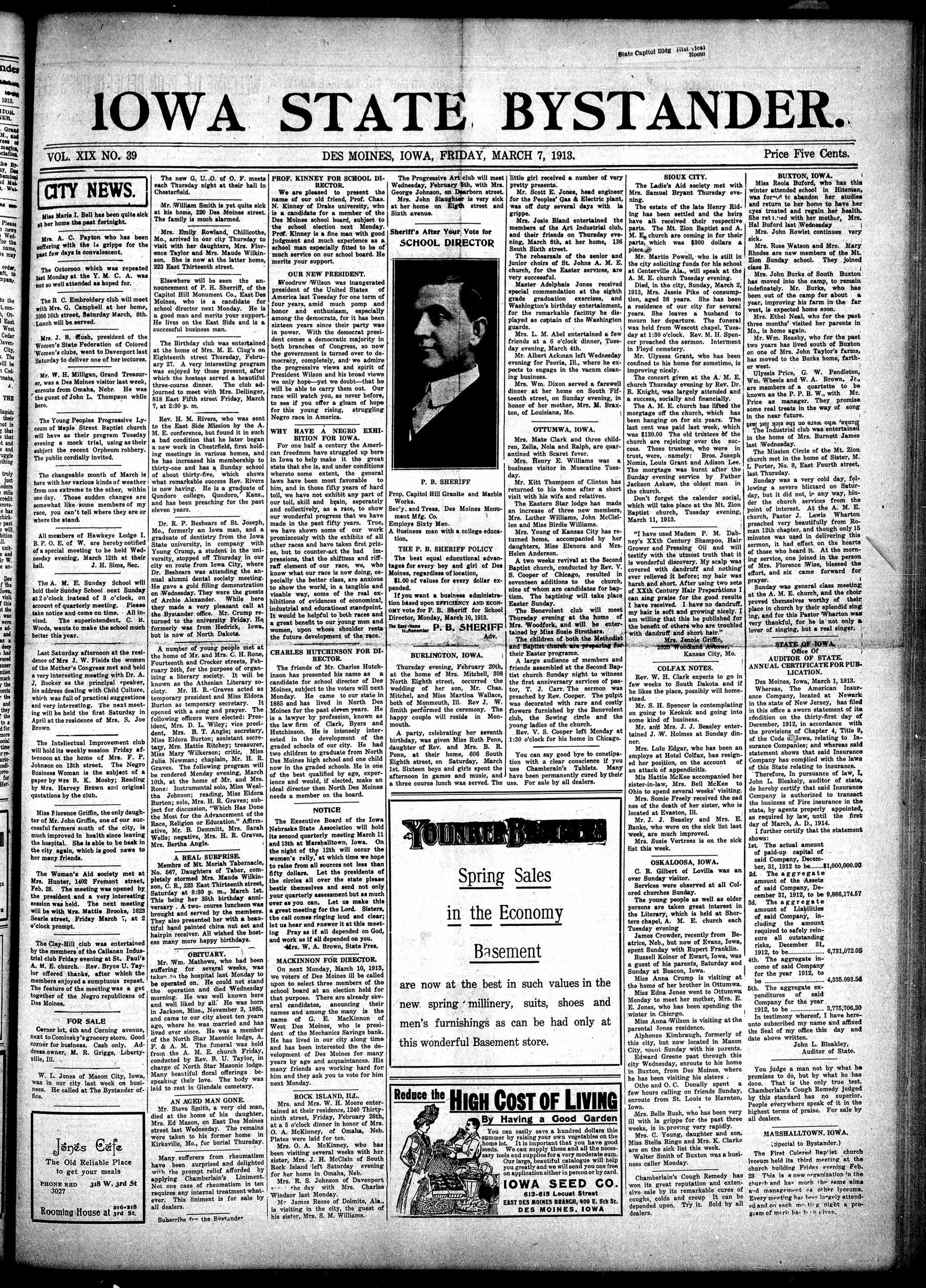
IOWA STATE BYSTANDER.
VOL. XIX NO. 39
CITY NEWS.
Miss Marie I. Bell has been quite sick at her home the past fortnight.
Mrs. A. C. Payton who has been suffering with the la gripe for the past few days is convalescent.
The Octooroon which was repeated last Monday at the Y. M. C. A. was not so well attended as hoped for.
The R. C. Embroidery club will meet with Mrs. C. Campbell at her home, 1066 16th street, Saturday March, 8th. Lunch will be served.
Mrs. J. B. Kush, president of the Women's State Federation of Colored Women's clubs, went to Davenport last Saturday to deliver one of her lectures.
Mr. W. H. Milligan, Grand Treasurer, was a Des Moines visitor last week, enroute from Omaha, Nebr. He was the guest of John L. Thompson while here.
The Young Peoples Progressive Lyceum of Maple Street Baptist church will have as their program Tuesday evening a mock trial, using as their subject the recent Orpheum robbery. The public cordially invited.
The changeable month of March is here with her various kinds of weather from one extreme to the other, within one day. Those sudden changes are somewhat like some members of my race, you can't tell where they are or where the stand.
All members of Hawkeye Lodge I. B.P. O. E. of W. are hereby notified of a special meeting to be held Wednesday evening, March 12th at their hall. J. H. Sims, Sec.
The A. M. E. Sunday School will hold their Sunday School next Sunday at 2 o'clock instead of 3 o'clock, on account of quarterly meeting. Please take notice and come on time. All invited. The superintendent, C. B. Woods, wants to make the school much better this year.
Last Saturday afternoon at the residence of Mrs J. W. Fields the women of the Mother's Congress met and held a very interesting meeting with Dr. A. J. Booker as the principal speaker, his address dealing with Child Culture, which was full of practical suggestions and very interesting. The next meeting will be held the first Saturday in April at the residence of Mrs. S. Joe Brown.
The Intellectual Improvement club will hold its weekly session Friday afternoon at the home of Mrs. F. P. Johnson on 13th street. The Negro Business Woman is the subject of a paper by Mrs B. K. Mosby; Reading by Mrs. Harvey Brown and original quotations by the club.
Miss Florence Griffin, the only daughter of Mr. John Griffin, one of our successful farmers south of the city, is much improved in health since leaving the hospital. She is able to be bask in the city again, which is good news to her many friends.
The Woman's Aid society met at Mrs. Hunter, 1402 Fremont street, Feb. 28. The meeting was opened by the president and a very interesting session was held. The next meeting will be with MATTie Brooks, 1623 Searle street, Friday March 7, at 2 o'clock prompt.
The Clay-Hill club was entertained by the members of the Callanan Industrial club Friday evening at St. Paul's A. M. E. church. Rev. Bryce U. Taylor offered thanks, after which the members enjoyed a sumptuous repast. The feature of the meeting was a get together of the Negro republicans of Des Moines.
FOR SALE
Corner lot, 4th and Corning avenue,
next to Cominaky's grocery store. Good
corner for business. Cash only. Address
owner, M. R. Griggs, Liberty-
ville, Ill.
W. L. Jones of Mason City, Iowa,
was in our city last week on business.
He called at The Bystander office.
Jones Cafe
The Old Reliable Place
to get your meals
PHONE RED 318 W. 3rd St
3027
Rooming House at 316-318
3rd St.
The new G. U. O. of O. F. meets each Thursday night at their hall in Chesterfield.
Mr. William Smith is yet quite sick at his home, 220 Des Moines street. The family is much alarmed.
Mrs. Emily Rowland, Chillicothe, Mo., arrived in our city Thursday to visit with her daughters, Mrs. Florence Taylor and Mrs. Maude Wilkinson. She is now at the latter home, 223 East Thirteenth street.
Elsewhere will be seen the announcement of P. H. Sherriff, of the Capitol Hill Monument Co., East Des Moines, who is a candidate for school director next Monday. He is a good man and merits your support. He lives on the East Side and is a successful business man.
The Birthday club was entertained at the home of Mrs. M. E. Clug's on Eight Street for street Thursday, February 27. A very interesting program was enjoyed by those present, after which the hostess served a beautiful three-course dinner. The club adjourned to meet with Mrs. Dellinger, 818 East Fifth street Friday, March 7, at 2:30 p.m.
Rev. H. M. Rivers, who was sent to the East Side Mission by the A. M. E. conference, but found it in such a bad condition that he later began a new work in Chestfield, first holding meetings in various homes, and he has increased his membership to thirty-one and has a Sunday school of about thirty-five, which shows what remarkable success Rev. Rivers is now having. He is a graduate of Qundoro college, Qundoro, Kans., and has been preaching for the past eleven years.
Dr. R. P. Beshears of St. Joseph, Mo., formerly an Iowa man, and a graduate of dentistry from the Iowa State university, in company with Young Crump, a student in the university, stopped off Thursday in our en route from Iowa City, where Dr. Beshears was attending the annual alumni dental society meeting. He gave a gold filling demonstration on Wednesday. They were the guests of Archie Alexander. While here they made a very pleasant call at the Bystander office. Mr. Crump returned to the university Friday. He formerly was from Hedrick, Iowa, but is now of North Dakota.
A number of young people met on the floor of the Mr. and Mrs. C. H. Rone, fourth and Crocker streets, February 24th, for the purpose of organizing a literary society. It will be known as the Athenian Literary society. Mr. H. R. Graves acted assistant president and Mrs. Miss Eldora Burton as temporary secretary. It opened with a song and prayer. The following officers were elected: President, Mrs. D. L. Wiley; vice president, Mrs. B. T. Angle; secretary, Miss Eldora Burton; assistant secretary, Mrs. Hattie Ritchey; treasurer, Miss Mary Wilkerson; critic, Miss Julia Newman; chaplain, Mr. H. Graves. The following program will be rendered Monday in March 10th, at the home of Mr. and Mrs. Rone: Instrumental solo, Miss Wealtha Johnston; reading, Miss Eldora Burton; solo, Mrs. H. R. Graves; sub-m for discussion, "Which Has Done the Race, Religion or Education." Affirmative, Mrs. B. Denmitt, Mrs. Sarah Wells; negative, Mrs. H. R. Graves, Mrs. Bertha Angle.
A REAL, SURPRISE.
Members of Mt. Moriah Tabernacle, No. 567, Daughters of Tabor, completely stormed Mrs. Maude Wilkinson, C. R. 228, East Thirteenth street, Saturday at 8:30 p. m., March 1st. This being her 35th birthday anniversary, a two-course luncheon was brought and served by the members. They also presented her with a beautiful hand painted china nut set and hairpin receiver. All wished the hostess many more happy birthdays.
OBITUARY.
Mr. Wm. Mathews, who had been suffering for several weeks, was taken in the hospital last Monday to be operated on. He could not stand the operation and died Wednesday morning. He was well known here and well liked by all'. He was born in Jackson, Miss., November 3, 1865, and came to our city about ten years ago, where he was married and lived ever since. He was a member of the North Star Masonic lodge, A. F. & the Funeral was held for the North Star Masonic lodge, produced by Rev. B. U. Taylor, in charge of North Star Masonic lodge. Many beautiful floral offerings bespeaking their love. The body was laid to rest in Glendale cemetery.
AN AGED MAN GONE.
Mr. Steve Smith, a very old man, died at the home of his daughter, Mrs. Ed Mason, on East Des Moines street last Wednesday. The remains were taken to his former home in Kirksville, Mo., for burial Thursday.
Many sufferers from rheumatism have been surprised and delighted with the prompt relief afforded by applying Chamberlain's Limestone. Not one case of rheumatism can require any internal treatment whatever. This limestone is for sale by all dealers.
Subscribe for the Rvetander
PROF, KINNEY FOR SCHOOL DIRECTOR.
We are pleased to present the name of our old friend, Prof. Chas. N. Kinney of Drake university, who is a candidate for a member of the Des Moines school board, subject to the school election next Monday. The school board will with good judgment and much experience as a school man especially fitted to be of much service on our school board. He merits your support.
OUR NEW PRESIDENT.
Woodrow Wilson was inaugurated president of the United States of America last Tuesday for one term of four years, amid much pomp and honor and enthusiasm, especially among the democrats, for it has been sixteen years since their party was in power. With the democrat president comes a democratic majority in both branches of Congress, so now the government is turned over to democracy, completely, and we admire the progressive views and spirit of President Wilson and his broad views we only hope—yet we doubt—that he will be able to carry them out. Our race will watch you, as never before, to see if you offer a glam of hope for this young rising, struggling Negro race in America.
WHY HAVE A NEGRO EXHIBITION FOR IOWA.
For one half a century the American freedman have struggled up here in Iowa to help make it the great state that she is, and under conditions wheter some extent, the general laws have been most favorable to him, and in those fifty years of hard toil, we have not exhibit any part of our toil, skill and brain, separately and collectively, as a race, to show our wonderful progress that we have made in the past fifty years. True, we have shown some of our work promiscuously with the exhibits of all other races and have taken first prizes, but to counter-act the bad impressions, that the shiftness and riff-raff element of our race, we, who know what our race is now doing, especially the better class, are anxious to show the world, in a tangible and visible way, some of the real exhibitions of evidences of economical, industrial and educational standpoint. It would be helpful to both races and a great benefit to our young men and women, upon whose shoulder rests the future development of the race.
CHARLES HUTCHINSON FOR DI-
PECTOR.
The friends of Mr. Charles Hutchinson has presented his name as a candidate for school director of Des Moines, subject to the voters will next Monday. He came to our state in 1885 and has lived in North Des Moines for the past eleven years. He is a lawyer by profession, known as the law firm of Clark, Byers and Hutchinson. He is intensely interested in the development of the graded schools of our city. He had two children to graduate from North Des Moines high school and one child now in the graded schools. He is one of the best qualified by age, experience and would, if elected, make an ideal director then North Des Moines needs a member on the board.
NOTICE
The Executive Board of the Iowa Nebraska State Association will hold its second quarterly meeting March 11 and 13th at Marshalltown, Iowa. On the night of the 12th will occur the women's rally, at which time we hope to raise from all sources not less than fifty dollars. Let the presidents of the circles all over the state please bestir themselves and send not only your quarterly assessment but as much over as you can. Let us make this a great meeting for the Lord. Sisters, the call comes ringing loud and clear; let us hear and answer it at this meeting. Pray as if all depended on God, and work as if all depended on you.
Mrs. W. A. Brown, State Pres.
MACKINNON FOR DIRECTOR
On next Monday, March 10, 1918, we voters of Des Moines ill be called upon to select three members of the school board at an election held for that purpose. There are already several candidates, anouncing their names and among the many is the name G. E. MacKinnon of Des Moines, who is president of the mechanics banks bank. He has lived in our city along time and has been interested the development of Des Moines for many years by age and acquaintances. His many friends are working hard for him and they ask you to vote for him next Monday.
ROCK ISLAND, ILL.
Mrs. and Mrs. W. H. Moore entertained at their residence, 1240 Thirtyninth street, Friday, February 28th, at a 5 o'clock dinner in honor of Mrs. O. A. McKinney of Omaha, Neb. Plates were laid for ten.
Mrs. O. A. McKinney, who has been visiting several weeks with her sister, Mrs. J. H. McClain of South Rock Island left Saturday evening for her home in Omaha, Neb.
Mrs. R. S. Johnson of Davenport sheed the day with Charles Windsor last Monday.
Mr. James Reese of Dolmite, Ala., is visiting in the city, the guest of his sister, Mrs. S. M. Williams.
are now at the best in such values in the new spring millinery, suits, shoes and men's furnishings as can be had only at this wonderful Basement store.
Reduce the HIGH COST OF LIVING
By Having a Good Garden
You can easily save a hundred dollars this summer by raising your own vegetables on the home lot. It is important that you have good needs. We can supply these and all the necessary tools and supplies for a very moderate sum.
Our large, beautiful catalogue will help you greatly and we will send you one free on application either in person or by card.
IOWA SEED CO.
613-815 Locust Street
EAST DES MOINES BRANCH, 400 E. 5th St.
DES MOINES, IOWA
The Progressive Art club will meet Wednesday, February 5th, with Mrs. George Johnson, on Dearborn street. Mrs. John Slaughter is very sick at her home on Eighth street and Sixth avenue.
Sheriff's After Your Vote for SCHOOL DIRECTOR
P. B. SHERIFF
Prop, Capitol Hill Granite and Marble Works.
Sec'y. and Treas. Des Moines Momument Mfg. Co.
Employs Sixty Men.
A Business man with a college education.
THE P. B. SHERIFF POLICY
The best equal educational advantages for every boy and girl of Des Moines, regardless of location, $1.00 of values for every dollar expended. If you want a business administration based upon EFFICIENCY AND ECONOMY vote for P. B. Sheriff for School Director, Monday, March 10, 1913.
BURLINGTON. IOWA.
Thursday evening, February 20th, at the home of Mrs. Mitchell, 308 North Eighth street, occurred the wedding of her son, Mr. Chas, Mitchel, and Miss Martina Wallace, both of Monmouth, Ill. Rev J. W. Smith performed the ceremony. The happy couple will reside in Monmouth.
A party, celebrating her seventh birthday, was given Miss Ruth Penn, daughter of Rev. and Mrs. B. R. Penn, at their home, 606 South Eighth street, on Saturday, March 1st. Sixteen boys and girls spent the afternoon in games and music, and a three course lunch was served. The
little girl received a number of very pretty presents.
Mr. Scott E. Jones, head engineer for the People's Gas & Electric plant, was off duty several days with la gripe.
Mrs. Josie Bland entertained the members of the Art Industrial club, and their friends on Thursday evening, March 6th, at her home, 136 South Sixth street.
The rehearsals of the senior and junior chairs of St. John A. M. E. church, for the Easter services, are very successful.
Master Adelphais Jones received special commendation at the eight grade graduation exercises, and Washington's birthday entertainment, for the remarkable facility he displayed as captain of the Washington guards.
Mrs. L. M. Abel entertained a few friends at a 6 o'clock dinner, Tuesday evening, March 4th.
Mr. Albert Ackman left Wednesday evening for Peoria, Ill., where he expects to engage in the vacuum cleaning business.
Mrs. Wm. Dixon served a farewell dinner at her home on South Fifteenth street, on Sunday evening, in honor of her mother, Mrs. M. Braxton, of Louisiana, Mo.
OTTUMWA, IOWA
Mrs. Mate Clark and three children, Zella, Nola and Kalph, are quarantined with Scaret fever. Mrs. Henry E. Williams was a business visitor in Muscatine Tuesday. Mr. Kitt Thompson of Clinton has returned to his home after a short visit with his wife and relatives. The Eastern Star lodge has made an increase of three new members. Mrs. Luther Williams, John McClellen and Miss Birdie Williams. Mrs. Young of Kansas City has returned home, accompanied by her daughters, Miss Elenora and Mrs. Helen Anderson. A two weeks revival at the Second Baptist church, conducted by Rev. V. S. Cooper of Chicago, resulted in seventeen additions to the church, nine of whom are candidates for baptism. The baptising will take place Easter Sunday. The Benevolent club will meet Thursday evening at the home of Mrs. Woodford, and will be entertained by Miss Susie Strotheris. The children of both the Methodist and Baptist church are preparing for their Easter program. A large audience of members and friends assembled at the Second Baptist church Sunday night to witness the anniversary services of pastor. T. J. Carr. The sermon was pached by Rev. Cooper. The pulpit was decorated with rare and costly flowers furnished by the Benevolent club, the Sewing club and the couple ladies of the church.
Rev. V. S. Cooper left Monday at 1:30 o'clock for his home in Chicago.
You can say good bye to constipation with a clear conscience if you use Chamberin's tablets. Many have been permanently cured by their use. For sale by all dealers.
State Capitol Bldg Historical Room
SIOUX CITY.
The Ladie's Aid society met with Mrs. Samuel Bryant Thursday evening.
The estate of the late Henry Riding has been settled and the heirs have all received their respective parts. The Mt. Zion Baptist and M. E. church are coming in for their parts, which was $300 dollars a piece.
Mr. Martin Powell, who is still in the city soliciting funds for his school at Centerville Ala., will speak at the A. M. E. church Tuesday evening.
Died, in the city, Sunday, March 2, 1913, Mrs. Jessie Pike of consumption, aged 38 years. She has been a residence of our city for several years. She leaves a husband to mourn her departure. The funeral was held from Wescott chapel, Tuesday at 1:30 o'clock. Rev. M. H. Spencer called the sermon. Interment in Fleyd cemetery.
Mr. Ulysses Grant, who has been confined to his home for sometime, is improving nicely.
The concert given at the A. M. E. church Thursday evening by Rev. Dr. R. Knight, was largely attended and a success, socially and financially.
The A. M. E. church has lifted the mortgage off the church, which has been hanging on for six years. The last cent was paid last week, which was $130.00. The old trustees of the church are rejoicing over the success. Those trustees, who were in trust, were, namely: Bros. Joseph Nomis, Louis Grant and Adison Lee. The mortgage was burnt after the Sunday evening service by Father Jackson Askew, the oldest man in the church.
Don't forget the calender social, which will take place at the Mt. Zion Baptist church, Tuesday evening, March 11, 1913.
"I have used Madam P. M. Dabney's XXth Century Shampoo, Hair Grower and Pressing Oil and will testify with the utmost truth that it is wonderful discovery. My scalp was covered with dandruff and nothing ever relieved it before; my hair was harsh and short. After using two sets of XXth Century Hair Preparations I can sing praise for the good results I have received. I have no dandruff, my hair is soft and growing nicely. I am willing that this be published for the benefit of others who are troubled with dandruff and short hair."
Mrs. Jennie Griffin,
2820 Woodland Avenue
Kansas City, Mo.
COLFAX NOTES.
Rev. W. H. Clark expects to go in few weeks to South Dakota and if he likes the place, possibly will home-stead.
Mr. S. H. Spencer is contemplating on going to Keokuk and going into some kind of business.
Mr. and Mrs. J. J. Beasley entertained J. W. Holmes at Sunday dinner.
Mrs. Lulu Edgar, who has been an employee at Hotel Colfax, has resigned her position, on the account of an attack of appendicitis.
Miss Hattie McKee accompanied her sister-in-law, Mrs. Bob McKee to Ohio to spend several weeks visiting. The sad of the death of her sister, who is located at Evason, ill.
Mr. J. J. Beasley and Mrs. E. Banks, who were on the sick list last week, are much improved.
Mrs. Susie Vertrees is on the sick list this week.
OSKALOOSA IOWA.
C. R. Gilbert of Lovilla was an over Sunday visitor.
Services were observed at all Colored churches Sunday.
The young people as well as older persons are taken great interest in the Literary, which is held at Shorters church, A. M. E. church each Tuesday evening
James Crowder, recently from Beatrice, Neb., but now of Evans, Iowa, spent Sunday with Rupert Franklin.
Russell Koiner of Ewart, Iowa, was a guest of his parents, Saturday and Sunday at Beacon, Iowa.
Miss Anna Crump is visiting at the home of her brother in Ottumwa.
Miss Edna Jones went to Ottumwa Monday to meet her mother, Mrs. E. E. Jones, who has been spending the winter in Chicago.
Miss Anna Wilson is visiting at the parental Jones residence.
Alphonzo Kimbraugh, formerly of this city, but now located in Mason City, spent Sunday with his parents.
Edward Greene past through this city Wednesday, enroute to his home in Buxton, from Des Moines, where he has been visiting his sisters.
Otho and O. C. Donally spent a few hours calling on friends Sunday, enroute from St. Louis to Harton, Iowa.
Mrs. Belle Bush, who has been very ill with la gripe for the past three weeks, is in proving very rapidly.
Mrs. C. Young, daughter and son, Miss Stella Ringo and Mrs. K. Clarke are on the sick list this week.
Walter Smith of Buxton was a business caller Monday.
Chamberlain's Cough Remedy has won its great reputation and extensive sale by its remarkable cures of coughs, colds and croup. It can be depended upon. Try it. Sold by all dealers.
DER. Price Five Cents.
Miss Reola Burford, who has this winter attended school in Hiteman, was forct to abandon her studies and return to her home to have her eyes treated and regain her health. She ret;ed with her mother, Mrs. Hal Buford last Wednesday. Mrs. John Rowlet continues very sick. Mrs. Rose Watson and Mrs. Mary Rhodes are new members of the Mt. Zion Sunday school. They joined class B. Mrs. John Burks of South Burton has moved into the camp, to remain indefinitely. Mr. Burks, who has been out of the camp for about a year, improving his farm in the far west, is expected home soon. Mrs. Ethel Neal, who for the past three months' visited her parents in Mo., is home again. Mr. Wm. Reasby, who for the past two years has lived south of Burton on one of Mrs. John Taylor's farms, has moved to the Burton home, farther west. Ulysis Price, G. W. Pendleton, Wm. Wheels and W. A. Brown, Jr., are members of a quartette to be known as the P. P. B. W., with Mr. Price as manager. They promise some real treats in the way of song in the near future. 259 spis spis no oem oem oem 'sung The industrial club was entertained in the home of Mrs. Burnett James last Wednesday. The Mission Circle of the Mt. Zion church met in the home of Sister, M. L. Porter, No. 8, East Fourth street, last Thursday.
Sunday was a very cold day, following a severe blizzard on Saturday, but it did not, in any way, wander the church services from the point of interest. At the A. M. E. church, Pastor J. Lewis Wharton preached very beautifully from Roman 12th chapter, and though only 15 minutes was used in delivering this sermon, it had effect on the hearts of those who heard it. At the morning service, one joined in the person of Mrs. Florence Wise, blessed the effort, and six came forward for prayer.
Sunday was general class meeting at the M. E. church, and the choir proved themselves worthy of their place in church by their splendid singing, and for this Pastor Wharton was very thankful, for he is not only a lover of singing, but a real singer.
STATE OF JOWA
Office Of
AUDITOR OF STATE.
ANNUAL CERTIFICATE FOR PUBLICATION.
Des Moines, Iowa, March 1, 1913.
Whereas, The American Insurance Company, located at Newark in the state of New Jersey, has filed in this office a sworn statement of its condition on the thirty-first day of December, 1912, in accordance with the provisions of Chapter 4, Title 9, of the Code of laws relating to Insurance Companies; and whereas said statement shows that said Insurance has complied with the laws of this State relating to insurance.
Therefore, In pursuance of law, I John L. Bleakley, auditor of state, do hereby certify that said Insurance Company is authorized to transact the business of Fire insurance in the state, by agents properly appointed, as required by law, until the first day of March, A. D., 1914.
I further certify that the statement shows:
ber 31, 1912 to be
2d. The aggregate
amount of the Assets
of said Company, Dia-
sper.
member 31, 1912, to be
3d. The aggregate
amount of Liability
of said Company,
including the amount
required to safely re-
sure all outstanding
risks, December 31,
1912, to be
4th. The aggregate
income of said Company
for the year 1912, to be
1912, to be ..... 3,775,706.20
In testimony whereof, I have here-
unto subscribed my name and affixed
the Seal of my office this day and
date above written.
You judge a man not by what he promises to do, but by what he has done. That is the only true test. Chamberlain's Cough Remedy judged by this standard has no superior. People everywhere speak of it in the highest terms of praise. For sale by all dealers.
MARSHALLTOWN, IOWA
(Special to Bygander)
The First Colored Baptist church lyeum held its third meeting at the church building Friday evening Feb. 28. This is a new organization in the church and has much the same aim and management as other lyeums. Every meeting has been largely attended and on each meeting night a program of merit has been given.
Doctor's Prescription Started Home-Loving Woman, but There Was Much Good Sense in it.
"Why don't you get out more?" insisted the doctor, and though the patient shuddered, he kept right on insisting. "You are never going to get well unless you go about, and, mind this, unless you learn to stand people, live with them, talk to them, divide with them, enjoy them."
"People," moaned, the patient, "will tell you anything but to write stories about. And as for talk, I always know what they are going to say before they say it."
"You only think you do. Shake yourself together and get out and put the thing to proof. You've got to do it sooner or later. There soon isn't going to be any room in the world for the woman who wants to sit in her own little corner with a high fence around it, writing, painting, mothering. One by one they are coming out, house-mothers, poets, artists, owes something in outside service. And you needn't lie there and shake as if your case were special. All the other women have just the same spiritual timidity and physical lethargy to overcome that you have. Every other innately home-keeping woman who makes the least little venture into social service of any kind knows how like the breaking up of a great river, when the spring thaw is on, in the arousing, how tradition holds hands with the workers and lines of frogs; it is to connect up with the workers already in the field. There is nothing special in your case, madness, unless you make it special by holding back when the others are coming on."
"Oh, do hush," said the patient, "or
you know I will be coming
along."
Caught In His Own Trap.
A plain clothes liquor enforcement officer, destroys of catching a violator of the prohibition law, approached a suspicious looking individual on a downtown street one morning, and said in low tones: "Say, pard; could yer tell a feller what's alr'd dry whean he gink a dilt a red-eye" The suspicious looking individual would look could indicate, thought a minute and replied that liquor was pretty scared, and that he couldn't tell him a thing, but if he really needed a drink, he could get him a bottle for $2, provided he would await his return in a very few minutes. The officer accepted. The suspicious looking individual exhibited a shoe box to the officer, with the response. You may be held for more than a security for the $2 until my return."
He made his departure. The officer was complimenting himself on his own cunningness. A half hour elapsed and the stranger had not returned, whereupon the officer opened the shoe box, and to his utter amazement disdain for the glistening quart of whisky, but the "worse guy" was nowhere to be found.—Exchange
Conclusive Proof.
Magistrate—And what was the prisoner doing?
Constable—'E' were 'avin' a very 'eated argument with a cab driver, yer worship.
Magistrate—But that doesn't prove he was drunk.
Constable—Ah! But there wont no cab driver there, yer worship—London Opinion.
Can You Beat It?
Howard Chandler Christy was giving a dinner one evening at Martin's in honor of a number of famous artists, Friolity prevailed, and soon the conversation turned to art.
Said one of them: "The other day I painted a little deal board in imitation of marble with such accuracy that, on being thrown into the water, it immediately sank to the bottom." "Baugh!" said another. "Yesterday it was the thermometer on the easel supporting my view of the polar region. It fell an once 20 degrees below freezing point."
"All that is nothing," remarked the third artist, in conclusion. "My portrait of a prominent New York millionaire was so lifelike that it had to be shaved twice a week."
Two Versions.
"Mrs. Potkin speaks of the fashionable Mrs. Swashby as 'My dear friend, Mrs. Swashby,'"
"And how does Mrs. Swashby speak of Mrs. Potkin?"
"She refers to her as 'Mrs.—er—what in the world is that woman's name?'
After hearing a description of the riotous scenes that had attended one of the recent international weddings in New York the countess of Aberdeen said at a tea: "I understand now a joke an American once cracked at my house. He was telling me about a New York wedding, and I said: "Was it a fashionable one?"
"Oh, very fashionable, he answered.
The bride's dress was torn on
He Knew.
"Richard doesn't know his letters very well," explained his mother to the school teacher, "but he's very quick at learning figures." "What is dear," asked the teacher, pointing to the letter B. "Dat." replied Richard proudly, "is a 13 jammed togodor."
Volunteer Aid:
"James, there's a burglar, down stairs. I'm going for help." "Wait a minute. I'll go with you."—Harper's
---
INCREASE IS SHOWN
Admissions to Benevolent Institutions Make Gains.
Figures in Report of the Census Bureau Show That Millions Were Carried For—Placing Out of Children in Families Noted.
Washington.—A special report on benevolent institutions in continental United States is in course of preparation by the bureau of the census, connection with the thirteenth census, and preliminary figures, with certain details to inmates of these institutions, have just been issued by order of Director E. Bana Durand. These figures are subject to revision, but are substantially correct.
The total number of institutions reported is 5,397, classified as follows: institutions for the care of children, 1,152; societies for the protection and care of children, 212; institutions for the care of adults and children, 1,442; institutions for the education and care of the blind and deaf, 119; hospitals, classed as benevolent, 1,896, and dispensaries, as benevolent, 578.
In these institutions, or under their care, there were at the close of the year, 380,237 persons, apportioned as follows: Institutions for children, 107,401; societies for the protection and care of children, 35,279; institutions for adults or adults and children, 121,876; institutions for the blind and deaf, 651; hospitals, 28,869. The movement of inmates during the period dedicated by the fact that 82,011 children were received into institutions, while 37,828 were placed in families or institutions, mostly in families, and children, 2,554 into institutions for their care, 788,694 persons were received into institutions for adults or adults and children, and 2,554 into institutions for the blind and deaf, 1,975,838 patients were treated in hospitals, and 2,439,059 in dispensaries.
As compared with the previous report, that for 1904, the number of institutions reported shows an increase of 1,346 (day nurseries, of which 168 were reported in 1904, were not included in 1910) inmates of institutions at close of year, an increase of 95,975 children received into institutions during the year, an increase of 11,185 patients treated in hospitals, an increase of 911,236, and in dispensaries, of 827,408. There was a decrease of 109,319 in the number of residents in institutions for adults or adults and children, and of 4,471 in the number received into institutions for the blind and deaf.
Whether the increase- indicates greater need or greater care and more complete provision is a question which must await a more careful study of the question, as also the question as to the decrease. Two items are of special interest, the collection for the first time of data in regard to the placing out of children in families, and the notably increased interest manifested in the treatment of tuberculosis, which accounts to a very considerable degree for the increase in the number of dispensaries and to some degree of hospitals and sanitariums. Thus the net number of dispensaries added to the list is 402,3 nearly 200 are county dispensaries established in the county of Pennsylvania by the department of health for the treatment of tuberculosis. The deserves of 109,319 in the number of persons received into institutions for the care of adults or adults and children is chiefly confined to institutions for the temporary care of men who are destitute.
Noting the distribution of institutions in the states, it appears that New York leads with 797, an increase of 200 over the figures in 1904; Pennsylvania has 692, an increase of 301; Massachusetts, 359, an increase of 104; Illinois, 324, an increase of 39; Ohio, 311, an increase of 52, and New Jersey, 207, an increase of 58.
The eternal feminine still rules the hearts of enlisted men in the navy and marine corps in their role of a coaling design of the tattooed design for their personal adornment. Surgeon Ammen Farenholt of the navy, who has made some interesting researches in the subject, finds that one man in three, both in the navy and the marine corps, selects a decoration, part of which represents a female figure.
Surgeon Farenholt finds that after enlistment the sailorman acquires tattooing more frequently than the marine, the percentage being 53 to 25; that tattooing is about as prevalent in the army as in the marine corps, and that the character of the designs shows a remarkable similarity and a continuance of choice in unchanged channels.
"Several of the more strictly deepsees and time-honored patterns," said Surgeon Farenholt, "were rarely meet. The Jerusalem cross and the pig on the dorsum of the foot were not seen; crosses, crucifixes, Neptune, mermaids and the tombstone, weeping willow. In Memory of My Mother, once so common, appeared in diminishing numbers. Bracelets, knots and tattooning on exposed parts are also disappearing. The significance and superstition of many of these marks are rapidly becoming lost, as we have had the gold carrings of the palmet and the tapauline in the ancient mariner, and the conventional book designs of the professional tattooer are more in selection. A certain levity in selection, which the old tar would certainly dominate, is often seen—for example,
Judge Goggin of Chicago had before him a negro who was accused of fraud by means of voodooism. In a complaint to the grand jury several of his race had said that the doctor had milked them. He claimed the power to exorcise a devil and cast it into a dog. Then by way of crossing the dog the discomflement of the devil was to complete the doctor tried this on a South side circle, collected and came to grief.
the Karenjammer kid, Happy Hooligan, tennis rackets, bat and balls, glasses of beer, socks, etc. The influence of Japanese work is increasingly noticed; dragons, flowers, butterflies, animals and Japanese women are very common. No evidence of infection or the transmission of disease was noticed."
"The Growing" was the subject of a lecture to the blind, delivered in the National Library for the Blind the other day by Dr. T. Galloway, chief of the bureau of plant industry of the department of agriculture.
Clippings and seeds of tea plants were distributed among his audience for their inspection. Dr. Galloway also passed around a Japanese team-making device and a teacup.
Dr. Galloway said that there were just three sorts of teas, black and green and oolong. The excess of fomentation, arrested at the exquisite moment of perfection. Green tea is unfomented. Oolong is partially fermented.
There are 250,000,000 cups of tea drunk in a year in the United States, about one pound to each individual, England, he said, is the great tea-drinking nation of the occidental world. The tea-raising industry in Ceylon, Java, Japan and China was described. The development of a thousand or more years of culture in these tea gardens afforded an interesting topic of descriptions. The government in the United States on the estate developed by Dr E. S. Shepard of South Carolina, who never saw tea grown in the countries where it came from, gave Dr Galloway opportunity to describe an American industry which may become important.
Big Field Day For Charles.
ways and means committee room in the house office building while the tariff is being slaughtered inside, had a great field day a few days ago. It was the date of the hearing on the tobacco schedule, and the men who were pleading with the committee represented enough smoking material to satisfy a world of smokers. Nicotine had her ambassador there, where all carried samples of their goods. At the doorway they had tossed half-smoked Havanas worth a half dollar apiece in such abandoned recklessness that the most barefaced "snipie hunter" would have fainted from sheer joy. There seemed to be $5 worth of fhavanas lying there in a state of neglect.
As for Charles, he was a human tobacco shop. His pockets bulged with fine, big black after-dinner cigars, little light ones, perfectes and sizes. On the other shapes and sizes. On the whole day was a great day. The whole day are all the other hearings are as profitable to Charles as that one was he will be supplied with food, clothes, glassware, jewelry, perfumery and everything else for the rest of his life.
The common finger bowl was officially put under the band by the Unit
his report that the finger bowl in common use in hotels and restaurants is removed only a degree from the common drinking cup, and that diseases are transmitted to patrons in even the high-class restaurants. His observations were taken in New York, Philadelphia and Washington, where he says a few finger bowls do service for many patrons, and only occasionally is fresh water poured into them.
Big Checks Are Safe
"Uncle Ike" Stephenson demonstrated to some of the employees in the senate that a man with a check for $1,500,000 is more immune from robbery than a man with five dollars. Senator Stephenson, who is said to be the richest man in the senate, and who loves to talk about his money, showed some of the gaping senate employees a check for $1,500,000. It was in payment of lumber and timber lands sold to a Louisiana company. It appeared Uncle Ike had carried the check several days. One employee protested that he was too careless with it and was likely to lose it.
"What if I did?" asked the lumberman. "Nobody could cash it." This is the biggest draft seen about the capitol since the 1970s years ago, when Ganaway Davis displayed for $7,000,000. He had just sold a railroad.
Last of the Species.
In one of the suburbs of Washington there is a lone tree, known among botanists as Gordonia, which is one of the last remnants of a dying race. This tree, with small white flowers, makes a good shade tree, and there used to be a good many of them in the south. But they have all disappeared except the two in a few in the Philadelphia park. The government is interested in the tree and preparations are being made to save and propagate the species.
Metallic Sponge Invented
A Danish scientist, M. Hannover, has invented a metallic sponge, which has recently come into industrial use. It is composed of an alloy of lead and antimony, and consist of a loose meshed network inclosing spaces of larger or smaller size. It is employed for absorbing resin, oil, etc.
When arraigned the judge said to him:
"So you say you have these supernatural powers, do you?" The coon responded quickly. "Yes, yo' hono," he exclaimed. "Ah could throw yo' into a trance right in this heath cote-room. And he made a couple of prelude passages to the trouble, me bucko," answered the judge. "Never mind me. Throw the jury into a trance or they'll be throwing you into the penitentiary, I'm thinking."
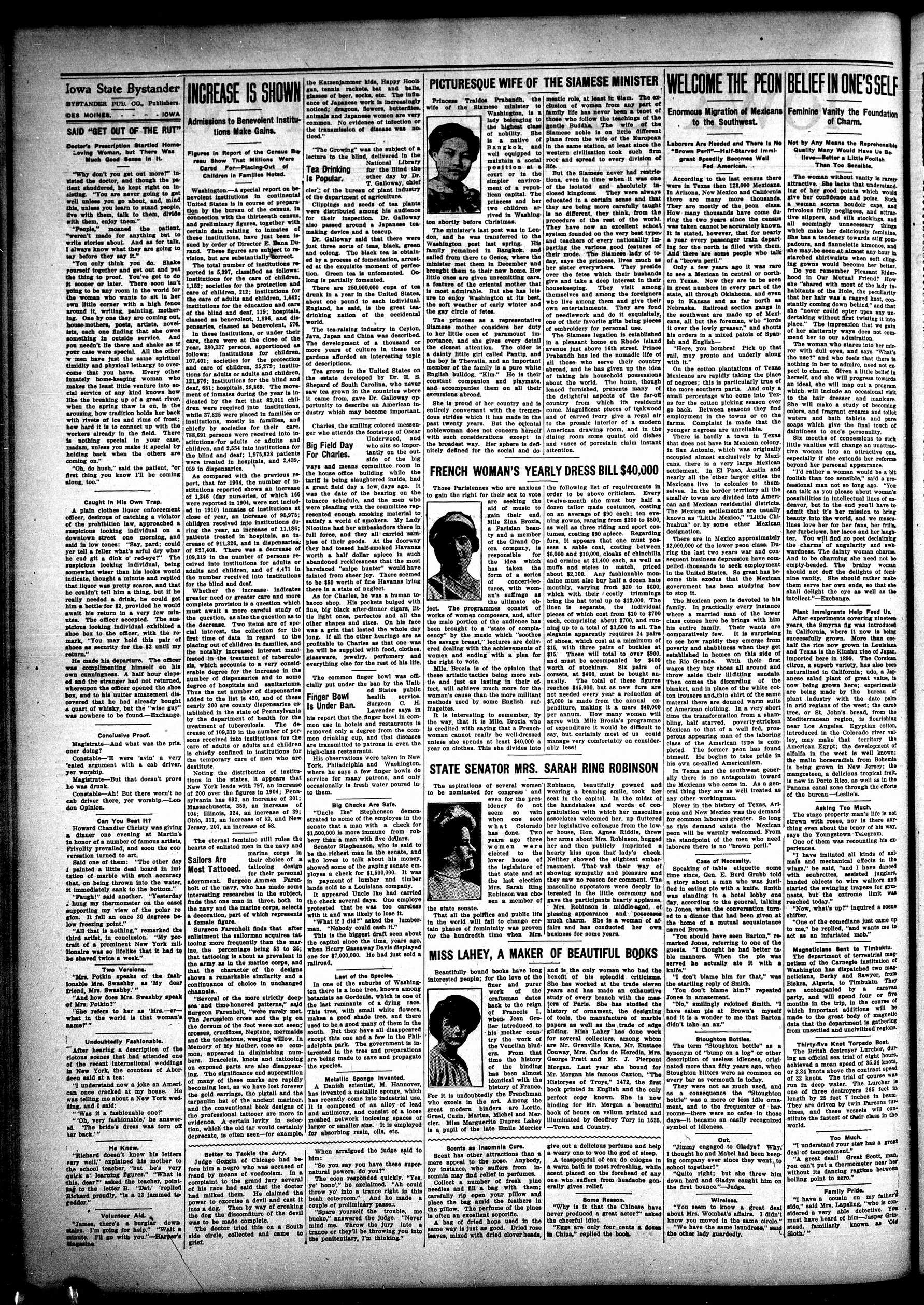
PICTURESOUE WIFE OF THE SIAMESE MINISTER
FRENCH WOMAN'S YEARLY DRESS BILL $40,000
STATE SENATOR MRS. SARAH RING ROBINSON
MISS LAHEY, A MAKER OF BEAUTIFUL BOOKS
---
Princess Traidos Prabandh, the wife of the Simmees minister to
Washington, is a lady belonging to the highest class of nobility. She is a native of Bangkok, and well equipped to maintain a social position at a court or in the simpler environment of a republican capital. The princess and her two children are raised in Washington.
Washington, in lady belonging to the nobility, class of nobility. She is a native of Bangkok, and well equipped to maintain a social position at a court or in the simpler environment of a republican capital. The princess and her two children are arrived in Washington shortly before Christmas.
The minister's last post was in London, and he was transferred to the Washington post last spring. His family remained in Bangkok, and sailed from there to Genoa, where the minister met them in December and brought them to their new home. Her little ones are given a feature of the oriental mother that is most admirable. But she has less urge to enjoy Washington at its best, the soft weather of early winter and the gay circle of fetes.
The princess as a representative Stamase mother considers her duty to her little ones of paramount importance, and she gives every detail the closest attention. The older is a dainty little girl called Pantip, and the boy is Thevatia, and an important member of the family is a pure white English bulldog, "Kim." He is his constant companion and playmate, and accompanies them on all their excursions abroad.
She is proud of her country and is entirely conversant with the tremendous strides which it has made in the past twenty years. But the oriental noblewoman does not concern herself with such considerations except in the broadest way. Her sphere is definitely defined for the social and do
Those Parisiennes who are anxious to gain the right for their sex to vote
are seeking the aid of music to gain their end. Mille Zina Broxia, a Parisian beauty, a grandmother of the Grand Opera company, is responsible for the idea which has taken the form of a series of curioses, with woman's suffrage as the ob-
aid of music to gain their end. Mille Zina Brozia, a Parisian beauty and a member of the Grand Opera company, is responsible for the idea which has taken the form of a series of concert-lectures, with woman's suffrage as the ultimate object. The programmes consist of works of women composers, and, after the male portion of the audience has been brought to a "state of compaency" by the music which "soothes the愁脏 breast" and ended dealing with the achievements of women and ending with a plea for the right to vote.
Mile. Brozia is of the opinion that these artistic tactics being more subtle and just as lasting in their effect, will achieve much more for the woman's cause than the more militant methods used by some English fragrettes. In interesting to remember, by the way that it is Mile. Brozia who is credited with saying that a Frenchwoman cannot really be well-dressed unless she spends at least $40,000 a year on clothes. This she divides into
of several women for congress and even for the presidency do not seem so vain when one comes a colorado has done. Two years ago three women were elected to the lower house of the legislature of that state and at the same time Mrs. Sarah Ring Robinson was chosen a member of
The aspirations of several women to be nominated for congress and even for the presidency do not seem so vain when one sees what Colorado has done. Two years ago three women were elected to the lower house of the legislature of that state and at the last election Mrs. Sarah Ring Robinson was chosen a member of the state senate. That all the politics and public life in the world will fall to change certain phases of femininity was proven for the hundredth time when Mrs.
Beautifully bound books have lon interested people; for the love of the
finer and purer work of the craftsman than the retires of Francis I, when Jean Grolier introduced to his mother country the work of the Venetian bluders. From that time the bluders the binding has been almost identical with the history of France.
work of the craftman dates back to the reign of Francis I. when Jean Grolier introduced to his mother country the work of the Venetian binders. From that time the history of the binding has been almost identical with the history of France. For it is undoubtedly the Frenchman who excels in the art. Among the great modern binders are Lortic, Gruel, Cuzin, Marius, Michel and Mercier. Miss Marguerite Duprez Lahey is a pupil of the late Emile Mercier
Scents as insomnia Cure.
Scent has other attractions than a mere appeal to the nose. Anybody, for instance, who suffers from insomnia may find relief in perfumes.
Collect a number of fresh pine needles and fill a bag with them; carefully rip open your pillow and place the bag amid the feathers in the pillow. The perfume of the pine is often an excellent product. Dried rose leaves are also used in the same way is just as good. Dried rose leaves, mixed with dried clover heads,
mentic role, at least in Siam. The exclusion of women from any part of family life has never been a tense of those who follow the teachings of the gentle Buddha. The wife of the Siamese noble is on little different plane from the wife of the European in the same station, at least in western civilization took such firm rest and spread to every division of life.
But the Slamese never had restrictions, even in time when it was one of the isolated and absolutely inclosed kingsdoms. They were always educated in a certain sense and that they are being more carefully taught is no different, they think, from the procedure of the rest of the result. They have now an enormous system for collecting every best type of material from all the nationality imparting the various good features of their mode. The Slamese lady of today, says the princess, lives much as her sister everywhere. They preside over the fets that their husbands give and take a deep interest in their housekeeping. They visit among themselves and among the foreigners who live among them and give their own entertainments. They do not do, as exquisitely one of their favorite gifts being pieces of embroidery for personal use.
The Slamese legation is established in a pleasant home on Rhode Island avenue just above 16th street. Prince Prahandh has led the nomadic life of all those who serve their country abroad, and he has given up the idea of taking his household possessions about the world. The home, though leased furnished, presents many of the delightful aspects of the far-off country from which its residents come. Magnificent pieces of taekwond and of carved ivory give a regal air to the prosaic interior of a modern American drawing room, and in the dining room some quaint old dishes and vases of porcelain claim instant attention.
the following list of requirements in order to be above criticism. Every twelve-month she must buy half a dozen tailor made costumes, costing on an average of $0 each; ten evening gowns, ranging from $0 to $50, as well as three riding and sport costumes, costing $90 apiece. Regarding furs, it appears that one must possess a sable coat, costing between $6,000 and $10,000, cloaks of chinchilla and armine at $1,400 each, as well as muffs and stoles to match, priced about $2,100. If fashionable more, also buy a half dozen hats monthly, varying from $30 to $600, with which their /costly trimming bring the hat total up to $1,000. The linen is separate, the individual pieces of which cost from $10 to $70 each, comprising about $700, and running up to a total of $3,500 in all. The elegante apparently requires 24 pairs of shoes, which cost at a minimum of $15, with three pairs of buckles at $15. These will total to over $90, and must be accompanied by $400 worth of stockings. Six pairs of corsets, at $40, must be bought annually. The total of these figures reaches $1,600, but as new furs are made, the cost of $1,000 is made from the annual expenditure, making it a mere $40,000 per annum. How many women will agree with Mile Brozia's programme of expenditure it would be difficult to say, but certainly most of us can manage very comfortably on considerably less!
Robinson, beautifully gowned and wearing a beaming smile, took her seat in the capitol. In the midst of the handshakes and words of congratulation with her masculine associates welcomed her, up fluttered her legislative colleague from the lower house. Hon. Agnes Rages threw her arms about Mrs. Robinson, hugged her and then publicly imprinted a hearty kiss upon that lady's cheek. Neither showed the slightest embarrassment. That was their way of showing sympathy and pleasure and they saw no reason for comment. The masculine spectators were deeply interested in the little ceremony and gave the participants hearty applause.
Mrs. Robinson is middle-aged, of pleasing appearance and possesses much charm. She is a woman of afa-
tle, and she is the owner of her own business for some years.
and is the only woman who had the benefit of his splendid criticism. She has worked at the trade eleven years and has made an exhaustive study of every branch with the masters of Paris. She has studied the history of ornament, the designing of tools, the manufacture of marble papers as well as the trade of edge gilding. Miss Lahey has done work for several collectors, among whom Mrs. Grosso Kane, Mr. Stuart Conway, Mrs. Carles Heredia, George Pratt and Mr. J. Pierlot Morgan. Last year she bound for Mr. Morgan his famous Caxton, "The Histories of Troye," 1472, the first book printed in English and the only perfect copy known. She is now binding for Mr. Morgan a beautiful book of hours on vellum printed and illuminated by Geoffrey Tory in 1525. —Town and Country.
give out a delicious perfume and help a weary one to woo the god of sleep.
a weary one to woo the god of sleep.
A teaspoonful of eau de cologne in a warm bath is most refreshing, while scent placed on the forehead of any one who suffers from headache generally gives relief.
Some Reason.
"Why is it that the Chinese have a
great actor?" asked the cheerful idiot.
"Eggs are only four cents a dozen in China," replied the booth.
Laborers Are Pledged and There Is No "Brown Peril"—Half-Starved Immigrant Speedily Becomes Well Fed American.
According to the last census there were in Texas then 128,000 Mexicans. In Arizona, New Mexico and California there are many more thousands. They are mostly of the peon class. How many thousands have come during the two years since the massacre of the United States very likely known. It is stated, however, that for nearly a year every passenger train departing for the north is filled with them. And there are some people who talk of a "brown peril."
Only a few years ago it was rare to see a Mexican in central or northern Texas. Now they are to be seen in great numbers in every part of the state, all through Oklahoma, and even up in Kansas and as far north as Nebraska. Railroad section gangs in the southwest are made up of Mexicans, and they call the "lords it over the lovely greaser," and shouts his orders in a mixed patols of Spanish and English.
"Here, you hombre! Pick up that rail, mull pronto and undergo along with it."
On the cotton plantations of Texas Mexicans are rapidly taking the place of negroes; this is particularly true of the more southern parts. And only a small percentage who come into Texas as for the cotton picking season go back. Between season and year, they occupy farms or on the farms. Complaint is made that the younger negroes are unreliable. There is hardly a town in Texas that does not have its Mexican colony. in San Antonio, which was originally occupied almost exclusively by Mexicans, there is a very large Mexican settlement. In El Paso, Austin and nearly all the other larger cities the Mexicans live in colonies to themselves. In the border territory all the smaller towns are divided into American residential districts. The Mexican settlements are usually known as "Little Mexico." "Little Chihuahua" or by some other Mexican desig
There are in Mexico approximately 12,000,000 of the lower poen class. During the last two years war and consequent business depression have compelled thousands to seek employment in the United States. So great is the exodus that Mexican government has been studying how to stop it.
The Mexican peon is devoted to his family. In practically every instance where a married man of the lower class comes here he brings with him his entire family. Their wants are comparatively few. It is surprising to see how rapidly they emerge from poverty and shabbiness when they get established in homes on this side of the Rio Grande. They shoof all around and then take their illfitting sandals. Then the discarding of the blanket, and in place of the white cotton trousers, and thin shirt of the same material there are doned warm suits of American clothing. In a very short time the transformation from a shambling, half starved, poverty-striken Mexican to that of a well fed, prosperous appearing man of the laboring class of the American type is completed. The former peon has found himself. He begins to take pride in his own so-called American. In Texas and the general manner is there the man organism toward the Mexican who come in. As a general thing they are as well treated as any other workman.
Never in the history of Texas, Arizona and New Mexico was the demand for common laborers greater. So long as this demand exists the Mexican laborers are the most important to the standpoint of the men who need laborers there is no "brown peril."
Case of Necessity.
Speaking of table etiquette some time since, Gen. E. Burd Grubb told a story about a man who was justified in eating a pie with a knife. Smith was standing in a hotel lobby one day, according to the general, talking to Jones, when the conversation turned to a dinner that had been given at the home of a mutual acquaintance named Jones. "You should have seen Barton," remarked Jones, referring to one of the guests. "I thought he had better table manners. When the pie was served he actually ate it with a knife." "I don't blame him for that," was the startling reply of Smith. "You don't blame him!" repeated Jones in amazement. "No, you have eaten pie at Brown's myself and it is a wonder to me that Barton didn't take an ax."
Broughton Bottles.
The term "Stoughton bottle" as a synonym of "bump on a log" or description of useless idleness, originated more than fifty years ago, when Stoughton bitters were as common on every bar as vermouth is today.
They were not as much used, and as a consequence the "Stoughton bottle" was a more or less idle ornament, and to the frequenter of barrooms—there were no cafes in those days—it became an easily recognized symbol of idleness.
Out.
"Jimmy engaged to Gladys?" Why, I thought he and Mabel had been keeping company ever since they went, to school.
Quite tight; but she threw him down hard and Gladys caught him on the first bounce."—Judge.
Wireless
"You seem to know a great deal about Mrs. Wombat's affairs. I didn't know that she was a same circle." "We have the same laurel circle," said the other lady guardedly.
Not by Any Means the Reprehensible Quality Many Would Have Us Believe—Better a Little Foolish Than Too Sensible.
The woman without vanity is rarely attractive. She lacks that understanding of her good points which would give her confidence and poise. Such a woman scans boudou caps, and voluptuous negligence, and attractive slippers, and stockings, and all seemingly unnecessary things which make her delicately feminine. She has a tendency towards stiff paddions, and fannelette kimonos, and she may-be seen at almost any hour in starched shirtwaits when soft clinging gowns would become her better. Do you remember Pleasant Riderhood in Our Mutual Friend? How she "shared with most of the lady inhabitants of the Hole, the peculiarity that her hair was a ragged knot, constantly down behind," and that she would enter upon any undertaking without putting it into place." The impression that we gain of her slatternly ways does not commend her to our admiration
The woman who stares into her mirror with dull eyes, and says "What's the use?" and who feels that there is nothing in her to admire, need not expect to charm. Given a little belief in herself, and she will progress towards an ideal, she will map out a program which will include an occasional visit to the hair dresser and manicure. She will make a study of becoming colors, and fragrant creams and toilet waters and bath tablets and pure water, to give the final touch of daintiness to one's beauty. Six months of concessions, such little vanities will change an unattractive woman into an attractive care, especially if she extends her reforms beyond her personal appearance.
"I'd rather a woman would be a bit foolish than too sensible," said a professional man not so long ago. "You can talk as you please about a woman's possibilities in intellectual lines of endeavor, but in the end you'll have to be a bit more beautiful in beauty into the world, and we maclences love her for her fans, her frill, her furbelow, her laces and her laughter. You will find no poet declaiming the charms of angularity and awkwardness. The dainty woman charms. And to be charming she need not be empty-headed. The brainy woman should not do the delightful fembility she should. She should also them serve her own ends, so that she shall delight the eye as well as the intellect."—Exchange.
Plant immigrants Help Feed Us. After experiments covering nineteen years, the Smyrna fig was introduced in California, where it now is being successfully grown. More than one-half the rice now grown in Louisiana is being grown here, and imports here in 1899. The Corsican citron, a super variety, has also been naturalized in California;udo, a Japanese salad plant of great value, is now being grown here; experiments are being made by the bureau of plant industry with the date palm in arid regions of the west; the carob tree, or St. John's bread, from the Mediterranean region, is flourishing near Los Angeles. Egyptian cotton, introduced in the Colorado river valley, may make that territory the American Egypt; the development of maifuna in the south will also mean of maifuna burrowed from Bohemia is being grown in New Jersey; the mangosteen, a delicious tropical fruit, is in Porto Rico, as well as in the Panama canal zone through the efforts of the bureau—Leslie's.
Asking Too Much.
The stage property man's life is not strewn with roses, nor is there anything even about the tenor of his way, says the Youngstown Telegram.
One of them was recounting his experiences.
"I have imitated all kinds of animals and mechanical effects in the wings," he said, "and I have danced with soubreathes, assisted jugglers, handed objects to wire winkers and started the swinging trapeze for gymnasts, but the extreme limit was perhaps today."
"Now, what's up?" inquired a scene shifter.
"One of the comedians just came up to me," he replied, "and wants me to act as an infuriated mob."
The department of terrestrial magnetism of the Carnegie institution of Washington has dispatched two magneticians, Berky and Sawyer, from Bliska, Algeria, to Timbuktu. They are accompanied by a caravan party, and will spend four or five months in the trip, in the course of which important additions will be made to the great body of magnetic data that the department is gathering from unsettled and uncivilized regions.
Thirty-five Knot Torpedo Boat.
The British destroyer Lurcher, during an official sea trial of eight hours, achieved a mean speed of 35.34 knots, or 3.34 knots above the contract speed of 32 knots. The trial of course was run in deep water. The Lurcher is one of three destroyers 265 feet in length by 25 feet in beam, driven by twin Parsons turbines, and these vessels will constitute the fastest of their class in the world.
Too Much.
"I understand your star has a great deal of temperament."
Great Scott, man, you can't put a thermometer near her without its dancing rattle between boiling point to zero."
Family Pride
"I have a cousin on my father's side," said Mrs. Lapaling, "who is considered a very able detective. You must have heard of him—Jasper Grinstead, familiarly known as 'Old Sloth.'"
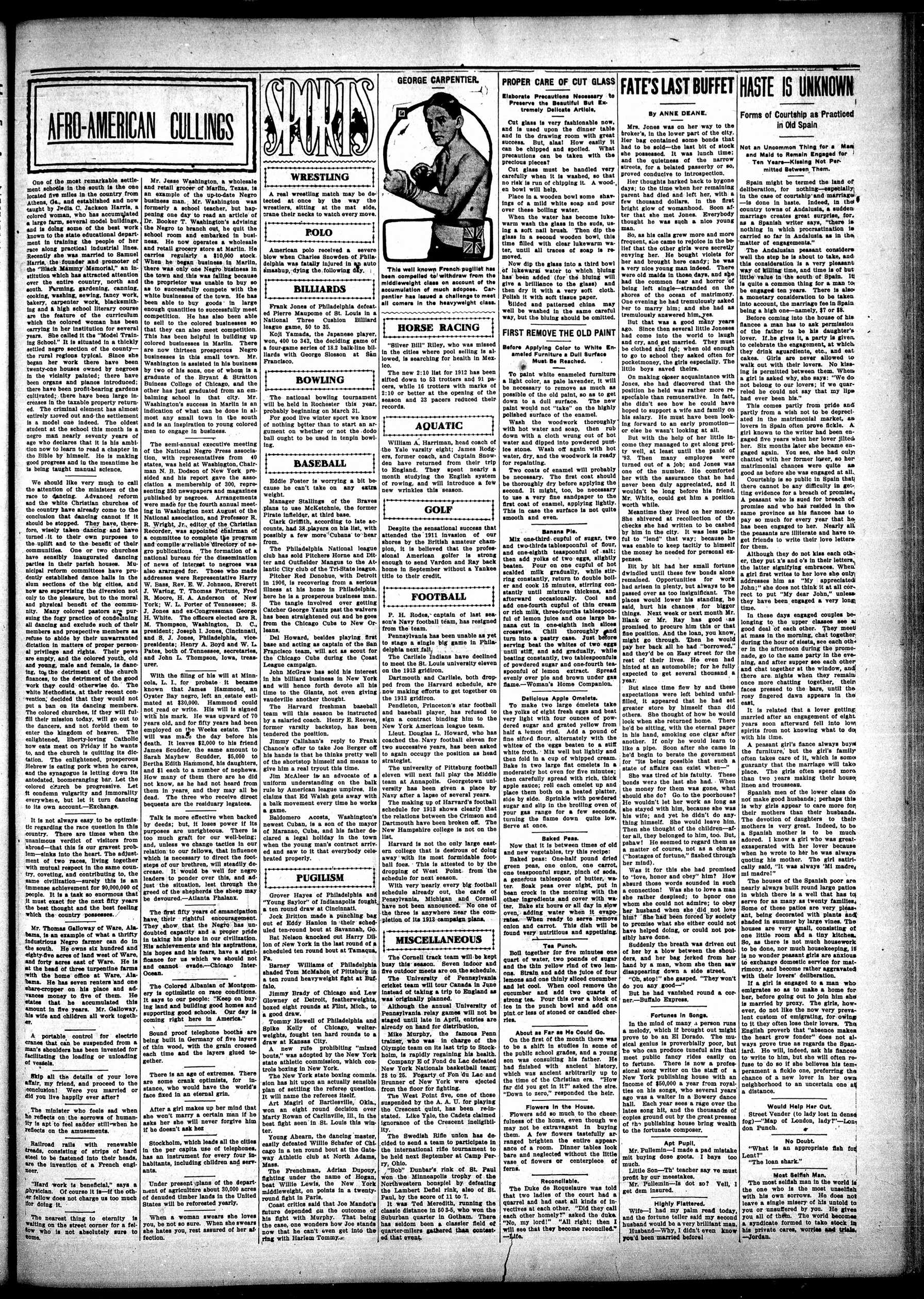
AFRO-AMERICAN CULLINGS
One of the most remarkable settlement schools in the south is the one located five miles in the country from Athena, Ga., and established and now taught by Jedia C. Jackson Harris, a colored woman, who has accumulated a large farm, several model buildings, and is doing some of the best work known in the state educational department in training the people of her race along practical industrial lines. Recently she was married to Samuel Harris, the founder and promoter of the "Black Mammy Memorial," an institution which has attracted attention over the past two years. Farming gardening, canning, cooking, washing, sewing, fancy work, bakery, carpenter work, blacksmithing and a high school literary course are the feature of the curriculum which the colored woman has been carrying in her institution for several years. She called it the "Model Training School." It is situated in a thickly settled negro section of the county—the rural regions typical. Since she began her work there have been twenty-one houses owned by negroes in the vicinity painted; there have been organs and pianos introduced; there have been profit-bearing gardens cultivated; there have been large increases in the taxable property returned. The criminal element has almost disappeared. There is a model one indeed. The oldest student at the school this month is a negro man nearly seventy years of age who declares that it is his ambition now to learn to read a chapter in the Bible by himself. He is making good progress and in the meantime he is being taught manual science.
We should like very much to call the attention of the ministers of the race to dancing. Advanced reform and the white Christian churches of the country have already come to the conclusion that dancing cannot if it should be stopped. They have, therefore, wisely taken dancing and have turned it to their own purposes to the uplift and to the benefit of their communities. One or two churches have sensibly inaugurated dancing parties in their parish houses. Musicians have been duly established dance halls in the slum areas of the big cities, and how are supervising the diversion not only to the pleasure, but to the moral and physical benefit of the community. Many colored pastors are pursuing the fogy practice of condaining all dancing and exclude such of their members and prospective members as refuse to abide by their unwarranted dictation in matters of proper personal privilege and rights. Their priests are empty, and the colored youth, old and young, are not involved in the dearmament of the church finances, to the detriment of the good work they could otherwise do. The white Methodists, at their recent convention, decided that they would not put a ban on their dancing members. The colored churches, if they will fulfill their mission today, will go out to the dancers, and not forbid them to enter the kingdom of heaven. The enlightened, liberty-loving Catholic now eat meat on Friday if he wants to, and the church is quitting its dictation. The enlightened, prosperous Catholic now eat meat on Friday and the synagogue is letting down its antedated, boomerangering bar. Let the colored church be progressive. Let it condemn vulgarity and immorality everywhere, but let it turn dancing to its own account—Exchange.
It is not always easy to be optimistic regarding the race question in this country. There are times when the unanimous verdict of visitors from abroad—that this is our gravest problem—sinks into the heart. The adjustment of two races, living together with mutual respect in the same country, coveting, and contributing to, the success of the race, immense achievement for $9,000,000 of people. It is a task so enormous that it must exact for the next fifty years the best thought and the best feeling which the country possesses.
Mr. Thomas Galloway of Ware, Alabama, is an example of what a thrifty industrious Negro farmer can do in the south. He owns six hundred and eighty-five acres of land west of Ware, and forty acres east of Ware. He is at the head of three turpentine farms with the home office at Ware, Alabama. He has seven renters and one share-cropper on his place, and all of his tenants have He states that he accumulated this amount in five years. Mr. Galloway, his wife and children all work together.
A portable control for electric cranes that can be suspended from a man's shoulders has been invented for facilitating the loading or unloading of vessels.
Skip all the details of your love affair, my friend, and proceed to the conclusion. Were you married or did you live happily ever after?
The minister who feels sad when he reflects on the sorrows of humanity is apt to feel sader still-when he reflects on the amusements.
Railroad rails with renewable treads, consisting of strips of hard steel to be fastened into their heads, are the invention of a French engineer.
"Hard work is beneficial," says a physician. Of course it is—if the other fellow does not charge us too much for doing it.
The nearest thing to eternity is waiting on the street corner for a fellow who is not absolutely sure to come.
Mr. Jesse Washington, a wholesale and retail grocer of Marlin, Texas, is an example of the up-to-date Negro business man. Mr. Washington was formerly a school teacher, but happening one day to read an article of Dr. Booker T. Washington's advising the Negro to branch out, he quit the school room and embarked in business. He now operates a wholesale and retail grocery store at Marlin. He has regularly a $10,000 stock. When he began working there was only one Negro business in the town and this was falling because the proprietor was unable to buy so as to successfully compete with the white businesses of the town. He has been able to buy goods in large enough quantities to successfully meet competition. He has also been able to sell to the colored businesses so that they can also meet competition. This has been helpful in building up colored businesses in Marlin. There are now thirteen prosperous Negro businesses in this small town. Mr. Washington is assisted in his business with the Bryant and Stratton Business College of Chicago, and the other has just graduated from an embaling school in that city. Mr. Washington's success in Marlin is an indication of what can be done in almost any small town in the south and is an inspiration to young colored men to engage in business.
The semi-annual executive meeting of the National Negro Press association, with representatives from 40 states, was held at Washington, Chairman N. B. Dodson of New York presided and his report gave the association a membership of 300, representing 350 newspapers and magazines published by negroes. Arrangements were made for the fourth annual meeting in Washington next August of the association, which is the office of the Christian Recorder, was appointed chairman of a committee to complete the program and compile a reliable directory of negro publications. The formation of a national bureau for the dissemination of news of interest to negroes was also arranged for. Those who made addresses were Representative Harry W. Bass, Rev. E. W. Johnson, Everett J. Waring, T. Thomas Fortune, Fred R. Moore, H. A. Anderson of New York; W. L. Porter of Tennessee; S. J. Jones and ex-Congressman George W. Rutherford, the officers elected to the M. Thompson, Washington, D. C. president; Joseph I. Jones, Cincinnati, S. J. Jones, Philadelphia, vice-presidents; Henry A. Boyd and W. L. Pates, both of Tennessee, secretaries, and John L. Thompson, Iowa, treasurer.
With the filling of his will at Mincola, L. I., for probate it became known that James Hammond, an Oyster Bay negro, left an estate estimated at $30,000. Hammond could not read or write. His will is signed with his mark. He was upward of 70 years old, and for fifty years had been employed on the Weeks estate. The will was made the day before his death. It leaves $2,000 to his friend James Scudder, the same amount to Sarah Mayhew Scudder, $5,000 to Bertha Edith Hammond, his daughters, and $1 each to a number of nephews. How many of them there are he did not know, as he had not heard from them in years, and they may all be dead. The three who receive direct bequests are the residuary legates.
Talk is more effective when backed by deeds; but, it loses power if its purposes are unrighteous. There is too much graft for our well-being; and, unless we change tactics in our relation to our fellows, that influence which is necessary to direct the footsteps of our brethren, will be well established if we would be well for negro leaders to ponder over this, and adjust the situation, lest through the greed of the shepherds the sheep may be devoured—Atlanta Phalanx.
The first fifty years of amputation have, their rightful encouragement. They show that the Negro has undoubted capacity and a proper pride in taking his place in our civilization. His achievements and his fears, have a significance for us which we should not and cannot evade—Chicago Inter-Ocean.
The Colored Albanian of Montgomery is optimistic on race conditions. It says to our people: "Keep on buying land and building good homes and supporting good schools. Our day is coming right here in America." Sound proof telephone booths are being built in Germany of five layers of thin wood, with the grain crossed each time wood, with the grain glued together.
There is an age of extremes. There are some crank optimists, for instance, who would have the world's face fixed in an eternal grim.
After a girl makes up her mind that she won't嫁 a certain man if he asks her she will never forgive him if he doesn't ask her.
Stockholm, which leads all the cities in the per capita use of telephones, has an instrument for every four inhabitants, including children and servants.
Under present plans of the department of agriculture about 30,000 acres of denuded timber lands in the United States will be reforested yearly.
When a woman swears she loves you, she is not so sure. When she swears she hates you, rest assured of her affection.
SPORTS
WRESTLING
A real wrestling match may be detected at once by the way the wrestlers, sitting at the mat side, crane their necks to watch every move.
American polo received a severe blow when Charles Snowden of Phila delphia was fatally injured in an auto simpson, dying the following day.
BILLIARDS
Frank Jones of Philadelphia defeated Pierre Mauphee of St. Louis in a National Three Cushion Billiard league game, 50 to 35. Koji Yamada, the Japanese player, won, 40 to 343, the deciding game of a game series of 18.2 back-line billiards. George Slosson at San Francisco.
BOWLING
The national bowling tournament will be held in Rochester this year, probably beginning on March 31. For good live winter sport we know of nothing better than to start an argument on whether or not the dodo ball ought to be used in tenpin bowling.
BASEBALL
Eddie Foster is worrying a bit because he can't take on any extra weight.
Manager Stallings of the Braves plans to use McKetchnie, the former Pirate infielder, at third base.
Clark Griffith, according to late accounts, had 38 players on his list, with possibly a few more 'Cubans' to hear from.
The Philadelphia National league club has sold Pitchers Horne and Dittler and Outfielder Mangus to the Atlantic City club of the Tri-State league.
Pitcher Red Donohue, with Detroit in 1806, is recovering from a serious injury. His home in Philadelphia here is a prosperous business man.
The tangle involved over getting Catcher George Yanis past the walers has been straightened out and he goes from the Chicago Cubs to New Orleans.
Del Howard, besides playing first base and acting as captain of the San Francisco team, will act as scout for the Chicago Cubs during the Coast League campaign.
John McGraw has sold his interest in his billard business in New York and will hence forth devote all his time to the Glants, not even giving vaudeville another thought. The Harvard freshman baseball team will this season be instructed by a salaried coach. Henry E. Reeves, former varsity backstop, has been named the postkick. Jimmy Calhansh's reply to Frank Chance's offer to take Joe Berger off his hands is that he thinks pretty well of the shortstop himself and means to give him a real tryout this time. Jim McAleer is an advocate of a uniform understanding on the balk rule by American league umpires. He claims that Ed Walsh gets away with a balk movement every time he works a game. Baldomero Acosta, Washington's newest Cuban, is a son of the mayor of Maranoa, Cuba, and his father deceived him when the young man's contract arrived and saw to it that everybody celebrated properly.
PUGILISM
Grover of Philadelphia and "Young Saylor" of Indianapolis fought a ten round bout at Cincinnati. Jock Britton made a punching bag out of Eddy H丹on in their scheduled ten-round bout at Savannah, Goat Benson knocked out Harry Dillon of New York in the last round of a scheduled ten round bout at Tamaqua, Pa.
Barney Williams of Philadelphia shaded Tom McMahon of Pittsburgh in a ten round heavyweight fight at Buffalo.
Jimmy Brady of Chicago and Lew Glowen of Detroit, featherweights, boxed eight rounds at Flint, Mich., to a good draw.
Tommy Howell of Philadelphia and Spike Kellwright, welterweights, fought ten hard rounds to a draw at Kansas City.
New rule prohibiting "mixed bouts," was adopted by the New York state athletic commission, which controls boxing in New York.
The New York state boxing commission has hit upon an actually sensible plan of settling the referee question. It will name the referees itself. Art Magirl of Bartlesville, Okla., won an eight round decision over Marty Rear of Carlinville, Ill., in the best fight seen in St. Louis this winter. Young Ahearn, the dancing master, easily defeated Willie Schafer of Chicago in a ten round bout at the Gateway Athletic club at North Adams, Mass. The Frenchman, Adrian Dupuy, fighting under the name of Hogan beat Willie Lewis, the New York middleweight, on points in a twenty-round fight in Paris. Coast critics said that Joe Mandot's future depended on the outcome of his fight with Murphy. That being the case, one wonders how Joe stands now that he can't even get into the ring with Harlem Tommy.
A
This well known French pugilist has been compelled to withdraw from the midweight class on account of the accumulation of much adobe. Carpenter has issued a challenge to meet all comers in the heavyweight class.
HORSE RACING
"Silver Bill" Riley, who was missed in the cities where pool selling is allowed, is searching for health in Mexico.
The new 2:10 list for 1912 has been sifted down to 53 trotters and 91 pacers, while 16 trotters with marks of 2:10 or better at the opening of the season and 33 pacers reduced their records.
William A. Harriman, head coach of the Yale varity eight; James Rodgers, former coach, and Captain Snowden have returned from their trip to England. They spent nearly a month studying the English system of rowing, and will introduce a few new wrinkles this season.
GOLF
Despite the sensational success that attended the 1911 invasion of our shores by the British amateur champion, it is believed that the professional American golfer is strong enough to send Darden and Ray back home in September without a Yankee title to their credit.
FOOTBALL
P. H. Rodes, captain of last season's Navy football team, has resigned from the team.
Pennsylvania has been unable as yet to stage a single big game in Philadelphia next fall.
The Carlisle Indians have declined to meet the St. Louis university eleven on the 1913 gridron.
Dartmouth and Carlisle, both dropped from the Harvard schedule, are now making efforts to get together on the 1913 gridron.
Pendleton, Princeton's star football and baseball player, has refused to sign a contract binding him to the New York American league team.
Lieut. Douglas L. Howard, who has coached the Navy football eleven for two successive years, has been asked to occupy the position as head strategist.
The university of Pittsburgh football eleven will next fall play the Middle team at Annapolis. Georgetown university has been given a place by Navy after a lapse of several years.
The making up of Harvard's football schedule for 1913 shows clearly that the relations between the Crimson and Dartmouth have been broken off. The New Hampshire college is not on the list.
Harvard is not the only large eastern college that is destruous of doing away with its most formidable football foes. This is attested to by the dropping of West Point from the schedule for next season.
With very nearly every big football schedule already out, the cards of Pennsylvania, Michigan and Cornell have not been announced. No one of the three is anywhere near the completion of its 1913 campaign plans.
MISCELLANEOUS
The Cornell track team will be keep busy this season. Seven indoor and five outdoor meets are on the schedule. The University of Pennsylvania cricket team will tour Canada in June instead of taking a trip to England as was originally planned. Although the annual University of Pennsylvania relay games will not be staged until late in April, entries are already on the map for attribute games, the famous Penn trainer, who was in charge of the Olympic team on its last trip to Stockholm, is rapidly regaining his health. Company E of Fond du Lac defeated New York Nationals basketball team; 28 to 25. Fogarty of Fon du Lac and Brunner of New York were ejected from the floor for fighting. The West Point five, one of those suspended by the A. A. U. for playing the Crescent quintet, is located. Like Tale, the Cadets claimed ignorance of the Crescent ineligibility.
The Swedish Rifle union has decided to send a team to participate in the international rifle tournament to be held next September at Camp Perry, Ohio. The Dunbar's rink of St. Paul was the minniepals trophy of the northwestern bonspiel by defeating the Lambert Defiel rink, also of St. Paul, by the score of 11 to 7.
It was Ted Meredith, running the classic distance in 50-3-5, who won the Suburban quarter in Gotham. There was a chance he could quarter-milers gathered than contested that event.
PROPER CARE OF CUT GLASS
Elaborate Precautions Necessary to Preserve the Beautiful But Extremely Delicate Article.
Cut glass is very fashionable now, and is used upon the dinner table and in the drawing room with great success. But, alas! How easily it can be chipped and spilled. What precautions can be taken with the precious pieces?
Cut glass must be handled very carefully when it is washed, so that no risk is run of chipping it. A wooden en-bowl will help.
Place in a wooden bowl some shavings of a mild white soap and pour those boiling water.
When the water is becomes lukewarm wash the glass in the suds, use a soft nail brush. Then dip the glass in a second wooden bowl, this time filled with clear lukewarm water, until all traces of soap is removed.
Now dip the glass into a third bowl of lukewarm water to which bluing has been added (for the bluing will give a brilliance to the glass) and then dry it with a very soft cloth. Paint the glass blue. Blided and patterned china may well be washed in the same careful way, but the bluing should be omitted.
FIRST REMOVE THE OLD PAINT
Before Applying Color to White Enamelled Furniture a Dull Surface Must Be Reached.
To paint white enamelled furniture a light color, as pale lavender, it will be necessary to remove as much as possible of the old paint, as to give coat a glossy finish. The paint would not "take" on the highly polished surface of the enamel.
Wash the woodwork thoroughly with hot water and soap, then rub down with a cloth wrung out of hot water and diped into powdered pumice stone. Wash off again with hot water, dry, and the woodwork is ready for repainting.
Two coats of enamel will probably be necessary. The first coat should be thoroughly dry before applying the second. It might, too, be necessary to use a dry cream, as to give coat to the first coat of enamel, applying lightly. This in case the surface is not quite smooth and even.
Banana Pie.
Mix one-third cupful of sugar, two and two-thirds tablespoonful of four, and one-eighth teaspoonful of salt; then add yolks of two eggs, slightly beaten. Pour on one cupful of hot scalded milk gradually, while stirring constantly, return to double boiler and cook 15 minutes, stirring constantly until mixture thickens, and afterward occasionally. Cool and add one-fourth cupful of thin cream or rich milk, three-fourths tablespoonful of lemon juice and one large banana cut in one-eighth inch croissant into a pastry case. Just before serving beat the whites of two eggs until stiff, and add gradually, while beating constantly, two tablespoonful of powdered sugar and one-fourth teaspoonful of lemon extract. Spread evenly over pie and brown under gas flame—Woman's Home Companion.
Delicious Apple Omelets.
To make two large omelets take the yolks of eight fresh eggs and beat very light with four ounces of powdered sugar and grated yellow from half a lemon rind. Add a pound of fine sifted flour, alternately with the whites of the eggs beaten to a stiff white froth. Mix well but lightly and then fold in a cup of whipped cream. Bake in two large flat omelets in a moderately hot oven for five minutes; then carefully spread with rich thick apple sauce on each omelet up and mix both on a heated platter, side by side. Sprinkle with powdered sugar and slip in the broiling oven of your gas range for a few seconds, turning the fame down quite low. Serve at once.
Baked Peas.
Now that it is between times of old and new vegetables, try this recipe:
and new vegetables.
Baked peas. One half-pound dried ginger. One onion, one pound, one carrot, one teaspoonful sugar, pinch of soda, a generous tablespoon of butter, water.
Soak peas over night, put in bean crock in the morning with the other ingredients and cover with water. Bake six hours or all day in slow oven, adding water when it evaporates. When ready to serve remove onion and carrot. This dish will be found very nutritious and appetizing.
Tea Punch.
Boll together for five minutes one quart of water, two pounds of sugar and the thin yellow rind of two lemons. Strain and add the juice of four lemons and one thin sliced cucumber and let cool. When cool remove the cucumbers and add the juice of four lemons. Pour this over a block of ice in the punch bowl and add one pint or less of stoned or candied cherries.
About as Far as He Could Go
On the first of the month there was to be a shift in studies in some of the public school grades, and a young son was consulting his father. He had finished his school and ancient arbitrarily up to the time of the Christian era. "How far did you get in it?" asked the sire. "Down to zero," responded the heir.
Flowers In the House
Flowers add so much to the cheerfulness of the home, even though we may not be extravagant in buying them. A few flowers tastefully arranged brighten the entire appearance of a room. Dinner tables look bare and neglected without the little vase of flowers or centerpiece of
Reconcilable.
The Duke de Roqueaule was told that two ladies of the court had a quarrel and had cast all kinds of invectives at each other. "Did they call each other homely?" asked the duke. "No, my lord!" "All right; then I will see that they become reconciled."
FATE'S LAST BUFFET
BY ANNE DEANE.
Mrs. Jones was on her way to the brokers, in the lower part of the city. Her bag contained some bonds that had to be sold—the last bit of stock she possessed. It was lunch time; and the quietness of the narrow streets, for a belated passerby or so, proved conducive to introspection. Her thoughts harked back to bygone days; to the time when her remaining parent had died and left her, with a few thousand dollars, in the first bright glow of womanhood. Soon after that she met Jones. Everybody thought he was such a nice young man.
So, as his calls grew more and more frequent, she came to rejoice in the belief that the other girls were secretly envying her. He bought violets for her and brought her candy; he a very nice young man indeed. There would make those days, and she had the common fear and horror of being left single—stranded on the shores of the ocean of matrimony. One evening he had tremulously asked her to marry him; and she had as tremulously answered him, yes.
But that was a good many years ago. Since then several little Joneses had come into the world to laugh and cry, and get married. They must be clothed and fgd; when old enough to go to school they asked often for pocketmoney, the girls especially. The little boys saved theirs.
On making closer acquaintance with Jones, she had discovered that the position she held was rather more responsible than any other. In fact, she didn't see how he could have hoped to support a wife and family on his salary. He must have been looking forward to an early promotion—or else he wasn't looking at all.
But with the help of her little income they managed to get along pretty well, at least until the panic of '93. Then many employees were turned out of a job; and Jones was one of the number. He comforted her, the assurance that he would be appreciated, and it wouldn't be long before his friend, Mr. White, could get his a position worth while.
Meantime they lived on her money. She shivered at recollection of the checks she had written to be cashed by him in the city. It was less painful to "lend" that way; because he was able to keep tacitly to himself the money he needed for personal expenses. But by bit had her small fortune dwindled until these few bonds alone remained. Opportunities for work had arisen in plenty, but always to be passed over as too insignificant. The places would lower his standing, he said, hurt his chances for bigger things. Next week or next month Mr. Blank or Mr. Ray has good as promised to procure him this or that fine position. And the loan, you know, might go through. Then he would pay her back all he had "borrowed" for the rest of their lives. He even had hinted at an automobile; for he fully expected to get several thousand a year.
But since time flew by and these expectations were left behind unfulfilled, it appeared that he had set greater store by himself than did others. She thought of how he would look when she returned home. There he'd be sitting, with the eternal paper in his hand, smoking one cigar after another. If only he would learn to like a pipe. Soon after she came in he'd begin to beate the government for "its being possible that such a state of affairs can exist when—" She was tired of his fatiguity. These bonds were the last she had. When the money for them was gone, what should she do? Go to the poorhouse? He wouldn't. She stayed with him, because she was with him, and yet he didn't do anything. She would leave him. Then she thought of the children—after all, they belonged to him, too. But, pishaw! He seemed to regard them as a matter of course, not as a charge ("hostages of fortune," fassed through her mind).
Was it for this she had promised to "love, honor and obey" him? How abused those words sounded in such a connection! Was she to love a man she rather despised; to honor one whom she could not adhere, to obey whom she did not love him? She had been forced by society to promise what she either could not have helped doing, or could not possibly have done. Suddenly the breath was driven out of her by a blow between the shoulders, and her bag jerked from her hand by a man, whom she then saw disappeared on the street. "stop!" she gasped. "They won't do you any good—"
But he had vanished round a corner—Buffalo Express.
Fortunes in Songs.
in the mind of many a person runs a melody, which if brought out might prove to be an El Dorado. The musical genius is proverbially poor, but who can produce tuneful alps that meet public fancy rides easily on to fortune. There is now a professional song writer on the staff of a New York publishing house with an income of $50,000 a year from royalties on his song, who several years ago wrote a song. Each year sees a rage over the lates song hit, and the thousands of copies ground out by the great presses of the publishing house bring wealth to the fortunate composer.
Apt Pupil.
Mr. Pullenim—I made a pad mistake
mit buying dose gooits. I bays too
much.
My Son—Th teacher say we must
profit by our meetstakes.
Mr. Pullenim—Is dot zo? Vell, I
get dem insured.
Highly Flattered.
Wife—I had my palm read today, and the fortune teller said my second husband would tell me a brilliant man. Wife—I did. I didn't know you'd been married before!
```markdown
```
Forms of Courtship as Practiced in Old Spain
Not an Uncommon Thing for a Man
and Male to Remain Engaged for
Ten Years—Kissing Not Perm-
mitted Between Them.
Spain might be termed the land of deliberation, for nothing—especially in the case of courtship and marriage—is done in hate. Indeed, in the country towns of Andalusia, a sudden marriage creates great surprise, for, in Andalusia, nothing in which preoccupation is carried so far in Andalusia as in the matter of engagements." The Andalusian peasant considers well the step he is about to take, and this consideration is a very pleasant way of killing time, and is of but little value in the south of Spain. It is quite a common thing for a man to be engaged seven years before marriage, and preoccupation to be taken into account, the marriage fee in Spain being a high one—namely, $7 or $8.
Before coming into the house of his fiancee a man has to ask permission of the father to be his daughter's lover. If he gives it, a party is given to celebrate the engagement, at which they drink aguajardine, etc., and eat cakes. Girls are never allowed to eat the cake, but it is permitted between them. When a girl is asked why, she says: "We do not belong to our lovers; if we quarreled he could not say that my lips had ever been his." This comes partly from pride and partly from a wish not to be depreciated in the matrimonial market, as lovers in Spain often prove fickle. A girl known to the writer had been engaged five years when her lover left her. She became engaged again. You see, she had only chatted with her former lover, so her matrimonial chances were quite as good as before she was engaged at all.
Courtship is so public in Spain that there cannot be any difficulty in getting evidence for a breach of promise, a peasant who is sued for breach of promise and who has resided in the same province or has much to do for every year that he has been engaged to her. Nearly all the peasants are illiterate and have to get friends to write their love letters for them. Although they do not kiss each other, they put x's and o's in their letters, the latter signifying embraces. When a girl first writes to her love she only addresses him as "My appreciated lover," and then responds to put "My dear John," unless they have been engaged a very long time.
In these days engaged couples belonging to the upper classes see at good deal of each other. They meet at mass in the morning, chat together, during the hour of sleata, see each other in the afternoon during the promenade, go to the same party in the evening and after supper see each other and chat together at the window, and there are nights when they remain once more chatting together, their faces pressed to the bars, until the rosy fingered dawn appears in the east.
It is related that a lover getting married after an engagement of eight years soon afterward fell into low spirits from not knowing what to do with his time.
A peasant girl's fiance always buys the furniture, but the girl's family offers take care of it, which is some measure of the marriage will take place. The girls often spend more than two years making their house line and trousseau.
Spanish men of the lower class do not make good husbands; perhaps this is why girls appear to care more for their mothers than their husbands. The devotion of daughters to their mothers is very great. Indeed, to be a Spanish mother is to be much adored. I know a girl who was great exappearance to the wrote to her he was always quoting his mother. The girl satrically said, "It was always 'Mi madre, mi madre'." The houses of the Spanish poor are nearly always built round large patios in which there is a well that has to serve for as many as twenty families. Some of these patios are very pleasant, being decorated with plants and shaded in summer by large vines. The houses are very small, consisting of one little room and a tiny kitchen. So, as there is not much housework to be done, nor much housekeeping, it is better to exchange domestic services for matrimony, and become rather aggravated with their lovers' deliberation.
If a girl is engaged to a man who emigrates so as to make a home for her, before going to join him she is married by proxy. The girls, however, do not like the now very prevalent custom of emigrating, for owing to it they often lose their lovers. The English proverb that "absence makes the heart grow fonder" does not always prove true as regards the Spanish wife will indeed ask his wife for fuse to do so if she believes his temperament a fickle one, preferring the chance of a new lover in her own neighborhood to an uncertain one at a distance.
Would Help Her Out.
Street Vender (to lady lost in densed
fog)—"Map of London, lady!"—London
Punch.
No Doubt.
"What is an appropriate fish for
Lent?"
"The loan shark."
Most Selfish Man.
The most selfish man in the world is the one who is the most unselfish with his own sorrows. He does not leave a single misery of his untold to you or unsuffered by you. He gives you all of them. The world becomes a syndicate formed to take stock in his private cares, worries and trials.
Mr. and Mrs. Burt Allen have a fine baby boy at their home, both are doing nicely.
Miss Fay Bennings of Denver is at her uncles, Wm. Bennings, for a short visit.
The debate on the Foreign Emigration by the R. B. M. literary society was won by Mr. Edward Butler and Pearl Thomas.
Sewing Circle met with Mrs. Wm. Bennings on Monday afternoon.
Mrs. Young is with Mr. Young the auctioneer while his stay in Albia Those on the sick list are much improved. It has been very cold these March days. The Sewing Circle has put out some fine caps and aprons as well as giving some splendid entertainments for the benefit of the church.
DAVENPORT NOTES.
Mrs. Francis Baker is ill at her home
The City Federation will hold its
regular meeting March 12th, at the
home of the president, Mrs. Francis
Baker. All members are requested to
be present. The following are the
officers of the City Federation: Mrs.
F. Baker, president; Mrs. Clara Sheppard,
1st vice president; Mrs. Emma Beard,
2nd vice president; Mrs. Jennie
Johnson, Recording Secretary; Mrs.
Josephine O'Niel, Treasurer.
The Home and Foreign Missionary
Circle of the Third Baptist church will
hold its next meeting at the residence
of Mrs. M. Chesterfield. Full account of
the lecture given by Mrs. J. B. Rush
of Des Moines on the 28th inat, at Bethel A. M. E. church will appear in next
week's notes. We would say however
that the lecture was the finest that a Davenport audience has ever had the
pleasure of listening too. The Federation of Women's clubs of Iowa has one
of the most brilliant women of our race
as their president in the person of Mrs.
J. B. Rush.
Look out for the big chitterling supper and program at Bethel A. M. E. church Tuesday evening March 11th. The Boys Athletic and Improvement club held their regular monthly meeting Monday evening at Bethel A. M. E. church. Rev Stevall gave the boys a very interesting talk, subject, "The Boys' Opportunities." We think the boys from this talk will be inspired to do more and better work. Mrs. J. B. Rush was a guest of Mrs. C. B Lewis while in the city. Rev. M. Toomey who has been away from the city for the past three weeks was in his pulpit Sunday. The sick are reported convalescent.
FORT MADISON NOTES.
The entertainment announced for Saturday evening to be given by the Willing Workers club was postponed indefinitely owing to the inclement weather. Rev. and Mrs. Bowles have returned to our city to take up the work after holding a very successful meeting at the Union Baptist church at Keokuk.
Mrs. Ambrose Jackson is improving and we hope to see her able to be out soon.
Mrs. Fannie Goodwin is confined to her home with rheumatism. Her many friends hope to see her out soon.
The children of the A. M. E. Sunday School are getting ready for Easter. Mrs. Lucy King is instructing them.
Mr. Charles Thomas has been confined at home a few days but is much better.
Mr. James Campbell who is in our city on business will soon return to his home at Canton, Mo.
Our city is putting on a business look New buildings are soon to be erected and work has begun on the new post office.
Mrs. Clark the evangelist will close the meetings this week which she has been conducting at the A. M. E. church for about two week. She is a woman of rare talent and a fine speaker.
Last Thursday evening occurred the marriage of Miss Letta McRay and Mr. Charles Henry at the home of her sister, Mrs. Archie Redd on Sixth St. The young people are well known in the community.
Mrs. James Sanders has returned home after spending some time in Shelbina, Mo., being called there on account of the death of her sister, Mrs. Harris, who died in Rock Island, Ill., at the home of her daughter, Mrs. Brown.
Mr. Woods who was taken to the hospital recently is improving nicely. His many friends are glad to know that he is recovering.
Children are much more likely to contract the contagious diseases when they have colds. Whooping cough, diphtheria, scarlet fever and consumption are diseases that are often contracted when the child has a cold. That is why all medical authorities say beware of colds. For the quick cure of colds you will find nothing better than Chamberlain's Cough Remedy. It can always be depended upon and is pleasant and safe to take. For sale by all druggists.
GALESPURG. ILL.
Miss Ella McGow of Davenpor is visiting her sisters, Mrs. Lyons and Mrs. Harber.
Mr. Peter Lawsey continues seriously ill at his home.
Mrs. Holley is confined to her home with pneumonia.
The progressive tea under the auspices of the Improvement club was a decided success, both socially and financially. Forty-five ladies attended. The first course was served at the home of Mrs. Geo. Kidd, from there the ladies went to Mrs. Nora Leonard, the final
course being served at Mrs. Fred Solomon's home. A short musical closed the program of the afternoon
Mr. Carey Lewis of Chicago lectured Sunday afternoon at Allen Chapel, his subject being "Literary Lights of the Negro Race." The church was completely filled and Mr. Lewis held the attention of the audience closely during his address. Mrs. Elmira Shelton of Davenport favored the audiences with a solo. Mr. Lewis came at the invitation of the D. D. W. C. C. Mrs Clay Bolder entertained at six o'clock dinner Saturday for Miss Eva Carter, Mrs Shelton of Davenport and Mr. Carey Lewis of Chicago. Covers were laid for six. Mrs David Garnett entertained Monday evening in honor of Mrs Shelton. Mr. Carey Lewis was an out of town guest. Dainty refreshments were served in two courses. Miss Lois Skinner of Monmouth spent Sunday here with relatives.
Mrs. L. C. Carter Jr. was hostess to the D. D. W. C. C. Monday afternoon in honor of Mr. Carey Lewis. Light refreshments were served Mrs. Shelton was an out of town guest.
A six weeks' treatment of Madam P. M. Babney's XXth Centudy Hair Preparations sent on request of $1.25 or a single package of Madam P. M. Babney's XXth Century Hair Grower, Pressing Oil or Shampoo sent for 50 cents. Liberal terms to agents. Write to day to Madam P. M. Babney's XXth Century Hair Preparations Co., 1806 E. 24th street, Kansas City. Mo. Dept. 30.
MOBERLY, MO.
Rev. G. B. Abbott and Rev. J. D. Woodford of Mason City, Ia., have just closed a revival meeting here. There were seven conversions. Rev. Woodford will leave for his home in Mason City Monday night.
home in Mossolon City Monday night.
The Embroidery club met last Thursday evening at the home of Mrs. Lucy Paly and a two course luncheon was served. The next meeting will be with Mrs. Mayme Quinn on Forest avenue.
The members of the M. E. church are preparing to have a musical contest Friday night, March 7th. Mrs. A. C. Black is chairman.
Mr A C. Black has made special arrangements with the Wabash for excursion trains the 4th of August. He will make special arrangements with the "Katy" and these excursions will be run from St. Louis, Kansas City Columbia and Des Moines.
STATE OF IOWA.
Office Of
Des Moines, Iowa, March 1, 1918.
Whereas, The Agricultural Insurance Company, located at Watertown, in the State of New York, has filed in this office a sworn statement of its condition on the thirty-first day of December, 1912, in accordance with the provisions of Chapter 4, Title 9, of the Code of Iowa, relating to Insurance Companies; and whereas said statement shows that said Insurance Company has complied with the laws of this State relating to insurance.
Therefore, In pursuance of law, I, John L. Bleakely, auditor of state, do hereby certify that said Insurance Company is authorized to transact the business of Fire insurance in the state, by agents properly appointed, as required by law, until the first day of March, A. D., 1914.
I further certify that the statement shows:
1st. The acutal amount of paid-up capital of said Company, Decem-
ber, 31, 1912, to be.....$ 2d. The aggregate amount of the Assets of said Company, December 31, 1912, to be 3d. The aggregate amount of Liabilities of said Company, including the amount required to safely reinsure all outstanding risks, December 31, 1912, to be .....
4th. The aggregate income of said Company for the year 1912, to be .....
5th. The aggregate expenditures of said Company for the year
1912, to be ..... 1,689,588.62
In testimony whereof, I have hereunto subscribed my name and affixed the seal of my office the day and date above written.
John L. Bleakley,
Auditor of State.
1: NPORT NEWS.
Mr. J. H. Spencer of Grinnell spoke at, Bethel A. M. E. church Sunday morning and also addressed the Sunday School in the afternoon. Mr. Spencer was the principal speaker at the George Washington entertainment at Bethel A. M. E. church Monday evening Subject, "Some of the Problems of today and how Organization will help to Adjust Them" Mr. Spencer is an optimist and is quite convincing in his argument. A game of basket ball by the Athletic club and slight of hand performance by Mr. G. Hart were some of the other features of the program
The federated clubs of the city are working hard preparing plans for the entertaining of the State Federation to be held the last week in May in Davenport.
Mrs Frances Baker, president of the City Federation-field a successful call meeting at her residence, 1720 Iowa street; last Tuesday afternoon.
Mrs. W. J. O'Neal won the first prize in the contest at the Richard B. Harrison recital. Mrs. Georgia Perkins won second prize. The first prize was a silver tea set of four pieces;
second prize silver sugar bowl.
A flying trip
to Chicago last Saturday.
Mrs George W. Harrison remains quite sick at her home with an attack of asthma. Mrs. Clara Martin is still confined to her bed. The sacred concert at the Third Baptist church by the choir Sunday evening was quite inspiring. Mr. and Mrs. D. J. Johnson entertained at dinner Sunday Mr. J. H. Spencer and Rev. and Mrs. T. B. Stovall. Mr. Chas. Sheppard is recovering from his injuries received in an accident which was mentioned in last week's notes.
OF INTEREST TO MOTHERS.
Every Mother Interested in the Welfare of Her Children Should Read.
"I am only too willing to give praise to your wonderful XXth Century Hair Preparations. My little girl's hair was rough, harsh and so thin that I was discouraged. After using two boxes each of your Hair Grower and Pressing Oll and one bottle of your Shampoo I could see the new growth and her hair is now as soft, glossy, straight and pretty as can be. I will never be without it. I now use it for myself."
Mrs. Helen, Lewis
1614 Cottage Avenue,
Kansas City, Mo.,
FOR DISEASES OF THE SKIN.
Nearly all diseases of the skin, such as eczema, tetter, salt rheum and barbers' itch, are characterized by an intense itching and smarting, which often makes life a burden and disturbs sleep and rest. Quick relief may be had by applying Chamberlain's Salve. It allays the itching and smarting almost instantly. Many cases have been cured by its use. For sale by all dealers.
ENTERPRISE NEWS.
(Special to Hystandar.)
One of the grandest affairs Enterprise ever witnessed was a surprise birthday dinner given Mrs. A. W. Rhodes Wednesday Feb. 26th. by her children in honor of her 60th birthday. The table was beautifully decorated with white and pink carnations and at 2:30 a six course dinner was served preceded by prayer and blessings from Rev. Bollings. Then the ten children passed the table and each dropped a silver dollar in a glass which was placed in the middle of an elaborate birthday cake lighted with 60 candles. About fifty guests were present and many valuable presents were presented to Mrs Rhodes. They all reported a grand time when they made their departure and wished Mrs. Rhodes another happy birthday and a family reunion.
CLARINDA ITEMS.
(Last Week.)
Sunday was quarterly meeting at the A. M. E. church. Presiding Elder S B. Moore was present and conducted services throughout the day to a large audience. Quarterly conference was held Monday night and all reports were in good condition.
NEW JEWELRY STORE
The Boyson Jewelry Will open a new jewelry company in Buxton (Coopertown) next
MONDAY, M
Will carry a new line of up-
Also repairs done promptly,
"Everything is j
Adds to L
It is so pleasant to
and talk to one's friend
family who may be hurt.
The Long Distance
bridge space and bri
within the range of pe
Bell Telephone Lines R
Will carry a new line of up-to-date Watches, Clocks, etc. Also repairs done promptly, Your trade is solicited.
A
Adds to Life's Joys
It is so pleasant to sit in one's own home and talk to one's friends or members of one's family who may be hundreds of miles away. The Long Distance lines of the Bell System bridge space and bring friends near and far within the range of personal communication.
.
MISSION VALLEY SCHOOL OF
TECHNOLOGY
BILL BURTON
MISSION VALLEY SCHOOL OF
TECHNOLOGY
Meadows Wm. Stavens and Fannie Parker served a three course dinner at their home Saturday evening at six o'clock. All reported the hostess royal entertainers. Presiding Elder S. B. Moore and Rev Morgan were royally entertained to breakfast Sunday morning at the home of Miss Phebia Rogers, and taken dinner at the home of Mr. and Mrs. Wm. Headley. Mrs Della Dunn has been very ill with appendicitis. Mr. Robert Jones is still very dangerously ill. Mrs. Sarah Williams of Creston is visiting at the Tom Dunn home. Mrs P. S. Irwin of Des Moines was a guest at the home of Mr. and Mrs. Wm. Gibson. Miss Sue Lee of Des Moines was called to this city by the serious illness of her grandfather, Mr. Robert Jones,
Mrs. Fannie Parker will leave Thursday for Albia where she will remain indefinitely.
Mr. Esse Bowlen received the sad news last week stating the death of his mother, Mrs. Myra Bowlen, who died in British Columbia.
Mrs. Malaya Battle has been on the sick list a few days.
MASONIC GRAND LODGE NOTES.
The Iowa State Bystander is the official organ of the Most Worshipful United Grand Lodge of A. F. & A. M. of Iowa and jurisdiction. The grand officers are:
Grand Master—John L. Thompson, Des Moines.
D. G. M.—A. A. Bland, Keokuk.
S. G. W.—H. E. Williams, Ottumwa.
J. G. W.—M. O. Culbertson, Clinton.
G. Treasurer—W. H. Milligan, Cedar Rapids.
G. Secretary—W. W. Gross, Keokuk.
G. Custodian—A. G. Clark, Oskaloosa.
Chairman of Committee of F. C.—Geo. L. Suitor, Marshalltown.
The Grand Custodian, A. G. Clark, has divided the jurisdiction into the following district: First district, consisting of Keokun, Burlington, Ottumwa, Buxton, Oskaloosa and East Des Moines. Second district, West Des Moines, Marshalltown, Cedar Rapids, Dubuque, Clinton and Davenport. Third district, Sioux City, Council Bluffs and Omaha, Neb. The schools of the First district will be held in Ottumwa, the Second in Cedar Rapids and the Third in Omaha, Neb.
Subscribe for The Iowa State Bystander.
Hotel Buxton
A new modern steam heated hotel—Everything first class
Cigars, Soft Drinks, Lunches etc
Open Day and Night
O. PETERSON, Phone 261
Proprietor Buxton, Iowa
Jewelry Co.
MARCH 10TH
to-date Watches, Clocks, etc.
Your trade is solicited.
J. E. SONDERS, Mgr.
Also Good Roaming House at 917
4th Street- New Phone 4084
THE TRUTH ESTABLISHED.
From the Pen of Witness Comes Testimoney of Belief.
From Mrs. D. J. Fry, 945 Washington Blvd. Kansas City, Kansas.
"My hair was coming out awfully. I would lose great comb fulls every time I'd come my hair. I was persuaded to try a box of Mme P. M. Dabney's XXth Century Hair Grower. After the first application my hair stopped coming out. I am still using XXth Century Hair Grower and my hair is doing fine. I would not be without it for anything. Too much cannot be said in praise of its benefit to those who are troubled with falling hair."
Mme. P. M. Dabney's XXth Century Hair Grower stops the falling out and splitting of the hair, remes moss dandruff, relieves an itchy condition of the scalp and produces a beautiful growth of hair. Mme. P. M. Dabney's XXth Century Pressing Oil straightens the hair without injury, keeps it soft and glossy and glossy and gives it that well kept appearance which you admire so much in others. Price 50c each per package. Try these goods for yourself and you will be satisfied regarding their merit. Liberal terms to agents Write today to Mme. P. M. Dabney's XXth Century Hair Preparations Co., 1806 E. Twenty-fourth street, Kansas City, Mo.-dept. 30.
The Des Moines Negro Lyceum meet Tuesday, February 4th at the home of Mr. Wm. P. Warricks. The subjects, "The Ideal Man" and "The Ideal Woman," were discussed by the various members present, After the meeting, refreshment s were served in honor of the host's birthday. The next meeting, February 11th, will be with Miss Hazel Cousins, 2016 North street. The program will consist of a paper, "The Ideal Man," by Mr. Brauham Hyde, and "The Life and Wqrks of Handel" by Miss Hazel Cousins.
A PLEASANT PHYSIC.
When you want a pleasant physic give Chamberlain's Stomach and Liver Tablets a trial. They are mild and gentle in their action and always produce a pleasant cathartic effect. Call at all dealers for a free sample.
Rare Washington Portrait.
A rare and curious mezotin portrait of George Washington in the library of the late Lafayette S. Richardson of Lowell, Mass., was auctioned off last year in Boston. It is entitled "George Washington, late president of the United States of America, etc." and was published March 14, 1801, by J. Hinton Linden. It is a small folio and is colored by hand. It looks as much like George III. as it does the Father of His Country. Baker, who wrote the "Engraved Portraits of Washington," says that only one impression of this mezotin has come under the notice of the writer. It was in neither the Clarkson nor the Carson son sale of Washington portraits.
Insist on Yellow Flour.
Charles Christadoro, an expert on flour and grains, sounds the keynote of the new situation brought about by the bleached flour decision when he says in a communication to the editor commenting on the bleached flour decision: "The housewife will now inlist on yellow tinted or creamy flour, and will learn to realize that a natural flour very white can in no manner compare with the creamy or yellow flour in so far as glutens and muscle building values are concerned. "As from 85 to 90 per cent. of the large flour mills of the country were using this bleaching process, the decision is far-reaching."—National Food Misgarage.
Chance to Make Up.
"We have parted forever. He writes me to send back the ring."
"Tell him to call for it," advised the experienced friend.—Louisville Oceaneer Journal.
No More Gold Lace for Afghani.
The amer has published an edifice which applies to all parts of Afghanistan, prohibiting the import into the country of all kinds of gold lace, including embroidered kullas lungis and embroidered shoes. The amer is evidently actuated by a desire to prevent his subjects from spending their hard earned money on showy dress. It is the poorer classes who are notoriously addicted to this extravagance which his majesty has decided to check. The gold laced coat of the Afghan is decidedly handsome, and although the amer has acted wisely in bringing into general use clothing less costly, his majesty's orders will doubtless be received by his subjects with rather mixed feelings.
Proper Bestowal of Charity.
Dickens: There are not a few among the disciples of charity who require a their vocation, scarcely less excitation than the votaries of pleasure in heirs; and hence it is that diseased sympathy and compassion are every expended on out-of-the way objects, when only too many demandspon the legitimate exercise of the same virtues in a healthy state are constantly within the sight and hearing of the most unobservant person. In short, charity must have itance, as the unvital or the unright.
Mrs. A. M. Pope--Turabe
Results of "Poro" Treatment
"PORO COLLEGE"
Largest College of the kind in the world,
NEW YORK, N.Y. ST. LINN, N.Y.
ON RESUME
It is the largest college of the kind in the world,
NEW YORK, N.Y. ST. LINN, N.Y.
ON RESUME
In the district court of the state of Iowa, in and for Polk county, May term, A. D. 1913.
You are hereby notified that on or before the 20th day of March, A. D. 1913, the petition of the plaintiff in the above entitled cause will be filed in the office of the clerk of the District court of the state of Iowa, in and for Folk county, Iowa, claiming of you a divorce from the bonds of matrimony on the grounds of cruel and inhuman treatment, and adultery, and unless you appear thereto and defend before noon of the second day of the next term, being the May term of said court, which will commence at Des Mignes on the 5th day of May, 1913, default will be entered against you and judgement and decree rendered thereon.
S. Joe Brown,
Attorney for Plaintiff.
PILE and RECTAL
BOOK SENT FREE
Explains the Mild Medical Treatment for all Coral Diseases. Explains the importance of from persons cured years ago with whom you may correspond or to go see. My professional life is devoted to our study and treatment of Coral Diseases in Des Moines. Send for book today.
DR. C. Y. CLEMENT
Suite 402
Marguard Bldg. Des Mines La.
Open Every Tuesday Evening
From 8 to 11:30
East Side
Dancing Academy
EAST SIXTH AND LOCUST STS,
B. J. HACK, Manager.
Good Music
James Woods
Floor Director
ADMISSION
35c
VIVIAN L. JONES
Funeral Director
SECTOR
guaranteed
y day or
es for dis-
e charges
black 1658.
MAS MOINER
Mrs. Jennie Freeman
Ottumwa.....Miss Hazel F. Clark
Galesburg, Ill.....Mayne Richardson
Davenport.....Mrs. C. H. Marshall
St. Paul.....Mrs. Q. H. Hicks
Rock Island.....Mrs. Chas. Windsor
Moline, Ill.....Mrs. Geo. W. Gorman
Buxton.....W. A. Brown
Sioux City.....Miss Etta Grant
A. A. Bush
Council Bluffs.....Mrs. F. C. Walker
Centerville.....J. W. Evans
Macon, Mo.....Lucy Harris
Mason City.....Mrs. Maud Brewston
Quincy, Ill.....Mrs. Matty Lilly
NORTH STAR
Masonic Temple Association
(INCORPORATED)
Will pay you 5 per cent interest
SHARES $5 EACH
For information and application blanks
write V. L. JONES, Sec.,
519 East Court Ave.
Des Moines, Iowa
AVE YOU BEAUTIFUL HAIR?
PHONE:} Maple 2048
Residence Black 1658.
Office
519 East Court Ave
Des Moines
HAVE YOU
WE are the only Importers and Manufacturers of Real Colored People's Hair. Also Wavy Hair.
- We absolutely guarantee our hair to stand combing and washing and to retain its color and crimp.
- Wigs, Plats, Braids, Transformations and Puffs in stock or to order; all shades, none too difficult.
- Straightening Combs and Toilet Articles.
Send two-cent stamp for Price List.
The Old Reliable Mme.
486 8th Avenue 11-16-2-16 Between
YOU CAN'
For Price List. Mail Orders receive prompt attention. Table Mme. Baum's Hair Emporium 16 Between 34th and 35th Sts. NEW YORK CITY CAN'T BEAT IT
W. L. HARRISON, Prop Pho
---
ORIGINAL NOTICE.
Wm. Beach, defendant
P
The very best service guaranteed
Prices the lowest
Calls answered promptly day or
night No extra charges for distance—Reverse all phone charges
[Mon, Fri, 04:40]
Why Not Invest Your Money in a Negro Enterprise
A. B.
Iowa State Bystander
SYSTANDER PUB. CO. PUBLISHER
DES MOINES, IA
FRIDAY, MARCH 7, 9113.
JOHN L. THOMPSON, EDITOR.
J. H. SHIPFARD, MANAGER.
Official paper of the M. W. U. Grand
Lodge of Iowa, A. K. & A. M. and
International Grand Congress of
Heroines of Jericho of America,
and Western Baptist Association.
Published every day by the Bystander Publishing Company, Des
Meining, Iowa. Office in Chemical
building, corner Seventh and Meb-
berry streets. Iowa phone. Wal-
nut 899.
Entered at the postoffice as second
class matter
N. B.—Correspondents: Please mail your letters that contain news for publication not later than Wednesday to insure publication for the current week; and sign your name, not for publication, but that we may know who writes the news.
Send money by postoffice order, money order, express or draft, to the Iowa State Bystander Company, Des Moines, Iowa.
Advertising rates for display ads 20 cents per inch, for each insertion. Three to six months' contract, 15 cents per inch. Local advertising rates to each insertion, counting seven words to a line. For churches and secret societies, admission is charged, one-half the above-mentioned rates. For professional, legal and announcement cards, yearly contracts, etc., terms are given on application. All advertising is to be paid in advance.
We will not return rejected manuscript, unless accompanied by postage stamps.
TERMS OF SUBSCRIPTION.
One year ..... $1.50
Six months ..... 75
Three months ..... 90
All subscriptions payable in advance.
We are prepared to do first-class job work at reasonable prices. All of our work is guaranteed.
NOTICE TO CORRESPONDENTS
This notice applies to all writers, contributors, agents and correspondents. Sign all articles, write only upon one side of paper, write a plain hand and spell accurately. Do not send in names of persons at parties or receptions nor send in programs to be published before or after the event. Do not give an eulogy or write your personal comment upon the event. Simply tell the news or event in a brief, simple manner and let the readers of the Bystander comment. Write the news of all classes, all societies, all religious denominations, irrespective of your personal whims or ideas. Communications must be written on one side of the paper only and be of interest to the public. "Brewity is the soul of wit" remember.
The Iowa State Bystander is the oldest Afro-American journal published in Iowa. It was established in 1894, and is read by nearly all the colored people of Iowa. We have correspondents in the following towns:
Albia ..... Miss May Davis
Oskaloosa ..... Luella B. Franklin
Washington ..... N. L. Black
Burlington ..... Mrs. L. M. Abel
Mt. Pleasant ..... Mrs. M. Burnaugh
Monmouth, Ill ..... Georgia Norwood
Colfax ..... Miss Stella Pierson
Minneapolis ..... Chas. F. Neal
Clarinda ..... Mrs. Eva M. Stevens
Keokuk ..... Mrs. A. J. Fields
Hot Home-Made Bread all day with those delicious home cooked meals. When in Chicago, Ill. Everybody eats at the
12 West 31st St. Near State St.
Columbia Hotel Bldg., Chicago
Moderate Prices Quick Service
Phones—Aldine 3368—Automatic 73-174