Iowa State Bystander
Friday, April 11, 1913
Des Moines, Iowa
Page text (machine-generated)
IOWA STATE BYSTANDER.
VOL. XIX NO. 44
CITY NEWS
Mrs. Mary Finly, 1345 Fremont is convalescent.
Mr Alex. Birney is reported a little better at this writing.
Adell Thomas is quite sick at his home, 1200 S. E. Scott street.
Willie Simmons is on the sick list at his home, 15th and Ry. Aver.
Mrs. Mosby is sick at the home of Mrs. R. White, 751 W. 11th street.
Mrs Robt. Couch, 1106 S. E. Allen street is on the sick list this week.
Jessie Graves has improved so much that he will soon resume his work again.
Mrs. Chas. Wilson is sick at the home of her parents, Mr, and Mrs. A. C. Payton.
Mrs. A. C. Payton fell down the stairs at her home receiving slight injuries.
Mrs. Mary Capart-Renix of Minneapolis is here attending her sick father Geo. Capart.
Mrs. Charles Thomas has returned home after spending seventeen days at the Hotel Colfax.
The R. D. C. members are sad over the illness of Mrs. Cottom, one of their best members.
Rev. Morton of Council Bluffs, Ia., was in our city last week. He called at the Bystander office.
The Maple Street Baptist church held their regular services Sunday and the attendance was good.
Miss Mamie Lewis who spent the past week at the home of Miss Deborah Barber, has returned to her home.
The Get Busy club met Tuesday night with Mrs. B. Campbell on McCormick street. A good meeting.
Rev. and Mrs. Bates were the honored guests at the home of Mr. and Mrs. C. S. Cary, to a six o'clock dinner.
The Woman's Home and Foreign Mission Circle will hold their meeting Friday with Mrs. S. Bates, 1111 Fremont street
J. A. Tobert, formerly of this city but now of Fayette, Mo., in the tailor business, spent a few days in our city visiting his mother.
Mr. and Mrs. S. C. Cary are very proud to see their eou. U. S. Cary, who arrived home from Detroit Sunday morning to spend a few days in the city.
Mrs. B. J. Hack who was called to Creaton, Ia., by the serious illness of her brother, Mr. Baldwin, returned home Monday reporting her brother but little better.
The Carnation club met Monday with Mrs. John Matthews, 1200 S. E. Scott street. After business refreshments were served, Mrs. S. Bates, Pres. and Stella Trent, secretary.
Wedding bells will soon ring again in our city in June, uniting North and West Des Moines together. You may guess the parties but don't ask the editor.
Mrs. James Smith, the wife of James Smith the well know clerk in the Cooper Drug store of Buxton, Ia., was a visitor in our city last week, the guest of Mrs. Adam Dixon.
Rev. S. Bates and wife will leave next week for St. Louis, Mo., for a little rest from his field of labor here. Rev. Bates certainly deserves a rest as he has been a faithful hard worker.
FOR RENT
Three small cottages for rent. Call at Bystander office.
A large furnished room at 818 E. 5th street, Mrs. J. G. Dellenger.
We have good rooms furnished or unfurnished. Call at Mr. and Mrs. J. E. Roberts, 1324 Day street.
Nearly furnished room at $1.00 per week, 1008 Center. Water, gas and telephone. Call Get Busy Dress Club, Red 1369.
Help Wanted
A competent colored lady cook in a small hotel. Wages 65 00 per week. Middle age lady preferred, write Mrs. A. A. Howell, Moulton, Ia.
PROPERTY FOR SALE
I have 12 houses and lots, also some vacant lots and acreages for sale reasonable, on easy terms. Call at the Bystander office or see John L. Thompson.
who heard the address delivered by
Mr. Ward at our church at the Lincoln
Anniversary Banquet, know what an
annable speaker he is. Don't fail to be
present at this service. We welcome
all.
Asbury Methodist Episcopal church,
777 West Eleventh street. Rev. W. L.
Lee pastor.
St. Paul's A. M. E. church, corner of Second and Center streets. Rev. B. U. Taylor, pastor. Morning services at 11 o'clock. Class meeting immediately after services.
Maple Street Baptist church, between Eighth and Ninth street on Maple street. Rev. S. Bates, pastor. Morning services at 11 o'clock a.m. Sunday school at 1 o'clock p.m. B. Y. P. U. at 6 o'clock p.m. prayer meeting at 7 o'clock p.m. preaching at 8 o'clock p.m.
THE OMAHA HORROR.
Mrs. S. Joe Brown is in receipt of the following letter concerning the Omaha tornado:
Omaha, Neb., April 6, 1913.
My dear Mrs. Brown: Will just write to let you know I received your letter, and was pleased to know you thought of me.
I received a lovely letter from Miss Elizabeth C. Carter of New Bedford, Mass., in regard to the suffering here among our people. She had heard that there was a colored baby here left all alone, and said she would like to adopt it; but I could not find any such. However, I thought it so nice of her to make the offer.
The tornado was an awful thing. The papers cannot depict the terrible sights.
Am sending you a photo showing the funeral of six colored men at one time. There were fourteen of them killed in one place and they think there are still more in the ruins of the building.
I was not in the path of the tornado, but my married daughter was. She was alone with her three babies, the oldest being only five years of age.
She had to cut a hole in the door to get out and pulled the children through the hole, but thank heaven she only received a few bruises, and the children were not injured at all; they were burned and burned up everything she had.
Will close with love to all inquiring friends, I am.
It is with a source of deep regret that we chronicle the seriousness of the condition of Miss Maria Jackson, who has been ill for several weeks. Small hopes for her recovery are entertained.
By meager information we learn that Mrs. Agnes Johnson was accidentally burned a few days since her daughter, Miss Letha Johnson of Des Moines recently arrived for a stay with her parents.
Mr. Otis Fields, who has been in the army for several months, writes his parents that he is in the best of health and enjoys the army life. Mr. Fields is located near the border line
Jönnes Cafe
The Old Reliable Place
to get your meals
Northern Art
MANUFACT
Artificiali
Trusses, Shoulder Brack
Apparatus for Elevate
Limbs; all kinds of Br
ties. Crutches and E
312-314 We
Phone Walnut 5347.
GARDEN
We've Got W
whether it be a hoe, rake, for
or drill. We can sell you c
freight is paid to your home
Hawkeye Buggy
5th and Court Ave.
5th and Court Ave. Des Moines, Ia.
Mr. and Mrs. Charles Wilson had the pleasure of entertaining Mr. and Mrs. C. S. Carey at dinner in their lovely home at 304 Arthur street. The hostess served a lovely three course dinner
Rev J. E. Roberts who formerly lived in our city last spring, but went to Huntsville, Mo. to spend the winter, returned last week to make the capital city his future home. His wife accompanied him. We Welcome him to our city.
Miss Ontario Cary was hostess to a few of her young friends on her 17th birthday, at the home of her sister, Mrs. J. R. Drew. After music and games a three course luncheon was served by the hostess and her sister, Miss Permealia Cary.
We received word from Thomas E. Barton formerly of this city, but now of Washington, D. C., saying that he had to undergo an operation for a cataract on the eye. He is some better now.
Mr. I. P. Johnson of Muscatine, Ia., one of the successful men of our race there, was a capital city visitor last week, the guest of his daughter, Mrs. J. R. Roberts, 909 S. E. 26th street. He called at the Bystander office.
Rev. W. L. Lee of Abursy M. E. church returned Monday from Mexico, Mo., where their annual conference was held. Rev Lee was returned to the Des Moines charge for his second year. He is doing very well here all things considered, and we welcome him back for another year.
Rev. J. P. Sims of Keokuk, who was delegate to the District and Normal meeting of the A. M. E. church, held at Cedar Rapids last week, came through Des Moines to spend last Friday with his son, James Sims. The reverend called at the Bystander office, He is doing well in Keokuk and is now entering into a revival.
The Mysterious Club will give a grand May Ball at the Coliseum Armory, Monday evening. May 5th. Those who attended the ball given by this club March 21st are looking forward to the May event with most pleasant anticipations. Mr. Jav. B. Woods will be general manager and the full Berchel Theater Orchestra of seven pieces will furnish the music.
We receive a very beautiful invitation to attend the mission of Miss Audra Alice Linzy of Denver, Colo., to Archie Alexander of Des Moines June 25th, at the bride's parents, 1661 Williams street, Denver, Colo. We are personally acquainted with the groom, who is a Des Moines young man, an exemplary young man and one of the most accomplished educationally in our city.
Mr. J. W. and J. L. Renix formerly of this city, but now of Minneapolis, Minn., are spending a few days in our city visiting old friends and the guest of Mr. J. W, wife's parent, Mr. Geo, Capart. They were enroute from Topeks, Kansas where the boys were born and raised. They had been there on a visit for five weeks. While in our city they made a pleasant call at the Kystander office. They like Iowa well they are traveling on the road with a musical company.
One of the largest meetings yet held by the local Mothers' Congress was the one last Saturday afternoon at the residence of Mrs. S. Joe Brown, at which they discussed the various subjects as outlined by the various chairmen of the State Federation. The next meeting will be held May 3d with Mrs. Price Alexander in Highland Park, at which time election of officers for the ensuing tent will occur.
RICHARD ALLEN AID SOCIETY.
At the meeting of the Richard Allen Aid society at the residence of the president, Mrs. S. Joe Brown, resolutions were adopted commending the women of the Cook County League of Chicago for resenting the action of the management of the Hotel La Salle in refusing to serve Mrs. Ida B. Wells Barnett; also commending the women of the Mississippi Valley Suffrage Conference at St. Louis for similar action on behalf of Mrs. Victoria Clay Haley, a prominent Negro woman of that city.
OUR CITY CHURCH SERVICES.
Corinthian Baptist church ,corner of Fifteenth and Linden streets. Rev. T. L. Griffith, pastor.
Morning services at 10:30.
Subject, "The Seal of the Spiritual Birthright."
Sunday school at 12 o'clock.
B. Y. P. Union at 6:30 p. m.
Evening services at 7:30 p. m.
Subject, "Our House Which From Heaven."
Union Congregational church, corner of Tenth and Park streets. Rev. T. B. Bramble, pastor.
Sunday school at 12 o'clock noon.
Evening services at 7:30 prompt.
Address by Mr. B. C. Ward. Those
DES MOINES, IOWA, FRIDAY, APRIL 11, 1913.
Morning services at 11 o'clock a. m.
Sunday school at 10 o'clock a. m.
Epworth League at 7 o'clock p. m.
Preaching services at 8 o'clock p. m.
Sunday school at 3 o'clock p. m.
Allen C. E. at 6:30 o'clock p. m.
Evening services at 8 o'clock p. m
Lovingly your friend,
Mrs. Lulu Rountree.
Barn Artificial Limb Co.
MANUFACTURERS OF
Artificial Limbs
Shoulder Braces, Artificial Arms,
s for Elevated Feet and Shortened
kinds of Brace work for Deformi-
matches and Elastic Goods.
312-314 West 7th Street
Out 5847. Des Moines, Ia.
DEN TOOLS
Got What You Want
hoe, rake, fork, spade, garden cultivator
s sell you cheaper than others after the
your home town.
Buggy & Implement Co
Northern Artificial Limb Co.
Trusses, Shoulder Braces, Artificial Arms, Apparatus for Elevated Feet and Shortened Limbs; all kinds of Brace work for Deformities. Crutches and Elastic Goods. 123-4th Street
whether it be a hoe, rake, fork, spade, garden cultivator or drill. We can sell you cheaper than others after the freight is paid to your home town.
CASH OR PAYMENTS
SEVEN RETAIL FLOORS
ve. Des Moines, Ia.
THE OMAHA HORROR
KEQKUK NEWS.
PHONE RED 318 W. 3rd St
3027
Rooming House at 216-218
3rd St.
of Australia.
Rev. J. P. Sims and Mr. Whalen Green returned from Cedar Rapids very much enthused over the work of the different churches in this district.
Mr. Green was elected first alternate to the annual conference.
Mr. Edward Robertson is employed at the union station, going night service.
Mr. Ralph Tebeau, who is a senior at Western college, Macon, Mo., has accepted the position as custodian of the Country Club (white). He will enter upon his duties immediately upon his return home after commencement.
Miss Margaret Drane, who has been teaching school at Old Monroe, Mo., is now at home, having been compelled to abandon her school work several days ago because of illness.
Rev. R. A. Adams, who is now conducting a series of meetings at Quinn Chapel, Chicago, will arrive in our city this week to take charge of the revival meeting which is soon to begin at Cherryley Williams of this city and Mrs. Ella Haly of Muscatine were recently wed in our city. Mrs. Williams was formerly Miss Ella Bettis. Both of the contracting parties were born and reared here.
A club known as the Pastor's Helping Hand was recently organized at the First African Baptist church. The officers are: Mrs. Lena Gum, president; Mrs. Lizzie Gippe, secretary; Mrs. Mollie Thomas, treasurer.
Mr. Wm. Taylor and Mr. Luther Hardin are new proprietors of a pool room at Ninth and Maine streets.
Mrs. Lizzie Baily was very pleasantly surprised on her birthday last Tuesday evening by the presence of a large number of friends. The affair was planned by her daughter-in-law, Mrs. Thomas H. Brown. All present had a delightful time. Mrs. Baily was the recipient of many compliments and remembrances. The Coleridge Taylor Music club met at the A. M. E. parsonage last Tuesday evening. Owing to the inclement weather the attendance was not so large. Mr. Arnold Henderson, who has been a faithful worker in the club for the past few months, is soon to return to his home in Boston, Mass. The members regret to see him depart.
Mr. Lute Hawkins is reported to be steadily improving.
Stewardess board No. 2 of Bethel church will have a market and tea at the home of Mrs. Fielding. Johnson on April 12th. All are invited.
Mr. and Mrs. Henry Greene are contemplating moving to Fargo, North Dakota.
COUGH MEDICINE FOR CHIL
_DREN
Too much care cannot be used in selecting a cough medicine for children. It should be pleasant to take, contain no harmful substance and be most effectual. Chamberlain's Cough Remedy meets these requirements with the mothers of young children everywhere. For sale by all dealers.
ROCK ISLAND, ILL.
The entertainment given at McKinley Baptist church on last Friday evening was a grand success both socially and financially. The program was rendered by some of the best talent of the Tri-City.
Rev. R. S. Johnson, a traveling eangelist, preached at the McKinley Baptist church last Sunday.
The Progressive Art club met last Wednesday afternoon with Mrs. Larsen at Twenty-ninth avenue, Moline, Ill.
The next meeting will be with Mrs. W. H. Moore, 1240 Thirty-ninth street, at which time a program will be rendered.
On Saturday evening, March 29th, Mrs. Charles Golden, Jr., and Mrs. H. Heuston gave a surprise on their mother, Mrs. William Morrison, Sr., in honor of her birthday anniversary.
Quite a number of friends were present and a most enjoyable evening was spent. At a late hour the guests departed, wishing Mrs. Morrison many happy birthdays.
Saturday evening, April 5th, Mr.
```markdown
```
and Mrs. W. H. Moor gave a surprise and Mrs. W. H. Moore gave a surprise his 17th birthday anniversary.
Mrs. Houston artd granddaughter, Ione, of Davenport have been the guests of Mr. and Mrs. Cass Lambert of South Rock Island for a few days.
Mrs. M. Toomey, Mrs. A. Chesterfal and Mrs. W. L. Baker and granddaughter of Mrs. W. L. Baker and the sisters with Mrs. Chesa. Windsor on Tuesday.
Mrs. P. Thompson is lying very low at her home in Milan.
Mrs. John Slaughter is still improving at this writing.
OTTUMWA.
Sunday, April 6th, was the third quarterly meeting at Mt. Zion A. M. E. church. Rev. S. B. Moore, P. E., preached a soul-stirring sermon both morning and evening and Rev. Manly of Albia preached a splendid sacramental sermon in the afternoon. Rev. S. B. Moore, P. E., and Rev. Manly of Albia were the guests of Rev. and Mrs. M. I. Gordon. Mr. F. E. Butler of Albia was a Sunday guest of Rev. and Mrs. M. I. Gordon. He returned to his home Monday night. Mrs. Jamison of Albia was an over Sunday visitor at the home of Rev. and Mrs. Gordon. Mr. Robinson of Albia visited at the home of Rev. and Mrs. Gordon and attended services at Mt. Zion A. M. E. church. Rev. E. W. Rhinehart and Mrs. Jane Clark were quietly married Thursday evening at the home of the bride's brother, Mr. Portor. Rev. M. I. Gordon officiated. Only a few friends witnessed the ceremony. They are at home to their many friends on Grove street. Mary M. E. Taylor of North Marion has purchased the property at 414 East McLain, owned by her daughter, Mia Ida Stevens of Chicago. Faithful Few society met Thursday, April 6th, the home on Mr. and Mrs. Frank Henson Frank street. There was a large membership present. After the business was completed a social hour was enjoyed. The hostess served a delicious two-course luncheon. Next meeting with Mrs. Ed Hall.
Esther Chapter, No. 4, O. E. S., are preparing to initiate a class of four on Tuesday evening.
Mrs. James Johnson of South Otumta is reported on the sick list.
Mrs. Chas. Taylor of Marion street entertained at dinner Sunday Rev. S. B. Moore, P. E., Rev. and Mrs. M. I. Gordon and Mrs. Frank Henson.
The sub-district Sunday school convention will be in session at Mt. Zion A. M. E. church Thursday, April 10.
In the evening there will be a program and social.
NOTICE.
The sixth annual communication of the Grand Chapter O. E. S. of Iowa and jurisdiction will be held at Buxton, Iowa, the third week in May, beginning Tuesday a. m., the 20th, and continuing through Thursday, the 22nd.
We urge all local chapters to send delegates and desire as many visiting members as can to attend.
A great effort is being made by Guiding Star Chapter, No. 11, at Buxton to entertain said grand chapter meeting.
Ruth B. Bright, G. W. M.
Mary F. Bland, G. W. Sec.
ROCK ISLAND NEWS
A musical entertainment was given Friday evening at the McKinley Baptist church for the benefit of the pastor, Rev. Joseph Whitfield. A very large crowd was present. The entertainment was given under the auspices of Mr. Fred Hoskins and other young men of the community. They netted $24, clearing $15, which was presented to the pastor, which he appreciated very much. He wishes to thank one and all.
Rev. Johnson, an evangelist from Kansas City, filled the pulpit at the McKinley Baptist church Sunday morning.
Mrs. John Slaughter and Mrs. Peter Thomas and Mr. Jonson are still on the list.
The Old Maids' convention, which was held at the McKinley Baptist church a short time ago, was repeated at the Tabernacle Baptist church in Moline on Thursday, April 3rd.
We were indeed surprised to hear of the marriage of Eva Ewing and Mr. Odis Pennington, which was solemnized at the home of the bride's parents, Mr. and Mrs. William Ewing, on Thursday, April 3rd, at 8:30 o'clock, in the presence of a very few intimate friends and relatives. The bride is a daughter of Mr. and Mrs. William Ewing and one of Rock Island's most highly respected citizens. She is well known in Rock Island and especially in Rock Island social functions. The groom is a son of Mrs. Agnes Pennington, formerly of Lebanon, Tennessee, but now of Rock Island, Ill. He is one of Rock Island's most intelligent young men and an impatient Rock Islander. The bride and groom will go to housekeeping in the near future in a house which is being fitted up by the groom. We all extend to them our heartiest congratulations.
Mr. Lewis Motley, one of Rock Island's oldest citizens, died Friday evening of pneumonia at his residence on Fourteenth street. Short funeral services were held at the house, conducted by Rev. Whitfield, after which the remains are to be
State Capitol Bldg Historic Roo
TAND
shipped to Missouri, where the body will be interred.
The Brotherhood is to meet at the residence of the pastor, Rev. Joseph Whitfield. Monday night.
ENTERPRISE IOWA
Mrs. Lottie Brown, who has been sick for quite a while, has gone to Oklahoma for her health. We are glad to know that she reached there safely. Mr. Hicks and Mr. Snyder have been added to Mt. Olive deacon board. Rev. F. B. Bolling and his congregation are doing nicely. The Prairie Club is doing nicely. It met with Mrs. Stitto at the home of Mr. and Mrs. Frank Brent on Tuesday.
MOLINE ILL
Mrs. Henry Wood entertained the members of the H. Q. B. club at her home, 1440 Eleven and One-half street, Thursday afternoon. The ladies listened to a very interesting lecture on club work given by Mrs. J. McClain, ex-president of the Illinois State Federation of Colored Women's clubs, after which a three-course luncheon was served by the hostess. The ladies passed a delightful afternoon. Visitors present were Mrs. McClain, Mrs. Houston, Mrs. J. Payne of Rock Island, Mrs. J. Cavens, Mrs. J. Foy, Mrs. S. Britton, Mrs. C. Kelso of Moline.
CEDAR RAPIDS NOTES.
Sunday was quarterly meeting and Presiding Elder Daniels preached morning and evening, with very appreciative audiences.
Our district conference convened last week with quite a large attendance of delegates, and we wish to command Rev. Peterson for securing accommodations in pleasant homes for all. All left for their homes, extending to the people of Cedar Rapids their heartfelt thanks for their hospitalization here.
Rev. Boyce of Holine, Rev. Stovall of Davenport and Mr. M.O. Culberson of Clinton were the guests of Mr. and Mrs. W. H. Milligan.
Miss Fern Martin has returned from a trip to Minneapolis.
Mr. Everett Ferguson of Kewanee, Ill., is in the city visiting with Mr. and Mrs. A. J. Gray.
Mr. Harold Price and Mr. Charlie Brown expect to leave Thursday for Salina, Kansas.
We were glad to see Mrs. Allmut out on Sunday. She has been sick for several months.
Rev. Sims of Keokuk, Rev. Birt and H. B. Richardson of Galesburg were guests of Mr. and Mrs. Marshall Perkins.
Mr. and Mrs. Mill.gan entertained at a o'clock dinner Mrs. Folks of Burlington and A. B. Richardson of Galesburg.
Mrs. H. A. Perkins entertained Rev. Owens of Fairfield.
Mrs. M. F. Lowery entertained Mrs. Folks of Burlington.
Mrs. A. J. Gray and Mrs. A. Boyd gave a 6 o'clock dinner in honor of Mr. M. O. Culberson of Clinton. Mrs. H. Flowers remains quite sick, but we hope for her speedy recovery. Tommy Searcy remains quite low, with but little hopes of being better, which is sad news for his friends. Rev. Searcy of Monmouth visited his brother, C. H. Searcy, while in the city. Sister Peterson is much better at this writing and we were glad to see her. Sister Peterson is on Sunday for she had a very strenuous week but she seemed to enjoy it.
FORT MADISON NOTES
Rev. and Mrs. Bowles have returned to our city, after a two weeks' stay in Keskuk.
Mrs. Ambrose Jackson has been very sick, but is much improved at this writing.
Mr. Charles Thomas has been confined at home for two weeks, but will be able to go out this week.
Mr. Willie Shepard is on the sick list this week, but we hope to see him out soon.
The White Rose club will meet with Mrs. Charles Henry on Spruce street Thursday afternoon.
Mrs. Clark, the evangelist, preached to a well filled house Sunday evening. She has just closed a very successful meeting at Canton, Mo.
Mrs. A. L. King has returned home from St. Louis, Mo., bringing with her her daughter to spend the summer.
The Willing Workers are preparing to give an old folks concert in the near future.
Mrs. Susie Anderson and sister, Eliza, spend a very pleasant day in Mt. Rore, recently.
Mrs. Elsie Marshall, one of our leading young men, has built a fine cottage on Sixth street. Wait and listen for wedding bells.
Mr. Fredie Printice, one of our school boys, is indisposed this week. His many schoolmates hope to see him to school again soon.
LOOK TO YOUR PLUMBING
You know what happens in a house in which the plumbing is in poor condition—everybody in the house is liable to contract typhoid or some other fever. The digestive organs perform the same functions in the human body as the plumbing does for the house, and they should be kept in first class condition all the time. You have any trouble with your digestion take Chamberlain's Tablets and you are certain to get quick relief. Ror sale by all dealers.
Price Five Cents.
THE ADAMS PRIZE DEBATE:
Douglas and Dunbar Societies Discuss
Foreign Immigration South.
The second annual Adama prize debate was recently held at Hampton institute, the subject being "Resolved. That foreign immigration to the United States should be encouraged toward the south." The contestants were representatives of the Douglass Literary society, and a decision was rendered in favor of the affirmative, defended by the Douglass society.
The earnestness of the debaters, the enthusiasm of the audience and the general spirit of competition made the debate an exciting one. While the participants were sharing the cheering sections of both societies sung their club songs and greeted the entrance of various honorary members and the appearance of the debaters with cheers and applause.
The affirmative speakers, after stipulating that in fairness the debate must take into consideration the welfare of mankind rather than the welfare of a single race, declared that foreign immigration toward the south would develop agricultural and industrial interests, would relieve congestion in urban areas, and would character and intelligence of the laboring classes by bringing in thrifty laborers of all races.
It would decrease the demand for child labor in the south, would raise wages, reduce the cost of living and would introduce a spirit of competition and progress. The negative speakers in their deduction of results emphasized their belief that undue haste in the development of the south would be to the disadvantage of posterity; that the character of the laboring classes would be lowered and the cost of living raised; that money would be sent out of the country; that white and colored southerners would be thrown out of the country and that the cost of being forced upon the already overburdened south. The affirmative in rebuttal declared that immigration has raised wages in the north and might be expected to do the same in the south and pointed out that the immigration laws especially exclude such foreigners as are candidates for asylums and other charitable institutions.
FINANCIAL BOARD MEETS
IN WASHINGTON, APRIL 16.
Important Work of This Department of A. M. E. Church Explained.
Washington.—The annual meeting of the financial board of the African Methodist Episcopal church will be held at the 114th street of the department in 114th street. in this city, Wednesday, April 16.
It is expected that the receipts for the fiscal year ending March 31 will total $200,000. The financial department was created in 1872, and the money collected and turned into that department is collected in subscriptions of $1 each and is thereby known as dollar money.
Of the amount thus raised 8 per cent is used in helping to maintain the schools and colleges supported by the denomination, 10 per cent turned over to the church, the pension board and 36 per cent retained by the annual conferences for aiding superannual ministers, orphans and widows. The balance is used in meeting the general needs of the denomination, such as the payment of the salaries of the bishops, general officers, etc.
For the past year Professor John R. Hawkins has been in charge of this department, having succeeded Dr. John Hurst, who was elected to the bishopric in 1912. Professor Hawkins is the first layman to hold the position. He was for many years an assistant to M. E. Church and was prominently identified with the development of Kittrell college, located at Kittrell, N. C.
The present financial board of the denomination is composed of the following gentlemen: Bishop H. B. Parks, chairman; the Revs C. H. Murray, Catonsville, Md.; J. M. Glimmer Cleveland, O. J. C. Anderson, Louisville, Ky. J. R. Runsom, Topeka, Kn. F. E. Flingston, Savannah, Ga. R. W. Mance, Boufont, S. C. W. T. Strong, Bursary Misc.; G. B. W. Montgomery, Aln. E. J. E Howard, Houston, Tex. J. E. Stark, Tallahassee, Fl. M. T. Townsend, Arkadelphia, Ark. S. W. Ellis, Chicago; F. M. Gow, South Africa. C. E. Allen, Detroit, Mich.
Indores Work of Press Association
Joseph L. Jones, editor of the Python Monitor and president of the Central Regina company, Cincinnati, has written a strong editorial on the work of the National Negro Press association. We quote a few sentences which appear in the editorial: "As was predicted at the Chicago meeting in August, 1912, the association is on its feet." "Such unanimity as was evidenced at the midwinter meeting of the executive committee, held in Philadelphia Feb. 1, has already brought results." "Plans are now being perfected for starting an advertising agency in connection with the association."
Steady Growth of the Virginians. The Society of the Sons of Virginia in Brooklyn is making new life so far far for its membership is compromised. The advance in financial benefits, which became effective in October, 1912, was a step in the right direction. Virginia coming to Brooklyn having no relatives or acquaintances will find a representative of the society at 417 Carlton avenue, who will give them a warm welcome.
MASTERS OF SELF-DEFENSE
Skill of the Japanese at Jujutsu is a
Marvel to the Visitor From
Western Countries.
In his book on "The Fighting Spirit of Japan," E. J. Harrison says of jujutsu: "The word jujutsu, to use the older nomenclature, is written with two ideographs, the first 'ju' meaning to obey, submit to, weak, pliable, and the second meaning 'art' or 'science.' The use of the first character is intended to imply that 'jujutsu' relies for its triumph not upon brute strength, but upon finesse, the ability to win by appeal and finesse, the ability to win by apology. Thus in 'jujutsu' the opponent underestim may have the other at his mercy, though to the novice he may appear to be defeated. 'Jujutsu' is the art which every samurai (noble or warrior) under the fudai regime was compelled to learn and it was often a point of honor among the higher-minded ones, if attacked by a vulgar opponent, whether with or without a weapon, to try first to overcome him by means of jujutsu before drawing their own sword. No days, any day, a copoly of the military class and the 'dolo' or schools in the large cities render it possible for any respectable person to practice it."
Mr. Harrison tells of an expert who was sitting in a restaurant when he "fell foul of a coolie and promptly threw him downstairs. The coolie returned to the fray with 14 comrades, but the expert calmly sat at the head of the stairs and as fast as the coolies came up, he ran to the door and massacred of the passage, he simply choked them in detail and hurried them down again. In the excitement of the moment he was rather more rough than was strictly necessary, and so broke one man's neck. The rest fled in terror, carrying off their dead and wounded. The 'judo' expert was arrested, but as he was easily able to proclaim against him a defeat, against 15 he was, of course, acquitted. Nevertheless, the kodokwan temporarily suspended him for his conduct, which was deemed unduly violent."
Violence above what the combat calls for is generally condemned in jujutsu. Mr. Harrison quotes a native exponent, who says: "The employment of violent physical strength in jujutsu is not desirable, but is sometimes admissible. The pupil, however, who has been trained to avoid the reckless use of force, which tends to hamper the free movements of the body and limbs, and, therefore, to prevent him from learning the mystery of the art."
Cliff Dwellings In Utah.
Cliff dwellings more than 1,000 years old and buildings of even greater age have been discovered in Utah, according to D. B. Miller, assistant supervisor of the general land office, who has been at the head of a surveying party in that state for the last ten months.
"The cliff dwellings we found in Utah undoubtedly are many hundreds of years old," said Mr. Miller. "They were undoubtedly built by the Montezuma Indians. These Indians also built on the Mesa lands, and many interesting structures were found beneath the surface of the lands. In Utah are three natural bridges that are more宽阔 than the natural bridge of Virginia. All are wider and considerably higher than the Virginia bridge. One of these bridges has a span of more than 200 feet and the arch is more than 100 feet from the ground. It seems almost to have been made by man. White persons rarely have visited these wonders of nature."
Forewarned.
A popular Cleveland doctor tells this story of a bright boy, his own, who had reached the mature age of nine after an early career marked by many wild and mischievous pranks.
His restless nature had made him somewhat of a torment to his teacher at times, and one afternoon not long ago she kept him after the others were dismissed and had a serious talk with him. Perhaps she was a little afraid of stony ground. Anyway, she finally said: "I certainly will have to ask your father to come and see me."
"Don't you do it," said the boy.
The teacher thought she had made au impression.
"Yes," she repeated, "I must send for your father."
"You better not," said the boy.
"Why not?" inquired the teacher.
"Cause he charges $2 a visit," sailed the scamp.
Natural Query.
"I am going to start in tomorrow to do my own cooking."
moon. Toddunter—She wants the moon.
My. Toddunter—Oh, is that all she? We are making such a racket I thought she ballot—Puck.
"We had a murder trial the other day that wasn't called a 'travesty on justice.'"
Tempering the Blow.
Assistant Editor—We'll have to send that young lady's manuscript back. Her story is too pathetic for our pages.
Editor—Sprinkle a few dops of water over it; she'll think they are tear drops.
Exaggerated Ego.
"Flimblock seems to have a high emulsion of himself."
opinion of himself.
"Yes, indeed. Why, every time Plim-
block shaves himself he thinks he's
cooking history."
WILL SELL TIMBER
Uncle Sam to Dispose of 267,
000,000 Feet in Idaho.
Homesteaders Can Locate Claims on 18,240 Acres in the Kaniksu Forest—Land to go to Settlers—Fix Minimum Rates.
Washington—Fears that 267,000,000 board feet of timber in the Priest river valley of the Kaniksu national forest of Idaho may fall into the hands of speculators have led the United States department of agriculture to turn timber salesman. Announcement that this timber is to be sold before the land is reported in a pamphlet recently issued by the government. The pamphlet says that the government takes this method of thwarting lumber speculators who might wish to hold the land for their own purposes, thereby holding back the agricultural development of that territory.
Fully 18,340 acres are to be denuded of timber under government supervision. After the area has been cleared and the slash on the land will be opened to the understanding under the provisions of the homestead law. The department of agriculture makes the following explanation:
"If the forest service did not sell off the timber before opening the land to entry the value of the present stand of timber would cause the land to be held speculatively. But the land will be better employed in growing farm crops than in growing timber, hence the forest service is preparing to put it into the hands of bona fide settlers under a procedure which will insure agricultural development and present expects to receive about $650,000 for the timber.
M.
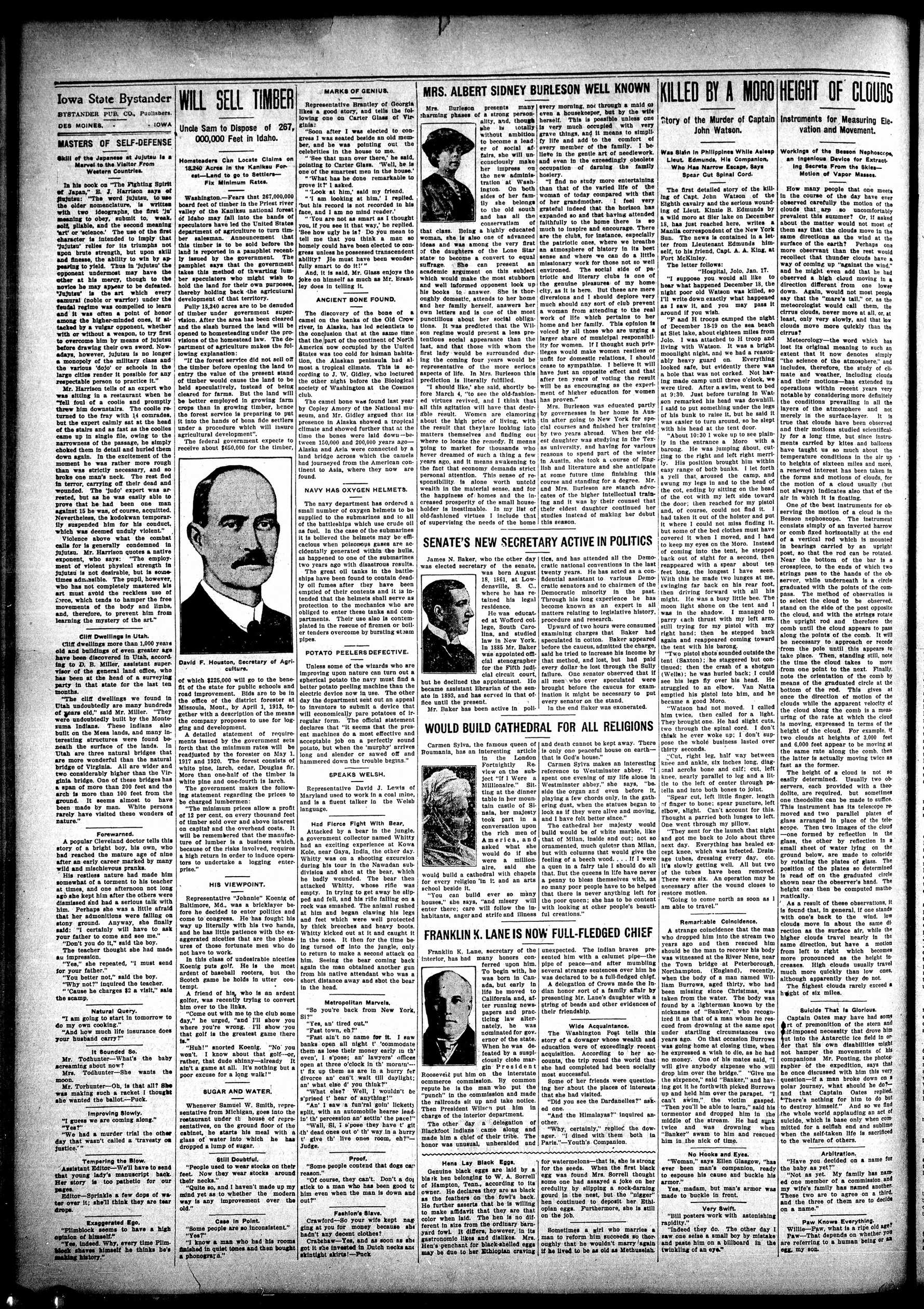
David F. Houston, Secretary of Agriculture.
of which $225,000 will go to the benefit of the state for public schools and investment. Bids are to be in the office of the district forester at Missouri, Mont., by April 1, 1913, together with a description of the means the company proposes to use for logging and development.
A detailed statement of requirements issued by the government sets forth that the minimum rates will be readjusted by the forester on May 1, 1917 and 1920. The forest consists of white pine, larch, cedar, Douglas fir. More than one-half of the timber is white pine, larch, cedar, Douglas fir.
The government makes the following statement regarding the prices to be charged lumbermen:
"The minimum prices allow a profit of 12 per cent, on every thousand feet of timber sold over and above interest on capital and the overhead costs. It will be remembered that the manufacture of lumber is a business which, because of the risks involved, requires a high return in order to induce operators to undertake a logging enterprise."
HIS VIEWPOINT.
Representative "Johnnie" Koenig of Baltimore, Md., was a bricklayer before he decided to enter politics and come to congress. He has fought his way up literally with his two hands, and he has little patience with the exaggerated niceties that are the pleasures of those fortunate men who do not have to work.
In this class of undesirable niceties Koenig puts golf. He is the most ardent of baseball rooters, but the Scotch game he holds in utter contempt.
A friend of his, who is an ardent golfer, was recently trying to convert him over to the game with me to the club some day," he urged, "and I'll show you where you're wrong. I'll show you that golf is the greatest game there is."
"Huh!" snorted Koenig. "No you won't. I know about that golf—or, rather, that dude shinny—already it's a game at all. It's nothing but a poor excuse for a long walk!"
SUGAR AND WATER.
Whenever Samuel W. Smith, representative from Michigan, goes into the restaurant at th' house of representatives, on the ground floor of the building, he takes a glass of water into which he has dropped a lump of sugar.
Still Doubtful.
"People used to wear stocks on their feet. Now they wear stocks around their necks."
"Quite so, and I haven't made up my mind yet as to whether the modern way is any improvement over the old."
Case in Point.
"Some people are so inconsistent."
"Yes?"
"I know a man who had his rooms finished in quiet tones and then bought a phonograph."
MARKS OF GENIUS.
Representative Brantley of Georgia likes a good story, and tells the following one on Carter Glass of Virginia:
"Soon after I was elected to congress I was seated beside an old member, and he was pointing out the celebrities in the house to me.
"See that man over there, he said, pointing to Carter Glass. 'Well, he is the smartest man in the house.' "What has he done remarkable to prove it? I asked.
"Look at him, said my friend.
"I am looking at him," I replied, but his record is not recorded in his face, and I am no mind reader.
"You are not as smart as I thought you, if you see it that way," he replied. "See how ugly he is? Do you mean to tell me that you think a man so homely could have been elected to congress unless he possessed transcendent knowledge that he been wonderfully smart to do it!" And, it is said. Mr Glass enjoys the joke on himself as much as Mr. Brantley does in telling it.
ANCIENT BONE FOUND.
The discovery of the bone of a camel on the banks of the Old Crow river, in Alaska, has led scientists to the conclusion that at the same time that the part of the continent of North America now occupied by the United States was too cold for human habitation, the Alaskan peninsula had almost a tropical climate. This is according to J. W. Gidley, who lectured the other night before the Biological society of Washington at the Cosmos club.
The camel bone was found last year by Copley Amory of the National museum, and Mr. Gidley argued that its presence in Alaska was a tropical and further that at the time the bones were laid down—between 15,000 and 20,000 years ago—Alaska and Asia were connected by a land bridge across which the camels had journeyed from the American continent to Asia, where they now are found.
NAVY HAS OXYGEN HELMETS
The navy department has ordered a small number of oxygen helmets to be supplied to the submarines and to all of the battleships which use crude oil as fuel. In the case of the submarines it is believed the helmets may be efficacious when poisonous gases are accidentally generated within the hulls, as happened to one of the submarines two years ago with disastrous results. The great oil tanks in the battleships have been found to contain deadly oil fumes after they have been opened of their contents, and it is tended that the helmets shall serve as protection to the mechanics who are obliged to enter these tanks and compartments. Their use also is contemplated in the rescue of firemen or boiler tenders overcome by bursting steam pipes.
POTATO PEELERS DEFECTIVE.
Unless some of the wizards who are improving upon nature can turn out a spherical potato the navy must find a better potato peeling machine than the electric device now in use. The other day the department sent out an appeal to inventors to submit a device that will economically pare potatoes of irregular form. The official state action is "I demand that the present machines do a most effective and acceptable job on a perfectly sound potato, but when the 'murphy' arrives long and slender or sawed off and hammered down the trouble begins."
SPEAKS WELSH.
Representative David J. Lewis of Maryland used to work in a coal mine, and is a fluent talker in the Welsh language.
Had Fierce Fight With Bear.
Attacked by a bear in the jungle, a government collector named Whitty had an exciting experience at Kowa Kole, near Gaya, India, the other day. Whitty was on a shooting excursion during his tour in the Nawadan subdivision and shot at the bear, which he badly wounded. The bear then attacked Whitty. Whitty got to get away the offended and fell, and his rife falling on a rock was smashed. The animal rushed at him and began clawing his legs and feet which were well protected by thick breeches and heavy boots. Whitty kicked out at it and caught it in the nose. It then for the time being turned off into the jungle, only to return to make a second attack on Whitty. Whitty then again the man obtained another gun from his native attendant who was a short distance away and shot the bear in the head.
Metropolitan Marvels
"So you're back from New York,
Si?"
"Yes, an' tired out."
"Fast town, eh?"
"Fast ain't no name for it. I saw banks open all night t' commodeate them as lose their money early in the even, I 'spose; an' lawyers' office open at three o'clock in the morn'u----t fix up them as are in a hurry for divorce an' can't wait till daylight; an' what else d' you think?"
"What else? It, I wouldn't be 'sprised t' hear of anything," he said. "I'd like to clickety clicky, split, with an automobile hearse lead in 'p' percussion an 'settin' the page!"
"Wall, SI, I s'pose they have t' gift th' dead ones out o' th' way in a hurry t' give th' live ones room, eh?"—Judge.
Proof.
"Some people contend that dogs can reason."
"Of course, they can't. Don't a do stick to a man who has been good to him even when the man is down and out?"
Fashion's Slave.
Crawford—So your wife kept nagging at you for money because she hadn't any decent clothes?
Crabshaw—Yes, and as soon as she got it she invested in Dutch necks and skintight skirts!—Puck
MRS. ALBERT SIDNEY BURLESON WELL KNOWN
SENATE'S NEW SECRETARY ACTIVE IN POLITICS
Mr. Baker has been active in poll. In the end Baker was exonerated.
WOULD BUILD CATHEDRAL FOR ALL RELIGIONS
WOULD BUILD CATHEDRAL FOR ALL RELIGIONS
FRANKLIN K. LANE IS NOW FULL-FLEDGED CHIEF
presents many
if a strong personality,
and, though
she is totally
without ambition
but with a
eye of social
affairs, she will
unconsciously make
her impress on
the new administration at Washington. On both sides of the street she belongs
to the old south
and has all the
conservatism of
Mrs. Burleson
charming phases of
that class. Being a highly educated woman, she is also one of advanced ideas and was among the very first of the daughters of the Lone Star state to become a convert to equal suffrage. She can present an academic argument on this subject which would make the most stubborn and well informed opponent look up his books to answer. She is thoroughly domestic, attends to her home and her family herself, answers her own letters and is one of the most punctilious about her social obligations. It was predicted that the Willow family had a tremendous social appearance than the last, and that those with whom the first lady would be surrounded during the coming four years would be representative of the more serious aspects of life. In Mrs. Burleson this prediction is literally fulfilled.
"I should like," she said, shortly before March 4, "to see the old-fashioned virtues revived, and I think that all this agitation will have that desirable result. Women are clamoring about the high price of living, with the result that they are looking into matters themselves and finding our where to locate the remedy. It means going to market for thousands who never dreamed of such a thing a few years ago. The fact that economy demands strict personal attention. This sense of responsibility is alone worth untold wealth in the material sense, and for the happiness of homes and the increased prosperity of the small householder is inestimable. In my list of old-fashioned virtues I include that of supervising the needs of the home
James N. Baker, who the other day was elected secretary of the senate,
was born August
18, 1861, at Low-
densville, S. C.
where he has re-
tained his legal
residence.
PETER H.
He was educated at Wofford college, South Carolina, and studied in New York. In 1885 Mr. Baker was appointed official stenographer for the Fifth judicial circuit court, but he declined the appointment. He became assistant librarian of the senate in 1893, and served in that of office until the present.
Carmen Sylva, the famous queen of Roumania, has an interesting article in the London Fortnightly Review on the subject "If I Were a Millionaire." Sitting at the dinner table in her mountain castle of Sinaia, her majesty took over conversation upon the rich men of America, and asked what she would do if she were a millionaire, said she
Fortnightly Review on the subject "if I Were a Millionaire." Sitting at the dinner table in her mountain castle of Sinafa, her majesty took part in a conversation upon the rich men of America, and asked what she would do if she were a millionaire, said she would build a cathedral with chapels for every religion 'in it' and an arts school beside it.
"You can build ever so many houses," she says, "and misery will enter there; care will follow the inhabitants, anger and strife and illness
Franklin K. Lane, secretary of the interior, has had many honors con
fered upon him.
To begin with, he
was born in Canada,
but early in life he
moved to California and, at
terr running news
papers and prac ticing law alterna-
nately, he was
nominated for governor of the state.
When he was de-
feated by a suspiciously close margin President
To begin with, he was born in Canada, but early in life he moved to California and, after running newspapers and practicing law after marriage, he was nominated for governor of the state. When he was defeated by a suspiciously close margin President Rooseveit put him on the interstate commerce commission. By common repute he is the man who put the "punch" in the commission and take notice. Then President Wilson put him in charge of the interior department. The other day a delegation of Blackfoot Indians came along and made him a chief of their tribe. The honor was unusual, unhersided and
Genuine black eggs are laid by a bible as a blue book to W. A. Sorrell of Hampton, Tenn., according to its owner. He declares they are as black as the feathers on the fowl's back. He further asserts that he is willing to make and avail that they are that color when laid. The hen is no different in size from the fowl, however, in its yard fowl lives on the ground, similar like and dislikes. Hens' penchant for black-shelled eggs may be due to her Ethiopian craving
every morning, not through a mud or even a housekeeper, but by the wife herself. This is possible unless one is very much occupied with very grave things, and it means to simplify life and add to the comfort of every member of the family. I believe in the great art of needlework in the exceedingly obsolete occupation of darning the family heedley.
"I find no study more entertaining than that of the varied life of the woman of today compared with that of her grandmother. I feel very grateful indeed that the horizon has expanded so and that having attended faithfully to the home there is so much to inspire and encourage. There are the clubs, for instance, especially the patriotic ones, where we breathe an atmosphere of history in its best sense and where we can do a little missionary work for those not so well environed. The social side of patriotic and literary clubs is one of the genuine pleasures of my home city, as it is here. But these are more diversions and I should deplore very much should any sort of club prevent a woman from attending to the real work of life which pertains to her home and her family. This group voiced by all those who are urging a larger share of municipal responsibility for women. If I thought such privileges and make women restless or for domestic relations, I should cease to sympathise. I believe it will have just an opposite effect and that after ten years of voting the result will be as encouraging as the experiment of higher education for women has proven."
Mrs. Burleson was educated partly by governesses in her home in Austin after going to New York for special courses and finished her training by two years abroad. When her old eighth daughter was having the Test of English, she had many reasons to spend part of the winter in Austin, she took a course of English and literature and she anticipate at some future time finishing this course and standing for a degree. Mrs. and Mrs. Burleson are stanch advocates of the higher intellectual training of her eldest daughter continued her studies instead of making her debut this season.
ties, and has attended all the Democratic national conventions in the last twenty years. He has acted as a confidential assistant to various Democratic senators and to chairmen of the Democratic minority in the past. Through his long experience he has become known as an expert in all matters of legislative history, procedure and research. Upward of two hours were consumed examining charges that Baker had speculated in cotton. Baker appeared before the caucus, admitted the charge, said he tried to increase his income by that method, and lost, but had paid every dollar he lost through the Sully failure. One senator observed that all men expected to be present before the caucus for examination it might be necessary to put every senator on the stand.
and death cannot be kept away. There is only one peaceful house on earth that is God's house." Carmen Sylva makes an interesting reference to Westminster abbey. "I spent one evening of my life alone in Westminster abbey," she says, beside the organ and an altar, playing music only in the gathing dust, when the statues began to look as if they were alive and moving, and I have felt better since." The cathedral her majesty would be of white marble, like that of Milan, inside and out; not so ornamented, much quieter than Milan, but with columns that would give the feeling of a beech wood. "If I were a quen in a fairy tale I should do all that. But the queens in life have never a penny to pay to themselves with people have to be helped that there is never anything left for the poor queen; she has to be content with looking at other people's beautiful creations."
unexpected. The Indian braves presented him with a calumet pipe—the pipe of peace—and after mumbling several strange sentences over him he was declared to be a full-fledged chief. A delegation of Crows made the Indian honor sort of a family affair by presenting Mr. Lane's daughter with a string of beads and other evidences of their friendship.
Wide Acquaintance
The Washington Post tells this story of a dawgower whose wealth and education were of exceedingly recent acquisition. According to her accounts, the trip round the world that she had completed had been socially most successful. Some of her friends were questioning her about the places of interest that she had visited. "Did you see the Dardanelles?" asked one. "And the Himalayas?" inquired another. "Why, certainly," replied the dawgower. "I dined with them both in Paris."—Youth's Companion.
for watermelons—that is, she is strong for the seeds. When the first black egg was found Mrs. Sorrell knew one had assayed a joke on her credulity by slipping a sock-darning gourd in the nest, but the "nigger" hen continued to deposit her Ethiopian eggs. Furthermore, she is still on the job.
Sometimes a girl who marries a man to reform him succeeds so thoroughly that he wouldn't marry 'again if he lived to be as old as Methuselah.
KILLED BY A MORO HEIGHT OF CLOUDS
Story of the Murder of Captain John Watson.
Waa Slain in Philippines While Alesep Lieut. Edmunds, His Companion, Who Has Narrow Escape, Says Spear Cut Spinal Cord.
The first detailed story of the killing of Capt. John Watson of the Eighth cavalry and the serious wounding of Lieut. Kinnie B. Edmunds by a wild more at Sier lake on December 18, has just reached here, writes a Manila correspondent of the New York Sun. The news is contained in a letter from Lieutenant Edmunds himself, to his friend, Capt. A. A. King, at Fort McKinley.
The letter follows:
"I suppose you would all like to hear what happened December 18, the night poor old Watson was killed, so I'll write down exactly what happened as I saw it, and you may pass it around if you wish.
"F and H troops camped the night of December 18-19 on the sea beach at Slet lake, about eighteen miles from Jolo. I was attached to H troop and living with Watson. It was a bright moonlight night, and we had a reasonably heavy guard on. Everything looked safe, but evidently there was a hole that was not nocked. Not having made camp until two o'clock we were tired. After a swift bed to bed at 9:30. Just before turning in Watson remarked he was downhill with something under the legs of his bunk to raise it, but he said it was easier to turn around, so he slept with his head at the tent door.
"About 10:30 I woke up to see plainly in the entrance a Moro with a barong. He was jumping about, cutting to the right and left right merrily. His position brought him within easy range of both bunks. I let forth a yell that, aroused the camp, and swung my legs in and to the head of the cot, ending by sitting on the head of the cot with my left side to the door; then reached the pistol and, not find it. I taken it out of the holster and put it where I could not miss finding it, but some of the bed clothes must have covered it when I moved, and I had to keep my eyes on the Moro. Instead of coming into the tent, he stepped back out of sight for a second, then reappeared with a spear about ten feet long, the longest I have seen. With this he made two lungs in his swing far back on his rear foot, then driving forward with all his might. He was a busy little beaver the moon light shone on the man and was the man to manage to thrust with my left arm, still trying for my pistol with my right hand; then he stepped back again and reappeared coming toward the tent with his barong.
"Two pistol shots sounded outside the tent (Saxton); he staggered but continued; then the crash of a shotgun (Wells); he was hurled back; I could see his legs fly over his head. He struggled to an elbow. Van Natta emptied his pistol into him, and he became a good Moro.
"Watson has no arm. I called him, and he called for a light. They brought one. He had slight cuts, two through the spinal cord. I don't thak he ever woke up; I don't suppose the whole business lasted over thirty seconds.
"Cut, right leg, half way between knee and ankle, six inches long, diagonal across bone and calf; cut, left knee, nearly parallel to leg and a little to the left of center through patella and into both bones to joint.
"Spear cut, left little finger, length elbow, nearly accounted for本章. Can't account for本章. Thought a parried both lungs to left. One went through my pillow.
"They sent for the launch that night and got me back to Jolo about three next day. Everything has healed except knee, which was infected. Drainage tubes, dressing every day, etc. it's slowly getting well. All but two of the tubes have been removed. There were six. An operation may be necessary after the wound closes to restore motion. "Going to come north as soon as k am able to travel."
Remarkable Coincidence.
A strange coincidence that the man who dropped him into the stream two years ago and then rescued him should be the man to recover his body was witnessed at the River Nene, near the Town bridge at Peterborough, Northampton, (England), recently, when the body of a man named William Burrows, aged thirty, who had been missing since Christmas, was taken from the water. The body was found by the members of the "Banker," who recognized it as that of a man whom he rescued from drowning at the same spot under startling circumstances two years ago. On that occasion Burrows was going home at closing time, when he expressed a wish to die, as he had no money. One of his mates said, "I will give anybody sixpence who will drop him over the bridge." "Give me the sixpence," said "Banker," and having got it he forthwith picked Burrows up and held him over the parapet. "I can" said, "I victim, gaped, you will be able to do that," and sentorment and dropped him in the middle of the stream. He had sunk twice and was drowning when "Banker" swam to him and rescued him in the nick of time.
No Hooks and Eyes.
"Woman," says Ellen Glasgow, "has ever been man's companion, ready to espouse his cause and buckle his armor.
Yes, madam, but man's armor was made to buckle in front.
Very Swift.
"Bill posters work with astonishing rapidity.
"Indeed they do. The other day I saw an elephant a small boy by mistake and paste him on a billboard in the twinkling of an eve."
Instruments for Measuring Elevation and Movement.
Workings of the Besson Nephoscope
an Ingenious Device for Extracting Secrets From the Skies—Motion of Vapor Masses.
How many people that one meets in the course of the day have ever observed carefully the motion of the clouds that _arp_ so uncomfortably prevalent this summer? Or, if asked about the matter would not most of them say the clouds move in the direction of the recession, or at the surface of the earth? Perhaps one more observant than the rest would recollect that thunder clouds have a way of coming up "against the wind," and he might even add that he had observed a high cloud moving in a direction different from one lower down. Again, would not most people say that the "mare's tail" or, as the cirrus clouds, would call them, the cirrus clouds, need not be at or at least, only very slowly, and that the clouds move more quickly than the cirrus?
Meteorology—the word which has lost its original meaning to such an extent that it now denotes simply "the science of the atmosphere," and includes, therefore, the study of climate and weather, including clouds and their motions—has extended its scope to include not only its notable by considering more definite the conditions prevailing in all the layers of the atmosphere and not merely in the surface-layer. It is true that clouds have been observed and their motions studied scientifically for a long time, but since instruments carried by kites and balloons have taught us so much about the temperature conditions in the air up to heights of sixteen miles and up to ten miles, they have been the forms and motions of clouds for the motion of a cloud usually (but not always) indicates also that of the air in which it is floating.
One of the best instruments for observing the motion of a cloud is the Besson nephoscope. The instrument consists simply of an inverted harrow or comb fixed horizontally at the end of a vertical rod which is mounted in bearings carried by an upright post, so that the rod can be rotated. Near the bottom of the bar is a string pass to the strings pass to the hands of the observer, while underneath is a circle graduated with the points of the compass. The method of observation is to select the cloud to be observed, stand on the side of the post opposite the cloud, and with the strings rotate the upright rod and therefore the comb until the cloud appears to pass along the points of the comb. It will be necessary to approach or recede the take place. Then, standing still, note the time the cloud takes to move from one point to the next. Finally, note the orientation of the comb by means of the graduated circle at the bottom of the rod. This gives at once the direction of motion of the clouds while the apparent velocity of the cloud along the comb is a measuring of the rate at which the cloud is moving, expressed in terms of the time it takes to move two clouds at heights of 3,000 feet and 6,000 feet appear to be moving at the same rate along the comb. then the latter is actually moving twice as fast as the former.
The height of a cloud is not so easily determined. Usually two observers, each provided with a theodolite, are required, but sometimes one theodolite can be made to suffice. This instrument has its telescope removed and two parallel plates of glass arranged in place of the telescope. Then two images of the cloud—one formed by reflection in the glass, the other by reflection in a small sheet of water lying on the ground, are made to coincide with the plates of glass. The position of the plates so determined is read off on the graduated circle shown near the observer's hand. The height can then be computed mathematically.
As a result of these observations, it is found that, in general, if one stands with one's back to the wind, low clouds move in about the same direction as the surface air, while the higher clouds travel nearly in the same direction, but have a motion from left to right which becomes more pronounced as the height increases. High clouds usually travel much more quickly than low ones, although apparently they do not. The highest clouds rarely exceed a height of six miles.
Suicide That Is Glorious
Suicide That Is Glorious
Captain Oates may have his sons art of preemption on the tree and drove him out into the Antarctic ice field in order that his own disabilities might not hamper the movements of his companions Mr. Ponting, the photographer of the expedition, says that he once discussed with him this very question—if a man broke down on a polar journey, what should he do and that Captain Oates replied, "There's nothing for him to do but to destroy the tree so we can find the world applauding an act of suicide, which is base only when committed for a selfish end and sublime when the self-taken life is sacrificed to the welfare of others.
Arbitration
"Have you decided on a name for the baby as yet?"
"Not as yet. My family has named one member of a commission and my wife's family has named another. These two are to agree on a third, and the three of them are to decide on a name."
Paw Knows Everything.
Wille—Paw, what is a ripe old age?
Paw—That depends on whether you are referring to a human being or an egg, my son.
AFRO-AMERICAN CULLINGS
Editor J. H. Murphy of the Afro-American, Baltimore, has been traveling through the south. Mr. Murphy not only uses his pen well, but he uses both his eyes and his ears. In his correspondence to his paper he sounds a voice for our race in the north should hear and heed. Hear what he says:
Jacksonville, Fla.—A great deal of sympathy is being waged among the colored folks in many of the northern and eastern estates upon the negro of the south. A good deal of this sympathy might well be saved. In a great many things the negro of the south is far and away ahead of the negro of the north. We venture the assertion that there are more negro clerks, bookkeepers, secretaries, typewriters in Birmingham alone than there are in New York City, or possibly Chicago, a large northern city. Another proposition is that the large number of negro mechanics. They are here in large and increasing numbers, thanks to the Tuskegee school spirit and the sentiment of the south itself. One will hardly see a building of any proportions, or with no proportions at all, but one sees the inevitable negro mechanic. And moreover he works beside his white brother without the least friction, so one may see a negro bricklayer, or a negro carpenter, or gasifier working side by side with a white fellow mechanic. One may see in almost any large city, or even even skyscrapers, the area and the entire engine, of a negro architect working the plans and directing the work. While I am writing this letter I am sitting at a window which looks out over a huge five-story building up upon which I have not seen a white workman except the foreman, which happened because there was no negro builder or contractor under the terms necessary to put up the building. And by the way it is a negro building. three stories of which it is devoted to commercial purposes, that is, offices and stores, and I have been informed that all the available space has been used and is not being used. I have been informed that when the building is completed that a number of the substantial citizens of this place are going to open up a bank in first class shape with at least twenty-five thousand dollars capital.
Just as there has been an organized movement to have anti-intermarriage measures passed in the various legislatures throughout the country, so is there a well-engineered plan on foot to have the colored railroad porter ousted in the west and middle west, although several states have refused to consider the plan seriously. The governor of the state of colored men as train porters. Porters in the Pullman service are not affected. As usual, the train porters are unorganized and are fighting the hostile measures the best they can. In each of the states in the west and middle west bills have been introduced in the legislatures known as the Full Crew Bill, which provides for a brakeman and flagman on all passenger trains carrying more than 100 passengers. Full Crew Bill to do away with the colored train porter, as he carries a switch key the same as the brakeman and performs similar duties.
A woman says the way to reach a man's heart may be through his stomach, but it may take cunning or brute strength to reach his pocketbook.
On a visit to Atlanta university, in company with other white men, Clark Howell, editor of the Atlanta Constitution, emphasized the mutual dependence of the white race upon the black race. He declared that if the city homes, white and black, were kept as clean as the buildings of the school the mortality of the city would be reduced by more than half.
Mr. Howell said that education was a good thing for all creatures and all people of whatever race. That among all people will be found two distinct castes, the good and the bad. The party visiting Dr. C. Wilmer of Judge W. R. Hammond Clark Howell, J. K. Orr and Dr. C. B. Wilmer. Each one of the party made short addresses to the students, Judge Hammond emphasizing the importance of individual responsibility and the too frequent tendency of people to shift the burden upon someone else.
The Daily Reporter is the name of a negro daily newspaper being published in Jacksonville, Fla., by a company of colored men. It is making a favorable impression.
There has been organized in Valdosta, Fla., a business and professional men's league. Nothing is more needed in a city where there is such a large number of both. As far as we could learn, the officers are: Mr. W. S. Larkin, president; Dr. C. C Strickland, vice-president, Mr. M. G. Miller, secretary.
Should an original idea strike some men it would give them a headache.
A lazy man's feet leave their imprint on the path of least resistance.
The fact that a woman paid $500 for an Easter hat is not absolute proof that her husband is a new York policeman. He may be a waiter.
When a man suggests to a woman that they shall "tell each other everything" it is always with the serene conviction that she can have nothing to tell.—G. B. Sterne.
You are right, Alonzo. It is perfectly proper for a young man to wear a business suit when he calls on a girl—that is, if he means business.
What is woman's work? It used to be so defined by custom as to be as unmistakable as the clothing she wears distinguishering her from mere man, and it was considered as unwomanly to do man's work as to wear man's clothing. Even now the woman who wears short hair is looked upon as being as queer as the man who wears long hair. The tendency among some women to wear clothing like horseback riding of men, like riding horseback adorned by those who see nothing but degeneration of the race in the unsexing of the woman in her clothing, manners and occupation.
Women have of late years so encroached upon the occupations of men in the office, the store and the factory as to lessen the wage earning capacity of men and the ability of men to support families, so that marriages are fewer and divorces are more numerous than in old times. The wages paid to women who do the work of men is less than that paid to men, and women do not spend their earnings in family making and educating as men do. Indeed, how a woman will spend a dollar bill is as much of mystery as what a Bull Moose would do in the White House. And women who begin life as independent wage earners, and who constantly assort their employment, devise"up a freedom of the fitness and a certain hardiness of manners that unifies them for the successful work of the home as wives and mothers. The sons of Sparta always knew their mothers but never their fathers. It is that way now with dogs, human and canine. A masculine woman is as dangerous in the home as a feminine man.
We do the race an injury by looking down upon, and underestimating the importance in the body politic of the man who serve, and it is more than probable that he sometimes underestimates his own worth by failing to magnify his calling, and neglecting to do his work so efficiently as to leave no room for improvement on the part of any one. The monopoly which we used to hold in these lines got away from us not because of favoritism to the man with a white skin, but because this latter was able to put it over us in the matter of cleanliness, efficiency, faithfulness and reliability. Circumstances are breaking strong in our favor, and it will be our fault if we do not get a stronger hold on whatever comes our way. And we do ourselves woefully when we imagine that the other fellow doesn't have the job. The other has passed. The negro doesn't hold it today that the other fellow would not with eagerness. We must learn not only to get there, but "to stay there" by right of merit—Ethiopian Phanlax.
That there are 121 colored people in business and twenty-five in the professions in Columbus, Ohio. is but another sign that the negro of the north is coming into his own. There are among the business men six coal dealers, three contractors, four confectioners, three feed merchants, four hotel keepers, eight restaurant keepers, and five shoemakers.
A polite discussion is going on between a colored citizen of Nashville, Tenn., and The Globe, a negro newspaper of that city, concerning the fitness of Fisk University having a negro as president.
August Stanfield, graduate of Howard university, passed the highest examination in a class of more than forty-five applicants for license to practice medicine and surgery in New Jersey, before the state board of examiners of Tronton. Dr. Stanfield will locate and practice at Morristown, New Jersey.
Students in our colored colleges deserve to be commended for the man in which they conduct themselves in contrast with the actions of students in many white institutions of learning. Here is a case in point: According to the University Register, Harvard students spend $603,780 for clothes, $98,250 for cigars and cigarettes and $73,250 for wines, as compared to $71,250 for books.
Prof. Cyrus Wiley, A. B., who for eleven years has been principal of the colored public schools at Valdosta, Ga., has made his debut into the ministry. He preached his first sermon at St. Paul's Church in that city. He will retain his position as principal of the schools.
J. A. Ross of Detroit, Mich., a life long Democrat and a prominent negro, is being boosted for the position of Recorder of Deeds under Woodrow Wilson's administration. This change of administration is placing before us many new colored political faces anyway.
Another way for a rich man to attract favorable attention is to let the wives of other men alone.
Not only is poverty a crime, but so is six dollars the week.
You can live comfortably without being extravagant. Extravagance is not comfort.
It is President Wilson who is putting a dent in precedent.
Adam was the first man who cut out gowns for women.
Add but a little to an idea and you have an ideal.
Knowledge is of the head; wisdom of the heart.
SPORTS
BOWLING
Buffalo bowling alley keepers have organized and will make an effort to open the alleys for a couple of hours on Sundays.
TENNIS
Miss Mary Brown, holder of the women's tennis championship, is expected to take part in the annual tournament to be held in the City of Mexico.
BILLIARDS
George Slosson is the same cue comet he was several years ago. He took Kojl Yamada into camp, 300 to 268.
Frank Jones of Philadelphia defeated Charles McCourt of Pittsburgh in a national three-cushion billiard league match by the score of 50 to 44. Pittsburgh defeated Brooklyne in the national three-cushion billiard league 50 to 35 in 77 innings. Charles McCourt of Pittsburgh made a high run of six and Charles Otis of Brooklyn made a four.
FOOTBALL
Frank Cavanaugh has been reappointed head football coach for Dartmouth.
The Williams college football authorities announce the reappointment of Fred Daly as head football coach.
The English Football association has issued a request that teams taking part in the season's international tria' soccer games between Scotland, Wales and Ireland.
HORSE RACING
After all the Harlem river speedway is to be saved for the horsemen of New York. There may be more fines this year, now that the association has decided to do some good with the money. The Pittsburgh Driving club has announced the program for the grand circuit meeting July 14 to 18 inch races. During 1912 the number of new 2:30 trotters was 1.099 and of new 2:25 pacers, 1.052. It is a close race for honors. The spring stallion show at Lexington will be held on April 14 and it is expected that there will be a big turnout. Joe Patchen, 2:10%, a pacing warrior bold in his day, is in excellent health and jogging dally over the roads near Goshen. Joe Mitchell, who owned Charley Mitchell and Baden, is looking for another of the same brand in the Binga trotter Baldo 2:22%.
Uhlan is to make a record trip at the Cleveland fair on August 25. The great trotter is said to be in perfect condition this year and now is at Memphis. Momere, 2:23%, by Mobel, that Scott Ross worked in 2:11 on the Detroit track last year, may change as Lon McDonald has his eye on the trotter.
BASEBALL
Fred Snodgrass of the Glants touts the Phillies to cop the flag. Bates, a candidate for third base, is doing wonders in Cleveland. Manager Huggins of the Cardinals believes Pitcher Roy Golden will have a winning year. And now Manager Stovall of the Brown avers that his team will finish not lower than fifth. Danny Murphy, the Athletics' fielding star, is being groomed by Manager Mack for a managerial berth. Chance like the way Sterrett works behind the bat. The Princeton lad may get his turn with Sweeney. McGraw says Connie Mack is a hard man to interview. Johnny must be rehearsing his vaudeville stunt. Doc Scanlon, the former Brooklyn pitcher, has been engaged to coach the St. John's College baseball team. Manager Joe Birmingham of the Naps believes that he has a real find in Nemo Leibold, his young outfielder. Pitcher George Tyler of the Boston Braves was given an increase of $200 in his pay check and signed a contract.
Schang of the Athletics is said to be the fastest catcher in the big leagues in getting down to first or circling the bases.
President McAleer and Manager Jake Stahl of the Red Sox pick the Pittsburgh Pirates to land the bunting in the National league this season.
Here's all Manager Fred Clarke of the Pirates has to say: "If we get our share of the breaks this season we will be up there somewhere—at the top, I hope."
McGraw has the finest crop of youngsters picked up by any major league team this year. He expects to get two finds, and possibly four, out of this year's pick, the player who seems able to escape the hammering of the anvil chorus. He is a great favorite among the fans.
A Chicago writer asks: "If Christy Mathewson, Jr., gets ten lines for breaking his arm, how many columns would his pana get?"
St. Louis scribes believe that Ivy Wingo, the Cardinals' crack backstop, will be the star catcher of the National league this year. Bobby Wallace, the veteran short fielder of the Browns, now playing his eighteenth season on the diamond, expects to beat out his rivals.
PITCHER HAMILTON
WILLIAM H. HARRIS
Among Manager Stoval's string of twirler not one is more popular with the fans than Southpaw Hamilton, who shut the Detroit Tigers out last year in a championship game without a hit.
WRESTLING
John Ihle, a University of Minnesota student, died from injuries received while wrestling a few days ago.
Frank Goth is like the proverbial bear that goes into his cave in the fall and does not come out until spring. Early each year some "meat" is brought forth for him to devour. This time it will be George Lurich.
AQUATIC
The Argonaut Rowing club of Toronto has given Sims, the English boat builder, an order for an eight-oared shell, a four and double shell for racing purposes.
The Hanlan Memorial course, in Toronto, will, when it is completed this fall, be the fastest for rowing in America, according to the claims of Canadian oarsmen.
Princeton expects to have a strong rowing crew this year. Two races have been arraigned so far, with Harvard and Pennsylvania May 10, and with Annapolis May 17.
At a meeting of the executive committee of the National Association of Amateur Oarsmen the national regatta was awarded to Boston, to be held on the Charles river basin on August 8 and 9.
One of the big events of the rowing season will be the four-cornered race on the Charles river at Cambridge on May 10, between the varity eight cars of Penn, Columbia, Princeton and Harvard.
PUGILISM
Johnny Marto triumphed over Harry Donohue of Pekin, Ill., at New York.
Pat Bradley and One Round Hogan went six fast rounds to a draw at Philadelphia.
Jack Britton defeated Young Brown, the east side idol, in their ten-round battle at New York.
Eddie Glover of Chicago and Lew Glover of Detroit went ten rounds to a draw at Kalamazoo.
George Knockout Brown of Chicago whipped Billy Evans in their ten-round fight at Altoona, Pa.
Matty Baldwin of Boston won the popular decision in his bout with Eddie Smith of New York in New York.
In a six-round bout at Philadelphia Jack Britton defeated Johnny Krause.
The fight belonged to Britton from the start.
Jimmy Perry of Pittsburgh and Wild Cat Ferns of Kansas City fought ten slow and uninteresting rounds at Atlanta, Georgia, Lewis, the American middleweight pugilist, won the decision on points in Paris from the French middleweight, Marcel Moreau.
A year and a half ago your boxing fan was seriously considering whether McFarland could lick Wolgaat at 132. Now he admits he can't make 133 to meet Ritchie. Young Denny, the New Orleans welterweight, and Phil Cross of New York, brother of Leach Cross, fought ten rounds at New Orleans. There was no decision.
MISCELLANEOUS
The promoters of the new Detroit Athletic club have purchased a block of ground as a site for the new structure.
Hannes Kolemahlens has quit the running track for a while and has started work at his trade of bricklayer.
Steve Shipley, the Baltimore crosscountry club roster skating champion, who holds two world's records, is about to leave for a tour of England and France.
Proposal to have the national track and field championships next summer held at the Harvard stadium under the auspices of the Boston Athletic association is being considered by officials of that club.
Yale won the annual gymnastic meet with Princeton, $21\%$ to $21\%$.
An all-American hockey team, selected from metropolitan and collegiate stars, has been gathered to compete with the Canadian champions, the Toronto Maple Leafs.
G. Matthiesen, the Norwegian champion, established a new skating record for the 500 meters at Hamar. He covered the distance in 0:44.
P. J. Conaway has for the sixteenth consecutive time been elected president of the Irish-American Athletic Association. Robertson is the professional coach
"DRY CLEANING" AT HOME
Method by Which Time and Money May Be Saved, and "Life" of the Goods Prolonged.
Every woman knows the rufous sums it costs each season to have her evening frocks, light sails, silk blouses, and other unwashable articles dry cleaned. Where gasoline is possible as a renovator she may sometimes tay the experiment of doing a little of her own cleaning, but it is seldom successful, and it is as here to lose the edor of gasoline as it is to lose the odor of sanity. Also it is dangerous. Therefore, the knowledge of some simple methods of dry cleaning that can be done at home, and that leave no trace of the process, would save many a precious dollar to the woman who is running to the limit of her allowance for dress. The materials required are very simple—fuller's earth, block magnolia, boricacalum powder, flour, and borax, or even a powdered baking soda, be bought by the ounce or pound from and druggist, and the others are always in the pantry or store closet.
For a white suit it is perfectly safe to use either the meals or talcum powder. A white serge suit, for example, can be very successfully cleaned by putting it into a dry, clean tub and covering it with cornmeal slightly salted. The suit can be rubbed with the hands exactly as if it were in soapsuds, the most energetic rubbing naturally being given to it which are most soiled. After it has been groomed gone over, the meal should be handled the gown put back into the tub and covered over with clean meal. It should be left there for two days, with a cloth over the tub to keep out the dust, and then shaken out and brushed with a perfectly clean brush.
DAINTY OF THE OLDEN TIME
Sugar and Butter Cooked together to
Make a Most Appetizing Tit-Bit
Cake
Whistles, a sweet which must have been a great daltry in the days when it was first concocted, are made, according to an ancient recipe, in the following manner:
Cream a half pound of sugar and a quarter pound of butter and beat six eggs, yolks and whites separately.
Add the eggs to the creamed sugar and butter and then add enough flour to make a thick batter. In the old days rosewater was considered a delicate and delicious flavor, but vanilla might suit the modern palate better: anyway, add some flavoring.
Butter a sheet of paper and spread it on a molding or bread board. Drop the batter with a tablespoonful of the three or four inches of the paper, grease each drop on a plate. Bake it in a hot oven for about five minutes, when it should be slightly browned. Then slip the little cakes on a molding board sprinkled with sugar and quickly roll them about a stick. When they are cold fill them with felly or jam.
Turkish Croquettes
Chop a pound of veal fine, grate white bread to the amount of one cupful with it and mix the whole together with an equal amount of minced ham and half a cupful of chopped chicken with an equal amount of vegetable oil, absolutely necessary. Season well with pepper and salt and "bind" it with two beaten eggs. Butter a mold and line it with macaroni that has been previously boiled and then turn the veal mixture into it, pressing it well down. Place the mold in a dish with boiling water within an inch of the veal mixture. Remove and turn out of the mold on a hot platter and pour it any rich gravy.
Broiled Cod Steaks
Three slices, cut from the middle of the fish, two eggs, a few capers, oil, vinegar, pepper, and salt; clean and dry the fish, warm, then grease a griddiron; broil the steaks upon it till thoroughly done. Broil the yolks of the eggs into a basin, adding oil enough to make a thick cream; when these are well blended, add a little vinegar, the capers cover a seasoned fish, stir, salt, and pour this sauce over the fish. Serve garnished with lemon and parsley. Fifteen minutes to grill the steak. Sufficient for six persons.
French Beefsteak.
Cut your steak two-thirds of an inch thick from a fillet of beef; dip into melted butter, lay them on a hot griddle and boll over fresh coals. When very nearly done, sprinkle with pepper and salt. Have ready some parsley, chopped and mixed with softened butter. Beat them to a cream. Dip each piece in the butter. Dip each piece of steak in the butter, turning them over, and lay them round on the patter. Serve with lemon juice and very hot.
Cocoanut Fudge.
To make cocoanut fudge, follow this rule for delicious results: Put into a saucepan over the fire 2½ cups of brown sugar and 1 cup of cream, and begin then to stir in gradually a cupful of grated cocoanut, or just as much as suits the fancy. Begin to beat when it starts to brown and then to melt it. It is this smooth and it is seen to be ready to "set." Pour into a buttered shallow pan and when cooling mark into squares with a buttered knife.
Duchess Potato Balls
Prepare a quart of fuffy mashed potatoes. Beat in an egg, then form into balls; while still hot, roll lightly in an egg beaten with one half cup of water. Beat in another in a hot oven till browned. Remove with a pancake turner.
Fried Apples
Wash fruit and remove imperfections. Cut inch-thick slices—covering the bottom of the frying basket with these slices. Fry in deep grease, very hot, till rich brown color. Shake back the cheese from grease. Dust lightly with salt.
NOT AN INVENTION
Chinese Knowledge of Gunpowder
Result of Chance.
Admitted as Truth That the Nation Knew of the Explosive Two Thousand Years Ago, but its Discovery Was Accidental.
Everyone knows that the Chinese claim the invention of gunpowder. It is declared by educated Chinamen that in the great and imperial records that have been accumulating at Petkin for so many hundreds and hundreds of years there is no account that proves the Chinese knew about and used gunpowder more than two thousand years ago.
Research has led to the belief, however, that the Chinese did not actually invent gunpowder, but discovered it through a series of peculiar accidents. Gunpowder consists of saltpeter, powdered charcoal and powdered sulphur, but just the powdered sulphur but just the powdered saltpeter will make a very good explosive.
Now throughout many of the great plains in both India and China there is found on the surface quantities of saltpeter. The men who have been making studies of this have finally come to the conclusion that doubtless the manner in which gunpowder was discovered was a simple accident. Men camped on these plains, according to the claims of some experts, built fires and left here and there great spots of coals and charred wood from their campfires. The charred wood was nothing more or less than charcoal, and this in time was trampled down by cattle and horses and men crossing these plains, leaving finely powdered charcoal lying over the saltpeter plains. In places where the saltpeter cropped out of the ground in larger and purer soils there soon occurred combination of saltpeter and powdered charcoal wherever campfires were made. Then other travelers across these plains stopped by the wavies and built their fires.
No doubt these travelers were at first frightened and mystified to find that whenever they lighted their camp fires there came flashes and explosions and puffs that sent smoke and fine cinders flying about. They led to the discovery that such explosions happened only where there was charred wood ground fine on the ground. From this the deduction was simple, even two thousand or more years ago, and experiments soon led to the discovery of why these explosions happened. Come on, some of us know that the Chinman has really good proof that his people knew about gunpowder two thousand years ago.
An Angry Tree.
In Idaho there exists a species of the acacia-tree that a writer in Harper's Weekly says is entitled to be classed as one of the wonders of plant life. The tree attains a height of about eight feet. When full grown, it closes its leaves together in colls each day at sunset. When the tree has thus grown, it will flutter violently if touched, and if you shake the branches it will emit a nauseating odor strong enough to bring on a headache. In Idaho it is called the "angry tree," and it is said that it was discovered by some men who were making a camp for the night, and placed one end of a canvas covering over one of its sensitive branches, to use it as a support. Immediately the tree began to jerk its branches sharply. The motion continued with increased speed, and soon a seeking odor that drove the tired men to a more hospitable camping place.
Almost an Accident
The old gentleman who came upon a badly dazed person in a by-street of London inquired—so the Daily Mail says—the cause of his agitation:
"My good man, what is the matter?"
"Matter, sir!" repeated the confused individual.
"Matter, sir! Gent'man's 'oss run away with a brougham, sir—never see hanythink like it in all my life—down' e comes the ill with the shaves d-arangling all about 'is legs—knocks a butcher's cart into a linen draper's shop—bang against it, a car all over and smashes the panel all to blis—upsets a phaeton, and if 'e adn't a-run agin this 'ere, cab and dashed it right over an 'stop' itself, blowed if I don't think there'd been an hacident!"
Single Tax In Spain
In Spain, where the multiplicity of taxes is notorious, a single tax movement has been gained ground recently. Not long ago a banquet was given by the Single Tax league in honor of Henry George, this being the first function held in Europe to place in Spain. It was decided to call an international congress to meet at Ronda in May, for which an active propaganda is now being made
Must Study In United States
Henceforth honor graduates from the University of Buenos Aires will come to this country to continue their studies. Up to this time it has been the custom of the government of Argentina to send such students to Europe, and the change has been made through the influence of Dr. Romulo S. Nean, minister to the United States from the Argentine Republic.
Setting 'Em Up
"How do you make your living, my lad?"
"Picking up pins, air."
"Pick me! What an odd occupation. Where?"
"In a bowling alley, sir."
Worth Trying.
"My dear, you advertised the umbrella you lost as worth $5. You know very well you paid only $2. But in the matter of umbrella I have an idea it may pay to advertise."
---
THE CRY OF DEATH
We were sitting on board the Russian cruiser, Livadia, which was lying outside the harbor of Toulon. Together with several of my comrades I was visiting the officers of the Livadia, who were giving a dinner to officers of the French army. Russians are hard drinkers and Russian officers do their best to live up to this national reputation. At Russian dinners you very often continue drinking until the majority of the diners are "under the table."
The waiters kept our champagne glasses filled all the time—for them, all the work knows. For our beverage all the Russians; and for their饮品 of fact there is more champagne consumed in Russia alone than the French champagne district produces. The Russians did not sip their champagne as we do, but threw back their heads and swallowed a whole glass at a time. The quantity of wine which my neighbor drank was something quite inimitable. "I suppose you will return to Paris tomorrow," he asked.
"Well, I was to have left tomorrow, but I postponed it to watch the torpedo practice of the squadron." He was startled; his eyes shot fire; and his forehead grew dark, as if some unpleasant thought had suddenly ooed himself. "Then you are interested in torpedoes?" he asked after a moment's silence. "Yes, I am, I" he replied, "the torpedo is a dreadful weapon and I am interested in it." "Then, he said, with a bitter smile, "I can tell you something more about it than any other man in the world." For a few moments he sat lost in thought; then he straightened himself up and asked: "Have you heard of the first use of the torpedo in actual warfare? It was during the Russo-Turkish war."
"Why, certainly."
"Then listen: It was I who blew up the Turkish flagship."
He stared at me to watch the impression this statement made on me.
"Yes, I—I it was a dreadful, horrible thing. A terrible catastrophe."
And he began his story, evidently less to arouse my interest than to ease his conscience.
"It was on the Danube, you remember? For several days we had been anchored some distance away from the Turkish fleet, but hidden from sight by a bend of the river, which kept a sharp lookout and were always ready, though a surprise attack was very unlikely, as the river is full of sand banks, which make navigation very difficult. Still we expected to be attacked, for the Turkish fleet was far superior to ours. We waited in vain; they did not come.
Then we decided to attack their feet with an arrow. I was put in command of a torpedo boat and we inade ready to start.
"At that time the torpedo was not perfect as today. It was very crude and dangerous to handle. It was necessary to lower it alongside the shipside of the enemy, explode it by an electric battery and run away as fast as you could, so as not to be blown up yourself.
"It was a dark, quiet night. My crew were picked men, every one of whom I could trust not to lose his head under any circumstances, and every one of whom was eager to get at the enemy. The undertaking was an exceedingly dangerous one, and my chief was visibly moved when he拿我的手 as we parted.
"We were summoning a great risk, for if the Turks discovered us in time we had no chances to get away. But I had full confidence in myself and my men.
"Noiselessly we sailed up the river, and at last I could make out the Turkish fleet."
"The flagship loomed up straight ahead of us, a little nearer than the rest. It looked like a gigantic fort, and this target I chose for our attack. Not a sound was heard. Everything was calm; no one dreamed of the threatening danger. A few lanters were the only signs of life on board the flagship.
"We were nearer, and nearer. I could hear my heart beating wildly. I no longer doubted that I would be successful. My men stood motionless. We were alongside the flagship now, and they had discovered us. I was with delight. I bowed my toppedo and fastened it to the shipside. A few seconds more and we would be safe.
"Then we suddenly heard crises and noise on board.
"Torpedoes! Torpedoes!" the turkish sailors shouted. The Turks had an insane idea that torpedoes were something unearthly and phantasial. "When we had got a cable length away I pressed the electric button. There was a cry—an uncanny, supernatural cry. No, you can never conceive any idea of its sound. I am a brave man. You may take my word. I am afraid of nothing in this world—but this cry, but everything was swallowed by the river. Swept away and sailors. The cry follows me everywhere and at tigers it nearly drives me mad. In the middle of the day, if I close my eyes, I can hear it." His voice was full of anguish as he bent toward me and whispered:
His voice was full of anguish as he bent toward me and whispered:
"Listen—do you hear it?"
His eyes stared, a dreadful expression of horror convulsed his face. The glass he held was crushed between his fingers. A hoarse cry escaped his lips; he let go my arm and fell to the floor heavily—Chicago American.
Addressing the Masses.
"What would a politician be without his silk hat?"
"The average politician does some of his loudest talk with his hat off."
Medical Humor.
Patient-I'm trouble with bollos of
and on, doctor. What would you advise?
Noon-Well. I shouldn't let those
that are on trouble me.
COUNCIL BLUFFS. IOWA.
Rev. J. H. Garrison reports his church still progressing and many still coming over on the Lord's side, thirty-three having been added to the church.
Church conference which was called by Rev. J. H. Garrison of Bethel A. M. E. church was indeed a good success, members and friends coming promptly to the pastor's support by each family pledging. Four hundred dollars is to be paid in by June 29th to remodel the parsonage.
The Ladies' Sewing Circle will meet at the parsonage Thursday afternoon to commence the work for the season.
Bethel A. M. E. choir will have a jubilee concert April 22d. Program will consist of jubilee folk lore and classical songs.
The Sunday school superintendent, Miss Minnie Cave, was very agreeably surprised by the Sunday school children Saturday evening. All gathered at the parsonage and with their good shepherd in the lead, marched over and pleasantly surprised their superintendent.
Mrs. R. V. Robinson, Mr. Chas
Patee, Mr. G. T. Taylor and Mrs. S.
M. Fields are reported quite sick.
Mrs. Gibbs and Mrs. Albert Ross
have taken the new apartment house at
1408 West Broadway and will be at
home to their many friends on
Thursday afternoon.
By this time 'tis widely known that
there are eight hundred homeless
families in Omaha, caused by the
Easter storm. Mrs. Jennie Powell,
one of Council Bluff's progressive
business women, by her own efforts
to took to the sufferers one of the first
wagon loads of clothes and provi-
sions. Rev. Garrison and con-
tinue to load over Wednesday morning, April
9th, and will deliver the same to Rev.
Botts and Father Williams, who are
trying to see that our people get justice.
It is reported that there is no color line, but some of the officials are "rather blind" at times is the report from our neighbors and other close observers.
Rev J. M. Burton, state missionary, was in the city and vicinity and preached six splendid sermons. Golden Rule club will meet with Mrs. Peoples, 26 South Thirteenth street, Tuesday evening. Sewing Circle will meet with Mrs. John Turner on Thursday afternoon.
The widows of Council Bluffs Tabernacle Baptist church will give a banquet at the residence of Mrs. T. A. Reese, No. 17 North Twelfth street, Thursday evening, April 10th. Mr. Charlie Burke is endeavoring to give to the colored population of Council Bluffs and Omaha a cafe that we can feel proud to be served in. We will give the opening Thursday afternoon at Westinghouse in new quarters at 1023 West Broadway. past two, weeks.
STRAIGHT AT IT.
There is no use of our "beating around the bush." We might as well out with it first as last. We want you to try Chamberlain's Cough Remedy the next time you have a cough or cold. There is no reason so far as we can see why you should not do so. This preparation by its remarkable cures has gained a world wide reputation, and people everywhere speak of it in the highest of praise. It is for sale by all dealers.
MASON CITY JOWA
Mrs. Wm. Carter, who has been on mer months, and work seems to be more plentiful in Iowa than Missouri. Mrs. Berlina Warren of East Fifth street, who has been on the sick list for several days, is able to be out again.
Mrs. J. L. Esters of Perry, Oklahoma, will leave for her home about the 15th. She has been in the city about thirty days at the home of her son, Mr. David Howard.
Mrs. Pearl Davis left the city Thursday evening for Ottumwa on a business trip. She is expected home about midnight this week. The Ladies' Aid society will meet with Mrs. Marie Allen on South Willow street this week.
Rev. Murley led the pulpit Sunday evening at the Union Memorial church in the absence of Rev. Woodford, who is attending conference at Mexico, Mo. A large congregation was present.
The trustees of Union Memorial church will give a supper Tuesday evening for the benefit of the trustees. Each member is invited to come and help the trustees in their earnest efforts.
CENTERVILLE NEWS.
We are glad that Spring is so near here, and nothing unusual has happened through the long dreary <cenes of winter.
Mrs. Clara Jones was on the sick list last week, but is much improved at this writing, and was able to fill her pew at the church Sunday.
Mr. Lewis Tompkins of Relay was taken seriously ill last Saturday evening.
The revival meetings at the Second Baptist church are still going on. Two more have been added to the church since the meetings began. One convert and one reclaim.
Rev. T. J. Carr, pastor of the Second Baptist church of Ottumwa, assisted Rev. Evans, the pastor, last week.
Sunday was Communion day at the Second Baptist church and a large membership was present, and a glorious service was enjoyed throughout the day.
Little Jessie Allen Gooding, the son of Mr. and Mrs. J. P. Gooding of East Wallow street, has been confined to his home for the past week with measles. Also Little Lucile Martain, the nine year old daughter of Mr. and Mrs. J. W. Martain of North Tenth street, is down with measles. Mrs. Lucy Bell of East Wilson street was able to attend church last Sunday, after an illness of nearly a month. Mrs. C. D. Robinson of South Eighteenth street is visiting with her mother in Mr. Pleasant Iowa for the
An Honest Remedy. Has Given SATISFACTION For More Than Thirty Years.
Straighttens Kinky, Troublesome, Refractory Hair. The Best Remedy for Dandruff, Itch, Rethink and other issues. With hair that has hardened and straight, making it soft and beautiful. Put up in pretty Metal Boxes of 25c, 50c and $1 each. Sent to any address, carriage prepaid, upon receipt of price.
OUR GRAND OFFER: Cut out this advertisement and send it to us with One Dollar, and we will immediately send you: Four boxes of OMEGA CASES, with hardened and straight hair, Anti-Odor—removes odors arising from the human body—one bar of Purity Scalp Scap and a HANDSOME "MAGNETIC" COMB.
The Knights of Pythias are making preparations for their Thanksgiving service that will be held May 25th. Little Loyd Nash, son of Mr. and Mrs. J. L. Nash of South Seventeenth street, who has been sick with measles, is up again, after two weeks confinement to his home.
WASHINGTON NOTES.
Frank Walker visited in Oakaloosa last week.
Jos. Daniels has resigned his position at the W. Miller Understaffing parlors and has taken up his city work for the summer.
Thos Bradford visited in Ottumwa recently.
Geo. Berkley is in the city visiting his parents, Mr. and Mrs. Chas. Berkley.
Rev. Brown attended District conference at Cedar Rapids last week and reports a fine time and a good conference.
Hayes Crayton had the misfortune of getting pretty badly hurt by a horse last week, but is getting along nicely now.
Rev. Daniels, presiding elder, held quarterly meetings at the A. M. E. Church Sunday, March 30th. The presiding elder preached both morning and evening and much interest was manifested at both meetings.
A. L. Hall is in Muscatine on business Saturday, March 29, and suffered a great deal the following week with rheumatism, occasioned by too much walking. He is coming all right at this writing.
Mrs. T. L. Burnett received word from Omaha last week telling about the recent cyclone in which her brother, John Walls, and his son, Ray, were seriously hurt, and Mr. Walls' son-in-law, Chas. South, was killed. Mrs. Burnett has the sympathy of all. Dr. Mason an eminent colored divine of the M. E. church will be one of the principal attractions at the Washington Chauquaau August 21st. Wesley Moore celebrated his 91st birthday March 30th.
Rev. Owens of Fairfield visited Friday night at the Rev. Brown's, enroute day night at the Rev. Brown's en route home from the District conference at Cedar Rapids.
The Stewardesses of the A. M. E. church held a social in lecture room last Thursday night, which netted them about $13.00.
Turner Bros. are busy now with their vacuum cleaner. Mr. Adams of Osakaosa was a guest at the H. Campbell home over Sunday en route home from Chicago. Mr. and Mrs. Mc. Allister of Jacksonville, Ill., will arrive next week to spend the summer at the H. Spencer home. A daughter was born to Mr. and Mrs. Roy McAllister of Chicago recently. Latest reports that mother and child are doing nicely. Be ready when the collector comes. It takes money to run a newspaper.
"PORO COLLEQE"
Largest College of its kind in the world,
300 PINE SYXET, St. Louis, Mo.
"WES HAMATTE"
Every box of "P" is fully purchased. Additional reviews have no restricted. Results are required to be compared to the price of the product. All are referred to our system, during the event.
CONFIRMED DESIGN THE FOODS ARE NOT THE BEST PAPER.
FOR THE FOLIO IS THE BEST PAPER.
GARDENING
Is a pleasure and if properly conducted it is very profitable. We are not advising you to go into the market gardening business, but do you realize that by devoting a little spare time to it mornings and evenings you can easily save $100.00 on your family expenses this year. Working in the fresh soil is the best way to grow your crops this year. The seeds and gardening tools can very little and you can obtain everything you need of the best quality from the
```markdown
```
MASONIC GRAND LODGE NOTES.
The Iowa State Bystander in the official organ of the Most Worshipful United Grand Lodge of A. F. & A. M. of Iowa and jurisdiction. The grand officers are:
Grand Master—John L. Thompson,
Des Moines.
D. G. M.—A. A. Bland, Keokul.
S. G. W.—H. E. Williams, Ottumwa.
J. G. W.—M. O. Culbertson, Clinton.
G. Treasurer—W. H. Milligan, Cedar Rapids.
G. Secretary—W. W. Gross, Keokuk.
G. Custodian—A. G. Clark, Oskaloosa.
Chairman of Committee of F. C.—Geo L. S. Luitor, Marshalltown.
The Grand Custodian, A. G. Clark, has divided the jurisdiction into the following district: First district, consisting of Keokuk, Burlington, Ottumwa, Buxton, Oksalaska and East Des Moines. Second district, West Des Moines, Marsalltown, Cedar Rapids, Dubue, Cinnon and Davenport. Third district, Sioux City, Council Bluffs and Omaha, Neb. The schools of the first district will be held in Ottumwa, the Second in Cedar Rapids and the Third in Omaha, Neb.
CHIPS FROM THE QUARRY.
(For Masonic Column.)
Many of the Grand Masonic lodges are holding their annual sessions this winter instead of summer, as do most northern states.
Keokun is one of the oldest and most historic of the Iowa cities in point of settlement, and here we find the oldest colored Masonic lodge now existing, Union Lodge, No. 1. Some years prior to this Union lodge there were two separate Masonic lodges there.
We found this lodge doing fairly well, although not doing much work. Bro. W. W. Grass, grand secretary and W. M., and Alonzo Draine, S. W., say they are planning to give the grand lodge the greatest welcome to this city in July.
A nice social hour was enjoyed after the G. M. lecture.
Bro. Austin A. Bland and Orange Fields, two of the original members of the local lodge and of Iowa grand lodge, have promised to give the craft a historical treat in the way of early Masonic reminiscences.
On to Keokuk this summer, the Gate City and the Power City.
Our next craft that greeted us was Golden Star, No. 4, Ottumwa. Here Golden Star gave her annual public anniversary at the church, in which fully 500 of her good, loyal, struggling Afro-Americans were out to greet the grand officers. A very excellent program was given and the principal addresses were given by Grand Custodian Bro. A. G. Clark of Oskaloosa and Grand Master Bro. John L. Thompson of Des Moines. An enjoyable time is a mild term. After the program was over a five-course banquet was served and fully 150 plates were laid. It was the greatest reception and banquet we ever attended of this kind.
The next evening the craft assembled to receive the grand master officially. A great feast of good things, good ideas and good morals in each thought made the brothers feel much benefited.
Henry E. Williams certainly has his boys well up in the ritual ceremonies. Golden Star has had more deaths this year than any other lodge and more than in its own history, but the loyal brothers are united and work
Open Every Tuesday Evening
From 8 to 11:30
East Side
Dancing Academy
EAST SINTH AND LOCUST STS.
James Woods ADMISSION
Floor Director 35c
A farmer is laying a road in his garden. Two other farmers are working nearby. A house with a fence is visible in the background.
OZONO
KING OF ALL
HAIR DRESSINGS
SATISFACTION For More Than Wears.
Refractory Hair. The Best Rem-
ather disagreeable Hair and Scalp
long and straight, making it soft
almost upon receipt of price.
but this advertisement and send it
immediately send you: Four boxes
of the jar Skin Food, one package
from the human body—one bar of
ME "MAGNETIC" COMB.
plainly when you send your order
CHEMICAL COMPANY.
Governor St., Richmond, Va.
W. 9th St., Des Moines, Iwa
of their mother, Mrs. Major Barber, who we are glad to say at this writing, is convalescent. We hope for her speedy recovery.
Mr. Chas Barber of Buxton was visiting the parental home and friends in Evans.
Rev. R. P. Palmer preached two very instructive sermons Sunday morning and evening. Services being well attended and enjoyed by those in attendance.
The Home and Foreign Mission Circle met in a very interesting meeting at the residence of Mrs. Robert Olyphant.
The pastor, Rev. R. P. Palmer, being gave a very fine address. Though few in number, but are moving along nicely. Lunch will be served next meeting at Mrs. James Coleman.
The children of Mrs. Lottie William are reported much improved in health at this writing.
Mrs. Emma Willis made a business trip to Oskaloosa Saturday.
The people of Evans are about over the small scaup scare, as only one or two cases are reported.
The surprise birthday party given on Mr. James Coleman, at their home, was a very pleasant and social event. Mr. Coleman was the recipient of some very nice presents. A three course lunch was served by the hostess. Mrs. O. B. Smith entertained the Ladies Aid of the Second Baptistchurch Ladie's Aid of the Second Baptist church of Okalosawa out on the farm, west of Evans. All report a very enjoyable time.
A Healing Salve For Burns, Chapped Hands and Sore Nipples.
As a healing salve for burns, sore nipples and chapped hands Chamberlain's Salve is most excellent. It allays the pain of a burn almost instantly, and unless the injury is very severe, heals the parts without leaving a scar. Price, 25 cents. For sale by all dealers.
CLARINDA NEWS.
Mrs. Lu Nash is visiting her daughter, Mrs. A. Fields, of Omaha.
Mr. Wm. Headley was called to Kansas City, Mo., on account of illness of his mother.
Rev. Ship of St. Joe, Mo., preached a very able sermon Sunday a. m. and very able week a week series of meetings, previous to Sunday.
Easter_services were rendered at both churches.
Mrs. Thaliab Pemberton of Red Oak spent Sunday in Clarinda.
Mrs. Lizzie-Washington of Corning attended Richard Able' funeral.
Richard Able, aged 20, died at his parents home. He leaves a mother, two sisters, and a brother to mourn his loss. He was buried with K. P. honors. Formal sermon was preached by Rev. Morgan.
Mr. C. B. Cook has been on the island.
Master Louer Pemberton is visiting his grandmother, Mrs. Carrie Reed.
Miss Francis Johnson and brother of Gravity visited Miss Callie Arnett of this city.
Mr. Percy Louer of Red Oak spent Sunday here.
REASONABLE RATES PUBLIC INVITED Hotel Buxton.
Mr. Robertson of Sioux City is in our midst for a few days.
Lewis Montgomery is working for Mr. Johnson, our mail carrier, of Gravity.
Mrs. Mary Hill and Mrs. Gertrude Jones of Kansas City came to attend their cousin's funeral.
the A. M. E. church Sunday. $26.00 was realized.
Revival services will begin at the A. M. E. church, under the leadership of Rev. Morgan.
When in Sioux City Iowa go to Mayo's Restaurant
Rev. B. Manly and Mr. Edward Butler were over Sunday visitors in Otumtwa at the A. M. E. quarterly meeting.
Mr. Malcolm Griffith and sister,
PILE 2nd REGITAL BOOK
English there the medical treatment for all Recital Diseases.
Contains scores of testimonials from persons curred years ago with whom you correspond or go to see. My professional life has been developed in a study and treatment of Recital Diseases. See D. Molin. Send for book today.
DR. C. Y. CLEMENT
Limestone University 402
An Extension Save Stair Climbing
An Extension Saves Stair Climbing
The telephone always seems to ring when you're on the floor where it isn't.
An extra telephone set will bring the calls to you without a trip up or down the stairs.
An Extension Telephone is the Essence of Convenience.
TE
CO
IOWA
TELEPHONE
COMPANY
402-1T
ing in perfect harmony and peace and love.
FOUND A CURE FOR RHEUMA-TISM.
"I suffered with rheumatism for two years and could not get my right hand to my mouth for that length of time," writes Lee L. Chapman, Maplenon, Iowa. "I suffered terrible pain so I could not sleep or lie still at night. Five years ago I began using Chamberlain's Limin and in two months I was well and have not suffered with rheumatism since." For sale by all dealers.
MACON NEWS
Plenty of rain is falling in Macon, Mo.
Mrs. H. C. McGill, the hair dresser of this city, is in St. Louis on business Mrs. Earnest entertained her Sunday school class at a party Tuesday evening.
Mr. and Mrs. Boyd Enix is in the city visiting friends and relatives.
The following persons are on the sick list: Miss Pauline Adams, Aunt Via Smith, Mrs. Earnest Smith, Mr. James Davis, Bernice Grant and Mr. Harem Clark. They are all slowly convalescing at this writing.
Misses Irene Robinson and Oleatra Berry were Macon visitors Sunday. Mrs. Berry was called by the death of her nephew, Lannur Gardon, who was killed in the storm at Omaha, Neb.
Mr. and Mrs. Jno. Gardon have returned to their home in Omaha, Neb.
Mr. Willard Taylor was the guest of Miss Otello Bartlett Sunday.
A letter received by relatives of Mrs. Carrie Carter of Omaha, stated that her home was encircled the storm, but herself and husband narrowly escaped. Baxter Pettis, Earl Baxter and Willie Pettis, Sunday in Macon. Mrs. Onda Raleigh, formerly Oneda Young of this city, was in washout of Ohio, loosing all her possessions and narrowly saving her life.
Mrs. Ida L. Garnett of the Western college was in Bevier Saturday and organized a Temple of Sisters, called the Mysterious Ten. The baptizing of twenty-three candidates was the closing of a most successful revival at the Second Baptist church Sunday afternoon. The candidates, both male and female, were clothed in white robes. The baptismal sermon was delivered by Dr. J. H. Garnett. The sewing circle met at the home of Mrs. James Jackson. Several strangers were in the city Sunday. Mrs. Cora Logan of Moberly, Mo., spent a few days in Macon visiting her mother. Mr. John Bright spent a few days in Macon visiting relatives. The art exhibit which was rendered by the pupils of the Dumas high school was a successful one.
EVANS NEWS.
Mr. Major Barber, Jr., and sister, Mills Lillie Carey, left for their home in Des Moines Friday, from where they had been called to the bed-side
A new modern steam heated hotel—Everything first class
Cigars, Soft Drinks, Lunches etc
Open Day and Night
O. PETERSON, Phone 261
Proprietor Buxton, Iowa
for good meals and lunches
at all hours
308 Douglass street
New Phone 2095 Mrs. A. Mayo
Proprietor
Also Good Rooming House at 917
4th Street- New Phone 4084
CLARINDA NEWS.
ALBIA NEWS.
Explains the Mild Medical Treatment
Contains scores of testimonials
Contains scores of testimonials
from persons cured years ago
and from those who have
go to see. My professional life
has been devoted to the excuse
of the Mild Medical Treatment
Diseases. Des Moines. I
dr. C. Y. CLEMENT
Dr. C. Y. CLEMENT
Illumina 402
Illumina 402
MIDDLEBURG ELEVENHILL AND DISTRICT COUNTY
MIDDLEBURG ELEVENHILL AND DISTRICT COUNTY
MIDDLEBURG ELEVENHILL AND DISTRICT COUNTY
Miss Anna Griffith of Des Moines are visiting at the home of their grand-parents, Mr. and Mrs. C. Thomas, over Sunday and a few days of this week.
Mr. Lon Franklin was a Hiteman visitor Sunday.
Mrs. Mary F. Ward entertained at dinner Friday Mr. and Mrs. Monroe Davis and Miss Ada Davis.
Mrs. Eliza Hayes is not much improved.
A number of strange people have been in Albia the past week.
Business meeting of the Missionary on Thursday afternoon.
It has been raining and spring storm in this locality have been good and numerous.
Mr. L. Robinson is able to be up and around, which is good news to his many friends.
Mrs. Mary Oliver from Buxton is the guest of her sister, Mrs. G. O. Terrell.
Mr. Owen Redman, who is a student at Grinnell college, was an over Sunday visitor at the home of his aunt and uncle, Mr. and Mrs. Sam Dean.
Mr. Harry Buttram was an over Sunday visitor, the guest of his wife and daughter.
Mr. Geo. Banks was in our city between trains Monday.
A little small up. I left one day last week for her home in California, after spending several months visiting her mother, Mrs. Alexander and sisters at this place.
Rev. Clark and Mr. W. R. Welsh leave Wednesday for South Dakota.
Mr. Chas Jackson returned to Col-
THE TIME FOR PRECAUTION.
The Time For Repairing the Natural Destruction Winter Is In the
The chill of winter makes it necessary, in the spring, to use something on the scalp which will have a tonic effect if you would have and keep good hair. Chill and cold has the same effect on the hair and scalp that it has on other parts of the person; yet in the spring you take a spring tonic to get the body in condition without giving a thought to the hair and scalp. When your hair begins to break and fall out you are surprised, never thinking that by the use of a little precaution you could save your worry and your hair too. Suppose you give your hair a chance this spring by using Madam P. M. Dabney's XXth Century Hair Preparations. XXth Century Shampoo will not only clean the scalp, but will prepare it for the beneficial processes of XXth Century Hair Grower and Pressing Oil. Madam P. M. Dabney's XXth Century Hair Grower rids the scalp of dandruff, relieves that itchy condition, produces a beautiful growth of hair and stops it from falling out and breaking off.
A six weeks' treatment of Madam P M. Dahney's XXth Century Hair Preparations sent on receipt of P. O money order for $1.25, or a single package of XXth Century Hair Grower, Pressing Oil or Shampoo sent for 50c. Liberal terms to agents. XXth Century Hair Preparations Co., 1806 E. 24th St., Kansas City, Mo., Dept. 30
In the district court of the state of Iowa, in and for Polk county, May term, A. D. 1913. Lillie. Cola. plaintiff.
To the above named defendant:
You are hereby notified that the petition of the plaintiff in the above entitled cause is now filed in the office of the clerk of the district court of the state of Iowa, in and for Polk county, Iowa, claiming of you a divorce from the bonds of matrimony on the ground of desertion, also on the ground of mistrust in the custody of her minor child, Taft Cole, during his minority.
VIVIAN L. JONES
Funeral Director
For further particulars see petition, and unless you appear thereto and defend before noon of the second day of the next term, being the May term of said court, which will commence at Des Moines on the 6th day of May, 1913, defender will be entered against you for judgment and decreed render thereon.
Woodson & Brown,
Attorneys for Plaintiff.
WE are the only Importers and Manufacturers of Real Colored People's Hair. Also Wear Hair.
We absolutely guarantee our hair to stand combing and washing and to retain its color and crimp.
Wigs, Plates, Braids, Transformations and Puffs in stock or to order; all shades, none too difficult.
Straightening Combs and Toilet Articles.
Or Price List. Mail Orders receive prompt attention.
Table Mme. Baum's Hair Emporium
Between $4th and $5th Sts. NEW YORK CITY
AN'T BEAT IT
---
COLFAX NEWS.
A little smash up.
ORIGINAL NOTICE
James Cole, defendant.
H
THE BROOKLYN COUNTY COUNTY Clerk
DEE MONNEY, IOWA
FRIDAY, APRIL 11, 9133
JOHN L. THOMPSON, EDITOR
J. H. SHEPARD, MANAGER
Published every
by the Bristol
Publishing Company
Moineet, Ipwa. Office in Chichester,
corner Seventh and Maberry
strots, Iowa phone. Wax nut 899.
Official paper of the M. W. U. Grand
Lodge of Iowa, A. K. & A. M. and
Institute of Greatness of America
of Heroes of Jericho of America,
and Western Baptist Association
Entered at the postoffice on
second class matter
NOTICE TO CORRESPONDENTS
This notice applies to all writers, contributors, agents and correspondents. Sign all articles, write only contributions, paper, write a plain hand and spell "the news" or not send in names of persons at party or receptions nor send in programs to be published before or after the event. Do not give an eulogy or write your personal comment upon the news or event in a brief, simple and let the readers of The Bystander comment. Write the news of all classes, all societies, all religious denominations, irrespective of your personal whims or ideas. Correspondents: Please mail your letter to the publisher for publication not later than Wednesday to insure publication for the current week; and sign your name, not for publication, but that we may know who writes the news. Communications must be written on a letterhead, and be of interest to the public, "Brevity is the soul of wit." remember.
The Iowa State Bystander is the oldest Afro-American journal published in Iowa. It was established in 188 and is read by nearly all the colored people. We have correspondents in the following towns:
Albia ..... Miss May Davis
Oskalooa ..... Luella B. Franklin
Washington ..... N. L. Black
Burlington ..... Mrs L. M. Abel
Mt. Pleasant ..... Mrs M. Bornough
Colouth ..... Ill. McNaugh
Colouth ..... Miss Stella Pierson
Mneapolis ..... Chas. F. Neal
Clarindf ..... Mrs Eva M. Stevens
Keokuk ..... Mrs A. J. Fields
Mrs. Jennie Freeman
Ottumwa ..... Miss Hazel F. Clark
Galesburg, Ill ..... Mayme Richardson
Newport ..... Mrs C. W. Hicks
St. John ..... Mrs Q. H. Hicks
Rock Island ..... Mrs C. Windsor
Moline, Ill ..... Mrs Geo W. Gorman
Buxton ..... W. A. Brown
Sloux City ..... Miss Etta Grant
Clinton ..... A. A. Bush
Council Bluffs ..... Mrs C. F. W. Hicks
Menton, Mo ..... J. W. Evans
Mason Mo ..... Lucy Harris
Mason City ..... Mrs Maud Brewton
Quincy, Mo ..... Mrs Matty Lilly
fax after a weeks visit in Davenport. Mrs. Morton was a Colfax visitor Sunday and accompanied her husband Rev. Morton, back Sunday evening. Miss Ada Brown returned from Carney the latter part of the week, where she has been visiting at the parental home. Mr. and Mrs. Chas. Miller spent Sunday in the Capital city visiting with Mr. Wm. Churchill, who is at the Methodist hospital.
FOR CONSTIPATION
Mr. L. H. Farnham, a prominent druggist of Spirit Lake, Iowa, says "Chamberlain's Tablets are certainly the best thing on the market for constipation." Give these tablets a trial You are certain to find them agreeable and pleasant in effect. Price 25 cents. For sale by all dealers. Subscribe for The Iowa State E-stand
The very best service guaranteed
Prices the lowest
Calls answered promptly day or
night No extra charges for distance-Reverse all phone charges
PHONE: Maple 2548
Residence black 1658.
519 East Court Ave
Des Moines
Hot Home-Made Bread all day with those delicious home cooked meals. When in Chicago, Ill. Everybody eats at the
12 West 31st St. Near State St.
Columbia Hotel Bldg., Chicago
Moderate Prices
Quick Service
Phones—Aldine 3883—Automatic 78-174