Iowa State Bystander
Friday, September 26, 1913
Des Moines, Iowa
Page text (machine-generated)
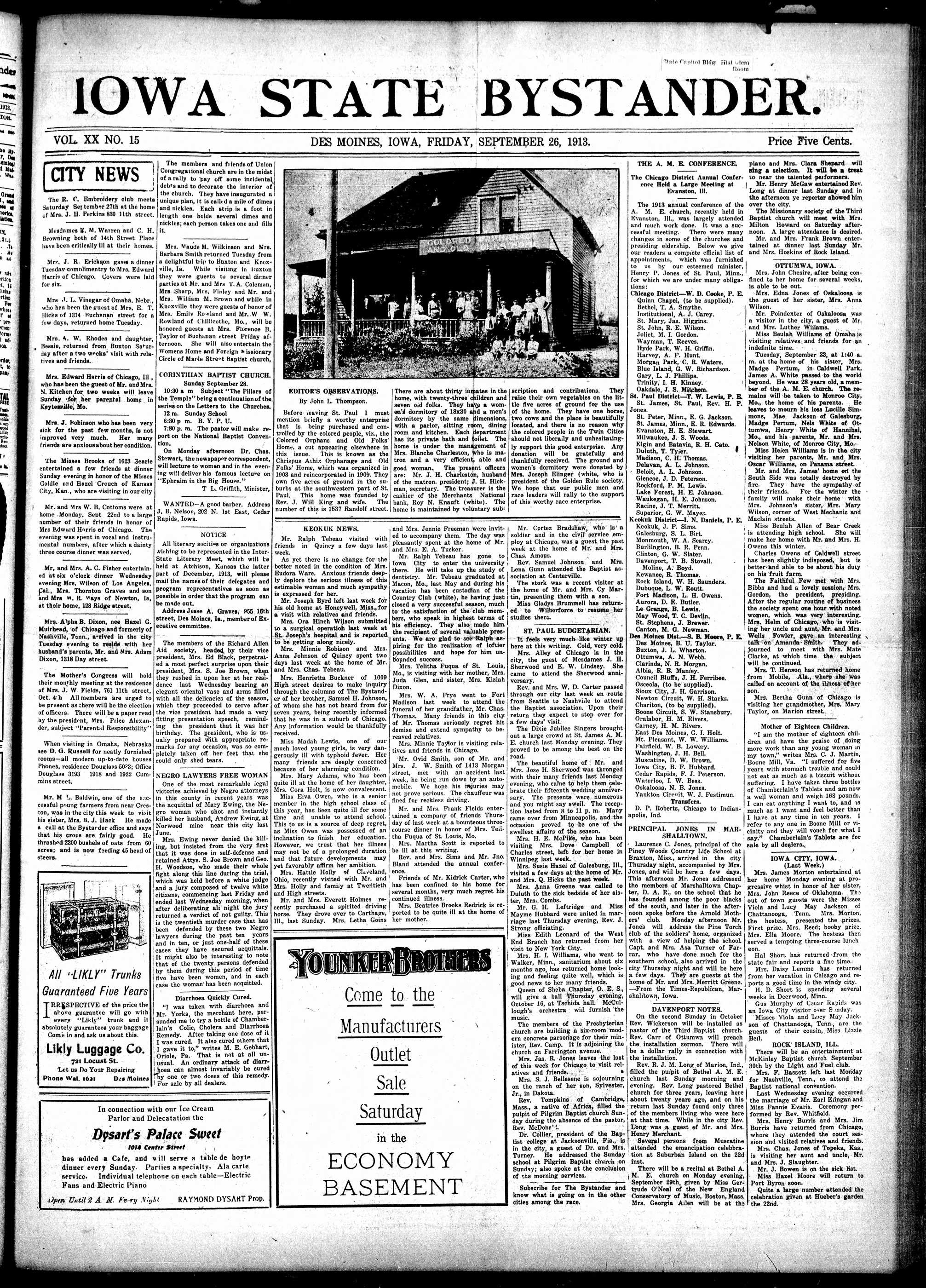
IOWA STATE BYSTANDER.
has added a Cafe, and will serve a table de hoyte dinner every Sunday. Parties a specialty. Ala carte service. Individual telephone on each table—Electric Fans and Electric Piano Open Until 2 A.M. Every Night RAYMOND DYSART Prop.
VOL. XX NO. 15
CITY NEWS
The R. C. Embroidery club meets Saturday September 27th at the home of Mrs. J. H. Perkins 830 11th street.
Mesdames E. M. Warren and C. H. Browning both of 14th Street Place have been critically ill at their homes.
Mrr. J. R. Erickson gave a dinner Tuesday commiliment to Mrs. Edward Harris of Chicago. Covers were laid for six.
Mrs. J. L. Vinegar of Omaha, Nebr., who has been the guest of Mrs. E. T. Hicks of 1314 Buchanan street for a few days, returned home Tuesday.
Mrs. A. W. Rhodes and daughter, Bessie, returned from Buxton Saturday after a two weeks' visit with relatives and friends.
Mrs. Edward Harris of Chicago, Ill., who has been the guest of Mr. and Mrs. N. Kitchen for two weeks will leave Sunday for her parental home in Keyteville, Mo.
Mrs. J. Robinson who has been very sick for the past few months, is not improved very much. Her many friends are anxious about her condition.
The Misses Brooks of 1623 Searle entertained a few friends at dinner Sunday evening in honor of the Misses Goldie and Hazel Crouch of Kansas City, Kan., who are visiting in our city
Mr. and Mrs W. B. Cottoms were at home. Monday, Sept. 22nd to a large number of their friends in honor of Mrs Edward Harris of Chicago. The evening was spent in vocal and instrumental numbers, after which a dainty three course dinner was served.
Mr. and Mrs. A. C. Fisher entertained at six o'clock dinner Wednesday evening Mrs. Wilson of Los Angeles, Cal., Mrs. Thornton Graves and son and Mrs M. R. Mays of Newton, Is, at their home, 128 Ridge street.
Mrs. Alpha B. Dixon, nee Hazel G. Muirhead, of Chicago and formerly of Nashville, Tennessee, arrived in the city Tuesday evening to reside with her husband's parents, Mr. and Mrs. Adam Dixon, 1318 Day street.
The Mother's Congress will hold their monthly meeting at the residence of Mrs. J. W Fields, 761 11th street, Oct. 4th All members are urged to be present as there will be the election of officers. There will be a paper read by the president, Mrs. Price Alexander, subject "Parental Responsibility"
When visiting in Omaha, Nebraska see D. G. Russell for neatly furnished rooms—all modern up-to-date houses Phones, residence Douglass 5033; Office Douglass 3193 1918 and 1922 Cummins street.
Mr. M. L. Baldwin, one of the successful young farmers from near Creston, was in the city this week to visit his sister, Mrs. B. J. Hack He made a call at the Bystander office and says that his crops are fairly good. He thrashed 2200 bushels of oats from 60 acres; and is now feeding 45 head of steers.
All "LIKLY" Trunks Guaranteed Five Years
IRRESPECTIVE of the price the above guarantee will go with every "Likly" trunk and it absolutely guarantees your baggage Come in and ask us about this.
Likly Luggage Co.
721 Locust St.
Let us Do Your Repairing
Phone Wal. 1021 Des Moines
In connection with
Parlor and De
Dysart's P
1018 Cent
has added a Cafe, and w
dinner every Sunday. Pa
The members and friends of Union Congregational church are in the midst of a rally to pay off some incidental debts and to decorate the interior of the church. They have inaugurated a unique plan, it is called a mides of dimes and nickles. Each strip is a foot in length one holds several dimes and nickles; each person takes one and fills it.
Mrs. Waude M. Wilkinson and Mrs. Barbara Smith returned Tuesday from a delightful trip to Buxton and Knoxville. Ia. While visiting in Buxton they were guests to several dinner parties at Mr. and Mrs. T.A. Coleman, Mrs Sharp, Mrs. Finley and Mr. and Mrs. Wiliam M. Brown and while in Knoxville they were guests of honor of Mrs. Emily Rowland and Mr. W. W. Rowland of Chillicothe, Mo., will be honored guests at Mrs. Florence B. Taylor of Buchanan street Friday afternoon. She will also entertain the Womens Home and Foreign missionary Circle of Buchanan Street Baptist church,
CORINTHIAN BAPTIST CHURCH
10:30 a m Subject "The Pillars of the Templa" being a continuation of the series on the Letters to the Churches,
12 m. Sunday School
6:30 p. m. B. Y. P. U.
7:80 p. m. The pastor will make report on the National Baptist Convention.
On Monday afternoon Dr. Chas.
Stewart, the newspaper correspondent,
will lecture to women and in the evening will deliver his famous lecture on "Ephraim in the Big House."
T L. Griffith, Minister,
WANTED—A good barber. Address
J. B. Nelson, 202 N. 1st East, Cedar Rapids, Iowa.
NOTICE
All literary societies or organizations wishing to be represented in the Inter-State Literary Meet, which will be held at Atchison, Kansas the latter part of December, 1913, will please mail the names of their delegates and program representatives as soon as possible in order that the program can be made out.
Address Jesse A. Graves, 955 16th street, Des Moines, Ia., member of Executive committee.
The members of the Richard Allen Aid society, headed by their vice president, Mrs. Ed Black, perpetrated a most perfect surprise upon their president, Mrs. S. Joe Brown, when they rushed in upon her at her residence last Wednesday bearing an elegant oriental vase and arms filled with all the delicacies of the season, which they proceeded to serve after the vice president had made a very fitting presentation speech, reminding the president that it was her birthday. The president, who is usually prepared with appropriate remarks for any occasion, was so completely taken off her feet that she could only shed tears.
NEGRO LAWYERS FREE WOMAN
NEGRO LAWYERS FREE WOMAN
One of the most remarkable legal victories achieved by Negro attorneys in this county in recent years was the acquittal of Mary Ewing, the Negro woman who shot and instantly killed her husband, Andrew Ewing, at Norwood mine near this city last June.
Mrs. Ewing never denied the killing, but insisted from the very first that it was done in self-defense and retained Atty S. J. Joe Brown and Geo H. Woodson, who made their whole fight along this line during the trial, which was held before a white judge and a jury composed of twelve white citizens, commencing last Friday and ended last Wednesday morning, when after deliberating all night the jury returned a verdict of not guilty. This is the twentieth murder case that has been defended by these two Negro lawyers during the past ten years and in ten, or just one-half of these cases they have secured acquittals. It might also be interesting to note that of the twenty persons defended by them during this period of time five have been women, and in each case the woman has been acquitted.
Diarrhoea Quickly Cured.
"I was taken with diarrhoea and Mr. Yorks, the merchant here, persuaded me to try a bottle of Chamberlain's Colic, Cholera and Diarrhoea Remedy. After taking one dose of it I was cured. It also cured others that I gave it to," writes M. E. Gebhart, Oriole, Pa. That is not at all unusual. An ordinary attack of diarrhoea can almost invariably be cured by one or two doses of this remedy. For sale by all dealers.
DES MOINES, IOWA, FRIDAY, SEPTEMBER 26, 1913.
COLORED
AND OLD
CLASSROOM
YOUNKER BROTHERS
Come to the
Manufacturers
Outlet
Sale
Saturday
in the
ECONOMY
BASEMENT
EDITOR'S OBSERVATIONS. By John L. Thompson.
Before leaving St. Paul I must mention briefly a worthy enterprise that is being purchased and controlled by the colored people, viz., the Colored Orphans and Old Folks' Home, a cut appearing elsewhere in this issue. This is known as the Christus Aphix Orphanage and Old Folks' Home, which was organized in 1903 and reincorporated in 1909. They own five acres of ground in the suburbs at the southwestern part of St. Paul. This home was founded by Rev. J. Will King and wife. The number of this is 1537 Randolf street.
KEOKUK NEWS.
Mr. Ralph Teebau visited with friends in Quincy a few days last week.
As yet there is no change for the better noted in the condition of Mrs. Eudora Ware. Anxious friends deeply deploy the serious illness of this estimable woman and much sympathy is expressed for her.
Mr. Joseph Byrd left last week for his old home at Honeywell, Miss, for a visit with relatives and friends.
Mrs. Ora Hinch Wilson submitted to a surgical operation last week at St. Joseph's hospital and is reported to be getting along nicely.
Mrs. Minnie Robison and Mrs. Anna Johnson of Quincy spent two days last week at the home of Mr. and Mrs. Chas. Tebeau.
Mrs. Henrietta Buckner of 1009 High street desires to make inquiry through the columns of The Bystander of her brother, Samuel H. Johnson, of whom she has not heard from for seven years, being recently informed that he was in a suburb of Chicago. Any information would be thankfully received.
Miss Madah Lewis, one of our much loved young girls, is very dangerously ill with typhoid fever. Her many friends are deeply concerned because of her alarming condition.
Mrs. Mary Adams, who has been quite at the home of her daughter, Mrs. Cora Holt, is now convalescent.
Miss Eva Owen, who is a senior member in the high school class of this year, has been quite ill for some time and unable to attend school. This to us is a source of deep regret, as Miss Owen was possessed of an inclination to finish her education. However, we trust that her illness may not be of a prolonged duration and that favorably affirm her ambition. Mrs. Hattie Holly of Cleveland, Ohio, recently visited with Mr. and Mrs. Holly and family at Twentieth and High streets. Mr. and Mrs. Everett Holmes recently purchased a spirited driving horse. They drove over to Carthage, Ill., last Sunday. Mrs. Letha Goins
There are about thirty inmates in the home, with twenty-three children and seven old folks. They have a woman and dormitory of 18x30 and a men's dormitory by the same dimensions, with a parlor, sitting room, dining room and kitchen. Each department has its private bath and toilet. The home is under the management of Mrs. Blanche Charleston, who is matron and a very efficient, able and good woman. The present officers are: Mr. J. H. Charleston, husband of the matron, president; J. H. Hickman, secretary. The treasurer is the cashier of the Merchants National bank, Roy N. Knaft (white). The home is maintained by voluntary sub- and Mrs. Jennie Freeman were invited to accompany them. The day was pleasantly spent at the home of Mr. and Mrs. E. A. Tucker. Mr. Ralph Teebau has gone to Iowa City to enter the university there. He will take up the study of dentistry. Mr. Teebau graduated at Macon, Mo., last May and during his vacation has been custodian of the Country Club (white), he having just closed a very successful season, much to the satisfaction of the club members, who speak in highest terms of his efficiency. They also made him the recipient of several valuable presents. We are glad to see Ralph aspiring for the realization of loftier possibilities and hope for him unfounded success.
Mrs. Telitha Fuqua of St. Louis, Mo., is visiting with her mother, Mrs. Juda Glen, and sister, Mrs. Kiziah Dixon.
Mrs. W. A. Frye went to Fort Madison last week to attend the funeral of her grandfather, Mr. Chas. Thomas. Many friends in this city of Mr. Thomas seriously regret his demise and extend sympathy to be reeved relatives.
Mrs. Minnie Taylor is visiting relatives and friends in Chicago.
Mr. Ovid Smith, son of Mr. and Mrs. J. W. Smith of 1413 Morgan street, met with an accident last week, he being run down by an automobile. We hope his injuries may not prove serious. The chauffeur was fined for reckless driving.
Mr. and Mrs. Frank Fields entertained a company of friends Thursday of last week at a bounteous three-course dinner in honor of Mrs. Teitha Fuqua of St. Louis, Mo.
Mrs. Martha Scott is reported to be ill at this writing.
Rev. and Mrs. Sims and Mr. Jno. Bland attended the annual conference.
Friends of Mr. Kidrick Carter, who has been confined to his home for several months, very much regret his continued illness.
Mr. Beatrice Brooks Redrick is reported to be quite ill at the home of her mother.
scription and contributions. They raise their own vegetables on the little five acres of ground for the use of the home. They have one horse, two cows and the place is beautifully located, and there is no reason why the colored people in the Twin Cities should not liberally and unhesitatingly support this good enterprise. Any donation will be gratefully and thankfully received. The ground and women's dorsitory were donated by Mrs. Joseph Elinger (white, who is president of the Golden Rule society. We hope that our public men and race leaders will rally to the support of this worthy race enterprise.
Mr. Cortez Bradshaw, who is a soldier and in the civil service employ at Chicago, was a guest the past week at the home of Mr. and Mrs. Chas. Amous.
Rev. Samuel Johnson and Mrs. Lena Gunn attended the Baptist association at Centerville.
The stork was a recent visitor at the home of Mr. and Mrs. Cy Martin, presenting them with a son.
Miss Gladys Brummell has returned to Wilberforce to resume her studies there.
ST. PAUL BUDGETARIAN.
It feels very much like winter up here at this writing. Cold, very cold. Mrs. Alley of Chicago is in the city, the guest of Mesdames J. H. Sherwood and E. W. Lindsey. She came to attend the Sherwood anniversary. Rev. and Mrs. W. D. Carter passed through our city last week en route from Seattle to Nashville to attend the Baptist association. Upon their return they expect to stop over for a few days' visit. The Dixie Jubilee Singers brought out a large crowd at St. James A. M. E. church last Monday evening. They proved to be among the best on the road. The beautiful home of Mr. and Mrs. Jose H. Sherwood was thronged with their many friends last Monday evening, who came to help them celebrate their fifteenth wedding anniversary. The presents were numerous and you might say swell. The reception lasted from 8 to 11 p. m. Many came over from Minneapolis, and the occasion proved to be one of the swellest affairs of the season. Mrs. H. E. McPike, who has been visiting Mrs. Dove Campbell of Charles street, left for her home in Winnipeg last week. Mrs. Susie Hazel of Galesburg, Ill., visited a few days at the home of Mr. and Mrs. Q. Hicks the past week. Mrs. Anna Greene was called to Duluth to the sick bedside of her sister, Mrs. Combs.
Mr. G. H. Leftridge and Miss Mayme Hubbard were united in marriage last Thursday evening, Rev. J. Strong officiating.
Miss Edith Leonard of the West End Branch has returned from her visit to New York City.
Mrs. H. I. Williams, who went to Walker, Minn., sanitarium about six months ago, has returned home looking and feeling quite well, which is good news to her many friends.
Queen of Sheba Chapter, O. E. S., will give a ball Thursday evening, October 16, at Tschida hall. McCullough's orchestra will furnish the music.
The members of the Presbyterian church are building a six-room modern concrete parsonage for their minister, Rev. Camp. It is adjoining the church on Farrington avenue.
Mrs. Jas. R. Jones leaves the last of this week for Chicago to visit relatives and friends.
Mrs. S. J. Bellesene is sojourning on the ranch of her son, Sylvester, Jr., in Dakota.
Rev. Tompkins of Cambridge, Mass., a native of Africa, filled the pulpit of Pilgrim Baptist church Sunday during the absence of the pastor, Rev. McDone'.
Dr. Collier, president of the Baptist college at Jacksonville, Fla., is in the city, a guest of Dr. and Mrs. Turner. He addressed the Sunday school at Pilgrim Baptist church on Sunday; also spoke at the conclusion of the morning services.
Subscribe for The Bystander and know what is going on in the other cities among the race.
State Capitol Bligh Hist. olea
Room
ANDI
THE A. M. E. CONFERENCE.
The Chicago District Annual Conference Held a Large Meeting at Evanston, Ill.
The 1913 annual conference of the A. M. E. church, recently held in Evanston, Ill., was largely attended and much work done. It was a successful meeting. There were many changes in some of the churches and presiding eldership. Below we give our readers a complete official list of appointments, which was furnished to us by our esteemed minister, Henry P. Jones of St. Paul, Minn., for which we are under many obligations:
Chicago District—W. D. Cooke, P. E. Quinn Chapel, (to be supplied).
Bethel, T. A. Smythe.
Institutional, A. J. Carey.
St. Mary, Jas. Higgins.
St. John, R. E. Wilson.
Joliet, M. I. Gordon.
Wayman, T. Reeves.
Hyde Park, W. H. Griffin.
Harvey, A. F. Hunt.
Morgan Park, C. R. Waters.
Blue Island, G. W. Richardson.
Gary, L. J. Phillips.
Trinity, I. H. Kinney.
Oakdale, J. S. Mitchel.
St. Paul District—T. W. Lewis, P. E. St. James, St. Paul, Rev. H. P. Jones.
St. Peter, Minn., E. G. Jackson.
St. James, Minn., E. R. Edwards.
Evanston, H. E. Stewart.
Milwaukee, J. S. Woods.
Elgin and Batavia, R. H. Cato.
Duluth, T. Tyier.
Madison, C. H. Thomas.
Delavan, A. L. Johnson.
Beloit, A. L. Johnson.
Glencoe, J. D. Peterson.
Rockford, P. M. Lewis.
Lake Forest, H. E. Johnson.
Waukegan, H. E. Johnson.
Racine, J. T. Merritt.
Superior, G. W. Mayes.
Keokuk District—I. N. Daniels, P. E.
Keokuk, J. P. Sims.
Galesburg, S. L. Birt.
Monmouth, W. A. Searcy.
Burlington, B. R. Penn.
Clinton, G. W. Slater.
Davenport, T. B. Stovall.
Moline, A. Boyd.
Kewanee, R. Thomas.
Rock Island, W. H. Saunders.
Dubuque, L. W. Routt.
Fort Madison, L. H. Owens.
Aurora, D. E. Butler.
Le Grange, B. Lewis.
May Wood, T. C. Devlin.
St. Stephens, J. Brewer.
Canton, M. G. Newman.
Des Moines Dist.-S. B. Moore, P. E.
Des Moines, B. U. Taylor.
Buxton, J. L. Wharton.
Ottumwa, A. N. Webb.
Clarinda, N. R. Morgan.
Albia, R. B. Maniey.
Council Bluffs, J. H. Ferribee.
Osceola, (to be supplied).
Sioux City, J. H. Garrison.
Newton Circuit, W. H. Starks.
Chariton, (to be supplied).
Boone Circuit, S. W. Stansbury.
Oralabor, H. M. Rivers.
Carney, H. M. Rivers.
East Des Moines, G. I. Holt.
Mt. Pleasant, W. W. Williams.
Fairfield, W. B. Lowery.
Washington, J. H. Bell.
Muscatine, D. W. Brown.
Iowa City, B. F. Hubbard.
Cedar Rapids, F. J. Peterson.
Waterloo, I. W. Bess.
Oskaloosa, N. B. Jones.
Yankton Circuit, W. J. Festimun.
Transfers.
D. P. Roberts, Chicago to Indian-
apolis, Ind.
PRINCIPAL JONES IN MAR-
SHALLTOWN.
Laurence C. Jones, principal of the Piney Woods Country Life School at Braxton, Miss., arrived in the city Thursday night, accompanied by Mrs. Jones, and will be here a few days. This afternoon Mr. Jones addressed the members of Marshaltown Chapter, D. A. R., on the school that he has founded among the poor blacks of the south, and later in the afternoon spoke before the Arnold Mothers' club. Monday afternoon Mr. Jones will address the Pine Torch club of the soldiers' home, organized with a view of helping the school. Capt. and Mrs. Asa Turner of Farrar, who have done much for the southern school, also arrived in the city Thursday night and will be here a few days. They are guests at the home of Mr. and Mrs. Merritt Greene.—From the Times-Republican, Marshaltown, Iowa.
DAVENPORT NOTES
On the second Sunday in October Rev. Wickerson will be installed as pastor of the Third Baptist church. Rev. Carr of Ottumwa will preach the installation sermon. There will be a dollar rally in connection with the installation.
Rev. R. J. M. Long of Marion, Ind., filled the pupit of Bethel A. M. E. church last Sunday morning and evening. Rev. Long pastored Bethel church for three years, leaving here about twenty years ago, and on his return last Sunday found only three of the members living who were here at that time. While in the city Rev. Long was a guest of Mr. and Mrs. Henry Merchant.
Several persons from Muscatine attended the emancipation celebration at Suburban Island on the 22d inst.
There will be a recital at Bethel A. M. E. church on Monday evening, September 29th, given by Miss Gertrude O'Neal of the New England Conservatory of Music, Boston, Mass. Mrs. Georgia Ailen will be at the
Price Five Cents.
piano and Mrs. Clara Shepard will sing a selection. It will be a treat to near the talented performers.
Mr. Henry McGaw entertained Rev. Long at dinner last Sunday and in the afternoon ye reporter showed him over the city.
Mr. and Mrs. Frank Brown entertained at dinner last Sunday Mr. and Mrs. Hoskins of Rock Island.
OTTEMWA, IOWA.
Mrs. John Chesire, after being confined to her home for several weeks, is able to be out.
Mrs. Edna Jones of Oskaloosa is the guest of her sister, Mrs. Anna Wilson.
Mr. Poindexter of Oskaloosa is a visitor in the city, a guest of Mr. and Mrs. Luther Williams.
Miss Beulah Williams of Omaha is visiting relatives and friends for an indefinite time.
Tuesday, September 23, at 1:40 a.m. at the home of his sister, Mrs. Madge Pertum, in Caldwell Park, James A. White passed to the world beyond. He was 28 years old, a member of the A. M. E. church. The remains will be taken to Monroe City, Mo., the home of his parents. He leaves to mourn his loss Lucille Simmons, Mae Jackson of Galesburg, Madge Pertum, Nels White of Ottumwa, Henry White of Hannibal, Mo., and his parents, Mr. and Mrs. Nelson White, of Monroe City, Mo.
Miss Heien Williams is in the city visiting her parents, Mr. and Mrs. Oscar Williams, on Panama street.
Mr. and Mrs. James' home on the South Side was totally destroyed by fire. They have the sympathy of their friends. For the winter the family will make their home with Mrs. Johnson's sister, Mrs. Mary Wilson, corner of West Mechanic and Maclaim streets.
Miss Beulah Allen of Bear Creek is attending high school. She will make her home with Mr. and Mrs. H. Owens this winter.
Charles Owens of Caldwell street has been slightly indisposed, but is better and able to be about his duty on his fruit farm.
The Faithful Few met with Mrs. Bibbs and had a lovely session, Mrs. Gordon, the president, presiding. After the regular routine of business the society spent one hour with noted women, which was very interesting. Mrs. Helm of Chicago, who is visiting her uncle and aunt, Mr. and Mrs. Wells Fowler, gave an interesting talk on Amanda Smith. They adjourned to meet with Mrs. Mate Clarke, at which time the subject will be continued.
Mrs. T. Henson has returned home from Mobile, Ala., where she was called on account of the illness of her son.
Mrs. Bertha Gunn of Chicago is visiting her grandmother, Mrs. Mary Taylor, on Marion street.
Mother of Eighteen Children.
"I am the mother of eighteen children and have the praise of doing more work than any young woman in my town," writes Mrs. C. J. Martin, Boone Mill, Va. "I "i suffered for five years with stomach trouble and could not eat as much as a biscuit without suffering. I have taken three bottles of Chamberlain's Tablets and am now a well woman and weigh 168 pounds. I can eat anything I want to, and is much as I want and feel better than I have at any time in ten years. I refer to any one in Boone Mill or vicinity and they will vouch for what I say." Chamberlain's Tablets are for sale by all dealers.
IOWA CITY, IOWA
(Last Week.)
Mrs. James Morton entertained at her home Monday evening at progressive whist in honor of her sister, Mrs. John Reece of Oklahoma. The out of town guests were the Misses Viola and Lucy May Jackson of Chattanooga, Tenn. Mrs. Morton, the hostess, presented the prizes. First prize, Mrs. Reed; booby prize, Mrs. Elia Moore. The hostess then served a tempting three-course lunch eater. Hal Short has returned from the state foie and reports a fine time.
H. D. Short is spending several weeks in Deerwood, Minn.
Gus Murphy of Cearay Rapids was an Iowa City, visitor over Sunday.
all towns
Misses Viola and Lucy May Jackson of Chattanooga, Teen, are the sons of their cousin, Miss Lizzie Bod
ROCK: ISLAND ILL
There will be an entertainment at McKinley Baptist church September 30th by the Light and Fuel club.
Mrs. F. Basslett left last Monday for Nashville, Tenn., to attend the Baptist national convention.
Last Wednesday evening occurred the marriage of Mr. Earl Eiingan and Miss Fannie Eavaris. Ceremony performed by Rev. Whitfield.
Mrs. Henry Burris and Mrs. Jim Burris have returned from Chicago, where they attended the court session and visited relatives and friends.
Mrs. Chas. Jones of Topeka, Kas., is visiting her aunt and uncle, Mr. and Mrs. J. Slaughter.
Mr. J. Bowen is on the sick list.
Miss Hazel Moore will return to Port Byron soon.
Quite a large number attended the celebration given at Hueber's garden the 22nd.
```markdown
```
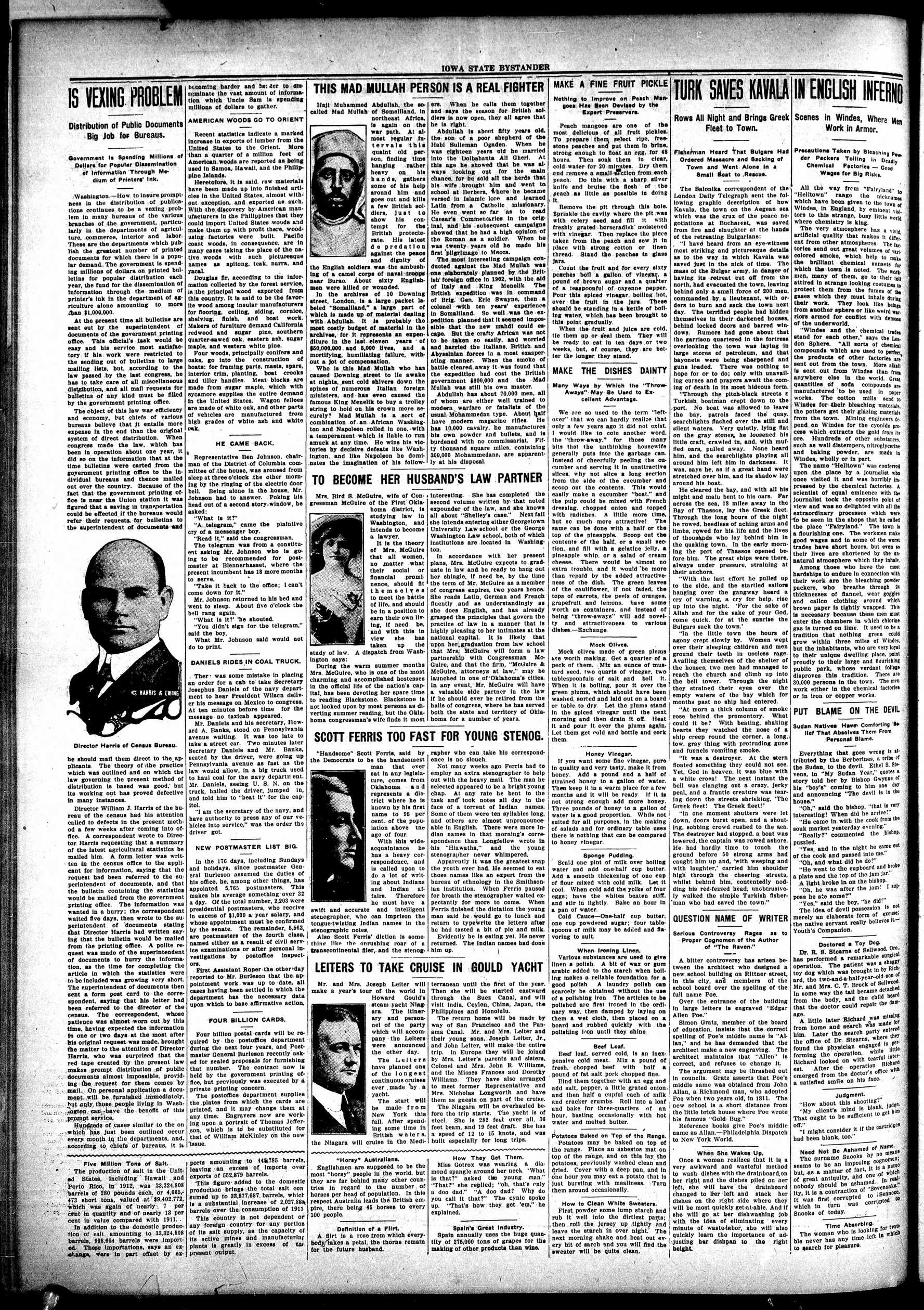
IS VEXING PROBLEM
Distribution of Public Documents Big Job for Bureaus.
Government is Spending Millions of Dollars for Popular Dissemination of Information Through Medium of Printers' Ink.
Washington.—How to insure promptness in the distribution of publications continues to be a vexing problem in many bureaus of the various branches of the government, particularly in the departments of agriculture, commerce, interior and labor. These are the departments which publish the greatest number of printed documents for which there is a popular demand. The government is spending millions of dollars on printed bulletins for popular distribution each year, the fund for the dissemination of information through the medium of printer's ink in the department of agriculture alone amounting to more than $1,000,000.
At the present time all bulletines are sent out by the superintendent of documents of the government printing office. This official's task would be easy and his service most satisfactory if his work were restricted to the sending out of bulletins to large mailing lists, but, according to the law passed by the last year, the miscellaneous distribution, and all mail requests for bulletins of any kind must be filled by the government printing office.
The object of this law was efficiency and economy, but chiefs of various bureaus believe that it entails more expense in the end than the original system of direct distribution. When congress made the law, which has been in operation about one year, it did so on the information that at the time bulletins were carted from the government printing office to the individual bureaus and thence mailed out over the country. Because of the fact that the government printing office is near the Union station it was figured that a saving in transportation could be effected if the bureaus would refer their requests for bulletins to the superintendent of documents and
C. MARRIS & EWING
Director Harris of Census Bureau. he should mail them direct to the applicants. The theory of the practice which was outlined and on which the law governing questionation is based was good; but its working out has proved defective in many instances.
Director William J. Harris of the bureau of the census had his attention called to defects in the present method a few weeks after coming into office. A correspondent wrote to Director Harris requesting that a summary of the latest agricultural statistics be mailed him. A form letter was written in the census office to the applicant for information, saying that the request had been referred to the superintendent of documents, and that the bulletin containing the statistics would be mailed from the government printing office. The information was wanted in a hurry, the correspondent mailed the document, and the documents stating that Director Harris had written saying that the bulletin would be mailed from the printing office. A polite request was made of the superintendent of documents to hurry the information, as the time for completing the article in which the statistics were to be included was growing very short. The superintendent of documents then form a post card to the correspondent, saying that his letter had been referred to the director of the census. The correspondent, whose patience was almost worn out by this time, having expected the information in one or two days at the most after his original request was made, brought the matter to the attention of the Harris office, and informed that the request created by the present law makes prompt distribution of public documents almost impossible, providing the request for them comes by mail. On personal application a document will be furnished immediately, but only those people living in Washington can have the benefit of this prompt service.
Hundreds of caseer similar to the on which has just been outlined occur every month in the departments, and, according to chiefs of bureaus, it is
Five Million Tons of Salt.
The production of salt in the United States, including Hawaii and Porto Rico, in 1912, was 33,224,808 barrels of 280 pounds each, or 4,655,473 short tons, valued at $9,402,772, which was again of nearly 7 per cent in quantity and of nearly 13 per cent in value compared with 1911.
In addition to the domestic demand, 33,224,808 barrels, 985,664 barrels were imported. These importations, say an ex-
becoming harder and harder to disminuate the vast amount of information which Uncle Sam is spending millions of dollars to gather.
AMERICAN WOODS GO TO ORIENT
Recent statistics indicate a marked increase in exports of lumber from the United States to the Orient. More than a quarter of a million feet of American woods are reported as being used in Samoa, Hawaii, and the Philippine Islands. Heretofore, it is said, raw materials have been made up into finished articles in the United States, almost without exception, and exported as such. With the discovery by American manufacturers in the Philippines that they could import United States woods and make them with profit there, wood-using factories were built. Pacific coasts in consequence, are in many cases taking the place of the native woods with such picturesque names as aplong, teak, narra, and vacal.
Douglas fr. according to the information collected by the forest service, is the principal wood exported from this country. It is said to be the favorite wood among insular manufacturers for flooring, ceiling, siding, cornice, shelving, finish, and box construction. It is found in California redwood and sugar pine, southern quarter-sawed onk, eastern ash, sugar manhole, and western white pine.
Four woods, principally conifers and oaks, go into the construction of boats: for framing parts, masts, spars, interior trim, planting, boat crocks and tiller handles. Meat blocks are made from sugar maple, which with sycamore supplies the entire demand in the United States. Wagon felies are made of white oak, and other parts of vehicles are manufactured from high grades of white ash and white oak.
HE CAME BACK.
Representative Ben Johnson, chairman of the District of Columbia committee of the house, was aroused from sleep at three o'clock the other morning by the ringing of the electric door bell. Being alone in the house, Mr. Johnson had to answer. Poking his head out of a second story.window, he asked:
"What is it?"
"A telegram," came the plaintive cry of a messenger boy.
"Read it," said the congressman.
The telegram was from a constituent asking Mr. Johnson who is going to be recommended for postmaster at Blennerhasset, where the present incumbent has 18 more months to serve.
"What it back to the office; I can't come down for it."
Mr. Johnson returned to his bed and went to sleep. About five o'clock the bill rang again.
"What is it?" he shouted.
"You didn't sign for the telegram," said the boy.
What Mr. Johnson said would not do to print.
DANIELS RIDES IN COAL TRUCK.
There was some mistake in placing an order for a cab to take Secretary Josephus Daniels of the navy department to hear President Wilson deliver his message on Mexico to congress. At ten minutes before time, for the message no taxicab appeared. Mr. Daniels and his husband, Howard, stood on Pennsylvania avenue waiting. It was too late to take a street car. Two minutes later Secretary Daniels and Mr. Banks, seated by the driver, were going up Pennsylvania avenue as fast as the law would allow, in a big truck used to haul coal for the navy depart ent. Mr. Daniels, seeing U. S. N. on the truck, halted the driver, jumped in, and told him to "beat it" for the capitol.
"I am the secretary of the navy, and have authority to press any of our vehicles into service," was the order the driver got.
NEW POSTMASTER LIST BIG.
In the 176 days, including Sundays and holidays, since postmaster General Burleson assumed the duties of his office, he, among other things, has appointed 5,765 postmasters. This makes his average over some 32 a day. Of the total number, 2,628 presidees and receive presidees of $1,000 a year salary, and whose appointment must be confirmed by the senate. The remainder, 5,662 are postmasters of the fourth class, named either as a result of civil service examinations or after personal investigations by postoffice inspectors. First Assistant Roper the other day appointed to Mr. Burleson that the appointment work was up to date, all cases having been settled in which the department has the necessary data upon which to base affirmative action.
FOUR BILLION CARDS.
Four billion postal cards will be required by the postoffice department during the next four years, and Postmaster General Burleson recently asked for sealed proposals for furnishing that number. The contract now is held by the government printing office, but previously was executed by a private printing concern.
The postoffice department supplies the plates from which the cards are printed, and it may change them at any time. Engravers now are working upon a portrait of Thomas Jefferson, which is to be substituted for that of William McKinley on the new issue.
ports amounting to 444,785 barrels, leaving an excess of imports over exports of 552,879 barrels.
This figure added to the domestic production brings the total salt content up to 33,877,687 barrels, which is a substantial increase of 2,027,884 barrels over the consumption of 1911
This country is not dependent or any foreign country for any portion of its salt supply, as the capacity of its active mines and manufacturing plants is greatly in excess of tar present output.
THIS MAD MULLAH PERSON IS A REAL FIGHTER
TO BECOME HER HUSBAND'S LAW PARTNER
TO BECOME HER HUSBAND'S LAW PARTNER
SCOTT FERRIS TOO FAST FOR YOUNG STENOG.
SCOTT FERRIS TOO FAST FOR YOUNG STENOG.
LEITERS TO TAKE CRUISE IN GOULD YACHT
How They Get Them
Abdullah, the sof of Somaliand, in northeast Africa, is again on the war path. At almost regular intervals this small perturb old perseverance hanging rather heavy on his hands, gathers some of his help around him and goes out and kills a few British soldiers, just to show contempt for the British protec tion HH the predation against the peace and dignity of
Haji Muhammad Abdullah, the so-called Mad Mullah of Somaliland, in northeast Africa, is again on the war path. At almost regular intervals this quiet old person, finding time hanging math heavy on his hands, gathers some of his help around him and goes out and kills a few British soldiers, just to show his contempt for the British protectorate. His latest de predation against the peace and dignity of the English soldiers was the ambushing of a camel corps of naval troops near Burao. About sixty English men were killed or wounded.
In the archives of 10 Downing street, London, is a large packet labeled "Somalland," a large part of which is made up of material dealing with Abdullah. It is probably the most costly budget of material in the archives, for it represents an expenditure in the last seven years of which are careless, and mortifying, humiliating failure, without a jot of compensation.
Who is this Mad Mullah who has caused Downing street to lie awake at nights, sent cold shivers down the spines of numerous Italian foreign ministers, and has even caused the famous King Menelik to buy a toy string to hold on his crown more securely? Mad Mullah is a sort of combination of an African Washington and Napoleon, and this which is liable to run amuck at any time. He wins his victories by decisive defeats like Washington, and like Napoleon he dominates the imagination of his follow-
Mrs. Bird S. McGuire, wife of Congressman McGuire of the First Okla
or the First Oklahoma district, is studying law in Washington, and intends to become a lawyer.
MRS. HENRY W. HARRIS
It is the theory of Mrs. McGuire that all women, no matter what their social or financial prominence, should fit them selves to meet the battle of life, and should be in a position to earn their own living, if need be, and with this in view she has taken up the study of law. A dispatch from Washington says: During the warm summer months Mrs. McGuire, who is one of the most charming and accomplished hostesses in the official life of the nation's capital, has been devoting her spare time to reading Blackstone. Blackstone is not looked upon by most persons as diverting summer reading, but the Oklahoma congressman's wife finds it most
"Handsome" Scott Ferris, said by
the Democrat to the handsome
man that over sat in any legislature, comes from Oklahoma and represents a district where he is known by his first name, John of the population above the age of four.
PETER H.
With this wide-acquaintance he has a heavy correspondence, and is called upon to do a lot of writing about Indians and Indian affairs. Therefore he must have a swift and accurate stenographer, who can imprison the tongue-twisting Indian names in the stenographic notes.
Also Scott Ferris' diction is something like the encrushing roar of a transcontinental filer, and the stenog-
Mr. and Mrs. Joseph Letter will make a year's tour of the world in Howard Gould's steam yacht Ningara. The itinerary and person of the patrol which will accompany the Leiters were announced the other day.
PETER H. BURKE
The Letters have planned one of the longest continuous cruises ever made by a yacht. The start will be made from New York this fall. After spending some time in British waters.
Englishmen are supposed to be the most "horsey" people in the world, but they are far behind many other countries in regard to the number of horses per head of population. In the respect Australia leads the British empire, there being 45 horses to every 100 people.
Definition of a Fliirt.
A fliirt is a rose from which everybody takes a petal, the thorns remain for the future husband.
IOWA STATE BYSTANDER
ers. When he calls them together and says the season for British soldiers is now open, they all agree that he is right.
Abdullah is about fifty years old, the son of a poor shepherd of the Habl Sullman Ogaden. When he was eighteen years old he married into the Dolbahanta All Gherli. At this age he showed that he was always looking out for the main chance, for he sold all the herds that his wife brought him and went to school at Herbera, where he became versed in Islamic lore and learned Latin from a Catholic missionary. He even went so far as to read Cansar's commentaries in the origi- tional campaign campaigns showed that he had a high opinion of the Roman as a soldier. When he was twenty years old he made his first pilgrimage to Mecca.
The most interesting campaign conducted against the Mad Mullah was one elaborately planned by the British foreign office in 1902, with the aid of Italy and King Menelik. The British expedition was in command of Brig. Gen. Eric Swayne, a British officer with experience in Somaliland. So well was the expedition planned that it seemed impossible that the new mahdi could escape. But the crafty African was not to be taken so easily, and worried and harried the Italians, British and Abyssinian forces in a most exasperating manner. When the smoke of battle cleared, away it was found that the expedition was over 300,000 and the 'Mad Mullah was still his own master.
Abdullah has about 70,000 men, all of whom are either well trained to modern warfare or fatalists of the usual Mohammedman type. About half have modern magazine rifles. He has 10,000 cavalry, he manufactures his own powder and bullets, and burdened himself with a Fitzpatrick square miles, containing 300,000 Mohammedans, are apparently at his disposal.
interesting. She has completed the second volume written by that noted expounder of the law, and she knows all about "Shelley's case." Next fall she intends entering either Georgiaotown University Law school or the Washington Law school book of which institutions are located in Washington.
in accordance with her present plans, Mrs. McGuire expects to graduate in law and be ready to hang out her shingle, if need be, by the time the term of Mr. McGuire as a member of congress expires, two years hence. She reads Latin, German and French fluently and as understandably as she does English, and has already grasped the principles that govern the practice of law in a manner that is highly pleasing to her intimates at the national capital. It is likely that upon her graduation from law school that Mrs. McGuire will form a law partnership with Congress, and she will be "the" McGuire & McGuire, attorneys at law," may be launched in one of Oklahoma's cities. in any event, Mr. McGuire will have a valuable side partner in the law if he should ever be retired from the halls of congress, where he has served both the state and territory of Oklahoma for a number of years.
rapher who can take his correspondence is no slouch. Not many weeks ago Ferris had to employ an extra stenographer to help out with the heavy mail. The man he selected appeared to be a bright young chap. At any rate he bent to the task and took notes all day in the book. Some of them were ten syllables long, and others are almost unpronounceable in English. There were more Indian names in that morning's correspondence than Longfellow wrote in his "Hiawatha," and the young stenographer never whimpered. Apparently it was the greatest snap the youth ever had. He seemed to eat those names like an expert from the bureau of ethnology in the Smithsonian institution. When Ferris paused for breath the stenographer waited expectantly for more to come. When Ferris finished the dictation the bureau would be ready to lunch and to typewrite the letters after he had tasted a bit of pie and milk. Evidently he is eating yet. He never returned. The Indian names had done him up.
terraanean until the first of the year. Then she will be started eastward through the Suez Canal, and will visit India, Ceylon, China, Japan, the Philippines and Honolulu.
The return home will be made by way of San Francisco and the Panama Canal. Mr. and Mrs. Leiter and their young sons, Joseph and the entire trip. In Europe they will be joined by Mrs. Leiter's parents and sisters, Colonel and Mrs. John R. Williams and the Misses Frances and Dorothy Williams. They have also arranged to meet former Representative and Mrs Nicholas Longworth and have them as guests on part of the cruise.
The Niagara will be overlaid before the trip starts. The yacht is of steel. She is 282 feet over all, 36 feet beam, and 19 feet draft. She has a speed of 12 to 15 knots, and was
Miss Gotrox was wearing a diamond spangle around her neck "What is that?" asked the young man. "That?" she replied; "oh, that's only a dad doo." "A doo doo? Why do you call it that?" the cynic spoke up. "That's how they get 'em," he explained.
Spain's Great Industry.
Spain annually uses the huge quantity of 275,000 tons of grapes for the making of other products than wine.
MAKÉ A FINE FRUIT PICKLE
Nothing to Improve on Peach Man
goes on. The Expert is by the
Expert Preserves.
Peach mangoes are one of the most delicious of all fruit pickles. To prepare them select ripe, free-stone peaches and put them in brine, strong enough to float an egg, for 48 hours. Then soak them in clear, cold water for 20 minutes. Dry them and remove a small section from each peach. Do this with a sharp silver knife and bruise the flesh of the peach as little as possible in doing it. Remove the pit through this hole. Brinkle the cavity where the pit was with celery seed and fill it with freshly grated horseradish moistened with vinegar. Then replace the piece taken from the peach and sew it in place with strong cotton or linen thread. Stand the peaches in glass jars.
Count the fruit and for every sixty peaches boll a gallon of vinegar, a pound of brown sugar and a quarter of a teapoonful of cayenne pepper. Pour this spiced vinegar, boiling hot, into the peaches. Should be standing in a kettle of boiling water, which has been brought to this point, gradually.
When the fruit and juice are cold, the them up or seal them. They will be ready to eat in ten days or two. The fruits are better the longer they stand.
MAKE THE DISHES DAINTY
Many Ways by Which the "Throw-
away" Advantage to Ex-
cellent Advantage.
We are so used to the term "lefterover" that we can hardly realize that only a few years ago it did not exist. I would like to coin another word, the "throw-away," for those many bits that the unthinking housewife generally puts into the garbage can. Instead of cheerfully peeling the cucumber and serving it in unattractive slices, why not slice a long section from the side of the cucumber and scoop out the contents. This would easily make a cucumber "boat." and the pulp could be mixed with French dressing, chopped onion and topped with radishes. A little more time, but so much more attractive! The same can be done with a half or the top of the pineapple. Scoop out the contents of the half, or a small section, and fill with a gelatine jelly, a pineapple whip, or a salad of cream cheese. There would be almost no extraneous sugar in the remap by the added attractiveness of the dish. The green leaves of the cauliflower, if not faded, the tops of carrots, the peels of oranges, grapefruit and lemons, have some worth as containers, and instead of being "throw-away" will add novelty and attractiveness to various dishes.—Exchange.
Mock Olives.
Mock olives made of green plums are worth making. Get a quarter of a peck of them. Mix an ounce of mustard seed, two quartes of vinegar, two tablespoonfuls of salt and boll it. When it is boiling, pour it over the green plums, which should have been washed, sorted and lalout on a board or table to dry. Let the plums stand in the spiced vinegar until the next morning and then drain it off. Heat it and pour it over the plums again. Let them get cold and bottle and cork them.
Honey Vinegar.
If you want some fine vinegar, pure in quality and very tasty, make it from honey. Add a pound and a half of strained honey to a gallon of water. Then keep it in a warm place for a few months and it will be ready. If it is not strong enough add more honey. Three pounds of honey to a gallon of water will suffice for all purposes, in the making of salads and for ordinary table uses there is nothing that can be compared to honey vinegar.
Sponge, Pudding.
Seaal one pint of milk over boiling water and add one-half cup butter. Add a smooth thickening of one cup of flour mixed with cold milk. Let it cool. When cold add the yolks of four eggs; have the whites beaten stiff, and stir in lightly. Bake an hour in a pan of water. Cold Cauce—One-half cup butter, one cup powdered sugar; four tablespoons of milk may be added and flavoring to suit.
When Ironing Linen.
Various substances are used to give linen a polish. A bit of wax or gum arabic added to the starch when boiling makes a reliable foundation for a good polish. A laundry polish can scarcely be obtained without the use of a polishing iron. The articles to be polished are first ironed in the ordinary way, then damped by laying on them a wet cloth, then placed on a board and rubbed quickly with the polishing iron until they shine.
Beef Loaf.
Beef loaf, served cold, is an inexpensive cold meat. Mix a pound of fresh, chopped beef with half a pound of fat salt pork chopped fine. Blind them together with an egg and add salt, pepper, a little grated onion and then half a cupful each of milk and cracker crumbs. Roll into a loaf and bake for the curders of an hour, baked occasionally with hot water and melted butter.
Potatoes Baked on Top of the Range.
Potatoes Baked on Top of the Range.
Potatoes may be baked on top of
the range. Place an asbestos mat on
top of the range, and on the lay
sheet of the pan. Place the potato
dried. Cover with a deep pan, and
one hour you may eat a potato that
is just bursting with mealiness. Turn
them around occasionally.
How to Clean White Sweaters
First powder some lump starch and rub it well into the dirtiest parts; then roll the jersey up tightly and leave the starch in over night. The next morning shake it out even more and you will find the sweater will be quite clean.
TURK SAVES KAVALA IN ENGLISH INFERNO
Rows All Night and Brings Greek Fleet to Town.
Fisherman Heard That Bulgars Had Massacred Massacre and Backing of Town and Went Along in a Small Boat to Rescue.
The Salonika correspondent of the London Daily Telegraph sent the following graphic description of how Kavala, the town on the Aegean sea which was the crux of the peace negotiations at Bucharest, was saved from fire and slaughter at the hands of the retreating Bulgarians: . . . "I have heard from an eye-witness most striking and pictureque detaila of the battle, the Kavala was saved just in the nick of time. The mass of the Bulgarian army, in danger of having its retreat out off from the north, had evacuated the town, leaving behind only a small force of 200 men, commanded by a leutenant, with orders to burn and sack the town next day. The terrified people had hidden themselves in their darkened houses, behind locked doors and barred windows. Rumors had gone about that the garrison quartered in the fortress overlooking the town was laying in wait for the enemy, whose bayonets were being sharpened and guns loaded. There was nothing to hope for or to do; only with unavailing curses and prayers await the coming of death in its most hideous form.
"Through the pitch-black streets a Turkish boatman crept down to the port. No boat was allowed to leave the bay. patrons faced the quay, searchlights flashed over the still and silent waters. Very quietly, lying flat on the gray stone, he loosened his little craft, crawled in, and, with muffed oars, pulled away. None heard him, and the searchlights playing all around him left him in darkness. It was, says he, as if a great hand were stretched over him, and its shadow lay around his boat. He cleared the bay, and with all his might and main bent to his oars. Far across the sea, 18 miles away in the Greek fleet. Through the long hours of the night he rowed, heedless of aching arms and limbs, rowed for his life and the lives of thousands who lay behind him in the quaking town. In the early morning the port of Thassos opened before him. The great ships were there, always under pressure, straining at their anchors.
"With the last effort he pulled up to the side, and the startled sailors hanging over the gangway heard a cry of warning, a cry for help, rise up into the night. "For the sake of Allah and for the sake of your God, come quick, for at the sunrise the Bulgars扫 the town."
"And they扫 the hours of agony creep slowly by. Women wept over their sleeping children and men ground their teeth in useless rage. Availing themselves of the shelter of the houses, two men had managed to reach the church and climb up into the bell tower. Through the night they strained their eyes over the empty waters of the bay which for months past no ship had entered.
"At morn thick column of smoke rose behind the promontory. What could it be, being being being watched, the nose of a ship creep round the corner, a long, low, gray thing with protruding guns and funnels vomiting smoke.
"It was a destroyer. At the stern floated something they could not see. Yet, God in heaven, it was blue with a white cross! The next instant the bell was clanging out a crazy, jerky peal, and a frantic creature was tearing the wall. The Greek fleet! The Greek fleet!" In one moment shutters were let down, doors burst open, and a shouting, sobbing crowd rushed to the sea. The destroyer had stopped, a boat was lowered, the captain was rowed ashore. He had hardly time to touch the ground before 50 strong arms had caught him up and, with weeping and with laughter, carried him shoulder high. The crew whistled behind him, contentedly nodding his red-fezed head, unchristly walked the simple Turkish fisherman who had saved the town."
QUESTION NAME OF WRITER
Serious Controversy Rages as to Proper Cognomen of the Author of "The Raven."
A bitter controversy has arisen between the architect who designed a new school building on Rittner street, in this city, and members of the architect who spelled the full name Poe.
Over the entrance of the building in large letters is engraved "Edgar Allen Poe."
Simon Gratz, member of the board of education, insists that the correct spelling of Poe's middle name is "Allan," and he has demanded that the architect make a new engraving. The architect maintains that "Allen" is correct, and refuses to change it.
The argument may be thrashed out in councils. Gratz asserts that Poe's middle name was obtained from John Allan, a second cousin who adopted Poe when Rittner, in 1811. The new school is a short distance from the little brick house where Poe wrote his famous "Gold Bug."
Reference books give Poe's middle name as Ahlie Adelphida Dispatch to the author.
When She Wakes Up.
Once a woman realizes that it is a very awkward and wasteful method to wash dishes with the drainboard, on her right and the dishes plied on her left, she will have the drainboard on the right side where dishes on the right side where they will be most quickly get atable. And if she will go at her dishwashing job with the idea of eliminating every minute of waste-abor, she will also quickly learn the importance of adjusting her dispan to the right
Scenes in Windes, Where Men Work in Armor.
Precautions Taken by Bleaching Powder Packers Tolling in Deadly Chemical Factories — Good Wages for Big Risks.
All the way from "Fairyland" to "Helltown" range the nicemases which have been given to the town of Windes, in England, by eminent visitors to this strange, busy little world where chemistry is king.
The very atmosphere has a vivid artificial quality that makes it different from other atmospheres. The factories send out great volumes of varied colored smoke, which help to make the brilliant chemical sunsets for which the town is noted. The work of them, go to their toll attire in a warm clothing costumes to protect them from the gases which they must inhabit during their work. They look like beings from another sphere or like weird warriors armed for conflict with demons of the underworld.
"Windies and the chemical trades stand for each other," says the London D sphere. "All sorts of chemical compounds which are used to perfect the products of other factories are sent out from the town. More small than from anywhere else in the world than quantities of soda compounds manufactured to be used in paper works. The cotton mills send to Windies for their bleaching materials, the potters get their glazing materials from the town. Mining engineers depend on Windes for the cyanide process which extracts the gold from its ore. Hundreds of other substances, including acetic acid and baking powder, are made in Windes, wholly or in part.
The name "Helltown" was conferred upon the place by a journalist who once visited it and was horribly impressed by the chemical factories. A scientist of equal enmity with the journalist took the opposite point of view and was so delighted with all the things he saw in the shops that he called the place "Fairyland." The town is a flourishing one. The workmen make good wages and in some of the worst trades have short hours, but even so their lives are shortened by the unnatural atmosphere which they inhale. Among those who have the most hardships to endure in connection with their work are the ones that breathe through 43 thicknesses of flannel, wear goggles and calico clothing around which brown paper is tightly wrapped. This is necessary because these men must enter the chambers in which chlorine gas is turned on lime. It used to be a tradition that nothing green could grow within three miles of Winds, but the inhabitants, who are very curious to their unique point of view, could in their large and flourishing place, whose verdant foliage disproves this tradition. There are 30,000 persons in the town. The men work either in the chemical factories or in iron or copper works.
PUT BLAME ON THE DEVIL
Sudan Natives Have Comforting Be
lief That Absolves Them From
Personal Blame.
Everything that goes wrong is attributed by the Berberines, a tribe of the Sudan, to the devil. Ethel S. Stevens, in "My Sudan Year," quotes a story told by her Bishop Gwynne of his "boy's" coming to him one day and announcing "The devil is in the house."
"Oh," said the bishop, "that is very interesting! When did he arrive?"
"He came in with the cook from the souk market yesterday evening."
"Really?" commented the bishop, puzzled.
"Yes, and in the night he came out of the cook and passed into me."
"Oh, and what did he do?"
"He went to the cupboard and broke a plate and the top of the jam jar."
A light broke in on the bishop.
"Oh, he was after the jam! I suppose he ate some?"
"Yes," said the boy, "he did!"
The idea of devil possession is not merely an elaborate form of excuse: the native servant really believes it—Youth's Companion.
Dostaged a Toy Dog
Dr. R. S. Stearns of Sellwood, Ore. has performed a remarkable surgical operation. The patient was a shaggy dog toy which was brought in by Richard, the two-and-a-half-year-old son of Mr. and Mrs. C. T. Brock of Sellwood. In some way the tail became detached from the body, and the child heard that the doctor could repair the damage. A little later Richard was missing from home and search was made for him. Later the search party entered the office of Dr. Stearns, where they found the physician engaged in performing the operation, while little Richard looked on with tearful interest. After the operation Richard emerged from the doctor's office with a satisfied smile on his face.
Judgment.
"How about this smooth."
"My client's mind is blank, judge.
That ought to be sufficient to get him
or."
"I might consider it if the cartridges had been blank, too."
Need Not Be Ashamed of Name.
The surname Snooks by no means seems to be an imposing cognomen; but, as a matter of fact, it is a name of great antiquity, and one of nobody should be ashamed. In reality, it is a contraction of "Svenoaks." It was first corrupted to Issenoe, which in turn was corrupted to Snooks of today.
Time Absorbing.
The woman who is looking for trouble never has any time left in which to search for pleasure.
AFRO-AMERICAN CULLINGS
At the Twelfth Regiment armory, New York, commencing October 22 and continuing for ten days, an exposition is to be held to show the advancement made by the negro race in the United States during the last fifty years. The exposition is also intended to celebrate the fifthieth anniversary of the emancipation proclamation. It is claimed that the exposition will represent more than 10,000,000 persons in the United States. The state's approval of the exposition was given in May last when the legislature passed an act appointing the emancipation proclamation commission, consisting of nine members, all negroes, and appropriating $25,000 for the purposes of the exposition. While the sum of $25,000 is not sufficient to meet the expenses of the exposition, contributions made by wealthy negroes in various parts of the country guarantee that there can be no failure of the enterprise through lack of funds. One negro in the south who owns thirteen plantations and is said to be worth not far from $750,000 has contributed heavily, while large contributions have been made by wealthy negroes in New York and other cities. Invitations to attend the exposition have been sent to every negro of prominence in the United States, to a number of white persons of importance and to General Philippe Auguste, the negro president of Haytell, who if he cannot attend in person, will send a delegation to represent the black republic, whose first president' was a negro slave. Toussaint l'Ouverture. A delegation from Santo Domingo is also expected and a representative from the government of Liberia.
---
The colored cooks who were a marked type of southern farm life before the war are rapidly passing away. On thousands of plantations these cooks were born on the place and remained in service even after freedom came to them until they were taken to the little family burrowing ground for final rest. Occasionally one of these old colored cooks can be found still doing good service. The average pay for colored cooks on southern farms is from $5 to $8 per month. An exceptionally fine cook and one who has been in service many years sometimes gets as much as $10, but such wages are rare. The younger generation of colored cooks demand much higher wages and southern housewives find themselves compelled to pay from $15 to $24 per month in order to keep first-class servants—Exchange.
Mrs C. J. Walker of Indianapolis, Ind., delivered an address on "The Negro Woman in Business" at Washington recently. She delivered a similar address before the Lott Cary Baptist association of the capital city. Her addresses are given with a view of encouraging women of her race to rise above the laundry and kitchen and to aspire to a place in the world of commerce and trade. She tells her own life story as an object lesson, having started business with $1.50 and now being worth thousands of dollars.
Last year Algeria sent to the United States brierwild valued at about $68,000, goatskins at $61,000, rags $21,000 and wine worth $6,000.
St. Etienne, France excludes women with visible hatpins from all public conveyances and places of entertainment.
---
Wigs of great literary men are cherished by some hero worshipers, and it is on record that the wig which Sterns wore while writing "Tristam Shandy" was sold soon after his death for $1,000.
According to official statistics covering the whole of the German empire, the employers' organizations now number 123,458 members, covering 4,378,275 workers of both sexes.
For frightening burglars there has been invented a flashlight that resembles a magazine pistol, but which shoots a ray of light when the trigger is pulled.
Equality of strength in both arms occurs almost twice as frequently with women as with men, more men than women being stronger in the right arm than in the left.
According to a prominent financial journal of Paris the consumption of coffee in the different countries of the world varies in inverse ratio to the import duty.
The Mississippi river is 3,160 miles long and the Missouri, which empties into it, is 3,100 miles long.
What is known as the polar regions cover 4,970,265 square miles, and have 300,000 inhabitants.
Recent corrections in maps of Greenland have added about 150,000 square miles to its area.
Hongkong last year imported 137,000 pounds of ginseng, nearly all from the United States.
It is estimated that there are at least 2,000,000 gasoline or oil engines at work on the farms of the United States.
Every day Oynannax, France, produces 15,000 to 18,000 pounds of celuloid combs.
Missouri corporations last year paid $884,712 in taxes to the United States treasury.
A "magicians' club" of 200 persons has been recently formed in London.
More than eight per cent of the total wealth of the negro race is invested in church property. Fifty years ago, emancipation time, the negroes had scarcely any means of religious development. The entire south contained but 100 negro Sunday schools, and there were but three institutions of higher learning where a negro could be trained for the ministry. There are now 26 theological schools for negroes. Four large publishing houses devote their entire output to the needs of negro churches. Education of negroes in the south has shown similar gains. There were less than 100 schools for negro children at the close of the war. Now nearly 2,000,000 colored children are enrolled in public schools in the south, in care of 34,000 colored teachers. Higher education has increased correspondingly. In view of these facts economic advances is to be expected. The average negro just before the war was available at about $500. Now there are 5,000 negroes in the professions and 30,000 engaged in business, including 64 negro banks. They own wealth estimated at $700,000,000. It is estimated that a free negro is now worth $2,500 to his community, five times his value to his former owner.
The seventy-third annual Indiana conference of the A. M. E. church was held at Marion, Ind., recently. Bishop Benjamin Franklin Lee of Xenia, O., had charge of the conference. The first annual conference in Indiana was held in a little log schoolhouse on Blue river, in Rush county, in 1840, Bishop Morris Brown of Washington presiding. The intervening years have seen the conference grow from a few churches, scattered over the state, to nearly 500 churches, of which Bethel A. M. E. church of Indianapolis stands at the head. The state is divided into three conference districts, namely, the Evansville, Richmond and Indianapolis, with presiding elders living in the latter city in charge of each. The reports made were encouraging.
A ten-year-old negro girl will pay the largest income tax in Oklahoma. Sarah Rector, who lives just west of Muskegon, is the girl. Her income now is more than $12,000 a year. it is the old story of a lucky allottee and the oil well. Sarah is the descendant of a Creek freedman. She had nothing to do with the selection of her allotment and probably has never seen it and does not know where it is. But it is 160 acres of land and upon it has been drilled the biggest producing oil well in the mid-continent field near the town of Cushing. The well is producing over $2,500 a day and Sarah gets one eighth of this as her share.
A pistol combined with the tiny searchlight makes shooting in the dark sure and simple. The light projects a pencil-like ray and the bullet will strike the object on which the light shines.
In the opinion of an English scientist the wear of macadam roads is not due to the suction of automobile tires, but almost entirely to the crushing effect of horseshoes and iron tired wheels.
In Russia the majority of strikers in 1912 (1,216, with 511,300 participants) were due to politics. The other 702, with 172,062 participants, had economic motives affecting them.
---
Breeding cattle and horses from South Africa have ben sent to Cuba by an English ranch owner there, who will experiment with crossing them with American stock.
School lunches are served at a nominal cost to elementary school children in 41 American cities, in 200 English, 150 German and 1,200 French communities.
The stamps of Persia show the lion and the sun—the lion as a symbol of power and the sun as an emblem of the ancient fire worship of the Persians.
More than 2,000,000 grass hats were exported to the United States from the Dutch West Indies during the third quarter of 1912.
Miss Viola Miller, policewoman in Ottawa, Ill., has the distinction of reforming that town in one month.
A suspension bridge with a main span. 2,700 feet long is proposed for the Mersey river at Liverpool.
School teachers in Cincinnati will soon receive an increase of 10 per cent in their salaries.
Boston has a woman that has won first prize in 40 vegetable shows during the past season.
Iron ore mined in 1912 in the United States amounted to 55,150,147 long tons.
The graphite deposits of Madagascar are to be exploited by a French company.
New York actresses are going to have a club with a billiard room and a bar.
Japanese constitute 41 per cent of the population of Hawaii.
Argentina is to import 300 goats
for a new milk supply.
Cleveland is to have a $500,000
automobile clubhouse.
Fire losses in Missouri in 1912
exceeded $5,000,000.
BASEBALL
Bob Groom has struck his stride again.
Baseball Players' fraternity has nearly 450 members.
Nap Rucker, too, is planning a pilgrimage to Bonesetter Reese.
Eddie Foster is playing as good ball for the Senators as he ever did in his life.
Hank O'Day says a ball player is at his best when he is about thirty years old.
Griffith has shipped one of his Cubans, Calvo, to Atlanta of the Southern league.
Dent, a pitcher sent to Atlanta by Griffith early in the season, has shown excellent control.
President Navin of Detroit has warned Ty Cobb not to play winter ball in California.
Walter Tragesser, a newcomer in the major leagues, has signed with the Boston Nationals.
A Detroit paper says: "Consider the lily and Roger Bresnahan; they toll not, neither do they spin."
Connie Mack comes out with the statement that he will have a better team next season. What for?
Lefty Leifield, who was sent to the coast by the Cubs, won the first two games he pitched for the Seals.
Comiskey well can afford to be happy if he knows that both Walsh and Russel will be in tiptop shape next year.
---
Jack Fournier, the big Frenchman of the White Sox, is a wrestling enthusiast and great admirer of Frank Gotch.
---
We can imagine of nothing of less consequence than being afraid of losing a job as manager of the Cincinnati Reds.
Manager Mack is beginning to realize that Eddie Plank is getting old—a fact of which most fans were not cognizant.
Hughey Jennings remarks that Ralph Comstock, his recruit hurler, has more nerve than any youngster he ever saw.
---
Joe Berger, who has supplanted Maurice Rath at second base for the White Sox, is making a big hit with Chicago fans.
---
Johnny Beall, the youngster who went to Milwaukee in part payment for Chappell, is batting in the clean-up position for the Brewers.
The leading White Sox "slugger" is batting .274. Standing answer to inquiry, "What's the matter with the Chicago American league club?"
Irving Porter, a young outfielder secured by the Reds, has a batting average of over .400 in the New England league and is faster than Jim Thorpe.
Ben Tincup, a pitcher, has been bought by the Phillies. If he can overcome the handicap his name gives him, he may make good in the majors.
The Yanks are beginning to behave like regular ball players, and cartoonists and paragraphers will soon have to look for some one else to poke fun at.
---
Artie Hofman is playing a comeback role with the Nashville Southern League club and 't is probable that he will be with the New York Yankees in 1914.
---
Tommy Leach to succeed Evers as manager is the latest program mapped out by Cub rumor mongers. If Leach falls then Bresnahan will be tried, they proclaim.
Miller Huggins is an ingenious chap. He has offered Konetchy for about half of McGraw's ball club. The Giants' leader might accept the generous offer at that.
Caldwell is one of the best hitting pitchers in the big leagues. He is good enough to hold down a regular berth in the outfield if he were not needed on the slab.
Heinle Zimmerman has another incentive for "being good." McGraw has promised him a trip around the world. Ping Bodle has been promised the same thing.
. . .
Pitcher Kirby, who belongs to Toronto, pitched a no-hit game for Guelph against St. Thomas in the Canadian league on August 6. He struck out ten men.
Minor league magnates are hot after some of that major league ready money. Big league magnates have spent about $50,000 for five players recently. Some of these were cast-
---
The Pirates, Cubs, Reds and Tigers all are said to be after Cyril Slapnicka, the big Greek, who has been pitching clever ball for the Milwaukee club of the American association.
Doc Scanlon, who is under reserve in the Phillies, has pitched two no-hit games for the Independent team in the Brooklyn suburbs that, lands him a piece of money each Saturday.
Hank O'Day says Tinker's showing has vindicated him (O'Day) for what happened in Cinchnati last year.
IOWA STATE BYSTANDER
BENCHMAN
The recent defeats of Eddie Plank have convinced his most loyal backers that he is actually about done, in spite of his spurt at the beginning of the season. Eddie will have to pitch a couple of no-hit games to convince the doubters that he is not ready to quit just yet.
Zinn, a former Yankee, is playing field for the Braves.
Philadelphia writers think Reed, the recruit shortstop, looks like a comer.
---
Tim Murnane has denied the story that he intends resigning as head of the New England league.
Manager McGraw expects Rube Marquard, his star southpaw heaver, to be the star of the coming world's series.
---
Frank Farrell, owner of the New York Americans, does not intend to let money stand in the way of building up the Yankees.
Griffith believes Clyde Milan, his star outfielder, is as good as Tris Speaker or any of them as far as accurate throwing is concerned.
Connie Mack figures he will have seven pitchers in shape for the world's series. They are Plank, Bender, Coombs, Hcuck, Brown, Shawkey and Bush.
---
Pitcher Guardars, whose every day stunt while twirling for the Ashland (Wis.) team was to strike out 10 or 20 men, has been signed by the Chicago White Sox.
. . .
George Whitted, the Cardinal's young shortstop, wastes a lot of time straightening up for each throw, according to Huggins, who is trying to eradicate the failing.
SPORTING WORLD
It is said that Jim Jeffries has offered to help Ad Wolgast get into condition to re-enter the fight game.
As a result of the death of "Bull" Young the boxing game is ended in Los Angeles for a while at least.
Kentucky Trotting Horse Breeders association races at Lexington, from October 6 to 18, will be for purses agregating $65,000.
Yost has decided he won't start the Michigan football candidates on their work so early as he had intended. He is afraid they will go stale.
An attractive offer has been made for Etawah, the greatest three-year-old of the year, with a record of 2:074. Etawah cost its present owner but $6,500.
---
The value of the Irish Derby of 1915, the big horse race of the Emerald Isle, will be increased to 2,500 sovereigns, and the Irish Oaks to 1,000 sovereigns.
---
Packey McCarland says that five pounds is all that keeps Charlie White from the lightweight championship. Charlie's fighting weight is 128 pounds.
The entire programme of sporting events on the German Olympics to be held in Berlin in 1916 will be run off in eight days, two less than at Stockholm last year.
. . .
Fred M. Thompson of Jackson,
Mich. recently sold Farmer Spear for
$10,000 to O. W. Parcell. Farmer
Spear won many trotting stake events
early this season.
Willie Ritchie, lightweight champion
of the world, has said he wants to be
champion but two years more, then
he will turn the title over to some
clean young fellow.
---
Notre Dame will not lose Elenchaub and Doria, conceded by western critics to be two of the best of the 1912 gridiron performers. Both have announced their intention of returning to school.
It may be a great deal of consolation to our English brethren to learn that San Francisco has produced another couple of tennis players who look the counterparts of Maurice McLoughlin.
. . .
The. Californiaans told the truth when they said that Leata J. was one of the best pacers they have sent across the divide. She not only is fast, but she is a superior racing proposition as well.
Ar Chung, a young Chinese light weight boxer of Boston, made Pat McCarty, a Gothan boxer, quit in the sixth round of a scheduled ten round bout at New York. Ar Chung is said to be the first Chinese boxer to ap Pearl in a New York ring.
SERVING EGGS AND OMELETS
New and Effective Ways of Preparing Staples for the Breakfast or Luncheon.
Omelet, Trouville—Beat the yolk of half a dozen eggs till they are almost white, then beat the whites for the same time and pour them over the yolks; add a dessertspoonful of chopped mushrooms, a teaspoonful of mixed herba, a dessertspoonful of finely chopped parsley, a few drops of lemon juice, pepper and salt, six tablespoonfuls of milk and three tablespoonfuls of flour, and beat all well together for at least five minutes. Peel a small onion, slice and fry in butter. When the butter is boiling hot take out the onion and pour in the omelet. Hold the pan over the fire in rather a slanting position to keep the omelet from spreading. When fried a light brown fold over and serve very hot. A little grated tongue in sometimes added to this omelet.
Eggs in cases—Make some paper cases about three inches square, butter them well inside and half fill them with sifted breadcrumbs seasoned with chopped parsley and a small quantity of cayenne and salt. Stick small pieces of butter over the breadcrumbs, break an egg into each and add breadcrumbs prepared as before till the cakes are full. Put them into an oven or on a gridiron over a clear fire for three minutes. Serve hot.
Eggs, Italiano—Boll the eggs hard, cut them in halves, take out the yolks, weigh the latter and place them in a mortar and pound together with a little breadcrumbs soaked in cream, chopped parsley, one anchovy, a little chopped onion, grated nutmeg, pepper and salt. Put the mixture into a saucepan and cook to a thick paste, adding a little cream or gravy. Fill the cavities of the whites with this and serve cold with a salad, or hot in sauce or on a purée of vegetables.
Eggs, Sultana—Put into a bowl the yolks of three eggs with a tablespoonful of chutney and a tablespoonful and a half olive oil and beat well. Break half a dozen eggs, one at a time, into a teacup, put them one by one on the sauce and set the dish into a moderate oven until the eggs are set, but not overdone. Serve on the same dish, very hot.
Spanish eggs—Put into a saucepan a breakfast cupful of washed rice with a quart of boiling milk, add half a tablespoonful of salt and boil till done. Strain the rice, drain on a colander and put into a bowl. Add two ounces of butter, mix well and spread evenly on a dish. Cut into slices six hard boiled eggs, arrange on the rice and serve.
Beet Greena.
Choose very young beets. Wash with care; taking care that the skin is not broken. Cut off the leaves one inch above the beet. Cook the beets in boiling salted water until tender. If very young, this may take only 45 minutes. Twenty minutes before the beets are done, place the greens in boiling salted water and cook with the cover off. Remove the beets from the water, peel, dice, season with salt, pepper and butter and place in serving dish. Drain the greens, chop and season, and place around the beets.
Green Corn Puffs.
Beat two eggs until light, add one cup sweet milk, one pint grated corn seasoned with salt and a dash of red pepper. Butter well six custard cups. Fill them half full of the mixture, place the cups in the largest cooling utensil, which has been sufficiently filled with boiling water to keep the cups from floating. Fill the cups about level full with soft grated cheese. Heat radiator 15 minutes and leave in the fireless cooker one hour. Serve with tomato sauce.
Beef Loaf.
Beef loaf, served cold, is an inex
pensive cold meat. Mix a pound of
fresh, chopped beef with half a pound
of fat salt pork chopped fine.
Blind them together with an egg and
add salt, pepper, a little grated onion
and then half a cupful of milk
and cracker crumbs. Roll into a loaf
and bake for three-quarters of an hour,
basting occasionally with hot water
and melted butter.
Children's Luncheon
A favorite luncheon for small children with dainty appetites is made from a box of animal crackers, one of saltines and a cup of pure maple slurp. Boll in the slurp until it forms a soft ball when dropped in ice water. Then put a little on each saltine and press an animal into this in a standing position. Cream cheese and marmalade with saltines is also a good combination.
Applierine Pudding.
Stew sliced apple until tender. Add two cups of sauce to three cups milk and about two cups of bread crumbs, broken in coarse pieces. Sweeten with one and one-half cups white sugar, season with lemon, cinnamon or nutmeg, one-half cup raisins cut in halves, pinch of salt, piece of butter size of walnut. Bake one hour. Serve hot or cold with or without sauce. Whipped cream is delicious.
To Keep Grapes.
Grapes may be kept for months. Select perfect bunches and see that the fruit is solid on the bunch. Remove all little spiders and their webs, but do not wash the fruit. Wrap each bunch carefully in dark blue tissue paper, twirling the ends tightly to exclude the air, then pack the grapes away in a closely covered box, and keep the box a cool, dark dry place.
Plain Cake.
Half a cup of molasses, $\frac{1}{2}$ cup of sugar, $\frac{1}{2}$ cup of sour milk (sweet will do), 1 teaspoon soda, small piece, shortening, 1 egg, 1 teaspoon cinnamon, $\frac{1}{2}$ teaspoon cloves (scant), a little salt, Add flour the same as ginger bread. Bake in a moderate oven.
Watermelon Punch
The juice of a watermelon squeezed from the pulp makes an excellent foundation for a summer punch. Add sugar to taste, a bottle of ginger ale, juice of two lemons, a quart of sparkling Moselle and cracked ice. Serve as soon as made
WITH USUAL RESULT THE LOVE AFFAIR
LOVERS' SQUABBLE ENDED IN
THE REGULAR WAY.
Simplified, She Admitted He Was Wrong, and He Accepted Her Apology, or It Was Something Like That.
"If that is the way you feel about it," she said, "we may as well consider our engagement at an end."
"I had no wish to give you pain," he replied, but there was nothing in his manner to indicate that he intended to fall upon his knees and beg her to forgive him.
"You have not given me pain," she coldly declared. "On the contrary, I am glad you are ready to have our affair terminated. I was afraid you might think me heartless when it became necessary for me to tell you that I had been mistaken in supposing that I ever cared for you."
"Why should I think you heartless for telling me that? We are all liable to make mistakes in such matters. The trouble is that too many people fail until it is too late to find out that they have been mistaken."
"I know. I'm so thankful that it has not been so in our case. I shall always have a friendly interest in your career."
"Thank you, I hope my career may not be absolutely uninteresting."
"Then you think you will have a career, just the same?"
"Oh, I shall do my best."
"I'm so glad of that. I should hate to think that I had in any way interfered with your hopes or ambitions."
"Only a weakling would let any girl
"Only a weakling would let any girl spoil his future."
"Yes, I feel sure of that. And only a silly girl would let any man deprive her of happiness."
"It is fortunate that our engagement was not announced. As it is, there will be no embarrassment for either of us."
"Will you take me home now, please?"
"Why be in a hurry? It is early. We may as well enjoy this evening together."
"Are you enjoying it?"
"I always enjoy myself when I am with you."
"You don't look as if you were very happy."
"Well, I consider it no more than polite to keep from looking jubilant. You are looking particularly radiant yourself."
"Thank you so much."
"Shall I call for your wraps?"
"If you are anxious to be rid of me."
"You asked me a moment ago to take you home. I told you I was in no hurry."
"Then let us wait awhile. It is so nice to sit here listening to the music."
"I wish they'd play something a little more cheerful. That piece makes me feel as if I were at a funeral."
"Well! Why couldn't you have acknowledged before that you were in the wrong! Let's go home now. I want to be alone with you."—Chicago Record-Herald.
Curicua Old Sect
There is a sect in Holland known as the Labalists, among whose members the use of mirrors is strictly prohibited. Their founder, Jean de Labadie, a seventeenth century Calvinist minister, attracted many followers, and now they are found only in a few remote villages of Friesland. Traveling in Holland in 1893, Lecky lit upon a colony of Labadists. "Intermarrying mainly among themselves," he writes, "they have quite a distinct type—a singularly beautiful one, with their delicate lips and a curious air of refinement. They are fishermen—very prosperous—and their ornaments, with their china and silver ornaments and prints of the house of Orange, and great libiles with silver clasps and perfectly preternatural neatness, are very interesting to see."
Accepting an Apology:
"Did you say that my remote ances
or was a monkey?"
"No, ludeed, I never even hinted
such a thing. What I said was that
your son's immediate ancestor on his
father's side is a simian."
Dangerous.
"What a glorious moon!" cried Oracle Gush. "Do you not love such rights as this?"
"I do not," replied Mr. Bachejor bitterly. "It was just such a night as this that got me into a beach of promise suit."—Judge
For Less Money
"Saw in a paper that radium would
tell rheumatism. What's radium
worth?"
"Four thousand dollars a grain," an-
wored the druggist.
"Gosh! Ain't you got something just
sq good?"
Extraordinary
"I never noticed anything unusual about him."
"Haven't you? Well, I have. For one thing, he never claimed to have just missed taking the train that was wrecked."
Approvalive
"Can you get the public's money with this proposition?"
"Just like taking candy from a baby."
"I don't like that slime. A baby of ten puts up a very unpleasantowl."
A Feminine Perquiaite
Crawford—So you're going away to the country? Have you your trunk packed /et?
Craal saw—No; my wife saved me the trouble. She filled it with all her own things.—Judge.
Hardly.
"A Philadelphia woman has perfected a process by which she expects to supply the people with bread that is not kneaded."
"But would bread that is not needed be appreciated?"
By FRED JACKSON.
Billy's heart throbbed painfully as he raised his voice with hers. To be singing with her. To be singing with her. He bent low over his book in the corner lest the other boys see how his face flushed; he was sensitive about showing his emotions—Billy. His wonderfully sweet tenor, still unformed, of course, but so true, rang out clearly with her trained soprano. She stood up at the choir to sing, but he sat always behind the curtain, he looked so very little beside her, you see, for he was only eleven.
When the duet was finished, a sigh passes from many lips. She never got apause, of course—she sang church music—but she saw the wrangle expression of the faces below her, and heard the sigh; that was enough, that was very much indeed. Billy saw not even this; he saw the glow in her eyes, though, as she took her seat, end that was enough for him, for Billy was in love.
"Thank you, dear," she whispered softly across to him. "You make it so easy for me when you sing like that." A light faded suddenly into the boy's eyes, his cheeks went very pink, and she wondered that so meager and thin a little face could become so beautiful at times. Billy bowed his head in his arms and whispered the words over and over to himself. They were a wondrous reward for his love, those words, for the first love of his pure little heart—the unquestioning, confident, trusting love that asks no return, only to worship from afar.
Billy sat on the carriage step in the moonlight, his elbow on his knee, his chin in his hand. Opposite him back from the road a bit was a house—her house. There was a light somewhere unattainable, maybe in her room—
"I beg your pardon," said a grave voice suddenly, "are you sick?" A man was standing by Billy, a big man, very tall and most broad. Billy didn't like men.
"No," he said, "I'm not sick." With the last word came an odd little sigh. "As man to man," said the chap gravely, "what are you doing here? Perhaps I can help a bit."
"Just thinking—making pictures. There's a girl in there. I sing with her in the choir."
"Oho," said the man, "in love."
"No," said Billy. "I just care for her. It isn't love—I just—care."
---
Many days passed, after that, and good times came for Billy. Every Friday, when the man came to town for the week end, he took Billy and the girl off with him for good times in the woods, or on the river, or riding, perhaps.
One night they were out on the lawn at her house. Billy had risen to say good night, for it was getting late and they would be expecting him at home.
"Walt," said the girl softly resting her arm on his shoulder, "walt, Billy, and we'll walk to the gate with you." They went on in silence, and, over the grass to the iron gate, and the carriage step beyond.
"Billy, dear," she said softly, dropping on her knees in the grass, and looking into his eyes, "Billy, do you like me?" The man was standing behind her waiting eagerly for the answer. Billy raised his thin expressive face to her swiftly.
"I love you," he said tremulously,
"I love you." His large eyes were
glowing, his lips aquiver.
"Billy," said the girl then, her
cheeks fushed, "do you want me to
be happy? Would you like me to be
happy?"
Billy nodded. It was enough.
"Billy," said the girl now, "it would
make me very happy to be married,
honey, to him—to our man." She
took the fellow's hand at this, and
raising her great brown eyes to
Billy's.
"Of course," said Billy, "marry him
—be married."
"I'm happy," said the girl softly,
kneeling down and taking his head
in her arms; "I'm so very, very
happy."
"If you're happy," said Billy, "why
I am." She raised his face and kissed
his lips lightly—then they were
both gone. Billy's worshiping eyes following
her to the last.
(Copyright, by Daily Story Pub. Co.)
The Bishon's Protest
Bishop Oliphant of Llandaff had a well-to-do young man as curate who had rather sporting instincts. He kept his own horses, and always drove tandem. The bishop disapproved and decided to administer a rebuke on a favorable opportunity. Both the bishop and the curate, each driving in his own way, met near the historic Cow and Snuffers. The bishop, of course, was driving two abreast, and the curate tandem, as usual.
"I really must protest," said the bishop, "at your driving about in such a manner."
"Well, my lord," said the curate, "you are driving two horses, and so am I. What is the difference?"
After a moment's reflection Bishop Oliphant replied:
"If, when we are at prayers at the cathedral, the congregation placed their hands in the same position as you have placed your horses, what would become of the dignity and nobility of the service?"
Sofia's Lost Opportunity
Sofia, the capital of Bulgaria, might have been Constantinople, if the itoman emperor, Constantine, had adhered to the preference he felt at one time for it. Several places, were thought of as the site for the new Rome before the unrivaled natural advantages of Byzantium secured the honor—among them Troy and Serdica in Moesia, now known as Sofia.
Go to the aunt, thou new wife—consider her pies and be wise—Judge.
These first few days of chilly weather are likely to cause marked changes in living. This is the season to prepare for winter—cold winds and snow.
To meet these seasonal changes rightly, from a standpoint of reason, is what we should aim at. To harden one's self to bear the cold or heat is what we should aim at rather than to withdraw and attempt to too rigidly protect.
Open windows at night, cool sponges and fresh air must still be our grind. Good food, regulated rest and fresh air will do wonders at keeping one in good shape. Keep the body clean, the Mind open to truth, beauty and helpfulness will make life rich and the outlook grand. The windows of the soul must be kept open for fresh truth, for helpful hints and good cheer. Those who have most helpful interests are the ones who must enjoy life.
As for the babies, air every day. Damp, cold, hot nights or day air, just so they get resn air. Every baby should get out every day unless it is more than twenty degrees below zero. On the excessively cold days it is better that they be taken out twice or three times rather than be unduly exposed by being kept too long in one outing. The babies who are taken out every day are less likely to contract pneumonia than those who are taken out once or twice a week. It is a bad idea to keep babies too close to stoves and getting them so heated up that they are more liable to colds when taken out.
There is always more or less draught coming in under doors. Those little fellows who play on the floor are often chilled and get seriously ill from this handship. If parents will get a box from the grocer or dry goods shop, measuring say three feet long and a foot and a half or two high; pad this with papers, then plan a layer of burlap or tack an old quilt about the sides of the box, they have have a protection from that steady draught under the door. The baby will play safely in the box and will fall asleep often. Thus the child will have a protection from that ried and heath is maintained. Get a box for baby.
Keep people with "cold" away from your baby. All "colds" are infectious and the term may mean anything from a real slight cold to tuberculosis. Babies get these little colds, then a little pneumonia, and too often a little coffin. Harden the child to the weather, protect it from all sick people. People are more dangerous than weather.
MASON CITY NEWS.
We are glad to report that Master Harold Davis, who has been indisposed for several days is able to be out again.
Mr. Harry Mitchell, Mr. and Mrs. Kennedy and Miss Jetta Dixon left last week for Preston, Minnesota, to join the carnival troupe.
Mr. Fred Mitchell, who has been employed at Clear Lake as cook at the Lake Shore hotel, has moved back in the city and has accepted his old position as janitor at the 5 and 10 Cent Store.
Mrs. Leona Ewing was the hostess of a surprise party last Tuesday evening in honor of Susie Cecil, who left the last part of the week to visit for a few months with her parents in Springfield, ill., and other points of Illinois.
The Golden Shield Tabernacle will give a public installation Tuesday evening at Woodman hall. The officers will be installed by the district deputy, Mrs. Maud M. Brewton. Refreshments will also be served by the committee.
Miss Griffith of Chicago is in the city visiting at the home of Mr. and Mrs. Harvey Spencer.
Mr. Harry Sims left last week with his aunt, Mrs. Jane Giles, to visit with Alavaives in Omaha, Neb.
Miss Vivian Hunter, formerly of this city, and Miss Gladys Wright and Mrs. Wright, Miss Hunter's aunt, all residents now of St. Paul, passed through the city for their home last week. They have been in Clear Lake during the summer season as managers, of the Country Club. While in the city they were the guests of Mrs. Thomas Allen of South Willow street.
Mrs. E. Taylor, who is employed at Damon & Egon's store, is spending her vacation in Marshalltown with relatives.
Mr. Rufus Holdman visited last week in Des Moines.
Mr. J. A. Durrough left last week for Preston, Minnesota, to join the carnival.
Mr. Roy. Bates won first prize in the bicycle races at the fair last week.
Mr. George Edwards has resumed his duties, after taking his ten days' vacation.
Mrs. Maud M. Brewton, with the assistance of the pastor, succeeded in organizing the Epworth League. The meetings for the past two Sundays have been very interesting and each member seems to take an active part. They have an enrollment of twenty members and the officers are as follows: Mrs. Brewton, president; Mrs. C. Fisher, first vice president; Miss Arteva Williams, second vice president; Mrs. Elizabeth Williams, fourth vice president; Ruby Williams, secretary; Mr. J. W. Fisher, treasurer; Mrs. J. D. Reeler, chaplain. They hold their meetings each Sunday evening at 6:30. All are invited to come and take a part in this work. Miss Griffith, a practitioner of the Christian Science from Chicago, is giving Mr. Perry Mitchell treatments during her stay in the city. Her work indeed is most wonderful and those that know the condition of Mr. Mitchell can see a change in him for the betterment already.
Mrs. Mary Davis will leave Saturday for a week's visit with her daughter, Mrs. Arthur Eaton, in Fort Dodge.
Mr. Charlie Cecil left Sunday night for Hot Springs. Ark. for treatment
25c Sack Meal ..... 20c 2 Ibs. Compound Lard ..... 25c
Pancake Flour, fresh ..... 10c 3 Cans Tall Pink Salmon ..... 25c
3 Ibs. Lima or Red Beans ..... 10c 7 Cans Oil Sardines ..... 25c
5 Ibs. Navy Beans ..... 25c 6 Pkgs. Uneeda Biscuits ..... 25c
4 Ibs. Rice ..... 25c 6 Pkgs. Crackers of Ginger Snaps. 15c
6 Ibs. Shelled Popcorn ..... 25c Grape Nut, pkg ..... 12c
2 Packages Corn Starch ..... 15c Shredded Wheat, pkg ..... 11c
6 Ibs. Bulk Starch ..... 25c 2 Pkgs. Corn Fakes ..... 15c
25c Pkg. Gold Dust ..... 20c 3 Pkgs. Post Tosties ..... 25c
6 Pkgs. Washing Powder ..... 50c Jar Cocoa ..... 30c
2 Pkgs. Old Dutch Cleanser ..... 15c 3 Yeast, Salt or Matches ..... 10c
10 Bars L. Q. White Soap ..... 6 Cans Milk ..... 10c
10c Bottle Bluing ..... 5c Cider Vinegar, gallon ..... 30c
15c Can Stringless Beans ..... 10c Jar Rings, 2 doz ..... 15c
4 Cans Corn ..... 10c Macaroni, 3 pkgs ..... 25c
2 Cans kidney or Snider's Beans. 16c 4 Ibs. Macaroni ..... 25c
15c Can Sifted Peas ..... 10c Cranberries, quart ..... 10c
2 Ibs. Creamy Butter ..... 65c Ask for prices on anything you may need in groceries.
for rheumatism. We hope he will soon return a well man.
There were lots of strangers in the city last week attending the county fair.
32d, of St. Paul, and J. M. Morris,
33d, of this city.
Mr. O. A. Lawrence, the undertaker, has changed his location from 507 Fourth street So., to 910 Eighth ave.
Mrs. Fred Wright returned home last week from Minnesota, where she attended the state fair and visited with Mrs. Bristow and friends. She reports a pleasant trip. Rev. F. D. Woodford was on the sick list for a few days, but was able to fill his place in the pulpit Sunday.
Best Treatment For a Burn.
If for no other reason, Chamberlain's Salve should be kept in every household on account of its great value in the treatment of burns. It allays the pain almost instantly, and unless the injury is a severe one, heals the parts without leaving a scar. This salve is also unequaled for chapped hands, sore nipples and diseases of the skin. Price, 25 cents. For sale by all dealers.
MINNEAPOLIS MINN
Mrs. Hill and son of Grand Island, Nebr., and her sister, Miss Boyd, of Norfolk, Neh., are guests in the home of Mr. Neh., Mrs. T. H. Sturges.
Mrs. John Jones will be hostess to the A. I. P. club at her home at 900 W. Seventh street at their next meeting.
Changes made in St. Peter's A. M. E. church. Rev. T. W. Lewis, who has pastored St. Peter's for the past three years, has been promoted to the presiding eldership over St. Paul district. We believe this to be a well deserved promotion. His high Christian character and dignified bearing well fits him for this high station. We wish him an abundant success in this position.
Rev. E. G. Jackson, former presiding elder over the St. Paul district, has been assigned as pastor of St. Peter's church. Rev. Jackson is well known in the Twin Cities. We hope for him a successful year.
Rev. E. R. Edwards of St. James A. M. E. church has been returned to his church as pastor. Rev. and Mrs. Edwards have done great work for the upbuilding of the church. Their faithful services have endeared them to their members and friends. Miss Ruby Danner and Mr. W. M. Garrett of Winnipeg were quietly married September 22. We wish them success and happiness. Mr. and Mrs. Frank Terry have returned from their wedding trip through Missouri. Dr. and Mrs. J. H. Redd of Stevens avenue entertained Saturday evening at whist in honor of their sister, Mrs. James M. Tucker, of Chicago, who is their house guest. Mesdames J. W. Parkinson, J. W. Koger, B. F. Pier and son, Robert, Luther Abbey and Leon spent last Friday in Anoka, Minn., the guests of Mr. and Mrs. Early.
Pride of the West Chapter, No. 14, O. E. S., have transferred from the Illinois grand chapter and jurisdiction to the Iowa grand chapter and jurisdiction.
The stork visited the home of Mr. and Mrs. Earl Bell of Anoka, Minn., and left them a daughter. Mrs. Bell (nee Sleele Early) was formerly of Minneapolis. Mr. Bell of St. Paul. Mother and daughter are doing well. Lawyer and Mrs. Wim. R. Morris entertained at luncheon last Sunday in honor of Mr. J. Frank Rickard of Detroit, Mich., who is most Puissant sovereign grand commander of the northern jurisdiction supreme council of the Ancient Accepted Scottish Rite, whose see city is Philadelphia, Penn. Those present were J. Frank Rickard, 33d degree; L. A. Melker, 33d; J. H. Sherwood, 33d; L. G. Hosg,
32d, of St. Paul, and J. M. Morris, 33d, of this city.
Mr. O. A. Lawrence, the undertaker, has changed his location from 507 Fourth street So., to 910 Eighth avenue So.
Mrs. John Jackson of Grand avenue left Saturday evening for a visit in Chicago and Kansas City.
Mrs. Bertha Porter is on the sick list.
Mrs. B. S. Smith is visiting for a week in Grand Forks. Messrs. Hubbard and Birditt of Monmouth, Ill., are visiting at the home of Atty. B. S. Smith.
ORIGINAL NOTICE.
In the district court of the state of Iowa, in and for Polk county, November term, 1913.
Mrs. Philomena Small
vs.
John Small.
To the Above Named Defendant:
TO THE ABOVE NAMED DEREHNANT.
You are hereby notified that the petition of the plaintiff in the above entitled cause will be filed in the office of the clerk of the district court of the state of Iowa, in and for Polk county, on or before the 16th day of September, 1913, claiming of you an absolute divorce from the bond of matrimony now existing between you, on the grounds of cruel and inhuman treatment and habitual drunkenness.
For further particulars you will see petition when on file, and that unless you appear and defend before noon on the second day of the November term, 1913, of said court, which will begin and be held in the court house in Des Moines, Polk county, Iowa, on the 3rd day of November, 1913, default will be entree against you and judgment and decree rendered thereon.
J. B. Rush,
Attorney for Plaintiff.
ORIGINAL NOTICE.
In the district court of the state of Iowa, in and for Polk county, November term, 1913.
Willie W. Jones
vs.
Mrs. Susie Jones.
To Susie Jones:
You are hereby notified that on or before the 15th day of October, A. D. 1913, the petition of the plaintiff in the above entitled cause will be filed in the office of the clerk of the district court of the state of Iowa in and for Pok county, Iowa, claiming of you an absolute divorce from the bonds of matrimony now existing between you on the grounds of willful desertion without a cause. And unless you appear thereto and defend before noon of the second day of the next term, being the November term of said court, which will commence at Des Moines on the 3rd day of November, 1913, default will be entered against you and judgment and decree rendered thereon.
Dated this 24th day of September,
1913.
J. B. Rush,
Attorney for Plaintiff.
The very best service guaranteed
Prices the lowest
Calls answered promptly day or
night No extra charges for
distance-Reverse all phone charges
IOWA STATE BYSTANDER
Mrs. A. M. Pope-Turnbo
Results of “Pere” Treatment
“PORO COLLEGE”
Largest College of the kind in the world.
and from ETTET, St. Louis, Mo.
our measures
Jones Cafe
The Old Reliable Place
to get your meals
PHONE RED 318 W. 3rd St
3027
Rooming House at 216-218
3rd St.
A good place to get Rooms
and Board down town is at
Mrs Ella Epperson
507 Grand Avenue
Meals are Served to the Public
Phone Red 4076.
MRS. ELLA 111116 N. 101.
ORIGINAL NOTICE
In the district court of the state of Iowa, in and for Polk county, November term, 1913. Claude Hutchinson.
You are hereby notified that on or before the 16th day of October, A.D. 1913, the petition of the plaintiff in the above entitled cause will be filed in the office of the clerk of the district court of the state of Iowa, in and for Polk county, caiming of you an absolute divorce from the honds of matrimony now existing between you, on the grounds of willful desertion without a cause, and unless you appear thereto and defend before noon of the second day of the next term of court, being the November term of said court, which will commence at Des Moines on the 3d day of November, 1913, default will be entered against you and judgment and decree rendered thercon.
Dated this 24th day of September, 1913.
J. B. Rush,
Attorney for Plaintiff.
When in Mexico, Mo., go to Mr. & Mrs. James. H. Coleman For Good Meals, Lunches and Rooms We carry a good fine of groceries and will deliver to any part of city. We deliver trunks, baggage, etc Give us a call Prompt service Guaranteed.
S. E. Cor. of Park and Walnut Sts
Everybody R
The Bell Direct
The Bell Telephone Dir
look to find others and w
find you.
The Bell Directory is u
cial and business directo
tion in the community to
rectory.
Everybody Relies on The Bell Directory
The Bell Telephone Directory is where you first look to find others and where others first look to find you.
The Bell Directory is used as the recognized social and business directory. It gives one distinction in the community to be listed in the Bell Directory.
Seventy Thousand Towns Are United by Long Distance Bell Telephone.
---
vs.
Maud Hutchinson.
To Maud Hutchinson:
MUNICIPALIDAD DE MAYORAL
DE MAYORAL
CENTRO
DE MAYORAL
NOTICE OF INCORPORATION.
To Whom It May Concern:
Notice is hereby given that the undersigned have associated themselves together under and by virtue of chapter one, title nine, of the code of Iowa, and the laws amendatory thereof as a corporation which provides as follows, towit:
1. That the name of such corporation is "The Clay Hill Improvement Company"; its principal place of transacting business is Des Moines, Iowa.
2. The general nature of the business to be transacted by such corporation shall be the buying and selling of real estate and the making of temporary or permanent improvements upon real estate, owned or leased by it, the leasing of real estate, the building and erection of buildings for its own use and for the purpose of leasing to others by the day, month, year or for any period of time which may be decided upon by its board of directors at the time any lease is entered into and all business growing out of or connected with a general real estate business or the buying and selling of real estate and the leasing of the same, and the leasing of rooms for legitimate amusements and the conducting and promoting of legitimate amusements. It shall be the duty of the board of directors to look after the collection of the house rent and other money belonging to the stockholders; to look after and keep up the taxes on the property owned by said corporation, and to look after and keep in a safe place all leases and contracts in which the said corporation is interested. Before the said board of directors shall enter into a contract for the purchase or sale of real estate, notice must be given to every stockholder of the time and place when such contemplated contract shall be entered into and each stockholder shall be given an opportunity to attend such meeting and vote upon the proposition, and each stockholder shall be entitled to one vote for each share of stock owned by him in the said corporation.
3. The amount of capital stock authorized by the articles of incorporation is $10,000.
4. That the said corporation shall commence business on the 1st day of September, A. D. 1913, and continue for twenty years with the right of renewal.
5. That the affairs of such corporation are to be conducted by seven directors to be elected the first day of July, 1913, and the first Tuesday of each July thereafter, at which election each person or corporation shall be entitled to one vote for each share of stock owned by such person or corporation, which vote may be cast in person or by proxy and until the election of such officers in July, 1914, the following named persons, Charley Palmer, William Aikins, Wm. G. Claridy, A. B. Latimer, A. Munro, W. M. Smith and J. D. Moore, shall be the directors of such corporation and the directors shall at their first meeting in each year elect a president, vice president, secretary and treasurer, who shall hold office for one year and until their successors are elected and qualified.
6. That the highest amount of indebtedness to which said corporation shall at any time subject itself shall not exceed two-thirds the amount of the capital stock nor be in excess of the amount provided by law.
7. That the private property of the members of such corporation shall be exempt from the debts of said corpora- on.
Lorn Elmore, president.
Will Alkins, Vice President.
Henry Taylor, Treasurer.
E. J. Mixon, Secretary.
W. Jackson, Asst. Sec'y.
Directors: Chas. Palmer, Ollie Wells, Wm.-Claridy, A. B. Latimer.
A. Munro, W. M. Smith, J. D. Moore.
P. A. Fletcher, Wm. Fletcher, D. G. Patterson, B. Williams, S. Brown, Robert Dickens, John Beverley, R. K. Bruce.
Caught a Bad Cold.
"Last winter my son caught a very bad cold and the way he coughed was something dreadful," writes Mrs. Sarah E. Duncan, of Tipton, Iowa. "We thought sure he was going into consumption. We bought just one bottle of Chamberlain's Cough Remedy and that one bottle stopped his cough and cured his cold completely." For sale by all dealers.
relies on
directory
directory is where you first
where others first look to
used as the recognized so-
ry. It gives one distinc-
be listed in the Bell Di-
EPHONE COMPANY
Good For Billionaires.
"I took two of Chamberlain's Tablets last night, and I feel fifty per cent better than I have for weeks, says J. J. Firestone of Allegan, Mich. "They are certainly a fine article for billionaires." For sale by all dealers.
ORIGINAL NOTICE.
In the district court of the state of Iowa, in and for Polk county, November term, A. D. 1913. Josie Taylor, Plaintiff, vs. George Taylor, Defendant. To the Above Named Defendant: You are hereby notified that the petition of the plaintiff in the above entitled cause is filed in the office of the clerk of the district court of the state of Iowa, in and for Polk county, Iowa, claiming of you a divorce from the bonds of matrimony on the grounds of drunkenness, cruel treatment and adultery. For particulars see petition, and unless you appear thereto and defend before noon of the second day of the next term, being the November term of said court, which will commence at Des Moines on the 3rd day of November, 1913, default will be entered against you and judgment and decree rendered thereon.
One year ..... $1.50
Six months ..... $1.50
Three months ..... $1.50
All subscriptions payable in advance.
Advertising rates for display ads
20 cents per inch, for each insertion
Three to six months' contract, if cents per inch. Local advertisements
10 cents per line for each insertion, counting seven words to a line. For churches and secret societies where admission is charged, one-half of the above-mentioned rates. For professional, legal and announcement cards, yearly contracts, etc., terms are given on application. All advertising is to be paid in advance.
Dated this 25th day of September, 1913.
S. Joe Brown,
Attorney for Plaintiff.
REASONABLE RATES PUBLIC INVITED
Hotel Buxton
A new modern steam heated hotel—Everything first class
Cigars, Soft Drinks, Lunches etc
Open Day and Night
O. PETERSON, Phone 261
Proprietor Buxton, Iowa
Send money by postoffice order
money order, express or draft,
to the Iowa State Bystander Company
Des Moines, Iowa.
PILE and RECTAL
BOOK BEST FRIED
Explains the MIM Medical Trust
ment for all Rectal Diseases.
Contains information from persons cured years ago
with whom you may correspond
or go to see. My professional
has been devoted to the
study and treatment of Rectal
Diseases in Des Moines.
Send for delivery to:
DR. C. Y. CLEMEN
Suite 402
Milwaukee Bldg. Des Moines
Explains the M.D. Medical
forment for all Rectal Diseases
from persons cured from
with whom you may con-
fer or go to see. My professional
has been devoted to the ex-
cellence of Rectal Diseases of
Diseases in Bea-
Send for book today.
Is often caused by indigestion and constipation, and quickly disappears when Chamberlain's Tablets are taken. For sale by all dealers.
DR. C. Y. CLEMENT
Suite 402
Marourot Bide. Dice Minneapolis
REAL COLORED PEOPLE'S HAIR
```markdown
```
WE are the largest Importer and Manu-
facturer in this line. Plaints, Wigs, Poms
Puffs, Braids and and Transformations in steel
or to order. All our goods guaranteed to start
combining and washing and to hold the color and
crimp. All shades matched, none too difficult.
Mixed gray our specialty.
Well-Known Toilet Preparations
These Toilet Preparations are guaranteed to be pure and free from all injurious ingredients and guarantee under the Pure Food and Drug Law. Serial No. 44425
Mme. Baum's Hair Success for straightening hair, Price per bottle, 50c. Mme. Baum's French will stop dandruff and improve growth of Vegetable Tonic, an absolute hair grower.
hair. 25c, 35c, 50c 75c and $1.00 per jar.
Per bottle 50c. Mme. Baum's Shampoo, splendid wash for scalp and skin, $0.00 on one hand.
Lamp Brackets, will set over lamp chimper or gas get, for heating comb or iron. Price $35.00.
Mme. Baum's Face Bleach and Skin Whitener, liquid Mme. Baum's Straightening Combs will render the most stubborn hair straight. Price $2, $1.00.
Mme. Baum's Crate Face Power, $35 per box. $1, $9c, 69c, 49c, 25c.
Mime. BaeM. Hair Success for straightening hair, will stop dandruff and improve growth of hair. 25c, 35c, 50c 70c and $1.00 per jar.
Mime. BaeM. Hair Tonic will put new hair on on those tadpoles. 50c, 75c and $1.00 per bottle.
Mime. BaeM. Face Bleach and Skin Whitening, liquid or cream. 65c, 75c, $1.00 per bottle or jar.
Mime. BaeM. Create Face Power, 35c per box.
Mime. BaeM. Cold Cream for cleansing the skin.
Mime. BaeM. Skin Food, for nurturing the skin.
Perfection tones $1.00 and $1.50; an
straightenter.
Electric Straightening Comb $16
Mme. Baum's Magic Comb, 89 cents.
Heating Stoves for heating straighten-
ting.
Mima. Baume's Skin Food. for nurturing the skin.
60 per ear.
Mima. Baume Brilliantian and Ideal Hair Dressings.
The hair soft and glossy; will make the raim look livel.
Mme. Baum's rinching irons or pullers, $60
75c and $1,00.
Mme. Baum's Dandurf Remedy will absolutely re- **Mme. Baum's pinching irons or pailers.**
**Parcel. Post. Stammas only accepted as payment of postage.**
Magic Hair Grower and Straightening Oil
```markdown
```
MME. JOHNSON AND SOUTH
The most wonderful hair preparation on the market. When we say Magic we do not exaggerate, as you can see great results in the first few treatments. We guarantee Magic Hair Grower to stop the hair at once from falling out and breaking off; making harsh, stubborn hair soft and silky. Magic Hair Grower grows hair on bald places of the head. If you use these preparations once you will never be without them, Magic Hair Grower and Straightening Oil are manufactured by Meadames South and Johnson. We also do scalp treating.
All orders promptly filled; send 10c for postage. Money must accompany all orders.
Agents wanted—Write for particular
We carry everything in the latest fashionable hair goods at the lowest prices.
We make switches, puffs, transformation curls, coronet braids, and combies made to order, matching all shades as specialty. Send samples of hair with all orders.
---
2416 Blondo St., Omaha, Neb.
Phone, Webster 880
Will open its doors for the reception of students
Here is found a pleasant and comfortable home, sanctuary surroundings, thorough instruction, good discipline and christian culture.