Iowa State Bystander
Friday, February 6, 1914
Des Moines, Iowa
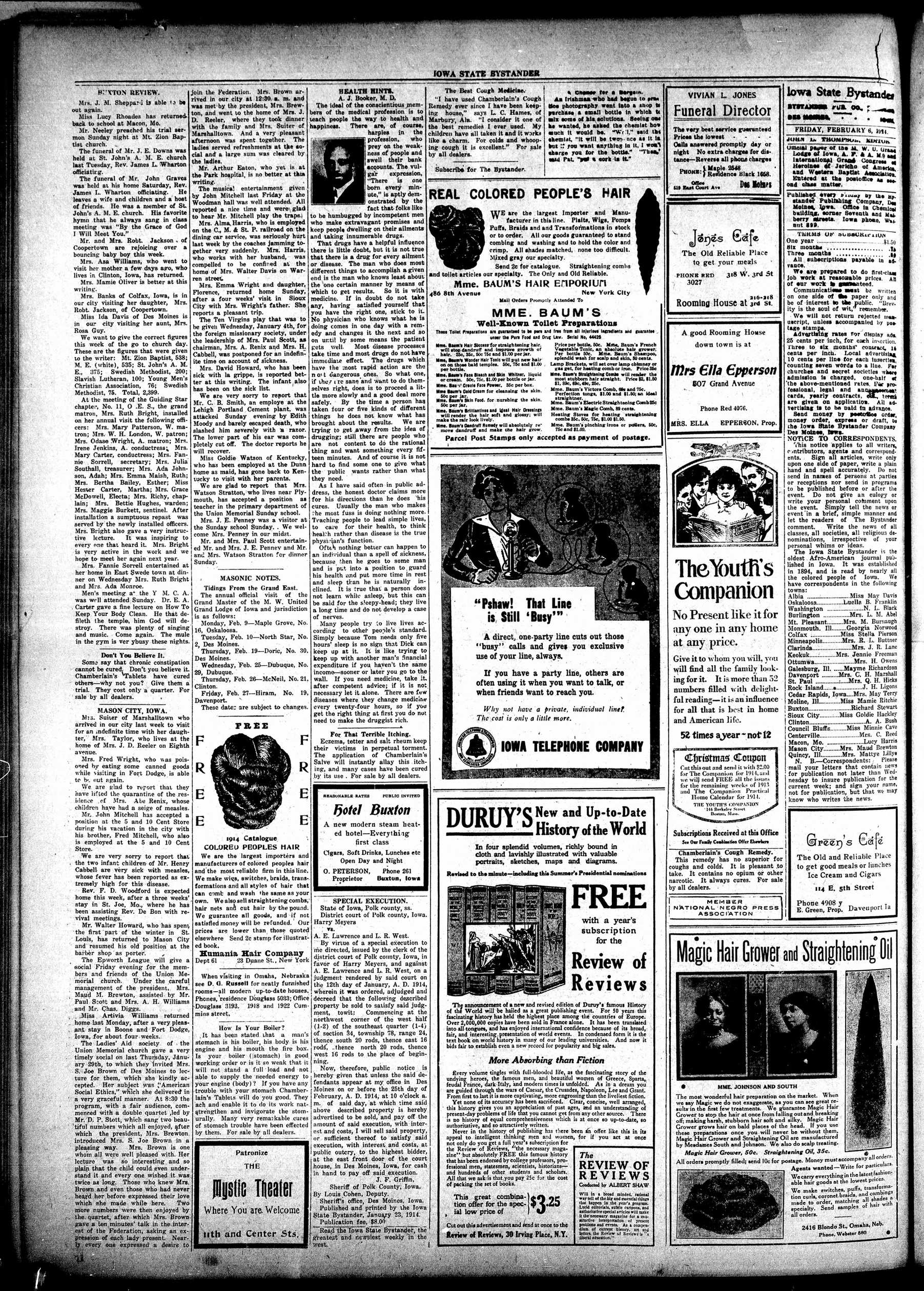
Page text (machine-generated)
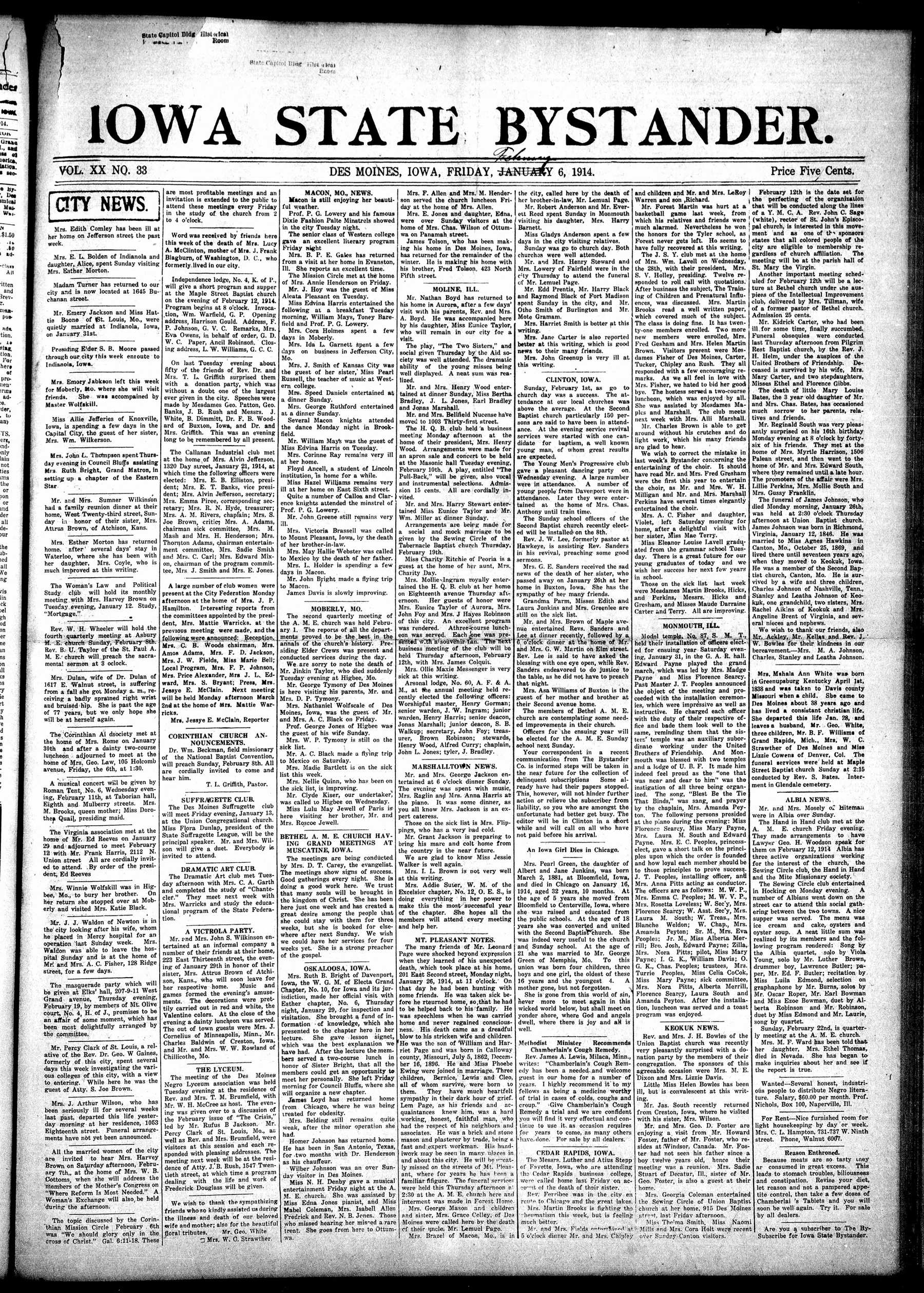
IOWA STATE BYSTANDER.
VOL. XX NO. 33
CITY NEWS
Mrs. Edith Comley has been ill at her home on Jefferson street the past week.
Mrs. E. L. Bolden of Indianola and daughter, Alice, spent Sunday visiting Mrs. Esther Morton.
Madam Turner has returned to our city and is now located at 1645 Buchanan street.
Mr. Emery Jackson and Miss Hattie Boone of St. Louis, Mo., were quietly married at Indianola, Iowa, on January 51st.
Presiding Elder S. B. Moore passed through our city this week enroute to Indianola, Iowa.
Mrs. Emory Jabkson left this week for Moberly, Mo., where she will visit friends. She was accompanied by Master Wolfakill.
Miss Allie Jefferies of Knoxville, Iowa, is spending a few days in the Capital City, the guest of her sister, Mrs. Wm. Wilkerson.
Mrs. John L. Thompson spent Thursday evening in Council Bluffs assisting Mrs. Ruth Bright, Grand Matron, in setting up a chapter of the Eastern Star.
Mr. and Mrs. Sumner Wilkinson had a family reunion dinner at their home, West Twenty-third street, Sunday in honor of their sister, Mrs. Attrus Brown, of Atchison, Kans.
Mrs. Esther Morton has returned home, after several days' stay in Waterloo, where she has been with her daughter, Mrs. Coyle, who is much improved at this writing.
The Woman's Law and Political Study club will hold its monthly meeting with Mrs. Harvey Brown on Tuesday, evening, January 12. Study, "Mortgage."
Rev. W. H. Wheeler will hold the fourth quarter meeting at Asbury M. E. church Sunday, February 8th. Rev. B. U. Taylor of the St. Paul A. M. E. church will preach the sacramental sermon at 3 oclock.
Mrs. Dulan, wife of Dr. Dulan of 1617 E. Walnut street, is suffering from a fall she got Monday a. m., receiving a badly sprained right wrist and bruised hip. She is past the age of 77 years, but we only hope she will be at herself again.
The Corinthian AI dsociety met at the home of Mrs. Rome on January 30th and after a dainty two-course luncheon adjourned to meet at the home of Mrs. Geo Law, 105 Holcomb avenue, Friday, the 6th, at 1:30.
A musical concert will be given by Roman Tent, No. 6, Wednesday evening, February 11th, at Taborian hall, Eighth and Mulberry streets. Mrs. M. Brooks, queen mother; Miss Dorothea Quall, presiding maid.
The Virginia association met at the home of Mr. Ed Reeves on January 29 and adjourned to meet February 12 with Mr. Frank Harris, 2112 N. Union street All are cordially invited to attend. By order of the president, Ed Reeves
Mrs. Winnie Wolfskill was in Higbee, Mo., to bury her brother. On her return she stopped over at Moberly and visited Mrs. Katie Black
Mr. J. J. Walden of Newton is in the city looking after his wife, whom he placed in Meryk hospital for an operation last Sunday week. Mrs. Walden was able to leave the hospital Sunday and is at the home of Mr. and Mrs. A. C. Fisher, 128 Ridge street, for a few days.
The masquerade party which will be given at Elks' hall, 207-9-11 West Grand avenue, Thursday evening, February 19, by members of Mt. Olive Court, No. 4, H. of J., promises to be an affair of some moment, which has been most delightfully arranged by the committee.
Mr. Percy Clark of St. Louis, a relative of the Rev. Dr. Geo. W Gaines, formerly of this city, spent several days this week investigating the various colleges of this city, with a view to entering. While here he was the guest of Atty. S. Joe Brown.
Mrs. J. Arthur Wilson, who has been seriously ill for several weeks last past, departed this life yesterday morning at her residence, 1053 Eighteenth street. Funeral arrangements have not yet been announced.
All the married women of the city are invited to hear Mrs. Harvey Brown on Saturday afternoon, February 7th, at the home of Mrs. W. B. Cottons, when she will address the members of the Mother's Congress on Where Reform Is Most Needed." A Woman's Exchange will also, be held during the afternoon.
The topic discussed by the Corinthian Mission Circle February 6th was "We should glory only in the cross of Christ." Gal. 6:11-18. These
OWA
State Capitol Blvd. Flatale
Rebro
are most profitable meetings and an invitation is extended to the public to attend these meetings every Friday in the study of the church from 2 to 4 o'clock.
Word was received by friends here this week of the death of Mrs. Lucy A. McClinton, mother of Mrs. J. Frank Blagburn, of Washington, D. C., who formerly lived in our city.
Independence lodge, No. 4, K. of P, will give a short program and supper at the Maple Street Baptist church on the evening of February 12, 1914. Program begins at 8 o'clock. Invocation, Wm. Warfield, G. P. Invocation, address Harrison Gould, Address F, P. Johnson, G. V. C. Remarks, Mrs. Eva Owens, in behalf of order, G. D. W. C. Paper, Anil Robinson. Closing address, L. W. Williams, G. C. C.
On last Tuesday evening about fifty of the friends of Rev. Dr. and Mrs. T. L. Griffith surprised them with a donation party, which was without a doubt one of the largest ever given in the city. Speeches were made by Mesdames Geo. Patton, Geo. Banks, B. J. Rush and Messrs. J. White, B. Dimmitt, Dr. F. B. Woodard of Buxton, Iowa, and Dr. and Mrs. Griffith. This was an evening long to be remembered by all present.
The Callanan Industrial club met at the home of Mrs. Alvin Jefferson, 1320 Day street, January 21, 1914, at which time the following officers were elected: Mrs. E. B. Elliston, president; Mrs. E. T. Banks, vice president; Mrs. Alvin Jefferson, secretary; Mrs. Emma Piree, corresponding secretary; Mrs. R. E. N Hyde, treasurer; Mrs. A. M. Rivers, chaplain; Mrs. S. Joe Brown, critic; Mrs. A. Adams, chairman sick committee, Mrs. M. Mash and Mrs. H. Henderson; Mrs. Thornton Adams, chairman entertainment committee, Mrs. Sadie Smith and Mrs. C. Carl; Mrs. Edward Mixon, chairman of the program committee, Mrs. J. Smith and Mrs. E. Jones.
A large number of club women were present at the City Federation Monday afternoon at the home of Mrs. J. P. Hamilton. Interesting reports from the committees appointed by the president, Mrs. Mattie Warricks, at the previous meeting were made, and the following were announced: Reception, Mrs. C. B. Woods chairman, Mrs. Amos Adams, Mrs. F. D. Jackson, Mrs. J. W. Fields, Miss Marie Bell, Local Program, Mrs. F. P. Johnson, Mrs. Price Alexander, Mrs. J. L. Edward, Mrs. S. Bryant; Press, Mrs. Jessie E. McClain. Next meeting will be held Monday afternoon March 2nd at the home of Mrs. Mattie Warricks.
Mrs. Jessye E. McClain, Reporter
CORINTHIAN CHURCH
ANNOUNCEMENTS.
Dr. Wm. Beckman, field missionary of the National Baptist Convention, will preach Sunday, February 8th. All are cordially invited to come and
T. L. Griffith, Pastor.
The Des Moines Suffragette club will meet Friday evening, January 13, at the Union Congregational church. Miss Flaura Dlunap, president of the State Suffragette League, will be the principal speaker. Mr. and Mrs. Wilson will give a duet. Everybody is invited to attend.
DRAMATIC ART CLUB
The Dramatic Art club met Tuesday afternoon with Mrs. C. A. Garth and completed the study of "Chantecler." They meet next week with Mrs. Warricks and study the educational program of the State Federation.
A VICTROLA PARTY.
Mr. and Mrs. John S. Wilkinson entertained at an informal company a number of their friends at their home, 223 East Thirteenth street, in honor of their sister, Mrs. Attree Brown of Atchison, Kans., who will soon leave for her respective home. Music and games formed the evening's amusements. The decorations were pretty carried out in red and white, the Valentine colors. At the close of the evening a dainty luncheon was served. The out of town guests were Mrs. J. Cornelius of Minneapolis, Minn., Mr. Charles Baldwin of Creston, Iowa, and Mr. and Mrs. W. W. Rowland of Chillicotte, Mo.
view the meeting of the Des Moines Negro Lyceum association was held Tuesday evening at the residence of Rev. and Mrs. T. M. Brumfield, with Mr. W. H. McCree as host. The evening was given over to a discussion of the February issue of "The Crisis," led by Mr. Rufus B Jackson, Mr. Percy Clark of St. Louis, Mo., as well as Rev. and Mrs. Brumfield, were visitors at this session and each responded with pleasing addresses. The meeting next week will be at the residence of Atty. J. B. Rush, 1547 Twentieth street, at which time a program dealing with the life and work of Frederick Douglass will be given.
We wish to thank the sympathizing friends who so kindly assisted us during the illness and death of our beloved wife and mother; also for the beautiful floral tributes. Mr. Geo. White Mrs. W. O. Strawther.
State Capitol Bldg Hist of local Room
SUFER&GETTE CLUB
DRAMATIC ART CLUB
A VICTROLA PARTY.
THE LYCEUM.
MACON, MO., NEWS.
Macon is still enjoying her beautiful weather.
Prof. P. G. Lowery and his famous Dixie Fashion Palte Minstrels showed in the city Tuesday night.
The senior class of Western college gave an excellent literary program Friday night.
Mrs. B. P. E. Gakes has returned from a visit at her home in Evanston, Ill. She reports an excellent time.
The Mission Circle met at the home of Mrs. Ann Henderson on Friday.
Mr. J. Hoy was the guest of Miss Alcata Pleasant on Tuesday.
Miss Edvina Harris entertained the following at a breakfast Tuesday morning, William Mays, Toney Barefield and Prof. P. G. Lowery.
Mrs. Cora Holmes spent a few days in Moberly.
Mrs. Ida L. Garnett spent a few days on business in Jefferson City, Mo.
Mrs. J. Smith of Kansas City was the guest of her sister, Miss Pearl Russell, the teacher of music at Western college.
Mrs. Speed Daniels entertained at a dinner Sunday.
Mrs. George Ruthford entertained at a dinner Sunday.
Several Macon knights attended the dance Monday night in Brookfield.
Mr. William Mays was the guest of Miss Edina Harris on Tuesday.
Mrs. Corinne Ray remains very ill at her home.
Floyd Ancell, a student of Lincoln institution, is home for a while. Miss Hazel Williams remains very ill at her home on East Sixth street. Quite a number of Callon and Clarence knights attended the minstrel of Prof. P. G. Lowery. Mr. John Greene still remains very ill. Mrs. Victoria Brassell was called to Mount Pleasant, Iowa, by the death of his law firm. Mrs. May Hallie Webster was called to Mexico by the death of her father. Mrs. L. Holder is spending a few days in Macon. Mr. John Bright made a flying trip to Macon. James Davis is slowly improving.
MOBERLY MO
The second quarterly meeting of the A. M. E. church was held February 1. The reports of all the departments proved to be the best in the annals of the church's history. Presiding Elder Crews was present and conducted services during the day. We are sorry to note the death of M. Jinkin Taylar, who died suddenly Tuesday evening at Higbee, Mo. Mr. George Tymony of Des Moines is here visiting his parents, Mr. and Mrs. D. P. Tymony. Mrs. Nathaniel Wolfscale of Des Moines, Iowa, was the guest of Mr. and Mrs. A. C. Black on Friday. Prof. George Jones of Higbee was the guest of his wife Sunday.
Mrs. W. P. Tymony is still on the sick list.
Mr. A. C. Black made a flying trip to Mexico on Saturday. Mrs. Made Bartlett is on the sick list this week.
Mrs. Nellie Quinn, who has been on the sick list, is improving. Mr. Clyde Kiser, our undertaker, was called to Highee on Wednesday. Miss Lulu May Jewell of Paris is here visiting her brother, Mr. and Mrs. Roscoe Jewell.
BETHEL A. M. E. CHURCH HAVING GRAND MEETINGS AT MUSCATINE, IOWA.
The meetings are being conducted by Mrs. D. T. Carey, the evangelist. The meetings show signs of success. Good gatherings every night. She is doing a good work here. We trust that many souls will be brought in the kingdom of Christ. She has been here just one week and has created a great desire among the people that she could stay with them for three weeks, but she is booked for elsewhere after next Sunday. We wish we could have her services for four weeks yet. She is a strong preacher of the gospel.
OSKALOOSA, IOWA
Miss Ruth B. Bright of Davenport, Iowa, the W. G. M. of Electa Grand Chapter, No. 10, for Iowa and its jurisdiction, made her official visit with Esther chapter, No. 6, Thursday night, January 29, for inspection and visitation. She brought a fund of information of knowledge, which she presented to the chapter here in her lecture. She gave lesson signet, which was the best explanation we have had. After the lecture the members served a two-course lunch in honor of Sister Bright, that all the members could get an opportunity to meet her personally. She left Friday morning for Council Bluffs, where she will organize a new chapter.
James Loyd has returned home from Chicago, where he was being treated for obesity.
Miss Belding still remains quite weak, after the minor operation she had.
Homer Johnson has returned home. He has been in San Antonio, Texas, for two months with Dr. Henderson as his chauffeur.
Wilber Johnson was an over Sunday visitor in Des Moines.
Miss N. H. Denby gave a musical entertainment Friday night at the A. M. E. church. She was assisted by M. E. Edna, the pianist, and Miss Mabel Fredrick and Rev. N. B. Jones. Those who missed hearing her mis-aired treat. She goes from here to Ottum-
DES MOINES, IOWA, FRIDAY, JANUARY 6, 1914.
N. MO., NEWS. Ill enjoying her beauti-lowery and his famous Palte Minstrels showed sday night. Mrs. F. Allen and Mrs. M. Henderson served the church luncheon Friday at the home of Mrs. Allen. Mrs. E. Jones and daughter, Edna, were over Sunday visitors at the home of Mrs. Chas. Wilson of Ottumwa on Panamah street. James Tolson, who has been making his home in Des Moines, Iowa, has returned for the remainder of the winter. He is making his home with his brother, Fred Tolson, 423 North Fifth street.
the city, called here by ther brother-in-law, Mr. Le Mr. Robert Anderson and et Reed spent Sunday in visiting his daughter, M. Barnett. Miss Gladys Anderson days in the city visiting Sunday was go to church churches well attend Mr. and Mrs. Henry S Mrs. Lowery of Fairfield city Thursday to attend
MOLINE ILL
Mr. Nathan Boyd has returned to his home in Aurora, after a few days' visit with his parents, Rev. and Mrs. A. Boyd. He was accompanied here by his daughter, Miss Eunice Taylor, who will remain in our city for a visit.
The play, "The Two Sisters," and social given Thursday by the Aid society was well attended. The dramatic ability of the young misses being well displayed. A neat sum was realized.
Mr. and Mrs. Henry Wood entertained at dinner Sunday, Miss Bertha Bradley, J. L. Jones, Earl Bradley and Jonas Marshall.
Mr. and Mrs. Bellfield Nucense have moved to 1008 Thirty-first street.
The H. Q. B. club held a business meeting Monday afternoon at the home of their president, Mrs. Henry Wood. Arrangements were made for an apron sale and concert to be held at the Masonic hall Tuesday evening, February 10th. A play, entitled "The Pull-Back," will be given, also vocal and instrumental selections. Admission is 15 cents. All are cordially invited.
Mr. and Mrs. Harry Stewart entertained Miss Eunice Taylor and Mr. Wm. Miller at dinner Sunday.
Arrangements are being made for a social and mock marriage to be given by the Sewing Circle of the Tabernacle Baptist church Thursday, February 19th.
Miss Charity Ritchie of Peoria is a guest at the home of her aunt, Mrs. Charity Day.
Mrs. Mollie-Ingram royally entertained the H. Q. b. club at her home on Eighteenth avenue Thursday afternoon. Her guests of honor were Mrs. Eunice Taylor of Aurora, Mrs. John Foy and Mrs. J Hayes Robinson of this city. An excellent program was presented by the Honorable Johnson was served. Each one was presented with a souvenir tan. The next business meeting of the club will be held Thursday afternoon, February 12th, with Mrs. James Colquit. Mrs. Ollie Maxie Messenger is very sick at this writing. Arsonal lodge, No. 60, A. F. & A. M., at the annual meeting held recently the following officers: Worshipful master, Henry Gorman; senior officer, Henry Gorman; senior officer, Henry Gorman; senior deacon, James Marshall; junior deacon, S. B. Walkup; secretary, John Foy; treasurer, Brown Robinson; stewards, Henry Wood, Alfred Curry; chaplain, John L. Wood; tyler, J. Bradley.
MARSHALLTOWN NEWS
Mr. and Mrs. Georgo Jackson entertained at 6 o'clock dinner Sunday. The evening was spent with music, Mrs. Raglin and Mrs. Anna Harris at the piano. It was some dinner, as you all know Mrs. Jackson is an expert caterer. Those on the sick list is Mrs. Flippings, who has a very bad cold. Mr. Grant Jackson is preparing to bring his mare and colt home from the country in the near future. We are glad to know Miss Jessie Walker is well again.
Mrs. I. L. Brown is not very well at this writing.
Mrs. Addie Suter, W. M. of the Excelsior chapter, No. 12, O. E. S., is doing everything in her power to make the most of the chapter. She hopes all the members will attend every meeting and help her.
MT. PLEASANT NOTES
The many friends of Mr. Leonard Page were shocked beyond expression when they learned of his unexpected death, which took place at his home, 201 East Second Street, Monday night, January 26, 1914, at 11 o'clock. On that day he had been hunting with some friends. He was taken sick before he returned home, so, that he had to be helped back to his family. He was speechless when he was carried home and never regained consciousness. His death came as a dreadful how to his stricken body. William and Harriet Page and was born in Calloway county, Missouri, July 5, 1862, December 16, 1896. He and Miss Phoebe Ewing were joined in marriage. Three children, Bernice, Lewis and Cleo, all of whom survive, were born to them. They have much heartfelt sympathy in their dark hour of grief. Lem Page, as his friends and acquaintances knew him, was a hard working, honest, faithful man, who had the respect of his neighbors and associates. He was a brick and stone mason and plasterer by trade, being a fast and expert workman. His work and expert may be seen in man-made inboxes in the streets of New York, or be misled on the streets of Mt. Pleasant, where for years he has been a familiar figure. The funeral services were held this Thursday afternoon at 2:30 at the A. M. e Church, here and interment was made in Forest Home
Mrs. George Mason and children and sister, Mrs. Grace Colley, of Des Moines were called here by the death of her husband, William. Mrs. Brazel of Macon, Moe, is in
the city, called here by the death of her brother-in-law, Mr. Lemul Page. Mr. Robert Anderson and Mr. Everett Reed spent Sunday in Monmouth visiting his daughter, Mrs. Harry Barnett.
Sunday was go to church day. Both churches were well attended.
Mr. and Mrs. Henry Steward and
Mrs. Lowery of Fairfield were in the
city Thursday to attend the funeral
of Mr. Lemuel Page.
Mr. Edd Prentis, Mr. Harry Black
and Raymond Black of Fort Madison
spent Sunday in the city, and Mr.
Otho Smith of Burlington and Mr.
Mote Gramam.
Mrs. Harriet Smith is better at this
writing.
Mrs. Jane Carter is also reported
better at this writing, which is good
news to their many friends.
Mrs. John Greenup is very ill at
this writing.
CLINTON IOWA.
Sunday, February 1st, as go to church day was a success. The attendance at our local churches was above the average. At the Second Baptist church particularly 150 persons are said to have been in attendance. At the evening service revival services were started with one candidate for baptism, a well known young man, of whom great results are expected.
The Young Men's Progressive club gave a pleasant dancing party on Wednesday evening. A large number were in attendance. A number of people, people, people, were in attendance. Later they were entertained at the home of Mrs. Chas. Anthony until train time.
The Sunday school officers of the Second Baptist church recently elected will be installed on the 8th.
Rev. J. W. Lee, former pastor at Hawkeye, is assisting Rev. Sanders in his revival, preaching some good sermons.
Mrs. G. E. Sanders received the sad news of the death of her sister, who passed away on January 26th at her home in Buxton, Iowa. She has the sympathy of her many friends.
Grandma Parm, Misses Edith and Laura Junkins and Mrs. Greenee are still on the sick list.
Mr. and Mrs. Brown of Maple avenue entertained Revs. Sanders and Lee at dinner recently, followed by a Mr. Gock's house at the home of Mr. W. Martin on Elm Street. Rev. Lee is said to have asked the blessing with one eye open, while Rev. Sanders endeavored to do justice to the table, as he did not have to preach that night.
Mrs. Asa Williams of Buxton is the guest of her mother and brother at their second avenue home. The members of Bethel A. M. E. church are contemplating some needed improvements in their church. Officers for the ensuing year will be held at A. M. E. Sunday school next day. Your correspondent in a recent communication From The Bystander Co. is informed steps will be taken in the near future for the collection of delinquent subscriptions. Some already have had their papers stopped. This, however, will not hinder further action or relieve the subscriber from liability, so you who are amongst the unfortunate had better get busy. The subscriber will be while and will call on all who have not paid before his arrival.
An Iowa Girl Dies in Chicago.
Mrs. Pearl Green, the daughter of Albert and Jane Junkins, was born March 2, 1881, at Bloomfield, Iowa, and died in Chicago on January 16, 1914, aged 32 years, 10 months. At the age of 5 years she moved from Bloomfield to Centerville, Iowa, where she was raised and educated from the public schools. At the age of 18 years she was converted and united with the Second Baptist Church. She was indeed useful to the church and Sunday school. At the age of 21 she was married to Mr. George Green of Memphis, Mo. To this union was born four children, three boys and one girl, the oldest of these 16 years and the youngest. A mother gone, but not forgotten.
She is gone from this world of sin, never more to meet again in this wicked world below, but shall meet on yonder shore, where God and angels dwell, where there is joy and aN is well.
Methodist Minister Recommends Chamberlain's Cough Remedy.
Rev James A. Lewis, Milac, Minn., writes: "Chamberlain's Cough Remedy has been a needed and welcome guest in our home for a number of years. I highly recommend it to my fellows as being a medicine worthy of trial in cases of cold, coughs and croup." Give Chamberlain's Cough Remedy a trial and we are confident you will find it very effectual and continue to use it, as occasion requires for years to come, as many others have done. For sale by all dealers.
The Messrs. Luther and Atius Stepp of Favette, Iowa, who are attending the Cedar Rapids business college, were called home last Friday on account of the death of their sister. Rev. Ferribe was in the city en route to Chicago and the great lakes. Mrs. Martin Brooks is fighting the thematism this week, but is feeling much better. Mr. and Mrs. Fields enthralled at 5 o'clock dinner Mr. and Mrs. Chisby
and children and Mr. and Mrs. LeRoy Warren and son, Richard. Mr. Forest Martin was hurt at a basketball game last week, from which his relatives and friends were much alarmed. Nevertheless he won the honors for the Tyler school, as Forest never gets left. He seems to have fully recovered at this writing. The J. S. Y. club met at the home of Mrs. Wm. Lavell on Wednesday, the 28th, with their president, Mrs. S. Holley, presiding, and provided quotes, after business the subject. The Training of Children and Prenatal Influences, was discussed. Mrs. Martin Brooks read a well written paper, which covered much of the subject. The class is doing fine. It has twenty-one members enrolled. Two more new members were enrolled, Mrs. Fred Ghesam and Mrs. Helen Martin Brown. Visitors present were Mesdames Fisher of Des Moines, Carter, Tucker, Chipley and Rush. They all responded with a few encouraging remarks. As we all feel in love with Mrs. Fisher, we hated to bid her good bye. The hostess served a two-course luncheon, which was enjoyed by an She was asked by Madame Marshall. The club meets next week with Mrs. Alli Marshall. Mr. Charles Brown is able to get around without his crutches and do light work, which his many friends are glad to hear.
We wish to correct the mistake in last week's Bystander concerning the entertaining of the chair. It should have read Mr. and Mrs. Fred Gresham were the first this year to entertain the chair, as Mr. and Mrs. W. H. Milligan and Mr. and Mrs. Marshall Perkins have several times elegantly entertained the chair.
Mrs. A. C. Fisher and daughter, Violet, left Saturday morning for home, after a delightful visit with her sister, Miss Mae Terry.
Miss Eleanor Louise Lavell graduated from the grammar school Tuesday. There is a great future for our young graduates of today and we wish her success her next few years in school.
Those on the sick list last week were Mesdames Martin Brooks, Hicks, and Perkins, Messrs. Hicks and Gresham, and Misses Maud Darraine Carter and Terry. All are improving.
MONMOUTH. ILL.
Model temple, No. 87, S. M. T. held their installation of officers elected for ensuing year Saturday evening, January 31, in the G. A. R. hall. Edward Payne played the grand march, which was led by Mrs. Madge Payne and Miss Florence Searcy. Past Master J. T. Peoples announced the object of the meeting and proceeded with the installation ceremonies, which were impressive as well as instructive. He charged each officer with the duty of their respective office and bade them look well to the same, reminding them that the sisters' temple was an auxiliary subordinate working under the United Brothers of Friendship. And Monmouth was blessed with two temples and a lodge of U. B. F. It made him indeed feel proud as "one the was near and due to him" that the institute all three being organized. The song, "Blest Be the Tie That Binds" was sang, and prayer by the chapain, Mrs. Amanda Peyton. The following persons presided at the piano during the evening: Miss Florence Searcy, Miss Mary Payne, Mrs. Laura M. South and Edward Payne, Mrs. E. C. Peoples, princess-select, gave a short talk on the principles upon which the order is founded and how loyal each member should be to those principles to prove success. J. T. Peoples, installing officer, and Mrs. Anna Pitts acting as conductor. The officers are as follows: M. W. P. Mrs. Emma C. Peoples; M. W. V. P. Mrs. Rosetta Loveless; W. Secy, Mrs. Florence Searcy; W. Asst. Secy, Mrs. Laura M. South; W. Trees, Mrs. Blanche Weldon; W. Chap, Mrs. Amanda Peyton; Sr. M. W. Mrs. Eva Peoples; Jr. M. W. Mrs. Alberta Parrill; Bro. Josh J. Pilot, Jr. Miss Mary Pearl; I. G. K. William Davis; O. G. K. Chas, Peoples; trustees, Mrs. Turtle Peoples, Miss Celia CoCok Miss Mary Payne; sick committee, Mrs. Nora Pitts, Alberta Merrill Florence Searcy, Laura South and Amanda Peyton. After the installation, luncheon was served and a toast program was enjoyed.
KEOKUK NEWS
Rev. and Mrs. J. H. Bowles of the Union Baptist church was recently very pleasantly surprised with a donation party by the members of their congregation. The sponsors of this agreeable occasion were Mrs. M. E. Dixon and Mrs. Lizzie Davis.
Little Miss Helen Bowles has been ill, but is convalescent at this writing.
Mr. Jas. South recently returned from Creston, Iowa, where he visited with his sister, Mrs. Wilson.
Mr. and Mrs. Geo. D. Foster are enjoying a visit from Mr. Howard Foster, father of Mr. Foster, who resides at Windsor, Canada. Mr. Foster had not seen his father since a boy twelve years old, hence their meeting was a reunion. Mrs. Sadie Stuart of Decatur, Ill., sister of Mr. Geo. Foster, is also a guest at their home. Mrs. Georgina Coleman entertained the Giving Circle of Union Baptist church at her home, 915 Des Moines street, last Friday afternoon.
Miss Thea Smith, Miss Naomi Mills and Mrs. Cora Holt were recent over Sunday Condon visitors.
Price Five Cents.
February 12th is the date set for the perfecting of the organization that will be conducted along the lines of a Y. M. C. A. Rev. John C. Sage (white), rector of St. John's Episcopal church, is interested in this movement and as one of 14 sponsors states that all colored people of the city are eligible to membership regardless of church affiliation. The meeting will be at the parish hall of St. Mary the Virgin.
Another important meeting scheduled for February 12th will be a lecture at Bethel church under the auspices of the Intellectual Improvement club, delivered by Mrs. Tillman, wife of a former pastor of Bethel church, Admission 25 cents.
Mr. Kidrick Carter, who had been ill for some time, finally succumbed. Funeral obsequies were conducted last Thursday afternoon from Pilgrim Rest Church, by the Rev. J. H. Baptist thequeque of the United Brothers of Friendship. Deceased is survived by his wife, Mrs. Mary Carter, and two stepdaughters, Misses Ethel and Florence Gibbs.
The death of little Mary Louise Bates, the 3 year old daughter of Mr. and Mrs. Chas. Bates, has occasioned much sorrow to her parents, relatives and friends.
Mr. Reginald South was very pleasantly surprised on his 16th birthday Monday evening at 8 o'clock by forty-six of his friends. They met at the home of Mrs. Myrtle Harrison, 1506 Palean street, and then went to the home of Mr. and Mrs. Edward South, where they remained until a late hour. The promoters of the affair were Mrs. Lillie Perkins, Mrs. Mollie South and Mrs. Gussy Franklin.
The funeral of James Johnson, who died Monday morning, January 26th, was held at 2:30 o'clock Thursday afternoon at Union Baptist church James Johnson was born in Richmond, Virginia, January 12, 1846. He was married to Miss Agnes Hawkins in Canton, Mo., October 25, 1869, and lived there until seventeen years ago, when they moved to Keokuk, Iowa. He was a member of the Second Baptist church, and he taught his children, survived wife, and three children, Charles Johnson of Nashville, Stanley and Leatha Johnson of Keokuk, one grandchild, two sisters, Mrs. Rachel Aikins of Kookuk and Mrs. Angeline Brent of Virginia, and several nieces and nephews.
He to thank to thank our friends, also Mr. Ackley, Mr. Kella and Rev. J. W. Bowles for their kindness in our bereavement—Mrs. M. A. Johnson, Charles, Stanley and Leatha Johnson.
Mrs. Mahala Ann White was born in Greenupburg Kentucky April 18, 1838 and was taken to Davis county Missouri when a child. She came to Des Moines about 38 years ago and has lived a consistent Christian life. She departed this life Jan. 28, and leaves a bushman, Mr. Geo. White, three children, Mr. B. F. Williams of Grand Rapids, Mich., Mrs., W. C. Strawther of Des Moines and Miss Lizie Cowins of Denver, Col. The funeral services were held at Maple Street Baptist church Sunday at 2:15 conducted by Rev. S. Bates. Interment in Glendale cemetery.
ALBIA NEWS.
Mr. and Mrs. Mosely of Hitteman were in Albia over Sunday. The Hand in Hand club met at the A. M. E. church Friday evening. They made arrangements to have Lawyer Geo. H. Woodson speak for them on February 12, 1914 Albia has three active organizations working for the interest of the church, the Sewing Circle club, the Hand in Hand and the Mite Missionary society. The Sewing Circle club entertained in Hocking on Monday evening. A number of Albians went down the street to see the Mite Missionary gathering between the two towns. The menu was ice cream and cake, oysters and oyster soup. A neat little sum was realized by its members and the following program rendered: Song by the Albia quartet, solo by Viola Young, solo by Luther Brown, drummer boy, Lawrence Butter; paper, Mr. Ed. F. Butter; recitation by Miss Lulia Edmond, selection on graphphone by Mr. Burns, solos by Mr. Oscar Roper, Mr. Earl Bowman and Miss Ezee Boewan, duet by Alberta Robinson and Mr. Robinson, duet by Miss Edmond and Mr. Laurie, song by quartet. Sunday, February 22nd, is quarterly meeting at the A. M. E. church. Mrs. M. F. Ward has been told that her daughter, Mrs. Ethel Thomas, died in Nevada. She has began to make inquiries about her and see if the report is true.
Wanted—Sevenal honest, industrious people to distribute Negro literature. Salary. $60.00 per month. Prof. Nichols, Box 100, Naperville, Ill.
For Rent—Nice furnished room for light housekeeping by day or week. Mrs. C. L. Hampton. 731-737 W. Ninth street. Phone. Walnut 6007.
Reason Enthroned.
Because meats are so sasty tasty
ear consumed in great excess. This
leads to stomach troubles, billiousness
and constipation. Revise your diet,
let reason and not a pampered appetite control, then take a few doses of Chamberberi's Tables and you will soon be well again. Try it. For sale by all dealers.
Are you a subscriber to The By
Subscribe for Iowa State Bystander.
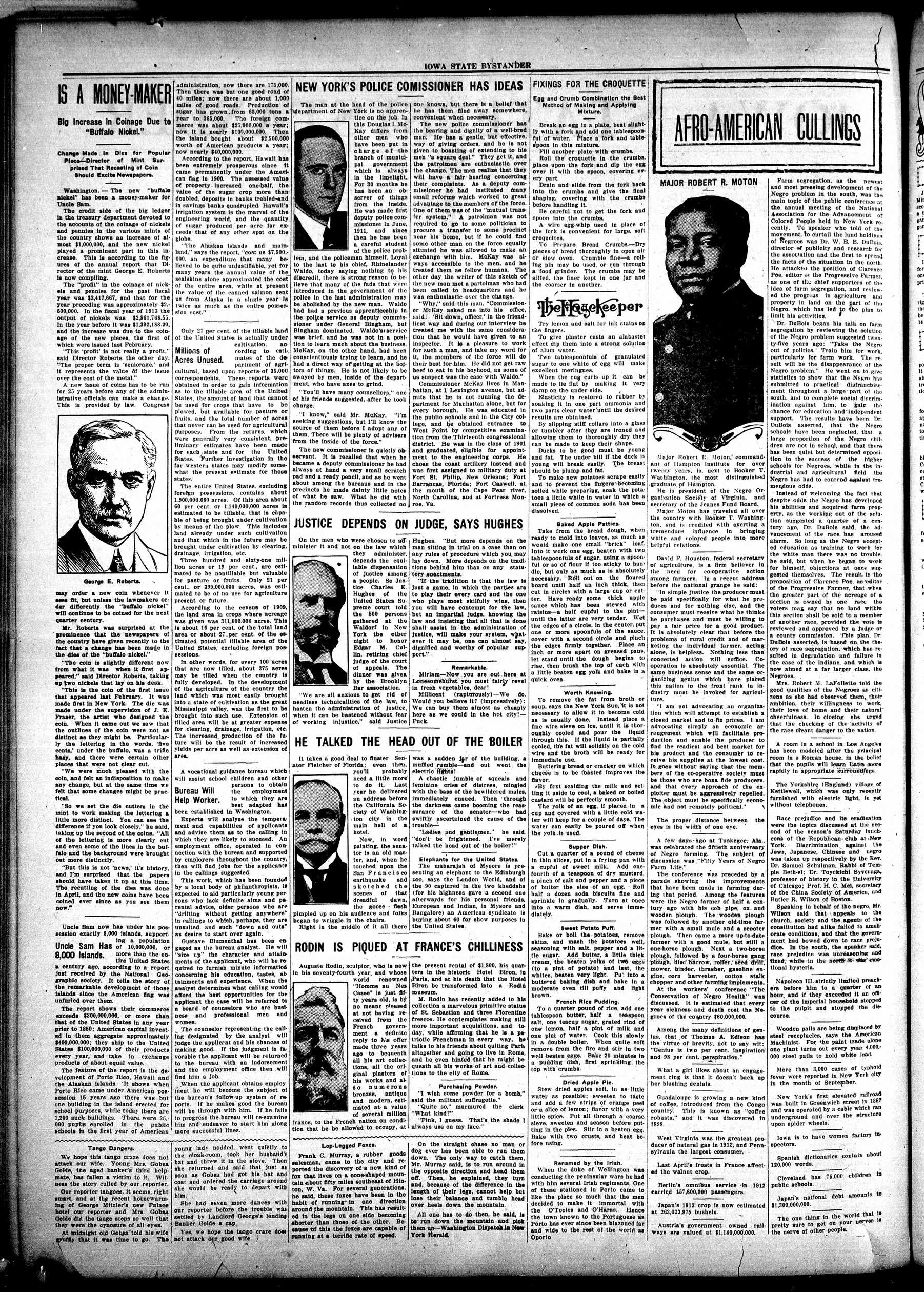
IS A MONEY-MAKER
Change Made In Dies for Popular Piece-Director of Mint SurpriSED That Recasting of Coin Should Excite Newspapers.
Washington. The new "buffalo nickel" has been a money-maker for Uncle Sam.
The credit side of the big ledger in the treasury department devoted to the accounts of the colage of nickels and pennies in the various mints of the country shows an increase of almost $1,000,000, and the new nickel played a prominent part in this increase. This is according to the figures of the annual report that Director of the mint George E. Roberts is now compiling.
The "profit" in the colage of nickels and pennies for the past fiscal year was $3,417,667, and that for the year preceding was approximately $2,600. In the fiscal year of 1921 the output of nickels was $2,661,785.5. In the year before it was $1,392,188.20, and the increase was due to the colage of the new pieces, the first of which were issued last February.
"This 'profit' not really a profit," said Director Roberts the other day. "The proper term is 'seniorage,' and it represents the value of the issue over the cost of the metal." A new issue of coins to be run for 25 cents of the administrative officials can make a change. This is provided by law. Congress
George E. Roberts.
may order a new coin whenever it sees fit, but unless the lawmakers order differently the "buffalo nickel" will continue to be coined for the next quarter century.
Mr. Roberts was surprised at the prominence that the newspapers of the country have given recently to the fact that change in the coin made in the 1980s "buffalo nickel."
"The coin is slightly different now from what it was when it first appeared," said Director Roberts, taking up two nickels that lay on his desk.
"This is the coin of the first issue that appeared last February. It was made first in New York. The die was made under the supervision of J. E. Fraser, the artist who designed the coin. When it came out we saw that the outlines of the coin were not as distinct as they might be. Particularly in the cents, under the buffalo, was a trifle hazy, and there were certain other places that were not clear cut.
"We were much pleased with the coin, and felt an indisposition to make any change, but at the same time we felt that some changes might be practical.
"So we set the die cutters in the mint to work making the lettering a little more distinct. You can see the difference if you look closely," he said, taking up the second of the coins. "All of the lettering is more clearly cut and even some of the lines in the buffalo and the background were brought out more distinctly.
"But this is not 'news', it's history, and I surprised that the papers should have made it as the time. The recutting of the dies was done in April, and the new coins have been coined ever since as you see them now."
a century ago, according to a report just received by the National Geographic society. It tells the story of the remarkable development of those islands since the American flag was unfurled over them.
The report shows their commerce exceeds $300,000,000, or more than that of the United States in any year prior to 1850; American capital invested in them aggregate approximately $400,000,000; they ship to the United States $100,000,000 of their products every year, and take in exchange products of about equal value.
The feature of the report is the development of Porto Rico, Hawaii and the Alaskan islands. It shows when Porto Rico came under American possession, and when one building in the island entered the school purposes, while today there are 1,200 suk buildings. There were 25,000 pupils enrolled in the public schools in the first year of American
We hope this tango craze does not attack our wife. Young Mrs. Gobas Goble, the aged banker's third helpmate, has fallen a victim to it. Witness the story culled by our reporter. Our reporter tangoes, it seems, right smart, and at the recent housewarming of George Mitzler's new Palace Goble, the tango steps so well that they were the cynosure of all eres. At midnight old Gobsa told his wife grudely that it was time to go. The
administration, now there are 175,000.
Then there was but one road of
40 miles; now there are about 1,000
miles of good roads. Production of
sugar has grown, from 65,000 tons
a year to 365,000. The foreign commerce was about $2,300,000 a year; now it is nearly $105,000 a year. Then the island bought about $2,500,000 a year. The island produces a year; now nearly $40,000,000.
According to the report, Hawaii has been extremely prosperous since it came permanently under the American flag in 1900. The assessed value of property increased one-half, the value of the sugar crop more than doubled, deposits in banks trebled and in savings banks quadrupled. Hawaii's irrigation system is the marvel of the growing world, and the quantity of sugar produced in crops exceeds that of any other spot on the globe.
"The Alaskan islands and mainland," says the report, "cost us $7,500,000, an expenditure that many believed to be quite unjustifiable, yet for many years the annual value of the sealskins alone approximated the cost of the entire area, while at present the value of the canned salmon sent us from Alaska in a single year is twice as much as the entire possession cost."
Only 27 per cent, of the tillable land of the United States is actually under
Millions of Acres Unused.
cultural, based upon reports of 35,000 correspondents. These reports were obtained in order to gain information as to the tillable area of the United States, the amount of land that cannot be used for crops that have to be plowed, but available for pasture or fruits, and the total number of acres that never can be used for agricultural purposes. From the returns, which were generally very consistent, presupposed estimates have been made for each state and for the United States. Further investigation in the far western states may modify somewhat the present estimate for those states.
The entire United States, excluding foreign possessions, contains about 1,500,000 acres. Of this area about 60 per cent, or 1,140,000 acres is estimated to be tillable, that is capable of being brought under cultivation by means of the plow. This includes land already under such cultivation as is already being brought under cultivation by clearing, drainage, irrigation, etc.
Three hundred and sixty-one million acres or 19 per cent., are estimated to be nonillitable but valuable for pasture or fruits. Only 21 per cent., or 399,000,000 acres, was estimated to be of no use for agriculture present or future.
According to the census of 1909, the land area in crops where acreage was given was 311,000,000 acres. This area is equal to the total land area or about 27 per cent. of the estimated potential tillable area of the United States, excluding foreign possessions.
In other words, for every 100 acres that are now tilled, about 375 acres may be tilled when the country is fully developed. In the development of the agriculture of the country the land which was most easily brought into a state of cultivation as the great Mississippi valley, was the first to be brought into such use. Extension of tilled area will be at greater expense for clearing, drainage, irrigation, etc. The amount of cultivated land will be the result of increased yields per acre as well as extension of area.
Bureau Will Help Worker
been established in Washington. Experts will analyze the temperament and capabilities of applicants and advise them as to the calling in which they are likely to succeed. An employment office, operated in connection with the bureau and supported by employers throughout the country, then will find jobs for the applicants in the callings suggested. This work, which has been founded by a local body of philanthropists, is expected to aid particularly young applicants in calling to which, perhaps, they are unsuited, and such "down and out" as desire to start over again.
Gustave Blumenthal has been engaged as the bureau analyst. He will "size up" the character and attainments of the applicant, who will be required to furnish minute information concerning his education, tastes, attainments and experience. When the analyst determines what calling would afford the best opportunities for the applicant the case will be referred to a board of counselors who are business and professional men and women.
The counselor representing the calling designated by the analyst will judge the applicant and his chances of making good. If the judgment is favorable the applicant will be returned to the bureau with an indorsement and the employment office then will find him a job. If the applicant obtains employment the will become the subject of the bureau's followup system of reports. If he makes good the bureau will be through with him. If he fails to progress the bureau will re-examine him and endeavor to start him along more successful lines.
young lady nodded, went quietly to the cloak-room, took her husband's hat and threw it in the stove. Then she returned and said that just as soon as Gobsa had got his hat and coat and ordered the carriage around she would be ready to depart with him.
She had seven more dances with our reporter before the trouble was settled by Landlord George's lending Banker Golde a cap.
Yes, we hope the tsa cargo does not attack our good wife.
NEW YORK'S POLICE COMISSIONER HAS IDEAS
JUSTICE DEPENDS ON JUDGE, SAYS HUGHES
HE TALKED THE HEAD OUT OF THE BOILER
RODIN IS PIOUED AT FRANCE'S CHILLINESS
frances, to the nation on condition, that he be allowed to occupy, at | always use on my face."
The man at the head of the police department of New York is no appren-
tice on the job. In this Douglas I. McKay differs from other men who have been put in charge of the branch of municipal government which is always in the limelight. For 30 months he has been an observer of things from the inside. He was made first president of the missioner in June, 1911, and since then he has been a careful student of the police prob-
PETER HARRIS
lem, and the policeman himself. Loyal to the last to his chief, Rhinelander Waldo, today saying nothing to his discredit, there is strong reason to believe that many of the fads that were introduced in the government of the police in the last administration may have been the reason Waldo had had a previous apprenticeship in the police service as deputy commissioner under General Bingham, but Bingham dominated. Waldo's service was brief, and he was not in a position to learn much about the business. McKay, on the other hand, had been conscientiously trying to learn, and he had a direct way of getting at the bolt to the lock, so he was to be swayed by men, inside of the department, who have axes to grind.
"You'll have many counselors," one of his friends suggested, after he took charge.
"I know," said Mr. McKay, "I'm seeking suggestions, but I'll know the source of them before I adopt any of them. There will be plenty of advisers from the inside of the force."
The new commissioner is quietly observant. It is recalled that when he became a deputy commissioner he had always at hand a very small scratch pad and a ready pencil, and as he went among the bureaucats and in the press he saw what the commissioner of what he saw. What he did with the random records thus collected no
On the men who were chosen to add minister it and not on the law which
they administer,
depends the equitable dispensation of justice among a people. So Justice Charles E. Hughes of the United States Supreme court told the 500 persons gathered at the Waldorf in New York the other night to honor judge John retiring chief judge of the court of appeals. The dinner was given by the Brooklyn Bar association.
depends the equitable dispensation of justice among a people. So Justice Charles E. Hughes of the United States Supreme court told the 500 persons gathered at the Waldorf in New York the other night to honor Edgar M. Cullin, retiring chief judge of the court of appeals. The dawn was by the Brooklyn Bar association.
"We are all anxious to get rid of needless technicalities of the law, to hasten the administration of justice, when it can be hastened without fear of working injustice," said Justice
It takes a good deal to fluster Senator Fletcher of Florida; even then,
you'll probably need a little more to do it. Last year he delivered an address before the California Society of Washington city in the main hall of a hotel.
JOHN H. BURKE
Now, in word painting, the senator is an old master, and, when he was San Francisco earthquake and sketched the scenes of that dreadful dawn, the goose - flash
pimped up on his audience and folks began to wriggle in the chairs.
Auguste Rodin, sculptor, who is now in his seventy-fourth year, and whose
world renowned "Homme au Nex Casse" is just fifty years old, is by no means pleased at not having received from the French government a definite reply to his offer made three years ago, and all his art collections, all the original plasters of his works and also numerous bronzes, antique and modern, estimated at a value of several million
A.
Lop-Legged Foxes.
Frank C. Murray, a rubber goods salesman, came to the city and reported the discovery of a new kind of fox that lives on a cone-shaped mountain about fifty miles southeast of Hinton, W. Va. For several generations, he said, these foxes have been in the habit of running away from predators. This has resulted in the legs on one side becoming shorter than those of the other. Because of this the foxes are capable of running at a terrific rate of speed.
IOWA STATE BYSTANDER
one knows, but there is a belief that he has them filed away somewhere, convenient when necessary. The new police commissioner has the bearing and dignity of a well-bred man. He has a gentle, but effective, way of giving orders, and he is not given to boasting of extending to his men "a square deal." They get it, and the patrolmen are enthusiastic over their work. They will have a fair hearing concerning their complaints. As a deputy commissioner he had instituted many small reforms which worked to great advantage to the members of the force. One of them was of the "mutual transfer system." A patrolman was not required to go to some politician to procure a transfer to some precinct near his home, but if he could find some other man on the force equally situated he was allowed to make an exchange with him. McKay was always accessible to the men, and he was always willing to help. Other day the writer of this sketch of the new man met a partlman who had been called to headquarters and he was enthusiastic over the change.
"Why," said this man, "Commissioner McKay asked me into his office, said: "Sit down, officer," in the friendliest way and during our interview he treated me with the same consideration that he would have given to an inspector. It is a pleasure to work for such a man, and take my word for it, the members of the force will do their best for him. He did not get raw beef to eat in his boyhood, as some of us suspect was the case with Waldo."
Commissioner Mckay lives in Manhattan, at I Lexington avenue, but admits that he is not running the department for Manhattan alone, but for every borough. He was educated in the public schools and in the City college, and he obtained entrance to West Point by competitive examination from the Thirteenth congressional district. He was in the class of 1901 and graduated, eligible for appointment to the engineering corps. He was the co-captain writing letter and was first assigned to military duty at Fort St. Philip, New Orleans; Fort Barrancas, Florida; Fort Cawell, at the mouth of the Cape Fear river, North Carolina, and at Fort Monroe, Va.
Hughes. "But more depends on the man sitting in trial on a case than on any rules of procedure which you may lay down. More depends on the traditions behind him than on any statutory enactment. The question is that the law is just a game, in which the parties are to play their every card and the one who plays most skillfully wins, then you will have contempt for the law, but an impartial judge, knowing the law and insisting that all that is done shall assist in the administration of justice, will make your system, what can be, one can almost say dignified and worthy of popular support."
Remarkable.
Miriam—Now you are out here at Lonesomehurst you must fairly revel in fresh vegetables, dear!
Milicent (rapturously)—We do. Would you believe it? (impressively?) We can buy them almost as cheaply here as we could in the hot city!—Puck.
was a sudden jr of the building, a muffled rumble—and out went the electric lights!
A chaotic jumble of squeals and feminine cries of distress, mingled with the bass of the bewildered males, immediately ensued. Then through the darkness came booming the resurrection of the senator—who had swiftly ascertained the cause of the trouble—
"Ladies and gentlemen," he said, "don't be frightened. I've merely talked the head out of the boiler."
Elephants for the United States.
The maharajah of Mysore is presenting an elephant to the Edinburgh oo, says the London World, and of the elephant in the two khedhas for his hibernation gave a sound one afterwards for his personal friends, European and Indian, in Mysore and Bangalore) an American syndicate is buying about 60 for show purposes in the United States.
the present rental of $1,800, his quarters in the historic Hotel Biron, in Paris, and at his death that the Hotel Biron be transformed into a Rodin museum.
M. Rodin has recently added to his collection a marvelous primitive statue of St. Sebastian and three Florentine frescoes. He contemplates making still more important acquisitions, and today, while affirming that he is a painter, he talks to his friends about quitting Paris altogether and go to live in Rome, and he even hinted that he might bequall at his works of art and collections to the city of Roma.
Purchasing Bowdes
"Quite so," murmured the clerk
"What kind?"
On the straight chase no man or dog ever has been able to run them down. The only way to catch them, Mr. Murray said, is to run around in the opposite direction and head them off. Then, he explained, they turn and, because of the difference in the length of their legs, cannot help but lose their balance and tumble head over heels down the mountain.
All one has to do then, he said, is to run down the mountain and pick them up—Washington Dispatch in New York Herald.
FIXINGS FOR THE CROQUETTE
Egg and Crumb Combination the Best Method of Making and Applying Mixture.
Break an egg in a plate, beat slightly with a fork and add one tablespoon of water. Place a fork and tablepoon in this mixture.
Fill another plate with crumbs.
Roll the croquette in the crumbs, place upon the fork and dip the egg over it with the spoon, covering every part.
Drain and slide from the fork back into the crumbs and give the final shaping, covering with the crumbs before handling it.
Be careful not to get the fork and spoon into the crumbs.
A wire egg-whip used in place of the fork is convenient for large, soft croquettes.
To Prepare Bread Crumbs—Dry pieces of bread thoroughly in open air or slow oven. Crumble fine—a roll before baking. Be sure the food grinder. The crumbs may be sifted, the finer kept in one jar and the coarser in another.
The Hazekeeper
Try lemon and salt for ink status on the fingers.
To give plaster casts an alabaster effect dip them into a strong solution of alum water.
Two tablespoons of granulated sugar in white of egg will make excellent meringues.
When the rug curls up it can be made to lie flat by making it very damp on the under side.
Elasticity is restored to rubber by soaking it in one part ammonia and two parts clear water until the desired results are obtained.
If slipping collars into a glass or putting stuff they are ironed and allowing them to thoroughly dry they can be made to keep their shape.
Ducks to be good must be young and fat. The under bill if the duck is young will break easily. The breast should be plump and fat.
To make new potatoes scrape easily and to prevent the fingers becoming soiled while preparing, put the potato in water in which a small piece of common soda has been dissolved.
Baked Apple Patties.
Take from the bread dough, when ready to mold into loaves, as much as would make one small "brick" loaf. Into it work one egg, beaten with two tablespoonfuls of sugar, using a spoonful or of flour if too sticky to handle, but only as much as is absolutely necessary. Roll out on the floured board until half an inch thick, then cut in circles with a large cup or cutter. Have ready some thick apple sauce which has been stewed with raisins—a half cupful to the pint—until the latter are very keen. The edges of a cicle in the center, put on tablespoonfuls of the sauce, cover with a second circle and pluch the edges firmly together. Place an inch or more apart on greased pans, let stand until the dough begins to rise, then brush the top of each with a little beaten egg yolk and bake in a quick oven.
Worth Knowing.
To remove the fat from broth or soup, says the New York Sun, it is not necessary to allow it to become cold as is usually done. Instead place a fine wire sleeve on ice, until it is thoroughly cooled and pour the liquid through this. If the liquid is partially cooled, the fat will solidify on the cold wire and the broth will be ready for immediate use.
Buttering bread or cracker on which cheese is to be (basted improves the flavor).
First scalding the milk and setting it aside to cool, a baked or boiled custard will be perfectly smooth.
The yolk of an egg, if placed in a cup and covered with a little cold water will keep for a couple of days. The water can easily be poured off when the yolk is used.
Supper Dish.
Cut a quarter of a pound of cheese in thin slices, put in a frying pan with a cupful of sweet milk. Add one fourth of a teaspoon of dry mustard, a pinch of salt and pepper and a piece of butter the size of an egg. Roll half a dozen soda biscuits fine and sprinkle in gradually. Turn at once into a warm dish, and serve immediately.
Sweet Potato Puff.
Bake or boll the potatoes, remove skins, and mash the potatoes well, seasoning with salt, pepper and a little sugar. Add butter, a little thick cream, the beaten yolks of two eggs (to a pint of potato) and last, the whites, beaten very light. Put: into a buttered baking dish and bake in a moderate oven till puffy and light brown.
French Rice Pudding.
To a quarter pound of rice, add one tablespoon butter, half a teaspoon salt, one teaspoon sugar, grated rind of one lemon, half a pint of milk and one pint of water. Cook this slowly in a double boiler. When quite soft remove from the fire and stir in two well beaten eggs. Bake 20 minutes in a pudding dish, first sprinkling the top with crumbs.
Dried Apple Pie.
Stew dried apples soft. In as little water as possible; sweeten to taste and add a few strips of orange peel or a slice of lemon; flavor with a very little spice. Put all in a coarse flour and bake in the oven, stirring in the piles. Stir in a beaten egg. Bake with two crusts, and heat before using.
Renamed by the Irish
When the duke of Wellington was conducting the peninsular war he had with him several Irish regiments. One of these stationed in Porto came to like the place so much that the men decided to make it immortal with the 'Otoes and O'Haraes'. Hence the otoes and O'Haraes. Porto has ever since been blazed far and wide to the rest of the world as Oporto
AFRO-AMERICAN CULLINGS
MAJOR ROBERT R. MOTON
[Name]
Major Robert R. Moton, commandant of Hampton Institute for over twenty years, is, next to Booker T. Washington, the most distinguished graduate of Hampton. He is president of the Negro Organization Society of Virginia, and secretary of the James Fund Board.
David F. Houston, federal secretary of agriculture, is a firm believer in the need for co-operative action among farmers. In a recent address before the national grange he said: "In simple justice the producer must be paid specifically for what he produces and for nothing else, and the farmer must be given what he takes the purchases and must be willing to pay a fair price for a good product. It is absolutely clear that before the problems of rural credit and of marketing the individual farmer, acting alone, is helpless. Nothing less than concerted action will suffice. Cooperation is absolutely essential. The same business sense and the same oratory skills that this nation in the front rank in industry must be invoked for agriculture.
"I am not advocating an organization which will attempt to establish a closed market and to fix prices. I am advocating simply an economic arrangement which will facilitate production and distribution. I find the readiest and best market for his product and the consumer to receive his supplies at the lowest cost. It goes without saying that the members of the co-operative society must be those who are bona fide producers, and that every approach of the ex-operative society must be specificly economic and not remotely political."
The proper distance between the eyes is the width of one eye.
A few days ago at Tuskegee, Aha, was celebrated the fiftieth anniversary of Negro farming. The subject of discussion was "Fifty Years of Negro Farm Life." The conference was preceded by a parade showing the improvements that have been made in farming durations since the 1950s, were the Negro farmer of half a century ago with his cob pipe, ox, and wooden plough. The wooden plough was followed by another old-time farmer with a small mule and a scooter plough. Then came a more up-to-date farmer with a good mule, but still a one-horse plough. Next a two-horse plough, followed by a four-horse gang plough, disbray scarf, roller, seed drill, plough, thresher, gatherer, gritte, corn harvester, cotton stalk chopper and other farming implements.
At the workers' conference "The Conservation of Negro Health" was discussed. It is estimated that every year sickness and death cost the Negroes of the country $6,000,000.
Among the many definitions of genus, that of Thomas A. Edison has the virtue of brevity, not to say wifi: "Genius is two per cent. inspiration and 88 per cent. persecution."
What a girl likes about an engagement ring is that it doesn't back up her blushing denials.
Guadaloupe is growing a new kind of coffee, introduced from the Congo country. This is known as "coffee robusta," and it was discovered in 1898.
West Virginia was the greatest producer of natural gas in 1912, and Pennsylvania the largest consumer.
Last April's frosts in France affected the walnut crop.
Berlin's omnibus service in 1912
carried 157,600,000 passengers.
Japan's 1913 crop is now estimated
at 263,033,975 bushels.
Austria's government owned rail
ways are valued at $1,140,000,000.
Farm segregation, as the newest and most pressing development of the Negro problem in the south, was the main topic of the public conference at the annual meeting of the National Association for the Advancement of Colored People held in New York recently. Te speaker who told of the movement, to curtail the land holdings of Negroes was Dr. W. E. B. Dulloz, director of publicity and research for the association and the first to spread the situation in the north. He attacked the situation of the Clarence Poe, editor of the Progressive Farmer, as one of the chief supporters of the idea of farm segregation, and reviewed the progress in agriculture and property in land on the part of the Negro, which has led to the plan to limit his activities.
Dr. DuBois began his talk on farm segregation by reviewing the solution of the Negro problem suggested twenty-five years ago: "Take the Negro out of politics. Train him for work, particularly for farm work. The result will be the disappearance of the Negro problem." He went on to give statistics to show that the Negro has submitted to practical disfranchisement throughout a large part of the south, and to complete social discrimination against him, to gain the chance for education and independent support. The results have been. Dr. DuBois asserted, that the Negro has been neglected that a large proportion of the Negro dren are not in school, and that there has been quiet but determined opposition to the success of the higher schools for Negroes, while in the industrial and agricultural field the Negro has had to contend against tremendous odds.
Instead of welcoming the fact that despite odds the Negro has developed his abilities and acquired farm property, as the working out of the solution suggested a quarter of a century ago, Dr. DuBois said, the advancement of the race has arisen alarm. So long as the Negro accepted education as training to work for the white man there was no trouble, he said, "I am not for himself, objections at once suggested themselves. The result is the proposition of Clarence Poe, as editor of the Progressive Farmer, that when the greater part of the acreage of a section is owned by one race the voters may say that no land within this section shall be sold to a member of another race, provided the vote is reviewed and approved by a judge or a county commission. This plam, Dr. DuBois asserted, is based on the thesis that the Negro suffered in degradation and failure in the case of the indiana, and which is now aimed at a far larger class, the Negroes.
Mrs. Robert M. LaFollette told the good qualities of the Negroes as citizens as she had observed them, their ambition, their willingness to work, their love of home and their natural cheerfulness. In closing she urged that the checking of the activity of the race meant danger to the nation.
A room in a school in Los Angeles has been modeled after the principal room in Romare Bearden in the belief that the pupil will learn Latin more rapidly in appropriate surroundings.
The Yorkshire (England) village of Kettlewell, which was only recently furnished with electric light, is yet without telephones.
Race prejudice and its eradication were the topics discussed at the second of the season's Saturday luncheons of the Republican club at New York. Discrimination, against the Jews, Japanese, and negro was taken up respectively by the Rev. Dr. Samuel Schulman, Rabbi of Temple Bethel; Dr. Toyckich Syvena professor of history in the University of Chicago; Prof. H.C. Med secretary of the China Society of America, and Butler R. Wilson of Boston.
Speaking in behalf of the negro, Mr. Wilson said that appeals to the church, society and the agents of the constitution had alike failed to ameliorate conditions, and that the government had bowed down to race prejudice. In the south, the speaker said, race prejudice was unreasoning and fixed, while in the north it was emotional hysteria.
Napoleon III, strictly limited preschools before him to a quarter of an hour, and if they exceeded it an officer of the imperial household stepped to the pulpit and stopped the discourse.
Wooden pails are being displaced by
steel receptacles, says the American
Machinist. For the paint trade alone
one plant turns out every year 4,000,
000 steel pails to hold white lead.
More than 3,000 cases of typhoid
fever were reported in New York city
in the month of September.
New York's first elevated railroad
was built in Greenwich street in 1857
and was operated by a cable which ran
underground and over the structure
upon spider wheels.
Iowa is to have women factory inspectors.
Spanish dictionary contain about
120,000 words.
Cleveland has 75,000 children in
public schools.
Japan's national debt amounts to
$1,300,000,000.
The one thing in the world that is pretty sure to get on your nerves is the nerve of other people.
SPORTS
BOWLING
James L. Garland, a well-known
Minneapolis bowler, made a record
score for the northwest when he rolled
a total of 1,730 in seven consecutive
games. His lowest score in any of the
games was 215, and the highest 279.
BILLIARDS
London Field says the recovery of form by E. Diggle, now nearing fifty one years of age, is one of the surprises of the English billiard season.
The preliminary tournament for the right to challenge Melbourne Inman for the English billiard championship will be held in London, March 2 to 7, 9 to 14 and 16 to 28.
AQUATIC
Richard Armstrong has been appointed head coach of the Yale crew it is believed that Armstrong will abandon the English stroke and reintroduce the "Cook stroke," or a variation of it.
Coach Daly of the Army is anxious for Nuck Brown of Vandy to secure an appointment at West Point. The two government institutions are allowed to play men regardless of how much time they have had at other colleges.
While stating that Yale will probably be more successful with the Bob Cook stroke, Courtney, Cornell's famous coach, indignantly denies that the stroke used at Ithaca was copied from Cook and states "emphatically that he worked it out himself."
Battle was sold by the Allen farm for $550, developed and raced then resold for $10,000.
Trotters and pacers raced for upwards of $3,000,000 in this country and Canada last year.
Ernest Axtell, 2:08%, is the sixteenth 2:10 stallion sold to the foreigners in the last year.
Flower Direct, 2:01, is only three younger than her sire. Direct Star, 2:09%, both taking records last year.
The Denver trotter, Pass All, 2:13%, is being strongly touted for the stakes this year. He is eligible to the M. & M.
PUGILISM
Freddie Welsh, English lightweight champion, outpointed Frank Whitney of Cedar Rapids at Atlanta in a ten-round bout.
Boxing will be a part of the athletic training at the University of California. Indiana university also has boxing instruction.
Kid Williams of Baltimore knocked out 'Click Hayes of Indianapolis at the bury in the seventh round. The boys are bantam weights.
Bob Fitz is still anxious to re-enter the ring. Perhaps New York boxing commission might lighten enough to let him box exhibitions.
Johny Kilbane hopes to decisively defeat ex-Champion Abe Attell, whom he will meet in a 20-round contest at San Francisco, on February 22.
A fight has been arranged between Bandman Blake, English middleweight boxing champion, and George Penettier, for $2,500 and a purse of $10,000. The bout will at London.
Harold Janvrien, the former Boston high school athlete, who is a member of the Red Sox, may be turned over to the St. Paul club in final payment for Walter Rehg.
Art Shafar of the Giants has announced his retirement from the game. He hopes his scarce Art can always be depended upon to put over the Patti stuff.
Should Theodore Brzozowski make good with the Athletics next season imagine what a time the umpis will have in pronouncing his name and the fans in catching it.
President Dreyfuss of the Pirates made Honus Wagner the only exception in any trade for big Ed Konechty, the anvil player Clarke discussed the proposed deal.
Earl Mack, son of Connie Mack of the Athletics, will coach the baseball squad at the University of North Carolina before he begins his duties as manager of the Raleigh team.
Clark Griffith has decided to abandon efforts to make Cashion great with a changed delivery. The big Carolina will be allowed to pitch his natural underhand ball.
Tokio and Yokohama newspapers are strong for the American ball players touring the world. The two teams gained much prestige and made much money on their visit to Japan.
As a dispenser of surprises, sensa-
tions and bombs the Federal league is
a great little institution.
C. W.
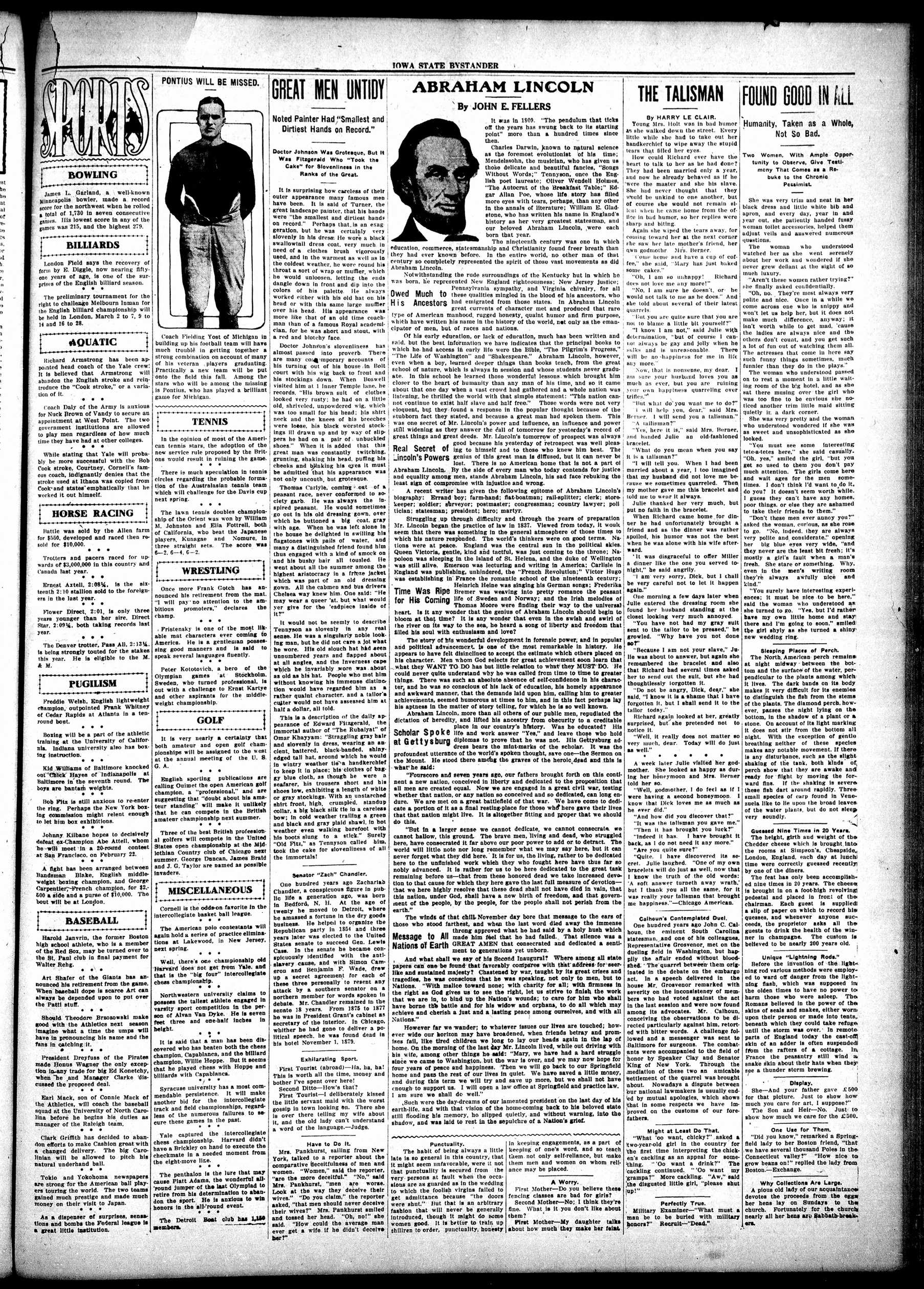
Coach Fielding Yost of Michigan in building up his football team will have much trouble in getting together a strong combination on account of many of his veteran players graduating. Practically a new team will be put onto the field this fall. Among the stars who will be among the missing is Pontius, who has played a brilliant game for Michigan.
In the opinion of most of the American tennis stars, the adoption of the new service rule proposed by the Britons would result in ruining the game.
There is much excitement in tennis circles regarding the probable formation of the Australasian tennis team which will challenge for the Davis cup next spring.
The lawn tennis doubles championship of the Orient was won by William M. Johnston and Elia Fottrell, both of California, who beat the Japanese players, Kunagae and Nomure, in three straight sets. The score was
WRESTLING
Once more Frank Gotch has announced his retirement from the mat. "I will pay no attention to the ambitious promoters," declares the champ.
Fristensky is one of the most likable mat characters ever coming to America. He is a gentleman possessing good manners and is said to speak several languages fluently.
Peter Kototovich, a bero of the Olympic games, is a Stockholm, Sweden, well-respected professional, is a challenge to Ernst Kartye and other aspirants for the middle-weight championship.
GOLF
It is very nearly a certainty that both amateur and open golf championships will be assigned to the west at the annual meeting of the U. S. G. A.
English sporting publications are calling Quinet the open American golf champion, a "professional," and are suggesting that "doubt about his amateur standing" will make it unlikely that he can compete in the British amateur championship next summer.
Three of the best British professional golfers will compete in the United States open championship at the Mid-Atlantic Country club of Chicago next summer. George Duncan, James Bradl and J. G. Taylor are named as possible invaders.
Cornell is the odds-on favorite in the intercollegiate basket ball league.
The American polo contestants will again hold a series of practice eliminations at Lakewood, in New Jersey, next spring.
next spring.
Well, there's one championship old
Harvard does not get from Yale, and
their "intercollege" championship
chess championship.
Northwestern university claims to possess the tallest athlete engaged in varsity sport competition in the person of Alvan Van Dyke. He is seven feet three and one-half inches in height.
It is said that a man has been discovered who has beaten both the chess champion, Capablaanca, and the billiard champion, Willie Hoppe. But it seems that he played chess with Hoppe and billiards with 'capablaanca.
Syracuse university has a most commendable persistence. It will make another bid for the intercollegiate track and field championships, regardless of the numerous failures to secure these games in the past.
Yale captured the intercollegiate chess championship. Harvard didn't have a Brickley on hand to execute the checkmate in a needed moment from the eight-move line.
the eight-mover
The penthalon is the lure that may cause Flatt Adams, the wonderful all- round jumper of the last Olympiad to retire from his determination to abandon the sport. He is anxious to win honors in the all-round event.
The Detroit Boat club has 1,150 members.
GREAT MEN UNTIDY
Noted Painter Had "Smallest and Dirtiest Hands on Record."
Doctor Johnson Was Groteque, But It Was Fitzgerald who "Took the Cake" for Sloveniness in the Ranks of the Great.
It is surprising how carcass of their outer appearance many famous men have been. It is said of Turner, the great landscape painter, that his hands were "the smallest and dirtiest hands on record." Perhaps that, is an exaggeration, but he was certainly very slovenly in his dress. He wore a black dress coat, very much in need of a brush, vigorously used, and in the warmer, as the coldest weather, he wore round his throat a sort of wrap or muffler, which he would unloosen, letting the ends dangle in front and dip into the colors of his palette. He always worked either with his old hat on his head or with this same large muffler over his head. His appearance was more like that of time coaches man than of a famous Royal accidentian, for he was short and stout, with a red and blotchy face.
Doctor Johnson's slovenness has almost passed into proverb. There are many comparative accounts of his turning out of his house in Bolt court with his wig back to front and his stockings down. When Boswell visited him at 1 inner Temple lane, he records, "His brown suit of clothes looked very rusty; he had on a little old, shrieved, unpressed wig, which was too small for his head; his shirt neck and the knees of his breeches were loose, his black worsted stockings ill drawn up and by way of slippery shoes. He was wearing shoes." When it is added that this great man was constantly twitching, grunting, shaking his head, puffing his cheeks and blinking his eyes it must be admitted that his appearance was not only uncouth but grotesque.
Thomas Carlyle, coming out of a peasant race, never conformed to a society garb. He was always the inspired peasant. He would sometimes go out in his old dressing gown, over which he buttoned a big coat, gray with age. When he was left alone in the house, he flies his hair with pails of water, and many a distinguished friend found him thus engaged with a kind of smock on and his bushy hair all tousled. He went about all the summer among the highest aristocracy in a frigate jacket which was part of an old dressing gown. All the caben and bus drivers Chelsea way knew him One day may wear a queer at, but, what would give for the "eadiesin inside of it"?
It would not be seemly to describe Tennyson as slovenly in any real sense. He was a singularly noble looking man, but he did not care a jot what he wore. His old slouch hat had a furry collar and he appeared about at all angles, and the Inverness cap which he invariably wore was about as old as his hat. People who met him without knowing his immense distinction would have regarded him as a rather质ant character, and a tailor whose skills were assessed him at a rather dollar, all told.
This is a description of the daily appearance of Edward Fitzgerald, the immortal author of "The Rubayat of Omar Khaayam: "Stragling gray hair and slovenly in dress, wearing an ancient, battered, black-banded, shiny-edged tall hat, around which in winter in his hand a handkerchief in place, in his clothes of baggy blue cloth, as though he were a seafarer, his trousers short and his shoes low, exhibiting a length of white or gray stockings. With an unsturbed shirt front, high, crumpled, standup collar, a big black silk tie in a careless bow; in cold weather trailing a green and black gray裤 and barefoot with a heeled bootship sling to a stick. "Surely "Old Fitz," as Tennyson called him, took the cake for sloveniness of all the immortals!
Senator "Zach" Chandler.
One hundred years ago Zachariah Chandler a conspicuous figure in public life a generation ago, was born Bedford, N. H. At the age of twenty he moved to Detroit, where he amassed a fortune in the dry goods business. He helped to organize the Republican party in 1854 and three years later was elected to the United States senate to succeed Gen. Lewis Cass. In the senate he became conspicuously identified with the anti-slavery cause, and with Simon Cameron and Benjamin F. Wade, draw up a secret agreement for each of these three personally to deny any attack by a southern senator; northern men words spoken in debate. Chandler remained in the senate 18 years. From 1785 to 1877 he was in President Grant's cabinet as secretary of the interior. In Chicago, whither he had gone to deliver a political speech, he was found dead in his hotel November 1, 1879.
Exhilarating Sport
First Tourist (abroad)—Ha, ha, ha!
This is worth all the time, money and bother I've spent over here!
Second Ditto—How's that?
First Tourist—deliberately kissed the little servant maid with the worst goosepin in town looking on. There she is over there telling my wife about it, and the old lady can't understand a word of the language.—Judge.
Have to Do It.
Mrs. Pankhurst, sailing from New York, talked to a reporter about the comparative deceitfulness of men and women. "Women," said the reporter, "are the more deceitful." No, said Mrs. Pankhurst. "They may they deceive their wives." "Do you claim," the reporter asked, "that men should never deceive their wives?" Mrs. Pankhurst smiled and tossed her head. "Oh, not! she said. 'How could the average man ever get a wife if he did deceive
IOWA STATE BYSTANDER
ABRAHAM LINCOLN
By JOHN E. FELLERS
A. B.
The nineteenth century was one in which education, commerce, statemanship and Christianity found freer breath than they had ever known before. In the entire world, no other man of that century so completely represented the spirit of those vast movements as did Abraham Lincoln.
Nowwithstanding the rude surroundings of the Kentucky but in which he was born, he represented New England rightousness; New Jersey justice; Owed Much to these qualities mingled in the blood of his ancestors, His Ancestors and emigrated from those states. In Abraham Lincoln great currents of character met and produced that rare type of American man of quiet humor and firm purpose, which have written his name in the history of the world, not only as the emancipator of men, but of races and nations.
Of his early education, or lack of education, much has been written and said, but the best information we have indicates that the principal books to which he had access in early life were the Bible, "The Pilgrim's Progress," "The Life of Washington" and "Shakespeare." Abraham Lincoln, however, even when a boy, learned deeper things than books teach, from the great school of nature, which is always in session and whose students never graduate. In this school he learned those wonderful lessons which brought him closer to the heart of humanity than any man of his time, and so it came about that one day when a vast crowd had gathered and a whole nation was listening, he thrilled the world with that simple statement: "This nation cannot continue to exist half slave and half free." Those words were not very eloquent, but they found a response in the popular thought because of the stubborn fact they stated, and because a great man had spoken them. This was one secret of Mr. Lincoln's power and influence, an influence and power still widening as they answer the call of tomorrow for yesterday's record of great things and great deeds. Mr. Lincoln's tomorrow of prospect was always good because his yesterday of retrospect was well pleased. That was the genius of this great man is diffused, but it can never be lost. There is no American home that is not a part of Abraham Lincoln. By the side of every man who today contends for justice and equality among men, stands Abraham Lincoln, his sad face rebuking the least sign of compromise with injustice and wrong.
A recent writer has given the following epitome of Abraham Lincoln's biography: Errand boy; farm-hand; flat-boatman; rall-splitter; clerk; storekeeper; soldier; driverey; postmaster; congressman; country lawyer; pollician; statesman; president; hero; martyr.
Strugging up through difficulty and through the years of preparation Mr. Lincoln began the practice of law in 1837. Viewed from today, it would seem that there was something in the general atmosphere of those times to which his nature responded. The world's thinkers were on good terms. Nations were at peace. England was the central sun in the political skies. Queen Victoria, gentle, kind and tactful, was just coming to the throne; Napoleon was sleeping in the island of St. Helena, and the duke of Wellington was still alive. Emerson was lecturing and writing in America; Carlisle in England was publishing, unhindered, the "French Revolution"; Victor Hugo was establishing in France the romantic school of the nineteenth century; Heinrich Heine was singing his German songs; Frederika Bremer was weaving into pretty romance the pleasant life of Sweden and Norway; and the Irish melodies of Thomas Moore were finding their way to the universal heart. Is it any wonder that the genius of Abraham Lincoln should begin to bloom at that time? It is any wonder that even in the swish and swirl of the river on his way to the sea, he hewn a song of liberty and freedom that filled his soul with enthusiasm and love?
The story of his wonderful development in forensic power, and in popular and political advancement, is one of the most remarkable in history. He appears to have felt dishonor to accept the estates which others possessed on his behalf. God accepted the estates he devotion soon learnt that what they WANT TO DO has but little relation to what they MUST DO. He could never quite understand why he was called from time to time to greater things. There was such an absolute absence of self-confidence in his character, and he was so conscious of his lack of education, his homely appearance and awkward manner, that the demands laid upon him, calling him to greater achievements, seemed humorous at times to him, and in this perhaps lay his aptness in the matter of story telling, for which he is so well known.
Abraham Lincoln, more than all others of our public men, repudiated the dictation of heredity, and lifted his ancestry from obscurity to a creditable place in our country's history. Was he educated? His life and work answer "Yes," and leave those who hold diplomas to prove that he was not. His Gettyburg address bears the mint-marks of the scholar. It was the profoundest utterance of the world's spoken thought, save one—the Sermon on the Mount. He stood there among the graves of the heroic dead and this is what he said.
Pope保罗 and seven years ago, our fathers brought forth on this continent a new nation, conceived in liberty and dedicated to the proposition that all men are created equal. Now we are engaged in a great civil war, testing whether that nation, or any nation so conceived and so dedicated, can long endure. We are met on a great battlefield of that war. We have come to dedicate a portion of it as a final resting place for those who here gave their lives that nation might live. It is altogether fitting and proper that we should do this.
"But in a larger sense we cannot dedicate, we cannot consecrate we cannot hallow, this ground. The brave men, living and dead, who struggled here, have consecrated it far above our poor power to detract. The world will little note nor long remember what we may say here, but it can never forget what they did here. It is for us, the living, rather to be dedicated here to the unfinished work which they who fought here have thus far so nobly advanced. It is rather for us to be here dedicated to the great task remaining before us—that from these honored dead we take increased devotion to that cause, which here we have made possible. That cause has no dead shall not have died in vain, that this nation, under God, shall have a new birth of freedom, and that government of the people, by the people, for the people shall not perish from the earth."
The winds of the chill-November day bore that message to the ears of those who stood farthest, and when the last word died away the immense throng approved what he had said by a holy hush which made him feel that he had failed. That silence was a Nations of Earth GREAT AMEN that consecrated and dedicated a sentiment to generations yet unborn.
And what shall we say of his Second Inaugural? Where among all state papers can one be found that favorably compares with that address for seer-like and sustained majesty? Chastened by war, taught by its great crises and tragedies, he was conscious that he was speaking, not only to men, but to Nations. "With malice toward none; with charity for all; with firmness in the right as God gives us to see the right, let us strive to finish the work that we are in, to bind up the Nation's wounds; to care for him who shall have borne the battle and for his widow and orphans, to do all which may achieve and cherish a just and a lasting peace among ourselves, and with all Nations."
However far we wander; to whatever issues our lives are touched; however wide our horizon may have broadened, when friends betray and promises fail, like tired children we long to lay our heads again in the lap of home. On the morning of the last day I was living, while out driving with his wife, among other things he was "Mary, we have had a hard struggle since we came to Boston but the war is over, and we may now hope for four years of peace and happiness. Then we will go back to our Springfield and pass the rest of our lives in quiet. We have saved a little money, and during this term we will try and save up more, but we shall not have enough to support us. I will open a law office at Springfield and practice law. I am sure, we shall do well."
Such were the day-dreams of our lamented president on the last day of his earth-life, and with that vision of the home-coming back to his beloved state still flooding his memory, he slipped quietly, and without warning, into the shadow, and was laid to rest in the sepulchre of a Nation's grief.
Punctuality.
The habit of being always a little late is so general in this country, that it might seem unfavorable, it not that punctuality is secured from the very persons at fault when the occasions are as guarded as in the wedding to which the foolish virgines failed to get admittance because "the doors were shut." But that is an arbitrary fashion that will never be generally introduced, though it might do some women good. It is better to train up children to order, punctuality, honesty
In keeping engagements, as a part of keeping of one's word, and so teach them not only self-reliance, but make them men and women on whom reliance may be placed.
A Worry.
First Mother—Do you believe these fencing classes are bad for girl? Second Mother—No; I think they're fine. What is it you don't like about them?
First Mother—My daughter talks about how much they make her feint.
---
Punctuality.
It was in 1809. "The pendulum that ticks off the years has swung back to its starting point" more than a hundred times since then.
Charles Darwin, known to natural science as the foremost evolutionist of his time; Mendelssohn, the musician, who has given us those delicate and beautiful fancies, "Songa Without Words"; Tennison, the English poet laureate; Oliver Wendell Holmes, "The Autocrat of the Breakfast Table"; Edgar Allan Poe, whose life story has filled more eyes with tears, perhaps, than any other in the annals of literature; William E. Glad stone, who has written his name in England's history as her very greatest statesman, and our beloved Abraham Lincoln, were each born that year.
a little berry, that it see not from the occa- wedding called to the doors or arbitrary generally to some train up honesty
In keeping engagements, as a part of keeping one's word, and so teach them not only self-reliance, but make them men and women on whom reliance may be placed.
A Worry.
First Mother—Do you believe these fencing classes are bad for girl? Second Mother—No; I think they're fine. What is it you don't like about them?
First Mother—My daughter talks about how much they make her feist.
Worry.
THE TALISMAN
By HARRY LE CLAIR.
Young Holt. Mrs. Holt was in bad humor as she walked down the street. Every little while she had to take out her handkerchief to wipe away the stupid tears that filled her eyes.
How could Richard ever have the heart to talk to her as he had done? They had been married only a year, and now he already behaved as if he would be unkind to her and she shaved. She had never thought that they would be unkind to one another, but of course she would not remain silent when he came home from the office in bad humor, so her replies were sharp and biting.
Again she wiped the tears away, for coming toward her at the next corner she saw her late mother's friend, her own godmother. Mrs. Berner.
Come home and have a cup of coffee, she said, "Mary has just baked some cakes."
Oh, I am so unhappy. Richard does not see me any more!
"No, I am sure he doesn't, or he would not talk to me as he does." And she told about several of their latest quarrels.
"But you are quite sure that you are not to blame a little bit yourself?"
"I know I am not," said Julie with determination, "but of course I cannot always be gay and jolly when he salts and is unreasonable. There will be no happiness for me in life any more."
"Now you are nonsense, my dear. I am sure your husband loves you as much as ever, but you are ruining your own happiness quarreling over trifles."
"But what do you want me to do?"
"I will help you, dear," said Mrs. Berner. "I will send you a talsman."
"A talsman?"
"Yes, here it is," said Mrs. Berner, and handed Julie an old-fashioned bracelet.
"What do you mean when you say it is a talsman?"
"I will tell you. When I had been married about a year, I too imagined that my husband did not love me because we sometimes quarrelled. Then he gave me this bracelet and told me to wear it always."
Julie thanked her very much, but not no faith in the bracelet.
When Richard came home for dinner he had unfortunately brought a friend and as the dinner was rather spolled, his humor was not the best when he was alone with his wife afterward.
"It was disgraceful to offer Miller a dinner like the one you served tonight," he said angrily.
"I am very sorry, Dick, but I shall be very careful not to let it happen again."
One morning a few days later when Julie entered the dressing room she found her husband standing at the closet looking very much annoyed.
"You have not had my gray suit sent to the tailor to be pressed," he groused. "Why have you not done so?"
"Because I am not your slave," Julie was about to answer, but again she remembered the bracelet and also that Richard had several times asked her to send out the suit, but she had thoughtlessly forgotten it.
"But he annoyed Dick, dear," she said. "I know it is a shame that I have forgotten it, but I shall send it to the tailor, today."
Richard again looked at her, greatly surprised, but she pretended not to notice it. "Well, it really does not matter so very much, dear. Today will do just as well."
A week later Julie visited her godmother. She looked as happy as陪ing her honeymoon and Mrs. Berner told her so.
"Well, godmother, I do feel as if I were having a second honeymoon. I know that Dick loves me as much as he ever did."
"And how did you discover that?"
"It was the tallisman you gave me."
"Then it has brought you luck!"
"Indeed it has. I have brought it back, as I do not need it any more."
"Are you quite sure?"
"Quite. I have discovered its secret. Julie laughed. "One of my own bracelets will do just as well, now that I know the truth. I won't be knerth away wrath, but I thank you all the same, for it was really your fallman that brought me happiness." —Chicago American.
Calhoun's Contemplated Duel
Calhoun
Orchestrated years ago John C. Calhoun, the eminent South Carolina statesman, and one of his colleagues, Representative Grosvenor, met on the dueling field in Washington, but hapfully the affair ended without bloodshed. The quarrel between them originated in the debate on the embargo act. In a speech delivered in the house Mr. Grosvenor remarked with severity on the inconsistency of members who had voted against the act in the last session. He responded, Mr. Calhoun, connecting the observations to be directed particularly against him, retorted with bitter words. A challenge followed and a messenger was sent to Baltimore for surgeons. The combatants were accompanied to the field of honor by Speaker Clay and Senator King of New York. Through the mediation of these two an amicable settlement of the quarrel was brought about. Newday's a dispute between national lawmakers is usually ended by mutual apologies, which shows that in some respects we have improved on the customs of our forefathers.
Might at Least Do That
"What you want, chicky?" asked a two-year-old girl in the country for the first time interpreting the chicken's cackling as an appeal for something. "Oo wan a drink?" The chicken cackled. "Camping?" More cackling. "Aw," said the disguised little girl, "please shut up!"
Perfectly True.
Military Examiner—"What must a man do to be armed with military weapons?"—Reagain—"Dead."
FOUND GOOD IN ALL
Humanity, Taken as a Whole, Not So Bad.
Two Women, With Ample Opportunity to Observe, Give Testimony That Comes as a Rebuke to the Chronic Pessimist.
She was very trim and neat in her black dress and little white bib and apron, and every day, year in and year out, she patiently handed fussy woman toilet accessories, helped them adjust veils and answered numerous questions.
The woman who understood watched her as she went serenely about her work and wondered if she never grew deliant at the sight of so much tuxedo.
"Aren't these women rather trying?" she finally asked confidentially.
"Oh, no. They're most always very polite and nice. Once in a while we come across one who is sniffy and won't let us help her, but it does not make much difference, anyway; it isn't worth while to get mad, 'cause the ladies are always nice and the others don't count, and you get such a lot of fun out of watching them all. The actresses that come in here say such funny things sometimes, much funnier than they do in the plays." The woman who understood passed on to rest a moment in a little waiting room of the big hotel, and as she sat there musing over the girl who was too fine to be envious she noticed another trainee in the maid sitting quietly in a dark corner. She was very pretty and the woman who understood wondered if she was as sweet and unsophisticated as she looked.
"You must see some interesting tate-a-tetes here," she said casually. "Oh, yes," smiled the girl, "but you get so used to them you don't pay much attention. The girls come here and wait ages for the men sometimes. I don't think I'd want to do it, do you? It doesn't seem worth while. I guess they can't have any homes, they are always advised to take their friends to them." "Don't these men ever annoy you?" asked the woman, curious, as she rose to go. "No, indeed, they are always very polite and considerate," opening her big blue eyes very wide, "and they never are the least bit fresh; it's mostly a girl's fault when a man's fresh. She stare or something. Why, even in the men's writing room they're always awfully nice and kind." You surely have interesting experiences; it must be nice to be here," said the woman who understood as she turned to go. "Yes, but I'd rather have my own little home and stay there and I'm going to soon." smiled the girl shyly as she turned a shiny new wedding ring.
Sleeping Places of Perch.
The North American perch remains at night midway between the bottom and the surfaces of the water, perpendicular to the plants among which it lives. The dark bands on its body makes it very difficult for its enemies to distinguish the fish from the stems of the plants. The diamond perch, however, passes the night lying on the bottom, in the shadow of a plant or a stone. On account of its light marking it does not stir from the bottom all night. With the exception of gentil breathing matter, the perch makes an notable movement. If there is disturbance, such as the slight shaking of the tank, both kinds of perch show that they are awake and ready for flight by moving the forward fin. If the shaking is severe these fish dart around rapidly. Three small species of carp found in Venezuela like to lie upon the broad leaves of the water plants, but do not sleep very soundly.
The height, girth and weight of the Cheddar cheese which is brought into the rooms at Simpson's, Chasepside, London, England, each day at lunch time were correctly guessed recently by one of the diners.
The feat has only been accomplished nine times in 20 years. The cheese is brought in to a foot-high revolving pedestal and placed in front of the chairman. Each guest is supplied a slip of paper with the record of whenever anyone succeeds, the proprietor asks all the guests to drink the health of the winner in champagne. The custom is believed to be nearly 200 years old.
Unique "Lightning Rods."
Before the invention of the lightning rod various methods were employed to ward off danger from the lightning flash, which was supposed in the old times to have no power to harm those who were asleep. The Romans believed in the power of the skins of seals and snakes, either worn upon their person or made into tents, beneath which they could take refuge until the sun was out. The monster England today the cast-off skin of an adder is often suspended from the rafters of a cottage. In France the peasantry still wind a snake skin about their hats when they see a thunderstorm brewing.
Display.
She-And your father gave £500 for that picture. Just to show how much you care for art, I suppose?" The Son and Heir-No. Just to show how much we care for the £500.
One Use for Them:
"Did you know," remarked a Springfield lady to her Boston friend, "that we have several thousand Poles in the Connecticut valley?" "How nice to grow beans on!" replied the lady from Boston—Exchange.
Why Collections Are Large.
A plausible old lady of our acquaintance devotes the proceeds from the egg her hens lay on Sundays to the church. Fortunately for the church nearly all her hens are Sabbath break.
SPORTS
BOWLING
James L. Garland, a well-known Minneapolis bowler, bowled a record score for the northwest when he rolled a total of 1,730 in seven consecutive games. His lowest score in any of the games was 215, and the highest 279.
BILLIARDS
London Field says the recovery of form by E. Diggle, now nearing fifty-one years of age, is one of the surprises of the English billard season.
The preliminary tournament for the right to challenge Melbourne Inman for the English billard championship will be held in London, March 2 to 7, 9 to 14 and 16 to 28.
Richard Armstrong has been appointed head coach of the Yale crew it is believed that Armstrong will abandon the English stroke and reintroduce the "Cook stroke," or a variation of it.
Coach Daly of the Army is anxious for Nuck Brown of Vandy to secure an appointment at West Point. The two government institutions are allowed to play men regardless of how much time they have had at other colleges.
While stating that Yale will probably be more successful with the Bob Cook stroke, Courtney, Cornell's famous coach, indignantly denies that the stroke used at Ithaca was copied from Cook and states emphatically that he worked it out himself.
HORSE RACING
Battle was sold by the Allen farm for $550, developed and raced then resold for $10,000.
Trotters and pacers raced for upwards of $3,000,000 in this country and Canada last year.
Ernest Axtell, 2.08% is the sixteenth 2.10 stallion sold to the foreigners in the last year.
Flower Direct, 2.01, is only three years younger than her sire. Direct Star, 2.09% both taking records last year.
The Denver trotter, Pass All, 2.13% is being strongly touted for the stakes this year. He is eligible to the M. & M.
PUGILISM
Freddie Welsh, English lightweight champion, outpointed Frank Whitney of Cedar Rapids at Atlanta in a ten-round bout.
Boxing will be a part of the athletic training at the University of California. Indiana university also has boxing instruction.
Kid Williams of Baltimore knocked out "Chick Hayes of Indianapolis" at Baltimore in the seventh round. The boys are bantam weights.
Bob Pitz is still anxious to reenter the ring. Perhaps the New York boxing commission might relent enough to let him box exhibitions.
Johnny Kilbane hopes to decisively defeat ex-Champion Abe Attell, whom he will meet in a 20-round contest at San Francisco, on February 22.
A fight has been arranged between Bandman Blake, Blake, English middle weight boxing champion, and George Carpentier, French champion, for $2,500 a side and a purse of $10,000. The bout will be at London.
BASEBALL
Harold Janvrin, the former Boston high school athlete, who is a member of the Red Sox, may be turned over to the St. Paul club in final payment for Walter Rehg.
Art Shafer of the Giants has announced his retirement from the game. When baseball dome is scarce Art can always be depended upon to put over the Patt stuff.
Should Theodore Brzozowak make good with the Athletics next season imagine what a time the umpis will have in pronouncing his name and the fans in catching it.
President Dreyfuss of the Pirates made Honus Wagner the only exception in any trade for big Ed Konetchy, when he and Manager Clarke discussed the proposed deal.
Earl Mack, son of Connie Mack of the Athletics, will coach the baseball squad at the University of North Carolina before he begins his duties as manager of the Raleigh team.
Clark Griffith has decided to abandon efforts to make Cashman great with a changed delivery. The big Carolinian will be allowed to pitch his natural underhand ball.
Tokio and Yokohama newspapers are strong for the American ball players touring the world. The two teams gained much prestige and made much money on their visit to Japan.
As a dispenser of surprises, sensations and bombs the Federal league is a great little institution.
BROOKLYN
Coach Fielding Yost of Michigan in building up his football team will have much trouble in getting together a strong combination on account of many of his veteran players graduating specifically a new team will be put onto the field this fall. Among the stars who will be among the missing is Pontius, who has played a brilliant game for Michigan.
TENNIS
```markdown
```
In the opinion of the American tennis star, the adoption of the new service rule proposed by the Britons would result in ruining the game.
There is much speculation in tennis circles regarding the probable formation of the Australasian tennis team which will challenge for the Davis cup next spring.
The lawn tennis doubles champion ship of the Orient was won by William M. Johnston and Ella Pottrell, both of California, who beat the Japanese players, Kukunae and Nomure, in straight sets. The score was for 2-6, 4-6 7-2.
Once more Frank Gotch has announced his retirement from the mast. "I will pay no attention to the ambitious promoters," declares the champ.
Fristensky is one of the most likeable mat characters ever coming to America. He is a gentleman possessing good manners and is said to speak several languages fluently.
Peter Kototovich, a hero of the Olympian games, is a Stockholm, Sweden, and professional, is also a challenge to Ernest Kartje and other aspirants for the middleweight championship.
GOLF
It is very nearly a certainty that both amateur and open golf championship will be assigned to the west at the annual meeting of the U. B
. . .
English sporting publications are calling Ouimet the open American golf champion, a "professional," and are suggesting that "doubt about his amateur standing" will make it unlikely that he can compete in the British amateur championship next summer.
Three of the best British professional golfers will compete in the United States open championship at the Midlondon Country club of Chicago next summer. George Duncan, James Braid and J. G. Taylor are named as possible invaders.
Cornell is the odd-on favorite in the intercollegiate basketball league.
The American pole contestants will again hold a series of practice eliminations at Lakewood, in New Jersey, next spring.
Well, there's one championship old Harvard does not get from Yale, and that is the "big four" intercollegiate chess championship.
Northwestern university claims to possess the tallest athlete engaged in varsity sport competition in the person of Alvan Van Dyke. He is seven feet three and one-half inches in height.
It is said that a man has been bit covered who has beaten both the chess champion, Capabilla, and the billiard champion, Willie Hoppe. But it seems that he played chess with Hoppe and billiards with Capabilla.
Syracuse university has a most commendable persistence. It will make another bid for the intercollegiate track and field championships, regardless of the numerous failures to secure these games in the past.
Yale captured the intercollegiate chess championship. Harvard didn't have Brickley on hand to execute the checkmate in a needed moment from the eight-move lice.
The penthalon is the lure that may cause Pitt Adams, the wonderful all-round jumper of the last Olympiad to retire from his determination to abandon the sport in various to win honors in the all-round event.
The Detroit Boat club has 1,150 members.
GREAT MEN UNTIDY
Noted Painter Had "Smallest and Dirtiest Hands on Record."
Doctor Johnson Was Groteque, But It Was Fitzgerald Who "Took the Cake" for Sloveniceans in the Ranks of the Great.
It is surprising how carcasses of their outer appearance many famous men have been. It is said of Turner, the great landscape painter, that his hands were "the smallest and dirtiest hands on record." Perhaps that is an exaggeration, but he was certainly very slovenly in his dress. He wore a black dress coat, very much in need of a hat, which he wore vigorously, and in the warmest case as in the coldest weather, he wore round his throat a sort of wrap or muffler, which he would unloosen, letting the ends dangle in front and dip into the colors of his palette. He always worked either with his old hat on his head or with this same large muffler on his head. His appearance was more like that of old time coaches than of a famous Royal academician, for he was short and stout, with a red and blotchy face.
Doctor Johnson's slovenness has almost passed into proverb. There are many comparative accounts of his turning out of his house. In Bolt court with his wig back to front and his stockings down. When Boswell visited him at 1 Inner Temple lane, he records, "His brown suit of clothes looked very rusty; he had on a little old, shrieved, unpressed wig, which was too small for his head; his shirt neck and the knees of his breeches were loose, his black worsted stockings ill drawn up and by way of slippers he had on a pair of unbuttoned shirts. He was the great man was constantly twitching, grunting, shaking his head, puffing his cheeks and blinking his eyes it must be admitted that his appearance was not only uncutt, but grotesque.
Thomas Carlyle, coming out of a peasant race, never conformed to society garb. He was always the inspired peasant. He would sometimes go out in his old dressing gown, over which he buttoned a big coat, gray with age. When he was left alone in the house, he wore his flagship dress with pails of water, and many a distingished friend found him thus engaged with a kind of smock on and his bushy hair all tousled. He went about all the summer among the highest aristocracy in a frigate jacket which was part of an old dressing gown. All the cabben and bus driver Chelsea way knew him, and he wears a queer tail but what would it be for the headpiece inside of it?
It would not be seemly to describe Tennyson as slovenly in any real sense. He was a singularly noble looking man, but he did not care a lot what he wore. His old stance was a lot better than his flapped about at all angles, and the Inventress cape which he invariably wore was about an old as his hat. People who met him without knowing his immense distinction would have regarded him as a rather质 qualit character, and a tailor's skill. He assessed him at balt a dollar, all told.
This is a description of the daily appearance of Edward Fitzgerald, the immortal author of "The Rubalayt of Omar Khaayam: "Stragling gray hair and slovenly in dress, wearing an ancient, battered, black-banded, shin-edged tall hat, around his neck, wrapped in it in place; his clothes of baggy blue cloth, as though he were a seafarer, his trousers short and his shoes low, exhibiting a length of white or gray stockings. With an unsturched shirt front, high, crumpled, standup collar, a big black silk tie in a careless bow; in cold weather the shawl, in hot and black and gray silk shawl, in hot with his slung barefoot with his boots slung to a stick." Surely "Old Fitz," as Tennyson called him, took the cake for sloveniness of all the immortals!
Senator "Zach" Chandler.
One hundred years ago Zachariah Chandler, a conspicuous figure in public life a generation ago, was born in Bedford, N. H. At the age of twenty he moved to Detroit, where he amassed a fortune in the dry goods business. He helped to organize the Republican party in 1854 and three years later was elected to the United States senate to succeed Gen. Lewis Cass. In the senate he became conspicuously identified with the anti-slavery cause, and with Simon Cameron and Benjamin F. Wade, drew up a secret agreement, these three personalities to present any attack by a former senator on a northern senator for words spoken in debate. Mr. Chandler remained in the office for 18 years. From 1785 to 1877 he was in President Gabriel's cabinet as secretary of the interior. In Chicago, whether he had gone to deliver a political speech, he was found dead in his hotel November 1, 1879.
Exhilarating Sport.
First Tourist (abroad)—Ha, ha, ha!
This is worth all the time, the money and bother I've spent over here!
Second Ditto—How's that?
First Tourist—I deliberately kissed the little servant maid with the worst gossip in town looking en. There she is over there telling my wife about it, and the old lady can't understand a word of the language.—Judge.
Have to Do It.
Mrs. Pankhurst, sailing from New York, talked to a reporter about the comparative deceitfulness of men and women. "Women," said the reporter, "are the more deceitful." "No," said Mrs. Pankhurst. "You can be a way they deceive their wives." "Do you claim," the reporter asked, "that men should never deceive their wives?" Mrs. Pankhurst smiled and tossed her head. "Oh, no!!" she said. "How could the average man ever get a wife if he didn't deceive
JOWA STATE BYSTANDER
ABRAHAM LINCOLN
By JOHN E. FELLERS
A. B.
The nineteenth century was one in which education, commerce, statemanship and Christianity found freer breath than they had ever known before. In the entire world, no other man of that century so completely represented the spirit of those vast movements as did Abraham Lincoln.
the education, commerce, statesmanship and they had ever known before. In the century so completely represented the Abraham Lincoln. Notwithstanding the rude surreuon was born, he represented New England. Pennsylvania syn Dwed Much to these qualities mih His Ancestors had emigrated great currents of type of American manhood, rugged he which have written his name in the his capitor of men, but of races and of said of his early education, or lack of but the best information we have which and access in early life we "The Life of Washington" even when a boy, learned deeper the school of nature, which is always in a ate. In this school he learned those closer to the heart of humanity than about that one day when a vast crowd listening, he thrilled the world with it not continue to exist half slave and in eloquent, but they found a response stubborn fact they stated, and because was one secret of Mr. Lincoln's power still widening as they answer the great things and great deeds, we have bin
Nowwithstanding the rude surroundings of the Kentucky but in which he was born, he represented New England righteousness; New Jersey Justice; Dwed Much to these qualities mingled in the blood of his ancestors, who His Ancestors had emigrated from those states. In Abraham Lincoln great currents of character met and produced that rare type of American manhood, rugged honesty, qualit humor and firm purpose, which have written his name in the history of the world, not only as the emancipator of men, but of races and nations.
Of his early education, or lack of education, much has been written and said, but the best information we have indicates that the principal books to which he had access in early life were the Bible, "The Pilgrim's Progress," "The Life of Washington" and "Shakespeare." Abraham Lincoln, however, even when a boy, learned deeper things than books teach, from the great school of nature, which is always in session and whose students never graduate. In this school he learned those wonderful lessons which brought him closer to the nature of humanity than any man of his time, and so felt came to that one day that he listened to the world, listening, he thrilled the world with that simple statement: "This nation cannot continue to exist half slave and half free." Those words were not very eloquent, but they found a response in the popular thought because of the stubborn fact they stated, and because a great man had spoken them. This was one secret of Mr. Lincoln's power and influence, an influence and power still widening as they answer the call of tomorrow for yesterday's record of great things and great deeds. Mr. Lincoln's tomorrow of prospect was always
Abraham Lincoln. By the side of eve and equality among men, stands Abraham least sign of compromise with injustice. A recent writer has given the fbi biography: Errand boy; farm-hand; keeper; soldier; surveyor; postmaster tician; stateman; president; hero; nc Strugging up through difficulty Mr. Lincoln began the practice of law seem that there was something in the which his nature responded. The wions were at peace. England was queen Victoria, gentle, kind and tact poole was sleeping in the island of England was sultan of England was publishing unhindered, was establishing in France the rom Heinrich Helga
A recent writer has given the following epitome of Abraham Lincoln's biography: Errand boy; farm-hand; boat-man; rail-splitter; clerk; keeper; soldier; shrewyer; postmaster; congressman; country lawyer; politician; statesman; president; hero; martyr.
Struggling up through difficulty and through the years of preparation Mr. Lincoln began the practice of law in 1837. Viewed from today, it would seem that there was something in the general atmosphere of those times to which his nature responded. The world's thinkers were on good terms. Nations were at peace. England was the central sun in the political skies. Queen Victoria, gentle, kind and tactful, was just coming to the throne; Napoleon was sleeping in the island of St. Helena, and the duke of Wellington was still alive. Emerson was lecturing and writing in America: Carlisle in England was publishing, unhindered, the "French Revolution"; Victor Hugo was establishing in France the romantic school of the nineteenth century;
heart. Is it any wonder that the genius bloom at that time? It is any wonder the river on his heart, and he filled his soul with enthusiasm and his character. Men whom God selects what they WANT DO to have but little could never quite understand why he things. There was such an absolute terroir, and he was so conscious of his life and awkward manner, that the demands achievements, seemed humorous at his aptness in the matter of story telling. Abraham Lincoln, more than all dictation of heredity, and lifted his place in our country at Gettysburg diplomas to provide profoundest utterance of the world’s the Mount. He stood there among the what he said: "uncrosero and seven years ago, ment a nation, conceived in liberation are created equal. Now we whether that nation, or any nation so sure. We are met on a great battlecate a portion of it as a final resting; that that nation might live. It is also do this.
"But in a larger sense we cannot hallow, this ground. The bra here, have consecrated it far above of world will little note nor long remember never forget what they did here. It is here to the unfinished work which nobly advanced. It is rather for us remaining before us—that from these tion to that cause for which they here that we here highly resolve that these nation, God, shall have a ment of the people, by the people, for earth.
The winds of that chill November those who stood fathest, and when
The story of his wonderful development in forensic power, and in popular and political advancement, is one of the most remarkable in history. He appears to have felt disinclined to accept the estimate which others placed on his character. Men whom God selects for great achievement soon learn that what they WANT TO DO has but little relation to what they MUST DO. He could never quite understand why he was called from time to time to greater things. There was such an absolute absence of self-confidence in his character, and he was so conscious of his lack of education, his homely appearance and his manner that the demands laid upon him, calling him to greater achievements, seemed to be impossible to bear. He lay his aptness in the matter of story telling, for which he is so well known.
Abraham Lincoln, more than all others of our public men, repudiated the dictation of heredity, and lifted his ancestry from obscurity to a creditable place in our country's history. Was he educated? His life and work answer "Yes," and leave those who hold at Gettysburg diplomas to prove that he was not. His Gettysburg address bears the mint-marks of the scholar. It was the profoundest utterance of the world's spoken thought, save one—the Sermon on the Mount. He stood there among the graves of the heroic dead and this is what he said:
"Fourcore and seven years ago, our fathers brought forth on this continent a new nation, conceived in liberty and to the proposition that all men are created equal. Now we are engaged in a great civil war, testing whether that nation, or any nation so conceived and so dedicated, can long endure. We are not alone in this. We are a portion of it as a final resting-place for those wd here gave their lives that nation might live. It is altogether fitting and proper that we should do this.
"But in a larger sense we cannot dedicate, we cannot consecrate, we cannot ballow, this ground. The brave men, living and dead, who struggled here, have consecrated it far above our poor power to add or to detract. The world will little note nor long remember what we may say here, but it can never forget what they did here. It is for us, the living, rather to be dedicated here to the unfinished work which they who fought here have thus far so nobly advanced. It is rather for us to be here dedicated to the great task remaining before us—that from these honored dead we take increased devotion to the work of the Lord, and that the last will of our devotion here highly resolve that these dead shall not have died in vain, that this nation, under God, shall have a new birth of freedom, and that government of the people, by the people, for the people shall not perish from the earth."
ment to generalize
And what shall we say of his Ses papers can one be found that favorable like and sustained majesty? Chastened tragedies, he was conscious that he Nations. "With malice toward none, the right as God gives us to see that we are in, to bind up the Natic have borne the battle and for his wi achieve and cherish a just and a last Nations."
However far we wander; to what ever wide our horizon may have broiled fall, like tred children we long home. On the morning of the last day his wife, among other things he said we can rather things he but the four years of peace and happiness. "home and pass the rest of our lives and during this term we will try and enough to support us. I will open a I am sure we shall do well."
Such were the day's dreams of our earth-life, and with that vision of the still flooding his memory, he slipped shadow, and was laid to rest in the so
Punctuality.
And what shall we say of his Second Inaugural? Where among all state papers can one be found that favorably compares with that address for seerlike and sustained majesty? Chastened by war, taught by its great crises and tragedies, he was conscious that he was speaking, not only to men, but to Nations. "With malice toward none; with charity for all; with firmness in the right as God gives us to see the right, let us strive to finish the work that we are in, to bind up the Nation's wounds; to care for him who shall have borne the battle and for his widow and orphans, to do all which may achieve and cherish a just and a lasting peace among ourselves, and with all Nations."
However far we wander; to whatever issues our lives are touched; however wide our horizon may have broadened, when friends betray and promises fail, like tired children we long to lay our heads again in the lap of home. On the morning of the last day Mr. Lincoln lived, while out driving with his wife, among other things he said: "Mary, we have had a hard struggle since we came to Washington, but the war is over, and we may now hope for four years of peace and happiness. Then we will go back to our homeland and pass the rest of our lives in quiet. We have saved a little money, and during this term we will try and save up more, but we shall not have, enough to support us. I will open a law office at Springfield and practice law. I am sure we shall do well."
Such were indeed dreams of our lamented president on the last day of his earth-life, and with that vision of the home-coming back to his beloved state still flooding his memory, he slipped quietly, and without warning, into the shadow, and was laid to rest in the sepulchre of a Nation's grief.
The habit of being always a little late is so general in this country, that it might seem unfavorable, were it not that punctuality is secured from the very persons at fault when the occasions are as guarded as in the wedding to which the foolish virginia failed to get admittance because "the doors were shut." But that is an arbitrary fashion that will never be generally introduced, though it might do some women good. It is better to train up shillen to order, punctuality, honesty
---
Real Secret of Lincoln's Powers
Time Was Ripe for His Corning
Message to All Nations of Earth
It was in 1809. "The pendulum that ticks off the years has swung back to its starting point" more than a hundred times since then. Charles darwin, known to natural science as the carwin, evolvedist of his time; Menachem Bessel, the philosopher who gave those delicate and beautiful fancies, "Songs Without Words;" Tennison, once the English poet laureate; Oliver Wendell Holmes, the Autocrat of the Breakfast Table; Edgar Allan Poe, whose life story has filled more eyes with tears, perhaps, than any other in the annals of literature; William E. Gladstone, the author of history as her very greatest statesman, and our beloved Abraham Lincoln, were each born that year.
In keeping engagements, as a part of keeping of one's word, and so teach them not only self-reliance, but make them men and women on whom reliance may be placed.
A Worry.
First Mother—Do you believe these fencing classes are bad for girls?
Second Mother—No; I think they are fine. What is it you don't like them?
First Mother—My about how much they
THE TALISMAN
BY HARRY LE CLAIR.
Young Mia, Holt was in bad humor as she walked down the street. Every little while she had to take out her handkerchief to wipe away the stupid tears that filled her eyes.
How could Richard ever have the heart to talk to her as he had done? They had been married only a year, and now he already behaved as if he were the master and she his slave. But now he thought that they would be unkind to one another, but of course she would not remain silent when he came home from the office in bad humor, so her repoles were sharp and biting.
Again she wiped the tears away, for coming toward her at the next corpore she saw her late mother's friend, her own godmother, Mrs. Berner.
Come home and have a cup of coffee, she said, "Mary has just baked some cakes."
Oh, I am so unhappy! Richard does not love me any more!
"No, you don't mean it, or you would not talk to me as he does." And she told about several of their latest quarrels.
"But you are quite sure that you are not to blame a little bit yourself."
"I know I am not," said Julie with determination, "but of course I cannot always be gay and jolly when he calls and is unreasonable. There will be no happiness for me in life any more."
Now, that is nonsense, my dear. I am sure that you love you as much as ever, but you are ruining your own happiness quarreling over trifles.
"But what do you want me to do?"
"I will help you, dear," said Mrs. Berner. I will send you a tallisman."
"A tallisman?"
"Yes, here it is," said Mrs. Berner, and handed Julie an old-fashioned bracelet.
"What do you mean when you say it is a tallisman?"
"I will tell you. When I had been married about a year, I too imagined that my husband did not love me because sometimes quarreled. Then my mother gave me this bracelet and told me to wear it always.
Julie thanked her very much, but put no faith in the bracelet.
When Richard came home for dinner he had unfortunately brought a friend and as the dinner was rather spoiled, his humor was not the best when he was alone with his wife afterward.
"It was disgraceful to offer Miller a dinner like the one you served tonight," he said angrily.
"I very sorry, Dick, but I shall be very careful not to let it happen again."
One morning a few days later when Julie entered the dressing room she found her husband standing at the closet looking very much annoyed.
"You have not had my gray suit sent to the tailor to be pressed," he grewled. "Why have you not done so?"
"Because I am not your slave," Julie was about to answer, but again she remembered the bracelet and also that Richard had several times asked her to send out the suit, but she had thoughtlessly forgotten it.
"Be it angry, Dick, dear," she said. "Be it angry, Dick, dear," she had forgotten it, but I shall send it to the tailor, today."
Richard again looked at her, greatly surprised, but she pretended not to notice it.
"Well, it really does not matter so very much, dear. Today will do just as well."
A week later Julie visited her godmother. She looked as happy as during her honeymoon and Mrs. Berner told her so.
"Well, godmother, I do feel as if I were having a second honeymoon. I know that Ick loves me as much as he did."
"And how did you discover that?"
"It was the tallisman you gave me." "Then it has brought you luck?"
"Indeed it has. I have brought it back, as I do not need it any more."
"Are you quite sure?"
"Quite. I have discovered its secret. Julie laughed. "One of my own bracelets will do just as well, now that I have learned. I know answer turneth away waveth, but I thank you all the same, for it was really your tallism that brought me happiness."—Chicago American
Calboun's Contemplated Duel
One hundred years ago John C. Calhoun, the eminent South Carolina statesman, and one of his colleagues, Representative Grosvenor, met on the dueling field in Washington, but hapfully the affair ended without bloodshed. The quarrel between them originated in the debate on the embargo act. In a speech delivered in the house Mr. Grosvenor remarked with severity on the inconsistency of members who had voted against the act, and who were among its advocates. Mr. Calhoun, conceiving the observations to be directed particularly against him, retorted with bitter words. A challenge followed and a messenger was sent to Ballmore for surgeons. The combatants were accompanied to the field of honor by Speaker Clay and Senator King of New York. Through the mediation of these two an amicable settlement of the quarrel was brought about. Nowadays a dispute between the two men is handled by mutual apologies, which shows that in some respects we have improved on the customs of our forefathers.
Might at Least Do That
"What 'oo want, chicky?' asked a two-year-old girl in the country for the first time interpreting the chicken's cackling as an appeal for something. "Do you want drink?" The cackling continued. "Do you want my grampa?" She said. "Me."
FOUND GOOD IN ALL
Humanity, Taken as a Whole, Not So Bad.
Two Women, With Ample Opportunity to Observe, Give Testimony That Comes as a Rebuke to the Chronic Pessimist.
She was very trim and neat in her black dress and little white bib and apron, and every day, year in and year out, she patiently handed fussy woman toilet accessories, helped them adjust veils and answered numerous questions.
The woman who understood watched her as she went serenely about her work and wondered if she never grew defiant at the sight of so much hurt.
"Are't these women rather trying?" she finally asked confidentially.
"Oh, no. They're most always very polite and nice. Once in a while we come across one who is snuppy and won't let us help her, but it does not make much difference, anyway; it isn't worth while to get mad, cause the ladies are always nice and the others don't count, and you get such a lot of fun out of watching them all. The actresses that come in here say such funny things sometimes, much funnier than they do in the plays." The woman who understood passed on to rest a moment in a little waiting room of the big hotel, and as she sat there musing over the girl who was too fine to be envious she noticed another than the maid sitting quietly in dark corner. She was very pretty and the woman who understood wondered if she was as sweet and unsophisticated as she looked.
"You must see some interesting tete-a-tete here," she said casually. "Oh, yes," smiled the girl, "but you get so used to them you don't pay much attention. The girls come here and wait ages for the men sometimes. I don't think I'd want to do it, do you? It doesn't seem worth while. I guess they can't have any homes, they are not really so advanced to take their friends to them." "Don't these men ever annoy you?" asked the woman, curious, as she rose to go. "No, indeed, they are always very polite and considerate," opening her big blue eyes very wide, "and they never are the least bit fresh; it's mostly a girl's fault when a man's fresh. She stare or something. Why, even in the men's writing room they're always awfully nice and kind." You surely have interesting experiences; it must be nice to be here," said the woman who understood as she turned to go. "Yes, but I'd rather have my own little home and stay there and I'm going to soon." smiled the girl shyly as she turned a shiny new wedding ring.
Sleeping Places of Perch
The North American perch remains at night midway between the bottom and the surface of the water, perpendicular to the plants among which it lives. The dark bands on its body makes it very difficult for its enemies to distinguish it from the plants. The diamond perch, however, passes the night lying on the bottom, in the shadow of a plant or a stone. On account of its light marking it does not stir from the bottom all night. With the exception of gentle breathing neither of these species makes any notable movement. If there is any disturbance beneath the water, both kinds of perch show that they are awake and ready for flight by moving the forward fins. If the shaking is severe these fish dart around rapidly. Three small species of carp found in Venezuela like to lie upon the broad leaves of the water plants, but do not sleep very soundly.
Crossed Nine Times in 20 Years
The height, girth and weight of the Cheddar cheese which is brought into the rooms at Simpson's, Champsaise, London, England, each day at lunch time were correctly guessed recently by one of the diners.
The feat has only been accomplished nine times in 20 years. The cheese is brought in on a foot-high revolving pedestal and placed in front of the chairman. Each guest is supplied a slip of paper with which to record and whenever anyone succeeds, the propeller asks all the guests to drink the health of the winner in champagne. The custom is believed to be nearly 200 years old.
Unique "Lightning Rods."
Before the invention of the lightning rod various methods were employed to ward off danger from the lightning flash, which was supposed in the olden times to have no power to harm those who were aseep. The Romans believed in the power of the skins of seals and snakes, either worn upon their person or made into tents, beneath which they could take refuge until the storm was over. In remote parts of England today, eat-off skins are worn around the rafters of a cottage. In France the peasantry still wind a snake skin about their hats when they see a thunderstorm brewing.
Display.
She-And your father gave £600
for that picture. Just to show how
much we care for the £500.
The Son and Hir-Ne. Just to
show how much we care for the £500.
One Use for Them.
"Did you know," remarked a Springfield lady to her Boston friend, "that we have several thousand Poles in the Connecticut valley?" "How nice to grow beans on!" replied the lady from Boston — Exchange.
Mrs. J. M. Sheppard is able to be out again.
Miss Lacey Rhodes has returned back to school at Macon, Mo.
Mr. Neesley prescheduled his trial sermon Sunday night at Mt. Zion Baptist church.
The funeral of Mr. J. E. Downs was held at St John's A. M. E. church last Tuesday, Rev. James L. Wharton officiating.
The funeral of Mr. John Graves was held at his home Saturday, Rev. James L. Wharton officiating. He leaves a wife and children and a host of St John's A. M. E. church. His favorite hymn that he always sang in class meeting was "By the Grace of God I Will Meet You."
Mr. and Mrs. Robt. Jackson of Cooperport are rejoicing over a bouncing baby boy this week.
Mrs. Asa Williams, who went to visit her mother a few days ago, who lives in Clinton, Iowa, has returned.
Mrs. Mamie Oliver is better at this
Mrs. Banks of Colfax, Iowa, is in our city visiting her daughter, Mrs. Robt Jackson, of Coopertown. Miss Ida Davis of Des Moines is in our city visiting her aunt, Mrs. Rosa Guy.
We want to give the correct figures this week of the go to church day. These are the figures we give in M. E. (white) 535; St. John's A. M. E., 375; Swedish Methodist, 200; Slavish Lutheran, 100; Young Men's Christian Association, 76; Swedish Methodist, 75. Total, 2,399.
At the meeting of the Guiding Star chapter, No. 11, O. E. S., the grand matron, Mrs. Ruth Bright, installed on her annual visit the following officers: Mrs. Mary Patterson, W. matron; Mrs. W. H. London, W. patron; Mrs. Odase Wright, A. matron; Mrs. Irene Jenkins, A. conductress; Mrs. Mary Carter, conductress; Mrs. Fannie Southall, Southall, treasurer; Mrs. Ada Monroe, Adah; Mrs. Emma Maish, Ruth; Mrs. Bertha Bailey, Esther; Miss Hester Carter, Martha; Mrs Grace McDowell, Electa; Mrs. Richy, chapain; Mrs. Bettie Hughes, warden; Mrs. Maggie Burkett, sentinel. After installation a sumptuous repast was served by the newly installed officers. Mrs. Bright also gave a very instructive lecture. It was inspiring to every one that heard it. Mrs. Bright is very active in the work and we have invited her to attend. Mrs. Fannie Sorrell entertained at her home in East Swede town at dinner on Wednesday Mrs. Ruth Bright and Mrs. Ada Monroe.
Men's meeting at the Y. M. C. A. was will attended Sunday. Dr. E. A. Carter gave a fine lecture on How To Keep Your Body Clean. He that defileth the temple, him God will destroy. There was plenty of singing and music. Come again. The mule in the gym is ver yubys these nights.
Don't You Believe It.
Some say that chronic constipation cannot be cured. Don't you believe it, Chamberlain's 'Tablets have cured others—why not you? Give them a trial. They cost only a quarter. For sale by all dealers.
MASON CITY. IOWA.
Mrs. Suiter of Marshalltown who arrived in our city last week to visit for an indefinite time with her daughter, Mrs. Taylor, who lives at the home of Mrs. J. D. Reeler on Eighth avenue.
Mrs. Fred Wright, who was poisoned by eating some canned goods while visiting in Fort Dodge, is able to be out again.
We are glad to report that they have lifted the quarantine of the residence of Mrs. Abe Renix, whose children have had a seige of measles.
Mr. John Mitchell has accepted a position at the 5 and 10 Cent Store during his vacation in the city with his brother, Fred Mitchell, who also employed at the 5 and 10 Cent Store.
We are very sorry to report that the two infant children of Mr. Henry Cabbell are very sick with measles, whose fever has been reported as extremely high for this disease.
Rev. F. D. Woodford is expected home this week, after a three weeks' stay in St. Joe, Mo., where he has been assisting Rev. De Bon with revival meetings.
Mr. Walter Howard, who has spent the first part of the winter in St. Louis, has returned to Mason City and resumed his old position at the barber shop as porter.
The Epworth League will give a social Friday evening for the members and friends of the Union Memorial church. Under the careful management of the president, Mrs. Maud M. B.rewton, assisted by Mr. Paul Scott and Mrs. A. H. Williams and Mr. Chas. Diggs.
Miss Artivia Williams returned home last Monday, after a very pleasant stay in Boone and Fort Dodge, Iowa, for about four weeks.
The Ladies' Aid society of the Union Memorial church gave a very timely social on last Thursday, January 29th, to which they invited Mrs. S. Joe Brown of Des Moines to lecture for them, which she kindly accepted. Her subject was "American Social Ethics," which she delivered in a very graceful manner. At 8:30 the program, with a fair audience, commenced with a double quartet, led by Mr. D. P. Stott, which sang two beautiful numbers which all enjoyed, after which the president, Mrs. Brewton, introduced Mrs. S. Joe Brown in a pleasing way. Mrs. Brown is one whom all were well pleased with. Her lecture was so interesting and so plain that the child could even understand it and every one wished it was twice as long. Those who knew Mrs. Brown and even those who had never heard her before expressed their love which she made while here. Two more numbers were then enjoyed by the quartet, after which Mrs. Brown gave a ten minutes' talk in the interest of the Federation, asking an expression of each lady present. Nearly every one expressed a desire to
join the Federation. Mrs. Brown arrived in our city at 12:30 a. m. and was met by the president, Mrs. Breuwon, and went to the home of Mrs. J. D. Reeler, where they took dinner with the family and Mrs. Suiter of Marshalltown. And a very pleasant afternoon was spent together. The ladies served refreshments at the social and a large sum was cleared by the ladies. The Eaton, who yet is at the Park hospital, is no better at this writing.
The musical entertainment given by John Mitchell last Friday at the Woodman hall was well attended. All reported a nice time and were glad to hear Mr. Mitchell play the traps.
Mrs. Alma Harris, who is employed on the C. M. & M. S. P. railroad on the dining car service, was seriously hurt last week by the coaches jamming together very suddenly. Mrs. Harris, who works with her husband, was compelled to be confined at the home of Mrs. Walter Davis on Warren street. Mrs. Emma Wright and daughter, Florence, returned home Sunday, after a four weeks' visit in Sloux City with Mrs. Wright's father. She reports a pleasant trip. The Ten Virgins play that was to be given Wednesday, January 4th, for the foreign minister's society, under the guidance of Mrs. Paul Scott, as chairman. Mrs. A. Renix and Mrs. H. Cabbell, was postponed for an indefinite time on account of sickness. Mrs. David Howard, who has been sick with la gripe, is reported better at this writing. The infant also has been on the sick list.
We are very sorry to report that Mr. C. B. Smith, an employee at the Lehigh Portland Cement plant, was attacked Sunday evening by Edith Moody and barely escaped death, who slashed him severely with a razor. The lower part of his ear was completely cut off. The doctor reports he will recover.
Miss Goldie Watson of Kentucky, who has been employed at the Dunn home as maid, has gone back to Kentucky to visit with her parents.
We are glad to report that Mrs. Watson Stratton, who lives near Plymouth, has accepted a position as teacher at the Union Memorial Sunday school.
Mrs. J. E. Penney was a visitor at the Sunday school Sunday. We welcome Mrs. Penney in our midst.
Mr. and Mrs. Paul Scott entertained Mr. and Mrs. J. E. Penney and Mr. and Mrs. Watson Stratton for dinner Sunday.
MASONIC NOTES.
The annual official visit of the Grand Master of the M. W. United Grand Lodge of Iowa and jurisdiction is as follows:
Monday, Feb. 9—Maple Grove, No. 16, Oskaloosa.
Tuesday, Feb. 10—North Star, No. 2, Des Moines.
Thursday, Feb. 19—Doric, No. 30
Des Moines.
Wednesday, Feb. 25—Dubuque, No.
29. Dubuque.
Thursday, Feb. 26—McNeil, No. 21.
Clinton.
Friday, Feb. 27—Hiram, No. 19.
Davenport.
These dates are subject to changes
FREE
F
R
R
E
E
E
1014 Catalogue
We are the largest importers and manufacturers of colored peoples hair and the most reliable firm in this line.
We make wigs, switches, braids, transformations and all styles of hair that can comb and wash the same as your own. We also sell straightening combs, hair nets and cut hair by the pound.
We guarantee all goods, and if not satisfied money will be refunded. Our prices are lower than those quoted elsewhere. Send 2c stamp for illustrated book.
Humania Hair Company
Dept 61 23 Duane St., New York
When visiting in Omaha, Nebraska see D. G. Russell for neatly furnished rooms—all modern up-to-date houses.
Phones, residence Doughass 5033; Office Douglass 3193. 1918 and 1922 Cummins street,
How Is Your Boiler?
It has been stated that a man's stomach is his boiler, his body is his engine and his mouth the fire box. Is your boiler (stomach) in good working order or is it so weak that it will not stand a full load and not able to supply the needed energy to your engine (body)? If you have any trouble with your stomach Chamber, ach and enable it to do its work strengthen and invigorate the stomach. Many very remarkable cures of stomach trouble have been effected by them. For sale by all dealers.
Patronize
THE
Mystic Theater
Where You are Welcome
11th and Center Sts.
HEALTH HINTS.
A. J. Booker, M. D.
The ideal of the conscientious members of the medical profession is to teach people the way to health and happiness. There are, of course, harpies in the profession, who prey on the weakness of people and swell their bank accounts. The vulgar expression, "There is one born every minute," is aptly demonstrated by the fact that folks like
profession, who prey on the weakness of people and swell their bank accounts. The vulgar expression, "There is one born every minute," is aptly demonstrated by the fact that folks tend to be humbugged by incompetent men who make extravagant promises and keep people dwelling on their alliments and taking innumerable drugs.
That drugs have a helpful influence there is little doubt, but it is not true that there is a drug for every alliment or disease. The man who does most different things to accomplish a given end is the man who knows least about the one certain manner by means of which to get results. So it is with medicine. If in doubt do not take any, having satisfied yourself that you have the right one, to stick to it. No physician who knows what he is doing comes in one day with a remedy and changes it the next and so on until by some means the patient gets well. Most disease processes take time and most drugs do not have immediate effect. The drugs which have the most rapid action are the most dangerous, ones. So what one, if they are sane and want to do themselves right, does is to proceed a more slowly and a good deal more safely. By the same person has taken for five kinds of different things he does not know what he might about the results. We are trying to get away from the idea of drugging; still there are people who are not content to do the rational thing and want something fifteen minutes. And of course it is not hard to find some one to give what the public wants rather than what they need.
As I have said often in public address, the honest doctor claims more for his directions than he does 'his cures. Usually the man who makes the most fuss is doing nothing more. Trapping people to lead simple lives, to care for their health, to think health rather than disease is the true physician's function.
Often nothing better can happen to an individual than a spell of sickness, because then he goes to some man and is put into a position to guard his health and put more time in rest and sleep than he is naturally inclined. It is true that a person does not learn while asleep, but this can be said for the sleepy-head; they live a long time and do not develop a case of nerves.
Many people try to live lives according to other people's standard. Simply because Tom needs only five hours' sleep is no sign that Dick can keep up at it. It is like trying to keep up with another man's financial expenditure if you haven't the same income—sooner or later you go to the hospital, or you get it after component advice; if it is not necessary let it alone. There are few diseases where they change medicine every twenty-four hours, so if you get the right thing at first you do not need to make the druggist rich.
For That Terrible Itching
Eczema, tetter and salt rheum keep their victims in perpetual torment. The application of Chamberlain's Salve will instantly allay this itching, and many cases have been cured by its use. For sale by all dealers.
Hotel Buxton
A new modern steam heated hotel—Everything first class
Cigars, Soft Drinks, Lunches etc Open Day and Night
O. PETERSON, Phone 261 Proprietor Buxtun, Iowa
SPECIAL EXECUTION.
State of Iowa, Polk county, ss.
District court of Polk county, Iowa
Harry Meyers
VS.
A. F. Lawrence and L. R. West.
By virtue of a special execution to me directed, issued by the clerk of the district court of Polk county, Iowa, in favor of Harry Meyers, and against A. E. Lawrence and L. R. West, on a judgment rendered by said court on the 12th day of January, A. D. 1914, wherein it was ordered, adjudged and decreed that the following described property be sold to satisfy said judgment, towit: Commencing at the northwest corner of the west half (1-2) of the southeast quarter (1-4) of section 34, township 78, range 24, thence south 20 rods, thence east 16 rods, thence north 20 rods, thence west 16 rods to the place of beginning.
Now, therefore, public notice is hereby given that unless the said defendants appear at my office in Des Moines on or before the 25th day of February, A. D. 1914, at 10 o'clock a.m. of said day, at which time said above described property is hereby advertised to be sold, and pay off the amount of said execution, with interest and costs, I will sell said property, or sufficient thereof to satisfy said execution, with interest and costs, at public outcry, to the highest bidder, at the east front door of the court house, in Des Moines, Iowa, for cash in hand to pay off said execution.
J. F. Griffin,
Sheriff of Polk County, Iowa.
By Louis Cohen, Deputy.
Sheriff's office, Des Moines, Iowa.
Published and printed by the Iowa State Bystander, January 23, 1914.
Publication fee, $8.00
Read the Iowa State Bystander, the greatest and newsiest weekly in the west.
A Chance for a Bargain.
An Irishman who had begun to preface photography went into a shop to purchase a small bottle in which to mix some of his paintstoffers. Being able he asked the chemist how much it would be. "Wrilt," said the chemist, "it will be two ounces as it is but; you want anything in it. I won't charge you for the bottle." "Then, said Pat, "we'd a cork in it."
REAL COLORED PEOPLE'S HAIR
WE are the largest Importer and Manufacturer in this line. Plaita, Wigs, Pompa Puffs, Braids and and Transformations in stock or to order. All our goods guaranteed to stand combing and washing and to hold the color and crimp. All shades matched, none too difficult. Mixed gray our specialty.
New York City
Mail Orders Promptly Attended To
These Tollet Preparations are guaranteed to be pure and free from all injurious ingredients and guaranteed under the Pure Food and Drug Law. Serial No. 44425
Mme. Baum's Hair Success for straightening hair. Price per bottle, 50c. Mme. Baum's French will stop dandruff and improve growth of Vegetable Tonic, an absolute hair grower. Per bottle 50c. Mme. Baum's Shampoo, hair. 25c, 35c, 50c 75c and $1.00 per jar. splendid wash for scalp and skin, 50 cents. Mme. Baum's Wonder Hair Tonic will put new hair
Lamp Brackets, will set over lamp chimney or gas get, for heating comb or iron. Price $50
Mme. Baum's Straightening Combs will render the most stubborn hair straight. Price $2, $1.50
$1, $8c, $6c, $4c, $2c.
Mme. Baum's Victors Comb, $9c and $75c.
Perfection tongs, $1.00 and $1.50; an ideal straightener.
Mme. Baum's Electric Straightening Combs $25c.
Mme. Baum's Magic Comb, $9 cents.
Heating Stoves for heating straightening combs $5c, $0c, $75c, $1.00 $1.50.
Mme. Baum's pinching irons or puffers, $0c, $75c and $1.00.
"Pshaw! That Line is Still 'Busy'"
A direct, one-party line cuts out those "busy" calls and gives you exclusive use of your line, always.
If you have a party line, others are often using it when you want to talk, or when friends want to reach you.
Why not have a private, individual line? The cost is only a little more.
IOWA TELEPHONE COMPANY
DURUY'S New and Up-to-Date History of the World
Line
y"
party line cuts out those
gives you exclusive
ways.
party line, others are
you want to talk, or
to reach you.
private, individual line!
le more.
TELEPHONE COMPANY
new and Up-to-Date
history of the World
Parcel Post Stamps only accepted as payment of postage.
"Pshaw! That Line is Still 'Busy'"
A direct, one-party line cuts out those "busy" calls and gives you exclusive use of your line, always.
If you have a party line, others are often using it when you want to talk, or when friends want to reach you.
Why not have a private, individual line? The cost is only a little more.
IOWA TELEPHONE COMPANY
DURUY'S New and Up-to-Date History of the World
In four splendid volumes, richly bound in cloth and lavishly illustrated with valuable portraits, sketches, maps and diagrams.
Summer's Presidential nominations
FREE
with a year's
subscription
for the
Review of
Reviews
ed edition of Duruy's famous History
at publishing event. For 50 years this
place among the countries of Europe,
France alone. It has been translated
national confidence because of its broad,
old events. In condensed form it is the
our leading universities. And now it
for popularity and big sales.
Revised to the minute—including this Summer's Presidential nominations
The announcement of a new and revised edition of Duray's famous H. of E. book, held in London, fascinating history has held the highest place among the countries of Europe. 2,000,000 copies have been sold in France alone. It has been taken into all tongues, and has enjoyed international confidence because of its fair, and interesting presentation of world events. In condensed form its text book on world history in many of our leading universities. And it bids far to establish even a new record for popularity and big sales.
The announcement of a new and revised edition of Duruy's famous History of the World will be hailed as a great publishing event. For 50 years this book has been published in France and in the United States. Over 2,000,000 copies have been sold in France alone. It has been translated into all tongues, and has enjoyed international confidence because of its broad, fair, and interesting presentation of world events. In condensed form it is the most comprehensive and authoritative book, and now it bids fair to establish an new record for popularity and big sales.
More Absorbing than Fiction
Every volume tingles with full-blood life, as the fascinating story underlines the famous men, and beautiful women of Cairo and Seafal France, dark Italy, and modern times is unfolded. As in a dream are guided through the wars of Caesar, the Crusades, Napoleon, Lee and C. From first to last it is more captivating, more engrossing than the lively life of the French, and the French, the German, the Italian, this history gives you an appreciation of past ages, and an understand present-day problems of life that you cannot get from any other source. is no history of equal comprehensiveness which is at once up-to-date and relevant. Never in the history of publishing has there been an offer like this appeal to intelligent thinking men and women, for if you act at
lived life, as the fascinating story of the beautiful women of Greece, Sparta, Athens, and Rome, and you can tell the Crusades, Napoleon, Lee and Grant more engrossing than the liveliest fiction. riffed. Clear, concise, well arranged, of past ages, and an understanding of cannot get from any other source. There less which is at once up-to-date, so there there been an offer like this in its women, for if you act at once option for
Every volume tingles with full-blooded life, as the fascinating story of the undying heroes, the famous men, and beautiful women of Greece, Sparta, feudal France, dark Italy, and modern times is unfolded. As in a dream you find yourself in a world where it is more captivating than from first to last it is more captivating, more engrossing than the lively fiction. Yet none of its accuracy has been sacrificed. Clear, concise, well arranged, this history gives you an appreciation of past ages, and an understanding of present-day problems of life that you cannot get from any other source. There are many examples of books which is at once up to-date, so authoritative, and so attractively written. Never in the history of publishing has there been an offer like this in its appeal to intelligent thinking men and women, for if you act at once
not only do you get a full year of a subscription for the "bookazine" but absolutely FREE this famous history that has been endorsed by college professors, professional men, statesmen, scientists, historians—and hundreds of other students and scholars.—and hundreds of other books. 25c for the cost of packing the set of books.
The REVIEW OF REVIEWS
Conducted by ALBERT SHAW
Will in a blind, minded, national war test of the big and essential thirteens in the year's program.
Linda K. Stern, authoritative special articles will make an informative interpretation of present problems and events. As a conference organizer, the Review of Reviews is
Cut out this advertisement and lend at once to the
Review of Reviews, 30 Irving Place, N.Y.
---
IOWA STATE BYSTANDER
The Best Cough Medicin.
"I have used Chamberlain's Cough
Remedy ever since I have been kee-
ping house." mays L. C. Hames,
of Marbury, Alm. "I consider it one of
the best remedies I ever used. My
children have all taken it and it works
like a charm. For colds and whoop-
ing cough it is excellent." For sale
by all dealers.
Subscribe for The Bystander.
```markdown
```
Mimi. Bama! Hair Success for straightening hair,
will stop dandruff and improve growth of
hair.
Mine, Sueanna Wonder Wear Tailo will put new hair
on on these bald tapes. 50c, 75c and $1.00
600 per jar.
500 per jar.
Milk Food for, nurturing the skin.
600 per jar.
Mime. Beaum Brilliantness and ideal Hair Dressings.
Mime. Beaum Brilliantness and ideal glossy; will make the hair look lovely.
THE WORLD OF THE
WILLOW
VOLUME I
THE WORLD OF THE
WILLOW
VOLUME II
THE WORLD OF THE
WILLOW
VOLUME III
THE WORLD OF THE
WILLOW
VOLUME IV
Magic Hair Grower and Straightening Oil
MME. JOHNSON AND SOUTH
The most wonderful hair preparation on the market. When we say Magic we do not exaggerate, as you can see great results in the first few treatments. We guarantee Magic Hair Grower to stop the hair at once from falling out and breaking off; making harsh, stubborn hair soft and silky. Magic Hair Grower grows hair on bald places of the head. If you use these preparations once you will never be without them. Magic Hair Grower and Straightening Oil are manufactured by Meadanes South and Johnson. We also do scally treating.
Magic Hair Grower, 50c. Straightening Oil, 35c.
All orders promptly filled send 10c for postage. Money must accompany all orders.
The very best service guaranteed
Prices the lowest
Calls answered promptly day or
night. No extra charges for distance—Reverse all phone charges
PHONE: Maple 2548
Residence Black 1658.
Office
519 East Court Ave
Des Moines
Jönes Cafe
The Old Reliable Place
to get your meals
PHONE RED 318 W. 3rd St
3027
Rooming House at 216-318
3rd St.
A good Rooming House
down town is at
Mrs Ella Epperson
807 Grand Avenue
Phone Red 4076.
MRS. ELLA EPPERSON, Prop.
THE NEW YORK
CONSERVATORY
The Youth's Companion
No Present like it for any one in any home at any price.
Give it to whom you will, you will find all the family looking for it. It is more than 52 numbers filled with delightful reading—it is an influence for all that is best in home and American life.
52 times a year ~ not 12
Christmas Coupon
Cut this out and send it with $2.00
for The Companion for 1914, and
we will send FREE all the issues
for the remaining weeks of 1913
and The Companion's Practical
Homo Calendar for 1914.
THE YOUTH COMPANION
148 Berkley Street
Boston, Mass.
Subscriptions Received at this Office
See Our Family Combination Offer Elsewhere
Chamberlain's Cough Remedy.
This remedy has no superior for
coughs and colds. It is pleasant to
take. It contains no opium or other
narcotic. It always cures. For sale
by all dealers.
MEMBER
NATIONAL NEGRO PRESS
ASSOCIATION
Magic Hair Grower
MME. JOHNSON AND SO
The most wonderful hair preparation on we say Magic we do not exaggerate, as adults in the first few treatments. We get Grower to stop the hair at once from fall off; making harsh, stubborn hair soft and Grower grows hair on bald places of the three preparations once you will new Magic Hair Grower and Straightening Grow by Mendanes South and Johnson. We are Magic Hair Grower, 50c. Straight
All orders promptly filled; send 10c for p
```markdown
```
Omanal paper of the M. W. U. G. W. Lodge of Iowa, A. P. & A. M. and International Grand Congress of Heroines of Jethro of America, and Western Baptist Association, Iowa postoffice as second class matter.
Published every Friday by the Hysterical Publishing Company, Des Moines, Iowa Office in Chemical building, corner seven, Mabur streea, Iowa phone, Waukut 899.
TERMS OF SUBSCRIPTION
One year ..... $1.50
Six months ..... .18
Three months ..... .18
All subscriptions payable in advance.
We are prepared to do first-class job work at reasonable prices. All of our work is guaranteed.
Communications must be written on one side of the paper only and be of interest to the public. "Brevity is the soul of art," remember.
We will not return rejected manuscript, unless accompanied by postage stamps.
Advertising rates for display ads 25 cents per inch, for each insertion. Three to six months' contract. 10 cents per inch. Local advertising. 10 cents per line for each insert. Counting seven words to a line. For churches and secret societies where admission is charged, one-half of the above-mentioned rates. For professional, legal and annual市场规模 cards, yearly contracts, cell, terminal are given on application. All advertising is to be paid in advance.
Send money by postbox order, money order, express or draft, to the Iowa State Bystander Company Des Moines, Iowa.
NOTICE TO CORRESPONDENTS.
This notice applies to all writers, contributors, agents and correspondents. Sign all articles, write only the first and last paragraph, hand and spell accurately. Do not send in names of persons at parties or receptions nor send in programs to be published before or after the event. Do not give an eulogy or write your personal comment upon the event. Simply tell the news or the event. Do not let the readers of The Bystander comment. Write the news of all classes, all societies, all religious denominations, irrespective of your personal whims or ideas.
The Iowa State Bystander is the oldest Afro-American Journal published in 1884, and is already the oldest of the people of Iowa. We have correspondents in the following towns:
Albia . . . Miss May Davis
Oskalooa . . . Luelle B. Franklin
Washington . . . N. L. Black
Burlington . . . Mrs. L. M. Abel
M. Pleasant . . Mrs. M. Burnigh
Monmouth. Ill . . Georgia Norwood
Colfax . . Miss Stela Plierson
Minneapolis. Ill . . Mrs. L. M. Abel
Clarinda . . . Mrs. J. R. Lane
Keuku . . Mrs. Jennie Freeman
Umwawa . . Mrs. H. Owens
Galdeau. Ill . Mayne Richardson
Davengort. Ill . Mrs. C. H. Marshall
St. Paul . . Mrs. Q. H. Hicks
Rock Island . . . J. H. Ligons
Cedar Rapids. Iowa. Mrs. May Terry
Moline, Ill . Mrs. Mamie Ritchie
Buxton . . Richard Stewart
Sioux City . . Miss Goldie Hilley
Clinton . . . A. A. Bush
Council Bluffs. Miss Minnie Cave
Centerville . . . Mrs. C. Reed
Macon, Mo . . Lucy Harris
Mason City . . Mrs. Maud Brewton
Quincy, Ill . Mrs. Mattyte Hilley
N. B—Correspondents; please mail your letters that correspond for publication than Wed. 10am for publication and publication for the current week; and sign your name, not for publication, but that we may know who writes the news.
The Old and Reliable Place to get good meals or lunches Ice Cream and Cigars
Phone 4908 y
E. Green, Prop. Davenport Ja
```markdown
```
**Agents wanted** — Wish
We carry everything in the latest fashion-
able hair goods at the lowest prices.
We make switches, puffs, transformation
curls, coronet braids and combions
and mix them, making all shades as
specially. Send samples of hair with
all orders.
2416 Blondo St, Omaha, Neb.
Phone: Webster 880