Iowa State Bystander
Friday, February 13, 1914
Des Moines, Iowa
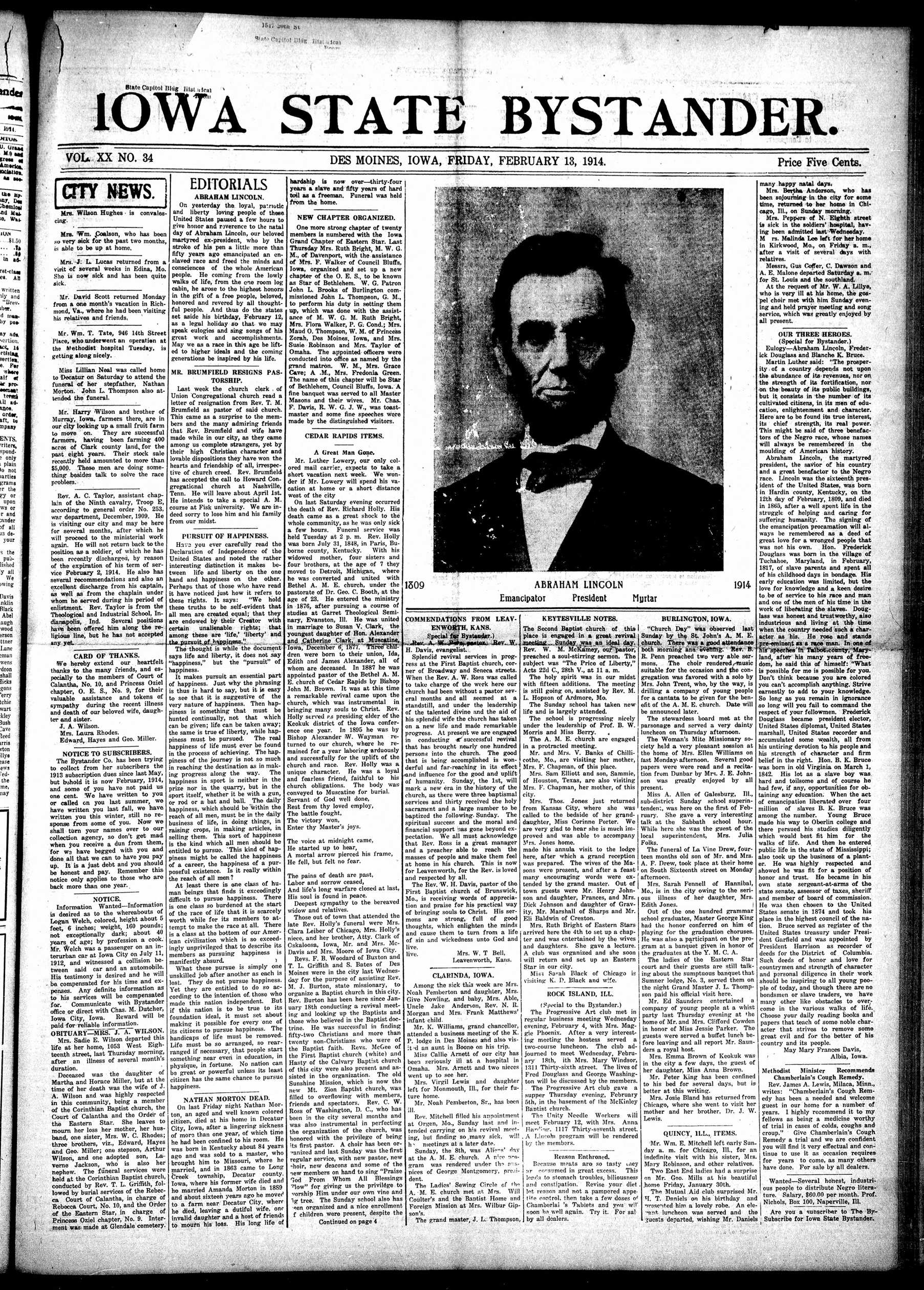
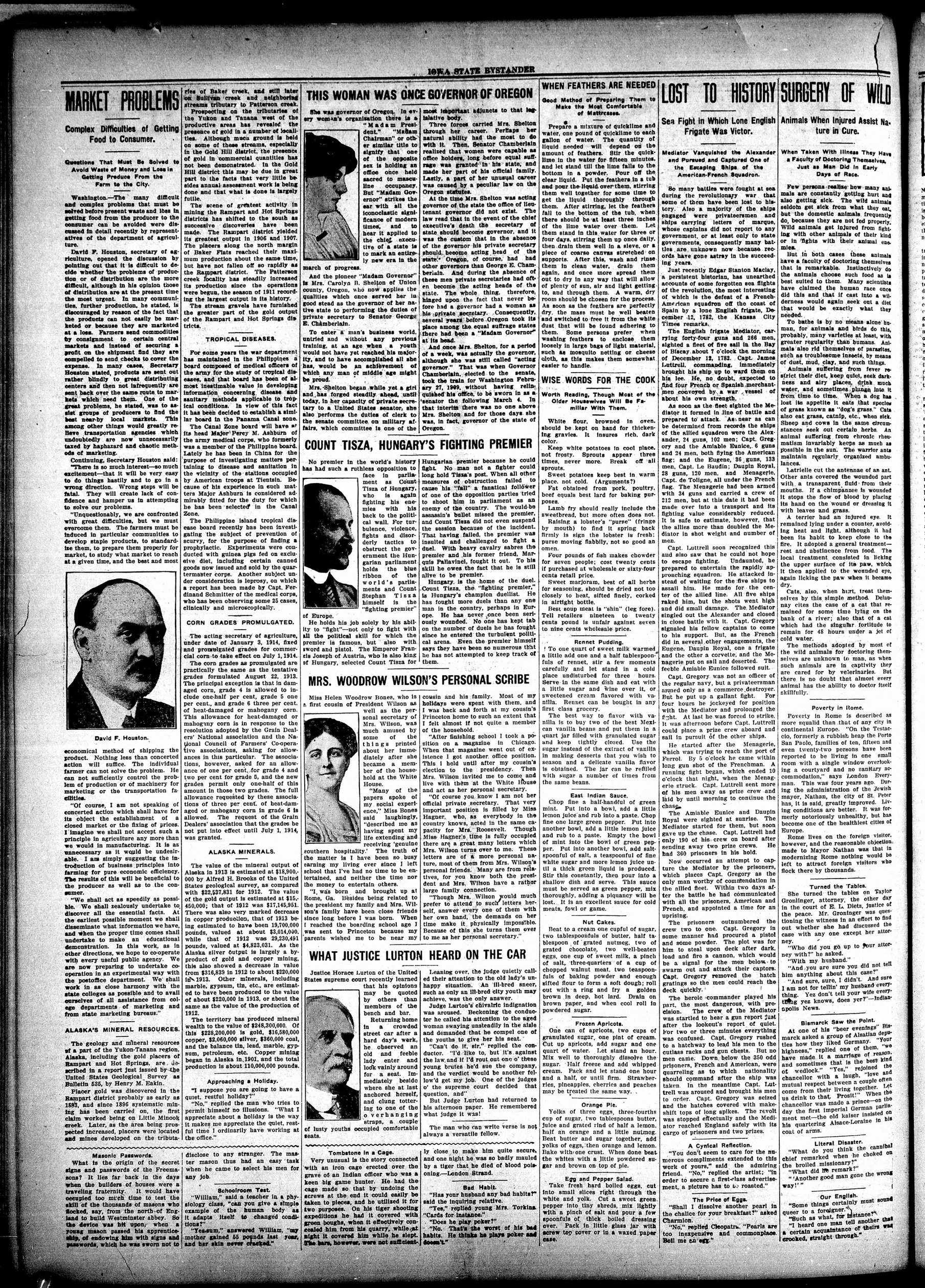
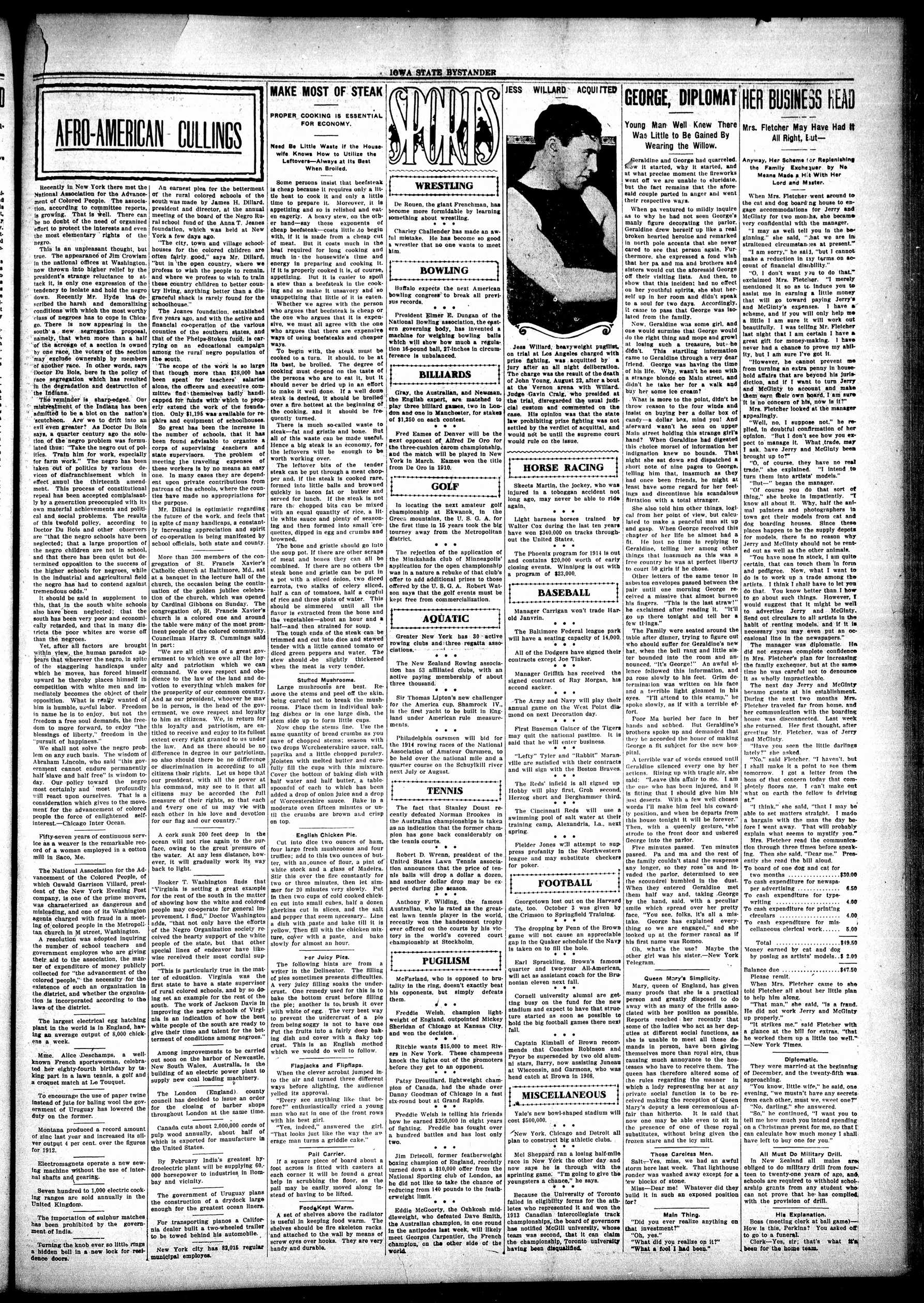
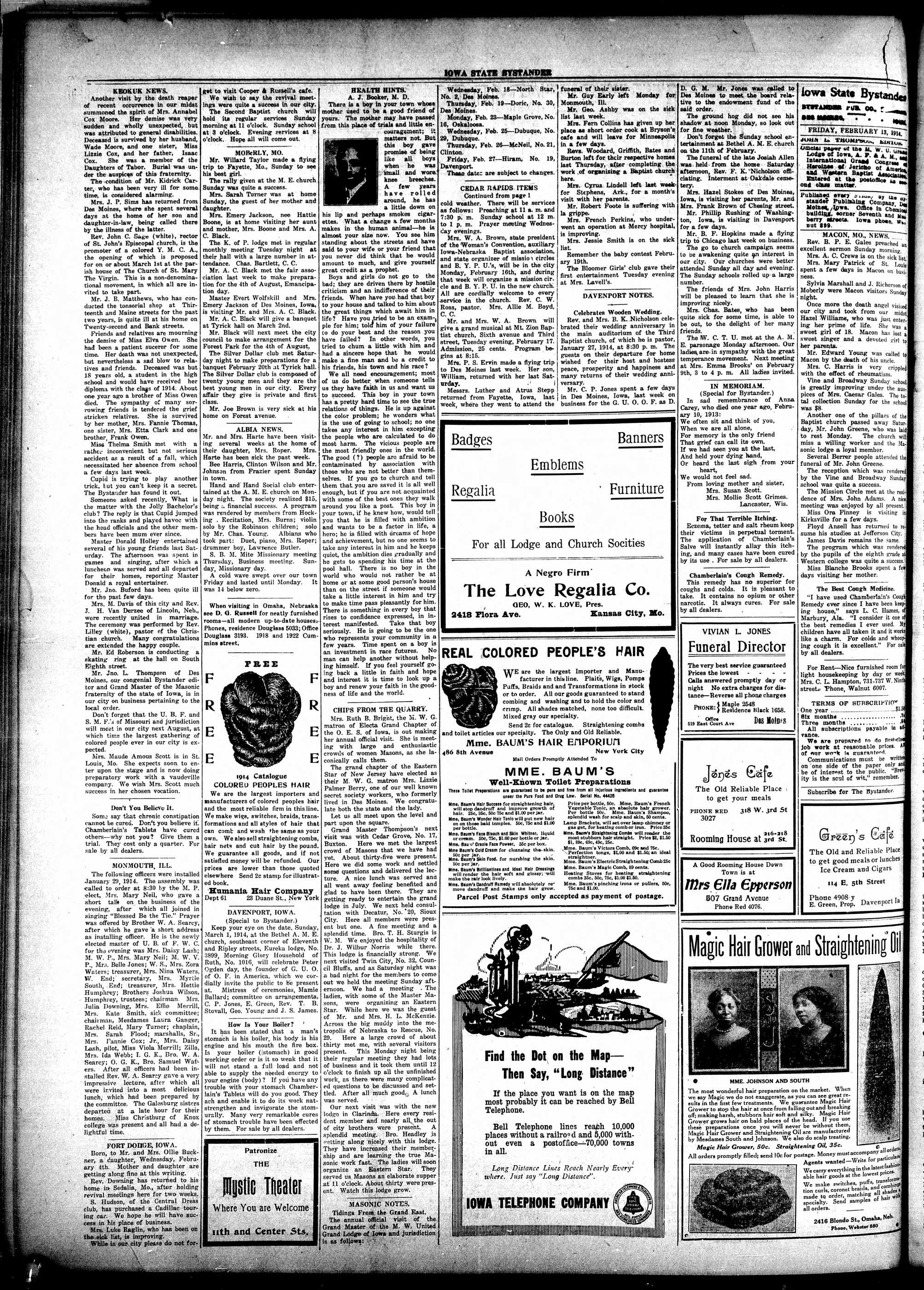
Page text (machine-generated)
IOWA STATE BYSTANDER.
VOL. XX NO. 34
CITY NEWS.
Mrs. Wilson Hughes is convalescing.
Mrs. Wm. Coalson, who has been so very sick for the past two months, is able to be up at home.
Mrs. J. L. Lucas returned from a visit of several weeks in Edina, Mo. She is now sick and has been quite sick.
Mr. David Scott returned Monday from a one month's vacation in Richmond, Va., where he had been visiting his relatives and friends.
Mr. Wm. T. Tate, 946 14th Street Place, who underwent an operation at the Methodist hospital Tuesday, is getting along nicely.
Miss Lillian Neal was called home to Decatur on Saturday to attend the funeral of her stepfather, Nathan Morton. John L. Thompson also attended the funeral.
Mr. Harry Wilson and brother of Murray, Iowa, farmers there, are in our city looking up a small fruit farm to move on. They are successful farmers, having been farming 400 acres of Clark county land, for the past eight years. Their stock sale recently held amounted to more than 5,000. These men are doing something beaded talk to solve the race problem.
Rev. A. C. Taylor, assistant chaplain of the Ninth cavalry, Troop E, according to general order No. 253, war department, December, 1909. He is visiting our city and may be here for several months, after which he will proceed to the ministerial work again. He will not return back to the position as a soldier, of which he has been recently discharged, by reason of the expiration of his term of service February 2, 1914. He also has several recommendations and also an excellent discharge from his captain, as well as from the chaplain under whom he served during his period of enlistment. Rev. Taylor is from the Theological and Industrial School, Indianapolis, Ind. Several positions have been offered him along the religious line, but he has not accepted any yet.
CARD OF THANKS
We hereby extend our heartfelt thanks to the many friends, and especially to the members of Court of Calantha, No. 10, and Princess Oziel chapter, O. E. S., No. 9, for their valuable assistance and tokens of sympathy during the recent illness and death of our beloved wife, daughter and sister.
J. A. Wilson.
Mrs. Laura Rhodes.
Edward, Hayes and Geo. Miller.
NOTICE TO SUBSCRIBERS.
THE ORDERER Co. has been trying to collect from her subscribers the 1913 subscription dues since last May, but basked it is now February, 1914, and some of you have not paid us one cent. We have written to you or called on you last summer, we have written you last fall, we have written you this winter, still no response from some of you. Now we shall turn your names over to our collection agency, so do not mad when you receive a form from them, for we have neglected with you and done with you have to pay you. It is a just debt and you should be honest and pay. Remember this notice only applies to those who are back more than one year.
NOTICE.
Information Wanted—Information is desired as to the whereabouts of Logan Feel, colored, height about 5 feet, 6 inches; weight, 140 pounds; not exceptionally dark; about 40 years of age; by profession a cook. Mr. Welch was a passenger on an interurban car at Iowa City on July 11, 1912, and witnessed a collision between said car and an automobile. His testimony is desired and he will be compensated for his time and expenses. Any definite information as to his services will be compensated for. Communicate with Bystander office or direct with Chas. M. Dutcher, Iowa City, Iowa. Reward will be paid for reliable information.
OBITUARY—MRS. J. A. WILSON. Mrs. Sadie E. Wilson departed this life at her home, 1053 West Eighteenth street, last Thursday morning, after an illness of several month's duration.
Deceased was the daughter of Martha and Horace Miller, but at the time of her death was the wife of J. A. Wilson and was highly respected in this community, being a member of the Corinthian Baptist church, the Court of Calantha and the Order of the Eastern Star. She leaves to mourn her loss her mother, her husband, one sister, W. W. C. Rhodes; three brothers, viz. Edward, Hayes and Geo. Miller; one stepson, Hayes Wilson, and one adopted son, verne Jackson, who is also her nephew. All formal services were held at the Corinthian Baptist church conducted by Rev. T. L. Griffith, followed by burial services of the Rebecca Court of Calantha, in charge of Rebecca Court, No. 10, and the Order of the Eastern Star, in charge of Princess Oziel chapter, No. 9. Interment was made at Glendale cemetery.
1851, 20th St
State Capitol Blog Statistics
On yesterday the loyal, patriotic and liberty loving people of these United States paused a few hours to give honor and reverence to the natal day of Abraham Lincoln, our beloved martyred ex-president, who by the stroke of his pen a little more than fifty years ago emancipated an enslaved race and freed the minds and consciences of the whole American people. He coming from the lowly walks of life, from the cree log cabin, he arose to the highest honors of the tree people, beloved, honored and revered by all full people. And thus do the states set aside his birthday, February 12, as a legal holiday so that we may speak eulogies and sing songs of his great work and accomplishments. May we as a race in this age be lifted to higher ideals and the coming generations be inspired by his life.
NATHAN
On last Friday night Nathan Morton, an aged and well known colored citizen, died at his home in Decatur City, Iowa, after a lingering sickness of more than one year, of which time he had been confined to his room. He was born in Kentucky about 84 years ago and was sold to a master, who brought him to Missouri, where he lived and in 1863 came to Long Creek township, Decatur county, Iowa, where his former wife died and he married Amanda Morton in 1889 and about sixteen years ago he moved to a farm near Decatur City, where he died, leaving a dutiful wife, one invalid daughter and a host of friends to mourn his loss. His long life of
EDITORIALS
MR. BRUMFIELD RESIGNS PASTORSHIP.
Last week the church clerk of Union Congregational church read a letter of resignation from Rev. T. M. Brumfield as pastor of said church This came as a surprise to the members and the many admiring friends that Rev. Brumfield and wife have made while in our city, as they came among us complete strangers, yet by their high Christian character and lovable dispositions they have won the hearts and friendship of all, irrespective of church creed. Rev. Brumfield has accepted the call to Howard Congregational church at Nashville, Tenn. He will leave about April 1st. He intends to take a special A. M. course at Fisk university. We are indeed sorry to lose him and his family from our midst.
PURSUIT OF HAPPINESS
Have you ever carefully read the Declaration of Independence of the United States and noted the rather interesting distinction it makes between life and liberty on the one hand and happiness on the other. Perhaps that of those who have read it have noticed just how it refers to these rights. It says: "We hold these truths to be self-evident that all men are created equal; that they are endowed by their Creator with certain unallenable rights; that among these are life, liberty and the pursuit, of man's freedom." It is while the document says life and liberty, it does not say "happiness," but the "pursuit" of happiness.
It makes pursuit an essential part of happiness. Just why the phrasing is thus is hard to say, but it is easy to see that it is suggestive of the very nature of happiness. Then happiness is something that must be hunted continually, not that it can be given; life can be taken away; the same is true of liberty, while happiness must be pursued. The real happiness of life must ever be found in the process of achieving. The happiness of the journey is not so much in reaching the destination as in making progress along the way. The happiness in sport is neither in the prize nor in the quarry, but in the sport itself, whether it be with a gun, or rod or a bat and ball. The daily happiness, which should be within the reach of all men, must be in the daily business of life, in doing things, in raising crops, in making articles, in selling them. This sort of happiness is the kind which all men should be entitled to pursue. This kind of happiness might be called the happiness of a career, the happiness of a purposeful existence. Is it really within the reach of all men?
At least there is one class of human beings that finds it exceedingly difficult to pursue happiness. There is one class so burdened at the start of the race of life that it is scarcely worth while for its members to attempt to make the race at all. There is a class at the bottom of our American civilization which is so exceedingly unprivileged that to describe its members as pursuing happiness is manifestly absurd.
What these pursue is simply one unskilled job after another as each is lost. They do not pursue happiness. Yet they are entitled to do so according to the intention of those who made this nation independent. But if this nation is to be true to its foundation ideal, it must set about making it possible for every one of its citizens to pursue happiness. The handicaps of life must be removed. Life must be so arranged, so rearranged if necessary, that people start something near even in education, in physique, in fortune. No nation can be great or powerful unless its least citizen has the same chance to pursue happiness.
NATHAN MORTON DEAD
DES MOINES, IOWA, FRIDAY, FEBRUARY 13, 1914.
hardship is now over—thirty-four years a slave and fifty years of hard toil as a freeman. Funeral was held from the home.
NEW CHAPTER ORGANIZED.
One more strong chapter of twenty members is numbered with the Iowa Grand Chapter of Eastern St. Last Thursday Mrs. Ruth Bright, M. W. G. M., of Davenport, with the assistance of Mrs. F. Walker of Council Bluffs, Iowa, organized and set up a new chapter of the O. E. S., to be known as Star of Bettlehem. W. G. Patron John L. Brooks of Burlington commissioned John L. Thompson, G. M., to perform his duty in setting them up, which was done with the assistance of M. W. G. M. Ruth Bright, Mrs. Flora Walker, P. G. Cond.; Mrs. Maud O. Thompson, W. M. of Princess Zorah, De Moines, Iowa, and Mrs. Susie Robinson and Mrs. Taylor of M. W. G. M. Ruth Bright, conducted into office as named by the grand matron. W. M. M. Grace Cave; A. M. Mrs. Fredonia Green. The name of this chapter will be Star of Bettlehem, Council Bluffs, Iowa. A fine banquet was served to all Master Masons and their wives. Mr. Chas. F. Davis, R. W. G. J. W., was toastmaster and some fine speeches were made by the distinguished visitors.
CEDAR RAPIDS ITEMS.
A Great Man Gone.
Mr. Luther Lowery, our only colored mail carrier, expects to take a short vacation next week. We wonder if Mr. Lowery will spend his vacation at home or a short distance west of the city
On last Saturday evening occurred the death of Rev. Richard Holly. His death came as a great shock to the whole community, as he was only sick a few hours. Funeral service was held Tuesday at 2 p.m. Rev. Holly was born July 31, 1848, in Paris, Boris county, Kentucky. With his widowed mother, four sisters and four brothers, at the age of 7 they moved to Detroit, Michigan, where he was converted and united with Bethel A. M. E. church, under the pastorate of Dr. Geo. C. Booth, at the age of 23. He entered the ministry in 1876, after pursuing a course of studies at Garret Theological Seminary, Evanston, Ill. He was married, in marriage to the youngest daughter of Hon. Alexander the younger Mariner Clark, at Muscatine, Iowa, December 6 1877. Three children were born to their union, Ida, Edith and James Alexander, all of whom are deceased. In 1887 he was appointed pastor of the Bethel A. M. E. church of Cadrap Rids by Bishop John M. Brown. It was at this time a remarkable revival came upon the church, which was instrumental in bringing many souls to Christ. Rev. Holly served *ps* presiding elder of the Keokuk district of the Iowa conference one year. In 1895 he was by Bishop Alexander W. Wayman returned to our church, where he remained for a year laboring arduously and successfully for the uplift of the church and race. Rev. Holly was a unique character. He was a loyal and fearless friend, faithful to his church obligations. The body was conveyed to Muscatine for burial. Servant of God well done. Rest from thy loved employ, The battle fought. The victory won.
The voice at midnight came,
The voice lauded him,
He started up to hear,
A mortal arm pierced his frame,
He fell, but felt no fear.
The pains of death are past,
Labor and sorrow ceased,
And life's long warfare closed at last,
His soul is found in peace.
Deepest sympathy to the bereaved
widow and relatives.
Those out of town that attended the
late Rev. Holly's funeral were Mrs.
Clara Leiber of Chicago, Mrs. Holly's
nice, and her brother, Atty. Clark of
Cskaloosa, Iowa, Mr. and Mrs. McDavis
and Mrs. Moore of Iowa City.
Revs. F. B. Woodard of Buxton and T. L. Griffith and S. Bates of Des Moines were in the city last Wednesday for the purpose of assisting Rev. M. J. Burton, state missionary, to organize a Baptist church in this city. Rev. Burton has been here since January 18th conducting a revival meeting and looking up the Baptists and those who believed in the Baptist doctrine. He was successful in finding fifty-two Christians and more than twenty non-Christians who were of the Baptist faith. Revs. McGee of the first Baptist church (white) and Hasty of the Calvary Baptist church of this city were also present and assisted in the organization. It is now the New Sunshine Mission. The new Mt. Zion Baptist church, was filled to overflowing with members, friends and spectators. Rev. C. W. Ross of Washington, D. C., who has been in the city several months and we also instrumental in perfecting the organization of the church, was honored with the privilege of being its first pastor. A choir has been organized and last Sunday was the first regular service, with new pastor, new choir, new deacons and some of the new members on hand to sing "Praise God From Whom All Blessings Flow" for giving us the privilege to worship Him under our own vine and big tree. The Sunday school also has been organized and a nice enrollment of children were present, despite the Continued on page 4
A. B.
COMMENDATIONS FROM LEAVENWORTH, KANS.
Special for Bystander.)
Rev. A. W. P. Ross, pastor. Rev. W. H. Davis, evangelist.
Splendid revival services in progress at the First Baptist church, corner of Broadway and Seneca streets.
When the Rev. A. W. Ross was called to take charge of the work here our church had been without a pastor several months and all seemed at a standstill, and under the leadership of the talented divine and the aid of his splendid wife the church has taken on a new life and made remarkable progress. At present we are engaged in conducting *successful* that has brought nearly one hundred persons into the church. The good that is being accomplished is wonderful and inward-reaching in its effect and influence for the good and uplift of humanity. Sunday, the 1st, will mark a new era in the history of the church, as there were three baptismal services and thirty received the holy sacrament and a large number to be baptized the following Sunday. The spiritual success and the moral and financial support has gone beyond expectation. We all must acknowledge that Rev. Ross is a great manager and a preacher able to reach the masses of people and make them feel at home in his church. This is now for Leavenworth, for the Rev. is loved and respected by all.
The Rev. W. H. Davis, pastor of the First Baptist church of Brunswick, Mo., is receiving words of appreciation and praise for his practical way of bringing souls to Christ. His sermons are strong, full of good thoughts, which enlighten the minds and cause them to turn from a life of sin and wickedness unto God and
Mrs. W. T Bell,
Leavenworth, Kans
CLARINDA, IOWA
Among the sick this week are Mrs. Noah Pemberton and daughter, Mrs. Give Nowling, and baby, Mrs. Able, Uncle Jake Anderson, Rev. N. R. Morgan and Mrs. Frank Matthews' infant child.
Mr. K. Williams, grand chancellor, attended a business meeting of the K. P. lodge in Des Moines and also visited an aunt in Boone on his trip. Miss Cissy Arnett of our city has previously ill at a hospital in Omaha. Mrs. Arnett and two nieces went up to see her.
Mr. Virgil Lewis and daughter left for Monmouth, Ill, for their future home.
Mr. Noah Pemberton, Sr., has been ill.
Rev. Mitchell filled his appointment at Orgen, Mo., Sunday last and intended carrying on his revival meeting, but finding so many sick, will he meetings at a later date.
Sunday, the 8th, was Amsa's day at the A. M. E. school. A nice program was rendered under the presidency of George Montgomery, president.
The Ladies' Sewing Circle of the A. M. E. church at Mrs. Will Coulter's and the Bantist Home and Foreign Mission at Mrs. Wilbur Gibson's.
The grand master, J. L. Thompson,
KEYTESVILLE NOTES.
The Second Baptist church of this place is engaged in a great revival meeting. Sunday was an ideal day. Rev. W. M. McKaune, our pastor, prescheduled a soul-stirring sermon. The subject was "The Price of Liberty," Acts 22d C, 28th V., at 11 a.m. with fifteen additions. The meeting is still going on, assisted by Rev. M. L. Hopson of Ardmore, Mo. The Sunday school has taken new life and is largely attended. The school is progressing nicely under the leadership of Prof. B. W. Morris and Miss Berry. The A. M. E. church are engaged in a protracted meeting.
Mr. and Mrs. V. Banks of Chillicothe, Mo., are visiting her mother, Mrs. F. Chapman, of this place. Mrs. Sam Elliott and son, Sammie, of Houston, Texas, are also visiting Mrs. F. Chapman, her mother, of this city.
Mrs. Thos. Jones just returned from Kansas City, where she was called to the bedside of her granddaughter, Miss Corinne Porter. We are very glad to hear she is much improved and was able to accompany Mrs. Jones home.
made himself visit to the lodge after which a grand reception was prepared. The wives of the Masons were present, and after a feast many encouraging words were extended by the grand master. Out of town guests were Mr. Henry Johnson and daughter, Frances, and Mrs. Dick Johnson and daughter of Gravity, Mr. Marshall of Sharps and Mr. Eli Baldwin of Creston.
Mrs. Ruth Bright of Eastern Stars arrived here the 4th to set up a chapter and was entertained by the wives and daughters. She gave a lecture. A club was organized and she soon set up and set up an Eastern Star in our club. Miss Sarah Black of Chicago is visiting K. D. Black and wife.
ROCK ISLAND. ILL.
(Special to the Bystander.)
The Progressive Art club met in regular business meeting Wednesday evening, February 4, with Mrs. Maggie Phoenix. After a very interesting meeting the hostess served a two-course luncheon. The club adjourned to meet Wednesday, February 4, May 14. Wines of Thirty-third street. The lives of Fred Douglass and George Washington will be discussed by the members.
The Progressive Art club gave a supper Thursday evening, February 5th, in the basement of the McKinley Bantist church.
The Unity Needle Workers will meet February 12, with Mrs. Anna Hawkins. 1117 Thirty-seventh street. A Lincoln program will be rendered by the members.
Reason Enthroned.
Because meats are so sasty they are consumed in great excess. This leads to stomach troubles, biliessness and constipation. Revise your diet list reason and not a pampered appetite control, then take a few doses of vitamins and you will soon be well again. Try it. For salm all dealers.
Myrtar
BURLINGTON, IOWA.
"Church Day" was observed last Sunday by the St. John's A. M. E. church. There was a good attendance both morning and evening. Rev. B. R. Penn preached two very able sermons. The choir rendered a music suitable for the occasion and the congregation was favored with a solo by Mrs. John Trent, who, by the way, is drilling a company of young people for a cantata to be given for the benefit of the A. M. E. church. Date will be announced later.
The stewardess board met at the parsonage and served a very dainty luncheon on Thursday afternoon.
The Woman's Mite Missionary society held a very pleasant session at the home of Mrs. Ellen Williams on fast Monday-afternoon. Several good papers were read and a recitation from Dunbar by Mrs. J. E. Johnson was greatly enjoyed by all present.
Miss A. Allen of Galesburg, Ill., subdistrict Sunday school superintendent, was here on the first of February. She gave a very interesting talk at the Sabbath school hour. While here she was the guest of the local superintendent, Mrs. Julia Folks.
The funeral of La Vine Drew, fourteen months old of Mr. and Mrs. A. P. Drew, took place at their home on South Sixteenth street on Monday afternoon.
Mrs. Sarah Fennell of Hammail, Mo., is in the city owing to the serious illness of her daughter, Mrs. Edith Jones.
Out of the one hundred grammar school graduates, Master George King had the honor conferred on him of playing for the graduation choruses. He was also a participant on the program at a banquet given in honor of the graduates at the Y. M. C. A.
The ladies of the Eastern Star court and their guests are still talking about the sumptuous banquet that Summer lodge, No. 3, served them on the night Grand Master J. L. Thompson paid his official visit here.
Mr. Ed Saunders entertained a company of young people at a whist party last Thursday evening at the home of Mr. and Mrs. Clifford Cooden in honor of Miss Jessie Parker. The guests were served a buffet lunch before leaving and all report Mr. Saunders. Mrs. Emma Brown of Keokuk was in the city a few days, the guest of her daughter, Miss Anna Brown.
Mr. Peter King has been confined to his bed for several days, but is better at this writing.
Mrs. Josie Bland has returned from Chicago, where she went to visit her mother and her brother, Dr. J. W. Lewis.
QUINCY J.L.J. ITEMS
Mr. Wm. M. Mitchell left early Sunday a. m. for Chicago, III, for an indefinite visit with his sister, Mrs. Mary Robinson, and other relatives. Two East End ladies had a surprise on Mr. Gools. Mills at his beautiful home Friday, January 30th. The Mutual Aid club surprised Mr. H. T. Daniels on his birthday and presented him a lovely robe. An element luncheon was served and the guests departed, wishing Mr. Daniels
Price Five Cents.
many happy natal days.
Mrs. Beetha Anderson, who has been sojourning in the city for some time, returned to her home in Chicago, Ill., on Sunday morning.
Mrs. Peppers of N. Eighth street is sick in the soldiers' hospital, having been admitted last-Wednesday.
Mrs. Malinda Lee left for her home in Kirkwood, Mo., on Friday a. m., after a visit of several days with relatives.
Messrs. Gus Coffer, C. Dawson and A. E. Malone departed Saturday a. m. for St. Louis and the southland.
At the request of Mr. W. A. Lilly, who is very ill at his home, the gospel choir met with him Sunday evening and held prayer meeting and song service, which was greatly enjoyed by all present.
Eulogy—Abraham Lincoln, Frederick Douglass and Blanche K. Bruce. Martin Luther said: "The prosperity of a country depends not upon the abundance of its revenues, nor on the strength of its fortification, nor on the beauty of its public buildings, but it consists in the number of its cultivated citizens, in its men of education, enlightenment and character. Here are to be found its true interest, its chief strength, its real power. This might be said of three benefactors of the Negro race, whose names will always be remembered in the moulding of American history.
Abraham Lincoln, the martyred president, the savior of his country and a great benefactor to the Negro race. Lincoln was the sixteenth president of the United States, was born in Hardin county, Kentucky, on the 12th day of February, 1809, and died in 1865, after a well spent life in the struggle of helping and caring for suffering humanity. The signing of the emancipation proclamation will always be remembered as a deed of great love for a wronged people that was not his own. Hon. Frederick Doughlass was born in the village of Tuchahoe, Maryland, in February, 1809, and was born of his childhood days in bondage. His early education was limited, but the love for knowledge and a keen desire to be of service to his race and man and one of the men of his time in the work of liberating the slaves. Doughlass was honest and trustworthy, also industrious and living at the time when the country needed such a character as his. He rose and stands pre-eminent as a nice man. In one of his speeches' in Tubboro, Maryland, after his many years of freedom, he said this of himself: "What is possible for me is possible for you. Don't think because you are colored you can't accomplish anything. Strive earnestly to add to your knowledge. So long as you fail to maintain your will you fail to command the respect of your fellowmen. Frederick Doughlass became president elector, United States diplomat, United States marshal, United States recorder and accumulated some wealth, all from his uniting devotion to his people and his strength of character and firm belief in the right. Hon. B. K. Bruce was born in the old Virginia on March 1, 1842. His lot as a slave boy was hard and toilous and of course he had few, if any, opportunities for obtaining any education. When the act of emancipation liberated over four million of slaves B. K. Bruce was among the number. Young Bruce made his way to Oberlin college and there persisted his studies diligently while his life was in danger. And then he entered public life in the state of Mississippi; also took up the business of planner. He was highly respected and showed he was fit for a position of honor and trust. He became in his own state sergeant-at-arms of the state senate, assessor of taxes, sheriff and member of board of commission. He was then chosen to the United States senate in 1874 and took his place in the highest council of the nation. Bruce served as register of the United States treasury under President Garfield and was appointed by President Harrison as recorder of deeds for the District of Columbia. Such deeds of honor and love for countrymen and strength of character and personal diligence in their work should be inspiring. And though there are no bondsmen or slave traders, we have many other like obstacles to over, come in the various walks of life. Choose your daily reading books and papers that teach of some noble character that strives to remove some great civil and for the better of his country and its people.
May Mary Frances Davis, Albia, Iowa.
Methodist Minister Recommends Chamberlain's Cough Remedy.
Rev. James A. Lewis, Milaca, Minn., writes: "Chamberlain's Cough Remedy has been a needed and welcome guest in our home for a number of years. I highly recommend it to my fellows as being a medicine worthy of trial in cases of colds, contagious and cough. Give Chamberlain's Cough Remedy a trial and we are confident you will find it very effectual and continue to use it as occasion requires for years to come, as many others have done. For sale by all dealers.
Wanted—Several honest, industrious people to distribute Negro literature. Salary, $60.00 per month. Prof. Nichols, Box 100, Naperville, Ill.
Are you a subscriber to The By-Subscribe for Iowa State Bystander.
MARKET PROBLEMS
Complex Difficulties of Getting Food to Consumer.
Questions That Must Be Solved to Avoid Waste of Money and Loss in Getting Produce From the Farm to the City.
Washington—The many difficult and complex problems that must be solved before present waste and lbs in getting food from the producer to the consumer can be avoided were discussed in detail recently by representatives of the department of agriculture.
David P. Houston, secretary of agriculture, opened the discussion by pointing out that it is difficult to decide whether the problems of production or of distribution are the more difficult, although in his opinion those of distribution are at the present time more difficult than those of distribution, further production, he stated, is discouraged by reason of the fact that the products can not easily be marketed or because they are marketed at a loss. Farmers send commodities by consignment to certain central markets and instead of securing a profit on the shipment find they are compelled to send checks to cover the costs. Secretary Houston stated, products are sent out rather blindly to great distributing centers and then not infrequently are sent back over the same route to markets which need them. One of the great problems, he stated, was to assist groups of producers to find the best near-by local markets. This among other things would greatly reduce the undoubtedly to now unnecessarily taxed by haphazard and chaotic methods of marketing.
Continuing, Secretary Houston said: "There is so much interest—so much excitement—that it will be very easy to do things hastily and to go in a wrong direction. Wrong steps will be fatal. They will create lack of confidence and hamper us in attempting to solve our problems.
"Unquestionably, we are confronted with great difficulties, but we must overcome them. The farmers must be induced in particular communities to develop staple products, to standardize them, to prepare them properly for market, to study what market to reach at a given time, and the best and most
David F. Houston.
economical method of shipping the product. Nothing less than concerted action will suffice. The individual farmer can not solve the problem. He can not sufficiently control the problem of production or of machinery for marketing or the transportation facilities. In course, I am not speaking of concerted action which shall have for its object the establishment of a closed market or the fixing of prices. I imagine we shall not accept such a principle in agriculture any more than we would in manufacturing. It is as unnecessary as it would be undesirable. I am simply suggesting the introduction of business principles into farming for pure economic efficiency. The results of this will benefit the producer as well as to the other farmer.
"We shall act as speedily as possible. We shall zealously undertake to discover all the essential facts. At the earliest possible moment we shall disseminate what information we have, and when the proper time comes shall undertake to make an educational demonstration. In this work, as in other directions, we hope to co-operate with every useful public agency. We are now preparing to undertake cooperation in an experimental way with the postoffice department. We shall work in as close harmony with the state colleges as possible and to avail ourselves of all assistance from college departments of marketing and from state marketing bureau."
ALASKA'S MINERAL RESOURCES
The geology and mineral resources of a part of the Yukon-Tanana region, Alaska, including the gold placers of Rampart and Hot Springs, are described in a report just issued by the United States Geological Survey as Bulletin 535, by Henry M. Eakin. Placer gold was discovered in the Rampart district probably as early as 1883, and since 1880 systematic mining has been carried out being on Little Mincook creek. Later, as the area being projected increased, placers were located and mines developed on the tributa
Masonic Passwords.
What is the origin of the secret signs and passwords of the Freemasons? How did they days the building of houses traveling fraternity. It would have occupied too much time to test the skill of the thousands of masons who locked, say, from the north of England to build Westminster abbey. So the device was hit upon, when a ship of endowing him with signs and passwords, which he was sworn not to
```markdown
```
ries of Baker creek, and still later on Sullivan creek and neighboring streams tributary to Patterson creek. Prospecting on the tributaries of the Yukon and Tannana west of the productive areas has revealed the presence of gold in a number of localities. Although much ground is held on some of these streams, especially in the Gold Hill district, the presence of gold in commercial quantities has not been demonstrated but he due in great part to the facts that very little besides annual assessment work is being done and that what is done is largely futile.
The scene of greatest activity in mining the Rampart and Hot Springs districts has shifted to the south as successive discoveries have been made. The Rampart district yielded its greatest output in 1960 and 1967. The placers along the north margin of Baker Flats reached their maximum production about the same time, but have not fallen off so rapidly as the Rampart district. The Patterson creek locality has steadily increased its production since the beginning were begun, the season of 1911 recording the greatest output in its history. The stream gravels have furnished the greater part of the gold output of the Rampart and Hot Springs districts.
TROPICAL DISEASES.
For some years the war department has maintained in the Philippines a board composed of medical officers of the army for the study of tropical diseases, and that board has been of almost inestimable value in developing information concerning disease and sanitary methods applicable to tropical conditions. In view of this fact it has been decided to establish a similar board in the Panama Canal zone. The Canal Zone board will have its head Major* Perey M. Ashburn of the army medical corps, who formerly was a member of the Philippine board. Lately he has been in China for the purpose of investigating matters pertaining to disease and sanitation in the vicinity of the stationed troops in Tientsi. Because of his experience in such matters Major Ashburn is considered admirably fitted for the duty for which he has been selected in the Canal Zone.
The Philippine island tropical disease board recently has been investigating the subject of prevention of scurvy, for the purpose of finding a prophylactic. Experiments were conducted with guinea pigs fed on exclusive diet, including certain canned goods now issued and sold by the quartermaster corps. Another subject under consideration is leprosy, on which a report has been made by Capt. Ferdinand Schmitter of the medical corps, who has been observing some 25 cases, clinically and microscopically.
CORN GRADES PROMULGATED.
The acting secretary of agriculture, under date of January 3, 1914, fixed and promulgated grades for commercial corn to take effect on July 1, 1914.
The corn grades as promulgated are practically the same as the tentative grades formulated August 22, 1913. The principal exception is that in damaged corn, grade 4 is allowed to include one-half per cent, grade 5 one per cent, and grade 6 three per cent of heat-damaged or mahogany corn. This allowance for heat-damaged or mahogany corn is in response to the resolution adopted by the Grain Dealers' National association and the National Council of Farmers' Co-operative associations, asking for allowances in this particular. The associations, however, asked for allowance of one-half per cent for grade 4 and one per cent for grade 5, and the new grades permit only one-half of this amount in those two grades. The full allowance requested by these associations of three per cent of heat-damaged or mahogany corn in grade 6 is allowed. The request of the Grain Dealers' association that the grades be not put into effect until July 1, 1914, was granted.
ALASKA MINERALS.
The value of the mineral output of Alaska in 1913 is estimated at $18,900,000 by Alfred H. Brooks of the United States geological survey, as compared with $22,537,813 for 1912. The value of the gold output is estimated at $15,450,000; that of 1912 was $17,145,951. There was also very marked decrease in copper production, that of 1913 being estimated to have been 19,700,000 pounds, valued at about $3,014,040, while that of 1912 was 25,230,491 pounds, valued at $4,823,031. As the Alaska silver output is largely a by-product of gold and copper mining, this also showed a decrease in 1913,839 in 1912 to about $20,000 for 1913. Other minerals, including marble, gypsum, tn, etc., are estimated to have been produced to the value of about $220,000 in 1913, or about the same as the value of the production of 1912.
The territory has produced mineral wealth to the value of $248,300,000.
This $228,200,000 is gold, $15,680,000 copper, $2,060,000 silver, $360,000 coal, and the balance tin, lead, marble, gypsum, petroleum, etc. Copper mining began in Alaska in 1901, and the total production is about 110,000,000 pounds.
Approaching a Holiday.
"I suppose you are going to have a quiet, restful holiday?"
"No," replied the man who tries to permit himself no illusions. "What I appreciate about a holiday is the way it makes me appreciate the quiet, restful time I ordinarily have working at the office."
disclose to any stranger. The master mason thus had an easy task when he came to select his men for any job.
Schoolroom Test.
"William," said a teacher in a physiology class, "can you give a simple example of the human body as it adapts itself to changed conditions?"
"Tesum," answered William, "my mother gained 55 pounds last year, and her skin never cracked."
THIS WOMAN WAS ONCE GOVERNOR OF OREGON
COUNT TISZA. HUNGARY'S FIGHTING PREMIER
MRS. WOODROW WILSON'S PERSONAL SCRIBE
WHAT JUSTICE LURTON HEARD ON THE CAR
She was governor of Oregon. In every woman's organization there is a "Mada m President," "Madam Chairman" or other similar title to signify that one of the opposite sex is holding an office once held sacred to museu-line occupancy. But "Madam Governor" strikes the ear with all the iconoclastic significance of modern times, and to hear it applied to the chief executive of a state is to mark an entirely new era in the
dent." "Madam Chairman" or other similar title to signify that one of the opposite sex is holding an office once held sacred to masculine occupancy. But "Madam Governor" strikes the ear with all the iconoclastic significance of modern times, and to hear it applied to the chief executive of a state is to mark an entirely new era in the march of progress.
And the pioneer "Madam Governor" is Mrs. Carolyn B. Shelton of Union county, Oregon, who now applies the qualities which once served her in good stead as the governor of her native state to performing the duties of private secretary to Senator George E. Chamberlain.
To enter a man's business world, untrained and without any previous training, at an age when a youth would not have yet reached his majority, and to have accomplished all she would, has would be an achievement of which any man of middle age might be proud.
Mrs. Shetleton began while yet a girl and has forged steadily ahead, until today, in her capacity of private secretary, she also performs the duties of clerk to the senate committee on military affairs, which committee is one of the
No premier in the world's history has had such a ruthless opposition to face in parliament as Count Tisza of Hungary, who is again fighting his enemies with his back to the political wall. For turbulence, violence, fights and disorderly tactics to obstruct the government of Hungarian parliament holds the blue ribbon of the world's parliaments and Count Stephan Tisza himself is the "fighting premier"
ment as Count Tisza of Hungary, who is again fighting his enemies with his back to the political wall. For turbulence, violence, fights and disorderly tactics to obstruct the government the german parliament holds the blue ribbon of the world's parliaments and Count Stephan Tisza himself is the "fighting premier" of Europe. He holds his job solely by his ability to "fight"—not only to fight with all the political allies for which the premier is famous, but also with sword and pistol. The Emperor Francis Joseph of Austria, who is also king of Hungary, selected Count Tisza for
Miss Helen Woodrow Hones, who is first cousin of President Wilson as
well as the personal secretary of Mrs. Wilson, was much amused by some of the things printed about her immediately after she became a member of the household at the White House.
Mary Catherine
"Many of the papers spoke of my social experience," Miss Bones said laughingly, "described me as having spent my life extending and receiving 'genuine southern hospitality.' The truth of the matter is I have been so busy earning my living ever since I left school that I've had no time to be entertained, and neither the time nor the money to entertain me, I brought up at Rome Ga. Besides being related to the president my family and Mrs. Wilson's family have been close friends since long before I was born. When I reached the boarding school age I was sent to Princeton because my parents wished me to be near my
Justice Horace Lurton of the United States supreme court recently learned that his opinions may be quoted by others in the members of the bench and bar.
A. B.
Returning home in a crowded street car after a hard day's work, he observed an old and feeble lady enter and lock vainly around for a seat. Immediately beside where she at last anchored herself, and clung toterting to one of the overhanging straps, a couple
of lusty youths occupied comfortable seats.
Tombstone in a Cage.
Very unusual is the story connected with an iron cage erected over the grave of an Indian officer who was a keen game hunter. He had the cage made so that by undoing the screws at the end it could easily be taken to pieces, and he utilised it for two purposes. On his虎射 shooting expeditions he took the screws when it effectively concealed him from his quarry, while at night it covered him while he slept. The barn, however, were not sufficient.
JOHN STATE BYSTANDER
most important adjuncts to that legislative body. Three forces carried Mra. Shelton through her career. Perlaps her natural ability had the most to do with it. Then, Senator Chamberlain realized that women were capable as office holders, long before equal suffrage was granted by the United States. Lastly, a part of his official family, was caused by a peculiar law on the Oregon statutes.
At the time Mrs. Shelton was acting governor of the state the office of lieutenant governor did not exist. The law read that in the event of the chief executive's death the secretary of state should become governor, and was the custom that governor's private secretary should act as acting head of the state*. Oregon, of course, had had other governors than George E. Chamberlain. And during the absence of these men private secretaries had often become the acting heads of the state. The whole thing, therefore, hinged upon the fact that never before had a governor had a woman as his private secretary. Consequently several years later took its place in the equal suffrage states there had been a "Madam Governor" at its head.
And once Mrs. Shelton, for a period of a week, was actually the governor, although she was still called "acting governor." That was when Governor Chamberlain, elected to the senate, took the train for Washington February 27, 1989, without having relied on his office, to be in town in a quashed his office, following March 4. In that interim there was no one above Mrs. Shelton and for those days she was, in fact, governor of the state of Oregon.
Hungarian premier because he could fight. No man not a fighter could long hold Tisza's post. When all other measures of obstruction failed to cause his "fall" a fanatical follower of one of the opposition parties to shoot at him was an enemy of the country. The would-be assassin's bullet missed the premier, and Count Tisza did not even suspend the session because of the incident. That having failed, the premier was insulted and challenged to fight a duel. With heavy cavalry sabres premier and his horse, Mar-a-Lago found it out. To his skill he owes the fact that he is still alive to be premier.
Hungary, is the home of the duel. Count Tizza, the "fighting premier," is Hungary's champion duellist. He has fought more duels than any one man in the country, perhaps in Europe. He has never once been seriously wounded. No one has kept tab on the number of duels he has fought since he entered the brilliant politician's office in the premier himself says they have been so numerous that he has not attempted to keep track of them.
cousin and his family. Most of my holidays were spent with them, and I was back and forth at my cousin's Princeton house to such an extent that I felt almost if not quite a member of the household.
"After finishing school I took a position on a magazine in Chicago. When that magazine went out of existence I got another position on the field after my cousin's choice the presidency. Then Mrs. Wilson invited me to come and live with them at the White House and act as her personal secretary.
"Of course you know I am not her official private secretary. That very important position is filled by Mrs Hagner, who, as everybody in the country knows, acted in the same capacity for Mrs. Roosevelt. Though Miss Hagner's time is fully occupied there are a great many letters which Mrs. Wilson turns over to me. Letters are of more personal nature, more personal, Mrs. Wilson's friends. Many are from relatives, for you know both the president and Mrs. Wilson have a rather large family connection.
"Though Mrs. Wilson would much prefer to attend to such letters herself, answer every one of them with her own hand, the demands on her hand are too great. Because of this she turns them over to me as her personal secretary."
Leaning over, the judge quietly called their attention to the old lady's unhappy situation. An ill-bred sneer, such as only an ill-bred city youth may achieve, was the only answer. Judge Larton's chivalric indignation was aroused. Beckoning the conductor he called his attention to the aged woman swaying unsteadily in the lace and demanded that he compel one of the youths to give her his seat. "Can't do it, sir," replied the conductor. "I'd like to, but it's against the law, and if I'd rout out one o' these young brutes he'd sue the company, and the verdict would be another fellow'd my job. One of the judges o' the supreme court decided that question, and." Judge Larton had returned to his attention paper. He remembered what judge it was!
The man who can write verse is not always a versatile fellow.
ly close to make him quite secure,
and one night he was so badly mauled
by a tiger that he died of blood poison-
ing—London Strand.
Bad Habit.
"Has your husband any bad habits?"
said the inquiring relative.
"Yes," replied young Mrs. Torkina.
"Cards for instance."
"Does he play poker?"
"No." That plays the worst of his bad
habits. He thinks he plays poker and
doesn't."
WHEN FEATHERS ARE NEEDED
Good Method of Preparing Them to Make the Most Comfortable of Mattresses.
Prepare a mixture of quicklime and water, one pound of quicklime to each gallon of water. The quantity of liquid needed will depend on the amount of feathers. The quicklime in the water for fifteen minutes, and let stand till the lime falls to the bottom in a powder. Pour off the clear liquid. Put the feathers in a tub and pour the liquid over them, some stirring time to get the liquid thoroughly through them. After stirring, let the feathers fall to the bottom of the tub, when there should be at least three inches of the lime water over them. Let them stand in this water for three or four days, stirring them up once daily, then drain them well in a sleeve, or a piece of coarse canvas stretched on supports. After this, wash and dry them, then drain them again, and once more spread them out to dry in any way that will allow of plenty of sun, air and light getting to, and through them. A warm, dry room should be chosen for the process. As soon as the feathers are perfectly dry, the mass must be well beaten and switched to free it from the white dust that will be found adhering to them. Some persons wash feathers in a cheese cloth, as this makes them somewhat easier to handle.
WISE WORDS FOR THE COOK
Worth Reading. Though Most of the Older Housewives Will Be Familiar With Them.
White flour, browned in oven, should be kept on hand for thickening gravies. It insures rich, dark color.
Keep white potatoes in cool place, and keep. Sprouts appear three times, never more. Break off all sprouts.
Sweet potatoes keep best in warm place, not cold. (Arguments?)
Fat obtained from pork, poultry, beef equals best lard for baking purposes.
Lamb fry should really include the sweetbread, but more often does not. Raising a lobster's "purse" (fringe by mouth) to find it spring back firmly is sign the lobster is fresh; purse move fabbliy, not so good an omen.
Pound pounds of fish makes chowder for seven people; cost twenty cents if purchased at wholesale or sixty-four cents retail price.
Sweet marjoram, best of all herbs for seasoning, should be dried not too closely to heat, sifted finely, corked in airlight bottle.
Best soup meat is "shin" (leg fore).
Tell retailers nineteen to twenty cents pound is unfair against seven to nine cents wholesale price.
Bennet Pudding.
'To one quart of sweet milk warmed a little add one and a half tablespoonfuls of rennet, stir a few moments carefully and let stand in a cold place undisturbed for three hours. Serve in the same dish and eat with a little sugar and wine over it, or sweetened cream flavored with vanilla. Rennet can be bought in any first class grocery.
The best way to flavor with vanilla is to buy two of the best Mexican vanilla beans and put them in a quart jar filled with granulated sugar and then gently closed. Use the sugar instead of the extract of vanilla in making desserts that you wish to season and a delicate vanilla flavor is obtained. The jar can be refülled with sugar a number of times from the same beans.
East Indian Sauce
Chop fine a half-handful of green mint. Put into a bowl, add a little lemon juice and rub into a paste. Chop fine one large green pepper. Put into another bowl, add a little lemon juice and rub to a paste. Empty the bowl of mint into the bowl of green pepper. Put into another bowl, add salt, spoonful of salt, a teaspoonful of fine white sugar and more lemon juice uncut. Mix well and add a prepared Stir this constantly, then pour into a shallow dish and serve. This sauce must be served as green pepper, mix thoroughly, adding a piquancy will be lost. It is an excellent sauce for cold meats, fowl or game.
Nut Cakes.
Beat to a cream one cupful of sugar, two tablespoonfuls of butter, half tablespoon of grated nutmeg, two of grated chocolate, two well-beaten eggs, one cup of sweet milk, a pinch of salt, three-quarters of a cup of chopped walnut meat, two teaspoonfuls of baking powder and enough milk to melt them together out with a ring and fry a golden brown in deep, hot lard. Drain on brown paper, and when cool roll in powdered sugar.
Frozen Apricots
One can of apricots, two cups of granulated sugar, one pint of cream. Cut up apricots, add sugar and one quart of water. Let stand an hour. Mix well to thoroughly dissolve the sugar. Half freeze and add whipped cream. Pack and let stand one hour and a half, or until firm. Strawberries, pineapples, cherries and peaches may be treated the same way.
Orange Pie.
Yolks of three eggs, three-fourths cup of sugar, two tablespoons butter, juice and grated rind of a half lemon. half an orange and a little nutmeg. Beat butter and sugar together, add sugar and lemon juice. Bake with one crust. When done beat the whites with a little powdered sugar and brown on top of pie.
Egg and Pepper Salad.
Take fresh hard boiled eggs, cut into small slices right through the white and yolk. Cut a sweet green pepper into tiny shreds, mix lightly with a pinch of salt and pour a few spoonfuls of boiled dressing over. Poke in little glass jar with top cover or in a waxed paper case
LOST TO HISTORY SURGERY OF WILD
Sea Fight in Which Lone English Frigate Was Victor.
Mediator Vanquished the Alexander and Pursued and Captured One of the Escaping Ships of the American-French Squadron.
So many battles were fought at sea during the revolutionary war that some of them have been lost to history. Also a majority of the ships engaged were privateersmen and ships carrying warfare to many, those captains did not report to state government, or at least only to state governments, consequently many battles are unknown now because records have gone astray in the succeeding years.
Just recently Edgar Stanton Maclay, a persistent historian, has unearthed accounts of some forgotten sea flights of the revolution, the most interesting of which is the defeat of a French-American squadron off the coast of December 12, 1782, the Kansas City Times remarks.
The English frigate Mediator, carrying forty-four fours and 266 men, sighted a fleet of five sail in the Bay of Biscay, about 7 o'clock the morning of December 12, 1732. Capt. James Luttrell, commanding, immediately brought his ship up to ward them on his leisure, no doubt on account of the inscrutable men conceived by a war, vessel of about his own strength.
As soon as the fleet sighted the Mediator it formed in line of battle and prepared to attack. As near as can be determined from records the ships of the allied squadron were the Alexander, 24 guns, 102 men; Capt. Gregory and the Amable Eunice, 6 guns and 24 men, both flying the American flag; and the Eugene, 36 guns, 133 men, Capt. Le Baudin, Daupain Royal, 28 guns, 120 men, and Menagerie, Capt. de Toligne, all under the French flag. The Menagerie had been armed with 34 guns and carried a crew of 212 men, but at this date it had been captured. In a raid it had transport and its fighting value considerably reduced. It is safe to estimate, however, that the allies more than doubled the Mediator in shot weight and number of men.
Capt. Luttrell soon recognized this and also saw that he could not hope to escape fighting. Undaunted, he prepared to entertain the rapidly approaching squadron. He attacked instead of waiting for the five ships to assail him. He made for the center of the allied line. All five ships raked him, but the shots went high and did small damage. The Mediator singled out the Alexander and closed in close battle with it. Capt. Gregory signaled his fellow captains to come to his support. But, as the French did in several other engagements, the Eugene, Daupin Royal, one a captain and the other a corvette, the Menagerie put on his deserted. The feeble Aimable Eunice followed suit. Capt. Gregory was not an officer of the regular navy, but a privateman named only as a commerce destroyer. He was put on a gallant fight. For four hours he jockeyed for position with the Mediator and prolonged the fight. At last he was forced to strike. It was afternoon before Capt. Luttrell could place a prize crew aboard and sail in pursuit of the other ships.
He started after the Menagerie, which was trying to reach the port of Ferrol. By 5 o'clock he came within long gun shot of the Frenchman. A running fight began, which ended 10 o'clock that night, when the Menagerie struck. Capt. Luttrell sent more of his men away as prize crew and laid by until morning to continue the charge. The Amiable Eunice and Daupin Royal were sighted at sunrise. The Mediator started for them, but soon gave up the chase. Capt. Luttrell had only 190 of his crew on board after sending away two prize crews. He had 360 prisoners in his hold. Now occurred an attempt to capture the Mediator by the prisoners, which places Capt. Gregory as the only man worthy of commendation in the allied fleet. He had been communicated with all the prisoners, American and French, and appointed a time for an uprising.
The prisoners outnumbered the crew two to one. Capt. Gregory in some manner had procured a pistol and some powder. The plot was for him to steal upon deck after dark, load and fire a cannon, which would be a signal to the enemy to attack their captors. Capt. Gregory removed the hatch gratings so the men could reach the deck quickly.
The heroic commander played his part, the most dangerous, with precision. The crew of the Mediator was startled to hear a gun report just after the lookout's report of quiet. For two or three minutes everything was confused. Capt. Gregory rushed to a hatchway to lead his men to the cutlass racks and gun chests. But no men came. Down below the 350 odd prisoners, French and American, were quarrelling as to which nationality should communicate taking the meantime Capt. Latt was aroused and brought his men to order. Capt. Gregory was seized and the hatches covered with make-shift tops of long spikes. The revolt was stopped effectually and the Mediator reached England safely with its cargo of prisoners and two prizes.
A Cypical Reflection.
"You don't seem to care for the numerous compliments extended to this work of yours," said the admiring friend. "No," replied the artist; "in order to secure a first-class advertisement, a picture has to be roasted."
The Price of Eggs
"Shall I dissolve any pearl in
your breakfast?" asked
Charmelite.
"No." replied Cleopatra. "Pearls are
(too much) and commonplace.
Bell me, tell me."
Animals When Injured Assist Nature in Cure.
When Taken With Illness They Have a Faculty of Doctoring Themselves, Just as Man Did In Early Days of Race.
Few persons realize how many animals are constantly getting hurt and also getting sick. The wild animals seldom get sick from what they eat but the domestic animals frequently do, because they are not fed properly. Wild animals get injured from fighting with other animals of their kind or in nights with their animal enemies.
In but in both cases these animals have a faculty of doctoring themselves that is remarkable. Instinctively do the animals choose such food as is best suited to them. Many scientists have claimed the human race once was the only animal that could eat a wilderness would again seek to eat a diet that would be exactly what they needed.
To bathe is by no means alone human, for animals and birds do this, probably, many varieties at least, with greater regularity than humans. Animals also rid themselfs of parasites, such as troublesome insects, by means of dust, mud, clay, and such things. Animals suffering from fever restrict their diet, keep quiet, seek darkness and airy places, drink much water, and sometimes plunga into it from time to time. When a dog has lost its appetite it eats that species of grass known as "dog's grass." Cats also eat grass, catnip, etc., when sleek. Sheep and cows in the same circumstances seek out certain herbs. An animal suffering from chronic rheumatism invariably keeps as much as possible in the sun. The warrior ants maintain regularly organized ambulances. Lattierule the antennae of an ant. Other ants covered the wounded part with a transparent fluid from their mouths. If a chimpanzee is wounded it stops the flow of blood by placing its hand on the wound or dressing it with leaves and grass.
A terrier had an injured eye. It remained lying under a counter, avoiding heat and light, although it had been its habit to keep close to the fire. It adopted a general treatment — rest and abstinence from food. The local treatment consisted in licking the upper surface of its paw, which it then applied to the wounded eye, again licking the paw when it became dry.
Cats, also, when hurt, treat themselves by this simple method. Delanay cites the case of a cat that remained for some time lying on the bank of a river; also that of a cat which had the shinguir fortitude to remain for 48 hours under a jet of colotine.
The methods adopted by most of the wild animals for doctoring themselves are unknown to man, as when such animals are in captivity they are cared for by veterinaries. But there is no doubt that almost every animal has the ability to doctor itself skillfully.
Poverty in Rome.
Poverty in Rome is described as more squalfal than that of any city in continental Europe. "On the Testacolo, formerly a rubbish heap the Porto San Paolo, families of ten, fifteen and even twenty-two persons have been reported to be living in one small room with a single window, living in a small, temporary accommodation," says London Everyman. This was four years ago. During the administration of the Jewish mayor, Nathan, the city of St. Peter has, it is said, greatly improved. Living conditions are better. It was formerly notoriously unhealthy, but has become one of the healthiest cities of Europe.
Rome lives on the foreign visitor, however, the reasonable objection that Mayor Nathan was that in modernizing Rome nothing would be left to attract foreign visitors who flock there by thousands.
Turned the Tables.
She turned the tables on Taylor Gronlinger, attorney, the other day in the court of E. L. Deltz, justice of the peace. Mr. Gronlinger was questioning the witness in an effort to find out whether she had discussed the case with any one except her attorney.
"Who did you go up to your attorney with?" he asked.
"With my husband."
"And you are sure you did not tell him anything about this case?"
"And sure, sure, I didn't. And sure I am not for tellin' my husband everything. Yez don't tell your wife everything yez knows, does yer?"—Indianapolis News.
Dismarck Saw the Point.
At one of his "beer evenings" Bismarck asked a group of Alsatian deputies how they liked Germany. "Your highness," replied one of them, "we have made it a marriage of reason and sometimes that is the best kind of woodlock." "Yes, you rejoined the chancellor with a laugh, 'love and mutual respect between a couple often come from their living together. Let us drink to that. Prost!' When the chancellor was made a prince—on the day the first imperial German parliament met—the old kaiser insisted on his quartering Alsace-Lorraine in his coat of arms.
Literal Disaster.
"What do you think the cannibal chief remarked when he choked on the broiled missionary?"
"What did he remark?"
"Another good man gone the wrong way!" ^
Our English.
"Some things certainly must sound queer to a foreigner."
"Such as what, for instance."
"I heard one man tell another that a certain acquaintance of theirs was swooked, straight through."
AFRO-AMERICAN CULLINGS
Recently in New York there met the National Association for the Advancement of Colored People. The association, according to committee reports, is growing. That is well. There can be no doubt that the need of organized groups protects the rights and even the most elementary rights of the negro.
This is an unpleasant thought, but true. The appearance of Jim Crowism in the national offices at Washington, now thrown into higher relief by the president's strange reluctance to attack it, is only one expression of the tendency to isolate and hold the negro down by authority. Mr. Hyde has developed the harsh and humiliated conditions with which the most worthy class of negroes has to cope in Chicago. There is now appearing in the south a new segregation proposal, namely, that when more than a half of the acreage of a section is owned by one race, the voters of the section may exclude ownership by members of another race. In other words, says Doctor Ino Bia, here is the policy of the president which has resulted in the degradation and destruction of the Indians.
"The reminder is sharp-edged. Our mistreatment of the Indians has been admitted to be a blot on the nation's scutcheon. Are we to drift into an evil even greater? As Doctor Du Bois says, a quarter century ago the solution of the negro problem was formulated thus: "Take the negro out of politics. Train him for work, especially for farm work." The negro has been taken out of politics by various devices of disfranchisement which in effect annul the thirteenth amendment. This process of constitutional repeal has been accepted complasantly by a generation preoccupied with its own material achievements and political and social problems. The results of this twofold policy, according to Doctor Du Bois and other observers are: the negro schools have been selected; the larger portion of the negro children are not in school, and that there has been quiet but determined opposition to the success of the higher schools for negroes, while in the industrial and agricultural field the negro has had to content against tremendous odds."
It should be said in supplement to this, that in the south white schools also have been neglected; that the south has been very poor and economically retarded, and that in many districts the poor whites are worse off than the negroes. The actors are brought within view, the human paradox appears that wherever the negro, in spite of the staggering handicaps under which he moves, has forced himself upward he thereby places himself in competition with white men and immediately becomes the object of their opposition. What is really wanted of him is humble, useful labor. Freedom in name he is to enjoy, but not the freedom a free soul demands, the freedom a slave demands, only in the blessings of liberty." freedom in the "murse of happiness."
We shall not solve the negro problem on any such basis. The wisdom of Abraham Lincoln, who said "this government cannot endure permanently half slave and half free" is wisdom today. Our policy toward the negro most certainly and most profoundly will react upon ourselves. That is a consideration which gives to us the importance for the development of colored people the force of enlightened self interest—Chicago Inter Ocean.
Fifty-seven years of continuous service as a weaver is the remarkable record of a woman employed in a cotton mill in Saco, Me.
The National Association for the Advancement of the Colored People, of which Oswald Garrison Villard, president of the New York Evening company, is one of its covert covers, was the bestowed as dangerous and misleading, and one of its Washington agents charged with fraud in a meeting of colored people in the Metropolitan church in M street, Washington.
A resolution was adopted inquiring the number of school teachers and government employees who are giving their aid to the association, the manner of expenditure of money publicly collected for "the advancement of the colored people," the necessity for the existence of such an organization in the district, and whether the organization is incorporated according to the laws of the district.
The largest electrical egg hatching plant in the world is in England, having an average output of 8,000 chickens a week.
Mime. Alice Deschamps, a well-known French sportswoman, celebrated her eighty-fourth birthday by taking part in a lawn tennis, a golf and a croquet match at Le Touquet.
To encourage the use of paper twine instead of fute for bailing wool the government of Uruguay has lowered the duty on the former.
Montana produced a record amount of zinc last year and increased its silver output 4 per cent. over the figures for 1912.
Electromagnets operate a new sewing machine without the use of internal shafts and gearing.
Seven hundred to 1,000 electric cooking ranges are sold annually in the United Kingdom.
The importation of sulphur matches has been prohibited by the government of India.
Furnishing the knob ever so little rings a hidden bell in a new lock for residence doors.
An earnest plan for the betterment of the rural colored schools of the south was made by James H. Dillard, president and director, at the annual meeting of the board of the Negro Rural school fund of the Anna T. Jeanson foundation, which was held at New York a few days ago. The school and village schoolhouses for the colored children are often fairly good," says Mr. Dillard, "but in the open country, where we profess to wish the people to remain, and where we profess to wish to train these country children to better country living, anything better than a disgraceful shack is rarely found for the schoolhouse."
The Jeaneson foundation, established five years ago, and with the active and financial co-operation of the various counties of the southern states, and with the Jesuit Storks, relying on an educational campaign among the rural negro population of the south.
The scope of the work is so large that though more than $38,000 has been spent for teachers' salaries alone, the officers and executive committee find themselves badly handicapped for funds with which to properly extend the work of the foundation. Only $1,195 was available for repairs and equipment of schoolhouses. So great has been the increase in the number of schools, that it has been found advisable to organize a corps of supervising teachers and state supervisors. The problem of meeting the traveling expenses of these workers is by no means an easy one. In many cases they are dependent upon private contribution from the schools, where the countries have made no appropriations for the purpose.
Mr. Dillard is optimistic regarding the future of the work and feels that in spite of many handicaps, a constantly increasing appreciation and spirit of co-operation is being manifested by school officials, both state and county.
More than 300 members of the congregation of St. Francis Xavier's Catholic church at Baltimore, MD, sat at a banquet in the lecture hall of the church, the occasion being the continuation of the golden jubilee celebration of the church, which was opened by Cardinal Gibbons on Sunday. The congregation of St. Francis Xavier's church is a colored one and around the table were many of the most prominent people of the colored community. Councilman Harry S. Cummings said in part:
"We are all citizens of a great government to which we owe all the loyalty and patriotism which we can command. We owe respect and obedience to the law of the land and devotion to everything which makes for the prosperity of our common country. And as our president, whoever he may be in person, is the head of the land and loyalty to him as citizens. We, in return for this loyalty and patriotism, are entitled to receive and enjoy to its fullest extent every right granted to us under the law. And as there should be no difference in degree in our patriotism, so also should there be no difference or discrimination in according to all citizens their rights. Let us hope that our president, with all the power at his command, may also accord the full measure of their rights, so that each and *very one of us may vie with each other in his love and devotion for our flag and our country."
A cork sunk 200 feet deep in the ocean will not rise again to the surface, owing to the great pressure of the water. At any less distance, however, it will gradually work its way back to light.
Booker T. Washington finds that "Virginia is setting a great example for the rest of the south in the matter of showing how the white and colored people may co-operate for general improvement. I find," Doctor Washington adds, "that not only have the efforts of the Negro Organization society received the hearty support of the white people of the state, but that other special lines of endeavor have likewise received their most cordial support."
"This is particularly true in the matter of education. Virginia was the first state to have a state supervision of rural colored schools, and by so doing set an example for the rest of the. The work of Jackson Davis in improving the negro schools of Virginia is an indication of how the best white people of the south are ready to give their time and talent for the betterment of conditions among negroes."
Among improvements to be carried out on the harbor of Newcastle, New South Wales, Australia, is the building of an electric power plant to supply new coal loading machinery.
The London (England) county council has decided to issue an order for the closing of barber shops throughout London at the same time.
Canada cuts about 2,000,000 cords of pulp wood annually, about half of which is exported for manufacture in the United States.
By February India's greatest hydroelectric plant will be supplying 60,000 horsepower to industries in Bombay and vicinity.
The government of Uruguay plans the construction of a drydock large enough for the greatest ocean liners.
For transporting planes a California dealer built a two-wheeled trailer to be towed behind his automobile.
New York city has $3,015 regular municipal employees.
MAKE MOST OF STEAK
PROPER COOKING IS ESSENTIAL FOR ECONOMY.
Need Be Little Waste if the Housewife Knows How to Utilize the Leftovers—Always at its Best When Broiled.
Some persons insist that beefsteak is cheap because it requires only a little time to cook it and only a little time to prepare it. Moreover, it is appetizing and so is relished and eaten eagerly. A heavy stew, on the other hand—may those exponents of cheap beefsteak—costs little to begin with, if it is made from a cheap cut of meat. But it costs much in the heat required for long cooking and much in the housewife's time and energy in preparing and cooking it. If it is properly cooked it is of course appetizing. But it is easier to spoil a stew than a beefsteak in the cooking and so make it unassayed and unappetizing that little of it is eaten.
Whether we agree with the person who argues that beefsteak is cheap or the one who argues that it is expensive, we must all agree with the one who argues that there are expensive ways of using beefsteaks and cheaper ways.
Begin with the steak must be cooked to a turn. It should, to be at its best, be broiled. The degree of cooking must depend on the taste of the persons who are to eat it, but it should never be dried up in an effort to make it well done. If a well done steak is desired, it should be broiled over a fire hotest at the beginning of the cooking, and it should be frequently turned.
There is much so-called waste to steak-fat and grate and bone. But of this waste can be made useful. He can use it as an economy, for the leftovers will be enough to be worth working over.
The leftover bits of the tender steak can be put through a meat chopper and, if the steak is cooked rare, formed into little balls and browned quickly in bacon fat or butter and served for lunch. If the steak is not rare the chopped bits can be mixed with an equal quantity of rice, a little white sauce and plenty of seasoning and then formed into small croquettes, dipped in egg and crumbs and browned.
The bone and gristle should go into the soup pot. If there are other scraps of meat and bones they can all be combined. If there are no others the steak bone and gristle can be put in a pot with a sliced onion, two carrots, two stalks of coleslaw, a slice of ham or tomatoes, half a cupful rice and three pints of water. This should be simmered until all the flavor is extracted from the bone and the vegetables—about an hour and a half—and then strained for soup.
The tough ends of the steak can be trimmed and cut into dice and stewed tender with a little canned tomato or diced green peppers and water. The stew should be slightly thickened when the meat is very tender.
Stuffed Mushrooms
Large mushrooms are best. Remove the stems and peel off the skin, being careful not to break the mushrooms. Place them in individual baking dishes or in one large dish, the stem side up to form little cups. Now chop the stems fine. Use the same quantity of bread crumbs as you nave of chopped stems; season with two drops Worcestershire sauce, salt, paprika and a little chopped parsley. Moisten with melted butter and carefully fill the cups with the mixture bottom of baking dish with half water and half butter, a tablespoonful of each to which has been added a drop of onion juice and a drop of Worcestershire sauce. Bake in a moderate oven fifteen minutes or until the crumbs are brown and crisp on top.
English Chicken Pie
Cut into dice two ounces of ham, four large fresh mushrooms and four truffles; add to this two ounces of butter, with an ounce of flour, a pint of white stock and a glass of Madeira. Stir this over the fire constantly for two or three minutes, then let simmer for 20 minutes very slowly. Put in two cups of cold cooked chicken cut into small cubes, half a dozen gherkins cut in slices, and the salt and pepper that seem necessary. Line a dish with paste and bake till it is yellow. Then fill with the chicken mixture, cover with a paste, and bake slowly for almost an hour.
For Juicy Pies.
The following hints are from a writer in the Dellineer. The filling of pies sometimes presents difficulties. A very simple way to remedy them is to remedy used for this is to bake the bottom crust before filling the pie; another is to brush it over with white of egg. The very best way to prevent the undercrust of a pie from being soggy is not to have one Put the pie in a baking dish and cover with a faky top crust. This is an English method which we would do well to follow.
Flanjacks and Flinflaps
When the clever acrobat jumped into the air and turned three different ways before alighting, the audience yelled its approval.
"Every see anything like that before?" enthusiastically cried a young man who sat in one of the front rows of the stage. "Yes, indeed," answered the girl "That looks just like the way the average man turns a griddle cake."
Pail Carrier.
If a square piece of board about a foot across is fitted with casters and each corner it will be found a great help in scrubbing the floor, as the pail may be easily moved along in stead of having to be lifted.
Food Kent Warm.
A set of shelves above the radiator is useful in keeping food warm. The shelves should be fire skeleton racks and attached to the wall by means of screw eyes over hooks. They are very bandy and durable.
SPORTS
WRESTLING
De Rouen, the giant Frenchman, has become more formidable by learning something about wrestling.
Charley Challenger has made an awful mistake. He has become so good a wrestler that no one wants to meet him.
BOWLING
Buffalo expects the next American bowling congress to break all previous records.
President Elmer E. Dungan of the National Bowling association, the eatern governing body, has invented a bowling ball which will show how much a regulation 16-pound ball, 27-inches in circumference is unbalanced.
BILLIARDS
Gray, the Australian, and Newman,
the English expert, are matched to
play three billard games, two in Lon-
don and one in Manchester, for stakes
of $1,250 on each contest.
Fred Eames of Denver will be the
next opponent of Alfred Dore Oro for
the three-cushion championship,
and the match will be played in New
York in March. Eames won the title
from Dore Oro in 1910.
GOLF
In locating the next amateur golf championship at Ekwanok, in the Green mountains, the U. S. G. A. for the first time in 15 years took the big tourney away from the Metropolitan district.
The rejection of the application of the Minkakada club of Minnesota application for the open championship was in a nature a rebuke of that club's offer to add additional prizes to those who by the U. S. G. A. Robert Watson says that the golf events must be kept free from commercialization.
AQUATIC
Greater New York has 30 active rowing clubs and three regatta associations.
The New Zealand Rowing association has 53 affiliated clubs, with an active paying membership of about three thousand.
Sir Thomas Lipton's new challenger for the America cup, Shamrock IV, is the first aircraft to be built in England under American rule measurements.
Philadelphia oarsmen will bid for the 1914 rowing races of the National Association of Amateur Oarsmen, to be held over the national mile and a quarter course on the Schuylkill river next July or August.
The fact that Stanley Doust recently defeated Norman Brookes in the Australian championships is taken as an indication that the former champion has gone back considerably on the tennis courts.
Robert D. Wrenn, president of the United States Lawn Tennis association announces that the price of tennis balls will drop a dollar a dozen, and another dollar drop may be expected during the season.
Anthony F. Wilding, the famous Australian, who is rated as the greatest lawn tennis player in the world, recently won the handball trophy in the world and by his victory in the world's covered court championship at Stockholm.
PUGILISM
McFarland, who is opposed to brutality in the ring, doesn't exactly beat his opponents, but simply defeats them.
Freddie Welsh, champion lightweight of England, outpointed Mickey Sheridan of Chicago at Kansas City, and won the decision.
Ritchie wants $15,000 to meet Rivers in New York. These champenons knock the lights out of the promoters before they get to an opponent.
Patsy Drouillard, lightweight champion of Canada, had the shade over Danny Goodman of Chicago in a fast six-round bout at Grand Rapids.
Freddie Welsh is telling his friends how he earned $250,000 in eight years of fighting. Freddie has fought over a hundred battles and has lost only two.
Jim Driscoll, former featherweight boxing champion of England, recently turned up a $10,000 offer from the National Sporting club of London, as he did not like to take the chance of reducing from 140 pounds to the featherweight limit.
Eddie McGoory, the Oshkosh middleweight, who defeated Dave Smith, the Australian champion, in one round in the antipodes last week, will likely meet Georges Carpenter, the French champion, on the other side of the world.
A.
Jess Willard, heavyweight pugilist, on trial at Los Angeles charged with prize fighting, was acquitted by a jury after an all night deliberation. The charge was the result of the death of John Young, August 22, after a bout at the Vernon arena with Willard. Judge Gavin Craig, who presided at the trial, disregarded the usual judicial custom and commented on the case. His opinion was that the state law prohibiting prize fighting was not settled by the verdict of acquittal, and would not be until the supreme court would rule on the issue.
HORSE RACING
Sheets Martin, the jockey, who was injured in a toboggan accident not long ago, may never be able to ride again.
Light harness horses trained by Walter Cox during the last ten years have won $340,000 on tracks through out the United States.
The Phoenix program for 1914 is out and contains $20,000 worth of early closing events. Winnipeg is out with a program of $22,000.
BASEBALL
Manager Carrigan won't trade Harold Janvirn.
The Baltimore Federal league park will have a seating capacity of 14,000.
All of the Dodgers have signed their contracts except Joe Tinker.
Manager Griffith has received the signed contract of Ray Morgan, his second sacker.
The Army and Navy will play their annual game on the West Point diamond on next Decoration day.
First Baseman Gainer of the Tigers may quit the national pastime. It is said that he will enter business.
"Lefty" Tyler and "Rabbit" Maranville are satisfied with their contracts and will sign with the Boston Braves.
The Reds' infield is all signed up Hobby will play first, Groh second, Herzog short and Berghammer third.
The Cincinnati Reds will use a swimming pool of salt water at their training camp, Alexandria, La., next spring.
Fielder Jones will attempt to sup press profanity in the Northwestern league and may substitute checkers for poker.
Georgetown lost on on the Harvard date, too. October 3 was given by the Crimson to Springfield Training.
The dropping by Penn of the Brown game will not cause an appreciable gap in the Quaker schedule if the Navy is taken on to fill the hole.
Earl Sprackling, Brown's famous quarter and two-year All-American, will act as assistant coach for the Brunton eleven next fall.
Cornell university alumni are getting busy on the fund for the new stadium and expect to have that structure started as soon as possible to hold the big football games there next fall.
---
Captain Kimbail of Brown recommends that Coaches Robinson and Pryor be superseded by two old alumni stars, Barry, now assisting Junaea at Wisconsin, and Garmons, who was head catch at Brown in 1908
Yale's new bowl-shaped stadium will cost $600,000.
New York. Chicago and Detroit all plan to construct big athletic clubs.
Mei Sheppard ran a losing half-mile race in New York the other day and now says he is through with the sprinting game. "I'm going to give the youngsters a chance," he says.
Because the University of Toronto failed in eligibility forms for the athletes who represented it and won the 1913 Canadian intercollegiate track championships, the board of governors has notified McGill university, whose team was second, that it can claim the championship, Toronto university having been disqualified.
GEORGE, DIPLOMAT
Young Man Well Knew There Was Little to Be Gained By Wearing the Willow.
Geraldine and George had quarreled, how it started, why it started, and at what precise moment the fireworks wont off we are unable to elucidate, but the fact remains that the aforesaid couple placed in anger and went their respective ways.
When pa ventured to mildly inquire as to why he had not seen George's manly figure decorating the parlor. Geraldine drew herself up like a real woman, and she went in north pole accents that she never cared to see that person again. Furthermore, she expressed a fond wish that her pa and ma and brothers and sisters would cut the aforesaid George off their visiting lists. And then, to show that this incident had no effect on her youthful spirits, she shut herself up in her room and didn't open a window. Accordingly it came to pass that George was isolated from the family.
Now, Geraldine was some girl, and one would surmise that George would do the right thing and mope and grow at losing such a treasure, but--he didn't. This startling information came to Geraldine through a very dear friend. George was having the time of his life. Why, wasn't he seen with a strange blonde on Main street, and didn't he take her for a walk and buy her some ice cream?
What is more to the point, didn't he throw reason to the four winds and insist on buying her a dollar box of candy—a dollar box, mind you! And afterward wasn't he seen on upper Main street holding this strange girl hand? When Geraldine had digested this choice molar of information her night she set down and dispatched a short note of nine pages to George, telling him, that inasmuch as they had once been friends, he might at least have some regard for her feet ing and discontinue his scandalous flirtation with a total stranger.
She also told him other things, logical from her point of view, but calculated to make a peaceful man sit up and gasp. When George received this chapter of her life he almost had a smile. Geraldine, telling him about other things that unassuch as this was a free country he was at perfect liberty to court 50 girls if he chose. Other letters of the same tenor in asbestos envelopes passed between the pair until one morning George received a missive that almost burned his fingers. "This is the last straw!" he exclaimed after reading it. "I'll be more cheerful tonight and tell her a few things."
The Family were seated around the table after dinner, trying to figure out who should suffer for Geraldine's new hat, when the bell rang and little sissie terned into the room and announced, "It's George!" An awful silence followed this information, and pa rose slowly to his feet. Grim determination was written on his face and a terrible light gleamed in his eyes. "I'll attend to this scamp," he spoke slowly, as if with a terrible effort.
Mora buried her face in her hands and sobbed. But Geraldine's brothers spoke up and demanded that they be accorded the honor of making George a fit subject for the new hospital.
A terrible war of words ensued until Geraldine silenced one by her actions. Rising up with tragic air, she said: "Leave this affair to the. I am the one who has been injured, and it is fitting that I should give him his desertes. With a few well chosen words I'll make him feel his cowardly position, and when he departs from house to house tonight, they queenly gesture, "she strobe to the front door and ushered George into the parlor.
Five minutes passed. Ten minutes passed. Pa and ma and the rest of the family couldn't stand the suspense any longer, so they rose" us and invaded the parlor, determined to see the second humbled in the dust. When they entered Geraldine met them half way and, taking George by the hand, said, with a peculiar smile which spread over her pretty face. "You see, folks, it all a mistake. Geraldine told me so, so engaged," and she looked up at the former rascal as if his first name was Romeo.
Oh, what's the use? Maybe the
phone was his sister.—New York
Telegram.
Queen Mary's Simplicity
Mary, queen of England, has given many proofs that she is a practical person and greatly disposed to do away with as many of the frills associated with her position as possible. Reports reached her recently that some of the ladies who act as her deputies at different social functions, as she is unable to meet all these demands, themselves more than royal airs, thus causing much annoyance to the hostesses who have to receive them. The queen has therefore altered some of the rules regarding the manner in which a lady representing her at any private social function is to be received the reception of Queen Mary's deputy a less ceremonial affair than that of the queen, and may be able even to sit in the presence of one of these royal substitutes, without being given the frozen store and the ice mitt.
Those Careless Men.
Salt—Yes, miss, we had an awful storm here last week. That lighthouse ponder was washed away except for a few blocks of stone. Miss—Dear me! Whatever did they build it in such an exposed position for?
Main Thing.
"Did you ever realize anything on that investment?"
"Oh, yes."
"What did you realize on it?"
"What did you I had been."
HER BUSINESS READ
Mrs. Fletcher May Have Had It All Right, Out—
Anyway, Her Scheme for Replenishing the Family Exchequer by No Means Made a Hit With Her Lord and Master.
When Mrs. Fletcher went around to the cat and dog boarding room to engage accommodations for Jerry and McGinty for two mon-hs, she became very confidential with the manager.
"I am sorry," he said, "but I cannot make a reduction in tax terms on account of financial disability."
"O, I don't want you to do that," oxcalled Mrs. Fletcher. "I morely mentioned it so as to induce you to assist me in earning a little money that will go toward paying Jerry's and McGinty's expenses. I have a scheme, and if you will only help me a little I am sure I will work out beautifully. I was telling Mr. Fletcher last night that I am certain I have a great gift for money-making. I have never had a chance to prove my ability, but I am sure I've got it."
"However, he cannot present me from turning an extra penny in household affairs that are beyond his jurisdiction to turn Jerry and McGinty to account and make them surn their own board. I am sure it is no concern of his, now is it?" Mrs. Fletcher looked at the manager appeally.
"Well, no. I suppose not," he replied, in doubtful confirmation of her opinion. "But I don't see how you expect to manage it. What trade, may I ask. Have Jerry and McGinty been brought up to it. What, they have no real trade," she explained. "I intend to turn them into artist's models." "But—" began the manager. "Of course you do that sort of thing," she broke in impatiently. "I know all about it. Why, half the animal painters and photographers in town get their models from cat and dog boarding houses. Since these places happen, be the supply despite the reason. No reason why Jerry and McGinty should not be rented out as well as the other animals.
"You have none in stock, I am quite certain, that can touch them in form and pedigree. Now, what I want to do is to work up a trade among the artists. I think I shall have to let you do that. You know better than I how to go about such things. However, I would suggest that it might be well to advertise Jerry and McGinty. Send out circulars to all artists in the studio and if it is necessary you may even put an occasional line in the newspapers."
The manager was diplomatic. He did not express complete confidence in Mrs. Fletcher's plan for increasing the family exchequer, but at the same time he was careful not to denounce it as wholly impracticable.
The next day Jerry and McGinty became guests at his establishment. During the next two months Mrs. Fletcher traveled far from home, and her communication with the boarding house was disconnected. Last week she returned. Her first thought, after greeting Mr. Fletcher, was of Jerry and McGinty. "Have you seen the little dallings lately?" she asked.
"No," said Fletcher. "I haven't, but I shall make it a point to see them tomorrow. I got a letter from the boss of that concern today that completely floors me. I can't make out what on earth the fellow is driving at."
"I think," she said, "that I may be able to set matters straight. I made a bargain with the man the day before I went away. That will probably explain what seems to mystify you." Mrs. Fletcher read the communication through three times before speaking. Then she said, "Dear me." Presently she read the bill aloud. To board of one dog and cat for two months. $30.00
two months ..... $30.00
To cash expenditure for newspa
Diplomatic.
They were married at the beginning of December, and the twenty-fifth was approaching.
"You know, little wife," he said, one evening, "we mustn't have any secrets from each other, must we, sweet one?" "No, darling," she answered.
"So," he continued, "I want you to tell me how much you intend spending on a Christmas present for me, so that I can calculate how much money I shall have left to buy one for you."
All Must Do Military Drill.
In New Zealand all males are obliged to do military drill from fourteen to twenty-one years of age, and schools are required to withhold scholarship grants from any student who fails to comply with the provision of drill.
His Explanation
Boss (meeting clerk at ball game) — How is this, Perkins? You asked off to go a funeral. — Clerk, that's what it's been for the home team.
Another visit by the death reaper of recent occurrence in our midst summoned the spirit of Mrs. Annabel Cox Moore. Her demise was very sudden and wholly unexpected, but was attributed to general disabilities. Deceased is survived by her husband, Wade Moore, and one sister, Miss Lizzie Cox, and her father, Isaac Cox. She was a member of the Daughters of Tabor. Burial was under the auspices of this fraternity.
The condition of Mr. Kidrick Carter, who has been very ill for some time, is considered alarming.
Mrs. J. P. Sims has returned from Des Moines, where she spent several days at the home of her son and daughter-in-law, being called there by the illness of the latter.
Rev. John C. Sage (white), rector of St. John's Episcopal church, is the promoter of a colored Y. M. C. A., the opening of which is proposed for on or about March 1st at the parish house of The Church of St. Mary The Virgin. This is a non-denominational movement, in which all are invited to take part. Mr. J. B. Matthews, who has conducted the tonsorial shop at Thirteenth and Maine streets for the past two years, is quite ill at his home on Twenty-second and Bank streets.
Friends and relatives are mourning the demise of Miss Elva Owen. She had been a patient sucerer for some time. Her death was not unexpected, but nevertheless a sad blow to relatives and friends. Deceased was but 18 years old, a student in the high school and would have received her diploma with the class of 1914. About one year ago a brother of Miss Owen died. The sympathy of many sorrowing friends is tendered the grief stricken relatives. She is survived by her mother, Mrs. Fannie Thomas, one sister, Mrs. Etta Clark and one brother, Frank Owen.
Miss Thelma Smith met with a rather inconvenient but not serious accident as a result of a fall, which necessitated her absence from school a few days last week.
Cupid is trying to play another trick, but you can't keep it a secret. The Bystander has found it out.
Someone asked recently, What is the matter with the Jolly Bachelor's club? The reply is that Cupid jumped into the ranks and played havoc with the head officials and the other members have been mum ever since. Master Donald Holley entertained several of his young friends last Saturday. The afternoon was spent in games and singing, after which a luncheon was served and all departed for their homes, reporting Master Donald a royal entertainer. Mr. Jno. Buford has been quite ill for the past few days. Mrs. M. Davis of this city and Rev. J. H. Van Derzee of Lincoln, Neb., were recently united in marriage. The ceremony was performed by Rev. Lilley (white), pastor of the Christian church. Many congratulations are extended the happy couple. Mr. Ed Robertson is conducting a skating ring at the hall on South Eighth street.
Mr. Jno. L. Thompson of Des Moines, our congenial Bystander editor and Grand Master of the Masonic fraternity of the state of Iowa, is in our city on business pertaining to the local order.
Don't forget that the U. B. F. and S. M. F.'s of Missouri and jurisdiction will meet in our city next August, at which time the largest gathering of colored people ever in our city is expected.
Mrs. Maude Amous Scott is in St. Louis, Mo. She expects soon to enter upon the stage and is now doing preparatory work with a vaudelle company. We wish Mrs. Scott much success in her chosen vocation.
Don't You Believe It
Some say that chronic constipation cannot be cured. Don't you believe it? Chamberlain's Tablets have cured others—why not you? Give them a trial. They cost only a quarter. For sale by all dealers.
MONMOUTH ILL.
The following officers were installed January 29, 1914. The assembly was called to order at 8:30 by the M. P. elect, Mrs. Mary Neil, who gave a short talk on the business of the evening, after which all joined in singing "Blessed Be the Tie." Prayer was offered by Brother W. A. Searcy, after which he gave a short address as installing officer. He is the newly elected master of U. B. of F. W. C. for the evening was Mrs. Daisy Lash, M. W. P. Mrs. Mary Neil, M. W. V. P. Mrs. Belle Jones; W. S. Mrs. Zora Waters; treasurer, Mrs. Nina Waters, W. End; secretary, Mrs. Myrile South, End; treasurer, Mrs. Hettie Humphrey; Brothers Joshua Wilson, Humphrey, trustees; chairman Mrs. Julia Downing, Mrs. Effie Merrill, Mrs. Kate Smith, sick committee; chairman, Mesdames Laura Ganger, Rachel Reid, Mary Turner, chaplain, Mrs. Sarah Flood; marshalls, Sr. Mrs. Pannie Cox; Jr., Mrs. Daisy Lash, pilot, Miss Viola Merrill; Zillia, Mrs. Ida Webb; I. G. K. B., W. A. Searcy; O. G. K., Bro. Samuel Waters. After all officers had been installed Rev. W. A. Searcy gave a very impressive lecture, after which all were invited into a most delicious lunch, which had been prepared by the committee. The Galssburg sisters departed at a late hour for their homes. Miss Christburg of Knox college was present and all had a delightful time.
FORT DODGE IOWA
Born, to Mr. and Mrs. Ollie Buckner, a daughter, Wednesday, February 4th. Mother and daughter are getting along fine at this writing.
Rev. Downing has returned to his home in Sedalia, Mo., after holding revival meetings here for two weeks.
get to visit Cooper & Russell's cafe.
We wish to say the revival meetings were quite a success in our city.
The Second Baptist church will hold its regular services Sunday morning at 11 o'clock. Sunday school at 3 o'clock. Evening services at 8 o'clock. Hope all will come out.
MOBcRLY. MO
Mr. Willard Taylor made a flying trip to Fayette, Mo., the Sunday to see his best girl.
The rally given at the M. E. church Sunday was quite a success.
Mrs. Sarah Turner was at home Sunday, the guest of her mother and daughter.
Mrs. Emery Jackson, nee Hattie Boone, is at home visiting her aunt and mother, Mrs. Boone and Mrs. A. C. Black.
The K. of P. lodge met in regular monthly meeting Tuesday night at their hall with a large number in attendance. Chas. Bartlett, C. C.
Mr. A. C. Black met the fair association last week to make preparation for the 4th of August, Emancipation day.
Master Evert Wolfskill and Mrs. Emery Jackson of Des Moines, Iowa, is visiting Mr. and Mrs. A. C. Black.
Mr. A. C. Black will give a banquet at Tyrick hall on March 2nd.
Mr. Black will next meet the city council to make arrangement for the Forest Park for the 4th of August. The Silver Dollar club met Saturday night to make preparations for a banquet February 20th at Tyrick hall. The Silver Dollar club is composed of twenty young men and they are the best young men in our city. Every affair they give is private and first class. Mr. Joe Brown is very sick at his home on Forest avenue.
ALBIA NEWS.
Mr. and Mrs. Harte have been visiting several weeks at the home of their daughter, Mrs. Roper. Mrs. Harte has been sick the past week.
Bee Harris, Clinton Wilson and Mr. Johnson from Frazier spent Sunday in town.
Hand and Hand Social club entertained at the A. M. E. church on Monday night. The society realized $15, being financial success. A program was rendered by members from Hocking. Recitation, Mrs. Burns; violin solo by the Robinson children; solo by Mr. Chas. Young. Albians who took part: Duet, piano, Mrs. Roper; drummer boy, Lawrence Butler.
S. B. M. Mite Missionary meeting Thursday, Business meeting. Sunday, Missionary day.
A cold wave swept over our town Friday and lasted until Monday. It was 14 below zero.
When visiting in Omaha, Nebraska see D. G. Russell for neatly furnished rooms—all modern up-to-date houses; Phones, residence Douglass 5033; Office Douglass 3193. 1918 and 1922 Cummins street.
FREE
F R E E E
1914 Catalogue
We are the largest importers and manufacturers of colored peoples hair and the most reliable firm in this line. We make wigs, switches, braids, transformations and all styles of hair that can comb and wash the same as your own. We also sell straightening combs, hair nets and cut hair by the pound. We guarantee all goods, and if not satisfied money will be refunded. Our prices are lower than those quoted elsewhere. Send 2c stamp for illustrated book.
Humania Hair Company
Dept 61
28 Duane St., New York
Keep your eye on the date, Sunday March 1, 1914, at the Bethel A. M. E church, southeast corner of Eleventh and Ripley streets, Eureka lake, No 3899, Morning Glory Household of Ruth, No. 1016, will celebrate Peter Ogden day, the founder of G. U. O. of O. F. in America, which we cordially invite the public to be present at. Mistress of ceremonies, Mamie Ballard; committee on arrangements, C. P. Jones, E. Green, Rev. T. B. Stovall, Geo. Young and J. S. James.
How Is Your Boiler?
It has been stated that a man's stomach is his boiler, his body is his engine and his mouth the fire box. Is your boiler (stomach) in good working order or is it so weak that it will not stand a full load and not able to supply the needed energy to your engine (body)? If you have any trouble with your stomach Chamberlain's Tablets will do you good. They ach and enable it to do its work nastrenghen and invigorate the stomurally. Many very remarkable cures of stomach trouble have been effected by them. For sale by all dealers.
Patronize
THE
Mystic Theater
Where You are Welcome
11th and Center Sts.
HEALTH HINTS.
A. J. Booker, M. D.
There is a boy in your town whose mother used to be a good friend of yours. The mother may have passed from this place of trials and little encouragement; it matters not. But this boy gave promise of being like all boys when he was small and wore knee breeches.
A few years have rolled around, he has a little down on
matters not. But this boy gave promise of being like all boys when he was small and wore knee breeches. A few years have rolled around, he has a little down on his lip and perhaps smokes cigarettes. What a change a few months makes in the human animal—he is almost your size now. You see him standing about the streets and have said to your wife or your friend that you never did think that he would amount to much, and give yourself great credit as a prophet.
Boys and girls do not go to the bad; they are driven there by hostile criticism and an indifference of their friends. When have you had that boy to your house and talked to him about the great things which await him in life? Have you tried to be an example for him; told him of your failure to do your best and the reason you have failed? In other words, you tried to chum a little with him and had a sincere hope that he would make a fine man and be a credit to his friends, his town and his race?
We all need encouragement; most of us do better when someone tells us they have faith in us and want us to succeed. This boy in your town has a pretty hard time to see the true relations of things. He is up against the color problem; he wonders what is the use of going to school; no one takes any interest in him excepting the people who are calculated to do most harm. The vicious people are the most friendly ones in the world. The good (?) people are afraid to be contaminated by association with those who are not better than themselves. If you go to church and tell them that you are saved it is all well enough, but if you are not acquainted with some of the best ones they walk around you like a post. This boy in your town, if he knew how, would tell you that he is filled with ambition and wants to be a factor in life, a hero; he is filled with dreams of hope and achievement, but no one seems to take any interest in him and he keeps quiet, the ambition dies gradually and he gets to spending his time at the pool hall. There is no boy in the world who would not rather be at home or at some good person's house than on the street if someone would take a little interest in him and try to make time pass pleasantly for him. There is something in every boy that rises to confidence expressed, in interest manifested. Take that boy seriously. He is going to be the one who represents your community in a few years. Time spent on a boy is an investment in race futures. No man can help another without helping himself. If you feel yourself going back a little in faith and hope and interest it is time to look up a boy and renew your faith in the goodness of life and the world.
CHIPS FROM THE QUARRY.
Mrs. Ruth B. Bright, the M. W. G. matron of Electa Grand Chapter of the O. E. S. of Iowa, is out making her annual official visit. She is meeting with large and enthusiastic crowds of women Masons, as she laconically calls them. The grand chapter of the Eastern Star of New Jersey have elected as their M. W. G. matron Mrs. Lizzie Palmer Berry, one of our well known secret society workers, who formerly lived in Des Moines. We congratulate both the state and the lady.
Let us all meet upon the level and part upon the square.
Grand Master Thompson's next visit was with Cedar Grove, No. 17, Buxton. Here we met the largest crowd of Masons that we had had yet. About thirty-five were present. Here we did some work and settled some questions and delivered the lecture. A nice lunch was served and all went away feeling benefited and glad to have been there. They are getting ready to entertain the grand lodge in July. We next held consultation with Decatur, No. 20, Sioux City. Here all members were present but one. A fine meeting and a splendid time. Bro. T. H. Sturgis is W. M. We enjoyed the hospitality of Dr. J. Wilbur Norris while there. This lodge is financially strong. We next visited Twin City, No. 32, Council Bluffs, and as Saturday night was a bad night for the members to come out we held the meeting Sunday afternoon. We had a meeting The ladies, with some of the Master Masons, were organizing an Eastern Star. While here we was the guest of Mr. and Mrs. H. L. McKenzie. Across the big muddy into the metropolis of Nebraska to Rescue, No. 29. Here a large crowd of about thirty met me, with several visitors present. This Monday night being their regular meeting they had lots of business and it took them until 12 o'clock to finish up all the unfinished work, as there were many complicated questions to be discussed and settled. After all much good. A lunch was served.
Our next visit was with the new lodge in Clarinda. Here every resident member and nearly all the out of city brothers were present. A splendid meeting. Bro. Headley is getting along nicely with this lodge. They have increased their membership and are learning the true Masonic work fast. The ladies will soon organize an Eastern Star. They served us Masons an elaborate supper at 11 o'clock. About thirty were present. Watch this lodge grow.
MASONIC NOTES.
Tidings From the Grand East. The annual official visit of the Grand Master of the M. W. United Grand Lodge of Iowa and jurisdiction
IOWA STATE SYSTANDER
Wednesday, Feb. 18—North Star,
No. 2, Des Moines.
Thursday, Feb. 19—Doric, No. 30,
Des Moines.
Monday, Feb. 23—Maple Grove, No.
16, Oskaloosa.
Wednesday, Feb. 25—Dubuque, No.
29. Dubuque.
Thursday, Feb. 26—McNeil, No. 21.
Clinton.
Friday, Feb. 27—Hiram, No. 19.
Davenport.
These dates are subject to changes.
CEDAR RAPIDS ITEMS
Continued from page 1
cold weather. There will be services as follows: Preaching at 11 a. m. and 7:30 p. m. Sunday school at 12 m. to 1 p. m. Prayer meeting Wednesday evenings.
Mrs. W. A. Brown, state president of the Woman's Convention, auxiliary Iowa-Nebraska Baptist association, and state organizer of mission circles and B. Y. P. U.'s, will be in the city Monday, February 16th, and during that week will organize a mission circle and B. Y. P. U. in the new church. All are cordially welcome to every service in the church. Rev. C. W. Ross, pastor. Mrs. Allie M. Boyd, C. C.
Mr. and Mrs. W. A. Brown will give a grand musical at Mt. Zion Baptist church, Sixth avenue and Third street, Tuesday evening, February 17. Admission, 25 cents. Program begins at 8:15.
Mrs. P. S. Erwin made a flying trip to Des Moines last week. Her son, William, returned with her last Saturday.
Messrs. Luther and Atrus Stepp returned from Fayette, Iowa, last week where they went to attend the
Badges
Emb
Regalia
For all Lodge an
A Negra
The Love
GEO, W. K.
2418 Flora Ave.
REAL COLORED P
REAL COLORED PEOPLE'S HAIR
WE are the largest Importer and Manufacturer in this line. Plaints, Wigs, Pompa Puffs, Braids and Transformations in stock or to order. All our goods guaranteed to stand combing and washing and to hold the color and crimp. All shades matched, none too difficult. Mixed gray our specialty.
and toilet articles our specialty. The
Mme. BAUM'S HALL
486 8th Avenue
Mail Orders Prom
MME. BAUM'S
These Toilet Preparations are guaranteed to be pure and free from all injurious ingredients and guarantee unset the Pure Food and Drug Law. Serial No. 44426
Mme. Baum's Hair Success for straightening hair, will stop dandruff and improve growth of hair. 25c, 35c, 50c 75c and $1.00 per jar.
Mme. Baum's Wonder Hair Tonic will put new hair on on these bald temples. 50c, 75c and 100c per box.
Mme. Baum's Face Blush and Skin Whish, liquid or cream. 50c, 75c, $1.00 per bottle or box.
Mme. Baum's Cream Face Power, 35c per box.
Mme. Baum's Cold Cream for cleaning the skin. 50c per jar.
Mme. Baum's Victor's Comb, 69c and 75c. Perfection tones, $1.00 and $1.00 an idea
Menn. Baa's Skin Food for; for nurturing the skin.
600 per jar.
Menn. Blissful and Ideal Hair Dressings
will render the hair soft and glossy; will
make the hair soft.
Menn. Bargery Surgey will absolutely repri
Mrs. Baum's Dandruff Remedy will absolutely remove dandruff and make the hair grow.
Parcel Post Stamps only ad
Parcel Post Stamps only accepted as payment of postage.
Find the Dot on the Map—
Then Say, "Long Distance"
If the place you want is on the map
most probably it can be reached by Bell
Telephone.
Bell Telephone lines reach 10,000
places without a railroad and 5,000 with-
out even a postoffice—70,000 towns
in all.
Long Distance Lines Reach Nearly Every-
where. Just say "Long Distance".
IOWA TELEPHONE COMPANY
```markdown
```
female of their sister.
Mr. Guy Early left Monday for Monmouth, Ill.
Mr. Geo. Ashby was on the sick list last week.
Mrs. Fern Collins has given up her place as short order cook at Bryson's cafe and will leave for Minneapolis in a few days.
Revs. Woodard, Griffith, Bates and Burton left for their respective homes last Thursday, after completing the work of organizing a Baptist church here.
Mrs. Cyrus Lindell left last week for Stephens, Ark., for a month's visit with her parents.
Mr. Robert Foote is suffering with la grippe.
Mrs. French Perkins, who underwent an operation at Mercy hospital, is improving.
Mrs. Jessie Smith is on the sick list.
Remember the baby contest February 19th.
The Bloomer Girls' club gave their first entertainment Tuesday evening at Mrs. Lavell's.
DAVENPORT NOTES.
Celebrates Wooden Wedding.
Rev. and Mrs. B. K. Nicholson celebrated their wedding anniversary in the main auditorium of the Third Baptist church, of which he is pastor, January 27, 1914, at 8:30 p. m. The guests on their departure for home wished for their host and hostess peace, prosperity and happiness and many returns of their wedding anniversary.
Mr. C. P. Jones spent a few days in Des Moines, Iowa, last week on business for the G. U. O. F. as D.
Banners
Elems
Furniture
Books
d Church Socities
To Firm
Regalia Co.
LOVE, Pres.
Kansas City, Mo.
Logue. Straightening combs
Only and Old Reliable.
R EM PORIUM
New York City
Lately Attended To
BAUM'S
Butlet Preparations
and free from all injurious ingredients and guarantee
Lug Law. Serial No. 44426
Price per bottle, 50c. Mme. Baum's French
Vegetable Tonic, an absolute hair grower.
Mme. Baum's Blonde Hair, splendid wash for scalp and skin, 50 cents.
Lamp Brackets, will set over lamp chimney or
gas get, for heating comb or iron. Price 35c
Mme. Baum's Straightening Combs will render the
most smooth straight. Price $2.150
$1.8c, 69c, 49c, 25c.
Mme. Baum's Victors Combs, 69c and 75c.
Perfection tongs, $1.00 and $1.50 an ideal
straightener.
Mme. Baum's Electric Straightening Comb 25c
Mme. Baum's Magic Comb, 89 cents.
Heating Stoves for heating straightening
combs 35c, 50c, 75c, $1.00 $1.50.
Mme. Baum's mounting irons or pullers, 50c,
$75c and 1.00.
cepted as payment of postage.
Magic Hair Grower and Straightening
Magic Hair Grower and Straightening
MME. JOHNSON AND SOUTH
The most wonderful hair preparation on the market. When we say Magic we do not exaggerate, as you can see great results in the first few treatments. We guarantee Magic Hair Grower to stop the hair at once from falling out and breaking off; making harsh, stubborn hair soft and silky. Magic Hair Grower grows hair on bald places of the head. If you use these preparations once you will never be without them, Magic Hair Grower and Straightening Oil are manufactured by Meisdames South and Johnson. We also do scalp treating.
magic Hair Grober, SUC. Slightening hair.
All orders promptly filled; send 10c for postage. Money must accompany all orders.
D. G. M. Mr. Jones was called to Des Moines to meet the board relative to the endowment fund of the said order.
The ground hog did not see his shadow at noon Monday, so look out for fine weather.
Don't forget the Sunday school entertainment at Bethel A. M. E. church on the 11th of February.
The funeral of the late Josiah Allen was held from the home Saturday afternoon, Rev. F. K. Nicholson officiating. Interment at Oakdale cemetery.
Mrs. Hazel Stokes of Des Moines, Iowa, is visiting her parents, Mr. and Mrs. Frank Brown of Chess street.
Mr. Phillip Rushing of Washington, Iowa, is visiting in Davenport for a few days.
Mr. B. F. Hopkins made a flying trip to Chicago last week on business.
The go to church campaign seems to be awakening quite an interest in our city. Our churches were better attended Sunday all day and evening. The Sunday schools rolled up a large number.
The friends of Mrs. John Harris will be pleased to learn that she is improving nicely.
Mrs. Chas. Bates, who has been quite sick for some time, is able to be out, to the delight of her many friends.
The W. C. T. U. met at the A. M. E. parsonage Monday afternoon. Our ladies are in sympathy with the great temperance movement. Next meeting at Mrs. Emma Brooks' on February 9th, 3 to 4 p. m. All ladies invited.
IN MEMORIAM.
In sad remembrance of Anna Carey, who died one year ago, February 10, 1913:
We often sit and think of you,
When we are all alone,
For memory is the only friend
That grief can call its own.
If we had seen you at the last,
And held your dying hand,
Or heard the last sigh from your
heart,
We would not feel sad.
From loving mother and sister,
Mrs. Susan Scott.
Mrs. Mollie Scott Grimes.
Lancaster, Wis.
For That Terrible Itching.
Eczema, tetter and salt rheum keep
their victims in perpetual torment.
The application of Chamberlain's
Salve will instantly allay this itching,
and many cases have been cured
by its use. For sale by all dealers.
Chamberlain's Cough Remedy.
This remedy has no superior for coughs and colds. It is pleasant to take. It contains no opium or other narcotic. It always cures. For sale by all dealers.
VIVIAN L. JONES
Funeral Director
The very best service guaranteed
Prices the lowest - - - - -
Calls answered promptly day or night No extra charges for distance—Reverse all phone charges
PHONE: Maple 2548
Residence Black 1658.
Office
519 East Court Ave
Des Moines
Joënes Cafe
The Old Reliable Place
to get your meals
PHONE RED 318 W. 3rd St
3027
Rooming House at 3rd St.
A Good Rooming House Down
Town is at
Mrs Ella Epperson
507 Grand Avenue
Phone Red 4076.
Magic Hair Grower
MME. JOHNSON AND SO
The most wonderful hair preparation on we say Magic we do not exaggerate, as adults in the first few treatments. We get Grower to stop the hair at once from fall off; making harsh, stubborn hair soft and Grower grows hair on bald places of these preparations once you will never Magic Hair Grower and Straightening Grow by Meidames South and Johnson. We are Magic Hair Grower, 50c. Straight
All orders promptly filled; send 10c for
6
FRIDAY, FEBRUARY 13, 1914.
JOHN L. THOMPSON, BIRTHIST
Oral paper of the M. W. U. Grand
Lodge of Iowa, A. F. & A. M., and
International Grand Congress of
Heroines of Jericho of America
and Western Baptist Association.
Entered at the postoffice as secon-
d class matter.
Published every Sunday by the
master Publisher Company, Dee
Moine, Iowa. Office in Chemical
building, corner seventh Mam-
berry streets. Iowa phone, We-
nut 899.
MACON, MO., NEWS.
Rev. B. P. E. Gales preached an
excellent sermon Sunday morning.
excellent seminar Sunday morning.
Mrs. A. C. Crews is on the sick list.
Mrs. Mary Patrick of St. Louis spent a few days in Macon on business.
Sylvia Marshall and J. Richerson of Moberly were Macon visitors Sunday night.
Once more the death angel visited our city and took from our midst Hazel Williame, who was just entering her prime of life. She was a sweet girl of 18. Macon has lost a sweet singer and a devoted girl to her parents.
Mr. Edward Young was called to Macon by the death of his uncle.
Mrs. C. Harris is very crippled with the effect of rheumatism.
Vine and Broadway Sunday school is greatly improving under the auspices of Mrs. Caesar Gales. The total collection Sunday for the school was $8.
Another one of the pillars of the Baptist church passed away Saturday, Mr. John Greene, who was last rested Monday. The church will miss a willing worker and the Masonic lodge a loyal member.
Several Berrer people attended the funeral of Mr. John Greene.
The reception which was rendered by the Vine and Broadway Sunday school was quite a success.
The Mission Circle met at the residence of Mrs. John Adams. A nice meeting was enjoyed by all present.
Miss Ora Finney is visiting in Kirksville for a few days.
Floyd Ansell has returned to resume his studies at Jefferson City.
James Davis remains the same.
The program which was rendered by the pupils of the eighth grade at Western college was quite a success.
Miss Blanche Brooks spent a few days visiting her mother.
The Best Cough Medicine
"I have used Chamberlain's Cook
Remedy ever since I have been keeping
house," says L. C. Hames, of
Marbury, Ala. "I consider it one of
the best remedies I ever used. My
children have all taken it and it works
like a charm. For colds and whoo-
ping cough it is excellent." For sale
by all dealers.
For Rent—Nice furnished room for
light housekeeping by day or week.
Mrs. C. L. Hampton, 731-737 W. Ninth
street, Phone, Walnut 6007.
TERMS OF SUBSCRIPTION
One year ..... $1,500
Six months ..... 10
Three months ..... 10
All subscriptions payable in
vance.
We are prepared to do first-class
job work at reasonable prices. All
of our work is guaranteed.
Communications must be written on 'one side of the paper only and be of interest to the public. "Brew-ity is the soul of wit," remember.
Subscribe for The Bystander.
Green's Cafe
The Old and Reliable Place to get good meals or lunches
Ice Cream and Cigars
114 E. 5th Street
Phone 4908-y
E. Green, Prop. Davenport Ia
and Straightening Oil
ostage. Money must accompany for
Agents wanted—Write for particular
We carry everything in the latest fashion-
able hair goods at the lowest prices.
We make switches, puffs, transforma-
tion curls, coronet braids, and combins
made to order, matching all shades as
specialty. Send samples of hair with
all orders.
2416 Blondo St., Omaha, Neb.
Phone, Webster 880