Iowa State Bystander
Friday, September 4, 1914
Des Moines, Iowa
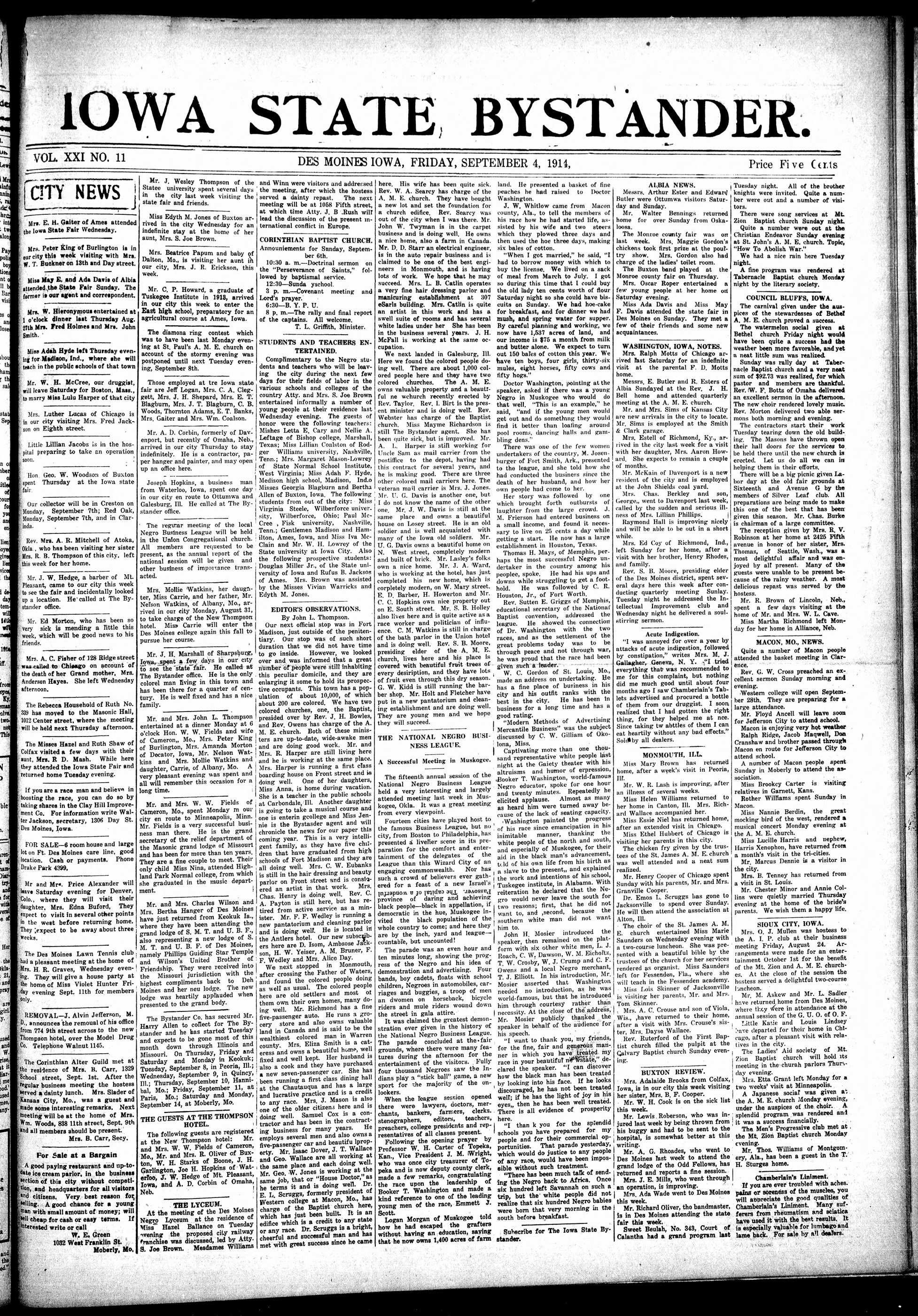
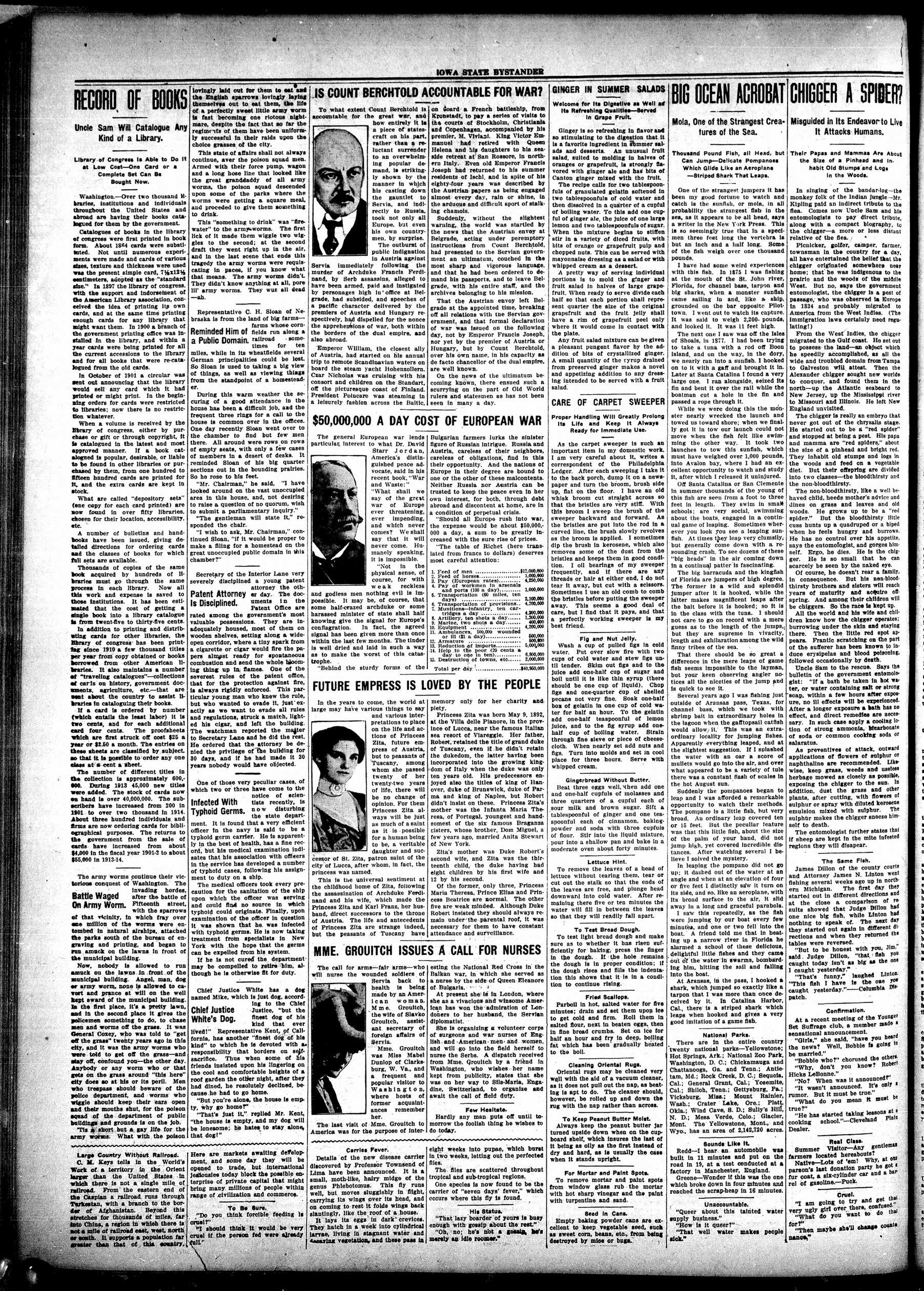
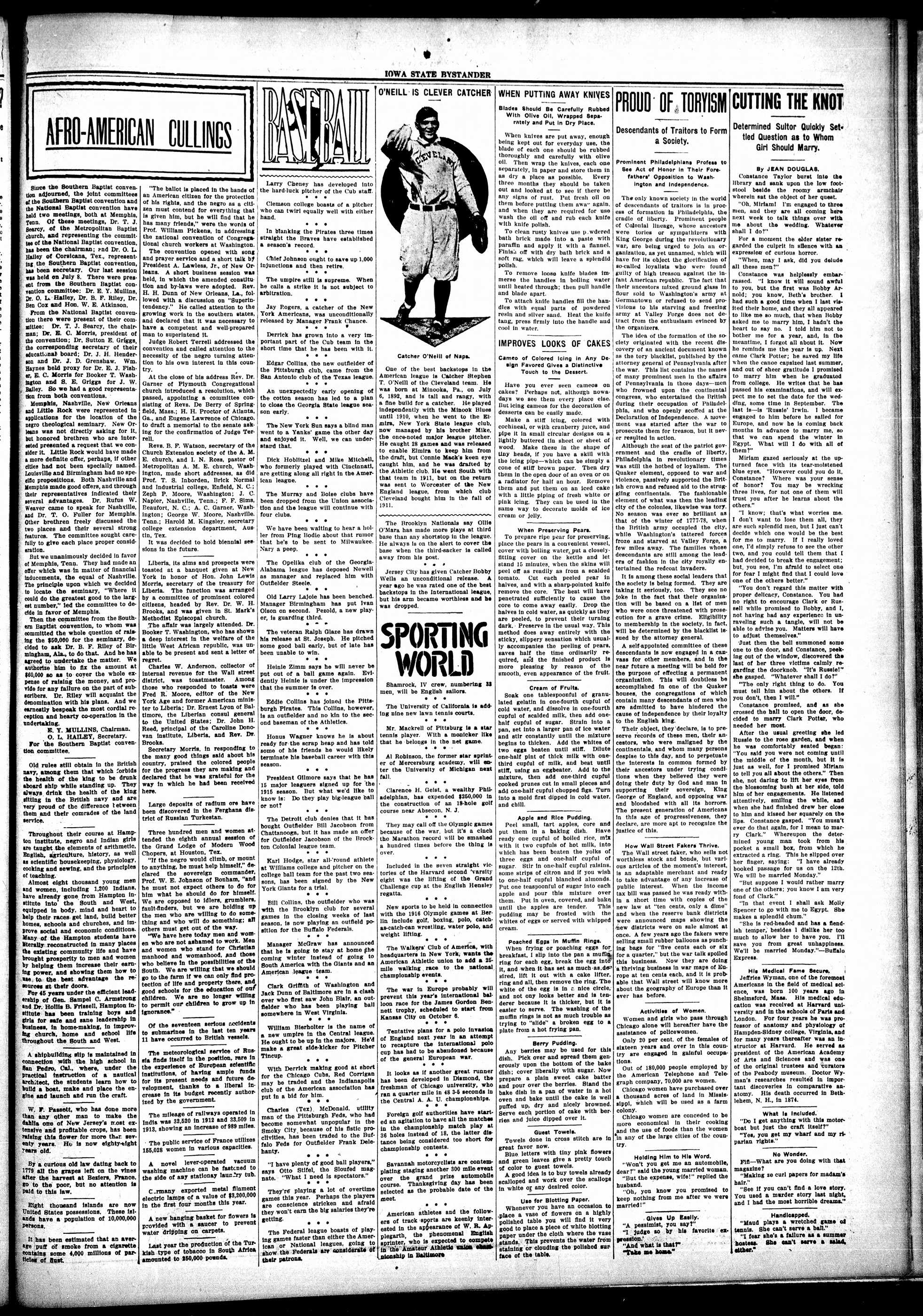
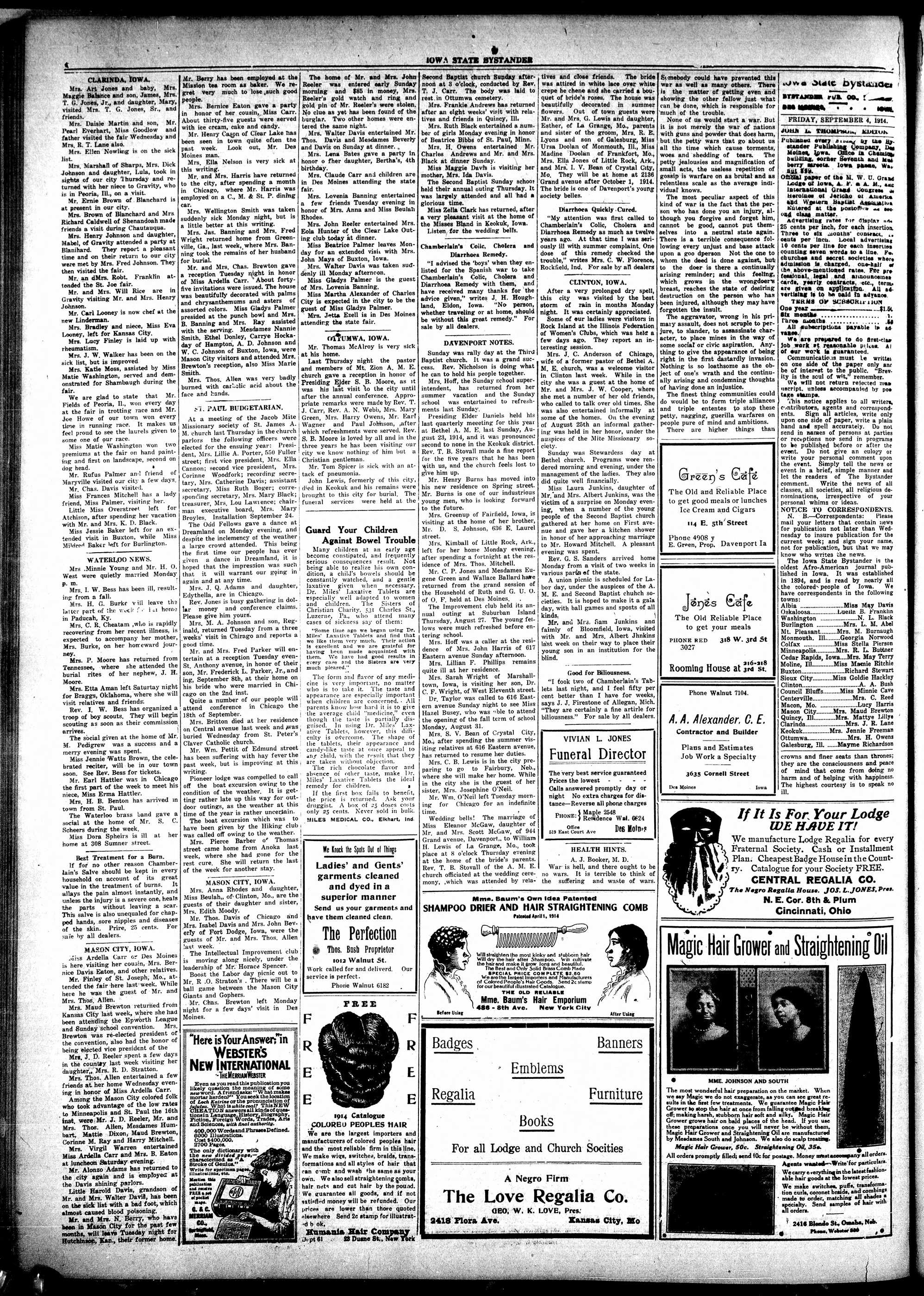
Page text (machine-generated)
IOWA STATE BYSTANDER.
VOL. XXI NO. 11
CITY NEWS
Mrs. E. H. Gaiter of Ames attended the Iowa State Fair Wednesday.
Mrs. Peter King of Burlington is in our city this week visiting with Mrs. W. T. Buckner on 13th and Day street.
Miss May E. and Ada Davis of Albia attended the State Fair Sunday. The former is our agent and correspondent.
Mrs. W. Hieronymous entertained at 1 o'clock dinner last Thursday Aug. 21th Mrs. Fred Holmes and Mrs. John Smith.
Mise Adah Hyde left Thursday evening for Madison, Ind., where she will teach in the public schools of that town.
Mr. W. H. McCree, our druggist, will leave Saturday for Boston, Mass., to marry Miss Lulu Harper of that city.
Mrs. Luther Lucas of Chicago is in our city visiting Mrs. Fred Jackson on Eighth street.
Little Lillian Jacobs is in the hospital preparing to take an operation soon.
Hon Geo. W. Woodson of Buxton spent Thursday at the Iowa state fair.
Our collector will be in Creston on Monday, September 7th; Red Oak, Monday, September 7th, and in Clarinda.
Rev. Mrs. A. R. Mitchell of Atoka, Okla., who has been visiting her sister Mrs. R. B. Thompson of this city, left this week for her home.
Mr. J. W. Hedge, a barber of Mt. Pleasant, came to our city this week to see the fair and incidentally looked up a location. He called at The Bystander office.
Mr. Ed Morton, who has been so very sick is mending a little this week, which will be good news to his friends.
Mrs. A. C. Fisher of 128 Ridge street was called to Chicago on account of the death of her Grand mother, Mrs. Anderson Hayes. She left Wednesday afternoon.
The Rebecca Household of Ruth No. 339 has moved to the Masonic Hall, 1012 Center street, where the meeting will be held next Thursday afternoon.
The Misses Hazel and Ruth Shaw of Colfax visited a few days with their aunt, Mrs. R. D. Mash. While here they attended the Iowa State Fair and returned home Tuesday evening.
If you are a race man and believe in boosting the race, you can do so by taking shares in the Clay Hill Improvement Co. For information write Walter Jackson, secretary, 1306 Day St. Des Moines, Iowa.
FOR SALE—6 room house and large lot on Ft. Des Moines care line, good location. Cash or payments. Phone Drake Park 4399.
Mr and Mrs. Price Alexander will leave Saturday evening for Denver, Colo., where they will visit their daughter, Mrs. Edna Buford, They expect to visit in several other points in the west before returning home. They expect to be away about three weeks.
The Des Moines Lawn Tennis club had a pleasant meeting at the home of Mrs. H. R. Graves, Wednesday evening. They will give a house party at the home of Miss Violet Hunter Friday evening Sept. 11th for members only.
REMOVAL—J. Alvin Jefferson, M. D., announces the removal of his office from 774 9th street across to the new Thompson hotel, over the Model Drug Co. Telephone Walnut 1145.
The Corinthian Alter Guild met at the residence of Mrs. B. Carr, 1329 School street, Sept. 1st. After the regular business meeting the hostess served a dainty lunch. Mrs. Slader of Kansas City, Mo., was a guest and made some interesting remarks. Next meeting will be at the home of Mrs. Wm. Woods, 888 11th street, Sept. 9th and all members should be present.
For Sale at a Bargain
A good paying restaurant and up-to-date ice cream parlor, in the business section of this city without competition, and headquarters for all visitors and citizens. Very best reason for selling. A good chance for a young man with small amount of money; will sell cheap for cash or easy terms. If interested write or call
W. E. Green
1032 West Franklin St.
Moberly, Mo.
Mr. J. Wesley Thompson of the Statee university spent several days in the city last week visiting the state fair and friends.
Miss Edyth M. Jones of Buxton arrived in the city Wednesday for an indefinite stay at the home of her aunt, Mrs. S. Joe Brown.
Mrs. Beatrice Papum and baby of Dalton, Mo., is visiting her aunt in our city, Mrs. J. R. Erickson, this week.
Mr. C. P. Howard, a graduate of Tuskegee Institute in 1918, arrived in our city this week to enter the East high school, preparatory for an agricultural course at Ames, Iowa.
The diamona ring contest which was to have been last Monday evening at St. Paul's A. M. E. church on account of the stormy evening was postponed until next Tuesday evening, September 8th.
Those employed at the Iowa state fair are Jeff Logan, Mrs. C. A. Cleggett, Mrs. J. H. Shepard, Mrs. E. T. Blagburn, Mrs. J. T. Blagburn, C. B. Woods, Thornton Adams, E. T. Banks, Mrs. Gaiter and Mrs. Wm. Coalson.
Mr. A. D. Corbin, formerly of Davenport, but recently of Omaha, Neb. arrived in our city Thursday to stay indefinitely. He is a contractor, paper hanger and painter, and may open up an office here.
Joseph Hopkins, a business man from Waterloo, Iowa, spent one day in our city en route to Ottumwa and Galesburg, Ill. He called at The Bystander office.
The regular meeting of the local Negro Business League will be held in the Union Congregational church. All members are requested to be present, as the annual report of the national session will be given and other business of importance transacted.
Mrs. Mollie Watkins, her daughter, Miss Carrie, and her father, Mr. Nelson Watkins, of Albany, Mo., arrived in our city Monday, August 31, to take charge of the New Thompson hotel. Miss Carrie will enter the Des Moines college again this fall to pursue her course.
Mr. J. H. Marshall of Sharpsburg, Iowa, spent a few days in our city to see the state fair. He called at the Bystander office. He is the only colored man living in this town and has been there for a quarter of century. He is well fixed and has a nice family.
Mr. and Mrs. John L. Thompson entertained at a dinner Monday at 6 o'clock Hon. W. W. Fields and wife of Cameron, Mo., Mrs. Peter King of Burlington, Mrs. Amanda Morton of Decator, Iowa, Mr. Nelson Watkins and Mrs. Mollie Watkins and daughter, Carrie, of Albany, Mo. A very pleasant evening was spent and all will remember this occasion for a long time.
Mr. and Mrs. W. W. Fields of Cameron, Mo., spent Monday m our city en route to Minneapolis, Minn. Mr. Fields is a very successful business man there. He is the grand secretary of the relief department of the Masonic grand lodge of Missouri and has been more than ten years. They are a fine couple to meet. Their only child Miss Nina, attended Highland Park Normal college, from which she graduated in the music department.
Mr. and Mrs. Charles Wilson and Mrs. Bertha Hanger of Des Moines have just returned from Keokuk Ia., where they have been attending the grand lodge of S. M. T. and U. B. F., also representing a new lodge of S. M. T. and U. B. F. of Des Moines, namely Phillips Guiding Star Temple and Wilson's United Brother of Friendship. They were received into the Missouri jurisdiction with the highest compliments back to Deh Moines and her new lodge. The new lodge was heartily applauded when presented to the grand body.
The Bystander Co. has secured Mr. Harry Allen to collect for The Bystander and he has started Tuesday and expects to be gone most of this month down through Illinois and Missouri. On Thursday, Friday and Saturday and Monday in Keokuk; Tuesday, September 8, in Peoria, Ill.; Wednesday, September 9, in Quincy, Ill.; Thursday, September 10, Hannibal, Mo.; Friday, September 11, at Paris, Mo.; Saturday and Monday, September 14, at Moberly, Mo.
THE GUESTS AT THE THOMPSON
HOTEL.
The following guests are registered at the New Thompson hotel: Mr. and Mrs. W. W. Fields of Cameron, Mo. Mr. and W. R. Oliver of Buxton, W. H. Starks of Boone, J. H. Garlington, Joe H. Hopkins of Waterloo, J. W. Hedge of Mt. Pleasant, Iowa, and A. D. Corbin of Omaha, Neb.
THE LYCEUM.
At the meeting of the Des Moines Negro Lyceum at the residence of Miss Hazel Ballance on Tuesday evening the proposed city railway franchise was discussed, led by Atty-S Joe Brown. Mesdames Williams
and Winn were visitors and addressed the meeting, after which the hostess served a dainty repast. The next meeting will be at 1058 Fifth street, at which time Atty. J. B. Rush will lead the discussion of the present international conflict in Europe.
here. His wife has been quite sick. Rev. W. A. Searcy has charge of the A. M. E. church. They have bought a new lot and set the foundation for a church edifice. Rev. Searcy was out of the city when I was there. Mr. John W. Tywman is in the carpet land. He presented a b peaches he had raised Washington. J. W. Whitlow came county, Ala., to tell the his race how he had stied by his wife and
CORINTHIAN BAPTIST CHURCH.
Announiements for Sunday, September
ber 6th
10:30 a. m.-Doctrinal sermon on the "Perseverance of Saints," followed by baptismal service.
12:30-Sunda yschool.
3 p. m.-Covenant meeting and Lord's prayer.
6:30-B. Y. P. U.
8 p. m.-The rally and final report of the captains. All welcome.
T. L. Griffith, Minister.
STUDENTS AND TEACHERS EN-
TERTAINED.
Complimentary to the Negro students and teachers who will be leaving the city during the next few days for their fields of labor in the various schools and colleges of the country Atty. and Mrs. S. Joe Brown entertained informally a number of young people at their residence last Wednesday evening. The guests of honor were the following teachers: Mishes Letta E. Cary and Nellie A. Leftage of Bishop college, Marshall, Texas; Miss Lillian Conston of Rodger Williams university, Nashville, Tenn.; Mrs. Margaret Mason-Lowrey of State Normal School Institute, West Virginia; Miss Adah F. Hyde, Medison high school, Madison, Ind. Misses Georgia Blugburn and B Allen of Buxton, Iowa. The following students from out of the city: Miss Virginia Steele, Wilberforce university, Wilberforce, Ohio; Paul McCree , Fisk university, Nashville, Tenn.; Gentlemen Madison and Hamilton, Ames, Iowa, and Miss Iva McClain and Mr. W. H. Lowrey of the State university at Iowa City. Also the following prospective students: Douglas Miller Jr., of the State university of Iowa and Rufus B. Jacksos of Ames. Mrs. Brown was assisted by the Misses Vivian Warricks and Edyth M. Jones.
EDITOR'S OBSERVATIONS.
By John L. Thompson.
By John E. Thompson.
Our next official stop was in Fort Madison, just outside of the penitentiary. Our stop was of such short duration that we did not have time to go inside. However, we looked over and was informed that a great number of people were still inhabiting this peculiar domicile, and they are enlarging it some to hold its prospective occupants. This town has a population of about 10,000, of which about 200 are colored. We have two colored churches, one, the Baptist, presided over by Rev J. H. Bowles, and Rev Owens has charge of the A. M. e. church. Both of these ministers are up-to-date, wide-awake men and are doing good work. Mr. and Mrs. R. Harper are still living here and he is working at the same place. Mrs. Harper is running a first class boarding house on Front street and is doing well. One of her daughters, Miss Anna, is home during vacation. She is a teacher in the public schools at Carbondale, Ill. Another daughter is going to take a musical course and one is enterin the college and Miss Jennie is the Bystander agent and will chronicle the news for our paper this coming year. This is a very intelligent family, as they have five children that have graduated from high schools of Fort Madison and they are all doing well. Mrs. C. W. Eubanks is still in the hair dressing and beauty parlor on Front street and is constaered an artist in that work. Mrs. Chas. Henry is doing well. Rev C. A. Payton is still here, but has retired from active service as a minister. Mr. F. F. Wedley is running a new pantatorium and cleaning parlor and is doing well. He is located in the Antlers hotel. Our new subscribers here are D. Isom, Ambrose Jackson, H. W. Yeiser, A. M. Bruner, F. W. Fedley and Mrs. Alice Day.
F. Wedley stopped in Monmouth, after crossing the Father of Waters, and found the colored people doing as well as usual. The colored people here are old settlers and most of them own their own homes, many doing well. Mr. Richmond has a fine five-passenger auto. He runs a grocery store and also owns valuable land in Canada and is said to be the wealthiest colored man in Warren county. Mrs. Eliza Smith is a cateress and owns a beautiful home, well fixed and well kept. Her husband is also a cook and they have purchased a new seven-passenger car. She has been running a first class dining hall at the Chautaquah and has a large and lucrative practice and is a credit to any race. Mrs. J. Mason is also one of the older citizens here and is doing well. Samuel Cox is a contractor and has been in the contracting business for many years. He employs several men and also owns five-passenger car and beautiful property. Mr. Isaac Dover, J. T. Wallace and Geo. Wallace are all working at the same place and each doing well. Mr. Geo, W. Jones is working at the same job, that or "House Doctor," as he terms it and is doing well. Dr. E. L. Scruggs, formerly president of Western college at Macon, Mo., has charge of the Baptist church here, which has just been built. It is an edifice which is a credit to any an or any race. Dr. Scruggs is a bright, cheerful and successful man and has met with great success since he came
here. His wife has been quite sick. Rev. W. A. Searcy has charge of the A. M. E. church. They have bought a new lot and set the foundation for a church edifice. Rev. Searcy was out of the city when I was there. Mr. John W. Twyman is in the carpet business and is doing well. He owns a nice home, also a farm in Canada. Mr. D. D. Starr an electrical engineer, is in the auto repair business and is claimed to be one of the best engineers in Monmouth, and is having lots of work. We hope that he may succeed. Mrs. L. B. Catlin operates a very fine hair dressing parlor and manicuring establishment at 307 eSarls building. Mrs. Catlin is an artist in this work and has a swell suite of rooms and has several white ladies under her. She has been in the business several years. J. H. McFall is working at the same occupation.
We next landed in Galesburg, Ill. Here we found the colored people doing well. There are about 1,000 colored people here and they have two colored churches. The A. M. E. owns valuable property and a beautiful ne wchurch recently erected by Rev. Taylor, Rev. I. Birt is the present minister and is doing well. Rev. Webster has charge of the Baptist church. Miss Mayne Richardson is still The Bystander agent. She has been quite sick, but is improved. Mr. A. L. Harper is still working for Uncle Sam as mail carrier from the postoffice to the depot, having had this contract for several years, and he is making good. There are three other colored mail carriers here. The veteran mail carrier is Mrs. J. Jones. Mr. U. G. Davis is another one, but I do not know the name of the other one. Mr. J. W. Davis is still at the same place and owns a beautiful house on Losey street. He is an old soldier and is well acquainted with many of the Iowa old soldiers. Mr. U. G. Davis owns a beautiful home on N. W. Street and built of brick. Mr. Lasley's folks own a nice home. Mr. J. A. Ward, who is working at the hotel, has just completed his new home, which is completely modern, on W. Mary street. E. D. Barber, on H. Howerton and M. C. C. Hopkins own nice property out on E. South street. Mr. S. B. Holley also lives here and is quite active as a race worker and politician of influence. C. M. Watkins is still in charge of the bath parlor in the Union hotel and is doing well. Rev. S. B. Moore, presiding elder of the A. M. E. church, lives here and his place is covered with beautiful fruit trees of every desription, and they have lots of fruit even through this dry season. G. W. Kidd is still running the barber shop. Mr. Holt and Fletcher have put in a new pantatorium and cleaning establishment and are doing well. They are young men and we hope they will succeed.
THE NATIONAL NEGRO BUSI-
NESS LEAGUE.
A Successful Meeting in Muskogee.
The fifteenth annual session of the National Negro Business League held a very interesting and largely attended meeting last week in Muskogee, Okla. It was a great meeting from every viewpoint.
Fourteen cities have played host to the famous Business League, but no city, from Boston to Philadelphia, has presented a liveifier scene in its preparation for the comfort and entertainment of the delegates of the League than this Wizard City of an engaging commonwealth. Nor has such a crowd of believers ever gathered for a feast of a new Israel's province of daring and achieving black people—black in appellation, if democratic in the hue, Muskogee invited the black population of the whole country to come; and here they are by the inch, yard and league—countable, but uncounted!
The parade was an even hour and ten minutes long, showing the progress of the Negro and his idea of demonstration and advertising. Four bands, boy cadets, floats with school children, Negroes in automobiles, carriages and buggies, a troop of men an women on horseback, bicycle riders and mule riders wound down the street in gala attire.
It was claimed the greatest demonstration ever given in the history of the National Negro Business League. The parade concluded at the fair grounds, where there were many features during the afternoon for the entertainment of the visitors. Fully four thousand Negroes saw the Indians play a "stick ball" game, a new sport for the majority of the onlookers. When the league session opened there were lawyers, doctors, merchants, bankers, farmers, clerks, stenographers, editors, teachers, preachers, college presidents and representatives of all classes present. Following the opening prayer by Professor W. H. Carter of Topeka, Kan., Vice President J. M. Wright, who was once city treasurer of Topeka and is now deputy county clerk, made a few remarks, congratulating the race upon the leadership of Booker T. Washington and made a kind reference to one of the leading young men of the race, Emmett J. Scott. Logan Morgan of Muskogee told how he had escaped the graffers without having an education, saying that he now owns 1,400 acres of farm
land. He presented a basket of fine peaches he had raised to Doctor Washington. J. W. Whitlow came from Macon county, Ala., to tell the members of his race how he had started life, assisted by his wife and two steers which they plowed three days and then used the hoe three days, making six bales of cotton.
"When I got married," he said, "I had to borrow money with which to buy the license. We lived on a sack of meal from March to July. I got so during this time that I could buy the old lady ten cents worth of flour night song so she could have biscuits on Sunday. We had hoe-cake for breakfast, and for dinner we had mush, and spring water for supper. By careful planning and working, we now have 1,537 acres of land, and our income is $75 a month from milk and butter alone. We expect to turn out 150 bales of cotton this year. We have ten boys, four girls, thirty-six mules, eight horses, fifty cows and fifty hogs."
Doctor Washington, pointing at the speaker, asked if there was a young Negro in Muskogee who would do that well. "This is an example," he said, "and if the young men would get out and do something they would find it better than loafing around pool rooms, dancing halls and gambling dens."
There was one of the few women undertakers of the country, M. Josenburger of Fort Smith, Ark, presented to the league, and she told how she had conducted the business since the death of her husband, and how her own people had come to her.
Her story was followed by one which brought forth outbursts of laughter from the large crowd. J. M. Frierson had entered business on a small income, and found it necessary to live on 25 cents a day while getting a start. He now has a large establishment in Houston, Texas.
Thomas H. Mays, of Memphis, perhaps the most successful Negro undertaker in the country among his people, spoke. He had his ups and downs while struggling to get a foothold. He was followed by C. R. Houston, Jr., of Fort Worth.
Rev. Sutten E. Griggs of Memphis, educational secretary of the National Baptist convention, addressed the league. He showed the connection of Dr. Washington with the two races, and as the settlement of the great problems today was to be through peace and not through war, he was proud that the race had been given such a leader.
W. C. Gordon of St. Louis, Mo., made an address on undertaking. He has a fine place of business in his city and his outfit ranks with the best in the city. He has been in business for a long time and has a good rating.
"Modern Methods of Advertising Mercantile Business" was the subject discussed by C. W. Gilliam of Okolona, Miss.
Captivating more than one thousand representative white people last night at the Gaiety theater with his altruisms and humor of expression, Booker T. Washington, world-famous Negro educator, spoke for one hour and twenty minutes. Repeatedly he elicited applause. Almost as many as heard him were turned away because of the lack of seating capacity. Washington painted the progress of his race since emancipation in his imitable manner, thanking the white people of the north and south, and especially of Muskogee, for their aid in the black man's advancement, told of his own life from his birth as a slave to the present, and explained the work and intentions of his school, Tuskegee institute, in Alabama. With reiteration he declared that the Negro would never leave the south for two reasons; first, that he did not want to, and second, because the southern white man did not want him to.
John H. Mosier introduced the speaker, then remained on the platform with six other white men, L. J. Roach, C. W. Dawson, W. M. Eicholtz, T. W. Crosby, W. J. Crump and C. F. Owens and a local Negro merchant, T. J. Elliott. In his introduction, Mr. Mosier asserted that Washington needed no introduction, as he was world-famous, but that he introduced him through courtesy rather than necessity. At the close of the address, Mr. Mosier publicly thanked the speaker in behalf of the audience for his speech.
"I want to thank you, my friends, for the fine, fair and generous manner in which you have treated my race in your beautiful "wet state," declared the speaker. "I can discover how the black man has been treated by looking into his face. If he looks discouraged, he has not been treated well; if he has the light of joy in his eyes, then he has been well treated. There is all evidence of prosperity here.
"I than k you for the splendid schools you have prepared for my people and for their commercial opportunities. That parade yesterday, which would do justice to any people of any race, would have been impossible without such treatment.
"There has been much talk of sending the Negro back to Africa. Once six hundred left Savannah on such a trip, but the white people did not realize that six hundred Negro babies were born that very morning in the south before breakfast.
Subscribe for The Iowa State Bystander.
ALBIA NEWS.
Messrs, Arthur Ester and Edward Butler were Ottumwa visitors Saturday and Sunday.
Mr. Walter Bennings returned home for over Sunday from Oskaloosa.
The Monroe county fair was on last week. Mrs. Maggie Gordon's chickens took first prize at the poultry show. Mrs. Gordon also had charge of the ladies' toilet room.
The Buxton band played at the Monroe county fair on Thursday.
Mrs. Oscar Roper entertained a few young people at her home on Saturday evening.
Miss Ada Davis and Miss May F. Davis attended the state fair in Des Moines on Sunday. They met a few of their friends and some new acquaintances.
WASHINGTON, IOWA NOTES
Mrs. Ralph Motts of Chicago arrived last Saturday for an indefinite visit at the parental F. D. Motts home.
Messrs, E. Butler and R. Esters of Albia Sundayed at the Rev. J. H. Bell home and attended quarterly meeting at the A. M. E. church.
Mr. and Mrs. Sims of Kansas City are new arrivals in the city to locate. Mr. Sims is employed at the Smith & Clark garage.
Mrs. Estell of Richmond, Ky., arrived in the city last week for a visit with her daughter, Mrs. Aaron Howard. She expects to remain a couple of months.
Mr. McKain of Davenport is a new resident of the city and is employed at the John Shields coal yard.
Mrs. Chas. Berkley and son, George, went to Davenport last week, called by the sudden and serious illness of Mrs. Lillian Phillips.
Raymond Hall is improving nicely and will be able to be out in a short while.
Mrs. Ed Coy of Richmond, Ind., left Sunday for her home, after a visit with her brother, Henry Rhodes, and family.
Rev. S. B. Moore, presiding elder of the Des Moines district, spent several days here this week after conducting quarterly meeting Sunday. Tuesday night he addressed the Intellectual Improvement club and Wednesday night he delivered a soul-stirring sermon.
Acute Indigestion.
"I was annoyed for over a year by attacks of acute indigestion, followed by constipation," writes Mrs. M, J. Gallagher, Geneva, N. Y. "I tried everything that was recommended to me for this complaint, but nothing did me much good until about four months ago I saw Chamberlain's Tablets advertised and保质ran a bottle of them from our druggist. I soon realized that I had gotten the right thing, for they helped me at nce. Since taking tw abtles of them I can eat heartily without any bad effects." Sold by all dealers.
MONMOUTH. ILL.
Miss Mary Brown has returned home, after a week's visit in Peoria, Ill.
Mr. W. R. Lash is improving, after an illness of several weeks.
Miss Helen Williams returned to her home in Canton, Ill. Mrs. Richard Wallace accompanied her.
Miss Essie Niel has returned home, after an extended visit in Chicago.
Miss Ethel Hubbert of Chicago is visiting her parents in this city.
The chicken fry given by the trustees of the St. James A. M. E. church was well attended and a neat sum realized.
Mr. Henry Cooper of Chicago spent Sunday with his parents, Mr. and Mrs. Granville Cooper.
Dr. Emos L. Scruggs has gone to Jacksonville to spend over Sunday. He will then attend the association at Alton, Ill.
The choir of the St. James A. M. E. church entertained Miss Marie Saunders on Wednesday evening with a two-course luncheon. She was presented with a beautiful bible by the trustees of the church for her services rendered as organist. Miss Saunders left for Fessenden, Fla., where she will teach in the Fessenden academy.
Miss Lois Skinner of Jacksonville is visiting her parents, Mr. and Mrs. Tom Skinner.
Mrs. A. C. Crouse and son of Viola, Wis., have returned to their home, after a visit with Mrs. Crouse's sister, Mrs. Dayse Wallace.
Rev, Ruterford of the First Baptist church filled the pulpit at the Calvary Baptist church Sunday evening.
BUXTON REVIEW.
Mrs. Adalade Brooks from Colaf, Iowa, is in our city this week visiting her sister, Mrs. B. F. Cooper.
Mr. W. H. Cook is on the sick list this week.
Mr. Lewis Roberson, who was injured last week by being thrown from his buggy, and had to be sent to the hospital, is somewhat better at this writing.
Mr. A. G. Rhoades, who went to Des Moines last week to attend the grand lodge of the Odd Fellows, has returned and reports a fine session.
Mrs. J. E. Mills, who went through an operation, is improving.
Mrs. Ada Wade went to Des Moines this week.
Mr. Richard Oliver, the bandmaster, is in Des Moines attending the state fair this week.
Sweet Beauil, No. 343, Court of Calcutta had a grand program last
Price Five Cents
Tuesday night. All of the brother knights were invited. Quite a number were out and a number of visitors.
There were song services at Mt. Zion Baptist church Sunday night. Quite a number were out at the Christian Endeavor Sunday evening at St. John's A. M. E. church, Topic, "How To Abolish War."
We had a nice rain here Tuesday night.
A fine program was rendered at Tabernacle Baptist church Monday night by the literary society.
COUNCIL BLUFFS. IOWA
The carnival given under the auspices of the stewardesses of Bethel A. M. E. church proved a success. The watermelon social given at Bethel church Friday night would have been quite a success had the weather been more favorable, and yet a neat little sum was realized. Sunday was rally day at Tabernacle Baptist church and a very neat sum of $92.73 was realized, for which pastor and members are thankful. Rev.W. F. Botts of Omaha delivered an excellent sermon in the afternoon. The new chair rendered lovely music. Rev. Morton delivered two able sermons both morning and evening. The contractors start their work Tuesday tearing down the old building. The Masons have thrown open their hall doors for the services to be held there until the new church is erected. Let us do all we can in helping them in their efforts. There will be a big picnic given Labor day at the old fair grounds at Sixteenth and Avenue G by the members of Silver Leaf club. All preparations are being made to make this one of the best that has been given this season. Mr. Chas. Burke is chairman of a large committee.
The reception given by Mrs. R. V. Robinson at her home at 2425 Fifth avenue in honor of her sister, Mrs. Thomas, of Seattle, Wash., was a most delightful affair and was enjoyed by all present. Many of the guests were unable to be present because of the rainy weather. A most delicious repast was served by the hostess.
Mr. R. Brown of Lincoln, Neb., spent a few days visiting at the home of Mr. and Mrs. W. L. Cave.
Miss Martha Richmond left Monday for her home in Alliance, Neb.
MACON, MO., NEWS.
Quite a number of Macon people attended the basket meeting in Clarence.
Rev. G. W. Cross preached an excellent sermon Sunday morning and evening.
Western college will open September 28th. They are preparing for a large attendance.
Mr. Floyd Ancell will leave soon for Jefferson City to attend school.
Macon is enjoying very hot weather Ralph Ridge, Jacob Maqwell, Don Cranshaw and brother passed through Macon en route for Jefferson City to attend school.
A number of Macon people spent Sunday in Moberly to attend the association.
Miss Brookey Carter is visiting relatives in Garnett, Kans.
Rother Williams spent Sunday in Macon.
Miss Nannie Berdin, the great mocking bird of the west, rendered a musical concert Monday evening at the A. M. E. church.
Miss Lucille Harris and nephew, Harris Xenophon, have returned from a month's visit in the tri-cities.
Mr. Marcus Dennie is a visitor in the city.
Mrs. B. Tenney has returned from a visit in St. Louis.
Mr. Chester Minor and Annie Collins were quietly married Thursday evening at the home of the bride's parents. We wish them a happy life.
SIoux CITY IOWA
Mrs. O. J. Mullen was hostess to the A. I. P. club at their business meeting Friday, August 24. Arrangements were made for an entertainment October 1st for the benefit of the Mt. Zion and A. M. E. churches. At the close of the session the hostess served a delightful two-course luncheon.
Mr. M. Askew and Mr. L. Sadler have returned home from Des Moines, where they were in attendance at the annual session of the G. U. O. of O. F. Little Katie and Louis Lindsay have departed for their home in Chicago, after a pleasant visit with relatives in the city.
The Ladies' Aid society of Mt. Zion Baptist church will hold its meeting in the church parlors Thursday evening.
Mrs. Etta Grant left Monday for a two weeks' visit at Minneapolis.
A Japanese social was given at the A. M. E. church Monday evening, under the auspices of the choir. A splendid program was rendered and it was a success financially.
The Men's Progressive club met at the Mt. Zion Baptist church Monday evening.
Mr. Thos. Williams of Montgomery, Ala., has been a guest in the T. H. Sturges home.
Chamberlain's Liniment
If you are ever troubled with aches,
pains or soreness of the muscles, you
will appreciate the good qualities of
Chamberlain's Liniment. Many sufferers from rheumatism and sciatica have used it with the best results. It is especially valuable for lumbago and lame back. For sale by all dealers.
RECORD OF BOOKS
Uncle Sam Will Catalogue Any Kind of a Library.
Library of Congress is Able to Do It at Low Cost—One Card or a Complete Set Can Be Bought Now.
Washington—Over two thousand Libraries, institutions and individuals throughout the United States and abroad are having their books cataloged for them by the government.
Catalogues of books in the library of congress were first printed in book form. About 1844 cards were substituted. Not until numerous experiments were made and cards of various sizes, texture and thickness were used was the present simple card, $7\frac{1}{2} \times 11\frac{1}{2}$ centimeters, adopted as the "standard size". In 1897 the library of congress, the American Library association, conceived the idea of printing its own cards, and at the same time printing enough cards for any library that might want them. In 1900 a branch of the government printing office was installed in the library, and within a year cards were being printed for all the current accessions to the library and for all books that were re-cataloged from the old cards.
In October of 1901 a circular was sent out announcing that the library would sell any card which it printed or might print in beginning or cards or cards were restricted to libraries; now there is no restriction whatever.
When a volume is received by the library of congress, either by purchase or gift or through copyright, it is cataloged in the latest and most approved manner. If a book cataloged is popular, desirable, or able to be found in other libraries or purchased by them, from one hundred to fifteen hundred cards are printed for it, and the extra cards are kept in them. What are called "depository sets" (one copy for each card printed) are now found in over fifty libraries chosen for their location, accessibility, etc.
A number of bulletins and handbooks have been issued, giving detailed directions for ordering cards and the classes of books for which full sets are available.
Thousands of copies of the same book acquired by hundreds of libraries must go through the same process in each library. Now all this work and expense is saved to those institutions. It has been made possible by the gift of getting a single book into a library catalogue from twenty-five to thirty-five cents.
In addition to printing and distributing cards for other libraries, the library of congress has been printing since 1910 a few thousand titles per year from copy obtained or books borrowed from other American libraries. It also maintains a number of "traveling catalogues"—collections of cards on history, government documents, agriculture, etc. that are sent about the country to assist libraries in cataloguing their books. If a card is ordered by number (which entails the least labor) it is two cents, and for each additional card a fee of two sheephooks which are first struck off cost $25 a year or $2.50 a month. The entries on these sheets are classified by subject, so that it is possible to order any one class at a cost a sheet.
The number of different titles in the collection is approximately 600,000. During 1913 45,000 new titles were added. The cards of stock now on hand is over 400,000,000. The subscribers have increased from 200 in 1901 to over two thousand in 1914. About three hundred individuals and firms are now ordering cards for biblio-publication purposes. The returns all the government from the sale of cards have increased from about $4,000 in the fiscal year 1901-2 to about $55,000 in 1913-14.
The army worms continue their victorious conquest of Washington. The invading hordes, after the battle of On Army Worm. Fifteenth street, with the sparrows
The army worms torious conquest of
Battle Waged On Army Worm.
of that vexity, in which fray over one million of the worms were entombed in natural airships, attached the parks south of the bureau of engraving and began to unmock on the lawns in front of the municipal building.
Now, nobody is allowed to run amuck on the lawns in front of the municipal building. Angel, man, dog or army worm, none is allowed to cavort and prance at will on the well kept sword of the municipal building. In the first place, it's a pretty lawn, and in the second place it gives the men and worms a chance to men and worms off the grass. It was General Coxey, who was told to "get off the grass" twenty years ago in this city, and it was the army worms who were told to get off the grass—and stay off, confound you—the other day. Anybody or any worm who or that gets on the grass around "this here" city does so at his or its peril. Men who trespass should beware of the police department, and worms who wiggle should keep their ears open because they are the second group of the department of public buildings and grounds is on the job. "It's short, but a gay life for the army worms. What with the poison
Large Country Without Railroad.
C. M. Keys tells in the World's Work of a territory in the Orient larger than the United States in which there is not a single mile of railroad. From the eastern end of the Caspian a railroad runs through Turkistan, with a branch to the border of Afghanistan. Beyond this stretches for thousands of miles, far into China, a region in which there is not a mile of railroad east, west north or south. it supports a population far greater than that of this country.
lovingly laid out for them to eat and the English sparrows lovingly laying themselves out to eat them, the life of a perfectly sweet little army worm is fast becoming one riotous nightmare, despite the fact that no far the regiments of them have been uniformly successful in their raids upon the choice grasses of the city.
This state of affairs shall not always continue, over the polson squad men. Armed with their force pump, wagon and a long hose line that looked like the great daddaddy and the army that had descended upon some of the parks where the worms were getting a square meal, and proceeded to give them something to drink.
This "something to drink" was "firewater" to the army worms. The first lick of it made them wiggle two wiggle to the second; at the second draft they went right up in the air, and in the last scene that ends this tragedy the army worms were requigating in paces, if you know what that means. the army worms didn't. They didn't know anything at all,补 lil' army worms. They wux all dead -ah.
Representative C. H. Sloan of Nebraska is from the land of big farms—farms whose corn is a Public Domain, railroad some times for ten miles, while in its wheatfields several German principalities could be lost. So Sloan is used to taking a big view of things, as well as viewing things from the standpoint of a homestead.
During this warm weather the securing of a good attendance in the house has been a difficult job, and the frequent three rings for a call to the house is common over in the offices. One day recently Sloan went over to the chamber to find but few men there. All around were rows on rows of empty seats, with only a few cases of members in a desert of desks. It reminded Sloan of his big quarter sections out in the bounding prairies. So he rose to his feet.
"Mr. Chairman," he said, "I have looked around on the vacant unoccupied area in this house, and not desiring to raise it to a parliamentary quorum, wish to be in parliamentary inquiry." "The gentleman will state it," responded the chair.
"I wish to ask, Mr. Chairman," continued Sloan, "if it would be proper to make a filing for a homestead on the great unoccupied public domain in this chamber."
Secretary of the Interior Lane very severely disciplined a young patent attorney the other Patent Attorney er day. The documents in the Patent Office are rated among the government's most valuable possessions. They are inadequately housed, most of them on wooden shelves, setting along a wide-open corridor, where a tiny spark from a cigarette or cigar would fire the papers almost ready for spontaneous combustion and send the whole blooming thing up in flames. One of the severest rules of the patent office, that for the protection of the patent is always rigidly required. This paraphrase putting man who knew the rule, but who wanted to avail it, just exactly as we want to avail all rules and regulations, struck a match, lighted his cigar, and left the building. The watchman reported the master to Secretary Lane and he did the rest. He ordered that the attorney be denied the privilege of the building for 30 days, and if he had made it 30 years nobody would have objected.
Infected With Typhoid Germs.
ment. It is found that a very efficient officer in the navy is said to be a typhoid germ carrier. He is apparently in the best of health, has a fine record, but his medical examination indicates that his association with officers in the service has developed a number of typhoid cases, following his assignment to duty on a ship.
The medical officers took every precaution for the sanitation of the ship upon which the officer was serving and could find no source in which typhoid could originate. Finally, upon examination of the officer in question it was shown that he was infected with typhoid germs. He is now taking treatment from specialists in New York with the hope that the germs can be expelled from his system.
If he is not cured the department may be compelled to retire, although he is otherwise fit for duty.
Chief Justice White has a dog named Mike, which is just dog, accord-
Chief Justice White's Dog.
lived!" Representative Kent, of California, has another "nastest dog of his kind" to which he is devoted with a responsibility that borders on self-sacrifice. Thus when some of his friends insisted upon his lingering on the cool and comfortable heights of a roof garden the other night, after they had dined, he resolutely declined, because he had to go home.
"But you're alone, the house is empty, why go home?
"That's just it," replied Mr. Kent, "the house is empty, and my dog will be lonesome; he hates to stay alone, that dog!"
Here are markets awaiting development, and some day they will be opened to trade, but international locations today block the possible enterprise of private capital that might bring many millions of people within range of civilization and commerce.
To Be Sure.
"Do you think forcible feeding is cruel?"
I should think it would be very cool if the person fed were already well
IS COUNT BERCHTOLD ACCOUNTABLE FOR WAR?
$50,000,000 A DAY COST OF EUROPEAN WAR
FUTURE EMPRESS IS LOVED BY THE PEOPLE
MME. GROUITCH ISSUES A CALL FOR NURSES
To what extent Count Bercholdt is accountable for the great war, and how entirely it is a piece of statescraft on his part, rather than a reluctant surrender to an overwhelming popular demand, is strikingly shown by the manner in which his casting down the gauntlet to Sweden and indictly to Russia, took not only all Europe, but even his own country, by surprise. The outburst of public indignation in Austria against
A.
Servia immediately following the murder of Archduke Ferdinand, by Serb assassins, alleged to have been armed, paid and instigated by personages high in 'office at Belgrade, had subsided, and speeches of a pacific character delivered by the premiers of Austria and Hungary respectively, had dispelled for the once the apprehensions of war, both within the borders of the dual empire, and also abroad. Emperor William, the closest ally of Austria, had started on his annual trip to remote Scandinavian waters on Boar, to sail a yacht to Johenbolzern, Carl Nicholas's son, to consort and children on the Standard, off the picturesque coast of Finland. President Polincare was steaming in a leisurely fashion across the Baltic.
The general European war lends particular interest to what Dr. David Starr Jordan, America's distinguished peace advocate, said in his recent book, "War and Waste:"
PETER H. BURKE
"What shall we say of the great war of Europe ever threatening, ever impending, and which never comes? We shall say that it will never come. Humanely speaking, it is impossible. "Not in the physical sense, of course, for with weak reckless and godless men nothing evil is impossible. It may be, of course, the some half-crazy architecute who harassed minister of state shall half knowing give the signal for Europe's confaguration. In fact, the agreed signal has been given more than once within the last few months. The tinder is well dried and laid in such a way as to make the worst of this catastrophe. "Behind the sturdy forms of the
In the years to come, the world at large may have various things to say and various interpretations to place on the life and actions of Princess Zita, future empress of Austria, but to peasants of Tuscany, among whom she passed twenty-two years of life, there will be no shame or objection. For them Princess Zita always will be just as much of a saint as it is possible for a human being to be, a veritable daughter and suc-
pretations to place on the life and actions of Princess Zita, future empress of Austria, but to peasants of Tuscany, among whom she passed twenty of her twenty-two years of life, there will be no change of opinion. For them Princess Zita ways will be just as much of a saint as it is possible for a human being to be, a veritable daughter and successor of St. Zita, patron saint of the city of Lucca, after whom, in fact, the princess was named.
This is the universal sentiment at the childhood home of Zita, following the assassination of Archduke Ferdinand and his wife, which made the Princess Zita and Karl Franz, her husband, receive a second degree. The life and antecedents of Princess Zita are strange indeed, but the peasants of Tuscany have
The call for arms--fair arms--who will nurse the wounded soldiers of
Servia back to health is being made by an American woman. Mme. Groultch, the wife of Shvako Groultch, assistant secretary of foreign affairs of Servia.
100
Mme. Groultch was Miss Mabel Dunlap of Clarksburg, W. Va., and a frequent and popular visitor to Wash. this year, where hosts of former acquaintances remember her.
The last visit of Mme. Groultch to America was for the purpose of inter-
Detaila of the new disease carrier discovered by Professor Townsend of Lima have been announced. It is a small, moth-like, hairy midge of the genus Phlebotomus. This fly runs well, but moves sluggishly in flight, carrying its wings over its head, and on coming to rest it for wings back slantingly in the air. It also its eggs in dark crevices. They hatch in a week into cylindrical larvae, living in stagnant water and decaying vegetation, and these pass in
IOWA STATE BYSTANDEE
on board a French battleship, from Kronstadt, to pay a series of visits to the courts of Stockholm, Christiana and Copenhagen, accompanied by his premier, M. Viviani. King Victor Emmanuel had retired with Queen Helena and his daughters to his sea-side retreat at San Rossone, in northern Italy. Even old Emperor Francis Joseph had returned to his summer home in Italy, and in spite of eighty-four years was described by the Austrian papers as being engaged almost every day, rain or shine, in the arduous and difficult sport of stalking chamois. Suddenly, without the slightest warning, the world was startled by the news that the Austrian envoy at Belgrade, acting under peremptory instructions from Count Berchtold, had presented to the Servian government an ultimatum, couched in the most sharp and vigorous language, to demand his passports, and to leave Belgrade, with his entire staff, and the archives belonging to his mission.
That the Austrian envoy left Belgrade at the appointed time, breaking off all relations with the Servian government, and that formal declaration of war was issued on the following day, not by Emperor Francis Joseph, nor yet by the premier of Austria or Hungary, but by Count Berchtold, over his own name, in his capacity as de facto chancellor of the dual empire, are well known.
On the news of the ultimatum becoming known, there ensued such a scurrying on the part of Old World rulers and statesmen as has not been seen in many a day.
Bulgarian farmers lurks the sinister figure of Russian intrigue. Russia and Austria, careless of their neighbors, careless of obligations, find in this their opportunity. And the nations of Europe in their degree are bound to one or the other of these malcontents. Neither Russia nor Austria can be trusted to keep the peace even in her own interest, for both, through debt abroad and discontent at home, are in a condition of perpetual crisis. "Should all Europe rush into war, the cost would be $50,000,000 a day, a sum to be greatly increased with the sure rise of prices." The table of Richet (here translated from francs to dollars) deserves most careful attention:
6. Transportation of provisions.
7. Muni-funds—infantry, ten car-
riers.
8. Artilery, ten shots a day.
9. Equipment, 100 pounds.
10. Equipment, 500,000 pounds.
11. Amount (4 $ a day).
12. Amount (4 $ a day).
13. Reduction of imports.
14. Help to the poor (20 cents a
day).
15. Destruction of towns, etc.
memory only for her charity and piety.
Princess Zita was born May 9, 1892, at the Villa delle Planeura, in the province of Lucca, near the famous Italian sea resort of Viagreggia. Her father, Robert, retained the title of grand duke of Tuscany, even if he didn't retain the dukedom, the latter having been incorporated into the growing kingdom of Italy when the duke was only ten years old. His predecessors enjoyed also the titles of king of Hanover, duke of Brunswick, duke of Parma and king of Naples, but Robert didn't insist on these. Princess Zita mother of Maria Maria Thea of Portugal, youngest and hand-some of the six famous Braganza cisters, whose brother, Dom Miguel, a few years ago, married Anita Stewart of New York.
Zita's mother was Duke Robert's second wife, and Zita was the thirteenth child, the duke having had eight children by his first wife and 12 by his second.
Of the former, only three, Princess Maria Theresa, Prince Elias and Princess Beatrice are normal. The other five are weak minded. Although Duke Robert insisted they should always remain under the parental roof, it was necessary for them to have constant attendance and surveillance.
esting the National Red Cross in the Balkan war, in which she served as a nurse by the side of Queen Eleanor of Bulgaria. At present she is in London, where she as a vivacious and winsome American has won the admiration of London and her husband, the Servian diplomatist. She is organizing a volunteer corps of surgeons and war nurses of English and American men and women, and will go into the field herself to nurse the Serbs. A dispatch received from Mme. Groultch by a friend in Washington, who wishes her name kept from publicity, has sent to Slia-Mar, Engadine, Switzerland, to organize and await the call of field duty.
Few Hesitate
Hardly any man puts off until tomorrow the foolish thing he wishes to do today.
eight weeks into pupae, which burst in two weeks, letting out the perfected flies.
The flies are scattered throughout tropical and sub-tropical regions.
One species is now found to be the carrier of "seven days' fever", which occurs where this fly is found.
His Status
"That lazy border of yours is busy enough with gossip about the rest."
"Oh, no; he's not a gossip, he's merely an idol roomer."
GINGER IN SUMMER SALADS
GINGER IN SUMMER SALADS
Welcome for Its Digestive as well as Its Refreshing Qualities—Served in Grape Fruit.
Ginger is so refreshing in flavor and so stimulating to the digestion that it is a favorite ingredient in summer salads and desserts. An unusual fruit salad, suited to molding in halves of oranges or grapefruit, is strongly flavored with ginger ale and has bits of Canton ginger mixed with the fruit. The recipe calls for two tablespoonfuls of granulated gelatin softened in two tablespoonfuls of cold water and then dissolved in a quarter of a cupful of boiling water. To this add one cupful of ginger ale, the juice of a lemon and the juice of sugar. When the mixture begins to stiffen in a variety of dried fruits, with bits of orange or grapefruit pulp and chopped nuts. This can be served with mayonnaise dressing as a salad or with whipped cream as a dessert.
A pretty way of serving individual portions is to mold the ginger and fruit salad in halves of large grapefruit. When ready to serve divide each half so that each portion shall represent quarter the size of the original grapefruit, and the fruit salad a rim of grapefruit peel only where it would come in contact with the plate.
Any fruit salad mixture can be given a pleasant pungent flavor by the addition of bits of crystallized ginger. A small quantity of the syrup drained from preserved ginger makes a novel and appetizing addition to any dressing intended to be served with a fruit salad.
CARE OF CARPET SWEEPER
Proper Handling Will Greatly Prolong
It!s Use. It will Always
Ready for Immediate Use.
As the carpet sweeper is such an important item in my domestic work, I am very careful about it, writes a correspondent of the Philadelphia Ledger. After each sweeping I take it to the back porch, dump it on a newspaper and broom, brush side up, flat on the floor. I have an old whisk broom cut straight across that the bristles are cut. With that the bristles are the brush of the sweeper backward and forward. As the bristles are put into the rod in a curved line, the brush slowly revolves as the broom is applied. I sometimes dip the brush in kerosene, which also removes some of the dust from the bristles and keeps them in good condition. I oil bearings of my sweeper frequently, and if there are any threads or hair at either end, I do not tear it away, but cut with a scissors. I wash them with a cold omp to the bristles before putting the sweeper away. This seems a good deal of care, but I find that it pays, and that a perfectly working sweeper is my best friend.
Flo and Nut Jelly.
Wash a cup of pulled figs in cold water. Put over slow fire with two cups of cold water and stew figs until tender. Skim figs and to the juice add one-half cup of sugar and boll until it is like thin syrup (there should be one cup of liquid). Chop figs and one-quarter cup of shelled pecans not very fine. Soak one-half box of gelatin in one cup of cold water for half an hour. Soak one-half teaspoonful of lemon juice, and to the fig syrup add one-half cup of boiling water. Strain through fine sieve or piece of cheesecloth. When nearly set add nuts and figs. Turn into molds and in cool place for three hours. Serve with whipped cream.
Gingerbread Without Butter
Beat three eggs well, then add one and one-half cupuits of molasses and three quarters of a cupuilt each of sour milk and brown sugar. Sift a tablespoonful of ginger and one teaspoonful each of cinnamon, bakingpowder and soda with three cupuits of flour. Stir into the liquid mixture, pour into a shallow pan and bake in a moderate oven about forty minutes.
Lettuce Hint
To remove the leaves of a head of lettuce without tearing them, tear or cut out the stalk so that the ends of the leaves are free, and plunge head downward into cold water. After remaining there five or ten minutes the water will fill in between the leaves so that they will readily fall apart.
To Test Bread Dough.
To test light bread dough and make sure as to whether it has risen sufficiently for baking, press the finger in the dough. If the hole remains the dough is in proper condition; if the dough rises and fills the indentation this shows that it is in a condition to continue rising.
Eried Scallons
Parboll in hot, salted water for five minutes; drain and set them upon ice to get cold and firm. Roll them in salted flour, next in beaten eggs, then in fine bread crumbs. Set on ice for half an hour and fry in deep, boiling fat which has been gradually heated to the boll.
Cleaning Oriental Bugs
Oriental rugs may be cleaned very well with the aid of a vacuum cleaner, as it does not pull out the nap, as beating is apt to do. The cleaner should, however, be rolled up and down the rug with the nap rather than across.
To Keep Peanut Butter Molist
Always keep the peanut butter jar turned upside down when on the cupboard shelf, which insures the last of it being as olly as the first instead of dry and hard, as is usually the case when it stands upright.
For Masten and Paint 8note
To remove mortar and paint spots from window glass rub the mortar with hot sharp vinegar and the paint with turpentine and sand.
Beed In Cans.
Empty baking powder cans are excellent to keep vegetable seed, such as sweet corn, beans, etc, from being destroyed by mice or bugs.
BIG OCEAN ACROBAT
Mola, One of the Strangest Creatures of the Sea.
Thousand Pound Fish, all Head, but Can Jump—Delicate Pompanes Which Glide Like an Aeroplane —Striped Shark That Leaps.
One of the strangest jumpers it has been my good fortune to watch and catch is the sunfish, or mola, in all probability the strangest fish in the sea, as it appears to be all head, says a writer in the New York Press. This is so seemingly true that in a speed men three feet long the vertebra is but an inch and a half long. Some of the fish weigh over one thousand pounds.
I have had some weird experiences with this fish. In 1875 I was fishing at the mouth of the St. John river, Florida, for channel bass, tarpon and big sharks, when a monster sunfish came sailing in and, like a ship, grounded on the barricade Pilotown. I went out to watch its capture. It was said to weigh 2,200-pounds, and looked it. It was 11 feet high. The next one I saw was off the Isles of Shoals, in 1877. I had been trying to take a tuna with a rood off Boon island, and on the way, in the dory, to the beach. I looked on to it with a fishing and brought it in. Later at Santa Catalina I found a very large one. I went alongside, seized its fin and bent it over the rail while the boatman cut a hole in the fin and passed a rope through it.
While we were doing this the monster nearly wrecked the launch and towed us toward shore; when we finally got it in to our launch could not move when the fish felt like swimming the other way. It took two launches to tow this sunfish, which must have been in bay, where I had an excellent opportunity to watch and study it, after which I released it uninjured. Off Santa Catalina or San Clemente in summer thousands of the young of this fish are seen from a foot to three feet in length. They swim in small schools; are very social, swimming about the boats, engaged in a continual game of leaping. Sometimes when you look you see a leaping sunfish. At times they leap very chumily, and sometimes they sounding crash. You see dozens of these "big heads" in the air coming down in a continual patter is fascinating.
The big barracuda and the kingfish of Florida are jumpers of high degree. The former is a wild and splendid jumper after it is hooked, while the latter makes magnificent leaps after the bait before it is hooked; so it is in the class with the tuna. I should not care to go on record with a more guess as to the length of the jumps, but they are supreme in vivacity, length and exhilaration among the wild finy tribes of the sea.
That there should be so great a difference in the mere leaps of game fish seems impossible to the layman, but your keen observing angler notices all the niceties of the jump and is quick to see it.
Several years ago I was fishing just outside of Aransas pass, Texas, for channel bass, which we took with shrimp hilt in extraordinary holes in the lagoon when the gaffsfoall catfish would allow it. This was an extraordinary locality for jumping fishes. Apparently everything leaped, and at the slightest suggestion. If I splashed the water with an oar a score of mullets would go into the air, and over what appeared to be a variety of tule there was a constant flash of scales in the hot August sun.
Suddenly the pompanoes began to leap and I was afflicted a remarkable opportunity to watch their methods. The pompano is little fish, but very ordinary. An ordinary leaf covered ten or 15 feet. But the peculiar feature was that this little fish, about the size of the palm of your hand, did not jump high, yet covered incredible distances. After watching several I believe I solved the mystery.
In leaping the pompano did not go up; it dashed out of the water at an angle and when at an elevation of four or five feet I distinctly saw it turn on its side, and so, like an airplane, with its broad surface to the air, it slid away in a long and graceful parabola. With this response I was wounded; we jumped our boat every few minutes, and one or two fell into the boat. A friend told me that in beating up a narrow river in Florida he alarmed a school of these delicious, delightful little fishes and they came out of the water in swarms, bombarding him, hitting the sail and falling into the boat. At Aransas, in the pass, I hooked a shark, which jumped so exactly like a tarpon that it was once than once deformed. It was a Catalina Harbor, Cal, there is a striped shark which leaps when hooked and gives a very good imitation of a game fish.
National Parks
There are in the entire country twenty national parks—Yellowstone; Hot Springs, Ark; National Zoo Park Washington, D. C.; Chickamauga and Chattanooga, Ga. and Tenn.; Antieam tm, D.; Rock Creek, D. C.; Sequoia, Cal.; General Grant, Cal.; Yosemite, Cal.; Shiloh, Tenn.; Gettysburg, Pa.; Vicksburg, Miss.; Rainer, Wash.; Crater Lake, Ore.; Plat; Okla; Wint Cave, S. D.; Sully's Hill, N. D.; Mesa Verde, Col.; Glacier, Mont. The Yellowstone, Mont., and Wyo, have an area of 2,142,720 acres.
Bounds Like It.
Redd—I hear an automobile was built in 11 minutes and put on the road in 19, at a test conducted at a factory in New York. *Gameone*: Wonder if this was the one which broke down in four minutes and reached the scrap-heap in 16 minutes.
"That well water makes people sick."
CHIGGER A SPIDER?
Misguided in Its Endeavor to Live It Attacks Humans.
Their Papas and Mammas Are About the Size of a Pinhead and Inhabit Old Stumps and Logs in the Woods.
In singing of the bandar-log—the monkey folk of the Indian jungle—Mr. Kipling paid an indirect tribute to the flea. Comes now Uncle Sam and his entomologists to pay direct tribute, along with a compact biography, to the chigger—a more or less distant relative of the flea.
Picnickler, golfer, camper, farmer, townman in the country for a day, all have entertained the belief that the chigger originated somewhere near home; that he was indigenous to the prairie and the woods of the middle West. But no, says the government entomologist, the chigger is a pest of passage, who was observed in Europe in 1834 and probably migrated to America from the West Indies. (The immigration laws certainly need regulated!)
From the West Indies, the chigger migrated to the Gulf coast. He set out to possess the land—an object which he specially designed as all the chiggers troubled domain from Tampa to Galveston will attest. Then the Alexander chigger sought new worlds to conquer, and found them in the north—up the Atlantic seaboard to New Jersey, up the Mississippi river to Missouri and Illinois. He left New England unvisited.
The chigger is really an embryo that never got out of the chrysalis stage. He started out to be a "red spider" and stopped at being a pest. His papa and mamma are "red spiders," about the size of a pinhead and bright red. They inhabit old stumps and logs in the woods and feed on a vegetable diet. But their offspring are divided into two classes—the bloodthirsty and the non-bloodthirsty.
The non-bloodthirsty, like a well behaved child, heeds mother's advice and dines on grass and leaves and old woods. He grows up to be a "red spider." But the bloodthirsty little cuss hunts up a quadruped or a biped when he feels hungry and burrows. He has no control over his appetite, says the entomologist, and gorges himself. Ergo, he dies. He is the chigger. He is so small that scarcely be seen by the naked eye. Of course he doesn't rear a family, he doesn't be naked. His non-bloodthirsty brothers and sisters will reach years of maturity and acquire offspring. And among their children will be chiggers. So the race is kept up.
All the world and his wife and children know how the chigger operates; burrowing under the skin and staying there. Then the little red spot appears. Frantic scratching on the part of the sufferer has been known to induce erysipelas, poisoning, foul-smelling, occasionally by death. Uncle Sam to the rescue. Says the bulletin of the government entomologist: "If a bath be taken in hot water, or water containing salt or strong soap, within a few hours after exposure, no ill effects will be experienced. After a longer exposure a bath has no effect, and direct remedies are necessary. In such case apply strong ammonia, carbonate or soda or common cooking soda or salaratus.
As preventives of attack, outward applications of flowers of sulphur or naphthaline are recommended. Likewise, keep grass, weeds and useless herbage mowed as closely as possible, exposing the chigger to the sun. In addition, dust the grass and the plants, after cutting, and flowers of sulphur or spray with diluted kerosene or spray with sulphur. The sulphur mukes the chigger anzee himself to death. The entomologist further states that if sheep are kept in the mite infested regions they will disappear.
The Same Fish.
James Dillon of the county courts and Attorney James N. Linton wished fishing several weeks ago up in northern Michigan. The first day they started out in different directions and at the close a comparison suits showed that Judge Dillon had one nice big tail. Linton had then a peak of the next day they started out again in different directions and when they returned the tables were revered.
"But to be honest with you, Jim," said Judge Dillon, "that fish you caught today isn't as big as the one I caught yesterday."
"That's funny," laughed Linton. "This fish I have is the one you caught yesterday."—Columbia Dis
Confirmation.
At a recent meeting of the Younger Set Suffrage club, a member made a sensational announcement.
"Girls," she said, "have you heard the news? Well, Bobbie is going to be married."
"Bobbie who?" chorused the others.
"Why, don't you know? Robert Hicks LeBonne."
"No? When was it announced?"
"It wasn't announced. It's only a rumor. But it must be true."
"What do you mean it must be true?"
"He has started taking lessons at cooking school."—Cleveland Plain Dealer.
Real Class.
*Reel* Great
Summer Visitor-any gentleman
*Aquate?*
farmers located here onshore
Native—Lots of 'em! Why, at our
parson's last donation party he got a
fur coat, a car door car and a bar
rel of gasoline—Puck.
Crusel.
"I am going to try and get that
very ugly girl over there, confused."
"What do you want to do that
for?"
"Then maybe she'll change count
nance."
AFRO-AMERICAN CULLINGS
Since the Southern Baptist convention adjourned, the joint committees of the Southern Baptist convention and the National Baptist convention have held two meetings, both at Memphis, Tenn. Of these meetings, Dr. T. J. Searcy, of the Metropolitan J. B. Baptist church, and representing the committee of the National Baptist convention, has been the chairman; and Dr. O. L. Halley of Corsicana, Tex., representing the Southern Baptist convention, has been secretary. Our last session was held on July 8. There were present from the Southern Baptist convention committee: Dr. E. Y. Mullins, Dr. O. L. Halley, Dr. B. F. Riley, Dr. Ben Cox and Hon. W. E. Atkinson.
From the National Baptist convention there were present of their committee: Dr. T. J. Searcy, the chairman; Dr. E. C. Morris, president of the convention; Dr. Sutton E. Griggs, the corresponding secretary of their educational board; Dr. J. H. Henderson and Dr. J. D. Grenshaw. Wm Haynes held proxy for Dr. J. E. Fisher, E. C. Morris for Booker T. Washington and S. E. Griggs for J. W. Bailey. So we had a good representation from both conventions.
Memphis, Nashville, New Orleans and Little Rock were represented in applications for the location of the negro theological seminary. New Orleans was not directly asking for it, but honored brethren who are interested presented a request that we consider it. Little Rock would have made a more definite offer, perhaps, if other cities had not been specially named. Louisville and Birmingham had no specific propositions. Both Nashville and Memphis made good offers, and through their representatives indicated their several advantages. Dr. Rufus W. Weaver came to speak for Nashville, and Dr. T. O. Fuller for Memphis. Other brethren freely discussed the two places and their several strong features. The committee sought carefully to give each place proper consideration.
But we unanimously decided in favor of Memphis, Penn. They had made an offer which was in matter of financial inducements, the equal of Nashville. The principle upon which we decided to locate the seminary, "Where it could do the greatest good to the largest number," led the committee to decide in favor of Memphis.
Then the committee from the Southern Baptist convention, to whom was committed the whole question of raising the $50,000 for the seminary, decided to ask Dr. B. F. Riley of Birmingham, ala. to do that. And he has agreed to undertake the matter. We authorize him to fix the amount at $60,000 so as to cover the whole expense of raising the money, and provide for any failure on the part of subscribers. Dr. Riley will acquaint the denomination with his plans. And we earnestly bespeak the most cordial reception and hearty co-operation in the undertaking.
E. Y. MULLINS, Chairman.
O. L. HAILEY, Secretary.
For the Southern Baptist convention committee.
Old rules still obtain in the British navy, among them that which orbids the health of the king to be drunk aboard ship while standing up. They always drink the health of the king sitting in the British navy and are very proud of the difference between them and their comrades of the land service.
Throughout their course at Hampton institute, negro and Indian girls are taught the elements of arithmetic, English, agriculture, history, as well as scientific housekeeping, physiology, cooking and sewing, and the principles of teaching.
Almost eight thousand young men and women, including 1,200 Indians, have already gone from Hampton Institute into the South and West, equipped in body, mind and heart to help their races get land, build better homes, schools and churches, and improve social and economic conditions. Many of the Hampton students have literally reconstructed in many places the existing community life and have brought prosperity to men and women by helping them increase their earning power, and showing them how to use, to the best advantage the resources at their doors. For 45 years under the efficient leadership of Gen. Sampel C. Armstrong and Dr. Hollis B. Frissell, Hampton Institute has been training boys and girls for safe and nane leadership in business, in home-making, in improving church, home and school life throughout the South and West.
A shipbuilding slip is maintained in connection with the high school in San Pedro, Cal., where, under the practical instruction of a nautical architect, the students learn how to build a boat, make and place the engine and launch and run the craft.
W. F. Passett, who has done more than any other man to make the dahila one of New Jersey's most extensive and profitable crops, has been raising this flower for more than seventy years. He is now eighty-eight years old.
By a curious old law dating back to 1779 all the grapes left on the vines after the harvest at Bexter, France, go to the poor, but no attention is paid to this law.
Eight thousand islands are now United States possessions. These islands have a population of 10,000,000 persons.
It has been estimated that an average puff of smoke from a cigarette contains some 4,000 millions of particles of dust.
"The ballot is placed in the hands of an American citizen for the protection of his rights, and the negro as a citizen must contend for everything that is given him, but he will find that he has many friends," were the words of Prof. William Pickens, in addressing the national convention of Congregational church workers at Washington. The convention opened with song and prayer service and a short talk by President A. Lawless, Jr., of New Orleans. A short business session was held, in which the amended constitution and by-laws were adopted. Rev. H. H. Dunn of New Orleans, La., followed with a discussion on "Superintendency." He called attention to the growin' work in the southern states, and declared that it was necessary to have a competent and well-prepared man to superintend it. Judge Robert Terrell addressed the convention and called attention to the necessity of the negro turning attention to his own interest in this country.
At the close of his address Rev. Dr. Garner of Plymouth Congregational church introduced a resolution, which passed, appointing a committee consisting of Revs. De Berry of Springfield, Mass.; H. H. Proctor of Atlanta, Ga., and Eugene Lawrence of Chicago, to draft a memorial to the senate asking for the confirmation of Judge Terrell.
Revs. B. F. Watson, secretary of the Church Extension society of the A. M. E. church, and I. N. Ross, pastor of Metropolitan A. M. E. church, Washington, made short addresses, as did Prof. T. S. Inborden, Brick Normal and Industrial college, Enfield, N. C.; Zeph P. Moore, Washington; J. C. Napier, Nashville, Tenn.; F. F. Sims, Beaufort, N. C.; A. C. Garner, Washington; George W. Moore, Nashville, Tenn.; Harold M. Kingsley, secretary college extension department, Austin, Tex.
It was decided to hold biennial sessions in the future.
Liberia, its alms and prospects were toasted at a banquet given at New York in honor of Hon. John Lewis Morris, secretary of the treasury for Liberia. The function was arranged by a committee of prominent colored citizens, headed by Rev. Dr. W. H. Brooks, and was given in St. Mark's Methodist Episcopal church. The affair was largely attended. Dr. Booker T. Washington, who has shown a deep interest in the welfare of the little West African republic, was unable to be present and sent a letter of regret. Charles W. Anderson, collector of internal revenue for the Wall street district, was toastmaster. Among those who responded to toasts were Fred R. Moore, editor of the New York Age and former American minister to Liberia; Dr. Ernest Lyon of Baltimore, the Liberian consul general to the United States; Dr. John H. Reed, principal of the Caroline Donovan institute, Liberia, and Rev. Dr. Brooks.
Secretary Morris, in responding to the many good things said about his country, praised the colored people for the progress they are making and declared that he was grateful for the way in which he had been received here.
Large deposits of radium ore have been discovered in the Ferghana district of Russian Turkestan.
Three hundred men and women attended the eighth annual session of the Grand Lodge of Modern Wood Chopers, at Houston, Tex.
"If the nego would climb, or mount to anything, he must help himself," declared the sovereign commander, Prof. W. E. Johnson of Bonham, "and he must not expect others to do for him what he should do for himself. We are opposed to idlers, grumblers, fault-finders, but we are holding up the men who are willing to do something and who will do something; all others must get out of the way.
"We have here today men and women who are not ashamed to work. Men and women who stand for Christian manhood and womanhood, and those who believe in the possibilities of the South. We are willing that we should go to the farm if we can only find protection of life and property there, and good schools for the education of our children. We are no longer willing to permit our children to grow up in ignorance."
Of the seventeen serious occidenta to submarines in the last ten years 11 have occurred to British vessels.
The meteorological service of Russia finds itself in the position, rare in the experience of European scientific institutions, of having ample funds for its present needs and future development, thanks to a liberal increase in its budget recently authorized by the government.
The mileage of railways operated in India was 32,520 in 1912 and 33,509 in 1913, showing an increase of 989 miles.
The public service of France utilizes 155,028 women in various capacities.
A novel lever-operated vacuum washing machine can be fastened to the side of any stationary laundry tub.
C.irmany exported metal filament electric lamps of a value of $320,000 in the first four months this year.
A new hanging basket for flowers is provided with a saucer to prevent water dripping on carpets.
Last year the production of the Turkish type of tobacco in South Africa amounted to 250,000 pounds.
BASEBALL
Larry Cheney has developed into the hard-luck pitcher of the Cub staff.
Clemson college boasts of a pitcher who can twirl equally well with either hand.
In blanking the Pirates three times straight the Braves have established a season's record.
Chief Johnson ought to save up 1,000 injunctions and then retire.
The umpire still is supreme. When he calls a strike it is not subject to arbitration.
Jay Rogers, a catcher of the New York Americans, was unconditionally released by Manager Frank Chance.
Derrick has grown into a very important part of the Cub team in the short time that he has been with it.
Edgar Collins, the new outfielder of the Pittsburgh club, came from the San Antonio club of the Texas league.
An unexpectedly early opening of the cotton season has led to a plan to close the Georgia State league season early.
The New York Sun says a blind man went to a Yank's game the other day and enjoyed it. Well, we can understand that.
Dick Hobiltzel and Mike Mitchell,
who formerly played with Cincinnati,
are getting along all right in the Ameri-
can league.
The Murray and Boise clubs have
been dropped from the Union associa-
tion and the league will continue with
four clubs.
We have been waiting to hear a holler from Ping Bodie about that rumor
that he's to be sent to Milwaukee.
Nary a peep.
The Opelika club of the Georgias
Alabama league has deposed Newell
as manager and replaced him with
Outfielder Steele.
Old Larry Lajole has been benched
Manager Birmingham has put Ivan
Olson on second. Pezold, a new player,
is guarding third.
The veteran Ralph Glaze has drawn his release at St. Joseph. He pitched some good ball early, but of late has been unable to win.
Heinie Zimm says he will never be put out of a ball game again. Evidently Heinie is under the impression that the summer is over.
Eddie Collins has joined the Pittsburgh Pirates. This Collins, however, is an outfielder and no kin to the second baseman of the Athletics.
Honus Wagner knows he is about ready for the scrap heap and has told some of his friends he would likely terminate his baseball career with this season.
---
President Gilmore says that he has 15 major leaguers signed up for the 1915 season. But what we'd like to know is: Do they play big-league ball or not?
The Detroit club denies that it has bought Outfielder Bill Jacobson from Chattanooga, but it has made an offer for Outfielder Jacobson of the Brockton Colonial league team.
Karl Hodge, star all-round athlete at Williams college and pitcher on the college ball team for the past two seasons, has been signed by the New York Giants for a trial.
Bill Collins, the outfielder who was with the Brooklyn club for several games in the closing weeks of last season, is now playing an outfield position for the Buffalo Federals.
. . .
Manager McGraw has announced that he is going to stay at home the coming winter instead of going to South America with the Giants and an American league team.
Clark Griffith of Washington and Jack Dunn of Baltimore are in a clash over who first saw John Blair, an outfielder who has been playing ball somewhere in West Virginia.
William Bierholter is the name of a new umpire in the Central league. He ought to be up in the majors. He'd make a great side-kicker for Pitcher Tincup.
With Derrick making good at short for the Chicago Cubs, Red Corrigan may be traded and the Indianapolis club of the American association has put in a bid for him.
Charles (Tex) McDonald, utility man of the Pittsburgh Feds, who had become somewhat unpopular in the Smoky City because of his static proclivities, has been traded to the Buffalo Feds for Outfielder Frank Delehanty.
"I have plenty of good ball players," says Otto Stifel, the Sloufed magnate. "What I need is spectators."
They're playing a lot of overtime games this year. Perhaps the players are conscience stricken and afraid they won't earn the big salaries they're getting.
. . .
The Federal league boasts of playing games faster than either the American or National leagues, going to show the Federals are considerate of their patrona.
IOWA STATE BYSTANDER
O'NEILL IS CLEVER CATCHER
CLEVELAND
Catcher O'Neill of Napa.
One of the best backstops in the American league is Catcher Stephen T. O'Neill of the Cleveland team. He was born at Minooka, Pa., on July 6, 1892, and is tall and rangy, with a fine build for a catcher. He played independently with the Minook Blues until 1910, when he went to the Elmira, New York State league club, now managed by his brother Mike, the once-noted major league pitcher. He caught 28 games and was released to enable Elmira to keep him from the draft, but Connie Mack's keen eye caught him, and he was drafted by the Athletic club. He went South with that team in 1911, but on the return was sent to Worcester of the New England league, from which club Cleveland bought him in the fall of 1911.
The Brooklyn Nationals say Ollie O'Mara has made more plays at third base than any shortstop in the league. He always is on the alert to cover the base when the third-sacker is called away from his post.
. . .
Jersey City has given Catcher Bobby Wells an unconditional release. A year ago he was rated one of the best backstops in the International league, but his arm became worthless and he was dropped.
SPORTING WORLD
Shamrock, IV crew, numbering 33 men, will be English sailors.
The University of California is adding nine new lawn tennis courts.
Mr. Mackrell of Pittsburg is a star tennis player. With a moniker like that he belongs in the net game.
Al Robinson, the former star spinner of Mercersburg academy, will enter the University of Michigan next fall.
Clarence H. Gelist, a wealthy Philadelphia, has expended $250,000 in the construction of an 18-hole golf course near Absecon, N. J.
They may call off the Olympic games because of the war, but it's a clinch the Marathon record will be smashed a hundred times before the thing is over.
. . .
Included in the seven straight victories of the Harvard second 'varsity eight was the lifting of the Grand Challenge cup at the English Hensley regatta.
---
New sports to be held in connection with the 1916 Olympic games at Berlin include golf, boxing, polo, catcha-catch-can wrestling, water polo, and weight lifting.
The Walkers' Club of America, with headquarters in New York, wants the American Athletic union to add a 25-mile walking race to the national championship events.
The war in Europe probably will prevent this year's international balloon race for the James Gordon Bennett trophy, scheduled to start from Kansas City on October 8.
Tentative plans for a polo invasion of England next year in an attempt to recapture the international polo cup has had to be abandoned because of the general European war.
. . .
It looks as if another great runner has been developed in Diamond, the freshman of Chicago university, who ran a quarter mile in 48 3-5 seconds in the Central A. A. U. championships.
Foreign golf authorities have started an agitation to have all the matches in the championship match play at 36 holes instead of 18, the latter distance being considered too short for championship contests.
---
Savannah motorcyclists are contemplating staging another 300 mile event over the grand prize automobile course. Thanksgiving day has been selected as the probable date of the event.
---
American athletes and the followers of track sports are keenly interested in the appearance of W. R. Applegarth, the phenomenal English sprinter, who is expected to compete in the Amateur Athletic union championship in Baltimore
Blades Should Be Carefully Rubbed With Olive Oil, Wrapped Separately and Put in Dry Place.
When knives are put away, enough being kept out for everyday use, the blade of each one should be rubbed thoroughly and carefully with olive oil. Then wrap the knives, each one separately, in paper and store them in as dry a place as possible. Every three months they should be taken out and looked at to see if there be any signs of rust. Put fresh oil on them before putting them away again, and when they are required for use wash the oil off and rub each knife with knife polish.
To clean rusty knives use powdered bath brick made into a paste with paraffin and apply it with a flannel. Finish off with dry bath brick and a soft rag, which will leave a splendid polish.
To remove loose knife blades immerse the handles in boiling water until heated through; then pull handle and blade apart.
To attach knife handles fill the handles with equal parts of powdered resin and silver sand. Heat the knife tang, press firmly into the handle and cool in water.
IMPROVES LOOKS OF CAKES
Cameo of Colored Icing in Any Design Favored Gives a Distinctive Touch to the Dessert.
Have you ever seen cameos on cakes? Perhaps not, although nowadays we see them every place else. But iceing cameos for the decoration of desserts can be easily made.
Make a stiff iceing, colored with cochineal, or with cranberry juice, and pipe it in small circular designs on a lightly buttered tint sheet or sheet of wood. Make these in the shape of tiny heads, if you have a skill with the iceing pipe—which can be simply a cone of stiff brown paper. Then dry them in the open door of an oven or on a radiator for half an hour. Remove them and put them on an ice cake with a little piping of fresh white or pink ice. They can be used in the same way to decorate molds of ice cream or jelly.
When Preserving Pearls
To prepare ripe pear for preserving, place the pears in a convenient vessel, cover with boiling water_put a closely-fitting cover on the kettle and let stand 15 minutes, when the skins will peel off as readily as from a scalded tomato. Cut each peeled pear in halves, and with a sharp-pointed knife remove the core. The heat will have penetrated sufficiently to cause the core to come away easily. Drop the halves in cold water, as quickly as they are peeled, to prevent their turning dark. Preserve in the usual way. This method does away entirely with the sticky, slippery sensation which usually accompanies the peeling of pears, saves half the time ordinarily required, and the finished product is more pleasing by reason of the smooth, even appearance of the fruit.
Cream of Fruits.
Soak one tablespoonful of granulated gelatin in one-fourth cupful of cold water, and dissolve in one-fourth cupful of scalded milk, then add one-half cupful of sugar. Strain into a pan, set into a larger pan of ice water, and stir constantly until the mixture begins to thicken. Add the whites of two eggs beaten until stiff. Dilute one-half pint of thick milk with one-third cupful of milk, and beat until stiff, using an eggbeater. Add to the mixture, then add one-third cupful cooked prunes cut in small pieces and add one-half cupful chopped figs. Turn into a mold first dipped in cold water, and chill.
Apple and Rice Pudding
Peel small, tart apples, core and put them in a baking dish. Have ready one cupful of boiled rice, mix with it two cupfuls of hot milk, into which has been beaten the yolks of three eggs and one-half cupful of sugar. Stir in one-half cupful raisins, some strips of citron and if you wish to one-half cupful blanched almonds. Put one teaspoonful of sugar into each apple and pour this mixture over them. Put in oven, covered, and bake until the apples are tender. This pudding may be frosted with the whites of eggs or served with whipped cream.
Beached Eggs In Muffin Rings
Poached Eggs in Muffin Rings
When frying or poaching eggs for breakfast, sip into the pan a muffin ring for each egg, break the egg into it, and when it has set as much as desired, lift it out with a cake lift, ring and all, then remove the ring. The white of the egg is in nice circle, and not any looks better and is tenderer because it is thicker, but it is easier to serve. The washing of the muffin rings is not as much trouble as trying to "slide" a broken egg to a plate from a hot frying pan.
Berry Pudding.
Any berries may be used for this dish. Pick over and spread them generously upon the bottom of the bake dish; cover liberally with sugar. Now prepare a plain sweet cake batter and pour over the berries. Stand the bake dish in a pan of water in a hot oven and bake until the cake is well puffed up, dry and nicely browned. Serve each portion of cake with berries and juice dipped over it.
Guest Towels.
Towels done in cross stitch are in great favor now.
Blue letters with tiny pink flowers and green leaves give a pretty touch of color to guest towels.
A good idea is to buy towels already scalloped and work over the scallops in white or any desired color.
Use for Blotting Paper.
Whenever you have an occasion to place a vase of flowers on a highly polished table you will find it very good to place a piece of white blotting paper under the cloth where the vase stands. This prevents the water from staining or clouding the polished surface of the table.
PROUD OF TORYISM
Descendants of Traitors to Form a Society.
Prominent Philadelphiaans Profess to See Act of Honor in Their Forefathers' Opposition to Washington and Independence.
The only known society in the world of descendants of traitors is in process of formation in Philadelphia, the cradle of liberty. Prominent people of Colonial lineage, whose ancestors were toles or sympathizers with King George during the revolutionary war, are being urged to join an organization, as yet unnamed, which will have its object the glorification of so-called loyalists who were found guilty of high treason against the infant American republic. The fact that their ancestors mixed ground glass in flour sold to Washington's army at Germantown or refused to send provisions to his starving and freezing army at Valley Forge does not detract from the enthusiasm evinced by the organizers.
The idea of the formation of the society originated with the recent discovery of an ancient document known as the tory blacklist, published by the attorney general of Pennsylvania after the war. This list contains the names of many prominent men in the affairs of Pennsylvania in those days—men who frowned upon the continental congress, who entertained the British during their occupation of Philadelphia, and who openly scoffed at the Declaration of Independence. A movement was started after the war to prosecute them for treason, but it never resulted in action.
Although the seat of the patriot government and the cradle of liberty, Philadelphia in revolutionary times was still the hotbed of loyalism. The Quaker element, opposed to war and violence, passively supported the British crown and refused aid to the struggling continentals. The fashionable element of what was then the leading city of the colonies, likewise was tory. No season was ever so brilliant as that of the winter of 1777-78, when the British army occupied the city, while Washington's tattered forces froze and starved at Valley Forge, a few miles away. The families whose descendants are still among the leaders of fashion in the city royally entertained the redcoat invaders.
It is among these social leaders that the society is being formed. They are taking it seriously, too. They see no joke in the fact that their organization will be based on a list of men who were once threatened with prosecution for a grave crime. Eligibility to membership in the society, in fact, will be determined by the blacklist issued by the attorney general.
A self-appointed committee of these descendants is now engaged in a canvass for other members, and in the near future a meeting will be held for the purpose of effecting a permanent organization. This will doubleshe be accomplished in one of the Quaker houses, the congregations of which contain many descendants of men who are admitted to have hindered the cause of independence by their loyalty to the English king.
Their object, they declare, is to preserve records of these men, their ancestors, who were maligned by the continentalals, and whom many persons despise to this day, and to perpetuate the interests in common formed by their ancestors under trying conditions when they believed they were doing their duty by God and man in supporting their sovereign, King George of England, and opposing war and bloodshed with all its horrors. The present generation of Americans in this age of progressiveness, they declare, are more apt to recognize the justice of this.
How Wall Street Fakers Thrive
How Wall Street Fakers Thrive.
The Wall street faker, who sells not worthless stock and bonds, but various articles of the moment's interest, is an adaptable merchant and ready to take advantage of any increase of public interest. When the income tax bill was passed he was ready within a short time with copies of the new law at "ten cents, only a dime" and when the reserve bank districts were announced maps showing the new districts were on sale almost at once. A few years ago the fakers were selling small rubber balloons as punching bags for "five cents each or six for a quarter," but the war talk spilled this business. Now they are doing a thriving business in war maps of Europe at ten cents each, and it is probable that Wall street will know more about the geography of Europe than it ever has before.
Activities of Women
Women and girls who pass through Chicago alone will hereafter have the assistance of policewomen.
Only 20 per cent. of the females of sixteen years and over in this country are engaged in gainful occupations.
Out of 180,000 people employed by the American Telephone and Telegraph company, 70,000 are women.
Chicago women have purchased over a thousand acres of land in Mississippi, which will be used as a farm colony.
Chicago women are conceded to be more economical in their cooking and the use of foods than the women in any of the large cities of the country.
Holding Him to Hla Word
"Won't you get me an automobile, dear?" said the young married woman. "But the expense, wife!" replied the husband. "Oh, you know you promised to keep nothing from me after we were married!"
pression.
"And what is that?"
"What me hope."
```markdown
```
Determined Sultor Quickly Settled Question as to Whom Girl Should Marry.
By JEAN DOUGLAS
Constance Taylor burst into the library and sank upon the low foot-stool beside the roomy armchair wherein sat the object of her quest.
"Oh, Mirlam! I'm engaged to three men, and they are all coming here next week to talk things over with me about the wedding. Whatever shall I do?"
For a moment the elder sister regarded the culprit in silence with an expression of curious horror.
"When, may I ask, did you delude all these men?"
Constance was helplessly embarrassed. "I know it will sound awful to you, but the first was Bobby Arnold; you know, Beth's brother. I had such a good time when I last visited their home, and they all appeared to like me so much, that when Bobby asked me to marry him, I hadn't the heart to say no. I told him not to bother me for a year, and, in the meantime, I forgot all about it. Now he reminds me the year is up. Next came Clark Potter; he saved my life when the canoe capsized last summer, and out of sheer gratitude I promised to marry him when he graduated from college. He writes that he has passed his examinations, and will expect me to set the date for the wedding, some time in September. The last is—is 'Russie' Irwin. I became engaged to him before he sailed for Europe, and now he is coming back months in advance to marry me, so that we can spend the winter in Egypt. What will I do with all of them?"
Miriam gazed seriously at the upturned face with its tear-molested blue eyes. "However could you do it, Constance? Where was your sense of honor? You may be wrecking three lives, for not one of them will trust you after he learns about the others."
"I know; that what's worries me. I don't want to lose them all, they are such splendid men, but I just can't decide which one would be the best for me to marry. If I really loved one, I'd simply refuse to see the other two, and you could tell them that I had decided to break the engagement; but, you see, I'm afraid to select one for fear I might find that I could love one of the others better."
"You don't regard this matter with proper delicacy, Constance. You had no right to encourage Clark or Russell while promised to Bobby, and I, not having had any experience in unraveling such a tangle, will not be able to advise you. Matters will have to adjust themselves."
Just then the bell summoned some one to the door, and Constance, peeking out of the window, discovered the last of her three victims calmly regarding the doorknob. "It's Russie!" she gasped. "Whatever shall I do?" "The only right thing to do. You must tell him about the others. If you don't, then I will." Constance promised, and as she crossed the hall to open the door, decided to marry Clark Potter, who needed her most.
After the usual greeting she led Russia to the rose garden, and when he was comfortably seated began: "You said you were not coming until the middle of the month, but it is just as well, for I promised Mirom to tell you all about the others." Then she, not daring to lift her eyes from the blossoming bush at her side, told him of her engagements. He listened attentively, smiling the while, and when she had finished drew her close to him and kissed her squarely on the lips. Constance gasped. "You mustn't ever do that again, for I mean to marry Clark." Whereupon the determined young man took from his pocket a small box, from which he extracted a ring. This he slipped over her finger, saying: "I have already booked passage for us on the 12th. We will be married Monday." "But suppose I would rather marry one of the others; you know I am very fond of Clark."
"In that event I shall ask Molly Spencer to go with me to Egypt. She makes a splendid chum."
"She is red-headed and has a fiendish temper, besides I dislike her too much to allow her to have you. I'll save you from great unhappiness. We'll be married Monday."—Buffalo Express.
His Medical Fame Secure
His Medical Fame Secure,
Jeffries Wyman, one of the foremost
Americans in the field of medical
science, was born 100 years ago in
Shelmsford, Mass. His medical education was received at Harvard university and in the schools of Paris and London. For four years he was professor of anatomy and physiology of Hampden-Sidney college, Virginia, and for many years thereafter was an instructor at Harvard. He served as president of the American Academy of Arts and Sciences and was one of the original trustees and curators of the Peabody museum. Doctor Wyman's researches resulted in important discoveries in comparative anatomy. His death occurred in Bethlehem, N. H., in 1874.
What Is Included?
"Do I get anything with this motorboat but just the craft itself?"
"Yes, you get my wharf and my riparian rights."
No Wonder
Fifn—What are you doing with that magazine?
"Making ze curl papers for madam's hair."
"See if you can't find a love story. You used a murder story last night, and I had the most horrible dreams."
Handicapped.
"Maud plays a wretched game of tennis. She can't serve a ball."
"I fear she's a failure as a summer hostess. She can't serve a salad."
CLARINDA, IOWA.
Mrs. Art Jones and baby, Mrs. Margie Balance and son, James, Mrs. T. G. Jones, Jr., and daughter, Mary, visited Mrs. T. G. Jones, Sr., and friends.
Mrs. Daisie Martin and son, Mr. Pearl Everhart, Miss Goodlow and father visited the fair Wednesday and Mrs. R. T. Lane also.
Mrs. Ellen Nowling is on the sick list.
Mrs. Marshall of Sharps, Mrs. Dick Johnson and daughter, Lula, took in sights of our city Thursday and returned with her niece to Gravity, who is in Peoria, Ill., on a visit.
Mr. Ernie Brown of Blanchard is at present in our city.
Mrs. Brown of Blanchard and Mrs. Richard Caldwell of Shenandoah made friends a visit during Chautauqua.
Mrs. Henry Johnson and daughter, Mabel, of Gravity attended a party at Blanhard. They report a pleasant time and on their return to our city were met by Mrs. Fred Johnson. They then visited the fair. Mr. an dMrs. Robt. Franklin attended the St. Joe fair. Mr. and Mrs. Will Rice are in Gravity visiting Mr. and Mrs. Henry Johnson. Mr. Carl Looney is now chef at the new Linderman. Mrs. Bradley and niece, Miss Eva Looney, left for Kansas City.
Mrs. Lucy Finley is laid up with
reumatism.
hematism.
Mrs. J. W. Walker has been on the sick list, but is improved.
Mrs. Katie Moss, assisted by Miss Matie Washington, served and demonstrated for Shambaugh during the fair.
We are glad to state that Mr. Fields of Peoria, II., won every day at the fair in trotting race and Mr. Joe Hoe of our town won every time in running race. It makes us feel proud to see the laurels given to some one of our race.
Miss Matie Washington won two premiums at the fair on hand painting and first on landscape, second on dog head.
Mr. Rufus Palmer and friend of Maryville visited our city a few days. Mr. Chas. Davis visited.
Ms. Frances Mitchell has a lady friend, Miss Palmer, visiting her.
Little Miss Overstreet left for Atchison, after spending her vacation with Mr. and Mrs. K. D. Black.
Miss Jessie Baker left for an extended visit in Buxton, while Miss Mildred Baker left for Burlington.
WATERLOO NEWS
Mrs. Minnie Young and Mr. H. O. West were quietly married Monday p. m.
Mrs. I. W. Bess has been ill, resulting from a fall.
Mrs. H. G. Burke will leave the latter part of the week to let home in Paducah, Ky.
Mrs. C. R. Cheatam, who is rapidly recovering from her recent illness, is expected to accompany her mother, Mrs. Burke, on her homeward journey.
Mrs. P. Moore has returned from Tennessee, where she attended the burial rites of her nephew, J. H. Moore.
Mrs. Etta Aman left Saturday night for Braggs, Oklahoma, where she will visit relatives and friends.
Rev. I. W. Bess has organized a troop of boy scouts. They will begin scouting as soon as their commission arrives.
The social given at the home of Mr. M. Pedigrew was a success and a merry evening was spent.
Miss Jennie Watts Brown, the celebrated reciter, will be in our town soon. See Rev. Bess for tickets.
M. Earl Hattler was in Chicago the first part of the week to meet his niece, Miss Erma Hattler.
Mrs. H. B. Benton has arrived in town from St. Paul.
The Waterloo brass band gave a social at the home of Mr. S. C. Scheers during the week.
Miss Dora Spheirs is ill at her home at 308 Sumner street.
Best Treatment for a Burn.
If for no other reason Chamberlain's Salve should be kept in every household on account of its great value in the treatment of burns. It allays the pain almost instantly, and unless the injury is a severe one, heals the parts without leaving a scar. This salve is also unequaled for chapped hands, sore nipples and diseases of the skin. Prire, 25 cents. For sale by all dealers.
MASON CITY IOWA.
Miss Ardella Carr or Des Moines is here visiting her cousin, Mrs. Bernice Davis Eaton, and other relatives. Mr. Finley of St. Joseph, Mo., attended the fair here last week. While here he was the guest of Mr. and Mrs. Thos. Allen. Mrs. Maud Brewton returned from Kansas City last week, where she had been attending the Epworth League and Sunday school convention. Mrs. Brewton was re-elected president of the convention, also had the honor of being elected vice president of the Mrs. J. D. Reeler spent a few days in the country last week visiting her daughter', Mrs. R. D. Stratton. Mrs. Thos. Allen entertained a few friends at her home Wednesday evening in honor of Miss Ardella Carr.
Among the Mason City colored folk who took advantage of the low rates to Minneapolis and St. Paul the 16th inst, were Mr. J. D. Reeler, Mr. and Mrs. Thos. Allen, Mesdames Humbart, Mattie Dixon, Maud Brewton, Corinne M. Ray and Harry Mitchell. Mrs. Virgil Warren entertained Miss Ardella Carr and Mrs. B. Eaton at luncheon Saturday evening. Mr. Alonzo Adams has returned to the city again and is employed at the Davis shining parors. Little Harold Davis, grandson of Mr. and Mrs. Walter Davis, has been on the sick list with a bad foot, which almost caused blood poisoning. Mr. and Mrs. N. Berry, who have been in Mason City for the past few months, will leave Tuesday night for Hutchinson, Kan, their former home.
Mr. Berry has been employed at the Mission tea room as baker. We regret very much to lose such good people.
Mrs. Bernice Eaton gave a party in honor of her cousin, Miss Carr. About thirty-five guests were served with ice cream, cake and candy.
Mr. Henry Cagon of Clear Lake has been seen in town quite often the past week. Look out, Mr. Des Moines man.
Mrs. Ella Nelson is very sick at this writing.
Mr. and Mrs. Harris have returned to the city, after spending a month in Chicago, where Mr. Harris was employed on a C., M. & St. P. dining car.
Mrs. Wellington Smith was taken suddenly sick Monday night, but is a little better at this writing.
Mrs. Jas. Banning and Mrs. Fred Wright returned home from Greenville, Ga., last week, where Mrs. Banning took the remains of her husband for burial.
Mr. and Mrs. Chas. Brewton gave a reception Tuesday night in honor of Miss Ardella Carr. About forty-five invitations were issued. The house was beautifully decorated with palms and chrysanthemums and asters of assorted colors. Miss Gladys Palmer presided at the punch bowl and Mrs. B. Banning and Mrs. Ray assisted with the serving. Mesdames Nannie Smith, Ethel Donley, Carrye Hockday of Hampton, A. D. Johnson and W. C. Johnson of Buxton, Iowa, were Mason City visitors and attended Mrs. Brewton's reception, also Miss Marie Smith.
Mrs. Thos. Allen was very badly burned with carolic acid about the face and hands.
ST. PAUL BUDGETARIAN.
At a meeting of the Jacob Mite Missionary society of St. James A. M. church last Thursday in the church parlors the following officers were elected for the ensuing year: President, Mrs. Lillie A. Porter, 550 Fuller street; first vice president, Mrs. Ella Cannon; second vice president, Mrs. Corinne Woodfork; recording secretary, Mrs. Catherine Davis; assistant secretary, Miss Ruth Boger; corresponding secretary, Mrs. Mary Black; treasurer, Mrs. Lou Lawrence; chairman executive board, Mrs. Mary Broyles. Installation September 24.
The Odd Fellows gave a dance at Dreamland on Monday evening, and despite the inclementy of the weather a large crowd attended. This being the first time our people has ever given a dance in Dreamland, it is hoped that the impression was such that it will warrant our going in again and at any time.
Mrs. J. Q. Adams and daughter, Edythella, are in Chicago.
Rev. Jones is busy gathering in dollar money and conference claims. Please give him yours.
Mrs. M. A. Johnson and son, Reginald, returned Tuesday from a three weeks' visit in Chirago and reports a good time.
Mr. and Mrs. Fred Parker will entertain at a reception Tuesday evenst. Anthony avenue, in honor of their son, Mr. Frederick L. Parker, Jr., and ing, September 8th, at their home on his bride who were married in Chicago on the 2nd inst.
Quite a number of our people will attend conference in Chicago the 18th of September.
Mrs. Britton died at her residence on Central avenue last week and was buried Wednesday from St. Peter's Claver Catholic church.
Mr. Wm. Pettit of Edmund street has been suffering with hay fever the past week, but is improving at this writing.
Pioneer lodge was compelled to call off the boat excursion owing to the condition of the weather. It is getting rather late up this way for outdoor outings, as the weather at this time of the year is rather uncertain.
The boat excursion which was to have been given by the Hiking club was called off owing to the weather.
Mrs. Pierce Barber of Thomas street came home from Anoka last week, where she had gone for the rest cure. She will return the last of the week for another stay.
MASON CITY IOWA
Mrs. Anna Rhodes and daughter,
Miss Beulah, of Clinton, Mo., are the
guests of their daughter and sister,
Mrs. Edith Moody.
Mr. Thos. Davis of Chicago and
Mrs. Isabel Davis and Mrs. John Beverly of Fort Dodge, Iowa, were the guests of Mr. and Mrs. Thos. Allen last week.
The Intellectual Improvement club is moving along nicely, under the leadership of Mr. Horace Spencer.
Boost the Labor day picnic out to Mr. R. O. Straton's. There will be a game ball between the Mason City Giants and Gophers.
Mr. Chas. Brewton left Monday night for a few days' visit in Des Moines.
"Here is Your Answer;" in
WEBSTER'S
NEW INTERNATIONAL
THE MERIDIAN WEBSTER
Even as you read this publication you likely question the question "What makes "What makes mortar harden?" You seek the location of Loch Katrine or the pronunciation of GREATION answers all kinds of questions in Language, History, Biography, Fiction, Literature, Arts and Science with final authority.
400, 000 words and Phrases Defined.
6000 Illustrations.
Cost $400, 000.
2700 Pages.
The only dictionary with
the most complete page,
characterized as "A
Stroke of Genius."
Write for specimen pages,
illustrations, etc.
Handwritten publication
and recorder
FREE a set
of specimen pages.
G. & C.
MERCUM
CO.,
Garlingfield,
Milton.
The home of Mr. and Mrs. John Reeler was entered early Sunday morning and $85 in money, Mrs. Reeler's gold watch and ring and gold pin of Mr. Reeler's were stolen. No clue as yet has been found of the burglar. Two other homes were entered the same night.
Mrs. Walter Davis entertained Mr. Thos. Davis and Mesdames Beverly and Davis on Sunday at dinner.
Mrs. Lena Bates gave a party in honor of fher daughter, Bertha's, 4th birthday.
Mrs. Claude Carr and children are in Des Moines attending the state fair.
Mrs. John Reeler entertained Mrs. Eola Hunter of the Clear Lake Outing club today at dinner. Miss Beatrice Palmer leaves Monday for an extended visit with Mrs. John Mays of Buxton, Iowa. Mrs. Walter Davis was taken suddenly ill Monday afternoon.
Miss Gladys Palmer is the guest of Mrs. Loxenia Banning.
Miss Martha Alexander of Charles City is expected in the city to be the guest of Miss Gladys Palmer.
Mrs. Jetta Ezell is in Des Moines attending the state fair.
OTTUMWA, IOWA.
Mr. Thomas McAlroy is very sick at his home.
Last Thursday night the pastor and members of Mt. Zion A. M. E. church gave a reception in honor of Presiding Elder S. B. Moore, as it was his last visit to the city until after the annual conference. Appropriate remarks were made by Rev. T. J. Carr, Rev. A. N. Webb, Mrs. Mary Green, Mrs. Harry Owens, Mr. Earl Wagner and Paul Johnson, after which refreshments were served. Rev. S. B. Moore is loved by all and in the three years he has been visiting our city we know nothing of him but a Christian gentleman.
Mr. Tom Spicer is sick with an attack of pneumonia.
John Lewis, formerly of this city, died in Keokuk and his remains were brought to this city for burial. The funeral services were held at the
Guard Your Children
Against Bowel Trouble
Many children at an early age become constipated, and frequently serious consequences result. Not being able to realize his own condition, a child's bowels should be constantly watched, and a gentle laxative given when necessary. Dr. Lazarev Laxative Tablets are specially well adapted to women and children. The Sisters of Christian Charity, 531 Charles St., Luzerne, Pa., who attend many cases of sickness say of them:
"Some time ago we began using Dr. Miles' Laxative Tablets and find that we like them very much. Their action is excellent and we are grateful for having been made acquainted with the good results every case and the Sisters are very much pleased."
The form and flavor of any medicine is very important, no matter who is to take it. The taste and appearance are especially important when children are concerned. All parents know how hard it is to give the average child "medicine," even though the taste is partially disguised. In using Dr. Miles' Laxative Tablets, however, this difficulty is overcome. The shape of the tablets, their appearance and candy-like taste at once appeal to any child, with the result that they are taken without objection. The rich chocolate flavor and absence of other taste, make Dr. Miles' Laxative Tablets the ideal remedy for children.
If the first box fails to benefit, the price is returned. Ask your druggist. A box of 25 doses costs only 25 cents. Never sold in bulk.
MILES MEDICAL CO., Elkhar, Ind.
We Knock the Spots Out of Things
Ladies' and Gents' garments cleaned and dyed in a superior manner
Send us your garments and have them cleaned clean.
The Perfection
Thos. Bush Proprietor
1012 Walnut St.
Work called for and deliverd. Our service is perfect.
Phone Walnut 6182
FREE
F F
R R
E E
E E
1914 Catalogue
COLORADO PEOPLES HAIR
We are the largest importers and manufacturers of colored peoples hair and the most reliable firm in this line. We make wigs, switches, brides, transformations and all styles of hair that can comb and wash the same as your own. We also sell straightening gombs, hair nets and cut hair by the pound. We guarantee all goods, and if not satisfied money will be refunded. Our prices are lower than those quoted elsewhere. Send 2c stamp for illustrated bok.
Humania Hair Company
Octt 61 23 Dusne St., New York
IOWA STATE BYSTANDER
Second Baptist church Sunday afternoon at 3 o'clock, conducted by Rev. T. J. Carr. The body was laid to rest in Ottumwa cemetery.
Mrs. Frankie Andrews has returned after an eight weeks' visit with relatives and friends in Quincy, Ill.
Mrs. Ruth Black entertained a number of girls Monday evening in honor of Beatrice Bobbs of St. Paul, Minn.
Mrs. H. Owens entertained Mr. Charles Andrews and Mr. and Mrs. Black at dinner Sunday.
Miss Maggie Davis is visiting her mother, Mrs. Ida Davis.
The Second Baptist Sunday school held their annual outing Thursday. It was largely attended and all had a glorious time.
Miss Zella Clark has returned, after a very pleasant visit at the home of the Misses Bland in Keckuk, Iowa.
Listen for the wedding bells.
Chamberlain's Colic, Cholera and Diarrhoea Remedy.
"I advised the 'boys' when they enlisted for the Spanish war to take Chamberlain's Colic, Cholera and Diarrhoea Remedy with them, and have received many thanks for the advice given," writes J. H. Houghland, Eldon, Iowa. "No person, whether traveling or at home, should be without this great remedy." For sale by all dealers.
DAVENPORT NOTES.
Sunday was rally day at the Third Baptist church. It was a grand success. Rev. Nicholson is doing what he can to hold his people together.
Mrs. Hoff, the Sunday school superintendent, has returned from her summer vacation and the Sunday school was entertained to refreshments last Sunday.
Presiding Elder Daniels held his last quarterly meeting for this year at Bethel A. M. E. last Sunday, August 23, 1914, and it was pronounce second to none in the Keokul district.
Rev. T. B. Stovall made a fine report for the five years that he has been with us, and the church feels lost to give him up.
Mr. Henry Burns has moved into his new residence on Spring street.
Mr. Burns is one of our industrious young men, who is looking forward to the future.
Mrs. Greenup of Fairfield, Iowa, is visiting at the home of her brother, Mr. D. S. Johnson, 636 E. Laurel street.
Mrs. Kimball of Little Rock, Ark, left for her home Monday evening, after spending a fortnight at the residence of Mrs. Thos. Mitchell.
Mr. C. P. Jones and Mesdames Eugene Green and Wallace Ballard have returned from the grand session of the Household of Ruth and G. U. O. of O. F. held at Des Moines.
The Improvement club held its annual outing at Suburban Island Thursday, Angust 27. The young fellows were much refreshed before entering school.
Mrs. Hoff was a caller at the residence of Mrs. John Harris of 617 Eastern avenue Sunday afternoon.
Mrs. Sarah Wright of Marshalltown, Iowa, is visiting her son, Dr. C. F. Wright, of West Eleventh street. Dr. Taylor was called to 616 Eastern avenue Sunday night to see Miss Hazel Busey, who was able to attend the opening of the fall term of school Monday, August 31.
Mrs. S. V. Bean of Crystal City, Mo., after spending the summer visiting relatives at 616 Eastern avenue, has returned to resume her duties.
Mrs. C. B. Lewis is in the city preparing to go to Fairbury, Neb., where she will make her home. While in the city she is the guest of her sister, Mrs. Josephine O'Neil. Mr. Wm. O'Neil left Tuesday morning for Chicago for an indefinite time.
Wedding bells! The marriage of Miss Eleanor McGaw, daughter of Mr, and Mrs. Scott McGaw, of 944 Grand avenue, Davenport, to William H. Lewis of La Grange, Mo., took place at 8 o'clock Thursday evening at the home of the bride's parents. Rev. T. B. Stovall of the A. M. E. church officiated at the wedding ceremony, which was attended by reia-
Mme. Baum's Own Idea Patented
SHAMPOO DRIER AND HAIR STRAIGHTENING COMB
Patented April 1, 1914
Will straighten the most kinky and stubborn hair Will dry the hair after Shampoo. Will cultivate the hair and make it grow long and beautiful. The T-shirt is made with a SPECIAL PRICE COMPLETE $2.60 We are the largest importers and Manufacturers of Colored People's Hair Goods. Send 2x stamp for our beautiful illustrated Catalogue. THE OLD RELIABLE Mme. Baum's Hair Emporium 488 - 8th Ave. New York City
Emblems
For all Lodge and Church Socities
Mary Crawford
Badges
Regalia
tives and close friends. The bride was attired in white lace over white crepe he chene and she carried a bouquet of bride's roses. The house was beautifully decorated in summer flowers. Out of town guests were Mr. and Mrs. G. Lewis and daughter, Esther, of La Grange, Mo., parents and sister of the groom, Mrs. R. E. Lyons and son of Galesburg, Miss Ursa Doolan of Monmouth, Ill., Miss Madine Doolan of Frankfort, Mo., Mrs. Ella Jones of Little Rock, Ark., and Mrs. I. V. Bean of Crystal City, Mo. They will be at home at 2136 Grand avenue after October 1, 1914. The bride is one of Davenport's young society belles.
Diarrhoea Quickly. Cured.
"My attention was first called to Chamberlain's Colic, Cholera and Diarrhoea Remedy as much as twelve years ago. At that time I was seriously ill with summer complaint. One dose of this remedy checked the trouble," writes Mrs. C. W. Florence, Rockfield, Ind. For sale by all dealers
CLINTON, IOWA.
After a very prolonged dry spell, this city was visited by the best storm of rain in months Monday night. It was certainly appreciated. Some of our ladies were visitors in Rock Island at the Illinois Federation of Women's Chubs, which was held a few days ago. They report an interesting session. Mrs. J. C. Anderson of Chicago, wife of a former pastor of Bethei A. M. E. church, was a welcome visitor in Clinton last week. While in the city she was a guest at the home of Mr. and Mrs. J. W. Cooper, where she met a number of her old friends, who called to talk over old times. She was also entertained informally at some of the homes. On the evening of August 25th an informal gathering was held in her honor, under the auspices of the Mite Missionary society.
Sunday was Stewardard day at Bethel church. Programs were rendered morning and evening, under the management of the ladies. They also did quite well financially.
Miss Laura Junkins, daughter of Mr. and Mrs. Albert Junkins, was the victim of a surprise on Monday evening, when a number of the young people of the Second Baptist church gathered at her home on First avenue and gave her a kitchen shower in honor of her approaching marriage to Mr. Howard Mitchell. A pleasant evening was spent.
Rev. G. S. Sanders arrived home Monday from a visit of two weeks in various parts of the state.
A union picnic is scheduled for Labor day, under the auspices of the A. M. E. and Second Baptist church societies. It is hoped to make it a gala day, with ball games and sports of all kinds.
Mr. and Mrs. Sam Junkins and famly of Bloomfield, Iowa, visited with Mr. and Mrs. Albert Jhnkins last week on their way to place their young son in an institution for the blind.
Good for Biliousness.
"I took two of Chamberlain's Tablets last night, and I feel fifty per cent better than I have for weeks, says J. J. Firestone of Allegan, Mich. "They are certainly a fine article for biliousness." For sale by all dealers.
VIVIAN L. JONES
Funeral Director
The very best service guaranteed
Prices the lowest - - - - -
Calls answered promptly day or
night No extra charges for distance
-Reverse all phone charges
War is hell, and there ought to be no wars. It is terrible to think of the suffering and waste of wars.
Books
4.
Banners
Furniture
If It Is For Your Lodge WE HAVE IT!
We manufacture Lodge Regalia for every Fraternal Society. Cash or Installment Plan. Cheapest Badge House in the Country. Catalogue for your Society FREE. CENTRAL REGALIA CO. The Negro Regalia House. JOS. L. JONES, Pres. N. E. Cor. 8th & Plum Cincinnati, Ohio
Magic Hair Grower and Straightening Oil
MME. JOHNSON AND SOUTH
The most wonderful hair preparation on the market. When we say Magic we do not exaggerate, as you can see great results in the first few treatments. We guarantee Magic Hair Grower to stop the hair at once from falling out and breaking off; making harsh, stubborn hair soft and silky. Magic Hair Grower grows hair on bald places of the head. If you use these preparations once you will never be without them, Magic Hair Grower and Straightening Oil are manufactured by Meadames South and Johnson. We also do scalp treating.
Somebody could have prevented this war as well as many others. There is the matter of getting even and showing the other fellow just what can be done, which is responsible for much of the trouble.
None of us would start a war. But it is not merely the war of nations with guns and powder that does harm, but the petty wars that go about us all the time which cause torments, woes and shedding of tears. The petty jealousies and magnification of small acts, the useless repetition of gossip is warfare on as brutal and as relentless scale as the average individual knows.
The most peculiar aspect of this kind of war is the fact that the person who has done you an injury, although you forgive and forget him, cannot be good, cannot put themselves into a neutral state again. There is a terrible consequence following every unjust and base attack upon a goo dperson. Not the one to whom the deed is done against, but to the doer is there a continually arising reminder; and this feeling, which grows in the wrongdoers' breast, reaches the state of desiring destruction on the person who has been injured, although they may have forgotten the insult.
The aggravator, wrong in his primary assault, does not scruple to perjure, to slander, to assassinate character, to place mines in the way of some social or civic aspiration. Anything to give the appearance of being right in the first dastardly invasion. Nothing is so loathsome as the object of one's wrath and the continually arising and condemning thoughts of having done an injustice.
The finest thing communities could do would be to form triple alliances and triple ententes to stop these petty, nagging, guerrilla warfares on people pure of mind and ambitions.
There are higher things than
Green's Cafe
The Old and Reliable Place
to get good meals or lunches
Ice Cream and Cigars
Phone 4908 y
E. Green, Prop. Davenport Ia
Jönès Cafe
The Old Reliable Place
to get your meals
PHONE RED 318 W. 3rd St
3027
Rooming House at 216-218
3rd St.
Phone Walnut 7104.
A. A. Alexander, C. E.
Contractor and Builder
Plans and Estimates
Job Work a Specialty
3635 Cornell Street
```markdown
```
Magic Hair Grower and
MME, JOHNSON AND SOUTH
The most wonderful hair preparation on the
we say Magic we do not exaggerate, as you can
aths in the first few treatments. We guarantee
Grower to stop the hair at once from falling off; making harsh, stubborn hair soft and silk. Grower grows hair on bald places of the hair these preparations once you will never be Magic Hair Grower and Straightening Oil are by Meedames South and Johnson. We also do Magic Hair Grower, 50c. Straightening! All orders promptly filled; send 10c for postage.
---
FRIDAY, SEPTEMBER 4, 1914.
JOHN L. THOMPSON, EDITOR
Published every Friday by the Bystander Publishing Company, Des Moines, Iowa. Office in Chambers building, corner Seventh and Maberry streets. Iowa page, Warnut 899.
Official paper of the M. W. U. Grand Lodge of Iowa, A. F. A. & A. M., and International Grand Congress of Heroines of Jericho of America and Western Baptist Association Entered at the postoffice as second class matter.
Advertising rates for display ads 28 cents per inch, for each insertion Three to six months' contract, a cents per line for local advertising 10 cents per line for each advertise counting seven words to a line. For churches and secret societies where admission is charged, one-half the above-mentioned rates. For professional, legal, and announcements cards, yearly contracts, etc., terms are given on application. All advertising is to be paid in advance.
TERMS OF SCHRUGRATION
One year
Six months
$1.56
Six months ..... 1.
Three months ..... 2.
All subscriptions payable in advance.
We are prepared to do first-class job work at reasonable prices. All of our work is guaranteed.
Communication must be written on one side of the paper only and be of interest to the public. "Brevity is the soul of wit," remember.
We will not return rejected manuscript, unless accompanied by postage stamps.
This notice applies to all writers, contributors, agents and correspondents. Sign all articles, write only upon one side of paper, write a plain hand and spell accurately. Do not send in names of persons at parties or receptions nor send in programs, be prepared to answer the event. Do not give an eulogy write your personal comment upon the event. Simply tell the news or event in a brief, simple manner and let the readers of The Bystander comment. Write the news of all classes, all societies, all religious denominations, irrespective of your personal whims or ideas.
NOTICE TO CORRESPONDENTS.
N. B.—Correspondents: Please
mail your letters that contain news
for publication not later than Wednesday
to insure publication for the
current week; and sign your name,
not for publication, but that we may
know who writes the news.
The Iowa State Bystander is the
oldest active Journal published
in Iowa. It was established
in 1894, and is read by nearly all
the colored people of Iowa. We
have correspondents in the following
towns;
Albia ..... Miss May Davis
Oskaloosa ..... Luente B. Franklin
Washington ..... N. L. Black
Burlington ..... Mrs. L. M. Abel
Mt. Pleasant ..... Mrs. M. Burnaugh
Monmouth. Ill ..... Georgia Norwood
Colfax ..... Miss Stella Pierson
Minneapolis ..... Mrs. R. L. Butner
Cedar Rapids, Iowa ..... Mrs. May Terry
Moline, Ill ..... Miss Mamie Ritchie
Buxton ..... Richard Stewart
Sioux City ..... Miss Goldie Hackley
Clinton ..... A. A. Bush
Council Bluffs ..... Miss Minnie Cave
Centerville ..... Mrs. C. Reed
Macon, Mo ..... Lucy Harris
Mason City ..... Mrs. Maud Brewton
Quincy, Ill ..... Mrs. Matty Lilly
Clarinda ..... Mrs. J. R. Lane
Keokuk ..... Mrs. Jennie Freeman
Ottumwa ..... Mrs. H. Owens
Galesburg, Ill ..... Mayme Richardson
crowns and finer seats than thrones; they are the consciousness and peace of mind that come from doing no harm and of helping with happiness. The highest courtesy is to speak no ill.
For Your Lodge
WE HAVE IT!
Structure Lodge Regalia for every
Society. Cash or Installment
upst Badge House in the Count-
gue for your Society FREE.
TRAL REGALIA CO.
Regalia House. JOS. L. JONES, Pres.
E. Cor. 8th & Plum
Cincinnati, Ohio
and Straightening Oil
---
Agents wanted—Write for particulars.
We carry everything in the latest fashion-
able hair goods at the lowest prices.
We make switches, puffs, transformation
curls, coronet braids, and combings
made to order, matching all shades a
specialty. Send samples of hair with
all orders.
2416 Blendo St., Omaha, Neb.
Phone, Webster 888