Iowa State Bystander
Friday, September 18, 1914
Des Moines, Iowa
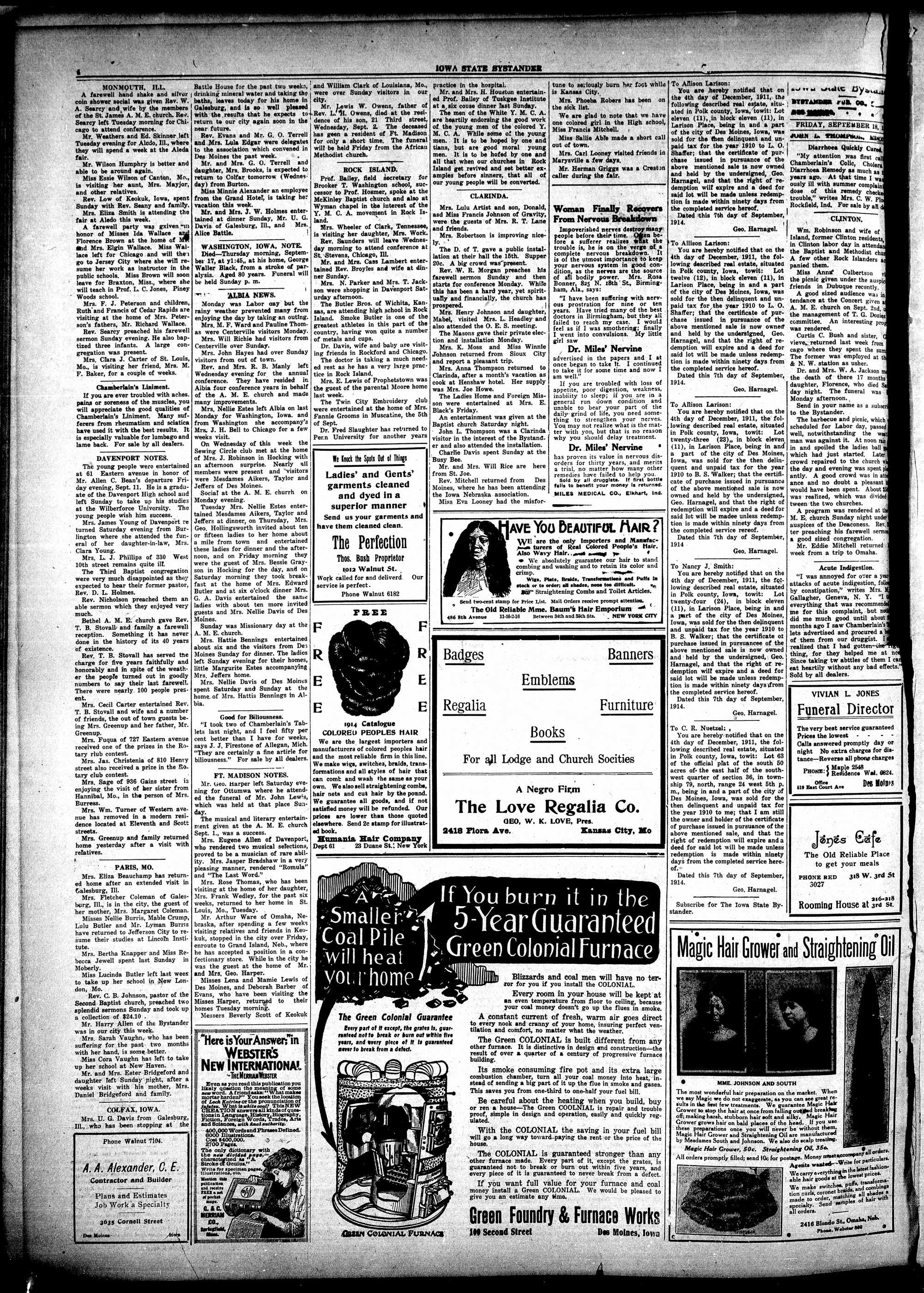
Page text (machine-generated)
IOWA STATE BYSTANDER.
State Capitol Blog Historical Room
10W
10W VOL. XXI NO. 13
CITY NEWS
Miss Carrie Watson entered the Des Moines college this week.
Mr. Ed Morton who has been ill is reported better at this writing.
Miss Bertha Lewis gave a theater party complimentary to Mrs. Beatrice Tatum of Dalton, Mo.
The Des Moines suffrage club will meet at the home of Mrs. Gus Watkins Friday evening at 8 o'clock.
Jeff Braden who received an injury to his eye is much improved, and has returned to his work on the Rock Island
Miss Marie Perkins left for her home in Buxton last Sunday, where she went to prepare for her return to Iowa State University.
Mrs. Isaac Morton and little daughter of St. Joseph, Mo., left Sunday A. M. after visiting friends and relatives. She may return later and open up a hair dressing parlor.
WANTED—First class barber, guarantee $12. L. J. Shelton, 6th and Mulberry.
Miss Maud Buckner of Kesauqua, Iowa, is visiting Mr. and Mrs. W. T. Buckner.
Mr. and Mrs. Linsey of Denver, Colo., are expected to arrive in the city soon to visit their daughter, Mrs. Archie Alexander.
Dr. Booker brought boys to Mrs. Wm. Wilkerson, 853 W. 13th st., Mrs. Gleny Martin 824 Park st. and Mrs. Arthur Turner, 920 12th.
Mr. Paul McCree, a student at Fisk University, who spent the summer here working in his brother's drug store, left this week to re-enter Fisk.
Mrs. Beatrice Tatum and baby left last Sunday night for their home in Dalton, Mo., after a pleasant stay of two weeks in this city with her aunts, Mrs. J. R. Erickson and Mrs. Harry Seymore.
Mr. and Mrs. Thomas Steele left for Terre Haute, Ind., Thursday. Mr. Steele has been head waiter at the Savery hotel for the past year. His successor is Mr. Claude A. Harris, one of our own young men.
Mr. R. N. Hyde arrived home Saturday from Norfolk, Va., where he attended a successful Grand Lodge meeting of the Elks. He also visited in Washington, D. C., New York City, Jersey City, Newark, Pittsburgh, Little Washington, Pa. and Chicago.
REMOVAL-J. Alvin Jefferson, M. D., announces the removal of his office from 774 9th street across to the new Thompson hotel, over the Model Drug Co. Telephone Walnut 1145.
We received notice of the death of Mrs. Anne Garrett's husband. Mrs. Garrett will be better known in Iowa as Mrs. Annie Jones of Albia. Her husband was killed in the discharge of his duty as constable at their home in Duman, Ill. Mrs. C. B. Woods and mother, Mrs. R. Jefferson left this week to attend the funeral.
Mrs. P. H. Hunter of 1402 Fremont street entertained as guests, Rev. Mitchell of Clarinda, Ia., Rev. Thomas of Maryville, Mo., Rev. R. P. Palmer and wife of Hawkeye, Rev. Jackson and wife of Mt. Pleasant, Mrs. Robinson Beadford, Ia., Mrs. I. Gibson of Clarinda, Ia., Mrs. A. W. Robinson of M. Pleasant. After a social time a dainty 6 course luncheon was served.
The Intellectual Improvement club met at the home of Mrs. S. Joe Brown, Friday afternoon, Sept. 11th. The club's representative to the National Association, Mrs. L. J. Edward, gave a full and interesting report which was supplemented by Mrs. Joe Brown with additional information. Mrs. Jessey E. McClain spoke on some causes of the European war. Mrs. Laura Smith of Chicago and Miss Emma Mitchell of Pomeroy, Ohio were present and made pleasing remarks. The next meeting will be held at the home of Mrs. Amos Adams when various phases of the war will be discussed by the members.
The Triple "H" club met at the home of Mrs. H. E. Jacobs. The meeting was opened with miscellaneous quotations. An excellent paper was read by Mrs. McDowell, subject "Women's Sphere." Miss Leffler gave an interesting talk on "The Germs as a Cause of Disease." After the question box and Critic's report Mrs. McDowell in a few well chosen words presented Miss Leffler, in behalf of the club, a quilt done in the club's colors, golden and white. Miss Leffler bade the club adieu until the meet in comp next sum-
mer.
tress.
Hon. Albert B. Cummins, U. S. senator of Iowa, arrived in our city last week to deliver a series of campaign speeches. Our distinguished senator is the picture of health and feeling well for the coming battle this fall for his re-election.
Now that the state fair is over and the hot summer weather is about through and the lake visitors and vacation season is over, the fall campaign will open in earnest shortly.
Mrs. F. P. Johnson entertained the members of the Intellectual Improvement club at breakfast last Wednesday, complimentary to Mrs. Smith, who is visiting her from Chicago. Mrs. Smith is prominent in secret society and is a member of the Baptist church.
John L. Thompson returned from a business trip in southern Iowa and northern Missouri last Saturday. He attended legal matter in Leon, Iowa, and reports lots of rain in that part of Iowa and Missouri.
Mr. Geo. H. Terrell of Colfax brought his daughter, Mrs. Brooks, to the hospital this week, who was shot at Buxton by her husband. She is resting well at present.
Several weeks ago we published, under the head, The Guests at the Thompson Hotel, the names of Mr. and Mrs. R. Oliver of Buxton as guests. It should have been only Mr. Oliver, for his wife was not here.
The home of Mr. and Mrs. Gus Watkins on Mondainn avenue was the scene of a large reception Sunday afternoon in honor of Mr. and Mrs. Wade Hampton McCree. Mesdanes V. T. Jones and Arthur Booker acted as parlor hostesses and introduced the guests to the receiving line, which was composed of Mr. and Mrs. McCree, Misses Iva McClain, Letta Carey, Mr. and Mrs. Archie Alexander and Prof. Lowry, former college associates of Mr. McCree, and the host and hostess. The dining room was in charge of the Misses Virginia Steele, Gertrude Hyde and Nelle Leftrage, who served refreshments from a prettily appointed table having as centerpiece a bowl of roses. The hours were from 2 until 8 o'clock and a most enjoyable time was had by those present.
There will be a special meeting of the City Literary Convention at the residence of Mrs. N. C. Marshall, W. Fourteenth and Day streets, to perfect final arrangements for the contests to be held at St. Paul's church on Monday, the 28th. All contestants are requested to be present with a copy of their manuscript to be placed in the hands of the judges for inspection.
CORINTHIAN BAPTIST CHURCH
Dr. Daniel Malekebu will spend next Sunday with Corinthian Baptist church He is the African native who delivered the Missionary address last Sunday afternoon. He will speak at length Sunday night. All invited. T. L. Griffith Minister.
Guests at The Thompson Hotel
Prof. Lovinggood, Austin, Texas; Mr. G. Ward, Callwell, Kans; Mr. Wm. White, Kansas, City, Mo.; Mr. F. H. Reed, Minneapolis, Minn.; Messrs Chas and Benjamin Byron, Chicago; Mr. and Mrs. Baker of Hot Springs, Ark., Mrs. L. Mitchell of Sioux Falls, S. D., Mr. Frank P. Satterfield of Philadelphia.
Whereas that inasitable and relentless monster death, has invaded our ranks and removed therefrom our beloved associate, Mrs. Mary L. Joyce of Cedar Rapids, Iowa, first vice-president of the Iowa State Federation of Colored Women's Clubs.
And whereas, Mrs. Joyce having heard humanity's Macedonian call, had eagerly allowed her sympathies to be enlisted, and had, dispute ill health of many months standing, responded right nobly to every endeavor advocated by the I. S. F. for "Lifting as We Climb"
Therefore, be it resolved that the I. S. F. of C. W. C. feel keenly the loss of this beautiful vital moving spirit, and co-incident with theirs, the J. S. Y. club of Cedar Rapids has lost a bright resourceful and progressive member, her church, a consistent christian, her home, a faithful loving patient and dependable soul, and her community a benign and wholly beneficent influence;
Be it further resolved, that from having known her worth, true womanliness and great usefulness, the I. S. F. of C. W. C. the more deeply sympathize with the bereaved family in the loss of this choice spirit and commend them to the justice and mercy of Him whose ways are inscrutable
Be it further resolved that a copy of these resolutions of condolence be sent the family, a copy sent to the Iowa State Bystander and one placed on the record of the Iowa State Federation of Colored Women's Clubs. Mrs. Jessev E. McClain, Secy. I. S. F. C. W. C., Mrs. Lilian Hamilton, Historian, Mrs. Harvey Brown, Edi-
(Corrected Statement.)
CITY CONVENTION
Resolution of Condolence
DES MOINES IOWA, FRIDAY, SEPTEMBER 18, 1914.
THE LYCEUM.
At the meeting of the Des Moines Negro Lyceum on Tuesday evening the present international conflict in the eastern hemisphere formed the topic of a general discussion, led by Atty. S. Joe Brown. Miss Iva McClain, who leaves this afternoon for Iowa City to continue her studies as a junior in the State university, was present and made her farewell address for the season. Misses Marie Bell, Edyth Jones and Lelia Smith were other visitors present. The next meeting will be with Miss Josie Roberts at 1051 Thirteenth street.
The Rev. B. U. Taylor, pastor, and H. Gould, district delegate, accompanied by their wives and Miss Susie Lee, left Tuesday evening for Chicago to attend the sessions of the Chicago conference of the A. M. E. church, which opened in St. Stephen's church in that city Wednesday morning. Rev. Taylor carried with him the best report ever sent from the local church, showing the church proper entirely free from debt, with fifty conversions and 120 accessions, raising the membership to 375. During the past year there has been raised $3,500 for local purposes and $160 in dollar money sent to the annual conference, hence the officials of the church have requested Rev. Taylor's return for another year, as they are confident that under his efficient leadership they shall be able to erect a new church edifice.
NEGRO SOLDIER'S VALOR IN
THE PRESENT WAR.
Below we publish a clipping sent us by an American white man which shows that all of our well wishers are not yet dead. So let my race work on doing their full duty and every time thinking men will honor and respect us.
Africans Fighting With the Allies Prove Too Much For the Germans.
Paris, Sept. 9.—A feature of Monday's action was another heroic charge by the Algerian riflemen. At a critical moment it became necessary to carry a certain position and after Δαμ αμ paυδαρ puq Δαμ αμ two thousand Algerians with fixed bayonet charged the position at double quick without flinching under the storm of shot and shell. They never stopped until they reached the trenches, where they wrought fearful carnage. Many pieces of artillery and machine guns were captured.
After the Algerians came the infantry and artillery and the wedge driven into the line forced the Germans to retreat. They were pursued by the same Algerians who inflicted terrible losses.
I wish you to publish it in The Bystander for the benefit of the colored race.
The Negro soldier is just as brave in the European war as he was in the American war. I think this is a great credit to the colored race. Another item I wish you to note. I read a piece a short time since, when the European war broke out. The flower of the German army, 7,000 men were marching in Germany, led by a Negro drum major who was born in the South African colonies. I consider that another great credit to the Negro race. You would not see anything like that in America. Here we have too much prejudice.
IOWA-NEBRASKA BAPTIST AS-
SOCIATION MEETING.
About eighty-five delegates attended the sessions of the Iowa-Nebraska Baptist Association held is this city last week. There were two delegates from Nebraska, the rest from Iowa. Three new churches were represented, from Waterloo, Cedar Rapids and Bear Creek. The meetings were very harmonious, and there was spiritual rejoicing from the beginning to the close. There were excellent sermons and addresses delivered. The missionary lectures by Mrs. T. L. Griffith delivered in the womens's convention attracted much attention. The sermons in the women's convention were delivered by Revs. J. H. Reynolds, G. W. Jackson, T. B. Woodard, V. S. Cooper, Rev. F. K. Nicholson and Dr. D. A. Holmes. The sermons in the associates were delivered by Revs. R. P. Palmer, J. W. Evans, R. C. Bolling, W. M. J. Northcross, W. F. Botts and Dr. G. P. Mitchell and Dr. M. Toomey, Dr. S. F. Wilcox and Mayor James R. Hanna delivered addresses.
The Sunday sermons were delivered by Revs. V. S. Cooper and J. M. Eaves and the missionary mass meeting was addressed by Dr. Daniel Malekebu of British Cestral Africa. The officers elected were: Of women's convention—President—Mrs. W. A. Brown, Buxton, Iowa.
First Vire President—Mrs. L. B. Burton, Omaha, Neb.
Second Vice President—Mrs. J. M.
Faxes, Mt. Pleasant, Iowa.
Bates, Recordings Secretary—Mrs. F. Bates, Des Moines, Iowa. Corresponding Secretary—Mrs. M. Tompkins, Centerville, Iowa. Treasurer—Mrs. James Bowles, Fort Madison, Iowa. Board members—Mrs. F. E. Render, Des Moines; Mrs. Lula Edgar, Colfax; Mrs. O. B. Smith, Oskaloosa. Of the association—Moderator—Rev. S. Bates, Des Moines, Iowa.
First Vice Moderator—Rev. W. F.
First Vice-Okawa, Neb.
The Street Railway Franchise Is Now Up to the People
The City Council has decided that the people shall pass on the franchise submitted by the Des Moines City Railway Company.
Therefore, it is up to the people to decide whether or not they want an adjustment of the street railway problem.
Des Moines is growing fast and will grow faster.
This development will be unchecked if the street railway improvements respond to the demand of the times.
With continued failure to have lines extended and service improved, the City must, in the end, suffer most.
The franchise extends for twenty-five years, and the company waives all claims to a perpetual franchise.
There will be a six-for-a-quarter fare immediately and a ten-for-a-quarter fare for children. High School pupils will also be carried for half fare.
This means an immediate saving in carfares of 20 per cent for adults and 50 per cent for children and High School pupils.
About eight miles of extensions will be built immediately for the people living in West Des Moines, South Des Moines and Highland Park.
New terminals for the Inter-Urban Railway Company will be constructed at Second Street and Grand Avenue.
The total cost of these improvements, exclusive of the Inter-Urban terminal, will be $1,500,000.
Forty per cent of this amount, $6000,000, will go to labor.
The people are guaranteed good service, for the regulation of the service lies entirely in the hands of two supervisors-one named by the City Council and the other by the Company. The City Council, therefore, has just as much to say about the service as the Company.
There will be no "watered" stocks or bonds because stocks cannot be sold for less than par and bonds cannot be sold for less than their market value. Then, too, all the proceeds must be used for additions, improvements and betterments of the property of the Company.
According to the terms of the ordinance all expenses of the special elections must be paid by this company.
The decision with regard to this franchise must be read by the people who should realize that if Des Moines is to go forward in development, it must have street railway service—and that it will have street railway service if this franchise is adopted.
Recording Secretary—Rev. T. L. Griffith, Des Mines, Iowa.
Corresponding Secretary—Rev. W. M. J. Northcross, Buxton, Iowa.
Treasurer—Rev. F. C. Bollisg, Enterprise, Iowa.
State Missionary—Rev. M. J. Bnrton, Keokok, Iowa.
Members Executive Board—Rev. F. B. Woodard, Buxton, Iowa; Rev. F. K. Nicholson, Davenport, Iowa; Rev. V. S. Cooper, Centerville, Iowa.
The following is the financial statement:
Received during year 1913-14 from all sources $1,818.54
Paid out during year for all objects 1,674.39
Balance on hand at beginning of session $144.15
Public collections association meeting 94.49
Received from church letters 239.46
Received from women's convention 114.29
Received from annual dues, etc. 6.50
Sums apportioned—
To the state work $310.18
To Nat. Baptist For. Mission Board 92.18
To Western College 75.00
To National Training School 23.27
To Amer. Baptist Home Mission Soc. 10.00
To National B. Y. P. U. board 5.00
To National Baptist Home Mission board 10.00
To Dr. Daniel Malekebu 10.00
Total $598.89
The association has paid its missionary, supported two missionary pastors, help being given in this work by the Iowa Baptist State Convention. The next session will be held in Davenport.
EDITOR'S OBSERVATIONS
Arriving in Creston on Monday, Labor day, we found the people paying but little attention to Labor day and working the same as any other day. Even the children were going to school. Creston is a beautifully located little town of about 9,000 people, with only a few colored people. Mr. C. F. Burnaigh, the veteran hotel man, who has been at the Summit hotel for more than a quarter of a century, is still with them and doing well. He has a beautiful home ans it is well kept. Ye Editor took dinner with his family. Mr. Marton, 516 Wyoming street, owns nice property and it is crowded with fruit trees that are bearing. Mr. Marton is an old settler here and well liked. The Baldwin brothers live about two miles out of town and are still farming. They have under their control about 500 acres of land. Their crops this year are doing fine and their farm is well stocked with the
The Street Is Now
The City Council has de
DES MOINES CITY RAILWAY, By En G. Schmidt, President.
best breed of cattle, horses and hogs and they ship their stock direct to Chicago. They are the most progressive farmers in Iowa that I know of and they have been on this farm about fourteen years.
We next stopped at Clarinda. Here we found about 600 colored people in Page county. Some are farming and doing well. The Johnson brothers at Gravity are leading farmers here. They each own eighty acres of land. W. H. Johnson is a rural mail carrier and has been on that route for ten or more years and his wife is his deputy. His only son, Fred, is also a mail carrier and he has recently taken unto himself a wife, Miss Daisy Clay of Des Moines. They have recently built a new house in Gravity and will soon be installed. Mr. Richard Johnson owns a barber and valuable property in Gravity and has a lovely family. Some are in school and some have finished. Richard is doing well and is well liked by the people here. In Clarinda we found Mr. Wm. Headley still driving the ice wagon, a very responsible position. Mr. Headley's one of our leading citizens and well liked here. He owns a nice home. Mr. Joe Jones also owns a nice home and is working at the same place. Mr. H. H. Cook owns a grocery store and is still working at that. He is a good business man. Mr. R. T. Lane has recently built a new restaurant and rooming house near the depot and is doing well. We had a pleasant visit with C. F. Davis at the hospital, who is almost well. He will leave the Monday, September 14, to go to his home in Council Bluffs. The churches are doing nicely here. Rev. W. R. Mitchell is charge of the Baptist church and Rev. N. P. Morgan is holding the fort for the Methodist church. They both are experienced and good ministers. Mr. Allen Jones, who has lived here for
many years and worked in the blacksmith shop, has moved to Omaha and gone into the undertaking business with Mr. Obee as a partner. He has not sold his beautiful home, but has rented out. Joe Howe is making the fairs with his racing steed. Mr. Nowling, Mr. Montgomery and Mr. Pemberton are working at the same place and are coming citizens. Noah Pemberton is on the mail force. Dr. Gibson is still practicing veterinary and has a good trade. R. D. Black is one of the coming young men here and is well liked. They have a splendid Dasonic lodge here and an Eastern Star. The lodge was just consecrated and the newly elected officers were installed under the supervision of the grand master.
We next wandered into Red Oak and found the people about as usual. Mr. Oscar Conner is still in the barber shop business, where he has been for more than a quarter of a century. His health is somewhat improved. Mr. Wm. Hampton, the veteran U. S.
LETTER NO.1.
court bailiff, lives here and is doing well. Judge Smith McPherson is sick here. Mr. Pearl S. Everhart is still running the piano and music store. He has the distinction of being the only colored man in Iowa who owns and conducts a first class piano and music store. He is doing well and has been in business here for the past fifteen years or more. The peculiar thing about Pearl is that he is still single. We wonder why some of our girls do not look in that directions. Mr. C. W. Chappel is working at the hotel and David Connor is living here and doing well. He owns some valuable property and is a hustling young man. H. S. Martin is still working in the barber shop, as is also James Fisher and A. W. Jones. This town has no colored churches, but they are now trying to establish an A. M. E. mission. Rev. A. M. Campbell is here on the field working toward that end.
We next found ourselves in St. Joseph, Mo. Here we stopped with Dr. E. W. Thompson, a former popular Iowa young man, who graduated from the University of Iowa, and is located in the drug store in this city. Mr. Thompson is doing well and is well thought of here, and it is no doubt a pleasure for his many friends in Iowa to know of his success down in "Show Me" state. R. P. Behesars, also a graduate of the State University of Iowa, has a nice dental parlor here. There are four colored doctors here, namely, Dr. J. A. R. Crossland, Dr. M. O. Rickett, Dr. F. M. Goodson, and I do not recall the name of the other doctor. They each seem to have sufficient practice and are doing well. Mr. G. W. Walker is still in the restaurant and confectionery business at N. Third street. He is not only a business man, but a real race man. Mme. M. Beard is developing a hair dressing establishment in this city. Mr. Madison, who formerly worked in a barber shop in this city, is working here in the Elks bar shop. Mrs. Alice P. McGauh is still living at 2805 Mary Street. She formerly lived in Bethany, Mo. Mr. R. L. Scott, Prof. B. T. Perkins, Prof. Sims, W. H. Jones and Prof. Endicott are some of the leading men of this town. Each of them own beautiful homes and stand for something in this city. The churches are doing as well as could be expected. As we receive regular weekly letters from St. Joseph we will not give any more of our people in detail.
Chamberlain's Colic, Cholera and Diarrhoea Remedy.
"Ladvised the 'boys' when they enlisted for the Spanish war to take Chamberlain's Colic, Cholera and Diarrhoea Remedy with them, and have received many thanks for the advice given," writes J. H. Houghland, Eldon, Iowa. "No person, whether traveling or at home, should be without this great remedy." For sale by all dealers.
---
Price Five Cents
McCREE-HARPER NUPTIALS.
A Beautiful Wedding.
Mr. Wade H. McCree of this city and Miss Lulu Harper of Boston, Mass, were married at the home of the bride's parents, Mr. and Mrs. H. J. Harper, 81 Brunswick street, Boston, Mass, Wednesday evening, September 9th. The Rev. Mr. De Perry of Springfield, Mass, performing the ceremony is the presence of seventy-five guests.
The service took place in the parlor under a large arch, covered with autumn leaves and smilax. The bridal party was composed of Mr. Daggett and Mr. Clyde Glass of Des Moines, ushers; Mr. Robinson of New York City, best man; Miss M. Johnson of Raleigh, N. C., maid of honor; Miss Helen Grey of Springfield, Mass, bridesmaid. The bridal party took their places while the wedding march was being charmingly played by Mr. Charles Harris. Just before the ceremony Mr. Robert W. Hayes sang "O Promise Me."
The bride was handsomely dressed in white satin, with an overdress of Bohemian lace, and wore a veil. She wore a wreath of roses in her hair and carried a beautiful bouquet.
Immediately after congratulations a dainty two-course luncheon was served.
Mr. and Mrs. McCree departed Thursday morning for the groom's home in Des Moines, Iowa.
Mr. McCree has made his home in Des Moines for the past year. He is a graduate of Fisk university and Iowa university and is one of our enterprising young business men, whom everyone greatly admires. His bride is a very amiable young woman and one of Boston's society leaders. She is also a graduate or Fisk university and for the past three years has been teaching school in Alabama. We wish for Mr. and Mrs. McCree much prosperity and unbounded success down through the voyage of life.
SIOUX CITY.
The Ladies' Aid society of M. Zion Baptist church will give a "Mum Social" at the Odd Fellows' hall this Thursday evening, under the auspices of Mrs. Ella Walker.
Mrs. J.W. Morris left Tuesday for her home in Chicago, after having visited indefinitely in the city with her daughter, Mrs. C. A. Gross.
Miss Hester Allison entertained a company of friends at a 7 o'clock dinner and an Orpheum party last Friday evening.
Rev. J. H. Garrison departed Tuesday for Chicago to attend the Annual Conference, after completing a splendid and successful year's work. Rev. J. W. Dowden also left to attend the conference.
Miss Mabel Morgan leaves Wednesday for Iowa City to resume her studies at the university.
Mrs. Mildred Harper, a teacher in the schools of Nowata, Okla., departed Friday to take up her duties.
Rev. R. L. Knight will fill the pituit at the A. M. E. church Snuday evening.
Madam Anita Patti Brown will appear in a recital at the Whitfield M. E. church Tuesday, Sept. 29, 1914, for the benefit of the A. M. E. church, Admission, 50 cents.
Duluth Minn, Sept 1.—Mr. Thaddeus W. Stepp and and Mrs. Emma Harden of St. Paul were married at the home of Rev. McDowell at noon to day. The bride is highly esteemed in St. Paul's 400. Mr. Stepp formerly lived in Des Moines.
MARSHALLTOWN ITEMS.
Mr. I. L. Brown is working at the county fair as keeper of the exhibit hall. He has been elected for three terms.
Mrs. Helen Waller McAllister and children, Helen and John, spent the day in the city enroute for St. Joe for a two weeks' visit with relatives.
Mr. and Mrs. Spencer Simmons are nicely settled in their home on North Eighth avenue.
Rev. and Mrs. Roman and son, Theodore, returned home Saturday from Des Moines from attending the Baptist association. Mrs. Thomas Lowery also attended.
Mr. and Mrs. John Watters left for Des Moines to stay several months and from there will visit in the south.
Mr. Robertson has had quite an attack of bronchitis, but is improved at this writing.
Miss Delia Howard of Davenport and Mrs. Lillian Taylor of Mason City, sister and sister-in-law of Mrs. Geo. Suter, were is the city last week, owing to Mrs. Suter's severe illness. Mrs. Suter is improved at this writing.
Mr. Spencer Simmons, Misses Iva Roman, Sarah Johnson, Nellie Jackson, Geo. Jackson and John Waters, all attended state fair last week.
Mr. Robinson of Des Moines last week, while in the city she was the guest of her son, Mr. Herman Ston
Best Treatment for a Burn.
If for no other reason Chamberlain's Salve should be kept in every household on account of its great value in the treatment of burns. It allays the pain almost instantly, and unless the injury is a severe one, heals the parts without leaving a scar. This salve is also unequaled for chapped hands, sore nipples and diseases of the skin. Prire, 25 cents. For sale by all dealers.
ee ee ee.. Seewe UCAS
Koom
\ ) e.
3 ee > -— vie
rn
( ; ;
VOL. XXI'NO. 13 DES MOINES IOWA, FRIDAY, SEPTEMBER 18, 1914, Price Five Cents
I
SSS eee eee
atten nnn, | Hon, Albert B, Cummins, U.S. THE LYCEUM, | _ Recording Secretary—Rev. T. L.| best breed of cattle, horses and hogs | court bailiff, lives here and is doing | _McCREE-HARPER NUPTIALS
1 | senator of Iowa, arrived in our city| At the meeting of the Des Moines Griffith, Des Moines, Iowa. and they ship their stock direct to| well, Judge Smith McPherson is pikes
{eb . ; [last week to deliver a series of cam-| Negro Lyceum on Tuesday evening | Corresponding Secretary—Rev. W.| Chicago, They are the most progres- | sick here. Mr. Pearl 8. Everhart is A Beautiful Wedding.
{ Paign speeches. Our distinguished | the present international conflict in| M. J. Northcross, Buxton, fowa. sive farmers in Iowa that I know of |still running the piano and music —
— senator is the picture of health and|the eastern hemisphere formed the ‘Treasurer—Rev. F, C. Bollisg, En-| and they have been on this farm |store. He has the distinction of being Mr. Wade H, McCree of this
—~—_ spa, | feeling well for the coming battle this | topic of a general discussion, led by | terprise, Iowa. about fourteen years. the only colored man in Iowa who|and Miss Lulu Harper of Bost
Miss Carrio Watson entered the Des! fait for his re-election. Atty. S. Joe Brown. Miss Iva Mc-] State Missionary—Rev. M. J. Bnr-| We next stopped at Clarinda, Here | owns and conducts a first class piano| Mass,, were married at the home
Moines college this week. ———— Clain, who leaves this afternoon for | ton, Keokok, Iowa. ‘we found about 600 colored people m| and music store, He is doing well| the bride’s parents, Mr. and M
———- Now that the state fair is over and | Iowa City to continue her studies as| Members Executive Board—Rev. | Page county. Some are farming and | and has been in business here for the|H. J. Harper, 81 Brunswick stre
Mr. Ed Morton who has been ill is| the hot summer weather is about| a junior in the State university, was | F, B. Woodard, Buxton, Iowa; Rev. | doing well. The Johnson brothers at | past fifteen years or more, The pe-| Boston, Mass, Wednesday oveni
reported better at this writing. through and the lake visitors and va- | present and made her farewell ad-|F. K, Nicholson, Davenport, Iowa;| Gravity are leading farmers here. | culiar thing about Pearl is that he| September 9th. The Rev. Mr.
—_—_————_ cation seagon is over, the fall cam-| dress for the season, Misges Marie | Rev. V. S. Cooper, Centerville, lowa. | They each own eighty acres of land. | is still single. We wonder why some | Perry of Springfield, Mass., perfer
Miss Bertha Lewis gave a theater paign will open in earnest shortly. Bell, Edyth Jones and Lelia Smith ‘The following is the financial state- | W. H. Johnson is a rural mail carrier of our girls do not look in that direc-| ing the ceremony is the presence
_—— were other visitors present, The next | ment: and has been on that route for ten| tios. Mr. C. W. Chappel is working | seventy-five guests,
party complimentary to Mrs, Beatrice! 41,. fp. Johnson entertained the | meeting will be with Miss Josie Rob- | Received during year 1913-14 or more years and his wife is his|at the hotel and David Connor 18] ‘The service took place in the p
‘Tatum of Dalton, Mo. members of the Intellectual Improve. | eits at 1051 Thirteenth street. from all sources ............$1,818.54| deputy. His only son, Fred, is also| living here and doing well. He| lor under a large arch, covered w
—___—_—_ ment efub at breakfast last Wednes- ea eee Paid out during year for all a mail carrier and he has recently | owns some valuable property and is| autumn leaves and smilax. 1
‘The Dea Moines suffrage club willl day, complimentary to Mrs, Smith, | The Rev. B. U. Taylor, pastor, and| objettS ascsunnmmenr nme 1,674.99] taken unto himself a wife, Miss | a hustling young man, H. S. Mar-| bridal party was composed of |}
meet at the home of Mrs, Gus Watkins’ who is visiting her from Chicago. | H. Gould, district delegate, accompan- _ =] Daisy Clay of Deg Moines. They | tin is still working in the barber| Daggett and Mr. Clyde Glass of
Priday evening at So'clock, { Mrs. Smith is prominent in secret so. | ied by their wives and Miss Susie | Balance on hand at begin. | have recently built a new house tn| shop, as is also James Fisher and A. | Moines, ushers; Mr. Robinson of N
Jeff Braden who received an injury
to his eye is much improved, and has
returned to his work on the Rock Island
Mise Marie Perkins left forher home
in Buxton last Sunday, where she went
to prepare for her return to Iowa State
University.
Mra. Isaac Morton and little daughter
of St, Josepeh, Mo., left Sunday A. M.
after visiting friends and relatives.
She may return later and open up a
hair dressing parlor.
WANTE)—First class barber, guar-
antee $12. L. J. Shelton, 6th and Mul-
berry:
Miss Maud Buckner of Keosauqua,
Iowa, is visiting Mr. and Mrs. W. T.
Buckner,
Mr. and Mrs. Linsey of Denver,
Colo. are expected to arrive in the
city soon to visit their daughter, Mrs.
Archie Alexander,
Dr, Booker brought boys to Mrs.
Wm, Wilkeroon, 858 W. 13th st.. Mrs,
Gleny Martin 824 Park st. and Mrs,
Arthur Turner, 920 12th.
Mr. Paul McCree, a student at Fisk
University, who spent the summer here
working in his brother's drug store,
left this week to re-enter Fisk.
Mrs. Beatrice Tatum and baby left
last Sunday night for their home in
Dalton, Mo,. after a pleasant stay of
“two weeks in this city with her aunts,
Mra, J. R. Erickson and Mrs. Harry
Seymore.
Mr. and Mre., Thomas Steele left for
‘Terre Haute, ind, Thursday. Mr.
Steele has been head waiter at the
Savery hotel for the past year. His
successor is Mr. Claude A, Harris, one
of our own young men.
Mr. R, N. Hyde arrived home Setur-
day from Norfolk, Va., where he at-
tended a successful Grand Lodge meet-
ing of the Elke. He also visited in
Washington, D. C., New York City,
Jersey City, Newark, Pittsburg, Little
Washington, Pa, and Chicago.
REMOVAL-J, Alvin Jefferson, M.
D., announces the remousl of his office
from 774.9th street across to the new
‘Thompson hotel, over the Model Drug
Co. Telephone Walnut 1145.
We received notice of the death of
Mrs, Anne Garrett's husband, Mrs.
Garrett will be better known in lows
as Mra. Annie Jones of Albia. Her
husband was killed in the discharge of
his duty as constable at their home in
Duman, Ill, Mrs. C. B, Woods and
mother, Mrs, R, Jefferson left this
week to attend the fundral.
Mrs, P. H. Hunter of 1402 Fremont
street entertained as guests, Rev.
Mitchell of Clarinda, Ia., Rev. Thomas
of Maryville, Mo,, Rev. R. P. Palmer
and wife of Hawkeye, Rev. Jackson
and wife of Mt. Pleasant, Mrs. Robin-
son Beadford, Ia, Mrs. I. Gibson of
ede Ia., Mrs. A. W. Robinson of
Ik: Pleasant, After a social time a
dainty 6 course Juncheon was served.
‘The an Improvement club
‘met at thahome of Mra S. Joe Brown,
Friday afternoon, Sept. llth, The
clab’s repretentative to the National
Association, Mrs, L. J, Edward, gave
a fall and interésting report which was
supplemented by Mrs. Joe Brown with
additional informayon, Mrs. Jessye
E. McClain spoke ofeome causes of
the European war. Mrs, Laura Smith
of Chicago and Miss Eta Mitchell of
Pomeroy, Ohio were present and made
plessing remarks, ‘The next) meeting
will be held at the home of Mrs, Amos
‘Adams when various phases of the
war will be discussed by the members,
The Triple“ club met at the home
of Mrs. H. E. Jacobs. . The meeting
‘was opened with’ miscellaneous quota-
tions, An excellent paper was read by
‘Mre, McDowell, subject ‘‘Women’s
Sphere.” Mise Leffler gave an inter-
esting talk on ‘The Germs as a Cause
of Disease."” After the question box
8nd Critic’s report Mrs. McDowell in
@ few well chosen words presented
‘Misi Leffier, in betalf of the club, a
quilt done in the club’s colore, golden
‘and white, Miss Leffler bade the club
‘adien until the meet in comp next sum-
mer,
Hon. Albert B, Cummins, U. S.
senator of Iowa, arrived in our city
last week to deliver @ series of cam-
jpaign speeches. Our distinguished
senator is the picture of health and
feeling well for the coming battle this
fall for his re-election.
Now that the state fair is over and
the hot summer weather is about
through and the lake visitors and va-
cation season is over, the fall cam-
paign will open in earnest shortly.
Mrs. F. P. Johnson entertained the
members of the Intellectual Improve-
‘ment club at breakfast last Wednes-
day, complimentary to Mrs, Smith,
‘who is visiting her from Chicago.
Mrs. Smith is prominent in secret so-
ciety and is a member of the Baptist
church,
, John L. Thompson returned from
a business trip in southern Iowa and
northern Missouri last Saturday. He
attended legal matter in Leon, Towa,
and reports lots of rain in that part
of Iowa and Missouri,
Mr. Geo, H. Terrell of Colfax
brought his daughter, Mrs, Brooks, to
the hospital this week, who was shot
at Buxton by her husband. She is
resting well at present.
/Pimaastan Diabement >
Several weeks ago we published,
urder the head, The Guests at the
Thompson Hotel, the names of Mr.
and Mrs. R. Oliver of Buxton as
guests. It should have been only Mr.
Oliver, for his wife was not here.
The home of Mr. and Mrs. Gus
Watkins on Mondamin avenue was
the scene of a large reception Sunday
afternoon in honor of Mr. and Mrs.
Wade Hampton McCree. Mesdames
V. T. Jones and Arthur Booker acted
as parlor hostesses and introduced
the guests to the receiving line, which
was composed of Mr. and Mrs. Me-
Cree, Misses Iva McClain, Letta
Carey, Mr. and Mrs. Archie Alex-
ander and Prof, Lowry, former col-
lege associates of Mr. McCree, and
the host and hostess. ‘The dining
room was in charge of the Misses
Virginia Steele, Gertrude Hyde and
Nelle Leftrage, who served refresh-
ments from a prettily appointed table
having as centerpiece a ‘bowl of roses.
‘The hours were from 2 until 8 o'clock
and a most enjoyable time was had by
those present.
CITY CONVENTION.
There will be a special meeting oF
the City Literary Convention at the
residence of Mrs. N. C. Marshall, W.
Fourteenth and Day streets, to per-
fect final arrangements for the con-
tects to be held at St. Paul’s church
on Monday, the 28th. All contestants
‘are requested to be present with a
‘copy of their manuscript to be placed
in the hands of the judges for inspec-
ticn.
CORINTEIAN BAPTIST CHURCH
Dr. Daniel Malekebu will spend next
‘Sunday with Corinthian Baptist church
He isthe African native who delivered
the Missionary address last Sunday
afternoon. He will speak at length
Sunday night.
Allinvited.
T. L Griffith Minister.
qa
Guests at The Thompson Hotel
Prof. Lovinggood, Austin, Texas;
Mr. G. Ward, Callwell, Kans; Mr. Wm.
White, Kansas, City, Mo.; Mr. F. i.
Reed, Minneapolis, Minn.; Messrs Chas
and Benjamin Byron, Chicago. ‘Mr. and
Mrs, Baker of Hot Springs, Ark., Mrs.
L, Mitchell of Sioux Falls, S. D., Mr.
Frank P. Satterfield of Philadelphia.
Resolution of Condolence
Whereas that insatiable and rejent-
less monster death, has inyaded our
ranks and removed therefrom our be-
loved associate, Mrs. Mary L. Joyee of
Cedar Rapids, Iowa, first vice-presi-
dent of the Iowa State Federation of
Colored Women’s Clubs,
‘And whereas, Mrs. Joyce having
heard humanity's Macedonian call, had
eagerly allowed her sympathies to be
enlisted, and had, dispite ill health of
many months standing, responded right
nobly to every endeavor advocated by
the I. S, F. for ‘Lifting as We Climb”
‘Therefore, be it resolved that the I.
S F. of C. W. G, feel keenly the loss
of this beautiful vital moving spirit,
and co-ineident with theirs, the J. S.
¥. club of Cedar Rapids has lost
bright resourceful and progressive
member, her church, a consistent chris-
tian, her home, a faichful loving patient
and dependable sou!, and her communi-
ty abenign and wholly beneficent in-
fluence;
Be it further resolved, that from
having known her worth, true woman-
Jiness and great usefulness, the I S.
F. of C. W. C. the more deeply sympa-
thize with the bereaved family in the
loss of this choice spirit’ and commend
them to the justice and merey of Him
whose ways are inscrutable
Be it further resolved that a copy of
these resolutions of condolence be sent
the family, a copy sent to the fowa
State Bystander and one placed on the
record of ths Iowa State Federation of
Colored Women's Clubs
Mrs. Jeesve E, MeClain, Seey. 1. S.
F.G. W. Ca Mrs. Liian Hamilton,
Historian, Mrs,, Harvey. Brown, Edi-
Pebhal ey we
THE LYCEUM,
At the meeting of the Des Moines
Negro Lyceum on Tuesday evening
the present international conflict. in
the eastern hemisphere formed the
topic of a general discussion, led by
Atty. S. Joe Brown, Miss Iva Me-
Clain, who leaves this afternoon for
Towa City to continue her studies as
a junior in the State university, was
present and made her farewell ad-
dress for the season, Misses Marie
Bell, Edyth Jones and Lelia Smith
were other visitors present. The next
meeting will be with Miss Josie Rob-
erts at 1051 Thirteenth street.
The Rev. B. U. Taylor, pastor, and
H. Gould, district delegate, accompan-
ied by their wives and Miss Susie
Lee, left Tuesday evening for Chi-
cago to attend the sessions of the
Chicago conference of the A. M. E.
church, which opened in St. Stephen’s
church in that city Wednesday morn-
ing. Rev. Taylor carried with him
the best report ever sent from the
local church, showing the church
proper entirely free from debt, with
fifty conversions and 120 accessions,
raising the membership to 375. Dur-
ing the past year there has been
raised $3,500 for local purposes and
$160 in dollar money sent to the an-
nual conference, hence the officials of
the church have requested Rev. Tay-
lor's return for another year, as they
are confident that under his efficient
leadership they shall be able to erect
a new church edifice.
NEGRO SOLDIER'S VALOR IN
‘THE PRESENT WAR.
Below we publish a clipping sent us
by an American white man which
shows that all of our well wishers are
not yet dead, So let my race work
on doing their full duty and every
time thinking men will honor and re-
spect us.
‘Africans Fighting With the Allies
Prove Too Much For the Ger-
mans.
Paris, Sept. 9.—A feature of Mon-
day’s action was another heroic
charge by the Algerian riflemen. At
a critical moment it became necessary
to carry a certain position and after
fem ouj parederd poy Arle oy
two thousand Algerians with fixed
bayonet charged the position at dou-
ble quick without flinching under tho
storm of shot and shell. They never
stopped until they reached the trench-
es, where they wrought fearful car-
nage... Many, pieces of artillery and
machine guns were ‘captured.
‘After the Algerians came the in-
fantry and artillery and the wedge
driven into the line forced the Ger-
mans to retreat. They were pursued
by the same Algerians who inflicted
terrible losses.
J wish you to publish it in The By-
stander for the benefit of the colored
race.
‘The Negro soldier is just as brave
in the European war as he was in
the American war. I think this is a
great credit to the colored race, An-
other item I wish you to note. I
read a piece a short time since, when
the European war broke out. ‘The
flower of the German army, 7,000 men
were marching in Germany, led by a
Negro drum major who was born in
the South African colonies, T con-
sider that another great credit to the
Negro race. You would not see any-
thing like that in America. Here we
‘unve too much prejudice.
IOWA-NEBRASKA BAPTIST AS:
SOCIATION MEETING.
About eighty-five delegates attent-
‘ed the sessions of the Iowa-Nebraska
Baptist Association held is this city
last week. ‘There were two delegates
from Nebraska, the rest from Towa.
‘Three new churches were represented,
from Waterloo, Cedar Rapids and
Bear Creek. The meetings were very
harmonious, and there was spiritual
rejoicing from the beginning to the
close. There were excellent sermons
‘and addresses delivered. ‘The mis-
sionary lectures by Mrs, T. L. Grif-
fith delivered in the womes’s Ionven-
tion attracted much attention, ‘The
sermons in the women’s convention
were: delivered by Revs. J. H. Rey-
nolds, G. W. Jackson, ‘T, B, Woodard,
V. S. Cooper, Rev. P. K, Nicholson
and Dr. D. A. Holmes. ‘The sermons
in the associatios were delivered by
Revs. R. P, Palmer, J. W, Evans, >.
C. Bolling, W. M. J, Northeross, W.
F. Botts and Dr. G. P. Mitchell ana
Rev. M, Toomey, Dr. S. F. Wilcox
‘and Mayor James ‘R. Hanna delivered
addresses.
The Sunday sermons were delivered
by Revs. V. S, Cooper and J. M.
Eaves and the missionary mass meet-
ing was addressed by Dr, Daniel
Malekebu of British Cestral Africa,
‘The officers elected were:
Of women’s convention—
President—Mrs. W. A. Brown, Bux-
ton, Towa. ae
First Vire President—Mrs, Ly B-
Burton, Omaha, Neb.
‘Second Vice President—Mrs, J. M.
Eaves, Mt, Pleasant, Iowa.
Recording _Secretary—Mrs.F.
Bates, Des Moines,-Iowa,
Correspondisg Secretary—Mrs. M.
J. Tompkins, Centerville, Towa.
Treasurer-—Mrs. James Bowles,
Fort Madison, Towa,
‘Board members—Mrs, F. E. Ren-
der, Des Moines; Mrs. Lula Edgar,
Colfax; Mrs. 0. B, Smith, Oskaloosa.
Of the association—
Moderator—Rev. §. Bates, Des
Moines, Iowa. |
First’ Vice Moderator—Rev. W. F.
Botts, Omaha, Neb.
‘Second Vice Moderator—Rev, Jas:
Bowles, Fort Madison, Iowa.
The Street Railway Franchise
Is Now Up to the People
The City Council has decided that the people shall pass on the franchise sub-
mitted by the Des Moines City Railway Company.
Therefore, it is up to the people to decide whether or not they want an ad-
justment of the street railway problem.
Des Moines is growing fast and will grow faster.
This development will be unchecked if the street railway improvements re-
spond to the demand of the times.
With continued failure to have lines extended and service improved, the City
must, in the end, suffer most.
The franchise extends for twenty-five years, and the company waives all
claims to a perpetual franchise.
There will be a six-for-a-quarter fare immediately and a_ ten-for-a-quarter
fare for children. High School pupils will also be carried for half fare.
‘This means an immediate saving in carfares of 20 per cent for adults and 50
per cent for children and High School pupils.
About eight miles of extensions will be built immediately for the people living
in West Des Moines, South Des Moines and Highland Park.
New terminals for the Inter-Urban Railway Company will be constructed at
Second Street and Grand Avenue.
The total cost of these improvements, exclusive of the Inter-Urban terminal,
will be $1,500,000.
Forty per cent of this amount, $6000,000, will go to labor. 7
The people are guaranteed good service, for the regulation of the service
lies entirely in the hands of two su peryisors—one named by the City
Council and the other by the Company, :
The City Council, therefore, has just as much to say about the service as the
Company. .
There will be no “watered” stocks or bonds because stocks cannot be sold for
Jess than par and bonds cannot be sold for less than their market value,
Then, too, all the proceeds must be used for additions, improvements and
betterments of the property of the Company.
‘According to the terms of the ordinance all expenses of the special elections
must be paid by this company.
The decision with regard to this franchise must be reached by the people who
should realize that if Des Moines is to go forward in development, it must
have street railway service—and that it will have street railway service
if this franchise is adopted.
DES MOINES CITY RAILWAY, . an
By Emil G, Schmidt, President,
Recording Secretary—Rev. T. L.
Griffith, Des Moines, Iowa.
Corresponding Secretary—Rev, W.
M. J. Northcross, Buxton, lowa.
‘Treasurer—Rev. F. C. Bollisg, En-
terprise, Iowa.
State Missionary—Rev. M. J. Bnr-
ton, Keokok, Iowa.
Members ‘Executive Board—Rev.
F, B, Woodard, Buxton, Iowa; Rev.
F._K, Nicholson, Davenport, Towa;
Rev. V. S. Cooper, Centerville, Iowa,
‘The following is the financial state.
ment:
Received during year 1913-14
from all SOUPCES ...0r.«.. $1,818.54
Paid out during year for all
bles: ac eT
Balance on hand at begin-
ning Of SCS$I0N wren $ 14416
Public collections association
MEINE vecennronenn —_ EAD
Received from church letters 239.46
Receivedfrom women’s con-
VENOM never ove 114,29
Heceived from annual dues,
Ge siren O80
‘Sums apportioned—
To the state work ..... $310.18
To Nat. Baptist For, Mission
Board cocccccecccsreensenreennne — 9218
To Western College .............._ 75.00
To National Training Schoot 23.27
To Amer. Baptist Home Mis-
SHON SOCF ceeicerseenesinnernne 10,00
To National B. Y. P. U.
Lo ee “ 5.00
‘To National Baptist. Home
Mission board... 10.00
To Dr. Daniel Malekebu.... 10.00
Total ceccscssceersscserenneens 598.89
The association has paid its mis-
sionary, supported two missionary
pastors, help being given in this
work by the Iowa Baptist State Con-
vention, :
‘The next session will be held in
Davenport,
EDITOR'S OBSERVATIONS.
By John L. Thompson.
Arriving in Creston on Monday,
Labor day, we found the people pay-
ing but little attention to Labor day
and working the same as any other
day. Even the children were going
to school. Creston is a beautifully
located little town of about 9,000
people, with only a few colored peo-
ple. Mr. C. F, Burnaugh, the veter-
an hotel man, who has been at the
Summit hotel for more than a quar-
ter of a century, is still with them
and doing well. -Hechas a beautiful
home ans it is well kept. Ye Editor
took dinner with his family. Mr.
Marton, 516 Wyoming street, owns
nice property and it is crowded with
fruit trees that are bearing. Mr.
Marton is an old settler here and well
liked, The Baldwin brothers live
about two miles out of town and are
still farming. They have under their
control about 500 acres of land. Their
crops this year are doing fine and
their farm is well stocked with the
best breed of cattle, horses and hogs
and they ship their stock direct to
Chicago, They are the most progres-
sive farmers in Iowa that I know of
and they have been on this farm
about fourteen years,
We next stopped at Clarinda, Here
‘we found about 600 colored people m
Page county. Some are farming and
doing well. The Johnson brothers at
Gravity are leading farmers here.
They each own eighty acres of land.
W. H. Johnson is a rural mail carrier
and has been on that route for ten
or more years and his wife is his
deputy. His only son, Fred, is also
a mail carrier and he has recently
taken unto himself a wife, Miss
Daisy Clay of Deq Moines. | They
have recently built a new house in
Gravity and will soon be installed.
Mr. Richard Johsson owns a barber
shop and valuable property in Grav-
ity and has a lovely family. Some
are in school and some have finished.
Richard is doing well and is well
liked by the people here. In Clarinda
we found Mr, Wm. Headley still
driving the ice wagon, a very re-
sponsible position, Mr. Headley ‘s
one of our leading citizens and well
liked here. He owns a nice home.
Mr. Joe Jones also owns a nice home
and is working at the same place.
Mr. H. H. Cook owns a grocery store
and is still working at that. He is
fa good business man. Mr. R. T, Lane
has recently built a new restaurast
and rooming house near the depot
and is doing well. We had a pleas-
ant visit with C. F, Davis at the hos-
pital, who is almost well. He will
Teave there Monday, September 14,
to go to his home in Council Blufts,
‘The churches are doing nicely here.
Rev. W. R. Mitchell has charge of
the Baptist church and Rev. N, P.
Morgan is holding the fort for the
Methodist church. They both are ex-
perienced asd good ministers. Mr.
Allen Jones, who has lived here for
many years and worked in the black-
smith shop, has moved to Omaha and
‘gone into the undertaking business
with Mx, Obee as a partner. He has
‘not sold his beautiful home, but has
rented out. Joe Howe is making
the fairs with his racing steed. Mr.
Nowling, Mr. Montgomery and Mr.
Pemberton are working at the same
‘place and are coming citizens. Noah
Pemberton is on the mail force. Dr.
Gibson is still practicing veterinary
and has a good trade. R. D, Black is
one of the coming young men here
and is well liked. They have a splen-
did Masonic lodge here and an East-
erm Star. The lodge was just conse-
‘erated and the newly elected officers
‘were installed under the supervision
‘of the grand master.
We next wandered into Red Oak
and found the people about as usual.
Mr. Oscar Conner is still in the bar-
ber shop business, where he has been
for more than a quarter of a century.
His health is somewhat improved.
‘Mr. Wm. Hampton, the veteran U. S.
court bailiff, lives here and is doing
well. Judge Smith McPherson is
sick here. Mr. Pearl S. Everhart is
still running the piano and music
store. Ho has the distinction of being
the only colored man in Towa who
owns and conducts a first class piano
and music store, He is doing well
and has been in business here for the
past fifteen years or more. The pe-
culiar thing about Pearl is that he
is still single. We wonder why some
of our girls do not look in that direc-
tios, Mr. C. W. Chappel is working
at the hotel and David Connor 1s
living here and doing well. He
owns some valuable property and is
a hustling young man, H. S, Mar-
tin is still working in the barber
shop, as is also James Fisher and A.
W. Jones, This town has no colored
churches, but they are now trying to
establish an’A. M, E, mission. Rev.
‘A.M, Campbell is here on the field
working toward that end.
We next found ourselves in St. Jo-
seph, Mo, Here we stopped with Dr.
E, W. Thompson, a former popular
Towa young man, who graduated from
the University of Iowa, and is locat-
ed in the drug store in this city. Mr.
Thompson is doing well and is well
thought of here, and it is no doubt
a pleasure for his many friends in
Towa to know of his success down in
“Show Me” state. R. P. Beshears,
also a graduate of the State Univer-
sity of Iowa, has a nice dental parlor
here. There are four colored doctors
here, namely, Dr. J. A. R, Crossland,
Dr. M. 0. Ricketts, Dr. F. M, Good-
son, and I do not recall the name of
the’ other doctor, ‘They each seem
to have sufficient practice and are
doing well. Mr. G. W. Walker is still
in the restaurant and confectionery
business at N, Third strect. He is
not only a business man, but a real
race man, Mme. M. Beard is devel-
oping a hair dressing establishment
in this city. - Mr. Madison, who form-
erly worked in a barber shop in this
city, is working here in the Elks bar-
ber shop. Mrs. Alice P. McGauh is
still living at 2805 Mary street, She
formerly lived in Bethany, Mo, Mr.
R. L. Scott, Prof. B. T. Perkins, Prof.
Sims, W. H. Jones and Prof. Endicott
are some of the leading men of this
town. Each of them own beautiful
homes asd stand for something in this
city. ‘The churches are doing as wel
as could be expected. As we receive
regular weekly letters from St. Jo-
seph we will not give any more of
Seca aL aaiadn J
Chamberlain's Colic, Cholera and
Diseviois Monel,
“Ladvised the ‘boys’ when they en-
listed for the Spanish war to take
Chamberlain's Colic, Cholera and
Diarrhoea Remedy with them, and
have received many thanks for the
advice given,” writes J. H. Hough-
land, Eldon, Towa, “No person,
whether traveling or at home, should
be without this great remedy.” For
sale by all dealers,
McCREE-HARPER NUPTIALS,
A Beautiful Wedding.
Mr, ‘Wade H. McCree of this city
and Miss Lulu Harper of Boston,
Mass., were married at the home of
the bride’s parents, Mr. and Mrs.
H. J, Harper, 81 Brunswick street,
Boston, Mass. Wednesday evening,
September 9th. The Rev. Mr, Dy
Perry of Springfield, Mass., perferm-
ing the ceremony is the presence of
seventy-five guests.
‘The service took place in the par-
lor under a large arch, covered wita
autumn leaves and smilax. The
bridal party was composed of Mr.
Daggett and Mr. Clyde-Glass of Des
Moines, ushers; Mr. Robinson of New
York City, best man; Miss M, John=
son of Raleigh, N. C., maid of honor;
Miss Helen Grey of Springfield,
Mass., bridesmaid. The bridal party
‘took their places while the wedding
march was being charmingly played
by Mr. Charles Harris, Just before
the ceremony Mr, Robert W. Hayes
sang “O Promise Me.”
‘The bride was handsomely dressed
in white satin, with an overdress of
Bohemian lace, and wore a veil. She
wore a wreath of roses in her hair
and carried a beautiful bouquet,
Immediately after congratulation
a dainty two-course luncheon was
served,
Mr. and Mrs, McCree departed
‘Thursday morning for the groom’s
home in Des Moines, Iowa.
Mr. McCree has made his home In
Des Moines for the past year, Heis
a graduate of Fisk university and
Towa university and is one of our en-
terprising young business men, whom
everyone greatly admires.
His bride is a very amiable young
woman and one of Boston’s society
leaders, She is also a graduate of
Fisk university and for the past
‘three years has been teaching school
in Alabama.
‘We wish for Mr. and Mrs. McCree
much prosperity and unbounded suc-
cess down through the voyage of life.
SIOUX CITY.
‘The Ladies’ Aid society of Mt, Zion
Baptist church will give a /“‘Mum
Social” at the Odd Fellows’ hall this
‘Thursday evening, under the auspices
of Mrs, Ella Walker.
Mrs, J.W. Morris left Tuesday for
her home in Chicago, after having vis-
ited indefinitely in the city with her
daughter, Mrs. C. A. Gross,
Miss Hester Allison entertained a
company of friends at a 7 o'clock din~
ner and an Orpheum party last Fri-
day evening.
Rev. J. H. Garrison departed Tues-
day for Chicago to attend the An-
nual Conference, after completing a
splendid and successful year’s work.
Rev. J. W. Dowden also left to attend
the conference.
‘Miss Mabel Morgan leaves Wednes-
day for Towa City to resume her
studies at the university.
Mrs, Mildred Harper, a teacher m
the schools of Nowata, Okla., depart-
ed Friday to take up her duties.
Rey. R. L. Knight will fill the put-
pit at the A. M. E. church Snuday
evening.
‘Madam Anita Patti Brown will ap-
pear in a recital at the Whitfield M.
BE, church Tuesday, Sept, 29, 1914, for
the benefit of the’A. M. E, churen,
‘Admission, 50 cents.
Duluth Minn, Sept 1.—Mr. Thaddeus
W. Stepp and and Mra. Emma Harden
of St. Paul were married at the home
of Rev. McDowell at noon today. The
bride is highly esteemed in St. Paul's
400. Mr, Stepp formerly lived in Des
Moines.
MARSHALLTOWN ITEMS.
Mr. I, L, Brown is working at the
county fair as keeper of the exhibit
hall, He has been elected for three
terms.
Mrs. Helen Waller McAllister and
children, Helen and John, spent the
day in the city enroute for St. Joe
for a two weeks’ visit with ~elatives:
Mr. and Mrs. Spencer Sizamons are
nicely settled in their home on North
Eighth avenue.
Rey. and Mrs, Reman and son,
‘Theodore, returned home Sniurday
from Des Moines from sttending the
Baptist association. Mrs. ‘Thomas
Lowery also attended.
Mr. and Mrs, John Watters ieft
for Des Moines to stay several months
and from there will visit in the souti.
Mr, Roberson has had quite an at-
tack of bronchitis, but is improved at
this writing.
"Miss Delia Howard of Davenport
and Mrs, Lillian Taylor of Mason
City, sister and sister-in-law of Mrs.
Geo. Suter, were is the city Inst week,
owing to Mrs. Suter’s severe illness.
Mrs, Suter is improved at this writ
ing.
Mr. Spencer Simmons, Misses Iva
Roman, Sarah Johnson, Nellie Jack-
son, Geo, Jackson and John Waters,
all attended state fair last week.
Mrs. Robinson of Des Moines last
week, while in the city she was th’
guest of her son, Mr. Herman Ston¢
Richt Treatment for a Burn.
If for no other reason Chamber=
lain’s Salve should be kept in every
household on account of its great
value in the treatment of burns, It
allays the pain almost instantly, and
unless the injury is a severe one, heals
the , parts without leaving a scar.
‘This salve is also unequaled for. chap
ped hands, sore nipples and diseases
‘of the skin. Prire, 25 cents, - For
wate: be. kil dealer
; Tee bi : Pane Be oe au SET ea CD Ne oe & : bec . ; (i
if {
Commerce of the United States
With Pan-America.
Figures Show importa and Exporta
Largest in North American Coun-
‘tHlee—In South America Brazil
Me taské Ohsetbenens:
Washington—Trade of the United
States with other American countries
4n the fiscal year ended June 30, 1914,
aggregated 1,803 million dollars, and
copatituted 20 per cent of the entire
commerce handled by domestic ports.
Of this large New-World commerce,
956 million was with North America
and 347 million with South America.
Our smports from North American
countries, valued at 427 million dollars
fn the fiscal year, were chiefy from
Cansda, Cube, Mexico, the Central
Americin States, and the British West
Indies, Our exports to North Amor-
can countries, 629 million dollars {n
value, were chiefly to Canada, 345 mil-
Von; Cuba, 69 million; and Central
“America and Mexico, each about 39
millon, ‘The United States supplies a
larger proportion of the leading coun-
tries of North America than any other
nation, and in the case of Canada, Cen-
tral America, and Cuba, more than all
other parts of the world combined.
Of our 228 million dollars’ worth of
Smports from South America, nearly
onehalt were from Brazil, about 20
per cent from Argentina, and the re-
mainder chiefly from Chile, Colombia,
Venezuela, and Peru, Nearly one
fourth of our total exports of 126 mil-
Mon dollars’ value to South America
went to Brazil and over onethird to
Argegtina. In sharp contrast with the
high position of the United States in
the North American markets is ita\low
rank among the nations selling goods
fn South America where, {n the case of
such portant countries as Argentina
Brazil, and Chile, only about 15 por
‘cent of the imports were from this
country. Solth America as a whole
Smported in 1912 over 968 million dol-
lars’ worth of forelgn goods, our share
Deing about 14 per cent.
‘The relatively small contributions of
‘American manufacturers and export-
‘ere to the requirements of the South
‘American markets draws attention to
‘a recent publication of the Bureau of
Forelgn and Domestic Commerce, De-
partment of Commerce, entitled “South
America as an Expy Field” Special
‘Agente Series No. 8f, and sold by the
Public Printer at the nominal price of
26 cents. In that publication Commer-
lal Agent Otto Wilton outlines the
conditions necessary for the auccess-
ful sale of goods, the lines of manu
factures required in South America,
and the standing of the leading nations
as contributors to those requirements.
It is pointed out, for example, that Ar-
Sentina imports large quantities of
manufactures of the class produced in
the United Btates, but that the United
Kingdom and Germany supply more ot
them, as a whole, than this country;
while France sella there five times aa
many automobiles, Germany 20 times
as many fron beams, three times as
many cotton goods, and England 26
times as much coal and twlce as much
machinery in that market as the
United States, This disparity in favor
of European countries extends to many
other articles and practically all coun-
tries of South America, each of which
{a interestingly discussed in the mono-
raph named.
‘A mere enumeration of a few of the
principal articles imported by Brazil
will serve to illustrate tho opportunt-
thes which awalt American exporters
in that and other South American
fields: Arms and ammunition, cars,
automobiles, cotton goods, pharma.
ceutical preparations, electrical appa-
ratus, cutlery, machinery, leather,
petoting paper, perfumeries, tin plate,
soap, and wearing apparel all of which
aro bought in large quantities; and in
practically every case are obtained
‘more largely from England, Germany,
and France than from the United
Biates. The Government's “Daily Con-
sular and Trade Reports” are also pre-
nenting cable dispatches tro South
‘America which Indicate the special
needs of these markets owing to the
supplies trom Europe being cut off.
Eight South American countries
from which statistics aro available
__. _ botight $62,295,000
South America worth of coal in
In Need of Coal, ons year. Of this
amount the Unt
ted States sold only $4,223,118 worth,
while the sales of Great Britain, io
cluding Australia, amounted to $63,
226,502. While all of the South
the United Mingeom;, 97,788,001 word
from the United States and $56,702
from Helglim, Chile's importation
was valued at $11,169,553, of which
the United Kingdom furnished $7,
146,889 worth; Australia, $2,681,394;
United States, ¥602,787) Germany,
$278,856; France, $97,937; Belgium,
$70,066; the Netherlands, Norway and
other countries, the remainder,
‘Among the South American coun-
tries having lees demand for coal may
bo mentioned Uruguay, whose tm-
porta amounted to $2,647,179, no ac-
curate statistics as to source being
available. Peru imported $1,098,609
worth, $786,214 of which came from
the United Kingdom; $159,081 from
Germany, $88,690 from Australla, and
$55,058 from the United States,
worth, $786,214 of which came from
the United Kingdom; $169,081. from
Germany, $85,690 from Australla, and
$56,058 ‘trom the United Sites
“A dlrect benefit to the people of
the United States from the European
‘war will be ita ef:
Resources of tect in making the
Ami people of this
verican Mines. a cgellia
fm sroner extent the value. of it
mineral resources,” says Franklin
K. Lane, secretary of the interlor.
“of an Importance second only to
‘that of the food supply,” says Mr.
Lane, “ts the supply of mineral prod:
ucts ‘necessary to meet the require
‘mente of twentiethcentury civilize
tion, One of the first effetts of the
war has been to make us realize the
Interdependence of nations in the mat-
ter of food supply. Most of the coun:
trles now at war are dependent upon
Importation of foodstuffs, and we have
cause for seltcongratulation in the
United States that wo ere able to
toed ourselves,
“What we have possibly not so fully
realized is that we are nearly as inde-
Dendent {n the possession of essential
mineral resource, and that the inter
ference with manufacturing caured by
{nterruption of the flow of importa:
tons of many necessary raw mate-
rlals may bo overcome almost wholly
by development of neglected re-
sources in our own country.
“The main diMeulties to be over-
come are in the rearrangement of the
distribution system necessary to
tablished this independence. Business
ig established along certain well
marked channels, and usually follows
the line of east resistance. It bas
een easier, and perhaps cheaper, ‘0
import mineral products and matc-
rials from other countries than to
0 to the trouble and expense: de-
Yeloplng our own resources of the
same nature. Forced to the latter
courte by the suspension of com-
merce with other countries, ! belleve
that American enterprise and energy
‘will almost at once turn to the devel
‘opment of the uative resources, rather
‘than permit produdtion to lag and sup-
ply to be diminished in any Industry.”
_ taxes, were ‘larger
U.S. Tax Brings in the fiscal year
in Bi 1914 than ever be
in Big Income. ee ee ene
tory, according to a preliminary re-
port by the commissioner of Internal
revenue. “
From all sources, other than income
and corporation tax, the collectors
Drought In $308,627,6i9—Iess by #790,
335 than collections from similar
sources the previous fiscal year.
From the corporation and the in
come tax, however, they collected
$71,381,276, surpassing the revenue
from the corporation tax in 1913 by
more than $26,000,000.
‘The total internal revenues amount
ed to $380,008,894 to June 80, 1914, ot
‘about $35,500,000 more than the
previous fiscal year. The principal
ftem of decrease was in the tax on
distilled spirits, which fell off by #4,
781,165.
From the corporation excise tax the
government recelved about $10,671,
‘077; from the corporation income tax
‘about $32,456,668, and from the indi
idan income tex about #282525
“New York state pald about $62,000,
000 in internal revenue taxes and Itt
nols about $61,000,000, Kentucky was
third with about $36,000,000, | and
Penneylvania fourth with $23,000,000.
Legislation now pending in congress
which creates a volunteer officer's re
tirement roll i
War Officers being favorably
considered since it
Passing Away. considered since it
‘the number of those bow tiving © is
than one third of the number supposed
to be beneficiaries, should congress
et,
‘April 1, 1910, the pension office off
clally reported 21,995 officers on the
pension Foll, The penelon report for
Fane 20, 1019, shows that 12,159 off
cere dled between June 80, 1910, and
‘ane 80, 1912,
By deducting 18169 from the num-
ber Feported Apri 1, 1910, the number
in reduced to 8,836,” Many have dled
ince June 30, 1913, by which this
Sumber will be reduced. This ts
further confirmed by a rocent test in
the pension bureau. An average set of
the fles were taken, and 3,276 cards
Grawn. Of these it was found that 61
had been officers, Thla would make
About one officer to 54 men. There are
ow about 425,000 pensioners on the
oll, Dividing this number by 64 makes
TB10, which Is in all probability very
near’ the exact number of living off
cers.
‘The official investigation made by
congress, by the Loyal Legion and
omer soldier organizations confirms
these lant figuree—7,870. Only a few
Yours remain to this remnant of the
reat army of which they were a part
The average age of those offcers ts
31.21, ‘The actuaries give 4% years as
‘the possible period for these old mest
pan nA
‘and lamps ornamented with elegant
Meee i rele.
er aie eae
“Keep a sharp watchout for army
‘worm moths with one artificially col
ored wing.” is the advice of the de
partment of agriculture to those is
terested in the destruction of the pest
‘which has caused considerable damage
to crops and lawre this summer in the
north and eat of the Mississlppl river.
Destruction of all marked specimens ft
DR. ELIOT SEES WAY TO STOP FUTURE WARS
GERMAN CROWN PRINCESS IS A DIPLOMAT
MAKING MILLIONS OF DOLLARS, YET BROKE
SENATOR GEORGE C. PERKINS TO RETIRE
In a letter to the Carnegie Endow:
ment for International Peace, Dr.
Charles W. Blot,
president emert:
eas tas of Harvard
sh gas university, calls
Rae : attention. to. two
P25 | passages in bis re-
tly | port on observa-
fa gM. | Clone made tn
FMM) | Chinn and: Japan
Qe gee | during hie vai 10
a the far Eastin
eae | | 1912, which, in ble
Zed | opinion, sus sost
Bu | the means by
Gea | wilcn te nations
of the ety i1ized
world might pre-
vent the recur
ence of wars of
- BM the xing just
fede lodestar y
president ome Ft
ea {as of Harvard
a9 4 university, calls
ee ok attention to two
OES 7, | passages in bin re-
ali port on observa-
as ya tions made {pn
AAMAS) | Chinn’ and Surun
A, gee) | curing his visit to
Aid | the tir east fn
era gq | 1912, which, in bie
ZoMed | critin surceet
BG | the means by
AD | ‘hicn toe nations
White oti taed
tortd sgn ‘we
Paige
ee at
= BM) tbe kind just
tates colt and
‘Shits’ cgrastaing. Beton) 708
Tro’ pannagee roterred to are, ented,
“TePpeat ot invasion’ and “The ox
smptisn af brivate Property From Cal-
fare at Gest! nnd-feod ta batt af
pa
Shonen the canes of war tend tg
ectie atarsarelal and indoors ewe
Geer note aids eaves of wer Toa
srhich are lable to take eect a aay
Tine in both te oat tae the Weel
Tae hia te tear ot wudden oven
ayan crervuniaiag force Tale feat
Py aa'veit tat ie Guiza ou fopen,
Stag ataelon ot teribey
which protects some of che anal Ba
Toetan "tatonh Hip Soseneand, «a6
Bedstom, reste rather opon the mutaal
feduury of the qrester powers than
dean) “atablobed practice smog he
uropuon peoplon, Se ayant wort?
fond at ecpeiicasy tad sie.
tne oaly hope i the Hoot a in the
oie only hope te, the eat 8 15 108
‘Many people are wondering what
the crown princess of Germany 1s do
ing while ber bus
band is away
fighting.
| "Atter” six. sears
of housekeeping io
i the German man-
i H ner—to which she
, took well, be it
eS | stated” to her
— eredit—the crown
PEP | princess grew
os tired.
ae ‘Sho loved al
= outdoor sports,
e find. the constant
5 confinement of
, keeping up 8
Per Tange establish.
ment, together
[Soa withthe superia:
with the superin-
ee ee Meet!
Aghting.
"Atter” six. sears
i of housekeeping io
i the German. man:
i H ner—to which she
Fr ook wl, be
eS Stated to her
sl eredit—the crown
PEP | princess grew
os tired.
é ee She loved all
= outdoor sports,
e find. the constant
. confinement of
, keeping up 8
Ke large establish
ment, together
RS withthe superia:
Tendonce of the
efucation of her children, began to tell
on her. ‘The princess contded to her
husband her new plan for living.
“I want,” anid she eagerly, "to give
up the palace and live in a hotel. Feo
ple are beginning to. do ft 20 largely
ow, and the princess of Pless says
there is no end to the economy, It
means, bottwot time and of money.”
“Let us ty it” sald the crown
prince, “that fs," ho added as an after
thought, "it the emperor approves.”
“Of course he'll approve,” sald. the
crown princess.
But she was wrong. ‘Tho kalper dls
approved. It upset all hie traditions.
He liked to think of a woman as bound
ae cantea hur childfed oid. hak
Joseph E. Ralply director of the bu-
reav of engraving*and printing, Wash-
‘ington, tells an
amusing story on
> himgelt, Tho bu-
Ce | a ae
a ning day and
oa night slnco the
| congress author
c ¢ ized. practically
ds unlimited tssue of
he emergency curren:
Ss cy, turning out pe
A per money at the
LY Bil rate of $12,000,000
i a day. Ralph has
aa ) spent an. average
A cof 20 hours a day
iat 4 | at the big plant.
ie oe ore
ee Hog, when he went
A f] nome for break
fast and a briet
> im
5 eau
oe ning
, nigh
or cong
: ized
at tit
leanne eme
. ext
"ee per
i rate
ada
spen
‘ of 2
g att
The
Sy ing,
hom
fast
rest, Mra. Ralph sald:
“Joe, there are two OF
Maine's representation in the senate
promises to be but two native sone
‘after March 4
ext, which will
Qe be the lowest nu-
. : merically for
Bo} | many yours, The
Se | Inst 00 of Maine
Bie || ‘to represent some
= other state tn the
i a Py) | senate is George
i 2M | C. Perkins of Call-
"|| tora. Seeate
\ || Perkins ts round-
PRR | ing out the ons:
BIR) | ost service of any
Sey | man from Calle
fornia tn the en
Is. ate, but is retiring
y voluntarily at the
: close of his pres-
a ent term, He was
—— the son of a farm-
a
r be the lowest nu-
a4 merically for
B+) | many yours, The
Soo 4, | lant on of Maine
Bie | ‘to ropresent some
—_— other state In the
Wma, S| sense, ears
I “& | c. Perkins of Call-
*{| fornia. Sonator
i || Perkins ts round-
BMY | ing out the lons-
BI) | cst service of any
Sey | man from Call
fornia in the een-
bs ate, but is retiring
af voluntarily at the
' clote of his pres-
a ent term. He was
ae the son of a farm
erat Kennebunkport, Me., and is now
seventy-five yoars old. ,His health bas
deen frall for « number of years, but
ne
‘Vecsuien tensity:
‘A certain foundry hgs made an ip
teresting application of the principle
of the vacuum cleaner to carry off the
Gust raised in tho process of rubbing
castings. It is sald that the use of the
vaouum bench causes s cleaner shop
tnd a higher: standard of workisan-
fhip. Rubbing down castings is very
Gusty work. But when the work 1s
done Oh the “vacuum cleaner” bench,
ail the dirt and dust is drawn through
the slots and carried away. A five
horsepower moter, that drives a 15
IOWA STATE RYSTANDER
prehension of invasion lies in the prog.
reas of international law and in the
épreading opinion among publicata
thet there are bettor ways than war
to settle international questions about
territory, commercial intercourse, and
sovereignty. This ls a region in which
AN three divisions of the activities of
the Carnegie Endowment for literna
onal Peace are nearly concerned—Ia-
tercourse and education, economics
and fnternational Iaw.
“The other apprehension which may
at any time become the cause of war
ie the fear lest the aupplies of food
and raw material which come to 8
country over seas should be cut of
Such insular countries aa Great Brit
ain and Japan are pecullarly subject
to. this apprehension; for elther of
them would be seriously distressed by
even a short interruption of ite sup-
piles of food and raw material, Both
thove ‘nations are therefore obliged to
maintain navies. more powerfol then
any ilkely to be Drought against them.
Hence the immense burdens of com-
petitive naval armaments.
“A remedy for this apprehension 1s,
however, in aight. The doctrine that
private ‘property should be exerapt
from acizure without compensation on
tand, will, when adopted by a few na-
tions witch maintain strong navlos, r-
lieve the nations adopting tt fromthe
dread lest thelr food supplies and the
supply of raw materials for thelr
manufacturing industries should be cut
of, and the export of thelr mantiac-
tured goods be made Impossible or un-
safe, ‘To secure relief trom this re
current apprehension which prompts
such exorbitant expenditure on navies,
it would not be necessary that all the
nations of the world should adopt the
doctrine of the exemption of private
se arty aieee Coote wabeere”
‘kitchen. The katser put down his foot,
Very resolutely at tho same time the
‘small foot of the crown princess went
down, too.
For a while she lived in a hotel.
But only for a while. The crown
prince overstepped the bounds of
what his honorable father thought be
should have done and he was ordered
to rejoin bis regiment at Danzig.
“I shall not go,” decided the crown
princess. “You will soon be back fn,
Berlin, and what are we to do with
the children in Danzig?”
“No, you had better stay here,” sald
the crown prince thoughtfully.
But the kaiser thought differently.
Without saying a word to tho princess
he made her # colonel of a regiment,
and by mall she recelved the order to
Join {t immediately at Danzig. There
was no redress; the apartment in the
hotel had to be given up, the princess
went with her husband and the kalser
won. With a laugh the princess ac-
knowledged his cleverness. There was
no malice on elther side. Both father
and daughter inlaw are diplomatists.
“It I had been allowed to choose my
own fatheinlaw, I should have
chosen you,” sald the crown princess
once to Kalser William.
“ahd 1 should have chosen you for a
second daughter,” he sald affection-
ately.
Quick as a fash the answer came
back:
“But you did not!”
“T.choose you now, then, fow ever.and
ever,” said the German emperor, “you
‘and your children.”
gains advertised in the papers this
‘morning, and I would Ike to go down
town shopping. I wish you would give
me a little money.”
‘The sum Mrs, Ralph asked for was
‘mall, but as he searched through his
pockets all that Ralph could find was
$1.75.
“Well, if that isn’t the trony of fate,”
he exclaimed in disgust. “Here I can
dig up only $1.75 and I have made
million dollars in the last two hours.”
‘The hundreds of employes, many ot
whom are girls and women, have a co
operative restaurant, with a purchas-
Ing committes to provide the supplies.
Somehow, in the face of the continual:
ly rising prices of foodstuffs, they man-
‘ago to have pretty good meals at an
almost incredibly low price. For in-
stance, one day for dinner they bad a
‘soup, botled leg of lamb, string beans,
potatoes and a dessert, with coffee and
\Sai, il doc 45 duntn:
‘Re sticks to his duties at the capitol
witha fortitude rarely witnessed there,
He has been in his seat daily all dur-
ing the hot summer, ready to help
make & quorum, ‘This Is all the more
striking, as he belongs to the minority
party, whose responsibility for keeping
‘& working quota of senators on hand {a
secondary.
The time was when four or five
Maine men served tn every senate.
Now Hampshire and Vermont lkewise
hhad native sons there from other
states, chiefly from the West. Nearly
all the western states have had sens-
tors from northern New England at
some period:
Might Have Had a Skyscraper.
Press Agent—Come and take a look
through the peephole. and ste how
‘many people I got for you with just
three newspaper atorles.
Lecturer—Abhab! Fine bunch.
‘Three-story house; eb?
tach exhaust fan connected to gradu
ted galvanised troughs, under the
bench, given tke neoseeaty power and
draft.” All the dast and dirt 1s dis
charged into a box fust outalde the tao
tory bulldtng, instead of being stirred
‘up with broom and breathed by the
workman,
‘Kas wit haa:
‘Teacher—And when Gabriel comet
he will blow bis bora.
‘Tommie—Ob, will be be in an amie
‘mobile: thaches?
AFTER THE GAME OF BRIDGE
West Form of Refreshments to Be
Served for the Delectation of
. the Quest.
A cup of tea and = delicious sand-
wich or two Gdnstitutes quite enous
of “a bite" to tide one over until din-
ner time, when the bridge breaks up,
and leas and less do bridge hostesses
feel compelled to. offer elaborate
lunches in the way of salads, ices and
sweet cakes so late tn the aftornton.
Some women are afratd of polling the
inner, occurring soon thereafter, and
other women are in mortal terror ot
owing fat, 90 the elaborate lunch
4s llttle appreciated and though every:
Dody nftbles politely, most of the dain-
tes are lett on the plate.
‘Tea and buttered muffins always of
fered by & certain hostess after the
bridge meeting at her home, make her
‘afternoons especially popular, Coffee
andi sandwichos are also relished, but
sweets are better avoided, for’ fow
‘women really want to eat them just
Before dinner, and are torry when
they do, though the keen appetite of
late afternoons makes sweets espe-
clally palatable. :
Celery stalks chilled’ and stuttea
with cream and cheese and chopped
nuts in a toothsome delicacy for aft
erbridge serving. Coffee and tiny
rolled sandwiches may accompany the
stuffed celery. To make tolled sané-
vwiches, cut the bread in thin slices in
the morning, having first shaved of
all the crust from the loaf. Pack the
slices, one on another and wrap in
wet napkia. In an hour's time ave
ready melted butter, a pastry brush
fand equares of olled paper. Brash each
alice of bread with melted butter, roll
and wrap firmly in the olled paper.
Set the rolls of paper in the ice box
and fust before serving remove the
papers, Tho sandwiches will retain
thelr rolled up shape.
Cooked sausage meat, put through
‘8 chopper, makes delicious Ailing for
sandwiches, So does chopped apple
and celery. Cream cheese, with
chopped nuts cannot be excelled.
Chopped onions and green peppers are
rellahed by some people as e sand-
wich filing, but there should always
bo other sandwiches without the onion
filling.
DAMASK’ THE BETTER CHOICE
Attractive as le Heavy Linon for Ta
bleclothe and Napkins the Other
In Preferable.
Plain heavy linen makes very at-
tractive tablecloths and napkins. It
fs used in a restaurant where the
furnishings are all interesting, and it
fs used by some fastidious’ house-
wives, In the restaupant st in quite
satisfactory, for the cloth {6 changed,
naturally, for every diner. But in the
ordinary household it has this one
disadvantage. It does show wrinkles
and spots more quickly than a heavy
figured damask does. So it thero is
not a fresh cloth for every meal,
damask may be a better choice.
But the linen fs beautiful, and in
any household it might be Used for a
apeclal dinner set. The napkins and
tablecloth may be finished with a fine
‘embroidery stitch, or lke the ordinary
napkin hem, finely done by hand, or
else they are hemetitched in an inch-
wide hem.
Afterncen Tea Cakes.
Cream well together two heaping
tablespoonfuls butter and one cupful
granulated sugar. Drop in, one at a
time, three unbeaten eggs, beating
very’ hard after each 1s added, Mix
together and then sift one-half cupful
each of pastry flour and cornstarck,
one-fourth tablespoonful baking pow-
der. Add this to the fret mixture, al-
ternately, with one-half cupful milk.
Lastly add a scant teaspoonful pure
vanilla flavoring and bake in mufiy
pans. When cool, foe with the follow.
ing:
Mix well three-fourths cupful butter
‘with two cupfuls brown sugar and two
heaping teaspoonfuls cinnamon, Put
fon top of each cake. Another decors
tion for the cake is whipped crear, er
chocolate leing may be used..
Lenox Sandwich.
Blanch and shred two ounces ab
monds. Cook in enough butter te
prevent burning until delicately
browned. Mix two tablespoonfuls
chopped pickles, one tablespoontel
Worcestershire sauce, one tablespoon.
ful chutney, one-fourth teaspoonful
alt and a few grains cayenne. Pour
over almonds and cook two minutes,
stirring constantly. Mash @ cream
cheese and season with salt and pap
rika. Spread unsweetened wafer
crackers with cheese mixture, sprinkle
with nuts and put together in pairs,
Pile on a plate covered with a-dotly.
White bread may be used in place ef
waters.
White Salad.
One cup celery cut in small pieces,
one small white cabbage cut fine, one
‘halt cupful of almonds blanched ang
cut fine, onebalt bor gelatin, noaked
fm a plat of hot water, one tetspoonful
salt, one-half copfu) of sugar, Whea
the dissolved gelatin 1s cool and the
fuloe of three lemons and all the
other ingredients. Mold in a aquare
pan, cut in squares and serve on let
‘tuee, with French dressing.
Spleed Grape Jelly.
Set the stemmed grapes 10 the oven
until wel heated through. The fruit
should be well colored, but not ripe,
Crish and strain the juice through
double cheesseloth, measure, and set
aside a teacup of sugar for every pint
of futoe and add. Balttesspoontal of
cotapamon abd“cloves!) Boll the Suloe
rapidly twenty minutes, add the wagar
hhot and the spices. Boll ten minutes,
cor until tt Jellies,
Gelatin of Veal.
One potind of Met of veal, onehatt
pound of crumbe, all put through the
mincing ‘machine. Mix well together,
adding two Deaton ofgs and flavoring
to taste, Also add a ittle 00d gravy,
‘Tie in the form ot a roly-poly ip 4
cloth very: tightly and boll for three
hours, Turn out, of the cloth: and
glaso ‘when cold. "'Thia.is also. vary
food made of ramp, steak inetaad of
German Boy Who “Made Good”
in Splendid Fashien,
Romance That In Many Respects Re-
tambien the Famous Story ‘That Is
Told of the Engllah Dick
‘Whittington.
SUTEUAIE VOR \PATCOWIEN, |p PON RE
merchant and patrician of Lanbeck,
took in a poor orphan wait and saved
him from begging or stealing by agly-
ing him employment as kitchen lad
oF scullion. ‘The Ind was handsome,
honest and industrious, making” him-
felt generally useful so that he was
popular with every one.’ After a time
his master, thinking bim too good for
the work, frequently urged him to
‘emigrate or go to sea, but the boy was
so attached to bis master’s little
daughter, six yeafa younger than him.
self, that he found it dificult to tear
Dinieelf away until he was twelve.
In the meantime, however, he had
consulted a man who had come from
the flourishing German colony of Riga,
whore he was in business, as to the
Test way of making # Degloniog, and
the Rigan bad given him some money
fand told him to get as much education
with it as he could, as that would
help him succeed,
‘Acting on this advice he had taken
easons, learning reading, writing,
reckoning, and such other things as
his teachera knew. When he was
thus equipped he departed, without
telling any one where he was going,
merely leaving a note to say that he
had followed his master’s advice and
gone to sea, Arriving at Riga he was
siven a place in bis friend's business,
where he succeeded 0 well that when,
after several years, that friend died he
left him as sole hetr.
More than ten years had passed, and
young Bertram was forgotten by most
of those! who had known him in Lu-
deck, when one day a handsome,
bearded stranger arrived at Marquart
von Bardewick’s house and produced
the bill of lading of a large and valu-
able cargo of goods which had been
consigned by the successor of Jakob
of Riga, who had already consigned
a number of costly cargoes, so that
the value of the property belonging to
this unknown successor in the hands
of Marquart represented a large for-
tune.
No one recognized the stranger, but
as a wealthy customer he was invited
to dine tho next day, and as soon
as he entered the room Marquart’s
daughter recognized the stranger and
cried out: “That is our Bertram.” Mar-
quart gladly took the young merchant
into partnership. ‘The business be
came the leading one in Lubeck.
Of course Bertram married Mar-
quart’s daughter—From Wilson King’s
“German Free Cities,”
£ Faith in Men.
‘A graphic account of how Adjutant
S. H, M. Byers of the Fifth Iowa in-
fantry, carried to Grant before Rich-
mond the ‘news of General Sherman's
advance through North Carolina on
his march to the seain 1865 is told in
Harper's Weekly. After a perilous
trip, he Snally reached Grant's head:
Guarters at City Point.
“I ripped open my clothing, handed
him my dispatches, and oxcitedly
watched the pleased changes on his
flushed face while he hurriedly read
the great news I had brought from
Sherman,” says Mr. Byers. “General
Ord happened in at the moment, and
the good news was repeated to him,
Ord clanked his spurs together, rubbed
his hands and manifested joy. ‘I had
my fears, I had my fears,’ he muttered.
‘And I, not a bit,’ sald Grant, springing
from hfs seat by the window, ‘I knew
Sherman—I knew my man.’”
Birthe and Deaths in the Air,
The international congress for the
codification of laws regulating marr:
‘ges, births, and deaths on board sert-
al craft, which has finished its labors
in Geneva, has formulated a definite
recommendation only in the case of
death taking place in the alr. It
Fecommenda that the pilot in charge
shall be legally bound to declare the
fact to the authorities at his nearest
stopping place, or, if traveling in a
foreign country, to the nearest consul.
‘Though {t 1s admitted that the ques-
tion of aerial marriages 1s not of press-
ing {mportance, it 1s pointed out that
the precedent for a birth In the alr
‘was established during the Paris ex-
‘hibition !n 1878, when a child was born
in a captive balloon 1,000 feet up.
Breaking It Gently,
‘The dearer of bad tidings ap.
proached the cottage, He had been
told to break the news gently, and he
meant carrying out his instructions,
“Your Bill was struck by a cricket
ball_an hour ago,” he explained to
Bill's wite.
“Ia he hurt?” she inquired in agon-
tzed entreaty.
"A bit. Just took his breath away.
That's all,” was the reply.
“How 1s he now?” abe asked.
“Now?” he answered. “Oh, well, he
hasn't got it back yet.” ’
‘Then he left her to work it out—
Weekly Telegraph.
‘nteb hee
“How could you expect that man
to take an abstract view of municipal
government?”
“why not?”
“He can't take an abstract view of
anything. He's a concrete contrac.
tor.”
Sure Thing.
“Jobbins never carries a un or any
kind of weapon when'he goes hunting,
and yet he always Onde what he's
tooking for.”
“What does he hunt?”
“Trouble.”
‘Assured.
‘Librettist—That's a great chorus
they have in the new show at the Cal-
slum theater.
Critlo—Yes. I knew it would be «
tucceas before tbe curtain had gone
‘up two feet—Life. if
THE LOVE OF A Dog
‘There are few among us who cay
look into theleyes of a dog and with,
stand the appeal for friendship ang
compantonahlp which aeeme to duet,
there, who can realat the enthuslan,
of affection expressed by the wildly
waving tall, tho leaping, gamboling
ody, and the dirty paws, #0 annoying:
ly willing to leave the trademark of
& great regard on the trimmest ap.
arel. .
‘There are few of 08, T aay, who
‘can refuse this friendship, 80 “de
lighetully and spontaneously’ offered;
few of us who would not say that
we love dogs and like to have them,
about us,
| dnd yet, how do we discharge the
uardianship which we have treely as
cepted? How do we requite the whole.
hearted affection, the oneideaed loyalty
which makes the Ife of a man the
fixed and unalterable center of the
te of a dog?
‘Ob, T know all you can tell me ot
your thought and care for your four.
footed frlend, of the lavish arrange
ments which’ you have made for his
comfort, and of the pats and caresses
which you are always willing to give
him in plenty.
And still T say that our attitude
—yours and mine, if you will—tovard
the dogs whose allegiance should re-
ceive, in return, the thoughtfulness
which 1s due trom one real friend to
another, is more often than not charas-
terized ‘by almost criminal careless:
ness.
My thoughts were set in this par
tloular direction by two friends I have
recently made in the world of dogs,
and by contrast of thelr particular
surroundings.
‘A town houso was the scene of the
frat meeting. I have notbing to say
against the house as a habitation ot
human beings who live in a torn
from the chotee of thelr own free will.
Its charmingly arranged rooms cat
tained the usual treasures with which
most people lke to surround them-
selves, and the soft carpets and com
fortabie chairs were, I am sure, all
that its owners desired.
But from doggy's point of view, 1
can tmagine many deficiencies which
would be immediately noted on a fst
acquaintance. Tam not speaking of
the petted little darlings, the over.
whelming supply of tiny artifclalitios
which has arisen to meet the demand,
Dut of real dogs possessed of the m-
perabundant vitality and vim which
fs as much a characteristic of a
healthy dog as of a healthy child.
‘There was not in the equipment ot
‘the whole establishment so much ss
a patch of grass on which a fellow
may roll and kick when life seems 50
beautiful that no other and calmer be-
havior is possible. There was not even.
long and empty corridor for the
stretching of restless limbs, and
tragedy oftrepeated had taught the
lesson. that gamboling in -m-room
crowded with the treasures of the hue
mans is not a thing that pays.
‘All this and more I read in the
wistful eyes of Rolf, as he came ard
Jala bis head on my Kneo in that
crowded house, and sald as plainly
as a dog may speak:
‘Come, I can see that you know
something about us and our likes and
Alsltkes. ‘Tako me for a long, long
run; go whore there are shadows to
chase and leaves to rustle In, end
wild adventures to be found with
every turn in the road.”
I told something of the longing 1
read in the dog's eyes to his owner,
but was laughed at for my fanciful
“Why, Rolf has halt en hour every
day in’ the park,” I was assured,
“and, however inconventent it may
bbe to spare, my maid never misses
that."
‘And so Thad to leave Rolf, a yous,
sturdily built terrier, with the joy of
Iife flowing strongly’ In his veins, to
the life of a polled lapdog, with half
fan hour in the perk at the end of &
leash, hold by a decorous womat,
with no feeling for the longed-tor ad:
Yentures, for his sole outlet,
My frlend, 1am sure, 1s convinced
that she Is & kind and thoughtful mie
tress, never grudging food and warmth
to the dog for whose life she bas
made herself responsible. But I cal
tell her that in her thoughtless selsh-
ness sho is as cruel to the faithful Itt
tle animal who shares her home as
it abe rewarded his fidelity with beat
Ings and revilings, for she has not
troubled to think out, sympathetically,
his likes and disiikes, the necessities
of his active nature, but has imposed
her life on his in the high banded
manner which 1s all too common in
this connection.—€hicago Examiner.
\. Fatal Insertion.
“Look here!” thundered the ss
and impressive man as he rushed into
the office of the Daybreak Trumpete”
“are you trying to ruin me?”
“What's wrong, my dear senator,
what's wrong?” asked the startled edt
tor.
“Here you say, ‘Senator Goodthyne
has promised to submit Mr. Martin's
name for postmaster, ‘for a considers,
tion,” instead of ‘for consideration!”
‘xn teas
“You are charged with speeding’
“Do you know anything about motor
cars, judge?"
A little.”
“Mfine's a Jix, Last year’s model
Do you think It could exceed the speed
mit?”
“No, You are dicharged.”
aoa as Benen
Depressed Luncher—Have you #2?
prusalo’ acid?
‘Waltress—No. sir.
Depressed Luncher—Then Dring me
fone of your steak and Kidney pu
inge—Tetler (London),
‘Adding to the Pleasure,
ea ne T have two pleces of
pte?” j
"y guess so, But you don't wax
both pleces at the same time, do gout
“'Yeasum. I. want to Took at OM.
While I'm eatin’ the other.”
AFRO-AMERICAN CULLINGS
There are some persons who think that race antipathy, in the sense of "a dislike for the unlike" and an aversion from social contact and a repugnance toward race intermixture, has served and still serves a good purpose, is a comment of Daniel Evans in the Boston Globe. In the first place it is claimed that race antipathy has served the purpose of keeping out of a race pure, preserving its superiority. This claim presupposes that one race is superior to another by its very constitutional endowments, and, therefore, the superior and the inferior races are kept apart by race antipathy. Again, it is held by others, on far better grounds, that race antipathy has served to preserve the life of races. The various races once lived largely in a hostile environment. They were obliged to be on guard always against foes. Was he their main opponent, apologizing for their life. Race antipathy at this level was the fighting instinct and made for race preservation.
Once more, it is maintained by others that race antipathy has made for the conservation of particular cultural values. These values are held to be dependent upon certain races, not only for their production, but also for their conservation.
Now it may be admitted that race antipathy has served, very largely, to keep the races separate, but it is quite evident that it has failed in millions of instances in our land and elsewhere in the world and in all periods of history. Wherever there has been intermixture of races, through illicit intercourse, there antipathy has interfaced.
Where it is desirable, at present, to keep members of widely divergent races from intermarriage, it is better to create moral barriers, those of reason and character, than to depend upon race antipathy. And where it is desirable that members of races more closely allied should intermarriage, race antipathy may hinder race virility, diversity and progress. Thus race antipathy is inadequate for restraint, at the lower levels, and on the higher levels it may prove detrimental to civilization.
In like manner, we may admit that race antipathy has made for race preservation one level and under certain conditions, without being forced to concede that it is necessary now. We are on a higher level, and race preservation is better secured through reason and character than through mutual aversion. The member of a persecuted race or a racial group or a backward race is better protected today by its moral character and the conscience of humanity.
There was a huge parade on Labor day by the colored branch of the International Longshoremen and Cotton Jammers, an organization recently established in Indianapolis. Plans had been made to unite the longshoremen's parade with that of the Emancipation park, bringing out the entire negro organizations of the city into one parade for this occasion.
An American steel company has acquired immense deposits of the cap in Chile that it proposes to ship to the United States, the rate of 1,000,000 tons annually on the opening of the Panama canal, and it is said that other American interests are investigating the field.
The patent office has reported a partial list of nearly 500 patents issued to negroes, among them twenty-seven to Granville T. Words of New York for electrical devices, many of which are in use throughout the country, one of particular value having been adopted by the Bell Telephone company. Elijah McCoy, a negro inventor of Detroit, has patented more than thirty-five inventions, one of them being a lubricating machine which is used on many locomotives in the United States.
A man in east Manchester, N. H., possesses an unusually intelligent nose, which can tell its own age, striking its hoof on the ground 25 strikes and can indicate by nods whether or not it has had dinner. It follows its master without a halter and drives without the use of reins.
India is developing an important turbine industry, though it does not yet supply the home market.
Fish gunage as a supplemental food for cattle, bags and poultry is coming into general use in Germany.
A private train has been built for the khevid of Egypt that is composed of cars that get their current from motors driven by gasoline engines.
Methods for enlarging and reducing phonograph records, giving increased or diminished sound intensity, have been invented by a Frenchman.
An electric railroad in Pennsylvania has adopted cars that may be used either for freight or passengers, the seats folding against the sides.
A lantern that projects magnified by a microscope upon an easily examined screen has been invented in London.
Two parts of ammonia to one of turpentine will soften old paint or grarnish and make its removal easy.
A telephone system, American throughout in every particular, has been installed at Bahia, Brazil. An English railway is experimenting with fuel brigettes made from waste coal with a tar blender.
Among the conclusions reached by Mr. Alexander Bettis of South Carolina, principal of the Bettis academy, was that flocking to town was fundamentally bad for the negro. He constantly affirmed that the best place for the colored man was on the land as a tilter of the soil. He was also able to organize on the land should be intelligently formed for the young men and women of the race should be educated according to their practical needs. Opportunities for such education existed after a fashion in the towns and cities. According to the Bettis theory of the fitness of things, sending young people from the country to be educated to work on the farms was logically foolish and morally mischievous. Reasoning in this direction was presented concluded that the thing was to bring adequate educational opportunity to the people of the country.
He knew that his theory was right, but applying it was not easy. Bettis believed that part of the business of life was to meet obstacles and emergencies and throw them off the track. Manifestly the first thing to do was to make a beginning. This he did by securing enough land for a nucleus. This negro preacher knew his own limitations, and that he did not want to be a slave institution. His next step was to select and equip two young men for this task. They were sent first to the Schofield Normal and Industrial institute at Alken, one of the first schools established in the South for the education of the negro. Then they took courses in Atlanta university. One of them died soon after Bettis' academy was started.
Twenty-eight years ago the surviving young man, Alfred W. Nicholson, took charge of the institute, and ever since then the status of access in the equipment and land development clusters around this man and his wife.
The plant of Bettt's academy has been a growth like Topsy. From the small beginning of one primitive building the plant has expanded into a cluster of buildings, plain, to be sure, but sulted, if not adequate, to the substantial educational work which the school fosters.
Falling or jumping down a 55-foot well on the farm of his father, the four-year-old son of B. Frank Minch, near Beebe Run, showed such pluck and courage that his rescue was accomplished an exciting half-hour of work by a brave negro farm hand. The lad was playing with other children when some of them dared to get into the box above to pump used for lowering the milk and milk into the well to cool. Then he either fell or, under the stimulus of the dare, rested the rest of the way.
The children gave the alarm and help was quickly at hand. The colored farm hand climbed down the well by bracing his feet against the brick walls, and then he lowered a clothesline to the lad, who all that time had clung coolly and courageously to the pump box and kept his head above the water, though he had managed to graze on his in fall is a mytery. The child made the line fast to his little body, and was being raised when the line broke and he fell back. He still grabbed the pump box, and a stronger line finally got him to the surface in safety—Shiloh (N. J.) dispatch to Philadelphia Inquirer.
The heroism of the negro bellboys, who fought with suffocating clouds of smoke while they rushed through narrow hallways, banging upon doors, arousing guests and rescuing small children, probably averted serious origin of life in a fire of murderous origin which threatened to completely destroy hotel lakesworth at Atlantic N.
Over three hundred guests suffered heavy losses by the blaze, which swept through practically the whole of the fourth floor of the big, rambling frame structure.
While the fire was at its height dense clouds of smoke swept into the dance hall on the Garden pier, three squares away, where an audience of fully 1,000 people, including guests of the Islesworth, who knew nothing of the blaze at their stopping place, some enjoying a moving-picture show. Some one yelled fire and the audience promptly stamped for the doors. In the intense excitement in the darkened hall forty women fainted and several were trampled on, while the panic-striken audience tried to reach the exits.
A high temperature cement, which is said to work as well as fire brick in temperatures between 1,500 and 3,000 has been invented.
Freshly ground coffee and camphor, burned together, make an effective and refreshing disinfectant for the air of sick rooms.
Multiplying the height of a wireless aerial by four will give its wave length approximately.
A few crystals of oxalic acid will purify shellac varnish which has accumulated dust.
There were 1,011 fatalities on British railroads last year, 59 less than the year before.
Electrical machinery for gathering peat is being experimented with in Germany.
DESSERTS IN HOT WEATHER
Substitute and Fancy Dishes That May Be Offered to the Guests of
Crystalized ginger cut in fancy shapes may be used in decorating creams and ice served in high stemmed glasses. Cut the ginger in small diamond shapes to represent leaves with a piece of candied cherry for the flower. A good summer dessert consists of a sheerbert glass filled with lemon ice or vanilla cream, with a little well in the center filled with chopped preserved ginger and branched over. This is a spoonful of stiffly whipped cream that conceals the filling. This arrangement is equally good with Bavarian cream or any of the various forms of custard desserts. A delicious combination of flavors is obtained by cooking together equal quantities of crystalized ginger and figs, both cut in small pieces. Add twice the quantity of water and let the mixture simmer until it is reduced to a soft pulp. A little sugar may be added if desired. This makes a delicious sauce to serve with ice cream or fruit. The individual cases spread the top with this fig and ginger mixture and decorate with whipped cream.
The flavor of ginger is particularly good in combination with marshmallows. A novel sweet for the dinner table is made by cutting marshmallows in halves crosswise and inserting in the center of each cut a wedge of ginger. Place in a dish on a plate. Place in circles on flat bonbon plate. Small cakes covered with white icing can be decorated in similar style. A refreshing ginger ale punch is a little out of the ordinary, as it calls for a bunch of bruised mint and the juice of five lemons and two oranges to three plums of ginger ale. Sweeten lemon and orange and use some powdered ginger as a garnish.
REMEMBER IN THE LAUNDRY
Points That May Seem of Small in
portance Will Surely Shorten
A tablespoonful of turpentine boiled with white clothes will greatly aid in the whitening process. A tablespoonful of borax put in the last water in which clothes are rinsed will also whiten them surprisingly. Pound the borax so that it will dissolve easily. This is especially good to remove the yellow which time gives to white garments that have been laid aside for two or three years. When colored muslin has become faded and it is desired to bleach it white, chloride of lime put in the boiling water in the proportion of one tablespoonful of lime to one quart of water will effect it. Badly stained handkerchiefs can be made white as new if placed in a vessel and covered with ammonia and peroxide of hydrogen mixed with twice the bulk of water. The handkerchiefs soak, and then wash them in the usual manner. Often the gloves in tinted shades color handkerchiefs, and the process is one of the best for cleaning them.
Soft Soap
Use three-quarters pound of potash for every pound of grease. Soak the potash in cold water overnight, and next day boll it until the potash dissolves, then while still boiling hot pit it over the grease, which has been placed in the receptacles in which you intend to keep the soap. Every day pour on more boiling water, according to your city's water tar and stir thoroughly. Twenty-five pounds of grease will make about one barrel of soap. Pour on a kettle of hot water each day until it comes to the right consistency.
Basket Corrosion.
Cut with a Parisian cutter the desired quantity of good cantaloupe, pit about an equal quantity of fresh cherries in a pan, adding a little sweet maple syrup over them, place in a fire and let it cook until the cherries throw in the cantaloupe and lay aside to cool. Serve on a basket of pistachio ice cream, arranging half cantaloupe and half cherries and sauce as you would a peach Melba.
Dishwashing Hint:
Cleaning a saucepan in which milk has been boiled is often a troublesome task. A simple method is to quickly replace the lid after pouring out the boiling milk so that the steam will not have time to escape and allow the saucepan to cool. Then shake the lid again. Then put the pan in cold water to soak; afterward it can be washed easily and quickly without the bother of scraping.
Meat Loaf.
Have the butter grind together the following: One and one-half pounds fresh pork, then add 16 crackers, four eggs, one onion, one tea spoonful nutmeg, one teaspoonful salt, one cupful hot water; mix into a loaf, put into rooftop and cover it in moderate oven about 45 minutes.
Welsh Barebit
Heat one cup milk in double boiler to boiling point, add two teaspoonful cornstarch (dissolve in little cold milk), then one-fourth teaspoonful mustard, one-half teaspoon salt, butter size of cheese, one-half pound mild cheese, grated. Cook a minutes. Serve on toast or crackers.
Lemon Shortsake.
Make the pastry part the same as for any shortcake, and shred between the layers a paste composed of the grated rind and juice of a large with a cupful of sugar and one cupful of sweetened cream, flavored with lemon.
Magnolia Dressed Sweet.
Boll two ice cream in a pint of milk with a bit of lemon peel and a good bit of cinnamon, until the pipes are swelled to their utmost size without breaking. Lay them on a cushion dish and pour a cushard over them hot
IOWA STATE BYSTANDER
BASEBALL
Pitcher Verney Ashley, who had a trial with the St. Louis Browns in Florida last spring and then turned his arms out to his wife for decision, with the result that he lost a good job in a Class A league, has quit the game and is rusticating in Michi-
---
Pitcher Elmer Manger, recently taken on by the Chicago Cubs and dropped because he seemed to have nothing, now gets a trial with the Pirates, who are in such desperate shape that they will try anything.
Billy Martin, Georgetown university shortstop, who is now with the Napa landers, has stirred up a dispute, the Boston Braves claiming him. The matter will be threshed out by the national commission.
. . .
Habe Danzig, who has been playing semi-pi ball around San Francisco for a couple of years since he quit the Montgomery team of the Southern league, has been signed by Sacramento as a utility man.
Manager Johnny Dobbs of the New Orleans Pelicans not only says the team will win the northern league but also the best all-Southern team in the league or any other league.
. . .
A Portland baseball editor says that the Cleveland club sends Pitcher Johnny Lush to Portland because he needs more experience and that the "youngster" did not cost the club much money.
---
Manager McGraw of the Giants has signed another college pitcher. He is S. W. Royce, who, while pitching for Hamilton last spring, set the college world on fire by striking out every body in sight.
---
Red Munson, formerly a catcher with Nashville and later manager of the Bristol team in the Appalachian league, has been signed by the Cleve land American league as a coach for young pitchers.
---
Lorenz Pezold, the youngater whose injection into the Cleveland infield sent Larry Lajoie to the bench, hails from New Orleans, and like the man he succeeds, has some French blood in his makeup.
---
Umpires Bush, Kane and Manassau have all been released by the Federal league. They had ten-day clauses in their contracts and were let out under these clauses in order to cut down expenses.
---
Jim Delehanty, who was put on the shelf at the opening of the season, is now able to play with the Brooklyn Feds and his return to the game means some shifts in the Brooklyn's team. B. Washington has obtained a new catcher in the person of Tom Wilson of Galveston of the Texas league, and, according to Scout Kahoe, he is one of the greatest throwers in baseball.
. . .
A report from Los Angeles has it that Howard Emke, exploded phenom of the Angels, has been offered a bonus of $1,000 and a salary of $700 a month to sign with the Feds.
Three major league clubs have been bidding for Outfielder Bobby Roth of the Kansas City team, and both St. Louis clubs are said to have made offers of players and cash.
Brooklyn asked wavers on Pitcher Ed Reulbach and the Cincinnati club refused to waive, Manager Herzog believing the Fraternity director still has something left in him.
The trade of Jack Martin to Philadelphia for Josh Devore gave Manager Stallings just the man he wanted for his outfield and put his team in a settled condition.
Umpire Monte Cross, put out of half the games played in the Federal league by uksas of Pitcher Tom Seaton, is now out of the other half with a damaged foot.
---
Lefty George of the Cleveland A. A. team set a record for pitchers as batters in a recent game when he made five hits in as many times up.
With the reduction of the Ohio State league to four clubs but two umpires were necessary and President Bob Read released Mike Jacobs.
The veteran Jimmy Williams, with Minneapolis, was made an offer of an umpire's berth in the Federal league, but he declined it.
Records show that the Cardinals and the Browns of St. Louis lead their leagues in the doubtful honor of striking out most.
Baltimore, with all its stars gone, shows signs of fading, though the team held up remarkably well for a time.
Grand Rapids has traded Outfielder Tydeman to Wichita for Outfielder Bossoloni and cash to boot.
William Bierhalter, umpire in many leagues, and familiarly known as "Two-Bits," has been signed by Press-identified Hellbronner for the Central league
---
Jack Dunn of Baltimore picked up
another piece of money when he sold
Pitcher Ensign Cottrell to the Boston
Braves.
Andy Coakley has made another
shift of his Atlantic league team, its
latest stopping place being Norwalk,
Conn.
S
The "jumping" of Hal Chase to the Federal league gave Jacques Fournier his chance—and the Frenchman has made good with a vengeance. He has made Chicago White Sox forget Chase and his hitting has been an important factor in many of Chicago's games. Jacques is the only member of the Chicago team who is batting above the 300 mark, and he has a fine chance to finish the season among the select class of hitters.
It is awful to think of what would have happened to the National league race had not the Braves lost 20 out of the first 25 games played. The present spurt of the Braves has the leaders laying awake nights.
Ed Konchery apparently shook off his batting肿 when he broke up a 13-inning game between the Pirates and the bases loaded. The big fellow has started hitting again.
. . .
Jersey City has given Catcher Bobby Wells his unconditional release. A year ago he was rated one of the best players in the league, but his arm became worthless.
---
It is not the signs on the fences that bother the Giant batter, declares Sid Mercer, in the New York Globe, but the signs the opposing catcher gives the pitcher.
John Titus has slowed up a lot. He cannot throw, covers little ground, and has voted himself out of every contest in which a southpaw appears.
Thanks to the heavy hitting of Kauff, Campbell and Carr particularly, the Indianapolis team has a remarkable record for team batting.
The St. Louis Americans have released First Baseman Charley Bold to the Lancaster club of the Tri-State league.
George Burns has been closing in on Charley Herzog for the base running honors of the National league.
Jack Barrer never fielded better in his life, but his hitting this season has been the poorest of his career.
SPORTING WORLD
American owners who have thoroughbreds in England, France and Germany are deeply concerned over the welfare of their strings of horses. With the coming of martial law the military authorities can command all horses, no matter if they are domestic subjects of that country or foreigners.
---
The average trapshooter will solemnly avert that there is "nothing just as good" as clay pigeon busting to be handed over the sporting counter, and then he will follow up the assertion with an array of more or less plausible evidence to back his claim.
A law of sports as immutable as "the laws of the Medes and the Persians" is, "they come back." Trap shooters show no exceptions to this rule but the reason why a trapshooter never comes back is simple—he never goes back.
---
Just as soon as Czar Haughton of Cambridge heard that King Yost of Ann Arbor was mobilizing his football warriors he did likewise. War has been declared. The first battle will be fought October 16.
Despite its second consecutive defeat in the varity eight-oared race at the Poughkeepsie regatta, Cornell university athletes have closed probably their most brilliant year.
The Cycle Racing association is to construct a track in Boston at a cost of $40,000. When completed it will be the best in the country. The seating capacity will be 20,000.
Georges Carpenter will give five cents a day for fighting in the French army, which is about the amount any fighter is worth as a day laborer.
Bombardier Wells, the English heavyweight, has taken up golf and is showing much proficiency.
Friends of Homer Baker, New York
Athletic club half-miler, are anxiously
waiting for some news of his where-
abouts. When last heard of he was
in Germany.
In honor of these warlike times the
football rules have been amended to
permit more roughing of the fullback.
The use of an ax is forbidden.
What a splendid ad it would be for
a certain ten merchant if the Germans
should capture the Shamrock
IV
Secrets of the Sea Are Revealer In Dredges.
Explorations of the Ocean's Floor Made—Strange Fish Brought to the Surface Succumb at Once to Changed Pressure.
We hear much of land exploration, of expeditions leaving day by day to place man's record in some unknown part of the world, but little is told of the exploration of the ocean bottom where the vast plains and mountain ranges are being mapped and charred and are yielding to the upper world the strongest creatures of nature. Yet this work is being carried on in almost every sea of the globe, quietly and persistently, although almost unknown except to the scientific world and the sea in shores, says Popular Mechanics.
For years America's place in these important operations has been held by the Albatross, an iron, twin screw steamer of 1,000 tons' displacement, built for the United States fish commission in 1883 and fitted with apparatus for marine work of every description. Its equipment includes machines for ascertaining the depth of the water and character of the bottom, dredges for obtaining fish and other animals from the great depths, aparcments for shallow water inshore, and complete laboratory, where specimens may be identified and packed, and scientific studies carried on.
The most important work which the Albatross has done, and that for which it is best equipped, is deep sea sounding and dredging. It is by means of soundings patiently taken one by one that almost every important submerged mountain chain and peak has been plotted and that we know the materials which cover the ocean in the great depths. Just before freezing point, no matter what its 'atemperature at the surface. When the Albatross, was in the Dutch East Indies and we were working in a temperature of 110 degrees Fahrenheit, the men who sorted out the specimens in the bottom of the dredge net were dressed in the thinner of gauze underhirts, but wore long mittens to protect their hands and arms from the ice cold mud. The man who was most affected was that blasting heat, for a cool drink could be obtained in a very few minutes by burying a bottle in the mud, no matter how hot the sun which was blasting down upon us.
By means of a register the number of feet of wire which has run out before bottom is found is indicated, and this is reported to the officer in charge. Thus at every sounding the depth of the ocean floor is specified, specific gravity at the bottom as compared with that at the surface, and the character of the ocean floor are learned, and the chart prepared accordingly. The deepest sounding which has yet been made by any ship was in the Pacific ocean between the islands and islands and showed a depth of six and one-half miles.
There are two styles of dredges by means of which the animals and fish of the great depths are captured—the nets which are dragged over the bottom and those trawled just below the surface. The bottom dredge consists of a pair of heavy iron running frames that can move in a convexive feet in length. Fastened to this frame is a cone-shaped bag 20 feet long, made of heavy web, the end of which is closed by a lashing. The dredge is hung over the starboard side of the ship on a long boom and by means of a steel cable is slowly lowered to the ocean bottom, the feet diagonal to the water, the wig and a pointer on a scale shows the strain, which often amounts to fire or six tons, upon the cable.
As soon as the dredge has reached the bottom the船 steams ahead at about two-thirds of a mile an hour, dragging the net over the ocean floor. It remains down for an hour or so, and is then slowly to the bottom where it whales. Albatrots has ever made was five and one-half miles, and it was 17 hours from the time the dredge was first lowered until it again appeared. The net is towed beside the ship for a few minutes, then it is waving on board, the lashings at the bottom unfastened. The table is the cold mud is carefully washed away and the speeches carried to the laboratory.
It is like opening a Christmas package for a naturalist to watch the dredge come to the surface bringing unknown treasures from the hidden depths. Strange fish are found which carry incarnate lamps far away from the inky blackness miles below the surface; others with phosphorescent gots along their sides which must glow like the portholes of a steamer at night; still others with their eyes upon long stalks or with no eyes at all. And poor things, when released into the harbor, which they harbor, are accustomed, their eyes often pop out of their heads and their stone-turn inside out.
Fastidious Shopper.
"Yes, she couldn't buy a two-cen-
stamp, but she could buy an entire stock
out for inspection."
Electric Canal Boat
The newest thing in transportation facilities is the electric canal boat. The New York & Buffalo Steamship company is planning to construct a fleet of 30 self-propelled freight barges, possibly with accommodations for a few passengers, which are expected to make the trip between New York and Budapest in Hudson River. The canal in three, 275 feet long, and will have a capacity of 1,600 tons.
Beards, Windows and Hats Had to Pay Tribute.
Nesedy Kings in Ancient Times Were Very Unorthodox in Their Methods of Raising Money—Solicited Like Beggars.
In early times it was common for needy kings to raise money by very unorthodox methods in England. Edward I was accustomed to raise money self to the solicitor of land and Edward III had a disturbing habit of imposing taxes without the consent of parliament.
Edward IV solicited money "like a common, or rather a sturdy, beggar." Richard II imposed a poll tax which affected both males and females from sixteen years upward. An earl had to pay four pounds, as also had the mayor of London, while a married man had to pay fourpence for himself and his wife and a single woman had to pay fourpence for a wonder, remarks the Ne. York Press this tax led to Wet Trichel rebellion.
Charles I was a keen man for money and he set parliament at defiance. One of his most remarkable proclamations ordered the nobility and gentry to restrike their country seats and cease idling their time in London, under pennantage. We grumble nowadays at the taxes imposed by the various budgets, but we are freed of the freak taxes that burdened our forefathers. Beards were taxed at one time and Henry VIII, who were one himself free of charge, graded the tax according to the status of the weaker. The bishop of York to three of the three fortunes for his face fungus, and this was the amount fixed by Elizabeth on every board of over a fortnight's growth. The most odious tax ever introduced was that of the birth tax, which came into operation in 1695. This tax ranged from £30 on the child to a duly paid fortune for a child. Taxes were also imposed on burials and marriages.
William Pitt the younger, who was the most juvenile premier and chancellor of the exchequer Britain ever had, came into office at the age of twenty-four, and as he found the public finances in a desperate state, he instituted some weirful taxes. He instituted a tax on windows. He placed a tax on horses. In defiance of the latter tax and by naming Jonathan Thatcher rode his cow to and from the Stockport market.
So recently as 1869 there was a tax in England on hair powder, which was first instituted in 1795. It cost a guinea for a license for a display powdered hair, though a striving parent with more than two unmarried daughters could obtain a double license for two guineas, which allowed all the girls of the family to powder their polls.
This tax was not so stupid as the hat tax, which was introduced in the reign of George III, when money was badly recorded to fight the French. For, indeed, there was a tax on watches and clocks, and women will be interested to learn that from 1695 to 1706 there was a tax on bachelors.
Every unwed man over twenty-five had to pay into the treasury a shilling a year, though in the case of a gentleman this amount was increased to five shillings, and in the case of a duke $12.10.
This tax brought in about one thousand pounds a week and induced many men to venture into matrimony.
WISE WALL STREET BROKER
He Made His Manager His Partner
With the Object of Cutting
Down His Losses.
"How can you look so smug and cheerful?" one broker, disagreeably asked another. "You certainly can't be making money while the stock exchange is closed."
"I'm not," said the other, "but I'm losing less than when the exchange was open. Staying in the country has made it unnecessary for me to buy a commutation ticket to town, and by remaining at home I don't have to buy my lunch every day. Further, I'm saving on stamps, stationery and telegrams.
"And this morning I served notice on my manager and customers man that they could become partners in the business, at certain percentage each, or quit. They came in, and now they can share with me the loss of the business. I don't have to pay them salaries; whatever they draw, they will have to pay back again out of their share of the profits—if we ever make profits again."
Law Point Settled.
The court of appeals of New York in Severson, as commissioner of charities of Binghamton vs. Maeenumber, holds that when the bondman for one held as a disorderly person for failing to support his family is sued, it is not necessary for the plaintiff to prove that the family had become a public charge. The court said that the judgment of conviction and the bond executed by the defendant were founded on the man's ability to support his wife, and the judgment necessarily established that he was liable and able to support her at the time the judgment was rendered.
Nailed Himself to the Job
With a wire nail driven through a finger and into the woodwork to which he was tacking a canvas sign, George Silpah, a stage carpenter, was held a prisoner in the gallery of the Auditorium theater until with great suffering affected his own release. Silpah was alone in the building when a misdirected blow of a hammer nailed him fast with his hand in such a position that efforts to draw the nail that impaled him caused his intense agony. Burlington (N. J.) Letter to the Philadelphia Record.
MONMOUTH. ILI.
A farewell hand shake and silvor
coin shower social was given Rev. W.
A. Searcy and, wife by the members
of the St. James A. M. E, church. Rev.
Searcy left Tuesday morning for Chi.
cago to attend conference.
Mr, Weathers and Ed. Skinner left
‘Tuesday evening for Aledo, Ill., where
a will spend a week at the Aleda
Mr. Wilson Humphry is better and
able to be around again.
‘Miss Essie Wilson of Canton, Mo,
is visiting her aunt, Mrs. Mayjor,
and other relatives.
. Rev. Low of Keokuk, Iowa, spent
‘Sunday with Rev. Seany and family
Mrs. Eliza Smith is attending the
fair at Aledo this week.
‘A farewell party was gxiven-1
honor of Misses Ida Wallace ™
Florence Brown at the home of
md Mrs, Elgin Wallace. Miss Wal.
lace left for Chicago and will the:
go to Jersey City where she will re
sume her work as instructor in the
public schools, Miss Brown will soor
leave for Braxton, Miss., where she
will teach in Prof. L. C. Jones, Piney
Woods school.
Mrs. F. J. Peterson and children
Ruth'and Francis of Cedar Rapids are
visiting at the home of Mrs. Peter
son’s fathers, Mr. Richard Wallace.
Rev. Searcy preached his farewel
sermon Sunday evening. He also bap-
tized three infants. A large con.
gregation was present.
‘Mrs, Clara J. Carter of St. Louis
Mo., is visiting her friend, Mrs. M.
F. Baker, for a couple of weeks.
Chamberlain's Liniment.
If you are ever troubled with aches.
paing or soreness of the muscles, you
will appreciate the good qualities of
Chamberlain's Liniment. Many suf-
ferers from rheumatism and sciatica
have used it with the best results. It
is especially valuable for lumbago and
lame back. For sale by all dealers.
DAVENPORT NOTES.
See SOR POO Were Seer
at 61 Eastern avenue in honor of
Mr. Allen C. Bean’s departure Fri
éay evening, Sept. 11. He is a gradu
ate of the Davenport High school au
left Sunday to take up his studie:
at the Wilberforce University. Th:
young people wish him success.
Mrs. James Young of Davenport re
turned Saturday evening from Bur
lington where she attended the fur
eral of her daughter-in-law, Mrs
Clara Young.
Mrs, L. J. Phillips of 330 Wes
10th street remains quite ill.
The Third Baptist congregation
were very much disappointed as the3
expected to hear their former pastor
Rev. D. L. Holmes.
Rev. Nicholson preached them ar
able sermon which they enjoyed ver}
much.
Bethel A. M. E: church gave Rev.
TT. B. Stovall and family a farewell
reception. Something it has neve
done in the history of its 40 year:
of existence.
Rev. T. B. Stovall has served tne
charge for five years faithfully anc
honorably and in spite of the weath-
‘er the people turned out in goodly
numbers to say their last farewell
‘There were nearly. 100 people pres:
ent.
Mrs. Cecil Carter entertained Rev
T. B. Stovall and wife and a number
of friends, the out of town guests be-
ing Mrs. Greenup and her father, Mr
Greenup.
Mrs. Fuqua of 727 Eastern avenue
received one of the prizes in the Ro:
tary rlub contest.
Mrs, Jas. Christenia of 810 Henry
street also received a prize in the Ro
tary club contest.
‘Mrs, Sage of 986 Gains street i
enjoying the visit of her sister fron
Hannibal, Mo., in the person of Mrs
Burress.
Mrs. Wm. Turner of Western ave
nue has removed in a modern resi
dence located at Eleventh and Scot
streets. :
Mrs. Greenup and family returneé
home yesterday after a visit wit
relatives.
PARIS, MO.
Mrs, Eliza Beauchamp has return-
ed home after an extended visit in
Galesburg, I.
Mrs. Fletcher Coleman of Gales-
burg, IIL, is in the city, the guest of
her mother, Mrs. Margaret Coleman
Misses Nellie Burris, Mable Crump,
Lulu Butler and Mr. Lyman Burris
have returned to Jefferson City to re-
sume their studies at Lineofn Insti
tute.
Mrs. Bertha Knapper'and Miss Re-
becca Jewell spent last Sunday in
Moberly.
Miss Lucinda Butler left last ween
to take up her school in New Lon-
don, Mo.
Rev. C. B. Johnson, pastor of the
Second Baptist church, preached twc
splendid sermons Sunday and took up
a collection of $24.10 .
Mr. Harry Allen of the Bystander
was in our city this week.
Mrs, Sarah Vaughn, who has been
suffering for the past- two month:
with her hand, is some better.
Miss Cora Vaughn has left to take
‘up her school at New Haven.
‘Mr. and Mrs. Ester Bridgeford and
daughter Teft Sunday pight, after s
weeks visit with his mother, Mrs.
Daniel ‘Bridgeford and family.
COLFAX, IOWA.
Mrs, U. G, Davis from Galesburg,
IIL who has been stopping at the
Phone Walnut 7104.
A.A. Alexander, C. E:
| Contractor and Builder
“© Plans and Estimates
Job Work'a Specialty
3638 Cornell street
Battle House for the past two weeks,
drinking mineral water and taking the
baths, leaves today for his home in
Galesburg, and is so well pleased
withthe results that he expects to
return te our city again soon in the
near future.
Rey. Evans and Mr. G, 0. Terrell
and Mrs, Lola Edgar were delegates
to the association which convened in
Des Moines the past week. ©.
Mr. and Mrs. G. 0. Terrell and
daughter, Mrs, Brooks, is expected to
return to Colfar tomorrow (Wednes-
day) from Burton.
‘Miss Minnie Alexander an employee
from the Grand Hotel, is taking he:
vacation this week.
‘Mr, and Mrs, J. W. Holmes enter-
tained at dinner Sunday, Mr. U. G.
Davis of Galesburg, Ill, and Mrs.
Alice Battle. 1
WASHINGTON, IOWA, NOTE.
Died—Thursday morning, Septem-
ber 17, at y1:45,, at his home, George
‘Waller Black, from a stroke of par-
alysis. Aged 80 years. Funeral will
be held Sunday p. m.
“'" ‘ALBIA NEWS.
acpi I sc aan ED cn i i A
rainy weather prevented many from
enjoying the day by taking an outing.
Mrs, M. F, Ward and Pauline Thom-
as_were Centerville visitors Monday.
‘Mrs. Will Richie had visitors from
Centerville over Sunday.
‘Mrs. John Hayes had over Sunday
visitors from out of town.
Rev. and Mrs, R. B, Manly left
Wednesday evening for the annual
conference. They have resided in
‘Aibia four conference years in behalf
‘of the A. M. E. church and made
many improvements.
Mrs, Nellie Estes left Albia on last
Monday for Washington, Iowa. and
from Washington she accompany’s
Mrs, J. H. Bell to Chicago for a few
weeks visit.
‘On Wednesday of this week the
Sewing Circle club met at the home
of Mrs, J. Robinson in Hocking with
an afternoon surprise. Nearly all
members were present and “visitors
were Mesdames Aikers, Taylor and
Jeffers of Des Moines.
Social at the A. M. E. churrh on
Monday evening.
Tuesday Mrs. Nellie Estes enter-
tained Mesdames Aikers, Taylor and
Jeffers at dinner, on Thursday, Mrs.
Geo, Hollingsworth invited about ten
or fifteen ladies to her home about
a mile from town and_ entertained
these ladies for dinner and the after-
noon, and on Friday morning they
were the guest of Mrs. Bessie Gray-
son in Hocking for the day, and on
Saturday morning they took break-
fast at the home of Mrs. Edward
Butler and at six o'clock dinner Mrs.
G. A. Davis entertained the same
ladies with about ten more invited
guests and Mrs. Nellie Davis of Des
Moines.
Sunday was Missionary day at the
A.M. E. chureh.
Mrs. Hattie Bennings entertained
about six and the visitors from Des
Moines Sunday for dinner. The ladies
left Sunday evening for their homes,
little Margurite Estes accompanying
Mrs, Jeffers home.
‘Mrs. Nellie Davis of Des Moines
spent Saturday and Sunday at the
home of Mrs. Hattis Bennings in Al-
bia.
Good for Biliousness.
“I took two of Chamberlain's Tab-
lets last night, and I feel fifty per
cent better than I have for weeks,
says J. J, Firestone of Allegan, Mich.
“They are certainly a fine artirle for
biliousness.” For sale by all dealers.
FT. MADISON NOTES.
Mr. Geo, Harper left Saturday eve:
ning for Ottumwa where he attend
ed the funeral of Mr. John Lewis
which was held at that place Sua
day.
‘The musical and literary entertain
ment given at the A. M. E. churct
Sept. 1., was a success.
Mrs. Eugene Allen of Davenport
who rendered two musical selections
proved to be a musician of rare abil
ity, Mrs. Jasper Bradshaw in a ver;
pleasing manner, rendered “Romula’
and “The Last Word.”
Mrs. Rose Thomas, who has beer
visiting at the home of her daughter
Mrs. Frank Wedley, for the past si
weeks, returned to her home in St
Louis, Mo., Tuesday.
Mr. Arthur Ware of Omaha, Ne
braska, after spending a few week
visiting relatives and friends in Keo
kuk, stopped in the city over Friday
enroute to Grand Island, Neb., wher
he has accepted a position in a con
fectionary store. While in the city h
was the guest at the home of Mr
and Mrs, Geo. Harper.
Misses Lena and Mamie Lewis o
Des Moines, and Deborah Barber 0
Evans, who have been visiting the
Misses Harper, returged to thei
homes Tuesday morning.
Messers Beverly Scott of Keokuk
: * | me:
“Here is Your Answer; in
_ NEW INTERNATIONAL :
i Te Merman easter ;
‘Byen as you read this publication you
ud apenas
| esr aiera tee enh esas |
| Ore Atenas ses |
| Bled otcerertie bemaaee gt |
| beste Ga nein ene |
Gavenmn ier bar,
: Fiction, Foreign Words, Trades, Arta |
| and Bolonoes, with Anat authority. }
£00,000 Wortsead ParewerDetlned.
sBapenerotesss
EA
| ‘The only dictionary a E
the new’ dtosded ys Li |
SinkedGeuw Qipgnae
[ Ache casprcns eave gC,
Mention tie oor Ta ys
RW ew) © A
CE eae el |i)
cic. Gump |1/
Cem,
mill
(an a
- Sm ne (Dy fi
we 7
Fa ties CA Ula ae
Pa 4 -
yet a Ye aT?)
will heat Y mCi e
J ron nN dl ra| Nn
NT te sae LRN eed
dead I Lay
*-— a Cae T
oo S Ia Blizzards rnace
Th » a ror
e Green eo" fararae And onl
Erery Colonial Bveip sos oe peat
(eer pat ot ec Guaran’ an even room ii sen will even
ee wae ee ie tee A er je emperata your hoi LoNtAL. >
year, and erry mk or be ot sl, guar to A constant muaey aout house, will. be
break eof thin fi ti ry No curr n't, yr to ceil kept
e Mone lad pearl ae ‘aah cues mene ot trenhy go up the flues plate
= z fort, of yo , warm ai Artcoried
CBE wt Sn COLNE a
reece ele a mlberete Hap ers ifferent
P a —— sored cots smoke, consumi Dentorsof pe roe fom oe
on anal ol. on en a oa eerie fara
fs il Vie aphte een aricept ean ite ete
Ht i i] lem Be careful abo ‘onethind to one-half ney Hn hy Jatge
f @ ql And Breet a house— ut the one-half onde ate
- Ia Biol, aipl oat ths tom Serta ee :
i " Mi om Ita weet eels Ths: Gries heating when Nel
aan ye recs 3 aS eh ai
% Ahi 7 oa | Bias nd
- iy wh ae th Bey orcaearce asses ahd guy
rS Pace) Ee oe COE ying the rent or the p fi
iy | amy Pees guuraoteed: i IAL: lag or the reel bill
a meee at tad nett bn Bee eat ce oh oe
\ a nial [eee 0 of it i veak. oF ‘part of it stronge’ !
SF 7 ; SY If yor is guara) Pereietiane: r than
S el) Ny maf you, want oF burn out ‘with media ene
<a give ape 2 oe vile 6 never ion sive grates is
; ip n n , and
= LV estimate COLONIAL. We Bees ae
LONIAL Fi reen Fi Bata e wnt ea
27 Crmon Foundry & Fu mie
Street Furnace Wi
t rank orks
loin
es, Iowa
and William Clark of Louisiana, Mo.,
ERC ‘Sunday visitors in our
Mr. Lewis W. Owens, father of
Rev. L4H. Owens, died. at the resi-
dence of his son, 21 Third street,
Wednesday, Sept, 2 The deceased
has geen @ resident of Ft. Madison
for only a short time, ‘The funeral
will be held Friday from the African
Methodist. chureh.
Rees eee
ROCK ISLAND.
Prof. Bailey, field secretary for
Brooker T, Washington school, suc:
cessor to Prof. Hosmer, spoke at th
McKinley Baptist church and also ai
‘Wyman chapel in the interest of th
¥. M,C, A. movement in Rock Is
land. ss
‘Mrs. Wheeler of Clark, Tennessee
is visiting her daughter, Mrs. Work
Rev. Saunders will leave ‘Wednes
day morning to attend conference a\
St, Stevens, Chicago, Il,
Mr. and Mrs. Cass Lambert enter
tained Rev. Broyles and wife at din.
ner Sunday.
Mrs, N. Parker and Mrs. T. Jack
son were shopping in Davenport Sat.
urday afternoon.
‘The Butler Bros. of Wichita, Kan
sas, are attending high school in Rock
Island, Smoke Butler is one of the
greatest athletes in this part of the
country, having won quite a number
of metals and cups.
Dr. Davis, wife and baby ure visit:
ing friends in Rockford and Chicago
"The doctor is taking a much need:
ed rest as he has a very large prac-
tice in Rock Island,
Mrs, E. Lewis of Prophetstown was
the guest of the parental Moore hom«
last week.
The Twin City Embroidery clut
were entertained at the home of Mrs
Fannie Grooms in Muscatine, the 5th
of Sept.
Dr. Fred Slaughter has returned to
Pern University for another years
We Knock the Spots Out of Things
———
Ladies’ and Gents’
garments cleaned
and dyed ina
superior manner \
Send us your garments and
have them cleaned clean.
The Perfection —
Thos. Bush Proprietor
to12 Walnut St. _
Work called for and deliverd. Our
service is perfect.
Phone Walnut 6182
FREE
Fy - F
aati =
Rae iE
ae .
E Wa E
a ey
eT.
E eer E
1014 Catalogue
| COLOREUV PEOPLES HAIR
We are the largest importers and
manufacturers of colored peoples hair
and the most reliable firm in this line.
We make wigs, switches, braids, trans-
formations and all styles of hair that
‘can comt and wash the same as your
‘own. Wealsosell straightening combs,
hair nets and cut hair by the pound.
We guarantee all goods, and if not
satisfied money will be refunded. Our
prices are lower than those quoted
elsewhere. Send 2c stamp for illustrat-
‘ed book,
Humania Hair Company
Dept 61 ‘23 Duane St.; New York
« SWE ve You Beautirot Hair?
MR WE are the only Importers and Manufac-
Lis jmem turers of Real Colored People’s Hair.
= ‘Also Wavy Halr.. owt oommg yo bd
% © We absolutely guarantee our hair to stand
ey combing and washing and to retain its color and
vr crimp. _——
Be Wigs, Plats, Braids, Transformations and Putts ta
PAA MMM sic isorte ot stare soon tn iets og
Fi XBR We" Straightening Combs and Toilet Articles,
|, Send twocent stamp for Price List, Mall Orders recive prompt attention,
‘The Old Reliable Mme. Baum’s Hair Emporium
486 81h Avenue 1116218 Detween Sith and Sah Sts. _ NEW YORK CITY
Badges : Banners
Emblems
Regalia Furniture
Books .
For ajl Lodge and Church Socities
A Negro Firm ~
The Love Regalia Co.
GEO, W. K. LOVE, Pres.
2418 Plora Ave. Kansas City, Mo
OWA STATE BYSTANDER
Practice in the hospital.
” Mr, and Mrs, H, Houston entertain-
ed Prof, Bailey of Tuskgee Institute
at a,six couse dinner Tast Sunday.
‘The men of the White ¥. M. C, A.
are heartily endorsing the good work
of the young men of the colored Y,
M. ©, A. While some of the young
men. It is to be hoped by one and
tians, but are good moral young
men. It is to be hofed by one and
all that when our churches in Rock
Island get revived and set better ex-
amples before sinners, that all of
‘our young people will be converted.
pe eee
, ‘CLARINDA.
Mrs, Lulu Artist and son, Donald,
‘asd Miss Francis Johnson of Gravity,
were the: guests of Mrs. R. T. Lane
and friends,
pit Roberteon is improving nice
ly.
‘The D. of T. gave a public instal-
lation at their hall the 16th. Supper
20c, A big crowd was’ present.
Rey. W. R. Morgan preaches his
farewell sermon Sunday and then
starts for conference Monday. While
this has been a hard year, yet spirit-
ually and financially, the chureh has
‘prospered. |
‘Mrs, Henry Johnson and daughter,
Mabel, visited Mrs. L. Headley and
also attended the O. E. S. meeting.
‘The Masons gave their private elec-
tion and installation Monday.
Mrs. K. Moss and Miss Winnie
Johnson returned from Sioux City
and report a pleasant trip.
Mrs. Anna Thompson returned to
Clarinda, after a month’s vacation as
cook at Henshaw hotel. Her supply
was Mrs. Joe Howe.
‘The Ladies Home and Foreign Mis-
son were entertained at Mrs. E.
Black's Friday.
An entertainment was given at the
Baptist church Saturday night.
John L. Thompson was a Clarinda
visitor in the interest of the Bystand-
er and also attended the installation.
Charlie Davis spent Sunday at the
‘Busy Bee.
Mm and Mrs. Will Rice are here
from St. Joe.
Rev. Mitchell returned from Des
Moines, where he has been attending
the Towa Nebraska association.
Miss Eva Looney had the misfor-
tune to sexfously burn her foot while
is Kansas City.,
Mrs. Phoeba Robers has been on
the sick list, ’
‘We are glad to note that we nave
one colored girl in the High school,
‘Miss Francis Mitchell, ;
‘Miss Sallie Able made a short call
out of town.
Mrs, Carl Looney visited friends ia
Marysville a few days,
‘Mr. Herman Griggs was a Creston
caller during the fair,
From Nervous Breakdown
Impoverished nerves destroy siaay
people before theie time, -Qgen be
Fore a sufferer realizes the
trouble is, he is on the verge of a
complete "nervous breakdown, Ik
is of the utmost importance to keep
your nervous system in good con-
dition, as the netves are the source
of afi bodily power. Mrs, Rosa
Bonner, 825 N. 18th’ St, Birming-
ham, Ala, says!
“T have been suffering with nery-
ous prostration for nine or ten
years. Have tried many of the best
doctors in Birmingham, but they alt
failed to reach my case. I would
feel as if T was smothering; finally
I went into convulsions. ly little
girl saw
, Dr. Miles’ Nervine
advertised in the papers and I at
once began to take ft. I continued
to take it for some time and now I
am well.”
If you are troubled with loss of
appetite, poor digestion, weakness,
inability to sleep; if you are in a
general run down condition and
unable to bear your part of the
daily: grind of life, you need some-
thing to strengthen your nerves.
You may not realize what is the mat-
ter with you, but that is no reason
why you should delay treatment.
Dr. Miles’ Nervine °*
has proven its value in nervous dis-
orders for thirty years, and merits
a trial, no matter how many other
remedies have failed to help you.
‘Sold by all druggleta. If first bottle
falls to benefit your money Is returned.
MILES MEDICAL 6O., Elkhart, Ind.
Magic Hai G f Straight ind Oil
TT ee
a eases) (ee
2 ed) acs) |:
ian r4.9 i ie os Aa lees bc
j ~ een te ae" We RS
a ee eee! ed
en a
/ H dl a lg Ei
ee) | |
e MME. JOHNSON AND SOUTH 4 f
The oe wonderful hair preparation on the market. When 5
we say Magic we do not exaggerate, as you can see great fe- |
pula tet few treatments Wi gunasie Nags Hae J j
rower to stop the hair at once from falling outifed breal
off making brah, etubhors hei soft and lige Magic Hat leg {
Grower grows hair on bald places of the head... If you use. |i i
these preparations once, you will never be withoxt them, |i i
Magic Hair Grower and Straightening Oil are manufactured | 4
bby Mesdames South and Johnson. We also do scalp treating if _
Magic Hair Grower, 50c. Straightening Olt, $50 On dere,
Alll ordera promptly filled; send {0c for postage. Money mfwatnecommpeny © 7
a Ages wanted ~Wie fr PUES
Bae 5 a: Wecare eventing epic
Pee Piccii|| | able hair goods lo i!
a fa Bi] We make switche, pa ge
‘pee on curls, coronet braids at i.
ee ema gener tc er, matching # Se
aie | ejally. Send seiples of Bal
) eames Bi] Morders. j=
aa a Omabs, Nob
ak Aa 4 sf St
ee eee
ei dg
'To Allison Larison: *,
"You are hereby notified that on
the 4th day of December, 1911,. the
following described real exfate, situ-
ated in Polk county, Iowa, ‘towit: Lot
eleven (11),,in block eleven (11), in
Larison Place, being in and a part
of the city of Des Moines, Iowa, was
sold for the then delinquent and un-
paid tax for the year 1910 to L. O.
Shaffer; that the certificate of pur-
chase issued in pursuance of the
above mentioned sale 1s now owned
and held by the undersigned, Geo.
Harnagel, and that the right of re-
demption will expire and a deed for
‘said lot will be made unless redemp-
tion is made within ninety days from
the completed service hereof.
ee ithis 7th day of September,
- '
Geo. Harnagel.
‘To Allison Larison:
You are hereby notified that on the
4th day of December, 1911, the fol-
lowing described real estate, situated
in Polk county, Iowa, towit: Lot
twelve (12), in block eleven (11), in
Larison Place, being in and a part
of the city of Des Moines, Iowa, was
sold for the then delinquent and un-
‘paid tax for the year 1910 to L, 0.
Shaffer; that the certificate of pur-
chase ‘issued in pursuance of the
‘above mentioned sale is now owned
and held by the undersigned, Geo.
Harnagel, and that the right of re-
demption will expire and a deed for
said lot will be made unless redemp-
tion is made within ninety days from
the completed service hereof.
Dated this 7th day of September,
1914.
‘Gee, Tiernnael.
To Allison Larison:
You are hereby notified that on the
4th day of December, 1911, the fol-
lowing described real estate, situated
‘in Polk county, Towa, ‘towit: | Lot
twenty-three (23),, in block eleven
(11), in Larison Place, being in and
a part of the city of Des Moines,
Towa, was sold for the then delin-
quent and unpaid tax for the year
1910 to B. S. Walker; that the certifi-
cate of purchase issued in pursuance
of the above mentioned sale is now
owned and held by the undersigned,
Geo. Harnagel, and that the right of
redemption will expire and a deed for
said lot will be madee unless redemp-
tion is made within ninety days from
the completed service rereof.
Dated this 7th day of September,
1914
Geo, Harnagel.
AO AAC 6, SESS
‘You are hereby notified that on the
4th day of December, 1911, the fot-
lowing described real estate, situated
in Polk county, Iowa, towit: Lot
twenty-four (24), in block eleven
(11), in Larison Place, being in and
a part of the city of Des Moines,
Towa, was sold for the then delinquent
and unpaid tax for the year 1910 to
B. S. Walker; that the certificate ot
purchase issued in pursuance of the
above mentioned sale is now owned
and held by the undersigned, Geo.
Harnagel, and that the right of re-
demption will expire and a deed for
said lot will be made unless redemp-
tion is made within ninety daysyfrom
the completed service hereof.
Dated this 7th day of September,
1914.
Geo, Harnagel.
‘To C. R, Nuetzel: 5
eit, ate ereby-notified that on tne
4th day of December, 1911, the fol-
lowing described real estate, situated
in Polk county, Iowa, towit: Lot 68
of the official plat of the south 50
‘acres of: the east half of the south-
‘west quarter of section 36, in town-
ab, 79, north, range 24 west 5th p.
m., being in and a part of the city of
Des Moines, Iowa, was sold for the
then delinquent and unpaid tax for
‘the year 1910 to me; that I am still
‘the owner and holder of the certificate
of purchase issued in pursuance of the
above mentioned sale, and that tne
right of redemption will expire anda
deed for said lot will be made unless
redemption is made within ninety
days from the completed service here-
of.
Dated this 7th day of September,
1914.
Geo, Harnagel.
Subscribe for The Towa State By-
stander.
avid Me Dyan
BYSTANDER ruB 00, ©
—
omuemme
FRIDAY, SEPTEMBER is,
@UBN L. THOMPIUn,
Diarrhoea Quickly Cured]
“My attention was first
Chamberlain's Colic, Cholera
Diarrhoea Remedy as much as
years ago. At that time I wa
ously ill with summer complai
dose of this remedy chec
trouble,” writes Mra, C. W. Pi
Rockfield, Ind, For sale by at
——_——
CLINTON,
Wm. Robinson and wife of
Island, former Clinton resident
in Clinton labor day in atten;
the Baptist and Methodist chi
A few other Rock Islanders
panied them.
‘Miss Anni Culbertson
the pienic given under the auspi
friends in Dubuque recently,
‘A. good sized audience was ia
tendance at the Concert given
A. M. E. chureh on Sept. 2nd,
the management of T. G. Dozies
committee, An interesting pro
was rendered,
Curtis C. Bush and sister,
vieve,. returned last week from
cago where they spent the sur
‘The former was employed at
& N.W. station as usher.
Dr. and Mrs. W. A. Jackson m
the death of there 17 months
daughter, Florence, who died
day night. The funeral was
Monday afternoon.
‘Send in your name as a subset
to the Bystander.
‘The barbecue and picnic, which
scheduled for Labor day,’ passed
well, notwithstanding the way
‘man was against it. At noon nig
in and spoiled the ladies val
which had just started. Later
crowd repaired to the church Wi
the day and evening was spent pl
antly. A good crowd was in att
ance and no doubt a pleasant |
would have been spent. About §
was realized, which was divided
tween the two churches.
‘A program was rendered at th
M. E, church Sunday night unde
auspices of the Deaconess. Rer,
ter preaching his farewell serms
8 good sized congregation.
Mr. Eddie Mitchell returned
weak ‘fxont «trip: to’ Omaha.
Acute Indigestion.
“I was annoyed for over a ye
attacks of acute indigestion, fc
by constipation,” writes Mrs.
Gallagher, Geneva, N. Y. “1
everything that was recommer
me for this complaint, but
did me much good until about
months ago I saw Chamberlain's
lets advertised and procured a
of them from our druggist. [Ij
realized that I had gotter~ii
thing, for they helped me at no
Since taking tw abttles of them I ca
eat heartily without any bad effects.
Sold by all dealers.
VIVIAN L. JONES
Funeral Director
Funeral Virector
The very best service guaranteed
Prices the lowest - - - -
Calls answered promptly day or
night No extra charges for dis-
tanee—Reverse all phone charges
.§ Maple 2548
Puowe:$ Rofience: Wal. 0824.
si u20ie ave Deb Motors
Janes Cafe
The Old Reliable Place
to get your meals
PHONE RED 318 W. 3rd St
3027
6ea18
Rooming House at ra st.