Iowa State Bystander
Friday, December 25, 1914
Des Moines, Iowa
Page text (machine-generated)
IOWA STATE BYSTANDER.
State Capitol Blvd Historical
Koom
1OV
VOL. XXI NO. 26
CITY NEWS.
A Happy New Year to all of our subscribers, whether they have paid up subscribers for 1914 or not.
Mrs. Brooks left Tuesday for Hannibal, Mo., to visit with her daughter, having had a delightful time with her son here.
Mr. Hodges died last night at the Methodist hospital. He had just come to our city and was recently married. He was a member of the Knights of Tabor.
Mrs. Wm. McGruder, 1628 Carpenter avenue, extends an invitation to the members of the Triple H club to spend a social hour at her residence from 3 to 4 o'clock Tuesday, Dec. 29th 1914.
Mrs. Andrew Jones, 12th Street Place is gradually recovering from an operation she underwent Saturday Dec. 19th in Dr. Jefferson's office for the removal of her tonsils.
The wedding bells will ring this Thursday evening at the home of the bride, Miss Hazel Balance to Mr. Hayes Bell, a prominent young painter of our city. This announcement will no doubt be a surprise to our city.
On December 27, 1914 Dr. and Mrs. Dulan of 1619 E. Walnut street, will enjoy their 60th wedding anniversary of their most happy marriage. But very few of our race are able to compete with this. Congratulations are due this dear old couple.
A very beautiful wedding anniversary was held at the cozy home of Mr. and Mrs. J. B. Rush, 1547 20th street, representing their seventh anniversary. A very nice program consisting of singing, music and speechmaking. J. L Thompson was toastmaster. They were recipients of many beautiful and useful presents. A four course lunch was served.
Members of Mt. Moriah Tabernacle No. 567, Daughters of Tabor, will celebrate their 7th anniversary of organization Friday evening, January 8th, 1915 at their hall, 8th and Mulberry with a suitable program. All Sir Knights and Daughters are cordially invited.
CORINTHIAN BAPTIST CHURCH
Sunday morning subject, "The Tithe as a New Testament Precept."
Evening subject, "The Relation of Tibiting to the Spiritual Life."
Sunday School and B. Y. P. U. as usual.
All welcome.
T. L. Griffith, Minister:
Mrs. Emily Rowland left for her home in Chilicothe, Mo., Saturday morning. She had a pleasant visit of over three month with her daughters, Mrs. Maude M. Wilkinson and Mrs. Florence B. Taylor. While here she was guest of honor to several dinner parties at their homes, also at the homes of Mrs Griffin on Capital Ave, and Dr. and Mrs. Dulan.
The regular church services of the Union Congregational church will now be-established as before Mr. Sunday came, as this church, like most all other evangelical churches, only held one service a day in the morning. Beginning next Sunday morning services at 10:30, Sunday school at 12 o'clock and evening services at 7:30. All members, friends and new converts are cordially invited to come out at any or all these meetings.
Mrs. Buth E. Bright, grand worthy matron of Iowa of the chapter of the O. E. S., passed through our city Wednesday en route to her home in Davenport from Colorado, where she spent the summer. She stopped over night with her old friends, Mr. and Mrs. E. T Banks. She will spend Xmas in Chicago with friends.
A BIG CELEBRATION
A BIG Celebration
The fifty-second anniversary of Lincoln's proclamation of emancipation will be held Friday, January 1st, at the St. Paul A. M. E. church, Second and Center streets. All the churches have united and a splendid program will be rendered.
SUNDAY MEETINGS
SUNDAY MEETINGS.
The great revivalist, Rev. W. A. Sunday, has closed his seven weeks' revival and it was the greatest revival meeting ever held in Iowa—13,000 converts. A total of 550,000 people heard him. He has certainly awakened Des Moines up as never before. The last days of his meeting the large tabernacle, seating about 10,000 people, was crowded and hundreds turned away. Several hundred colored people went up the sawdust trail to glory row. My feeble words cannot add praise to his work and the way everybody was enthused over his good work. On the last Sunday the people gave him a free will offering of $13,000.
Now is the time to subscribe.
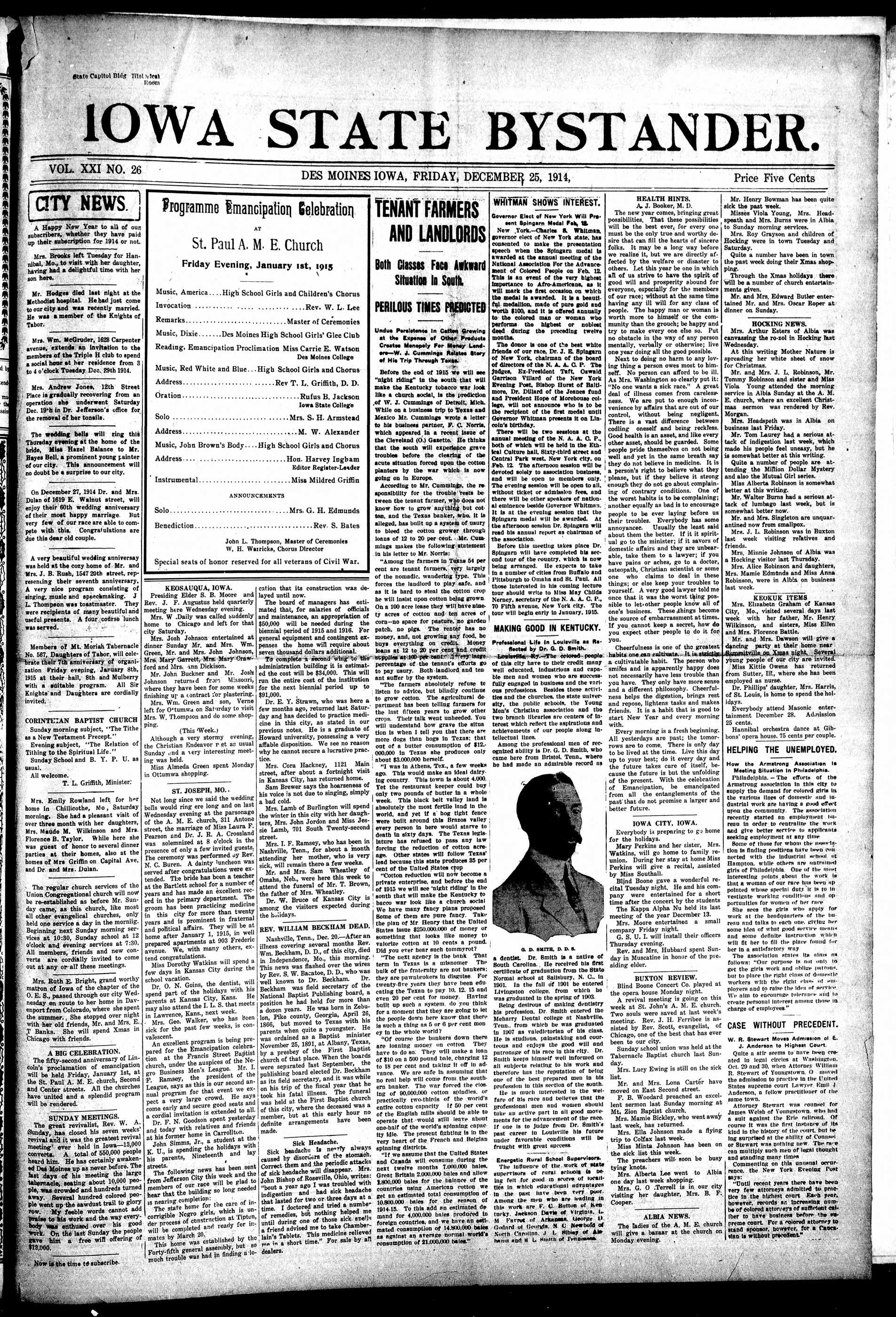
Programme Emancipation Celebration
Friday Evening, January 1st, 1915
John L. Thompson, Master of Ceremonies W. H. Warricks, Chorus Director Special seats of honor reserved for all veterans of Civil War.
Presiding Elder S. B. Moore and Rev. J. F. Augustus held quarterly meeting here Wednesday evening.
Mrs. W. Daily was called suddenly home to Chicago and left for that city Saturday.
Mrs. Josh Johnson entertained at dinner Sunday Mr. and Mrs. Wm. Green, Mr. and Mrs. John Johnson, Mrs. Mary Garrett, Mrs. Mary Graw-ford and Mrs. Ann Dickison.
Mr. John Buckner and Mr. Josh Johnson returned from Missouri, where they have been for some weeks finishing up a contract for plastering. Mrs. Wm. Green and son, Verne left for Ottumwa on Saturday to visit Mrs. W. Thompson and do some shopping.
(This Week.)
Although a very stormy evening, the Christian Endeavor set as usual Sunday and a very interesting meeting was held.
Miss Almeda Green spent Monday in Ottumwa shopping.
Not long since we said the wedding bells would ring ere long and on last Wednesday evening at the parsonage of the A. M. E. church, 311 Antone street, the marriage of Miss Laura F. Pearson and Dr. J. R. A. Crossland was solemnized at 8 o'clock in the presence of only a few invited guests. The ceremony was performed by Rev. N. C. Buren. A dainty luncheon was served after congratulations were extended. The bride has been a teacher at the Bartlett school for a number of years and has made an excellent record in the primary department. The groom has been practicing medicine in this city for more than twenty years and is prominent in fraternal and political affairs. They will be at home after January 1, 1915, in well prepared apartments at 903 Frederic avenue. We, with many others, extend congratulations.
tennis.
Jessie Dorothy Watkins will spend a few days in Kansas City during the school vacation.
Dr. O. N. Goins, the dentist, will spend part of the holidays with his parents at Kansas City, Kansas. He may also attend the I. L. S. that meets in Lawrence, Kansas, next week.
in Lawrence, MA. Mrs. Geo. Walker, who has been sick for the past few weeks, is consoled.
valescent.
An excellent program is being prepared for the Emancipation celebration at the Francis Street Baptist church, under the auspices of the Negro Business Men's League. Mr. I. F. Ramsey, the president of the League, says as this is our second annual program for that event we expect a very large crowd. He says come early and secure good seats and a cordial invitation is extended to all. Dr. F. N. Goodson spent yesterday and today with relatives and friends
Dr. F. N. Gibson and today with relatives and friends in Carrollton.
at his former home in Carthage
John Simms, Jr., a student at the
K. U., is spending the holidays with
his parents, Nineteenth and lay
streets
streets. The following news has been sent from Jefferson City this week and the members of our race will be glad to hear that the building so long needed being completion:
is nearing completion. The state home for the care of incorrigible Negro girls, which is under process of construction at Tipton, will be completed and ready for in-
mates by March 2013.
This home was established by the Forty-fifth general assembly, but so
cool trouble was had in finding a lo-
(This Week.)
ST. JOSEPH. MO..
DES MOINES IOWA, FRIDAY, DECEMBER 25, 1914.
cation that its construction was delayed until now.
The board of managers has estimated that, for salaries of officials and maintenance, an appropriation of $50,000 will be needed during the biennial period of 1915 and 1916. For general equipment and contingent expenses the home will require about seven thousand dollars additional.
To complete a second wing to the administration building it is estimated the cost will be $34,000. This will run the entire cost of the institution for the next biennial period up to $91,000.
Dr. E. Y. Strawn, who was here a few months ago, returned last Saturday and has decided to practice medicine in this city, as stated in our previous notes. He is a graduate of Howard university, possessing a very affable disposition. We see no reason why he cannot secure a lucrative practice.
Mrs. Cora Hackney, 1121 Main street, after about a fortnight visit in Kansas City, has returned home.
Sam Brewer says the hoarseness of his voice is not due to singing, simply a bad cold.
Mrs. Lamb of Burlington will spend the winter in this city with her daughters, Mrs. John Jordon and Miss Jessie Lamb, 701 South Twenty-second street.
Mrs. I. F. Ramsey, who has been in Nashville, Tenn., for about a month attending her mother, who is very sick, will remain there a few weeks. Mr. and Mrs. Sam Wheatley of Omaha, Neb., were here this week to attend the funeral of Mr. T. Brown, the father of Mrs. Wheatley. Dr. W. Bruce of Kansas City is among the visitors expected during the holidays.
REV. WILLIAM BECKHAM DEAD.
Nashville, Tenn., Dec. 20.—After an illness covering several months Rev. Wm. Beckham, D. D., of this city, died in Independence, Mo., this morning. This news was flashed over the wires by Rev. S. W. Baxatoc, D. D., who was well known to Dr. Beckham. Dr. Beckham was field secretary of the National Baptist Publishing board, a position he had held for more than a dozen years. He was born in Zebulon, Pike county, Georgia, April 26, 1866, but moved to Texas with his parents when quite a youngster. He was ordained as a Baptist minister November 25, 1891, at Albany, Texas, by a presbyter of the First Baptist church of that place. When the boards were separated last September, the publishing board elected Dr. Beckham as its field secretary, and it was while on his trip of the fiscal year that he took his fatal illness. The funeral was held at the First Baptist church of this city, where the deceased was a member, but at this early hour no definite arrangements have been made.
Sick Headache.
Sick headache is nearly always caused by disorders of the stomach. Correct them and the periodic attacks of sick headache will disappear. Mrs. John Bishop of Roseville, Ohio, writes "bout a year ago I was troubled with indigestion and had sick headache that lasted for two or three days at a time. I doctored and tried a number of remedies, but nothing helped me until during one of those sick cuts" a friend advised me to take Chamberlain's Tablets. This medicine relieved me in a short time." For sale by all dealers.
TENANT FARMERS AND LANDLORDS
Both Classes Face Awkward Situation In South.
Undue Persistence in Cotton Growing at the Expense of Other Products Creates Menopause For Money Lenders—W. J. Cummings Relates Story of His Trip Through Texas.
Before the end of 1915 we will see "night riding" in the south that will make the Kentucky tobacco war look like a church social, is the prediction of W. J. Cummings of Detroit, Mich. While on a business trip to Texas and Mexico Mr. Cummings wrote a letter to his business partner, P. C. Norris, which appeared in a recent issue of the Cleveland (O.) Gazette. He thinks that the south will experience grave troubles before the clearing of the acute situation forced upon the cotton planters by the war which is now going on in Europe.
According to Mr. Cummings, the responsibility for the trouble tests between the tennant farmer, who does not know how to grow anything but cotton, and the Texas banker, who, it is alleged, has built up a system of usury to bleed the cotton grower through loans of 12 to 20 per cent. Mr. Cummings makes the following statement in his letter to Mr. Norris:
"Among the farmers in Texas 54 per cent are tenant farmers, very largely of the nomadic, wandering type. This forces the landlord to play safe, and as it is hard to steal the cotton crop he will insist upon cotton being grown. On a 100 acre lease they will have nuity acres of cotton and ten acres of corn—no space for pasture, no garden patch, no plugs. The renter has no money, and, not growing any food, he buys everything on credit. Money loans at 12 to 20 per cent and credit supplies at 100 per cent. There large percentage of the tenant's efforts go to pay usury. Both landlord and tenant suffer by the system.
"The farmers absolutely refuse to listen to advice, but blindly continue to grow cotton. The agricultural department has been telling farmers for the last fifteen years to grow other crops. Their talk went unbeeded. You will understand how grave the situation is when I tell you that there are more dogs than hogs in Texas; that out of a butter consumption of $12,000,000 in Texas she produces only about $3,000,000 herself."
"I was in Athens, Tex., a few weeks ago. This would make an ideal dairy-country. This town is about 4,000. Yet the restaurant keeper could buy only two pounds of butter in a whole week. This black belt valley land is absolutely the most fertile land in the world, and yet if a hog tight fence were built around this Brazos valley every person in here would starve to death in sixty days. The Texas legislature has refused to pass any law forcing the reduction of cotton acreage. Other states will follow Texas' lead because this state produces 35 percent of the United States crop.
"Cotton reduction will now become a private enterprise, and before the end of 1015 we will see 'night riding' in the south that will make the Kentucky to bacoo war look like a church social. We have many fancy plans proposed Some of them are pure fancy. Take the plan of Mr Henry that the United States issue $250,000,000 of money or something that looks like money to valorize cotton at 10 cents a pound. Did you ever hear such tommyrot?
"The next agency is the bank. That term in Texas is a misnomer. The bulk of the fraternity are not bankers; they are pawnbrokers in disguise. For twenty-five years they have been educating the Texan to pay 10. 12. 15 and even 20 per cent for money. Having built up such a system, do you think for a moment that they are going to let the people down here know that there is such a thing as 5 or 6 per cent money in the whole world?"
"Of course the bankers down there are loaning money on cotton. They have to do so. They will make a loan of $10 on a 500 pound bale, charging 12 to 18 per cent and taking it off in advance. We are safe in assuming that no real help will come from the southern banker. The war forced the closing of 90,000,000 cotton spindles, or practically two-thirds of the world's entire cotton capacity. If 50 per cent of the English mills should be able to operate that would still leave about one-half of the world's spinning capacity idle. The present fighting is in the very heart of the French and Belgian solving districts.
"If we assume that the United States and Canada will consume during the next twelve months 7,000,000 bales, Great Britain 2,000,000 bales and allow 1,800,000 bales for the balance of the countries using American cotton we get an estimated total consumption of 10,800,000 bales for the season of 1914-15. To this add an estimated demand for 4,000,000 bales produced in foreign countries, and we have an estimated consumption of 14,800,000 bales as against an average normal world's consumption of 21,100,000 bales."
WHITMAN SHOWS INTEREST.
Governor Elect of New York Will Pres-
sident Spinning Armg Fold. 12.
New York.-Charles B. Whitman, governor elect of New York state, has consented to make the presentation speech when the Spingarn medal is awarded at the annual meeting of the National Association For the Advancement of Colored People on Feb. 12. This is an event of the very highest importance to Afro-Americans, as it will mark the first occasion on which the medal is awarded. It is a beautiful medallion, made of pure gold and worth $100, and it is offered annually to the colored man or woman who performs the highest or noblest deed during the preceding twelve months. The donor is one of the best white friends of our race, Dr. J. E. Spingarn of New York, chairman of the board of directors of the N. A. A. C. P. The judges, Ex-President Taft, Oswald Garrison Villard of the New York Evening Post, Bishop Hurst of Baltimore, Dr. Dillard of the Jesnes fund and President Hope of Morehouse college, will not announce who is to be the recipient of the first medal until Governor Whitman presents it on Lincoln's birthday.
There will be two sessions at the annual meeting of the N. A. A. O. P., both of which will be held in the Ethical Culture hall, Sixty-third street and Central Park west, New York city, on Feb. 12. The afternoon session will be devoted solely to association business, and will be open to members only. The evening session will be open to all, without ticket or admission fees, and there will be other speakers of national eminence beside Governor Whitman. It is at the evening session that the Spingarn medal will be awarded. At the afternoon session Dr. Spingarn will read his annual report as chairman of the association.
Before this meeting takes place Dr. Spingarn will have completed his second tour of the country, which is now being arranged. He expects to take in a number of cities from Buffalo and Pittsburgh to Omaha and St. Paul. All those interested in his coming lecture tour should write to Miss May Childs Nerney, secretary of the N. A. A. C. P., 70 Fifth avenue, New York city. The tour will begin early in January, 1915.
MAKING GOOD IN KENTUCKY.
Professional Life in Louville as Re
Acted by De, D. G. Smith.
By Dr. G. B. Smith,
Louisville, Ky. The colored people of this city have to their credit many well educated, industrious and capable men and women who are successfully engaged in business and the various professions. Behind these activities and the churches, the state university, the public schools, the Young Men's Christian association and the two branch libraries are centers of interest which reflect the aspirations and achievements of our people along intellectual lines.
Among the professional men of recognized ability is Dr. G. D. Smith, who came here from Bristol, Tenn., where he had made an admirable record as
G. D. SMITH, D. D. S.
a dentist. Dr. Smith is a native of South Carolina. He received his first certificate of graduation from the State Normal school at Salisbury, N. C., in 1901. In the fall of 1901 he entered Livingston college, from which he was graduated in the spring of 1903.
Being destruous of making dentistry his profession. Dr. Smith entered the Mehary Dental college at Nashville, Tenn., from which he was graduated in 1007 as valedictorian of his class. He is studious, painstaking and courteous and enjoys the good will and patronage of his race in this city. Dr. Smith keeps himself well informed on all subjects relating to his work and therefore has the reputation of being one of the best prepared men in his profession in this section of the south. He is much interested in the welfare of his race and believes that the professional men and women should take an active part in all good movements for the advancement of the race. If one is to judge from Dr. Smith's past career in Louisville his future under favorable conditions will be fraught with great success.
Energetic Rural School Supervisors.
The influence of the work of state supervisors of rural schools is being felt for good in scores of toilies in which educational advantages in the past have been very poor. Among the men who are leading in this work are F. C. Button of Kentucky, Jackson Davis of Virginia, M. F. Mavrot of Arkansas, George D. Goddard of Georgia, N. C. Newbold of North Carolina, J. L. Nibey of Alabama and N. L. Sullivan of Tennessee.
HEALTH HINTS.
A. J. Booker. M. D.
The new year comes, bringing great possibilities. That these possibilities will be the best ever, for every one must be the only true and worthy desire that can fill the hearts of sincere folks. It may be a long way before we realize it, but we are directly affected by the welfare or disaster to others. Let this year be one in which all of us strive to have the spirit of good will and prosperity abound for everyone, especially for the members of our race; without at the same time having any ill will for any class of people. The happy man or woman is worth more to himself or the community than the grouch; be happy and try to make every one else so. Put no obstacle in the way of any person mentally, verbally or otherwise; live one year doing all the good possible.
Next to doing no harm to any loving thing a person owes most to himself. No person can afford to be ill. As Mrs. Washington so clearly put it: "No one wants a sick race." A great deal of illness comes from carelessness. We are put to enough inconvenience by affairs that are out of our control, without being negligent. There is a vast difference between codling oneself and being reckless. Good health is an asset, and like every other asset, should be guarded. Some people pride themselves on not being well and yet in the same breath say they do not believe in medicine. It is a person's right to believe what they please, but if they believe it strong enough they do not go about complaining of contrary conditions. One of the worst habits is to be complaining; the other equally as bad is to encourage people to be ever laying before us their troubles. Everybody has some annoyance. Usually the least said about them the better. If it its spiritual go to the minister; if it savors of domestic affairs and they are unbearable, take them to a lawyer; if you have pains or aches, go to a doctor, osteopath, Christian scientist or some one who claims to deal in these things; or else keep your troubles to yourself. A very good lawyer told me once that it was the worst thing possible to let-other people know all of one's business. These things become the source of embarrassment at times. If you cannot keep a secret, how do you expect other people to do it for you.
Cherefulness is one of the greatest habits one can cultivate. It is strictly a cultivatable habit. The person who smiles and is apparently happy does not necessarily have less trouble than you have. They only have more sense and a different philosophy. Cherefulness helps the digestion, brings rest and repose, lightens tasks and makes friends. It is a habit that is good to start New Year and every morning with.
Every morning is a fresh beginning. All yesterday are past; the tomorrows are to come. There is only day to be lived at the time. Live this day up to your best; do it every day and the future takes care of itself, because the future is but the unfolding of the present. With the celebration of Emancipation, be emancipated from all the entanglements of the past that do not promise a larger and better future.
IOWA CITY, IOWA
Everybody is preparing to go home for the holidays.
Mary Perkins and her sister, Mrs. Watkins, will go home to family reunion. During her stay at home Miss Perkins will give a recital, assisted by Miss Southall.
Blind Bone gave a wonderful recital Tuesday night. He and his company were entertained for a short time after the concert by the students
The Kappa Alpha Nu held its last
The Kapilwala meeting the year December 13.
Mrs. Moore entertained a small company Friday night.
G. S. U. I. will install their officers Thursday evening.
Rev. and Mrs. Hubbard spent Sunday in Muscatine in honor of the presiding elder.
BUXTON REVIEW.
Blind Boone Concert Co. played at the opera house Monday night.
A revival meeting is going on this week at St. John's A. M. E. church.
Two souls were saved at last week's meeting. Rev. J. H. Ferribee is assisted by Rev. Scott, evangelist, of Chicago, one of the best that has ever been to our city.
Sunday school union was held at the Tabernacle Baptist church last Sunday.
Mrs. Lucy Ewing is still on the sick list.
Mr. and Mrs. Lona Cartier have moved on East Second street.
F. B. Woodard preached an excellent sermon last Sunday morning at Mt. Zion Baptist church.
Mrs. Mamie Bickley, who went away last week, has returned.
Mrs. Ella Johnson made a flying trip to Colfax last week. Miss Minta Johnson has been on
Miss Minta Johnson has been on the ask list this week.
the sick list this week.
The preachers will soon be busy
tying knots.
Mrs. Alberta Lee went to Albia
one day last week shopping.
Mrs. G. O. Terrell is in our city
visiting her daughter, Mrs. B. F.
Cooper.
ALBIA NEWS.
The ladies of the A. M. E. church will give a bazaar at the church on Monday evening.
---
Price Five Cents
Mr. Henry Bowman has been quite sick the past week.
Misses Viola Young, Mrs. Headspath and Mrs. Burns were in Albia to Sunday morning services.
Mrs. Roy Grayson and children of Hocking were in town Tuesday and Saturday.
Quite a number have been in town the past week doing their Xmas shopping.
Through the Xmas holidays there will be a number of church entertainments given.
Mr. and Mrs. Edward Butler entertained Mr. and Mrs. Oscar Roper at dinner on Sunday.
HOCKING NEWS
Mrs. Arthur Esters of Albia was canvassing the ro-zol in Hocking last Wednesday.
At this writing Mother Nature is spreading her white sheet of snow for Christmas.
Mr. and Mrs. J. L. Robinson, Mr. Tommy Robinson and sister and Miss Viola Young attended the morning service in Albia Sunday at the A. M. E. church, where an excellent Christmas sermon was rendered by Rev. Morgan.
Mrs. Headspeth was in Albia on business last Friday.
Mr. Tom Laurey had a serious attack of indigestion last week, which made his people feel uneasy, but he is somewhat better at this writing.
Quite a number of people are attending the Million Dollar Mystery and also the Mutual Girl series.
Miss Alberta Robinson is somewhat better at this writing.
Mr. Walter Burns had a serious attack of lumbago last week, but is somewhat better now.
Mr. and Mrs. Singleton are unquarantined now from smallpox.
Mrs. J. L. Robinson in was Buxton last week visiting relatives and friends.
Mrs. Minnie Johnson of Albia was a Hocking visitor last Thursday.
Mrs. Alice Robinson and daughters, Mrs. Mamie Edmands and Miss Anna Robinson, were in Albia on business last week.
KEOKUK ITEMS
Mrs. Elizabeth Graham of Kansas City, Mo., visited several days last week with her father, Mr. Henry Wilkinson, and sisters, Miss Ellen and Mrs. Florence Battle.
Mr. and Mrs. Dawson will give a dancing party at their home near Summitville on Xmas night. Several young people of our city are invited.
Miss Kittle Owens has returned from Sutter, Ill., where she has been employed as nurse.
Dr. Phillips' daughter, Mrs. Harris, of St. Louis, is home to spend the holidays.
Everybody attend Masonic entertainment December 28. Admission 25 cents.
Hannibal orchestra dance at Gibbons' opera house. 75 cents per couple.
HELPING THE UNEMPLOYED.
How the Armstrong Association is Meeting Situation in Philadelphia. Philadelphia. - The efforts of the Armstrong association in this city to supply the demand for colored girls in the various lines of domestic and industrial work are having a good effect upon the community. The association recently started an employment bureau in order to centralize the work and give better service to applicants seeking employment at any time. Some of those for whom the association is finding positions have been connected with the industrial school at Hampton, while others are untrained girls of Philadelphia. One of the most interesting points about the work is that a woman of our race has been appointed whose special duty it is to investigate working conditions and opportunities for women of her race. She sees the girls who apply for work at the headquarters of the bureau and talks to each one, giving her some idea of what good service means and some definite instruction which will fit her to fill the place found for her in a satisfactory way. The association states its aims as follows: "Our purpose is not only to get the girls work and oblige patrons, but to place the right class of domestic workers with the right class of employers and to raise the idea of service. We aim to encourage tolerance and to create personal interest among those in charge of employees."
CASE WITHOUT PRECEDENT.
W. R. Stewart Moves Admission of E. J. Anderson to Highest Court.
Quite a stir seems to have been created in legal circles at Washington, Oct. 20 and 30, when Attorney William R. Stewart of Youngstown. O moved the admission to practice in the United States supreme court Lawyer Emil J. Anderson, a fellow practitioner of the same town.
Attorney Stewart was counsel for James Welsh of Youngstown, who had a suit against the Erie railroad. Of course it was the first instance of its kind in the history of the court, but being surprised at the ability of Counsel or Stewart was nothing new. The race can multiply such men of legal thought and standing many times.
Commenting on this unusual occurrence, the New York Evening Post says:
"Until recent years there have been very few attorneys admitted to practice in the highest court. Each year, however, records an increasing number of colored attorneys of sufficient caliber to have business before the supreme court. For a colored attorney to stand sponsor, however, for a Caucasian is without precedent."
AFRO-AMERICAN CULLINGS
We are permitted to live in a marvelous age. So many wonderful things are happening each day that we scarcely have time to read about them and little opportunity to ponder their significance. We, in the Southland, read the morning paper's report of the progress of the European war—Awful! we exclaim, and then hurry to eagerly search for the latest developments in the cotton situation. We read, we have faith and so we are encouraged to hope for brighter days in spite of the fact that to the average of us there is little said, that we understand, to illumine the situation. One of the causes contributing to our present misfortune is a hopeless struggle grasp the meaning of our problems and puerry minds, while all around us lie the simple, essential, elemental conditions that make up life, which are easily understood and practical, and which, if given a little serious thinking, will transform this "vale of tears" into a land of joyous living.
There are some people in Texas, though, who do appreciate small beginnings and small things, and who are really making things come to pass. We should be thankful that there are still a few farmers who are not hot cotton crazy. A few farmers who think of hogs, chickens and eggs to raise a few, who like to eat vegetables enough to raise a garden, who raise enough corn to have some meat ground for the old-fashioned antebellum golden egg-bread, who use the milk and butter from their own dairy cows, and whose wives are just of fashioned enough to make fruits and juicy surplus garden stuff and fruits and make quail to keep them warm in the winter. This class of farmers live at home and whether cotton sells or not they will continue to live, to eat and to enjoy some of the blessings of life.
The above is suggested by a meeting I attended in Waco, and about which I want to tell the readers of the Houston Post. It was a meeting of Negro farmers, about five hundred of them, representing some ten thousand others who were at home in the North, South, East and West Texas. The 500 had been sent to Waco to work in the nineteenth annual convention of the Farmers' Improvement Society, where they sang songs that things they did. They sang songs of praise and prayed God for his blessing on their humble efforts with a fervor surpassing anything I had ever seen or heard in a church. They then discussed, made demonstrations and produced samples of stuff they raised or made illustrating selected subjects pertaining to the farmers' yearly work. They made intelligent written reports from their various county organizations on the work accomplished during the past year and made plans for another year's work. There was a bumor and song and a band in Inman with huge chunks of hard common sense. They were sober-minded men and women bent upon finding the way to the better life for themselves and their children. There was order—there was organization.—Wade C. Rollins, in the Houston Post.
Prospecting for oil near Calgary has resulted in the discovery of a fine quality of oil at a depth of 2,700 feet in what is called the Dingman well. The oil is of such high grade that it can be used successfully in automobiles after having passed through the filter.
An antiquarian society has recently obtained one of the most interesting collections in the country. It consists of the commercial tokens and mock coins issued by tradesmen during the Civil war when small change with the government stamp became a rarity. There are in the collection about one thousand varieties of tokens.
A successful peach grower, S. J. T. Bush, in a recent talk at Rochester, N. V., said that 200,000 bushels of peaches rotted on the trees in one New York county alone in 1912 for lack of cars to transport them to market.
The newest battleship building for the United States will be 1,400 tons larger than Japan's largest, 3,400 tons larger than Germany's, 3,900 tons larger than Great Britain's, and 6,500 tons larger than anything France plans.
It has been discovered that the leaf of the pineapple can be wrought into a serviceable cloth.
Not many years ago Russia was a strong rival of the United States in the production of petroleum. Now the Russian empire yields only about 68 per cent as much oil as California alone, and not much more than Oklahoma.
Germany has 173 stock companies in textiles, capitalized for an aggregate of $81,512,000.
The average earning of a film of moderate length is said to be nearly $15,000.
France maintains an institute of zoological psychology on a farm near Paris for the study of the habits of animals under natural conditions.
If the pessimist thought very much of himself he would not be at odds with the rest of the world.
If these United States of America should become involved in war, what part do you think the Negro of the South would play?
If he were asked to take up arms to help protect the peace and prosperity of the southland—and refuse? If he should stand and tell the people of the South. "No, sah; 'I see not gom' ter no war; I see got der rieumtiam?" If the Negro would say, "We's don' truce to her you once, and you turned us off after her'don' won a battle at San Juan hill."
If the loafing Negro and the other sons of rest would refuse to give their services as cooks and other required labor?
"My dear readers, the above is an 'IF.' If these United States of America should become involved in the present war, we, the colored people of the South, stand ready to give our services, property and lives for the peace and prosperity of the southland. Nor would we sneak from the battlefield and hang around the cook pot. We are ready to fall in line and advance in pursuit of the enemy. It is true, when the North and South were fights left behind to care for the families and farms. And when 'master' came back from the battlefield he found everything better than he left it; all the corn had been planted and all the land had been planted up.
We want the good white people of the southland to ever remember that the blood of the old reliable, trustworthy "mammy" and "uncle" is still in the South. We realize that those who refuse to give us justice atimes are the ones who have forgotten the good deeds of the old Negro "mammy" and "uncle". The same blood that is needed to save the "uncle" veins traces their sons" and daughters" veins.—C. J. Taylor, in the Houston Post.
In the midst of the war situation, it is sincerely to be hoped that the general public will not forget the needs of such institutions as the Tuskegee Normal and Industrial institute, located in Alabama, in the heart of the South.
Whatever conditions may arise, it is of the highest importance to continue without interruption to that which we have to ensure the prosperity of the South and peaceful relationships between white people and black people.
After deducting all sums likely to be received from stated sources, including a sum guaranteed by trustees and friends of the school, there remain to be raised this year by the principal of Tuskegee Institute in the form of $50 scholarship, or otherwise, for current expenses, about $125,000. The amount referred to not only includes the direct expenses of the school for the work on the grounds, but the extension work, which influences and reaches a large part of the far South. Even the smallest amount will be gratefully received and promptly acknowledge the work. The school Institute is now so thoroughly established, and its great value to the Negro people and to the nation so fully demonstrated, that the school should not be allowed to suffer in its need for current expenses.
BOOKER T. WASHINGTON, Principal, Tuskegee Institute, Ala. bama.
The unassailable supremacy of the "Smiths" in London can be estimated from the telephone directory. The honorable family of Jones, for example, occupies not quite four pages. The Robinsons, who have a place with the greatest, do not require two pages. But the Smiths begin on page 72 and end on page 770.
The United States forest service has undertaken the reforestation of a large section in northern Idaho destroyed by forest fires in 1810 to determine whether the destruction of trees decreases the flow of streams.
Irrigation projects now under way or contemplated by the Union of South Africa call for an expenditure of more than $5,000,000.
A new Tennessee law makes provision for fire escapes on workshops and factories two stories and more in height.
The bulk of the aluminum ore of the United States is produced in Arkansas.
There are said to be nearly or quite one thousand varieties of rice in the Philippine islands. It is probable that some of these will prove nearly duplicates, but the actual number of varieties is very great.
In Berlin there has been constructed a skating rink with all the properties of ice, but made of salt, the invention of a German scientist.
It is asserted that more children are employed in dangerous occupations now than 30 years ago.
In the battle of Gettysburg, in the Civil war, 157,600 men were engaged, of whom 53,000 were killed or wounded.
Rural carriers are now required to report forest fires throughout the United States to proper authorities.
There is an orchid of Java the flowers of which open all at once.
Uncle Sam has a new wireless detector, but it is doubtful if it can read a code message.
GRAISED LAMB WITH BARLEY
Bimple but Appetizing Dish Will Be
Appreciated When Family
Gathers for Dinner.
Two pounds of lamb from shoulder, two cupfuls of pearl barley, one small Spanish onion, one cupful of tomatoes (canned), salt and pepper to taste. Have the butter cut the meat into suitable pieces to serve, removing any unightly edges or fat. Place a piece of suet in a deep skillet and as soon as hot put in the meat and let it seak quickly on all sides. As soon as all pieces are cooked, pour enough water to cover, then simmer slowly for half an hour. Now stir the barley into the liquid, cut the onion into slices and lay on top of meat, then pour the tomato over. Cover and let simmer for about two hours. See from time to time that barley does not settle or liquid boil off. Toward last, season to taste. Try not to mash the meat and barley. When meat is tender the barley will be soft and puffy. Serve on platter with meat in a saucepan and curry the tomatoes and the onions over with just enough of the liquor to moisten, or if gravy is liked the liquor may be thickened with a little dissolved flour. If need be a little more hot water may be added during the cooking.
WITH FLAVOR OF BANANA
Omelet That Is Somewhat Different From the Kind Ordinarily Served.
To make a three-egg banana omelet, separate the yolks and whites of three eggs and beat each separately. It is easier to manage if one of the whites is left out. Beat the whites to a stiff froth and season with a pinch of salt and a pinch of sugar.
In the meantime have in the frying pan over a gas burner, turned down almost to its lowest place, two tablespoons of sugar spread over the bottom, except around the outer inch, and on top of this one banana cut in very thin slices.
As the sugar commences to boil and the banana to brown, lift from fire and turn each slice of banana. After this has cooked a little on the turned side, pour in the beaten yolks, and prick them while they set, as in the case of any omelet. Then spread the whites over them, and let cook about three minutes longer before folding and serving.
Just before the yolk is put to cook some butter may be added, about a teaspoonful, but, if carefully handled, this will not be needed. The difficulty is in keeping the sugar from burning if just caramelized, it is delicious.
Care of Brass.
All brass beds, brass handles and hardware used on furniture are lacquered to keep them from oxidizing. The less this lacquer is rubbed, the longer it will last. If a good brass bed is wiped off frequently with a perfectly clean, soft piece of cheescloth no other polishing will be necessary. When the lacquer does wear off and the brass becomes dull, the proper thing to do is to send it to a good factory to be rebuffed and relacquired. In an a white a brass bed may be wiped off and a spatula will slightly soapy water, wiped again with a clean water and then dried immediately with soft cheesecloth or a very fine piece of chamols skin. If you drop acid on your clothes the immediate application of ammonia will prevent damage.
Homemade Washer.
To wash heavy things such as quilts and comforters often means much back-breaking lifting. One housekeeper ingeniously devised a method of lightening her difficulties. When she had put her heavy pieces on the stove, she took an ordinary lard pail and made use of it for a suction washer, pushing it, upside down, on the things thus drawing the soapy water through them. When they were clean she lifted them, without wringing them, hung them on the line and poured fresh water over them to rinse them. This used them as clean, she found, as if she had fired herself out with rubbing them.
Pot Roast.
Here is my pot roast: Into a basin put a layer of sliced onions, one of sliced potatoes and a layer of chopped or sliced cold mutton or lamb (end of your last roast). Continue until full. Now add salt and a red pepper. Now cover top with potatoes cut-in halves, which will roast a pretty brown. Sometimes I use a pork roast end the same way, only add a little sage to flavor.
A Pastry Tip.
To prevent the fruit juice running over in the oven when making pies, sprinkle a little carbonate of soda over the fruit before the top crust is put on. This prevents the juice from running over and also lessens the acidity of the fruit, so that it will not require so much sugar to sweeten it.
Soak. Fish.
Always soak fresh fish in a quart of water to which a teaspoonful of salt has been added—or more salt and water in proportion. Then rinse it well and dry it carefully with a clean cloth.
Dreeden Chocolate Grumbs
Mix one cupful stale bread crumbs with one-half cupful chocolate, two tablespoonful sugar and one-fourth teaspoonful salt. Put in bake, bake in moderate oven until chocolate is melted and the crumbs thoroughly heated. Serve with whipped cream.
When Bottling Bickles
An excellent way to make pickling bottles airight is to boll the corks for bottling and put them into the kettles while hot. When cold they will seal themselves tightly.
To Clean White Blouses
Perspiration stains may be removed from white blouses without any trouble if they are soaked before washing in cold water, to which a little carbonate of soda has been added.
IOWA STATE BYSTANDER
LauraJeanLibbeu's Talks on Heart Topics
A NAUGHTY WORLD.
Beauty is but a vain and doubtful good; a shineglass that glades suddenly; a flower that fades when first it 'gins to bud;'
a brittle glass that is broken presently, a doused good, a gloss, a glass, a flower, lost, faded, dead within the hour.
"What a naughty world this is getting to be," cry our grandmammals.
holding up their hands in plious horror. A group of them, over their knitting the other day, swapped expences. Said one: "Young people are different from what they were in my day." In my day, a baker's dozen of them—never grew so old but that I ruled them. If they wanted to go to a dance or a barnstorming show they had to first find out my
MARY J.
oplination of it. If I set my foot down against it and they still argued for it, to make my refusal sure to be beheaded I locked them in their rooms. There were ladders at their windows early the next morning, showing how the poor fellows had to get to their early morning work by way of the window, disliking to waken me from my sleep to open the door. "That's the plan I pursued with my daughters, when we were neighbors. There were ladders against our windows, too. Those girls danced till broad daylight. I looked out just in time to see your sons helping them up the ladders." "Boy and girl romance," sighed number one, excusing, a bit embarrassed. "I often think of my love affair," cut in another dear old lady. "A young person was my first sweetheart. The day was set for the wedding. I was to meet him at the church. He forgot to say which one. As there were four churches in our town I was mystified. I went first to one, then to another. Oh, even now I recall that day with an awful shudder. At every church door I found a girl alone arrayed in bridal robes. My lover had courted them all; his promises were like glass, easily broken. He had actually made arrangement to make a long story short, our parson ran away. The last we heard of him he was preaching 'goodness' in Utah."
"In my days," said another of the group, with a twinkle in the blue eyes behind her apoceties, "I lived in a little village." Every man in the town declared he was a teetotaler. But on Saturday nights, without fall, they all trumped miles to a town meet; they did not return until late Monday morning, and, my, how their breaths did smell of cloves and cardamom seeds. I actually believe they would have drunk the wells dry, if they could. I manned out a shop selling nothing but flasks, bottles and jugs. He got to be the richest man in town. I am inclined to laugh when I look back to those days and think what fools we sweeheartas and wives were."
Still another grandma, who had kept abreast of the times, with marcelled hair, gown of latest cut and high healed slippers, assured the group that the world was as naughty when they-were young as it is now. The boys and girls cheated a great deal to exact pleasure from dull surroundings. But the young folks of today are open and above board. They say: "Yes, we tangued to our heart's content, into the wee, sma' hours. What's life and youth to the young if they can't enjoy it? We coquette, and say things just like that, just part and take it in good part. If a fellow jits one of us for another girl we don't spoil our eyes crying about it. We do just what the farmer did whose cow kicked over and smashed a bucket which was full of milk—he just looked for another bucket. We look for: another beau. It's the same old world, no naughtier now than ever."
TO MEMORY DEAR.
Forget? Aye all but this I—love you.
The world outside is dark and dreary.
Beyond O'heart of mine, I will not go.
Beyond your love, dear heart, I cannot go.
When two who have loved fondly begin to disagree, and after many a falling out agree to go their separate ways, each imagines that the heart will not suffer.
There never was a greater mistake. Mimi will not be shifted. Other would be sweethearts may seize the opportunity to come eagerly forward and sue for the girl's favor, but somehow not one of them fills the lonely void in her heart.
It is quite the same with a man. If his heart has gone out to one girl none other can have a like attraction for him. He is pleasant to all; but is careful to avoid anything like sentiment, thus giving the other girl reason to believe that he is in the matrimonial market.
It is claimed that time heals all griefs. This is undoubtedly true; yet, try as we may, we cannot forget the old love which made the dull, old world heaven on earth while it lasted. Destiny may turn our steps into other paths; we may find consolation with other hearts. But in our lonely moments memory harks back to the lost past.
What woman, in such idle moments, has not wondered what became of the lover who was once all in to her; if he found it easy to forget her, or
if it was with him as it was with her—"with though lost to sleep, to memory dear," It is not enough to cherish a bitter, better than bitter feelings.
On the other hand, there is no use in brooding over the happiness which might have been. The realities of life are never what we have pictured they would be. How many a woman, had she wedded her first love, might not have been so happy with him as with the man, who eventually wooded and won her when her heart was riper and she knew better how to appreciate a good man's love. There are many people who fancy because a man remains a bachelor late in life that he is grieving over some old love affair. The fact is he gives the old love but passions brought to him by the man by his marriage to another, he philosophically concludes that it's useless to cry over split milk. He if thinks of her at all, while her memory is still sweet to him, he concludes that their parting must have been for the best. Once if a while we hear of old love patching up their differences in years, which shows, that there are some hearts, after all, which cling to faded romances. Love once disrupted is never quite the same. The rock which they stumbled against in earlier life must always be carefully avoided. Young girls often become acquainted with young men and proceed to fall in love with them without encouragement. He takes his leave never to cross her path again. For years she continues to hold memory dear, when she should not waste even a passing thought upon him. The past is past. If the old love is shakes, so let it rest. Wise are the women who transfer their affections from one who is not thinking of them to the man who is present. Memory is poor food to feed a lonely heart.
IS GETTING A PROPOSAL A
KNACK?
Love thee? Thou cant not ask of me
so freely as I fain would give;
Tis woman's great necessity
To love so long as she shall live;
Tis woman's lovely prove,
I cannot choose but give thee love!
The timid young girl who is always
finding herself a wallflower at little
social affairs which she attends is
wont to believe that there certainly
must be some knack in other girls get-
ting so many beaux.
She can see that she is quite as
fair as they. When young men call
upon her she does her best to ent-
tain them. They bid her aden, asking
the privilege of calling again. But
they seldom, if ever, avail themselves
of her permission. Yet these same
young men call upon other girls who
do not lack callers every evening.
In fact, their parlor is full of beau.
Every young man admires and is attracted to them. They do not lack marriage proposals.
The girl who is not so fortunate looks on with chagrin and wonderment. She is too proud to talk over her grievance, with her girl friends. It rankles in her mind how strenuous were her efforts to have him pass a pleasant evening. She did most all of the talking, telling him of the latest books she had read, repeating the latest poems, played and sang for him, regaled him with a luncheon that might be almost considered a dinner. After all those hours she had striven to make so bright and entertaining he had not seemed to regard it worth while to come again.
Before he had put in an appearance her mother had said: "Be animated. Nothing a man detests so much as dreary subjects." Her spinster aunt put in: "In my young days a man deserves a girl who could sit down at an organ and sing a hymn such as 'My Days are Gilding Swim By', or 'Nearer, My God, to be loved by the girl older sister, who whispers in her ear; 'Times have changed since then. I'm sorry to say young nowadays want to hear Jolly, rolling songs of ragtime order, we will say. I've been married twice. I kept both sutlers roaring with laughter. They thought me a jolly good fellow and enjoyed coming. Almost before they knew it they had popped the question while in this merry mood." The man's heart is throbbing at stomach" suggested her dependent cousin, adding: "T'll be the cook." This was one word for the girl's benefit and two for herself.
It is little wonder that the girl who has to listen to this advice finds her nerves pitifully upset by the time the young man arrives. She tries to ride all these, hobbies, and makes a freak of herself in the young man's eyes. He has no wish to repeat the call. The only knack, if it be so called, in leading a man up to a proposal, is for a girl to just be natural. Such girls do not give a man an impression that they are putting themselves put to entertain him. They let him do his full share of the chatting.
If it is a pleasant evening and he suggests a little stroll, she makes no ado about slipping on her hat and jacket and is ready to sally forth with him. She lets him see that he is not the only one who appreciates her society. By not straining her nerves to be pleasant she charms him. When a man's heart is touched he proposes marriage.
Its Industries Changed.
Valenciennes is no longer a lace-making town, engineering, iron and steel foundries and coal mining having taken its place, and the last table of occupations at: Valenciennes, showed that only 86 people in the town were employed on the basis of blood in their neighbor. St. Quentin has taken its place. Real Valenciennes is made I do not know, for St. Quentin claims only to make imitation valenciennes.—Boston Transcript.
Fatal Lack of Co-operation.
I would not live in some farm communities. I know biese tied with people head over ears in debt, and each one is so jealous of me, that borse make me surrendered in his system does not prove fatal. They simply will not help each other out, and as a result, the entire settlement is retrograding. M. B.
REPLACE OLD STEPS
Those of Capitol at Washington Reconstructed.
Have Been in Service More Than
Eighty Years, and Effects of Time
Were Very Plainly Visible to
Capitol Visitors.
Weathered and worn by more than
eighty years of service, the wide stone
steps leading to the east entrance of
the capitol at Washington are to be
replaced. The wear on the steps,
caused by hundreds of thousands of
persons climbing them, has been so
great that they have become not only
unlightly, but also dangerous in their
present chipped and battered condition.
It is at the bottom of this flight
of steps that the president takes the
cath of office every four years. When
they were set in place in 1830, the
senate and house wings had not yet
erected, and the old wooden dome
was still a part of the structure. For
```markdown
```
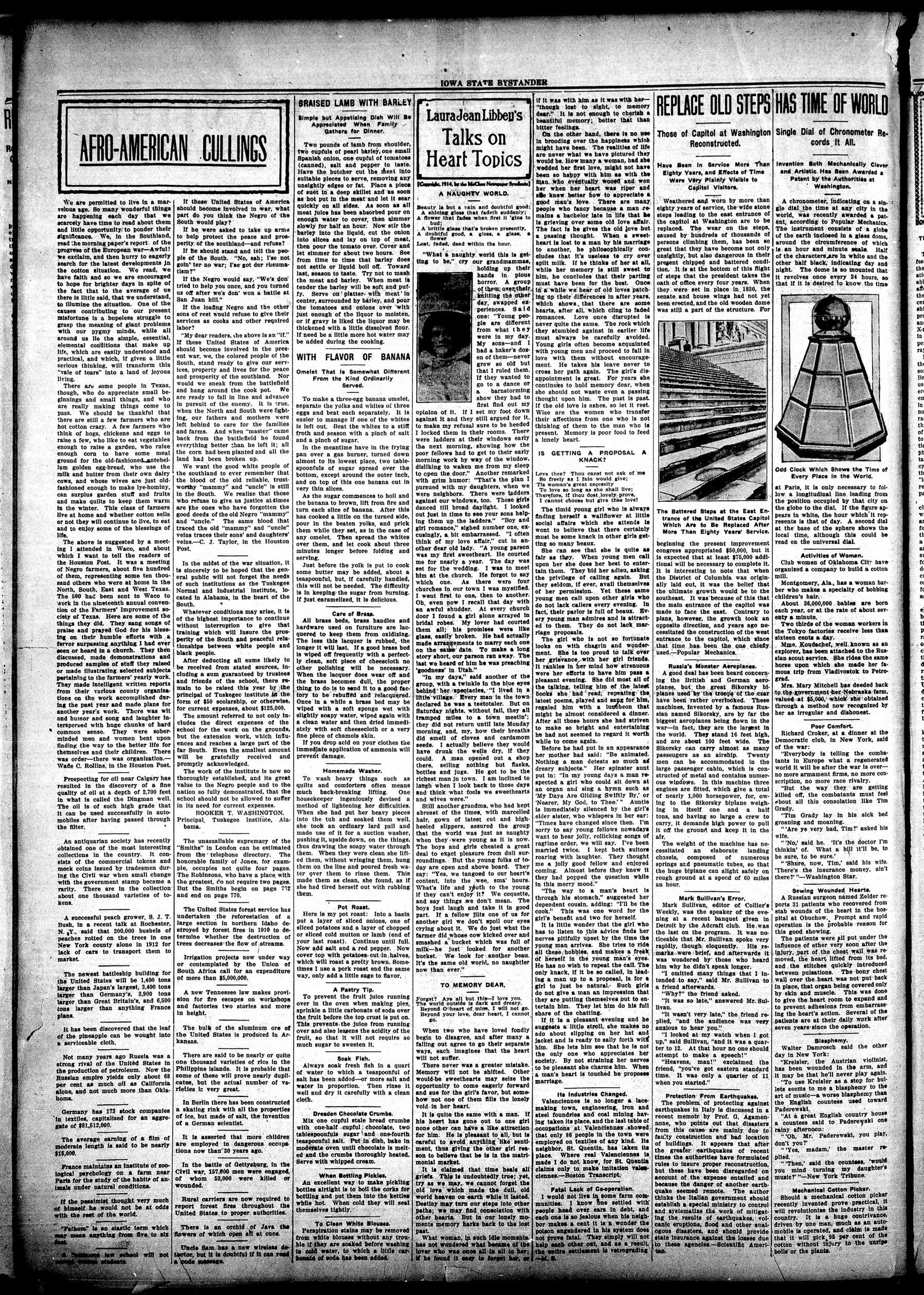
The Battered Steps at the East Entrance of the United States Capitol Which Are to Be Replaced After More Than Eighty Years' Service.
The Battered Steps at the East Entrance of the United States Capitol Which Are to Be Replaced After More Than Eighty Years' Service, beginning the present improvement congress appropriated $50,000, but it is expected that at least $75,000 additional will be necessary to complete it. It is interesting to note that when the District of Columbia was originally laded out, it was the belief that the ultimate growth would be to the southeast. It was because of this that the main entrance of the capitol was made to face the east. Contrary to plans, however, the growth took an enormous amount of time to consolidated the construction of the west entrance to the capitol, which since that time has been the one chiefly used—Popular Mechanics.
Russala's Monster Aeroplanes.
A good deal has been heard concerning the British and German aeroplanes, but the great Sikorsky biplanes used by the troops of the carr have been rather overlooked. These machines, invented by a famous Russian named Sikorsky, are by far the biggest aeroplanes being flown in the war—in fact, they are the largest in the world. They stand 16 feet high, and are about 100 feet wide. The Sikorsky can carry almost as many passengers as an airship. Twenty men can be accommodated in the large passenger cabin, which is constructed of metal and contains numerous windows. In this machine three engines are fitted, which give a total of nearly 4,000 horsepower, for owing to the Sikorsky biplanes flying in itself one and a half tons, and having so large a crew to carry, it demands high power to pull it off the ground and keep it in the air.
The weight of the machine has necessitated an elaborate landing chassis, composed of numerous springs and pneumatic tubes, so that the bihne can alight safely on rough ground at a speed of 60 miles an hour.
Mark Sullivan's Error
Mark Sullivan, editor of Collier's Weekly, was the speaker of the evening at a recent banquet given in Detroit by the Adcraft club. He was the last on the program. It was noticeable that Mr. Sullivan spoke very rapidly, though eloquently. His remarks were brief, and afterwards it was wondered by those who heard him why he didn't speak longer.
"I omitted many things that I intended to say," said Mr. Sullivan to a friend afterwards.
"Why? the friend asked.
"I was so late," answered Mr. Sullivan.
"It wasn't very late," the friend replied, and the audience was very anxious to hear you."
"I looked at my watch when I got up," said Sullivan, "and it was a quarter to 12. At that hour no one should attempt to make a speech!"
"Heavens, man!" exclaimed the friend, "you've got eastern standard time. It was only a quarter of 11 when you started."
Protection From Earthquakes
Protection From Earthquakes.
The problem of protecting against earthquakes in Italy is discussed in a recent monograph by F. G. Agamemnon, who points out the damage from this cause are mainly due to faulty construction and bad location of buildings. It appears that after the greater earthquakes of recent times the authorities have formulated rules to insure proper reconstruction, but these have been disregarded on account of the expense entailed and because the danger of another earthquake seemed remote. The author thinks the Italian government should establish a special ministry to control and systematise the work of mitigating the results of earthquakes, volcanic eruptions, food and other analgesic drugs, and state insurance against the losses due to these agencies.—Scientific Ameri-
T
T
T
T
T
T
T
Single Dial of Chronometer Records It All.
Invention Both Mechanically Clever and Artistic Has Been Awarded a Patent by the Authorities at
A chronometer, indicating on a single dial, the time at any city in the world, was recently awarded a patient, according to Popular Mechanics. The instrument consists of a globe of the earth enclosed in a glass dome, around the circumference of which the circumference of which Half of the characters are in white and other half black, indicating day and night. The dome is so mounted that it revolves once every 24 hours, so that if it is desired to know the time
Odd Clock Which Shows the Time of Every Place In the World.
at Paris, it is only necessary to follow a longitudinal line leading from the position occupied by that city on the globe to the dial. If the figure appears in white, the hour which it represents is that of day. A second dial represents the time of local time, although this could be read on the universal dial.
Activities of Women
Club women of Oklahoma City have organized a company to build a cotton mill.
Montgomery, Ala., has a woman barber who makes a specialty of bobbing children's hair.
About 36,000,000 babies are born each year, or at the rate of seventy a minute.
Two thirds of the woman workers in the Tokyo factories receive less than sixteen cents a day.
Mme. Koudaché, well known as an explorer, has been attached to the Russian sail service. She rides the same horse upon which she made her fah-trip from Vladivostok to Petrograd.
Mrs. Mary Mitchell has deeded back to the government her Nebraska farm, valued at $5,000, which she obtained through a method now recognized by her as irregular and dishonest.
Poor Comfort.
Richard Croker, at a dinner at the Democratic club, in New York, said of the war:
"Everybody is telling the combatants in Europe what a regenerated world it will be after the war is over—no more armament firms, no more conscription, no more race rivalry.
"But the way they are getting killed off, the combatants must feel about all this consolation like Tim Grady.
"Tim Grady lay in his sick bed groaning and moaning.
"Are ye very bad, Tim?" asked his wife.
"No," said he. "It's the doctor I'm thinkin' of. What a bill it'll be, to be sure, to be sure."
"Shure, now, Tim," said his wife. "There's the insurance money, ain't there?" — Washington Star.
Sewing Wounded Hearts
A Russian surgeon named Zolder reports 31 patients who recovered from stab wounds of the heart in the hospital at Obuchow. Prompt and rapid operation is the probable reason for this good showing.
The patients were all put under the influence of ether very soon after the injury, part of the chest wall was removed, the heart lifted from its bed, and the stitches quickly introduced between pulsations. The bony chest wall over the heart was not put back in place, that organ being covered only by skin and muscle. This was done to give the heart room to expand and to prevent adhesions from embarrassing the heart's action. Several of the patients are at their daily work after seven years since the operation.
Blasphemy.
Walter Damrosch said the other day in New York:
"Kreisler, the Austrian violinist, has been wounded in the arm, and it may be that he'll never play again.
"To use Kreisler as a stop for bullets seems to me a blasphemy to the art of music—a worse blasphemy than the English countess used toward Paderewskl.
"At a great English country house a countess said to Paderewskl one rain," he announced:
"Oh Mr. Paderewskl, you play, don't you?"
"Yes, madam,' the master replied.
"Then," said the countess, "would you mind turning my daughter's music?"—New York Tribune.
Mechanical Cotton Picker.
Should a mechanical cotton picker recently invented prove practical, it will revolutionise the industry in this country. It is a huge contrivance, driven by one man, much as an automobile is operated, and claim is made that it will pick 95 per cent of the cotton without injury to the unripe bolls or the plants.
---
Fundamental Principles of Health
By ALBERT S. GRAY, M.D.
(Copyright, 1914, by A. S. Gray)
THE RADIOACTIVE ELEMENTS.
The discovery of the X-ray by Professor Roentgen in 1895 familiarized the minds of men with a type of radiation invisible to the unaided eye but able to traverse opaque objects and affect a photographic plate behind them. It had long been known that certain substances exposed to sunshine afterwards glow in the dark, a property known as phosphorescence, and it had been discovered that the X-ray developed these same qualities in these substances. This led to experiments to see if similar types of rays were not produced in other ways.
Like many other great discoveries, the culmination of the search owed something to luck or accident. Henri Becquerel in Paris in 1898 chanced to use a piece of uranium and discovered in compounds of that element emanations closely allied to the X-ray in their general nature, a property we now call radioactivity. These new radiations in varying extent pass through all matter quite independent of whether it is opaque or transparent to light. In addition to the property possessed by uranium, it photographs plate and of causing certain substances, like the platinocyanides, to fluoresce, the new reations resembled the X-rays also in "inzinging" the air and other gases, rendering them for the time being partial conductors of electricity.
The pioneer in developments on the chemical side was Mme. Curie, who, with her husband, isolated radium and polonium. Other investigators following these lines developed some thirty individual radio elements. As a result of experiments, observations and deductions, we are beginning to suspect that there exists in every form of matter the process of its own decay, and this suspicion is gradually crystallizing into a belief, a new philosophy, a philosophy destined profoundly to influence the thoughts and actions of future generations of men. The emanations from radioactive elements have been classed as alpha, beta and gamma rays, and are distinguished by enormous differences in power of penetration. The alpha rays have been shown to be atoms of helium carrying an electrical charge, and shooting out from radioactive materials in coincidence into intergrate layers. The alpha rays of radium are distinguishable in generating power from the alpha rays of Uranium and from Thorium, but the differences among alpha rays as a class are small and unimportant, relatively compared to the enormous differences between any alpha ray and a beta or a gamma ray.
The most penetrating alpha ray known is not more than twice as penetrating as the least penetrating alpha ray known, but beta rays as a class are 100 times more penetrating than alpha rays and the gamma rays in turn are fully 100 times more penetrating than the beta rays as a class. Alpha rays are completely absorbed by thin screens of paper or a few inches of air, while beta rays pass through solid cardboard or ordinary fibre with ease. But Soddy shows that a gamma ray will penetrate one half inch of steel or a stack of twelve pennies, six inches of lead or one foot of solid iron.
The compound microscope became an efficient weapon of scientific truth about 1830, and in 1839 Schwann demonstrated that "all the higher animals are commonwealths of cells."
Every human individual begins life as a single cell about a hundred and twentieth of an inch in diameter and in the brief period of forty weeks attains an average weight of approximately one inch and ensures a period of growth. Growth is not a simple augmentation of volume, but an alteration in form and type.
For instance, if we compare the skeleton of a new-born child with that of an adult, we discover vast differences between the relative proportions of the different parts. The child's head is enormously larger than that of the adult in proportion to its stature and the chest measure also is markedly greater in the child. These facts imply the difference in the balance wheel or growth regulator. It is easy to understand that anything that will throw these growth regulation factors out of gear must produce grave results and
New York Man Will Hardly Make Any Money Out of That Live Stock This Season.
From all parts of the country comes the cry of the high cost of living, but to have pigs which eat a $550 dinner is an unusual thing. However, A. Stratch of East Kingston, N. Y., has three pigs which enjoyed such a dinner. This expensive feast was not intentional on Mr. Stratch's part, but was an accident. Mr. Stratch is employed on the Dinan brickyard at East Kingston, and during the summer saved $550 which he kept in the house until this week, when he decided to deposit it in a bank. The money was tied up in a handkerchief and Mr. Stratch left to take the boat to Kingston, but being early he decided to feed his pigs. Then were fed and given bedding for the night, and then left for the pier, where he arrived at the landing he self for his money, and found it mis-
in the extraordinary increase in the
results of such a disturbance.
The power of human resistance to this disease seems to be steadily declining. In Massachusetts and New Jersey, and in sixteen American cities the government reports indicate that mortality from cancer has increased 109 per cent since 1880, and during the ten years since 1911 it has increased 25 per cent. Canada, the United States about 750,000 lives annually and the rate in the registration area per 100,000 in 1911 was 78; in England and Wales it was 97.
There is a deep significance to many minds in all the foregoing facts, and men everywhere are searching for the key to the riddle, and some day, half by chance perhaps, it will be found.
A WORD ABOUT CANCER.
United States government reports show that during the ten years preceding, 1911 the population of this country increased 21 per cent. During this period the death rate per 100,000 from cancer increased 30 per cent among males and 22 per cent among females. "The extraordinary increase in the mortality due to cancer in this and other countries has long since raised the malady to the proportions of a great plague," says an authority who wrote on this subject recently. "The power of human resistance to this disease seems to be steadily declining." He then proponed a new rate of increase in another 25 percent cancer will cause more deaths than tuberculosis, typhoid fever and malaria combined.
Scientists throughout the world are diligently searching for the cause of this fearful scourge of mankind, in order that a specific preventive and cure may be found. Meanwhile every individual should be informed that cancer is to a large degree preventable if we will but apply the knowledge we already possess to guard against it.
There are many theories as to the cause of cancer, the most logical one being that advanced by a group of microscopists working along biological lines. The basis of this theory is that cancer is a state of anarchy within the body. To be able to grasp the theory and also to understand why the X-ray is at all effective in cases of cancer it is necessary to have a group of microscopists, an institution advanced by Virchow in 1858, which I have noted in a previous article; namely, that each one of the cells composing the human body is a distinct individual possessed of all the characteristics of life. That is to say, every reader of this article is composed of many billions of individuals, each having all the powers and faculties that the reader is conscious of possessing and differing in no way save in degree. Every living thing is constructed of cells, composed of the same protoplasm, and differs only in organization.
It is during the first few years and more particularly during the first year of life that the highest human mortality takes place. The newly proliferated cells are not thoroughly organized and the entire organism is therefore weak and unstable. Ordinarily we do not think of working young children or animals, because we know that their tissues are soft and therefore that they may very easily be broken down and ruined, but as maturity we know that the more perfect, stable and adaptable and are therefore highly resistant. This fact forms the basis for the action of the X-rays on cancer.
There is no renegedy known to medicine that has a selective influence, there is nothing that can be put into these bodies of ours that will drive disease out and not touch healthy tissues. But, depending on the state of the individual cell vitality, tissues react differently to the same influence; hence tissues having marked power of proliferation are necessarily composed of masses of these young or "juvenile" cells and are of course vastly more susceptible to any influence than the more fully formed and "adult" cells which may often remain unchanged for years.
An "anarchist cell" finds a favorable location and proceeds to proliferate; that is to say, it multiplies by division, as all the somatic cells do, and these young and weak cells form what is technically known as "juvenile" tissue within the more stable, older, or "adult" tissue of the organ in which the cancerous process is taking place. If now the "hard," very penetrating rays of the X-ray are turned upon this disease and of two things taken—either the short, sharp collagen, which we have had approximate more than 800,000,000 per second, shake these "juvenile" cells into a healthful reaction, or they destroy them as a dog kills a rat by shaking it, and the healthy cells are stimulated by the light.
ing. He returned to the house and made a search and finally came upon a few scraps of the handkerchief and parts of the money in the pig pen, where he been torn and partly up by the pigs.
A few of the scraps of money were recovered and Mr. Scratch probably will be able to get new money from the national treasury for them, but most of the money is a total loss.— Knickerbocker Press.
Plenty of Experience.
"Have you had any experience in the lunch business?" asked the chef of the man who applied for the job. "Why, I should ask for more. I have been lunching our almost twenty years."—Lippincott's Magazine.
Marauder. Put to Death.
At Sutterton, England, a hen was in a garden with her newly-hatched brood when a jackdaw pounced upon a chick. The hen gave battle at once, and a sharp encounter ended in the few helping killed.
---
Dr. Marden's Uplift Talks
By ORISON SWETT MARDEN.
Copyright by McClure Newspaper Syndicate
VIM IS THE POWDER OF SUCCESS.
There is no other success quality except honesty which is more in demand today in all lines of human endeavor than vim. Everybody believes everywhere we hear:
"Give us a man who can do something; a man who has挑 a man with iron in his blood." Ability is worthless without the power to put it into action. Resolutions, however good, are useless without the energy necessary to carry them out. Push clears the track; people get out of the way of an energetic man. "Energy is what wins. Many men fail to reach the mark because the powder in them is not proportioned to the bullet." From fall to attain success in life from lack of training to achieve, accomplishes, pushes its way through obstacles—than from almost anything else.
No matter how much ability a young man may have, or how clever, courteous or amiable he may be, if he lacks energy, the powder of success, he never accomplishes much. There is no success in weakness, no victory in the uncertain step, hesitating will, lagging hand, or languid brain of an exhausted man. Even small ability with great energy will accomplish more than the greatest ability without energy. If fired from a gun with sufficient velocity a tallow candle can be shot through an inch board.
He who is hampered by depleted vitality is constantly losing opportunities, because he lacks strength to grasp them, to hold on to them, and to use them. He is forced behind and sees men who have not half his mental capacity, but who have strong physiques and all their power intact, forage ahead of him and seize the opportunity to use them, which everyone has to face is how to generate energy, how to conserve it, and how to keep oneself always at the top of his condition. When ever you are angry or feel like grumbling or pouting—whenever you are gloomy, freetful or morose—you are consuming your energy, wasting your vitality, and opening the sluiceways in your mental reservoir, instead of using them to drive the mental machinery. Everything which frets, chafes, raspos or brings inharmony into life is a vitality-waster. Whatever brings discord into the nervous system destroys power. Friction is a deadly foe to happiness and success. It grinds away the delicate bearings of life's machinery without doing any good or harming others. From friction, to lubricate all the faculties and to stop all the leaks of energy is the first duty to oneself and to others.
Millions of people have made miserable failures in life by letting this precious energy, which might have made them successful, silp away from them in foolish living and silly dissipation. Much of the worst kind of energy-dissipation is not what is commonly called "immoral" when the need for ignorance, carelessness, neglect, but it is dissipation, all the same. If you would make your mark in the world, and do your part in advancing civilization, you must cut off everything which is an energy-waster or success-killer. Do not do anything or touch anything which will lower your vitality. Always ask yourself, "What is there in this thing I am going to do with it?" You will increase my power, work, and me in a more superb condition, and make me more efficient in the service of humanity?"
WORKING WITH DULL TOOLS.
I criticized a carpenter working for me recently for using dull tools. He excused himself by saying that he had been too busy to sharpen them. He had been working for weeks with a dull saw and with a plane which had notches in it, leaving ugly ridges on the boards he was planing. This man had probably wasted more time in working with dull tools than he have taken to use them several times, to saw nothing of the inferior work as was turning out. There are multitudes of people who never do good work because they never prepare for it, never put themselves in a position to do good work—they never sharpened their tools; never trained themselves for it, and they go through life botching their jobs. Every youth should put himself in superb condition to make his life a success. He should prepare himself to do the best work of which he is capable.
One great reason why so many people make botches of their lives because they didn't start right, they never mastered their life trade. It does not matter what a youth decides to do in life, he should endeavor to be an expert in it, an artist instead of an artisan.
Our intelligence offices are constantly filled with people, no matter how good the times, who have never half learned to do any particular never learned to do anything. The great majority of house servants do domestics work because they never learned
Pizza, Coffee and the Orient.
In the "Arabian Nights" entertainments, which are said to be such faithful pictures of Oriental manners, there is no mention of the pipe. Neither is coffee to be met with in those tales, so delightful to all ages. We with difficulty imagine at Oriental without his chibook, and in vain theain they knew nothing of this luxury before the century. At present, such is the almost imperious necessity felt by the Turk for smok- and coffee that as soon as the
IOWA STATE BYSTANDER
to do anything else, and this was about the only thing they could do without preparation.
How often do men who spend most of their lives as day laborers working on the street, on railroads and ships, on farms, in all sorts of places, where they get only very small wages, who have the natural ability to do something infinitely better and to earn many times as much money, but they never learned to do anything in particular, and so they drifted into the only positions they could fill without special preparation.
On the other hand, there are a great many who are in a position to prepare for their chosen lifework, who destroy all their chances of success by overloading or by neglecting the laws of health. Through ignorance indifference or carelessness their faculties, their tools, are so dulled that they are unable to do what they long to.
How often we see young people starting in life with great ambitions to make a place for themselves in the world and to do something worth while, and yet they are ruining the possibility of their doing anything very important by ignoring the laws of health, in all sorts of ways lowering their physical standards, devitalizing their themselves so that they do not have sufficient force for any great accomplishment, and they must most dependent upon for attaining their object, a strong and vigorous vitality, they sacrifice.
One can accomplish wonderful things with no other capital than robust health and the determination to make something of oneself, but no matter how much ambition one has, if he devilizes himself, if he ruins his health by vicious habits, devilizes himself by an abnormal or irregular life, he knows that his only chance of accomplishing anything very important is gone. Everything a man does gravitates to his physical condition. All of his physical defects, physical weaknesses, will reappear in whatever he does, and his mental condition will always harmonize with his physical state. Plenty of good people who are capable of doing good work do very poor work because they do not keep themselves in a condition to bring out the best thing that is in them. Unless a man has kept his tools sharp, kept himself at the top of his condition, the best that is in him will not respond to his efforts. He may be satisfied with even a second or third best if his physical standards are down, if he is devilized by violating the laws of existence or by irregularities of living. The stream cannot rise higher if its fountain head. If the physical condition is low, if one is devilized, his ambition suffers, his ideals are cloudy, his energies lag, his work is poor.
Disspelled All Doubt
Speaking of the unsophisticated the other night, Congressman Robert L. Henry of Texas related how a young wife went to a butcher shop to buy a turkey.
The price named for the bird, the congressman said, was 26 cents a pound, whereat the young wife hesitated.
"Nin't 26 cents rather high?" she timidly queried. "If I remember rightly, the price across the way is 23 cents."
"With the feet on, I suppose," was the quick response of the butcher.
"No," he hastily returned the customer, "I think the feet were cut off."
"That's just what I thought!" was the confident declaration of the butcher, as he began to wrap up the bird.
"When we sell a turkey, madam, we sell feet and all!"—Philadelphia Telegraph.
The Blind Need Windows.
Light has use, even if men cannot or will not see it. Baring-Gould tells of an institution for the blind that was built in England without windows. "Why," argued the committee, "should we provide windows for those that cannot see out of them?" So scientific ventilation and heating were designed but the walls were infiltrated by any pane of glass. But soon the poor inmates grew pale, and a great languor fell upon them. They fell sick, and one or two died. Then it was that the committee decided to open windows in the walls. In came the healing light, and the human plants responded to it at once in revived spirits, ruddy cheeks and sweaty skin. The Light of the World is good, even for those who shut their eyes—Christian Herald.
Aa to Klesing.
the kings and high officials of Europe, when they meet, always embrace and kiss each other, no matter what their relations have been in the past or may be in the immediate future. This is a kiss of respect. It may be given on the lips, the cheek, the brow or the beard and is nicely adjusted, according to the age and rank of the giver. From this close personal contact it passes through many forms; kissing the hand, parts of the clothing and even the ground trodden upon, according to the idea of respect; or fear inspiring the one who performs the act.—Christian Herald.
Slighted.
"I saw Blobson out this morning with his wife and her dog."
"Was he trailing behind his wife and her dog?"
"Why, no."
"I guess he was making a concession for the sake of appearances. That is his usual status at home."
gun announces the setting of the sun during the fast of the Remembrance, begging of the satisfaction his cravings stomach with any solid food, he takes his cup of coffee and lights his pipe.
No Apparent Change
"Five years ago I was a physical gymnast. I took up regular gymnasm work, and look at me now." "I'm looking. Are you trying to show me what gymnasm work will do, or what it won't do?"
GOT HIS BREAKFAST
SQUIRREL HAD TO WORK, BUT HE DID IT.
With the Aid of a Friendly Telephone Wire and His Wonderful Tail Lit. little Animal Secured Supply of Provisions.
You may have thought that the squirrel was just showing off when he walked the telephone cable all the length of the alley, says the Indianapolis News, and you may have classed him with the sort of foolish people that have walked wires over Niagara falls. The fact was that the squirrel wanted his breakfast, and, what was much more important, his wife wanted her breakfast. The snow was so deep that the squirrel would only have succeeded in burying himself if he had tried to walk through it and it was packed so tightly down next to the ground that he could not get to his seat in the tree. He could not telephone to the corner grocery, because he had no telephone, and he could not borrow from the neighbors, because he had no neighbors. He could not fly, and he could not beg loudly enought to be heard. It seemed to him that if he had been anything but a squirrel, there would have been somebody to help him; but, as he was a squirrel, he had to help himself, and he started brightly out to do it. He walked the slippery path of the alley, and found some from the garbage can conveniently near a telephone pole. Then he walked back again, and carried his wife's breakfast to her.
It sounds so simple, and it was so difficult. His feet were cold, and so stiff that they skidded. He was a fat little squirrel, and every inch or so he slipped so far to one side or the other that he almost lost his balance. If it wasn't been for his tail, he could have had a tail that he would work! Now on this side, now on that, and now jerking steadily along straight above the wire. The poor tail was heavy with snow, and ached with the unaccustomed exercise, but it went bravely on, balancing, correcting, catching, holding, and, indeed fairly pushing the squirrel along the wire, he could probably tell that wire was there for no other purpose than to afford him a passage through the air, and no doubt he had several things to say about the size of the wire and its slippery condition and the general lack of accommodation afforded by public service corporations, entirely forgetting that if the wire had not been there, he and his wife would have been able to eat no lunch or dinner. The more dependent we become on public service corporations, the more fault we can find with them.
Phrenological.
Nelson's Encyclopedia says: "Of the system of phrenology advanced by Gall, Spurzheim and Combe, two facts are sufficiently condemnatory, (1) The gray matter on the surface of the brain is not mapped out into thirty odd areas that correspond with such affective propenalties as amativeness, combativeness and constructiveness, or with such 'sentiments' as self-esteem, benevolence, hope and wit. (2) The outer table of the cranial bones does not accurately represent the contour of the brain surface—the thickness of the skull varies in different individuals and in different localities in the same individual; while in parts, air spaces, whose size and shape have no relation to the brain development, are interposed between inner and outer tables of the bones. The latter had been made to advance a phrenological system that practically ignores the 'bump' doctrine. Dr. Bernard Hollander in 1901 published a work in which he showed the association of certain types and symptoms of insanity with definite lesions of particular parts of the brain. But-Dr. Hollander, instead of reviving Gall's doctrine (popular phrenology), gives the word phrenology a new significance."
The Irishman's View
Burr McIntosh is telling a story of an Irishman in the English army who had fought so bravely in the trenches that he was given promotion on the field of battle. Immediately on hearing the news the Irishman set up the cry, "three cheers 'for the Kaiser! He was immediately seized, bound and brought before the colonel. As he was led off the colonel asked the Irishman to explain why he had done such a thing. "Well," said the Irishman, "if it hadn't been for the kaiser I wouldn't have had a fighting job. If I hadn't a job I couldn't have been promoted."
Being Consistent.
"Charley, dear," said young Mrs. Torkins, "what shall I do with all these feathers? I can't find a thing in this Helpful Hints article about them."
"How did you get them?" "Why, you know, all helpful hints writers tell you when you buy a steak you must have the butcher give you a knife to trim the trimmings. So when I bought this turkey I made them give me the feathers."
The Poetry Did It.
"I won't pay one cent for advertisag this week," declared the storekeeper angrily to the editor of the country paper. "You told me you'd put the notice of my shoppolish in with the reading matter." "And didn't I do anything to enquire the editor?" he laughed. "No, sir, you did not. You put it in the column with a mess of poetry, that's where you put it!"
The True Bravery
There is as much true courage in enduring with constancy the sorrows of the soul as in remaining steadily on the wall of a battery. To give oneself up to grief without resistance, to kill oneself in order to escape from it, is to abandon the battlefield before victory—Napoleon.
The KITCHEN CABINET
We are not worst at once; the course of evil begins so slowly, and from such slight source.
An infant's hand might atom the breach with clay; but the dream grow wider, and philosophy, age, and religion, too, may strive in vain.
To stem the headstrong currents.
used in combination with lemon juice is a good way to introduce variety in to the diet of a convalescent.
One ship drives east, another west. While the selfsame breeze blows. The set of the sails and not the gales. That bids them where to go.
Like the winds of the air, are the wars
CHRISTMAS DESSERTS.
Cold desserts may be made the day before, an advantage when one has but little help to prepare the meal. Chocolate Russe. —Soak a table-spoonful and a half of gelatin in three tablespoonfuls of cold water, dissolve
Chocolate Russe.
—Soak a table-spoonful and a half of gelatin in three table-spoonfuls, cold water dissolve it in a cupful of scalded milk. Put a table-spoonful of grated chocolate, two table-spoonfuls of sugar, a table-spoonful of boiling water into a cup and stand this in a pan of hot water until the chocolate is melted, then add the mixture to the milk and gelatin. Whip a plum of cream until stiff, add to the first mixture, blending all together well. Line a can and use a cake or lady fingers and just before to pour into the mold. Set in a cold place until serving time, then turn on to a fancy platter and decorate with whipped cream and candied cherries. Dip the mold in hot water and run a thin-bladed knife between the mold and the lady fingers before unmolding. Fruit Nut Cream—Whip a cupful and a half of cream, add two table-spoonfuls of sugar, a half cupful of orange peel and citron, two tablespoonfuls of minced candy and candy peperlite or other candied fruits. Serve in sherbet cups lined with lady fingers. Mince Meat—Take a pound each of raisins, suet, currants, half a pound of orange peel and citron, one pound of sugar, two pounds of apples, 1½ tessellation of mixed spices, a table-spoonful of salt, juice and grated rind of two lemons, a cup of nut meats and a cup of cider. Chop the fine and fine all the ingredients together. The apple and apple shopped also. Cover and net aids to ripen. Cabbage sliced and seasoned with salt, pepper and vinegar is a good accompaniment for oranges.
Had I but heard
Had I but heard
One breath of applause, one cheering
wade.
One cry of Courage! amid the strife,
So weighted for me with death or
Life.
How would it have nerved my soul to
strain
Thro' the whirl of the coming surge
again.
THE VALUE OF LEMONS.
Lemons are one of the most useful
of fruits in our domestic economy.
Lemonade is an exceedingly
wholemeal drink.
A half a lemon squeezed
into a glass of water and
taken before breakfast
is a fine tonic. The ref-
fresh soft buns used to
remove stains from the
hands.
Lemonade is an exceedingly wholesome drink. A half a lemon squeezed into a glass of water and taken before breakfast is a fine tonic. The refuse left may be used to remove stains from the hands. Lemon juice and sugar made very thick is an excellent for a cough.
thick is a great relief for a cough.
A baked lemon is excellent for hoarseness and one often used by singers and public speakers. Bake the lemon like an apple, then squeeze out the juice and add sugar to it.
Hot lemonade will break up a cold it taken at the start.
Lemon juice, glycerin and water makes a most healing lotion for chapped hands.
The dark streaks on the neck may be removed by rubbing lemon over the neck night and morning.
Lemon rids the system of humors and bile and leave no evil effects. Weak, debilitated people sometimes may be greatly benefited by free use of them. Lemon juice should be diluted with water or sweetened sufficiently to lessen the burning sensation in the throat.
A most nourishing drink for an invalid is a fresh egg well beaten, added to a glass of strong lemonade.
The pulp of a lemon rubbed on the roots of the hair will help to stop the ordinary cases of falling hair.
Sore and tender feet may be relieved and often cured by the free use of slices of lemon applied to the feet at night. Salt sprinkled over the lemon cure chilblains; repeat for several nights.
For feverishness, roll a lemon until soft, cut off the end and put into it as much sugar as it will hold, then suck it slowly.
Lemon jelly is a good dessert, or combined with other fruits makes a most delicious fruit salad. Gelatin
Home-Made Paste
An inexpensive paste which will be found much more satisfactory than either flour or cornstarch is made of one small potato grated fine. Add boiling water enough to make clear and boil five minutes.
Recording Sound Waves
A new German method of recording sound waves employs a lead pencil line of varying thickness, formed on the surface of the current infusible by the vibrations.
Had Been There Before
Dasher had evidently had experience. Lasher—"We're going to have some amateur theatricals at my house next week and a big supper afterward, an you be then?" Dasher said, "can you be old, man, but—or I may be late."
Folly of Anger.
To speak angrily to a person, to show your hatred by what you say or by the way you look, is an unnecessary proceeding—dangerous, foolish, ridiculous and vulgar.—Schopenhauer.
used in combination with lemon juice is a good way to introduce variety into the diet of a convalescent.
One ship drives east, another west. With the set of the sail and not the gales, that bids them where to go.
Like the winds of the air, are the wars of the fates
As we journey along through life:
'Tis the set of the soul that decides the goal
According to government analysis, canned salmon will furnish a pound of protein more cheaply than any other animal food except salt cod. The thrifty housewife will have few cans of salmon on her shelves to use for occasions.
cheaply than any other animal food except salt cod. The thrifty housewife will have a few cans of salmon on her shelves to use for occasions and also for emergencies. A most appetizing main dish for a dinner may be made by serving salmon leaf surrounded with pea. Salmon and pickles make a fresh chopped pickle and a most appetizing salad.
Another good dish which is especially nice for a supper dish is mashed potatoes put through a ricer heaped on a platter as a border around salmon which has been heated in the can. After opening, set it in hot water until well heated, then heap in the center of a hot platter, removing the skin and bones. Over the potatoes poured with well-seasoned white cheese and serve very hot.
Salmon Cups—Chop finely a can of salmon, add a half cupful of bread crumbs, two tablespoonfuls of melted butter, one tablespoonful of lemon juice, two well-beaten eggs, salt, pepper, and half a cupful of rich milk. Mix well and pack in greased cups, set in a pan of water and bake until firm. Turn out and serve on hot individual plates with a white sauce.
Salmon Croquettes—Mix a half cupful of bread crumbs with a can of salmon drained and minced. Season with salt, pepper, a little nutmeg, a juice of half a lemon, and a little of butter. If too dry add a little of the liquor from the can. Make in any desired shape, and when fry in deep fat.
What use for the rope, if it be not flung
Till the swimmer's clap to the rock has clung?
What worth is Eulogy's blandest breath?
When what in cars that are hushed in death?
No! not if you have but a word of cheer,
Speak it while I am alive to hear.
-Margaret Preston.
CABBAGE COMBINATIONS.
Cabbage may be made quite another
bread by cooking and combining with
different seasonings and food. Creamed cabbage is an especially nice dish; dish the cabbage very fine and in water in boiling water, slightly salted, then drain in a colander and put it into a rich, well-
different seasonings food. Creamed cabbage beak is especially nice dish; shred the cabbage very fine and cook it until tender in boiling water, slightly salted, then drain in a colander and put it into a rich, well-seasoned white sauce. A few bits of finely chopped celery and a dash of onion improves the flavor.
Buttered cabbage is another appetizing dish. Cook finely shredded cabbage, until tender, and dredge water, drain, put back into the sauce, add water, pepper and more salt and when well mixed a few table-spoonfuls of good vinegar to give it a zest. Serv hot.
Cabbage eaten raw is more digestible than when cooked. When serving it raw it should be very finely shredded or chopped and allowed to stand in cold water to crisp. Drain well, add salt, sugar, thick sweet cream and a very little vinegar. This makes a most delicious salad to serve at any meal.
Another cabbage salad which is such a favorite with the Germans especially, and is named German salad, is prepared by chopping fine a small head of cabbage and an onion and pouring over them the fat fried out from a good slice of salt pork cut in small cubes; when well mixed, season high with salt and red pepper and pour over a half cupful of boiling hot vinegar. This sauce is added or used as a garnish, only be sure to add to the salad.
Nellie Maxwell
Real Home of the Rosemary.
The home of the rosemary was originally in the south of Europe, more especially where it grew for the height of six or eight feet, either being trained upward from the ground or embedding its roots in an old wall. It grows in three varieties—gold, silver and green.
Daily Thought.
Times of general calamity and con-
tinue heat have been productive of
the most miserable of events.
Despite the Little Fears
Don't be afraid of shadows. They are really not dangerous of themselves, and have often been known to be quite friendly—especially in sweethearting times. You were not afraid of them then.
Blessing in Happiness.
Happiness, like mercy, is twice blessed; it blesses those who are most intimately associated with it; and it blesses all those who see it, hear it, feel it, touch it, or breathe the same atmosphere—Kate Douglas-Winnie
THE TRACTOR
The Jennie was the first animal owned by the school. There are now several mules, cows, sheep, nearly a hundred hogs and several hundred chickens.
Mr. Jesse Mitchell is still quite ill, with no signs of great improvement. Bethel A. M. E. Sunday school will give a 6 o'clock dinner on Christmas eve. This event will be given instead of the Christmas tree. Mr. H. G. Williams was called to Chicago a few days ago on account of the serious illness of his smother, who has since died. He has the sympathy of his many friends in Clinton. Everything is-looking well towards a Merry Christmas. The weather at present is delightful.
Mrs. M. O. Culberson was taken to Agatha hospital two weeks ago, where she had to undergo another operation.
Make your friend a present of The Bystander. They will appreciate it.
Mrs. Foster of Ottumwa is a guest of her daughter, Mrs. Oscar Thompson on Eighth avenue.
Sunday will be quarterly meeting at Bethel A. M. E. church, the first for this conference year. The query is, What has been holding it back?
Rev. Slater is trying to get the men and boys interested in the reorganization of the club which they endeavored to maintain some months ago.
Mrs. F. F. Jackson continues to enjoy good patronage at his Tenth avenue restaurant.
Mrs. J. N. Hancock is seriously ill at her home on Fifth avenue.
Miss Lilian Hancock is here from Chicago, called here on account of the illness of her mother.
Chamberlain's Cough Remedy—The Mothers' Favorite.
"I give Chamberlain's Cough Remedy to my children when they have colds or coughs," writes Mrs. Verne Shaffer, Vandergrift, Pa. It always helps them and is far superior to any other cough medicine I have used. I advise anyone in need of such a medicine to give it a trial." For sale by all dealers.
COUNCIL BLUFFS ITEMS.
We had with us Sunday night at Bethel A. M. E. church Rev. Penn, who delivered an excellent sermon.
Preparations are now being made by both the Baptist and Methodist Sunday schools for Xmas. The little ones are anxiously waiting the arrival of Santa.
The lecture delivered by Rev. Buxton at the Masonic hall Wednesday night was under the auspices of the Baptist church and was enjoyed by all present.
Mrs. Walter Herndon and son, Mr. Chauncey Herndon, returned home Wednesday from Moberly, Mo., where they attended the funeral of Mrs. Herndon's aunt, Mrs. H. Baker.
Mr. Frank McRaven left this city Monday for Phoenix, Ariz., because of ill health. We wish for him a speedy recovery, that he may soon be back to his wife and little ones.
Mrs. W. L. Cave left Monday night for Parksville, Mo., to be with her sister, Mrs. Wilkerson, who is seriously ill.
For That Dull Feeling After Eating,
I have used Chamberlain's Tablets
for some time, and can testify that
they have done me more good than
any tablets I have ever used. My
trouble was a heavy dull feeling after
eating—David Freemar, Kempt,
Nova Scotia. These tablets strengthen
the stomach and improve the digestion. They also regulate the liver
and bowels. They are far superior to
pills, but cost no more. For sale by
all dealers.
MONMOUTH ILL
Mr. and Mrs. Thomas Patton of Galesburg spent Saturday night and Sunday with Mr. and Mrs. John Wallace.
The stewardess board of the St. James A. M. E. church will serve a chicken pie supper at the church on Friday evening.
Byron Newsone has returned to the city, after a few months' stay in Kansas City.
Bishop B. F. Lee paid his annual visit here on Monday. In the evening he gave an address, after which the ladies served refreshments.
Arian Lewis of Indianapolis, Ind., arrived here last week in order to be with his father, Rev. P. H. Lewis.
Rev. Lewis will conduct the services at the A. M. E. church Sabbath day; the first time since his illness.
Mrs. George Neil is still on the sick list.
Rev. Birt of Galesburg was a Monmouth visitor on Monday.
A public installation of the recently elected officers of the Golden Crown chapter, No. 21, O. E. S., and the Golden Square lodge, No. 51, A. F. & A. M., was held Friday evenin, December 11, at the G. A. R. hall.
The Agnes Moody club met with Mrs. Hilla Groff on December 17th. The ladies are busy preparing for their holiday banquet.
Rev. P. H. Lewis was a Burlington visitor last Tuesday.
visit to Chicago and Martin, Tenn.
visit to Chicago and Martin, Tenn.
Mrs. D. Turner Carrie is in town carrying on revival at the A. M. E. church.
Mrs. Mamie Atkins is back, after a short visit to Cedar Rapids.
A very successful birthday entertainment and jubilee concert was held at the A. M. E. church on December 14th.
Mrs. Lillie Whitfield was called away to her home in Arkansas on account of the illness of her sister.
Mr. Roy Watts of Clinton is visiting with the Smith family on Mullan avenue.
Mrs. C. K. Cheatam has been sick during the past week.
Mrs. McClain's Experience With Group.
"When by boy, Ray, was small he was subject to croup, and I was always alarmed at such times. Chamberhain's Cough Remedy proved far better than any other for this trouble. It always relieved him quickly. I am never without it in the house, for I know it is a positive cure for croup," writes Mrs. W. R. McClain, Blairsville, Pa. For sale by all dealers.
MARY MAY
Woman's Crowning Gloris Her Hair
Why not grow your hair by using
Mme. M. Beard Hair Grower
In removes dandruff, stops itching of the scalp and makes in grow long, soft and beautiful. Price 80c a box.
Send stamp for pamphlet.
MME. M. GEARD
AGENTS WANTED
519 So. 16th St.
St. Joseph, Mo.
Sick Two Years With Indigestion.
"Two years ago I was greatly benefitted through using two or three bottles of Chamberlain's Tablets," writes Mrs. S. A. Keller, Elida, Ohio. "Before taking them I was sick for two years with indigestion." Sold by all dealers.
FREE
F
R
R
E
E
E
1014 Catalogue
We are the largest importers and manufacturers of colored peoples hair and the most reliable firm in this line. We make wigs, switches, braids, transformations and all styles of hair that can camk and wash the same as your own. We also sell straightening combs, hair nets and cut hair by the pound. We guarantee all goods, and if not satisfied money will be refunded. Our prices are lower than those quoted elsewhere Send 2c stamp for illustrated book.
Humania Hair Company
Dept 61 23 Duane St.. New York
SIOUX CITY, IOWA.
A Merry Xmas and a Happy New Year to all.
Just a suggestion, let all those in arrears for The Bystander pay up, and be ready to greet the new year really anew by settling your old accounts.
Rev. J. Douglas Harben of Atlantic City, New Jersey, is conducting a series of revival services at the Mr. Zion Baptist church. The meeting have proven quite successful, twenty eight persons having been converted. An event of interest that occurred Monday evening, December 14, was the marriage of Mrs. Cayrie Read of Clarinda, Iowa, and Mr. Frank Roberts of this place. The ceremony was
Only relatives of the immediate families and a few close friends were present. The couple will reside here. We extend congratulations and wish them success upon their marital voyage.
Mrs. Myrtle Morgan will leave the latter part of the week for Omaha to spend the holidays. Dame Rumor reports that Dan Cupid has been busy there and wedding bells will peal.
Miss Leona Gross is ill at this writing. We wish for her a speedy recovery.
Messrs. J. Patterson and O. E. Browning left Monday morning for Fremont, Neb.
The Mt. Zlon and A. M. E. Sunday schools are rehearsing for Xmas. The former school is under the su-
NOTICE OF EXPIRATION
You are hereby notified that on the 4th day of December, 1911, the following described real estate, situated in Polk county, Iowa, towit: Lot thirty-two (32), in block eight (8), in Larsion Pice, being in and a part of the city of Des Moines, Iowa, was sold for the then delinquent and unpaid tax for the year 1910 to E. J. Boynton; that the certificate of purchase issued in pursuance of the above mentioned sale is now owned and held by the undersigned, Geo. Harnagel, and that the right of redemption will expire and a deed for said lot will be made unless redemption is made within ninety days from the completed service hereof.
Dated this 3d day of December, 1914.
NOTICE TO REDEEM FROM TAX SALE.
To Anna Beebe, the person in whose name the real estate described below is taxed:
You are hereby notified that at a regular tax sale held in and for Polk county, Iowa, on December 4, A. D. 1911, the following described real estate, towit: West 1-2 of east 2-3 of south 148 feet of lots 6, 7 and 8, block three, of Allen's 2nd addition to the city of Des Moines, was sold to J. D. Wallingford for the payment of the taxes for the year 1910, thereon, and a certificate of purchase was duly issued to him by the treasurer of said Polk county, Iowa, therefor, which certificate is now lawfully held and owned by W. H. Meredith
That the time for redemption from said sale will expire and a deed for said lot will be issued to him by the treasurer of said Polk county, Iowa, unless redemption from said sale be made within ninety days from the completed service of this notice.
Dated this 9th day of December, 1914.
W. H. Meredith.
By J. C. Meredith,
His Agent and Attorney.
NOTICE TO REDEEM FROM TAX SALE
To E. H. Rich, the person in whose name the real estate described below is taxed:
You are hereby notified that at a regular tax sale held in and for Polk county, Iowa, on December 11, A. D. 1911, the following described real estate, towit: Lot No. four (4), Miller's addition, which is now in and forming a part of the city of Des Moines, Iowa, was sold to J. D. Wallingford for the payment of the taxes for the year 1910, thereon, and a certificate of purchase was duly issued to him by the treasurer of said Polk county, Iowa, therefor, which certificate is now lawfully held and owned by W. H. Meredith.
That the time for redemption from said sale will expire and a deed for said lot will be issued to him by the treasurer of said Polk county, Iowa, unless redemption from said sale be made within ninety days from the completed service of this notice.
Dated this rth day of December 1914.
W. H. Meredith.
By J. C. Meredith,
His Agent and Attorney.
NOTICE OF SHERIFF'S SALE ON SPECIAL EXECUTION.
State of Iowa, Polk county, ss.
District court of Polk county, Iowa.
L. M. Grimes
vs.
J. R. Muir, Jessie Muir, Home Loan & Investment Company (a partnership),
Davidson Bros. Company, L.
L. M. Hammans, Hugh D. Stewart and Mrs. Hugh D. Stewart, his wife,
and Polk county, Iowa.
and Polk County, Iowa.
By virtue of a special execution to ma-
directed, issued by the clerk of the
district court of Polk county, Iowa, in
favor of L. M. Grimes, and against
above named defendants, on a judg-
ment rendered by said court on the
27th day of November, A. D. 1914
wherein it was ordered, adjudged and
decreed that the following described
property be sold to satisfy said judg-
ment, towit. Lots forty-six (46) and
forty-eight (48) in block four (bi of
Grant Park, being in and a part of
the city of Des Moines, in Polk county,
Iowa.
Now, therefore, public notice is hereby given that unless the said defendants appear at my office in Des Moines on or before the 15th day of January, A. D. 1915, at ten o'clock a.m. of said day, at which time said above described property is hereby adrift to be sold, and pay off the amount of said execution, with interest and costs. I will sell said property, or sufficient thereof to satisfy said execution, with interest and costs, at public outcry to the highest bidder, at the east front door of the court house, in Des Moines, Iowa, for cash in hand to pay off said execution.
J. F. Griffin,
Sheriff of Polk County, Iowa.
By J. H. Kelley, Deputy.
Sheriff's office, Des Moines, Iowa.
Date of first publication, December 1, 1914.
Published and printed by the Bun
schooler
IOWA STATE BYSTANDER
pervision of Mrs. R. E. Stubblefield.
The six week's rally at the A. M.
E. church reached the total of $700.
Mrs. Ehora Wilkinson and children
have returned from Lincoln, Neb.
We have experienced a little of real
wintry weather. Monday morning
the mercury registered 12 below zero.
For Eczema, Tetter and Salt Rheum.
The intense itching characteristic of these ailments is almost instantly allayed by Chamberlain's Salve. Many severe cases have been cured by it. For sale by all dealers.
OTTUMWA, IOWA.
Miss ora Brown returned to her home in Portland, Oregon, Monday evening by way of Milwaukee, after an extended visit with friends and relatives. The chicken pie supper Monday evening at Mt. Zion A. M. E. church was a decided success. The B. F. Lee M. M. S. feet every Thursday afternoon at the A. M. E. church. Rev. S. B. Moore met with us and gave a very instructive talk on the line of missions.
HAVE YOU
WE are
turer
Also Wavy
We all
combing an
crimp.
Wigs, P
stock or to o
Strait
Send two-cent stamp for Price List.
The Old Reliable Mme.
486 8th Avenue 11-16-2-16 Betwe
HAVE YOU BEAUTIFUL?
WE are the only Importers of Real Colored Hair. Also Wavy Hair.
We absolutely guarantee our combing and washing and to retain crimp.
Wigs, Plats, Braids, Transformation stock or to order; all shades, none too.
Straightening Combs and Toilet stamp for Price List. Mail Orders receive prompt.
Old Reliable Mme. Baum's Hair Emporium
11-16-2-16 Between 34th and 35th Sts.
Emblems
Books
All Lodge and Church So
HAVE YOU BEAUTIFUL HAIR?
WE are the only Importers and Manufacturers of Real Colored People's Hair. Also Wavy Hair.
We absolutely guarantee our hair to stand combing and washing and to retain its color and crimp.
Wigs, Plats, Braids, Transformations and Puffs in stock or to order; all shades, none too difficult.
Straightening Combs and Toilet Articles.
Send two-cent stamp for Price List. Mail Orders receive prompt attention.
The Old Reliable Mme. Baum's Hair Emporium
486 8th Avenue 11-16-2-16 Between 5th and 8th Sts. NEW YORK CITY
For all Lodge an
A Negra
The Love H
GEO, W. K.
2418 Flora Ave.
Real Hand Made
For all Lodge and Church Societies
A Negro Firm
Love Regalia
GEO, W. K. LOVE, Pres.
A Ave. Kansas
Hand Made Human Creo
FREE
BEAUTIFULLY
ILLUSTRATED
BOOK
ew. $4.95
Duchess, B
no write.
most wholesale
factu arn of
COLORED WOMEN
WELF HOME SCHOOL
"JEWEL" Straightening Comb,
"VICTOR" Straightening Comb,
digit tening Comb, 20c. each
"MAGIC" Heater, 50c. each
digit tening Comb, $1.00 each
"MAGIC" Comb and Heater
Real Hand Made Human Creole Hair
FREE
BEAUTIFULLY
ILLUSTRATED
BOOK
Duchess, Front View, $2.95
Duchess, Back View, $2.95
Sent to all who write.
Latest styles. Largest wholesale
importers and manufactors of
COLORED WOMEN'S HAIR
JEWEL
"JEWEL" Straightening Comb, 50c. each
"VICTOR" Straightening Comb, 75c. each
"ELECTRIC" Straightening Comb, 20c. each
"MAGIC" Heater, 50c. each
"MAGIC" Straightening Comb, $1.00 each
"MAGIC" Comb and Heater, $1.40 complete
HAND MAKE human hair goods is
that will stand condom and redressing
BEING HAND MADE enables me to
run a business. I am a fun
run left. For years I have a love
t my instincts to mostly whole-
hair. I am a great Lin
others but superior hair.
LATEST STYLES always my alm. Goals, Wigs, Plates, Braids, Purses and Traces occasioned by the life of Lady St. Littleton Combs, and Hair Dresser Tools. Also gift articles of worth and empathy, taken from my long experience. A post card will bring my New England friend to the salon.
$3.24 Write Today, NOW Agents Vanted PRINCESS
BUNGAY, 28 So. William St., New
**PRINCESS.** Best View, $2.24
**Writing Today, NOW** Agent Wanted **PRINCESS.** Side View, $2.24
GEO. B. J. BUNGAY, 28 So. William St., New York City
PRINCESS, Back View, $3.24 Write Today, NOV
GEO. B. J. BUNGAY, 28 S
THE BELL OF THE BEST SCHOOL
The Rural Telephone
In the United States thentended to small towns, far generally than in any other
In American towns of u the farms and ranches, the ephone for every 12 person than one telephone for every
Nearly 58% of America in very small towns with In the small towns and o telephone is a near curious
The private companies
United States the telephone has more small towns, farms and ranches more than in any other country. American towns of under 100,000 people and ranches, there is an average of for every 12 persons; in Europe the telephone for every 200 people. 58% of American telephone exchanges small towns with less than 300 sub small towns and on the farms in Europe is a near curiosity. Private companies in America have
In the United States the telephone has been extended to small towns, farms and ranches much more generally than in any other country.
In American towns of under 100,000 people, and on the farms and ranches, there is an average of one telephone for every 12 persons; in Europe there is less than one telephone for every 200 people.
Nearly 58% of American telephone exchanges are in very small towns with less than 300 subscribers. In the small towns and on the farms in Europe the telephone is a near curiosity.
The private companies in America have given the American people the lowest telephone rates anywhere and have extended the service until this country now has more telephones and more telephone wire than all the rest of the world.
Badges
Regalia
#
Owing to the inclement weather the Eastern Star postponed their installation until their next meeting.
Mr. Luther Williams is taking a month's vacation and Mr. Jones of Oskaloosa is filling his place at the Elkson lodge.
Mrs. Anna Foster has gone to Clinton, Iowa, to spend the winter months with her daughter, Mrs. Mattie Thompson.
The Benevolent club gave a chicken pie supper Thursday evening. A lovely program was rendered by the young people.
Mr. Crowder of Oklahoma has returned home. While in the city he was the guest of Julian Campbell.
Rev. Searcy and five laymen of the A. M. E. church attended the supper and lecture of Dr. E. H. Richards, who is beginning a united mission campaign by the laymen of churches.
THE YOUTH'S COMPANION CALENDAR FOR 1915.
The publisher of The Youth's Companion will, as always at this season, present to every subscriber whose subscription is paid for 1915, a calen-
U DEAUTIFUL HAIR?
the only Importers and Manufact- of Real Colored People's Hair.
Hair.
Solutely guarantee our hair to stand and washing and to retain its color and
its, Brushes, Transformations and Puffs in order, all shades, none too difficult.
Lightening Combs and Toilet Articles.
Mail Orders receive prompt attention.
Baum's Hair Emporium
34th and 85th Sts.
NEW YORK CITY
d Church Societies
To Firm
Regalia Co.
LOVE, Pres.
Kansas City, Mo
EE
INFULLY
HRATED
OK
Duchas. Back View, $2.95
RED WOMEN'S HAIR
WELT" Straightening Comb, 50c. each
ATOR" Straightening Comb, 75c. each
"MAGIC" Heater, 50c. each
"MAGIC" Comb and Heater, $1.40 complete
Agents Wanted PRINCESS. Side View. $3.24
o. William St., New York City
the telephone has been ex- tams and ranches much more other country.
under 100,000 people, and on there is an average of one tel- ans; in Europe there is less every 200 people.
in telephone exchanges are less than 300 subscribers. in the farms in Europe the city.
Books
Banners
Furniture
.
Magic Hair Grower and Straightening Oil
MME. JOHNSON AND SOUTH
The most wonderful hair preparation on the market. When we say Magic we do not exaggerate, as you can see great results in the first few treatments. We guarantee Magic Hair Grower to stop the hair at once from falling out and breaking off, making harsh, stubborn hair soft and silky. Magic Hair Grower grows hair on bald places of the head. If you use these preparations once you will never be without them, Magic Hair Grower and Straightening Oil are manufactured by Meadames South and Johnson. We also do scalp treating.
dar for the new year. It is a gem of
calendar making. The decorative
mounting is rich, but the main pur-
pose has been to produce a calendar
that is useful, and that purpose has
been achieved.
L. E. Hanger Wm. Aiken
NEW
Elite Restaurant
New Reliable Place to Eat
Meals 15c and up
Lunches or Short Orders Served
304 W. Grand Ave.
Des Moines Iowa
New Restaurant
Just opened. Everything modern and up-to-date at Miami, Ia., or old No. 10 Junction.
Lunches and Meals at all hours.
Cigars, Candies and Can Goods.
Johnson & Johnson Props.
BUXTON, IOWA
VIVIAN L. JONES
Funeral Director
The very best service guaranteed
Prices the lowest
Calls answered promptly day or night. No extra charges for distance—Reverse all phone charges
Maple 2648
PHONE: Residence Wal. 6624.
Office 519 East Court Ave
Des Moines
Green's Cafe
The Old and Reliable Place
to get good meals or lunches
Ice Cream and Cigars
114 E. 5th Street
Phone 4908-y
E. Green, Prop. Davenport Ia
Model Drug Co.
Wade B. McCree, Prop.
Prescriptions carefully
Compounded,
Full Line of Drug Sundries
9th and Park St. Wal. 1485
NOTICE OF EXPIRATION OF
RIGHT OF REDEMPTION.
To Allen Larson:
You are hereby notified that on the 4th day of December, 1911, the following described real estate, situated in Polk county, Iowa, towit: Lot thirty-three (33), in block eight (8), in Larson Place, being in and a part of the city of Des Moines, Iowa, was sold for the then delinquent and unpaid tax for the year 1910 to E. J. Boynton; that the certificate of purchase issued in pursuance of the above mentioned sale is now owned and held by the undersigned, Geo. Harnagel, and that the right of redemption will expire and a deed for said lot will be made unless redemption is made within ninety days from the completed service hereof.
Dated this 3d day of December, 1914.
MEMBER
NATIONAL PRESS
ASSOCIATION
Magic Hair Grower
MME JOHNSON AND SO
The most wonderful hair preparation or we say Magic we do not exaggerate, as adults in the first few treatments. We give Grower to stop the hair at once from fall off, making hair, stubborn hair soft and Grower grows hair on bald places of these preparations once you will never Magic Hair Grower and Straightening Grow by Meidanes South and Johnson. We are Magic Hair Grower, 50c. Straight
All orders promptly filled send 10c for p
```markdown
```
FRIDAY, DECEMBER 25, 1914.
JOB IN THOMPSON, EDITOR
Published every month, by the Bristol Publishing Company, the Moineau, Iowa. Office in Cincinnati building, corner Seventh and Mal berry streets, Iowa phone, wa. 819.891.0000
Official paper of the M. W. U. Grand Lodge of Iowa, A. P. & A. M. and Lincoln College Congress of Heroines of Jersey City, America, and Western Baptist Association, lettered at the postoffice as second class matter.
Advertising rates for media are 25 cents per inch, for each insertion. Three to six months' contract, 10 cents per inch. Local advertising 18 cents per line for each insertion counting seven words to a line. For churches and secret societies where admission is charged, one-half of the above-mentioned rates. For professional, legal and announcement cards, yearly contracts, etc., terms are given on application. All advertising is to be paid in advance.
TERMS OF SUBSCRITION
One year $1.54
Six months
Three months
All subscriptions payable in advance.
We are prepared to do first-class job work at reasonable prices. All of our work is guaranteed.
Communications must be written on one side of the paper only and be of interest to the public. "Brevity is the soul of wit," remember.
We will not return rejected manuscript, unless accompanied by postage stamps.
Send money by postoffice order money order, express or draft, to the Iowa State Bystander Company, Volunteer, Iowa
NOTICE TO CORRESPONDENTS.
N. B.—Correspondents: Please mail your letters that contain news for publication not later than Wednesday to insure publication for the current week; and sign your name, not for publication, but that we may know who writes the news.
This notice applies to all writers, contributors, agents and correspondents. Sign all articles, write only upon one article, paper, write a plain and spell accurate document used in names of persons at parties or receptions nor send in programs to be published before or after the event. Do not give an eulogy or write your personal comment upon the event. Simply tell the news or event in a brief, simple manner and let the readers of The Bystander comment. Write the news of all classes, all societies, all religious denominations, irrespective of your personal whims or ideas.
The Iowa State Bystander is the oldest Afro-American journal published in Iowa. It was established in 1894, and is read by nearly all towns; the colored people of Iowa have correspondents in the following towns:
Alpia ..... Miss May Davis
Osakaloosa ..... Lueille B Franklin
Washington ..... N. L. Black
Burlington ..... Mrs. L. M. Abel
Mt. Pleasant ..... Mrs. M. Burnaugh
Monmouth. Ill ..... Georgia Norwood
Colafy ..... Miss Stella Pierson
Minneapolis ..... Mrs. R. L. Buttner
Cedar Rapids. Iowa ..... Mrs. May Terry
Moline, Ill ..... Miss Mamie Ritchie
Buxton ..... Richard Stewart
Sioux City ..... Miss Goldie Hackley
Clinton ..... A. A. Bush
Council Bluffs ..... Miss Minnie Cave
Centerville ..... Mrs. C. Reed
Macon, Mo ..... Lucy Harris
Mason City ..... Maud Brewton
Quincy, Ill ..... Matty Lillie
Clarinda ..... Mrs. J. R. Lane
Keokuk ..... Mrs. Jennie Freeman
Ottawa ..... Mrs. H. Owens
Galesbue, Ill ..... Mayne Richardson
St. Paul, Minn ..... Mattie Hicks
Jones Cafe
The Old Reliable Place
to get your meals
PHONE RED 318 W. 3rd St
3027
Rooming House at 216-218
3rd St.
```markdown
```
stage, Money must accompany all orders.
Agents wanted - Write for particular
We carry everything in the latest fashion
hair goods at the lowest price.
We make switches, puffs, transformation
curts, coronet braids, and combing
made to order, matching all shades a
specialty. Send samples of hair with
all orders.
2416 Blonde St, Dumais, Neb.
Phone: Webster 800