Iowa State Bystander
Friday, January 22, 1915
Des Moines, Iowa
Page text (machine-generated)
IOWA STATE BYSTANDER.
VOL. XXI NO. 30
CITY NEWS
Mr. and Mrs. Fred Anthony of one spent Wednesday in our city,
Mr. and Mrs Harry Hammitt are the parents of a fine baby boy.
Master Tevis Brown arrived in the day Monday to resume his studies in cool after a holiday day visit of three weeks with his parents in Buxton.
On account of many members wish to attend the lecture of Dr. J. E. Enggarn of New York, the meeting of Moriah Tarnacle No. 567, Daughters of Tabor for Wednesday Jan. 20th is postponed until Wednesday Feb. 2:30 p.m.
Mr. Wm. Thompson, one of Ottumwa, is highly esteemed and respected, was elected as an assistant in state cloak room of the Thirty-sixtheral Assembly in our city. He is hoping at the come of Mr. and Mrs. M. S. Wilkinson, 223 E. 13th.
The Wednesday Night Bridge club with Miss Madrew Robinson at School street. Mrs. Pearl Williams received the prize, the highest one. A dainty luncheon was served
The Triple H club met Jan. 19th with
W. Wm. McGruder, 1628 Carpenter
house. Quotations from Dr. DuBois,
mical selection Mr. A. M. White,
education social science, led by Mrs.
E. Jacobs. The club adjourned to
met Jan. 27 with Mrs. L. Thompson,
1206 20th street.
The W. W. club of Asbury M. E.
met at the residence of Mrs.
L. Lee, 939 12th street Monday
ming. Twelve of the members were
resent and the usual routine of busi-
ness was traacted, after which lunch
served The society adjourned to
met with Mrs Victoria Redix 11th
street, Jan. 25th.
The W. Y. P. A. will meet Sunday,
24th with Miss Sadie Collins, 779
street and the following program
will be tendered: the book of Jages
will be reviewed by Miss Bernice Mc
owell; general discussion by the club.
leading by Miss Margaret Roberts;
instrumental solo by Miss Letha Johnn-
g: Quotations from the Bible.
Mr. B. J. Hack accompanied the D master, John L. Thomson, to the Grove lodge, Oskaloosa last Mon- where he assisted with work in the 3rd degree. He reports a royal reption. Other visiting Mason pres- were H. E. Williams and Wells der of Ottumwa, John Spencer of anell and C. F. Topson of Desnes.
Meo. H. Woodson, lawyer; E. A. Eater, physician; J. R. Willis, den- and J. W. Neeley, grocer, came from Buxton to attend the meeting pressed by Dr. Spingar at the Cornhian Baptist church Wednesday Lining.
The Des Moines Negro Lycus as- imilation will meet Tuesday evening Miss Mamie James at No. 127 gard street, Lake Park, and willcuss the recent visit of Dr. Joel E. ingar, chairman board of directors the N. A. A. C. P.
BRANCH N. A. A. C. P.
At the meeting called by Miss athryn M. Johnson and held at Congregation church Monday enaing a Des Moines branch of the national Association for the Advance- cent of Colored People was organized with the following officers:
President, Atty. S. Joe Brown.
Vice president A. A. Alexander.
Secretary, Mrs. Jessie E. McClain.
Treasurer, Wade H. McCree.
Directors, Mr. E. R. Hall, Atty,
Casper Schenck, Editor Harvey Ingram,
Mrs. John L. Thompson, Mrs. S.
Joe Brown Mrs. J. P. Hamilton, Dr.
A. J. Booker, Mrs. Jesse A. Graves
and Rev. E. G. Jackson.
The board of directors, which includes all officers, will hold its meeting at the residence of the president,
1058 Fifth street, Monday evening,
January 25th.
(Special to the Dyslexia
Mr. Ab. E. Anderson and Mr.
Mrs. Jay H. Goin of New York City
were guests the past week of Mrs.
Jenietta Morton. Mr. Anderson is
a former Kookuk boy, being the son of
York E. Anderson. It is eighteen
years since Mr. Anderson visited in
his old home and he was kept quite
busy shaking hands with friends and
relatives. Mr. Anderson and Mr. Jay
Goin and wife are en route from the
rest, where they have been making
hits in the west with their
ville acts, they being clever and
date comedians. They left Keo-
route for Chicago, where they
two weeks' stand at Loew's
theater.
Jay Morton has arrived from
to spend the remainder of
his mother, Mrs. Jeni-
SPINGARN MEETING GREAT SUC
CESS.
Dr. J. E. Spingargh of New York City brought last night to 800 colored men and women and a sprinkling of white persons, the latter including Governor Clarke Attorney General Cosson, Casper Schenck and Harvey Ingham, a call for renewed courage in the struggle of the black race for political and economic equality and pleading for recognition by the white race of the Negro's rights. The meeting was held at the Corinthian Baptist church. Dr. Spingargh, who is a white man, the chairman of the board of directors of the National Association for the Advancement of Colored People, laid chief stress on the three most vital and unjust evidences of racial inequality, as he termed them, disfranchisement, anti-intermarriage and segregation propaganda, and laws. Referring to the amendment to the immigration bill excluding the black race, he said: "That would have meant that a Negro doctor or a lawyer, or an educator, born and raised in this country, could not have crossed the suspension bridge at Niagara into Canada and then returned to his native land."
Intermarriage Problem.
The amendment was lost, the speaker pointed out, chiefly, if not entirely through the efforts of the Washington branch of the N. A. A. C. P., working through an awakened and united body of organized colored men and women.
The speaker vigorously attacked the phase of the race question which has inspired the anti-intermarriage agitation, although admitting the difficulty of presenting the subject without danger of offense.
The subject has timely significance in view of the bill which has been introduced in congress making it a crime for black and white persons to marry.
"There is no legal intermarriage between the colored people and the white people now," he said, "Not one colored person out of a million wants to marry a white person."
Here the speaker was interrupted by the biggest demonstration of applause with which his words had yet been greeted.
"Why are they so anxious to stop legal marriages?" he continued. "The reason is simply this: To save white men from the consequences of any wrong they may do colored women."
Attacks Segregation Propaganda.
"There are some of us white men, men who have families, who do not intend to see without protest that colored girls receive less protection than our wives and daughters."
The subject of segregation was forcibly handled by the speaker. He protested against herding the black race, the weaker race, within proscribed limits, where vice, disease and crime would be generated. Under this hindiliation with the incentive for struggle removed the progress the race has achieved through bitter struggle would cease and degeneration would follow, continued Mr. Spingarn.
Disfranchisement, anti-intermarriage and segregation must be fought by agitation and political power, declared the speaker, in summing up.
Attorney S. Joe Brown introduced Governor Clarke, who introduced Dr. Spingarn. Mr. Brown declared emphatically that the governor had done more for the progress of the colored race than any governor Iowa has ever had.
The governor paid a tribute to the achievements of the colored race, and prophesied a time when every man would have equal opportunity with every other man.
Preceding the main address and following the invocation, delivered by the Rev. M. W. Alexander, Miss Mildred Griffin, pianist, and the Metropolitan octette entertained with musical selections.
At the conclusion of Dr. Spingarn's address the roll was opened and over a hundred persons, including Governor Clarke, Attorney General Cosson and Editor Harvey Ingham enrolled as members of the Des Moines branch of the national association.
COUNCIL BLUFFS, IOWA. (Last Week.)
The services were largely attended at the Tabernacle Baptist church on Sunday morning and evening. Rev. Toomey preached in the morning and Rev. Morton delivered an excellent sermon at night. We are very proud of the Sunday school attendance and at the election of officers each was re-elected except the secretary. The members of the Tabernacle Baptist church are now enjoying services in their new church, and within a few months we hope to complete it. Saturday night, January 16, the Golden Rule club will give an entertainment for the benefit of helping to complete the new building. Mrs. Frank McRaven realized a very neat sum Saturday evening from her supper given at her home. To Mrs. Chas. Davis and Mrs. E. Rose, who assisted, and to the many friends who patronized her, your kindness shall never be forgotten. Mr. McRaven is still in Arizona sick. They have three little children to be looked after. At the meeting of the Literary society Tuesday night night. Manley read an excellent paper, which was discussed. There were many young men
DES MOINES IOWA, FRIDAY, JANUARY 22, 1915,
present and the meeting was enjoyed by all present.
QUINCY ITEMS.
The Gates Ayer met at the home of Mrs. Melvina S'ner on last Thursday. After the regular routine of business the hostess served an elegant luncheon. Mothers' club had an interesting meeting at Lincoln school on last Monday night and light lunchs will be served the children at school during the rest of the year. The Mutual Aid met with Mrs. Cora Marshall on Monday night and dainty refreshments were served. Mrs. S. b. Thompson left Monday for Halsey, Neb., called there by the death of her mother, Mrs. Maria Rhone, whose demise occurred Saturday.
Mrs. Mamie Harris, who had her foot amputated at Blessing hospital, is getting along nicely. The Current Event club gave their annual reception to their husbands and friends on Tuesday night. Talks on "The Gem City" by members was interspersed by music. A dainty luncheon was served. Mr. Wm. La Foe departed this life Wednesday morning at 6:15. He leaves a wife, Mrs. Emma La Foe, daughter, a sister, and other relatives.
MONMOUTH, JLL.
Mrs. Mattie Baker visited her sister, Mrs. Bell Harris, at Davenport last week.
Mr. Mose Marshall, who has been sick for some time with tuberculosis, passed away at his home Friday evening. The funeral services were held Monday afternoon at the Calvary Baptist church, Rev. Mason having charge.
Mrs. Mattie Miller is sick with ptomaine poisoning.
Mayo Williams, now employed in Chicago, is in the city visiting his mother, Mrs. Milly McGruder.
Rev. H. L. L forte of Carson Mo, delivered both morning and evening sermons at the Calvary Baptist church.
Mr. and Mrs. Herbert Hally and friends of Chicago are the guests of Mrs. Hally's sister, Mrs. D. D. Starr. Those who are on the sick list are Miss Lois Skinner, Miss Mary Payne and Mr. Jim Johnson.
The Agnes Moody club met last week at the home of Mrs. Susie McWilliams. A musical program was given. The guests present were Mrs. Laura Maupin, Mrs. Oliver Thomas, Mrs. Tates, Revs. Lewis and Forte.
We are sorry to send the news of the death of a beloved friend Mrs. E. L. Scruggs, who died at 6:10 Saturday evening, after an illness of nine months. The deceased leaves to mourn her death a husband, daughter, one brother, one sister and a host of friends. The funeral services were held Tuesday afternoon at the home. Dr. E. H. McDonald of St. Paul, assisted by Rev. P. H. Lewis of the A. M. E. church, officiated. The music was furnished by Mrs. Ada Ford and Carrie Barnett and Dr. J. E. Smith of Macon, M. Mrs. Ollie Anderson and Miss Edna Williams at the piano. The pall bearers were J. T. Wallace, J. S. Williams, J. E. Groff, T. W. Wallace and J. H. Twyman. Those who paid their respects from out of town were Dr. J. W. Muse and Frank Mallory of Jacksonville, Dr. J. E. Smith and Dr. H. P. Garnett of Macon, Mo., also Mrs. Blanche Graham of Burlington, Miss Dorothy Hawkins and Mr. Tom Waters of Galesburg.
KEOKUK, IOWA
On Friday evening a surprise party was given in honor of Miss Irene Bryant, being her seventeenth birthday. She received many beautiful presents. Misses Lena and Mamie Lewis of Des Moines are visiting at the home of their grandparents, Mr. and Mrs. Rufus, near Summitville. Coleridge Taylor Music club will meet at the home of the president, Mrs. Anna Holmes, on Tuesday evening. Revival services are in progress at the A. M. E. church. Rev. Page of Missouri is assisting Rev. Butler. Mission services will be held at St. Mary's church beginning February 2 and ending February 12. Rev. and Mrs. Bird entertained Rev. and Mrs. Helm at a dinner Sunday.
Mr. and Mrs. Wm. Mills are the proud parents of a baby son.
CLARINDA, IOWA.
Rev. D. W. Brown pastored in Bedford Sunday to a good congregation.
Aunt Nancy Campbell continues ill at her home.
Mrs. Martha Lewis is reported better at this writing.
All knowing themselves indebted to the Bystander will please call at the agent's and settle.
Mrs. Mattie Renrof was entertained at Mrs. Carrie Arnett's for lunch and Mrs. G. Novlings for dinner Monday.
Mrs. R. T. Lane and Mrs. G. Nowling visited friends in Marysville and Blanchard last week.
Mrs. T. G. Jones, Sr., returned from Omaha and Red Oak and report a pleasant visit.
Mrs. Charlie Bridgert of Essex, who has been visiting here, left for Spring has been visiting here, left for Springfield. Mo.
Mrs. Lucy Finley is suffering with rheumatism.
John Pumberton's baby continues
CROWDS
Hundreds Attend The Opening Day of This Greatest Clothing Sale!
Entire Men's Fashion Shop
World's Best Clothing; Hirsh, Wickwire Co., Kuppenheimer and "L" System Suits and Overcoats, and Highest Grade Furnishings and Hats.
Bought By Us at 33 Cents On The Dollar
HURRY Here TOMRROW
The Globe Clothiers
QUALITY CORNER
FOURTH AND WALNUT STREETS
Golda Fern Nowling was a little indisposed a couple of days last week.
OTTUMA, IOWA
Osprey.
The chief social event last week was the public installation of officers of the Court of Calanthe, Rose of Sharon lodge, No. 258, which occurred at the K. of P. hall on Main street Friday evening, January 15. The affair only proved to be very interesting, but also as a curiosity to those of the audience who were not members of the order, Mrs. Rosa L. Watson, the D. D. S. W. C. of Buxton Iowa, performed the ceremony in a very intellectual and spiritual manner. The program was as follows: Opening song by court; invocation by Rev Seary; introduction of Mrs. Rosa L Watson, the D. D. S. W. C.; by Mrs. Alberta Graham, W. C.; short address by the D. D. S. W. C.; installation of officers; address, Rev Seary; address, Mr. W. S. Page; closing prayer by Mrs. Rosa L Watson, D. D. S. W. C. The program was delightfully entertaining and Rev Seary's address was a note that brought demeaning applause. Mr. W. S. Page's address was interesting and pleasing to all and all the members of the order rendered a vote of thanks to both Rev Seary and Mr. W. S. Page by standing. The officers installed were as follows: W. C. Mattie W. I. L., Alberta Graham; W. Inn, Ella Greaver. O., Martha Bradshaw; R. D. Ella Bohanan; R. A., Agnes Hughes; R. of D. Anna Sields; S. D., Fannie Allen; J. D., Elizabeth Tipton; G. Hannah Edwards; A. C., Georgia McKeny; E. Lydia Williams; H., John Burris; P. John Bradshaw. Other members are M. Marman, Mads Agha Mrs. B. M. Pertun, P. W. C., Mrs. Anna Wilson and Mr. Charlie Wilson. After the installation refreshments were served and all departed for their homes at a late hour, after having had an enjoyable evening.
ROCK ISLAND, ILL.
(Special to Bystanders)
The benefit entertainment given by the Progressive Art club lades at McKinley Baptist church for all of the colored children of Rock Island was a complete success. Over sixty children were made happy by receiving stockings waists, canyrs, oranges, nuts and many other useful articles. Some of the prominent white ladies donated to this benefit entertainment, given annually by the Progressive Art club.
The many friends of Rev. Wharton will be glad to know that he is recovering from his recent illness.
Mr. Chas. Gilden is erecting a nice building on his lot he recently purchased from the Baptist church. It is rumored that a grocery firm will occupy the building.
Mrs. Cass Launbert has been indisposed for several days, but is improving at this writing.
The deacons and members of McKinley Baptist church have extended a call to Rev. G. E. Sanders of Clinton, Iowa. Rev. Sanders comes highly recommended from different charges throughout the Iowa association and it is to be hoped that the church will build up under his leadership. He entered upon is new field of labor Sunday.
Mrs. Ada Jackson entertained the Ladies Oak Leaf Embroidery club at her residence, 522 Thirteenth street. A dainty lunch was served. The pastor of Wayman A. M. E. church organized a missionary society, which was named by the members of the society in his honor Wharton Missionary society. Officers were elected. Mrs. O. Penn, president; Mrs. M. Hall, secretary; Mrs. Frank Jackson, assistant secretary; Mrs. A. Jackson, corresponding secretary, and Mrs. W. Horton, treasurer. Mrs. C. Morrison, Mrs. M. Brooks and Belle Taylor gave a chicken pie supper at McKinley Baptist church last Thursday evening. A neat sum of money was realized. Luretta Jackson, who has been spending the holidays with her mother, Mrs. Ada Jackson, left Sunday night for Kansas City Kansas. Luretta is a student at Stowe school. The Progressive Art club ladies will tender Mr. H. E. Burris a banquet complimentary to his honor he recently received as mail carrier.
Cough Medicine For Children
Never give a child a cough medicine that contains opium in any form. When opium is given other and more serious diseases may follow. Long experience has demonstrated that there is no better or safer medicine for coughs, colds and croup in children than Chamberlain's Cough Remedy. It is equally valuable for adults. Try it. It' contains no opium or other harmful drug. For sale by all dealers.
MARSHAI4.TOWN NOTES.
Interest has again been aroused in the A. M. E. church. Rev. Mayes, the pastor, is working to pay off the indebtedness. He comes here well recommended by his work done in other places. We all wish him success. A pleasant social affair was had at the A. M. E. church Thursday, January 14th.
(Last Week.)
The Literary association was organized at the A. M. e. church Thursday. The following officers were elected for the ensuing term: Mr. David Crosswate, president; Mr. Carl T. Brown, vice president; Miss Buella Wheeler, secretary; Mr. George E. Jackson, treasurer.
Mrs. I. L. Brown entertained the Dunbar Progressive club Thursday afternoon. Lunch was served and the club adjourned to meet with Mrs. R. W. Warn on January 21st.
Mr. Harry Flippings has returned from Cedar Rapids for the winter.
Mr. Harry Flippings entertained a small company of friends at a matinee party.
Mr. and Mrs. Charles Gilmore are the proud parents of a seven-pound baby girl. Mother and child are doing well at this writing.
Mr. Milligan of Cedar Rapids, Iowa, was in our city during the poultry show, at which he took several firsts and seconds. While here he was the guest of Mrs. I. L. Brown.
Mr. Robinson of Des Moines is in our city on business. While here she will be the guest of her son, Mr. Herman Stone.
Mrs. Ella Jac'son of Chicago is in our city visiting her parents, Mr. and Mrs. J. M. Jackson.
Mr. Harry Carter has returned to Marshalltown from Des Moines, where he has been working.
Mrs. Floyd Reeves was on the sick list last yeek.
ST. PAUL BUDGETARIAN.
We had quite a severe snow storm up this way Saturday.
William Monroe Trotter, editor of the Boston Guardian, and who headed the delegation representing the National Independent Equal Rights League, who called upon President Wilson November 12th last in regard to the race segregation, addressed a large and enthusiastic audience at St. James' A. M. E. church on the evening of the 8th inst.
Mrs. Hattie Davenport, mother of Lawyer W. T. Francis, passed away on the 10th inst, after a short illness at her home on Carroll avenue. She was buried from St. James' A. M. E. church Tuesday afternoon, Rev H. P. Jones officiating, assisted by Rev. Murrell of Pilgrim Bap' st church.
Rev E. H. McDonald former pastor of Pilgrim Baytist church for about four years, has filed suit in the district court against the church to recover $300 salary. Rev McDonald alleges that his removal from said church last May was unlawful in as much as that he was not given three months' notice, which 's required by the rules of the church.
Mrs. Mm. Alm is stationed quite sick at the city hospital, being struck with paralysis.
The following named trustees for St. James' A. M. E. church were elected Tuesday evening last: Messrs. John H. Dillingham, Jas. Thomas, Ora C. Hall, Fred Parker and Samuel Hatcher.
Mr. and Mrs. Q. Hicks of Thomas street were the proud recipients of a box of yellow yam sweet potatoes from the Finey Woods Institute last week, having been sent by Prof. and Mrs. L. C. Jones of Braxton, Miss.
The Improvement club is a new organization of Pilgrim Baptist church, which meets each Tuesday evening at the homes of the members.
The choirs of all the churches are beginning to rehearse their Easter music.
Mrs. Ache is the new directress of St. Philip's Episcopal Mission choir.
The relief fund department of the Benevolent association will give a grand entertainment and bazaar at Tschidhall hall about the middle of February.
The Self Culture club will give a card party at Tschidhall hall on February 12th for the benefit of Attucks Home.
Mr. and Mrs. Wm. Martin of Hatch street leave this week for southern California to reside permanently. We are sorry to lose them, but wish them success in their new home.
Mr. Jas. Lee of Sherburne avenue is in Hot Springs to remain the rest of the winter.
The agent is very desirous of closing up all 1914 accounts with the Bystander Co., as they are urging her to do so. Those who can will please notify her when to call and get their subscription, please.
CLINTON IOWA.
The annual election of officers of Bethel A. M. E. Sunday school was
held recently. The old officers and teachers were re-elected.
Mrs. Holland Williams is convalescing from an attack of tonsillitis.
Mrs. C. V. Bush returned to Chicago on Friday, after a three weeks' visit at home of A. A. Bush and family.
Mr. and Mrs. Ezra Carter are the happy parents of a son, born to them on December 21st. He will bear the name of Ezra James Carter, Jr.
The remains of Mr. S. C. Smith, a former resident of Clinton, who passed away a few days ago at his home in Waterloo, was brought to Clinton, where the remains were interred in Springdale cemetery. The body was accompanied by the wife and daughter, Miss Vivian, and a sister, Mrs. W. A. Richardson, of this city.
Mr. Holland Williams was taken ill while at his work at the gas plant on Sunday afternoon and had to be removed to his home in a cab. At this writing he is resting easier.
Miss Murda Beason accompanied her aunt, Mrs. S. G. Smith and daughter to Waterloo, where she will visit for a while.
Rev. G. E. Sanders of Rock Island, a former pastor of the Second Baptist church of this city, visited his family this week. He recently received a unanimous call to McKinley Baptist church of Rock Island. He began his pastorate last Sunday. He is the subject of congratulations by his many friends. His family will remain here for awhile.
Mr. Earl Junkins has recovered from a recent illness so as to be about again.
J. M. Mitchell of Fulton, Ill., who was ill in Cillen for several weeks, passed away Saturday evening at 11:45 at the home of Mr. and Mrs. Wm. Henderson on Maple Avenue. His death came as a surprise, as he had shown marked improvement and hoped to go to his home before very long. Jesse M. Mitchell was born July 22, 1866, in Fulton, Ill., where he grew to manhood. He early in life took up the occupation of a barber, being employed in a number of places. For several years he was associated with his father, who was also a barber. After his retirement from active work the deceased took over the business, which he retained up to the time of his death. On March 1, 1887, he was married to Miss Ida M. Alkens of this city. To them was born six children, one girl, Mia, who died in September, 1913, and five boys, Eddie, Howard, Norman, Wilford and Millard, who survive with their mother. He also leaves his father, Harvey Mitchell, two brothers, Harvey of Sioux Falls, S. D., and Albert of Chicago; two sisters, Mrs. Joe Bass of Mason City, Iowa, and Mrs. Elisa Epps of Los Angeles, Cal. He numbered his friends by his acquaintances. His funeral was held from Bethel A. M. E. church on Wednesday afternoon, Rev. G. W. Slater officiating. Interment was made in Springdale cemetery. Delinquent subscribers are once more requested to pay their obligations to the Bystander.
The following persons were in Clinton this week in attendance at the funeral of Jesse Mitchell: Ms.葛Ge Lewis, Prophestomtay; Mrs. Bob Mitchell, Rock Island; Frank Cook, Davenport; Harvey Mitchell, Sioux Falls, S.D.; Mrs. Frcd Gresham, Cedar Rapids; Mr. and Mrs. Albert Mitchell, Chicago
ALBIA NEWS.
Mr. W. B. Griffin entertained the Monroe county lawyers on Friday and attorneys Geo. H. Woodson and James Spears of Buxton were among the county lawyers.
Mrs. Will Black of Washington, Iowa, is visiting her sister, Mrs. Charlie Washington, of Albia.
For payment of the insurance due on the A. M. E. church January 15, 1915, the Sewing Circle club donated $20 and the Missionary society $10.
Mrs. Ira Junkins of Buxton passed through Albia on Monday en route to Omaha, Neb.
Mr. Henry Jones entertained at dinner on Sunday, January 16, the following: Rev. and Mrs. C. Thomas, Mr. and Mrs. Monroe Davis and family and Mrs. Williams. Mrs. Nora Grayson assisted the hostess with her serving.
Mr. Oscar Burges of Buxton visited Mrs. Beasley in Albia this week.
Mr. Lewis Edmond of Hocking was in Albia on Sunday.
Mrs. Andrew Smith entertained Mr. and Mrs. Arthur Estes and Rev. Morgan at dinner Sunday, January 16.
Mr. and Mrs. Charlie Washington celebrated their twentieth anniversary at their home on C avenue on January 16th. The house was nicely remodeled in the remembrance of the occasion. The host and hostess are both good entertainers and made the evening one long to be remembered. A three-course lunchoon was served and the friends remembered Mr. and Mrs. Washington with many nice presents.
The A. M. E. Sunday school elected their officers for the year. Mr. Washington, superintendent; Miss Vivian Anderson, secretary. The choir was entertained by Miss Letta Johnson on Friday evening. Mr. E. F. Butler was an Ottumwa visitor Sunday.
Would Seem So.
Crawford—Do the rich know how the other half live?
Crabshaw—After taking their money from them they must be able to form some idea of how they are compelled to live. —Punk
AFRO-AMERICAN CULLINGS
---
What shall be done with the Negro? This question is frequently asked and, but soldon given a rational, intelligent, satisfactory answer. Possibly it ought to be changed to read thus: What shall the Negro do with himself? Not a few Negroes are answering the question in this form and in very, satisfactory fashion, too. Instance, the Negroes who have been building up the town of Boley, Ola, and its surrounding location. There are successful and suggestive working out of the self-segregation ideas. It has been described and commented on by the Southern Workman;
"Boley, Okla., is the largest Negro city in the United States. It is surrounded by some of the richest land in the world and has in its neighborhood most valuable mines of coal and wells of oil. Recently it was the scene of joyous activity when Dr. Booker T. Washington and some 400 delegates to the National Negro Business Association, through Okmglemei, Boynton and Clearview, where Negroes are succeeding in farming, in cattle raising, in mining, in the oil and gas fields and in storekeeping. "Boley was founded in 1904 by Thomas M. Hayes of Texas in the rolling prairie land on the Fort Smith & Western railroad between Deep Park and North Canadian rivers, and is in the heart of a vast region capable of producing such diversified alfalfa, apples, peaches, grapes, berries and the common garden vegetables.
"This Negro town is making good. Today it has over eight business concerns, an electric lighting plant, efficient waterworks, two banks, several attractive churches, a high school worth over $15,000, a normal and industrial school supported by the C. M. E. church, flourishing fraternal orders, a school with a rediction worth $3,500, a telephone system, several cotton glus, a chamber of commerce, a city hall, a Negro station agent and a Negro newspaper.
From 15,000 to 20,000 people live in the region surrounding Boley—3,000 are in the township of Boley and 1,300 are in the city of Boley. Here, then, is the beginning—really an excellent beginning—of a demonstration in Negro township of Boley watched closely by those who are interested in the Negro as a factor in business.
The people of Boley, all of whom are Negroes, have shown rare pluck in going into a new country and doing together what most people said Negroes never could do—exercise initiative and judgment in building up business enterprises apart from white men. They have won their present success by making their lot one with the man on the farm.
"Boley is in many ways a substantial evidence of the ambition, thrift and capacity of the Negro who takes life more seriously than the average man of the race and is not interfered with by whisely friends or out-and-out enemies Boley reflects credit on Mr. Haynes and his coworkers. It gives promise of great things, a better man than young, dubbing Negroes, especially Negroes, who are dissatisfied with their lot and are ignorant of what the South and the Southwest offer in golden opportunities for the sofer, hard-work-
The Negro Year Book, 1914-1915, has just been issued from the Tuskegee institute, Alabama, Monroe N. Work, editor, and is a more thorough compendium of vital information than ever before, not only to persons of the race, but all students of the life and growth of that race, and all who wish to be informed in regard to a people which has had amazing growth in numbers and in all material and intellectual development, in unanticipation from slavery hardly more than half a century ago, the present issue of 448 pages is about 70 pages larger than the last previous issue. Another interesting publication is "The Crisis, a Record of the Darker Rarses," published weekly at 70 Fifth avenue, New York city. In both publications the question of race segregation is discussed at some length.
The warden of a Georgia prison has been puzzled by an order to give one of his prisoners a ten days' allowance on his sentence. As the sentence is for life the order is difficult to carry out.
Alien law may bar a red-headed man, but it won't bar a red-headed woman.
The earning capacity of a woman determines her right to vote in Norway.
Success is always due more to the ability to stand the bumps than anything else.
As a rule the self-appointed censor of other people's morals has a busy time of it.
Public employment bureaus are maintained by the government in Sweden.
United States exports in the last fiscal year exceeded $100,000,000 in value.
Shantung province, China, area 55,000 square miles, has a population of 30,000,000 people.
Spainands prefer Porto Rican coffee because of its delicate flavor and aroma.
ing, cheerful man, regardless of color. "What the future of Boley will be depends not only on the men and women who have planted a thriving city in a rough country, but also upon the Negroes who are trained (and will be trained within the next few years) for leadership in education, business and public health, as well as in industry and law." Dr. Washington's visit to Boley, his words of encouragement and advice, together with his vital relation to problems of race adjustment, give the demonstration in big business for the Negro more than passing significance."
I am sure that it will prove both interesting and educative to many of your readers to have laid before them certain statistics of church work among the colored race, and gleaned from the recently issued Living Church Amendments and Church Man-Advance for 1915, writes George F. Bragg, Jr., in a communication to the Living Church.
The combined colored communicant lists in the entire states of Alabama, Mississippi, Louisiana, Kentucky, Tennessee, Arkansas, and Texas amount to just 266 more communicants than are reported by the single colored parish of St. Phillip's church, New York. It would certainly seem that the church needs the "Racial Episcopate," not matching the presumed bromeliad results that the machinery we have tried for a whole half century. Here is the real thing which tests the catholicity of the church.
Steps taken to improve facilities for the education of the Negro are summarized in an installment just made public of the forthcoming report of the general educational board. Assistance is shown to have been given what the board alludes to as some of the more efficient of the industrial training schools as follows: University of Georgia, $198,912; other institutions, $55,384, making a total of approximately $558,780.
To provide for higher education of Negroes, contributions have been made to colleges and universities as follows: Atlanta Baptist college, $5,000; Atlanta university, $8,000; Fisk university, $70,000; Lane college, $7,000; Leland university, $2,000; Livingstone college, $12,500; Mines Memorial college, $5,000; Paine college, $5,000; Virginia Union university, $11,500, total, $144,000.
That the men of the Negro race are strongly averse to taking their own lives as a way out of this world of woe is proved most conclusively by the suicide and attempted suicide records Houston for the past five months. Bichloride of mercury tablets have fascination for him and all other forms of poison are classed in the "don't touch" list.
On the other hand, the women of the Negro race are not so prone to take solace in the carbolic acid bottle as are the women of the white race, and in following the statistics still further it is shown by the records that there are fewer attempts at suicide by women of the white race than by men. —Houston (Tex.) Post.
Rich phosphate deposits have been discovered in Chile.
Western Australia's gold fields cover 224,000 square miles.
Portland, Me., has a barber who has been in continuous service 50 years.
Austria's population is 51,340,000.
Cotton goods constitute about one-third of England's manufactured exports.
New Brunswick has 17,393,000 acres of land, of which only 1,474,076 acres are cleared.
Manchester, England, has 1,000 students in an evening school of commerce.
West Virginia declares her "blue sky" law void, overlooking a chance to shoot it full of holes.
Statistics show that few babies die in New Zealand. Also that few live there.
BEST OF SANDWICHES
SOME NEW IDEAS EVOLVED BY
CLEVER COOKS.
Improvements in the "Popular Tit-Bil
Known as the "Club" Have Been
Made—Oysters Used in Place
of Chicken.
Tea rooms in the big city shopping
districts are serving some new var-
ities of the always popular club sand-
wich. While the principal ingredi-
ents remain the same each type of
club sandwich differs from its fellows
in detail which makes it distractive.
What is known as a French club sandwich is served with a toasted English muffin, substituted for the usual slices, oats, toasted bread. It is set down before one garnished with a few sprays of parsley pressed deep into the yielding surface of the half muffin which tops the substantial filling of chicken, bacon, mayonnaise, lettuce and sliced tomato. Watercress is used in similar fashion, the spray of green in either case being embedded in the toasted muffin so firmly that it seems to be a little flower holder. Two halves of crumpet are used for a similar sandwich and filled with the same combination, making a sandwich still more hearty.
Where toasted bread is used variety is given to the club sandwich by reason of some other meat or fish being substituted for the usual foundation layer of breast of chicken. Thinly sliced duck is delicious with the bacon and other ingredients, and turkey is also another good substitute. Strips of rare beef, either cold or freshly cut from a hot roast and moistened with horseradish may also be used, and strips of rare steak are equally appropriate. An oyster club sandwich has for its filling two large two or three large fried oysters. These are laid on the under slice of toast, sprinkled with lemon juice and then topped with two strips of bacon, two lettuce leaves, a spoonful of mayonnaise and then the second slice of toast.
For those who do not care for fried oysters the oyster club sandwich comes in still a different form, the oysters be poached in their own liquor until the gills curl, when they are drained of moisture and used for the foundation of the sandwich. If preferred oyster club sandwich may be served with Russian dressing instead of mayonnaise, as the addition of the tomato flavor in the chili sauce is particularly agreeable with oysters, either fried or poached. Sardine club sandwich is made of large boned sardines sprinkled with lemon juice and arranged as usual and finally cut lobster, either hot or cold, offers still another variety. The oysters are usually served with a basis of an egg fried on both sides, and seasoned well with salt, pepper and paprika before the other materials for the sandwich are added. Hard-bolled eggs, sliced or chopped, result in a sandwich less rich. In both cases the eggs should be served hot.
Economy Helps.
In most households greater economy of time and energy can be practiced by cooking larger amounts of food at one time, and this means a saving in the fuel bills as well.
Enough mayonnaise dressing for all the salads you will make in a week can be made on one day. It is just as easy to cook a kettleful of potatoes that will last two days as it is to prepare only enough for the midday meal.
There is hardly a vegetable one can think of that cannot be cooked in large quantities to advantage and that will not lend itself readily to warming over in a variety of ways. And on days when the oven is being used dishes in which the vegetables play an important part, double portions of puddings should be baked.
What is not required that day can be served a few days later, steamed over the vegetable pot, and it will be just as appetizing, if not more so, as if freshly made.
Fig and Nut Jelly.
Wash a cupful of pulled figs in cold water. Over a过水 fire with two cupfuls of cold water and stew figs until tender. Skim out figs and to the juice add one-half cupful of sugar and boil until it is like thin slurp (there should be one cupful of liquid). Chop figs and one-quarter cupful of shelled pecans not very fine. Soak one-half box of gelatin in one cupful of cold water for half an hour. To the gelatin add one-half teaspoonful of lemon juice and to the fig syrup add one-half cupful of boiling water. Strrain through fine sieve of cheesecloth. When nearly set add nuts and figs. Turn into molds and set in cool place for three hours. Serve with whipped cream.
Scotch Broth Without Meat
Soak four ounces barley in one quart cold water over night; next morning drain, put into a pot kettle with one onion, one turnip and one carrot, cut into slices; add a few green tops of celery; if obtainable and four tablespoons of oatmeal; cover with two quarts boiling water and simmer gently a half hour, then add salt and pepper; strain and serve.
Fruit Cream
Cook the juice of three lemons and three oranges with two cupfuls of sugar, set aside to cool. Soften two tablespoons of gelatin with milk, then heat over water until dissolved. Whip two cupfuls of cream, add the fruit juice and gelatin, stir until well blended, then pile high in a deep dish or mold if preferred.
Steamed Dried Beef
Here is an unusual recipe, but a very good one. Prepare a spiced vinegar as for fruit pickles, only less highly seasoned. Cut very, very thin slices of dried beef in narrow strips, diamond or any fancy shape, and cut with acids or vinegar. Serve hot in the vinegar for one hour. Serve hot with toasted wafer.
Fundamental Principles of Health
By ALBERT S. GRAY, M. D.
MOTHER'S MILK.
It is universally conceded that the most carefully bottle-fed infant has a smaller chance of escaping trouble and achieving health and life than a breast-fed baby of the most ignorant and stenoy mother.
Of course, when the child's artificial food is prepared and given by an intelligent person under competent advice, the baby may get through with a minimum of discomfort and danger from digestive disorders arising from bacterial contamination of its food from unclean cans, bottles, spoons, nipples, tubes and other utensils, devices and attachments intervening between the cow or the factory and its mouth; but granting that all sources of food are overcome, there still will remain the absence of an automatically adjusting physiological food supply, which no other than the human animal can furnish.
In composition milk is highly complex and variable. The important constituents are the fats, held in emulsion as minute oil droplets; casein, a nuco-albumen which clots under the influence of renin; milk albumen or lactalbumen; a proted resembling serum album; lactoglobulin; lactose or milk sugar; lecithin, cholesterin, phosphoenic acid, urea, citric acid, enzymes and mineral salts. The minimum quantities of milk comply with appreciable quantities of sodium, calcium, magnesium, iron, phosphorus and choline, hesides probably minute quantities of other elements not yet determined.
By reason of the fact that casein and milk sugar do not exist in the blood it is held that they are formed by the secretory metabolism of the gland cell under the action of a hormone (stimulating property). And the composition of the milk fat and the histological appearance of the gland cells during secretion leads to the view that the fat is also constructed in the gland cells by the action of called attention to the fact that the inorganic salts of milk differ quantitatively from those in the blood plasma and resemble closely the proportions found in the body of the young animal, thus indicating an adaptive secretion. The casein of human milk is smaller in amount, curdles in looser flocks than cow's milk and seems to dissolve more easily and completely in gastric juice. Human milk also contains relatively more lecithin and less ash, while cow's milk contains less sugar and fat. Human milk, in short, is a complex compound no factory can even approximate to any appreciable degree.
Experience by poultry raisers proves artificial brooding to be lamentably inefficient; the best kerosene lamp, assisted by the most earnest human effort, making but a pittable showing compared with the average results achieved by a sturdy old hen—and bottle fed babies are about at par with brooder chicks.
The absence of normal building materials and the foundations of life are being laid insures a handicap the organism must carry all through life; hence every mother should recognize the ethical and racial obligations she is under to keep up a supply of milk through the period of normal lactation.
This brings up the question of how a poor or deficient supply of mother's milk may be increased or bettered and how it may be maintained through the period of lactation. Generally the physician is not consulted about the matter until a short time before the baby is expected, and then the best he can do is to recommend a nourishing diet. It is highly suggestive in this connection to note that practically every such recommendation includes some form of malt extract, and that malt extract will allure all pretary compounds claiming to be good for nursing mothers are founded on malt. Experience proves that nothing appears more quickly to promote the secretion of milk than good malt extracts and many brands possessing various degrees of merit and grades of nutritive value are to be found in the market.
But at best such emergency measures and the attempt to force things in this manner are not likely to give either satisfactory or lasting results because it is not entirely a question of food; there is a psychological, a purely mental side to it as well.
The experience of dairymen proves that it makes little difference what food is given a cow; the quality of the milk, so far as the fat content is concerned, will remain the same. Quality is inherent and essentially a matter of type and of breeding, but quantity can be developed. A cow will be born to give milk containing, for example, four ounces of milk, and she will continue to give four cent milk under all conditions, be the quantity much or little. An abundance of food and water coupled with kind treatment increases the quantity of milk given, but it will not influence the quality; that will remain steadfastly at four per cent fat.
The cow is generally believed to be the most placid, calm and docile of animals; nevertheless she is highly sensitive to handling and under identical conditions of food and stabling one milker may be able to secure nearly double the quantity of milk from the same cow that another milker will produce, the difference in the results depending on the bond of sympathy established between the animal and the milker. Good food and equanimity then, are essential factors to an abundant milk supply. Inasmuch as all
animal life it is subject to the same laws it is reasonable to assume that, as the human being is more intellectual than the cow, mental irritation and anxiety may exert proportionately even a greater influence on the human milk secretion. But however that may be, obviously the full action of these two factors will not be attained by telephone conversations' or by means of a written order on a drug store; on the contrary results can be expected only from a careful, comprehensive preparation and training on the part of the mother.
The absence of this training in the individual home constitutes one of the fundamental weaknesses in our civilization and is, to no small degree, responsible for our weaklings and the serious problems of intemperance and social unrest now confronting us.
MALT AND MILK.
It is perfectly obvious that the ultimate source of milk in all mammals must rest on the food intake. Consequently, wherever a mother suffering from a deficient milk supply seeks, from those qualified to advise, information as to how she may correct the unfortunate condition, she is invariably recommended to use a more nutritious diet. In other words, she is informed indirectly that the food she has habitually used is deficient in some important particular.
Almost without exception, the diet recommended to a mother includes some form of malt.
The word malt is believed to be derived from a Sanskrit word mean soft, and having a reference to the fact that malt is raw grain malt soft or tender by a process in which germination is caused to proceed to a certain stage and is then controlled and checked by the gradual removal of the water and finally completely arrested by drying through the application of heat in kilos.
During this limited germination enzymes are developed and the constituents of the grain are so modified that the finished malt differs from the original raw grain in that the greater portion is split into simpler compounds that more easily dissolve. An enzyme is a complex organic substance, or an unorganized or chemically formed substance, by catalysis the action the transformation, splitting up or digestion of other compounds.
The changes effected by the partial germination and subsequent treatment of the grain are chiefly the conversion of the nitrogenous substances into diastase, the conversion of the starch into grape sugar by the action of the diastase, and the imparting of color and flavor to the malt in the kiln. Diastase is an enzyme of great physiological importance in that it is capable of converting starch and glycerol into maltose (malt digestion). It occurs in germinating seeds, in the leaves and in other parts of plants and in various animal secretions, such as the saliva and the pancreatic juice.
A very common medical preparation in the form of a sirup of about the consistency of a heavy molasses is made by digesting sprouting malt in water, expressing the solution, precipitating it with alcohol and drying the precipitate. This precipitate is simply an impure diastase, but under various proprietary names and combinations it is very generally used as a tonic in case of malnutrition, and an adjunct to the malnutrition marked with defective starch digestion, generally known as "intestinal indigestion."
Two new words have recently been added to our vocabulary—"hormones," by Starling in 1906, and "vitamines," by Funk in 1912. Investigations conducted since 1889 have fully demonstrated that some of our ductless glands play a role of vast importance in general nutrition, and this knowledge has proved very useful in widening our conception of the nutritional relations in the body. The conception that catered to chemical products which on entering the circulation influence the activity of one or more other organs is finding application in the study of the digestive secretions.
The gastric and pancreatic "secrections" are regarded as examples of internal secretions. Chemical products of this kind which stimulate the activity of special organs are what Starling designates hormones. These internal secretions from ten or twelve kinds of ductless glands are known to exert a profound influence on our body in general. Starling advanced the theory that this was the primitive method by which the complex body was originally co-ordinated and regulated, the nervous system being of later development. However this may be, at the present time it is established beyond any question that both methods are in force in all mammal bodies—the ductless glands are the "bosses" of our bodies.
Following a long series of investigations into the causes of beri-beri and similar diseases, Funk in 1912 isolated some highly complex nitrogenous bodies from the grindings from rice, from seeds, whole grains, raw milk, fresh meat, yeast, fresh fruit juices, the yolk of egg and the like. Because these compounds were nitrogenous and proved to be absolutely essential to organic life—the absence of them is demonstrated to be the cause of death from polyneuritis—Funk named them "vitamines."
The vitamines are soluble in water and are destroyed by exposure for ten to twenty minutes to a temperature of 248 to 260 degrees Fahrenheit and by extreme dryness. So far as is known, animals are incapable of making vitamins; normally they are found in plants, and especially in their seeds and in animals that eat fresh vegetable matter containing vitamins. Funk and animals are the mother substance of ferments and the source of vital importance to the thyroid and other ductless glands; consequently, they are fundamentally the regulators of the general co-ordination of our bodies.
Obviously this all points to a reason for the effectiveness of malt on milk secretion and opens wide the question of nutrition in general.
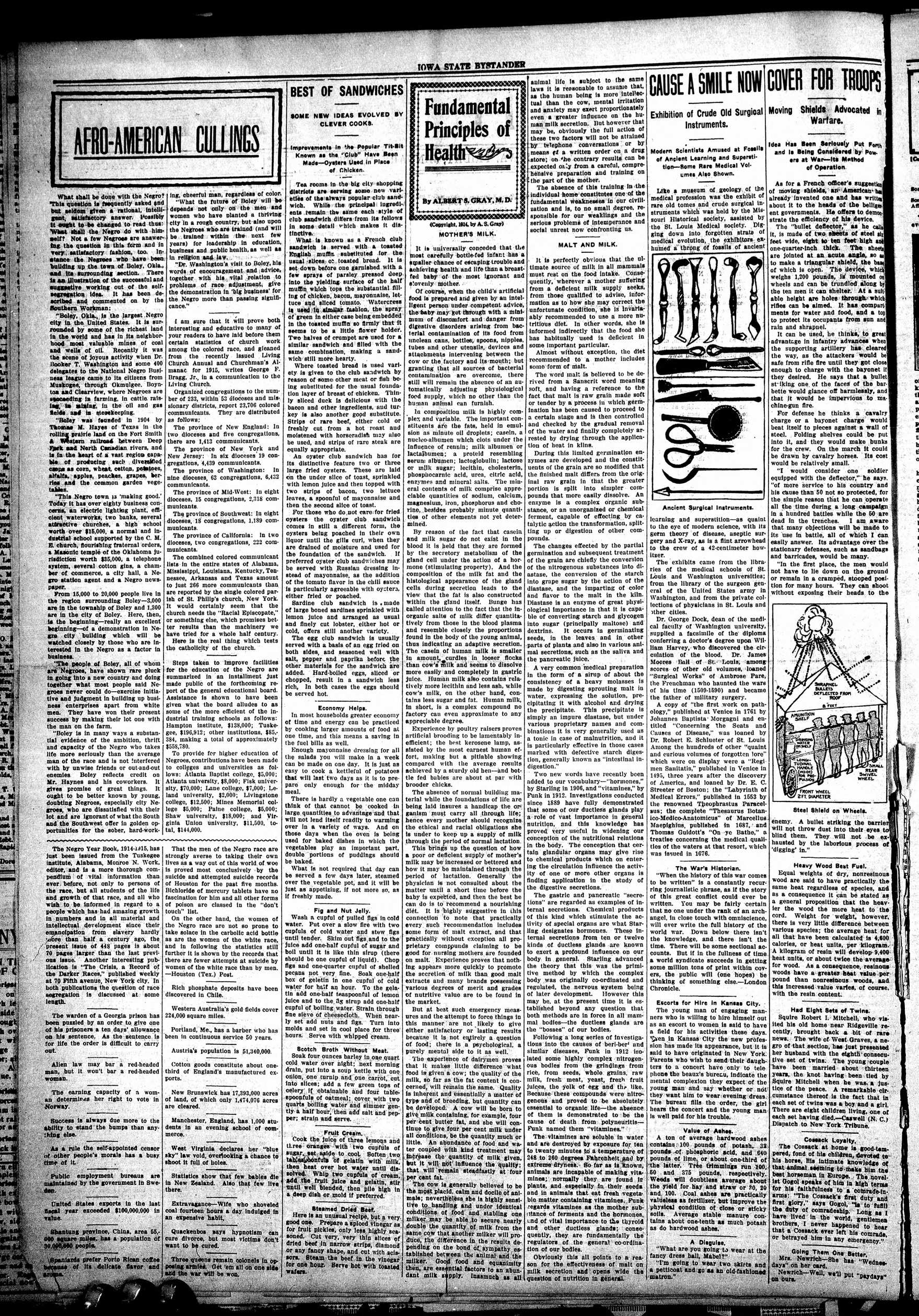
Exhibition of Crude Old Surgical Instruments.
Modern Scientists Amused at Fossils of Ancient Learning and Superstition—Some Rare Medical Volumes Also Shown.
Like a museum of geology of the medical profession was the exhibit of rare old tomes and crude surgical instruments which was held by the Missouri Historical society, assisted by the St. Louis Medical society. Digging down into forgotten strats of medical evolution, the exhibitors examined a throng of fossils of ancient
M
Ancient Surgical Instruments.
learning and superstition—as quaint to the eye of modern science, with its germ theory of disease, aseptic surgery and X-ray, as is a fint arrowhead crew of a 42-centimeter howitzer.
The exhibits came from the libraries of the medical schools of St Louis and Washington universities; from the library of the surgeon general of the United States army in Washington, and from the private collections of physicians in St. Louis and other cities.
Dr. George Dock, dean of the medical faculty of Washington university, supplied a facsimile of the diploma conferring a doctor's degree upon William Harvey, who discovered the circulation of the blood. Dr. James Moore, dean of St Louis, among students of other old volumes, named "Surgical Works" of Ambrose Pare, the Frenchman who haunted the wars of his time (1609-1800) and became the father of military surgery.
A copy of "the first work on pathology," published at Venice in 1761 by Johannes Baptista-Morgani and entitled "Concerning the Seats and Causes of Disease," was loaned by Dr. Robert E. Schlueter of St. Louis. Among the hundreds of other "quaint and curious volumes of forgotten lore" which were on display were a "Regimen Sanitatis," published in Venice in 1495, three years after the discovery of America, and loaned by Dr. E. C. Streater of Boston; the "Labyrinth of Medical Errors," published in 1553 by the renowned Theophrastus Paracelsus; the complete "Thesaurus Botanico-Medico-Anatomic" of Marcellus Magephius, published in 1687, and Thomas Guldbott "On -ye Bathe," a treatise concerning the medical qualities of the waters at that resort, which was issued in 1676.
The War's Historian
"When the history of the war comes to be written" is a constantly recurring journalistic phrase, as if the story of this great conflict could ever be written. You may be fairly certain that no one under the rank of an archangel, in close touch with omniscience, will ever write the full history of the world war. Down below there isn't the knowledge, and there isn't the power. It will be some sectional accounts. But if the following a world syndicate succeeds in getting many million tons of print within covers, the public will (one hopes) be thinking of something else—London Chronicle.
Escorts for Hire in Kansas City.
Escorts for Hire in Kansas City. The young man of engaging manners who is willing to hire himself out as an escort to women is said to have a field for his activities these days. Then in Kansas City the new professional appears, but it is said to have a New York Parents who wish to send their daughters to a concert have only to phone the aureus's buruex, indicate the mental complexion they expect of the young man and say whether or not they want him to wear evening dress. The bureau fills the order, the girl hears the concert and the young man is well paid for his trouble.
Value of Ashes...
A ton of average hardwood ashes contains 100 pounds of potash, 32 pounds of phosphoric acid, and 640 pounds of lime, or about one-third of the latter. Tree trimming run 100, 50 and 375 pounds, respectively. Weeds will doubtless average about the yield for hay and straw or 20, 20 and 100. Coal ashes are practically less as fertilizer, but improve the physical condition of close or sticky soils. Average coal manure contains about one-tenth as much potash as do hardwood ashes.
A Digules.
"What are you going to wear at the fancy dress ball, Mabel?"
"I'm going to wear two skirts and a petticoat and go as an old-fashioned matron."
Idea Has Been Seriously Put Forth
and is Being Considered by Pow-
ers at War—its Method
of Operation
As for a French officer's suggestion
of moving ships, an American has
already invented one and has writ-
about it to the heads of the bollig-
ent governments. He offers to dem-
scribe the efficiency of his device.
The "bullet deflector" as he calls
it, is made of two sheets of steel
feet wide, eight to ten feet high and
one-quarter-inch thick. The sheets
are jointed at an acute angle, so as
to make a triangular shield, the base
of which is open. The device, which
weighs 1,200 pounds, is mounted on
wheels and can be framed along
by the ten men it can shelter. At a suit-
able height are holes through which
rifles can be aimed. It has compa-
ments for water and food, and a top
to protect its occupants from sun and
rain and shrapnel.
It can be used, he thinks, to great advantage in infantry advances when the supporting artillery has cleared the way, as the attackers would be safe from rifle fire until they got close enough to charge with the bayonet if they desired. He says that a bullet stiking one of the faces of the barbette would glance off harmlessly, and that it would be impervious to machine-gun fire. For defense he thinks a cavalry charge of a bayonet charge would be self-defense against a wall of steel. Folding shelves could be put into it, and they would make bunks for the crew. On the march it could be drawn by cavalry horses. Its cost would be relatively small.
"I would consider one soldier equipped with the deflector," he says, "of more service to his country and his cause than 50 not so protected, for the simple reason that he can operate all the time during a long campaign in a hundred battles while the 50 are dead in the trenches. I am aware that many objections will be made to its use in battle, all of which I can easily answer. Its advantage over the stationary defences, such as sandbags and barricades, would be many.
"In the first place, the men would not have to lie down on the ground or remain in a cramped, stooped position for many hours. They can shoot without exposing their heads to the
SHRAPNEL
HARDENED
DEFLECTED FROM
ROOF
8 FEET
AMPUITION
SHELF
DRAWN
WATER
ON SHELF
COLUMN
TUBULAR
TANDEM
PIPE
FOR PRO
PULLOWS
SMALL
REAR
SHRAPNEL
WHEEL
FRONT WHEEL
2 FT DIAMETER
Steel Shield on Wheels.
enemy. A bullet strikes the barrier will not throw dust into that eyes to blind them. They will not be exhausted by the laborious process of 'digging in.'
Heavy Wood Best Fuel.
Equal weights of dry, nonresinous wood are said to have practically the same heat regardless of species, and as a consequence it can be stated as a general proposition that the heavier the wood the more heat to the cord. Weight for weight, however, there is very little difference between various species; the average heat for all that have been calculated is 4,600 calories, or heat units, per kilogram. A kilogram of resin will develop 9,400 heat units, or about twice the average for wood. As a consequence, resinous woods have a greater heat value per pound than nonresinous woods, and this increased value varies, of course, with the resin content.
Had Eight Sets of Twins
Squire Robert L. Mitchell, who visited his old home near Ridgeville recently, brought back a bit of rare news. The wife of West Graves, a negro of that section, has just presented her husband with the eighth conscientive set of twins. The young couple have been married about thirteen years, the knot having been tied by Squire Mitchell when he was, a justice of the peace. A remarkable circumstance thereof is the fact that in each set of twins was a boy and a girl. There are eight children living, one of each set having died—Caswell (N. C.) Dispatch to New York Tribune.
Cossack Loyalty.
The Cossack at home is good-tempered, fond of his children, devoted to his horse, his intimate knowledge of that animal seeming to make him the best horseman in Europe. The novelist Gogol speaks of him in high terms for his faithfulness to a comrade-inarms: "The Cossack's first duty, and first glory," says Gogol, "to toil the duty of comradeship. Long as I have lived in the world, gentlemen brothers, I never happened to hear that a Cossack ever left his comrade, or betrayed him in any emergency."
Going Them One Better, Mrs. Newrich—She has "Wednesdays" on her card. Newrich—Well, we'll put "paydays" on ours.
LauraJeanLibbeu's Talks on Heart Topics
Give me but
Someone wharunto I may, blind my
heart.
Something to love, to rest upon, to clasp
Affection's tandrils round.
"Who is she?" That's the question
every anxious mother asks her son
when she hears
he has a sweet-
heart. Then follows
a torrent of questions
which the young man
ends it difficult
to stem. "Do you
know who her
parents are?"
questions the
mother. "Where
does she live?"
"How old is she?"
"Who introduced
you to her?" "How
often have you
called on her?"
"Were her folks
impressed
with you." "Is she one
```markdown
```
of those dance-mad girls, or is she the kind who can make herself useful in the kitchen as well as play on the piano in the parlor? "is she a girl who powders and rouges, or is she sensible enough to be pleased with the complexion nature gave her?" "is she a girl or a modest maiden?" "is she of the sort that you could with pride bring home to me, or one of the kind that you would rather I wouldn't see or meet right up to the wedding day?" The average young man laughs at his mother's solicitude and tries to evade answering. But when he is corered, if he admits that she is a pretty girl, employed either in office, or shop, he don't know which, and was introduced to her by a girl friend of hers; that she hasn't a home of her own, but is sheltered by a boarding house roof; that she is most modest as well as the sweetest girl in the world, instead of being relieved by the young man's last remark the mother oftimes goes off into hysterics.
"I don't know any more now than I did before," gags. the twin head of her, I shall never rest until I find out all about her." Any young man will protest vigorously about his mother interfering in his love affairs, no matter how fond she is of her boy. He bravely declares that as long as he loves the girl, and she cares for him, that's all that's necessary. He does not concern her; that, although she is concerned her; that, although she is and her plain-clothes do not correspond with her sweet face, she has an honest heart and an unsullied reputation, a girl whom he can trust; that she is not running around in inquiring who he is—whether or no his father was a shoemaker or a railroad magnate in his early life; if his mother was a milliner's apprentice when she was young. All that she asked when he proposed that they keep company was if he had good habits, a steady position and whether or no he was a trifter, wanting to take up her time with no serious intentions—infatuated with her, not with one tomorrow. She added that she was good working girl, honest, and frankly asked not to be deceived by a declaration of deep interest in her unless it came from the heart.
It is not every girl who is brave enough to face an anxious, keen-eyed mother of a son, lest she break up a sweet love dream. Nine times out of ten mothers can trust their son's judgement in selecting a wife whom they can be happy with. Girl who have invariably turned out to be the most lovable of wives. Judgement should never be rendered too hastily.
IF HE WERE WHAT HIS SISTERS
THOUGHT HIM.
Yes, hold me, beloved!
I feel your control;
But my wayward soul,
Takes wings, feet and strong,
If you hold me too long.
One brother midst a household of girls, unless he is an extra level-headed young fellow, is sure to be hopelessly spoiled before he gets out of knickerbockers. The spoiling goes on up to the time he is a man grown. He is looked upon by the family as the flower of the flock; the brainiest and most sensible of young men.
They are anxious as to the time he may fall in love, believing that there are few, if any, girls who are quite good enough for him. They will not allow cider on their table lest he might acquire a taste for it, which might lead on to other beverages stronger and more harmful.
The girls bring to the house only Sunday school scholars as friends least he be brought in contact with a maid who would have fun and frolic instead of being serious. The girls hide from their brother the fact that each had a night key lest he would be horrified at the knowledge. The sisters were never out later than ten o'clock, attending prayer meeting, singing school, or perchance a quilting bee. Brother often reached home in the wee saun' hours. How the family pitied him when he exploded at breakfast, he knew he was looking at the books at the request of damn! It happened so often that father, knowing something of the world himself, looked across the table, dubiously, at his son. The mother was indignant at the way they piled work on the poor soul; his face was so male and his eyes so heavy.
His sisters openly declared that father should put him in business for himself; that they would be perfectly willing to make their shares over to him. He had come home minus his watch and chain. The grief of his sisters was great when he confessed that some of the light-fingered gentry must
have purlined them. He couldn't tell for the life of him how he had lost it. The girl found cloak, and cardamom seeds scattered about the top of his dresser. He accounted for these by remarking that the street gamins had made him the victim of their putty blowers. His clothes were muddy, his hat dented. His sisters believed in him implicitly when he told, reluctantly, that he had slipped in attempting to scavort an organ-grinder from one pavement to the other. As for the coupons of the French ball found in his pocket as he drew out his handkerchief he was puzzled to know how they arrived, was the jolly chap who sat next to him in the crowded street car to have tucked them in his yawning pocket to get rid of them.
Such a brother can go a long way before he is found out. It is usually some cast-off sweetheart who opens the family's eyes, just to get even with him; pulls the little god down from his pedestal to get even with him, as it were. Many a fellow has rooted out his bad habits just to become the honorable brother his dear sisters thought him.
LONELY HEARTHS AND HEARTS.
I hold it true whatever'er befall.
I feel it time when I sorrowmost.
The better to have loved and lost.
The more to have loved at all.
Every one thinks the single man must have a happy life of it. They argue that he must be contented or he would change his state of single blessedness. The scale of their pity is tipped in bacha. They like to consider that he is useful. In the case of a widow, they know that he has entered into matrimony and therefore he knows how to win a woman's heart. If he remains single, it is because he will not put anyone in the dear departed's place.
The truth is that the bachelor is not deserving of such sympathy. He will go through the world until he finds one who appeals to him. The older he gets the younger he wants the girl to be with whom he shall fall in love.
The widower's home has been so different that it is with much difficulty he can submit himself to the change He has been used to have a presiding helpmeet, a loving face close to his own when he needed someone to cling to, one nearer and dearer yet than all others when he was in need of someone to confide in. Bereft of his treasure, he has no heart to make himself agreeable to those who have little or no interest in him for himself alone. The years that have gone before have domesticated him. He appreciates the comfort of his own hearth.
He tries to make himself believe that he is happy in the companionship of his brave sons and sweet daughters. They love him dearly, but it is heaven's plan that they shall woo and be loved, turning their hearts bravely to other loves. The sons wed and the girls marry. When the last bird has futtered away from the home nest, he begins to realize fully, and for the first time, that he is desperately lonely. His housekeeper may be very good, but she has her own interest elsewhere. Servants come and go. Where can he look for a dependable home staff?
He realizes that he does not grow younger and more active with the years. He knows then that he can expect only a fireside companion in a wife. The world and his wife are shocked when he weds again. But they would not be if they studied the conditions of his lonely life and realized that the only path that showed a bright star to light his way was that which led to marriability. A man who has once loved, tenderly and well, is never happy away from a faithful woman's gentle influence. Neither the bachelor nor the widower should be influenced into living a lonely life. Happiness in this world is brief. Each day should be measured by its joys, not by its grils. There is no hearth so lonely but that a woman's presence can brighten it. There's no heart so dusty and untenable with the cobwebs of years about it but that some one woman can make it habitable again. Life can be happy or adjusted as a man wills it.
TELLS OF ANCIENT AMERICA
Dr. Herbert Spinden, Back From Yucatan, Describes Rains of Mexico
From Yucatan and the jungles of Central America Dr. Herbert J. Spinden of the Museum of Natural History, has returned with archeological and chronological collections and drawings and studies of the art of the Maya country of great value to the museum.
Doctor Spinden traveled about fifteen hundred miles through the jungles and spent six months exploring. At Bellie Doctor Spinden was joined by S. G. Morley of the Carnegie institution, Washington, and the two traveled to Flores, on a picture-queen island in Lake Peten, where Doctor Spinden made his headquarters for an expedition to the ancient cities of the Maya Indians. The population today is 5,000, but about A. D. 600 the region had about 500,000 people. The country is now virgin forest.
"An interesting question has been raised, says Doctor Spinden, "as to whether the decrease of population has been caused by climatic changes. There are seven cities of the first class in this region, the greatest; and most famous being Tikal. It is in the heart of the jungle, and the ruins extend over a square league." Among the features are enormous terraces and pyramids. The cities were laid with plazas and monuments. On the sculpture, monuments are elaborately costumed warriors, while other bear dates of interest to the student of Maya history.
"The great temples have enormous roof structures, and the broad lintels are made from slabs of a very hard and permanent wood called chilcoapote. These lintels are carved with priests and altars and sacrifices, and although placed in position about A. D. 500, many are still in perfect preservation."
Dr. Marden's Uplift Talks
BY ORISON SWETT MARDEN.
Copyright by McClure Newspaper Grinding
PICKING UP KNOWLEDGE BY THE WAY.
I often receive letters from young people complaining that it is impossible for college because they have to work, and therefore have no opportunity to acquire an education.
Did you ever stop to think my complaining friends, that a great many of the most prominent men of today have been self-educated? I do not mean that they have worked their way through school or college, but that they have actually gained an education in its; widest and best sense by their own efforts, with little or no actual schooling.
Thomas A. Edison had only a few months' regular schooling for his parents were poor, and at twelve years of age he had to earn his own living. But he began reading "solid books" very early. When only ten he was absorbed in Gibbons "Rome" and Hume's "England," and had already read the biographies of many great and noble men.
Andrew Carnegie had only an elementary school education, but by reading and studying in his leisure moments he acquired the culture that has fruited in several books and many magazine articles on topics of worldwide interest, to say nothing of his business achievements.
Prof. William J. McGee, who recently left the United States bureau of ethnology, later remarkable geologist and archaeologist, achieved a blackburn in Iowa when he began to study geology, the higher mathematics and languages. He was chief of the department of ethnology at the Louisiana Purchase exposition. He is now editor of the National Geographical Magazine.
You who complain that you have no opportunity to get an education, read the lives of men who have lifted themselves into place and power by self-education, biographies like that of Franklin, Lincoln, of Vice-President Marshall, men who from the direst poverty, by sheer force of their own will power, have lifted themselves into the highest stations of life.
Did it ever occur to you that you are right now in the greatest of all universities, the university of all life, your life, your life, every day from whom you can learn something valuable, no matter how humble they may be?
If you are ambitious you can absorb knowledge every moment of your life; every piece of work you do, every human being you meet is a study for you.
If the young people who long for knowledge and think they are deprived of it because of their unfortunate position as wage-earners could only realize that a marvelous opportunity is theirs to drink in wisdom at every breath, to absorb invaluable knowledge through their very pores. The results of all the schools, of all the colleges and universities of the past are spread out here before our eyes in the civilization that now is. There never, was such a time for gaining an education as the present.
To the busy worker our free public libraries, art galleries and museums, which are now opening their doors to evening visitors, offer splendid advantage for picking up knowledge. The greatest characters in history have been noted for their perpetual self-improvement habits; they were always absorbing knowledge, power, from their experiences and surroundings, treasuring up gems of thought, valuable deductions. It does not matter what your occupation may be, determine that every day, no matter how busy you may be, you will add a little something to your general improvement, you will absorb something that will make you a little larger, fuller, broader man or woman. Keep your eyes and ears and your mind open and you will be astonished at the number of useful things you will learn every day.
If you want to improve yourself form the habit of carrying a pad or notebook and pencil and jot down things you would like to be able to remember. You will be surprised to see how much you will gain in this way in a single year. You will be asking what the passion for self-improvement, the determination to get an education, will do for one in the course of a few years.
MOST PEOPLE THEIR OWN WORST ENEMIES.
This is John Wanamaker's recent advice to men: "Don't be blu. If I only thought of my mistakes I would be miserable all the time."
Many a once prosperous man has gone down in financial ruin because he dwelt so much on his mistakes and gave way to discouragement and the blues.
The so-called "hard times" which we have been passing through and which have distressed business men for many months were not so much due to the actual financial condition of the country as to the mental condition of the people.
I have in mind a man who suffers
Applying the old saw.
Father--You talk altogether too much should cultivate the art of listening.
Wille--But you told me the other day that listeners heard no good of themselves.
Her Dream Comes True.
Mrs. Golightly--What do you think, my dear? Such luck! We leave for Paris in an hour!
Chandi--Really!
IOWA STATE BYSTANDER
so terribly from "blue" fits that his whole appearance is completely changed while under their influence. He does not look like the same man. He is absolutely unfit to attend to business, and even his best friends try to avoid him. His whole appearance is that of utter despair, of intense mental suffering.
You would think by his expression that he was bearing on his shoulders all the troubles of mankind. It is difficult to smile or feel sorrow in his eyes to make him enthousiasiety joyful you may be, his icy expression and discouraging conversation, his doubts, and pessimism, chill you. Every time I go near him I feel as though I were running out of the sunshine into a dungeon.
Isn't it pathetic to see a strong, vigorous man, made to be a giant among the forces of the world, cowering, the object slave of mental clouds which cast dark shadows over his life?
Think of a man capable of leading hundreds or thousands of employees in a great enterprise—a man of achievement, born to do great things—the victim of the "blues," in the clutch of mental demons which he ought to be able to throttle in five minutes!
Think of the life force wasted every time he talks of failure, of hard luck, of troubles and trials, of past errors and mistakes!
There is no place in civilization for the morose, gloomy or dependent man. Nobody wants to live with him or do business with him. Everybody is dejected and depressed in his presence and tries to get away from him.
When you look at it squerely it is a very foolish, almost criminal thing to go about this beautiful world, crowded with things to delight and cheer us, with splendid opportunities, showing a sad, dejected face, as though life had been a disappointment instead of a priceless boon. Just say to yourself, "I am a man and am going to do the work of a man. It's right up to me and I'm going to face the situation."
No one is capable of correct judgment, of using good sense, when there is fear or doubt or despondency in his mind. Discouragement colors the judgment. People will do all sorts of foolish things under the pressure of fear. I have known men who own their own homes to sell property or do the most ridiculous things, in order to raise money, because they were afraid they would come to grief in their business if they did not have it, when, as a matter of fact, there was no real cause for anxiety whatever. You are at your wits' end and do not know which way to turn, you are in danger, for you are in no condition to plan anything to do the best thing. You should do your planning when you are cool and calm.
Most people are their own worst enemies. We are all the time "queering" our life game by our vicious, bearing down thoughts and unfortunate moods. Everything depends upon our courage, our faith in ourselves and others, and in our holding a hopeful, optimistic outlook.
When you are low-spirited and feel the "blues" getting a grip upon you, just stop whatever you are doing and make a business of driving these enemies out of your mind, neutralizing them, killing them, by their opposite suggestions. You know perfectly well that a cheater will do anything difficult it may be for you to hold it when you are suffering, will soon bring you relief. Assume the cheerful, hopeful virtue, if you have it not, and it will soon be yours.
Among the Highbrows
A famous baseball man is a profile story-teller, and oftentimes his yarns are the source of amusement to his friends. Here is one of his new ones:
"A friend of mine; a metropolitan merchant, who had amassed quite a fortune by close application to his business, was being entertained one evening at a friend's house, where he encountered a number of young woman graduates, whose conversation suddenly turned to a discussion of the development of the English novel, a feeling within which told him that he was out of it." After a few minutes of animated colloquy, during a brief respite, one of the young women turned to him sweetly and asked:
"What do you think of Fielding, Mr. Ellis?"
"Oh, fielding is important, of course, our friend quickly responded, but it isn't worth much unless you've got good pitchers and who can hit the ball."—Harper's Magazine.
Oldest Old Oaken Bucket.
Gardens in Palestine are found mally in the environs of the larger towns and owe their existence to springs and fountains whose se precious waters give life to the fruits and flowers, orchards, parks and landscapes grounds which enter into the oriental conception of Paradise. Where no running stream exists they depend for life upon capacious cisterns which "drink water from the rain of heaven." They are always carefully inclosed and protected by hedges, walls and ditches, and the traveler is surprised amid the heat and glare of the Syrian sun to enter their pleasant' pathways and find retired and shady nooks under embowering greenery. Their secluded recesses have always been a favorite resort for purposes of devotion. They are often the gathering place of families and friends and the token of peace and security is when a man may sit in safety under hims own vine tree—Christian Herald.
Pasteur's. My husband has just been bitten by a mad dog—Clubfellow.
Battle of the Nervil.
According to investigations made by Napoleon III of France, the Nervil took place between the villages of Rallivière and Louvroll on the River Sambre.
Before giving any one a piece of your mind figure out whether you will have enough left to keep you going.
kle with it dd one-half he knows
FOR THE SUCCULENT CARROT
Six Ways of Serving Vegetable That Should Be Used General Consumption.
Creamed Carrots. — Scrape and wash the carrots, cut in thin slices crosswise; boll in salted water until tender, drain off the water, cover with sweet milk, add salt to taste and a small piece of butter. Thicken with a spoonful of flour to the consistency of good cream. Carrots — Boil four large carrots until tender; drain and rub through sleeve, add one cupful of thick white sauce, mix well and season to taste. When cold, shape into croquettes, and fry same as other croquettes. Carrot Soup. — One quart of thinly sliced carrots, one head of celery, three or four quarts of water, boll for two and one half hours; add a teaspoon of water for four hour longer; season with salt and pepper and a small cupful of cream.
**Carrot Pie.**—Scrape and boll the carrots until very tender, then mash thoroughly, and to one cupful of carrot add one pint of milk, one half teaspoonful each of salt, cinnamon and ginger, one well-beaten egg, sugar to sweeten to taste. Bake slowly in one crust like squash pie.
**Carrot Preserve.**—Boll the carrots until tender; peel and slice them and to each pound add one pound of granulated sugar and one half cupful of water; flavor with lemon. Simmer slowly until rich and thick, then seal.
**Carrot Marmalade.**—Boll the carrots until perfectly tender, then mash to a fine smooth pulp, and to each pound allow one pound of sugar, six almonds, the grated rind of one lemon and the juice of two and a few drops of almond flavor. Bring to a boil gradually, and let boil, stirring constantly for five minutes; then pour into jars and seal.
DAINTY BASKET OF MACARONI
For the Luncheon Table or the After noon Tea This is a Delicious Confection.
Take two cupfuls sugar, one cupful boiling water and one-eighth teaspoonful cream of tartar. Put ingredients in a smooth saucepan, stir, place on range and heat to boiling point. Boll without stirring until sirup begins to dissolve. Remove from fire and place in larger pan of cold water to instantly stop boiling. Remove from cold water and place in a saucepan of hot water. Now dip macaroni in sirup at regular intervals close to edge and put two together. When firm add a third macaroni and so on until a circle is formed large enough for base of basket.
Over these fit another layer of macaroni and over the second layer a third one. Make a handle of stretched candy twisted, and adjust same. Arrange basket on small plate, fill with ice cream, garnish with whipped cream, flavored and sweetened, and surround with holly.—Exchange.
Wash Chamois and Doeskin Gloves. The secret of success in washing chamois and doeskin gloves lies in using lukewarm or cool water—better cool than even a few degrees too warm. That, at least, is one of the secrets; the other is to use soap water. The soapier the water, providing it is of the right temperature, the silkier and softer the gloves will be. They should first be freed from all dirt in a soap bath, and in order that they may be rinsed from the dirt set free. They should then be pressed and squeezed in a thick until they are free from soap and water as nearly as possible. Then they are ready to bung to dry in a cool, dry place. Never hang them near a fire, and never hang them in the sunshine if you would have them soft and pliable after laundering.
Individual Coconut Pies
Beat together the yolks of two eggs one cupful sugar, three tablespoonful flour and pinch of salt. Add one pint boiling milk and stir airbrush until it thickens smoothly. Remove from stove, flavor with vanilla and add three-quarters cupful shredded coconut. Pour into individual shoulder that is cooled. Pour into a meringue of whites of two eggs and a tablespoonful of sugar and drop on pies. Brown in quite hot oven. These are truly delicious.
Heavenly Hash.
Beak yolks of four eggs until very thick; beat into them gradually one cupful powdered sugar and one-half teaspoonful of salt. Beak until sugar is dissolved. Add juice of two lemons and beat again. Peel and slice thin six bananas and four oranges, put in a deep dish a layer of bananas, then a layer of dressing, then of oranges, and so on, having the bananas on top, and pour the remainder of dressing over it. Serve very cold.
Beef Scramb With Tomato
Take pieces of beef left from a reast that are not inviting enough to serve again at the table. Place in the bottom of a granite, baking dish, season with salt and pepper and pour over this a quart can of tomatoes, or a can of tomato soup is even better. Then cover, with bread crumbs, and dot with butter and bake till golden brown. Fine served with fried potatoes.
Beef, Fricassee.
Cut two pounds of siew. beef into pieces about two inches square. Roll them in flour. Have some meat dripping heated in a large frying pan. Put in the meat with six or sight onions sliced. Cook until brown. Add the contents of a can of tomatoes. Remove to back of range and cook slowly two hours. Season with salt and pepper to taste. Real nice if served with well-baked potatoes.
More Comfortable Sheets.
Paste a round piece of black velvet inside your low-out shoes when they begin to stretch and you will not be bothered with them slipping up and town.
The KITCHEN CABINET
---
If I had not to grub for bread
my muse mankinhed thrill;
If all she knew was not cryy
I should be famous still.
But though I lay the blame on chance,
I notice with a sigh
The life that we escape,
That half of LF is I.
COMBINATION$ UNUSUAL.
To add, variety to your-table try some of these dishes.
Asparagus With Peas—Cut the tender portions of a bunch of asparagus in pieces and hold them lengthwise; let it cook in boiling water, with a bit of salt and a
Pass—Cut the tender portions of a bunch of asparagus in pieces half an inch in length; let it cook in boiling water, with a bit of salt and a tablespoonful of butter. Beat the yolks of three eggs, add half a teaspoonful of sugar, a dash of pepper and salt; if needed a cupful of cooked peas; and add the asparagus and mix with the other ingredients, cook until the egg thickens. Serve on toast or on a dish garnished with toast points.
Cut the stem ends from six peppers, parbull for three or four minutes in salted water, drain and set in order in a serving dish suitable for the oven. Have ready about a cupful and a half of white sauce made from rich milk or cream, half a cupful of rice cooked tender and three milk onions boiled until tender. Cut the onions in bits and mix with a third of the white sauce. Fill the peppers with alternate layers of cream and creamed the mixture. Sprinkle with a few buttered crumbs over each and put in the oven until the crumbs are brown. Serve with the rest of the sauce poured around the peppers at once.
Prune Bavarian Cream—Remove the prune and cut cooked prunes in small bits. There should be one cupful and a half of pulp and juice. Soften a third of a package of gelatin in one-third of a cupful of cold water; dissolve a little of the prune juice heated for the purpose; add one-fourth of a cupful of orange marmalade, the juice of half a lemon and two-thirds of a cupful of sugar; stir until the sugar is dissolved, then set in ice water and stir occasionally until the mixture begins to set, then fold in a cupful and half of a cream beaten stiff, and put into a mold. Garnish with half a cupful of whipped cream and pieces of cooked prunes.
HELPFUL IDEAS.
The decoration of the table for simple or elaborate entertaining does not take as important a place as it should. A properly and at the same time prettily decorated table need be decorated expagandrous or in much work. For those who serve with the beautiful wood of the table cov-
place as it should. A properly and at the same time prettily decorated table need not be either expensive or incur much work. For those who serve with the beautiful wood of the table covered with doilies or with beautifully laundered linen, the center piece is the first consideration. When a cloth is used there should be a heavy silence cloth under the linen, which may be of an old blanket or of a woolen fabric made for the purpose. At any rate have something to deeden the sound and add the table.
When a color scheme is desired a piece of alk or silica cut a bit smaller than the open-worked center piece will give a pretty tone of color to the table and if the same color is used in flowers and candle shades a most attractive result is obtained. A center piece which is a low basket, filled with flowers loosely but gracefully arranged, with narrow ribbons running to tiny baskets also filled with flowers at each cover is an exceedingly pretty table decoration. The small baskets may be bought for five cents aplece or less.
To prepare fresh parsley for chopping dissolve an eighth of a teaspoonful of soda in a cupful of boiling water, dip the parsley in this and let the sprigs remain a moment, when they will turn a bright green. Then directly from the boiling water take them and cut with a sharp knife, then add to sour or sauce.
Both parley and mint may be kept in vinegar, spiced or otherwise. Simply heat the vinegar and steep the herbs in it until of the desired strength, then strain and bottle. Such vinegar will keep for years and is a great addition to many dishes. Dried parley and mint may also be used. Dried parsley and mint are used with of spirits with a sharp knife until well brushed and fine, and two table-spoons of sugar and two of boiling water, let stand for a few minutes to steep, then add hot vinegar, a quarter of a cup if quite strong. If the vine-
The Last Cartridge.
Near the French town of Sedan is the village of Bazelles, where some of the fiercest fighting took place in 1870. There is a tavern still standing known as the Last Cartridge, which was the last French position desperately defended by the marines in the bloody war. The inn, which was the only house not burned down, now contains, a small museum of relics of the battle, and one of the rooms on the first floor is still preserved in the same state as it is seen in the pathetic Horse Makes Electric Light. An Ohio inventor has devied an apparatus, intended to transform a horse's energy into electricity, with which to light a house, or charge storage batteries for the motor car which has replaced it for family driving purposes. The arrangement consists of a circular sweep which operates a dynamo, the animal causing power to be generated, walking steps around the house, and a wheel attachment keeps the horse going steadily ahead. If the animal
gar is not very strong the water may
be too hot the hot vinegar used
to steep mint in it.
SOME GOOD DISHEB.
For a cold day there is no more appetizing dish than
Chili Con Carne
-Boll until tender
one pound of smel
red chili beans.
Just before they
are quite done add
one onion and one
clove of garlic fine
—Boll until tender, one pound of small red chili beans. Just before they, are quite done add one onion and one clove of garlic finally chopped. There should be at this time in the dish about three pints of water; add seasoning of chili powder and a teaspoonful of salt. Chop a pound of salt, let cook to try out the fat, remove the bits and add a pound and a half of chopped steak or hamburger. Stir for a few minutes, then add to the beans and let cook several hours.
**String Bean Salad**—For a can of beans mix four tablespoonfuls of olive oil, two tablespoonfuls of vinegar, a few dashes of cayenne pepper, a tablespoonful of catchup, and a teaspoonful of grated onion, a half-teaspoonful of salt or as much as is needed. Pour this dressing over the beans and toss until well mixed.
American Sauce. — Grind two pounds each of fresh pork and ham through a meat chopper; chop one small onion, one green pepper, one red pepper and four sprays of parsley, cut fine. To the meat and vegetables add one teaspoonful of powdered basil, half a teaspoonful each of curry powder and parprika, a teaspoonful of salt, two eggs, well beaten and one-cupful of rich milk. Mix all the ingredients together, adding more onion and other seasonings if desired. Spread half a yard of cheesecloth on a meat board; on this lay strips of thin sliced bread, side by side; on the bacon place the sausage rolled, spreading, the ends with slices of bacon, then roll in the cloth. Tie the ends and two or three places through the center or sew, it well. Let cook in boiling salt water (to which half a cupful of vinegar has been added) for three hours. Let cool under a weight. Serve cold, sliced thin with potato, cabbage or string bean salad.
SOMETHING NEW TO TRY.
It is true that there is nothing new under the sun, yet there are combina-
tions of foods which are
new in part, being originated
every day. New
favors, new garnishes,
new combinations are
always welcomed. The
following dishes may be
new to many.
tions or toods which are new in part, being origi-
nated every day. New toods, including new com-
bines are always welcomed. The following dishes may be new to many.
Cushion Cake—Cream or soften by heat a half cupful of butter and a cupful and a quarter of sugar; add two well beaten eggs and a half cupful of milk alternately with two cupfuls of flour which has been sifted with two teaspoonfuls of baking powder. Add a half teaspoonful of salt and a teaspoonful of vanilla extract.
Divide into two parts; add to one part, two tablespoonfuls of molasses, one cupful of raisins, one-half teaspoonful of cloves, one teaspoonful of cloves, one-tenth of a teaspoonful of grated nutmeat. Bake in a buttered tin for 20 minutes; take from the oven and spread over the white part; return to the oven and bake until well done.
Pear and Pimento Salad—Fill each canned pear with two halves of canned pears; place on a bed of lettuce and serve with the following dressing:
Put one teaspoonful of salt, into a bowl; add a few dashes of red pepper; four tablespoonfuls of melted butter and two tablespoonfuls of vinegar, mixing well with the butter. Olive oil may be used in place of butter.
Cheese Balls—Rub a teaspoonful of butter into half a cupful of crumbs; add a fourth of a teaspoonful of mustard; one cupful of grated cheese; one egg; a half teaspoonful of salt and a few grains of red pepper. Shape in small balls and fry in hot fat. These are nice to serve either with soup or a salad.
French Pancakes.-Take four tablespoonfuls of sugar; add four tablespoonfuls of melted butter; a cupful of milk to a half cupful of flour; two eggs and a teaspoonful of lemon extract. Bake in six cakes, butter and put jam between every alternate one. Cover with powdered sugar and serve piled high on a dish. Serve cut in wedge-shaped pieces like pie.
Nellie Marwell.
picture by Alphonse de Neuville, known as "The Last Cartridge", the scene of which occurred here and from which the house has taken its name.-Baltimore Star.
Open Air Garage Le Cheap.
Open Air Garage in Downtown
in the downtown is an open air garage
district or in Pittsburgh is an open air garage
belonging to the Automobile club,
in which there is room for 200 motor cars
at a time. Members of the club pay
20 cents a day for parking space. Non-
members pay at a much higher rate.
should slow down too much, or should
stop, the bell would immediately commence ringing and the whip striking,
neither of them stopping until the horse regained a normal gait. - Popular Mechanics.
"Well, with running up a bill for supplies, and running down pede- triants and getting run in by the cops, they do run some."
DAVE O'BRIEN
The Third Baptist church is holding revivals and having good success.
The Tri-City Sunday School association met at Behiel A. M. E. church.
No business of importance was transacted.
The T. L. O. club met with Mrs. Emma Shepard on the 6th. Reports from the Xmas dinners the club sent the sick and aged were received and plans to help some poor children were laid. Refreshments were served by the hostess and the club adjourned to meet with Mrs. Jennie Johnson the 6th of February.
Dr. C. F. Wright left Sunday night for a few days in Des Moines.
Mr. Eugene Perkins is confined to his home owing to illness. Dr. Robert Taylor is in attendance. Mr. and Mrs. Edward Buckner entertained a few friends at their home, 1204 Harrison street, in honor of Mr. Lamb of Kookuk, who was in the city visiting his mother. Constellation temple, No. 80, Order of S. M. T., will hold a public installation at Danish Brs. hall. Mrs. George Allen has charge of the music. Miss Irene Sheepard of 912 W. Ninth street has been home from school since Thursday owing to illness. The E. L. D. club met Friday evening at the residence of Mrs. Eugene Perkins and the following officers elected: Mrs. C. H. Marshall, president; Mrs. J. P Sims, vice president; Mrs. Jennie Johnson, secretary, and Mrs. Ida Cunningham, treasurer.
Fever Sores.
Fever sores and old chronic sores should not be healed entirely, but should be kept in healthy condition. This can be done by applying Chamberlain's Salve. This salve has no superior for this purpose. It is also most excellent for chapped hands, sore nipples, burns and diseases of the skin. For sale by all dealers.
ENTERPRISE, IOWA.
Mr. John Allen of Carney was visiting his brother, Mr. Jimmie Allen.
Mrs. Joe Wellington is still on the sick list.
Mr. W. D. Miller made some good remarks at the B. Y. P. U. on Sunday.
Mrs. Robert Hunter was in Des Moines on account of sickness of her daughter.
This week the club will meet at Mrs. Robert Brown's.
Mrs. George Turner is on the sick list this week.
Mr. Grant Barber of Des Moines spent Sunday with his mother, Mrs. Charity Barber.
WASHINGTON, IOWA.
Mrs. Aaron Howard received word last week from a brother in the Philippines, a member of the U. S. regulars, stating he barely escaped death in a skirmish with the natives.
Revival services began at the A. M. E. church Monday night under the most favorable conditions. Rev. Boyd as much elated over the progress of his work here. Sunday preceding the evangelistic services there were three accessions to the church, making in all since Rev. Boyd's advent here eight who have forsaken the sins of the world and accepted Christ as their Savior.
Miss Cordelia Whaley and Mrs. Delphia Howard accompanied the Misses Marie Whale and Luba Gwinn as far as Burlington when they went on their Missouri visit.
Mrs. Ruth Black Kipper arrived Sunday a. m. for an indefinite visit with her mother, Mrs. Emma Black.
A. L. Hall came near meeting with a very serious accident one day last week, when one of his horses kicked him, one foot landing on his left side just below the heart and the other on the fleshy part of the right leg just below the groin.
The sick: Mrs. Chas. Berkley was sick last week. Mrs. Lillian Phillips is still improving slowly. T. L. Burnett is able to be out. Mrs. G. W. Turner is improving, after being indisposed for some time. Mrs. Harry Sime, who was threatened with fever, is getting along nicely now.
Mrs. N. L. Black is in Albia to attend the twentieth wedding anniversary of Mr. and Mrs. Chas. L. Washington.
Frank Walker has returned from a little jaunt to visit friends and relatives at Oskaloosa, Ottumwa and Des Moines.
Last week was the universal week of prayer in the Christian churches and the members of the A. M. E. church were in line with the other denominations and much interest was manifested and good resulted.
Little Francis Rhodes, son of Mr. and Mrs. Henry Rhodes, had the misfortune to be hit by a playmate at school one day last week. The missile struck the boy on the left cheek just below the eye and the wound inflicted was quite severe. Lucky for him he was not struck in the eye or his "light" would have been out.
Mrs. Eliza Haines, who is still in a hospital at Iowa City, is expected to be at home next week.
Mrs. F. D. Motts went from Chicago, where she was visiting her sons, to La Junta, Colo., for a visit with her sister, Mrs. Zack Badgett. Miss Helen Motts returned from Chicago last week and is again at her post as stenographer for Dr. Luella Shaw.
The Misses Luba Gwinn and Marie Whaley have returned home from a two weeks' visit at Memphis, Missouri, Kookuk and Burlington, Iowa.
Walter, Williams some day may be a rival of Hagenback. He is now at work training a ferret. Who knows?
OTTUMWA, IOWA.
The third series of parties was held at Mrs. R. Black's, assisted by Mrs. F. Andrews, on Tuesday evening, and the fourth series at Mrs. L. Bibbs', assisted by Mrs. Lizzie Venison, on Friday evening.
ARGUES CASE IN SUPREME COURT
BIG EVENT IN WASHINGTON.
Distinguished Lawyer and Consistent Agitator For the Full Constitutional Rights of Colored Americans Questions Legality of Oklahoma Separate Car Law Before Highest Tribunal.
Washington.—The jincrow car case brought up from the United States circuit court of Oklahoma was recently argued in the United States supreme court by Attorney William Harrison of Oklahoma City, Oka. The purpose of Lawyer Harrison in bringing the matter before the highest court is to test the constitutionality of the separate car law for interstate passengers. The case was filed in the federal court by Lawyer Harrison Feb. 15, 1908.
The case is unique in that it involves the rights of the colored people throughout the country. It is one which few lawyers have been willing to handle and has been from its beginning handled exclusively by lawyers of our race.
In the argument Attorney Harrison sought to interpret the mind of congress as evidenced by the enabling act approved by congress June 16, 1900, and insisted that unless the legislature of the state of Oklahoma could violate every provision of the enabling act, which the people of Oklahoma had accepted and adopted irreovocably as a condition precedent to admission into the sisterhood of states, it (the legislature of Oklahoma could not enact a law making distinction when it comes to the Negro race based upon color, the
WILLIAM HARBISON.
same being forbidden by the language of the act itself. This argument was clinched when Mr. Harrison pointed out that separate schools were provided for in the enabling act and no other distinction or separation.
Arguing that the act of the Oklahoma legislature seeks to and does regulate interstate transportation, the lawyer said the act must stand or fail as a whole, not being separable, and being clear, positive and unambiguous could not be construed away and had to be taken as expressing the mind of the legislature. He exploded the theory of police regulation and showed that so far as the health, safety, comfort, etc., of the citizens were concerned, the police regulation argument set out by defendants was a mere subterfuge, and in this connection it was forcibly argued that the Mexican, the Italian, the Indian, the Turk, the Greek and every other race on the face of the earth had been legislated into white men and educated, cultured and refined citizens by the act of the legislature complained of.
Lawyer Harrison reached his climax by invoking the interpretation and construction of the federal constitution and specifically the fourteenth amendment as applied to the act of the legislature of Oklahoma complained of. Perhaps the most finely drawn differentiation was shown by the able jurist when it came to comparing the case at bar with other cases adjudicated. He clearly showed that his case was different and new in the following particulars—to wit: The supreme court of the state of Oklahoma had not construed the law as had been done in cases coming up from Louisiana, Mississippi, Kentucky, etc. The case at bar had evaded and avoided the state courts, knowing what its fate would be once in the said courts, and finally that the word "distinction" did not occur in the organic act of the states mentioned, but was purposely written in the enabling act of Oklahoma.
Closely connected with the case and intimately associated with Mr. Harrison from the very beginning of this case is the Rev W. H. Jernagin, D.D., pastor of the Mount Carmel Baptist church in this city. Dr Jernagin was formerly pastor of a Baptist church at Oklahoma City. Okla., before coming to Washington. He is a race man of the cloth and has from the beginning agitated and argued that competent Negro lawyers were able and should have the conduct of this case. He has stood on the filing line, financially encouraging lawyer Harrison to go on, and this he has continued up to the present time.
Miss Adela Car spent a few days in Mason City, the guest of Mrs. B. F. Eaton, the first part of this new year. Mr. Fred and John Mitchell are furnishing a vaudeville stunt this week at the Princess theater, which has been very satisfactory. Mrs. F. D. Woodford is visiting for several weeks in Oskaloosa, the guest of her aunt. The comic play written by Miss Artivia Williams and played by the mem-
bers of the I. L. club New Year's eve,
proved to be a total success. A large
crowd was present to witness the affair and the remainder of the evening
was spent in dancing. Mrs. Eaton and
Harry Mitchell furnished the music
for the evening.
Mrs. Maryellen Bradford was hostess
Thursday for the Willing Working
club. A two-course luncheon was
served and at a late hour they adjourned to meet at Mrs. Fred Wright's
the first Thursday in February.
Mrs. Thomas Allen spent a few
days last week in Fort Dodge visiting
her mother, Mrs. Beverley.
Mrs. H. Cabelell very pleasantly
entertained the Missionary so-
A.
Woman's Crowning Gloris Her Hair
Why not grow your hair by using
Mme. M. Beard Hair Grower
In removes dandruff, stops itching of
the scalp and makes in grow long, soft
and beautiful. Price 50c a box.
Send stamp for pamphlet.
519 So 16th St. St. Joseph, Mo
If you have any trouble with your stomach you should take Chamberlain's Tablets. Mr. J. P. Klote of Edina, Mo., says: "I have used a great many different medicines for stomach trouble, but find Chamberlain's Tablets more beneficial than any other remedy I ever used." For sale by all dealers.
NOTICE OF SHERIFF'S SALE ON SPECIAL EXECUTION.
State of Iowa, Polk county, ss.
District court of Polk county, Iowa
Dr. R. A. Schwaner
vs.
P. A. Miller and Mrs. P. A. Miller.
By virtue of a special execution to me directed, issued by the clerk of the district court of Polk county, Iowa, in favor of Dr. R. A. Schwaner, and against P. A. Miller and Mrs. P. A. Miller, on a judgment rendered by said court on the 12th day of January, A. D. 1915, wherein it was ordered, adjudged and decreed that the following described property be sold to satisfy said judgment, towit: Lot twenty (20) in Glenwood Place, now included in and forming a part of the city of Des Moines, Iowa.
Now, therefore, public notice is hereby given that unless the said defendants appear at my office in Des Moines on or before the 26th day of February, A. D. 1915, at ten o'clock a.m. of said day, at which time said above described property is hereby advertised to be sold, and pay off the amount of said execution, with interest and costs, I will sell said property, or sufficient thereof to satisfy said execution, with interest and costs, at public outey, to the highest bidder, at the east front door of the court house, in Des Moines, Iowa, for cash in hand to pay off said execution.
J. F. Griffin.
Sheriff of Polk County, Iowa.
By J. H. Kelley, Deputy.
Sheriff's Office, Des Moines, Iowa.
Date of first publication, January
22, 1915.
Published and printed by the Iowa
State Bystander.
NOTICE OF SHERIFF'S SALE ON
SPECIAL EXECUTION.
State of Iowa, Polk county, ss.
District court of Polk county, Iowa.
New System Dentists
vs.
D. M. Bowmer.
By virtue of a special execution to me directed, issued by the clerk of the district court of Polk county, Iowa, in favor of New System Dentists, and against D. M. Bowmer, on a judgment rendered by said court on the 12th day of January, A. D. 1915, wherein it was ordered, adjudged and decreed that the following described property be sold to satisfy said judgment, toowit: The south two-thirds (2-3) of lot thirteen (13) of W. W. Jones' subdivision of block T<sub>2</sub> and the west half (1-2) of block S<sub>1</sub>, in Holcomb's addition to Des Moines, now included in and forming a part of the city of Des Moines, Iowa.
Now, therefore, public notice is hereby given that unless the said defendant appear at my office in Des Moines on or before the 26th day of February, A. D. 1915, at ten o'clock a.m. of said day, at which time said above described property is hereby advertised to be sold, and pay off the amount of said execution, with interest and costs, I will sell said property, or sufficient thereof to satisfy said execution, with interest and costs, at public outery, to the highest bidder, at the east front door of the court house, in Des Moines, Iowa, for cash in hand to pay off said execution.
J. F. Griffin,
Sheriff of Polk County, Iowa.
By J. H. Kelley, Deputy.
Sheriff's Office, Des Moines, Iowa.
Date of first publication, January
22.1915.
Published and printed by the Iowa
State Bystander.
city last Wednesday afternoon. A pleasant afternoon was spent by all. Mrs. Laura Cabbell returned home last week, after spending several weeks in Colfax visiting with her mother and friends. Mrs. Walter Davis very pleasantly entertained Rev. Woodford and Mrs. Harvey Bass and Mr. Henry Casen of Clear Lake for dinner last Sunday. Each report a pleasant time. Master Harold Davis is still reported on the sick list, yet able to be up and around in the house. Mr. and Mrs Thomas Allen entertained all the young people of Mason City in honor of Miss Allen of Oskaloost, Iowa, for supper. She is the guest of Mr. and Mrs. W. L. Jones. On last Friday afternoon Mrs. J. D. Reeler entertained the Home Missionary society. Two very interesting papers were read. After the regular routine of business light refreshments were served by the hostess.
Mrs. Allen of Oskaloosa arrived in the city Saturday to participate in the musical program given by the steyardess and trustees of Union Memorial church, which will be held at the First church (white).
arrived in
inicipate in
even by the
Union Me-
be held at
that Rev.
ORIGINAL NOTICE.
Iowa, in and for Polk county.
Iowa, in and for Polk county.
March term, A. D. 1915.
Decimer Price, Plaintiff,
vs.
We are very sorry to note that Rev. Woodford was called to Oskalsoa on Thursday on account of the death of Mrs. Woodford's grandmother.
New Thompson Hotel
Modern Hotel European Plan
States Reasonable
The New Thomps
A First-Class Modern Hotel
Rates Reasona
HOPE LOT
HAVE YOU BEAUTIFUL HAIR?
WE are the only Importers and Manufacturers of Real Colored People's Hair. Also Wavy Hair.
We absolutely guarantee our hair to stand combing and washing and to retain its color and crimp.
Wigs, Plats, Braids, Transformations and Puffs in stock or to order; all shades, none too difficult.
Straightening Combs and Toilet Articles, or Price List. Mail Orders receive prompt attention.
Table Mme. Baum's Hair Emporium
10 Between 34th and 35th Sts. NEW YORK CITY
Send two-cent stamp for Price List. Mail Orders receive prompt attention.
The Old Reliable Mme. Baum's Hair Emporium
486 8th Avenue 11:40-2:16 Between 34th and 35th Sts. NEW YORK CITY
Send two-cent stamp for Price List. Mail Orders
The Old Reliable Mme. Baum's
486 8th Avenue 11-10-210 Between 34th and 3
Badges
Emblems
Books
For all Lodge and Chur
Books
edge and Church Societies
Books For all Lodge and Church Societies
A Negro Firm
The Love Rega
GEO, W. K. LOVE, P
2418 Flora Ave.
Magic Hair Grower and Str
D. W. K. LOVE, Pres.
Kansas City, Mo
The Love Regalia Co.
GEO, W. K. LOVE, Pres.
2418 Flora Ave.
Kansas City, Mo
Magic Hair Grower and Straightening Oil
MME. JOHNSON AND SOUTH
The most wonderful hair preparation on the market. we say Magic we do not exaggerate, as you can see gs suits in the first few treatments. We guarantee Magic Grower to stop the hair at time of taking out and b off, making harsh, stubborn hair soft and silky. Grower grows hair on hold places of the head. If you these preparations once you will never be without Magic Hair Grower and Straightening Oil are manufac by Mendames South and Johnson. We also do sculp to Magic Hair Grower, 50c. Straightening Oil, 5 All orders promptly filled; send 10c for postage.
The most wonderful hair preparation on the market. When we say Magic we do not exaggerate, as you can see great results in the first few treatments. We guarantee Magic Hair Grower to stop the hair at once from falling out and breaking off, making hair, stubborn hair soft and silky. Magic Hair Grower grows hair on bald places of the head. If you use these preparations once you will never be without them; Magic Hair Grower and Straightening Oil are manufactured by Mesames South and Johnson. We also do scalp treating.
Magic Hair Grower, 50c. *Straightening Oil, 35c.* All orders shipped.
Agents wanted - Write for particulars.
We carry everything in the latest fashion-
able hair goods at the lowest prices.
We make switches, puffs, transformation curls, coronet braids, and combings made to order, matching all shades a specialty. Send samples of hair with all orders.
2416 Blonde St, Omaha, Neb.
Phone, Webster 880
---
IOWA STATE BYSTANDER
Mrs. Alta Dent and children have
received to Mason City after spend-
10 Blocks from Union Depot
Corner of 9th and Park Sts.
HAVE
WE
Also
We
comb
crimp
We
stock
Badges
Regalia
---
ing a few weeks in Des Molines.
The Epworth League members organized a literary department Friday evening with a membership of twenty-two young people. Light refreshments were served by the members.
The Epworth League Bible session was led Sunday by W. L. Jones, which all discussed the lesson. The lesson will be led next Sunday by Mr. J. Crawford.
The stork visited the home of Mr. and Mrs. Dan Ewing last Wednesday, elaving a fine boy. Both mother and child doing fine.
Mrs. B. Banning, who has been visiting in the state of Indiana ever since the first of November, returned home Sunday, reporting a fine time.
The Ladies' Aid society will give a ladies' banquet at the Union Memorial church January 29th. A special program is being prepared and 100 tickets are out to be sold. A fine menu is being prepared.
Wm. Price, Defendant.
To Wm. Price:
You are hereby notified that on or before the 18th day of February, A.
D. 1915, the petition of the plaintiff
The Public is Invited,
Banners
Furniture
```markdown
```
in the above entitled cause will be filed in the office of the clerk of the district court of the state of Iowa, in and for Folk county, Iowa, claiming of you a divorce from the bonds of matrimony on the ground of adultery and desertion. And unless you appear thereto and defend before noon of the second day of the next term, being the March term of said court, which will commence at Des Moines on the 1st day of March, 1915, default will be entered against you and judgment and decree rendered thereon.
Dated this 22nd day of January, 1915.
S. Joe Brown,
Attorney for Plaintiff.
Billiousness and Constipation Cured.
If you are ever troubled with billiousness or constipation you will be interested in the statement of R. F. Erwin, Peru, Ind. "A year ago last winter I had an attack of indigestion followed by billiousness and constipation. Seeing Chamberlain's Tablets so highly recommended, I bought a bottle of them and they helped me right away." For sale by all dealers.
The Faithful Few met with Mrs. Anna Rose, at which time the officers for the ensuing year were elected as follows: President, Mrs. E. Hall; vice president, Mrs. R. Campbell; secretary, Mrs. T. Barquett; assistant, Mrs. A. Rose; treasurer, Mrs. M. Bibbs, chapain, Mrs. M. McGill.
Mrs. L. Wagnor has gone to Milan,
Mo. to visit her parents.
Mrs. W. Fowler entertained at din-
ner Sunday in honor of Mrs. B. Green
of Keokuk.
Mrs. M. O. Williams is quite sick
Green's Cafe
The Old and Reliable Place
to get good meals or lunches
Ice Cream and Cigars
114 E. 5th Street
Phone 4908 y
E. Green, Prop. Davenport Ia
L. E. Hanger Wm. Aiken
NEW
Elite Restaurant
New Reliable Place to Eat
Meals 15c and up
Lunches or Short Orders Served
304 W. Grand Ave.
Des Moines Iowa
New Restaurant
Just opened. Everything modern and up-to-date at Miami, Ia., or old No. 10 Junction.
Lunches and Meals at all hours.
Cigars, Candies and Can Goods.
Johnson & Johnson Props.
BUX TON, IOWA
FREE
F
R
E
E
1914 Catalogue
We are the largest importers and manufacturers of colored peoples hair and the most reliable firm in this line. We make wigs, switches, braids, transformations and all styles of hair that can comb and wash the same as your own. We also sell straightening combs, hair nets and cut hair by the pound. We guarantee all goods, and if not satisfied money will be refunded. Our prices are lower than those quoted elsewhere. Send 2c stamp for illustrated book.
Humania Hair Company
Dept 61 23 Duane St., New York
VIVIAN L. JONES
Funeral Director
The very best service guaranteed
Prices the lowest
Calls answered promptly day or night No extra charges for distance—Reverse all phone charges
PHONE: { Maple 2548
Residence Wal. 6824
Office
519 East Court Ave
Drs Moln's
Jónes Café
The Old Reliable Place
to get your meals
PHONE FED
318 W. 3rd St
3027
Poo mine House al
3rd St.
دَيْسَةٌ دَيْسَةٌ
JOHN L. THOMPSON, MEMORI
Published every thirty by the stylistor Publishing Company, Lee Moine, Iowa. Once in Chicago building, corner Seventh and Mamberry streets. Iowa phone. W. W. 897.
Official paper of the M. W. U. Grand Lodge of Iowa. A. F. A. & A. M., and International Grand Congress on Heroes of Jericho of America, and Western Baptist Association, entered at the postoffice as second class matter.
Advertising rates for display add 25 cents per inch, for each insertion three to six months' contract, 12 cents per inch. Local advertising 10 cents per line for each insertion, counting seven words to a line. For churches and secret societies where admission is charged, one-half of the above-mentioned rates. For professional, legal and announcement cards, yearly contracts, etc., terms are given on application. All advertising is to be paid in advance.
One year $1.50 six months $7$ Three months $50$ All subscriptions payable in advance.
We are prepared to do first-class job work at reasonable prices. All of our work is guaranteed.
Communications must be written on one side of the paper only and be of interest to the public. "Brevity is the soul of wit," remember.
We will not return rejected from uscript, unless accompanied by postage stamps.
Send money by postoffice order money order, express or draft, to the Iowa State Bystander Company, Des Moines, Iowa.
NOTICE TO CORRESPONDENTS.
N. B.-Correspondents: Please
mail your letters that contain news
for publication not later than Wednes-
day to insure publication for the
current week; and sign your name.
not for publication, but that we may
know who writes the news.
This notice applies to all writers,
contributors, agents and correspondents.
Sign all articles, write only
upon one side of paper, write a plain
hand and spell accurately. Do not
send in names of persons at parties
or receptions nor send in programs
to be published before or after the
event. Do not give an eulogy or
write your personal comment upon
the event. Simply tell the news or
event in a brief, simple manner and
let the readers of The Bystander
comment. Write the news of all
classes, all societies, all religious
denominations, irrespective of your
personal whims or ideas.
The Iowa State Bystander is the oldest Afro-American journal published in Iowa. It was established in 1894, and is read by nearly all the colored people of Iowa. We have correspondents in the following towns:
Albia Miss May Davis
Oskaloosa Luella B. Franklin
Washington N. L. Black
Burlington Mrs. L. M. Abel
Mt. Pleasant Mrs. M. Burnugh
Monmouth. Ill. Georgia Norwood
Golfaf Miss Stella Pierson
Minneapolis. Mrs. R. L. Buttner
Cedar Rapids, Iowa. Mrs. May Terry
Moline, Ill. Miss Mamie Ritchie
Buxton Richard Stewart
Sioux City. Miss Goldie Hackley
Clinton A. A. Bush
Council Bluffs. Miss Minnie Cave
Centerville. Mrs. C. Reed
Macon, Mo. Lucy Harris
Mason City. Maud Brewton
Quincy, Ill. Mrs. Matty J. Lille
Clarinda. Mrs. J. R. Lane
Keokuk. Mrs. Jennie Freeman
Ottumwa. Mrs. H. Qwens
Galesburg, Ill. Mayme Richardson
St. Paul, Minn. Mrs. Mattie Hicks
and Mr. Williams is able to be out. He received quite an injury from a fall. Mrs. A. McCieland will be hostess Thursday evening for the Benevolent club. After regular business of the evening the ladies will engage in a peanut huna. All correspondence for Benevolent club from various committees should be sent to Mrs. M. Green, 731 Church street. The Eastern Star installed their new officers Tuesday evening.
The Sewing Circle of the A. M. E. church met with their president, Mrs. L. Bibb, Friday afternoon. Rev. W. A. Searcy delivered Sunday evening the first of a series of sermons to a large congregation. Subject, "Card Playing." The reporter for the Bystander will be around next week. Please be prepared to pay.
Excellent For Stomach Trouble.
"Chamberlain's Tablets are just for stomach trouble," writes Mrs. G. C. Dum, Arnold, Pa. "I was bothered with this complaint for some time and frequently had bilious attacks. Chamberlain's Tablets afforded me great relief from the first, and since taking one bottle of them I feel like a different person." For sale by all dealers.
Ancient Uses of Bloodhounds.
Although the use of bloodhounds for tracking criminals still survives another ancient use of these dogs seems to have died out. Bloodhounds were at one time often called upon to assist an army in the field, the forces with which the earl of Esses suppressed the Irish rebellion in the time of Elizabeth, for instance, being accompanied by 800 dogs. In the Scottish clan feuds and the wars between England and Scotland bloodhounds were regularly employed in tracking nugitive warriors, and both Wallace and Bruce were hunted in this manner. Wallace is said to have baffled his pursuers by killing a follower and leashing the corpse for the bound to and while Bruce adopted the less gruesome use of wading some distance down a stream and ascending a tree which overhanging the water.
MEMBER
NATIONAL NEGRO PRESS
ASSOCIATION