Iowa State Bystander
Friday, February 5, 1915
Des Moines, Iowa
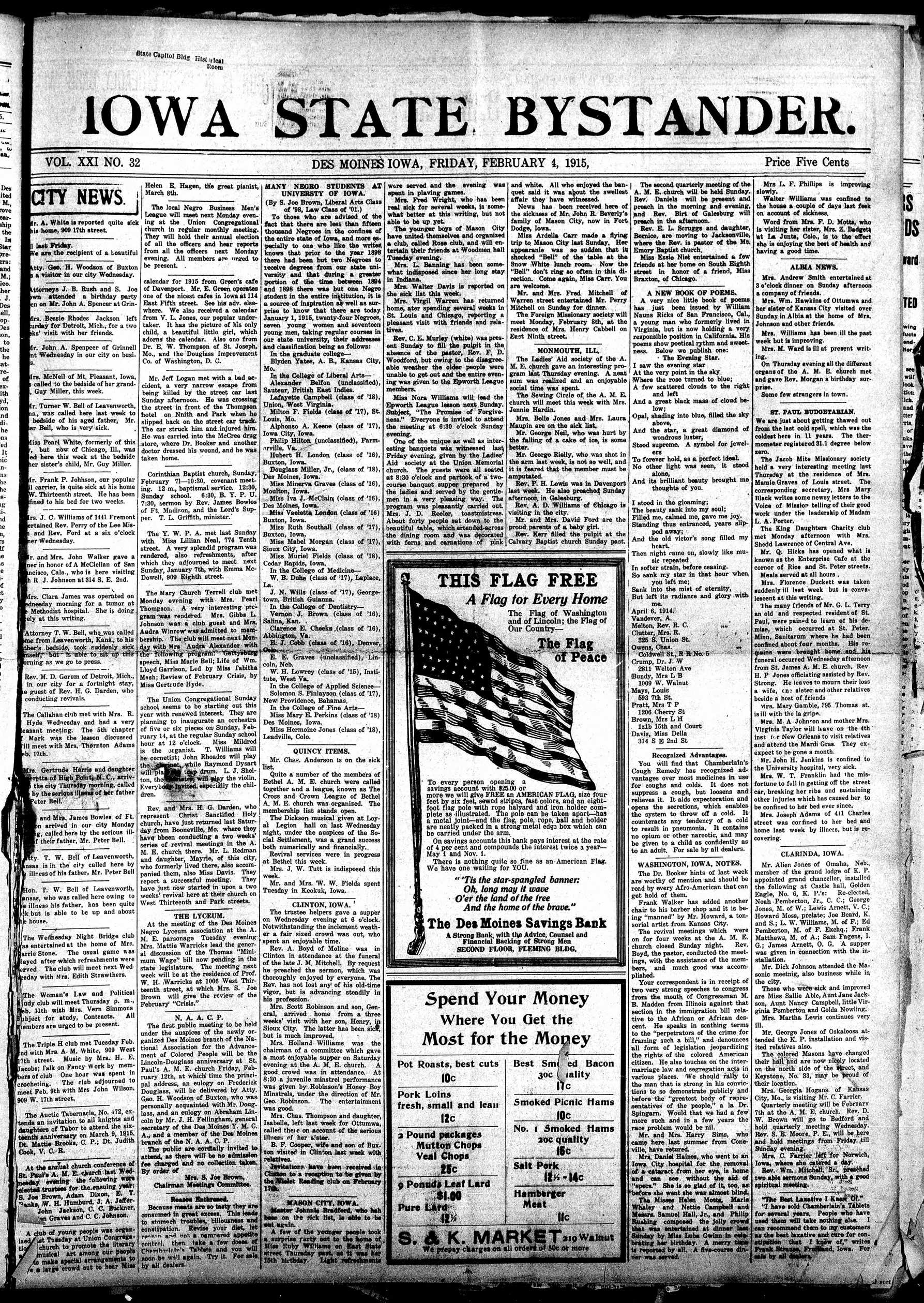
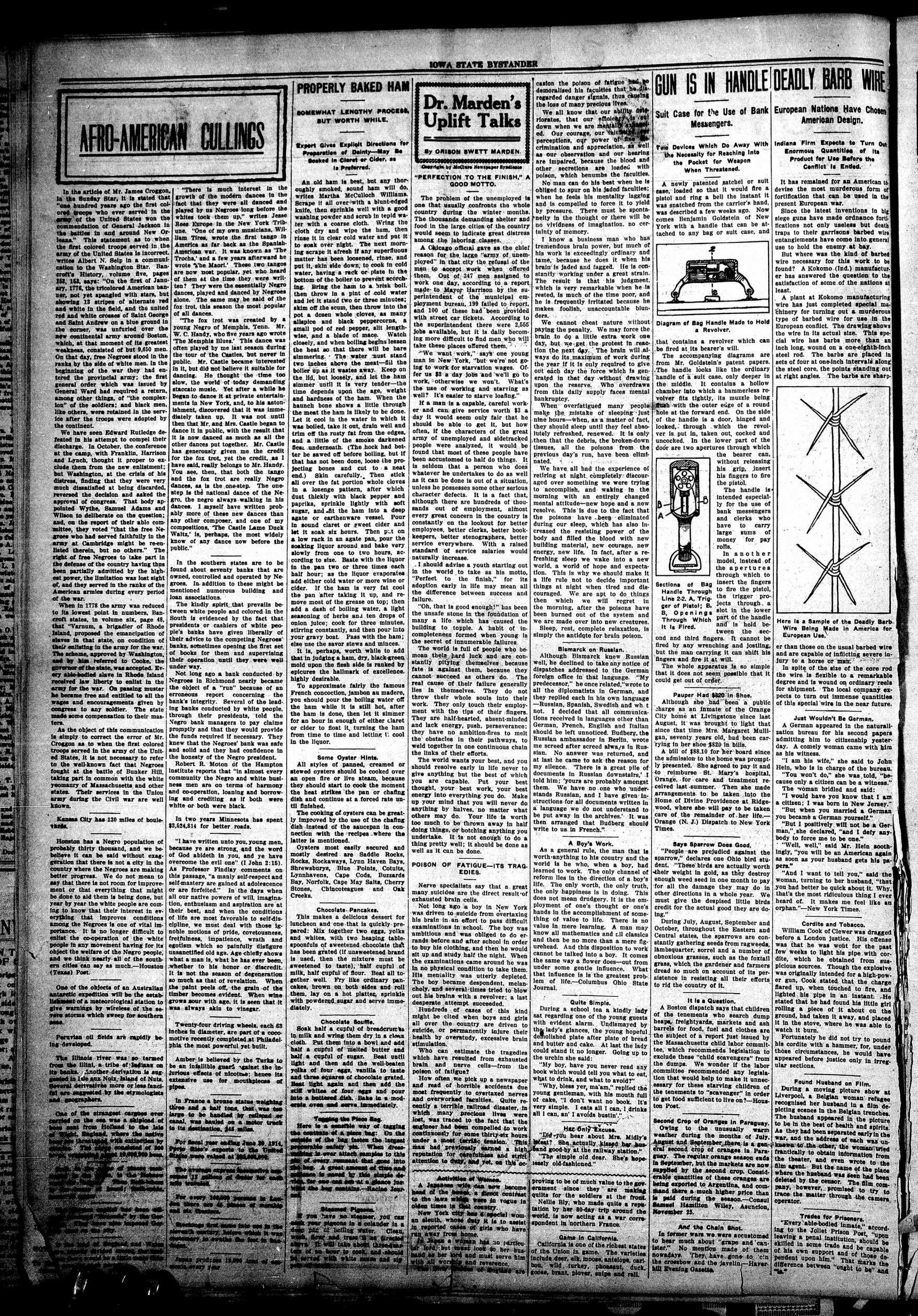
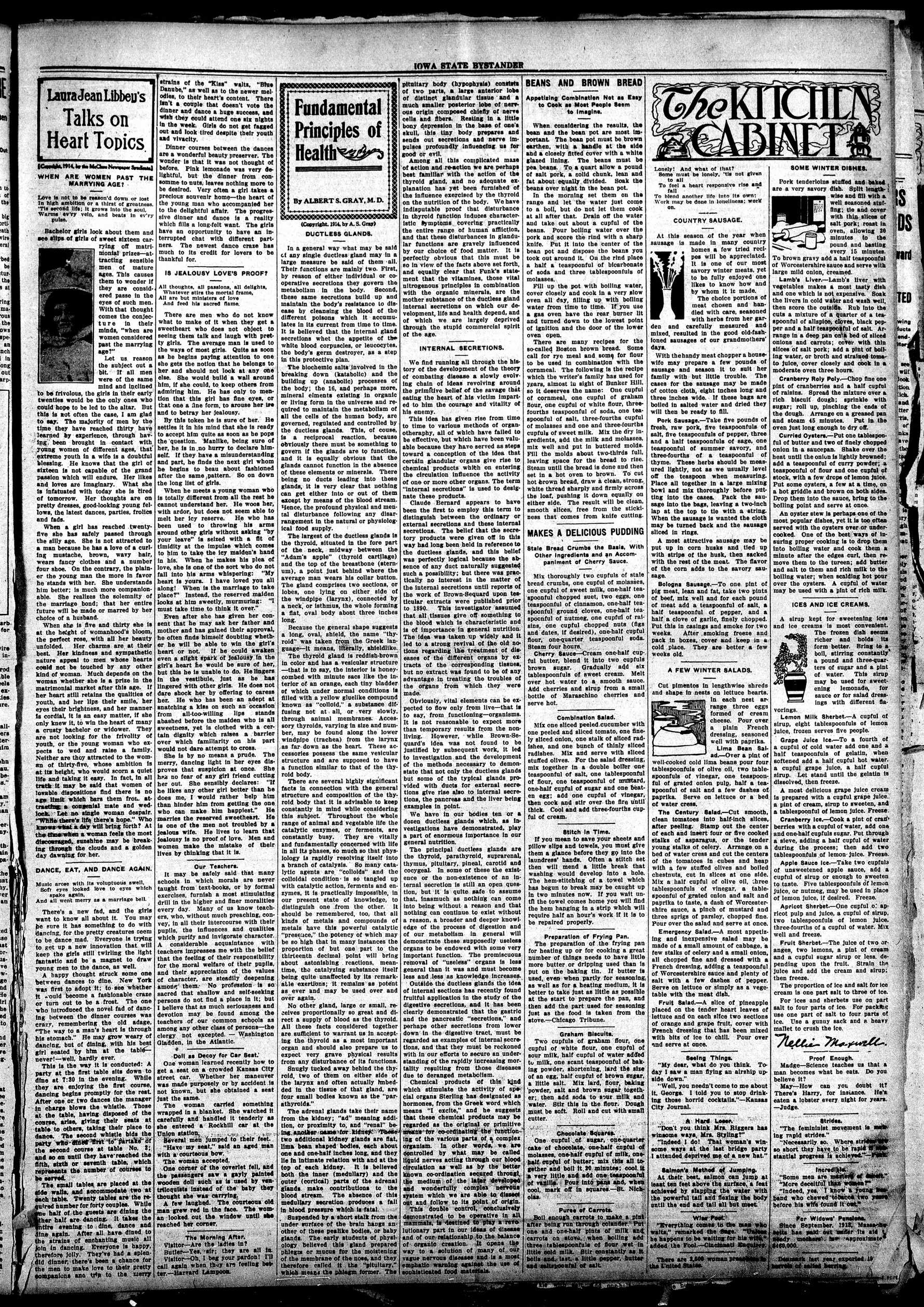
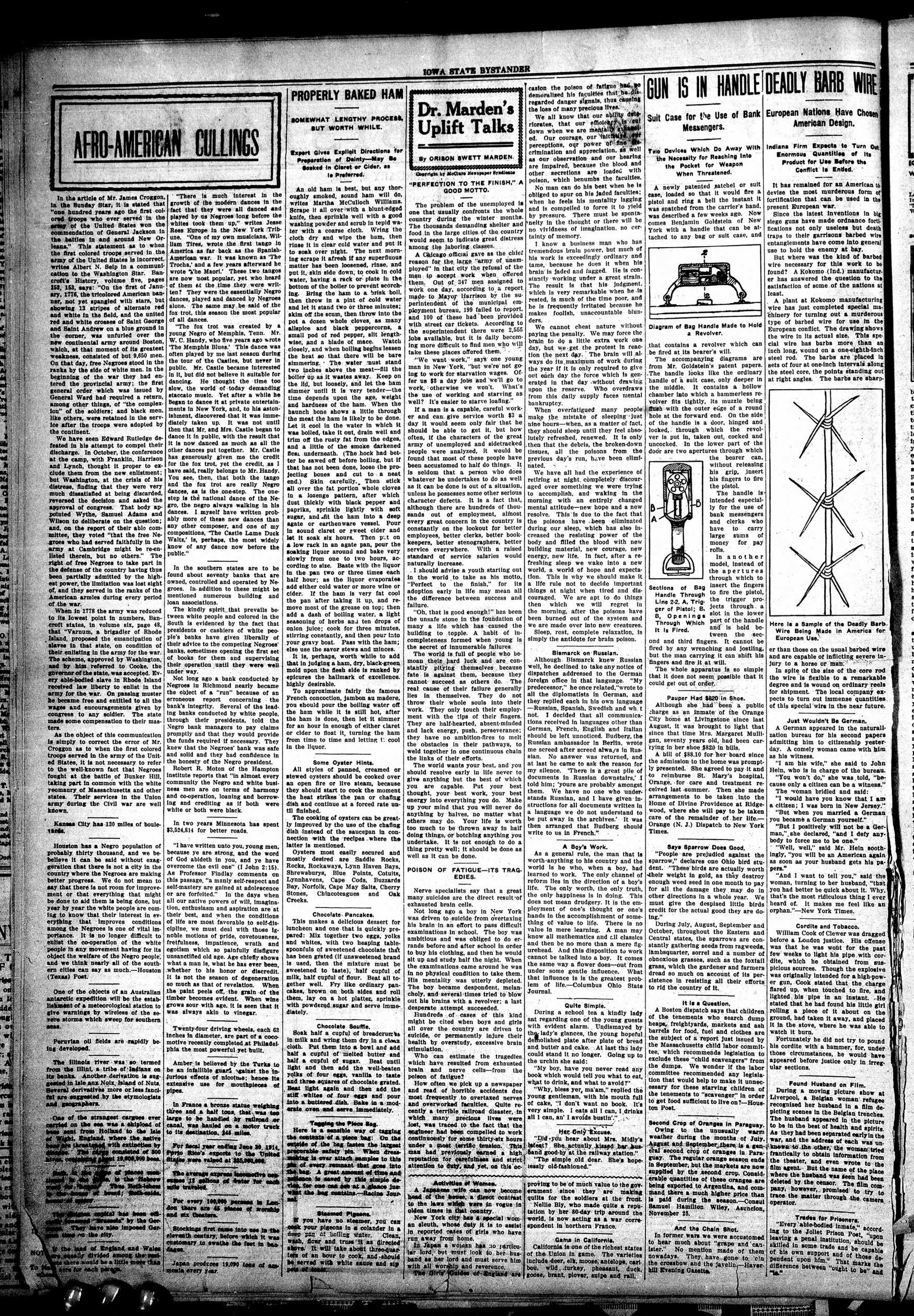
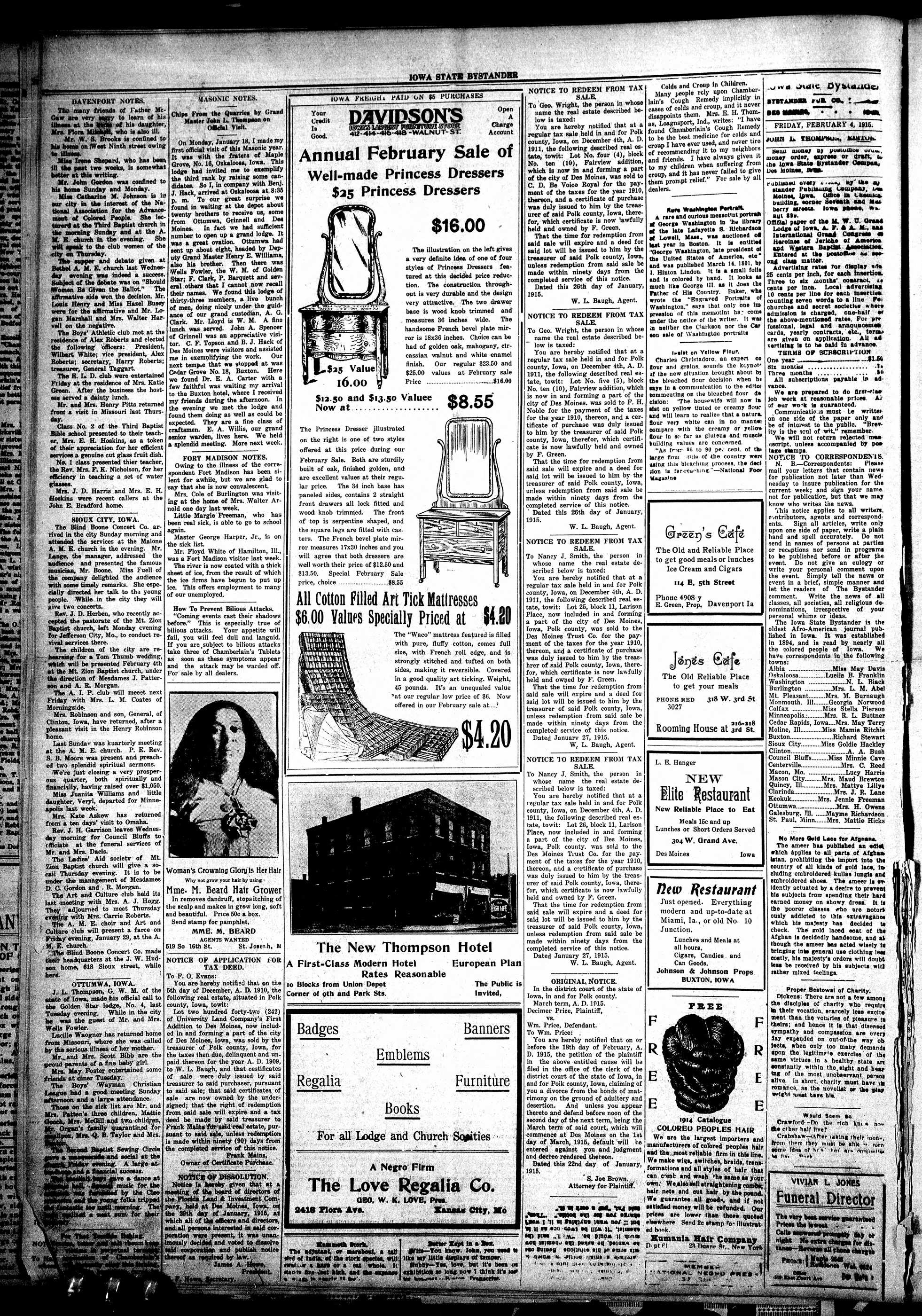
Page text (machine-generated)
IOWA STATE BYSTANDER.
VOL. XXI NO. 32
CITY NEWS
Mr. A. White is reported quite sick this home, 909 17th street.
I last Friday.
I am the recipient of a beautiful Atty. Gee. H. Woodson of Buxton is a visitor in our city Wednesday.
Attorneys J. B. Rush and S. Joe own attended a birthday party en on Mr. John A. Spencer at Grin-
Mrs. Bessie Rhodes Jackson left durrain for Detroit, Mich., for a two kids' visit with her friends.
Mr. John A. Spencer of Grinnell Wednesday in our city on busis.
Mrs. McNeil of Mt. Pleasant, Iowa, is called to the bedside of her grand-, Guy Miller, this week.
Mr. Turner W. Bell of Leavenworth, ms., was called here last week to the bedside of his aged father, Mr. Berl Bell, who is very sick.
Miss Pearl White, formerly of this, but now of Chicago, Ill., was bed here this week at the bedside her sister's child, Mr. Guy Miller.
Mr. Frank P. Johson, our popular carrier, is quite sick at his home W. Thirteenth street. He has been fined to his bed for two weeks.
Mrs. J. C. Williams of 1441 Fremont
certained Rev. Perry of the Lee Mie-
sh and Rev. Ford at a six o'clock
other Wednesday.
Mr. and Mrs. John Walker gave a
murder in honor of A McClellan of San
San Francisco, Cala., who is here visiting
h R J. Johnson at 314 S. E. 2nd.
Mrs. Clara James was operated on
mednesday morning for a tumor at
the Methodist hospital. She is doin-
gely at this writing.
Attorney T. W. Bell, who was called
from Leavenham, Kans., to his
father's bedside, took suddenly sick
myself, but is able to sit up this
morning as we go to press.
Rev. D. M. Dorum of Detroit, Mich,
in our city for a fortnight stay,
e guest of Rev. H. G. Darden, who
conduct revivals.
The Callahan club met with Mrs. R.
Hyde Wednesday and had a very
easant meeting. The 5th chapter
Mark was the lesson discussed
ill meet with Mrs. Thornton Adams
ob. 17th.
Mrs. Gertrude Harris and daughter
berta of High Point, N. C., arriv-
ing the city Thursday morning, called
by the serious illness of her father
Peter Bell.
and Mrs. James Bowles of Ft. Monroe arrived in our city on Friday, called here by the serious ill-health of their father, Mr. Peter Bell.
Betty, T. W. Bell of Leavenworth, Kansas is in the city called here by the illness of his father, Mr. Peter Bell.
Hon. F. W. Bell of Leavenworth, Kansas, who was called here owing to the illness his father, has been quite sick but is able to be up and about the house.
The Wednesday Night Bridge club was entertained at the home of Mrs. Carrie Stone. The usual game was played after which refreshments were served. The club will meet next Wednesday with Mrs. Edith Strawthers.
The Woman's Law and Political study club will meet Thursday p. m., 11th with Mrs. Vern Simmons Subject for study, Contracts. All members are urged to be present.
The Triple H club met Tuesday Feb. and with Mrs. A. M. White, 909 West 17th street. Music by Mrs. H. E. Talks on Fancy Work by members of club One hour was spent in crocheting. The club adjourned to meet Feb. 9th with Mrs John Wilson, 909 W. 17th street.
The Auctic Tabernacle, No. 472, extends an invitation to all knights and daughters of Tabor to attend the sixteenth anniversary on March 9, 1915. D. Mattie Brooks, C. P.; Dt. Judith Cook, V. C. R.
At the annual church conference of St. Paul's A. M. E. church last Wednesday evening the following were elected trustees for the ensuing year: S. Joe Brown, Adam Dixon, E. T. Tanks, W. H. Humbard, J. A. Jeffer-John Jackson, C. C. Buckner, Jon Graves and C. C. Johnson.
A club of young people was organized at Tuesday at Union Congregational church to promote the literary musical art among our people to make special arrangements to be a large crowd out to hear Miss
State Capitol Bldg Historical Room
OWA
Helen E. Hagen, the great pianist, March 8th.
The local Negro Business Men's League will meet next Monday evening at the Union Congregational church in regular monthly meeting. They will hold their annual election of all the officers and hear reports from all the officers next Monday evening. All members are urged to be present.
calendar for 1915 from Green's café of Davenport. Mr. E. Green operates one of the nicest cafes in Iowa at 114 East Fifth street. See his adv. elsewhere. We also received a calendar from V. L. Jones, our popular undertaker. It has the picture of his only child, a beautiful little girl, which adorns the calendar. Also one from Dr. E. W. Thompson of St. Joseph, Mo., and the Douglass Improvement Co. of Washington, D. C.
Mr. Jeff Logan met with a bad accident, a very narrow escape from being killed by the street car last Sunday afternoon. He was crossing the street in front of the Thompson hotel on Ninth and Park when he slipped on the street car track. The car struck him and injured him. He was carried into the McCree drug store, where Dr. Booker and another doctor dressed his wound, and he was taken home.
Corinthian Baptist church, Sunday, February 7—10:30, covenant meet 12 m, baptismal service. 12:30, Sunday school. 6:30, B. Y. P. U. 7:30, sermon by Rev. James Bowles of Ft. Madison, and the Lord's Supper. T. L. Griffith, minister.
The Y. W. P. A. met last Sunday with Miss Lillian Neal, 747 Tenth street. A very splendid program was rendered, also refreshments, after which they adjourned to meet next Sunday, January 7th, with Emma McDowell, 909 Eighth street.
The Mary Church Terrell club meet Monday evening with Mrs. Pearl Thompson. A very interesting program was rendered Mrs. Gibbs L. Johnson was a club guest and Mrs. Audra Winow was admitted to membership. The club will meet next Monday with Mrs. Audra Alexander with the following program: Gettysburg speech, Miss Marble Bell, Life of Wm. Lloyd Garrison, Led by Miss Fabita Mash; Review of February Crisis, by Miss Gertrude Hyde.
The Union Congregational Sunday school seems to be starting out this year with renewed interest. They are planning to inaugurate an orchestra of five or six pieces on Sunday, February 14, at the regular Sunday school hour at 12 o'clock. Miss Mildred is the organist. T. Williams will be cornetist; John Rhodes will play the guitar, while Raymond Dysart will play the trap drum. L. J. Sheleton, the tenor, will play the violin. Everybody invited, especially the children.
Rev. and Mrs. H. G. Darden, who represent Christ Sanctified Holy church, have just returned last Saturday from Booneville, Mo. where they have been conducting a two weeks' series of revival meetings in the A. M. E. church there. Mr. L. Redman and daughter, Mayrie, of this city, formerly lived there, also accompanied them, also Miss Davis. They report a successful meeting. They have just now started in upon a two weeks' revival here at their church on West Thirteenth and Park streets.
THE LYCEUM.
At the meeting of the Des Moines Negro Lyceum association at the A. M. E. personage Tuesday evening Mrs. Mattie Warricks lead the general discussion of the Thomas "Minimum Wage" bill now pending in the state legislature. The meeting next week will be at the residence of Prof. W. H. Warricks at 1006 West Thirteenth street, at which Mrs. S. Joe Brown will give the review of the February "Crisis."
N. A. A. C. P.
The first public meeting to be held under the auspices of the newly organized Des Moines branch of the National Association for the Advancement of Colored People will be the Lincoln-Douglass anniversary at St. Paul's A. M. E. church Friday, February 12th, at which time the principal address, an eulogy on Frederick Douglass, will be delivered by Atty. Geo. H. Woodson of Buxton, who was personally acquainted with Mr. Douglass, and an eulogy on Abraham Lincoln by Mr. J. H. Fellingham, general secretary of the Des Moines Y. M. C. A., and a member of the Des Moines branch of the N. A. A. C. P.
The public are cordially invited to attend, as there will be no admission fee charged and no collection taken. By order of
Reason Enthrush.
Because meals are so tasty they are consumed in great excess. This leads to stomach troubles, bilianness and constipation. Revise your diet, list reason and not a garnered appetite control, then take a few doses of Chambarilla Tablets and you will soon be well again. Try it. For sale by all dealers.
(By S. Joe Brown, Liberal Arts Class
of 39th Law, Class of 211)
To those who are advised of the fact that there are less than fifteen thousand Negroes in the confines of the entire state of Iowa, and more especially to one who like the writers knows that prior to the year 1898 there had been but two Negroes to receive degrees from our state university and that during a greater portion of the time between 1894 and 1898 there was but one Negro student in the entire institution, it is a source of inspiration as well as surprise to know that there are today January 1, 1915, twenty-four Negroes, seven young women and seventeen young men, taking regular courses in our state university, their addresses and classification being as follows:
In the graduate college—Blyden Yates, A. B., Kansas City, Mo.
In the College of Liberal Arts—Alexander Belfon (unclassified), Sauteur, British East Indies.
Lafayette Campbell (class of '18), Union, West Virginia.
Milton F. Fields (class of '17), St.
Louis, Mo.
Alphonso A. Koeen (class of '17), Iowa, Iowa.
Philip Hilton (unclassified), Farm-
ville, Va.
Hubert H. London (class of '16),
Buxton, Iowa.
Douglas Miller, Jr., (class of '18),
Des Moines, Iowa.
Miss Minerva Graves (class of '16),
Moulton, Iowa.
Miss Iva J. M. McClain (class of '16)
Des Moines, Iowa.
Miss Valeetta London (class of '16)
Buxton, Iowa.
Miss Ruth Southhall (class of '17),
Buxton, Iowa.
Miss Mabel Morgan (class of '17),
Sioux City, Iowa.
Miss Murial Fields (class of '18),
Cedar Rapids, Iowa.
In the College of Medicine—
W. B. Duhe (class of '17), Laplace,
La.
J. N. Wills (class of '17), Georgetown,
British Guiana.
In the College of Dentistry—
Vernon J. Brown (class of '16),
Salina, Kan.
Clarence E. Cheeks (class of '16),
Abington, Va.
Abington, Va.
E. J. Cobb (class of '16), Denver,
Cincinnati.
E. G. Graves (unclassified), Lincoln,
Neb.
W. H. Lowrey (class of '15), institute,
West Va.
In the College of Applied Science—Solomon S. Finlayson (class of '17),
New Providence, Bahamas.
In the College of Fine Arts—Miss Mary E. Perkins (class of '18)
Des Moines, Iowa.
Miss Hermione Jones (class of '18),
Leadville, Colo.
QUINCY ITEMS.
Mr. Chas. Anderson is on the sick list.
Quite a number of the members of Bethel A. M. E. church were called together and a league, known as The Cross and Crown League of Bethel A. M. E. church was organized. The membership list stands open.
The Dickson musical given at Loyal Legion hall on last Wednesday night, under the auspices of the Social Settlement, was a grand success both socially and financially.
Revival work is in progress at Bethel this week.
Mrs. J. W. Tutt is indisposed this week.
Mr. and Mrs. W. W. Fields spent Tuesday in Keokuk, Iowa.
CLINTON, IOWA.
The trustee helpers gave a supper on Wednesday evening at 6 o'clock. Notwithstanding the inclement weather a fair sized crowd was out, who spent an enjoyable time.
Rev. A. Boyle of Moline was in Clinton in attendance at the funeral of the late J. M. Mitchell. By request he preached the sermon, which was thoroughly enjoyed by everyone. The Rev. has not lost any of his old-time vigor, but is advancing steadily in his profession.
Mrs. Scott Robinson and son, General, arrived home from a three weeks' visit with her son, Henry, in Sioux City. The latter has been sick, but is much improved.
Mrs. Holland Williams was the chairman of a committee which gave a most enjoyable supper on Saturday evening at the A. M. E. church. A good crowd was in attendance. At 8:30 a juvenile minstrel performance was given by Robinson's Honey Boy Minstrels, under the direction of Mr. Geo Robinson. The entertainment was good.
Mrs. Chas. Thompson and daughter, Isabelle, left last week for Ottumwa, called there on account of the serious illness of her sister.
B. F. Cooper, wife and son of Buxton visited in Clinton last week with relatives.
Invitations have been received in Clinton to a reception to be given by the Nielsen Reading Club on February 17th.
MAGUN CITY, IOWA
Master Johnnie Bradford, who has been a sick list, is able to be out again.
A few of the younger people took a surprise party out to the home of Miss Ruby Wilson on East State street Thursday as it was her 16th birthday. Light refreshments
were served and the evening was spent in playing games.
Mrs. Fred Wright, who has been real sick for several weeks, is somewhat better at this writing, but not able to be up yet.
The younger boys of Mason City have united themselves and organized a club, called Rose club, and will entertain their friends at Woodmen hall Tuesday evening.
Mrs. L. Banning has been somewhat indisposed since her long stay in Indiana.
Mrs. Walter Davis is reported on the sick list this week.
Mrs. Virgil Warren has returned home, aster spending several weeks in St. Louis and Chicago, reporting a pleasant visit with friends and relatives.
Rev. C. E. Murley (white) was present Sunday to fill the pulpit in the absence of the pastor, Rev. F. D. Woodford, but owing to the disagreeable weather the older people were unable to get out and the entire evening was given to the Epworth League members.
Miss Nora Williams will lead the Epworth League lesson next Sunday. Subject, "The Promise of Forgiveness." Everyone is invited to attend the meeting at 6:30 o'clock Sunday evening.
One of the unique as well as interesting banquets was witnessed last Friday evening, given by the Ladies' Aid society at the Union Memorial church. The guests were all seated at 8:30 o'clock and partook of a two-course banquet supper prepared by the ladies and served by the gentlemen in a very pleasing way. The program was presented by the Rev. D. J. Deer, toastmistress. About forty people sat down to the beautiful table, which extended across the dining room and was decorated with ferns and carnations of pink
THIS FIELD
A Flag
To every person open savings account with $2 more we will give FREE feet by six feet, sewed stitched foot flag pole with rope plete as illustrated. The a metal joint—and the s are neatly packed in a st be carried under the arre
On savings accounts the of 4 per cent and compo May 1 and Nov. 1.
There is nothing quite We have one waiting for
THIS FLAG FREE
A Flag for Every Home
The Flag of Washington
and of Lincoln; the Flag of
Our Country—
The Flag
of Peace
To every person opening a
savings account with $25.00 or
more we will give FREE an AMERICAN FLAG, size four
feet by six feet, sewed stripes, fast colors, and an eight-
foot flag pole with rope halyard and iron holder com-
plete as illustrated. The pole can be taken apart—has
a metal joint—and the flag, pole, rope, ball and holder
are neatly packed in a strong metal edge box which can
be carried under the arm.
On savings accounts this bank pays interest at the rate
of 4 per cent and compounds the interest twice a year—
May 1 and Nov. 1.
There is nothing quite so fine as an American Flag. We have one waiting for YOU.
"Tis the star-spangled banner:
Oh, long may it wave
O'er the land of the tree
And the home of the brave."
The Des Moines Savings Bank
A Strong Bank, with the Advice, Counsel and Financial Backing of Strong Men SECOND FLOOR, FLEMING BLDG.
Spend Yo Where Yo Most for
Spend Your Money Where You Get the Most for the Money
Pot Roasts, best cuts
10c
Pork Loins
fresh, small and lean
12c
2 Pound packages
Mutton Chops
Veal Chops
25c
9 Ponuts Leaf Lard
$1.00
Pure Lard
12½
Best Smoked Bacon
30c quality
17c
Smoked Picnic Hams
10c
No. 1 Smoked Hams
20c quality
15c
Salt Pork
12½ - 14c
Hamberger
Meat
11c
S. & K. MARKET 210 Walnut
We prepay charges on all orders of 50c or more
and white. All who enjoyed the banquet said it was about the swellest affair they have witnessed.
News has been received here of the sickness of Mr. John J. Beverly's family of Mason City, now in Fort Dodge, Iowa.
Miss Ardella Carr made a flying trip to Mason City last Sunday. Her appearance was so sudden that it shocked "Bell" of the table at the Snow White lunch room. Now the "Bell" don't ring so often in this direction. Come again, Miss Carr. You are welcome.
Mr. and Mrs. Fred Mitchell of Warren street entertained Mr. Perry Mitchell on Sunday for dinner.
The Foreign Missionary society will meet Monday, February 8, at the residence of Mrs. Henry Cabbell on East Ninth street.
MONMOUTH, ILL
The Ladies' Aid society of the A. M. E. church gave an interesting program last Thursday evening. A neat sum was realized and an enjoyable social time was spent. The Sewing Circle of the A. M. E. church will meet this week with Mrs. Jennie Hardin.
Mrs. Belle Jones and Mrs. Laura Maupin are on the sick list. Mr. George Neil, who was hurt by the falling of a cake of ice, is some better.
Mr. George Rielly, who was shot in the arm last week, is not so well, and it is feared that the member must be amputated.
Rev. P. H. Lewis was in Davenport last week. He also preached Sunday afternoon in Galesburg.
Rev. A. D. Williams of Chicago is visiting in the city.
Mr. and Mrs. David Ford are the proud parents of a baby girl. Rev. Kerr filled the pulpit at the Calvary Baptist church Sunday past.
FLAG FREE
buy for Every Home
The Flag of Washington
and of Lincoln; the Flag of
Our Country—
The Flag
of Peace
ing a
$5.00 or
an AMERICAN FLAG, size four
rippers, fast colors, and an eight-
halyard and iron holder com-
pete pole can be taken apart—has
flag, pole, rope, ball and holder
strong metal edges box which can
n.
his bank pays interest at the rate
bounds the interest twice a year—
so fine as an American Flag.
or YOU.
ur Money
u Get the
the Money
Best Smoked Bacon
The second quarterly meeting of the A. M. E. church will be held Sunday, Rev. Daniels will be present and preach in the morning and evening, and Rev. Birt of Galesburg will preach in the afternoon. Rev. E. L. Scruggs and daughter, Bernice, are moving to Jacksonville, where the Rev. is pastor of the Mt. Emory Baptist church. Miss Essie Niel entertained a few friends at her home on South Eighth street in honor of a friend, Miss Braxton, of Chicago.
A NEW BOOK OF POEMS.
A very nice little book of poems has just been issued by William Nauns Ricks of San Francisco, Cal., a young man who formerly lived in Virginia, but is now holding a very responsible position in California. His poems show poetical rythm and sweetness. Below we publish one:
where the rose turned to blue,
A few scattered clouds to the right
And a great black mass of cloud below:
Opal, shading into blue, filled the sky above,
And the star, a great diamond of wondrous luster,
Stood supreme. A symbol for jewelers
To forever hold, as a perfect ideal.
No other light was seen, it stood alone,
And its brilliant beauty brought me thoughts of you.
I stood in the gleaning;
The beauty sank into my soul;
Filled me, calmed me, gave me joy,
Standing entranced, years slipped away.
And the old victor's song filled my heart.
Then night came on, slowly like music repeated.
you left me;
Sank into the mist of eternity,
But left its radiance and glory with
me.
April 6, 1914.
Vandever, A.
Melton, Rev. R. C.
Clutter, Mrs. R.
225 S. Union St.
Owens, Chas.
Coldwell St. R R No. 5
Crump, Dr. J. W
2811 Welton Ave
Bundy, Mrs L B
1009 W. Walnut
Mays, Louis
593 7th St.
Pratt, Mrs T P
1206 Cherry St
Brown, Mrs L H
121b 15th and Court
Davis, Miss Della
314 S E 2nd St
Recognized Advantages
You will find that Chamberlain's Cough Remedy has recognized advantages over most medicines in use for coughs and colds. It does not suppress a cough, but loosens and relieves it. It aids expectation and opens the secretions, which enables the system to throw off a cold. It counteracts any tendency of a cold to result in pneumonia. It contains no opium or other narcotic, and may be given to a child as confidently as to an adult. For sale by all dealers.
WASHINGTON, IOWA, NOTES.
The Dr. Booker hints of last week are worthy of mention and should be read by every Afro-American that can get hold of them.
Frank Walker has added another chair to his barber shop and it is being "manned" by Mr. Howard, a tonsorial artist from Kansas City.
The revival meetings which were on for four weeks at the A. M. E. church closed Sunday night. Rev. Boyd, the pastor, conducted the meetings, with the assistance of the members, and much good was accomplished.
Your correspondent is in receipt of two very strong speeches to congress from the mouth of Congressman M. B. Madden from Illinois against that section in the immigration bill relative to the African or African descent. He speaks in scathing terms to the "perpetrators of the crime for framing such a bill," and denounces all form of legislation jeopardizing the rights of the colored American citizen. He also touches on the intermarriage law and segregation acts in various places. We should rally to the man that is strong in his convictions to so demonstrate publicly and before the "greatest body of representatives of the people," a la Dr. Spingarn. Would we had a few more such and in a few years the race problem would be nil.
Mr. and Mrs. Harry Sims, who came here last summer from Conneville, have returned.
Mrs. Daniel Haines, who went to an Iowa City hospital for the removal of a cataract from her eye, is home and can see without the aid of "specs." She is so glad of it, too, before she went she was almost blind. The Misses Helen Motta, Marie Whaley and Nettie Campbell and Meara, Samuel Hall Jr., and Philip Rushing composed the jolly crowds that was entertained at dinner last Sunday by Miss Linda Gwin in celebrating her birthday. A merry them is reported by all. a few courses dined
Price Five Cents
Mrs L. F. Phillips is improving slowly.
Walter Williams was confined to the house a couple of days last feek on account of sickness.
Word from Mrs. F. D. Motts, who is visiting her sister, Mrs. Z. Badgett at La Junta, Colo., is to the effect she is enjoying the best of health and having a good time.
ALBIA NEWS.
Mrs. Andrew Smith entertained at 3 o'clock dinner on Sunday afternoon a company of friends.
Mrs. Wm. Hawkine of Ottumwa and her sister of Kansas City visited over Sunday in Albia at the home of Mrs. Johnson and other friends.
Mrs. Williams has been ill the past week but is improving.
Mrs. M. Ward is ill at present writing.
On Thursday evening all the different organs of the A. M. E. church met and gave Rev. Morgan a birthday surprise.
Some few strangers in town.
ST. PAUL. BUDGETARIAN.
ST. PAUL BUDGETARIAN.
we are just about getting thawed out from the last cold spell, which was the coldest here in 11 years. The thermometer registered St.1 degree below zero.
The Jacob Mite Missionary society hold a very interesting meeting last Thursday at the residence of Mrs. Mamie Graves of Louis street. The corresponding secretary, Mrs Mary Black writes some news letters to the Voice of Mission telling of their good work under the leadership of Madam L. A. Porter.
The King Daughters Charity club met Monday afternoon with Mrs. Shedd Lawrence of Central Ave. Mr. Q. Hicks has opened what is known as the Enterprise Cafe at the corner of Rice and St. Peter streets. Meals served at all hours.
Mrs. Florence Duckett was taken suddenly ill last week but is convalescent at this writing.
The many friends of Mr. G. L. Terry an old and respected resident of St. Paul, were pained to learn of his demise, which occurred at St. Peter. Minn, Sanitarium where he had been confined about four months. His requests were brought home and his funeral occurred Wednesday afternoon from St. James A. M. e-church, Rev H. P. Jones officiating assisted by Rev. Strong. He leaves to mourn their a wife, one sister and other relatives beside a host of friends
Mrs. Mary Gambie, 995 Thomas st. is ill with the lair.
Mrs. M. A. Johnson and mother Mrs. Virginia Taylor will leave on the 4th inst. for New Orleans to visit relatives and attend the Mardi Gras. They expect to be gone a month. Mr. John H. Jenkins is confined to the University hospital, very sick. Mrs. W. T. Franklin had the misfortune to fall in getting off the street car, breaking her ribs and sustaining other injuries which has caused her to be confined to her bed ever since. Mrs. Joseph Adams of 411 Charles street was confined to her bed and home last week by illness, but is recovering.
CLARINDA, IOWA
Mr. Alien Jones of Omaha, Neb., member of the grand lodge of K. P., appointed grand chancellor, installed the following at Castle hall, Golden Eagle, No. 6, K. P.'s: Re-elected, Noah Pemberton, Jr. C. C.; George Jones, M. of W.; Lewis Arnett, V. C.; Howard Moss, predate; Joe Board, K. and S.; L. W. Williams, M. of F.; Ed Pemberton, M. of A.; Sam Fagens, I. G.; James Arnett, O. G. A supper was given in connection with the installation.
Mr. Dick Johnson attended the Masonic meeting, also business while in the city.
Those who were sick and improved are Miss Sallie Able, Aunt Jane Jackson, Aunt Nancy Campbell, little Virginia Pemberton and Golda Newburgh.
Mrs. Martha Lewis continues very ill.
Mr. George Jones of Oskaloosa attended the K. P. installation and visited relatives also.
The colored Masons have changed their hall and are now nicely located on the north side of the street, and Keystone, No. 33, may be proud of their location.
Mrs. Georgia Hogans of Kansas City, Mo., is visiting Mr. C. Farrier. Quarterly meeting will be February 7th at the A. M. E. church. Rev. D. W. Brown will go to Bedford and hold quarterly meeting Wednesday. Rev. S. B. Moore, P. E., will be here and hold meetings from Friday till Sunday evening.
Mrs. C. Farrer left for Norwich, Iowa, where she catered a day. Rev. Wm. Mitchell, Sr., preached two able sermons Sunday, with a good spiritual meeting.
"The Best Laxative I Know Of."
"I have sold Chamberlain's Tablets for several years. People who have used them will take nothing else. I can recommend them to my customers as the best laxative and cure for constipation that I know of," writes Frank Strange, Frumish, Iowa. For sale by all customers.
AFRO-AMERICAN CULLINGS
In the article of Mr. James Croggan in the Sunday Star, it is stated that "one hundred years ago the first colored troops who ever served in the army of the United States won the commendation of General Jackson in the battles in and around New Orleans." This statement as to when the first colored troops served in the army of the United States is incorrect, writes Albert N. Selip in a communication to the Washington Star. Bancroft's History, volume five, pages 152, 153, says: "On the first of January, 1776 the tricolored American banner, not yet spangled with stars, but showing 13 stripes of alternate red and white in the Belt, and the united red and white crosses of Saint George and Saint Andrew on a blue ground in the corner, was unfurled over the new continental army around Boston, which, at that moment of its greatest weakness, consisted of 9,650 men in the by side of white men. In the beginning of the war they had entered the provincial army; the first general order which was issued by General Ward had required a return, among other things, of "the complexor" of the soldiers; and black men, like others, were retained in the service after the troops were adopted by the continent.
We have seen Edward Rutledge dejected in his attempt to compel their discharge. In October, the conference at the camp, with Franklin, Harrison and Lynch, thought it proper to exclude them from the new enlistment; but Washington, at the crisis of his distress, finding that they were very much dissatisfied at being discarded, reversed the decision and asked the approval of congress. That body appointed Wythe, Samuel Adams and Wilson to deliberate on the question; and, on the report of their able committee, they voted "that the free Negroes who had served faithfully in the Cambridge might be re-emilied the other way." The right of free Negroes to take part in the defense of the country having thus been partially admitted by the highest power, the limitation was lost sight of, and they served in the ranks of the American armies during every period of the war.
When in 1778 the army was reduced to its lowest point in numbers, Bancroft states, in volume six, page 48, that "Varmum, a brigadier of Rhode Island, proposed the emancipation of slaves in that state, on condition of their enlisting in the army for the war. The scheme, approved by Washington, and by his referred to Cooke, the very first bishop of Rhode Island,ery bishop-bodied slaves in Rhode Island received law liberty to enlist in the army for the war. On passing muster he became free and entitled to all the wages and encouragements given by congress to any soldier. The state made some compensation to their masters.
As the object of this communication is simply to correct the error of Mr. Crogon as to when the first colored troops served in the army of the United States, it is not necessary to refer to the old war footsweep. New fought at the battle of Bunker Hill taking part in common with the yearly number of Massachusetts and other states. Their services in the Union army during the Civil war are well known.
Kansas City has 130 miles of boulevard.
Houston has a Negro population of probably thirty thousand, and we be believe it can be said without exaggeration that there is not a city in the country where the Negroes are making better progress. We do not mean to say that there is not room for improvement or that everything that might be done to aid them is being done, but year by year the white people are coming in, and everything that improves condition among the Negroes is one of vital importance. It is no longer difficult to enlist the co-operation of the white people in any movement having for its object the welfare of the Negro people, and we think nearly all of the southern cities can say as much—Houston (Texas) Post.
One of the objects of an Australian antarctic expedition will be the establishment of a meteorological station to give warnings by wireless of the severe storms which sweep for southern seas.
"There is much interest in the growth of the modern dances in the fact that they were all danced and played by us Negroes long before the whites took them up," writes Jesse Rees Europe in the New York Tribune, "One of my own musicians, William Tires, wrote the first tango in America as far back as the Spanish-American war. It was known as 'The Trocha,' and a few years after he wrote 'the Maori.' These two tangles are now most popular, yet who heard them in the past they were written." They were the essentially Negro dances, played and danced by Negroes alone. The same may be said of the fox trot, this season the most popular of all dances.
"The fox trot was created by a young Negro of Memphis, Tenn. Mr. W. C. W. Handy, who five years ago wrote 'The Memphis Blues.' This dance was often played by me last season during the tour of the castle, but never in public. Mr. Castle became interested in it, but did not believe it suitable for dancing. He thought the time too slow, the world of today demanding staccato music. Yet after a while he found that he had more moments in New York, and, to his astonishment, discovered that it was immediately taken up. It was not until then that Mr. and Mrs. Castle began to dance it in public, with the result that it is now danced as much as all the other dances put together. Mr. Castle has generously given me the credit for the fox trot, yet the credit, as I have said, really belongs to Mr. Handy. You see, then, that both the tango and the fox trot are really Negro dances, as is the one step. The one step is the same as the grove, the negro always walking in his dances. I myself have written probably more of these new dances than any other composer, and one of my compositions. 'The Castle Lame Duck Waltz', is, perhaps, the most widely know of any dance now before the public."
In the southern states are to be found about seventy banks that are owned, controlled and operated by Negroes. In addition to these might be mentioned numerous building and loan associations. The kindly spirit that prevails between white people and colored in the South is evidenced by the fact that presidents or cashiers of white people's banks have given liberally of their advice to the competing Negroes' banks, sometimes opening the first set of books for them and supervising their operation until they were well under way. Not long ago a bank conducted by Negroes in Richmond nearly became the object of a "run" because of an急促 and poor concerning the bank's integrity. Several of the ing banks conducted by white people, through their presidents, told the Negro bank managers to pay claims promptly and that they would provide the funds required if necessary. They knew that the Negroes' bank was safe and solid and they had confidence in the honesty of the Negro president.
Robert R. Moton of the Hampton institute reports that "in almost every community the Negro and white business men are on terms of harmony and borrowing and crediting as if both were white or both were black.
In two years Minnesota has spent
$3,524,814 for better roads.
"I have written unto you, young men, because ye are strong, and the word of God abideth in you, and ye have overcome the evil one" (I John 2:16). As Professor Findlay comments on this passage, "a manly respect and self-mastery are gained at adolescence or are forfeited." In the days when all our native powers of will, imagination, enthusiasm and aspiration are at their best, and when the conditions of life are most favorable to self-discipline, we are with those仁德 motion of pride, wisdom, freetness, impatience, wrath, egotism which so painfully disguise unscripted old age. Age-chely shows what a man is, what he has ever been, whether to his honor or discredit. It is not the season of degeneration so much as that of revelation. When the paint peels off, the grain of the timber becomes evident. When wine grows sour with age, it is seen that it was always skim to vinegar.
Twenty-four driving wheels, each 68 inches in diameter, are part of a coomotive recently completed at Philadelphia the most powerful yet built.
Amber is believed by the Turks to be an infallible effect against the injurious effects of nicotine; hence its extensive use for mouthpieces of pipes.
PROPERLY BAKED HAM
Export Gives Exploit Directions for Preparation of Dainty-May Be Socked in Cleret or Cider, as Is Preferred.
An old ham is best, but any thorny smoked, sound ham will do writes Martha McCullough Williams Scrape it all over with a blunt-edge knife, then sprinkle well with a good washing powder and scrub in tepid wart with a coarse cloth. Wring the cloth dry and wipe the ham, then rinse it in clear cold water and put it to soak over night. The next morning scrape it afresh if any superfluous matter has been loosened, rinsed, and put it, skin side down; to cook in cold water, having a rock or plank, bottom of the boiler to do a brisk boil to throw in a pint of cold water and let it stand two or three minutes; skim off the scum, then throw into the pot a dozen whole cloves, as many allpice and black peppercorns, a small pool of red pepper, slit lengthwise, and a blade of mace. Watch closely, and when boiling begins lessen the heat so that there will be bare simmering. The water must stand two inches above the meat—fill the boiler up as it wastes away. Keep on the lid, but loosely, and let the ham simmer until it is very tender—the time depends upon the age, weight and take it out, drain well and trim off the rusty fat from the edges, and a little of the smoke darkened. Underneath. The hock had better be offed before boiling, but if that has been done, loose the theatens bone and cut to a neat end.) Skin carefully. Then stick all the fat portion whole cloves in a lozenge pattern, after which dust thickly with pepper and paprika, sprinkle lightly with soft sugar, and aft the ham into a deep agate or earthware vessel. Pour in sound claret or sweet cider and let it soak six hours. Then plet. on a low rack in an agan pan, pour the soaking liquor around and bake very slowly from one to two hours, according to site. Baste with the thawed in the pan. Pour the same as the liquor evaporates and either cold water or more wine or cider. If the ham is very fat cool the pain after taking it up, and remove most of the grease on top; then add a dash of boiling water, a light seasoning of herbs and ten drops of onion juice; cook for three minutes, stirring constantly, and then pour into your gravy boat. Pass with the ham; else use the savor stews and mince.
It is, perhaps, worth while to add that in judging a ham, dry, black-green mold upon the flesh side is ranked by epicures the hallmark of excellence. highly desirable.
To approximate fairly the famous French concoction, jambon au madem, you should pour the boiling water off the ham while it is still hot, after the ham is done, then let it simmer for an hour in enough of either claret or older to float it, turning the ham from time to time and letting it cool in the liquor.
Some Oyster Hints
All styles of panned, creamed or stewed oysters should be cooked over an open fire or live steam, because they should start to cook the moment the heat strikes the pan or chafing dish and continue at a forced rate until the oysters are cooked. The cooking of oysters can be greatly improved by the use of the chafing dish instead of the saucepan in connection with the recipes where the latter is mentioned.
Oysters most easily secured and mostly desired are Saddle Rocks, Rocks, Rockaways, Lynn Haven Bays, Shrewburys, Blue Polistes, Coults, Bursards Bay, Norfolk, Cape May Salts, Chate Stone, Chincoteagues and Oak Creeks.
Chocolate. Pancakes.
This makes a delicious dessert for luncheon and one that is quickly prepared: Mix together two eggs, yolks and whites, with two wheating table-spoons of sweetened chocolate that has been grated (if unsweetened brand is used, then the mixture must be sweetened to taste), half cupul of milk, half cupul of flour. Beat all together well. Fry like ordinary pancakes, brown on both sides and roll them, lay on a hot platter, sprinkle with powdered sugar and serve immediately.
Chocolate Souffle.
Soak half a cupful of breadcrumbs in milk and wring them dry in a clean cloth. Put them into a bowl and half a cupful of melted butter and half a cupful of sugar. Beat until light and then add the well-beaten yolks of four eggs, vanilla to taste and three squares of chocolate grated. Beat light again and then add the stiff whites of four eggs and pour into a buttered dish. Bake in a mod- creme oven and serve immediately.
Tagging the Press Bag.
Here is a possible way of tagging the contents of a piece bag. On the outside of the bag, the largest possible safety pin. When tagging is wear attach samples to this pin, of every remnant that goes into the bag. A great amount of time and patience is used by the simple device, for one can get at a chance just what the bag contains—Racine Journal.
Stamped Pigment.
If you have no stainer, you can stamp your pen in a colander in a thin piece of coiling water. Clean, and stamp. It will take about the same amount of time to cook, and should be carried with white cotton and staple.
IOWA STATE BYSTANDER
BY ORBISON SWETT MARDEN.
Copyright by McKinsey Newspaper Brandline
"PERFECTION TO THE FINISH," A GOOD MOTTO.
The problem of the unemployed is one that usually confronts the whole country during the winter months. The thousands demand shelter and food in the large cities of the country would seem to indicate great distress among the laboring classes.
A Chicago official gave as the chief reason for the large "army of unemployed" in that city the refusal of the men to accept work when offered them. Out of 347 men assigned to work one day, according to a report made to Mayor Harrison by the superintendent of the municipal employment bureau, 199 failed to report, and 100 of these had been provided with street car tickets. According to the superintendent there were 2,555 jobs available, but it is daily becoming more difficult to find men who will take these places offered them.
"We want work," says one young man in New York, "but we're not going to work for starvation wages. Offer us $5 a day jobs and we'll go to work." We are not the use of working and starving as well? It's easier to starve loafing."
If a man is a capable, careful worker and can give service worth $3 a day it would seem only fair that he should be able to get it, but how often, if the characters of the great army of unemployed and sidetracked people were analyzed, it would be found that most of these people have been accustomed to half do things. It is seldom that a person who does whatever he undertakes to do as well as it can be done is out of a situation, unless he possesses some other serious character defects. It is a fact that, although there are hundreds of thousands out of employment, almost every great concern in the country is constantly on the lookout for better employees, better clerks, better bookkeepers, better stenographers, better service everywhere. With a raised standard of service salaries would naturally increase.
I should admire a youth starting out in the world to take his motto, "Perfect to the finish," for its adoption early in life may mean all the difference between success and failure.
"Oh, that is good enough!" has been the unsafe stone in the foundation of many a life which has caused the building to topple. A habit of incompleteness formed when young is the secret of innumerable failures. The world is full of people who bemoan their hard luck and are constantly plying themselves, because fate is against them, because they cannot succeed as others do. The real cause of their failure generally lies in themselves. They do not throw their whole souls into their work. They only touch their employment with the tips of their fingers. They are half-hearted, absent-minded and lack energy, push, perseverance; they have no ambition-fires to melt the obstacles in their pathways, to weld together in one continuous chain the links of their efforts.
The world wants your best, and you should resolve early in life never to give anything but the best of which you are capable. Put your best thought, your best work, your best energy into everything you do. Make up your mind that you will never do anything by halves, no matter what others may do. Your life is worth too much to be thrown away in half doing things, or botching anything you undertake. It is not enough to do a thing pretty well; it should be done as well as it can be done.
POISON OF FATIGUE—ITS TRAG EDIES.
Nerve specialists say that a great many suicides are the direct result of exhausted brain cells.
Not long ago a boy in New York was driven to suicide from overtaxing his brain in an effort to pass difficult examinations in school. The boy was ambitious and was obliged to do erase his brain after school in order to buy his clothing after he then he would sit up and study half a night. When the examinations came around he was in no physical condition to take them. His mentality was utterly depleted. The boy became despondent, melancholy, and several times tried to blow out his brains with a revolver; a last desperate attempt succeeded.
Hundreds of cases of this kind might be cited when boys and girls all over the country are driven to permanently injure their health by overstudy, excessive brain stimulation.
Who can estimate the tragedies which have resulted from exhausted brain and nerve cells—from the poison of fatigue?
How often we pick up a newspaper and read of horrible accidents due most frequently to overtaxed nerves and overworked facilities. Quite recently a terrible railroad disaster, in which precious lives were lost was compared not that the engineer had been compelled to work continuously for some thirty years under a most terrific tension. This man had previously earned a high reputation for carelessness and strict attention to duty, and yet, on this occasion.
Activities of Women
A Japanese wife can now become head of the house, a direct contrast to the laws which were in vogue in olden times in this country.
New York city has a special woman an almshouse, whose duty it is to assist in reported cases of girls who have run away from home.
The man has no participa- tion but, when he has to husband as her loot and must serve him with all works and revenues, he
caston the poison of fatigue but no demoralised his faculties that he disregarded danger signals, thus causing the loss of many precious lives. We all know that our ability deteriorates, that our olivocacy is cut down when we are mentally exhausted. Our courage, our tattishness, our perceptions, our power of miscrimination and appreciation, as well as our observation and our hearing are impaired, because the blood and other secretions are loaded with poison, which bumbles the faculties. No man can do his best when he is obliged to spur on his dad's faculties; when he feels his mentality lagging and is compelled to use it to yield by pressure. There must be spontaneity in the thought or there will be no vividness of imagination, no certainty of memory.
I know a business man who has tremendous brain power, but much of his work is exceedingly ordinary and tame, because he does it when his brain is jaded and fagged. He is constantly working under a great strain. The result is that his judgment, which is very remarkable when he is young, is not as good as when he is frequently frightened because he makes foolish, unaccountable blunders. We cannot cheat nature without paying the penalty. We may force the brain to do a little extra work one day, but we.get the protest in reaction the next day. The brain will always do its maximum of work during the year if it is only required to give on each day the force which he gets during the day when he dries up upon the reserve. We overdraw from this daily supply faces mental bankruptcy.
When overfatigued many people make the mistake of sleeping just nine hours—when, as a matter of fact, they should sleep until they feel absolutely refreshed, renewed. It is only then that the debris, the broken-down furniture, and items from the previous day's run, have been eliminated.
We have all had the experience of retiring at night, completely discouraged over something we were trying to accomplish, and waking in the morning with an entirely changed mental attitude—new hope and a new resolve. This is due to the fact that the poisons have been eliminated during our sleep, which has also increased the resisting power of the body and filled the blood with new building material, new courage, new energy, new life. In fact, after a refreshing sleep we wake into a new world, a world of hope and expectation. This is why we should make it a life rule not to decide important things at night when tired and discouraged. We are apt to do things in which we will regret in the morning, after the system has been burned out of the system and we are made over into new creatures. Sleep, rest, complete relaxation, is simply the aid for brain poison.
Bismarck on Russian
Bismarck on Russian.
Although Bismarck knew Russian well, he declined to take any notice of dispatches addressed to the German foreign office in that language. "My predecessor," he once related, "wrote to all the diplomatists in German, and they replied each in his own language — Russian, Spanish, Swedish and wh. not. I decided that all communications received in languages other than German, French, English and Italian should be left unnoticed. Budderg, the Russian ambassador in Berlin, wrote me screeed after screeed awa's in Russian. No answer was returned, and at last I could ask the reason for my silence. "The is a great pile of documents in Russian, winstalts," I told him; "yours are probably amongst them. We have no one who understands Russia, and I have given instructions for all documents written in a language we do not understand to be put away in the archives." It was then arranged that Budderg should write to us in French."
A Boy's Work
As a general rule, the man that is worth-anything to his country and the world is he who, when a boy, had learned to work. The only channel of reform lies in the direction of a boy's life. The only worth, the only truth, the only happiness is in doing. This does not mean drudgery. It is the employment of one's thought or one's hands in the accomplishment of something of value to life. There is no value in mere learning. A man may know all mathematics and all classics and then be no more than a mere figurehead. And this disposition to work was called into a boy. It comes the same way older does—out from under some gentle influence. What that influence is is the greatest problem of life—Columbus Ohio State Journal.
During a school tea a kindly lady sat regarding one of the young guests with evident alarm. Undismayed by the lady's glances, the young hopeful demolished plate after plate of bread and butter and cake. At last the lady could stand it no longer. Going up to the urchin she said: "My boy, have you never read any book which would tell you what to eat, what to drink, and what to avoid?" "Why, bless yer, ma'm," replied the young gentleman, with his mouth full of cake, "I don't want no book. It's very simple. I eats all I can, I drinks all I can, an I avoids bustin'."
Her Only Love
"Did you hear about Mrs. Midly's meat? She actually kissed her husband good-by at the railway station." "The simple old dear. She's hopelessly old-fashioned."
proving to be of much value to the government since they are making quilts for the soldiers at the front. Nellie Fly, who makes quite a reputation by her 80-day trip around the world, is now acting as a new correspondent in northern France.
**Games in California.**
California is one of the richest states of the Union in game. The varieties include deer, elk, moose, antelope, carbon, wild, turkey, phoenix, duck, boar, brant, plover, sapper and rail.
Two Devices Which Do Away With the Necessity for Reaching into the Pocket for Weapon When Threatened.
A newly patented satchel or suit case, loaded so that it would fire a pistol and ring a bell the instant it was snatched from the carrier's hand, was described a few weeks ago. Now comes Benjamin Goldstein of New York with a handle that can be attached to any bag or suit case, and
Diagram of Bag Handle Made to Hold a Revolver.
Diagram of Bag Handle Made to Hold a Revolver.
that contains a revolver which can be fired at its bearer's will.
The accompanying diary from Mr. Goldstein's patent papers. The diary contains the ordinary handle of a stiff case, only deeper in the middle. It contains a hollow chamber into which a hammerless revolver fits tightly, its muzzle being flush with the outer edge of a round hole at the forward end. On the side of the handle is a door, hinged and locked, through which the revolver is put in, taken out, cocked and uncooked. In the lower part of the door are two apertures through which
the bearer can,
without releasing
his grip, insert
to fire to fire
the nigger.
B
A
B
The handle is intended especially for the use of bank messengers and clerks who are in car large nums of money for pay rolls
In another model, instead of the apertures through which to insert the fingers to fire the pistol, the trigger projects through a slot in the lower part of the handle and is held between the see
Sections of Bag insert the fingers to fire the pistol, Handle Through Line 2.2, A. Trig. the trigger proger of Plato; J. project through a B, Openings and the power Through Which part of the handle It is Fired. and is held between the second and third fingers. It cannot be fired by any wrenching and jostling, but the man carrying it can shift his fingers and fire it at will. The whole apparatus is so simple that it does not seem possible that it could get out of order.
Pauper Had $820 in Shoe. Although she had been a public charge as an inmate of the Orange City, she was released last August. it was brought to light since that time Mrs. Margaret Mullin gan, seventy years old, had been carrying in her shoe $820 in bills.
A bill of $88.10 for her board since the admission to the home was promptly presented. She agreed to pay it and to reimburse St. Mary's hospital, Orange, for care and treatment received last summer. Then she made arrangements to be taken into the Home of Divine Providence at Ridgewood, where she will pay to be taken care of the remainder of her life. Orange (N. J.) Dispatch to New York Times.
Says Sparrow Does Good.
"People are prejudiced against the sparrow," declares one Ohio bird student. "These birds are actually worth their weight in gold, as they destroy enough seed in one month to pay for all the damage they may do in other directions in a whole year. We must give the despised little birds credit for the actual good they are doing."
During July, August, September and October, throughout the Eastern and Central states, the sparrows are constantly gathering seeds from ragreeds, lambquarters, sorrel and a number of obnoxious grasses, such as the foxtail grass, which the gardener and farmers dread so much on account of its persistence in resisting all their efforts to rid the country of it.
It is a Question.
A Boston dispatch says that children of the tenements who search dump heaps, freightyards, markets and ash barrels for food, fuel and clothes are the subject of a report just issued by the Massachusetts child labor committee legislation to exclude these "child laborers" from the dumps. We wonder if a law committee recommended any legislation that would help to make it unnecessary for the tenements to "scavenger" in order to get food sufficient to live on?—Houston Post.
Second Grop of Oranges in Paraguay.
Owing to the unusually warm weather during the months of July,
August and September, there is a general second crop of oranges in Paraguay. The regular orange season ends in September, but the markets are now supplied by the second crop. Considerable quantities of these oranges are being exported to Argentina, and command there a much higher price than is paid during the season—Consul Samuel Hamilton Wiley, Asunción, November 25.
And the Chain Shot.
In former war we were accustomed to hear much about "grape and canister." No mention made of them nowadays. They have gone to "cla the crossbow and the javelin—Haverhill Evening Gazette.
Indiana Firm Expects to Turn Out
E enormous Quantities of its
Product for Use Before the
Conflict is Ended.
It has remained for an American to
devise the most murderous form of
fortification that can be used in the
present European war.
Since the latest inventions in big
siege guns have made ordinance fortifications not only useless but death traps to their garrisons barbed wire entanglements have come into general use to hold the enemy at bay.
But where was the kind of barbed wire necessary, be found? A Kokomo (Ind.) manufacturer has answered the question to the satisfaction of some of the nations at least.
A plant at Kokomo manufacturing wire has just completed special machinery for turning out a murderous type of barbed wire for use in the European conflict. The drawing shows the wire in its actual size. This special wire has barbs more than an inch long, wound on a one-eighth-inch steel rod. The barbs are placed in sets of four at one-inch intervals along the steel core, the points standing out at right angles. The barbs are sharp-
X X X
Here is a Sample of the Deadly Barb Wire Being Made in America for European Use. or than those on the usual barbed wire and are capable of indicting severe injury to a horse or man. In spite of the size of the core rod the wire is flexible to a remarkable degree and is wounded on ordinary reals for ahtment. The local company expects to turn out immense quantities of this special wire in the near future.
Just Wouldn't Be German
A German appeared in the naturalization bureau for his second papers admitting him to citizenship yesterday. A comely woman came with him as his witness.
"I am his wife," she said to John Hein, who is in charge of the bureau. "You won't do," she was told, "because only a citizen can be a witness." The woman bridled and said:
"I would have you know that I am a citizen; I was born in New Jersey." "But when you married a German you became a German yourself." "But I positively will not be a German," she declared, "and I deny anybody, force me to be one." "Well, you will be Mr. Hein soothingly, 'you will be a husband again as soon as your husband gets his papa.'"
"And I want to tell you," said the woman, turning to her husband, "that you had better be quick about it. Why, that's the most ridiculous thing I ever heard of. It makes me feel like an orphan." - New York Times.
Cordite and Tobacco
Cordite and Tobacco.
William Cook of Clewer was dragged before a London justice. His offense was that he was wont for the past few weeks to light his pipe with cordite, which he obtained from suspicious sources. Though the explosive was originally intended for a high-power gun, Cook stated that the charge flared up, when touched to fire, and lighted his pipe in an instant. He stated that he had found his little girl rolling a piece of it about on the ground, had taken it away, and placed it in the stove, where he was able to watch it burn.
Fortunately he did not try to pound his cordite with a hammer, for, under those circumstances, he would have appeared before justice only in irregular sections.
Found Husband on Film.
During a moving picture show at Liverpool, a Belgian woman refugee recognized her husband in a film depicting scenes in the Belgian trenches. The husband appeared in the picture to be in the best of health and spirit. As they had been separated early in the war, and the address of each was unknown to the other, the woman tried frantically to obtain information from the theater, and even wrote to the film agent. But the name of the place where the husband was seen had been deleted by the censor. The film company, however, promised to try to trace the matter through the camera operator.
Trades for Prisoners.
"Every able-bodied inmate," according to the Joliet Prison Post, "upon leaving a penal institution, should be in some trade and be capable of kind support and of those dependent upon him." That marks the difference between "ought to be" and "not."
Laura Jean Libbey's Talks on Heart Topics
[Copyright, 1914, by the McNeese Newsroom Studios]
WHEN ARE WOMEN PAST THE MARRYING AGE?
Love is not to be reason'd down or lost in high ambition or a thirst of greatness. 'Tis second life; it grows into the soul. Warms evry vein, and beats in evry pulse.
Bachelor girls look about them and see slips of girls of sweet sixteen carrying off matrimonial prizes—attracting sensible men of mature ages. This causes them to wonder if they are considered paise in the eyes of much men. With that thought comes the conjecture in their minds, "when are women considered past the marrying age?"
A
Let us reason
the subject out a
bit.
If all men
think they are
mind and inclined
to be frivolous, the girls in their early twenties would be the only ones who could hope to be led to the altar. But this is not often the case, I am glad to say. The majority of men by the time they have reached thirty have learned by experience, through having been brought in contact with young women of different ages, that extreme youth in a wife is a doubtful blessing. He knows that the girl of sixteen is not capable of the grand tasks which will please. Her likes and loves are imaginary. What she is infatuated with today she is tired of tomorrow. Her thoughts are on pretty dresses, good-looking young fellows, the latest dances, parties, frolics and fads.
When a girl has reached twenty-five she has safely passed through the silly age. She is not attracted to a man because he has a love of a curling mustache, brown, wavy hair, wears fancy clothes and a number four shoe. On the contrary, the plainer the young man the more in favor he stands with her. She understands him better; is much more companionable. She realizes the solomity of the marriage bond; that her entire future will be made or married by her choice of a husband.
When she is five and thirty she is at the height of womanhood's bloom, the perfect rose, with all her beauty unfolded. Her charms are at their best. Her kindness and sympathetic nature appeal to men whose hearts could not be touched by any other kind of woman. Much depends on the woman whether she is a prize in the matrimonial market after this age. If her heart still retains the qualities youth, and still wills her heart, her brightness, and her manner is cordial, it is an easy matter, if she only knew it, to win the heart of many a crusty bachelor or widower. They are not looking for the frivolity of youth, or the young woman who expects to wed and raise a family. Neither are they attracted to the woman of thirty-five, whose ambition is at its height, who would scorn a quiet life and taking it easy. In fact, in all truth it may be said that women of lowable dispositions find there is no age limit which they can meet. Let the mature mate and wedlock. Let no single woman despair. "While there's life there's hope." Who knows what a day will bring forth? At the time when a woman feels the most discovered, sunshine may be breaking through the clouds and a golden day dawning for her.
DANCE, EAT, AND DANCE AGAIN.
Music arose with its voluptuous swell,
which inspired love to eyes which
spoke again.
spike her merry as a marriage bell.
There's a new fad, and the girls want to know all about it. You may be sure it has something to do with dancing, for the pretty creature is trying to be dance maniac, but innovation that will go girls still twirling the light fantastic and be a magnet to draw young men to the dance, as well.
A happy thought struck some one between dances to dine. New York was first to adopt it; to see if it could become a fashionable craze or turn out to be a frost. The one who introduced the novel of dancing between the dinner courses was crazy, remembering the day of daring. "The way to heart is through his stomach." He may grow weary of dining, with his best glove seated by him at the table—glove—well, hardly ever.
This is the way it is conducted: A party at the first table sits down to dine at 7:30 in the evening. While they are enjoying the first course, dancing begins promptly for the rest. After one or two dances the manager in charge blows the whistle. Those at the table, having disposed of the course, arise, giving their seats at table to others, taking their place dance. The second party who dances "to darth" of the second course at table No. 2, and so on until they have reached the fifth, sits in seventh table, which represents the number of courses to
The small tables are placed at the side walls, and accommodate two at each table. Twenty tables are the required number for forty couples. While one half of the guests are dining the other half are dancing. It takes the entire evening to dine, dance and dine again. After all have dined to the strains of enchanting music, all join in dancing. Everyone has a splenere therefore jolly. They have a splenere because their been a chance for the men to make love to their pretty companions and trip to the merry
strains of the "Kiss" waits, "Blue Danube," as well as to the newer melodies, to their heart's content. There isn't a couple that doesn't vote the dinner and dance a huge success, and wish they could attend one six nights in the week. Girls do not get fagged out and look tired despite their youth and vivacity.
Dinner courses between the dances are a wonderful beauty preserver. The wonder is that it was not thought of before. Pink lemonade was very delightful, but the dinner from consome to nuts, leaves nothing more to desired. Very often a girl takes a precious souvenir home—the heart of the young man who accompanied her to the delightful affair. The progressive dinner and dance is a reality which fills a long-felt want. The girls have an opportunity to have an interrupted chat with different partners. The newest dance craze has much to its credit for lovers to be thankful for.
IS JEALOUSY LOVE'S PROOF?
All thoughts, all passions, all delights, whatever sita the mortal frame, All are but ministers of love And feed his sacred flame.
There are men who do not know what to make of it when they get a sweetheart who does not object to seeing them talk and laugh with pretty girls. The average man is used to the ways of most girls. Quite as soon as he begins paying attention to one she gets the notion that he belongs to her and should not look at any one else. She would build a wall around him, if she could, to keep others from admiring him. He has only to men that this girl has fine eyes, or that she has a beautiful her eye and to betray her jealousy.
By this token he is sure of her. He settles it in his mind that she is ready to accept him quite as soon as he pores the question. Manlike, being sure of her, he is in no hurry to declare himself, if they have a misunderstanding and part, he finds the next girl whom he begins to beau about fashioned after the same pattern. So on down the long list of girls.
When he meets a young woman who is totally different from all the rest he cannot understand her. He woes her, with ardor, but does not seem able to melt her ice reserve. He who has been used to throwing his arms around other girls without asking "by your leave" is setized with a fit of timidity at the impulse which comes to him to take the ice malen's hand in his. When he makes his plea of love, she is one of the sort who do not fall into his arms whispering: "My heart is yours. I have loved you all along! When is the marriage to take place?" Instead, the reserved malen looks at him sweetly, murmuring: "I must take time to think it over."
Even after she has given her consent that he may ask her father and mother and has gained their approval, he often finds himself doubtful whether he will be able to win the girl's heart or not. If he could awaken even a slight spark of jealousy in the girl's heart he would be sure of her, but this he is unable to do. He lingers in the vestibule, just as he has lingered with other girls. He does not dare shock her by offering to caress her. He who has been an adept at snatching a kiss on such an occasion from all-too-willing lips stands abashed before the malden who is all sweetness, yet is clothed with a certain dignity which raises a barrier over which familiarity on his part would not dare attempt to cross.
She is by no means a prude. The merry, dancing light in her eyes disproves that suspicion at once. She has no fear of any girl friend cutting her out. She sensibly declares: "If he likes any other girl better than he does me, I would rather help him than hinder him from getting the one who can make him feel special." He marries the man more sweetheart. He is of the men not troubled by a jealous wife. He lives to learn that jealousy is no proof of love. Men and women make the mistake of their lives by thinking that it is.
Our Teachers.
It may be safely said that many schools in which morals are never taught from text-books, or by formal exercises, furnish a most stimulating drill in the higher and finer moralities every day. Many of us know teachers, who, without much preaching, convey, in all their intercourse with their pupils, the influences and qualities which purify and invigorate character. A considerable acquaintance with teachers impresses me with the belief that the feeling of their responsibility for the moral welfare of their pupils, and their appreciation of the values of character, are steadily deepening among them. No profession is so sacred that shallow and self-seeking persons do not find a place in it; but I believe that as much seriousness and devotion may be found among the teachers of our common schools as among any other class of persons—the clergy not excepted. — Washington Gladden, in the Atlantic.
Doll as Decoy for Car Seat.
One woman learned recently how to get a seat on a crowded Kansas City street car. Whether her maneuver was made purposely or by accident is not known, but she obtained a seat just the same.
The woman carried something wrapped in a blanket. She watched it carefully and handled it tenderly as she entered a Rockhill car at the Union station.
Several men jumped to their feet.
"Have my seat," said an aged man with a courteous bow.
The woman accepted.
One of the covert of the covert fell, and the passengers saw a gayly painted wooden doll such as a princess by a tricolor design of the baby they thought she was carrying.
A few laughed. The courteous old man grew red in the face. The woman looked out, the window until she reached her corner.
Reheated for Correction
The Morning After
1987
Visitor—Are they in
Butler?—No, they are all in
Buffalo. Oh I beg your pardon! I
call again when they are feeling beaten.
—Harvard Lampoon.
In a general way what may be said of any single ductile gland may in a large measure be said of them all. Their functions are mainly two. First, by reason of either individual or cooperative secretions they govern the metabolism in the body. Second, these same secretions build up and maintain the body's resistance to disease by cleansing the blood of the different poisons which it accumulates. Third, it is believed that the internal gland secretions what the appetite of the white blood corpuscles, or leucocytes, the body's germ destroyer, as a step in this protective plan.
The biochemical salts involved in the breaking down (katalytic) and the building up (anabolic) processes of the body; the 16, and perhaps more, mineral elements existing in organic or living form in the universe and required to maintain the metabolism of all the cells of the human body, are governed, regulated and controlled by the ductless glands. This, of course, is a reciprocal reaction, because obviously there must be something to govern if the glands are to function, and it is equally obvious that the glands cannot function in the absence of these elements or minerals. There being no ducts leading into these glands, it is very clear that nothing can get either into or out of them except by means of the blood stream. Hence, the profound physical and mental disturbance following any disarrangement in the natural or physiological food supply.
The largest of the ductless glands is the thyroid, situated in the fore part of the neck, midway between the "adam's apple" (thyroid cartilage) and the top of the breastbone (sternum), a point just behind where the average man wears his collar button. The gland comprises two sections, or lobes, on either side of the neck, or the breast (mammus). Connected by a neck, or isthmus, the whole forming a flat, oval body about three inches long.
Because the general shape suggests a long, oval, shield, the name "thyroid" was taken from the Greek language—it means, literally, shieldlike. The thyroid gland is reddish-brown in color and has a vesicular structure—that is to say, the interior is honeycombed with minute sacks like the interior of an orange, each tiny bladder of which under normal conditions is filled with a yellow gluelike compound known as "colloid," a substance diffusing not at all, or very slowly, through animal membranes. Accessory thyroids, varying in size and number, may be found along the lower windpipe (trachea) from the larynx as far down as the heart. These accessories possess the same vesicular structure and are supposed to have a function similar to that of the thyroid body.
There are several highly significant facts in connection with the general structure and composition of the thyroid body that it is advisable to keep constantly in mind while considering this subject. Throughout the whole range of animal and vegetable life the catalytic enzymes, or ferments, are constantly busy. They are vitally and fundamentally concerned with life in all its phases, so much that physiology is rapidly resolving itself into a branch of catalysis. So many catalytic agents are "colloids" and the colloidal condition is so tangled up with catalytic action, ferments and enzymes, it is practically impossible, in our present state of knowledge, to distinguish one from the other. It should be remembered, too, that all kinds of metals and compounds of metals have this powerful catalytic "presence," the potency of which may be so high that in many instances the proportion of but one part to the thirteenth decimal point will bring about astonishing reactions, meantime, the catalyzing substance itself being quite unaffected by its remarkable exertions; it remains as potent as ever and may be used over and over again.
No other gland, large or small, receives proportionally so great and direct a supply of blood as the thyroid. All these facts considered together are sufficient to warrant us in accepting the thyroid as a most important organ and should also prepare us to expect very grave physical results from any disturbance of its functions. Sugly tucked away behind the thyroid is the larynx, the larynx and often actually imbedded in the tissue of that gland, are four small bodies known as the "parathyroids."
The adrenal glands take their name from the kidney; "ad" meaning addition, or proximity to, and "renal" being another name for kidney. These two additional kidney glands are flat, limbs bean shaped bodies, each about one and one-half inches long, and they lie in intimate relation with and at the top of each kidney. It is believed both the inner (medullary) and the outer (cortical) parts of the adrenal glands make contributions to the blood stream. The absence of this medullary secretion produces a fall in blood pressure which is fatal. Suspended by a short stalk from the under surface of the brain hangs another of these peake-like bodies, or baby glands. The early students of physiology believed this gland prepared phlegm or mucus for the moistening of the membrane of the nose, and they therefore called it the "pituitary" which means the phlegm former.
IOWA STATE BYSTANDER
pituitary body (hypophysis) consists of two parts, a large anterior lobe of distinct glandular tissue and a much smaller posterior lobe of nervous origin composed chiefly of nerve cells and fibers. Resting in a little bony depression in the base of one's skull, this tiny body prepares and sends out secretions and nerve impulses profoundly influencing us for good or evil.
Among all this complicated maze of action and re-action we are perhaps best familiar with the action of the thyroid gland, and no adequate explanation has yet been furnished of the influence exercised by the thyroid on the nutrition of the body. We have indisputable proof that disturbance in thyroid function induces characteristic symptoms, covering practically the entire range of human affliction, and that these disturbances in glandular functions are gravely influenced by our choice of food matter. It is perfectly obvious that this must be in view of the facts above set forth, and equally clear that Funk's statement that the vitamins, those vital nitrogenous principles in combination with the organic minerals, are the mother substance of the ductless gland internal secretions on which our development, life and health depend, and of which we are largely deprived through the stupid commercial spirit of the age.
INTERNAL SECRETIONS.
We find running all through the history of the development of the theory of combating disease a slowly evolving chain of ideas revolving around the primitive belief of the savage that eating the heart of his victim imparted to him the courage and vitality of his enemy. This idea has given rise from time to time to various methods of organotherapy, all of which have failed to be effective, but which have been valuable because they have served as steps toward a conception of the idea that certain glandular organs give rise to chemical products which on entering the circulation influence the activity of one or more other organs. The term "internal secretions" is used to designate these products.
Claude Bernard appears to have been the first to employ this term to distinguish between the ordinary or external secretions and these internal secretions. The belief that the secretory products were given off in this way had long been held in reference to the ductless glands, and this belief was perfectly logical because the absence of any duct naturally suggested such a possibility; but there was practically no interest in the matter of the internal secretions until reports of the work of Brown-Sequard upon testicular extracts were published prior to 1890. This investigator assumed that all tissues give off something to the blood which is characteristic and is of importance in general nutrition. The idea was taken up widely and it led to a strong revival of the old notions regarding the treatment of diseases of the different organs by extracts of the corresponding tissues; but no extract was found to be of any advantage in treating the troubles of the organs from which they were made.
Obviously, vital elements can be expected to flow only from live—that is to say, from functioning—organisms. It is not reasonable to expect more than temporary results from the nonliving. However, while Brown-Sequard's idea was not found to be justified by subsequent work, it led to investigation and the development of the methods necessary to demonstrate that not only the ductless glands but some of the typical glands provided with ducts for external secretions, but also to internal secretions, the pancreas and the liver being examples in point.
We have in our bodies ten or a dozen ductless glands which, as investigations have demonstrated, play a part of enormous importance in our general nutrition.
The principal ducteless glands are the thyroid, parathyroid, supraarenal, thymus, pituitary, pineal, carotid and coccygeal. In some of these the existence or the non-existence of an internal secretion is still an open question, but it is quite safe to assume that, inasmuch as nothing can come into being without a reason and that nothing can continue to exist without a reason, a broader and deeper knowledge of our metabolism in general will demonstrate these supposed useless organs to be endowed with some very important function. The promiscuous removal of "useless" organs is less general than it was and must become less and less as knowledge increases.
Outside the ductess glands the idea of internal sections has recently found fruitful application in the study of the digestive secretions, and it has been clearly demonstrated that the gastric and the pancreatic "secretions," and perhaps other secretions from lower down in the digestive tract, must be regarded as examples of internal secretions, and that they must be reckoned with in our efforts to secure an understanding of the rapidly increasing mortality resulting from those diseases due to deranged metabolism.
Chemical products of this kind which stimulate the activity of special organs Sterling has designated as hormones, from the Greek word which means "I excite," and he suggests that these chemical products may be regarded as the original or primitive means for co-ordinating the functioning of the various parts of a complex organism. In other words, we are controlled by what may be called liquid nerves acting through our blood circulation as well as by the better known co-ordination secured through the medium of the later developed and wonderfully complex nervous system which we are able to dissolve out and follow to its point of origin. This double control, conclusively demonstrated to be operative in all mammals, is destined to play a revelatory part in our idea of disease and of our relationship to the balance of organic matter. It opens the way to the solution of many of our nervous diseases and is a most emphatic warning against the use of sophisticated food materials.
BEANS AND BROWN BREAD
Appetizing Combination Not as Easy to Cook as Most People Seem to Imagine.
When considering the results, the bean and the bean pot are most important. The bean pot must be brown earthen, with a handle at the side and a closely fitted cover with a white glazed lining. The beans must be pea beans. To a quart allow a pound of salt pork, a solid chunk, lean and fat about equally divided. Soak the beans over night in the bean pot.
In the morning set them on the range and let the water just come to a boil, but do not let them cook at all after that. Cream off the water and make a bowl out of the beans. Four boiling water over the pork and score the rind with a sharp knife. Put it into the center of the bean pot and dispose the beans you took out around it. On the rind place a half a teaspoonful of bicarbonate of soda and three tablespoonfuls of molasses.
Fill up the pot with boiling water, cover closely and cook in a very slow oven all day, filling up with boiling water from time to time. If you use a gas oven have the rear burner lit and turned down to the lowest point of ignition and the door of the lower oven open.
There are many recipes for the so-called Boston brown bread. Some call for rye meal and somp for flour to be used in combination with the cornmeal. The following is the recipe which the writer's family has used for years, almost in sight of Bunker Hill, it deserves the name: One cupful of cornmeal, one cupful of graham flour, one cupful of white flour, three-fourths teaspoon of soda, one teaspoonful of salt, three-fourths cupful of molasses and three-fourths cupful of sweet milk. Mix the dry ingredients, add the milk and molasses, mix well and put in buttered molds. Fill the molds about two-thirds full, leaving space for the bread to rise. Steam until the bread is done and then set in a hot oven to brown. To cut hot brown bread, draw a clean, strong, white thread sharply and firmly across the loaf, pushing it down equally on either side. The result will be clean, smooth slices, free from the stickiness that comes from knife cutting.
MAKES A DELICIOUS PUDDING
Stale Bread Crumbs the Basis, With Other Ingredients and an Accompaniment of Cherry Sauce.
Mix thoroughly two cupfuls of state bread crumbs, one cupful of molasses, one cupful of sweet milk, one-half teaspoonful chopped suet, two eggs, one teaspoonful of cinnamon, one-half teaspoonful ground cloves, one-half teaspoonful of raisins, one cupful chopped nuts (fats and dates, if desired), one-half cupful flour, one-quarter teaspoonful soda.
Steam four hours.
Cherry Sauce—Cream one-half cupful butter, blend it into two cupfuls brown sugar. Gradually add six tablespoonfuls of sweet cream. Melt over hot water to a smooth sauce. Add cherries and sirup from a small bottle of Maraschino cherries and serve hot.
Combination Salad.
Mix one sliced peeled cucumber with one peeled and sliced tomato, one finely sliced onion, one stalk of sliced radishes, and one bunch of thinly sliced radishes. Mix and serve with sliced stuffed olives. For the salad dressing, mix together in a double boiler one teaspoonful of salt, one tablespoonful of flour, one teaspoonful of mustard, one half cupful of sugar and one beaten egg; add one cupful of vinegar, then cook and stir over the fire until thick. Cool and add three-fourths cupful of cream.
Stitch in Time.
If you mean to save your sheets and pillow slips and towels, you must give them a glance before they go into the launderdress' hands. Often a stitch set then will mend a little break that washing would develop into a hole. The hem-stitching of a towel which has begun to break is a good sign. If you wait until the towel comes home you will find the hem hanging in a strip which will require half an hour's work if it is to be repaired properly.
Preparation of Frying Pan.
The preparation of the frying pan for heating up or for cooking a great number of things needs to have little more butter or dripping used than is put on the baking tin. If butter is used, even when partly for seasoning as well as for a heating medium, it is better to take just as little as possible at the start to prepare the pan, and then add the part used for seasoning just as the food is taken from the stove—Chicago Tribune.
Graham Blaculta
Two cupfuls of graham flour, one cupful of white flour, one cupful of sour milk, half cupful of water added to milk, one scant teaspoonful of baking powder, shortening, lard the size of an egg, half cupful of brown sugar, a little salt. Mix lard, flour, baking powder, salt and brown sugar together; then add soda to sour milk and water. Stir this in the flour. Dough must be soft. Roll and cut with small cutter.
Chocolate Squares.
One cupful of sugar, one-quarter cake of chocolate, one-half cupful of molasses, one-half cupful of milk, one-half cupful of butter; mix this all to a very little and add one teaspoonful of vanilla. Pour into pans and, when cool, mark off in squares—St. Nicholas.
Boll enough carrots to make a pint after being run through colander. Put one and one-half pints of milk and carrots on stove, when boiling add three tablespoonfuls of four wet in little cold milk. Shrink constantly as it boils and, last, a little pepper, butter and saltpounded of salt.
The KITCHEN CABINET
Lonely! And what of that?
Some must be lonely. 'tis not given to all
SOME WINTER DISHES.
Pork tenderloins stuffed and bake
To feel a heart responsive rise and fall.
To blend another life into its own,
Work may be done in loneliness; work
At this season of the year when sausage is made in many country
homes a few tried recipes will be appreciated. It is one of our most savory winter meats, yet they are so delicious that likes to know how and by whom it is made.
```markdown
```
The choice portions of meat chosen and handled with care, seasoned with herbs from her garden and carefully measured and mixed, resulted in the good old-fashioned sausages of our grandmothers' days.
With the handy meat chopper a housewife may prepare a few pounds of sausage and season it to suit her family with but little trouble. The meat may be made of cotton cloth, eight long and three inches wide. If these bags are boiled in salted water and dried they will then be ready to fill.
Pork Sausage.—Take five pounds of fresh, raw pork, five teaspoons of salt, five teaspoons of pepper, three and a half teaspoons of sage, one teaspoonful of summer savory, and three-fourths of a teaspoonful of thyme. These herbs should be measured lightly, not as we usually level off the teaspoon when measuring. Place all together in a large mixing bowl and mix before putting into the casea. Pack the sausage into the bags, and tie it with a string. When the sausage is wanted the cloth may be turned back and the sausage sliced in rings.
A most attractive sausage may be put up in corn husks and tied up with strips of the husk, then sacked with the rest of the meat. The flavor of the corn adds to the savory sausage.
Bologna Sausage—To one pint of pig meat, lean and fat, take two pints of beef, mix well and for each pound of meat add a teaspoonful of salt, a half teaspoonful of pepper, and a half a clove of garlic, finely chopped. Wash the meat and cook for weeks. After smoking freeze and pack in boxes, cover and keep in a cold place. They are better a few weeks old.
A FEW WINTER SALADS
Cut piments in lengthwise shreds and shape in nests on lettuce hearts.
lengthy shrews
on a lettuce hearts.
range three eggs
formed of cream
cheese. Pour over
a plain French
dressing, seasoned
well with paprika.
Lima Bean Salad
—Over a pint of
In each nest arrangement three eggs formed of cream cheese. Pour over a plain French dressing, seasoned well with paprika. Lima Bean Salad—Over a pint of well-cooked cold lima beans pour four tablespoonfuls of olive oil, two tablespoonfuls of vinegar, one teaspoonful of grated onion pulp, half a teaspoonful of salt and a few dashes of paprika. Serve on lettuce or a bed of water cress.
The Century Salad—Cut smooth, clean tomatoes into half-inch slices, after peeling. Stamp out the center of each and insert four or five cooked stalks of asparagus, or the tender young stalks of celery. Arrange on a bed of water cress and cut the centers of the tomatoes in cubes and heap with a few stuffed olives and boiled chestnuts, cut in slices on one side. Mix a half cupful of olive oil, three tablespoons of vinegar, a tablespoonful of grated onion and salt and paprika to taste, a dash of Worcestershire sauce, a pinch of mustard and three sprigs of chopped fine. Pour over the salad and serve at once.
Emergency Salad—A most appetizing and inexpensive sauce, may be made of small amount of cabbage, few stalks of celery and a small onion, all chopped fine and dressed with a French dressing, adding a teaspoonful of Worcestershire sauce and plenty of salt with a few dashes of pepper. Serve on lettuce or simply as a vegetable with the meat dish.
Fruit Salad.—A slice of pineapple placed on the tender heart leaves of lettuce and on each slice two sections of orange and grape fruit, cover with French dressing that has been mixed with bits of ice to chill. Pour over and serve at once.
**Seeing Things.**
"My dear, what do you think. Today I saw a man flying an airship up/down." "Well, you needn't come to me about it. George. I told you to stop drinking those horrible cocktails."—Kansas City Journal.
**A Hard Lees.**
"Don't you think Mr. Riggers has winseme ways, Mrs. Stiling?"
"Indeed I do! That woman's winseme ways at the last bridge party I attended deprived me of a new hat."
Salmon's Method of Jumping.
At their best, salmon can jump at least ten feet above the surface, a feat achieved by slapping the water with the powerful tail and flaring the body until the end and tail all but meet.
Wise Foot.
"Everything comes to the man who writes," remarked the man who he helped jump for his wife, added the Pool—Cincinnati Enquirer.
There are 2,500 woman presidents in the United States.
Pork tenderloins stuffed and baked
are a very savory dish. Split length.
dish. spit lengthwise and fill with a well seasoned stuffing; tie and cover with thin slices of salt pork; roast in oven, allowing 20 minutes to the pound and basting every 15 minutes.
wash and stir with a well seasoned dish that includes the slices with thin slices of salt pork; roast in oven, allowing 20 minutes to the pound and basting every 15 minutes.
To brown gravy add a half teaspoon of Worcestershire sauce and serve with large mild onion, creamed.
Lamb's Liver—Lamb's liver with vegetables makes a most tasty dish and one which is not expensive. Soak the livers in cold water and wash well, then score the outside. Rub into the cuts a mixture of a quarter of a teaspoonful of allspice, cloves, black pepper and a knife to create a range in a deep pan on half bed of sliced onions and carrots; cover with thin slices of salt pork; add a pint of boiling water, or broth and strained to juice, cover closely and cook in a moderate oven three hours.
Cranberry Roly Poly—Chop fine one pint of cranberries and a half cupful of raisins. Spread the mixture over a rich biscuit dough; sprinkle with sugar; roll up, pinching the ends of the dough. Arrange on a greased pan and steam 45 minutes. Put in the oven just long enough to dry off.
Curried Oysters—Put one tablespoonful of butter and two of finely chopped onion in a saucepan. Shake over the heat until the onion is light browned; add a teaspoonful of curry powder; a teaspoonful of garlic stock, with a few drops of lemon juice. Put some oysters, a few at a time, on a hot grillade and brown on both sides. Drop them into the sauce, bring to the boiling point and serve at once.
An oyster stew is perhaps one of the most popular dishes, yet it is too often served with the oysters over or under-cooked. One of the best ways of insuring proper cooking is to drop them into boiling water and cook them a minute after the edges curl, then remove them to the tucen; add butter and salt to them and rich milk to the boiling water; when scalding hot pot over the oysters. A cupful of water may be used with a pint of rich milk.
ICES AND ICE CREAMS.
A sirup kept for sweetening ices and ice creams is most convenient. The frozen dish seems richer and holds its form better. Bring to a boll, stirring constantly a pound and three-quarter sizers of sugar or cream. This sirup may be used for sweetening lemonade, for sauce or for salad dressings with different fla-
vorings.
Lemon Milk Sherbet — A cupful of sip, eight tablespoonfuls of lemon juice, frozen serves five people.
Grape juice Ice — To a fourth of a cupful of cold water add one and a half teaspoonful of gelatin, when softened add a half cupful hot water, a cupful grape juice, a half cupful sip. Let stand until the gelatin is dissolved, then freeze.
A most delicious grape juice cream is prepared with a cupful grape juice, a pint of cream, sip to sweeten, and a tablespoonful of lemon juice. Freeze.
Cranberry ice — Cook a pint of cranberry with a cupful of water, add one and one-half cupful sugar. Put through a sieve, adding a half cupful of water during the process; then add two tablespoonfuls of lemon juice. Freeze.
Apple Sauce ice — Take two cupfuls of unsweetened apple sauce, add a cupful of sip or enough to sweeten to taste. Five tablespoonfuls of lemon juice, or nutmeg, may be used in place of lemon juice, if desired. Freeze.
Apricot Sherbet—One cupful of apricot pulp and juice, a cupful of sirup, two tablespoonfuls of lemon juice, three-fourths of a cupful of water. Mix well and freeze.
Fruit Sherbet—The juice of two oranges, two lemons, a pint of cream and a cupful sugar sirup or less, depending upon the fruit. Strain the juice and add the cream and sirup; then freeze.
The proportion of ice and salt for ice cream is one part salt to three of ice. For ices and saberts use on part salt to four parts of ice. For packing use one part salt to four parts of ice. Use a gunny sack and a heavy mallet to crush the ice.
Nellie Marshall
Proof Enough.
Madge—Science teaches us that a man becomes what he eats. Do you believe this?
May—How can you doubt it? There's Harry, for instance. He eaten a lobster every night for years.
-Judge.
"The femininist movement is moving rapid strides."
"Necessarily so. Where strides are so short they have to be rapid in stantial progress is achieved."—Pankhurst
Incredible.
"Bome men are masters of effort"
"More decisive than women"
"Indeed, yes. I know a young man band who chewed tobacco two years before his wife found it out."
For Widows' Panels.
Since September, 1918, Massacre heists has paid out under its aid study mothers, law approximate $460,000.
Denmark last year expired 19 hours of saline burring
AFRO-AMERICAN CULLINGS
W
P
In the article of Mr. James Croggon in the Sunday Star, it is stated that "one hundred years ago the first colored troops who ever served in the army of the United States won the commendation of General Jackson in the battles in and around New Orleans." This statement as to when the first colored troops served in the army of the United States is incorrect, writes Albert N. Selp in a communication to the Washington Star. Bancroft's History, volume five, pages 153, 153, says: "On the first of January, 1776, the tricolored American banner, not yet spangled with stars, but showing 13 stripes of alternate red and white in the field, and the united red and white crosses of Saint George and Saint Andrew on a blue ground in the corner, was unfurled over the new continental army around Boston, which, at that moment of its greatest weakness, consisted of but two men, in the day, free New York in the ranks by the white men. In the beginning of the war they had entered the provincial army; the first general order which was issued by General Ward had required a return, among other things, of "the complexion" of the soldiers; and black men, like others, were retained in the service after the troops were adopted by the continent.
We have seen Edward Rutledge defeated in his attempt to compel their discharge. In October, the conference at the camp, with Franklin, Harrison and Lynch, thought it proper to exclude them from the new enlistment; but Washington, at the crisis of his distress, finding that they were very much dissatisfied at being discarded, reversed the decision and asked the approval of congress. That body appointed Wythe, Samuel Adams and Wilson to deliberate on the question; and, on the report of their able committee, they voted "that the free Negroes who had served faithfully in the army at Cambridge might be re-enlisted." The report "right of free Negroes to take part in the defense of the country having thus been partially admitted by the highest power, the limitation was lost sight of, and they served in the ranks of the American armies during every period of the war.
When in 1778 the army was reduced to its lowest point in numbers, Bancroft states, in volume six, page 48, that "Varnum, a bradigler of Rhode Island, proposed the emancipation of that state, on condition of their unilateral surrender." The scheme, approved by Washington, and by him referred to Cooke, the governor of the state, was accepted. Every able-bodied slave in Rhode Island received law liberty to enlist in the army for the war. On passing muster he became free and entitled to all the wages and encouragements given by the army, and the state made some compensation to their masters.
As the object of this communication is simply to correct the error of Mr. Croggan as to when the first colored troops served in the army of the United States, it is not necessary to refer to the well-known fact that Negroes fought at the battle of Bunker Hill, taking part in common with the white army of Massachusetts and other states. Their services in the Union army during the Civil war are well known.
Kansas City has 130 miles of boulevards.
Houston has a Negro population of probably thirty thousand, and we believe it can be said without exaggeration that there is not a city in the country where the Negroes are making better progress. We do not mean to say that there is not room for improvement or that everything that might be done to aid them is being done, but year by year the white people are coming to know that their interest in everything that improves conditions among the Negroes is one of vital importance. It is no longer difficult to enthil the co-operation of the white people in any movement having for its object the welfare of the Negro people, and we think nearly all of the southern cities can say as much.—Houston (Texas) Post.
---
One of the objects of an Australian antarctic expedition will be the establishment of a meteorological station to give warnings by wireless of the severe storms which sweep for southern seas.
Peruvian oil fields are rapidly being developed.
The Illinois river was so termed from the Illinois, a tribe of Indians on its banks. Another derivation is suggested in lale nox Nox, Island of Nuts. Several derivatives more or less fanciful are suggested by the etymologists and geographers.
One of the strongest caves ever carried on the sea was a shiphole of bone sent from Holland to the Isle of Wight, England, where the native bone has threatened with extinction by drought. The ridge consisted of 500 bones, containing about 19,000,000 bones.
Both in the shape of places once inhabited by the Jews is the Hebrew word for "begar." This Hebrew is for the house of breast; both ends, houses of money.
The Hebrides capital has been often called "Brunswick" by the German. They have also imposed German taxes on the city.
If the land of England and Wales are equally divided among the most remote there would be a little more than one for each parish.
"There is much interest in the growth of the modern dances in the fact that they were all danced and played by us Negroes long before the whites took them up," writes Jesse Rees Europe in the New York Tribune. "One of my own musicians, William Tires, wrote the first tango in America as far back as the Spanish-American war. It was known as The Trocha, and a few years after he wrote 'he Maori.' These two tangos are now most popular, yet who heard them in the past? What did they know? They were the essentially Negro dances, played and danced by Negroes alone. The same may be said of the fox trot, this season the most popular of all dances.
"The fox trot was created by a young Negro of Memphis, Tenn. W. W. C. Handy, who five years ago wrote 'The Memphis Blues.' This dance was often played by me last season during the tour of the Castles, but never in public. Mr. Castle became interested in it, but did not believe it suitable for dancing. He thought the time too slow, the world of today demanding staccato music. Yet after a while he learned to play the movements in New York, and, to his astonishment, discovered that it was immediately taken up. It was not until then that Mr. and Mrs. Castle began to dance it in public, with the result that it is now danced as much as all the other dances put together. Mr. Castle has generously given me the credit for the fox trot, yet the credit, as I have said, really belongs to Mr. Handy. You see, then, that both the tango and the fox trot are really Negro dances, as is the one-step. The one-step is the national dance of the Negro, the negro always walking in his tango. I myself have written obviously more of these new dances than any other composer, and one of my compositions, 'The Castle Lame Duck Waltz', is, perhaps, the most widely know of any dance now before the public."
In the southern states are to be found about seventy banks that are owned, controlled and operated by Negroes. In addition to these might be mentioned numerous building and loan associations. The kindly spirit that prevails between white people and colored in the South is evidenced by the fact that presidents or cashiers of white people's banks have given liberally of their advice to the competing Negroes' banks, sometimes opening the first set of books for them and supervising their operation until they were well under way.
Not long ago a bank conducted by Negroes in Richmond nearly became the object of a "run" because of an attempt to conceal concerning the bank's integrity. Several of the banks conducted by white people through their presidents, told the Negro bank managers to pay claims promptly and that they would provide the funds required if necessary. They knew that the Negroes' bank was safe and solid and they had confidence in the honesty of the Negro president.
Robert R. Moton of the Hampton institute reports that "in almost every community the Negro and white business men are on terms of harmony and coining and borrowing and crediting both were white or both were black."
In two years Minnesota has spent $3,524,814 for better roads.
"I have written unto you, young men, because ye are strong, and the word of God abideth in you, and ye have overcome the evil one" (I John 2:16). As Professor Findlay comments on this passage, "a manly respect and self-mastery are gained at adolescence or are forfeited." In the days when all our native powers of will, imagination, enthusiasm and aspiration are at their best, and when the conditions of life are most favorable to self-discipline, we must deal with those仁忍 motions of pride, covetousness, and egotism which often disfigure unsanctioned old age. Age does what a man is, what he has ever been, whether to his honor or discredit. It is not the season of degeneration so much as that of revelation. When the paint peels off, the grain of the timber becomes evident. When wine grows sour with age, it is seen that it was always akin to vinegar.
Twenty-four driving wheels, each 63 inches in diameter, are part of a coomotive recently completed at Philadelphia the most powerful yet built.
Amber is believed by the Turks to be an infallible shield against the injurious effects of nicotine; hence its extensive use for mouthpieces of pipes.
SOMEWHAT LENGTHY PROCESS
BUT WORTH WHILE.
Expert Gives Explicit Directions for
Preparation of Dainty-May Be
Soaked in Claret or Cider, as
Is Preferred.
It is, perhaps, worth while to add that in judging a ham, dry, black-green mold upon the flesh side is ranked by epicures the hallmark of excellence. highly desirable.
To approximate fairly the famous French concoction, jambon au madem, you should pour the boiling water off the ham while it is still hot, after the ham is done, then let it simmer for an hour in enough of either claret or older to float it, turning the ham from time to time and letting it: cool in the liquor.
Some Oyster Hints
All styles of panned, creamed or stewed oysters should be cooked over an open fire or live steam, because they should start to cook the moment the heat strikes the pan or chafing dish and continue at a forced rate until the oysters are cooked. The cooking of oysters can be greatly improved by the use of the chafing dish instead of the saucepan in connection with the recipes where the latter is mentioned.
Oysters most easily secured and mostly desired are Saddle Rocks, Rocks, Rockaways, Lynn Haven Bays, Shrewsbury, Blue Points, Coututs, Lynhavenvens, Cape Codes, Buzzards for Folk, Cape May Salts, Cherry Stones, Chlacotengos and Oak Creeks.
Chocolate: Pancakes
This makes a delicious dessert for luncheon and one that is quickly prepared: Mix together two eggs, yolks and whites, with two heating tablespoonfuls of sweetened chocolate that has been grated (if unsweetened brand is used, then the mixture must be sweetened to taste), half cupful of milk, half cupful of flour. Beat all together well. Fry like ordinary pancakes, brown on both sides and roll them, lay on a hot platter, sprinkle with powdered sugar and serve immediately.
Chocolate Souffle
Soak half a cupful of breadcrumbs in milk and wring them dry in a clean cloth. Put them into a bowl and add half a cupful of melted butter and half a cupful of sugar. Beat until light and then add the well-beaten yolks of four eggs, vanilla to taste and three squares of chocolate grated. Beat light again and then add the stiff whites of four eggs and pour into a buttered dish. Bake in a moderate oven and serve immediately.
Tearing the Piece Bee
Here is a sensible way of tagging the contents of a place bag. On the outside of the bag fasten the largest prearranged safety pin. When dressmaking is over attach samples to this pin of every remnant that goes into the bag. A great amount of time and patience is saved by this simple device, for one can see at a glance just the bag contains—Jacques Journe.
If you have no steamer, you can cook your pigeons in a colander in a deep pan of boiling water. Clean, wash, flour and truss it as directed above. It will take about three-quarter of an hour to cook, and should be served with white sauce and sip pots of soup.
IOWA STATE BYSTANDER
"PERFECTION TO THE FINISH," A GOOD MOTTO.
The problem of the unemployed is one that usually confronts the whole country during the winter months. The thousands demanding shelter and food in the large cities of the country would seem to indicate great distress among the laboring classes.
A Chicago official gave as the chief reason for the large "army of unemployed" in that city the refusal of the men to accept work when offered them. Out of 347 men assigned to work one day, according to a made to Mayor Harrison by the superintendent, the municipal emeritus bureau, 199 failed to report, and 100 of these had been provided with street car tickets. According to the superintendent there were 2,555 jobs available, but it is daily becoming more difficult to find men who will take these places offered them.
"We want work," says one young man in New York, "but we're not going to work for stargation wages. Of our us $ a day job and we'll be. What's the use of working and starving as well? It's easier to starve loafing."
If a man is a capable, careful worker and can give service worth $3 a day it would seem only fair that he should be able to get it, but how often, if the characters of the great army of unemployed and sidetracked people were analyzed, it would be found that most of these people have been accustomed to half do things. It is seldom that a person who does whatever he undertakes to do as well as it can be done is out of a situation, unless he possesses some other serious character defects. It is a fact that, although there are hundreds of thousands out of employment, almost every great concern in the country is constantly on the lookout for better employees, better clerks, better bookkeepers, better stenographers, better service everywhere. With a raised standard of service salaries would naturally increase. You would advise a youth starting out in the world to have his motto, "Perfect to the finish," for its adoption early in life may mean all the difference between success and failure.
"Oh, that is good enough!" has been the unsafe stone in the foundation of many a life which has caused the building to topple. A habit of incompleteness formed when young is the secret of innumerable failures. The world is full of people who become constantly plying themselves because fate is against them, because they cannot succeed as others do. The real cause of their failure generally lies in themselves. They do not throw their whole souls into their work. They only touch their employment with the tips of their fingers. They are half-hearted, absent-minded and lack energy, push, perseverance; they are not able to overcome the obstacles in their pathways, to weld together in one continuous chain the links of their efforts.
The world wants your best, and you should resolve early in life never to give anything but the best of which you are capable. Put your best thought, your best work, your best energy into everything you do. Make up your mind that you will never do anything by halves, no matter what others may do. Your life is worth too much to be thrown away in half doing things, or botching anything you undertake. It is not enough to do a thing pretty well; it should be done as well as it can be done.
POISON OF FATIGUE-ITS TRAG-
EDIES.
Nerve specialists say that a great many suicides are the direct result of exhausted brain cells.
Not long ago a boy in New York was driven to suicide from overtaxing his brain in an effort to pass difficult examinations in school. The boy was ambitious and was obliged to do errands before and after school in order to get shodding, and then he would tie up and wash his clothes. When the examinations came around he was in no physical condition to take them. His mentality was utterly depleted. The boy became despondent, melancholy, and several times tried to blow out his brains with a revolver; a last desperate attempt succeeded.
Hundreds of cases of this kind might be cited when boys and girls all over the country are driven to suicide, or permanently injure their health by overstudy, excessive brain activity. Who can estimate the tragedies which have resulted from exhausted brain and nerve cells—from the poison of fatigue?
How often we pick up a newspaper and read of horrible accidents due most frequently to overtaxed nerves and overworked facilities. Quite recently a terrible railroad disaster, in which many precious lives were lost to the impact that the engineer had been compelled to work continuously for some thirty-six hours under a most terrific tension. This man had previously earned a high reputation for carelessness and strict attention to duty, and yet, on this occa-
Activities of Women.
A Japanese wife can now become head of the house, a direct contrast to the laws which were in vogue in olden times in that country.
New York city has a special woman an sleuth, whose duty it is to assist in reported cases of girls who have been murdered.
In Japan a woman has 30 territorial lord, but must look to her husband as her lord and must serve him with all worship and reverence.
The Girl's Guides of England are
caston the poison of fatigue had no demoralized his faculties that he disregarded danger signals, thus causing the loss of many precious lives. We all know that our ability deteriorates, that our efficiency is cut down when we are mentally exhausted. Our courage, our attentiveness, our perceptions, our power of fine discrimination and appreciation, as well as our observation and our hearing are impaired, because the blood and other secretions are loaded with poison, which bumbles the faculties. No man can do his best when he is obliged to spur on his faded faculties; when he feels his mentality lagging and is compelled to force it to yield by pressure. There must be spontaneity in the thought or there will be no vividness of imagination, no certainty of memory.
I know a business man who has tremendous brain power, but much of his work is exceedingly ordinary and tame, because he does it when his brain is jaded and fagged. He is constantly working under a great strain. The result is that his judgment, which is very remarkable when he is rested, is much of the time poor, and he is frequently irritated because he makes foolish, unaccountable blunders.
We cannot cheat nature without paying the penalty. We may force the brain to do a little extra work one day, but we get the protest in reaction the next day. The brain will always do its maximum of work during the year if it is only required to give out each day the force which is generated in that day without drawing upon the reserve. Who overdrawn from this daily supply faces mental bankruptcy. When overfatigued many people make the mistake of sleeping just the night before, when a matter of fact, the should sleep, until they feel absolutely refreshed, renewed. It is only then that the debris, the broken-down tissues, all the poisons from the previous day's run, have been eliminated.
We have all had the experience of retiring at night, completely discouraged over something we were trying to accomplish, and waking in the morning with an entirely changed mental attitude—new hope and a new resolve. This is due to the fact that the poisons have been eliminated during our sleep, which has also increased the resisting power of the body and filled the blood with new building material, new courage, new energy, new life. In fact, after a refreshing sleep we wake into a new world, a world of hope and expectation. This is why we should make it a life rule not to decide important things at night when tired and discouraged. We are apt to do things then which we will regret in the morning, after the poisons have been burned out of the system and we are made over into new creatures. Sleep, rest, complete relaxation, is
Sleep, rest, complete relaxation, is simply the antidote for brain poison.
Bismarck on Russian
Although Bismarck knew Russian well, he declined to take any notice of dispatches addressed to the German foreign office in that language. "My predecessor," he once addressed, "wrote to all the diplomatists in German, and they replied in each his own language — Russian, Spanish, Swedish and wh it not. I decided that all communications received in languages other than Russian should be left unnoticed. Budderg, the Russian ambassador in Berlin, wrote me screed after screed always in Russian. No answer was returned, and at last he came to ask the reason for my silence. "There is a great pile of documents in Russian downstairs," I told him; "yours are probably amongst them. We have no one who understands Russian, and I have given instructions for all documents written in Russian. We should be put away in the archives." It was then arranged that Budderg should write to us in French."
A Boy's Work
As a general rule, the man that is worth-anything to his country and the world is he who, when a boy, had learned to work. The only channel of reform lies in the direction of a boy's life. The only worth, the only truth, the only happiness is in doing. This does not mean drudgery. It is the employment of one's thought or one's hands in the accomplishment of something of value to life. There is no value in mere learning. A man may know all mathematics and all classics and then be no more than a mere fig-ter. And this disposition to work cannot be talked to. It comes the same way a flower does—under some gentle influence. What that influence is is the greatest problem of life—Columbus Ohio State Journal.
Quite Simple.
During a school tea a kindly lady sat regarding one of the young guests with evident alarm. Undismayed by the lady's glances, the young hopeful demolished plate after plate of bread and butter and cake. At last the lady could stand it no longer. Going up to the urchin she said:
"My boy, have you never read any book which would tell you what to eat, what to drink, and what to avoid?" "Why, bless yer, ma'm", replied the young gentleman, with his mouth full of cake, "I don't want no book. It's very simple. I eats all I can, I drinks all I can, an I avoids bustin'"
Her Only Excuse
"Did you hear about Mrs. Midly's latest? She actually kissed her husband good-by at the railway station." "The simple old dear. She's hopefully old-fashioned."
proving to be of much value to the government since they are making quilts for the soldiers at the front. Nellie Bly, who made quite a station by her 80-day trip around the world, is now acting as a war correspondent in northern France.
**Games in California.** California is one of the richest states of the Union in game. The varieties include deer, elk, moose, antelope, caribou, wild turkey, phasian, duck, goose, brant, plover, sapphire and rail.
Suit Case for the Use of Bank Messengers.
Two Devices Which Do Away With the Necessity for Reaching Into the Pocket for Weapon When Threatened.
A newly patented catchel or suit case, loaded so that it would fire a pistol and ring a bell the instant it was snatched from the carrier's hand, was described a few weeks ago. Now comes Benjamin Goldstein of New York with a handle that can be attached to any bag or suit case, and
Diagram of Bag Handle Made to Hold a Revolver.
Diagram of Bag Handle Made to Hold a Revolver.
that contains a revolver which can be fired at its bearer's will.
from companying diagrams are from Mr. Goldatin's patent papers.
The handle looks like the ordinary handle of a suit case, only deeper in the middle. It contains a hollow chamber into which a hammerless revolver fits tightly, its muzzle being flush with the outer edge of a round hole at the forward end. On the side of the handle is a door, hinged and locked, through which the revolver is put in, taken out, cocked and uncooked. In the lower part of the door are two apertures through which the revolver is without releasing his grip, insert his fingers to fire the pistol.
B
A
B
The handle is intended especially for the use of bank messengers and clerks who have to carry large sums of money for pay rolls.
In another model, instead of the aperture through which to insert the fingers to fire the pistol, finger projects through a slot in the lower part of the handle and is held between the sec-
Sections of Bag
Handle Through
Line 2-2, A, Trig-
er of Pistol; B,
B1, B2
Through Which
It is Fire.
Sections of Bag insert the fingers to fire the pistol, Handle Through Line 2.2, A. Trigger projector of Pistol; B, Openings part in the lower Through Which part of the handle and is held between and third fingers. It cannot be fired by any wrenching and fostling but the man carrying it can shift his fingers and fire it at will. The whole apparatus is so simple that it does not seem possible that it could get out of order.
Pauper Had $820 in Shoe
Although she had been a public charge as an inmate of the Orange City home at Livingstone since last August, it was brought to light that since that time Mrs. Margaret Mulligan, seventy years old, had been carrying in her shee $280 in bills. A bill of $88.10 for her board since the admission to the home was promptly presented. She agreed to pay it and to reimburse St. Mary's hospital. Orange, for care and treatment received last summer. Then she made arrangements to be taken into the residence at Ridgewood, where she will provide care of the remainder of her life. Orange (N. J.) Dispatch to New York Times.
Says Sparrow Does Good
"People are prejudiced against the sparrow," declares one Ohio bird student. "These birds are actually worth their weight in gold, as they destroy enough weed seed in one month to pay for all the damage they may do in other directions in a whole year. We must give the despised little birds credit for the actual good they are doing."
During July, August, September and October, throughout the Eastern and Central states, the sparrows are constantly gathering seeds from ragreeds, lambquarter, sorrel and a number of obnoxious grasses, such as the forstall grass, which the gardener and farmers dread so much on account of its persistence in resisting all their efforts to rid the country of it.
It Is a Question
A Boston dispatch says that children of the tenements who search dump heaps, freightyards, markets and ash barrels for food, fuel and clothes are the subject of a report just issued by the Massachusetts child labor committee, which recommends legislation to exclude these "child scavengers" from the workplace. We would if the labor committee recommend a legislation that would help to make it more necessary for these starving children of the tenements to "scavenger" in order to get food sufficient to live on?—Houston Post.
Second Crop of Oranges in Paraguay, Owing to the unusually warm weather during the months of July, August and September, there is a general second crop of oranges in Paraguay. The regular orange season ends in September, but the markets are now supplied by the second crop. Considerable quantities of these oranges are being exported to Argentina, and command there a much higher price than is paid during the season—Consul Samuel Hamilton Wiley, Asunclon, November 25.
And the Chain Shot.
In former wars we were accustomed to hear much about "grape and canister." No mention made of them nowadays. They have gone to "clin the crossbow and the javelin—Haverhill Evening Gazette.
European Nations Have Chosen American Design.
Indiana Firm Expects to Turn Out Enormous Quantities of Its Product for Use Before the Conflict is Ended.
It has remained for an American to devise the most murderous form of fortification that can be used in the present European war.
Since the latest inventions in big siege guns have made ordinance fortifications not only useless but death traps to their garrisons barbed wire entanglements have come into general use to hold the enemy at bay.
But where was the kind of barbed wire necessary for this work to be found? A Kokomo (Ind.) manufacturer has answered the question to the satisfaction of some of the nations at least.
A plant at Kokomo manufacturing wire has just completed special machinery for turning out a murderous type of barbed wire for use in the European conflict. The drawing shows the wire in its actual size. This special wire has barbs more than an inch long, wound on a one-eight-inch steel rod. The barbs are placed in sets of four at one-inch intervals along the steel core, the points standing out at right angles. The barbs are sharp-
X X X
Here is a Sample of the Deadly Barb Wire Being Made in America for European Use. er than those on the usual barbed wire and are capable of inflicting severe injury to a horse or man. In spite of the size of the core rod the wire is flexible to a remarkable degree and is wound on ordinary reels for shipment. The local company expects to turn out immense quantities of this special wire in the near future.
Just Wouldn't Be German
A German appeared in the naturalization bureau for his second papers admitting him to citizenship yesterday. A comely woman came with him as his witness.
"I am his wife," she said to John Hein, who is in charge of the bureau.
"You won't do," she was told, "because only a citizen can be a witness."
The woman bridled and said:
"I would have you know that I am a citizen; I was born in New Jersey."
"But when you married a German you became a German yourself."
"But I positively will not be a German," she declared, "and I defy anybody to force me to be one."
Well, well," said Mr. Hein soothingly, "you will be an American again as soon as your husband gets his papers."
"And I want to tell you," said the woman, turning to her husband, "that you had better be quick about it. Why, that's the most ridiculous thing I ever heard of. It makes me feel like an orphan."—New York Times.
Cordite and Tobacco.
William Cook of Clewer was dragged before a London justice. His offense was that he was wont for the past few weeks to light his pipe with cordite, which he obtained from suspicious sources. Though the explosive was originally intended for a high-power gun, Cook stated that the charge fared up, when touched to fire, and lighted his pipe in an instant. He stated that he had found his little girl rolling a piece of it about on the ground, had taken it away, and placed it in the stove, where he was able to watch it burn. Fortunately he did not try to pound his cordite with a hammer, for, under those circumstances, he would have appeared before justice only in irregular sections.
Found Husband on Film
During a live picture show at Liverpool, a Bolton woman refugee recognized her husband in a film depicting scenes in the Belgian trenches. The husband appeared in the picture to be in the best of health and spirits. As they had been separated early in the war, and the address of each unknown to the other, the woman tried frantically to obtain information from the theater, and even wrote to the film agent. But the name of the place where the husband was seen had been deleted by the censor. The film company, however, promised to try to trace the matter through the camera operator.
Trades for Prisoners.
"Every able-bodied inmate," according to the Jollet Prison Post, "when leaving a penal institution, should be skilled in some trade and be capable of his own prowess, and of those dependent upon him." That marks the difference between "sight to be" and "see."
The many friends of Father McGaw are very sorry to learn of his illness at the house of his daughter, Mrs. Flora Miskel, who is also ill. Mr. W. S. Brooks is confined to his home on West Ninth street owing to illness.
Miss Irene Shepard, who has been ill the past two weeks, is somewhat better at this writing.
Mr. John Gordon was confined to his home Sunday and Monday.
Miss Catharine M. Johnson is in our city in the interest of the National Association for the Advancement of Colored People. She lectured at the Third Baptist church in the morning Sunday and at the A. M. E. church in the evening. She will speak to the club women of the city on Thursday.
The supper and debate given at Bethel A. M. E. church last Wednesday evening was indeed a success. Subject of the debate was on "Should Women Be Given the Ballot." The affirmative side won the decision. Mr. Louis Henry and Miss Hazel Bussey were for the affirmative and Mr. Logan Marshall and Mrs. Walter Harvell on the negative.
The Boys' Athletic club met at the residence of Alex Roberts and elected the following officers: President, Wilbert White; vice president, Alex Robertt; secretary, Alex Roberts; treasurer, General Taggart.
The E. L. D. club were entertained Friday at the residence of Mrs. Katie Green. After the business the hostess served a dainty lunch.
Mr. and Mrs. Henry Pitts returned from a visit in Missouri last Thursday.
Class No. 2 of the Third Baptist Bible school presented to their teacher, Mrs. E. H. Hoskins, as a token of their appreciation for her efficient services a genuine cut glass fruit dish.
No. 1 class presented thier teacher, the Rev. Mrs. F. K. Nicholson, for her efficiency in teaching a set of water glasses. Mrs. J. D. Harris and Mrs. E. H. Hoskins were recent callers at the John E. Bradford home.
SIoux CITY, IOWA.
The Blind Boone Concert Co. arrived in the city Sunday morning and attended the services at the Malone A. M. E. church in the evening. Mr. Lange, the manager, addressed the audience and presented the famous musician, Mr. Boone. Miss Fuell of the company delighted the audience with some timely remarks. She especially directed her talk to the young people. While in the city they will give two concerts.
Rev. J. D. Herben, who recently accepted the pastorate of the Mt. Zion Baptist church, left Monday evening for Jefferson City, Mo., to conduct revival services there.
The children of the city are rehearsing for a Tom Thumb wedding, which will be presented February 4th at the Mt. Zion Baptist church, under the direction of Mesdames J. Patterson and A. R. Morgan.
The A. I. P. club will meet next Friday with Mrs. L. M. Coates of Morningside.
Mrs. Robinson and son, General, of Clinton, Iowa, have returned, after a pleasant visit in the Henry Robinson home.
Last Sundav was kuarterly meeting at the A. M. E. church. P. E. Rev. S. B. Moore was present and preached two splendid spiritual sermons. We're just closing a very prosperous quarter, both spiritually and financially, having raised over $1,050.
Miss Juanita Williams and little daughter, Veryl, departed for Minneapolis last week.
Mrs. Kate Askew has returned from a ten days' visit to Omaha.
Rev. J. H. Garrison leaves Wednesday morning for Council Bluffs to officiate at the funeral services of Mr. and Mrs. Dacis.
The Ladies' Aid society of Mt. Zion Baptist church will give a so-called Thursday evening. It is to be under the management of Mesdames D. C. Gordon and R. Morgan.
The Art and Culture club held its last meeting with Mrs. A. J. Hogg. They adjourned to meet Thursday evening with Mrs. Carrie Roberts.
The A. M. E. choir and Art and Culture club will present a farce on Friday evening, January 29, at the A. M. E. church.
The Blind Boone Concert Co. made their headquarters at the J. W. Hudson home, 618 Sioux street, while here.
OTTUMWA, IOWA.
J. L. Thompson, G. W. M. of the state of Iowa, made his official call to the Golden Star lodge, No. 4, last Tuesday evening.
While in the city he was the guest of Mr. and Mrs. Wells Fowler.
Lucille Waogner has returned home from Missouri, where she was called by the serious illness of her mother.
Mr. and Mrs. Scott Bibb are the proud parents of a fine baby girl.
Mrs. May Foster entertained some friends at dinner Tuesday.
The Boys' Wayman Christian League had a good meeting Sunday afternoon and a large attendance. Those on the sick list are Mr. and Mrs. Patten's three children, Mattie Gooch, Mrs. McDill and two children, Mr. Organs' family quarantined for illness, Mrs. Q. B. Taylor and Mrs. Baskin. The Second Baptist Sewing Circle gave a masquerade and social at the church Friday evening. A large attendance and a financial success.
The beautiful boys gave a dance at the house hall, danced music for the children and are qualified by the Cheo Academy and the young folks tripped on the fantastic tee until morning. The girls applied a neat sunt for their hair.
For That Southern Hiking,
Hibernia, tatter and salt room keeps
witness of perpetual terrors
in the mountains of Dusenberg family
and the mountains of Dusenberg family.
Chips From the Quarries by Grand Master John L. Thompson on Official Visit.
On Monday, January 18, I made my first official visit of this Masonic year. It was with the fraters of Maple Grove, No. 16, Oakloaas, Iowa. This lodge had invited me to exemplify the third rank by raising some candidates. So I, in company with Benj. J. Hack, arrived at Oakloaas at 8:35 p. m. To our great surprise we found in waiting at the depot about twenty brothers to receive us, some Ottumwa, Grinnell and Des Moines. In fact we had sufficient number to open up a grand lodge. It was a great ovation. Ottumwa had sent up about eight, headed by Deputy Grand Master Henry E. Williams, also his brother. Then there was Wells Fowler, the W. M. of Golden Star; F. Clark, P. Barquett and several others that I cannot now recall their names. We found this lodge of thirty-three members, a live bunch of men, doing nicely under the guidance of our grand custodian, A. G. Clark. Mr. Lloyd is W. M. A fine lunch was served. John A. Spencer of Grinnell was an appreciative visitor. C. F. Topson and B. J. Hack of Des Moines were visitors and assisted me in exemplifying the work. Our next temple that we stopped at was Cedar Grove No. 18, Buxton. Here we found Dr. E. A. Carter with a few faithful was waiting my arrival to the Buxton hotel, where I received my friends during the afternoon. In the evening we met the lodge and found them doing as well as could be expected. They are a fine class of craftsmen. E. A. Willis, our grand senior warden, lives here. We held a splendid meeting. More next week.
FORT MADISON NOTES.
Owing to the illness of the correspondent Fort Madison has been silent for awhile, but we are glad to say that she is now convalescent.
Mrs. Cole of Burlington was visiting at the home of Mrs. Walter Arnold one day last week.
Little Margie Freeman, who has been real sick, is able to go to school again.
Master George Harper, Jr., is on the sick list.
Mr. Floyd White of Hamilton, Ill., was a Fort Madison visitor last week.
The river is now coated with a thick sheet of ice, from the result of which the ice firms have begun to put up ice. This offers employment to many of our unemployed.
How To Prevent Bilious Attacks
"Coming events cast their shadows before." This is especially true of bilious attacks. Your appetite will fail, you will feel dull and languid. If you are subject to bilious attacks take three of Chamberlain's Tablets as soon as these symptoms appear and the attack may be warded off. For sale by all dealers.
Mme. M. Beard Hair Grower In removes dandruff, stops itching of the scalp and makes in grow long, soft and beautiful. Price 50c a box.
NOTICE OF APPLICATION FOR TAX DEED.
To F. O. Evans:
You are hereby notified that on the 5th day of December, A. D. 1910, the following real estate, situated in Polk county, Iowa, towit:
Lot two hundred forty-two (242) of University Land Company's First Addition to Des Moines, now included in and forming a part of the city of Des Moines, Iowa, was sold by the treasurer of Polk county, Iowa, for the taxes then due, delinquent and unpaid thereon for the year A. D. 1909, to W. L. Baugh, and that castifications of sale were duly issued by said treasurer to said purchaser, pursuant to said sale; that said certificates of sale are now owned by the undersigned; that the right of redemption from said sale will expire and a tax deed be made by said treasurer to Frank Mains for said real estate, pursuant to said sale, unless redemption is made within ninety (90) days from the completed service of this notice.
Frank Mains,
NOTICE OF DISSOLUTION.
Notice is hereby given that at a meeting of the board of directors of the Florida Land & Investment Company, held at Das Minne, Iowa, on the 28th day of January, 1916, as which all of the officers and directors, and all persons interested in said corporation were present, it was unanimously decided and voted to dissolve said corporation and publish notice thereof as required by law.
James A. Howe.
President.
IOWA STATE BYSTANDER
PAID ON $5 PURCHASES
IDSON'S
BEST FURNITURE STORE
90-418-WALNUT-ST.
Open
A
Charge
Account.
February Sale of
Princess Dressers
Access Dressers
Annual February Sale of Well-made Princess Dressers $25 Princess Dressers
The illustration on the left gives a very definite idea of one of four styles of Princess Dressers featured at this decided price reduction. The construction throughout is very durable and the design very attractive. The two drawer base is wood knob trimmed and measures 36 inches wide. The handsome French bevel plate mirror is 18x36 inches. Choice can be of golden oak, mahogany, cressassian walnut and white enamel finish. Our regular $23.50 and $25.00 values at February sale Price.....$16.00
$12.50 and $13.50 Valuee
Now at
rt Tick Mattresses
ially Priced at $4.20
All Cotton Filled Art Tick Ma $6.00 Values Specially Price
All Cotton Filled Art Tick Mattresses $6.00 Values Specially Priced at
The "Waco" mattress featured is filled with pure, fluffy cotton, comes full size, with French roll edge, and is strongly stitched and tufted on both sides, making it reversible. Covered in a good quality art ticking, Weight, 45 pounds. It's an unequaled value *at our regular low price of $6. Now offered in our February sale at...*
The New Thompson
A First-Class Modern Hotel
Rates Reasonable
$4.20
Thompson Hotel
Hotel European Plan
Reasonable
The New Thompson Hotel
Badges
Emblems
Regalia
Books
For all Lodge and Church
A Negro Firm
The Love Rega
GEO, W. K. LOVE, Pr
2418 Flora Ave.
Books
and Church Societies
egro Firm
Regalia Co.
K. LOVE, Pres.
Kansas City, Mo
Books For all Lodge and Church Societies
Better Kept in a Box
Wine—You know. John, you need to like my little displays of temper.
Nubby—Yes, love, but it's been on exhibition so long now I think it's low
the business. Preserve.
$25 Value
16.00
The Princess Dresser illustrated on the right is one of two styles offered at this price during our February Sale. Both are sturdily built of oak, finished golden, and are excellent values at their regular price. The 34 inch base has paneled sides, contains 2 straight front drawers all lock fitted and wood knob trimmed. The front of top is serpentine shaped, and the square legs are fitted with casters. The French bevel plate mirror measures 17x30 inches and you agree that both dressers are well worth their price of $12.50 and $13.50. Special February Sale price, choice..... $8.55
10 Blocks from Union Depot
Corner of 9th and Park Sts.
Regalia
Hammett Stork.
The adjunct, or mareabout, a tall
rid of lardia of the stork species, will
receive a hare or a cat whole. It
must be the just high, and the expanse
a white in its lower half.
$16.00
```markdown
```
The Public is Invited,
Banners
Furniture
NOTICE TO REDEEM FROM TAX SALE.
To Geo. Wright, the person in whose name the real estate described below is taxed:
You are hereby notified that at a regular tax sale held in and for Polk county, Iowa, on December 4th, A. D. 1911, the following described real estate, towit: Lot No. four (4), block No. ten (10), Fairview addition, which is now in and forming a part of the city of Des Moines, was sold to C. D. Be Voice Royal for the payment of the taxes for the year 1910, thereon, and a certificate of purchase was duly issued to him by the treasurer of said Polk county, Iowa, therefor, which certificate is now lawfully held and owned by F. Green.
That the time for redemption from said sale will expire and a deed for said lot will be issued to him by the treasurer of said Polk county, Iowa, unless redemption from said sale be made within ninety days from the completed service of this notice.
To Geo. Wright, the person in whose name the real estate described below is taxed: You are hereby notified that at a regular tax sale held in and for Polk county, Iowa, on December 4th, A. D. 1911, the following described real estate, towit: Lot No. five (5), block No. ten (10), Fairview addition, which is now in and forming a part of the city of Des Moines, was sold to F. H. Noble for the payment of the taxes for the year 1910, thereon, and a certificate of purchase was duly issued to him by the treasurer of said Polk county, Iowa, therefor, which certificate is now lawfully held and owned by F. Green.
That the time for redemption from said sale will expire and a deed for said lot will be issued to him by the treasurer of said Polk county, Iowa, unless redemption from said sale be made within ninety days from the completed service of this notice.
Dated this 26th day of January, 1915.
W. L. Baugh, Agent.
NOTICE TO REDEEM FROM TAX SALE.
To Nancy J. Smith, the person in whose name the real estate described below is taxed:
You are hereby notified that at a regular tax sale held in and for Polk county, Iowa, on December 4th, A. D. 1911, the following described real estate, towit: Lot 25, block 11, Larsion Place, now included in and forming a part of the city of Des Moines, Iowa, Polk county, was sold to the Des Moines Trust Co. for the payment of the taxes for the year 1910, thereon, and a certificate of purchase was duly issued to him by the treasurer of said Polk county, Iowa, therefor, which certificate is now lawfully held and owned by F. Green.
That the time for redemption from said sale will expire and a deed for said lot will be issued to him by the treasurer of said Polk county, Iowa, unless redemption from said sale be made within ninety days from the completed service of this notice.
Dated January 27, 1915.
W, L. Baugh. Agent.
NOTICE TO REDEEM FROM TAX SALE.
To Nancy J. Smith, the person in whose name the real estate described below is taxed:
You are hereby notified that at a regular tax sale held in and for Polk county, Iowa, on December 4th, A. D. 1911, the following described real estate, towit: Lot 26, block 11, Larsion Place, now included in and forming a part of the city of Des Moines, Iowa, Polk county, was sold to the Des Moines Trust Co. for the payment of the taxes for the year 1910, thereon, and a certificate of purchase was duly issued to him by the treasurer of said Polk county, Iowa, therefor, which certificate is now lawfully held and owned by F. Green.
That the time for redemption from said sale will expire and a deed for said lot will be issued to him by the treasurer of said Polk county, Iowa, unless redemption from said sale be made within ninety days from the completed service of this notice.
Dated January 27, 1915.
W. L. Baugh, Agent.
ORIGINAL NOTICE.
In the district court of the state of Iowa, in and for Polk county.
March term, A. D. 1915
Wm. Price, Defendant.
To Wm. Price:
You are hereby notified that on or before the 18th day of February, A. D. 1915, the petition of the plaintiff in the above entitled cause will be filed in the office of the clerk of the district court of the state of Iowa, in and for Polk county, Iowa, claiming of you a divorce from the bonds of matrimony on the ground of adultery and desertion. And unless you appear thereto and defend before noon of the second day of the next term, being the March term of said court, which will commence at Des Moines on the 1st day of March, 1915, default will be entered against you and judgment and decree rendered thereon.
Dated this 22nd day of January,
1915.
S. Joe Brown.
Attorney for Plaintiff.
Colds and Croup in Children
Many people rely upon Chamberlain's Cough Remedy implicitly in cases of colds and croup, and it never disappoints them. Mrs. E. H. Thomas, Losportsgrove, Ind., writes: "I have found Chamberlain's Cough Remedy to be the best medicine for colds and croup I have ever used, and never tire of recommending it to my neighbors and friends. I have always given it to my children when suffering from croup, and it has never failed to give them prompt relief." For sale by all dealers.
Sage Washington Portrait
A rare and curious mossotto portrait of George Washington in the library of the late Lafayette S. Richardson of Lowell, Mass., was auctioned on last year in Boston. It is entitled "George Washington, late president of the United States of America, etc." and was published March 14, 1801. By J. Hinton Linden. It is a small folio and is colored by hand. It looks as much like George II. as it does the Father of His Country. Baker, who wrote the "Engraved Portraits of Washington," says that only one impression of this mossotto has come under the notice of the writer. It was in neither the Clarkson nor the Carson sale of Washington portraits
Inkjet on Yellow Flour
Charles Christadoro, an expert on flour and grains, sounds the keynote of the new situation brought about by the bleached flour decision when he says in a communication to the editor commenting on the bleached flour decision: "The housewife will now in stast on yellow tinted or creamy flour and will learn to realize that a natural flour very white can in no manner compare with the creamy or yellow flour in so far as glutens and muscle building values are concerned. "As from 85 to 90 percent, of the large flour units of the country were using this bleaching process, the decision is far reaching."—National Food Magazine
Green's Cafe
The Old and Reliable Place
to get good meals or lunches
Ice Cream and Cigars
114 E. 5th Street
Phone 4908-y
E. Green, Prop. Davenport Ia
Johns Cafe
The Old Reliable Place
to get your meals
PHONE RED 318 W. 3rd St
3027
Rooming House at 316-218
L. E. Hanger
NEW
Elite Restaurant
New Reliable Place to Eat
Meals 15c and up
Lunches or Short Orders Served
304 W. Grand Ave.
New Restaurant
Just opened. Everything modern and up-to-date at Miami, Ia., or old No. 10 Junction.
Lunches and Meals at all hours.
Cigars, Candies and Can Goods.
Johnson & Johnson Props.
BUXTON, IOWA
FREE
F
R
R
E
E
E
We are the largest importers and manufacturers of colored peoples hair and the most reliable firm in this line. We make wigs, switches, braids, transformations and all styles of hair that can comb and wash the same as your own. We also sell straightening combs, hair nets and out hair by the pound. We guarantee all goods, and if not satisfied money will be refunded. Our prices are lower than those quoted elsewhere. Send 2c stamp for illustrated book.
Humana Hair Company
Dpt £1 23 Dame St., New York
MEMBER
NATIONAL NEED PRES
23
Send money by postoffice or
money order, express or draft,
to the Iowa State Bystander Compan,
Des Moines, Iowa.
published every time, by the
stander Publishing Company,
Des Moines, Iowa. Office in Chemistry,
building corner Seventh and Mam-
berry streets. Iowa phone, whn
899.
Official paper of the M. W. U. Grand
Lodge of Iowa, A. F. & A. M., and
International Grand Congress of
Heroines of Jericho of America
and Western Baptist Association.
Entered at the postoffice as second
class matter.
Advertising rates for display are 25 cents per inch, for each insertion. Three to six months' contract, 10 cents per inch. Local advertisement 10 cents per line for each insertion, counting seven words to a line. For churches and secret societies where admission is charged, one-half or the above-mentioned rates. For professional, legal and announcements, yearly contracts, etc., terms are given on application. All adverting is to be paid in advance.
TERMS OF SUBSCRIPTION
One year $1.56
Six months .14
Three months .56
All subscriptions payable in advance.
We are prepared to do first-class job work at reasonable prices. All of our work is guaranteed.
Communication must be written on one side of the paper only and be of interest to the public. "Brevity is the soul of wit," remember.
We will not return selected manuscript, unless accompanied by postage stamps.
NOTICE TO CORRESPONDENTS.
N. B.-Correspondents: Please mail your letters that contain news for publication not later than Wednesday to insure publication for the current week; and sign your name, not for publication, but that we may know who writes the news.
This notice applies to all writers, contributors, agents and correspondents. Sign all articles, write only upon one side of paper, write a plain hand and spell accurately. Do not send in names of persons at parties or receptions nor send in programs to be published before or after the event. Do not give an eulogy or write your personal comment upon the event. Simply tell the news or event in a brief, simple manner and let the readers of The Bystander comment. Write the news of all classes, all societies, all religious denominations, irrespective of your personal whims or ideas. The Iowa State Bystander is the oldest Afro-American journal published in Iowa. It was established in 1894, and is read by nearly all the colored people of Iowa. We have correspondents in the following towns:
Albia.....Miss May Davis
Oskaloosa.....Luella B. Franklin
Washington.....N. L. Black
Burlington.....Mrs. L. M. Abel
Mt. Pleasant.....Mrs. M. Burnugh
Monmouth. Ill.....Georgia Norwood
Colaf.....Miss Stella Pierson
Minneapolis.....Mrs. R. L. Buttner
Cedar Rapids, Iowa.....Mrs. May Terry
Moline, Ill.....Miss Mamie Ritchie
Buxton.....Richard Stewart
Sioux City.....Miss Goldie Hackley
Clinton.....A. A. Bush
Council Bluffs.....Miss Minnie Cave
Centerville.....Mrs. C. Reed
Macon, Mo.....Lucy Harris
Mason City.....Mrs. Maud Brewton
Quincy, Ill.....Mrs. Matty Lilly
Clarinda.....Mrs. J. R. Lane
Keokuk.....Mrs. Jennie Freeman
Ottumwa.....Mrs. H. Owens
Galesburg, Ill.....Mayme Richardson
St. Paul, Minn.....Mrs. Mattie Hicks
No More Gold Lace for Afgana.
The ameer has published an edif- which applies to all parts of Afghan- istan, prohibiting the import into the country of all kinds of gold lace, including embroidered kullas lungis and embroidered shoes. The ameer is evidently actuated by a desire to prevent his subjects from spending their hard earned money on showy dress. It is the poorer classes who are notoriously addicted to this extravagance which his majesty has decided to check. The gold laced coat of the Afghan is decidedly handsome, and all though the ameer has acted wisely in bringing into general use clothing less costly, his majesty's orders will doubt less be received by his subjects will rather mixed feelings.
Proper Bestowal of Charity:
Dickens: There are not a few among the disciples of charity who require in their vocation, scarcely less excitement than the votaries of pleasure in theirs; and hence it is that diseased sympathy and compassion are every day expended on out-of-the way objects, when only too many demands upon the legitimate exercise of the same virtues in a healthy state are constantly within the sight and hearing of the most unobservant person alive. In short, charity must have its romance, as the novelist or the playwright must have his
them bo.
Crawford - Do the rich hunt a now
the other half fave
Crabshaw--After taking their money,
from them they must be able to
some idea of how they are criminals
to be.
VIVIAN L. JONES
Funeral Director
The very best service guaranteed
Prices the lowest
Calls answered promptly (day or
night. No extra charges for distan-
tances—Beware all phone charges
PHONE: March 26th
Residence Wk. 1024
Office
519 East Dart Ave