Iowa State Bystander
Friday, February 12, 1915
Des Moines, Iowa
Page text (machine-generated)
IOWA STATE BYSTANDER.
VOL. XXI NO. 32
CITY NEWS.
Mrs. Harrison Gould has been sick the past week.
Mrs. W. L. Lee the wife of Rev. Lee is sick this week with the lagripe.
Mr. F. P. Johnson, who has been so sick, is improving this week. He is able to be up.
Mr. E. J. Baldwin, one of our progressive young farmers near Creston, arrived in our city Wednesday to undergo an operation at Mercy hospital.
John L. Thompson, Grand Master of Masons, spent a part of this week making his official visits to lodges in northern Iowa.
Mrs J. W. Holmes of Colfax, Mrs. Larkin Sloan of Valley Junction and Miss Bettie Berkley of Ames attended the funeral of Mr. Peter Bell Monday afternoon.
Rev. M. W. Alexander and wife are spending a few days in Grinnell, Iowa, attending a conference of the Congregational church layman and ministers. While in Grinnell they were the guests of Mr. and Mrs. John A. Spencer
Rev. and Mrs J. W. Bowles of Ft. Madison who were called here to the bedside of their father, Mr. Peter Bell, returned home this morning. Mrs. Leon Harris and daughter Henrietta of High Point, N. C., will remain in the city through the summer.
The W. W. club of Asbury M. E. church was entertained by Miss Mary Sweet on Monday evening at the residence of Mrs. Thornton Adams, 2621 Chester avenue. Business was transacted, but sorry to say all members could not be present on account of illness. Dainty refreshments were served by the hostess, after which the club adjourned to meet with Mrs. Charles Wilson, 1323 Day street, Tuesday, February 16th.
The A. M. E. Christian Endeavor was organized Sunday evening at 6:30 p. m. and officers were elected as follows: Mr. Charles Howard, president; Miss Blanche Goodrich, vice president; Miss Josie Roberts, secretary; Miss Gertrude Parker, assistant secretary; Mr. Eddie McGruder, corresponding secretary; Mr. J. Cruz, treasurer; Mrs. John Brown, librarian; Miss Carrie Watkins, pianist; Mr. Chas. Carl, reporter, and Miss Lola Brooks, junior superintendent. The hours for the Endeavor are from 6:30 to 7:30 p. m. All are invited to attend.
A meeting of the first district of the Iowa State Federation of Colored Women's Clubs is called for Saturday, Feb. 27th, 1915, at 2 p. m., at the residence of the chairman, Mrs. Jessye E. McClain, 1327 Crocker street. All who are interested in the work of the Federation as represented by this district are urged to attend, as much business appertaining thereto will engage our attention. An interesting program is being arranged with Mrs. J. B. Rush State President, Mrs. C. B. Woods Temperance Chairman and Mrs Martha White as State Treasurer, as principal speakers.
Mrs. Jessye E. McClain, Chairman 1st District.
NEGRO BUSINESS LEAGUE.
The Des Moines branch of the Negro Business League held their annual election last Monday evening. The report of the officers show that the first year of its life it has been instrumental in inducing and encouraging our young colored men to go into business. We now have in our city a first class drug store, a first class grocery store, a first class hotel and first class ladies' ready made and dressmaking establishment, which opened up within the past year, and they are all doing nicely. The membership has reached sixty and the league has over $20 in its treasury. The following officers were elected for the ensuing year: H. C. Brown, president; D. G. Patterson, vice president; R. L. Patton, secretary; C. B. Woods, treasurer; Dr. A. J. Booker, auditor. Installation at our next monthly meeting Monday evening, March 8th.
ALBIA NEWS.
The Sewing Circle club met at the home of Mrs. Hattie Bennings on February 1st. After discussion of many topics and new methods on sewing, lunch was served by the hostess, Mrs. Hatting Bennings. On Monday evening a company of twelve from Albia took baskets of good things and gathered at the home of Mrs. Bessie Grayson for her birthday surprise and remained until a late hour with much merriment and returned on the last car to Albia. Mr. Henry Harris was a Hiteman visitor Sunday. Mrs. Edward Butler entertained the ministers to dinner on Sunday.
Mrs. Chas. Worthington entertained Mr. and Mrs. Andrew Smith to dinner Sunday. Lawyer James Spears of Buxton was in town the past week. Mrs. John Allen entertained Mr. and Mrs. Roper to 12 o'clock lunch Sunday. Mr. Brittian Thomas and son, Mr. Donald Thomas, entertained the choir at their home on Friday evening. A few Hocking members were present. Mr. Chas. Carthon of Hiteman was in Albia to Sunday services. Mr. Roy Grayson and family were in town Thursday and Saturday.
Rev. Nealy of Lovilla preached at the A. M. E. church on Sunday morning. 'A very interesting sermon. A number from Hocking were in to services, namely Mrs. Virginia Burns, Miss Alberta Robinson, Mrs. Emiline Burns and Mr. Charlie Robinson. Miss Viola Young of Hocking was in Friday evening at the home of Mrs. Chas. Washington and at entertainment at Mr. Thomas'. A number of strangers in town the past week.
The first week of February has been very cold in this section.
Mr. Donald Thomas entertained the choir Friday evening at his father's new home at 303 North Fifth street. A three-course luncheon was served. Music was rendered by Professor Chas. Washington and Mrs. Eva Roper. He also entertained a party of young people Sunday afternoon.
SIOUX CITY, IOWA.
The children of the city presented a splendid concert at the Mt. Zion Baptist church last Thursday evening, under the direction of Mesdames A. R. Morgan and J. Patterson. Interesting features were the portrayal of a number of familiar chararters of Fairyland and a unique "Indian Tom Thumb Wedding."
Mesdames M. Ford and A. Norris will be joint hostesses to the Ladies' Aid society of Mt. Zion Baptist church Thursday evening at the church parlors.
Rev. J. D. Herben returned Sunday from Jefferson City, Mo., where he has been holding revival meetings.
The A. C. E. League of the A. M. E. church will render a program next Sunday evening. The event is in commemoration of the birthdays of Abraham Lincoln, Bishop Richard Allen and the A. C. E. League.
Naomi Chapter, No. 7, O. E. S., held its election last Tuesday evening and named its officers for the year. Worthy matron, Mrs. Anna May Askew; worthy patron, Rev. J. H. Garrison; associate matron, Miss Golda Hackley; conductress, Mrs. Hazel Garrison; associate conductress, Mrs. Lula Webb; treasurer, Mrs. Victoria Shores, and secretary Mrs. Etta Grant.
Anna Helen, the little daughter of Mr. and Mrs. C. B. Watkins, is quite ill.
Mrs. Anna Roberts, who has been ill, is convalescent. Mr. Jerry Lee, who is sick, is reported to be in an improved condition. The finance committee of the A. M. E. church will give an entertainment Thursday evening.
COUNCIL: BLUFFS ITEMS.
Quarterly meeting was well attended. Rev. Buxton delivered an excellent sermon in the afternoon. Rev. J. H. Garrison of Sioux City and Rev. Shepherd of South Omaha were present.
The Literary society had its regular meeting Tuesday evening at Bethel A. M. E. church. Presiding Elder members of the church will have S. B. Moore was preset and some very interesting remarks were made that will be helpful to the society.
The members of Twin City lodge, No. 32, will give an entertainment at the Masonic hall February 12th.
Mrs. Frank McRaven's quarantined Her children have smallpox.
Mr. White will leave Wednesday night for Kansas City. He is very sick at this writing.
Mrs. J. Jackson is ill at her home on Sixteeth street.
Mr. Cage is able to be out, after eight weeks of illness.
Mrs. Nannie Hopkins is on the sick list at the home of her sister, Mrs. Hall, on Sixth avenue.
Mrs. S. Cartwell of Omaha was visiting at the home of Mrs. Hall this week.
Mrs. E. Miller on Avene C is ill.
Mrs. Hall had as her guest at dinner Friday Rev. and Mrs. Manley, Rev. Garrison and Presiding Elder S. B Moore
GALESBURG. ILL. ITEMS.
A large and appreciative audience attended the musical given at Allen's Chapel A. M. E. church Monday evening, February 8th, given by Madame Anita Patti Brown.
Rev. S. L. Birt, pastor Allen's Chapel, left this morning for Bermada, Miss., to visit his mother and other relatives.
Mrs. David Garnett 's improving slowly.
The Allen's Guard will give their annual apron bazaar at the church February 12th.
Mrs. Ada Freye is able to be around again, after a very serious illness. Her many friends are glad to hear of her recovery.
Mrs. A. J. Crew is on the sick list.
Mr. John Rayford passed away Sunday morning at St. Mary's hoe-
DES MOINES IOWA, FRIDAY, FEBRUARY 12, 1915,
A. B. A.
YOURMER BROTHERS
The New Things for Spring are Ready in the Basement
New things keep up their incoming almost every hour of the day. Right now, the displays of Apparel, including Coats, Suits, Dresses and Skirts; the Millinery, Shoes, Neckwear, Gloves, Hosiery, and most everything else in things to wear and use, are in a splendid state of completeness. And as you know, prices in the Economy Basement are less, while qualities are absolutely dependable and styles are strictly correct. SHOP IN THE BASEMENT, AND SAVE!
1809 OU
pital, after a four weeks' illness.
Mrs. Eva Solomon is slowly improving from a very serious operation at St. Mary's hospital.
Mr. Burns Hamlin is able to resume his duties as cook at the Union hotel, after a three weeks' illness.
Mr. and Mrs. H. A. Allcorn are the proud parents of a baby girl, born January 31.
Born, to Mr. and Mrs. Eddie Richardson, February 4th, a girl.
Mr. J. W. King is able to be on our streets again, after a three weeks' illness.
MARSHALLTOWN IOWA
On Thursday, February 4th, Mr. and Mrs. Edward Roberson entertained in honor of their son, Floyd Roberson, of Marciline, Mo. It was one of the singular coincidences, having been the birth date of father and son. The evening was spent in the amusing games of "Who is who?" and "A penny for your thoughts." Those present were Rev. and Mrs. Roman, Mr. and Mrs. O. Spots, Mrs. M. Roberts, Miss Jessie Walker, Mrs. Sellers, Mr. D. N. Crosthwait, Jr., and Mr. A. Walker. The guests departed, leaving some useful and beautiful tokens to both father and son, and pronouncing the host and hostess agreeable entertainers.
Reason Enthroned
Because meats are so sasty they are consumed in great excess. This leads to stomach troubles, biliousness and constipation. Revise your diet, let reason and not a pampered appetite control, then take a few doses of Chamberlain's Tablets and you will soon be well again. Try it. For sale by all dealers.
list this week.
Mr. John Dudley is still quite ill.
Also Father McGaw and Miss Irene
Sheppard.
Mrs. Ruth Bright, G. W. M. O. E. S., returned to our city, after an absence of several months.
The T. S. O. club was entertained at the home of Mrs. Jennie Johnson last Wednesday. An excellent program was rendered and enjoyed by all.
Mesdames C. H. Marshall, J. P. Sims and daughter and Mrs. F. Brown were guests of the club.
The Christian Endeavor has planned an excellent program for next Sunday evening at Bethel A. M. E. church.
Mrs. Ada Sims and son arrived in our city Thursday and are at the home of her parents, Rev. and Mrs. J. P. Sims.
Mr. and Mrs. W. W. Fields of Quincy, Ill., spent last Tuesday in this city.
Little Vivian Maxine Johnson is very ill with whooping cough.
Mr. John Ware, who recently underwent an operation in one of the local hospitals, will return home this week.
On Sunday at the home of the bride's father, Mr. Green Dandridge of New Boston, a shower was given in honor of Mr. and Mrs. W. Holmes. They left immediately for Davenport, Iowa.
Mr. Leon Bland is confined to his home from an accident.
The twenty-ninth anniversary of St. Mary the Virgin was celebrated February 2. It was also the celebration of the feast of the purification. This event marked the beginning of a ten day mission, which was conducted by Rev. John Albert Williams, rector of St. Phillip's church, Omaha Neb. The mission services were held at 1 p.m. and the children's services at 4:30 and 8 p.m. At the evening service on Tuesday Rev. Mr. Sage explained the significance of the feast of purification or Candlemas, which celebrated the appearance of Christ in the temple.
A young lady by the name of Miss Lena Hartsfield was the one to cause two Episcopal churches being founded twenty-five years ago at Keokuk. Then she went west and through he influence the Episcopal church at Omaha, Neb., was founded.
On Thursday evening the ladies of the Parish Aid gave an informal reception for Rev J. A. Williams.
Rev J. A. Williams was entertained by the following at dinner and supper on different days: Mr. and Mrs. Orange Fields Mr. and Mrs. A. J. Fields, Mr. and Mrs. Wm. Shortridge, Mr. and Mrs. Earl Ware, Mr. and Mrs. Wm. Martin, Mr. and Mrs. Leon Bland, Mr. and Mrs. Matthew Johnson, Mr. and Mrs. A. Triplett, Miss Katherine Waterfield of Hamilton, Mr. and Mrs. R. Reed, Miss Imoge Wilson, Mrs. M. Johnson and Mrs. Sidney Daley.
On Wednesday evening the young-
On Wednesday evening the young-
an informal reception in honor of Rev.
J. A. Williams.
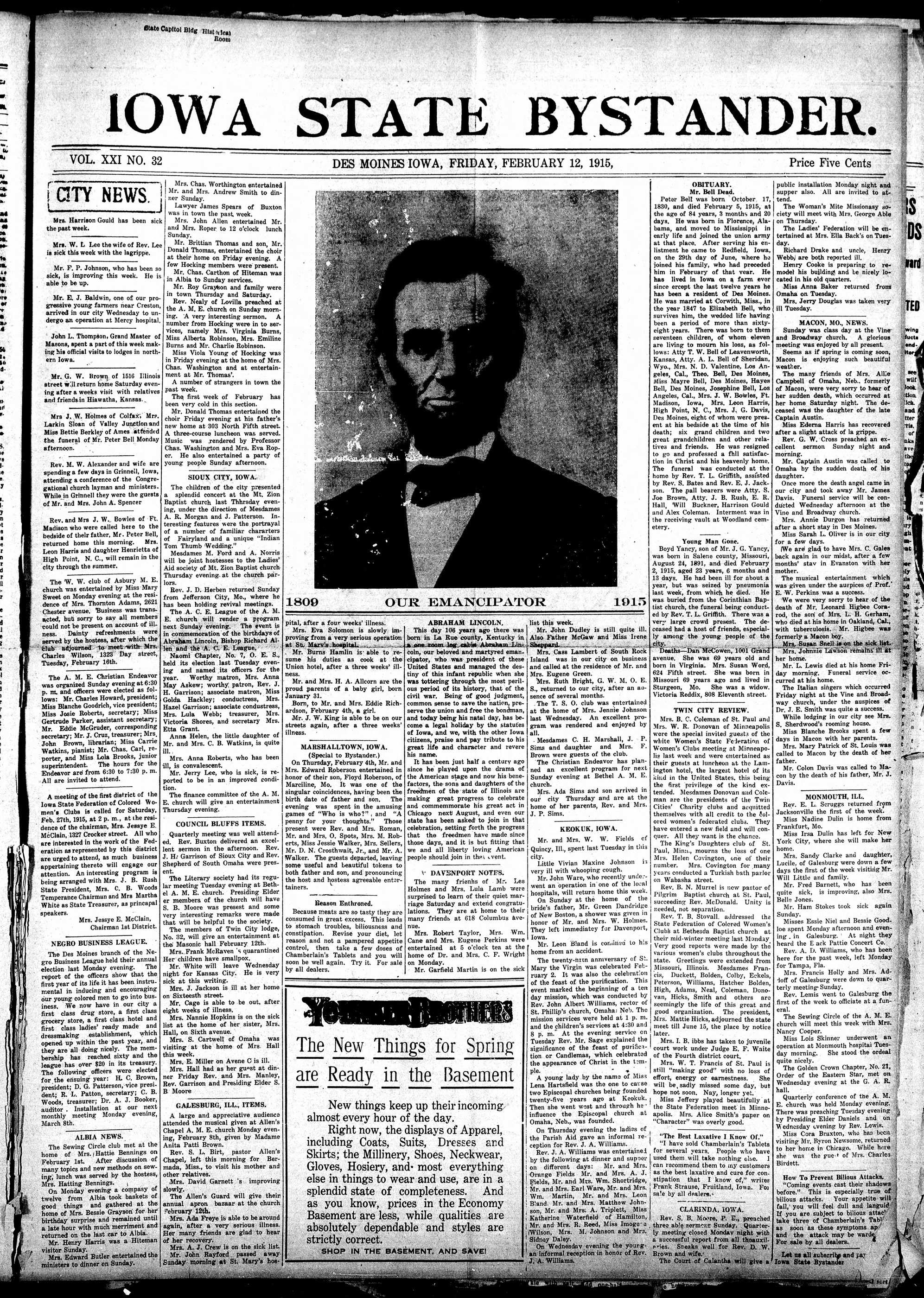
OUR EMANCIPATOR
ABRAHAM LINCOLN.
This day 106 years ago there was born in La Rue county, Kentucky in a one room leg cabis. Abraham Lincoln, our beloved and martyred emancipator, who was president of these United States and managed the destiny of this infant republic when she was tottering through the most perilous period of its history, that of the civil war. Being of good judgment, common sense to save the nation, preserve the union and free the bondman, and today being his natal day, has become a legal holiday by the statutes of Iowa, and we, with the other Iowa citizens, praise and pay tribute to his great life and character and revere his name.
It has been just half a century ago since he played upon the drama of the American stage and now his benefactors, the sons and daughters of the freedmen of the state of Illinois are making great progress to celebrate and commemorate his great act in Chicago next August, and even our state has been asked to join in that celebration, setting forth the progress that the freedmen have made since those days, and it is but fitting that we and all liberty loving American people should join in that event.
DAVENPORT NOTES.
The many friends of Mr. Lee Holmes and Mrs. Lula Lamb were surprised to learn of their quiet marriage Saturday and extend congratulations. They are at home to their many friends at 618 Columbus avenue.
Mrs. Robert Taylor, Mrs. Wm. Cane and Mrs. Eugene Perkins were entertained at 5 o'clock tea at the home of Dr. and Mrs. C. F. Wright on Monday.
Mr. Garfield Martin is on the sick
1915
KEOKUK, IOWA.
OBITUARY.
Mr. Bell Dead
Peter Bell was born October 17, 1830, and died February 5, 1915, at the age of 84 years, 3 months and 20 days. He was born in Florence, Alabama, and moved to Mississippi in early life and joined the union army at that place. After serving his enlistment he came to Redfield, Iowa, on the 29th day of June, where he joined his family, who had preceded him in February of that year. He has lived in Iowa on a farm ever since except the last twelve years he has been a resident of Des Moines. He was married at Corwith, Miss., in the year 1847 to Elizabeth Bell, who survives him, the wedded life having been a period of more than sixty-eight years. There was born to them seventeen children, of whom eleven are living to mourn his loss, as follows: Atty T. W. Bell of Leavenworth, Kansas, Cal., A. L. Bell of Sheridan, Wyo., Mrs. N. D. Valentine, Los Angeles, Cal., Theo, Bell, Des Moines, Miss Mayre Bell, Des Moines, Hayes Bell, Des Moines, Josephine Bell, Los Angeles, Cal., Mrs. J. W. Bowles, Ft. Madison, Iowa, Mrs. Leon Harris, High Point, N. C., Mrs. J. G. Davis, Des Moines, eight of whom were present at his bedside at the time of his death; six grand children and two great grandchildren and other relatives and friends. He was resigned to go and professed a full satisfaction in Christ and his heavenly home. The funeral was conducted at the home by Rev. T. L. Griffith, assisted by Rev. S. Bates and Rev. E. J. Jackson. The pall bearers were Atty. S. Joe Brown, Atty. J. B. Rush, E. R. Hall, Will Buckner, Harrison Gould and Alex Coleman. Interment was in the receiving vault at Woodland cemetery.
Young Man Gone
Boyd Yancy, son of Mr. J. G. Yancy, was born in Salene county, Missouri, August 24, 1891, and died February 2, 1915, aged 23 years, 6 months and 13 days. He had been ill for about a year, but was seized by pneumonia last week, from which he died. He was buried from the Corinthian Baptist church, the funeral being conducted by Rev. T. L. Griffith. There was a very large crowd preset. The deceased had a host of friends, especially among the young people of the city. Deaths—Dan McCowen, 1001 Grand avenue. She was 69 years old and born in Virginia. Mrs. Susan Word, 624 Fifth street. She was born in Missouri 69 years ago and lived in Sturgeon, Mo. She was a widow. Victoria Reddix, 808 Eleventh street.
TWIN CITY REVIEW
Mrs. B. C. Coleman of St. Paul and Mrs. W. R. Donovan of Minneapolis were the special invited guests of the white Women's State Federation of Women's Clubs meeting at Minneapolis last week and were entertained as their guests at luncheon at the Lamington hotel, the largest hotel of its kind in the United States, this being the first privilege of the kind extended. Mesdames Donovan and Coleman are the presidents of the Twin Cities' Charity clubs and acquitted themselves with all credit to the colored women's federated clubs. They have entered a new field and will conquer. All they want is the chance. The King's Daughters club of St. Paul, Minn., mourns the loss of one Mrs. Helen Covington, one of their number. Mrs. Covington for many years conducted a Turkish bath parlor on Wabasha street. Rev. B. N. Murrel is now pastor of Pilgrim Baptist church at St. Paul, succeeding Rev. McDonald. Unity is needed, not separation.
Rev. T. B. Stovall, addressed the State Federation of Colored Women's Clubs at Bethesda Baptist church at their mid-winter meeting last Monday. Very good reports were made by the various women's clubs throughout the state. Greetings were extended from Missouri, Illinois. Mesdames Francis, Duckett, Bolden, Colby, Eckels, Peterson, Williams, Hatcher Bolden, High, Adams, Neal, Coleman, Donovan, Hicks, Smith and others are seemingly the life of this great and good organization. The president, Mrs. Mattie Hicks, adjourned the state meet till June 15, the place by notice later.
Mrs. I. B. ibbs has taken to juvenile court work under Judge E. F. Waite of the Fourth district court.
Mrs. W. T. Francis of St. Paul is still "making good" with no loss of effort, energy or earnestness. She will be sadly missed some day, but hope not soon. Nay, longer yet.
Miss Jeffery played beautifully at the State Federation meet in Minneapolis. Mrs. Alice Smith's paper on "Character" was overly good.
"The Best Laxative I Know Of."
"I have sold Chamberlain's Tablets for several years. People who have used them will take nothing else. I can recommend them to my customers as the best laxative and cure for constipation that I know of," writes Frank Strause, Fruitland, Iowa. For sale by all dealers.
CLARINDA, IOWA.
Rev. S. B. Moore, P. E., preached three able sermon Sunday. Quarterly meeting closed Monday night with a successful report from all the theauxilia. Speaks well for Rev. D. W. Brown and wife.
The Court of Calantha will give a
public installation Monday night and supper also. All are invited to attend.
The Woman's Mite Missionasy society will meet with Mrs. George Able on Thursday.
The Ladies' Federation will be entertained at Mrs. Ella Back's on Tuesday.
Richard Drake and uncle, Henry Webb, are both reported ill.
Henry Cooke is preparing to remodel his building and be nicely located in his old quarters.
Miss Anna Baker returned from Omaha on Tuesday.
Mrs. Jerry Douglas was taken very ill Tuesday.
MACON, MO NEWS
Sunday was class day at the Vine and Broadway church. A glorious meeting was enjoyed by all present.
Seems as if spring is coming soon, Macon is enjoying such beautiful weather.
The many friends of Mrs. Allie Campbell of Omaha, Neb.. formerly of Macon, were very sorry to hear of her sudden death, which occurred at her home Saturday night. The deceased was the daughter of the late Captain Austin.
Miss Ederna Harris has recovered after a slight attack of la gripe.
Rev. G. W. Cross preached an excellent sermon Sunday night and morning.
Mr. Captain Austin was called to Omaha by the sudden death of his daughter.
Once more the death angel came in our city and took away Mr. James Davis. Funeral service will be conducted Wednesday afternoon at the Vine and Broadway church.
Mrs. Annie Durgon has returned after a short stay in Des Moines.
Miss Sarah L. Oliver is in our city for a few days.
(We are glad to have Mrs. C. Gales back again in our midst, after a few months' stav in Evanston with her mother.
The musical entertainment which was given under the auspices of Prof. E. W. Perkins was a success.
We were very sorry to hear of the death of Mr. Leonard Higbeg Corarod, the sort of Mrs. L. H. Gerham, who died at his home in Oakland, Cal., with tuberculosis. Mr. Higbeg was formerly a Macon boy. Mrs. Susan Snell is on the sick list. Mrs. Johnnie Lawson remains ill at her home. Mr. L. Lewis died at his home Friday morning. Funeral service occurred at his home. The Italian singers which occurred Friday night at the Vine and Broadway church, under the auspices of Dr. J. E. Smith was quite a success. While lodging in our city see Mrs.
While lodging in our city see Mrs. S. Sherwood's rooming house.
Miss Blanche Brooks spent a few days in Macon with her parents.
Mrs. Mary Patrick of St. Louis was called to Macon by the death of her father.
Mr. Colon Davis was called to Macon by the death of his father, Mr. J. Davis.
MONMOUTH, JLL
Rev. E. L. Scruggs returned from Jacksonville the first of the week.
Miss Nadine Dulin is home from Frankfurt, Mo.
Miss Iris Dulin has left for New York City, where she will make her home.
Mrs. Sandy Clarke and daughter, Lucile, of Galesburg were down a few days the first of the week visiting Mr. Will Little and family.
Mr. Fred Barnett, who has been quite sick, is improving, also Mrs. Belle Jones.
Mr. Ham Stokes took sick again Sunday.
Misses Essie Niel and Bessie Goodloe spent Monday afternoon and evening, in Galesburg. At night they heard the Eack Pattio Concert Co.
Rev. A. D. Williams, who has been here for the past week, left Monday for Tampa, Fla.
Mrs. Francis Holly and Mrs. Addoff of Galesburg were down to quarterly meeting Sunday.
Rev. Lemis went to Galesburg the first of the week to officiate at a funeral.
The Sewing Circle of the A. M. E. church will meet this week with Mrs. Nancy Cooper.
Miss Lois Skinner underwent an operation at Monmouth hospital Tuesday morning. She stood the ordeal quite nicely.
The Golden Crown Chapter, No. 21, Order of the Eastern Star, met on Wednesday evening at the G. A. R. hall.
Quarterly conference of the A. M. E. church was held Monday evening. There was preaching Tuesday evening by Presiding Elder Daniels and on Wednesday evening by Rev. Lewis.
Miss Cora Bruxton, who has been visiting Mr. Byron Newsome, returned to her home in Chicago. While here she was the guest of Mrs. Charles Birdett.
How To Prevent Billious Attacks.
"Coming events cast their shadows before." This is especially true of billious attacks. Your appetite will fail, you will feel dull and languid If you are subject to billious attack take three of Chamberlain's Table as soon as these symptoms ap and the attack may be warde For sale by all dealers.
Let us all subscribe and pay Iowa State Bystander
AFRO-AMERICAN CULLINGS
"If a stone wall were built around the state of Georgia, and communication with the outside world entirely shut off, the people of the commonwealth could live and enjoy life for an indefinite time," said Claude N. Bennett, president of the Southern Society of Washington, at Washington. Mr. Bennett has just returned from a month's trip through the South, spending his time in his native state of Georgia.
"While in Atlanta," he continued, "I attended a 'Georgia products dinner.' This is something new that has been adopted by the present regime there. November 18 of each year is known as 'Georgia Products day,' and on that day, at every important place in the state, great dinners are given, the menu of which is entirely made up of Georgia products. At the one I attended, the food was good enough, both in quality and variety, to serve at a banquet to the gods.
Between 3,000 and 4,000 Boy Scouts have been specially employed in London since the war broke out at various government offices, recruiting depots, the headquarters of the prince of Wales' fund and other new organizations requiring dispatch carriers and attendants.
Photography has discovered the depth to which the sun's rays penetrate water. Five hundred and thirty feet below the surface darkness was much the same as that on the earth on a clear but moonless night.
Manchuria is making a new paint out of the bean oil that is produced there in tremendous quantities. The paint is said to be waterproof and fireproof as well as cheap and durable.
In your issue of December 21 (editional page) appears an article entitled "Germany Hoping to Get Liberia."
While we do not doubt Germany would like to get Liberia, if might be timely to say the American Colonization society, which founded Liberia, in creating that republic reserved to itself certain inenable rights, to wit: Ownership, in fee, of each alternate block of territory in the original republic for the purpose of colonization by an American-solved nation. This covenant runs with the lands and waters of the republic. We shall oppose any alienation of property rights or sovereignty by any of the powers, and shall expect full protection of our rights by the United States.
The Liberian constitutional prohibition against ownership of land by whites is obviously plain, and a necessary protection to a colored nation. We are not committed to the theory or belief that the above-mentioned article is a "feeler" in this country advanced by an overactive German affluent press—H. L. E. Johnson, President American Colonization Society, in the Washington Post.
The widow's cap is as old as the days of Julius Caesar. An edict of Tiberius commanded all widows to wear the cap under penalty of a heavy fine and imprisonment.
The sinnes of the kangaroo are especially desirable for use in surgery, for sewing wounds and binding broken bones together.
Electrical apparatus intended for drying beer vats is used for drying motion picture films in a studio in New York City.
The second oldest American was Flora Thompson, who died at Harba Island, Penn, in 1808, at the age of one hundred, and fifty years, writes Willis Fletcher Johnson in the Philadelphia Ledger. She was, however, a Negro slave, and I pass her by, as I do many other records of Negroes of great age, for the reason that in those days the status of that race in this country was that the credence is to be given to its annals.
Passing by many other less authentic cases, chiefly of Negro slaves, I come to one of this class which seems to be much more authoritative than most of them. This is the case of Wonder Booker, a slave who belonged to George Booker of Prince Edward county, Va., a family name of the most eminent American Negro of our time, Dr. Booker T. Washington. Wonder was so named because his mother was fifty-eight years old at the time he was little, and was there therefore little short of miraculous. He was a man of extraordinary physical powers and of considerable mental gifts, all of which remained unimpaired until within a few years of his death. At the age of one hundred and sixteen years he was able to do a full measure of work on his master's plantation, and he died in 1819, at the age of one hundred and twenty-six. I have found, following him, records of more than one hundred and twenty-five down to one hundred and ten years of age at death in the United States, more than four-fifths of them dying in the first quarter of the nineteenth century.
Dr. Therbaid von Bethmann-Hollweg, imperial German chancellor, was a lawyer in his earlier life. He is now fifty-seven years of age. He studied law at Göttingen and practiced for six years, after which he was made a judge at Potsdam. There he became intimate with and gained the confidence of the present emperor, with whom he had formerly been a fellow-student at Bonn.
Obedience to the law was emphasized in a speech at Tuskegee by Booker T. Washington as a principle to which members of his race should conform in their efforts to advance. Doctor Washington was the chief speaker at the twentieth annual Tuskegee Negro conference.
Carrying concealed weapons, theft, gambling, visits to illegal liquor establishments and useless court litigation were enumerated as evil practices with which many cases often charged. I know many people who spend more on a pistol every year than they do on the education of their children," Doctor Washington said. "The pistol, in nine cases out of ten, not only does not protect the individual, but leads him into trouble."
Resolutions adopted urged the production of food crops in the South. It was declared that there are 230,000 farms, mostly tenanted by Negroes, where there are no hogs; on 250,000 poultry is raised; 200,000 on which corn is grown.
Bankers and planters were asked to aid the Negro to raise products other than cotton.
Tod Sloan, the famous American jockey, is at the front with the French Red Cross, driving motor ambulances. He was relied as a soldier, but being an expert motor driver, was immediately accepted by the medical authorities.
The letter carriers in Portugal save themselves much walking on Sundays by delivering letters at church.
Japan's government forests last year yielded $5,360,000 in revenue and consumed $2,327,000 in expenses.
In a famous German animal park there have been erected life-size models of the huge beasts of prehistoric times.
At the Greene (Me.) fair William Haley, aged eight, exhibited a pair of young steers which he had brought up and broken.
Tests by Irish scientists have shown that the wind will carry disease bacteria, like feet and as high as 60 feet
USES FOR THE WHISK BROOM
Can Serve Many Other Purposes
Than One for Which They Usually Are Employed.
Whisk brooms are useful not only for brushing clothes, but for other purposes as well.
Keep a little broom in the kitchen to clean the kettles, spiders, saucepans, etc. It saves time, does better work and saves the hands. You can scrub around the cars of the kettle with it and get into all the crevices of your pots and pans with it. The same little broom does duty as a vegetable cleaner.
After the clothes are brought in from the line a clean little broom, kept solely for the purpose, should be used to sprinkle them. It accomplishes this quite as effectively as the Chinese laundryman who sprays the water through his teeth.
Washtubs, wringers and washboards can be kept in order with almost no labor at all by having a little broom handy to scrub them off with.
Pantry shelves, kitchen sink and table can be cleaned with a whisk broom.
Even the kitchen windows, in fly time, should be washed down first with the inseverity of a little broom, which cleans the corners of the sohes in half the time necessary to accomplish the work in any other way.
Blacking the stove is no longer a task to be dreaded. A little broom puts on the black and does all the polishing.
BEST COLORS IN BEDROOM
Harmony is the First Principle, Always Remembering Necessity.
for Touch of Brightness.
When a bedroom or small dressing room is papered with anything but a plain or neutral paper, bright colored or flowered chintz should never be used, but often a little color is needed to add tone to the room.
In a case of this kind, one of the new bodypads made with so pretty and easily made is just the thing to give the necessary color. Select a plain white spread of a good quality and rather heavy. Cut from chintz a bunch of roses or a spray of gay colored flowers and paste one in each corner with a larger one for the center. Sew to the spread and finish the raw edges with a fine feather stitch or with a long and short buttonhole stitch.
This idea can be carried out for scarfs to cover the dressing-table and bureau. Make the scarf of linen cut to the top of each and finish the scarf with a fine feather stitch and finish this with the stitch that was used on the spread. Cut out the flowers and applique to the edges of the scarf. Bunches of the same flowers can be added to the corners of the white curtains with good effect.
Golden Rolls.
One-half cupful scaled milk, one yeast cake dissolved in 'a little cold milk, one-quarter cupful eggs (two eggs not beaten), one-eighth cupful yolk (two yolks), one-quarter cupful sugar, one-third cupful butter, little salt, one-quarter teaponoff lemon extract, two and one-half cupful four. Let rise six hours, roll out thin, spread with melted butter and fold over twice, making three layers. Cut in strips and roll round. Let rise and bake. Make shup of powdered sugar and brush thick over top when taken from oven. These are fine and it is not as much work as it sounds.
Cream Puffs.
One coffee cupful of boiling water and butter the size of a small egg; melt the butter in the water; while boiling stir in one cupful of flour, stirred. Use the same size cup for all. Stir thoroughly; when cool stir in two eggs one at a time, and a pinch of soda the size of a pea; beat well, then drop in tin far enough apart so they will not touch the milk baking; in a hot very oven. The milk is boiled. Filling for Puffs—One cupful sweet milk, one egg, one teaspoonful of cornstarch and sugar to taste; flavor with vanilla.
Stuffed Eggs With Ham
Boll half a dozen eggs hard. Remove the shells and cut the eggs crosswise in two. Slice off a piece from each end to make them stand firm. Remove the yolks and mix with them a little chopped ham. Fill the whites with this mixture, heaping it up in cone shape. Put the stuffed halves on a flat dish and pour over them this dressing: Beat two egg yolks with half a teaspoonful of mustard, half a teaspoonful of salt and 12 tablespoonful of salad oil added slowly. Thin as it is necessary with wine vinegar.
Marbles in Fruit Kettle
I have a neighbor who for some time has used marbles to keep her fruit from burning during the canning season, and she says the plan works admirably, a contributor. She washes half a dozen large marbles and drops them into the kettle when the fruit begins to boll. The bubbles, risinous, a dozen large marbles, keep the marbles moving over the kettle in such a manner that the fruit does not touch the bottom long enough to be burned—Mother's Magazine.
Tomato Jelly.
One quart of tomatoes, one teaspoonful of salt, one cupful of sugar, one teaspoonful of ginger, the juice of one lemon, two tablespoonfuls of corn starch. Strain the tomatoes, put them in a saucepan with the ginger, sugar, lemon juice and salt. Moisten the cornstarch in two tablespoonfuls of cold water, add it to the tomato, boil a moment and turn into a mold to cool. Serve cold with the turkey.
Spanish Salad.
Three pounds meat boiled, five ripe tomatoes, four red peppers, one can French peas, one can mushrooms, three large potatoes, one teaspoonful salt, one onion, one quart hot water, boiled rice or mashed potatoes. Will serve from air to eight persons.
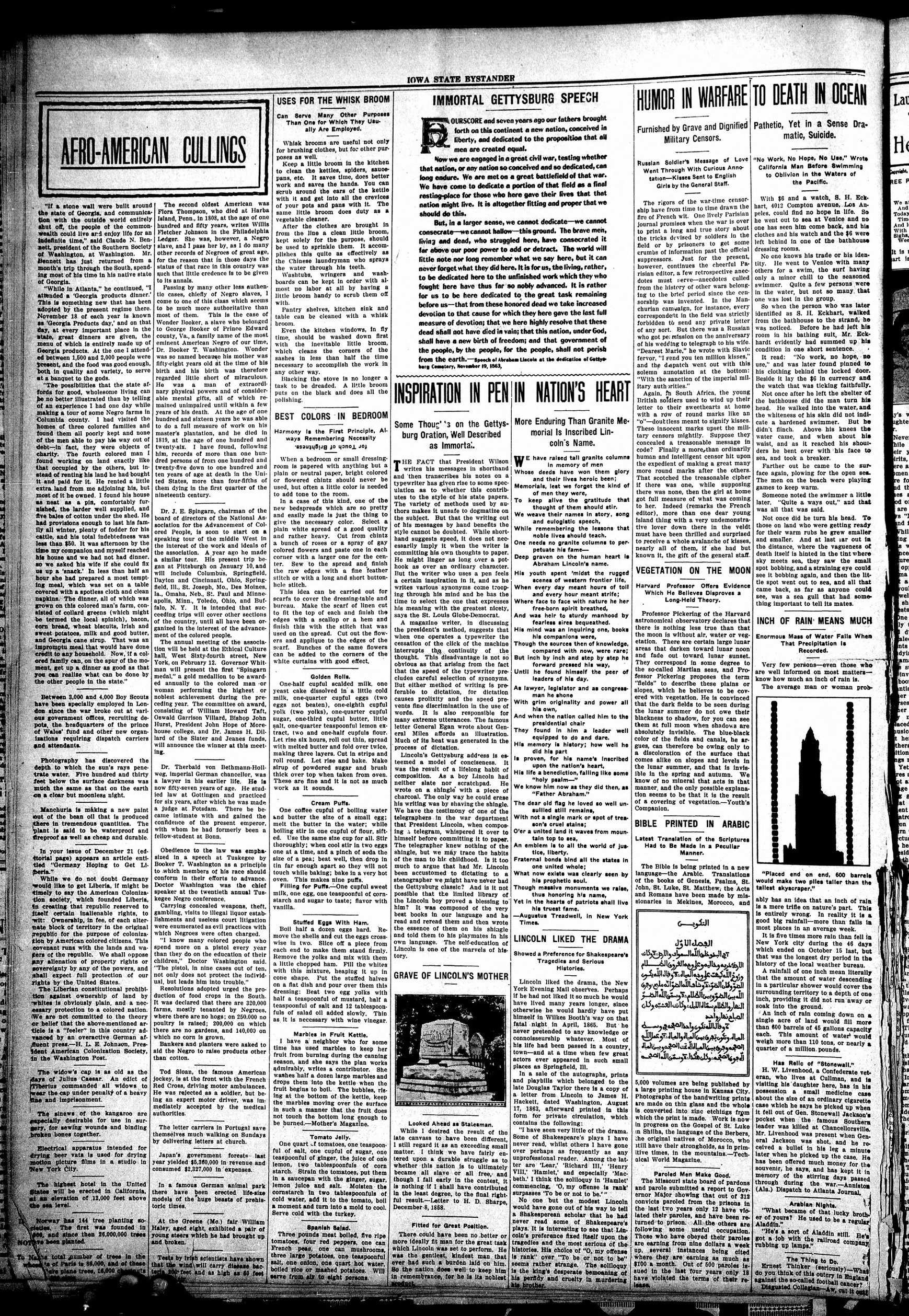
IMMORTAL GETTYSBURG SPEECH
OURSCORE and seven years ago our fathers brought forth on this continent a new nation, conceived in liberty, and dedicated to the proposition that all men are created equal.
Now we are engaged in a great civil war, testing whether that nation, or any nation so conceived and so dedicated, can long endure. We are met on a great battlefield of that war. We have come to dedicate a portion of that field as a final resting-place for those who here gave their lives that that nation might live. It is altogether fitting and proper that we should do this.
But, in a larger sense, we cannot dedicate — we cannot consecrate — we cannot hallow — this ground. The brave men, living and dead, who struggled here, have consecrated it far above our poor power to add or detract. The world will little note nor long remember what we say here, but it can never forget what they did here. It is for us, the living, rather, to be dedicated here to the unfinished work which they who fought here have thus far so nobly advanced. It is rather for us to be here dedicated to the great task remaining before us — that from these honored dead we take increased devotion to that cause for which they here gave the last full measure of devotion; that we here highly resolve that these dead shall not have died in vain; that this nation, under God, shall have a new birth of freedom; and that government of the people, by the people, for the people, shall not perish from the earth. — Speech of Abraham Lincoln at the dedication of Gettysburg Cemetery, November 19, 1863.
IOWA STATE BYSTANDER
IMMORTAL GETTY
OURSCORE and seven forth on this continine liberty, and dedicated men are created eq
Now we are engaged in a g that nation, or any nation so co long endure. We are met on a We have come to dedicate a resting-place for those who he nation might live. It is altogether should do this.
But, in a larger sense, we consecrate—we cannot hallow living and dead, who struggle far above our poor power to a little note nor long remember a never forget what they did here to be dedicated here to the un fought here have thus far so far for us to be here dedicated before us—that from these hon devotion to that cause for which measure of devotion; that we be dead shall not have died in vain shall have a new birth of freed the people, by the people, for from the earth.—Speech of Abraba burg Cemetery, November 19, 1863.
INSPIRATION IN PEN
F
Some Thou'r's on the Gettysburg Oration, Well Described as Immorta:
THE FACT that President Wilson writes his messages in shorthand and then transcribes his notes on a typewriter has given rise to some speculation as to whether this contributes to the style of his state papers. The variety of methods used by authors makes it unsafe to dogmatize on the subject. But that the writing out of his messages by hand benefits the style cannot be doubted. While short-hand suggests speed, it does not necessarily imply it when the writer is committing his own thoughts to paper. He might linger as long over a pothook as over an ordinary character. He will use it when he feels a certain inspiration it, and he writes various synonyms come trooping through his mind and he has the time to select the one that expresses his meaning with the greatest nicety, says the St. Louis Globe-Democrat.
A magazine writer, in discussing the president's method, suggests that when one operates a typewriter the cessation of the click of the machine interrupts the continuity of the thought. This disadvantage is not so obvious as that arising from the fact that the speed of the typewriter precludes careful selection of synonyms. But either method of writing is preferable to dictation, for dictation causes proxicity and the speed prevents fine dislocation in the use of synonyms. It is also useful for many extreme utterances. The famous letter General Egan affords about General Miles affords an illustration. Much of its heat was generated in the process of dictation.
Lincoln's Gettysburg address is esteemed a model of conciseness. It was the result of a lifelong habit of composition. As a boy Lincoln had neither slate nor scratchpad. He wrote on a shingle with a piece of charcoal. The only way he could erase his writing was by shaving the shingle. We have the testimony of one of the books in our war department that President Lincoln wrote to his himself before committing it to paper. The telegrapher knew nothing of the shingle, but we may trace the habits of the man to his childhood. Is it too much to argue that had Mr. Lincoln been accustomed to dictating to a stenographer we might have never had the Gettysburg classic? And is it not possible that the limited library of the Lincoln boy proved a blessing to him? It was composed of the very books in his language and he read and reread them on his shingle the essence of them on his shipmates and told them to his playmates in his own language. The self-education of Lincoln is one of the marvels of history.
GRAVE OF LINCOLN'S MOTHER
MILITARY CEMETERY
Looked Ahead as Stateman
Rekhan.
While I desired the result of the late canvas to have been different, I still regard it as an exceeding small matter. I think we have failed entered upon a durable struggle as to whether this nation is to ultimately became all slave or all free; and though I fall early in the contest, it is nothing if I shall have contributed in the least degree, to the final rightful result—Letter to H. D. Sharpe, December 8, 1858.
Fitted for Great Position.
There could have been no better or more ideally fit man for the great task which Lincoln was set to perform. He was the gentleest, kindest man that ever had such a burden laid on him. So the nation does well to keep him in remembrance, for he is its noblest man.
More Enduring Than Granite Memorial Is Inscribed Lincoln's Name.
WE have raised tall granite columns in memory of men
Whose deeds have won them glory and their lives heroic been;
Memorials, leat we forget the kind of of men they were,
To keep alive the gratitude that thought of them should stir.
We weave their names in story, song and catalogistic speech,
While remembering the lessons that noble lives should teach.
One needs no granite columns to perpetuate his fame—
Deep graven on the human heart is Abraham Lincoln's name.
His youth spent 'mist the rugged scenes of western frontier life,
When every day meant hours of toll and every hour meant strife;
Where face to face with nature he her free-born spirit breathed,
And was heir to sturdy manhood by fearless sires bequeathed.
His mind was an inquiring one, books his companions were,
Though the sources then of knowledge, compared with now, were rare;
But inch by inch and step by step he forward pressed his way,
Until he found himself the peer of leaders of his day.
And when the nation called him to the presidential chair
They found in him a leader well equipped to do and dare.
His memory is history; how well he did his part
Is proven, for his name's inscribed upon the nation's heart.
His life a benediction, falling like some "holy psalm—"
We know him now as they did then, as "Father Abraham."
The dear old flag he loved so well un-suilted still remains.
With not a single mark or spot of treason's cruel stains;
O'er a united land it waves from mountain top to sea.
An emblem is to all the world of justice, liberty.
Fraternal bonds bind all the states in one united whole;
What now exists was clearly seen by his prophetic soul.
Though massive monuments we raise, thus honoring his name.
Yet in the hearts of patriots shall live his truest fame.
—Augustus Treadwell, in New York Times.
LINCOLN LIKED THE DRAMA
Showed a Preference for Shakespeare's
Tragedies and Serious
Tragedies
Lincoln liked the drama, the New York Evening Mall observes. Perhaps if he had not liked it so much he would have lived many years longer, since otherwise he would hardly have put himself in Wilkes Booth's way on that fatal night in April, 1865. But he never pretended to any knowledge or connoisseurship whatever. Most of his life had been passed in a country town—and at a time when few great actors ever appeared in such small places as Springfield, Ill.
In a sale of the autographs, prints and books, much belonged to the late Douglas Taylor; there is a copy of a letter from Lincoln in James H. Hackett, dated Washington August 17, 1863, afterward printed in this form for private circulation, which contains the following:
"I have seen very little of the drama. Some of Shakespeare's plays I have never read, whilst others I have gone over perhaps as frequently as any unprofessional reader. Among the latter are 'Lear,' 'Richard III,' 'Henry VIII,' 'Hamlet,' and especially 'Macbeth.' I think the soliloquy in 'Hamlet' commencing, 'O, my offence is rank surpasses 'To be or not to be.'"
No one but the modest Lincoln would have gone out of his way to tell a Shakespearean scholar that he had played it. It is some of Shakespeare's plays. It is some of Lincoln's preference fixed upon the tragedies and the most serious of the histories. His choice of "O, maniacs is rank" over "To be or not to be" seems rather strange. The soliloquy is the king's desperate beaming of his perilty and cruelty in murdering his brother.
Furnished by Grave and Dignified Military Censors.
Russian Soldier's Message of Love
Went Through With Curious Annotation—Kisses Sent to English Girls by the General Staff.
The rigors of the war-time censorship have from time to time drawn the fire of French wit. One lively Parisian journal promises when the war is over to print a long and true story about the tricks devised by soldiers in the field or by prisoners to get some crumbs of information past the official suppressors. Just for the present, however, continues the cheerful Parisian editor, a few retrospective anecdotes must serve—anecdotes cured from the history of other wars belonging to the brief period since the censorship was invented. In the Manchester campaign, in instance, every correspondent in the field was strictly forbidden to send any private letter who got pigeon on the anniversary of his wedding to telegraph to his wife "Dearest Marie," he wrote with Slavic fervor, "I send you ten million kisses," and the despatch went out with this solemn annotation at the bottom: "With the sanction of the imperial military authority, art rites."
Again, in South Africa, the young British soldiers used to wind up their letter to their sweethearts at home with a row of round marks like an "o"—doubtless meant to signify kisses. These innocent marks upset the military censors mightly. Suppose they concealed a treasonable message in code? Finally a more, than ordinarily human and intelligent censor hit upon the expedient of making a great many more round marks after the others. That scotched the treasonable cipher if there was one, while supposing there was none, then the girl at home got full measure of what was coming to her. Indeed (remarks the French editor), more than one dear young island thing with a very undemonstrative lover down there in the velvet must have been thrilled and surprised to receive a whole avalanche of kisses, nearly all of them, if she had but known it, the gift of the general staff.
VEGETATION ON THE MOON
Harvard Professor Offers Evidence Which He Believes Disproves a Long-Held Theory.
Professor Pickering of the Harvard astronomical observatory declares that there is nothing less true than that the moon is without air, water or vegetation. There are certain large lunar areas that darken toward lunar noon and fade out toward lunar sunset. They correspond in some degree to the so-called Martian seas, and Professor Pickering proposes the term "fields" to describe the plains or slopes, which he believes to be covered with vegetation. He is convinced that the dark fields to be seen during the lunar summer do not owe their blackness to shadow, for you can see them at full moon when the shadows are absolutely invisible. The black-color of the fields and canals, he argues, can therefore be owing only to a discoloration of the surface that comes alike on slopes and levels in the lunar summer, and that is invisible in the spring and autumn. We know of no mineral that acts in that manner, and the only possible explanation seems to be that it is the result of a covering of vegetation—Youth's Companion.
BIBLE PRINTED IN ARABIC
Latest Translation of the Scriptures Had to Be Made in a Peculiar Manner.
The Bible is being printed in a new language—the Arabic. Translations of the books of Genesis, Psalms, St. John, St. Luke, St. Matthew, the Acts and Romans have been made by missionaries in Mekines, Morocco, and
الكلمات
Paroled Men Make Good
The Missouri state board of pardons and parole submitted a report to Governor Major showing that out of 112 convicts paroled from the prisons in the last two years only 12 have violated their paroles, and have been returned to prison. All the others are following some useful occupation. Those who have obeyed their paroles are earning from nine dollars a week up, several instances being cited where they are earning as much as $100 a month. Out of 500 paroles issued in the last four years only 18 have violated the terms of their release.
Pathetic, Yet in a Sense Dramatic, Suicide.
"No Work, No Hope, No Use," Wrote California Man Before Swimming to Oblivion in the Waters of the Pacific.
With $6 and a watch, S. H. Eckhart, 4012 Compton avenue, Los Angeles, could find no hope in life. So he went out to see at Venice and no one has seen him come back, and his clothes and his watch and the $6 were left behind in one of the bathhouse dressing rooms.
No one knows his trade or his identity. He went to Venice with many others for a swim, the surf having only a minor chill to the seasoned swimmer. Quite a few persons were in the water, but not so many that one was lost in the group.
So when the person who was later identified as S. H. Eckhart, walked from the bathhouse to the strand, he was noticed. Before he had left his room in his bathing suit, Mr. Eckhart evidently had summed up his condition in one short sentence.
It read: "No work, no hope, no use," and was later found plined to his clothing behind the locked door. Beside it lay the $6 in currency and the watch that was ticking faithfully.
Not once after he left the shelter of the bathhouse did the man turn his head. He walked into the water, and the whiteness of his skin did not indicate a hardened swimmer. But he didn't flinch. Above his knees the water came, and when about his waist, and as it reached his shoulders he bent over with his face to sea, and took a breaker.
Farther out he came to the surface again, plowing for the open sea. The men on the beach were playing games to keep warm.
Someone noted the swimmer a little later. "Quite a ways out," and that was all that was said.
Not once did he turn his head. To those on land who were getting ready for their warm rubs he grew smaller and smaller. And at last ar out in the distance, where the vagueness of death itself is hinted in the tint where sky meets sea, they saw the small spot bobbing, and a straining eye could it bobbing again, and then the little spot went out to sea, and all that came back, as far as anyone could see, was a sea gull that had something important to tell its mates.
INCH OF RAIN MEANS MUCH
Enormous Mass of Water Falls When That Precipitation is Recorded.
Very few persons—even those who are well informed on most matters—know how much an inch of rain is.
The average man or woman prob-
"Placed end on end, 600 barrels would make two piles taller than the tallest skycraper."
"Placed end on end, 600 barrels would make two piles taller than the tallest skyscraper." alyb has an idea that an inch of rain is a more trifle on nature's part. This is entirely wrong. In reality it is good big rainfall—more than falls in most places in an average week. It is five times more rain than fall in New York city during the 46 days which ended on October 15 last, but that was the longest dry period in the history of the local weather bureau. A rainfall of one inch mean literally that the amount of water descending in a particular shower would cover the surrounding territory to a depth of one inch, providing it did not run away or soaked up. An inch of rain down on a single acre of land would fill more than 600 barrels of 46 gallons capacity each. This amount of water would weigh more than 110 tons, or nearly a quarter of a million pounds.
Has Relic of "Stonewall."
H. W. Livenhoad, a Confederate veteran, who lives at Livenhoad, and is visiting his daughter here, has in his possession a small medicine case about the size of an ordinary cigarette case which he says he picked up when it fell out of Gen. Stonewall Jackson's pocket when the famous Southern leader was killed at Chancellorville. Mr. Livenhoad was present when General Jackson was shot, and he received a bullet in his leg a minute later when he picked up a minute. He has been offered much money for the souvenir, he says, and has kept it in memory of the stirring days passed during the war—Anniston (Ala.) Dispatch to Atlanta Journal.
Arabian Nights.
"What became that lucky brother of yours? He used to be a regular Aladdin."
"He's a sort of Aladdin still. He's got a job with the railroad company rubbing up lamps."
The Thing to Do.
Ernest Thinker (seriously)—What do you think of this entry in England against the so-called football cancer? Disagusted Colleague—Aw, it cut it.
LauraJean Libbey's Talks on Heart Topics
COPRIGHT, 1914, by the McClain Newspaper Striking
FREE PLEASURES FOR WORKING
GIRLS.
We are not sure of sorrow
And joy was never sure;
Today will die tomorrow;
When shoes to no more bare;
And love, grown in love and fretful,
With lips but half regretful,
Sighs, and, with eyes forgetful,
Weeps that no love endures.
It is not every working girl whose
art is kindled to a flame at the
thought of tangoing in a dance hall
or going to moving picture shows.
Evenness are as many types of
girls who work
for the living as
there are in homes of
indolent ease
where the daughters
depend upon
the dollars of their
daddies.
A
Some imagine that all working girls are a jolly, hoydenhill lot, eager to troop off to bright scenes quite as soon as the boy's work is over; that beaux andighter are all they think of or care.
Never was a greater mistake made. While a large majority of them, in their youth and exuberance of gay drits, seek to throw off dull care, are quite as many refined young men among the toilers who do not for such amusements. They attend the free libraries to best books. Lectures by god orators are dear to their hearts, are the best dramas. Their purse is "No!". Where is pleasure to be and for such refined natures?
While the philanthropists are proing dance halls for some of the ais' why don't they give others the chance of attending a course of freezes in congenial surroundings or opportunity of seeing a first-class ma by celebrated artists without a few times during the season? could open people's eyes and hearts well if they could have talks with shop girls of whose lives and insets they know so little.
One young girl I know of, whose only task was to sell whisky brooms and dust cloths behind the counter,aled herself during leisure mounts and after business hours by drying Shakespeare. Another was a amateur portrait painter. Her work is surprisingly clever. One craved invent something which would be boon to humanity and bring sublimal returns. The dream of anger was to become a poetess. Herresses were unusually full. Still, she needed to be discovered and needed before the public to have the music-loving world delightedly bowing to her feet. There are hundreds ofthers with as laudable and varied amitions whose hearts, minds and longings to be wisely catered to.
Yet they starve for want of pleasures along these lines which they cannot afford to pay for. Love and marriage are not the omega of every working girl's hopes. While the powers at be are working for the better, cent of the working class and society atrons clamor for a chance to chap on girls in the dance halls, let them arm their attention to the many intellectual bread winners who would love hear refined speakers talk to toples sides war, high cost of living, tango parties, free pleasures of mind would be benefits well given. Ohl so highly appreciated by heart-hungry working girls.
A MAN A RIGHT TO BREAK OFF?
Bigh no more, ladies, sigh no more, a one foot in sea, and one on shore, To one thing constant never.
Has a man a right to break off?" that depends entirely upon circumcision; if his love affair has reached an intent of a marriage proposal; how many months or years he has taken the girl's time; how firmly the tenets of her heart have entwined themselves about him. Young men are not always cool-headed; never do they up to think matters from start to finish, especially love problems. They are brought in contact with a young girl. A few times in society did they are so charmed, fascinated her they think they cannot live without her. Youth loves spontaneously. The lips are quick to reveal the heart feels.
In a burst of enthusiasm he deares himself. The girl, under the dramatic spell of the moment, the time, the place and the eager, handmade, pleasing lover by herade, responds a sweet, shy "yes," then and then they become betrothed and wed. They have seen each other orphas twice a week up to this time, her engaged lover he presents himself at her door almost any evening, to say nothing of afternoons when he can get away.
The consequence is that they see such of each other. It has been did that an engaged couple sees such of each other that they blind one another's faults. No girl can entertain the same young man, even without evening from one month, without her disposition being warned, even though she is unaware of it. If they were not destined to set along well, there is sure to be any a bitch to prevent the courtship from running smoothly—more fines.
But it is trifles which make up the balance of life, bringing sunshine or sting shadow. If the sun shines, the light which is only heared by a light chain of roses, is
sure to take flight in dismay. The thought of the approaching wedding day grows irksome. Both willingly postpone it again and again. The man look the situation fairly in the face. He knows by the girl's actions and words that her love for him has dwindled down alarmingly. She does not care for him as she did when he placed her betrothal ring on her finger.
He cannot bring himself to wed a girl who does not love him with all her heart. When he has arrived at this conclusion he determines that it will be the same to break off. If the girl is of the same mind. He places the matter firmly and squarely before her. If she agrees, she views there is but one conclusion—on the contrary, he has made himself the light of the girl's life with the hope of being his bride—her one dream of happiness, he has no right to break the engagement it took two to make, and must take both to consent to break. Will show会 catch the best course to pursue.
WOMEN AS TEMPTERS.
Each on its own strict line we move,
And some wait years' are they find love,
So far apart their hearts are thrown
From the twin soul that halves their own;
And no doubt, by still harder fate,
The lover meets, but meet no late.
I wonder if it ever occurs to the handsome dressed woman, robed in her swishing silks and costly furts, with jewels worth a king's ransom sparkling in her ears and on her enveloped hands which her luxurious muff half conceals, that she is the magnet of acute temptation to hungry, homeless women, starving on the streets for a crust of bread or a place to lay their head. She swings her mesh purse, heavy with shining gold, which shows through it as she steps from a shop to her carriage. She draws her skirts away from the poor little child begging for a penny. Unfortunate women look after her with darkening brows. Her purse or muff falls from her hands. They are quickly returned to her, but not so much as a smile accompanies her recognition of the return. She does not stop to count over the money to see that none it missing. The knowledge that she is honest is the only reward that the starving woman gets for her pains.
There's another class which the richly-dressed woman attracts who do not let her off quite so easily—the professional bag-openers, the clever female purifiers of other people's wealth. They see the costly muff and swinging bag and mark the foolish, vain woman who is out for a show as their victim.
They follow milady from shop to shop, sometimes to a half dozen different places are they succeed in getting a place next to her without attracting her attention. When she lays her fat purse down on the counter that is the crucial moment. In a trice the professional purse snatcher has thrown some article over the coveted prize and, swift as a flash, dropped it in her own capacious pocket, moving as stealthily away as a shadow.
Women have no right to robe themselves conspicuously in costly attire on shopping tours, to engender bitterness in the hearts of the on-looking poor, and encourage daring crime at the hands of the unscrubulous: the wealthiest of women, if they have good sense, dress the plainest.
Elegant attire has its place at a friend's reception, an evening affair, or at one's home. But it was never more out of place than on the public streets, touching elbows with the poor and suffering, as well as the wicked and avaricious, who are evily inclined. Such women are a temptation and a menace to those who have nothing. Milady may never have faced a court of justice. She has only herself to blame if she is forced to face a thief who had adroitly relieved her of her valuables. Women of wealth who come from small places to shop in the big cities should heed the warning that they should dress plainly and wear no valuables. Better give a starving child a little aid than spend dollars for costly flowers for her corseau, which will wither in an hour. Avoid tempting others by overdisplay.
Don't Take Poison.
The frequent reports of death "by accidentally taking poison" clearly indicate a need for preventing such disastrous occurrences. The custom of keeping poisons by themselves in a place out of reach should be the rule in every home. The poisonous preparations should also in addition to being high up, be locked up in a closet. In the event of sudden illness in the night, when nobody takes time to strike a light, the groping hand too often finds the poison bottle. This might happen even if there was a bright light, for when one is suffering pain or feels faint he is many times unable to see clearly or read understandably. If the poisons are kept where it is a trouble to get at them there is no danger whatever of anyone being injured by taking them in the daytime or during the night.
Capacity Always Within Call.
Capacity It is certainly true that no one knows the resources of his own mind and body till some great sense of duty arises to him, rousing him to his part well in the work of life. There are unused capacities in brain and nervous system, in mind and moral nature that are capable of development and effective use. Who knows the potentiality of life force in himself until he gives it opportunity for full expression? -Exchange
Danger In Overworking Eyes.
Oculists state that comparatively few persons have absolutely normal eyesight; those who have do not take care always to read or work under proper conditions of light, and suit is that they are many chil- dren who work the muscles about the eyes as to form wrinkles and loose, falling flesh.
Test for Man:
Test for Man.
If a man thinks women are poor, weak creatures he will soon discover his mistake by trying to prevent ones from having her own way when she really wants it—Indianapolis Star.
---
Fundamental Principles of Health
By ALBERT S. GRAY, M.D.
Hyperesthetic rhinitis, commonly known as "hay fever," "rose cold," "autumnal catarrh," and so forth, is a condition characterized annually by paroxysms of sneezing, accompanied by varying degrees of coryza (cold in the head) more or less prolonged. It is acute catarrhal inflammation of the mucous membrane of the nasal cavities, the eyes and the respiratory tract, sometimes accompanied with fever and asthma.
Hay fever rages during August and September, and the popular belief is that the pollen of the goldenrod is responsible for it; but raggedweed, trees, grasses and other plants, including the cereal grains, also cats, dogs, sheep, chickens, horses and cows all do their part in adding to the atmospheric dust to which so many are hypersensitive. Besides these dusts, chemical fumes and many pigments obliterate their victims. But it is not necessary to the condition that even the irritant should enter the nose. For example, there are probably few persons who have not under certain temporary physical conditions experienced sneezing violently several times immediately on stepping from a dense shade into the bright sunlight—that is a reflex irritation — and unfortunately many individuals are so adjusted that under certain conditions the irritation of any area supplied by the fifth sense occurs, a bright light entering the eyes may irritate the hypersensitive ciliary nerve filaments and for a long time maintain reflex symptoms in the nose.
In addition to the dust, light, heat, cold and other external agencies, there are more immediate local irritations so frequently to be found in the neurotics, consisting of turbal enlargements, ethmoid, frontal or maxillary sinusitis, deflected septum, polyp and eyestrains. But generally these must be considered concomitant to the fundamental physical condition and not the immediate cause of the explosions. Many a patient has been treated and operated upon with a view to the removal of the irritation through the correction of one or more of these local morbid conditions, only to have the hay fever paroxysms continue from year to year without abatement; while others have been relieved.
It is generally accepted that only two factors are necessary for the causation of hay fever; namely, first, an internal condition which will insure an abnormal sensitivity of the nerve centers and filaments; and, second, an external irritation.
We take it quite as a matter of course, because it is universally known, that an ill nourished or a hungry baby will be fretful and peevish, and we are not at all surprised at very marked evidence of irritability in a convalescent formerly noted for general calmness and self-passion. Hence it should require no great strain or stretch of one's imaginative powers to be able to apply the same principle to the individual cells composing our bodies and to comprehend that the neurotic temperament is fundamentally a matter of defective metabolism, because of which the individual cells are not properly nourished. The universal remedy for a frettual remedy is proper nutrition; the universal remedy is proper nutrition, and so, too, the remedy for the hay fever victim is to build up a stable nervous system by means of proper nutrition.
The authorities are agreed that among the personal habits which predispose to hay fever are the habitual use of narcotics and alcoholic stimulants, excessive excitement and overexertion and what are known as the rheumatic and gouty tendencies. This all points in the direction of defective metabolism. Moreover, Sajous recommends as a preventive the use of thyroid extract, commencing four weeks before the onset of the periodic attack. The use of the thyroid extract for four weeks after the expected attack is of any value as a preventive, it is 'reasonable to assume that such hygienic steps will lead to an increased activity of one's own thyroid secretion, beginning right at this time and continuing without interruption up to and through the next season, must inevitably produce some modification in
TO BE HANDLED WITH CARE
Matter of Giving Advice al-Always
Worth the Investment thoughtful
Consideration
A very good rule is expressed in the homely words, "Mind your own business." The desire to help another is praiseworthy, but it may be carried too far, and when it is, one becomes meddlesome and officious. Every man has to be accountable for his own actions. No one may carry this responsibility for him.
This is what makes proffered advice often impiment. The man who offers it offers only half of the need and the easier half at that. If his advice is followed and failure comes, he can only say, "I did the best I could for you." It is seldom that advice thrust on another is of real service to him. Forcing it on any person who does not feel the need of it is confusing and misleading. The man who hears is not likely to make a determined effort to follow it, nor can he wholly forget it. The result is that he feels unaware of the things he is
IOWA STATE BYSTANDER
the severity of the symptoms, and continued from year to year it will in tend to overcome the hypersesia permanently.
The great difficulty in such cases lies in the fact that the very nature of the condition is such as almost to preclude the possibility of the victim's persistently adhering to so simple and logical a line of action. But to such as have the courage to investigate and come to understand that even the cell is not the unit of life; that the cell is not only made up of protein molecules but its form and function are constituted by chemical structures of its constituent molecules; in short, to those who come to know themselves and treat their bodies accordingly there is undoubtedly the certainty of permanent relief.
THE PITUITARY GLAND.
The puzzle of the pituitary gland (hypophysis cerebr) presents one of those curious instances known to medical history wherein widely contradictory observations make it difficult to confirm the answer to any given question concerning the physiology and the pathology of the organ or the action (function) of the gland either in health or in disease. Even in the apparently extremely simple propositions as to whether the organ is essential to life we find the investigators divided into two groups, those who maintain that the gland is indispensable to life and the other, almost equal in number, holding it to be nonessential to life.
Undoubtedly the confusion is largely due to the fact that the position of this gland is such that it is extremely inaccessible to operative interferences, so that attempts to remove it are usually attended with fatal results from the operation itself; hence we are able to learn but little if anything concerning the significance of the organ in this way, and are forced to depend for our knowledge concerning the pituitary gland on what may be revealed by pathological analysis and clinical observation. No, this body, while not much larger than a pea, has two parts or lobes, closely blended, but one distinctly larger and of a structure distinctly different from that of the other.
The larger anterior lobe is of a glandular structure and belongs to the type of glands which are believed to form an internal secretion. The much smaller posterior lobe is of nervous origin and composed chiefly of a net-like framework of fibers, the interfaces being filled with brain cells. The two lobes are very closely attached, the neck of the posterior lobe being completely or surrounded by epithelium of the antero-lobule which insuring an intimate interaction in function. Howell and others have shown that extracts of the anterior lobe when injected into the veins have little or no physiological effect, while extracts of the posterior lobe, on the contrary, cause a marked rise of blood pressure and a slowing of the heartbeat.
It is generally believed that the pituitary body, in relation with the other ducti: as glands, helps to promote the normal growth of the body, particularly the bones, and there is evidence associating disturbance of pituitary function with deranged nitrogen, calcium and phosphorus metabolism. Knowledge derived from the action of other glands on these elements proves this alone to be a highly important function and sufficient to justify the existence of the gland.
Pierre Marie in 1886 appears to have first associated a disease known as acromegaly (gigantism) with the pituitary body; the idea was accepted and the connection has since been confirmed by many authors. The present time it is generally conceded that there is a distinct clinical entities, both disturbances of growth, to be associated to deranged functioning on the part of the pituitary gland. One of these is acromegaly, a disease characterized by the enlargement of certain bones; the other is distinguished by a delayed development with adiposity.
Regarding the exact nature of the disturbance in the pituitary gland in acromegaly, there is still considerable difference of opinion, but the weight of evidence favors the view that it is due to increased secretion of the anterior lobe. The pathologic condition most frequently associated with acromegaly is an enlargement of the anterior lobe with mature tissue. There seems to be no antagonistic relation between the pituitary gland and the sexual glands (ovaries and testes), and it is perfectly well known that when an animal is spayed it grows abnormally large; this would seem to prove that the latter exert a restraining influence over the former, probably preventing its oversecretion. Obviously this implies that whatever will favor general health conditions tends to regulate the action of the powerful ductless glands, which are the main source of the key which will give us the control of these wonderful vital powers.
doing. Besides, it is often hard to distinguish a well-meaning friend from an idle meddler, than whom no one is more detested.
There are, of course, persons who ask advice, and then thought of the most serious kind is needed. Not what you would do, but what the other man ought to do and can do—that is the only advice you can give him, and then you are probably better off if he doesn't take it. For giving advice is one of the hardest things a thoughtful person can be asked to do, and one of the cheapest things the thoughtless person does—Milwaukee Journal.
Plainly Evident.
Mrs. Lovewett (at 2 a. m.)—Where have you been?
Lovewett—I just fell in wis an old friend', my dear.
Mrs. Lovewett—Fell in, eh! I believe you. You're soaked—Chicago News.
What Did He Mean?
"But I'm not a lawyer."
"I know it. That's why I didn't think what he said was a compliment."
BREADS WITHOUT EGGS
WILL BE WELCOME ON MENU AS
A CHANGE.
Buttermilk Gems and Blacuits Are
Two of Five Recommended—Sweet
Potato Pone—Recipe for Quick
Cinnamon Buns.
Buttermilk Jems or Muffin--Add a teaspoonful of soda dissolved in a teaspoonful of water to a pint of thick, sour buttermilk, stir in quickly sufficient flour to make a batter that will drop from the spoon. Grease gum pans or muffin rings, fill them partly with this mixture, and bake quickly in a hot oven. If the batter is thin enough to pour it may be baked on the griddle.
Buttermilk Biscuits--Sift one quart of flour with a level teaspoonful of bicarbonate of soda and a half teaspoonful of salt; rub into it a tablespoonful of shortening. Grease a shallow bowl of water in it. Add to the flour mixture one pint of thick sour milk or buttermilk; knead quickly, using sufficient flour to prevent sticking.
Sweet Potato Pone—Pare and grate sufficient sweet potatoes to make one pint, add one cupful of sweet milk, a teaspoonful of ginger, two level tablespoonfuls of butter, melted, and two tablespoonfuls of sugar, beat thoroughly. Sift two level teaspoonfuls of baking powder with one and a half cupfuls of flour; add this to the pane, beat a minute, turn into a buttered baking dish, and bake in a moderate oven three-quarters of an hour. Serve in the dish in which it is baked. This is a spoon bread and should be served as soon as taken from the oven.
Bachelor's Buttons—To a pint of flour add two level teaspoonfuls of baking powder and a half teaspoonful salt; mix; rub in two tablespoonfuls shoottening; add two tablespoonfuls sugar, and milk to just molten. Roll into small pieces, brush with milk, dust with sugar and bake in a quick oven twenty-five minutes.
Quick Cinnamon Bun—Sift a quart of flour into four teaspoonfuls baking powder and a half teaspoonful salt; rub in two tablepoonfuls shortening; add milk to just molten. Mix, roll into a sheet, spread with butter, dust, thickly with sugar, lightly with cinnamon, and sprinkle with dry clean currants. Make into a roll, cut into two pieces, and bake in oven. In greased pan, bake in moderate oven about forty minutes. Serve warm. —Good Housekeeping Magazine.
Codfish Omelet.
Allow one egg for each person to be served. Separate yolks and whites, beating the latter until stiff. Heat one level tablespoonful of butter in a fryer. Whip the yolks with two tablespoonfuls of milk for each four eggs used, then mix in the whites carefully, adding a dash of pepper. Have a cupful of cooked flaked codfish. Pour the egg into the hot fryer, and as the bottom of the egg sets spread the fish over; then begin with a broad-bladed knife and turn the onelet gently from the bottom, tipping the pan to allow the uncooked egg to drain out and cook.
To Clean Glass Oven Doors
Glass front ovens are frequently complained of as not sufficiently light and clear to be satisfactory. Such glass doors will do their duty if the housekeeper does hers, for the glass needs frequent thorough washing on both sides with some fine scouring powder or scouring soap; ordinary soap and water will not accomplish the results desired, as in baking the tumes of a glass oven given warmth and a coating difficult to remove. In addition a small searchlight may be used where stoves are not well placed for light.
Vegetable Compote
Chop vegetables left from a boiled dinner, such as cabbage, parsnips or potatoes. Sprinkle with pepper. Then place a frying pan over the fire with a piece of butter the size of a hickory nut in it and when butter begins to melt tip the pan in order to oil the bottom. Add the vegetables and one or two spoonfuls of hot water which has been boiled. Cover quickly to keep in the steam. When heated thoroughly take off cover, stirring contents occasionally until well cooked. Serve hot.
Practical Household Tips
Cooked Beans—If a little baking soda is added when cooking navy beans or shelled beans, they need not be soaked over night, and will be soft in about half the usual time.
Easy Cleaning—Greaser spots on wall paper may be removed by rubbing thoroughly with camphorated chalk.
Scorched Cloth—Bread crumbs not too taut, rubbed over scorched cloth will cause the burn to disappear—McClure's Magazine.
Hamburg Roast.
Try this and see if it isn't good;
Make a dressing of stale bread soaked until soft. Then squeeze the water off and season with a little pepper, salt, sage, one egg and a few bits of meat. Stir it into your meat and put into a greased tin; add a little hot water and bake about one and a half hours. One pound of steak fixed this way is plenty for four.
French Puffs.
Cream a third of a cupful of butter with a cupful of sugar and add two eggs, beaten separately, a cupful of milk and two cupfuls of flour sifted with a teaspoonful of cream, then a teaspoonful of soda and a pinch of salt. Bake in patty pans until brown and serve hot with maple sirup.
For the Cream Bitcher
If you have a small pitcher that has the trying habit of "pouring back," just rub a bit of butter under the nose and you will not be troubled from. This will prevent the dripping from a pitcher used for any purpose and thus save many spots on the tablecloth.
The KITCHEN CABINET
The people work people with best are
often very queer;
they work in kina guita.
SEASONABLE DISHES.
The use of carrots in the diet should be more common, as the car-
rot is a valuable vegetable. The elements which it takes from the soil are needed to keep the blood well balanced and in good condition.
for vegetable. The elements which it takes from the soil are needed to keep the blood well balanced and in good condition.
**Carrots With Curried Rice**—Fry one onion in two tablespoonfuls of butter, add two tablespoonfuls of stock and one teaspoonful of curry powder. Cover the pan and gently simmer for 20 minutes. Then throw a halfful of rice into a quart of boiling water and cook until tender. Have ready cooked, cooked carrots and brown in a little butter. When ready to serve, arrange the carrots on a platter, and place the curried rice around them as a border.
Rose Pudding—Pour one pint of raspberry juice into a saucepan and add one cupful of sugar. Add a halfcup of cornstarch, mixed with a little cold water to the boiling fruit juice and then partly cooled, after cooking well, add a teaspoonful of rose water and almond extract, half of each. Fold in the stillly boaten whites of two eggs. Dip a melon mold into cold water, drain and sprinkle with chopped almonds. Fill the mold and sprinkle with the almonds. Serve unmolded with whipped cream heaped around the mold.
Cheese Salad—Put one tablespoonful of olive oil and the yolk of a hard-cooked egg into a saucepan, heat together with a spoon, add a half teaspoonful of salt and a quarter of a tablespoonful of pepper to these ingredients, and mix well. Grate a pound of cheese and mix that with a teaspoonful of made mustard, add to the first mixture, and then add two tablespoonful of vinegar, and serve on lettuce leaves.
French Rice Pudding.—Take a half-cupful of ground rice, add two cupfuls of milk, two tablespoonfuls of sugar, three well-beaten eggs, a quarter of a cupful of raisins and a teaspoonful of vanilla. Cook the rice and milk together six minutes, cool; add the eggs and other ingredients and pour into the oven to bake slowly for an hour.
GOOD EATING.
Line a ple plate with a rich crust and melt butter and rub over the in-
side of the crust, then
mix together two table-
spoons of flour and
half a cupful of sugar,
put into the crust and
pour over it a pint of
rich sweet cream and
bake a light brown.
```markdown
```
Vinegar Pie. — Take
three eggs, saving two whites for the meringue. Beat together one tablespoonful of soft butter and a cupful of sugar, add a teaspoonful of cinnamon and three tablespoonfuls of vinegar. Place this filling in a crust and bake in a moderate oven. Cover with a meringue and brown lightly in the oven.
**Crumb Pudding:**—Roll one quart of bread crumbs and put into the oven to brown, put into a pudding dish and pour over it the following custard: Beat the yokes of three eggs, add three-quarters of a cupful of sugar, three tablespoonfuls of flour, a tablespoonful of butter and a grating, of sugar, pour over the water oven until it is smooth (one and a half or two cupfuls), pour it over the crumbs and cover with the beaten whites, which have been mixed with two tablespoonfuls of sugar. Brown in the oven and serve hot.
Dellicious Salad—Mix together a cupful of candied cherries cut in quarters and a half cupful of shredded blanched almonds. Add a tablespoonful of boiled dressing to a cupful of whipped cream and stir the fruit mixture into the cream. Heap on nests of lettuce or in orange or apple cups to serve.
Maple Pie—Take a cupful of maple syrup and two cupfuls of rich sweet milk and a cupful of sugar, two tablespoonfuls of butter, two tablespoonfuls of flour, cooked together; add to the milk with the yolks of three eggs. Flavor with mapleine and cover with a meringue of the whites after the pie is baked.
Hint as to Improvement
"Father," said the small boy, "is there really a Santa Claas?" "Why, I believe so, my son." "But as a boy grows older doesn't a boy's own father come to the front and choose the gifts himself?" "I shouldn't be surprised if that were the case." "Well, I hope it is. I haven't said much about it, but after thinking over the presents I've been getting for two or three Christmasmas past I'd rather cut out Santa Claus and take my chances with you."—Washington Star.
Bloh Pearl Oyster Banks
The richest pearl oyster banks are situated around the northern and eastern coast of the Bahrein islands. Units of measurement in the sale are the rice bag and the coffee bag, which hold on the average 140 and 175 pounds, respectively, of uncleaned shells.
When the Splinters Appear.
The ascent of the ladder of fame may be difficult, but we never notice the splinters until we begin to slide down again.
TIMELY DISHES.
Cranberries are such an addition to the meat course that one likes to serve then in various ways.
A
Cranberry Sherbet—Take a quart of stewed cranberry juice and add to the of three oranges, a pound of sugar
and pack it into a mold to freeze. When like mush, stir in the whites of two eggs, beaten stiff, and finish freezing. Serve with turkey or any meat course.
Cranberries when out of season may be provided if the housewife will put the juice or the dried fruit itself. During any season the acid fruit is most delightful and may be always at hand.
Cranberries and a few raisins make a most appetizing pie. These may also be canned together for ples.
Cranberry Whip—Stew a quart of cranberries until soft, press through a sieve; return the pulp to a saucepan and add an equiv measure of sugar; until thick. Beat four eggs white until stiff, then drop the hot pulp by spoonfuls into the egg, beating constantly; add a teaspoonful of vanilla, turn into a buttered mold and bake until firm. Unmold and serve with steamed raisins.
Oyster Pie.-Wash and drain a quart of oysters; make a rich baking powder biscuit crust, roll out an inch in thickness, line a shallow dish and fill with the oysters, seasoning well with salt, pepper and a dash of mace. Put an inverted cup in the center of the dish and cover with another crust. Prick deeply with a fork and bake in a moderate oven.
Apple Pie.-Make a good rich crust and fill with a good flavored apple. Dust with flour, sprinkle with sugar and nutmeg and bake until well cooked. An hour is not too long a time for fruit pie of this sort. When serving, put a spoonful of ice cream on top and sprinkle with finely grated, good, strong cheese.
Whipped cream with grated cheese is also another good accompaniment to apple pie.
SPRING FOODS.
It will be necessary for us soon to think of the spring housecleaning sea-
necessary for us soon to
spring housecleaning season,
which brings in its wake
many bodily lilies.
The overt body is slug-
tastic, with a variety of
foods and a system
housecleaning is necessary.
This is the time
when all nature is rejuvenating and we
some when we take many body lilies. The overfed body is sluggish with the heavy winter foods and a system housecleaning is necessary. This is the time when all nature is rejuvenating and we need to throw off all heavy winter conditions and prepare for the new life of spring. It is best to gradually drop off from the winter foods, as too sudden a jump may prove serious. Billiousness and various kindred lilies may be completely routed by a careful diet and the free use of green vegetables. Nature provides us in the early spring with just the food we need. Lettuce, cress, dandelion and spinach are invaluable if we expect to keep in a garden as the dandelion contains traxacum, the tonic which is in many doctors' prescriptions. This acts directly on the liver, stimulating it to a healthy action.
The liver is one of the most important organs in the body and must be kept free to work its process of elimination. When it is clogged and slugfish the whole body is out of order. Dandelions also add bulk to the food, scraping up the digestive tract; thus poisons which cause autoloxication, constipation and rheumatism are removed from the body. The digestive tract needs flushing and often a more heroic treatment, as we treat drain pipes which become clogged. Cowslips are another early spring vegetable which does not need to be shipped in, and then later we grow our own spinach and pepper grass in the vegetable garden, which should be a part of every small or large garden. How much pleasanter it is to eat a nice crisp plate of lettuce than to take nasty-tasting pills or medicine. The addition of oil to the salal greens makes them more valuable, as oil is healing, lubricates the tissues and stimulates the action of the liver.
People who do not like olive oil have undoubtedly been turned against it by being served with an inferior quality, and have been made into nuttie it taste and have a most appetishing odor.
Nellie Marwell.
Locality Attracts Animals.
A locality that is curiously shamed by plants but a favorite with animals is mentioned by Prof. E. F. Gauter. A hill of rock salt near Jefa. Aligiers, more than three hundred feet high and nearly a mile in diameter, has no plant life except in the alluvium of a few sink-holes, and the salt-impregnated clay about it is equally bare. Animals, on the other hand, especially hawks, doves and other birds, exist in great numbers, making the rock their home and breeding places, though obliged to seek food at a distance.
Hla. Lasting Occupation.
"What is your occupation?" asked the judge of a witness. "Same ole thing, jedge—prayin' for rain or shine, as they needed; an 'predict' the end o' the world whenever the signs p'int that away."-Atlanta Constitution.
Plain Enough Here.
Yeast—"Most of the cats in Liberia are of a bright red tint and they are very conspicuous in the moonlight." Cristinabeak—"But I bet they can 'seem' any plainer."
Mr. J. J. Duncan of 1920 Fourth avenue So. is seriously ill at his residence.
Miss Lina Smith, who has been making her home in Chicago for several years, is visiting relatives in the city for a fortnight.
The Mite Missionary society held their last meeting at the residence of Mrs. Clara Duncan. As visitors they had Mrs. Bruner from the (white) Baptist church, who gave a splendid talk on missions. Also Mrs. Graham from the (white) Methodist church, who spoke on temperance. Rev. T. W. Lewis, P. E. of the St. Paul district, gave a short but to the point address, and last but not least our own Mrs. Etta Thornton read a paper, entitled "The Value of Missions," which was full of interest.
Miss Lettie B. Hayes and Mr. Orrington C. Hall of St. Paul were married Friday evening at the residence of Mr. and Mrs. R. L. Buttner. Rev. Lealtef officiated.
Mrs. Edna Swain, who has been visiting her parents of Kansas City, Kans., for several weeks, has returned home.
Mrs. R. C. McCulough, 1815 Fifth avenue So. has returned from a visit of several weeks in Duluth, Minn.
The election of trustees took place at St. Peter's A. M. E. church and is as follows: J. N. Sellers, Noah Stone, Mr. Haines, B. Farrell, R. C. Marshall, Ed Hammond, George Ricks.
St. Peter's A. M. E. church held their second quarterly conference report January 28th. Reports from all departments were exceptionally good.
For That Terrible Itching.
Eczema, tetter and salt rheum keep their victims in perpetual torment. The application of Chamberlain's Salve will instantly allay this itching, and many cases have been cured by its use. For sale by all dealers.
WASHINGTON. IOWA. NOTES.
The S. S. Board of Shorter A. M. E. chapel held their election of officers on Friday evening, February 5th, and resulted in the following being elected: H. R. R. Crayton, superintendent; A. L. Hall, Asst. superintendent; Miss Marie Whaley, secretary; Miss Catherine Turner, Asst. secretary; Mrs. Aaron Howard, treasurer; Miss Helen Motts, organist; Raymond Hall, librarian; Miss Nettie Campbell, superintendent home department and Asst. organist; Miss Helen Motts, superintendent cradle roll.
The following teachers were appointed: Primary class, Mrs. H. C. Boyd; intermediate class No. 1 (girls), Mrs. Aaron Howard; intermediate class No. 2 (boys), N. L. Black; Bible class, Supt. Crayton, assisted by Miss Helen Motts. The officers and teachers were installed by the pastor, the Rev. H. C. Boyd last Sunday afternoon, at the close of the Sunday school, in a very impressive manner. The outgoing superintendent, Mr. A. L. Hall, has filled the office for the past five years with much credit to himself as well as the school which was loathe to part with him. Mr. Crayton is well qualified for the position he is about to assume, being a No. 1 Bible student and an exemplary Christian gentleman, who will strive to keep the school at its high standard of excellence.
Robt. Greaver, who has been ill, is getting better slowly. The P. E. girls met at the home of Mrs. Ruth Kipper Monday night to arrange for their Valentine social to be held Friday night. Mr. Philip Rushing spent last Sunday at Fairfield visiting friends. Word from Lewis Wallace, of Pittsburg, Pa., is to the effect that he is not progressing in health as fast as his friends would like since coming out of the hospital.
NOTICE TO REDEEM FROM TAX SALE.
To Nancy J. Smith, the parson in whose name the real estate described below is taxed:
You are hereby notified that at a regular tax sale held in and for Polk county, Iowa, on December 4th, A. D. 1911, the following described real estate, towit: Lot 26, block 11, Larison Place, now included in and forming a part of the city of Des Moines, Iowa, Polk county, was sold to the Des Moines Trust Co. for the payment of the taxes for the year 1910, thereon, and a certificate of purchase was duly issued to him by the treasurer of said Polk county, Iowa, therefor, which certificate is now lawfully held and owned by F. Green.
That the time for redemption from said sale will expire and a deed for said lot will be issued to him by the treasurer of said Polk county, Iowa, unless redemption from said sale be made within ninety days from the completed service of this notice.
Larison Smith 79, 1015
W. L. Baugh, Agent.
FORT MADISON NOTES.
Mrs. Eliza Jackson is very ill at her home, 805 N. Fifth street.
Mrs. Nellie Isom is on the sick list.
Rev. and Mrs. J. W. Bowles were called to Des Moines on account of the sickness and death of the latter's father.
Mr. and Mrs. A. H. Thompson of Danesville, Ohio, have arrived in our city to reside permanently.
A bazaar will be given at the A. M. E. church Friday February 12. In the evening a program will be rendered by the Sunday school.
Mr. Edward Prentice was a Keokuk visitor Saturday.
Messrs. Curtis Herndon and Oscar Harris were Burlington visitors Saturday.
Sunday, February 14th, is Young People's Day at the A. M. E. church. A suitable program will be rendered by the A. C. E. League
Master George Harper, Jr., who has been ill for the last two weeks, is now encephalite. Mrs L. Dunlap is on the sick list. Babes Yellow of New Britain.
WE are the only Importers and Manufacturers of Real Colored People's Hair. Also Wavy Hair.. We absolutely guarantee our hair to stand combing and washing and to retain its color and crimp. Wigs, Plets, Brushes, Transformations and Puffs in stock or to order; all shades, none too difficult. Straightening Combs and Toilet Articles. Send two-cent stamp for Price List. Mail Orders receive prompt attention. The Old Reliable Mme. Baum's Hair Emporium 486 8th Avenue 11-16-2-16 Between 35th and 35th Sta. NEW YORK CITY
Iowa, was in the city on business last week. NOTICE OF APPLICATION FOR TAX DEED.
Chips From the Quarries by Grand Master John L. Thompson on
I next stopped off in Ottumwa to visit Golden Star, No. 4, and was met at the depot by Bro. S. A. Herald and was taken to the home of the W. M., Wells Fowler, where I was royally entertained. There were not so many brothers of Golden Star out, owing to the severe cold weather, and too some of their members were sick, viz.: Bro. James E. Johnson is very sick, he having been suffering for more than a year. Also Thomas Spicer, who bears the unique distinction of being the only colored man in Iowa that is first assistant bookkeeper in a First National bank, where he has just worked himself up to this responsible place. He has been sick at home since last September, but is now improving. I visited both of these craftsmen. Rev. W. A. Searcy, who was made and formerly a member of the Iowa Grand Lodge, but now a member of Golden Square of Monmouth, Ill., was with us. We had a good meeting This lodge has moved into a new and better equipped hall and has sufficient room to entertain the Grand Lodge, they say.
Our next stop was in Burlington with Sumner, No. 3. While the brothers are not all discouraged, yet they have had some handicaps, but are gradually overcoming them now. Bro Moore, the W. M., is working very hard to succeed and we hope that he may. We held a nice meeting. Robt. Catlin, past deputy G. J. W., of Monmouth, Ill., was present. We took supper with Mr. and Mrs. Peter King at their beautiful home out on Foster street. Our G. W. P. of Iowa Grand Chapter of the O. E. S., John Brooks, made it pleasant for us while in this city.
You will find that Chamberlain's Cough Remedy has recognized advantages over most medicines in use for coughs and colds. It does not suppress a cough, but loosens and relieves it. It aids expectoration and opens the secretions, which enables the system to throw off a cold. It counteracts any tendency of a cold to result in pneumonia. It contains no opium or other narcotic, and may be given to a child as confidently as to an adult. For sale by all dealers.
MASONIC NOTES.
Recognized Advantages
A.
Woman's Crowning Glory is Her Hair
Why not grow your hair by using
Mme. M. Beard Hair Grower
In removes dandruff, stops itching of
the scalp and makes in grow long, soft
and beautiful. Price 50c a box.
Send stamp for pamphlet.
AGENTS WANTED
519 So. 16th St. St. Jo: Joseph, Mo
Here Washington Portrait
A rare and curious mozotot portrait
of George Washington in the library
of the late Lafayette S. Richardson
of Lowell, Mass. It was auctioned on
last year in Boston. It is entitled
George Washington, late president of
the United States of America, etc.
and was published March 14, 1801, by
I. Hinton Linden. It is a small folio
and is colored by hand. It looks as
much like George III, as it does
the Father of His Country. Baker, who
wrote the "Engraved Portraits of
Washington," says that only one im-
pression of this mozotot has come
under the notice of the writer. It was
in neither the Clarkson nor the Car-
son sale of Washington portraits.
Iraist on Yellow Flour.
Charles Christadoro, an expert on flour and grains, sounds the keynote of the new situation brought about by the bleached flour decision when he says in a communication to the editor commenting on the bleached flour decision: "The housewife will now in sit on yellow tinted or creamy flour and will learn to realize that a natural flour very white can in no manner compare with the creamy or yellow flour in so far as glutens and muscle building values are concerned.
"As from 85 to 90 per cent of the large mills of the country were using this bleaching process, the decision is far reaching." - National Food Magazine.
NOTICE OF APPLICATION FOR
TAX DEED.
To F. O. Evans:
You are hereby notified that on the
5th day of December, A. D. 1910, the
following real estate, situated in Polk
county, Iowa, towit:
Lot two hundred forty-two (242) of University Land Company's First Addition to Des Moines, now included in and forming a part of the city of Des Moines, Iowa, was sold by the treasurer of Polk county, Iowa, for the taxes then due, delinquent and unpaid thereon for the year A. D. 1999, to W. L. Baugh, and that cestificates of sale were duly issued by said treasurer to said purchaser, pursuant to said sale; that said certificates of sale are now owned by the undersigned; that the right of redemption from said sale will expire and a tax deed be made by said treasurer to Frank Mains for said real estate, pursuant to said sale, unless redemption is made within ninety (90) days from the completed service of this notice.
Frank Mains,
Owner of Certificate Purchase.
NOTICE OF DISSOLUTION.
NOTICE OF DISSOLUTION.
Notice is hereby given that at a meeting of the board of directors of the Florida Land & Investment Company, held at Des Moines, Iowa, on the 20th day of January, 1915, at which all of the officers and directors and all persons interested in said corporation were present, it was unanimously decided and voted to dissolve said corporation and publish notice thereof as required by law.
W. F. Howe, Secretary.
NOTICE TO REDEEM FROM TAX SALE.
To Geo. Wright, the person in whose name the real estate described below is taxed:
You are hereby notified that at a regular tax sale held in and for Polk county, Iowa, on December 4th, A. D. 1911, the following described real estate, towit: Lot No. four (4), block ten (10), Fairview addition, which is now in and forming a part of the city of Des Moines, was sold to C. D. Be Voice Royal for the payment of the taxes for the year 1910, thereon, and a certificate of purchase was duly issued to him by the treasurer of said Polk county, Iowa, therefor, which certificate is now lawfully held and owned by F. Green.
That the time for redemption from said sale will expire and a deed for said lot will be issued to him by the treasurer of said Polk county, Iowa, unless redemption from said sale be made within ninety days from the completed service of this notice. Dated this 26th day of January, 1915.
W. L. Baugh, Agent.
NOTICE TO REDEEM FROM TAX SALE.
To Geo. Wright, the person in whose name the real estate described below is taxed:
You are hereby notified that at a regular tax sale held in and for Polk county, Iowa, on December 4th, A. D. 1911, the following described real estate, towit: Lot No. five (5), block No. ten (10), Fairview addition, which is now in and forming a part of the city of Des Moines. was sold to F. H. Noble for the payment of the taxes for the year 1910, thereon, and a certificate of purchase was duly issued to him by the treasurer of said Polk county, Iowa, therefor, which certificate is now lawfully held and owned by F. Green.
That the time for redemption from said sale will expire and a deed for said lot will be issued to him by the treasurer of said Polk county, Iowa, unless redemption from said sale be made within ninety days from the completed service of this notice.
Dated this 26th day of January, 1915.
W. L. Baugh, Agent.
NOTICE TO REDEEM FROM TAX SALE.
To Nancy J. Smith, the person in whose name the real estate described below is taxed:
You are hereby notified that at a regular tax sale held in and for Polk county, Iowa, on December 4th, A. D. 1911, the following described real estate, towit: Lot 25, block 11, Larsion Place, now included in and forming a part of the city of Des Moines, Iowa, Polk county, was sold to the Des Moines Trust Co. for the payment of the taxes for the year 1910, thereon, and a certificate of purchase was duly issued to him by the treasher of said Polk county, Iowa, therefor, which certificate is now lawfully held and owned by F. Green.
That the time for redemption from said sale will expire and a deed for said lot will be issued to him by the treasurer of said Polk county, Iowa, unless redemption from said sale be made within ninety days from the completed service of this notice. Dated Januarv 27, 1915. W. L. Baugh, Agent.
MEMBER
NATIONAL AID PRESS
ASSOCIATION
Would Seem So.
Crawford—Do the rich knew how the other half live?
Crabshaw—After taking their money from them half live?
The New Thompson
A First-Class Modern Hotel
Rates Reasonable
HOTEL LUNGE
Badges
Emblems
Regalia
Books
For all Lodge and Church
A Negro Firm
The Love Regal
GEO, W. K. LOVE, Press
2418 Flora Ave.
books
and Church Societies
gro Firm
Regalia Co.
K. LOVE, Pres.
Kansas City, Mo
10 Great
Serials
For all Lodge and Church Societies
The Love Regalia Co.
GEO, W. K. LOVE, Pres.
2418 Flora Ave. Kansas City, Mo
full of life and action, filled with the fire of fine inspiration and followed by 250 short stories of adventure, will make
The YOUTH'S COMP
Better Than Ever in 1
Then the Family Page, a rare Editorial
Girls' Page, Doctor's Advice, and "a ton of
Travel, Science, Education. From the best
minds, the best the world can produce for
in the home
S COMPANION
Ever in 1915
Share Editorial Page, Boys' Page,
Face, and "a ton of fun," Articles of
From the best minds to the best
man produce for you and everyone
Then the Family Page, a rare Editorial Page, Boys' Page, Girls' Page, Doctor's Advice, and "a ton of fun," Articles of Travel, Science, Education. From the best minds to the best minds, the best the world can produce for you and everyone in the home. There is no age limit to enthusiasm for The Youth's Companion.
CUT THIS OUT
and send it (or name of this paper)
Send to-day to The Youth's Companion, Boston, Mass., for THREE CURRENT ISSUES—FREE RECEIVED AT THIS OFFICE
OFFICES 70,000 TE
Postoffice and the To
SUBSCRIPTIONS RECEIVED AT THE
88,000 POSTOFFICES
The Postoffice
AS 200 PORTOLEGIA
The Postoffice and the Telephone
You expect to be able to send a letter anywhere. You can—nearly. But you can send a long distance telephone message to 12,000 more places in this country than you can send a letter.
According to the Postmaster General's figures, there are 58,000 places that have postoffices. There are 70,000 places reached by long distance lines of the Bell Telephone System.
There are 50 per cent more telephone messages than letters sent in this country. In Europe, where the governments own and operate nearly
"We Advertise So T
IOWA TELEE
ADVERTISE So That the People May A TELEPHONE COM
"We Advertise So That the People May Know." IOWA TELEPHONE COMPANY
IOWA STATE BYSTANDER
to blocks from Union Depot Corner of 0th and Park Sts.
Badges
Regalia
Books
THE
CUT THIS OUT
and send it (or name of this paper)
with $2.00 for THE COMPANION
for 1915, and we will send
FREE All the issues of THE COMPANION for the remaining weeks of 1914.
FREE HOME HOME HOME CALENDAR for 1915.
THEN The $2 Weekly issues of THE COMPANION for 1915.
MISSION OF THE BELL COUNTY JUSTICE DEPARTMENT
Jonès Cafe
The Old Reliable Place
to get your meals
PHONE RED 318 W. 3rd St
3027
European Plan
The Public is
Invited,
PHONE RED 318 W. 3rd St
3027
Rooming House at 216-318
3rd St.
Banners
L. E. Hanger
NEW
Elite Restaurant
70,000 TELEPHONE OFFICES
the Telephone
all of the telephones, there are only about one-third as many telephone messages sent as letters.
Private enterprise in America has made telephone service so efficient and given the service at so low rates that nearly everybody uses the telephone.
The United States, which has but 6 per cent of the world's population, has 64 per cent of all the world's telephones.
On January 1st last year there were 8,729,592 telephones in the United States and only 4,821,382 in all the rest of the world.
People May Know." E COMPANY
Banners
Furniture
52 Times a Year
— not 12.
The Old and Reliable Place
to get good meals or lunches
Ice Cream and Cigars
114 E. 5th Street
Phone 4908-y
E. Green, Prop. Davenport Ia
Rooming House at 216-218 3rd st.
New Reliable Place to Eat
Meals 15c and up
Lunches or Short Orders Served
304 W. Grand Ave.
Des Moines Iowa
New Restaurant
Just opened. Everything modern and up-to-date at Miami, Ia., or old No. 10 Junction.
Lunches and Meals at all hours.
Cigars, Candies and Can Goods.
Johnson & Johnson Props.
BUXTON, IOWA
Subscribe for the Iowa State Bystander.
FREE
F
R
R
E
E
E
We are the largest importers and manufacturers of colored peoples hair and the most reliable firm in this line. We make wigs, switches, braids, transformations and all styles of hair that can comb and wash the same as your own. We also sell straightening combs, hair nets and cut hair by the pound. We guarantee all goods, and if not satisfied money will be refunded. Our prices are lower than those quoted elsewhere. Send 2c stamp for illustrated book. Humania Hair Company Dept 61 23 Duane St., New York
money order, express or draft, in the Iowa State Bystander Company, Des Moines, Iowa.
Published every Friday, by the Bystander Publishing Company, Des Moines, Iowa. Office in Chemistry building, corner Seventh and M. berry street, Iowa phone. Web but 899.
Official paper of the M. W. U. Gran Lodge of Iowa, A. P. & A. M., and International Grass Congress of Heroines of Jericho of America and Western Baptist Association. Entered at the postoffice on no and class matter.
Advertising rates for display ad
25 cents per inch, for each insertion
Three to six months' contract, 10 cents per inch. Local advertis-
10 cents per line for each insertion
counting seven words to a line. For
churches and secret societies when
admission is charged, one-half
of the above-mentioned rates. For pro-
fessional, legal and announce-
cards, yearly contracts, etc., there
are given on application. All a
verifying is to be paid in advance.
TERMS OF SUBSCRIPTION.
One year ..... $18
six months ..... $12
three months ..... $10
All subscriptions payable in a
vance.
We are prepared to do first-class
job work at reasonable prices. A
of our work is guaranteed.
Communications must be written on one side of the paper only and be of interest to the public. "Breeity is the soul of wit," remember. We will not return rejected manuscript, unless accompanied by page stamps.
NOTICE TO CORRESPONDENTS
N. B—Correspondents: Please
mail your letters that contain new
for publication not later than Wed
nesday to insure publication for the
current week; and sign your name
not for publication, but that we ma-
know who writes the news.
This notice applies to all writen
contributors, agents and correspond
ents. Sign all articles, write only
upon one side of paper, write a pla
hand and spell accurately. Do not
send in names of persons at partie
or receptions nor send in program
to be published before or after the
event. Do not give an eulogy
write your personal comment upd
the event. Simply tell the news e
event in a brief, simple manner and
let the readers of The Bystand
comment. Write the news of a
classes, all societies, all religious
nominations, irrespective of you
personal whims or ideas.
The Iowa State Bystander is the oldest Afro-American journal published in Iowa. It was established in 1894, and is read by nearly the colored people of Iowa. We have correspondents in the followin towns:
Albia ..... Miss May Day
Oskaloosa ..... Lucia R. Franklin
Washington ..... N. L. Blas
Burlington ..... Mrs. L. M. Ab
Mt. Pleasant ..... Mrs. M. Burnaul
Monmouth. Ill ..... Georgia Norwood
Colfax ..... Miss Stella Pierso
Minneapolis ..... Mrs. R. L. Buttne
Cedar Rapids, Ill ..... Mrs. May Terr
Moline, Iowa ..... Miss Mamie Ritchi
Buxton ..... Richard Stewar
Sioux City ..... Miss Goldie Hackle
Clinton ..... A. A. Bus
Council Bluffs ..... Miss Minnie Cav
Centerville ..... Mrs. C. Ree
Macon, Mo ..... Lucy Harr
Mason City ..... Maud Brewto
Quincy, Ill ..... Mrs. Matty Lillis
Clarinda ..... Mrs. J. R. L.
Keokuk ..... Mrs. Jennie Freemar
Ottawa ..... Mrs. H. Ower
Galesburg, Ill ..... Mayme Richardso
St. Paul, Minn ..... Mrs. Mattie Hick
Colds and Croup in Children. Many people rely upon Chamberlain's Cough Remedy implicitly cases of colds and croup, and it now disappoints them. Mrs. E. H. Thoas, at Logsport, Ind., writes: "I found Chamberlain's Cough Remot to be the best medicine for colds croup I have ever used, and never of recommending it to my neigh- and friends. I have always given to my children when suffering f croup, and it has never failed to them prompt relief." For sale by dealers.
The very best service guaranteed
Prices the lowest
Calls answered promptly day or
night. No extra charges for distance—Reverse all phone charges
PHONE: Maple 2548
Residence Wal. 6824.
Office
519 East Court Ave
Des Moines
ORIGINAL NOTICE.
In the district court of the state
Iowa, in and for Polk county.
March term, A. D. 1915.
Decimer Price, Plaintiff,
vs.
Wm. Price, Defendant.
To Wm. Price:
You are hereby notified that on before the 18th day of February, D. 1915, the petition of the plaintiff in the above entitled cause will filed in the office of the clerk of the district court of the state of Iowa, and for Polk county, Iowa, claiming you a divorce from the bonds of mrimony on the ground of adultery and desertion. And unless you thereto and defend before noon of the second day of the next term, being March term of said court, which w commence at Des Moines on the day of March, 1915, default will entered against you and judgma and decree rendered thereon.
Dated this 22nd day.
Dated this 22nd day of January
1016.
S. Joe Brown,
Attorney for Plaintiff