Iowa State Bystander
Friday, May 7, 1915
Des Moines, Iowa
Page text (machine-generated)
IOWA STATE BYSTANDER.
State Capitol Bldg Historical Room
10W
XXI No. 44
Mr. A. J. Booker will leave Wednes-
day for Waterloo to attend the state
local convention.
All the Public Grocery for all the
pecies of the season, also for your
day groceries. Phone, Wal. 1231.
Mrs. Nora Clemmens of Keokuk is
august of Mr. and Mrs W T Buck-
1047 13th street.
Mrs. N. E. Morton has returned
on Waterloo where she was called
account of the serious illnes of her
highter, Mrs. Mable Coyle.
Mr. Earnest Ricks stopped over to
to visit his cougins, Mrs. Day and
m. Black and Mr. Loman, on his
way to Decatur, Ill., to school.
Mrs. Hampton Graves will receive
Corinthian Altar Guild as guests
tuesday evening at her home on
eighteenth street.
Dr. A. J. Booker will lecture on
revention of Diseases" at Union
regimental church Sunday even
Mrs. Sophia Day and daughters,
mrs. Bessie Black and Mrs. Lottie
omas, of this city, and Mr. Ben Bris-
ow of Enterprise were called to Iowa
hills by the death of their uncle, John
omas.
Mrs. Sam Lewis who underwent an operation at Joe Moines hospital is it getting along as nicely as her friends had hoped.
The Eliza E. Peterson union will meet Thursday May 13th at the home Mrs. S. Joe Brown, 1058 5th street. all members urged to be present.
The Mothers' Congress will hold a unique social May 21st at the home N. C. Marshall. It will be in the afternoon and evening and everyone cordially invited to attend. Light freshments will be served.
The Twentieth Century H. O. A. arts and Crafts club met at the residence of Mrs. Thomas at 3422 Grand avenue on Wednesday, May 5th. Admitted to meet at the residence of Mrs. Marshall, Fourteenth and Day streets, Wednesday, May 12th.
The Callanan club met at the home of Mrs. S. Joe Brown. A very interesting meeting was held and discussed several recommendations that were put before the club concerning the Federation.
Mrs. Garnett McGhee, who has been taking a course in nurse training at Provident hospital, Chicago, is spending a two weeks' vacation here with her relatives. Upon returning to the hospital she will take up her second year's work. Many friends are watching her progress with interest.
Mr. Femel Diggs of Omaha arrived in our city Monday noon for a visit with his wife, who is the guest of Mr. and Mrs. Chas Roy on 12th street. They formerly lived here several years ago and are thinking of locating here again.
Mr. and Mrs. Mack Robinson were called to Slater, Mo., on account of the death of his brother Lucie Robinson, who died April 28th. They returned Tuesday evening from Kansas City where they have been since Sunday.
The D. Y. W. Y. K. Art club will meet Friday afternoon at the home of Mrs. Henry Tolliver, East 9th and Locust. The lesson will be the study of the 10th chapter of Psalms; led by the vice president, Mrs Dr. J. A. Jefferson All members are urged to be present at this meeting.
Miss Geneva James entertained twenty couple at the residence of Mrs. Julia McGhee, 1643 Walker street, Wednesday evening April 28th, in honor of Miss Lillian Dupee of Chicago. A four course luncheon was served Miss Dupee departed for her home the following Thursday.
Mr. and Mrs. Geo. Lewis entertained on Tuesday May 4th, Mr. and Mrs. J. H. Dimer and Mr. and Mrs. Charles Campbell, also Mr. and Mrs. J. M. Graham at a four course luncheon at Mr. and Mrs. George Henderson, 120 W. 11th street. They are enroute to Minnesota from Oklahoma City.
Mrs. Wm. Coalson entertained at an afternoon at her beautiful home, 1018 Center street, Thursday May 6th, about 38 women of the local W. C. T. Unions of the city in honor of the Eliza E. Peterson union. The principal speakers of the afternoon were Mrs. Eliza M. Hill, District W. C. T. U president; Mrs. Anna McPherson-Edworthy, state superintendent of legislation; Mrs. A. M. Rivers, president Eliza E. Peterson union and Mrs. S. Joe Brown, treasurer. A two course buffet luncheon was served.
Mr. Paul Linrod died at the home of his mother, 1607 Ohio street. Deceased was 39 years old. He was born in Illinois in 1876 and leaves a mother and two sisters. Funeral will be
conducted from Jones' undertaking parliars Friday afternoon at 2 o'clock. Interment in Glendale. We extend sympathy to the bereaved family.
Mrs. Lutitia Thorea of Macomb, Ill., who is visiting her sister Mrs. W. K. Perry, expects to remain here two weeks, after which she will attend the Federation at Cedar Rapids and from there will return home.
Sunday May 9th the Grand, United Order of Odd Fellows will hold their Thanksgiving services. The following orders will take part in these services: Charity lodge No. 8075, Rebecca Household of Ruth No. 837 and Beautiful Light Household No. 4837. Covenant meeting will be held Sunday from 10:20 to 11:30 a.m. at Masonic hall, 11th and Center streets. At 1:30 p. m. the orders will leave Mason hall headed by the Capital City band, Odd Fellows on foot and ladies in automobiles. The line of march will be east to 9th, south to Locust, west to 14th, north to Linden and west to Corinthian Bishop church where the services will be held. Rev T. L. Griffith will read a paper on Odd Fellowship; Mrs. Gus Mickels, solo; Mrs. Della Bryant, District Right Noble Governor of Grand Household No. 21, will read a paper on "The Duties of Ruphepes." The sermon will be preached by Rev. S. Bates.
The May "Crisis" formed an interesting discussion at the meeting of the Des Moines Negro Lyeum, hold with Miss Mildred Griffin on Tuesday evening, at the close of which the hostess, assisted by her mother, served a dainty repast. The meeting next week will be with Mrs. S. Joe Brown, at which time the program will consist of a rehearsal of the various numbers to be rendered by the Des Moines Negro high school students at the East High auditorium at a date in the near future, but not yet definitely fixed.
All members of King Solomon commandery, No. 6, K T, will report at the regular conclave Thursday evening, May 13th, without fail, as we have special orders from the district deputy grand commander to communicate. By order of
IOWA HOWARD M ENTER
TAIN BISHOP THIRKIELD.
Through the courtesy of Rev. E. G. Jackson, pastor, and the officers of St. Paul's A. M. E. church of this city, Sunday, May 2nd, was observed as Howard day, with Rt. Rev. Bishop Wilbur P. Thirkield, former president of Howard university, as the guest of honor and orator of the day. Atty. Geo. H. Woodson, Howard law class of '95, planned the entire affair and acted as master of ceremonies.
The bishop happened to be in Des Moines attending the semi-annual meeting of the board of bishops of the Methodist Episcopal church and was scheduled to preach Sunday evening at one of the white Methodist churches, and immediately upon the conclusion of his sermon was escorted by Attys. Woodson and S. Joe Brown to the A. M. E. church, where they were met at the door by Atty. J. B. Rush, former student at Howard law school; Rev. Cornelius Wright, a former student of Howard teachers' college; Dr. L. R. Willis, graduate of Howard dental college; Jas. A. Spear, a graduate of Howard law school, and Miss Ruth Southall, a graduate of Howard teachers' college, also a committee of the Des Moines Negro Business and Professional men, who escorted the bishop to the restrum, upon being introduced by Atty. Woodson, he was presented with a large bouquet of American Beauty roses by Miss Mildred Griffin, president of the Des Moines Negro High School Students club, which bouquet was tied with a neat bow of the Howard colors.
The good bishop was perceptibly touched by the ovation that was given him by the splendid audience that greeted him with a storm of applause, and notwithstanding the fact that it was already after 9 p. m. he addressed them for more than an hour, relating touching incidents from his own experience of more than thirty years among the Negroes of the south.
The first quarterly membership meeting of the Des Moines branch of the National Association for the Advancement of Coolred People at Union Congregational church Monday evening was attended by about seventy-five of the one hundred and thirty-seven members, notwithstanding the fact that the weather was threatening and the Tuskegee students were giving their first concert in Des Moines at the First Baptist church, only about three blocks away. The reports of the various standing committees showed that they had each been unusually active, and this was especially true of the grievance and legal redress committees, who had been grappling with the questions of anti-Negro exhibitions and segregation in theaters and moving pictures shows and which resulted in the unanimous adoption by the city council to pass an ordinance prohibiting the continence of this perilous practice. Messrs. Ell. Winn, Jr. Bert A.
THE LYCEUM.
NOTICE.
N. A. A. C. P.
DES MOINES, IOWA, FR1DAY, MAY 7, 1915.
Younker Brothers
Be Sure to Attend
That Great Sale of
The Sheuerman Stock
—Coats —Dresses
—Suits —Skirts
at Savings of 1-3 to More Than 1-2
In the Economy Basement
Harris, J. H. Brown and C. W. Hummell, Miss Lalah Brooks and Mesdames Geo. P. Hippee and P. J. Mills were elected to membership. The next monthly meeting of the executive board will be held on Monday evening, June 7th, at the residence of Mr. and Mrs. Elbert R. Hall, 1212 McCormick area.
OBITUARY
Mrs. Mason J. Hall died Monday night at 11 o'clock at her home, 610 E. Twelfth street, after an illness of several months' duration. Short funeral services, in which the Reverends S. Bates, Joe, Reynolds, Wm. Green, James Patterson and W Anderson participated, were held at the home on Tuesday evening prior to the shipping of the body to Olean, Mo., for burial. The remains were accompanied by her husband, mother and sister, Miss Hickman. The decedent was a member of the Baptist church at Olean, where she lived practically all her life. Following services Thursday afternoon burial was made in the family lot in Greenridge cemetery. Mrs. Hall is survived by her husband and two daughters, Helen and Ruth; mother, Mrs. Ella Fields, who was at her bedside when death came; two sisters, Mrs. Esther Mulkey and Miss Ethel Hickman; one brother, Luther Hickman, and a large circle of friends.
THOMPSON HOTEL GUESTS
N. Bunner, New York City; Mr; and Mrs. Frank Lee, Grinnell, Iowa Rev. and Mrs. E. J. Penny, Mason City, Iowa; Mrs. Davison, C. W. Wood, Leroy Brown, Richard Mann, Chas. Anderson, Institute Glee club, Tuskegee, Ala.; Mr. and Mrs. Chas. Campbell, Oklahoma City, Oka; Mr. and Mrs. James Graham and son, Oklahoma City, Oka.
MASON CITY, IOWA.
Master Floyd Carter, who has been on the sick list for the past week, is some better at this writing.
On last Friday evening the members of Union Memorial church gave a reception in honor of the new pastor and family, Rev. A. A. Tolson, formerly of Oskaloosa, Iowa. A special program was rendered and a hearty welcome was extended to Rev. Tolson by the president of the stewards' board, J. D. Reeler; president of trustee board, John L. Taylor; president of Ladies Aid, Mrs. M. Brewton; president of Epworth League, Miss A. Williams; superintendent of Sunday school, Mrs. J. D. Reeler; foreign missionary, Mrs. Paul Scott; home missionary. Vocal solo, Mrs. Bernice Eaton; reading, Mrs. Virgil Warren. After the well carried out program was rendered all retired to the basement, where light refreshments were served and the guests introduced.
On Sunday evening the K. of P. thanksgiving sermon was preached by Rev. Tolson. On account of the rainy weather only a few witnessed the sermon. A splendid sermon was preached by Rev. Tolson, one which will be long remembered in Mason City.
Mr. and Mrs. Paul Scott entertained a few friends Sunday for dinner in honor of Mr. and Mrs. Pease of Chicago and Mr. and Mrs. E. I. Penney, who was recently teacher in the Piney Woods school at Braxton, Miss. All had a delightful time.
Miss Arteva Williams and Miss Laree Carter were the originators of a surprise party last Wednesday evening at the home of Mr. and Mrs. Brewton, complimentary of Mr. John and Harry Mitchell, who left early Thursday morning for Chicago, where they will join Ringling Bros.' circus. A pleasant evening was spent. Light refreshments were served.
Adam chapter, U. D., was organized April 27, 1915, with a membership of eighteen, by Mrs. Ruth B. Bright, G. W., matron of Electa grand chapter of O. E. S., assisted by Rev. I. W. Bess of Waterloo, Iowa. After the initiatory ceremonies the following officers were conducted into office; W.
M., Sister Maud M. Brewton, W. P. Bro. Paul Scott; A. M. Mary B. Wright; treasurer, J. D. Reeler; secretary, Bulina Warren; conductress, Scott; assistant conductress, Carrie Reeler; Adah, Mrs. L. E. Taylor; Ruth, Pauline Ernest; Esther, Jessie Berry; Martha, Luvinia Banning; Electa, Nellie Carr; Bro. Virgil Waren; sentinel, Bro. Abe Renix. After the routine of business a swellanquet supper was spread, where all partook of the wholesome and well prepared meal.
Mrs. John Taylor gave a 6 'o clock dinner Thursday evening complimentary to Mr. and Mrs. Pease of Chicago, Ill.
Biliousness and Constipation
BIOLOGY
For years I was troubled with bili-
ness and constipation, which made
life miserable for me. My appetite
failed me. I lost my ugual force and
vitality. Pespin preparations and
cathartics only made matters worse.
I do not know where I should have
been today had I not tried Chamberla-
n's Tablets. The tablets relieve the
ill feeling at once, strengthen the
digestive functions, purify the stomach,
liver and blood, helping the system to
do its work naturally.—Mrs. Rosa
Potts, Birmingham, la. These tablets
are for sale by ail dealers.
DAVENPORT NOTES
The benefit concert given by the scholars of the Davenport high school at the Third Baptist church was indeed a success in many ways, netting $50 for the church and giving a vast amount of pleasure to all who listened to the program.
Mrs. Rosa Moss of Springfield, Ill., arrived in our city Saturday p. m. to visit her sister, Mrs. H. Baker, at 128 Harrison street.
Mrs. Fuqua entertained at her home on Eastern avenue a few friends at dinner last Wednesday.
On Sunday evening the Odd Fellows and Household of Ruth held their services at Bethel church. Rev. J. P. Sims preached the sermon.
Mr. and Mrs. L. J. Thomas of California worshipped at Bethel church Sunday evening.
Mrs. Reed of Collinville, Ill., is visiting her daughter, Mrs. Alex Roberts.
Mr. Will Moore and family, who have moved to Rock island from Oklahoma, spent a few days in our city at the home of Mr. Alex Roberts.
Dr. C. F. Wright returned from Chicago in a five-passenger Buck which he purchased while there.
Miss Della Watkins, who was confined to her home by illness, is able to be out this week, we are glad to report.
Mr. Ward Howard, who has been ill, is somewhat improved at this writing.
Mrs. Flora Mitchell was able to attend church Sunday for the first time in several weeks.
PRE-ANNOUNCEMENT
OF OUR
FIRST ANNIVERSARY
Beginning with
Saturday May 8th
we shall give a trading stamp with every 10c purchase of merchandise, and on the night of May 21st, the person holding the largest number of our stamps will be awarded a high grade fancy Hammock with upholstered reversible pillow. Be sure to ask for stamps with your purchase. Hammock now on display in our window.
Remember we carry a complete line of Drug Sundries and Soda Fountain Delicacies.
Prescriptions a Specialty Model Drug Co. 9th & Park
WADK H. MCGREE FAP.
SIOUX CITY, IOWA. Mrs. Margaret Hathaway has returned to her home at Highland, after an extended trip in Alabama, having spent the winter there. Mrs. J. D. Herben, wife of the pastor of Mt. Zion Baptist church, arrived in the city last week to join her husband, Rev. Herben.
A reception will be tendered Rev. and Mrs. J. D. Herben on Friday evening at the Mt. Zion Baptist church. The affair is under the auspices of Mrs. C. E. Stubblefield.
Mrs. J. H. Garrison returned Saturday from a brief visit to Council Bluffs. She reports having had a very enjoyable time.
The character impersonation concert in the nature of a quarterly conference given by the children at the M. E. church, under the direction of Miss Mary Thompson, was indeed a clever officer. All officers of the church were impersonated and our esteemed presiding elder was not overlooked. He also was present. All those having attended conferences could readily perceive how excellently details of same were typified and portrayed. Much credit is due all concerned, as the affair was a great success in every way.
All children have taken part in the character impersonation will be taken for an outing Saturday afternoon, under the chaperonage of Miss M. Thompson.
The A. M. E. church is about to begin their June rally, which will have its termination the latter part of that month. All members and friends will be expected to give two dollars toward same. The finance committee of the A. M. church will give a splendid dinner and concert Thursday evening. Mrs. J. W. Hudson, chairman.
KEOKUK IOWA
Mrs. Maria Alden and Mrs. Fannie Stewart were called to Chicago on account of the illness of their brother.
Miss Allen of Galesburg, Ill., the district Sunday school superintendent, visited the A. M. E. Sunday school May 2.
Mr. and Mrs. Malone and private secretary, Miss McMurry, spent the week here on business. Professor Malone gave an interesting talk to the A. M. E. Sunday school May 2.
Miss Iva McBride, who recently underwent an operation, will leave for her home to spend two months in Macomb, Ill.
The A. M. E. Sunday school will give a social May 13 at the home of Miss Irelia Bland, 1604 Fulton street. Mrs. Titchenor of Bushell, Ill., spent Thursday with Mrs. F. D. Bland.
The bodies of George Adams a and William Vaughn were removed from the vault Thursday and interred in Oakland cemetery.
Mr. McKinley Brooks arrived home Sunday evening from Nashville, Tenn., where he has been attending college.
Miss Katie Owens will entertain the Self-Culture club Monday, May 10. Miss Elizabeth Gross and Mrs. Anna Alden were chosen to attend the A. M. E. Sunday school convention.
Whooping Cough.
"When my daughter had whooping cough she coughed so hard at one time that she had hemorrhage of the lungs. I was terribly alarmed about her condition. Seeing Chamberlain's Cough Remedy so highly recommended, I got her a bottle and it relieved the cough at once. Before she had finished two bottles of this remedy she was entirely well," writes Mrs. S. F. Grimes, Crooksville, Ohio. Obtainable everywhere.
GALESBURG. ILL.
Dr. Mary F. Warnig of Chicago and Mrs. S. P. Jones of Peoria were guests of Mrs. C. W. Watkins on Whitesboro street.
On Friday evening from 7 to 8:15 p. m. Mrs. Nettie Franklin, president of the D. D. W. C. C. gave an informal reception to the members of her club and to the presidents of the various city clubs at the home of Mrs. David Garnett on Grand avenue. The guests of honor were Dr. Mary F. Warnig of Chicago and Mrs. S. B. Jones of Peoria. The guests were received by Miss Franklin, Mrs. Garnett, Mrs. Chas. Davis and Mrs. C. M. Watkins. During the evening Miss Irene Fletcher gave several musical numbers. Refreshments were served in the dining room by the Misses Lillian Fletcher, oraine Nelson and Juanita Richardson.
The lecture given Friday evening, April 30th, by Mrs. Dr. Mary F. Warnig of Chicago was enjoyed by all present.
Last Sunday was quarterly meeting at the A. M. e Church. All three services were well attended. Presiding Elder I. W. Daniel preached two good sermons for us, in the morning and in the evening, and Rev. P. P. Lewis of Monmouth preached a soul stirring sermon in the afternoon at 3 p. m.
The entertainment given by the Kappa Gamma sorority club, entitled "Mr. Tompkins" Hired Man," at the A. M. e church April 2th, was well attended and enjoyed by all present. Twenty-five dollars was realized as door receipts.
Grand United Order of Odffelows and Household of Ruth will hold their annual sermon Sunday, May 9th, at the second Baptist church at 3 p. m. Dorcas Temple, No. 92, of S. M. T. lodge, hold their regular meeting on
Tuesday afternoon in the hall at the usual hour.
Mrs. Laura Maupin of Monmouth was a caller in our city Sunday.
Mr. Perry Anderson left Sunday night for Omaha, Neb., to make it his future home.
Miss Ila Allen, district superintendent of Sunday schools of the Keokuk district, spent Sunday in Keokuk, Iowa, in the interest of the Sunday school there.
The Autumn Leaf club will meet Thursday afternoon at the home of Mrs. Jessie McGill on First street at the usual hour.
Sunday, May 9th, being Mothers' Day, the choir of the A. M. E. church will render quite an elaborate program in the evening at 8 p. m. in the church parlor.
MONMOUTH, ILL.
Mr. Aaron Lewis attended the track meet at Galesburg on Saturday afternoon.
At the Galesburg district institute of the Baptist churches, held at Rock Island, the most interesting phase of the convention was the Bible study conducted by Rev. H. L. Forte of Monmouth. The persons from Monmouth attending the convention were Rev. H. L. Forte, Mrs. Ella Groff, Mrs. Geneva Wallace, Miss Myrtle Wallace and Mr. Elgin Wallace, who was re-elected president for the sixth time.
Last Thursday occurred the marriage of Miss Lulu Henry and Mr. Jesse Andrews. Mr. Andrews has received his honorable discharge from the United States fort at Leavenworth, Kansas, and has been here since visiting his parents. His bride comes from Kansas also. They will reside in Monmouth.
Mr. and Mrs. Maupin were over to Galesburg to the quarterly meeting Sunday afternoon.
Dr. Mary Waring of Chicago, appointed by Governor Dunne as state commissioner of the Illinois exposition at Chicago, was here and addressed the club women of Monmouth at a called meeting on last Friday. Mrs. E. R. Jones of Peoria also addressed the meeting. Both were inspiring and should have been heard by not only the club women, but all the women of Monmouth.
Rev. P. H. Lewis was over at Galesburg on Sabbath afternoon, where he delivered the sermon at the quarterly meeting services. Mr. A. D. Lewis also attended the services. Miss Lily Marshall is very low at the home of her father on Ninth street. Mrs. Eliza Smith went to Roseville, Ill., on Tuesday evening. Mrs. Lavena May attended the services at Galesburg on Sabbath afternoon. On next Sabbath will be held the third quarterly meeting of the A. M. E. church. Rev. I. N. Daniels will be present and Rev. Beck will deliver the afternoon sermon. In the evening of Mother's Day program will take place of the sermon. At the city council meeting Monday Mr. Samuel Waters was elected as new city weight inspector.
ROCK ISLAND, ILL.
(Special.)
The many friends of Rev. G. E. Saunders who are interested in his work will be pleased to know that he is still working for the Lord. He has recently taken charge of the church in Rock Island, Ill. In less than five months, through his earnest efforts, he has raised a debt of over sixteen hundred dollars off the church. The church is spiritually alive and has taken in twenty-five new members. Rev. Saunders is to be greatly commended for this good work.
The first week in June was set apart for a jubilee for the church, at which time Rev. Reed, pastor of the First church, will be present with a number from his church.
ALBIA NEWS
The A. M. E. church choir gave a musical concert at the church on April 26th. Some very nice selections were rendered. Lawyer Geo. H. Woodson of Buxton was in Albia this week. The Sewing Circle club met at the home of Mrs. Oscar Roper on Monday afternoon. A nice lunch was served by the hostess after business. Mrs. Willa Lewis of Oksaloosa was at the club, also visiting her sister, Mrs. Oscar Roper, this week. A large street show, Miller's carnival show, has been in Albia the past week. A number from Hocking, Hiteman and Buxton were in town. Mr. Henry Jones was an Ottumba visitor and on business last Monday. Burt Jones was in town from Hiteman one day this week.
WASHINGTON, IOWA. NOTES.
Last Sunday the Misses Helen Motts, Luba Gunn and Marie Whale visited at Titus. Fred Motts was pretty sick on last Saturday and Sunday; but is better at this writing.
Mars. Aaron Howard, who has been sick, is much improved. The stewardesses of the A. M. E. church gave a novelty social in the lecture room Thursday evening and their efforts were crowned with success. Mrs. N. L. Black went to the homeopathic hospital at Iowa City on last Wednesday and on Thursday morning, April 29th, was operated on. At this
Price Five Cents
writing she is doing as well as could be expected.
On Thursday evening, April 29th about forty friends of Mr. and Mrs. Phil Rushing gave them a surprise in the way of a kitchen shower. Many useful articles for the kitchen were given. A nice lunchon was served and the intruders departed at a late hour well pleased with the evening's doings.
Quarterly meeting at the A. M. E church June 23d.
Mrs. Martha Barkley was ill last week, but is improving at this writing.
Died—Sunday p. m. at 3:45 o'clock, at the home of Henry Campbell, Robert Grever, aged 49 years, of tuberculosis. Funeral service was held at the A. M. E church, of which he was a member. Robert came to Washington about six years ago and proved himself to be a most industrious gent, and confidence was established in him almost from the moment one met him, as his reserved countenance indicated "Bob" was whole-souled, very eccentric, generous to a fault, and he will be greatly missed in church and club circles and civic life. Rev. H. C. Boyd conducted the funeral service.
CLARINDA, IOWA.
The A. M. E. church is about com-
pled now on a new foundation, new
decorations inside and great improvements
all around. On account of repairs
the quarterly conference was
held at the parsonage and communi-
cation services at the Masonic hall, con-
sion services at the Masonic hall
ducted by Presiding Elder S. B. Moore.
The Wild Cat baseball team, under
the management of Wilbur Green and
Captain James Banks, will play their
opening game Wednesday. They are
composed of amateur players from Sioux City, Marysville, Blair and Carroll, Iowa.
Mrs. Eva Oldham is very ill at her home.
The K. P.'s held their annual services at the United Brethren Church. Together with the Court of Calantha they marched from the hall to the church. A very interesting program was rendered, after which the sermon on Pythianism was preached by Presiding Elder S. B. Moore, a member of the fraternity.
Mr. Lewis Arnett made a flying trip to Manchester. Rev. W. Mitchell preached very fine Sunday. Lord's supper held at 2 p. m. and services again in the evening.
Died—Mrs. Eva Oldham, Tuesday a.m. at 5:40. Obituary息文. (Last Week's息文.)
There was an entertainment Thursday at Keystone hall by D. of T. and Saturday by Mrs. C. Carrier for Second Baptist church.
Mrs. Nancy Campbell continues ill. Mr. and Mrs. Erin Cooke of Omaha. Mr. and Mrs. John Waters of Creston. Mr. and Mrs. Robt. Montgomery of Coin, Iowa, were all visitors with Messrs. E. B. and Erin Cooke on Saturday.
On account of remodeling the church the services at the A. M. E. church will be held at Keystone hall.
IOWA CITY, IOWA
Mrs. Geo. Patterson died at her home, 512 Maiden Lane, at 2:30 Monday morning. She was 79 years old and had been a Christian since thirteen years of age. The funeral was held Wednesday afternoon at 2:30 from the A. M. E. church, Rev. Hubbard officiating. To the bereaved, Mr. Geo. Patterson, husband; Mrs. Maran Butler, of Minneapolis, Mrs. Carrie Jackson of Clinton, Iowa, Mrs. Dora Patterson of Iowa City, and Mr. A. T. Huston of Rock Island, Ill, and to her other relatives we extend our sympathy.
Christian Endeavor was well attended last Sunday evening.
The Q. L. U. I. met with Miss Southall last week. There was an interesting discussion of the university girl's duties to society and review of The Crisis.
The blind girl, Helen Keller, lectured at the natural science auditorium Tuesday evening.
Indianola. Ia - Dear Co-Workers.
If possible please send in your birthday offerings before the annual meeting. We have so much to crowd into the two days session that the more complete our reports are the more time we will have for other affairs.
Chairman of Ways and Means Com.
For a burn or scald apply Chamberlain's Salve. It will allay the pain almost instantly and quickly heal the injured parts. For sale by all dealers.
SUCCESS
He has achieved success who has lived long, laughed often, and loved much; who has gained the trust of pure women, the respect of intelligent men, and the love of little children; who has held his niche and accomplished his task; who has left the worst better than he found it; whether his improved poppy, a perfect poem, or a rescued soul; who has never laced appreciation of earth's beauty nor failed to express it; who has always looked for the best in others and given the best he had. whose life was an inspiration. whose memory was an inspiration. Rosie A. Stanley.
MEMBER
NATIONAL NEGRO PRESS
ASSOCIATION
AFRO-AMERICAN CULLINGS
The first funds for the Manassas Industrial School for Colored Youth were collected in and around Marion, Mass., during the summer of 1891. Jennie Dean obtained work as a cook in a boarding house in Marion, and when her day's work was over, she went about talking of her school in churches or to any one that would listen to her. She also went to Washington, where she managed to interest in her scheme several prominent men and women, who formed a board of directors to promote the work. Manassas School with letters to Dr. Edward Everett Hale, who helped her by sending out an appeal for funds from his own office, with the result that Jennie Dean returned to Manassas in the following spring with the necessary amount.
Since the early days of the single frame schoolhouse to its present state of a number of substantial buildings, there have been desperately hard roads to travel, and the end has not been reached yet. Through all these years there has always been the same cry for more funds to carry on the work, for the cause of Negro education does not always call forth the largest contributions. Through all Miss Dean's uniting efforts and struggles, up to the time had the highest sympathy. The Negro of her location of Virginia. Many of them were too poor to give money, but there were few who did not give in some form, varying from a barrel of apples to a day's labor.
There could never be a moment's question of the real need of an institution of this sort, the natural outgrowth of a deep and fervent desire of a people fully appreciative of their lack of all that would make them of value to the white man's world, of which they were now a part. The interest of the Negroes of this district in the school has increased year by year, and while their contributions are growing, they may have to raise annually something over a thousand dollars toward an endowment fund through personal gifts, church entertainments, picnics, and frequent church collections.
Recently there was erected at the Hampton institute a two-story brick building to be used as a social center for the boys. Contracts were awarded to the trade school departments and student tradesmen did the construction work. Today the building stands completed. It is known as the Men's Christian Association. To appreciate the meaning of these three examples of construction work done by the Hampton tradesmen, one must see the completed structures and realize the building problems which the young Negro and Indian tradesmen met and successfully solved. While construction work calls for ability to read working drawings and follow detailed specifications, the demands made by repair problems are in need of more attention. To make a repair quickly, skillfully and economically, requires unusual ability. Hampton institute is indeed an industrial village in which there is constant demand for men who can do good repair and construction work.
So long as his mother lives there is no probability that anyone in our town will be permitted to forget that Lafe Sweetgood has a good job in New York.
When I consider the cost of this war; when I think of the blood that has been shed; of the property that has been destroyed and the misery that has been caused—I am sometimes inclined to thank God that I am not a number of a superior race. Rather I am disposed to thank God that I belong to a people that cannot hope and does not desire to prosper at the cost of any other race.
There is a certain advantage in belonging to a race that has to make its way peacefully through the world; a race that prospers, if it prospers at all, because it has made friends rather than enemies of the people by whom it is surrounded. There is a certain satisfaction, also, in belonging to a race that has to make itself useful to the world, and it is not wholly a disadvantage to the Negro that, though he should fight in every war as he has in this, it is not to maintain his own superiority, but that of some other race that he fights—Booker T. Washington in the North American Review.
For misinformation concerning any incident apply to a bystander.
Next to the search for a good time, that of striving for comfort is the most marked human characteristic. Sim Heckle has a cushion on his wheelbarrow.
A man goes back to his old home town and discovers that the girl he mistakes for the one he used to know is her granddaughter.
If you are not particular about the way you get it, a good living can be made off those whom the doctors have failed to cure.
Humor finds its expression in various ways. Eliza Berhart, who is six feet four inches in height, has been called "Shorty" ever since he was a boy.
Hon. Mortimer C. Littson is so good matured that he will stand for anything from his friends except praise or another man.
In an interview at New York Mr. Percy Grainger, noted Australian pianist, said: "Frederick Dellus has a harmonic and polyphonic sense that makes him like a modern Bach, and it is easy to see how he could be attracted by the improvised songs which he heard on his father's plantation. It is not so much the melody in these songs which attracts one as it is the method of singing—especially the part singing." He then referred to his stay in New York and the pleasure he had in meeting several of the negro composers whose work he had previously known, and in hearing them play.
"When I arrived in New York," Mr. Graninger said, "it was a very great pleasure to me to meet Mr. J. Rosmond Johnson, whom I had long admired as a composer, having fallen in love with his delightful song 'Under the Bamboo Tree' several years ago when I first heard it while on an extended tour in Australia, my native country. There were many and good singers with me and I choralized it sang so often. An American creative genius that I am particularly interested in the colored composer, Will Marlon Cook, whose choruses, 'Rain Song' and 'Invocation'—to mention only two—are works of great originality and true inspiration, and have a suitable harmonic flavor all their own.
"I have had many delicious musical impressions while in New York, but none of my hours has been more happily spent than at the Music School settlement for Cook in New York," Mr. Rosmond Johnson presided, and where I first heard the Hampton quartette, Mr. Henry Burleigh and several other fascinating Negro artists."
---
No institution of learning is now complete without its extension department, and a recent "exhibit" in this direction was varied, dramatic and full of that humor that borders on pathos. two men at Tuskegee were brought in from the adjoining country to tell how they acquired land and were now tilling their own farms, tracing their inspirations, of course, to the farmer conferences and to the radiating influences of Tuskegee. One woman told of how she secured a better schoolhouse for the "chillup egg" program, where she became wry too well known to the women of the North, which often indicate an obscure selfishness and a hidden penuriousness, here became high generalship and splendid courage. But more eloquent than the farmer parisons or the soliciting schoolhouse builders was the stern Angelolike countenance of the wife who said to the preacher, "You go to school and I will take care of the plowing and the children." She said not a word. She received no plaudits, but she, not the parson, moved the silent depths of the soul. One slip of a girl, from the "honor" in a country school, told how she only washed up the schoolhouse but boarded, brought in the cook stove that was all right except that it had lost one leg, and taught them how to enlarge their dietary list. The extension department of Tuskegee goes far afield and there were thrilling stories of achievements in South Carolina and other adjoining states—Exchange.
Rev. H. H. Dunn of New Orleans in a sermon has outlined the progress of the colored people of New Orleans for the last year. The first public playground for colored children was opened; $500 was raised by the colored citizens for it, and white citizens contributed $2,300 in addition; white and colored physicians met together to discuss Negro health; public library for Negroes has been started; the city council has purchased a site at a cost of $8,000 and appropriated $2,800 annually for maintenance. The school system has contributed $3,000 in nearing completion. The public school system still lacks a high school, but there are 8,164 pupils enrolled and 155 public school teachers, of whom eight are white. One new school building has been opened. The eighth grade has been restored in three schools, and will be started in another this month. There are a number of patrons' and parents' clubs.
On the McMasters farm in Richmond, Me, there are two families of faxes he, numbering 13 in all. They have two children, and have become sets of the family.
At Baldwin Farms, some dozen miles from Tuskegee, a few northern capitalists have secured possession of 2,000 acres or more of land, which they are selling in small lots on reasonable terms to ambitious home-steaders, helping them build the initial cottage, lending them a little money with which to get started. Here college graduates and city bred young husbands and wives are settling down contentedly to the task of making homes on the farm.
In every 1,000 marriages solemnized in Great Britain 21 are between first cousins. Among the nobility the rate is much higher, amounting to 45 in 1,000.
When Waterloo was fought both Napoleon and Wellington were forty-seven years old. Wellington's Prussian ally, Blucher, was seventy-three.
In the Australian savings fund there are, on the average, $70 deposited for each man, woman and child in the country.
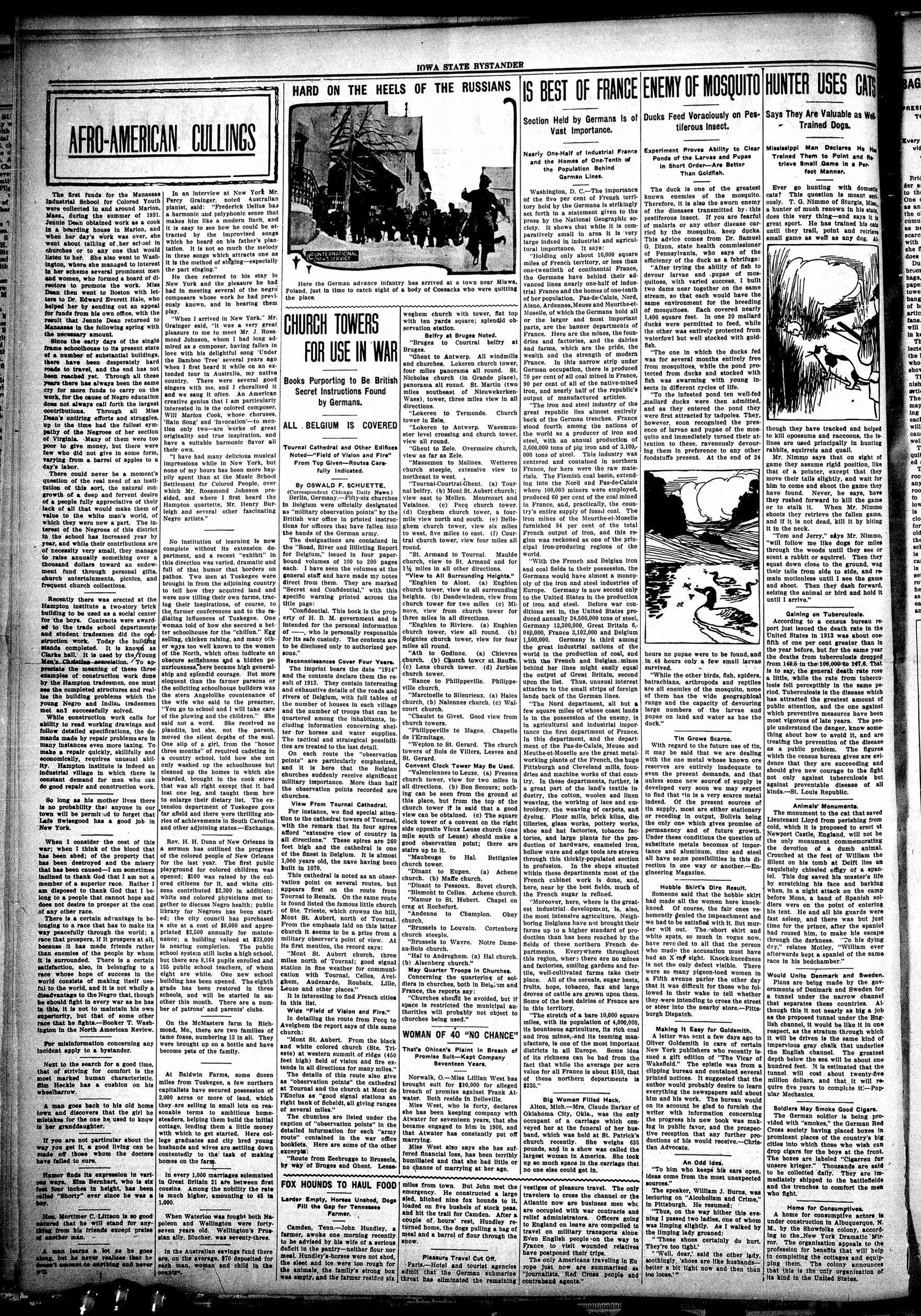
Here the German advance infantry has arrived at a town near Miawa, Poland, just in time to catch sight of a body of Cossacks who were quitting the place.
Here the German advance infantry has arrived at a town near Milaow, Poland, just in time to catch sight of a body of Cossacka who were quitting
CHURCH TOWERS FOR USE IN WAR
ALL . BELGIUM IS COVERED
Journal Cathedral and Other Edifices Noted—"Field of Vision and Fire" From Top Given—Routes Carefully Indicated.
By OSWALD F. SCHUETTE, (Correspondent Chicago Daily News.) Berlin, Germany.—Fifty-six churches in Belgium were officially designated as "military observation points" by the British war office in printed instructions for officers that have fallen into the hands of the German army.
The designations are contained in the "Road, River and Billeting Report for Belgium," issued in four paper-bound wimps of 100 to 200 pages each. I have seen the volumes at the general staff and have made my notes direct from them. They are marked "Secret and Confidential," with this specific warning printed across the title page:
"Confidential. This book is the property of H. B. M. government and is intended for the personal information of —, who is personally responsible for its safe custody. The contents are to be disclosed only to authorized persons."
Reconnaisances Cover Four Years.
The imprint bears the date "1914" and the contents declare the result of 1913. They contain interesting and exhaustive details of the roads and rivers of Belgium, with full tables of the number of houses in each village and the number of troops that can be quartered among the inhabitants, including information concerning shelter for horses and water supplies. The tactical and strategic possibilities created to the last detail.
On each route, the "observation points" are particularly important, and it is here that the Belgian churches suddenly receive significant military importance. More than half the observation points recorded are churches.
View From Tournai Cathedral
For instance, we find special attention to the cathedral towers of Tournal, with the remark that its four spires afford "extensive view of country in all directions." These spires are 260 feet high and the cathedral is one of the finest in Belgium. It is almost 1,000 years old, the nave having been built in 1070.
This cathedral is noted as an observation point on several routes, but appears first on the route from Tournal to Renaxi. On the same route is found listed the famous little church of St. Trieste, which crowns the hill, Mont St. Aubert, north of Tournal. From the emphasis laid on this latter church it seems to be a prize from a military observer's point of view. At its first mention, the record says:
"Mont St. Aubert church, three miles north of Tournal; good signal station in fine weather for communication with Tournal, Celles, Avelhem, Audenarde, Roubai, Lille, Leuze and other places."
It is interesting to find French cities in this list.
Wide "Field of Vision and Fire."
In detailing the route from Pecq to Avelghem the report says of this same church:
"Mont St. Aubert. From the black and white colored church (Ste. Trieste) at western summit of ridge (450 feet high) field of vision and fire extends in all directions for many miles."
The details of this route also give an "observation points" the cathedral at Journal and the church at Mont de l'Enseigne, signal stations an right bank of Scheidt, all giving ranges of several miles."
The churches are listed under the caption of "observation points" in the detailed information for each "army route" contained in the war office booklets. Here are some of the other excerpts:
"Route from Zebraegue to Brussels, by way of Bruges and Ghent. Lesse-
Larder Empty, Horses Unshod, Dogs Fill the Gap for Tennessee Farmer.
Camden, Tenn.-John Hundley, a farmer, awoke one morning recently to be advised by his wife of a serious deficit in the pantry--neither flour nor meal. Hundley's-horses were not shod, the sleet and ice were too rough for the animals, the family's strong box was empty, and the farmer resided six
IOWA STATE BYSTANDER
S OF THE RUSSIANS
ery has arrived at a town near Miawa,
a body of Cossacks who were quitting
weghem church with tower, flat top with ten yards square, splendid observation. Beafry at Bruges Noted.
"Bruges to Courtral belfry at Bruges.
"Ghent to Antwerp. All windmills and churches. Lokeren church tower, four miles panorama all round. St. Nicholas church (in Grande place), panorama all round. St. Martin (two miles southeast of Nieuwekerken-Waes), tower, three miles view in all directions.
"Lokeren to Termonde. Church tower in Zele.
"Lokeren to Antwerp. Waesmuster level crossing and church tower, view all round.
"Ghent to Zele. Overmeire church, view as far as Zele.
"Massseen to Malines. Wetteren church steeple, extensive view to northeast to west.
"Tournal-Courtal-Ghent." (a) Tournal belfry, (b) Mont St. Aubert church; view east to Mellen, Mourcourt and Velaines. (c) Pecq church tower. (d) Coyghem church tower, a four-mile view north and south. (e) Belleghem church tower, view six miles to west, five miles to east. (f) Courtal church tower, view four miles all round.
"St. Armand to Tournal. Maule church, view to St. Armand and for 1½ miles in all other directions."
"View to All Surrounding Heights."
"Enghien to Alost. (a) Enghien church tower, view to all surrounding heights. (b) Dendewindem, view from church tower for two miles (c) Minove, view from church tower for three miles in all directions.
"Enghien to Rivière. (a) Enghien church tower, view all round. (b) Solglenes church tower, view for four miles all round.
"Ath to Godinene. (a) Chievres church. (b) Church tower at Baufe. (c) Lens church tower. (d) Jurbise church tower.
"Rance to Philippeville. Philippeville church. to Silienrieux. (a) Hates church. (b) Naleennes church. (c) Walcourt church.
"Chaulet to Glivet. Good view from church towers.
"Phillippeville to Magee. Chapelle de l'Ermitage.
"Weplon to St. Gerard. The church towers of Bols de Villers, Lesvies and St. Gerard.
"Convent Clock Tower May Be Used.
"Valenciennes to Leuze. (a) Fresnes church tower, view for two miles in all directions. (b) Bon Secours; nothing can be seen from the ground at this place, but from the top of the church tower it is said that a good view can be obtained. (c) The square clock tower of a convent on the right side opposite Vieux Leuze church (one mile south of Leuze) should make a good observation point; there are stairs up to it.
"Maubeuge to Hal. Bettignies church tower.
"Dinant to Eupen. (a) Achene church.
"Bilmae church. (b) Maffe church.
"Dinant to Pessoux. Sovet church.
"Blemont to Celles. Achene church.
"Namur to St. Hubert. Chapel on crag at Rochefort.
"Andeune to Champion. Ohey church.
"Brussels to Louvain. Cortenberg church steeple.
"Brussels to Wavre. Notre Dame-au-Bois church.
"Hal to Andreghem. (a) Hal church.
(b) Alsenberg church."
May Quarter Troops in Churches.
Concerning the quartering of soldiers in churches, both in Belfast; and France, the reports say:
"Churches should be avoided, but if space is restricted the municipal authorities will probably not object to churches being used."
WOMAN OF 40 "NO CHANCE"
That's Ohioan's Plaintiff in Breach of
Promises. Kate Company
eventuates.
Norwalk, O.-Miss Lillian West has brought suit for $10,000 for alleged breach of promise against Frank Atwater. Both reside in Belleville. Miss West, who is forty, declares she has been keeping company with Atwater for seventeen years, that she became engaged to him in 1905, and that Atwater has constantly put off marrying. Miss West also says she has suffered financial loss, has been terribly humiliated and that she had little or no chance of marrying at her age.
miles from town. But John met the emergency. He constructed a large sled, hitched nine fox hounds to it, loaded on five bushels of stock pess, and hit the trail for Camden. After a couple of hours' rest, Hundley returned home, the dogs pulling a bag of meal and a barrel of flour through the snow.
Pleasure Travel Cut Off.
Paris—Hotel and tourist agencies admit that the German submarine threat has eliminated the remaining
IS BEST OF FRANCE
Section Held by Germans Is of Vast Importance.
Nearly One-Half of Industrial France and the Homes of One-Tenth of the Population Behind German Lines.
Washington, D. C.—The importance of the five per cent of French territory held by the Germans is strikingly set forth in a statement given to the press by the National Geographic society. It shows that while it is comparatively small in area it is very large indeed in industrial and agricultural importance. It says:
"Holding only about 10,000 square miles of French territory, or less than one-twentieth of continental France, the Germans have behind their advanced lines nearly one-half of industrial France and the homes of one-tenth of her population. Pas-de-Calais, Nord, Alsne, Ardennes, Meuse and Meurthe-et-Moselle, of which the Germans hold all or the larger and most important parts, are the banners departments of France. Here are the mines, the dries and factories, and the dries and farms, which provide the pride, the strength of modern France. In this narrow strip under German occupation, there is produced 70 per cent of all coal mined in France, 90 per cent of all of the native-mined iron, and nearly half of the republic's output of manufactured articles.
"The iron and steel industry of the great republic lies almost entirely back of the German trenches. France stood fourth among the nations of the world as a producer of iron and steel, with an annual production of 3,600,000 tons of pig iron and of 3,100,000 tons of steel. This industry was centered and contained in northern France, for here were the raw materials. The Flemish coal basin, extending into the Nord and Pas-de-Calais where 100,000 miners were employed, produced 60 per cent of the coal mined in France, and, practically, the country's entire supply of fossil coal. The iron mines of the Meurthe-et-Moselle furnished 84 per cent of the French output of iron, and this region was reckoned as one of the principal iron-producing regions of the world.
"With the French and Belgian iron and coal fields in their possession, the Germans would have almost a monopoly of the iron and steel industries of Europe. Germany is now second only to the United States in the production of iron and steel. Before war conditions set in, the United States produced annually 24,500,000 tons of steel. Germany 12,300,000, Great Britain 6,040,000, France 3,102,000 and Belgium 1,600,000. Germany is third among the great industrial nations of the world in the production of coal, and with the French and Belgian mines behind her lines might easily equal the output of Great Britain, second upon the list. Thus, unusual interest attaches to the small strips of foreign lands back of the German lines.
"The Nord department, all but a few square miles of whose coast lands is in the possession of the enemy, is in agricultural and industrial importance the first department of France. In this department, and the department of the Pas-de-Calais, Meuse and Meuthe-et-Moselle are the great metalworking plants of the French, the huge Pittsburgh and Cleveland mills, foundries and machine works of that country. In these departments, further, is a great part of the land's textile in dustry, the cotton, woolen and linen weaving, the working of lace and embroidery, the weaving of carpets, and dyeing. Flour mills, brick kilns, dis tilleries, glass works, pottery works, shoe and factories, tobacco factories, and large plants for the production of hardware, enameled iron, hollow ware and edge tools are strewn through this thickly-populated section in profusion. In the ships situated within these departments most of the French cabinet work is done, and, here, near by the best fields, much of the French sugar is refined.
"Moreover, here, where is the greatest industrial development, is also, the most intensive agriculture. Neighboring Belgians have not brought their farms up to a higher standard of production than has been reached by the fields of these northern French departments. Everywhere throughout this region, where there are no mines and factories, smiling gardens and fertile, well-cultivated farms take their place. All of the cereals, sugar beets, fruits, hops, tobacco, flax and large droves of cattle are grown upon them. Some of the best dairies of France are in this territory.
"The stretch of a bare 10,000 square miles, with its population of 40,000,000, its beetous agriculture, its teeming coal and iron mines, and its riching manufacture, is one of the most important districts in all Europe. Some idea of its richness can be had from the fact that while the average per acre value for all France is about $150, that of these northern departments is $235."
Big Woman Filled Hack
Alton, Mich.—Mrs. Claude Barker of Oklahoma City, Okla., was the only occupant of a carriage which conveyed her at the funeral of her husband, which was held at St. Patrick's church recently. She weighs 635 pounds, and in a show was called the largest woman in America. She took up so much space in the carriage that no one else could get in.
vestigies of pleasure travel. The only travelers to cross the channel or the Atlantic now are business men who are occupied with war contracts and relief administrators. Officers going to England on leave are compelled to travel on military transports alone. Even English people on the way to England have contributed relatives have postponed their trips.
The only Americans traveling in Europe just now are summarized as " journalists, Red Cross people and contraband agents."
```markdown
```
ENEMY OF MOSQUITO
Ducks Feed Voraciously on Pestiferous Insect.
Experiment Proves Ability to Clear Pondes of the Larvae and Pupae In Short Order—Are Better Than Goldfish.
The duck is one of the greatest known enemies of the mosquito. Therefore, it is also the sworn enemy of the diseases transmitted by this pestiferous insect. If you are fearful of malaria or any other disease carried by the mosquito, keep ducks. This advice comes from Dr. Samuel G. Dixon, state health commissioner of Pennsylvania, who says of the efficiency of the duck as a fehbringe: "After trying the ability of fish to devour larvae and pupae of mosquitoes, with varied success, I built two dams together on the same stream, so that each would have the same environment for the breeding of mosquitoes. Each covered nearly 1,400 feet. In one 20 mallard ducks were permitted to feed, while the other was entirely protected from waterfowl but well stocked with goldfish.
"The one in which the ducks fed was for several months entirely free from mosquitoes, while the pond protected from ducks and stocked with fish was swarming with young insects in different cycles of life.
"To the infested pond ten well-fed mallard ducks were then admitted, and as they entered the pond they were first attracted by tadpoles. They, however, soon recognized the presence of larvae and pupae of the mosquito and immediately turned their attention to these, ravenously devouring them in preference to any other foodstuffs present. At the end of 24
hours no pupae were to be found, and in 48 hours only a few small larvae survived.
"While the other birds, fish, spiders, batrachians, arthropods and reptiles are all enemies of the mosquito, none of them has the wide geographical range and the capacity of devouring large numbers of the larvae and pupae on land and water as has the duck."
Tin Grows Scarce
With regard to the future use of tin, it may be said that we are dealing with the one metal whose known ore reserves are entirely inadequate to even the present demands, and that unless some new source of supply is developed very soon we may expect to find that 'tin is a very scarce metal indeed. Of the present sources of tin supply, most are either stationary or receding in output. Bolivia being only one which gives promise of permanent supply, Autumn growth. Under these conditions the question substitute metals becomes of importance and aluminum, zinc and steel all have some possibilities in this direction in one way or another.—Engineering Magazine.
Hobble Skirt's Dire Result
Someone said that the hobble skirt had made all the women here knocked. Of course, the fair ones reverently denied the impachment and we had to be satisfied with it. But Murray will wlH. The short skirt and white spats, so much in vogue now, have revoiled to all that the person who made the accusation must have had an X cap sight. Knock-kneedness is not the only defect visible. There were so many pigeon-toed women in a Fifth avenue parlor the other day that it was difficult for those who followed in their wake to tell whether they were intending to cross the street or steer into the nearby store.—Pittsburgh Dispatch.
A letter was sent a few days ago to Oliver Goldsmith in care of a former New York publishers who recently issued a gift edition of "The Vicar of Wakefield." The epistle was from a clipping bureau and contained several printed notices. It suggested that the author would probably desire to learn everything the newspapers said about him and his work. The bureau would on its account be glad to furnish the writer with information concerning the new book was making in public factual the prospective reception that any other productions of his would receive. -Christian Advocate.
An Odd Idea.
"To him who keeps his ears open, ideas come from the most unexpected sources."
The speaker, William J. Burns, was lecturing on "Alcoholism and Crime" in Pittsburgh. He resumed:
"Thus, on the way hither this evening I passed two ladies, one of whom was limping slightly. As I walked by the limping lady groaned:
"These shoes certainly do hurt. They're too tight."
"Well, dear," said the other lady, sootily, "shoes are like husbands—better a bit tight now and then than too loose."
Says They Are Valuable as Wet Trained Dogs.
Mississippi Man Declares He Has Trained Them to Point and Retrieve Small Game in a Perfect Manner.
Ever go hunting with domestic cats? This question is meant seriously. T. G. Nimmo of Sturgis, Miss. a hunter of much renown in his state, does this very thing—and says it is a great sport. He has trained his cats until they trail, point and retrieve small game as well as any dog. At
though they have tracked and helped to kill opossums and raccoons, the felines are used principally in hunting rabbits, guirrels and quail.
Mr. Nimmo says that on sight of game they assume rigid position, like that of a pointer, except that they move their tails slightly, and wait for him to come and shoot the game they have found. Never, he says, have they rushed forward to kill the game or to stalk it. When Mr. Nimmo shoots they retrieve the fallen game, and if it is not dead, kill it by biting it in the neck.
"Tom and Jerry," says Mr. Nimmo, "will follow me like dogs for miles and if it is not dead, kill it by biting it in the neck. Then they squat down close to the ground, wag their tails from side to side, and remain motionless until I see the game and shoot. Then they dash forward, seizing the animal or bird and hold it until I arrive."
Gaining on Tuberculosis
According to a census bureau report just issued the death rate in the United States in 1913 was about one-fifth of one per cent greater than in the year before, but for the same year the deaths from tuberculosis dropped from 149.5 in the 100,000 to 147.6. That is to say, the general death rate rose a little, while the rate from tuberculosis fell perceptibly in the same period. Tuberculosis is the disease which has attracted the greatest amount of public attention, and the one against which preventive measures have been most vigorous of late years. The people understand the danger, know some things to avoid and treating the preventive of the disease as a public problem. The figures which the census bureau gives are evidence that they are succeeding and should give new courage to the fight not only against tuberculosis but against preventable disease of all kinds.-St. Louis Republic.
Animals' Monuments
The monument to the cat that saved Lieutenant Lloyd from perishing from cold, which it is proposed to erect at Newport Castle, England, will not be the only monument commemorating the devotion of a dumb animal. Crouched at the feet of William the Silent on his tomb at Delft lies an exquisitely chiseled effigy of a spaniel. This dog saved his master's life by scratching his face and barking when, in a night attack on the camp before Mons, a band of Spanish soldiers were on the point of entering his tent. He and all his guards were fast asele, and there was but just time for the prince, after the spaniel had roused him, to make his escape through the darkness. "To his dying day," relates Motley, "William ever afterwards kept a spaniel of the same race in his bedchamber."
Would Unite Denmark and Sweden.
Plans are being made by the governments of Denmark and Sweden for a tunnel under the narrow channel that separates these countries. Although this it not nearly as big a job as the proposed tunnel under the English channel, it would be like it in one respect, as the stratum through which it will be driven is the same kind of impervious gray chalk that underlies the English channel. The greatest depth below the sea will be about one hundred feet. It is estimated that the tunnel will coat about twenty-five million dollars, and that it will require five years to complete it—Popular Mechanics.
Soldiers May Smoke Good Cigars
Soldiers may smoke Good Cigars.
The German soldier is being provided
with "smokes" the German Red
Cross soldier having placed boxes
promptly placed on counters, big
cities into which those who can
drop cigars for the boys at the front.
The boxes are labeled "Cigarren fur
unsere krieger." Thousands are said
to be collected daily. They are
immediately shipped to the battlefields
and the trenches to comfort the men
who fight.
Home for Consumptives
A home for consumptive actors is under construction in Albuquerque, N.M., by the Showkols colony, according to the_New York Dramatic Mirror. The organization appeals to the profession for benefits that will help in completing the cottages and equiping them. The colony announces that this is the only organization of its kind in the United States.
BAGS FOR THE BRIDE
PRESENTS THAT HOUSEKEEPER
TO-BE WILL APPRECIATE.
Every Kind and Variety May Be Provided—Good Idea Is to Finish Articles at Luncheon Given to Coming Brides.
Bridal showers will soon be in order and a bag shower should appeal to the friends of prospective brides. One can never have too many bags, as any new housekeeper will find. In the old home bags have gradually accumulated, each being made or bought as needs called for, so the bride scarcely thinks of providing herself with these convenences. Only when she finds herself almost without them does she appreciate their value.
Dust rag bags are needed, also broom bags, laundry bags, catch-all bags, bags for pieces, bags for keeping paper patterns, bags for soiled dish towels, bags for preserving dresses hanging in the closet, to say nothing of bags for shoes, corsets, for toilet articles and for dainty slippers and fans. If all these can be provided it will be seen how helpful they will be in keeping the new household neat.
The usual procedure is for the selected hostess to give a luncheon to the bride-to-be and those of her friends who wish to contribute to the bag shower.
The kind of bag each friend will furnish is previously arranged, but the article will be not fully completed. The finishing or any slight decoration may be left. The guests bring sewing materials, and after the luncheon each does her own finishing. This will bring a merry discussion and cause lots of fun among girls who are well acquainted with one another.
The gift from the hostess is always quite complete before the day appointed and is, of course, a cloaked bag.
This is intended for the bride's bedroom, into which she can slip almost anything. The bag is large and quite roomy, cut not unlike a pillow slip as to the foundation, except that the lower corners are rounded off. There is a deep hem at the top, which incloses an oval wood hoop. This affords a most convenient opening. Soft old rose, India or China silk makes the prettiest bag, but if the color scheme of the bedroom it will adorn is known, the silk chosen for the bag can be got to match. The foundation of the bag is set on in festoon effect, headed by set on in festoon effect, headed by rows of chiffon robes and caught up here and there with straps of the same. Two loops of ribbon set on at each end pass over hooks in the wall and support the bag. Even these kan-
```markdown
```
Bride's Shower Bag.
dles are elaborate, for the ribbon is shirred on both edges to a plain ribbon much in the same way as the old-fashioned elastic garters are covered.
Bows of ribbon conceal the hooks.
When all the bags are complete each donor folds her offering and then the bride takes the glorified bag and walks among her friends, who drop their gifts into it.
DICTATES OF FASHION
When coat collars are high they are usually made so they will turn down.
More material and simple lines will be the important points of the new frocks.
Both wide and narrow girdles are correct, and ribbon belt have come back again.
A good blouse is of black chiffon over white, with corset, belt and cuffs of white saxin.
Tilted to one side atop of elaborately tilted and curled collures, are the fashionable tiny hats.
An olly red skin needs an astringent; add a few drops of toilet vinegar to the wash water.
Ankles Clad in the Daintest of Covering is New Mode of the Moment.
After a period of partial eclipse the ankle is to become fashionable once again. In the day of the tight skirt it showed but shilty and at intervals—and even then it was frequently encased in the spat. Now that the full skirt hangs a fair six inches from the ground, we shall see the ankle all the time. Pretty preparations are being made to deck it fittingly. At a baskery shop one was shown the new stockings, whose colors vary as wine. "These are champagne," said the dainty shop assistant, "True chie. There are claret. That pair is burgundy." Either you must wear these or fine silk, with the daintest of patent-leather shoes, or you must have patent-leather boots with cream-colored uppers. The boots must be made high. Then you are correct. But spats—not necessarily too secure of return the
FOR CARRYING SAFETY PINS
Neat Little Arrangement That May Be Rolled Up So as to Occupy Little Space.
This little article forms a useful addition to baby's basket or an ordinary work-basket, and can be made in a
COOLING
Safety-Pin Roll.
few moments with the aid of almost any remnant of material. It is lined with soft wash leather and bound at the edges with narrow ribbon, and it rolls up from the base and fastens together with a small button and buttonhole. In the lower-sketch it may be seen rolled up and fastened together.
The wash leather keeps the pins in a nice and bright condition, and when the case is open, a pin of any particular size may be seen and selected in a moment, and when it is closed it will take up little or no space in a work-box or basket.
ETIQUETTE OF THE WEDDING
Certain Points That Should Be Observed in This Most Solemn of All Ceremonies.
A wedding should not be an affair of show and lavish gorgeousness. It should not be a time of ostentation and elaborate decorations. It ought to be a sacred ceremony, set to that loveliest of wedding music, "The Voice That Breathed O'er Eden." Sweetness, sacredness, solemnity—these three words give the keynote of the properly impressive wedding. As for clothes, the rule is simple for bride, bridegroom or attendant. Wear clothes that would be suitable for any function dimed as is the wedding. A morning wedding is best dressed in formal street attire. An afternoon wedding needs the formal afternoon clothes that would be worn at an afternoon reception. And for the evening wedding a white bride is met by a bridegroom or dress clothes that are the proper foll for her own. The bride's attendants give the note of color in the procession when she is white-clad. In the evening they are gowned in low-necked dresses of soft colorings and seldom wear bats.
If the afternoon bride elects to be married in white, the bridegroom will wear formal afternoon reception dress—a cutaway coat, gray gloves, gray acetot (four-in-hand) and gray gloves. His best man and ushers are similarly dressed, and generally wear cloth-topped boots, 'silk hats' and add a collar of a white flower in their coats.
At the afternoon wedding, the bridesmaids and of honor may wear hats even if the bride is veiled.
The wedding is particularly the bride's grand occasion, so a considerate bridegroom will let her choose her own attendants.
A married sister of bride or bridegroom may act as matron of honor. If neither has a married sister the bride may choose for this position any dear friend or relative she chooses to honor. The matron, like the maid of honor, is generally a rather young woman.
The ushers head the wedding procession, clearing the way for the bride's attendants. After them come bridesmaids, honor maid, and then little pages, or flower girls, strewing flower petals in the path of the bride. The bride is with her father, or the relative who is acting as her guardian and giving her away.
The bridegroom and his best man have previously entered by some wide path and stand at the altar waiting for the bride.
For a red, oily nose anoint several times a day with a little diluted alcohol or witch-hazel.
ankle is welcomed. "An ankle is so becoming," as a woman remarked. A cryptic criticism came from a man: "Ex pede Herculem—and a woman is known by the ankle she keeps."
For the Smart Woman
A simple but decidedly smart spring costume seen the other day was made of pin-checked material in black and white. It looked so much like seagull gray that one had to look twice to recognize the real color. The skirt was fuller on to a band, which formed the belt, and fell in large goddet folds at the hem. The waist was a plain little jacket effect.
These little sacques, as they are called, recall the early Victorian days. An old pink slik ponge or more is the favored material. When a small hat, poke effect, and cocked up in the back, is worn with this, it makes a very pliant costume.
Serpentine braiding is very much worn on the skirts of the new gowns. Soutache is popular, too, and military cloak is the shape of spandex cloak, buckles and such ornaments.
THE GARDEN
Beautiful Shruba That Protect Bulba:
WHEN TO PLANT BULBS
By MRS. JOHN FIELD.
Hardy bulbs should be planted as early in the fall as possible.
Dealers will not begin sending out bulbs much before the latter part of September. Early orders get the best bulbs.
The best soil for bulbs for the house is a rich loam mixed with sand. If too heavy, add turfy matter to lighten it.
Always choose a well-drained locally for your bulb seed; if not naturally so, put at least six inches of bark or pieces of brick, old shoes, old bows, and the like in the bottom of the bed.
Never take bulbs out of the package the florist sends them in until you are ready to plant them. Do not leave them exposed to the light or air, as this will cause loss of moisture and weaken vitality.
The scales of lily bulbs often become soft and flabby when exposed to the air, because of the evaporation of the sap, which is the life blood of the bulb. Such bulbs are weakened, and hardly worth planting. Put all bulbs in the cellar or in a dark, cool place until ready to plant.
Many plants will grow well in an ordinary window in winter, but the number that will soften freely under such conditions are few and need special preparation. Many failures are due to an unwise selection of kinds, as well as to the extremes of heat to which the ordinary room is subjected. The number is a good time to root cuttings taken from soft wood plants, but the "bloomers" for the house should have been slipped and rooted last May or June. Cuttings taken as late as September of the new half-ripened wood of many annuals and perennials will make nice house plants and some of these should bear flowers if well cared for.
Hardy bulbs may be planted among shrubbery, and these will give bloom at a time when the branches of the shrubbery are bare of foliage, lighting the shrubbery will in turn serve to protect the bulb flowers and foliage from
Chrysanthemums Can Be Grown Indo
Are Looke
Chrysanthemums Can Be Grown Indoors If the Right Soil and Temperature Are Looked Out For.
THE HOUSE PLANTS
THE HOUSE PLANTS
By H. B. DORNER.
In the potting of house plants you can mix the proper soil yourself if you know the needs of the different plants. Take some old blue grass soil and pile it up until it rots, and you will have the ideal form of decayed vegetable matter for the principal constituent of all kinds of soil for potted plants. There are three kinds of potting soil, as follows:
For geraniums and the ordinary varieties of blooming plants—Three parts loam from the rotted土, one part well rotted manure and one part sand if the soil is heavy.
For ferns, begonias and such foliage plants—Two parts loam, one part leaf mold or peat, and one-half part sand if soil is heavy.
For palms or roses—Two parts clay loam and one part well rotted manure, and sand to suit the texture condition.
Use the finger test to learn if the plants need water; when the soil crumbles easily until dry it needs water; when it cakes readily there is too much water; so do not give the plants a little each day, but only water when needed. Never use a nozzle on the end of a hose in watering as it causes the stream to pack the soil and injure the foliage
IOWA STATE BYSTANDER
BEAUTIFUL
and Shrubbery
and Cultivation
disastrous effects of early, cold rain storms and rough spring winds.
GENERAL FLOWER HINTS
Cut and pile sod for pot compost later.
Weather seldom affects weeds adversely.
Heavy shade is often worse than strong sunlight.
Sow seeds for basket plants and window garden now.
Don't neglect the potted plants; water well, and shade from the afternoon sunshine.
Prune older, weaker branches from shrubs and roses that are done blooming, and mulch roots.
Many plants will bear strong sky light that would be badly damaged if set in strong sunshine.
Prune out the branches of the dahlia to promote development of flowers; water well, and to stakes.
Prune it is recommended, darkness or dense shade are not meant. All plants require a good light.
Root geranium slips now, if you want winter bloomers. Keep growing thrifty, pinching off all buds until late September.
Cut flowers of annuals that seed freely and prolong the season of bloom. If allowed to mature seeds, thwv cease to bloom.
To root hardwood, shrubbery plants, cut just below the joint, as all alps send out roots from the joint, whether soft or hardwood.
Do not make the mistake of rooting for winter bloomers, plants that bloom only in summer. Some geranium bloom more freely than others.
For potted plants that must have sunshine, set the pots in a jardiniere, or set in a box with a packing of moss around them to encourage moisture.
Evaporation is rapid; if showers are few, the plants will become stunted from thirst; if too much rain, weeds must not be allowed to choke the plants.
All shrubby pot plants should be set in a sheltered place, out of doors, with good light, but some shade during the hot season, where strong winds cannot rack them.
ora If the Right Soil and Temperature
d Out For.
To prevent your window plants from blooming only on the street side, turn them occasionally and you will have the blooms in the room as well. Do not give foliage plants as much light as for flowering plants; keep the ferns in a shady corner; a north window is a good place.
Use as dry material only well rotted manure. To prepare liquid manure to be applied only after the ordinary watering has been done, take an ordinary barrel containing one-half bushel of fresh cow dung and if extra strength be required add a couple of quarts of fresh hen manure and cover with water.
After it has been fermented thoroughly the coarse material will all settle to the bottom and you may fill the barrel with water and the solution is ready to be applied to your plants. An application every two weeks is generally all that is required for most plants.
For this process sand is generally used, or very light soil, as most favorable for the formation of new roots.
The geranium is perhaps the easiest to begin wilt and a good healthy top should be selected where wood has formed. Take a sharp knife and cut below the joint. Follage plants are very easily propagated, and every woman can do her own work of this nature with great satisfaction.
MEAL ON SEWING DAY
MEAL ON SEWING DAY
PALATABLE MENU WHEN TIME
IS OF VALUE.
Luncheon May Be Simple, Yet With Proper Preparation as Appetizing and Nutritious as the Occasion Call For.
For a sewing-day luncheon this makes a palatable menu: Asparagus on toast, hot tea biscuit, marmalade and tea.
Use canned asparagus tips. Drench them with cold water the moment the can is opened; drain thoroughly in a colander and warm in a double boiler; put in a little butter during the warming and season to taste. Make a hard toast of white bread, butter the slices and put the asparagus on top; set the dish on a far part of the stove to keep warm while the other things are arranged. Get the baker's tea biscuit of the evening before and rewarm them in the oven, first brushing over the tops with a little milk. There is an ample marmalade—orange of course—that sells at confectionary jar. It is delicious.
Menu: Stew kidneys and rice, raw tomatoes and chocolate eclairs and coffee.
The main dish can be warmed up to advantage, so it can be made the day before. Ask the butcher for a fresh veal kidney or six or eight fresh lamb kidneys. Skin them and soak in ice water and salt for ten minutes. Cut them in half-inch pieces, or smaller if liked, and put them in $1\frac{1}{2}$ cupfuls of water to stew. If the kidneys are not from a well-nourished animal less water will be required, as this absorbs the substance. Cook two slices of onion with them and the salt and pepper, letting them get perfectly tender yet not mushy. Cook a cupful of rice in a quart of water and when half done drain in through a colander, put it in a saucepan, set it on the back of the stove, and let it steam half an hour more. On the sewing day rewarm the kidneys in a little butter, and steam the rice until the grains are separated; serve them on the same dish. The eclairs cost three cents apice.
Menu: Baked beans. Boston brown bread and cocoa.
The canned beans prepared with sugar and tomatoes are fine for this luncheon, while the little five and tencent cones of brown bread sold by the baker can be made to take the place of the homemade article.
Put the closed bean can in one double boiler and the bread in another and let them get steaming hot. Serve on piping-hot plates, and if possible, provide sweet butter for the bread. For a single person this lunch, which is the most substantial that can be had, will cost just 12 cents-five for beans, five for bread and two for cocoa.
Menu: Fresh strawberries and cream, homemade bread, sweet butter and a glass of milk thinned with vichy.
If the strawberries are free of sand do not wash them, as this dims the exquisite taste. lull them and serve them on a plate with a cone-shaped mound of powdered sugar beside each serving. Have the cream separate, as these delicate berries soon sour after it is put on. The baker sells homemade bread, and yesterday's loaf is more palatable than today's. It is also cheaper. The object of the vichy in the rich milk is to make it more digestible while improving the taste.
Pork Loaf.
Two pounds of fresh pork, run through a meat chopper, season with salt, four drops of tabasco pepper sauce, a little sage and mix thoroughly with a pint or more of stale bread crumbs, which have been softened with milk, then well drained. Add to this one egg well stirred into the mixture, and pack into a loaf pan which has been greased. Bake in a moderate oven about two hours, then when hot or cold. The loaf may be shaped with the hands and baked in a roasting pan with potatoes, which have been peeled, around it. Sweet potatoes are particularly good baked in this way.
Macaroni Milanaise
Two tablespoonfuls butter, one tablespoonful flour, one-fourth tablespoonful salt, one-fourth tablespoonful naprika, one-half cupul brown stock, one-half cupul strained tomatoes. Make a sauce of these ingredients, add one cupul cooked macaroni, and when that is hot add one-fourth cupul parmesan cheese. Lift and relift the macaroni until it is thoroughly blended with the mixture. 'This recipe is designed to serve four persons.
German Salad.
One small cabbage cut fine, either chopped or shredded, one large beet sliced, six hard-boiled eggs. Season the cabbage with salt and pepper, place on a flat salad dish, pile it rather high and arrange around it alternate slices of the beet and eggs. If you wish, garnish with white celery leaves. Put dots of either mayonnaise or a thick boiled dressing on the cabbage, but do not mix it in. Pass more dressing when the salad is served.
Windsor Soap.
This may be made of small pieces of white, hard soap, or of homemade hard soap. Shave very thinly and melt over a slow fire (dissolve slowly). Remove from fire and when lukewarm add enough oil of caraway to scent it (if preferred, some other fragrant oil may be used instead). Turn into molds and allow to remain five or six days in a cool, dry place.
Oriental Beef.
One and one-half pounds of round beef, one-half pound fresh pork, one onion, two green peppers, one cupful crumbs. Salt to taste. Put all through meat chopper. Mix thoroughly, form into loaf, place in pan, lay three slices of bacon on top, pour over it one can tomatoes. Bake in steady oven 1½ hours. Thicken gravy and strain
The KITCHEN CABINET
He who is not conscious of pleasure when he eats is not worthy to sit at table with the elect.
For the masses in all lands the usual diet is still mainly of foods locally and inexpensively produced.
good dash of cayenne is a favorite combination. Nice should be cookies so tender that it may be easily crushed between the fingers.
SPRINGTIME DISHES
·OLD ECONOMICAL DISHES.
Take a slice of round steak, cover with a layer of sliced potatoes, a layer
round steak, cover
potatoes, a layer
of onions and on
top two sliced
potatoes
Season and add a
plot of boiling
water, cover and bake
two hours.
#
Veal With Onions.—Brown a
slice of veal in butter until well browned on both sides. Fill the frying pan with sliced onions, add two bay leaves, four pepper cornns and enough boiling water to cover the meat. Cook until the meat is tender.
Noodles and Ham—Butter a quart mold, sprinkle thickly with fine bread crumbs and line with cooked noodles which should be cold. Then put a layer of chopped ham, highly seasoned, a layer of noodles until the dish is full. Cover with a plate and bake one hour. Turn out on a platter and serve with spinach or sauerkraut.
Spiced Carrots—Cook until tender young carrots, sprinkle with four, powdered cloves, butter, lemon juice, reheat and serve with parsley as a garnish.
Apples and Onions (Flemish Onions)—Slice thinly green apples and onions, sprinkle with flour and brown in butter, using equal quantities of apple and onion. Place in layers in a baking dish with buttered crumbs, season with lemon juice and finish the top with buttered crumbs. When the crumbs are brown the dish is ready to serve.
May Day Cake—Soften half a cup of butter, add a cupful of sugar, two-thirds of a cup of milk alternately with two and a half cupfuls of flour which has been sifted, with two teaspoonfuls of baking power and a half a teaspoonful of salt. Fold in the whites of three eggs. Divide into three portions. Color one portion rose, and flavor with rose extract, color one green and flavor with pistachio. Bake in layers, putting the layers together with boiled icing to which is added chopped raisins and nuts. Frost with white icing and decorate with pink and green candies.
A quick dessert and one always liked is this—cut fine two or three kinds of fruit, serve in sheerb cup with a little sugar sirup to sweeten.
SOME DISHES OF CURRY.
Curry is made up of various spices; the word itself means "bazaar stuff." In our markets may be bought various combinations called curry powder which suit different tastes. Those put up by reliable firms are satisfactory. Curried Cauliflower. Have ready a well cooked, seasoned caulif
In our markets may be bought various combinations called curry powder which autumn tastes best. Those up by reliable firms are satisfactory.
Curried Cauliflower.—Have ready a well-cooked, seasoned cauliflower. Place it on a dish and season with a dash of cayenne pepper. Pour over the cauliflower a sauce prepared as follows: Melt a half cupful of butter, add two tablespoons of flour and two teaspoonfuls of curry powder. Cook together until well blended, stain in a cupful of beetle milk and stirring until salt to season. Mushrooms are delicious served with curry in the sauce.
Mulligatawny—Fry a minced onion till brown in half a cupful of butter, with a chopped green pepper and a few chillies and a clove of garlic. Add any bits of cold fowl cut in dice and half a cupful of cold minced lamb or mutton. Allow the mixture to brown, add half a cupful of boiled rice, one tablespoonful of curry powder, a chopped green apple, half a cupful of finely sliced egg plant or squash or other vegetable, and equal amounts of green peas or beans cooked. Cover with a pint of chicken gravy and season well. Serve hot. Curried Eggs—Mince a green apple and fry with an onion in a little butter until brown. Stir in three teaspoonfuls of curry powder, add half a dozen pounded brazil nuts or almonds. Mix a teaspoonful of flour with a cupful of seasoned stock, add to the curry and simmer ten minutes. Have ready six hard cooked eggs cut in halves; add them carefully to the sauce and let stand to get well heated. Serve with crisp crackers or toast well buttered.
Curry and rice is such a standard dish that; it hardly needs to be mentioned. Cocoanut and curry with a
Feared for Grandma.
Billy is fond of attending the picture shows with his grandma and he considers himself her chief protector. One evening a large black bear was performing all sorts of antics in the picture, which Billy was enjoying immensely until suddenly the bear turned towards the audience. Billy slipped down from his seat and ran back, asking, "What has that said? "Tum an, damna, let's do home. I don't like the looks of dot bear."—Exchange.
New Use for Mercury
A scientific investigator of Europe has discovered a new method of destroying fungous disease and household pests by the use of mercury. In enclosed spaces the mercury is employed in the form of vapor. In other cases it is injected in metallic form directly into the circulating fluids of the plant.
Chief Woods Used for Boxes. White pine and yellow pine are the woods most used for boxes, and each contributes more than 1,000,000,000 feet to the box industry annually.
good dash of cayenne is a favorite combination. Rice should be cooked so tender that it may be easily crushed between the fingers.
SPRINGTIME DISHES.
A most crisp and refreshing *s'ad*
is that of head lettuce and cucumbers
nd refreshing sauce and cucumbers with a garnish of red pepper, cut in pieces, salad bowl with the cut side of a clove of garlic, arrange the crisp leaves of lettuce, well dried in it.
with a garnish of red pepper, cut in the slice and salad bowl with the cut side of a clove of garlic, arrange the crisp leaves of lettuce, well dried in it, then sliced cucumbers, sprinkled with a bit of chopped onion and pepper. French dressing made of four tablespoons of vinegar and salt, and raspic to taste.
Spanish Rice and Cheese—Cook a half cupful of rice in a quart of boiling water, drain and dash on cold water so that each grain stands out full and white. Put into a bowl a glass of currant jelly, pour over it a cupful of boiling water and stir rapidly until the jelly is dissolved. Pour over the rice and cook twenty minutes. Then take from the fire, add two cupfuls of walnuts, chopped fine, one-half cupful of grated cheese, one-half cupful of cream, whipped. Arrange lettuce leaves for individual salad dishes. Put two heaping tablespoonfuls of the rice on each, and garnish with a table-spoonful of whipped cream. Add a tablespoonful of salmon, add equal measures of chopped celery, a few olives finely minced, and a sour pike also chopped, a half cupful of freshly grated coconut and serve on lettuce with a plain boiled dressing which has been made rich by the addition of whipped cream.
Quick Graham Bread—Beat together one egg and two tablespoonfuls of sugar, and a cupful of sweet milk in which a teaspoonful of soda is dissolved. Melt a tablespoonful of butter and add one-half cupful of sifted flour and two teaspoonfuls of cream of tartar. Sift and add one and a half cupfuls of graham flour. Beat well and bake in a single loaf bread pan. This is best eaten warm. It can be served with no dressing but salt, makes a delicious and especially wholesome spring salad.
If there were no such thing as display in the world we might get on a great deal better than we do, and milk makes an agreeable company than we are.
TOOTHSOME DISHES.
For the vegetarian here are some good dishes to add to the list:
Carrots With Peas — Cut carrots in three-inch slices and cook until tender. Scoop out the center, leaving a well-shaped receptacle to hold the seasoned carrots. Use these in a garnish around any loaf or around peanot loaf. Pecan Loaf. — Take
N
half cupful of rice, cover with cold half water, and let stand over night. Drain and add slowly three pints of boiling water; cook until soft throughout. Take a cupful of the drained rice, add a cupful of pecan nuts, finely chopped, one cupful of cracker crumbs, one cupful of milk and one egg slightly beaten, one and a half teapouffles of salt and a few dashes of pepper. Turn into a small buttered bread pan, smooth and spread with a tablespoonful of melted butter. Bake in a moderate oven one hour. Remove to a hot plate and simmer with white vinegar and tallow, simulates a sauce for two tablespoonfuls each of flour and butter and a cupful of thin cream. When the butter is melted and bubbling hot add the flour, and when well mixed add the cream. Cook until smooth. Season with salt and pepper.
Pea Roast.—Take three cupfuls of dry bread that has been rolled and put through a sieve. Drain a can of peas and rinse well with cold water. Put in a saucepan and cover with cold water, bring to the boiling point and boll three minutes. Drain and force through a sieve (there should be a half cupful of pulp). Drain the crumbs and pulp, add a fourth of a cupful of chopped walnut meats, one egg slightly beaten, one tablespoonful of sugar, salt, pepper, a fourth of a cupful of melted butter and three-fourths of a cupful of milk. When well blended turn into a paraffin lined bread pan, cover with buttered paper and bake forty minutes in a slow oven. Serve with tomato sauce if so desired.
Nellie Maxwell
Fern Was Peeved.
According to an eminent botanist, plants are so sensitive that they resent neglect and are susceptible to kind treatment, showing their gratitude in charming ways. We are therefore the more ready to believe a story told us a day or two ago by a lover of nature. He forgot to coat an collar. He forgot to temble a water. The fern, incensed by the shock, leaped from the pot and bit him savagely in the leg—Phillip Hale, in Boston Herald.
Valuable Discovery
Another German scientist has done the world a good turn. He has discovered that this good old world which all love so well that not many are anxious to leave it; will exist for many hundreds of years and then get an extension. We feel better.—Milwaukee Sentinel.
While You're Making Plane.
Do not allow the making of plans
for tomorrow to interfere with doing
what you planned yesterday to do today—Teach's Companion.
The Negro a Challenge American Democracy and Christianity
Fifteen years ago even the friends of the Negro were persuaded to believe that if he were debarred from the polls, the mob would be pleased and lynching would stop, that pampared prejudice would be sated and abated. But prejudice, like most monsters, grows by what it feeds on. At that time the states where lynching is most frequent seemed to be saying: If you will only allow us to disfranchise these black people, we will not find it necessary to lynch them; it is their vote, their defense, which annoys and irritates us; disfranchise them and we will not want to murder them. Aesop tells us a fable of the wolves and the sheep; the wolves were ever making war on the sheep, and the sheep kept for their protection a number of dogs. One day the wolves proposed terms of peace, saying that if the sheep would only dismiss their dogs they should no longer be annoyed by a wolf, and that the idea of sheep defending themselves by dogs was what insulted and angered the wolf tribe. Aesop says that the innocent sheep accepted the proposal and dismissed the dogs, and you do not need to be told the rest of the story. It is coarse irony for one inspired with the lust of gain or power to suggest to his intended victim that a surrender of his means of defense will appease that lust. The greatest possible aid to the lynching spirit is to make the sheriff of the county dependent upon the votes of the lynching class and independent of the influence of the victim class. A white officer is but human nature, and it is unfair to expect him to choose the safety of Negro prisoners when society has made such a choice disasltrous to his own interests. Some officers are predisposed toward duty and loathe the thing which they must tolerate; recently in Shreveport, La, when an untried Negro was being hanged to a telegraph pole on the court house corner, the poor sheriff, torn by conflicting emotions, instead of actively opposing the mob, sat upon the court house steps limp and helpless, almost in tears and muttering his disgust, a sight to stir the pity of the gods! Had the Louisiana Negro had a vote to support that sheriff, he could have and in all probability would have acted the part of an officer.
In this, as in many other matters, it is plain that American civilization fixes its own status when it fixes the status of the Negro. Give the Negro his ballot and let him stand by American civilization by active influence; or take away his rights, and he will destroy American civilization by passive influence.
Even the church does not escape on some occasions so triumphant becomes the spirit of barbarity that even the white preachers yield and publicly endorse the acts of the mob from their pulpits. The church has done more for the education and soul-freedom of the Negro than any other agency, and it is regretable that in many instances it is acquiescing in and exemplifying the various forms of jim-crowism and segregation, thus lending them the authority of religion. We know nothing more inconsistent with the recorded life of Jesus of Nazareth, or which will be more embarrassing to the influence of the church among colored people in this country and in others. The church will be judged in this world and in the next by its attitude toward "the least of these." If the church yields to Jim-crowism, what shall we expect of railroads, steamboats, theaters, labor unions and the United States government?
These conditions make an organization like the National Association for the Advancement of Colored People one of the most patriotic movements of the times. Like the Anti-Slavery society, against fearful prejudices, it is trying to remove a cancer from the life of the nation. The way in which our government is constituted and operated makes it extremely unlikely that movements for reform will ever originate in the halls of legislature. They must begin in private and philanthropic organization. Reform bills must fiffuratively and often literally be written and sent to congress by interested parties on the outside. Reforms affecting the Negro will be no exception, and the association is a recognition of that fact. The conservation of the association is remarkable, take for example, the real, not the fictitious, Dr. W. E. B. DuBois, whose undaunted spirit and unweary work have made the association. Readers of the Crisis who know for themselves the wrongs about which he speaks regard Dr. DuBois as one of the most self-controlled and conservative reformers of modern times. He says: "Organize, take your case to court, tell the truth; vote for democracy and freedom, acknowledge no boss; oppose the wrong, meet insult with protest and rise from oppression." That is a mild and conservative program, born of the peaceableness and patience of the Negro race, for among other peoples such wrongs are usually met with other weapons than words.
This movement can easily include those white people who are not primarily interested in the Negro race but in the future of American civilization. Our phytic experience teaches that we cannot destroy the influence of the past, but we can relatively lessen it by the addition of new influences. The echo of two hundred and fifty years of slavery is still heard in the corridors of our civilization, and will be heard. Let us wake new voices and make this old voice relatively less disturbing. It is not easy to fight a minority fight unless one is supported by a consciousness right. This consciousness support-
ed the abolitionist. Is it right for colored people to be free? Is it right for them to be happy? Is it right for them to be men among men, and finally, should Negroes share in the goods of life as human beings and not merely as secondary to the well-being of another race? The Negro is a large part of the white man's environment, the white man is a larger part of the Negro's environment. The Negro asks not pity; pity is shallow, evanescent and often unreasonable. We pity the overtaken criminal. We ask only for a strict application of those principles of morality and justice which the white race has been foremost in formulating and spreading in human society.
But whatever others may do, the Negro has a duty to himself. He must continue to want and to work. By no means must he stop wanting, for that is the stimulus to his working. He must want life, want civilization, want citizenship, want votes and equal opportunities, and for all these wants he will work. A man is as civilized as his wants. The only way to work effectively is through organization; to work as individuals is like bailing out the ocean with a quart cup. We are only one among ten in this country, but the white man is human, and if we work well we will win friends, co-operation, victory. By winning them is the surest way for a thousand to "put ten thousand to flight." This is not a skirmish of days or a battle of years, it is a war of decades and generations. We can measure our success only by looking backward over the decades. In the last decade we seem to have retreated along our political and civil lines; but let us imitate a baffled European general and call that retreat a "withdrawal for strategic purposes only," and announce that in the present decade we mean to advance all along the line with greater intrepidity than ever.
PROGRAM.
Fourteenth annual session of the Iowa State Federation of Colored Woman's Clubs, to be held at Bethel A. M. E. church, Cedar Rapids, May 24, 25 and 26.
Board meeting, Monday, 3 p. m.
Monday Evening, May 24—Citizens' Night.
Song, Anthem by Bethel A. M. E. choir.
Invocation, Rev. Cato
Instrumental, Mrs. Adelaide Flowers and Mrs. Mabel Horne. Welcome address on behalf of city, Mayor Roth.
Vocal. Mr. Fred H. Gresham
Mr. Fred H. Gresham
Welcome address on behalf of the churches, Rev. R. H. Cato and Rev. J. Northcross.
Quartette, Mrs. E. C. Thomas, Mrs. Minnie Gray, Mrs. Fannie Hawkins, and Mrs. Robt. McGee.
Welcome address on behalf of the clubs, Mrs Amelia Jackson.
Music, Miss Helen Roberts.
Response to addresses, Mrs. Belle Watkins, second vice president.
Music, piano selection, Miss Ruth La Vere Boyd.
Oration. Mr. L. D. Lowery.
Instrumental, Mrs. Jessie Smith. Benediction, Rev. Northcross.
Tuesday A. M.
Song.
Invocation, chaplain.
Song.
Roll call of district chairmen. Each respond by two minute talk of what she has done to build up the federation.
Report of credentials committee.
Minutes of board meeting.
Paper, "Hints on Parliamentary Usage," delegate Self-Culture, Buxton.
Discussion, delegates W. L. C. club.
Clinton; I. B. W. club, Otumwa; Autumn Leaf club, Davenport.
Demonstration in millinery, Mrs. Fanny Jackson, modiste.
Tuesday, 2 p. m.—Suffrage Meeting.
Music.
Invocation, chaplain.
Roll call, quotations on woman's
rights.
Instrumental. Address, "Suffrage Movement in This Country," by chairman of suffrage department, Mrs. F. P. Johnson.
A.
Woman's Crowning Glory is Her Hair Why not grow your hair by using
Mme. M. Beard H grower
It removes dandruff, stops itching of
the scalp and makes it grow long, soft
and beautiful. Price 50c a box.
Send stamp for pamphlet
There's No Let-Up of Interest In Davidsons Sale of
Floor Coverings and Draderies
The entire $50,000 Telfer stock now being quickly sold out here is bringing a flood-tide of bargains at the most opportune time for housewives economically inclined.
And Hundreds Are Taking Advantage Daily
In keeping with our store policy you will note that despite the bona fide purchase and Sale of Telfer's stock, Davidson's have not advertised the same in a sensational manner. We've tried to be conservative in our statements, tell the plain truth, and let the unusually low prices signify the importance of this sale to you. You know Telfer's stocks and favorable reputation. Davidsons Bought the Business COMPLETE... Stocks, Good Will and Accounts. That's the Reason. Come! Bring Your Friends! Take Advantage!
```markdown
```
YOUR HOME OR THE HOUSE YOU HAVE FOR RENT
We will wire for electricity and you may pay for the improvement on easy monthly payments. Fill in the following form mail or send it into our office and receive full information on this proposition, without any obligation on your part, but to satisfy yourself as to the plausibility and cost to wire your house—
Gentlemen? I own and live in the property, house number..... street..... The house has been built..... years, is..... stories, has..... rooms. I would like to know how much it will cost to have it wired for electricity and the details of your plan, and terms of payment. It is understood the information you will give, places me under no obligations or expense.
Des Moines Electric Company
Commercial Department 8th and Locust Sts
Phone Walnut 5300
Your Credit
Is Good
at Davidsons
YOUR HOME OR
HAVE FO
We will wire for electric
the improvement on e
Fill in the following for
office and receive full info
without any obligation on
yourself as to the plausible
house—
DES MOINES ELECTRIC CO.,
City
Gentlemen! I own and live in the p
street.
years, is.... stories, has....
much it will cost to have it wired for
plan, and terms of payment. It is
give, places me under no obligation.
Name .....
Address
Fill in the above form and ma
Des Moines El
Commercial Department
Phone W
Music, suffrage song.
Symposium, "Why Militancy Is
Not Needed Here," Mrs. Culberson.
"Women Lawyers," by Mrs. Jennie
Johnson, Davenport.
Results of Thirty-six general assembly, Mrs. James, Buxton.
Paper, "Efficiency in Club Work," Mrs. S. White, Indianola.
Demonstration in practical nursing, Miss Tabitha Mash, Des Moines, and Mrs. E. Gresham, Cedar Rapids, graduate nurses.
Tuesday, 8 p. m.
Music.
Invocation.
Roll cell. Quotations from Negro women.
Demonstration in hair culture,
Madam Mease-Scott.
Plantation melodies, led by Mrs.
Alice Thompson.
Paper, "Folk Song and Folk Lore,"
Mrs. Gus Nichols.
Music, Mrs. H. R. Graves, vocal
solo.
Original poem, Miss Marguerite
Roberts.
Annual address of president.
Music, Mrs. S. H. Armistead, vocal solo.
Group reading, Mrs. Harvey Brown.
Memorial.
Announcements and recess.
Wednesday, 9 a. m.
Memorial.
9:30—Roll call. Quotations from the Bible. Report of credentials committee.
Paper, "Importance of Vocational Training for Children," Mrs. Anna Williams, Buxton.
Discussion by delegates from Benevolent club, Ottumwa; E. L. D. club, Davenport, and Culture club, Cedar Rapids.
Instrumental, Mrs. Fanny Sorrell.
Report of officers.
Report of clubs.
Music.
Invocation, chaplain.
Roll call. Quotations from.
Vocal solo, Mrs. Mattie Green, Ot-
tumwa.
Reading, Mrs. Morgan, Sloux City.
Demonstration in dressmaking,
Madam Watkins.
Club reports.
Paper, "Training for Motherhood,"
Mrs. L. M. Coats.
Report of national delegate.
Election of officers.
Wednesday, 8 p. m.
Music, band, Cedar Rapids.
Invocation, chaplain.
Roll call. Quotations, miscellaneous.
Final report of committees.
IOWA STATE BYSTANDER
No Let-Up of
Davidson's Sale
Our Cover
All Drade
Telfer stock now being quite
of bargains at the most
pecifically inclined.
Wils Are Taking Ads
We policy you will note that des-
tark, Davidsons have not advertised
tried to be conservative in our
nally low prices signify the impo-
tions and favorable reputation.
Bought the Business
Will and Accounts. Thi-
ng Your Friends! Take
DAVIDSON
OWA'S LARGEST FURNITURE ST
22-414-416-418 -WALNUT
THE HOUSE YOU
FOR RENT
Electricity and you may pay for
easy monthly payments.
Form mail or send it into our
information on this proposition,
on your part, but to satisfy
ability and cost to wire your
property, house number. ..... The house has been built. ..... rooms. I would like to know how
for electricity and the details of your
understood the information you will
ons or expense.
Electric Company
8th and Locust Sts
Walnut 5300
DAVIDSONS
IOWA'S LARGEST FURNITURE STORE
412-414-416-418-WALNUT-ST.
Paper, Miss Mayrie I. Bell.
Solo, Mrs. W. A. Brown.
Address, Dr. E. A. Carter, "A Consideration of Some Preventable Diseases," Buxton.
Duet, Mrs. Chredan, Mrs. Hicks.
Installation of officers.
Adjournment.
Jönjes Cafe
The Old Reliable Place
to get your meals
PHONE RED 318 W. 3rd St
3027
Rooming House at 216-218
3rd St.
Green's Cafe
The Old and Reliable Place
to get good meals or lunches
Ice Cream and Cigars
114 E. 5th Street
Phone 4908 y
E. Green, Prop. Davenport Ia
L. E. Hanger
NEW
Elite Restaurant
New Reliable Place to Eat
Meals 15c and up
Lunches or Short Orders Served
304 W. Grand Ave.
Des Moines Iowa
Lame Back.
Lame back is usually due to rheumatism of the muscles of the back. Hard working people are most likely to suffer from it. Relief may be had by mass-giving the back with Chamberlain's I niment or two three times a day. Try it. Obtainable everywhere.
Magic Hair Grower and Straightening Oil
MME. JOHNSON AND SOUTH
The most wonderful hair preparation on the market. When we say Magic we do not exaggerate, as you can see great results in the first few treatments. We guarantee Magic Hair Grower to stop the hair at once from falling out and breaking off; making harah, stubborn hair soft and silky. Magic Hair Grower grows hair on bald places of the head. If you use these preparations once you will never be without them, Magic Hair Grower and Straightening Oil are manufactured by Meadames South and Johnson. We also do scalp treating.
Magic Hair Grower, 50c. Straightening Oil, 35c.
All orders must fill out and submit by the specified date.
Everything
For The
Home
VIVIAN L. JONES
Funeral Director
The very best service guaranteed
Prices the lowest . . . . . .
Calls answered promptly day or
night No extra charges for distance—Reverse all phone charges
PHONE:} Maple 2648
Residence Wal. 6824.
Office
519 East Court Ave
Des Moines
Business Man Praises Dr. Miles' Heart Remedy
Successful Merchant After Investigation
Found a Remedy That Restored His Health.
"This is Thanksgiving day in the
state of Pennsylvania, and I want to
waking day in the
l. and I want to
devote a part of
my life to
letter to you.
On the 26th day
of November,"10.
I was stricken
with heart
family physician
called it Angina
Pectoris. I had
from one to five
attacks in
24
hours, in the
latter part of
I wrote to the
A. H.
Miles Medical Co., for information concerning my case, and in reply I received a very kind and instructive letter, which I handed to my family doctor, and he told me to use your Remedies connection with the medicine he gave to me. I was very impressed by Dr. Miles' Heart Remedy and seven bottles of Dr. Miles' Nervine. I was confined to the house for about four months. The action of my heart is now, and has been normal for the last six months. I can truly recommend Dr. Miles' Heart Remedy to do what they are intended for, if used according to directions. I thank you kindly for your advice in answer to my monthly reports. I am now sixty-seven years of age, have been in the mercantile business for thirty-five years and lived retired for the last twenty years." A. B. HOLLINGER, Lincoln, Penna.
Dr. Miles' Heart Remedy is sold and guaranteed by all druggists.
MILES MEDICAL CO., Elkhard, Ind.
Magic Hair Grower and
MME. JOHNSON AND SOUTH
The most wonderful hair preparation on the we we say Magic we do not exaggerate, as you can suits in the first few treatments. We guarantee Grower to stop the hair at once from falling off, making harsh, stubborn hair soft and silk Grower grows hair on bald areas of the hair these preparations once you will never be Magic Hair Grower and Straightening Oil are by Meadames South and Johnson. We also do Magic Hair Grower, 50c. Straightenin All orders promptly filled; send 10c for postage
The ninth annual recital by the pupils of Mrs. Stella May Hill was given last night at the Ebenezer A. M. E. church to a large audience. It is conceded by all musicians in the city that Mrs. Hill is the most proficient piano instructor of our race in this city, and to a person possessing any musical education can see that her pupils are making rapid progress, and we are glad to learn that more children and some adults continue to obtain musical instructions of Mrs. Hill. There were fifteen on the program last night. The trios, Martha, fantasy, Il Trovatore, fantasie, Poet and Peasant, overture, and the duet, The Valley of Enchantment' were the most popular and received prolonged applause. We congratulate Mrs. Hill and all her pupils for the grade of music they play, as it has a tendency to elevate the standard of music in our city.
Miss Pearl Johnson left Tuesday for Sioux City, Iowa, to attend the summer with her parents.
Mrs. Opal Lee-Lewis of Atchison, Kans., was in the city a few days last week. Her husband, Mr. Lewis, has recently opened a restaurant and ice cream parlor in that city and she will have charge of the soda fountain.
It is said that three or more of our school teachers will possibly be Mrs. the 4th of July, 1915, arrives and the unpleasant thing is that all the men are non-residents of St. Joseph. We would suggest the names of three young men, Drs. E. Y. Strawn, O. N. Goins and Mr. Sam Brewer, that would make a good committee for making an investigation why some of our unmarried men are not the intended Benedict.
Miss Pinkey Griffin has returned from Plattsburg to spend the summer in our city.
Mrs. McGaugh and son, after several months' visit with her parents and relatives at Bethany, has returned home.
Miss Henderson of Parsons, Kans., is now the guest of her sister, Mrs. Wm. H. Bell, 632 Pendleton street. She expects to remain for a few weeks.
The South Park baseball team defeated the Elwood, Kans., team at the latter place last Sunday by a score of 9 to 2.
Mr. B. D. Rutledge, an employee in the dining car department of the Burlington route, was in the city a few days last week. He formerly made this city his headquarters, but now has a run out of Denver, Colo.
By the Associated Press reports when the liberty bell from the Independence hall at Philadelphia is en route to San Francisco exposition it will come via this city and will remain here for a fe whours. It will be sent by a special train and guards will be on duty day and night while in transit, also during the time it is on exhibition, at the exposition. It will be started from Philadelphia soon after the 4th of July.
The Ladies' Aid society of the St. Luke M. E. church, Nineteenth and Angelique streets, met at the home of Mrs. Jennie Williams, Sixteenth and Messaine streets, last Thursday afternoon and the following officers were elected for the ensuing year: President, Mrs. Jackson; vice president, Mrs. G. Allen; secretary, Mrs. B. Silvey; assistant secretary, Mrs. Cragg; treasurer, Mrs. H. Buckner; chaplain, Mrs. McDonald; assistant chaplain, Miss Georgia Hill; purchasing committee, Mrs. Jennie Williams; sick committee, Mrs. Garner.
Jerry Guider, president of the Northwest Colored Orphanage, was shot Monday by Lillian Haven, a 15-year-old ward of the home. It is said by the attending physicians that his recovery is doubtful.
WE are the only Importers and Manufacturers of Real Colored People's Hair. Also Wavy Hair. We absolutely guarantee our hair to stand combing and washing and to retain its color and crimp. We Pier, Plats, Braids, Transformations and Puffs in stock to order; all shades, none too difficult. Straightening Combs and Toilet Articles. Send two-cent stamp for Price List. Mail Orders receive prompt attention. The Old Reliable Mme. Baum's Hair Emporium 486 8th Avenue 11-18-216 Between 34th and 83rd St. NEW YORK CITY
ST. JOSEPH, MO.
HA
```markdown
```
stage. Money must accompany all orders.
Agents wanted. Write for particulars.
We carry everything in the latest fashion-
able hair goods at the lowest prices.
We make switches, puffs, transformation
curls, cornet braids, and combions
made to order, matching all shades a
specialty. Send samples of hair with
all orders.
2416 Blondo St., Omaha, Neb.
Phone: Webmaster 830
Published every Sunday by the Bp
stander Publishing Company, De
Molina, Iowa. Office in Chemistry
building, corner Seventh and Mal
berry streets. Iowa phone. Wn
nut 899.
Official paper of the M. W. U. Gran
Lodge of Iowa. A. W. M., M., and
International Grand Congress of
Heroines of Jericho of America
and Western Baptist Association
Entered at the postoffice as two
and class matter.
Best Thing for a Billion Attack.
"On account of my confinement in the printing office I have for years been a chronic sufferer from indigestion and liver trouble. A few weeks ago I had an attack that was so severe that I was not able to go to the case for two days. Failing to get any relief from any other treatment, I took three of Chamberlain's Tables and the next day I felt like a new man," writes H. C. Bailey, Editor Carolina News, Chapin, S. C. Obtainable everywhere.
FINAL NOTICE OF CANCELLATION OF CONTRACT.
To George Davis and ..... Davis, his wife, Des Moines, Iowa.
You are hereby notified that you have failed to perform the contract and the agreements on your part contained in the contract entered into by you with C. R. Nuetzel of date 8th day of October, A. D. 1913, for the purchase from C. R. Nuetzel of the following described real estate situated in Polk county, Iowa, towit; South half (s 1-2) of lot two (2) of the official帖 of w 1-4 of the northwest quarter (nw 1-4) of the southeast quarter (se 1-4) of section fifteen (15), in town seventy-sight-seven (78), north, of range twenty-four (24), now included in and forming a part of the city of Des Moines, Iowa and because of your failure to perform, the agreements and stipulations therein contained on your part, the Sacramento Suburban Fruit Lands Company, assignee of said contract, do now in accordance with the provisions of section 4299, title 21, chapter 8 of the code of 1897, cause the service upon you of this notice of their intention to cancel the said contract thirty (30) days after the completed service of this notice; unless within the said thirty days you perform all the obligations on your part now delinquent under said contract and make all payments of principal and interest and keep all the agreements now due and to become due within the said thirty days. Unless you perform all the obligations as above, your rights under the said contract and interest in and to the real estate therein described will be declared null and your rights shall cease and determine.
Dated at Des Moines, Iowa, the 6th day of April, 1915.
Sacramento Suburban Fruit Lands Company.
By F. A. Bean, President.
By Einor Hoidale, Secretaary.
How Mrs. Harrod Got Rid of Her
Stomach Trouble.
"I suffered with stomach trouble for years and tried everything I heard of, but the only relief I got was temporary until last spring I saw Chamberlain's Tablets advertised and procured a bottle of them at our drug store. I got immediate relief from that dreadful heaviness after eating and from pain in the stomach," writes Mrs. Linda Harrod, Fort Wayne, Ind. Obtainable everywhere.
NOTICE TO REDEEM FROM TAX SALE.
To C. A. Knutson, Jr., the person in whose name the real estate described below is taxed:
You are hereby notified that at a regular tax sale held in and for Polk county, Iowa, on December 2, A. D. 1907, the following described real estate, towit: Lots eighty-two and eighty-three (82 and 83), Charter Oak addition, which is now in and forming a part of the city of Des Moines, Iowa, was sold to H. D. Bellamy for the payment of the taxes for the year 1906, thereon, and a certificate of purchase was duly issued to him by the treasurer of said Polk county, Iowa, therefor, which certificate is now lawfully held and owned by W. H. Meredith.
That the time for redemption from said sale will expire and a deed for said lot will be issued to him by the treasurer of said Polk county, Iowa, unless redemption from said sale be made within ninety days from the completed service of this notice.
Dated this 22nd day of April, 1915
W. H. Meredith.
An Irishman who had begun to press the photography went into a shop to purchase a small bottle in which to mix some of his solutions. Seeing one he waunted, he asked the chemist how much it would be. He said the somnolite it will be beaten. So it will not you want anything to it. You can pour it on the floor.