Iowa State Bystander
Friday, May 21, 1915
Des Moines, Iowa
Page text (machine-generated)
IOWA STATE BYSTANDER.
State Capitol Blvd Hist loca
Room
10
Look for the Bystander collector and please have your subscription money laid up waiting for him to call.
Miss Aurora Brooks is spending a few days in Marshalltown this week visiting friends.
Mrs. A. C. Payton, who underwent slight operation Tuesday in Dr. Booker's office, is getting along nicely.
Mr. and Mrs. Kilbert and Mr. and Mrs. Hines and Mrs. Harrison spent Sunday in Carney. They were served a delightful lunch by Mrs. Vaughn.
Our collector will be in Centerville on Monday and Tuesday, Wednesday in Albia, Thursday and Friday in Waterloo, Please take notice and pay up.
The many friends of Mrs. Sadie Greeden-Williams Hammond, formerly of this city, but now of Minneapolis, will regret to learn that word has been received here that she passed away in that city last Tuesday evening.
Miss Garnett McGhee, who has been visiting her relatives in this city for the past two weeks, has returned to Provident hospital, Chicago, to resume her studies in the nurse training department.
The Twentieth Century H. O. A. Arts and Crafts club will meet at the residence of Mrs. H. Taylor, 1108 N. Second street, with Mrs. S. Jeffries as hostess, next Wednesday, May 26.
Henrietta Calhoun, a little five-year-old girl living at 1306 Day street, was accidentally burned to death Wednesday. It is thought the child was playing with matches and set herself on fire, as there was no fire in the house at the time.
For Rent. Mrs. Calloway, nicely modern furnished rooms to let, with or without board. Call at 225 W. 17th street, Davenport, Iowa.
Dr. Guilford Sumner, secretary of the state board of health, state of Iowa, will deliver a lecture on the 2nd of June under the auspices of the educational committee of the N. A. C. P. at Union Congressional church.
The Triple H club met Tuesday at the home of Mrs. H. E. Jacobs Mrs. J. H. McDowell gave a demonstration in the canning of rheauab. A three course luncheon was served. The club adjourned to meet next Tuesday with Mrs. Jones at 1623 Carpenter avenue.
Those who left Monday for Minneapolis, Minn., to attend Eastern Star annual meeting were Mesdames S. Joe Brown, Maude Wilkinson, John L. Thompson, J. H. McClain, G. Essex, C. R. French and C. B. Woods. Those who joined the party from here were Mrs. J. H. Kelles of Keokuk, Miss Francis Johnson of Gravity, Iowa.
We have just received word from Washington, D. C., that our good fellow townman, Mr. Thomas E. Barton, was turned out of his shop by the democrats May 1st, but Mr. Barton has opened up a first class ice cream parlor and restaurant, an equal rights place. Give him a call when there.
The Eliza E. Peterson Union met on the 13th inst. at the home of Mrs. S. Joe Brown, 1058 5th street; after the regular opening exercises the first chapter in the book of Ruth was studied the next meeting will be held May 27 at the home of Mrs. H. E. Jacobs. The second chapter of the book of Ruth will be studied.
There will be service Sunday at 11 a.m. and 7 p.m. Devotional service led by Rev. Childs and Deacon J. O. Neal. Preaching by Rev. G. E. Green. Everybody is welcome. Come and use us unto the Lord. All for Christ. Location of the church, between Sixteenth and Seventeenth on Maple street. Take Walker street car to Sixteenth street, come one block south, half block east.
The Young Men's Sunday School club will hold a business meeting on Sunday afternoon at 4:30. All members are expected to be present. By order of program committee.
Just as we go to press I received the news from Minneapolis from the Iowa grand chapter that the same officers were nearly all elected and that the next year's meeting will be held in Oskaloosa, Iowa.
Mr. A. L. Donald of Chicago, Ill., who has been selected head waiter at the Kirkwood hotel, arrived in our city last week with three other men and has taken charge of that department. Mr. Donald is an intelligent and active young man, full of ambition, and we hope that he may succeed in our western city.
Miss Daige Clay entertained her friend, Miss Mabel Johnson of Gravity, Iowa, who was but ever Sunday guest on route to the state meeting of the O. E. S. of Iowa, which convened in Minneapolis, Minnesota. Sunday afternoon was spent in receiving guests, and throughout the hours they were served punch and saffron.
XXI No. 46
Mr. James Windsor presided at the piano. The reception was held at the home of Miss Clay's sister, Mrs. Louise/Gray, 1817 Day Street. About fifty guests were present during the afternoon.
Twenty-five Negro business men were entertained at the Diport's Palace Sweet cafe Monday noon, under the auspices of the Negro Business League. A noonday lunchon was served. Prof. L. C. Jones of Piney Woods Institute was the principal speaker. Prof. Jones gave some valuable advice to the business men and impressed upon them the necessity of becoming more acquainted, and the importance of advertising. Responses were made by several of the participants, which resulted in a feeling of brotherhood to exist that shall ever be felt among the business men of Des Moines. The lunchon served by Mr. Dysart and his assistants is one that has destined the Palace Sweet to ever remain upon the hearts of the business men of Des Moines, if there is any such thing as touching a man's heart via his stomach.
NEGRO ATHLETES.
This year the high schools and colleges are producing some colored young men who are making not only a record, but a good name and a high mark for the Negro race. In nearly every state in the north and west and east there are colored men holding the championship in the athletics. Young Drew of California, who a few weeks ago won the championship of America at Philadelphia, Pa., in the relay races and now holds the world's record of 100 yard dash. Then with Solomon Butler of Rock Island, the high school champion in the relay, and with Desmond of Chicago, the colored star from that great university; with our own Collins of Cornell college at Cedar Rapids, and his brother of the Shenandoah high school holding the Iowa high school championship, what may we expect of our boys and girls if only given an equal opportunity.
A GREAT AND GOOD MAN GONE
On Sunday, May 9th, the news
flashed from St. Louis, Mo., to Buxon
announcing that B. F. Cooper, the
drugstress at Buxton, had died at 3:15
o'clock p. 11. It came like a great shock to his many friends in Iowa
and other states. It was only known
to his close friends that he was a real
stick man. Mr. Cooper was one of the
most successful and broad hearted
men of Iowa, either white or black.
He was a self-made man, beginning
life as an errand boy in a drug store
in Clinton, the home of his parents,
working for 50 cents per day, and
is now worth about $50,000. He lived
a bachelor until about two years ago,
supported and cared for his blind
mother, who is still alive, and his only
sister. No person ever came to him
in want but what they got assistance.
Few there be like him. Our state
mourns his untimely death and the
race has lost a great oak. See biography elsewhere.
IOWA GIRLS MAKING GOOD.
IOWA GIRLS MAKING GOOD.
From time to time we receive the cheering news of some former Iowa making good. This week two Iowa girls received especial honors for musical talent. One was Miss Nellie Opalina, formerly of Keokuk, but now of Lincoln, Neb, who is conducting a class in milinery which graduated there last week. A very fine program was rendered, of which Miss Kellis is not only a miliner but a pianist of rare ability. The other is Miss Edna Jones of Osaloakea, Iowa, who is a student at the Western university, Macon, Mo., who gave a piano recital, assisted by Miss Lena Mosley and Mr. Wm. Fairfax, the latter a reader. A very fine program was rendered and Miss Jones made a hit. She is the daughter of Mr. and Mrs. E. E. Jones of Osaloakea, Iowa.
MASON CITY, IOWA.
Mattie Washinton of Minneapolis is visiting in the city at the home of Miss Nura Williams on East State street. It was overlooked last week in the items that Mrs. Ruth Bright, the grand matron of Elects chapter of O. E. S., was the guest of Mrs. Fred Wright on East Eighth street while in the city.
Mrs. John Taylor gave a 6 o'clock dinner last Thursday evening complimentary to Mr. and Mrs. Peace of Chicago, Ill. Others present were Mr. and Mrs. Harvey Spencer, Mr. and Mrs. Horace Spencer, Mr. and Mrs. Walter Davis of this city. They all tendered their sincere thanks for the bountiful spread that was prepared by the host.
Mr. and Mrs. Wm. Ewing of Marceline, M.o., are in the city for an indefinite time.
Mrs. Suiter, the mother of Mrs. L. E. Taylor, who is at the home of Mr. and Mrs. J. D. Reeler, who has been quite sick, is much improved at this writing.
Mrs. J. D. Reeler entertained the Home Missionary society last Friday. The meeting was quite interesting. Mrs. Penny, who was matron of Piney Woods school, gave a synopsis of the work in the Piney Woods, which was very interesting to all who heard her.
Miss Marie Hall of Hampton, Iowa, arrived in the city Friday to visit over Sunday at the home of Miss Artiva Williams on East State street.
Mr. and Mrs. Paul Scott of 1431
DES MOINES, IOWA, FRIDAY, MAY 21, 1915.
It's a bargain opportunity such as has not occurred this season. You'll be well repaid by attending.
1
$2.98 Trimmed Hats at 89c
Late Spring models of hemp, milan-hemp, rough straws, and silks, smartly trimmed with flowers and Ribbons, fancy feathers and quills. There are small pokes and sailors, turbans and others that roll up at one side in the lot. While they last Saturday--only 89c
Third avenue, the proprietors of the Mason City Catering company, have purchased a five-passenger automobile.
(This Week's News.)
Mrs. Edith Moody entertained the Willing Working club at her home on Thursday afternoon. The election of officers was as follows: Mrs. Tolson, president; Mrs. Florence Garrett, vice president; Mrs. Moody, secretary; Mrs. L. Banning, assistant secretary; Mrs. Bradford, treasurer; Mrs. Ella Wilson, chairman of the membership committee; Mrs. Stratton, social committee; Mrs. Fred Wright, visiting committee. After the business was over light refreshments were served.
On Sunday Rev. Tolson organized the Busy Bee club among the primary children of the Sunday school, with
Younker
This is
Notice of a
of Ren
and Oc
begining next Wed
through the store,
ECONOMY
It's a bargain o
has not occurred t
be well repaid by a
213 Walnut
Des Moines
Iowa
S. & K.
Buy Lard, Lard
No. 10 Pails $1.00
No. 5 Pails .50
No. 3 Pails .30
Beef Roasts
Choice Cuts
10C
Iowa Prime
Bacon
Lean sugar cured, one
half or whole pieces
only
14C
Boiling Beef
9C
T
Mrs. Tolson as president. The Ewporth League held a very interesting meeting Sunday evening. Mrs. Burrell of Des Moines has been in Mason City the past week visiting with her sister, Mrs. Roy Bates, on East Ninth street. Rev. Tolson prescheduled two rousing sermons Sunday and had three persons to unite with the church, Mr. and Mrs. Ewing of Missouri and Mr. Pease of Chicago. The Ladies' Aid society met at the church Friday afternoon. After the regular routine of business was over light refreshments were served.
For a burn or scald apply Chamberlain's Salve. It will allay the pain almost instantly and quickly heal the injured parts. For sale by all dealers.
Brothers
Advance
Great Sale
nants
old Lots
nesday morning all
including the
BASEMENT
opportunity such as
this season. You'll
attending.
Market 822 Story
Boone
Iowa
Pork Loins
5000 pounds to arrive Saturday----any size cut---all you want, Fresh, not frozen
13c
Smoked Picnic
Hams
9c
Native Round
Steak
15C
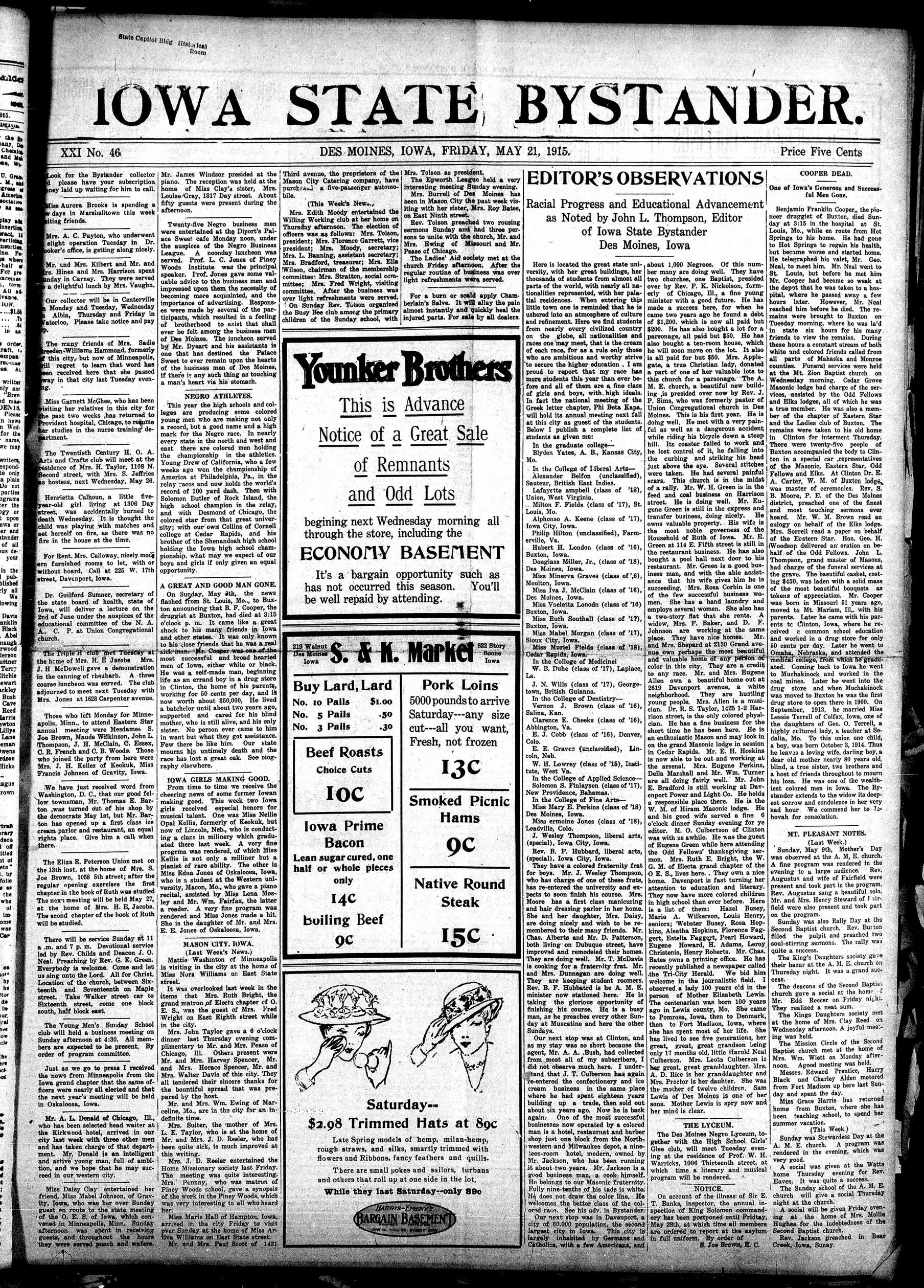
EDITOR'S OBSERVATIONS
Racial Progress and Educational Advancement as Noted by John L. Thompson, Editor of Iowa State Bystander Des Moines, Iowa
Here is located the great state university, with her great buildings, her thousands of students from almost all parts of the world, with nearly all nationalities represented, with her palatial residences. When entering this little town one is reminded that he is ushered into an atmosphere of culture and refinement. Here we find students from nearly every civilized country on the globe, all nationalities and races one may meet, that is the cream of each race, for as a rule only those who are ambitious and worthy strive to secure the higher education. I am proud to report that my race has more students this year than ever before and all of them are a fine class of girls and boys, with high ideals. In fact the national meeting of the Greek letter chapter, Phi Beta Kapa, will hold its annual meeting next fall at this city as guest of the students. Below I publish a complete list of students as given me:
In the graduate college—
about 1,000 Negroes. Of this number many are doing well. They have two churches, one Baptist, have presided over by Rev. F. K. Nickolson, formerly of Chicago, Ill., a fine young minister with a good future. He has made a success here, for when he came two years ago he found a debt of $1,200, which is now all paid but $200. He has also bought a lot for a parsonage, all paid but $50. He has also bought a ten-room house, which he will soon move on the lot. It also is all paid for but $50. Mrs. Applegate, a true Christian lady, donated a part of one of her valuable lots to this church for a parsonage. The A. M. E. church, a beautiful new building, is presided over now by Rev. J. P. Sims, who was formerly pastor of Union Congregational church in Moines. This is his first year. He is doing well. He met with a very painful as well as a dangerous accident while riding his bicycle down a steep hill. His coaster failed to work and
Blyden Yates, A. B., Kansas City, Mo.
In the College of Liberal Arts—Alexander Belfon (unclassified), Sauteur, British East Indies.
Lafayette ampbell (class of '16), Union, West Virginia.
Milton F. Fields (class of '17), St. Louis, Mo.
Alphonso A. Keene (class of '17), Iowa City, Iowa.
Philip Hilton (unclassified), Farmerville, Va.
Hubert H. London (class of '16), Buxton, Iowa.
Douglass MIller, Jr., (class of '18),
Des Moines, Iowa.
Miss Minerva Graves (class of '6), Moulton, Iowa.
Miss Iva J. McClain (class of '16), Des Moines, Iowa.
Miss Vaeletta Lonodn (class of '16) Buxton, Iowa.
Miss Ruth Southall (class of '17),
Buxton, Iowa.
Miss Mabel Morgan (class of '17),
Sioux City, Iowa.
Miss Muriel Fields (class of '18)
Cedar Rapids, Iowa
In the College of Medicine
W. B. Duhe (class of '17), Laplace,
La.
J. N. Wills (class of '17), Georgetown,
British Guiana.
In the College of Dentistry—
Vernon J. Brown (class of '16),
Salina, Kan.
Clarence E. Cheeks (class of '16)
Abbington, Va.
E. J. Cobb (class of '16), Denver, Colo.
E. E. Gravcc (unclassified), Lincoln, Neb.
W. H. Lowrey (class of '15), Institute, West Va.
In the College of Applied Science—Solomon S. Finlayson (class of '17)
New Providence, Bahamas.
In the College of Fine Arts—Miss Mary E. Perkins (class of '18)
Des Moines, Iowa.
Miss errimoe Jones (class of '18),
Leadville, Colo.
J. Wesley Thompson, liberal arts, (special), Iowa City, Iowa.
Rev. B. F. Hubbard, liberal arts, (special), Iowa City, Iowa.
They have a colored fraternity frat for boys. Mr. J. Wesley Thompson, who has charge of one of these frats, has re-entered the university and expects to soon finish his course. Mrs. Moore has a first class manicuring and hair dressing parlor in her home. She and her daughter, Mrs. Daisy, are doing nice and wish to be remembered to their many friends. Mr. Chas. Alberts and Mr. D. Patterson, both living on Dubuque street, have improved and remodeled their homes. They are doing well. Mr. T. McDavis is cooking for a fraternity frat. Mr. and Mrs. Dunnegan are doing well. They are keeping student rooms. Rev. B. F. Hubbard is he A. M. E. minister now stationed here. He is taking the glorious opportunity of finishing his course. He is a busy man, as he preaches every other Sunday at Muscatine and here the other Sundays.
Our next stop was at Clinton, and as my next was so short because the agent, Mr. A. A. Bush, had collected from most all of my subscribers, I did not observe much here. I understand that J. T. Culberson has again entered the confectionery and ice cream business in the same place where he had spent eighteen years building up a trade, then sold out about six years ago. Now he is back again: One of the most successful businesses now operated by a colored man is a hotel, restaurant and barber shop just one block from the Northwestern and Milwaukee depot, a nine-teen-room hotel, modern, owned by Mr. Jackson, who has been running it about two years. Mr. Jackson is a good business man, a cook himself. He belongs to the Masonic fraternity. Fully nine-tenth of his jade is white. He does not draw the color line. He welcomes the better class of the colored race. See his adv. in Bystander. Our next stop was in Davenport, a city of 60,000 population, the second largest city in Iowa. This city is largely inhabited by Germans and Catholics, with a few Americans, and
THE LYCEUM.
The Des Moines Negro Lyceum, together with the High School Girl's Glee club, will meet Tuesday evening at the residence of Prof. W. H. Warriicks, 1006 Thirteenth street, at which time a literary and musical program will be rendered.
NOTICE.
On account of the illness of Sir E. T. Banks, inspector, the annual inspection of King Solomon commandery has been postponed until Friday, May 28th, at which time all members are ordered to report at the asylum in full uniform. By order of
COOPER DEAD.
One of Iowa's Generous and Successful Men Gone.
MT. PLEASANT NOTES.
Sunday, May 9th, Mother's Day was observed at the A. M. E. church. A fine program was rendered in the evening to a large audience. Rev. Augustus and wife of Fairfield were present and took part in the program. Rev. Augustus sang a beautiful solo. Mr. and Mrs. Henry Steward of Fairfield were also present and took part on the program.
Sunday was also Rally Day at the Second Baptist church. Rev. Burton filled the pulpit and preached two soul-stirring sermons. The rally was quite a success.
The King's Daughters society gave their bazar at the A. M. E. church on Thursday night. It was a grand success.
The deacons of the Second Baptist church gave a social at the home of Mr. Edd Reecer on Friday night. They realized a neat sum.
The Kings Daughters society met at the home of Mrs. Clay Reed on Wednesday afternoon. A joyful meeting was held.
The Mission Circle of the Second Baptist church met at the home of Mrs. Wm. Wiem on Monday afternoon. Agood meeting was held.
Messrs. Edward Prentice, Harry Black and Charley Alden motorized from Fort Madison up here last Sunday and spent the day.
Miss Grace Harris has returned home from Buxton, where she has been teaching school, to spend her summer vacation.
Sunday was Stewardess Day at the A. M. E. church. A program was rendered in the evening, which was very good.
A social was given at the Watts home Thursday evening for Rev. Eaves. It was quite a success.
The Sunday school of the A. M. E. church will give a social Thursday night at the church. A social will be given Friday evening at the home of Mrs. Mollie Hughes for the indebtedness of the Second Baptist church.
Rev. Jackson preached in Bear Creek, Iowa. Spuny.
AFRO-AMERICAN CULLINGS
How to help colored children in the public schools toward a more hopeful future than present social conditions promise them, was discussed by educators, welfare workers, and city officials at a conference held April 29 at 180 East Twenty-second street, by the Pennsylvania Education Association. The report issued a report on "Colored School Children in New York," prepared by Miss Frances Blascoe, which, made after a careful investigation, outlines the needs of the 90,000 Negroes in the city, and gives specific recommendations for improving the conditions under which they live. This report was the basis of discussion at the conference by Elmer Hope Johnson, chairman of the school children of the association, says in the introduction to the report:
"We are constantly learning through the interpretation by sympathetic students of various races of immigrants, the several ways in which these aliens may contribute to our national life; and each discovery, especially in the different fields of art, is halted with joy by constructive patrons. Surely it is time for the Negro to be considered in the light of a national asset, and his loyalty, patience, sympathetic kindness, and artistic instinct be counted on as real contributions to our national welfare.
"The report gives few, perhaps no, recommendations that would not apply to the children of other races. Where the application is more true in regard to colored children it seems to be largely because of this lack of equal justice in the cases of their parents. Race weakness appears, but this could easily be balanced by the same or similar weakness in other races. Given an education carefully adapted to his needs and a fair chance for employment, the normal child of any race will succeed, unless the burden of wrong home conditions lies too heavily upon him. Any philanthropic effort for the encouragement or improvement of these children, to be successful, must take into account their peculiar virginies—affection, loyalty, home-loving spirit—not their defects. It is this conclusion of the report which applies to colored children more than to the children of any other race, and should make them easier rather than harder to learn. Their national and country has a very real debt to pay and it can be paid only by helping these children to find for themselves the place in our nation which shall contribute meat to their own and its development—New York Evening Post.
Among the Negroes of the country there has, in late years, developed an increasing tendency toward home ownership, a marked increase in the percentage of school attendance, a pronounced decrease in the percentage of illiteracy, decrease in the mortality rate, and an increase in the proportion of church membership. From 1790, when the Negro population was numbered 757,208, it increased to 9,827,763 in 1910, when the last census was taken, there has been a continuous decrease which the Negroes have formed, the total population, due, at least in part, to the fact that the white population has been continually augmented by immigration, while there has been very little immigration of Negroes during the past hundred years. The largest Negro population in any state in 1910 was that of Georgia.
Why is the death rate among Negroes, in northern cities and southern cities alike, almost twice as great as among whites? At the last census the average death rate in the 67 registration cities was 15.9 per thousand among whites, while among Negroes it was 27.8. In the North the ratio was roughly 15 to 25, in the South 16 to 29. Taking those degeneracies that have nervous prickles or that come from the white breast, whites was greater, but in tuberculosis and pneumonia, the plague of both races, the havoc among Negroes preponderates enormously. What are the reasons for this hideous disparity? The reason, in everyone may guess, is the poverty of the Negro. The death rate stands in almost fixed relation to housing conditions, and it is clearly proved that as home ownership increases, the death rate diminishes. In the nomically inferior, their portion will not merely be social hardship but a vastly greater share of physical suffering and mortal disease. It is these hard facts that make race prejudice so base. The only prejudice that figures
The last siege of Vienna was made by the Austrians themselves. This was in 1848, when, during the Hungarian revolution, Vienna fell into the hands of the insurgents, who were dislodged only after two days' bombardment.
Kukul nut oil is a valuable Hawaiian product and is in demand in the paint and varnish trade. It has been shipped to the United States from various pacific islands for the last 75 years.
In our town little attention is paid to cartorial convention. When a man removes the lead paint from the top pocket of his vest he is dressed for the party.
1,176,987. In that year Mississippi and South Carolina had a Negro population exceeding that of the white, and in each of fifty-three counties, scattered throughout the states of Mississippi, Louisiana, Alabama, South Carolina, Georgia, Arkansas, Florida and Tennessee, at least seventy-five per cent of the total population was Negro. Of the southern states West Virginia had the smallest percentage, 5.3. In the period of 1900-1910 the greatest gain, both numerically and proportionally, in this class of population was shown by Birmingham, Al., whose Negro residents increased to the number of 35,730, or to the surprising per cent of 215. The country as a whole indicated that literacy among this class is gradually being reduced, it being shown between the ages of six and twenty slightly over forty, the twenty were enrolled in a large gain in recent reports. Virginia had by far the largest percentage of Negro-owned homes, while Mississippi ranked first in farms. Deaths caused by malaria, tuberculosis of the lungs, other forms of tuberculosis, pneumonia and whooping cough are relatively more numerous among Negroes than among whites; while the mortality due to measles, scarlet fever, diphtheria, cancer, appendicitis, diarrhea and violence (including suicide) is noticeably higher among whites.
Editor of the Washington Herald: In the Herald of April 20 appears a notice to the effect that the body of Lleut. Beverly Perea, U. S. A., brought from Cambridge, Mass., was the first colored officer to be buried in the Arlington National cemetery. This statement is not correct, as the bodies of both Dr. Alexander T. Augusta, surgeon, Severn U. S. C. infantry, surgeon in chief of Freeman's hospital, and for many years a practicing physician in this city, and Capt. O. S. B. Wall of this city have been buried in the Arlington National cemetery, for many years, both being buried in the officers' section, with monuments standing over their graves; the former officer's grave is close to the gate and the latter not far removed therefrom. In addition to these two officers of whose burial I have personal knowledge (and here may be others of mine, no knowledge) there are hundreds of colored soldiers buried in Arlington. The records at Arlington will confirm the facts as stated.
Delivering that it is the purpose of your paper to publish only facts, I am calling your attention to this matter that it may be corrected—Hamilton S. Smith.
In compliance with his dying wish. Lieut. Beverly Perea, U. S. A., retired, who died in Cambridge, Mass., recently, was buried in Arlington national cemetery—the first colored man to be buried there. His wife and daughter accompanied the body to Washington. Seems of his friends in the cemetery the burial.
That he might be buried in the national cemetery at Arlington was the wish expressed by Lieutenant Perex shortly before his death. His widow communicated this to Secretary Garrison of the war department through Major Curley, with the result that permission was given.
New York has about 700,000 school children.
like these should induce is prejudice against a poverty which is literally more pestilential than war—New Republic.
President Wilson, through Secretary Garrison, has officially complimented the officers and enlisted men of the Ninth and Tenth cavalry cavalry units their wounds in patrolling the Mexican order line to neutralize the neutrality laws of the United States during the fighting between the Carranza and Villa forces. Several American soldiers were wounded during the engagements between the Mexican forces.
"By direction of the president," says Secretary Garrison, "I take great pleasure in expressing to the officers and enlisted men of the Ninth and Tenth cavalry his appreciation of splendid service and efficient service in the enforcement of United States neutrality laws at Nacor Ariz, during November, December and January last."
The Ninth cavalry is at Fort Douglas, Ariz, and the Tenth cavalry is at Fort Huachuca, Ariz.
Willie D. James of Bethlehem, Ky., owns a plow which has been handed down from his great-grandfather. It has been all the time on one of the farms now owned by Mr. James—at least 125 years.
The man who begins laughing in the middle of his joke seldom knows anything funny.
It is said of Mrs. Lemuel Wigg that she is as good to old people as she is to bables.
A woman switches on the porch light and goes upstairs to bed secure in the thought that she has frightened away every burglar in the neighborhood.
Government chemists in the Philip pines are investigating the soapmaking possibilities of a new species of oil-bearing nut that has been discovered.
Somersby, Germany, has an oil-bearing nut of whose size
GERMANY IS FAR FROM THE END OF HER RESOURCES
Allies Will Have Long Wait If They Hope to Starve Her Out.
STAFF OFFICER GIVES FACTS
Chemists Promise Surprise as Great as the 428 and Submarines—Women Are Taking an Important Part in the War.
By COUNT MOURIK DE BEAUFORT International News Service Correspondent Berlin.—The man who keeps Germany eating and shooting," thus was Dr. Walther Rathenau, the son of the founder of the A. D. G. (Allegemeine Electriciteta Gesellschaft), described to me. Doctor Rathenau is chief of the raw material department of the German war office.
Doctor Rathenau speaks perfect English, and most of the conversation was carried on in that language.
"Of course, the subjects nearest to my heart were copper, rubber and petrol. I had found in previous conversations—or I should better say "attempted conversations," because I never got very far on these subjects—that they were extremely delicate topics, and it was pointed out to me on different occasions that it would be more "tactful" not to touch on them. I was very careful with German's supply of raw material—"Yes, it's a very nice day, isn't it" or, as the case might be, "isn't this wretched weather."
Doctor Rathenau looked at me for a moment out of the corner of his eyes, then got up, and from a drawer of his desk—the interview took place at the war office—took up a fair-sized book and, holding it up before my eyes, gave me the opportunity to see something about "Rohstoffe in Deutschland" (raw material in Germany). My heart began to beat faster. "At last," I thought, "we'll get some real authentic figures; fine story." But the truth of the saying that there is many a slip 'twirt a story in the war office and the same in the paper came true once more.
Deep Secrets of War.
"This," said Doctor Rathenau, while patting the wretched little volume tazlingly, "contains everything about every grain of raw material in this country, the means and methods of producing and obtaining more; in short, all you would like to know are days but, but we are dead, secrets of war," and therefore I cannot show it to you any further than on the outside."
That was almost worse than the usual replies I had received. No amount of diplomacy, arguments, wheedling or promises could persuade the polite doctor to part with the little volume, not even for a minute.
"All I can tell you," he said, "is that starved people, till we are short of copper, well, they'll have a jolly long wait."
Then the subject was changed. "Why don't you go and take some of the menus in our large restaurants, have photographic copies taken of them and verified by your consult? Send those abroad, and let people judge for themselves how badly we are starving." "But, as you were saying, copper—" "You are very insistent," he fired back, "but I'll try to help you a little, and I assure you you are the first with whom I have discussed this subject at all. If you take the yearly statistics you will find that Germany during the war had imported an average of over 200,000 tons of copper a year. With our own production, Mansfield, our total supply amounted close to 250,000 tons. Our exports of electrical goods, machinery, etc., in which copper has been used, did not exceed 100,000 tons a year, so nearly 150,000 tons of copper has remained in the country.
Can Recover Much Copper.
"Much of this has been combined with other metals, but we have experimented and our chemical developments have reached such a stage of perfection that over 75 per cent can be reduced again to pure copper. For one, we have thousands of tons of telegraph wires which can be substituted with copper. Then go into some of the German metal. There is hardly a house where you will not find a certain number of copper pans and pans in shining glory.
"Look at the amount of copper that is used in every house, every hotel, every building. Our mines at Mansfield have turned out close to 30,000 tons a year, but we have been able to increase the output by at least 50 percent. Besides, there are one or two sources which our enemies have not figured on. One of them is the womens' development our chemistry has reached, the best brains in the land are working on a new product that may give the world in general, and our enemies in thecular, another surprise, as did our 424, and our submarines. No, we are not, the end of our resources yet, not by a long way. Germany cannot be destroyed."
Doctor Rathenau expressed as his
Explorer Heather Narrative in Brazil Strikingly Similar to the Story of the Creation.
Philadelphia—The University of Pennsylvania museum has discovered a new Garden of Eden, and the "Tree of Life" is still there, though ported. This was learned by Dr. William C. Purshee, leader of the university museum's Amazon expedition, who visited the site.
THE TRAIN
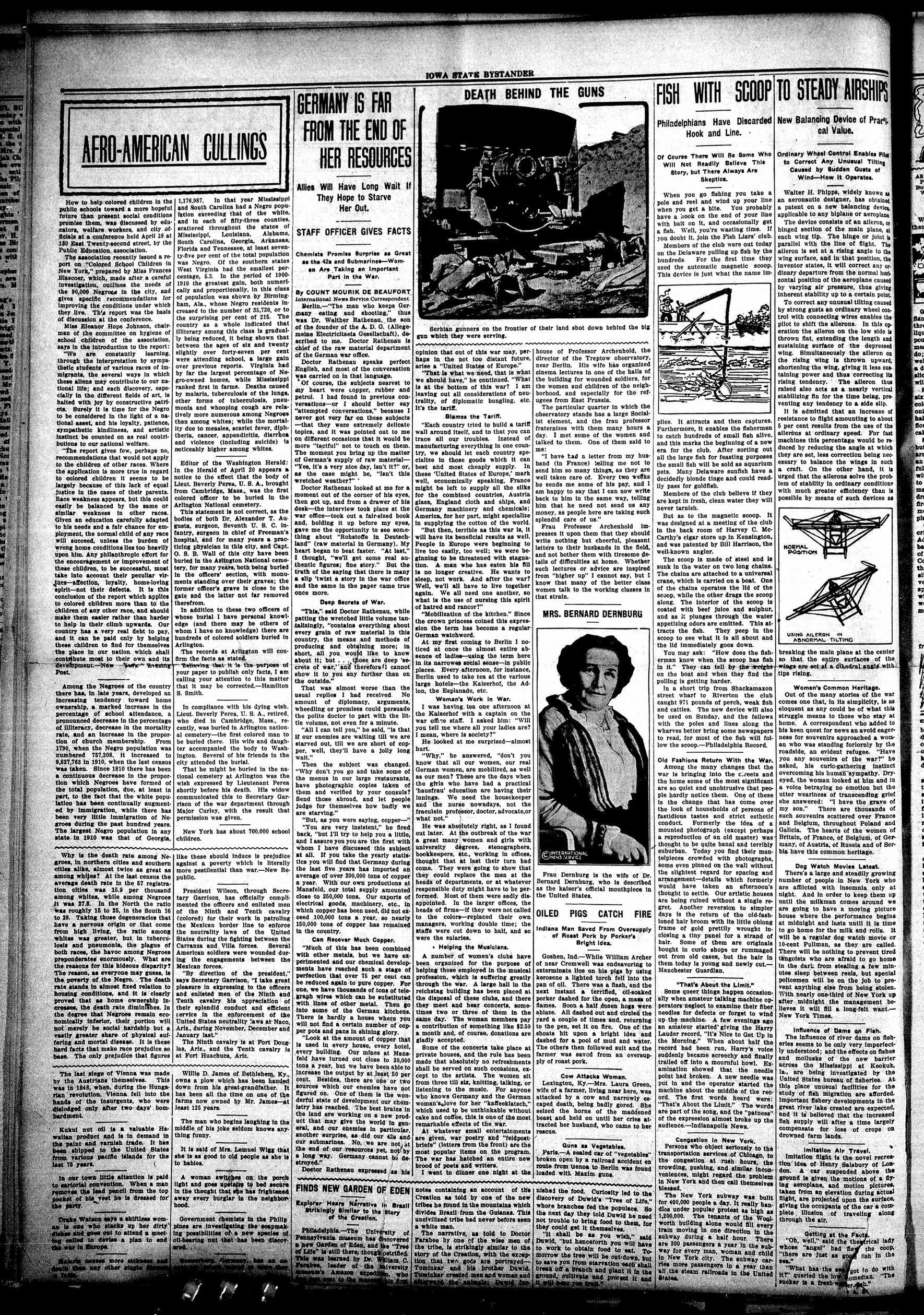
Serbian gunners on the frontier of their land shot down behind the big gun which they were serving.
IOWA STATE BYSTANDER
DEATH BEHIN
Serbian gunners on the frontier of gun which they were serving.
opinion that out of this war may, perhaps in the not too distant future, arise a "United States of Europe." "That is what we need, that what we should have," he continued. "What is at the bottom of this war? I am leaving out all considerations of neutrality, of diplomatic bungling, etc. it's the tariff."
Blames the Tariff.
"Each country tried to build a tariff wall around itself, and to that you can trace all our troubles. Instead of manufacturing everything in one country, we should let each country specialize in those goods which it can best and most cheaply supply. In these 'United States of Europe,' mark well, economically speaking, France might be left to supply all the silks for the combined countries, Austria glass, England cloth and ships, and Germany machinery and chemicals; America, for her part, might specialize in supplying the cotton of the world. "But then, terrible as this war is, it will have its beneficial results as well. People in Europe were beginning to live too easily, too well; we were beginning to be threatened with stagnation. "The man who has been brilliant and hard-working. He wants to sleep, not work. And after the war 'Well, we'll all have to live together again. We all need one another, so what is the use of nursing this spirit of hatred and rancor?"
"Mobilization of the kitchen." Since the crown princess coloned this expression the term has become a regular German watchword. At my first coming to Berlin I noticed at once the almost entire absence of ladies—using the term here in its narrowes social sense—in public places. Every afternoon, for instance, Berlin used to take tea at the various large hotels—the Kaiserhof, the Adlon, the Esplanade, etc.
Woman's Work In War.
I was having, tea one afternoon at the Kaiserhof with a captain on the war office staff. I asked him: "Will you tell me where all your ladies are? I mean, where is society?" He looked at me surpriSED—almost hurt. "Why," he answered, "don't you know that all our women, our real German women, are mobilized, as well as our men? These are the days when 'haunfrau' education are having their innings. We need the housekeeper and the nurse nowadays, not the freaulek professor, doctor, advocate, or what not."
He was absolutely right, as I found out later. At the outbreak of the war a great many women and girls with university degrees, stenographers, bookkeepers, etc., working in offices, thought that at last their turn had come. They were going to show that they could replace the men at the heads of departments, or at whatever responsible duty might have to be performed. Most of them were sadly the heads of them, the latter officiated the heads of firms—if they were not called to the colors—replaced their own managers, working double time; the staffs were cut down to half, and so were the salaries.
- Helping the Musicians.
A number of women's clubs have been organized for the purpose of helping those employed in the musical profession, which is suffering greatly through the war. A large hall in the rechstag building has been placed at the disposal of these clubs, and there they meet and hear concerts, sometimes two or three of them in the same day. The woman members pay a contribution of something like $2.50 a month and, of course, donations are gladly accepted.
Some of the concerts take place at private houses, and the rule has been made that absolutely no refreshments shall be served on such occasions, excluding the women sit from three till six, knitting, hailing, or listening to the music. For anyone who knows Germany and the German woman *slove* for her *"kaffeelakst," which used to be unthinkable without cake and coffee, this is one of the most remarkable effects of the war.
At whatever small entertainments are given, war poetry and 'feldpoetbrble' (letters from the front) are the most popular items on the program. The war has hatched an entire new brood of poets and writers.
I went to dinner one night at the notes containing an account of the Creation as told by one of the new tribes he found in the mountains which divides Brazil from the Guianas. This uncleviled tribe had never before seen a battle. The narrative, as told to Doctor Farabee by one of the wise men of the tribe, is strikingly similar to the story of the Creation, with the exception that two gods are portrayed—Tumikar and his brother Duwid. Tumikar created men and women and became the animals Duwid for
house of Archon, the director of the Treptow observatory, near Berlin. His wife has organized cinema lectures in one of the halls of the building for wounded soldiers, for the women and children of the neighborhood, for the refugees from East Prussia.
The particular quarter in which the observatory stands has a large Socialist element, and the frau professor fraternizes with them many hours a day. I met some of the women and talked to them. One of them said to me:
"I have had a letter from my husband (in France) telling me not to send him so many things, as they are well taken care of. Every two weeks he sends me some of his pay, and he sends me of that I can now write back to him in the same way, telling him that he need not send us any money, as people here are taking such splendid care of us."
Frau Professor Archenhold impresses it upon them that they should write nothing but cheerful, pleasant letters to their husbands in the field, and not bother them with tiresome details of difficulties at home. Whether such lectures or advice are inspired by the real world, we know that many of the better class women talk to the working classes in that strain.
MRS. BERNARD DERNBURG
INTERNATIONAL
NEWS SERVICE
Frau Dernburg is the wife of Dr. Bernard Dernburg, who is described as the kaiser's official mouthpiece in the United States.
Indiana Man Saved From Oversupply of Roast Pork by Porker's Bright Idea.
Goshen, Ind.—While William Archer of near Cromwell was endeavoring to exterminate lice on his pigs by using kerosene a lighted torch fell into the pan of oil. There was a flash, and the next instant a terrified, oil-soaked porker dashed for the open, a mass of flames. Soon a half dozen hogs were ablaze. All dashed out and circled the yard a couple of times and, returning to the pen, set it on fire. One of the shoats hit upon a bright idea and dashed for a pool of mud and water. The others then followed suit and the farmer was saved from an oversupply of roast pork.
Cow Attacks Woman
Lexington, Ky.—Mrs. Laura Green, wife of a farmer, living near here, was attacked by a cow and narrowly escaped death, being badly gored. She seized the horns of the maddened beast and held on until her cries attracted her husband, who came to her rescue.
**Guns as Vegetables.**
Paris—A sealed car of "vegetables" broken open by a railroad accident en route from tenuous Berlin was found loaded with Maxim guns.
nished the food. Curiosity led to the discovery of Duwid's "Tree of Life," whose branches fed the populace. So the next day they told Duwid he need not trouble to bring food to them, for the ground get it themselves.
"It shall be a you wish," said Duwid, but honecency you will have to work to obtain food to eat. Tomorrow the tree will be down, but to save from starvation it shall break off a branch and plant it on ground, cultivate and protect it and it will keep you free.
---
Philadelphia Have Discarded Hook and Line.
Of Course There Will Be Some Who Will Not Readily Believe This Story, but There Always Are Skeptics.
When you go fishing you take a pole and reel and wind up your line when you get a bite. You probably have a hook on the end of your line with bait on it, and occasionally get a fish. Well, you're wasting time. If you doubt it, join the Fish Liar's club. Members of the club were out today on the Delaware pulling up fish by the hundreds. For the first time they used the automatic magnetic scoop. This device is just what the name im
plies. It attracts and then captures. Furthermore, it enables the fishermen to catch hundreds of small fish alive, and this marks the beginning of a new era for the club. After sorting out all the large fish for feasting purposes the small fish will be sold as aquarium pets. Many Delaware sunfish have a decidedly blonde tinge and could readily mass for goldfish.
Members of the club believe if they are kept in fresh, clean water they will never tarnish.
But as to the magnetic scoop. It was designed at a meeting of the club in the back room of Harvey C. McCarthy's cigar store up in Kensington, and was patented by Bill Harrison, the well-known angler.
The scoop is made of steel and is sunk in the water on two long chains. The chains are attached to a universal crane, which is carried on a boat. One of the chains operates the lid of the scoop, while the other drags the scoop along. The interior of the scoop is coated with beef juice and sulphur, and as it plunges through the water, appetizing oils are emitted. This atk operates the scoop in the scoop to see what it is all about and the lid immediately goes down.
You may ask: "How does the fisherman know when the scoop has fish in it?" They can tell by the weight on the boat and when they find the pulling is getting harder.
In a short trip from Shackamaxon street wharf to Riveton the club caught 971 pounds of perch, weak fish and catties. The new device will also be used on Sunday, and the fellows will learn how to wharf their wharves better bring some newspapers to read, for most of the fish will follow the scoop.—Philadelphia Record.
Old Fashions Return With the War.
Among the many changes that the war is bringing into the streets and the home some of the most significant are so quiet and unobtrusive that people hardly notice them. One of these is the change that has come over the look of households of persons of fastidious tastes and strict esthetic conduct. Formerly the idea of a mounted photograph (except perhaps a reproduction of an old master) was thought to be quite banal and terribly suburban. Today you find their manniple pieces crowded with photographs, some even pinned on the wall without the slightest regard for spacing and arrangement—details which formerly would have taken an afternoon's thought to settle. Our artistic houses being gone, without a single regime, with a revision to simpler days is the return to the fashioned hair broom with its little frame of gold pretty wrought closing a tiny panel for a strand of hair. Some of them are originals bought in curio shops or rummaged out from old cases, but the hair in them today is young and newly cut.—Manchester Guardian.
Some queer things happen occasionally when amateur talking machine operators neglect to examine their fiber needles for defects or forget to wind up the machine. A few eveningages ago an amateur started 'giving the Harry Lauder record, "It's Nice to Up in the Morning." When about half the record had been run, Harry's voice suddenly became screechy and finally trailed off into a mournful howl. Examination showed that the needle point had broken. A new needle was put in and the operator started the machine about the middle of the record. The first words heard were: "That's About the Limit." The words are part of the song, and the "patroness" of the expression almost broke up the audience.-Indianapolis News.
Congestion in New York.
Persons who object seriously to the transportation services of Chicago, to the congestion at rush hour, the crowding, pushing, and similar inconveniences, might regard the problem in New York and then call themselves blessed.
The New York subway was built for 400,000 people a day. It really handles under popular protest as high as 1,200,000. The tenants of the Woolworth building alone would fill every building with one direction in the subway during a half hour. There are 300 passengers a year, and subway for every man, woman and child in New York city. The subway carries more passengers in a year than all the steam railroads in the United States.
```markdown
```
"That's About the Limit."
New Balancing Device of Practical Value.
Ordinary Wheel Control Enables Pilot to Correct Any Unusual Tilting Caused by Sudden Gusts of Wind—How It Operates.
Walter H. Phipps, widely known as an aeronautic designer, has obtained a patent on a new balancing device, applicable to any biplane or aeroplane. The device consists of an alleron, or hinged section of the main plane, at each wing tip. The hinge or joint is parallel with the line of flight. The alleron is at a rising angle to the wing surface, and in that position, the inventor states, it will correct any ordinary departure from the normal horizontal position of the aeroplane caused by varying air pressure, thus giving inherent stability up to a certain point.
To correct any unusual lifting caused by strong gusts an ordinary wheel control with connecting wires enables the pilot to shift the allerons. In this operation the alleron on the low side is thrown flat, extending the length and sustaining surface of the depressed wing. Simultaneously the alleron on the rising wing is thrown upward, shortening the wing, giving it less sustaining power and thus correcting its rising tendency. The alleron thus raised also acts as a nearly vertical stabilizing fin for the time being, preventing any tendency to a side slip. It is admitted that an increase of resistance to flight amounting to about 5 per cent results from the use of the allerons at ordinary speed. For fast machines this percentage would be reduced by reducing the angle at which they are set, less correction being necessary to balance the wings in such a craft. On the other hand, it is urged that the allerons solve the problem with much greater efficiency than is possible by means of such devices as
NORMAL POSITION
USING AILERON IN ADNORMAL TILTING
breaking the main plane at the center so that the entire surfaces of the wings are set at a dihedral angle with tips rising.
Women's Common Heritage
Out of the many stories of the war comes one that, in its simplicity, is as eloquent as any could be of what this struggle means to those who stay at home. A correspondent who added to his keen quest for news an avoid eagerness for souvenirs approached a woman who was standing forly by the roadside, an evident refugee. "Have you any souvenirs of the war?" he asked, his curio-gathering instinct overcoming his human sympathy. Dryeyed, the woman looked at him and in a voice betraying no emotion but the utter weariness of transcending grief she had given the girl of her my son. "There are hundreds of such souvenirs scattered over France and Belgium, throughout Poland and Galicia. The hearts of the women of Britain, of France, of Belgium, of Germany, of Austria, of Russia and of Serbia have this common heritage.
Dog Watch Movies Latest.
There's a large and steadily growing number of people in New York who are afflicted with insomnia only at night. And in order to keep them up until the milkman comes around we are going to have a moving picture house where the performance begins at midnight and lasts until it is time to go home for the milk and rolls. It will be a regular dog watch movie or 10-cent Pullman, are they called. There will be nothing to prevent tired tingbals who are afraid to go home in the dark from stealing a few minis, but the police will be but the police will be on the job to prevent anything else from being stolen. With nearly one-third of New York up after midnight the management believes it will fill a long-felt want. New York Times.
Influence of Dama on Flab:
The influence of river dams on fisheries seems to be only very imperfectly understood; and the effects on fishes and mollusks of the new barrier across the Mississippi at Keokun, Ia., are being investigated by the United States bureau of fisheries. At this place unusual facilities for the study of fish migration are afforded. Important fishery developments in the great river lake created are expected, and it is believed that the increased fish supply will after a time largely compensate for loss of crops on drowned farm lands.
Imitation Air Travel.
Imitation flight is the novel recreation idea of Henry Salbury of London. A car suspended above the ground is given the motions of a flying aeroplane, and motion pictures, taken from an elevation during actual flight, are projected upon the surface, giving the occupants of the car a complete illusion of traveling along through the air.
Getting at the facts.
"Oh, well," said the theoretical lady whose "angel" had flew the coop, "there are just a good fish in the sea.
What has the sea got to do with it?" queried the low comedian. "The stocker is a fresh-water fish."
The KITCHEN CABINET
This is the time when the dandelion greens as well as other growing green things should be often served. Perhaps you may find a few bunches of blanched dandelion plants which have been growing under a board; they will be white, crisp and delicate. Wash and cut them, adding a bit of chopped onion and oil with vinegar, salt and pepper. The delicate bitter of the dandelion makes them especially well liked and a good tonic. Veal Fricassées—Cut a piece of the breast of veal into small pieces and fry in butter until brown, spritze with flour, salt, nutmeg; add a bit of bay leaf and a few peppercorns, cover with water and cook slowly for an hour on the back of the stone or very slow heat. Beat two eggs, mix with a little of the gravy, then add to the meat. Serve on a hot platter with the gravy poured over the meat.
Liver Dumplings.—Put a half pound of calf's liver through a meat grinder. Spak a thick slice of bread in water and squeeze dry. Put a tablespoonful of butter into a frying pan, add a tablespoonful of chopped onion, salt and pepper to taste. Beat three eggs and pour into the pan. Now mix the liver with the gravy. Roll out some crackers, make balls of the liver, dip in cracker crumbs and add to any good beef soup. Cook until well done. Serve with the soup.
Nuts and Egg on Toast.—Toast slices of bread, butter well and serve with three eggs, half a cupful of chopped nut meats, one tablespoonful of cream and a dash of pepper and salt; stir together the cream into a bowl and a tablespoonful of oil has been heated. Mix and stir as it thickens. Serve on the toast when firm.
A thin slice of pineapple put on a buttered slice of bread spread with cream cheese makes a most dainty sandwich.
A pretty dish and one which is most palatable is green peas cooked in very little water seasoned with butter and poured over hard cooked eggs cut in eighths. The root cooked until tender and served in a sour sauce, either hot landaise or piquante, makes a pala table salad for a change.
Oranges are adapted to many dishes, as well as drinks; they make good soup, puddings, salads and desserts, not to mention cakes and cake fillings. Oranges alcedo and sprinkled with avar gare are a delicious sauce to serve with cake and will thus take the place of a dessert.
Combined with stale cake and custard, oranges form a most delicious dessert.
Orangeade—Take two cupfuls of orange juice, add 1/4 cupful of sugar, one cupful of strained cranberry sauce and two quarts of water. Boil the sugar and water together for five minutes, then cool and add the strained juices. Garnish the glass with a thin slice of orange or a hit of the peek hung on the edge of the glass.
Orange Puffs—Take a cupful of flour, and a half cupful of sugar, a half cupful of milk; sift with the flour a teaspoonful of baking powder with a half teaspoonful of salt, add one egg, beaten, add one tablespoonful of melted butter, flavor with the grated rind of an orange. Steam in buttered cups 25 minutes and serve with orange sauce.
Orange Sauce.-The juice of two oranges, one cup of boiling water, one tablespoonful of lemon juice, two tablespoonfuls of cornstarch, four tablespoonfuls of sugar. Mix the sugar and cornstarch and add the water, cook until the starch is well cooked; add a tablespoonful of butter and the orange juice with a little grated rind. Orange Salad.-Serve neat slices of orange on lettuce with a dressing of oil and vinegar. This is especially good with game. Another nice way to serve it is in overlapping slices on a long salad dish garnished with candied cherries. Oranges and grapes with a bit of pineapple is another fine combination for a fruit salad. Sponge cake flavored with orange and served with an orange filling, then frosted with an icing flavored with lemon juice and orange rind is a delicious dessert.
Nellie Max well
Ole Mining Tubes
An excellent receptacle for sending flowers by post is a mailing tube. Lay the waxed paper in such a shape that they will fit the tube. Sprinkle lightly with water. Place a bunch of wet cotton or tissue paper at the ends of the stems. Roll the flowers up carefully in the paper and twist the ends securely. Slide them into the tube. The paper which wraps the tube should be large enough to tuck in well at the ends to prevent the flowers from slipping.
How Bacteria Live Forever.
Bacteria may be properly described
an immortal, because when they attain
an age of fifteen minutes they each
divide in two and continue so dividing
indefinitely. If all the conditions were
ideal one bacterium would in twenty-
dale houses become forty thousand bili-
lion billion.
Scared Him Off.
"Was your new dress very costly?"
"Very. Papa told my dance what
it cost him, and he has disappeared."
All worthy he who prompt responds,
Prepared for every fate;
But worthier he of higher praise
Who, trusting, learns to wait.
When cooking onions or preparing them to use fresh, add a little soda to
kigh onions or preparing
kigh, add a little soda to
the sliced onions and
let stand in cold water
for ten minutes, rinse,
and they are ready for
use. Soyer, the great
creator of this
credited with this
wisdom. People who
who cannot otherwise eat
onions can enjoy them
prepared thus.
the sliced onions and let stand in cold water for ten minutes, rine, and they are ready for use. Soyer, the great paper bag expert, is credited with this wisdom. People who cannot otherwise eat onions can enjoy them prepared thus.
German Ginger Two pounds of frank beef until tender, then put through a meat grinder. Add to the liquid saved from the boiled beef, a pound of cornmeal and cook until the meal is well cooked, a half-hour will do; then mix with it the meat, season well with pepper and salt and cool in a deep dish. When wanted to use, cut slices and fry a deep brown. This will keep some time.
Potato Pancakes—Peel and grate six potatoes which have stood in water to harden. Mix one grated onion with the potato, two eggs, a half teaspoonful of baking powder and flour to make a thin batter. Fry in cakes until a deep brown.
Macaroni With Mutton.—Brown in butter a few slices of cold mutton and arrange them on a platter. Chop half an onion, fry in butter and add a cupful of stock, one cupful of tomato pulp with salt and pepper to season; bring to the boiling point, add a cupful of macaroni, cooked in salted water and drained. Stir all together over the fire and fire heat, poured around the meat heaped in the center of the platter.
Calf's Liver in Casserole.—Fry until crisp and brown five slices of bacon. Add to the hot fat, one dozen potato balls, one dozen potato balls, one stalk of celery, diced, and six sliced onions. Cook in the oven, and six slices onions. Place in the casserole. Wash the sliced liver and lay on top of the vegetables, add seasonings, a table-spoonful of kitchen bouquet, cover with a pint of boiling water and cook well covered for an hour. Do not remove the cover while it is cooking.
FOR THE LOBSTER LOVER.
Where lobsters are to be obtained fresh and in good condition, there is no more highly prized delicacy. It is not so many years ago that we were taught to plunge live lobsters into boiling water to kill them. We have learned that this is unnecessary cruelty, as they can be quickly killed by thrusting a
delicacy. It is not so many years ago that we were taught to plunge live lobsters into boiling water to kill them. We have learned that this is unnecessary cruelty, as they can be quickly killed by thrusting a sharp knife into the back between the body and tail shell; death will occur at once. For those of us who have endured the sensation of dropping a lively lobster into a kettle of water and felt like a murder, this method will seem easy. Lobsters which are all of the same and heavy are also good. If the tail of a helpless lobster is lifted and sinks back to its curled condition its freshness is assured. If this test fails, reject the lobster, as it is too long dead. The coral of lobster is red, the spawn is green before it is cooked, when it turns red, as do lobsters, as they are green before boiling.
A broiled lobster is a most delicious dish and one in which the epicure delights. Kill the lobster as described, and split down the back with a sharp knife and mallet, remove the stomach and intestines; the stomach is directly under the head, the intestines runs the length of the tail piece and are often colorless, so must not be overlooked. Place the two pieces with the shell part over the heat and broil for a half hour or longer. When half-cooked, season generously with butter, and when thoroughly cooked add butter, salt and lemon juice. Crack the claws before serving.
A Bolled Lobster.—Buy lobsters that are alive and kill them as above, then drop them into a gallon of boiling water, in which a fourth of a pound of salt has been dissolved. Plunge and completely cover the lobster and cook from twenty-five minutes to three quarters of an hour, depending upon the weight of the lobster. If cooked too long the meat will be tough. Break off the claws, crack them at the joints and pick out the meat. Garnish the lobster with the claws and use the shell to serve it in if so desired.
It Was Her Day to Be Absent.
"Some fellows can sure pull down the money easy," growled J. Fuller Gloom. "For instance the person who wrote a recent article of a column and a half telling about the travelling man who smiled and smiled on an aggrivating trip because he felt that when he reached his own home his dear, sweet wife would fall into his arms with a great gush of joy. But when he got home the wife was absent, of course—as every real married man would know."—Kansas City Star.
The, Laugh Is Here.
And now the cats are as responsible as the dogs for spreading disease. By and by we will get to the horses and the birds. We shall be indeed fortunate if, under all these circumstances, we preserve our sense of humor.—New Haven Court Journal.
The Reason.
"I see they hased that new student by rubbing jam through his hair."
"That was only because they wanted his first sweet impressions to stick."
SPRING DISHES.
things should be often served. Perhaps you may find a few bunches of blanched dandelion plants which have been growing under a board; perhaps you may find them and delicate. Wash and cut them, adding a bit
ORANGE DISHES.
body, desserts, not to mention cakes and cakes filling. Oranges almond and sprinkled with sugar are a delicious sauce to serve with cake and will thus take the place of a dessert.
BETTER THAN HEAVY DISHES
As Hot Weather Approaches Fish Should to a Great Extent Take the Place of Meat.
Fish Hash—Prepare the fish as for fish ball; chop fine cold potatoes and mix with fish. Fry brown six good slices of salt pork; take out the pork and turn the hash into the frying pan; add half a cupul of boiling water; let this heat slowly, stirring often; then spread smoothly and brown, bake careful not to let it burn. When brown fold it as you would an omelet dish, and garnish the dish with the slices of pork. When the pork is objected to butter can be used instead.
Fish With Tomato Sauce—One cupful tomatoes, one-half cupul of cheese, one-half of an onion slices. Cook tomatoes water and twenty minutes, tablespoonful of butter, and add one tablespoonful of flour, stir into hot mixture, add one-half teaspoonful peppar, cook until it thickens and strain. Put fish in a baking dish and pour the tomato sauce around it. Bake from fifteen to twenty minutes in a moderate even.
Fish Toast—One cupful faked cold fish, free from skin and bones. Heat in water sufficient to molten; add butter, pepper and salt. When hot pour on slices of buttered toast; garnish with eggs poached in muffin rings.
Scalloped Hallbut—Shred one cupful of cold boiled halbut; pour in the food pan one and one half milk and let come to a boil; add butcher's salt to milk and pepper; then the crumbs of four crackers, add lastly the halbut; let it cook five minutes, then add two hard boiled eggs chopped fine, and serve on a hot platter with bits of buttered toast.
SERVE THIS SUNDAY EVENING
What Is Known as "Farmer's Fruit Cake" is Somewhat Different From the Ordinary Delicacy.
Three coffee cupfuls of dried apples, two of molasses and one of butter, one of sugar, one of raisins stoned and chopped, two eggs, the juice and grated rind of one lemon, two teaspoonfuls of soda and one pound and about one-half cupful over of flour to be of the consistency of soft ginger cake. Put the apples to soak over night. (in cold water), in the morning chop them very fine and stew them in a cupful of water they were soaked in, and add two of molasses. When very soft take them from the fire, turn them out to cool and add to them while warm two teaspoonfuls of powdered cinnamon, the same of cloves and the juice and rind of the lemon. Stir to a cream the butter and the sugar, and add the eggs beaten light, then the apple: add raisins, then the flour and beat the soda dissolved in a tablespoonful of hot water. Bake in a moderate oven an hour and a half or two. Teat with a splint.
Potato Chowder
Pare and cut into thick slices four large potatoes. Peel, slice and brown in a tablepoonful of butter one onion (medium sized); add potatoes to hot fat and onion, then sprinkle with teapoonful of minced parsley (parsley need not be added if not liked). Add boiling water enough just to cover potatoes; cook until tender—do not let them become too dry and burn. When done, add one quart hot milk, salt and pepper to taste, then throw them into a frying pan and fine and the whites minced. After milk is added, add about half a dozen hard crackers and let them steam a little. This will serve five or six persons.
Eggless Cake With Oil.
Cream one-half cupul oil and one cupul sugar, one cupul sour milk, one teaspoonful soda, one teaspoonful each of cassia and cloves, one-half cupul chopped raisins (if desired), one-half teaspoonful salt, two cupuils warmed flour. Be sure not to forget the sugar. Be sure not to must always be remembered; in using the oil use twice as much salt as common.
Colery and Cheese.
Use only the hearts of the celery. The white outside pieces can be cut in small pieces and boiled later for creamed celery, and all the other stalks, the roots and the tender leaves can be boiled tender and strained for celery soup. Cut each heart into pieces and fill the hollow part with cream cheese that has been seasoned with salt and pepper.
Grandma's Cakes.
One cupful sugar and one-half cupful butter creamed until light, then add two well beaten eggs gradually, after all are well mixed add one-fourth teaspoonful baking powder, then enough flour to make dough stiff enough to be kneaded. Bake in oven for 12 minutes, moderate oven. The grownups as well as the young ones can soon make them disappear.
Apple Sauce Omelet.
Beat the yolks of seven eggs light, stir into them five teaspoonfuls of powdered sugar and one and one-half cupfuls of sweetened apple sauce; beat long and hard; stir in the stiffened egg whites, beat for a minute longer and turn into a greased pudding dish. Bake, covered, for about ten minutes, then uncover and brown. Serve at once with whipped cream.
Banbury Tarts.
One cupful of raisins, ground; juice and grated rind of one lemon, one-half cupful of sugar, two tablespoonfuls of boiling water, one soda cracker rolled, salt, season with nutmeg and cinnamon or other desired spices. Boll until the proper thickness and use as filling for turnovers.
Cooking Dried Apples
When you cook dried apples, try adding a little grated orange peel to them before the stewing process. This robe the apple of any dut taste it may have and gives it an added sweet. Grate the apple and add as the white inside skin is bitter.
IOWA STATE BYSTANDER
The HOME
Flowers and
Their Care and
HOME BEAUTY
Dangers and Shrubbess
their Care and Cultivation
The HOME BEAUTIFUL
Flowers and Shrubbery
Their Care and Cultivation
THE HOME OF THE MAYOR
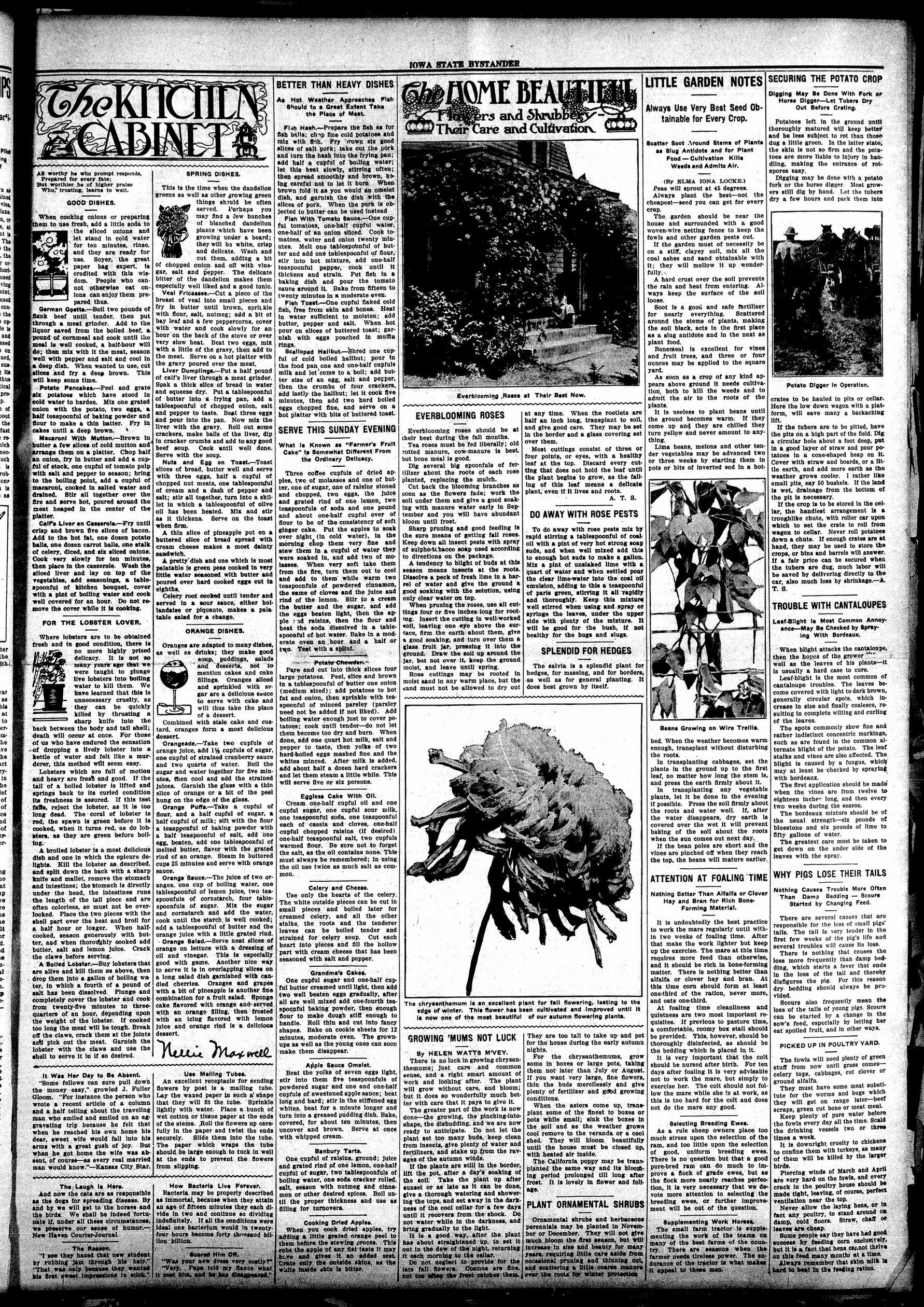
Everblooming Roses at Their Best Now.
EVERBLOOMING ROSES
Everblooming roses should be at their best during the fall months. Tea roses must be fed liberally; old rotted manure, cow-manure is best, but bone meal is good. Dig several big spoonfuls of fertilizer about the roots of each rose planted, replacing the mulch. Cut back the blooming branches as soon as the flowers fade; work the soil under them and give a good soaking with manure water early in September and you will have abundant bloom until frost. Sharp pruning and good feeding is the sure means of getting fall roses. Keep down all insect pests with spray of sulpho-tbaco soap used according to directions on the label. Blight of buds at this season means insects at the roots. Dissolve a peek of fresh lime in a barrel of water and give the ground a good soaking with the solution, using only clear water on top.
When pruning the roses, use all cuttings four or five inches long for rooting. Insert the cutting in well-worked soil, leaving one eye above the surface, firm the earth about them, give a good soaking, and turn over them a glass fruit jar, pressing it into the ground. Dress the leaves with a moist, wet coat the ground moist, and leave until spring.
Rose cuttings may be rooted in moist sand in any warm place, but the sand must not be allowed to dry out
The chrysanthemum is an excellent p
edge of winter. This flower has it
is now one of the most beautiful
medium is an excellent plant for fall flowerl
enter. This flower has been cultivated and
one of the most beautiful of our autumn flow
THE FLOWER
The chrysanthemum is an excellent plant for fall flowering, lasting to the edge of winter. This flower has been cultivated and improved until it is now one of the most beautiful of our autumn flowering plants.
GROWING 'MUMS NOT LUCK
By HELEN WATTS M'VEY.
There is no luck in growing chrysanthemums; just care and common sense, and a right smart amount of work and looking after. The plant will grow without care, and bloom; it does it so wonderfully much better with care that it pays to give it. The greater part of the work is now done—the growing, the pinching-in-to-shape, the disbinding, and we are now ready to anticipate. Do not let the plant set too many buds, keep clean from insects, give plenty of water and fertilizers, and stake up from the ravages of the autumn winds. If the plants are still in the border, lift the pot, after a day's soaking of the soil. Take the plant up after sunset or as late as it can be done, give a thorough watering and showering the tops, and set away in the darkness of the cool cellar for a few days until it recovers from the shock. Do not water while the darkness, and bring gradual to the light. The way, after the plant has about straightened up, to set it out in the dew of the night, returning it each morning to the cellar.
Do not neglect to provide for the late fall flowers. Cosmos are fine, but too often the frost catches them.
at any time. When the rootlets are half an inch long, transplant to soil, and give good care. They may be set in the border and a glass covering set over them.
Most cuttings consist of three or four points, or eyes, with a healthy leaf at the top. Discard every cutting that does not hold the leaf until the plant begins to grow, as the falling of this leaf means a delicate plant, even if it lives and roots.
DO AWAY WITH ROSE PESTS
To do away with rose pests mix by rapid stirring a tablepoonful of coal oil with a pint of very hot strong soap suds, and when well mixed add this to enough hot suds to make a gallon. Mix a pint of unlaked lime with a quart of water and when settled pour the clear lime-water into the coal oil emulsion, adding to this a teaspoonful of paris green, stirring it all rapidly and thoroughly. Keep this mixture well stirred when using and spray or syringe the leaves, under the upper side with plenty of the mixture. It will be good for the bush, if not healthy for the bugs and slugs.
SPLENDID FOR HEDGES
The salvia is a splendid plant for hedges, for massing, and for borders, as well as for general planting. It does best grown by itself.
plant for fall flowering, lasting to the
seen cultivated and improved until it
of our autumn flowering plants.
They are too tall to take up and pot for the house during the early autumn nights.
For the chrysanthemums, grow some in boxes or large pots, taking them not later than July or August. If you want very large, fine flowers, thin the buds mercilessly and give plenty of fertiliser and good growing conditions.
When the asters come up, transplant some of the finest to boxes or pots in small, slink the soil and as the weather grows cool remove to the veranda or a cool shed. They will bloom beautifully until the house must be closed up with heated air inside.
The California poppy may be transplanted the same way and its blooming period prolonged till long after frost. It is lovely in flower and foliage.
PLANT ORNAMENTAL SHRUBS
Ornamental shrubs and herbaceous perennials may be planted in November or December. They will not give much bloom the first season, but will increase in size and beauty for many years, requiring little care aside from occasional pruning and thinning out, and scattering a little coarse manure over the roots for winter protection
A. T. 8.
LITTLE GARDEN NOTES
Always Use Very Best Seed Obtainable for Every Crop.
Scatter Soot Around Stems of Plants as Slug Antidote and for Plant Food — Cultivation Kills Weeds and Admits Air.
(BY ELMA IONA LOCKE.)
Peas will sprout at 45 degrees.
Always plant the best—not the cheapest—seed you can get for every crop.
The garden should be near the house and surrounded with a good woven-wire netting fence to keep the fowls and other garden pests out.
If the garden must of necessity be on a stiff, clayey soil, mix all the coal ashes and sand obtainable with it; they will mellow it up wonderfully.
A hard crust over the soil prevents the rain and heat from entering. Always keep the surface of the soil loose.
Soak is a good and safe fertilizer for nearly everything. Scattered around the stems of plants, making the soil black, acts in the first place as a slug antidote and in the next as plant food.
Bone meal is excellent for vines and fruit trees, and three or four ounces may be applied to the square yard.
As soon as a crop of any kind appears above ground it needs cultivation, both to kill the weeds and to admit the air to the roots of the plants.
It is useless to plant beans until the ground becomes warm. If they come up and they are chilled they turn yellow and never amount to anything.
Lima beans, melons and other tender vegetables may be advanced two or three weeks by starting them in pots or bits of inverted sod in a hot
```markdown
```
Beans Growing on Wire Trellis.
bed. When the weather becomes warm enough, transplant without disturbing the roots.
In transplanting cabbages, set the plants in the ground up to the first leaf, no matter how long the stem is, and press the earth firmly about it.
In transplanting any vegetable plants, let it be done in the evening if possible. Press the soil firmly about the roots and water well. If, after the water disappears, dry earth is covered over the wet it will prevent baking of the soil about the roots when the sun comes out next day.
If the bean poles are short and the vines are pinched off when they reach the top, the beans will mature earlier.
ATTENTION AT FOALING TIME
Nothing Better Than Alfalfa or Clover Hay and Bran for Rich Bone-Forming Material.
It is undoubtedly the best practice to work the mare regularly until within two weeks of foaling time. After that make the work lighter but keep up the exercise. The mare at this time requires more feed than otherwise, and it should be rich in bone-forming matter. There is nothing better than alfalfa or clover hay and bran. At this time corn should form at least one-third of the ration, never more, and oats one-third. At foaling time cleanliness and quietness are two most important requisites. If previous to pasture time, a comfortable, roomy box stall should be provided. This, however, should be thoroughly disinfected, as should be the bedding which is placed in it.
It is very important that the colt should be nursed after birth. For ten days after foaling it is very advisable not to work the mare, but simply to exercise her. The colt should not follow the mare while she is at work, as this is too hard for the colt and does not do the mare any good.
Selecting Breeding Ewes.
As a rule sheep owners place too much stress upon the selection of the ram, and too little upon the selection of good, uniform breeding ewes. There is no question but that a good-pure bred ram can do much to improve a flock of grade ewes, but as the flock more nearly reaches perfection, it is very necessary that we devote more attention to selecting the breeding ewes, or further improvement will be out of the question.
Supplementing Work Horses.
The small farm tractor is supplementing the work of the teams on many of the best farms of the country. There are seasons when the farmer needs tireless power. The endurance of the tractor is what makes it appeal to these man
SECURING THE POTATO CROP
Digging May Be Done With Fork or Horse Digger—Let Tubers Dry Out Before Crating.
Potatoes left in the ground until thoroughly matured will keep better and be less subject to riot than those dug a little green. In the latter state, the skin is not so firm and the potatoes are more liable to injury in handling, making the entrance of rot-spores easy.
Digging may be done with a potato fork or the horse digger. Most growers still dig by hand. Let the tubers dry a few hours and pack them into
Potato Digger in Operation.
crates to be hauled to pits or cellar. Here the low down wagon with a platform, will save many a backaching lift.
The tubers are to be pitted, have the pits on a high part of the field. Dig a circular hole about a foot deep, put in a good layer of straw and pour potatoes in a cone-shaped heap on it. Cover with straw and boards, or a little earth, and add more earth as the weather grows cooler. I rather like small pits, say 50 bushels. If the land is wet, drainage from the bottom of the pit is necessary.
If the crop is to be stored in the cellar, the handiest arrangement is a troughlike chute, with car roller upon which to set the crate to roll from wagon to cellar. Never roll potatoes down a chute. If enough crates are at hand, they may be used to store the crops, or bins and barrels will answer. If a fair price can be secured when the tubers are dug, much labor will be saved by delivering directly to the car, also much loss by shrinkage.-A. T. S.
TROUBLE WITH CANTALOUPES
Leaf-Blight Is Most Common Annoyance—May Be Checked by Spraying With Bordeaux.
When blight attacks the cantaloupe, then the hopes of the grower well as the leaves of his plants it is usually a hard case to cure.
Leaf-blight is the most common of cantaloupe troubles. The leaves become covered with light to dark brown, generally circular spots, which increase in size and finally coalesce, resulting in complete wilting and curling of the leaves.
The spots commonly show fine and rather indistinct concentric markings, such as are found in the common alternate blight of the potato. The leaf blight is caused by a fungus, which may at least be checked by spraying with bordeaux.
The first application should be made when the vines are from twelve to eighteen inch* long, and then every two weeks during the season.
The bordeaux mixture should be of the usual strength—six pounds of bluestone and six pounds of lime to fifty gallons of water. The greatest amount must be taken to get down on the under side of the leaves with the spray.
WHY PIGS LOSE THEIR TAILS
WHY PIGS LOSE THEIR TAILS
Nothing Causes Trouble More Often
Than Damp Bedding - Scours
Started by Changing Feed.
There are several causes that are
responsible for the loss of small pig's
tails. The tail is very tender in the
first few weeks of the pig's life and
several troubles will cause its loss.
There is nothing that causes the
loss more frequently than damp bedding, which starts a fever in the loss of the tail and thereby disfigures the pig. For this reason
dry bedding should always be provided.
Pig's also frequently mean the
loss of the tails of young pig. Scours can be started by a change in the sow's feed, especially by letting her eat spilled food, and in other ways.
PICKED UP IN POULTRY YARD.
The fowls will need plenty of green stuff from now until grass comes—celery tops, cabbages, cut clover or ground alfalfa. They must have some meat substitute for the worms and bugs which they will get on range later—beet scraps, green cut bone or meat meal.
Keep plenty of pure water before the fowls every day all the time. Scald the drinking vessels two or three times a week.
It is downright cruelty to chickens to confine them with turkeys, as many of them will be killed by the larger birds.
Piercing winds of March and April are very hard on the fowls, and every crack in the poultry house should be made tight, leaving a course, perfect ventilation near the top.
Never allow laying hens, or in fact any poultry, to stand around on damp, and floors. Straw, chaff or leaves are cheap.
Some people say they have had good success by feeding corn exclusively, but it is a fact that hens cannot thrive on this feed many months at a time.
Always remember that skin milk is hard to beat in the feeding ration.
ST. JOHSEH, MO.
Attorney W. O. Reynolds and wife were called to Oregon last week by the serious sickness of a relative of his wife.
Nelson C. Crews, editor of the Kansas City Sun, and Nick Chiles, editor of the Topka Plainslander, spent a few days of last week in our city.
The men's day program rendered at the Ebaneser A. M. E. church last Sunday morning and evening was good and large audiences attended both services.
Mrs. Samuel Heuson, 404 So. Seventeenth street, who has been very sick for several weeks, is convalescent and about regained her former health. Her many friends are glad she is able to be among them again.
A number of the young ladies gave a reception at the Masonic hall last Friday night and the young men say they certainly made it pleasant for them; that they were sorry to hear "Home Sweet Home" played. A dainty luncheon was served during the evening.
The Y. M. C. A. is now located at 115 N. Eighth street, where the officers bid you welcome to call and inspect their new location. At their opening this month R. E. Squires, general secretary of the white Y. M. C. A. was present and made an address.
Mrs. John True spent last Sunday in Kansas City, Kans. Dr. Shannon and Attorney L. A. Knox of Kansas City spent part of last Tuesday in our city. C. T. Gilbert (white) was fined $5 in police court last Monday morning for taking sod from the yard of Mrs. Hattie Madison, 2019 Sylvania, without her consent.
Mme. Jenie Watts Brown of Chicago, the dramatic reader, gave a number of her readings at the St. Luke's M. E. church last night and tonight. She is considered by many to be the best of any member of our race at the present time as a dramatic reader.
Whooping Cough.
"When my daughter had whooping cough she coughed so hard at one time that she had hemorrhage of the lungs. I was terribly alarmed about her condition. Seeing Chamberlain's Cough Remedy so highly recommended, I got her a bottle and 't relieved the cough at once. Before she had finished two bottles of this remedy she was entirely well," writes Mrs. S. F. Grimes, Crooksville, Ohio. Obtainable everywhere.
BURLINGTON, IOWA.
The series of meetings at the A. M. E. church were brought to a close on last Friday night. Thirteen new names have been added to the roll. The Industrial Art club was entertained on Thursday night by Mrs. Anna Mott. After the regular routine of business refreshments were served. The Willing Workers held their regular weekly meeting on Tuesday night at the home of Mrs. L. M. Abel. The B. J. Progressive club gave a surprise party on Mrs. W. C. Dixon on Monday evening. . A short but very interesting program was rendered, after which refreshments were served by Measdames J. H. Dunn and J. E. Johnson. Mrs. Sophia Byd had one of the fingers of her right hand mashed on Saturday morning. The accident, while not very serious, was a very painful one.
Rev. R. H. Cato left last Saturday on No. 63 for his home in Cedar Rapids.
Mollie, faithful wife of George, devoted mother of Leon and George, Jr. Tyler, and daughter of Mrs. Hulda Earley, departed this life Wednesday morning, April 21st, about 2 a.m. Mrs. Tyler had been sick for many weeks and the end was not unexpected. She leaves to mourn her loss, besides her relatives, a host of friends. Funeral services were conducted from St. John's A. M. E. church. Rev. J. H. Bell, assisted by Rev. R. H. Cato, officiated.
WASHINGTON, IOWA, NOTES.
Mrs. Boyd of Oskaloosa has arrived and Mr. and Mrs. Boyd have secured rooms with Mrs. Eliza Haines.
Mr. F. D. Motts was operated on for prostate gland at the county hospital on Monday, May 10th. He is getting along splendidly, which all of his friends are glad to know. Leon Motts came on from Chicago to be home during his father's operation.
Jos. Daniels is sitting on a new street sprinkler these days. Joe is trying out, with a view of purchasing, a late improved sprinkler and street flusher. His old sprinkler he has had for about twenty-five years now and it does good work yet for the kind, but the age calls for a later and better model.
J. L. Thompson, editor and collector and solicitor for the Bystander, spent Friday night in the city, the guest of N. L. Black.
Mr. and Mrs. Walter Williams and N. L. Black autoed to Iowa City on Saturday and accompanied Mrs. N. L. Black home from the homeopathic hospital, where she was opened on April 29th. Mrs. B. is invigorating this writing.
Miss Geneva Murray will represent the Christian Culture club at the Federation at Cedar Rapids next week.
The writer was surprised to learn of the death of B. F. Cooper of Buxton. We have known B. F, for a good many years and many can testify as to his generosity and hospitality at the right moment. The bereaved ones have the sympathy of a host of friends.
As nice a sight as one would wish to see is the Henry Rhodes "farm," as it is called, in the extreme south-west part of town, where Henry has a nice variety, viz: Hogs, geese, ducks, chickens, turkeys, cow and calf and his horses. It is an ideal place for which Henry it fitted.
A. L. Hall, the city scavenger, did some great work during "clean up" week. Mr. Hall controlled three wagons and the combined effort of the same in cleaning up and hauling about 175 wagons load of rubbish to the dumping grounds west of the city. The mayor and city fathers gave Mr. Hall a great deal of praise for the work done. Gas and gas stoves have been installed in the basement of the A. M. E. church and parsonage. Mr. A. L. Hall is the church delegate to the district conference of the Des Moines district conference to be held at Waterloo next month. The sick: Mrs. Eliza Haines is improving at this writing from a short illness; Mrs. L. F. Phillips is still improving slowly; Mrs. Emma Black is gain at another, after a short illness.
DAVENPORT NOTES
Rev. J. P. Sims, who was so seriously wounded by falling from his bicycle, is gradually improving, to the delight of his many friends. Mrs. Mary Flournoy, a resident of Davenport for the last forty-three years, died suddenly at her home last Friday evening. The funeral was held Monday at 2 p. m. from the A. M. E. church, conducted by Rev. J. L. Wharton, pastor of the A. M. E. church of Coch Island, assisted by Rev. F. K. Nickell, of the United Baptist church. The family has the sympathy of the community. Mr. and Mrs. Wm. Baker have purchased property and are now nicely settled at 908 Judson street. Mr. and Mrs. Lewis Fuqua are remodeling their house and putting in some modern conveniences.
Mrs. George Hawkins remains quite sick at her home on Willis avenue.
Mrs. Ruth Bright, G. W. M., and Mrs. Clara Shepard, W. M., left Sunday night to attend the grand chapter of O. E. S. of Iowa and jurisdiction in Minneapolis, Minn.
The tribe of Naptali, under the leadership of Mrs. Emily Pitts, will give a musical and literary entertainment at Bethel A. M. E. church on
Iowa Phone 295x Rates $1 per day
Automatic 3852
Tenth Avenue Hotel
1 block from C. W. W. Ry.
All Rooms are Warm
Short Orders Chop Suey
Lunch Room Yorkeme
in connection Chili Con Carne
F. F. JACKSON, PROP.
OPEN DAY
AND NIGHT Clinton, Iowa
Woman's Crowning Glory Is Her Hair
Why not grow your hair by using
Mme. M. Beard Hair Grower
It removes dandruff, stops itching of
the scalp and makes it grow long, soft
and beautiful. Price 500 a box.
Send stamp for pamphlet.
MME. M. BEARD
AGENTS WANTED
519 So. 16th St. St. Joseph, Mo.
Jones Cafe
The Old Re.iable Place
to get your meals
PHONE RED 318 W. 3rd St
3027
Rooming House at 216-218
3rd St.
Green's Cafe
The Old and Reliable Place
to get good meals or lunches
Ice Cream and Cigars
114 E. 5th Street
Phone 4908-y
E. Green, Prop. Davenport Ia
L. E. Hanger
NEW
Elite Restaurant
New Reliable Place to Eat
Meals 15c and up
Lunches or Short Orders Served
304 W. Grand Ave.
Dear Mates Iowa
Wednesday evening, May 26th.
Davenport expects to be well represented at the I. S. F. of C. W. C., which convenes in Cedar Rapids next week.
Mrs. Ella Baker of Chicago is in the city to be at the bedside of her mother, Mrs. B. Baker, who is suffering from blood poison in one of her feet.
Mr. and Mrs. Kellis Baker leave Thursday for Denver, Colo., to visit their son, Earl, for the next two weeks.
Mr. B. F. Hopkins and his tribe of workers are serving ice cream every evening in the week in the dining room of the A. M. E. church.
Mrs. D. S. Johnson will entertain Thursday afternoon complimentary to Mrs. Henry Walker of Council Bluffs and Mrs. Ella Baker of Chicago.
KEOSAUQUA. IOWA.
After a long silence shall send in a few notes.
Some of the subscribers, myself included, have been receiving their paper very irregular. Did not know if it was the fault of the postmaster or printing office.
Mrs. S. Reed visited two days with Mrs. Crawford last week.
Mrs. J. Howard has been ill for some time, but is better at this writing.
Others who have been on the sick list were Mrs. Crawford, Mrs. Anna Dickison and Mr. and Mrs. John Johnson.
The Baptists started their Sunday school last Sunday with an attendance of sixteen.
Five auteed from here Sunday evening to Fairfield and attended services at the A. M. E. church.
Rev. Augustus will be in this city Sunday.
SCANDIA IOWA.
Yesterday was Mother's day in Scandia, the first time in the history of the camp that the day was observed. The Sunday School children took the lead and rendered an excellent program, for which they deserve much credit.
Our pastor, Rev. J. E. Roberts, and wife came out Sunday morning from Des Molines to witness the program. Many good things were said of mother in the home, chureh, society and the world. Rev. Roberts spoke for a few minutes and his words were very encouraging. Prof. Rodgers rendered an excellent address which every one enjoyed. Mr. John Sanders also spoke in high terms of the program.
Those on program met at the home of Mrs. Overton, the superintendent, and marched to the miners hall, led by Mrs. G. W. Montague.
We are looking forward to Children's day when another program will be rendered.
Mrs. James Robinson and infant son of Charlton are visiting at the home of Mrs. Montague, where she will remain until after the wedding of her sister, Miss Bertha Irvin. Troy Hamilton who was injured in the mines is able to be out among his friends again.
ALBIA NEWS.
The Needle Work club met at the home of Mrs. Nellie Estes on Thursday afternoon. Quite a number were present. Members present from Hocking were Mesames Robinson, Burns and Grayson. After business lunch was served by the hostess.
Miss Lulu Strauther of Buxton was the guest of Mrs. Oscar Roper the first of the week.
Mr. and Mrs. Cort厚 of Hiteman attended services at the A. M. E. church Sunday.
Miss Mildred Lewis who has been at the city hospital for the past two weeks returned home somewhat improved.
Mr. Charlie Davis returned home from Ottawa Saturday where he has been the past week working.
Mr. John Thomas has been sick the past week.
Quite a number of strangers in town this week.
"Clean Up the Bowels and Keep Them Clean"
There are many remedies to be had for constipation, but the difficulty is to procure one that acts without violence. A well-known doctor does not perform by force what should be accomplished by persuasion or laxative. Tablets. After using them, Mr. N. A. Waddell, 315 Washington St. Waco, Tex., says:
A. B.
"Almost all my life have been troubled with constipation and tried many remedies, all of which seemed to cause pain without giving Laxative Tablets and found them cellent. Their action is pleasant and mild, and their chocolate tastes make them more than am more than glad to recommend them.
"Clean up the bowels and keep them clean," is the advice of all physicians, because they realize the danger resulting from habitual constipation. Do not delay too long, but begin proper curative measures. Dr. Miles' Laxative Tablets are a and a great improvement over the cathartics you have been using in the past. They taste like candy and work like a charm. A trial will convince you. Dr. Miles' Laxative Tablets are a box containing 25 doses. If not found satisfactory after trial, return the box to your druggist and he will return your money.
MILES MEDICAL CO., Kilchart, ind.
COUNCIL, BLUFFS, IOWA.
Sunday was a great day at Bethel church, as it was quarterly meeting Sunday and we had with us Presiding Elder S. B. Moore.
Rev. President of South Omaha was
The New Thompson
A First-Class Modern Hotel
Rates Reasonable
Miller LEY
The New Thompson Hotel
to Christ. Rev. Burton, the evangelist has been with them.
over with a number of his members. The sacramental sermon was delivered by him.
Every day last week the doors of Bethel A. M. E. church were open to all that they might go in and have prayer, and each afternoon some one was there.
The Tabernacle Baptist church has been holding 'revival meetings for nearly two weeks and some precious souls have been revived and brought
WE are the only Importers and Manufacturers of Real Colored People's Hair. Also Wavy Hair. We absolutely guarantee our hair to stand combing and washing and to retain its color and crimp. Wigs, Paste, Braids, Transformations and Puffs in stock or to order; all shades, now too difficult. Best Straightening Combs and Toilet Articles, for Price List. Mail Orders receive prompt attention. Table Mme. Baum's Hair Emporium 146 Between 34th and 35th Sts. NEW YORK CITY
Power and Straightening Oil
Send two-cent stamp for Price List. Mail Orders receive
The Old Reliable Mme, Baum's Hair
486 8th Avenue 11-10-2-16 Between 36th and 38th St
Magic Hair Grower and Straig
Send two-sent stamp for Price List. Mail Orders receive prompt attention.
The Old Reliable Mime. Baum's Hair Emporium
486 8th Avenue 12-16-216 Between 38th and 58th St. NEW YORK CITY
Magic Hair Grower and Straightening Oil
MME. JOHNSON'AND'SOUTH
The most wonderful hair preparation on the market. When we say Magic we do not exaggerate; as you can see great results in the first few treatments. We guarantee Magic Hair Grower to stop the hair at once from falling out and breaking off, making harsh, stubborn hair soft and silky. Magic Hair Grower grows hair on bald places of the head. If you use these preparations once, you will never be without them. Magic Hair Grower and Straightening Oil are manufactured by Meadames South and Johnson. We also do scalp treating Magic Hair Grower, 50c. Straightening Oil, 35c.
All orders promptly filled; send 10c for postage. Money must
The most wonderful hair preparation on the market. When we may Magic we do not exaggerate; as you can see great results in the first few treatments. We guarantee Magic Hair Grower to stop the hair at once from falling out and breaking off making hairs, stubborn hair, oily hair, and hair grower grows hair on bald places of the head. If you use these preparations once you will never be without them, Magic Hair Grower and Straightening Oil are manufactured by Meidames South and Johnson. We also do scalp treating.
Magic Hair Grower, 50c. Straightening Oil 35c.
All orders promptly filled; send 10c for postage. Money must accompany all orders.
Agents wanted - Write for particulars.
We carry everything in the latest fashionable hair goods at the lowest prices.
We make switches, puffs, transformation units, covonet braids, and combings made to order; matching all shades a specialty. Send samples of hair with all orders.
```markdown
```
19.4% Exchange Borrowed,
but not Borrowed.
23.8% Exchange Borrowed
The Story of
exchanged,
owned.
23.5% Exchanges Belowned.
10.8% Exchanges
owned or
The Story of "Bell Mon
58.5%
Exchanges not Boll-owned,
but not Boll-owned.
23.5%
Exchanges Boll-owned.
10.5%
Exchanges not Boll-
owned or connected.
8.5%
Places served by
two companies.
The Story of "Bell Monopoly"
Every dot on the map shows where there is a telephone exchange. Three-fourths of them are exchanges of independent companies, and one-fourth Bell exchanges.
The pyramids tell the story. To be exact, only 23.5 per cent of all the telephone exchanges in the United States are Bell-owned. The great ma-
More than 8,000 independent companies connect with is universal service—not universal ownership. Bell lines places, or 12,000 more than have postoffices.
"We Advertise So That the People Mate
IOWA TELEPHONE COMM
More than 8,000 independent companies connect with the Bell System. Our aim is universal service--not universal ownership. Bell lines reach more than 70,000 places, or 12,000 more than have postoffices.
"We Advertise So That the People May Know."
IOWA TELEPHONE COMPANY
IOWA STATE BYSTANDER
10 Blocks from Union Depot Corner of oth and Park Sts.
H4
THE BELL OF LIFE
1850
European Plant The Public is Invited.
10.0% Exchanges not Belt owned or connected.
9.5% Places served by two companies.
Bell Monopoly"
majority are owned by independent companies, but connected with the Bell System.
In comparatively few places—in only 9.2 per cent of the towns, are there two telephone companies.
There are only 10.5 per cent of all exchanges in the country which do not have Bell connections.
connect with the Bell System. Our aim. Bell lines reach more than 70,000
People May Know."
E COMPANY
4
2416 Blonde St., Omaha, Neb.
Phone, Webster 880.
Mrs. J. A. Garrison of Sioux City, wife of Rev. J. A. Garrison, our former pastor, is a guest of Mrs. Fredoria Greene this week. We are always glad to have her with us. There will be a play given Thursday night for the benefit of the presiding elder at Masonic hall. Mrs. Pat McGowan was buried Friday from the Baptist Tabernacle church. The little infant daughter of Mr. and Mrs. Ralston was buried Friday afternoon. Little Ethel Viola Davis, infant daughter of Mr. and Mrs. Davis, on Tenth avenue was buried Saturday at Fairview cemetery.
Best Tiring for a Biosuit
"On account of my confinement in the printing office I have for years been a chronic sufferer from indigestion and liver trouble. A few weeks ago I had an attack that was so severe that I was not able to go to the case for two days. Failing to get any relief from any other treatment, I took three of Chamberlain's Tablets and the next day I felt like a new man," writes H. C. Bailey, Editor Carolina News, Chapin, S. C. Obtainable everywhere.
OSKALOOSA JOWA
Mrs. Claud Wheeler and daughter, Maxine, left Sunday morning for Des Moines to be guests at the home of Mr. Wheeler's mother, Mrs. Jennie Patterson.
The luncheon given by the ladies of the A. M. E. church Tuesday night at the home of Mr. and Mrs. W. W. Henderson was well attended.
Will Rogers, who has been a typhoid fever victim, is able to be out again.
Mrs. H. C. Moorman returned Saturday evening from Marion, Ind.
Winston C. Coleman, an employee of the Baldauff-Rosenblatt Dry Goods Store, was injured Friday while crossing High avenue. He was watching a team and he stepped in front of an auto, was knocked down and the knee cap knocked out of place. The doctor was called and the limb dressed. At this time he is resting as well as could be expected.
Frank Allen, the plaster contractor, is improving rapidly from an attack of gall stones.
Chas. Adam and wife have purchased property on North Sixth street.
Mrs. Mubel Green Finley of Chicago is a guest at the home of her mother, Mrs. Eliza Green, N. Sixth street, also Mrs. Leslie Green and son.
Mrs. Noah Kimbrough is home, after a ten days visit with her sister, Mrs. Betty Fields, in Des Moines.
Mr. and Mrs. Fred Poindexter are entertaining relatives from Tennessee.
The Bystander editor, John L. Thompson, was a business visitor on Saturday.
FORT MADISON NOTES.
Master Raymond Marshall is very ill at his home on Olive street.
Mrs. O. Wells of Kansas City, Mo,
is in our city for an indefinite stay.
There will be an ice cream social at the Second Baptist church Tuesday
VIVIAN L. JONES
Funeral Director
The very best service guaranteed
Prices the lowest
Calls answered promptly day or
night No extra charges for distance
-Reverse all phone charges
PHONE: Maple 2548
Residence Wal. 6824.
Office
519 East Court Ave
Des Mottong
Published every summer by the B
stander Publishing Company, B
Moine, Iowa. Office in Chame-
building, corner Seventh and M
berry streets. Iowa phase. Wg
899. Mgf.
Official paper of the M. W. U. Gran-
d School of Iowa. A. F. & A. M.,
International Grand Congress
Heroines of Jerticho of America
and Western Baptist Association
Entered at the postoffice as seco-
nd class matter.
Advertising rates for display ad-
s 25 cents per inch, for each insertion
Three to six months' contract, 1
cents per inch. Local advertising
10 cents per line for each insertion
counting seven words to a line. For
churches and other societies where
admins above charged, for each
above-mentioned rates. For pos-
fessional, legal, and announceme-
nces cards, yearly contracts, etc., tern-
are given on application. All ad
verising is to be paid in advance.
Six months
Three months
All subscriptions payable is
All subscriptions payable is
vance.
Send money by postoffice order,
money order, express or draft,
the Iowa State Bystander Company
We are prepared to do first-in
job work at reasonable prices
of our work is guaranteed.
Communications must be written
on one side of the paper only and
be of interest to the public. "Brew
We will not return rejected
NOTICE TO CORRESPONDENT
N. B.—Correspondents: Please
mail your letters that contain news
for publication not later than Wednesday
to ensure publication for the
current week; and sign your name,
not for publication, but that we may
know who writes the news.
This notice applies to all writers, contributors, agents and correspondents. Sign all articles, write only upon one side of paper, write a plain hand and spell accurately. Do not send in names of persons at parties or receptions nor send in papers at the event. Do not give an eulogy or write your personal comment upon the event. Simply tell the news or event in a brief, simple manner and let the readers of The Bystander comment. Write the news of all classes, all societies, all religious denominations, irrespective of your personal whims or ideas. The Iowa State Bystander is the oldest Afro-American journal published in Iowa. It was published by nearly all the colored people of Iowa. We have correspondents in the following towns:
Albia ..... Miss May Davis
Washington ..... N. L. Black
Burlington ..... Mrs. L. M. Abel
M. T. Pleasant ..... Mrs. M. Burnaung
Monmouth. Ill ..... Georgia Norwood
Colfax ..... Mrs. Stella Pearson
Minneapolis. Mrs. R. L. Buttweed
Cedar Rapids, Iowa. Mrs. May Perry
Moline, Ill ..... Miss Mamie Richie
Buxton ..... Richard Stewart
Sioux City. Mrs. Goldie Blackley
Buffalo ..... A. Bush
Council Bluffs ..... Mrs. Minnie Cave
Centerville ..... Mrs. C. Reed
Macon, Mo ..... Lucy Harris
Mason City. Mrs. Maud Brewton
Quincy, Ill. Mrs. Mattte Lillie
Clarinda ..... Mrs. J. R. Lane
Keoku. Mrs. Jennie Freeman
Ottumwa ..... Mrs. H. Owens
Galesburg, Ill. ..... Mayme Richardson
St. Paul, Minn. Mrs. Mattie Hicks
Scandia, Iowa .....
Mrs. Jewell May Montague
Enterprise, Ia. Mrs. Gertrude Brown
evening.
Rev. L. H. Owens, pastor of the A. M. E. church, closed, a series of meetings Friday night. Rev. Owens was assisted by Dr. J. L. Wharton of Rock Island, Ill. Mr. Wharton is a talented speaker and by his uniting efforts many were converted and quite a few additions were made to the church. Messrs. Hardin Mullen and Webb of Keokuk, Iowa, were Fort Madison visitors Monday. Wednesday, May 19th, is quarterly meeting at the A. M. E. church. Rev. I. N. Daniels will be with us. Mrs. Martha Dehart was hostess to a number of her friends last Saturday evening. Music and dancing were the diversions for the evening. At a late a three-course luncheon was served. Mrs. Dehart had hours of morning all departed voting their hostess a royal entertainer. Word has been received of the death of Mr. Freeman, who died in Quincy, ill, last week. Mr. Freeman will be remembered as the father of Mrs. I. Dulan of this city.
Miss Louise C. Harper of Muscatine, Iowa, was home for a few days last week visiting her parents, Mr. and Mrs. Geo. Harper.
Those who entertained Dr. Wharton at various times during his stay in the city are Mesmedes Johnson, Stewart, Harper, King Goodwin, Ison and Ewing.
Dr. J. L. Wharton left last Thursday night for his home in Rock Island, Ill., after being with us for a period of a little more than a week. We were loathe to see him go so soon because on account of the influence that he exercised a great deal more good might have been accomplished. We shall live in hopes of his returning again to the Gem City.
How Mrs. Harrod Got Rid of Her Stomach Trouble.
"I suffered with stomach trouble for years and tried everything I heard of, but the only relief I got was temporary until last spring I saw Chamberlain's Tablets advertised and procured a bottle of them at our drug store. I got immediate relief from that dreadful heaviness after eating and from pain in the stomach," writes Mrs. Linda Harrood Fort Wayne, Ind. Obtainable everywhere.
MEMBER
NATIONAL NEGRO PRESS
ASSOCIATION