Iowa State Bystander
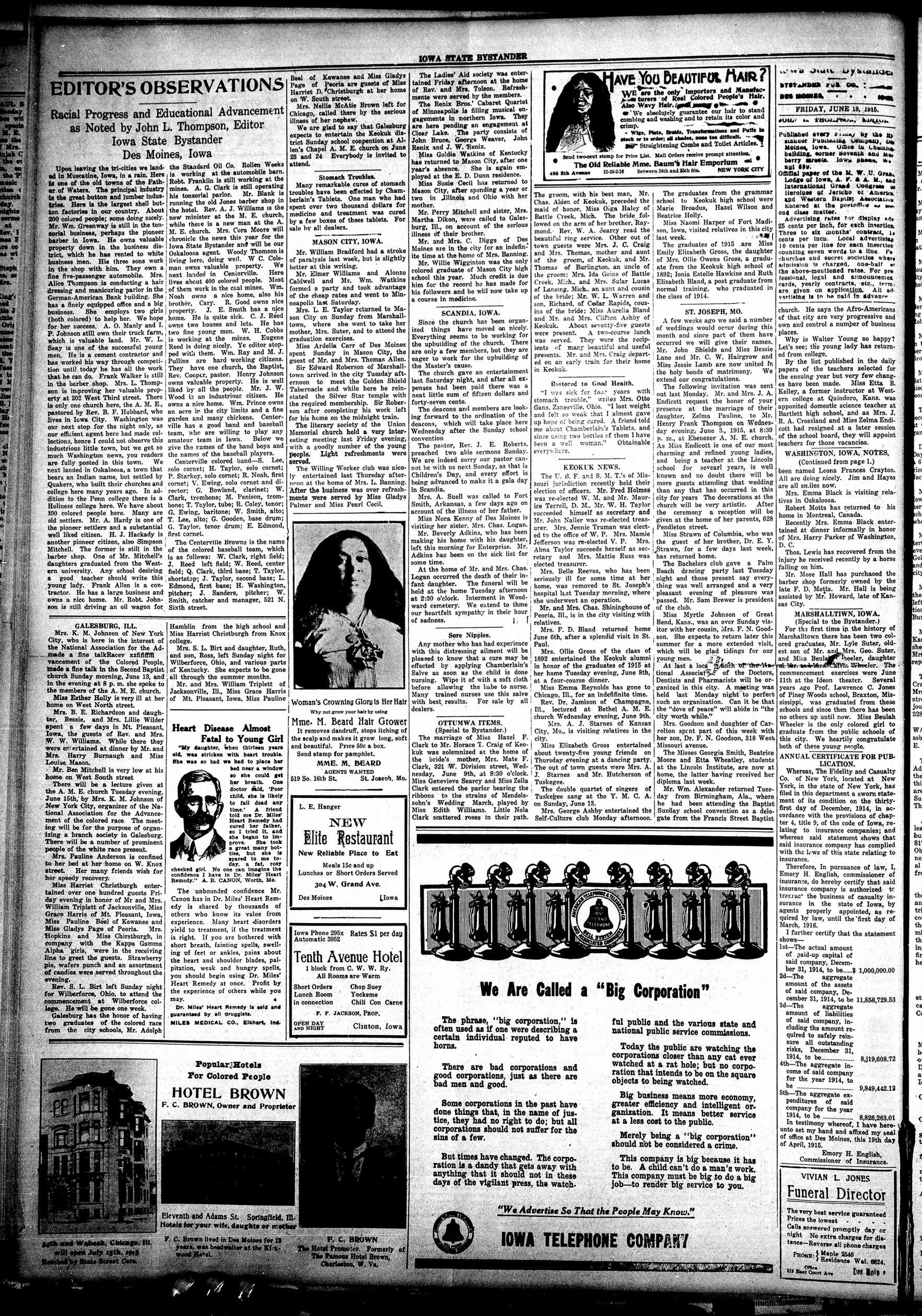
Friday, June 18, 1915
Des Moines, Iowa
Page text (machine-generated)
IOWA STATE BYSTANDER.
XXI No. 52
Don't forget the Pickens lecture at Union Congregational church.
Mr. Gus Durden was host at a garden party given at the home of his sister, Mrs. J. B. Rush.
Mr. Via O. Banks has been suffering from pneumonia at his home, 1008 Center street.
The Eliza J. Peterson Union will meet Thursday, June 24th, at the residence of Mrs. A. M. Rivers, 1205 Sixteenth street.
The Young Men's Sunday school club will meet as usual Sunday afternoon at 4 o'clock at 777 West Eleventh street. A. White, president.
Mrs. Price Alexander of 3536 Cornell street is confined to her bed from a nervous breakdown. She is some better at this time.
Miss Florence Russ presided over a Sunday morning breakfast as a courtesy to Miss Lalah Brook, whose wedding is to take place next week.
Rev. W. H. Clark of Colfax was a visitor in the city Thursday.
Editor John L. Thompson left Tuesday to resume his trip in the interest of The Bystander.
Mrs. John Walker, who has been quite sick at her home on Thirteenth street, seems to be gradually becoming weaker and there is little hope for her recovery.
The Wednesday Night Bridge club was entertained this week by Miss Gertrude Hyde. The regular game of bridge was played. It being prize night the high score was won by Mrs. Maude Woods.
One of the interesting happenings of the week was the towel shower given by Mrs. John Wilson at her home on Jefferson street in honor of her niece, Miss Lalah Brooks, whose wedding will take place next week. Miss Brooks was the recipient of many beautiful towels.
WANTED - To correspond with a good sober Negro barber at once. Address E. Mason, 104 E. 5th St. Davenport Ia.
Capt. E. T. Banks, Dist. Deputy Grand High Priest of Royal Arch Masons of Illinois and Iowa, accompanied by H. Gould, Jas. B. Mitchell and Atty. S Joe Brewn, members of the local chapter went to Cedar Rapids last Saturday and established a new chapter and assisted Mr. H. E Buris of Rock Island in establishing a commandery of Knights Templar.
The Triple Club met June 15th with Mrs. R. E. Patten, 830 10th street. Biblical quotations by members. Pineapple were canned by the scientific department. A beautiful luncheon was served by Mrs. Patten. The club will meet Tuesday June 22nd with Mrs. Pauline Wilson, 846 14th street. At 2:30 Dr. Booker will address the club on "How to be Healthy and Strong."
At the regular meeting of Doric
odge No. 30, A F. & A. M. last even-
ing the following were elected and in-
stalled officers for the ensuing year.
D. G. Patterson, W. M.; C. C. Johnson,
S. W.; W. L. Riley, J. W.; D. T.
Mosely, Treas., J. H. Reynolds, Sec.
J. W. Johnson, S. D.; Richard White,
J. D.; J. A. Wilson S. J.; J. W. Black
J. S.; J. Rev. H. McCraven, Chaplain; T.
H. Raleigh, Marshall and A. May,
Tyler.
THE LYCEUM.
At the semi-annual business session last Tuesday evening the following were elected officers for the ensuing term: President, Mamie James; Vice President, Mildred Griffin; Secretary, Beatrice Turner; Asst. Secretary, Edyth Jones; Treasurer, Prof. W. H. Warricks; Critic, Miss Georgia Blagburn; Accompanist, M. K. Griffith Constitutional Advisor, Atty. S. Joe Brown; Cor. Secretary, J. A. Graves; Executive Committee, Mrs. S. Joe Brown, Dr. J. A. Jefferson and Miss Jesse Scott.
Mr. J. L. Hillman was elected to membership. These officers will be installed at the residence of Atty. S. Joe Brown next Tuesday evening.
FOR SALE
Drug stock of the late B. F. Cooper store in Buxton for sale. Communicate with G O. Terrell, administrator, Colfax, Iowa.
The little girls who took part in the play, entitled "The Baby Show at Punville" which was given at Union Congregational church this spring, were entertained Tuesday afternoon at the home of Rev. and Mrs. Alexander. The affair was the outcome of a promise from the reverend for the splendid entertainment given by the little folks.
Mrs. David Barnes of Grimes, Iowa, was in the city a few days this week, the guest of Mrs. James James.
Miss Rachel Elliot left Wednesday morning for Oakland, Cal., where she has gone to visit her cousin, Miss Pearl Hynds. Miss Hynds has been
a student in the musical department of the Oberlin college and on her way home stopped in Des Moines for a few days with Miss Elliot, when they both left for the west.
Our collector will be in Burlington on Saturday, June 19th; in Fort Madison on Tuesday, June 22; Keokuk on Wednesday, Thursday and Friday, June 23 to 25; in Quincy, Ill., Saturday, June 26. So please be prepared to pay your dues.
The Richard Allen Aid society met at the home of the president, Mrs. S. Joe Brown, on last Thursday evening and listened to an interesting report from Mrs. Emma Pyree, delegate to the I. S. F. of C. W. C. which was held at Cedar Rapids. Club will meet next Thursday evening with Mrs. Earnest McGuire.
On last Monday evening at 1058 Eighteenth street Mr. and Mrs. J. A. Wilson very beautifully entertained in their cozy home about fifty of the students of this city complimentary to their niece, Edith M. Jones, a student in North High, and their son, Arthur, who was promoted to high school this year. Musical selections were given during the evening by the Misses Beatrice Turner, Mildred Griffin, Sarah Johnson and Meredith Humbard, Chas. Wood and Arthur Wilson. Atty, and Mrs. S. Joe Brown were present and gave a few encouraging remarks. Mrs. Wilson was assisted by Miss Josie Roberts, Georgia Williams and Mary Stanton.
Those who left our city to attend the Iowa-Nebraska annual Baptist Ministers and Deacons' Union and Sunday school convention in Ottumwa this week are Rev. S. Bates and wife, E. T. Hicks, Leota Ewing, Mrs. Wm. Williams, Miss Elora Edmunds, Miss Orzela Davis, all from Maple Street Baptist church, and those from Corinthian who are Rev. T. L. Griffith, Mrs. H. A. Graves, Mrs. Zelma Brown, Mrs. Harvey Brown, Mrs. Bertha Lang, John Beverley, Miss Bertha Terry, Miss Walda James and Mrs. N. C. Marshall.
The members and friends of Asbury M. E. church gave their pastor, Rev. W. L. Lee, a very agreeable surprise Tuesday evening in honor of his thirty-seventh birthday. The pastor had been at church holding a business meeting and on his return home was greeted by a company of twenty-five persons, who had secreted themselves in one of the rooms of his home during his absence. This company sprang upon the pastor all of a sudden, rendering him almost helpless. Some of the company went so far as to threaten the pastor with thirty-seven stripes, representing the thirty-seven years that he had lived. After the excitement was over he found the dining room table fairly groaning under its burden of staple and fancy groceries and many other necessities of life. A dainty two-course luncheon was served. The pastor invited them to return at an early date, after which all departed, wishing the pastor many happy returns of his birthday.
We are pleased to announce to the public that, Des Moines will be favored and honored to have with us on Thursday evening, July 8th, Professor William Pickens of Alabama, who is claimed to be the most eloquent Negro orator in America, the only colored man who entered Yale university and won the highest prize given for oratory in the United States, the famous Ten Eyck prize. He is one of the best educated men of the race in America. He will deliver his lecture at the Union Congregational church. Admission only 25 cents. Everybody should come and hear the eloquent speaker.
Mrs. Whitaker of Keokuk was in our city Wednesday for the purpose of organizing a lodge, the Ancient Knights and Daughters of Africa. There will be a hard time social at the A. M. E. church Thursday evening.
Mrs. Geo. Harper and daughter, Naomi, were Keokuk visitors last week.
Children's Day was fittingly observed at the A. M. E. church last Sunday evening.
Miss Merle Basfield, who has been confined to her home for some time, is able to be out again.
Misses Ruth Mack and Madge Goodwin are delegates to the Sunday school convention which convenes in Galesburg, Ill., next week.
Miss Anna Harper, accompanied by her brother, George, and Margie Freeman spent the week-end at the Daddridge farm near Argyle.
Mrs. M. Woods of St. Louis, Mo., was a Fort Madison visitor one day last week.
Mrs. Richard Coleson of Mt. Pleasant was in the city visiting relatives and friends last week.
Chamberlain's Colic, Cholera and Diarrhoea Remedy.
This is a remedy that every family should be provided with, and especially during the summer months. Think of the pain and suffering that must be endured when medicine must be sent for or before relief can be obtained. This remedy is thoroughly reliable. Ask anyone who has used it. Obtainable everywhere.
WILLIAM PICKENS
FORT MADISON NOTES.
DES MOINES, IOWA, FRIDAY, JUNE 18, 1915.
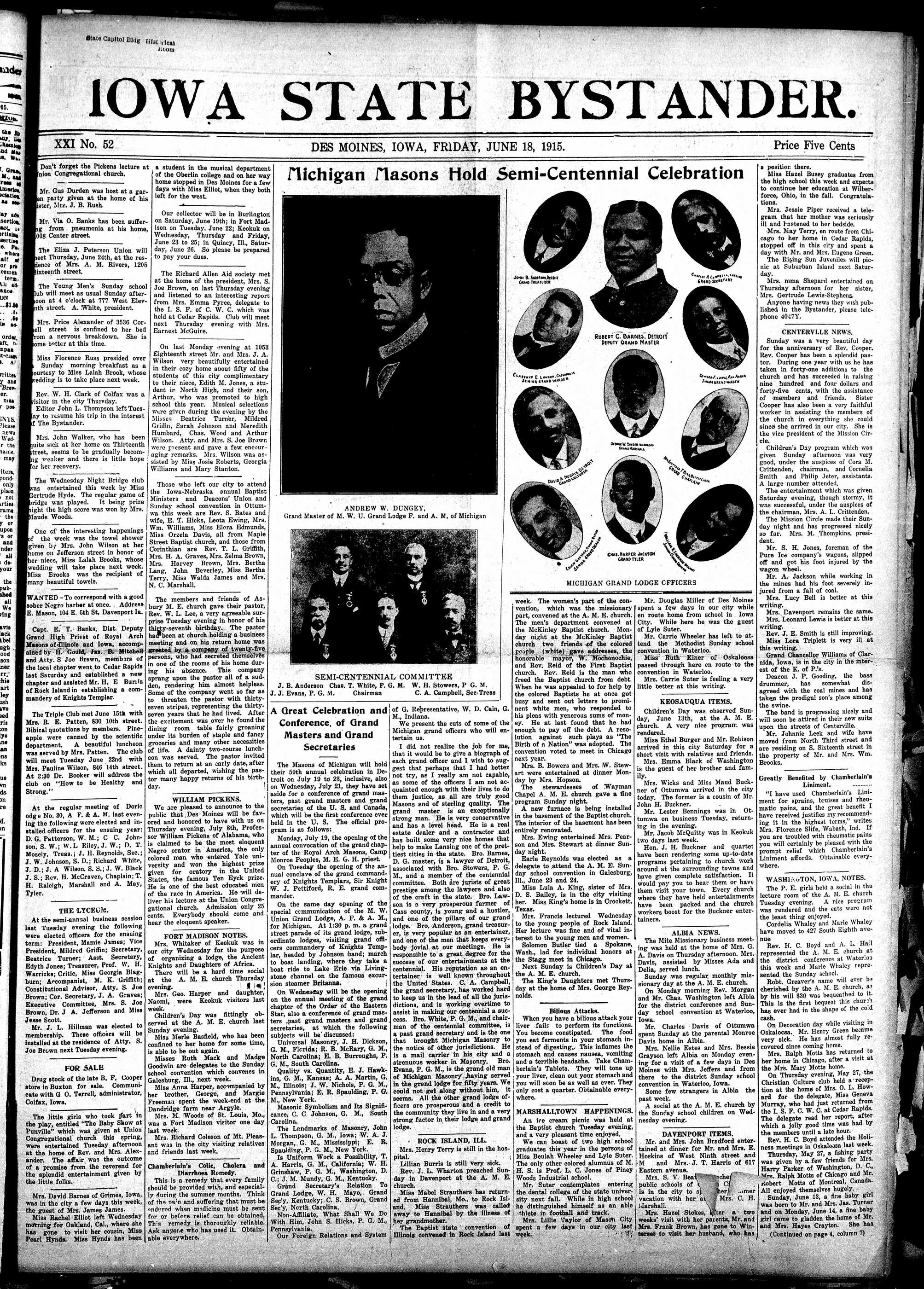
Michigan Masons Hold Semi-Centennial Celebration
M. H. H.
ANDREW W. DUNGEY,
Grand Master of M. W. U. Grand Lodge F. and A. M. of Michigan
SEMI-CENTENNIAL COMMITTEE
A Great Celebration and Conference, of Grand Masters and Grand Secretaries
The Masons of Michigan will hold their 50th annual celebration in Detroit on July 19 to 23, inclusive, also on Wednesday, July 21, they have set aside for a conference of grand masters, past grand masters and grand secretaries of the U. S. and Canada, which will be the first conference ever held in the U. S. The official program is as follows:
Monday, July 19, the opening of the annual convocation of the grand chapter of the Royal Arch Masons, Camp Monroe Peoples, M. E. G. H. priest.
On Tuesday the opening of the annual conclave of the grand commandery of Knights Templars, Sir Knight W. J. Pettiford, R. E. grand commander.
On the same day opening of the special communication of the M. W. Union Grand Lodge, A. F. & A. M., for Michigan. At 1:30 p. m. a grand street parade of its grand lodge, subordinate lodges, visiting grand officers commandery of Knights Templar, headed by Johnson band; march to boat landing, where they take a boat ride to Lake Erie via Livingstone channel on the famous excursion steamer Britanna.
On Wednesday will be the opening on the annual meeting of the grand chapter of the Order of the Eastern Star, also a conference of grand masters, past grand masters and grand secretaries, at which the following subjects will be discussed:
Universal Masonry, J. H. Dickson, G. M. Florida; R. B. McRary, G. M., North Carolina; E. B. Burroughs, P. G. M., South Carolina.
Quality vs. Quantity, E. J. Hawkins, G. M. Kansas; A. A. Martin, G. M., Illinois; J. W. Nichols, P. G. M., Pennsylvania; E. R. Spaulding, P. G. M., New York.
Masonic Symbolism and Its Significance, C. C. Johnson, G. M., South Carolina.
The Lendmarks of Masonry, John L. Thompson, G. M., Iowa; W. A. J. Morgan, G. M., Mississippi; E. R. Spaulding, P. G. M., New York.
Is Uniform Work a Possibility, T. A. Harris, G. M., California; W. H. Grinshaw, P. G. M., Washington, D. C.
J. M. Mundy, G. M., Kentucky.
Grand Secretary's Relation To Grand Lodge, W. H. Mayo, Grand Secy, Kentucky, C. S. Brown, Grand Secy, North Carolina.
Non-Affiliate, What Shall We Do With Him, John S. Hicks, P. G. M, Pennsylvania.
Our Foreign Relations and System
of G. Representative, W. D. Cain, G. M., Indiana. We present the cuts of some of the Michigan grand officers who will entertain us.
I did not realize the job for me, that it would be to give a biograph of each grand officer and I wish to suggest that perhaps that I had better not try, as I really am not capable, as some of the officers I am not acquainted enough with their lives to do them justice, as all are truly good Masons and of sterling quality. The grand master is an exceptionally strong man. He is very conservative and has a level head. He is a real estate dealer and a contractor and has built some very nice homes that help to make Lansing one of the prettiest cities in the state. Bro. Barnes, D. G. master, is a lawyer of Detroit, associated with Bro. Stowers, P. G. M., and a member of the centennial committee. Both are jurists of great prestige among the lawyers and also of the craft in the state. Bro. Lawson is a very prosperous farmer of Cass county, is young and a hustler, and one of the pillars of our grand lodge. Bro. Anderson, grand treasurer, is very popular as an entertainer, and body jovial at the men that keeps everybody jovial at our meetings. He is responsible to a great degree for the success of our entertainments at the centennial. His reputation as an entertainer is well known throughout the United States. C. A. Campbell, the grand secretary, has worked hard to keep us in the lead of all the jurisdictions, and is working overtime to assist in making our centennial a success. Bro. White, P. G. M., and chairman of the centennial committee, is a past grand secretary and is the one that brought Michigan Masonry to the notice of other jurisdictions. He is a mail carrier in his city and a strenuous worker in Masonry. Bro. Evans, P. G. M., is the grand old man of Michigan Masonry, having served in the grand lodge for fifty years. We could not get along without him, it seems. All the other grand lodge officers are prosperous and a credit to the community they live in and a very strong factor in their lodge and grand lodge.
ROCK ISLAND, ILL.
Mrs. Henry Terry is still in the hospital.
Lillian Burris is still very sick. Rev. J. L. Wharton preached Sunday in Davenport at the A. M. E. church. Miss Mabel Strauthers has returned from Hannibal, Mo., to Rock Island. Miss Strauthers was called away to Hannibal by the illness of her grandmother.
The Baptist state convention of Illinois convened in Rock Island last
JOHN B. ANDERSON, DETROIT
GRAND TREASURER
CHARLES A. CAMPBELL, LANCASTER
GRAND SECRETARY
ROBERT C. BARNES, DETROIT
DEPUTY GRAND MASTER
CLARENCE E. LAWSON, COSSEWOLIS
SENIOR GRAND WARDEN
EDWARD J. LEWIS ANN AARBEN
JUNIOR GRAND WARDEN
GEORGE W. SWIGER KREMELON
GRAND MARSHALL
DAVID A. NORRIT, DETROIT
GRAND LECTURIA
MRS. GARRISON T. BERG BARNSTECHEN
GRAND CHAPLAIN
CLARIE GARRISON, GRAND LECTURIA
SERUM GRAND DECOR
CHAS. HARPER JACKSON
GRAND TYLER
FREELAND A. SCHWANEN PUPPET
LUNCH GRAND DECOR
week. The women's part of the convention, which was the missionary part, convened at the A. M. E. church. The men's department convened at the McKinley Baptist church. Monday night at the McKinley Baptist church two friends of the colored people (white) gave addresses, the honorable mayor, W. Mochonochie, and Rev. Reid of the First Baptist church. Rev. Reid is the man who freed the Baptist church from debt. When he was appealed to for help by the colored Baptist he at once got busy and sent out letters to prominent white men, who responded to his pleas with yenerous sums of money. He at last found that he had enough to pay off the debt. A resolution against such plays as "The Birth of a Nation" was adopted. The convention voted to meet in Chicago next year.
Mrs. B. Bowers and Mrs. W. Stewart were entertained at dinner Monday by Mrs. Hopson.
The stewardesses of Wayman Chapel A. M. E. church gave a fine program Sunday night.
A new furnace is being installed in the basement of the Baptist church. The interior of the basement has been entirely renovated.
Mrs. Ewing entertained Mrs. Pearson and Mrs. Stewart at dinner Sunday night.
Mr. Douglas Milspent a few days en route home from City. While here of Lyle Suter.
Mr. Carrie Wheed tend the Method convention in Water. Miss Ruth Kin passed through her convention in Water.
Mrs. Carrie Suter little better at this.
KEOSAUQI
Children's Day v day, June 13th, church. A very r rendered.
Miss Ethel Burge arrived in this city short visit with rel. Mrs. Emma Black is the guest of her lily.
Mrs. Wicks and ner of Ottumwa a today. The former John H. Buckner.
Mrs. Lester Benn tumwa on business in the evening.
Mr. Jacob McQui two days last week Hon. J. H. Buck
Earle Reynolds was elected as a delegate to attend the A. M. E. Sunday school convention in Galesburg, Ill., June 23 and 24.
Miss Lula A. King, sister of Mrs. D. S. Bailey, is in the city visiting her. Miss King's home is in Crockett, Texas.
Mrs. Francis lectured Wednesday to the young people of Rock Island. Her lecture was fine and of vital interest to the young men and women.
Solomon Butler tied a Spokane, Wash., lad for individual honors at the Staggy meet in Chicago.
Next Sunday is Children's Day at the A. M. E. church.
The King's Daughters met Thursday at the home of Mrs. George Reynolds.
Billious Attacks.
When you have a bilious attack your liver fails to perform its functions. You become constipated. The food you eat ferments in your stomach instead of digesting. This inflames the stomach and causes nausea, vomiting and a terrible headache. Take Chamberlain's Tablets. They will tone up your liver, clean out your stomach and you will soon be as well as ever. They only cost a quarter. Obtainable everywhere.
MARSHALL,TOWN HAPPENINGS.
An ice cream picnic was held at the Baptist church Tuesday evening, and a very pleasant time enjoyed.
We can boast of two high school graduates this year in the persons of Miss Beulah Wheeler and Lyle Suter. The only other colored alumnus of M. H. S. is Prof. L. C. Jones of Piney Woods Industrial school.
Mr. Suter contemplates entering the dental college of the state university next fall. While in high school he distinguished himself as an able athlete in football and track.
Mrs. Lillie Taylor of Mason City spent a few days in our city last week.
Mr. Douglas Miller of Des Moines spent a few days in our city while en route home from school in Iowa City. While here he was the guest of Lyle Suter.
Mr. Carrie Wheeler has left to attend the Methodist Sunday school convention in Waterloo.
Miss Ruth Kiner of Oskaloosa passed through here en route to the convention in Waterloo.
Mrs. Carrie Suter is feeling a very little better at this writing.
KEOSAUQUA ITEMS.
Children's Day was observed Sunday, June 13th, at the A. M. E. church. A very nice program was rendered. Miss Ethel Burger and Mr. Robison arrived in this city Saturday for a short visit with relatives and friends. Mrs. Emma Black of Washington is the guest of her brother and family. Mrs. Wicks and Miss Maud Buckner of Ottumwa arrived in the city today. The former is a cousin of Mr. John H. Buckner. Mr. Lester Bennings was in Ottumwa on business Tuesday, returning in the evening. Mr. Jacob McQuitty was in Keokuk two days last week. Hon. J. H. Buckner and quartet have been rendering some up-to-date programs pertaining to church work around at the surrounding towns and have given complete satisfaction. It would pay you to hear them or have them visit your town. Every church where they have held entertainments have been packed and the church workers boost for the Buckner entertainers.
ALBIA NEWS
The Mite Missionary business meeting was held at the home of Mrs. G. A. Davis on Thursday afternoon. Mrs. Davis, assisted by Misses Ada and Delia, served lunch. Sunday was regular monthly missionary day at the A. M. E. church.
On Monday morning Rev. Morgan and Mr. Chas. Washington left Albia for the district conference and Sunday school convention at Waterloo, Iowa.
Mr. Charles Davis of Ottumwa spent Sunday at the parental Monroe Davis home in Albia.
Mrs. Nellie Estes and Mrs. Bessie Grayson left Albia on Monday evening for a visit of a few days in Des Moines with Mrs. Jeffers and from there to the district Sunday school convention in Waterloo, Iowa.
Some few strangers in Albia the past week.
A social at the A. M. E. church by the Sunday school children on Wednesday evening.
DAVENPORT ITEMS
Mr. and Mrs. John Bradford entertained at dinner for Mr. and Mrs. E. Hoskins of West Ninth street and M and Mrs. J. T. Harris of 617 Eastern avenue.
Mrs. S. V. Beaulieucher public schools of C in the city to spare her summer vacation with her at Mrs. C. H. Marshall.
Mrs. Hazel Stokes, after a two weeks' visit with her parents, Mr. and Mrs. Frank Brown, has gone to Winterstet to visit her husband, who has
Price Five Cents
a position there.
Miss Hazel Busey graduates from the high school this week and expects to continue her education at Wilberforce, Ohio, in the fall. Congratulations.
Mrs. Jessie Piper received a telegram that her mother was seriously ill and fastened to her bedside.
Mrs. May Terry, en route from Chicago to her home in Cedar Rapids, stopped off in this city and spent a day with Mr. and Mrs. Eugene Green.
The Rising Sun Juveniles will picnic at Suburban Island next Saturday.
Mrs. mma Shepard entertained on Thursday afternoon for her sister, Mrs. Gertrude Lewis-Stephens.
Anyone having news they wish published in the Bystander, please telephone 4047Y.
CENTERVLLE NEWS
Sunday was a very beautiful day for the anniversary of Rev. Cooper. Rev. Cooper has been a splendid pastor. During one year with us he has taken in forty-one additions to the church and has succeeded in raising nine hundred and four dollars and forty-five cents, with the assistance of members and friends. Sister Cooper has also been a very faithful worker in assisting the members of the church in everything she could since she arrived in our city. She is the vice president of the Mission Circle.
Children's Day program which was given Sunday afternoon was very good, under the auspices of Cora M. Crittenden, chairman, and Cornelia Smith and Philip Jeter, assistants. A large number attended.
The entertainment which was given Saturday evening, though stormy, it was successful, under the auspices of the chairman, Mrs. A. L. Crittenden.
The Mission Circle made their Sunday night and has progressed nicely so far. Mrs. M. Thompkins, president.
Mr. S. H. Jones, foreman of the Pure Ice company's wagons, slipped off and got his foot injured by the wagon wheel.
Mr. A. Jackson while working in the mines had his foot severely injured from a fall of coal.
Mrs. Lucy Bell is better at this writing.
Mrs. Davenport remains the same. Mrs. Leonard Lewis is better at this writing.
Rev. J. E. Smith is still improving. Miss Lora Triplett is very ill at this writing.
Grand Chancellor Williams of Clarnida, Iowa, is in the city in the interest of the K. of P.'s.
Deacon J. P. Gooding, the bass drummer, has somewhat disagreed with the coal mines and has taken the prodigal son's place among the swine.
The band is progressing nicely and will soon be attired in their new suits upon the streets of Centerville.
Mr. Johnnie Leek and wife have moved from North Third street and are residing on S. Sixteenth street in the property of Mr. and Mrs. Wm. Brooks.
Greatly Benefited by Chamberlain's Liniment.
"I have used Chamberlain's Liniment for sprains, bruises and rheumatic pains, and the great benefit I have received justifies my recommending it in the highest terms," writes Mrs. Florence Slife, Wabash, Ind. If you are troubled with rheumatic pains you will certainly be pleased with the prompt relief which Chamberlain's Liniment affords. Obtainable everywhere.
WASHINGTON, IOWA, NOTES.
The P. E. girls held a social in the lecture room of the A. M. E. church Tuesday evening. A nice program was rendered and the eats were not the least thing enjoyed. Cordelia Whaley and Marie Whaley have moved to 427 South Eighth avenue. Rev. H. C. Boyd and A. L. Hall represented the A. M. E. church at the district conference at Waterloo this week and Marie Whaley represented the Sunday school. Robt. Greaver's name will ever be cherished by the A. M. E. church, as by his will $30 was bequeathed to it. This is the first bequest this church has ever had in the shape of the cod cash. On Decoration day while visiting in Oskalocsa, Mr. Henry Green became very sick. He has almost fully recovered since coming home. Mrs. Ralph Motts has returned to her home in Chicago, after a visit at the Mrs. Mary Motts home. On Thursday evening, May 27, the Christian Culture club held a reception at the home of Mrs. O. L. Howard for the delegate, Miss Geneva Murray, who had just returned from the I. S. F. C. W. C. at Cedar Rapids. The delegate read her report, after which a jolly good time was had by the members until a late hour.
Rev. H. C. B. attended the Holiness mattings in Oskaloosa last week.
New. Ness meetings in Oskaloosa last week.
Thursday, May 27, a fishing party was given by a few friends for Mrs. Harry Parker of Washington, D. C.
Mrs. Ralph Motts of Chicago and Mr. robert Motts of Montreal, Canada.
All enjoyed themselves hugely.
Sunday, June 13, a fine baby girl was born to Mr. and Mrs. Jas. Turner and on Monday, June 14, a fine baby girl came to gladden the home of Mr. and Mrs. Hayes Crayton. She has (Continued on page 4, column 7)
AFRO-AMERICAN CULLINGS
---
Kuno Meyer said the other day that the great war was the price the world is paying for the mechanical comforts which have been piled up so rapidly. Again another historian clinches the point. The time it is W. E. B. DuBois, the author of a brilliant book on "The Negro," which Hot has just published in the Home University LB university. DuBois says that the Negro in Africa has been practically enslaved by the civilized nations of Europe. The growth of trade unions made investors look to Africa for opportunities. That meant the partition of Africa. And "this partition of Africa brought revision of the ideas of Negro uplift. Why was it necessary, the European investors urged, to push a continent of black workers along the paths of social uplift by educated men who hold the electoral franchise when the workers desired no change and the rate of European profit would suffer."
Accumulated profits from the mechanical inventions of the last few generations drove France, Belgium, England, Germany, Italy, Spain and Portugal to carve Africa according to their own tastes. DuBois can see no hope for the race until Negroes "fight not simply for their own rights as men, but for the ideals of the greater world in which they live; the emancipation of women, universal peace, democratic government, the socialization of wealth and human brotherhood."
That does not mean inevitable progress. It means inescapable degradation if the generous spirits of the world do not arrive to the climax of the entire world. Every day, every ideal, every dream of glory can be forsaken in an instant. Brute force can displace reason, and the world, like the gallant boy on the Aisne, can make itself "the instrument through which a greater force works out its inescutable ends through the impulses of terror and repulsion."
The alternative is justice, fraternity and equality.
The adoption by the Baptist convention of the report to locate the proposed Negro seminary at Memphis came after considerable discussion. Nashville submitted a pleasing proposition for the location of the seminary, but because of the distance to Nashville from the center of Negro population to be benefited by the seminary, it was decided that Memphis would be agreed to raise at an early date $50,000 for this purpose. Dr. Milton E. Grigg, Negro, Tennessee, made a profound impression and showed the fine spirit of brotherhood and cooperation which exists between the white and the Negro Baptists. His address showed a fine spirit of loyalty to the South and the white people. He acknowledged the debt which he and his people owe to the Negro people. He said that it was here that he got his language his knowledge of industry and his religion, that he was proud of his race and of the white people. He declared that the white people of the South have helped the Negroes far beyond their calculations, giving them new unity and inspiring them to self-uplift and self-help. He declared that the work of the southern white people is affecting the southern white population in the real manipulation of the race. One-third of the voting strength of the United States the South con-
Booker Washington, accompanied by a company of 25 other educated colored men, has recently made a visit to larger centers of population in Louisiana. The coming of the visitors was widely advertised in advance, and Negroes gathered in large numbers to attend the meetings held. Some journeyed ten, twenty and even thirty miles back, in wagon. At Shreveport, on the western border of the state, ten thousand gathered principally to hear Mr. Washington. He was the chief speaker and principal attraction at all points. White citizens of prominence lent encouragement to the meetings by their presence. Booker Washington gave wise and wholesome counsel to both races. In talking to the whites he reminded them that it is better to educate Negroes than to take care of criminals; that Louisiana paid too high a compliment to Negro children by assuming that a Negro child was giving him only three or four months' schooling in the year; that the nation hears too much about lynchings and racial difficulties and too little about
Last summer saw completed the demarcation of the boundary line between Alaska and Canada, between north along the hundred and forty-eight miles to the Arctic ocean. No other boundary demarcation has extended into such high latitudes and few boundaries of equal length are so straight. The line follows the meridian without deviation, regardless of mountains, swamps and forests.
Philadelphia's yearly loss because of rats is estimated at $1,000,000.
A report on the atmosphere electric observations made during the second cruise of the Carnegie is published. The radio-activity of the air over the ocean areas far removed from land is small, compared to that found over land; while the ionisation over the ocean is at least as large as that found over land.
The staple crop of China is said to be sweet potatoes. There is no region which does not raise them, and they are a substantial part of the diet of a smaller part of the Chinese population.
trots and almost two-thirds of the present national government. In this great Baptist movement the South leads, realizing that in proportion as the Negroes are educated they will help in advancement and plans for improving the condition of all the Negroes. In this the Negroes followed the white people through years of slavery, so they are now willing to follow in this great work and labor in concert for the future of the race. This theological seminary for the Negroes will doubtless prove a great forward step in all their work.
It was a humiliating position in which the son of Abraham Lincoln found himself when he admitted to the industrial commission that the great Pullman company was the real recipient of the tips to its colored porters. This concern, whose stock is so closely held and so highly valued as to be almost never sold, has paid on an average 5 per cent ever since its foundation. At the same time, it gives to its colored employees less than a living wage, and expects them to that what they need to live on out of the gratitudes of travelers. Mr. Lincoln thought that on the whole the company was entitled to great credit for keeping this field of employment open to Negroes, who are so often discriminated against. But it may well be doubted whether the philanthropic motive would be noticed in the Pullman company if it were compelled to pay the wages it should. The laborer is worthy of his hire; and when Mr. Lincoln so incorrectly patted himself on the back for the toughness to be sought to remember that failure to obtain sufficient tips by reason of interference with traffic, slackness of travel, or hard times has brought many a porter's family face to face with genuine suffering—even when he wore four and five service stripes on his coat-sleeve. That under these circumstances porters have yielded so little to temptation that their record for fidelity and honesty and for heroic service in accidents is admirable, in plain no fault of Lincoln's son. The descendance of the men the hardened and overworked—often without sleep enough for long stretches to keep a men well—and underpain besides by the company of which the emancipator son has been the head.—New York Evening Post.
The campaign that that was begun among the colored schools by Mrs. Helena Holley, under the direction of Superintendent Horn, for the betterment of health conditions among the colored children, was greeted with enthusiasm by the pupils. The pupils of six colored schools met at the Colored High school where they were gathered in a large hall. The Health hymn was distributed among them, and with the first few chords struck on a piano, the song was taken up and carried through splendidly, the true musical instinct of the race rapidly caught the rhythm, and thus the message of the words was crystallized into their thought through the pleasing medium of the tune, which was Tipperary. The party was very much pleased with the results of their efforts. The party was out all day, visiting the several colored ward schools, and teaching the willing little dusky students the catchy song—Houston Post.
the evidences of racial friendship and good will which exist in the majority of communities. And Negroes imitate white men closely; if white people break the law, drink and gamble, Negroes will; if white people are sober, law abiding and industrious, Negroes will be. Counseling the Negroes Mr. Washington advised them to stay in the country where the soil was dry and sand and the sun dries color line. He urged his hearers not to live in a knapsack, but to settle down and get property. He told them that fifty years the white man had been carrying the Negro on his back and that he was getting tired. He bade them consider how they could use at home what they had learned at school. And he advised them not to talk about white people, but to talk to them, to make friends with them.
The government of India has appointed an expert to make an exhaustive study of the white ants of that country, which completely destroy all books with which they come in contact if not detected in time.
The problem of giving southeastern Italy an adequate water supply, which has been studied since Roman times, is about to be solved by the construction of an aqueduct to cost about $25,000,000.
As a rule employees in breweries, tanneries and printing-ink factories are immune from consumption. Turpentine works and rope works are a protection from rheumatism. Workers in copper mines need not fear typhoid.
Wild horses in Arabia will not admit a tame horse among them; but the wild horses of South America endeavor to decoy domesticated horses from their masters, and seem eager to welcome them.
Added to such names as Alsace Lorraine Jones appear the following on the London insurance register, showing the effect of the war on newcomers in the world: Kitchener Barry John Jellico Walker, George Bank Holiday Smith and Only Fancy Henry Waltz
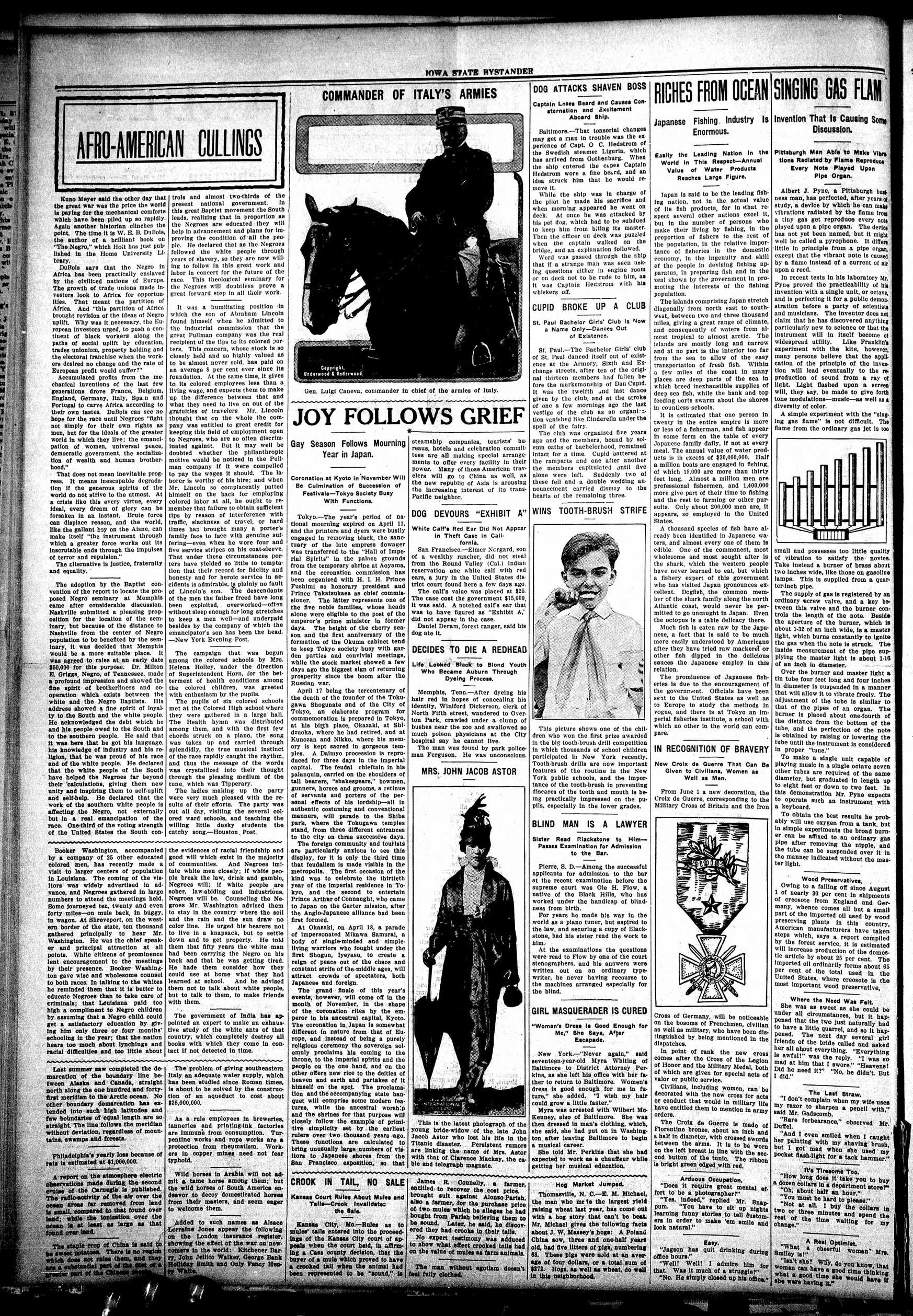
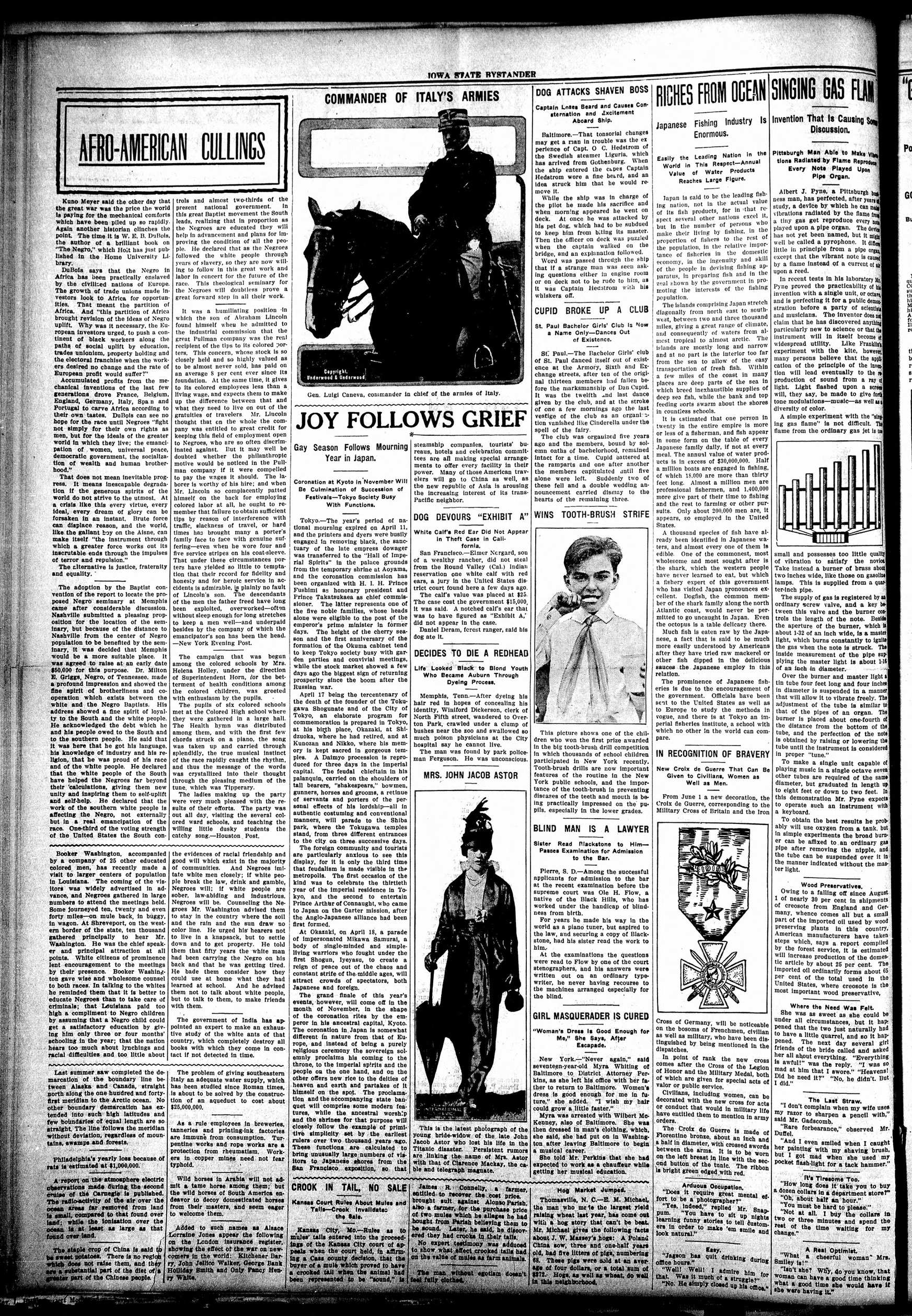
COMMANDER OF ITALY'S ARMIES
Copyright
Underwood & Underwood
Gen. Luigi Caneva, commander in chief of the armies of Italy.
JOY FOLLOWS GRIEF
Gay Season Follows Mourning Year in Japan.
Gay Season Follows Mourning Year in Japan.
Coronation at Kyoto in November Will
Be Culmination of Succession of
Festivals—Tokyo Society Busy
With Functions.
Tokyo.—The year's period of national mourning expired on April 11, and the printers and dyers were busily engaged in removing black, the sanctuary of the late empress dowager was transferred to the "Hall of Imperial Spirits" in the palace grounds from the temporary shrine at Aoyama, and the coronation commission has been organized with H. I. H. Prince Fushimi as honorary president and Prince Takatsukaea as chief commissioner. The latter represents one of the five noble families, whose heads alone were eligible to the post of the emperor's prime minister in former days. The height of the cherry season and the first anniversary of the formation of the Okuma cabinet tend to the military buoy in garden parties and courthial meetings, while the stock market showed a few days ago the biggest sign of returning prosperity since the boom after the Russian war.
April 17 being the tercenary of the death of the founder of the Tokugawa Shogunate and of the City of Tokyo, an elaborate program for commemoration is prepared in Tokyo, at his birth place, Okazaki, at Shiduka, where he had retired, and at Kunozan and Nikko, where his memory is kept sacred in gorgeous temples. A Dalyno procession is reproduced for three days in the imperial capital. The feudal chieftain in his palanquin, carried on the shoulders of tall bearers, "shakespears", bowmen, gunners, horses and grooms, a retinue of servants and porters of the personal effects of his lordship—all in authentic costuming and conventional manners, will parade to the Shiba park, where the Tokugawa temples stand, from three different entrances to the city on three successive days.
The foreign community and tourists are particularly anxious to see this display, for it is only the third time that feudalism is made visible in the metropolis. The first occasion of the kind was to celebrate the thirtieth year of the imperial residence in Tokyo, and the second to entertain Prince Arthur of Connaught, who came to Japan on the Garter mission, after the Anglo-Japanese alliance had been first formed. Okinawa, on April 18, a parade of Imperial Nikawa Samurai, a body of single-minded and simple-living warriors who fought under the first Shogun, Ieyasu, to create a reign of peace out of the chaos and constant strife of the middle ages, will attract crowds of spectators, both Japanese and foreign.
The grand finale of this year's events, however, will come off in the month of November, in the shape of the coronation rites by the emperor in his ancestral capital, Kyoto. The coronation in Japan is somewhat different in nature from that of Europe, and instead of being a purely religious ceremony the sovereign solider, the emperor, throne, to the imperial spirits and the people on the one hand, and on the other offers new rice to the deities of heaven and earth and partakes of it himself on the spot. The proclamation and the accompanying state banquet will comprise some modern features, while the ancestral worship and the shrines for that purpose will closely follow the example of primitive simplicity set by the earliest function of two thousand years ago. These functions bring unusually large numbers of visitors to Japanese shores from the San Francisco exposition, so that
Kansas Court Rules About Mules and Tails—Creek Invalidate the Sale.
Kansas City, Mo.—Rules as to mules' tails entered into the proceedings of the Kansas City court of appeals when the court held, in affirming a Cass county decision, that the buyer of a mule which proved to have a crooked tail when the animal had been represented to be "sound," is
IOWA STATE BYSTANDER
ITALY'S ARMIES
a chief of the armies of Italy.
DWS GRIEF
steamship companies, tourists' bus
resteams, hotels and celebration committees are all making special arrangements to offer every facility in their power. Many of those American travellers want to go to China as a new recipient of Asia is arousing the increasing interest of its trans-Pacific neighbor.
DOG DEVOURS "EXHIBIT A"
White Calf's Red Ear Did Not Appear in Theft Case in California.
San Francisco—Elmer Norgard, son of a wealthy rancher, did not steal from the Round Valley (Cal.) Indian reservation one white calf with red ears, a jury in the United States district court found here a few days ago. The calf's value was placed at $25. The case cost the government $15,000. it was said. A notched calf's ear that was to have figured as "Exhibit A," did not appear in the case.
Daniel Dermar, forest ranger, said his dog ate it.
DECIDES TO DIE A REDHEAD
Life Looked Black to Blond Youth Who Became Auburn Through Dyeing Process.
Memphis, Tenn.—After dyeing his hair red in hopes of concealing his identity, Winford Dickerson, clerk of North Fifth street, wandered to Wonder Park, crawled under a clump of bushes near the zoo and swallowed so much poison physicians at the City hospital say he cannot live.
The man was found by park policeman Ferguson. He was unconscious.
MRS. JOHN JACOB ASTOR
INTERNATIONAL
This is the latest photograph of the young bride-widow of the late John Jacob Aster who lost his life in the Titanic disaster. Persistent rumors are linking the name of Mrs. Aster with that of Clarence Mackay, the cable and telegraph magnate.
James R. Connelly, a farmer, entitled to recover the cost price, brought suit against Alonzo Parish, also a farmer, for the purchase price of two mules which he alleges he had bought from Parish believing them to be sound. Later, he said, he discovers they had crooks in their tails. No court testimony was adduced to show what effect crooked tails had on the value of mules as farm animals.
The man without agolam doesn't feel fully cloth.
DOG ATTACKS SHAVEN BOSS
Captain Losee Beard and Caunes Consternation and Excitement Aboard Ship.
Baltimore.—That tonosial changes may get a rain in trouble was the experience of Capt. O. C. Hedstrom of the Swedish steamer Liguria, which has arrived from Gothenburg. When the ship entered the capes Captain Hedstrom wore a fine beard, and an idea struck that he would remove it.
While the ship was in charge of the pilot he made his sacrifice and when morning appeared he went on deck. At once he was attacked by his pet dog, which had to be subdued to keep him from biting its master. Then the officer on deck was puzzled when the captain walked on the bridge, and an explanation followed. Word was passed through the ship that if a strange man was seen asking questions either in engine room or on deck not to be rude to him, as it was Captain Hedstrom with his whiskers off.
CUPID BROKE UP A CLUB
St. Paul Bachelor Girls' Club is Now a Name Only—Dances Out of Existence.
St. Paul.—The Bachelor Girls' club of St. Paul danced itself out of existence at the Armory, Sixth and Exchange streets, after ten of the original thirteen members had fallen before the marksmanship of Dan Cupid. It was the twelfth and last dance given by the club, and at the stroke of one a few mornings ago the last vestige of the club as an organization vanished like Cinderella under the spell of the fairy.
The club was organized five years ago and the members, bound by solemn oaths of bachelorhood, remained intact for a time. Cupid battered at the ramparts and one after another the members capitulated until five alone were left. Suddenly two of these fell and a double wedding announcement carried dismay to the hearts of the remaining three.
WINS TOOTH-BRUSH STRIFE
P
This picture shows one of the children who won the first prize awarded in the big tooth-brush drill competition in which thousands of school children participated in New York recently. Tooth-brush drills are now important features of the routine in the New York public schools, and the importance of the tooth-brush in preventing diseases of the teeth and mouth is being practically impressed on the pupils, especially in the lower grades.
BLIND MAN IS A LAWYER
Sister Read Blackstone to Him—Passes Examination for Admission to the Bar.
Pierre, S. D.—Among the successful applicants for admission to the bar at the recent examination before the supreme court was Ole H. Flow, a native of the Black Hills, who has worked under the handicap of blindness from birth.
For years he made his way in the world as a piano tuner, but aspired to the law, and securing a copy of Blackstone, had his sister read the work to him.
At the examinations the questions were read to Flow by one of the court stenographers, and his answers were written out on an ordinary typewriter, he never having recourse to the machines arranged especially for the blind.
GIRL MASQUERADER IS CURED
"Woman's Dress is Good Enough for Me," she Says, After Escapade.
New York.—"Never again," said seventeen-year-old Myra Whiting of Baltimore to District Attorney Perkins, as she left his office with her father to return to Baltimore. Women's dress is good enough for me in future," she added. "I wish my hair could grow a little faster," she added with Wilbert McKenney, also of Baltimore. She was then dressed in man's clothing, which, she said, she had put on in Washington after leaving Baltimore to begin a musical career.
She told Mr. Perkins that she had expected to work as a chauffeur while getting her musical education.
Thomasville, N. C.-E. M. Michael, the man who mrte the largest yield raising wheat last year, has come out with a hog story that can't be beat. Mr. Michael gives the following facts about J. W. Massey's hogs: A Poland China sow, three and one-half years old, had five litters of pigs, numbering 68. These pigs were grown at an average of four dollars, or a total sum of $272. Hogs, as well as wheat do well in this neighborhood.
RICHES FROM OCEAN SINGING GAS FLAM
Easily the Leading Nation in the World in This Respect—Annual Value of Water Products Reaches Large Figure.
Japan is said to be the leading fishing nation, not in the actual value of its fish products, for in that respect several other nations excel it, but in the number of persons who make their livelihood by fishing, in the promotion of fishers to the rest of the population, in the relative importance of fisheries in the domestic economy, in the ingenuity and skill of the people in devising fishing apparatus, in preparing fish and in the zeal shown by the government in promoting the interests of the fishing population.
The islands comprising Japan stretch diagonally from north east to southwest, between two and three thousand miles, giving a great range of climate, and consequently of waters from almost tropical to almost arctic. The islands are mostly long and narrow and at no point is the interior too far from the sea to allow of the easy transportation of fresh fish. Within a few miles of the coast in many places are deep parts of the sea in which breed inexhaustible supplies of deep sea fish, while the bank and top feeding sorts swarm about the shores in counties schools.
It is estimated that one person in twenty in the entire empire is more or less of a fisherman, and fish appear in some form on the table of every Japanese family daily, if not at every meal. The annual value of water products is in excess of $30,000,000. Half a million boats are engaged in fishing, of which 15,000 are more than thirty feet long. Almost a million men are professional fishermen, and 1,400,000 more give part of their time to fishing and the rest to farming or other pursuits. Only about 200,000 men are, it appears, so employed in the United States.
A thousand species of fish have already been identified in Japanese waters, and almost every one of them is edible. One of the commonest, most wholesome and most sought after is the shark, which the western people have never learned to eat, but which a fishery expert of this government who has visited Japan pronounces excellent. Dogfish, the common member of the shark family along the north Atlantic coast, would never be permitted to go uncaught in Japan. Even the octopus is a table delicacy there. Much fish is eaten raw by the Japanese, and much is said to be much more edible. Amber after they have tried raw mackerel or other fish dipped in the delicious sauces the Japanese employ in this relation.
The prominence of Japanese fisheries is due to the encouragement of the government. Officials have been sent to the United States as well as to Europe to study the methods in ocean fisheries. It is at Tokyo an imperial fisheries institute a school with which no other in the world can compare.
IN RECOGNITION OF BRAVERY
New Croix de Guerre That Can Be Given to Civilians, Women as Well as Men.
From June 1 a new decoration, the Croix de Guerre, corresponding to the Military Cross of Britain and the Iron
Cross of Germany, will be noticeable on the bosoms of Frenchmen, civilian as well as military, who have been distinguished by being mentioned in the dispatches.
In point of rank the new cross comes after the Cross of the Legion of Honor and the Military Medal, both of which are given for special acts of valor or public service.
Civilians, including women, can be decorated with the new cross for acts or conduct that would in military life have entitled them to mention in army orders.
The Croix de Guerre is made of Florentine bronze, about an inch and a half in diameter, with crossed swords between the arms. It is to be worn on the left breast in line with the second button of the tunic. The ribbon is bright green edged with red.
Arduous Occupation.
"Does it require great mental effort to be a photographer?"
"Yes, indeed," replied Mr. Snappum. "You have to sit up nights learning funny stories to tell customers in order to make 'em smile and look natural."
Easy.
"Jagson has quit drinking during office hours."
"Well! Well! I admire him for that. Was it much of a struggle?" "No. He simply closed up his office."
1916
MEDAL OF THE
FIRST BATTLE
OF THE
WAR OF
THE
WEST
Arduous Occupation
Invention That Is Causing Some Discussion.
Pittsburgh Man Able to Make Vibrations Radiated by Flame Reproduces Every Note Played Upon Pipe Organ.
Albert J. Pye, a Pittsburgh business man, has perfected, after years of study, a device by which he can make vibrations radiated by the flame from a tiny gas get reproduce every note played upon a pipe organ. The device has not yet been named, but it might well be called a pyrophone. It differs little in principle from a pipe organ, except that the vibrant note is caused by a flame instead of a current of air upon a reed.
In recent tests in his laboratory Mr. Pyne proved the practicability of his invention with a single unit, or octave, and is perfecting it for a public demonstration before a party of scientists and musicians. The inventor does not claim that he has discovered anything particularly new to science or that the instrument will in itself become of widespread utility. Like Franklin's experiment with the kite, however, many persons believe that the application of the principle of the invention will lead eventually to the production of sound from a ray of light. Light flashed upon a screen will, they say, be made to give forth tone modulations—music as well as a diversity of color.
A simple experiment with the "singing gas flame" is not difficult. The flame from the ordinary gas let is too
small and possesses too little quality of vibration to satisfy the novice. Take instead a burner of brass about two inches wide, like those on gasoline lamps. This is supplied from a quarter-inch pipe.
The supply of gas is registered by an ordinary screw valve, and a key between this valve and the burner controls the length of the note. Beside the aperture of the burner, which is about 1:32 of an inch wide, is a master light, which burns constantly to ignite the gas when the note is struck. The inside measurement of the pipe supplying the master light is about 1:16 of an inch in diameter. Over the burner and master light the tube four feet long and four inches in diameter is suspended in a manner that will vibrate freely. The adjustment of the pipe is similar to that of the tube of an organ. The burner is placed about one-fourth of the distance from the circumference tube, and the perfection of the note is obtained by raising or lowering the tube until the instrument is considered in proper "tune."
To make a single unit capable of playing music in a single octave seven other tubes are required of the same diameter, but graduated in length up to eight feet or down to two feet. In this demonstration Mr. Pyre expects to operate such an instrument with a keyboard.
To obtain the best results he probably will use oxygen from a tank, but in simple experiments the broad burner can be affixed to an ordinary gas pipe after removing the nipple, and the tube can be suspended over it in the manner indicated without the master light.
Wood Preservatives
Owing to a falling off since August 1 of nearly 30 per cent in shipments of crescoe from England and Germany, whence come all but a small part of the imported oil used by wood preserving plants in this country, American manufacturers have taken step by step, says a report compiled by the forest service, it is estimated will increase 25 per cent of the domestic article by about 25 per cent. The imported oil ordinarily forms 65 per cent of the total used in the United States, where crescoe is the most important wood preservative.
Where the Need Was Felt
She was as sweet as she could be under all circumstances, but it happened that the two just naturally had to have a little quarrel, and so it happened. The next day several girl friends of the bride called and asked about everything. "Everything is awful," was the reply. "I was so mad at him that I swore." "Heaven! Did he need it?" "No, he didn't. But I did."
"I don't complain when my wife uses my razor to sharpen a pencil with," said Mr. Gadscomb.
"Hare for bearance," observed Mr. Duffel.
"And I even smiled when I caught her painting with my shaving brush, but I got mad when she used my pocket flash-light for a tack hammer."
"N's Tiresome Too.
"How long does it take you to buy a dozen collars in a department store?" "Oh, about half an hour."
"You must be hard to please."
"Not at all. I buy the collars in two or three minutes and spend the rest of the time waiting for my change."
A Real Optimist.
"What a cheerful woman" Mrs. Smiley is!
"Ian's she? Why, do you know, that woman can have a good time thinking what a good time she would have if she were having it."
The Last Straw
A 282 A
ALL XOOL WAY ON BUILT RAILING TRACK 23
RUNNING IN WATER FLOOR STILL TRACK
FEED ALLEY
MANGER
HORSE STALLS
10'0"
2'0"
ROLL AIR SHIFT
GRAIN SHOOTS
MANGER
STEEL COW STALLS
2'0"
2'0"
ROLLER
LITTER CARRIER-TRACK
HORSE STALLS
MANGER
FEED ALLEY
ROLL AIR SHIFT
DRIVE WAY
GRAIN SHOOTS
MANGER
STEEL COW STALLS
2'0"
2'0"
MANGER
FEED ALLEY
Popular for Barns for Many Reasons Other Than That of Appearance.
GOOD SPECIMEN SHOWN HERE
Building In Every Way Splendidly
Adapted to the Needs of the Farm
—Chief Morit Is Provision
Made for Both Horses
and Cows
By WILLIAM H. RADFORD
Mr. William A. Radford will answer questions and give advice FREE OF charge on his subjects given in the subject of building work on the farm, for the readers of this paper. On account of the manufacturers, he is, without doubt, the highest authority on all these subjects. Addresses all of William A. Radford, ISI Press, Prentice Hall, IL., and only include two-case stamp for reply.
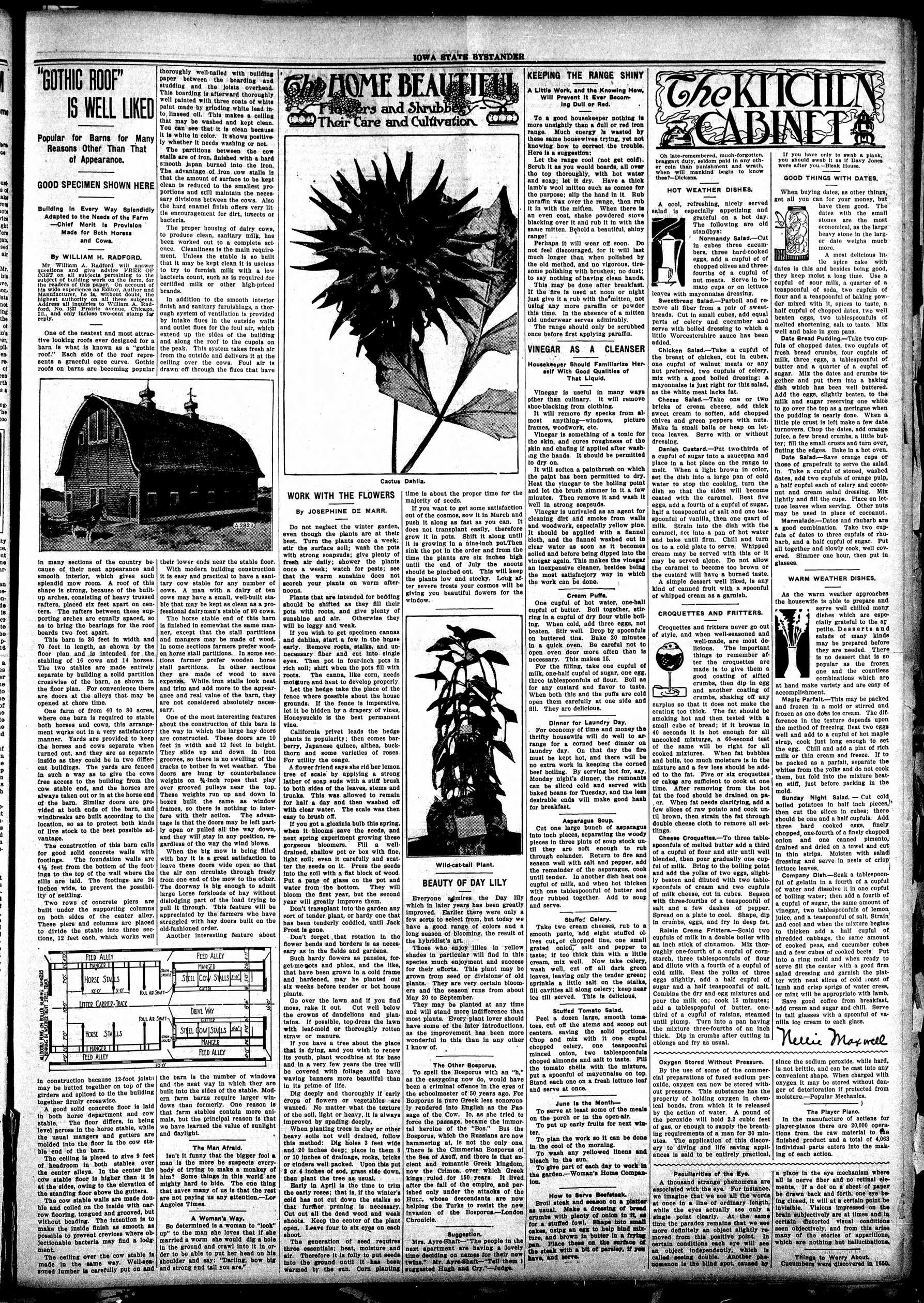
One of the nearest and most attractive looking roofs ever designed for a barn is what is known as a "gothic roof." Each side of the roof represents a graceful ogee curve. Gothic roofs on barns are becoming popular
BARN
in many sections of the country because of their neat appearance and smooth interior, which gives such splendid mow room. A roof of this shape is strong, because of the built-up arches, consisting of heavy trussed rafters, placed six feet apart on centers. The rafters between these supporting arches are equally spaced, as to bring the bearings for the roof boards two feet apart.
This barn is 38 feet in width and 70 feet in length, as shown by the floor plan and is intended for the staircase and 14 horses. The two stables are made entirely separate by building a solid partition crosswise of the barn, as shown in the floor plan. For convenience there are doors at the alleys that may be opened at chore time.
One farm of from 40 to 80 acres, where one barn is required to stable both horses and cows, this arrangement works out in a very satisfactory manner. Yards are provided to keep the horses and cows separate when turned out, and they are as separate inside as they could be in two different buildings. The yards are fenced in such a way as to give the cows free access to the building from the cow stable end, and the horses are always taken out or in at the horse end of the barn. Similar doors are provided at both ends of the barn, and windbreaks are built according to the location, so as to protect both kinds of live stock to the best possible advantage.
The construction of this barn calls for good solid concrete walls with footings. The foundation walls are $4\frac{1}{2}$ feet from the bottom of the footings to the top of the wall where the sills are laid. The footings are 24 inches wide, to prevent the possibility of settling.
Two rows of concrete piers are built under the supporting columns on both sides of the center alley. These piers and columns are placed to divide the stable into three sections, 12 feet each, which works well.
ALLOW HINGE ON BUILDING MAIN DRAFT 232
ROUNDING IN WATER RIGHT TILL TRACT
FEED ALLEY
HANGER
HORSE STAILLS
100'0"
5'0"
ROLL AIR
LITTLE CARRIER-TRACK
ROLL AIR
HORSE STAILLS
HANGER
FEED ALLEY
In construction because 12-foot joists may be butted together on top of the gardens and spliced to tie the building together firmly crosswise.
A good solid concrete floor is laid in both horse department and cow stable. The floor differs, in being level across in the horse stable, while the usual mangers and gutters are molded into the floor in the cow stable end of the barn. The ceiling is placed to give 9 feet of headroom in both stables over the center alleys. In the center the cow stable floor is higher than it is at the sides, owing to the elevation of the standing floor above the gutters. The cow stable walls are made double and celled on the inside with narrow flooring, tongued and grooved, but without beading. The intention is to make the inside finish as smooth as possible to prevent crevices where objectionable bacteria may find a lodgment. The ceiling over the cow stable is made in the same way. Well-seasoned lumber is carefully put on and
thoroughly well-nailed with building paper between the boarding and studding and the joists overhead. This boarding is afterward thoroughly well painted with three coats of white paint made by grinding white lead into linseed oil. This makes a ceiling that may be washed and kept clean. You can see that it is clean because it is white in color. It shows positively whether it needs washing or not. The partitions between the cow stalls are of iron, finished with a hard smooth japan burned into the iron. The advantage of iron cow stalls is that the amount of surface to be kept clean is reduced to the smallest proportions and still maintain the necessary divisions between the cows. Also the hard enamel finish offers very little encouragement for dirt, insects or bacteria.
The proper housing of dairy cows, to produce clean, sanitary milk, has been worked out to a complete science. Cleanliness is the main requirement. Unless the stable is so built that it may be kept clean it is useless to try to furnish milk with a low bacteria count, such as is required for certified milk or other high-priced brands. In addition to the smooth interior finish and sanitary furnishings, a thorough system of ventilation is provided by intake flues in the outside walls outlet flues for the foul air, which extends into the building and along the roof to the cows on the peak. This system takes fresh air from the outside and delivers it at the ceiling over the cows. Foul air is drawn off through the flues that have
A 282 x
their lower ends near the stable floor.
their lower ends near the stable floor. With modern building construction it is easy and practical to have a sanitary cow stable for any number of cows. A man with a dairy ten years old may be kept as clean as a professional dairyman's stable of 80 cows. The horse stable end of this barn is finished in somewhat the same manner, except that the stall partitions and mangers may be made of wood. In some sections farmers prefer wooden horse stall partitions. In other sections they are made of wood to save expense. While horse stalls look neat and tidy, they are not as secure and real value of the barn, they are not considered absolutely necessary.
One of the most interesting features about the construction of this barn is the way in which the large hay doors are constructed. These doors are 10 feet in width and 12 feet in height. They slide up and down in iron grooves, so there is no swelling of the tracks to bother in wet weather. The doors are hung by counterbalance weights on ½-inch ropes that play over grooved pulleys near the top. These weights run up and down the ropes, so there is a window frames, so there is nothing to interfere with their action. The advantage is that the doors may be left partly open or pulled all the way down, and they will stay in any position, regardless of the way the wind blows.
When the big mow is being filled with hay it is a great satisfaction to leave these doors wide open so that the air can circulate through freely from one end of the mow to the other. The doorway is big enough to admit large horse forklocks of hay without dislodging them. This feature through. This feature will be appreciated by the farmers who have struggled with hay doors built on the old-fashioned order. Another interesting feature about
the barn is the number of windows and the neat way in which they are built into the sides of the stable. Modern farm barns require larger windows than formerly. One reason is that farm stables contain more animals, but the principal reason is that we have learned the value of sunlight and daylight.
The Man Afraid.
Isn't it funny that the bigger fool a man is the more he suspects everybody of trying to make a monkey of him? Some things in this world are mighty hard to hide. The one thing that saves many of us is that the rest are not paying us any attention.—Los Angeles Times.
A Woman's Way:
So determined is a woman to "look" up" to the man she loves that if she married a worm she would dig a hole in the ground and crawl into it in order to get out. She should and say: "Darling, how big and strong and tell you are."
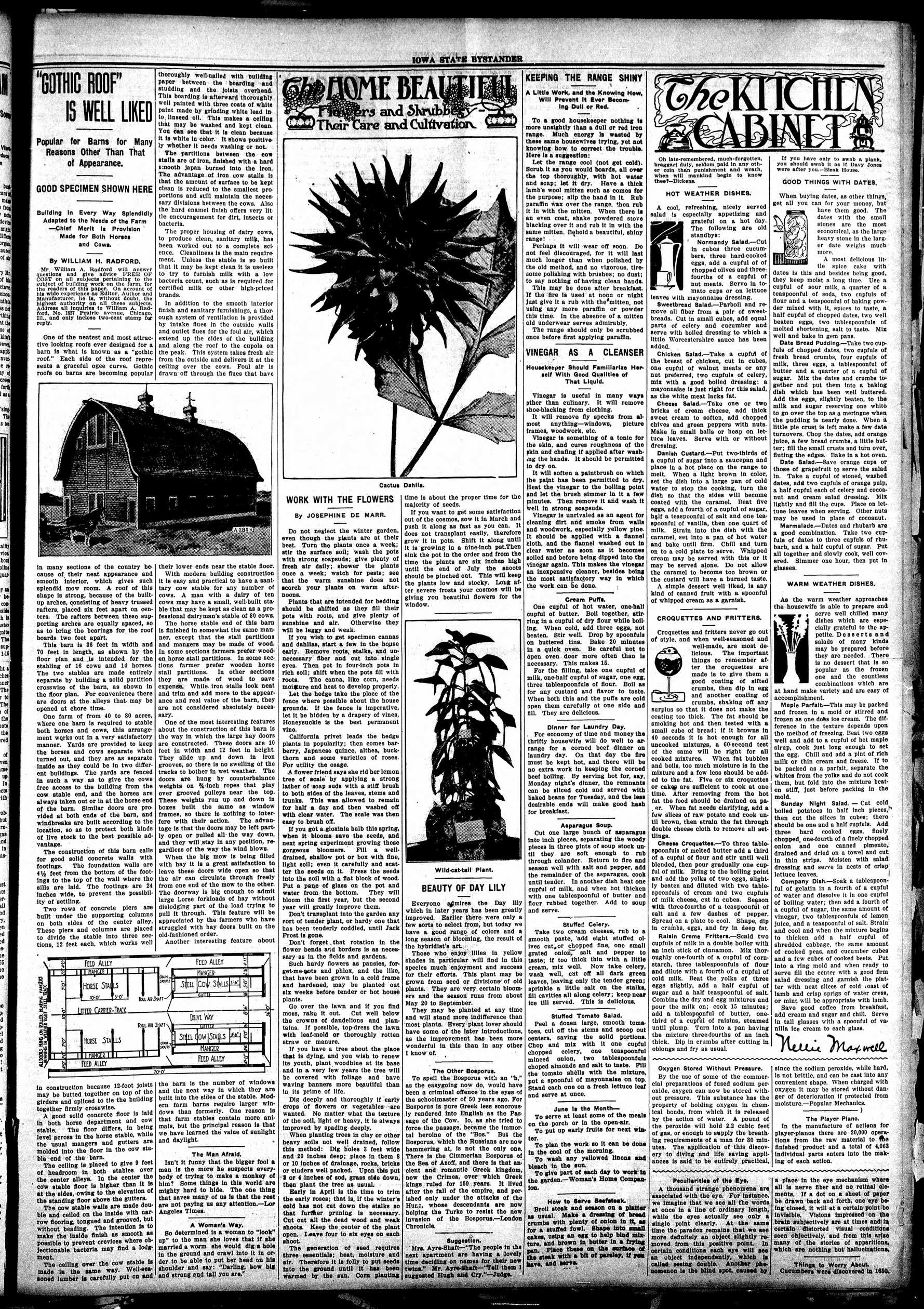
The HOME BEAUTIFUL
Flowers and Shrubbery
Their Care and Cultivation
A
Cactus Dahlia.
WORK WITH THE FLOWERS
Do not neglect the winter garden, even though the plants are at their best. Turn the plants once a week; stir the surface soil; wash the pots with strong soapsuds; give plenty of fresh air daily; shower the plants once a week; watch for pests; see that the warm sunshine does not scorch your plants on warm afternoon. Plants that are intended for bedding should be shifted as they fill their pots with roots, and give plenty of sunshine and air. Otherwise they will be leggy and weak.
If you wish to get specimen cannas and dahilas, start a few in the house early. Remove roots, stalks, and unnecessary fiber and cut into single eyes. Then pot in four-inch pots in rich soil; shift when like, like corn, needs moisture and heat to develop properly.
Let the hedge take the place of the fence where possible about the house grounds. If the fence is imperative, let it be hidden by a drapery of vines, Honey suckle is the best permanent vine.
California privet leads the hedge plants in popularity; then comes barberry, Japanese quince, althaea, buckthorn and some quinces of roses. For utility the osage.
A flower friend says she rid her lemon tree of scale by applying a strong lather of soap suds with a stiff brush to both sides of the leaves, stems and trunks. This was allowed to remain for half a day and then washed off with clear water. The scale was then easy to brush off.
If you got a gloxia bulb this spring, when it blooms save the seeds, and next spring experiment growing these gorgeous bloomers. Fill a well-drained, shallow pot or box with fine, light soil; even it can cover the water the seed. Press the seeds into soil with a flat block of wood. P put a pane of glass on the pot and water from the bottom. They will bloom the first year, but the second year will greatly improve them.
Don't transplant into the garden any sort of tender plant, or hardy one that has been tenderly coddled, until Jack Frost is gone.
Don't forget, that rotation in the flower bends and borders is as necessary as in the fields and gardens.
Such hardy flowers as pansies, forget-me-nots and phlox, and the like, that have been grown in a cold frame and hardened, may be planted out six weeks before tender or hot house plants.
Go over the lawn and if you find moss, rake it out. Cut well below the crowns of dandelions and plantains. If possible, top-dress the lawn with leaf-mold or thoroughly rotten straw or manure.
If you have a tree about the place that is dying, and you wish to renew its youth, plant dandelion at the base of the tree. Few years the tree be covered with foliage and have waving banners more beautiful than in its prime of life.
Dig deeply and thoroughly if early crops of flowers or vegetables are wanted. No matter what the texture of the soil, light or heavy, it is always improved, by grading, deeply.
When planting trees in clay or other heavy soils not well drained, follow this method: Dig holes 3 feet wide and 20 inches deep; place in them 8 or 10 inches of drainage, rocks, bricks or cinders well packed. Upon this put 8 or 4 inches of sod, grass side down, then plant the tree as usual.
Early in April is the time to trim the early roses; that is, if the winter's cold has not cut down the stalks so that further pruning is necessary, or if the tree is too large to shoot. Keep the center of the plant open. Leave four to six eyes on each shoot.
The generation of seed requires three essentials; heat, moisture and air. Therefore it is folly to put seeds into the ground until it has been warmed by the sun. Corn planting
IOWA STATE BYSTANDER
BEAUTIFUL
Shrubbery
and Cultivation
Dahlia.
time is about the proper time for the majority of seeds.
If you want to get some satisfaction out of the cosmos, sow it in March and push it along as fast as you can. It does not transplant easily, therefore grow it in pots. Shift it along until it is growing in a nine-inch pot. Then sink the pot in the order and from the time the plants are six inches high until the end of July the snouts should be pinched out. This will keep the plants low and stocky. Long after severe frosts your cosmos will be giving you beautiful flowers for the window.
A
BEAUTY OF DAY LILY
Everyone admires the Day lily which in later years has been greatly improved. Earlier there were only a few sorts to select from, but today we have a good range of colors and a long season of blooming, the result of the hybridist's art.
Those who enjoy lilies in yellow shades in particular will find in this species much enjoyment and success for their efforts. This plant may be grown from seed or divisions of old plants. They are very certain bloomers and the season runs from about May 20 to September.
They may be planted at any time and will stand more indifference than most plants. Every plant lover should have some of the later introductions, as the improvement has been more wonderful in this than in any other I know of.
The Other Bosporus
To spell the Bosporus with an "h",
as the easygoing now, do would have been a criminal offence in the eyes of the schoolmaster of 50 years ago. For Bosporus is pure Greek less sonorously rendered into English as the Passage of the Cow. Io, as she tried to force the passage, became the immortal heroine of the "Bos". But the Bosporus, which the Russians are now hammering at, is not the only one. There is the Cimmerian Bosporus of the Sea of Azoff, and there is that ancient and romantic Greek kingdom, now the Crimea, over which Greek kings ruled for 150 years. It lived after the fall of the empire, and perished on the land of the Hur. Those descendants of the Hur, among the Turks to resist the new invasion of the Bosporus.-London Chronicle.
Suggestion.
Mrs. Aye-Shift- "The people in the next apartment are having a lovely time deciding on names for their new twins." Mr. Aye-Shift- "Tell them I suggested Hugh and Cry."-Judge.
The KITCHEN CABINET
Oh late-remembered, much-forgotten, braggart duty, seldom paid in any other coin than punishment and wrath, when will mankind begin to know thee?—Dickens.
If you have only to swab a plank, you should swab it as if Davy Jones were after you.—Blank House.
A cool, refreshing, nicely served salad is especially appetizing and grateful on a hot day. The following are old standbys:
Normandy Salad—Cut in cubes three cucumbers, three hard-cooked eggs, and a cup of chopped olive and three-fourths of a cupful of nut meats. Serve in tomato cups or on lettuce leaves with mayonnaise dressing.
Sweetread Salad—Parbull and remove all fiber from a pair of sweetbreads. Cut in small cubes, add equal parts of celery and cucumber and serve with boiled dressing to which a little Worcestershire sauce has been added.
Chicken Salad—Take a cupful of the breast of chicken, cut in cubes, one cupful of walnut meat, and one nut preserving meat of celery, mix with a good boiled dressing; a mayonnaise is just right for this salad, as the white meat lacks fat.
Cheese Salad.—Take one or two bricks of cheese, add thick sweet cream to soften, add chopped chives and green peppers with nuts. Make in small balls or heap on lettuce leaves. Serve with or without dressing.
Danish Custard.—Put two-thirds of a cupful of sugar into a saucepan and place in a hot place on the range to melt. When a light brown in color, set the dish into a large pan of cold water to stop the cooking, turn the dish so that the sides will become coated with the caramel. Beat five eggs, add a fourth of a cupful of sugar, half a teaspoonful of salt and one teaspoonful of vanilla, then one quart of milk. Strain into the dish with the caramel, set into a pan of hot water and bake until firm. Chill and turn on to a cold plate to serve. Whipped cream may be served with this or it may be served alone. Do not allow the caramel to become too brown or the custard will have a burned taste.
A simple dessert well liked, is any berry dessert, so disposable of whipped cream as a garnish.
Croquettes and fritters never go out of style, and when well-seasoned and well-made, are most delicious. The important things to remember after the croquettes are made is to give them a good coating of sifted crumbs, then dip in egg and another coating of
surplus so that it does not make the coating too thick. The fat should be smoking hot and then tested with a small cube of bread; if it browns in 40 seconds it is hot enough for all uncooked mixtures, a 60-second test of the same will be right for all cooked mixtures. When fat bubbles and bolls, too much moisture is in the mixture and a few less should be added to the fat. Five or six croquettes or cake are sufficient to cook at one heat, then removing from the hot fat the food should be drained on pacer. When fat needs clarifying, add a few slices of raw potato and cook until brown, then strain the fat through double cheese cloth to remove all settings.
Cheese Croquettes.—To three tablespoonfuls of melted butter add a third of a cupful of flour and stir until well blended, then pour gradually one cupful of milk. Bring to the boiling point and add the yolks of two eggs, slightly beaten and diluted with two tablespoonfuls of cream and two cupfuls of milk. Season with three-fourths of a teaspoon salt and a few dashes of pepper. Spread on a plate to cool. Shape, dip in crumbs, eggs, and fry in deep fat.
Raisin Creme Fritters. Scald two cupfuls of milk in a double boiler with an inch stick of cinnamon. Mix thoroughly one-fourth of a cupful of cornstarch, three tablespoonfuls of flour and dilute with a fourth of a cupful of cold milk. Beat the yolks of three eggs slightly, add a half cupful of sugar and a half teaspoonful of salt. Combine the dry and egg mixtures and pour the milk on; cook 15 minutes; add a tablespoonful of butter, one-third of a cupful of raisins, steamed until plump. Turn into a pan having the mixture three-fourths of an inch thick. Dip in crumbs after cutting in oblongs and fry as usual.
to thicken add a half cupful of shredded cabbage, the same amount of cooked peas, and cucumber cubes and a few cubes of cooked beets. Put into a ring mold and when ready to serve fill the center with a good firm salad dressing and garnish the platter with neat slices of cold coast of lamb and crisp sprigs of water cress, or mint will be appropriate with lamb. Save good coffee from breakfast, add cream and sugar and chill. Serve in tall glasses with a spoonful of vanilla ice cream to each glass.
By the use of some of the commercial preparations of fused sodium peroxide, oxygen can now be stored without pressure. This substance has the property of holding oxygen in chemical bonds, from which it is released by the action of water. A pound of the peroxide will hold 2.2 cubic feet of gas, or enough to supply the breathing requirements of a man for 30 minutes. The application of this discovery to diving and life saving appliances is said to be entirely practical,
**Peculiarities of the Eye.**
A thousand strange phenomena are associated with the eye. For instance, we imagine that we see all the words at a line in a line of ordinary length, while the eyes actually see only a single point clearly. At the same time the paradox remains that we see more definitely an object slightly removed from this positive point. In certain conditions each eye will see an object independently, which is called seeing double. Another phenomenon is the blind spot, caused by
is not brittle, and can be cast into any convenient shape. When charged with oxygen it may be stored without danger of deterioration if protected from moisture—Popular Mechanics.
**The Player Piano.**
In the manufacture of actions for player-planes there are 20,000 operations from the raw material to the finished product and a total of 4,063 individual parts enters into the making of each action.
a place in the eye mechanism where all is nerve fiber and no retinal elements. If a dot on a sheet of paper be drawn back and forth, one eye being closed, it will at a certain point be invisible. Visions impressed on the brain subjectively are at times and in certain distorted visual conditions seen objectively, and from this arises many of the stories of apparitions, which are nothing but hallucinations.
**Things to Worry About.**
Cucumbers were discovered in 1850.
KEEPING THE RANGE SHINY
A Little Work, and the Knowing How,
Will Prevent it Ever Becoming
Dull or Red.
To a good housekeeper nothing is
more unusually than a dull or red iron
range. Much energy is wasted by
these same housewives trying, yet not
knowing how to correct the trouble.
Here is a suggestion:
Let the range cool (not get cold).
Scrub it as you would boards, all over
the top thoroughly, with hot water
and soap; it let it dry. Have a thick
lamb's wool mitten such as comes for
the purpose; all the hand in it. Rub
paraffin wax over the range, then rub
it in with the mitten. When there is
an even coat, shake powdered store
blackening over it and rub it in with
the same mitten. Behold a beautiful, shiny
range!
Perhaps it will wear off soon. Do not feel discouraged, for it will last much longer than when polished by the old method, and no vigorous, tiresome polishing with brushes; no dust; to say nothing of having clean hands. This may be done after breakfast. If the fire is used at noon or night just give it a rub with the mitten, not using any more paraffin or powder this time. In the absence of a mitten old underwear serves admirably. The range should only be scrubbed once before first applying paraffin.
VINEGAR AS A CLEANSER
Housekeeper Should Familiarize Herself With Good Qualities of That Liquid.
Vinegar is useful in many ways other than culinary. It will remove shoe-blacking from clothing. It will remove fly specks from almost anything—windows, picture frames, woodwork, etc.
Vinegar is something of a tonic for the skin, and cures roughness of the skin and chafing if applied after washing the hands. It should be permitted to dry on. It will soften a paintbrush on which the paint has been permitted to dry. Heat the vinegar to the boiling point and let the brush simmer in it a few minutes. Then remove it and wash it well in strong soaps.
Vinegar is unrivaled as an agent for cleaning dirt and smoke from walls and woodwork, especially yellow pine. It should be applied with a flannel cloth, and the flannel washed out in clear water as soon as it becomes dry. You can use vinegar again. This makes the vinegar an inexpensive cleaner, besides being the most satisfactory way in which the work can be done.
Cream Puffs.
One cupful of hot water, one-half cupful of butter. Boll together, stirring in a cupful of dry flour while boiling. When cold, add three eggs, not beaten. Stir well. Drop by spoonfuls on buttered tins. Bake 20 minutes in a quick oven. Be careful not to open oven door more often than is necessary. This makes 15.
For the filling, take one cupful of milk, one-half cupful of sugar, one egg, three tablespoons of flour. Boll as for any custard and flavor to taste. When both this and the puffs are cold open them carefully at one side and fill. They are delicious.
Dinner for Laundry Day.
For economy of time and money the thrifty housewife will do well to arrange for a corned beef dinner on laundry day. On that day the fire must be kept hot, and there will be no extra work in keeping the corned beef boiling. By serving hot for, say, Monday night's dinner, the remnants can be sliced cold and served with baked beans for Tuesday, and the less desirable ends will make good hash for breakfast.
Asparagus Soup.
Cut one large bunch of asparagus into inch pieces, separating the woody pieces in three pints of soup stock until they are soft enough to rub through colander. Return to fire and season well with salt and pepper, add the remainder of the asparagus, cook until tender. In another dish heat one cupful of milk, and when hot thicken with one tablespoonful of butter and flour rubbed together. Add to soup and serve.
Stuffed Celery.
Take two cream cheeses, rub to a smooth paste, add eight stuffed olives cut, or chopped fine, one small grated onion, salt, and pepper to taste; if too thick thin with a little cream, mk well. Now take celery, wash, and mk well. Add the leaves leaving only the tender green; sprinkle a little salt on the stalks, fill cavities all along celery; keep near ice till served. This is delicious.
Stuffed Tomato Salad.
Peel a dozen large, smooth tomatoes, cut off the stems and scoop out centers, saving the solid portions. Chop and mix with it one cupful chopped celery, one teaspoonful minced onion and one tablepoonful chopped chilies and salt to taste. Fill pots shells with the mixture, put a spoonful of mayonnaise on top. Stand each one on a fresh lettuce leaf and serve at once.
June In the Month—
To serve at least some of the meals on the porch or in the open-air.
To put up early fruits for next winter.
To plan the work so it can be done in the cool of the morning. To wash any yellowed linens and bleach in the sun.
To give part of each day to work in the garden.—Woman's Home Companion.
How to Serve Beefsetak.
Broll steak and season on a platter as usual. Make a dressing of bread crumbs with plenty of onion in it, as for a stuffed fowl. Shape into small cakes, using an egg to help bind mixture, and brown in butter in a frying pan. Place these on the surface of the steak with a bit of parley, if you have, and serve.
If you have only to swab a plank, you should swab it as if Davy Jones were after you. -Bleak House.
When buying dates, as other things, get all you can for your money, but have them good. The dates with the small stones are the most economical, as the large heavy stone in the larger date weighs much more.
A most delicious little spice cake with dates is this and besides being good, they keep moist a long time. Use a cupful of soaked dates to a teaspoonful of soda, two cupfuls of flour and a teaspoonful of baking powder mixed with it, spices to taste, a half cupful of chopped dates, two well beaten eggs, two tablespoonfuls of melted shortening, salt to taste. Mix well and beak in gem pans.
Date Bread Pudding—Take two cupfuls of chopped dates, two cupfuls of fresh bread crumbs, four cupfuls of milk, three eggs, a tablespoonful of butter and a quarter of a cupful of sugar. Mix the dates and crumbs together and put them into a baking dish which has been well buttered. Add the eggs, slightly beaten, to the milk and sugar reserving one white to go over the top as a meringue when the pudding is nearly done. When a little pie crust is left make a few date turnovers. Chop the dates, add orange juice, a few bread crumbs, a little butter; fill the small crusts and turn over, futing the edges. Bake in a hot oven. Date Salad—Save orange cups or those of grapefruit to serve the salad. In. Take a cupful of washed dates, add two cupfuls of orange pulp, a half cupful of celery and coconut and cream salad dressing. Mix slightly and fill the cups. Place on lettuce leaves when serving. Other nuts may be used in place of coconut.
Marmalade...Dates and rubarb are a good combination. Take two cupfuls of dates to three cupfuls of rubarb, and a half cupful of sugar. Put together and slowly cook. well enough.immer one hour, then put in glasses.
As the warm weather approaches the housewife is able to prepare and serve well chilled many dishes which are especially grateful to the arpette. Desserts and salads of many kinds may be prepared before they are needed. There is no dessert that is so popular as the frozen one and the countless combinations which are at hand make variety and are easy of accomplishment.
Maple Palart—This may be packed and frozen in a mold or stirred and frozen as one does ice cream. The difference in the texture depends upon the method of freezing. Beef eggs well and add to a cup of hot maple sauce, cup just enough to set the egg. Chill and add a pint of rich milk or thin cream and freeze. If to be packed as a parfait, separate the whites from the yolks and do not cook them, but fold into the mixture heaten stiff, just before packing in the mold.
Sunday Night Salad. — Cut cold boiled potatoes in half inch pieces, then cut the slices in cubes; there should be one and a half cuplets. Add three hard cooked eggs, finely chopped, one-fourth of a finely chopped onion and one canned pimento, drained and dried on a towel and cut in thin strips. Moisten with salad dressing and serve in nests of crisp lettuce leaves.
Company Dish. —Soak a tablespoonful of gelatin in a fourth of a cupful of water and dissolve it in one cupful of boiling water; then add a fourth of a cupful of sugar, the same amount of vinegar, two tablespoonfuls of salt and juice, and two tablespoonfuls of strain and cook them in a mixture before cooks add a half cupful of chopped cabbage, the same amount of cooked peas, and cucumber cubes and a few cubes of cooked peas. Put into a ring mold and when ready to fill the center with a good firm salad dressing and garnish the platter with neat slices of cold oast of lamb and crisp sprigs of water cress, or mint will be appropriate with lamb.
Save good coffee from breakfast,
add cream and sugar and chill. Serve
in tall glasses with a spoonful of vanilla
ice cream to each glass.
Nellie Maxwell
since the sodium peroxide, while hard,
is not brittle, and can be cast into any
convenient shape. When charged with
oxygen it may be stored without danger
of deterioration if protected from
moisture.—Popular Mechanics.
The Player Piano.
In the manufacture of actions for
player-planoes there are 20,000 operations
from the raw material to the
finished product and a total of 4,063
individual parts enters into the making
of each action.
a place in the eye mechanism where all is nerve fiber and no retinal elements. If a dot on a sheet of paper be drawn back and forth, one eye being closed, it will at a certain point be invisible. Visions impressed on the brain subjectively are at times and in certain distorted visual conditions seen objectively, but this arise only of the stories of apparitions, which are nothing but hallucinations.
Things to Worry About. Cucumbers were discovered in 1850.
HOT WEATHER DISHES.
Normandy Salad—Cut. in cubes three cucumbers, three hard-cooked eggs, add a cupful of chopped olives and three-fourths of a cupful of nut meats. Serve in tomato cups or on lettuce
CROQUETTES AND FRITTERS.
well-made, are most delicious. The important things to remember after the croquettes are made is to give them a little crumbs, then dip in egg and another coating of crumbs, shaking off any
GOOD THINGS WITH DATES.
have them good. The dates with the small stones are the most economical, as the large heavy stone in the larger date weighs much more. A most delicious little spice cake with
WARM WEATHER DISHES.
dishes which are especially grateful to the apetite. Desserts and salads of many kinds may be prepared there. They are needed. There is no dessert that is so popular as the frozen one and the countless combinations which are
The Player Plano
i iss Spd tr ssa nasnenc pers epeteae eae oticeet aaa ar acm a a i ae oe,
se halal. ila ee ee ee prin CSS ACE
= i ey prec ean
AFRO-AMERICAN CULLINGS
Kano Meyer anid the other day that
the great war was the price the world
4s paying for the mechanical comforts
which haye been piled up so rapidly.
Again another historian clinches the
point. ‘The time it is W. E. B. Datiols
the author of a brilliant book on
“The Negro,” which Hoit has just pub
Ushed in the Home University Li
brary.
DuBola says that the Negro in
Africa has been practically enslaved
by the civilized nations of Europe.
‘The growth of trade unions made In-
Yestors look to Africa for opportun:
ities. That meant the partition of
Africa, “And “this partition of Africa
brought revision of the ideas of Nezro
uplift. Why was it necessary, the Eu-
Topean investors urged, to push a con-
tinent of black workers along the
Paths of social uplift by education,
trades unfoniom, property holding and
the electoral franchise when the work:
ers desired no change and the rate of
European profit would suffer?"
‘Accumulated profits trom the me-
chanical inventions of the last few
Generations drove France, Belgium,
England, Germany, Italy, Span and
Portugal to carve Africa according to
thelr own tastes. Dulols can see no
hope for the race until Negroes “fight
not simply for their own rights as
men, but for the ideals of the greater
World in which they live; the emancl-
ation of women, universal peace,
democratic government, the sociallza-
tlon of wealth and human brother-
booa®
‘That does not mean inevitable pros-
Fess, It means inescapable degrada-
tion if the generous spirits of the
world do not strive to the utmost, At
a crisis lke this every virtue, every
deal, every dream of glory can bo
forsaken in an instant, Brute force
can displace reason, and the world,
like the gallant boy on the Aisne, can
make itself “the instrument through
which @ greater force works out its
inscrutable ends through the impulses
of terror and repulsion.”
‘The clternative 1s justice, fraternity
and equality.
‘The adoption by the Baptist con-
‘Yentfon of the report to locate the pro-
posed Negro seminary at Memphis
came after considerable discussion.
Nashville submitted a pleasing prop-
osition for the location of the sem-
Snary, but because of the distance to
Nashville from the center of Negro
population to be benefited by the sem-
foary, it was decided that Memphis
would be ® more suitable place. It
‘was agreed to raise at an carly date
{$50,000 for this purpose. Dr. Milton
, Griggs, Negro, of Tennessee, made
‘a profound {mpression and showed the
fine spirit of brotherliness and co-
‘operation which exists between the
white and the Negro Baptists. His
address showed a fine spirit of loyal:
ty to the South and the white people.
He acknowledged the debt which he
‘and his people owed to the South and
to the southern people. He said that
ft was here that he got his language.
his knowledge of industry and his re-
ligion, that he was proud of his race
and of the white people. He declared
that the white people of the South
have helped the Negroes far beyond
their ‘calculations, giving them new
unity and inspiring them to self-uplitt
and selfhelp. He declared that the
work of the southern white people is
affecting the Negro, not externally
but in a real emancipation of the
race. One-third of the voting strength
of the United States the South con-
Booker Washington, accompanied
by 8 company of 25 other educated
colored, men, has recently made a
visit to larger centers of population
in Loulsiana. ‘The coming of the vie
itors was widely advertised in ad-
vance, and Negroes gathered in large
numbers to attend the meetings held.
Some journeyed ten, twenty and even
forty miles—on mule back, in busey,
in wagon. At Shreveport, on the west-
em border of the state, ten thousand
gathered principally to hear Mr.
‘Washington. He was the chief speak-
er and principal attraction at all
points. White citizens of prominence
Tent encouragement to the meetings
by thelr presence. Booker Washing-
ton gave wise and wholesome counsel
to both races. In talking to the whites
‘he reminded them that It ts better to
educate Negroes than to take care of
eriminals; that Louisiana paid too
high « compliment to Negro children
by assuming that'a Negro child could
get a satisfactory education by giv-
ing bim only three or four months!
schooling in the year; that the nation
hears too -much about lynchings and
Facial dimMeulties and too ttle about
Last summer saw completed the de-
mareation of the boundary line be-
tween Alaska and Canada, “straight
‘porth along the one hundred and forty-
first meridian to the Arctic ocean, No
other: boundary demarcation has ex-
tended into ‘such’ high latitudes and
few bolindaries of equal length are 30
aatraight. The line ‘follows the meridian
‘without deviation, regardless of moun:
‘tains, swamps and forests,
Philadelphia's yearly loss because ot
fats fa°entfmoated st $1,000,000.
~ gereport ou! ther atmosphere electric
‘phastyations made Guring, the second
raion Of tH6 Carnegis’ ls. published.
Fhe pallonetivity ot the air over the
‘ocean ‘Afoas farlremoved from land
Ye winall, compared to that found over
fast; while the, lonisation over the
sotean ia) At Toast nn large as that
ies i
a ‘cop of China ta sald
preiecs "There fs no no
joes uot ratse them, and th
betantial part of the diet of|s
we part-of the Chinese people.
brchoh nfl aa AM aitasnaar it that ea a
present national government. In
this great Baptist movement the South
leads, reallzing that In proportion as
the Negroes are educated they will
help in advancement and plans for fa:
proving the condition of all the peo-
ple. He declared that as the Negroea
followed the white people through
years of slavery, #0 they are now will
Ing to follow in this great work and
labor In concert for the future of the
race, This theological seminary for
the Negroes will doubtless prove a
great forward step in all their work.
It was a humiliating position In
which the ¢on of Abraham Lincoln
found himself when he admitted to
the Industrial commission that the
great Pullman company was the real
recipient of the tips to Its colored 20r-
ters, This concern, whose stock {8 $0
closely held and so highly valued as
to be almost never sold, has pald on
fan average 8 per cent ever since its
foundation, At the same time, it gives
to its colored employees less than a
living wage, and expects them to make
up the difference between that and
what they need to live on out of the
gratuities of travelers Mr. Lincoln
thought that on the whole the com-
pany was entitled to great credit for
keeping this fleld of employment open
to Negroes, who are so often discrim:
inated against. But tt may well be
doubted whether the philanthropic
motive would be noticed in the Pull
man company if it were compelled
to pay the wages it should, The la-
borer is worthy of bis hire; and when
Mr. Lincoln so complacently patted
himself on the back for employing
colored Iabor at all, he ought to re-
member that failure to obtain sufficient
tips by reason of interference with
tram, slackness of travel, or hard
times has brought many a porter's
family face to face with genuine sut-
fering—even when he wore four and
five service stripes on his coat-sleeve.
That under these circumstances por
ters have ylelded so llttle to tempta-
tion that thelr record for fidelity and
honesty and for heroie service in ac-
dents is admirable, pain no fault
of Lincoln's son. The descendants
of the men the father freed have long.
been exploited, overworked—oftan
without sleep enough for long stretches
(0 keep a men well—and underpaid
besides by the company of which the
emancipator’s son has been the head.
New York Evening Post.
The campaign that was begun
‘among the colored schools by Mrs.
Helena Holley, under the direction
of Superintendent Horn, for the bet:
terment of health conditions ainong
the colored children, was greeted
‘with enthusfacm by the pupils,
The puplls of six colored. schools
‘met at the Colored High school where
they were gathered ina large hall
‘The Health hymn was distributed
‘among them, and with the first few
chords struck on a plano, the song
Was taken up and carried through
‘splendidly, the true musical instinct
of the race rapidly caught the rhythm,
fand thus the message of the words
was crystallized. into. thelr thought
through the pleasing medium of the
tune, which was Tipperary.
‘The ladies making up the party
were very much pleased with the re:
sults of thelr efforts. The party was
out all day, violting the several col
red ward schools, and teaching the
willing ttle dusky students the
aaks WnaEoued. ha
the evidences of racial friendship and
‘good will which exist in the majority
of communities. And Negroes {mi-
tate white men closely; {f white peo-
ple break the law, drink and gamble,
Negroes will; it’ white people are
sober, lew.ablding and industrious,
Negroes will be. Counseling the Ne-
‘groes Mr. Washington advised them
to stay in the country where the soil
and the rain and the sun draw no
color line, He urged his hearers not
to live in a knapsack, but to settle
down and to get property. He told
them that fifty years the white man
had been carrying the Negro on bis
back and that he was getting tired
He bade them consider how thoy
could use at home what they had
learned at school. And he advised
them not to talk about white people,
but to talk to them, to make friends
with them,
‘The government of India has ap
pointed an expert to make an exhaus-
tive study of the white ants of that
country, which completely destroy all
‘books with which they come In con-
‘tact if not detected in time.
|, The problem of giving southeastern
‘taly an adequate water supply, which
“has been studied since Roman times,
{s about to be solved by the construc:
ton of an aqueduct to cost about
$25,000,000,
As & rule employees in breweries,
tanneries and printingink factories
fare immune from consumption, ‘Tur.
pentine works and rope works are a
Protection trom rheumatiem, Work-
ers in copper mines need) not fear
typhoid, :
Wild horses in Arabia’ will not a0-
mit a tame horse among them; but
the wild horses of South America en-
teavor to decoy domesticated horses
from thelr masters, and seem eager
to welcome’ them,
‘Added to ‘ueh nates us Alsace
Lorraine Jones appear the’ following
on the’ London’ insuranes register,
showing (hs effect of the war on|uew-
comers inthe world: Kitchener Bar-
Héataey ne Only, Fancy er
oS Aoees corn aS.
“ % pit teats ae
COMMANDER OF ITALY'S ARMIES
i S |
pan
os Bi |
A ¥
ee
! m \ aay.
é : :
| vf & - :
i ea
Ch Pa
Na Lad Ear aue ni nai we ealastG.
Ss ee Se
ing | steamsbip companies, tourists’ bu
Gay Season Follows Mourning roots. notes and celebration commit
Year in Japan. tees are all making special arrange
ments to offer every facility in thel
a Power. Many of those American trav
Coronation at Kyoto in'November wit! | elers will go to China as well, a
Be Culmination of Succession of | H new republic of Asia is, arousin
the increasing interest of Its trans
estivale—Tokyo Society Bu
Featvale Tokyo seciety Buty | Pace nelghber
Tokyo—The year's period of na-
tHonal mourning expired on April 11,
and the printers and dyers were bustly
engaged tn removing black, the sanc-
tuary of the late empress dowager
was transferred to the “Hall of Impe-
rial Spirits” nthe palace grounds
from the temporary shrine at Aoyama,
and the coronation commission has
teen orgenlzed with H. I. H. Prince
Fushimi as honorary. president aud
Prince Takatsukeea as chief commis
sioner. ‘The latter represents one ot
the five noble families, whose heads
alone were eligible to the post of the
emperor's prime minister in former
days. The helght of the cherry sea-
son and the first anniversary of the
formation of the Okuma cabinet tend
to keep Tokyo soclety busy with gar
den parties and convivial meetings,
while the stock market showed a few
days ago the biggest sign of returning
prosperity since the boom after the
Rueslan war.
April 17 being the tercentenary of
the death of the founder of the Toku-
gawa Shogunate and of the City of
Tokyo, an elaborate program for
commemoration is prepared in Tokyo,
at his bigth place, Okazaki, at Shi
dzuoka, where he had retired, and at
Kunoztn and Nikko, where his mem-
ory Is kept sacred in gorgeous tem:
ples. A Daimyo procession 1s repro-
duced for three days in the imperial
capital. The feudal chieftain in his
palangutn, carried on the shoulders of
tall bearers, “shakespeare,” bowmen,
gunners, horses and grooms, @ retinue
fof servants and porters of the per
sonal effects of his lordship—all in
authentic costuming and conventional
manners, will parade to the Shiba
park, where the Tokugawa temples
stand, trom three different entrances
to tho city on three successive days.
‘The foreign community and tourists
are particularly anxious to see this
Aispiay, for it 1s only the third time
that feudalism Is made visible in the
metropolis. ‘The frst occaston of the
Kind was to celebrate the thirtieth
Year of the imperial residence in To-
kyo, and the second to entertain
Prince Arthur of Connaught, who came
to Japan on the Garter mission, after
the AngloJapanese alliance had been
first formed,
At Okasald, on April 18, a parade
of impersonated Mikawa Samural, a
body of singleminded and simple-
living warriors who fought under the
first Shogun, Iyeyasu, to create a
relgn of peace out of the chaos and
constant strife of the middle ages, will
attract crowds of spectators, both
Japanese and foreign,
Tho grand finale of this year's
‘events, however, will come off in the
month’ of November, in the shape
‘of the coronation rites by the em-
Deror in his ancestral capital, Kyoto
‘The coronation in, Japan is somewhat
different in nature from that of Eu-
rope, and Instead of belng a purely
religious ceremony the sovereign sol
‘emnly proclaims bis coming to the
throne, to the imperial spirits and the
people on the one hand, and on the
other offers new rice to the delties of
heaven and earth and partakes of It
himselt on the spot. ‘The proclams-
lon and the accompanying state ban.
‘quet will comprise some modern fea.
tures, while the ancestral worsh:p
and the shrines for that purpose will
closely follow the example of prim!-
‘tive simplicity set by the earliest
rulers over two. thousand years go,
‘These functions are calculated to
bring unusually large numbers of vis-
{tora to Japanese shores from the
fen pec tee sete Meath ote ote!
CROOK .IN TAIL, NO SALE
Kansas Court Rules About Mules and
aleoreoh imvltntes
‘the Sale.
Kansas “City))Mo-—fules as to
mules’ tails entered into the proceed:
Ange of the Kansas ‘City court ‘ot ap-
peals when the court held, fh affirm
jog a Cass Ci st Hiegnd ‘that the
Pes at aaah
base Faponchted tbe be: -tound tes
IOWA SPATE RYSTANDER|
steamship companies, tourists’ bu-
reaus, hotels and celebration commit:
tees are all making special arrange:
ments to offer every facility in thelr
Power. Many of those American trav-
elers will go to China as well, as
the new republic of Asia is arousing
the incressing interest of Its trans:
Pacific neighbor,
DOG DEVOURS “EXHIBIT A”
White Calf's Red Ear Did Not Appear
In Theft Case in Call-
fornia,
San Franctsco.—Elmer Nergard, son
of a wealthy rancher, did not steal
from the Round Valley (Cal.) indian
reservation one white calf with red
ears, a jury In the United States dis-
trict court found here a few days ago.
‘The calt's value was placed at $25.
‘The case cost the government $15,000,
ft was said. A notched caif’s ear that
was to bave figured as “Exbibit A,”
did not appear in the case.
Dante! Deram, forest ranger, eald bis
dog ate It.
DECIDES TO DIE A REDHEAD
Life Looked ‘Black to Blond Youth
Who Became Auburn Through
‘Dyelig Process;
Memphis, Tenn.—After dyeing his
hair red in hopes of concealing his
{dentlty, Winiford Dickerson, clerk of
North Fifth street, wandered to Over.
ton Park, crawled under a clump of
bushes near the z00 and swallowed 80
muuch poison physicians at the City
hospital say he cannot live.
‘The man was found by park pollee:
man Ferguson. He was unconscious.
MRS. JOHN JACOB ASTOR
|
oe
o
| Ay
| je
he ‘
Fa NNG
y 4
é Ne
hy
e,
Lh eee
een ame
‘This {e the latest photograph of the
Yoing briderldse, of the ten
Teob Astor who Tost tis fe in me
‘Wao dauaee,—‘Peripent mea
are lining tbe aame:of bras meet
with that of Clarence Mackay, the ca-
dle and telegraph magnate,
Reread 1
“lames Ry Gounelly, "a Taran
entitled, to recover. the cost price,
‘brought sult. against Alonso Parish,
‘altos farmer, forthe ‘purchase price
ot two mules which he alleges he had
teed ae eee ae
Later, 8 Alycor.
fed they had crete ta tha ‘alle,
(ergot pinoy rw aden
9 wh crooked tails had,
Dea hor na
Sip i te eee Yi
me Faevlna donate
e CU ess een ah dh Tt
t
DOG ATTACKS SHAVEN BOSS
Captain Loses Beard and Causes Com
aternation and Excitement
‘Aboard ship.
Baltimore.—That tonsorial changes
may get a rian in trouble was the ex
perience of Capt. O C, Hedstrom of
the Swedish steamer Liguria, which
has arrived from Gothenburg, When
the ship entered the capes Captain
Hedstrom wore a fine beurd, and an
Idea struck him that he would re
move It.
While the ship was in charge of
the pilot he made his sacrifice and
when morning appeared he went on
deck. At onco he was attacked by
hig pet dog, which had to be subdued
to Keep him from biting {ts master.
‘Then the officer on deck was puzzled
when the captain walked on the
bridge, and an explanatton followed,
Word was passed through the sbip
that {fa strange man was seen ask-
Ing questions either ia engine room
oF on deck not to be rude to him, as
ft was Captain Hedstrom with bis
whiskers off,
CUPID BROKE UP A CLUB
St, Paul Bachelor Girls’ Club Is Now
‘a Name Only—Dances Out
ad eieanaes
St, Paul.—The Bachelor Girls’ club
of St, Paul danced itself out of exist
ence at the Armory, Sixth and Ex
change streets, after ten of the orish
nal thirteen members liad fallen be
fore the marksmanship of Dan Cupid.
Tt was the twelfth and last dance
given by the club, and at the stroke
of one @ few mornings ago the last
vestige of the club as an organt: >
tion vanished like Cinderella under the
spell of the fairy.
‘The club was orgauized five years
ago and the members, bound by sol
emn oaths of bachelorhood, remained
Intact for a time. Cupid battered at
the ramparts ond one after another
the members capituleted antil five
alone were left. Suddenly two of
these fell and a double wedding an:
nouncement carried dismay to the
hearts of the remaining three.
WINS TOOTH-BRUSH STRIFE
ae.
ay ,
yt bs Yer”
eo , A ae »
ee fo
fi fe
Vi
Va LE ees
ke u fe 3
pep et
fe) a
7 be Ops
beg b oe
4 sak SM
This picture shows one of the chil
dren who won the first prize awarded
in the bis tooth-brush drill competition
Jn which thousands of school children
participated in New York. recently.
Tooth-brush drills are now tmportant
features of the routine In the New
York publle schools, and the impor
tance of the tooth-brush in preventing
diseases of the teeth and mouth is be
Jing practically impressed on the pus
pils, especially in the lower grades,
BLIND MAN IS A LAWYER
Sister Read Plackstone to Him—
Passes Examination for Admission
to the Bar.
Pierre, 8. D.—Among the successful
applicants for admission to the bar
at the recent examination before the
Supreme court was Ole H. Flow, a
native of the Black Hills, who has
worked under the handicap of blind-
ness from birth,
For years he made his way In the
world as a plano tuner, but aspired to
the law, and securing a copy of Black-
stone, had his sister read the work to
btm.
‘At the examinations the questions
were read to Flow by one of the court
stenographers, and his answers were
written out on an ordinary type
writer, he never having recourse to
the machines arranged especially for
the blind, a
GIRL MASQUERADER IS CURED
“Woman’s Dress Is Good Enough for
Me," She Says, After
Escapade.
New York.—“Never again,” sald
seventeen-yearold Myra Whiting of
Baltimore to, District. Attorney Per
ins, as she left bis office with her fa
ther to return to Baltimore. Women’s
dress Js good enough for mo in fu
ture,” sho added, "I wish my halt
could, grow a little faster.”
‘Myra was arrested with Wilbert Me
Kenney, also of Baltimore. She was
then dressed in man’s clothing, which,
‘sho sald, she had put on In Washing
ton, atter Jeaving Baltimore to begin
‘@ musteal career.
Sho told Mr. Perkiis that sho: had
‘expected to work as'a chauffeur while
getting her musical education,
Hog Market Jumped. -
Thomasville, N, C—B. M. Michael
te mai who mete the largest yield
Falsing wheat last yoar, has come out
with & hog story’ thet ‘can't be deat.
Mz, Michael gires the following facts
about J. W. Massey's hogs: A Poland
Ching sow, three and otehalt years
91d, bad Ove litters of pigs, numbering
(4, Bhewe pis ee Sd at 8 arte
ot four dollars, ors total ‘sum of
fra: Hoga ta yal te Wheat oo Rall
Tihias eee ene ey Tg Leics
FIGHES FROM OCEAN
Japanese Fishing Industry Is
Enormous.
“a the Leading Nation In. the
World In This Respect—Annual
Value of Water Products
: Reaches Large Figure.
Japan Is sald to be the leading fish:
ing: naticn, not, tn the actual value
atFite Beh’ products, for in that te
Sheet’ several other nations exes! It
tee inthe number of pereons who
fiske thelr ving by ishing, in the
Saportion of fishers to. the rest of
Ihe population, fn the relative ImpOr
Hance of fsheries in the domestic
ftonom, tm the ingenuity and skill
or the people In devising. Ashing ap
paratus, Ia preparing Ssh and tn the
Meal shown by the kovernment I pro
froting. the interests of the fling
population.
PT alands coming Jaen rth
dlagonally trom north east to south
eat, between two and three thousand
miles, giving a great range of clita,
“ind. consequently of waters from al
mest tropleal to almost aretc. The
islands are mostly tong end narrow
‘and at no part is the interlor too far
from the sea. to allow of the easy
transportation of fresh fish, Within
afew miles of the coast In many
Sutct dhe'decy parte of the see
Wileh breed inexhaustible supplles of
deep ceo fsh, while the bank and top
feeding worts swarm about the shores
In countiess schools
eis eatimated that ope person tn
-ewenty fn the entire empire 1 more
or less of a fisherman, and fish appear
in some form on the table of every
Japanese family dally, if not at every
[ea The anneal vale of water prod
ucts isn excess of $30,000,000. Tall
‘million boats are engaged fn fishing
of whieh 18,000 are more than thirty
feet long. Almost a milion men are
| profesional fahermen,, ant. 140,00
“more give part of thelr ime (0 Nsbing
| and the Feat to farming ot other pur
‘suits. Only about 200,000 men are, It
appears, eo employed to the Valied
| States.
‘A thousand spectes of fish have al:
ready been identified in Japanese wa
ters, and almost every one of them Is
eiible. One of the commonest, most
Wholesome and most sought after I
the shark, whieh the western people
have never learned to eat, Dut whlch
a fishery expert of this goveromen
|svho bas visited Japan pronounces ex
cellent. Dogfish, the common mem:
ber ofthe shark family along the north
Atlante coast, would never be. per
mitted to go uneaught fn Japan. Eve
the octopus le'a table delicacy there.
Much fish Is eaten raw by the Japa
nese, a fact that is sald to be mu
more easily understood by Amerlean
after they have tried raw mackerel o
other fish dipped in. the delicious
sauces the. Japanese employ in. th
relation.
The prominence of Japanese Ash
erles 18 due to the encouragement 0
the government. Offcials have beet
sent to the United States as well a
to Europe to study the methods
fogue, and there is at Tokyo an tm
‘peral Beherles institute, a schoo! wi
which no other in the world ean com
erg
IN RECOGNITION OF BRAVERY
Wes cr de Geers Tc
Wella wen
rou hen SES Mere th
Gauls te Genre covopacene ts ie
Miltary Groen f Brae nan ee
== ==
= sy. >
only =
ZS 3
fer tale N
iz E
hese
wes Cz
NZ
Vk
ee
VO I
rape
Cross of Germany, will be noticeable
on the bosoms of Frenchmen, elvilian
as well a8 military, who have been dle:
nguished by being mentioned In the
dispatches,
In point of rank the new cross
comes after the Cross of tho Legion
ot Honor and the Military Medal, both
of whlch are given for apecial acts of
valor or public service,
Civilians, Including women, can be
decorated with the new cross for acts
oF conduct that would in military lite
havo entitled them to mention in army
orders,
‘The Crofx de Guerre ts made of
Florentino bronze, about an {neh and
a halt in dlameter, with crosted swords
betwoen the atma. It ls to be wore
on the left breaat in line with the see
ond button of the tunte, ‘The ribbon
‘ws bright green edged with red,
gists Aiden
Na aaa
“Does it require great ‘mental ef.
fort to bes photogrsptert=
| eh, deed” repled is Baap
Bam.” “You have’ to at ay oak?
‘earning funny stories to tell uatom.
rs 0 order to make ‘em smith
Took natural.”
Be
Sed One eae
tee ge Guit drinking: during
office hours.”
“Well Wei 1 Sémire him tor
Was it mach ot « strageiey>
SNe, He slapiy cacan rune?”
Invention That 18 Causing
Discussion.
Pittsburgh Man Able to Make: Vig
tlone Radiated by Flame Reproaee
Every Note Played Upon |
Pipe Organ,
Albert J. Pyne, a Pittsburgh
ness man, has perfected, after yer
study, a device by which he can
vibrations radiated by the fame
fa tiny gas get reproduce every
played upon a pipe organ, The der
has not yet been named, but it mig
well be called a pyrophone. 1 dit
little in prinetple from a pipe orpa|
cexeept that the vibrant note is a
by a flame instead of a current of uy
upon a reed.
In recent tests in his laboratory i
Pyne proved the practicability of
invention with a single unit, or tary
and {s perfecting it for a publle deus
stration before @ party of scleaty
and mustelans. ‘Tho inventor does aq
claim that he has discovered anyihigg
particularly new to sclence oF that ty
Instrument will In ftselt become «
widespread utility. Like Frankl
experiment with the kite, ower
many persons belleve that the api
cation of the principle of the tare
tion will lead eventually to the m
production of sound from a ry q
light. Light flashed upon a serég
will, they say, be made to give for
tone modulations—musle—as well a
Aiversity of color.
‘A simple experiment with the "sa
ing gas flame” 1s not dificult. Th
flame from the ordinary gas jet Is ta
wth
small and possesses too ttle qualft}
of vibration to satisfy the noviet]
‘Take instead a burner of brass abil
two inches wide, like those on gatoli
lamps. This {s supplted from a qu
terinch pipe.
‘The supply of gas is registered by at]
ordinary screw valve, and a key be
tween this valve and’ the burner co
trols the length of the note. Best
the aperture of the burner, which i
about 1-32 of an inch wide, ts mastet
ght, which burns constantly to ig
the gas when the note fe struck. Tb
Jnside measurement of the pipe st
plying the master light is about 116
of an inch in diameter.
Over the burner and master light
tin tube four feet long and four inche
fn diameter is suspended in a mansel
that will allow it to vibrate freely. Tbe
adjustment of the tube te similar {0
{hat of the pipes of an organ. TH
burner 1s placed about one-fourth of
the distance from the bottom of
tube, and the perfection of the noté
's obtained by raising or lowering tbe
tube until the instrament ia considered
‘proper “tune.”
To make a single unit capable of
playing muste in a single octave serea
other tubes are required of the same
diameter, but graduated in length
to elght feet or down to two feet. I
‘this demonstration Mr. Pyne expect
to operate such an instrument wit
1 keyboard.
To obtain the best results he prob
ably will use oxygen from a tank, ba
tn slmple experiments the broad bur
er can be affixed to an ordinary gas
ipe after removing the nipple, ant
the tube can be suspended over It a
the manner indicated without the mat
ter ent,
Wood Preservatives,
Owing to a falling of since August
1 of nearly 20 per cent in shipments
of creosote from England and Ger
many, whence comes all but a small
Dart of tho imported ol used by wood
reserving plants in this country,
Ameriean manufacturers have taken
steps whlch, says_q report compiled
by the forest service, it is estimated
Will inerease production of the dome
tle article by about 25 per cent. Tbe
Imported off ordinarily forms about 6
Per cent of the total used in the
United States, where ereosote is the
most Important wood preservative,
Where the Need Was Felt.
She was aa eweet as she could b@
lunder all circumstances, but it ba
ened that the two fust naturally hed
to have a little quarrel, and 80 it bay
Pened. The next day several sit
friends of the bride called and asked
her all ahout everything. “Everything
{8 awful!” was the reply.“ was £9
mad at him that T swore.” “Heavens!
Did he need it?” “No, he didn't. But
Tata”
east a aid ee
| don't complain when my wife uses
my Tazor to sharpen a pencil with,
sald Mr. Gadscomb,
“Rare forbearance,” observed Mr.
Duffel, ,
“And I even smiled when I caught
her painting with my shaving brush,
but I got mad when she used my
Docket flashght for a tack hammer.’
ie Pincedita laa
12oW Jong does tt’ take ‘you to buy
/* dozen Collate in & department store?”
Oh, about att an hour.”
“You must be hard to’ please.”
“Not at all. 1 buy ‘the collars in
two or three minutes and spend the
Test of the time waiting for my
change.”
‘A Real Optimiat,
“What! a cheerful woman” Mrs,
‘Brailey a1” ee ae
len't ake? WHY, do'yout ktiow, the
‘Woman can have @ good time thinking
hat a good time sho would have i
‘abe were having ic”
EDITOR'S OBSERVATIONS
Upon leaving the tri-cities we landed in Muscatine, Iowa, in a rain. Here is one of the old towns of the Father of Waters. The principal industry is the great button and lumber industries. Here is the largest shell button factories in our country. About 200 colored people; some doing nicely. Mr. Wm. Greenway is still in the torsional business, perhaps the pioneer barber in Iowa. He owns valuable property down in the business district, which he has rented to white business men. His three sons work in the shop with him. They own a fine five-passenger automobile. Mrs. Alice Thompson is conducting a hair dressing and manicuring parlor in the German-American Bank building. She has a finely equipped office and a big business. She employs two girls (both colored) to help her. We hope for her success. A. O. Manly and P. Johnson still own their truck farm, which is valuable to Mr. W. L. Seay is one of the successful young men. He is a cement contractor and has worked his way through competition until today he can do. Frank Walker is still in the barber shop. Mrs. L. Thompson is improving her property at 202 West Third street. The there is one church here. The A. M. E. pastored by Rev. B. F. Hubbard, who lived in Iowa City. Washington was our next stop for the night only, as our efficient agent here had made collections, hence I could not observe this industrious little town, but we get so much Washington news, you readers are fully posted in this town. We next landed in Oskaloosa, a town that bears an Indian name, but settled by Quakers, who built their churches and college here many years ago. In addition to the Penn college there is a Holiness college here. We have about 300 colored people here. Many are old settlers. Mr. A. Hardy is one of the pioneer settlers and a substantial well liked citizen. H. J. Hackady is another pioneer citizen, also Simpson Mitchell. The former is still in the barber shop. One of Mr. Mitchell's daughters graduated from the Western university. Any school desiring a good teacher should write this young lady. Frank Allen is a contractor. He has a large business and owns a nice home. Mr. Robt. Johnson is still driving an oil wagon for
Mrs. K. M. Johnsen of New York City, who is here in the interest of the National Association for the Admade a fine talk racev xxifififif vancement of the Colored People, made a fine talk in the Second Baptist church Sunday morning, June 13, and in the evening at 8 p. m. she spoke to the members of the A. M. E. church. Miss Esther Holly is very ill at her home on West North street. Mrs. B. E. Richardson and daughter, Bessie, and Mrs. Lillie Wilder spent a few days in Mt. Pleasant, Lows, the guests of Rev. and Mrs. Williams. While there they were overdressed at dinner by Mr. and Mrs. Harry Burry and Miss Louise Mason. Mr. Ben Mitchell is very low at his home on West South street
There will be a lecture given at the A. M. E. church Tuesday evening, June 15th, by Mrs. K. M. Johnson of New York City, organizer of the National Association for the Advancement of the colored race. The meeting will be for the purpose of organizing a branch society in Galesburg. There will be a number of prominent people of the white race present.
Mrs. Pauline Anderson is confined to her bed at her home on W. Knox street. Her many friends wish for her speedy recovery.
Miss Harriet Christburgh entertained over one hundred guests Friday evening in honor of Mr. and Mrs. William Triplett of Jacksonville, Miss Grace Harris of M. Pleasant, Iowa, Miss Pauline Beel of Kewanee and Miss Gladys Page of Peoria. Mrs. Hopkins and Miss Chirstburgh, in company with the Kappa Gamma Alpha girls, were in the receiving line to greet the guests. Strawberry pie, wafers punch and an assortment of candies were served throughout the evening.
Rev. S. L. Birt left Sunday night for Wilberforce, Ohio, to attend the commencement at Wilberforce college. He will be gone one week. Galesburg has the honor of having two graduates of the colored race from the city schools, Mr. Adolph
49th and Wabush, Chicago, Ill.
will open July 19th, 1975
Resided by State Street, Carn.
the Standard Oil Co. Rollen Weeks is working at the automobile barn, Robt. Franklin is still working at the mines. A. G. Clark is still operating his tonsorial parlor. Mr. Blank is running the old Jones barber shop in the hotel. Rev. A. J. Williams is the new minister at the M. E. church, while there is a new man at the A. M. e Church. Mrs. Cora Moore will chronicle the news this year for the Iowa State Bystander and will be our Kalosaoa agent. Woody Thomson is living here, doing well. W. C. Coleman owns valuable property. We live about 400 colored people. Most of them work in the coal mines. Wm. Noah owns a nice home, also his brother, Cary. R. Good owns a property. J. E. Smith has a nice home. He is quite sick. J. U. Reed owns two houses and lots. He has two fine young men. H. W. Hobbs is good and the mines. Eugene is doing nicely. Ye editor stopped with them. Wm. Ray and M. J. Pullins are hard working citizens. They have one church, the Baptist, Rev. Cooper, pastor. Henry Johnson owns valuable property. He is well liked by all the people. Mr. J. W. Wood is an industrial citizen. He owns a nice home. Wm. Prince owns an acre in the city limits and a fine garden and many chickens. Centerhall has a good band and baseball team, who are willing to play any amateur team in Iowa. Below we give the names of the band boys and the names of the baseball players.
Centerville colored band—S. Lee, solen cornet; H. Taylor, solen cornet; P. Starkey, solen cornet; R. Noah, first cornet; V. Ewing, solen cornet and director; G. Bowland, clarinet; W. Clark, trombone; M. Penison, trombone; T. Taylor, trombone; R. Coley, tenor; G. Ewing, baritone; W. Smith, alto; T. Lee, alto; G. Gooden, base drum; G. Taylor, tenor drum; E. Edmond, first cornet.
The Centerville Brown's is the name of the colored baseball team, which is as 'follows': W. Clark, right field; J. Reed left field; W. Reed, center field; Q. Clark, third base; T. Taylor, shortstop; J. Taylor, second base; L. Edmond, first base; H. Washington, pitcher; J. Sanders, pitcher; W. Smith, catcher and manager, 521 N. Sixth street.
Hamblin from the high school and Miss Harriet Christburgh from Knox college.
Mrs. S. L. Birt and daughter, Ruth, and son, Ross, left Sunday night for Wilberforce, Ohio, and various parts of Kentucky. She expects to be gone all through the summer months. Mr. and Mrs. William Triplett of Jacksonville, Ill., Miss Grace Harris of Mt. Pleasant, Miss. Miss Pauline
Heart Disease Almost
Fatal to Young Girl
"My daughter, when thirteen years old, was stricken with heart trouble. She was so bad we had to place her bed near a window so she could get her breath. One doctor told, "Poor child, she is likely to fall dead any time told me Dr. Miles' Heart Remedy cured her father, so I tried it, and she began to prove. She took a great many bottles, but she me to day, a fat rosy
seed their K. Whino so she could give her doctor child. "Poor child, she is likely to fall dead any time." A friend told me Dr. Miles Heart Remedy has cured her father, so she began to im-prove. She took a great many bot- tles, but she spared to me to-day, a fat, rosy confidence I have in Dr. Miles Heart Remedy." A. R. CANON, Worth, Me.
The unbounded confidence Mr. Canon has in Dr. Miles' Heart Remedy is shared by thousands of others who know its value from experience. Many heart disorders yield to treatment, if the treatment is right. If you are bothered with short breath, fainting spells, swelling of feet or ankles, pains about the heart and shoulder blades, palpitation, weak and hungry spells, you should begin using Dr. Miles' Heart Remedy at once. Profit by the experience of others while you may.
4 Dr. Miles' Heart Remedy in sold and guaranteed by all druglists.
MILES MEDICAL CO., Elkhart, Ind.
Eleventh and Adams St. Springfield, Ill.
Hotels for your wife, daughts or mother
Beel of Kewanee and Miss Gladys Page of Pooria are guests of Miss Harriet D. *Christburg* at her home on W. South street. Mrs. Nellie McAtey Brown left for Chicago, called there by the serious illness of her nephew. We are gind to say that Galesburg expects the keokuk disbanded school concession at Allen's Chapel A. M. E. church on June 28 and 24. Everybody is invited to attend.
Stomach Troubles.
Many remarkable cures of stomach troubles have been effected by Chamberlain's Tablets. One man who had spent over two thousand dollars for medicine and treatment was cured by a few boxes of these tablets. For sale by all dealers.
MASON CITY, IOWA.
Mr. William Bradford had a stroke of paralysis last week, but is slightly better at this writing.
Mr. Elmer Williams and Alonzo Caldwell and Mr. Wm. Watkins formed a party and took advantage of the cheap rates and went to Minneapolis last Saturday.
Mrs. L. E. Taylor returned to Mason City on Sunday from Marshaltown, where she was to take her mother, Mrs. Suter, and to attend the graduation exercises.
Miss Ardella Carr of Des Moines spent Sunday in Mason City, the guest of Mr. and Mrs. Thomas Allen.
Sir Edward Robertson of Marshaltown arrived in the city Tuesday afternoon to meet the Golden Shield Tabernacle and while here he reinstated the Silver Star temple with the required membership. Sir Roberson after completing his work left for his home on the midnight train.
The literary society of the Union Memorial church held a very interesting meeting last Friday evening with a goodly number of the young people. Light refreshments were served. The Willing Worker club was nicely entertained last Thursday afternoon at the home of Mrs. L. Banning After the business was over refreshments were served by Miss Gladys Palmer and Miss Pearl Cecil.
A.
Mme. M. Beard Hair Grower
It removes dandruff, stops itching of
the scalp and makes it grow long, soft
and beautiful. Price 506 a box.
Send stamp for pamphlet.
MME. M. BEARD
AGENTS WANTED
519 So. 16th St. St. Joseph, Mo.
L. E. Hanger
NEW
Elite Restaurant
New Reliable Place to Eat
Meals 15c and up
Lunches or Short Orders Served
304 W. Grand Ave.
Des Moines [Iowa]
Iowa Phone 295x Rates $1 per day
Automatic 3952
Tenth Avenue Hotel
1 block from C. W. W. Ry.
All Rooms are Warm
Short Orders Chop Suey
Lunch Room Yockeme
in connection Chill Con Carne
F. F. JACKSON, PROP.
OPEN DAY
AND NIGHT Clinton, Iowa
M. H. B.
H
The groom, with his best man, Mr. Chas. Alden of Keokuk, preceded the maid of honor, Miss Oiga Haley of Battle Creek, Mich. The bride followed on the arm of her brother, Raymond. Rev. W. A. Searcy read the beautiful ring service. Other out of town guests were Mrs. J. C, Craig and Mrs. Thomas, mother and aunt of the groom, of Keokuk, and Mr. Thomas of Burlington, an uncle of the groom, Mrs. Ida Goins of Battle Creek, Mich., and Mrs. Sular Lucas of Lansing, Mich., an aunt and cousin of the bride; Mrs. W. L. Warren and son, Richard, of Cedar Rapids, cousins of the bride; Miss Aurelia Bland and Mr. and Mrs. Clifton Ashby of Keokuk. About seventy-five guests were present. A two-course lunch was served. They were the recipients of many beautiful and useful presents. Mr. and Mrs. Craig departed on an early train for their home in Keokuk.
"I was sick for four years with stomach trouble," writes Mrs. Otto Gans, Zanesville, Ohio. "I lost weight and felt so weak that I almost gave up hope of being cured. A friend told me about Chamberlain's tablets, and since using two bottles of them I have been a well woman." Obtainable everywhere.
The U. B. F. and S. M. T.'s of Missouri jurisdiction recently held their election of officers. Mr. Fred Holmes was re-elected W. M. and Mr. Maurice Terrell. D. M. Mr. W. H. Taylor succeeded himself as secretary and Mr. John Nailer was re-elected treasurer. Mrs. Jennie Truman was elected to the office of W. P. Mrs. Mamie Jefferson was re-elected V. P. Mrs. Alma Taylor succeeds herself as secretary and Mrs. Mattie Russ was elected treasurer. Mrs. Belle Reeves, who has been seriously ill for some time at her home, was removed to St. Joseph's hospital last Tuesday morning, where she underwent an operation. Mr. and Mrs. Chas. Shininghouse of Peoria, Ill., is in the city visiting with relatives. Mrs. F. D. Bland returned home June 6th, after a splendid visit in St. Paul.
Mrs. Ollie Gross of the class of 1892 entertained the Keokuk alumni in honor of the graduates of 1915 at her home Tuesday evening, June 8th, at a four-course dinner.
Miss Emma Reynolds has gone to Chicago, Ill., for an indefinite time.
Rev. Dr. Jamison of Champagne, Ill., lectured at Bethel A. M. E. church Wednesday evening, June 9th.
Mrs. A. J. Starnes of Kansas City, Mo., is visiting relatives in the city.
Miss Elizabeth Gross entertained about twenty-five young friends on Thursday evening at a dancing party.
The out of town guests were Mrs. A. J. Starnes and Mr. Hutcherson of Tuskegee.
The double quartet of singers of Tuskegee sang at the Y. M. C. A. on Sunday, June 13.
Mrs. George Ashley entertained the Self-Culture club Monday afternoon.
We Are Called
AMERICAN TELPHONE & STERPHONE CO.
AMERICAN
TELPHONE
BELL SYSTEM
AND ASSOCIATED COMPANY
We Are Called a "Big Corporation"
The phrase, "big corporation," is often used as if one were describing a certain individual reputed to have horns.
There are bad corporations and good corporations, just as there are bad men and good.
Some corporations in the past have done things that, in the name of justice, they had no right to do; but all corporations should not suffer for the sins of a few.
But times have changed. The corporation is a dandy that gets away with anything that it should not in these days of the vigilant press, the watch-
---
IOWA STATE BYSTANDER
The Ladies' Aid society was entertained Friday afternoon at the home of Rev. and Mrs. Tolson. Refreshments were served by the members.
The Renix Bros.' Cabaret Quarter of Minnesota is filling musical engagements in northern Iowa. They are here pending an engagement Clear Lake. The party consists of John Bruce, W. Weaver, John Bruckner, J. W. Weaver. Miss Goldie Watkins of Kentucky has returned to Mason City, after one year's absence. She is again employed at the E. D. Nunn residence.
Miss Susie Cecil has returned to Mason City, after spending a year or two in Illinois and Ohio with her mother. Mr. Perry Mitchell and sister, Mrs. Martha Dikon, were called to Galesburg, Ill., on account of the serious illness of their brother. Mr. and Mrs. C. D. Dogs of Des Moines are in the city for an indefinite time, the family of Mrs. Banning, villain Wigginton was the only colored graduate of Mason City high school this year. Much credit is due him for the record he has made for his followers and he will now take up a course in medicine.
SCANDIA, IOWA.
Since the church has been organized things have moved on nicely. Everything seems to be working for the upbuilding of the church. There are only a few members, but they are eager to work for the upbuilding of the Master's cause.
The church gave an entertainment last Saturday night, and after all expenses had been paid there was a little neat sum of fifteen dollars and forty-seven cents.
The deacons and members are looking forward to the ordination of the deacons, which will take place here Wednesday after the Sunday school convention.
Mrs. Rev. J. E. R. Roberts, preached two able sermons Sunday. We are indeed our pastor cannot be with us next Sunday, as that is Children's Day, and every effort is being advanced to make it a gala day in Scandia.
Mrs. A. Suell was called to Fort Smith, Arkansas, a few days ago on account of the illness of her father.
Miss Mora Kenny of Des Moines is visiting her sister, Mrs. Chas. Logan.
Mr. Beverly Adkins, who has been making his home with his daughter, left this morning for Enterprise. Mr. Adkins has been on the sick list for some time. At the home of Mr. and Mrs. Chas. Logan occurred the death of their infirmity. The funeral will be held at the home Tuesday afternoon at 2:30 o'clock. Interment in Woodward cemetery. We extend to thine heartfelt sympathy in their hour of sadness.
Sore Nipples.
Any mother who has had experience with this distressing ailment will be pleased to know that a cure may be effected by applying Chamberlain's Salve as soon as the child is done nursing. Wipe it of a soft cloth before allowing the babe to nurse. Many trained nurses use this salve with best results. For sale by all dealers.
OTTUMWA ITEMS.
(Special to Bystander)
The marriage of Miss Hazel F. Clark to Mr. Horace T. Craig of Keuku was solemnized at the home of the bride's mother, Mrs. Mate F. Clark, 321 W. division street, Wednesday, June 9th, at 8:30 o'clock. Miss Genevieve Searcy and Miss Zella Clark entered the pearl bearing the ribbons to the strains of Mendelssohn's Wedding March, played by Miss Edith Williams. Little Nola Clark scattered roses in their path.
BEST SCHOOL FOR
CHILDREN
WE are the only Importers and Manufacturers of Real Colored People's Hair. Also Wavy Hair. We absolutely guarantee our hair to stand combing and washing and to retain its color and crimp. Pairs, Pieces, Brides, Transformations and Puffs in stock or to order; all shades, none too difficult. Straightening Combs and Toilet Articles.
Big Corporation"
ful public and the various state and national public service commissions.
Today the public are watching the corporations closer than any cat ever watched at a rat hole; but no corporation that intends to be on the square objects to being watched.
Big business means more economy, greater efficiency and intelligent organization. It means better service at a less cost to the public.
Merely being a "big corporation" should not be considered a crime.
This company is big because it has to be. A child can't do a man's work. This company must be big to do a big job—to render big service to you.
People May Know."
E COMPANY
Restored to Good Health.
KEQKLK NEWS
The graduates from the grammar school to Keokun high school were Marie Broadus, Hazel Wilson and Beatrice Holly.
Miss Naomi Harper of Fort Madison, Iowa, visited relatives in this city last week.
The graduates of 1915 are Miss Emily Elizabeth Gross, the daughter of Mrs. Ollie Owens Gross, a graduate from the Keokun high school of 1892; Ionia Estelle Hawkins and Ruth Elizabeth Bland, a post graduate from normal training, who graduated in the class of 1914.
ST. JOSEPH. MO.
A few weeks ago we said a number of weddings would occur during this month and since part of them have occurred we will give their names, Mr. John Shields and Miss Bessie Lane and Mr. C. W. Hairgrow and Miss Jessie Lamb are now united in the holy bonds of matrimony. We extend our congratulations.
The following invitation was sent out last Monday. Mr. and Mrs. J. A. Endicott request the honor of your presence at the marriage of their daughter, Zelma Pauline, to Mr. Henry Frank Thompson on Wednesday evening, June 3, 1915, at 8:30 p.m., at Ebenezer A. M. E. Church. As Miss Endicott is one of our most charming and refined young ladies, and being a teacher at the Lincoln school for several years, is well known and no doubt there will be more guests attending that wedding than any that has occurred in this city for years. The decorations at the church will be very artistic. After the ceremony a reception will be given at the home of her parents, 628 Pendleton street.
Miss Strawn of Columbia, who was the guest of her brother, Dr. E. Y. Strawn, for a few days last week, has returned home.
The Bachelors club gave a Palm Beach dancing party last Tuesday night and those present say everything was well arranged and a very pleasant evening of pleasure was passed. Mr. Sam Brewer is president of the club.
Miss Myrtle Johnson of Great Bend, Kans., was an over visitor with her cousin, Mrs. F. N. Goodson. She expects to return later this summer for a more extended visit, which will be glad tidings for our young men.
At last a local branch of the National Association of the Doctors, Dentists and Pharmacists will be organized in this city. A meeting was held last Monday night to perfect such an organization. Can it be that the "dove of peace" will abide in "the city worth while."
Mrs. Goodson and daughter of Carrolton sprint part of this week with her son, Dr. F. N. Goodson, 318 West Missouri avenue.
The Misses Georgia Smith, Beatrice Moore and Etta Wheatley, students at the Lincoln Institute, are now at home, the latter having received her diploma last week. Mr. Wm. Alexander returned Tuesday from Birmingham, Ala., where he had been attending the Baptist Sunday school convention as a delegate from the Francis Street Baptist
Published every Sunday, by the by
banner Publishing Company, The
Meinie, Iowa. Office in Chemistry,
building, corner Seventh and Mar-
berry streets, Iowa phone, wug 8919.
Ordered the M. W. U. Grain,
Lodge of Iowa, A. F. A. M. and
International Grand Congress of
Heriones of Jericho of America
and Western Baptist Association
entered at the postoffice and
onond class matter.
Advertising rates for display add
25 cents per inch, for each insertion.
Three to six months contract, in
completeness with local advertis-
ers. 10 cents per line for each insertion
counting seven words to a line. F
churches and secret societies where
admission is charged, one-half
of the above-mentioned rates. For
professional, legal and announcement
cards, yearly contracts, etc., term
are given on application. All ad-
vertising is to be paid in advance
church. He says the Afro-Americans
of that city are very progressive and
own and control a number of business
Why is Walter Young so happy?
Let's see; the young lady has returned from college.
By the list published in the daily papers of the teachers selected for the ensuing year but very few changes have been made. Miss Etta B. Kelley, a former instructor at Western college at Quindoro, Kans. was appointed domestic science teacher at Bartlett high school, and as Mrs. J. R. A. Crossland and Miss Zelma Endicott had resigned at a later session of the school board, they will appoint teachers for those vacancies.
WASHINGTON, IOWA, NOTES,
(Continued from page 1.)
been named Leona Frances Crayton. All are doing nicely. Jim and Hays are all smiles now.
Mrs. Emma Black is visiting relatives in Oskaloosa.
Robert Motts has returned to his home in Montreal, Canada. Recently Mrs. Emma Black entertained at dinner informally in honor of Mrs. Harry Parker of Washington, D. C. Thos. Lewis has recovered from the injury he received recently by a horse falling on him. Mr. Moses Hall has purchased the barber shop formerly owned by the late F. D. Motts. Mr. Hall is being assisted by Mr. Howard, late of Kansas City. MARSHALLTIWN, IOWA.
(Special to the Stylander).
For the first time in the history of Marshalltown there has been two colored graduates, Mr. Lyle Sutter, oldest son of Mr. and Mrs. Geo. Suter, and Miss Beulah theeer, daughter of Mr. and Mrs. CINV. Wheeler. The commencement exercises were June 11th at the Ideon theater. Several years ago Prof. Lawrence C. Jones of Piney Woods school, Braxton, Mississippi, was graduated from these schools and since then there has been no others up until now. Miss Beulah Wheeler is the only colored girl to graduate from the public schools of this city. We heartily congratulate both of these young people.
ANNUAL CERTIFICATE FOR PUBLICATION.
Whereas, The Fidelity and Casualty Co. of New York, located at New York, in the state of New York, has filed in this department a sworn statement of its condition on the thirty-first day of December, 1914, in accordance with the provisions of chapter 4, title 9, of the code of Iowa, relating to insurance companies; and whereas said statement shows that said insurance company has complied with the laws of this state relating to insurance.
Therefore, In pursuance of law, I, Emory H. English, commissioner of insurance, do hereby certify that said insurance company is authorized to tranfer the business of casualty insurance in the state of Iowa, by agents properly appointed, as required by law, until the first day of March, 1916.
I further certify that the statement shows—
15t—The actual amount of paid-up capital of said company, December 31, 1914, to be.....$ 1,000,000.00
2d—The aggregate amount of the assets of said company, December 31, 1914, to be 11,858,729.53
3d—The aggregate amount of liabilities of said company, including the amount required to safely reinure all outstanding risks, December 31, 1914, to be .....8,j19,608.72
4th—The aggregate income of said company for the year 1914, to be .....9,849,442.12
5th—The aggregate expenditures of said company for the year 1914, to be .....8,826,263.01
In testimony whereof, I have here-unto set my hand and affixed my seal of office at Des Moines, this 19th day of April, 1915.
Emory H. English, Commissioner of Insurance.
VIVIAN L. JONES
Funeral Director
The very best service guaranteed
Prices the lowest
Calls answered promptly day or
night No extra charges for distance—Reverse all phone charges
PHONE: Maple 2548
Residence Wal. 6624.
Office
519 East Court Ave
Des Moines